PRINTED BY
SPOTTISWOODE AND CO., NEW-STREET SQUARE
LONDON
LITERARY STUDIES
BY THE LATE WALTER BAGEHOT M.A. AND FELLOW OF UNIVERSITY COLLEGE, LONDON
WITH A PREFATORY MEMOIR
EDITED BY
RICHARD HOLT HUTTON
IN TWO VOLUMES
VOL. I.
FOURTH EDITION
LONDON LONGMANS, GREEN, AND CO. AND NEW YORK: 15 EAST 16th STREET
1891
All rights reserved
ADVERTISEMENT TO THE FOURTH EDITION.
The only changes that have been made in this edition
are corrections of the press, the need of which has
been discovered since the third edition was issued.
For a few of these I have been indebted to the very
carefully annotated American edition of Mr. Bagehot’s
works brought out at Hartford, Connecticut, by Mr.
Forrest Morgan, of the Travellers’ Insurance Society.
In some cases I think that the American editor has
missed Mr. Bagehot’s meaning, and have not, therefore,
accepted his corrections.
R. H. H.
November 1, 1890.
ADVERTISEMENT.
Several of the following Essays were published by
Mr. Bagehot himself in a volume which appeared in
1858, entitled ‘Estimates of some Englishmen and
Scotchmen’—a volume which has now long been out
of print. A good many others are republished, now
for the first time, from The National Review, in which
they appeared, while one other,—that on Henry Crabb
Robinson,—is taken, with the kind permission of the
Editor, from The Fortnightly Review; two short metaphysical
papers are from the Contemporary Review, and
three—one biographical and two political—from the
Economist. The Prefatory Memoir is also republished,
with the Editor’s permission, from The Fortnightly
Review. In all cases the date of the first publication
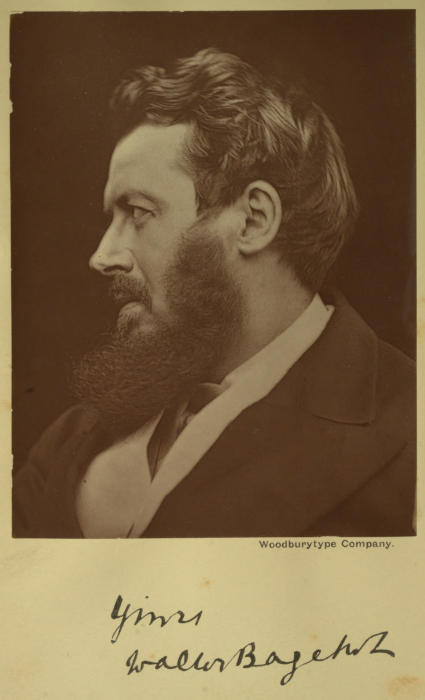
has been appended to each Essay. The Portrait was
taken in photography by Monsieur Adolphe Beau, in
1864. It has been printed by Messrs. Locke & Whitfield
by the Woodbury process.
It is inevitable, I suppose, that the world should judge
of a man chiefly by what it has gained in him, and lost
by his death, even though a very little reflection might
sometimes show that the special qualities which made
him so useful to the world implied others of a yet
higher order, in which, to those who knew him well,
these more conspicuous characteristics must have been
well-nigh merged. And while, of course, it has given
me great pleasure, as it must have given pleasure to all
Bagehot’s friends, to hear the Chancellor of the Exchequer’s
evidently genuine tribute to his financial sagacity
in the Budget speech of 1877, and Lord Granville’s
eloquent acknowledgments of the value of Bagehot’s
political counsels as Editor of the Economist, in the
speech delivered at the London University on May 9,
1877, I have sometimes felt somewhat unreasonably
vexed that those who appreciated so well what I may
almost call the smallest part of him, appeared to know
so little of the essence of him,—of the high-spirited,
buoyant, subtle, speculative nature in which the imaginative
qualities were even more remarkable than the
judgment, and were, indeed, at the root of all that was
strongest in the judgment,—of the gay and dashing
humour which was the life of every conversation in
which he joined,—and of the visionary nature to which
the commonest things often seemed the most marvellous,
and the marvellous things the most intrinsically probable.
To those who hear of Bagehot only as an
original political economist and a lucid political thinker,
a curiously false image of him must be suggested.
If they are among the multitude misled by Carlyle,
who regard all political economists as ‘the dreary
professors of a dismal science,’ they will probably
conjure up an arid disquisitionist on value and cost
of production; and even if assured of Bagehot’s imaginative
power, they may perhaps only understand by
the expression, that capacity for feverish preoccupation
which makes the mention of ‘Peel’s Act’ summon up
to the faces of certain fanatics a hectic glow, or the
rumour of paper currencies blanch others with the
pallor of true passion. The truth, however, is that the
best qualities which Bagehot had, both as economist
and as politician, were of a kind which the majority of
economists and politicians do not specially possess. I
do not mean that it was in any way an accident that he
was an original thinker in either sphere; far from it.
But I do think that what he brought to political and
economical science, he brought in some sense from
outside their normal range,—that the man of business
and the financier in him fell within such sharp and
well-defined limits, that he knew better than most
of his class where their special weakness lay, and where
their special functions ended. This, at all events, I am
quite sure of, that so far as his judgment was sounder
than other men’s—and on many subjects it was much
sounder—it was so not in spite of, but in consequence
of, the excursive imagination and vivid humour which
are so often accused of betraying otherwise sober minds
into dangerous aberrations. In him both lucidity and
caution were directly traceable to the force of his
imagination.
Walter Bagehot was born at Langport on February
3, 1826. Langport is an old-fashioned little town in
the centre of Somersetshire, which in early days returned
two members to Parliament, until the burgesses
petitioned Edward I. to relieve them of the expense of
paying their members,—a quaint piece of economy of
which Bagehot frequently made humorous boast. The
town is still a close corporation, and calls its mayor by
the old Saxon name of Portreeve, and Bagehot himself
became its Deputy-Recorder, as well as a Magistrate
for the County. Situated at the point where the river
Parret ceases to be navigable, Langport has always been
a centre of trade; and here in the last century Mr.
Samuel Stuckey founded the Somersetshire Bank, which
has since spread over the entire county, and is now the
largest private bank of issue in England. Bagehot was
the only surviving child of Mr. Thomas Watson Bagehot,
who was for thirty years Managing Director and Vice-Chairman
of Stuckey’s Banking Company, and was, as
Bagehot was fond of recalling, before he resigned that
position, the oldest joint-stock banker in the United
Kingdom. Bagehot succeeded his father as Vice-Chairman
of the Bank, when the latter retired in his old age.
His mother, a Miss Stuckey, was a niece of Mr. Samuel
Stuckey, the founder of the Banking Company, and was
a very pretty and lively woman, who had, by her previous
marriage with a son of Dr. Estlin of Bristol, been
brought at an early age into an intellectual atmosphere
by which she had greatly profited. There is no doubt
that Bagehot was greatly indebted to the constant and
careful sympathy in all his studies that both she and
his father gave him, as well as to a very studious disposition,
for his future success. Dr. Prichard, the well-known
ethnologist, was her brother-in-law, and her
son’s marked taste for science was first awakened in Dr.
Prichard’s house in Park Row, where Bagehot often
spent his half-holidays while he was a schoolboy in
Bristol. To Dr. Prichard’s ‘Races of Man’ may, indeed,
be first traced that keen interest in the speculative side
of ethnological research, the results of which are best
seen in Bagehot’s book on ‘Physics and Politics.’
I first met Bagehot at University College, London,
when we were neither of us over seventeen. I was
struck by the questions put by a lad with large dark
eyes and florid complexion to the late Professor De
Morgan, who was lecturing to us, as his custom was,
on the great difficulties involved in what we thought
we all understood perfectly—such, for example, as the
meaning of 0, of negative quantities, or the grounds of
probable expectation. Bagehot’s questions showed that
he had both read and thought more on these subjects
than most of us, and I was eager to make his acquaintance,
which soon ripened into an intimate friendship,
in which there was never any intermission between that
time and his death. Some will regret that Bagehot did
not go to Oxford; the reason being that his father, who
was a Unitarian, objected on principle to all doctrinal
tests, and would never have permitted a son of his to
go to either of the older Universities while those tests
were required of the undergraduates. And I am not at
all sure that University College, London, was not at that
time a much more awakening place of education for
young men than almost any Oxford college. Bagehot
himself, I suspect, thought so. Fifteen years later
he wrote, in his essay on Shelley: ‘A distinguished
pupil of the University of Oxford once observed to us,
“The use of the University of Oxford is that no one can
over-read himself there. The appetite for knowledge
is repressed.”’ And whatever may have been defective
in University College, London—and no doubt much was
defective—nothing of the kind could have been said of
it when we were students there. Indeed, in those years
London was a place with plenty of intellectual stimulus
in it for young men, while in University College itself
there was quite enough vivacious and original teaching
to make that stimulus available to the full. It is sometimes
said that it needs the quiet of a country town
remote from the capital, to foster the love of genuine
study in young men. But of this, at least, I am sure,
that Gower Street, and Oxford Street, and the New
Road, and the dreary chain of squares from Euston to
Bloomsbury, were the scenes of discussions as eager and
as abstract as ever were the sedate cloisters or the
flowery river-meadows of Cambridge or Oxford. Once,
I remember, in the vehemence of our argument as to
whether the so-called logical principle of identity (A is A)
were entitled to rank as ‘a law of thought’ or only as
a postulate of language, Bagehot and I wandered up
and down Regent Street for something like two hours in
the vain attempt to find Oxford Street:—
‘And yet what days were those, Parmenides,
When we were young, when we could number friends,
In all the Italian cities like ourselves,
When with elated hearts we joined your train,
Ye sun-born virgins, on the road of truth!
Then we could still enjoy, then neither thought
Nor outward things were closed and dead to us,
But we received the shock of mighty thoughts
On single minds with a pure natural joy;
And if the sacred load oppressed our brain,
We had the power to feel the pressure eased,
The brow unbound, the thoughts flow free again
In the delightful commerce of the world.’
Bagehot has himself described, evidently from his
own experience, the kind of life we lived in those days,
in an article on Oxford Reform: ‘So, too, in youth, the
real plastic energy is not in tutors, or lectures, or in
books “got up,” but in Wordsworth and Shelley, in the
books that all read because all like; in what all talk
of because all are interested; in the argumentative
walk or disputatious lounge; in the impact of young
thought upon young thought, of fresh thought on fresh
thought, of hot thought on hot thought; in mirth and
refutation, in ridicule and laughter; for these are the
free play of the natural mind, and these cannot be got
without a college.’[2]
The late Professor Sewell, when asked to give his
pupils some clear conception of the old Greek Sophists,
is said to have replied that he could not do this better
than by referring them to the Professors of University
College, London. I do not think there was much force
in the sarcasm, for though Professor T. Hewitt Key,
whose restless and ingenious mind led him many a wild
dance after etymological Will-of-the-wisps—I remember,
for instance, his cheerfully accepting the suggestion
that ‘better’ and ‘bad’ (melior and malus) came from
the same root, and accounting for it by the probable
disposition of hostile tribes to call everything bad which
their enemies called good, and everything good which
their enemies called bad—may have had in him much
of the brilliance, and something also, perhaps, of the
flightiness, of the old sophist, it would be hard to imagine
men more severe in exposing pretentious conceits
and dispelling dreams of theoretic omniscience, than
Professors De Morgan, Malden, and Long. De Morgan,
who at that time was in the midst of his controversy on
formal logic with Sir William Hamilton, was, indeed,
characterised by the great Edinburgh metaphysician as
‘profound in mathematics, curious in logic, but wholly
deficient in architectonic power;’ yet, for all that, his
lectures on the Theory of Limits were a far better
logical discipline for young men than Sir William
Hamilton’s on the Law of the Unconditioned or the
Quantification of the Predicate. Professor Malden contrived
to imbue us with a love of that fastidious taste
and that exquisite nicety in treating questions of scholarship,
which has, perhaps, been more needed and less
cultivated in Gower Street than any other of the higher
elements of a college education; while Professor Long’s
caustic irony, accurate and almost ostentatiously dry
learning, and profoundly stoical temperament, were as
antithetic to the temper of the sophist as human qualities
could possibly be.
The time of our college life was pretty nearly contemporaneous
with the life of the Anti-Corn-Law
League and the great agitation in favour of Free-trade.
To us this was useful rather from the general
impulse it gave to political discussion, and the literary
curiosity it excited in us as to the secret of true eloquence,
than because it anticipated in any considerable
degree the later acquired taste for economical science.
Bagehot and I seldom missed an opportunity of hearing
together the matchless practical disquisitions of Mr.
Cobden—lucid and homely, yet glowing with intense
conviction,—the profound passion and careless, though
artistic, scorn of Mr. Bright, and the artificial and elaborately
ornate periods, and witty, though somewhat
ad captandum, epigrams of Mr. W. J. Fox (afterwards
M.P. for Oldham). Indeed, we scoured London together
to hear any kind of oratory that had gained a reputation
of its own, and compared all we heard with the
declamation of Burke and the rhetoric of Macaulay,
many of whose later essays came out and were eagerly
discussed by us while we were together at college. In
our conversations on these essays, I remember that I
always bitterly attacked, while Bagehot moderately
defended, the glorification of compromise which marks
all Macaulay’s writings. Even in early youth Bagehot
had much of that ‘animated moderation’ which he
praises so highly in his latest work. He was a voracious
reader, especially of history, and had a far truer
appreciation of historical conditions than most young
thinkers; indeed, the broad historical sense which characterised
him from first to last, made him more alive
than ordinary students to the urgency of circumstance,
and far less disposed to indulge in abstract moral criticism
from a modern point of view. On theology, as on
all other subjects, Bagehot was at this time more Conservative
than myself, he sharing his mother’s orthodoxy,
and I at that time accepting heartily the Unitarianism
of my own people. Theology was, however, I
think, the only subject on which, in later life, we, to
some degree at least, exchanged places, though he never
at any time, however doubtful he may have become on
some of the cardinal issues of historical Christianity,
accepted the Unitarian position. Indeed, within the
last two or three years of his life, he spoke on one
occasion of the Trinitarian doctrine as probably the best
account which human reason could render of the
mystery of the self-existent mind.
In those early days Bagehot’s manner was often
supercilious. We used to attack him for his intellectual
arrogance—his ὕβρις we called it, in our college
slang—a quality which I believe was not really in him,
though he had then much of its external appearance.
Nevertheless his genuine contempt for what was intellectually
feeble was not accompanied by an even adequate
appreciation of his own powers. At college,
however, his satirical ‘Hear, hear,’ was a formidable
sound in the debating society, and one which took the
heart out of many a younger speaker; and the ironical
‘How much?’ with which in conversation he would
meet an over-eloquent expression, was always of a
nature to reduce a man, as the mathematical phrase
goes, to his ‘lowest terms.’ In maturer life he became
much gentler and mellower, and often even delicately
considerate for others; but his inner scorn for ineffectual
thought remained, in some degree, though
it was very reticently expressed, to the last. For instance,
I remember his attacking me for my mildness
in criticising a book which, though it professed to rest
on a basis of clear thought, really missed all its points.
‘There is a pale, whitey-brown substance,’ he wrote to
me, ‘in the man’s books, which people who don’t think
take for thought, but it isn’t;’ and he upbraided me
much for not saying plainly that the man was a muff.
In his youth this scorn for anything like the vain beating
of the wings in the attempt to think, was at its
maximum. It was increased, I think, by that which
was one of his greatest qualities, his remarkable ‘detachment’
of mind—in other words, his comparative
inaccessibility to the contagion of blind sympathy.
Most men, more or less unconsciously, shrink from
even thinking what they feel to be out of sympathy
with the feelings of their neighbours, unless under some
strong incentive to do so; and in this way the sources
of much true and important criticism are dried up,
through the mere diffusion and ascendancy of conventional
but sincere habits of social judgment. And no
doubt for the greater number of us this is much the
best. We are worth more for the purpose of constituting
and strengthening the cohesive power of the
social bond, than we should ever be worth for the
purpose of criticising feebly—and with little effect,
perhaps, except the disorganising effect of seeming ill-nature—the
various incompetences and miscarriages of
our neighbours’ intelligence. But Bagehot’s intellect
was always far too powerful and original to render him
available for the function of mere social cement; and
full as he was of genuine kindness and hearty personal
affections, he certainly had not in any high degree that
sensitive instinct as to what others would feel, which so
often shapes even the thoughts of men, and still oftener
their speech, into mild and complaisant, but unmeaning
and unfruitful, forms.
Thus it has been said that in his very amusing
article on Crabb Robinson, published in the Fortnightly
Review for August 1869, he was more than a little
rough in his delineation of that quaint old friend of
our earlier days. And certainly there is something of
the naturalist’s realistic manner of describing the habits
of a new species, in the paper, though there is not a
grain of malice or even depreciatory bias in it, and
though there is a very sincere regard manifested
throughout. But that essay will illustrate admirably
what I mean by saying that Bagehot’s detachment of
mind, and the deficiency in him of any aptitude for
playing the part of mere social cement, tended to give
the impression of an intellectual arrogance which—certainly
in the sense of self-esteem or self-assertion—did
not in the least belong to him. In the essay I have
just mentioned he describes how Crabb Robinson, when
he gave his somewhat famous breakfast-parties, used to
forget to make the tea, then lost his keys, then told a
long story about a bust of Wieland during the extreme
agony of his guests’ appetites, and finally, perhaps,
withheld the cup of tea he had at last poured out,
while he regaled them with a poem of Wordsworth’s
or a diatribe against Hazlitt. And Bagehot adds, ‘The
more astute of his guests used to breakfast before they
came, and then there was much interest in seeing a
steady literary man, who did not understand the region,
in agonies at having to hear three stories before
he got his tea, one again between his milk and his
sugar, another between his butter and his toast, and
additional zest in making a stealthy inquiry that was
sure to intercept the coming delicacies by bringing on
Schiller and Goethe.’ The only ‘astute’ person referred
to was, I imagine, Bagehot himself, who confessed to
me, much to my amusement, that this was always his
own precaution before one of Crabb Robinson’s breakfasts.
I doubt if anybody else ever thought of it. It
was very characteristic in him that he should have
not only noticed—for that, of course, anyone might
do—this weak element in Crabb Robinson’s breakfasts,
but should have kept it so distinctly before his
mind as to make it the centre, as it were, of a policy,
and the opportunity of a mischievous stratagem to
try the patience of others. It showed how much of
the social naturalist there was in him. If any race of
animals could understand a naturalist’s account of their
ways and habits, and of the devices he adopted to get
those ways and habits more amusingly or instructively
displayed before him, no doubt they would think that
he was a cynic; and it was this intellectual detachment,
as of a social naturalist, from the society in which he
moved, which made Bagehot’s remarks often seem
somewhat harsh, when, in fact, they were animated not
only by no suspicion of malice, but by the most cordial
and earnest friendliness. Owing to this separateness of
mind, he described more strongly and distinctly traits
which, when delineated by a friend, we expect to find
painted in the softened manner of one who is half disposed
to imitate or adopt them.
Yet, though I have used the word ‘naturalist’ to
denote the keen and solitary observation with which
Bagehot watched society, no word describes him worse,
if we attribute to it any of that coldness and stillness
of curiosity which we are apt to associate with scientific
vigilance. Especially in his youth, buoyancy, vivacity,
velocity of thought, were of the essence of the impression
which he made. He had high spirits and great
capacities for enjoyment, great sympathies indeed with
the old English Cavalier. In his Essay on Macaulay he
paints that character with profound sympathy:—
‘What historian, indeed,’ he says, ‘has ever estimated the Cavalier
character? There is Clarendon, the grave, rhetorical, decorous,
lawyer—piling words, congealing arguments—very stately, a little
grim. There is Hume, the Scotch metaphysician, who has made out
the best case for such people as never were, for a Charles who never
died, for a Strafford who could never have been attainted, a saving,
calculating North-countryman, fat, impassive, who lived on eightpence
a day. What have these people to do with an enjoying English
gentleman? Talk of the ways of spreading a wholesome Conservatism
throughout the country ... as far as communicating and
establishing your creed is concerned, try a little pleasure. The way
to keep up old customs is to enjoy old customs; the way to be satisfied
with the present state of things, is to enjoy that state of things.
Over the “Cavalier” mind this world passes with a thrill of delight;
there is an exultation in a daily event, zest in the “regular thing,”
joy at an old feast.’[3]
And that aptly represents himself. Such arrogance
as he seemed to have in early life was the arrogance as
much of enjoyment as of detachment of mind—the insouciance
of the old Cavalier as much at least as the
calm of a mind not accessible to the contagion of social
feelings. He always talked, in youth, of his spirits as
inconveniently high; and once wrote to me that he did
not think they were quite as ‘boisterous’ as they had
been, and that his fellow-creatures were not sorry for
the abatement; nevertheless, he added, ‘I am quite fat,
gross, and ruddy.’ He was, indeed, excessively fond of
hunting, vaulting, and almost all muscular effort, so
that his life would be wholly misconceived by anyone
who, hearing of his ‘detachment’ of thought, should
picture his mind as a vigilantly observant, far-away
intelligence, such as Hawthorne’s, for example. He
liked to be in the thick of the mêlée when talk grew
warm, though he was never so absorbed in it as not to
keep his mind cool.
As I said, Bagehot was a Somersetshire man, with
all the richness of nature and love for the external
glow of life which the most characteristic counties of
the South-west of England contrive to give to their
most characteristic sons:—
‘This north-west corner of Spain,’ he wrote once to a newspaper
from the Pyrenees, ‘is the only place out of England where I should
like to live. It is a sort of better Devonshire; the coast is of the
same kind, the sun is more brilliant, the sea is more brilliant, and
there are mountains in the background. I have seen some more
beautiful places and many grander, but I should not like to live in
them. As Mr. Emerson puts it, “I do not want to go to heaven
before my time.” My English nature by early use and long habit is
tied to a certain kind of scenery, soon feels the want of it, and is apt
to be alarmed as well as pleased at perpetual snow and all sorts of
similar beauties. But here, about San Sebastian, you have the best
England can give you (at least if you hold, as I do, that Devonshire
is the finest of our counties), and the charm, the ineffable, indescribable
charm of the South too. Probably the sun has some secret effect
on the nervous system that makes one inclined to be pleased, but the
golden light lies upon everything, and one fancies that one is charmed
only by the outward loveliness.’
The vivacity and warm colouring of the landscapes
of the South of England certainly had their full share
in moulding his tastes, and possibly even his style.
Bagehot took the mathematical scholarship with
his Bachelor’s degree in the University of London in
1846, and the gold medal in Intellectual and Moral
Philosophy with his Master’s degree in 1848, in reading
for which he mastered for the first time those principles
of political economy which were to receive so much
illustration from his genius in later years. But at this
time philosophy, poetry, and theology had, I think, a
much greater share of his attention than any narrow
and more sharply defined science. Shakespeare, Keats,
Shelley and Wordsworth, Coleridge, Martineau and
John Henry Newman, all in their way exerted a great
influence over his mind, and divided, not unequally,
with the authors whom he was bound to study—that
is, the Greek philosophers, together with Hume, Kant,
J. S. Mill, and Sir William Hamilton—the time at his
disposal. I have no doubt that for seven or eight years
of his life the Roman Catholic Church had a great fascination
for his imagination, though I do not think that
he was ever at all near conversion. He was intimate
with all Dr. Newman’s writings. And of these the
Oxford sermons, and the poems in the Lyra Apostolica
afterwards separately published—partly, I believe, on
account of the high estimate of them which Bagehot had
himself expressed—were always his special favourites.
The little poetry he wrote—and it is evident that he
never had the kind of instinct for, or command of,
language which is the first condition of genuine poetic
genius—seems to me to have been obviously written
under the spell which Dr. Newman’s own few but
finely-chiselled poems had cast upon him. If I give
one specimen of Bagehot’s poems, it is not that I think
it in any way an adequate expression of his powers,
but for a very different reason, because it will show
those who have inferred from his other writings that his
mind never deeply concerned itself with religion, how
great is their mistake. Nor is there any real poverty of
resource in these lines, except perhaps in the awkward
mechanism of some of them. They were probably
written when he was twenty-three or twenty-four.
‘To the Roman Catholic Church.
‘“Casta inceste.”—Lucretius.
‘Thy lamp of faith is brightly trimmed,
Thy eager eye is not yet dimmed,
Thy stalwart step is yet unstayed,
Thy words are well obeyed.
‘Thy proud voice vaunts of strength from heaven,
Thy proud foes carp, “By hell’s art given:”
No Titan thou of earth-born bands,
Strange Church of hundred hands.
‘Nursed without knowledge, born of night,
With hand of power and thoughts of light,
As Britain seas, far reachingly
O’er-rul’st thou history.
‘Wild as La Pucelle in her hour,
O’er prostrate realms with awe-girt power
Thou marchest stedfast on thy path
Through wonder, love, and wrath.
‘And will thy end be such as hers,
O’erpowered by earthly mail-clad powers,
Condemned for cruel, magic art,
Though awful, bold of heart?
‘Through thorn-clad Time’s unending waste
With ardent step alone thou strayest,
As Jewish scape-goats tracked the wild,
Unholy, consecrate, defiled.
‘Use not thy truth in manner rude
To rule for gain the multitude,
Or thou wilt see that truth depart,
To seek some holier heart;
‘Then thou wilt watch thy errors lorn,
O’erspread by shame, o’erswept by scorn,
In lonely want without hope’s smile,
As Tyre her weed-clad Isle.
‘Like once thy chief, thou bear’st Christ’s name;
Like him thou hast denied his shame,
Bold, eager, skilful, confident,
Oh, now like him repent!’
That has certainly no sign of the hand of the master
in it, for the language is not moulded and vivified by
the thought, but the thought itself is fine. And there is
still better evidence than these lines would afford, of the
fascination which the Roman Catholic Church had for
Bagehot. A year or two later, in the letters on the
coup d’état, to which I shall soon have to refer, there
occurs the following passage. (He is trying to explain
how the cleverness, the moral restlessness, and intellectual
impatience of the French, all tend to unfit
them for a genuine Parliamentary government):—
‘I do not know that I can exhibit the way these qualities of the
French character operate on their opinions better than by telling you
how the Roman Catholic Church deals with them. I have rather
attended to it since I came here. It gives sermons almost an interest,
their being in French, and to those curious in intellectual matters, it
is worth observing. In other times, and even now in out-of-the-way
Spain, I suppose it may be true that the Catholic Church has been
opposed to inquiry and reasoning. But it is not so now and here.
Loudly from the pens of a hundred writers, from the tongues of a
thousand pulpits, in every note of thrilling scorn and exulting derision,
she proclaims the contrary. Be she Christ’s workman or
Antichrist’s, she knows her work too well. “Reason, reason, reason!”
exclaims she to the philosophers of this world. “Put in practice
what you teach if you would have others believe it. Be consistent.
Do not prate to us of private judgment, when you are but yourselves
repeating what you heard in the nursery, ill-mumbled remnants of a
Catholic tradition. No; exemplify what you command; inquire
and make search. Seek, and we warn you that ye will never find,
yet do as ye will. Shut yourselves up in a room, make your mind a
blank, go down (as you speak) into the depth of your consciousness,
scrutinise the mental structure, inquire for the elements of belief,—spend
years, your best years, in the occupation,—and at length, when
your eyes are dim, and your brain hot, and your hands unsteady, then
reckon what you have gained. See if you cannot count on your
fingers the certainties you have reached; reflect which of them you
doubted yesterday, which you may disbelieve to-morrow; or rather,
make haste—assume at random some essential credenda,—write down
your inevitable postulates, enumerate your necessary axioms, toil on,
toil on, spin your spider’s web, adore your own soul, or if ye prefer
it, choose some German nostrum; try an intellectual intuition, or
the pure reason, or the intelligible ideas, or the mesmeric clairvoyance,
and when so, or somehow, you have attained your results,
try them on mankind. Don’t go out into the byeways and hedges;
it is unnecessary. Ring a bell, call in the servants, give them a
course of lectures, cite Aristotle, review Descartes, panegyrise Plato,
and see if the bonne will understand you. It is you that say Vox
populi, vox Dei. You see the people reject you. Or, suppose you
succeed,—what you call succeeding. Your books are read; for three
weeks or even a season you are the idol of the salons. Your hard
words are on the lips of women; then a change comes—a new actress
appears at the Théâtre Français or the Opéra; her charms eclipse
your theories; or a great catastrophe occurs; political liberty, it is
said, is annihilated. Il faut se faire mouchard, is the observation of
scoffers. Anyhow you are forgotten. Fifty years may be the gestation
of a philosophy, not three its life. Before long, before you go
to your grave, your six disciples leave you for some newer master, or
to set up for themselves. The poorest priest in the remotest region
of the Basses-Alpes has more power over men’s souls than human
cultivation. His ill-mouthed masses move women’s souls—can you?
Ye scoff at Jupiter, yet he at least was believed in, you never have
been. Idol for idol, the dethroned is better than the unthroned. No,
if you would reason, if you would teach, if you would speculate,—come
to us. We have our premises ready; years upon years before you
were born, intellects whom the best of you delight to magnify, toiled
to systematise the creed of ages. Years upon years after you are
dead, better heads than yours will find new matter there to define, to
divide, to arrange. Consider the hundred volumes of Aquinas. Which
of you desire a higher life than that;—to deduce, to subtilise, discriminate,
systematise, and decide the highest truth, and to be believed?
Yet such was his luck, his enjoyment. He was what you would be.
No, no, credite, credite. Ours is the life of speculation. The cloister
is the home for the student. Philosophy is stationary, Catholicism
progressive. You call. We are heard,” &c. So speaks each preacher,
according to his ability. And when the dust and noise of present
controversies have passed away, and, in the interior of the night,
some grave historian writes out the tale of half-forgotten times, let
him not forget to observe that, profoundly as the mediæval Church
subdued the superstitious cravings of a painful and barbarous age, in
after-years she dealt more discerningly still with the feverish excitement,
the feeble vanities, and the dogmatic impatience of an over-intellectual
generation.’[4]
It is obvious, I think, both from the poem, and from
these reflections, that what attracted Bagehot in the
Church of Rome was the historical prestige and social
authority which she had accumulated in believing and
uncritical ages for use in the unbelieving and critical
age in which we live,—while what he condemned and
dreaded in her was her tendency to use her power over
the multitude for purposes of a low ambition.
And as I am on this subject, this will be, I think,
the best opportunity I shall have to say what I have
got to say of Bagehot’s later religious belief, without
returning to it when I have to deal with a period in
which the greatest part of his spare intellectual energy
was given to other subjects. I do not think that the
religious affections were very strong in Bagehot’s mind,
but the primitive religious instincts certainly were.
From childhood he was what he certainly remained to
the last, in spite of the rather antagonistic influence of
the able scientific group of men from whom he learned
so much—a thorough transcendentalist, by which I
mean one who could never doubt that there was a real
foundation of the universe distinct from the outward
show of its superficial qualities, and that the substance is
never exhaustively expressed in these qualities. He often
repeats in his essays Shelley’s fine line, ‘Lift not the
painted veil which those who live call life,’ and the essence
at least of the idea in it haunted him from his very childhood.
In the essay on ‘Hartley Coleridge’—perhaps the
most perfect in style of any of his writings—he describes
most powerfully, and evidently in great measure from
his own experience, the mysterious confusion between
appearances and realities which so bewildered little
Hartley,—the difficulty that he complained of in distinguishing
between the various Hartleys,—‘picture
Hartley,’ ‘shadow Hartley,’ and between Hartley the
subject and Hartley the object, the enigmatic blending
of which last two Hartleys the child expressed by
catching hold of his own arm, and then calling himself
the ‘catch-me-fast Hartley.’ And in dilating on this
bewildering experience of the child’s, Bagehot borrows
from his own recollections:—
‘All children have a world of their own, as distinct from that of
the grown people who gravitate around them, as the dreams of girlhood
from our prosaic life, or the ideas of the kitten that plays with
the falling leaves, from those of her carnivorous mother that catches
mice, and is sedulous in her domestic duties. But generally about
this interior existence children are dumb. You have warlike ideas,
but you cannot say to a sinewy relative, “My dear aunt, I wonder
when the big bush in the garden will begin to walk about; I’m sure
it’s a Crusader, and I was cutting it all the day with my steel sword.
But what do you think, aunt? for I’m puzzled about its legs, because
you see, aunt, it has only one stalk—and besides, aunt, the leaves.”
You cannot remark this in secular life, but you hack at the infelicitous
bush till you do not wholly reject the idea that your small
garden is Palestine, and yourself the most adventurous of knights.’[5]
They have a tradition in the family that this is but
a fragment from Bagehot’s own imaginative childhood,
and certainly this visionary element in him was very
vivid to the last. However, the transcendental or intellectual
basis of religious belief was soon strengthened
in him, as readers of his remarkable paper on Bishop
Butler will easily see, by those moral and retributive
instincts which warn us of the meaning and consequences
of guilt:—
‘The moral principle,’ he wrote in that essay, ‘whatever may be
said to the contrary by complacent thinkers, is really and to most
men a principle of fear.... Conscience is the condemnation of
ourselves; we expect a penalty. As the Greek proverb teaches,
“Where there is shame, there is fear.”... How to be free from
this is the question. How to get loose from this—how to be rid of
the secret tie which binds the strong man and cramps his pride, and
makes him angry at the beauty of the universe, which will not let
him go forth like a great animal, like the king of the forest, in the
glory of his might, but which restrains him with an inner fear and a
secret foreboding that if he do but exalt himself he shall be abased,
if he do but set forth his own dignity he will offend One who will
deprive him of it. This, as has often been pointed out, is the source
of the bloody rites of heathendom.’[6]
And then, after a powerful passage, in which he
describes the sacrificial superstitions of men like
Achilles, he returns, with a flash of his own peculiar
humour, to Bishop Butler, thus:—
‘Of course it is not this kind of fanaticism that we impute to a
prelate of the English Church; human sacrifices are not respectable,
and Achilles was not rector of Stanhope. But though the costume
and circumstances of life change, the human heart does not; its
feelings remain. The same anxiety, the same consciousness of personal
sin, which lead, in barbarous times, to what has been described,
show themselves in civilised life as well. In this quieter period, their
great manifestation is scrupulosity;’[7]
which he goes on to describe as a sort of inexhaustible
anxiety for perfect compliance with the minutest positive
commands which may be made the condition of
forgiveness for the innumerable lapses of moral obligation.
I am not criticising the paper, or I should point
out that Bagehot failed in it to draw out the distinction
between the primitive moral instinct and the corrupt
superstition into which it runs; but I believe that he
recognised the weight of this moral testimony of the
conscience to a divine Judge, as well as the transcendental
testimony of the intellect to an eternal substance
of things, to the end of his life. And certainly in the
reality of human free-will as the condition of all genuine
moral life, he firmly believed. In his ‘Physics and
Politics’—the subtle and original essay upon which, in
conjunction with the essay on the ‘English Constitution,’
Bagehot’s reputation as a European thinker chiefly rests—he
repeatedly guards himself (for instance, pp. 9, 10)
against being supposed to think that in accepting the
principle of evolution, he has accepted anything inconsistent
either with spiritual creation, or with the free
will of man. On the latter point he adds,
‘No doubt the modern doctrine of the “conservation of force,” if
applied to decision, is inconsistent with free-will; if you hold that
force is “never lost or gained,” you cannot hold that there is a real
gain, a sort of new creation of it in free volition. But I have nothing
to do here with the universal “conservation of force.” The conception
of the nervous organs as stores of will-made power, does not raise or
need so vast a discussion.’[8]
And in the same book he repeatedly uses the expression
‘Providence,’ evidently in its natural meaning, to
express the ultimate force at work behind the march of
‘evolution.’ Indeed, in conversation with me on this
subject, he often said how much higher a conception of
the creative mind, the new Darwinian ideas seemed to
him to have introduced, as compared with those contained
in what is called the argument from contrivance
and design. On the subject of personal immortality, too,
I do not think that Bagehot ever wavered. He often
spoke, and even wrote, of ‘that vague sense of eternal
continuity which is always about the mind, and which
no one could bear to lose,’ and described it as being
much more important to us than it even appears to be,
important as that is; for, he said, ‘when we think we are
thinking of the past, we are only thinking of a future
that is to be like it.’ But with the exception of these
cardinal points, I could hardly say how much Bagehot’s
mind was or was not affected by the great speculative
controversies of later years. Certainly he became much
more doubtful concerning the force of the historical
evidence of Christianity than I ever was, and rejected,
I think, entirely, though on what amount of personal
study he had founded his opinion I do not know, the
Apostolic origin of the fourth Gospel. Possibly his mind
may have been latterly in suspense as to miracle altogether,
though I am pretty sure that he had not come
to a negative conclusion. He belonged, in common
with myself, during the last years of his life, to a society
in which these fundamental questions were often discussed;
but he seldom spoke in it, and told me very
shortly before his death that he shrank from such discussions
on religious points, feeling that, in debates of
this kind, they were not and could not be treated with
anything like thoroughness. On the whole, I think,
the cardinal article of his faith would be adequately
represented even in the latest period of his life by the
following passage in his essay on Bishop Butler:—
‘In every step of religious argument we require the assumption,
the belief, the faith, if the word is better, in an absolutely perfect
Being; in and by whom we are, who is omnipotent as well as most
holy; who moves on the face of the whole world, and ruleth all
things by the word of his power. If we grant this, the difficulty of
the opposition between what is here called the natural and the supernatural
religion is removed; and without granting it, that difficulty
is perhaps insuperable. It follows from the very idea and definition
of an infinitely perfect Being, that he is within us as well as without
us,—ruling the clouds of the air and the fishes of the sea, as well as
the fears and thoughts of men; smiling through the smile of nature
as well as warning with the pain of conscience,—“sine qualitate,
bonum; sine quantitate, magnum; sine indigentiâ, creatorem; sine
situ, præsidentem; sine habitu, omnia continentem; sine loco, ubique
totum; sine tempore, sempiternum; sine ullâ sui mutatione, mutabilia
facientem, nihilque patientem.” If we assume this, life is
simple; without this, all is dark.’[9]
Evidently, then, though Bagehot held that the doctrine
of evolution by natural selection gave a higher
conception of the Creator than the old doctrine of
mechanical design, he never took any materialistic view
of evolution. One of his early essays, written while at
college, on some of the many points of the Kantian
philosophy which he then loved to discuss, concluded
with a remarkable sentence, which would probably
have fairly expressed, even at the close of his life, his
profound belief in God, and his partial sympathy with
the agnostic view that we are, in great measure, incapable
of apprehending, more than very dimly, His
mind or purposes:—‘Gazing after the infinite essence,
we are like men watching through the drifting clouds
for a glimpse of the true heavens on a drear November
day; layer after layer passes from our view, but still
the same immovable grey rack remains.’
After Bagehot had taken his Master’s degree, and
while he was still reading Law in London, and hesitating
between the Bar and the family bank, there came
as Principal to University Hall (which is a hall of residence
in connection with University College, London,
established by the Presbyterians and Unitarians after
the passing of the Dissenters’ Chapel Act), the man
who had, I think, a greater intellectual fascination for
Bagehot than any of his contemporaries—Arthur
Hugh Clough, Fellow of Oriel College, Oxford, and
author of various poems of great genius, more or less
familiar to the public, though Clough is perhaps better
known as the subject of the exquisite poem written on
his death in 1861, by his friend Matthew Arnold—the
poem to which he gave the name of ‘Thyrsis’—than
by even the most popular of his own. Bagehot had
subscribed for the erection of University Hall, and took
an active part at one time on its council. Thus he saw
a good deal of Clough, and did what he could to
mediate between that enigma to Presbyterian parents—a
college-head who held himself serenely neutral on
almost all moral and educational subjects interesting to
parents and pupils, except the observance of disciplinary
rules—and the managing body who bewildered
him and were by him bewildered. I don’t think either
Bagehot or Clough’s other friends were very successful
in their mediation, but he at least gained in Clough
a cordial friend, and a theme of profound intellectual
and moral interest to himself which lasted him his life,
and never failed to draw him into animated discussion
long after Clough’s own premature death; and I think
I can trace the effect which some of Clough’s writings
had on Bagehot’s mind to the very end of his career.
There were some points of likeness between Bagehot
and Clough, but many more of difference. Both had
the capacity for boyish spirits in them, and the florid
colour which usually accompanies a good deal of
animal vigour; both were reserved men, with a great
dislike of anything like the appearance of false sentiment,
and both were passionate admirers of Wordsworth’s
poetry; but Clough was slightly lymphatic,
with a great tendency to unexpressed and unacknowledged
discouragement, and to the paralysis of silent
embarrassment when suffering from such feelings, while
Bagehot was keen, and very quickly evacuated embarrassing
positions, and never returned to them. When
however, Clough was happy and at ease, there was a
calm and silent radiance in his face, and his head was
set with a kind of stateliness on his shoulders, that gave
him almost an Olympian air; but this would sometimes
vanish in a moment into an embarrassed taciturnity
that was quite uncouth. One of his friends declares
that the man who was said to be ‘a cross between a
schoolboy and a bishop,’ must have been like Clough.
There was in Clough, too, a large Chaucerian simplicity
and a flavour of homeliness, so that now and then,
when the light shone into his eyes, there was something,
in spite of the air of fine scholarship and
culture, which reminded one of the best likenesses of
Burns. It was of Clough, I believe, that Emerson was
thinking (though, knowing Clough intimately as he did,
he was of course speaking mainly in joke) when he
described the Oxford of that day thus:—‘“Ah,” says my
languid Oxford gentleman, “nothing new, and nothing
true, and no matter.”’ No saying could misrepresent
Clough’s really buoyant and simple character more
completely than that; but doubtless many of his sayings
and writings, treating, as they did, most of the greater
problems of life as insoluble, and enjoining a self-possessed
composure under the discovery of their insolubility,
conveyed an impression very much like this to
men who came only occasionally in contact with him.
Bagehot, in his article on Crabb Robinson, says that the
latter, who in those days seldom remembered names,
always described Clough as ‘that admirable and accomplished
man—you know whom I mean—the one who
never says anything.’ And certainly Clough was often
taciturn to the last degree, or if he opened his lips,
delighted to open them only to scatter confusion by
discouraging, in words at least, all that was then called
earnestness—as, for example, by asking, ‘Was it ordained
that twice two should make four, simply for the
intent that boys and girls should be cut to the heart
that they do not make five? Be content; when the
veil is raised, perhaps they will make five! Who
knows?’[10]
Clough’s chief fascination for Bagehot was, I think,
that he had as a poet in some measure rediscovered, at
all events realised, as few ever realised before, the
enormous difficulty of finding truth—a difficulty which
he somewhat paradoxically held to be enhanced rather
than diminished by the intensity of the truest modern
passion for it. The stronger the desire, he teaches,
the greater is the danger of illegitimately satisfying that
desire by persuading ourselves that what we wish to
believe, is true, and the greater the danger of ignoring
the actual confusions of human things:—
‘Rules baffle instincts, instincts rules,
Wise men are bad, and good are fools,
Facts evil, wishes vain appear,
We cannot go, why are we here?
‘Oh, may we, for assurance’ sake,
Some arbitrary judgment take,
And wilfully pronounce it clear,
For this or that ’tis, we are here?
‘Or is it right, and will it do
To pace the sad confusion through,
And say, it does not yet appear
What we shall be—what we are here?’
This warning to withhold judgment and not cheat
ourselves into beliefs which our own imperious desire
to believe had alone engendered, is given with every
variety of tone and modulation, and couched in all sorts
of different forms of fancy and apologue, throughout
Clough’s poems. He insists on ‘the ruinous force of
the will’ to persuade us of illusions which please us;
of the tendency of practical life to give us beliefs
which suit that practical life, but are none the truer
for that; and is never weary of warning us that a firm
belief in a falsity can be easily generated:—
‘Action will furnish belief,—but will that belief be the true one?
This is the point, you know. However, it doesn’t much matter.
What one wants, I suppose, is to predetermine the action,
So as to make it entail, not a chance belief, but the true one.’
This practical preaching, which Clough urges in season
and out of season, met an answering chord in Bagehot’s
mind, not so much in relation to religious belief as in
relation to the over-haste and over-eagerness of human
conduct, and I can trace the effect of it in all his
writings, political and otherwise, to the end of his life.
Indeed, it affected him much more in later days than
in the years immediately following his first friendship
with Clough. With all his boyish dash, there was
something in Bagehot even in youth which dreaded
precipitancy, and not only precipitancy itself, but those
moral situations tending to precipitancy which men
who have no minds of their own to make up, so often
court. In later life he pleased himself by insisting
that, on Darwin’s principle, civilised men, with all
the complex problems of modern life to puzzle them,
suspend their judgment so little, and are so eager for
action, only because they have inherited from the
earlier, simpler, and more violent ages, an excessive
predisposition to action unsuited to our epoch and
dangerous to our future development. But it was
Clough, I think, who first stirred in Bagehot’s mind this
great dread of ‘the ruinous force of the will,’ a phrase
he was never weary of quoting, and which might almost
be taken as the motto of his ‘Physics and Politics,’ the
great conclusion of which is that in the ‘age of discussion,’
grand policies and high-handed diplomacy and
sensational legislation of all kinds will become rarer
and rarer, because discussion will point out all the difficulties
of such policies in relation to a state of existence
so complex as our own, and will in this way tend
to repress the excess of practical energy handed down
to us by ancestors to whom life was a sharper, simpler,
and more perilous affair.
But the time for Bagehot’s full adoption of the
suspensive principle in public affairs was not yet. In
1851 he went to Paris, shortly before the coup d’état.
And while all England was assailing Louis Napoleon
(justly enough, as I think) for his perfidy, and his impatience
of the self-willed Assembly he could not
control, Bagehot was preparing a deliberate and very
masterly defence of that bloody and high-handed act.
Even Bagehot would, I think, if pressed judiciously in
later life, have admitted—though I can’t say he ever
did—that the coup d’état was one of the best illustrations
of ‘the ruinous force of the will’ in engendering,
or at least crystallising, a false intellectual conclusion as
to the political possibilities of the future, which recent
history could produce. Certainly he always spoke
somewhat apologetically of these early letters, though I
never heard him expressly retract their doctrine. In
1851 a knot of young Unitarians, of whom I was then
one, headed by the late Mr. J. Langton Sanford—afterwards
the historian of the Great Rebellion, who survived
Bagehot barely four months—had engaged to help for
a time in conducting the Inquirer, which then was, and
still is, the chief literary and theological organ of the
Unitarian body. Our régime was, I imagine, a time of
great desolation for the very tolerant and thoughtful constituency
for whom we wrote; and many of them, I am
confident, yearned, and were fully justified in yearning,
for those better days when this tyranny of ours should
be overpast. Sanford and Osler did a good deal to
throw cold water on the rather optimist and philanthropic
politics of the most sanguine, because the most
benevolent and open-hearted of Dissenters. Roscoe
criticised their literary work from the point of view of
a devotee of the Elizabethan poets; and I attempted to
prove to them in distinct heads, first, that their laity
ought to have the protection afforded by a liturgy
against the arbitrary prayers of their ministers; and
next, that at least the great majority of their sermons
ought to be suppressed, and the habit of delivering
them discontinued almost altogether. Only a denomination
of ‘just men’ trained in tolerance for generations,
and in that respect, at least, made all but ‘perfect,’
would have endured it at all; but I doubt if any of us
caused the Unitarian body so much grief as Bagehot, who
never was a Unitarian, but who contributed a series of
brilliant letters on the coup d’état, in which he trod just
as heavily on the toes of his colleagues as he did on
those of the public by whom the Inquirer was taken.
In those letters he not only, as I have already shown,
eulogised the Catholic Church, but he supported the
Prince-President’s military violence, attacked the freedom
of the Press in France, maintained that the country
was wholly unfit for true Parliamentary government,
and—worst of all perhaps—insinuated a panegyric on
Louis Napoleon himself, asserting that he had been
far better prepared for the duties of a statesman by
gambling on the turf, than he would have been by
poring over the historical and political dissertations of
the wise and the good. This was Bagehot’s day of
cynicism. The seven letters which he wrote on the
coup d’état were certainly very exasperating, and yet
they were not caricatures of his real thought, for his
private letters at the time were more cynical still.
Crabb Robinson, in speaking of him, used ever afterwards
to describe him to me as ‘that friend of yours—you
know whom I mean, you rascal!—who wrote those
abominable, those most disgraceful letters on the coup
d’état—I did not forgive him for years after.’ Nor do I
wonder, even now, that a sincere friend of constitutional
freedom and intellectual liberty, like Crabb Robinson,
found them difficult to forgive. They were light and
airy, and even flippant on a very grave subject. They
made nothing of the Prince’s perjury; and they took
impertinent liberties with all the dearest prepossessions
of the readers of the Inquirer, and assumed their sympathy
just where Bagehot knew that they would be
most revolted by his opinions. Nevertheless, they had
a vast deal of truth in them, and no end of ability, and I
hope that there will be many to read them with interest
now that they are here republished. There is a good
deal of the raw material of history in them, and certainly
I doubt if Bagehot ever again hit the satiric vein of
argument so well. Here is a passage that will bear
taking out of its context, and therefore not so full of
the shrewd malice of these letters as many others, but
which will illustrate their ability. It is one in which
Bagehot maintained for the first time the view (which I
believe he subsequently almost persuaded English politicians
to accept, though in 1852 it was a mere flippant
novelty, a paradox, and a heresy) that free institutions
are apt to succeed with a stupid people, and to founder
with a ready-witted and vivacious one. After broaching
this, he goes on:—
‘I see you are surprised. You are going to say to me as Socrates
did to Polus, “My young friend, of course you are right, but will
you explain what you mean, as you are not yet intelligible?” I will
do so as well as I can, and endeavour to make good what I say, not
from a prior demonstration of my own, but from the details of the
present and the facts of history. Not to begin by wounding any
present susceptibilities, let me take the Roman character, for, with
one great exception—I need not say to whom I allude—they are the
great political people of history. Now is not a certain dulness their
most visible characteristic? What is the history of their speculative
mind? A blank. What their literature? A copy. They have left
not a single discovery in any abstract science, not a single perfect
or well-formed work of high imagination. The Greeks, the perfection
of human and accomplished genius, bequeathed to mankind the
ideal forms of self-idolising art; the Romans imitated and admired.
The Greeks explained the laws of nature; the Romans wondered and
despised. The Greeks invented a system of numerals second only
to that now in use; the Romans counted to the end of their days
with the clumsy apparatus which we still call by their name. The
Greeks made a capital and scientific calendar; the Romans began
their month when the Pontifex Maximus happened to spy out the
new moon. Throughout Latin literature this is the perpetual puzzle—Why
are we free and they slaves?—we prætors and they barbers?
Why do the stupid people always win and the clever people always
lose? I need not say that in real sound stupidity the English people
are unrivalled. You’ll have more wit, and better wit, in an Irish
street-row than would keep Westminster Hall in humour for five weeks....
These valuable truths are no discoveries of mine. They
are familiar enough to people whose business it is to know them. Hear
what a douce and aged attorney says of your peculiarly promising
barrister. “Sharp? Oh! yes, yes: he’s too sharp by half. He
isn’t safe, not a minute, isn’t that young man.” “What style, sir,”
asked of an East India Director some youthful aspirant for literary
renown, “is most to be preferred in the composition of official
despatches?” “My good fellow,” responded the ruler of Hindostan,
“the style as we like, is the Humdrum.”’[11]
The permanent value of these papers is due to the
freshness of their impressions of the French capital, and
their true criticisms of Parisian journalism and society;
their perverseness consists in this, that Bagehot steadily
ignored in them the distinction between the duty of
resisting anarchy, and the assumption of the Prince-President
that this could only be done by establishing
his own dynasty, and deferring sine die that great constitutional
experiment which is now once more, no
thanks to him or his Government, on its trial; an experiment
which, for anything we see, had at least as
good a chance then as now, and under a firm and
popular chief of the executive like Prince Louis, would
probably have had a better chance then than it has now
under MacMahon. I need hardly say that in later life
Bagehot was by no means blind to the political shortcomings
of Louis Napoleon’s régime, as the article republished
from the Economist, in the second appendix
to this volume, sufficiently proves. Moreover, he rejoiced
heartily in the moderation of the republican statesmen
during the severe trials of the months which just preceded
his own death, in 1877, and expressed his sincere
belief—confirmed by the history of the last year and a
half—that the existing Republic has every prospect of
life and growth.
During that residence in Paris, Bagehot, though, as
I have said, in a somewhat cynical frame of mind, was
full of life and courage, and was beginning to feel his
own genius, which perhaps accounts for the air of
recklessness so foreign to him, which he never adopted
either before or since. During the riots he was a good
deal in the streets, and from a mere love of art helped
the Parisians to construct some of their barricades,
notwithstanding the fact that his own sympathy was
with those who shot down the barricades, not with
those who manned them. He climbed over the rails of
the Palais Royal on the morning of December 2nd to
breakfast, and used to say that he was the only person
who did breakfast there on that day. Victor Hugo is
certainly wrong in asserting that no one expected Louis
Napoleon to use force, and that the streets were as full
as usual when the people were shot down, for the gates
of the Palais Royal were shut quite early in the day.
Bagehot was very much struck by the ferocious look of
the Montagnards.
‘Of late,’ he wrote to me, ‘I have been devoting my entire
attention to the science of barricades, which I found amusing. They
have systematised it in a way which is pleasing to the cultivated
intellect. We had only one good day’s fighting, and I naturally kept
out of cannon-shot. But I took a quiet walk over the barricades in
the morning, and superintended the construction of three with as
much keenness as if I had been clerk of the works. You’ve seen
lots, of course, at Berlin, but I should not think those Germans were
up to a real Montagnard, who is the most horrible being to the eye I
ever saw,—sallow, sincere, sour fanaticism, with grizzled moustaches,
and a strong wish to shoot you rather than not. The Montagnards
are a scarce commodity, the real race—only three or four, if so many,
to a barricade. If you want a Satan any odd time, they’ll do; only
I hope that he don’t believe in human brotherhood. It is not possible
to respect any one who does, and I should be loth to confound the
notion of our friend’s solitary grandeur by supposing him to fraternise,’
&c. ‘I think M. Buonaparte is entitled to great praise. He has
very good heels to his boots, and the French just want treading
down, and nothing else—calm, cruel, business-like oppression, to take
the dogmatic conceit out of their heads. The spirit of generalisation
which, John Mill tells us, honourably distinguishes the French mind,
has come to this, that every Parisian wants his head tapped in order
to get the formulæ and nonsense out of it. And it would pay to
perform the operation, for they are very clever on what is within the
limit of their experience, and all that can be “expanded” in terms of
it, but beyond, it is all generalisation and folly.... So I am for
any carnivorous government.’
And again, in the same letter:—
‘Till the Revolution came I had no end of trouble to find conversation,
but now they’ll talk against everybody, and against the
President like mad—and they talk immensely well, and the language
is like a razor, capital if you are skilful, but sure to cut you if you
aren’t. A fellow can talk German in crude forms, and I don’t see it
sounds any worse, but this stuff is horrid unless you get it quite right.
A French lady made a striking remark to me:—“C’est une révolution
qui a sauvé la France. Tous mes amis sont mis en prison.” She
was immensely delighted that such a pleasing way of saving her
country had been found.’
Of course the style of these familiar private letters
conveys a gross caricature not only of Bagehot’s maturer
mind, but even of the judgment of the published
letters, and I quote them only to show that at the time
when he composed these letters on the coup d’état,
Bagehot’s mood was that transient mood of reckless
youthful cynicism through which so many men of genius
pass. I do not think he had at any time any keen
sympathy with the multitude, i.e., with masses of unknown
men. And that he ever felt what has since then
been termed ‘the enthusiasm of humanity,’ the sympathy
with ‘the toiling millions of men sunk in labour
and pain,’ he himself would strenuously have denied.
Such sympathy, even when men really desire to feel it,
is, indeed, very much oftener coveted than actually felt
by men as a living motive; and I am not quite sure that
Bagehot would have even wished to feel it. Nevertheless,
he had not the faintest trace of real hardness about
him towards people whom he knew and understood.
He could not bear to give pain; and when, in rare
cases by youthful inadvertence, he gave it needlessly,
I have seen how much and what lasting vexation it
caused him. Indeed, he was capable of great sacrifices
to spare his friends but a little suffering.
It was, I think, during his stay in Paris that Bagehot
finally decided to give up the notion of practising at
the Bar, and to join his father in the Somersetshire
Bank and in his other business as a merchant and ship-owner.
This involved frequent visits to London and
Liverpool, and Bagehot soon began to take a genuine
interest in the larger issues of commerce, and maintained
to the end that ‘business is much more amusing
than pleasure.’ Nevertheless, he could not live without
the intellectual life of London, and never stayed more
than six weeks at a time in the country without finding
some excuse for going to town; and long before his
death he made his home there. Hunting was the only
sport he really cared for. He was a dashing rider, and
a fresh wind was felt blowing through his earlier literary
efforts, as though he had been thinking in the saddle,
an effect wanting in his later essays, where you see
chiefly the calm analysis of a lucid observer. But most
of the ordinary amusements of young people he detested.
He used to say that he wished he could think
balls wicked, being so stupid as they were, and all ‘the
little blue and pink girls, so like each other,’—a sentiment
partly due, perhaps, to his extreme shortness of
sight.
Though Bagehot never doubted the wisdom of his
own decision to give up the law for the life of commerce,
he thoroughly enjoyed his legal studies in his
friend the late Mr. Justice Quain’s chambers, and in
those of the present Vice-Chancellor Sir Charles Hall,
and he learnt there a good deal that was of great use
to him in later life. Moreover, in spite of his large
capacity for finance and commerce, there were small
difficulties in Bagehot’s way as a banker and merchant
which he felt somewhat keenly. He was always absent-minded
about minutiæ. For instance, to the last, he
could not correct a proof well, and was sure to leave a
number of small inaccuracies, harshnesses, and slipshodnesses
in style, uncorrected. He declared at one time
that he was wholly unable to ‘add up,’ and in his
mathematical exercises in college he had habitually
been inaccurate in trifles. I remember Professor Malden,
on returning one of his Greek exercises, saying to him,
with that curiously precise and emphatic articulation
which made every remark of his go so much farther
than that of our other lecturers, ‘Mr. Bagehot, you
wage an internecine war with your aspirates’—not
meaning, of course, that he ever left them out in pronunciation,
but that he neglected to put them in in his
written Greek. And to the last, even in his printed
Greek quotations, the slips of this kind were always
numerous. This habitual difficulty—due, I believe, to a
preoccupied imagination—in attending to small details,
made a banker’s duties seem irksome and formidable to
him at first; and even to the last, in his most effective
financial papers, he would generally get some one else
to look after the precise figures for him. But in spite
of all this, and in spite of a real attraction for the study
of law, he was sure that his head would not stand the
hot Courts and heavy wigs which make the hot Courts
hotter, or the night-work of a thriving barrister in case
of success; and he was certainly quite right. Indeed,
had he chosen the Bar, he would have had no leisure
for those two or three remarkable books which have
made his reputation,—books which have been already
translated into all the literary and some of the unliterary
languages of Europe, and two of which are, I believe,
used as text-books in some of the American Colleges.[12]
Moreover, in all probability, his life would have been
much shorter into the bargain. Soon after his return
from Paris he devoted himself in earnest to banking
and commerce, and also began that series of articles,
first for the Prospective and then for the National
Review (which latter periodical he edited in conjunction
with me for several years), the most striking of which
he republished in 1858, under the awkward and almost
forbidding title of ‘Estimates of some Englishmen and
Scotchmen’—a book which never attracted the attention
it deserved, and which has been long out of
print. In republishing most of these essays as I am
now doing,—and a later volume may, I hope, contain
those essays on statesmen and politicians which are for
the present omitted from these,—it is perhaps only fair
to say that Bagehot in later life used to speak ill, much
too ill, of his own early style. He used to declare that
his early style affected him like the ‘jogging of a cart
without springs over a very rough road,’ and no doubt
in his earliest essays something abrupt and spasmodic
may easily be detected. Still, this was all so inextricably
mingled with flashes of insight and humour which could
ill be spared, that I always protested against any notion
of so revising the essays as to pare down their excrescences.
I have never understood the comparative failure of
this volume of Bagehot’s early essays; and a comparative
failure it was, though I do not deny that, even at
the time, it attracted much attention among the most
accomplished writers of the day, and that I have been
urged to republish it, as I am now doing, by many of
the ablest men of my acquaintance. Obviously, as I
have admitted, there are many faults of workmanship in
it. Now and then the banter is forced. Often enough
the style is embarrassed. Occasionally, perhaps, the
criticism misses its mark, or is over-refined. But taken
as a whole, I hardly know any book that is such good
reading, that has so much lucid vision in it, so much
shrewd and curious knowledge of the world, so sober
a judgment and so dashing a humour combined. Take
this, for instance, out of the paper on ‘The First Edinburgh
Reviewers,’ concerning the judgment passed by
Lord Jeffrey on the poetry of Bagehot’s favourite poet,
Wordsworth:—
‘The world has given judgment. Both Mr. Wordsworth and
Lord Jeffrey have received their rewards. The one had his own
generation—the laughter of men, the applause of drawing-rooms, the
concurrence of the crowd; the other, a succeeding age, the fond
enthusiasm of secret students, the lonely rapture of lonely minds.
And each has received according to his kind. If all cultivated men
speak differently because of the existence of Wordsworth and Coleridge;
if not a thoughtful English book has appeared for years without
some trace for good or for evil of their influence; if sermon-writers
subsist upon their thoughts; if “sacred” poets thrive by translating
their weaker portions into the speech of women; if, when all this is
over, some sufficient part of their writing will ever be fitting food for
wild musing and solitary meditation, surely this is because they possessed
the inner nature—an “intense and glowing mind”—“the
vision and the faculty divine.” But, if perchance in their weaker
moments the great authors of the Lyrical ballads did ever imagine
that the world was to pause because of their verses, that “Peter Bell”
would be popular in drawing-rooms, that “Christabel” would be
perused in the City, that people of fashion would make a hand-book
of the “Excursion,” it was well for them to be told at once that it
was not so. Nature ingeniously prepared a shrill artificial voice,
which spoke in season and out of season, enough and more than
enough, what will ever be the idea of the cities of the plain concerning
those who live alone among the mountains; of the frivolous concerning
the grave; of the gregarious concerning the recluse; of those
who laugh concerning those who laugh not; of the common concerning
the uncommon; of those who lend on usury concerning those who
lend not; the notions of the world, of those whom it will not reckon
among the righteous. It said, “This won’t do.” And so in all times
will the lovers of polished Liberalism speak concerning the intense
and lonely “prophet.”’[13]
I choose that passage because it illustrates so perfectly
Bagehot’s double vein, his sympathy with the
works of high imagination, and his clear insight into
that busy life which does not and cannot take note of
works of high imagination, and which would not do
the work it does, if it could. And this is the characteristic
of all the essays. How admirably, for instance,
in his essay on Shakespeare, does he draw out the individuality
of a poet who is generally supposed to be
so completely hidden in his plays; and with how keen
a satisfaction does he discern and display the prosperous
and practical man in Shakespeare—the qualities which
made him a man of substance and a Conservative politician,
as well as the qualities which made him a great
dramatist and a great dreamer. No doubt Bagehot had
a strong personal sympathy with the double life. Somersetshire
probably never believed that the imaginative
student, the omnivorous reader, could prosper as a
banker and a man of business, and it was a satisfaction
to him to show that he understood the world far better
than the world had ever understood him. Again, how
delicate is his delineation of Hartley Coleridge; how
firm and clear his study of ‘Sir Robert Peel;’[14] and how
graphically he paints the literary pageant of Gibbon’s
tame but splendid genius! Certainly the literary taste
of England never made a greater blunder than when it
passed by this remarkable volume of essays with comparatively
little notice.
In 1858 Bagehot married the eldest daughter of the
Right Honourable James Wilson, who died two years
later in India, whither he had gone as the financial
member of the Indian Council, to reduce to some extent
the financial anarchy which then prevailed there. This
marriage gave Bagehot nineteen years of undisturbed
happiness, and certainly led to the production of his
most popular and original, if not in every respect his
most brilliant books. It connected him with the higher
world of politics, without which he would hardly have
studied and written as he did on the English Constitution;
and by making him the Editor of the Economist
it compelled him to give his whole mind as much to
the theoretic side of commerce and finance, as his own
duties had already compelled him to give it to the
practical side. But when I speak of his marriage as
the last impulse which determined his chief work in
life, I do not forget that he had long been prepared
both for political and for financial speculation by his
early education. His father, a man of firm and deliberate
political convictions, had taken a very keen
interest in the agitation for the great Reform Bill of
1832, and had materially helped to return a Liberal
member for his county after it passed. Probably no one
in all England knew the political history of the country
since the peace more accurately than he. Bagehot
often said that when he wanted any detail concerning
the English political history of the last half-century, he
had only to ask his father, to obtain it. His uncle,
Mr. Vincent Stuckey, too, was a man of the world, and
his house in Langport was a focus of many interests
during Bagehot’s boyhood. Mr. Stuckey had begun life
at the Treasury, and was at one time private secretary
to Mr. Huskisson; and when he gave up that career to
take a leading share in the Somersetshire Bank, he kept
up for a long time his house in London, and his relations
with political society there. He was fond of his
nephew, as was Bagehot of him; and there was always
a large field of interests, and often there were men of
eminence, to be found in his house. Thus Bagehot had
been early prepared for the wider field of political and
financial thought, to which he gave up so much of his
time after his marriage.
I need not say nearly as much on this later aspect of
Bagehot’s life as I have done on its early and more
purely literary aspects, because his services in this
direction are already well appreciated by the public. But
this I should like to point out, that he could never have
written as he did on the English Constitution without
having acutely studied living statesmen and their ways
of acting on each other; that his book was essentially
the book of a most realistic, because a most vividly
imaginative, observer of the actual world of politics—the
book of a man who was not blinded by habit and
use to the enormous difficulties in the way of ‘government
by public meeting,’ and to the secret of the
various means by which in practice those difficulties
had been attenuated or surmounted. It is the book of
a meditative man who had mused much on the strange
workings of human instincts, no less than of a quick
observer who had seen much of external life. Had
he not studied the men before he studied the institutions,
had he not concerned himself with individual
statesmen before he turned his attention to the mechanism
of our Parliamentary system, he could never
have written his book on ‘the English Constitution.’
I think the same may be said of his book on ‘Physics
and Politics,’ a book in which I find new force and depth
every time I take it up afresh. It is true that Bagehot
had a keen sympathy with natural science, that he
devoured all Mr. Darwin’s and Mr. Wallace’s books,
and many of a much more technical kind, as, for example,
Professor Huxley’s on the ‘Principles of Physiology,’
and grasped the leading ideas contained in them
with a firmness and precision that left nothing to be
desired. But after all, ‘Physics and Politics’ could never
have been written without that sort of living insight
into man which was the life of all his earlier essays.
The notion that a ‘cake of custom,’ of rigid, inviolable
law, was the first requisite for a strong human society,
and that the very cause which was thus essential for the
first step of progress—the step towards unity—was the
great danger of the second step—the step out of uniformity—and
was the secret of all arrested and petrified
civilisations, like the Chinese, is an idea which first
germinated in Bagehot’s mind at the time he was
writing his cynical letters from Paris about stupidity
being the first requisite of a political people; though I
admit, of course, that it could not have borne the fruit
it did, without Mr. Darwin’s conception of a natural
selection through conflict, to help it on. Such passages
as the following could evidently never have been written
by a mere student of Darwinian literature, nor without
the trained imagination exhibited in Bagehot’s literary
essays:—
‘No one will ever comprehend the arrested civilisations unless he
sees the strict dilemma of early society. Either men had no law at
all and lived in confused tribes, hardly hanging together, or they had
to obtain a fixed law by processes of incredible difficulty. Those
who surmounted that difficulty soon destroyed all those that lay in
their way who did not. And then they themselves were caught in
their own yoke. The customary discipline which could only be imposed
on any early men by terrible sanctions, continued with those
sanctions, and killed out of the whole society the propensities to
variation which are the principle of progress. Experience shows
how incredibly difficult it is to get men really to encourage the principle
of originality;’[15]
and, as Bagehot held, for a very good reason, namely,
that without a long accumulated and inherited tendency
to discourage originality, society would never have
gained the cohesion requisite for effective common
action against its external foes. No one, I think, who
had not studied as Bagehot had in actual life, first, the
vast and unreasoning Conservatism of politically strong
societies, like that of rural England, and next, the
perilous mobility and impressibility of politically weak
societies, like that of Paris, would ever have seen as
he did the close connection of these ideas with Mr.
Darwin’s principle of natural selection by conflict.
And here I may mention, by way of illustrating this
point, that Bagehot delighted in observing and expounding
the bovine slowness of rural England in acquiring
a new idea. Somersetshire, he used to boast,
would not subscribe 1,000l. ‘to be represented by an
archangel;’ and in one letter which I received from him
during the Crimean War, he narrated with great gusto
an instance of the tenacity with which a Somersetshire
rustic stuck to his own notion of what was involved in
conquering an enemy. ‘The Somersetshire view,’ he
wrote, ‘of the chance of bringing the war to a successful
conclusion is as follows:—Countryman: “How old,
zir, be the Zar?”—Myself: “About sixty-three.”—Countryman:
“Well, now, I can’t think however they
be to take he. They do tell I that Rooshia is a very
big place, and if he doo goo right into the middle of’n,
you could not take he, not nohow.” I talked till the
train came (it was at a station), and endeavoured to
show how the war might be finished without capturing
the Czar, but I fear without effect. At last he said,
“Well, zir, I hope, as you do say, zir, we shall take
he,” as I got into the carriage.’ It is clear that the
humorous delight which Bagehot took in this tenacity
and density of rural conceptions, was partly the cause
of the attention which he paid to the subject. No
doubt there was in him a vein of purely instinctive
sympathy with this density, for intellectually he could
not even have understood it. Writing on the intolerable
and fatiguing cleverness of French journals, he
describes in one of his Paris letters the true enjoyment
he felt in reading a thoroughly stupid article in the
Herald (a Tory paper now no more), and I believe he
was quite sincere. It was, I imagine, a real pleasure to
him to be able to preach, in his last general work, that
a ‘cake of custom,’ just sufficiently stiff to make innovation
of any kind very difficult, but not quite stiff
enough to make it impossible, is the true condition of
durable progress.
The coolness of his judgment, and his power of
seeing both sides of a question, undoubtedly gave
Bagehot’s political opinions considerable weight with
both parties, and I am quite aware that a great majority
of the ablest political thinkers of the time would
disagree with me when I say, that personally I do not
rate Bagehot’s sagacity as a practical politician nearly
so highly as I rate his wise analysis of the growth and
rationale of political institutions. Everything he wrote
on the politics of the day was instructive, but, to my
mind at least, seldom decisive, and, as I thought, often
not true. He did not feel, and avowed that he did not
feel, much sympathy with the masses, and he attached
far too much relative importance to the refinement
of the governing classes. That, no doubt, is most
desirable, if you can combine it with a genuine consideration
for the interests of ‘the toiling millions of
men sunk in labour and pain.’ But experience, I think,
sufficiently shows that they are often, perhaps even
generally, incompatible; and that democratic governments
of very low tone may consult more adequately
the leading interests of the ‘dim common populations’
than aristocratic governments of very high calibre.
Bagehot hardly admitted this, and always seemed to
me to think far more of the intellectual and moral
tone of governments, than he did of the intellectual and
moral interests of the people governed.
Again, those who felt most profoundly Bagehot’s
influence as a political thinker, would probably agree
with me that it was his leading idea in politics to discourage
anything like too much action of any kind,
legislative or administrative, and most of all anything
like an ambitious colonial or foreign policy. This was
not owing to any doctrinaire adhesion to the principle
of laissez-faire. He supported, hesitatingly no doubt,
but in the end decidedly, the Irish Land Bill, and never
belonged to that straitest sect of the Economists who
decry, as contrary to the laws of economy, and little
short of a crime, the intervention of Government in
matters which the conflict of individual self-interests
might possibly be trusted to determine. It was from
a very different point of view that he was so anxious to
deprecate ambitious policies, and curb the practical
energies of the most energetic of peoples. Next to
Clough, I think that Sir George Cornewall Lewis had
the most powerful influence over him in relation to
political principles. There has been no statesman in
our time whom he liked so much or regretted so
deeply; and he followed him most of all in deprecating
the greater part of what is called political energy.
Bagehot held with Sir George Lewis that men in
modern days do a great deal too much; that half the
public actions, and a great many of the private actions
of men, had better never have been done; that modern
statesmen and modern peoples are far too willing to
burden themselves with responsibilities. He held, too,
that men have not yet sufficiently verified the principles
on which action ought to proceed, and that till
they have done so, it would be better far to act less.
Lord Melbourne’s habitual query, ‘Can’t you let it
alone?’ seemed to him, as regarded all new responsibilities,
the wisest of hints for our time. He would
have been glad to find a fair excuse for giving up India,
for throwing the Colonies on their own resources, and
for persuading the English people to accept deliberately
the place of a fourth or fifth-rate European power—which
was not, in his estimation, a cynical or unpatriotic
wish, but quite the reverse, for he thought that such a
course would result in generally raising the calibre of
the national mind, conscience, and taste. In his ‘Physics
and Politics’ he urges generally, as I have before pointed
out, that the practical energy of existing peoples in the
West is far in advance of the knowledge that would
alone enable them to turn that energy to good account.
He wanted to see the English a more leisurely race,
taking more time to consider all their actions, and
suspending their decisions on all great policies and
enterprises till either these were well matured, or, as he
expected it to be in the great majority of cases, the
opportunity for sensational action was gone by. He
quotes from Clough what really might have been taken
as the motto of his own political creed:—
‘Old things need not be therefore true,
O brother men, nor yet the new;
Ah, still awhile, th’ old thought retain,
And yet consider it again.’
And in all this, if it were advanced rather as a principle
of education than as a principle of political practice,
there would be great force. But when he applied
this teaching, not to the individual but to the State, not
to encourage the gradual formation of a new type of
character, but to warn the nation back from a multitude
of practical duties of a simple though arduous
kind, such as those, for example, which we have undertaken
in India—duties, the value of which, performed
even as they are, could hardly be overrated, if only
because they involve so few debatable and doubtful
assumptions, and are only the elementary tasks of the
hewers of wood and drawers of water for the civilisation
of the future—I think Bagehot made the mistake
of attaching far too little value to the moral instincts of
a sagacious people, and too much to the refined deductions
of a singularly subtle intellect. I suspect that
the real effect of suddenly stopping the various safety-valves,
by which the spare energy of our nation is
diverted to the useful work of roughly civilising other
lands, would be, not to stimulate the deliberative
understanding of the English people, but to stunt its
thinking as well as its acting powers, and render it
more frivolous and more vacant-minded than it is.
In the field of economy there are so many thinkers
who are far better judges of Bagehot’s invaluable work
than myself, that I will say a very few words indeed
upon it. It is curious, but I believe it to be almost
universally true, that what may be called the primitive
impulse of all economic action, is generally also strong
in great economic thinkers and financiers—I mean the
saving, or at least the anti-spending, instinct. It is very
difficult to see why it should be so, but I think it is so.
No one was more large-minded in his view of finance
than Bagehot. He preached that, in the case of a rich
country like England, efficiency was vastly more important
than the mere reduction of expenditure, and held
that Mr. Gladstone and other great Chancellors of the
Exchequer made a great deal too much of saving for
saving’s sake. None the less he himself had the anti-spending
instinct in some strength, and he was evidently
pleased to note its existence in his favourite economic
thinker, Ricardo. Generous as Bagehot was—and no
one ever hesitated less about giving largely for an
adequate end—he always told me, even in boyhood,
that spending was disagreeable to him, and that it took
something of an effort to pay away money. In a letter
before me, he tells his correspondent of the marriage of
an acquaintance, and adds that the lady is a Dissenter,
‘and therefore probably rich. Dissenters don’t spend,
and quite right too.’ I suppose it takes some feeling of
this kind to give the intellect of a man of high capacity
that impulse towards the study of the laws of the
increase of wealth, without which men of any imagination
would be more likely to turn in other directions.
Nevertheless, even as an economist, Bagehot’s most
original writing was due less to his deductions from the
fundamental axioms of the modern science, than to that
deep insight into men which he had gained in many
different fields. The essays, published in the Fortnightly
Review for February and May 1876[16]—in which
he showed so powerfully how few of the conditions of
the science known to us as ‘political economy’ have
ever been really applicable to any large portion of the
globe during the longest periods of human history—furnish
quite an original study in social history and in
human nature. His striking book, ‘Lombard Street,’ is
quite as much a study of bankers and bill-brokers as of
the principles of banking. Take, again, Bagehot’s view
of the intellectual position and value of the capitalist
classes. Every one who knows his writings in the
Economist, knows how he ridiculed the common impression
that the chief service of the capitalist class—that
by which they earn their profits—is merely what the
late Mr. Senior used to call ‘abstinence,’ that is, the
practice of deferring their enjoyment of their savings
in order that those savings may multiply themselves;
and knows too how inadequate he thought it, merely to
add that when capitalists are themselves managers, they
discharge the task of ‘superintending labour’ as well.
Bagehot held that the capitalists of a commercial
country do—not merely the saving, and the work of
foremen in superintending labour, but all the difficult
intellectual work of commerce besides, and are so little
appreciated as they are, chiefly because they are a
dumb class who are seldom equal to explaining to
others the complex processes by which they estimate
the wants of the community, and conceive how best to
supply them. He maintained that capitalists are the
great generals of commerce, that they plan its whole
strategy, determine its tactics, direct its commissariat,
and incur the danger of great defeats, as well as earn,
if they do not always gain, the credit of great victories.
Here again is a new illustration of the light which
Bagehot’s keen insight into men, taken in connection
with his own intimate understanding of the commercial
field, brought into his economic studies. He brought
life into these dry subjects from almost every side; for
instance, in writing to the Spectator, many years ago,
about the cliff scenery of Cornwall, and especially
about the petty harbour of Boscastle, with its fierce
sea and its two breakwaters—which leave a mere
‘Temple Bar’ for the ships to get in at—a harbour of
which he says that ‘the principal harbour of Liliput
probably had just this look,’—he goes back in imagination
at once to the condition of the country at the time
when a great number of such petty harbours as these
were essential to such trade as there was, and shows
that at that time the Liverpool and London docks not
only could not have been built for want of money, but
would have been of no use if they had been built, since
the auxiliary facilities which alone make such emporia
useful did not exist. ‘Our old gentry built on their
own estates as they could, and if their estates were
near some wretched little haven, they were much
pleased. The sea was the railway of those days. It
brought, as it did to Ellangowan, in Dirk Hatteraick’s
time, brandy for the men and pinners for the women,
to the loneliest of coast castles.’ It was by such vivid
illustrations as this of the conditions of a very different
commercial life from our own, that Bagehot lit up the
‘dismal science,’ till in his hands it became both picturesque
and amusing.
Bagehot made two or three efforts to get into Parliament,
but after an illness which he had in 1868 he
deliberately abandoned the attempt, and held, I believe
rightly, that his political judgment was all the sounder,
as well as his health the better, for a quieter life. Indeed,
he used to say of himself that it would be very
difficult for him to find a borough which would be
willing to elect him its representative, because he was
‘between sizes in politics.’ Nevertheless in 1866 he
was very nearly elected for Bridgewater, but was by no
means pleased that he was so near success, for he stood
to lose, not to win, in the hope that if he and his party
were really quite pure, he might gain the seat on petition.
He did his very best, indeed, to secure purity,
though he failed. As a speaker, he did not often
succeed. His voice had no great compass, and his
manner was somewhat odd to ordinary hearers; but
at Bridgewater he was completely at his ease, and his
canvass and public speeches were decided successes.
His examination, too, before the Commissioners sent
down a year or two later to inquire into the corruption
of Bridgewater was itself a great success. He not only
entirely defeated the somewhat eagerly pressed efforts
of one of the Commissioners, Mr. Anstey, to connect
him with the bribery, but he drew a most amusing
picture of the bribable electors whom he had seen only
to shun. I will quote a little bit from the evidence he
gave in reply to what Mr. Anstey probably regarded as
home-thrusts:—
‘42,018. (Mr. Anstey.) Speaking from your experience of those
streets, when you went down them canvassing, did any of the people
say anything to you, or in your hearing, about money?—Yes, one I
recollect standing at the door, who said, “I won’t vote for gentlefolks
unless they do something for I. Gentlefolks do not come to I unless
they want something of I, and I won’t do nothing for gentlefolks,
unless they do something for me.” Of course, I immediately retired
out of that house.
‘42,019. That man did not give you his promise?—I retired
immediately; he stood in the doorway sideways, as these rustics do.
‘42,020. Were there many such instances?—One or two, I remember.
One suggested that I might have a place. I immediately
retired from him.
‘42,021. Did anybody of a better class than those voters, privately,
of course, expostulate with you against your resolution to be pure?—No,
nobody ever came to me at all.
‘42,022. But those about you, did any of them say anything of
this kind: “Mr. Bagehot, you are quite wrong in putting purity of
principles forward. It will not do if the other side bribes?”—I might
have been told that I should be unsuccessful in the stream of conversation;
many people may have told me that; that is how I
gathered that if the other side was impure and we were pure, I
should be beaten.
‘42,023. Can you remember the names of any who told you that?—No,
I cannot, but I daresay I was told by as many as twenty
people, and we went upon that entire consideration.’
To leave my subject without giving some idea of
Bagehot’s racy conversation would be a sin. He inherited
this gift, I believe, in great measure from his
mother, to whose stimulating teaching in early life he
probably owed also a great deal of his rapidity of
thought. A lady who knew him well, says that one
seldom asked him a question without his answer
making you either think or laugh, or both think and
laugh together. And this is the exact truth. His
habitual phraseology was always vivid. He used to
speak, for instance, of the minor people, the youths or
admirers who collect round a considerable man, as his
‘fringe.’ It was he who invented the phrase ‘padding,’
to denote the secondary kind of article, not quite of the
first merit, but with interest and value of its own, with
which a judicious editor will fill up perhaps three-quarters
of his review. If you asked him what he
thought on a subject on which he did not happen to
have read or thought at all, he would open his large
eyes and say, ‘My mind is “to let” on that subject,
pray tell me what to think;’ though you soon found
that this might be easier attempted than done. He
used to say banteringly to his mother, by way of putting
her off at a time when she was anxious for him to
marry, ‘A man’s mother is his misfortune, but his wife
is his fault.’ He told me once, at a time when the
Spectator had perhaps been somewhat more eager or
sanguine on political matters than he approved, that he
always got his wife to ‘break’ it to him on the Saturday
morning, as he found it too much for his nerves to
encounter its views without preparation. Then his
familiar antitheses not unfrequently reminded me of
Dickens’s best touches in that line. He writes to a
friend, ‘Tell —— that his policies went down in the
Colombo, but were fished up again. They are dirty,
but valid.’ I remember asking him if he had enjoyed
a particular dinner which he had rather expected to
enjoy, but he replied, ‘No, the sherry was bad; tasted
as if L—— had dropped his h’s into it.’ His practical
illustrations, too, were full of wit. In his address to
the Bridgewater constituency, on the occasion when he
was defeated by eight votes, he criticised most happily
the sort of bribery which ultimately resulted in the
disfranchisement of the place.
‘I can make allowance,’ he said, ‘for the poor voter; he is most
likely ill-educated, certainly ill-off, and a little money is a nice treat
to him. What he does is wrong, but it is intelligible. What I do
not understand is the position of the rich, respectable, virtuous
members of a party which countenances these things. They are like
the man who stole stinking fish; they commit a crime, and they get
no benefit.’
But perhaps the best illustration I can give of
his more sardonic humour was his remark to a friend
who had a church in the grounds near his house:—‘Ah,
you’ve got the church in the grounds! I like
that. It’s well the tenants shouldn’t be quite sure that
the landlord’s power stops with this world.’ And his
more humorous exaggerations were very happy. I
remember his saying of a man who was excessively
fastidious in rejecting under-done meat, that he once
sent away a cinder ‘because it was red;’ and he confided
gravely to an early friend that when he was in
low spirits, it cheered him to go down to the bank, and
dabble his hand in a heap of sovereigns. But his talk
had finer qualities than any of these. One of his most
intimate friends—both in early life, and later in Lincoln’s
Inn—Mr. T. Smith Osler, writes to me of it
thus:—
‘As an instrument for arriving at truth, I never knew anything
like a talk with Bagehot. It had just the quality which the farmers
desiderated in the claret, of which they complained that though it was
very nice, it brought them “no forrader;” for Bagehot’s conversation
did get you forward, and at a most amazing pace. Several ingredients
went to this; the foremost was his power of getting to the heart of
the subject, taking you miles beyond your starting point in a sentence,
generally by dint of sinking to a deeper stratum. The next was his
instantaneous appreciation of the bearing of everything you yourself
said, making talk with him, as Roscoe once remarked, “like riding a
horse with a perfect mouth.” But most unique of all was his power
of keeping up animation without combat. I never knew a power of
discussion, of co operative investigation of truth, to approach to it.
It was all stimulus, and yet no contest.’
But I must have done; and, indeed, it is next to impossible
to convey, even faintly, the impression of
Bagehot’s vivid and pungent conversation to anyone
who did not know him. It was full of youth, and yet
had all the wisdom of a mature judgment in it. The
last time we met, only five days before his death, I
remarked on the vigour and youthfulness of his look,
and told him he looked less like a contemporary of my
own than one of a younger generation. In a pencil-note,
the last I received from him, written from bed on
the next day but one, he said, ‘I think you must have
had the evil eye when you complimented me on my appearance.
Ever since, I have been sickening, and am
now in bed with a severe attack on the lungs.’ Indeed,
well as he appeared to me, he had long had delicate
health, and heart disease was the immediate cause of
death. In spite of a heavy cold on his chest, he went
down to his father’s for his Easter visit the day after I
last saw him, and he passed away painlessly in sleep on
the 24th March 1877, aged 51. It was at Herds Hill,
the pretty place west of the river Parret, that flows
past Langport, which his grandfather had made some
fifty years before, that he breathed his last. He had
been carried thither as an infant to be present when
the foundation stone was laid of the home which he
was never to inherit; and now very few of his name
survive. Bagehot’s family is believed to be the only
one remaining that has retained the old spelling of the
name, as it appears in Doomsday Book, the modern
form being Bagot. The Gloucestershire family of the
same name, from whose stock they are supposed to
have sprung, died out in the beginning of this century.
Not very many perhaps, outside Bagehot’s own
inner circle, will carry about with them that hidden
pain, that burden of emptiness, inseparable from an
image which has hitherto been one full of the suggestions
of life and power, when that life and power are
no longer to be found; for he was intimately known
only to the few. But those who do will hardly find
again in this world a store of intellectual sympathy of
so high a stamp, so wide in its range and so full of
original and fresh suggestion, a judgment to lean on so
real and so sincere, or a friend so frank and constant,
with so vivid and tenacious a memory for the happy
associations of a common past, and so generous in
recognising the independent value of divergent convictions
in the less pliant present.
R. H. H.
November 1, 1878.
LITERARY STUDIES. — THE FIRST EDINBURGH REVIEWERS. [17] (1855.)
It is odd to hear that the Edinburgh Review was once
thought an incendiary publication. A young generation, which
has always regarded the appearance of that periodical as a
grave constitutional event (and been told that its composition
is intrusted to Privy Councillors only), can scarcely believe,
that once grave gentlemen kicked it out of doors—that the
dignified classes murmured at ‘those young men’ starting such
views, abetting such tendencies, using such expressions—that
aged men said, ‘Very clever, but not at all sound.’ Venerable
men too exaggerate. People say the Review was planned in a
garret, but this is incredible. Merely to take such a work into
a garret would be inconsistent with propriety; and the tale
that the original conception, the pure idea to which each number
is a quarterly aspiration, ever was in a garret is the
evident fiction of reminiscent age—striving and failing to
remember.
Review writing is one of the features of modern literature.
Many able men really give themselves up to it. Comments on
ancient writings are scarcely so common as formerly; no great
part of our literary talent is devoted to the illustration of the
ancient masters; but what seems at first sight less dignified,
annotation on modern writings was never so frequent. Hazlitt
started the question, whether it would not be as well to review
works which did not appear, in lieu of those which did—wishing,
as a reviewer, to escape the labour of perusing print, and, as a
man, to save his fellow-creatures from the slow torture of
tedious extracts. But, though approximations may frequently
be noticed—though the neglect of authors and independence of
critics are on the increase—this conception, in its grandeur,
has never been carried out. We are surprised at first sight,
that writers should wish to comment on one another; it appears
a tedious mode of stating opinions, and a needless confusion of
personal facts with abstract arguments; and some, especially
authors who have been censured, say that the cause is laziness—that
it is easier to write a review than a book—and that reviewers
are, as Coleridge declared, a species of maggots, inferior
to bookworms, living on the delicious brains of real genius.
Indeed it would be very nice, but our world is so imperfect.
This idea is wholly false. Doubtless it is easier to write one
review than one book: but not, which is the real case, many
reviews than one book. A deeper cause must be looked for.
In truth, review-writing but exemplifies the casual character
of modern literature. Everything about it is temporary and
fragmentary. Look at a railway stall; you see books of every
colour—blue, yellow, crimson, ‘ring-streaked, speckled, and
spotted,’ on every subject, in every style, of every opinion, with
every conceivable difference, celestial or sublunary, maleficent,
beneficent—but all small. People take their literature in
morsels, as they take sandwiches on a journey. The volumes
at least, you can see clearly, are not intended to be everlasting.
It may be all very well for a pure essence like poetry to be immortal
in a perishable world; it has no feeling; but paper
cannot endure it, paste cannot bear it, string has no heart for
it. The race has made up its mind to be fugitive, as well as
minute. What a change from the ancient volume!—
‘That weight of wood, with leathern coat o’erlaid,
Those ample clasps, of solid metal made;
The close-press’d leaves, unoped for many an age,
The dull red edging of the well-fill’d page;
On the broad back the stubborn ridges roll’d,
Where yet the title stands in tarnish’d gold.’
And the change in the appearance of books has been accompanied—has
been caused—by a similar change in readers.
What a transition from the student of former ages!—from a
grave man, with grave cheeks and a considerate eye, who spends
his life in study, has no interest in the outward world, hears
nothing of its din, and cares nothing for its honours, who
would gladly learn and gladly teach, whose whole soul is taken
up with a few books of ‘Aristotle and his Philosophy,’—to the
merchant in the railway, with a head full of sums, an idea that
tallow is ‘up,’ a conviction that teas are ‘lively,’ and a mind
reverting perpetually from the little volume which he reads to
these mundane topics, to the railway, to the shares, to the
buying and bargaining universe. We must not wonder that
the outside of books is so different, when the inner nature of
those for whom they are written is so changed.
It is indeed a peculiarity of our times, that we must instruct
so many persons. On politics, on religion, on all less important
topics still more, every one thinks himself competent to think,—in
some casual manner does think,—to the best of our means
must be taught to think rightly. Even if we had a profound
and far-seeing statesman, his deep ideas and long-reaching
vision would be useless to us, unless we could impart a confidence
in them to the mass of influential persons, to the unelected
Commons, the unchosen Council, who assist at the
deliberations of the nation. In religion the appeal now is not
to the technicalities of scholars, or the fictions of recluse schoolmen,
but to the deep feelings, the sure sentiments, the painful
strivings of all who think and hope. And this appeal to the
many necessarily brings with it a consequence. We must speak
to the many so that they will listen,—that they will like to
listen,—that they will understand. It is of no use addressing
them with the forms of science, or the rigour of accuracy, or
the tedium of exhaustive discussion. The multitude are impatient
of system, desirous of brevity, puzzled by formality.
They agree with Sydney Smith: ‘Political economy has become,
in the hands of Malthus and Ricardo, a school of metaphysics.
All seem agreed what is to be done; the contention is, how the
subject is to be divided and defined. Meddle with no such
matters.’ We are not sneering at ‘the last of the sciences;’
we are concerned with the essential doctrine, and not with the
particular instance. Such is the taste of mankind.
We may repeat ourselves.
There is, as yet, no Act of Parliament compelling a bonâ fide
traveller to read. If you wish him to read, you must make
reading pleasant. You must give him short views, and clear
sentences. It will not answer to explain what all the things
which you describe, are not. You must begin by saying what
they are. There is exactly the difference between the books of
this age, and those of a more laborious age, that we feel between
the lecture of a professor and the talk of the man of the
world—the former profound, systematic, suggesting all arguments,
analysing all difficulties, discussing all doubts,—very
admirable, a little tedious, slowly winding an elaborate way,
the characteristic effort of one who has hived wisdom during
many studious years, agreeable to such as he is, anything but
agreeable to such as he is not: the latter, the talk of the manifold
talker, glancing lightly from topic to topic, suggesting
deep things in a jest, unfolding unanswerable arguments in an
absurd illustration, expounding nothing, completing nothing,
exhausting nothing, yet really suggesting the lessons of a wider
experience, embodying the results of a more finely tested philosophy,
passing with a more Shakespearian transition, connecting
topics with a more subtle link, refining on them with an acuter
perception, and what is more to the purpose, pleasing all that
hear him, charming high and low, in season and out of season,
with a word of illustration for each and a touch of humour intelligible
to all,—fragmentary yet imparting what he says,
allusive yet explaining what he intends, disconnected yet impressing
what he maintains. This is the very model of our
modern writing. The man of the modern world is used to
speak what the modern world will hear; the writer of the
modern world must write what that world will indulgently and
pleasantly peruse.
In this transition from ancient writing to modern, the
review-like essay and the essay-like review fill a large space.
Their small bulk, their slight pretension to systematic completeness,
their avowal, it might be said, of necessary incompleteness,
the facility of changing the subject, of selecting
points to attack, of exposing only the best corner for defence,
are great temptations. Still greater is the advantage of ‘our
limits.’ A real reviewer always spends his first and best pages
on the parts of a subject on which he wishes to write, the easy
comfortable parts which he knows. The formidable difficulties
which he acknowledges, you foresee by a strange fatality that
he will only reach two pages before the end; to his great grief
there is no opportunity for discussing them. As a young
gentleman, at the India House examination, wrote ‘Time up’
on nine unfinished papers in succession, so you may occasionally
read a whole review, in every article of which the principal
difficulty of each successive question is about to be reached at
the conclusion. Nor can any one deny that this is the suitable
skill, the judicious custom of the craft.
Some may be inclined to mourn over the old days of systematic
arguments and regular discussion. A ‘field-day’ controversy
is a fine thing. These skirmishes have much danger and
no glory. Yet there is one immense advantage. The appeal
now is to the mass of sensible persons. Professed students are
not generally suspected of common sense; and though they
often show acuteness in their peculiar pursuits, they have not
the various experience, the changing imagination, the feeling
nature, the realised detail which are necessary data for a
thousand questions. Whatever we may think on this point,
however, the transition has been made. The Edinburgh Review
was, at its beginning, a material step in the change. Unquestionably,
the Spectator and Tatler, and such-like writings, had
opened a similar vein, but their size was too small. They
could only deal with small fragments, or the extreme essence of
a subject. They could not give a view of what was complicated,
or analyse what was involved. The modern man must
be told what to think—shortly, no doubt—but he must be told
it. The essay-like criticism of modern times is about the
length which he likes. The Edinburgh Review, which began
the system, may be said to be, in this country, the commencement
on large topics of suitable views for sensible persons.
The circumstances of the time were especially favourable to
such an undertaking. Those years were the commencement of
what is called the Eldonine period. The cold and haughty Pitt
had gone down to the grave in circumstances singularly contrasting
with his prosperous youth, and he had carried along
with him the inner essence of half-liberal principle, which had
clung to a tenacious mind from youthful associations, and was
all that remained to the Tories of abstraction or theory. As
for Lord Eldon, it is the most difficult thing in the world to
believe that there ever was such a man. It only shows how
intense historical evidence is, that no one really doubts it. He
believed in everything which it is impossible to believe in—in
the danger of Parliamentary Reform, the danger of Catholic
Emancipation, the danger of altering the Court of Chancery,
the danger of altering the Courts of Law, the danger of abolishing
capital punishment for trivial thefts, the danger of making
landowners pay their debts, the danger of making anything
more, the danger of making anything less. It seems as if he
maturely thought, ‘Now I know the present state of things to
be consistent with the existence of John Lord Eldon; but if we
begin altering that state, I am sure I do not know that it will
be consistent.’ As Sir Robert Walpole was against all committees
of inquiry on the simple ground, ‘If they once begin
that sort of thing, who knows who will be safe?’—so that great
Chancellor (still remembered in his own scene) looked pleasantly
down from the woolsack, and seemed to observe, ‘Well,
it is a queer thing that I should be here, and here I mean to
stay.’ With this idea he employed, for many years, all the
abstract intellect of an accomplished lawyer, all the practical
bonhomie of an accomplished courtier, all the energy of both
professions, all the subtlety acquired in either, in the task of
maintaining John Lord Eldon in the cabinet, and maintaining
a cabinet that would suit John Lord Eldon. No matter what
change or misfortunes happened to the Royal house,—whether
the most important person in court politics was the old King
or the young King, Queen Charlotte or Queen Caroline—whether
it was a question of talking grave business to the
mutton of George the Third, or queer stories beside the champagne
of George the Fourth, there was the same figure. To the
first he was tearfully conscientious, and at the second the old
northern circuit stories (how old, what outlasting tradition shall
ever say?) told with a cheerful bonhomie, and a strong conviction
that they were ludicrous, really seem to have pleased
as well as the more artificial niceties of the professed wits. He
was always agreeable, and always serviceable. No little
peccadillo offended him: the ideal, according to the satirist, of
a ‘good-natured man,’ he cared for nothing until he was himself
hurt. He ever remembered the statute which absolves
obedience to a king de facto. And it was the same in the
political world. There was one man who never changed. No
matter what politicians came and went—and a good many,
including several that are now scarcely remembered, did come
and go,—the ‘Cabinet-maker,’ as men called him, still remained.
‘As to Lord Liverpool being Prime Minister,’ continued
Mr. Brougham, ‘he is no more Prime Minister than I
am. I reckon Lord Liverpool as a sort of member of opposition;
and after what has recently passed, if I were required, I
should designate him as “a noble lord with whom I have the
honour to act.” Lord Liverpool may have collateral influence,
but Lord Eldon has all the direct influence of the Prime
Minister. He is Prime Minister to all intents and purposes,
and he stands alone in the full exercise of all the influence of
that high situation. Lord Liverpool has carried measures
against the Lord Chancellor; so have I. If Lord Liverpool
carried the Marriage Act, I carried the Education Bill,’ &c. &c.
And though the general views of Lord Eldon may be described,—though
one can say at least negatively and intelligibly that
he objected to everything proposed, and never proposed anything
himself,—the arguments are such as it would require great
intellectual courage to endeavour at all to explain. What
follows is a favourable specimen. ‘Lord Grey,’ says his
biographer, ‘having introduced a bill for dispensing with the
declarations prescribed by the Acts of 25 and 30 Car. II., against
the doctrine of Transubstantiation and the Invocation of Saints,
moved the second reading of it on the 10th of June, when the
Lord Chancellor again opposed the principle of such a measure,
urging that the law which had been introduced under Charles
II. had been re-enacted in the first Parliament of William III.,
the founder of our civil and religious liberties. It had been
thought necessary for the preservation of these, that papists
should not be allowed to sit in Parliament, and some test was
necessary by which it might be ascertained whether a man was
a Catholic or Protestant. The only possible test for such a
purpose was an oath declaratory of religious belief, and, as Dr.
Paley had observed, it was perfectly just to have a religious test
of a political creed. He entreated the House not to commit
the crime against posterity of transmitting to them in an impaired
and insecure state the civil and religious liberties of
England.’ And this sort of appeal to Paley and King William
is made the ground—one can hardly say the reason—for the
most rigid adherence to all that was established.
It may be asked, How came the English people to endure
this? They are not naturally illiberal; on the contrary, though
slow and cautious, they are prone to steady improvement, and
not at all disposed to acquiesce in the unlimited perfection of
their rulers. On a certain imaginative side, unquestionably,
there is or was a strong feeling of loyalty, of attachment to
what is old, love for what is ancestral, belief in what has been
tried. But the fond attachment to the past is a very different
idea from a slavish adoration of the present. Nothing is
more removed from the Eldonine idolatry of the status quo
than the old cavalier feeling of deep idolatry for the ancient
realm—that half-mystic idea that consecrated what it touched;
the moonlight, as it were, which
‘Silver’d the walls of Cumnor Hall,
And many an oak that grew thereby.’
Why, then, did the English endure the everlasting Chancellor?
The fact is, that Lord Eldon’s rule was maintained a great
deal on the same motives as that of Louis Napoleon. One can
fancy his astonishment at hearing it said, and his cheerful
rejoinder, ‘That whatever he was, and Mr. Brougham was in
the habit of calling him strange names, no one should ever
make him believe that he was a Bonaparte.’ But, in fact, he
was, like the present Emperor, the head of what we call the
party of order. Everybody knows what keeps Louis Napoleon
in his place. It is not attachment to him, but dread of what
he restrains—dread of revolution. The present may not be
good, and having such newspapers,—you might say no
newspapers,—is dreadful; but it is better than no trade, bankrupt
banks, loss of old savings; your mother beheaded on destructive
principles; your eldest son shot on conservative ones.
Very similar was the feeling of Englishmen in the year 1800.
They had no liking at all for the French system. Statesmen
saw its absurdity, holy men were shocked at its impiety, mercantile
men saw its effect on the 5 per cents. Everybody was
revolted by its cruelty. That it came across the Channel was
no great recommendation. A witty writer of our own time
says, that if a still Mussulman, in his flowing robes, wished to
give his son a warning against renouncing his faith, he would
take the completest, smartest, dapperest French dandy out of
the streets of Pera, and say, ‘There, my son, if ever you come
to forget God and the Prophet, you may come to look like
that.’ Exactly similar in old conservative speeches is the use
of the French Revolution. If you proposed to alter anything,
of importance or not of importance, legal or social, religious or
not religious, the same answer was ready: ‘You see what the
French have come to. They made alterations; if we make
alterations, who knows but we may end in the same way?’ It
was not any peculiar bigotry in Lord Eldon that actuated him,
or he would have been powerless; still less was it any affected
feeling which he put forward (though, doubtless, he was aware
of its persuasive potency, and worked on it most skilfully to
his own ends); it was genuine, hearty, craven fear; and he ruled
naturally the common-place Englishman, because he sympathised
in his sentiments, and excelled him in his powers.
There was, too, another cause beside fear which then inclined,
and which in similar times of miscellaneous revolution
will ever incline, subtle rather than creative intellects to a
narrow conservatism. Such intellects require an exact creed;
they want to be able clearly to distinguish themselves from
those around them, to tell to each man where they differ, and
why they differ; they cannot make assumptions; they cannot,
like the merely practical man, be content with rough and
obvious axioms; they require a theory. Such a want it is
difficult to satisfy in an age of confusion and tumult, when old
habits are shaken, old views overthrown, ancient assumptions
rudely questioned, ancient inferences utterly denied, when each
man has a different view from his neighbour, when an intellectual
change has set father and son at variance, when a man’s
own household are the special foes of his favourite and self-adopted
creed. A bold and original mind breaks through
these vexations, and forms for itself a theory satisfactory to
its notions, and sufficient for its wants. A weak mind yields
a passive obedience to those among whom it is thrown. But
a mind which is searching without being creative, which is
accurate and logical enough to see defects, without being
combinative or inventive enough to provide remedies,—which,
in the old language, is discriminative rather than discursive,—is
wholly unable, out of the medley of new suggestions,
to provide itself with an adequate belief; and it naturally falls
back on the status quo. This is, at least, clear and simple
and defined; you know at any rate what you propose—where
you end—why you pause;—an argumentative defence
it is, doubtless, difficult to find; but there are arguments on
all sides; the world is a medley of arguments; no one is
agreed in which direction to alter the world; what is proposed
is as liable to objection as what exists; nonsense for nonsense,
the old should keep its ground: and so in times of
convulsion, the philosophic scepticism—the ever-questioning
hesitation of Hume and Montaigne—the subtlest quintessence
of the most restless and refining abstraction—becomes allied to
the stupidest, crudest acquiescence in the present and concrete
world. We read occasionally in conservative literature (the
remark is as true of religion as of politics) alternations of sentences,
the first an appeal to the coarsest prejudice,—the next a
subtle hint to a craving and insatiable scepticism. You may
trace this even in Vesey junior. Lord Eldon never read Hume
or Montaigne, but sometimes, in the interstices of cumbrous
law, you may find sentences with their meaning, if not in their
manner; ‘Dumpor’s case always struck me as extraordinary;
but if you depart from Dumpor’s case, what is there to prevent
a departure in every direction?’
The glory of the Edinburgh Review is that from the first it
steadily set itself to oppose this timorous acquiescence in the
actual system. On domestic subjects the history of the first
thirty years of the nineteenth century is a species of duel
between the Edinburgh Review and Lord Eldon. All the
ancient abuses which he thought it most dangerous to impair,
they thought it most dangerous to retain. ‘To appreciate the
value of the Edinburgh Review,’ says one of the founders, ‘the
state of England at the period when that journal began should
be had in remembrance. The Catholics were not emancipated.
The Corporation and Test Acts were unrepealed. The game-laws
were horribly oppressive; steel-traps and spring-guns were
set all over the country; prisoners tried for their lives could
have no counsel. Lord Eldon and the Court of Chancery pressed
heavily on mankind. Libel was punished by the most cruel
and vindictive imprisonments. The principles of political
economy were little understood. The laws of debt and conspiracy
were on the worst footing. The enormous wickedness
of the slave-trade was tolerated. A thousand evils were in existence
which the talents of good and noble men have since
lessened or removed: and these efforts have been not a little
assisted by the honest boldness of the Edinburgh Review.’ And
even more characteristic than the advocacy of these or any
other partial or particular reforms is the systematic opposition
of the Edinburgh Review to the crude acquiescence in the
status quo; the timorous dislike to change because it was
change; to the optimistic conclusion, ‘that what is, ought to
be;’ the sceptical query, ‘How do you know that what you
say will be any better?’
In this defence of the principle of innovation, a defence
which it requires great imagination (or, as we suggested, the
looking across the Channel) to conceive the efficacy of now,
the Edinburgh Review was but the doctrinal organ of the
Whigs. A great deal of philosophy has been expended in endeavouring
to fix and express theoretically the creed of that
party: various forms of abstract doctrine have been drawn out,
in which elaborate sentence follows hard on elaborate sentence,
to be set aside, or at least vigorously questioned by the next
or succeeding inquirers. In truth Whiggism is not a creed, it
is a character. Perhaps as long as there has been a political
history in this country there have been certain men of a cool,
moderate, resolute firmness, not gifted with high imagination,
little prone to enthusiastic sentiment, heedless of large theories
and speculations, careless of dreamy scepticism; with a clear
view of the next step, and a wise intention to take it; a strong
conviction that the elements of knowledge are true, and a
steady belief that the present world can, and should be, quietly
improved.
These are the Whigs. A tinge of simplicity still clings to
the character; of old it was the Country Party. The limitation
of their imagination is in some sort an advantage to such
men; it confines them to a simple path, prevents their being
drawn aside by various speculations, restricts them to what is
clear and intelligible, and at hand. ‘I cannot,’ said Sir S.
Romilly, ‘be convinced without arguments, and I do not see
that either Burke or Paine advance any.’ He was unable to
see that the most convincing arguments,—and some of those
in the work of Burke, which he alludes to, are certainly sound
enough,—may be expressed imaginatively, and may work a far
firmer persuasion than any neat and abstract statement. Nor
are the intellectual powers of the characteristic element in
this party exactly of the loftiest order; they have no call to
make great discoveries, or pursue unbounded designs, or amaze
the world by some wild dream of empire and renown. That
terrible essence of daring genius, such as we see it in Napoleon,
and can imagine it in some of the conquerors of old time, is
utterly removed from their cool and placid judgment. In taste
they are correct,—that is, better appreciating the complete
compliance with explicit and ascertained rules, than the unconscious
exuberance of inexplicable and unforeseen beauties.
In their own writings, they display the defined neatness of the
second order, rather than the aspiring hardihood of the first
excellence. In action they are quiet and reasonable rather
than inventive and overwhelming. Their power indeed is
scarcely intellectual; on the contrary, it resides in what Aristotle
would have called their ἦθος, and we should call their
nature. They are emphatically pure-natured and firm-natured.
Instinctively casting aside the coarse temptations and crude
excitements of a vulgar earth, they pass like a September breeze
across the other air, cool and refreshing, unable, one might
fancy, even to comprehend the many offences with which all
else is fainting and oppressed. So far even as their excellence
is intellectual, it consists less in the supereminent possession
of any single talent or endowment, than in the simultaneous
enjoyment and felicitous adjustment of many or several;—in a
certain balance of the faculties which we call judgment or sense,
which placidly indicates to them what should be done, and
which is not preserved without an equable calm, and a patient,
persistent watchfulness. In such men the moral and intellectual
nature half become one. Whether, according to the
Greek question, manly virtue can be taught or not, assuredly
it has never been taught to them; it seems a native endowment;
it seems a soul—a soul of honour—as we speak, within
the exterior soul; a fine impalpable essence, more exquisite
than the rest of the being; as the thin pillar of the cloud,
more beautiful than the other blue of heaven, governing and
guiding a simple way through the dark wilderness of our
world.
To descend from such elevations, among people Sir Samuel
Romilly is the best-known type of this character. The admirable
biography of him made public his admirable virtues.
Yet it is probable that among the aristocratic Whigs, persons
as typical of the character can be found. This species of noble
nature is exactly of the kind which hereditary associations tend
to purify and confirm; just that casual, delicate, placid virtue,
which it is so hard to find, perhaps so sanguine to expect, in a
rough tribune of the people. Defects enough there are in this
character, on which we shall say something; yet it is wonderful
to see what an influence in this sublunary sphere it gains and
preserves. The world makes an oracle of its judgment. There
is a curious living instance of this. You may observe that when
an ancient liberal, Lord John Russell, or any of the essential
sect, has done anything very queer, the last thing you would
imagine anybody would dream of doing, and is attacked for
it, he always answers boldly, ‘Lord Lansdowne said I might;’
or if it is a ponderous day, the eloquence runs, ‘A noble friend
with whom I have ever had the inestimable advantage of being
associated from the commencement (the infantile period, I
might say) of my political life, and to whose advice,’ &c. &c.
&c.—and a very cheerful existence it must be for ‘my noble
friend’ to be expected to justify—(for they never say it except
they have done something very odd)—and dignify every aberration.
Still it must be a beautiful feeling to have a man like
Lord John, to have a stiff, small man bowing down before you.
And a good judge certainly suggested the conferring of this
authority. ‘Why do they not talk over the virtues and excellences
of Lansdowne? There is no man who performs the
duties of life better, or fills a high station in a more becoming
manner. He is full of knowledge, and eager for its acquisition.
His remarkable politeness is the result of good nature, regulated
by good sense. He looks for talents and qualities among all
ranks of men, and adds them to his stock of society, as a botanist
does his plants; and while other aristocrats are yawning
among stars and garters, Lansdowne is refreshing his soul with
the fancy and genius which he has found in odd places, and
gathered to the marbles and pictures of his palace. Then he
is an honest politician, a wise statesman, and has a philosophic
mind,’ &c. &c.[18] Here is devotion for a carping critic; and
who ever heard before of bonhomie in an idol?
It may strike some that this equable kind of character is
not the most interesting. Many will prefer the bold felicities of
daring genius, the deep plans of latent and searching sagacity,
the hardy triumphs of an overawing and imperious will. Yet
it is not unremarkable that an experienced and erudite Frenchman,
not unalive to artistic effect, has just now selected this
very species of character for the main figure in a large portion
of an elaborate work. The hero of M. Villemain is one to
whom he delights to ascribe such things as bon sens, esprit
juste, cœur excellent. The result, it may be owned, is a little
dull, yet it is not the less characteristic. The instructed
observer has detected the deficiency of his country. If France
had more men of firm will, quiet composure, with a suspicion
of enormous principle and a taste for moderate improvement:
if a Whig party, in a word, were possible in France, France
would be free. And though there are doubtless crises in affairs,
dark and terrible moments, when a more creative intellect is
needful to propose, a more dictatorial will is necessary to carry
out, a sudden and daring resolution; though in times of inextricable
confusion—perhaps the present is one of them[19]—a
more abstruse and disentangling intellect is required to untwist
the ravelled perplexities of a complicated world; yet England
will cease to be the England of our fathers, when a large share
in great affairs is no longer given to the equable sense, the
composed resolution, the homely purity of the characteristic
Whigs.
It is evident that between such men and Lord Eldon there
could be no peace; and between them and the Edinburgh
Review there was a natural alliance. Not only the kind of
reforms there proposed, the species of views therein maintained,
but the very manner in which those views and alterations are
put forward and maintained, is just what they would like. The
kind of writing suitable to such minds is not the elaborate,
ambitious, exhaustive discussion of former ages, but the clear,
simple, occasional writing (as we just now described it) of the
present times. The opinions to be expressed are short and
simple; the innovations suggested are natural and evident;
neither one nor the other require more than an intelligible
statement, a distinct exposition to the world; and their reception
would be only impeded and complicated by operose and
cumbrous argumentation. The exact mind which of all others
dislikes the stupid adherence to the status quo, is the keen,
quiet, improving Whig mind; the exact kind of writing most
adapted to express that dislike is the cool, pungent, didactic
essay.
Equally common to the Whigs and the Edinburgh Review
is the enmity to the sceptical, over-refining Toryism of Hume
and Montaigne. The Whigs, it is true, have a conservatism of
their own, but it instinctively clings to certain practical rules
tried by steady adherence, to appropriate formulæ verified by
the regular application and steady success of many ages.
Political philosophers speak of it as a great step when the idea
of an attachment to an organised code and system of rules and
laws takes the place of the exclusive oriental attachment to the
person of the single monarch. This step is natural, is instinctive
to the Whig mind; that cool impassive intelligence is
little likely to yield to ardent emotions of personal loyalty;
but its chosen ideal is a body or collection of wise rules fitly
applicable to great affairs, pleasing a placid sense by an evident
propriety, gratifying the capacity for business by a constant
and clear applicability. The Whigs are constitutional by
instinct, as the Cavaliers were monarchical by devotion. It has
been a jest at their present leader that he is over familiar with
public forms and parliamentary rites. The first wish of the
Whigs is to retain the constitution; the second—and it is of
almost equal strength—is to improve it. They think the body
of laws now existing to be, in the main and in its essence,
excellent; but yet that there are exceptional defects which
should be remedied, superficial inconsistencies that should be
corrected. The most opposite creed is that of the sceptic, who
teaches that you are to keep what is because it exists; not from
a conviction of its excellence, but from an uncertainty that
anything better can be obtained. The one is an attachment to
precise rules for specific reasons; the other an acquiescence in
the present on grounds that would be equally applicable to its
very opposite, from a disbelief in the possibility of improvement,
and a conviction of the uncertainty of all things. And
equally adverse to an unlimited scepticism is the nature of
popular writing. It is true that the greatest teachers of that
creed have sometimes, and as it were of set purpose, adopted
that species of writing; yet essentially it is inimical to them.
Its appeal is to the people; as has been shown, it addresses the
élite of common men, sensible in their affairs, intelligent in
their tastes, influential among their neighbours. What is
absolute scepticism to such men?—a dream, a chimera, an
inexplicable absurdity. Tell it to them to-day, and they will
have forgotten it to-morrow. A man of business hates elaborate
trifling. ‘If you do not believe your own senses,’ he will
say, ‘there is no use in my talking to you.’ As to the multiplicity
of arguments and the complexity of questions, he feels
them little. He has a plain, simple, as he would say, practical
way of looking at the matter; and you will never make him
comprehend any other. He knows the world can be improved.
And thus what we may call the middle species of writing—which
is intermediate between the light, frivolous style of
merely amusing literature, and the heavy, conscientious elaborateness
of methodical philosophy—the style of the original
Edinburgh—is, in truth, as opposed to the vague, desponding
conservatism of the sceptic as it is to the stupid conservatism
of the crude and uninstructed; and substantially for the same
reason—that it is addressed to men of cool, clear, and practical
understandings.
It is, indeed, no wonder that the Edinburgh Review should
be agreeable to the Whigs, for the people who founded it were
Whigs. Among these, three stand pre-eminent—Horner, Jeffrey,
and Sydney Smith. Other men of equal ability may have contributed—and
a few did contribute—to its pages; but these
men were, more than any one else, the first Edinburgh Review.
Francis Horner’s was a short and singular life. He was the
son of an Edinburgh shopkeeper. He died at thirty-nine; and
when he died, from all sides of the usually cold House of
Commons great statesmen and thorough gentlemen got up to
deplore his loss. Tears are rarely parliamentary: all men are
arid towards young Scotchmen; yet it was one of that inclement
nation whom statesmen of the species Castlereagh,
and statesmen of the species Whitbread—with all the many
kinds and species that lie between the two—rose in succession
to lament. The fortunes and superficial aspect of the man
make it more singular. He had no wealth, was a briefless
barrister, never held an office, was a conspicuous member of
the most unpopular of all oppositions—the opposition to a
glorious and successful war. He never had the means of
obliging any one. He was destitute of showy abilities: he had
not the intense eloquence or overwhelming ardour which
enthral and captivate popular assemblies: his powers of administration
were little tried, and may possibly be slightly
questioned. In his youthful reading he was remarkable for
laying down, for a few months of study, enormous plans, such
as many years would scarcely complete; and not especially
remarkable for doing anything wonderful towards accomplishing
those plans. Sir Walter Scott, who, though not illiberal in
his essential intellect, was a keen partisan on superficial
matters, and no lenient critic on actual Edinburgh Whigs,
used to observe, ‘I cannot admire your Horner; he always
reminds me of Obadiah’s bull, who, though he never certainly
did produce a calf, nevertheless went about his business with so
much gravity, that he commanded the respect of the whole
parish.’ It is no explanation of the universal regret, that he
was a considerable political economist: no real English gentleman,
in his secret soul, was ever sorry for the death of a
political economist: he is much more likely to be sorry for his
life. There is an idea that he has something to do with
statistics; or, if that be exploded, that he is a person who
writes upon ‘value:’ says that rent is—you cannot very well
make out what; talks excruciating currency; he may be useful
as drying machines are useful;[20] but the notion of crying
about him is absurd. The economical loss might be great,
but it will not explain the mourning for Francis Horner.
The fact is that Horner is a striking example of the advantage
of keeping an atmosphere. This may sound like nonsense,
and yet it is true. There is around some men a kind of
circle or halo of influences, and traits, and associations, by
which they infallibly leave a distinct and uniform impression on
all their contemporaries. It is very difficult, even for those
who have the best opportunities, to analyse exactly what this
impression consists in, or why it was made—but it is made.
There is a certain undefinable keeping in the traits and
manner, and common speech and characteristic actions of some
men, which inevitably stamps the same mark and image. It is
like a man’s style. There are some writers who can be known
by a few words of their writing; each syllable is instinct with
a certain spirit: put it into the hands of any one chosen at
random, the same impression will be produced by the same
casual and felicitous means. Just so in character, the air and
atmosphere, so to speak, which are around a man, have a delicate
and expressive power, and leave a stamp of unity on the
interpretative faculty of mankind. Death dissolves this association,
and it becomes a problem for posterity what it was
that contemporaries observed and reverenced. There is Lord
Somers. Does any one know why he had such a reputation?
He was Lord Chancellor, and decided a Bank case, and had an
influence in the Cabinet; but there have been Lord Chancellors,
and Bank cases, and influential Cabinet ministers not a few,
that have never attained to a like reputation. There is little
we can connect specifically with his name. Lord Macaulay,
indeed, says that he spoke for five minutes on the Bishops’
trial; and that when he sat down, his reputation as an orator
and constitutional lawyer was established. But this must be a
trifle eloquent; hardly any orator could be fast enough to
attain such a reputation in five minutes. The truth is, that
Lord Somers had around him that inexpressible attraction and
influence of which we speak. He left a sure, and if we may
trust the historian, even a momentary impression on those who
saw him. By a species of tact they felt him to be a great
man. The ethical sense—for there is almost such a thing in
simple persons—discriminated the fine and placid oneness of
his nature. It was the same on a smaller scale with Horner.
After he had left Edinburgh several years, his closest and most
confidential associate writes to him:—‘There is no circumstance
in your life, my dear Horner, so enviable as the universal
confidence which your conduct has produced among all
descriptions of men. I do not speak of your friends, who
have been near and close observers; but I have had some occasions
of observing the impression which those who are distant
spectators have had, and I believe there are few instances of
any person of your age possessing the same character for independence
and integrity, qualities for which very little credit is
given in general to young men.’[21] Sydney Smith said, ‘the Ten
Commandments were written on his countenance.’ Of course
he was a very ugly man, but the moral impression in fact conveyed
was equally efficacious; ‘I have often,’ said the same
most just observer, ‘told him, that there was not a crime he
might not commit with impunity, as no judge or jury who saw
him would give the smallest credit to any evidence against
him. There was in his look a calm settled love of all that was
honourable and good—an air of wisdom and of sweetness. You
saw at once that he was a great man, whom nature had intended
for a leader of human beings; you ranged yourself
willingly under his banners, and cheerfully submitted to his
sway.’ From the somewhat lengthened description of what we
defined as the essential Whig character, it is evident how
agreeable and suitable such a man was to their quiet, composed,
and aristocratic nature. His tone was agreeable to English
gentlemen: a firm and placid manliness, without effort or pretension,
is what they like best; and therefore it was that the
House of Commons grieved for his loss—unanimously and
without distinction.
Some friends of Horner’s, in his own time, mildly criticised
him for a tendency to party spirit. The disease in him, if real,
was by no means virulent; but it is worth noticing as one of
the defects to which the proper Whig character is specially
prone. It is evident in the quiet agreement of the men.
Their composed, unimaginative nature is inclined to isolate itself
in a single view; their placid disposition, never prone to
self-distrust, is rather susceptible of friendly influence; their
practical habit is concentrated on what should be done. They
do not wish—they do not like to go forth into various speculation;
to put themselves in the position of opponents; to
weigh in a refining scale the special weight of small objections.
Their fancy is hardly vivid enough to explain to them all the
characters of those whom they oppose; their intellect scarcely
detective enough to discover a meaning for each grain in
opposing arguments. Nor is their temper, it may be, always
prone to be patient with propositions which tease, and persons
who resist them. The wish to call down fire from heaven is
rarely absent in pure zeal for a pure cause.
A good deal of praise has naturally been bestowed upon the
Whigs for adopting such a man as Horner, with Romilly and
others of that time; and much excellent eulogy has been expended
on the close boroughs, which afforded to the Whig
leaders a useful mode of showing their favour. Certainly the
character of Horner was one altogether calculated to ingratiate
itself with the best and most special Whig nature. But as for
the eulogy on the proprietary seats in Parliament, it is certain
that from the position of the Whig party, the nomination system
was then most likely to show its excellences, and to conceal
its defects. Nobody but an honest man would bind himself
thoroughly to the Whigs. It was evident that the reign of
Lord Eldon must be long; the heavy and common Englishman
(after all, the most steady and powerful force in our political
constitution) had been told that Lord Grey was in favour of the
‘Papists,’ and liked Bonaparte; and the consequence was a
long, painful, arduous exile on ‘the other side of the table,’—the
last place any political adventurer would wish to arrive at.
Those who have no bribes will never charm the corrupt; those
who have nothing to give will not please those who desire that
much shall be given them. There is an observation of Niel
Blane, the innkeeper, in ‘Old Mortality.’ ‘“And what are we
to eat ourselves, then, father,” asked Jenny, “when we hae
sent awa the haile meal in the ark and the girnel?” “We
maun gaur wheat flour serve us for a blink,” said Niel, with an
air of resignation. “It is not that ill food, though far frae
being sae hearty and kindly to a Scotchman’s stomach as the
curney aitmeal is: the Englishers live amaist upon it,”’ &c. It
was so with the Whigs; they were obliged to put up with
honest and virtuous men, and they wanted able men to carry on
a keen opposition; and after all, they and the ‘Englishers’ like
such men best.
In another point of view, too, Horner’s life was characteristic
of those times. It might seem, at first sight, odd that the English
Whigs should go to Scotland to find a literary representative.
There was no place where Toryism was so intense.
The constitution of Scotland at that time has been described as
the worst constitution in Europe. The nature of the representation
made the entire country a government borough. In the
towns, the franchise belonged to a close and self-electing corporation,
who were always carefully watched: the county
representation, anciently resting on a property qualification,
had become vested in a few titular freeholders, something like
lords of the manor, only that they might have no manor; and
these, even with the addition of the borough freeholders, did
not amount to three thousand. The whole were in the hands
of Lord Eldon’s party, and the entire force, influence, and
patronage of Government were spent to maintain and keep it
so. By inevitable consequence, Liberalism, even of the most
moderate kind, was thought almost a criminal offence. The
mild Horner was considered a man of ‘very violent opinions.’
Jeffrey’s father, a careful and discerning parent, was so anxious
to shield him from the intellectual taint, as to forbid his
attendance at Stewart’s lectures. This seems an odd place to
find the eruption of a liberal review. Of course the necessary
effect of a close and common-place tyranny was to engender a
strong reaction in searching and vigorous minds. The Liberals
of the north, though far fewer, may perhaps have been stronger
Liberals than those of the south; but this will hardly explain
the phenomenon. The reason is an academical one; the
teaching of Scotland seems to have been designed to teach men
to write essays and articles. There are two kinds of education,
into all the details of which it is not now pleasant to go, but which
may be adequately described as the education of facts, and the
education of speculation. The system of facts is the English
system. The strength of the pedagogue and the agony of the
pupil are designed to engender a good knowledge of two languages;
in the old times, a little arithmetic; now also a knowledge,
more or less, of mathematics and mathematical physics.
The positive tastes and tendencies of the English mind confine
its training to ascertained learning and definite science. In
Scotland the case has long been different. The time of a man
like Horner was taken up with speculations like these: ‘I have
long been feeding my ambition with the prospect of accomplishing,
at some future period of my life, a work similar to
that which Sir Francis Bacon executed about two hundred years
ago. It will depend on the sweep and turn of my speculations,
whether they shall be thrown into the form of a discursive commentary
on the “Instauratio Magna” of that great author, or
shall be entitled to an original form, under the title of a “View
of the Limits of Human Knowledge and a System of the
Principles of Philosophical Inquiry.” I shall say nothing at
present of the audacity,’ &c. &c. And this sort of planning,
which is the staple of his youthful biography, was really accompanied
by much application to metaphysics, history, political
economy, and such like studies. It is not at all to our
present purpose to compare this speculative and indeterminate
kind of study with the rigorous accurate education of England.
The fault of the former is sometimes to produce a sort of
lecturer in vacuo, ignorant of exact pursuits, and diffusive of
vague words. The English now and then produce a learned
creature like a thistle, prickly with all facts, and incapable of
all fruit. But passing by this general question, it cannot be
doubted that, as a preparation for the writing of various articles,
the system of Edinburgh is enormously superior to that of Cambridge.
The particular, compact, exclusive learning of England
is inferior in this respect to the general, diversified, omnipresent
information of the North; and what is more, the speculative,
dubious nature of metaphysical and such like pursuits
tends, in a really strong mind, to cultivate habits of independent
thought and original discussion. A bold mind so
trained will even wish to advance its peculiar ideas, on its own
account, in a written and special form; that is, as we said, to
write an article. Such are the excellences in this respect of
the system of which Horner is an example. The defects tend
the same way. It tends, as is said, to make a man fancy he
knows everything. ‘Well then, at least,’ it may be answered,
‘I can write an article on everything.’
The facility and boldness of the habits so produced were
curiously exemplified in Lord Jeffrey. During the first six
years of the Edinburgh Review he wrote as many as seventy-nine
articles; in a like period afterwards he wrote forty. Any
one who should expect to find a pure perfection in these miscellaneous
productions, should remember their bulk. If all his
reviews were reprinted, they would be very many. And all the
while he was a busy lawyer, was editor of the Review, did the
business, corrected the proof sheets; and more than all, what
one would have thought a very strong man’s work, actually
managed Henry Brougham. You must not criticise papers
like these, rapidly written in the hurry of life, as you would the
painful words of an elaborate sage, slowly and with anxious
awfulness instructing mankind. Some things, a few things,
are for eternity; some, and a good many, are for time. We do
not expect the everlastingness of the Pyramids from the vibratory
grandeur of a Tyburnian mansion.
The truth is, that Lord Jeffrey was something of a Whig
critic. We have hinted, that among the peculiarities of that
character, an excessive partiality for new, arduous, overwhelming,
original excellence, was by no means to be numbered.
Their tendency inclining to the quiet footsteps of custom, they
like to trace the exact fulfilment of admitted rules, a just
accordance with the familiar features of ancient merit. But
they are most averse to mysticism. A clear, precise, discriminating
intellect shrinks at once from the symbolic, the unbounded,
the indefinite. The misfortune is that mysticism is
true. There certainly are kinds of truth, borne in as it were
instinctively on the human intellect, most influential on the
character and the heart, yet hardly capable of stringent statement,
difficult to limit by an elaborate definition. Their course
is shadowy; the mind seems rather to have seen than to see
them, more to feel after than definitely apprehend them. They
commonly involve an infinite element, which of course cannot
be stated precisely, or else a first principle—an original tendency—of
our intellectual constitution, which it is impossible
not to feel, and yet which it is hard to extricate in terms and
words. Of this latter kind is what has been called the religion
of nature, or more exactly, perhaps, the religion of the imagination.
This is an interpretation of the world. According to
it the beauty of the universe has a meaning, its grandeur a
soul, its sublimity an expression. As we gaze on the faces of
those whom we love; as we watch the light of life in the
dawning of their eyes, and the play of their features, and the
wildness of their animation; as we trace in changing lineaments
a varying sign; as a charm and a thrill seem to run along the
tone of a voice, to haunt the mind with a mere word; as a tone
seems to roam in the ear; as a trembling fancy hears words
that are unspoken; so in nature the mystical sense finds a
motion in the mountain, and a power in the waves, and a
meaning in the long white line of the shore, and a thought in
the blue of heaven, and a gushing soul in the buoyant light, an
unbounded being in the vast void air, and
‘Wakeful watchings in the pointed stars.’
There is a philosophy in this which might be explained, if
explaining were to our purpose. It might be advanced that
there are original sources of expression in the essential grandeur
and sublimity of nature, of an analogous though fainter kind,
to those familiar, inexplicable signs by which we trace in the
very face and outward lineaments of man the existence and
working of the mind within. But be this as it may, it is certain
that Mr. Wordsworth preached this kind of religion, and
that Lord Jeffrey did not believe a word of it. His cool, sharp,
collected mind revolted from its mysticism; his detective intelligence
was absorbed in its apparent fallaciousness; his light
humour made sport with the sublimities of the preacher. His
love of perspicuity was vexed by its indefiniteness; the precise
philosopher was amazed at its mystic unintelligibility. Finding
a little fault was doubtless not unpleasant to him. The reviewer’s
pen—φόνος ἡρώεσσιν—has seldom been more poignantly
wielded. ‘If,’ he was told, ‘you could be alarmed into the
semblance of modesty, you would charm everybody; but remember
my joke against you’ (Sydney Smith loquitur) ‘about
the moon. D—n the solar system—bad light—planets too
distant—pestered with comets: feeble contrivance; could make
a better with great ease.’ Yet we do not mean that in this
great literary feud, either of the combatants had all the right,
or gained all the victory. The world has given judgment.
Both Mr. Wordsworth and Lord Jeffrey have received their
reward. The one had his own generation; the laughter of men,
the applause of drawing-rooms, the concurrence of the crowd:
the other a succeeding age, the fond enthusiasm of secret
students, the lonely rapture of lonely minds. And each has
received according to his kind. If all cultivated men speak
differently because of the existence of Wordsworth and Coleridge;
if not a thoughtful English book has appeared for forty
years, without some trace for good or evil of their influence; if
sermon-writers subsist upon their thoughts; if ‘sacred poets’
thrive by translating their weaker portion into the speech of
women; if, when all this is over, some sufficient part of their
writing will ever be fitting food for wild musing and solitary
meditation, surely this is because they possessed the inner
nature—‘an intense and glowing mind,’ ‘the vision and the
faculty divine.’ But if, perchance, in their weaker moments,
the great authors of the ‘Lyrical Ballads’ did ever imagine
that the world was to pause because of their verses: that Peter
Bell would be popular in drawing-rooms; that Christabel would
be perused in the City; that people of fashion would make a
hand-book of the Excursion,—it was well for them to be told
at once that this was not so. Nature ingeniously prepared a
shrill artificial voice, which spoke in season and out of season,
enough and more than enough, what will ever be the idea of
the cities of the plain concerning those who live alone among
the mountains; of the frivolous concerning the grave; of the
gregarious concerning the recluse; of those who laugh concerning
those who laugh not; of the common concerning the
uncommon; of those who lend on usury concerning those who
lend not; the notion of the world of those whom it will not
reckon among the righteous—it said,[22] ‘This won’t do!’ And
so in all time will the lovers of polished Liberalism speak, concerning
the intense and lonely prophet.
Yet, if Lord Jeffrey had the natural infirmities of a Whig
critic, he certainly had also its extrinsic and political advantages.
Especially at Edinburgh the Whigs wanted a literary
man. The Liberal party in Scotland had long groaned under
political exclusion; they had suffered, with acute mortification,
the heavy sway of Henry Dundas, but they had been compensated
by a literary supremacy; in the book-world they enjoyed
a domination. On a sudden this was rudely threatened. The
fame of Sir Walter Scott was echoed from the southern world,
and appealed to every national sentiment—to the inmost heart
of every Scotchman. And what a ruler! a lame Tory, a jocose
Jacobite, a laugher at Liberalism, a scoffer at metaphysics, an
unbeliever in political economy! What a gothic ruler for the
modern Athens;—was this man to reign over them? It would
not have been like human nature, if a strong and intellectual
party had not soon found a clever and noticeable rival. Poets,
indeed, are not made ‘to order;’ but Byron, speaking the
sentiment of his time and circle, counted reviewers their equals.
If a Tory produced ‘Marmion,’ a Whig wrote the best article
upon it; Scott might, so ran Liberal speech, be the best living
writer of fiction; Jeffrey, clearly, was the most shrewd and
accomplished of literary critics.
And though this was an absurd delusion, Lord Jeffrey was
no every-day man. He invented the trade of editorship. Before
him an editor was a bookseller’s drudge; he is now a distinguished
functionary. If Jeffrey was not a great critic, he
had, what very great critics have wanted, the art of writing
what most people would think good criticism. He might not
know his subject, but he knew his readers. People like to read
ideas which they can imagine to have been their own. ‘Why
does Scarlett always persuade the jury?’ asked a rustic gentleman.
‘Because there are twelve Scarletts in the jury-box,’
replied an envious advocate. What Scarlett was in law, Jeffrey
was in criticism; he could become that which his readers could
not avoid being. He was neither a pathetic writer nor a profound
writer; but he was a quick-eyed, bustling, black-haired,
sagacious, agreeable man of the world. He had his day, and
was entitled to his day; but a gentle oblivion must now cover
his already subsiding reputation.
Sydney Smith was an after-dinner writer. His words have
a flow, a vigour, an expression, which is not given to hungry
mortals. You seem to read of good wine, of good cheer, of
beaming and buoyant enjoyment. There is little trace of
labour in his composition; it is poured forth like an unceasing
torrent, rejoicing daily to run its course. And what courage
there is in it! There is as much variety of pluck in writing
across a sheet, as in riding across a country. Cautious men
have many adverbs, ‘usually,’ ‘nearly,’ ‘almost:’ safe men
begin, ‘it may be advanced:’ you never know precisely what
their premises are, nor what their conclusion is; they go tremulously
like a timid rider; they turn hither and thither; they
do not go straight across a subject, like a masterly mind. A
few sentences are enough for a master of sentences. A practical
topic wants rough vigour and strong exposition. This is the
writing of ‘Sydney Smith.’ It is suited to the broader kind
of important questions. For anything requiring fine nicety
of speculation, long elaborateness of deduction, evanescent
sharpness of distinction, neither his style nor his mind was fit.
He had no patience for long argument, no acuteness for delicate
precision, no fangs for recondite research. Writers, like teeth,
are divided into incisors and grinders. Sydney Smith was a
‘molar.’ He did not run a long sharp argument into the
interior of a question; he did not, in the common phrase, go
deeply into it; but he kept it steadily under the contact of a
strong, capable, heavy, jaw-like understanding,—pressing its
surface, effacing its intricacies, grinding it down. Yet as we
said, this is done without toil. The play of the ‘molar’ is
instinctive and placid; he could not help it; it would seem
that he had an enjoyment in it.
The story is, that he liked a bright light; that when he
was a poor parson in the country, he used, not being able to
afford more delicate luminaries, to adorn his drawing-room with
a hundred little lamps of tin metal and mutton fat. When
you know this, you see it in all his writings. There is the same
preference of perspicuity throughout them. Elegance, fine
savour, sweet illustration, are quite secondary. His only question
to an argument was, ‘Will it tell?’ as to an example,
‘Will it exemplify?’ Like what is called ‘push’ in a practical
man, his style goes straight to its object; it is not restrained
by the gentle hindrances, the delicate decorums of refining
natures. There is nothing more characteristic of the Scandinavian
mythology, than that it had a god with a hammer. You
have no better illustration of our English humour, than the
great success of this huge and healthy organisation.
There is something about this not exactly to the Whig
taste. They do not like such broad fun, and rather dislike
unlimited statement. Lord Melbourne, it is plain, declined to
make him a bishop. In this there might be a vestige of
Canningite prejudice, but on the whole, there was the distinction
between the two men which there is between the loud
wit and the recherché thinker—between the bold controversialist
and the discriminative statesman. A refined noblesse can
hardly respect a humorist; he amuses them, and they like
him, but they are puzzled to know whether he does not laugh
at them as well as with them; and the notion of being laughed
at, ever, or on any score, is alien to their shy decorum and
suppressed pride. But in a broader point of view, and taking
a wider range of general character, there was a good deal in
common. More than any one else, Sydney Smith was Liberalism
in life. Somebody has defined Liberalism as the spirit of the
world. It represents its genial enjoyment, its wise sense, its
steady judgment, its preference of the near to the far, of the
seen to the unseen; it represents, too, its shrinking from difficult
dogma, from stern statement, from imperious superstition.
What health is to the animal, Liberalism is to the polity. It
is a principle of fermenting enjoyment, running over all the
nerves, inspiring the frame, happy in its mind, easy in its
place, glad to behold the sun. All this Sydney Smith, as it
were, personified. The biography just published of him will be
very serviceable to his fame. He has been regarded too much
as a fashionable jester, and metropolitan wit of society. We
have now for the first time a description of him as he was,—equally
at home in the crude world of Yorkshire, and amid the
quintessential refinements of Mayfair. It is impossible to
believe that he did not give the epithet to his parish: it is now
called Foston le Clay. It was a ‘mute inglorious’ Sydney of
the district, that invented the name, if it is really older than
the century. The place has an obtuse soil, inhabited by stiff-clayed
Yorkshiremen. There was nobody in the parish to
speak to, only peasants, farmers, and such like (what the clergy
call ‘parishioners’) and an old clerk who thought every one
who came from London a fool, ‘but you I do zee, Mr. Smith,
be no fool.’ This was the sort of life.
‘I turned schoolmaster, to educate my son, as I could not afford
to send him to school. Mrs. Sydney turned schoolmistress, to educate
my girls, as I could not afford a governess. I turned farmer, as I
could not let my land. A man-servant was too expensive; so I
caught up a little garden-girl, made like a milestone, christened her
Bunch, put a napkin in her hand, and made her my butler. The
girls taught her to read, Mrs. Sydney to wait, and I undertook her
morals. Bunch became the best butler in the county.
‘I had little furniture, so I bought a cart-load of deals; took a
carpenter (who came to me for parish relief, called Jack Robinson)
with a face like a full-moon, into my service; established him in a
barn, and said, “Jack, furnish my house.” You see the result!
‘At last it was suggested that a carriage was much wanted in the
establishment. After diligent search, I discovered in the back settlements
of a York coach-maker an ancient green chariot, supposed to
have been the earliest invention of the kind. I brought it home in
triumph to my admiring family. Being somewhat dilapidated, the
village tailor lined it, the village blacksmith repaired it; nay, (but
for Mrs. Sydney’s earnest entreaties,) we believe the village painter
would have exercised his genius upon the exterior; it escaped this
danger however, and the result was wonderful. Each year added to
its charms: it grew younger and younger; a new wheel, a new
spring; I christened it the Immortal; it was known all over the
neighbourhood; the village boys cheered it, and the village dogs
barked at it; but “Faber meæ fortunæ” was my motto, and we had
no false shame.
‘Added to all these domestic cares, I was village parson, village
doctor, village comforter, village magistrate, and Edinburgh Reviewer;
so you see I had not much time left on my hands to regret London.’
It is impossible that this should not at once remind us of the
life of Sir Walter Scott. There is the same strong sense, the
same glowing, natural pleasure, the same power of dealing with
men, the same power of diffusing common happiness. Both
enjoyed as much in a day, as an ordinary man in a month.
The term ‘animal spirits’ peculiarly expresses this bold enjoyment;
it seems to come from a principle intermediate between
the mind and the body; to be hardly intellectual enough for the
soul, and yet too permeating and aspiring for crude matter.
Of course, there is an immense imaginative world in Scott’s
existence to which Sydney Smith had no claim. But they met
upon the present world; they enjoyed the spirit of life; ‘they
loved the world, and the world them;’ they did not pain
themselves with immaterial speculation—roast beef was an
admitted fact. A certain, even excessive practical caution
which is ascribed to the Englishman, Scott would have been
the better for. Yet his biography would have been the worse.
There is nothing in the life before us comparable in interest to
the tragic, gradual cracking of the great mind; the overtasking
of the great capital, and the ensuing failure; the spectacle of
heaving genius breaking in the contact with misfortune. The
anticipation of this pain increases the pleasure of the reader;
the commencing threads of coming calamity shade the woof of
pleasure; the proximity of suffering softens the ὕβρις, the terrible,
fatiguing energy of enjoyment.
A great deal of excellent research has been spent on the
difference between ‘humour’ and ‘wit,’ into which metaphysical
problem ‘our limits,’ of course, forbid us to enter. There is,
however, between them, the distinction of dry sticks and green
sticks; there is in humour a living energy, a diffused potency,
a noble sap; it grows upon the character of the humorist.
Wit is part of the machinery of the intellect; as Madame de
Staël says, ‘La gaieté de l’esprit est facile à tous les hommes
d’esprit.’ We wonder Mr. Babbage does not invent a
punning-engine; it is just as possible as a calculating one.
Sydney Smith’s mirth was essentially humorous; it clings to
the character of the man; as with the sayings of Dr. Johnson,
there is a species of personality attaching to it; the word is
more graphic because Sydney Smith—that man being the
man that he was,—said it, than it would have been if said by
any one else. In a desponding moment, he would have it he was
none the better for the jests which he made, any more than a
bottle for the wine which passed through it: this is a true description
of many a wit, but he was very unjust in attributing
it to himself.
Sydney Smith is often compared to Swift; but this only
shows with how little thought our common criticism is written.
The two men have really nothing in common, except that they
were both high in the Church, and both wrote amusing letters
about Ireland. Of course, to the great constructive and elaborative
power displayed in Swift’s longer works, Sydney Smith
has no pretension; he could not have written ‘Gulliver’s
Travels;’ but so far as the two series of Irish letters goes, it
seems plain that he has the advantage. Plymley’s letters are
true; the treatment may be incomplete—the Catholic religion
may have latent dangers and insidious attractions which are not
there mentioned—but the main principle is sound; the common
sense of religious toleration is hardly susceptible of better
explanation. Drapier’s letters, on the contrary, are essentially
absurd; they are a clever appeal to ridiculous prejudices.
Who cares now for a disputation on the evils to be apprehended
a hundred years ago from adulterated halfpence, especially when
we know that the halfpence were not adulterated, and that if
they had been, those evils would never have arisen? Any one,
too, who wishes to make a collection of currency crotchets, will
find those letters worth his attention. No doubt there is a
clever affectation of common-sense as in all of Swift’s political
writings, and the style has an air of business; yet, on the other
hand, there are no passages which any one would now care to
quote for their manner and their matter; and there are many
in ‘Plymley’ that will be constantly cited, so long as existing
controversies are at all remembered. The whole genius of the
two writers is emphatically opposed. Sydney Smith’s is the
ideal of popular, buoyant, riotous fun; it cries and laughs with
boisterous mirth; it rolls hither and thither like a mob, with
elastic and common-place joy. Swift was a detective in a dean’s
wig; he watched the mob; his whole wit is a kind of dexterous
indication of popular frailties; he hated the crowd; he was a
spy on beaming smiles, and a common informer against genial
enjoyment. His whole essence was a soreness against mortality.
Show him innocent mirth, he would say, How absurd! He was
painfully wretched, no doubt, in himself: perhaps, as they say,
he had no heart; but his mind, his brain had a frightful
capacity for secret pain; his sharpness was the sharpness of
disease; his power the sore acumen of morbid wretchedness.
It is impossible to fancy a parallel more proper to show the
excellence, the unspeakable superiority of a buoyant and
bounding writer.
At the same time, it is impossible to give to Sydney Smith
the highest rank, even as a humorist. Almost all his humour
has reference to the incongruity of special means to special
ends. The notion of Plymley is want of conformity between
the notions of ‘my brother Abraham,’ and the means of which
he makes use; of the quiet clergyman, who was always told he
was a bit of a goose, advocating conversion by muskets, and
stopping Bonaparte by Peruvian bark. The notion of the
letters to Archdeacon Singleton is, a bench of bishops placidly
and pleasantly destroying the Church. It is the same with
most of his writings. Even when there is nothing absolutely
practical in the idea, the subject is from the scenery of
practice, from concrete entities, near institutions, superficial
facts. You might quote a hundred instances. Here is one:
‘A gentleman, in speaking of a nobleman’s wife of great rank
and fortune, lamented very much that she had no children. A
medical gentleman who was present observed, that to have no
children was a great misfortune, but he had often observed it
was hereditary in families.’ This is what we mean by saying
his mirth lies in the superficial relations of phenomena (some
will say we are pompous, like the medical man); in the relation
of one external fact to another external fact; of one
detail of common life to another detail of common life. But
this is not the highest topic of humour. Taken as a whole,
the universe is absurd. There seems an unalterable contradiction
between the human mind and its employments. How can
a soul be a merchant? What relation to an immortal being
have the price of linseed, the fall of butter, the tare on tallow,
or the brokerage on hemp? Can an undying creature debit
‘petty expenses,’ and charge for ‘carriage paid’? All the
world’s a stage;—‘the satchel, and the shining morning face’—the
‘strange oaths;’—‘the bubble reputation’—the
‘Eyes severe and beard of formal cut,
Full of wise saws and modern instances.’
Can these things be real? Surely they are acting. What relation
have they to the truth as we see it in theory? What
connection with our certain hopes, our deep desires, our
craving and infinite thought? ‘In respect of itself, it is a
good life; but in respect it is a shepherd’s life, it is nought.’
The soul ties its shoe; the mind washes its hands in a basin.
All is incongruous.
Shallow. Certain, ’tis certain; very sure, very sure; death, as the
Psalmist saith, is certain to all; all shall die. How a good yoke of
bullocks at Stamford fair?
Silence. Truly, cousin, I was not there.
Shallow. Death is certain.—Is old Double, of your town, living
yet?
Silence. Dead, sir.
Shallow. Dead. See! See! He drew a good bow,—and dead.
He shot a fine shoot. John of Gaunt loved him well, and betted
much money on his head.—Dead! He would have clapped i’ the
clout at fourscore, and carried you a forehandshaft, a fourteen and
fourteen and-a-half, that it would have done a man’s heart good to see.—How
a score of ewes now?
Silence. Thereafter as they be; a score of ewes may be worth ten
pounds.
Shallow. And is Double dead!—
It is because Sydney Smith had so little of this Shakespearian
humour, that there is a glare in his pages, and that in
the midst of his best writing, we sigh for the soothing superiority
of quieter writers.
Sydney Smith was not only the wit of the first Edinburgh,
but likewise the divine. He was, to use his own expression,
the only clergyman who in those days ‘turned out’ to fight the
battles of the Whigs. In some sort this was not so important.
A curious abstinence from religious topics characterises the
original Review. There is a wonderful omission of this most
natural topic of speculation in the lives of Horner and Jeffrey.
In truth, it would seem that, living in the incessant din of a
Calvinistic country, the best course for thoughtful and serious
men was to be silent—at least they instinctively thought so.
They felt no involuntary call to be theological teachers themselves,
and gently recoiled from the coarse admonition around
them. Even in the present milder time, few cultivated persons
willingly think on the special dogmas of distinct theology.
They do not deny them, but they live apart from them: they
do not disbelieve them, but they are silent when they are
stated. They do not question the existence of Kamschatka,
but they have no call to busy themselves with Kamschatka;
they abstain from peculiar tenets. Nor in truth is this,
though much aggravated by existing facts, a mere accident of
this age. There are some people to whom such a course of
conduct is always natural: there are certain persons who do
not, as it would seem cannot, feel all that others feel; who
have, so to say, no ear for much of religion: who are in some
sort out of its reach. ‘It is impossible,’ says a late divine
of the Church of England, ‘not to observe that innumerable
persons (may we not say the majority of mankind?) who have
a belief in God and immortality, have, nevertheless, scarcely
any consciousness of the peculiar doctrines of the Gospel.
They seem to live aloof from them in the world of business or
of pleasure, “the common life of all men,” not without a sense
of right, and a rule of truth and honesty, yet insensible’ to
much which we need not name. ‘They have never in their
whole lives experienced the love of God, the sense of sin, or the
need of forgiveness. Often they are remarkable for the purity
of their morals; many of them have strong and disinterested
attachments and quick human sympathies; sometimes a stoical
feeling of uprightness, or a peculiar sensitiveness to dishonour.
It would be a mistake to say that they are without religion.
They join in its public acts; they are offended at profaneness or
impiety; they are thankful for the blessings of life, and do not
rebel against its misfortunes. Such men meet us at every step.
They are those whom we know and associate with; honest in
their dealings, respectable in their lives, decent in their conversation.
The Scripture speaks to us of two classes, represented
by the church and the world, the wheat and the tares, the sheep
and the goats, the friends and enemies of God. We cannot say
in which of these two divisions we should find a place for them.’
They believe always a kind of ‘natural religion.’ Now these
are what we may call, in the language of the present, Liberals.
Those who can remember, or who will re-read our delineation of
the Whig character, may observe its conformity. There is the
same purity and delicacy, the same tranquil sense; an equal
want of imagination, of impulsive enthusiasm, of shrinking
fear. You need not speak like the above writer of ‘peculiar
doctrines;’ the phenomenon is no speciality of a particular
creed. Glance over the whole of history. As the classical world
stood beside the Jewish; as Horace beside St. Paul; like the
heavy ark and the buoyant waves, so are men in contrast with
one another. You cannot imagine a classical Isaiah; you
cannot fancy a Whig St. Dominic; there is no such thing as a
Liberal Augustine. The deep sea of mysticism lies opposed to
some natures; in some moods it is a sublime wonder; in others
an ‘impious ocean,’—they will never put forth on it at any
time.
All this is intelligible, and in a manner beautiful as a character;
but it is not equally excellent as a creed. A certain
class of Liberal divines have endeavoured to petrify into a
theory, a pure and placid disposition. In some respects
Sydney Smith is one of these; his sermons are the least excellent
of his writings; of course they are sensible and well-intentioned,
but they have the defect of his school. With
misdirected energy, these divines have laboured after a plain
religion; they have forgotten that a quiet and definite mind is
confined to a placid and definite world; that religion has its
essence in awe, its charm in infinity, its sanction in dread;
that its dominion is an inexplicable dominion; that mystery is
its power. There is a reluctance in all such writers; they
creep away from the unintelligible parts of the subject: they
always seem to have something behind;—not to like to bring
out what they know to be at hand. They are in their nature
apologists; and, as George the Third said, ‘I did not know the
Bible needed an apology.’ As well might the thunder be
ashamed to roll, as religion hesitate to be too awful for mankind.
The invective of Lucretius is truer than the placid
patronage of the divine. Let us admire Liberals in life, but
let us keep no terms with Paleyans in speculation.
And so we must draw to a conclusion. We have in some
sort given a description of, with one great exception, the most
remarkable men connected at its origin with the Edinburgh
Review. And that exception is a man of too fitful, defective,
and strange greatness to be spoken of now. Henry Brougham
must be left to after-times. Indeed, he would have marred the
unity of our article. He was connected with the Whigs, but
he never was one. His impulsive ardour is the opposite of
their coolness; his irregular, discursive intellect contrasts with
their quiet and perfecting mind. Of those of whom we have
spoken, let us say, that if none of them attained to the highest
rank of abstract intellect; if the disposition of none of them
was ardent or glowing enough to hurry them forward to the extreme
point of daring greatness; if only one can be said to
have a lasting place in real literature, it is clear that they
vanquished a slavish cohort; that they upheld the name of
freemen in a time of bondmen; that they applied themselves
to that which was real, and accomplished much which was very
difficult; that the very critics who question their inimitable
excellence will yet admire their just and scarcely imitable
example.
HARTLEY COLERIDGE. [23] (1852.)
Hartley Coleridge was not like the Duke of Wellington.[24]
Children are urged by the example of the great statesman and
warrior just departed—not indeed to neglect ‘their book’ as
he did—but to be industrious and thrifty; to ‘always perform
business,’ to ‘beware of procrastination,’ to ‘never fail to do
their best:’ good ideas, as may be ascertained by referring to
the masterly despatches on the Mahratta transactions—‘great
events,’ as the preacher continues, ‘which exemplify the efficacy
of diligence even in regions where the very advent of our religion
is as yet but partially made known.’ But
‘What a wilderness were this sad world,
If man were always man and never child!’
And it were almost a worse wilderness if there were not some,
to relieve the dull monotony of activity, who are children
through life; who act on wayward impulse, and whose will has
never come; who toil not and who spin not; who always have
‘fair Eden’s simpleness:’ and of such was Hartley Coleridge.
‘Don’t you remember,’ writes Gray to Horace Walpole, when
Lord B. and Sir H. C. and Viscount D., who are now great
statesmen, were little dirty boys playing at cricket? For my
part I do not feel one bit older or wiser now than I did then.’
For as some apply their minds to what is next them, and labour
ever, and attain to governing the Tower, and entering the
Trinity House,—to commanding armies, and applauding pilots,—so
there are also some who are ever anxious to-day about
what ought only to be considered to-morrow; who never get
on; whom the earth neglects, and whom tradesmen little
esteem; who are where they were; who cause grief, and are
loved; that are at once a by-word and a blessing; who do not
live in life, and it seems will not die in death: and of such was
Hartley Coleridge.
A curious instance of poetic anticipation was in this instance
vouchsafed to Wordsworth. When Hartley was six years
old, he addressed to him these verses, perhaps the best ever
written on a real and visible child:—
‘O thou, whose fancies from afar are brought,
Who of thy words dost make a mock apparel
And fittest to unutterable thought
The breeze-like motion and the self-born carol;
Thou fairy voyager, that dost float
In such clear water that thy boat
May rather seem
To brood on air than on an earthly stream;
O blessed vision, happy child,
Thou art so exquisitely wild,
I think of thee with many fears
For what may be thy lot in future years.
...
O too industrious folly!
O vain and causeless melancholy!
Nature will either end thee quite,
Or, lengthening out thy season of delight,
Preserve for thee by individual right
A young lamb’s heart among the full-grown flocks.’
And so it was. As often happens, being very little of a boy
in actual childhood, Hartley preserved into manhood and age
all of boyhood which he had ever possessed—its beaming
imagination and its wayward will. He had none of the natural
roughness of that age. He never played—partly from weakness,
for he was very small, but more from awkwardness. His
uncle Southey used to say he had two left hands, and might
have added that they were both useless. He could no more
have achieved football, or mastered cricket, or kept in with the
hounds, than he could have followed Charles’s Wain or played
pitch and toss with Jupiter’s satellites. Nor was he very excellent
at school-work. He showed, indeed, no deficiency.
The Coleridge family have inherited from the old scholar of
Ottery St. Mary a certain classical facility which could not
desert the son of Samuel Taylor. But his real strength was in
his own mind. All children have a world of their own, as distinct
from that of the grown people who gravitate around them
as the dreams of girlhood from our prosaic life; as the ideas of
the kitten that plays with the falling leaves, from those of her
carnivorous mother that catches mice and is sedulous in her
domestic duties. But generally about this interior existence,
children are dumb. You have warlike ideas, but you cannot
say to a sinewy relative, ‘My dear aunt, I wonder when the big
bush in the garden will begin to walk about; I’m sure it’s a
crusader, and I was cutting it all the day with my steel sword.
But what do you think, aunt, for I’m puzzled about its legs,
because you see, aunt, it has only one stalk; and besides, aunt,
the leaves.’ You cannot remark this in secular life; but you
hack at the infelicitous bush till you do not altogether reject
the idea that your small garden is Palestine, and yourself the
most adventurous of knights. Hartley had this, of course, like
any other dreamy child, but in his case it was accompanied
with the faculty of speech, and an extraordinary facility in continuous
story-telling. In the very earliest childhood he had
conceived a complete outline of a country like England,
whereof he was king himself, and in which there were many
wars, and rumours of wars, and foreign relations and statesmen,
and rebels and soldiers. ‘My people, Derwent,’ he used to
begin, ‘are giving me much pain; they want to go to war.’
This faculty, as was natural, showed itself before he went to
school, but he carried on the habit of fanciful narration even
into that bleak and ungenial region. ‘It was not,’ says his
brother, ‘by a series of tales, but by one continuous tale, regularly
evolved, and possessing a real unity, that he enchained
the attention of his auditors, night after night, as we lay in
bed, for a space of years, and not unfrequently for hours
together.’... ‘There was certainly,’ he adds, ‘a great
variety of persons sharply characterised, who appeared on the
stage in combination and not in succession.’ Connected, in
Hartley, with this premature development of the imagination,
there was a singular deficiency in what may be called the sense
of reality. It is alleged that he hardly knew that Ejuxrea,
which is the name of his kingdom, was not as solid a terra
firma as Keswick or Ambleside. The deficiency showed itself
on other topics. His father used to tell a story of his metaphysical
questioning. When he was about five years old, he
was asked, doubtless by the paternal metaphysician, some question
as to why he was called Hartley. ‘Which Hartley?’
replied the boy. ‘Why, is there more than one Hartley?’
‘Yes, there is a deal of Hartleys; there is Picture Hartley
(Hazlitt had painted a picture of him), and Shadow Hartley,
and there’s Echo Hartley, and there’s Catchmefast Hartley,’
seizing his own arm very eagerly, and as if reflecting on the
‘summject and ommject,’ which is to say, being in hopeless
confusion. We do not hear whether he was puzzled and perplexed
by such difficulties in later life; and the essays which
we are reviewing, though they contain much keen remark on
the detail of human character, are destitute of the Germanic
profundities; they do not discuss how existence is possible, nor
enumerate the pure particulars of the soul itself. But considering
the idle dreaminess of his youth and manhood, we
doubt if Hartley ever got over his preliminary doubts—ever
properly grasped the idea of fact and reality. This is not nonsense.
If you attend acutely, you may observe that in few
things do people differ more than in their perfect and imperfect
realisation of this earth. To the Duke of Wellington a coat
was a coat; ‘there was no mistake;’ no reason to disbelieve it;
and he carried to his grave a perfect and indubitable persuasion
that he really did (what was his best exploit), without fluctuation,
shave on the morning of the battle of Waterloo. You
could not have made him doubt it. But to many people who
will never be Field Marshals, there is on such points, not
rational doubt, but instinctive questioning. ‘Who the devil,’
said Lord Byron, ‘could make such a world? No one, I
believe.’ ‘Cast your thoughts,’ says a very different writer,
‘back on the time when our ancient buildings were first reared.
Consider the churches all around us; how many generations
have passed since stone was put upon stone, till the whole
edifice was finished! The first movers and instruments of its
erection, the minds that planned it, and the limbs that wrought
at it, the pious hands that contributed to it, and the holy lips
that consecrated it, have long, long ago been taken away, yet
we benefit by their good deed. Does it not seem strange that
men should be able, not merely by acting on others, not by a
continued influence carried on through many minds in succession,
but by a single direct act, to come into contact with us,
and, as if with their own hand, to benefit us who live centuries
later?’ Or again, speaking of the lower animals: ‘Can anything
be more marvellous or startling, than that we should have
a race of beings about us, whom we do but see, and as little
know their state, or can describe their interests or their destiny,
as we can tell of the inhabitants of the sun and moon? It is
indeed a very overpowering thought, that we hold intercourse
with creatures who are as much strangers to us, as mysterious
as if they were the fabulous, unearthly beings, more powerful
than man, and yet his slaves, which Eastern superstitions have
invented.... Cast your thoughts abroad on the whole number
of them, large and small, in vast forests, or in the water, or
in the air, and then say whether the presence of such countless
multitudes, so various in their natures, so strange and wild in
their shapes, is not’ as incredible as anything can be. We go
into a street, and see it thronged with men, and we say, Is it
true, are there these men? We look on a creeping river, till
we say, Is there this river? We enter the law courts: we
watch the patient Chancellor: we hear the droning wigs:—surely
this is not real,—this is a dream,—nobody would do
that,—it is a delusion. We are really, as the sceptics insinuate,
but ‘sensations and impressions,’ in groups or alone, that float
up and down; or, as the poet teaches, phantoms and images,
whose idle stir but mocks the calm reality of the ‘pictures on
the wall.’ All this will be called dreamy; but it is exactly because
it is dreamy that we notice it. Hartley Coleridge was a
dreamer: he began with Ejuxrea, and throughout his years, he
but slumbered and slept. Life was to him a floating haze, a
disputable mirage: you must not treat him like a believer in
stocks and stones—you might as well say he was a man of
business.
Hartley’s school education is not worth recounting; but
beside and along with it there was another education, on every
side of him, singularly calculated to bring out the peculiar
aptitudes of an imaginative mind, yet exactly, on that very account,
very little likely to bring it down to fact and reality, to
mix it with miry clay, or define its dreams by a daily reference
to the common and necessary earth. He was bred up in the
house of Mr. Southey, where, more than anywhere else in all
England, it was held that literature and poetry are the aim
and object of every true man, and that grocery and other affairs
lie beneath at an wholly immeasurable distance, to be attended
to by the inferior animals. In Hartley’s case the seed fell on
fitting soil. In youth, and even in childhood, he was a not
unintelligent listener to the unspeakable talk of the Lake
poets.
‘It was so,’ writes his brother, ‘rather than by a regular
course of study, that he was educated; by desultory reading,
by the living voice of Coleridge, Southey, and Wordsworth,
Lloyd, Wilson, and De Quincey; and again, by homely familiarity
with townsfolk and countryfolk of every degree; lastly,
by daily recurring hours of solitude—by lonely wanderings with
the murmur of the Brathay in his ear.’
Thus he lived till the time came that he should go to
Oxford, and naturally enough, it seems, he went up with much
hope and strong excitement; for, quiet and calm as seem those
ancient dormitories, to him, as to many, the going among them
seemed the first entrance into the real world—the end of torpidity—the
beginning of life. He had often stood by the white
Rydal Water, and thought it was coming, and now it was come
in fact. At first his Oxford life was prosperous enough. An
old gentleman, who believes that he too was once an undergraduate,
well remembers how Hartley’s eloquence was admired
at wine parties and breakfast parties. ‘Leaning his head on
one shoulder, turning up his dark bright eyes, and swinging
backwards and forwards in his chair, he would hold forth by
the hour, for no one wished to interrupt him, on whatever subject
might have been started—either of literature, politics, or
religion—with an originality of thought, a force of illustration,
which,’ the narrator doubts, ‘if any man then living, except his
father, could have surpassed.’ The singular gift of continuous
conversation—for singular it is, if in any degree agreeable—seems
to have come to him by nature, and it was through life
the one quality which he relied on for attraction in society.
Its being agreeable is to be accounted for mainly by its singularity;
if one knew any respectable number of declaimers—if
any proportion of one’s acquaintance should receive the gift of
the English language, and ‘improve each shining hour’ with
liquid eloquence, how we should regret their present dumb and
torpid condition! If we are to be dull—which our readers will
admit to be an appointment of providence—surely we will be
dull in silence. Do not sermons exist, and are they not a
warning to mankind?
In fact, the habit of common and continuous speech is a
symptom of mental deficiency. It proceeds from not knowing
what is going on in other people’s minds. S. T. Coleridge, it
is well known, talked to everybody, and to everybody alike;
like a Christian divine, he did not regard persons. ‘That is a
fine opera, Mr. Coleridge,’ said a young lady, some fifty years
back. ‘Yes, ma’am; and I remember Kant somewhere makes
a very similar remark for, as we know, the idea of philosophical
infinity—.’ Now, this sort of talk will answer with two sorts
of people—with comfortable, stolid, solid people, who don’t
understand it at all—who don’t feel that they ought to understand
it—who feel that they ought not—that they are to sell
treacle and appreciate figs—but that there is this transcendental
superlunary sphere, which is known to others—which is now
revealed in the spiritual speaker, the unmitigated oracle, the
evidently celestial sound. That the dreamy orator himself has
no more notion what is passing in their minds than they have
what is running through his, is of no consequence at all. If he
did know it, he would be silent; he would be jarred to feel how
utterly he was misunderstood; it would break the flow of his
everlasting words. Much better that he should run on in a
never-pausing stream, and that the wondering rustics should
admire for ever. The basis of the entertainment is that neither
should comprehend the other.—But in a degree yet higher is
the society of an omniscient orator agreeable to a second sort of
people,—generally young men, and particularly—as in Hartley’s
case—clever undergraduates. All young men like what is
theatrical, and by a fine dispensation all clever young men like
notions. They want to hear about opinions, to know about
opinions. The ever-flowing rhetorician gratifies both propensions.
He is a notional spectacle. Like the sophist of old, he
is something and says something. The vagabond speculator
in all ages will take hold on those who wish to reason, and want
premises—who wish to argue, and want theses—who desire
demonstrations, and have but presumptions. And so it was
acceptable enough that Hartley should make the low tones of
his musical voice glide sweetly and spontaneously through the
cloisters of Merton, debating the old questions, the ‘fate, free-will,
foreknowledge,’—the points that Ockham and Scotus propounded
in these same enclosures—the common riddles, the
everlasting enigmas of mankind. It attracts the scorn of
middle-aged men (who depart πρὸς τὰ ἱερά, and fancy they are
wise), but it is a pleasant thing, that impact of hot thought
upon hot thought, of young thought upon young thought, of
new thought upon new thought. It comes to the fortunate
once, but to no one a second time thereafter for ever.
Nor was Hartley undistinguished in the regular studies of
the University. A regular, exact, accurate scholar he never
was; but even in his early youth he perhaps knew much more
and understood much more of ancient literature than seven
score of schoolmasters and classmen. He had, probably, in his
mind a picture of the ancient world, or of some of it, while the
dry literati only know the combinations and permutations of
the Greek alphabet. There is a pleasant picture of him at this
epoch, recorded by an eye-witness. ‘My attention,’ he narrates,
‘was at first aroused by seeing from a window a figure flitting
about amongst the trees and shrubs of the garden with quick
and agitated motion. This was Hartley, who, in the ardour of
preparing for his college examination, did not even take his
meals with the family, but snatched a hasty morsel in his own
apartment, and only sought the free air when the fading daylight
prevented him from seeing his books. Having found who
he was that so mysteriously flitted about the garden, I was
determined to lose no time in making his acquaintance, and
through the instrumentality of Mrs. Coleridge I paid Hartley
a visit in what he called his den. This was a room afterwards
converted by Mr. Southey’—as what chink was not?—‘into a
supplementary library, but then appropriated as a study to
Hartley, and presenting a most picturesque and student-like
disorder of scattered pamphlets and folios.’ This is not a
picture of the business-like reading man—one wonders what
fraction of his time he did read—but it was probably the
happiest period of his life. There was no coarse prosaic action
there. Much musing, little studying,—fair scholarship, an
atmosphere of the classics, curious fancies, much perusing of
pamphlets, light thoughts on heavy folios—these make the
meditative poet, but not the technical and patient-headed
scholar; yet, after all, he was happy, and obtained a second
class.
A more suitable exercise, as it would have seemed at first
sight, was supplied by that curious portion of Oxford routine,
the Annual Prize Poem. This, he himself tells us, was, in his
academic years, the real and single object of his ambition. His
reason is, for an autobiographical reason, decidedly simple. ‘A
great poet,’ he says, ‘I should not have imagined myself, for I
knew well enough that the verses were no great things.’ But
he entertained at that period of life—he was twenty-one—a
favourable opinion of young ladies; and he seems to have
ascertained, possibly from actual trial, that verses were not in
themselves a very emphatic attraction. Singular as it may
sound, the ladies selected were not only insensible to what is,
after all, a metaphysical line, the distinction between good
poetry and bad, but were almost indifferent to poetry itself.
Yet the experiment was not quite conclusive. Verses might
fail in common life, and yet succeed in the Sheldonian theatre.
It is plain that they would be read out; it occurred to him,
as he naïvely relates, that if he should appear ‘as a prizeman,’
‘as an intelligible reciter of poetry,’ he would be an object
of ‘some curiosity to the fair promenaders in Christchurch
Meadow;’ that the young ladies ‘with whom he was on bowing
and speaking terms might have felt a satisfaction in being
known to know me, which they had never experienced before.’
‘I should,’ he adds, ‘have deemed myself a prodigious lion, and
it was a character I was weak enough to covet more than that
of poet, scholar, or philosopher.’
In fact, he did not get the prize. The worthy East Indian,
who imagined that, in leaving a bequest for a prize to poetry,
he should be as sure of possessing poetry for his money as of
eggs, if he had chosen eggs, or of butter, if he had chosen
butter, did not estimate rightly the nature of poetry, or the
nature of the human mind. The mechanical parts of rhythm
and metre are all that a writer can be certain of producing, or
that a purchaser can be sure of obtaining; and these an
industrious person will find in any collection of the Newdegate
poems, together with a fine assortment of similes and sentiments,
respectively invented and enjoined by Shem and Japhet
for and to the use of after generations. And there is a
peculiar reason why a great poet (besides his being, as a man of
genius, rather more likely than another, to find a difficulty in
the preliminary technicalities of art) should not obtain an
academical prize, to be given for excellent verses to people of
about twenty-one. It is a bad season. ‘The imagination,’
said a great poet of the very age, ‘of a boy is healthy, and
the mature imagination of a man is healthy, but there is a
space of life between, in which the soul is in a ferment, the
character undecided, the way of life uncertain, the ambition
thick-sighted.’[25] And particularly in a real poet, where the
disturbing influences of passion and fancy are most likely to be
in excess, will this unhealthy tinge be most likely to be excessive
and conspicuous. Nothing in the style of Endymion
would have a chance of a prize; there are no complete conceptions,
no continuance of adequate words. What is worse,
there are no defined thoughts, or aged illustrations. The characteristic
of the whole is beauty and novelty, but it is beauty
which is not formed, and novelty which is strange and wavering.
Some of these defects are observable in the copy of verses on
the ‘Horses of Lysippus,’ which Hartley Coleridge contributed
to the list of unsuccessful attempts. It does not contain so
much originality as we might have expected; on such a topic
we anticipated more nonsense; a little, we are glad to say,
there is, and also that there is an utter want of those even raps,
which are the music of prize poems,—which were the right
rhythm for Pope’s elaborate sense, but are quite unfit for
dreamy classics or contemplative enthusiasm. If Hartley, like
Pope, had been the son of a shopkeeper, he would not have received
the paternal encouragement, but rather a reprimand,—‘Boy,
boy, these be bad rhymes;’ and so, too, believed a
grizzled and cold examiner.
A much worse failure was at hand. He had been elected to
a Fellowship, in what was at that time the only open foundation
in Oxford, Oriel College: an event which shows more
exact scholarship in Hartley, or more toleration in the
academical authorities for the grammatical delinquencies of a
superior man, than we should have been inclined, a priori, to
attribute to either of them. But it soon became clear that
Hartley was not exactly suited to that place. Decorum is the
essence, pomposity the advantage, of tutors. These Hartley
had not. Beside the serious defects which we shall mention
immediately, he was essentially an absent and musing, and
therefore at times a highly indecorous man; and though not
defective in certain kinds of vanity, there was no tinge in his
manner of scholastic dignity. A schoolmaster should have an
atmosphere of awe, and walk wonderingly, as if he was amazed
at being himself. But an excessive sense of the ludicrous
disabled Hartley altogether from the acquisition of this valuable
habit; perhaps he never really attempted to obtain it.
He accordingly never became popular as a tutor, nor was he
ever described as ‘exercising an influence over young persons.’
Moreover, however excellently suited Hartley’s eloquence might
be to the society of undergraduates, it was out of place at the
Fellows’ table. This is said to be a dull place. The excitement
of early thought has passed away; the excitements of
active manhood are unknown. A certain torpidity seems
natural there. We find too that, probably for something to say,
he was in those years rather fond of exaggerated denunciation
of the powers that be. This is not the habit most grateful to
the heads of houses. ‘Sir,’ said a great authority, ‘do you
deny that Lord Derby ought to be Prime Minister? you might
as well say, that I ought not to be Warden of So and So.’ These
habits rendered poor Hartley no favourite with the leading people
of his college, and no great prospective shrewdness was required
to predict that he would fare but ill, if any sufficient occasion
should be found for removing from the place, a person so
excitable and so little likely to be of use in inculcating ‘safe’
opinions among the surrounding youth.
Unhappily, the visible morals of Hartley offered an easy
occasion. It is not quite easy to gather from the narrative of
his brother the exact nature or full extent of his moral delinquencies;
but enough is shown to warrant, according to the
rules, the unfavourable judgment of the collegiate authorities.
He describes, probably truly, the commencement of his errors—‘I
verily believe that I should have gone crazy, silly, mad
with vanity, had I obtained the prize for my “Horses of
Lysippus.” It was the only occasion in my life wherein I was
keenly disappointed, for it was the only one upon which I felt
any confident hope. I had made myself very sure of it; and
the intelligence that not I but Macdonald was the lucky man,
absolutely stupefied me; yet I contrived for a time to lose all
sense of my misfortunes in exultation for Burton’s success....
I sang, I danced, I whistled, I ran from room to room,
announcing the great tidings, and trying to persuade myself
that I cared nothing at all for my own case. But it would not
do. It was bare sands with me the next day. It was not the
mere loss of the prize, but the feeling or phantasy of an adverse
destiny.... I foresaw that all my aims and hopes would
prove frustrate and abortive; and from that time I date my
downward declension, my impotence of will, and my melancholy
recklessness. It was the first time I sought relief in
wine, which, as usual in such cases, produced not so much intoxication
as downright madness.’ Cast in an uncongenial
society, requiring to live in an atmosphere of respect and
affection—and surrounded by gravity and distrust—misconstrued
and half tempted to maintain the misconstruction; with
the waywardness of childhood without the innocency of its impulses;
with the passions of manhood without the repressive
vigour of a man’s will,—he lived as a woman lives that is lost
and forsaken, who sins ever and hates herself for sinning, but
who sins, perhaps, more on that very account; because she
requires some relief from the keenness of her own reproach;
because, in her morbid fancy, the idea is ever before her;
because her petty will is unable to cope with the daily craving
and the horrid thought—that she may not lose her own
identity—that she may not give in to the rigid, the distrustful,
and the calm.
There is just this excuse for Hartley, whatever it may be
worth, that the weakness was hereditary. We do not as yet
know, it seems most likely that we shall never know, the
precise character of his father. But with all the discrepancy
concerning the details, enough for our purpose is certain of the
outline. We know that he lived many and long years a prey
to weaknesses and vice of this very description; and though it
be false and mischievous to speak of hereditary vice, it is most
true and wise to observe the mysterious fact of hereditary
temptation. Doubtless it is strange that the nobler emotions
and the inferior impulses, their peculiar direction or their
proportionate strength, the power of a fixed idea—that the
inner energy of the very will, which seems to issue from the
inmost core of our complex nature, and to typify, if anything
does, the pure essence of the immortal soul—that these and
such as these should be transmitted by material descent, as
though they were an accident of the body, the turn of an eyebrow
or the feebleness of a joint,—if this were not obvious, it
would be as amazing, perhaps more amazing, than any fact
which we know; it looks not only like predestinated, but even
heritable election. But, explicable or inexplicable—to be
wondered at or not wondered at—the fact is clear; tendencies
and temptations are transmitted even to the fourth generation
both for good and for evil, both in those who serve God and in
those who serve Him not. Indeed, the weakness before us
seems essentially connected—perhaps we may say on a final examination
essentially identical—with the dreaminess of mind,
the inapprehensiveness of reality which we remarked upon
before. Wordsworth used to say, that ‘at a particular stage of
his mental progress he used to be frequently so wrapt into an
unreal transcendental world of ideas, that the external world
seemed no longer to exist in relation to him, and he had to
convince himself of its existence by clasping a tree or something
that happened to be near him.’ But suppose a mind
which did not feel acutely the sense of reality which others
feel, in hard contact with the tangible universe; which was
blind to the distinction between the palpable and the impalpable,
or rather lived in the latter in preference to, and nearly to
the exclusion of, the former. What is to fix such a mind, what
is to strengthen it, to give it a fulcrum? To exert itself, the
will, like the arm, requires to have an obvious and a definite
resistance, to know where it is, why it is, whence it comes, and
whither it goes. ‘We are such stuff as dreams are made of,’
says Prospero. So, too, the difficulty of Shakespeare’s greatest
dreamer, Hamlet, is that he cannot quite believe that his duty
is to be done where it lies, and immediately. Partly from the
natural effect of a vision of a spirit which is not, but more from
native constitution and instinctive bent, he is for ever speculating
on the reality of existence, the truth of the world. ‘How,’
discusses Kant, ‘is Nature in general possible?’ and so asked
Hamlet too. With this feeling on his mind, persuasion is useless
and argument in vain. Examples gross as earth exhort
him, but they produce no effect; but he thinks and thinks the
more.
‘Now whether it be
Bestial oblivion, or some craven scruple
Of thinking too precisely on the event,—
A thought which quarter’d hath but one part wisdom
And ever three parts coward,—I do not know
Why yet I live to say, “This thing’s to do,”
Sith I have cause and will and strength and means
To do ’t.’
Hartley himself well observes that on such a character the
likelihood of action is inversely as the force of the motive and
the time for deliberation. The stronger the reason, the more
certain the scepticism? Can anything be so certain? Does
not the excess of the evidence alleged make it clear that there
is something behind, something on the other side? Search
then diligently lest anything be overlooked. Reflection
‘puzzles the will,’ Necessity ‘benumbs like a torpedo:’ and so
‘The native hue of resolution
Is sicklied o’er with the pale cast of thought,
And enterprises of great pith and moment
With this regard, their currents turn awry,
And lose the name of action.’
Why should we say any more? We do but ‘chant snatches
of old tunes.’ But in estimating men like the Coleridges—the
son even more than the father—we must take into account this
peculiar difficulty—this dreamy unbelief—this daily scepticism—this
haunting unreality—and imagine that some may not be
quite responsible either for what they do, or for what they do
not—because they are bewildered, and deluded, and perplexed,
and want the faculty as much to comprehend their difficulty as
to subdue it.
The Oxford life of Hartley is all his life. The failure of his
prospects there, in his brother’s words, ‘deprived him of the
residue of his years.’ The biography afterwards goes to and
fro—one attempt after another failing, some beginning in much
hope, but even the sooner for that reason issuing in utter
despair. His literary powers came early to full perfection.
For some time after his expulsion from Oriel he was resident in
London, and the poems written there are equal, perhaps are
superior, to any which he afterwards produced. This sonnet
may serve as a specimen:—
‘In the great city we are met again
Where many souls there are, that breathe and die
Scarce knowing more of nature’s potency
Than what they learn from heat or cold or rain,
The sad vicissitude of weary pain:—
For busy man is lord of ear and eye,
And what hath Nature, but the vast, void sky,
And the throng’d river toiling to the main?
Oh! say not so, for she shall have her part
In every smile, in every tear that falls,
And she shall hide her in the secret heart
Where love persuades and sterner duty calls;
But worse it were than death or sorrow’s smart,
To live without a friend within these walls.’
He soon, however, went down to the lakes, and there, except
during one or two short intervals, he lived and died. This exception
was a residence at Leeds, during which he brought out, besides
a volume containing his best poems, the book which stands
at the head of our article—the Lives of Northern Worthies. We
selected the book, we confess, with the view mainly of bringing
a remarkable character before the notice of our readers—but in
itself the work is an excellent one, and of a rare kind.
Books are for various purposes—tracts to teach, almanacs
to sell, poetry to make pastry, but this is the rarest sort of
book, a book to read. As Dr. Johnson said, ‘Sir, a good book
is one you can hold in your hand, and take to the fire.’ Now
there are extremely few books which can, with any propriety,
be so treated. When a great author, as Grote or Gibbon, has
devoted a whole life of horrid industry to the composition of a
large history, one feels one ought not to touch it with a mere
hand—it is not respectful. The idea of slavery hovers over
the ‘Decline and Fall.’ Fancy a stiffly dressed gentleman,
in a stiff chair, slowly writing that stiff compilation in a
stiff hand: it is enough to stiffen you for life. Or is poetry
readable? Of course it is rememberable; when you have it in
the mind, it clings; if by heart, it haunts. Imagery comes
from it; songs which lull the ear, heroines that waste the time.
But this Biographia is actually read; a man is glad to take it
up, and slow to lay it down; it is a book which is truly valuable,
for it is truly pleasing; and which a man who has once
had it in his library would miss from his shelves, not only in
the common way, by a physical vacuum, but by a mental deprivation.
This strange quality it owes to a peculiarity of
style. Many people give many theories of literary composition,
and Dr. Blair, whom we will read, is sometimes said to have
exhausted the subject; but, unless he has proved the contrary,
we believe that the knack in style is to write like a human
being. Some think they must be wise, some elaborate, some
concise; Tacitus wrote like a pair of stays; some startle as
Thomas Carlyle, or a comet, inscribing with his tail. But
legibility is given to those who neglect these notions, and are
willing to be themselves, to write their own thoughts in their
own words, in the simplest words, in the words wherein they
were thought; and such, and so great, was in this book the
magnanimity of Hartley.
As has been said, from his youth onwards, Hartley’s outward
life was a simple blank. Much writing, and much musing,
some intercourse with Wordsworth, some talking to undergraduate
readers or lake ladies, great loneliness, and much
intercourse with the farmers of Cumberland—these pleasures,
simple enough, most of them, were his life. The extreme pleasure
of the peasantry in his conversation, is particularly remarked.
‘Aye, but Mr. Coleridge talks fine,’ observed one.
‘I would go through fire and water for Mr. C.,’ interjected
another. His father, with real wisdom, had provided (in part,
at least) for his necessary wants in the following manner:—
‘This is a codicil to my last will and testament.
‘S. T. Coleridge.
‘Most desirous to secure, as far as in me lies, for my dear son
Hartley, the tranquillity essential to any continued and successful
exertion of his literary talents, and which, from the like characters of
our minds in this respect, I know to be especially requisite for his
happiness, and persuaded that he will recognise in this provision that
anxious affection by which it is dictated, I affix this codicil to my last
will and testament.... And I hereby request them (the said
trustees) to hold the sum accruing to Hartley Coleridge from the
equal division of my total bequest between him, his brother Derwent,
and his sister Sara, after his mother’s decease, to dispose of the interests
or proceeds of the same portion to or for the use of my dear
son Hartley Coleridge, at such time or times, in such manner, or under
such conditions, as they, the trustees above named, know to be my
wish, and shall deem conducive to the attainment of my object in
adding the codicil, namely, the anxious wish to ensure for my son the
continued means of a home, in which I comprise board, lodging, and
raiment. Providing that nothing in this codicil shall be so interpreted
as to interfere with my son H. C.’s freedom of choice respecting
his place of residence, or with his power of disposing of his portion by
will after his decease according as his own judgments and affections
may decide.’
An excellent provision, which would not, however, by the English
law, have disabled the ‘said Hartley’ from depriving himself
of ‘the continued means of a home’ by alienating the
principal of the bequest; since the jurisprudence of this country
has no legal definition of ‘prodigality,’ and does not consider
any person incompetent to manage his pecuniary affairs unless
he be quite and certainly insane. Yet there undoubtedly are
persons, and poor Hartley was one of them, who though in
general perfectly sane, and even with superior powers of thought
or fancy, are as completely unable as the most helpless lunatic
to manage any pecuniary transactions, and to whom it would
be a great gain to have perpetual guardians and compulsory
trustees. But such people are rare, and few principles are so
English as the maxim de minimis non curat lex.
He lived in this way for thirty years or nearly so, but there
is nothing to tell of all that time. He died January 6, 1849,
and was buried in Grasmere churchyard—the quietest place in
England, ‘by the yews,’ as Arnold says, ‘that Wordsworth
planted, the Rotha with its big silent pools passing by.’ It
was a shining January day when Hartley was borne to the
grave. ‘Keep the ground for us,’ said Mr. Wordsworth to the
sexton; ‘we are old, and it cannot be long.’
We have described Hartley’s life at length for a peculiar
reason. It is necessary to comprehend his character, to appreciate
his works; and there is no way of delineating character
but by a selection of characteristic sayings and actions. All
poets, as is commonly observed, are delineated in their poems,
but in very different modes. Each minute event in the melancholy
life of Shelley is frequently alluded to in his writings.
The tender and reverential character of Virgil is everywhere
conspicuous in his pages. It is clear that Chaucer was shrewd.
We seem to have talked with Shakespeare, though we have forgotten
the facts of his life; but it is not by minute allusion, or
a tacit influence, or a genial and delightful sympathy, that a
writer like Hartley Coleridge leaves the impress of himself, but
in a more direct manner, which it will take a few words to
describe.
Poetry begins in Impersonality. Homer is a voice—a fine
voice, a fine eye, and a brain that drew with light; and this is
all we know. The natural subjects of the first art are the
scenes and events in which the first men naturally take an
interest. They don’t care—who does?—for a kind old man;
but they want to hear of the exploits of their ancestors—of the
heroes of their childhood—of them that their fathers saw—of
the founders of their own land—of wars, and rumours of wars—of
great victories boldly won—of heavy defeats firmly borne—of
desperate disasters unsparingly retrieved. So in all countries—Siegfried,
or Charlemagne, or Arthur,—they are but attempts
at an Achilles: the subject is the same—the κλέα ἀνδρῶν
and the death that comes to all. But then the mist of battles
passes away, and the sound of the daily conflict no longer
hurtles in the air, and a generation arises skilled with the
skill of peace, and refined with the refinement of civilisation,
yet still remembering the old world, still appreciating the old
life, still wondering at the old men, and ready to receive, at the
hand of the poet, a new telling of the old tale—a new idealisation
of the legendary tradition. This is the age of dramatic
art, when men wonder at the big characters of old, as schoolboys
at the words of Æschylus, and try to find in their own breasts
the roots of those monstrous, but artistically developed impersonations.
With civilisation too comes another change: men
wish not only to tell what they have seen, but also to express
what they are conscious of. Barbarians feel only hunger, and
that is not lyrical; but as time runs on, arise gentler emotions
and finer moods and more delicate desires which need expression,
and require from the artist’s fancy the lightest touches
and the most soothing and insinuating words. Lyrical poetry,
too, as we know, is of various kinds. Some, as the war song,
approach to the epic, depict events and stimulate to triumph;
others are love songs to pour out wisdom, others sober to describe
champagne; some passive and still, and expressive of the
higher melancholy, as Gray’s ‘Elegy in a Country Churchyard.’
But with whatever differences of species and class, the essence
of lyrical poetry remains in all identical; it is designed to express,
and when successful does express, some one mood, some
single sentiment, some isolated longing in human nature. It
deals not with man as a whole, but with man piecemeal, with
man in a scenic aspect, with man in a peculiar light. Hence
lyrical poets must not be judged literally from their lyrics:
they are discourses; they require to be reduced into the scale
of ordinary life, to be stripped of the enraptured element, to be
clogged with gravitating prose. Again, moreover, and in course
of time, the advance of ages and the progress of civilisation
appear to produce a new species of poetry which is distinct from
the lyrical, though it grows out of it, and contrasted with the
epic, though in a single respect it exactly resembles it. This
kind may be called the self-delineative, for in it the poet deals
not with a particular desire, sentiment, or inclination in his
own mind, not with a special phase of his own character, not
with his love of war, his love of ladies, his melancholy, but with
his mind viewed as a whole, with the entire essence of his own
character. The first requisite of this poetry is truth. It is in
Plato’s phrase the soul ‘itself by itself’ aspiring to view and
take account of the particular notes and marks that distinguish
it from all other souls. The sense of reality is necessary to
excellence; the poet being himself, speaks like one who has
authority; he knows and must not deceive. This species of
poetry, of course, adjoins on the lyrical, out of which it historically
arises. Such a poem as the ‘Elegy’ is, as it were, on the borders
of the two; for while it expresses but a single emotion,
meditative, melancholy, you seem to feel that this sentiment is
not only then and for a moment the uppermost, but (as with
Gray it was) the habitual mood, the pervading emotion of his
whole life. Moreover, in one especial peculiarity, this sort of
poetry is analogous to the narrative or epic. Nothing certainly
can, in a general aspect, be more distantly removed one from
another, the one dealing in external objects and stirring events,
the other with the stillness and repose of the poet’s mind; but
still in a single characteristic the two coincide. They describe
character as the painters say in mass. The defect of the drama
is, that it can delineate only motion. If a thoughtful person
will compare the character of Achilles, as we find it in Homer,
with the more surpassing creations of dramatic invention, say
with Lear or Othello, he will perhaps feel that character in repose,
character on the lonely beach, character in marble,
character in itself, is more clearly and perfectly seen in the epic
narrative, than in the conversational drama. It of course requires
immense skill to make mere talk exhibit a man as he is
ἑτάρων ἄφαρ. Now this quality of epic poetry the self-delineative
precisely shares with it. It describes a character—the
poet’s—alone by itself. And therefore, when the great
master in both kinds did not hesitate to turn aside from his
‘high argument’ to say—
‘More safe I sing with mortal voice unchanged
To hoarse or mute, though fallen on evil days,’
pedants may prose as they please about the ‘impropriety’ of
‘interspersing’ species of composition which are by nature remote;
but Milton felt more profoundly that in its treatment
of character the egotistical poetry is allied to the epic; that he
was putting together elements which would harmoniously combine;
that he was but exerting the same faculties in either
case—being guided thereto by a sure instinct, the desire of
genius to handle and combine every one of the subjects on
which it is genius.
Now it is in this self-delineative species of poetry that, in
our judgment, Hartley Coleridge has attained to nearly, if not
quite the highest excellence; it pervades his writings everywhere.
But a few sonnets may be quoted to exemplify it:—
‘We parted on the mountains, as two streams
From one clear spring pursue their several ways;
And thy fleet course hath been through many a maze
In foreign lands, where silvery Padus gleams
To that delicious sky, whose glowing beams
Brightened the tresses that old poets praise,
Where Petrarch’s patient love and artful lays,
And Ariosto’s song of many themes,
Moved the soft air.—But I, a lazy brook,
As close pent up within my native dell,
Have crept along from nook to shady nook,
Where flow’rets blow and whispering Naiads dwell.
Yet now we meet that parted were so wide,
For rough and smooth to travel side by side.
‘Once I was young, and fancy was my all,
My love, my joy, my grief, my hope, my fear,
And ever ready as an infant’s tear,
Whate’er in Fancy’s kingdom might befall,
Some quaint device had Fancy still at call,
With seemly verse to greet the coming cheer;
Such grief to soothe, such airy hope to rear,
To sing the birth-song, or the funeral
Of such light love, it was a pleasant task;
But ill accord the quirks of wayward glee
That wears affliction for a wanton mask,
With woes that bear not Fancy’s livery;
With Hope that scorns of Fate its fate to ask,
But is itself its own sure destiny.
‘Too true it is my time of power was spent
In idly watering weeds of casual growth
That wasted energy to desperate sloth
Declined, and fond self-seeking discontent;
That the huge debt for all that nature lent
I sought to cancel,—and was nothing loth,
To deem myself an outlaw, severed both
From duty and from hope,—yea, blindly sent
Without an errand where I would to stray:—
Too true it is, that knowing now my state,
I weakly mourn the sin I ought to hate,
Nor love the law I yet would fain obey:
But true it is, above all law and fate
Is Faith, abiding the appointed day.
‘Long time a child, and still a child when years
Had painted manhood on my cheek, was I:
For yet I lived like one not born to die,
A thriftless prodigal of smiles and tears;
No hope I needed, and I knew no fears.
But sleep, though sweet, is only sleep, and waking,
I waked to sleep no more, at once o’ertaking
The vanguard of my age, with all arrears
Of duty on my back. Nor child, nor man,
Nor youth, nor sage, I find my head is grey,
For I have lost the race I never ran;
A rathe December blights my lagging May;
And still I am a child, tho’ I be old,
Time is my debtor for my years untold.’
Indeed, the whole series of sonnets with which the earliest
and best work of Hartley began is (with a casual episode on
others), mainly and essentially a series on himself. Perhaps
there is something in the structure of the sonnet rather adapted
to this species of composition. It is too short for narrative, too
artificial for the intense passions, too complex for the simple,
too elaborate for the domestic; but in an impatient world
where there is not a premium on self-describing, who so would
speak of himself must be wise and brief, artful and composed—and
in these respects he will be aided by the concise dignity of
the tranquil sonnet.
It is remarkable that in this, too, Hartley Coleridge resembled
his father. Turn over the early poems of S. T. Coleridge,
the minor poems (we exclude the ‘Mariner’ and
‘Christabel,’ which are his epics), but the small shreds which
Bristol worshipped and Cottle paid for, and you will be disheartened
by utter dulness. Taken on a decent average, and
perhaps excluding a verse here and there, it really seems to us
that they are inferior to the daily works of the undeserving and
multiplied poets. If any reader will peruse any six of the
several works intituled ‘Poems by a Young Gentleman,’ we
believe he will find the refined anonymity less insipid than the
small productions of Samuel Taylor. There will be less puff
and less ostentation. The reputation of the latter was caused
not by their merit but by their time. Fifty years ago people
believed in metre, and it is plain that Coleridge (Southey may
be added, for that matter) believed in it also; the people in
Bristol said that these two were wonderful men, because they
had written wonderfully small verses;—and such is human
vanity, that both for a time accepted the creed. In Coleridge,
who had large speculative sense, the hallucination was not permanent—there
are many traces that he rated his Juvenilia at
their value; but poor Southey, who lived with domestic women,
actually died in the delusion that his early works were perfect,
except that he tried to ‘amend’ the energy out of Joan of Arc,
which was the only good thing in it. His wife did not doubt
that he had produced stupendous works. Why, then, should
he? But experience has now shown that a certain metrical
facility, and a pleasure in the metrical expression of certain
sentiments, are in youth extremely common. Many years ago,
Mr. Moore is reported to have remarked to Sir Walter Scott,
that hardly a magazine was then published, which did not contain
verses that would have made a sensation when they were
young men. ‘Confound it, Tom,’ was the reply, ‘what luck it
was we were born before all these fellows.’ And though neither
Moore nor Scott are to be confounded with the nameless and
industrious versifiers of the present day, yet it must be allowed
that they owed to their time and their position—to the small
quantity of rhyme in the market of the moment, and the extravagant
appreciation of their early productions—much of that
popular encouragement which induced them to labour upon
more excellent compositions and to train themselves to write
what they will be remembered by. But, dismissing these considerations,
and returning to the minor poems of S. T. Coleridge,
although we fearlessly assert that it is impossible for
any sane man to set any value on—say the Religious Musings—an
absurd attempt to versify an abstract theory, or the essay
on the Pixies, who had more fun in them than the reader of it
could suspect—it still is indisputable that scattered here and
there through these poems, there are lines about himself (lines,
as he said in later life, ‘in which the subjective object views
itself subjectivo-objectively,’) which rank high in that form of
art. Of this kind are the Tombless Epitaph, for example, or
the lines,—
‘To me hath Heaven with bounteous hand assigned
Energic Reason and a shaping mind,
The daring ken of truth; the Patriot’s part,
And Pity’s sigh, that breathes the gentle heart;
Sloth-jaundiced all! and from my graspless hand
Drop friendship’s priceless pearls, like hour-glass sand.
I weep, yet stoop not! the faint anguish flows,
A dreamy pang in morning’s fev’rish doze;’
and so on. In fact, it would appear that the tendency to, and
the faculty for self-delineation are very closely connected with
the dreaminess of disposition and impotence of character which
we spoke of just now. Persons very subject to these can grasp
no external object, comprehend no external being; they can do
no external thing, and therefore they are left to themselves.
Their own character is the only one which they can view as a
whole, or depict as a reality; of every other they may have
glimpses, and acute glimpses, like the vivid truthfulness of
particular dreams; but no settled appreciation, no connected
development, no regular sequence whereby they may be exhibited
on paper or conceived in the imagination. If other
qualities are supposed to be identical, those will be most
egotistical who only know themselves; the people who talk most
of themselves will be those who talk best.
In the execution of minor verses, we think we could show
that Hartley should have the praise of surpassing his father;
but nevertheless it would be absurd, on a general view, to
compare the two men. Samuel Taylor was so much bigger;
what there was in his son was equally good, perhaps, but then
there was not much of it; outwardly and inwardly he was
essentially little. In poetry, for example, the father has produced
two longish poems, which have worked themselves right
down to the extreme depths of the popular memory, and stay
there very firmly, in part from their strangeness, but in part
from their power. Of Hartley, nothing of this kind is to be
found—he could not write connectedly; he wanted steadiness of
purpose, or efficiency of will, to write so voluntarily; and his
genius did not, involuntarily, and out of its unseen workings,
present him with continuous creations; on the contrary, his
mind teemed with little fancies, and a new one came before the
first had attained any enormous magnitude. As his brother
observed, he wanted ‘back thought.’ ‘On what plan, Mr.
Coleridge, are you arranging your books?’ inquired a lady.
‘Plan, madam? I have no plan: at first I had a principle; but
then I had another, and now I do not know.’ The same contrast
between the ‘shaping mind’ of the father, and the gentle
and minute genius of the son, is said to have been very plain in
their conversation. That of Samuel was continuous, diffused,
comprehensive.
‘Strongly it bears us along in swelling and limitless motion,
Nothing before and nothing behind, but the sky and the ocean.’
‘Great talker, certainly,’ said Hazlitt, ‘if you will let him start
from no data, and come to no conclusion.’ The talk of
Hartley, on the contrary, though continuous in time, was detached
in meaning; stating hints and observations on particular
subjects; glancing lightly from side to side, but throwing no
intense light on any, and exhausting none. It flowed gently
over small doubts and pleasant difficulties, rippling for a
minute sometimes into bombast, but lightly recovering and
falling quietly in ‘melody back.’
By way, it is likely, of compensation to Hartley for this
great deficiency in what his father imagined to be his own forte,—the
power of conceiving a whole,—Hartley possessed, in a
considerable degree, a species of sensibility to which the former
was nearly a stranger. ‘The mind of S. T. Coleridge,’ says one
who had every means of knowing and observing, ‘was not in the
least under the influence of external objects.’ Except in the
writings written during daily and confidential intimacy with
Wordsworth (an exception that may be obviously accounted for),
no trace can perhaps be found of any new image or metaphor
from natural scenery. There is some story too of his going for
the first time to York, and by the Minster, and never looking
up at it. But Hartley’s poems exhibit a great sensibility to a
certain aspect of exterior nature, and great fanciful power of
presenting that aspect in the most charming and attractive
forms. It is likely that the London boyhood of the elder
Coleridge was,—added to a strong abstractedness which was
born with him,—a powerful cause in bringing about the curious
mental fact, that a great poet, so susceptible to every other
species of refining and delightful feeling, should have been
utterly destitute of any perception of beauty in landscape or
nature. We must not forget that S. T. Coleridge was a blue-coat
boy,—what do any of them know about fields? And
similarly, we require in Hartley’s case, before we can quite
estimate his appreciation of nature, to consider his position,
his circumstances, and especially his time.
Now it came to pass in those days that William Wordsworth
went up into the hills. It has been attempted in recent years
to establish that the object of his life was to teach Anglicanism.
A whole life of him has been written by an official gentleman,
with the apparent view of establishing that the great poet was
a believer in rood-lofts, an idolator of piscinæ. But this is not
capable of rational demonstration. Wordsworth, like Coleridge,
began life as a heretic, and as the shrewd Pope unfallaciously
said, ‘once a heretic, always a heretic.’ Sound men are sound
from the first; safe men are safe from the beginning, and Wordsworth
began wrong. His real reason for going to live in the
mountains was certainly in part sacred, but it was not in the
least Tractarian:—
‘For he with many feelings, many thoughts,
Made up a meditative joy, and found
Religious meanings in the forms of nature.’
His whole soul was absorbed in the one idea, the one feeling, the
one thought, of the sacredness of hills.
‘Early had he learned
To reverence the volume that displays
The mystery, the life which cannot die;
But in the mountains did he feel his faith.
All things responsive to the writing, there
Breathed immortality, revolving life,
And greatness still revolving; infinite;
There littleness was not.
...
—In the after-day
Of boyhood, many an hour in caves forlorn,
And ’mid the hollow depths of naked crags,
He sate, and e’en in their fixed lineaments
Or from the power of a peculiar eye,
Or by creative feeling overborne,
Or by predominance of thought oppressed,
E’en in their fixed and steady lineaments
He traced an ebbing and a flowing mind,
Expression ever varying!
...
A sense sublime
Of something far more deeply interfused,
Whose dwelling is the light of setting suns,
And the round ocean and the living air
And the blue sky, and in the mind of man.
A motion and a spirit that impels
All thinking things, all objects of all thought,
And rolls through all things.’
The defect of this religion is, that it is too abstract for the
practical, and too bare for the musing. The worship of sensuous
beauty—the southern religion—is of all sentiments the one
most deficient in his writings. His poetry hardly even gives
the charm, the entire charm, of the scenery in which he lived.
The lighter parts are little noticed: the rugged parts protrude.
The bare waste, the folding hill, the rough lake, Helvellyn with
a brooding mist, Ulswater in a grey day: these are his subjects.
He took a personal interest in the corners of the universe.
There is a print of Rembrandt said to represent a piece of the
Campagna, a mere waste, with a stump and a man, and under
is written ‘Tacet et loquitur;’ and thousands will pass the old
print-shop where it hangs, and yet have a taste for paintings,
and colours, and oils: but some fanciful students, some lonely
stragglers, some long-haired enthusiasts, by chance will come,
one by one, and look, and look, and be hardly able to take their
eyes from the fascination, so massive is the shade, so still the
conception, so firm the execution. Thus is it with Wordsworth
and his poetry. Tacet et loquitur. Fashion apart, the million
won’t read it. Why should they?—they could not understand it.
Don’t put them out,—let them buy, and sell, and die;—but idle
students, and enthusiastic wanderers, and solitary thinkers, will
read, and read, and read, while their lives and their occupations
hold. In truth, his works are the Scriptures of the intellectual
life; for that same searching, and finding, and penetrating power
which the real Scripture exercises on those engaged, as are the
mass of men, in practical occupations and domestic ties, do his
works exercise on the meditative, the solitary, and the young.
‘His daily teachers had been woods and rills,
The silence that is in the starry sky,
The sleep that is among the lonely hills.’
And he had more than others,
‘That blessed mood,
In which the burthen of the mystery,
In which the heavy and the weary weight
Of all this unintelligible world
Is lightened: that serene and blessed mood
In which the affections gently lead us on,
Until the breath of this corporeal frame,
And even the motion of our human blood
Almost suspended, we are laid asleep
In body, and become a living soul;
While with an eye made quiet by the power
Of harmony, and the deep power of joy,
We see into the life of things.’
And therefore he has had a whole host of sacred imitators.
Mr. Keble, for example, has translated him for women. He
has himself told us that he owed to Wordsworth the tendency
ad sanctiora, which is the mark of his own writings; and in
fact he has but adapted the tone and habit of reverence, which
his master applied to common objects and the course of the
seasons, to sacred objects and the course of the ecclesiastical
year,—diffusing a mist of sentiment and devotion altogether
delicious to a gentle and timid devotee. Hartley Coleridge is
another translator. He has applied to the sensuous beauties
and seductive parts of external nature the same cultus which
Wordsworth applied to the bare and the abstract. It is—
‘That fair beauty which no eye can see,
Of that sweet music which no ear can measure.’
It is, as it were, female beauty in wood and water; it is
Rydal Water on a shining day; it is the gloss of the world with
the knowledge that it is gloss: the sense of beauty, as in some
women, with the feeling that yet it is hardly theirs:—
‘The vale of Tempe had in vain been fair,
Green Ida never deemed the nurse of Jove,
Each fabled stream, beneath its covert grove,
Had idly murmured to the idle air;
The shaggy wolf had kept his horrid lair
In Delphi’s cell and old Trophonius’ cave,
And the wild wailing of the Ionian wave
Had never blended with the sweet despair
Of Sappho’s death-song,—if the sight inspired
Saw only what the visual organs show;
If heaven-born phantasy no more required
Than what within the sphere of sense may grow.
The beauty to perceive of earthly things,
The mounting soul must heavenward prune her wings.
And he knew it himself: he has sketched the essence of his
works:—
‘Whither is gone the wisdom and the power,
That ancient sages scattered with the notes
Of thought-suggesting lyres? The music floats
In the void air; e’en at this breathing hour,
In every cell and every blooming bower,
The sweetness of old lays is hovering still;
But the strong soul, the self-constraining will,
The rugged root that bare the winsome flower,
Is weak and withered. Were we like the Fays
That sweetly nestle in the fox-glove bells,
Or lurk and murmur in the rose-lipped shells,
Which Neptune to the earth for quit-rent pays;
Then might our pretty modern Philomels
Sustain our spirits with their roundelays.’
We had more to say of Hartley: we were to show that his
Prometheus was defective; that its style had no Greek severity,
no defined outline; that he was a critic as well as a poet, though
in a small detached way, and what is odd enough, that he could
criticise in rhyme. We were to make plain how his heart was
in the right place, how his love affairs were hopeless, how he was
misled by his friends; but our time is done and our space is
full, and these topics must ‘go without day’ of returning. We
may end as we began. There are some that are bold and strong
and incessant and energetic and hard, and to these is the world’s
glory; and some are timid and meek and impotent and cowardly
and rejected and obscure. ‘One man esteemeth one day above
another, another esteemeth every day alike.’ And so of Hartley,
whom few regarded; he had a resource, the stillness of thought,
the gentleness of musing, the peace of nature.
‘To his side the fallow deer
Came and rested without fear;
The eagle, lord of land and sea,
Stooped down to pay him fealty;
And both the undying fish that swim,
In Bowscale-tarn did wait on him;
The pair were servants of his eye,
In their immortality;
And glancing, gleaming, dark or bright,
Moved to and fro for his delight.
He knew the rocks which Angels haunt
Upon the mountains visitant.
He hath kenned them taking wing,
And into caves where Fairies sing
He hath entered; and been told
By voices how men lived of old.
Among the heavens his eye can see
The face of thing that is to be,
And if that men report him right
His tongue could whisper words of might.
—Now another day is come,
Fitter hope and nobler doom,
He hath thrown aside his crook,
And hath buried deep his book.’
‘And now the streams may sing for others’ pleasure,
The hills sleep on in their eternity.’
He is gone from among them.
PERCY BYSSHE SHELLEY. [26] (1856.)
After the long biography of Moore, it is half a comfort to
think of a poet as to whom our information is but scanty.
The few intimates of Shelley seem inclined to go to their
graves without telling in accurate detail the curious circumstances
of his life. We are left to be content with vain
‘prefaces’ and the circumstantial details of a remarkable
blunderer. We know something, however;—we know enough
to check our inferences from his writings; in some moods it
is pleasant not to have them disturbed by long volumes of
memoirs and anecdotes.
One peculiarity of Shelley’s writing makes it natural that
at times we should not care to have, that at times we should
wish for, a full biography. No writer has left so clear an
image of himself in his writings; when we remember them as
a whole, we seem to want no more. No writer, on the other
hand, has left so many little allusions which we should be glad
to have explained, which the patient patriarch would not perhaps
have endured that anyone should comprehend while he did
not. The reason is, that Shelley has combined the use of the
two great modes by which writers leave with their readers the
image of themselves. There is the art of self-delineation.
Some authors try in imagination to get outside themselves—to
contemplate their character as a fact, and to describe it and the
movement of their own actions as external forms and images.
Scarcely any one has done this as often as Shelley. There is
hardly one of his longer works which does not contain a
finished picture of himself in some point or under some
circumstances. Again, some writers, almost or quite unconsciously,
by a special instinct of style, give an idea of
themselves. This is not peculiar to literary men; it is quite as
remarkable among men of action. There are people in the
world who cannot write the commonest letter on the commonest
affair of business without giving a just idea of themselves.
The Duke of Wellington is an example which at once occurs of
this. You may read a despatch of his about bullocks and
horseshoe-nails; and yet you will feel an interest—a great
interest, because somehow among the words seems to lurk the
mind of a great general. Shelley has this peculiarity also.
Every line of his has a personal impress, an unconscious inimitable
manner. And the two modes in which he gives an
idea of himself concur. In every delineation we see the same
simple intense being. As mythology found a Naiad in the
course of every limpid stream, so through each eager line our
fancy sees the same panting image of sculptured purity.
Shelley is probably the most remarkable instance of the
pure impulsive character,—to comprehend which requires a
little detail. Some men are born under the law: their whole
life is a continued struggle between the lower principles of
their nature and the higher. These are what are called men of
principle; each of their best actions is a distinct choice
between conflicting motives. One propension would bear them
here; another there; a third would hold them still: into the
midst the living will goes forth in its power, and selects whichever
it holds to be best. The habitual supremacy of conscience
in such men gives them an idea that they only exert their will
when they do right; when they do wrong they seem to ‘let
their nature go;’ they say that ‘they are hurried away:’ but,
in fact, there is commonly an act of will in both cases;—only
it is weaker when they act ill, because in passably good men, if
the better principles are reasonably strong, they conquer; it is
only when very faint that they are vanquished. Yet the case is
evidently not always so; sometimes the wrong principle is of
itself and of set purpose definitely chosen: the better one is
consciously put down. The very existence of divided natures
is a conflict. This is no new description of human nature.
For eighteen hundred years Christendom has been amazed at
the description in St. Paul of the law of his members warring
against the law of his mind. Expressions most unlike in
language, but not dissimilar in meaning, are to be found in
some of the most familiar passages of Aristotle.
In extreme contrast to this is the nature which has no
struggle. It is possible to conceive a character in which but
one impulse is ever felt—in which the whole being, as with a
single breeze, is carried in a single direction. The only exercise
of the will in such a being is in aiding and carrying out
the dictates of the single propensity. And this is something.
There are many of our powers and faculties only in a subordinate
degree under the control of the emotions; the intellect
itself in many moments requires to be bent to defined attention
by compulsion of the will; no mere intensity of desire will
thrust it on its tasks. But of what in most men is the characteristic
action of the will—namely, self-control—such
natures are hardly in want. An ultimate case could be imagined
in which they would not need it at all. They have no
lower desires to pull down, for they have no higher ones which
come into collision with them; the very words ‘lower’ and
‘higher,’ involving the contemporaneous action and collision of
two impulses, are inapplicable to them; there is no strife; all
their soul impels them in a single line. This may be a quality
of the highest character: indeed in the highest character it will
certainly be found; no one will question that the whole nature
of the holiest being tends to what is holy without let, struggle,
or strife—it would be impiety to doubt it. Yet this same
quality may certainly be found in a lower—a much lower—mind
than the highest. A level may be of any elevation; the
absence of intestine commotion may arise from a sluggish
dulness to eager aspirations; the one impulse which is felt
may be any impulse whatever. If the idea were completely
exemplified, one would instinctively say, that a being with so
single a mind could hardly belong to human nature. Temptation
is the mark of our life; we can hardly divest ourselves of
the idea that it is indivisible from our character. As it was
said of solitude, so it may be said of the sole dominion of a
single impulse, ‘Whoso is devoted to it would seem to be
either a beast or a god.’
Completely realised on earth this idea will never be; but
approximations may be found, and one of the closest of those
approximations is Shelley. We fancy his mind placed in the
light of thought, with pure subtle fancies playing to and fro.
On a sudden an impulse arises; it is alone, and has nothing to
contend with; it cramps the intellect, pushes aside the fancies,
constrains the nature; it bolts forward into action. Such a
character is an extreme puzzle to external observers. From the
occasionality of its impulses it will often seem silly; from their
singularity, strange; from their intensity, fanatical. It is
absurdest in the more trifling matters. There is a legend of
Shelley, during an early visit to London, flying along the street,
catching sight of a new microscope, buying it in a moment;
pawning it the instant afterwards to relieve some one in the
same street in distress. The trait may be exaggerated, but it is
characteristic. It shows the sudden irruption of his impulses,
their abrupt force and curious purity.
The predominant impulse in Shelley from a very early age
was ‘a passion for reforming mankind.’ Mr. Newman has told
us in his Letters from the East how much he and his half-missionary
associates were annoyed at being called ‘young
people trying to convert the world.’ In a strange land, ignorant
of the language, beside a recognised religion, in the midst of an
immemorial society, the aim, though in a sense theirs, seemed
ridiculous when ascribed to them. Shelley would not have felt
this at all. No society, however organised, would have been too
strong for him to attack. He would not have paused. The
impulse was upon him. He would have been ready to preach
that mankind were to be ‘free, equal, pure, and wise,’—in
favour of ‘justice, and truth, and time, and the world’s natural
sphere,’—in the Ottoman Empire, or to the Czar, or to
George III. Such truths were independent of time and place
and circumstance; some time or other, something, or somebody
(his faith was a little vague), would most certainly intervene to
establish them. It was this placid undoubting confidence which
irritated the positive and sceptical mind of Hazlitt. ‘The
author of the “Prometheus Unbound,”’ he tells us, ‘has a fire
in his eye, a fever in his blood, a maggot in his brain, a hectic
flutter in his speech, which mark out the philosophic fanatic.
He is sanguine-complexioned and shrill-voiced. As is often
observable in the case of religious enthusiasts, there is a slenderness
of constitutional stamina, which renders the flesh no match
for the spirit. His bending, flexible form appears to take no
strong hold of things, does not grapple with the world about
him, but slides from it like a river—
‘And in its liquid texture mortal wound
Receives no more than can the fluid air.’
The shock of accident, the weight of authority, make no impression
on his opinions, which retire like a feather, or rise from the
encounter unhurt, through their own buoyancy. He is clogged
by no dull system of realities, no earth-bound feelings, no rooted
prejudices, by nothing that belongs to the mighty trunk and
hard husk of nature and habit; but is drawn up by irresistible
levity to the regions of mere speculation and fancy, to the
sphere of air and fire, where his delighted spirit floats in ‘seas
of pearl and clouds of amber.’ There is no caput mortuum
of worn-out threadbare experience to serve as ballast to his
mind; it is all volatile, intellectual salt-of-tartar, that refuses
to combine its evanescent, inflammable essence with anything
solid or anything lasting. Bubbles are to him the only
realities:—touch them, and they vanish. Curiosity is the only
proper category of his mind; and though a man in knowledge,
he is a child in feeling.’ And so on with vituperation. No
two characters could, indeed, be found more opposite than the
open, eager, buoyant poet, and the dark, threatening, unbelieving
critic.
It is difficult to say how far such a tendency under some
circumstances might not have carried Shelley into positions
most alien to an essential benevolence. It is most dangerous
to be possessed with an idea. Dr. Arnold used to say that he
had studied the life of Robespierre with the greatest personal
benefit. No personal purity is a protection against insatiable
zeal; it almost acts in the opposite direction. The less a man
is conscious of inferior motives, the more likely is he to fancy
that he is doing God service. There is no difficulty in imagining
Shelley cast by the accident of fortune into the Paris of the
Revolution; hurried on by its ideas, undoubting in its hopes,
wild with its excitement, going forth in the name of freedom
conquering and to conquer;—and who can think that he would
have been scrupulous how he attained such an end? It was in
him to have walked towards it over seas of blood. One could
almost identify him with St. Just, the ‘fair-haired republican.’
On another and a more generally interesting topic, Shelley
advanced a theory which amounts to a deification of impulse.
‘Love,’ he tells us, ‘is inevitably consequent upon the perception
of loveliness. Love withers under constraint; its very
essence is liberty; it is compatible neither with obedience,
jealousy, nor fear; it is there most pure, perfect, and unlimited,
where its votaries live in confidence, equality, and unreserve....
A husband and wife ought to continue united only so
long as they love each other. Any law which should bind them
to cohabitation for one moment after the decay of their affection
would be a most intolerable tyranny, and the most unworthy of
toleration. How odious an usurpation of the right of private
judgment should that law be considered, which should make
the ties of friendship indissoluble, in spite of the caprices, the
inconstancy, the fallibility, of the human mind! And by so
much would the fetters of love be heavier and more unendurable
than those of friendship, as love is more vehement and
capricious, more dependent on those delicate peculiarities of
imagination, and less capable of reduction to the ostensible
merits of the object.’ This passage, no doubt, is from an early
and crude essay, one of the notes to ‘Queen Mab;’ and there
are many indications, in his latter years, that though he might
hold in theory that ‘constancy has nothing virtuous in itself,’
yet in practice he shrank from breaking a tie hallowed by years
of fidelity and sympathy. But, though his conduct was doubtless
higher than his creed, there is no evidence that his creed
was ever changed. The whole tone of his works is on the other
side. The ‘Epipsychidion’ could not have been written by a
man who attached a moral value to constancy of mind. And the
whole doctrine is most expressive of his character. A quivering
sensibility endured only the essence of the most refined love. It
is intelligible, that one who bowed in a moment to every desire
should have attached a kind of consecration to the most pure
and eager of human passions.
The evidence of Shelley’s poems confirms this impression of
him. The characters which he delineates have all this same
kind of pure impulse. The reforming impulse is especially
felt. In almost every one of his works there is some character,
of whom all we know is, that he or she had this passionate
disposition to reform mankind. We know nothing else about
them, and they are all the same. Laon, in the ‘Revolt of Islam,’
does not differ at all from Lionel, in ‘Rosalind and Helen.’
Laon differs from Cythna, in the former poem, only as male
from female. Lionel is delineated, though not with Shelley’s
greatest felicity, in a single passage:—
‘Yet through those dungeon-walls there came
Thy thrilling light, O liberty!
And as the meteor’s midnight flame
Startles the dreamer, sunlight truth
Flashed on his visionary youth,
And filled him, not with love, but faith,
And hope, and courage, mute in death;
For love and life in him were twins,
Born at one birth: in every other
First life, then love its course begins,
Though they be children of one mother:
And so through this dark world they fleet
Divided, till in death they meet.
But he loved all things ever. Then
He passed amid the strife of men,
And stood at the throne of armed power
Pleading for a world of woe:
Secure as one on a rock-built tower
O’er the wrecks which the surge trails to and fro.
’Mid the passions wild of human-kind
He stood, like a spirit calming them;
For, it was said, his words could bind
Like music the lulled crowd, and stem
That torrent of unquiet dream
Which mortals truth and reason deem,
But is revenge, and fear, and pride.
Joyous he was, and hope and peace
On all who heard him did abide,
Raining like dew from his sweet talk,
As, where the evening star may walk
Along the brink of the gloomy seas,
Liquid mists of splendour quiver.’
Such is the description of all his reformers in calm. In times
of excitement, they all burst forth—
‘Fear not the tyrants shall rule for ever,
Or the priests of the bloody faith;
They stand on the brink of that mighty river
Whose waves they have tainted with death;
It is fed from the depths of a thousand dells,
Around them it foams, and rages, and swells:
And their swords and their sceptres I floating see,
Like wrecks in the surge of eternity.’
In his more didactic poems it is the same. All the world is
evil, and will be evil, until some unknown conqueror shall
appear—a teacher by rhapsody and a conqueror by words—who
shall at once reform all evil. Mathematicians place great
reliance on the unknown symbol, great X. Shelley did more;
he expected it would take life and reform our race. Such
impersonations are, of course, not real men; they are mere
incarnations of a desire. Another passion, which no man has
ever felt more strongly than Shelley—the desire to penetrate
the mysteries of existence (by Hazlitt profanely called curiosity)—is
depicted in ‘Alastor’ as the sole passion of the only person
in the poem:—
‘By solemn vision and bright silver dream
His infancy was nurtured. Every sight
And sound from the vast earth and ambient air
Sent to his heart its choicest impulses.
The fountains of divine philosophy
Fled not his thirsting lips; and all of great,
Or good, or lovely, which the sacred past
In truth or fable consecrates, he felt
And knew. When early youth had past, he left
His cold fireside and alienated home
To seek strange truths in undiscovered lands.
Many a wide waste and tangled wilderness
Has lured his fearless steps; and he has bought
With his sweet voice and eyes, from savage men,
His rest and food.’
He is cheered on his way by a beautiful dream, and the search
to find it again mingles with the shadowy quest. It is remarkable
how great is the superiority of the personification in
‘Alastor,’ though one of his earliest writings, over the reforming
abstractions of his other works. The reason is, its far
greater closeness to reality. The one is a description of what
he was; the other of what he desired to be. Shelley had
nothing of the magic influence, the large insight, the bold
strength, the permeating eloquence, which fit a man for a
practical reformer: but he had, in perhaps an unequalled and
unfortunate measure, the famine of the intellect—the daily
insatiable craving after the highest truth which is the passion
of ‘Alastor.’ So completely did he feel it, that the introductory
lines of the poem almost seem to identify him with the hero;
at least they express sentiments which would have been exactly
dramatic in his mouth:—
‘Mother of this unfathomable world!
Favour my solemn song; for I have loved
Thee ever, and thee only; I have watched
Thy shadow, and the darkness of thy steps,
And my heart ever gazes on the depth
Of thy deep mysteries. I have made my bed
In charnels and on coffins, where black Death
Keeps records of the trophies won from thee,
Hoping to still these obstinate questionings
Of thee and thine, by forcing some lone ghost,
Thy messenger, to render up the tale
Of what we are. In lone and silent hours,
When night makes a weird sound of its own stillness;
Like an inspired and desperate alchymist,
Staking his very life on some dark hope,
Have I mixed awful talk and asking looks
With my most innocent love; until strange tears,
Uniting with those breathless kisses, made
Such magic as compels the charmed night
To render up thy charge ... and though ne’er yet
Thou hast unveiled thy inmost sanctuary,
Enough from incommunicable dream,
And twilight phantasms and deep noonday thought,
Has shone within me, that serenely now,
And moveless (as a long-forgotten lyre,
Suspended in the solitary dome
Of some mysterious and deserted fane),
I wait thy breath, Great Parent, that my strain
May modulate with murmurs of the air,
And motions of the forests and the sea,
And voice of living beings, and woven hymns
Of night and day, and the deep heart of man.’
The accompaniments are fanciful; but the essential passion was
his own.
These two forms of abstract personification exhaust all
which can be considered characters among Shelley’s poems—one
poem excepted. Of course, all his works contain ‘Spirits,’
‘Phantasms,’ ‘Dream No. 1,’ and ‘Fairy No. 3;’ but these do
not belong to this world. The higher air seems never to have
been favourable to the production of marked character; with
almost all poets the inhabitants of it are prone to a shadowy
thinness: in Shelley, the habit of frequenting mountain-tops
has reduced them to evanescent mists of lyrical energy. One
poem of Shelley’s, however, has two beings of another order;
creations which, if not absolutely dramatic characters of the
first class—not beings whom we know better than we know
ourselves—are nevertheless very high specimens of the second;
persons who seem like vivid recollections from our intimate
experience. In this case the dramatic execution is so good,
that it is difficult to say why the results are not quite of the
first rank. One reason of this is, perhaps, their extreme simplicity.
Our imaginations, warned by consciousness and outward
experience of the wonderful complexity of human nature,
refuse to credit the existence of beings, all whose actions are
unmodified consequences of a single principle. These two
characters are Beatrice Cenci and her father Count Cenci. In
most of Shelley’s poems—he died under thirty—there is an
extreme suspicion of aged persons. In actual life he had
plainly encountered many old gentlemen who had no belief in
the complete and philosophical reformation of mankind. There
is, indeed, an old hermit in the ‘Revolt of Islam’ who is
praised (Captain Medwin identifies him with a Dr. Some-one
who was kind to Shelley at Eton); but in general the old
persons in his poems are persons whose authority it is desirable
to disprove:—
‘Old age, with its gray hair
And wrinkled legends of unworthy things
And icy sneers, is naught.’
The less its influence, he evidently believes, the better. Not
unnaturally, therefore, he selected for a tragedy a horrible subject
from Italian story, in which an old man, accomplished in
this world’s learning, renowned for the ‘cynic sneer of o’er
experienced sin,’ is the principal evil agent. The character of
Count Cenci is that of a man who of set principle does evil for
evil’s sake. He loves ‘the sight of agony:’
‘All men delight in sensual luxury;
All men enjoy revenge; and most exult
Over the tortures they can never feel,
Flattering their secret peace with others’ pain:
But I delight in nothing else.’
If he regrets his age, it is from the failing ability to do evil:
‘True, I was happier than I am while yet
Manhood remained to act the thing I thought;
While lust was sweeter than revenge: and now
Invention palls.’
It is this that makes him contemplate the violation of his
daughter:
‘There yet remains a deed to act,
Whose horror might make sharp an appetite
More dull than mine.’
Shelley, though an habitual student of Plato—the greatest
modern writer who has taken great pleasure in his writings—never
seems to have read any treatise of Aristotle; otherwise
he would certainly seem to have derived from that great writer
the idea of the ἀκόλαστος; yet in reality the idea is as natural
to Shelley as any man—more likely to occur to him than to
most. Children think that everybody who is bad is very bad.
Their simple eager disposition only understands the doing what
they wish to do; they do not refine: if they hear of a man
doing evil, they think he wishes to do it,—that he has a special
impulse to do evil, as they have to do what they do. Something
like this was the case with Shelley. His mind, impulsive and
childlike, could not imagine the struggling kind of character—either
those which struggle with their lower nature and conquer,
or those which struggle and are vanquished—either the
ἐγκρατής or the ἀκρατής of the old thinker; but he could comprehend
that which is in reality far worse than either, the being
who wishes to commit sin because it is sin, who is as it were
possessed with a demon hurrying him out, hot and passionate,
to vice and crime. The innocent child is whirled away by one
impulse; the passionate reformer by another; the essential
criminal, if such a being be possible, by a third. They are all
beings, according to one division, of the same class. An imaginative
mind like Shelley’s, belonging to the second of these
types, naturally is prone in some moods to embody itself under
the forms of the third. It is, as it were, the antithesis to
itself.—Equally simple is the other character—that of Beatrice.
Even before her violation, by a graphic touch of art, she is
described as absorbed, or beginning to be absorbed, in the consciousness
of her wrongs;
‘Beatrice. As I have said, speak to me not of love.
Had you a dispensation, I have not;
Nor will I leave this home of misery
Whilst my poor Bernard, and that gentle lady
To whom I owe life and these virtuous thoughts,
Must suffer what I still have strength to share.
Alas, Orsino! all the love that once
I felt for you is turned to bitter pain.
Ours was a youthful contract, which you first
Broke by assuming vows no Pope will loose:
And yet I love you still, but holily,
Even as a sister or a spirit might;
And so I swear a cold fidelity.’
After her violation, her whole being is absorbed by one thought,—how
and by what subtle vengeance she can expiate the memory
of her shame. These are all the characters in Shelley; an impulsive
unity is of the essence of them all.
The same characteristic of Shelley’s temperament produced
also most marked effects on his speculative opinions. The
peculiarity of his creed early brought him into opposition to
the world. His education seems to have been principally
directed by his father, of whom the only description which has
reached us is not favourable. Sir Timothy Shelley, according
to Captain Medwin, was an illiterate country gentleman of an
extinct race; he had been at Oxford, where he learned nothing,
had made the grand tour, from which he brought back ‘a
smattering of bad French and a bad picture of an eruption at
Vesuvius.’ He had the air of the old school, and the habit of
throwing it off which distinguished that school. Lord Chesterfield
himself was not easier on matters of morality. He used
to tell his son that he would provide for natural children ad
infinitum, but would never forgive his making a mésalliance.
On religion his opinions were very lax. He, indeed, ‘required
his servants,’ we are told, ‘to attend church,’ and even on rare
occasions, with superhuman virtue, attended himself; but there,
as with others of that generation, his religion ended. He
doubtless did not feel that any more could be required of him.
He was not consciously insincere; but he did not in the least
realise the opposition between the religion which he professed
and the conduct which he pursued. Such a person was not
likely to influence a morbidly sincere imaginative nature in
favour of the doctrines of the Church of England. Shelley went
from Eton, where he had been singular, to Oxford, where he was
more so. He was a fair classical scholar. But his real mind
was given to out-of-school knowledge. He had written a novel;
he had studied chemistry; when pressed in argument, he used
to ask, ‘What, then, does Condorcet say upon the subject?’
This was not exactly the youth for the University of Oxford in
the year 1810. A distinguished pupil of that University once
observed to us, ‘The use of the University of Oxford is, that no
one can over-read themselves there. The appetite for knowledge
is repressed. A blight is thrown over the ingenuous mind,
&c.’ And possibly it may be so; considering how small a space
literary knowledge fills in the busy English world, it may not
be without its advantages that any mind prone to bookish enthusiasm
should be taught by the dryness of its appointed
studies, the want of sympathy of its teachers, and a rough contact
with average English youth, that studious enthusiasm must
be its own reward; that in this country it will meet with little
other; that it will not be encouraged in high places. Such
discipline may, however, be carried too far. A very enthusiastic
mind may possibly by it be turned in upon itself. This
was the case with Shelley. When he first came up to Oxford
physics were his favourite pursuit. On chemistry, especially,
he used to be eloquent. ‘The galvanic battery,’ said he, ‘is a
new engine. It has been used hitherto to an insignificant extent:
yet it has worked wonders already. What will not an
extraordinary combination of troughs of colossal magnitude,
a well-arranged system of hundreds of metallic plates, effect?’
Nature, however, like the world, discourages a wild enthusiasm.
‘His chemical operations seemed to an unskilful observer to
promise nothing but disasters. He had blown himself up at
Eton. He had inadvertently swallowed some mineral poison,
which he declared had seriously injured his health, and from
the effects of which he should never recover. His hands, his
clothes, his books, and his furniture, were stained and covered
by medical acids,’ and so on. Disgusted with these and other
failures, he abandoned physics for metaphysics. He rushed
head-long into the form of philosophy then popular. It is not
likely that he ever read Locke; and it is easy to imagine the
dismay with which the philosopher would have regarded so
‘heady and skittish’ a disciple: but he continually invoked
Locke as an authority, and was really guided by the French
expositions of him then popular. Hume, of course, was not
without his influence. With such teachers only to control him,
an excitable poet rushed in a moment to materialism, and
thence to atheism. Deriving any instruction from the University,
was, according to him, absurd; he wished to convert the
University. He issued a kind of thesis, stating by way of interrogatory
all the difficulties of the subject; called it the
‘necessity of atheism,’ and sent it to the professors, heads of
houses, and several bishops. The theistic belief of his college
was equal to the occasion. ‘It was a fine spring morning on
Lady Day in the year 1811, when,’ says a fellow-student, ‘I went
to Shelley’s rooms. He was absent; but before I had collected
our books, he rushed in. He was terribly agitated. I anxiously
inquired what had happened. “I am expelled.” He then explained
that he had been summoned before the Master and some
of the Fellows; that as he was unable to deny the authorship
of the essay, he had been expelled and ordered to quit the
college the next morning at latest.’ He had wished to be put
on his trial more regularly, and stated to the Master that
England was ‘a free country;’ but without effect. He was
obliged to leave Oxford: his father was very angry; ‘if he had
broken the Master’s windows, one could have understood it:’
but to be expelled for publishing a book seemed an error incorrigible,
because incomprehensible.
These details at once illustrate Shelley’s temperament, and
enable us to show that the peculiarity of his opinions arose
out of that temperament. He was placed in circumstances
which left his eager mind quite free. Of his father we have
already spoken: there was no one else to exercise a subduing or
guiding influence over him; nor would his mind have naturally
been one extremely easy to influence. Through life he followed
very much his own bent and his own thoughts. His most intimate
associates exercised very little control over his belief. He
followed his nature; and that nature was in a singular degree
destitute of certain elements which most materially guide
ordinary men. It seems most likely that a person prone to
isolated impulse will be defective in the sensation of conscience.
There is scarcely room for it. When, as in common conflicting
characters, the whole nature is daily and hourly in a perpetual
struggle, the faculty which decides what elements in that
nature are to have the supremacy is daily and hourly appealed
to. Passions are contending; life is a discipline; there is a
reference every moment to the directory of the discipline—the
order-book of the passions. In temperaments not exposed to
the ordinary struggle there is no such necessity. Their impulse
guides them; they have little temptation; are scarcely
under the law; have hardly occasion to consult the statute-book.
In consequence, simple and beautiful as such minds
often are, they are deficient in the sensation of duty; have no
haunting idea of right or wrong; show an easy abandon in
place of a severe self-scrutiny. At first it might seem that
such minds lose little; they are exempted from the consciousness
of a code to whose provisions they need little access. But
such would be the conclusion only from a superficial view of
human nature. The whole of our inmost faith is a series of
intuitions; and experience seems to show that the intuitions
of conscience are the beginning of that series. Childhood has
little which can be called a religion; the shows of this world,
the play of its lights and shadows, suffice. It is in the collision
of our nature, which occurs in youth, that the first real sensation
of faith is felt. Conscience is often then morbidly acute;
a flush passes over the youthful mind; the guiding instinct is
keen and strong, like the passions with which it contends. At
the first struggle of our nature commences our religion. Childhood
will utter the words; in early manhood, when we become
half-unwilling to utter them, they begin to have a meaning.
The result of history is similar. The whole of religion rests on
a faith that the universe is solely ruled by an almighty and all-perfect
Being. This strengthens with the moral cultivation,
and grows with the improvement of mankind. It is the
assumed axiom of the creed of Christendom; and all that is
really highest in our race may have the degree of its excellence
tested by the degree of the belief in it. But experience shows
that the belief only grows very gradually. We see at various
times, and now, vast outlying nations in whom the conviction
of morality—the consciousness of a law—is but weak; and
there the belief in an all-perfect God is half-forgotten, faint,
and meagre. It exists as something between a tradition and a
speculation; but it does not come forth on the solid earth; it
has no place in the business and bosoms of men; it is thrust
out of view even when we look upwards by fancied idols and
dreams of the stars in their courses. Consider the state of the
Jewish, as compared with the better part of the Pagan world of
old. On the one side we see civilisation, commerce, the arts, a
great excellence in all the exterior of man’s life; a sort of
morality sound and sensible, placing the good of man in a
balanced moderation within and good looks without;—in a
combination of considerate good sense, with the air of aristocratic,
or, as it was said, ‘godlike’ refinement. We see, in a
word, civilisation, and the ethics of civilisation; the first
polished, the other elaborated and perfected. But this is all;
we do not see faith. We see in some quarters rather a horror
of the curiosus deus interfering, controlling, watching,—never
letting things alone,—disturbing the quiet of the world with
punishment and the fear of punishment. The Jewish side of
the picture is different. We see a people who have perhaps an
inaptitude for independent civilisation, who in secular pursuits
have only been assistants and attendants on other nations
during the whole history of mankind. These have no equable,
beautiful morality like the others; but instead a gnawing,
abiding, depressing—one might say, a slavish—ceremonial,
excessive sense of law and duty. This nation has faith. By a
link not logical, but ethical, this intense, eating, abiding
supremacy of conscience is connected with a deep daily sense of
a watchful, governing, and jealous God. And from the people
of the law arises the gospel. The sense of duty, when
awakened, awakens not only the religion of the law, but in the
end the other religious intuitions which lie round about it.
The faith of Christendom has arisen not from a great people,
but from ‘the least of all people,’—from the people whose
anxious legalism was a noted contrast to the easy, impulsive
life of pagan nations. In modern language, conscience is the
converting intuition,—that which turns men from the world
without to that within,—from the things which are seen to the
realities which are not seen. In a character like Shelley’s,
where this haunting, abiding, oppressive moral feeling is wanting
or defective, the religious belief in an Almighty God which
springs out of it is likely to be defective likewise.
In Shelley’s case this deficiency was aggravated by what
may be called the abstract character of his intellect. We have
shown that no character except his own, and characters most
strictly allied to his own, are delineated in his works. The
tendency of his mind was rather to personify isolated qualities
or impulses—equality, liberty, revenge, and so on—than to
create out of separate parts or passions the single conception of
an entire character. This is, properly speaking, the mythological
tendency. All early nations show this marked disposition
to conceive of separate forces and qualities as a kind of
semi-persons; that is, not true actual persons with distinct
characters, but beings who guide certain influences, and of
whom all we know is that they guide those influences. Shelley
evinces a remarkable tendency to deal with mythology in this
simple and elementary form. Other poets have breathed into
mythology a modern life; have been attracted by those parts
which seem to have a religious meaning, and have enlarged
that meaning while studying to embody it. With Shelley it is
otherwise; the parts of mythology by which he is attracted
are the bare parts—the simple stories which Dr. Johnson found
so tedious:—
‘Arethusa arose
From her couch of snows
In the Acroceraunian mountains.
From cloud and from crag,
With many a jag,
Shepherding her bright fountains,
She leapt down the rocks
With her rainbow locks
Streaming among the streams;
Her steps paved with green
The downward ravine,
Which slopes to the western gleams;
And gliding and springing,
She went ever singing,
In murmurs as soft as sleep;
The earth seemed to love her,
And heaven smiled above her,
As she lingered towards the deep.
Then Alpheus bold,
On his glacier cold,
With his trident the mountains strook,’
&c. &c.
Arethusa and Alpheus are not characters: they are only the
spirits of the fountain and the stream. When not writing on
topics connected with ancient mythology, Shelley shows the
same bent. ‘The Cloud,’ and the ‘Skylark,’ are more like
mythology—have more of the impulse by which the populace,
if we may so say, of the external world was first fancied into
existence—than any other modern poems. There is, indeed, no
habit of mind more remote from our solid and matter-of-fact
existence; none which was once powerful, of which the present
traces are so rare. In truth, Shelley’s imagination achieved all
it could with the materials before it. The materials for the
creative faculty must be provided by the receptive faculty.
Before a man can imagine what will seem to be realities, he
must be familiar with what are realities. The memory of
Shelley had no heaped-up ‘store of life,’ no vast accumulation
of familiar characters. His intellect did not tend to the strong
grasp of realities; its taste was rather for the subtle refining of
theories, the distilling of exquisite abstractions. His imagination
personified what his understanding presented to it. It
had nothing else to do. He displayed the same tendency of
mind—sometimes negatively and sometimes positively—in his
professedly religious inquiries. His belief went through three
stages—first, materialism, then a sort of Nihilism, then a sort
of Platonism. In neither of them is the rule of the universe
ascribed to a character: in the first and last it is ascribed to
animated abstractions; in the second there is no universe at all.
In neither of them is there any strong grasp of fact. The
writings of the first period are clearly influenced by, and
modelled on, Lucretius. He held the same abstract theory of
nature—sometimes of half-personified atoms, moving hither
and thither of themselves—at other times of a general pervading
spirit of nature, holding the same relation to nature, as a
visible object, that Arethusa the goddess bears to Arethusa the
stream:
‘The magic car moved on.
As they approached their goal
The coursers seemed to gather speed:
The sea no longer was distinguished; earth
Appeared a vast and shadowy sphere:
The sun’s unclouded orb
Rolled through the black concave;
Its rays of rapid light
Parted around the chariot’s swifter course,
And fell like ocean’s feathery spray
Dashed from the boiling surge
Before a vessel’s prow.
The magic car moved on.
Earth’s distant orb appeared
The smallest light that twinkles in the heavens:
Whilst round the chariot’s way
Innumerable systems rolled,
And countless spheres diffused
An ever-varying glory.
It was a sight of wonder: some
Were horned like the crescent moon;
Some shed a mild and silver beam
Like Hesperus o’er the western sea;
Some dash’d athwart with trains of flame,
Like worlds to death and ruin driven;
Some shone like stars, and, as the chariot passed,
Bedimmed all other light.
Spirit of Nature! here,
In this interminable wilderness
Of worlds, at whose immensity
Even soaring fancy staggers,—
Here is thy fitting temple.
Yet not the lightest leaf
That quivers to the passing breeze
Is less instinct with thee:
Yet not the meanest worm
That lurks in graves and fattens on the dead
Less shares thy eternal breath.
Spirit of Nature! thou,
Imperishable as this glorious scene,—
Here is thy fitting temple.’
And he copied not only the opinions of Lucretius, but also his
tone. Nothing is more remarkable than that two poets of the
first rank should have felt a bounding joy in the possession of
opinions which, if true, ought, one would think, to move an
excitable nature to the keenest and deepest melancholy. That
this life is all; that there is no God, but only atoms and a
moulding breath; are singular doctrines to be accepted with
joy: they only could have been so accepted by wild minds
bursting with imperious energy, knowing of no law, ‘wreaking
thoughts upon expression’ of which they knew neither the
meaning nor the result. From this stage Shelley’s mind passed
to another; but not immediately to one of greater belief. On
the contrary, it was the doctrine of Hume which was called in
to expel the doctrine of Epicurus. His previous teachers had
taught him that there was nothing except matter: the Scotch
sceptic met him at that point with the question—Is matter
certain? Hume, as is well known, adopted the negative part
from the theory of materialism and the theory of immaterialism,
but rejected the positive side of both. He held, or professed
to hold, that there was no substantial thing, either matter or
mind; but only ‘sensations and impressions’ flying about the
universe, inhering in nothing and going nowhere. These, he
said, were the only subjects of consciousness; all you felt was
your feeling, and all your thought was your thought; the rest
was only hypothesis. The notion that there was any ‘you’ at
all was a theory generally current among mankind, but not,
unless proved, to be accepted by the philosopher. This doctrine,
though little agreeable to the world in general, has an excellence
in the eyes of youthful disputants; it is a doctrine which no
one will admit, and which no one can disprove. Shelley
accordingly accepted it; indeed it was a better description of
his universe than of most people’s; his mind was filled with
a swarm of ideas, fancies, thoughts, streaming on without his
volition, without plan or order. He might be pardoned
for fancying that they were all; he could not see the outward
world for them; their giddy passage occupied him
till he forgot himself. He has put down the theory in its
barest form: ‘The most refined abstractions of logic conduct
to a view of life which, though startling to the apprehension,
is, in fact, that which the habitual sense of its repeated
combinations has extinguished in us. It strips, as it were,
the painted curtain from this scene of things. I confess
that I am one of those who am unable to refuse my assent
to the conclusions of those philosophers who assert that
nothing exists but as it is perceived.’ And again: ‘The
view of life presented by the most refined deductions of
the intellectual philosophy is that of unity. Nothing exists
but as it is perceived. The difference is merely nominal
between those two classes of thought which are vulgarly distinguished
by the names of ideas and of external objects.
Pursuing the same thread of reasoning, the existence of
distinct individual minds, similar to that which is employed
in now questioning its own nature, is likewise found to be a
delusion. The words, I, you, they, are not signs of any actual
difference subsisting between the assemblage of thoughts thus
indicated, but are merely marks employed to denote the
different modifications of the one mind. Let it not be supposed
that this doctrine conducts to the monstrous presumption
that I, the person who now write and think, am that one mind.
I am but a portion of it. The words, I, and you, and they,
are grammatical devices invented simply for arrangement, and
totally devoid of the intense and exclusive sense usually
attached to them. It is difficult to find terms adequate to
express so subtle a conception as that to which the intellectual
philosophy has conducted us. We are on that verge where
words abandon us; and what wonder if we grow dizzy to look
down the dark abyss of how little we know!’ On his wild
nerves these speculations produced a great effect. Their
thin acuteness excited his intellect; their blank result appalled
his imagination. He was obliged to pause in the last fragment
of one of his metaphysical papers, ‘dizzy from thrilling
horror.’ In this state of mind he began to study Plato; and
it is probable that in the whole library of philosophy there
is no writer so suitable to such a reader. A common modern
author, believing in mind and matter, he would have put aside
at once as loose and popular. He was attracted by a writer
who, like himself, in some sense did not believe in either—who
supplied him with subtle realities different from either,
at once to be extracted by his intellect and to be glorified by
his imagination. The theory of Plato, that the all-apparent
phenomena were unreal, he believed already; he had a craving
to believe in something noble, beautiful, and difficult to understand;
he was ready, therefore, to accept the rest of that
theory, and to believe that these passing phenomena were
imperfect types and resemblances—imperfect incarnations, so
to speak—of certain immovable, eternal, archetypal realities.
All his later writings are coloured by that theory, though in
some passages the remains of the philosophy of the senses with
which he commenced appear in odd proximity to the philosophy
of abstractions with which he concluded. There is, perhaps,
no allusion in Shelley to the Phædrus; but no one can doubt
which of Plato’s ideas would be most attractive to the nature
we have described. The most valuable part of Plato he did
not comprehend. There is in Shelley none of that unceasing
reference to ethical consciousness and ethical religion which
has for centuries placed Plato first among the preparatory preceptors
of Christianity. The general doctrine is that
‘The one remains, the many change and pass;
Heaven’s light for ever shines, earth’s shadows fly;
Life, like a dome of many-coloured glass,
Stains the white radiance of eternity,
Until death tramples it to fragments.’
The particular worship of the poet is paid to that one spirit
whose
‘Plastic stress
Sweeps through the dull dense world, compelling there
All new successions to the forms they wear;
Torturing th’ unwilling dross that checks its flight
To its own likeness, as each mass may bear;
And bursting in its beauty and its might
From trees, and beasts, and men, into the heaven’s light.’
It is evident that not even in this, the highest form of creed
to which he ever clearly attained, is there any such distinct
conception of a character as is essential to a real religion. The
conception of God is not to be framed out of a single attribute.
Shelley has changed the ‘idea’ of beauty into a spirit, and this
probably for the purposes of poetry; he has given it life and
animal motion; but he has done no more; the ‘spirit’ has no
will, and no virtue: it is animated, but unholy; alive, but unmoral:
it is an object of intense admiration; it is not an object
of worship.
We have ascribed this quality of Shelley’s writings to an
abstract intellect; and in part, no doubt, correctly. Shelley had,
probably by nature, such an intellect; it was self-enclosed, self-absorbed,
teeming with singular ideas, remote from character
and life; but so involved is human nature, that this tendency to
abstraction, which we have spoken of as aggravating the consequences
of his simple impulsive temperament, was itself aggravated
by that temperament. It is a received opinion in metaphysics,
that the idea of personality is identical with the idea of
will. A distinguished French writer has accurately expressed this:
‘Le pouvoir,’ says M. Jouffroy, ‘que l’homme a de s’emparer de
ses capacités naturelles et de les diriger fait de lui une personne;
et c’est parce que les choses n’exercent pas ce pouvoir en
elles-mêmes, qu’elles ne sont que des choses. Telle est la
véritable différence qui distingue les choses des personnes.
Toutes les natures possibles sont douées de certaines capacités;
mais les unes out reçu par-dessus les autres le privilège de se
saisir d’elles-mêmes et de se gouverner: celles-là sont les personnes.
Les autres en ont été privées, en sorte qu’elles n’ont
point de part à ce qui se fait en elles: celles-là sont les choses.
Leurs capacités ne s’en développent pas moins, mais c’est
exclusivement selon les lois auxquelles Dieu les a soumises.
C’est Dieu qui gouverne en elles; il est la personne des choses,
comme l’ouvrier est la personne de la montre. Ici la personne
est hors de l’être; dans le sein même des choses, comme dans
le sein de la montre, la personne ne se rencontre pas; on ne
trouve qu’une série de capacités qui se meuvent aveuglément,
sans que la nature qui en est douée sache même ce qu’elles font.
Aussi ne peut-on demander compte aux choses de ce qui se fait
en elles; il faut s’adresser à Dieu: comme on s’adresse à l’ouvrier
et non à la montre, quand la montre va mal.’ And if
this theory be true—and doubtless it is an approximation to
the truth—it is evident that a mind ordinarily moved by simple
impulse will have little distinct consciousness of personality.
While thrust forward by such impulse, it is a mere instrument.
Outward things set it in motion. It goes where they bid; it
exerts no will upon them; it is, to speak expressively, a mere
conducting thing. When such a mind is free from such impulse,
there is even less will; thoughts, feelings, ideas, emotions,
pass before it in a sort of dream. For the time it is a mere
perceiving thing. In neither case is there a trace of voluntary
character. If we want a reason for anything, ‘il faut s’adresser
à Dieu.’
Shelley’s political opinions were likewise the effervescence
of his peculiar nature. The love of liberty is peculiarly natural
to the simple impulsive mind. It feels irritated at the idea of
a law; it fancies it does not need it: it really needs it less than
other minds. Government seems absurd—society an incubus.
It has hardly patience to estimate particular institutions: it
wants to begin again—to make a tabula rasa of all which men
have created or devised; for they seem to have been constructed
on a false system, for an object it does not understand.
On this tabula rasa Shelley’s abstract imagination proceeded
to set up arbitrary monstrosities of ‘equality’ and ‘love,’ which
never will be realised among the children of men.
Such a mind is clearly driven to self-delineation. Nature,
no doubt, in some sense remains to it. A dreamy mind—a
mind occupied intensely with its own thoughts—will often have
a peculiarly intense apprehension of anything which by the
hard collision of the world it has been forced to observe. The
scene stands out alone in the memory; is a refreshment from
hot thoughts; grows with the distance of years. A mind like
Shelley’s, deeply susceptible to all things beautiful, has many
pictures and images shining in its recollection which it recurs
to, and which it is ever striving to delineate. Indeed, in such
minds it is rather the picture in their mind which they describe
than the original object; the ‘ideation,’ as some harsh metaphysicians
call it, rather than the reality. A certain dream-light
is diffused over it; a wavering touch, as of interfering
fancy or fading recollection. The landscape has not the hues
of the real world; it is modified in the camera obscura of the
self-enclosed intelligence. Nor can such a mind long endure
the cold process of external delineation. Its own hot thoughts
rush in; its favourite topic is itself and them. Shelley, indeed,
as we observed before, carries this to an extent which no poet
probably ever equalled. He described not only his character
but his circumstances. We know that this is so in a large
number of passages; if his poems were commented on by some
one thoroughly familiar with the events of his life, we should
doubtless find that it was so in many more. On one strange
and painful scene his fancy was continually dwelling. In a
gentle moment we have a dirge—
‘The warm sun is failing, the bleak wind is wailing,
The bare boughs are sighing, the pale flowers are dying,
And the year
On the earth her deathbed, in a shroud of leaves, dead
Is lying.
Come months, come away,
From November to May,
In your saddest array;
Follow the bier
Of the dead cold year,
And like dim shadows watch by her sepulchre.
‘The chill rain is falling, the nipt worm is crawling,
The rivers are swelling, the thunder is knelling;
For the year;
The blithe swallows are flown, and the lizards each gone
To his dwelling.
Come, months, come away;
Put on white, black, and gray;
Let your light sisters play—
Ye, follow the bier
Of the dead cold year,
And make her grave green with tear on tear.’
In a frenzied mood he breaks forth into wildness:
‘She is still, she is cold
On the bridal couch;
One step to the white deathbed,
And one to the bier,
And one to the charnel—and one, O, where?
The dark arrow fled
In the noon.
Ere the sun through heaven once more has roll’d,
The rats in her heart
Will have made their nest,
And the worms be alive in her golden hair;
While the spirit that guides the sun
Sits throned in his flaming chair,
She shall sleep.’
There is no doubt that these and a hundred other similar
passages allude to the death of his first wife; as melancholy a
story as ever shivered the nerves of an excitable being. The
facts are hardly known to us, but they are something like
these: In very early youth Shelley had formed a half-fanciful
attachment to a cousin, a Miss Harriet Grove, who is said to
have been attractive, and to whom, certainly, his fancy often
went back in later and distant years. How deep the feeling
was on either side we do not know; she seems to have taken an
interest in the hot singular dreams which occupied his mind—except
only where her image might intrude—from which one
might conjecture that she took unusual interest in him; she
even wrote some chapters, or parts of some, in one of his boyish
novels, and her parents doubtless thought the ‘Rosicrucian’
could be endured, as Shelley was the heir to land and a
baronetcy. His expulsion from Oxford altered all this. Probably
he had always among his friends been thought ‘a singular
young man,’ and they had waited in perplexity to see if the
oddness would turn to unusual good or unusual evil. His
atheistic treatise and its results seemed to show clearly the
latter, and all communication with Miss Grove was instantly
forbidden him. What she felt on the subject is not told us;
probably some theistic and undreaming lover intervened, for
she married in a short time. The despair of an excitable
poet at being deprived of his mistress at the same moment that
he was abandoned by his family, and in a measure by society,
may be fancied, though it cannot be known. Captain Medwin
observes: ‘Shelley, on this trying occasion, had the courage to
live, in order that he might labour for one great object—the
advancement of the human race, and the amelioration of society;
and strengthened himself in a resolution to devote his energies
to this ultimate end, being prepared to endure every obloquy,
to make every sacrifice for its accomplishment: and would,’
such is the Captain’s English, ‘if necessary, have died in the
cause.’ It does not appear, however, that disappointed love
took solely the very unusual form of philanthropy. By chance,
whether with or without leave does not appear, he went to see
his second sister, who was at school at a place called Balham
Hill, near London; and, while walking in the garden with her,
‘a Miss Westbrook passed them.’ She was a ‘handsome blonde
young lady, nearly sixteen;’ and Shelley was much struck. He
found out that her name was ‘Harriett,’—as he, after his
marriage, anxiously expresses it, with two t’s, ‘Harriett;’ and
he fell in love at once. She had the name of his first love;
‘fairer, though yet the same.’ After his manner, he wrote to
her immediately. He was in the habit of doing this to people
who interested him, either in his own or under an assumed
name: and once, Captain Medwin says, carried on a long correspondence
with Mrs. Hemans, then Miss Browne, under his
(the captain’s) name; but which he, the deponent, was not
permitted to peruse. In Miss Westbrook’s case the correspondence
had a more serious consequence. Of her character we
can only guess a little. She was, we think, an ordinary
blooming young lady of sixteen. Shelley was an extraordinary
young man of nineteen, rather handsome, very animated, and
expressing his admiration a little intensely. He was doubtless
much the most aristocratic person she had ever spoken to; for
her father was a retired innkeeper, and Shelley had always
the air of a man of birth. There is a vision, too, of an elder
sister, who made ‘Harriett dear’ very uncomfortable. On the
whole, the result may be guessed. At the end of August 1811,
we do not know the precise day, they were married at Gretna
Green. Jests may be made on it; but it was no laughing matter
in the life of the wife or the husband. Of the lady’s disposition
and mind we know nothing, except from Shelley; a medium
which must, under the circumstances, be thought a distorting one.
We should conclude that she was capable of making many
people happy, though not of making Shelley happy. There
is an ordinance of nature at which men of genius are perpetually
fretting, but which does more good than many laws of the
universe which they praise: it is, that ordinary women ordinarily
prefer ordinary men. ‘Genius,’ as Hazlitt would have
said, ‘puts them out.’ It is so strange; it does not come into
the room as usual; it says ‘such things:’ once it forgot to
brush its hair. The common female mind prefers usual tastes,
settled manners, customary conversation, defined and practical
pursuits. And it is a great good that it should be so. Nature
has no wiser instinct. The average woman suits the average
man; good health, easy cheerfulness, common charms, suffice.
If Miss Westbrook had married an every-day person—a gentleman,
suppose, in the tallow line—she would have been happy,
and have made him happy. Her mind could have understood
his life; her society would have been a gentle relief from unodoriferous
pursuits. She had nothing in common with Shelley.
His mind was full of eager thoughts, wild dreams, singular
aspirations. The most delicate tact would probably have often
failed, the nicest sensibility would have been jarred, affection
would have erred, in dealing with such a being. A very peculiar
character was required, to enter into such a rare union of
curious qualities. Some eccentric men of genius have, indeed,
felt in the habitual tact and serene nothingness of ordinary
women, a kind of trust and calm. They have admired an
instinct of the world which they had not—a repose of mind
they could not share. But this is commonly in later years. A
boy of twenty thinks he knows the world; he is too proud and
happy in his own eager and shifting thoughts, to wish to contrast
them with repose. The commonplaceness of life goads
him: placid society irritates him. Bread is an incumbrance;
upholstery tedious: he craves excitement; he wishes to reform
mankind. You cannot convince him it is right to sew, in a
world so full of sorrow and evil. Shelley was in this state; he
hurried to and fro over England, pursuing theories, and absorbed
in plans. He was deep in metaphysics; had subtle disproofs
of all religion; wrote several poems, which would have been a
puzzle to a very clever young lady. There were pecuniary difficulties
besides: neither of the families had approved of the
match, and neither were inclined to support the household.
Altogether, no one can be surprised that in less than three years
the hasty union ended in a ‘separation by mutual consent.’
The wonder is that it lasted so long.—What her conduct was
after the separation, is not very clear: there were ‘reports’
about her at Bath—perhaps a loquacious place. She was not
twenty, probably handsome, and not improbably giddy: being
quite without evidence, we cannot judge what was rumour and
what was truth. Shelley has not left us in similar doubt. After
a year or two he travelled abroad with Mary, afterwards the
second Mrs. Shelley, the daughter of Mary Wollstonecraft and
William Godwin—names most celebrated in those times, and
even now known for their anti-matrimonial speculations. Of
their ‘six weeks’ tour’ abroad, in the year 1816, a record remains,
and should be read by any persons who wish to learn
what travelling was in its infancy. It was the year when the
Continent was first thrown open to English travellers; and few
probably adopted such singular means of locomotion as Shelley
and his companions. First they tried walking, and had a very
small ass to carry their portmanteau; then they tried a mule;
then a fiacre, which drove away from them; afterwards they
came to a raft. It was not, however, an unamusing journey.
At an ugly and out-of-the-way château, near Brunen, Shelley
began a novel, to be called ‘The Assassins,’ which he never
finished—probably never continued—after his return; but
which still remains, and is one of the most curious and characteristic
specimens of his prose style. It was a refreshing
intellectual tour; one of the most pleasant rambles of his life.
On his return he was met by painful intelligence. His wife had
destroyed herself. Of her state of mind we have again no
evidence. She is said to have been deeply affected by the
‘reports’ to which we have alluded; but whatever it was, Shelley
felt himself greatly to blame. He had been instrumental in
first dividing her from her family; had connected himself with
her in a wild contract, from which neither could ever be set
free; if he had not crossed her path, she might have been
happy in her own way and in her own sphere. All this preyed
upon his mind, and it is said he became mad; and whether or
not his horror and pain went the length of actual frenzy, they
doubtless approached that border-line of suffering excitement
which divides the most melancholy form of sanity from the
most melancholy form of insanity. In several poems he seems
to delineate himself in the guise of a maniac:
‘“Of his sad history
I know but this,” said Maddalo; “he came
To Venice a dejected man, and fame
Said he was wealthy, or he had been so.
Some thought the loss of fortune wrought him woe;
But he was ever talking in such sort
As you do,—but more sadly: he seem’d hurt,
Even as a man with his peculiar wrong,
To hear but of the oppression of the strong,
Or those absurd deceits (I think with you
In some respects, you know) which carry through
The excellent impostors of this earth
When they outface detection. He had worth,
Poor fellow! but a humourist in his way.”—
—“Alas, what drove him mad?”
“I cannot say:
A lady came with him from France; and when
She left him and returned, he wander’d then
About yon lonely isles of desert sand
Till he grew wild. He had no cash nor land
Remaining:—the police had brought him here—
Some fancy took him, and he would not bear
Removal; so I fitted up for him
Those rooms beside the sea, to please his whim;
And sent him busts, and books, and urns for flowers,
Which had adorned his life in happier hours,
And instruments of music. You may guess,
A stranger could do little more or less
For one so gentle and unfortunate—
And those are his sweet strains, which charm the weight
From madmen’s chains, and make this hell appear
A heaven of sacred silence, hushed to hear.”
“Nay, this was kind of you,—he had no claim,
As the world says.”
“None but the very same,
Which I on all mankind, were I, as he,
Fall’n to such deep reverse. His melody
Is interrupted; now we hear the din
Of madmen, shriek on shriek, again begin;
Let us now visit him: after this strain
He ever communes with himself again,
And sees and hears not any.”
Having said
These words, we called the keeper: and he led
To an apartment opening on the sea—
There the poor wretch was sitting mournfully
Near a piano, his pale fingers twined
One with the other; and the ooze and wind
Rushed through an open casement, and did sway
His hair, and starred it with the brackish spray:
His head was leaning on a music-book,
And he was muttering; and his lean limbs shook;
His lips were pressed against a folded leaf,
In hue too beautiful for health, and grief
Smiled in their motions as they lay apart,
As one who wrought from his own fervid heart
The eloquence of passion: soon he raised
His sad meek face, and eyes lustrous and glazed,
And spoke,—sometimes as one who wrote and thought
His words might move some heart that heeded not,
If sent to distant lands;—and then as one
Reproaching deeds never to be undone,
With wondering self-compassion; then his speech
Was lost in grief, and then his words came each
Unmodulated and expressionless,—
But that from one jarred accent you might guess
It was despair made them so uniform:
And all the while the loud and gusty storm
Hissed through the window; and we stood behind,
Stealing his accents from the envious wind,
Unseen. I yet remember what he said
Distinctly—such impression his words made.’
And casual illustrations—unconscious metaphors, showing a
terrible familiarity—are borrowed from insanity in his subsequent
works.
This strange story is in various ways deeply illustrative of
his character. It shows how the impulsive temperament, not
definitely intending evil, is hurried forward, so to say, over
actions and crimes which would seem to indicate deep depravity—which
would do so in ordinary human nature, but which do
not indicate in it anything like the same degree of guilt.
Driven by singular passion across a tainted region, it retains no
taint; on a sudden it passes through evil, but preserves its
purity. So curious is this character, that a record of its actions
may read like a libel on its life.
To some the story may also suggest whether Shelley’s nature
was one of those most adapted for love in its highest form. It
is impossible to deny that he loved with a great intensity; yet
it was with a certain narrowness, and therefore a certain fitfulness.
Possibly a somewhat wider nature, taking hold of other
characters at more points,—fascinated as intensely, but more
variously.—stirred as deeply, but through more complicated
emotions,—is requisite for the highest and most lasting feeling.
Passion, to be enduring, must be many-sided. Eager and narrow
emotions urge like the gadfly of the poet: but they pass away;
they are single; there is nothing to revive them. Various as
human nature must be the passion which absorbs that nature
into itself. Shelley’s mode of delineating women has a corresponding
peculiarity. They are well described; but they are
described under only one aspect. Every one of his poems almost
has a lady whose arms are white, whose mind is sympathising,
and whose soul is beautiful. She has many names—Cythna,
Asia, Emily; but these are only external disguises; she is indubitably
the same person, for her character never varies. No
character can be simpler. She is described as the ideal object
of love in its most simple and elemental form; the pure object
of the essential passion. She is a being to be loved in a single
moment, with eager eyes and gasping breath; but you feel that
in that moment you have seen the whole. There is nothing to
come to afterwards. The fascination is intense, but uniform.
There is not the ever-varying grace, the ever-changing expression
of the unchanging charm, that alone can attract for all
time the shifting moods of a various and mutable nature.
The works of Shelley lie in a confused state, like the disjecta
membra of the poet of our boyhood. They are in the strictest
sense ‘remains.’ It is absurd to expect from a man who died
at thirty a long work of perfected excellence. All which at so
early an age can be expected are fine fragments, casual expressions
of single inspirations. Of these Shelley has written some
that are nearly, and one or two perhaps that are quite, perfect.
But he has not done more. It would have been better if he had
not attempted so much. He would have done well to have
heeded Goethe’s caution to Eckerman: ‘Beware of attempting
a large work. If you have a great work in your head, nothing
else thrives near it, all other thoughts are repelled, and the
pleasantness of life itself is for the time lost. What exertion
and expenditure of mental force are required to arrange and
round off a great whole; and then what powers, and what a
tranquil undisturbed situation in life, to express it with the
proper fluency! If you have erred as to the whole, all your toil
is lost; and further, if, in treating so extensive a subject, you
are not perfectly master of your material in the details, the
whole will be defective, and censure will be incurred.’ Shelley
did not know this. He was ever labouring at long poems: but
he has scarcely left one which, as a whole, is worthy of him; you
can point to none and say, This is Shelley. Even had he lived
to an age of riper capacity, it may be doubted if a being so discontinuous,
so easily hurried to and fro, would have possessed
the settled, undeviating self-devotion that are necessary to a
long and perfect composition. He had not, like Goethe, the
cool shrewdness to watch for inspiration.
His success, as we have said, is in fragments; and the best
of those fragments are lyrical. The very same isolation and
suddenness of impulse which rendered him unfit for the composition
of great works, rendered him peculiarly fit to pour
forth on a sudden the intense essence of peculiar feeling ‘in
profuse strains of unpremeditated art.’ Lord Macaulay has said
that the words ‘bard’ and ‘inspiration,’ generally so meaningless
when applied to modern poets, have a meaning when
applied to Shelley. An idea, an emotion grew upon his brain
his breast heaved, his frame shook, his nerves quivered with the
‘harmonious madness’ of imaginative concentration. ‘Poetry,’
he himself tells us, ‘is not, like reasoning, a power to be exerted
according to the determination of the will. A man cannot say,
“I will compose poetry.” The greatest poet even cannot say it;
for the mind in creation is as a fading coal, which some invisible
influence, like an inconstant wind, awakens to transitory
brightness; this power arises from within, like the colour of a
flower which fades and changes as it is developed, and the conscious
portions of our nature are unprophetic either of its approach
or its departure.... Poetry is the record of the
best and happiest moments of the happiest and best minds.
We are aware of evanescent visitations of thought and feeling
sometimes associated with place or person, sometimes
regarding our own mind alone, and always arising unforeseen
and departing unbidden, but elevating and delightful beyond
all expression: so that even in the desire and the regret they
leave, there cannot but be pleasure, participating as it does in
the nature of its object. It is as it were the interpenetration
of a diviner nature through our own; but its footsteps are like
those of a wind over the sea, which the coming calm erases, and
whose traces remain only, as on the wrinkled sand which paves
it.’ In verse, Shelley has compared the skylark to a poet; we
may turn back the description on his own art and his own
mind:
‘Keen as are the arrows
Of that silver sphere,
Whose intense lamp narrows
In the white dawn clear,
Until we hardly see, we feel that it is there.
All the earth and air
With thy voice is loud,
As, when night is bare,
From one lonely cloud
The moon rains out her beams, and heaven is overflowed.
What thou art we know not;
What is most like thee?
From rainbow-clouds there flow not
Drops so bright to see,
As from thy presence showers a rain of melody.
...
Like a high-born maiden
In a palace-tower,
Soothing her love-laden
Soul in secret hour
With music sweet as love, which overflows her bower.
Like a glow-worm golden
In a dell of dew,
Scattering unbeholden
Its aërial hue
Among the flowers and grass which screen it from the view.
Like a rose embowered
In its own green leaves,
By warm winds deflowered,
Till the scent it gives
Makes faint with too much sweet those heavy-winged thieves.
Sound of vernal showers
On the twinkling grass,
Rain-awakened flowers,
All that ever was
Joyous, and clear, and fresh, thy music doth surpass.’
In most poets unearthly beings are introduced to express
peculiar removed essences of lyrical rapture; but they are
generally failures. Lord Byron tried this kind of composition
in ‘Manfred,’ and the result is an evident failure. In Shelley,
such singing solitary beings are almost uniformly successful;
while writing, his mind really for the moment was in the state
in which theirs is supposed always to be. He loved attenuated
ideas and abstracted excitement. In expressing their nature he
had but to set free his own.
Human nature is not, however, long equal to this sustained
effort of remote excitement. The impulse fails, imagination
fades, inspiration dies away. With the skylark it is well:
‘With thy clear keen joyance
Languor cannot be:
Shadow of annoyance
Never came near thee:
Thou lovest; but ne’er knew love’s sad satiety.’
But in unsoaring human nature languor comes, fatigue palls,
melancholy oppresses, melody dies away. The universe is not
all blue sky; there is the thick fog and the heavy earth. ‘The
world,’ says Mr. Emerson, ‘is mundane.’ A creeping sense of
weight is part of the most aspiring nature. To the most
thrilling rapture succeeds despondency, perhaps pain. To
Shelley this was peculiarly natural. His dreams of reform, of
a world which was to be, called up the imaginative ecstasy: his
soul bounded forward into the future; but it is not possible
even to the most abstracted and excited mind to place its
happiness in the expected realisation of impossible schemes,
and yet not occasionally be uncertain of those schemes. The
rigid frame of society, the heavy heap of traditional institutions,
the solid slowness of ordinary humanity, depress the
aspiring fancy. ‘Since our fathers fell asleep, all things continue
as they were from the beginning.’ Occasionally we
must think of our fathers. No man can always dream of ever
altering all which is. It is characteristic of Shelley, that at
the end of his most rapturous and sanguine lyrics there intrudes
the cold consciousness of this world. So with his Grecian
dreams:—
‘A brighter Hellas rears its mountains
From waves serener far;
A new Peneus rolls its fountains
Against the morning-star.
Where fairer Tempes bloom, there sleep
Young Cyclads on a sunnier deep.
A loftier Argo cleaves the main,
Fraught with a later prize;
Another Orpheus sings again,
And loves, and weeps, and dies:
A new Ulysses leaves once more
Calypso for his native shore.’
But he ends:
‘O, cease! must hate and death return?
Cease! must men kill and die?
Cease! drain not to its dregs the urn
Of bitter prophecy.
The world is weary of the past—
O, might it die or rest at last!’
In many of his poems the failing of the feeling is as beautiful
as its short moment of hope and buoyancy.
The excellence of Shelley does not, however, extend equally
over the whole domain of lyrical poetry. That species of art
may be divided—not perhaps with the accuracy of science, but
with enough for the rough purposes of popular criticism—into
the human and the abstract. The sphere of the former is of
course the actual life, passions, and actions of real men,—such
are the war-songs of rude nations especially; in that early age
there is no subject for art but natural life and primitive passion.
At a later time, when from the deposit of the débris of a
hundred philosophies, a large number of half-personified abstractions
are part of the familiar thoughts and language of all
mankind, there are new objects to excite the feelings,—we
might even say there are new feelings to be excited; the rough
substance of original passion is sublimated and attenuated till
we hardly recognise its identity. Ordinarily and in most minds
the emotion loses in this process its intensity or much of it;
but this is not universal. In some peculiar minds it is possible
to find an almost dizzy intensity of excitement called forth by
some fancied abstraction, remote altogether from the eyes and
senses of men. The love-lyric in its simplest form is probably
the most intense expression of primitive passion; yet not in
those lyrics where such intensity is the greatest,—in those of
Burns, for example,—is the passion so dizzy, bewildering, and
bewildered, as in the ‘Epipsychidion’ of Shelley, the passion of
which never came into the real world at all, was only a fiction
founded on fact, and was wholly—and even Shelley felt it—inconsistent
with the inevitable conditions of ordinary existence.
In this point of view, and especially also taking account of his
peculiar religious opinions, it is remarkable that Shelley should
have taken extreme delight in the Bible as a composition. He
is the least biblical of poets. The whole, inevitable, essential
conditions of real life—the whole of its plain, natural joys and
sorrows—are described in the Jewish literature as they are
described nowhere else. Very often they are assumed rather
than delineated; and the brief assumption is more effective
than the most elaborate description. There is none of the
delicate sentiment and enhancing sympathy which a modern
writer would think necessary; the inexorable facts are dwelt on
with a stern humanity, which recognises human feeling though
intent on something above it. Of all modern poets, Wordsworth
shares the most in this peculiarity; perhaps he is the
only recent one who has it at all. He knew the hills beneath
whose shade ‘the generations are prepared:’
‘Much did he see of men,
Their passions and their feelings: chiefly those
Essential and eternal in the heart,
That mid the simple form of rural life
Exist more simple in their elements,
And speak a plainer language.’
Shelley has nothing of this. The essential feelings he hoped
to change; the eternal facts he struggled to remove. Nothing
in human life to him was inevitable or fixed; he fancied he
could alter it all. His sphere is the ‘unconditioned;’ he
floats away into an imaginary Elysium or an expected Utopia;
beautiful and excellent, of course, but having nothing in
common with the absolute laws of the present world. Even in
the description of mere nature the difference may be noted.
Wordsworth describes the earth as we know it, with all its
peculiarities; where there are moors and hills, where the
lichen grows, where the slate-rock juts out. Shelley describes
the universe. He rushes away among the stars; this earth is
an assortment of imagery, he uses it to deck some unknown
planet. He scorns ‘the smallest light that twinkles in the
heavens.’ His theme is the vast, the infinite, the immeasurable.
He is not of our home, nor homely; he describes not
our world, but that which is common to all worlds—the
Platonic idea of a world. Where it can, his genius soars from
the concrete and real into the unknown, the indefinite, and
the void.
Shelley’s success in the abstract lyric would prepare us for
expecting that he would fail in attempts at eloquence. The
mind which bursts forward of itself into the inane, is not
likely to be eminent in the composed adjustments of measured
persuasion. A voluntary self-control is necessary to the orator:
even when he declaims, he must only let himself go; a keen
will must be ready, a wakeful attention at hand, to see that he
does not say a word by which his audience will not be touched.
The eloquence of ‘Queen Mab’ is of that unpersuasive kind
which is admired in the earliest youth, when things and life
are unknown, when all that is intelligible is the sound of
words.
Lord Macaulay, in a passage to which we have referred
already, speaks of Shelley as having, more than any other poet,
many of the qualities of the great old masters; two of these he
has especially. In the first place, his imagination is classical
rather than romantic,—we should, perhaps, apologise for using
words which have been used so often, but which hardly convey
even now a clear and distinct meaning; yet they seem the best
for conveying a distinction of this sort. When we attempt to
distinguish the imagination from the fancy, we find that they
are often related as a beginning to an ending. On a sudden
we do not know how a new image, form, idea, occurs to our
minds; sometimes it is borne in upon us with a flash, sometimes
we seem unawares to stumble upon it, and find it as if it
had long been there: in either case the involuntary, unanticipated
appearance of this new thought or image is a primitive
fact which we cannot analyse or account for. We say it originated
in our imagination or creative faculty: but this is a
mere expression of the completeness of our ignorance; we
could only define the imagination as the faculty which produces
such effects; we know nothing of it or its constitution. Again,
on this original idea a large number of accessory and auxiliary
ideas seem to grow or accumulate insensibly, casually, and
without our intentional effort; the bare primitive form attracts
a clothing of delicate materials—an adornment not altering its
essences, but enhancing its effect. This we call the work of the
fancy. An exquisite delicacy in appropriating fitting accessories
is as much the characteristic excellence of a fanciful
mind, as the possession of large, simple, bold ideas is of an
imaginative one. The last is immediate; the first comes
minute by minute. The distinction is like what one fancies
between sculpture and painting. If we look at a delicate
statue—a Venus or Juno—it does not suggest any slow elaborate
process by which its expression was chiselled and its limbs
refined; it seems a simple fact; we look, and require no
account of it; it exists. The greatest painting suggests, not
only a creative act, but a decorative process: day by day there
was something new; we could watch the tints laid on, the
dresses tinged, the perspective growing and growing. There is
something statuesque about the imagination; there is the
gradual complexity of painting in the most exquisite productions
of the fancy. When we speak of this distinction, we
seem almost to be speaking of the distinction between ancient
and modern literature. The characteristic of the classical
literature is the simplicity with which the imagination appears
in it; that of modern literature is the profusion with which
the most various adornments of the accessory fancy are thrown
and lavished upon it. Perhaps nowhere is this more conspicuous
than in the modern treatment of antique subjects.
One of the most essentially modern of recent poets—Keats,—has
an ‘Ode to a Grecian Urn:’ it begins—
‘Thou still unravish’d bride of quietness!
Thou foster-child of Silence and slow Time,
Sylvan historian! who canst thus express
A flowery tale more sweetly than our rhyme:
What leaf-fringed legend haunts about thy shape
Of deities or mortals, or of both,
In Tempe or the dales of Arcady?
What men or gods are these? What maidens loth?
What mad pursuit? What struggle to escape?
What pipes and timbrels? What wild ecstasy!’
No ancient poet would have dreamed of writing thus. There
would have been no indistinct shadowy warmth, no breath of
surrounding beauty: his delineation would have been cold,
distinct, chiselled like the urn itself. The use which such a
poet as Keats makes of ancient mythology is exactly similar.
He owes his fame to the inexplicable art with which he has
breathed a soft tint over the marble forms of gods and
goddesses, enhancing their beauty without impairing their
chasteness. The naked kind of imagination is not peculiar to
a mythological age. The growth of civilisation, at least in
Greece, rather increased than diminished the imaginative
bareness of the poetical art. It seems to attain its height in
Sophocles. If we examine any of his greater passages, a
principal beauty is their reserved simplicity. A modern reader
almost necessarily uses them as materials for fancy: we are too
used to little circumstance to be able to do without it. Take
the passage in which Œdipus contrasts the conduct of his sons
with that of his daughters:
ὦ πάντ’ ἐκείνω τοῖς ἐν Αἰγύπτῳ νόμοις
φύσιν κατεικασθέντε καὶ βίου τροφάς.
ἐκεῖ γὰρ οἱ μὲν ἄρσενες κατὰ στέγας
θακοῦσιν ἱστουργοῦντες, αἱ δὲ σύννομοι
τἄξω βίου τροφεῖα πορσύνουσ’ ἀεί.
σφῷν δ’, ὦ τέκν’, οὓς μὲν εἰκὸς ἦν πονεῖν τάδε,
κατ’ οἶκον οἰκουροῦσιν ὥστε παρθένοι,
σφὼ δ’ ἀντ’ ἐκείνων τἀμὰ δυστήνου κακὰ
ὑπερπονεῖτον. ἡ μέν ἐξ ὅτου νέας
τροφῆς ἔληξε καὶ κατίσχυσεν δέμας,
ἀεὶ μεθ’ ἡμῶν δύσμορος πλανωμένη
γερονταγωγεῖ, πολλὰ μὲν κατ’ ἀγρίαν
ὕλην ἄσιτος νηλίπους τ’ ἀλωμένη,
πολλοῖσι δ’ ὄμβροις ἡλίου τε καύμασι
μοχθοῦσα τλήμων, δεύτερ’ ἡγεῖται τὰ τῆς
οἴκοι διαίτης, εἰ πατὴρ τροφὴν ἔχοι.
What a contrast to the ravings of Lear! What a world of
detail Shakespeare would have put into the passage! What
talk of ‘sulphurous and thought-executing fires,’ ‘simulars
of virtue,’ ‘pent-up guilts,’ and ‘the thick rotundity of the
world!’ Decorum is the principal thing in Sophocles. The
conception of Œdipus is not
‘Crowned with rank fumiter and furrow weeds,
With harlocks, hemlock, nettle, and cuckoo-flowers.’
There are no ‘idle weeds’ among the ‘sustaining corn.’ The
conception of Lear is that of an old gnarled oak, gaunt and
quivering in the stormy sky, with old leaves and withered
branches tossing in the air, and all the complex growth of a
hundred years creaking and nodding to its fall. That of
Œdipus is the peak of Teneriffe, as we fancied it in our childhood,
by itself and snowy, above among the stormy clouds,
heedless of the angry winds and the desolate waves,—single,
ascending, and alone. Or, to change the metaphor to one
derived from an art where the same qualities of mind have
produced kindred effects, ancient poetry is like a Grecian
temple, with pure form and rising columns,—created, one
fancies, by a single effort of an originative nature: modern
literature seems to have sprung from the involved brain of a
Gothic architect, and resembles a huge cathedral—the work of
the perpetual industry of centuries—complicated and infinite
in details; but by their choice and elaboration producing an
effect of unity which is not inferior to that of the other, and is
heightened by the multiplicity through which it is conveyed.
And it is this warmth of circumstance—this profusion of
interesting detail—which has caused the name ‘romantic’ to
be perseveringly applied to modern literature.
We need only to open Shelley, to show how essentially
classical in its highest efforts his art is. Indeed, although
nothing can be further removed from the staple topics of the
classical writers than the abstract lyric, yet their treatment
is nearly essential to it. We have said, its sphere is in what
the Germans call the unconditioned—in the unknown, immeasurable,
and untrodden. It follows from this that we
cannot know much about it. We cannot know detail in tracts
we have never visited; the infinite has no form; the immeasurable
no outline: that which is common to all worlds
is simple. There is therefore no scope for the accessory fancy.
With a single soaring effort imagination may reach her end;
if she fail, no fancy can help her; if she succeed, there will be
no petty accumulations of insensible circumstance in a region
far above all things. Shelley’s excellence in the abstract lyric
is almost another phrase for the simplicity of his impulsive
imagination.—He shows it on other subjects also. We have
spoken of his bare treatment of the ancient mythology. It is
the same with his treatment of nature. In the description
of the celestial regions quoted before—one of the most characteristic
passages in his writings—the details are few, the air
thin, the lights distinct. We are conscious of an essential
difference if we compare the ‘Ode to the Nightingale,’ in
Keats, for instance—such verses as
‘I cannot see what flowers are at my feet,
Nor what soft incense hangs upon the boughs:
But, in embalmèd darkness, guess each sweet
Wherewith the seasonable month endows
The grass, the thicket, and the fruit-tree wild,
White hawthorn, and the pastoral eglantine,
Fast-fading violets covered up in leaves,
And mid-May’s eldest child,
The coming musk-rose, full of dewy wine,
The murmurous haunt of flies on summer eves.
Darkling I listen; and for many a time
I have been half in love with easeful Death,
Called him soft names in many a musèd rhyme,
To take into the air my quiet breath:
Now more than ever seems it rich to die,
To cease upon the midnight with no pain,
While thou art pouring forth thy soul abroad
In such an ecstasy.
Still wouldst thou sing, and I have ears in vain—
To thy high requiem become a sod.’
—with the conclusion of the ode ‘To a Skylark’—
‘Yet if we could scorn
Hate, and pride, and fear;
If we were things born
Not to shed a tear,
I know not how thy joy we ever should come near.
Better than all measures
Of delightful sound,
Better than all treasures
That in books are found,
Thy skill to poet were, thou scorner of the ground!
Teach me half the gladness
That thy brain must know;
Such harmonious madness
From my lips would flow,
The world should listen then, as I am listening now.’
We can hear that the poetry of Keats is a rich, composite,
voluptuous harmony; that of Shelley a clear single ring of
penetrating melody.
Of course, however, this criticism requires limitation.
There is an obvious sense in which Shelley is a fanciful, as
contra-distinguished from an imaginative poet. These words,
being invented for the popular expression of differences which
can be remarked without narrow inspection, are apt to mislead
us when we apply them to the exact results of a near and
critical analysis. Besides the use of the word ‘fancy’ to denote
the power which adorns and amplifies the product of the
primitive imagination, we also employ it to denote the weaker
exercise of the faculty which itself creates those elementary
products. We use the word ‘imaginative’ only for strong,
vast, imposing, interesting conceptions: we use the word ‘fanciful’
when we have to speak of smaller and weaker creations,
which amaze us less at the moment and affect us more slightly
afterwards. Of course, metaphysically speaking, it is not
likely that there will be found to be any distinction; the
faculty which creates the most attractive ideas is doubtless the
same as that which creates the less attractive. Common language
marks the distinction, because common people are
impressed by the contrast between what affects them much
and what affects them little; but it is no evidence of the entire
difference of the latent agencies. Speech, as usual, refers to
sensations, and not to occult causes. Of fancies of this sort
Shelley is full: whole poems—as the ‘Witch of Atlas’—are
composed of nothing else. Living a good deal in, and writing
a great deal about, the abstract world, it was inevitable that
he should often deal in fine subtleties, affecting very little the
concrete hearts of real men. Many pages of his are, in consequence,
nearly unintelligible, even to good critics of common
poetry. The air is too rarefied for hardy and healthy lungs:
these like, as Lord Bacon expressed it, ‘to work upon stuff.’
From his habitual choice of slight and airy subjects, Shelley
may be called a fanciful, as opposed to an imaginative, poet;
from his bare delineations of great objects, his keen expression
of distinct impulses, he should be termed an imaginative,
rather than a fanciful one.
Some of this odd combination of qualities Shelley doubtless
owed to the structure of his senses. By one of those singular
results which constantly meet us in metaphysical inquiry, the
imagination and fancy are singularly influenced by the bodily
sensibility. One might have fancied that the faculty by which
the soul soars into the infinite, and sees what it cannot see with
the eye of the body, would have been peculiarly independent of
that body. But the reverse is the case. Vividness of sensation
seems required to awaken, delicacy to define, copiousness to
enrich, the visionary faculty. A large experience proves that a
being who is blind to this world will be blind to the other;
that a coarse expectation of what is not seen will follow from
a coarse perception of what is seen. Shelley’s sensibility was
vivid but peculiar. Hazlitt used to say, ‘he had seen him;
and did not like his looks.’ He had the thin keen excitement
of the fanatic student; not the broad, natural, energy which
Hazlitt expected from a poet. The diffused life of genial
enjoyment which was common to Scott and to Shakespeare, was
quite out of his way. Like Mr. Emerson, he would have
wondered they could be content with a ‘mean and jocular life.’
In consequence, there is no varied imagery from human life in
his poetry. He was an abstract student, anxious about deep
philosophies; and he had not that settled, contemplative, allotted
acquaintance with external nature which is so curious in Milton,
the greatest of studious poets. The exact opposite, however, to
Shelley, in the nature of his sensibility, is Keats. That great
poet used to pepper his tongue, ‘to enjoy in all its grandeur
the cool flavour of delicious claret.’ When you know it, you
seem to read it in his poetry. There is the same luxurious
sentiment; the same poise on fine sensation. Shelley was the
reverse of this; he was a waterdrinker; his verse runs quick and
chill, like a pure crystal stream. The sensibility of Keats was
attracted too by the spectacle of the universe; he could not
keep his eye from seeing, or his ears from hearing, the glories
of it. All the beautiful objects of nature reappear by name in
his poetry. On the other hand, the abstract idea of beauty is
for ever celebrated in Shelley; it haunted his soul. But it was
independent of special things; it was the general surface of
beauty which lies upon all things. It was the smile of the
universe and the expression of the world; it was not the vision
of a land of corn and wine. The nerves of Shelley quivered at
the idea of loveliness; but no coarse sensation obtruded particular
objects upon him. He was left to himself with books
and reflection.
So far, indeed, from Shelley having a peculiar tendency to
dwell on and prolong the sensation of pleasure, he has a perverse
tendency to draw out into lingering keenness the torture
of agony. Of his common recurrence to the dizzy pain of mania
we have formerly spoken; but this is not the only pain. The
nightshade is commoner in his poems than the daisy. The
nerve is ever laid bare; as often as it touches the open air of
the real world, it quivers with subtle pain. The high intellectual
impulses which animated him are too incorporeal for
human nature; they begin in buoyant joy, they end in eager
suffering.
In style, said Mr. Wordsworth—in workmanship, we think
his expression was—Shelley is one of the best of us. This too,
we think, was the second of the peculiarities to which Lord
Macaulay referred when he said that Shelley had, more than
any recent poet, some of the qualities of the great old masters.
The peculiarity of his style is its intellectuality; and this
strikes us the more from its contrast with his impulsiveness.
He had something of this in life. Hurried away by sudden
desires, as he was in his choice of ends, we are struck with a
certain comparative measure and adjustment in his choice of
means. So in his writings; over the most intense excitement,
the grandest objects, the keenest agony, the most buoyant joy, he
throws an air of subtle mind. His language is minutely and
acutely searching; at the dizziest height of meaning the keenness
of the words is greatest. As in mania, so in his descriptions
of it, the acuteness of the mind seems to survive the mind itself.
It was from Plato and Sophocles, doubtless, that he gained the
last perfection in preserving the accuracy of the intellect when
treating of the objects of the imagination; but in its essence
it was a peculiarity of his own nature. As it was the instinct of
Byron to give in glaring words the gross phenomena of evident
objects, so it was that of Shelley to refine the most inscrutable
with the curious nicety of an attenuating metaphysician. In
the wildest of ecstasies his self-anatomising intellect is equal to
itself.
There is much more which might be said, and which ought
to be said, of Shelley; but our limits are reached. We have
not attempted a complete criticism; we have only aimed to
show how some of the peculiarities of his works and life may be
traced to the peculiarity of his nature.
SHAKESPEARE—THE MAN. [27] (1853.)
The greatest of English poets, it is often said, is but a
name. ‘No letter of his writing, no record of his conversation,
no character of him drawn with any fulness by a contemporary,’
have been extracted by antiquaries from the piles of rubbish
which they have sifted. Yet of no person is there a clearer
picture in the popular fancy. You seem to have known
Shakespeare—to have seen Shakespeare—to have been friends
with Shakespeare. We would attempt a slight delineation of
the popular idea which has been formed, not from loose tradition
or remote research; not from what some one says some one
else said that the poet said, but from data, which are at least
undoubted, from the sure testimony of his certain works.
Some extreme sceptics, we know, doubt whether it is possible
to deduce anything as to an author’s character from his
works. Yet surely people do not keep a tame steam-engine
to write their books; and if those books were really written
by a man, he must have been a man who could write them;
he must have had the thoughts which they express, have
acquired the knowledge they contain, have possessed the style
in which we read them. The difficulty is a defect of the critics.
A person who knows nothing of an author he has read, will not
know much of an author whom he has seen.
First of all, it may be said, that Shakespeare’s works could
only be produced by a first-rate imagination working on a
first-rate experience. It is often difficult to make out whether
the author of a poetic creation is drawing from fancy, or drawing
from experience; but for art on a certain scale, the two
must concur. Out of nothing, nothing can be created. Some
plastic power is required, however great may be the material.
And when such a work as ‘Hamlet’ or ‘Othello,’ still more,
when both of them and others not unequal have been created
by a single mind, it may be fairly said, that not only a great
imagination, but a full conversancy with the world was necessary
to their production. The whole powers of man under the most
favourable circumstances, are not too great for such an effort.
We may assume that Shakespeare had a great experience.
To a great experience one thing is essential, an experiencing
nature. It is not enough to have opportunity, it is
essential to feel it. Some occasions come to all men; but to
many they are of little use, and to some they are none. What,
for example, has experience done for the distinguished Frenchman,
the name of whose essay is prefixed to this paper.
M. Guizot is the same man that he was in 1820, or, we believe
as he was in 1814. Take up one of his lectures, published
before he was a practical statesman; you will be struck with
the width of view, the amplitude and the solidity of the
reflections; you will be amazed that a mere literary teacher
could produce anything so wise; but take up afterwards an
essay published since his fall—and you will be amazed to find
no more. Napoleon the First is come and gone—the Bourbons
of the old régime have come and gone—the Bourbons of the
new régime have had their turn. M. Guizot has been first
minister of a citizen king; he has led a great party; he has
pronounced many a great discours that was well received by
the second elective assembly in the world. But there is no
trace of this in his writings. No one would guess from them
that their author had ever left the professor’s chair. It is the
same, we are told, with small matters: when M. Guizot walks
the street, he seems to see nothing; the head is thrown back,
the eye fixed, and the mouth working. His mind is no doubt
at work, but it is not stirred by what is external. Perhaps it
is the internal activity of mind that overmasters the perceptive
power. Anyhow there might have been an émeute in the
street and he would not have known it; there have been
revolutions in his life and he is scarcely the wiser. Among
the most frivolous and fickle of civilised nations he is alone.
They pass from the game of war to the game of peace, from
the game of science to the game of art, from the game of
liberty to the game of slavery, from the game of slavery to the
game of licence; he stands like a schoolmaster in the play-ground,
without sport and without pleasure, firm and sullen,
slow and awful.
A man of this sort is a curious mental phenomenon. He
appears to get early—perhaps to be born with, a kind of dry
schedule or catalogue of the universe; he has a ledger in his
head, and has a title to which he can refer any transaction;
nothing puzzles him, nothing comes amiss to him, but he is
not in the least the wiser for anything. Like the book-keeper,
he has his heads of account, and he knows them, but he is no
wiser for the particular items. After a busy day, and after
a slow day, after a few entries, and after many, his knowledge
is exactly the same: take his opinion of Baron Rothschild, he
will say, ‘Yes, he keeps an account with us;’ of Humphrey
Brown, ‘Yes, we have that account, too.’ Just so with the
class of minds which we are speaking of, and in greater matters.
Very early in life they come to a certain and considerable
acquaintance with the world; they learn very quickly all they
can learn, and naturally they never, in any way, learn any more.
Mr. Pitt is, in this country, the type of the character. Mr.
Alison, in a well-known passage, makes it a matter of wonder
that he was fit to be a Chancellor of the Exchequer at twenty-three,
and it is a great wonder. But it is to be remembered
that he was no more fit at forty-three. As somebody said, he
did not grow, he was cast. Experience taught him nothing,
and he did not believe that he had anything to learn. The
habit of mind in smaller degrees is not very rare, and might
be illustrated without end. Hazlitt tells a story of West, the
painter, that is in point: When some one asked him if he
had ever been to Greece, he answered, ‘No, I have read a
descriptive catalogue of the principal objects in that country,
and I believe I am as well conversant with them as if I had
visited it.’ No doubt he was just as well conversant, and so
would be any doctrinaire.
But Shakespeare was not a man of this sort. If he walked
down a street, he knew what was in that street. His mind did
not form in early life a classified list of all the objects in the
universe, and learn no more about the universe ever after.
From a certain fine sensibility of nature, it is plain that he
took a keen interest not only in the general and coarse outlines
of objects, but in their minutest particulars and gentlest gradations.
You may open Shakespeare and find the clearest proofs
of this; take the following:—
‘When last the young Orlando parted from you,
He left a promise to return again
Within an hour; and, pacing through the forest,
Chewing the food of sweet and bitter fancy,
Lo, what befel! he threw his eye aside,
And, mark, what object did present itself!
Under an oak, whose boughs were moss’d with age,
And high top bald with dry antiquity,
A wretched ragged man, o’ergrown with hair,
Lay sleeping on his back: about his neck
A green and gilded snake had wreath’d itself,
Who with her head, nimble in threats, approach’d
The opening of his mouth; but suddenly
Seeing Orlando, it unlink’d itself,
And with indented glides did slip away
Into a bush: under which bush’s shade
A lioness, with udders all drawn dry,
Lay crouching, head on ground, with cat-like watch,
When that the sleeping man should stir; for ’tis
The royal disposition of that beast,
To prey on nothing that doth seem as dead:
This seen,’ &c. &c.
Or the more celebrated description of the hunt:—
‘And when thou hast on foot the purblind hare,
Mark the poor wretch, to overshoot his troubles,
How he outruns the wind, and with what care
He cranks and crosses, with a thousand doubles:
The many musits through the which he goes
Are like a labyrinth to amaze his foes.
‘Sometimes he runs among a flock of sheep,
To make the cunning hounds mistake their smell,
And sometime where earth-delving conies keep,
To stop the loud pursuers in their yell;
And sometime sorteth with a herd of deer;
Danger deviseth shifts; wit waits on fear:
‘For there his smell with others being mingled,
The hot scent-snuffing hounds are driven to doubt,
Ceasing their clamorous cry, till they have singled,
With much ado, the cold fault cleanly out;
Then do they spend their mouths: Echo replies,
As if another chase were in the skies.
‘By this, poor Wat, far off, upon a hill,
Stands on his hinder legs with listening ear,
To hearken if his foes pursue him still;
Anon their loud alarums he doth hear;
And now his grief may be compared well
To one sore sick that hears the passing bell.
‘Then thou shalt see the dew-bedabbled wretch
Turn and return, indenting with the way;
Each envious briar his weary legs doth scratch,
Each shadow makes him stop, each murmur stay:
For misery is trodden on by many,
And being low, never relieved by any.’
It is absurd, by the way, to say we know nothing about the
man who wrote that; we know that he had been after a hare.
It is idle to allege that mere imagination would tell him that a
hare is apt to run among a flock of sheep, or that its so doing
disconcerts the scent of hounds. But no single citation really
represents the power of the argument. Set descriptions may be
manufactured to order, and it does not follow that even the
most accurate or successful of them was really the result of a
thorough and habitual knowledge of the object. A man who
knows little of Nature may write one excellent delineation, as
a poor man may have one bright guinea. Real opulence consists
in having many. What truly indicates excellent knowledge,
is the habit of constant, sudden, and almost unconscious
allusion, which implies familiarity, for it can arise from that
alone,—and this very species of incidental, casual, and perpetual
reference to ‘the mighty world of eye and ear,’ is the
particular characteristic of Shakespeare.
In this respect Shakespeare had the advantage of one whom,
in many points, he much resembled—Sir Walter Scott. For a
great poet, the organisation of the latter was very blunt; he
had no sense of smell, little sense of taste, almost no ear for
music (he knew a few, perhaps three, Scotch tunes, which he
avowed that he had learnt in sixty years, by hard labour and
mental association), and not much turn for the minutiæ of
nature in any way. The effect of this may be seen in some of
the best descriptive passages of his poetry, and we will not
deny that it does (although proceeding from a sensuous defect),
in a certain degree, add to their popularity. He deals with the
main outlines and great points of nature, never attends to any
others, and in this respect he suits the comprehension and
knowledge of many who know only those essential and considerable
outlines. Young people, especially, who like big
things, are taken with Scott, and bored by Wordsworth, who
knew too much. And after all, the two poets are in proper
harmony, each with his own scenery. Of all beautiful scenery
the Scotch is the roughest and barest, as the English is the
most complex and cultivated. What a difference is there
between the minute and finished delicacy of Rydal Water and
the rough simplicity of Loch Katrine. It is the beauty of
civilisation beside the beauty of barbarism. Scott has himself
pointed out the effect of this on arts and artists.
‘Or see yon weather-beaten hind,
Whose sluggish herds before him wind,
Whose tattered plaid and rugged cheek
His Northern clime and kindred speak;
Through England’s laughing meads he goes,
And England’s wealth around him flows;
Ask if it would content him well,
At ease in those gay plains to dwell,
Where hedgerows spread a verdant screen,
And spires and forests intervene,
And the neat cottage peeps between?
No, not for these would he exchange
His dark Lochaber’s boundless range,
Not for fair Devon’s meads forsake
Ben Nevis grey and Garry’s lake.’
‘Thus while I ape the measures wild
Of tales that charmed me yet a child,
Rude though they be, still, with the chime,
Return the thoughts of early time;
And feelings roused in life’s first day,
Glow in the line and prompt the lay.
Then rise those crags, that mountain tower,
Which charmed my fancy’s wakening hour.
Though no broad river swept along,
To claim perchance heroic song;
Though sighed no groves in summer gale,
To prompt of love a softer tale;
Though scarce a puny streamlet’s speed
Claimed homage from a shepherd’s reed,
Yet was poetic impulse given
By the green hill and clear blue heaven.
It was a barren scene and wild,
Where naked cliffs were rudely piled,
But ever and anon between,
Lay velvet tufts of loveliest green;
And well the lonely infant knew
Recesses where the wallflower grew,
And honeysuckle loved to crawl
Up the low crag and ruined wall.
...
From me, thus nurtured, dost thou ask
The classic poet’s well-conned task?
Nay, Erskine, nay—On the wild hill
Let the wild heathbell flourish still;
Cherish the tulip, prune the vine,
But freely let the woodbine twine,
And leave untrimmed the eglantine.
Nay, my friend, nay—Since oft thy praise
Hath given fresh vigour to my lays,
Since oft thy judgment could refine
My flattened thought or cumbrous line,
Still kind, as is thy wont, attend,
And in the minstrel spare the friend.
Though wild as cloud, as stream, as gale,
Flow forth, flow unrestrained, my tale.’
And this is wise, for there is beauty in the North as well as
in the South. Only it is to be remembered that the beauty of
the Trosachs is the result of but a few elements—say birch and
brushwood, rough hills and narrow dells, much heather and
many stones—while the beauty of England is one thing in one
district and one in another; is here the combination of one set of
qualities, and there the harmony of opposite ones, and is everywhere
made up of many details and delicate refinements; all
which require an exquisite delicacy of perceptive organisation, a
seeing eye, a minutely hearing ear. Scott’s is the strong admiration
of a rough mind; Shakespeare’s, the nice minuteness of a
susceptible one.
A perfectly poetic appreciation of nature contains two elements,—a
knowledge of facts, and a sensibility to charms.
Everybody who may have to speak to some naturalists will be
well aware how widely the two may be separated. He will have
seen that a man may study butterflies and forget that they are
beautiful, or be perfect in the ‘Lunar theory’ without knowing
what most people mean by the moon. Generally such people
prefer the stupid parts of nature—worms and Cochin-China
fowls. But Shakespeare was not obtuse. The lines—
‘Daffodils
That come before the swallow dares, and take
The winds of March with beauty; violets dim,
But sweeter than the lids of Juno’s eyes,
Or Cytherea’s breath,’
seem to show that he knew those feelings of youth, to which
beauty is more than a religion.
In his mode of delineating natural objects Shakespeare is
curiously opposed to Milton. The latter, who was still by
temperament, and a schoolmaster by trade, selects a beautiful
object, puts it straight out before him and his readers, and
accumulates upon it all the learned imagery of a thousand
years; Shakespeare glances at it and says something of his own.
It is not our intention to say that, as a describer of the external
world, Milton is inferior; in set description we rather think
that he is the better. We only wish to contrast the mode in
which the delineation is effected. The one is like an artist who
dashes off any number of picturesque sketches at any moment;
the other like a man who has lived at Rome, has undergone a
thorough training, and by deliberate and conscious effort, after
a long study of the best masters, can produce a few great
pictures. Milton, accordingly, as has been often remarked, is
careful in the choice of his subjects; he knows too well the
value of his labour to be very ready to squander it; Shakespeare,
on the contrary, describes anything that comes to hand,
for he is prepared for it whatever it may be, and what he paints
he paints without effort. Compare any passage from Shakespeare—for
example, those quoted before—and the following
passage from Milton:—
‘Southward through Eden went a river large,
Nor changed its course, but through the shaggy hill
Passed underneath ingulfed; for God had thrown
That mountain as his garden mould, high raised
Upon the rapid current, which through veins
Of porous earth, with kindly thirst up-drawn
Rose a fresh fountain, and with many a rill
Watered the garden; thence united fell
Down the steep glade, and met the nether flood,
Which from its darksome passage now appears:
And now divided into four main streams
Runs diverse, wandering many a famous realm
And country, whereof here needs no account;
But rather to tell how,—if art could tell,—
How from that sapphire fount the crispèd brooks,
Rolling on orient pearl and sands of gold,
With mazy error under pendant shades
Ran nectar, visiting each plant; and fed
Flowers worthy of Paradise, which not nice art
In beds and curious knots, but nature boon
Poured forth profuse on hill, and dale, and plain,
Both where the morning sun first warmly smote
The open field, and where the unpierced shade
Imbrowned the noontide bowers. Thus was this place
A happy rural seat of various view;
Groves whose rich trees wept odorous gums and balm;
Others whose fruit, burnished with golden rind,
Hung amiable (Hesperian fables true,
If true, here only), and of delicious taste:
Betwixt them lawns, or level downs, and flocks
Grazing the tender herb, were interposed:
Or palmy hillock, or the flowery lap
Of some irriguous valley spread her store;
Flowers of all hue, and without thorn the rose.’
Why, you could draw a map of it. It is not ‘Nature boon,’
but ‘nice art in beds and curious knots;’ it is exactly the old
(and excellent) style of artificial gardening, by which any place
can be turned into trim hedgerows, and stiff borders, and comfortable
shades; but there are no straight lines in nature or
Shakespeare. Perhaps the contrast may be accounted for by
the way in which the two poets acquired their knowledge of
scenes and scenery. We think we demonstrated before that
Shakespeare was a sportsman, but if there be still a sceptic or a
dissentient, let him read the following remarks on dogs:—
My hounds are bred out of the Spartan kind,
So flewed, so sanded; and their heads are hung
With ears that sweep away the morning dew,
Crook-kneed and dewlapped like Thessalian bulls;
Slow in pursuit, but matched in mouth like bells,
Each under each. A cry more tunable
Was never holloa’d to nor cheered with horn
In Crete, in Sparta, nor in Thessaly.’
‘Judge when you hear.’ It is evident that the man who
wrote this was a judge of dogs, was an out-of-door sporting
man, full of natural sensibility, not defective in ‘daintiness of
ear,’ and above all things, apt to cast on Nature random,
sportive, half-boyish glances, which reveal so much, and
bequeath such abiding knowledge. Milton, on the contrary,
went out to see nature. He left a narrow cell, and the intense
study which was his ‘portion in this life,’ to take a slow, careful,
and reflective walk. In his treatise on education he has
given us his notion of the way in which young people should
be familiarised with natural objects. ‘But,’ he remarks, ‘to
return to our institute; besides these constant exercises at
home, there is another opportunity of gaining pleasure from
pleasure itself abroad; in those vernal seasons of the year when
the air is calm and pleasant, it were an injury and sullenness
against nature, not to go out and see her riches and partake in
her rejoicing in heaven and earth. I should not therefore be a
persuader to them of studying much in these, after two or three
years, that they have well laid their grounds, but to ride out in
companies, with prudent and staid guides, to all quarters of the
land; learning and observing all places of strength, all commodities
of building and of soil, for towns and tillage, harbours
and ports of trade. Sometimes taking sea as far as our navy,
to learn there also what they can in the practical knowledge of
sailing and of sea-fight.’ Fancy ‘the prudent and staid guides.’
What a machinery for making pedants. Perhaps Shakespeare
would have known that the conversation would be in this sort:—‘I
say, Shallow, that mare is going in the knees. She has
never been the same since you larked her over the fivebar, while
Moleyes was talking clay and agriculture. I do not hate Latin
so much, but I hate “argillaceous earth;” and what use is that
to a fellow in the Guards, I should like to know?’ Shakespeare
had himself this sort of boyish buoyancy. He was not
‘one of the staid guides.’ We might further illustrate it.
Yet this would be tedious enough, and we prefer to go on and
show what we mean by an experiencing nature in relation to
men and women, just as we have striven to indicate what it is
in relation to horses and hares.
The reason why so few good books are written, is that so
few people that can write know anything. In general an
author has always lived in a room, has read books, has cultivated
science, is acquainted with the style and sentiments of
the best authors, but he is out of the way of employing his own
eyes and ears. He has nothing to hear and nothing to see. His
life is a vacuum. The mental habits of Robert Southey, which
about a year ago were so extensively praised in the public
journals, are the type of literary existence, just as the praise
bestowed on them shows the admiration excited by them
among literary people. He wrote poetry (as if anybody could)
before breakfast; he read during breakfast. He wrote history
until dinner; he corrected proof sheets between dinner and
tea; he wrote an essay for the ‘Quarterly’ afterwards; and after
supper by way of relaxation composed the ‘Doctor’—a lengthy
and elaborate jest. Now, what can anyone think of such a life—except
how clearly it shows that the habits best fitted for communicating
information, formed with the best care, and daily
regulated by the best motives, are exactly the habits which are
likely to afford a man the least information to communicate.
Southey had no events, no experiences. His wife kept house
and allowed him pocket-money, just as if he had been a German
professor devoted to accents, tobacco, and the dates of Horace’s
amours. And it is pitiable to think that so meritorious a life
was only made endurable by a painful delusion. He thought
that day by day, and hour by hour, he was accumulating stores
for the instruction and entertainment of a long posterity. His
epics were to be in the hands of all men, and his history of
Brazil the ‘Herodotus of the South American Republics.’ As
if his epics were not already dead, and as if the people who now
cheat at Valparaiso care a real who it was that cheated those
before them. Yet it was only by a conviction like this that an
industrious and caligraphic man (for such was Robert Southey),
who might have earned money as a clerk, worked all his days
for half a clerk’s wages, at occupation much duller and more
laborious. The critic in the ‘Vicar of Wakefield’ lays down
that you should always say that the picture would have been
better if the painter had taken more pains; but in the case of
the practised literary man, you should often enough say that
the writings would have been much better if the writer had
taken less pains. He says he has devoted his life to the subject—the
reply is, ‘Then you have taken the best way to prevent
your making anything of it.’ Instead of reading studiously
what Burgersdicius and Ænœsidemus said men were, you
should have gone out yourself, and seen (if you can see) what
they are.
After all, the original way of writing books may turn out to
be the best. The first author, it is plain, could not have taken
anything from books, since there were no books for him to
copy from; he looked at things for himself. Anyhow the
modern system fails, for where are the amusing books from
voracious students and habitual writers? Not that we mean exactly
to say that an author’s hard reading is the cause of his
writing that which is hard to read. This would be near the
truth, but not quite the truth. The two are concomitant
effects of a certain defective nature. Slow men read well, but
write ill. The abstracted habit, the want of keen exterior
interests, the aloofness of mind from what is next it, all tend to
make a man feel an exciting curiosity and interest about
remote literary events, the toils of scholastic logicians, and the
petty feuds of Argos and Lacedæmon; but they also tend to
make a man very unable to explain and elucidate those exploits
for the benefit of his fellows. What separates the author from
his readers, will make it proportionably difficult for him to explain
himself to them. Secluded habits do not tend to eloquence;
and the indifferent apathy which is so common in
studious persons is exceedingly unfavourable to the liveliness of
narration and illustration which is needed for excellence in even
the simpler sorts of writing. Moreover, in general, it will perhaps
be found, that persons devoted to mere literature commonly
become devoted to mere idleness. They wish to produce a
great work, but they find they cannot. Having relinquished
everything to devote themselves to this, they conclude on trial
that this is impossible. They wish to write, but nothing occurs
to them. Therefore they write nothing, and they do nothing.
As has been said, they have nothing to do. Their life has no
events, unless they are very poor. With any decent means of
subsistence, they have nothing to rouse them from an indolent
and musing dream. A merchant must meet his bills, or he is
civilly dead and uncivilly remembered. But a student may
know nothing of time and be too lazy to wind up his watch. In
the retired citizen’s journal in Addison’s Spectator, we have the
type of this way of spending the time:—Mem. Morning 8 to 9,
‘Went into the parlour and tied on my shoe-buckles.’ This is
the sort of life for which studious men commonly relinquish
the pursuits of business and the society of their fellows.
Yet all literary men are not tedious, neither are they all
slow. One great example even these most tedious times have
luckily given us, to show us what may be done by a really great
man even now, the same who before served as an illustration—Sir
Walter Scott. In his lifetime people denied he was a poet,
but nobody said that he was not ‘the best fellow’ in Scotland—perhaps
that was not much—or that he had not more wise
joviality, more living talk, more graphic humour, than any man
in Great Britain. ‘Wherever we went,’ said Mr. Wordsworth,
‘we found his name acted as an open sesame, and I believe
that in the character of the sheriff’s friends, we might have
counted on a hearty welcome under any roof in the border
country.’ Never neglect to talk to people with whom you are
casually thrown, was his precept, and he exemplified the maxim
himself. ‘I believe,’ observes his biographer, ‘that Scott has
somewhere expressed in print his satisfaction, that amid all the
changes of our manners, the ancient freedom of personal intercourse
may still be indulged between a master and an out-of-door
servant; but in truth he kept by the old fashion, even
with domestic servants, to an extent which I have hardly ever
seen practised by any other gentleman. He conversed with his
coachman if he sat by him, as he often did, on the box—with
his footman, if he chanced to be in the rumble. Indeed, he did
not confine his humanity to his own people; any steady-going
servant of a friend of his was soon considered as a sort of friend
too, and was sure to have a kind little colloquy to himself at
coming or going.’ ‘Sir Walter speaks to every man as if he
was his blood relation,’ was the expressive comment of one of
these dependents. It was in this way that he acquired the
great knowledge of various kinds of men, which is so clear and
conspicuous in his writings; nor could that knowledge have
been acquired on easier terms, or in any other way. No man
could describe the character of Dandie Dinmont, without
having been in Lidderdale. Whatever has been once in a book
may be put into a book again; but an original character, taken
at first hand from the sheepwalks and from nature, must be
seen in order to be known. A man, to be able to describe—indeed,
to be able to know—various people in life, must be able
at sight to comprehend their essential features, to know how
they shade one into another, to see how they diversify the
common uniformity of civilised life. Nor does this involve
simply intellectual or even imaginative prerequisites, still less
will it be facilitated by exquisite senses or subtle fancy. What
is wanted is, to be able to appreciate mere clay—which mere
mind never will. If you will describe the people,—nay, if you
will write for the people, you must be one of the people. You
must have led their life, and must wish to lead their life.
However strong in any poet may be the higher qualities of
abstract thought or conceiving fancy, unless he can actually
sympathise with those around him, he can never describe those
around him. Any attempt to produce a likeness of what is not
really liked by the person who is describing it, will end in the
creation of what may be correct, but is not living—of what
may be artistic, but is likewise artificial.
Perhaps this is the defect of the works of the greatest
dramatic genius of recent times—Goethe. His works are
too much in the nature of literary studies; the mind is often
deeply impressed by them, but one doubts if the author was.
He saw them as he saw the houses of Weimar and the plants
in the act of metamorphosis. He had a clear perception of
their fixed condition and their successive transitions, but he did
not really (if we may so speak) comprehend their motive power.
So to say, he appreciated their life, but not their liveliness.
Niebuhr, as is well known, compared the most elaborate of
Goethe’s works—the novel of Wilhelm Meister—to a menagerie
of tame animals, meaning thereby, as we believe, to express
much the same distinction. He felt that there was a deficiency
in mere vigour and rude energy. We have a long train and no
engine—a great accumulation of excellent matter, arranged and
ordered with masterly skill, but not animated with over-buoyant
and unbounded play. And we trace this not to a defect in
imaginative power, a defect which it would be a simple absurdity
to impute to Goethe, but to the tone of his character and the
habits of his mind. He moved hither and thither through life,
but he was always a man apart. He mixed with unnumbered
kinds of men, with courts and academies, students and women,
camps and artists, but everywhere he was with them yet not of
them. In every scene he was there, and he made it clear that
he was there with a reserve and as a stranger. He went there
to experience. As a man of universal culture and well skilled
in the order and classification of human life, the fact of any
one class or order being beyond his reach or comprehension
seemed an absurdity, and it was an absurdity. He thought
that he was equal to moving in any description of society, and
he was equal to it; but then on that exact account he was
absorbed in none. There were none of surpassing and immeasurably
preponderating captivation. No scene and no subject
were to him what Scotland and Scotch nature were to Sir Walter
Scott. ‘If I did not see the heather once a year, I should die,’
said the latter; but Goethe would have lived without it, and it
would not have cost him much trouble. In every one of Scott’s
novels there is always the spirit of the old moss trooper—the
flavour of the ancient border; there is the intense sympathy
which enters into the most living moments of the most living
characters—the lively energy which becomes the energy of the
most vigorous persons delineated. Marmion was ‘written’
while he was galloping on horseback. It reads as if it were so.
Now it appears that Shakespeare not only had that various
commerce with, and experience of men, which was common
both to Goethe and to Scott, but also that he agrees with the
latter rather than with the former in the kind and species of
that experience. He was not merely with men, but of men; he
was not a ‘thing apart,’ with a clear intuition of what was in
those around him; he had in his own nature the germs and
tendencies of the very elements that he described. He knew
what was in man, for he felt it in himself. Throughout all his
writings you see an amazing sympathy with common people,
rather an excessive tendency to dwell on the common features
of ordinary lives. You feel that common people could have
been cut out of him, but not without his feeling it; for it would
have deprived him of a very favourite subject—of a portion of
his ideas to which he habitually recurred.
‘Leon. What would you with me, honest neighbour?
Dog. Marry, sir, I would have some confidence with you, that
decerns you nearly.
Leon. Brief, I pray you; for you see ’tis a busy time with me.
Dog. Marry, this it is, sir.
Verg. Yes, in truth it is, sir.
Leon. What is it, my good friends?
Dog. Goodman Verges, sir, speaks a little off the matter: an old
man, sir, and his wits are not so blunt, as, God help, I would desire
they were; but, in faith, honest as the skin between his brows.
Verg. Yes, I thank God, I am as honest as any man living, that
is an old man, and no honester than I.
Dog. Comparisons are odorous:—palabras, neighbour Verges.
Leon. Neighbours, you are tedious.
Dog. It pleases your worship to say so, but we are the poor duke’s
officers; but, truly, for mine own part, if I were as tedious as a king,
I could find in my heart to bestow it all of your worship.
...
Leon. I would fain know what you have to say.
Verg. Marry, sir, our watch to-night, excepting your worship’s
presence, have ta’en a couple of as arrant knaves as any in Messina.
Dog. A good old man, sir; he will be talking; as they say, When
the age is in, the wit is out; God help us! it is a world to see!—Well
said, i’faith, neighbour Verges:—well, God’s a good man; an two men
ride of a horse, one must ride behind:—An honest soul, i’faith, sir;
by my troth he is, as ever broke bread; but God is to be worshipped:
All men are not alike; alas, good neighbour!
Leon. Indeed, neighbour, he comes too far short of you.
Dog. Gifts that God gives,’—&c. &c.
‘Stafford. Ay, sir.
Cade. By her he had two children at one birth.
Staff. That’s false.
Cade. Ay, there’s the question; but, I say,’tis true:
The elder of them, being put to nurse,
Was by a beggar-woman stol’n away:
And, ignorant of his birth and parentage,
Became a bricklayer, when he came to age;
His son am I; deny it, if you can.
Dick. Nay, ’tis too true; therefore he shall be king.
Smith. Sir, he made a chimney in my father’s house, and the
bricks are alive at this day to testify it; therefore, deny it not.’
Shakespeare was too wise not to know that for most of the
purposes of human life stupidity is a most valuable element. He
had nothing of the impatience which sharp logical narrow minds
habitually feel when they come across those who do not apprehend
their quick and precise deductions. No doubt he talked
to the stupid players, to the stupid door-keeper, to the property
man, who considers paste jewels ‘very preferable, besides the
expense’—talked with the stupid apprentices of stupid Fleet
Street, and had much pleasure in ascertaining what was their
notion of ‘King Lear.’ In his comprehensive mind it was enough
if every man hitched well into his own place in human life. If
every one were logical and literary, how would there be scavengers,
or watchmen, or caulkers, or coopers? Narrow minds will be
subdued to what they ‘work in.’ The ‘dyer’s hand’ will not
more clearly carry off its tint, nor will what is moulded more
precisely indicate the confines of the mould. A patient sympathy,
a kindly fellow-feeling for the narrow intelligence necessarily
induced by narrow circumstances,—a narrowness which,
in some degrees, seems to be inevitable, and is perhaps more
serviceable than most things to the wise conduct of life—this,
though quick and half-bred minds may despise it, seems to be a
necessary constituent in the composition of manifold genius.
‘How shall the world be served?’ asks the host in Chaucer. We
must have cart-horses as well as race-horses, draymen as well as
poets. It is no bad thing, after all, to be a slow man and to
have one idea a year. You don’t make a figure, perhaps, in
argumentative society, which requires a quicker species of
thought, but is that the worse?
‘Hol.Via, Goodman Dull; thou hast spoken no word all this
while.
Dull. Nor understood none neither, sir.
Hol.Allons, we will employ thee.
Dull. I’ll make one in a dance or so, or I will play on the tabor
to the worthies, and let them dance the hay.
Hol. Most dull, honest Dull, to our sport away.’
And such, we believe, was the notion of Shakespeare.
S. T. Coleridge has a nice criticism which bears on this
point. He observes that in the narrations of uneducated people
in Shakespeare, just as in real life, there is a want of prospectiveness
and a superfluous amount of regressiveness. People
of this sort are unable to look a long way in front of them,
and they wander from the right path. They get on too fast
with one half, and then the other hopelessly lags. They can
tell a story exactly as it is told to them (as an animal can go
step by step where it has been before), but they can’t calculate
its bearings beforehand, or see how it is to be adapted to those
to whom they are speaking, nor do they know how much they
have thoroughly told and how much they have not. ‘I went
up the street, then I went down the street; no, first went down
and then—but you do not follow me; I go before you, sir.’
Thence arises the complex style usually adopted by persons not
used to narration. They tumble into a story and get on as
they can. This is scarcely the sort of thing which a man could
foresee. Of course a metaphysician can account for it, and
like Coleridge, assure you that if he had not observed it, he
could have predicted it in a moment; but, nevertheless, it is
too refined a conclusion to be made out from known premises
by common reasoning. Doubtless there is some reason why
negroes have woolly hair (and if you look into a philosophical
treatise, you will find that the author could have made out that
it would be so, if he had not, by a mysterious misfortune,
known from infancy that it was the fact),—still one could
never have supposed it oneself. And in the same manner,
though the profounder critics may explain in a satisfactory and
refined manner, how the confused and undulating style of
narration is peculiarly incident to the mere multitude, yet it
is most likely that Shakespeare derived his acquaintance with
it from the fact, from actual hearing, and not from what may be
the surer, but is the slower process of metaphysical deduction.
The best passage to illustrate this is that in which the nurse
gives a statement of Juliet’s age; but it will not exactly suit
our pages. The following of Mrs. Quickly will suffice:—
‘Tilly-fally, Sir John, never tell me; your ancient swaggerer
comes not in my doors. I was before Master Tizzick, the Deputy,
the other day; and, as he said to me,—it was no longer ago than
Wednesday last,—Neighbour Quickly, says he;—Master Dumb, our
minister, was by then;—Neighbour Quickly, says he, receive those
that are civil; for, saith he, you are in an ill name:—now, he said
so, I can tell you whereupon; for, says he, you are an honest woman,
and well thought on; therefore take heed to what guests you receive:
Deceive, says he, no swaggering companions.—There comes none
here;—you would bless you to hear what he said:—no, I’ll no
swaggerers.’
Now, it is quite impossible that this, any more than the
political reasoning on the parentage of Cade, which was cited
before, should have been written by one not habitually and
sympathisingly conversant with the talk of the illogical classes.
Shakespeare felt, if we may say so, the force of the bad reasoning.
He did not, like a sharp logician, angrily detect a flaw,
and set it down as a fallacy of reference or a fallacy of
amphibology. This is not the English way, though Dr.
Whately’s logic has been published so long (and, as he says
himself, must now be deemed to be irrefutable, since no one
has ever offered any refutation of it). Yet still people in this
country do not like to be committed to distinct premises. They
like a Chancellor of the Exchequer to say, ‘It has during very
many years been maintained by the honourable member for
Montrose that two and two make four, and I am free to say,
that I think there is a great deal to be said in favour of that
opinion; but, without committing her Majesty’s Government
to that proposition as an abstract sentiment, I will go so far
as to assume two and two are not sufficient to make five, which,
with the permission of the House, will be a sufficient basis for
all the operations which I propose to enter upon during the
present year.’ We have no doubt Shakespeare reasoned in that
way himself. Like any other Englishman, when he had a clear
course before him, he rather liked to shuffle over little hitches
in the argument, and on that account he had a great sympathy
with those who did so too. He would never have interrupted
Mrs. Quickly; he saw that her mind was going to and fro over
the subject; he saw that it was coming right, and this was
enough for him, and will be also enough of this topic for
our readers.
We think we have proved that Shakespeare had an enormous
specific acquaintance with the common people; that this
can only be obtained by sympathy. It likewise has a further
condition.
In spiritedness, the style of Shakespeare is very like to that
of Scott. The description of a charge of cavalry in Scott reads,
as was said before, as if it was written on horseback. A play
by Shakespeare reads as if it were written in a playhouse. The
great critics assure you, that a theatrical audience must be kept
awake, but Shakespeare knew this of his own knowledge.
When you read him, you feel a sensation of motion, a conviction
that there is something ‘up,’ a notion that not only is
something being talked about, but also that something is being
done. We do not imagine that Shakespeare owed this quality
to his being a player, but rather that he became a player because
he possessed this quality of mind. For after, and notwithstanding
everything which has, or may be said against the
theatrical profession, it certainly does require from those who
pursue it a certain quickness and liveliness of mind. Mimics
are commonly an elastic sort of persons, and it takes a little
levity of disposition to enact even the ‘heavy fathers.’ If a
boy joins a company of strolling players, you may be sure that
he is not a ‘good boy;’ he may be a trifle foolish, or a thought
romantic, but certainly he is not slow. And this was in truth
the case with Shakespeare. They say, too, that in the beginning
he was a first-rate link-boy; and the tradition is affecting,
though we fear it is not quite certain. Anyhow you feel about
Shakespeare that he could have been a link-boy. In the same
way you feel he may have been a player. You are sure at once
that he could not have followed any sedentary kind of life. But
wheresoever there was anything acted in earnest or in jest, by
way of mock representation or by way of serious reality, there
he found matter for his mind. If anybody could have any
doubt about the liveliness of Shakespeare, let them consider
the character of Falstaff. When a man has created that without
a capacity for laughter, then a blind man may succeed in
describing colours. Intense animal spirits are the single sentiment
(if they be a sentiment) of the entire character. If most
men were to save up all the gaiety of their whole lives, it would
come about to the gaiety of one speech in Falstaff. A morose
man might have amassed many jokes, might have observed
many details of jovial society, might have conceived a Sir John,
marked by rotundity of body, but could hardly have imagined
what we call his rotundity of mind. We mean that the animal
spirits of Falstaff give him an easy, vague, diffusive sagacity
which is peculiar to him. A morose man, Iago, for example,
may know anything, and is apt to know a good deal; but what
he knows is generally all in corners. He knows number 1,
number 2, number 3, and so on, but there is not anything continuous,
or smooth, or fluent in his knowledge. Persons conversant
with the works of Hazlitt will know in a minute what
we mean. Everything which he observed he seemed to observe
from a certain soreness of mind; he looked at people because
they offended him; he had the same vivid notion of them that
a man has of objects which grate on a wound in his body. But
there is nothing at all of this in Falstaff; on the contrary,
everything pleases him, and everything is food for a joke.
Cheerfulness and prosperity give an easy abounding sagacity of
mind which nothing else does give. Prosperous people bound
easily over all the surface of things which their lives present to
them; very likely they keep to the surface; there are things
beneath or above to which they may not penetrate or attain,
but what is on any part of the surface, that they know well.
‘Lift not the painted veil which those who live call life,’ and
they do not lift it. What is sublime or awful above, what is
‘sightless and drear’ beneath,—these they may not dream of.
Nor is any one piece or corner of life so well impressed on them
as on minds less happily constituted. It is only people who
have had a tooth out, that really know the dentist’s waiting-room.
Yet such people, for the time at least, know nothing
but that and their tooth. The easy and sympathising friend
who accompanies them knows everything; hints gently at the
contents of the Times, and would cheer you with Lord Palmerston’s
replies. So, on a greater scale, the man of painful
experience knows but too well what has hurt him, and where
and why; but the happy have a vague and rounded view of the
round world, and such was the knowledge of Falstaff.
It is to be observed that these high spirits are not a mere
excrescence or superficial point in an experiencing nature; on
the contrary, they seem to be essential, if not to its idea or
existence, at least to its exercise and employment. How are
you to know people without talking to them, but how are you
to talk to them without tiring yourself? A common man is
exhausted in half an hour; Scott or Shakespeare could have
gone on for a whole day. This is, perhaps, peculiarly necessary
for a painter of English life. The basis of our national
character seems to be a certain energetic humour, which may
be found in full vigour in old Chaucer’s time, and in great perfection
in at least one of the popular writers of this age, and
which is, perhaps, most easily described by the name of our
greatest painter—Hogarth. It is amusing to see how entirely
the efforts of critics and artists fail to naturalise in England
any other sort of painting. Their efforts are fruitless; for the
people painted are not English people: they may be Italians,
or Greeks, or Jews, but it is quite certain that they are
foreigners. We should not fancy that modern art ought to
resemble the Mediæval. So long as artists attempt the same
class of paintings as Raphael, they will not only be inferior to
Raphael, but they will never please, as they might please, the
English people. What we want is what Hogarth gave us—a
representation of ourselves. It may be that we are wrong, that
we ought to prefer something of the old world, some scene in
Rome or Athens, some tale from Carmel or Jerusalem; but,
after all, we do not. These places are, we think, abroad, and
had their greatness in former times; we wish a copy of what
now exists, and of what we have seen. London we know, and
Manchester we know, but where are all these? It is the same
with literature, Milton excepted, and even Milton can hardly
be called a popular writer: all great English writers describe
English people, and in describing them, they give, as they
must give, a large comic element; and, speaking generally,
this is scarcely possible, except in the case of cheerful and
easy-living men. There is, no doubt, a biting satire, like that
of Swift, which has for its essence misanthropy. There is the
mockery of Voltaire, which is based on intellectual contempt;
but this is not our English humour—it is not that of Shakespeare
and Falstaff; ours is the humour of a man who laughs
when he speaks, of flowing enjoyment, of an experiencing nature.
Yet it would be a great error if we gave anything like an
exclusive prominence to this aspect of Shakespeare. Thus he
appeared to those around him—in some degree they knew that
he was a cheerful, and humorous, and happy man; but of his
higher gift they knew less than we. A great painter of men
must (as has been said) have a faculty of conversing, but he
must also have a capacity for solitude. There is much of mankind
that a man can only learn from himself. Behind every
man’s external life, which he leads in company, there is another
which he leads alone, and which he carries with him apart. We
see but one aspect of our neighbour, as we see but one side of
the moon; in either case there is also a dark half, which is unknown
to us. We all come down to dinner, but each has a
room to himself. And if we would study the internal lives of
others, it seems essential that we should begin with our own.
If we study this our datum, if we attain to see and feel how
this influences and evolves itself in our social and (so to say)
public life, then it is possible that we may find in the lives of
others the same or analogous features; and if we do not, then
at least we may suspect that those who want them are deficient
likewise in the secret agencies which we feel produce them in
ourselves. The metaphysicians assert, that people originally
picked up the idea of the existence of other people in this way.
It is orthodox doctrine that a baby says: ‘I have a mouth,
mamma has a mouth: therefore I’m the same species as
mamma. I have a nose, papa has a nose, therefore papa is the
same genus as me.’ But whether or not this ingenious idea
really does or does not represent the actual process by which
we originally obtain an acquaintance with the existence of
minds analogous to our own, it gives unquestionably the process
by which we obtain our notion of that part of those minds
which they never exhibit consciously to others, and which only
becomes predominant in secresy and solitude and to themselves.
Now, that Shakespeare has this insight into the musing life of
man, as well as into his social life, is easy to prove; take, for
instance, the following passages:—
‘This battle fares like to the morning’s war,
When dying clouds contend with growing light;
What time the shepherd, blowing of his nails,
Can neither call it perfect day nor night.
Now sways it this way, like a mighty sea,
Forc’d by the tide to combat with the wind;
Now sways it that way, like the self-same sea
Forc’d to retire by fury of the wind:
Sometime, the flood prevails; and then, the wind:
Now, one the better; then, another best;
Both tugging to be victors, breast to breast,
Yet neither conqueror, nor conquered;
So is the equal poise of this fell war.
Here on this molehill will I sit me down.
To whom God will, there be the victory!
For Margaret my queen, and Clifford too,
Have chid me from the battle; swearing both
They prosper best of all when I am thence.
Would I were dead! if God’s good will were so;
For what is in this world but grief and woe?
Oh God! methinks it were a happy life,
To be no better than a homely swain:
To sit upon a hill, as I do now,
To carve out dials quaintly, point by point,
Thereby to see the minutes how they run:
How many make the hour full complete,
How many hours bring about the day,
How many days will finish up the year,
How many years a mortal man may live.
When this is known, then to divide the time:
So many hours must I tend my flock;
So many hours must I take my rest;
So many hours must I contemplate;
So many hours must I sport myself;
So many days my ewes have been with young;
So many weeks ere the poor fools will yean;
So many years ere I shall shear the fleece;
So minutes, hours, days, weeks, months, and years,
“Call me not fool, till heaven hath sent me fortune:”
And then he drew a dial from his poke,
And looking on it with lack-lustre eye,
Says, very wisely, “It is ten o’clock:
Thus may we see,” quoth he, “how the world wags;
’Tis but an hour ago since it was nine;
And after an hour more,’twill be eleven;
And so, from hour to hour, we ripe and ripe,
And then, from hour to hour, we rot and rot,
And thereby hangs a tale.” When I did hear
The motley fool thus moral on the time,
My lungs began to crow like chanticleer,
That fools should be so deep-contemplative;
And I did laugh, sans intermission,
An hour by his dial.’
No slight versatility of mind and pliancy of fancy could
pass at will from scenes such as these to the ward of Eastcheap
and the society which heard the chimes at midnight.
One of the reasons of the rarity of great imaginative works is
that in very few cases is this capacity for musing solitude combined
with that of observing mankind. A certain constitutional
though latent melancholy is essential to such a nature. This is
the exceptional characteristic in Shakespeare. All through his
works you feel you are reading the popular author, the successful
man; but through them all there is a certain tinge of musing
sadness pervading, and, as it were, softening their gaiety. Not
a trace can be found of ‘eating cares’ or narrow and mind-contracting
toil, but everywhere there is, in addition to shrewd
sagacity and buoyant wisdom, a refining element of chastening
sensibility, which prevents sagacity from being rough, and
shrewdness from becoming cold. He had an eye for either sort
of life:—
‘Why, let the stricken deer go weep,
The hart ungallèd play;
For some must watch, and some must sleep,
Thus runs the world away.’
In another point also Shakespeare, as he was, must be carefully
contrasted with the estimate that would be formed of him
from such delineations as that of Falstaff, and that was doubtless
frequently made by casual though only by casual frequenters
of the Mermaid. It has been said that the mind of Shakespeare
contained within it the mind of Scott; it remains to be observed
that it contained also the mind of Keats. For, beside the delineation
of human life, and beside also the delineation of nature,
there remains also for the poet a third subject—the delineation
of fancies. Of course, these, be they what they may, are like
to, and were originally borrowed either from man or from nature—from
one or from both together. We know but two things in
the simple way of direct experience, and whatever else we know
must be in some mode or manner compacted out of them. Yet
‘books are a substantial world, both pure and good,’ and so are
fancies too. In all countries men have devised to themselves a
whole series of half-divine creations—mythologies Greek and
Roman, fairies, angels, beings who may be, for aught we know,
but with whom, in the meantime, we can attain to no conversation.
The most known of these mythologies are the Greek, and
what is, we suppose, the second epoch of the Gothic, the fairies;
and it so happens that Shakespeare has dealt with them both
and in a remarkable manner. We are not, indeed, of those
critics who profess simple and unqualified admiration for the
poem of ‘Venus and Adonis.’ It seems intrinsically, as we
know it from external testimony to have been, a juvenile production,
written when Shakespeare’s nature might be well
expected to be crude and unripened. Power is shown, and
power of a remarkable kind; but it is not displayed in a manner
that will please or does please the mass of men. In spite of the
name of its author, the poem has never been popular—and
surely this is sufficient. Nevertheless, it is remarkable as a
literary exercise, and as a treatment of a singular, though unpleasant
subject. The fanciful class of poems differ from others
in being laid, so far as their scene goes, in a perfectly unseen
world. The type of such productions is Keats’s ‘Endymion.’
We mean that it is the type, not as giving the abstract perfection
of this sort of art, but because it shows and embodies both
its excellences and defects in a very marked and prominent
manner. In that poem there are no passions and no actions,
there is no art and no life; but there is beauty, and that is
meant to be enough, and to a reader of one-and-twenty it
is enough and more. What are exploits or speeches? What
is Cæsar or Coriolanus? What is a tragedy like Lear, or
a real view of human life in any kind whatever, to people who
do not know and do not care what human life is? In early
youth it is, perhaps, not true that the passions, taken generally,
are particularly violent, or that the imagination is in any remarkable
degree powerful; but it is certain that the fancy
(which though it be, in the last resort, but a weak stroke of that
same faculty, which, when it strikes hard, we call imagination,
may yet for this purpose be looked on as distinct) is particularly
wakeful, and that the gentler species of passions are more absurd
than they are afterwards. And the literature of this period of
human life runs naturally away from the real world; away from
the less ideal portion of it, from stocks and stones, and aunts
and uncles, and rests on mere half-embodied sentiments, which
in the hands of great poets assume a kind of semi-personality,
and are, to the distinction between things and persons, ‘as
moonlight unto sunlight, and as water unto wine.’ The ‘Sonnets’
of Shakespeare belong exactly to the same school of poetry.
They are not the sort of verses to take any particular hold upon
the mind permanently and for ever, but at a certain period they
take too much. For a young man to read in the spring of the
year among green fields and in gentle air, they are the ideal.
As first of April poetry they are perfect.
The ‘Midsummer Night’s Dream’ is of another order. If
the question were to be decided by ‘Venus and Adonis,’ in spite
of the unmeasured panegyrics of many writers, we should be
obliged in equity to hold, that as a poet of mere fancy Shakespeare
was much inferior to the late Mr. Keats and even to
meaner men. Moreover, we should have been prepared with
some refined reasonings to show that it was unlikely that a poet
with so much hold on reality, in life and nature, both in solitude
and in society, should have also a similar command over unreality:
should possess a command not only of flesh and blood,
but of the imaginary entities which the self-inworking fancy
brings forth—impalpable conceptions of mere mind: quædam
simulacra miris pallentia modis thin ideas, which come we
know not whence, and are given us we know not why. But,
unfortunately for this ingenious, if not profound suggestion,
Shakespeare in fact possessed the very faculty which it tends to
prove that he would not possess. He could paint Poins and
Falstaff, but he excelled also in fairy legends. He had such
‘Seething brains;
Such shaping fantasies as apprehend
More than cool reason ever comprehends.’
As, for example, the idea of Puck, or Queen Mab, of Ariel, or
such a passage as the following:—
‘Puck. How now, spirit! whither wander you?
Fai. Over hill, over dale,
Thorough bush, thorough briar,
Over park, over pale,
Thorough flood, thorough fire,
I do wander everywhere,
Swifter than the moones sphere;
And I serve the fairy queen,
To dew her orbs upon the green:
The cowslips tall her pensioners be;
In their gold coats spots you see;
Those be rubies, fairy favours,
In those freckles live their savours:
I must go seek some dew-drops here,
And hang a pearl in every cowslip’s ear.
Farewell, thou lob of spirits, I’ll be gone;
Our queen and all our elves come here anon.
Puck. The king doth keep his revels here to-night;
Take heed the queen come not within his sight.
For Oberon is passing fell and wrath,
Because that she, as her attendant, hath
A lovely boy, stolen from an Indian king;
She never had so sweet a changeling:
And jealous Oberon would have the child
Knight of his train, to trace the forests wild:
But she, perforce, withholds the lovèd boy,
Crowns him with flowers, and makes him all her joy:
And now they never meet in grove, or green,
By fountain clear, or spangled star-light sheen,
But they do square; that all their elves, for fear,
Creep into acorn-cups, and hide them there.
Fai. Either I mistake your shape and making quite,
Or else you are that shrewd and knavish sprite
Call’d Robin Good-fellow: are you not he
That fright the maidens of the villagery;
Skim milk; and sometimes labour in the quern,
And bootless make the breathless housewife churn;
And sometimes make the drink to bear no barm;
Mislead night-wanderers, laughing at their harm?
Those that Hobgoblin call you, and sweet Puck,
You do their work, and they shall have good luck:
Are not you he?
Puck. Thou speak’st aright;
I am that merry wanderer of the night.
I jest to Oberon, and make him smile,
When I a fat and bean-fed horse beguile,
Neighing in likeness of a filly foal:
And sometime lurk I in a gossip’s bowl,
In very likeness of a roasted crab;
And, when she drinks, against her lips I bob,
And on her wither’d dew-lap pour the ale.
The wisest aunt, telling the saddest tale,
Sometime for three-foot stool mistaketh me;
Then slip I from beneath, down topples she,
And tailor cries, and falls into a cough;
And then the whole quire hold their hips, and loffe;
And waxen in their mirth, and neeze and swear
A merrier hour was never wasted there.—
But room, Fairy, here comes Oberon.
Fai. And here my mistress:—Would that he were gone!’
Probably he believed in these things. Why not? Everybody
else believed in them then. They suit our climate. As the
Greek mythology suits the keen Attic sky, the fairies, indistinct
and half-defined, suit a land of mild mists and gentle airs.
They confuse the ‘maidens of the villagery;’ they are the paganism
of the South of England.
Can it be made out what were Shakespeare’s political views?
We think it certainly can, and that without difficulty. From
the English historical plays, it distinctly appears that he accepted,
like everybody then, the Constitution of his country.
His lot was not cast in an age of political controversy, nor of
reform. What was, was from of old. The Wars of the Roses
had made it very evident how much room there was for the evils
incident to an hereditary monarchy, for instance, those of a controverted
succession, and the evils incident to an aristocracy, as
want of public spirit and audacious selfishness, to arise and
continue within the realm of England. Yet they had not repelled,
and had barely disconcerted our conservative ancestors.
They had not become Jacobins; they did not concur—and
history, except in Shakespeare, hardly does justice to them—in
Jack Cade’s notion that the laws should come out of his mouth,
or that the commonwealth was to be reformed by interlocutors
in this scene.
‘Geo. I tell thee, Jack Cade the clothier means to dress the
Commonwealth, and turn it, and set a new nap on it.
John. So he had need, for ’tis threadbare. Well, I say it was never
a merry world in England since gentlemen came up.
Geo. O miserable age! Virtue is not regarded in handycraftsmen.
John. The nobility think scorn to go in leather aprons.
Geo. Nay more: the king’s council are no good workmen.
John. True; and yet it is said, Labour in thy vocation; which is
as much as to say, as let the magistrates be labouring men, and therefore
should we be magistrates.
Geo. Thou hast hit it, for there is no better sign of a brave mind
than a hard hand.
John. I see them! I see them!’
The English people did see them, and know them, and
therefore have rejected them. An audience which, bonâ fide,
entered into the merit of this scene, would never believe in
everybody’s suffrage. They would know that there is such a
thing as nonsense, and when a man has once attained to that
deep conception, you may be sure of him ever after. And
though it would be absurd to say that Shakespeare originated
this idea, or that the disbelief in simple democracy is owing to
his teaching or suggestions, yet it may, nevertheless, be truly
said, that he shared in the peculiar knowledge of men—and
also possessed the peculiar constitution of mind—which engender
this effect. The author of Coriolanus never believed in a mob,
and did something towards preventing anybody else from doing
so. But this political idea was not exactly the strongest in
Shakespeare’s mind. We think he had two other stronger, or as
strong. First, the feeling of loyalty to the ancient polity of this
country—not because it was good, but because it existed. In
his time, people no more thought of the origin of the monarchy
than they did of the origin of the Mendip Hills. The one had
always been there, and so had the other. God (such was the
common notion) had made both, and one as much as the other.
Everywhere, in that age, the common modes of political speech
assumed the existence of certain utterly national institutions,
and would have been worthless and nonsensical except on that
assumption. This national habit appears as it ought to appear
in our national dramatist. A great divine tells us that the
Thirty-nine Articles are ‘forms of thought;’ inevitable conditions
of the religious understanding: in politics, ‘kings, lords,
and commons’ are, no doubt, ‘forms of thought,’ to the great
majority of Englishmen; in these, they live, and beyond these,
they never move. You can’t reason on the removal (such is the
notion) of the English Channel, nor St. George’s Channel, nor
can you of the English Constitution in like manner. It is to
most of us, and to the happiest of us, a thing immutable, and
such, no doubt, it was to Shakespeare, which, if any one would
have proved, let him refer at random to any page of the historical
English plays.
The second peculiar tenet which we ascribe to his political
creed, is a disbelief in the middle classes. We fear he had no
opinion of traders. In this age, we know, it is held that the
keeping of a shop is equivalent to a political education. Occasionally,
in country villages, where the trader sells everything,
he is thought to know nothing, and has no vote; but in a town
where he is a householder (as, indeed, he is in the country), and
sells only one thing—there we assume that he knows everything.
And this assumption is in the opinion of some observers confirmed
by the fact. Sir Walter Scott used to relate, that when,
after a trip to London, he returned to Tweedside, he always
found the people in that district knew more of politics than the
Cabinet. And so it is with the mercantile community in
modern times. If you are a Chancellor of the Exchequer, it is
possible that you may be acquainted with finance; but if you
sell figs it is certain that you will. Now we nowhere find this
laid down in Shakespeare. On the contrary, you will generally
find that when a ‘citizen’ is mentioned, he generally does or
says something absurd. Shakespeare had a clear perception
that it is possible to bribe a class as well as an individual, and
that personal obscurity is but an insecure guarantee for political
disinterestedness.
‘Moreover, he hath left you all his walks,
His private arbours and new-planted orchards
On this side Tiber; he hath left them you,
And to your heirs for ever: common pleasures,
To walk abroad and recreate yourselves.
Here was a Cæsar! when comes such another?’
He everywhere speaks in praise of a tempered and ordered and
qualified polity, in which the pecuniary classes have a certain
influence, but no more, and shows in every page a keen sensibility
to the large views, and high-souled energies, the gentle
refinements and disinterested desires in which those classes are
likely to be especially deficient. He is particularly the poet of
personal nobility, though, throughout his writings, there is a
sense of freedom, just as Milton is the poet of freedom, though
with an underlying reference to personal nobility; indeed, we
might well expect our two poets to combine the appreciation of
a rude and generous liberty with that of a delicate and refined
nobleness, since it is the union of these two elements that characterises
our society and their experience.
There are two things—good-tempered sense and ill-tempered
sense. In our remarks on the character of Falstaff, we
hope we have made it very clear that Shakespeare had the
former; we think it nearly as certain that he possessed the
latter also. An instance of this might be taken from that contempt
for the perspicacity of the bourgeoisie which we have
just been mentioning. It is within the limits of what may be
called malevolent sense, to take extreme and habitual pleasure
in remarking the foolish opinions, the narrow notions, and
fallacious deductions which seem to cling to the pompous and
prosperous man of business. Ask him his opinion of the currency
question, and he puts ‘bills’ and ‘bullion’ together in a
sentence, and he does not seem to care what he puts between
them. But a more proper instance of (what has an odd sound),
the malevolence of Shakespeare is to be found in the play of
‘Measure for Measure.’ We agree with Hazlitt, that this play
seems to be written, perhaps more than any other, con amore,
and with a relish; and this seems to be the reason why, notwithstanding
the unpleasant nature of its plot, and the absence of
any very attractive character, it is yet one of the plays which
take hold on the mind most easily and most powerfully. Now
the entire character of Angelo, which is the expressive feature
of the piece, is nothing but a successful embodiment of the
pleasure, the malevolent pleasure, which a warm-blooded and
expansive man takes in watching the rare, the dangerous and
inanimate excesses of the constrained and cold-blooded. One
seems to see Shakespeare, with his bright eyes and his large lips
and buoyant face, watching with a pleasant excitement the
excesses of his thin-lipped and calculating creation, as though
they were the excesses of a real person. It is the complete
picture of a natural hypocrite, who does not consciously disguise
strong impulses, but whose very passions seem of their
own accord to have disguised themselves and retreated into the
recesses of the character, yet only to recur even more dangerously
when their proper period is expired, when the will is
cheated into security by their absence, and the world (and, it
may be, the ‘judicious person’ himself) is impressed with a
sure reliance in his chilling and remarkable rectitude.
It has, we believe, been doubted whether Shakespeare was
a man much conversant with the intimate society of women.
Of course no one denies that he possessed a great knowledge
of them—a capital acquaintance with their excellences, faults,
and foibles; but it has been thought that this was the result
rather of imagination than of society, of creative fancy rather
than of perceptive experience. Now that Shakespeare possessed,
among other singular qualities, a remarkable imaginative
knowledge of women, is quite certain, for he was acquainted
with the soliloquies of women. A woman we suppose, like a
man, must be alone, in order to speak a soliloquy. After the
greatest possible intimacy and experience, it must still be
imagination, or fancy at least, which tells any man what a
woman thinks of herself and to herself. There will still—get
as near the limits of confidence or observation as you can—be
a space which must be filled up from other means. Men can
only divine the truth—reserve, indeed, is a part of its charm.
Seeing, therefore, that Shakespeare had done what necessarily
and certainly must be done without experience, we were in
some doubt whether he might not have dispensed with it altogether.
A grave reviewer cannot know these things. We
thought indeed of reasoning that since the delineations of
women in Shakespeare were admitted to be first-rate, it should
follow,—at least there was a fair presumption,—that no means
or aid had been wanting to their production, and that
consequently we ought, in the absence of distinct evidence, to
assume that personal intimacy as well as solitary imagination had
been concerned in their production. And we meant to cite the
‘questions about Octavia,’ which Lord Byron, who thought he
had the means of knowing, declared to be ‘women all over.’
But all doubt was removed and all conjecture set to rest by
the coming in of an ably-dressed friend from the external world,
who mentioned that the language of Shakespeare’s women was
essentially female language; that there were certain points
and peculiarities in the English of cultivated English women,
which made it a language of itself, which must be heard
familiarly in order to be known. And he added, ‘except a
greater use of words of Latin derivation, as was natural in an
age when ladies received a learned education, a few words not
now proper, a few conceits that were the fashion of the time,
and there is the very same English in the women’s speeches in
Shakespeare.’ He quoted—
‘Think not I love him, though I ask for him;
’Tis but a peevish boy:—yet he talks well;—
But what care I for words? yet words do well,
When he that speaks them pleases those that hear.
It is a pretty youth:—not very pretty:—
But, sure, he’s proud; and yet his pride becomes him;
He’ll make a proper man: The best thing in him
Is his complexion; and faster than his tongue
Did make offence, his eye did heal it up.
He is not tall; yet for his years he’s tall:
His leg is but so so: and yet ’tis well.
There was a pretty redness in his lip;
A little riper and more lusty red
Than that mix’d in his cheek; ’twas just the difference
Betwixt the constant red, and mingled damask.
There be some women, Silvius, had they mark’d him
In parcels as I did, would have gone near
To fall in love with him: but, for my part,
I love him not, nor hate him not; and yet
I have more cause to hate him than to love him:
For what had he to do to chide at me?
He said, my eyes were black, and my hair black,
And, now I am remember’d, scorn’d at me:
I marvel, why I answer’d not again;
But that’s all one;’
and the passage of Perdita’s cited before about the daffodils
that—
‘take
The winds of March with beauty; violets dim,
But sweeter than the lids of Juno’s eyes,
Or Cytherea’s breath;’
and said that these were conclusive. But we have not, ourselves,
heard young ladies converse in that manner.
Perhaps it is in his power of delineating women, that
Shakespeare contrasts most strikingly with the greatest master
of the art of dialogue in antiquity—we mean Plato. It will,
no doubt, be said that the delineation of women did not fall
within Plato’s plan; that men’s life was in that age so separate
and predominant that it could be delineated by itself and
apart; and no doubt these remarks are very true. But what
led Plato to form that plan? What led him to select that
peculiar argumentative aspect of life, in which the masculine
element is in so high a degree superior? We believe that he
did it because he felt that he could paint that kind of scene
much better than he could paint any other. If a person will
consider the sort of conversation that was held in the cool
summer morning, when Socrates was knocked up early to talk
definitions and philosophy with Protagoras, he will feel, not only
that women would fancy such dialogues to be certainly stupid,
and very possibly to be without meaning, but also that the side of
character which is there presented is one from which not only
the feminine but even the epicene element is nearly if not
perfectly excluded. It is the intellect surveying and delineating
intellectual characteristics. We have a dialogue of thinking
faculties; the character of every man is delineated by showing
us, not his mode of action or feeling, but his mode of thinking,
alone and by itself. The pure mind, purged of all passion and
affection, strives to view and describe others in like manner;
and the singularity is, that the likenesses so taken are so good,—that
the accurate copying of the merely intellectual effects
and indications of character gives so true and so firm an impression
of the whole character,—that a daguerreotype of the
mind should almost seem to be a delineation of the life. But
though in the hand of a consummate artist, such a way of
representation may in some sense succeed in the case of men, it
would certainly seem sure to fail in the case of women. The
mere intellect of a woman is a mere nothing. It originates
nothing, it transmits nothing, it retains nothing; it has little
life of its own, and therefore it can hardly be expected to attain
any vigour. Of the lofty Platonic world of the ideas, which the
soul in the old doctrine was to arrive at by pure and continuous
reasoning, women were never expected to know anything. Plato
(though Mr. Grote denies that he was a practical man) was
much too practical for that; he reserved his teaching for people
whose belief was regulated and induced in some measure by
abstract investigations; who had an interest in the pure and (as
it were) geometrical truth itself; who had an intellectual character
(apart from and accessory to their other character)
capable of being viewed as a large and substantial existence,
Shakespeare’s being, like a woman’s, worked as a whole. He was
capable of intellectual abstractedness, but commonly he was
touched with the sense of earth. One thinks of him as firmly
set on our coarse world of common clay, but from it he could
paint the moving essence of thoughtful feeling—which is the
best refinement of the best women. Imogen or Juliet would
have thought little of the conversation of Gorgias.
On few subjects has more nonsense been written than on the
learning of Shakespeare. In former times, the established tenet
was, that he was acquainted with the entire range of the Greek
and Latin classics, and familiarly resorted to Sophocles and
Æschylus as guides and models. This creed reposed not so
much on any painful or elaborate criticism of Shakespeare’s
plays, as on one of the à priori assumptions permitted to the
indolence of the wise old world. It was then considered clear,
by all critics, that no one could write good English who could
not also write bad Latin. Questioning scepticism has rejected
this axiom, and refuted with contemptuous facility the slight
attempt which had been made to verify this case of it from the
evidence of the plays themselves. But the new school, not
content with showing that Shakespeare was no formed or
elaborate scholar, propounded the idea that he was quite ignorant,
just as Mr. Croker ‘demonstrates’ that Napoleon Bonaparte
could scarcely write or read. The answer is, that Shakespeare
wrote his plays, and that those plays show not only a very
powerful, but also a very cultivated mind. A hard student
Shakespeare was not, yet he was a happy and pleased reader of
interesting books. He was a natural reader; when a book was
dull he put it down, when it looked fascinating he took it
up, and the consequence is, that he remembered and mastered
what he read. Lively books, read with lively interest, leave
strong and living recollections; the instructors, no doubt, say
that they ought not to do so, and inculcate the necessity of
dry reading. Yet the good sense of a busy public has practically
discovered that what is read easily is recollected easily, and
what is read with difficulty is remembered with more. It is
certain that Shakespeare read the novels of his time, for he has
founded on them the stories of his plays; he read Plutarch, for
his words still live in the dialogue of the ‘proud Roman’ plays;
and it is remarkable that Montaigne is the only philosopher that
Shakespeare can be proved to have read, because he deals more
than any other philosopher with the first impressions of things
which exist. On the other hand, it may be doubted if Shakespeare
would have perused his commentators. Certainly, he
would have never read a page of this review, and we go so far as
to doubt whether he would have been pleased with the admirable
discourses of M. Guizot, which we ourselves, though ardent
admirers of his style and ideas, still find it a little difficult to
read—and what would he have thought of the following speculations
of an anonymous individual, whose notes have been
recently published in a fine octavo by Mr. Collier, and, according
to the periodical essayists, ‘contribute valuable suggestions
to the illustration of the immortal bard’?
‘The Two Gentlemen of Verona.
‘Act I. Scene I.
‘P. 92. The reading of the subsequent line has hitherto been
“’Tis true; for you are over boots in love;”
but the manuscript corrector of the Folio, 1632, has changed it to
“’Tis true; but you are over boots in love,”
which seems more consistent with the course of the dialogue; for
Proteus, remarking that Leander had been “more than over shoes
in love,” with Hero, Valentine answers, that Proteus was even more
deeply in love than Leander. Proteus observes of the fable of Hero
and Leander—
“That’s a deep story of a deeper love,
For he was more than over shoes in love.”
Valentine retorts—
“’Tis true; but you are over boots in love.”
For instead of but was perhaps caught by the compositor from the
preceding line.’
It is difficult to fancy Shakespeare perusing a volume of
such annotations, though we allow that we admire them ourselves.
As to the controversy on his school learning, we have
only to say, that though the alleged imitations of the Greek
tragedians are mere nonsense, yet there is clear evidence that
Shakespeare received the ordinary grammar school education
of his time, and that he had derived from the pain and suffering
of several years, not exactly an acquaintance with Greek or
Latin, but, like Eton boys, a firm conviction that there are such
languages.
Another controversy has been raised as to whether Shakespeare
was religious. In the old editions it is commonly enough
laid down that, when writing his plays, he had no desire to fill
the Globe Theatre, but that his intentions were of the following
description. ‘In this play,’ Cymbeline, ‘Shakespeare has
strongly depicted the frailties of our nature, and the effect of
vicious passions on the human mind. In the fate of the Queen
we behold the adept in perfidy justly sacrificed by the arts she
had, with unnatural ambition, prepared for others; and in
reviewing her death and that of Cloten, we may easily call to
mind the words of Scripture,’ &c. And of King Lear it is
observed with great confidence, that Shakespeare, ‘no doubt,
intended to mark particularly the afflicting character of children’s
ingratitude to their parents, and the conduct of Goneril
and Regan to each other; especially in the former’s poisoning
the latter, and laying hands on herself, we are taught that those
who want gratitude towards their parents (who gave them their
being, fed them, nurtured them to man’s estate) will not
scruple to commit more barbarous crimes, and easily to forget
that, by destroying their body, they destroy their soul also.’
And Dr. Ulrici, a very learned and illegible writer, has discovered
that in every one of his plays Shakespeare had in view
the inculcation of the peculiar sentiments and doctrines of the
Christian religion, and considers the ‘Midsummer Night’s
Dream’ to be a specimen of the lay or amateur sermon. This
is what Dr. Ulrici thinks of Shakespeare; but what would
Shakespeare have thought of Dr. Ulrici? We believe that
‘Via, goodman Dull,’ is nearly the remark which the learned
professor would have received from the poet to whom his very
careful treatise is devoted. And yet, without prying into the
Teutonic mysteries, a gentleman of missionary aptitudes might
be tempted to remark that in many points Shakespeare is
qualified to administer a rebuke to people of the prevalent religion.
Meeting a certain religionist is like striking the corner
of a wall. He is possessed of a firm and rigid persuasion that
you must leave off this and that, stop, cry, be anxious, be advised,
and, above all things, refrain from doing what you like,
for nothing is so bad for any one as that. And in quite another
quarter of the religious hemisphere, we occasionally encounter
gentlemen who have most likely studied at the feet of Dr.
Ulrici, or at least of an equivalent Gamaliel, and who, when we,
or such as we, speaking the language of mortality, remark of a
pleasing friend, ‘Nice fellow, so and so! Good fellow as ever
lived!’ reply sternly, upon an unsuspecting reviewer, with—‘Sir,
is he an earnest man?’ To which, in some cases, we are
unable to return a sufficient answer. Yet Shakespeare, differing,
in that respect at least, from the disciples of Carlyle, had,
we suspect, an objection to grim people, and we fear would have
liked the society of Mercutio better than that of a dreary
divine, and preferred Ophelia or ‘that Juliet’ to a female
philanthropist of sinewy aspect. And, seriously, if this world
is not all evil, he who has understood and painted it best must
probably have some good. If the underlying and almighty
essence of this world be good, then it is likely that the writer
who most deeply approached to that essence will be himself
good. There is a religion of week-days as well as of Sundays,
of ‘cakes and ale’ as well as of pews and altar cloths. This
England lay before Shakespeare as it lies before us all, with its
green fields, and its long hedgerows, and its many trees, and its
great towns, and its endless hamlets, and its motley society,
and its long history, and its bold exploits, and its gathering
power, and he saw that they were good. To him, perhaps, more
than to any one else, has it been given to see that they were a
great unity, a great religious object; that if you could only
descend to the inner life, to the deep things, to the secret
principles of its noble vigour, to the essence of character, to
what we know of Hamlet and seem to fancy of Ophelia, we
might, so far as we are capable of so doing, understand the
nature which God has made. Let us, then, think of him not
as a teacher of dry dogmas, or a sayer of hard sayings, but as
‘A priest to us all,
Of the wonder and bloom of the world’—
a teacher of the hearts of men and women; one from whom
may be learned something of that inmost principle that ever
modulates
‘With murmurs of the air,
And motions of the forests and the sea,
And voice of living beings, and woven hymns
Of night and day and the deep heart of man.’
We must pause, lest our readers reject us, as the Bishop
of Durham the poor curate, because he was ‘mystical and confused.’
Yet it must be allowed that Shakespeare was worldly, and
the proof of it is, that he succeeded in the world. Possibly
this is the point on which we are most richly indebted to tradition.
We see generally indeed in Shakespeare’s works the
popular author, the successful dramatist; there is a life and
play in his writings rarely to be found, except in those who
have had habitual good luck, and who, by the tact of experience,
feel the minds of their readers at every word, as a good rider
feels the mouth of his horse. But it would have been difficult
quite to make out whether the profits so accruing had been
profitably invested—whether the genius to create such illusions
was accompanied with the care and judgment necessary to put
out their proceeds properly in actual life. We could only have
said that there was a general impression of entire calmness
and equability in his principal works, rarely to be found where
there is much pain, which usually makes gaps in the work and
dislocates the balance of the mind. But happily here, and here
almost alone, we are on sure historical ground. The reverential
nature of Englishmen has carefully preserved what they thought
the great excellence of their poet—that he made a fortune.[28]
It is certain that Shakespeare was proprietor of the Globe
Theatre—that he made money there, and invested the same
in land at Stratford-on-Avon, and probably no circumstance
in his life ever gave him so much pleasure. It was a great
thing that he, the son of the wool-comber, the poacher, the
good-for-nothing, the vagabond (for so we fear the phrase went
in Shakespeare’s youth), should return upon the old scene a substantial
man, a person of capital, a freeholder, a gentleman to
be respected, and over whom even a burgess could not affect
the least superiority. The great pleasure in life is doing what
people say you cannot do. Why did Mr. Disraeli take the
duties of the Exchequer with so much relish? Because people
said he was a novelist, an ad captandum man, and—monstrum
horrendum!—a Jew, that could not add up. No doubt it pleased
his inmost soul to do the work of the red-tape people better
than those who could do nothing else. And so with Shakespeare:
it pleased him to be respected by those whom he had
respected with boyish reverence, but who had rejected the imaginative
man—on their own ground and in their own subject,
by the only title which they would regard—in a word, as a
moneyed man. We seem to see him eying the burgesses with
good-humoured fellowship and genial (though suppressed and
half-unconscious) contempt, drawing out their old stories, and
acquiescing in their foolish notions, with everything in his
head and easy sayings upon his tongue,—a full mind and a deep
dark eye, that played upon an easy scene—now in fanciful solitude,
now in cheerful society; now occupied with deep thoughts,
now, and equally so, with trivial recreations, forgetting the dramatist
in the man of substance, and the poet in the happy companion;
beloved and even respected, with a hope for every one
and a smile for all.
JOHN MILTON. [29] (1859.)
The ‘Life of Milton,’ by Professor Masson, is a difficulty for the
critics. It is very laborious, very learned, and in the main, we
believe, very accurate. It is exceedingly long,—there are 780
pages in this volume, and there are to be two volumes more:
it touches on very many subjects, and each of these has been
investigated to the very best of the author’s ability. No one
can wish to speak with censure of a book on which so much
genuine labour has been expended; and yet we are bound, as
true critics, to say that we think it has been composed upon a
principle that is utterly erroneous. In justice to ourselves we
must explain our meaning.
There are two methods on which biography may consistently
be written. The first of these is what we may call the exhaustive
method. Every fact which is known about the hero
may be told us; every thing which he did, every thing which
he would not do, every thing which other people did to him,
every thing which other people would not do to him,—may be
narrated at full length. We may have a complete picture of
all the events of his life; of all which he underwent, and all
which he achieved. We may, as Mr. Carlyle expresses it, have
a complete account ‘of his effect upon the universe, and of the
effect of the universe upon him.’ We admit that biographies
of this species would be very long and generally very tedious,
we know that the world could not contain very many of them;
but nevertheless the principle on which they may be written is
intelligible.
The second method on which the life of a man may be
written is the selective. Instead of telling everything, we may
choose what we will tell. We may select out of the numberless
events, from among the innumerable actions of his life, those
events and those actions which exemplify his true character,
which prove to us what were the true limits of his talents, what
was the degree of his deficiencies, which were his defects, which
his vices,—in a word, we may select the traits and the particulars
which seem to give us the best idea of the man as he lived
and as he was. On this side the flood, as Sydney Smith would
have said, we should have fancied that this was the only practicable
principle on which biographies can be written about
persons of whom many details are recorded. For ancient heroes
the exhaustive method is possible. All that can be known of
them is contained in a few short passages of Greek and Latin,
and it is quite possible to say whatever can be said about every
one of these: the result would not be unreasonably bulky, though
it might be dull. But in the case of men who have lived in the
thick of the crowded modern world, no such course is admissible;
overmuch may be said, and we must choose what we will say.
Biographers, however, are rarely bold enough to adopt the selective
method consistently. They have, we suspect, the fear
of the critics before their eyes. They do not like that it should
be said that ‘the work of the learned gentleman contains serious
omissions: the events of 1562 are not mentioned; those of October
1579 are narrated but very cursorily:’ and we fear that
in any case such remarks will be made. Very learned people
are pleased to show that they know what is not in the book;
sometimes they may hint that perhaps the author did not know
it, or surely he would have mentioned it. But a biographer
who wishes to write what most people of cultivation will be
pleased to read must be courageous enough to face the pain of
such censures. He must choose, as we have explained, the
characteristic parts of his subject; and all that he has to take
care of besides, is so to narrate them that their characteristic
elements shall be shown: to give such an account of the general
career as may make it clear what these chosen events really
were; to show their respective bearings to one another; to
delineate what is expressive in such a manner as to make it
expressive.
This plan of biography is, however, by no means that of
Mr. Masson. He has no dread of overgrown bulk and overwhelming
copiousness. He finds, indeed, what we have called
the exhaustive method insufficient. He not only wishes to
narrate in full the life of Milton, but to add those of his contemporaries
likewise: he seems to wish to tell us not only what
Milton did, but also what every one else did in Great Britain
during his lifetime. He intends his book to be not ‘merely a
biography of Milton, but also in some sort a continuous history
of his time.... The suggestions of Milton’s life have indeed
determined the tracks of these historical researches and expositions,
sometimes through the literature of the period, sometimes
through its civil and ecclesiastical politics; but the extent to
which I have pursued them, and the space which I have assigned
to them, have been determined by my desire to present, by their
combination, something like a connected historical view of
British thought and British society in general prior to the Revolution.’
We need not do more than observe that this union
of heterogeneous aims must always end, as it has in this case, in
the production of a work at once overgrown and incomplete. A
great deal which has only a slight bearing on the character of
Milton is inserted; much that is necessary to a true history of
‘British thought and British society’ is of necessity left out.
The period of Milton’s life which is included in the published
volume makes the absurdity especially apparent. In middle
life Milton was a great controversialist on contemporary topics;
and though it would not be proper for a biographer to load his
pages with a full account of all such controversies, yet some
notice of the most characteristic of them would be expected
from him. In this part of Milton’s life some reference to
public events would be necessary; and we should not severely
censure a biographer, if the great interest of those events induced
him to stray a little from his topic. But the first thirty
years of Milton’s life require a very different treatment. He
passed those years in the ordinary musings of a studious and
meditative youth; it was the period of ‘Lycidas’ and of ‘Comus;’
he then dreamed the
‘Sights which youthful poets dream
On summer eve by haunted stream.’
We do not wish to have this part of his life disturbed, to a
greater extent than may be necessary, with the harshness of public
affairs. Nor is it necessary that it should be so disturbed.
A life of poetic retirement requires but little reference to anything
except itself. In a biography of Mr. Tennyson we should
not expect to hear of the Reform Bill, or the Corn Laws. Mr.
Masson is, however, of a different opinion. He thinks it necessary
to tell us, not only all which Milton did, but every thing
also that he might have heard of.
The biography of Mr. Keightley is on a very different scale.
He tells the story of Milton’s career in about half a small volume.
Probably this is a little too concise, and the narrative
is somewhat dry and bare. It is often, however, acute, and is
always clear; and even were its defects greater than they are,
we should think it unseemly to criticise the last work of one
who has performed so many useful services to literature with
extreme severity.
The bare outline of Milton’s life is very well known. We
have all heard that he was born in the latter years of King James,
just when Puritanism was collecting its strength for the approaching
struggle; that his father and mother were quiet good
people, inclined, but not immoderately, to that persuasion; that
he went up to Cambridge early, and had some kind of dissension
with the authorities there; that the course of his youth was in
a singular degree pure and staid; that in boyhood he was a
devourer of books, and that he early became, and always remained,
a severely studious man; that he married, and had difficulties
of a peculiar character with his first wife; that he wrote
on Divorce; that after the death of his first wife, he married a
second time a lady who died very soon, and a third time a person
who survived him more than fifty years; that he wrote early
poems of singular beauty, which we still read; that he travelled
in Italy, and exhibited his learning in the academies there; that
he plunged deep in the theological and political controversies of
his time; that he kept a school, or rather, in our more modern
phrase, took pupils; that he was a republican of a peculiar kind,
and of ‘no church,’ which Dr. Johnson thought dangerous;
that he was Secretary for Foreign Languages under the Long
Parliament, and retained that office after the coup-d’état of Cromwell;
that he defended the death of Charles the First, and became
blind from writing a book in haste upon that subject; that
after the Restoration he was naturally in a position of some
danger and much difficulty; that in the midst of that difficulty
he wrote ‘Paradise Lost;’ that he did not fail in heart or hope,
but lived for fourteen years after the destruction of all for which
he had laboured, in serene retirement, ‘though fallen on evil
days, though fallen on evil times;’—all this we have heard from
our boyhood. How much is wanting to complete the picture—how
many traits, both noble and painful, might be recovered
from the past—we shall never know, till some biographer skilled
in interpreting the details of human nature shall select this subject
for his art.
All that we can hope to do in an essay like this is, to throw
together some miscellaneous remarks on the character of the
Puritan poet, and on the peculiarities of his works; and if in
any part of them we may seem to make unusual criticisms,
and to be over-ready with depreciation or objection, our excuse
must be that we wish to paint a likeness, and that the harsher
features of the subject should have a prominence, even in an
outline.
There are two kinds of goodness conspicuous in the world,
and often made the subject of contrast there; for which, however,
we seem to want exact words, and which we are obliged to
describe rather vaguely and incompletely. These characters
may in one aspect be called the sensuous and the ascetic. The
character of the first is that which is almost personified in the
poet-king of Israel, whose actions and whose history have been
‘improved’ so often by various writers, that it now seems trite
even to allude to them. Nevertheless, the particular virtues and
the particular career of David seem to embody the idea of what
may be called sensuous goodness far more completely than a
living being in general comes near to an abstract idea. There
may have been shades in the actual man which would have
modified the resemblance; but in the portrait which has been
handed down to us, the traits are perfect and the approximation
exact. The principle of this character is its sensibility to outward
stimulus; it is moved by all which occurs, stirred by all
which happens, open to the influences of whatever it sees, hears,
or meets with. The certain consequence of this mental constitution
is a peculiar liability to temptation. Men are, according
to the divine, ‘put upon their trial through the senses.’ It is
through the constant suggestions of the outer world that our
minds are stimulated, that our will has the chance of a choice,
that moral life becomes possible. The sensibility to this external
stimulus brings with it, when men have it to excess, an unusual
access of moral difficulty. Everything acts on them, and everything
has a chance of turning them aside; the most tempting
things act upon them very deeply, and their influence, in consequence,
is extreme. Naturally, therefore, the errors of such men
are great. We need not point the moral—
‘Dizzied faith and guilt and woe,
Loftiest aims by earth defiled,
Gleams of wisdom sin-beguiled,
Sated power’s tyrannic mood,
Counsels shared with men of blood,
Sad success, parental tears,
And a dreary gift of years.’
But, on the other hand, the excellence of such men has a charm,
a kind of sensuous sweetness, that is its own. Being conscious
of frailty, they are tender to the imperfect; being sensitive to
this world, they sympathise with the world; being familiar with
all the moral incidents of life, their goodness has a richness and
a complication: they fascinate their own age, and in their deaths
they are ‘not divided’ from the love of others. Their peculiar
sensibility gives a depth to their religion; it is at once deeper
and more human than that of other men. As their sympathetic
knowledge of those whom they have seen is great, so it is with
their knowledge of Him whom they have not seen; and as is
their knowledge, so is their love; it is deep, from their nature;
rich and intimate, from the variety of their experience; chastened
by the ever-present sense of their weakness and of its
consequences.
In extreme opposition to this is the ascetic species of goodness.
This is not, as is sometimes believed, a self-produced
ideal—a simply voluntary result of discipline and restraint.
Some men have by nature what others have to elaborate by
effort. Some men have a repulsion from the world. All of us
have, in some degree, a protective instinct; an impulse, that is
to say, to start back from what may trouble us, to shun what
may fascinate us, to avoid what may tempt us. On the moral
side of human nature this preventive check is occasionally imperious;
it holds the whole man under its control,—makes him
recoil from the world, be offended at its amusements, be repelled
by its occupations, be scared by its sins. The consequences of this
tendency, when it is thus in excess, upon the character are very
great and very singular. It secludes a man in a sort of natural
monastery; he lives in a kind of moral solitude; and the effects of
his isolation for good and for evil on his disposition are very many.
The best result is a singular capacity for meditative religion.
Being aloof from what is earthly, such persons are shut up with
what is spiritual; being unstirred by the incidents of time, they
are alone with the eternal; rejecting this life, they are alone
with what is beyond. According to the measure of their minds,
men of this removed and secluded excellence become eminent
for a settled and brooding piety, for a strong and predominant
religion. In human life too, in a thousand ways, their isolated
excellence is apparent. They walk through the whole of it with
an abstinence from sense, a zeal of morality, a purity of ideal,
which other men have not. Their religion has an imaginative
grandeur, and their life something of an unusual impeccability.
And these are obviously singular excellences. But the deficiencies
to which the same character tends are equally singular.
In the first place, their isolation gives them a certain pride in
themselves, and an inevitable ignorance of others. They are
secluded by their constitutional δαίμων from life; they are repelled
from the pursuits which others care for; they are alarmed
at the amusements which others enjoy. In consequence, they trust
in their own thoughts; they come to magnify both them and
themselves—for being able to think and to retain them. The
greater the nature of the man, the greater is this temptation. His
thoughts are greater, and, in consequence, the greater is his
tendency to prize them, the more extreme is his tendency to
overrate them. This pride, too, goes side by side with a want of
sympathy. Being aloof from others, such a mind is unlike others;
and it feels, and sometimes it feels bitterly, its own unlikeness.
Generally, however, it is too wrapt up in its own exalted thoughts
to be sensible of the pain of moral isolation; it stands apart from
others, unknowing and unknown. It is deprived of moral experience
in two ways,—it is not tempted itself, and it does not
comprehend the temptations of others. And this defect of moral
experience is almost certain to produce two effects, one practical
and the other speculative. When such a man is wrong, he will
be apt to believe that he is right. If his own judgment err, he
will not have the habit of checking it by the judgment of others;
he will be accustomed to think most men wrong; differing from
them would be no proof of error, agreeing with them would
rather be a basis for suspicion. He may, too, be very wrong, for
the conscience of no man is perfect on all sides. The strangeness
of secluded excellence will be sometimes deeply shaded by
very strange errors. To be commonly above others, still more
to think yourself above others, is to be below them every now
and then, and sometimes much below. Again, on the speculative
side, this defect of moral experience penetrates into the distinguishing
excellence of the character,—its brooding and meditative
religion. Those who see life under only one aspect, can
see religion under only one likewise. This world is needful to
interpret what is beyond; the seen must explain the unseen.
It is from a tried and a varied and a troubled moral life that the
deepest and truest idea of God arises. The ascetic character
wants these; therefore in its religion there will be a harshness
of outline, a bareness, so to say, as well as a grandeur. In life
we may look for a singular purity; but also, and with equal
probability, for singular self-confidence, a certain unsympathising
straitness, and perhaps a few singular errors.
The character of the ascetic, or austere species of goodness,
is almost exactly embodied in Milton. Men, indeed, are formed
on no ideal type. Human nature has tendencies too various,
and circumstances too complex. All men’s characters have sides
and aspects not to be comprehended in a single definition; but
in this case, the extent to which the character of the man,
as we find it delineated, approaches to the moral abstraction
which we sketch from theory, is remarkable. The whole being
of Milton may, in some sort, be summed up in the great commandment
of the austere character, ‘Reverence thyself.’ We
find it expressed in almost every one of his singular descriptions
of himself,—of those striking passages which are scattered
through all his works, and which add to whatever interest may
intrinsically belong to them one of the rarest of artistic charms,
that of magnanimous autobiography. They have been quoted a
thousand times, but one of them may perhaps be quoted again.
‘I had my time, readers, as others have, who have good learning
bestowed upon them, to be sent to those places, where the
opinion was it might be soonest attained; and as the manner is,
was not unstudied in those authors which are most commended;
whereof some were grave orators and historians, whose matter
methought I loved indeed, but as my age then was, so I understood
them; others were the smooth elegiac poets, whereof the
schools are not scarce, whom both for the pleasing sound of
their numerous writing, which in imitation I found most easy,
and most agreeable to nature’s part in me, and for their matter,
which what it is, there be few who know not, I was so allured
to read, that no recreation came to me better welcome: for that
it was then those years with me which are excused, though they
be least severe, I may be saved the labour to remember ye.
Whence having observed them to account it the chief glory of
their wit, in that they were ablest to judge, to praise, and by
that could esteem themselves worthiest to love those high perfections,
which under one or other name they took to celebrate,
I thought with myself by every instinct and presage of nature,
which is not wont to be false, that what emboldened them to
this task, might with such diligence as they used embolden me;
and that what judgment, wit, or elegance was my share, would
herein best appear, and best value itself, by how much more
wisely, and with more love of virtue I should choose (let rude
ears be absent) the object of not unlike praises: for albeit these
thoughts to some will seem virtuous and commendable, to others
only pardonable, to a third sort perhaps idle; yet the mentioning
of them now will end in serious. Nor blame it, readers,
in those years to propose to themselves such a reward, as the
noblest dispositions above other things in this life have sometimes
preferred: whereof not to be sensible when good and fair
in one person meet, argues both a gross and shallow judgment,
and withal an ungentle and swainish breast. For by the firm
settling of these persuasions, I became, to my best memory, so
much a proficient, that if I found those authors any where speaking
unworthy things of themselves, or unchaste of those names
which before they had extolled, this effect it wrought with me,
from that time forward their art I still applauded, but the men
I deplored; and above them all, preferred the two famous renowners
of Beatrice and Laura, who never write but honour
of them to whom they devote their verse, displaying sublime
and pure thoughts without transgression. And long it was not
after, when I was confirmed in this opinion, that he who would
not be frustrate of his hope to write well hereafter in laudable
things, ought himself to be a true poem; that is, a composition
and pattern of the best and honourablest things; not presuming
to sing high praises of heroic men, or famous cities, unless he
have in himself the experience and the practice of all that which
is praiseworthy.’
It may be fanciful to add, and we may be laughed at, but we
believe that the self-reverencing propensity was a little aided by
his singular personal beauty. All the describers of his youth
concur in telling us that this was very remarkable. Mr. Masson
has the following account of it:—
‘When Milton left Cambridge in July 1632, he was twenty-three
years and eight months old. In stature, therefore, at least, he was
already whatever he was to be. “In stature,” he says himself at a latter
period, when driven to speak on the subject, “I confess I am not tall,
but still of what is nearer to middle height than to little: and what if
I were of little; of which stature have often been very great men both
in peace and war—though why should that be called little which is
great enough for virtue?” (“Staturâ, fateor, non sum procerâ, sed quæ
mediocri tamen quàm parvæ propior sit; sed quid si parvâ, quâ et
summi sæpe tum pace tum bello viri fuere—quanquam parva cur
dicitur, quæ ad virtutem satis magna est?”) This is precise enough;
but we have Aubrey’s words to the same effect: “He was scarce so
tall as I am,” says Aubrey; to which, to make it more intelligible, he
appends the marginal note:—“Qu.Quot feet I am high? Resp. Of
middle stature;”—i.e. Milton was a little under middle height. “He
had light brown hair,” continues Aubrey,—putting the word “abrown”
(“auburn”) in the margin by way of synonym for “light brown;”—“his
complexion exceeding fair; oval face; his eye a dark gray.”’
We are far from accusing Milton of personal vanity. His
character was too enormous, if we may be allowed so to say, for
a fault so petty. But a little tinge of excessive self-respect will
cling to those who can admire themselves. Ugly men are and
ought to be ashamed of their existence. Milton was not so.
The peculiarities of the austere type of character stand out
in Milton more remarkably than in other men who partake of it,
because of the extreme strength of his nature. In reading him
this is the first thing that strikes us. We seem to have left the
little world of ordinary writers. The words of some authors are
said to have ‘hands and feet;’ they seem, that is, to have a
vigour and animation which only belong to things which live
and move. Milton’s words have not this animal life. There is
no rude energy about them. But, on the other hand, they have,
or seem to have, a soul, a spirit which other words have not. He
was early aware that what he wrote, ‘by certain vital signs it
had,’ was such as the world would not ‘willingly let die.’ After
two centuries we feel the same. There is a solemn and firm
music in the lines; a brooding sublimity haunts them; the spirit
of the great writer moves over the face of the page. In life
there seems to have been the same peculiar strength that his
works suggest to us. His moral tenacity is amazing. He took
his own course, and he kept his own course; and we may trace
in his defects the same characteristics. ‘Energy and ill-temper,’
some say, ‘are the same thing;’ and though this is a strong exaggeration,
yet there is a basis of truth in it. People who labour
much will be cross if they do not obtain that for which they
labour; those who desire vehemently will be vexed if they do
not obtain that which they desire. As is the strength of the
impelling tendency, so, other things being equal, is the pain
which it will experience if it be baffled. Those, too, who are
set on what is high will be proportionately offended by the intrusion
of what is low. Accordingly, Milton is described by
those who knew him as a ‘harsh and choleric man.’ ‘He had,’
we are told, ‘a gravity in his temper, not melancholy, or not till
the latter part of his life,—not sour, not morose, not ill-natured;
but a certain severity of mind, not condescending to little
things;’—and this, although his daughter remembered that he
was delightful company, the life of conversation, and that he was
so ‘on account of a flow of subjects and an unaffected cheerfulness
and civility.’ Doubtless this may have been so when he
was at ease, and at home. But there are unmistakable traces
of the harsher tendency in almost all his works.
Some of the peculiarities of the ascetic character were likewise
augmented by his studious disposition. This began very
early in life, and continued till the end. ‘My father,’ he says,
‘destined me to the study of polite literature, which I embraced
with such avidity, that from the twelfth year of my age I hardly
ever retired to rest from my studies till midnight; which was
the first source of injury to my eyes, to the natural weakness of
which were added frequent headaches: all of which not retarding
my eagerness after knowledge, he took care to have me instructed,’
&c. Every page of his works shows the result of this
education. In spite of the occupations of manhood, and the
blindness and melancholy of old age, he still continued to have
his principal pleasure in that ‘studious and select’ reading,
which, though often curiously transmuted, is perpetually involved
in the very texture of his works. We need not stay to
observe how a habit in itself so austere conduces to the development
of an austere character. Deep study, especially deep study
which haunts and rules the imagination, necessarily removes men
from life, absorbs them in themselves; purifies their conduct,
with some risk of isolating their sympathies; developes that
loftiness of mood which is gifted with deep inspirations and indulged
with great ideas, but which tends in its excess to engender
a contempt for others, and a self-appreciation which is even
more displeasing to them.
These same tendencies were aggravated also by two defects
which are exceedingly rare in great English authors, and which
perhaps Milton alone amongst those of the highest class is in a
remarkable degree chargeable with. We mean a deficiency in
humour, and a deficiency in a knowledge of plain human nature.
Probably when, after the lapse of ages, English literature is
looked at in its larger features only, and in comparison with
other literatures which have preceded or which may follow it,
the critics will lay down that its most striking characteristic as
a whole is its involution, so to say, in life; the degree to which
its book-life resembles real life; the extent to which the motives,
dispositions, and actions of common busy persons are
represented in a medium which would seem likely to give us
peculiarly the ideas of secluded, and the tendencies of meditative
men. It is but an aspect of this fact, that English literature
abounds,—some critics will say abounds excessively,—with
humour. This is in some sense the imaginative element of
ordinary life,—the relieving charm, partaking at once of contrast
and similitude, which gives a human and an intellectual
interest to the world of clowns and cottages, of fields and
farmers. The degree to which Milton is deficient in this element
is conspicuous in every page of his writings where its occurrence
could be looked for; and if we do not always look for it,
this is because the subjects of his most remarkable works are on
a removed elevation, where ordinary life, the world of ‘cakes
and ale,’ is never thought of and never expected. It is in his
dramas, as we should expect, that Milton shows this deficiency
the most. ‘Citizens’ never talk in his pages, as they do in
Shakespeare. We feel instinctively that Milton’s eye had never
rested with the same easy pleasure on the easy, ordinary, shop-keeping
world. Perhaps, such is the complication of art, that it
is on the most tragic occasions that we feel this want the most.
It may seem an odd theory, and yet we believe it to be a true
principle, that catastrophes require a comic element. We appear
to feel the same principle in life. We may read solemn descriptions
of great events in history,—say of Lord Strafford’s trial, and
of his marvellous speech, and his appeal to his ‘saint in heaven;’
but we comprehend the whole transaction much better when we
learn from Mr. Baillie, the eye-witness, that people ate nuts and
apples, and talked, and laughed, and betted on the great question
of acquittal and condemnation. Nor is it difficult to understand
why this should be so. It seems to be a law of the imagination,
at least in most men, that it will not bear concentration. It is
essentially a glancing faculty. It goes and comes, and comes
and goes, and we hardly know whence or why. But we most
of us know that when we try to fix it, in a moment it passes
away. Accordingly, the proper procedure of art is to let it go
in such a manner as to ensure its coming back again. The
force of artistic contrasts effects exactly this result. Skilfully-disposed
opposites suggest the notion of each other. We realise
more perfectly and easily the great idea, the tragic conception,
when we are familiarised with its effects on the minds of little
people,—with the petty consequences which it causes, as well as
with the enormous forces from which it comes. The catastrophe
of Samson Agonistes discloses Milton’s imperfect mastery of this
element of effect. If ever there was an occasion which admitted
its perfect employment, it was this. The kind of catastrophe is
exactly that which is sure to strike, and strike forcibly, the minds
of common persons. If their observations on the occasion were
really given to us, we could scarcely avoid something rather
comic. The eccentricity, so to speak, of ordinary persons, shows
itself peculiarly at such times, and they say the queerest things.
Shakespeare has exemplified this principle most skilfully on
various occasions: it is the sort of art which is just in his way. His
imagination always seems to be floating between the contrasts
of things; and if his mind had a resting-place that it liked, it
was this ordinary view of extraordinary events. Milton was under
the great obligation to use this relieving principle of art in
the catastrophe of Samson, because he has made every effort to
heighten the strictly tragic element, which requires that relief.
His art, always serious, was never more serious. His Samson is
not the incarnation of physical strength which the popular fancy
embodies in the character; nor is it the simple and romantic
character of the Old Testament. On the contrary, Samson has
become a Puritan: the observations he makes would have done
much credit to a religious pikeman in Cromwell’s army. In
consequence, his death requires some lightening touches to
make it a properly artistic event. The pomp of seriousness
becomes too oppressive.
‘At length for intermission sake they led him
Between the pillars; he his guide requested
(For so from such as nearer stood we heard),
As over-tired, to let him lean a while
With both his arms on those two massy pillars
That to the arched roof gave main support.
He unsuspicious led him; which when Samson
Felt in his arms, with head a while inclined,
And eyes fast fix’d, he stood, as one who pray’d,
Or some great matter in his mind revolved:
At last with head erect thus cry’d aloud,
“Hitherto, lords, what your commands imposed
I have perform’d, as reason was, obeying,
Not without wonder or delight beheld:
Now of my own accord such other trial
I mean to show you of my strength, yet greater,
As with amaze shall strike all who behold.”
This utter’d, straining all his nerves he bow’d,
As with the force of winds and waters pent
When mountains tremble, those two massy pillars
With horrible convulsion to and fro.
He tugg’d, he shook, till down they came, and drew
The whole roof after them, with burst of thunder,
Upon the heads of all who sat beneath,—Lords,
ladies, captains, counsellors, or priests,
Their choice nobility and flower, not only
Of this, but each Philistian city round,
Met from all parts to solemnise this feast.
Samson with these immix’d, inevitably
Pull’d down the same destruction on himself;
The vulgar only ’scaped who stood without.
Chor. O dearly-bought revenge, yet glorious!
Living or dying thou hast fulfill’d
The work for which thou wast foretold
To Israel, and now ly’st victorious
Among thy slain self-kill’d,
Not willingly, but tangled in the fold
Of dire necessity, whose law in death conjoin’d
Thee with thy slaughter’d foes, in number more
Than all thy life hath slain before.’
This is grave and fine; but Shakespeare would have done it
differently and better.
We need not pause to observe how certainly this deficiency
in humour and in the delineation of ordinary human feeling is
connected with a recluse, a solitary, and to some extent an unsympathising
life. If we combine a certain natural aloofness
from common men with literary habits and an incessantly
studious musing, we shall at once see how powerful a force is
brought to bear on an instinctively austere character, and how
sure it will be to develope the peculiar tendencies of it, both
good and evil. It was to no purpose that Milton seems to have
practised a sort of professional study of life. No man could
rank more highly the importance to a poet of an intellectual
insight into all-important pursuits and ‘seemly arts.’ But it is
not by the mere intellect that we can take in the daily occupations
of mankind; we must sympathise with them, and see them
in their human relations. A chimney-sweeper, quâ chimney-sweeper,
is not very sentimental; it is in himself that he is so
interesting.
Milton’s austere character is in some sort the more evident,
because he possessed in large measure a certain relieving element,
in which those who are eminent in that character are very deficient.
Generally such persons have but obtuse senses. We are
prone to attribute the purity of their conduct to the dullness of
their sensations. Milton had no such obtuseness. He had every
opportunity for knowing the world of eye and ear. You cannot
open his works without seeing how much he did know of it. The
austerity of his nature was not caused by the deficiency of his
senses, but by an excess of the warning instinct. Even when he
professed to delineate the world of sensuous delight, this instinct
shows itself. Dr. Johnson thought he could discern melancholy
in ‘L’Allegro.’ If he had said solitariness, it would have been
correct.
The peculiar nature of Milton’s character is very conspicuous
in the events of his domestic life, and in the views which
he took of the great public revolutions of his age. We can
spare only a very brief space for the examination of either of
these; but we will endeavour to say a few words upon each of
them.
The circumstances of Milton’s first marriage are as singular
as any in the strange series of the loves of the poets. The
scene opens with an affair of business. Milton’s father, as is
well known, was a scrivener—a kind of professional money-lender,
then well known in London; and having been early
connected with the vicinity of Oxford, continued afterwards to
have pecuniary transactions of a certain nature with country
gentlemen of that neighbourhood. In the course of these he
advanced 500l. to a certain Mr. Richard Powell, a squire of fair
landed estate, residing at Forest Hill, which is about four miles
from the city of Oxford. The money was lent on the 11th of
June 1627; and a few months afterwards Mr. Milton the elder
gave 312l. of it to his son the poet, who was then a youth at
college, and made a formal memorandum of the same in the form
then usual, which still exists. The debt was never wholly discharged;
for in 1651 we find Milton declaring on oath that he had
never received more than 180l., ‘in part satisfaction of his said
just and principal debt, with damages for the same and his costs
of suit.’ Mr. Keightley supposes him to have ‘taken many a ride
over to Forest Hill’ after he left Cambridge and was living at
Horton, which is not very far distant; but of course this is only
conjecture. We only know that about 1643 ‘he took,’ as his
nephew relates, ‘a journey into the country, nobody about him
certainly knowing the reason, or that it was more than a journey
of recreation. After a month’s stay he returns a married man,
who set out a bachelor; his wife being Mary, the eldest daughter
of Mr. Richard Powell, then a justice of the peace’ for the
county of Oxford. The suddenness of the event is rather striking;
but Philips was at the time one of Milton’s pupils, and it
is possible that some pains may have been taken to conceal the
love-affair from the ‘young gentlemen.’ Still, as Philips was
Milton’s nephew, he was likely to hear such intelligence tolerably
early; and as he does not seem to have done so, the dénouement
was probably rather prompt. At any rate, he was certainly
married at that time, and took his bride home to his house in
Aldersgate Street; and there was feasting and gaiety according
to the usual custom of such events. A few weeks after, the
lady went home to her friends, in which there was of course
nothing remarkable; but it is singular that when the natural
limit of her visit at home was come, she absolutely refused to
return to her husband. The grounds of so strange a resolution
are very difficult to ascertain. Political feeling ran very high:
old Mr. Powell adhered to the side of the king, and Milton to
that of the parliament; and this might be fancied to have
caused an estrangement. But on the other hand, these circumstances
must have been well known three months before.
Nothing had happened in that quarter of a year to change very
materially the position of the two parties in the State. Some
other cause for Mrs. Milton’s conduct must be looked for. She
herself is said to have stated that she did not like her husband’s
‘spare diet and hard study.’ No doubt, too, she found it dull
in London; she had probably always lived in the country, and
must have been quite unaccustomed to the not very pleasant
scene in which she found herself. Still, many young ladies have
married schoolmasters, and many young ladies have gone from
Oxfordshire to London; and nevertheless, no such dissolution of
matrimonial harmony is known to have occurred.
The fact we believe to be, that the bride took a dislike to
her husband. We cannot but have a suspicion that she did
not like him before marriage, and that pecuniary reasons had
their influence. If, however, Mr. Powell exerted his paternal
influence, it may be admitted that he had unusual considerations
to advance in favour of the alliance he proposed. It is
not every father whose creditors are handsome young gentlemen
with fair incomes. Perhaps it seemed no extreme tyranny to
press the young lady a little to do that which some others might
have done without pressing. Still, all this is but hypothesis; our
evidence as to the love-affairs of the time of King Charles I. is
but meagre. But, whatever the feelings of Miss Powell may have
been, those of Mrs. Milton are exceedingly certain. She would
not return to her husband; she did not answer his letters; and a
messenger whom he sent to bring her back was handled rather
roughly. Unquestionably, she was deeply to blame, by far the
most to blame of the two. Whatever may be alleged against
him, is as nothing compared with her offence in leaving him. To
defend so startling a course, we must adopt views of divorce even
more extreme than those which Milton was himself driven to
inculcate; and whatever Mrs. Milton’s practice may have been,
it may be fairly conjectured that her principles were strictly
orthodox. Yet, if she could be examined by a commission to the
ghosts, she would probably have some palliating circumstances
to allege in mitigation of judgment. There were, perhaps, peculiarities
in Milton’s character which a young lady might not improperly
dislike. The austere and ascetic character is of course
far less agreeable to women than the sensuous and susceptible.
The self-occupation, the pride, the abstraction of the former are
to the female mind disagreeable; studious habits and unusual
self-denial seem to it purposeless; lofty enthusiasm, public spirit,
the solitary pursuit of an elevated ideal, are quite out of its way:
they rest too little on the visible world to be intelligible, they
are too little suggested by the daily occurrences of life to seem
possible. The poet in search of an imaginary phantom has
never been successful with women; there are innumerable proofs
of that; and the ascetic moralist is even less interesting. A
character combined out of the two—and this to some extent
was Milton’s—is singularly likely to meet with painful failure;
with a failure the more painful, that it could never anticipate
or explain it. Possibly he was absorbed in an austere self-conscious
excellence; it may never have occurred to him that a
lady might prefer the trivial detail of daily happiness.
Milton’s own view of the matter he has explained to us in
his book on divorce; and it is a very odd one. His complaint
was that his wife would not talk. What he wished in marriage
was an ‘intimate and speaking help;’ he encountered a ‘mute
and spiritless mate.’ One of his principal incitements to the
‘pious necessity of divorcing,’ was an unusual deficiency in
household conversation. A certain loquacity in their wives has
been the complaint of various eminent men; but his domestic
affliction was a different one. The ‘ready and reviving associate,’
whom he had hoped to have found, appeared to be a ‘co-inhabiting
mischief,’ who was sullen, and perhaps seemed bored
and tired. And at times he is disposed to cast the blame of his
misfortune on the uninstructive nature of youthful virtue. The
‘soberest and best-governed men,’ he says, are least practised in
such affairs, are not very well aware that ‘the bashful muteness’
of a young lady ‘may oft-times hide the unliveliness and natural
sloth which is really unfit for conversation;’ and are rather in
too great haste to light the nuptial torch: whereas those ‘who
have lived most loosely, by reason of their bold accustoming,
prove most successful in their matches; because their wild
affections, unsettling at will, have been as so many divorces to
teach them experience.’ And he rather wishes to infer that the
virtuous man should, in case of mischance, have his resource of
divorce likewise.
In truth, Milton’s book on divorce—though only containing
principles which he continued to believe long after he had any
personal reasons for wishing to do so—were clearly suggested at
first by the unusual phenomena of his first marriage. His wife
began by not speaking to him, and finished by running away
from him. Accordingly, like most books which spring out of
personal circumstances, his treatises on this subject have a frankness,
and a mastery of detail, which others on the same topic
sometimes want. He is remarkably free from one peculiarity of
modern writers on such matters. Several considerate gentlemen
are extremely anxious for the ‘rights of woman.’ They think
that women will benefit by removing the bulwarks which the
misguided experience of ages has erected for their protection.
A migratory system of domestic existence might suit Madame
Dudevant, and a few cases of singular exception; but we cannot
fancy that it would be, after all, so much to the taste of
most ladies as the present more permanent system. We have
some reminiscence of the stories of the wolf and the lamb,
when we hear amiable men addressing a female auditory (in
books, of course) on the advantages of a freer ‘development.’
We are perhaps wrong, but we cherish an indistinct suspicion
that an indefinite extension of the power of selection would
rather tend to the advantage of the sex which more usually
chooses. But we have no occasion to avow such opinions now.
Milton had no such modern views. He is frankly and honestly
anxious for the rights of the man. Of the doctrine that divorce
is only permitted for the help of wives, he exclaims, ‘Palpably
uxorious! who can be ignorant, that a woman was created for
man, and not man for woman? What an injury is it after
wedlock to be slighted! what to be contended with in point of
house-rule who shall be the head; not for any parity of wisdom,
for that were something reasonable, but out of a female pride!
“I suffer not,” saith St. Paul, “the woman to usurp authority
over the man.” If the Apostle could not suffer it,’ he naturally
remarks, ‘into what mould is he mortified that can?’ He had
a sincere desire to preserve men from the society of unsocial
and unsympathising women; and that was his principal idea.
His theory, to a certain extent, partakes of the same
notion. The following passage contains a perspicuous exposition
of it: ‘Moses, Deut. xxiv. 1, established a grave and
prudent law, full of moral equity, full of due consideration
towards nature, that cannot be resisted, a law consenting with
the wisest men and civilest nations; that when a man hath
married a wife, if it come to pass that he cannot love her by
reason of some displeasing natural quality or unfitness in her,
let him write her a bill of divorce. The intent of which law
undoubtedly was this, that if any good and peaceable man
should discover some helpless disagreement or dislike, either of
mind or body, whereby he could not cheerfully perform the
duty of a husband without the perpetual dissembling of
offence and disturbance to his spirit; rather than to live uncomfortably
and unhappily both to himself and to his wife;
rather than to continue undertaking a duty, which he could not
possibly discharge, he might dismiss her, whom he could not
tolerably, and so not conscionably, retain. And this law the
Spirit of God by the mouth of Solomon, Prov. xxx. 21, 23,
testifies to be a good and a necessary law, by granting it that
“a hated woman” (for so the Hebrew word signifies, rather than
“odious,” though it come all to one), that “a hated woman,
when she is married, is a thing that the earth cannot bear.”’
And he complains that the civil law of modern states interferes
with the ‘domestical prerogative of the husband.’
His notion would seem to have been that a husband was
bound not to dismiss his wife, except for a reason really
sufficient; such as a thoroughly incompatible temper, an incorrigible
‘muteness,’ and a desertion like that of Mrs. Milton.
But he scarcely liked to admit that, in the use of this power,
he should be subject to the correction of human tribunals. He
thought that the circumstances of each case depended upon
‘utterless facts;’ and that it was practically impossible for a
civil court to decide on a subject so delicate in its essence, and
so imperceptible in its data. But though amiable men doubtless
suffer much from the deficiencies of their wives, we should
hardly like to intrust them, in their own cases, with a jurisdiction
so prompt and summary.
We are far from being concerned, however, just now with
the doctrine of divorce on its intrinsic merits: we were only
intending to give such an account of Milton’s opinions upon it
as might serve to illustrate his character. We think we have
shown that it is possible there may have been, in his domestic
relations, a little overweening pride; a tendency to overrate the
true extent of masculine rights, and to dwell on his wife’s duty
to be social towards him rather than on his duty to be social
towards her,—to be rather sullen whenever she was not quite
cheerful. Still, we are not defending a lady for leaving her
husband for defects of such inferior magnitude. Few households
would be kept together, if the right of transition were
exercised on such trifling occasions. We are but suggesting
that she may share the excuse which our great satirist has suggested
for another unreliable lady: ‘My mother was an angel;
but angels are not always commodes à vivre.’
This is not a pleasant part of our subject, and we must
leave it. It is more agreeable to relate that on no occasion of
his life was the substantial excellence of Milton’s character
more conclusively shown, than in his conduct at the last stage
of this curious transaction. After a very considerable interval,
and after the publication of his book on divorce, Mrs. Milton
showed a disposition to return to her husband; and, in spite of
his theories, he received her with open arms. With great
Christian patience, he received her relations too. The Parliamentary
party was then victorious; and old Mr. Powell, who
had suffered very much in the cause of the king, lived until his
death untroubled, and ‘wholly to his devotion,’ as we are informed,
in the house of his son-in-law.
Of the other occurrences of Milton’s domestic life we have
left ourselves no room to speak; we must turn to our second
source of illustration for his character,—his opinions on the
great public events of his time. It may seem odd, but we
believe that a man of austere character naturally tends both to
an excessive party spirit and to an extreme isolation. Of course,
the circumstances which develope the one must be different
from those which are necessary to call out the other: party-spirit
requires companionship; isolation, if we may be pardoned
so original a remark, excludes it. But though, as we have
shown, this species of character is prone to mental solitude,
tends to an intellectual isolation where it is possible and as
soon as it can, yet when invincible circumstances throw it into
mental companionship, when it is driven into earnest association
with earnest men on interesting topics, its zeal becomes
excessive. Such a man’s mind is at home only with its own
enthusiasm; it is cooped up within the narrow limits of its
own ideas, and it can make no allowance for those who differ
from or oppose them. We may see something of this excessive
party-zeal in Burke. No one’s reasons are more philosophical;
yet no one who acted with a party went further in aid of it or
was more violent in support of it. He forgot what could be
said for the tenets of the enemy; his imagination made that
enemy an abstract incarnation of his tenets. A man, too, who
knows that he formed his opinions originally by a genuine and
intellectual process, is but little aware of the undue energy
those ideas may obtain from the concurrence of those around.
Persons who first acquired their ideas at second-hand are more
open to a knowledge of their own weakness, and better acquainted
with the strange force which there is in the sympathy
of others. The isolated mind, when it acts with the popular
feeling, is apt to exaggerate that feeling for the most part by
an almost inevitable consequence of the feelings which render
it isolated. Milton is an example of this remark. In the
commencement of the struggle between Charles I. and the Parliament,
he sympathised strongly with the popular movement,
and carried to what seems now a strange extreme his partisanship.
No one could imagine that the first literary Englishman
of his time could write the following passage on Charles I.:
‘Who can with patience hear this filthy, rascally Fool speak
so irreverently of Persons eminent both in Greatness and Piety?
Dare you compare King David with King Charles; a most
Religious King and Prophet, with a Superstitious Prince, and
who was but a Novice in the Christian Religion; a most prudent,
wise Prince with a weak one; a valiant Prince with a
cowardly one; finally, a most just Prince with a most unjust
one? Have you the impudence to commend his Chastity and
Sobriety, who is known to have committed all manner of
Leudness in company with his Confident the Duke of Buckingham?
It were to no purpose to inquire into the private
Actions of his Life, who publickly at Plays would embrace and
kiss the Ladies.’
Whatever may be the faults of that ill-fated monarch—and
they assuredly were not small—no one would now think this
absurd invective to be even an excusable exaggeration. It
misses the true mark altogether, and is the expression of a
strongly imaginative mind, which has seen something that it
did not like, and is unable in consequence to see anything that
has any relation to it distinctly or correctly. But with the
supremacy of the Long Parliament Milton’s attachment to
their cause ceased. No one has drawn a more unfavourable
picture of the rule which they established. Years after their
supremacy had passed away, and the restoration of the
monarchy had covered with a new and strange scene the old
actors and the old world, he thrust into a most unlikely part of
his History of England the following attack on them:—
‘But when once the superficiall zeal and popular fumes that
acted their New Magistracy were cool’d and spent in them, strait
every one betook himself (setting the Commonwealth behind,
his privat ends before) to doe as his own profit or ambition
ledd him. Then was justice delay’d, and soon after deni’d:
spight and favour determin’d all: hence faction, thence treachery,
both at home and in the field: ev’ry where wrong, and
oppression: foull and horrid deeds committed daily, or maintain’d,
in secret, or in open. Som who had bin call’d from
shops and warehouses, without other merit, to sit in Supreme
Councills and Committees as thir breeding was, fell to huckster
the Commonwealth. Others did therafter as men could soothe
and humour them best; so hee who would give most, or, under
covert of hypocriticall zeale, insinuat basest, enjoy’d unworthily
the rewards of lerning and fidelity; or escap’d the punishment
of his crimes and misdeeds. Thir Votes and Ordinances, which
men looked should have contain’d the repealing of bad laws,
and the immediat constitution of better, resounded with
nothing els, but new Impositions, Taxes, Excises; yeerly,
monthly, weekly. Not to reckon the Offices, Gifts, and Preferments
bestow’d and shar’d among themselvs.’
His dislike of this system of committees, and of the
generally dull and unemphatic administration of the Commonwealth,
attached him to the Puritan army and to Cromwell;
but in the continuation of the passage we have referred to, he
expresses, with something, let it be said, of a schoolmaster
feeling, an unfavourable judgment on their career.
‘For Britan, to speak a truth not oft’n spok’n, as it is a
Land fruitful enough of men stout and courageous in warr, soe
it is naturally not over-fertill of men able to govern justly and
prudently in peace, trusting onely in thir Motherwit; who consider
not justly, that civility, prudence, love of the Publick
good, more then of money or vaine honour, are to this soile in a
manner outlandish; grow not here, but in mindes well implanted
with solid and elaborat breeding, too impolitic els and
rude, if not headstrong and intractable to the industry and
vertue either of executing or understanding true Civill Government.
Valiant indeed, and prosperous to win a field; but to
know the end and reason of winning, unjudicious, and unwise:
in good or bad succes, alike unteachable. For the Sun, which
wee want, ripens wits as well as fruits; and as Wine and Oil
are imported to us from abroad, soe must ripe understanding,
and many Civill Vertues, be imported into our mindes from
Foren Writings, and examples of best Ages; we shall els miscarry
still, and com short in the attempts of any great enterprize.
Hence did thir Victories prove as fruitles, as thir Losses
dang’rous; and left them still conq’ring under the same greevances,
that Men suffer conquer’d: which was indeed unlikely to
goe otherwise, unles Men more then vulgar bred up, as few of
them were, in the knowledg of antient and illustrious deeds,
invincible against many and vaine Titles, impartial to Freindships
and Relations, had conducted thir Affairs: but then from
the Chapman to the Retailer, many whose ignorance was more
audacious then the rest, were admitted with all thir sordid
Rudiments to bear no meane sway among them, both in Church
and State.’
We need not speak of Milton’s disapprobation of the Restoration.
Between him and the world of Charles II. the opposition
was inevitable and infinite. Therefore the general fact
remains, that except in the early struggles, when he exaggerated
the popular feeling, he remained solitary in opinion, and had
very little sympathy with any of the prevailing parties of his
time.
Milton’s own theory of government is to be learned from
his works. He advocated a free commonwealth, without rule of
a single person, or House of Lords: but the form of his projected
commonwealth was peculiar. He thought that a certain
perpetual council, which should be elected by the nation once
for all, and the number of which should be filled up as vacancies
might occur, was the best possible machine of government.
He did not confine his advocacy to abstract theory, but proposed
the immediate establishment of such a council in this
country. We need not go into an elaborate discussion to show
the errors of this conclusion. Hardly any one, then or since, has
probably adopted it. The interest of the theoretical parts of
Milton’s political works is entirely historical. The tenets
advocated are not of great value, and the arguments by which
he supports them are perhaps of less; but their relation to the
times in which they were written gives them a very singular
interest. The time of the Commonwealth was the only period
in English history in which the fundamental questions of
government have been thrown open for popular discussion in
this country. We read in French literature discussions on the
advisability of establishing a monarchy, on the advisability of
establishing a republic, on the advisability of establishing an
empire; and, before we proceed to examine the arguments, we
cannot help being struck at the strange contrast which this
multiplicity of open questions presents to our own uninquiring
acquiescence in the hereditary polity which has descended to us.
‘King, Lords, and Commons’ are, we think, ordinances of
nature. Yet Milton’s political writings embody the reflections
of a period when, for a few years, the government of England
was nearly as much a subject of fundamental discussion as that
of France was in 1851. An ‘invitation to thinkers,’ to borrow
the phrase of Neckar, was given by the circumstances of the
time; and, with the habitual facility of philosophical speculation,
it was accepted, and used to the utmost.
Such are not the kind of speculations in which we expect
assistance from Milton. It is not in its transactions with others,
in its dealings with the manifold world, that the isolated and
austere mind shows itself to the most advantage. Its strength
lies in itself. It has ‘a calm and pleasing solitariness.’ It hears
thoughts which others cannot hear. It enjoys the quiet and
still air of delightful studies; and is ever conscious of such
musing and poetry ‘as is not to be obtained by the invocation
of Dame Memory and her twin daughters, but by devout
prayer to that Eternal Spirit, who can enrich with all utterance
and knowledge, and sends out his Seraphim with the hallowed
fire of His altar.’
‘Descend from Heav’n, Urania, by that name
If rightly thou art call’d, whose voice divine
Following, above th’ Olympian hill I soar,
Above the flight of Pegaséan wing.
The meaning, not the name, I call; for thou
Nor of the Muses nine, nor on the top
Of old Olympus dwell’st, but heav’nly born:
Before the hills appear’d, or fountain flow’d,
Thou with eternal Wisdom didst converse,
Wisdom thy sister, and with her didst play
In presence of th’ Almighty Father, pleased
With thy celestial song. Up led by Thee
Into the Heav’n of Heav’ns I have presumed,
An earthly guest, and drawn empyreal air,
Thy temp’ring. With like safety guided down,
Return me to my native element;
Lest from this flying steed, unrein’d (as once
Bellerophon, though from a lower clime),
Dismounted, on th’ Aleian field I fall
Erroneous there to wander and forlorn.
Half yet remains unsung, but narrower bound
Within the visible diurnal sphere;
Standing on earth, not rapt above the pole,
More safe I sing with mortal voice, unchanged
To hoarse or mute, though fall’n on evil days,
On evil days though fall’n, and evil tongues;
In darkness, and with dangers compass’d round,
And solitude; yet not alone, while thou
Visit’st my slumbers nightly, or when morn
Purples the east: still govern thou my song,
Urania, and fit audience find, though few;
But drive far off the barb’rous dissonance
Of Bacchus and his revellers, the race
Of that wild rout that tore the Thracian bard
In Rhodope, where woods and rocks had ears
To rapture, till the savage clamour drown’d
Both harp and voice; nor could the Muse defend
Her son. So fail not thou, who thee implores;
For thou art heav’nly, she an empty dream.’
‘An ancient clergyman of Dorsetshire, Dr. Wright, found
John Milton in a small chamber hung with rusty green, sitting
in an elbow-chair, and dressed neatly in black: pale, but not
cadaverous.’ ‘He used also to sit in a gray coarse cloth coat at
the door of his house near Bunhill Fields, in warm, sunny
weather;’ and the common people said he was inspired.
If from the man we turn to his works, we are struck at
once with two singular contrasts. The first of them is this.
The distinction between ancient and modern art is sometimes
said, and perhaps truly, to consist in the simple bareness of the
imaginative conceptions which we find in ancient art, and the
comparatively complex clothing in which all modern creations
are embodied. If we adopt this distinction, Milton seems in
some sort ancient, and in some sort modern. Nothing is so
simple as the subject-matter of his works. The two greatest of
his creations, the character of Satan and the character of Eve,
are two of the simplest—the latter probably the very
simplest—in the whole field of literature. On this side
Milton’s art is classical. On the other hand, in no writer is
the imagery more profuse, the illustrations more various, the
dress altogether more splendid. And in this respect the style
of his art seems romantic and modern. In real truth, however,
it is only ancient art in a modern disguise. The dress is a
mere dress, and can be stripped off when we will. We all of
us do perhaps in memory strip it off for ourselves. Notwithstanding
the lavish adornments with which her image is presented,
the character of Eve is still the simplest sort of feminine
essence—the pure embodiment of that inner nature, which we
believe and hope that women have. The character of Satan,
though it is not so easily described, has nearly as few elements
in it. The most purely modern conceptions will not bear to be
unclothed in this matter. Their romantic garment clings inseparably
to them. Hamlet and Lear are not to be thought of
except as complex characters, with very involved and complicated
embodiments. They are as difficult to draw out in words
as the common characters of life are; that of Hamlet, perhaps,
is more so. If we make it, as perhaps we should, the characteristic
of modern and romantic art that it presents us with
creations which we cannot think of or delineate except as very
varied, and, so to say, circumstantial, we must not rank Milton
among the masters of romantic art. And without involving
the subject in the troubled sea of an old controversy, we may
say that the most striking of the poetical peculiarities of Milton
is the bare simplicity of his ideas, and the rich abundance of
his illustrations.
Another of his peculiarities is equally striking. There
seems to be such a thing as second-hand poetry. Some poets,
musing on the poetry of other men, have unconsciously shaped
it into something of their own: the new conception is like the
original, it would never probably have existed had not the original
existed previously; still it is sufficiently different from
the original to be a new thing, not a copy or a plagiarism; it
is a creation, though, so to say, a suggested creation. Gray is
as good an example as can be found of a poet whose works
abound in this species of semi-original conceptions. Industrious
critics track his best lines back, and find others like them
which doubtless lingered near his fancy while he was writing
them. The same critics have been equally busy with the
works of Milton, and equally successful. They find traces of
his reading in half his works; not, which any reader could do,
in overt similes and distinct illustrations, but also in the very
texture of the thought and the expression. In many cases,
doubtless, they discover more than he himself knew. A mind
like his, which has an immense store of imaginative recollections,
can never know which of his own imaginations is exactly
suggested by which recollection. Men awake with their best
ideas; it is seldom worth while to investigate very curiously
whence they came. Our proper business is to adapt, and mould,
and act upon them. Of poets perhaps this is true even more
remarkably than of other men; their ideas are suggested in
modes, and according to laws, which are even more impossible
to specify than the ideas of the rest of the world. Second-hand
poetry, so to say, often seems quite original to the poet himself;
he frequently does not know that he derived it from an old
memory; years afterwards it may strike him as it does others.
Still, in general, such inferior species of creation is not so
likely to be found in minds of singular originality as in those of
less. A brooding, placid, cultivated mind, like that of Gray, is
the place where we should expect to meet with it. Great originality
disturbs the adaptive process, removes the mind of the
poet from the thoughts of other men, and occupies it with its
own heated and flashing thoughts. Poetry of the second degree
is like the secondary rocks of modern geology—a still,
gentle, alluvial formation; the igneous glow of primary genius
brings forth ideas like the primeval granite, simple, astounding,
and alone. Milton’s case is an exception to this rule. His
mind has marked originality, probably as much of it as any in
literature; but it has as much of moulded recollection as any
mind too. His poetry in consequence is like an artificial park,
green, and soft, and beautiful, yet with outlines bold, distinct,
and firm, and the eternal rock ever jutting out; or, better still,
it is like our own lake scenery, where nature has herself the
same combination—where we have Rydal-water side by side
with the everlasting upheaved mountain. Milton has the same
union of softened beauty with unimpaired grandeur; and it is
his peculiarity.
These are the two contrasts which puzzle us at first in
Milton, and which distinguish him from other poets in our
remembrance afterwards. We have a superficial complexity in
illustration, and imagery, and metaphor; and in contrast with
it we observe a latent simplicity of idea, an almost rude
strength of conception. The underlying thoughts are few,
though the flowers on the surface are so many. We have likewise
the perpetual contrast of the soft poetry of the memory,
and the firm, as it were fused, and glowing poetry of the
imagination. His words, we may half fancifully say, are like
his character. There is the same austerity in the real essence,
the same exquisiteness of sense, the same delicacy of form
which we know that he had, the same music which we imagine
there was in his voice. In both his character and his poetry
there was an ascetic nature in a sheath of beauty.
No book perhaps which has ever been written is more
difficult to criticise than Paradise Lost. The only way to
criticise a work of the imagination, is to describe its effect
upon the mind of the reader—at any rate, of the critic; and
this can only be adequately delineated by strong illustrations,
apt similes, and perhaps a little exaggeration. The task is in
its very nature not an easy one; the poet paints a picture on
the fancy of the critic, and the critic has in some sort to copy
it on the paper. He must say what it is before he can make
remarks upon it. But in the case of Paradise Lost we hardly
like to use illustrations. The subject is one which the imagination
rather shrinks from. At any rate, it requires courage,
and an effort to compel the mind to view such a subject as distinctly
and vividly as it views other subjects. Another peculiarity
of Paradise Lost makes the difficulty even greater. It
does not profess to be a mere work of art; or rather, it claims
to be by no means that, and that only. It starts with a dogmatic
aim; it avowedly intends to
‘assert eternal Providence,
And justify the ways of God to man.’
In this point of view we have always had a sympathy with the
Cambridge mathematician who has been so much abused. He
said, ‘After all, Paradise Lost proves nothing;’ and various
persons of poetical tastes and temperament have been very
severe on the prosaic observation. Yet, ‘after all,’ he was
right. Milton professed to prove something. He was too profound
a critic—rather, he had too profound an instinct of those
eternal principles of art which criticism tries to state—not to
know that on such a subject he must prove something. He
professed to deal with the great problem of human destiny; to
show why man was created, in what kind of universe he lives,
whence he came, and whither he goes. He dealt of necessity
with the greatest of subjects. He had to sketch the greatest
of objects. He was concerned with infinity and eternity even
more than with time and sense; he undertook to delineate the
ways, and consequently the character of Providence, as well as
the conduct and the tendencies of man. The essence of success
in such an attempt is to satisfy the religious sense of man; to
bring home to our hearts what we know to be true; to teach
us what we have not seen; to awaken us to what we have forgotten;
to remove the ‘covering’ from all people, and ‘the
veil’ that is spread over all nations; to give us, in a word, such
a conception of things divine and human as we can accept,
believe, and trust. The true doctrine of criticism demands
what Milton invites—an examination of the degree in which
the great epic attains this aim. And if, in examining it, we
find it necessary to use unusual illustrations, and plainer words
than are customary, it must be our excuse that we do not think
the subject can be made clear without them.
The defect of Paradise Lost is that, after all, it is founded
on a political transaction. The scene is in heaven very early in
the history of the universe, before the creation of man or the
fall of Satan. We have a description of a court. The angels,
This act of patronage was not popular at court; and why
should it have been? The religious sense is against it. The
worship which sinful men owe to God is not transferable to
lieutenants and vicegerents. The whole scene of the court jars
upon a true feeling. We seem to be reading about some emperor
of history, who admits his son to a share in the empire,
who confers on him a considerable jurisdiction, and requires
officials, with ‘standards and gonfalons,’ to bow before him.
The orthodoxy of Milton is quite as questionable as his
accuracy. The old Athanasian creed was not made by persons
who would allow such a picture as that of Milton to stand
before their imaginations. The generation of the Son was to
them a fact ‘before all time;’ an eternal fact. There was no
question in their minds of patronage or promotion. The Son
was the Son before all time, just as the Father was the Father
before all time. Milton had in such matters a bold but not
very sensitive imagination. He accepted the inevitable materialism
of biblical, and, to some extent, of all religious
language as distinct revelation. He certainly believed, in contradiction
to the old creed, that God had both ‘parts and
passions.’ He imagined that earth
‘Is but the shadow of heaven and things therein,
Each to other like more than on earth is thought.’
From some passages it would seem that he actually thought of
God as having ‘the members and form’ of a man. Naturally,
therefore, he would have no toleration for the mysterious notions
of time and eternity which are involved in the traditional
doctrine. We are not, however, now concerned with Milton’s
belief, but with his representation of his creed—his picture, so
to say, of it in Paradise Lost; still, as we cannot but think,
that picture is almost irreligious, and certainly different from
that which has been generally accepted in Christendom. Such
phrases as ‘before all time,’ ‘eternal generation,’ are doubtless
very vaguely interpreted by the mass of men; nevertheless, no
sensitively orthodox man could have drawn the picture of a
generation, not to say an exaltation, in time.
We shall see this more clearly by reading what follows in
the poem:
‘All seemed well pleased; all seemed, but were not all.’
One of the archangels, whose name can be guessed, decidedly
disapproved, and calls a meeting, at which he explains that
‘orders and degrees
Jar not with liberty, but well consist;’
but still, that the promotion of a new person, on grounds of
relationship merely, above, even infinitely above, the old
angels, with imperial titles, was ‘a new law,’ and rather
tyrannical. Abdiel,
‘than whom none with more zeal adored
The Deity, and with divine commands obeyed,’
attempts a defence:
‘Grant it thee unjust,
That equal over equals monarch reign:
Thyself, though great and glorious, dost thou count,
Or all angelic nature join’d in one,
Equal to him begotten Son? by whom
As by his Word the mighty Father made
All things, ev’n thee; and all the Spirits of Heav’n
Yet though Abdiel’s intentions were undeniably good, his argument
is rather specious. Acting as an instrument in the
process of creation would scarcely give a valid claim to the
obedience of the created being. Power may be shown in the
act, no doubt; but mere power gives no true claim to
the obedience of moral beings. It is a kind of principle of
all manner of idolatries and false religions to believe that it
does so. Satan, besides, takes issue on the fact:
‘That we were formed then, say’st thou? and the work
Of secondary hands, by task transferr’d
From Father to his Son? Strange point and new!
Doctrine which we would know whence learned.’
And we must say that the speech in which the new ruler is introduced
to the ‘thrones, dominations, princedoms, powers,’ is
hard to reconcile with Abdiel’s exposition. ‘This day’ he
seems to have come into existence, and could hardly have
assisted at the creation of the angels, who are not young, and
who converse with one another like old acquaintances.
We have gone into this part of the subject at length,
because it is the source of the great error which pervades
Paradise Lost. Satan is made interesting. This has been
the charge of a thousand orthodox and even heterodox writers
against Milton. Shelley, on the other hand, has gloried in it;
and fancied, if we remember rightly, that Milton intentionally
ranged himself on the Satanic side of the universe, just as
Shelley himself would have done, and that he wished to show
the falsity of the ordinary theology. But Milton was born an
age too early for such aims, and was far too sincere to have
advocated any doctrine in a form so indirect. He believed
every word he said. He was not conscious of the effect his
teaching would produce in an age like this, when scepticism is
in the air, and when it is not possible to help looking coolly on
his delineations. Probably in our boyhood we can recollect a
period when any solemn description of celestial events would
have commanded our respect; we should not have dared to
read it intelligently, to canvass its details and see what it
meant: it was a religious book; it sounded reverential, and
that would have sufficed. Something like this was the state of
mind of the seventeenth century. Even Milton probably
shared in a vague reverence for religious language. He hardly
felt the moral effect of the pictures he was drawing. His
artistic instinct too, often hurries him away. His Satan was
to him, as to us, the hero of his poem. Having commenced by
making him resist on an occasion which in an earthly kingdom
would have been excusable and proper, he probably a little
sympathised with him, just as his readers do.
The interest of Satan’s character is at its height in the first
two books. Coleridge justly compared it to that of Napoleon.
There is the same pride, the same satanic ability, the same will,
the same egotism. His character seems to grow with his position.
He is far finer after his fall, in misery and suffering, with
scarcely any resource except in himself, than he was originally
in heaven; at least, if Raphael’s description of him can be
trusted. No portrait which imagination or history has drawn
of a revolutionary anarch is nearly so perfect; there is all the
grandeur of the greatest human mind, and a certain infinitude
in his circumstances which humanity must ever want. Few
Englishmen feel a profound reverence for Napoleon I. There
was no French alliance in his time; we have most of us some
tradition of antipathy to him. Yet hardly any Englishman
can read the account of the campaign of 1814 without feeling
his interest in the Emperor to be strong, and without perhaps
being conscious of a latent wish that he may succeed. Our
opinion is against him, our serious wish is of course for England;
but the imagination has a sympathy of its own, and will not
give place. We read about the great general—never greater
than in that last emergency—showing resources of genius that
seem almost infinite, and that assuredly have never been
surpassed, yet vanquished, yielding to the power of circumstances,
to the combined force of adversaries, each of whom
singly he outmatches in strength, and all of whom together he
surpasses in majesty and in mind. Something of the same sort
of interest belongs to the Satan of the first two books of
Paradise Lost. We know that he will be vanquished; his
name is not a recommendation. Still we do not imagine distinctly
the minds by which he is to be vanquished; we do not
take the same interest in them that we do in him; our sympathies,
our fancy, are on his side.
Perhaps much of this was inevitable; yet what a defect it
is! especially what a defect in Milton’s own view, and looked at
with the stern realism with which he regarded it! Suppose that
the author of evil in the universe were the most attractive being
in it; suppose that the source of all sin were the origin of all
interest to us! We need not dwell upon this.
As we have said, much of this was difficult to avoid, if indeed
it could be avoided in dealing with such a theme. Even
Milton shrank, in some measure, from delineating the Divine
character. His imagination evidently halts when it is required
to perform that task. The more delicate imagination of our
modern world would shrink still more. Any person who will
consider what such an attempt must end in, will find his nerves
quiver. But by a curiously fatal error, Milton has selected for
delineation exactly that part of the Divine nature which is most
beyond the reach of the human faculties, and which is also,
when we try to describe our fancy of it, the least effective to our
minds. He has made God argue. Now the procedure of the
Divine mind from truth to truth must ever be incomprehensible
to us; the notion, indeed, of His proceeding at all, is a contradiction:
to some extent, at least, it is inevitable that we
should use such language, but we know it is in reality inapplicable.
A long train of reasoning in such a connection is so out
of place as to be painful; and yet Milton has many. He relates
a series of family prayers in heaven, with sermons afterwards,
which are very tedious. Even Pope was shocked at the notion
of Providence talking like ‘a school-divine.’ And there is the
still worse error, that if you once attribute reasoning to Him,
subsequent logicians may discover that He does not reason
very well.
Another way in which Milton has contrived to strengthen
our interest in Satan, is the number and insipidity of the good
angels. There are old rules as to the necessity of a supernatural
machinery for an epic poem, worth some fraction of the paper
on which they are written, and derived from the practice of
Homer, who believed his gods and goddesses to be real beings,
and would have been rather harsh with a critic who called them
machinery. These rules had probably an influence with Milton,
and induced him to manipulate these serious angels more than
he would have done otherwise. They appear to be excellent
administrators with very little to do; a kind of grand chamberlains
with wings, who fly down to earth and communicate information
to Adam and Eve. They have no character; they are
essentially messengers, merely conductors, so to say, of the providential
will: no one fancies that they have an independent
power of action; they seem scarcely to have minds of their own.
No effect can be more unfortunate. If the struggle of Satan
had been with Deity directly, the natural instincts of religion
would have been awakened; but when an angel possessed of
mind is contrasted with angels possessed only of wings, we
sympathise with the former.
In the first two books, therefore, our sympathy with Milton’s
Satan is great; we had almost said unqualified. The speeches
he delivers are of well-known excellence. Lord Brougham, no
contemptible judge of emphatic oratory, has laid down, that if
a person had not an opportunity of access to the great Attic
master-pieces, he had better choose these for a model. What is
to be regretted about the orator is, that he scarcely acts up to
his sentiments. ‘Better to reign in hell than serve in heaven,’
is, at any rate, an audacious declaration. But he has no room
for exhibiting similar audacity in action. His offensive career
is limited. In the nature of the subject there was scarcely any
opportunity for the fallen archangel to display in the detail of
his operations the surpassing intellect with which Milton has
endowed him. He goes across chaos, gets into a few physical
difficulties; but these are not much. His grand aim is the conquest
of our first parents; and we are at once struck with the
enormous inequality of the conflict. Two beings just created,
without experience, without guile, without knowledge of good
and evil, are expected to contend with a being on the delineation
of whose powers every resource of art and imagination, every
subtle suggestion, every emphatic simile, has been lavished. The
idea in every reader’s mind is, and must be, not surprise that
our first parents should yield, but wonder that Satan should
not think it beneath him to attack them. It is as if an army
should invest a cottage.
We have spoken more of theology than we intended; and
we need not say how much the monstrous inequalities attributed
to the combatants affect our estimate of the results of the conflict.
The state of man is what it is, because the defenceless
Adam and Eve of Milton’s imagination yielded to the nearly all-powerful
Satan whom he has delineated. Milton has in some
sense invented this difficulty; for in the book of Genesis there
is no such inequality. The serpent may be subtler than any
beast of the field; but he is not necessarily subtler or cleverer
than man. So far from Milton having justified the ways of
God to man, he has loaded the common theology with a new
encumbrance.
We may need refreshment after this discussion; and we
cannot find it better than in reading a few remarks of Eve.
‘That day I oft remember, when from sleep
I first awaked, and found myself reposed
Under a shade on flow’rs, much wond’ring where
And what I was, whence thither brought, and how.
Not distant far from thence a murm’ring sound
Of waters issued from a cave, and spread
Into a liquid plain, then stood unmoved
Pure as th’ expanse of Heav’n.... I thither went
With unexperienced thought, and laid me down
On the green bank, to look into the clear
Smooth lake, that to me seem’d another sky.
As I bent down to look, just opposite
A shape within the wat’ry gleam appear’d,
Bending to look on me. I started back;
It started back: but pleased I soon return’d;
Pleased it return’d as soon with answ’ring looks
Of sympathy and love: there I had fix’d
Mine eyes till now, and pined with vain desire,
Had not a voice thus warn’d me. What thou seest,
What there thou seest, fair Creature, is thyself;
With thee it came and goes: but follow me,
And I will bring thee where no shadow stays
Thy coming, and thy soft embraces, he
Whose image thou art; him thou shalt enjoy
Inseparably thine: to him shalt bear
Multitudes like thyself, and thence be call’d
Mother of Human Race. What could I do
But follow straight, invisibly thus led?
Till I espy’d thee, fair indeed and tall
Under a platan; yet methought less fair,
Less winning soft, less amiably mild,
Than that smooth wat’ry image. Back I turn’d:
Thou following cry’dst aloud, Return, fair Eve;
Whom fly’st thou?’
Eve’s character, indeed, is one of the most wonderful efforts of
the human imagination. She is a kind of abstract woman;
essentially a typical being; an official ‘mother of all living.’
Yet she is a real interesting woman, not only full of delicacy
and sweetness, but with all the undefinable fascination, the
charm of personality, which such typical characters hardly ever
have. By what consummate miracle of wit this charm of individuality
is preserved, without impairing the general idea which
is ever present to us, we cannot explain, for we do not know.
Adam is far less successful. He has good hair,—‘hyacinthine
locks’ that ‘from his parted forelock manly hung;’ a
‘fair large front’ and ‘eye sublime;’ but he has little else that
we care for. There is, in truth, no opportunity of displaying
manly virtues, even if he possessed them. He has only to yield
to his wife’s solicitations, which he does. Nor are we sure that
he does it well. He is very tedious; he indulges in sermons
which are good; but most men cannot but fear that so delightful
a being as Eve must have found him tiresome. She
steps away, however, and goes to sleep at some of the worst
points.
Dr. Johnson remarked, that, after all, Paradise Lost was
one of the books which no one wished longer: we fear, in this
irreverent generation, some wish it shorter. Hardly any reader
would be sorry if some portions of the later books had been
spared him. Coleridge, indeed, discovered profound mysteries
in the last; but in what could not Coleridge find a mystery
if he wished? Dryden more wisely remarked that Milton
became tedious when he entered upon a ‘tract of Scripture.’
Nor is it surprising that such is the case. The style of many
parts of Scripture is such that it will not bear addition or subtraction.
A word less, or an idea more, and the effect upon the
mind is the same no longer. Nothing can be more tiresome
than a sermonic amplification of such passages. It is almost
too much when, as from the pulpit, a paraphrastic commentary
is prepared for our spiritual improvement. In deference to the
intention we bear it, but we bear it unwillingly; and we cannot
endure it at all when, as in poems, the object is to awaken
our fancy rather than to improve our conduct. The account
of the creation in the book of Genesis is one of the compositions
from which no sensitive imagination would subtract an iota, to
which it could not bear to add a word. Milton’s paraphrase is
alike copious and ineffective. The universe is, in railway
phrase, ‘opened,’ but not created; no green earth springs in a
moment from the indefinite void. Instead, too, of the simple
loneliness of the Old Testament, several angelic officials are in
attendance, who help in nothing, but indicate that heaven must
be plentifully supplied with tame creatures.
There is no difficulty in writing such criticisms, and, indeed,
other unfavourable criticisms on Paradise Lost. There
is scarcely any book in the world which is open to a greater
number, or which a reader who allows plain words to produce a
due effect will be less satisfied with. Yet what book is really
greater? In the best parts the words have a magic in them;
even in the inferior passages you are hardly sensible of their
inferiority till you translate them into your own language.
Perhaps no style ever written by man expressed so adequately
the conceptions of a mind so strong and so peculiar; a manly
strength, a haunting atmosphere of enhancing suggestions, a
firm continuous music, are only some of its excellences. To
comprehend the whole of the others, you must take the volume
down and read it,—the best defence of Milton, as has been said
most truly, against all objections.
Probably no book shows the transition which our theology
has made since the middle of the seventeenth century, at once
so plainly and so fully. We do not now compose long narratives
to ‘justify the ways of God to man.’ The more orthodox we
are, the more we shrink from it; the more we hesitate at such
a task, the more we allege that we have no powers for it. Our
most celebrated defences of established tenets are in the style
of Butler, not in that of Milton. They do not profess to show
a satisfactory explanation of human destiny; on the contrary,
they hint that probably we could not understand such an explanation
if it were given us; at any rate, they allow that it is not
given us. Their course is palliative. They suggest an ‘analogy
of difficulties.’ If our minds were greater, so they reason, we
should comprehend these doctrines: now we cannot explain
analogous facts which we see and know. No style can be more
opposite to the bold argument, the boastful exposition of Milton.
The teaching of the eighteenth century is in the very atmosphere
we breathe. We read it in the teachings of Oxford;
we hear it from the missionaries of the Vatican. The air of the
theology is clarified. We know our difficulties, at least; we
are rather prone to exaggerate the weight of some than to deny
the reality of any.
We cannot continue a line of thought which would draw us
on too far for the patience of our readers. We must, however,
make one more remark, and we shall have finished our criticism
on Paradise Lost. It is analogous to that which we have just
made. The scheme of the poem is based on an offence against
positive morality. The offence of Adam was not against nature
or conscience, nor against any thing of which we can see the
reason, or conceive the obligation, but against an unexplained
injunction of the Supreme Will. The rebellion in heaven, as
Milton describes it, was a rebellion, not against known ethics,
or immutable spiritual laws, but against an arbitrary selection
and an unexplained edict. We do not say that there is no such
thing as positive morality: we do not think so; even if we did,
we should not insert a proposition so startling at the conclusion
of a literary criticism. But we are sure that wherever a positive
moral edict is promulgated, it is no subject, except perhaps
under a very peculiar treatment, for literary art. By the very
nature of it, it cannot satisfy the heart and conscience. It is
a difficulty; we need not attempt to explain it away. There
are mysteries enough which will never be explained away. But
it is contrary to every principle of criticism to state the difficulty
as if it were not one; to bring forward the puzzle, yet
leave it to itself; to publish so strange a problem, and give only
an untrue solution of it: and yet such, in its bare statement, is
all that Milton has done.
Of Milton’s other writings we have left ourselves no room to
speak; and though every one of them, or almost every one of
them, would well repay a careful criticism, yet few of them
seem to throw much additional light on his character, or add
much to our essential notion of his genius, though they may
exemplify and enhance it. Comus is the poem which does so
the most. Literature has become so much lighter than it used
to be, that we can scarcely realise the position it occupied in
the light literature of our forefathers. We have now in our
own language many poems that are pleasanter in their subject,
more graceful in their execution, more flowing in their outline,
more easy to read. Dr. Johnson, though perhaps no very excellent
authority on the more intangible graces of literature,
was disposed to deny to Milton the capacity of creating the
lighter literature: ‘Milton, madam, was a genius that could
cut a colossus from a rock, but could not carve heads upon
cherry-stones.’ And it would not be surprising if this generation,
which has access to the almost indefinite quantity of
lighter compositions which have been produced since Johnson’s
time, were to echo his sentence. In some degree, perhaps, the
popular taste does so. Comus has no longer the peculiar exceptional
popularity which it used to have. We can talk without
general odium of its defects. Its characters are nothing,
its sentiments are tedious, its story is not interesting. But it
is only when we have realised the magnitude of its deficiencies
that we comprehend the peculiarity of its greatness. Its
power is in its style. A grave and firm music pervades it: it is
soft, without a thought of weakness; harmonious and yet
strong; impressive, as few such poems are, yet covered with a
bloom of beauty and a complexity of charm that few poems
have either. We have, perhaps, light literature in itself
better, that we read oftener and more easily, that lingers more
in our memories; but we have not any, we question if there
ever will be any, which gives so true a conception of the
capacity and the dignity of the mind by which it was produced.
The breath of solemnity which hovers round the music
attaches us to the writer. Every line, here as elsewhere, in
Milton excites the idea of indefinite power.
And so we must draw to a close. The subject is an infinite
one, and if we pursued it, we should lose ourselves in miscellaneous
commentary, and run on far beyond the patience of our
readers. What we have said has at least a defined intention.
We have wished to state the impression which the character of
Milton and the greatest of Milton’s works are likely to produce
on readers of the present generation—a generation different
from his own almost more than any other.
LADY MARY WORTLEY MONTAGU. [30] (1862.)
Nothing is so transitory as second-class fame. The name of
Lady Mary Wortley Montagu is hardly now known to the
great mass of ordinary English readers. A generation has
arisen which has had time to forget her. Yet only a few years
since, an allusion to the ‘Lady Mary’ would have been easily
understood by every well-informed person; young ladies were
enjoined to form their style upon hers; and no one could have
anticipated that her letters would seem in 1862 as different
from what a lady of rank would then write or publish as if
they had been written in the times of paganism. The very
change, however, of popular taste and popular morality gives
these letters now a kind of interest. The farther and the
more rapidly we have drifted from where we once lay, the
more do we wish to learn what kind of port it was. We venture,
therefore, to recommend the letters of Lady Mary Wortley
Montagu as an instructive and profitable study, not indeed
to the youngest of young ladies, but to those maturer persons
of either sex ‘who have taken all knowledge to be their province,’
and who have commenced their readings in ‘universality’
by an assiduous perusal of Parisian fiction.
It is, we admit, true that these letters are not at the present
day very agreeable reading. What our grandfathers and
grandmothers thought of them it is not so easy to say. But it
now seems clear that Lady Mary was that most miserable
of human beings, an ambitious and wasted woman; that she
brought a very cultivated intellect into a very cultivated
society; that she gave to that society what it was most anxious
to receive, and received from it all which it had to bestow;—and
yet that this all was to her as nothing. The high intellectual
world of England has never been so compact, so visible
in a certain sense, so enjoyable, as it was in her time. She had
a mind to understand it, beauty to adorn it, and wit to amuse
it; but she chose to pass a great part of her life in exile, and
returned at last to die at home among a new generation, whose
name she hardly knew, and to whom she herself was but a
spectacle and a wonder.
Lady Mary Pierrepont—for that was by birth her name—belonged
to a family which had a traditional reputation for
ability and cultivation. The Memoirs of Lucy Hutchinson—(almost
the only legacy that remains to us from the first generation
of refined Puritans, the only book, at any rate, which
effectually brings home to us how different they were in taste
and in temper from their more vulgar and feeble successors)—contains
a curious panegyric on wise William Pierrepont, to
whom the Parliamentary party resorted as an oracle of judgment,
and whom Cromwell himself, if tradition may be trusted,
at times condescended to consult and court. He did not, however,
transmit much of his discretion to his grandson, Lady
Mary’s father. This nobleman, for he inherited from an elder
branch of the family both the marquisate of Dorchester and
the dukedom of Kingston, was a mere man ‘about town,’ as the
homely phrase then went, who passed a long life of fashionable
idleness interspersed with political intrigue, and who signalised
his old age by marrying a young beauty of fewer years than
his youngest daughter, who, as he very likely knew, cared
nothing for him and much for another person. He had the
‘grand air,’ however, and he expected his children, when he
visited them, to kneel down immediately and ask his blessing,
which, if his character was what is said, must have been very
valuable. The only attention he ever (that we know of) bestowed
upon Lady Mary was a sort of theatrical outrage, pleasant
enough to her at the time, but scarcely in accordance
with the educational theories in which we now believe. He
was a member of the Kit-Cat, a great Whig club, the Brooks’s
of Queen Anne’s time, which, like Brooks’s, appears not to
have been purely political, but to have found time for occasional
relaxation and for somewhat unbusiness-like discussions.
They held annually a formal meeting to arrange the female
toasts for that year; and we are told that a whim seized her
father to nominate Lady Mary, ‘then not eight years old, a
candidate; alleging that she was far prettier than any lady on
their list.’ The other members demurred, because the rules
of the club forbade them to elect a beauty whom they had
never seen. ‘Then you shall see her,’ cried he; and in the
gaiety of the moment sent orders home to have her finely
dressed and brought to him at the tavern, where she was received
with acclamations, her claim unanimously allowed, her
health drunk by every one present, and her name engraved in
due form upon a drinking-glass. The company consisting of
some of the most eminent men in England, she went from the
lap of one poet, or patriot, or statesman, to the arms of
another, was feasted with sweetmeats, overwhelmed with
caresses, and what perhaps already pleased her better than
either, heard her wit and beauty loudly extolled on every side.
Pleasure, she said, was too poor a word to express her sensations;
they amounted to ecstasy: never again, throughout
her whole future life, did she pass so happy a day. Nor, indeed,
could she; for the love of admiration, which this scene
was calculated to excite or increase, could never again be so
fully gratified; there is always some alloying ingredient in the
cup, some drawback upon the triumphs, of grown people. Her
father carried on the frolic, and we may conclude, confirmed
the taste, by having her picture painted for the club-room, that
she might be enrolled a regular toast. Perhaps some young
ladies of more than eight years old would not much object to
have lived in those times. Fathers may be wiser now than
they were then, but they rarely make themselves so thoroughly
agreeable to their children.
This stimulating education would leave a weak and vain
girl still more vain and weak; but it had not that effect on
Lady Mary. Vain she probably was, and her father’s boastfulness
perhaps made her vainer; but her vanity took an intellectual
turn. She read vaguely and widely; she managed to
acquire some knowledge—how much is not clear—of Greek and
Latin, and certainly learned with sufficient thoroughness
French and Italian. She used to say that she had the worst
education in the world, and that it was only by the ‘help of an
uncommon memory and indefatigable labour’ that she had acquired
her remarkable attainments. Her father certainly seems to
have been capable of any degree of inattention and neglect; but
we should not perhaps credit too entirely all the legends which
an old lady recounted to her grandchildren of the intellectual
difficulties of her youth.
She seems to have been encouraged by her grandmother,
one of the celebrated Evelyn family, whose memory is thus
enigmatically but still expressively enshrined in the diary of
the author of Sylva:—‘Under this date,’ we are informed, ‘of
the 2d of July 1649, he records a day spent at Godstone,
where Sir John’ (this lady’s father) ‘was on a visit with his
daughter;’ and he adds, ‘Mem. The prodigious memory of
Sir John of Wilts’s daughter, since married to Mr. W. Pierrepont.’
The lady who was thus formidable in her youth deigned
in her old age to write frequently, as we should now say,—to
open a ‘regular commerce’ of letters, as was said in that age—with
Lady Mary when quite a girl, which she always believed
to have been beneficial to her, and probably believed rightly;
for she was intelligent enough to comprehend what was said to
her, and the old lady had watched many changes in many things.
Her greatest intellectual guide, at least so in after life she
used to relate, was Mr. Wortley, whom she afterwards married.
‘When I was young,’ she said, ‘I was a great admirer of
Ovid’s Metamorphoses, and that was one of the chief reasons
that set me upon the thoughts of stealing the Latin language.
Mr. Wortley was the only person to whom I communicated my
design, and he encouraged me in it. I used to study five or
six hours a day for two years in my father’s library; and so got
that language, whilst everybody else thought I was reading
nothing but novels and romances.’ She perused, however,
some fiction also; for she possessed, till her death, the whole
library of Mrs. Lennox’s Female Quixote, a ponderous series
of novels in folio, in one of which she had written, in her
fairest youthful hand, the names and characteristic qualities of
‘the beautiful Diana, the volatile Clemene, the melancholy
Doris, Celadon the faithful, Adamas the wise, and so on, forming
two columns.’
Of Mr. Wortley’s character it is not difficult, from the
materials before us, to decipher the features; he was a slow
man, with a taste for quick companions. Swift’s diary to Stella
mentions an evening spent over a bottle of old wine with Mr.
Wortley and Mr. Addison. Mr. Wortley was a rigid Whig, and
Swift’s transition to Toryism soon broke short that friendship.
But with Addison he maintained an intimacy which lasted
during their joint lives, and survived the marriages of both.
With Steele likewise he was upon the closest terms, is said to
have written some papers in the Tatler and Spectator; and the
second volume of the former is certainly dedicated to him in
affectionate and respectful terms.
Notwithstanding, however, these conspicuous testimonials
to high ability, Mr. Wortley was an orderly and dull person.
Every letter received by him from his wife during five-and-twenty
years of absence, was found, at his death, carefully
endorsed with the date of its arrival, and with a synopsis of
its contents. ‘He represented,’ we are told, ‘at various times,
Huntingdon, Westminster, and Peterborough in Parliament,
and appears to have been a member of that class who win
respectful attention by sober and business-like qualities; and
his name is constantly found in the drier and more formal part
of the politics of the time.’ He answered to the description given
more recently of a similar person: ‘Is not,’ it was asked, ‘Sir
John —— a very methodical person?’ ‘Certainly he is,’ was
the reply, ‘he files his invitations to dinner.’ The Wortley
papers, according to the description of those who have inspected
them, seem to contain the accumulations of similar
documents during many years. He hoarded money, however,
to more purpose, for he died one of the richest commoners
in England; and a considerable part of the now marvellous
wealth of the Bute family seems at first to have been derived
from him.
Whatever good qualities Addison and Steele discovered in
Mr. Wortley, they were certainly not those of a good writer.
We have from his pen and from that of Lady Mary a description
of the state of English politics during the three first years
of George III., and any one who wishes to understand how
much readability depends upon good writing would do well to
compare the two. Lady Mary’s is a clear and bright description
of all the superficial circumstances of the time; Mr.
Wortley’s is equally superficial, often unintelligible and always
lumbering, and scarcely succeeds in telling us more than that
the writer was wholly unsuccessful in all which he tried to do.
As to Mr. Wortley’s contributions to the periodicals of his time,
we may suspect that the jottings preserved at Loudon are all
which he ever wrote of them, and that the style and arrangement
were supplied by more skilful writers. Even a county
member might furnish headings for the Saturday Review. He
might say: ‘Trent British vessel—Americans always intrusive—Support
Government—Kill all that is necessary.’
What Lady Mary discovered in Mr. Wortley it is easier to
say and shorter, for he was very handsome. If his portrait can
be trusted, there was a placid and business-like repose about
him, which might easily be attractive to a rather excitable
and wild young lady, especially when combined with imposing
features and a quiet sweet expression. He attended to her also.
When she was a girl of fourteen, he met her at a party, and
evinced his admiration. And a little while later, it is not difficult
to fancy that a literary young lady might be much pleased
with a good-looking gentleman not uncomfortably older than
herself, yet having a place in the world, and well known to the
literary men of the age. He was acquainted with the classics
too, or was supposed to be so; and whether it was a consequence
of or a preliminary to their affections, Lady Mary wished to
know the classics also.
Bishop Burnet was so kind as to superintend the singular
studies—for such they were clearly thought—of this aristocratic
young lady; and the translation of the Enchiridion of
Epictetus, which he revised, is printed in this edition of her
works. But even so grave an undertaking could not wholly
withdraw her from more congenial pursuits. She commenced
a correspondence with Miss Wortley, Mr. Wortley’s unmarried
sister, which still remains, though Miss Wortley’s letters are
hardly to be called hers, for her brother composed, and she
merely copied them. The correspondence is scarcely in the
sort of English or in the tone which young ladies, we understand,
now use.
‘It is as impossible,’ says Miss Wortley, ‘for my dearest Lady
Mary to utter thought that can seem dull as to put on a look that is
not beautiful. Want of wit is a fault that those who envy you most
would not be able to find in your kind compliments. To me they
seem perfect, since repeated assurances of your kindness forbid me to
question their sincerity. You have often found that the most angry,
nay, the most neglectful air you can assume, has made as deep a
wound as the kindest; and these lines of yours, that you tax with
dulness (perhaps because they were writ when you was not in a right
humour, or when your thoughts were elsewhere employed), are so far
from deserving the imputation, that the very turn of your expression,
had I forgot the rest of your charms, would be sufficient to make me
lament the only fault you have—your inconstancy.’
To which the reply is:
‘I am infinitely obliged to you, my dear Mrs. Wortley, for the
wit, beauty, and other fine qualities, you so generously bestow upon
me. Next to receiving them from Heaven, you are the person from
whom I would choose to receive gifts and graces: I am very well
satisfied to owe them to your own delicacy of imagination, which
represents to you the idea of a fine lady, and you have good nature
enough to fancy I am she. All this is mighty well, but you do not
stop there; imagination is boundless. After giving me imaginary wit
and beauty, you give me imaginary passions, and you tell me I’m in
love: if I am, ’tis a perfect sin of ignorance, for I don’t so much as
know the man’s name: I have been studying these three hours, and
cannot guess who you mean. I passed the days of Nottingham races
[at] Thoresby without seeing, or even wishing to see, one of the sex.
Now, if I am in love, I have very hard fortune to conceal it so industriously
from my own knowledge, and yet discover it so much to
other people. ’Tis against all form to have such a passion as that,
without giving one sigh for the matter. Pray tell me the name of
him I love, that I may (according to the laudable custom of lovers)
sigh to the woods and groves hereabouts, and teach it to the echo.’
After some time Miss Wortley unfortunately died, and there
was an obvious difficulty in continuing the correspondence
without the aid of an appropriate sisterly screen. Mr. Wortley
seems to have been tranquil and condescending; perhaps he
thought placid tactics would be most effective, for Lady Mary
was not so calm. He sent her some Tatlers, and received, by
way of thanks, the following tolerably encouraging letter:
‘To Mr. Wortley Montagu.
‘I am surprised at one of the Tatlers you send me; is it
possible to have any sort of esteem for a person one believes
capable of having such trifling inclinations? Mr. Bickerstaff
has very wrong notions of our sex. I can say there are some of
us that despise charms of show, and all the pageantry of greatness,
perhaps with more ease than any of the philosophers. In
contemning the world, they seem to take pains to contemn it;
we despise it, without taking the pains to read lessons of
morality to make us do it. At least I know I have always
looked upon it with contempt, without being at the expense of
one serious reflection to oblige me to it. I carry the matter
yet farther; was I to choose of two thousand pounds a year or
twenty thousand, the first would be my choice. There is something
of an unavoidable embarras in making what is called a
great figure in the world; [it] takes off from the happiness of
life; I hate the noise and hurry inseparable from great estates
and titles, and look upon both as blessings that ought only to
be given to fools, for ’tis only to them that they are blessings.
The pretty fellows you speak of, I own entertain me sometimes;
but is it impossible to be diverted with what one despises? I
can laugh at a puppet-show; at the same time I know there is
nothing in it worth my attention or regard. General notions
are generally wrong. Ignorance and folly are thought the best
foundations for virtue, as if not knowing what a good wife is
was necessary to make one so. I confess that can never be my
way of reasoning; as I always forgive an injury when I think
it not done out of malice, I can never think myself obliged by
what is done without design. Give me leave to say it (I know
it sounds vain), I know how to make a man of sense happy;
but then that man must resolve to contribute something towards
it himself. I have so much esteem for you, I should be
very sorry to hear you was unhappy; but for the world I would
not be the instrument of making you so; which (of the humour
you are) is hardly to be avoided if I am your wife. You distrust
me—I can neither be easy, nor loved, where I am distrusted.
Nor do I believe your passion for me is what you
pretend it; at least I am sure was I in love I could not talk as
you do. Few women would have spoke so plainly as I have
done; but to dissemble is among the things I never do. I take
more pains to approve my conduct to myself than to the world;
and would not have to accuse myself of a minute’s deceit. I
wish I loved you enough to devote myself to be for ever miserable,
for the pleasure of a day or two’s happiness. I cannot
resolve upon it. You must think otherwise of me, or not all.
‘I don’t enjoin you to burn this letter. I know you will.
’Tis the first I ever writ to one of your sex, and shall be the
last. You must never expect another. I resolve against all
correspondence of the kind; my resolutions are seldom made,
and never broken.’
Mr. Wortley, however, still grumbled. He seems to have
expected a young lady to do something even more decisive
than ask him to marry her. He continued to hesitate and
pause. The lady in the comedy says, ‘What right has a man to
intend unless he states his intentions?’ and Lady Mary’s biographers
are entirely of that opinion. They think her exceedingly
ill-used, and Mr. Wortley exceedingly to blame. And so
it may have been; certainly a love-correspondence is rarely
found where activity and intrepidity on the lady’s side so much
contrasts with quiescence and timidity on the gentleman’s. If,
however, we could summon him before us, probably Mr.
Wortley would have something to answer on his own behalf.
It is tolerably plain that he thought Lady Mary too excitable.
‘Certainly,’ he doubtless reasoned, ‘she is a handsome young
lady, and very witty; but beauty and wit are dangerous as well
as attractive. Vivacity is delightful; but my esteemed friend
Mr. Addison has observed that excessive quickness of parts is
not unfrequently the cause of extreme rapidity in action.
Lady Mary makes love to me before marriage, and I like it;
but may she not make love also to some one else after marriage,
and then I shall not like it.’ Accordingly he writes to her timorously
as to her love of pleasure, her love of romantic reading,
her occasional toleration of younger gentlemen and quicker
admirers. At last, however, he proposed; and, as far as the
lady was concerned, there was no objection.
We might have expected, from a superficial view of the
facts, that there would have been no difficulty either on the
side of her father. Mr. Wortley died one of the richest commoners
in England; was of the first standing in society, of
good family, and he had apparently, therefore, money to settle
and station to offer to his bride. And he did offer both. He
was ready to settle an ample sum on Lady Mary, both as his
wife and as his widow, and was anxious that, if they married,
they should live in a manner suitable to her rank and his
prospects. But nevertheless there was a difficulty. The Tatler
had recently favoured its readers with dissertations upon social
ethics not altogether dissimilar to those with which the Saturday
Review frequently instructs its readers. One of these dissertations
contained an elaborate exposure of the folly of
settling your estate upon your unborn children. The arguments
were of a sort very easily imaginable. ‘Why,’ it was
said, ‘should you give away that which you have to a person
whom you do not know; whom you may never see; whom you
may not like when you do see; who may be undutiful, unpleasant,
or idiotic? Why, too, should each generation surrender
its due control over the next? When the family estate is
settled, men of the world know that the father’s control is
gone, for disinterested filial affection is an unfrequent though
doubtless possible virtue; but so long as property is in suspense,
all expectants will be attentive to those who have it in
their power to give or not to give it.’ These arguments had converted
Mr. Wortley, who is said even to have contributed notes
for the article, and they seem to have converted Lady Mary
also. She was to have her money, and the most plain-spoken
young ladies do not commonly care to argue much about the
future provision for their possible children; the subject is
always delicate and a little frightful, and on the whole, must be
left to themselves. But Lord Dorchester, her father, felt it his
duty to be firm. It is an old saying, that ‘you never know
where a man’s conscience may turn up,’ and the advent of
ethical feeling was in this case even unusually beyond calculation.
Lord Dorchester had never been an anxious father, and
was not now going to be a liberal father. He had never cared
much about Lady Mary, except in so far as he could himself
gain éclat by exhibiting her youthful beauty, and he was not now
at her marriage about to do at all more than was necessary and
decent in his station. It was not therefore apparently probable
that he would be irritatingly obstinate respecting the income of
his daughter’s children. He was so, however. He deemed it a
duty to see that ‘his grandchild never should be a beggar,’
and, for what reason does not so clearly appear, wished that his
eldest male grandchild should be immensely richer than all his
other grandchildren. The old feudal aristocrat, often in modern
Europe so curiously disguised in the indifferent exterior of a
careless man of the world, was, as became him, dictatorial and
unalterable upon the duty of founding a family. Though he
did not care much for his daughter, he cared much for the
position of his daughter’s eldest son. He had probably
stumbled on the fundamental truth that ‘girls were girls, and
boys were boys,’ and was disinclined to disregard the rule of
primogeniture by which he had obtained his marquisate, and
from which he expected a dukedom.
Mr. Wortley, however, was through life a man, if eminent
in nothing else, eminent at least in obstinacy. He would not
give up the doctrine of the Tatler even to obtain Lady Mary.
The match was accordingly abandoned, and Lord Dorchester
looked out for and found another gentleman whom he proposed
to make his son-in-law; for he believed, according to the old
morality, ‘that it was the duty of the parents to find a husband
for a daughter, and that when he was found, it was the
daughter’s duty to marry him.’ It was as wrong in her to attempt
to choose as in him to neglect to seek. Lady Mary was,
however, by no means disposed to accept this passive theory of
female obligation. She had sought and chosen; and to her
choice she intended to adhere. The conduct of Mr. Wortley
would have offended some ladies, but it rather augmented her
admiration. She had exactly that sort of irritable intellect
which sets an undue value on new theories of society and
morality, and is pleased when others do so too. She thought
Mr. Wortley was quite right not to ‘defraud himself for a
possible infant,’ and admired his constancy and firmness. She
determined to risk a step, as she herself said, unjustifiable to
her own relatives, but which she nevertheless believed that she
could justify to herself. She decided on eloping with Mr.
Wortley.
Before, however, taking this audacious leap, she looked a
little. Though she did not object to the sacrifice of the customary
inheritance of her contingent son, she by no means
approved of sacrificing the settlement which Mr. Wortley had
undertaken at a prior period of the negotiation to make upon
herself. And, according to common sense, she was undoubtedly
judicious. She was going from her father, and foregoing the
money which he had promised her; and therefore it was not
reasonable that, by going to her lover, she should forfeit also
the money which he had promised her. And there is nothing
offensive in her mode of expression. ‘’Tis something odd for
a woman that brings nothing to expect anything; but after the
way of my education, I dare not pretend to live but in some
degree suitable to it. I had rather die than return to a
dependency upon relations I have disobliged. Save me from
that fear, if you love me. If you cannot, or think I ought not
to expect it, be sincere and tell me so. ’Tis better I should not
be yours at all, than, for a short happiness, involve myself in
ages of misery. I hope there will never be occasion for this
precaution; but, however, ’tis necessary to make it.’ But true
and rational as all this seems, perhaps it is still truer and still
more rational to say, that if a woman has not sufficient confidence
in her lover to elope with him without a previous promise
of a good settlement, she had better not elope with him at all.
After all, if he declines to make the stipulated settlement, the
lady will have either to return to her friends or to marry without
it, and she would have the full choice between these satisfactory
alternatives, even if she asked no previous promise from
her lover. At any rate, the intrusion of coarse money among
the refined materials of romance is, in this case, even more
curious and remarkable than usual.
After some unsuccessful attempts, Lady Mary and Mr.
Wortley did elope and did marry, and, after a certain interval,
of course, Lord Dorchester received them, notwithstanding
their contempt of his authority, into some sort of favour and
countenance. They had probably saved him money by their
irregularity, and economical frailties are rarely judged severely
by men of fashion who are benefited by them. Lady Mary,
however, was long a little mistrusted by her own relations, and
never seems to have acquired much family influence; but her
marriage was not her only peculiarity, or the only one which
impartial relations might dislike.
The pair appear to have been for a little while tolerably
happy. Lady Mary was excitable, and wanted letters when
absent, and attention when present: Mr. Wortley was heavy
and slow; could not write letters when away, and seemed
torpid in her society when at home. Still, these are common
troubles. Common, too, is the matrimonial correspondence
upon baby’s deficiency in health, and on Mrs. Behn’s opinion
that ‘the cold bath is the best medicine for weak children.’ It
seems an odd end to a deferential perusal of Latin authors in
girlhood, and to a spirited elopement with the preceptor in
after years; but the transition is only part of the usual irony of
human life.
The world, both social and political, into which Lady Mary
was introduced by her marriage was singularly calculated to
awaken the faculties, to stimulate the intellect, to sharpen the
wit, and to harden the heart of an intelligent, witty, and hard-headed
woman. The world of London—even the higher world—is
now too large to be easily seen, or to be pithily described.
The elements are so many, their position is so confused, the
display of their mutual counteraction is so involved, that many
years must pass away before even a very clever woman can
thoroughly comprehend it all. She will cease to be young and
handsome long ere she does comprehend it. And when she at
last understands it, it does not seem a fit subject for concise
and summary wit. Its evident complexity refuses to be condensed
into pithy sayings and brilliant bons-mots. It has fallen
into the hands of philosophers, with less brains perhaps than
the satirists of our fathers, but with more anxiety to tell the
whole truth, more toleration for the many-sidedness of the
world, with less of sharp conciseness, but, perhaps, with more
of useful completeness. As are the books, so are the readers.
People do not wish to read satire nowadays. The epigrams
even of Pope would fall dull and dead upon this serious and
investigating time. The folly of the last age affected levity;
the folly of this, as we all know, encases itself in ponderous
volumes which defy refutation, in elaborate arguments which
prove nothing, in theories which confuse the uninstructed, and
which irritate the well-informed. The folly of a hundred years
since was at least the folly of Vivien, but ours is the folly of
Merlin:
‘You read the book, my pretty Vivien,
And none can read the text, not even I,
And none can read the comments but myself—
Oh, the results are simple!’
Perhaps people did not know then as much as they know now:
indisputably they knew nothing like so much in a superficial
way about so many things; but they knew far more correctly
where their knowledge began and where it stopped; what they
thought and why they thought it: they had readier illustrations
and more summary phrases; they could say at once what
it came to, and to what action it should lead.
The London of the eighteenth century was an aristocratic
world, which lived to itself, which displayed the virtues and
developed the vices of an aristocracy which was under little fear
of external control or check; which had emancipated itself from
the control of the crown; which had not fallen under the control
of the bourgeoisie; which saw its own life, and saw that,
according to its own maxims, it was good. Public opinion now
rules, and it is an opinion which constrains the conduct, and
narrows the experience, and dwarfs the violence, and minimises
the frankness of the highest classes, while it diminishes their
vices, supports their conscience, and precludes their grossness.
There was nothing like this in the last century, especially in the
early part of it. The aristocracy came to town from their remote
estates,—where they were uncontrolled by any opinion or
by any equal society, and where the eccentricities and personalities
of each character were fostered and exaggerated,—to a
London which was like a large county town, in which everybody
of rank knew everybody of rank, where the eccentricities of
each rural potentate came into picturesque collision with the
eccentricities of other rural potentates, where the most minute
allusions to the peculiarities and the career of the principal
persons were instantly understood, where squibs were on every
table, and where satire was in the air. No finer field of social
observation could be found for an intelligent and witty woman.
Lady Mary understood it at once.
Nor was the political life of the last century so unfavourable
to the influence and so opposed to the characteristic comprehension
of women as our present life. We are now ruled by
political discussion and by a popular assembly, by leading articles,
and by the House of Commons. But women can scarcely
ever compose leaders, and no woman sits in our representative
chamber. The whole tide of abstract discussion, which fills our
mouths and deafens our ears, the whole complex accumulation
of facts and figures to which we refer every thing, and which
we apply to every thing, is quite unfemale. A lady has an
insight into what she sees; but how will this help her with the
case of the Trent, with the proper structure of a representative
chamber, with Indian finance or parliamentary reform? Women
are clever, but cleverness of itself is nothing at present. A
sharp Irish writer described himself ‘as bothered intirely by
the want of preliminary information;’ women are in the same
difficulty now. Their nature may hereafter change, as some
sanguine advocates suggest. But the visible species certainly
have not the intellectual providence to acquire the vast stores
of dry information which alone can enable them to judge
adequately of our present controversies. We are ruled by a
machinery of oratory and discussion, in which women have no
share, and which they hardly comprehend: we are engaged on
subjects which need an arduous learning, to which they have
no pretensions.
In the last century much of this was very different. The
Court still counted for much in English politics. The House
of Commons was the strongest power in the State machine, but
it was not so immeasurably the strongest power as now. It
was absolutely supreme within its sphere, but that sphere was
limited. It could absolutely control the money, and thereby
the policy of the State. Whether there should be peace or
war, excise or no excise, it could and did despotically determine.
It was supreme in its choice of measures. But, on
the other hand, it had only a secondary influence in the choice
of persons. Who the Prime Minister was to be, was a question
not only theoretically determinable, but in fact determined
by the Sovereign. The House of Commons could
despotically impose two conditions: first, that the Prime
Minister should be a man of sufficient natural ability, and
sufficient parliamentary experience, to conduct the business of
his day; secondly, that he should adopt the policy which the
nation wished. But, subject to a conformity with these prerequisites,
the selection of the king was nearly uncontrolled.
Sir Robert Walpole was the greatest master of parliamentary
tactics and political business in his generation; he was a statesman
of wide views and consummate dexterity; but these intellectual
gifts, even joined to immense parliamentary experience,
were not alone sufficient to make him and to keep him
Prime Minister of England. He also maintained, during two
reigns, a complete system of court-strategy. During the reign
of George II. he kept a queen-watcher. Lord Hervey, one of
the cleverest men in England, the keenest observer, perhaps,
in England, was induced, by very dexterous management, to
remain at court during many years—to observe the queen, to
hint to the queen, to remove wrong impressions from the
queen, to confirm the Walpolese predilections of the queen, to
report every incident to Sir Robert. The records of politics
tell us few stranger tales than that it should have been necessary
for the Sir Robert Peel of the age to hire a subordinate
as safe as Eldon, and as witty as Canning, for the sole purpose
of managing a clever German woman, to whom the selection of
a Prime Minister was practically intrusted. Nor was this the
only court-campaign which Sir Robert had to conduct, or in
which he was successful. Lady Mary, who hated him much,
has satirically described the foundation upon which his court
favour rested during the reign of George I.:—
‘The new Court with all their train was arrived before I left the
country. The Duke of Marlborough was returned in a sort of
triumph, with the apparent merit of having suffered for his fidelity
to the succession, and was reinstated in his office of general, &c. In
short, all people who had suffered any hardship or disgrace during the
late ministry would have it believed that it was occasioned by their
attachment to the House of Hanover. Even Mr. Walpole, who had
been sent to the Tower for a piece of bribery proved upon him, was
called a confessor to the cause. But he had another piece of good
luck that yet more contributed to his advancement; he had a very
handsome sister, whose folly had lost her reputation in London; but
the yet greater folly of Lord Townshend, who happened to be a neighbour
in Norfolk to Mr. Walpole, had occasioned his being drawn in
to marry her some months before the queen died.
‘Lord Townshend had that sort of understanding which commonly
makes men honest in the first part of their lives; they follow
the instructions of their tutor, and, till somebody thinks it worth
their while to show them a new path, go regularly on in the road
where they are set. Lord Townshend had then been many years an
excellent husband to a sober wife, a kind master to all his servants
and dependents, a serviceable relation wherever it was in his power,
and followed the instinct of nature in being fond of his children.
Such a sort of behaviour without any glaring absurdity, either in
prodigality or avarice, always gains a man the reputation of reasonable
and honest; and this was his character when the Earl of Godolphin
sent him envoy to the States, not doubting but he would be
faithful to his orders, without giving himself the trouble of criticising
on them, which is what all ministers wish in an envoy. Robotun,
a French refugee (secretary to Bernstoff, one of the Elector of Hanover’s
ministers), happened then to be at the Hague, and was civilly
received at Lord Townshend’s, who treated him at his table with the
English hospitality, and he was charmed with a reception which his
birth and education did not entitle him to. Lord Townshend was
recalled when the queen changed her ministry; his wife died, and he
retired into the country, where (as I have said before) Walpole had
art enough to make him marry his sister Dolly. At that time, I
believe, he did not propose much more advantage by the match than
to get rid of a girl that lay heavy on his hands.
‘When King George ascended the throne, he was surrounded by
all his German ministers and playfellows, male and female. Baron
Goritz was the most considerable among them both for birth and fortune.
He had managed the king’s treasury thirty years with the
utmost fidelity and economy; and had the true German honesty,
being a plain, sincere, and unambitious man. Bernstoff, the secretary,
was of a different turn. He was avaricious, artful, and designing;
and had got his share in the king’s councils by bribing his
women. Robotun was employed in these matters, and had the sanguine
ambition of a Frenchman. He resolved there should be an
English ministry of his choosing; and, knowing none of them personally
but Townshend, he had not failed to recommend him to his
master, and his master to the king, as the only proper person for the
important post of Secretary of State; and he entered upon that
office with universal applause, having at that time a very popular
character, which he might possibly have retained for ever if he had
not been entirely governed by his wife and her brother R. Walpole,
whom he immediately advanced to be paymaster, esteemed a post of
exceeding profit, and very necessary for his indebted estate.’
And it is indisputable that Lord Townshend, who thought
he was a very great statesman, and who began as the patron of
Sir Robert Walpole, nevertheless was only his Court-agent—the
manager on his behalf of the king and of the king’s mistresses.
We need not point out at length, for the passage we have
cited of itself indicates how well suited this sort of politics is
to the comprehension and to the pen of a keen-sighted and
witty woman.
Nor was the Court the principal improver of the London
society of the age. The House of Commons was then a part of
society. This separate, isolated, aristocratic world, of which
we have spoken, had an almost undisputed command of both
Houses in the Legislature. The letter of the constitution did
not give it them, and no law appointed that it should be so.
But the aristocratic class were by far the most educated, by far
the most respected, by far the most eligible part of the nation.
Even in the boroughs, where there was universal suffrage, or
something near it, they were the favourites. Accordingly,
they gave the tone to the House of Commons; they required
the small community of members who did not belong to their
order to conform as far as they could to their usages, and to
guide themselves by their code of morality and of taste. In
the main the House of Commons obeyed these injunctions,
and it was repaid by being incorporated within the aristocratic
world: it became not only the council of the nation, but the
debating-club of fashion. That which was ‘received’ modified
the recipient. The remains of the aristocratic society, wherever
we find them, are penetrated not only with an aristocratic but
with a political spirit. They breathe a sort of atmosphere of
politics. In the London of the present day, the vast miscellaneous
bourgeois London, we all know that this is not
so. ‘In the country,’ said a splenetic observer, ‘people talk
politics; at London dinners you talk nothing; between two
pillars of crinoline you eat and are resigned.’ A hundred and
fifty years ago, as far as our rather ample materials inform
us, people in London talked politics just as they now talk
politics in Worcestershire; and being on the spot, and cooped
up with politicians in a small social world, their talk was commonly
better. They knew the people of whom they spoke,
even if they did not know the subjects with which they were
concerned.
No element is better fitted to counteract the characteristic
evil of an aristocratic society. The defect of such societies in
all times has been frivolity. All talk has tended to become
gossip; it has ceased to deal with important subjects, and has
devoted itself entirely to unimportant incidents. Whether the
Duc de —— has more or less prevailed with the Marquise
de —— is a sort of common form into which any details may
be fitted, and any names inserted. The frivolities of gallantry—never
very important save to some woman who has long been
dead—fill the records of all aristocracies who lived under a
despotism, who had no political authority, no daily political
cares. The aristocracy of England in the last century was, at
any rate, exempt from this reproach. There is in the records
of it not only an intellectuality, which would prove little,—for
every clever describer, by the subtleties of his language and
the arrangement of his composition, gives a sort of intellectuality
even to matters which have no pretension to it themselves,—but
likewise a pervading medium of political discussion.
The very language in which they are written is the language
of political business. Horace Walpole was certainly by nature
no politician and no orator; yet no discerning critic can read
a page of his voluminous remains without feeling that the
writer has through life lived with politicians and talked with
politicians. A keen observant mind, not naturally political,
but capable of comprehending and viewing any subject which
was brought before it, has chanced to have this particular
subject—politics—presented to it for a lifetime; and all its
delineations, all its efforts, all its thoughts, reflect it, and are
coloured by it. In all the records of the eighteenth century
the tonic of business is seen to combat the relaxing effect of
habitual luxury.
This element, too, is favourable to a clever woman. The
more you can put before such a person the greater she will be;
the less her world, the less she is. If you place the most keen-sighted
lady in the midst of the pure futilities and unmitigated
flirtations of an aristocracy, she will sink to the level of those
elements, and will scarcely seem to wish for anything more,
or to be competent for anything higher. But if she is placed
in an intellectual atmosphere, in which political or other important
subjects are currently passing, you will probably find
that she can talk better upon them than you can, without your
being able to explain whence she derived either her information
or her talent.
The subjects, too, which were discussed in the political
society of the last age were not so inscrutable to women as
our present subjects; and even when there were great difficulties
they were more on a level with men in the discussion
of them than they now are. It was no disgrace to be destitute
of preliminary information at a time in which there were no accumulated
stores from which such information could be derived.
A lightening element of female influence is therefore to be
found through much of the politics of the eighteenth century.
Lady Mary entered easily into all this world, both social
and political. She had beauty for the fashionable, satire for
the witty, knowledge for the learned, and intelligence for the
politician. She was not too refined to shrink from what we
now consider the coarseness of that time. Many of her verses
themselves are scarcely adapted for our decorous pages. Perhaps
the following give no unfair idea of her ordinary state
of mind:
‘TOWN ECLOGUES.
‘ROXANA; OR, THE DRAWING-ROOM.
‘Roxana, from the Court retiring late,
Sigh’d her soft sorrows at St. James’s gate.
Such heavy thoughts lay brooding in her breast,
Not her own chairmen with more weight oppress’d;
They groan the cruel load they’re doom’d to bear;
She in these gentle sounds express’d her care.
“Was it for this that I these roses wear?
For this new-set the jewels for my hair?
Ah! Princess! with what zeal have I pursued!
Almost forgot the duty of a prude.
Thinking I never could attend too soon,
I’ve miss’d my prayers, to get me dress’d by noon.
For thee, ah! what for thee did I resign!
My pleasures, passions, all that e’er was mine.
I sacrific’d both modesty and ease,
Left operas and went to filthy plays;
Double-entendres shock my tender ear;
Yet even this for thee I choose to bear.
In glowing youth, when nature bids be gay,
And every joy of life before me lay,
By honour prompted, and by pride restrain’d,
The pleasures of the young my soul disdain’d:
Sermons I sought, and with a mien severe
Censur’d my neighbours, and said daily prayer.
“Alas! how chang’d—with the same sermon-mien
That once I pray’d, the What d’ye call’t I’ve seen.
Ah! cruel Princess, for thy sake I’ve lost
That reputation which so dear had cost:
I, who avoided every public place,
When bloom and beauty bade me show my face,
Now near thee constant every night abide
With never-failing duty by thy side;
Myself and daughters standing on a row,
To all the foreigners a goodly show!
Oft had your drawing-room been sadly thin,
And merchants’ wives close by the chair been seen,
Had not I amply filled the empty space,
And saved your highness from the dire disgrace.
“Yet Coquetilla’s artifice prevails,
When all my merit and my duty fails;
That Coquetilla, whose deluding airs
Corrupt our virgins, still our youth ensnares;
So sunk her character, so lost her fame,
Scarce visited before your highness came:
Yet for the bed-chamber ’tis her you choose,
When zeal and fame and virtue you refuse.
Ah! worthy choice! not one of all your train
Whom censure blasts not, and dishonours stain!
Let the nice hind now suckle dirty pigs,
And the proud pea-hen hatch the cuckoo’s eggs!
Let Iris leave her paint and own her age,
And grave Suffolka wed a giddy page!
A greater miracle is daily view’d,
A virtuous Princess with a Court so lewd.
“I know thee, Court! with all thy treach’rous wiles,
Thy false caresses and undoing smiles!
Ah! Princess, learn’d in all the courtly arts,
To cheat our hopes, and yet to gain our hearts!
“Large lovely bribes are the great statesman’s aim;
And the neglected patriot follows fame.
The Prince is ogled; some the king pursue;
But your Roxana only follows you.
Despis’d Roxana, cease, and try to find
Some other, since the Princess proves unkind:
Perhaps it is not hard to find at Court,
If not a greater, a more firm support.”’
There was every kind of rumour as to Lady Mary’s own
conduct, and we have no means of saying whether any of
these rumours were true. There is no evidence against her
which is worthy of the name. So far as can be proved, she
was simply a gay, witty, bold-spoken, handsome woman, who
made many enemies by unscrupulous speech, and many friends
by unscrupulous flirtation. We may believe, but we cannot
prove, that she found her husband tedious, and was dissatisfied
that his slow, methodical, borné mind made so little progress
in the political world, and understood so little of what really
passed there. Unquestionably she must have much preferred
talking to Lord Hervey to talking with Mr. Montagu. But we
must not credit the idle scandals of a hundred years since,
because they may have been true, or because they appear not
inconsistent with the characters of those to whom they relate.
There were legends against every attractive and fashionable
woman in that age, and most of the legends were doubtless
exaggerations and inventions. We cannot know the truth of
such matters now, and it would hardly be worth searching
into if we could; but the important fact is certain, Lady Mary
lived in a world in which the worst rumours were greedily told,
and often believed, about her and others; and the moral refinement
of a woman must always be impaired by such a contact.
Lady Mary was so unfortunate as to incur the partial dislike
of one of the great recorders of that age, and the bitter
hostility of the other. She was no favourite with Horace Walpole,
and the bitter enemy of Pope. The first is easily explicable.
Horace Walpole never loved his father, but recompensed
himself by hating his father’s enemies. No one connected with
the opposition to Sir Robert is spared by his son, if there be a
fair opportunity for unfavourable insinuation. Mr. Wortley
Montagu was the very man for a grave mistake. He made the
very worst that could be made in that age. He joined the
party of constitutional exiles on the Opposition bench, who
had no real objection to the policy of Sir Robert Walpole;
who, when they had a chance, adopted that policy themselves;
who were discontented because they had no power, and he
had all the power. Probably too, being a man eminently respectable,
Mr. Montagu was frightened at Sir Robert’s unscrupulous
talk and not very scrupulous actions. At any rate,
he opposed Sir Robert; and thence many a little observation
of Horace Walpole’s against Lady Mary.
Why Pope and Lady Mary quarrelled is a question on
which much discussion has been expended, and on which a
judicious German professor might even now compose an interesting
and exhaustive monograph. A curt English critic will
be more apt to ask, ‘Why they should not have quarrelled?’
We know that Pope quarrelled with almost every one; we know
that Lady Mary quarrelled or half quarrelled with most of her
acquaintances. Why, then, should they not have quarrelled
with one another?
It is certain that they were very intimate at one time; for
Pope wrote to her some of the most pompous letters of compliment
in the language. And the more intimate they were to
begin with, the more sure they were to be enemies in the end.
Human nature will not endure that sort of proximity. An
irritable, vain poet, who always fancies that people are trying
to hurt him, whom no argument could convince that every
one is not perpetually thinking about him, cannot long be
friendly with a witty woman of unscrupulous tongue, who
spares no one, who could sacrifice a good friend for a bad bon-mot,
who thinks of the person whom she is addressing, not of
those about whom she is speaking. The natural relation of
the two is that of victim and torturer, and no other will long
continue. There appear also to have been some money matters
(of all things in the world) between the two. Lady Mary was
intrusted by Pope with some money to use in speculation during
the highly fashionable panic which derives its name from the
South-Sea Bubble,—and as of course it was lost, Pope was very
angry. Another story goes, that Pope made serious love to
Lady Mary, and that she laughed at him; upon which a very
personal, and not always very correct, controversy has arisen as
to the probability or improbability of Pope’s exciting a lady’s
feelings. Lord Byron took part in it with his usual acuteness
and incisiveness, and did not leave the discussion more decent
than he found it. Pope doubtless was deformed, and had not
the large red health that uncivilised women admire; yet a
clever lady might have taken a fancy to him, for the little
creature knew what he was saying. There is, however, no evidence
that Lady Mary did so. We only know that there was a
sudden coolness or quarrel between them, and that it was the
beginning of a long and bitter hatred.
In their own times Pope’s sensitive disposition probably
gave Lady Mary a great advantage. Her tongue perhaps gave
him more pain than his pen gave her. But in later times she
has fared the worse. What between Pope’s sarcasms and Horace
Walpole’s anecdotes, Lady Mary’s reputation has suffered very
considerably. As we have said, her offences are non proven;
there is no evidence to convict her; but she is likely to be condemned
upon the general doctrine that a person who is accused
of much is probably guilty of something.
During many years Lady Mary continued to live a distinguished
fashionable and social life, with a single remarkable
break. This interval was her journey to Constantinople. The
powers that then were, thought fit to send Mr. Wortley as
ambassador to Constantinople, and his wife accompanied him.
During that visit she kept a journal, and wrote sundry real
letters, out of which, after her return, she composed a series of
unreal letters as to all she saw and did in Turkey, and on the
journey there and back, which were published, and which are
still amusing, if not always select, reading. The Sultan was
not then the ‘dying man’; he was the ‘Grand Turk.’ He was
not simply a potentate to be counted with, but a power to be
feared. The appearance of a Turkish army on the Danube had
in that age much the same effect as the appearance of a Russian
army now. It was an object of terror and dread. A mission
at Constantinople was not then a bureau for interference in
Turkey, but a serious office for transacting business with a great
European power. A European ambassador at Constantinople
now presses on the Government there impracticable reforms; he
then asked for useful aid. Lady Mary was evidently impressed
by the power of the country in which she sojourned; and we
observe in her letters evident traces of the notion that the Turk
was the dread of Christendom,—which is singular now, when
the Turk is its protégé.
Lady Mary had another advantage too. Many sorts of
books make steady progress; a scientific treatise published now
is sure to be fuller and better than one on the same subject
written long ago. But with books of travel in a stationary
country the presumption is the contrary. In that case the old
book is probably the better book. The first traveller writes out
a plain, straightforward description of the most striking objects
with which he meets; he believes that his readers know nothing
of the country of which he is writing, for till he visited it he
probably knew nothing himself; and, if he is sensible, he
describes simply and clearly all which most impresses him.
He has no motive for not dwelling upon the principal things,
and most likely will do so, as they are probably the most conspicuous.
The second traveller is not so fortunate. He is
always in terror of the traveller who went before. He fears the
criticism,—‘this is all very well, but we knew the whole of it
before. No. 1 said that at page 103.’ In consequence he is
timid. He picks and skips. He fancies that you are acquainted
with all which is great and important, and he dwells, for your
good and to your pain, upon that which is small and unimportant.
For ordinary readers no result can be more fatal.
They perhaps never read,—they certainly do not remember
anything upon the subject. The curious minutiæ so elaborately
set forth, are quite useless, for they have not the general
framework in which to store them. Not knowing much of the
first traveller’s work, that of the second is a supplement to a
treatise with which they are unacquainted. In consequence
they do not read it. Lady Mary made good use of her position
in the front of the herd of tourists. She told us what she saw
in Turkey,—all the best of what she saw, and all the most
remarkable things,—and told it very well.
Nor was this work the only fruit of her Turkish travels;
she brought home the notion of inoculation. Like most improvers,
she was roughly spoken to. Medical men were angry
because the practice was not in their books, and conservative
men were cross at the agony of a new idea. Religious people
considered it wicked to have a disease which Providence did
not think fit to send you; and simple people ‘did not like to
make themselves ill of their own accord.’ She triumphed, however,
over all obstacles; inoculation, being really found to
lengthen life and save complexions, before long became general.
One of the first patients upon whom Lady Mary tried the
novelty was her own son, and many considerate people thought
it ‘worthy of observation’ that he turned out a scamp. When
he ran away from school, the mark of inoculation, then rare,
was used to describe him, and after he was recovered, he never
did anything which was good. His case seems to have been
the common one in which nature (as we speak) requites herself
for the strongheadedness of several generations by the weakness
of one. His father’s and his mother’s family had been rather
able for some generations; the latter remarkably so. But
this boy had always a sort of practical imbecility. He was
not stupid, but he never did anything right. He exemplified
another curious trait of nature’s practice. Mr. Montagu was
obstinate, though sensible; Lady Mary was flighty, though
clever. Nature combined the defects. Young Edward Montagu
was both obstinate and flighty. The only pleasure he can
ever have given his parents was the pleasure of feeling their
own wisdom. He showed that they were right before marriage
in not settling the paternal property upon him, for he ran
through every shilling he possessed. He was not sensible enough
to keep his property, and just not fool enough for the law to
take it from him.
After her return from Constantinople, Lady Mary continued
to lead the same half-gay and half-literary life as before; but
at last she did not like it. Various ingenious inquirers into
antiquated minutiæ have endeavoured, without success, to discover
reasons of detail which might explain her dissatisfaction.
They have suggested that some irregular love-affair was unprosperous,
and hinted that she and her husband were not on
good terms. The love-affair, however, when looked for, cannot
be found; and though she and her husband would appear to
have been but distantly related, they never had any great
quarrel which we know of. Neither seems to have been fitted
to give the other much pleasure, and each had the fault of
which the other was most impatient. Before marriage Lady
Mary had charmed Mr. Montagu, but she had also frightened
him; after marriage she frightened, but did not charm him.
He was formal and composed; she was flighty and outrée.
‘What will she do next?’ was doubtless the poor man’s daily
feeling; and ‘Will he ever do anything?’ was probably also
hers. Torpid business, which is always going on, but which
never seems to come to anything, is simply aggravating to a
clever woman. Even the least impatient lady can hardly endure
a perpetual process for which there is little visible and
nothing theatrical to show; and Lady Mary was by no means
the least impatient. But there was no abrupt quarrel between
the two; and a husband and wife who have lived together more
than twenty years can generally manage to continue to live
together during a second twenty years. These reasons of detail
are scarcely the reasons for Lady Mary’s wishing to break
away from the life to which she had so long been used. Yet
there was clearly some reason, for Lady Mary went abroad, and
stayed there during many years.
We believe that the cause was not special and peculiar
to the case, but general, and due to the invariable principles
of human nature, at all times and everywhere. If historical
experience proves anything, it proves that the earth is not
adapted for a life of mere intellectual pleasure. The life of a
brute on earth, though bad, is possible. It is not even difficult
to many persons to destroy the higher part of their nature by
a continual excess in sensual pleasure. It is even more easy
and possible to dull all the soul and most of the mind by a
vapid accumulation of torpid comfort. Many of the middle
classes spend their whole lives in a constant series of petty
pleasures, and an undeviating pursuit of small material objects.
The gross pursuit of pleasure, and the tiresome pursuit of
petty comfort, are quite suitable to such ‘a being as man in
such a world as the present one.’ What is not possible is, to
combine the pursuit of pleasure and the enjoyment of comfort
with the characteristic pleasures of a strong mind. If you
wish for luxury, you must not nourish the inquisitive instinct.
The great problems of human life are in the air; they are without
us in the life we see, within us in the life we feel. A quick
intellect feels them in a moment. It says, ‘Why am I here?
What is pleasure, that I desire it? What is comfort, that I
seek it? What are carpets and tables? What is the lust of the
eye? What is the pride of life, that they should satisfy me? I
was not made for such things. I hate them, because I have liked
them; I loathe them, because it seems that there is nothing
else for me.’ An impatient woman’s intellect comes to this point
in a moment; it says, ‘Society is good, but I have seen society.
What is the use of talking, or hearing bon-mots? I have done
both till I am tired of doing either. I have laughed till I
have no wish to laugh again, and made others laugh till I have
hated them for being such fools. As for instruction, I have
seen the men of genius of my time; and they tell me nothing,—nothing
of what I want to know. They are choked with
intellectual frivolities. They cannot say “whence I came, and
whither I go.” What do they know of themselves? It is not
from literary people that we can learn anything; more likely,
they will copy, or try to copy, the manners of lords, and make
ugly love, in bad imitation of those who despise them.’ Lady
Mary felt this, as we believe. She had seen all the world of England,
and it did not satisfy. She turned abroad, not in pursuit
of definite good, nor from fear of particular evil, but from a
vague wish for some great change—from a wish to escape from
a life which harassed the soul, but did not calm it; which
awakened the intellect without answering its questions.
She lived abroad for more than twenty years, at Avignon
and Venice and elsewhere; and, during that absence, she
wrote the letters which compose the greater part of her works.
And there is no denying that they are good letters. The art of
note-writing may become classical—it is for the present age to
provide models of that sort of composition—but letters have
perished. Nobody but a bore now takes pains enough to make
them pleasant; and the only result of a bore’s pains is to make
them unpleasant. The correspondence of the present day is a
continual labour without any visible achievement. The dying
penny-a-liner said with emphasis, ‘That which I have written
has perished.’ We might all say so of the mass of petty
letters we write. They are a heap of small atoms, each with
some interest individually, but with no interest as a whole;
all the items concern us, but they all add up to nothing.
In the last century, cultivated people who sat down to write
a letter took pains to have something to say, and took pains
to say it. The postage was perhaps ninepence; and it would
be impudent to make a correspondent pay ninepence for
nothing. Still more impudent was it, after having made him
pay ninepence, to give him the additional pain of making out
what was half expressed. People, too, wrote to one another
then, not unfrequently, who had long been separated, and who
required much explanation and many details to make the life
of each intelligible to the other. The correspondence of the
nineteenth century is like a series of telegrams with amplified
headings. There is not more than one idea; and that idea
comes soon, and is soon over. The best correspondence of the
last age is rather like a good light article,—in which the
points are studiously made,—in which the effort to make them
is studiously concealed,—in which a series of selected circumstances
is set forth,—in which you feel, but are not told, that
the principle of the writer’s selection was to make his composition
pleasant.
In letter-writing of this kind Lady Mary was very skilful.
She has the highest merit of letter-writing—she is concise
without being affected. Fluency, which a great orator pronounced
to be the curse of orators, is at least equally the curse
of writers. There are many people, many ladies especially,
who can write letters at any length, in any number, and at
any time. We may be quite sure that the letters so written
are not good letters. Composition of any sort implies consideration;
you must see where you are going before you can
go straight, or can pick your steps as you go. On the other
hand, too much consideration is unfavourable to the ease of
letter-writing, and perhaps of all writing. A letter too much
studied wants flow; it is a museum of hoarded sentences.
Each sentence sounds effective; but the whole composition
wants vitality. It was written with the memory instead of
the mind; and every reader feels the effect, though only the
critical reader can detect the cause. Lady Mary understood
all this. She said what she had to say in words that were
always graphic and always sufficiently good, but she avoided
curious felicity. Her expressions seem choice, but not chosen.
At the end of her life Lady Mary pointed a subordinate
but not a useless moral. The masters of mundane ethics
observe that ‘you should stay in the world, or stay out of the
world.’ Lady Mary did neither. She went out and tried to
return. Horace Walpole thus describes the result: ‘Lady
Mary Wortley is arrived; I have seen her; I think her avarice,
her art, and her vivacity are all increased. Her dress, like her
language, is a galimatias of several countries; the groundwork
rags, and the embroidery nastiness. She needs no cap, no
handkerchief, no gown, no petticoat, and no shoes. An old
black laced hood represents the first; the fur of a horseman’s
coat, which replaces the third, serves for the second; a dimity
petticoat is deputy and officiates for the fourth; and slippers
act the part of the last. When I was at Florence, and she
was expected there, we were drawing sortes Virgilianas for
her; we literally drew
“Insanam vatem aspicies.”
It would have been a stranger prophecy now even than it was
then.’ There is a description of what the favourite of society
becomes after leaving it for years, and after indulging eccentricities
for years! There is a commentary on the blunder of
exposing yourself in your old age to young people, to whom
you have always been a tradition and a name! Horace Walpole
doubtless painted up a few trivialities a little. But one
of the traits is true. Lady Mary lived before the age in which
people waste half their lives in washing the whole of their
persons.
Lady Mary did not live long after her return to England.
Horace Walpole’s letter is written on the 2nd February 1762,
and she died on the 21st August in the same year. Her husband
had died just before her return, and perhaps, after so many
years, she would not have returned unless he had done so.
Requiescat in pace; for she quarrelled all her life.
WILLIAM COWPER. [31] (1855.)
For the English, after all, the best literature is the English.
We understand the language; the manners are familiar to us;
the scene at home: the associations our own. Of course, a
man who has not read Homer is like a man who has not seen
the ocean. There is a great object of which he has no idea.
But we cannot be always seeing the ocean. Its face is always
large; its smile is bright; the ever-sounding shore sounds on.
Yet we have no property in them. We stop and gaze; we
pause and draw our breath; we look and wonder at the
grandeur of the other world; but we live on shore. We fancy
associations of unknown things and distant climes, of strange
men and strange manners. But we are ourselves. Foreigners
do not behave as we should, nor do the Greeks. What a
strength of imagination, what a long practice, what a facility
in the details of fancy is required to picture their past and
unknown world! They are deceased. They are said to be
immortal, because they have written a good epitaph; but they
are gone. Their life and their manners have passed away.
We read with interest in the catalogue of the ships—
‘The men of Argos and Tyrintha next,
And of Hermione, that stands retired
With Asine, within her spacious bay;
Of Epidaurus, crowned with purple vines,
And of Træzena, with the Achaian youth
Of sea-begirt Ægina, and with thine
Maseta, and the dwellers on thy coast,
Waveworn Eïonæ; ...
And from Caristus and from Styra came
Their warlike multitudes, in front of whom
Elphenor marched, Calchodon’s mighty son.
With foreheads shorn and wavy locks behind,
They followed, and alike were eager all
To split the hauberk with the shortened spear.’
But they are dead. ‘“So am not I,” said the foolish fat scullion.’
We are the English of the present day. We have cows and
calves, corn and cotton; we hate the Russians; we know where
the Crimea is; we believe in Manchester the great. A large
expanse is around us; a fertile land of corn and orchards, and
pleasant hedgerows, and rising trees, and noble prospects, and
large black woods, and old church towers. The din of
great cities comes mellowed from afar. The green fields, the
half-hidden hamlets, the gentle leaves, soothe us with ‘a sweet
inland murmur.’ We have before us a vast seat of interest, and
toil, and beauty, and power, and this our own. Here is our
home. The use of foreign literature is like the use of foreign
travel. It imprints in early and susceptible years a deep
impression of great, and strange, and noble objects; but we
cannot live with these. They do not resemble our familiar life;
they do not bind themselves to our intimate affection; they are
picturesque and striking, like strangers and wayfarers, but they
are not of our home, or homely; they cannot speak to our
‘business and bosoms’; they cannot touch the hearth of the
soul. It would be better to have no outlandish literature in the
mind than to have it the principal thing. We should be like
accomplished vagabonds without a country, like men with a
hundred acquaintances and no friends. We need an intellectual
possession analogous to our own life; which reflects, embodies,
improves it; on which we can repose; which will recur to us in
the placid moments—which will be a latent principle even in
the acute crises of our life. Let us be thankful if our researches
in foreign literature enable us, as rightly used they will enable
us, better to comprehend our own. Let us venerate what is old,
and marvel at what is far. Let us read our own books. Let us
understand ourselves.
With these principles, if such they may be called, in our
minds, we gladly devote these early pages of our journal[32] to
the new edition of Cowper, with which Mr. Bell has favoured
us. There is no writer more exclusively English. There is no
one—or hardly one, perhaps—whose excellences are more
natural to our soil, and seem so little able to bear transplantation.
We do not remember to have seen his name in any continental
book. Professed histories of English literature, we dare
say, name him; but we cannot recall any such familiar and
cursory mention as would evince a real knowledge and hearty
appreciation of his writings.
The edition itself is a good one. The life of Cowper, which
is prefixed to it, though not striking, is sensible. The notes
are clear, explanatory, and, so far as we know, accurate. The
special introductions to each of the poems are short and
judicious, and bring to the mind at the proper moment the
passages in Cowper’s letters most clearly relating to the work
in hand. The typography is not very elegant, but it is plain
and business-like. There is no affectation of cheap ornament.
The little book which stands second on our list belongs
to a class of narratives written for a peculiar public, inculcating
peculiar doctrines, and adapted, at least in part, to
a peculiar taste. We dissent from many of these tenets, and
believe that they derive no support, but rather the contrary,
from the life of Cowper. In previous publications, written
for the same persons, these opinions have been applied to
that melancholy story in a manner which it requires strong
writing to describe. In this little volume they are more
rarely expressed, and when they are it is with diffidence,
tact, and judgment.
Only a most pedantic critic would attempt to separate
the criticism on Cowper’s works from a narrative of his
life. Indeed, such an attempt would be scarcely intelligible.
Cowper’s poems are almost as much connected with his
personal circumstances as his letters, and his letters are as
purely autobiographical as those of any man can be. If
all information concerning him had perished save what his
poems contain, the attention of critics would be diverted
from the examination of their interior characteristics to a
conjectural dissertation on the personal fortunes of the
author. The Germans would have much to say. It would be
debated in Tübingen who were the Three Hares, why ‘The
Sofa’ was written, why John Gilpin was not called William.
Halle would show with great clearness that there was no
reason why he should be called William; that it appeared
by the bills of mortality that several other persons born about
the same period had also been called John; and the ablest
of all the professors would finish the subject with a monograph
showing that there was a special fitness in the name
John, and that any one with the æsthetic sense who (like the
professor) had devoted many years exclusively to the perusal
of the poem, would be certain that any other name would be
quite ‘paralogistic, and in every manner impossible and inappropriate.’
It would take a German to write upon the Hares.
William Cowper, the poet, was born on November 26,
1731, at his father’s parsonage, at Berkhampstead. Of his
father, who was chaplain to the king, we know nothing of
importance. Of his mother, who had been named Donne,
and was a Norfolk lady, he has often made mention, and it
appears that he regarded the faint recollection which he retained
of her—for she died early—with peculiar tenderness.
In later life, and when his sun was going down in gloom and
sorrow, he recurred eagerly to opportunities of intimacy with
her most distant relatives, and wished to keep alive the idea
of her in his mind. That idea was not of course very definite;
indeed, as described in his poems, it is rather the abstract idea
of what a mother should be, than anything else; but he was
able to recognise her picture, and there is a suggestion of
cakes and sugar-plums, which gives a life and vividness to the
rest. Soon after her death he was sent to a school kept by a
man named Pitman, at which he always described himself as
having suffered exceedingly from the cruelty of one of the boys.
He could never see him, or think of him, he has told us, without
trembling. And there must have been some solid reason for
this terror, since—even in those days, when τύπτω meant ‘I
strike,’ and ‘boy’ denoted a thing to be beaten—this juvenile
inflicter of secret stripes was actually expelled. From Mr.
Pitman, Cowper, on account of a weakness in the eyes, which
remained with him through life, was transferred to the care
of an oculist,—a dreadful fate even for the most cheerful boy,
and certainly not likely to cure one with any disposition to
melancholy; hardly indeed can the boldest mind, in its
toughest hour of manly fortitude, endure to be domesticated
with an operation chair. Thence he went to Westminster, of
which he has left us discrepant notices, according to the feeling
for the time being uppermost in his mind. From several
parts of the ‘Tirocinium,’ it would certainly seem that he regarded
the whole system of public school teaching not only
with speculative disapproval, but with the painful hatred of a
painful experience. A thousand genial passages in his private
letters, however, really prove the contrary; and in a changing
mood of mind, the very poem which was expressly written to
‘recommend private tuition at home’ gives some idea of school
happiness.
‘Be it a weakness, it deserves some praise,
We love the play-place of our early days;
The scene is touching, and the heart is stone
That feels not at that sight, and feels at none.
The wall on which we tried our graving skill,
The very name we carved subsisting still,
The bench on which we sat while deep employed,
Though mangled, hacked, and hewed, not yet destroyed;
The little ones unbuttoned, glowing hot,
Playing our games, and on the very spot,
As happy as we once, to kneel and draw
The chalky ring, and knuckle down at taw;
To pitch the ball into the grounded hat,
Or drive it devious with a dextrous pat;
The pleasing spectacle at once excites
Such recollections of our own delights,
That viewing it, we seem almost t’ obtain
Our innocent sweet simple years again.
This fond attachment to the well-known place,
Whence first we started into life’s long race,
Maintains its hold with such unfailing sway,
We feel it e’en in age, and at our latest day.’
Probably we pursue an insoluble problem in seeking a
suitable education for a morbidly melancholy mind. At first
it seems a dreadful thing to place a gentle and sensitive nature
in contact, in familiarity, and even under the rule of coarse
and strong buoyant natures. Nor should this be in general
attempted. The certain result is present suffering, and the
expected good is remote and disputable. Nevertheless, it is
no artificial difficulty which we here encounter—none which
we can hope by educational contrivances to meet or vanquish.
The difficulty is in truth the existence of the world. It is the
fact, that by the constitution of society the bold, the vigorous,
and the buoyant, rise and rule; and that the weak, the shrinking,
and the timid, fall and serve. In after-life, in the actual
commerce of men, even too in those quiet and tranquil pursuits
in which a still and gentle mind should seem to be under
the least disadvantage, in philosophy and speculation, the
strong and active, who have confidence in themselves and their
ideas, acquire and keep dominion. It is idle to expect that
this will not give great pain—that the shrinking and timid,
who are often just as ambitious as others, will not repine—that
the rough and strong will not often consciously inflict grievous
oppression—will not still more often, without knowing it, cause
to more tremulous minds a refined suffering which their coarser
texture could never experience, which it does not sympathise
with, nor comprehend. Some time in life—it is but a question
of a very few years at most—this trial must be undergone.
There may be a short time, more or less, of gentle protection
and affectionate care, but the leveret grows old—the world
waits at the gate—the hounds are ready, and the huntsman
too, and there is need of strength, and pluck, and speed.
Cowper indeed, himself, as we have remarked, does not, on an
attentive examination, seem to have suffered exceedingly. In
subsequent years, when a dark cloud had passed over him, he
was apt at times to exaggerate isolated days of melancholy
and pain, and fancy that the dislike which he entertained for
the system of schools, by way of speculative principle, was in
fact the result of a personal and suffering experience. But, as
we shall have (though we shall not, in fact, perhaps use them
all) a thousand occasions to observe, he had, side by side with
a morbid and melancholy humour, an easy nature, which was
easily satisfied with the world as he found it, was pleased with
the gaiety of others, and liked the sight of, and sympathy
with, the more active enjoyments which he did not care to engage
in or to share. Besides, there is every evidence that
cricket and marbles (though he sometimes in his narratives
suppresses the fact, in condescension to those of his associates
who believed them to be the idols of wood and stone which are
spoken of in the prophets) really exercised a laudable and
healthy supremacy over his mind. The animation of the
scene—the gay alertness which Gray looked back on so fondly
in long years of soothing and delicate musing, exerted, as the
passage which we cited shows, a great influence over a genius
superior to Gray’s in facility and freedom, though inferior in
the ‘little footsteps’ of the finest fancy,—in the rare and
carefully-hoarded felicities, unequalled save in the immeasurable
abundance of the greatest writers. Of course Cowper was unhappy
at school, as he was unhappy always; and of course too
we are speaking of Westminster only. For Dr. Pitman and the
oculist there is nothing to say.
In scholarship Cowper seems to have succeeded. He was
not, indeed, at all the sort of man to attain to that bold,
strong-brained, confident scholarship which Bentley carried to
such an extreme, and which, in almost every generation since,
some Englishman has been found of hard head and stiff-clayed
memory to keep up and perpetuate. His friend Thurlow was
the man for this pursuit, and the man to prolong the just
notion that those who attain early proficiency in it are likely
men to become Lord Chancellors. Cowper’s scholarship was
simply the general and delicate impression which the early
study of the classics invariably leaves on a nice and susceptible
mind. In point of information it was strictly of a common
nature. It is clear that his real knowledge was mostly confined
to the poets, especially the ordinary Latin poets and Homer, and
that he never bestowed any regular attention on the historians, or
orators, or philosophers of antiquity, either at school or in after
years. Nor indeed would such a course of study have in reality
been very beneficial to him. The strong, analytic, comprehensive,
reason-giving powers which are required in these dry and
rational pursuits were utterly foreign to his mind. All that
was congenial to him, he acquired in the easy intervals of apparent
idleness. The friends whom he made at Westminster, and
who continued for many years to be attached to him, preserved
the probable tradition that he was a gentle and gradual, rather
than a forcible or rigorous learner.
The last hundred years have doubtless seen a vast change in
the common education of the common boy. The small and
pomivorous animal which we so call is now subjected to a
treatment very elaborate and careful,—that contrasts much
with the simple alternation of classics and cuffs which was
formerly so fashionable. But it may be doubted whether for a
peculiar mind such as Cowper’s, on the intellectual side at least,
the tolerant and corpuscular theory of the last century was not
preferable to the intolerant and never-resting moral influence
that has succeeded to it. Some minds learn most when they
seem to learn least. A certain, placid, unconscious, equable
in-taking of knowledge suits them, and alone suits them. To
succeed in forcing such men to attain great learning is simply
impossible; for you cannot put the fawn into the ‘Land Transport.’
The only resource is to allow them to acquire gently
and casually in their own way; and in that way they will often
imbibe, as if by the mere force of existence, much pleasant and
well-fancied knowledge.
From Westminster Cowper went at once into a solicitor’s
office. Of the next few years (he was then about eighteen) we
do not know much. His attention to legal pursuits was, according
to his own account, not very profound; yet it could not
have been wholly contemptible, for his evangelical friend, Mr.
Newton, who, whatever may be the worth of his religious
theories, had certainly a sound, rough judgment on topics
terrestrial, used in after years to have no mean opinion of the
value of his legal counsel. In truth, though nothing could be
more out of Cowper’s way than abstract and recondite jurisprudence,
an easy and sensible mind like his would find a great
deal which was very congenial to it in the well-known and perfectly
settled maxims which regulate and rule the daily life of
common men. No strain of capacity or stress of speculative
intellect is necessary for the apprehension of these. A fair and
easy mind, which is placed within their reach, will find it has
learnt them, without knowing when or how.
After some years of legal instruction, Cowper chose to be
called to the bar, and took chambers in the Temple accordingly.
He never, however, even pretended to practise. He passed his
time in literary society, in light study, in tranquil negligence.
He was intimate with Colman, Lloyd, and other wits of those
times. He wrote an essay in the Connoisseur, the kind of
composition then most fashionable, especially with such literary
gentlemen as were most careful not to be confounded with the
professed authors. In a word, he did ‘nothing,’ as that word is
understood among the vigorous, aspiring, and trenchant part of
mankind. Nobody could seem less likely to attain eminence.
Every one must have agreed that there was no harm in him,
and few could have named any particular good which it was
likely that he would achieve. In after days he drew up a
memoir of his life, in which he speaks of those years with deep
self-reproach. It was not indeed the secular indolence of the
time which excited his disapproval. The course of life had
not made him more desirous of worldly honours, but less; and
nothing could be further from his tone of feeling than regret
for not having strenuously striven to attain them. He spoke
of those years in the Puritan manner, using words which literally
express the grossest kind of active Atheism in a vague and
vacant way; leaving us to gather from external sources whether
they are to be understood in their plain and literal signification,
or in that out-of-the-way and technical sense in which they
hardly have a meaning. In this case the external evidence is so
clear that there is no difficulty. The regrets of Cowper had
reference to offences which the healthy and sober consciences
of mankind will not consider to deserve them. A vague,
literary, omnitolerant idleness was perhaps their worst feature.
He was himself obliged to own that he had always been considered
‘as one religiously inclined, if not actually religious,’
and the applicable testimony, as well as the whole form and
nature of his character, forbid us to ascribe to him the slightest
act of licence or grossness. A reverend biographer has called
his life at this time, ‘an unhappy compound of guilt and
wretchedness.’ But unless the estimable gentleman thinks it
sinful to be a barrister and wretched to live in the Temple, it
is not easy to make out what he would mean. In point of
intellectual cultivation, and with a view to preparing himself
for writing his subsequent works, it is not possible he should
have spent his time better. He then acquired that easy,
familiar knowledge of terrestrial things—the vague and general
information of the superficies of all existence—the acquaintance
with life, business, hubbub, and rustling matter of fact, which
seem odd in the recluse of Olney—and enliven so effectually
the cucumbers of the ‘Task.’ It has been said that at times
every man wishes to be a man of the world, and even the most
rigid critic must concede it to be nearly essential to a writer on
real life and actual manners. If a man has not seen his brother,
how can he describe him? As this world calls happiness and
blamelessness, it is not easy to fancy a life more happy—at
least with more of the common elements of happiness,—or
more blameless than those years of Cowper. An easy temper,
light fancies,—hardly as yet broken by shades of melancholy
brooding;—an enjoying habit, rich humour, literary, but not
pedantic companions, a large scene of life and observation,
polished acquaintance and attached friends: these were his, and
what has a light life more? A rough hero Cowper was not and
never became, but he was then, as ever, a quiet and tranquil
gentleman. If De Béranger’s doctrine were true, ‘Le bonheur
tient au savoir-vivre,’ there were the materials of existence here.
What, indeed, would not De Béranger have made of them?
One not unnatural result or accompaniment of such a life
was that Cowper fell in love. There were in those days two
young ladies, cousins of Cowper, residents in London, to one
of whom, the Lady Hesketh of after years, he once wrote:—‘My
dear Cousin,—I wonder how it happened, that much as
I love you, I was never in love with you.’ No similar providence
protected his intimacy with her sister. Theodora Cowper,
‘One of the cousins with whom Thurlow used to giggle and
make giggle in Southampton-row,’ was a handsome and vigorous
damsel. ‘What!’ said her father, ‘What will you do if
you marry William Cowper?’ meaning, in the true parental
spirit, to intrude mere pecuniary ideas. ‘Do, sir!’ she replied,
‘Wash all day, and ride out on the great dog all night!’ a
spirited combination of domestic industry and exterior excitement.
It is doubtful, however, whether either of these species
of pastime and occupation would have been exactly congenial
to Cowper. A gentle and refined indolence must have made
him an inferior washerman, and perhaps to accompany the
canine excursions of a wife ‘which clear-starched,’ would have
hardly seemed enough to satisfy his accomplished and placid
ambition. At any rate, it certainly does seem that he was not
a very vigorous lover. The young lady was, as he himself
oddly said:—
‘Through tedious years of doubt and pain,
Fixed in her choice and faithful ... but in vain.’
The poet does indeed partly allude to the parental scruples
of Mr. Cowper, her father; but house-rent would not be so
high as it is, if fathers had their way. The profits of builders
are eminently dependent on the uncontrollable nature of the
best affections; and that intelligent class of men have had a
table compiled from trustworthy data, in which the chances of
parental victory are rated at ·0000000001, and those of the
young people themselves at ·999999999,—in fact, as many
nines as you can imagine. ‘It has been represented to me,’
says the actuary, ‘that few young people ever marry without
some objection, more or less slight, on the part of their parents;
and from a most laborious calculation, from data collected in
quarters both within and exterior to the bills of mortality, I
am led to believe that the above figures represent the state of
the case accurately enough to form a safe guide for the pecuniary
investments of the gentlemen, &c. &c.’ It is not likely
that Theodora Cowper understood decimals, but she had a strong
opinion in favour of her cousin, and a great idea, if we rightly
read the now obscure annals of old times, that her father’s
objections might pretty easily have been got over. In fact,
we think so even now, without any prejudice of affection, in
our cool and mature judgment. Mr. Cowper the aged had
nothing to say, except that the parties were cousins—a valuable
remark, which has been frequently repeated in similar cases,
but which has not been found to prevent a mass of matches
both then and since. Probably the old gentleman thought
the young gentleman by no means a working man, and objected—believing
that a small income can only be made more
by unremitting industry,—and the young gentleman admitting
this horrid and abstract fact, and agreeing, though perhaps
tacitly, in his uncle’s estimate of his personal predilections,
did not object to being objected to. The nature of Cowper was
not, indeed, passionate. He required beyond almost any man
the daily society of amiable and cultivated women. It is clear
that he preferred such gentle excitement to the rough and
argumentative pleasures of more masculine companionship.
His easy and humorous nature loved and learned from female
detail. But he had no overwhelming partiality for a particular
individual. One refined lady, the first moments of
shyness over, was nearly as pleasing as another refined lady.
Disappointment sits easy on such a mind. Perhaps, too, he
feared the anxious duties, the rather contentious tenderness of
matrimonial existence. At any rate, he acquiesced. Theodora
never married. Love did not, however, kill her—at least, if it
did, it was a long time at the task, as she survived these events
more than sixty years. She never, seemingly, forgot the past.
But a dark cloud was at hand. If there be any truly painful
fact about the world now tolerably well established by
ample experience and ample records, it is that an intellectual
and indolent happiness is wholly denied to the children of men.
That most valuable author, Lucretius, who has supplied us and
others with an inexhaustible supply of metaphors on this topic,
ever dwells on the life of his gods with a sad and melancholy
feeling that no such life was possible on a crude and cumbersome
earth. In general, the two opposing agencies are marriage
and money; either of these breaks the lot of literary and refined
inaction at once and for ever. The first of these, as we
have seen, Cowper had escaped. His reserved and negligent
reveries were still free, at least from the invasion of affection.
To this invasion, indeed, there is commonly requisite the acquiescence
or connivance of mortality; but all men are born,
not free and equal, as the Americans maintain, but, in the
old world at least, basely subjected to the yoke of coin. It is
in vain that in this hemisphere we endeavour after impecuniary
fancies. In bold and eager youth we go out on our travels.
We visit Baalbec, and Paphos, and Tadmor, and Cythera,—ancient
shrines and ancient empires, seats of eager love or
gentle inspiration. We wander far and long. We have nothing
to do with our fellow-men. What are we, indeed, to diggers
and counters? We wander far; we dream to wander for ever,
but we dream in vain. A surer force than the subtlest fascination
of fancy is in operation. The purse-strings tie us to our
kind. Our travel-coin runs low, and we must return, away
from Tadmor and Baalbec back to our steady, tedious industry
and dull work, to ‘la vieille Europe (as Napoleon said) qui
m’ennuie.’ It is the same in thought. In vain we seclude ourselves
in elegant chambers, in fascinating fancies, in refined
reflections. ‘By this time,’ says Cowper, ‘my patrimony being
nearly all spent, and there being no appearance that I should
ever repair the damage by a fortune of my own getting, I
began to be a little apprehensive of approaching want.’ However
little one is fit for it, it is necessary to attack some
drudgery. The vigorous and sturdy rouse themselves to the
work. They find in its regular occupation, clear decisions,
and stern perplexities, a bold and rude compensation for the
necessary loss or diminution of light fancies and delicate
musings,—
‘The sights which youthful poets dream,
On summer eve by haunted stream.’
But it was not so with Cowper. A peculiar and slight nature
unfitted him for so rough and harsh a resolution. The lion
may eat straw like the ox, and the child put his head on the
cockatrice’ den; but will even then the light antelope be equal
to the heavy plough? Will the gentle gazelle, even in those
days, pull the slow waggon of ordinary occupation?
The outward position of Cowper was, indeed, singularly
fortunate. Instead of having to meet the long labours of an
open profession, or the anxious decisions of a personal business,
he had the choice among several lucrative and quiet public
offices, in which very ordinary abilities would suffice, and scarcely
any degree of incapacity would entail dismissal, or reprimand,
or degradation. It seemed at first scarcely possible that even
the least strenuous of men should be found unequal to duties so
little arduous or exciting. He has himself said—
‘Lucrative offices are seldom lost
For want of powers proportioned to the post;
Give e’en a dunce the employment he desires,
And he soon finds the talents it requires;
A business with an income at its heels,
Furnishes always oil for its own wheels.’
The place he chose was called the Clerkship of the Journals of
the House of Lords, one of the many quiet haunts which then
slumbered under the imposing shade of parliamentary and aristocratic
privilege. Yet the idea of it was more than he could
bear.
‘In the beginning,’ he writes, ‘a strong opposition to my friend’s
right of nomination began to show itself. A powerful party was
formed among the Lords to thwart it, in favour of an old enemy of
the family, though one much indebted to its bounty; and it appeared
plain that, if we succeeded at last, it would only be by fighting our
ground by inches. Every advantage, as I was told, would be sought
for, and eagerly seized, to disconcert us. I was bid to expect an
examination at the bar of the House, touching my sufficiency for the
post I had taken. Being necessarily ignorant of the nature of that
business, it became expedient that I should visit the office daily, in
order to qualify myself for the strictest scrutiny. All the horror of
my fears and perplexities now returned. A thunderbolt would have
been as welcome to me as this intelligence. I knew, to demonstration,
that upon these terms the clerkship of the journals was no place
for me. To require my attendance at the bar of the House, that I
might there publicly entitle myself to the office, was, in effect, to
exclude me from it. In the meantime, the interest of my friend,
the honour of his choice, my own reputation and circumstances, all
urged me forward; all pressed me to undertake that which I saw to
be impracticable. They whose spirits are formed like mine, to
whom a public exhibition of themselves, on any occasion, is mortal
poison, may have some idea of the horrors of my situation; others
can have none.
‘My continual misery at length brought on a nervous fever: quiet
forsook me by day, and peace by night; a finger raised against me
was more than I could stand against. In this posture of mind, I
attended regularly at the office; where, instead of a soul upon the
rack, the most active spirits were essentially necessary for my
purpose. I expected no assistance from anybody there, all the inferior
clerks being under the influence of my opponent; and accordingly I
received none. The journal books were indeed thrown open to me—a
thing which could not be refused; and from which, perhaps, a
man in health, and with a head turned to business, might have
gained all the information he wanted; but it was not so with me.
I read without perception, and was so distressed, that, had every
clerk in the office been my friend, it could have availed me little;
for I was not in a condition to receive instruction, much less to elicit
it out of manuscripts, without direction. Many months went over
me thus employed; constant in the use of means, despairing as to
the issue.’
As the time of trial drew near, his excitement rapidly increased.
A short excursion into the country was attended
with momentary benefit; but as soon as he returned to town
he became immediately unfit for occupation, and as unsettled
as ever. He grew first to wish to become mad, next to believe
that he should become so, and only to be afraid that the expected
delirium might not come on soon enough to prevent
his appearance for examination before the lords,—a fear, the
bare existence of which shows how slight a barrier remained
between him and the insanity which he fancied that he longed
for. He then began to contemplate suicide, and not unnaturally
called to mind a curious circumstance:
‘I well recollect, too,’ he writes, ‘that when I was about eleven
years of age, my father desired me to read a vindication of self-murder,
and give him my sentiments upon the question: I did so,
and argued against it. My father heard my reasons, and was silent,
neither approving nor disapproving; from whence I inferred that
he sided with the author against me; though all the time, I believe,
the true motive for his conduct was, that he wanted, if he could, to
think favourably of the state of a departed friend, who had some
years before destroyed himself, and whose death had struck him
with the deepest affliction. But this solution of the matter never
once occurred to me, and the circumstance now weighed mightily
with me.’
And he made several attempts to execute his purpose, all which
are related in a ‘Narrative,’ which he drew up after his recovery;
and of which the elaborate detail shows a strange and
most painful tendency to revive the slightest circumstances of
delusions which it would have been most safe and most wholesome
never to recall. The curiously careful style, indeed, of
the narration, as elegant as that of the most flowing and felicitous
letter, reminds one of nothing so much as the studiously
beautiful and compact handwriting in which Rousseau used to
narrate and describe the most incoherent and indefinite of his
personal delusions. On the whole, nevertheless—for a long
time, at least—it does not seem that the life of Cowper was in
real danger. The hesitation and indeterminateness of nerve
which rendered him liable to these fancies, and unequal to
ordinary action, also prevented his carrying out these terrible
visitations to their rigorous and fearful consequences. At last,
however, there seems to have been possible, if not actual
danger:
‘Not one hesitating thought now remained, but I fell greedily to
the execution of my purpose. My garter was made of a broad
piece of scarlet binding, with a sliding buckle, being sewn together
at the ends; by the help of the buckle I formed a noose, and fixed
it about my neck, straining it so tight that I hardly left a passage
for my breath, or for the blood to circulate; the tongue of the
buckle held it fast. At each corner of the bed was placed a wreath
of carved work, fastened by an iron pin, which passed up through
the midst of it: the other part of the garter, which made a loop, I
slipped over one of these, and hung by it some seconds, drawing
up my feet under me, that they might not touch the floor; but the
iron bent, and the carved work slipped off, and the garter with it.
I then fastened it to the frame of the tester, winding it round, and
tying it in a strong knot. The frame broke short, and let me down
again.
‘The third effort was more likely to succeed. I set the door
open, which reached within a foot of the ceiling; by the help of a
chair I could command the top of it, and the loop being large
enough to admit a large angle of the door, was easily fixed so as not
to slip off again. I pushed away the chair with my feet, and hung
at my whole length. While I hung there, I distinctly heard a voice
say three times, “’Tis over!” Though I am sure of the fact, and was
so at the time, yet it did not at all alarm me, or affect my resolution.
I hung so long that I lost all sense, all consciousness of existence.
‘When I came to myself again, I thought myself in hell; the
sound of my own dreadful groans was all that I heard, and a feeling
like that produced by a flash of lightning just beginning to seize
upon me, passed over my whole body. In a few seconds I found
myself fallen on my face to the floor. In about half a minute I recovered
my feet: and, reeling and staggering, tumbled into bed again.
‘By the blessed providence of God, the garter which had held
me till the bitterness of temporal death was past, broke just before
eternal death had taken place upon me. The stagnation of the
blood under one eye, in a broad crimson spot, and a red circle
round my neck, showed plainly that I had been on the brink of
eternity. The latter, indeed, might have been occasioned by the
pressure of the garter, but the former was certainly the effect of
strangulation; for it was not attended with the sensation of a bruise,
as it must have been, had I, in my fall, received one in so tender
a part. And I rather think the circle round my neck was owing to
the same cause; for the part was not excoriated, not at all in pain.
‘Soon after I got into bed, I was surprised to hear a noise in
the dining-room, where the laundress was lighting a fire; she had
found the door unbolted, notwithstanding my design to fasten it,
and must have passed the bed-chamber door while I was hanging
on it, and yet never perceived me. She heard me fall, and presently
came to ask me if I was well; adding, she feared I had been in a fit.
‘I sent her to a friend, to whom I related the whole affair, and
dispatched him to my kinsman at the coffee-house. As soon as the
latter arrived, I pointed to the broken garter, which lay in the
middle of the room, and apprised him also of the attempt I had been
making. His words were, “My dear Mr. Cowper, you terrify me!
To be sure you cannot hold the office at this rate,—where is the
deputation?” I gave him the key of the drawer where it was deposited;
and his business requiring his immediate attendance, he
took it away with him; and thus ended all my connection with the
Parliament office.’
It must have been a strange scene; for, so far as appears,
the outward manners of Cowper had undergone no remarkable
change. There was always a mild composure about them, which
would have deceived any but the most experienced observer;
and it is probable that Major Cowper, his ‘kinsman’ and intimate
friend, had very little or no suspicion of the conflict which
was raging beneath his tranquil and accomplished exterior.
What a contrast is the ‘broad piece of scarlet binding’ and the
red circle, ‘showing plainly that I had been on the brink of
eternity,’ to the daily life of the easy gentleman ‘who contributed
some essays to the “St. James’s Magazine,” and more
than one to the “St. James’s Chronicle,”’ living ‘soft years’
on a smooth superficies of existence, away from the dark realities
which are, as it were, the skeleton of our life,—which
seem to haunt us like a death’s head throughout the narrative
that has been quoted!
It was doubtless the notion of Cowper’s friends, that when
all idea of an examination before the Lords was removed, by
the abandonment of his nomination to the office in question,
the excitement which that idea had called forth would very soon
pass away. But that notion was an error. A far more complicated
state of mind ensued. If we may advance a theory
on a most difficult as well as painful topic, we would say that
religion is very rarely the proximate or impulsive cause of madness.
The real and ultimate cause (as we speak) is of course
that unknown something which we variously call predisposition,
or malady, or defect. But the critical and exciting cause
seems generally to be some comparatively trivial external occasion,
which falls within the necessary lot and life of the
person who becomes mad. The inherent excitability is usually
awakened by some petty casual stimulant, which looks
positively not worth a thought—certainly a terribly slight
agent for the wreck and havoc which it makes. The constitution
of the human mind is such, that the great general
questions, problems, and difficulties of our state of being are
not commonly capable of producing that result. They appear
to lie too far in the distance, to require too great a stretch of
imagination, to be too apt (for the very weakness of our minds’
sake, perhaps) to be thrust out of view by the trivial occurrences
of this desultory world,—to be too impersonal, in truth, to
cause the exclusive, anxious, aching occupation which is the
common prelude and occasion of insanity. Afterwards, on the
other hand, when the wound is once struck, when the petty
circumstance has been allowed to work its awful consequence,
religion very frequently becomes the predominating topic of
delusion. It would seem as if, when the mind was once set
apart by the natural consequences of the disease, and secluded
from the usual occupations of, and customary contact with,
other minds, it searched about through all the universe for
causes of trouble and anguish. A certain pain probably exists;
and even in insanity, man is so far a rational being that he
seeks and craves at least the outside and semblance of a reason
for a suffering, which is really and truly without reason. Something
must be found to justify its anguish to itself. And
naturally the great difficulties inherent in the very position of
man in this world, and trying so deeply the faith and firmness
of the wariest and wisest minds, are ever ready to present
plausible justifications or causeless depression. An anxious
melancholy is not without very perplexing sophisms and very
painful illustrations, with which a morbid mind can obtain not
only a fair logical position, but even apparent argumentative
victories, on many points, over the more hardy part of mankind.
The acuteness of madness soon uses these in its own wretched
and terrible justification. No originality of mind is necessary
for so doing. Great and terrible systems of divinity and
philosophy lie round about us, which, if true, might drive a
wise man mad—which read like professed exculpations of a
contemplated insanity.
‘To this moment,’ writes Cowper, immediately after the
passage which has been quoted, ‘I had felt no concern of a
spiritual kind.’ But now a conviction fell upon him that he
was eternally lost. ‘All my worldly sorrows,’ he says, ‘seemed
as if they had never been; the terrors which succeeded them
seemed so great and so much more afflicting. One moment I
thought myself expressly excluded by one chapter; next by
another.’ He thought the curse of the barren fig-tree was pronounced
with an especial and designed reference to him. All day
long these thoughts followed him. He lived nearly alone, and
his friends were either unaware of the extreme degree to which
his mind was excited, or unalive to the possible alleviation with
which new scenes and cheerful society might have been attended.
He fancied the people in the street stared at and despised him—that
ballads were made in ridicule of him—that the voice of
his conscience was eternally audible. He then bethought him
of a Mr. Madan, an evangelical minister, at that time held in
much estimation, but who afterwards fell into disrepute by the
publication of a work on marriage and its obligations (or rather
its non-obligations), which Cowper has commented on in a controversial
poem. That gentleman visited Cowper at his request,
and began to explain to him the gospel.
‘He spoke,’ says Cowper, ‘of original sin, and the corruption of
every man born into the world, whereby every one is a child of wrath.
I perceived something like hope dawning in my heart. This doctrine
set me more on a level with the rest of mankind, and made my condition
appear less desperate.’
‘Next he insisted on the all-atoning efficacy of the blood of Jesus,
and His righteousness, for our justification. While I heard this part
of his discourse, and the Scriptures on which he founded it, my heart
began to burn within me; my soul was pierced with a sense of my
bitter ingratitude to so merciful a Saviour; and those tears, which I
thought impossible, burst forth freely. I saw clearly that my case required
such a remedy, and had not the least doubt within me but that
this was the gospel of salvation.
‘Lastly, he urged the necessity of a lively faith in Jesus Christ;
not an assent only of the understanding, but a faith of application, an
actually laying hold of it, and embracing it as a salvation wrought out
for me personally. Here I failed, and deplored my want of such a
faith. He told me it was the gift of God, which he trusted He would
bestow upon me. I could only reply, “I wish He would:” a very
irreverent petition, but a very sincere one, and such as the blessed
God, in His due time, was pleased to answer.’
It does not appear that previous to this conversation he had
ever distinctly realised the tenets which were afterwards to have
so much influence over him. For the moment they produced a
good effect, but in a few hours their novelty was over—the
dark hour returned, and he awoke from slumber with a ‘stronger
alienation from God than ever.’ The tenacity with which the
mind in moments of excitement appropriates and retains very
abstract tenets, that bear even in a slight degree on the topic of
its excitement, is as remarkable as the facility and accuracy with
which it apprehends them in the midst of so great a tumult.
Many changes and many years rolled over Cowper—years of
black and dark depression, years of tranquil society, of genial
labour, of literary fame, but never in the lightest or darkest
hour was he wholly unconscious of the abstract creed of Martin
Madan. At the time indeed, the body had its rights, and maintained
them.
‘While I traversed the apartment, expecting every moment that
the earth would open her mouth and swallow me, my conscience
scaring me, and the city of refuge out of reach and out of sight, a
strange and horrible darkness fell upon me. If it were possible that
a heavy blow could light on the brain without touching the skull,
such was the sensation I felt. I clapped my hand to my forehead,
and cried aloud, through the pain it gave me. At every stroke my
thoughts and expressions became more wild and incoherent; all that
remained clear was the sense of sin, and the expectation of punishment.
These kept undisturbed possession all through my illness,
without interruption or abatement.’
It is idle to follow details further. The deep waters had
passed over him, and it was long before the face of his mind was
dry or green again.
He was placed in a lunatic asylum, where he continued
many months, and which he left apparently cured. After some
changes of no moment, but which by his own account evinced
many traces of dangerous excitement, he took up his abode at
Huntingdon, with the family of Unwin; and it is remarkable how
soon the taste for easy and simple, yet not wholly unintellectual
society, which had formerly characterised him, revived again.
The delineation cannot be given in any terms but his own:—
‘We breakfast commonly between eight and nine; till eleven, we
read either the Scripture, or the sermons of some faithful preacher of
these holy mysteries; at eleven we attend divine service, which is
performed here twice every day; and from twelve to three we separate,
and amuse ourselves as we please. During that interval, I either read,
in my own apartment, or walk, or ride, or work in the garden. We
seldom sit an hour after dinner, but if the weather permits, adjourn
to the garden, where, with Mrs. Unwin and her son, I have generally
the pleasure of religious conversation till tea-time. If it rains, or is
too windy for walking, we either converse within doors, or sing some
hymns of Martin’s collection, and by the help of Mrs. Unwin’s harpsichord,
make up a tolerable concert, in which our hearts, I hope, are
the best and most musical performers. After tea we sally forth to
walk in good earnest. Mrs. Unwin is a good walker, and we have
generally travelled about four miles before we see home again. When
the days are short, we make this excursion in the former part of the
day, between church time and dinner. At night we read, and converse,
as before, till supper, and commonly finish the evening either
with hymns, or a sermon, and last of all the family are called to
prayers. I need not tell you, that such a life as this is consistent with
the utmost cheerfulness; accordingly we are all happy, and dwell together
in unity as brethren. Mrs. Unwin has almost a maternal
affection for me, and I have something very like a filial one for her,
and her son and I are brothers. Blessed be the God of our salvation
for such companions, and for such a life—above all, for a heart to like it.’
The scene was not however to last as it was. Mr. Unwin,
the husband of Mrs. Unwin, was suddenly killed soon after,
and Cowper removed with Mrs. Unwin to Olney, where a new
epoch of his life begins.
The curate of Olney at this time was John Newton, a man
of great energy of mind, and well known in his generation for
several vigorous books, and still more for a very remarkable
life. He had been captain of a Liverpool slave ship—an occupation
in which he had quite energy enough to have succeeded,
but was deeply influenced by serious motives, and became one
of the strongest and most active of the Low Church clergymen
of that day. He was one of those men who seem intended to
make excellence disagreeable. He was a converting engine.
The whole of his own enormous vigour of body—the whole
steady intensity of a pushing, impelling, compelling, unoriginal
mind—all the mental or corporeal exertion he could exact from
the weak or elicit from the strong, were devoted to one sole
purpose—the effectual impact of the Calvinistic tenets on the
parishioners of Olney. Nor would we hint that his exertions
were at all useless. There is no denying that there is a certain
stiff, tough, agricultural, clayish English nature, on which the
aggressive divine produces a visible and good effect. The hardest
and heaviest hammering seems required to stir and warm that
close and coarse matter. To impress any sense of the supernatural
on so secular a substance is a great good, though that
sense be expressed in false or irritating theories. It is unpleasant,
no doubt, to hear the hammering; the bystanders are in
an evil case; you might as well live near an iron-ship yard.
Still the blows do not hurt the iron. Something of the sort is
necessary to beat the coarse ore into a shining and useful shape;
certainly that does so beat it. But the case is different when
the hundred-handed divine desires to hit others. The very
system which, on account of its hard blows, is adapted to the
tough and ungentle, is by that very reason unfit for the tremulous
and tender. The nature of many men and many women is
such that it will not bear the daily and incessant repetition of
some certain and indisputable truths. The universe has of
course its dark aspect. Many tremendous facts and difficulties
can be found which often haunt the timid and sometimes incapacitate
the feeble. To be continually insisting on these, and
these only, will simply render both more and more unfit for the
duties to which they were born. And if this is the case with
certain fact and clear truth, how much more with uncertain
error and mystic exaggeration! Mr. Newton was alive to the
consequence of his system: ‘I believe my name is up about the
country for preaching people mad; for whether it is owing to
the sedentary life women lead here, &c. &c., I suppose we have
near a dozen in different degrees disordered in their heads, and
most of them, I believe, truly gracious people.’ He perhaps
found his peculiar views more generally appreciated among this
class of young ladies than among more healthy and rational
people, and clearly did not wholly condemn the delivering them,
even at this cost, from the tyranny of the ‘carnal reason.’
No more dangerous adviser, if this world had been searched
over, could have been found for Cowper. What the latter
required was prompt encouragement to cheerful occupation,
quiet amusement, gentle and unexhausting society. Mr. Newton
thought otherwise. His favourite motto was Perimus in
licitis. The simple round of daily pleasures and genial employments
which give instinctive happiness to the happiest natures,
and best cheer the common life of common men, was studiously
watched and scrutinised with the energy of a Puritan and the
watchfulness of an inquisitor. Mr. Newton had all the tastes and
habits which go to form what in the Catholic system is called
a spiritual director. Of late years it is well known that the
institution, or rather practice of confession, has expanded into
a more potent and more imperious organisation. You are expected
by the priests of the Roman Church not only to confess
to them what you have done, but to take their advice as to what
you shall do. The future is under their direction, as the past
was beneath their scrutiny. This was exactly the view which
Mr. Newton took of his relation to Cowper. A natural aptitude
for dictation—a steady, strong, compelling decision,—great
self-command, and a sharp perception of all impressible points
in the characters of others,—made the task of guiding ‘weaker
brethren’ a natural and pleasant pursuit. To suppose a shrinking,
a wounded, and tremulous mind, like that of Cowper’s,
would rise against such bold dogmatism, such hard volition, such
animal nerve, is to fancy that the beaten slave will dare the lash
which his very eyes instinctively fear and shun. Mr. Newton’s
great idea was that Cowper ought to be of some use. There
was a great deal of excellent hammering hammered in the
parish, and it was sinful that a man with nothing to do should
sit tranquil. Several persons in the street had done what they
ought not; football was not unknown; cards were played;
flirtation was not conducted ‘improvingly.’ It was clearly
Cowper’s duty to put a stop to such things. Accordingly he
made him a parochial implement; he set him to visit painful
cases, to attend at prayer meetings, to compose melancholy
hymns, even to conduct or share in conducting public services
himself. It never seems to have occurred to him that so fragile
a mind would be unequal to the burden—that a bruised reed
does often break; or rather if it did occur to him, he regarded
it as a subterranean suggestion, and expected a supernatural
interference to counteract the events at which it hinted. Yet
there are certain rules and principles in this world which seem
earthly, but which the most excellent may not on that account
venture to disregard. The consequence of placing Cowper in
exciting situations was a return of his excitement. It is painful
to observe, that though the attack resembled in all its main
features his former one, several months passed before Mr. Newton
would permit any proper physical remedies to be applied,
and then it was too late. We need not again recount details.
Many months of dark despondency were to be passed before he
returned to a simple and rational mind.
The truth is, that independently of the personal activity
and dauntless energy which made Mr. Newton so little likely to
sympathise with such a mind as Cowper’s, the former lay under
a still more dangerous disqualification for Cowper’s predominant
adviser, viz., an erroneous view of his case. His opinion exactly
coincided with that which Cowper first heard from Mr. Madan
during his first illness in London. This view is in substance
that the depression which Cowper originally suffered from was
exactly what almost all mankind, if they had been rightly aware
of their true condition, would have suffered also. They were
‘children of wrath,’ just as he was; and the only difference
between them was, that he appreciated his state and they did
not,—showing, in fact, that Cowper was not, as common persons
imagined, on the extreme verge of insanity, but, on the contrary,
a particularly rational and right-seeing man. So far, Cowper
says, with one of the painful smiles which make his ‘Narrative’
so melancholy, ‘my condition was less desperate.’ That is, his
counsellors had persuaded him that his malady was rational,
and his sufferings befitting his true position,—no difficult task,
for they had the poignancy of pain and the pertinacity of madness
on their side: the efficacy of their arguments was less
when they endeavoured to make known the sources of consolation.
We have seen the immediate effect of the first
exposition of the evangelical theory of faith. When
applied to the case of the morbidly-despairing sinner, that
theory has one argumentative imperfection which the logical
sharpness of madness will soon discover and point out. The
simple reply is, ‘I do not feel the faith which you describe. I
wish I could feel it; but it is no use trying to conceal the fact,
I am conscious of nothing like it.’ And this was substantially
Cowper’s reply on his first interview with Mr. Madan. It was
a simple denial of a fact solely accessible to his personal consciousness;
and, as such, unanswerable. And in this intellectual
position (if such it can be called) his mind long rested. At
the commencement of his residence at Olney, however, there
was a decided change. Whether it were that he mistook the
glow of physical recovery for the peace of spiritual renovation,
or that some subtler and deeper agency was, as he supposed,
at work, the outward sign is certain; and there is no
question but that during the first months of his residence at
Olney, and his daily intercourse with Mr. Newton, he did feel,
or supposed himself to feel, the faith which he was instructed
to deem desirable, and he lent himself with natural pleasure to
the diffusion of it among those around him. But this theory
of salvation requires a metaphysical postulate, which to many
minds is simply impossible. A prolonged meditation on unseen
realities is sufficiently difficult, and seems scarcely the occupation
for which common human nature was intended; but more
than this is said to be essential. The meditation must be successful
in exciting certain feelings of a kind peculiarly delicate,
subtle, and (so to speak) unstable. The wind bloweth where it
listeth; but it is scarcely more partial, more quick, more unaccountable,
than the glow of an emotion excited by a supernatural
and unseen object. This depends on the vigour of imagination
which has to conceive that object—on the vivacity of feeling
which has to be quickened by it—on the physical energy
which has to support it. The very watchfulness, the scrupulous
anxiety to find and retain the feeling, are exactly the most unfavourable
to it. In a delicate disposition like that of Cowper,
such feelings revolt from the inquisition of others, and shrink
from the stare of the mind itself. But even this was not the
worst. The mind of Cowper was, so to speak, naturally terrestrial.
If a man wishes for a nice appreciation of the details
of time and sense, let him consult Cowper’s miscellaneous letters.
Each simple event of every day—each petty object of external
observation or inward suggestion, is there chronicled with a fine
and female fondness, a wise and happy faculty, let us say, of
deriving a gentle happiness from the tranquil and passing hour.
The fortunes of the hares—Bess who died young, and Tiney
who lived to be nine years old—the miller who engaged their
affections at once, his powdered coat having charms that were
irresistible—the knitting-needles of Mrs. Unwin—the qualities
of his friend Hill, who managed his money transactions—
‘An honest man, close buttoned to the chin,
Broadcloth without, and a warm heart within’—
live in his pages, and were the natural, insensible, unbiassed
occupants of his fancy. It is easy for a firm and hard mind
to despise the minutiæ of life, and to pore and brood over
an abstract proposition. It may be possible for the highest,
the strongest, the most arduous imagination to live aloof from
common things—alone with the unseen world, as some have
lived their whole lives in memory with a world which has passed
away. But it seems hardly possible that an imagination such
as Cowper’s—which was rather a detective fancy, perceiving the
charm and essence of things which are seen, than an eager,
actuating, conceptive power, embodying, enlivening, empowering
those which are not seen—should leave its own home—the
domus et tellus—the sweet fields and rare orchards which
it loved,—and go out alone apart from all flesh into the trackless
and fearful and unknown Infinite. Of course, his timid
mind shrank from it at once, and returned to its own fireside.
After a little, the idea that he had a true faith faded away.
Mr. Newton, with misdirected zeal, sought to revive it by inciting
him to devotional composition; but the only result was
the volume of ‘Olney Hymns’—a very painful record, of which
the burden is
‘My former hopes are fled,
My terror now begins;
I feel, alas! that I am dead
In trespasses and sins.
‘Ah, whither shall I fly?
I hear the thunder roar;
The law proclaims destruction nigh,
And vengeance at the door.’
‘The Preacher’ himself did not conceive such a store of
melancholy forebodings.
The truth is, that there are two remarkable species of minds
on which the doctrine of Calvinism acts as a deadly and fatal
poison. One is the natural, vigorous, bold, defiant, hero-like
character, abounding in generosity, in valour, in vigour, and
abounding also in self-will, and pride, and scorn. This is the
temperament which supplies the world with ardent hopes and
keen fancies, with springing energies, and bold plans, and noble
exploits; but yet, under another aspect and in other times, is
equally prompt in desperate deeds, awful machinations, deep
and daring crimes. It one day is ready by its innate heroism
to deliver the world from any tyranny; the next it ‘hungers
to become a tyrant’ in its turn. Yet the words of the poet
are ever true and are ever good, as a defence against the cold
narrators who mingle its misdeeds and exploits, and profess to
believe that each is a set-off and compensation for the other.
You can ever say—
‘Still he retained,
’Mid much abasement, what he had received
From Nature, an intense and glowing mind.’
It is idle to tell such a mind that, by an arbitrary irrespective
election, it is chosen to happiness or doomed to perdition.
The evil and the good in it equally revolt at such terms. It
thinks, ‘Well, if the universe be a tyranny, if one man is
doomed to misery for no fault, and the next is chosen to
pleasure for no merit—if the favouritism of time be copied
into eternity—if the highest heaven be indeed like the meanest
earth,—then, as the heathen say, it is better to suffer injustice
than to inflict it, better to be the victims of the eternal despotism
than its ministers, better to curse in hell than serve in
heaven.’ And the whole burning soul breaks away into what
is well called Satanism—into wildness, and bitterness, and
contempt.
Cowper had as little in common with this proud, Titanic,
aspiring genius as any man has or can have, but his mind was
equally injured by the same system. On a timid, lounging,
gentle, acquiescent mind, the effect is precisely the contrary—singularly
contrasted, but equally calamitous. ‘I am doomed,
you tell me, already. One way or other the matter is already
settled. It can be no better, and it is as bad as it can be. Let
me alone; do not trouble me at least these few years. Let me
at least sit sadly and bewail myself. Action is useless. I will
brood upon my melancholy and be at rest;’ the soul sinks into
‘passionless calm and silence unreproved,’ flinging away ‘the
passionate tumult of a clinging hope,’ which is the allotted
boon and happiness of mortality. It was, as we believe, straight
towards this terrible state that Mr. Newton directed Cowper.
He kept him occupied with subjects which were too great for
him; he kept him away from his natural life; he presented to
him views and opinions but too well justifying his deep and
dark insanity; he convinced him that he ought to experience
emotions which were foreign to his nature; he had nothing to
add by way of comfort, when told that those emotions did not
and could not exist. Cowper seems to have felt this. His
second illness commenced with a strong dislike to his spiritual
adviser, and it may be doubted if there ever was again the
same cordiality between them. Mr. Newton, too, as was natural,
was vexed at Cowper’s calamity. His reputation in the
‘religious world’ was deeply pledged to conducting this most
‘interesting case’ to a favourable termination. A failure was
not to be contemplated, and yet it was obviously coming and
coming. It was to no purpose that Cowper acquired fame and
secular glory in the literary world. This was rather adding gall
to bitterness. The unbelievers in evangelical religion would be
able to point to one at least, and that the best known among
its proselytes, to whom it had not brought peace—whom it had
rather confirmed in wretchedness. His literary fame, too, took
Cowper away into a larger circle, out of the rigid decrees and
narrow ordinances of his father-confessor, and of course the
latter remonstrated. Altogether there was not a cessation, but
a decline and diminution of intercourse. But better, according
to the saying, had they never met or never parted. If a
man is to have a father-confessor, let him at least choose a
sensible one. The dominion of Mr. Newton had been exercised,
not indeed with mildness, or wisdom, or discrimination, but,
nevertheless, with strong judgment and coarse acumen—with a
bad choice of ends, but at least a vigorous selection of means.
Afterwards it was otherwise. In the village of Olney there was
a schoolmaster, whose name often occurs in Cowper’s letters,—a
foolish, vain, worthy sort of man: what the people of the
west call a ‘scholard,’ that is, a man of more knowledge and
less sense than those about him. He sometimes came to
Cowper to beg old clothes, sometimes to instruct him with
literary criticisms, and is known in the ‘Correspondence’ as
‘Mr. Teedon, who reads the “Monthly Review,”’ ‘Mr. Teedon,
whose smile is fame.’ Yet to this man, whose harmless follies
his humour had played with a thousand times, Cowper, in his
later years, and when the dominion of Mr. Newton had so far
ceased as to leave him, after many years, the use of his own
judgment, resorted for counsel and guidance. And the man
had visions, and dreams, and revelations!! But enough of such
matters.
The peculiarity of Cowper’s life is its division into marked
periods. From his birth to his first illness he may be said to
have lived in one world, and for some twenty years afterwards,
from his thirty-second to about his fiftieth year, in a wholly
distinct one. Much of the latter time was spent in hopeless
despondency. His principal companions during that period
were Mr. Newton, about whom we have been writing, and Mrs.
Unwin, who may be said to have broken the charmed circle of
seclusion in which they lived by inciting Cowper to continuous
literary composition. Of Mrs. Unwin herself ample memorials
remain. She was, in truth, a most excellent person—in mind
and years much older than the poet—as it were by profession
elderly, able in every species of preserve, profound in salts, and
pans, and jellies; culinary by taste; by tact and instinct
motherly and housewifish. She was not, however, without
some less larderiferous qualities. Lady Hesketh and Lady
Austen, neither of them very favourably-prejudiced critics, decided
so. The former has written, ‘She is very far from grave;
on the contrary, she is cheerful and gay, and laughs de bon cœur
upon the smallest provocation. Amidst all the little puritanical
words which fall from her de tems en tems, she seems to
have by nature a great fund of gaiety.... I must say, too,
that she seems to be very well read in the English poets, as
appears by several little quotations which she makes from time
to time, and has a true taste for what is excellent in that way.’
This she showed by persuading Cowper to the composition of
his first volume.
As a poet, Cowper belongs, though with some differences,
to the school of Pope. Great question, as is well known, has
been raised whether that very accomplished writer was a poet at
all; and a secondary and equally debated question runs side by
side, whether, if a poet, he were a great one. With the
peculiar genius and personal rank of Pope we have in this
article nothing to do. But this much may be safely said, that
according to the definition which has been ventured of the poetical
art, by the greatest and most accomplished master of the
other school, his works are delicately-finished specimens of
artistic excellence in one branch of it. ‘Poetry,’ says Shelley,
who was surely a good judge, ‘is the expression of the imagination,’
by which he meant of course not only the expression of
the interior sensations accompanying the faculty’s employment,
but likewise, and more emphatically, the exercise of it in the
delineation of objects which attract it. Now society, viewed as
a whole, is clearly one of those objects. There is a vast assemblage
of human beings, of all nations, tongues, and languages,
each with ideas, and a personality and a cleaving mark of its
own, yet each having somewhat that resembles something of all,
much that resembles a part of many—a motley regiment, of
various forms, of a million impulses, passions, thoughts, fancies,
motives, actions; a ‘many-headed monstered thing;’ a Bashi
Bazouk array; a clown to be laughed at; a hydra to be spoken
evil of; yet, in fine, our all—the very people of the whole
earth. There is nothing in nature more attractive to the fancy
than this great spectacle and congregation. Since Herodotus
went to and fro to the best of his ability over all the earth, the
spectacle of civilisation has ever drawn to itself the quick eyes
and quick tongues of seeing and roving men. Not only, says
Goethe, is man ever interesting to man, but ‘properly there is
nothing else interesting.’ There is a distinct subject for poetry—at
least according to Shelley’s definition—in selecting and
working out, in idealising, in combining, in purifying, in intensifying
the great features and peculiarities which make society,
as a whole, interesting, remarkable, fancy-taking. No doubt it
is not the object of poetry to versify the works of the eminent
narrators, ‘to prose,’ according to a disrespectful description,
‘o’er books of travelled seamen,’ to chill you with didactic
icebergs, to heat you with torrid sonnets. The difficulty of
reading such local narratives is now great—so great that a
gentleman in the reviewing department once wished ‘one man
would go everywhere and say everything,’ in order that the
limit of his labour at least might be settled and defined. And
it would certainly be much worse if palm trees were of course to
be in rhyme, and the dinner of the migrator only recountable in
blank verse. We do not wish this. We only maintain that
there are certain principles, causes, passions, affections, acting
on and influencing communities at large, permeating their life,
ruling their principles, directing their history, working as a
subtle and wandering principle over all their existence. These
have a somewhat abstract character, as compared with the soft
ideals and passionate incarnations of purely individual character,
and seem dull beside the stirring lays of eventful times in
which the earlier and bolder poets delight. Another cause cooperates.
The tendency of civilisation is to pare away the
oddness and licence of personal character, and to leave a monotonous
agreeableness as the sole trait and comfort of mankind.
This obviously tends to increase the efficacy of general principles,
to bring to view the daily efficacy of constant causes, to
suggest the hidden agency of subtle abstractions. Accordingly,
as civilisation augments and philosophy grows, we commonly
find a school of ‘common-sense poets,’ as they may be called,
arise and develop, who proceed to depict what they see around
them, to describe its natura naturans, to delineate its natura
naturata, to evolve productive agencies, to teach subtle ramifications.
Complete, as the most characteristic specimen of this
class of poets, stands Pope. He was, some one we think has
said, the sort of person we cannot even conceive existing in a
barbarous age. His subject was not life at large, but fashionable
life. He described the society in which he was thrown—the
people among whom he lived. His mind was a hoard of small
maxims, a quintessence of petty observations. When he described
character, he described it, not dramatically, nor as it is
in itself; but observantly and from without, calling up in the
mind not so much a vivid conception of the man, of the real,
corporeal, substantial being, as an idea of the idea which a
metaphysical bystander might refine and excruciate concerning
him. Society in Pope is scarcely a society of people, but of
pretty little atoms, coloured and painted with hoops or in coats—a
miniature of metaphysics, a puppet-show of sylphs. He
elucidates the doctrine, that the tendency of civilised poetry is
towards an analytic sketch of the existing civilisation. Nor is
the effect diminished by the pervading character of keen judgment
and minute intrusive sagacity; for no great painter of
English life can be without a rough sizing of strong sense, or he
would fail from want of sympathy with his subject. Pope
exemplifies the class and type of ‘common-sense’ poets who
substitute an animated ‘catalogue raisonné’ of working thoughts
and operative principles—a sketch of the then present society,
as a whole and as an object, for the κλέα ἀνδρῶν, the tale of
which is one subject of early verse, and the stage effect of living,
loving, passionate, impetuous men and women, which is the
special topic of another.
What Pope is to our fashionable and town life, Cowper is to
our domestic and rural life. This is perhaps the reason why he
is so national. It has been said no foreigner can live in the
country. We doubt whether any people, who felt their whole
heart and entire exclusive breath of their existence to be
concentrated in a great capital, could or would appreciate such
intensely provincial pictures as are the entire scope of Cowper’s
delineation. A good many imaginative persons are really
plagued with him. Everything is so comfortable; the tea-urn
hisses so plainly, the toast is so warm, the breakfast so neat, the
food so edible, that one turns away, in excitable moments, a
little angrily from anything so quiet, tame, and sober. Have
we not always hated this life? What can be worse than regular
meals, clock-moving servants, a time for everything, and everything
then done, a place for everything, without the Irish alleviation—‘Sure,
and I’m rejiced to say, that’s jist and exactly
where it isn’t,’ a common gardener, a slow parson, a heavy assortment
of near relations, a placid house flowing with milk and
sugar—all that the fates can stuff together of substantial comfort,
and fed and fatted monotony? Aspiring and excitable
youth stoutly maintains it can endure anything much better
than the ‘gross fog Bœotian’—the torpid, in-door, tea-tabular
felicity. Still a great deal of tea is really consumed in the
English nation. A settled and practical people are distinctly
in favour of heavy relaxations, placid prolixities, slow comforts.
A state between the mind and the body, something intermediate,
half-way from the newspaper to a nap—this is what we may call
the middle-life theory of the influential English gentleman—the
true aspiration of the ruler of the world.
‘’Tis then the understanding takes repose
In indolent vacuity of thought,
And sleeps and is refreshed. Meanwhile the face
Conceals the mood lethargic with a mask
Of deep deliberation.’
It is these in-door scenes, this common world, this gentle
round of ‘calm delights,’ the trivial course of slowly-moving
pleasures, the petty detail of quiet relaxation, that Cowper
excels in. The post-boy, the winter’s evening, the newspaper,
the knitting needles, the stockings, the waggon—these are his
subjects. His sure popularity arises from his having held up
to the English people exact delineations of what they really
prefer. Perhaps one person in four hundred understands Wordsworth,
about one in eight thousand may appreciate Shelley, but
there is no expressing the small fraction who do not love dulness,
who do not enter into
‘Homeborn happiness,
Fireside enjoyments, intimate delights,
And all the comforts that the lowly roof
Of undisturbed retirement, and the hours
Of long uninterrupted evening know.’
His objection to the more exciting and fashionable pleasures
was perhaps, in an extreme analysis, that they put him out.
They were too great a task for his energies—asked too much for
his spirits. His comments on them rather remind us of Mr.
Rushworth—Miss Austen’s heavy hero’s remark on the theatre,
‘I think we went on much better by ourselves before this was
thought of, doing, doing, doing nothing.’
The subject of these pictures, in point of interest, may be
what we choose to think it, but there is no denying great
merit to the execution. The sketches have the highest merit—suitableness
of style. It would be absurd to describe a post-boy
as sonneteers their mistress—to cover his plain face with
fine similes—to put forward the ‘brow of Egypt’—to stick metaphors
upon him, as the Americans upon General Washington.
The only merit such topics have room for is an easy and dextrous
plainness—a sober suit of well-fitting expressions—a free, working,
flowing, picturesque garb of words adapted to the solid
conduct of a sound and serious world, and this merit Cowper’s
style has. On the other hand, it entirely wants the higher and
rarer excellences of poetical expression. There is none of the
choice art which has studiously selected the words of one class
of great poets, or the rare, untaught, unteachable felicity which
has vivified those of others. No one, in reading Cowper, stops
as if to draw his breath more deeply over words which do not
so much express or clothe poetical ideas, as seem to intertwine,
coalesce, and be blended with the very essence of poetry itself.
Of course a poet could not deal in any measure with such
subjects as Cowper dealt with, and not become inevitably, to a
certain extent, satirical. The ludicrous is in some sort the
imagination of common life. The ‘dreary intercourse’ of which
Wordsworth makes mention, would be dreary, unless some people
possessed more than he did the faculty of making fun. A
universe in which Dignity No. I. conversed decorously with
Dignity No. II. on topics befitting their state, would be perhaps
a levee of great intellects and a tea-table of enormous thoughts;
but it would want the best charm of this earth—the medley of
great things and little, of things mundane and things celestial,
things low and things awful, of things eternal and things of half
a minute. It is in this contrast that humour and satire have
their place—pointing out the intense unspeakable incongruity
of the groups and juxtapositions of our world. To all of these
which fell under his own eye, Cowper was alive. A gentle sense
of propriety and consistency in daily things was evidently
characteristic of him; and if he fail of the highest success in
this species of art, it is not from an imperfect treatment of the
scenes and conceptions which he touched, but from the fact that
the follies with which he deals are not the greatest follies—that
there are deeper absurdities in human life than John Gilpin
touches upon—that the superficial occurrences of ludicrous life
do not exhaust, or even deeply test, the mirthful resources of
our minds and fortunes.
As a scold, we think Cowper failed. He had a great idea of
the use of railing, and there are many pages of laudable invective
against various vices which we feel no call whatever to
defend. But a great vituperator had need to be a great hater; and
of any real rage, any such gall and bitterness as great and irritable
satirists have in other ages let loose upon men, of any thorough,
brooding, burning, abiding detestation, he was as incapable as
a tame hare. His vituperation reads like the mild man’s whose
wife ate up his dinner, ‘Really, Sir, I feel quite angry!’ Nor
has his language any of the sharp intrusive acumen which
divides in sunder both soul and spirit, and makes fierce and
unforgettable reviling.
Some people may be surprised, notwithstanding our lengthy
explanation, at hearing Cowper treated as of the school of Pope.
It has been customary, at least with some critics, to speak of
him as one of those who recoiled from the artificiality of that
great writer, and at least commenced a return to a simple
delineation of outward nature. And of course there is considerable
truth in this idea. The poetry (if such it is) of Pope
would be just as true if all the trees were yellow and all the
grass flesh-colour. He did not care for ‘snowy scalps,’ or ‘rolling
streams,’ or ‘icy halls,’ or ‘precipice’s gloom.’ Nor, for that
matter, did Cowper either. He, as Hazlitt most justly said,
was as much afraid of a shower of rain as any man that ever
lived. At the same time, the fashionable life described by Pope
has no reference whatever to the beauties of the material universe,
never regards them, could go on just as well in the soft,
sloppy, gelatinous existence which Dr. Whewell (who knows)
says is alone possible in Jupiter and Saturn. But the rural life
of Cowper’s poetry has a constant and necessary reference to the
country, is identified with its features, cannot be separated
from it even in fancy. Green fields and a slow river seem all the
material of beauty Cowper had given him. But what was more
to the purpose, his attention was well concentrated upon them.
As he himself said, he did not go more than thirteen miles from
home for twenty years, and very seldom as far. He was, therefore,
well able to find out all that was charming in Olney and
its neighbourhood, and as it presented nothing which is not to
be found in any of the fresh rural parts of England, what he
has left us is really a delicate description and appreciative delineation
of the simple essential English country.
However, it is to be remarked that the description of nature
in Cowper differs altogether from the peculiar delineation of the
same subject, which has been so influential in more recent
times, and which bears, after its greatest master, the name
Wordsworthian. To Cowper nature is simply a background, a
beautiful background no doubt, but still essentially a locus in
quo—a space in which the work and mirth of life pass and are
performed. A more professedly formal delineation does not
occur than the following:—
‘O Winter! ruler of the inverted year,
Thy scattered hair with sleet-like ashes filled,
Thy breath congealed upon thy lips, thy cheeks
Fringed with a beard made white with other snows
Than those of age, thy forehead wrapped in clouds,
A leafless branch thy sceptre, and thy throne
A sliding car, indebted to no wheels,
But urged by storms along its slippery way;
I love thee, all unlovely as thou seemest,
And dreaded as thou art. Thou holdest the sun
A prisoner in the yet undawning east,
Shortening his journey between morn and noon,
And hurrying him, impatient of his stay,
Down to the rosy west; but kindly still
Compensating his loss with added hours
Of social converse and instructive ease,
And gathering, at short notice, in one group
The family dispersed, and fixing thought,
Not less dispersed by daylight and its cares.
I crown thee King of intimate delights,
Fireside enjoyments, homeborn happiness,
And all the comforts that the lowly roof
Of undisturbed retirement, and the hours
Of long uninterrupted evening know.
No rattling wheels stop short before these gates.’
After a very few lines he returns within doors to the occupation
of man and woman—to human tasks and human
pastimes. To Wordsworth, on the contrary, nature is a religion.
So far from being unwilling to treat her as a special object of
study, he hardly thought any other equal or comparable. He
was so far from holding the doctrine that the earth was made
for men to live in, that it would rather seem as if he thought
men were created to see the earth. The whole aspect of nature
was to him a special revelation of an immanent and abiding
power—a breath of the pervading art—a smile of the Eternal
Mind—according to the lines which every one knows,—
‘A sense sublime
Of something far more deeply interfused;
Whose dwelling is the light of setting suns,
And the round ocean, and the living air,
And the blue sky, and in the mind of man:
A motion and a spirit, that impels
All thinking things, all objects of all thought,
And rolls through all things.’
Of this haunting, supernatural, mystical view of nature Cowper
never heard. Like the strong old lady who said, ‘She was born
before nerves were invented,’ he may be said to have lived
before the awakening of the detective sensibility which reveals
this deep and obscure doctrine.
In another point of view, also, Cowper is curiously contrasted
with Wordsworth, as a delineator of nature. The
delineation of Cowper is a simple delineation. He makes a
sketch of the object before him, and there he leaves it. Wordsworth,
on the contrary, is not satisfied unless he describe not
only the bare outward object which others see, but likewise the
reflected high-wrought feelings which that object excites in a
brooding, self-conscious mind. His subject was not so much
nature, as nature reflected by Wordsworth. Years of deep
musing and long introspection had made him familiar with
every shade and shadow in the many-coloured impression which
the universe makes on meditative genius and observant sensibility.
Now these feelings Cowper did not describe, because,
to all appearance, he did not perceive them. He had a great
pleasure in watching the common changes and common aspects
of outward things, but he was not invincibly prone to brood
and pore over their reflex effects upon his own mind:
‘A primrose by the river’s brim,
A yellow primrose was to him,
And it was nothing more.’
According to the account which Cowper at first gave of his
literary occupations, his entire design was to communicate the
religious views to which he was then a convert. He fancied
that the vehicle of verse might bring many to listen to truths
which they would be disinclined to have stated to them in
simple prose. And however tedious the recurrence of these
theological tenets may be to the common reader, it is certain
that a considerable portion of Cowper’s peculiar popularity may
be traced to their expression. He is the one poet of a class
which have no poets. In that once large and still considerable
portion of the English world, which regards the exercise of
the fancy and the imagination as dangerous—snares, as they
speak—distracting the soul from an intense consideration of
abstract doctrine, Cowper’s strenuous inculcation of those doctrines
has obtained for him a certain toleration. Of course
all verse is perilous. The use of single words is harmless, but
the employment of two, in such a manner as to form a rhyme—the
regularities of interval and studied recurrence of the same
sound, evince an attention to time, and a partiality to things of
sense. Most poets must be prohibited; the exercise of the
fancy requires watching. But Cowper is a ticket-of-leave man.
He has the chaplain’s certificate. He has expressed himself
‘with the utmost propriety.’ The other imaginative criminals
must be left to the fates, but he may be admitted to the sacred
drawing-room, though with constant care and scrupulous surveillance.
Perhaps, however, taken in connection with his
diseased and peculiar melancholy, these tenets really add to the
artistic effect of Cowper’s writings. The free discussion of
daily matters, the delicate delineation of domestic detail, the
passing narrative of fugitive occurrences, would seem light and
transitory, if it were not broken by the interruption of a
terrible earnestness, and relieved by the dark background of a
deep and foreboding sadness. It is scarcely artistic to describe
the ‘painted veil which those who live call life,’ and leave wholly
out of view and undescribed ‘the chasm sightless and drear,’
which lies always beneath and around it.
It is of the Task more than of Cowper’s earlier volume
of poems that a critic of his poetry must more peculiarly be
understood to speak. All the best qualities of his genius are
there concentrated, and the alloy is less than elsewhere. He was
fond of citing the saying of Dryden, that the rhyme had often
helped him to a thought—a great but very perilous truth.
The difficulty is, that the rhyme so frequently helps to the
wrong thought—that the stress of the mind is recalled from the
main thread of the poem, from the narrative, or sentiment, or
delineation, to some wayside remark or fancy, which the casual
resemblance of final sound suggests. This is fatal, unless either
a poet’s imagination be so hot and determined as to bear down
upon its objects, and to be unwilling to hear the voice of any
charmer who might distract it, or else the nature of the poem
itself should be of so desultory a character that it does not
much matter about the sequence of the thought—at least
within great and ample limits, as in some of Swift’s casual
rhymes, where the sound is in fact the connecting link of unity.
Now Cowper is not often in either of these positions; he always
has a thread of argument on which he is hanging his
illustrations, and yet he has not the exclusive interest or the
undeviating energetic downrightness of mind which would ensure
his going through it without idling or turning aside;
consequently the thoughts which the rhyme suggests are constantly
breaking in upon the main matter, destroying the
emphatic unity which is essential to rhythmical delineation.
His blank verse of course is exempt from this defect, and there
is moreover something in the nature of the metre which fits it
for the expression of studious and quiet reflection. The Task
too was composed at the healthiest period of Cowper’s later
life, in the full vigour of his faculties, and with the spur the
semi-recognition of his first volume had made it a common
subject of literary discussion, whether he was a poet or not.
Many men could endure—as indeed all but about ten do
actually in every generation endure—to be without this distinction;
but few could have an idea that it was a frequent point
of argument whether they were duly entitled to possess it or
not, without at least a strong desire to settle the question by
some work of decisive excellence. This the Task achieved
for Cowper. Since its publication his name has been a household
word—a particularly household word in English literature.
The story of its composition is connected with one of the most
curious incidents in Cowper’s later life, and has given occasion
to a good deal of writing.
In the summer of 1781 it happened that two ladies called
at a shop exactly opposite the house at Olney where Cowper and
Mrs. Unwin resided. One of these was a familiar and perhaps
tame object,—a Mrs. Jones,—the wife of a neighbouring parson;
the other, however, was so striking, that Cowper, one of
the shyest and least demonstrative of men, immediately asked
Mrs. Unwin to invite her to tea. This was a great event, as it
would appear that few or no social interruptions, casual or contemplated,
then varied what Cowper called the ‘duality of his
existence.’ This favoured individual was Lady Austen, a person
of what Mr. Hayley terms ‘colloquial talents;’ in truth an
energetic, vivacious, amusing, and rather handsome lady of the
world. She had been much in France, and is said to have
caught the facility of manner and love of easy society, which
is the unchanging characteristic of that land of change. She
was a fascinating person in the great world, and it is not difficult
to imagine she must have been an excitement indeed at
Olney. She was, however, most gracious; fell in love, as
Cowper says, not only with him but with Mrs. Unwin; was
called ‘Sister Ann,’ laughed and made laugh, was every way
so great an acquisition that his seeing her appeared to him
to show ‘strong marks of providential interposition.’ He
thought her superior to the curate’s wife, who was a ‘valuable
person,’ but had a family, &c. &c. The new acquaintance had
much to contribute to the Olney conversation. She had seen
much of the world, and probably seen it well, and had at least
a good deal to narrate concerning it. Among other interesting
matters, she one day recounted to Cowper the story of John
Gilpin, as one which she had heard in childhood, and in a short
time the poet sent her the ballad, which every one has liked
ever since. It was written, he says, no doubt truly, in order
to relieve a fit of terrible and uncommon despondency; but
altogether, for a few months after the introduction of this new
companion, he was more happy and animated than at any other
time after his first illness. Clouds, nevertheless, began to show
themselves soon. The circumstances are of the minute and
female kind, which it would require a good deal of writing to
describe, even if we knew them perfectly. The original cause
of misconstruction was a rather romantic letter of Lady Austen,
drawing a sublime picture of what she expected from Cowper’s
friendship. Mr. Scott, the clergyman at Olney, who had taken
the place of Mr. Newton, and who is described as a dry and
sensible man, gave a short account of what he thought was the
real embroilment. ‘Who,’ said he, ‘can be surprised that two
women should be daily in the society of one man and then
quarrel with one another?’ Cowper’s own description shows
how likely this was.
‘From a scene of the most uninterrupted retirement,’ he says
to Mr. Unwin, ‘we have passed at once into a state of constant
engagement. Not that our society is much multiplied; the addition
of an individual has made all this difference. Lady Austen and
we pass our days alternately at each other’s château. In the morning
I walk with one or other of the ladies, and in the afternoon wind
thread. Thus did Hercules, and thus probably did Samson, and
thus do I; and were both those heroes living, I should not fear to
challenge them to a trial of skill in that business, or doubt to beat
them both. As to killing lions and other amusements of that kind,
with which they were so delighted, I should be their humble servant
and beg to be excused.’
Things were in this state when she suggested to him the
composition of a new poem of some length in blank verse,
and on being asked to suggest a subject, said, Well, write upon
that ‘sofa,’ whence is the title of the first book of the Task.
According to Cowper’s own account, it was this poem which
was the cause of the ensuing dissension.
‘On her first settlement in our neighbourhood, I made it my
own particular business (for at that time I was not employed in
writing, having published my first volume, and not begun my
second) to pay my devoirs to her ladyship every morning at eleven.
Customs very soon become laws. I began the Task; for she was
the lady who gave me the Sofa for a subject. Being once engaged
in the work, I began to feel the inconvenience of my morning
attendance. We had seldom breakfasted ourselves till ten: and
the intervening hour was all the time that I could find in the whole
day for writing; and occasionally it would happen that the half of
that hour was all that I could secure for the purpose. But there
was no remedy. Long usage had made that which at first was
optional, a point of good manners, and consequently of necessity,
and I was forced to neglect the Task, to attend upon the Muse who
had inspired the subject. But she had ill health, and before I had
quite finished the work was obliged to repair to Bristol.’
And it is possible that this is the true account of the
matter. Yet we fancy there is a kind of awkwardness and constraint
in the manner in which it is spoken of. Of course,
the plain and literal portion of mankind have set it down at
once that Cowper was in love with Lady Austen, just as they
married him over and over again to Mrs. Unwin. But of a strong
passionate love, as we have before explained, we do not think
Cowper capable, and there are certainly no signs of it in this
case. There is, however, one odd circumstance. Years after,
when no longer capable of original composition, he was fond
of hearing all his poems read to him except ‘John Gilpin.’
There were recollections, he said, connected with those verses
which were too painful. Did he mean, the worm that dieth
not—the reminiscence of the animated narratress of that not
intrinsically melancholy legend?
The literary success of Cowper opened to him a far larger
circle of acquaintance, and connected him in close bonds with
many of his relations, who had looked with an unfavourable eye
at the peculiar tenets which he had adopted, and the peculiar
and recluse life which he had been advised to lead. It is to
these friends and acquaintance that we owe that copious correspondence
on which so much of Cowper’s fame at present rests.
The complete letter-writer is now an unknown animal. In the
last century, when communications were difficult, and epistles
rare, there were a great many valuable people who devoted a
good deal of time to writing elaborate letters. You wrote letters
to a man whom you knew nineteen years and a half ago, and
told him what you had for dinner, and what your second cousin
said, and how the crops got on. Every detail of life was described
and dwelt on, and improved. The art of writing, at least of
writing easily, was comparatively rare, which kept the number
of such compositions within narrow limits. Sir Walter Scott
says he knew a man who remembered that the London post-bag
once came to Edinburgh with only one letter in it.
One can fancy the solemn conscientious elaborateness with
which a person would write, with the notion that his letter
would have a whole coach and a whole bag to itself, and travel
two hundred miles alone, the exclusive object of a red guard’s
care. The only thing like it now—the deferential minuteness
with which one public office writes to another, conscious
that the letter will travel on her Majesty’s service three doors
down the passage—sinks by comparison into cursory brevity. No
administrative reform will be able to bring even the official mind
of these days into the grave inch-an-hour conscientiousness with
which a confidential correspondent of a century ago related the
growth of apples, the manufacture of jams, the appearance of
flirtations, and other such things. All the ordinary incidents
of an easy life were made the most of; a party was epistolary
capital, a race a mine of wealth. So deeply sentimental was
this intercourse, that it was much argued whether the affections
were created for the sake of the ink, or ink for the sake of the
affections. Thus it continued for many years, and the fruits
thereof are written in the volumes of family papers, which
daily appear, are praised as ‘materials for the historian,’ and
consigned, as the case may be, to posterity or oblivion. All
this has now passed away. Sir Rowland Hill is entitled to the
credit, not only of introducing stamps, but also of destroying
letters. The amount of annotations which will be required to
make the notes of this day intelligible to posterity is a
wonderful idea, and no quantity of comment will make them
readable. You might as well publish a collection of telegraphs.
The careful detail, the studious minuteness, the circumstantial
statement of a former time, is exchanged for a curt brevity or
only half-intelligible narration. In old times, letters were
written for people who knew nothing and required to be told
everything. Now they are written for people who know
everything except the one thing which the letter is designed to
explain to them. It is impossible in some respects not to regret
the old practice. It is well that each age should write for itself
a faithful account of its habitual existence. We do this to a
certain extent in novels, but novels are difficult materials for
an historian. They raise a cause and a controversy as to how
far they are really faithful delineations. Lord Macaulay is even
now under criticism for his use of the plays of the seventeenth
century. Letters are generally true on certain points. The
least veracious man will tell truly the colour of his coat, the
hour of his dinner, the materials of his shoes. The unconscious
delineation of a recurring and familiar life is beyond the reach
of a fraudulent fancy. Horace Walpole was not a very scrupulous
narrator; yet it was too much trouble even for him to tell lies
on many things. His set stories and conspicuous scandals are
no doubt often unfounded, but there is a gentle undercurrent of
daily unremarkable life and manners which he evidently assumed
as a datum for his historical imagination. Whence posterity
will derive this for the times of Queen Victoria it is difficult to
fancy. Even memoirs are no resource; they generally leave
out the common life, and try at least to bring out the uncommon
events.
It is evident that this species of composition exactly harmonised
with the temperament and genius of Cowper. Detail
was his forte and quietness his element. Accordingly, his delicate
humour plays over perhaps a million letters, mostly descriptive
of events which no one else would have thought worth
narrating, and yet which, when narrated, show to us, and will
show to persons to whom it will be yet more strange, the familiar,
placid, easy, ruminating, provincial existence of our great grandfathers.
Slow, Olney might be,—indescribable, it certainly was
not. We seem to have lived there ourselves.
The most copious subject of Cowper’s correspondence is his
translation of Homer. This was published by subscription, and
it is pleasant to observe the healthy facility with which one of the
shyest men in the world set himself to extract guineas from every
one he had ever heard of. In several cases he was very successful.
The University of Oxford, he tells us, declined, as of course it
would, to recognise the principle of subscribing towards literary
publications; but other public bodies and many private persons
were more generous. It is to be wished that their aid had contributed
to the production of a more pleasing work. The fact
is, Cowper was not like Agamemnon. The most conspicuous
feature in the Greek heroes is a certain brisk, decisive activity,
which always strikes and always likes to strike. This quality is
faithfully represented in the poet himself. Homer is the briskest
of men. The Germans have denied that there was any
such person; but they have never questioned his extreme
activity. ‘From what you tell me, sir,’ said an American, ‘I
should like to have read Homer. I should say he was a go-ahead
party.’ Now this is exactly what Cowper was not. His genius
was domestic, and tranquil, and calm. He had no sympathy,
or little sympathy, even with the common, half-asleep activities
of a refined society; an evening party was too much for him;
a day’s hunt a preposterous excitement. It is absurd to expect
a man like this to sympathise with the stern stimulants of a
barbaric age, with a race who fought because they liked it, and
a poet who sang of fighting because he thought their taste
judicious. As if to make matters worse, Cowper selected a
metre in which it would be scarcely possible for any one, however
gifted, to translate Homer. The two kinds of metrical composition
most essentially opposed to one another are ballad poetry
and blank verse. The very nature of the former requires a
marked pause and striking rhythm. Every line should have
a distinct end and a clear beginning. It is like martial music,
there should be a tramp in the very versification of it:—
‘Armour rusting in his halls
On the blood of Clifford calls;
“Quell the Scot,” exclaims the lance,
Bear me to the heart of France,
Is the longing of the shield:
Tell thy name, thou trembling field,
Field of death, where’er thou be,
Groan thou with our victory.’
And this is the tone of Homer. The grandest of human
tongues marches forward with its proudest steps: the clearest
tones call forward—the most marked of metres carries him
on:—
‘Like a reappearing star,
Like a glory from afar—’
he ever heads, and will head, ‘the flock of war.’ Now blank
verse is the exact opposite of all this. Dr. Johnson laid down
that it was verse only to the eye, which was a bold dictum.
But without going this length it will be safe to say, that of all
considerable metres in our language it has the least distinct
conclusion, least decisive repetition, the least trumpet-like
rhythm; and it is this of which Cowper made choice. He had
an idea that extreme literalness was an unequalled advantage,
and logically reasoned that it was easier to do this in that metre
than in any other. He did not quite hold with Mr. Cobbett
that the ‘gewgaw fetters of rhyme were invented by the monks
to enslave the people;’ but as a man who had due experience
of both, he was aware that it is easier to write two lines of different
endings than two lines of the same ending, and supposed
that by taking advantage of this to preserve the exact grammatical
meaning of his author, he was indisputably approximating
to a good translation. ‘Whether,’ he writes, ‘a translation
of Homer may be best executed in blank verse or in rhyme is a
question in the decision of which no man finds difficulty who
has ever duly considered what translation ought to be, or who
is in any degree practically acquainted with those kinds of versification....
No human ingenuity can be equal to the
task of closing every couplet with sounds homotonous, expressing
at the same time the full sense, and only the full sense, of
the original.’ And if the true object of translation were to save
the labour and dictionaries of construing schoolboys, there is
no question but this slavish adherence to the original would be
the most likely to gain the approbation of those diminutive but
sure judges. But if the object is to convey an idea of the
general tone, scope, and artistic effect of the original, the mechanical
copying of the details is as likely to end in a good
result as a careful cast from a dead man’s features to produce a
living and speaking being. On the whole, therefore, the condemnation
remains, that Homer is not dull, and Cowper is.
With the translation of Homer terminated all the brightest
period of Cowper’s life. There is little else to say. He undertook
an edition of Milton—a most difficult task, involving the
greatest and most accurate learning, in theology, in classics, in
Italian—in a word, in all ante-Miltonic literature. By far the
greater portion of this lay quite out of Cowper’s path. He had
never been a hard student, and his evident incapacity for the
task troubled and vexed him. A man who had never been able
to assume any real responsibility was not likely to feel comfortable
under the weight of a task which very few men would
be able to accomplish. Mrs. Unwin too fell into a state of
helplessness and despondency; and instead of relying on her
for cheerfulness and management, he was obliged to manage
for her, and cheer her. His mind was unequal to the task.
Gradually the dark cloud of melancholy, which had hung about
him so long, grew and grew, and extended itself day by day.
In vain Lord Thurlow, who was a likely man to know, assured
him that his spiritual despondency was without ground; he
smiled sadly, but seemed to think that at any rate he was not
going into Chancery. In vain Hayley, a rival poet, but a good-natured,
blundering, well-intentioned, incoherent man, went
to and fro, getting the Lord Chief Justice and other dignitaries
to attest, under their hands, that they concurred in Thurlow’s
opinion. In vain, with far wiser kindness, his relatives, especially
many of his mother’s family, from whom he had been
long divided, but who gradually drew nearer to him as they
were wanted, endeavoured to divert his mind to healthful labour
and tranquil society. The day of these things had passed
away—the summer was ended. He became quite unequal to
original composition, and his greatest pleasure was hearing his
own writings read to him. After a long period of hopeless
despondency he died on April 25, in the first year of this
century; and if he needs an epitaph, let us say, that not in
vain was he Nature’s favourite. As a higher poet sings:—
‘And all day long I number yet,
All seasons through, another debt,
Which I, wherever thou art met,
To thee am owing;
An instinct call it, a blind sense,
A happy, genial influence,
Coming one knows not how nor whence,
Nor whither going.’
...
‘If stately passions in me burn,
And one chance look to thee should turn,
I drink out of an humbler urn,
A lowlier pleasure;
The homely sympathy that heeds
The common life our nature breeds;
A wisdom fitted to the needs
Of hearts at leisure.’
APPENDIX.
LETTERS ON THE FRENCH COUP D’ÉTAT OF 1851. ( Addressed to the Editor of ‘ The Inquirer .’ ) — Letter I. THE DICTATORSHIP. — Letter II. THE MORALITY OF THE COUP D’ÉTAT. — Letter III. ON THE NEW CONSTITUTION OF FRANCE, AND THE APTITUDE OF THE FRENCH CHARACTER FOR NATIONAL FREEDOM. — Letter IV. ON THE APTITUDE OF THE FRENCH CHARACTER FOR NATIONAL SELF-GOVERNMENT. — Letter V. ON THE CONSTITUTION OF THE PRINCE-PRESIDENT. — Letter VI. THE FRENCH NEWSPAPER PRESS. — Letter VII. CONCLUDING LETTER.
Paris: Jan. 8, 1852.
Sir,—You have asked me to tell you what I think of French
affairs. I shall be pleased to do so; but I ought perhaps to begin
by cautioning you against believing, or too much heeding, what I
say. However, I do not imagine that I need do so; for with your
experience of the public journals, you will be quite aware that it is
not difficult to be an ‘occasional correspondent.’ Have your boots
polished in a blacking-shop, and call the interesting officiator an ‘intelligent
ouvrier;’ be shaved, and cite the coiffeur as ‘a person in
rather a superior station;’ call your best acquaintance ‘a well-informed
person,’ and all others ‘persons whom I have found to be
occasionally not in error,’ and—abroad, at least—you will soon have
matter for a newspaper letter. I should quite deceive you if I professed
to have made these profound researches; nor, like Sir Francis
Head, ‘do I no longer know where I am,’ because the French President
has asked me to accompany him in his ride. My perception of
personal locality has not as yet been so tried. I only know what a
person who is in a foreign country during an important political
catastrophe cannot avoid knowing, what he runs against, what is
beaten into him, what he can hardly help hearing, seeing, and reflecting.
That Louis Napoleon has gone to Notre Dame to return thanks
to God for the seven millions and odd suffrages of the French people—that
he has taken up his abode at the Tuileries, and that he has
had new napoleons coined in his name—that he has broken up the
trees of liberty for firewood—that he has erased, or is erasing (for
they are many), Liberté, Egalité, and Fraternité from the National
buildings,—all these things are so easy and so un-English, that I
am pretty sure, with you, they will be thought signs of pompous
impotence, and I suppose many people will be inclined to believe
the best comment to be the one which I heard—‘Mon Dieu, il a
sauvé la France: la rue du Coq s’appelle maintenant la rue de
l’Aigle!’[33]
I am inclined, however, to imagine that this idea would be utterly
erroneous; that, on the contrary, the President is just now, at least,
really strong and really popular; that the act of December 2nd did
succeed and is succeeding; that many, that most, of the inferior people
do really and sincerely pray Domine Salvum fac Napoleonem.
In what I have seen of the comments of the English press upon
recent events here, two things are not quite enough kept apart—I
mean the temporary dictatorship of Louis Napoleon to meet and cope
with the expected crisis of ’52, and the continuance of that dictatorship
hereafter,—the new, or as it is called, the Bas-Empire—in a
word, the coming Constitution and questionable political machinery
with which ‘the nephew of my uncle’ is now proposing to endow
France. Of course, in reality these two things are separate. It is
one thing to hold that a military rule is required to meet an urgent
and temporary difficulty: another, to advocate the continuance of such
a system, when so critical a necessity no longer exists.
It seems to me, or would seem, if I did not know that I was contradicted
both by much English writing and opinion, and also by
many most competent judges here, that the first point, the temporary
dictatorship, is a tolerably clear case; that it is not to be complicated
with the perplexing inquiry what form of government will permanently
suit the French people;—that the President was, under the
actual facts of the case, quite justified in assuming the responsibility,
though of course I allow that responsibility to be tremendous. My
reasons for so believing I shall in this letter endeavour to explain,
except that I shall not, I fancy, have room to say much on the moral
defensibility or indefensibility of the coup d’état; nor do I imagine
that you want from me any ethical speculation—that is manufactured
in Printing-house Square; but I shall give the best account
I can of the matter-of-fact consequences and antecedents of the New
Revolution, of which, in some sense, a resident in France may feel
without presumption that he knows something hardly so well known
to those at home.
The political justification of Louis Napoleon is, as I apprehend,
to be found in the state of the public mind which immediately preceded
the coup d’état. It is very rarely that a country expects a
revolution at a given time; indeed, it is perhaps not common for
ordinary persons in any country to anticipate a revolution at all;
though profound people may speculate, the mass will ever expect to-morrow
to be as this day at least, if not more abundant. But once
name the day, and all this is quite altered. As a general rule the
very people who would be most likely to neglect general anticipation
are exactly those most likely to exaggerate the proximate consequences
of a certain impending event. At any rate, in France five
weeks ago, the tradespeople talked of May, ’52, as if it were the
end of the world. Civilisation and Socialism might probably endure,
but buying and selling would surely come to an end; in fact, they
anticipated a worse era than February, ’48, when trade was at a
standstill so long that it has hardly yet recovered, and when the
Government stocks fell 40 per cent. It is hardly to be imagined
upon what petty details the dread of political dissolution at a fixed
and not distant time will condescend to intrude itself. I was present
when a huge Flamande, in appearance so intrepid that I respectfully
pitied her husband, came to ask the character of a bonne. I was
amazed to hear her say, ‘I hope the girl is strong, for when the revolution
comes next May, and I have to turn off my helper, she will
have enough to do.’ It seemed to me that a political apprehension
must be pretty general, when it affected that most non-speculative of
speculations, the reckoning of a housewife. With this feeling, everybody
saved their money: who would spend in luxuries that which
might so soon be necessary and invaluable! This economy made
commerce,—especially the peculiarly Parisian trade, which is almost
wholly in articles that can be spared—worse and worse; the more
depressed trade became, the more the traders feared, and the more
they feared, the worse all trade inevitably grew.
I apprehend that this feeling extended very generally among all
the classes who do not find or make a livelihood by literature or by
politics. Among the clever people, who understood the subject, very
likely the expectation was extremely different; but among the stupid
ones who mind their business, and have a business to mind, there was
a universal and excessive tremor. The only notion of ’52 was
‘on se battra dans la rue.’ Their dread was especially of Socialism;
they expected that the followers of M. Proudhon, who advisedly and
expressly maintains ‘anarchy’ to be the best form of Government,
would attempt to carry out their theories in action, and that the
division between the Legislative and Executive power would so
cripple the party of order as to make their means of resistance for
the moment feeble and difficult to use. The more sensible did not, I
own, expect the annihilation of mankind: civilisation dies hard; the
organised sense in all countries is strong; but they expected vaguely
and crudely that the party which in ’93 ruled for many months,
and which in June ’48 fought so fanatically against the infant
republic, would certainly make a desperate attack,—might for some
time obtain the upper hand. Of course, it is now matter of mere
argument whether the danger was real or unreal, and it is in some
quarters rather the fashion to quiz the past fear, and to deny that any
Socialists anywhere exist. In spite of the literary exertions of
Proudhon and Louis Blanc, in spite of the prison quarrels of Blanqui
and Barbès—there are certainly found people who question whether
anybody buys the books of the two former, or cares for the incarcerated
dissensions of the two latter. But however this may be, it is
certain that two days after the coup d’état a mass of persons thought
it worth while to erect some dozen barricades, and among these, and
superintending and directing their every movement, there certainly
were, for I saw them myself, men whose physiognomy and accoutrements
exactly resembled the traditional Montagnard, sallow, stern,
compressed, with much marked features, which expressed but resisted
suffering, and brooding one-ideaed thought, men who from their youth
upward had for ever imagined, like Jonah, that they did well—immensely
well—to be angry, men armed to the teeth, and ready, like the
soldiers of the first Republic, to use their arms savagely and well in
defence of theories broached by a Robespierre, a Blanqui, or a Barbès,
gloomy fanatics, over-principled ruffians. I may perhaps be mistaken
in reading in their features the characters of such men, but I know
that when one of them disturbed my superintendence of barricade-making
with a stern allez vous-en, it was not too slowly that I departed,
for I felt that he would rather shoot me than not. Having
seen these people, I conceive that they exist. But supposing that
they were all simply fabulous, it would not less be certain that they
were believed to be, and to be active; nor would it impair the fact
that the quiet classes awaited their onslaught in morbid apprehension,
with miserable and craven, and I fear we ought to say, commercial
disquietude.
You will not be misled by any highflown speculations about
liberty or equality. You will, I imagine, concede to me that the first
duty of a government is to ensure the security of that industry
which is the condition of social life and civilised cultivation; that
especially in so excitable a country as France it is necessary that the
dangerous classes should be saved from the strong temptation
of long idleness; and that no danger could be more formidable than
six months’ beggary among the revolutionary ouvriers, immediately
preceding the exact period fixed by European as well as French
opinion for an apprehended convulsion. It is from this state of
things, whether by fair means or foul, that Louis Napoleon has delivered
France. The effect was magical. Like people who have
nearly died because it was prophesied they would die at a specified
time, and instantly recovered when they found or thought that the
time was gone and past, so France, timorously anticipating the fated
revolution, in a moment revived when she found or fancied that it was
come and over. Commerce instantly improved; New Year’s Day,
when all the Boulevards are one continued fair, has not (as I am told)
been for some years so gay and splendid; people began to buy, and
consequently to sell; for though it is quite possible, or even probable,
that new misfortunes and convulsions may be in store for the French
people, yet no one can say when they will be, and to wait till revolutions
be exhausted is but the best Parisian for our old acquaintance
Rusticus expectat. Clever people may now prove that the dreaded
peril was a simple chimera, but they can’t deny that the fear of it
was very real and painful, nor can they dispute that in a week
after the coup d’état it had at once, and apparently for ever, passed
away.
I fear it must be said that no legal or constitutional act could
have given an equal confidence. What was wanted was the assurance
of an audacious Government, which would stop at nothing,
scruple at nothing, to secure its own power and the tranquillity of the
country. That assurance all now have; a man who will in this
manner dare to dissolve an assembly constitutionally his superiors,
then prevent their meeting by armed force; so well and so sternly
repress the first beginning of an outbreak, with so little misgiving
assume and exercise sole power,—may have enormous other defects,
but is certainly a bold ruler—most probably an unscrupulous one—little
likely to flinch from any inferior trial.
Of Louis Napoleon, whose personal qualities are, for the moment,
so important, I cannot now speak at length. But I may say that, with
whatever other deficiencies he may have, he has one excellent advantage
over other French statesmen—he has never been a professor, nor a
journalist, nor a promising barrister, nor, by taste, a littérateur. He
has not confused himself with history; he does not think in leading
articles, in long speeches, or in agreeable essays. But he is capable of
observing facts rightly, of reflecting on them simply, and acting
on them discreetly. And his motto is Danton’s, De l’audace et
toujours de l’audace, and this you know, according to Bacon, in
time of revolution, will carry a man far, perhaps even to ultimate
victory, and that ever-future millennium ‘la consolidation de la
France.’
But on these distant questions I must not touch. I have endeavoured
to show you what was the crisis, how strong the remedy,
and what the need of a dictatorship. I hope to have convinced you
that the first was imminent, the second effectual, and the last expedient.
I remain yours,
Amicus.
Paris: Jan. 15, 1852.
Sir,—I know quite well what will be said about, or in answer
to, my last letter. It will be alleged that I think everything in
France is to be postponed to the Parisian commerce—that a Constitution,
Equality, Liberty, a Representative Government, are all to be
set aside if they interfere even for a moment with the sale of étrennes
or the manufacture of gimcracks.
I, as you know, hold no such opinions: it would not be necessary
for me to undeceive you, who would, I rather hope, never suspect me
of that sort of folly. But as St. Athanasius aptly observes, ‘for the
sake of the women who may be led astray, I will this very instant
explain my sentiments.’
Contrary to Sheridan’s rule, I commence by a concession. I certainly
admit, indeed I would, upon occasion, maintain, bonbons and
bracelets to be things less important than common law and Constitutional
action. A coup d’état would, I may allow, be mischievously
supererogatory if it only promoted the enjoyment of what a lady in the
highest circles is said to call ‘bigotry and virtue.’ But the real question
is not to be so disposed of. The Parisian trade, the jewellery,
the baubles, the silks, the luxuries, which the Exhibition showed
us to be the characteristic industry of France, are very dust in the
balance if weighed against the hands and arms which their manufacture
employs—the industrial habits which their regular sale rewards—the
hunger and idle weariness which the certain demand for them
prevents. For this is the odd peculiarity of commercial civilisation.
The life, the welfare, the existence of thousands depend on their
being paid for doing what seems nothing when done. That
gorgeous dandies should wear gorgeous studs—that pretty girls
should be prettily dressed—that pleasant drawing-rooms should
be pleasantly attired—may seem, to people of our age, sad trifling.
But grave as we are, we must become graver still when we reflect on
the horrid suffering which the sudden cessation of large luxurious consumption
would certainly create, if we imagine such a city as Lyons to
be, without warning, turned out of work, and the population feelingly
told ‘to cry in the streets when no man regardeth.’
The first duty of society is the preservation of society. By the
sound work of old-fashioned generations—by the singular painstaking
of the slumberers in churchyards—by dull care—by stupid
industry, a certain social fabric somehow exists; people contrive to
go out to their work, and to find work to employ them actually until
the evening, body and soul are kept together, and this is what mankind
have to show for their six thousand years of toil and trouble.
To keep up this system we must sacrifice everything. Parliaments,
liberty, leading articles, essays, eloquence,—all are good, but they are
secondary; at all hazards, and if we can, mankind must be kept
alive. And observe, as time goes on, this fabric becomes a tenderer
and a tenderer thing. Civilisation can’t bivouac; dangers, hardships,
sufferings, lightly borne by the coarse muscle of earlier times, are
soon fatal to noble and cultivated organisation. Women in early ages
are masculine, and, as a return match, the men of late years are becoming
women. The strong apprehension of a Napoleonic invasion
has, perhaps, just now caused more substantial misery in England
than once the wars of the Roses.
To apply this ‘screed of doctrine’ to the condition of France. I
do not at all say that, but for the late coup d’état, French civilisation
would certainly have soon come to a final end. Some people might
have continued to take their meals. Even Socialism would hardly
abolish eau sucrée. But I do assert that, according to the common
belief of the common people, their common comforts were in considerable
danger. The debasing torture of acute apprehension was eating
into the crude pleasure of stupid lives. No man liked to take a long
bill: no one could imagine to himself what was coming. Fear was
paralysing life and labour, and as I said at length, in my last, fear, so
intense, whether at first reasonable or unreasonable, will, ere long, invincibly
justify itself. May 1852 would, in all likelihood, have been
an evil and bloody time, if it had been preceded by six months’ famine
among the starvable classes.
At present all is changed. Six weeks ago society was living from
hand to mouth: now she feels sure of her next meal. And this, in a
dozen words, is the real case—the political excuse for Prince Louis Napoleon.
You ask me, or I should not do so, to say a word or two on
the moral question and the oath. You are aware how limited my
means of doing so are. I have forgotten Paley, and have never read
the Casuists. But it certainly does not seem to me proved or clear,
that a man who has sworn, even in the most solemn manner, to see
another drown, is therefore quite bound, or even at liberty, to stand
placidly on the bank. What ethical philosopher has demonstrated
this? Coleridge said it was difficult to advance a new error in morals,—yet
this, I think, would be one; and the keeping of oaths is peculiarly
a point of mere science, for Christianity, in terms at least, only
forbids them all. And supposing I am right, such certainly was the
exact position of Louis Napoleon. He saw society, I will not say
dying or perishing—for I hate unnecessarily to overstate my point,—in
danger of incurring extreme and perhaps lasting calamities,
likely not only to impair the happiness, but moreover to debase
the character of the French nation, and these calamities he could
prevent. Now who has shown that ethics require of him to have
held his hand?
The severity with which the riot was put down on the first Thursday
in December has, I observe, produced an extreme effect in England;
and with our happy exemption from martial bloodshed, it must, of
course, do so. But better one émeute now than many in May, be it
ever remembered. There are things more demoralising than death,
and among these is the sickly-apprehensive suffering for long months
of an entire people.
Of course you understand that I am not holding up Louis Napoleon
as a complete standard either of ethical scrupulosity or disinterested
devotedness; veracity has never been the family failing—for the great
Emperor was a still greater liar. And Prince Louis has been long
playing what, morality apart, is the greatest political misfortune to any
statesman—a visibly selfish game. Very likely, too, the very high
heroes of history—a Washington, an Aristides, by Carlyle profanely
called ‘favourites of Dryasdust,’ would have extricated the country more
easily, and perhaps more completely from its scrape. Their ennobling
rectitude would have kept M. de Girardin consistent, and induced M.
Thiers to vote for the Revision of the Constitution; and even though,
as of old, the Mountain were deafer than the uncharmed adder, a sufficient
number of self-seeking Conservatives might have been induced
by perfect confidence in a perfect President, to mend a crotchety performance,
that was visibly ruining, what the poet calls, ‘The ever-ought-to-be-conserved-thing,’
their country.
I remember reading, several years ago, an article in the Westminster
Review, on the lamented Armand Carrel, in which the author,
well known to be one of our most distinguished philosphers, took
occasion to observe that what the French most wanted was, ‘un homme
de caractère.’ Everybody is aware—for all except myself know French
quite perfectly—that this expression is not by any means equivalent
to our common phrase, a ‘man of character,’ or ‘respectable individual,’
it does not at all refer to mere goodness: it is more like what we
sometimes say of an eccentric country gentleman, ‘He is a character;’
for it denotes a singular preponderance of peculiar qualities, an accomplished
obstinacy, an inveterate fixedness of resolution and idea that
enables him to get done what he undertakes. The Duke of Wellington
is, ‘par excellence, homme de caractère;’ Lord Palmerston rather so;
Mr. Cobden a little; Lord John Russell not at all. Now exactly this,
beyond the immense majority of educated men, Louis Napoleon is, as
a pointed writer describes him:—‘The President is a superior man,
but his superiority is of the sort that is hidden under a dubious exterior:
his life is entirely internal; his speech does not betray his inspiration;
his gesture does not copy his audacity; his look does not
reflect his ardour; his step does not reveal his resolution; his whole
mental nature is in some sort repressed by his physical: he thinks
and does not discuss; he decides and does not deliberate; he acts
without agitation; he speaks, and assigns no reason; his best friends
are unacquainted with him; he obtains their confidence, but never
asks it.’ Also his whole nature is, and has been, absorbed in the task
which he has undertaken. For many months, his habitual expression
has been exactly that of a gambler who is playing for his highest and
last stake; in society it is said to be the same—a general and diffusive
politeness, but an ever-ready reflection and a constant reserve.
His great qualities are rather peculiar. He is not, like his uncle, a
creative genius, who will leave behind him social institutions such as
those which nearly alone, in this changeful country, seem to be always
exempt from every change; he will suggest little; he has hardly an
organising mind; but he will coolly estimate his own position and
that of France; he will observe all dangers and compute all chances.
He can act—he can be idle: he may work what is; he may administer
the country. Any how il fera son possible, and you know, in the nineteenth
century, how much and how rare that is.
I see many people are advancing beautiful but untrue ethics about
his private character. Thus I may quote as follows from a very estimable
writer:—‘On the 15th of October, he requested his passports
and left Aremberg for London. In this capital he remained from the
end of 1838 to the month of August 1840. In these twenty months,
instead of learning to command armies and govern empires, his days
and nights, when not given to frivolous pleasures, were passed on the
turf, in the betting-room, or in clubs where high play and desperate
stakes roused the jaded energy of the blasé gambler.’—(A. V. Kirwan,
Esq., Barrister-at-Law, in Fraser’s Magazine.)
The notion of this gentleman clearly is, that a betting man can’t in
nature be a good statesman; that horse-racing is providentially opposed
to political excellence; that ‘by an interesting illustration of
the argument from design, we notice an antithesis alike marvellous
and inevitable,’ between turf and tariffs. But, setting Paley for a moment
apart, how is a man, by circumstances excluded from military
and political life, and by birth from commercial pursuits, really and
effectually to learn administration? Mr. Kirwan imagines that he
should read all through Burke, common-place Tacitus, collate Cicero,
and annotate Montesquieu. Yet take an analogous case. Suppose a
man, shut out from trading life, is to qualify himself for the practical
management of a counting-house. Do you fancy he will do it ‘by a
judicious study of the principles of political economy,’ and by elaborately
re-reading Adam Smith and John Mill? He had better be at
Newmarket, and devote his heures perdues to the Oaks and the St.
Leger. He may learn there what he will never acquire from literary
study—the instinctive habit of applied calculation, which is essential
to a merchant and extremely useful to a statesman. Where, too, did
Sir Robert Walpole learn business, or Charles Fox, or anybody in the
eighteenth century? And after all, M. Michel de Bourges gave the
real solution of the matter. ‘Louis Napoleon,’ said the best orator of
the Mountain, ‘may have had rather a stormy youth (laughter). But
don’t suppose that any one in all France imagines you, you Messieurs,
of the immaculate majority, to be the least better (sensation). I am
not speaking to saints’ (uproar). If compared with contemporary
French statesmen, and the practical choice is between him and
them, the President will not seem what he appears when measured
by the notions of a people who exact at least from inferior functionaries
a rigid decorum in the pettiest details of their private
morals.
I have but one last point to make about this coup d’état, and
then I will release you from my writing. I do not know whether
you in England rightly realise the French Socialism. Take, for
instance, M. Proudhon, who is perhaps their ideal and perfect
type. He was représentant de la Seine in the late Assembly, elected,
which is not unimportant, after the publication of his books and on
account of his opinions. In his ‘Confessions d’un Révolutionnaire,’
a very curious book—for he writes extremely well—after maintaining
that our well-known but, as we imagine, advanced friends,
Ledru Rollin, and Louis Blanc, and Barbès, and Blanqui are all réactionnaires,
and clearly showing, to the grief of mankind, that once
the legislator of the Luxembourg wished to preserve ‘equilibrium,’
and the author of the provincial circulars to maintain the ‘tranquillity,’
he gives the following bonâ fide and amusing account of his own investigations:—
‘I commenced my task of solitary conspiracy by the study of the socialisms
of antiquity, necessary, in my judgment, to determine the law, whether
practical or theoretical, of progress. These socialisms I found in the Bible.
A memoir on the institution of the Sabbath—considered with regard to
morals, to health, and in its relation to the family and the city—procured
for me a bronze medal from my academy. From the faith in which I had
been reared, I had precipitated myself head-long, head-foremost, into pure
reason, and already, what was wonderful and a good omen, when I made
Moses a philosopher and a socialist, I was greeted with applause. If I am
now in error, the fault is not merely mine. Was there ever a similar
seduction?
‘But I studied, above all, with a view to action. I cared little for academical
laurels. I had no leisure to become savant, still less a littérateur or an
archæologist. I began immediately upon political economy.
‘I had assumed as the rule of my investigations that every principle
which, pushed to its consequences, should end in a contradiction, must be
considered false and null; and that if this principle had been developed into
an institution, the institution itself must be considered as factitious, as
utopian.
‘Furnished with this criterion, I chose for the subject of investigation
what I found in society the most ancient, the most respectable, the most
universal, the least controverted,—property. Everybody knows what happened;
after a long, a minute, and, above all, an impartial analysis, I arrived,
as an algebraist guided by his equations, to this surprising conclusion. Property,
consider it as you will,—refer it to what principle you may, is a contradictory
idea; and as the denial of property carries with it of necessity
that of authority, I deduced immediately from my first axiom also this corollary,
not less paradoxical, the true form of government is anarchy. Lastly,
finding by a mathematical demonstration that no amelioration in the economy
of society could be arrived at by its natural constitution, or without the concurrence
and reflective adhesion of its members; observing, also, that there
is a definite epoch in the life of societies, in which their progress, at first
unreflecting, requires the intervention of the free reason of man, I concluded
that this spontaneous and impulsive force (cette force d’impulsion spontanée),
which we call Providence, is not everything in the affairs of this world:
from that moment, without being an Atheist, I ceased to worship God. He’ll
get on without your so doing, said to me one day the Constitutionnel. Well:
perhaps he may.’
These theories have been expanded into many and weary volumes,
and condensed into the famous phrase, ‘La Propriété c’est le vol;’
and have procured their author, in his own sect, reputation and
authority.
The Constitutionnel had another hit against M. Proudhon, a day or
two ago. They presented their readers with two decrees in due official
form (the walls were at the moment covered with those of the 2nd of
December), as the last ideal of what the straightest sect of the
Socialists particularly desire. It was as follows:—‘Nothing any
longer exists. Nobody is charged with the execution of the aforesaid
decree. Signed, Vacuum.’
Such is the speculation of the new reformers—what their practices
would be I can hardly tell you. My feeble income does not
allow me to travel to the Basses Alpes and really investigate the
subject; but if one quarter of the stories in circulation are in the
least to be believed (we are quite dependent on oral information, for
the Government papers deal in asterisks and ‘details unfit for
publication,’ and the rest are devoted to the state of the navy and
say nothing), the atrocities rival the nauseous corruption of what our
liberal essayist calls ‘Jacobin carrion,’ the old days of Carrier and
Barère. This is what people here are afraid of; and that is why I
write such things,—and not to horrify you, or amuse you, or bore you—anything
rather than that; and they think themselves happy in finding
a man who, with or without whatever other qualities or defects,
will keep them from the vaunted Millennium and much-expected
Jacquerie. I hope you think so, too—and that I am not, as they
say in my native Tipperary, ‘Whistling jigs to a milestone.’ I am,
sir, yours truly,
Amicus.
P.S.—You will perhaps wish me to say something on the great
event of this week, the exile of the more dangerous members of the
late Assembly, and the transportation of the Socialists to Cayenne.
Both measures were here expected; though I think that both lists
are more numerous than was anticipated: but no one really knew
what would be done by this silent Government. You will laugh at
me when I tell you that both measures have been well received: but
properly limited and understood, I am persuaded that the fact is so.
Of course, among the friends of exiled représentants, among the
littérateurs throughout whose ranks these measures are intended to
‘strike terror and inspire respect,’ you would hear that there never
was such tyranny since the beginning of mankind. But among the
mass of the industrious classes—between whom and the politicians
there is internecine war—I fancy that on turning the conversation
to either of the most recent events, you would hear something of
this sort:—‘Ça ne m’occupe pas.’ ‘What is that to me?’ ‘Je suis pour
la tranquillité, moi.’ ‘I sold four brooches yesterday.’ The Socialists
who have been removed from prison to the colony, it is agreed
were ‘pestilent fellows perverting the nation,’ and forbidding to pay
tribute to M. Bonaparte. Indeed, they can hardly expect commercial
sympathy. ‘Our national honour rose—our stocks fell,’ is Louis
Blanc’s perpetual comment on his favourite events, and it is difficult
to say which of its two clauses he dwells upon with the intenser relish.
It is generally thought by those who think about the matter, that
both the transportation, and in all cases, certainly, the exile will
only be a temporary measure, and that the great mass of the people
in both lists will be allowed to return to their homes when the
present season of extreme excitement has passed over. Still, I am not
prepared to defend the number of the transportations. That strong
measures of the sort were necessary, I make no doubt. If Socialism
exist, and the fear of it exist, something must be done to re-assure
the people. You will understand that it is not a judicial proceeding
either in essence or in form; it is not to be considered as a punishment
for what men have done, but as a perfect precaution against
what they may do. Certainly, it is to be regretted that the cause
of order is so weak as to need such measures; but if it is so weak,
the Government must no doubt take them. Of course, however, ‘our
brethren,’ who are retained in such numbers to write down Prince
Louis, are quite right to use without stint or stopping this most
un-English proceeding; it is their case, and you and I from old
misdeeds know pretty well how it is to be managed. There will be
no imputation of reasonable or humane motives to the Government,
and no examination of the existing state of France:—let both these
come from the other side—but elegiac eloquence is inexhaustibly
exuded—the cruel corners of history are ransacked for petrifying
precedents—and I observe much excellent weeping on the Cromwellian
deportations and the ten years’ exile of Madame de Staël. But
after all they have missed the tempting parallel—I mean the ‘rather
long’ proscription list which Octavius—‘l’ancien neveu de l’ancien
oncle’—concocted with Mark Antony in the marshes of Bononia,
and whereby they thoroughly purged old Rome of its turbulent
and revolutionary elements. I suspect our estimable contemporaries
regret to remember of how much good order, long tranquillity, ‘beata
pleno copia cornu’ and other many ‘little comforts’ to the civilised
world that very ‘strong’ proceeding, whether in ethics justifiable or
not, certainly was in fact the beginning and foundation.
The fate of the African generals is much to be regretted, and
the Government will incur much odium if the exile of General
Changarnier is prolonged any length of time. He is doubtless
‘dangerous’ for the moment, for his popularity with the army is
considerable, and he divides the party of order; he is also a practical
man and an unpleasant enemy, but he is much respected and little
likely (I fancy) to attempt anything against any settled Government.
As for M. Thiers and M. Emile de Girardin—the ablest of the
exiles—I have heard no one pity them; they have played a selfish
game—they have encountered a better player—they have been
beaten—and this is the whole matter. You will remember that it
was the adhesion of these two men that procured for M. Bonaparte
a large part of his first six millions. M. de Girardin, whom
General Cavaignac had discreetly imprisoned and indiscreetly set
free, wrote up the ‘opposition candidate’ daily, in the Presse (he
has since often and often tried to write him down,) and M. Thiers
was his Privy Councillor. ‘Mon cher Prince,’ they say, said the
latter, ‘your address to the people won’t do at all. I’ll get one
of the rédacteurs of the Constitutionnel to draw you up something
tolerable.’ You remember the easy patronage with which Cicero
speaks in his letter of the ‘boy’ that was outwitting him all
the while. But, however, observe I do not at all, notwithstanding
my Latin, insinuate or assert that Louis Napoleon, though a
considerable man, is exactly equal to keep the footsteps of Augustus.
A feeble parody may suffice for an inferior stage and not too gigantic
generation. Now I really have done.
Paris: January 20, 1852.
Sir,—We have now got our Constitution. The Napoleonic era
has commenced; the term of the dictatorship is fixed and the consolidation
of France is begun. You will perhaps anticipate from the
conclusion of the last letter, that à propos of this great event, I should
gratify you with bright anticipations of an Augustan age, and a
quick revival of Catonic virtue, with an assurance that the night is
surely passed and the day altogether come, with a solemn invocation
to the rising luminary, and an original panegyric on the ‘golden
throned morning.’
I must always regret to disappoint any one; but I feel obliged to
entertain you instead with torpid philosophy, constitutional details,
and a dull disquisition on national character.
The details of the new institutions you will have long ago learnt
from the daily papers. I believe they may be fairly and nearly
accurately described as the Constitution of the Consulate, minus the
ideas of the man who made it. You will remember that, besides the
First Magistrate, the Senate, the House of Representatives, the
Council of State (which we may call, in legal language, the ‘common
form’ of continental constitution), the ingenious Abbé Sièyes had
devised some four principal peculiarities, which were to be remembered
to all time as master-pieces of political invention. These were the
utter inaction of the First Magistrate, copied, as I believe, from the
English Constitution—the subordination to him of two Consuls, one
to administer peace and the other war, who were intended to be the
real hands and arms of the Government—the silence of the Senate—the
double and very peculiar election of the House of Representatives.
Napoleon the Great, as we are now to speak, struck out the first of
these, being at the moment working some fifteen hours a day at the
reorganisation of France. He said plainly and rather sternly that he
had no intention of doing nothing—the idéologue went to the wall—the
‘excellent idea’ put forth in happy forgetfulness of real facts and
real people was instantly abandoned—for the Grand Elector was substituted
a First Consul, who, so far from being nothing, was very soon
the whole Government. Napoleon the Little, as I fear the Parisian
multitude may learn to call him, has effaced the other three ‘strokes
of statesmanship.’ The new Constitution of France is exactly the
‘common form’ of political conveyancing, plus the Idée Napoléonienne
of an all-suggesting and all-administering mind.
I have extremely little to tell you about its reception; it has
made no ‘sensation,’ not so much as even the ‘fortified camps’
which his Grace is said to be devising for the defence of our own
London. Indeed, ‘Il a peur’ is a very common remark (conceivable
to everybody who knows ‘the Duke,’) and it would seem even a
refreshing alleviation of their domestic sorrows. In fact, home
politics are now the topic; geography and the state of foreign institutions
are not, indeed, the true Parisian line—but it has, in fine,
been distinctly discovered that there are no salons in Cayenne, which,
once certain, the logical genius of the nation, with incredible swiftness,
deduced the clear conclusion that it was better not to go there.
Seriously, I fancy—for I have no data on which to found real
knowledge of so delicate a point—the new Constitution is regarded
merely as what Father Newman would call a ‘preservative addition’
or a ‘necessary development,’ essential to the ‘chronic continuance’
of the Napoleonic system; for the moment the mass of the people
wish the President to govern them, but they don’t seem to me
to care how. The political people, I suppose, hate it, because for
some time it will enable him, if not shot, to govern effectually. I
say, if not shot—for people are habitually recounting under their
breath some new story of an attempt at assassination, which the
papers suppress. I am inclined to think that these rumours are
pure lies; but they show the feeling. You know, according to
the Constitution of 1848, the President would now be a mere outlaw,
and whoever finds him may slay him, if he can. It is true that the
elaborate masterpiece of M. Marrast is already fallen into utter
oblivion (it is no more remembered than yesterday’s Times, or the
political institutions of Saxon Mercia); but nevertheless such, according
to the antediluvian régime, would be the law, and it is
possible that a mindful Montagnard may upon occasion recall even
so insignificant a circumstance.
I have a word to say on the Prologue of the President. When I
first began to talk politics with French people, I was much impressed
by the fact to which he has there drawn attention. You know that
all such conversation, when one of the interlocutors is a foreigner,
speaking slowly and but imperfectly the language of the country in
which he is residing, is pretty much in the style of that excellent work
which was the terror of our childhood—Joyce’s ‘Scientific Dialogues’—wherein,
as you may remember, an accomplished tutor, with a
singular gift of scholastic improvisation, instructs a youthful pupil
exceedingly given to feeble questions and auscultatory repose. Now,
when I began in Parisian society thus to enact the rôle of ‘George’
or ‘Caroline,’ I was, I repeat, much struck with the fact that the
Emperor had done everything: to whatever subject my diminutive
inquiry related, the answer was nearly universally the same—an elegy
on Napoleon. Nor is this exactly absurd; for whether or not ‘the
nephew’ is right in calling the uncle the greatest of modern statesmen,
he is indisputably the modern statesman who has founded the greatest
number of existing institutions. In the pride of philosophy and in
the madness of an hour, the Constituent Assembly and the Convention
swept away not only the monstrous abuses of the old régime, but that
régime itself—its essence and its mechanism, utterly and entirely.
They destroyed whatever they could lay their hands on. The consequence
was certain—when they tried to construct they found they had
no materials. They left a vacuum. No greater benefit could have
been conferred on politicians gifted with the creative genius of Napoleon.
It was like the fire of London to Sir Christopher Wren. With
a fertility of invention and an obstinacy in execution, equalling, if
not surpassing, those of Cæsar and Charlemagne, he had before him
an open stage, more clear and more vast than in historical times
fortune has ever offered to any statesman. He was nearly in the
position of the imagined legislator of the Greek legends and the Greek
philosophers—he could enact any law, and rescind any law. Accordingly,
the educational system, the banking system, the financial
system, the municipal system, the administrative system, the civil
legislation, the penal legislation, the commercial legislation (besides
all manner of secondary creations—public buildings and public
institutions without number), all date from the time, and are more
or less deeply inscribed with the genius, the firm will, and unresting
energies of Napoleon. And this, which is the great strength
of the present President, is the great difficulty—I fear the insurmountable
difficulty—in the way of Henry the Fifth. The first revolution
is to the French what the deluge is to the rest of mankind;
the whole system then underwent an entire change. A French
politician will no more cite as authority the domestic policy of Colbert
or Louvois than we should think of going for ethics and æsthetics to
the bigamy of Lamech, or the musical accomplishments of Tubal
Cain. If the Comte de Chambord be (as it is quite on the cards that
he may be), within a few years restored, he must govern by the
instrumentality of laws and systems, devised by the politicians whom
he execrates and denounces, and devised, moreover, often enough,
especially to keep out him and his. It is difficult to imagine that a
strong Government can be composed of materials so inharmonious.
Meanwhile, to the popular imagination, ‘the Emperor’ is the past;
the House of Bourbon is as historical as the House of Valois; a
peasant is little oftener reminded of the ‘third dynasty’ than of the
long-haired kings.
In discussing any Constitution, there are two ideas to be first got
rid of. The first is the idea of our barbarous ancestors—now happily
banished from all civilised society, but still prevailing in old manor-houses,
in rural parsonages, and other curious repositories of mouldering
ignorance, and which in such arid solitudes is thus expressed:
‘Why can’t they have Kings, Lords and Commons, like we have?
What fools foreigners are.’ The second pernicious mistake is, like the
former, seldom now held upon system, but so many hold it in bits and
fragments, and without system, that it is still rather formidable. I
allude to the old idea which still here creeps out in conversation, and
sometimes in writing,—that politics are simply a subdivision of immutable
ethics; that there are certain rights of men in all places and
all times, which are the sole and sufficient foundation of all government,
and that accordingly a single stereotype Government is to make
the tour of the world—that you have no more right to deprive a Dyak
of his vote in a ‘possible’ Polynesian Parliament, than you have to
steal his mat.
Burke first taught the world at large, in opposition to both, and
especially to the latter of these notions, that politics are made of time
and place—that institutions are shifting things, to be tried by and
adjusted to the shifting conditions of a mutable world—that, in fact,
politics are but a piece of business—to be determined in every case by
the exact exigencies of that case; in plain English—by sense and
circumstances.
This was a great step in political philosophy—though it now
seems the events of 1848 have taught thinking persons (I fancy)
further. They have enabled us to say that of all these circumstances
so affecting political problems, by far and out of all question the most
important is national character. In that year the same experiment—the
experiment, as its friends say, of Liberal and Constitutional
Government—as its enemies say, of Anarchy and Revolution—was
tried in every nation of Europe—with what varying futures and
differing results! The effect has been to teach men—not only speculatively
to know, but practically to feel, that no absurdity is so great
as to imagine the same species of institutions suitable or possible for
Scotchmen and Sicilians, for Germans and Frenchmen, for the English
and the Neapolitans. With a well-balanced national character (we now
know) liberty is a stable thing. A really practical people will work
in political business, as in private business, almost the absurdest, the
feeblest, the most inconsistent set of imaginable regulations. Similarly,
or rather reversely, the best institutions will not keep right a nation
that will go wrong. Paper is but paper, and no virtue is to be discovered
in it to retain within due boundaries the undisciplined
passions of those who have never set themselves seriously to restrain
them. In a word—as people of ‘large roundabout common-sense’
will (as a rule) somehow get on in life—(no matter what their
circumstances or their fortune)—so a nation which applies good judgment,
forbearance, a rational and compromising habit to the management
of free institutions, will certainly succeed; while the more
eminently gifted national character will but be a source and germ of
endless and disastrous failure, if, with whatever other eminent
qualities, it be deficient in these plain, solid, and essential requisites.
The formation of this character is one of the most secret of
marvellous mysteries. Why nations have the character we see them
to have is, speaking generally, as little explicable to our shallow perspicacity,
as why individuals, our friends or our enemies, for good or
for evil, have the character which they have; why one man is stupid
and another clever—why another volatile and a fourth consistent—this
man by instinct generous, that man by instinct niggardly. I am
not speaking of actions, you observe, but of tendencies and temptations.
These and other similar problems daily crowd on our observation
in millions and millions, and only do not puzzle us because we are
too familiar with their difficulty to dream of attempting their solution.
Only this much is most certain,—all men and all nations have a
character, and that character, when once taken, is, I do not say
unchangeable—religion modifies it, catastrophe annihilates it—but
the least changeable thing in this ever-varying and changeful world.
Take the soft mind of the boy, and (strong and exceptional aptitudes
and tendencies excepted) you may make him merchant, barrister,
butcher, baker, surgeon, or apothecary. But once make him an apothecary,
and he will never afterwards bake wholesome bread—make
him a butcher, and he will kill too extensively, even for a surgeon—make
him a barrister, and he will be dim on double entry, and crass
on bills of lading. Once conclusively form him to one thing, and no
art and no science will ever twist him to another. Nature, says the
philosopher, has no Delphic daggers!—no men or maids of all work—she
keeps one being to one pursuit—to each is a single choice afforded,
but no more again thereafter for ever. And it is the same with
nations. The Jews of to-day are the Jews in face and form of the
Egyptian sculptures; in character they are the Jews of Moses—the
negro is the negro of a thousand years—the Chinese, by his own
account, is the mummy of a million. ‘Races and their varieties,’ says
the historian, ‘seem to have been created with an inward nisus
diminishing with the age of the world.’ The people of the South are
yet the people of the South, fierce and angry as their summer sun—the
people of the North are still cold and stubborn like their own
North wind—the people of the East ‘mark not, but are still’—the
people of the West ‘are going through the ends of the earth, and
walking up and down in it.’ The fact is certain, the cause beyond us.
The subtle system of obscure causes, whereby sons and daughters
resemble not only their fathers and mothers, but even their great-great-grandfathers
and their great-great-grandmothers, may very likely
be destined to be very inscrutable. But as the fact is so, so moreover,
in history, nations have one character, one set of talents, one list of
temptations, and one duty—to use the one and get the better of the
other. There are breeds in the animal man just as in the animal dog.
When you hunt with greyhounds and course with beagles, then, and
not till then, may you expect the inbred habits of a thousand years
to pass away, that Hindoos can be free, or that Englishmen will be
slaves.
I need not prove to you that the French have a national character.
Nor need I try your patience with a likeness of it. I have only to
examine whether it be a fit basis for national freedom. I fear you
will laugh when I tell you what I conceive to be about the most
essential mental quality for a free people, whose liberty is to be progressive,
permanent, and on a large scale; it is much stupidity. I see
you are surprised—you are going to say to me, as Socrates did to
Polus, ‘My young friend, of course, you are right; but will you explain
what you mean?—as yet you are not intelligible.’ I will do so as well
as I can, or endeavour to make good what I say—not by an à priori
demonstration of my own, but from the details of the present, and the
facts of history. Not to begin by wounding any present susceptibilities,
let me take the Roman character—for, with one great exception—I
need not say to whom I allude—they are the great political
people of history. Now, is not a certain dullness their most visible
characteristic? What is the history of their speculative mind?—a
blank. What their literature?—a copy. They have left not a single
discovery in any abstract science; not a single perfect or well-formed
work of high imagination. The Greeks, the perfection of narrow and
accomplished genius, bequeathed to mankind the ideal forms of self-idolising
art—the Romans imitated and admired; the Greeks explained
the laws of nature—the Romans wondered and despised; the Greeks
invented a system of numerals second only to that now in use—the
Romans counted to the end of their days with the clumsy apparatus
which we still call by their name; the Greeks made a capital and
scientific calendar—the Romans began their month when the Pontifex
Maximus happened to spy out the new moon. Throughout Latin
literature, this is the perpetual puzzle—Why are we free and they
slaves? we prætors and they barbers? Why do the stupid people
always win, and the clever people always lose? I need not say that,
in real sound stupidity, the English are unrivalled. You’ll hear more
wit, and better wit, in an Irish street row than would keep Westminster
Hall in humour for five weeks. Or take Sir Robert Peel—our
last great statesman, the greatest Member of Parliament that ever
lived, an absolutely perfect transacter of public business—the type of
the nineteenth century Englishman, as Sir R. Walpole was of the
eighteenth. Was there ever such a dull man? Can any one, without
horror, foresee the reading of his memoirs? A clairvoyante, with the
book shut, may get on; but who now, in the flesh, will ever endure
the open vision of endless recapitulation of interminable Hansard.
Or take Mr. Tennyson’s inimitable description:—
‘No little lily-handed Baronet he,
A great broad-shouldered genial Englishman,
A lord of fat prize oxen and of sheep,
A raiser of huge melons and of pine,
A patron of some thirty charities,
A pamphleteer on guano and on grain,
A quarter sessions chairman, abler none.’
Whose company so soporific? His talk is of truisms and bullocks;
his head replete with rustic visions of mutton and turnips, and a
cerebral edition of Burn’s ‘Justice!’ Notwithstanding, he is the salt
of the earth, the best of the English breed. Who is like him for
sound sense? But I must restrain my enthusiasm. You don’t want
me to tell you that a Frenchman—a real Frenchman—can’t be stupid;
esprit is his essence, wit is to him as water, bons-mots as bonbons. He
reads and he learns by reading; levity and literature are essentially
his line. Observe the consequence. The outbreak of 1848 was
accepted in every province in France; the decrees of the Parisian mob
were received and registered in all the municipalities of a hundred
cities; the Revolution ran like the fluid of the telegraph down the
Chemin de fer du Nord; it stopped at the Belgian frontier. Once
brought into contact with the dull phlegm of the stupid Fleming, the
poison was powerless. You remember what the Norman butler said
to Wilkin Flammock, of the fulling mills, at the castle of the Garde
Douloureuse: ‘that draught which will but warm your Flemish hearts,
will put wildfire into Norman brains; and what may only encourage
your countrymen to man the walls, will make ours fly over the battlements.’
Les braves Belges, I make no doubt, were quite pleased to
observe what folly was being exhibited by those very clever French,
whose tongue they want to speak, and whose literature they try to
imitate. In fact, what we opprobriously call stupidity, though not
an enlivening quality in common society, is nature’s favourite resource
for preserving steadiness of conduct and consistency of opinion. It
enforces concentration; people who learn slowly, learn only what
they must. The best security for people’s doing their duty is, that
they should not know anything else to do; the best security for
fixedness of opinion is, that people should be incapable of comprehending
what is to be said on the other side. These valuable truths are
no discoveries of mine. They are familiar enough to people whose
business it is to know them. Hear what a dense and aged attorney
says of your peculiarly promising barrister:—‘Sharp! oh yes, yes!
he’s too sharp by half. He is not safe; not a minute, isn’t that young
man.’ ‘What style, sir,’ asked of an East India Director some youthful
aspirant for literary renown, ‘is most to be preferred in the
composition of official despatches?’ ‘My good fellow,’ responded the
ruler of Hindostan, ‘the style as we like is the Humdrum.’ I extend
this, and advisedly maintain that nations, just as individuals, may be
too clever to be practical, and not dull enough to be free.
How far this is true of the French, and how far the gross deficiency
I have indicated is modified by their many excellent qualities, I hope
at a future time to inquire.
I am, sir, yours truly,
Amicus.
Paris: Jan. 29, 1852.
Sir,—There is a simple view of the subject on which I wrote to
you last week, that I wish to bring under your notice. The experiment
(as it is called) of establishing political freedom in France is now
sixty years old; and the best that we can say of it is, that it is an
experiment still. There have been perhaps half-a-dozen new beginnings—half-a-dozen
complete failures. I am aware that each of these
failures can be excellently explained—each beginning shown to be
quite necessary. But there are certain reasonings which, though
outwardly irrefragable, the crude human mind is always most unwilling
to accept. Among these are different and subtle explications
of several apparently similar facts. Thus, to choose an example
suited to the dignity of my subject, if a gentleman from town
takes a day’s shooting in the country, and should chance (as has happened)
at first going off, to miss some six times running, how luminously
soever he may ‘explain’ each failure as it occurs, however
‘expanded a view’ he may take of the whole series, whatever popular
illustrations of projectile philosophy he may propound to the bird-slaying
agriculturists—the impression on the crass intelligence of
the gamekeeper will quite clearly be ‘He beint noo shot homsoever—aint
thickeer.’ Similarly, to compare small things with great,
when I myself read in Thiers and the many other philosophic historians
of this literary country, various and excellent explanations of
their many mischances;—of the failure of the constitution of 1791—of
the constitution of the year 3—of the constitution of the year
5—of the charte—of the system of 1830—and now we may add,
of the second republic—the annotated constitution of M. Dupin,—I
can’t help feeling a suspicion lingering in my crude and uncultivated
intellect—that some common principle is at work in all and
each of these several cases—that over and above all odd mischances,
so many bankruptcies a little suggest an unfitness for the trade; that
besides the ingenious reasons of ingenious gentlemen, there is some
lurking quality, or want of a quality, in the national character of
the French nation which renders them but poorly adapted for the
form of freedom and constitution which they have so often, with
such zeal and so vainly, attempted to establish.
In my last letter I suggested that this might be what I ventured
to call a ‘want of stupidity.’ I will now try to describe what
I mean in more accurate, though not, perhaps, more intelligible
words.
I believe that I am but speaking what is agreed on by competent
observers, when I say that the essence of the French character is a
certain mobility; that is, as it has been defined, a certain ‘excessive
sensibility to present impressions,’ which is sometimes ‘levity,’—for
it issues in a postponement of seemingly fixed principles to a momentary
temptation or a transient whim; sometimes ‘impatience’—as
leading to an exaggerated sense of existing evils; often excitement,’—a
total absorption in existing emotion; oftener ‘inconsistency’—the
sacrifice of old habits to present emergencies; and yet
other unfavourable qualities. But it has also its favourable side.
The same man who is drawn aside from old principles by small
pleasures, who can’t bear pain, who forgets his old friends when he
ceases to see them, who is liable in time of excitement to be a one-idea
being, with no conception of anything but the one exciting
object, yet who nevertheless is apt to have one idea to-day and quite
another to-morrow (and this, and more than this, may I fancy be said
of the ideal Frenchman) may and will have the subtlest perception
of existing niceties, the finest susceptibility to social pleasure, the
keenest tact in social politeness, the most consummate skilfulness in
the details of action and administration,—may, in short, be the best
companion, the neatest man of business, the lightest homme de salon,
the acutest diplomat of the existing world.
It is curious to observe how this reflects itself in their literature.
‘I will believe,’ remarks Montaigne, ‘in anything rather than in any
man’s consistency.’ What observer of English habits—what person
inwardly conscious of our dull and unsusceptible English nature,
would ever say so. Rather in our country obstinacy is the commonest
of the vices, and perseverance the cheapest of the virtues. Again,
when they attempt history, the principal peculiarity (a few exceptions
being allowed for) is an utter incapacity to describe graphically a
long-passed state of society. Take, for instance—assuredly no unfavourable
example—M. Guizot. His books, I need not say, are
nearly unrivalled for eloquence, for philosophy and knowledge; you
read there, how in the middle age there were many ‘principles:’ the
principle of Legitimacy, the principle of Feudalism, the principle of
Democracy; and you come to know how one grew, and another declined,
and a third crept slowly on; and the mind is immensely
edified, when perhaps at the 315th page a proper name occurs, and
you mutter, ‘Dear me, why, if there were not people in the time of
Charlemagne! Who would have thought that?’ But in return for
this utter incapacity to describe the people of past times, a Frenchman
has the gift of perfectly describing the people of his own. No
one knows so well—no one can tell so well—the facts of his own life.
The French memoirs, the French letters are, and have been, the admiration
of Europe. Is not now Jules Janin unrivalled at pageants
and prima donnas?
It is the same in poetry. As a recent writer excellently remarks,
‘A French Dante, or Michael Angelo, or Cervantes, or Murillo, or
Goethe, or Shakespeare, or Milton, we at once perceive to be a mere
anomaly; a supposition which may indeed be proposed in terms, but
which in reality is inconceivable and impossible.’ Yet, in requital as
it were of this great deficiency, they have a wonderful capacity for
expressing and delineating the poetical and voluptuous element of
every-day life. We know the biography of De Béranger. The young
ladies whom he has admired—the wine that he has preferred—the
fly that buzzed on the ceiling, and interrupted his delicious and dreaming
solitude, are as well known to us as the recollections of our own
lives. As in their common furniture, so in their best poetry. The
materials are nothing; reckon up what you have been reading, and
it seems a congeries of stupid trifles; begin to read,—the skill of the
workmanship is so consummate, the art so high and so latent, that
while time flows silently on, our fancies are enchanted and our
memories indelibly impressed. How often, asks Mr. Thackeray,
have we read De Béranger—how often Milton? Certainly, since
Horace, there has been no such manual of the philosophy of this
world.
I will not say that the quality which I have been trying to delineate
is exactly the same thing as ‘cleverness.’ But I do allege that
it is sufficiently near it for the rough purposes of popular writing.
For this quickness in taking in—so to speak—the present, gives a
corresponding celerity of intellectual apprehension, an amazing readiness
in catching new ideas and maintaining new theories, a versatility
of mind which enters into and comprehends everything as it passes,
a concentration in what occurs, so as to use it for every purpose of
illustration, and consequently (if it happen to be combined with the
least fancy), quick repartee on the subject of the moment, and bons-mots
also without stint and without end—and these qualities are
rather like what we style cleverness. And what I call a proper stupidity
keeps a man from all the defects of this character; it chains the
gifted possessor mainly to his old ideas; it takes him seven weeks to
comprehend an atom of a new one; it keeps him from being led
away by new theories—for there is nothing which bores him so
much; it restrains him within his old pursuits, his well-known habits,
his tried expedients, his verified conclusions, his traditional beliefs.
He is not tempted to ‘levity,’ or ‘impatience,’ for he does not see the
joke, and is thick-skinned to present evils. Inconsistency puts him
out,—‘What I says is this here, as I was a saying yesterday,’ is his
notion of historical eloquence and habitual discretion. He is very
slow indeed to be ‘excited,’—his passions, his feelings, and his
affections are dull and tardy strong things, falling in a certain known
direction, fixing on certain known objects, and for the most part acting
in a moderate degree, and at a sluggish pace. You always know
where to find his mind.
Now this is exactly what, in politics at least, you do not know
about a Frenchman. I like—I have heard a good judge say—to hear
a Frenchman talk. He strikes a light, but what light he will strike
it is impossible to predict. I think he doesn’t know himself. Now,
I know you see at once how this would operate on a Parliamentary
Government, but I give you a gentle illustration. All England
knows Mr. Disraeli, the witty orator, the exceedingly clever littérateur,
the versatile politician; and all England has made up its mind
that the stupidest country gentleman would be a better Home
Secretary than the accomplished descendant of the ‘Caucasian race.’
Now suppose, if you only can, a House of Commons all Disraelis,
and do you imagine that Parliament would work? It would be
what M. Proudhon said of some French assemblies, ‘a box of
matches.’
The same quality acts in another way, and produces to English
ideas a most marvellous puzzle, both in the philosophical literature
and the political discussion of the French. I mean their passion
for logical deduction. The habitual mode of argument is to get
hold of some large principle; to begin to deduce immediately; and
to reason down from it to the most trivial details of common
action. Il faut être conséquent avec soi-même—is their fundamental
maxim; and in a world the essence of which is compromise, they
could not well have a worse. I hold, metaphysically perhaps, that
this is a consequence of that same impatience of disposition to which
I have before alluded. Nothing is such a bore as looking for your
principles—nothing so pleasant as working them out. People who
have thought, know that inquiry is suffering. A child a stumbling
timidly in the dark is not more different from the same child playing
on a sunny lawn, than is the philosopher groping, hesitating, doubting
and blundering about his primitive postulates, from the same
philosopher proudly deducing and commenting on the certain consequences
of his established convictions. On this account Mathematics
have been called the paradise of the mind. In Euclid at
least, you have your principles, and all that is required is acuteness
in working them out. The long annals of science are one continued
commentary on this text. Read in Bacon, the beginner of intellectual
philosophy in England, and every page of the ‘Advancement
of Learning’ is but a continued warning against the tendency of the
human mind to start at once to the last generalities from a few and
imperfectly observed particulars. Read in the ‘Meditations’ of
Descartes, the beginner of intellectual philosophy in France, and in
every page (once I read five) you will find nothing but the strictest,
the best, the most lucid, the most logical deduction of all things
actual and possible, from a few principles obtained without evidence,
and retained in defiance of probability. Deduction is a game, and
induction a grievance. Besides, clever impatient people want not
only to learn, but to teach. And instruction expresses at least the
alleged possession of knowledge. The obvious way is to shorten the
painful, the slow, the tedious, the wearisome process of preliminary
inquiry—to assume something pretty—to establish its consequences—discuss
their beauty—exemplify their importance—extenuate their
absurdities. A little vanity helps all this. Life is short—art is long—truth
lies deep—take some side—found your school—open your
lecture-rooms—tuition is dignified—learning is low.
I do not know that I can exhibit the way these qualities of the
French character operate on their opinions, better than by telling you
how the Roman Catholic Church deals with them. I have rather attended
to it since I came here; it gives sermons almost an interest,
their being in French—and to those curious in intellectual matters
it is worth observing. In other times, and even now in out-of-the-way
Spain, I suppose it may be so, the Catholic Church was
opposed to inquiry and reasoning. But it is not so now, and
here. Loudly—from the pens of a hundred writers—from the
tongues of a thousand pulpits—in every note of thrilling scorn and
exulting derision, she proclaims the contrary. Be she Christ’s workman,
or Antichrist’s, she knows her work too well.—‘Reason,
Reason, Reason!’—exclaims she to the philosophers of this world—‘Put
in practice what you teach, if you would have others believe
it; be consistent; do not prate to us of private judgment when you
are but yourselves repeating what you heard in the nursery—ill-mumbled
remnants of a Catholic tradition. No! exemplify what
you command, inquire and make search—seek, though we warn you
that ye will never find—yet do as ye will. Shut yourself up in a
room—make your mind a blank—go down (as ye speak) into the
“depths of your consciousness”—scrutinise the mental structure—inquire
for the elements of belief—spend years, your best years, in
the occupation; and at length—when your eyes are dim, and your
brain hot, and your hand unsteady—then reckon what you have
gained: see if you cannot count on your fingers the certainties you
have reached: reflect which of them you doubted yesterday, which
you may disbelieve to-morrow; or rather, make haste—assume
at random some essential credenda—write down your inevitable
postulates—enumerate your necessary axioms—toil on, toil on—spin
your spider’s web—adore your own souls—or, if you prefer it, choose
some German nostrum—try the intellectual intuition, or the “pure
reason,” or the “intelligible” ideas, or the mesmeric clairvoyance—and
when so or somehow you have attained your results, try them
on mankind. Don’t go out into the highways and hedges—it’s unnecessary.
Ring the bell—call in the servants—give them a course
of lectures—cite Aristotle—review Descartes—panegyrise Plato—and
see if the bonne will understand you. It is you that say “Vox
populi—Vox Dei;” but you see the people reject you. Or, suppose
you succeed—what you call succeeding—your books are read; for
three weeks, or even a season, you are the idol of the salons; your
hard words are on the lips of women; then a change comes—a new
actress appears at the Théâtre Français or the Opéra—her charms
eclipse your theories; or a great catastrophe occurs—political liberty
(it is said) is annihilated—il faut se faire mouchard, is the observation
of scoffers. Any how, you are forgotten—fifty years may be
the gestation of a philosophy, not three its life—before long, before
you go to your grave, your six disciples leave you for some newer
master, or to set up for themselves. The poorest priest in the remote
region of the Basses Alpes has more power over men’s souls
than human cultivation; his ill-mouthed masses move women’s souls—can
you? Ye scoff at Jupiter. Yet he at least was believed in—you
never have been; idol for idol, the dethroned is better than the
unthroned. No, if you would reason—if you would teach—if you
would speculate, come to us. We have our premises ready; years
upon years before you were born, intellects whom the best of you delight
to magnify, toiled to systematise the creed of ages; years upon
years after you are dead, better heads than yours will find new matter
there to define, to divide, to arrange. Consider the hundred volumes
of Aquinas—which of you desire a higher life than that? To deduce,
to subtilise, discriminate, systematise, and decide the highest truth,
and to be believed. Yet such was his luck, his enjoyment. He was
what you would be. No, no—Credite, credite. Ours is the life of
speculation—the cloister is the home for the student. Philosophy
is stationary—Catholicism progressive. You call—we are heard,’
&c., &c., &c. So speaks each preacher according to his ability.
And when the dust and noise of present controversies have passed
away, and in the silence of the night, some grave historian writes
out the tale of half-forgotten times, let him not forget to observe
that skilfully as the mediæval church subdued the superstitious
cravings of a painful and barbarous age—in after years she dealt
more discerningly still with the feverish excitement, the feeble
vanities, and the dogmatic impatience of an over-intellectual
generation.
And as in religion—so in politics, we find the same desire to teach
rather than to learn—the same morbid appetite for exhaustive and
original theories. It is as necessary for a public writer to have a system
as it is for him to have a pen. His course is obvious; he assumes
some grand principle—the principle of Legitimacy, or the principle of
Equality, or the principle of Fraternity—and thence he reasons down
without fear or favour to the details of every-day politics. Events
are judged of, not by their relation to simple causes, but by their
bearing on a remote axiom. Nor are these speculations mere
exercises of philosophic ingenuity. Four months ago, hundreds of
able writers were debating with the keenest ability and the most
ample array of generalities, whether the country should be governed
by a Legitimate Monarchy, or an illegitimate; by a Social, or an
old-fashioned Republic; by a two-chambered Constitution, or a one-chambered
Constitution; on ‘Revision,’ or Non-revision; on the
claims of Louis Napoleon, or the divine right of the national
representation. Can any intellectual food be conceived more dangerous
or more stimulating for an over-excitable population? It is the
same in Parliament. The description of the Church of Corinth may
stand for a description of the late Assembly: every one had a psalm,
had a doctrine, had a tongue, had a revelation, had an interpretation.
Each member of the Mountain had his scheme for the regeneration
of mankind; each member of the vaunted majority had
his scheme for newly consolidating the Government; Orleanist hated
Legitimist, Legitimist Orleanist; moderate Republican detested undiluted
Republican; scheme was set against scheme, and theory
against theory. No two Conservatives would agree what to conserve;
no Socialist could practically associate with any other. No
deliberative assembly can exist with every member wishing to lead,
and no one wishing to follow. Not the meanest Act of Parliament
could be carried without more compromise than even the best French
statesmen were willing to use on the most important and critical
affairs of their country. Rigorous reasoning would not manage a
parish-vestry, much less a great nation. In England, to carry half
your own crotchets, you must be always and everywhere willing to
carry half another man’s. Practical men must submit as well as
rule, concede as well as assume. Popular government has many
forms, a thousand good modes of procedure; but no one of those
modes can be worked, no one of those forms will endure, unless by
the continual application of sensible heads and pliable judgments to
the systematic criticism of stiff axioms, rigid principles, and incarnated
propositions. I am, &c.,
Amicus.
P.S.—I was in hopes that I should have been able to tell you
of the withdrawal of the decree relative to the property of the
Orleans family. The withdrawal was announced in the Constitutionnel
of yesterday; but I regret to add was contradicted in the
Patrie last evening. I need not observe to you that it is an act for
which there is no defence, moral or political. It has immensely
weakened the Government.
The change of Ministry is also a great misfortune to Louis
Napoleon. M. de Morny, said to be a son of Queen Hortense (if
you believe the people in the salons, the President is not the son
of his father, and everybody else is the son of his mother), was a
statesman of the class best exemplified in England by the late Lord
Melbourne—an acute, witty, fashionable man, acquainted with Parisian
persons and things, and a consummate judge of public opinion.
M. Persigny was in exile with the President, is said to be much
attached to him, to repeat his sentiments and exaggerate his prejudices.
I need not point out which of the two is just now the
sounder counsellor.
Sir,—The many failures of the French in the attempt to establish
a predominantly Parliamentary Government have a strong
family likeness. Speaking a little roughly, I shall be right in saying
that the Constitutions of France have perished, both lately and
formerly, either in a street-row or under the violence of a military
power, aided and abetted by a diffused dread of impending street-rows,
and a painful experience of the effects of past ones. Thus
the Constitution of 1791 (the first of the old series) perished on
August 10, amid the exultation of the brewer Santerre. The last
of the old series fell on the 18 Brumaire, under the hands of Napoleon,
when the 5 per cents. were at 12, the whole country in
disorder, and all ruinable persons ruined. The Monarchy of 1830
began in the riot of the three days, and ended in the riot of February
24; the Republic of February perished but yesterday, mainly from
terror that Paris might again see such days as the ‘days of June.’
I think all sensible Englishmen who review this history (the
history of more than sixty years) will not be slow to divine a conclusion
peculiarly agreeable to our orderly national habits, viz., that
the first want of the French is somebody or something able and
willing to keep down street-rows, to repress the frightful elements
of revolution and disorder which, every now and then, astonish
Europe; capable of maintaining, and desirous to maintain, the order
and tranquillity which are (all agree) the essential and primary prerequisites
of industry and civilisation. If any one seriously and
calmly doubts this, I am afraid nothing that I can further say will
go far in convincing him. But let him read the account of any
scene in any French revolution, old or new, or, better, let him come
here and learn how people look back to the time I have mentioned
(to June, 1848), when the Socialists,—not under speculative philosophers
like Proudhon or Louis Blanc, but under practical rascals
and energetic murderers, like Sobrier and Caussidière—made their
last and final stand, and against them, on the other side, the National
Guard (mostly solid shopkeepers, three-parts ruined by the events
of February) fought (I will not say bravely or valiantly, but) furiously,
frantically, savagely, as one reads in old books that half-starved
burgesses in beleaguered towns have sometimes fought for the food of
their children; let any sceptic hear of the atrocities of the friends
of order and the atrocities of the advocates of disorder, and he will,
I imagine, no longer be sceptical on two points,—he will hope that if
he ever have to fight it will not be with a fanatic Socialist, nor against
a demi-bankrupt fighting for ‘his shop;’ and he will admit, that in
a country subject to collisions between two such excited and excitable
combatants, no earthly blessing is in any degree comparable to a
power which will stave off, long delay, or permanently prevent the
actual advent and ever-ready apprehension of such bloodshed. I
therefore assume that the first condition of good government in this
country is a really strong, a reputedly strong, a continually strong
Executive power.
Now, on the face of matters, it is certainly true that such a power
is perfectly consistent with the most perfect, the most ideal type of
Parliamentary government. Rather I should say, such and so strong
an executive is a certain consequence of the existence of that ideal
and rarely found type. If there is among the people, and among
their representatives, a strong, a decided, an unflinching preference for
particular Ministers, or a particular course of policy, that course of
policy can be carried out, and will be carried out, as certainly as by
the Czar Nicholas, whose Ministers can do exactly what they will.
There was something very like this in the old days of King George III.,
of Mr. Pitt, and Mr. Perceval. In those times, I have been told, the
great Treasury official of the day, Mr. George Rose (still known to the
readers of Sydney Smith) had a habit of observing, upon occasion of
anything utterly devoid of decent defence, ‘Well, well, this is a
little too bad; we must apply our majority to this difficulty.’ The
effect is very plain; while Mr. George Rose and his betters respected
certain prejudices and opinions, then all but universal in Parliament,
they in all other matters might do precisely what they would; and in
all out of the way matters, in anything that Sir John could not
understand, on a point of cotton-spinning or dissent, be as absolute as
the Emperor Napoleon. But the case is (as we know by experience
of what passes under our daily observation) immensely altered, when
there is no longer this strong, compact, irrefragable, ‘following;’ no
distinctly divided, definite faction, no regular opposition to be daily
beaten, no regular official party to be always victorious—but, instead,
a mere aggregate of ‘independent members,’ each thinking for himself,
propounding, as the case may be, his own sense or his own nonsense—one,
profound ideas applicable to all time; another, something meritorious
from the Eton Latin grammar, and a mangled republication of
the morning’s newspaper; some exceedingly philosophical, others only
crotchetty, but, what is my point, each acting on his own head,
assuming not Mr. Pitt’s infallibility, but his own. Again, divide a
political assembly into three parties, any two of which are greater
than the third, and it will be always possible for an adroit and dexterous
intriguer (M. Thiers has his type in most assemblies) to combine,
three or four times a fortnight, the two opposition parties into a majority
on some interesting question—on some matter of importance.
The best government possible under the existing circumstances will be
continually and, in a hazardous state of society, even desperately and
fatally weakened. We have had in our own sensible House of Commons—aye,
and among the most stupid and sensible portion of it, the
country gentlemen—within these few years, a striking example of how
far party zeal, the heat of disputation, and a strong desire for a deep
revenge will carry the best intentioned politicians in destroying the
executive efficiency of an obnoxious Government. I mean the division
of the House of Commons on the Irish Army Bill, which ended in the
resignation of Sir Robert Peel. You remember on that occasion the
country party, under the guidance of Lord G. Bentinck, in the teeth
of the Irish policy which they had been advocating and supporting all
their lives, and which they would advocate and support again now,
in the teeth of their previous votes, and (I am not exaggerating
the history) almost of their avowed present convictions, defeated a
Government, not on a question of speculative policy or recondite
importance, but upon the precautionary measures necessary (according
to every idea that a Tory esquire is capable of entertaining) for preventing
a rebellion, the occurrence of which they were told (and as the
event proved, told truly) might be speedy, hourly, and immediate.
Of course I am not giving any opinion of my own about the merits
of the question. The Whigs may be right; it may be good to have
shown the world how little terrible is the bluster of Irish agitation.
But I cite the event as a striking example of an essential evil in a
three-sided Parliamentary system, as practically showing that a
generally well-meaning opposition will, in defiance of their own
habitual principles, cripple an odious executive, even in a matter of
street-rows and rebellions. I won’t weary you with tediously pointing
the moral. If such things are done in the green tree, what may be
done in the dry? If party zeal and disputation excitement so hurry
men away in our own grave, business-like experienced country—what
may we expect from a vain, a volatile, an ever-changing race?
Nor am I drawing a French Assembly from mere history, or
from my own imagination. In the late Chamber, the great subject
of the very last Annual Register, there were not only three parties
but four. There was a perpetually shifting element of 200 members,
calling itself the Mountain, which had in its hands the real casting
vote between the President’s Government and the Constitutional
opposition. In the very last days of the Constitution they voted
against, and thereby negatived, the proposition of the questors for
arming the Assembly; partly because they disliked General Changarnier,
and detested General Cavaignac; partly because, being extreme
Socialists, they would not arm anybody who was likely to use
his arms against their friends on the barricades. The same party was
preparing to vote for the Bill on the Responsibility of the President,
actually, and according to the design of its promoters, in the nature of
a bill of indictment against him, because they feared his rigour and
efficiency in repressing the anticipated convulsion. The question, the
critical question, Who shall prevent a new revolution? was thus
actually, and owing to the lamentable divisions of the friends of
order, in the hands of the Parliamentary representatives of the very
men who wished to effect that revolution, was determined, I may say,
ultimately, and in the last resort by the party of disorder.
Nor on lesser questions was there any steady majority, any distinctive
deciding faction, any administering phalanx, anybody regularly
voting with anybody else, often enough, or in number enough, to
make the legislative decision regular, consistent, or respectable. Their
very debates were unseemly. On anything not pleasing to them, the
Mountain (as I said) a yellow and fanatical generation—had (I am
told) an engaging knack of rising en masse and screaming until they
were tired. It will be the same, I do not say in degree (for the
Mountain would certainly lose several votes now, and the numbers of
the late Chamber were unreasonably and injudiciously large), but, in
a measure, you will be always subject to the same disorder—a fluctuating
majority, and a minority, often a ruling minority, favourable
to rebellion. The cause, as I believe, is to be sought in the peculiarities
of the French character, on which I dwelt, prolixly, I fear, and ad
nauseam, in my last two letters. If you have to deal with a mobile,
a clever, a versatile, an intellectual, a dogmatic nation, inevitably, and
by necessary consequence, you will have conflicting systems—every
man speaking his own words, and always giving his own suffrage to
what seems good in his own eyes—many holding to-day what they
will regret to-morrow—a crowd of crotchetty theories and a heavy
percentage of philosophical nonsense—a great opportunity for subtle
stratagem and intriguing selfishness—a miserable division among the
friends of tranquillity, and a great power thrown into the hands of
those who, though often with the very best intentions, are practically,
and in matter of fact, opposed both to society and civilisation. And,
moreover, beside minor inconveniences and lesser hardships, you will
indisputably have periodically—say three or four times in fifty years—a
great crisis; the public mind much excited, the people in the
streets swaying to and fro with the breath of every breeze, the discontented
ouvriers meeting in a hundred knots, discussing their real
sufferings and their imagined grievances, with lean features and angry
gesticulations; the Parliament, all the while in permanence, very ably
and eloquently expounding the whole subject, one man proposing this
scheme, and another that; the Opposition expecting to oust the Ministers,
and ride in on the popular commotion; the Ministers fearing to
take the odium of severe or adequate repressive measures, lest they
should lose their salary, their places and their majority: finally, a
great crash, a disgusted people, overwhelmed by revolutionary violence,
or seeking a precarious, a pernicious, but after all a precious protection
from the bayonets of military despotism. Louis Philippe met
these dangers and difficulties in a thoroughly characteristic manner.
He bought his majority. Being a practical and not over sentimental
public functionary, he went into the market and purchased a sufficient
number of constituencies and members. Of course the convenances
were carefully preserved; grossness of any kind is too jarring for
French susceptibility; the purchase money was not mere coin (which
indeed the buyers had not to offer), but a more gentlemanly commodity—the
patronage of the Government. The electoral colleges
were extremely small, the number of public functionaries is enormous;
so that a very respectable body of electors could always be expected
to have, like a four-year old barrister (since the County Courts),
an immense prejudice for the existing Government. One man hoped
to be Maire, another wanted his son got into St. Cyr or the Polytechnic
School, and this could be got, and was daily got (I am writing
what is hardly denied) by voting for the Government candidate. In
a word, a sufficient proportion of the returns of the electoral colleges
resembled the returns from Harwich or Devonport, only that the
Government was the only bidder; for there are not, I fancy, in any
country but England, people able and willing to spend, election after
election, great sums of money for procuring the honour of a seat in a
representative assembly. In fact, to copy the well-known phrase, just
as in the time of Burke, certain gentlemen had the expressive nickname
of the King’s friends, so these constituencies may aptly be
called the King’s constituencies. Of course, on the face of it, this
system worked, as far as business went, excellently well. For eighteen
years the tranquillity was maintained. France, it may be, has never
enjoyed so much calm civilisation, so much private happiness; and
yet, after all such and so long blessings, it fell in a mere riot—it fell
unregretted. It is a system which no wise man can wish to see
restored; it was a system of regulated corruption.
But it does not at all follow, nor I am sure will you be apt so to
deduce, that because I imagine that France is unfit for a Government
in which a House of Commons is, as with us, the sovereign power in
the State, I therefore believe that it is fit for no freedom at all. Our
own constitutional history is the completest answer to any such idea.
For centuries, the House of Commons was habitually, we know, but a
third-rate power in the State. First the Crown, then the House of
Lords, enjoyed the ordinary and supreme dominion; and down almost
to our own times the Crown and House of Lords, taken together, were
much more than a sufficient match for the people’s House; but yet we
do not cease to proclaim, daily and hourly, in season and out of season,
that the English people never have been slaves. It may, therefore,
well be that our own country having been free under a Constitution in
which the representative element was but third-rate in power and
dignity, France and other nations may contrive to enjoy the advantage
from institutions in which it is only second-rate.
Now, of this sort is the Constitution of Louis Napoleon. I am
not going now, after prefacing so much, to discuss its details; indeed,
I do not feel competent to do so. What should we say to a Frenchman’s
notion of a 5l. householder, or the fourth and fifth clauses of the
New Reform Bill? and I quite admit that a paper building of this
sort can hardly be safely criticised till it is carried out on terra firma,
till we see not only the theoretic ground-plan, but the actual inhabited
structure. The life of a constitution is in the spirit and disposition of
those who work it; and we can’t yet say in the least what that, in
this case, will be; but so far as the constitution shows its meaning on
the face of it, it clearly belongs to the class which I have named. The
Corps Législatif is not the administering body, it is not even what
perhaps it might with advantage have been, a petitioning and remonstrating
body; but it possesses the Legislative veto, and the power
of stopping en masse the supplies. It is not a working, a ruling,
or an initiative, or supremely decisive, but an immense checking
power. It will be unable to change Ministers, or aggravate the
course of revolutions; but it could arrest an unpopular war—it
could reject an unpopular law—it is, at least in theory, a powerful
and important drag-chain. Out of the mouths of its adversaries this
system possesses what I have proved, or conjectured, or assumed to
be the prime want of the French nation—a strong executive. The
objection to it is that the objectors find nothing else in it. We confess
there is no doubt now of a power adequate to repress street-rows
and revolutions.
At the same time, I guard myself against intimating any opinion
on the particular minutiæ of this last effort of institutional invention.
I do not know enough to form a judgment; I sedulously, at
present, confine myself to this one remark, that the new Government
of France belongs, in theory at least, to the right class of
Constitutions—the class that is most exactly suited to French habits,
French nature, French social advantages, French social dangers—the
class I mean, in which the representative body has a consultative,
a deliberative, a checking and a minatory—not as with us a
supreme, nearly an omnipotent, and exclusively initiatory function.
I am, yours, &c.
Amicus.
P.S.—You may like five words on a French invasion. I can’t
myself imagine, and what is more to the point, I do not observe
that anybody here has any notion of, any such inroad into England
as was contemplated and proposed by General Changarnier. No one
in the actual conduct of affairs, with actual responsibility for affairs,
not, as the event proved, even Ledru Rollin, could, according to me,
encounter the risk and odium of such a hateful and horribly dangerous
attempt. But, I regret to add, there is a contingency which
sensible people here (so far as I have had the means of judging)
do not seem to regard as at all beyond the limits of rational probability,
by which a war between England and France would most
likely be superinduced; that is, a French invasion of Belgium. I
do not mean to assure you that this week or next the Prince-President
will make a razzia in Brussels. But I do mean that it is
thought not improbable that somehow or other, on some wolf-and-the-lamb
pretext, he may pick a quarrel with King Leopold, and
endeavour to restore to the French the ‘natural limit’ of the Rhine.
Now, I have never seen the terms of the guarantee which the shrewd
and cautious Leopold exacted from England before he would take
the throne of Belgium; but as the only real risk was a French
aggression upon this tempting territory, I do not make any doubt
but that the expressions of that instrument bind us to go to war
in defence of the country whose limits and independence we have
guaranteed. And in this case, an invasion of England would be as
admissible a military movement as an invasion of France. I hope,
therefore, you will use your best rhetoric to induce people to put our
pleasant country in a state of adequate and tolerable defence.
I see by the invaluable Galignani, that some excellent people at
Manchester are indulging in a little arithmetic. ‘Suppose,’ say they,
‘all the French got safe, and each took away 50l., now how much do
you fancy it would come to (40,000 men by 50l., nought’s nought is
nought, nought and carry two)—compared to the existing burden of
the National Debt?’ Was there ever such amiable infatuation! It
is not what the French could carry off, but what they would leave
behind them, which is in the reasonable apprehension of reasonable
persons. The funds at 50—broken banks—the Gazette telling you
who had not failed—Downing-street vide Wales—destitute families,
dishonoured daughters, one-legged fathers—the mourning shops utterly
sacked—the customers in tears—a pale widow in a green bonnet—the
Exchange in ruins—five notches on St. Paul’s—and a big hole in the
Bank of England;—these, though but a few of the certain consequences
of a French visit to London, are quite enough to terrify even
an adamantine editor and a rather reckless correspondent.
Paris: Feb. 10.
Sir,—We learn from an Oriental narrative in considerable circulation,
that the ancient Athenians were fond of news. Of course
they were. It is in the nature of a mass of clever and intellectual
people living together to want something to talk about. Old ideas—common
ascertained truths—are good things enough to live by,
but are very rare, and soon sufficiently discussed. Something
else—true or false, rational or nonsensical—is quite essential; and,
therefore, in the old literary world men gathered round the travelling
sophist, to learn from him some thought, crotchet, or speculation.
And what the vagabond speculators were once, that, pretty
exactly, is the newspaper now. To it the people of this intellectual
capital look for that daily mental bread, which is as essential to
them as the less ethereal sustenance of ordinary mortals. With the
spread of education this habit travels downward. Not the literary
man only, but the ouvrier and the bourgeois, live on the same food.
This day’s Siècle is discussed not only in gorgeous drawing-rooms,
but in humble reading-rooms, and still humbler workshops. According
to the printed notions of us journalists, this is a matter
of pure rejoicing. The influence of the Press, if you believe writers
and printers, is the one sufficient condition of social well-being. Yet
there are many considerations which make very much against this
idea: I can’t go into several of them now, but those that I shall
mention are suggested at once by matters before me. First, newspaper
people are the only traders that thrive upon convulsion. In
quiet times, who cares for the paper? In times of tumult, who does
not? Commonly, the Patrie (the Globe of this country) sells, I
think, for three sous: on the evening of the coup d’état, itinerant
ladies were crying under my window, ‘Demandez la Patrie—Journal
du soir—trente sous—Journal du soir;’ and I remember witnessing,
even in our sober London, in February 1848, how bald fathers of
families paid large sums, and encountered bare-headed the unknown
inclemencies of the night air, that they might learn the last news
of Louis Philippe, and, if possible, be in at the death of the revolutionary
Parisians. ‘Happy,’ says the sage, ‘are the people whose
annals are vacant;’ but ‘woe! woe! woe!’ he might add, ‘to the
wretched journalists that have to compose and sell leading articles
therein.’
I am constrained to say that, even in England, this is not without
its unfavourable influence on literary morals. Take in the Times,
and you will see it assumed that every year ought to be an era.
‘The Government does nothing,’ is the indignant cry, and simple
people in the country don’t know that this is merely a civilised façon
de parler for ‘I have nothing to say.’ Lord John Russell must
alter the suffrage, that we may have something pleasant in our
columns.
I am afraid matters are worse here. The leading French journalist
is, as you know, the celebrated Emile de Girardin, and, so far
as I can learn anything about him, he is one of the most fickle
politicians in existence. Since I have read the Presse regularly,
it has veered from every point of the compass well-nigh to every
other—now for, now against, the revision of the constitution,—now
lauding Louis Napoleon to the skies—now calling him plain
M. Bonaparte, and insinuating that he had not two ideas, and was
incapable of moral self-government—now connected with the Red
party, now praising the majority; but all and each of these veerings
and shiftings determined by one most simple and certain principle—to
keep up the popular excitement, to maintain the gifted M. de
Girardin at the head of it. Now a man who spends his life in stimulating
excitement and convulsion is really a political incendiary; and
however innocent and laudable his brother exiles may be, the old
editor and founder of the Presse is, as I believe, now only paying
the legitimate penalty of systematic political arson.
When a foreigner—at least an Englishman—begins to read the
French papers, his first idea is ‘How well these fellows write! Why,
every one of them has a style, and a good style too. Really, how
clear, how acute, how clever, how perspicuous; I wish our journalists
would learn to write like this;’ but a little experience will modify
this idea—at least I have found it so. I read for a considerable time
these witty periodicals with pleasure and admiration; after a little
while I felt somehow that I took them up with an effort, but I
fancied, knowing my disposition, that this was laziness; when on a
sudden, in the waste of Galignani, I came across an article of the
Morning Herald. Now you’ll laugh at me, if I tell you it was a
real enjoyment. There was no toil, no sharp theory, no pointed expression,
no fatiguing brilliancy, in fact, what the man in Lord
Byron desired, ‘no nothing,’ but a dull, creeping, satisfactory
sensation that now, at least, there was nothing to admire. As
long walking in picture galleries makes you appreciate a mere wall,
so I felt that I understood for the first time that really dulness
had its interest. I found a pure refreshment in coming across
what possibly might be latent sense, but was certainly superficial
stupidity.
I think there is nothing we English hate like a clever but prolonged
controversy. Now this is the life and soul of the Parisian
press. Everybody writes against everybody. It is not mere sly hate
or solemn invective, nothing like what we occasionally indulge in,
about the misdemeanours of a morning contemporary. But they
take the other side’s article piece by piece, and comment on him, and,
as they say in libel cases, innuendo him, and satisfactorily show that,
according to his arithmetic, two and two make five; useful knowledge
that. It is really good for us to know that some fellow (you never
heard of him) it rather seems can’t add up. But it interests people
here—c’est logique they tell you, and if you are trustful enough to
answer ‘Mon Dieu, c’est ennuyeux, je n’en sais rien,’ they look as if
you sneered at the Parthenon.
It is out of these controversies that M. de Girardin has attained
his power and his fame. His articles (according to me, at least) have
no facts and no sense. He gives one all pure reasoning—little
scrappy syllogisms; as some one said most unjustly of old Hazlitt,
he ‘writes pimples.’ But let an unfortunate writer in the Assemblée
Nationale, or anywhere else, make a little refreshing blunder in his
logic, and next morning small punning sentences (one to each paragraph
like an equation) come rattling down on him: it is clear as
noonday that somebody said ‘something followed,’ and it does not
follow, and it is so agreed in all the million cabinets de lecture
after due gesticulation; and, moreover, that M. de Girardin is the
man to expose it, and what clever fellows they are to appreciate
him; but what the truth is, who cares? The subject is forgotten.
Now all this, to my notion, does great harm. Nothing destroys
common-place like the habit of arguing for arguing’s sake; nothing
is so bad for public matters as that they should be treated, not as
the data for the careful formation of a sound judgment, but as a
topic or background for displaying the shining qualities of public
writers. It is no light thing this. M. de Girardin for many years
has gained more power, more reputation, more money than any of
his rivals; not because he shows more knowledge—he shows much
less; not because he has a wiser judgment—he has no fixed judgment
at all; but because he has a more pointed, sharp way of exposing
blunders, intrinsically paltry, obvious to all educated men; and does
not care enough for any subject to be diverted from this logical
trifling by a serious desire to convince anybody of anything.
Don’t think I wish to be hard on this accomplished gentleman.
I am not going to require of hack-writers to write only on what
they understand—if that were the law, what a life for the sub-editor;
I should not be writing these letters, and how seldom and how
timidly would the morning journals creep into the world. Nor do I
expect, though I may still, in sentimental moods, desire, middle-aged
journalists to be buoyed up by chimerical visions of improving
mankind.
You know what our eminent chef (by Thackeray profanely called
Jupiter Jeames) has been heard to say over his gin and water, in an
easy and voluptuous moment: ‘Enlightenment be ——, I want the
fat fool of a thick-headed reader to say, “Just my own views,”
else he ain’t pleased, and may be he stops the paper.’ I am not
going to require supernatural excellence from writers. Yet there are
limits. If I were a chemist, I should not mind, I suppose, selling
now and then, a deleterious drug on a due affidavit of rats, then
and there filed before me; yet I don’t feel as if I could live comfortably
on the sale of mere arsenic. I fancy I should like to sell
something wholesome occasionally. So, though one might, upon occasion,
egg on a riot, or excite to a breach of the peace, I should not
like to be every day feeding on revolutionary excitement. Nor
should I like to be exclusively selling diminutive, acute, quibbling
leaders (what they call in the Temple special demurrers), certain to
occupy people with small fallacies, and lead away their minds from
the great questions actually at issue.
Sometimes I might like to feel as if I understood what I wrote
on, but of course with me this indulgence must be very rare. You
know in France journalism is not only an occupation, it is a career. As
in far-off Newcastle a coalfitter’s son looks wistfully to the bar, in
the notion that he too may emulate the fame and fortune of Lord
Eldon or Lord Stowell, so in fair Provence, a pale young aspirant
packs up his little bundle in the hope of rivalling the luck and fame
of M. Thiers; he comes to Paris—he begins, like the great historian,
by dining for thirty sous in the Palais Royal, in the hope that after
long years of labour and jealousy he, too, may end by sleeping amid
curtains of white muslin lined with pink damask. Just consider for
a moment what a difference this one fact shows between France
and England. Here a man who begins life by writing in the newspapers,
has an appreciable chance of arriving to be Minister of
Foreign Affairs. The class of public writers is the class from
which the equivalent of Lord Aberdeen, Lord Palmerston, or Lord
Granville will most likely be chosen. Well, well, under that régime
you and I might have been important people; we might have
handled a red box, we might have known what it was to have a
reception, to dine with the Queen, to be respectfully mystified by
the corps diplomatique. But angry Jove forbade—of course we can
hardly deny that he was wrong,—and yet if the revolutions of 1848
have clearly brought out any fact, it is the utter failure of newspaper
statesmen. Everywhere they have been tried: everywhere
they have shown great talents for intrigue, eloquence, and agitation—how
rarely have they shown even fair aptitude for ordinary administration;
how frequently have they gained a disreputable renown
by a laxity of principle surpassing the laxity of their aristocratic
and courtly adversaries! Such being my imperfect account of my imperfect
notions of the French press, I can’t altogether sympathise
in the extreme despondency of many excellent persons at its temporary
silence since the coup d’état. I might even rejoice at it, if
I thought that the Parisian public could in any manner be broken
of their dependence on the morning’s article. But I have no such
hope; the taste has got down too deep into the habits of the people;
some new thing will still be necessary; and every Government
will find some of its most formidable difficulties in their taste for
political disputation and controversial excitement. The ban must
sooner or later be taken off; the President sooner or later must
submit to censure and ridicule, and whatever laws he may propose
about the press, there is none which scores of ingenious men—now
animated by the keenest hatred, will not try every hazard to evade.
What he may do to avoid this is as yet unknown. One thing, however,
I suppose is pretty sure, and I fancy quite wise. The press
will be restrained from discussing the principles of the Government.
Socialists will not be allowed to advocate a Democratic Republic.
Legitimists will not be allowed to advocate the cause of Henri
Cinq, nor Orleanists the cause of the Comte de Paris. Such indulgence
might be tolerable in more temperate countries, but experience
shows that it is not safe now and here.
A really sensible press, arguing temperately after a clear and
satisfactory exposition of the facts, is a great blessing in any country.
It would be still more a blessing in a country where, as I
tried to explain formerly, the representative element must play (if
the public security is to be maintained) a rather secondary part.
It would then be a real stimulus to deliberate inquiry and rational
judgment upon public affairs; to the formation of common-sense
views upon the great outlines of public business; to the cultivation
of sound moral opinions and convictions on the internal and
international duties of the State. Even the actual press which we
may expect to see here, may not be pernicious. It will doubtless
stimulate to many factious proceedings, and many interruptions of
the public prosperity; it may very likely conduce to drive the President
(contrary, if not to his inclination, at least to his personal
interest) into foreign hostilities and international aggression; but it
may be, notwithstanding, useful in preventing private tyranny, in
exposing wanton oppression, in checking long suffering revenge; it
may prevent acts of spoliation like what they call here le premier
vol de l’aigle—the seizure of the Orleans property;—in a word, being
certain to oppose the executive, where the latter is unjust its enemy
will be just.
I had hopes that this letter would be the last with which I should
tease you; but I find I must ask you to be so kind as to find room
for one, and only for one more.
I am, yours, &c.,
Amicus.
Paris: Feb. 19, 1852.
Sir,—There is a story of some Swedish Abbé, in the last century,
who wrote an elaborate work to prove the then constitution of his
country to be immortal and indestructible. While he was correcting
the proof sheets, a friend brought him word that—behold! the
King had already destroyed the said polity. ‘Sir,’ replied the
gratified author, ‘our Sovereign, the illustrious Gustavus, may certainly
overthrow the Constitution, but never my book.’ I beg to
parody this sensible remark; for I wish to observe to you, that even
though Louis Napoleon should turn out a bad and mischievous ruler,
he won’t in the least refute these letters.
What I mean is as follows. Above all things, I have designed to
prove to you that the French are by character unfit for a solely and
predominantly Parliamentary government; that so many and so
great elements of convulsion exist here, that it will be clearly necessary
that a strong, vigorous, anti-barricade executive should, at
whatever risk and cost, be established and maintained; that such an
Assembly as the last is irreconcileable with this; in a word, that
riots and revolutions must, if possible, come to an end, and only such
a degree of liberty and democracy be granted to the French nation,
as is consistent with the consolidated existence of the order and
tranquillity which are equally essential to rational freedom and civilised
society.
In order to combine the maintenance of order and tranquillity
with the maximum of possible liberty, I hope that it may in the
end be found possible to admit into a political system a representative
and sufficiently democratic Assembly, without that Assembly assuming
and arrogating to itself those nearly omnipotent powers, which
in our country it properly and rightfully possesses, but which in the
history of the last sixty years, we have, as it seems to me, so many
and so cogent illustrations that a French Chamber is, by genius and
constitution, radically incapable to hold and exercise. I hope that
some checking, Consultative, petitioning Assembly—some βουλή, in
the real sense of the term,—some Council, some provision by which
all grave and deliberate public opinion (I do not speak more definitely,
because an elaborate Constitution, from a foreigner, must be an
absurdity) may organise and express itself—yet at the same time,
without utterly hampering and directing—and directing amiss—those
more simple elements of national polity on which we must,
after all, rely for the prompt and steady repression of barricade-making
and bloodshed.
I earnestly desire to believe that some such system as this may be
found in practice possible; for otherwise, unless I quite misread history,
and altogether mistake what is under my eyes, after many more
calamities, many more changes, many more great Assemblies abounding
in Vergniauds and Berryers, the essential deficiencies of debating
Girondin statesmen will become manifest, the uncompact, unpractical,
over volatile, over logical, indecisive, ineffectual rule of Gallican
Parliaments will be unequivocally manifest (it is now plain, I
imagine, but a truth so humiliating must be written large in letters
of blood before those that run will read it), and no medium being
held or conceived to be possible, the nation will sink back, not contented
but discontented, not trustfully but distrustfully, under the
rule of a military despot; and if they yield to this, it will be
from no faith, no loyalty, no credulity; it will be from a sense—a
hated sense—of unqualified failure, a miserable scepticism in the
probable success and the possible advantages of long-tried and ill-tried
rebellion.
Now, whether the Constitution of Louis Napoleon is calculated to
realise this ideal and intermediate system, is, till we see it at work,
doubtful and disputable. It is not the question so much of what it
may be at this moment, as of what it may become in a brief period,
when things have begun to assume a more normal state, and the public
mind shall be relaxed from its present and painful tension. However,
I should be deceiving you, if I did not inform you that the state
of men’s minds towards the Prince-President is not, so far as I can
make it out, what it was the day after the coup d’état. The measures
taken against the Socialists are felt to have been several degrees too
severe, the list of exiles too numerous; the confiscation of the Orleans’
property could not but be attended with the worst effect: the law
announced by the Government organs respecting or rather against the
Press, is justly (though you know from my last letter I have no partiality
for French newspapers) considered to be absurdly severe, and
likely to countenance much tyranny and gross injustice; above all,
instead of maintaining mere calm and order, the excessive rigour, and
sometimes the injustice, of the President’s measures, have produced a
breathless pause (if I may so speak) in public opinion; political
conversation is a whispered question, what will he do next? Firstly,
the Government is dull, and the French want to be amused; secondly,
it is going to spoil the journals (depreciate newspapers to a Frenchman,
disparage nuts to a monkey); thirdly, it is producing (I do not
say it has yet produced, but it has made a beginning in producing)
a habit of apprehension;—in fact, I believe the French opinion of the
Prince-President is near about that of the interesting damsel in
George Sand’s comedy, concerning her uninteresting prétendu: ‘Vous
l’aimez? n’est-ce pas?’ ‘Oui, oui, oui, certainement je l’aime. Oui,
oui, mille fois, oui, Je dis que oui. Je vous assure. Au moins je fais
mon possible à l’aimer:’ the first attachment is not extinct, but
people have begun—awful symptom—to add the withering and final
saving clause. Yet it is, I imagine, a great mistake to suppose that
the present Constitution, if it work at all, will permanently work as a
despotism, or that the Corps Législatif will be without a measure of
popular influence; the much more helpless Tribunal was not so in
the much more troublesome times of the Consulate. And the source
of such influence and the manner of its operation may be, I imagine,
well enough traced in the nature of the forces whereby Louis
Napoleon holds his power.
A truly estimable writer says, I know, ‘that the Legislative body
cannot have, by possibility, any analogy with the consultative and
petitioning senate of the Plantagenets,’ nor can any one deny that the
likeness is extremely faint (no illustration ever yet ran on all fours),
the practical differences clear and convincing. But yet, according
to the light which is given me now, I affirm that for one vital purpose,—the
resisting and criticising any highly unpopular acts of a highly
unpopular Government,—the Corps Législatif of Louis Napoleon
must, and will, inevitably possess a power compared with which the
forty-day followers of the feudal noblesse seem as impotent as a
congregation of Quakers; a force the peculiarity of which is that you
can’t imprison, can’t dissolve, can’t annihilate it—I mean, of course,
the moral power of civilised opinion. You may put down newspapers,
dissolve Parliaments, imprison agitators, almost stop conversation,
but you can’t stop thought. You can’t prevent the silent,
slow, creeping, stealthy progress of hatred, and scorn, and shame.
You can’t attenuate easily the stern justice of a retarded retaliation.
These influences affect the great reservoir of physical force—they act
on the army. A body of men enlisted daily from the people take to
the barracks the notions of the people; in spite of new associations,
the first impressions are apt to be retained; you overlay them, but
they remain. What is believed elsewhere and out of doors gives
them weight. Each soldier has relations, friends, a family—he knows
what they think. Much more with the officers. These are men
moving in Parisian society, accessible to its influences, responsible to
its opinion, apt to imbibe its sentiments. Certainly esprit de corps—the
habit of obedience, the instinct of discipline, are strong, and will
carry men far; but certainly, also, they have natural limits. Men
won’t stand being cut, being ridiculed, being detested, being despised,
daily and for ever, and that for measures which their own understandings
disapprove of. Remember there is not here any question
of barbarous bands overawing a civilised and imperial city; no
question of ugly Croats keeping down cultivated Italians; it is but a
question of French gentlemen and French peasantry in uniform acting
in opposition to other French gentlemen and other French peasants
without uniform. Already there has been talk (I do not say well-founded,
but still the matter was named) of breaking two or three
hundred officers, for speaking against the Orleans decrees. Do you
fancy that can be done every day? Do you imagine that a Parliament,
whatever its nominal functions may be (remember those of
the old régime), speaking the sense of the people about the question of
the day, in a time of convulsion, and in a critical hour, would not be
attended to, or at any rate thought of and considered, by an army
taken from the people—commanded by men selected from and every
day mixing with common society and very ordinary mankind. The
2nd of December showed how readily such troops will support a
decided and popular President against an intriguing, divided, impotent
Chamber. But such hard blows won’t bear repetition. Soldiers—French
soldiers, I take it especially, from their quickness and
intelligence, are neither deaf nor blind. If there be truth in history
or speculation, national forces can’t long be used against the nation:
they are unmerciful, and often cruel to feeble minorities; they are
ready now for a terrible onslaught on mere Socialists, just as of old
they turned out cheerfully for awful dragonnades on the ill-starred
Protestants; but once let them know and feel that everybody is
against them—that they are alone, that their acts are contemned and
their persons despised,—and gradually, or all at once, discipline and
habit surely fail, men murmur or desert, officers hesitate or disobey,
one regiment is dismissed to the Cabyles, another relegated to rural
solitudes; at last, most likely in the decisive moment of the whole
history, the rulers, who relied only on their troops, are afraid to call
them out; they hesitate, send spies and commissioners to inquire.
‘Vive le Gouvernement Provisoire!’—the black and roaring multitude
rises and comes on; but two seconds, and the obnoxious institutions
are lost in the flood; nothing is heard but the cry of the hour, sounding
shrill and angry over the waste of Revolution—‘Vive le Diable!’
With such a force behind them, a French Parliament, of whatever
nature, with whatever written duties, is, if at the head of the movement,
in the critical hour, apt to be stronger than the strongest of
the Barons.
Nor do I concur with those who censure the President for
‘recommending’ avowedly the candidates he approves. It is a part
of the great question, How is universal suffrage to be worked successfully
in such a country as France? The peasant proprietors have
but one political idea that they wish the Prince to govern them;—they
wish to vote for the candidate most acceptable to him, and
they wish nothing else. Why is he wrong in telling them which
candidate that is?
Still, no doubt, the reins are now strained a great deal too tight.
It is possible, quite possible, that a majority in this Parliament may
be packed, but what I would impress on you is that it can’t always
be packed. Sooner or later constituencies who wish to oppose the
Government will, in spite of maires and préfets, elect the opposition
candidate: it is in the nature of any, even the least vigorous system
of popular election, to struggle forwards and progressively attain to
some fair and reasonable correspondence with the substantial views
and opinions of the constituent people.
I therefore fall back on what I told you before—my essential
view or crotchet about the mental aptitudes and deficiencies of the
French people. The French, said Napoleon, are des machines nerveuses.
The point is, can their excitable, volatile, superficial, over-logical,
uncompromising character be managed and manipulated as to fit them
for entering on a practically uncontrolled system of Parliamentary
Government? Will not any large and omnipotent Assembly resemble
the stormy Constituent and the late Chamber, rather than the
business-like, formal, ennui-diffusing Parliament to which in our free
and dull country we are felicitously accustomed? Can one be so improved
as to keep down a riot? I foresee a single and but a single
objection. I fancy, indeed I know, that there is a school of political
thinkers not yet in possession of any great influence, but, perhaps,
a little on the way thereto, which has improved or invented a capital
panacea, whereby all nations are, within very moderate limits of
time, to be surely and certainly fitted for political freedom; and that
no matter how formed—how seemingly stable—how long ago cast
and constructed, be the type of popular character to which the said
remedy is sought to be applied. This panacea is the foundation or
restoration of provincial municipalities. Now, I am myself prepared
to go a considerable length with the school in question. I do myself
think, that a due and regular consideration of the knotty points of
paving and lighting, and the deciding in the last resort upon them,
is a valuable discipline of national character. It exercises people’s
minds on points they know, in things of which there is a test.
Very few people are good judges of a good Constitution; but everybody’s
eyes are excellent judges of good light; every man’s feet are
profound in the theory of agreeable stones. Yet I can’t altogether
admit, nevertheless, that municipalities are the sufficient and sole,
though they may be very likely an essential prerequisite of political
freedom. There is the great instance of Hindostan to the contrary.
The whole old and national system of that remarkable country—a
system in all probability as ancient as the era of Alexander, is a
village system; and one so curious, elaborate, I fancy I might say so
profound, that the best European observers—Sir Thomas Munro,
and that sort of people—are most strenuous for its being retained
unimpaired. According to them, the village hardly heard of the
Imperial Government, except for the purpose of Imperial taxation.
The business of life through that whole vast territory has always
been practically determined by potails and parish-vestries, and yet
nevertheless and in spite of this capital and immemorial municipal
system, our subjects, the Hindoos, are still slaves and still likely to
be slaves; still essentially slavish, and likely, I much fear, very long
indeed to remain so. It is therefore quite certain that rural and
provincial institutions won’t so alter and adapt all national characters,
as to fit all nations for a Parliamentary Constitution; consequently,
the onus probandi is on those who assert that it will so alter and
mould the French. Again, I assure you that the French do think of
paving and lighting; not enough, perhaps, but still they have begun.
The country is, as you know, divided into departments, arrondissements,
and communes; in each of these there is a council, variously
elected, but, in all cases, popularly and from the district, which has
the sole control over the expenditure of the particular locality for
every special and local purpose, and which, if I am rightly informed,
has, in theory at least, the sole initiative in every local improvement.
The defect, I fancy, is that in the exercise of these, considerable
bodies are hampered and controlled by the veto and supervision
of the central authority. The rural councils discuss and
decide what in their judgment should be then done and what money
should be so spent; the better sort of the agricultural population
have much more voice in the latter than have the corresponding
class in England, in the determination and imposition of our own
county rate; but it is the central authority which decides whether
such proposals and recommendations shall in fact be carried out.
In a word, the provinces have to ask leave of the Parisian Ministry
of the Interior. Now I admit this is an abuse. I should maintain
that elderly gentlemen with bald heads and local influence ought
to feel that they, in the final resort, settle and determine all truly
local matters. Human nature likes its own road, its own bridge,
its own lapidary obstacles, its own deceptive luminosity. But I ask
again, can you fancy that these luxuries, to whatever degree indulged
in, alter and modify in any essential particular, the levity and
volatility of the French character? How much light to how much
logic? How many paving stones to how much mobility? I can’t
foresee any such change. And even if so, what in the meantime?
We are left then, I think, to deal with the French character
pretty much as we find it. What stealthy, secret, unknown, excellent
forces may, in the wisdom of Providence, be even now
modifying this most curious intellectual fabric, neither you nor I
can know or tell. Let us hope they may be many. But if we indulge,
and from the immense records of revolutionary history, I
think, with due distrust, we may legitimately and even beneficially
indulge, in system-building and speculation, we must take the data
which we have, and not those which we desire or imagine. Louis
Napoleon has proposed a system: English writers by the thousand (if
I was in harness instead of holiday-making I should be most likely
among them) proclaim his system an evil one. What then? Do
you know what Father Newman says to the religious reformers,
rather sharply, but still well, ‘Make out first of all where you stand—draw
up your creed—write down your catechism.’ So I answer to
the English eloquence, ‘State first of all what you would have—draw
up your novel system for the French Government—write down
your political Constitution.’ Don’t criticise but produce; do not find
fault but propose—and when you have proposed upon theory and
have created upon paper, let us see whether the system be such a
one as will work, in fact, and be accepted by a wilful nation in
reality—otherwise your work is nought.
And mind, too, that the system to be sketched out must be fit
to protect the hearths and homes of men. It is easy to compose
polities if you do but neglect this one essential condition. Four
years ago, Europe was in a ferment with the newest ideas, the best
theories, the most elaborate, the most artistic Constitutions. There
was the labour, and toil, and trouble, of a million intellects, as
good, taken on the whole, perhaps, as the world is likely to see,—of
old statesmen, and literary gentlemen, and youthful enthusiasts,
all over Europe, from the Baltic Sea to the Mediterranean, from the
frontiers of Russia to the Atlantic Ocean. Well, what have we
gained? A Parliament in Sardinia! Surely this is a lesson against
proposing politics which won’t work, convening assemblies that can’t
legislate, constructing executives that aren’t able to keep the peace,
founding Constitutions inaugurated with tears and eloquence, soon
abandoned with tears and shame; beginning a course of fair auguries
and liberal hopes, but one from whose real dangers and actual sufferings
a frightened and terrified people, in the end, flee for a temporary,
or may be a permanent, refuge under a military and absolute ruler.
Mazzini sneers at the selfishness of shopkeepers—I am for the
shopkeepers against him. There are people who think because they
are Republican there shall be no more ‘cakes and ale.’ Aye, verily,
but there will though; or else stiffish ginger will be hot in the
mouth. Legislative Assemblies, leading articles, essay eloquence—such
are good—very good,—useful—very useful. Yet they can be
done without. We can want them. Not so with all things. The
selling of figs, the cobbling of shoes, the manufacturing of nails,—these
are the essence of life. And let whoso frameth a Constitution
of his country think on these things.
I conclude, as I ought, with my best thanks for the insertion of
these letters; otherwise I was so full of the subject that I might
have committed what Disraeli calls ‘the extreme act of human
fatuity,’ I might have published a pamphlet: from this your kindness
has preserved me, and I am proportionally grateful.
I am, yours,
Amicus.
II. CÆSARISM AS IT EXISTED IN 1865.
[Lest the preceding letters should be supposed to express Mr. Bagehot’s
complete and final judgment on the character of the imperial régime of
Louis Napoleon, it has been thought well to publish a paper which he
contributed to the Economist after a visit to France in 1865, of a nature
to correct the misapprehensions to which the somewhat youthful essays
which precede might give rise. It appeared soon after the publication
of the Emperor’s Life of Julius Cæsar.]
That the French Emperor should have spare leisure and unoccupied
reflection to write a biography, is astonishing, but if he wished to
write a biography, his choice of a subject is very natural. Julius
Cæsar was the first who tried on an imperial scale the characteristic
principles of the French Empire,—as the first Napoleon revived
them, as the third Napoleon has consolidated them. The notion
of a demagogue ruler, both of a fighting demagogue and a talking
demagogue, was indeed familiar to the Greek Republics; but their
size was small, and their history unemphatic. On the big page of
universal history, Julius Cæsar is the first instance of a democratic
despot. He overthrew an aristocracy—a corrupt, and perhaps effete
aristocracy, it is true, but still an aristocracy—by the help of the
people, of the unorganised people. He said to the numerical majority
of Roman citizens, ‘I am your advocate and your leader: make
me supreme, and I will govern for your good, and in your name.’
This is exactly the principle of the French Empire. No one will ever
make an approach to understanding it, who does not separate it altogether,
and on principle, from the despotisms of feudal origin and
legitimate pretensions. The old Monarchies claim the obedience of
the people upon grounds of duty. They say they have consecrated
claims to the loyalty of mankind. They appeal to conscience, even
to religion. But Louis Napoleon is a Benthamite despot. He is for
the ‘greatest happiness of the greatest number.’ He says, ‘I am
where I am, because I know better than any one else what is good
for the French people, and they know that I know better.’ He is
not the Lord’s anointed; he is the people’s agent.
We cannot here discuss what the effect of this system was in
ancient times. These columns are not the best place for an historical
dissertation; but we may set down very briefly the results of some
close and recent observation of the system as it now exists, as it is at
work in France. Part of its effects are well understood in England,
but a part of them are, we think, but mistily seen and imperfectly
apprehended.
In the first place, the French Empire is really the best finished
democracy which the world has ever seen. What the many at the
moment desire is embodied with a readiness, and efficiency, and a
completeness which has no parallel, either in past history or present
experience. An absolute Government with a popular instinct has the
unimpeded command of a people renowned for orderly dexterity. A
Frenchman will have arranged an administrative organisation really
and effectually, while an Englishman is still bungling, and a German
still reflecting. An American is certainly as rapid, and in some measure
as efficient, but his speed is a little head-long, and his execution is
very rough; he tumbles through much, but he only tumbles. A
Frenchman will not hurry; he has a deliberate perfection in detail,
which may always be relied on, for it is never delayed. The French
Emperor knows well how to use these powers. His bureaucracy is
not only endurable, but pleasant. An idle man who wants his politics
done for him, has them done for him. The welfare of the masses—the
present good of the present multitude—is felt to be the object of
the Government and the law of the polity. The Empire gives to the
French the full gratification of their main wishes, and the almost
artistic culture of an admirable workmanship, of an administration
finished as only Frenchmen can finish it, and as it never was finished
before.
It belongs to such a Government to care much for material
prosperity, and it does care. It makes the people as comfortable as
they will permit. If they are not more comfortable, it is their own
fault. The Government would give them free trade, and consequent
diffused comfort, if it could. No former French Government has done
as much for free trade as this Government. No Government has
striven to promote railways, and roads, and industry, like this
Government. France is much changed in twelve years. Not exactly
by the mere merit of the Empire, for it entered into a great inheritance;
it succeeded to the silent work of the free monarchy which
revolution had destroyed and impeded. There were fruitful and
vigorous germs of improvement ready to be elicited—ready to start
forth—but under an unintelligent Government they would not have
started forth; they would have lain idle and dead, but under the
adroit culture of the present Government, they have grown so as to
amaze Europe and France itself.
If, indeed, as is often laid down, the present happiness of the
greatest number was the characteristic object of the Government, it
would be difficult to make out that any probable French Government
would be better, or indeed nearly so good, as the present. The intelligence
of the Emperor on economical subjects—on the bread and
meat of the people—is really better than that of the classes opposed
to him. He gives the present race of Frenchmen more that is good
than any one else would give them, and he gives it them in their own
name. They have as much as they like of all that is good for them.
But if not the present happiness of the greatest number, but their
future elevation, be, as it is, the true aim and end of Government, our
estimate of the Empire will be strangely altered. It is an admirable
Government for present and coarse purposes, but a detestable
Government for future and refined purposes.
In the first place, it stops the teaching apparatus, it stops the
effectual inculcation of important thought upon the mass of mankind.
All other mental effort but this, the Empire not only permits but
encourages. The high intellect of Paris is as active, as well represented,
as that of London, and it is even more keen. Intellect
still gives there, and has always given, a distinctive position. To
be a Membre de l’Institut is a recognised place in France; but
in London, it is an ambiguous distinction to be a ‘clever fellow.’
The higher kinds of thought are better discussed in Parisian society
than in London society, and better argued in the Revue des Deux
Mondes than in any English periodical. The speculative thought of
France has not been killed by the Empire; it is as quick, as rigorous,
as keen as ever. But though still alive, it is no longer powerful; it
cannot teach the mass. The Revue is permitted, but newspapers—effectual
newspapers—are forbidden. A real course of free lectures on
popular subjects would be impossible in Paris. Agitation is forbidden,
and it is agitation, and agitation alone, which teaches. The crude
mass of men bear easily philosophical treatises, refined articles, elegant
literature; there are but two instruments penetrative enough to reach
their opaque minds—the newspaper article and the popular speech,
and both of these are forbidden.
In London the reverse is true. We may say that only the loudest
sort of expression is permitted to attain its due effect. The popular
organs of literature so fill men’s minds with incomplete thoughts,
that deliberate treatment, that careful inquiry, that quiet thought have
no hearing. People are so deafened with the loud reiteration of
many half truths, that they have neither curiosity nor energy for elaborate
investigation. The very word ‘elaborate’ is become a reproach:
elaboration produces something which the mass of men do not like,
because it is above them,—which is tiresome, because it needs industry,—difficult,
because it wants attention,—complicated, because it
is true. On the whole, perhaps, English thought has rarely been so
unfinished, so piecemeal, so ragged as it is now. We have so many
little discussions, that we get no full discussion; we eat so many sandwiches,
that we spoil our dinner. And on the Continent, accordingly,
the speculative thought of England is despised. It is believed to be
meagre, uncultivated, and immature. We have only a single compensation.
Our thought may be poor and rough and fragmentary,
but it is effectual. With our newspapers and our speeches—with our
clamorous multitudes of indifferent tongues—we beat the ideas of the
few into the minds of the many. The head of France is a better
head than ours, but it does not move her limbs. The head of England
is in comparison a coarse and crude thing, but rules her various frame
and regulates her whole life.
France, as it is, may be happier because of the Empire, but France
in the future will be more ignorant because of the Empire. The daily
play of the higher mind upon the lower mind is arrested. The present
Government has given an instalment of free trade, but it could
not endure an agitation for free trade. A democratic despotism is
like a theocracy; it assumes its own correctness. It says, ‘I am the
representative of the people; I am here because I know what they
wish, because I know what they should have.’ As Cavaignac once said,
‘A Government which permits its principles to be questioned is a lost
Government.’ All popular discussion whatever which aspires to teach
the Government is radically at issue with the hypothesis of the Empire.
It says that the Cæsar, the omniscient representative, is a mistaken
representative, that he is not fit to be Cæsar.
The deterioration of the future is one inseparable defect of the imperial
organisation, but it is not the only one,—for the moment, it is
not the greatest. The greatest is the corruption of the present. A
greater burden is imposed by it upon human nature than human
nature will bear. Everything requires the support, aid, countenance
of the central Government, and yet that Government is expected to
keep itself pure. Concessions of railways, concessions of the privilege
of limited liability,—on a hundred subjects, legal permission,
administrative help, are necessary to money-making. You concentrate
upon a small body of leading official men the power of making men’s
fortunes, and it is simple to believe they will not make their own
fortunes. The very principle of the system is to concentrate power,
and power is money. Sir Robert Walpole used to say, ‘No honest
man could be a “Minister;”’ and in France the temptations would
conquer all men’s honesty. The system requires angels to work it,
and perhaps it has not been so fortunate as to find angels. The nod
of a minister on the Bourse is a fortune, and somehow or other
ministers make fortunes. The Bourse of Paris is still so small, that
a leading capitalist may produce a great impression on it, and a leading
capitalist working with a great minister, a vast impression.
Accordingly, all that goes with sudden wealth; all that follows from
the misuse of the two temptations of civilisation, money and women,
is concentrated round the Imperial court. The Emperor would cure
much of it if he could, but what can he do? They say he has said
that he will not change his men. He will not substitute fleas that
are hungry for fleas which at least are partially satisfied. He is right.
The defect belongs to the system, to these men; an enormous concentration
of power in an industrial system ensures an accumulation of
pecuniary temptation.
These are the two main disadvantages which France suffers from
her present Government; the greater part of the price which she has
to pay for her present happiness. She endures the daily presence of
an efficient immorality; she sacrifices the educating apparatus which
would elevate Frenchmen yet to be born. But these two disadvantages
are not the only ones.
France gains the material present, but she does not gain the
material future. All that secures present industry, her Government
confers; in whatever needs confidence in the future she is powerless.
Credit in France, to an Englishman’s eye, has almost to be created.
The country deposits in the Bank of France are only 1,000,000l.
sterling; that bank has fifty-nine branches, is immeasurably the
greatest country bank in France. All discussions on the currency
come back to the cours forcé, to the inevitable necessity of making
inconvertible notes an irrefusable tender during a revolution. If
you propose the simplest operations of credit to a French banker, he
says, ‘You do not remember 1848; I do.’ And what is the answer?
The present Government avowedly depends on, is ostentatiously concentrated
in, the existing Cæsar. Its existence depends on the permanent
occupation of the Tuileries by an extraordinary man. The
democratic despot—the representative despot—must have the sagacity
to divine the people’s will and the sagacity to execute it. What is the
likelihood that these will be hereditary? Can they be expected in
the next heirs—a child for Emperor, and a woman for Regent? The
present happiness of France is happiness on a short life-lease; it may
end with the life of a man who is not young, who has not spared himself,
who has always thought, who has always lived.
Such are the characteristics of the Empire as it is. Such is the
nature of Cæsar’s Government as we know it at the present. We
scarcely expect that even the singular ability of Napoleon III. will be
able to modify, by an historical retrospect, the painful impressions left
by actual contact with a living reality.[34]
III. MEMOIR OF THE RIGHT HON. JAMES WILSON. [35]
Perhaps some of the subscribers to the Economist would not be
unwilling to read a brief memoir of Mr. Wilson, even if the events
narrated were in no respect peculiar. They might possibly be interested
in the biography of an author of whose writings they have
read so many, even if the narrative related no marked transitions
and no characteristic events. But there were in Mr. Wilson’s life
several striking changes. The scene shifts from the manufactory
of a small Scotch hatter in a small Scotch town, to London—to
the Imperial Parliament—to the English Treasury—to the Council
Board of India. Such a biography may be fairly expected to have
some interest. The life perhaps of no Political Economist has been
more eventful.
James Wilson was born at Hawick, in Roxburghshire, on June
3, 1805. His father, of whose memory he always spoke with marked
respect, was a thriving man of business, extensively engaged in the
woollen manufacture of that place. He was the fourth son in a
family of fifteen children, of whom, however, only ten reached maturity.
Of his mother, who died when he was very young, he
scarcely retained any remembrance in after life. As to his early
years little is now recollected, except that he was a very mild and
serious boy, usually successful during school hours, but not usually
successful in the play-ground.
As Mr. Wilson’s father was an influential Quaker, he was sent
when ten years old to a Quaker school at Ackworth, where he continued
for four years. At that time—it may surprise some of those
who knew him in later life to be told—he was so extremely fond
of books as to wish to be a teacher; and as his father allowed his
sons to choose their line in life, he was sent to a seminary at Earl’s
Colne in Essex, to qualify himself for that occupation. But the taste
did not last long. As we might expect, the natural activity of his
disposition soon induced him to regret his choice of a sedentary life.
He wrote to Hawick, ‘I would rather be the most menial servant
in my father’s mill than be a teacher;’ and he was permitted to
return home at once.
Many years later he often narrated that, after leaving Earlscome,
he had much wished to study for the Scottish bar, but the rules of
the Society of Friends, as then understood, would not allow his father
to consent to the plan. He was sometimes inclined half to regret
that he had not been able to indulge this taste, and he was much
pleased at being told by a great living advocate that ‘if he had gone
to the bar he would have been very successful.’ But at the time
there was no alternative, and at sixteen he accordingly commenced a
life of business. He did not, however, lose at once his studious
predilections. For some years at least he was in the habit of reading
a good deal, very often till late in the night. It was indeed then that
he acquired almost all the knowledge of books which he ever possessed.
In later life he was much too busy to be a regular reader, and he
never acquired the habit of catching easily the contents of books or
even of articles in the interstices of other occupations. Whatever he
did, he did thoroughly. He would not read even an article in a
newspaper if he could well help doing so; but if he read it at all, it
was with as much slow, deliberate attention as if he were perusing a
Treasury minute.
At the early age we have mentioned he commenced his business
life by being apprenticed to a small hat manufacturer at Hawick;
and it is still remembered that he showed remarkable care and
diligence in mastering all the minutiæ of the trade. There was,
indeed, nothing of the amateur man of business about him at any
time. After a brief interval, his father purchased his master’s business
for him and for an elder brother, named William, and the two
brothers in conjunction continued to carry it on at Hawick during
two or three years with much energy. So small a town, however,
as Hawick then was, afforded no scope for enterprise in this branch
of manufacture, and they resolved to transfer themselves to London.
Accordingly, in 1824, Mr. Wilson commenced a mercantile life in
London (the name of the firm being Wilson, Irwin, & Wilson), and
was very prosperous and successful for many years. His pecuniary
gains were considerable, and to the practical instruction which he
then obtained he always ascribed his success as an economist and a
financier. ‘Before I was twenty years of age,’ he said at Devonport
in 1859, ‘I was a partner in a firm in London, and I can only say
if there is in my life one event which I regard with satisfaction
more than another, it is that I had then an opportunity of obtaining
experience by observation which has contributed in the main to
what little public utility I have since been to my country. During
these few years I became acquainted—well acquainted—with the
middle classes of this country. I also became acquainted in some
degree with the working classes; and also, to a great extent, with
the foreign commerce of this country in pretty nearly all parts of the
world; and I can only say the information and the experience I
thus derived have been to me in my political career of greater
benefit than I can now describe.’
In 1831, the firm of Wilson, Irwin, & Wilson was dissolved
by mutual consent. But Mr. Wilson (under the firm of James
Wilson & Co.) continued to carry on the same kind of business, and
continued to obtain the same success. He began in 1824 with
2,000l., the gift of his father, and in 1837 was worth nearly 25,000l.—a
fair result for so short a period, and evincing a steady business-like
capacity and judgment; for it was the fruit not of sudden
success in casual speculation, but of regular attention during several
years to one business. From circumstances which we shall presently
state, he was very anxious that this part of his career should be very
clearly understood.
During these years Mr. Wilson led the usual life of a prosperous
and intellectual man of business. He married,[36] and formed
an establishment suitable to his means, first near his manufactory
in London, and afterwards at Dulwich. He took great pleasure in
such intellectual society as he could obtain; was specially fond of
conversing on political economy, politics, statistics, and the other
subjects with which he was subsequently so busily occupied.[37]
Through life it was one of his remarkable peculiarities to be a very
animated man, talking by preference and by habit on inanimate
subjects. All the verve, vigour, and life which lively people put into
exciting pursuits, he put into topics which are usually thought very
dry. He discussed the Currency or the Corn Laws with a relish and
energy which made them interesting to almost every one. ‘How
pleasant it is,’ he used to say, ‘to talk a subject out,’ and he frequently
suggested theories in the excitement of conversation upon
his favourite topics which he had never thought of before, but to
which he ever afterwards attached, as was natural, much importance.
The instructiveness of his conversation was greatly increased as his
mind progressed and his experience accumulated. But his genial
liveliness and animated vigour were the same during his early years
of business life as they were afterwards when he filled important
offices of state in England and in Calcutta. Few men can have
led a more continuously prosperous and happy life than he did during
those years. Unfortunately it was not to continue.
In 1836, or thereabouts, Mr. Wilson was unfortunately induced
to commence a speculation in indigo, in conjunction with a gentleman
in Scotland. It was expected that indigo would be scarce, and
that the price would rise rapidly in consequence. Such would indeed
appear to have been the case for a short period, since the first purchases
in which Mr. Wilson took part yielded a profit. In consequence
of this success, he was induced to try a larger venture,—indeed
to embark most of his disposable capital. Unfortunately, the
severe crisis of 1837 disturbed the usual course of all trades, and
from its effect or from some other cause, indigo, instead of rising
rapidly, fell rapidly. The effect on Mr. Wilson’s position may be
easily guessed. A very great capitalist would have been able to
hold till better times, but he was not. ‘On January 1,’ he said
at Devonport, ‘in a given year, my capital was nearer 25,000l., than
24,000l., and it was all lost.’ Numerous stories were long circulated
most of them exaggerated, and the remainder wholly untrue, as to
this period of misfortune in Mr. Wilson’s life; but the truth is very
simple. As is usual in such cases, various arrangements were proposed
and agreed to, were afterwards abandoned, and others substituted
for them. A large bundle of papers carefully preserved by him
records with the utmost accuracy the whole of the history. The final
result will be best described in his own words at Devonport, which
precisely correspond with the balance sheets and other documents
still in existence. They are part of a speech in answer to a calumnious
rumour that had been circulated in the town:—
‘Now, how did I act on this occasion? and this is what this
placard has reference to. By my own means alone, I was enabled at
once to satisfy in full all claims against me individually, and to
provide for the early payment of one-half of the whole of the demands
against the firm, consisting of myself and three partners. I
was further enabled, or the firm was enabled, at once to assign property
of sufficient value, as was supposed, to the full satisfaction of
the whole of the remainder of the liabilities. An absolute agreement
was made, an absolute release was given to all the partners;
there was neither a bankruptcy nor insolvency, neither was the business
stopped for one day. The business was continued under the new
firm, with which I remained a partner, and from which I ultimately
retired in good circumstances. Some years afterwards it turned out
that the foreign property which was assigned for the remaining half
of the debts of the old firm, of which I was formerly a partner,
proved insufficient to discharge them. The legal liability was, as
you know, all gone; the arrangement had been accepted—an arrangement
calculated and believed by all parties to be sufficient to
satisfy all claims in full; but when the affairs of the whole concern
were fully wound up, finding that the foreign property had not
realised what was anticipated, I had it, I am glad to say, in my power
to place at my banker’s, having ascertained the amount, a sum of
money to discharge all the remainder of that debt, which I considered
morally, though not legally, due. This I did without any kind of
solicitation—the thing was not named to me, and I am quite sure
never were the gentlemen more taken by surprise than when a friend
of mine waited on them privately in London, and presented each
of them with a cheque for the balance due to them. Now, perhaps,
I have myself to blame for this anonymous attack. I probably
brought it on myself, for I always felt that if this matter were made
public, it might look like an act of ostentatious obtrusion on my part,
and therefore, when I put aside the sum of money necessary for the
purpose, I made a request, in the letter I wrote to my bankers, desiring
them as an especial favour that they would instruct their clerks
to mention the matter to no one; and in order that it should be
perfectly private, I employed a personal friend of my own in the city
of London, in whose care I placed the whole of the cheques, to wait
on those gentlemen and present each of them with a cheque, and
I obtained from him a promise, and he from them, not to name the
circumstance to any one.’ The secrecy thus enjoined was well preserved.
Many of the most intimate friends of Mr. Wilson, and his
family also, were entirely unacquainted with what he had done, and
learnt it only through, the accidental medium of an electioneering
speech. It may be added, too, that some of those who knew the
circumstances, and who have watched Mr. Wilson’s subsequent
career, believe that at no part of his life did he show greater business
ability, self command, and energy, than at the crisis of his
mercantile misfortunes.
It is remarkable that the preface to Mr. Wilson’s first pamphlet, on
the ‘Influences of the Corn Laws,’ is dated March 1, 1839, the
precise time at which he was negotiating with his creditors for a
proper arrangement of his affairs; and to those who have had an
opportunity of observing how completely pecuniary misfortune unnerves
and unmans men—mercantile men, perhaps, more than any
others—it will not seem unworthy of remark that a careful pamphlet,
with elaborate figures, instinct in every line with vigour and energy,
should emanate from a man struggling with extreme pecuniary calamity,
and daily harrassed with the painful details of it.
After 1839 Mr. Wilson continued in business for several years,
and with very fair success, considering that his capital was much
diminished, and that the hat manufacture was in a state of transition.
He finally retired in 1844, and invested most of his capital in the
foundation and extension of the Economist.
These facts prove, as we believe, the conclusion which he was very
desirous to make clear—that, though unfortunate on a particular
occasion, Mr. Wilson was by no means, as a rule, unsuccessful in
business. He did not at all like to have it said that he was fit to lay
down the rules and the theory of business, but not fit to transact
business itself. And the whole of his life, on the contrary, proves
that he possessed an unusual capacity for affairs—an extraordinary
transacting ability.
It may, however, be admitted that Mr. Wilson was in several
respects by no means an unlikely man to meet, especially in early life,
with occasional misfortune. To the last hour of his life he was always
sanguine. He naturally looked at everything in a bright and cheerful
aspect; his tendency was always to form a somewhat too favourable
judgment both of things and men. One proof of this may be sufficient:
he was five years Secretary of the Treasury, and he did not
leave it a suspicious man.
Moreover, Mr. Wilson’s temperament was very active and his
mind was very fertile. And though in many parts of business these
gifts are very advantageous, in many also they are very dangerous, if
not absolutely disadvantageous. Frequently they are temptations.
Capital is always limited; often it is very limited; and therefore a
man of business, who is managing his own capital, has only defined
resources, and can engage only in a certain number of undertakings.
But a person of active temperament and fertile mind will soon chafe
at that restriction. His inventiveness will show him many ways in
which money might easily be made, and he cannot but feel that with
his energies he would like to make it. If he have besides a sanguine
temperament, he will believe that he can make it. The records of
unfortunate commerce abound in instances of men who have been
unsuccessful because they had great mind, great energy, and great
hope, but had not money in proportion. Some part of this description
was, perhaps, applicable to Mr. Wilson in 1839, but exactly how
much cannot, after the lapse of so many years, be now known with
any accuracy.
Mr. Wilson’s position in middle life was by no means unsuitable
to a writer on the subjects in which he afterwards attained eminence.
He had acquired a great knowledge of business through a long course
of industrious years; he had proved by habitual success in business
that his habitual judgment on it was sound and good. If he had
been a man of only ordinary energy and only ordinary ability, he
would probably have continued to grow regularly richer and richer.
But by a single error natural to a very sanguine temperament and a
very active mind, he had destroyed a great part of the results of his
industry. He had a new career to seek. He was willing to expend
on it the whole of his great energies. He was ready to take all the
pains which were necessary to fit himself for success. When he wrote
his first pamphlet he used to say that he thought ‘the sentences never
would come right.’ In later life he considered three leading articles
in the Economist, full of facts and figures, an easy morning’s work,
which would not prevent his doing a good deal else too. Mr. Wilson
was a finished man of business obliged by necessity to become a writer
on business. Perhaps no previous education and no temporary circumstances
could be conceived more likely to train a great financial
writer and to stimulate his powers.
In 1839, Mr. Wilson published his ‘Influences of the Corn Laws;’
in 1840, the ‘Fluctuations of Currency, Commerce, and Manufactures;’
in 1841, ‘The Revenue; or, What should the Chancellor do?’ in
September, 1843, he established the ‘Economist.’ The origin of the
latter may be interesting to our readers, Mr. Wilson proposed to the
editor of the Examiner that he should furnish gratuitously a certain
amount of writing to that journal on economical and financial subjects;
but the offer was declined, though with some regret, on account
of the expense of type and paper. A special paper was, therefore,
established, which proved in the end as important as the Examiner
itself. From the first, Mr. Wilson was the sole proprietor of the
Economist, though he obtained pecuniary assistance—especially from
the kindness of Lord Radnor. He embarked some capital of his own
in it from the first, and afterwards repaid all loans made to him for
the purpose of establishing it.
It would not be suitable to the design of this memoir to give any
criticism of Mr. Wilson’s pamphlets, still less would it become the
Economist to pronounce in any manner a judgment on itself. Nevertheless,
it is a part of the melancholy duty we have undertaken to give
some account of Mr. Wilson’s characteristic position as a writer on
Political Economy, and of the somewhat peculiar mode in which he
dealt with that subject.
Mr. Wilson dealt with Political Economy like a practical man.
Persons more familiar with the literature of science might very easily
be found. Mr. Wilson’s faculty of reading was small, nor had he any
taste for the more refined abstractions in which the more specially
scientific political economists had involved themselves. ‘Political
Economy,’ said Sydney Smith, ‘is become, in the hands of Malthus
and Ricardo, a school of metaphysics. All seem to agree what is to
be done; the contention is how the subject is to be divided and defined.
Meddle with no such matters.’ We are far from alleging that this
saying is just; nor would Mr. Wilson have by any means assented
to it. But though he would have disavowed it in theory, it nevertheless
embodies his instinctive feeling and characteristic practice. He
‘meddled with no such matters;’ though he did not deny the utility of
theoretical refinements, he habitually and steadily avoided them.
Mr. Wilson’s predominating power was what may be called a
business-imagination. He had a great power of conceiving transactions.
Political economy was to him the science of buying and
selling, and of the ordinary bargains of men he had a very steady and
distinct conception. In explaining such subjects he did not begin,
as political economists have been wittily said to do, with ‘Suppose a
a man upon an island,’ but ‘What they do in the city is this.’ ‘The real
course of business is so and so.’ Most men of business will think this
characteristic a great merit, and even a theoretical economist should
not consider it a defect. The practical value of the science of political
economy (the observation is an old one as to all sciences) lies in
its ‘middle principles.’ The extreme abstractions from which such
intermediate maxims are scientifically deduced lie at some distance
from ordinary experience, and are not easily made intelligible to most
persons, and when they are made intelligible, most persons do not
know how to use them. But the intermediate maxims themselves are
not so difficult; they are easily comprehended and easily used. They
have in them a practical life, and come home at once to the ‘business’
and the ‘bosoms’ of men. It was in these that Mr. Wilson excelled.
His ‘business-imagination’ enabled him to see ‘what men did,’ and
‘why they did it;’ ‘why they ought to do it,’ and ‘why they ought
not to do it.’ His very clear insight into the real nature of mercantile
transactions made him a great and almost an instinctive master of
statistical selection. He could not help picking out of a mass of figures
those which would tell most. He saw which were really material; he
put them prominently and plainly forward, and he left the rest alone.
Even now if a student of Parliamentary papers should alight on a
return ‘moved for by Mr. Wilson,’ he will do well to give to it a more
than ordinary attention, for it will be sure to contain something
attainable, intelligible, and distinct.
Mr. Wilson’s habit of always beginning with the facts, always
arguing from the facts, and always ending with a result applicable to
the facts, obtained for his writings an influence and a currency more
extensive than would have been anticipated for any writings on
political economy. It is not for the Economist to speak of the
Economist; but we may observe that through the pages of this
journal certain doctrines, whether true or false, have been diffused,
far more widely than they ever were in England before—far more
widely than from their somewhat abstract nature we could expect
them to be diffused—far more widely than they are diffused in any
other country but this. The business-like method and vigorous
simplicity of Mr. Wilson’s arguments converted very many ordinary
men of business, who would have distrusted any theoretical and
abstruse disquisition, and would not have appreciated any elaborate
refinements. Nor was this special influence confined to mercantile
men. It penetrated where it could not be expected to penetrate.
The Duke of Wellington was, perhaps, more likely to be prejudiced
against a theoretical political economist than any eminent man of
his day; he belonged to the ‘prescientific period;’ he had much of
the impatient practicality incident to military insight; he was not
likely to be very partial to the ‘doctrines of Mr. Huskisson’;—nevertheless,
the Duke early pointed out Mr. Wilson’s writings to
Lord Brougham as possessing especial practical value; and when the
Duke at a much later period was disposed to object to the repeal of
the Navigation Laws, Mr. Wilson had a special interview to convince
him of its expediency.
Nor is this faculty of exposition by any means a trifling power.
On many subjects it is a common saying ‘that he only discovers who
proves;’ but in practical politics we may almost say that he only
discovers who convinces. It is of no use to have practical truths
received by extraordinary men, unless they are also accepted by
ordinary men. Whether Mr. Wilson was exactly a great writer, we
will not discuss: but he was a great belief producer; he had upon his
own subjects a singular gift of efficient argument—a peculiar power
of bringing home his opinions by convincing reasonings to convincible
persons.
The time at which Mr. Wilson commenced his career as an
economical writer was a singularly happy one. An economical century
has elapsed since 1839. The Corn Laws were then in full force,
and seemed likely to continue so; the agriculturists believed in them,
and other classes acquiesced in them; the tentative reforms of Mr.
Huskisson were half forgotten; our tariff perhaps contained some
specimen of every defect—it certainly contained many specimens of
most defects; duties abounded which cramped trade, which contributed
nothing to the exchequer, which were maintained that a
minority might believe they profited at the expense of the majority;
all the now settled principles of commercial policy were unsettled;
the ‘currency’ was under discussion; the Bank of England had been
reduced to accept a loan from the Bank of France; capitalists were
disheartened and operatives disaffected; the industrial energies, which
have since multiplied our foreign commerce, were then effectually
impeded by legislative fetters and financial restraints. On almost all
of these restraints Mr. Wilson had much to say.
Upon the Corn Laws, Mr. Wilson developed a theory which was
rare when he first stated it, but which was generally adopted afterwards,
and which subsequent experience has confirmed. He was
fond of narrating an anecdote which shows his exact position in 1839.
There had just been a meeting of the Anti-Corn Law League at
Manchester, and some speakers had maintained, with more or less
vehemence, that the coming struggle was to be one of class against
class, inasmuch as the Corn Laws were beneficial to the agriculturists,
though they were injurious to manufacturers. The tendency of the
argument was to set one part of the nation against another part.
Mr. Wilson was travelling in the North, and was writing in a
railway carriage part of the ‘Influences of the Corn Laws.’ By
chance a distinguished member of the League, whom Mr. Wilson did
not know, happened to travel with him, and asked him what he was
about. ‘I am writing on the Corn Laws,’ said Mr. Wilson, ‘something
in answer to the rubbish they have been talking at Manchester.’
‘You are a bold man,’ was the reply; ‘Protection is a difficult
doctrine to support by argument.’ But it soon appeared that Mr.
Wilson was the better Free trader of the two. He held that the Corn
Laws were injurious to all classes; that the agriculturists suffered
from them as much as the manufacturers; that, in consequence, it
was ‘rubbish’ to raise a class enmity on the subject, for the interest
of all classes was the same. ‘We cannot too much lament,’ he says
in his ‘Influences of the Corn Laws,’ ‘and deprecate the spirit of
violence and exaggeration with which this subject has always been
approached by each party, which no doubt has been the chief cause
why so little of real truth or benefit has resulted from the efforts of
either; the arguments on either side have been supported by such
absurd and magnified statements of the influences of those prohibitory
laws on their separate interests, as only to furnish each other with a
good handle to turn the whole argument into ridicule. It therefore
appears to be necessary to a just settlement of this great question,
that these two parties should be first reconciled to a correct view of
the real influences thus exerted over their interests, and the interests
of the country at large; to a conviction that the imaginary fears of
change on the one hand, and the exaggerated advantages expected on
the other hand, are equally without foundation; that there are in
reality no differences in the solid interests of either party; and that
individuals, communities, or countries can only be prosperous in
proportion to the prosperity of the whole.’ And he proposed to prove
‘that the agricultural interest has derived no benefit, but great
injury, from the existing laws; and that the fears and apprehensions
entertained of the ruinous consequences which would result to this
interest by the adoption of a free and liberal policy with respect to
the trade in corn, are without any foundation; that the value of this
property, instead of being depreciated, in the aggregate, would be
rather enhanced, and the general interests of the owners most decidedly
enhanced thereby;’ and, ‘that while incalculable benefit would
arise to the manufacturing interest and the working population generally,
in common with all classes of the community, from the
adoption of such policy, nothing can be more erroneous than the
belief that the price of provisions or labour would on the average be
thereby cheapened, but that, on the contrary, the tendency would
rather be to produce, by a state of generally increased prosperity, a
higher average rate of each.’
Whatever might be thought in 1839, in 1860 we can on one
point have no doubt whatever. The repeal of the Corn Laws has
been followed by the exact effect which Mr. Wilson anticipated.
Whether his argument was right or wrong, the result has corresponded
with his anticipation. The agriculturists have prospered
more—the manufacturers, the merchants, the operatives, all classes
in a word, have prospered more since the Corn Laws were repealed,
than they ever did before. As to abstract questions of politics there
will always be many controversies; but upon a patent contemporaneous
fact of this magnitude there cannot be a controversy.
It is indisputable also that, for the purposes of the Anti-Corn
Law agitation, Mr. Wilson’s view was exceedingly opportune. Mr.
Cobden said not long ago (we quote the substance correctly even if
the words are wrong), ‘I never made any progress with the Corn
Law question while it was stated as a question of class against class.’
And a careful inquirer will find that such is the real moral of the
whole struggle. If it had continued to be considered solely or
mainly as a manufacturer’s question, it might not have been settled
to this hour. In support of this opinion, Mr. Wilson made many
speeches at the meetings of the Anti-Corn Law League, though he
had little taste for the task of agitation.
We cannot give even an analysis of Mr. Wilson’s arguments—our
space is too brief—but we will enumerate one or two of the
principal points.
He maintained that, under our protective laws, the agriculturists
never had the benefit of a high price, and always suffered the evil of
a low price. When our crop was scanty, it was necessary to sell the
small quantity at a high price, or the farmer could not be remunerated.
But exactly at that moment foreign corn was permitted by
law to be imported. In consequence, during bad years the farmer
was exposed to difficulty and disaster, which were greater because, in
expectation of an English demand, large stocks were often hoarded on
the Continent, and at once poured in to prevent the home-grower
compensating himself for a bad harvest by an equivalent rise of
price.
Nor was the farmer better off in very plentiful years. There
was a surplus in this country, and that surplus could not be exported,
for the price of wheat was always lower abroad than here. The
effect is evident. As corn is an article of the first necessity, a certain
quantity of it will always be consumed, but more than that quantity
will not be readily consumed. A slight surplus is, therefore, invariably
found to lower the price of such articles excessively. In very
good years the farmer had to sell his crop at an unremuneratingly
low price, while in very bad years he was prevented from obtaining
the high price which alone could compensate him for his outlay.
Between the effects of the two sorts of years his condition was deplorable,
and Parliamentary committees were constantly appointed to
investigate it.
Mr. Wilson also explained how much these fluctuations in price
contracted the home demand for agricultural produce. The manufacturing
districts were, he showed, subjected by the Corn Laws to
alternate periods of great excitement and great depression. When
corn was very cheap, the mass of the community had much to spend
on other things; when corn was very dear, they had very little to
spend on those things. In consequence, the producers of ‘other
things’ were sometimes stimulated by a great demand, and at other
times deadened by utter slackness. The labouring classes in the
manufacturing districts acquired in periods of plenty a certain taste
for what to them were luxuries, and in periods of scarcity were
naturally soured at being deprived of them. The manufacturers were
frequently induced to invest additional capital by sudden augmentations
of demand, and were often ruined by its sudden cessation. It
was therefore impossible that the manufacturing classes could be steady
customers of the agriculturists, for their own condition was fluctuating
and unsteady.
Mr. Wilson also showed that if the landed interest was injured
by the effects of the Corn Laws, this was of itself enough to injure
the manufacturing interests.
‘The connection,’ he wrote, ‘between the manufacturer and the landed
interest in this country is much closer than is generally admitted or believed;
not only is the manufacturer dependent on the landed interest for the large
portion of his goods which they immediately consume, but also for a very
large portion of what he exports to the most distant countries. All commerce
is, either directly or indirectly, a simple exchange of the surplus products of
one country for those of another. It is therefore a first essential that we
should be able to take the cotton of America, the sugar and coffee of India,
the silk and teas of China, before they can take our manufactures; and if
this be necessary, then must it follow that in proportion to the extent to
which we can take their produce, will they be enabled to take our manufactures.
Therefore, whatever portion of these products is consumed in this
country by the landed interest, must to that extent enable the manufacturer
to export his goods in return; and thus any causes which increase this ability
on the part of the landed interest to consume, must give a corresponding
additional ability to the manufacturers to export. Every pound of coffee or
sugar, every ounce of tea, every article of luxury, the produce of foreign
climes, whether consumed within the castles and halls of our wealthiest
landowners, or in the humble cottages of our lowliest peasantry, alike represent
some portion of the exports of this country. On the other hand, the
dependence of the landowner is no less twofold on the manufacturer and
merchant. He is not only dependent upon them for their own immediate
consumption, but also for the consumption of whatever food enters into the
cost price of their goods. Although the English farmer does not export his
corn or his other produce in the exact shape and form in which he produces
them, they constitute not the less on that account a distinct portion of the
exports of this country, and that in the best of all possible forms. Just as
much as the manufacturer exports the wool or the silk which enters into the
fabrics of those materials, does he export the corn which paid for the labour
of spinning and weaving them. It would be an utter impossibility that this
country could consume its agricultural produce but for our extensive manufacturing
population; or that the value of what would be consumed could
be near its present rate. If without this aid our agricultural produce were
as great as it now is, a large portion would have to seek a market in distant
countries: it would then have to be exported in the exact form in which it
is produced; the expenses of which being so large would reduce very greatly
from its value and net price, and the landed interest would be immediately
affected thereby. But, as it is, the produce of the land is exported in the
condensed form of manufactured goods, at a comparatively trifling expense,
which secures a high value to it here. Thus, for example, a few bales of
silk or woollen goods may contain as much wheat in their value as would
freight a whole ship. To this advantage the landed interest is indebted,
exclusively, for the very superior value of property and produce in this
country to any other; because, by our great manufacturing superiority, a
market is found for our produce over the whole world, conveyed in the
cheapest and most condensed form. While the Chinese, or Indians, buy our
cottons, our silks, or our woollens, they buy a portion of the grain and other
produce of the land of this country; and therefore the producer here, while
indulging in the delicacies or luxuries of Oriental climes, may only be consuming
a portion of the golden heads of wheat which had gracefully waved
in his own fields at a former day. Is it not, therefore, sufficiently clear that
no circumstance whatever can either improve or injure one of these interests
without immediately in the same way affecting the other? The connection
is so close that it is impossible to separate or distinguish them. Any circumstance
which limits our commerce must limit our market for agricultural
produce; and any possible circumstance which deteriorates the condition of
our agriculturists must deteriorate our commerce, by limiting our imports,
and consequently our exports. These are general principles, and are capable
of extension to the whole world, in all places, and at all times; and the same
principle as is thus shown to connect and combine the different interests of
any one country, just as certainly operates in producing a similar effect between
different countries; and we ardently hope, ere long, to find not only
the petty jealousies between different portions of the same community entirely
removed, but that all countries will learn that a free and unrestricted
co-operation with each other in matters of commerce can only tend to the
general benefit and welfare of all.’
We do not say that these propositions were exactly discoveries
of Mr. Wilson. During the exciting discussion of a great public
question, the most important truths which relate to it are ‘in the
air’ of the age; many persons see them, or half-see them; and it is
impossible to trace the precise parentage of any of them. But we
do say that these opinions were exactly suited to the broad and practical
understanding of Mr. Wilson; that they were very effectively
illustrated by him—more effectively probably than by any other
writer; that he thought them out for himself with but little knowledge
of previous theories; that they, principally, raised Free Trade
from a class question to a national question; that to them, whether
advocated by Mr. Wilson or by others, the success of the Anti-Corn
Law agitation was in a great measure owing; that whatever doubt
may formerly have been felt, an ample trial has now proved them to
be true.
Mr. Wilson’s pamphlet entitled ‘The Revenue; or, What should
the Chancellor do?’ which attracted considerable attention when it
was published in 1841, is worth reading now, though dated so many
years ago; for it contains an outline of the financial policy which Sir
Robert Peel commenced, and which Mr. Gladstone has now almost
completed. This pamphlet, which is not very short (it has 27
moderate pages), was begun as an article for the Morning Chronicle,
but proved too long for that purpose. It was written with almost
inconceivable rapidity—nearly all, we believe, in a single night—though
its principles and its many figures will bear a critical scrutiny
even now.
In the briefest memoir of Mr. Wilson it is necessary to say something
of the currency; but it will not be advisable to say very much.
If, however, we could rely on the patience of our readers, we should
say a good deal. On no subject, perhaps, did Mr. Wilson take up a
more characteristic position. He saw certain broad principles distinctly
and steadily, and to these he firmly adhered, no matter what
refined theories were suggested, or what the opinion of others
might be.
Mr. Wilson was a stern bullionist. He held that a five-pound
note was a promise to pay five pounds. He answered Sir R. Peel’s
question, ‘What is a pound?’ with Sir Robert’s own answer. He
said it was a certain specified quantity of gold metal. He held that
all devices for aiding industry by issuing inconvertible notes were
certainly foolish, and might perhaps be mischievous. He held that
industry could only be really aided by additional capital—by new
machines, new instruments, new raw material; that an addition to a
paper currency was as useless to aid deficient capital as it was to feed
a hungry population.
Mr. Wilson held, secondly, that the sine quâ non, the great prerequisite
to a good paper currency, was the maintenance of an adequate
reserve by the issuer. He believed that a banker should look at his
liabilities as a whole—the notes which he has in circulation and the
deposits he has in his ledger taken together; and should retain a
sufficient portion of them (say one-third) in cash, or in something
equivalent to cash, in daily readiness to pay them at once. Mr.
Wilson considered that bankers might be trusted to keep such a
reserve, as they would be ruined, sooner or later, if they did not; and
if the notes issued by them were always convertible at the pleasure of
the holder, he believed that the currency would never be depreciated.
He thought, however, that, as bank-notes must pass from hand to
hand in the market, and as in practice most persons—most traders,
especially—must take them in payment whether they wish to do so
or not, some special security might properly be required for their
payment. He would have allowed any one who liked to issue bank-notes
on depositing Consols to a sufficient amount—the amount, that
is, of the notes issued, and an adequate percentage in addition.
Lastly, Mr. Wilson believed that the bank-note circulation exercised
quite a secondary and unimportant influence upon prices and
upon transactions, in comparison with the auxiliary currency of
cheques and credits, which has indefinitely augmented during the last
thirty years. So far from regarding the public as constantly ready
for an unlimited supply of bank-notes, he thought that it was only
in times of extreme panic, when this auxiliary currency is diminished
and disturbed, that the bank-notes in the hands of the public either
could or would be augmented. He believed that the public only
kept in their hands as many notes as they wanted for their own convenience,
and that all others were in the present day paid back to
the banker immediately and necessarily.
Unfortunately, however, the currency is not discussed in England
with very exact reference to abstract principles. The popular
question of every thinker is, ‘Are you in favour of Peel’s Bill, or
are you against it?’ And this mode of discussing the subject always
placed Mr. Wilson in a position of some difficulty. He concurred in
the aim of Sir R. Peel, but objected to his procedure. He wished to
secure the convertibility of the bank-note. He believed that the Act
of 1844 indirectly induced the Bank Directors to keep more bullion
than they would keep otherwise, and in so far he thought it beneficial;
but he also thought that the advantages obtained by it were
purchased at a needless price; that they might have been obtained
much more cheaply; that the machinery of the Act aggravated every
panic; that it tended to fix the attention of the public on bank-notes,
and so fostered the mischievous delusion that the augmented issue of
paper currency would strengthen industry; that it neglected to take
account of other forms of credit which are equally important with
bank-notes; that, ‘for one week in ten years’—the week of panic—it
created needless and intense apprehension, and so tended to cause
the ruin of some solvent commercial men. In brief, though he fully
believed the professed object of Sir R. Peel—the convertibility of the
bank-note—to be beneficial and inestimable, he as fully believed the
special means selected by him to be inconvenient and pernicious.
Opinions akin to Mr. Wilson’s, if not identical with them, are
very commonly now entertained, both by practical men of business
and by professional economists. The younger school of thinkers who
have had before them the working of the Act of 1844 and the events
of 1847 and 1857, and are not committed by any of the older controversies,
are especially inclined to them. Yet from peculiar causes
they have not been so popular as Mr. Wilson’s other opinions. His
views of finance and of the effect of Free Trade, which were half
heresies when he announced them, have now become almost axioms.
But the truth of his currency theory is still warmly controverted.
The reason is this:—Sir R. Peel’s Act is a sort of compromise which
is suited to the English people. It was probably intended by its
author as a preliminary step; it undoubtedly suits no strict theory;
it certainly has great marks of incompleteness; but, ‘it works tolerably
well;’ if it produces evils at a crisis, ‘crises come but seldom;’
in ordinary times commerce ‘goes on very fairly.’ The pressure of
practical evil upon the English people has never yet been so great as
to induce them to face the unpleasant difficulties of the abstract
currency question. Mr. Wilson’s opinions have, therefore, never
been considered by practical men for a practical object, and it is
only when so considered that any opinions of his can be duly estimated.
Their essentially moderate character, too, is unfavourable
to them—not, indeed, among careful inquirers, but in the hubbub of
public controversy. The only great party which has as yet attacked
Sir Robert Peel’s Bill is that which desires an extensive issue of
inconvertible currency; but to them Mr. Wilson was as much
opposed as Sir Robert Peel himself. The two watchwords of the
controversy are ‘caution’ and ‘expansion:’ the advocates of the
Act of 1844 have seized on the former, the Birmingham school on
the latter; the intermediate, and, as we think, juster opinions of Mr.
Wilson have had no party cry to aid them, and they have not as yet
therefore obtained the practical influence which he never ceased to
anticipate and to hope for them. No more need be said upon the
currency question—perhaps we have already said too much; but to
those who knew Mr. Wilson well, no subject is more connected with
his memory: he was so fond of expounding it, that its very technicalities
are, in the minds of some, associated with his voice and
image.
But it was not by mere correctness of economical speculation that
Mr. Wilson was to rise to eminence. A very accurate knowledge of
even the more practical aspects of economical science is not of itself
a productive source of income. By the foundation of the Economist
Mr. Wilson secured for himself, during the rest of his life, competence
and comfort, but it was not solely or simply by writing good political
economy in it. The organisation of a first-rate commercial paper in
1843 required a great inventiveness and also a great discretion.
Nothing of the kind then existed; it was not known what the public
most wished to know on business interests; the best shape of communicating
information had to be invented in detail. The labour of
creating such a paper and of administering it during its early stages
is very great; and might well deter most men even of superior ability
from attempting it. At this period of his life Mr. Wilson used to
superintend the whole of the Economist; to write all the important
leaders, nearly all of the unimportant ones; to make himself master
of every commercial question as it arose; to give practical details as
to the practical aspects of it; to be on the watch for every kind of
new commercial information; to spend hours in adapting it to the
daily wants of commercial men. He often worked till far into the
morning, and impressed all about him with wonder at the anxiety,
labour, and exhaustion he was able to undergo. As has been stated,
for some months after the commencement of the Economist he was
still engaged in his former business; and after he relinquished that,
he used to write the City article and also leaders for the Morning
Chronicle, at the very time that he was doing on his own paper far
more than most men would have had endurance of mind or strength
of body for. Long afterwards he used to speak of this period as far
more exhausting than the most exhausting part of a laborious public
life. ‘Our public men,’ he once said, ‘do not know what anxiety
means; they have never known what it is to have their own position
dependent on their own exertions.’ In 1843, and for some time
afterwards, he had himself to bear extreme labour and great anxiety
together; and even his iron frame was worn and tired by the
conjunction.
Within seven years from the foundation of the Economist, Mr.
Wilson dealt effectively and thoroughly with three first-rate subjects—the
railway mania, the famine in Ireland, and the panic of 1847, in
addition to the entire question of Free Trade, which was naturally
the main topic of economical teaching in those years. On all these
three topics he explained somewhat original opinions, which were
novelties, if not paradoxes then, though they are very generally believed
now. To his writings on the railway mania he was especially
fond of recurring, since he believed that by his warnings, very effectively
brought out and very constantly reiterated, he had ‘saved
several men their fortunes’ at that time.
The success of the Economist, and the advantage which the proprietor
of it would derive from a first-hand acquaintance with political
life, naturally led him to think of gaining a seat in Parliament, and an
accidental conversation at Lord Radnor’s table fixed his attention on
the borough of Westbury. After receiving a requisition, he visited
the place, explained his political sentiments at much length ‘from an
old cart,’ and believed that he saw sufficient chances of success to
induce him to take a house there. He showed considerable abilities
in electioneering, and a close observer once said of him, ‘Mr. Wilson
may or may not be the best political economist in England, but
depend upon it he is the only political economist who would ever
come in for the borough of Westbury.’ Though nominally a borough,
the constituency is half a rural one, much under the influence of
certain Conservative squires. The Liberal party were in 1847 only
endeavouring to emancipate themselves from a yoke to which they
have now again succumbed. Except for Mr. Wilson’s constant watchfulness,
his animated geniality, his residence on the spot, his knowledge
of every voter by sight, the Liberal party might never have
been successful there. A certain expansive frankness of manner and
a wonderful lucidity in explaining his opinions almost to any one,
gave Mr. Wilson great advantages as a popular candidate; and it was
very remarkable to find these qualities connected with a strong taste
for treating very dry subjects upon professedly abstract principles.
So peculiar a combination had the success which it merited. In the
summer of 1847 he was elected to serve in Parliament for Westbury.
Mr. Wilson made his first speech in the House of Commons on the
motion for a Committee to inquire into the commercial distress at
that time prevalent. And it was considered an act of intellectual
boldness for a new member to explain his opinions on so difficult a
subject as the currency, especially as they were definitely opposed to a
measure supported by such overwhelming Parliamentary authority as
the Act of 1844 then was. Judging from the report in ‘Hansard,’
and from the recollections of some who heard it, the speech was a
successful one. It is very clear and distinct, and its tone is very
emphatic, without ever ceasing to be considerate and candid. It contains
a sufficient account of Mr. Wilson’s tenets on the currency—so
good an account, indeed, that when he read it ten years later, in the
panic of 1857, he acknowledged that he did not think he could add
a word to it. At the time, however, the test of its Parliamentary
success was not the absolute correctness of its abstract principles, but,
to use appropriate and technical language, ‘its getting a rise out of
Peel.’ Sir Robert had used some certainly inconclusive arguments in
favour of his favourite measure, and Mr. Wilson made that inconclusiveness
so very clear that he thought it necessary to rise ‘and
explain,’ which, on such a subject, was deemed at the moment a great
triumph for a first speech.
As might be expected from so favourable a commencement, Mr.
Wilson soon established a Parliamentary reputation. He was not a
formal orator, and did not profess to be so. But he had great powers
of exposition, singular command of telling details upon his own subjects,
a very pleasing voice, a grave but by no means inanimate manner—qualities
which are amply sufficient to gain the respectful attention
of the House of Commons. And Mr. Wilson did gain it. But
speaking is but half, and in the great majority of cases by far the
smaller half, of the duties of a member of Parliament. Mr. Wilson
was fond of quoting a saying of Sir R. Peel’s, ‘That the way to get
on in the House of Commons was to take a place and sit there.’
He adopted this rule himself, was constant in his attendance at the
House, a good listener to other men, and always ready to take trouble
with troublesome matters. These plain and business-like qualities,
added to his acknowledged ability and admitted acquaintance with
a large class of subjects upon which knowledge is rare, gave Mr.
Wilson a substantial influence in the House of Commons in an unusually
short time. The Corn Laws had been repealed, the pitched
battle of Free Trade had been fought and won, but much yet remained
to be done in carrying out its principles with effective precision,
in applying them to articles other than corn, in exposing the
fallacies still abundantly current, and in answering the exceptional
case, which every trade in succession set up for an exceptional
protection. These were painful and complex matters of detail,
wearisome to very many persons, and rewarding with no éclat those
who took the trouble to master and explain them. But Mr. Wilson
shrank from no detail. For several years before he had a seat in the
House, he had been used to explain such topics in countless conversations
with the most prominent Free-traders and in the Economist.
He now did so in the House of Commons, and his influence correspondingly
increased. He was able to do an important work better
than any one else could do it; and, in English public life, real work
rightly done at the right season scarcely ever fails to meet with a
real reward.
That Mr. Wilson early acquired considerable Parliamentary reputation
is evinced by the best of all proofs. He was offered office
before he had been six months in the House of Commons, though he
had, as the preceding sketch will have made evident, no aristocratic
connections—though he was believed to be a poorer man than he
really was—though writing political articles for newspapers has never
been in England the sure introduction to political power which it
formerly was in France—though, on the contrary, it has in general
been found a hindrance. In a case like Mr. Wilson’s, the prize of
office was a sure proof of evident prowess in the Parliamentary arena.
The office which was offered to Mr. Wilson was one of the Secretaryships
of the Board of Control. Mr. Wilson related at Hawick
his reluctance to accept it, and his reason. Never having given any
special attention to Indian topics, he thought it would be absurd and
ridiculous in him to accept an office which seemed to require much
special knowledge. But Lord John Russell, with ‘that knowledge of
public affairs which long experience ensures,’ at once explained to
him that a statesman, under our Parliamentary system, must be prepared
to serve the Queen ‘whenever he may be called on;’ and accordingly
that he must be ready to take any office which he can fill,
without at all considering whether it is that which he can best fill.
After some deliberation, Mr. Wilson acknowledged the wisdom of
this advice, and accepted the office offered him. Long afterwards,
in the speech at Hawick to which we have alluded, he said that
without the preliminary knowledge of India which he acquired at
the Board of Control, he should never have been able to undertake
the regulation of her finances.
When once installed in his office, he devoted himself to it with
his usual unwearied industry. And at least on one occasion he had
to deal with a congenial topic. The introduction of railways into
India was opposed on many grounds, most of which are now forgotten—such
as ‘the effect upon the native mind,’ ‘the impossibility
of inducing the Hindoos to travel in that manner,’ and the like; and
more serious difficulties occurred in considering the exact position
which the Government should assume with regard to such great
undertakings in such singular circumstances—the necessity on the
one hand, in an Asiatic country where the State is the sole motive
power, of the Government’s doing something—and the danger, on the
other hand, of interfering with private enterprise, by its doing, or
attempting to do, too much. Mr. Wilson applied himself vigorously
to all these difficulties; he exercised the whole of his personal influence,
and the whole of that which was given to him by his situation,
in dissipating the fanciful obstacles which were alleged to be
latent in the unknown tendencies of the Oriental mind; while he
certainly elaborated—and he believed that he originally suggested—the
peculiar form of State guarantee upon the faith of which so many
millions of English capital have been sent to develop the industry of
India.
Besides discharging the duties of his office, Mr. Wilson represented
the Government of the day on several Committees connected
with his peculiar topics, and especially on one which fully investigated
the Sugar question. Of the latter, indeed, he became so fully master
that some people fancied he must have been in the trade; so complete
was the familiarity which he displayed with ‘brown muscovado,’
‘white clayed,’ and all other technical terms which are generally inscrutably
puzzling to Parliamentary statesmen. On a Parliamentary
Committee Mr. Wilson appeared to great advantage. Though sufficiently
confident of the truth of his own opinions, he had essentially
a fair mind; he always had the greatest confidence that if the facts
were probed the correctness of what he believed would be established,
and, therefore, he was always ready to probe the facts to the bottom.
He was likewise a great master of the Socratic art of inquiry; he
was able to frame a series of consecutive questions which gradually
brought an unwilling or a hostile witness to conclusions at which he
by no means wished to arrive. His examination-in-chief, too, was as
good as his cross-examination, and the animated interest which he
evinced in the subject relieved the dreariness which a rehearsed
extraction of premeditated answers commonly involves. The examination
of Lord Overstone before the Committee of 1848 on Commercial
Distress, that of Mr. Weguelin before the Committee on the
Bank Acts in 1857, and several of the examinations before the Committee
on Life Insurance, of which he was the Chairman, may be
consulted as models in their respective kinds. And it should be
stated that no man could be less overbearing in examination or cross-examination;
much was often extracted from a witness which he did
not wish to state, but it was always extracted fairly, quietly, and by
seemingly inevitable sequence.
Mr. Wilson continued at the Board of Control till the resignation
of Lord John Russell’s Cabinet in the spring of 1852. He took part
in the opposition of the Liberal party to Lord Derby’s Government,
and was very deeply interested in the final settlement of the Free
Trade question which was effected by the accession of the Protectionist
party to office. After a very severe contest he was re-elected for
Westbury in July 1852, and on the formation of the Aberdeen
Government he accepted the office of Financial Secretary to the
Treasury, which he continued to hold for five years, until the dissolution
of Lord Palmerston’s administration in the spring of 1857, and
upon his efficiency in which his remarkable reputation as an official
administrator was mainly based.
The Financial Secretaryship of the Treasury is by no means one
of the most conspicuous offices in the Government, and but few
persons who have not observed political life closely are at all aware
either of its difficulty or of its importance. The office is, indeed, a
curious example of the half grotesque way in which the abstract
theory of our historical Constitution contrasts with its practical
working. In the theory of the Constitution—a theory which may
still be found in popular compendiums—there is an officer called the
Lord High Treasurer, who is to advise the Crown and be responsible
to the country for all public moneys. In practice, there is no such
functionary: by law his office is ‘in commission.’ Certain Lords
Commissioners are supposed to form a Board at which financial
subjects are discussed, and which is responsible for their due administration.
In practice, there is no such discussion and no such responsibility.
The functions of the Junior Lords of the Treasury, though
not entirely nominal, are but slight. The practical administration of
our expenditure is vested in the First Lord of the Treasury, the
Chancellor of the Exchequer, and the Financial Secretary of the
Treasury. And of these three the constitutional rule is, that the
First Lord of the Treasury is only officially responsible for decisions
in detail when he chooses to interfere in those decisions. Accordingly,
when a First Lord, as was the case with Sir R. Peel, takes a great
interest in financial questions, the Chancellor of the Exchequer does
the usual work of the Secretary of the Treasury, and the Secretary of
the Treasury has in comparison nothing to do. But when, as was the
case in the Governments of Lord Aberdeen and Lord Palmerston, the
Prime Minister takes no special interest in finance, the Chancellor of
the Exchequer is very fully employed in the transaction of his own
proper business, and an enormous mass of work, some of it of extreme
importance, falls to the Secretary of the Treasury. Of late years,
the growth of the miscellaneous civil expenditure of the country has
greatly augmented that work, great as it was before. In general, it
may be said that the whole of the financial detail of our national
expenditure is more or less controlled by the Secretary of the
Treasury; that much of it is very closely controlled by him; and
that he has vast powers of practical discretion, if only he be a man of
ability, industry, and courage.
For such an office as this Mr. Wilson had very peculiar qualifications.
He was perfectly sure to be right in a plain case; and by
far the larger part of the ordinary business of the Government, as
of individuals, consists of plain cases. A man who is thoroughly sure
to decide effectually and correctly the entire mass of easy, obvious
cases, is a safer master of practical life than one eminently skilled in
difficult cases, but deficient in the more rudimentary qualification.
Nor is the power of certainly deciding plain cases rightly, by any
means very common, especially among very intellectual men. A
certain taint of subtlety, a certain tendency to be wise above the
case in hand, mars the practical efficiency of many men whose conversation
and whose powers would induce us to expect that they
would be very efficient. Mr. Wilson had not a particle of these
defects. He struck off each case with a certain sledge-hammer
efficiency, and every plain case at least with infallible accuracy.
It might seem overstrained eulogy—a eulogy which he would not
have wished—to claim for Mr. Wilson an equally infallible power of
deciding complicated cases. As to such cases there will always be
a doubt. Plain matters speak for themselves: they do not require a
dissertation to elucidate them: every man of business, as soon as he
hears the right decision of them, knows that it is the right decision.
But with more refined matters it is not so; as to points involving an
abstract theory, like that of the currency, there will and must be
differences of judgment to the end of time. We would not, therefore,
whatever may be our own opinion, claim for Mr. Wilson as infallible
a power of deciding difficult questions as he certainly possessed of
deciding plain questions. But we do claim for him even in such
matters the greatest secondary excellence, if, indeed, a secondary
excellence it be. Mr. Wilson was perfectly certain to be intelligible
in the most difficult case. Whether he did right or did wrong, must,
as we have said, be from the nature of the subject-matter very arguable.
But what he did and why he did it, was never in doubt for a
moment. The archives of the Treasury contain countless minutes
from his pen, many of them written with what most men would call
rapidity, just while the matter was waiting for decision, and on all
sorts of subjects, many of them very complicated ones—yet it may
be doubted whether any one of those minutes contains a single sentence
not thoroughly and conspicuously clear. The same excellence
which has been shown in countless articles in the Economist appears
in his business-like documents. Wherever his leading articles were
written and under whatever circumstances—and some of the most
elaborate of them were written under rather strange circumstances
(for he could catch up a pen and begin to write on the most involved
topic, at any time, in any place, and, as a casual observer would
think, without any premeditation)—but wherever and however
these articles might be written, it may be safely asserted that they
do not contain a sentence which a man of business need read twice
over, or which he would not find easily and certainly intelligible. At
the Treasury it was the same. However complicated or involved the
matter to be decided might be—however much it might be loaded
with detail or perplexed by previous controversy—Mr. Wilson never
failed to make immediately clear the exact opinion he formed upon it,
the exact grounds upon which he formed it, and the exact course of
action which he thought should be adopted upon it. Many persons
well acquainted with practical life will be disposed to doubt whether
extreme accuracy of decision is not almost a secondary merit as
compared with a perfect intelligibility. In many cases it may be
better to have a decision which every one can understand, though
with some percentage of error, than an elaborately accurate decision
of which the grounds and reasons are not easily grasped, and a plan
of action which, from its refined complexity, is an inevitable mystery
to the greater number of practical persons. But, putting aside this
abstract discussion, we say without fear of contradiction or of doubt,
that Mr. Wilson added to his almost infallible power of deciding
plain cases, an infallible certainty of being entirely intelligible in
complicated cases. Men of business will be able to imagine the
administrative capacity certain to be produced by the union of extreme
excellence in both qualities.
One subsidiary faculty that Mr. Wilson possessed, which was very
useful to him in the multifarious business of the Treasury, was an
extraordinary memory. On his own subjects and upon transactions
in which he had taken a decisive part, he seemed to recollect anything
and everything. He was able to answer questions as to business
transacted at the Treasury after the lapse of months and even of years
without referring to the papers, and with a perfect certainty of substantial
accuracy. He would say, without the slightest effort and
without the slightest idea that he was doing anything extraordinary:
‘Such and such a person came to me at the Treasury, and said so and
so, and this is what I said to him.’ And it is quite possible that he
might remember the precise sums of money which were the subject of
conversation. A more useful memory for the purposes of life was
perhaps never possessed by any one. In the case of great literary
memories, such as that of Lord Macaulay and of others, the fortunate
possessor has a continued source of pleasurable and constantly recurring
recollections; he has a full mind constantly occupied with its
own contents, recurring to its long loved passages from its favourite
authors constantly and habitually. But Mr. Wilson never recurred
to the transactions in which he had been engaged except when he was
asked about them; he lived as little in the past perhaps as is possible
for an intellectual person; but the moment the spring was touched by
a question or by some external necessity, all the details of the past
transaction started into his memory completely, vividly, and perfectly.
He had thus the advantage of always remembering his business, and
also the advantage of never being burdened by it. Very few persons
can ever have had in equal measure the two merits of a fresh judgment
and a full mind.
Mr. Wilson’s memory was likewise assisted by a very even judgment.
It was easier to him to remember what he had done, because,
if he had to do the same thing again, he would be sure to do it in
precisely the same way. He was not an intolerant person, but the
qualities he tolerated least easily were flightiness and inconsistency of
purpose. He had furnished his mind, so to say, with fixed principles,
and he hated the notion of a mind which was unfurnished.
All these mental qualities taken together go far to make up the
complete idea of a perfect administrator of miscellaneous financial
business, such as that of the English Treasury now is. And Mr. Wilson
had the physical qualities also. An iron constitution which feared
no labour, and was very rarely incapacitated even for an hour by any
illness, enabled him to accomplish with ease and unconsciously an
amount of work which few men would not have shrunk from. In
the country, where his habits were necessarily more obvious, he
habitually spent the whole day from eleven till eight, with some
slight interval for a short ride in the middle of the day, over his
Treasury bag; and as such was his notion of a holiday, it may be
easily conceived that in London, when he had still more to do in a
morning, and had to spend almost every evening in the House of
Commons, his work was greater than an ordinary constitution could
have borne. And it was work of a rather peculiar kind. Some men
of routine habits spend many hours over their work, but do not labour
very intensely at one time; other men of more excitable natures work
impulsively, and clear off everything they do by eager efforts in a
short time. But Mr. Wilson in some sense did both. Although his
hours of labour were so very protracted, yet if a casual observer happened
to enter his library at any moment, he would find him with his
blind down to exclude all objects of external interest, his brow working
eagerly, his eye fixed intently on the figures before him, and, very
likely, his rapid pen passing fluently over the paper. He had all the
labour of the chronic worker, and all the labour of the impulsive
worker too. And those admitted to his intimacy used to wonder
that he was never tired. He came out of his library in an evening
more ready for vigorous conversation—more alive to all subjects of
daily interest—more quick to gain new information—more ready to
expound complicated topics, than others who had only passed an easy
day of idleness or ordinary exertion.
By the aid of this varied combination of powers, Mr. Wilson was
able to grapple with the miscellaneous financial business of the
country with very unusual efficiency. Most men would have found
the office work of the Secretary of the Treasury quite enough, but
he was always ready rather to take away labour and responsibilities
from other departments than to throw off any upon them. Nor was
his efficiency confined to the labours of his office. The Financial
Secretary of the Treasury has a large part of the financial business of
the House of Commons under his control, and is responsible for its
accurate arrangement. The passing a measure through the House of
Commons is a matter of detail; and in the case of the financial
measures of the Government, a large part of this—the dullest part,
and the most unenvied—falls to the Secretary of the Treasury. He
is expected to be the right hand of the Chancellor of the Exchequer
in all the most wearisome part of the financial business of the House
of Commons; and we have the best authority for stating that, under
two Chancellors of the Exchequer very different from one another in
many respects, Mr. Wilson performed this part of his duties with
singular efficiency, zeal, and judgment.
The Financial Secretary of the Treasury is likewise expected to
answer all questions asked in the House as to the civil estimates—a
most miscellaneous collection of figures, as any one may satisfy
himself by glancing at them. Mr. Wilson’s astonishing memory and
great power of lucid exposition enabled him to fulfil this part of his
duty with very remarkable efficiency. He gave the dates and the
figures without any note, and his exposition was uniformly simple,
emphatic, and intelligible, even on the most complicated subjects. The
great rule, he used to say, was to answer exactly the exact question; if
you attempted an elaborate exposition, collateral issues were necessarily
raised, a debate ensued, and the time of the House was lost.
Mr. Wilson’s mercantile knowledge and mercantile sympathies
were found to be of much use in the consolidation of the Customs in
1853, and he took great interest in settling a scheme for the payment
of the duties in cheques instead of bank-notes, by which the circulation
has been largely economised and traders greatly benefited.
During the autumn of 1857, his long study of the currency question,
and his first-hand conversancy with the business of the City, were
valuable aids to the Administration of the day in the anxious responsibilities
and rapidly shifting scenes of an extreme commercial
crisis. It would be impossible to notice the number of measures in
which he took part as Secretary of the Treasury, and equally impossible
to trace his precise share in them. That office ensures to
its holder substantial power, but can rarely give him legislative fame.
On two occasions during his tenure of office at the Treasury, Mr.
Wilson was offered a different post. In the autumn of 1856 he was
offered the Chairmanship of Inland Revenue, a permanent office of
considerable value then vacant, which he declined because he did not
consider the income necessary, and because (what some people would
think odd) it did not afford sufficient occupation. It was a ‘good
pillow,’ he said, ‘but he did not wish to lie down.’ The second
office offered him was the Vice-Presidency of the Board of Trade in
1855, which would have been a step to him in official rank, but
which would have entailed a new election, and he did not feel quite
secure that the electors of Westbury would again return him. He
did not, however, by any means wish for the change, as the Vice-Presidency
of the Board of Trade, though nominally superior, is in
real power far inferior to the Secretaryship of the Treasury.
In the general election of 1857, Mr. Wilson was returned for
Devonport, for which place he continued to sit till his departure for
India. He went out of office on the dissolution of Lord Palmerston’s
Administration in the spring of 1858, and took an active part in the
Liberal opposition to Lord Derby’s Government, though it may be
remarked that he carefully abstained from using the opportunities
afforded him by his long experience at the Treasury, of harassing his
less experienced successors in financial office by needless and petty
difficulties.
On the return of the Liberal party to power, Mr. Wilson was
asked to resume his post at the Treasury, but he declined, as, after
five years of laborious service, he wished to have an office of which
the details were less absorbing. He accepted, however, the Vice-Presidency
of the Board of Trade—an office which is not in itself
attractive, but which gives its possessor a sort of claim to be President
of the Board at the next vacancy. The office of President is frequently
accompanied by a seat in the Cabinet, and Mr. Wilson’s
reputation on all subjects connected with trade was so firmly established
that in his case it would have been practically impossible to
pass him over, even if it had been wished. He had, however, secured
so firm a position in official circles by his real efficiency, that the
dispensers of patronage were, as he believed, likely to give him
whatever he desired as soon as the exigencies of party enabled them
to do so.
He had not been long in office before he had good reason for
thinking that he would be offered by the Government the office of
Financial Member of the Council of India under very peculiar circumstances.
There had never before been such an officer. One
member of Council had since 1833 been always sent out from
England, but he had always been a lawyer, and his functions were
those of a jurist and a regulative administrator, not those of a
financier. The mutiny of the Sepoys in 1857 had, however, left
behind it a deficit with which the financiers of India did not seem to
be able to cope, and which a cumbrous financial system did not give
them the best means of vanquishing. There was a general impression
that some one with an English training and English habits of business
would have a better chance of overcoming the most pressing difficulty
of India than any one on the spot. And there was an equally
general impression that if any one were to be sent from England to
India with such an object, Mr. Wilson was the right person. He
united high financial reputation, considerable knowledge of India
acquired at the Board of Control, tried habits of business, long
experience at the English Treasury, to the sagacious readiness in
dealing with new situations which self-made men commonly have,
but which is commonly wanting in others.
On personal grounds Mr. Wilson was disinclined to accept the
office. He was on the threshold of the Cabinet here; he was entitled
by his long tenure of office at the Treasury to a pension which would
merge in the salary of Indian Councillor; the emoluments of the
latter office were not necessary to him; his life was very heavily
insured for the benefit of his family; though he had never during his
tenure of office at the Treasury been connected directly or indirectly
with any kind of commercial undertaking (the Economist alone excepted),
some investments which he made in land and securities,
entirely beyond the range of politics, had been very fortunate; since
the year 1844 everything of a pecuniary kind in which he had been
concerned had not only prospered, but remarkably prospered; he felt
himself sufficiently rich to pursue the career of prosperous usefulness
and satisfied ambition that seemed to be before him here. There was
no consideration of private interest which could induce him to undertake
anxious and dangerous duties in India; he even ran some
pecuniary risk in leaving this country, as it was possible that in the
vicissitudes of newspaper property the Economist might again need the
attention of its proprietor and founder. On public grounds, however,
he believed that it was his duty to accept the office; he took a keen
interest in Indian finance; believed that the difficulties of it might be
conquered, and thought that in even attempting to conquer them he
would be doing the greatest and most lasting public service that it
was in his power to accomplish.
He accordingly accepted the office of Financial Member of the
Council of India, and proceeded to make somewhat melancholy arrangements
for leaving this country. He broke up his establishment
here, bade farewell to his constituents at Devonport and to the inhabitants
of his native place, attended some influential public meetings
in towns deeply interested in the commerce of India, and on October
20, 1859, left England, as it proved, for ever.
Of Mr. Wilson’s policy in India it would not be proper to give
more than a very brief sketch here. That policy is still fresh in the
memory of the public; it has been very frequently explained and
discussed in the Economist; it is still being tried; and, though he was
fully persuaded of the expediency of his measures, he would not have
wished for too warm a eulogy of them while they are as yet untested
by the event. In almost the last letter which the present writer
received from him, there was a sort of reprimand for permitting this
journal to draw too great an attention to his plans, and to ascribe the
merit of them too exclusively to him, and too little to the Government
of which he was a member.
On his arrival in India he found that the Governor-General was
on a tour in the Upper Provinces of India, and before doing any
business of importance at Calcutta he travelled thither. This journey
he thought very advantageous, because it gave him a great insight
into the nature of the country, and enabled him to consult the most
experienced revenue officers of many large districts on their respective
resources, and on the safest mode of making those resources available
to the public. He was much struck with the capabilities of the
country, and wrote to England in almost so many words ‘that it was
a fine country to tax.’ On the other hand, however, he was well
aware of the difficulty of his task. The only two possible modes of
taxation are direct and indirect, and in the case of India there is a
difficulty in adopting either. If we select indirect taxation and
impose duties on consumable commodities, the natives of India meet
us by declining to consume. Their wants are few, and they will
forego most of them if a tax can be evaded thereby. On the other
hand, if we adopt in India a direct tax on property or income, there
is great difficulty in finding out what each man’s property or income
is. In England we trust each person to tell us the amount of his
income, but even here the results are not wholly satisfactory; and it
would be absurd to fancy that we can place as much reliance upon
the veracity of Orientals as upon that of Englishmen.
These difficulties, however, Mr. Wilson was prepared to meet. On
February 18, 1860, he proposed his Budget to the Legislative Council
at Calcutta, and the reception given to it by all classes was remarkably
favourable. He announced, indeed, a scheme of heavy taxation, but
the Indian public had been living for a considerable time under a sentence
of indefinite taxation, and they were glad to know the worst.
Anything distinct was better than vague suspense, and, as usual, Mr.
Wilson contrived to make his meaning very distinct. His bearing also
exercised a great influence over the Anglo-Indian public. In England
he had been remarkable among official men for his constant animation
and thorough naturalness of manner: in his office he was as much
himself as at a dinner-table or in the House of Commons: he had no
tinge of supercilious politeness or artificial blandness. In any new
scene of action—especially in such a scene as British India—these
qualities were sure to tell beneficially. Plain directness and emphatic
simplicity were the external qualities most likely to be useful at
Calcutta, and these were Mr. Wilson’s most remarkable qualities.
The principal feature of Mr. Wilson’s Budget was the Income
Tax, which he avowedly framed after the English fashion. It is true
that but little reliance can, perhaps, be placed on the statements of
Orientals as to their wealth. It is very possible that the complicated
machinery of forms and notices which is in use here may not be
applicable in India. All this Mr. Wilson well knew. But he
thought that our Indian subjects should have an opportunity of
stating their income before they were taxed upon it. If they should
state it untruly, or should decline to state it, it might be necessary to
tax them arbitrarily. But he did not think, it would be decent—that
it would be civilised—to begin with an arbitrary assessment.
By the Income Tax Act which he framed, it is enacted that other
modes may be substituted if in any instance the English mode of
assessment should prove inapplicable. In other words, if our Oriental
fellow-subjects will not tell us the truth when they are asked, we
must tax them as best we can, and they cannot justly complain of
unfairness and inequality. We would have been mathematically just,
if they had given us the means.
The reception of Mr. Wilson’s Budget was universally favourable
until the publication of the minute of Sir C. Trevelyan, which, as
was inevitable, produced a serious reaction. Heavy taxation can
never be very pleasant, and in the Presidency of Madras Sir Charles
gave the sanction of the Government—of the highest authority the
people saw—to the hope that they would not be taxed. The prompt
recall of Sir Charles, however, did much to convince the natives of
the firm determination of the English Government, and Mr. Wilson
hoped that the ordeal of criticism through which his measures had to
pass would ultimately be favourable to them. It certainly secured
them from the accusation of being prepared in haste, but it purchased
this benefit at the loss to the public of much precious time, and to
Mr. Wilson of precious health. Of the substance of this minute it
is sufficient to say that its fundamental theory that additional taxation
of any sort was unnecessary in India, has scarcely been believed by
any one except its author. Almost every one has deemed it too
satisfactory to be true.
On another point Mr. Wilson’s Budget has been criticised in
England, though not in India. It has been considered to be a protective
Budget. The mistake has arisen from not attending to what
that Budget is. The changes made by Mr. Wilson in the import
duties were two. ‘The first was a reduction from twenty to ten per
cent. upon a long list of articles, including haberdashery, millinery,
and hosiery, all part of the cotton trade; the second was an increase
in the duty upon cotton yarn from five to ten per cent., thus creating
a uniform tariff of ten per cent.’[38] Of these two, it is plain the
reduction from twenty per cent. to ten was not a change that would
operate as a protection to Indian industry; and the increase of the
duty on yarn has a contrary tendency. Yarn is an earlier, cloth a
later, stage of manufacture, and in Mr. Wilson’s own words, ‘it is a
low duty on yarn and a high duty on cloth that encourages native
weaving.’ For the effect of the general system of high Customs
duties in India Mr. Wilson is not responsible, but his predecessors.
What he did has no protective tendency.
If the Income Tax should, as may be fairly hoped, become a permanent
part of the financial system of India, it will serve for a considerable
period to keep Mr. Wilson’s name alive there. So efficient
an expedient must always attract the notice of the public, and must
in some degree preserve the remembrance of the Minister by whom
it was proposed. Mr. Wilson, however, undertook two other
measures of very great importance. One of these has been frequently
described as the introduction into India of the English system of
public accounts. But it would be more truly described as the introduction
of a rational system of public accounts. There are three
natural steps in national finance, which are certainly clearly marked
in our English system, but which have a necessary existence independent
of that recognition. These three are—first, the estimate of
future expenditure; secondly, what we call the Budget, that is the
official calculation of the income by which the coming expenditure is
to be defrayed; thirdly, the audit which shows what the expenditure
has been and how it has been met. The system of finance which Mr.
Wilson found in India neglected these fundamental distinctions.
There were no satisfactory estimates of future expenditure, and no
satisfactory calculation of future income. In consequence, the calculations
of the official departments have been wrong by millions
sterling, and English statesmen have felt great difficulty not only in
saying how the deficit was to be removed, but likewise in ascertaining
what the amount of the deficit was. At the time of his death, Mr.
Wilson was eagerly occupied in endeavouring to introduce a better
system.
Mr. Wilson will likewise be remembered as the first Minister
who endeavoured to introduce into India a Government paper currency.
On March 3, 1860, he introduced into the Legislative Council
an elaborate plan for this purpose, which, with a slight modification
by Sir C. Wood—curious in the theory of the currency, but practically
not very important—will speedily, it is probable, be the fundamental
currency law—the ‘Peel’s Act’ of British India.
The exact mode in which Mr. Wilson regarded these great objects,
will perhaps be better explained by two extracts from his latest
letters than by any other means. On July 4, he wrote to a friend:—
‘Firmness and justice are the only policy for India: no vacillation,
or you are gone. They like to be governed; and respect an iron hand,
if it be but equal and just. I have, I think, more confidence than ever
that the taxes will be established and collected, and without disturbance.
But the task is still an enormous one. I must retrench yet at least three
and a half millions, and get the same sum from my new taxes to make both
ends meet. I am putting the screw on very strongly, but rather by an improved
policy in army and police than in reductions of salaries and establishments,
which cannot be made. I have set myself five great points of
policy to introduce and carry out.
‘1. To extend a system of sound taxation to the great trading classes,
who hitherto have been exempted, though chiefly benefited by our enormously
increased civil expenditure.
‘2. To establish a paper currency.
‘3. To reform and remodel our financial system, by a plan of annual
budgets and estimates, with a Pay Department to check issues, and keep
them within the authorised limits,—and an effective audit.
‘4. A great police system of semi-military organisation, but usually of
purely civil application, which, dear though it be, will be cheaper by half a
million than our present wretched and expensive system,—and by which we
shall be able to reduce our native army to at least one-third;—and by which
alone we can utilise the natives as an arm of defence without the danger of
congregating idle organised masses.
‘5. Public works and roads, with a view to increased production of cotton,
flax, wool, and European raw materials.
‘The four first I have made great progress in: the latter must follow.
But you will call it “a large order.” However, you have no idea of the increased
capacity of the mind for undertaking a special service of this kind
when removed to a new scene of action, and when one throws off all the
cares of engagements less or more trivial by which one is surrounded in
ordinary life, and throws one’s whole soul into such a special service, and particularly
when one feels assured of having the power to carry it out. I cannot
tell you with what ease one determines the largest and gravest question
here compared with in England; and I am certain that the more one can
exercise real power, there is by far the greater tendency to moderation, care,
and prudence.’
In a second letter, dated July 19, he wrote to the same friend
from Barrackpore:—
‘The Indian Exchequer is a huge machine. The English Treasury is
nothing to it for complexity, diversity, and remoteness of the points of
action. Our great enemies are time and distance; and with all our frontier
territories there is scarcely a day passes that we have not an account of some
row or inroad. It is a most unwieldy Empire to be governed on the principle
of forcing civilisation at every point of it. One day it is the frontier
of Scinde and a quarrel with our native chiefs, which our Resident must
check; another, it is an intrigue between Heraut and Cabul, with a report
of Russian forces in the background; the next, there is a raid upon our
Punjab frontiers to be chastised; then come some accounts of coolness, or
misunderstanding, or unreasonable demands from our ally in Nepaul; then
follow some inroads from the savage tribes which inhabit the mountains to
the rear of Assam and up the Burrampootra; then we have reported brawls
in Burmah and Pegu, and disputes among the hill tribes whose relations to
the British and the Burmah Governments are ill defined; then we have
Central India, with our loyal chiefs Scindiah and Holkar, independent princes
with most turbulent populations, which could not be kept in order a day
without the presence of British troops and of the Governor-General’s Agent.
Besides all these, we have among ourselves a thousand questions of internal
administration, rendered more difficult by the ill-defined relations between
the Supreme and the Subordinate Governments—the latter always striving
to encroach, the former to hold its own. Hence, questions do not come before
us simply on their merits, but often as involving these doubtful rights.
Then we have Courts of Justice to reform, as well as all other institutions of
a domestic kind not to reform alone, but to extend to new territories. Then
we have a deficit of 7,000,000l., and had a Government teaching the people
that all could be done without new taxes. But unfortunately all, except the
taxes, are a present certainty—they are a future contingency. What will
they yield? I have no precise knowledge. I think from three to four millions
a year when in full bloom: this financial year not more than a million.
‘I have now got a Military Finance Commission in full swing; a Civil
Finance Commission also going: I am reorganising the Finance, Pay, and
Accountant-General’s Department, in order to get all the advantage of the
English system of estimates, Pay Office, and Audit:—and this with as little
disturbance of existing plans as possible. The latter is a point I have especially
aimed at. On the whole, and almost without an exception, I have
willing allies in all the existing Offices. No attempt that I see is anywhere
made to thwart or impede.
‘You can well understand, then, how full my hands are, if to all these
you add the new currency arrangements; you will not then wonder that my
health has rendered it necessary to come down here for a day or two to get
some fresh air.’
It will be observed that in the last extract Mr. Wilson alludes to
his impaired health. For some time after his arrival in India he
seemed scarcely to feel the climate. He certainly did not feel it as
much as might have been anticipated. He worked extremely hard;
scarcely wrote a private letter, but devoted the whole of his great
energies to the business around him. His letters for a considerable
time abound with such expressions as ‘Notwithstanding all my hard
work, my health is excellent.’ From the commencement of the rainy
season at Calcutta, however, he ceased to be equally well, his state
began to arouse the apprehensions of experienced observers, and he
was warned that he should retire for a short time to a better climate.
He would not, however, do so until his financial measures had advanced
sufficiently far for him to leave them. His position was a
very peculiar one. In general, if one administrator leaves his post,
another is found to fill it up. But Mr. Wilson was a unique man at
Calcutta. He was sent there because he had certain special qualifications,
which no one there possessed; and, accordingly, he had no one
to rely on in his peculiar functions save himself. His presence on the
spot was likewise very important. The administration of a department
can be frequently transacted by letter, but the organisation of
new departments and new schemes requires the unremitting attention
of the organiser—the impulse of his energy. The interest, too, which
Mr. Wilson took in public business was exceptionally great, and no
one who knew him well would suppose that he would leave Calcutta
while necessary work, or what he deemed so, was to be done there.
Nor was labour the sole trial to which his constitution was exposed.
The success of measures so extensive as his, must ever be a
matter of anxious doubt until the event decides; and in his case there
were some momentary considerations to aggravate that anxiety. There
was no experience of such taxation as he had proposed, and the effect
of it must therefore be difficult to foresee. Moreover, for a brief
period, a famine seemed to be imminent in Upper India, which must
have disturbed the whole operation of his financial schemes. In his
debilitated state of health this last source of anxiety seemed much to
weigh upon him.
About the middle of July he went for a week to Barrackpore,
near Calcutta. The change was, however, too slight, and, as might
be expected, he returned to Calcutta without any material benefit.
From that time the disease gradually augmented, and on the evening
of August 2, he went to bed never to rise from it again. For many
days he continued to be very ill, and his family experienced the usual
alternations of hope and fear. He was quite aware of his critical
state, and made all necessary arrangements with his habitual deliberation
and calmness.
Lord Canning saw him on the 9th for the last time, and was
much struck with the change which illness had made in him. He
believed that he saw death in his face, and was deeply impressed with
the vivid interest which, even in the last stage of weakness, he took
in public affairs, with his keen desire for the success of his plans, and
with the little merit which he was disposed to claim for his own share
in them.
It was hoped that he would be strong enough to bear removal, and
it was intended to delay the mail steamer for a few hours to take him
to sea—the usual remedy at Calcutta for diseases of the climate. But
when the time came there was no chance that his strength would be
adequate to the effort. During the whole of the 11th he sank rapidly,
and at half past six in the evening he breathed his last.
The mourning in Calcutta was more universal than had ever
been remembered. He had not been long in India, but while he had
been there he filled a conspicuous and great part; he had done so
much, that there were necessarily doubts in the minds of some as to
the expediency of part of it. No such doubts, however, were thought
of now. ‘That he should have come out to die here!’—‘That he
should have left a great English career for this!’—were the phrases in
every one’s mouth. The funeral was the largest ever known at
Calcutta. It was attended by almost the entire population, from the
Governor-General downwards, and not a single voice, on any ground
whatever, dissented from the general grief.
Very little now remains to be said. A few scattered details, some
of them perhaps trivial, must complete this sketch.
Mr. Wilson’s face was striking, though not handsome. His features
were irregular, but had a peculiar look of mind and energy, while a
strongly marked brow and very large eyebrows gave to all who saw
him an unfailing impression of massive power and firm determination.
Mr. Wilson’s moral character in its general features resembled his
intellectual. He was not a man of elaborate scruples and difficult
doubts, and he did not much like those who were. His conscientiousness
was of a plain, but very practical kind; he had a single-minded
rectitude which went straight to the pith of a moral difficulty—which
showed him what he ought to do. On such subjects he was somewhat
intolerant of speculative reasoning. ‘The common sense is so
and so,’ he used to say, and he did not wish to be plagued with anything
else.
In one respect his manner did not uniformly give a true impression
of him. He always succeeded in conveying his meaning, in stating
what he wished to have done and why he wished it; he never failed
to convince any one of his inexhaustible vigour and his substantial
ability; but he sometimes did fail in giving a true expression to his
latent generosity and real kindliness. He shrank almost nervously
from the display of feeling, and sometimes was thought by casual
observers to feel nothing, when in reality he was much more sensitive
than they were. Another peculiarity which few persons would have
attributed to him aided this mistake. It may seem strange in a
practised Secretary of the Treasury, but he used to say that through
life he had suffered far more from shyness than from anything else.
Only very close observers could have discovered this, for his manner
was habitually impressive and unfaltering. But common acquaintances,
sometimes even persons who saw him on business, erroneously
imputed to unthinking curtness, that which was due in truth to nervous
hesitation.
With his subordinates in office he was, however, very cordial.
He discussed matters of business with them, listened carefully to their
suggestions or objections, and very frequently was guided by their
recommendations. He had no paltry desire to monopolise the whole
credit of what might be done. He probably worked harder than any
Secretary of the Treasury before or since; but so far from depressing
those below him, he encouraged their exertions, co-operated with
them, and was ever ready to bear hearty testimony to the tried merit
of efficient public servants. He was also quite willing to forget the
temporary misunderstandings which are so apt to occur among earnest
men who take different views of public affairs. He was eminently
tolerant. Though he had almost always a strong conviction of his
own, he never felt the least wish to silence discussion. Believing
that his own opinions were true, he was only the more confident that
the more the subject was discussed, the more true they would be found
to be. Few men ever transacted so much important business with so
little of the pettiness of personal feeling.
In the foregoing sketch Mr. Wilson has of necessity been regarded
almost exclusively as a public man, but his private life has
many remarkable features, if it were proper to enlarge on them.
His enjoyment of simple pleasures, of society, of scenery, of his home,
was very vivid. No one who saw him in his unemployed moments
would have believed that he was one of the busiest public men of his
time. He never looked worn or jaded, and always contributed more
than his share of geniality and vivacity to the scene around him.
Like Sir Walter Scott, he loved a bright light; and the pleasantest
society to him was that of the cheerful and the young.
The universal regret which has been expressed at Mr. Wilson’s
death is the best tribute to his memory. It has been universally felt
that on his special subjects and for his peculiar usefulness he was ‘a
finished man,’ and in these respects he has left few such behind him.
The qualities which he had the opportunity of displaying were those
of an administrator and a financier. But some of those who knew
him best, believed that he only wanted an adequate opportunity to
show that he had also many of the higher qualities of a statesman;
and it was the feeling that he would perhaps have such an opportunity
which reconciled them to his departure for India. As will have
been evident from this narrative, he was placed in many changing
circumstances, and in the gradual ascent of life was tried by many
increasing difficulties. But at every step his mind grew with the
occasion. We at least believe that he had a great sagacity and a
great equanimity, which might have been fitly exercised on the very
greatest affairs. But it was not so to be.
The intelligence of Mr. Wilson’s death was formally communicated
by the Indian to the Home Government in the following despatch:—
‘To the Right Honourable Sir Charles Wood, Bart., G.C.B., Secretary of State
for India.
‘Sir,—The painful task is imposed upon us of announcing to Her Majesty’s
Government the death of our colleague, the Right Honourable James Wilson.
‘2. This lamentable event took place on the evening of Saturday, the 11th,
after an illness of a few days.
‘3. We enclose a copy of the notification by which we yesterday communicated
the mournful intelligence to the public. The funeral took place at the
time mentioned in the notification; and the great respect in which our
lamented colleague was held was evinced by a very large attendance of the
general community, in addition to the public officers, civil and military.
‘4. We are unable adequately to express our sense of the great loss which
the public interests have sustained in Mr. Wilson’s death. We do not doubt,
however, that this will be as fully appreciated by Her Majesty’s Government,
as it is by ourselves, and as we have every reason to believe it will be by the
community generally throughout India.
‘5. But we should not satisfy our feelings in communicating this sad
occurrence to Her Majesty’s Government, if we did not state our belief that
the fatal disease which has removed Mr. Wilson from amongst us was in a
great degree the consequence of his laborious application to the duties of his
high position, and of his conscientious determination not to cease from the
prosecution of the important measures of which he had charge, until their
success was ensured. Actuated by a self-denying devotion to the objects for
which he came out to this country, Mr. Wilson continued to labour indefatigably
long after the general state of his health had become such as to cause
anxiety to the physician who attended him, and it was within a few days
only after the Income Tax had become law, and when, at the earnest request
of his medical adviser, he was preparing to remove from Calcutta for the
remainder of the rainy season, that he was seized with the illness that has
carried him off.
‘6. It is our sincere conviction that this eminent public servant sacrificed
his life in the discharge of his duty.—We have, &c.,
‘Canning.
‘H. B. E. Frere. ‘C. Beadon.
‘Fort William, August 13.’
END OF THE FIRST VOLUME.
PRINTED BY
SPOTTISWOODE AND CO., NEW-STREET SQUARE
LONDON
FOOTNOTES
[1] This essay appeared in the Fortnightly Review for October 1877, and is
now republished, with slight alterations, by the kind permission of the editor
and proprietors of that Review. In most of the alterations now made, as
well as in a great part of the original essay, I have been greatly assisted by
the help of Mrs. Walter Bagehot.
[2]Prospective Review, No. 31, for August 1852, a paper too strictly temporary
and practical in its aim for republication now.
[12] Since the first edition of this work was published, the Oxford Board of
Studies have made a text-book of Mr. Bagehot’s English Constitution for that
University.
[17]A Memoir of the Rev. Sydney Smith. By his Daughter, Lady Holland.
With a Selection from his Letters. Edited by Mrs. Austin. 2 vols. Longmans.
Lord Jeffrey’s Contributions to the Edinburgh Review. A new Edition in
one volume. Longmans.
Lord Brougham’s Collected Works. Vols. I. II. III. Lives of Philosophers
of the Reign of George III.Lives of Men of Letters of the Reign of George
III.Historical Sketches of the Statesmen who flourished in the Reign of George
III. Griffin.
The Rev. Sydney Smith’s Miscellaneous Works. Including his Contributions
to the Edinburgh Review. Longmans.
[20] ‘Horner is ill. He was desired to read amusing books: upon searching
his library, it appeared he had no amusing books; the nearest approach to a
work of that description being the Indian Trader’s Complete Guide.’—Sydney
Smith’s Letter to Lady Holland.
[26]The Poetical Works of Percy Bysshe Shelley. Edited by Mrs. Shelley. 1853.
Essays, Letters from Abroad, Translations, and Fragments. By Percy
Bysshe Shelley. Edited by Mrs. Shelley. 1854.
The Life of Percy Bysshe Shelley. By Captain Thomas Medwin. 1847.
[27]Shakespeare et son Temps: Étude Littéraire. Par M. Guizot. Paris. 1852.
Notes and Emendations to the Text of Shakespeare’s Plays from early
Manuscript Corrections in a Copy of the Folio, 1632, in the possession of R.
Payne Collier, Esq., F.S.A. London. 1853.
[28] The only antiquarian thing which can be fairly called an anecdote of
Shakespeare is, that Mrs. Alleyne, a shrewd woman in those times, and
married to Mr. Alleyne, the founder of Dulwich Hospital, was one day, in the
absence of her husband, applied to on some matter by a player who gave a
reference to Mr. Hemmings (the ‘notorious’ Mr. Hemmings, the commentators
say) and to Mr. Shakespeare of the Globe, and that the latter, when referred
to, said, ‘Yes, certainly, he knew him, and he was a rascal and good-for-nothing.’
The proper speech of a substantial man, such as it is worth
while to give a reference to.
[29]The Life of John Milton, narrated in connection with the Political, Ecclesiastical,
and Literary History of his time. By David Masson, M.A., Professor
of English Literature in University College, London. Cambridge: Macmillan.
An Account of the Life, Opinions, and Writings of John Milton. By Thomas
Keightley; with an Introduction to Paradise Lost. London: Chapman and
Hall.
The Poems of Milton, with Notes by Thomas Keightley. London: Chapman
and Hall.
[30]The Letters and Works of Lady Mary Wortley Montagu. Edited by her
Great-grandson, Lord Wharncliffe. Third edition, with Additions and Corrections
derived from the original Manuscripts, illustrative Notes, and a New
Memoir. By W. Moy Thomas. In two volumes. London: Henry Bohn.
[31]Poetical Works of William Cowper. Edited by Robert Bell. J. W.
Parker and Son.
The Life of William Cowper, with Selections from his Correspondence.
Being Volume I. of the Library of Christian Biography, superintended by
the Rev. Robert Bickersteth. Seeley, Jackson, and Co.
[32] This was the second article in the first number of the National
Review.
[33] The general reader may not before have read, that the Rue du Coq
l’Honoré is an old and well-known street in Paris, and that notwithstanding
the substitution of the eagle for cock as a military emblem, there is no
thought of changing its name.
[34] [As a curious illustration of Mr. Bagehot’s estimate of the character of
the third Empire, I may mention that all the earlier part of this paper, all
that which dwelt on the good side of the imperial régime in relation to
matters of material prosperity, was reproduced in the French official journals,
while all the equally true and even more useful criticism on its moral deficiencies,
was carefully omitted.—Editor.]
[35] This was published as a supplement to the Economist, soon after Mr.
Wilson’s death in 1860.
[36] He was married on January 5, 1832, to Miss Elizabeth Preston, of Newcastle,
and this has given rise to a statement that he was once in business at
Newcastle. This is, however, an entire mistake. He was never in business
anywhere except at Hawick and London. It may be added, that on the occasion
of his marriage he voluntarily ceased to be a member of the Society
of Friends, for whom he always, however, retained a high respect. During
the rest of his life he was a member of the Church of England.
[37] Among his friends of this period should be especially mentioned Mr. G.
R. Porter, of the Board of Trade, the author of The Progress of the Nation,
whose mind he described twenty years later as the most accurate he had ever
known.
IN ILLUSTRATION OF THE PRESENT CONDITION AND THE
GRADUAL GROWTH OF THE SCIENCE OF
POLITICAL ECONOMY.
A POSTHUMOUS WORK.
Uniform with the above.
8vo. price 12s.
BIOGRAPHICAL STUDIES.
Edited by RICHARD HOLT HUTTON.
Crown 8vo. price 2s. 6d.
A PRACTICAL PLAN FOR ASSIMILATING THE ENGLISH AND AMERICAN MONEY,
AS A STEP TOWARDS A UNIVERSAL MONEY.
Reprinted from The Economist.
Crown 8vo. price 2s. 6d.
THE POSTULATES OF ENGLISH
POLITICAL ECONOMY.
London: LONGMANS, GREEN, & CO.
NINTH EDITION.
1 vol. crown 8vo. price 7s. 6d.
LOMBARD STREET: A DESCRIPTION OF THE MONEY MARKET.
‘The subject is one, it is almost needless to say, on which Mr. Bagehot writes
with the authority of a man who combines practical experience with scientific
study.’
Saturday Review.
FIFTH EDITION, Revised and Corrected.
1 vol. crown 8vo. price 7s. 6d.
THE ENGLISH CONSTITUTION.
WITH AN INTRODUCTORY DISSERTATION ON RECENT
CHANGES AND EVENTS.
‘No writer before Mr. Bagehot had set out so clearly what the efficient part
of the English Constitution really is.’
Pall Mall Gazette.
‘A pleasing and clever study in the department of higher politics.’
Guardian.
EIGHTH EDITION.
1 vol. crown 8vo. price 4s.
PHYSICS AND POLITICS: THOUGHTS ON THE APPLICATION OF THE PRINCIPLES OF ‘NATURAL
SELECTION’ AND ‘INHERITANCE’ TO POLITICAL SOCIETY.
‘Full of shrewd suggestions and argumentative subtleties.’
British Quarterly Review.
‘No one will be able to turn over its pages without having his mind stirred by
many of the most interesting subjects of human thought.’
Examiner.
‘Mr. Bagehot writes in a graceful style, and has much to say upon political
topics that is well worth attention. We can recommend the book as well
deserving to be read by thoughtful students of politics.’
Saturday Review.
‘A work of really original and interesting speculation.’
Guardian.
8vo. price 5s.
SOME ARTICLES ON THE
DEPRECIATION OF SILVER AND
TOPICS CONNECTED WITH IT.
The Articles are those contributed to the Economist on the Silver Question, by
Mr. Bagehot, with a Preface written by himself, shortly before his death,
in view of this publication.