12mo. Ornamental cloth, gilt top, each volume $1.20
net; by mail, $1.28
These four volumes together constitute “The New England
Year” series, dealing, in the order given, with the four
seasons. Sold separately.
FLORIDA TRAILS
As seen from Jacksonville to Key West, and from
November to April, inclusive
Illustrated from photographs by the author
and others
8vo. Ornamental cloth, gilt top, boxed, $3.00 net;
by mail, $3.25
LITERARY PILGRIMAGES OF
A NATURALIST
Visits to the haunts of Whittier, Emerson, Hawthorne,
Celia Thaxter, Webster, Aldrich, and others
Illustrated from photographs by the author
and others
12mo. Ornamental cloth, gilt top, boxed, $2.00 net;
by mail, $2.20
SMALL, MAYNARD AND COMPANY Publishers Boston
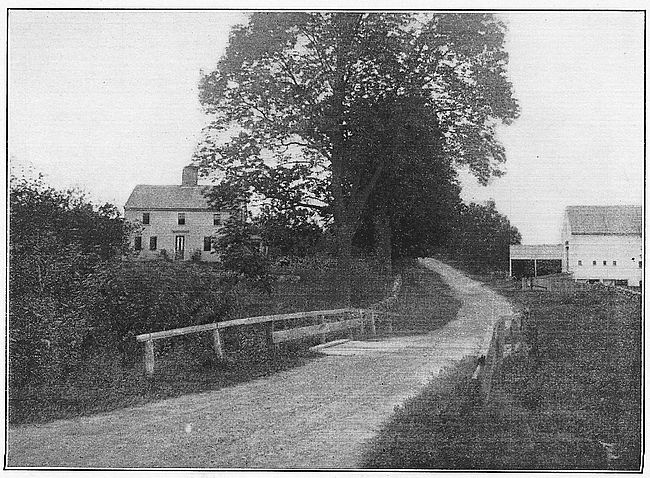
“No wonder Daniel Webster, wandering southward over the hills in search of a country home,
chose this as his abiding place.” See page 2
LITERARY PILGRIMAGES OF
A NATURALIST
BY
WINTHROP PACKARD
Author of “Florida Trails,” “Wild Pastures,”
“Wood Wanderings,” etc.
ILLUSTRATED FROM PHOTOGRAPHS BY THE
AUTHOR AND OTHERS
BOSTON
SMALL, MAYNARD, AND COMPANY
PUBLISHERS
Copyright, 1911
By Small, Maynard, and Company
(INCORPORATED)
Entered at Stationers’ Hall
THE UNIVERSITY PRESS, CAMBRIDGE, U. S. A.
TO THE MEMORY
OF
CLARENCE H. BERRY
A Schoolmaster of Long Ago
THIS BOOK IS AFFECTIONATELY DEDICATED
The author wishes to express his thanks to the editors
of the “Boston Evening Transcript” for permission to
reprint in this volume matter which was originally contributed
to its columns.
Glimpses of the Country about the
Daniel Webster Place
Down in Marshfield early morning brings to
the roadside troops of blue-eyed chicory blooms,
shy memories of fair Pilgrim children who once
trod these ways. They do not stay long with the
wanderer, these early morning blooms. The
turmoil and heat of the mid-summer day close
them, but the dreams they bring ramble with the
roads in happy freedom from all care among
drumlins and kames, vanishing in the flooding
heat of some wood-enclosed pasture corner to
spring laughingly back again as the way tops a
hill and gives a glimpse of the purple velvet of the
sea. No wonder Peregrine White, the first fair-skinned
child born in New England, strayed from
the boundaries of Plymouth and chose his home
here. No wonder Daniel Webster, New England’s
most vivid great man, wandering southward
over the hills in search of a country home
two centuries later, fixed upon the spot just below
Black Mount, looking down upon Green Harbor
marshes and the sea, and chose this for his
abiding-place.
The statesman and orator, whose words still
ring across the years to us, with the trumpet
sounding in them even from the printed page,
may well have breathed inspiration for them
from the winds that come from seaward across
the aromatic marshes. There is cool truthfulness
in these winds, and understanding of the depths,
and the salty, wild flavor of the untamed marsh
gives them a tang of primal vitality. Breasting
them at mid-day from under the wilt of summer
heat you seem to drink air rather than to breathe
it, and find intoxication in the draught. I never
heard a robin sing in mid-flight, soaring upward
like a skylark, till I came to this bit of sweet New
England country. The east wind drifted in to him
as he sat on a treetop caroling, and he spread his
wings to it and fluttered upward, pouring out
round notes of melody as he went. Webster’s
most famous speeches were composed while he
tramped these hills and marshes and sailed the
blue velvet of the outlying sea, and their richest
phrases soar as they sing, even as did the robin.
You may come to Black Mount with its panoramic
view of the Webster farm, the surrounding
pastures and marshes and the little Pilgrim cemetery
where he lies buried, from either the Marshfield
railway station or that of Green Harbor,
both a mile or more away by road. A better route
lay for me through the woods by paths flecked
with sunlight and dappled with shadow, paths
which the Pilgrims’ descendants first sought out
and which are as fair to-day to our feet as they
were to theirs. One can easily fancy Peregrine
and his wife picking berries along here on days
when the farm work allowed them freedom, the
children frolicking about with them and eating or
spilling half they picked, as the children do on
these hills now. Voices and laughter rang
through the woods as I passed, and there is small
blame to the pickers if they do eat the berries as
fast as they pick them. They never taste quite
so good as on this direct route from producer to
consumer. Along this path you may have your
choice of varieties as you go, from the pale blue
ones that grow so very near the earth on their
tiny bushes that they seem the salt of it, giving
the day its zest, through the low-bush-blacks,
crisp with seeds and aromatic in flavor as if
smoked with the incense of the sweet-fern, to
those other black ones that grow on the high
bushes and rightfully take the name of huckleberry.
The soil of these sandy hills may be thin
and not worth farming, but it produces fruit
whose quality puts to shame the product of well-cultivated
gardens. The good bishop of England
who once said, “Doubtless God could have produced
a better berry than the strawberry, but
doubtless He never did,” never ate blueberries
from the bush in a New England pasture.
From the summit of Black Mount the grassy
hill slopes sharply beneath your feet to the road
and beyond this to the home acres of the Webster
place, the roof tree far below you and the house
snuggling among the trees that the great statesman
loved, many of which he planted. A little
farther on stands a great barn with huge mows
and the big hay doors front and rear always hospitably
open to the scores of barn swallows that
build on the beams up next the roof. In no barn
have I found quite so many swallows at home.
At every vantage point on a beam, wherever a
corner of a timber or a locking pin protrudes to
give a support, nests have been built, generation
following generation till some of the structures
are curious, deep, inverted mud pyramids, topped
with straw and grass and lined with feathers,
downy beds for the clamorous young. I can think
of no finer picture of rural peace than such a barn
as this, the cool wind sighing gently through the
wide doors, the beams stretching across the cavernous
space above dotted with the gray nests, the
air full of the friendly, homey twittering of the
birds, some resting and preening their feathers
on the beams, others swinging in amazing flight
down and out through the doors to skim the grass
of the neighboring fields and marshes for food,
then flashing back again to the hungry nestlings.
Such barns grow fewer year by year here in
eastern Massachusetts, and the pleasant intimacy
of the barn swallows is but a happy recollection in
the mind of many of us, more is the pity. It is
worth a trip to Marshfield just to foregather with
such a colony.
Eastward again the eye passes over wide mowing
fields, rough pastures and hills clad with short,
brown grass and red cedars, the thousand-tree
orchard of Baldwin apples which Webster planted,
the tiny Pilgrim cemetery on a little hillock where
he lies buried among the pioneers of the place,
the brown-green marshes flecked with the silver
of the full tide, to the deep, velvety blue rim of the
sea, which sweeps in its splendid curve uninterrupted
from north to south. Behind your back is
the rich green of Massachusetts woodland, beneath
your feet this landscape of pasture, field
and marsh, scarcely changed since Webster’s day,
changed but little indeed since the days of Peregrine
White and his pioneer neighbors, and rimming
it round the deep sapphire romance of the
sea. Across this blue romance of sea the winds
of the world, fresh and vital with brine, come to
woo you on your way. They croon in your ears
the strange sagas that the blood of no wanderer
can resist, and you know something of the lure
that led the vikings of old ever onward to new
shores as you plunge down the grassy slope to
meet them. The stately beauty of the home place
may thrall you for a while beneath the trees and
the friendly great barn try to lull you to contentment
with the cradle songs of the swallows, but
the marsh adds its wild, free tang to the muted
trumpets which these east winds blow in your
ears, and so you fare onward through a country
of enchantment, toward the ocean.
Webster’s well house, where still the ancient
spring flows, cool and clear, gave me a drink as I
went by. The dyke which borders his cranberry
bog and separates it from a tiny pond where white
pond lilies floated and perfumed the air, gave
further progress eastward, and soon I passed
naturally into an old, old path which led me purposefully
in the desired direction. Without looking
for it I had found the footpath way which
rambles from the farm across country to Green
Harbor, where the statesman kept his boats, a
path without doubt often trodden by his feet in
seaward excursions. He could have found no
pleasanter way. The pastures which lie between
upland and marsh in this region are covered with
a wild, free growth of shrub and vine which no
herds, however ravenous, can keep down. The
best that the cattle can do with them is to beat
paths through the lush tangle along which wild
grasses find room to work upward toward the
light and add to the browse. Here the greenbrier
grows greener and more briery than anywhere
else that I know, and the staghorn sumac emulates
it in vigor of growth if not in convolutions.
In places these reach almost the dignity of young
trees, and the pinnate leaves spread a wide, fern-like
shade as I walked beneath the antler-like
branches. The staghorn sumac is surely rightly
named. Its antlers are covered now with an
exquisite, deep, soft velvet which clothes them
to the leafbud tips and along the very petioles of
the leaves. Now it is a clear green which with
later growth will become purple and pass into
brown, the promise of autumn showing now in
a slight purple tinge on the sun-ripened petioles
of the older leaves. This soft fuzz clothes the
crowded, conical heads of bloom also, heads that
are of the same sweet pink as the petals of the
wild roses which grow near by as you may see if
you will hold one up against the other. But the
pink of the wild rose seems flat against that of
the sumac, for it has only a smooth surface on
which to show itself, while that of the sumac is
full of soft, shadowy withdrawals and shows a
yellow background in the interstices of the blossom
spike.
Skirting this jungle so aromatic with scent of
sassafras and bayberry, perfumed with wild rose
and azalea, pulsing with the flight of unseen birds
in its cool depth and echoing with their song, the
path crosses a brook that gently chuckles to itself
over its escape from the monotony of a big mowing
field to the salt freedom of the marsh, then
suddenly breasts the steep northern side of a
drumlin. Here the press of toiling feet has been
supplemented by the wash of torrential rains till
the narrow way becomes a miniature chasm in
places, worn down in the gravel among great red
cedars, hoary with age and lichens. To know the
slow growth of a red cedar and to calculate the
age of these by dividing their present bulk with
the slight increase that each year brings is to place
the birth of these trees far back in the centuries.
Not one hundred years will account for it, nor
two, and I am quite sure that these trees were
growing where they now stand when Peregrine
White’s mother first embarked on the Mayflower
at Southampton. Webster’s path may have gone
through them then, and no one knows how long
before, for it is worn deep not only on the steep
hillsides where the rains have helped it but in level
reaches beyond where only the passing and re-passing
of feet through centuries would have done
it. It was as direct a route from the hills to the
mouth of Cut River at Green Harbor before the
white man’s time as after, and if I am not mistaken
the red men trod it long before the first
ship’s keel furrowed Plymouth Bay.
As I topped the rise I found myself in a hilltop
pasture a half-mile long which covers the rest of
the hill. Once it was a cultivated field, and the
corn-hills of the last planter still show in spots,
these, like the rest of it, now overgrown with
close-set grass and crisp reindeer lichen. The
patriarchal cedars I had left behind, old men of
their tribe sitting solemn and motionless in council.
Here I had come upon a vast but scattered concourse
of young people, lithe and slender folk
who seemed to stroll gayly all about the place.
Here were plumed youths and debonair maidens
regarding one another, family groups, mothers
with children at the knee and other little folk
in the very attitude of playing romping games.
But there were tinier folk than these, too small to
be real cedars, gamboling among the others, as
if underworld sprites also in cedar guise had come
forth to join the festivities. Nowhere else have I
seen such a merry concourse of cedars as on the
long top of this hill that some Pilgrim father
first cleared for a cornfield two centuries and a
half ago. Here and there little groups of wee
wild rose shrubs seemed to dance up and scatter
perfume about their feet in tribute, then stand
motionless like diffident children, finger in mouth,
stolid and uncommunicative. Hilltops are often
lonely, but this one could never be. It gladdens
with its quaint fancies. Through a veritable
picnic of young cedars I tramped down the eastward
slope to the dusty road that leads on to
Green Harbor and the slumbrous uproar of the
surf.
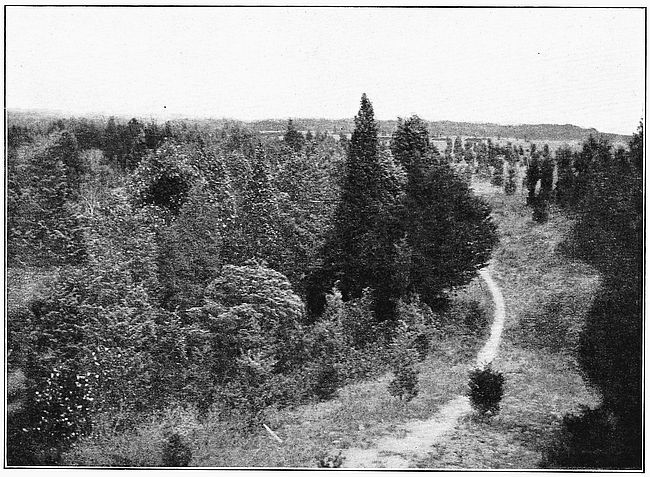
“Telling the pearls on this rosary of a path one is led beyond the homestead.”
Telling the pearls on this rosary of a path in
the homeward direction one is led beyond the
homestead and on, by a slenderer, less trodden
way to the old Pilgrim cemetery where the great
man lies buried among the pioneers of the neighborhood,
Peregrine White, the Winslows, and a
host of others whose fame has not gone so far
perhaps, but those names may be written in the
final domesday book in letters as large as his.
Nor does any storied monument recite the deeds
of the statesman or bear his name higher than
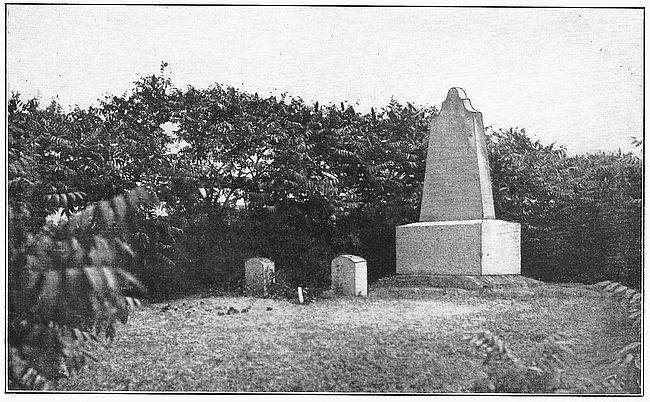
that of his fellows. A simple slab with the name
only stands above the mound beneath which he
lies, and in the side of this mound a woodchuck
has his burrow, seeming to emphasize by his
presence the cosy friendliness of the little spot.
It is a hillock, just a little way from the house,
just a little way from the big orchard which
Webster loved so well, surrounded by pasture and
cranberry bog and with the marsh drawing lovingly
up to it on one side. Over this marsh comes
the free salt air of the sea, but a little more gently
to the lowly hillock than to the summit of Black
Mount. Because of this loitering gentleness it has
time to drop among the lingerers there all the wild
aromas and soft perfumes of the marsh and
pasture and bring all the soothing sounds of life
to ears that for all I know hear them dreamily and
approve. Quail, the first I have heard in New
England for a long time, whistled cheerily one to
another from nearby thickets. Nor did these
seem fearful of man. One whistled as a wagon
rattled by his hiding place on the dusty winding
road, and held his perch beneath a berry bush till
I approached so near that I could hear the full
inflection of the soft note with which he prefixed
his “bob white,” see the swell of his white throat
and the tilt of his head as he sent forth the call.
A pair of mourning doves crooned in the old apple
orchard and flew on whistling wings as I approached
too near. I have heard heartache in the
tones of these birds, but here their mourning
seemed only the gentle sorrow of a mother’s tones
as she soothes a weary child, a mourning that
voiced love and sympathy rather than pain. On
a tree nearby a great-crested flycatcher sat and
seemed to say to himself, “grief, grief.” These
were the only notes of sorrow that the place held.
All else in sky and field, marsh and hillside,
seemed to thrill with a gentle optimism, and the
hillock itself rested amidst this in a patriarchal
peace and simplicity that became it well. Memory
of this gentle peace and simplicity lingers
long and runs like a tender refrain through the
harmony of fragrant, vivid life that marks this
lovely section of old Marshfield.
II AT WHITTIER’S BIRTHPLACE
The Homestead two Centuries Old and the
Unspoiled Country about it
They lighted a fire for me in Whittier’s fireplace.
The day had been one of wilting July heat
and sun glare till storm clouds from the New
Hampshire hills brought sudden cool winds and
black shadows. Twilight settled down in the
wide, ancient living-room, bringing brooding
darkness and mystery. The little light that came
through the tiny, lilac-shaded windows seemed to
half reveal ghosts of legends and romance,
wrapped in darkness, slipping indistinctly from
the black cavern of the fireplace, standing close before
it and hiding it, and gathering in formless
groups in the corners of the room. They whispered
and the leaves on the trees outside rustled
the tale, while echoes of warlock warfare rumbled
in the sky above and witch fires flared. A witches’
twilight had come down the Merrimac and
brought under its blanket shades of all the mountain
legends that had in times past trooped to the
mind of the poet as he sat there with sensitive soul
a-quiver to their touch, photographing them in
black and white for the minds of all men forever.
From the fireplace stalked Mogg Megone and the
powwows of his tribe, bringing with them all the
dusky people of the weird stories of his day.
The wind wailed their lone songs outside, and in
its deep throat the aged chimney mumbled to
itself old, old tales of night and darkness.
Then a slender flame slipped upward from the
hearth, showing the form of the caretaker faintly
shadowed and edged with light against the black
background, and if I saw not her but the outline
of Whittier’s mother bending to light the fire and
drive from the minds of the children the fancies
of the dusk it must have been because the witches’
twilight still held the room under its spell. Between
the fore and back logs the brush of hemlock
and of pine crackled and sent incense across
the gloom to me, and with the leap of the flame all
the weird shadows wavered into the corner and
vanished. In their stead trooped up-river the
cheery hearthside stories of the English settlers,
sturdy tales and rough perhaps but with the glow
of the hearth log flickering gleefully through
them. The gusts drew whirling sparks upward,
and in its deep throat the chimney, no longer
aged but stout and strong with vigorous work to
do, guffawed in cheerful content. The dancing
firelight sent gleams of quiet laughter over the
face of Whittier himself, that before had looked
so grimly from the frame over his ancient desk,
and the room glowed with homey hospitality. If
there were shades there they were golden ones of
gentle maids and rollicking boys that we knew
and loved so well, and though without the window
opposite the fireplace and right through the shading
lilac bushes a ghostly replica of the fireplace
with its flickering flames appeared and vanished
and reappeared, there was nothing sinister in its
uncanniness, for
“under the tree
When fire outside burns merrily,
There the witches are making tea.”
Stormbound if not snowbound I sat for an hour
by the hearth that was the heart of a home for
two hundred years, watching the crane and pendent
trammels show black against the blaze, seeing
the Turk’s heads on the andirons glow, reading
by the firelight verses which the poet wrote in that
same home room, and when the storm passed and
I could go forth to his brook and his fields and
hills it could not fail to be with something of his
love for them in my heart. Some critic, whose
visit must have been shortened by homesick memories
of a steam-heated flat, has said that Whittier’s
birthplace is lonely and that its loneliness
had its effect on his life and work. But how
could such a place be lonely to a man who was
born there? Here was the great living-room with
its hearth, where the life of the home centered.
Without was the wonderful rolling country with
all its majesty of hill, whence he saw the crystal
mountains to north and the blue lure of the sea to
eastward, with all its gentle delights of ravines
where brooks laughed, and meadows and swamps
where they slipped peacefully along, mirroring the
sky, watering all wild flowers and offering refuge
to all wild creatures. Within this wide circle,
with the house its core and the hearth its shrine,
revolved the homely, cheerful, whole-hearted life
of the farm. What chance for loneliness was
there?
After the shower had passed I climbed the
gentle slope of the hill back of the house, traversing
the old garden where grow the plants
that came over with pioneers from England,
hollyhocks and sweet william, old-time poppies,
marjoram and London pride, dear to every housewife’s
heart in the good old days when to wrest
a farm from the forest and build a home on it
was still an ambition for which a free-born New
Englander need feel no shame. The witchery
of the hour had not been for the hearthside
alone. The sooth of the rain had been for the
hearts of these also, and the joy of their answering
delight made all the fresh air sweet and kindly so
far as the gentle winds blew. The perfume of an
old-time garden after rain is made up of gracious
memories. Wherever chance has taken their
seeds or care has transported their roots a thousand
generations of sweet-hearted, home-keeping
mothers have tended these plants and loved their
flowers and the very leaves and stalks on which
they grew. The caress of the rain brings from
each leaf and petal but the aromatic essence of
such lives, welling within and flowing forth
again through the unnumbered years.
Out of homely love of the hearth, out of wild
Indian legends that flowed down the Merrimac
and English folk lore that flowered over seas
and blew westward with a sniff of the brine in it,
Whittier made his poems. But not out of these
was born their greatness. That was distilled
from his own fiber where it grew out of the rugged,
honest, fearless life of generations whose
home shrine had been that glowing hearth, whose
love and tenderness welled within and overflowed
like the scent of the old-time garden. To such a
house and such a hearth sweetness climbs and
nestles. To stand on the old door stone was to be
greeted with dreams of meadows and lush fields,
for wild mint has left the brookside and come
shyly to the very door sill to toss its aroma to all
comers. A spirit of the meadows that the barefoot
boy loved thus dwells ever by his door and
none may enter without its benediction. There
is something Quakerlike in the wild mint, that
dwells apart, unnoticed and wearing no flaunting
colors, yet is so dearly fragrant and yields its
sweetness most when bruised.
A stone’s toss from the door I found his brook,
its music muted by the summer drought so that you
must bend the ear close to hear its song. With
the foam brimming on its lip in spring the brook
roars good fellowship, a stein song in which its
brothers over nearby ridges join, filled with the
potency which March brews from snow-steeped
woods. Now, its March madness long passed,
repentant and shriven by the kindly sun, it slips,
a pure-souled hermit, from pool to pool, each pool
so clear that in it the sky rests content, while
water striders mark changing constellations on
its surface. The pools are silent, only beneath the
stones the passing water chirps to itself a little
cheerful song which the vireos in the trees overhead
faintly imitate. The trees love the brook’s
version best, for they bend their heads low to
listen to it, beech and maple, white oak and red,
yellow birch and white birch and black birch,
hemlock and pine, dappling the pools with shade
and interlocking arms across the glen in which
the brook flows. In the dapple of shadow and
sunlight beneath them ferns of high and low
degree, royal and lady, cinnamon, interrupted and
hay-scented, wade in the shallows and caress the
deeps with their arching fronds. The blue flags
that waved beside the water a month ago are
gone, leaving only green pennants to mark their
camp site for another year; and it is well that it
is thus marked, else it were lost, for in the very
brook bottom where the March flood crashed
along have come to usurp it those tender annuals,
the jewel weeds. Their stems almost transparent,
their oval leaves so dark a green that it seems as
if some of the dancing shadows found rest in
them, they press in close groups into all shallow
places and lean over the edges of the clear pools to
admire the gold pendants that tinkle in their ears.
“Within this wide circle, with the house its core and the hearth its shrine, revolved
the homely, cheerful, whole-hearted life of the farm.”
With these through the grassy shallows climb
true forget-me-nots, slenderest of brookside
wanderers, each blue bloom a tiny turquoise for
the setting of the jewel-weeds’ gold. Thus shaded
and carpeted the little ravine wanders down from
the hills, and the brook goes with it, as if hand in
hand, bringing to its side all sprightly life, a place
filled with boyhood fancies and echoes of boyhood
laughter. A chewink, singing on a treetop up the
slope, voiced this feeling. Someone has called the
chewink the tambourine bird. His song makes
the name a deserved one. It consists of one clear,
melodious call and then an ecstatic tinkling as of a
tambourine skillfully shaken and dripping joyous
notes. Always before the chewink’s song has
been without words to me. This one sang so
clearly “Whittier; ting-a-ling-a-ling” that I
knew the bird and his ancestors had made the glen
home since the boyhood of the poet, learning to
sing the name that rang oftenest through the
tinkle of the brook.
You begin to climb Job’s Hill right from the
glen, passing from beneath its trees to stone-walled
mowing fields where rudbeckias dance in
the morning wind, their yellow sunbonnets flapping
and flaring about homely black faces. I
fancy these fields were white with ox-eye daisies
in the spring. They are yellow now with the
sunbonnets of these jolly wenches. It is like
getting from Alabama to New England to step
over the last wall which divides the fields of the
hill’s shoulder from its summit, which is a close-cropped
cow pasture. Here the winds of all the
world blow keen and free and you may look north
to the crystal hills of New Hampshire whence
come their strength. Eastward under the sun lies
the pale rim of the sea. Kenoza Lake opens two
wide blue eyes at your feet, and all along beneath
you roll bare, round-topped hills sloping down to
dark woods and scattered fields, as unspoiled
by man as in Whittier’s days. The making of
farms does not spoil the beauty of a country; it
adds to it. It is the making of cities that spells
havoc and desolation. Through the pasture, up
the steep slopes to the summit of Job’s Hill, that
seems so bare at first glimpse, climb all the lovely
pasture things to revel in the free winds. Foremost
of these is the steeplebush, prim Puritan of
the open wold, erect, trying to be just drab and
green and precise, but blushing to the top of his
steeple because the pink wild roses have insisted
on dancing with him up the hill, their cheeks rosy
with the wind, their arms twined round one another
at first, then round him as well. Somehow
this bachelor bush which would be so austere reminds
one of the Quaker youth at the academy,
surrounded by those rosy maidens of the world’s
people, one of whom we suspect he loved, yet could
no more tell it than can the steeplebush acknowledge
how sweet is the companionship of the wild
rose and how he hopes it may go on forever.
Stray red cedars stroll about the lower slopes and
climb gravely, while juniper, in close-set prickly
clumps, seems to follow their leadership. The
canny, chancy thistle holds its rosy pompons up
to the bumble-bees, that fairly burrow in them for
their Scotch honey, and the mullein would be even
more erect and more Quakerly drab than the
steeplebush if it could. It is erect and gray, but
just as it means to look its grimmest dancing
whorls of yellow sunshine blossom up its stalk in
spirals, the last one fairly taking flight from the
tip. Among all these strays the yarrow, whose
aroma is as much a New England odor as that of
sweet-fern or bayberry. The aromatic incense of
this herb follows you up the hill and seems to
bring the pungent presence of the poet himself.
Job’s steepest hillside drops you in one long
swoop to the road which leads through woodland
windings to the haunted bridge over Country
Brook. The way itself is haunted by woodland
fragrance and chant of birds innumerable, and in
the freshness of the morning after the shower it
seemed as if built new. The world is apt to be
this way after rain. Yet if the vivid morning
sun and exhilarating north wind had driven all
ghosts away there had been necromancy at work.
All the day before the blossoms on the staghorn
sumac had been of that velvety pink that rivals the
wild rose. Over night they had turned a warm,
rich red. Autumn brings this richer, more stable
color to the sumac blooms as they ripen toward
seed time, but it does not do it in July, over night.
The pukwudgies had been at work, painting
with the rain, filling the sumac heads with it till
they hung heavy. The water had massed the tiny
pubescence of the blooms till pink had deepened
into red and autumn had seemed to come for the
sumacs in a night. It took the sun and the wind
all day to dry them out and bring back the witchery
of pink that the necromancy of the rain had
banished. But the spell was not altogether
broken, nor will it be till autumn has worked its
will with the world about Country Brook. Out
of the birches the fresh wind threshed here and
there yellow leaves that fluttered like colias butterflies
before it. There and here among the
sumacs hung a crimson leaf, more vivid in its
color than the blossoms or the berries could ever
be, and as in the woodland all news flashes from
shrub to shrub and from creature to creature,
so it seemed as in the hint of autumn, first born, a
simulacrum merely, in the wet sumac heads, had
gone by birch leaf messengers to all distances.
Along the way flashed out of invisibility the yellow
of tall goldenrod heads and the blue and white
of the earliest asters and, once materialized,
remained.
August may bring vivid heat and wilting humidity
if it will. The witches’ twilight had
brought down the Merrimac from the far north
the flavor of autumn which is later to follow in
full force, nor will it wholly leave us again. The
ghostliest thing about Country Brook was a sound
which seemed to come up it from the cool depths
of the woods into which it flows, a soft breathing
sigh, now regular, now intermittent, as if a spirit
of the woodland slept peacefully for a little, then
gasped with troubled dreams. Seeking to discover
this ghost I found a little way along the road
from the bridge a broad grassy avenue that led
with a certain majesty in its sweep as if to some
woodland castle whose people were so light-footed
that they wore no paths in their broad green
avenue. Yet after all it led me only to a wide
meadow where the sighing I had heard was that
of the grass going to sleep under the magic passes
of a mower’s scythe. No clatter of mowing
machine was here, just the swish of a scythe such
as the meadow has heard yearly since the pioneers
came. There were deer tracks here along the
margin of Country Brook, and all the gentle wild
life of woods and meadows seemed to pass freely,
without care or fear.
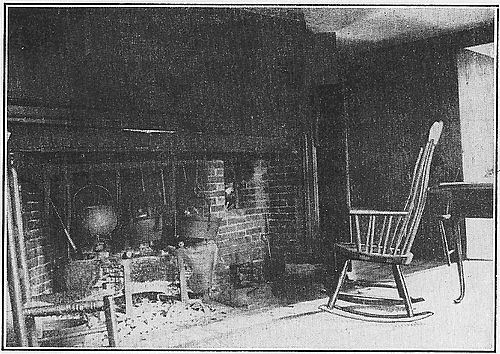
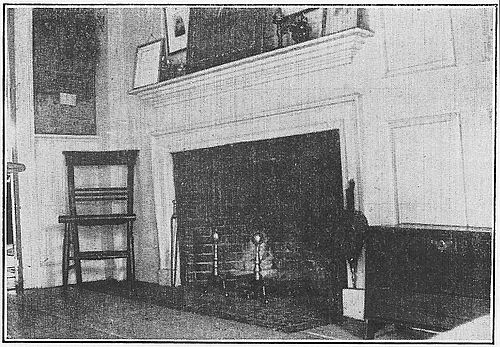
“Watching the crane and pendant trammels grow
black against the blaze.” See page 18
A corner of the room in which Whittier was born
And so I found all the country about the Whittier
homestead an epitome of the free, cheerful,
country life of the New England of a century
ago. They lighted a fire for me in Whittier’s
fireplace—and as the rose glow on the walls of
the old living-room brought back the hearth-cheer
of bygone years, as the witches, daintily making
tea without under the lilac bush, brought the
romance and legend of the olden time to the
threshold, so the crackling draft of the fire up the
deep throat of the chimney seemed to draw in to
the place the free, hearty, farming, wood-loving
life of the men of the earlier centuries out of
which the poet drew what was best in him, to be
given out in unforgettable verse to us all. If such
a place was ever lonely it was that gentle and
desirable loneliness which great souls love.
III IN OLD PONKAPOAG
Glimpses from a Study Window of
Thomas Bailey Aldrich
The study where Thomas Bailey Aldrich wrote
some of his daintiest verse looks forth upon a
sweet valley. Down this valley prattle clear-eyed
brooks that meet and grow, and water lush meadows
filled with all lovely things of summer, while
low woods beyond set a dark green line against
the sunsets. Looking toward these of a day when
rosy mists tangle the sun’s rays and anon let them
slip in arrow flight earthward, we have pictured
for us how
“We knew it would rain, for all the morn,
A spirit on slender ropes of mist
Was lowering its golden buckets down
Into the vapory amethyst.”
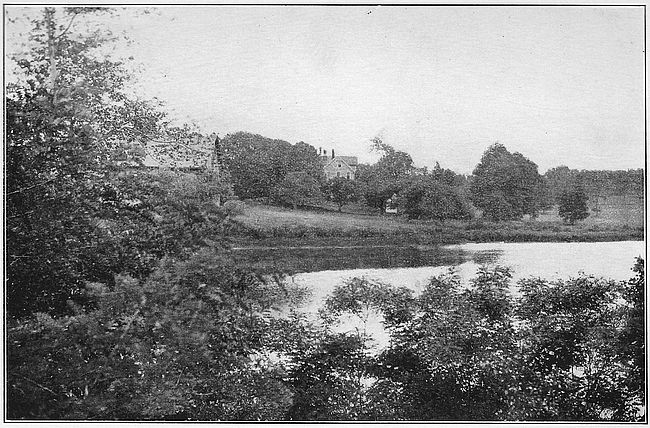
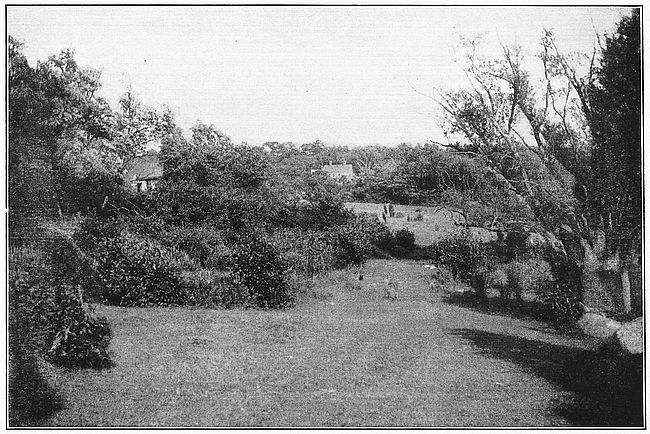
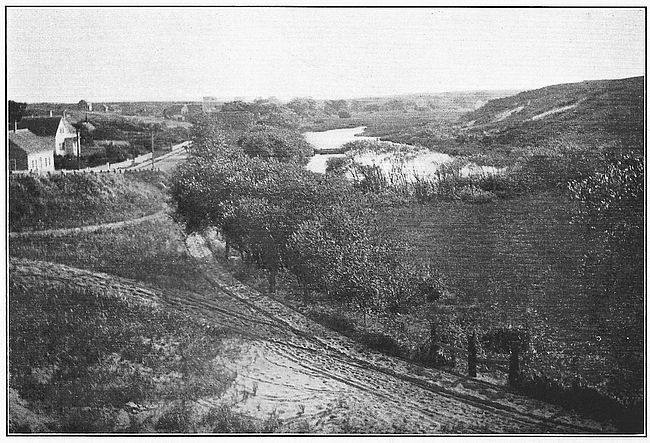
“The study where Aldrich wrote some of his daintiest verse looks forth upon a sweet valley.”
Wherever written, this and a hundred other
dainty things seem to flock into the tiny valley
upon which he looked from the study window of
his later life in what was then the quaint old village
of Ponkapoag, as if the flowers of fancy to
which he gave wings still hovered there. At
nightfall it is easy along these meadows to
“See where at intervals the firefly’s spark
Glimmers and melts into the fragrant dark;
Gilds a leaf’s edge one happy instant, then
Leaves darkness all a mystery again.”
The quaint old Ponkapoag of not so very many
years ago is changing fast. The trolley car passes
and re-passes in what was once its one street. The
real estate man has come and modern houses grow
up over night, almost, in the empty spaces over the
old stone walls, while in the surrounding pastures
and woodland appear the mansions of those who
seek large estates not too far from the city. Suburban
life begins to crowd Ponkapoag and the
little self-centered country village of the genuine
New England type passes. Most, however, of the
sturdy old houses of a century or more ago remain
and much of the beauty of the country round about
them. On Sundays and holidays Ponkapoag Pond
teems with an uproarious holiday crowd, but on
weekdays one may still enjoy its beauty unmolested,
hear the blackbird’s music tinkle along the
bogs, and see the pond lily, the pure white spirit of
Miantowonah, sit on the water. On such days
Ponkapoag Pond, “the spring bubbling from red
earth,” seems still to belong as much to the Indians,
whose favorite fishing ground it was, as
to us latter-day usurpers, and the outlook across
it to the dusky loom of Blue Hill is as wild now
as it was in their day.
From the north-facing window of the poet’s
study you may see the hill again, with all its beauty
of color which changes with the whim of the day.
At dawn of a clear morning it looms blue-black
against the rosy deep of the sky. At noon it looms
still but friendly and green, so near that the eye
may pick out the shape of each tree that feathers
the jutting crags. At noon of such a day Ponkapoag
hill with its houses bowered in green seems
a part of it, the half mile of intervening space
making no impression on the eye. As the sun
sinks a haze rises from the rich farming land
which lies level between the two hills. The spirit
on slender ropes of mist is at work, and through
this vapory amethyst the larger hill withdraws into
soft colors of blue that grow violet purple with
the coming of dusk below and the rosy afterglow
of reflected sunset in the sky above. Captain John
Smith named the range “The Cheviot Hills” in
recollection of old England, but all the countryside
named it Blue Hill because of the changing
wonder of its coloring, which is a constant delight
to the eye. On stormy days when gray northeasters
send torn clouds, fragrant with the tonic
smell of the brine, whirling over it, the hill looms
misty and vague, as if it might well be a mountain
scores of miles distant, instead of the single
mile it is along the straight road. On such days
all the wild sea myths and northland sagas seem
to be blown in over the hill barrier and trail
down from the skirts of the clouds into the secluded
peace of Ponkapoag valley. Hence, to
those who dream, come sea longings.
“The first world-sound that fell upon my ear
Was that of the great winds along the coast
Crushing the deep-sea beryl on the rocks—
The distant breakers’ sullen cannonade.
Against the spires and gables of the town
The white fog drifted, catching here and there
At over-leaning cornice or peaked roof,
And hung—weird gonfalons. The garden walks
Were choked with leaves, and on their ragged biers
Lay dead the sweets of summer—damask rose,
Clove pink, old-fashioned, loved New England flowers.
Only keen, salt-sea odors filled the air.
Sea-sounds, sea-odors—these were all my world.
Hence it is that life languishes with me inland.”
Infinite variance of changing moods has the
hill which lifts such abrupt crags above the Ponkapoag
plain. At times the poet may have seen it as
it was one day not long ago, when a great thunderstorm,
born of the sweltering, blue haze of a
fiercely hot July day, swept across it. On that day
the hill withdrew itself into the menacing black
sky, looming against it, then vanishing, becoming
part of a night like that of the apocalypse, in which
hung the observatory and the higher houses of
Ponkapoag hill “as glaring as our sins on judgment
day.” The storm in which the miracle of
“The Legend of Ara-Cœli” was wrought could not
have been blacker than the sky, nor the face of the
monk, when he saw the toes of the bambino beneath
the door, whiter than gleamed those houses.
The weirder, greater things of nature loom often
through the poems of the man who looked upon
such scenes from the study window in what was
“The Bemis Place” of the elder days of Ponkapoag
village. It seems as if all the lighter, sweeter
fancies that laugh or slip, tear in eye, through his
verse, whirled like rose petals on summer winds
or danced like butterflies into the little valley on
which the westward study windows looked.
Through this, right in the foreground, flows
Ponkapoag brook, and on it falls slowly into decay
an ancient mill, a relic of the early days of the
village. The old dam no longer restrains the
water which gurgles along the stones below it,
humming to itself a quatrain which never was
meant for it, but which voices the fate of the shallow
mill pond, which has been empty for so many
long years that it is no longer a pond but a tiny
meadow in which cattle cool their feet and feed
contentedly. Here the spendthrift brook sings
contentedly:
“The fault’s not mine, you understand;
God shaped my palm, so I can hold
But little water in my hand
And not much gold.”
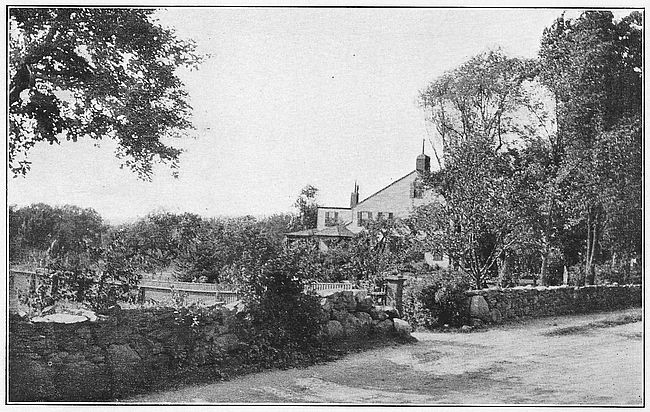
“The study window in what was ‘The Bemis Place’ of the elder days of Ponkapoag.” See page 35
In the meadow and along the brookside blooms
to-day the Habenaria psycodes, the smaller purple-fringed
orchid, its dainty petal-mist rising like
flower steam of an August noon, a shy child of
woodland bogs, which often runs away out into
the open meadow to hear the blackbirds sing. This
year I have not found the larger fringed orchid,
the Habenaria fimbriata, which comes to the
meadow less often, a flower which one might
fancy the mother of the other, coming to lead the
truant home again to the seclusion of the woodland
shadows. In all the fairy nooks of this valley
ferns spring up like vagrant, delicate fancies that
are real while you hold them in close contemplation,
yet vanish into the green of the surroundings,
as the form of a poet’s thought fades when
you take your eye from the printed page, though
the thought itself lingers long in your memory.
In the shallow meadow that was once the tiny
pond stands, shoulder high to the feeding cattle,
a solid, serried phalanx of the tall sagittaria, its
heart-shaped, lanceolate, pointed leaves aiming
this way and that, as if to fend it with keen tips
from the eager browsers. These wade through
it indeed, but do not feed on it, plunging their heads
deep amoung the spear points to gather the tender
herbage beneath. While I watched them two
of these, half-grown Holstein heifers, bounded
friskily to the hard turf of the cedar-guarded
pasture above and raced in a satyr-like romp over
the close turf and among the cedars for a time.
It was as if they knew that Corydon had just
vanished up that roadside in Arcady in pursuit
of the maiden that the Pilgrim described to him,
and the valley was free from all supervision for a
time. The white spikes of bloom on the water-plantain
nodded to let them pass, and nodded again
as if they too knew why the satyrs frisked and on
what errand the shepherd had gone.
Daintiest of embodied thoughts which flit along
this sequestered valley are the butterflies. This
is their feasting time of year, for now the milkweed
blooms hang crowded umbels of sticky sweetness
that no honey-loving insect can resist. Commonest
of these by the brookside is Asclepias
cornuti with its large pale leaves and its dull
greenish-purplish flowers. It is rather odd that out
of the same brook water and the salts and humus
in the black earth through which it flows one plant
should grow these dull, heavy, loutish flowers,
while just beside it, perhaps, the Habenaria psycodes
gets its misty delicacy of purple bloom from
the same source. With plants as with people it is
not that on which we feed nor the spot on which we
stand that counts in the final moulding of character.
Some subtle essence, some fire of spirit
within the orchid makes its bloom. Some grosser
ideal within the milkweed matures in the dull,
sticky umbels. Thus within the town, attending
the same schools, and fed by the same butcher and
baker, one boy grows up a poet and another a yokel.
Even in the same family you may see it, for the
milkweeds are not all alike. Along the dry hillsides
the Asclepias tuberosa gives us bright orange
flowers, exudes little if any stickiness, and even
gets a better name from the botanist, being called
the butterfly-weed.
But however gross and homely the milkweed
blooms the butterflies find rich pasturage there
and sip and cling till they fairly fall off in satiety.
Winging to the milkweed out of the chestnut and
maple shade of the deep wood comes Papilio turnus,
striped tigerwise with rich yellow and black.
Out of the long saw-edged grass that grows long
in the meadow and bows before the wind as do
fields of grain sails Argynnis cybele, the great
spangled fritillary, the fulvous glory of his broad
wings spangled beneath with silver, as if he carried
his coin of a fairy realm with him wherever he
goes. Over the very pine tops soars the monarch,
his rich dark red and black borne on wings that
are the strongest in butterfly flight. These three,
most conspicuous sprites in the meadow tangle,
give rich coloring and the poetry of motion as they
bear down upon the milkweed blooms, to leave
them no more save for short flights taken merely
to secure a better strategic position on the umbels,
till they are cloyed with the rich nectar, and
smeared with the sticky exudation which the plant
puts out on the blooms for purposes of its own. I
fancy the butterflies are vexed and indignant at
this stickiness which smears their legs and makes
yellow pollen masses cling to them when, satiated
and lazy, they next take flight. Yet the whole is
cleverly arranged. On the smeared legs as they
sail away cling pollen masses which the insect is
not likely to get rid of till it lights on another
head of bloom, very likely one of some distant
plant. There the sticky masses cling closer to the
quaint horns which each bloom protrudes from
behind the anthers, there to drop pollen grains on
the stigma and insure the cross-fertilization of
the flower. Thus unwittingly butterfly and bee as
they sail about the sun-steeped meadow suffer
discomfort for their own good, insuring vigorous
crops of milkweed for another summer, for themselves
or their descendants.
With these comes the smaller, Colias philodice,
the sulphur, bringing with him the very gold of the
sunlight. Colias philodice has many changes.
Sometimes the black margins of his wings are
missing and his gold melts into the sunshine and
vanishes before your eyes. Another may come
that is white instead of gold, a wan ghost of a
colias that seems born of the mist instead of the
sunshine and to vanish into nothing when he flies
away, as mist does. Sometimes the colias flies up
into the wood and lights, and as I come to the spot
where I think I saw him stop I find nothing but a
single bloom of the golden gerardia which now
slips from glade to glade all along where the hardwood
growth comes down to meet the meadow
grasses. The gerardia might very well explain
all this if it would, but it is born close-mouthed.
If you will look at the yellow buds which later open
into the golden bells into which the bumble-bees
love to scramble, bumbling as they go, you will
see how tightly their lips are pressed together.
No word can you get from these by the most insistent
questioning, and even when they open it is
easy to see that they have learned that silence
is golden.
The Baltimore butterfly, wearing Lord Baltimore’s
colors of orange and black, is a common
visitant to these meadows, too. He loves to tipple
the lees of the milkweed blooms, but he does not
frequent the meadow for that. It is because along
its shoreward edges where the cool water oozes
from black mud grows his home plant, the turtle-head.
On this he was born and to it he goes for the
housing and feeding of his children. Like Gerardia
flava, Chelone glabra is close-mouthed, but its
silence is a wan white one which only blushes pink
with embarrassment when questioned, but yields
no reply. You cannot learn any mysteries of the
meadow from these.
Palest and most ghostlike of all flowers that one
finds as he climbs from the meadow to the woods
beyond is that of the Monotropa uniflora, or
Indian pipe. Round about it its cousins, the pyrola
and the pipsissewa, grow green leaves and show
waxy white or flesh-pink blossoms. The only color
in the Indian pipe is that of the yellow stamens,
which shrink in a close circle within the wax-white
bloom that stands on a scaly, wax-white stem. A
very ghost of a flower is this, nor may we account
for its ghostliness. When, long ago, Miantowonah
fled to drown her grief in the lake and later rise
from it the spirit of a flower which is the regal
white pond lily that scatters incense all along
the borders of Ponkapoag Pond, her Indian lover
followed, too late to prevent the sacrifice. Did he
drop his peace pipe in the race through the wood,
and did this ghost flower spring from the spot, a
faintly fragrant, almost transparent ghostly reminder
of it? If so, it has passed into no legend.
Coming back through the meadow, with its
butterfly sprites of fancy dancing among the
flowers, I find one which always seems a reminder
of the poet’s work at its daintiest and best. That
is the bloom of the wild caraway. Here is a mist
of delicate thought which speaks to you with lace-like
beauty. Nor does the closest inspection reveal
any fault. The bloom appeals as a delightful bit
of sentiment, at first glance. It is only as you
examine it minutely that you marvel at its exquisite
workmanship. However carefully you pick it to
pieces you find each part perfect and as admirable
in its ingenuity as in its appeal to the imagination.
And after you have done this you pass on,
touched with the white purity of it and bearing
far a gentle, aromatic pungency which is the
essence of the parent stem that bore the bloom.
IV AT THE ISLES OF SHOALS
The Island and the Garden which Celia
Thaxter Loved
The poppies that grow in Celia Thaxter’s garden
nod bright heads in welcome to all who come. It
is as if the sunny presence of their mistress dwelt
always in the spot, finding voice in these blooms
which are so delicate, yet so regnant in spirit.
To these all the other flowers which speak of the
homely virtues, marigolds and red geraniums,
coreopsis and pinks and love-in-a-mist, seem subordinate
at first approach, though they occupy
the bulk of the garden, which seems to epitomize
the life of the mistress who tended it so long.
There is no square of it without its rich aroma
of love and womanliness, yet it is the vivid personality
of the poppies, flowers for dreams, which
touches first the comer from the outside world.
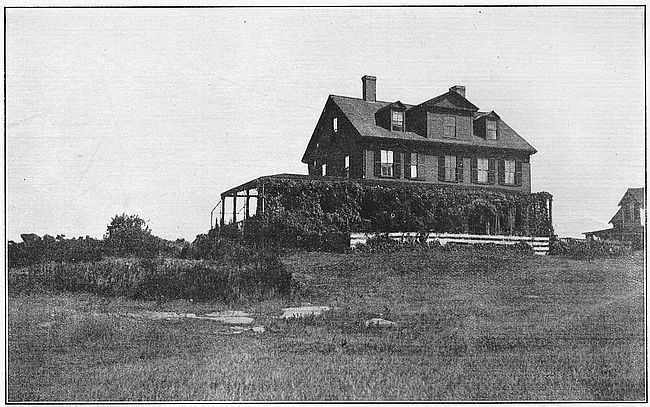
Celia Thaxter’s home at the Isles of Shoals
Round about the garden lies Appledore, the
largest of the Isles of Shoals, rocked gently on
the bosom of blue seas, its margin flashing with
beryl and pearl where rocks and breakers touch,
its rounded ridges white and green again with the
granite of which it is built and the verdure with
which it is clothed. Over it all bends the blue of
the summer sky, and as you look up to this from
the little garden it seems to lean lovingly upon the
hill which is the island’s highest part, heaven so
near that the scent of the flowers may easily pass
to it by way of the little winding path. To climb
this path yourself is to find the sky not so near
after all. Standing on the summit, you realize
first the depth of its great dome and the wide
sweep of sea that rims the islands round. Here
are but gray ledges that rise out of an immensity
which dwarfs them. Far to the north
and west is a thin, blue line of land that lifts
in the farthest distance the peaks of the White
Mountains. All else is but a vast expanse of
sea that seems as if it might rise in a storm and
overwhelm these rocks that it has washed so white
and smooth. Somewhere to the eastward of our
coast lies, they tell us, the lost Atlantis, submerged
beneath this great sweep of blue that smiles beryl
and laughs pearl-white in wave crests. Who
knows but this granite dome of Appledore on
which we seem to loom so high in air is the
westernmost peak of the vanished continent?
We are but seventy-five feet above the sea’s surface.
It must be the thought of its depths that
gives us the feeling of being upon a mountain peak.
For all that, this height and distance so make us
dominate the other islands that they seem but
ledges, wave-washed reefs in comparison, and one
wonders how such of them as have buildings on
them hold them during the sweep of winter gales
and full-moon tides.
In the smile of summer it is easy to forget this.
It is but a step from the rough rocks of the island
to the dense verdure of its shrubbery. At first one
wonders where the soil came from that nourishes
herb and shrub in such profusion. Here among
the gray granite grow most of the beauties of any
shore-sheltered New England pasture. Here is
elder showing white, lace-like blooms, bayberry
and staghorn sumac each striving to overtop the
other, wild cherry and shadbush, and beneath and
around these low-bush black huckleberries, raspberries
and blackberries, the last two blessing the
tangle with fruit. Among the grasses grow yarrow,
St. John’s-wort, mullein, toad-flax, cranes-bill,
evening primrose and other herbs, while
Virginia creeper and fragrant clematis make many
a spot a bower of climbing vines. Not only do all
these familiar pasture folk grow here, but in many
instances they seem to grow with a luxuriance that
exceeds that of their favorite shore locations.
Their tangle makes passage difficult except by
established paths, and the road which circumnavigates
the island is cut almost as much through the
compacted shrubbery as through the rough rocks
along the tops of the cliffs. Rainfall collects in the
hollows of the granite in some places and makes
miniature marshes, and in one spot a tiny pond
which is big enough to supply ice to the islanders,
filling to the brim with the winter rains and in
some winters freezing pretty nearly solid. In August
this pond, which is high in the middle of the
island, is dry, its bottom green with rushes and its
sides rampant with the spears of the blue flag.
Often in the tiny valleys in the heart of the island,
surrounded by its dense shrubbery, you lose sight
of the sea, but you cannot forget it. However still
the day, you can hear the deep breathing of the
tides, sighing as they sleep, and a mystical murmur
running through the swish of the breakers, that is
the song of the deep sea waves, riding steadily in
shore, ruffled but in no wise impeded by the west
winds that vainly press them in the contrary direction.
However rich the perfume of the clematis
the wind brings with it the cool, soothing odor
that is born of wild gardens deep in the brine and
loosed with nascent oxygen as the curling wave
crushes to a smother of white foam. It may be
that the breathing of this nascent oxygen and
the unknown life-giving principles in this deep
sea odor gives the plants of Appledore their
vigor and luxuriance of growth. Certainly it
would not seem to be the soil that does it. Down
on the westward shore of the island, in an angle
of the white granite, where there was but a thin
crevice for its roots and no sign of humus, I
found a single yarrow growing. Its leaves were
so luxuriant, yet delicate, so fern-like and beautiful,
such feathery fronds of soft, rich green as
to make one, though knowing it but yarrow, yet
half believe it a tropic fern by some strange
chance transplanted to the rugged ledges of the
lonely island. With something in the air, and
perhaps in the granite, that makes this common
roadside plant develop such luxuriance, it is no
wonder that other common pasture folk, goldenrod
and aster, morning glory and wild parsnip,
and a dozen others, growing in abundant soil in
the tiny levels and hollows, are taller and fuller
of leaf and petal than elsewhere. In the richness
and beauty of the yarrow leaves growing in the
very hollow of the granite’s hand, as in the height
and splendor of the Shirley poppies in the little garden,
one seems to find a parallel to Celia Thaxter,
whose own character, nurtured on the same sea
air, sheltered in the hollow hand of the same
granite, grew equally rich and beautiful.
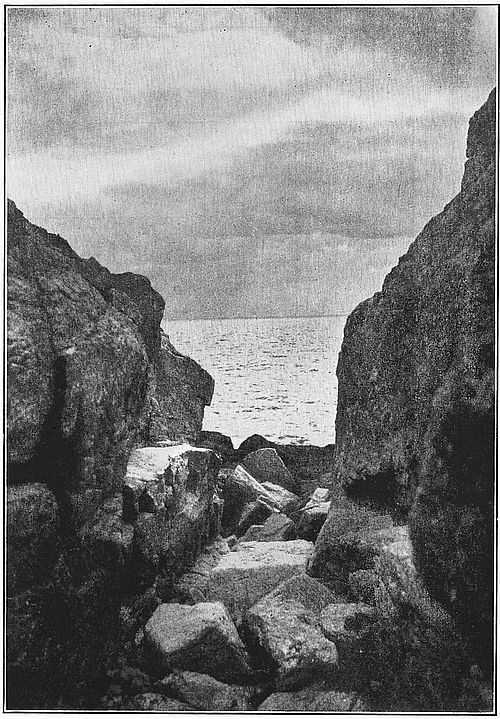
“Chasms down which you may walk to the tide between sheer cliffs.”
All Appledore, indeed all the Isles of Shoals
are built of this rock, which is white in the
distance, but which near to shows silver fleckings
of mica that flash in the sun. Through the
granite run narrow veins of quartz that is as
hard as flint, but that has scattered among its
crystals also a silvering of these mica flecks
which are in strange contrast to the tiny pin
points of a softer, darker rock which one finds
evenly sprinkled through the white. This dark
rock softens to wind and weather first and leaves
these white cliffs honeycombed with the tiniest
of fissures, so that they are as rough to the hand
as sandpaper. Dykes of trap run through the
island, and as this rock too is softer than its casing
the winds and waves of centuries have worn it
away, leaving chasms down which you may walk
to the tide, between the sheer cliffs. One such
chasm runs quite across Appledore from east to
west near the northern end of the island, almost
cutting off a round dome of granite from its fellow
rock. The soil lies rich in this narrow hollow
between ledges, and many things grow in it, lush
with leaves and beautiful with bloom. Here the
shadbush had already ripened its fruit. Here
the island’s one apple tree grows vigorously,
though it dares not lift its head above the level
of the rocks against which it snuggles, lest the
zero gales of winter nip it off. Crowding round
it grow wild cherry and wild rose, elder and
sumac and huckleberry and chokeberry, all eager
to fend it from rough winds in that friendliness
which seems, like foliage, to flourish in the place.
Here is a soft turf of grass in which grow violets
and dandelions, both spring and fall, and plantain,
cinquefoil and evening primrose have come to
make the place homelike. If rough winds blow
here rougher rocks fend them off, and though they
may whistle over the tops of these in the little
valley between there is quiet, and floods of sunshine
gather and well up till the place is full.
This tiny valley dips toward the sea at the west
and broadens to a meadow where I fancy the
islanders have at some time grown cranberries,
for a few plants remain. For the most part, however,
this meadow is set thick with the green
spears of the bog rushes which grow so close
together that there is little room for anything
else. To crush your way in among these is to
pass through a very forest of dark green lances
whose tips stretch upward to stab your chin, yet
burst into bloom from the sides near these tips,
as if the full life within them which could not be
restrained yet which finds no outlet in leaves, exploded
in a lance pennant of olive-brown beauty.
A Maryland yellow-throat whose nest stands
empty in the grass on the borders of this little,
lance-serried marsh fluttered and chirped and
clung among these rushes and from the top of a
near-by bayberry shrub a song sparrow trilled a
note or two, despite the fact that it is moulting
time and few birds have the heart to sing in dishabille.
Nightfall brought no sound of frog
voices from this little marsh, yet I cannot fancy it
in spring without a hyla or two to pipe flute notes
from its margin. Near this I found the one
ophidian of the island, a beautiful, slender, graceful
green snake, little more than a foot long. This
lovely little creature feeds on crickets and insect
larvæ and is the very gentlest snake that ever
crawled. Jarred by my footfall in the grass he
glided away among the tangle, trusting to his
coloration, which is a perfect grass green, to hide
him, which it soon did. If Appledore must have
its serpent no sweeter-natured nor lovelier variety
could be found. If modern Eves sit upon the
rocks of moonlight nights and listen to this one’s
promptings one can scarcely blame them.
Under the eaves and under the verandas of the
houses are the nests of barn swallows, gray mud
stippled up against a rafter, the fast-growing
young almost crowding one another out. So
gently familiar are these birds, and so little afraid
of people, that one has built a nest under the
frequented piazza of the big hotel, and the parent
birds flit back and forth unconcerned by the rows
of guests that often take chairs and watch the
nestlings for long periods. Not only do the
parents feed their young while thus watched by
crowds but a few feet away, but they fly in under
the veranda and capture food right over the heads
of the promenaders with equal freedom from
fear. Barn swallows are usually friendly, confiding
birds. They seem here to have caught the
sense of protection and safety which comes to all
on the little island, and become even more fearless.
It is much the same way with the tree
swallows, which, having no hollow trees, build
in bird boxes all about. These already have
young in flight. Standing on the cliffs you see
their steel blue backs as they swirl with the little
waves in and out among the rockweed at low tide,
seeking their food very close to land or water.
Often the young sit on some safe pinnacle and
are fed there, the old bird flashing up, twittering,
delivering a message and a mouthful at the same
time, then flashing away again, whirling and
wheeling, never beyond call of the eager fledgling.
Often the fledgling soars into space, hardly to be
distinguished then from the older bird, and twitters
back and forth near the parent. Then when
the latter comes with a mouthful the former
simply poises fluttering while the old bird dashes
up, twitters and feeds, and is off again in the
flash of an eye, so fleet of motion, so agile of turn,
that it puzzles the watcher to follow the course
of flight.
At the bottom of the tide the rocks over which
the tree swallows swirl with the waves are a
golden olive with the sun-touched tips of the carrageen.
Higher up the boulders lift their heads
with the air-celled rockweed falling all about them
like wet hair. Some of these tresses hang down
in golden luxuriance, others are dark, almost
black, as if blondes and brunettes were to be found
among tide rocks as among men. Between these
rocks are still pools of brine where mussels and
crabs wait the deliverance of the full sea and kelp
waves its long, dark-olive, ruffle-margined banners.
Down among these with the ear close to
the smooth, undulating surface you may catch
the eerie plaint of the whistling buoy off the
channel some miles to landward, telling its loneliness
in recurrent moans.
Up on the rocks again in the bright sunlight,
one finds the land birds numerous, chief among
which are the song sparrows. In the secluded
peace of the place these also, evidently making
their summer home here and nesting in the shrubbery
that is all about, have lost most of their fear
of man and will approach very near to gather
crumbs about your feet. A small flock of robins
goes by, stopping a moment to feed, then taking
wing again as if practising for that southward
migration which will begin before very long.
Olive-sided flycatchers, already working toward
the sun, flit to catch flies and light alternately almost
as if playing leapfrog from bush to bush.
So far as I have observed, the olive-sided flycatchers
do most of their migrating thus, hippety-hop
from perch to perch, with a fly well caught
at every hop and well swallowed at every
perch. A kingbird sat haughtily, as if mounted,
on a stub, monarch of all he surveyed, now
and then giving his piercing little cry and
sailing out to the destruction of a moth or beetle,
then sailing leisurely back again. A lone gull
fished and cried lonesomely in the surf, and a few
pairs of sandpipers slipped with twinkling feet
along the rocks, feeding in the moist path of the
receding wave and lifting on long, slender wings
to safety at the crash of the next one. These
were the only day birds to be found of a pleasant
day at Appledore. Monarch butterflies were
plentiful, migrants these over the seven miles or
more of sea between the island and the mainland.
A few cabbage butterflies fluttered white wings
over the Cruciferæ which grow in the vegetable
gardens of the place. The cabbage butterflies
may well be natives, and so might that other
which danced away so rapidly that I could not be
sure of him, though I am confident that he was
either a hunter’s butterfly or an angle-wing. Yet
these, too, may have come from the mainland on
a still day or with the wind right and not too
strong, such extraordinary distances do these
seemingly frail and impotent insects cover sometimes.
Honey bees from hives ashore make a
regular business of flying to the islands and back
laden with honey. Students of bees ordinarily
give them a range of two and a half to four miles,
yet these Appledore bees must come at least seven
miles and probably ten for their harvesting.
At nightfall three great blue herons came flapping
out from the mainland to fish among the
kelp and rockweed of the outlying reefs. All
along the western horizon the soft blue line of
land began to melt into the steel blue of the sea
that the sunset fire seemed then to temper to
a violet hardness. The southwest wind had blown
the sky full of blowsy cumulus clouds that were
touched with fire from the setting sun, yet in the
main had the color of the steel sea, as if they were
the flaked dross from its melting. Then the sun
for a moment burned through the thin blue line
of land and set the sea ablaze with a gentle radiance
of crimson and gold that slipped along the
level miles and wrapped the blessed isles in its
arms, radiant arms that unclasped themselves in
a moment, lifted above the islands in benediction
and then passed. The poppies in Celia Thaxter’s
garden folded their two inner petals like slim
hands, clasped in prayer, lifted trustfully to the
sky.
“Up to the smooth turf on this knoll crowd all the pasture shrubs that she loved.”
A little way from the garden that she loved and
tended so long is Celia Thaxter’s grave, on a
knoll to which the sky bends so gently that it seems
as if you might step off into it. Up to the smooth
turf of this knoll crowd all the pasture shrubs
that she loved, sheltering it from the wind on
three sides and letting the sun smile in upon it all
day long without hindrance. The sumacs come
nearest as if they were the very guard of honor,
but close behind them press the wild roses, the
St. John’s-wort, the evening primroses and even
the shy white clover slipping in between the
others, very close to the ground, and tossing soft
perfumes out over the brown grass. On the
grave itself someone in loving remembrance
scatters the petals of red geranium, which seems
of all things the home-loving, home-keeping
flower. The poppies are for poets’ dreams which
write themselves in the dancing morning wind,
clasp hands in prayer at sunset, and flutter away.
Red geraniums seem born of the fireside where
home has been since fire first came down out of
heaven. Dreams and hearthfire both were dear
to the sweet lady of Appledore, and both flowers
commemorate her there.
V THOREAU’S WALDEN
A Survey of the Pond and its Surroundings
He who would know Thoreau’s Walden will do
well to bathe in it. His first plunge may well be
in Thoreau’s story of the pond and his life on its
bank, and when he comes dripping from this and
puts on the garments of everyday life he still must
feel a little of the glow of the fire with which this
alchemist of the woods transmuted all things,
showing us how rough granite, hard iron and base
lead are gold. Thoreau lived on the borders of
the little clear pond but two years. He knew it
in the flesh for just his short life. But his spirit
had birth in something akin to its pure, profound
waters and dwells above them now for all
centuries.
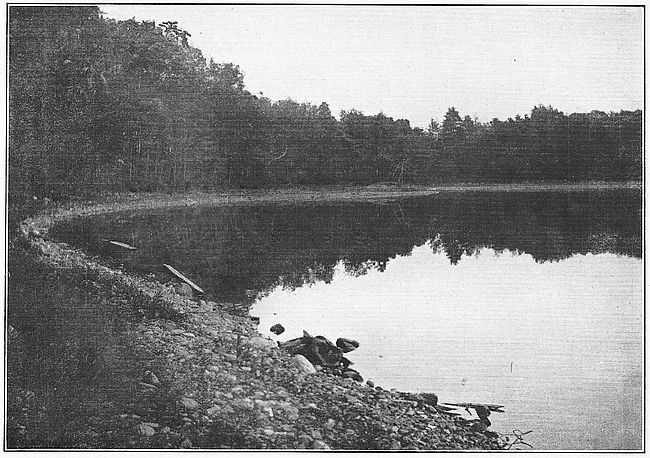
The next plunge should be in the waters themselves,
and only thus shall you learn to the full
what a miracle the pond is. Here is a crater of
glacier-crushed granite, out of which never came
smoke nor lava, only a white fire from unexplored
depths, a fire of cool austerity which burns
the dross out of all that may be put into it. There
is no inflowing stream. Its waters well up from
a mysterious source within the very earth. Their
outflow is equally invisible. In their going they
leap spirit-like along the golden stairs which the
sun lets down to them and pass up for the building
of rainbows, their white light breaking in its
mystical seven colors, a visible ecstasy to all who
watch the heavens. To plunge in these waters
at dawn is to feel this cool fire thrill through
the marrow of your bones, and only by
total immersion shall you know to the full its
purity.
Coming to such a flight with Eos through the
dusky solemnity of the trees of the western bank,
I saw the pond silvered beneath its tense level with
the frosty scintillations of the stars that had shone
into it all night. It was as if their radiance had but
penetrated the water-tension film of the surface
and collected just beneath it, making a white
mirror which my plunge shattered into a thousand
prisms of scintillant light. The dancing
night winds had shaken all the rich odors from the
white clethra blooms that grow all about the
pond’s rim and stored them along its surface, and
to swim out toward the center was to enter a
sweetly perfumed bath. The forest to eastward,
full of black density, as it was, could not bar out
the rose of the morning from the sight. Instead
it stood in a silhouetted fretting against it and let
its glow shine through a million tiny windows of
the day, blossoming again in the ripples ahead.
Here was a moving picture of the blooming and
vanishing of pink meadow-flowers, flashing a
brief life upon the film, vanishing and growing
again. The cinematograph is nothing new.
Walden has operated it for those who will swim
toward the dawn in its waters since the centuries
began. In our theaters we are but tawdry imitators
of its film productions.
Chin deep in its middle you begin to feel that
you know the pond. In a sense you are its eye and
look upon the world as it does. Day breaks for
the swimmer as it does for Walden, and the flash
of the sun above the wood to eastward warms
you both with the same sudden sweep of its August
fire. In the same sense you are the pond’s
ear and hear as it does. The morning rustle of
the trees, shaking the dusk from their boughs,
comes to you as a clear ecstasy, and you think
you can hear the wan tinkling of the invisible
feet of fairy mists as they leap sunward from
the surface and vanish in the day. Over the wood
comes the intermittent pulse of Concord waking,
and by fainter reverberations the pond knows
that Lincoln and more distant villages are astir.
Then the first train of the day crashes by the
southern margin and stuns the tympanum with a
vast avalanche of uproar.
To plunge beneath the surface and escape this
is to learn the real color of the pond. From without,
on the banks, this varies. Oftenest it is a
dull, clear green like that of alexandrite, a chrysoberyl
gem from the mines of Ceylon and the
Ural mountains. You see this best from the
higher points of the hills along the borders and at
certain angles of the sun the green shows red
reflections and tints of blue as does the gem. If,
swimming in the center, you will tip up as a duck
does and go head foremost with open eyes into the
depths, you will see none of this color. There
with all the influences of reflection and refraction
eliminated you find yourself moving through an
infinitely soft blue that is semi-opaque merely
because a million generations of use has fitted
the human eye for seeing details through air
only. Yet the perception of color remains. Hold
your breath desperately and swim as far down as
you may and there is no change. The color has
all the softness and gentle beauty of the turquoise.
In certain lights among the Florida Keys I have
seen this sweetest, gentlest of blues in the Gulf
Stream, but in no other water.
To turn and look at yourself in this water is to
have another surprise. Already it seems as if
the mystic fires of its depths had begun to inform
you with a pure whiteness that should be akin to
nobility of soul, and as you step forth on the shore
mayhap this quality, passing subtly to the blood
and brain, lingers for a while, and in the clear
fire of renewed vitality you feel that the morning
has indeed brought back to you the heroic
age.
To come to Walden at mid-day, even with Thoreau’s
account of it in the back of your head, is
not at first to be impressed with the clear spirituality
of its waters nor their depth. Here, you
say, is the path from Concord, lightly worn by
the spring of his tread, clumsily rutted by the
heavy footsteps of many who follow, having indeed
hitched their wagon to a star. Here is the
cairn erected in his memory, to which with doffed
hat you may well add a stone from the pond shore.
And here is the pond itself, a gem of silvered
water set among low, wooded hills. Your eye
may well catch first a sight of the driftwood on the
shore, of which there is much and think it makes
the place untidy and wish that the Concord selectmen
might have it removed. But the thought
which this first mid-day glimpse stirs soon passes
from you and standing on the very brink you
realize the limpidity of the water and the spirit of
dignity and peace which prevails over all. The
world grows up around many shrines of its great
ones and so changes the environment that you
go away sorry that you came, wishing that you
had let the place live in your imagination as it
was in its heroic age, rather than as it has since
degenerated.
“Here is the cairn erected to his memory, to which with doffed
hat you may well add a stone.” See page 65
Walden is Walden still, very much as Thoreau
painted it. No chimney smoke rises in view from
its shore. No picnic pavilion disturbs its outline
or jangle of trolley echoes within its spaces. The
woods grow tall all about it, and if they are more
frequented by men than in his day and less by
wild creatures the casual visitor need hardly know
the difference. The pond was low when he wrote
of Walden. So it is now and the same stones with
which it was “walled-in” then pave the wide margins
to-day. You may walk all around it on
this crushed granite and note the sparkle of
plentiful mica in the pebbles. Near the beach
where he took his morning swim is the tiny
meadow which in the years of high water is a cove
to be fished in. You may throw a stone across this
meadow cove and in any direction save at its
narrow entrance from the pond you will hit tall
woods that in dense array lean lovingly over it
and give it cool shadows except when the sun is
high. Between the tall trees and the meadow
grasses grows the clethra, its white spikes of perfume
seeming to make a lace collar all about the
place. In the bottom of this meadow grows much
thoroughwort, which is a plain, homely weed to
the passing glance, not considered fit for a garden
nor thought to beautify a roadside as do so many
fairer pasture blooms. Yet its gray-white heads
add a soft friendliness to the coarse meadow
grasses and give delicacy to the whole place, seeming
to invite invasion and preparing the invader
to find the more fragile flowers of the Gerardia
tenuifolia that nestles beneath it, its pink bells
set by some fairy bell-ringer of the dawn with mute
throats open toward the sky. The little enclosure
is as deep as a well, stoned in by forest walls, and is
beloved of the argynnis butterflies whose spangled
underwings shine with the same silver as the
mica along the pond shore. Meadowsweet and
a half dozen other August flowers warm their
heads in the sun and cool their feet in the shadows
of this same meadow, but the thoroughwort
seems to possess it most and to have a feeling of
rightful ownership as if it were Thoreau’s own
plant. All about the pond you will find it blossoming
in the same way, standing bravely out from
the wood with its feet among the close-set stones.
Always before thoroughwort has seemed to me
coarse and unattractive. Here it seems to belong
and to give and take a certain beauty of virility
and appropriateness. Perhaps it is because with
it came so often the fond fragrance of the white
alders and the soft, rose-pink beauty of the gerardia
bells. In many places the stones of the
beach are set so close together and have so little
soil beneath them that nothing can grow, yet in
others the plucky, bright-faced hedge hyssop has
crept into the interstices among them and made
a carpet pattern of soft green that is all flecked
with the golden yellow of their blooms. And all
behind these rise the woods, oak and chestnut,
maple and scattered pines, whose plumed tops
seem like the war-bonnets of Indian chiefs, standing
guard over the homely, beautiful, simple,
mysterious little pond which seems to excite love
and reverence in the hearts of all who remain
long on its banks.
The hills climb abruptly from the brink of
Walden on all sides. The woods climb the
hills and top their summits with half-century-old
growth that yearly adds to its girth and
stature.
Nor, one fancies, need these trees again fear
the sweep of the woodchopper’s axe. The spirit
of reverence for its shores, which through the
one-time hermit of Walden has spread to us all,
should prevent that. For now the pond is much
as Thoreau remembered it had been in his boyhood,
walled in by dense forests, a place of echoes.
Your spoken word comes back to you from this
shore and from that, refined and made more
sonorous, as if the wood gods would fain teach
you oratory and had taken your phrase into their
own mouths and put it forth again as an example.
To your ears it comes again sweetened with the
gentle essences of juniper, birch and sassafras,
rich with the melodies taught to bare boughs by
winter winds. In the haze of the August noon
these other shores are distant to the eye. The
sight must swim a long way through the quivering
air to reach one or the other. The hearing,
thanks to the kindly offices of the wood gods,
leaps the space at a bound.
The kingfisher seems as much a familiar of the
place as the echoes. Like them he flies back and
forth from shore to shore till you wonder whether
he is trying to keep pace with them or whether he
is the embodiment of one that does not need to be
set going by a word but has volition of its own.
The kingfisher’s voice hardly seems to belong at
Walden, it is so harsh and unlovely. Even in this
very school of sweet echoes it has learned neither
modulation nor singing quality. Far different is
the gentle peet-weet of the sandpipers which precede
you along shore in scalloped flight. Something
of the bright sweetness of the hedge hyssop strolls
along the moist stones of the margin with them,
as if the two became yearly more and more related.
Each fall I think the olive-fuscous backs
of these little birds get just a little more of a
golden tinge from this continual neighboring with
the equally gentle, friendly Gratiola aurea. If in
return some fine summer the hedge hyssop should
blossom into twittering song no one need be terribly
surprised.
“Walden is Walden still, very much as Thoreau painted it.”
In contrast to the fearless rattle of the kingfisher
as he echoed from shore to shore and to
the twittering, friendly sandpipers who ran so
fearlessly along the margin, was the single little
green heron that has made the pond his abiding
place for a while. There is but one, nor are there
any signs that herons have nested about the pond
this year, so I fancy this bird is a bachelor visitor
seeking to reduce living to its lowest terms and
finding on the Walden shore the simplicity and
seclusion that is the spirit of the place. He is as
taciturn and patient as any hermit could be.
When his country seat on one shore is invaded he
simply flies silently to another and there resumes
that inward contemplation which is as characteristic
of the bird as the rattling, vibrating flight is
of the kingfisher. The little green heron was a
recluse of the pond shore long before the first
pioneer planted his cabin in Concord. His kin
still cling to the place which is as lovely and lonely
now as it was then.
At nightfall deep peace settles upon the little
pond. The shores that were so distant to the eye
in the noonday haze draw in friendlily toward one
another, and the last light slips through the trees
to westward and throws a coverlet of shadow
over this sleepy child of the woods. In the growing
dusk there is no mystery about the place. It
is just a wee baby of a pond that is tired and has
been put to bed. But as children often do when
we think them asleep for the night the pond, as
darkness gathered, seemed to dimple with wakeful
laughter, to kick off the shadow quilt and
dance with a new radiance of life. Gathering
clouds of sultry August thunderstorms had
gloomed the sky with the passing of the sun, and
there was no star to give an answering twinkle,
but the whole surface of the pond laughed up to
the clouds in silvery light. It was as if all the
mica-shine of all the granite ground together and
sifted to make its unfathomed bottom had come
to the surface, the infinitesimal flakes joining
hands in a fairy dance to the tiny tune of the little
evening winds. The pond was such a gentle little
part of the vocal earth then that it did not seem
as if it had ever been mysterious and informed
with all the deep wisdom of the stars. Its surface
was no bigger than the counterpane of a white
crib on which danced the fairy dreams of the child
that slumbered happily below.
Later someone lighted a fishing fire on the opposite
shore, and with a flash the mystery of the
place returned. The cove where it burned seemed
infinitely far withdrawn, and about it stalked
shadowy giants who were the fishermen. Their
voices, coming in brief sentences and at long
intervals, were as weird as their shadows and
as unsubstantial, from that immense distance to
which they seemed withdrawn. The whole was a
mystery of the elder earth, as if man had fished
here before the flood and came, a shade among the
shadows, to try it again.
By and by the fishing fire ceased to flare and
sank to a red glow of embers. The dense clouds,
tempest-drawn toward distant skies, dropped
southward. The moon rode out of them and all
dignity and crystal beauty returned to the pond,
no longer little but wide and deep and mysterious.
Down the moon’s radiance a spirit of fire strode,
walking the water along a path of golden light,
right into Thoreau’s cove as I sat there on his
shore. The pond was once again a well of crystal,
now leading from the zenith to the nadir, and the
white radiance of its spirit made mountain peaks
of snow-white grandeur of the receding clouds.
In the dark depths below these peaks flashed still
the crimson scimitars of the lightning, but all
about them and the pond shone a radiance of
purity and serenity such as that in which we
know Thoreau walked, day by day.
VI ON THE FIRST TRAIL OF THE PILGRIMS
Present-Day Aspects of the Route of Myles
Standish and his Scouts along the Tip of
Cape Cod
Cape Cod reaches like a vast fishhook into the
sea, the tip of the hook Race Point, Long Point
the barb. It is as if the children of giants had
come down to the coast to play and had modeled
a hook in sand that Providence ordained should
remain for all time, a sign for the nations. For
here if anywhere has been notable fishing. On
a November day in 1620 this hook caught and
held for Massachusetts the expedition of the
Pilgrims that had planned to sail for the mouth
of Hudson River. Hence the epic which is William
Bradford’s account of the adventures of
these argonauts is a New England epic. Had
not the Cape caught and held them, who knows
if there had been any story?
The present-day pilgrim to Provincetown comes
by the Mayflower route, in part, at least, if he
come by sea, following in the wave-washed
track of destiny. Like Gosnold’s ship, like that
which bore Captain John Smith, and like that
greatest of all small vessels which carried Bradford
and his friends, his ship glides by Race
Point, coasts the long convexity of sand to and
round Long Point, and heads northwest as if
to go out to sea again, but is fairly caught by the
barb of the hook, and landed. Between Boston
Light and the tip of the Cape the voyager gets
a taste of that same sea which Bradford and his
friends breasted for two long months. If the
sweet summer winds have been off shore for
long enough there is little trouble, even for the
landsman in this sea. It is likely to be smooth
and smiling as an inland lake. If on the other
hand the salt vigor of the east winds has shouldered
it for a day or two the pilgrim of to-day may
well hail the sight of the sand hills of the Cape
with a joy as great and a hope of early relief as
intense as did the lone voyagers of 1620. Fish
out of water that rolls like this bite eagerly at
the hook of sand and are happy when they are
landed.
“Pilgrim Lake,” where that first washing was done by the Pilgrim mothers
The summer voyager of to-day finds this land
which was so lone, this sea which was so bleak
to the Pilgrims, teeming with humanity. The
harbor waters sparkle within their rim of sand
and toss innumerable boats on their bright
waves. Provincetown grows steadily between
the sand hills and the sea and stretches daily
nearer Long Point at one end of the curve and
the North Truro line on the other. The town
which began with a single little row of houses
and the long slant of the beach for a street, is
now miles long, has grown somewhat back
among its sand hills, and is steadily topping some
of them. The fishing hamlet seaport of a half
century ago is rapidly merging in the summer
resort of to-day; is fast becoming a Pilgrim
shrine also, whither come Mayflower descendants
to comfortably worship their ancestors. So far
as the old town goes little of its early quaintness
remains, and that withdraws more closely within
itself day by day. The hardy English fisherman
and sailor stock that settled the Cape, such of it
as remains, is smothered under Portuguese and
summer boarders; not bad people these, but
vastly different. The wind and the sea make
minor changes in the Cape itself from year to
year, especially this end of it. The waves give
and the waves take away sand bars, now making
an inlet where none was, now closing one that has
existed perhaps for centuries. The winds pack
the sands hard in drifts of rounded hills where
once was a tiny valley, and again they come and
take these away and establish them elsewhere as
suits their vagrant fancy. Race Point, within
the friendly shelter of whose barb the Mayflower
fleet first cast anchor, is Race Point still, but I
doubt if anyone can surely locate that pond on
the margin of which the Pilgrim mothers did
that first tremendous two months’ wash. The
caprice of the shifting sands may have whelmed
and re-dug it a half dozen times since then. A
century ago that little creek at what is now North
Truro, that blocked the way of doughty Myles
Standish and his men, sending them inland on
a detour, was open still to the sea and a port of
safety for the North Truro fishing boats. A half
century later a storm brought sand and so effectually
closed this little harbor entrance that the
North Truro fishermen have ever since launched
their boats from the bare beach and the little inland
sea thus enclosed has become a long, narrow,
fresh-water pond, on which the Truro children
skate in winter while their elders cut ice for the
shipment of fish and the retention of summer
visitors.
But after all it is only man’s changes that make
the tip of the Cape and its near-by narrowness
different in our day from what it was when
Myles and his men trod it with matchlocks ready
and matches lighted, spying out the land. These
as yet have not gone so deep but you may find
portions that seem as wild and untrammeled
now as they were then. Indeed they may well be
identical. That a row of sand dunes has moved
before the winds a half mile east or west matters
little to the eye. They are sand dunes still, and
the vegetation which grew up on them in one
place or was wiped out, cut off by gnawing sand
particles and blown away by the wind, or buried
beyond all hope of resurrection in the over-riding
drifts is the same to-day as it was three centuries
ago. On this primal wildness of the Cape the
march of human progress has in some measure
encroached, but it is a long way from obliterating
it yet. I fancy a man, choosing his route, could
start at Race Point and go down the land by
beach and by dune, to a point far beyond the one
reached by the second, farthest, land-exploring
expedition of the Pilgrim scouts from this point,
without seeing more evidence of human settlement
than the wheel tracks of a road deep in sand
or a glimpse of the towering turrets of the Pilgrim
monument which dominates the landscape
for a long distance. Through this same length
of Cape wind, of course, the hard ribbon of a
State-built automobile road and the railway. But
it is easy to lose and forget these.
In fact, you need but to climb sand hills and
slide down sand declivities a very short distance
north of the center of Provincetown itself to be
as near lost as the Pilgrim scouts were and to
find those dense thickets of thorny growth which
they complained were like to tear their clothes
and their very armor itself off their backs. No
doubt the greenbrier was responsible for much
of this wreckage of Pilgrim habiliments. Most
varieties of this wild smilax, of which we have a
dozen or so in this country, are to be found in
more southern latitudes. But we grow here in
eastern Massachusetts commonly the Smilax
rotundifolia which climbs to treetops, is as strong
almost as cod line, and is well set with vigorous
thorns. In the moist hollows among the sand
dunes this vine finds good sustenance, puts forth
most vigorous growth, and barricades gullies
sometimes with an almost impenetrable entanglement
of its thorny ropes. I have rarely seen a
tropical tangle which is more impenetrable than
one of these. It climbs and twines among beach
plums and scrubby wild cherry shrubs, weaving
all together in a dense matting. To Pilgrim
warriors fresh from English fields or Dutch
meadows this thorny wild tangle must have been
embarrassing indeed. Even without the greenbrier
the rich growth of blueberries, high and
low blackberry, wild rose, bayberry and sweet-fern
may well have sorely tangled and tripped
their unaccustomed feet.
All these are growths of the bottom lands, the
hollows among the sand dunes back of the town.
Within some of these are little fresh ponds in
which grow waterlilies and the usual aquatic
plants of such places. Here amid the prevailing
wildness are many little beauty spots which,
could the Pilgrims have come to them before the
winter frosts had wrecked the vegetation, might
have tempted them to stay. Passing on down
the Cape you soon leave these behind and get
into the higher dunes on the narrowest part where
vegetation has little chance for its life. Here for a
mile or two one might well think himself in Sahara.
The sands, blown hither and thither and
piled in fantastic shapes by the winds, are as
clean as those of the beaten sea beach, as free
from all suspicion of humus.
Yet if you will cross Sahara in most any direction
to the camel’s-hump hills which are scattered
over its border as if a caravan had become
petrified there, you will find the humps sprouting
vegetation, a vegetation that is sparse, perhaps,
but to your astonishment is glossy and luxuriant
of leaf. More than one of these mounds represents
a drawn battle between whelming sands,
wind-driven, and a vigorous wild cherry tree.
How such a tree finds its start in these shifting,
scouring sands is a puzzle. Yet once started it
is easy to follow with more or less accuracy the
course of the war which lasts years. The winds
take the young shoot for a nucleus and pile their
sands all up about it, yet may not quite cover the
very tip, for there the varying draft whirls the
topmost sands away again. The sand really
helps. It mulches the young plant and protects
it from the winter cold and the gales, from the
summer heat and the drought. Each year the
thus protected plant grows joyously more straight
shoots, to be whelmed again almost to the tips by
the sand, and so the merry war goes on till finally
we have a dune twenty-five or thirty feet high,
with the trunk and larger branches of a wild
cherry tree for a core, its smooth, hard-packed
surface wreathed with green leaves and often
bearing rich, dark fruit for the delectation of all
who pass.
These brief, hilltop oases do not relieve the
desert-like wildness of this narrowest part of the
Cape, however; they merely serve to accentuate
it. From them you see the vasty blue velvet of
the ocean outside the Cape and think it but a
brief plunge to it through the glittering sands.
Yet as you go toward it you find that one sand
ridge hides another and that the valleys between
hide brackish meadows in which grow strange
plants, fleshy of stem and stubby and thick of
leaf, as if they were degenerate offspring of land
plants that had most unhappily intermarried with
sea weed. On the margins of these witch pools
it is a pleasure to find growing good old sturdy
homely dusty-miller. Whatever broomstick-riding
hags infest these weird hollows of windy midnights,
here stands that plain common-sense Puritan
to shame their reveries. Cineraria maritima
may not have come in the Mayflower, but
some ship from England brought him and he is
a Puritan without doubt. If the witches do
gather in these wild hollows of Cape Cod’s desert
I warrant you he gets after them with a tithing
rod and drives them back abashed to their own
chimney corners.
Passing the desert you find the Cape widening
again and growing green with vegetation. Yet
something of the witch impress is on it still. In
the distance you see forests of pitch pine which
as you approach show branching trees of seemingly
luxuriant growth. As you stride up to
these trees you find them shrinking in stature
while yet keeping their proportions and luxuriance,
and finally you march, a modern Gulliver,
through this Liliputian forest that may not reach
higher than your shoulder. Here was a Pilgrim’s
progress for Myles and his men that may well
have added an eerie touch to their expectation
of wild men of the woods. Such a forest—and
I have no reason to believe the North Truro
forests have changed much in just three hundred
years—might well produce trolls or giants, as
well as Indians. I can fancy the mail-clad explorers
glancing at the glades of these enchanted
woods with a bit of superstition in their apprehensions,
saying prayers out of one side of their
mouths and charms against evil spirits out of the
other. Nor can one blame them, thinking what
these hills are in dreary November weather,
with snow squalls hiding the sun and the wind
complaining among these loneliest of forest
trees.
“That little creek that blocked the way of doughty Myles Standish and his men,
sending them inland on a detour.” See page 85
In late summer it is different. Out of the gray
reindeer moss and poverty weed which are more
prevalent than grass on the sands beneath these
trees spire slender scapes of Spiranthes gracilis,
the tiny orchid that someone named ladies’
tresses, not because the flower looks like them
but reminds of them, being wayward and fragrant
and lovingly blown by all winds. Here is
goldenrod, and wee asters are just opening their
baby-blue eyes to the approaching autumn. Wood
warblers trill in the absurd forest, and the rich
aroma of its leaves subtends the lighter fragrance
of the blossoming wild flowers. In
feathery glades among these Truro trees one
might forget that winter is to come and bring
bleakness and desolation unspeakable to the land
with him. But if winter does not always warn,
the sea does. Not so deep in any witch hollow
can you hide, not so far may you wander in enchanted
forests, as to escape its call. The trees
murmur continually the song of the surf, and the
crash of its breakers echoes continually in the air
overhead. The wind song in the trees is not menacing,
it is simply a minor melody, full of melancholy,
as if it knew sad things and could but let
them tinge its music. But even on quiet days
when the south wind drifts gently in over the
bay there sounds from the air above these mellow
glades the growl of white-faced breakers that
are never still on the northern shore. Out of the
northeast they roll over gray-green leagues of
cold sea, and as they bite deep into the sand of
the shore behind Peaked Hill Bar, and drag it
and all that is on it down into their maw and hurl
it all back again, beating it on the beach and
snatching it and beating it again, it roars inarticulate
threats that make the onlooker draw
back glad of a space of summer-dried sand between
him and its depths. If this threatening
undertone lingers in the ear even on a summer
day with the wind warm and fragrant from the
south, how must it have sounded to the Pilgrim
explorers in a November northeaster?
And yet, for all the November bleakness to
come, for all the ever-warning growl of the sea,
I wonder, had the Pilgrims arrived at Provincetown
in late August, if they would not have
stayed. Nowhere in New England would they
have found the late summer huckleberries sweeter
or more plentiful, nowhere the beach plums
rounder or more prolific. Here was to be gathered
in handfuls bayberry wax for their candles,
and its aromatic incense floats over the Provincetown
hills to-day as rich and enticing as
then. There is little hope of fertility in the sand
banks, to be sure, yet in the cosy hollows between
these the homesteaders of to-day plant corn and
beans, pumpkins and peas, and their gardens seem
as luxuriant and productive as any that one might
find in Plymouth County. The native trees of
the place seem dwarfed, as I have said. But in
the town itself are willows and silver-leafed poplars,
planted by later pilgrims, which have reached
great size, a willow in particular in the older part
of the town being at least five feet—I would
readily believe it is six—in diameter. There
must be fertility somewhere to grow an immigrant
to such girth.
Here too, rioting through the old-time flower
gardens and out of them, dancing and gossiping
by the roadside and in the field, sending rich perfume
across lots as a dare to us all, is Bouncing-Bet.
I cannot think of this amorous, buxom
beauty as having been allowed to come with a
shipload of serious, praying Pilgrims or any
later expedition of stern-visaged Puritans. I believe
she was a stow-away and when she did
reach New England danced blithely across the
gang plank and took up her abode wherever she
saw fit. Thus she does to-day. All over the Cape
she strays, a common roadside weed and a beauty
of the gardens at once. Out of this point where
the Pilgrim epic first touches our shores she
comes, with the memory of the visitor, a welcome
garnish to the long sandy trail once trod by
Myles Standish and his armor-clad scouts.
VII IN OLD CONCORD
The Unspoiled Haunts of Emerson, Hawthorne
and Thoreau
One may seek in vain in Concord the reason
for Concord. “It is an odd jealousy,” says Emerson,
“but the poet finds himself not near enough
to his object. The pine tree, the river, the bank
of flowers before him, does not seem to be nature.
Nature is still elsewhere. This or this is but
outskirt and far-off reflection and echo of the
triumph that has passed by, and is now in its
glancing splendor and heyday, perchance in the
neighboring fields, or if you stand in the field,
then in the adjacent wood.”
With this same odd jealousy one may tramp
the fields and woods, the pleasant highways and
the village green to-day and not quite find Concord,
for the Concord that one’s mind presaged
has passed on. This is but far-off reflection and
echo of the triumph. Fuit Ilium. Yet here is
all that first gave the name to the town, and
more. Here are peaceful rivers meeting in rich
meadows from which spring with the rising
ground fruitful fields. Here men dwell in amity
and keep singularly intact the beauty and thrift
of a New England village of a century ago,
though even here one can see wealth taking the
place of prosperity and the pretentious ugliness
of the modern attempt at Queen Anne architecture
shouldering the quiet dignity of the old
Colonial residences off the street. Here and
there a little of the husk of the Concord of the
Revolution remains, though somewhat sadly
hemmed in. A simulacrum of the Concord
Bridge still spans the flood, done in resonant
cement, but here the poet finds himself not near
enough to his object. Nor is his jealousy an odd
one, for the rude bridge that arched the flood led
somewhere. This echo of the triumph that has
passed by drops him who would tread in the
footsteps of heroes within the narrow bounds of
an iron picket fence beyond which keep-off-the-grass
signs doubly defend the way. In the presence
of these the Minute Man seems superfluous.
The British never would have got by this. Fortunately
it is easy to believe that the Minute Man
has never seen the barricade or the signs. In
him at least Concord, the Concord of the Revolution,
holding in its calm heart sons born of the
soil and sturdy with its grit, is personified for all
men for all time. To turn one’s back upon the
fence as he does and look across the grassy
Musketaquid vigilantly at those swaying lines
of British bayonets is to dwell for a little in the
Concord which, with a streak of yellow flame and
a whizzing bullet, first leapt skyrocket-like into
the world’s eye. Many things have made the
beautiful village a Mecca whither journey pilgrims
from all over the world. All come eager
to look upon the spot where the farmers marched
deliberately upon the king’s troops and dared
fling back into their faces the red gauntlet of
murder. It is not to be believed that curiosity
merely is the spirit which informs these pilgrims.
One can but feel that they come to the bridge in
reverence for the principles involved in the fray,
and in looking upon the very spot hope to learn
what went into the making of the men who so
boldly hazarded life and worldly comfort and
prosperity in the defense of these principles.
“Here in a volley was the summing up of the nature of the
heroes that had grown up, quite literally,
in the Concord soil.” See page 93
For, after all, it was the men behind the principles
that counted. Here in a volley was the
summing up of the nature of the heroes that had
grown up, quite literally, in the Concord soil.
Did they come of the fertility within it? One
must say yes, in part. Down stream a little, not
far below the bridge, I found an old-time path of
their day, now long since disused, along which in
the rich bottom land the meadow thistles grew
ten feet tall. Such virility the Concord soil no
doubt gave to the heroes who ceased delving in it
only to grasp their muskets for the fray. The
Minute Man holds to his plow still, the sculptor
justly thus carving him. Out of the good brown
earth one can easily know that courage and self-reliance
thrilled through share and beam and
handle into the bone of the man himself. Till
the earth is fluid such men do not run. Like it
they stand firm. Yet here is but the bony structure
of the man in the Concord fight. Something
more must go in to the making of a hero. It has
been justly said that at the narrow bridge stood
men born in direct descent from heroes of a
stubborn stand, a stricken field, of seven hundred
years before, and I dare say it is true. Planted
among the Concord meadows and fertile uplands,
grown lusty upon the richness of her soil, were
men of Kent, that sturdiest county in all England;
men whose very forbears had stood with
Harold behind the wattled fence at Hastings,
and died there with Norman arrows in their
necks. More than all else in the building of men
blood counts.
Yet, tramping the highways and fields of the
old town, dreaming within her woodlands and by
her ponds and streams, it pleases me to think
there is more to it even than this. In Plymouth
woods grows the mayflower, as we love to call it,
the trailing arbutus, filling the spaces with rich
scent in late April and early May, and though it
is eagerly sought by thousands and is sold in
bunches on all city streets in spring, yet it is not
rooted out but retains its hold on the soil there.
In certain other eastern Massachusetts towns
the trailing arbutus never grew, and though I
know of many attempts to transplant it to these
none have succeeded beyond a slight growth that
is hardly lusty or likely long to survive. Yet
among the Maine and New Hampshire hills
again the mayflower grows luxuriantly. So it is
with the hepatica and the maidenhair fern.
Some cool northern hillsides are beautiful with
these, others with equal shade, cool springs, moss
and gravel have never known these plants. No.
More is necessary than that the blood of men
should fall and take root in fertile soil. There
must be fluid, where seed and fertility meet, some
of that ichor which flows in the veins of the immortals,
and it must enter into the growth. Only
thus does Hodge become hero. Without it he
holds both hands on the plow and lets the British
pass the bridge and go on. How many nations
have thus been stillborn and buried in the furrow
no history can tell us.
Little by little nature gives us the secrets of
these things, as when after a time she taught the
Australian planters why clover would not produce
seed there. It grew well in fertile soil when
seed was brought from England; it blossomed
and made good fodder for cattle, but never a
seed. Then they imported bumble-bees from the
English meadows with probosces long enough to
reach the nectar in the bottom of the clover
blooms and thus be pollen carriers from plant to
plant. Here was the solution of the problem, the
ichor of immortality that the clover needed. So
with alfalfa and most leguminous plants. Scientific
investigation has shown that if seeds of these
are to grow well and thrive in new regions distant
from that of their cultivation more is needed
than the right soil and climate. Certain mysterious
bacteria are present on the roots of all
plants of this genus, and in some obscure way
take from the soil and give to the plants the elements
of vigor and success. Now the scientific
horticulturist steeps his seeds of alfalfa or other
leguminous plants in a culture of these bacteria,
and knows that if his planting is in fertile ground
and the sun and rain do their work well his harvest
will be bountiful. Here again is the ichor
of the gods, Vishnu become fluid and incarnating
himself in obscure bacteria for the building of
the plant world.
So, I can but fancy, has it been with Concord
and her men. The seed of the Kentish heroes of
Harold’s time has grown since in many soils. In
Concord when time was ripe it found fluid there
some of the ichor of the immortals coursing
through farming tools to the making of fire for
heroic deeds. The Concord fight did not happen;
it had to be. It was not that every Concord
farmer’s barn was full of munitions of war.
Every Concord farmer’s blood was full of powder.
The shot had to be fired there.
For nearly three-quarters of a century this
mysterious essence of greatness that one feels
must always be present in places where great
deeds have taken place seems to have flashed no
spark to the outer world. Grass waved on Concord
farms and fell before the scythe, and new generations
of farmers grew up to take the places of
those which passed unmarked outside their community.
For that space of time Concord was,
very much as Troy was, the scene of a memorable
fight. Then came Emerson to bring back to the
place something of the nobility of spirit and independence
of thought and action that must have
come to it with his ancestor the Rev. Peter Bulkeley.
Here was the scholar and the preacher
instead of the farmer, but born of the same old
sturdy stock and come back to set roots in Concord
soil. Here he walked daily in the fields and
woods with his veins open to that same ichor of
the gods which had not made patriots and heroes
indeed, but had given them tongues, which seems
to have given power of expression to him who
was already poet and seer. Here with him,
grown up out of the same town, was Thoreau.
Hither came Alcott to paint the bubbles of his
inchoate dreams in rainbow conversation. Hither
too came Hawthorne, to tramp the woods as did
the others and feel as did they the divine afflatus
drumming in their veins and the impulse to
sturdy independence coming up to them out of
the Concord soil as it thrilled up to the Minute
Man through his plow handle. It was not so
much that these men had within them the poetic
fire, but that it burned there on the hearth of
freedom, independence, and intense individuality.
“Hither too came Hawthorne, to tramp the woods as did the others and feel as did they
the divine afflatus.”
With them Concord came again into the eye of
the world, and because they preached as well as
wrought, the world’s eye is still upon it. And,
as after the Minute Man and his times passed the
little village slumbered, seeming to wait placidly
for the next troubling of the waters, so now
Sleepy Hollow, where these four dreamers lie,
seems to be the real center of the town. The
mystic dreams of Hawthorne, the golden serenity
of Emerson, the primal wisdom of Thoreau,
and the roseate fog of Alcott’s transcendentalism
all flow serenely forth over its rim and flood the
green hills and shadowy valleys of the region
with peace and sweet content. Here, almost side
by side, rest the four, and such blood of the gods
as flowed in them is piped to all the world by way
of what each wrote. No wonder Concord is a
place of pilgrimage and people come by thousands
to these graves as devout Mohammedans
go to that of the prophet. Red oaks set their
roots deep in the knoll where these lie, and white
pines tower above them as if forming the first
and most fitting round in their ladder to the
stars. Out of the tops of these pines the harper
wind should pluck harmonies beyond those common
to groves.
Hither come the pilgrims that have hastily
viewed the Minute Man and the bridge, puffing in
rows up the hillside and standing, breathless but
voluble, before the stone they have sought. Reverence
in their hearts they have without doubt,
yet little of it gets to the surface as they, panting,
recite one to another the legend of the stone and
pass on. It is a wonderful piece of white quartz
that marks Emerson’s grave. There is dignity in
its roughness, and something of the pure opacity
of Emerson’s thought seems to dwell in its white
crystals, fittingly touched here and there with a
color which might be the matrix of all gems.
One thinks from what he sees of those who pass
that Emerson is best known, Hawthorne most
loved, while Thoreau and the Alcotts have each
their own special worshipers. Now and then
one sees much reverence based upon a rather
slender knowledge, as when a young man balancing
a year-old baby on his arm said to his wife,
“This, my dear, is the grave of Thorough, David
Thorough, the man who wrote ‘Zounds.’” One
can fancy David, who was Henry to most of
us, being willing to be called thorough, yet hesitating
to acknowledge “Zounds,” except perhaps
as an exclamation of astonishment. As an offset
for this I might cite the small boy who, having
been shown the stone which marks the grave of
Louisa Alcott, gave it shyly a little loving hug
and a pat before he went away. In the highest
group of Concord immortals it is not customary
to include the talented daughter of the transcendentalist,
yet of the worshipers who pass not a
few lay their fondest offering on the turf that
covers her.
For a few hours out of the twenty-four, visitors
to Sleepy Hollow come and go. Except for
that the hollow indeed sleeps, steeped in the
gentle peace of all nature which seems to well
up out of it and encompass all the region round
about in its golden haze. Surely the lotos grows
where the Assabet and the Sudbury join to make
the Concord, that sleeps on so gently that one may
hardly know that it is on its way. The lotos
grows there and the land has eaten of it, for the
bustle of the world passes over it but does not
change nor wake it. The very farms of Revolutionary
time linger on, and if they are tilled
now as they were then I do not know, but the
cattle graze on the hills in herds as great now as
then, and as broad cornfields toss their golden
plumes toward the sky. The houses where dwelt
Emerson, Hawthorne, the Alcotts, still stand, and
into the fields round about them few others have
crowded. The fertile soil still yields crops to the
husbandman, in whose breast slumbers mayhap
the same sturdy courage which made the Minute
Men and would make others should the need
arise. Manufacturing, summer hotel keeping,
these things do not seem to have touched the town
much. I fancy it as lying fallow, waiting the
flow of that ichor of the immortals that shall
some day again waken it to great things.
“The Sphinx is drowsy,
Her wings are furled;
Her ear is heavy,
She broods on the world,
Who’ll tell me my secret,
The ages have kept?
I awaited the seer
While they slumbered and slept.
“The fate of the man-child,
The meaning of man;
Known fruit of the unknown;
Dædalian plan;
Out of sleeping a waking;
Out of waking a sleep;
Life death overtaking;
Deep underneath deep.”
Thus we find Concord to-day an historical and
literary Mecca, a fine example of what has always
been best in a New England town, holding firmly
to the old, choosing, one believes, the best in the
new, brooding the past in dreamy persistency,
biding its time for the good that the future is
to bring. Some day out of its lush meadows
and the rich mold of its hillsides will flow again
into the veins of men that subtle fluid of flame
that makes heroes and poets. It is for this the
fine old town lies fallow, and in this shall be the
justification for its patience.
VIII “THE OLD OAKEN BUCKET”
Its Home in an Unspoiled Corner of
Pilgrim Land
It is not often that the scenes of a man’s
childhood remain measurably intact when that
childhood occurred something over a century
ago. Yet that is the case with Samuel Woodworth,
whose detached name I fancy not one
man in a thousand would recall, even among well-read
people. Yet you have but to mention “The
Old Oaken Bucket” and you get an answering
smile of recognition from the veriest ignoramus.
Even if he cannot recall the words he can whistle
the tune.
People given to moralizing are apt to take
instances like this for a topic and wind up with
the familiar aphorism, “Such is fame!” And
such it seems to be, rightfully enough I dare say.
Here was a man of journalistic training and
literary instincts who must have figured fairly
large in the New York journalistic world of his
day. He wrote novels, plays, operas and a vast
amount of miscellaneous matter. He founded
one journal after another, among these the New
York Mirror, yet the world recalls him only by
way of the little song, sweated out of him by the
heat of an August day in New York. Those
things that the poets “dash off” at one sitting
are usually, rightfully, the cause of editorial
derision. Now and then, it seems, something is
wrung out of a man’s heart at a single twist that
taps the deep springs of immortality.
Governor Bradford, writing of Plymouth Colony,
early regretted that his Pilgrims were little
content to stay within easy reach of Plymouth
Rock but remained Pilgrims still, migrating
through the woods and along shore to seek
new and better farms. This was but the further
expression of that wanderlust which had brought
so many of the followers of the Pilgrims over
seas. The spirit of adventure manned many a
ship that followed the Mayflower to Massachusetts
Bay, and the descendants of these adventurous
migrants have since explored and settled
the country to the very tip of Alaska.
One of the first of these early impulses to
move on took Pilgrims to Scituate, and here in
1636 an ancestor of Woodworth dug and stoned
a well, thirty-six feet deep, in that little corner of
the present town now known as Greenbush. The
Pilgrim settlers and farmers marked their trails
behind them with stones that stand as their most
lasting physical memorial to this day. One can
but fancy that the glaciers which built the land
the Pilgrims were to occupy, grinding, mixing,
sifting soil from a thousand miles of back country
and dropping it in southeastern Massachusetts,
moved on ball-bearings, so numerous are the
rounded boulders they dropped behind them in this
fertile mixture. The stronger and richer the soil
the more of these boulders are to be found in it,
and the Pilgrim farmers had a double task in the
clearing of their farms. They must not only fell
the trees and remove the stumps, but they must go
deeper and get out the rocks before their plows
could furrow it. How well they set their stubborn
wills to the grubbing of these rocks we know
as we look upon their fields, to this day bound in
neat parallelograms of gray granite, each round
stone set upon two others, as the Pilgrims taught
their sons to place them, little disturbed by stormy
centuries that have merely served to garland them
with ivy, clematis and woodbine.
Wild things of the woods have come to know
and love these old stone walls. Chipmunks, woodchucks,
foxes even, find refuge and make their
homes in the artificial galleries thus enduringly
placed, and the wild flowers of the field snuggle
up to them to escape the farmer’s scythe, paying
for their shelter in beauty and fragrance. Close
to the walls, however well shorn the field, the
winds of this first day of October toss yellow curls
of goldenrod blooms, while the asters, children of
the year’s late prime, open wide, roguish blue eyes
among them. Particularly do these wayside children
love to ramble along one of the old stone-walled
lanes leading from the pasture to the cow
barn, as if they came up with the cows night after
night, and lingered outside only because the
barn is closed on them before they managed to
loiter in.
“The cot of my father, the dairy house nigh it,
And e’en the rude bucket that hung in the well”
are gone, but the old barn still stands in its wonted
place and to it come the cattle by the same old
lane, the cattle lane that has been such since that
pioneer set the gray stones as a fence on either
side of it nearly three hundred years ago. Up and
down this lane the farm boys of one generation
after another have whistled and dreamed dreams
while the cattle went quickly forth to pasture in
the morning or loitered back at milking time, nor
hardly has one stone slipped from another in the
passing of the centuries. Yet they have been
there a long time, those stones, the gray lichens
have grown black on their sides and they long ago
seem to have settled together with an air of finality.
A newly built stone wall does not look like
this. It is an excrescence, an artificial boundary.
These stone walls are nothing like that. They
look as if the glacier had intended that they should
rest there, a part of the rock-ribbed arrangement
of the earth as it left it. So with all these gray
stone walls that bound the farm and the road.
They long ago lost the air of having been put in
place by man and have lapsed into the primeval
arrangement of valleys and moraines, a logical
result of first causes. There is a restful, old-home
feeling about the old barn and this old lane, and it
is no wonder the wild flowers that have strolled
into it love to remain.
All September it has been golden with the velvety
yellow blooms of the fall dandelion, a milky way
of yellow stars that twinkled as the wee winds
slip through the pasture bars and wander down
the lane. Now, with October at hand, they pale
a little at the thought of coming winter, as the
stars do at the approach of dawn, and here and
there is one that is shivering into white pappus,
ready to vanish, ghost like, down the wind. But
these are but few; most of them hold their gold
bravely toward the sun still and valiantly deny
that there is anything to be afraid of. The grass
is as green and velvety there as in spring, but the
other denizens of this lane know that winter is
coming and show it. The cinnamon and royal
ferns that have come up from the meadow in times
past and now snuggle their roots down between
the very stones of the foundation of the wall,
know it, for they have paled to a wan, tan brown,
as delicately beautiful as you shall find on any
autumn-tinted tree of the forest. The woodbine
is a deep, rich red, and the poison ivy that helps it
garland the old walls has ripened its leaves to the
loveliest apple reds and yellows that can be found.
There are sweeter-natured things than this poison
ivy which beautifies old walls and fences at this
time of year, but nothing that gives us quite such
softly delectable tints of ripeness. It seems as
if these ought to tempt us from the cheek of some
rarely palatable fruit rather than the poisonous
leaf of this vixenish vine.
“The wide-spreading pond and the mill that
stood by it” have long since done their work and
the mill of Woodworth’s day has passed. Yet the
pond remains in all respects as he knew it, the
deep tangled wildwood lining its one shore, the
road and a fringe of houses skirting the other, and
below it another mill, long since fallen into disuse
and decay, for the one that Woodworth recalled
was a product of the century before the last one.
Over the stones of the old dam the water trickles
down and meets the salt tides of the sea, and here
at a step the boy of more than a century ago passed
from one country of romance to another. Up
stream lie to-day as they did then the rolling billows
of land, fertile fields, wooded hills and the
tangle of swamp and thicket that is, I believe, more
luxuriant in those parts of Plymouth County
where the forest comes down to the sea than in any
other place. I have never found, in tropical jungle
or the warmer countries of the temperate zone,
such matted areas of richly growing shrub and
vine as you meet in these Plymouth County bottom
lands where the fresh water comes down to meet
the salt. Fox grapes luxuriate there and woodbine
and convolvulus climb and twine, but the toughest
of the tangle is due to the greenbrier, to penetrate
which one needs to use a machete as much as ever
Cuban did in Camaguay. The greenbrier is tough
and its thorns repellent, yet its glossy smilax
leaves are beautifully decorative and its close-set
bunches of deep blue fruit, now ripe, please the
eye if not the palate. Thickets like these border
the pasture paths in this rich bottom land walling
in the wanderer with high tapestried walls of vivid
green, richly patterned with varied leaves and
flowers the long summer through. Somewhere
there may be a more beautiful country than such
pasture land. Wandering far I have failed to
find it.
When the east wind blows in on this lovely
country of pasture, field and woodland it brings
the roar of the sea and the smell of it. The
breakers that smash against the boulder-strewn
base of Third Cliff send the call of the wide
spaces of the earth into the secluded glades, and
match the lure of their odors against the fragrance
of the woods. And here between the two
lies the level stretch of the salt marsh, the no-man’s
land, the Tom Tiddler’s ground, which the
sea may seize but never quite possess, which the
country may invade but never overrun. The
marsh is a little border world of itself, with its
own plants, its own birds, even its own air. It
infuses into the cool rich breath of the sea a tonic
fragrance of its own, and there is a rich harmony
in the coloring of its wide levels that more than
matches any beauty that the land or the sea has
to give. Colors drawn from the weeds of the deep
sea caves and the clear depths of cool brine, olives
and browns and greens, keen grays and soft
blues, are in the marsh, shaded and toned to
an individuality of their own, as tonic to the
eye as its ozonic odors are to the sense of
smell.
Through these comes the full tide twice a day,
bringing the salt, cool tang of its kisses to the feet
of the old dam, there to meet those of the stream
brought far from cool springs in the hills and daily
perfumed with the petals of some newly ripened
wild flower, caltha in the spring, wild rose in the
summer, clematis now, with aster and witch hazel
still to come. No wonder “the wide-spreading
pond and the mill that stood by it; the bridge and
the rock where the cataract fell,” were strongly
fixed on the memory of one who had in boyhood
been familiar with these scenes. The farm of his
ancestors may not have held these by deed, nor the
level wonder of the marsh, and the blue reaches
of the sea beyond, but it held them, nevertheless,
and the man that owned the one had an inalienable
right to the other. Nor need the passer in this unspoiled,
half-forgotten corner of Pilgrim land be
without them, though he merely rent a room by
the day or come with staff and scrip for but an
afternoon.
“The water from the old well cooled the throat of his memory and sparkled to the eye
of it as he recalled the dripping bucket.”
It was about these, too, that “The Old Oaken
Bucket” was written, though the words of the
poem do not say so, nor, I fancy, did the author
realize it. The water from the old well cooled the
throat of his memory with these and sparkled with
them to the eye of it as he recalled the dripping
bucket. Without the background there were no
picture, however we forget it in the vivid figures in
the foreground. The background of Woodworth’s
picture remains much as he left it when, a boy in
his teens, he started for Boston to make the fortune
he was later to find in New York. Of the
figures he painted in the immediate foreground,
some remain vivid still, after the lapse of a century.
It is not so with the orchard. The great
trees that still bear good fruit that they toss over
into the lane up by the old barn are vigorous in an
old age that might well seem to go back and include
the beginning of the nineteenth century, but it
does not. The trees were planted since the poet’s
day. One tree only of the orchard he knew remains.
That stands just within the wall at the
road, a stone’s toss from the well, bearing on its
topmost growth old-fashioned russets. But this
tree was top-grafted some time in the early years
of the last century. Before that it was of a now
forgotten variety known to our great-grandfathers
as “high top.” Of late sprouts from
below the graft on this old tree have come to maturity,
and the visitor to the place may taste the
same apples, with their sweet and pleasant flavor,
that pleased the palate of the poet a century and
more ago.
The old oaken bucket itself has passed and been
replaced many a time since Woodworth’s day; the
wooden well-curb and the sweep, swinging in the
upright crotch, have come and gone and come
again. Curb and bucket and sweep are there to-day,
similar in form and appearance no doubt and
equally useful for the drawing of water, as near
like those of which the poet wrote as is the water
of to-day like that of his time. Even at the well
itself the lapse of a century has left but one thing
permanent. That is the cylinder of stone that
walls it in. Here again, as in the walls surrounding
the ancient fields, the stones that were the
ball-bearings of the glacier serve as the enduring
monument of the pioneer. And in these we have
the most lasting one that he could raise to himself.
In the passing of enough centuries the slow
heaving of frost and subsidence of thaw may
throw out of alignment the carefully laid old stone
walls. Nature herself in her own good time will
throw down and scatter these tables of stone in
which the early settlers wrote their laws of the
fields. New owners will change those laws and
use the stones for the foundations of other enterprises
and thus in time will pass these monuments
to the memories of the earliest occupants. It is
not so with the old wells. They may fall into
disuse, be covered over and filled in and forgotten.
But the carefully laid cylinders of stone that enclosed
them will remain out of reach of frost,
untouched by man through indefinite centuries.
Thirty, fifty, in some instances sixty and more
feet beneath the surface they lie, and the man of a
thousand years hence will find these memorials of
early occupancy intact if he will but dig in the
right place for them. The old well is the first
settler’s most enduring monument. I fancy the
poem will outlast that, not for its singing quality
which early caused it to be set to music that has
lived along with the words, though that might
well justify a green old age; not for its beauty of
diction or its purity of thought, but because it
voices a sentiment that the whole of humanity
understands and approves. None so proud and
none so mean but he knows the taste of that
draught of cool water and the gratitude it inspires.
To lean over the curb of the pioneer’s
well is to see your own face reflected as if with
that of all mankind in a little circle that is the
counterpart of the sky overhead. And out of the
blue depths shines the gratitude of all mankind for
thirst well quenched. Adam, or whatever the first
man was called, thus gave thanks on his knees for
a first draught from some clear spring and saw
the sky reflected as he did so. Even the thoughts
which “Home, Sweet Home” inspires do not go
quite so far back to the beginnings of the race, nor
is that song any more likely to live to remote times
than is “The Old Oaken Bucket.”
IX IN OLD NEWBURYPORT
The Dignity, Quiet, and Beauty of the
One-Time Busy Seaport
Salt marshes surround Newburyport with their
level beauty and through them you must come to
it. Through them, too, the sea comes to it,
stretching long arms lovingly as if to clasp it and
bear it away. Thus fondly but placidly the tides
twice a day give the gentle old city a hug and then
go about their business. It is no wonder that this
corner of old Newbury knew it belonged to the
ocean rather than to the land and was set off as a
seaport long ago.
In the heyday of their affection
the town sent forth its splendid ships in great numbers
to all seas, and the seas in return sent tribute
of all distant climes to Newburyport. For more
than a century shipmasters and sailors born on the
long ridge south of the Merrimac knew Guadeloupe
and Surinam, Port au Prince and St. Martins
as well as they knew the streets of their own
towns, for the trade with the West Indies was
very large. Ships launched at Newburyport and
manned by her men brought back wine from Madeira,
carpeting, silks and glassware from Bilbao,
salt from Cadiz and from Turk’s Island, linen
from Ireland, earthenware from Dunkirk. They
brought back, too, knowledge of the wide spaces
of the earth and distant cities, and it is no wonder
the town grew in dignity as well as wealth, for it
had a broad outlook upon the world. In the year
1810, more than a century ago, twenty-one full-rigged
ships, thirteen brigs and a schooner were
built and set sail on maiden voyages from Newburyport.
On the first day of May, ten years
later, forty vessels that had been held in port by
contrary winds put to sea. The thought of such
fleets makes the harbor lonely to-day when the only
masts in sight are those of a coal barge or two,
waiting for the surf on the bar to go down and let
them out.
It is only a little over half a century since Newburyport
saw the launching of a ship that was
famous on all seas, her exploits woven into sea
chanteys and ringing in hoarse chorus round the
capstan in many a distant port while the men bent
to the capstan bars, the pawl clicked, and ponderous
anchors strained upward out of the ooze.
That was the clipper-built Liverpool packet
Dreadnaught. She was known as “The Wild
Boat of the Atlantic” and “The Flying Dutchman.”
Twice she carried the latest American
news to Europe, slipping in between steamers.
Once in 1860 she crossed the wind-swept western
ocean in nine days and thirteen hours, from
Sandy Hook to Queenstown, a pace which many
an ocean-going steamship does not better to-day.
She was conspicuous on all seas for the red cross
painted on her foretopsail. “The Port” was
proud indeed of this vessel, and as I stood on the
top deck of the gray old custom house, looking
down on the empty harbor on the one hand and up
the ridge at the great square houses of the old sea
captains and ship-builders on the other, I thought
the wind crooned a snatch or two of deep sea
chantey in memory of it round the gray stone
cornices at my feet:
“There’s a saucy, wild packet, a packet of fame,
She belongs to New York and the Dreadnaught’s her name.
She’s bound to the eastward where stormy winds blow,
Bound away in the Dreadnaught to the eastward we go.
Oh, the Dreadnaught’s a-howling down the Long Island shore,
Captain Samuels will drive her as he’s oft done before,
With every stitch drawing aloft and alow,
She’s a Liverpool packet; Lord God, see her go!”
Such was the building of Newburyport, and such
is the romance of memory that comes in to her on
every wind of the sea to-day, though the ships
have sailed away never to return and even the
foundations of the old ship yards are hard to find.
The wealth and dignity of the old sea-faring days
remain. The custom house bravely hoists its flag
each morning and waits in gray silence for the
cargoes that rarely come. Old age comes to it,
though, and to climb the worn stairs to its top is
to walk with the men of other years, hearing
their footfalls in the echo of your own and seeing
them vanish, phantoms of gray dust, through dark
doorways into the forgotten past. Piled in the
corners as they pass you see the outworn flags of
other years, as if draping huddled heaps of the
achievements of these phantom shipmasters. Perhaps
in some dark corner lies another story like
that of the Scarlet Letter.
Along the street on which the custom house
faces passed the sea-faring traffic of the day, and
the buildings suggest Wapping Old Stairs or
some such quaint corner of old London near the
Thames. The smell of the sea lingers round all
corners, and in the little shop windows are crowded
for sale pictures of ships and fragments of ship
chandlery and curios from ports once a half-year’s
sail away; wares that one fancies have waited a
century for customers. The street itself loves the
sea so well that it is always trying to reach it,
swerving toward the water line often and making
detours when blocked, and always sending down
little messenger side streets to bring it news from
the very shore, thus winding its way always eastward
till it gets an unobstructed view of the harbor
entrance across Joppa flats and is no doubt content,
strolling there along the very margin with a blear
eye turned seaward for the ships that come no
more.
In the debris the centuries have dropped along
this once busy street the quaint and curious mingling
of useless utilities and unvalued treasures,
one is reminded of the quaint and curious characters
such surroundings seem to evolve. Among
such Dickens finds an Old Curiosity Shop and its
keeper and makes them immortal. Yet it is not
often that the queer character himself goes into
print and leaves his name and pokes his personality
into the dusty corners of literary fame, to be
picked out and wondered at centuries after. Newburyport
had one such, the story of whose amazing
eccentricities still lasts, linked with the dignified
reputation of the old seaport. These stories in
time may be forgotten, though they have lasted
more than a century, but his astounding book,
“Pickles for the Knowing Ones,” bids fair to last
far longer, as long in fact as libraries collect and
hold absurdities of print as well as literature. It
is one of the ironies of fame that Newburyport,
which can rightfully boast of being the town in
which William Lloyd Garrison established his
Free Press and wrote his anti-slavery broadsides,
the town where Whittier’s first poem was published,
where Whitefield preached and John Pierpont
wrote the best of his patriotic verse, where
Richard Hildreth began his work as a historian,
where many another author of good repute was
born, or lived, or died, where Harriet Prescott
Spofford still lives and adds to her literary fame,
should recall to the minds of many of us only the
name of the preposterous “Lord” Timothy Dexter.
After all, perhaps it is style alone which survives.
Dexter’s style was like nothing which ever
went before or has yet come after, in print. It
takes an inventive mind to find any meaning at all
in what he wrote, sense being as scarce as punctuation,
of which there was none. Yet the trail
of Lord Timothy Dexter is still eagerly followed
through Newburyport annals by people who forget
that John Pierpont ever lived, and we all gloat
over the punctuation marks added in a solid page
at the end of his second edition, to be used as the
reader’s fancy dictates.
Lord Dexter lived in the solid, dignified upper
portion of the town. His mind and character
belonged in the queer junk in the little shop windows
down near the water front. I can fancy
John Pierpont drawing the clear, denunciatory
fire of his verses from the keen sea winds that
blow on the top of the ridge where High Street is
lined with the noble, square, stately old houses of
the one-time magnates of the place. It is not a
far cry from the shacks of Joppa and the clutter
shops of the lower regions to this atmosphere
of worth and dignity along the higher levels of
Newburyport. I have an idea that more than one
youth who climbed first to reef topsails later
climbed to a master’s berth and an owner’s financial
security, his abode climbing with him from
the jumbled, characterless houses of the lower regions
to one of these mansions in the skies: It
may be that there is equal opportunity now, but it
is not so easy to see. Sea-faring and shipbuilding
could not make men, but it did train them to wide
outlooks and large experience in self-control and
self-reliance; larger, I believe, than do the shoe
factories and other industries that have taken
their places in this town that the sea once made
its own.
Newburyport does not grow in population, but
it holds its own with a peaceful dignity and a quiet
beauty that seem to belong to it as much as do its
surrounding marshes. Leisure, peace, and an
assured prosperity seem to mark the one as well as
the other, whether ships come or go. There is
little bustle, even at its busiest points, and you
have but to go a little way from these to find as
sweet a country as any part of New England has
to offer. Passing up the river bank where the
marsh grasses grow over the rotting stocks of the
old shipyards, you find the hills coming down to
meet the marshes and mingling with them in
friendly converse. The town drops behind you,
and gentle hillocks offer kindly asylum on the
placid levels of the river bank, beauty spots full of
half-wild life.
The Newburyport home of Joshua Coffin, the early friend and teacher of Whittier
Here and there on these is an apple tree that has
strolled down from suburban orchards as if to
view the beauty of the river, and liked the place so
well that it stayed, glad to escape the humdrum of
ordered life, sending out wild shoots at will and
producing fruit that has a half-wild vigor of
flavor that puts the orchard apples to shame for
their insipidity. They riot in lawless growth,
these runaway trees, and welcome their boon companions,
crows and jays, spreading an autumnal
feast for their delectation and holding the fragments
far into the winter that none may go away
from a visit hungry. The pasture cedars, that
love the river air, but may not live on the marsh,
have built seaside colonies on these hillocks and
spread a feast of blue cedar berries for all passing
flocks. Here the robins, now gathering for their
winter flight south, flock and feed, holding their
ground at the approach of man, crying “Tut,
tut!” to his intrusion. With them are the cedar
wax-wings, also very fond of the cedar berries,
the soft gray-browns of the bird’s plumage blending
most pleasantly with the olive greens of the
cedars. There is a dainty, sleek beauty about this
bird that harmonizes wonderfully well with the
cedar trees which it frequents, and the little red
sealing-wax tips on its wing feathers make one
think that the flock is bringing Christmas decorations
of holly berries to each tree to deck it for the
holiday season. In wild apple trees the robins
seem less than half-wild and in the cedars the wax-wings
more than half-tame. The two give a
friendly spirit to the spot and at once make you
feel that you are welcome. To sit quietly in such
a place for five minutes is to make it your own
home, and you go away with regret and a certain
homesickness. Huckleberry bushes, maples,
beach plums and birches stand admiringly round,
and wild grasses and pasture flowers crowd in
and add to the cosiness.
Of these wild flowers the seaside goldenrod is
most profuse. Pasture-born like the cedars, it
too loves the sea and crowds to its very edge like
the people at Revere and Nantasket, so close indeed
that at high tides the smelt and young herring,
swimming in silver shoals, nibble at the
bare toes the plants dabble in the water. You may
know this even if you do not see the nibblers, for
the plants quiver and shake with suppressed
laughter at being thus tickled. The seaside goldenrod
is prettier now in the cool winds and under
the pale October sun’s slant rays than it was in
the heyday of August, when it burgeoned with
yellow racemes of rather coarse bloom. Its
head-gear is in the full autumn style, and it bows
beneath the weight of ostrich-plume pappus and
softens all the foreground of the view with gray
fluff.
From these sea margins where tide and river
mingle and meet the borders of Newburyport one
gets glimpses of higher hills up-river, dark with
pines and gorgeous with autumn scarlet and gold,
and among them the picturesque towers and cadenced
sweep of the old chain bridge that takes
you across the river to Amesbury. Down river
to the old chain bridge the rough rocks of the New
Hampshire hills, wandering far, come to get a
taste of salt, and put their lips to the water at the
island home of Harriet Prescott Spofford, whose
sparkling verse and piquant prose has made the
name of Newburyport known in literary annals
for more than half a century. Hills and sea
meet there, and all the beauty of marsh, pasture
and woodland surround the spot. It is no wonder
that romance, vivid life and rich atmosphere inform
her work.
“Down river to the old chain bridge the rough rocks of the New Hampshire hills
come to get a taste of salt.” See page 129
The herring gulls which go up and down with
the tides no longer follow the Newburyport sails
to sea and escort them back again to port, pensioners
on the bounty which ships always scatter
in their wake. Instead they have reverted to
their original, more noble trade of fishing. Every
time the smelt or the young herring come in to
make game of the seaside goldenrod by tickling
their toes they risk their lives. The gulls soar and
wheel over the shallows and tide rips, their wings
and bodies set and quiet like soaring monoplanes,
their heads hanging loosely on supple necks and
turning this way and that as they peer with far-sighted
eyes at all beneath the surface. Suddenly
the stays of the monoplane seem to break, the
wings crumple, and the bird falls to water as if
shot, going often beneath the surface. In a second
he emerges with lifted bill and you see the silvery
flash of some unlucky fish disappearing down the
capacious gullet. Often this is a polite morsel,
but not always. The gull is not over particular in
his mouthfuls, and I have seen one take a herring
as long as his own body, head first, swallowing
the fish as far as circumstances would permit,
then sitting placidly on the water with several
inches of shiny tail protruding, waiting, like continuous
performance table d’hôte diners, for the
first course to be digested so that there should be
room to swallow the last one. Birds of the sea
meet birds of the land here, and birds of the marsh
join them. Over the river the fish hawk soars as
well as the gulls, and the marsh hawk crosses from
one mouse-hunting ground to another. Out of
the sky a Wilson’s snipe fell like a gray aerolite,
while I was there, a lightning-like plunge ended
by an alighting as soft as the fall of a thistledown
on the marsh grass. This was proof that the
drought has been long, for the Wilson’s snipe likes
the fresh water meadows best and rarely comes
to the salt marsh grass unless his familiar stabbing
ground is too dry to be thrust with comfort.
He came like a visitor from another sphere. In
the second of his lighting I caught a flash of his
mottle gray and brown, then he vanished as if his
plunge had after all taken him far into the ground
and all you need expect to find was the hole by
which he entered. Yet neither bird nor hole
could I find by diligent search in the marsh grass.
Never a top waved with his progress among the
culms, and only by scent could he have been
followed.
On the other side of Newburyport you come to
the marshes again, great level stretches of them,
silvered with winding threads of the sea that seek
far through the slender creeks, marshes dotted at
this time of year as far as eye can see with the
rounded domes of many-footed haystacks, a place
where the full sky is yours for the seeing, where
all winds blow free, and blowing bring to your
lungs the rich, life-giving scent of the deep sea
tides, caught and concentrated in the tangled
grasses and touched with a faint essence of their
own perfume. Beyond again lies Plum Island.
Here the sea beats in savage vigor, and I seem
to get in its voice an echo of the sonorous poems in
which John Pierpont denounced slavery. Pierpont
was one of the great writers of his day, and
his work lasts. He may well have got the culture,
depth and dignity of his multitudinous sermons
from the atmosphere he found among the great
square houses built by the old-time shipmasters
and shipbuilders on the ridge which is the backbone
of the city. In the laughing beauty of the
up-river scenery I can fancy him finding light-winged
fancies such as the couplet he wrote in
Miss Octavia’s album:
“Octavia; what, the eighth! If bounteous heaven
Hath made eight such, where are the other seven?”
Only in the deep sea thunder of the waves on
Plum Island beach could he have heard such notes
as echoed in “The Tocsin”:
“Ay—slaves of slaves. What, sleep ye yet,
And dream of freedom while ye sleep?
Ay, dream while slavery’s foot is set
So firmly on your necks, while deep
The chain her quivering flesh endures
Gnaws likes a cancer into yours!”
It is easy to see him striding home from a session
with the Plum Island waves and pausing to
see the snow settle on and blot out the outlines
of the peaceful marshes, drawing from the sight
his best-remembered, most-quoted verse:
“A weapon that comes down as still
As snowflakes fall upon the sod,
But executes the freeman’s will
As lightnings do the will of God;
And from its force nor doors nor locks
Can shield you; ’tis the ballot box.”
I do not know if he wrote these lines here or later
when he had become one of Boston’s famous
preachers, but I do know that he saw these things
in the years that he lived in the fine old town and
carried the memory of them long with him, just
as all of us who visit the place carry away lasting
impressions of its quaintness, dignity and wholesome
quiet, and the beauty of its surrounding
country.
X PLYMOUTH MAYFLOWERS
Adventures of a Spring Day in Pilgrim Land
The first day on which one might hope for mayflowers
came smilingly to Plymouth in late April.
The day before a bitter northeaster had swept
through the town, a gale like the December one in
which the Pilgrim’s shallop first weathered Manomet
head and with broken mast limped in under
the lee of Clark’s Island. No promise of May had
been in this wild storm that keened the dead on
Burial Hill, yet this day that followed was to be
better than a promise. It was May itself, come a
few days ahead of the calendar, so changeful is
April in Pilgrim land. The gale, ashamed of itself,
ceased its outcry in the darkness of full night
and the chill of a white frost followed on all the
land.
In the darkest hour of this night I saw a thin
point of light rise out of the mystery of the sea far
to the eastward, the tiny sail of the shallop of the
old moon, blown landward by little winds of dawn,
making port on the shore of “hither Manomet.”
In the velvety blackness of this ultimate hour of
night the slender sail curved sweetly backward
toward the sea, and the shallop seemed drawn to
the land by a lodestone, as was the ship of Sinbad
the Sailor, and when it magically climbed the dark
headland and sailed away into the sky above it
drew out of the sea behind it the first light of
glorious morning. From Manomet head to the
Gurnet the horizon showed a level sea line of
palest garnet that deepened, moment by moment,
till the coming sun arched it with rose and bounded
from it, a flattened globule of ruby fire. I like to
think that the path of gold with which the sun
glorified the stippled steel of the sea was the very
one by which the first Mayflower came in from
Provincetown, the sails nobly set and the ship
pressing onward to that memorable anchorage
within the protecting white arm of the sandspit.
I like to think that the sweet curve of the old
moon’s slender sail sways in by Manomet each
month in loving remembrance of that other shallop
that so magically won by the roar of the breakers
on the dark point and brought the simple record
of faith and courage for our loving remembrance.
But whether these things are so or not I know
that the very first rays of the morning sun pass in
level neglect over the bay and the town to lay a
wreath of light on the brow of Burial Hill and
touch with celestial gold the simple granite shaft
that stands over the grave of William Bradford,
historian of Plymouth Colony and writer of the
first American book. Such is the unfailing ceremony
of sunrise in Plymouth, and such it has been
since the first Pilgrim was laid to rest on the hill
which lifts its head above the roofs and spires to
the free winds of the world.
Plymouth is fortunate in this hill. It bears the
very presence of its founders above the enterprise
and ferment of a modern town which grows rapidly
toward city conditions, a hill which is set
upon a city and cannot be hid. Factories and city
blocks and all the wonders of steam and electrical
contrivance which would have astounded and
amazed Bradford and his fellows are common in
Plymouth to-day as they are common to all cities
and towns of a vast country, yet the graves of the
simple pioneers rise above them as the story of
their lives transcends in interest that of all others
that have come after them. The book that Bradford
wrote, as the tales that Homer told, will last
as long as books are read. Plymouth may pass, as
Troy did, but the story of its heroes will remain.
Bradford’s book, which was our first, may well, at
the end of time, be rated our greatest.
The trailing arbutus is peculiarly the flower of
Plymouth. Not that it grows there alone, indeed
within easy reach of the landing place of the Pilgrims
it is not easy now to find it. Once, no
doubt, it blossomed about the feet of the pioneers,
sending up its fragrance to them as they trod
sturdily along their first street and through their
new-found fields that first spring after their arrival.
My, but their hearts must have been homesick
for the English May they had left behind!
and in memory of the pink and white of the hawthorn
hedges they called this pink and white flower
which peered from the oval-leaved vines trailed
about their feet, mayflower. It surely must have
grown on the slopes of Burial Hill, down toward
Town Brook, but now one will look in vain for it
there. I found my first blossom of the year by
following the brook up to its headwaters in Billington
Sea. The brook itself is greatly changed
since Bradford’s day. Its waters are now held
back by dams where it winds through the sand
hills, and one mill after another sits by the side of
the ponds thus formed. Yet the “sea” itself must
be much the same in itself and its surroundings as
it was in Billington’s time. Nor do I wholly believe
the legend which has it that Billington thought it
was a sea in very truth. It is too obviously a pond
to have deceived even this unsophisticated wanderer.
It covers but a little over three hundred
acres including its islands and winding coves.
I think, rather, its name was given in good-natured
derision of Billington and his idea of the
importance of his discovery, a form of quaint
humor not unknown in the descendants of the Pilgrims
to this day. Yet the waters of the little
winding pond are as clear as those of the sea which
breaks on the rocks of Manomet or the Gurnet, and
the hilly shores, close set with deciduous growth,
are almost as wild as they were then. The robins
that greeted the dawn on Burial Hill sang here at
mid-day, blackbirds chorused, and song sparrows
sent forth their tinkling songs from the shrubby
growths. Plymouth woods, here at least, are a
monotony of oaks. Yet here and there in the low
places a maple has become a burning bush of ruby
flame, and along the bog edges the willows are in
the full glory of their yellow plumes. The richest
massed coloring one can see in the region to-day,
though, is that of the cranberry bogs. Looking
away from the sun the thick-set vines are a level
floor of rich maroon, not a level color but a background
showing the brush marks of a master
painter’s hand. Toward the sun this color lightens
and silvers to tiny jewel points where the light
glances from glossy leaf tips. The later spring
growth will fleck the bogs with green, but the
maroon background will still be there.
The arbutus does not trail in all spots beneath
the oaks, even in this secluded wilderness. Sometimes
one thinks he sees broad stretches green
with its rounded leaves only to find last year’s
checkerberries grinning coral red at him, instead
of the soft pink tints and spicy odor of the Epigæa
blooms. Sometimes the pyrola simulates it and
cracks the gloss on its leaves with a wan wintergreen
smile at the success of the deception. But
after a little the eye learns to discriminate in winter
greens and to know the outline of the arbutus
leaf and its grouping from that of the others.
Then success in the hunt should come rapidly.
After all Epigæa and Gaultheria are vines closely
allied, and it is no wonder that there is a family
resemblance. The checkerberry’s spicy flavor
permeates leaves, stem and fruit. That of the
arbutus seems more volatile and ethereal. It
concentrates in the blossom and rises from that to
course the air invisibly, an aromatic fragrance
that the little winds of the woods sometimes
carry far to those who love it, over hill and dale.
Given a day of bright sun and slow-moving soft
air and one may easily hunt the Plymouth mayflowers
by scent. Even after the grouped leaves
are surely sighted the flowers are still to be found.
The winds of winter have strewn the ground deep
with oak leaves and half buried the vines in them
for safety from the cold. Out from among these
the blossoms seem to peer shyly, like sweet little
Pilgrim children, ready to draw back behind their
mother’s aprons if they do not like the appearance
of the coming stranger. Perhaps they do withdraw
at discretion, and this is very likely why some
people who come from far to hunt find many mayflowers,
while others get few or none.
Just as the Mayflower in which the Pilgrims
sailed to Plymouth seems to have been but one
of many English ships of that name, so the trailing
arbutus is not the only flower to be called
mayflower in New England. The mayflower of
the English fields and hedgerows was pre-eminently
the hawthorn, known often just as “the
may.” But there is a species of bitter cress in England
with showy flowers, Cardamine pratensis,
which is also called mayflower, and the name is
given to the yellow bloom of the marsh marigold,
Caltha palustris, often known, less lovingly, as
“blobs.” The Caltha is common to both Europe
and America, and, though it is often hereabout
known by the nickname of “cowslip” which the
early English settlers seem to have given it, I do
not hear it called mayflower. In localities where
the arbutus is not common the name mayflower is
here most commonly given to the pink and white
Anemone nemorosa, the wind flower of the
meadow margins and low woods, and to the rock
saxifrage, Saxifraga virginiensis, both of which
are among the earliest blossoms of the month.
None can visit Plymouth without wishing to
climb the bold promontory of “hither Manomet.”
The legend has it that Eric the Red, the Viking
who explored the New England shores centuries
before the first Englishman heard of them, made
this his burial hill and that somewhere beneath its
forests his bones lie to this day. I sought long
for mayflowers on the seaward slopes and in the
rough gullies of these “highlands of Plymouth.”
I did not find them there.
On the landward slopes, gentler and less wind-swept,
down toward the “sweet waters” that
flow from inland to the sea, you may with patient
search find many. But the heights shall reward
you, if not with mayflowers with greater and more
lasting joys. The woods of Manomet were full
of butterflies. Splendid specimens of Vanessa
antiopa danced together by twos and threes in
every sunny glade, the gold edging of bright raiment
showing beneath their “mourning cloaks”
of rich seal brown. Here in the rich sunshine
Launcelot might well have said:
“Myself beheld three spirits, mad with joy,
Come dashing down on a tall wayside flower.”
Here Grapta interrogationis carried his ever-present
question mark from one dry leaf to another,
asking always that unanswerable “why?”
Here Pyrameis huntera, well named the hunter’s
butterfly, flashed red through the woodland, scouting
silently and becoming invisible in ambush as a
hunter should. Here a tiny fleck of sky, the spirit
bluebird of the spring which the entomologists
have woefully named Lycæna pseudargiolus, fluttered
along the ground as if a new-born flower
tried quivering flight, and brown Hesperiidæ,
“bedouins of the pathless air,” buzzed in vanishing
eccentricity. But it was not for these that I
lingered long on the seaward crest. There below
me lay the bay that the exploring Pilgrims entered
at such hazard, that but the day before had been
blotted out with a freezing storm and gray with
snow, now smiling in unforgettable beauty at
my feet, bringing irresistibly to mind the one who
sang,
“My soul to-day is far away,
Sailing the blue Vesuvian bay.”
At Naples indeed could be no softer, fairer skies
than this June day of late April brought to Plymouth
Bay and spread over the waters that nestled
within the curve of that splendid young moon of
white sand that sweeps from Manomet to the tip
of the sandspit, with the Gurnet far to the right
and Plymouth’s white houses rising in the middle
distance. It lacked only the cone of Vesuvius
smoking beyond to make the memory complete.
Nor has the Bay of Naples bluer waters than
those that danced below me. Some stray current
of the Gulf Stream must have curled about the tip
of Cape Cod and spread its wonder bloom over
them. Here were the same exquisite soft blues,
shoaling into tender green, that I have seen among
the Florida keys. Surely it was like a transformation
scene. The day before the torn sea wild with
wind and the dun clouds of a northeast gale hiding
the distance with a mystery of dread, a wind
that beat the forest with snow and chilled to the
marrow; and this day the warmth of an Italian
spring and the blue Vesuvian Bay.
The Pilgrims had their seasons of storm and
stress, but there came to them too halcyon days
like this when the mayflower bloomed in all the
woodland about them, the mourning cloak butterflies
danced with joy down the sunny glades, and
the bay spread its wonderful blue beneath their
feet in the delicious promise of June. Nor is it
any wonder that in spite of hardships and disasters
manifold they yet found heart to write home that
it was a “fayere lande and bountiful.”
But for all the lure of Plymouth woods with
their fragrance of trailing arbutus, from all the
grandeur of the wide outlook from Manomet
Heights, the hearts of all who come to Plymouth
must lead them back to the resting place of the
fathers on the brow of the little hill in the midst
of the town. There where the grass was not yet
green and the buttercups that will later shine in
gold have put forth but the tiniest beginnings of
their fuzzy, three-parted leaves, I watched the
sun sink, big and red in a golden mist, over a land
of whose coming material greatness Bradford
and his fellow Pilgrims could have had no inkling.
Seaward the tropic bloom of the water was all
gone, and there as the sun passed I saw the cool
steel of the bay catch the last rays in little dimples
of silver light. Manomet withdrew, blue and mysterious
in the haze of nightfall. Out over the
Gurnet, and beyond, the sky caught purples from
the colors in the west, and there, dropping below
the horizon line, east northeast toward England,
I saw a sail vanish in the soft haze as if it might
be the first Mayflower, sailing away from the
heavy-hearted Pilgrims, toward England and
home. The sun’s last ray touched it with a fleck
of rose as it passed, a rose like that which tipped
the petals of the mayflowers that I held in my
hand, mayflowers that sent up to me in the coolness
of the gathering April night a fragrance as
aromatic and beloved as is the memory of the lives
of the Pilgrims that slept all about me on the
brow of Burial Hill. Bradford wrote gravely and
simply the chronicles of these, and no more, yet
the fervent faith and sturdy love for fair play,
unquenchable in the hearts of these men, breathes
from every page, a fragrance that shall go forth
on the winds of the world for all time.
XI OLD SALEM TOWN
A Scarlet Letter Day in the Witch City
Over all the hum of business activity that rises
from Salem town sleeps the glamour of old-time
memories. Factories drone, traffic roars or clatters,
and the multiple message of modern civilization
goes forth to eye and ear, but among all these
sits the ancient city dreaming long dreams and
careless of the children of to-day.
Along Charter Street and down Derby the once
stately mansions of the great merchants of another
century droop in senile decay, knee deep in
the dust and debris that immigrant, alien races
scatter, and note it and them no more than they
do the rats in the wainscoting. The thoughts of
the old houses are busy still with ships in the
China Sea, battling round the Cape of Good Hope
with the Flying Dutchman, or running down the
trades from Senegambia, Surinam or Ceylon,
and their upper window eyes stare unwinkingly
across rotten wharves and out to the island gaps
in the horizon of the bay, watching for the sails
that come no more. So the world thinks of Salem
to-day as the city of romantic memories. It may
weave cotton cloth and tan hides and make shoes
and carry on a thousand other inventions of modern
business, yet we who dwell away from it, far
or near, will always know it best for its romance
of elder days, the dread delusion of its
witch finding, the astounding deeds of its merchant
sailors, and in the end most of all perhaps,
for its man of dreams, Nathaniel Hawthorne,
who dreamed there the grim story of “The Scarlet
Letter” and made it live for all men for all
time.
More and more, as the years slip by, Hawthorne
comes to be the presiding genius of Salem, and
reverent pilgrims in increasing numbers come to
seek the few abiding traces of his life there; and
though they go to Gallows Hill and also view the
relics of the old merchants and their portraits and
the pictures of their ships, they go first to the house
where Hawthorne was born, to the other houses
where he lived and worked, and to the sleepy,
dignified old Custom House from whose drab
duties grew the strange flower of weird romance.
It may be that out of the Ghettos and Warsaws
which now surround the old Custom House will
come again as great merchants as once dwelt
there, or as great a writer of romance as he who
worked on its scarred old wooden desk now preserved
with such care in the Essex Institute, but
one may be pardoned for having his doubts. The
world matures rapidly, and the heritage of primitive
environment and primitive opportunity is
smoothed out by the steel roller of modern invention.
New ports no longer wait the seaman adventurer.
Steam makes all ports common, and the
knowledge of them common, to all the world. We
shall look long for the successors to Derby and
Peabody and their ilk, and we may well doubt if
ships like The Grand Turk, Rajah and Astræa
will sail again from any future Salem.
One angle of “The House of the Seven Gables.”
A Salem dock of the old sea-faring days
Never again, the world surely hopes, can come
upon a pioneer people so mysterious a madness as
the Salem witchcraft delusion, yet in it were set
the roots of temperament which made Hawthorne
what he was. Its grewsome mystery seems to
brood in all he wrote, and one cannot visit his
haunts and the scenes of its terror to-day without
feeling some atmosphere of it still hovering over
the place. Hawthorne’s ancestor sat in judgment
over the witches, and Judge Hathorne, invisible
indeed but grimly onlooking, seems to me to preside
over many a tale which he wrote. As relentless
fate mocked the witches while it gripped them
and killed them with trivialities, so it does the
characters in Hawthorne’s stories, nor in the
progress of events is there room in the tale, in
the one case or the other, for the saving
grace of humor. From Hathorne to Hawthorne
came the somber impress of the days of witch
finding.
The spring sun and the spring rain fall alike
gently on Gallows Hill, yet it stands bare and
wind-swept to-day as it did when the witches met
their fate there, as it has stood since the glaciers
ground over it, no one knows how many hundred
thousand years ago. The tough rock of which it
was built shows everywhere the traces of the fires
which melted and reset it in its present form, its
twist and coloration burnt into it as the story of
the deeds wrought on its summit is seared into the
annals of old Salem town. Here and there on its
fantastic ledges one sees zigzag marks struck pale
as if lightning had welted the tormented stone
and left the impress of its sudden anger there.
The softening years can do little with this rock.
A curse far older than that of the witch finding
has set its seal upon the height, and though the
gentle things of earth strive patiently to ameliorate
the evidence they do little to wipe out the
bleakness of the place. The green of spring
grasses climbs patiently toward the topmost
ledges, indeed, and draws with it the gold of potentilla
and the white of wild strawberry blooms.
Dandelions set the round image of the sun in
sheltered places, and little lilac constellations of
bluets star the moister spots adown the slope, but
the barren soil is too shallow and the summer
turns all these to a brown garment of sorrowful
sackcloth and sprinkles it with the gray ashes of
drought.
A few houses have boldly climbed the hill from
the street below, but none has yet dared the very
spot on the bare, red-gray summit where the irons
that once helped support the gibbet rust, still firmly
bedded in their holes in the rock. Over the ledges
and down the hill to the southeast lies a little pond
of sweet water that sparkles in the spring winds,
cosily sheltered in the hollow and surrounded by
the vivid green of smooth turf. But even this the
long scorn of summer heat dries to a brown bog
where sedges fight for the life remaining in the
stagnant pool in its center. About this pond the
barberry bushes have found a foothold in straggling
clumps to bear little crosses of witch-pin
thorns, and steeples of hard-hack blooms spire
solemnly near it in summer. Potentilla and cudweed
dare the slope toward the summit of Gallows
Hill when the rain and sun are kind, and fragaria
and violets and bulbous buttercup trail after, but
even in the soft days of May the height where the
witches were hung is desolate and forbidding.
Yet it dominates the outlook upon the town as the
story of the witchcraft delusion dominates the
annals of it, as both will for all time.
Yet, for all its bareness, the country about Gallows
Hill has its golden days. These come in late
June, when it seems as if the sun had wrought a
miracle among the bleak ledges and along the
treeless slopes. Everywhere then in the seemingly
barren pastures springs up the shrubby,
lanceolate-leaved genista, clothing them in a rolling
sea of its golden bloom. For weeks then the
hills are glad with a wonder of papilionaceous
yellow blossoms that any other pastures, however
prolific of beauty, find it hard to match. The
same Puritans that cherished the witchcraft delusion
brought this plant with them from England,
the dyer’s greenweed, woadwaxen or whin, and
as they passed on into history left it behind them.
It has wandered far in the waste places in New
England, but nowhere does it so clothe the hills
and rough slopes with beauty as it does in the region
about Salem. The thought of this, already
pushing up through the sod, is best to take back
to the city with one. As the good in the Puritans
was far greater than their grim misdeeds, so this
goes far to hide the bleakness of the ledges, as it
seems striving to. Perhaps some day it will even
overgrow and hide the iron in the summit of the
hill where children play to-day, and make them
forget the story of its tragedies which now they
are so eager to tell to the visiting stranger.
Salem’s golden days began a century or more
after the witchcraft delusion had burnt to ashes
in the fury of its own fire. Certainly the descendants
of the men who feared the devil and his
emissaries feared little else. He might be formidable
dancing at night with withered crones on
the weird hills of Salem pastures, but they laughed
in his face when he came on the high seas with
shotted guns and foreign sailors outnumbering
their own guns and crews two to one. They beat
the devil and they outgeneraled him, those Salem
sailors of the seventeen hundreds, whether he
came in English privateer or French man-o’-war
or a score of feluccas or piratical junks, and they
brought great treasures home to Salem town.
They explored uncharted seas, visited ports unheard
of before and carried the name and fame of
their home town the world over. The world has
made a great hero of Paul Jones, but there were
half-a-dozen young sea captains out of Salem in
Revolutionary times who did all that he did, and
more, yet did it so unostentatiously and so much
as a part of the day’s work that the records of it
are hard to trace and for the most part have been
lost. During the Revolution Salem sent out 158
armed vessels carrying more than 2000 guns.
They took 445 prizes, losing in return fifty-one of
their own fleet. Jonathan Harraden, for instance,
sailed from Salem in the privateer General Pickering,
180 tons, carrying fourteen 6-pounders and a
crew of less than fifty men. Thus manned and
equipped they captured a British privateer of
twenty-two guns. Harraden put a part of his
crew on the captured vessel and the two sailed
on. Off the coast of Spain they sighted a vessel
bearing down upon them, and the captive British
captain laughed as he told Harraden that
this was the British frigate Achilles of forty-two
guns.
“Well, I shall not run from her,” said Harraden,
stoutly; and he did not. The big frigate
soon recaptured the prize with its short crew, but
the little Pickering laid up alongside of her at
nightfall when the battle ceased for want of light.
Harraden went to bed and got a good night’s
sleep. In the morning the battle began again so
near the coast that a hundred thousand Spaniards
made the hills black with spectators. The disparity
in size of the two vessels was such that an
eyewitness said it was like a ship’s long boat attacking
a man-o’-war. But the little boat won the
battle, and not only the big frigate but the recaptured
prize struck to the indomitable Salem captain
and his fearless Salem crew. The battle was no
sooner over than the sea was black with the boats
of admiring Spaniards who came out in great
numbers and later took Captain Harraden ashore
and carried him about the city on their shoulders.
Report does not state whether the captain enjoyed
the ride, but at least he must have been proud of
the admiration which called it forth. Sailing
again after the battle with the Achilles, Harraden
met three British ships of the size of his and
captured the three of them, one after another. In
all during the Revolution this one Salem captain
took from the British more than a thousand guns
and sent home great wealth in prizes taken from
the far stronger sailor nation with which his
country, one might almost have said his town, was
at war.
Joseph Peabody was another Salem sailor whose
fame was to outlast the Revolution and grow
greater in the succeeding days of hard-won peace.
In those following days of peaceful, or at least
semi-peaceful trading adventure, Peabody owned,
first and last, 83 ships which he freighted himself.
In his time he shipped 7000 seamen and promoted
45 men from cabin boys to captains. In
Salem ships these cabin-boy captains, often striplings
of nineteen or twenty, sailed the seven seas,
opened new ports to commerce, conquering the
prejudice of potentates, matched their wits and
wisdom against those of skilled merchants of the
Orient and brought back princely profit to the ship
owners of Salem and in part to themselves, for
often captain and crew alike shared in the profits
they helped to make. In those days the Chinese
called the Yankees “the new people,” for they first
heard of them when Salem ships visited their ports,
and the list of new lands first visited by American
ships from Salem is a long one.
It was in November, 1785, that the Grand Turk,
belonging to Elias Derby and commanded by
Ebenezer West, cleared for Canton, China, the
first American ship to seek this round-the-world
port. Seventeen months after she returned, the
result of her voyage, for one thing, being a cargo
that brought her owners twice more capital than
she had carried out. The Salem merchants often
sold not only the cargo but the ship itself in these
far distant ports, and later the Grand Turk was
thus disposed of in India, Derby building another
and a larger vessel of the same name. In 1794
Salem owned 160 vessels of a tonnage totaling
16,788 tons. In 1805 this number had increased
to 54 ships, 18 barques, 72 brigs and 86 schooners,
of which 48 were employed in trade around the
Cape of Good Hope. In 1806 there were 73 ships,
11 barques and 48 brigs, all engaged in this
foreign trade, which gave such splendid opportunity
for adventure and such princely returns. Cargoes
have been brought into Salem port that
realized 800 per cent on the capital invested, and
from 1800 to 1807 inclusive 1542 vessels in the
foreign trade arrived, paying an annual average
duty of $755,157.90, and this at the 10 or 12 per
cent ad valorem which was the reasonable rate
of those days.
In the story of this Salem shipping from 1775
to 1875 is an Odyssey that some latter-day Homer
may yet make ring down the future ages. The
captains and crews of these ships needed all the
courage and wisdom of Ulysses, nor had sea-worn
Odysseus so wide wanderings or so strange adventures
as they.
In Hawthorne’s time this age of Homeric adventure
had indeed passed from the port, yet
Salem ships still sailed the seas, for in 1847, when
he was dreaming of Hester Prynne, her preacher
lover and her weird and satanic husband, as he
bent over that old desk in the custom-house, 78
vessels cleared from Salem for foreign ports. So
true it is that one’s eyes see only what they are
fitted to see. All about the dreamer were the
records of these mighty adventures told for the
most part indeed in invoices and clearance papers,
but also, one must believe, echoing in the traditions
which his snug-harbored mariner confrères must
have known, yet no story came from his pen that
shows he felt the call of the sea to those keen, daring
sea rovers on whose trail he camped. This
was no loss to us, doubtless. We would not swap
the “Scarlet Letter” for any tale that Stevenson
told. Yet think what fancies would have taken
shape in Stevenson’s brain out of the dusty ghosts
that still linger in the nooks of the old custom-house!
More things than these are hidden away in
Salem. The homing instinct of the old sailors
brought back from the seas of all the earth thousands
of strange relics which are still to be seen
in the magnificent Peabody Academy of Science
and in the Essex Institute, institutions free to all
the world of which the city is justly proud. Yet
the home-keeping instinct of those who remained
behind was as strong, and the Salem homes of the
days of the merchant princes still remain, in some
cases much as they were a century and more ago.
Now and then, within the uproar of a busy street
one gets a glimpse over a high board fence of gardens
of quaint beauty, the gravel walks bordered
with prim box, the sward of a century green and
smooth, and the hardy perennials that the old-time
home-keepers loved and tended growing and blossoming
there still, as beautiful and deep-rooted as
were the lives of the Salem mothers that sent their
sons forth to adventure on the seven seas while
they waited and wove love and longing into the
beds of garden bloom. The modern city has
crowded these for long, yet the atmosphere
of their brave beauty remains still and belongs
with the square, patrician dignity of the
houses.
In one of these gardens I glimpsed an oriole,
flashing his tropic colors along the branches of a
magnolia, now just in its wonder of white bloom.
It was as if white patience of mother love had
waited him there, a gay young wanderer from
Surinam, where, very likely, he had spent the winter
on an annual voyage. Gay and restless he was,
and his mellow voice prattled no doubt of all the
strange sights he had seen and the adventures he
had met, while the fair tree enfolded him in her
arms and worshiped him with the tender home
perfume of mother love. It made me wonder a
little, too, why Hawthorne missed the orioles in
the Salem gardens which he must have seen each
spring, and only birds of such somber colors flitted
through the flowers of his fancy. But after all it
was only one more proof that out of the inner eye
come the colors of our thoughts, and that the inherited
shadows of the witch-finding days must
have dwelt deep in the soul of the Salem-born,
Puritan-descended dreamer of weird and somber
romances.
XII VERMONT MAPLE SUGAR
Sap-Boiling Time in the Green Mountain State
At ten o’clock the sap began to tinkle all through
the grove. In nearly eight hundred buckets it fell,
drop by drop, and the sugar season had begun. It
was late March, but from the snow to the sky the
day had all the warmth and glow of June. The
sun had been up since before six. By seven it was
shining bright into the Southern Vermont valley
which the Deerfield River has carved out of the
everlasting hills that roll and rise till the cone of
Haystack tips them, nearly four thousand feet
above the sea level. Yet till ten o’clock the maples
sulked.
More sap is boiled in this beautiful bowl-shaped
valley of which Wilmington is the metropolis than
in any other part of the State. Vermont makes
four-fifths of the maple sugar that is made in New
England, nearly half of what is made in the United
States, and here if anywhere you may see the art
practised in its perfection. There may be better
sugar makers than C. S. Grimes, who has been at
it for sixty years, but if so I do not know them. He
began with the old-time black iron kettle, boiled
in the open over a green wood fire. He has seen
the business grow in the sugar house to the use of
scientifically accurate evaporating pans where sap
flows in a steady stream into one end and comes
out syrup of a law-required density of eleven
pounds to the gallon at the other, the whole working
automatically; and in that time he has learned
something of the whims of the maples themselves,
though not all of them.
Much of the lore of the great gray trees he told
me as we sat together on the broad doorstone of
the little white farmhouse, steeping in the sun and
looking down upon the peaceful valley and across
to Haystack, hazed in the blue smoke of spring.
Everything was ready. The spiles were driven
and the white, pent-roofed pails hung. The wood-house
end of the sugar house was full to the top of
four-foot sticks ready for the boiling. Even the
pan was full of sap, for there had been a slight run
a week before. But the cold had shut down and
the trees had quit. The morning before the thermometer
had stood at zero and the sap in the pan
was ice. So, no doubt, it was in the trees, and
would be until the warmth had reached the heart of
them. I learned more in the grove as the patient
old horse drew the sled through a foot or two of
old snow, and we gathered the crystal-clear sap
from the buckets and poured it into the barrel,
plodding from tree to tree. More still I got in the
sugar house while the veteran fed the roaring fire
and skimmed the scum from the boiling liquid as
it flowed, an inch deep or so, along the winding
channels, back and forth, sap at one end, syrup at
the other.
The white men learned from the Indians the art
of making maple sugar. In the “Philosophical
Transactions of the Royal Society,” published in
1684, we find the following: “The savages of
Canada in the time that the sap rises in the maple
make an incision in the tree by which it runs out.
After they have evaporated eight pounds of the
liquor there remains one pound as sweet and as
much sugar as that which is got out of the canes.
The savages here have practised this art longer
than any now living among them remember.”
The white man has since brought the practice to
a science. The art remains the same. How far
back into the dim ages of the past it goes no man
may tell.
The sugar maple reaches maturity at about a
hundred years. Then in the forest the trees are
seventy to eighty feet tall and have a diameter of
two to four feet. Trees grown from seed produce
the sweetest sap, second growth not being
so good. The seedling under favorable conditions
may reach a diameter of sixteen inches in
fifteen years, though such growth is exceptional.
It is not profitable to tap them before the age of
twenty. After that they may be drawn from
yearly, a tap to a tree at first. On the largest
trees two or more buckets may be hung, never
one above the other, as the sap flows up or down,
never sidewise. The sweetest and best sap comes
from the outermost ring of growth, the wood of
the previous year. It is sweetest at the height of
the run. It flows better by day than by night;
the brighter, lighter and sunnier the day the
faster it flows, the trees resting more or less at
night. As the sun declines, so does the flow, even
when the temperature remains the same. On
warm nights, however, there is likely to be some
flow. Daytime sap is sweetest, and the nearer
the occurrence of a freeze or a snowstorm the
sweeter the sap. Light seems to be a powerful
agent in the mystery, but a certain balance of
heat and cold is more powerful still. Freezing
nights with alternating warm days bring the
ideal conditions, frozen roots and warm twigs
setting the alchemy at work.
Yet with all this and much more general knowledge
to draw from each grove is a study. The
maples are strongly individualistic, and every
tree is a law unto itself. Some have a much
higher percentage of sugar to the same amount
of sap than others. Indeed, it is confidently predicted
by experts that a race of superior trees
could be easily developed by taking seed from
those of highest sugar percentage, just as superior
fruit trees are thus bred. The profit to the
sugar-maker from this is obvious. The future
may see it done. As conditions exist the average
yield of sugar per tree is from two to three
pounds, though in favorable seasons this is increased
in some groves to five or six pounds. On
the other hand there are records of large trees
which have yielded as much as forty pounds of
sugar in a season, and many have been known to
give twenty pounds. Sometimes a certain tree
on a farm gets to be known as “the sweet tree,”
because of the large amount of sugar it yields
yearly.
The sky held a faint violet haze which deepened
to royal purple in all distances, a violet which
seemed to materialize into innumerable bluebirds
which caroled coaxingly as they flew toward the
grove. Over on the edge of it song sparrows
sang invitingly, but the sugar makers did not
move from the cosy doorstep until nearly noon.
Then we went toward the grove somewhat warily,
as a man tends his traps in the wilderness, rather
hoping for luck but doubtful. The sap moves
when it gets ready, and no man can surely say
when. But a look into a bucket or two told us
that the time was at hand for quick action. From
every tree a clear, colorless liquid was oozing with
rapid drip into the buckets, some of which were
a third full already. It looked like water, this
new-born sap, as clear as that from the finest
spring, yet to my eye it seemed to have a certain
radiance, not a sparkle like an effervescent liquid,
but something purer and more effulgent, as if the
nascent life in it touched something in you
by nerves dormant to ordinary sensations. The
sugar cane gives up its juice only to force. It
must be crushed and pressed. But here is a
sweetness which the tree almost bursts to deliver,
which will not only drip from every wound, but
will force its way with overmastering prodigality.
If instead of putting a hollow oaken tap into the
three-eighths inch auger hole bored through the
bark you drive in a solid plug, the sap will push
through the very pores of the oak wood. No
wonder when it reaches the twig tips the buds
are driven into action and the blossoms burst
with astonishing vigor that nothing can delay.
There is little sweetness of taste to this wine of
the wood gods, but a cool, delectable refreshment
that is born of the free winds and mountain air.
It tempts you to drink deep and often, and I suspect
that Vermonters do and have since the State
was first settled. No State has given to the nation
more sturdy, dependable, keenly vitalized,
strong-souled men and women than this, from
the days of Ethan Allen down, and it may be that
deep draughts from the potent purity distilled by
the rough-barked, rock-rooted maples has more
to do with it than we know. Maple syrup ought
to be recommended to the schools. I believe it
would increase scholarship and promote ethics.
The gray grove was like a temple of white stillness
as we went from tree to tree. The only
sound was the crunch of soft snow and the splash
of sap within the barrel, a cool sound like that
of sea waves curling on the rocks. A pair of
white-breasted nuthatches ran deftly among the
branches and seemed to respect the hush of the
place, calling to one another in tiny tones that
only emphasized the quiet. Here was the gray
column of a beech, its smooth trunk looking as if
carved out of mottled marble. There stood a
yellow birch with a fringe of flaxen curls. But
for the most part the growth was of maples alone
and with little underbrush, so that we looked between
the trees down to the valley below and up
its further side till the gaze touched the sky on
the distant blue summit of Haystack. It was
easy to note with what feathers and fur the earth
keeps herself warm in the fierce cold of Vermont
winters. In the distance the black growth of
evergreen spruce and hemlock would hardly let
the roughest gale pass within. Where these do
not stand interwoven the misty mingling of the
twigs of deciduous trees made a cloak that was
softly beautiful to the eye yet hardly less penetrable,
and over all the cleared spaces and under
all other protection was the white ermine of the
snow. The March sun and the thawing rains of
approaching spring had settled this snow ermine
closer to the ground, indeed, but had only
compacted it more firmly. A foot or more of it
was everywhere and you could plunge to the
shoulders in the drifts.
“The only sound was the crunch of soft snow and the splash of sap within the barrel.” See page 171
Soon the gathering barrel was full and the horse
plodded back to the sugar house, where from the
hillside the sap ran into the sapholder, a twenty-one
barrel cask propped up within, thence to go
by gravity through a tube to the pan. Here the
elder Grimes was busy, feeding the roaring fire
with four-foot sticks, skimming the scum from
the boiling sap and drawing the syrup into gallon
cans at the other end. Sugar making is no job for
a lazy man, even though the pan regulates the
flow of the sap automatically, nor is it nowadays
to be conducted without some capital. The plant
is a small one, yet here, counting house, tools,
tanks, pan, buckets, etc., was an investment which
easily figured up a thousand dollars. The clear
liquid from the trees ran in a steady stream, and
the boiling sap bubbled and frothed in one end
and collected in palest amber shallows in the other.
Now that the run is started from eight to thirty
barrels of sap a day will come to the sugar house,
taxing the powers of the sugar maker to the uttermost
to keep ahead of the flow. It does not
do for the sap to wait. The best syrup is made
from it when first collected and it will spoil if
the delay before boiling is too long. Often the
fires roar and the sap boils for the greater part
of the twenty-four hours. It may be one or even
three o’clock in the morning during a good run
before the man at the pan can let his fire go out
and snatch a few hours’ sleep. If the night has
been warm gathering may begin again soon after
sunrise and again he must be at his fires.
It is at the sugar house that the business of
making maple sugar has lost much of the romance
of old days. The big black kettle in the
little shed or the open woods with its sugaring-off
frolics by the boys and girls is a thing of the
past. In its place you have a small factory equipment
running overtime, with much of the regularity
of factory drudgery, while the short season
lasts. Yet it is a godsend to the farmer. His
winter’s work in the woods is done. His farm
work has not yet begun, and the sugar brings in
many hundred dollars in ready cash, readier
cash than he gets on any other farm product.
Good syrup brings from $1 to $1.25 a gallon, and
on a recent year it was estimated the returns
from maple sugar averaged over $3 each for
every man, woman and child in the State. That
of course is gross returns, not profits. These
vary so greatly in individual cases and in various
years that it is impossible to get at the net result.
Some Vermont farmers do not think that sugar
pays, and many have even gone to the extent of
cutting off their groves for wood, preferring the
cash from the trees once for all. This, of course,
is killing the goose, for it greatly depreciates the
value of the farm. Indeed it is an axiom in the
Green Mountain State that a farm without a
sugar orchard is an unmarketable commodity.
For all that it is safe to say that for one reason
or another not half the available trees in the State
are tapped yearly.
Even about Wilmington this is true. I should
say that there not one grove in three is being
worked this year. To begin with, there is the
investment in “sugar tools,” no light expense for
the man of small capital. Good sugar workers
are not so common as they once were, and require
good wages when they are to be obtained at all.
It is customary to pay a man fifty dollars a month
and his board, and his wages run whether the
sap does or not. A start may be made and then
adverse weather or the idiosyncrasies of the trees
may keep the gang waiting a week, or even three.
Even the men hired by the day get two dollars
to two and a half. In some years the snow is
not deep and the run of sap steady and prolonged.
Then the farmer makes money. During other
years the snow may be so deep that it is necessary
to shovel out the roadways in the grove and go
from tree to tree on snow shoes. Last year,
owing to peculiar weather conditions, there was
but a light run of sap, and it was soon over, lasting
hardly three weeks. In consequence the crop
was light. Yet maple sugar is distinctly a luxury
for which the demand is greater than the present
supply, and is likely to steadily increase. It is
probable that the planting of large areas to
especially productive trees on which the most
scientific business methods were used would result
in large profits. The trouble is that the season
of production is short and all trees must be worked
at the same time. Moreover, it takes twenty
years for a seedling maple to grow to producing
size, and the average investor does not care to wait
that long for the first of his returns. In any case,
it is a matter for the capitalist rather than the
farmer, who does not usually look so far ahead
for returns on his money.
Along with the improvements in the sugar
house have come many in the methods of getting
the sap from the trees. The pioneer method was
to “box” them. This meant cutting a receptacle
in the tree itself large enough to hold a pint or so
of the liquid which ran into it. Boxing, year after
year, was destructive to the trees which, nevertheless,
survived a vast amount of it. It is probable
that boxing has not been carried on in the Vermont
groves for more than fifty years, yet there
are trees standing to-day which show marks of
the old-time method. On what was known once
as the Kathan farm, just west of the Connecticut
River in Dummerston, still stand a few trees of
what is believed to be the first grove in the State
from which white men made maple sugar in any
quantity. Thirty-three of these veterans were
there in 1874, but now only nine remain. They
are gigantic trees, free of limbs to a great height
and one at least sixteen feet in circumference. At
the base can be seen the knotted, uneven growth
covering the scars of nearly seventy years of
“boxing.” After the boxing method came the
tapping iron, almost as hard on the trees. A slanting
kerf, an inch deep and four inches long, was
first made. Then the iron with a half-circle cutting
edge was driven in deep at the bottom of this
to make a place for the spout of hard wood,
grooved with a gouge and finished with draw-shave
and pocket-knife. Troughs of white maple
or basswood, split in halves, dug out with the axe
and smoothed with the gouge, were used to catch
the sap, which was gathered in hand-made pails
hung from a “sap-yoke” which rested on the
bearer’s shoulders and took the weight.
The boiling was in the big black iron kettle
which the elder Grimes remembers so well. It
was hung by chains from a pole set up on two
crotched sticks. Beneath it were two big green
logs between which the fire was kept. Sugar
houses were unknown and dry wood was rare,
yet with care a respectably clean sugar was made.
“But here is a sweetness that the tree almost bursts to deliver.”
A piece of wood taken from one of these trees
in 1873 is still preserved in Vermont. It is twenty
inches by four, yet it shows five boxing places,
two deep in the wood and three that the later
growth of the tree had not been able to cover.
Sugar was made from these trees in 1764, and
they were tapped each year by some member of
the Kathan family until 1862. One of the largest
of these trees was cut in 1858, and the number of
concentric rings of growth showed that nearly
a hundred years had then passed since the tree
was first boxed for sap. In 1894 another was cut,
having a box mark only three inches beneath the
surface of the wood, showing that in this tree at
least someone had gone back to the ancient method
not more than half a generation before the date
of cutting the tree. Probably scattered trees of
the groves of a century and a half ago still stand
in other portions of the State, carrying deep in
their heart wood the scars of the old-time sugar
making.
The Vermont laws against the adulterating of
maple sap products are now quite strict, and it is
probable that original packages from the State
are reasonably sure to be what they are sold for.
The syrup weighing eleven pounds to the gallon
is practically at the point of saturation, a gallon
weighing even an ounce more than this showing
a deposit of crystallized sugar. It was formerly
considered that the intermixture of cane syrup
could not be detected, but modern methods of
chemical analysis show it, the ash from dried and
burned maple sugar being greater than that from
dried and burned cane sugar in that it, having
not been recrystallized, still contains other chemical
constituents of the sap. These no doubt
contain the ingredients which go to make up the
delectable flavor, and those not yet isolated
elements which help make the Vermonters the
big-hearted, big-souled people that they are. Yet
the rich golden brown color which most maple
sugar has is not a quality of the sugar itself, but
due to impurities, harmless but unnecessary.
They come from tiny flecks of bark which fall
into the sap or from careless boiling. Before the
sap gets to the can in the Grimes sugar house it
has been strained seven times. The iron kettle
sugar of the old days was sometimes almost black.
Care in the handling will give a syrup that is
almost as colorless as water and a sugar that is
nearly white. Hence color in the final product
by no means indicates purity, though it may in no
sense indicate adulteration. The best syrup is a
clear, viscous, pale straw-colored liquor, and the
sugar itself need not be much if any darker.
To an outsider the whole trip into the upper
valley of the Deerfield River is a delight. At
Hoosac Tunnel the big train gets tired of the long
climb and plunges into the very heart of the
mountain. But the little narrow-gauge road takes
up the ascent most determinedly. The boy’s-size
engine snorts and chu-chus up astounding grades,
winding into defiles where the mountains close
in on each side and almost squeeze the track into
the river. At some stations the stop is on such a
slant that the engine puffs and grinds for minutes
before any progress at all is noticed. The town
comes down to see the struggle, and the small boys
call the conductor and engineer by their first
names and rail at their railroading. “Hey, Bill,”
says one. “What’s your coffee mill grinding to-day?”
Then, as the imperceptible first motion
accelerates to a snail pace, they stroll along with
the engine and continue their chaff till the hills
shut down and cut them off. Yet after all, when
you consider the grades, the curves and the stops,
the whole trip is made at a good pace, the twenty-four
miles being covered in about an hour and a
half. Coming down is coasting, and the speed is
limited only by the requirements of safety. Vermont
whole-heartedness runs through the train
chaff, however, and the favorite salutation is
“neighbor.” To take the trip is like attending a
lodge meeting, and long before the final stop you
feel a friendly interest in everybody present. If
you don’t know most of the others by their first
names it is because you have not kept your ears
open. At this season at least you learn how strong
a hold the good old business of sugar making still
has on the hearts of the people of the Green Mountain
State, and the gossip of the groves and farms
is yours without the asking. The free, wholesome
air of the mountains is in it all, and as you breathe
more and more of it you feel that the good old-time
New Englander does not need to come back.
He is there, up under the purple shadow of Haystack,
talking maple sugar and drawing its essence
of vitality from the white wood of mighty trees
that clothe mountain slopes with the kindly peace
of their stately groves.
XIII NATURE’S MEMORIAL DAY
How Earth and Sky Observe this National
Holiday
Up to the brow of Cemetery Hill
The serried battle ranks still press to-day.
The saxifrages in Confederate gray
Charge to the robin’s bugle, piping shrill.
In Union blue the sturdy violets still
Shoulder to shoulder in the battle sway
And, rank on rank, the rising onslaught stay,
While cheers of song-birds through the woodland thrill.
And yet peace reigns, and both the gray and blue
Mingled in garlands on the field will lie
Marking a soldier’s grave, or blue or gray,
Shoulder to shoulder waiting, who shall say?
We only know they wait beneath the sky
While garlands deck them, wet with tears of dew.
In my town the little “God’s Acre” in which
the pioneers snuggled to sleep under the protecting
shadow of their first rough church has
grown over hill and dale to a score of acres. The
church long since moved out of its own yard, as
if to give the pioneers room, yet lingers gently
within a stone’s throw, as a mother waits within
sound of her children. Where once the rough oak
timbers stood squarely upon their field-stone
foundations century-old graves stretch restfully
side by side, and gray lichens cling so close to
the blue slate of headstones that the twain become
one, and the very names of the sleepers beneath
are hidden and forgotten. Shoulder to shoulder
these old stones stand and lean friendlily one on
another, as brothers to whom the kindly elder
years have brought surcease of all differences.
The early settlers were bold in their beliefs and
battled sturdily for them while it was time to fight.
The ancient records and traditions will tell you of
stern warfare waged between man and man and
clan and clan. Then, the battles well fought, they
laid themselves down side by side in a forgiving
neighborliness that is the most lasting inscription
on the plain stones that mark their rest. Peace is
most secure between those who have fought best,
and the Memorial Day spirit is no mere growth
of our later years. It was born in the scheme of
all good, just as battles were.
Nature voices for us only kindly memories.
Whatever the chisel may have graven on these
rude slate stones, the kindly sun and rain and the
slow sobbing of the earth’s bosom under frost
and thaw have taught them “de mortuis nil nisi
bonum” till they voice it in phrases which none
who pass may fail to read. The lichens have
written it and the actions of the slate speak louder
than the words of the inscriptions. We in our
Memorial Day offerings tell for a brief hour only
what the good gray earth has been saying the
year through, and we say it best, as she does, in
flowers and tears. Nature’s Memorial Days
began with the first grave and have continued
ever since. Ours, which began with our mourning
for dead heroes of the Civil War, has extended
since to those of all wars and moves yearly nearer
to Nature’s all-forgiving, all-loving teaching.
Our lesson will be complete when we understand
that all who have lived are heroes and that toward
all who are dead we should bear constant loving
remembrance. The sun and the rain lead the
gentler things of earth to this all through the old
cemetery where, since the pioneers of the town,
have come the heroes of the Revolution, of 1812,
the Civil War, and of countless un-uniformed
battles of daily life before and since.
All the morning of Memorial Day children, and
often their elders, glean from field and wood,
from garden and greenhouse, flowers for the
decking of graves, and later the thinning ranks of
Grand Army men march to martial music and
place upon the graves of dead comrades the flag
for which they fought and garlands of remembrance.
For these the mowing fields give gladly
the white and gold of their buttercups and daisies,
the hillsides the blue of their violets, the woodlands
the feathery white and glossy green of the
smilacina. It always seems as if these blossomed
their best for the occasion. But beyond all other
flowers in profusion and beauty for the ceremony
is the lilac. This shrub, I am convinced, knows
that its best service to man is in garlands for
Memorial Day, and rarely does it fail in the service.
There come years in which the spring is
cold and backward and blossoming shrubs are
weeks behind their accustomed time of bloom, but
the lilacs press bravely forward, hopeful even at
the very last moment, and manage to put forth
flowers by the thirtieth of May. On other years,
like this, all things are three weeks or more ahead
of season, yet the lilacs hold steadfastly on, and
when their need is felt there they are to be
gathered in armfuls from willing bushes that go
cheerfully at work again to repair the wrecked
stems and provide buds for the garnering of
another year. The lilac should be the flower of
poets and heroes, and as we are all that, however
humble our heroism or however shyly hidden our
poetry, it is fitting that it should be commonest
for the decorations of Memorial Day.
For the lilac, for all its buxom profusion and
its ability to take care of itself in neglected fields
and woods where the garden in which it was
once delicately nurtured is grown up to grass, the
house to which it belonged is crumbled to ruin,
and wild woodland things crowd and choke it, is
of royal lineage. In the garden of what prince of
prehistoric days it first bloomed I cannot say, but
it was beloved of Babylonian kings and mingled
its perfume with that of the roses in Persepolis
when Persia was a seat of learning and refinement,
while western Europe was yet to emerge
from savagery and America was not even a dream.
There Jamshid, founder of the then mighty city,
Rustam the hero who defended it all his life from
barbarian invaders, Sadi the poet in his rose
garden, Omar with his “jug of wine and thou”
watching the stars and writing his fond, cynical,
keen verses, and even Genghis Khan and Tamerlane,
barbarian conquerors out of the mysterious
farther east, must have sat beneath its shade from
time to time as the centuries dreamed on and
dreamed their own dreams of conquest, of love or
of service, under the spell of its fond, pervading
perfume. Dreams these should be, of love, if you
will, of constancy, and of hope and yearning
toward high ideals, for all these breathe from
the true heart of the lilac to-day, nor has the passing
of three centuries changed the subtle essences
of the flower or their meaning one whit. How
far these have gone to the changing of the hearts
of men in that time one may not say, but surely
the fragrance sighs through the Gulistan and the
Rubaiyat and the culture and refinement that
the Persia of those days has sent down the years
to us in their records was greater than that of any
other nation of the time. From this mother land
of the lilac spread westward the belief in one God.
There the learned men taught to princes and
nobles a due reverence for parents and aged persons,
a paternal affection for the whole human
species and a compassionate tenderness even for
the brute creation. There before the sovereign
in state might appear the humblest peasant for
justice, and the youth of the land were taught
fortitude, clemency, justice, prudence, to ride a
horse, use the bow and speak the truth. With
the odor of these things that of the lilac filled the
air there through centuries of springs. What
more fitting flower could we lay upon the graves
of our heroes, whether of the Civil War or the
Revolution, whether wearing the blue or the
gray, or the homespun of the battle of everyday
workshop, farm or home? There is more of
symbolism in its giving than we heed. With the
loving remembrance of friends of to-day goes a
greeting from heroes of an age long gone but not
forgotten.
There is no remembrance of civilization, no
aura of human nobility about the smilacina, which
in my regard comes next as a flower for Memorial
Day. Hardly the violet could be more
modest. Its tiny spike of white bloom is borne
only a few inches high on a two-leaved stalk,
the leaves in shape and gloss reminding one
of the florist’s smilax, whence probably the
name. Yet its very simplicity makes it peculiarly
a flower for garlands. The leaves, growing on
the stalk itself, make just the right amount of
green, and a nosegay or a wreath of smilacina
alone has a dainty beauty that few flowers could
thus give. The misty white blooms on the glossy
green seem like shattered tears of gentle spirits
of the woods bringing their tribute of sorrow to
the fallen heroes. Nor are the blooms of this
plant which the school children have gathered and
which the veterans have placed on the graves the
only ones that are there. All along one side of
this cemetery the woods themselves press their
sheltering beauty, and in them the earth is garlanded
with smilacina blooms. Passing from
Memorial Day observances to these I often think
that the forest itself decorates in honor of its own
whose resting places would be otherwise unmarked.
It may be for the people of an elder
race all other traces of whom are lost that the
tiny, lovely flowers group their white and green,
or for the humbler creatures of the wood who
would otherwise lack tokens of mourning, but the
smilacina certainly decorates the mounds in all
woodlands with mystic tracings which have their
own meaning. But it does more than this. In
modest beauty it slips shyly out from the sheltering
friendliness of the pines and stands with
bowed head on many a dewy Memorial Day morning
by such mounds as it may reach, in all gentle
friendliness.
Shyer yet are the saxifrages which sometimes
stand near by. These I have seen, clad as if in
Confederate gray, by a mound which veterans had
marked with a Union flag and along which tiny
blue violets nestled lovingly. So, surely, they
stand in mute respect and nestle as lovingly by
many another spot where the remembered one
fought as bravely beneath another flag. Long
ago the good brown earth taught the blue and the
gray to thus fraternize, and though we forgot it
for a time the lesson came soon back to us with
renewed force. The saxifrages and the smilacina
have not ventured far out of the all-sheltering
wood, but the Confederate gray is borne all over
the score of memorial acres by the wild immortelles,
everlasting, as the children call them, and
no caretaker’s rake or lawnmower can keep these
down, or clip the violets so close that their blue
fails to nestle lovingly where heroes lie. All over
the place from spring until autumn these two set
their garlands side by side, as do those who mourn
on the one Memorial Day of the year. Thus constant
are the sun and rain and the tiny herbs of
the brown earth.
As the boldest soldiers in the fray held oftenest
the foremost ramparts and felt themselves fortunate
in their position, so I think it must be with
those veterans who rest nearest the brow of the
hill, where it seems as if they could look forth over
miles of beautiful forests to the blue hills which
are other ramparts on the horizon. Here of an
early morning of this misty May they might well
think they saw gray troopers form and advance
in battalions that sweep down from the hills to
eastward and charge over the treetops of the vale
below. Through the distance they can hear the
bugle calls of thrushes, and with trained ears thus
know in what formation the advance will be made
and when. Well may they feel the old-time thrill
of desperate conflict as the advance sweeps up
their hill and the misty gray legions swarm over
it until the fight must need be hand to hand. Yet
rarely does a day pass without final victory for
the blue. The misty legions fall back and vanish
before the flashing cavalry of the sun and the
blue battalions of the clear sky swarm forth and
drive the enemy in full retreat before them. Thus
to them again out of the shades may come Gettysburg,
or Antietam, or Port Hudson.
I like best, though, to think of them here as
resting in camp with no thought of battles past
or to come, the mists that rise meaning no more
than the smoke of comrades’ campfires, the bird
bugle calls only those of the day’s routine. From
a hundred treetops they may hear the robins sound
the reveille. From their hilltop these bugle notes
should wake even the soundest sleepers. No
other bird is so well fitted for this call. There is
a sprightly persistence in the robin’s song of a
morning, a recurrence of rollicking refrain which
reminds one strongly of the awakening notes of
the bugle as they ring through the camp when the
last of the night watches is ended and the new day
calls all to be up and stirring. The robins are
peculiarly the buglers of the reveille. No bird
sings earlier, and when the full chorus is in swing
there is little chance for any other bird to be heard.
No wonder the sun gets up betimes.
The day calls, the assembly, the retreat, the
mess call and a score of others are left to other
birds than the robins. The thrush may pipe them.
Grosbeak, tanager or warbler may trill the
familiar melodies for all these, and a host of
others sing at any hour of the day in tree or shrub
or in the pine woods that stand in a phalanx, like
a company under arms, pressing close up to
the brow of the hill. Sometimes I hear these in
the sweet, flowing warble of the purple finch which
is not rare hereabouts, but more often in the notes
of the warbling vireos which frequent the tops
of the shade trees. These are all-day buglers,
piping clear for all occasions in firm, rich, continuous
notes of whose meaning there can be no
doubt, once you have learned the calls. Nearing
these and seeing the white marble of the newer
comers stretch far beyond the slate headstones,
over hill and dale, it is not difficult to believe these
indeed the tents of an army corps and to think I
hear in response to the bugle the marching tread
of feet that have been resting long. The tramp
of the boys in blue on Memorial Day, as they
march and countermarch, passing from station
to station, the ringing call of the bugle that sang
across Southern fields all through Grant’s campaign
could not seem much more real.
When the busy day is ended it is the wood
thrush that sings taps. The dropping sun reflected
from polished white marble lights campfires
from tent to tent, fires that shall burn low
to glowworm embers presently, their smoke
curling up in night mists from the dewy ground.
It is then that the friendly forest seems to crowd
closer as if to surround the camp with a host of
faithful guards. Then out of its violet dusk rings
the call of the wood thrush, a call full of gentle
mystery, of faith and longing, at once so sad and
so sweetly hopeful that it seems to voice all human
sorrow for mortality and all human, wistful belief
in immortality. “Come to me,” it pipes in tintinnabulating
richness out of the deepening dusk.
“Good night; good night; all’s well; good
night.” No sweeter music than taps ever rang
from bugle or from throat of wood thrush when
deepening twilight falls upon this white-tented
corner of fame’s eternal camping ground. The
buttercups that stray lovingly among the graves
of the pioneers give up their gold to the sky that
sends its tears to dew their round eyes. All day
the good gray earth and the brave blue sky have
held memorial service, and as the last note of taps
rings from the throat of the thrush deep in the
sheltering wood the night takes up the service
with wet eyes.
XIV BIRDS OF CHOCORUA
Some May Songsters of the Frank Bolles
Hinterland
To all who love the lore of woodland life the
country up around Chocorua lake and mountain
must always be haunted by the gentle spirit of
Frank Bolles, whose books, all too few, breathe
the very essence of its perennial charm. To
nature lovers who come year after year to the
place these books are a litany, and all the bird
songs are echoes of the notes he loved. Nor need
there be an hour of the twenty-four in this region,
in May, in which the birds do not sing. No
night is too dark for the wistful plaint of the
whip-poor-wills, wandering voices that seem born
of the loneliness of the bare places in the hills
before man was. To the wakeful ear their
sorrow hardly seems soothing, yet when drowsiness
comes from long days in the mountain air
the whip-poor-will’s plaint is a primal, preadamite
lullaby that as surely sings to sleep as does the
cadenced sorrow of the wind in the pines or the
minor murmur of a mountain brook, intermittently
tossed over the hill by the night breeze.
Often at nightfall the “clackety clack, cow, cow,
cow” of the yellow-billed cuckoo sounds through
the Chocorua woods, as if a lanternless watchman
were making his rounds and sounding the hour
with his rattle. Often, too, some songbird will
rouse from sleep as if he heard the cuckoo watchman,
going his rounds, pipe him a sleepy bar or
two of his day song, notes strangely vivid in the
perfumed darkness, then drowse again with the
melody half finished. But of all these the whip-poor-wills
are most persistent and loudest. They
greet the dusk with antiphonal chant, and when
they finally follow the shadows to rest in the
darkest wood the choir of day takes their silence
for its matin bell.
“The farmhouse where Bolles lived and loved the woods and all that therein lived with him.” See page 197
Something of Bolles’s purity of diction and
sweet content in the gentle joy of life in the fields
and woods, the sapphire cadences of distant mountain
peaks and the chrysoprase tremolo of young
leaves, seems to have come from the song of the
white-throated sparrow that sings all day about
Chocorua. “Peabody bird” we call the white-throat,
from long custom, but to me his notes,
clear, sweet and infinitely refreshing, seem to
chant in accelerating diminuendo, “hap-pi-ness,
hap-pi-ness, happiness,” till I lose the quivering
cadences in an infinity of distance where sight
and sound blend in the passing of dear dreams.
The white-throated sparrow comes to the hills
with the pink buds of the trailing arbutus, whose
blooms are nowhere else so white and fair, and
something of their fragrance seems always to
come from his song. In little nooks where the
early spring sunlight wells in pools of golden
warmth the perfumes of the arbutus blooms and
of the white-throat’s song come first, and they
linger long into the summer where cool Northern
hillsides hold the spring in their shadows. Sometimes
the autumn, too, gives us a rare reblooming
of the arbutus, and the white-throat sings his song
of pure contentment well into the mellow haze of
late September.
Now that May is in the mountains one may
see the warblers budding from the twigs with the
leaves, nor shall he at first know which dappling
of living light has burgeoned from the wood or
which flashed in from the sky above, so harmonious
are the contrasts of rich color. Often it
seems to be the leaves that sing, so well does the
tiny songster fit upon his perch. All about the
lake in beech and birch the young buds lisp and
the half-open leaves trill with the tiny music of
the parulas. As you pass from ridge to lowland
and on to ridge again they lead you along the hillsides
and on to the cool depths of remoter ranges
where the ancient hemlocks still grow, their gray
beards of usnea moss hanging sedately in the
shadows among their dark trunks. The parulas
feed and sing in the light of deciduous trees, but
they nest in this moss in the shadows of the black
growth. Here comes true the fairy tale of the
birds that built their nests in beards, for as I rest
in the cloistered seclusion of the hemlocks two
parulas come and press aside the gray lace
draperies of pendent moss and enter in. There is
the beginning of the nest, this tiny cavern which
they wedge with their bodies from the matted
moss. The lower ends of this are to be turned
up and interwoven, making the bottom more secure,
and pendent there in her swinging cradle,
safe from the eyes of owl or jay above, from four-footed
prowlers below, the mother bird will brood
her rufous-wreathed white eggs.
Many another warbler will lead the May visitor
to Chocorua through these lakeside woodlands
which Bolles loved. Some toll him cheerfully
from one low thicket to another, where he may see
the bird and the wood violet in the same glance
or pluck painted and purple trilliums and not lose
sight of his quest. Of these is the black-masked
Maryland yellow-throat, whose song of “witchery,
witchery, witchery,” always speaks for itself
alone. No bird seems necessary for the production
of this. It buds from the air as young leaves
do from the twigs, impelled by a magic power
within itself, nor, when you finally find the bird,
demurely winding his masked way through the
low growth, does the voice by any chance proceed
from his throat. All warblers are ventriloquists,
but I always think the Maryland yellow-throat of
the Chocorua thickets the most demure magician
of them all. Perhaps the black mask has something
to do with it, lending to the eye the same
thought which the puzzled ear conveys. The
yellow-throats are building now, weaving their
grass nests in tussocks of swamp grass down by
the water’s edge, hiding them not so uniquely
indeed as the parulas, but almost as well. The
spikes of swamp grass grow tall about each nest,
and its deep cup if seen at all from the outside
is to the eye but a tangle of the last year’s grasses,
matted down under this year’s growth. If I find
these nests it is only by looking directly down into
the heart of each tussock until I reach the right
one. Yet this is not particularly difficult. It
means only a little patience in inspection, after the
probable neighborhood has been defined by the
presence of the birds themselves. The yellow-throats
are shy about their nests. If you inspect
them too often they will leave them and begin all
over again in a new locality. But, away from the
nest, they are an easy bird to see much of. A
man in their neighborhood is an object of insatiable
curiosity to them, and you do not need to
discover them if they are near. Instead they will
come, creeping and peering through the bushes,
to inspect you if you will but sit quietly in the
region in which that “witchery” song is born
out of the circumambient air.
Into the upper end of Chocorua Lake flows a
brook of transparent water, fed by melting snows,
out of “the heart of the mountain.” Along this
the song of the water thrush leads the wanderer
from one limpid pool to another, a song that has
in it some of the liquid prattle of the stream but
more of a dominant, aggressive note that carries
far. There is a touch of sunlight in the color of
the water thrush’s breast, sunlight flecked with
little brown shadow markings that are like the
uniform brown of his back, and if it were not that
he sticks so closely to the water he might suggest
the oven-bird to the careless glance. There is
something of the song sparrow and the oven-bird
at once in his song. It is as if the two birds had
mated to produce him and the singing masters
of both families had had the youngsters to singing
school. Up this clear-water brook the oven-birds
call you by way of the height of land, the water
thrushes from pool to pool, while the sun drops
behind Paugus in mid afternoon, and the blue
shadows of the Sandwich range add to the cool
gloom which wells upward from the deep gorge
which is the heart of the mountains.
On the way, as the water thrushes and Maryland
yellow-throats sing from the thickets near
the water, so the oven-bird sends his aggressive
staccato from the middle distances of the higher
trees. I never knew an oven-bird to sing from
either a treetop or a low thicket. Always he sits
on a limb well up the trunk yet well beneath the
shade also, and sends forth that aggressive, eager
call for knowledge. “Teach us, teach us, teach
us,” he cries to the wood gods, nor is he ever
satisfied with his schooling, but applies persistently
for more. The oven-bird is the very voice of the
spirit of modern learning, crying always, in the
wilderness of knowledge attained, for more knowledge.
The wood gods have taught him much.
Invisibility for himself he has almost learned. He
sits like a knot on a speckled brown limb, and his
speckled brown breast is so much like it that he
may sing long there within a little distance of
your eye before you see him. Invisibility for his
nest he and his demure brown wife have learned
completely. You may sit on it to rest among the
brown leaves in the wood and not know it is there;
unless the frightened escape of the brown mother
birds gives you a hint, and even then it is invisible,
so completely is it hidden in the debris dropped
by the previous autumn. Of dead weed stalks,
grasses and brown leaves it is not only built but
roofed, and with an entrance on one side that to
the uninitiated might be an entrance to the nest
of a field mouse, indeed, but never that to a bird’s
nest. It is not for greater knowledge of nest
hiding that the oven-bird need pray to the wood
gods, nor may we know what further wisdom
he seeks, but all summer long he asks for it in no
uncertain tones.
Out of the very treetops while the oven-bird
shouts his prayer below comes the voice of the
red-eyed vireo, uttering moral platitudes from
dawn till dusk. It is no wonder that some birds
go wrong with this monotonous preacher steadily
droning out, “Don’t do this; don’t do that,” to
them all day long. The bluejays, who have robber
baron blood stirring always under their gaudy
military coats, jeer at this prating of platitudes
and descend upon the vireo’s hanging nest and
eat the eggs from it, I always think, with more
gusto than in their other freebooting, and small
blame to them. The red-eyed vireo leads an exemplary
life, no doubt, living properly on small
insects and keeping up perpetual prayer-meeting,
but his self-righteous twaddle must be intensely
irritating to all but impeccably good birds that
have to listen to it. In gladsome relief from this
was the demeanor of the Canadian warblers, also
flitting daintily in the treetops. I know the
authorities say that the Canadian warbler frequents
low thickets, but there is no mistaking the
bird with his breast and throat of clear yellow and
his necklace of jet beads, and this May the leafy
topmost twigs of the deciduous trees in the
Chocorua region held many such. They sang
their liquid warble which has in it more than a
suggestion of the song-sparrow notes of the water-thrush
song, and they dashed out into the free air
for insects which they captured, flycatcher fashion,
and then dashed back again. The Canadian
warblers are migrating, feeding and singing as
they go on to their nesting sites farther north, and
this year their favorite food must have been hanging
high, for they were up there after it.
With the Canadians was the first wave of the
tide of blackpolls which sweeps over the mountains,
also bound north, in late May. More restless
were these, constantly flitting and seeking
food among the leaves, now in deciduous growth,
again in the evergreens, ever moving on and ever
singing their high-pitched, hissing whistle which is
not so very different from the song of the black
and white creeper, though a little more deliberate
in movement and having a more staccato quality.
So far as coloration goes one might mistake the
male blackpoll for the black and white creeper
were not the movements of the birds so distinctly
different and the song as wiry but as soothingly
crepitant as that of the cicada.
Night falls early in the deep heart of Chocorua,
and full and clear the wood thrushes were yodeling
of peace, one to another in the shadows, as I
turned to descend. In the worn fields of the
ancient clearing about the farmhouse where Bolles
lived and loved the woods and all that therein
lived with him, the song sparrows were trilling
evening songs and the swifts twittering and
circling nearer and nearer the big chimney which
is their summer home. The bird cherry trees were
white angels of bloom, and from all the land far
and near the incense of opening blossoms made
the air sweet and rose toward the high, mysterious
altar of Chocorua’s peak as if in adoration of the
rose glow of its sunset tints. Chocorua Lake was
a mirror in which the glory of the summit, the
blue dusk of the lower ranges and its own shores
were reflected in perfect beauty. It was a sounding-board
as well, across whose level came to the
ear innumerable bird songs, singing carols of
praise to the passing of day. Out of the blue
depths of the sky the cool of night dropped like
a blessing from heaven and seemed to soften and
liquefy all melodies into purer, more mellow music.
Wood thrushes and hermits sang in the shadows
hymns of praise to the most high peak of the
mountain, a pantheistic worship that was old ages
before any spires other than those of the spruces
had pointed the way to heaven.
Nightfall on Chocorua Lake
From the hillocks of the pasture to the topmost
boughs of the forest all bird life joined in the
worship, making the welkin ring with praise of
the pure joy of life, a chorus that quivered into
silence only with the passing of the rose of
mystery from the very tip of the high horn of
Chocorua. Nor did the silence last long. Before
the last wood thrush had finished his “Good
night; all’s well; God is good,” other songs of
praise and the joy of life were echoing from
swamp and wood and lake margin. Where the
birds had ceased a myriad other voices took up
new refrains. The dreamy trill of the tree frogs
sounds from the perfumed dusk, a lullaby of the
world primeval that sang the first man to sleep
in some safe refuge in the deep woods. From the
distant marsh the mingled voices of innumerable
hylas ring a chorus of fairy sleighbells that rises
and falls as the wind of evening drifts by. Nowhere
in the world, I believe, can one hear such
hyla choruses as he gets in May evenings from
marshy pools among the New Hampshire hills.
Coming from a distance the hypnotic insistence
of the sound has a soothing, sleepy quality that
lulls to rest. To seek its source and stand by the
very border of the pool is to find it a frightful uproar
that shrills in the ears and rings through the
head till the deafened hearer is driven to the
upland again.
On the lake margin in the failing light it came
to me as a sleepy drone of tiny bells, as if goblin
sleighing parties were coursing gayly in the night
on the white May snow of petals beneath the bird
cherry trees. It and the dreamy trilling of the
tree frogs were but a background for the voices
of night birds that sounded now that those of the
day birds had passed. High in air floated the
nasal “peent, peent,” of whirling nighthawks.
Out of the velvet dusk across the glimmering
water I heard a bittern working his old-fashioned
pump, wheezily. “Cahugunkagunk, cahugunkagunk,”
he burbled, the weirdest bird voice of
any that comes from marsh or mountain, yet in
the peacefulness of the place sounding neither
lonely nor uncouth. I fancy him, too, with his
long beak pointed to the heights, worshiping the
mountain peak in his own tongue. Whip-poor-wills
mourned gently one to another across the
water as a token that the night had really come
and the last glow faded from the lone summit now
so immeasurably withdrawn into the sky among
the stars.
A yellow-billed cuckoo called from the thicket,
then, indignant at receiving no answer, sprung
his rattle and waited. Roused out of his first
slumber a white-throat gave a faint “tseep” of
surprise, then trembled into music for a moment
and went to sleep again. “Hap—pi—ness, hap-pi-ness,
happiness,” he sang, the notes slipping
away into infinite distance and blending
with the perfect quiet of the night and the sky.
It was the very spirit of the place speaking
and reminding me again of the gentle writer
who sang so clearly of the peace and beauty of
the Chocorua woods and who now sleeps, after
singing.
Obvious typographical errors and punctuation errors have been
corrected after careful comparison with other occurrences within
the text and consultation of external sources.
Except for those changes noted below, all misspellings in the text,
and inconsistent or archaic usage, have been retained.
Pg ix: ‘The Birds of Chocorua’ replaced by ‘Birds of Chocorua’. Pg 118: ‘In the heydey’ replaced by ‘In the heyday’. Pg 213: ‘Azalia,’ replaced by ‘Azalea,’. Pg 213: ‘Beech, 21, 177, 280’ replaced by ‘Beech, 21, 177, 200’. Pg 213: ‘Bilboa,’ replaced by ‘Bilbao,’. Pg 214: ‘Cardamine praetensis,’ replaced by ‘Cardamine pratensis,’. Pg 216: ‘Gualaloupe,’ replaced by ‘Guadeloupe,’. Pg 217: ‘Odyssy,’ replaced by ‘Odyssey,’.