'A self-deluded fool is he who deems
The head is innocent that moves the hand.
A fount impure may taint a thousand streams.
The devil did not do the work he planned.
He is the very worst of evil pests
Who fears to execute, and but suggests.'
S. C. Hall: The Trial of Sir Jasper.
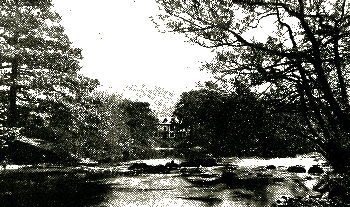
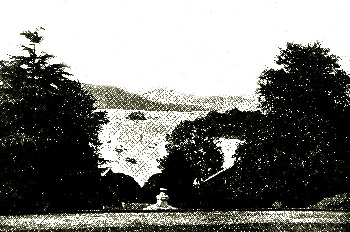
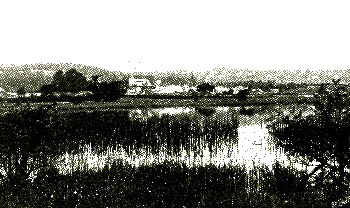
A MILE or so from the picturesque town of
Kendal is a village, standing on both sides
of the rushing little river Kent, now called
Burneside, though anciently Barnside. It has a
church of old foundation, rebuilt early in last century,
chiefly by private subscription, but partly by
enforced church rates, after the custom of that age.
It has a fine bridge crossed by the road leading to
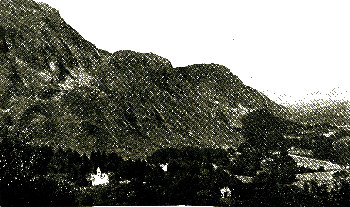
the mountain heights and the long, deep valleys,
so wildly beautiful, and beginning to be so far-famed
through Mrs. Humphrey Ward's romances.
Adjoining the bridge is a large paper-mill, where
formerly stood a worsted-mill and patent candlewick
cutting factory. The village possesses an
institute and library, and a public-house of the
Earl Grey type. The people seem contented and
intelligent, and as the number of them has grown
from 650 in 1830 to over 1,000 within fifty years,
we may fairly point to it as an object-lesson for
those who desire to see village industries and
'garden manufacturing villages' multiplied, and
through them the neighbouring farming interests
improved and enriched.
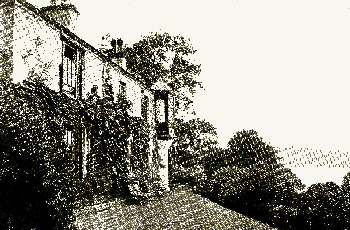
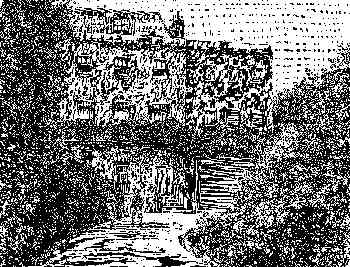
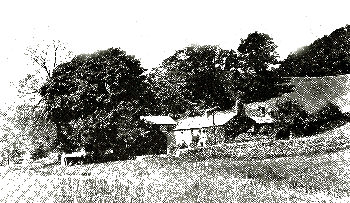
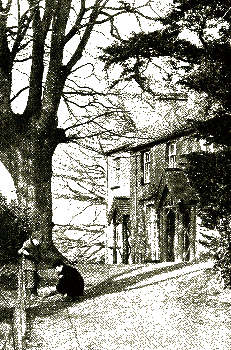
A short stroll towards the northern uplands brings
the visitor to a ruined, ivy-clad Peel-tower, one of
those relics of border-warfare days with which these
regions abound. As in many other cases, so in this,
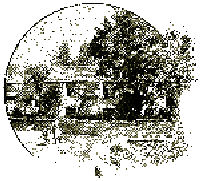
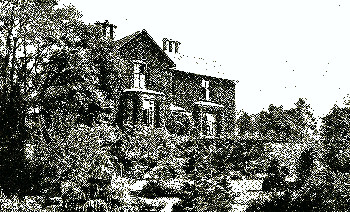
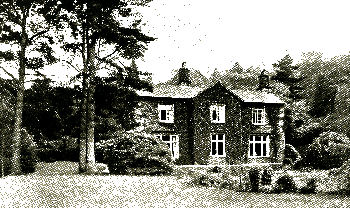
when the times became more settled, a manor-house
grew up around the grim, square-built battlemented
tower, which mansion is now, in still later and quieter
days, a farmhouse. To the manor and dwelling
succeeded the subject of this sketch on his father's
death in 1610, or shortly afterwards. He came of
a race of Westmorland landed gentry, owning estates
here, and at Ambleside and Appleby. It is not
known where he was born. He was entered as a
gentleman commoner at Oriel College, Oxford, as a
native of Northumberland, and it is, of course, possible
that his father, a wealthy man, held residential
property in that county. The internal evidence of
his writings, however, has been of late held to be
sufficiently strong to prove him a native of Kendal.
His words, in an address to 'The Aldermen of Kendall,'
seem very explicit:
'Within that native place where I was born,
It lies in you, dear townsmen, to reforme.'
Anthony a'Wood, in his 'Athenæ Oxoniensis,' tells
how Braithwaite—or, as he spells the name, Brathwayte—was
sent to the University at sixteen years
of age in 1604. He remained there three years,
'avoiding as much as he could the rough pathes of
Logic and Philosophy, and tracing those smooth
ones of Poetry and Roman History, in which at
length he did excell.' Thence he went to Cambridge,
studying literature 'in dead and living
authors.' From Cambridge he proceeded to London
to read law in the Inns of Court. In his father's
will there are indications, and in his own later
writings there are sorrowful confessions, that, for
a while, at all events, he lived a wild, roystering
life in the Metropolis. 'The day seemed long
wherein I did not enjoy these pleasures; the night
long wherein I thought not of them. I knew what
sinne it was to sollicit a maid into lightnesse; or
to be drunken with wine, wherein was excesse; or
to suffer mine heart to be oppressed with surfetting
and drunkennesse; yet for all this, run I on still in
mine evil wayes.' His father's death-bed doubts
of him, and the tying up of the estate bequeathed
to him, till he had amended, seem to have brought
him to himself. While living at Burneside Hall,
during the early days of the Civil Wars he was made
a Captain of the local Royalist trained bands, a
Deputy-Lieutenant, and J.P. for the county, and
spent his leisure in composing and publishing the
more serious of his books. Seven years after entering
on his possessions, he married Miss Frances Lawson,
of Darlington, but surreptitiously, probably
because of objections raised by the young lady's
parents. It seems to have been more than a love-match—a
happy union of sixteen years' duration—producing
a family of nine—six sons and three
daughters. Six years of widowhood, and then he
married a Yorkshire lady, who brought him another
manor, Catterick, where for the future he resided
till his death. The sole issue of this second marriage
was a son—Strafford—who was knighted, and
was killed in an engagement with an Algerian man-of-war—in
the ship Mary, of which Sir Roger
Strickland was commander. In 1673 Richard
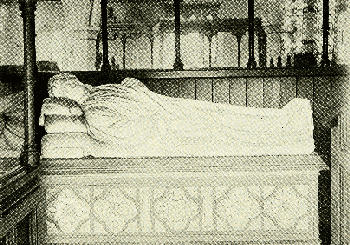
Braithwaite died, and was buried in Catterick Parish
Church, a mural monument duly setting forth the
fact in customary Latin. Anthony a'Wood says he
bore during his steady years 'the character of a
well-bread (sic) gentleman and a good neighbour.'
Mr. Haslewood, his most competent editor, has collected,
I know not from whence, some oral traditions
of his personal appearance, interesting as a
picture of the seventeenth-century northern gentry,
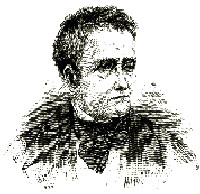
as well as of the individual. He was, although
below the common stature, one of the handsomest
men of the time, and well proportioned, remarkable
for ready wit and humour, and of polished manners
and deportment. He usually wore a light gray
coat, a red waistcoat, leather breeches, and a high-crowned
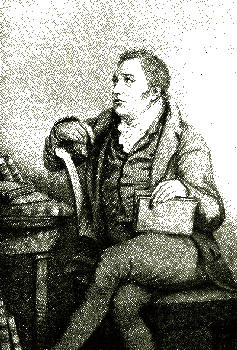
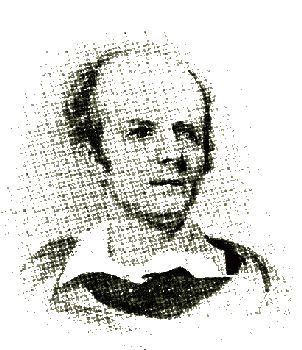
hat. From a full-length portrait in the
first edition of his 'English Gentleman,' which is
believed to be his likeness, he wore also boots, spurs,
sword, belt, and cloak. He was so neat in his
appearance, and lively in manner, that his equals
bestowed upon him the nickname of 'Dapper Dick.'
He earned from later generations a far less enviable
soubriquet—that of 'Drunken Barnaby.' This
is because he is—and rightly so, without doubt—credited
with the authorship of a notorious book
called by him originally 'Barnabæ Itinerarium, or
Barnabee's Journal.' It was done in Latin and
English on opposite pages, to 'most apt numbers
reduced, and to the old tune of Barnabe commonly
chanted.' The poem would seem to have passed
out of general recollection, till in 1716 it was republished
by London booksellers under the title of
'Drunken Barnaby's Four Journeys to the North
of England,' and alleged to have been found among
some musty old books that had a long time lain by
in a corner, and now at last 'made publick.' This
was a fabricated title with the intention of catching
the public taste, because of a popular ballad of the
same name then current. The Itinerary may well
have been the production of his muse during his
London wild-oat days. Drunken and licentious the
traveller certainly was. He gives a rough, coarse
picture of the depraved manners of the times,
against which zealous Puritans were preaching and
vigorously protesting.
Mr. Atkinson, in his 'Worthies of Westmorland,'
calls him a 'strolling minstrel.' A stroller he
was, of course, but not a minstrel in any other
sense than as a keeper of a rhyming diary.
He also says that 'Drunken Barnaby' was a
nickname of his own choice. This is too cruel!
Braithwaite never called himself so, and the term,
when more than a quarter of a century after his
death it was invented for trade purposes, was supposed
to belong, not to Braithwaite at all, but to a
certain 'Barnaby Harrington,' a supposed Yorkshire
schoolmaster and horse-dealer. 'Barnabæ
Itinerarium' has little merit as poetry. It is mainly
of interest to moderns for the light it throws—like
the water-poet, Taylor's, 'Penniless Pilgrimage,'
and his 'Merry-wherry-ferry Voyage'—on the
social condition of Stuart and Commonwealth England,
as well as for its local allusions. Take of the
latter, for example, these:
'Thence to Sedbergh, sometimes joy-all,
Gamesome, gladsome, richly royal,
But those jolly boys are sunken,
Now scarce once a year one drunken;
There I durst not well be merry,
Farre from home old Foxes werry.[B]
* * * * *
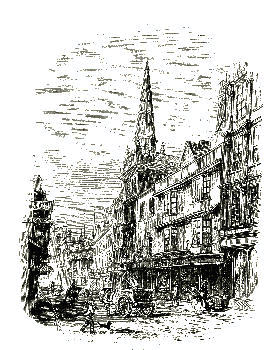
'Thence to Kendall, pure her state is,
Prudent too her magistrate is,
In whose Charter to them granted.
Nothing but a Mayor is wanted;[C]
Here it likes me to be dwelling,
Bousing, loving, stories telling.'
* * * * *
'Thence to Garestang, where are feeding
Heards with large fronts freely breeding;
Thence to Ingleforth I descended,
Where choice bull-calfs will be vended;
Thence to Burton's boundiers pass I,
Faire in flocks, in pastures grassie.
* * * * *
'Thence to Lonesdale, where were at it
Boys that scorn'd quart-ale by statute,
Till they stagger'd, stammer'd, stumbled,
Railed, reeled, rowled, tumbled,
Musing I should be so stranged,
I resolv'd them, I was changed.
'To the sinke of sin they drew me,
Where like Hogs in mire they tew me,
Or like Dogs unto their vomit,
But their purpose I o'recommed;
With shut eyes I flung in anger
From those Mates of death and danger.'
[B] (Old foxes are wary when far from home.)
[C] It seems a Mayor was granted subsequently.
On another journey he came to 'Kendall,' and
there he did 'what men call spend all,' drinking
'thick and clammy ale,' and, passing on to Staveley,
drank again all night. He might in those days have
well deserved to be ear-marked for a 'drunken'
vagabond, yet it is not fair to the memory of any
man to brand him only and for ever with frolics
and follies and evil deeds of which he afterwards
repented, and would gladly have atoned for.
We, at all events, would prefer to think of Richard
Braithwaite at his best, and not at his worst. He
was the author of fully three score volumes of prose
and poetry, in Latin and in English, essays, sonnets,
madrigals. The titles of only a few can be quoted—'A
Strappado for the Devil,' 'Love's Labyrinth,'
'Shepherd's Tales or Eclogues,' 'Nature's Embassie,'
'The English Gentleman,' 'The English Gentlewoman,'
'Whimsies, or a New Cast of Characters.'
There is a good deal of telling satire in the last of
these:
'An Almanack-maker is the most notorious knave
pickt out of all these, for under colour of astrology
he practices necromancy.'
'A Gamester—professes himself honest, and publishes
himself Cheat upon discovery.
'A Traveller is a fraud, if he travaile to novellize
himself and not to benefit his country.
'A Launderer is also one if she wash her skinne,
but staine her soule, and so soile her inward beauty.'
In 'A Spiritual Spicerie' he begins a poem:
'Morall mixtures or Divine
Aptly culled, and Couch'd in order,
Are like Colours in a Shrine,
Or choice flowers set in a border.'
In 'Holy Memorials' he bemoans his past waywardness
and looseness, and speaks of being sore
perplexed when his own wanton verses were repeated
in his hearing, and 'though I did neither own them
nor praise them, yet must I in another place answer
for them, if Hee, on whom I depend, shall not in
these teares which I shed drowne the memory of
them.' Like many of his pious contemporaries, he
tried his hand at turning the Psalms of David into
English verse. If they fall short in his translations
of the beauty and strength of our prose versions—and
they have in no degree gripped the churches—these
sacred hymns helped to ripen his own character
and faith, and he is very sincere in concluding
his efforts with:
'Praise to the God of Heaven,
Be given by Mee a Worme,
That David's numbers in this forme,
To Mee a Worme hath given.'
Adding on the last leaf, 'Other errours favourably
excuse, and amend at pleasure.'
The quaintness of his spelling, of his metres, of
his expressions, commend his works to lovers of old
literature. Some are reprinted, others are scarce.
The first edition of 'Barnaby' is almost unobtainable,
and that of 'A Survey of History,' a quarto
volume with portrait, has just been offered me
for £2.
[231]