I AM not enough of a hero even in my own story to dwell upon the events
of the two following years. I graduated with honors, of which I was
secretly and my mother and Mr. Floyd ostentatiously proud. Then my
guardian and I set out upon our travels. Travel was something different
in those times from what it is to-day, but Mr. Floyd had for years been
familiar with the best of European life, and this gave me opportunities
such as few men of my age possessed. We spent our second winter in the
East: then returned to Florence, and were planning a few months more of
adventure when we received the news of Mr. Raymond's death. Mr. Floyd
had but one thought after this, which was that now at last his little
girl was his own again.
He had had an accident in Damascus—a fall which in itself was not
serious, causing mere contusion and sprains, but it had resulted in a
severe illness by the time we reached Alexandria. Harry Dart had been
with us in Egypt and Palestine, but was obliged to leave us, and for a
month or more I had nursed my guardian assiduously, with a fear lest
this was to be the end of a sacred and beloved existence. He too feared
it, and between his intervals of pain would say, "I want to see my
little girl once more: I must see your mother. Oh, why do we separate
ourselves from those we love?" But he rallied, and finally regained his
ordinary health, and before May we were again in Florence in our old
rooms and talking of joining Harry Dart at Venice, when Helen's letter
came.
Mr. Floyd sent for me at once when he had read the news. I found him
lying on a sofa in his great dingy parlor, with its heavily-moulded
ceilings frescoed into dusky richness, its sides hung with heavy crimson
draperies and decaying canvases, out of whose once splendid pigments
color and meaning had faded long ago.
"Think of it, my boy," said he softly: "my father-in-law is dead. Mr.
Raymond died the twenty-second of April."
"Poor little Helen!" I exclaimed: "is she all alone?"
"I fancy your mother is with her," he returned, glancing back at the
letter. "She says she shall send for Mrs. Randolph. She and I are
executors of the old man's will. I try to feel solemn over the death,"
he went on gravely. "With all our belief in immortality, death is a
terrible thing to regard closely. But yet he was an old, old man: am I
wrong that I cannot mourn for him?"
We went about our preparations for return at once. Vanished were our
plans for Venice and the Alps. I had looked forward with pleasure to
spending my summer with Dart. No man in the world is so good a comrade
as an enthusiastic painter, and Harry was keen of eye, with an exquisite
pleasure in form and color: nothing came amiss to him between earth and
sky. It had been a pleasant dream with us to go together about Venice,
rowed by some sweet-voiced Luigi or Antonio from one stretch of
sea-kissed marble palace-steps to another—to spend our mornings in dim
basilicas, our afternoons away across the widening lagoons, and finish
the day in the square of San Marco listening to Bellini's and Verdi's
airs. But now that this sweet idleness of Italy must be put by, I was
glad that we were to come back home again. I was a little surprised to
find myself almost as eager as Mr. Floyd in making preparations for
return. In a week we were on the ocean.
Mr. Floyd had seemed to enjoy our travels. He was always in good
spirits, always a brilliant and engaging talker, a pleased observer and
clever analyst. Harry and I had made the usual display of unlimited
fastidiousness which youth delights in, but our elder had taken
everything more kindly. He could not fatigue himself, and rarely looked
at more than two or three pictures at a time.
"I used to feel," he would say, "if I went away from a gallery without
a crick in my back and a blinding headache that I had no realization of
my æsthetic privileges. Now-a-days I am willing to confess that I find
too much of everything. Besides, all these pictures have been so
overpraised! Let us find some pleasure that is not in the guide-books."
This was his tone, and I discovered in it at times, despite all his
cheerfulness, a strange fatigue of spirit. But now that he was on his
way home he had suddenly become exuberantly joyful.
"It is so delightful," he would remark to me, "to realize once more that
the chief end of man is not, after all, to have fluent meditations upon
wrecks of lost empires—to discover beauty in hideousness because
somebody else pretends to do so—to mumble praises about frescoes which
are frightful to look at, and break your neck besides—to have profound
emotions in Jerusalem and experience awe before pyramids and sphinxes.
This fictitious life we have been leading is very elegant, no doubt, and
gives one material for just criticisms, but, strictly between us, I
think it dreadfully tiresome. I shall never go into it again. I suppose
my little girl will want to go abroad now that she can do what she
chooses, but I shall let you take care of her, Floyd."
I laughed. "You will find Helen a magnificent young lady by this time,"
I returned. "She is seventeen, is she not? A good many men will fight
for the pleasure of showing her about, and likely as not she will not
look at me."
"She is as old as her mother was when I married her," said Mr. Floyd
thoughtfully. "Can it be that people will want to be marrying my little
girl? I want her all to myself for a time. Who knows how long? I have
been a lonely man, and now I want close, intimate human companionship. I
am tired of doing, I am tired of thinking. I am out of politics: I am
ready for enjoyment. It seems to me I can be very happy with Helen and
your mother close at hand. We shall not be a dreary family. Your mother
and I can sit together and talk: you and Helen can have your little
amusements. Now that she is to be quite unrestricted, I hope and expect
a little nonsense from her."
"But, sir—" I began hesitatingly.
"But what, pray?"
"You cannot believe that we are all to live together. It is time for me
to make a beginning in life, and my mother must be with me."
"You have made a very handsome beginning," returned Mr. Floyd dryly.
"Once for all, Floyd, I will have no nonsense of independence and pride
from you. You are to me as my own son. I may talk much of Helen, because
our love for women is of the kind that gives us the impulse to proclaim
it, but she is scarcely more dear to me than you are. You are part of my
life now: don't fret me and make me miserable by deserting me. Be as
free as air and follow out every wish of your heart, yet, all the same,
feel that your home is where my home is, your interests where mine are."
As soon as we landed we had news of my mother having joined Helen at The
Headlands shortly after Mr. Raymond's death. Mr. Floyd wasted not an
hour in New York, but went on to his daughter at once. I lingered behind
him, detained in part by some delays at the custom-house. I longed to
see my mother, but felt, though with but little of the old jealousy,
that Mr. Floyd had almost the best right to see her first, because,
now-a-days, I was always looking the truth square in the face, and
realizing that it could not be long before cruel and irremediable loss
was to encompass us, and that the rest of our lives we should have not
substance, but shadowy memories only, in place of this dear friend of
ours. So I let him speed on to The Headlands, and dreamed of the
love-flush on the cheeks of the two women who met him there.
I knew comparatively little of my old set of friends, and of late Jack
Holt had almost slipped out of my circle of correspondents. I was aware
that his marriage had been delayed the previous year and the time fixed
for Christmas, but neither Harry nor I had been advised of it, and my
mother had only written that she heard there were fresh delays, and that
the elder Holt had involved his firm in difficulties. I determined,
therefore, to stop at Belfield on my way to The Headlands and see Jack
and all the old friends I might still have remaining there. Of late
years my passing associations had become so diffused with their endless
transitions that every memory of my old home was becoming more and more
fixed and permanent, the nucleus of my recollection distinct and
unchangeable.
I reached Belfield early one morning late in May. The season was perhaps
a little late, for the apple trees were still in bloom, and the village
looked fair and virginal as a bride on her wedding-day. I walked along
the wide pleasant streets with a curious pain. The years that lay
between me and the last day I had paced these broad walks under the pale
greenery of the elms seemed legendary and dreamlike. There was the
schoolhouse on the hill, and the well-worn playground about it. Beyond
lay the woods, half colored now with clear pellucid green, gleams of
silver and shades of scarlet here and there. My mind reverted with
clearness to the little nooks and dingles of the hills and meadows
thereabouts: I remembered a woodland spring boiling up in a hollow of
the greenest grass I ever saw, and in the copse beside it grew the most
beautiful rose-tinted anemones. I could have gone to the foot of a great
oak and found the root of white violets which had been one of my
earliest and dearest secrets; and I wondered—with a longing
inexpressibly strong to go and seek it—if there were still a nest in a
little hollow I knew of, where in my time I had watched scores of
yellow-beaked nestlings.
I went past the house where my mother and I had lived so many years. It
was so changed I should not have recognized it, repainted and modernized
with much show of glass and bow-windows. There were few people to be
seen along the white walks until I met the stream from the post-office.
Old men and boys, shy girls and children, came out with their letters
and papers just as in the old time. Some of the men, grown corpulent and
gray, I recognized with the old feeling of reverence and love, and
stopped to speak with them. But Belfield life, slow and stagnant though
it was, was busy enough to have filled their minds with fresher
memories, and I was so nearly forgotten that there was small pleasure in
reminding them of the lad who had grown from babyhood into a tall
stripling among them. My sentiment passed. I looked about more coldly
even at the street that led to the cottage where Georgy Lenox lived, and
went on briskly to the great stone house of the Holts. Georgy would be
there of course: impossible that another Easter could have passed
without her being a bride. I wondered as I entered the open iron gate
what she would say to me.
The place had seemed splendid to me as a boy, and I well remembered how
all the beautiful wonders of the spring blossomed here as nowhere else.
But now these grounds too seemed to have suffered a change: there was an
air of neglect about the unpruned hedges, with straggling blossoms
running riotously over fence and shrubbery; the beds of hyacinths and
tulips were trampled, and as I neared the house I saw that the blinds
swung carelessly and the old look of thrift and prosperity was quite
absent. Still, I observed all this dreamily, wondering, as returned
travellers are apt to do, if the change were in the things themselves or
in my own eyes.
"Perhaps," thought I, "Jack and his wife live in New York," when,
suddenly answering my doubt, Jack himself came down the avenue in his
light wagon.
I stepped aside, standing still, and he regarded me at first absently,
then with startled curiosity, and sharply drew his skittish mare back on
her haunches. "Good God, Floyd!" said he, "how glad I am to see you!" We
looked straight in each other's face for a time, and his features
worked, as he regarded me, with some emotion. "You were going to the
house?" said he. "Nobody could see you. I have been driving father to
the factories to-day, and he is not so well after it, and my mother is
with him. I have to be back at twelve, so jump in and come out with me."
I obeyed him. It was but two years since we had parted, but he had aged
and seemed quite different from the Jack Holt of former times. He was
roughly dressed, and, though scrupulously neat and shaven, looked, I am
sure, fifteen years my senior. He touched his whip, and the mare plunged
down the avenue at a pace too disconcerting to allow either of us to
speak for a few moments, and we were at least a mile away before her
swinging canter subsided into a trot.
"What is her name?" I asked, laughing. "It ought to be Mary Magdalen,
for she has seven devils in her this morning."
"Don't you remember the Duchess?" he inquired with a flicker of
something like a smile crossing his heavy face. "You christened her
yourself."
I remembered the Duchess. The yearling colt had been given to him on his
sixteenth birthday. He wanted to call her Georgy, but his mother forbade
it: so we named her after that duchess of Devonshire who had made the
name famous.
"You'll find I have forgotten nothing," I replied, "but my thoughts are
such a medley that I can't settle them at once."
"When did you return?"
"Only four days ago: I have not seen my mother yet."
"And you have come to look me up? Floyd, that is kind."
Something in his cool, pleasant tones touched me powerfully. "I knew
nothing about you," I blurted out. "Why, Jack, at this minute I'm not
sure if you are married or not."
"I am not married," he said softly. He was not used to reply so quickly,
and I waited for him to speak before I questioned him further. "I am
well," he said presently, "and mother is in her usual health. Have you
heard about my father?"
"Nothing. Both Harry and I have famished for news of you."
I could see a little trouble in his face: he would have preferred that
somebody else should have broken his news to me. But he sighed, and went
on without flinching. "My father had a paralytic stroke in December," he
explained in his deliberate, gentle voice. "When once our eyes were
opened we could easily comprehend that for months his mind had been
failing. When the bad news came the accumulation of trouble was too much
for him. We thought at first nothing could save him, but he rallied
physically. His mind has quite gone, however," Jack added, his voice
trembling: "his brain has softened."
I stared at him speechlessly: I knew by instinct that I had not heard
the worst.
"The moment I saw you," pursued Jack, "my first thought was, 'I hope he
knows the whole story.' You heard nothing of our failure?"
"Not a word."
"The firm of Holt & Strong suspended payment last December," said he
with a deep flush rising to his temples. "There were two companies, you
know: I was only in Holt & Co. Strong was in Europe. My poor father's
weakness did not display itself openly, but took the form of mad secret
speculations. It is a long story, Floyd. There were no bounds to his
schemes, in which he involved not only himself, but others. He was
president of the savings bank too, you may remember. The troubles began
with the failure of a house in New York to which we owed something. He
was pressed: there was a whisper of something wrong, and of course there
came a run on the bank. I was not here. My father sent for me: when I
came I found a riotous mob outside the closed doors, and he lay
insensible in the bank parlor. He never recovered any real
consciousness, and for weeks we worked in the dark. There was much to
bear. I could have endured every loss without a murmur, had it not been
for the cruelty of some of his smallest creditors."
He stopped for a few minutes, but when I would have spoken he motioned
me to be silent, and presently went on: "There are men to-day who
pretend to believe that my father's mental state is as perfect as
ever—that he is merely shielding himself from punishment by shamming
imbecility. Ah, well! let me continue. Just at this juncture one of our
buildings was destroyed by fire. The insurance policy had lapsed, and he
had failed to renew it. The factory was packed with goods ready for
shipment. The loss to Holt & Strong was a quarter of a million of
dollars." He stopped again, and I saw him moisten his dry lips. "The
chief creditors," he resumed, "were honorable men. By the first of March
we had agreed upon terms of adjustment. My mother gave up all she had.
My sisters are angry with me that I allowed her to strip the house of
everything that had possessed a moneyed value, and think it shameful
that I despoiled her of her jewels. But such things did not count with
my mother and me. I kept the Duchess—nothing else." He smiled sombrely
as he pulled out his watch. It was the little silver one he had used
when we played marbles together. "We paid fifty cents on the dollar," he
said presently, "and by and by shall manage something of a dividend at
the bank. It will give me plenty to do for years yet," he added with a
peculiar smile.
"You have assumed your father's debts?" I exclaimed. "That seems a
needless penalty, Jack."
"My father and I are as one," said he gently. "It was fortunate for me
in every way that I was not my father's partner. When I entered Holt &
Co. he gave up everything to me. I have the entire business now, and it
leaves me little unoccupied time."
"You are doing well, I trust."
"Reasonably well." I knew the look on his heavy, sombre face—a patient
but combative look, powerful as Fate itself.
"Do you mind telling me the rest, Jack?" I asked after a time. "If it
hurts you don't open your lips."
The veins in his forehead swelled a little, yet he neither flinched nor
reddened. "I suppose," he answered, his voice a little less clear and
distinct, "you allude to my engagement to Miss Lenox. It was broken off
when these troubles came. We were to have been married a year ago in
June, but I was not quite free to take her travelling, and it seemed her
wish to wait. The wedding-day was quite fixed for a fortnight after the
date of my poor father's sickness. Of course I offered her her freedom
at once when I realized my scanty prospects of ensuring her a luxurious
future. Naturally, everything was broken off. I am hampered by
circumstances. I shall never feel myself free to live even in ordinary
comfort until my father's debts are paid to the last penny. My first
duty is to my father and mother. My sisters are all married, have large
families, and, above all, have lost the home feeling. We three are alone
in the world in our reverses. When you see our home, Floyd, you won't
wonder that I could not ask Georgy to come to it."
"But would she have come, Jack?" I stammered. "Was she faithful to you?
would she not wait for you?"
"Georgy is not romantic," he said kindly, "and has not been brought up
in a school which inspires the tenderest feelings. I should never have
expected that sort of devotion from her, nor am I one to inspire it. I
knew at once when the dark days came that everything was over. Blow
after blow had struck me: just at that time that she should desert me
was but one blow the more."
I threw my arm about him in the old way, but he did not turn now and
smile into my face as when we were boys. This gloom was not so easily
dispelled.
He himself ended the silence that I could not bring myself to break. "I
have heard of a divided duty, but I can have no doubts, no dilemmas, as
to mine. I believe that I am not fanciful—that I see realities just as
they are. If ever man found work lying close to his hands, I have found
it. If ever an entire and undivided responsibility rested upon human
creature, it is mine. Every instinct of my heart, every decision of my
intellect, alike shows me that my duty lies in the path which I am
treading. Nobody on earth, nobody but God, knows just exactly what I
have felt the few past months. I couldn't write to you and Harry. Life
had always been a pleasant thing to me. My father was not a lovable man,
nor was he in his home all that a son longs for in a father. Still, he
was rich and respected; he represented a beneficent financial power; he
controlled many interests, developed resources, carried out schemes
which were useful alike to poor and rich. I used to be proud to hear it
said, 'That is young Holt, son of Adam Holt of the —— Mills.' Now I am
obliged to bear with meekness, when he is called dishonest, when he is
classed with those who have suffered the punishment of convicted felons,
when his pitiful infirmity of body and mind is sneered at. We are living
in our house as transient guests: as soon as it can be sold we shall
seek some humbler shelter. The pleasant household ways are all gone:
everything that used to gladden our eyes has been carried away. My
mother's eyes rest nowhere save on my father's face or mine: she cannot
look at the bare places in the house, for she thinks too much then of
her great calamity. All these are troubles which cut me deep: you don't
know, Floyd, how disgrace burns into the soul—worse than bereavement,
worse than death. I have been bereaved of all, and I seem to have tasted
the bitterness of a thousand deaths. Still"—he turned abruptly and
looked me in the eyes with a stiff white face—"there are times when I
feel but one loss. There is strength in me, and, please God, by and by I
shall shape things to their right ends again; but this other loss! I
don't need to tell you," he went on huskily, "how above and beyond all
other objects on earth Georgy Lenox has been to me. At times,
retrievement, success, unsullied honor, all seem to me as nothing, since
she is not to be at the end of them."
We had reached the factories now, and he resumed his usual calmness, and
I could see in a moment that he was a business-man again. He asked me to
stay and drive back with him, and dine and spend the night, urging it
on the plea that his mother would like to see me—that she had so few
pleasures. I consented against my wish, almost against my will.
No one knows what change means, what frightful possibilities of sadness
it covers, until one has such an experience as mine that night. In
former times the Holt house had been a sort of fairyland to me: our own
ménage was simple and inexpensive, and, in contrast, the profusion and
splendor of Jack's home had impressed me powerfully. Their expenditure
was not moderated by what we call good taste, and they did not possess
that fine grace of compassing elegance without ostentation which is one
of the last results of culture; but as a boy I had missed nothing that
money could buy in their house, and I had often thought how my mother
would shine there. Mr. Holt had been a man to look up to with respect,
although somewhat arrogant and dictatorial, and Mrs. Holt—good, easy
soul!—had enjoyed her prosperity with an equal pride and joy in her
husband, her children, her silver plate, her heavy silks and her jewels,
which, displayed in their satin cases, were the chief show in Belfield
for the women, who used to tiptoe up the grand staircase to Mrs. Holt's
dressing-room, and come down with awe in their faces.
Mrs. Holt at this later time I write of was a sad, soft-eyed little
woman, with a patient smile: she was so much of a lady that her dress
was neat and pleasing, although of the plainest. She kissed me when I
went in with Jack, and I felt like going on my knees before her. She
treated Jack as if he were older than herself, although with the utmost
tenderness qualifying the respect she gave him; but I was a boy to her
still, and she looked lovingly in my face and told me that she knew I
was a comfort to my mother. I had been a good deal of a man in my own
eyes in Europe, but in these familiar places I did not feel much older
than I had done six years before, full-grown although I was, and so
tall that I had to stoop very low to meet the little woman's kiss.
"Here is father," said Mrs. Holt in a tender, cooing voice; and she went
up to a feeble old man in an arm-chair and began telling him that this
was Floyd come back—Floyd Randolph, whom he used to like so well years
ago. Mr. Holt looked at me with hopeless, bleared eyes, and shook his
head and complained in mumbling tones that dinner was not ready, that
nobody took care of him, that he was neglected by wife and son.
Jack himself led his father to the table, and it was a hard task to
guide the tottering footsteps, but not so hard perhaps as for the poor
wife to tend him while he ate as if he were a baby. There are sad things
upon which one may dwell, for some sorrows bring sweetness with them,
and give meaning and perfume to a life, just as the night is almost
lovelier in its shadows than the garish day; but I cannot write about
Jack's troubles, for it was so pitiful to me to see this strong man so
fretted, so bound, by the fine chains which duty sometimes forges for
men. The meal we ate was of the poorest, but I think there is no
bitterness in bearing personal deprivation, and I did not pity Jack that
neither the taste of the palate nor the taste of the eye could be
gratified at his board; but when I saw him playing backgammon with his
father afterward I did pity him. The old man's hand shook so that his
wife had to guide his wrist as he threw the dice, and he burst into
senile tears if the throw did not suit him. But Jack was hopeful and
cordial through it all, and would patiently tell his father little
trifles of news about his business, and engage his attention so kindly
that once or twice the heavy fallen features would almost gather
expression again. At such times happy tears would start to Mrs. Holt's
eyes. "I do believe father's getting better," she would say, looking at
her son.
It was still early, however, when Jack and I were left alone. He had
carried the poor old man to bed, and now for a few hours the burden had
fallen from the son.
"Let us go out and walk about the old places," said he. "The house is
dreary, is it not?"
"I have only thought of you all, Jack," was my answer. "My dreariness
has not been induced by the look of the house. Still, when I do look
around and see the rich carpets gone, the pictures, statues, all the
thousand beautiful things we used to take pleasure in, I say to myself,
'This just man will have his reward.' Don't despond, Jack: I tell you,
things will come right again."
"Thank you, Floyd," said he in his cool way. "I am better for having
seen you. But let us talk of something besides my troubles to-night. It
is a sweet evening."
He took my arm, and we walked out along the avenue into the street. It
was a beautiful night, calm and warm, with a full moon shining down upon
the deserted squares. We went up the hill and stood on the steps of the
academy, then sat down upon a bench on the playground beneath the
poplars, and found our initials there where we had cut them years
before. Missing Dart in these old familiar places, it was natural for us
to talk of him, for, well as Jack loved me, Harry was his dearest
friend. A peculiar tenderness had always knit their hearts together, and
it had been another sorrow to Holt that in all his trouble his cousin
was too far away to give him a glance of his eyes, a grip of his strong
hand.
I told him all I knew of Harry. We had not been mistaken in our estimate
of his genius: he had not been in Rome three months before the famous
Z——had become interested in him and allowed him to study in his
atelier. Every one predicted success for the young artist, and dealers
were already beginning to buy up his pictures, paying a mere song for
studies to-day which years hence they expected to sell for a big sum on
the strength of the reputation he would have gained. Harry's strong
points were his unequalled distinctness of vision and his intensity of
feeling for art. He put a passionate throb into every movement of his
brush. When once an idea occurred to him as desirable to work out, it
defined itself to his imagination with a reality, a power, an amplitude
of detail, which blinded him for the time being to everything else, and
he worked so faithfully that he stamped his conception and his meaning
upon not only every figure, but every accessory of his picture; so that
the most commonplace observer gazed at his canvas with some of the same
feeling with which he gazed at an experience of life. But Z—— was not
yet satisfied to have him attempt compositions, and he was spending much
time over the curious processes by which the perfection of skill in art
is attained—productive analyses of coloring, light, shadow and the
mellowed harmonies of time-worn pictures.
"We shall be proud of Harry by and by," said Holt as I paused. "I hope
he won't stay too long abroad. I have missed you so, Floyd!" And we fell
to telling stories of our boyhood, and again and again Jack's laugh
broke the silence of the night, for there were droll tales to tell. We
heard the chimes of midnight before we stirred from our seat, and then
we moved with some reluctance, for the moonlight was rare, and the light
upon the water where the sea-line showed through the interstices of the
trees was a silvery radiance too blessed to lose. But at last we rose
and moved carelessly homeward. We did not take the nearest way, but
turned as with one intention through another street than that by which
we came. Our feet knew the way to a little Gothic cottage on the hill,
and we stood outside silently for a time. No sight or sound of any
creature stirring in the world but ourselves met eyes or ears. No light
was in the windows, and the blinds of a casement beneath the gable were
close drawn. I wondered if a white hand had closed them a few hours
before, and if a fair sleep-flushed face and bright disordered hair lay
on the pillow inside. Just then some bird, brooding over her three eggs
in her nest, stirred drowsily and cooed softly at some delicious dream
of love or maternity. It broke the spell, and we turned to go away.
"Don't fancy," said Jack, "that this is a habit of mine. I have not been
here before since December."
"Is she here?"
"I have no idea. I never hear her name, and when I am in church I never
turn to look."
I left Belfield early the next morning, and pursued my way to The
Headlands. I had many thoughts of Jack as I went on, wondering if this
cruel and irremediable wrong which Fate had inflicted was to shadow all
his life. Indeed, I felt disheartened, for I had warm sympathies; and
besides, the cruel prose of his experience broke upon the easy,
pleasure-loving harmony of my life like the sudden crash of kettledrums
in the midst of moribund flute melody. I had always possessed too much
leisure not to have become saddened and perplexed at times with doubts
before the eternal problem of life; and they all returned now, and not
until I reached The Headlands in the late afternoon did I rouse myself
into an anticipation of the pleasant life I was to meet.
I was not expected: no one met me at the station, and, finding no
conveyance, I walked on myself to the place, and entered the grounds not
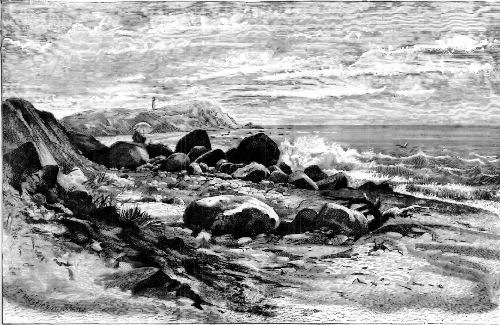
more than an hour before sunset. Everything was curiously calm and at
peace except the breakers, which moaned against the rocks below as the
tide came in. The shadows were long upon the grass, and looked like
things that had felt life all day, but now had coiled themselves up for
sleep. Beyond the trees the fiery sun still shone, gilding the stately
house with gold and resting lovingly upon the roses which clambered
riotously over embrasures and abutments, lighting up the piazzas and
columns with their bloom. I recognized a change at once in the aspect of
the place: more windows and doors were open than formerly, and the
porticoes showed signs of careless occupancy with their chairs and
afghans, tables and a litter of books, papers and work. I stood before
the door, gazing through the wide-columned vista of the hall, and the
infinite seemed open before my eyes as I saw the blue and opal-tinted
sea. But still there was no sound except the murmur from the shore, and
nothing stirred except the sunbeams as they climbed the carved
balustrade of the great staircase and gleamed on the frozen faces of a
marble group in a niche. I did not ring at first, for it seemed as if my
mother or Helen must come out—that they were close at hand, picking
roses on the terrace or descending from their rooms. But it was Mills
who presently issued from the dining-room and saw me. He greeted me as
if I were one of the family, and ushered me into the library as he had
done at the time of my first visit years before.
Sitting there quietly, I seemed for the first time to realize the fact
of old Mr. Raymond's death. I saw his chair by the fireplace, and the
low seat on which Helen and I had sat together many and many a time. I
had not grieved at the old man's death, but had felt that weeping for
the dead might sometimes be a less dreary task than bearing with the
living; yet here I could not see these beautiful inanimate things, once
his intimate surroundings, without a thrill of regret that he was gone.
A shadow fell across the doorway, and a young girl came in, one of the
sunset gleams reflected from some of the endless mirrors of the house
falling on her and lighting up her face. My first thought was, "She is
almost a woman:" my second was, "I had never expected she would be so
beautiful."
We had not spoken yet: she ran up to me eagerly and looked into my face,
and I clasped her hands. When I saw that she was crying there seemed to
me but one way of greeting the child. I took her in my arms and kissed
her. It seemed strange, I think, to neither of us that we should meet in
this way. But when we looked at each other now, I felt a curious glow
over my face, and she hung her head and was blushing vividly, as I had
never suspected the pale little Helen I had once known so well, with her
aspect of almost severe purity, could ever blush. There was a new sort
of beauty about her: a soft richness of tint and texture seemed added to
cheek and lip, and the old imperious concentration of her glance was,
for the moment, quite gone. Still, although I could easily see that she
was frightened at her own temerity in allowing my more than brotherly
freedom, I could not find it in my heart to repent it.
"Where is my mother, Helen?" I asked, taking her hand in mine to
reassure her, for I saw that something was embarrassing her very much.
"It seems I was not expected to-day?"
"Not so late as this," she explained; and presently I was talking freely
with her, and she was listening without a particle of self-consciousness
in her manner. It appeared that my mother and Mr. Floyd had gone out to
drive, but would presently return to tea—that my mother had been
longing for me, and they had all wondered why I had delayed coming. This
was all very pleasant, uttered in the sweetest voice by my young
hostess, and when she asked me if I would go out and see the sunset from
the terrace, it was very easy to say that I would follow her anywhere.
She was a shy child still, I discovered, despite her tall figure, her
pretty womanly shape and elegant air. My manhood was too recent a
possession not to be rejoiced in when I saw that a woman's blushes came
and went as she felt the weight of my glance. We went out of doors and
saw the surges breaking on the shore, but the waves seemed happy that
night, and lisped joyfully like children at their play. There was no
voice of sorrow in all Nature: the birds circling about their nests
began glad strains, then hushed them only to break forth again into
fresh confused and joyful beginnings which they were too sleepy to
finish. We talked of sorrow and loss, yet I think neither of us was very
sorrowful, although Helen's tears flowed unchecked as she poured forth
the simple narrative of her grandfather's last days—how he had never
been so tender, so self-forgetful, as then; how he could not do enough
to show his deep love for her; and then how, in the night, all at once,
without a last look, word or caress, he was gone and his tenderness was
but a memory.
"I felt at first," said Helen, "as if there were no longer anything for
me to do in the world. It seemed a treason to poor grandpa that I saw
how beautiful the crocuses were as they blossomed in the beds on the
terrace here, and when the mayflowers came I did not dare to pick them
except to put them on his grave. Then, you know, as not even papa knows,
that with all my reverence for my grandfather I had still had a terrible
sense of responsibility mingled with my love for him; and not even yet
can I go out a few hours for a drive or a ride without my feeling every
now and then, through all my pleasure with papa, a sudden pang of dread.
After such times I run to his room: it is easy enough to believe then
that he no longer has any need of me."
"You were all alone at first, Helen, until my mother came to you? Two
weeks alone! It seems dreadful."
"Georgy Lenox was here, you know."
"Georgy Lenox here?" I echoed in surprise. "I never heard anything so
strange. How did it happen?"
Helen looked at me in her turn in astonishment. "Why was it strange?"
she asked, as if regarding the matter in a new light. "She was one of
the family: she came to grandpapa's funeral. Cousin Charles Raymond
himself invited all the Lenoxes, for Mr. Lenox's mother was a
Raymond—was grandpa's own sister, I believe. Why was it strange?"
"Natural for her to come perhaps, but I should not have expected her to
remain. You asked her, no doubt?"
"No-o-o," returned Helen doubtfully. "I don't know how it was. The house
was filled with people for a week: then they went away and Georgy
stayed. She said it was horrid for me to have no lady near me in my
trouble. Cousin Charles was here all the time until your mother came,
but his wife was ill in New York."
"And when my mother arrived Georgy left you?"
"No, indeed: she is still here. You see," said Helen with a little of
her old imperious way when she took control of things, "Georgy was
greatly disappointed at the terms of the will. She had been led to
expect that she would be quite an heiress when grandpa died. I don't
know who taught her to believe in so strange an idea, for, to tell the
truth, grandpapa did not fancy Georgy. Poor girl! everything has gone
wrong with her. She was to have been married to Mr. Holt, you know, but
it is all quite broken off; and she was very unhappy about that. She
hates being in Belfield, because she sees him all the time, and is
reminded of what she is trying to forget. So I asked her to stay here
for a little while. You are not angry to find her here, Floyd?"
I laughed with an indefinable feeling of embarrassment. "I shall be most
happy to see Miss Lenox," I rejoined; "and if I were not, it would be
great impertinence in me to question for a moment the doings of the lady
of the house."
"I am not the lady of the house," said she, a little piqued. "Mrs.
Randolph is that. I give no orders now: everybody goes to papa. He says
I have governed too long, and that I must be a little girl again. It
seems so strange sometimes to have nobody consult me: I do nothing all
day long but enjoy myself."
"But I belong to the old régime," said I, "and to me you will always be
the châtelaine. I remember how you used to give orders to Mills and Mrs.
Black: I can still smell the aromatic odors of the store-room when we
used to make the weekly survey together, and can hear you talking
'horse' solemnly with the coachman down at the stables. I am not at all
sure if I shall like you so well as a gay young lady of pleasure, with
all your thoughts on your dresses and your lovers."
"As if I should ever think about my dresses or my lovers!" she replied
with deep disdain.
"What do you think about?"
"I think about papa," she rejoined, still indignantly: "I think about
your mother and you. I have a great many nice things to think about
without being taken up with those horrid subjects."
"'Horrid subjects'! Good gracious!" I exclaimed: "I intend some day to
be somebody's lover: shall I be a 'horrid subject'?"
She laughed frankly, a delightful girlish laugh which showed her little
pearly teeth. "It depends on how you behave," she said with a little
nod. "Georgy Lenox has lovers: she tells me about them, and I think them
horrid."
"Do they come to the house here?"
"Oh yes. One is a stout man with a red face. He wears a solitaire
diamond in his necktie. Papa knows him: he was in Congress, and his name
is Judge Talbot. Then there is a young man—not so young as you, but
still young. He remembers you: he used to be in Belfield. He is Mr.
Thorpe."
"Tony Thorpe here? What unlikely people I come across! Which is Miss
Lenox's favorite admirer?"
"As if she would have favorites among such admirers! Georgy is the most
beautiful girl in the world. Papa is not fond of her, but even he says
she is a superb creature. Why does nobody like Georgy? Papa does not,
and I am sure Mrs. Randolph does not, nor do you. Yet she is so
beautiful, so winning, so clever!"
"You don't need to pity her for not gaining love," said I gravely. "My
mother may not like her, because she knew her as a faulty child who did
considerable mischief first and last; and Mr. Floyd dislikes her
because—You know why he dislikes her, Helen. But many people love her:
I think few women in the world have won so much devotion. I have just
seen Jack Holt, who had to give her up, and I am far from believing that
nobody likes her."
"But why did he give her up?" questioned Helen.
"Why did she give him up," I returned with heat, "except that he had
lost his fortune, and instead of being able to endow her with all the
good things of life, himself needed aid, sympathy, love and comfort?"
Helen stared at me: "But he told Georgy she was free."
"Suppose," said I passionately, "that a man had loved you from your
earliest childhood, Helen—that instead of your being possessed of
wealth and other facilities for making your life all you wished, you
were poor and obscure, and this man had made every sacrifice to gratify
every desire of your heart. Suppose you had read his soul like a printed
page, and found every thought in it noble, lofty and pure; suppose you
knew that his happiness depended on you—that without you he could not
have one sacred personal hope,—when you found that he was poor instead
of rich, would you throw him over as you put away a glove that is worn
out, even though he told you you were free—that although you had shared
his prosperity he shrank from letting you endure the pains of his
adversity?"
Helen was looking at me with a curious look in her brilliant dark eyes,
and still watched me when I paused.
"Would you have accepted such freedom?" I demanded, impatient that she
did not respond.
"I would have died for him!" she exclaimed abruptly, but she said no
more about Georgy or her lovers.
The sun had set, and the glory of the clouds was all reflected in the
sea. The air grew chilly, and we went in and watched at the front door
for Mr. Floyd and my mother to return from their drive. It seemed
curiously like the old times, and once or twice I started at some sound,
expecting to hear a querulous voice and see old Mr. Raymond with his fur
wrappings crossing the hall leaning on Frederick, who carried his
tiger-skin. Helen was too quick and sympathetic not to understand my
startled look.
"He will never come any more," said she sadly. "He is sleeping up on the
hill beside his wife and all his children. Had it not been for papa I
should have felt that I must go there too, it seemed so strange and
lonely for him."
Presently through the pale gloaming came my mother from her drive, and
when I lifted her from the carriage and almost bore her up the steps in
my arms, I felt a happiness and peace which seemed but the beginning of
a blessed time. My mother had grown perhaps a little older in the last
two years, but surely she had grown more beautiful. It was enough at
first merely to look into her face: then when I followed her up to her
room we told each other many, many things, but I invite none to follow
me over that threshold.
"I took good care of your boy, Mary," said Mr. Floyd, coming up to us
when we descended; and when I met my mother's look I felt again all the
proud humility that a son can feel, beloved as I was beloved.
"He was not such a bad boy," pursued Mr. Floyd, ringing the bell and
ordering tea, "and his faults, such as they were, belonged to his
age.—Don't open your eyes, Helen, as if you expected to hear just what
he did. I shall not betray him. All the world knows that when one is
abroad one may commit enormities which there may be put inside your
sleeve, while here they are as big as a meeting-house."
"I don't believe Floyd did anything wicked," remarked Helen with some
spirit.
"We are at home now, Floyd," pursued he with an air of resignation, "and
our little diversions are over. The eyes of two women are upon us. No
more cakes and ale—nothing but rectitude, cold water, naps in the
evening. I forgot, though, about our charming guest. While Miss Lenox is
here ginger will be hot i' the mouth, and life will have a slight flavor
of wickedness still."
"But where is Miss Lenox?" I asked.
"Miss Lenox is far too brilliant a young lady to stay constantly in a
dull country-house," said Mr. Floyd. "The cottage people over at the
Point raffolent, as our friends abroad say, upon the charming Miss
Georgina. We have, after all, very little of her society. She goes on
yachting-parties, to dinners, luncheons, picnics—everywhere, in fact,
where the delicate lavender ribbons of slight mourning may be allowed.
She has attended a déjeuner to-day, and we are every moment expecting
that our gates of pearl will unclose and admit a celestial visitant."
"Now, papa," said Helen, "you shall not make fun of Georgy. Nobody does
her justice."
"Don't they?" returned Mr. Floyd dryly. "Fiat justitia, then! Ruat
cælum! One would follow the other in this case, I fear.—She generally,
Floyd, brings home one or two in her train. You remember Antonio Thorpe?
That young man is so often here that I am beginning to regard him as one
of the regular drawbacks to existence, like draughts, indigestion, bills
and other annoyances outrageously opposed to all our ideas of comfort,
yet inevitable and to be borne with as good grace as may be."
"What on earth is Tony doing at the Point?"
"He dresses well," returned Mr. Floyd reflectively: "his hands are soft,
his nails clean. I don't think he follows any occupation which demands
manual labor. I can generally tell a man's business by his hands or his
coat; but on Tony's irreproachable broadcloth not one shiny seam
discloses what particular grist-mill he turns."
"Of course he has no grist-mill," said Helen. "I thought he was a man of
fortune."
"I was the guardian of his youth," observed Mr. Floyd, "and when he was
twenty-one I paid over to him intact the sum of money left to him by his
father. It had originally been less than fifteen hundred dollars, but by
lying untouched for nine years at compound interest it had nearly
doubled. That was several years ago, and with the utmost frugality on
his part I can't see how he could have worn such decent coats on the
interest of that money all this time."
"But you put him into business half a dozen times," interposed my
mother: "I suppose he made money."
"No, he never made any money. The only way Tony will make money honestly
is by marrying a rich girl. Not that I assume him to be dishonest or a
sharper, for I do think him a gentleman, after the fashion of Sir
Fopling. He probably is considerably in debt, but floats himself from
all danger of sinking by speculation or the like. Five times I set him
at work to make his living: five times he was returned on my hands. His
character possesses all the drawbacks of great genius, without any of
its resources: he is proud, discontented, misunderstood, with a talent
for failure."
"Is he a suitor of Miss Lenox's?" I asked. "He was never in the habit of
admiring her."
"You can make up your mind," said Mr. Floyd with a shrug, thus
dismissing the subject.—"Helen, my child, looking at this young man
impartially and judicially, what do you think of him?" and he put his
hand on my shoulder.
We were at tea, which was always an informal meal at The Headlands.
Helen sat among the tea-cups, my mother had a little table by her sofa,
and Mr. Floyd and I walked about carrying cream and sugar and cakes. I
was on my way for a fresh cup when this question was put, and I went up
to Helen and sat down beside her.
"Impartially and judicially," said I, "what do you think of me?"
Mr. Floyd took his seat on the other side of her, put his face close to
hers and began to whisper all sorts of nonsense in her ear about me.
"Tell him," said he, "to begin with, that he is a prig."
"But I don't know what a prig is."
"A prig is a handsome fellow born to create disturbance among the
ladies."
She looked around at me and laughed. "Isn't he a goose?" she asked in a
pretended whisper. "Where was it in Europe that he lost his brains? He
has brought none of them home."
"It may have been at Damascus," said Mr. Floyd. "Did I tell you that
after I fell through the trapdoor in Damascus and broke my ribs, they
put a railing about the place and asked a piastre for a look at the spot
where the American gentleman almost came to an untimely end?"
But Helen did not laugh: she put her arm about his neck and brought his
cheek to her lip, and kept it there, giving it mute caresses now and
then, while she smoothed his hair about his temples with her little
hand.
"I'll take some more tea, if you please," remarked Mr. Floyd after a
while in a meek voice.—"I'm obliged to endure a good deal of this sort
of thing, my boy: it's not so unpleasant as it may look, but
nevertheless it requires some stimulant to keep up an emotion of
agreeable surprise. By the bye, what do you think of my little girl, now
that she is quite grown up?"
"Don't dare to tell," said Helen. "I'm dreadfully vain all at once, for
papa flatters me so that the rugged courtesy of the outside world would
seem hard to me. Still, papa's compliments count for very little. When
Georgy comes in presently just listen to what he says to her."
And precisely at this juncture there was a little commotion in the hall,
and Miss Lenox did come in with Tony Thorpe. She had spoken to my
mother, kissed Helen and answered Mr. Floyd's badinage before she saw
me, yet when her eyes did turn toward me she showed no surprise.
"Have you come at last?" she inquired coolly, holding out her hand. "I
am glad to see you again, Mr. Randolph."
I greeted her as calmly, and said, "How are you, Thorpe?" to her
companion, with another shake of the hand. And then everybody sat down,
and there was fresh tea brought. I noticed that Thorpe was quite
assiduous in his attentions to Helen over the cups and saucers, and
seemed as much at home in the house as a tame spaniel. Meanwhile, Miss
Lenox had sat down by my mother and begun telling her the events of the
day. The déjeuner had been given on a yacht in the bay, and had begun in
mistake and ended in disaster: the wrong people had come, while the
right ones had been kept away, like the invited guests in the Gospel.
The sun had been too warm, the breeze too cool, the men who talked to
her garrulous and stupid, and the women abominably over-dressed.
"Dear Helen," cried Georgy with effusion, "I have wished myself at home
with you all day.—Dear Mrs. Randolph, tell me what you have been doing
with yourselves;" and she wasted a slight caress on my mother.
"Our doings were nothing remarkable in themselves," said my mother
gently, with a little smile—one of those smiles which women keep for
use among themselves, and rarely give to men.
"Papa and Mrs. Randolph and I sat under a tree until dinner-time," said
Helen. "We have been very idle, but had a delightful time nevertheless."
"Praying all the time that Miss Lenox was enjoying herself at the
déjeuner," drawled Mr. Floyd.
Georgy had risen and was crossing the room, and now, passing Mr. Floyd,
paused and looked down into his face as he surveyed her with a slightly
satirical air.
"I am glad of anybody's prayers," she returned, quite unruffled, "but I
am afraid, Mr. Floyd, yours are merely a pretty figure of speech."
Mr. Floyd suddenly sprang to his feet and walked up and down the room
with a restless way he had. "I have it! I have it!" he exclaimed with a
triumphant air. "It is a picture of a Wili of whom you remind me, Miss
Lenox. I saw it in R——'s studio at Rome.—Don't you remember it,
Floyd?"
I knew it very well, and was aware, besides, that R—— had got the face
from Dart's sketch-book.
"What is a Wili?" inquired Georgy, looking at me. "You know I used to go
to you for all my bits of knowledge when I was a little girl, Mr.
Randolph."
I rose and crossed the room to her side. "A Wili," said I, "is a
betrothed maiden who dies before her wedding-day. Your knowledge of your
sex may tell you why it is that she is never at peace in her grave, but
is impelled by some unconquerable love of life to rise every night and
dance till morning."
"With whom does she dance? Her unfortunate lover?"
"Oh, where Wilis live you see them dancing together in the woods and
fields by moonlight and starlight, their white arms wreathed about each
other and their long hair floating. When a Wili meets a youth abroad in
the night-time she beseeches him to dance with her; and the voice of the
Wili is so sweet, her eyes so terribly beautiful, her clasp so horribly
close, that whether he will or not he must join the fatal dance and keep
pace with her eager, frenzied movements. When morning comes the Wili has
gone back to her grave."
"And where is the young man?" asked Georgy.
"They find him dead on the grass," put in Thorpe, who was standing
behind Helen's chair. "It is death to dance with a Wili."
"Both of you seem very experienced young men," remarked Miss Lenox
calmly. "Did either of you ever meet with a Wili?"
"I have frequently met them on flowering meads," I returned, laughing,
"but when they invite me to dance I tell them I am unable to dance with
even the prettiest of live women, I am such a miserable cripple."
"It's rather a pretty story," mused Georgy, "but I don't quite see what
it means.—Do you, Helen?"
"It seems to be a sort of warning to young men to keep in o' nights,"
returned Helen with a droll little air.
"Dead women never trouble me," said Thorpe, "but I have had no end of
charming dances with live ones.—Do you waltz, Miss Floyd?"
"Oh yes. Miss Lenox and I waltz together whenever we can get any one to
play for us."
"That must be a tame amusement," rejoined Thorpe with an ineffable air
of conceit.
"Thanks for the neat compliment," said Georgy, "but neither Miss Floyd
nor myself suffer from the tameness."
"Oh, allow me to explain—"
"We are not so dull but that we can understand even the most stupid
bungle at a compliment of any awkward man," yawned Georgy. "Some time,
by and by, when I am very rich, and so old that I don't care what
happens nor how I offend my admirers, I intend to give to the world a
woman's opinion upon the fascinations of men."
"Bravo! I hope I may live a hundred or so years in order to hear it,"
said Mr. Floyd. "However, Miss Georgy, it would be safe enough for you
to tell us now that you hold men contemptible, only practising your
coquetries upon them for your own amusement, quite indifferent whether
your shafts hit or go astray. We could bear the ordeal, for we should
know very well that circumstances must vindicate us. We are, after all,
superior to even the highest simian types, and our poor fascinations
shine by comparison with those of even the most intelligent baboon; so
we should be certain that, in spite of your opinion of us, you would go
on making yourself beautiful for our approbation to the end of your
life, because you have, in fact, no other object worth spending your
energies upon."
"I confess," said Georgy, with a peculiar glance at Mr. Floyd, "some men
are worth any effort."
Thorpe, after many vain attempts to engage Helen in conversation, took
his leave, and when I went to the door with him he begged me to stroll
down the grounds to the gate. He had a three-mile walk before him for
his pains in coming home in the carriage with Miss Lenox, but he vowed
that the pleasure he always found at The Headlands recompensed him for
any labor. He burst into enthusiastic talk about the old times at
Belfield: he remembered the charm of my mother's house, he said, and the
good times we boys had enjoyed together. How was Holt now-a-days? and
where was Dart? Was it true that Jack himself had thrown Miss Lenox
over, or was the fault on her side? "She is much admired," he went on.
"How do you think her looking? She has many lovers and two or three
suitors. There is Judge Talbot, with his mind set on winning her."
"What category of her admirers do you come in?"
"I am neither lover nor suitor," he rejoined lightly. "Miss Lenox and I
are on excellent terms of camaraderie—no more. Were I to admire any
woman from my heart, it would be the one I have just left. Is she not
the rarest, sweetest, dearest Lady Disdain in the world?"
"I cannot guess to whom you refer," said I, "for I am at a loss how to
excuse the familiarity of your speech in reference to any lady in the
house except Miss Lenox."
"Now, Randolph," exclaimed Thorpe, putting his hand on my shoulder, "you
shall not bluff me off so. I would cut my tongue out before I used it
too freely in praising a young lady like Miss Floyd. I knew her as a
child: her father is my best friend, my benefactor. Remember, if I spoke
too freely, that my Southern blood gives me more trouble than the chilly
currents in your Northern veins."
He spoke so eagerly, and with such perfect temper, that I was ashamed of
my momentary outburst. I shook hands with him cordially at the gate, and
walked back slowly, looking at the heavy bank of fog lying in the east
over which the moon was peering, and thinking of my mother, of Helen,
perhaps a little of Georgy, although my heart was swelling with anger
toward her still: so I told myself again and again. Yet how beautiful
she was, with a new and bewildering tenderness in her manner! What had
softened her? Was it suffering?
When I returned to the parlor she had gone up stairs, tired with her
excursion, I heard, and longing for a night's rest. I sat down by my
mother, and we talked until midnight, while Helen sang ballads to her
father in the next room in a rare contralto voice which had gained
strength and richness since I heard it last.
When, finally, Mr. Floyd—who always put off going to bed as a final
necessity—allowed me to go up stairs, I found inside my dressing-case a
folded paper on which these lines were written: "The prettiest hour of
the day at The Headlands is at seven o'clock in the morning, down among
the rocks."
I should have felt no doubt whose hand had put the notelet there even if
it had failed to breathe the perfume of violets, which no one who knew
Georgy Lenox could hesitate to recognize.
It was full two o'clock before I began to think of sleeping, but
nevertheless I was on the rocks next morning at seven; and my
punctuality was rewarded by the sight of Miss Lenox walking on the shore
in a white dress. I clambered down and joined her before she seemed
aware of my presence: then she turned and laughed softly in my face.
"What an early riser you are!" she exclaimed. "You have brought
excellent habits home from the lazy Old World."
"But it would be such a pity to miss 'the prettiest hour of the day'!" I
retorted quickly.
"Were you surprised to meet me last night?" she asked.
"Perhaps so. I had at least not expected it. I was in Belfield on
Wednesday, and supposed that you were there."
"You could easily have found out my whereabouts if you had called upon
mamma. I should not have expected you to be in Belfield without going
near our house."
"Mrs. Lenox has too often snubbed me in my boyhood for me to count upon
her grace now," I returned. "But I hope your mother is very well."
But it was very droll to me that I had embarked upon something like an
adventure for the sake of talking about old Mrs. Lenox. Still, Miss
Georgy was well worth coming out to see with the flush of healthy sleep
still upon cheek and lip and the morning light in her eyes.
"Mamma is well," said she soberly. "Poor papa too: though he is worked
to death, he is still quite well."
"What does he do, then?" I asked. I knew that he was one of the
book-keepers at the factories, but I wanted her to be the first to speak
Jack's name.
"As soon as Mr. John Holt went into the business," she returned, very
coolly, "he gave my father a position. He had promised to do it years
before, and you know how well Jack keeps all his promises."
"Jack is faithful and true," I said, looking at her keenly. "No one will
ever be able to say of him, 'That man has wronged me.'"
"What did he say about me?" she demanded suddenly, stopping short in
her walk and facing me. "I shall have no disguises with you, Floyd: you
know me too well. I never really loved Jack, good, kind and noble
although I recognize him to be. When he offered me my freedom I took it.
How could I have endured to wait for him, ruined, disgraced as he was,
through the uncertainty and pain of years? It is impossible that he
should be in a position to marry until my youth is passed."
Her voice was so tremulous and pleading, her eyes and lips so eloquent,
that she needed no vindication. I pitied Jack more than ever, but still
I no longer blamed her.
"You men have a hundred chances," she went on. "If the first fails you,
you have no reason for despondency, for a better one is sure to come. We
poor women find our golden opportunity but once. Do not call me
mercenary or false. I was neither. I had been talked into a belief that
I ought to marry Jack, but when the trial came all the potential reasons
failed. Had I kept my engagement to him, I should have been a clog, an
encumbrance, upon him: he is better off without me."
"Nothing but devoted love could have held you to him in his trouble,"
said I. "If you did not feel that, your bondage through a hopeless
engagement would have been a terrible burden."
"Tell me what he said," she murmured coaxingly. "Is he angry with me?
does he complain of me?"
"No: no man could have spoken of you more kindly."
"Is he forgetting me?"
I met her look and smile with a curious thrill that I thought I had
lived down years ago.
"I am afraid, Georgy," said I, "that you are not one of those women whom
men forget."
"Jack will forget me. He is wedded to his business: he is angry with the
world, maddened, desperate. I have walked out behind him at church in
Belfield, and he has not seen me: I have met him driving in the streets,
and he has not turned his head. The men who once trusted and believed
in his father treated him shamefully after his misfortunes came, and
Jack resented it: he goes about the place seeing nobody, holding his
head high, and showing the men he meets that he asks no favor of any one
of them. All the softness has gone out of him."
I told her how wrong her idea of him was, and presently found myself
repeating many things that he had said. Before I ended I had even let
her hear of our midnight stroll about the place and our look at the
gabled room where we believed her to be sleeping. This pleased her.
"That is not unlike you," she remarked with charming complacency, "but I
never before heard of Jack's doing anything so poetic."
"Jack is not a man to write poems," said I, "but he is one of the men
poets write about. After you had gone up stairs last night Helen sang to
her father, and the words of one of her songs were Heine's: it reminded
me of Holt beneath your window."
"One of those German songs? I understand nothing but English."
"They have translated it, and it runs like this:
Silent the streets by night overtaken:
This house my darling's presence did grace;
But she the town has long forsaken,
Yet there stands the house in the selfsame place;
And there stands a man who upward is staring,
His hands hard wringing in outbursts of woe!"
I paused and looked into her face.
"That is not all of it?"
"No: I will tell you the rest some day."
"Did Jack 'wring his hands in outbursts of woe'?"
"Good Heavens, no! I presume we both stood with our hands in our
pockets: I was smoking a cigar myself. It is only in poetry that one may
be picturesque in one's grief now-a-days."
"Did you think of me when you stood there, Floyd?"
Her little fingers closed on the edge of my coat and she looked up in my
eyes. I smiled demurely. I was determined to be quite the master of
myself with Georgina. I had suffered too much from her in the past not
to be on my guard. Still, it was hard to resist the upturned face—the
face with which was associated all the passionate inspiration of my
early life—the face I had carried in my mind and heart through all my
wanderings, finding none to compare with it—the face which always came
with flash and quickness when I felt the warm desire and longing to love
somebody which youth must always know.
I kissed her.
She looked at me startled, and ran ten paces away and sat down upon a
rock.
"Upon my word!" she exclaimed, bursting into light laughter, "you have
learned pretty manners abroad!"
"I am so glad you like them," said I, going up to her.
"But I don't like them at all," she retorted, shaking her head. "You
remind me of a toy I used to play with years ago—a very pretty,
harmless, inoffensive-looking toy, but which when touched unguardedly
changed all of a sudden into a dreadful little fiend that flew right up
into your face. Such a surprise is enough to make one's hair turn gray."
"At any rate, I have vindicated myself from the charge of being,
'pretty, harmless and inoffensive,' have I not? As for the gray hairs, I
don't see one."
"I quite admired you last night," sighed Georgy, "you looked so
interesting and innocent. Now—"
"Have I then suffered in your estimation?"
"I shall remember hereafter," she said with a delightful little laugh,
"to whom I am talking. Now let us forget all about it. There are other
things I want to talk about. I want to ask you how you like Helen."
"How I like Helen?" I did not fancy her question: I had never approved
her tone regarding her cousin. "I think Miss Floyd very beautiful, and a
very elegant girl besides."
"Do you like her proud cold manner?"
"Is she proud and cold? Perhaps so to Thorpe: certainly, she is the most
unaffected child where the rest of us are concerned."
"She never forgets her wealth and position. I do not blame her: in her
place I should be quite spoiled. Think of it!" she went on, with such
eagerness that tears stood in her eyes: "Mr. Raymond left her
everything—everything except a hundred thousand dollars which he gave
to a college. She is so rich that she can lose a hundred thousand
dollars and never feel it. It did not belong to the property, but came
from a deposit which had accumulated ever since she was a baby. She
begged her grandfather to do some good with it: she did not want to have
everything herself. Might he not have given it to me?—Helen would have
liked that—but no: he hated me too well for that. It has all gone for a
dreary old professorship in the college where he graduated sixty years
ago. And I am as poor as ever!"
"But Helen is generous with her wealth, I am sure: she will do a great
deal for you."
"She gave me the money to buy the dress I am wearing, the very shoes on
my feet;" and she granted me a delicious glimpse of French slippers.
"But do you suppose I like alms? If I am a beggar, Floyd, it is from
necessity, not because I have not plenty of pride. The child means to be
good to me, I suppose, but it makes me bitterly angry with her at times
that she has the right to be gracious and condescending. I am such an
unlucky girl!"
But she laughed while she complained, and I echoed her laugh when she
said she was unlucky.
"You unlucky!" I exclaimed. "You are one of those women who have it in
their power to have every wish in life granted."
"I am not so sure of that. Besides, it is hard for me to know what I
want now-a-days. I used to think if a fairy came offering me the
fulfilment of my dearest longing, it would be easy enough to secure
lifelong happiness at once: I should have asked for wealth. But now they
are comfortable at home: they would not know how to spend more money
than papa earns at the factory. And I am comparatively rich: I have
almost five hundred dollars in my purse, part of the thousand which
Helen gave me a month ago. I cried myself to sleep last night, I was so
unhappy; yet, all the same, I am not quite sure what I want. Life is so
dull! That is what ails me, I think."
I looked at her in uncertainty as to her mood, but she left me in doubt,
and began telling me about society at the Point, her friend Mrs.
Woodruff, and the houseful of guests. She told me stories with some
scandalous flavor about them, enough to give them a zest; she mimicked
all the earnest people and spoke with contempt of all the shallow ones;
she appeared to have fathomed all the petty under-currents which
influenced people's actions, detected every shade of pretension and
studied all the affectations and habits of the men and women she saw
intimately. All this, too, without betraying any personal liking for one
of them, and seeming to regard them all as mere puppets, to some of whom
she attached herself when there was anything to gain, and from whom she
withdrew herself when there was anything to lose. But she was too clever
to allow me time to think what qualities of mind and heart lay behind
this philosophy, and I was very much diverted.
"I must take you to see Mrs. Woodruff," she remarked. "You will be
welcome in the set as flowers in May. You are spending the summer here,
I suppose?"
"I have no plans. Where my mother is I shall be for the present, I have
been separated from her so long."
"How beautiful! But about your future, Floyd? Have you a career decided
upon, or are you to be a gentleman of leisure?"
I flushed: "My resolution is not taken as to what I shall be—certainly
not an idle man."
"I can tell your fortune," she said in a low voice. "You need not cross
my palm with silver for it, either."
"With gold, then?"
"I will tell it for love, but it is a golden fortune. You will marry
Helen Floyd."
"No," said I with decision and some anger, "I shall never marry Helen.
You do me too much honor. She would never look at me; and if she would
there is something within me which forbids my marrying a rich woman. But
it is nonsense. For Heaven's sake don't allude to it again! The man who
marries her will be, to my thinking, the most fortunate of men, but—"
"We won't talk about it," said she good-naturedly. "There comes Mr.
Thorpe to bid us good-morning. Astonishing how well he likes the walk to
The Headlands!"
It was Thorpe indeed, carelessly but irreproachably dressed as usual,
and looking at us with a smile of internal amusement, which he was
probably too well-bred to express in words, for he merely drawled a
good-morning and remarked on the beauty of the day.
"You're a famous pedestrian in these days, Thorpe," I said, rising with
a trifle of embarrassment from my seat as close to Miss Lenox's as the
rocks permitted, "and an early riser too. When I got up this morning at
half-past six I told myself that I should see nobody for three hours at
least, yet both Miss Lenox and you equal me in my love for the early
morning hours."
But Thorpe was indifferent, and I saw at once that his mind was too
preoccupied to allow of his wasting a thought upon the reason of my
rising earlier than usual. "If you got up at half-past six," said he
coolly, looking at his watch, "you must be ready for your breakfast, for
it is a quarter to nine."
"I shall go in," remarked Georgy, rising and shaking out her white
skirts and putting herself to rights generally after the manner in which
birds and women plume themselves. "Did you come to breakfast, Mr.
Thorpe?" she inquired with bare civility.
"I thought of dropping in," he returned; and as I assisted Miss Lenox up
the ledge I turned to see if he were following us. He seemed to be
waiting, however, for us to get away, and when I gained another distant
glimpse of him he was apparently searching for something in a crevice of
the rocks. Yet we were scarcely on the back piazza, before he had
rejoined us in high spirits, and I was conscious of a gleam in his eyes
which I had never seen before.
I could not resist speculations upon the reasons of his intimacy at the
house, but dismissed them all as idle, for I knew very well that the
habits of a young man at a watering-place are made by the necessity of
filling up the hours of the day with occupation. The cottagers have
perfect leisure as a rule, and with amiable, courteous ways press upon
all acquaintances an incessant hospitality; and Thorpe, always
frivolous, had at once fallen into the general way. Here at The
Headlands the house was still under the shadow of deep mourning, but his
old acquaintance with Mr. Floyd and my mother made his frequent visits
admissible. At any rate, beyond Mr. Floyd's unobtrusive sarcasm at his
expense, I heard no objections to Thorpe's dropping in to breakfast.
Mills brought him a plate, and he himself chose a seat at Helen's left
hand, and devoted himself to her service in a way that I knew bored her
immeasurably. He sugared her strawberries and creamed them generously,
and she sent them to her parrot. "I will take some more strawberries,
Mills," she said then, and treated Thorpe's further attempts to serve
her with chilly disdain.
"Now that Floyd is here," said Mr. Floyd when we were through breakfast,
"I shall indulge in laziness no longer, but shall sit by and see him
work." And the result was that for the next two weeks he and my mother,
Helen and I, all sat in Mr. Raymond's study for an hour or two every
morning and looked over his papers. Two or three times Mr. Wickham the
lawyer came from New York, and it was easy enough to see that Helen's
property was so large, its investments so various, that its proper care
was work enough for one man.
"I shall look about for a husband for her at once," Mr. Floyd said half
a dozen times to the lawyer when we three men were alone: "nobody can
expect me to waste my few energies in looking after all these
interests."
"Depend upon it, sir," Mr. Wickham would return with an easy chuckle,
"you will find the world full of young men who will be happy to relieve
you of every responsibility regarding Miss Floyd's fortune."
"They shall none of them have her," her father exclaimed once,
fiercely—"not one! No man but one who loves her for her sweet self
alone shall ever have my little girl." At such times Mr. Wickham always
looked at me with a critical curiosity which I could forgive in so old a
friend of Helen's, but which at the same time robbed me of a certain
composure I should have liked to carry through the difficulties of my
present position. For I was, in truth, performing all the duties of an
executor and mastering the details of the schedule of property, while
Mr. Floyd sat by and made jokes upon the way Helen would spend her
income.
"Hair-pins cost a great deal," he would affirm solemnly, "and pins. How
much pin-money had the princess royal? Put down fifteen thousand dollars
for hair-pins, black pins, white pins: what other pins do women use?"
"But," I would expostulate, "you must attend to this."
"And why?" he would ask, turning his fine melancholy eyes upon me.
"Don't tire me out, Floyd."
We were alone, although my mother and Helen were almost within hearing
on the balcony.
"I am willing to do everything for you, sir," I said, "but nevertheless
it seems to me that it is scarcely prudent for you to entrust me with
your duties. I am totally inexperienced; my knowledge of finance is the
mere mastery of figures; I am—"
"Look here, dear boy," said Mr. Floyd in a kind but weary voice: "I am
only trying to save you trouble. When I die you will take my place as
Helen's executor and trustee. It would be harder then for you to learn
the mystery of all these details by yourself. Now I am here to teach
you."
Ellen W. Olney.
[TO BE CONTINUED.]