THE RUINS OF THE COLORADO VALLEY.
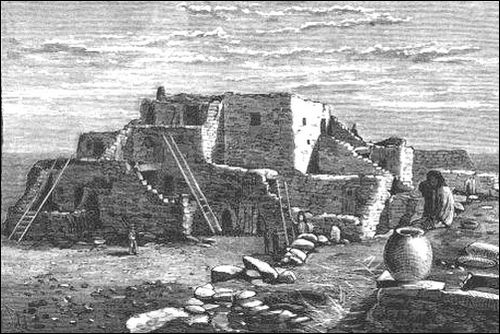
HOUSE OF A MOQUI CHIEF.
It was about seventy
years before our English race gained a foothold on the eastern coast
of America that, far away in the West, the seeds of another form of
Eastern civilization began to fall upon ground which now belongs to our
national territory. In the wilderness near the western border of New
Mexico there stands a great crag, torn into curious shapes by the wear
of ages, bearing on its summit a ruined fortress of a forgotten people
and on its side hieroglyphic writing which no one can decipher. The
same smooth sandstone surface which invited the picture-writing of the
ancients has also tempted later passers-by to
perpetuate their names. A long series of inscriptions in Spanish,
begun before the first English had landed at Jamestown, tells how
explorers, conquerors, government emissaries and missionaries of the
Cross, passing that way, paused to leave their names on the enduring
rock. That imperishable monument bears record to all time that this
remotest region of our country, the last which the new life of the
nineteenth century penetrates, was the first point to be touched by
European civilization, if we except one old Florida fort. It is three
hundred and forty years since the Spaniards entered New Mexico. There,
almost at the centre of the continent, in the valleys of the Rio Grande
and Colorado, the old Spanish life has remained, as unprogressive as
a Chinese province, continuing to the middle of this century a kind
of modified feudal system. But this old declining civilization of the
South-west is new in comparison with that which the Spanish conquerors
found existing in the country when they entered it. A remnant of that
old half-civilized life lingers still, almost unchanged by contact with
white men, in the seven citadels of the Moquis perched on the high
mesas of Arizona, while in the Pueblo villages of New Mexico we find
it more affected by the Spanish influence.
The attraction which drew the conquerors of Mexico forty-five days'
journey away into the North was the fame which had reached them of the
Seven Cities of Cibola (the buffalo), great in wealth and population,
lying in the valley of the Rio de Zuñi. To the grief of the invaders,
they found not cities, but rather villages of peaceful agricultural
people dwelling in great pueblos three and four stories high, and they
searched in vain for the rumored stores of gold. At that time the
pueblos held a large population skilled in many arts of civilization.
They cultivated large tracts of ground, wove fabrics of cotton and
produced ornate pottery. Their stone-masonry was admirable. But even
three hundred years ago it seems that the people were but a remnant
of what they had once been. Even then the conquerors wondered at the
many ruins which indicated a decline from former greatness. The people
have not now the same degree of skill in their native arts which the
race once had, and it is probable that when the Spaniards came and
found them declining in numbers the old handicrafts were already on the
wane.
In a remote age the ancestors of these Pueblo tribes, or a race of
kindred habits, filled most of that vast region which is drained by the
Colorado River and its affluents, and spread beyond into the valley of
the Rio Grande. The explorers of a great extent of country in Utah,
Arizona, New Mexico and Colorado have found everywhere evidences of
the wide distribution and wonderful industry of that ancient people.
On the low land which they used to till lie the remains of their
villages—rectangular buildings of enormous dimensions and large
circular estufas, or halls for council and worship. On the sides of
the savage cliffs that wall in or overarch the cañons are scattered in
every crevice and wrinkle those strange and picturesque ruins which
give us the name "Cliff-dwellers" to distinguish this long-forgotten
people. And on commanding points, seen far away down the cañons or
across the mesas, stand the solitary watch-towers where sentinels
might signal to the villagers below on the approach of Northern
barbarians.
It is only a few years since Mr. John Ruskin rejected a suggestion
that he should visit the United States, urging among other reasons
that it would be impossible for him to exist even for a short time
in a country where there are no old castles. We Americans were
disposed to resent this slap at our country, and not a few newspaper
editors relieved their minds by intimating that we could get along
quite comfortably without old castles and without Mr. Ruskin. But,
after all, it is a consolation for our national pride to know that
the fault is not in our country, but in Mr. Ruskin's ignorance of
American archæology. We have old castles without number in the Western
Territories—ruined fortifications and dwellings of an unknown
antiquity, perhaps as old as Warwick or Bangor, as impregnable as
the highest cliff-built castle of the Rhine, as grand in situation as
the Drachenfels or Dover Castle.
Only the more eastern part of the great domain held by that
ancient people has yet been examined thoroughly with reference to its
antiquities. Within the last decade Mr. W H. Jackson of the United
States Geological Survey has brought to notice, by his admirable
photographs and descriptions, the remains in the cliffs and cañons
of South-western Colorado and the adjacent region. Thirty years ago
Lieutenant Simpson described the ruined pueblos of New Mexico. But
in regard to the ruins farther west, seen by Major Powell in his
headlong course down the Colorado River, and the innumerable remains
of cities, fortresses and canals mentioned by visitors to Arizona,
but little careful investigation has been made. I believe that few
richer fields for an antiquary can be found in the world than this
south-western region of our own country. I cannot doubt that a thorough
comparative examination of these remains would throw a new light upon
the relationship between the ancient and modern civilized tribes, and
upon their connection with their far more civilized Aztec neighbors of
the South. As yet, hardly an attempt at excavation has been made in the
Colorado Valley.
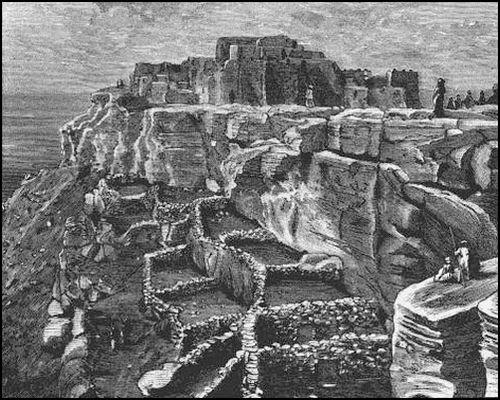
GUALPI.
There is no other district which embraces in so small a compass so
great a number and variety of the Cliff-dwellers' ruined works as the
cañon of the Little Rio Mancos[1] in
South-western Colorado. The stream rises in a spur of the San Juan
Mountains, near the remote mining-camp called Parrott City. Flowing
southward for a few miles through an open valley, it is soon enclosed
between the walls of a profound cañon which cuts for nearly thirty
miles through a
tableland called the Mesa Verde. The cañon is wide enough to permit
the old inhabitants to plant their crops along the stream, and the
cliffs rising on either side to a height of two thousand feet are
so curiously broken and grooved and shelving, from the decay of the
soft horizontal strata and the projection of the harder, as to offer
remarkable facilities for building fortified houses hard of approach
and easy of defence. Therefore the whole length of the cañon is filled
with ruins, and for fifteen miles beyond it to the borders of New
Mexico, where the river meets the Rio San Juan, the valley bears many
traces of the ancient occupation. The scenery of the cañon is wild and
imposing in the highest degree. In the dry Colorado air there are few
lichens or weather-stains to dull the brightness of the strata to the
universal hoariness of moister climates: the vertical cliffs, standing
above long slopes of débris, are colored with the brilliant tints of
freshly-quarried stone. A gay ribbon of green follows the course of the
rivulet winding down through the cañon till it is lost to sight in the
vista of crags. The utter silence and solitude of the wilderness reigns
through the valley. It is not occupied by any savage tribe, and only a
few white men within the last few years have passed through it and told
of its wonders; and yet its whole length is but one series of houses
and temples that were forsaken centuries ago. I can hardly imagine a
more exciting tour of exploration than that which Mr. Jackson's party
made on first entering this cañon in 1874.
Above the entrance of the cañon the evidences of pre-historic
life begin. On the bottom-land, concealed by shrubbery, are the
half-obliterated outlines of square and circular buildings. The houses
were of large size, and were plainly no temporary dwelling-places,
for an accumulation of decorated pottery fills the ground about
them, indicating long occupation. No doubt they were built of
adobe—masses of hard clay dried in the sun—which the wear
of ages has reduced to smoothly-rounded mounds. For some miles down the
cañon remains of this sort occur at short intervals, and at one point
there stands a wall built of squared sandstone blocks. Along the ledges
of the cliffs on the right bits of ruinous masonry are detected here
and there, but for a time there is nothing to excite close attention.
At last a watchful eye is arrested by a more interesting object perched
at a tremendous height on the western wall of the cañon. It is a house
built upon a shelf of rock between the precipices, but, standing seven
hundred feet above the stream and differing not at all in color from
the crags about it, only the sharpest eyesight can detect the unusual
form of the building and the windows marking the two stories. The climb
up to the house-platform is slow and fatiguing, but the trouble is
repaid by a sight of one of the most curious ruins on this continent.
Before the door of the house, part of the ledge has been reserved for
a little esplanade, and to make it broader three small abutments of
stone, which once supported a floor, are built on the sloping edge of
the rock. Beyond this the house is entered by a small aperture which
served as a door. It is the best specimen of a Cliff-dweller's house
that remains to our time. The walls are admirably built of squared
stones laid in a hard white mortar. The house is divided into two
stories of three rooms each. Behind it a semicircular cistern nearly
as high as the house is built against the side of it, and a ladder
is arranged for descending from an upper window to the water-level.
The floor of the second story was supported by substantial cedar
timbers, but only fragments of them remain. The roof, too, has entirely
disappeared, but the canopy of natural rock overhanging serves to keep
out the weather. The front rooms in both stories are the largest and
are most carefully finished. Perhaps they were the parlor and "best
bedroom" of some pre-historic housewife. They are plastered throughout
with fine smooth mortar, and even in that remote age the mania for
household decoration had a beginning: floor, walls and ceiling were
colored a deep red, surrounded by a broad border of white.
The same cliff on which this house stands has on its side many
other ruins—some half destroyed by gradual decay,
some crushed by falling rocks, none so perfect as the one described;
but all are crowded into the strangest unapproachable crevices of the
cañon-wall, like the crannies which swallows choose to hold their
nests, far removed from the possibility of depredation. Some are so
utterly inaccessible that the explorers, with all their enthusiasm
and activity, have never been able to reach them. How any beings not
endowed with wings could live at such points it is hard to conceive: it
makes one suspicious that the Cliff-dwellers had not quite outgrown the
habits of monkey ancestors.
As the cañon widens with the descent of the stream, the ruins in the
western wall increase in number. One fearful cliff a thousand feet in
height is chinked all over its face with tiny houses of one room each,
but only a few of them can be detected with the naked eye. One, which
was reached by an explorer at the peril of his life, stands intact:
ceiling and floor are of the natural rock, and the wall is built in a
neat curve conforming to the shape of the ledge.
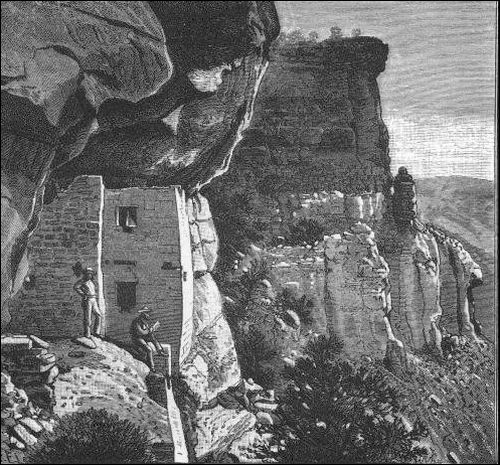
RUINS IN THE CAÑON OF THE MANCOS.
A mile farther down the stream there is a most interesting group
of houses. Eight hundred feet above the valley there is a shelf in
the cliff sixty feet in length that is quite covered by a house. The
building contains four large rooms, a circular sacred apartment and
smaller rooms of irregular shape. It was called by its discoverers
"The House of the Sixteen Windows." Behind this house the cliff-side
rises smooth and perpendicular thirty feet, but it can be scaled by an
ancient stairway cut into it which ascends to a still higher ledge. The
stairs lead to the very door of another
house filling a niche a hundred and twenty feet long. A great canopy
of solid rock overarches the little fortress, reaching far forward
beyond the front wall, while from below it is absolutely unapproachable
except by the one difficult stairway of niches cut in the rock. In time
of war it must have been impregnable. These dwellings have given more
ideas about their interior furnishing than any of the others. Among the
accumulated rubbish were found corn and beans stored away. In the lower
house were two large water-jars of corrugated pottery standing on a
floor covered with neatly-woven rush matting. In a house not far above
were found a bin of charred corn, and a polished hatchet of stone made
with remarkable skill.
From this point onward both the valley and the cliffs are filled
with the traces of a numerous population, every mile of travel
bringing many fresh ones into sight. Among the cliff-houses there is
of necessity a variety in form and size as great as the differences of
the caves and crevices that hold them; but among the buildings of the
low ground there is more uniformity, not only in this cañon, but in all
the valleys of the region. Most of them may be classed as aggregated
dwellings or pueblos with rectangular rooms, round watch-towers and
large circular buildings. To these must be added a few which seem to
have been built only for defence. The straight walls have generally
fallen, except the parts supported by an angle of a building; but, as
usual in old masonry, the circular walls have much better resisted
decay.
About midway down the cañon the curved wall of a large ruin rises
above the thicket. It is a building of very curious design. The outer
wall was an exact circle of heavy masonry a hundred and thirty feet in
circumference. Within, there is another circular wall, concentric with
the outer, enclosing one round room with a diameter of twenty feet.
The annular space between the two walls was divided by partitions into
ten small apartments. Other buildings of the same type occur in this
region, some of much larger size and with triple walls. Even in this
one, which is comparatively well preserved, the original height is
uncertain, though the ruin still stands about fifteen feet high. The
vast quantity of débris about some of them indicates that they were
of no insignificant height, and their perfect symmetry of form, the
careful finish of the masonry, the large dimensions and great solidity,
made them the most imposing architectural works of that ancient people.
I find no reason to doubt that they were their temples, and the
presumption is very strong that they were temples for sun-worship. The
occurrence of a circular room in connection with nearly every group of
buildings is of special interest, as seeming to link the Cliff-dwellers
to the modern Pueblo tribes in their religious customs.
Most striking and picturesque of all the ruins are the round
watch-towers. On commanding points in the valley, and on the highest
pinnacles of the cliffs overlooking the surface of the mesa, they occur
with a frequency which is almost pathetic as an indication of the
life of eternal vigilance which was led by that old race through the
years, perhaps centuries, of exterminating warfare which the savage red
men from the North waged upon them. To us the suffering of frontier
families at the hands of the same bloodthirsty savages is heartrending.
What was it to those who saw year by year their whole race's life
withering away, crushed by those wild tribes?
Near the lower end of the cañon stands one of the most perfect of
these towers, rising sixteen feet above the mound on which it is built.
It was once attached to an oblong stone building which seems to have
been a strongly-fortified house. The rectangular walls, as usual, are
prostrate, and have left the tower standing as solitary and picturesque
and as full of mystery as the round-towers of Ireland.
After the stream breaks from its long confinement out into the open
plain of the San Juan Valley the traces of old life are still abundant,
but they present no features very different from those above. At the
cañon's mouth an Indian trail strikes away toward the north-west. It
passes a remarkable group of ruins at a
spot called Aztec Springs, and continues to the McElmo, the next
arroya, or dry stream-bed, west of the Rio Mancos. Aztec Springs no
longer deserve the name, for within a short time the last trace of
water has disappeared from the spot, showing that the slow drying up of
the great South-west country, which has been going forward for ages,
and which starved out the old inhabitants, is still progressing. In the
dry season there is no water within many miles of this spot, though it
is strewn with the remains of stone buildings covering several acres
and indicating a large population of industrious people who must have
lived by agriculture. Until a long comparative study has been made
of all the remains of this race it is mere guesswork to estimate the
age of the ruins; but when the prostrate condition of these walls is
compared with the state in which the Chaco ruins of New Mexico are
found, and when we consider that the latter have no doubt been deserted
for at least three hundred and fifty years, it is reasonable to suppose
an age of a thousand years for these massive walls at Aztec Springs.
Many other great structures of this region, which seem to be coeval
with these, are situated many miles away from any perennial water, and
the time which has elapsed since those sites were suitable for large
farming-towns must be counted by centuries. In this group are two large
quadrangular buildings with walls still fifteen feet high, two of the
circular estufas, besides a multitude of half-distinguishable walls of
dwellings. It is the largest group of ruins in Colorado.

CIRCULAR RUIN IN THE CAÑON OF THE MANCOS.
Not many miles beyond these so-called springs the trail leads into
the dry bed of the McElmo near its head, and another long succession
of antiquities is entered upon, but to enumerate them further would
be tedious, for the ruins of the Mancos are good representatives of
all those which are found along the courses of the Animas, La Plata,
McElmo, Montezuma, Chelley and other tributary valleys of the San Juan.
Nevertheless, there are a few buildings here and there of some unusual
interest which cannot be passed by without mention. On the verge of a
little side-cañon of the McElmo there is a curious instance of the keen
ingenuity
of this people in taking every advantage of the fantastic, castle-like
shapes which Nature has formed out of the cañon-walls. High on the
edge of the mesa appears the ragged outline of a ruinous watch-tower
sharply drawn against the clear, unvarying blue of the sky. It seems
to be a tower of unusual height, but a closer view shows it to be half
of Nature's building. A tall fragment of rock, torn from its bed, has
rolled down the slope to the edge of the steep descent. This rock the
old builders have chosen to crown with a little round tower where
a sentinel, guarding the village behind him from stealthy attacks,
could command a wide sweep of country. The same thing on a larger
scale is found at another point where the dry McElmo meets with the
drier Hovenweep—a tributary without tribute. In this position
stands an enormous rock nearly cubical in shape. Its high sides make
it a natural fortress strong against an enemy without artillery, and
to its natural strength the Cliff-dwellers have added a battlement of
masonry. But among all the ruined strongholds of the region that which
is called the Legendary Rock has a pre-eminent interest on account of
the Moqui romance or tradition which clings to it. The rock is a grand
and solitary crag standing on a plateau of sandstone from which the
soil is washed away. It is far from water: a garrison must have been
dependent wholly on the very precarious rain-supply. About it runs an
outer rampart of stone, and on the rock itself is built a fortress. It
is several years since an aged member of the Moqui tribe first confided
to a white man versed in his language the legend of this rock. It has
been widely published, and considered of much significance. The Moqui
patriarch related how his people in the old time were many. Their tribe
dwelt in the North-east. One year they were visited by strangers from
the North, who came peaceably at first, but came again another year,
and year by year encroached and grew more warlike. At last the Northern
strangers gained the mastery and drove them from their homes. In a
long, slow struggle the Moqui forefathers gradually lost their ground,
till at last they made one final, desperate fight for their old homes
at the fortress of the Legendary Rock. They conquered their besiegers,
but with such fearful carnage that the rocks bear still the stains
of the blood-streams that flowed in that battle, and the remnant of
the besieged were glad to make an unmolested retreat to the mesas of
Arizona, where they dwell to this day.
The story is an interesting one, and has been honored by the
explorers with a place in their government report, for it shows a
belief among the Moquis that those old builders were their kinsmen.
But, considering the fact that the first Spanish discoverers found
the Moqui tribe in nearly the same condition as we see it now, and
that this story therefore must have been handed down for at least
three hundred years among an unlettered people, I am as much disposed
to distrust the other details of it as I am to doubt that the red
iron-stains in the rock were caused by the blood of their ancestors.
In the neighboring Montezuma Cañon, just beyond the State border,
there are some remains built after an unusual manner with stones of
great size. One building of many rooms, nearly covering a little
solitary mesa, is constructed of huge stone blocks not unlike the
pre-historic masonry of Southern Europe. In the same district there
is a ruined line of fortification from which the smaller stones have
fallen away and are crumbling to dust, leaving only certain enormous
upright stones standing. They rise to a height of seven feet above
the soil, and the lower part is buried to a considerable depth. Their
resemblance to the hoary Druidical stones of Carnac and Stonehenge
is striking, and there is nothing in their appearance to indicate
that they belong to a much later age than those primeval monuments of
Europe.
All the certain knowledge that we have of the history and manners of
the Cliff-dwellers may be very briefly told, for there is no written
record of their existence except their own rude picture-writing
cut or painted on the cañon-walls, and it is not likely that those
hieroglyphics
will ever be deciphered. But much may be inferred from their evident
kinship to the Moquis of our time; and the resemblance of the ancient
architecture and ceramics to the arts as they are still practised in
the degenerate pueblos of Arizona gives us many intimations in regard
to the habits of the Cliff-dwellers.
It was centuries ago—how long a time no one will ever
know—when that old race was strong and numerous, filling the
great region from the Rio Grande to the Colorado of the West, and
from the San Juan Mountains far down into Northern Mexico. They must
have numbered many hundreds of thousands, perhaps millions. It is not
probable that they were combined under one government or that they
were even closely leagued together, but that they were essentially
one in blood and language is strongly indicated by the similarity of
their remains. That they were sympathetic in a common hostility to the
dangerous savage tribes about them can hardly be doubted. They were
of peaceful habits and lived by agriculture, having under cultivation
many thousands of acres in the rich river-bottoms, which they knew well
how to irrigate from streams swollen in summer by the melting snows of
the high mountain-ranges. We read of their dry canals in Arizona, so
deep that a mounted horseman can hide in them. We know that they raised
crops of corn and beans, and in the south cotton, which they skilfully
wove. That they had commercial dealings across their whole country is
shown by the quantity of shell-ornaments brought from the Pacific coast
which are found in their Colorado dwellings. They did not understand
the working of metals, but their implements of stone are of most
excellent workmanship. Their weapons indicate the practice of hunting,
and while the race was still numerous their forts and their sharp
obsidian arrows made easy their resistance to the wandering savage
hordes.
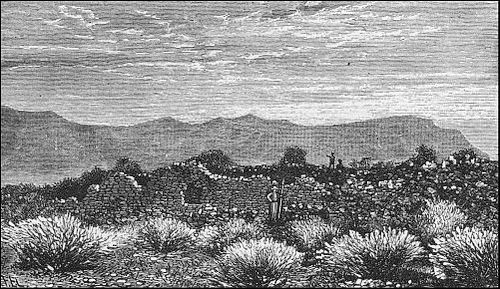
RUINS AT AZTEC SPRINGS.
I believe that no instance can be cited of a people still in their
Stone Age who have surpassed that old race in the mason's art: indeed,
I doubt if any such people has even approached their skill in that
respect. The difficulty of constructing a great work of well-squared,
hammer-dressed stones is enormously increased if the masons must work
only with stone implements. Imagine the infinite, toilsome patience of
a people who in such a way could rear the ancient Pueblo Bonito of New
Mexico, five hundred and forty feet long, three hundred and fourteen
wide and four stories high! In
one wall of a neighboring building of stone less carefully dressed it
is estimated that there were originally no less than thirty million
pieces, which were transported, fashioned and laid by men without a
beast of burden or a trowel, chisel or hammer of metal.
Nothing marks more strikingly the vast advance which these people
had made from the condition of their savage neighbors than their
evident efforts not only for household comfort, but even for the
beautifying of their homes. I have referred to the rush-carpeted floor
of the "House of the Sixteen Windows" and the decorated walls of the
two-story house on the Mancos; but they, like other semicivilized
peoples, found the first expression for their love of the beautiful
in the ceramic art. The variety of graceful forms and decorations
found in their pottery is endless. In some regions the country for
miles is strewn with the fragments of their earthenware. The ware is
usually pale gray shading to white: the decoration is in black or
red, often in the angular designs commonly called "Greek patterns."
The Moquis of our time produce a handsome ware closely resembling
that of the ancient people. But the old cliff-painters and the modern
potters often sacrificed beauty to a passion for producing the most
wildly-grotesque forms. There is a certain general resemblance, which
often strikes me forcibly, but which is almost indefinable, between the
ceramic and sculptured forms of the Mississippi Mound-builders, the
Pueblo tribes and the ancient Mexicans. The resemblance seems to lie
partly in a certain capacity which those peoples possessed in common
of producing the most frightfully-grotesque forms ever evolved by
the human imagination—forms plainly intended to suggest living
beings, yet not at all transgressing the injunction against "anything
that is in the heaven above, or that is in the earth beneath, or that
is in the waters under the earth." The resemblance seems to me very
significant.
At the time of the Spanish conquest the Pueblo tribes were
worshippers of the sun and fire, like all the races of this continent
which were above barbarism. To-day, even in those pueblos where a
corrupted form of the Roman faith is accepted, there are traces of the
old sun-worship mingled with it, and in all pueblos there are large
circular rooms called estufas reserved for councils and for worship.
The invariable appearance of estufas among the ruined towns, and
even on the ledges of the cliffs, shows what sacredness was attached
to the circular room, which perhaps was symbolic of the sun's orb:
it indicates a unity of religious faith between the ancients and
moderns.
The priest who chronicled the events of the first expedition to
New Mexico was impressed with the great ruined towns which they saw
even before crossing the desert of Arizona. There is good reason to
believe that the cliff-dwellings, the last retreats of a persecuted
people, were abandoned before that time. But how could a people so
numerous, intelligent and civilized fall a prey to stupid, roving
savages? The wild tribes never could have won the fight against their
more quick-witted neighbors if the ancients had not begun their own
destruction.
The story which they have left recorded on the face of the country
is of this sort. At some very remote time they began agriculture in
the valleys of the South-west. They found the rainfall of the region
too limited for farming without irrigation, but the whole country
was intersected by streams fed through summer by the snows of the
mountain-tops and the abundant springs of the wooded slopes and
uplands. Thus their crops were watered and yielded increase with a
regularity unknown to farmers who must look to the summer rainfall
for success. The people prospered, multiplied and spread over a wide
country. In every green valley rose their great common dwellings and
circular temples. By superior numbers and intelligence they were strong
against their enemies. But the spreading population required a great
wood-supply. The finest of the trees were felled for timbering their
houses, and whole forests were swept away to give them fuel and perhaps
to feed perpetual sacred fires. The country
was all too little watered at the best, and the mountain-sides, once
stripped of their covering, oftentimes dried up and no new growth of
trees appeared. Old men began to observe that the streams did not
maintain their even flow through the whole year as when they were
young, and lamented the good old times when there was no lack of
water for irrigation. The streams began to be swollen with disastrous
floods in spring and winter, and to dwindle away alarmingly in summer.
So through centuries the gradual destruction of the wood brought
ever-increasing drought, and drought led in its train famine, disease
and wholesale death. The people were decimated and discouraged, and
on the northern frontier began to be at the mercy of savage raiders.
They fled from their pleasant valley-homes to hide in caves and dens of
the earth, and built the cliff-dwellings. There a remnant lingered in
unceasing fear of the foes who coveted the fruits of their toil; but
even from these refuges they were driven ages ago. Where they used to
build villages and cultivate fields are now barren gulches where two or
three times a year a resistless flood rushes down from the mountains
that can no longer retain their moisture. Thus ended their national
suicide.
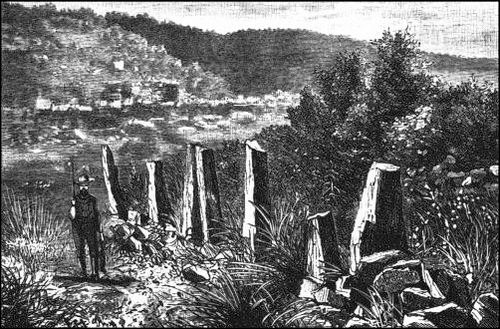
RUINS IN MONTEZUMA CAÑON.
It was a strange ignorance that led them to their own destruction,
was it not? Yet we as a nation from Maine to California are recklessly
working the same ruin. We are stripping our mountains a hundred
times more rapidly than they, but who cares whether the forests are
restored?
As a child I played and bathed in a pretty tumbling brook among the
Litchfield hills, and wondered that so small a stream but fifty years
before had given power to all the mills now ruined on its banks. Twenty
years more have passed, and now in the heat of summer there is hardly
water for a child to bathe. The hills are stripped, the stream has
dwindled, but the spring floods tear through the valley like a deluge.
Even the larger streams that still turn the mill-wheels and make the
wealth of Connecticut are not the trusty servants that they once were.
In summer they grow weak and must be supplemented with steam, and at
times they rise in fury and carry destruction before them. It is the
beginning of woes, but our Atlantic slope with its heavy rainfall
cannot easily be changed to a desert. In the far West it is different.
Colorado, Nevada and California, with a less regular rainfall and with
greater floods and smaller streams, would soon find the desert
encroaching on the habitable land. But in these very States the waste
of timber is most extravagant. Mining-camps and cities devour the
woods about them, and in every dry summer many hundred square miles
are burned by the recklessness of Indians and white men. Where the
Californian mountains have been cleared, the browsing millions of sheep
keep down all new growth, and, bringing great wealth in our age, they
threaten to impoverish posterity.
The dreary experiment has been tried by the ancient races of both
continents. Why should we repeat it? The question should command the
earnest attention of State and national governments. In our own land
already one old race has wrought its own destruction in this same
way.
Alfred Terry Bacon.
THE ARTS OF INDIA.
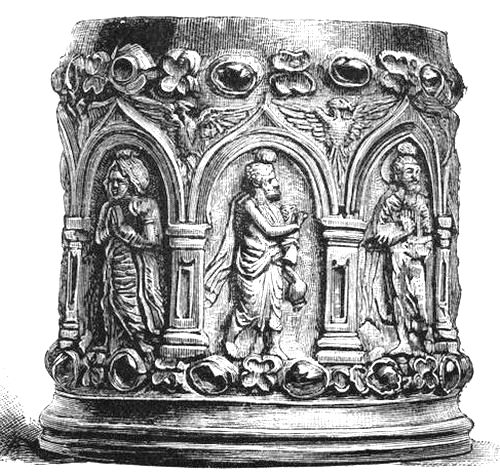
BUDDHIST RELIC-CASKET.
The study of the industrial arts of
India, if the warnings of learned Orientalists are to be of any avail,
is not a matter to be rashly undertaken. All Indian art must be
viewed in reference to Indian religion. Forms, materials and colors
have meanings that can only be caught by familiar acquaintance with a
symbolism both intricate and obscure. Little decorative touches that
to the untaught Western eye are introduced merely to give an artistic
finish to an involved design, or to give room for bringing in the
bit of color demanded by the sense of harmony, have all a meaning
not necessarily connected with art. While in the West the problems
of art are dealt with by men whose eyes are bent on art alone, the
Oriental artist solves these problems while keeping his eyes fixed upon
religion. The maturity of Indian religious life was reached several
centuries before our era began: it then took a form which it still
retains. There is no secular life from which it can be distinguished.
When a domestic utensil is examined, the first question to be answered
is, What religious meaning attaches to it? This is an appalling
fact, for it means that the arts of India cannot be appreciated as
the Hindus appreciate them until we have mastered an accumulation of
mythological and legendary lore such as possibly no other country has
amassed.
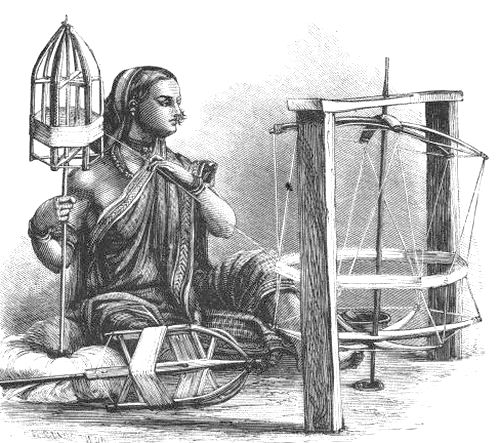
HINDU WOMAN REELING SILK.
To appreciate the full extent of a task that already seems to hang
like a shadow over the whole of what yet remains of one's life, it
may be pointed out that the Vedas form only one of four groups of
sacred writings, that there are four Vedas, and that each one of the
four consists of four parts. Then there are Upa-Vedas, Ved-Angas and
Upangas; and under the last-named fall the epics of the Ramayana,
of ninety-six thousand lines, and the Mahabharata, of two hundred
and twenty thousand long lines, not to mention others. These are mere
glimpses into a vista long and dark, and it seems a little odd that
one should be called upon to go through so much in order to appreciate
a specimen of carving from Vizagapatam, an inlaid table-top from
Agra, a box of Cashmere lacquer or a panel of carved sandal-wood
from Canara. The fact is, that the matter may be looked at from
another point of view—that taken up by those who decline to
see anything in a painting but canvas and paint—who care for
nothing in the shape of sentiment or story, but have a single eye to
art. In this way the beauty and harmony of Oriental coloring, the
delicacy and wonderful finish in all manner of carvings, the skill
displayed in inlaying and chasing—in a word, all the points
of industrial art in India—may be both enjoyed and understood
without a reference to the Puranas or the Code of Manu, or without the
observer's being able to enumerate the avatars of Vishnu. The inquirer
is thus borne up against the deterrent influence of specialists, with
the plaintive notes of whose voice he has become in all probability
elsewhere familiar. It is the same voice, to all intents and
purposes, that haunts the graves of Egypt, the ruins of Rhagœ,
the tombs of Etruria and Magna Græcia, the workshops of King-teh-chin
and the mounds of Pachacamac. It is heard, in short, all round the
world, and its burden is ever the same: "Understand the religion of a
people before peering into their arts." The obvious answer comes: Life
is short and art is long: if to art religion be prefixed, all knowledge
of art is at an end. It would be pleasant, no doubt, to tell at a
glance what legend or myth is represented on a Greek vase, but meantime
we can admire the form. It would be equally pleasant to be able to
interpret the painting on a Chinese historical vase, but meantime we
can admire the colors. So with Egypt, Persia and Peru: it will be well
for the many to get at the industrial secrets of these countries if
they never obtain even a glimpse of the underlying religious idea of
the craftsman.
It is merely thrown out as a suggestion by the way, and without any
intention of belittling the importance of studying the superstitions
and philosophies of the world or of aiming at something more than a
strictly industrial view of industrial art, that so much attention may
be bestowed upon religions as the sources of ideas as to obscure the
form and manner of their expression in art. Possibly the formation of
an Indian museum at South Kensington may be productive of a longing
desire to become acquainted with Rama and the lovely Sita, the strong
Arjuna and the beauteous Draupadi; but it is hardly likely that
this was the object of its formation or that it will lead to the
acquisition of any more abstruse knowledge than such as comprises
the weaving of rich textures, the blending of gay colors, or the
industrial arts of damascening, carving and working in gold and silver
and precious stones. In what has here to be said, at all events, only
such references will be made to religion and legend as are absolutely
necessary to a general understanding of the conditions under which
Indian art has developed, and of the forms under which it is most
frequently seen.
The Indian Museum—or rather the collection forming the
Indian section of the South Kensington Museum—is of very recent
formation. It may be said to have grown without developing. Its nucleus
was formed in the days of the East India Company, and was stored in a
little museum in Leadenhall street. There it long remained, and one
of its chief attractions was Tippoo's tiger, now occupying a place
of honor near the musical instruments, to which it bears some kind
of a relation. The "tiger" is a wooden animal of ferocious aspect
represented in the act of tearing a prostrate European soldier dressed
in the military red coat and wearing a broad-brimmed felt hat of
decidedly civil make. It was taken at the fall of Seringapatam, and
was probably made by some European artificer for the delectation of
the Tippoo Sultan. If not symbolical it was undoubtedly suggestive of
pleasant thoughts to Tippoo, although as a musical instrument it could
never have been much of a success. To tickle the sultan's ear the tiger
when wound up emitted startling roars and groans, while its victim
feebly moaned. But on a certain festive occasion after the "tiger"
was brought to England the winding-up was unfortunately overdone, and
long afterward the soldier stoically declined to moan. The odd musical
toy has been brightened up to suit its new home, and its internal
construction has also received proper attention to such purpose that
the roaring can be reduced to something like method by merely passing
the hand over a keyboard, and the resuscitated struggling red-coat
moans as lustily as he did in the palmy days at Seringapatam.
Such is the instrument which played an important part in the
Leadenhall Street Museum. When the East India Company passed away and
the British government assumed the direct control of India, the tiger
and all the other curiosities were sent first to Fife House, and thence
to the India Office. The latter step was possibly taken on the advice
of some utilitarian who wished to bring within reach of the officials
an opportunity of acquiring some knowledge of India. Any such object
was frustrated.
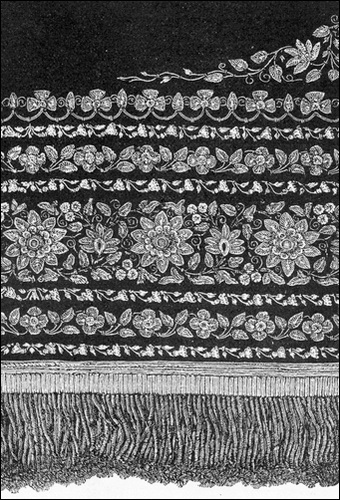
GOLD EMBROIDERY ON VELVET: MURSHEDABAD.
The director and curator were the only individuals known to visit
the collection. It was then sent to South Kensington and placed in a
temporary building, but still nobody looked in upon the tiger and the
jade, the carvings and Bidri-work. They were still under the control of
the India Office, and at length became a burden to it. Their failure
to interest the public naturally led to a desire to transfer the
responsibility of guardianship. This is not to be wondered at. The
collection had, as has already been pointed out, merely grown in bulk.
It was promiscuous in the worst sense. It consisted of a fortuitous
concourse of articles taken in war or bought upon no ostensible system
in peace. To these old Indian officers occasionally made testamentary
additions of things picked up in their travels or acquired by
inheritance or otherwise. International exhibitions have always been
good for museums. The unsalable is often valuable, and exhibitions
have been a source from which the Indian collection has reaped many
solid benefits. Thus the accumulation increased in bulk and intrinsic
value, but practically it still continued valueless. It was neither
arranged nor inventoried. It continued to illustrate little more than
the manner of its accumulation. Very naturally, the India Office in
looking for relief from a useless burden turned first to the Science
and Art Department under which South Kensington was flourishing. Its
offer of a transfer was at first declined, but the authorities at the
India Office would take no refusal. Their object was at once to get
rid of the collection and of the cost of maintaining it, and at the
same time to preserve its representative character and such individual
identity as it possessed. They ultimately succeeded in both respects,
though their success was not perfect. A part, including the collections
of economic botany of wild Indian silk and lac, went to Kew. The
zoological collection is in the hands of the trustees of the British
Museum, and will eventually take its place in the new Natural History
Museum at South Kensington. To the British Museum have gone
the Indian Buddhist sculptures, but casts of these may hereafter be
placed in the Indian Museum: certainly, in view of the influence of
architectural decoration upon industrial art, they seem necessary to
its completeness. All else was on the first of January last handed over
to the Science and Art Department, and came under the management and
control of Sir Philip Cunliffe-Owen, K. E. M. G., C. B. and director at
South Kensington. It was characteristic of Sir Philip that he should
undertake to have within six months a collection arranged and ready for
public inspection which had not for twenty years been seen in anything
like order. It had never before been catalogued, and had never before
been so placed that it could be seen intelligently or at one view. The
first thing to be done was the drawing up of an inventory. This work
occupied six weeks, and on its completion the discovery was made that
the collection was altogether inadequate to its purpose. It represented
neither the arts nor the industries of India, and gave a very
disjointed view of the resources of that country. The work, however,
went on. Sir Philip used all his influence, both personal and official,
to supplement defective departments. He made purchases and applied for
loans. Her Majesty, the prince of Wales and the duke of Edinburgh made
selections from their magnificent collections, and others were not slow
to follow their example. The result was that in his race against time
Sir Philip won by more than a month, making allowance for what has yet
to be done with the contributions still being made. Few other men could
have won a victory so complete with such apparent ease, because there
are not many who could have imbued contributors with similar confidence
or so thoroughly inspired an entire department with his own spirit of
energy and well-regulated activity. A word or two may be said of his
career.
His father was Charles Cunliffe-Owen, a captain in the royal navy,
and at the age of twelve Philip entered the same service. He served for
five years in the Mediterranean and the West Indies, and at seventeen
was obliged by ill health to retire, but taking with him the habits a
naval career was well calculated to engender or develop of promptitude
and decision. After a rest of a few years he was appointed to the
Science and Art Department, and gradually won the notice and confidence
of his superiors. He was quick of apprehension, prompt in action and
accurate in execution. Sir Henry Cole recognized these qualities in
him, and entrusted him with the post of one of the superintendents
of the Paris Exhibition of 1855. A few years took him upward through
the rank of deputy-general superintendent of South Kensington Museum
to that of assistant director in 1860. At subsequent international
exhibitions he filled various offices as follows: at London, in
1862, director of the foreign sections; at Paris, in 1867, assistant
executive commissioner; at Vienna, in 1873, secretary to the royal
British commission; at Philadelphia, in 1876, executive commissioner;
and at Paris, in 1878, secretary of the royal British commission.
Meanwhile, in 1873, he was created a Companion of the Bath, and was
advanced to the directorship of the South Kensington and Bethnal Green
Museums on its becoming vacant by the retirement of Sir Henry Cole. In
1878 he received the honor of knighthood.
A good linguist and possessing rare tact and wonderful executive
ability, Sir Philip has succeeded where many of his countrymen
fail—namely, in making a favorable impression upon foreigners.
Prepossessing in appearance and manner, he can dash through business
at a speed calculated to astonish men of less energy and of a lower
vitality, and he does it, moreover, without the faintest taint of the
brusquerie which almost as a rule bristles all over the less capable
official. Red tape he abhors, and is as easy of access as a republican.
He transacts his business as it arises, knows nothing of arrears,
keeps nobody waiting, rises early, works incessantly, drinks nothing
stronger than tea, has no office-hours and no rules—making both
subservient to the business in hand, instead of following
the example of the greater part of the world in fitting business
to rule and time—and is only a little forgetful of social
engagements. Such is the man to whom more than any other the credit is
due of India's being first fairly if not fully represented in Europe by
a museum containing specimens of all its native arts and industries.
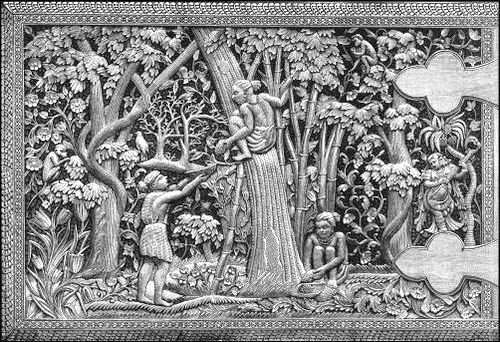
R. REID. DEL.
SANDAL-WOOD CARVING AT TRAVANCORE.
Certain general impressions will be received from a walk through the
galleries and from a hurried view of the sculptures, textile fabrics,
arms, pottery, jewelry, furniture, lacquer and metal-work. Forms,
combinations and decorative styles will catch the eye which seem not
new, but merely changed from something seen elsewhere, as the ear will
catch a well-known melody running through a profusion of intricate
variations. The alternative questions occur: Is India the home of all
the arts? or, Has it no original art? In one place stands a small
table of Cashmere lacquer in which a great part of the decoration is
surely Chinese: a small gold cup has a sculpturesque decoration as
surely Greek. Here is a coffee-pot of Mongolian type, and a parcel-gilt
vase of Greek: there are gold dishes after the Saracenic, inlaid-work
decidedly Persian, and mosaic-work most certainly Florentine.
It is long since the connoisseur of Indian art awakened from the
dream that India has been an isolated country. The fact is, that it
lies in the way of all commerce between the far East and the West,
and that it can be, and has been, approached as easily from land as
from the sea. It has a long legendary history, but a comparatively
short real history. The immigration of the Aryan race is said to
have taken place about B.C. 3101, but
from that period until the rise of Buddhism, in the sixth century
B.C., there is nothing to guide us but
legend. Putting aside what may have been learned of India by the
Greeks from the troops from the Panjab and Afghanistan which swelled
the gigantic army of Xerxes, Alexander's invasion of India (B.C. 327) may be said to have really opened
the way to the acquisition by the Greeks of something like an exact
though partial knowledge of the country pronounced by Herodotus the
wealthiest and most populous in the world. In truth, the writings of
Greeks who accompanied Alexander, and of Chinese pilgrims, and some
temple-inscriptions, constitute the basis of Indian history. The
commerce of India at a very early period extended far and wide. Arrian,
an Alexandrian merchant of the second century, mentions the muslins
of the Ganges, cloths of all sorts, colored shawls and sashes, purple
goods, gold embroidery, lac, steel, jewels, perfumes and spices. How
long this trade had been going on we cannot say. It was, however,
encouraged by the Ptolemies, who established a port on the Red Sea and
organized a system of conveyance by means of caravans to the Nile, and
so to Alexandria. In this way Indian manufactures reached Europe, while
the Persians were at the same time carrying on an extensive trade in
the same materials. The Indians further contributed to the advance of
commerce by becoming road-builders, and thus bringing the manufacturing
places along the valley of the Ganges into connection with the Panjab
in the north-west and with ports and trading-stations in the west and
south. Thus, Egypt and Assyria were brought into commercial intercourse
with the eastern tract of the valley of the Ganges—that lying
between the modern Allahabad and Calcutta. That commerce spread in
other directions there can be no doubt. Within three centuries of
the foundation of Buddhism it had penetrated to Ceylon, and reached
Tibet and China in the first century of our era. Let us look at one
stupendous fact as indicative of international intercourse with
India—namely, that Buddhism, which has all but disappeared from
the land of its birth, is at the present moment the religion of about
five hundred millions of human beings occupying the continent of Asia
from the Caspian to the Pacific, from Tartary to China and Japan.
Leaving both religion and commerce aside—the latter of which
might have been brought down to the opening of maritime intercourse
between Europe and the far East by way of the Cape—there have yet
to be taken into consideration the several invasions of India, which
afford yet another possible explanation of the manner in which its arts
may have been affected by contact with foreigners.
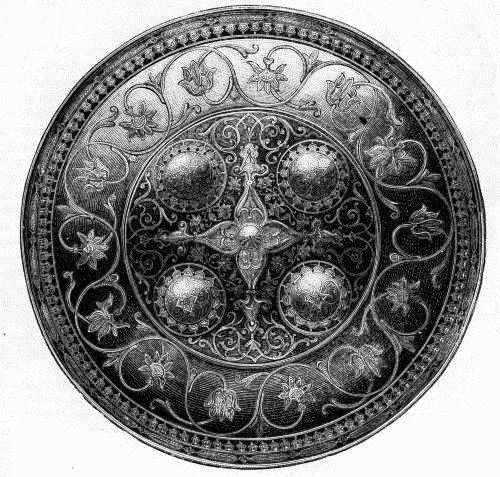
SHIELD DAMASCENED IN GOLD: PANJAB.
There were many schisms among the Buddhists between the sixth
and third centuries before our era, but in power their community
grew year by year. Asoka brought all Northern India under his power,
and, becoming a good Buddhist, sent missionaries all over India from
Cashmere to Ceylon. After his
death India was for some centuries under the Indo-Scythians, until the
fourth century of our era. From that time Buddhism declined rapidly.
The Brahmans were ever its enemies, and toward the eighth century began
to push northward from the retreats they had sought when Brahmanism, a
thousand years before, had given way to Buddhism. About the same time
began the Arab invasions which ultimately led to the establishment of
Mohammedan rule. This was the beginning of about twelve hundred years
of war. The Arabs came first in A.D. 664,
and again in 711. The Turkomans entered the Panjab in 976, and the
Afghan dynasties of Mahmud of Gazni and Mohammed of Ghor followed in
the tenth and twelfth centuries. The third Afghan dynasty established
its rule at Delhi in the thirteenth century. With this century we
approach the conquests of Chingis Khan in Central Asia and of Hulaku
Khan, and then in rapid succession came the Mohammedan incursions into
the Dekkan and the Mongolian subjugation of India, which was begun in
1298, carried on by Tamerlane in 1398, and completed in 1526 by Sultan
Baber. The Mogul period ended with the British conquests of 1803 and
1817.
If the rise and fall of these various tides of commerce and war are
followed, it will be seen that not only has India not been an isolated
country, but, on the contrary, through a hundred channels it has held
communication with the world beyond the Himalayas. Its art has no doubt
been affected by such intercourse. The effect of architectural forms
upon the decorations made use of in industrial art has already been
referred to; and when we find that the Buddhists acquired a knowledge
of the use of stone in building
from the Greeks and Persians, we at
once see why Doctor Leitner's collection of
fragments of sculpture from Peshawur in
the north of the Panjab, and now in the
museum, should be called Græco-Buddhistic.
Indian architecture is based upon
Greek, and the influence of the latter lasted
so long that Mr. Fergusson, who has
made a special study of Hindu temples,
says that he could not find anywhere in
Cashmere the slightest trace of the bracketed
capital of the Hindus, but that the
Doric or quasi-Doric column is found all
along the valley in temples dating from
the eighth to the twelfth century. Doctor
Birdwood, again, has succeeded in
tracing the inlaid woodwork or marquetry
of India from Shiraz in Persia to
Sindh, Bombay and Surat. Further, the
mosaic-work of Agra is of Florentine extraction,
having been introduced by Austin
de Bordeaux in the seventeenth century,
and recently revived.
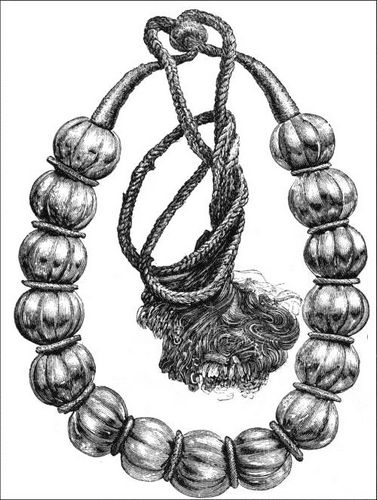
NATIVE GOLD JEWELRY OF POONA, BOMBAY.
Let these examples suffice to show that India did not originate all
the arts it now practises. Unfortunately, all that has been borrowed
by it has not been to its advantage—such as the Dutch black-wood
carving at Bombay—and it is scarcely possible that Anglo-Indian
art will add anything to the laurels won by the workmen of the same
presidency. It is moreover to be feared that the machine-made dry
goods of England, the French patterns of Cashmere, the introduction
of machinery, the absorption of hand-weavers by factories, and, above
all other things, the establishment of art-schools, may ultimately
break down the barriers which for two thousand years and more have,
in spite of war, commerce and the introduction of new arts, preserved
in the work of the art-craftsmen of India an element essentially
indigenous.
Many conservative agencies were no doubt at work in preserving
to Indian art a distinctively national character. Amongst these the
religious epics and the Code of Manu come first. Of the former, those
already referred to, the Ramayana and the Mahabharata, show what
the art and life of the Hindus were between the fifth and the third
centuries before Christ. The Code gave them a form which they preserve
to-day in at least all essential respects. The arts have been handed
down from father to son for countless generations, and traditional
skill has reached its high perfection chiefly by the village-system
of the Code. The centre of the political interest of the Hindu is his
own village. In our sense of the word he has no country, but he has a
village home, and his loyalty is absorbed by the administrators of that
home's affairs. He is unmoved either by conquest or commerce. His life
has crystallized into a certain form. It is the
life his forefathers led, and it is the life his children will lead.
His village is to all intents and purposes an independent community.
This is the account of a traveller: "Outside the entrance, on an
exposed rise of ground, the hereditary potter sits by his wheel
moulding the swift-revolving clay by the natural curves of his hands.
At the back of the houses which form the low irregular street there are
two or three looms at work in blue and scarlet and gold, the frames
hanging between the acacia trees, the yellow flowers of which drop
fast on the webs as they are being woven. In the streets the brass-
and copper-smiths are hammering away at their pots and pans; and
farther down, in the veranda of the rich man's house, is the jeweller
working rupees and gold mohrs into fair jewelry—gold and silver
ear-rings and round tires like the moon, bracelets and nose-rings and
tablets, and tinkling ornaments for the feet—taking his designs
from the fruits and flowers around him or from the traditional forms
represented in the paintings and carvings of the great temple which
rises above the groves of mangoes and palms at the end of the street
above the lotus-covered village-tank." By and by the work-day closes
with feasting and music and the songs chosen from the religious epics.
In the morning the same routine begins again: the same sounds are
heard, the same sights seen, the same pleasures indulged in. It is
the life of the Code and of the great epics—a happy, contented,
frugal and, in a sense, cultured life, based upon a religion which gave
it expression and form long before our era began, and fenced it in from
the influences of external change. All its conquerors have succumbed to
the social and religious life of India. They came and
found themselves within a magic circle. All that they brought of art
was Indianized. A new art meant nothing more than a new illustration of
Hindu religion. We have seen the craftsmen at work, and the fountain
of their inspiration is not far to seek when we are told that the
stories of the Ramayana and the Mahabharata are told nightly all
over India to listening millions. Let us suppose the village-festival
is approaching its close. Then "a reverend Brahman steps upon the scene
with the familiar bundle of inscribed palm-leaves in his hands, and,
sitting down and opening them one by one upon his lap, slow and lowly
begins his antique chant, and late into the starry night holds his
hearers, young and old, spellbound by the story of the pure loves of
Rama and Sita, or of Draupadi who too dearly loved the bright Arjuna,
and the doom of the froward sons of Dhritarashtra."
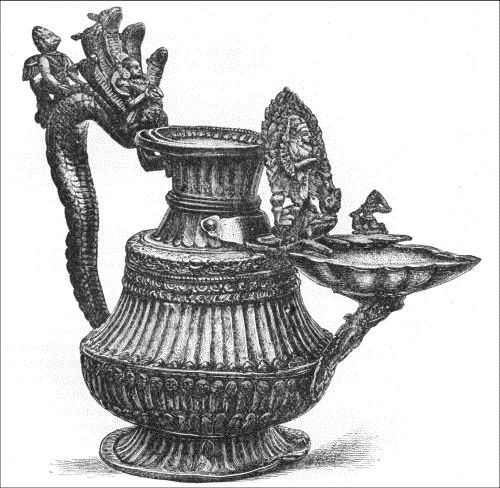
COPPER-GILT SACRIFICIAL VASE: MADURA.
Can we wonder, then, that from these legends of the heroic age are
taken figures for the sculptor, scenes for the carver and the graver,
and subjects for the jeweller and the worker in ivory? Religion is
thus the greater conservator of Indian art as it appeared in its
earlier forms, and reduces into conformity with it all that comes from
abroad.
Further agencies toward the same end are the caste-system, in the
large cities trade-guilds—or, as we would call them, trades
unions—and, finally, hereditary offices in both village and
city. Under the village-system artisans may be said to have undergone
successive generations of training, and the result is that in a country
where manufacture means, literally, "making by hand," any object of
industrial art represents the development of hereditary skill. His
craftsmanship is the father's richest legacy to his son.
One point more deserves consideration. In America and Europe nearly
everything is done by machinery: in India nearly everything is made by
hand. Whatever is done, therefore, is the expression of a thought; and
that art in the East is not trammelled by tradition may be inferred
not less from the variety of its productions than from the Indianizing
process to which foreign arts are subjected. The hand leaves almost
unconsciously the impress of the workman's individuality. There is room
there for patronage to lead to superexcellence. The saving of time
and rapidity of output are not important objects when a prince lends
his encouragement to art and his influence to its elevation. In the
East—in China, in Persia and in India—artisans have worked
directly under the imperial power. All that was asked of them was good
work. In India offices of this kind were, in the imperial workshop as
in the villages, hereditary; and without trouble about subsistence,
without a thought of time, without limit in expense—without, in
short, one disturbing element—the art-workers labored only for
their art and for the approval of their king or chief. In the museum
is a rug of silk woven by deft fingers which have for possibly three
centuries been still. Four hundred knots occupy every square inch, and
the size of the rug leads to the total of three and a half millions of
knots, between every two of which the pattern demanded a change in the
treadles of the loom. We turn from this to a bowl of jade beautifully
engraved upon which were expended the labors of three generations of
workers in the employ of the emperors of Delhi. It is in this way
the best work of all kinds is produced to-day. Spinning, weaving and
embroidering are, moreover, practised all over the country in the homes
of the rich and in the dwellings of the poor. "Every house in India,"
says Doctor Birdwood, "is a nursery of the beautiful." The words are
suggestive. They imply that correct taste is best formed by practice.
We who have lectures on decorative art and technological schools live
in too fast an age ever to rival the industrial art of India, and shall
in our hurry do well if we arrive at something like an understanding
appreciation of the works of the villagers of Hindostan.
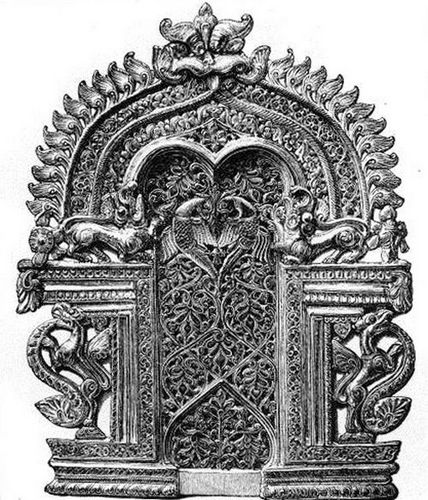
PIERCED AND REPOUSSÉE SILVER SHRINE-SCREEN: MADURA, MADRAS.
The general attributes of Indian art as displayed in the museum
are richness of decoration, great manipulative skill, good taste,
brilliancy, harmony of color, intricacy of decorative forms, and the
due subserviency of both color and design to
decorative effect. Nearly all these qualities are illustrated by the
textile fabrics, the dresses and turbans, the horse and elephant
caparisons, the carpets and the rich canopies of the howdahs. These
are the tissues that spread the fame of India on every side. It is
not known how long it has possessed the art of weaving. Possibly it
originated in the Valley of Roses or by the banks of the sacred Ganges.
The weaving of silk India appears to have borrowed from China, but when
or how it first wove silk we cannot tell, any more than we can tell
when first it wove its marvellous gold brocades or gauzy muslins. It
was weaving cotton in times beyond the realm of history, and continues
weaving it to-day all over the Panjab, Sindh, Rajputana, Oudh, Bengal,
the Central Provinces, in Assam, Bombay and Madras. The prince of Wales
obtained a few pieces of the famous muslin of Dacca, requiring about
six yards to weigh an ounce. Of this kind one was called shabnam,
or "dew of the evening," because if laid upon the grass it became
undistinguishable from the dew; another was called bafthowa, or
"woven air;" a third was called abrawan, or "running water," because
when placed in water it became invisible. Even the prince's pieces
weigh nearly twice as much as the older tissues. Indian lace in gold or
silver, cotton or silk, is in texture and design
the highest representative of that most beautiful fabric. The brocades
are glories of color and rich with glittering flowers of gold, and the
embroidery on velvet, silk, wool or cotton is both pleasing and rich.
The museum contains several examples of the gorgeous embroideries of
the Dekkan, and we find in one or two of the costumes and some of the
fans a beautiful embroidery of shining green beetle-wings and gold. As
to the carpets, they are as a rule satisfying to the eye and possess
a general simplicity of design blended with richness of color. In
all the more brilliant textile fabrics of India warmth is secured
without violence of contrast; and one fact it will be well for Western
manufacturers to study—namely, that floral or animal decoration
is invariably flat.
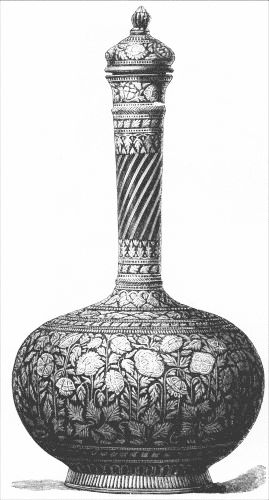
SARAI DAMASCENED IN SILVER: HYDERABAD, IN THE DEKKAN.
In furniture the Hindus do not follow the prevailing American rule:
with them, the less furniture the better. There are, however, specimens
from Bombay of their works upon forms supplied by Europe—as, for
example, two sofas and a high-backed chair, the backs of which are so
perforated that they seem as cool and light as cane. A sideboard from
Bombay has its top and panels so perforated that one wonders how long
a time it took to weave the endless flower-stems of the design and to
carve the fruits and flowers and the griffin-like monsters that support
the upper shelf. Some of the heavy, deep-cut flower-stands are less
pleasing. On the other hand, a dark wood stand from Ahmedabad is carved
in a fine, close and perforated pattern which is altogether appropriate
and admirable. It seems to have been made in parts. The bottom or
stand is solid and deeply cut in twining snakes and leaves: to this is
fastened the lowest section, hollow and perforated in a floral design;
above this is another of a different design; a third section supports
the vase and cover, which are also perforated. The work throughout
is elaborate and exquisite. A good deal of the furniture and many of
the tables, trays and boxes or coffers are variously lacquered and
colored, but when color is used lavishly it is never inharmonious.
Ivory is frequently employed in conjunction with ebony, and the effect
is often striking. The carving of ivory is practised in many parts of
India, and the Berhampore stately state-barges with their rowers all
in position, and the elephants with howdahs on their finely-modelled
backs, are all that need be mentioned, though there are numberless
objects that come from Bombay carved in low relief or perforated.
Even after the small ivories and the larger chess-tables, cots and
palanquins in which ivory is employed, the sandal-wood carving is
amongst the most attractive in the museum. There is a model of a
doorway from Ahmedabad cut after a microscopic pattern, and all around
are designs, some mythological and others purely naturalistic. The
low-relief foliated ornamentation of Bombay seems more attractive
than the mythological designs of Canara and Mysore, or than the mixed
foliated and mythological designs of Ahmedabad, possibly because the
Western mind finds less to sympathize with in the figures of the Hindu
Pantheon than in the exuberant wealth of India's gorgeous flowers and
shady groves.
There are many carvings in horn and tortoise-shell from Vizagapatam
and Belgaum; pots, vases, bowls and bottles in marble of various
colors, solid, mottled and variegated; in soapstone, flowers, and
notably a model of a tomb, in which the most minute details are
reproduced; and specimens of the original Florentine inlaid marble-work
of Agra. In the latter we find white marble inlaid after various
designs with agate, chalcedony, topaz, jasper, garnet, lapis-lazuli,
coral, crystal, carnelian, and even with pearls, turquoises, amethysts
and sapphires. It demands judgment in the selection of the stones,
skill in their handling and taste in their arrangement in order to be
what may worthily be called artistic. It is ever too easy to perpetrate
the grossest crimes against good taste in the richest materials, and it
is the crowning glory of the industrial art of India that mere richness
of effect is never sought at the expense of taste.
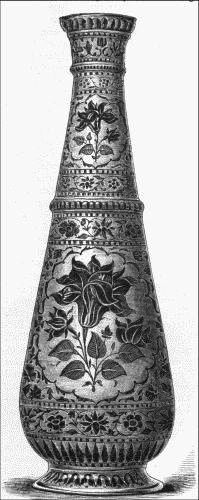
ENAMELLED HUKU-STAND OF MOGUL PERIOD.
Lac is used in an endless variety of ways—from making
lacquered walking-sticks, boxes, toys and bangles to bracelets and
beads. The best work is found in house-decoration and furniture. In the
case of some of the Sindh boxes the decorative design is worked out by
covering the box with successive layers of
variously-colored lacquer and then cutting away the pattern to the
depth required by the color-treatment. Sometimes metal rings appear to
be let into incisions, and again the decoration consists exclusively
of surface-painting in bright colors. The latter is found upon the
papier-mâché of Cashmere, which ranks with the best lac-work of
India.
We pass the pottery, merely noting the beauty of the colors, and
especially of the turquoise-blue, and the graceful simplicity of some
of the early forms, the trappings and caparisons, and glance round the
magnificent collection of arms, from the rough robbers' clubs bound
with serrated iron to the finest chain-mail and rifles inlaid with
gold. From Sindh comes a flintlock gun having the barrel inlaid and
plated with gold at the muzzle and breech, and bearing an inscription
inlaid in gold. Round the muzzle are set nine uncut rubies, and an
emerald forms the "sight." The stock is rosewood, curved and expanding
at the butt, enriched with mounts of chased gold, and attached to the
barrel by three perforated and chased gold bands. In some cases the
woodwork is almost obscured by the gold ornaments. On all sides are
weapons richly chased and damascened in gold. Weapons are there of
the steel that Persia, and even Damascus, never equalled, and they
come, as to a masquerade of the dread weapons of war, with handles
of crystal, of jade set with rubies and emeralds, of gold and green
enamel set all over with table diamonds, and sheathed in green velvet
scabbards gleaming with diamonds and fitted with cap, band and chape of
green-enamelled gold.
If this people carried such arms, what must their jewelry be? An
answer is found in the museum. We again find jade set with emeralds
and rubies. From Trichinopoly are gold chains of the snake pattern so
finely wrought that the scales are almost invisible, and the chain
doubles like thread, or chains and bracelets of rose open-work, most
minute and beautiful. From Madras and Delhi comes granulated gold made
into ear-drops or set as bosses in open-work. About everything there is
a lightness as far removed as possible from Western ideas of handsome
solidity and valuable weight. In the museum a model stands for the
purpose of showing how the woman of India wears jewelry. She has not
only "rings on her fingers and bells on her toes," but in nose and
ears, on her hand, dropping over her bosom, round her arms and waist,
and loading her ankles, are stringed gems and hoops of gold.
Akin to the jewelry is the gold and silver plate. The cup, or
Buddhist relic-casket, already mentioned, is interesting as being one
of the oldest examples found in India, and its age, about two thousand
years, only tells how much India art-work in the precious metals has
been destroyed or lost. There are many excellent examples of the
parcel-gilt work of Cashmere, and one shrine-screen of silver, pierced
and repoussée, is exceptionally fine in design and treatment. There are
tinned brass vessels with incised decorations, sculptured vessels of
brass, brass incrusted with copper and copper incrusted with silver,
but which can be called the baser and which the richer metals when all
assume shapes of such wondrous beauty as the lotas and sarais, and
are decorated with designs so pleasing and with a skill so perfect
with damascened work, incrustations or enamel? The metal excipient is
forgotten in the art. The enamelled huku-stand in the illustration
belongs to the best Mogul period of transparent enamelling, and is
painted in green and blue enamels. At Jaipur red, blue and green
enamels are laid upon pure gold, and the richness and brilliancy of the
result have raised the enamels of that place to the first rank among
those of all the East.
Here our round of inspection may close, and as the doors shut behind
us a remarkable fact presents itself: that in no branch of industrial
art, either in metal-work, weaving or carving, can the science of
Europe cope with the plodding industry of the East.
Jennie J. Young.
ADAM AND EVE. — CHAPTER XXXIII. — CHAPTER XXXIV. — CHAPTER XXXV.
While the small party of soldiers
were employed in attracting the attention of the inhabitants to the
meaningless parade of taking down the offer of reward and replacing it
by the announcement of discovery, the larger portion of their company
had already entered Uncle Zebedee's house and seized upon Jerrem,
their object being to avoid any defence on the part of the neighbors,
which Adam, with a view of preventing further search being made in the
house, had assured them was certain to take place unless they could
find a means of very speedily effecting their purpose. Although little
disposed to be influenced by any of his suggestions, the force of this
one was greatly strengthened by the necessity of dividing themselves
into two parties, one of which must take Adam on, while the other
returned to Polperro to seize the prisoner. And this they managed with
such promptitude that in less than ten minutes they had entered the
house and had dragged out Jerrem, who, half stupefied, was pinioned and
marched off before he was sufficiently aroused to thoroughly comprehend
or realize his situation.
The tattoo of the drums announced to the men on the quay that the
capture was effected, and the party, hurrying off by the Warren, had
joined their comrades, already half up Talland lane, before those who
had been spectators of one calamity could exchange their evil tidings
with those who had witnessed the other.
Yes, Jerrem was gone—led off to disgrace, maybe to death,
through the treachery of his shipmate, his comrade, his—all but
in blood—brother. What would come next? Ghastly fears crowded in
upon all present. Vengeance grew rank, hatred spread out on all sides:
the earth thirsted for his blood, and the air was thick with curses
showered on his name. Even Joan turned relentless and flung pity from
her heart; while old Zebedee, stung to the quick by the odium brought
upon his name, disowned Adam for his son and took God to witness that
so long as life remained every farthing he possessed should be spent in
saving Jerrem.
At early dawn of the next day, Joan, at the instance of her uncle
and in company with several trusty friends, set off first for Liskeard,
and then, if need be, to get on to Plymouth or to Bodmin, at one of
which places Jerrem, they said, was certain to be tried. Bodmin jail
and Plymouth clink had both been familiar in days gone by to many who
still lived to tell their tales and give their experience, and schemes
were already abroad to put the larger boats on wheels, so that, if
Bodmin were selected, conveyances might be supplied by which the mass
of the people could be transported there and see fair play dealt out to
their comrade.
But days went by without Joan coming back, and Eve, who was left
behind to look after Uncle Zebedee, had to sit and listen to the
terrible outpourings of wrath against his son to which the old man gave
vent in the presence of his neighbors, and see the more heartrending
desolation of spirit which bowed him to the ground when no strange eye
was near to witness his weight of woe.
So entirely had the chain of circumstances overpowered Eve that
this climax of disaster seemed to have sealed up the flow of her
emotions, and listening to and looking at the tears, exclamations,
sighs and groans with which the excitable, sympathetic Cornish folk
expressed their anguish and their indignation, she asked herself, "Had
all feeling left her? Did she no longer care what happened to herself
or anybody around her? Was it nothing to her that her life was, as
it were, at an end, her future blighted, her hopes dead, her lover
disgraced, reviled, disowned and denounced by his own father and his
own family?" Any way,
she could find no tears to bewail her sad fate in, no sighs to relieve
her burdened heart, no groans to ease her desolate spirit: all was
chaos, over which two dark shadows moved—the spectral forms of
herself and Adam.
"Uncle, what do you think's become of him? where can he have gone
to?" Eve asked one night as, no longer afraid of his neighbors seeing
him, the old man tore off the armor under which in their presence he
concealed every softer feeling.
"To bottom o' sae, clane gone out o' the warld, I hope, where I
wishes I was too," groaned Zebedee. "Awh! to think e'er a boy o' mine
should ha' sarved us so!—that he us counted 'bove all other flesh
and blood should ha' bin the whiles carryin' 'bout the heart of a
fausse Judas in his body!"
"Perhaps he was mad," said Eve, dropping her voice in terror of the
suggestion.
"Lord send I could see un ravin'!" cried Zebedee. "Why," he added,
his voice breaking under the pictured joy, "I'd thraw mysel' 'pon un
and hug un to me close, though he tored out my heart 'pon the spot
for 't. Naw, lass, naw," he sighed, "he ain't mad: 'tis the devil has
seazed hold on un somehow: that's what's brought un to this."
"Didn't he say nothing that seems now as if he'd told you that night
what he meant to do?" urged Eve.
"Naw, nothin'."
"And you didn't say anything to him, did you?"
"Iss, there 'tis: that's what sticks by me and shaws me plain the
vengeance that was in un, 'cos I tawld un that us was tryin' to dale
double, so as to manage for Jerrem to stale away."
"You didn't tell him about the soldier?" faltered Eve. "No, you
couldn't, because you didn't know anything about it yourself, did
you?"
"Iss, I did. Jerrem tawld—he allays tawld me everything Jerrem
did—and I ups and tells Adam."
An icy grip seized Eve by the heart. "Oh, uncle!" she groaned,
"could it be because of that—that he thought about me?"
"What damon's in the maid now?" cried the old man, starting to his
feet and standing before her with clenched hands and quivering limbs.
"Do 'ee give heed to what 'tis you'm sayin' of? Doan't 'ee knaw that if
I thought that 'twas you was the cause of it I'd scat out yer brains on
the planchin' where you'm standing to?"
Eve shrank back in terror, while Zebedee, after a minute's pause,
his outburst ended, sank down into his former despondent attitude,
muttering, "There! there! let be! let be! Awh, I wander what 'tis a
keepin' o' Joan so? Things is all bottom side upmost when her's out o'
hailin'-distance."
But two days more passed before Joan returned, bringing with her
the startling intelligence that, instead of Bodmin or Plymouth, Jerrem
was to be tried in London, to which place report said Adam had already
been removed. But, though every one thirsted for news, beyond the bare
facts Joan had little with which to satisfy them: she had failed in her
endeavor to see Jerrem, of whose present whereabouts even no one could
speak with certainty; she could learn no positive tidings of Adam,
neither had she been able to ascertain any trustworthy account of the
betrayal, only that it was in every one's mouth that Adam had done it,
and had meant to do it from the first moment he found that the shot
fired against his will would bring them all to trouble. Mr. Macey, the
lawyer at Fowey, who had always managed Uncle Zebedee's money-business,
had said 'twas a terrible job of it, and though he couldn't take it
himself he'd see 'twas carried through by somebody sharper at such work
than he was; and he'd sent Uncle Zebedee word that not a stone should
be left unturned or a guinea unspent while hope was left that Jerrem's
life might be saved; but he also sent a solemn warning to him and to
all the Lottery's crew to keep quiet and out of sight until 'twas
seen whether they meant to carry their vengeance further, or whether
Jerrem's life alone would serve to content them.
"Wa-al," sighed Zebedee, who had listened eagerly to the whole of
Joan's details and patiently to old Mr. Macey's
friendly warning, "they'm fair words and kindly spoken, and, so far
as they goes, I'll bide by 'em. But hark 'ee here, Joan: if the warst
comes to warst, mind this—though they strings me up with un and
we swings together, I'll stand yet wance more face to face with Jerrem
afore he dies."
"And that you shall," said Joan; "and so will I too, for while in
life us cherished un, so while life lasts us 'll never desert un."
"And as for t' other wan," said the stricken old man, his wrinkled
face growing pinched and sharp, "may the wound that he's planted in my
heart rankle and fester in his own! May he live to know the want o'
they he's cast hisself off from, and die a stranger in a furrin land,
and be buried where none who knawed un here can point to the grave that
holds un!"
"Uncle!" cried Eve, thrusting her fingers into her ears to keep out
these terrible words from falling on them—"uncle!" But Joan's
upraised hand warned her to keep silent, and turning she saw that a
sudden change had fallen upon Zebedee: his features had relaxed, his
stretched eyelids were half closed over his glazed eyes, his head
drooped low and was sunk down upon his breast.
For some minutes the two girls stood anxiously gazing at him, until
Joan, terrified by the ashen pallor which had blanched his usually
ruddy cheeks, ventured to speak, and at length succeeded in so far
rousing him that he allowed himself to be persuaded to go to bed, and
the two girls were left alone.
"You're wanting to run up to your mother's, Joan, ain't you?" said
Eve. "I'll sit and watch Uncle Zebedee while you're gone."
"No, never mind for to-night," said Joan wearily.
"Then let me go," said Eve: "'twon't take me any time, and I want a
breath of fresh air;" and she rose from her seat as she spoke.
But Joan intercepted. "No, now sit down," she said hurriedly: "there
ain't no call for neither to go; 'sides which, 'tis too late. I don't
wan't 'ee to go wanderin' 'bout in the dark: you'm too much given to
goin' out by yourself. It won't do now: 'tain't safe, you knaw."
Eve stared: "Not safe, Joan? Why not?"
"Well, now, I'd rather you didn't. Sit down now, like a dear."
Eve sat down, but, her curiosity awakened by Joan's agitated,
nervous manner, she said, "Joan, what is it? I'm sure you've heard
something. Tell me, what makes you say we oughtn't to go out by
ourselves, eh?"
Joan hesitated. "I wonder," she said, "whether I'd best tell 'ee or
not? It may be nothin' but a passel o' mazed talk, only I wouldn't have
a finger o' harm laid 'pon 'ee for warlds."
"Why, what is it, Joan?"
"Well, my dear, you see, I've see'd Jonathan. Through Adam's tellin'
he was tooked off too and lodged in Plymouth clink; but findin' they
couldn't make un spake a word o' sense, when they carr'd Adam away they
left Jonathan bide; and there he is, and there I hopes he'll stay."
"You do? What for?" asked Eve, amazed.
"Why, 'cos o' you, Eve. Iss," she said, answering her look of
surprise, "he's for all the world like anybody ravin' mad agen you."
"Against me? But why against me?"
"He will have that you'm the cause of it all," said Joan; "and 't
seems now he let out to Adam 'bout the letter that Jerrem writ and he
broffed, and then he drove un further mad by a passel o' lies he's
somehow got tagged on t' it—that you'd ha' told the sergeant,
and through that he dropped a bit o' paper, tellin' of it all, into
the rendevoos winder; for, seemin', that was how they got scent o' the
Lottery's landin'."
"And Adam believed him?" gasped Eve.
"He must have," sobbed Joan; "and then I reckon somethin' he see'd
or heerd that night finished un."
"Oh, Joan!" cried Eve, flinging herself down and burying her head on
Joan's lap.
"Iss: don't it seem as if us all must
have some hand in tightenin' the rope that's round that poor sawl's
neck?"
"And Adam could believe that I would betray them—would betray
him?" and, clasping her hands, Eve looked up as if making an appeal
to some unseen presence—"him," she said, "for whom I would have
given my life—for whom," she cried, breaking down, "oh, Joan, I
would give my life now!"
"Iss, I know you would," said Joan, hugging her close to her. "Why,
haven't I called un everything bad before 'ee, o' purpose 'cos I should
see 'ee flare up agen me for doin' it? and haven't I blessed 'ee in my
heart for stickin' to un through thick and thin? Awh, Eve, my dear,
don't 'ee judge me hard for keeping all to Jerrem's side. 'Tain't only
love for Jerrem makes me do it, but that Adam sha'n't never be fouled
by havin' the stain o' blood restin' 'pon un. If 'twas only for that
I'd spend my last breath to save Jerrem from hangin'."
"They think they'll try to hang him?" said Eve in a faltering
voice.
"Iss, for certain they'll try; and, though I didn't say so to uncle,
all Mr. Macey fears is that wan life won't content 'em, neither."
"Could Adam have known that?" whispered Eve.
"He knawed 'twas death to whoever was took, and a free pardon to
whoever told on 'em, or else why didn't he take and knock him on the
head hisself? Jonathan says," she added after a minute's pause, "that
when he'd told un 'bout you he sprung on un like a tiger and shook un
like a rat; and after, when it comed to 'bout the letter, he roared out
like a bull belvin', and then fell flat down 'pon his face like one
struck for death."
"Oh, why, why did Jerrem send that letter?" moaned Eve, wringing her
hands in desperation.
"Iss, why indeed?" said Joan. "Though that could have had nothin' to
do with the findin's out, that I can see; for, if 'twas the last word
I spoked, I could take an oath to never havin' quitted a word 'bout it
to a single livin' sawl; and as to you meetin' the sergeant, why, you
never stirred from this, did 'ee?—Let's see: what did us do that
day?" she added, trying to recall the past events; while Eve, sensible
of having concealed her meeting with Reuben May, averted her face so
that Joan might not perceive its terrible pallor.
Over and over again had Eve endeavored to screw up her courage to
tell Joan of this meeting, since which one misfortune after another
had crowded so thickly upon them as to make each endeavor seem
inopportune. For days after the interview she had every now and again
been seized with terror lest Reuben should make his appearance, and
great was her relief when, as time went on, she began to be released
from this anxiety. But no suspicion that he could in any way have
been connected with the betrayal had ever entered her mind until now,
when, as Joan spoke of her being the supposed betrayer, a sudden dart
of terror seemed to strike her. Was it possible? Could she have said
anything that Reuben had laid hold of against them? For an instant Eve
wrestled with the doubt and tried to crush it, but so vividly did it
rise up before her that at any cost she felt it must be set at rest,
and seizing Joan's hand she blurted out, "Joan, there's one thing I've
never told you of—that the day we expected them all back, after
Jerrem's letter had come, I went out for a bit by Talland way, and
there, just down before you come to the Warren stile, I met—"
"Not he! No, doan't 'ee tell me you see'd the sergeant!" cried Joan,
forcing her hands up to Eve's mouth as if to keep back the words.
"The sergeant? no!" said Eve indignantly; "but the young man I told
you of from London—Reuben May."
"Reuben May, Eve? Why, however did he come down 'long this ways?
What broffed un here, eh?"
"He was coming to see me," said Eve. "He had come in Capen Triggs's
vessel because of something he'd heard about us, and the minute he
saw me he began about uncle and Adam, calling them both thieves and
robbers, and I can't tell what."
"But that wouldn't make 'ee tell un nothin' 'bout their landin'?"
said Joan.
"No: I feel sure I never mentioned that. I told him they were
expected home, because I feared he'd want to come that night and see
you all; but then we fell to quarrelling again, and parted in such
anger that I said I hoped never to see his face again."
"But whatever made 'ee keep it to yourself and never spake of it
till now?" said Joan, turning her eyes upon Eve with a look of anxious
scrutiny.
"I never meant to keep it from you, Joan," said Eve earnestly;
"and only that your mother and Mrs. Climo and the rest were here, I
should have told you the minute I got back: then, when they were gone,
I said, 'I'll tell her as soon as we come down from the cliff;' but
what happened there put everything else out of my head for that night,
and since then, though I've had it on my lips to say twenty times,
something has always come up to hinder me from speaking."
"I'd a made sure you'd never cast eyes on any man outside
the place," said Joan, perplexed by this new opening-out of
difficulties.
"I wish now, more than ever, that it had never happened," sighed
Eve. "Still, Joan, the more I think of it the more certain I feel that
Reuben May had no hand in it, unless it could be that anybody might
have watched us together. That's not impossible, although I never met a
single soul, coming or going."
Joan made no comment: for a minute she seemed to struggle and debate
with her thoughts; then, suddenly looking up, she said, "Eve, you'll
have to go back home to wance: it 'ull never do to have 'ee stayin'
here now."
"But why, Joan? Has what I have told you made you think ill of me?
Don't you believe that I am speaking the truth when I say that what
kept me silent were the bitter words that Reuben May spoke? I meant to
tell you of it, because I had spoken of him to you before, but I could
never have told Adam that one I had counted as my greatest friend had
called him a thief over whose head the gallows was dangling;" and at
the remembrance of how near those words seemed now to the truth Eve
burst into a passion of tears.
"Now, don't 'ee go for to cry like that," exclaimed Joan, dashing
away the drops which were blinding her own eyes. "Whatever 'tis, I
loves 'ee too well to think harm of 'ee for it; and whether 'twas he
or some other man, t' mischief's done now and can't be set straight
agen. But, Eve, us mustn't let more harm come to us if we can hinder
it; and I tawld 'ee that I didn't like the angry words and the manin'
looks o' Jonathan, and he gived two or three twists o' hisself while he
was spakin' that made me turn as cold as death, and 't seemed as if I
couldn't draw my eyes away from the glarin' roll he was lookin' about
un with."
"Oh, I'm not afraid of Jonathan," said Eve, trying to brave down the
tremor of nervous fear which was creeping through her—"a poor
half-witted creature, who says one thing this minute and forgets all
about it the next."
"Awh, my dear, don't 'ee sneer at Jonathan," said Joan reprovingly:
"he's a bitter foe, I'll warn 'ee. And when," she added, dropping her
voice to a whisper, "he talks of maidens who loves to stand gazin' 'pon
the sea growin' dizzy and fallin' in, and o' folks bein' 'ticed fro'
their homes and never comin' back 'longs agen, 'tis time to steer clear
of un, Eve, for there's devilry in his words and mischief broodin' in
his mind."
"Why, Joan," gasped Eve, "surely he wouldn't—you don't think
he'd murder me?" and as the words came trembling out her very lips
turned white with horror.
"I wouldn't like to lave 'ee in his way," faltered Joan.
"But he'd be afraid, wouldn't he?"
"Wa-al, if so be he could get free to tell his story there's no
knawin' what might come of it. I had to dale double with un as it was,
and manage so that neither wan but me got in to see un; and 'fore he
gets set free altogether, Eve, you must put miles atween you and they
who, when they'd listened to his story, would awnly be too quick to
shut their eyes to what they wasn't axed to take part in."
"Of course, in that case," said Eve,
"'tis best I should go back by myself again to London."
And as the words came slowly dragging forth, the narrow street, the
obscured sky, the stifling air weighed down upon her, and crushed her
with a sense of gloom unknown before when her thirst for freedom was
but a want unsatisfied. Her whole being revolted against the cruel
exchange: her nature cried out in protest, but in vain.
The more they discussed the point the more convinced they both
became that there was no other possible alternative; and the money
for her journey being supplied by Uncle Zebedee, under pretence of
accompanying Jochabed Giles in one of her stolen visits to Plymouth Eve
set off late one afternoon, intending to rest by the way, and get on
the next day to Plymouth, whence she would take coach to London.
There was to be no leavetaking, for no one must know that she was
going away. So, with only a nod of good-bye to Uncle Zebedee and a
moment's desperate clinging to Joan, Eve left the house, and in silent
sadness followed Jochabed down the street, past the Warren, and away
along by the cliff-path until they came to the jutting point which,
once past, shuts out all view of Polperro from beyond. Here Eve paused,
and motioning Jochabed to go on she turned and bade her eyes gaze round
upon the scene and look their last farewell.
The sun, which all day long had shone hot and fierce, had run its
course and sunk to rest, leaving its trail of glory to tip the hills
above and be reflected down in crimson glow upon the sea below. The
mist of heat which all day long had hung over the land, though rolled
away from there, still floated in filmy clouds before the harbor's
mouth, veiling the little haven and casting broad shadows on the rugged
cliffs, up whose steep sides the white-faced houses clung, higher and
higher still, till they were lost amid the tangle of the ridge which
crowns the valley's sides.
Like an echo awakened by some tuneful strain which jars on the ear
and smites the heart because the voice which gave it melody is still
and hushed for ever, the sunset calm of that peaceful scene jarred on
the misery of her who stood stricken and desolate. Involuntarily she
shut her eyes, that through them at least her heart should be no longer
pierced; and when she opened them again a mist of gathering tears
obscured her view and blotted out the prospect from her sight. Then,
slowly turning, Eve went her way, knowing that while this life should
last the face of that fair portion of earth would never meet her eyes
again.
Reuben May had been but a short
time back in London when one evening,
as he was closing the shutters of his small
shop, a boy presented himself, saying he
was the landlady's nephew at Knight's
Passage, and had been sent by her to ask
Mr. May for some of the things he was
taking care of for Eve Pascal.
"Why, what does she want them for?"
asked Reuben curtly.
"She wants them for Eve Pascal herself,"
said the boy. "Eve Pascal has
come back again: she came back this
morning, only she hadn't got any one to
send till now."
"All right," said Reuben, returning to
his shutter-closing and then proceeding
to fasten the door: "I'll go round and
speak to her myself."
"Then you won't want me?" said the
boy, not sorry to be released by his stern-looking
companion.
"No: you can go your own way," replied
Reuben, already several paces in
advance, and walking with such rapid
strides that a few minutes brought him
to the house which had been the scene
of all the romance his life had ever
known.
"Oh, Mr. May!" but, paying no heed
to the landlady's voice and without a
pause, Reuben ran up the different
flights of stairs, knocked at the door,
opened it, and found himself at once in
the presence of Eve: "Eve!"
"Reuben!"
And then silence, each looking at the
other, wondering what could have
wrought such a change; for the bodily
fatigue and mental anxiety undergone
by Reuben had told as heavily on his
appearance as the sorrow Eve had endured
had told on hers, although the
absence of original comeliness made the
alteration in him less generally noticeable.
"Have you been ill, Eve?" and as he
put the question a wild thought sprang
up that perhaps her suffering had been
on his account, and, stirred by this
prompting, Reuben took her hand in
his and looked with tender anxiety into
her face.
"No," she said, quietly withdrawing
her hand, "I have not been ill. Have
you? You look very ill."
"Oh, that's on account of my having
walked most of the way back here from
Plymouth: it's a stiffish tramp, you know,
and took the little flesh I had off my
bones."
Eve paused for an instant, as if trying
to repress the over-haste of her question:
then she said, while her face was
half turned away, "Did you go straight
on to Plymouth after I saw you?"
"I got to Plymouth before daylight the
next morning. I was forced to rest a bit
here and there on the way, as I'd come
the same ground once before that day;
but the night was fine; so, as I didn't
care about stopping anywheres, I stumped
on without waiting to see Triggs even—made
a message do for him—and started
off on my journey."
"Then you never went near Looe at
all?" Eve exclaimed with eagerness.
"Ah!" replied Reuben, evading a direct
reply by a little laugh, under which
he heralded his answer, "you may be
sure I didn't stop to inquire the names
of all the places I passed through: I was
in too hot haste to turn my back on them
for anything of that sort."
"Oh, thank God!" said Eve; and at
the words her whole mind and body
seemed to relax from the strain imposed
on them by the suspicion that in some
indistinct way on her had rested the
blame of the betrayal.
"'Thank God'?" repeated Reuben
sharply. "Thank God for what?"
"For not making me the betrayer of
those who put their trust in me."
Reuben's face turned crimson, but so
engrossed was Eve by her own satisfaction
that his sudden confusion was lost
upon her, and she continued: "I may
as well tell you, Reuben, that a terrible
trouble has fallen upon me and mine
since I parted with you. That very
night some one played us false and betrayed
the Lottery into the hands of the
revenue."
"I can't see what else was to be expected,"
said Reuben stolidly: "when
men run their necks into a noose they
may be pretty sure of some day finding
the knot drawn tight."
"I was so afraid that you might have
laid hold on anything I said to you, and
had been led in any way to tell it against
them," sighed Eve, paying no heed to the
taunt with which Reuben had hoped to
sting her.
"And supposing I had," he said,
"oughtn't you to thank me for doing it?
Don't tell me, Eve"—and he threw into
his tone a mixture of contempt and bitterness—"that
you've come to take it as
a trial that those you talk of belonging to
are forced into taking to honest ways."
"Those I belong to have been hunted
down like dogs," she cried. "A price has
been set upon their lives, and one of
them has been dragged away up here
that they may try and hang him if they
can."
"What?" exclaimed Reuben, starting
to his feet—"hang him? Who are they
going to hang? What can they hang
him for? Is it your cousin, Adam Pascal,
you're talking of?"
"No: I wish it was," said Eve, her face
quivering with the emotion the relation
of these details stirred within her; "but,
though 'twas in fair fight, 'twas Jerrem
shot the man."
"Shot what man?" gasped Reuben.
"The revenue-man. The Lottery was
lying still, waiting for the tide to come up,
when the boats crept up behind them in
the dark; and if it hadn't been for Adam
not one among their crew would have
lived to tell the tale, but by his word he
kept his own men quiet—all but Jerrem,
who fired his gun, and down the revenue-man
fell, dead."
Reuben stifled the exclamation which
rose to his lips, and Eve, to whose days
of pent-up misery the repetition of these
woes seemed to bring relief, continued:
"At first all blamed Adam and praised
Jerrem, but almost at once the soldiers
came, and they'd only barely time to hide
away from them. Adam went to the mill,
and was there a week and more; and
then some one told him that 'twas I was
the cause of their being betrayed; and it
drove him so mad with jealousy and rage
that he told of the place where Jerrem was
hid; and the next day the soldiers came
again, dragged Jerrem out and carried
him away. And now, though uncle
spends every guinea he has got, 'tis almost
sure that through Adam's word Jerrem
will be hanged; for they say they've
brought them both to London, and that
they're lodged in Newgate jail."
Up to this time Reuben's eyes seemed
riveted upon Eve's face, but as she paused
he bent his head and sunk it down upon
the table near—a movement that at any
former time would naturally have awakened
some surprise, but now Eve had
grown so familiar with the aspect of sorrow
that she regarded all visible emotion
as an outburst of the certain sympathy
to be expected from her hearers. "Now
you know why it is, Reuben," she continued,
"that I feel so glad that you had
no hand in anything of this; for you must
overlook the anger that I showed at that
time. I've been sorry for it often since,
and feared you'd count me over-bold for
talking as I did. Not that I'm changed,
Reuben, nor think one bit the less of
Adam for what's happened. No; and
though all the world should turn their
backs on him, I'd stand by his side; and
to prove it I must find him out and tell
him that, in spite of all they've told him,
in heart and tongue I've never been untrue
to him." And, filled with the desire
of seeing the man she loved, Eve clasped
her hands and sat trying to revolve
her plans, while Reuben commenced
pacing the little room with a troubled
air.
Suddenly bringing himself to a stand
before Eve, he said, "Eve, be sure your
sin will find you out."
"No, Reuben—no;" and she put up
her hand as if to avert the continuance
of any homily: "'tis of no good talking
like that. Sorrow has sealed up my heart
against taking condemnation or comfort
from anything of that sort."
"It isn't of you I'm thinking," he exclaimed.
"Oh," he cried, giving vent to
his pent-up feelings, "down into what a
pitfall a minute's evil passion may fling
a man! To think that I, while I was
crying vengeance against others, was
drawing down the wrath of God upon
my own head, stamping myself with
the brand of Cain, and doing the devil's
work by sending men to death with all
their sins still heavy on their souls!"
"Reuben, what is it you mean?" and
seizing hold of him with both her hands,
Eve gazed into his face.
"That the thought you had was true,"
he said, "and that 'twas me who dropped
the paper in that told them where the
Lottery would be found;" and a tremor
ran through Reuben's frame: his pulses
for a moment quickened, and then grew
faint and seemed to die away; while Eve
uttered neither word nor sound: her eyes
drooped, her hold relaxed, and tottering
she sank back into the seat behind her,
and there sat motionless and still as one
carved out of stone.
The abandonment of hope, the unutterable
despair of face and form, so unlike
anything which Reuben had ever
seen in Eve, touched him as no reproaches
could have done. That depth of misery
which words can neither describe nor express
pierced his inmost soul and added
to the stings with which conscience was
already smiting him. Not for the act of
betrayal, for had there been no Eve to
prompt him Reuben would have looked
upon it as an act of justice that he should
aid the law against men who set order
and government at defiance, and though
each man on board had met his death
Reuben would have held his conscience
free of any tittle of reproach; but, equitable
and unyielding to himself as well as
to others, he full well knew that when he
wrote the words which sealed the
Lottery's fate justice was clean gone out of
his mind. He neither knew nor cared
what might become of the men whose
safety he betrayed: the whole rancor of
his hate was turned against his rival;
and the paper he flung into the rendezvous
window was as much a blow
aimed at Adam as if he had dealt him
a thrust and had stabbed him in the
dark.
"Eve," he said, "words are but poor
things at a time like this, and if I spoke
from now till never I couldn't make you
see by them the misery I feel; but if
you'll trust me this far, I swear by Him
who sees us both and knows our hearts
that no stone shall be unturned, no thing
undone. I'll walk London over, and
neither rest day nor night till I find out
Adam Pascal and his comrade and tell
them the whole truth. And when I say
this," he added, his face working with
emotion, "don't fancy 'tis because of love
of you, Eve: I know that, come what
may, we never can be nothing more than
friends now; but oh—" and he held out
his hands toward her—"let's at least be
that, Eve: let me help you to set yourself
clear with the man who, be he what
he may, it seems you've given all your
heart to; and you—you help me to rid
myself of the thought that I've led into
sin and hurried on to death fellow-creatures
whose godless lives I'd now give
my own to save. Together, if we set our
minds to work, there's no knowing what
we mayn't do yet. Warrants have been
quashed and pardons given when men
have reached the very gallows' foot; and
as for getting in, why Mr. Osborne knows
Newgate prison, every inch, from going
there with old Silas Told when he was
living, and he'll do anything for me; so
there'll be no fear about that. And you
know me, Eve: you know how when I'm
set upon a thing I strain my utmost nerve
to get it done;" and, pausing, he stood
watching with mingled hope and fear the
effect of his words—first, the flush of
spreading color, then the quivering mouth
and eyes, and finally the rush of tears
which lifted up and cleared away that
stone-like gloom.
A ray of hope seemed once more
near, and catching at the feeblest chance
of being brought again face to face with
Adam, Eve, unable to speak, stretched
out her hand, which Reuben took, grasped
it almost to pain, then let it go, and
with it every hope of love that lingered
still for Eve.
The rest of the time was spent in explanations
of the various incidents relating
to the all-engrossing event, the
details which bore upon it, the circumstances
which surrounded it, until, from
following out all these into their different
channels, Reuben began to have a
clearer conception of the men, their characters,
their individual virtues and collective
failings, growing interested in
them almost against his will. The hour
was late before he recollected that until
he reached his home he could hardly
settle his plans so as to secure an entrance
into the prison on the following
day. Bidding Eve good-night, he left
the house and walked away, only stopping
at the turn of the street to step
into the road and cast his wistful gaze
up to the window of the room which to
him now was as the tomb of his dead
love.
An ordinary workingman standing in
an obscure street is not a figure to arouse
much interest, and Reuben's stolid face
gave little index to the varied emotions
which surged within his troubled heart.
He was able to return the gruff "Good-night!"
the watchman gave, and the old
man, passing on, went wondering as to
the cause of such anxious survey on
Reuben's part. For as he stood his
thoughts ran here and there, and by the
magic of their power showed to his view
the long-gone joys of other days. He
watched the struggling birth of love,
scorched himself in its flame, and felt
by turns the tortures and delights its
presence gives to those who live on hope
alone: then sadly saw it fade from out
his sight, sicken and faint almost to
death, and yet it did not die until by
that one action he had robbed it of life
and killed it evermore. Yes, love was
dead, and love was Eve; and for Reuben
May the Eve he had loved so fondly
lived no longer.
During the time which had elapsed
since the night on which Eve Pascal
and Reuben May renewed their bond
of friendship many an anxious incident
had occurred to test its value and cement
its strength.
Jerrem and Adam were familiar names
to Reuben now, and the men who bore
them were often before his eyes and constantly
in his thoughts. Prepared as Reuben
had been for undergoing much awkwardness
in delivering himself of the tale
he had to tell, he found he had greatly
underrated the pain and humiliation he
actually felt when, through the interest
of his friend, he found himself within
the walls of Newgate and in the presence
of Adam. Reuben was no coward,
yet it needed all the strength of his strictly-disciplined
mind to open up and lay
bare before a rival's eyes those wounds
which love had made and time had had
no space to heal. He shrank from placing
in front of Adam the picture of himself
and Eve as they had stood in the
days when, Adam all unknown, the balance
of a happy future seemed trembling
still within the hand of Fate; and he
paused from time to time as he spoke,
hoping some word or sign would make
his task more easy; but Adam never
spoke or turned aside his eyes, and
under that fixed gaze Reuben was forced
to tell his tale out to the end, constraining
his pride to give out word for word
what Eve had said in Adam's praise, and
searing the green memory of his love by
making his lips repeat those vows which
she had told him bound her to another.
At length the task was ended, the jealous
rage, the mad revenge, was all confessed;
and satisfied that, whatever guilt
it might please Adam to lay to his charge,
he had at least shown that Eve was free
from any shadow of stain, Reuben paused,
and the two so strangely linked stood
looking at each other with envy, jealousy,
distrust clouding their minds, while
a chord of sympathy drew them together
as they recognized a similitude in their
actions which made each self-abasement
uttered find an echo in its listener's
breast. Proud, stern, unyielding to
emotion as both these men had lived, it
was not in them to take comfort in the
shifts and excuses weaker natures find:
the hearts that had refused pity for their
neighbors would not entreat it because
they themselves now stood in need. As
they had judged their fellows so they arraigned
themselves, and thus unwittingly
rendered the first atonement man is called
upon to make.
The sight of Adam's strong, powerful
form shaken and bowed down by the remorse
he strove in vain to control moved
Reuben strangely. The haggard pallor
of his striking face, the sunken eyes, the
untasted food, the unslept-in bed,—each
told its tale of misery and woe, and opened
out to Reuben a depth of despair his
own experience hitherto had furnished
him with no gauge to measure. What
if with no further warning he fetched up
Eve to Adam's aid? The thought would
bear no hesitation: a thousand jealous
"Noes" battled with the suggestion, but
Reuben's better self resolved to have its
way, and, seizing the opportunity of Adam's
head being bent down in his arms,
Reuben went swiftly out and along down
to the keeper's room, where Eve had been
left impatiently awaiting his return.
Although the grating of the hinge
roused Adam, he neither stirred nor
moved until, satisfied by the unbroken
silence that Reuben had left him to himself,
he ventured to raise his head. Where
could he go? where hide himself from
human gaze? And as the thought of all
his shame came crowding to his mind he
started up and wildly stared around, and
then around again, seeing each time the
walls, which looked so near, draw nearer
still. No hope! no hope! Here he must
live until the hour when those who brought
him here would drag him forth to swear
away his comrade's life. O God! how
helpless he felt! and as he let himself
drop down each limb gave way and nerveless
fell, as if Dejection claimed him for
her own. The time had been when Adam's
mind was racked by thoughts of what
lay in the hearts of those he had left behind:
their pictured hatred and contempt
stung him to madness; the words they
would say, the curses they were uttering,
seemed ever ringing in his ears. But
Reuben's tale had for the time swept this
away and filled its place with dark remorse
for what he had done to Jerrem.
True, Reuben had shown that Jerrem's
hand had wrought his own and their destruction,
but what of that? Adam through
him had wreaked his vengeance on them
all—had, Judas-like, delivered them to
death: henceforth, branded and disgraced,
he must be an outcast or a wanderer.
As this fallen spectre of himself
rose up and flitted in his sight a cry of
wild despair burst forth, wrenched from
the depths of his proud heart—a cry which
some one near sent echoing back; and
as it came his hands were caught, and
Pity seemed to stretch her arms and fold
him to her breast.
Was it a nightmare he was waking
from—some hideous dream in which our
bodies slumber while our fancies live a
lifetime? Would this vision of Eve (for
Eve it was who knelt close by his side,
her arms around his neck) melt away
and fade as many a one of her had done
before? She calls him love—her love,
the husband of her heart. What! he, this
guilty outcast—can he be this to any one,
and most of all to Eve?
A finger's touch seemed laid upon the
veil which hitherto had shut out hope
from Adam's view, and as it shrivelled
up and rolled away the light revealed that
Mercy still sat throned on high, and bowing
down his head on Eve's neck he let
his stricken soul take comfort in the
thought.
But while Adam was thus cast down
under suffering, sorrow had taken but a
slight hold on Jerrem, who, after the first
shock produced by the horrors of a place
then branded as "the darkest seat of woe
this side of hell," gradually regained his
old elasticity, and was soon ready to treat,
laugh and drink with all who came near
him. His merry jokes, his quaint sea-songs,
the free handling he gave to his
plentiful supply of money,—all served to
ensure his popularity, so that, instead of
the man sunk under misery and despair
whom Reuben, after leaving Adam, had
girded himself up to encounter, he came
upon Jerrem rollicking and gay, a prime
favorite with all the authorities, and a
choice spirit amid the crew of tried and
untried prisoners who in those days crowded
together in the foul wards of Newgate.
Fresh from the sight of Adam's dark
remorse, filled with compunction at the
thought of all the ills their joint passions
had hurled on Jerrem's head, Reuben had
invested Jerrem with a sense of wrong,
to make reparation for which he had come
prepared to offer whatever sacrifice he
should demand. To find the man for
whom all this feeling had been conjured
up reckless and unconcerned, casting
oaths against his ill-luck one moment
and cutting jokes at his possible fate the
next, jarred upon Reuben terribly, and
made him at once decide that it would
be worse than useless to urge upon him
any necessity for taking thought for his
soul when he was so utterly reckless as
to what would become of his body. The
story Reuben had to tell of himself and
Eve, the betrayal, and the suspicions it
had aroused against Eve in Adam, merely
affected Jerrem as a matter for surprise
and curiosity. He seemed pleased to
hear that Eve was close at hand, but still
expressed no wish to see her. He talked
about Adam, and with a painful absence
of all malice told Reuben to say to him
that he'd best lay it thick on his back, so
that the judge and jury would let the other
chaps go free. The circumstance of being
brought to London to be tried seemed
to afford him immense satisfaction—a
thing, he said, that hadn't happened for
sixty years and more, since old —— swung
for it; and then he fell to wondering how
soon that might be his fate, and if so how
many from Polperro would make the
stretch to come so far. He'd promise
them it shouldn't be for nothing: he'd
show the Cornishmen that he could cut
his capers game. Only one subject seemed
able to sober or subdue his reckless
spirit, and this was any mention of Joan
or Uncle Zebedee: to them the poor soul
seemed to cling with all the love his nature
could command. And when Reuben,
instructed by Eve, told him how
stricken down the old man lay, and farther
on promised to write for him all the
messages he wished to send to Joan, a
heart of wax seemed given to his keeping,
in which it now must be his care to mould
the little good there yet was time to teach.
And so it happened that in all his future
visits—and every hour that Reuben had
to spare was given up to Jerrem—Joan
was the theme that threaded all their discourse,
and by her power Jerrem's soft
heart and softer nature became to Reuben
as an open page, wherein he read of actions
in which good and bad were so mixed
up and jumbled that in the very midst
of his reproof and condemnation Reuben
was often forced to stand abashed before
some act of generous pity which found
no echo in his former life. And out of
this humility, which grew in strength,
there sprang forth greater merits than
from all the weary efforts he made at
working out his own atonement; for Reuben,
like Adam, had been over-satisfied
about his own rectitude, and took pride
in the knowledge that if ever he had committed
a wrong he had acknowledged it
freely and expiated it to the uttermost
farthing; while Jerrem, for the first time
in his life brought to see guilt in what he
had counted pleasure, scarce dared to
listen to a hope of mercy for himself,
but rather craved Reuben to beg it for the
many who had been thoughtless sharers
in his folly. His ruling desire was to see
Joan once more, and no sooner was he
told that the admiralty session had begun
and that his day of trial, although not
fixed, was near at hand, than he begged
Reuben to write and ask Joan to delay
her promised visit no longer; and this
Reuben did, adding on his own account
that, from what the lawyer said, it would
be best she came at once by the coach
which would reach London on the following
Thursday week, on which day
Reuben would be waiting to receive her.
Now, at the onset of this disaster had
such a letter reached Polperro not a man
in the place but, short of knowing it would
cost his life, would have risked all else to
go to London, and if Jerrem was to die
give him courage by mustering round
their comrade at the last. But the downpour
of disaster had cowed these daring
spirits, and the men who had not known
what fear meant so long as success was
secure now trembled and gave way under
the superstitious certainty that Ill-luck
was following them and Misfortune
had marked them for her own. Their
energies paralyzed, they succumbed to
what they looked upon as Fate, and in
most cases were seized without a struggle
and led off to the nearest prisons
without an effort on their own part
toward resistance.
The money over which, from the
small scope for spending it, they had
seemed so lavish and reckless, when
needed for lawyers and counsel and
bribes went but a small way; and
though they made a common purse of
all their hoards, not a day passed without
some house being stripped of the
substance which adorned it, so that
money might be got for the husband,
the son, the brothers who had brought
these treasures home. The women, on
their knees, pressed on the farmers' wives
their chintzes, their lace, their gaudy stock
of jewelry, and when this market failed
toiled along to Liskeard, Plymouth and
Launceston, carrying their china, silver
plate and bowls in the hope of finding
somebody to buy them.
With a revenue cutter—often two—always
in sight, landing parties of king's
men, who, recalling ugly thoughts of the
hated press-gang, roamed hither and
thither, ready to seize any one who happened
to show his face; with half the
husbands, sons and brothers in Plymouth
clink or Bodmin jail, and the rest
skulking in farm-houses or lying hidden
in the secret places; with plenty vanishing
and poverty drawing nigh,—the past
circumstances which had led to this desolation
were swallowed up in the present
misery it had entailed upon them; and
though every one now knew the whole
story as it stood—how that through Jerrem
writing to Eve she had had it in her
power to tell Reuben May, her former
lover, who, led on by jealousy, had betrayed
them to the revenue-men—so
familiar had Reuben's good services to
Jerrem become known that it was taken
as only one more of his many friendly
actions that he should write to Joan, urging
her to come to London without delay,
and promising to meet her and see
that she was taken care of. If any among
them thought that Joan would go probably
to Eve's home, they made no mention
of it, for Eve's name was by a tacit understanding
banished from their mouths,
and the memory of her lay as a seal to
that dark sepulchre wherein, with bitter
scorn and hate, Adam lay buried.
There was no question now of Uncle
Zebedee going, for the confinement, the
excitement and the degradation had been
too much for the old man, whose free and
happy life had never known trouble or
restraint, and his mind had gradually
weakened under the burden imposed
upon it; so that now, except when some
unexpected incident roused the flickering
flame of memory, the past few months
were blotted from his mind, and in company
with Jonathan—who, broken down
by ill-usage and turned out of prison to
die, had managed to crawl back to the
friends he knew he should find shelter
with—he roamed about harmless and
contented, always watching for the Lottery's
return, and promising, when she
did come back, that he would give them
all a fling such as Polperro had not seen
for many a day.
It was an easy matter to cheat him
now, and when, her journey all arranged,
Joan stepped into the boat which was to
take her round to Plymouth and left old
Zebedee standing on the shore, raising
his thin cracked voice to fetch her ear with
cheery messages for Jerrem and for Adam,
whom she was going to meet, her
cup of bitterness seemed to overflow.
The Author of "Dorothy Fox."
[TO BE CONTINUED.]
A PIVOTAL POINT
We are but beginning to understand
what this America of ours is to do
for the Old World. If we consider it under
the figure of a vast steamship journeying
to the relief of the mother nations,
surely the beef and the flour, the cotton
and the corn, even the inventions,
with which it is freighted, form the least
portion of its immeasurable cargo of supplies.
Now, imagining our republic to
be such a vessel, if Alaska be the stern
and Florida the prow turned toward the
other hemisphere for the peaceful conquest
thereof, then must New York on the left
hand and Texas upon the right be, in the
days to come, the great paddle-wheels
which shall drive it onward—New York
not more so in a commercial than Texas
in an agricultural sense. But it is with
Texas only that we have here to do, and
this in order to detail certain things hitherto
unpublished which may not be without
their use to the Humes and Motleys,
the Froudes and Macaulays, of our nation
in the wonderful future.
It is well to bear in mind from the outset
that Texas is by far the largest of the
States. To get even an idea of this, place
within its boundaries New England, New
York, New Jersey, Delaware, Maryland,
Ohio and Pennsylvania: even then you
must pack into the crevices between these
two or three granite boulders each of the
size of Massachusetts to make a solid territory
as large as Texas. As to that, however,
Alaska is vast, and so is Sahara.
If you set out upon a journey south and
south-westward, beginning at the Potomac,
and visit every Southern State in its
order upon the map, you will find—and
that almost immediately upon your arrival
in Texas—that you have reached that
State of them all which surpasses the others
as much in prosperity as it does in dimensions.
Near as Texas is to the equator,
the oxygen of its abnormal growth is
perceived by the newcomer in almost his
first breath. There is a combination of
causes for this. The Puritan who landed
on Plymouth Rock gave character to, and
transmitted himself down, the after ages
of New England history; and the same
is true of the influence of the Connecticut
Austin who in 1820 began the settlement
of Texas. The lapse of two centuries
may have given a more earthward direction
to the old energy, but the energy itself
is there; and, somehow, the character and
history of this larger New England of the
West have been along the same line.
Everything has helped forward the prosperity
of the State. General health, moderate
taxation, fertility of soil, astonishing
diversity of product, cheap and rapid
construction of railroads along lines both
of latitude and longitude, immeasurable
reserves of alternate sections of land held
sacred for education,—these are some of
the causes which are attracting an immigration
of about a hundred thousand a
year to a realm so vast that the two millions
already there seem but pioneers of
the coming hosts.
But that which strikes the stranger
most is the seemingly small proportion
of negroes to whites in comparison with
other Southern States; and this is becoming
more marked every year. In
one thing the population seems to be
unanimous, and that is that Texas shall
remain, vast as it is, one undivided State,
a recent legislature having set apart three
millions of acres toward the construction
of a new capitol at Austin which shall be
worthy of that one of the United States
which is also, and in itself, an empire so
much larger than Germany that to bring
the balance to a level you must cast into
the scale with it Jamaica, Holland, Denmark,
Belgium and Greece. There is
the momentum as of its enormous bulk
in the prosperity of Texas; and not a
man of us, however wide awake he is,
but is a Rip Van Winkle as to what it is
coming to be.
But all this is said in order to something
else. Heaven knows that the history
of Texas was romantic enough during
the era of the mysterious Aztec, then of
the Frenchman, the Spaniard, the Mexican,
and after that of the original and
unadulterated Texan of the battles of '36,
and yet there is a page, unprinted hitherto,
of its annals, in connection with the
Confederacy, which is, in some senses, the
most interesting of all. To appreciate it
one must remember that, unlike any other
State, Texas was once a republic which
had won its independence with its own
sword. Of its own free will it deliberately
abdicated its nationality as such to become
one of the United States. When
the fever of Secession set in, of all the
Southern States it was, on account both
of its size and strategic location, the most
important. An anecdote in regard to Mr.
Lincoln may illustrate this. One of the
early settlers of Texas was a gentleman
whom I will designate as Mr. S——.
There is hardly a citizen of the State but
will know who is meant, so long and
thoroughly has he been recognized over
its broad domain for his indomitable energy,
sagacity and magnificent success,
as well as for an integrity and high sense
of honor unimpeached by any. Except
as he was compelled by the very qualities
of his clear-headed character to be a
Union man during the rebellion, Mr.
S—— has never meddled in politics,
and no man stands higher to-day in the
estimation of the best men in Texas than
he. As a Union man he was obliged to
absent himself from the State during the
war, and was in Washington in 1864. As
soon as Mr. Lincoln knew of his arrival
he sent for him, and held three different
interviews with him in regard to Texas.
During these conversations the President
dwelt at length and with the utmost energy
upon the necessity, in a military
sense, of Texas to the Federal cause.
"If we held Texas," he said, "we should
not only outflank the Confederacy by land,
but by water also;" and he developed the
statement in all its details. "Go back,"
he entreated Mr. S——, "and say to your
State that if it will return to the Union the
slaves will not be interfered with."
"But the Emancipation Proclamation
has been issued," Mr. S—— exclaimed.
"No matter for that. We will consent
to any plan for gradual emancipation the
Texans will make," replied the President:
"they may arrange for it not to go into
effect for forty years to come if they will
but return. We will fix it to suit them.
One thing is certain," he went on: "even
if the Confederacy should succeed with
the other Southern States, we will never
give up Texas. With it we can fence in
the Confederacy, and whatever befalls we
can never let Texas go—never!"
After much further conversation the
President led Mr. S—— to the window
and pointed to the trees. "Do you see,"
he said, "how the buds upon those boughs
are swelling as they yield to the coming
spring and summer? So is it in regard
to the matters of which we are speaking:
there is a Power mightier than we which,
inevitable, irresistible, is dealing with
them. Upon that Power we also can
afford to wait. But we will never give
up Texas, Mr. S——: never!"
Let it be added here, as casting light
upon the characteristics of Texas, that it
was never conquered by the Federal
forces. Although attacked often and
from almost every quarter, it invariably
repelled the assault. When it succumbed
at last it was from within, and not as the
result of any victory achieved by Federal
troops upon its own soil. But all this is
merely to show that, superior in many
respects to every other Southern State,
the case of Texas was unique in almost
every point of view; and this is stated
with reference to what is now to follow.
When the rebellion began, General
Sam Houston, who had been president
of Texas when it was a republic, was
governor of the State. In common with
the overwhelming majority of the people,
Houston was utterly hostile to Secession.
With them he knew too well what Texas
had been and how it had come into the
Union. There was a certain grand inertia
of the great State which resisted the
noisy efforts of South Carolina to drag it
out, as a stately ship resists, of itself and
although its crew be passive, the attempts
of a little tug to tow it along. Not one-fourth
of the people of the State voted,
when the test came, for Secession, and
no man opposed it more determinedly
than did its governor. If, like Texas
among the States, he towered among
men, almost a giant in stature and
breadth of person, like Texas also he
was peculiar every way. It required
men of marked individuality to settle
the country, to wrest it from Mexico, to
erect it into a republic; and no Texan
was more emphatically "himself and nobody
else" than was the ponderous chief
magistrate. Manifold stories illustrative
of this are still afloat there: let one suffice,
even if it shows also the weakness of the
man. One morning when he was president
of the republic the envoy from France
called to confer with him upon an affair
of critical importance. The executive
mansion was but a log-cabin boarding-house
at the time, and the only thing to
be done was for the portly president to
promenade up and down the long porch
in front of the building, the envoy, who
was the most polished and nervous of
Frenchmen, walking by his side. But a
small nurse-girl was engaged in drawing
a screaming baby upon the porch in a
roughly-constructed child's wagon. When
he passed it the president said, with the
politeness which always characterized him
when anything female was in question,
"Will you be so kind as to roll your
charge somewhere else?" The nurse
merely stared at him, and continued to
drag the squalling infant up and down
upon the squeaking wheels, the president
and the envoy conferring together as well
as they could as they walked. "My young
friend," the former remonstrated at last as
he halted before the girl, "I will esteem
it a singular favor if you will go elsewhere."
But it was little the nurse cared
for the affairs of empires, and she paid
no attention to the request. It so chanced
that when the rival occupants of the porch
passed each other the next time it was opposite
the steep steps leading down into
the yard, the Frenchman being upon that
side. As the president came upon the
rolling nuisance, now noisier than before,
he whirled about. "I had rather," he
shouted to the astonished girl, his face
ablaze, his arms extended, "meet all hell
in harness, and be dragged down the
streets of the New Jerusalem by wild
horses, than meet your horrible cart!"
and, glancing around for his companion,
he saw that in the violence of his explosion
he had hurled the represented majesty
of France down the steps and into
the dirt.
He was an older man when Jeff Davis
came along trundling his species of nuisance
upon their common path, but he
was no milder in his denunciation. Morning,
noon and night, in public addresses
and in private conversation, he left no
shadow of doubt in the mind of any as
to his opinion of Secession and its certain
result. "Texas and the Federal government
are like two noble mastiffs," he told
the people from the steps of the Capitol
at Austin in the earliest days of the rebellion,
"and these miserable politicians are
like little curs snapping and snarling about
them to provoke them to fight. When
the mastiffs are launched at last into
bloody battle these wretched curs, holding
themselves carefully out of danger,
will circle about the big dogs which are
tearing each other to pieces, with their
shrill bow-wow-wows." And the writer
remembers how well the old hero imitated
as he said it, and with more accuracy than
dignity, the vicious feebleness of the querulous
spaniels.
Nor was the governor backward in doing
also what he could to save his State
from the coming chaos. A well-known
and efficient lawyer of Texas hastened
to Washington and had an audience with
President Buchanan at the very outset of
things, commissioned, doubtless, to do so
by General Houston. "Relieve the officer
now in command of that department,"
he urged upon Buchanan, "and appoint
Houston in his place. Do that, do it at
once, and we can assure you that you
need have no fear of seeing Texas secede."
The poor President shrank aghast
from the proposition. We know how clerical
in appearance Mr. Buchanan was,
especially in the spotless whiteness of
his ample necktie. "When I mentioned
Houston to him," the lawyer said afterward,
"he turned as pale as his cravat."
What was to be done? Governor
Houston demanded it of himself as he
sat and whittled shingles in his easy-chair
at the executive office in the basement
of the Capitol. General Twiggs
was in command of the United States
troops in that department, and they comprised
one-fourth of the entire army then
at the disposal of the Federal government.
There were one hundred and
twenty-one commissioned officers then
in Texas—three thousand troops in thirteen
forts and ten camps, including seven
companies of the Third Infantry. At
the general's head-quarters in San Antonio
were fifty-five thousand dollars in
cash, and thirty-five thousand stand of
arms and seventy cannon within reach,
with horses, mules, ammunition, wagons,
tents, in abundance. In other words,
General Twiggs, with a disciplined army
and military stores of the value of over
three millions of dollars, was available
for resistance to Secession. But what
about the officer in command? When
General Twiggs shortly before had gone
on leave of absence to Georgia, he had
left Robert E. Lee in charge, remarking
even at that early date, "If Old Hickory
were President he could hold things."
But Twiggs had returned, and Lee had
left Texas, saying, "I am going to Virginia
to turn planter. There will be at
least one soldier the less to do the fighting."
Could the governor rely upon General
Twiggs? Captain R.M. Potter of
the army, then in Texas, assures the writer
that Twiggs did it merely as a ruse
and to save time, but the governor had
received tidings from him two months before
that he could rely upon him. As it
was, the United States troops were scattered
six hundred miles along the frontier,
and something must be done, secretly
and instantly. Governor Houston knew
that he could count upon many thousand
volunteers. And not upon men merely
as Union men: throughout the State
were multitudes of those whose devotion
to Houston was more almost of a religious
nature than a matter of politics.
These "Houston men" would have rallied
to him rifle in hand, more or less
indifferent to the cause he espoused, so
that if there was to be a fight, and Houston
was to command, he could have had
plenty of soldiers, whoever and whatever
was to be fought for or against.
And so the old governor sat awaiting
events, a King Canute upon the seashore,
and the ocean already lapping his feet.
Almost every one of the many papers of
Texas was ablaze with the prairie-fires of
Secession. Everywhere the men were
being rapidly organized into companies,
ladies were making and presenting banners,
editors, recruits, haranguing politicians
rushing into the affair as purely
from sentimental considerations, and
with as little sound consideration, as the
youngest and most frivolous of the excited
beauties who were decking out lovers
and brothers to their death. But the
Secession convention assembled at Austin:
how could the governor prevent it?
Resisting the importunities of inflamed,
remonstrating, exasperated, vituperative,
threatening men, the old man sat in the
executive department silently whittling
away, a cypress shingle in one hand, a
jack-knife in the other. The swarming
politicians could not but revere and be
afraid of him. Was he not "Old Sam,"
"the hero of San Jacinto"? He had
been president of the republic, United
States Senator, possible President of the
United States. He was, as has been
said, a very large man, of commanding
aspect, and he threw his whole weight,
so to speak, into his detestation and
denunciation of Jeff Davis and all his
crew.
As he sat and whittled he could not
but hear the uproar in the legislative hall
overhead in which the convention was
assembled: the vehement applause of
clapping hands and stamping feet reached
his ears, even if he could not hear the
eloquence which had aroused it. So far,
he had fired blank shot only from behind
his entrenchments, but he outnumbered—and
all knew it—in his one person,
and ten times over, the throngs of brave
but mistaken men discussing and rushing
through grandiloquent resolutions above,
not a man of whom but was thinking all
along of the governor down stairs as of a
sort of legitimate Guy Fawkes who might
at any moment blow their noisy parliament
to the moon. "What do you think
Old Sam will do?" That was the question
of the day with them beyond every
other. Alas! that was the conundrum
which the governor, ponder as he might,
was so far unable to answer. He had
conquered and driven out the Mexicans;
had sent the Texan soldiers home with
the one charge, "Go and plant corn;"
had seen Texas grow into a republic under
his care; had rejoiced when he had
helped place it in the Union. Now the
imperial State was in the act of being
hurled into what he confidently regarded
as the most causeless of catastrophes;
but what could he do? That was the supreme
question. "What can I do to prevent
it? What ought I to do, to-day and
before it is too late?"
Early one morning a man entered the
executive office, locked the door behind
him and walked up to the pondering governor,
his felt hat in his hand. It was
not his name, but I will content myself
with calling him Jack Jones. You would
not have looked at him a second time
had you passed him in the street, for he
was merely a tall, pallid-faced, pigeon-chested,
stoop-shouldered victim, apparently,
of consumption, and as mild as
could be desired in tone and manner.
Governor Houston knew him well, however—knew
him so well that he gave
him a cordial reception and listened to
him to the end as his visitor proceeded
to unfold his plans. They were exceedingly
simple, and in substance this: "I
hate these scoundrels of the convention
as much as you do, governor, and you
know it, and you know me! I have got
eight hundred men of the same stripe
up in Burnet county. We have plenty of
guns and ammunition, and are more than
ready. We can save Texas. Only say
the word, governor, and we will clean
out the convention in twenty-four hours.
What do you say?"
The governor debated with himself as
he sat. Suppose he consented. There
would be a fight, possibly a bloody massacre.
Might not the Secessionists call
another convention to meet at Galveston,
Houston, somewhere else? In any case,
war, civil war in its worst form, would
follow. Hat in hand, the messenger
waited for his answer. "Thank you, but
not quite yet," the governor said. "Go
back to Burnet county and hold your
men in readiness. When I send for you
come, and come quick."
There was no time to be lost. "But
these men: how am I to feed them when
they come?" the chief magistrate asked
of himself.
"About two months before the passage
of the Secession ordinance," said the Mr.
S—— to whom allusion has already been
made, and in reluctant answer to the
questioning of the writer, "General Houston,
Mrs. Houston and some of their children
drove out to my house in the country
near Austin, ostensibly upon a friendly
visit. General Houston and myself
took seats on the porch, while the ladies
retired to the parlor. After some of the
usual small-talk, the general remarked
of the roses then in bloom, 'I see you
have a beautiful garden: let us take a
walk among them.' We did so, but soon
took our seats in the arbor. There, after
pledging me to secrecy, he said, 'Although
Mr. Lincoln is not yet inaugurated, he
has sent a Mr. Lander to me as an agent
to assure me of all the aid I need the day
he takes office if I can but hold the State
until then. General Twiggs,'the governor
added,'has agreed to do what he
can to help me. I have eight hundred
men waiting to come at a word. Volunteers
will pour in. I am sure that I can,
with the aid of General Twiggs, hold
Texas against any force the Confederacy
can send. But my men must be supplied
with powder and lead, and must be fed.
Above all,' added the governor, 'they
must have plenty of coffee. Can you
undertake the task? I am not going to
rob the State treasury, but I pledge you
my honor as governor that you shall be
paid in the end. Abundant assurances
have been made me from Washington
that the money will be on hand as soon
as Lincoln is inaugurated, and no appropriation
will be necessary from the State.'
"The next day," continued Mr. S—— in
narrating the facts to me, "I saw the
governor in his office. Locking himself
with me into an inner apartment, we discussed
the whole matter, and I agreed to
supply five hundred thousand rations, and
as many more as possible, the governor
insisting again and again upon there being,
whatever else might be lacking, an
abundance of coffee. For these rations
I was to be paid at the rate of thirty cents
each, and transportation. The governor
then wrote out the contract, spelling out
every word aloud, according to his habit,
as he did so. I hastened away with the
contract duly signed, and, going down
to Houston and Galveston, I purchased
two hundred and fifty-seven sacks of Rio
coffee to begin with—all I could find—and
enough percussion-caps, bacon, rice
and flour to meet the emergency impending.
Meanwhile, I could not but laugh
at what seemed to me the puerile efforts
at fortification going on in Galveston;"
and my friend paused, as he told me the
story yesterday, to unroll and put into my
hand the commission given him by the
governor as quartermaster-general upon
his staff with the rank of colonel.
"In two weeks," continued Mr. S——,
"I was back again, but the instant the
governor had locked me with him into
his inner office he turned to me with rage
in his face. 'Sir,' he said to me in a
manner and tone of voice which I can
never forget, 'Twiggs is a traitor!' Then
he sank into a chair, the tears trickling
down his heroic countenance, and sobbed
like a child. He then clenched his fist
and smote the table with what seemed
to be a suppressed curse, long and deep.
After he had somewhat recovered he repeated
to me the message Captain Smith
had brought him from Twiggs. It was
in such cautious language as to the general's
isolation and want of instructions
from Washington that I suggested to Governor
Houston that possibly he misunderstood
General Twiggs. 'No, sir,' the
governor exclaimed, again smiting the
table with his huge fist, 'there can be
no mistake. Twiggs is a traitor! We
are to have a fearful civil war;' and he
appealed to God for wisdom and protection
in a manner which touched me to
the heart. In a few weeks thereafter,"
added Mr. S——, "the ordinance of Secession
was passed, and Twiggs surrendered
everything to a stageload of politicians
and a preconcerted show of a few
men improvised as soldiers whom a corporal's
guard of loyal men could have
easily dispersed if there had been any
one to give orders. About a year after
this an ex-governor of Texas and an ardent
Secessionist whispered to me in the
street, 'Take my advice and destroy that
contract with General Houston.' How it
had become known that there was such a
contract is and for ever will be a mystery
to me. But the pity of the whole thing
was that Governor Houston was not the
man he had once been—was too old."
Mr. S—— was perhaps the largest
merchant at the capital, but the choicest
of his merchandise just then was seven
tons of rifle-powder. This was seized
ere long by the Confederate authorities.
When Mr. S—— protested against it and
refused Confederate money in payment,
the State treasurer hastened to give him
his price for the powder in silver thalers
which happened to be rusting in the
vaults. Would the Federal authorities
have been as complaisant toward a man
in their midst known to be a rebel and
who refused greenbacks? Surely, as in
the hesitation already alluded to of Twiggs
and Lee, while the feelings of the leaders
were fired their judgment must to the last
have remained but half convinced as to
the justice, and therefore ultimate success,
of the Confederate cause. Gallant as, in
most instances, they were, they would
have struck more unhesitatingly, more
vigorously, more victoriously, had every
man been able to put his entire self, brain
and conscience as well as heart, into the
blow.
It was extremely little of themselves
that the Union men of Texas invested
in their show of obedience to Secession
when that was required of them at last.
How well the writer recalls the rueful aspect
of a body of these who, to save themselves
from worse things, had been organized
into a military company! They comprised
some of the best citizens of Austin,
but Falstaff himself did not have, morally
speaking, as forlorn a set of recruits
when they formed into dismal lines under
the trees of Court-house Square. Every
man had his weapons, but they dispensed
with music: gladly would they
have marched and countermarched without
a flag also. But there were ladies
ardent in the cause of Secession who,
unasked and with malicious haste, constructed
a particularly large and gorgeous
Confederate flag for them. If it was presented
with enthusiasm, it was received
by the dolorous warriors in sepulchral silence,
and the wheelings hither and thither
of the ununiformed heroes thereafter
were more funereal, if possible, than before.
The one spark of hope in every
bosom was that in some way Governor
Houston or somebody else might suddenly
employ them against the flag, more
hateful to them than Fluellen's leek, which
they were constrained for the time to flaunt.
"Never mind, men," a certain Mr. O—— in
their ranks whispered to them as they
sadly trudged along—"never you mind.
Some day we may prove to be the mucilage
around which a Federal army will
rally."
It so happened that the writer was about
this time at the house of Captain Whitely,
a noble-hearted officer of the army
who remained true to the Union. It was
in San Antonio, and one morning General
Twiggs drove up in his carriage and
entered the parlor. He was a large and
unwieldy man, with an exceedingly red
face, and he sat for a time in sombre silence.
"Whitely," he said at last, "what
can I do? The Southern people hate the
North as Comanches do the whites, and
the North returns the compliment. Five
times have I written to General Scott, and
not a word of instructions has he sent me.
What can I do?"
Ignorant as the writer was of such matters,
he easily conjectured, what Twiggs
must have well known, that all despatches
to and fro were intercepted. "Ah! what
an opportunity!" he thought as he looked
at the hesitating man—"what an opportunity
for you to act on your own responsibility!
You may become, if you do, as
one of the immortals."
"You are my superior officer," was the
only reply of Captain Whitely, who knew
what Twiggs had already determined to
do, himself in consequence thereof soon
after a prisoner of war.
And so in a few days Governor Houston's
fears were realized. Everything was
surrendered to the Confederacy. As
Twiggs rode through the streets of San
Antonio with his disgraced army, many
of them weeping as they went, in such
triumphal procession as Rome never knew
in its worst degradation, it was not for
nothing that San Antonio had given a
large majority against Secession. An old
watchmaker known by everybody shouted
as Twiggs went by, "Hurrah for General
Hull!" But the people did not recognize
the name of the man who in other
days had dishonored America by his
surrender. They should know what was
meant. Mounting upon a goods box, his
white hair upon the breeze, and in a voice
heard by all, the aged patriot shouted,
"Three cheers for Benedict Arnold!"
In due time, as we know, the name of
Twiggs was struck from the Army List as
a coward and traitor, nor did he make a
new name for himself in the Confederate
ranks. The paymaster did not hand over
the military chest to the new authorities.
Was there not the half conviction as to
Secession in this also? He placed it upon
the porch of his house, and let them take
it instead. I know not how true it is, but
it is said that Davis could not be induced
afterward to give employment to this man,
whose name has slipped into oblivion from
my memory also.
Somehow, there is always a flash of
farce even in the agony of the darkest
tragedy. When Twiggs surrendered his
stores he demanded that somebody should
receipt to him for the three millions of
United States property which he gave up.
Three small politicians stepped eagerly
forward and signed the document. But
Twiggs was not content. "I must have
a more responsible name," he said. And
so a Mr. M——, the wealthiest man in
San Antonio, was brought in, and, "as
a mere matter of form" he was told, he
attached his name beneath that of the
others. Afterward the possible import of
what he had done began to dawn upon
Mr. M——. One day, as he walked the
troubled streets of San Antonio, he was
observed to stop and soliloquize aloud.
"A—— has signed that paper," he said
to himself. "A——? Yes, he is worth
about one thousand dollars. B——, he
signed it, and he couldn't raise over three
thousand to save his life. C——? Heavens!
he is not worth one cent! Three
millions of dollars! Good Lord! and I
am responsible for it all!" and, slapping
his hand upon his forehead, he rushed
away to digest the thing in private.
The hurly-burly is hushed into silence
now. Good men and bad, gallant but
mistaken heroes, and those who faltered
not in the fiercest blowing of the terrible
storm—the whole period has come and
gone. Like the sudden "northers" peculiar
to Texas, the tempest broke upon it
and passed away, leaving its imperial expanse
all the greener and more fruitful,
as if enriched by the blood of so many
of its noblest sons. But for my part, as
I look back into the darkness of those
days, the central figure of them all is that
of the old governor sitting in his chair in the
basement of the Capitol, the tumultuous
convention in session overhead, sorrowfully
meditating what it were best to do.
As he sat a day came when the officer
of the gathering up stairs summoned the
old man three times to come forward and
take the oath of allegiance, as governor,
to the Confederacy. I remember as yesterday
the call thrice repeated—"Sam
Houston! Sam Houston! Sam Houston!"
but the man sat silent, immovable, in his
chair below, whittling steadily on. The
pert lieutenant-governor stepped at last
with brisk willingness upon the platform,
and was sworn in to an official nothingness
in Houston's place. Very early next
morning, when the old man went as usual
to his office, he found his seat occupied
by his smirk successor, and there was
nothing for him to do but to abandon his
last hope of help from any quarter and
retire. Withdrawing to his plantation, he
died before the war ended, a Union man
still.
William M. Baker.
THE MISTAKES OF TWO PEOPLE.
It seemed an extraordinary chance
which brought those two people together
upon that dirty little Neapolitan
steamer. But then any incident of our
human lives, divorced from the chain of
cause and effect that has been forging
since the world began, would seem an extraordinary
chance, just as this did, which
really was not extraordinary at all.
For the lady had been busy all winter
in Rome copying in the Borghese Gallery,
and it was not until she had found
herself almost alone among the deserted
rooms, whence all her companions of the
year had fled before fear of the fever, that
she had also sought some place where she
could paint, and rest from painting when
she would, the remainder of the summer.
This and a second-class railway-ticket
were what had brought her to Naples,
where she had driven to the Mole and
embarked upon the little steamer just
five minutes before the gentleman, who
had come from Rome in a first-class
carriage, also stepped upon it.
His appearance there, just upon that
day of all days, might be called stranger
than hers. For, really, there was no
reason whatever for his being there that
sleepy midsummer day. Indeed, reason
had nothing whatever to do with it. It was
brought about by something quite remote
from reason—by an indescribable longing,
which was perhaps, however, as unyielding
a link in the chain of cause and
effect—or of destiny, let us say—as any
more visible and tangible one.
These two people were not entirely
strangers to each other. Fifteen years
before they had spent a summer together
in an old farm-house far away beyond
where the sun would set this evening behind
old Roman Baiæ. That farm-house
was wonderfully picturesque, although
picturesqueness had been none of its
original builder's intention. It had been
a sort of manor-house, built by a blond
and robust English family in memory of
the Elizabethan mansion in which, father
and son and son's son, they had
thriven and decayed across the sea.
Generations had come and gone since
then. The Tudor gables and overhanging
stories, like the Tudor nose in Westminster
Abbey, had felt the tooth of time.
The nose is imperious still, although its
royal end is broken off, and it points
heavenward with its regal pride not in
the least abated with its proportions.
Unlike the Tudor nose, the Tudor gables
had weakened, and sunk and bulged in
all sorts of picturesquely-pusillanimous
lines and curves under a soft veil of moss.
The house had become a medley of
quaint humps and protuberances, huddled
together without rhyme or reason
by the taste or needs of each succeeding
heir. But, flooded and dashed with
blooming, radiant neglect, throttled with
many-fingered vines, the gray centre of
a rainbow of wild brier, syringa, hollyhocks
and sunflowers, it was a delight
to artistic eyes.
"It's only 'cos pa's enjoyed such pore
health for long back, and we bein' all
girls, that the ole place looks so like
creation," would always say one of the
"girls," thus apologetic of the dilapidation
and decay which were the chief
means of the family's support. For never
an artist passed that way that he did
not stay his steps and beg to be sheltered
by that quaint old roof for at least a
day or two. And when, gone hence, the
strolling artist would sing of the idyllic
nook he had found in a crescent of hills
by the sea, where heaven came down to
earth and board was but two dollars a
week, others of his kind would be sure
to be lured by echo of his strain to the
same spot.
Thus every summer for three years the
house had been full of boarders. Its
owners gained thus the means to live
during all the year, and also were able
to secure a reservoir of gossip and tittle-tattle
from which to draw refreshing
streams during all the arid days between
October's late dahlias and the earliest
roses of June.
The two people upon the Neapolitan
steamer had met for the first time in the
great dining-room one noon of June. It
was at a farmer's dinner of beef, potatoes
and dandelion-greens, finished with a
sort of machicolated decoration of square
pieces of rhubarb pie set beside each plate
in saucers—nicked saucers, whereon indigo
mandarins floated airily over sky-blue
hills on their pious way from one indigo
pagoda to another. Dancing vines at
the open windows spread quaint, shifting
embroidery over the coarse tablecloth,
yellow walls and unpainted floor. The
drowsy hum of bees was heard above
the iron clatter of knives and forks.
Sweet incense of myriad rose-censers
floated above the vulgar odors of the
meal, and the open doorway with its
flat white doorstone was a picture-frame
sculptured in foliage and bloom around
a foreground of wild garden, of black
sea-weed and sea-shell, roughened rocks,
and then a borderless stretch of blue glittering
sea and sky. There were half a
dozen men and women around the table,
who chanced at the moment the new
boarder appeared to be elevating half a
dozen noses in the air before the alkaline
fumes of the hot biscuits.
She was rather a pretty little thing, with
blue eyes, a collar all awry, and the headless,
leafless stalks of what had once been
red roses standing up valiantly in her
brown hair.
"What a flutter-budget!" he thought
as he saw by the swift, birdlike motion
of her head that indeed flowers must
needs have more than flower-like frames
to remain long undecapitated amid all
that breeziness.
And indeed "flutter-budget" was not
amiss as a descriptive word for her who
sang oftener than she spoke, because it
was her nature to, and who danced more
naturally than she walked, because God
had made her so.
It was rather ridiculous to think of her
painting pictures. One could scarcely
imagine her doing anything that required
a moment's repose, and therefore was not
unnatural the remark whispered by the
monochromatic Miss Grey into the ear
of the water-colored Miss Bray as the
newcomer floated to her seat: "She
paint! Mmnph! I wouldn't trust her
to paint a yellow dog!"
Miss Grey, by the by, didn't paint:
she only taught Art in five lessons at
seventy-five cents a lesson.
But the monochromatic maiden was
right. Annie Deane would have made
a queer mess of painting a yellow dog.
But if one chose to give her an order for a
flower-piece, then would be seen how she
rivalled the pearly finish of Nature—how
she gathered the rare tints, the marvellous
transparencies and shadows, the breath-broken
dewiness, almost even the fragrance
of field and garden favorites,
upon her paper. Thus in time even the
yellow-dog sceptic was brought to realize
that there are artistic triumphs even for
one who quails and cowers before the
ochreous canine.
"Shall I help you to some more of the
greens?" were his first words to her, seeing
her indigo mandarins loom up dimly
from her nearly empty plate.
"No, thank you, but I will trouble you
for the vinegar," were her first words to
him.
There was nothing novel or suggestive
in this, was there? Is there often anything
novel or suggestive in the first greetings
we exchange as we float upon the sea
of life with those who hereafter will cause
our wreck or share it?
These two people, He and She, became
great friends that summer. Her fresh,
blithe nature was pleasant to him, although,
it may be confessed, its manifestations
were sometimes confusing. He
was of rather elephantine temperament,
as he was also heroic of stature and handsome.
He was so unswift of speech and
motion that she could dance around him
a dozen times before he could say "Jack
Robinson;" which, by the way, he never
did say. She often got sadly in the way
of his slow, conscientious sketching from
Nature, but he did not complain, for she
was pleasant, he thought, to look upon,
even though his palette dried and the
cloud-shadow on hill and sea floated miles
away while he did so.
It was not a sentimental relation that
grew up between them. How could it
be when everybody said there was "no
sentiment in Ben Shaw, or even in his
pictures"? They were never known to
raise any clamor concerning their "kinship
of souls" and all the usual sentimental
etcetera. They liked each other,
and took "solid comfort" in the companionship
that made that summer's sketching
so much pleasanter than had sketching
ever been for either of them before.
That was all.
It was not very long before he very
naturally took the place of teacher and
she of pupil, for it was an open secret
that she aspired to higher art than still
life, while he, although not six months
her senior, had been longer a student
than she. Simpletons that they both
were, they grappled audaciously with
the purple, gold-filtered, ever-elusive and
brooding mystery of the distant hills, and
struggled with the infinite suggestiveness
of the great, awful sea. They came home
every night from both grapple and struggle
with canvases as expressive of the
mighty influences they had labored with
as a child's fairy-tale hints at the divine
splendor of mystery of the book of Revelation,
and sat down to their supper of
cold beef and doughnuts believing they
feasted on ambrosia and nectar, and
lived as divinely as were those not Massachusetts
but Thessalian hills. How insolent
is youth, and how foolish, to us
who have outlived it!
Unsymmetrical as this friendship was—that
is, so dwarfed on the sentimental
side—there was one of those two silly
mortals who thus fooled themselves with
the fancy that this was Olympus and their
green apple-sauce honey of Hymettus who
would not have changed places with the
divinest divinity of all the immortal host.
As one moon after another waxed baby-faced
and then pined away to a wan shadow
the friends became more inseparable
than ever. And, behold! seeing these
things, all the masculine boarders and
the "girls" of the manor-house looked
at each other obliquely with an expression
that consorts best with paganism
and pig-tails, while the lady-boarders
smiled with that exasperating significance
which when given to one's own affairs
makes one yearn for the smiler's scalp.
But in spite of these oblique glances
and significant smiles, in spite of everything
indicative of the contrary, they were
not an atom in love with each other.
Unless they both of them fibbed!
Which young people in their circumstances
were never known to do.
Nevertheless, one day Annie Deane
was sitting in an embrasured window
writing, school-girl fashion, upon an
atlas in her lap. She wore a blue gingham
dress in the style of a loose blouse.
The skirt was short, and had no scruples
about revealing two nicely-booted
feet crossed one over the other, the toe
of one pointing to the zenith, the other
toward the coast of Europe. This was
her sketching-costume, and she had not
found time to change it for the more conventional
one in which she usually took
tea, as she was hurrying to finish a letter
in time for the butcher, who would soon
pass by on his return from Mansfield, to
take to the post-office at Baysville.
The room was spacious, and tried its
best to be gloomy. The canopied bed
against the wall was hung with funereal
drapery, and reminded one somehow
of a Cinque-cento tomb. When an occupant
was extended there the resemblance
could not but be dolorously striking.
A tremendous old chest of drawers
opposite, mighty among furniture as
Goliath among men, hung its brass rings
massively downward; and I was forcibly
reminded of that chest of drawers the
other day when I saw how the sainted
dead of imperial Rome were packed away
in the Catacombs of St. Calixtus. Imagine
a chest of drawers which gives an impression
that upon pulling its brass rings
one will see, not dainty garments frothy
with lace and ruffles, but a spectacle of
rich animal mould and white holy bones!
There were one or two dignified old chairs—judicial,
majestic chairs, which evidently
imagined that they impressed the vulgar
radicals of this New World with the idea
that in their own country they had been
thrones or something of that sort. It was
a most dignified and impressive room in
spite of its rag carpet, its cane-seated
rockers, camp-stools, books, the sketches
pinned upon the walls, flowers, and all
the odds and ends of feminine finery that
betrayed the levity of its modern habit.
That is, perhaps one might better say it
would have been dignified and impressive
had one ever been able to see it otherwise
than as merely an architectural
background, like the chairs behind Giovanni
Bellini's gracious Madonnas, to
the pretty picture of youth and content
writing there by the seaward window.
Everybody always spoke of Annie Deane
as "little," although she was five feet four
in her stockings. Everybody always ran
away with the impression—and treated her
accordingly—that she was very young,
although she had seen every day of twenty-five
years. "I was born young, and
have never learned much of anything
since," she would laughingly say when
somebody had called her "child" and
advised her about her manners.
She was a child spiritually, and it certainly
seemed as if she would never be
spiritually grown up. Her father had
died at sixty, so springy of step, so airy
of movement, so jaunty, so natty, so nice
in his No. 3 gaiters and his nobby hats,
that to see him ten paces off one would
have sworn he had not twenty years upon
his canary-bird head. Annie was like
him, and her head swung and swayed,
fluttered and tiptilted on its graceful neck,
as much as his had done as a young canary-bird's
ways are like an old one's.
"Ef the air of that girl ain't enough to
make a hoss larf!" said, with edifying
perseverance, the youngest and burnt-umberest
of the burnt-umber maidens
with whom they boarded.
Miss Roberta Editha was sentimental
and thirty-five. She pressed a vision of
beauty to her virginal breast. Years before
she had cut from some illustrated
paper a very pretty picture representing
some strolling actor who played Hamlet
and Claude Melnotte upon the boards of
rural theatres. It had miraculously large
eyes, a small mouth with downward
curves, and flat rings of hair upon its
pallid brow. Its air was generally cankered
and worm-eaten, but Miss Roberta
("Old Bob," some of the graceless artists
called her behind her back) interpreted
that air as expressive of a soul which
found this life of too rank and coarse a
flavor for its daily food. She had cut out
this woodcut, and had worn it for years
in a massive heirloom locket around her
long, brown neck.
It was the Ideal of her Yearning Soul.
"Never till I meet a Being like this will
I give my heart," she had said, now these
many years. Once she thought she had
met that Being: it was the natty clerk
who sold her calico and clothes-pins at
Mansfield. But when that mercenary
Hylas married a Baysville widow with
money she wept a while, and then saw
clearly through her tears that the deceiver
looked not in the least like a Being,
but only like a very commonplace man.
Once again it was an artist who had
boarded with them a summer, and whose
red hair fell over his rosy brow in a manner
that indicated a possible Being. But
it turned out that this artist was married
and the father of a thriving family; whereupon
he too faded out of Roberta Editha's
ideal world into the prosaic region where
are not Beings, but only men and women.
After that it was several artists, all of
whom in turn had died, under some
blight, out from the thoughts of the burnt-umber
maiden. Latterly she had been
bending soulful eyes upon Ben Shaw,
sure that at last in his lineaments she
could trace the adored image. Ben's
eyes were neither miraculously large nor
superlatively dark: neither had he a small
mouth with downward curves. He was
blond and robust, inclined to be rather
high-colored, especially after dinner,
which proved his digestion defective or
that appetite outran it; but, setting such
little discrepancies aside, she was sure
her Ideal was there.
But while Roberta Editha described
Annie Deane's airy manners in such unflattering
terms, it is more than probable
that Ben Shaw would be saying to the
latter at that very moment, "Never lose
your youthful nature, and always preserve
your young ways, Annie: they are your
greatest charm." For this was a habit
with Ben Shaw.
She was smiling and bridling now as
she wrote by the seaward window, although
she must have known that nothing
could see her save that turquoise crescent
of sea, the blue arch of the sky
and the swaying rose-globes and leaves
that shadowed her paper. She could not
even dip her pen into the ink like anybody
else, but must needs poise over it
for a breezy instant, just as a humming-bird
flutters over honeyed flowers.
She had just written these words:
"Truly, mamma dear, he has never said
a word of love to me, and yet, strange as
it may seem, I am as sure that he loves
me as—"
A voice called up from the southern-wood
thicket under her window, where
somebody, rubicund with stooping, was
picking burdock-burrs from off his trousers'
legs, "Miss Deane, will you go with
me to see the sunset from Castle Rock?
We can be home in time for supper."
When the butcher rattled by in company
with a staring calf's head and quivering
pig's liver, nobody hailed him from
the Tudor mansion. Roberta Editha was
kneading bread on top of a flour-barrel
in the buttery; Ethelberta was picking
over currants on the back doorstep; and
Miss Bray stood a little way off toward
the lichen-grown stone wall blocking in
her Antignone wailing over Polynices.
Miss Bray had chosen the elder and
more commonplace Ethelberta for her
suggestion of a position, rather than the
younger and more poetic Roberta Editha,
for the simple reason that the former's attitude
over her currants was more suggestive
of an heroic corpse on her knees and
less of a chastised infant than Roberta's
would be under any circumstances.
Rowena, the eldest of the "girls," was
busy at that moment, if the truth must be
told, in looking to see if any of the boarders
had carelessly left bureau-drawers or
writing-desks unlocked. The boarders
were all absent upon hill or shore, the
invalid father slept in his chair, the mother
in Baysville cemetery, and the Tudor
mansion was still.
On a monster rock a mile or more away
two figures made silhouettes against the
jewelled sunset.
"Annie," said one of the figures, "I
did not wish to make a sensation by telling
it first at the supper-table, and I want
your congratulations before any others.
I have sold my Esmeralda. I go to Boston
to-morrow, and shall sail for Europe
next week."
Her sight was darkened, her heart stood
still. Life seemed to die out of her with one
horrible pang. Nevertheless, in an
instant her head tiptilted, and she twittered
her congratulations as airily as if the
whole universe had burst into a sudden
marvel of bloom and beauty and she
were the first humming-bird born into it.
"Always keep your young nature and
preserve your young ways, Annie," he
said admiringly: "they are your greatest
charm."
Then they turned and walked supperward
together.
The Neapolitan steamer was greasy
and smelled of garlic and bitumen. The
red-shirted sailors were singing "Santa
Lucia" from high and low, and a stalwart
contadina was accompanying them with
her tambourine down in the third-class
place. Very few passengers were scattered
about the deck, and the general
speech was of the Blue Grotto. Evidently,
of the first-class passengers only two
were making more than an excursion
from Naples, the excursionists intending
to return with the steamer after a peep
into the famous cave.
One of these two persons was rather
a remarkable-looking lady. She wore a
jaunty hat many years too young for the
face: it did not shade. Her coquettish
jacket and short skirt made her from a
distance—a very long one—seem like a
girl of eighteen. She wore her hair in a
girlish braid—alas, woefully faded! She
was airy of motion and coquettish of gesture,
evidently one of those sad women
who, burying their heads from the sight
of the passing years, fancy that Time forgets
to touch them.
The other person was a handsome gentleman
of more than forty. The Hyperion
curls had been thicker on his brow
than now, and his shadow more slender,
but it by no means follows that he was
as bald as Cæsar or as bulky as the Belvidere
Torso. He was dressed in elegant
travelling costume, and, as well-dressed
men must be, with coat evidently of London
make and trousers Parisian.
As he dropped a handsome travelling-satchel
on the coal-flecked seat beside the
lady's color-box he chanced to meet her
eye. It was a curious meeting of eyes
that had last met so differently. He had
only time to commune with his secret
soul, "What a larky old girl!" when a
look of half-startled recognition came
into his face.
It was reflected in hers, and a humming-bird
tremor passed over her.
"Was this not formerly Miss Deane?"
he asked.
"It is Miss Deane, Mr. Shaw," twittered
the lady, with head tiptilted like a
frosted flower.
Alas! what a tyrant is that power which
makes and moulds us like potter's clay
to her own patterns, whether of glory or
shame, and whom we call Nature!—a tyrant
which forms us into that which we
would cry and pray not to be were there
any ear to be moved by our beseeching.
Alas, poor Annie! It was not her fault
that Nature took a canary-bird for her
model. And it is the fault of none of
us that the graces of our youth become
grotesquenesses with our forties.
"Who would ever have dreamed of
our meeting here? And to think you are
still Miss Deane!" he exclaimed with obtuseness
pre-eminently masculine. "But
you are very pale: does the motion of
the steamer make you ill?"
Nearer and nearer came the opalescent
isle, drawn like a jewelled chariot by
thousands of blue coursers with foaming
mouths.
After fifteen minutes or so of vague
reminiscences and comparisons of experiences
of travel the gentleman seemed
to fall into a brown study and to become
almost rudely oblivious of his companion's
presence. His eyes were riveted
upon the island with a strange intensity.
Could the airy little old maid by his side
have heard the beating of the heart in
that broad bachelor bosom, she would
have been astonished, as would almost
anybody else, to hear its sentimental
music. "At last, after all these cruel
years!" was its refrain.
Cruelty was evidently a discipline that
did not impoverish his physical system.
Upon the beach was a scene of uproar
and confusion. Brown-faced peasant-girls,
with dark eyes like wild sylvan
creatures, thrust wilted flowers into the
travellers' hands and clamored for soldi.
Fisher-boys, almost as naked as bronze
cupids, yelled offers to guide anybody and
everybody up the heights to the village.
Bright-shirted and bare-legged boatmen,
with Indian locks and huge gold crescents
in their ears, bellowed to each other, while
weatherbeaten crones screamed till they
were hoarse that here were the saddled
donkeys on which i signori could ride.
Mr. Shaw assisted Miss Deane—whom,
until he saw her nearly pulled in pieces
between two donkey-women, he had quite
forgotten—upon one of the most docile-looking
of the animals.
She mounted with such thistledown
sprightliness that she nearly went over
the saddle and down on the other side.
He looked astonished as she fluttered
above his hat, and then—forgot her.
If any one find this portly bachelor discourteous
and basely recreant to certain
of the best memories of his manhood,
let that one stop a moment and think.
This frisky lady, who always seemed carrying
on a most desperate flirtation with
some invisible adorer, was certainly not
the Annie of his summer in the Tudor
mansion. She was spiritually not a day
older than Annie, but her face was very
much older; and what, after all, is the
same soul to us if the casket is strange?
What is a young face grown old to us
who knew its youth and have not seen
its changing? Moreover, that perennial
youth of hers, touching and sad as it may
possibly seem when thought about, would
have been the object of your ridicule could
you have seen it face to face.
Much as we may prate of natures ever
young, there is no more melancholy sight
in the world than soul and body that miss
step with each other in this heavy and
forced march called Life. Why should
we seek to keep our hearts young, we who
must die? For unto youth or youthfulness
what is death but darkness and night
at noonday?
Then another thing to excuse Mr.
Shaw's apparent neglect: he was approaching
a crisis of his own life, and
what are the convulsions of a universe
compared to those quicker heart-beats
which we call Crises in our little lives?
After assisting Miss Deane he mounted
another donkey, and rode, not exactly
like paladin of old, but like a portly and
absent-minded modern tourist, silently
by her side up the steep path, whither
their luggage followed them upon the
heads of women.
Between their donkeys strode a bare-legged
woman in a ragged petticoat. She
was bronzed and wrinkled, with straggling
hair thrust through with a silver arrow,
and coarse brown chemise falling widely
open over an unlovely neck and breast.
She uttered many a strident yell, accentuated
by heavy thwacks of her club upon
her donkeys' flanks. She was dirty, wild-eyed
and hideous. It were as difficult to
imagine her comely and young as to believe
this little dried-up old girl had not
been a flirting old maid from her cradle.
Ah, but Nature is cruel to woman!
Freshness and beauty of flesh are hers,
not that she may rejoice in her own
beauty and freshness, but that she may
become the mother of men. Bearing
children, in the bearing dies one beauty
and charm after another, just as trees
die, leaf by leaf, which have enriched
the world by their allotted harvests.
Childless, her beauty and freshness die
of her unfruitfulness, while Nature's pet
offspring, man, waxes strong and proud
years after all her leaves have fallen.
Look at these three people: the handsome
and robust bachelor was the oldest
of them all.
"What a capital model she would
make for an Erinnys hunting Orestes
to his fate!" thought Miss Deane.
She was bumping up and down in her
saddle like a rubber ball. Nevertheless,
in the pauses of those bumps she had time
enough to grow very angry at something
she saw. She turned a regular Spitzenberg
red as she detected the searching,
passionate gaze her companion bent upon
every pretty islander they met. She saw
the black-eyed girl with a huge bundle of
fagots on her head, the brown-eyed one
with immense building-timbers pressing
down her curly locks, the blue-eyed one
with copper water-jar gleaming goldenly
over her dagger-thrust braids, smile significantly
after coquettishly returning his
gaze.
They are not so guileless as one might
think, those picturesque, brown-skinned
island-girls. Too many foreign artists
have come this way, and too many
strong-limbed, full-chested girls have
become first their models, then mothers
of their children, and then their wedded
wives, not now-a-days to look upon every
gazing forestiere as a possible husband,
or at least lover.
Yet is it true that not one of them
dreamed of the feeling beneath that immaculately-laundried
shirt-bosom as the
wearer turned away from them, one girl
after another. Why should they, forsooth?
Had not even Ben Shaw's own
friends always declared there was no sentiment
in him, or even in his pictures?
At one of her donkeys' stumbles over
the lava-stones the driver yelled so horribly
in Miss Deane's ears that that lady's
discomfort puckered her face up like a
frozen apple.
Mr. Shaw saw it. "By Jove!" he remarked
to his donkey, who laid back its
ears and pretended to understand English,
"I must have been very veally ever
to find that face pretty! But there's one
thing sure: she has taken on a thousand
girlish airs and graces with every year
she has lived since then."
Poor Annie! Not an air or a grace
had she more than fifteen years before.
And how was she to know that she was
too old for a girl's ways, she who had
never ceased to be a girl to become wife
and mother?
Quoth Mr. Shaw to the driver, "My
good woman, if you will drive these
beasts with less noise it will be better
for your buona mancia."
The "good woman" stared. She had
done a good deal of staring since they
left the beach far down below. Her eyes
in this moment looked out fiercer than
ever from the bed of wrinkles folded
about them by many a tropical sun and
scorching sirocco. "Has the signor ever
been upon the island before?" she asked
a moment later.
"Si, madre mia: I was here one summer
several years ago. I lived in yonder
palm-shaded house facing toward
Sicily. I painted pictures here. Afterward
I went away to my own country."
Then he added, with melancholy intonation,
half under his breath, "I ought to
have returned long ago: I have come
only to-day."
Miss Deane was looking over the tops
of lava-walls that narrowed in their climbing
way. She saw pale-green vineyards
changing color and trembling in the sea
air like a maiden under her lover's first
kiss. Gloomy stone-pines guarded the
hills like eternal sentinels. Through dim
gray-green olive-thickets houses that
seemed of alabaster shimmered and
shone in the sunshine.
They had now climbed so high up the
orange- and lemon-flecked sides of the
island that Vesuvius yonder seemed to
sink low and slumberously upon the
bosom of the radiant bay, while Naples
across the little stretch of sea showed
vaguely white in the golden distance,
scarcely more real than a city sculptured
in snow beneath an August sun. Up
from vineyard and thicket, down from
the village and the cactus-pencilled
heights beyond, came the long-drawn,
melancholy wail which is the islander's
song at his labor, but which is weird and
mournful enough to be the swan-song of
a parting soul to its mate.
She was aroused from her artistic
dreaminess by the croaking of a voice
broken by years of vociferous yellings:
"Dio mio! si: you painted Antonia Pisano.
Yes, yes, I remember. You painted
her over on yonder cliff, from whence
she watched the barca of her lover Giuseppe
gone fishing for coral over on the
African coast. You called the picture
Good-bye, Sweetheart. Si, I remember.
You were handsomer than you are now,
and your shoulders were not so broad.
There were patches all over your velveteen
blouse, and you remained here
after all the other foreign artists were
gone, because the money came not with
which you must pay Giaccomo for the
macaroni you had eaten for months, and
the barber Angelo in the piazza for the
canvases and colors you had used in
painting Antonia all the months of that
summer. Si, si, I remember."
The handsome bachelor looked distressed
at the coarsely-vivid realism with
which the woman pictured that most idyllic
summer of his life.
Miss Deane considerately pretended
not to have heard, and kept her blue
eyes vaguely set in the direction of the
dread volcano dreaming in the arms of
the bay. But she had mistaken the cause
of her countryman's embarrassment. And
who would not have done so, believing as
all the world does that romance and robustness
mate not together?
"Yes, I was very poor in those days.
Many and many a dinner did I go without,
that I might buy a new kerchief for
Antonia or send to Naples for another
string of beads for her neck. Those
patches betrayed only half my poverty,
for nobody knew that I put them there
myself to save the few soldi a seamstress
would demand, that I might give Antonia
another festa and worship her wild grace
as she danced the tarantella and rattled
her castanets upon the moonlighted roof
of some fisher-friend's house."
He seemed to address Miss Deane, for
he spoke in English. She, in common
politeness, could not do less than say,
"Indeed! And who was Antonia?"
"She is the loveliest creature on the
island, and as good as she is beautiful.
She came as straight from the heart of
Nature as a flower or a bird's song.
Neither poetry nor painting could ever
grasp the freshness of her wild sweetness:
one must see her to know the abject
poverty of their highest efforts."
To hear such adolescent rubbish from
middle-aged lips what sensible mortal
would not have giggled in his sleeve?
Strangely enough, it was the donkey-woman
who proved her good sense and
surprised them both not only by laughing
discordantly aloud, but by speaking in
very broken but intelligible English: "Si,
si, I remember. And why have you come
back to the island, signor?"
Actually, the bachelor blushed. "To
marry Antonia," he said as bashfully as
if he weighed one hundred instead of two
hundred and twenty pounds, "and to remain
on this savagely-beautiful isle all the
rest of my life."
This he had said in Italian. But he
continued, half musingly, in his mother
tongue: "I could not take her away with
me then, even though I loved her with all
my heart and she was willing to share
my poverty. I had not the heart to see
her pine and pale in narrow city streets.
I knew that she was a wild flower that
would lose fragrance and beauty, would
die, if transplanted from its native soil.
I went away to earn money enough that
I might come back and live with my
darling where only she could live at her
best. I have worked hard for her in all
these years. I know I ought to have
come sooner, but it insensibly grew a
habit with me each year to wait yet
one year more, that I might come to
her a little richer. But I have come at
last. I have sent her letters and presents
each year, and she has written me often
through some amanuensis, for she cannot
write herself; and I am come to her able
to say truly that she is the only woman I
ever loved, or ever imagined myself to
have loved, in all my life."
How little that man dreamed who heard
him say this—that one heard him who for
fifteen long years had guarded in the
purest crystal of her memory the belief,
"though all things fade and die, and even
he forget me, yet once he loved me"! This
to her, the faded, slight little old maid,
thumping up and down on her donkey
like a Neapolitan girl's fist on her tambourine,
whose crystal-guarded treasure
turned to dust before her eyes, and who
knew thus for the first time that it was
but a spurious treasure she had guarded
since that summer by the sea!
She seemed somehow much smaller
and paler, more faded and wrinkled, than
before, when the donkey-woman laughed
again. That unlovely creature said, with
witch-like laughter, "You told Antonia
that you loved her better than Giuseppe
ever could—that you would marry her
and make her a signora who should wear
a gold ring and have shoes for every day.
You went away saying that you would
come back when you had sold your pictures.
You have not come back until
to-day, and you come back to laugh at
poor Antonia for being such a fool as to
believe a foreign signor would tell the
truth to an island-girl."
She gave a thundering thwack upon
the donkeys' flanks as the party rushed
across the tiny lava-paved piazza where
all the island was gathered to see the new
arrivals pass on through a dusky-arched
street to the albergo-door.
The cook, chambermaid, landlord, facchino
and landlady rushed to bid the travellers
welcome in island fashion. The landlord
was barefooted; the landlady was the
fruitful bough from which hung an apple-shaped
infant; the cook, chambermaid
and facchino were each armed with the
insignia of their different professions—stewpan,
broom and blacking-brush.
Returning their salutations, the gentleman
and lady descended from their
steeds. Mr. Shaw turned to pay the
donkey-woman for her services.
And, behold! she lifted up once more
that hoarse, broken voice to croak with
frightful glee, "Make it a good buona
mancia, Signor Ben, for the sake of old
times. It was Giuseppe who answered
your letters: I am Antonia his wife, mother
of his ten children. It should be a
good, a brave buona mancia that I did
not wait for you—not thirteen years, not
even six months, only till Giuseppe came
home from his coral-fishing."
Till her dying day the little old maid
will never forget the look that settled
upon his face after the first paralyzed
moment in which he realized the woman's
meaning. It was such a look
that she hastily averted her eyes and
tremblingly followed the chambermaid
up the wide stone stairs.
She never saw him afterward, for he
left the island that same evening. But
she heard of him only last summer. He
has married a sprightly girl of eighteen,
and has some renown in his own country
—that of being the heaviest eater, sleeper,
talker and sitter of the Lotus Club.
As his friends always said, he has no
sentiment, even in his pictures.
As for Miss Deane, she is no older
now than then. The volatile drops in
her blood effervesce as of old, and her
flirtation is as desperate with that invisible
adorer as if she were twenty instead
of—more.
But it is true that sometimes, at long
intervals, she takes a bit of yellow paper
from a secret place, and her spectacles
grow dim (she wears them only in private)
as she reads, in a feminine hand
that seems to skip and chipper all over
the page, "Truly, mamma dear, he has
never said a word of love to me, and yet,
strange as it may seem, I am as sure that
he loves me as—" Then she usually
giggles, in queer, mirthless fashion, as
she chirrups, "What a ridiculous little
goosie I was!" before she folds the paper
away for another long repose, readjusts
her coquettish but scanty frizzes,
and goes down stairs again to her invisible
adorer and her perpetual flirtation.
And nobody hears the wail in her foolish
old-young heart as she goes: "Ah,
why might it not have been?"
Alas! why not?
For then she might have been less lively,
and he less dead, both grown side by
side into richer, fuller, sweeter ripeness for
the great harvester whom we call Death.
Margaret Bertha Wright.
LIMOGES, AND ITS PORCELAIN.
The traveller who, leaving Paris by
express at 10 A.M., reaches the Orleans
dépôt at Limoges at six in the evening,
will see spacious boulevards, imposing
buildings and a general air of stateliness
and pretension, recalling the metropolis
he left behind him in the morning.
His omnibus will whisk him through
streets crowded with promenaders, a picturesque
panorama of well-dressed people,
with a generous sprinkling of the
light-blue jackets of the chasseurs, the
gleaming helmets of the dragoons, the
red kepis of the infantry, the broad-brimmed
hats and sable mantles of the
priesthood and the red-and-orange head-kerchiefs
of the working-women. If it be
late in the season and the days are short,
he will see at every turn cafés ablaze with
light, and the wide sidewalks before them
lined with tables at which, cool as it may
be, crowds of loungers are seated sipping
bier, absinthe or eau sucrée. But, looking
up the dingy side-streets, here and
there he may detect, by the lines of flickering,
straggling gas-lights, glimpses of
another Limoges—glimpses of steep
streets ending in stairways; of narrow
and darkened passages where the opposite
buildings nod to each other from
across the street until they all but touch;
of courts where curious little enshrined
images of the Madonna and the saints
look down from niches in the corners,
and where heads are peeping out from
every window to catch a whiff of evening
air; and of sombre alleys, each lighted
by a single lamp suspended midway,
under the uncertain rays of which swarms
of children and dogs are vying to awaken
the loudest echoes.
A great conflagration devastated Limoges
in 1865, but it proved to that city
what our political economists would have
us believe the national debt has been to
the United States—a blessing in disguise.
Incident to the rebuilding of the burnt
quarter a spirit of general renovation
seems to have crept over the minds of
the city fathers, and from that time to
the present the work of tearing down old
buildings and widening or straightening
narrow or crooked streets has been pushed
forward to such a degree that were
some Limousin Rip Van Winkle, after a
twenty years' slumber in the adjacent
mountains, to happen in suddenly upon
the haunts of his childhood, he would
open his eyes as wide as did his Knickerbocker
namesake. But there are some
things that no amount of outlay or engineering
can accomplish; and though
many costly improvements have been
made in modernizing Limoges and bringing
it up to a realizing sense of its dignity
as the great porcelain-manufacturing
city of Europe, there are yet within its
walls some streets so crooked that nothing
short of total demolition will ever
straighten them, and others so steep and
rocky that enough nitro-glycerine to
shake down a hundred neighboring
houses would have to be employed to
level them. So it has come to be acknowledged
that, with all the goodwill
in the world for putting on modern airs,
there are tumble-down, straggling, rickety
relics of the past in Limoges which
no amount of municipal resolutions or
appropriations—nothing, in fact, but an
earthquake—can ever remove. Every
lover of the antique and quaint will fervently
pray that no such disaster may
ever come to efface the curious reminders
of a time gone by.
For they are the pages upon which successive
centuries have left their imprints.
Here, for instance, is a street called the
Rue du Consulat. By a happy coincidence,
the United States consular office
fronts upon it, but let not the patriotic
American flatter himself that the street
thence derives its name. Here lived one
of the Roman proconsuls, and here stood
the building in which the governors of
the city, formerly known as "consuls,"
held their sessions. In this simple fact
we discover a suggestion of the impress
left by the domination of the Romans.
But on their heels, in turn, came the Visigoths;
then Clovis, who made Limoges
one of his first conquests; and then the
Saracens, who barely set foot on the soil
ere Charles Martel's victory at Poitiers
compelled them to leave. Some fragmentary
bands, however, remained in
the province, and one of them founded
the neighboring city of Eymontiers,
where buildings of Arabic architecture
are still standing.
The Moors, surging northward from
Spain, have left their impress in these
fertile valleys that border the Vienne—an
impress everywhere visible in the olive
complexions and the costumes of the people,
and audible in their language. The
ethnologist is astonished at discovering so
far to the North all the characteristics of
a Spanish population. On fair-days, when
the peasantry from a wide circuit are gathered
on the Champ de Foires, one hears
spoken a dialect incomprehensible to ordinary
Frenchmen. It is a patois, a rolling,
mellifluous brogue, much resembling the
Gascon or the tongue spoken in the
Basque provinces among the Pyrenees.
Nor are the country-people the sole monopolists
of this singular accent: the talk
of most of the town-people is more or
less tinctured with it. It is to the pure
French what a good sweet Irish brogue
is to the pure English. It is "Gascon"—and,
after all, that is the only word that
describes it—and you hear it spoken at
every corner in Limoges, just as you meet
everywhere swarthy faces, lustrous black
eyes, raven hair and a marked dominance
of the Southern type.
Limoges has had many masters.
Charlemagne made a present of it to
his son, Louis le Débonnaire. On another
occasion, though the place is nearly two
hundred miles inland, the Norman pirates
came marching in and sacked it utterly.
Louis the Stammerer, Carloman and
Eudes were each in turn here crowned
king of Aquitaine, and the last in 876
established the line of viscounts of Limoges,
the last of whom, Henry of Navarre,
reunited the domain to the crown
of France. These viscounts inhabited
from the thirteenth century the castle of
Chalusset, about ten miles distant from
the city. Its ruins are still interesting,
and are a favorite resort for pleasure-parties.
But still more frequently visited
are the ruins of the castle of Chalus
or Chabrol, where Richard Cœur de
Lion fell in 1199. A railway-ride of
an hour to Bussière-Galand, and another
hour by stage, bring the visitor
there. The very spot on which Richard
fell is pointed out, and even at this late
day it is proposed to erect there a monument
bearing this inscription:
ANNO DOMINI 1199,
HIC
TELUM LEMOGIÆ OCCIDIT LEONEM
ANGLIÆ.
After Richard's death Limoges kept on
changing masters as before. In 1355, Edward
the Black Prince unfurled the British
flag from its battlements, but Bishop
Jean de Crose, in whose charge he had
left it, delivered it over to the king of
France. Edward returned in wrath, recaptured
it and put many of the inhabitants
to the sword. Under Charles VII.
Limoges became permanently a French
city, retaining its peculiar form of local
government by twelve consuls, which constituted
it a sort of independent republic.
As Jeanne d'Albret, mother of Henry of
Navarre, was viscountess of Limoges, it
was impossible that the surrounding province
should escape being drawn into the
wars of religion. At Roche l'Abeille, a
few miles south of the city, is the battle-field
where Admiral Coligny's Protestant
army met and defeated the royal forces
under the duke of Anjou. But with the
accession of Henry IV. came a new order
of things, and the visit of that monarch
in 1605 opened an era of industry, prosperity
and peace.
To this day the butchers of Limoges
have good cause to remember Henry's
visit. That chivalrous but improvident
ruler was always pecuniarily embarrassed,
and never, it appears, more so than
on that October day when, preceded by
the flower of the military, magistracy and
ecclesiastical dignitaries of the province,
he rode in through the gorgeous gateway
surmounted by a colossal figure of the
giant Limovex, the traditional founder
of the city, which held a silver key in the
right hand and a heart in the left, by
way of tendering to His Majesty the submission
and affections of the city. The
butchers' guild was at that period notoriously
prosperous and wealthy. A happy
conceit entered the royal mind. For
and in consideration of a handsome sum
of money and so many horses he offered
to accord them in perpetuity the right of
heading the escort whenever thereafter
royalty should enter the city. The butchers
took up the offer, paid the cash, produced
the required number of horses,
and in return received a charter and privileges
which they have jealously guarded
to this day. In 1810, when the duc de
Berri, and in 1844, when the duc de
Montpensier, visited Limoges, the butchers,
with their white flag bearing a green
cross, led the van in the processions that
escorted them. The butchers form a little
community, living all to themselves in
the heart of the city, and intermarrying
to such a degree that only five or six surnames
are to be found among the eighty-odd
families composing them. In the
crooked, narrow little street, only two
blocks long, which they inhabit—it is
called the Rue des Boucheries—there
are none but meat-shops, and the names
"Cibeau," "Malvolin" and one or two
others predominate on the signs over the
doorways. In this babel of patronymics
nicknames become necessary to distinguish
one from another, and accordingly
we find one man known as "alias Louis
XVIII.," another as "alias the Captain,"
and so on through a variety of amusing
sobriquets. These butchers are richer
to-day, if anything, than they were in
Henry's time, and there is no impecunious
monarch to levy on them now.
They have their own place of worship
too, a little chapel dedicated to St. Aurelien,
and standing modestly aside in a
court at the foot of their narrow street.
It is scarcely larger than the vestibule
of an ordinary church, and its exterior
is as plain as that of any country barn.
But step quietly in, and as soon as your
eyes are accustomed to the gloom look
about you. What a surprise! Frescoes,
stained glass, paintings, statuary, tapestries
and vessels of gold and silver are
crowded together with lavish profuseness
in that little sanctuary. A monolith cross
dating from the fifteenth century stands
just outside the portal, bearing exquisitely-carved
representations of Christ, the
Virgin and the apostles—a gem of sculpture
rearing itself unexpectedly in the midst
of a muddy and squalid neighborhood.
The history of Limoges, like that of
most European cities, is closely interwoven
with that of its churches. St. Michael
of the Lions, familiarly known as
the Church of the Boule d'Or from a
large gilded ball which adorns its tapering
spire, stands upon one of the highest
points in the city. About its base, in the
niches between its projecting abutments,
cobblers and dealers in old clothes and
bric-à-brac have, with the sanction of
time, reared unopposed their rickety
shanties, so that the church-walls, with
their ancient carvings and quaint designs,
seem to spring up incongruously
out of a medley of combustible rubbish.
On the steps at the main doorway, in
careless disorder, are to be seen the three
life-size stone lions which gave the church
its name. They date from the twelfth century,
and are so worn by time that only
the outlines of their features are still discernible.
St. Michael's spire, which is
one hundred and sixty-five feet high and
ascended by an iron ladder on the exterior,
was completed in 1383. The interior
of the church is richly adorned, though
somewhat defaced during the Revolutionary
days of '93, when it was reared into a
temple of Reason and witnessed many
a saturnalian orgy, during one of which
one of its finest windows was broken to
fragments.
But it is at the cathedral that the Revolution
has left most plainly visible to
future generations the marks of its iconoclastic
hammers and chisels. To reach
it from St. Michael's we must thread our
way across the town from the heights to
the plateau overlooking the river, where,
in the heart of the ancient quarter known
as "the Cité," stands the grand old cathedral
of St. Étienne. Its cornerstone
was laid June 1, 1273, though two other
churches and a Roman temple to Jupiter
had previously stood on the same site.
Successive bishops have pushed it toward
completion, but it was only in 1847
that a complete restoration of the edifice
was begun. Monsigneur Duquesnay, the
present bishop, has raised a subscription
of half a million of francs for that purpose.
The tower, one hundred and eighty-six
feet high, when viewed from any point
in the environs looms up a conspicuous
object in the picture. Within, the church
is remarkable for the boldness of its
vaults and arches and the elegance of
its workmanship. Numerous works of
the Middle Ages and the Renaissance—among
which are six bas-reliefs representing
the Labors of Hercules—adorn
the walls. These classical works the
Revolutionists spared: it was only upon
the ecclesiastical sculptures that they
sought to wreak their hate. In the chancel
the remains of three bishops—Raynard
de la Porte (1325), Bernard Brun
(1349) and Jean de Langeac (1541) repose
beneath stone mausoleums, the last
of which contains fourteen bas-reliefs of
the Visions of the Apocalypse. These
mausoleums too are sadly defaced: the
full-length stone figures of the deceased
prelates which lie recumbent on top of
their respective tombs are minus noses
and hands.
But to the antiquarian the most interesting
feature of the cathedral is that portion
of its foundation which formed a part
of the Roman basilica that stood on this
site. It was transformed from a temple
of Jupiter to a Christian church by St.
Martial, a contemporary of the apostles,
sent hither from Rome to preach the gospel
to the Gentile Lemovices. St. Martial
is honored to this day as the patron
saint of Limoges. When he died some
pious priests formed a brotherhood to preserve
his tomb, and at that tomb have
since knelt Popes Urban II. and Clement
V., Edward of England, Blanche of
Castile, Henry IV., Louis VII., XI. and
XIII. of France, and many great lords
and princes, who, it must be remembered,
had to journey hither in days when
no palace-coaches and lightning mail-trains
were at their disposal. Railroads
have put a heavy discount on the ancient
pilgrimage business.
In the tenth century a terrible plague,
known as the mal des ardents, swept off
forty thousand Limousins in a few weeks.
The survivors, hopeless save of divine
intervention, prayed that St. Martial's remains
might be brought from the tomb
where they had been reposing for nearly
a thousand years and exposed to public
view. All the relics of other saints that
could be collected in the neighborhood
were brought into Limoges, as if to form
a cortége of honor to the remains of the
patron saint of Aquitaine. Upon a hill
in the environs, now known as the Mont
de la Joie, the sacred fossils of the departed
just were held up that all might
gaze upon them and be healed. By what
particular process the manifestation of
these osseous fragments of defunct ecclesiastics
resulted in a banishment of the
pestilence one finds it difficult to explain,
save on general principles of faith and
Professor Tyndall's prayer-test. Nevertheless,
history records that the plague
was stayed. A chapel was erected upon
the hilltop, which is now tunnelled by a
railroad, and from that day the public
display of these saintly relics, at intervals
of every seven years, has become an
established ceremonial known as the
Festival of the Ostension. It is celebrated
on Thursday of Mid-Lent by a
procession conducted with great pomp
and ceremony. The flag of the brotherhood
of St. Martial, an immense white
banner with a red cross, is first blessed
by the bishop, after which, followed by a
numerous cortége, it is borne through the
city to the sound of music and an incessant
fusillade of musketry. It is then
hoisted to the summit of the spire of St.
Michael, which forms the repository of
St. Martial's remains.
The procession itself is a curious and
motley spectacle. So great is the emulation
in the preparation of costumes that
many families are accustomed to buy the
materials and begin the work two years
in advance. In the ranks are to be seen
represented all the saints both of the Old
and New Testament, the seven Maccabei,
and the entire Passion, including our Saviour,
the Virgin Mary and the apostles.
Twenty-four angels carry the instruments
of the Passion. "We participated in this
festival in 1820," writes the late Abbé
Tesier, "and can recall the tears, and
even indignation, of the multitude when
the personage representing Our Lord fell
under the weight of an immense cross."
On the same occasion four thousand pupils
of the College of St. Mary marched
in line, representing the prophets, martyrs,
confessors and virgins. After them
came long lines of soldiers fantastically
clad in the military costumes of the Middle
Ages, and equipped with crossbows,
matchlock arquebuses and all varieties
of ancient weapons, which had been
handed down in families from generation
to generation to be used on these occasions.
There were in line, too, all the
rulers and magistrates of the province,
and scores of religious orders and brotherhoods
to which successive centuries of
Romanism had given birth. Chief among
these latter are the Penitents, a curious fraternity
which merits more than a passing
mention.
Though dating from the thirteenth century
in France, it was not until 1598 that
the order made its appearance in Limoges.
It gained ground there so rapidly, however,
that in 1789 but one other city,
Marseilles, contained a greater number
of lodges. Each lodge, to obtain its
charter, had to bind itself to rebuild some
ruined church, name some special mission
of good it was to accomplish and
choose some special color for its costume.
Thus at Limoges we find Black, Blue,
Gray, White, Purple, Violet and Dead-Leaf
Penitents, each charged with some
special benevolent function, such as settling
disputes between alienated members
of one family, escorting the condemned
to the scaffold and holding the crucifix
to their lips, relieving imprisoned debtors,
and so on. People of all ages and
conditions flocked to their ranks. A unanimous
election was required to obtain admission.
The order grew so wealthy and
powerful that at times it even dared to
oppose the authority of the Church itself.
The annual procession on Holy Thursday
called out the entire population. It took
place at nightfall, the brethren marching
disguised and barefoot through the streets,
holding lighted tapers and lanterns suspended
from long poles, carrying a cross
covered with crape at their head, and
chanting a dirge as they went. But by
and by trouble arose, and the Penitents
found themselves in hot water. In 1742
a malefactor whom they escorted to the
scaffold managed to escape, through the
aid, it was believed, of the throng of disguised
Penitents about him. Henceforward
their interference in executions was
forbidden. The Revolution dealt what
was practically a deathblow to the order,
for, though revived in 1804, it provoked
ridicule as out of keeping with modern
ideas. The Ostension procession of 1862
saw the six surviving lodges parade together
for the last time. The events of
1870-71 finished the work of disorganization,
and to-day the costumes and ornaments
of the Penitents Noirs—who, it
seems, had survived all the others—remain
as curiosities in the possession of
the last treasurer of the lodge.
The stranger at Limoges is perforce an
early riser. He is aroused from his slumbers
at daybreak by a furious reveille of
drum and bugle from the numerous barracks
about the city, and from that time
on bugle-practice and drum-practice hold
high revel, until the despairing visitor is
obliged, in sheer self-defence, to rise,
dress and stroll out to see where all the
racket comes from. He will understand
it when he learns that of the seventy
thousand people in the city about him,
ten thousand are soldiers. If he would
gain some idea of the number and extent
of the casernes in which this good-sized
army is quartered—in fact, if he would
have a view of the whole city just awakening
to its daily life—let him stroll up
through one or another of the steep streets
leading to the Place d'Orsay, a hilltop
park crowned with forest trees and overlooking
all Limoges. There was once a
Roman arena on this spot, but its memory
now lives only in the name of an adjacent
street. If the morning be clear
the view from this point is superb. Let
the spectator turn where he may, he looks
over densely-crowded housetops toward
a vast amphitheatre of surrounding hills
dotted with châteaux and farms, and enclosing
the circular valley or basin in the
centre of which, upon a knoll, stands the
city itself. About him the busy hum of
toil is already audible. Scores of tall
chimneys puffing out smoke and flames
mark the numerous porcelain-factories
scattered here and there through the city's
limits. Close at hand the tapering spire
of St. Michael's, and beyond it that of
St. Pierre, stand out in clear relief against
the morning sky, while farther in the distance
the cathedral looms up grand and
shapely among the morning shadows rising
from the river at its base.
By this time the shops are opened, everybody
is stirring, and the visitor may
as well take a stroll over to the market-place.
On his way he will pass the Palais
de Justice on the Place d'Aisne and the
military club-house on the Rue Darnay,
both of them elegant structures; he will
traverse a quarter where the names on the
signs and the noses on the shopkeepers'
faces give an emphatic answer, so far as
Limoges is concerned, to the time-honored
query, "Where, oh where, are the
Hebrew children?" he will pass through
the fashionable shopping-region, where
great dry-goods stores, dedicated "Au
Louvre," "À la Ville de Paris," etc.,
glare at him with their enormous plateglass
panes and a wealth of fabrics within;
he will remark a surprising predominance
of pastry-shops and drug-stores,
though it need not necessarily be inferred
that one is the complement of the other:
in some streets he will find the sidewalks
wide and well laid, in others they are
rough and painful, tapering off to nothing
alongside the base of some projecting
building. If he asks a question of
the shopkeepers in the doorways, they
answer him pleasantly and politely; if
he scan the faces of passers-by, he finds
them bright, hopeful and good-natured.
Groups of neatly-dressed, bareheaded
working-girls go chatting by: men in
blouses and slouch hats, carrying tin dinner-pails,
hurry past. Vellum-faced old
women crying vegetables in the shrillest
of voices; here and there a guard of soldiers
following a forage-wagon piled high
with loaves of bread two feet long; milkmen's
wagons, bakers' wagons, and an
occasional patient donkey toiling up-hill
with a stout country dame and a load of
cabbages in the cart behind him; sedate
housewives hurrying homeward, followed
by little bonnes with laden baskets on their
arms,—all tell the observer that he is in
the neighborhood of the market.
What a babel of confusion it is, this
motley gathering of fruit-and vegetable-women,
seated in long rows of improvised
stalls along the paved slope, enclosed
on all sides by tall buildings,
which forms the market-place! They
all wear red-and-yellow head-kerchiefs,
and are chattering away for dear life. It
is a recognized principle in their code to
ask any price they think they can get for
their wares, but for all that living is not
costly at Limoges. Good beef and mutton
sell at eighteen cents a pound, and
articles of charcuterie, such as ham, sausage,
pâtés and galantine, are sold in
great quantities. Vegetables of all kinds
are plentiful and cheap, and in the season
there is an abundance of pears, apples,
grapes and figs. In the autumn,
too, thousands of bushels of a giant species
of chestnut are gathered and sold
or shipped to other markets. Mushrooms
as large round as a dinner-plate
are sold by weight, and women and
children can be seen munching them
as they would crusts of bread. Wine
is poor and high-priced, for the Limousin
is not a vine-growing province, and
with the recent rise in price the poorer
classes have to forego the daily litre of
vin rouge which their compatriots in the
neighboring Charente still consider indispensable
to their health and happiness.
Looking at these market-people about
him, the observer can easily see that
they are not habitual wine-drinkers.
They take a little cider, a little beer,
but wine only now and then. Simplicity
and frugality of diet, in fact, mark
the habits of all the people, rich and
poor, of the province. A cup of coffee
on rising, a plate of soup at nine, a substantial
meal at mid-day, and another
plate of soup between six and eight in
the evening, make up the bill of fare
for the day.
The hotels, however, keep up the Parisian
hours for meals, and as breakfast
does not come until eleven o'clock, it
would be well for our visitor to devote
his remaining morning hours to the famous
Ceramic Museum, which is not far
from the Place d'Orsay, and which contains
the finest collection of faïence and
porcelains in the world excepting that at
the Louvre. All the principal European
countries are here found represented by
specimens of their wares, but the United
States, alas! is conspicuous by its absence,
notwithstanding the fact that last
year a notice was generally published
throughout the American press advising
our porcelain-makers that samples, if
sent by them to the United States consular
agent at Limoges, would be exhibited
in the museum side by side with
the rest. In connection with the establishment
a free school for drawing
and porcelain-decoration has been inaugurated
by the city, and with such
success that it numbers six hundred
and fifty pupils of both sexes and all
ranks of society.
After his morning stroll our visitor to
Limoges will doubtless breakfast well.
At either the Boule d'Or, the Richelieu
or La Paix he cannot fail to do so, provided
he furnish the appetite. There are
other hotels, some of them rejoicing in
such fanciful names as "The Golden
Chariot" or "The Silver Eagle," but the
three first named are those that the arriving
stranger generally hears screamed in
his ears by the runners at the railway-dépôt.
The prices at either of them, varying
from a dollar and a half to two dollars
per day, seem ridiculously cheap to
an American, for the bill of fare embraces
an elaborate array of courses at the table-d'hôte,
and wine is included. Carriage-hire,
too; is remarkably reasonable: for
a five-franc piece one can hire for the
best part of the afternoon either a one-horse
coupé or a two-horse barouche
with a liveried driver. Tell the coachman
to drive you out of town anywhere
to get a good view of the city. He will
touch his hat, crack his whip, and away
you go. He will probably take you past
the statue of Marshal Jourdan, the Cercle
de l'Union—a splendidly-appointed private
club—and so down through the Cité
to the Boulevard Pont Neuf, leading to
the bridge of the same name. The view
up and down the river as you cross is extremely
picturesque, the banks ascending
in steep declivities on either side. Above
is the ancient bridge of St. Étienne, and
below is the equally ancient bridge of St.
Martial, each, like the Pont Neuf, leading
to its faubourg beyond the river. Under
the shade of the shapely poplars lining the
placid current hundreds of laundresses
are to be seen kneeling in little wooden
boxes at the water's edge, each having
before her a smooth flat stone on which
she scrubs, kneads and pounds somebody's
family linen. The roadway up
through the faubourg is dirty and tedious:
unkempt children are playing in the
street and ill-bred dogs run out to bark
as you pass. But beyond are the loveliest of
rural scenes—long, shaded road-ways
where, through the closely-aligned
trees, one looks down upon the city and
the river spread like a picture beneath:
here and there, standing back from the
roadside and embowered in foliage, are
ancestral châteaux, seeming to care very
little for the common world about them.
The farms are models of agricultural
industry and neatness. Prosperity and
thrift are written in large letters all over
the cultivated fields and well-cared-for
pastures that meet the eye at every turn.
Men and women are working together
among the grain or in the hay-meadows.
A turn in the road brings us to Panazol, a
little hamlet with not over twenty houses,
yet with a vine-clad toy of a church, and
a little shed, New England like, adjoining
it, for the convenience of the farmers
who come here to mass on Sundays. Before
the doors peasant-women sit working
at their looms, and bright-faced matrons
sit knitting in the windows. The village
streets are grass-grown and still, and but
for an occasional old woman, with an
immense broad-brimmed straw hat on
her head and a load of fagots on her
back, our carriage might dash at breakneck
speed through Panazol without fear
of injuring any one.
Within a radius of a few miles there
are a dozen pleasant points for afternoon
drives—Rochechouart, with its historic
château; St. Yrieix, a bright and pretty
town, with a church that has a history;
St. Léonard, with its famous church, an
exact model of St. Sepulchre at Jerusalem;
the abbaye of Solignac, where St.
Éloi worked as a silversmith; and Aix,
farther down on the Vienne, where you
can drive down for dinner, and then return
home along the river-bank by moonlight.
Either one of these trips would
prove interesting: your gorgeous driver
is very communicative, and tells you all
about the owners of this place and that,
what their family pedigrees are, whom
they married, how much they are worth
and how much they paid per hectare for
the property.
There is a fair theatre where one can
hear Le Petit Duc, Les Cloches or some
other popular opera sung three times a
week. One sees very few elaborately-dressed
ladies in the audiences, for the city,
being an industrial one and with a large
majority of its population given to their
daily labor for support, is not much wedded
to fashion: it is practical rather than
worldly. The constant round of dinners,
soirées, balls and receptions which characterizes
French high life in many and
even smaller cities is lacking here. The
wealthier people, as a rule, are the
porcelain-manufacturers, who live in a quiet,
substantial, sensible way, eschewing the
follies and fatigues of fashionable existence.
Full half of the population depends,
directly or indirectly, on the porcelain
industry for its support. It was
only a hundred and thirty years ago that
this industry had its birth. For centuries
before that, it is true, Limoges had been
famous through all Europe for its enamels.
Bernard Palissy was a citizen of
Limoges, and Léonard Limousin was appointed
"enamel-painter in ordinary" to
King Francis I. It is possible that this
art was brought here from Italy by some
Venetian merchants, who in 977 built up
a portion of what is now the Faubourg
St. Martial and established an extensive
trade in fabrics and spices with the Levant.
But it was not until 1765 that
Doctor Darnay, a surgeon of Limoges,
discovered near the neighboring village
of St. Yrieix the inexhaustible quarries
of kaolin which were destined to become
a source of wealth and employment for
all the surrounding population. Like
most discoverers, he failed to realize any
substantial benefits. A Bordeaux druggist,
one De Villaret, managed to secure a patent
in advance of him, and poor Darnay,
defeated in a suit for damages, had to content
himself with the posthumous honor
of having a street named after him in the
city which has most profited by his discovery.
In 1772 the first porcelain-factory was
established at Limoges by Messrs. Massier,
Fourneyra & Grellet frères, under
the protection of the wise and liberal intendant
Turgot. It is the decoration of
the porcelain that gives it its value as
well as its charm. Its manufacture is
comparatively easy and simple. The
kaolin, a dry, whitish-yellow clay, is first
taken in lumps from the quarry and carried
to one or another of the numerous
mills lining the Vienne, where it is ground
fine and reduced to a liquid paste closely
resembling bread-dough. In this shape
it is carried in sacks to the factory, where,
having been again worked over to secure
fineness and pliability, it is ready for the
moulder's or the turner's hands. Nothing
can exceed the deftness and skill with
which, under the magic touch of the experienced
workman, shapeless lumps of
this prepared clay are fashioned into cups,
dishes, vases and every conceivable form
of the most delicate pottery. It is so
quickly done, too! One handy operative
can make two hundred cups a day. Once
moulded into shape, the piece of pottery
is dipped into liquid enamel which gives
it hardness and brilliancy. It receives too
the stamp of the manufacturer. It is then
placed in what is called a gazette to be
put into the oven to bake. The gazette
is composed of a pair of deep earthen
saucers fitting tightly together and forming
a circular box, varying in dimensions
according to the sizes of the objects to be
baked. The greater part of those in use
are little larger than an ordinary soup-plate.
In this gazette the piece of porcelain
is hermetically sealed up, and then
it goes into the oven with thousands of
other gazettes, until the great circular furnace,
twenty feet in diameter and two
stories high, is packed full from side to
side and from bottom to top. Then the
doors are closed, the fires are lit, and for
a period varying from thirty-four to fifty
hours the baking process goes on at a
temperature of thirty-two hundred degrees
Fahrenheit. Even after the fires
are extinguished the heat in the furnace
continues intense, and twelve hours more
must elapse before it subsides sufficiently
to permit the workmen to enter, remove
and open the gazettes, take out the porcelains,
which are now hard and brilliant,
and send them to the artists for decoration.
There are in all some seventy of
these ovens in Limoges, with an average
capacity of six thousand pieces. As most
of them are kept going night and day,
the reader can form some idea of the
amount daily manufactured.
But thus far we have only followed the
process through its homelier stages. The
decorative work, yet to come, is the most
delicate as it is the most interesting. But
not every piece of porcelain that comes
out of the oven reaches the decorator's
hands. Of every hundred pieces baked,
an average of twenty-five are thrown
out as inferior, and the remaining seventy-five
are divided or sorted out into four
grades, known as second choice, choice,
élite and special, in the average proportion
of thirty, twenty-five, fifteen and five
to each class respectively. The special
is employed only for very rich decorations;
élite is recommended for best selection;
the choice is for ordinary usage;
and the second choice is of such fair
quality as to be pronounced less imperfect
than the best porcelain sent from
China and Japan, and specially recommended
as the most economical pottery.
The price of decoration varies according
to the selection of porcelain to which it
is applied. Thus, for instance, the lower
grades of artists are employed upon the
second-choice porcelain, while the best
painters and decorators work upon the
élite: the special is only given to artists
of the most exceptional merit. The various
artists, painters and decorators, are
paid salaries which, according to the
French standard, are considered munificent,
though they sound small enough to
American ears. Much of the decorating,
such as flowers, birds, vines, etc., is done
by laying the paper designs upon the porcelain
and painting over them. The gilding
is more laborious, and enormous quantities
of pure gold-leaf are used. The
gold, once laid on, can only become permanently
part and parcel of the porcelain
by being subjected to an additional six
hours' baking at a temperature of eight
hundred degrees Réaumur.
Not less important is the decoration of
faïence-ware, which varies infinitely according
to the desired effect. Haviland
& Co., who may be taken as a standard,
classify their faïences into six groups—viz.
cream faïences, which are thus named
from their color, and which are decorated
with paintings under the enamel or with
translucid enamels; enamelled paintings,
possessing all the tone, richness and variety
of oil-paintings; grand-fire fresco
paintings, or exact representations of wall
frescoes, and especially adapted for panels
or architectural ornaments; gilt enamels,
reproducing Chinese lac-paintings
or vases of precious stones; Limoges enamels,
very similar to the ancient enamels
of Léonard Limousin; and sculptured
faïences, painted either under the enamel
or in grand-fire frescoes: the figures
alone are never painted in these latter.
Each piece of sculptured faïence is the
model itself, signed by the artist: not one of
them is ever reproduced by moulding. In
the museum connected with the Haviland
works are to be seen some remarkably
fine specimens of their faïence-wares.
The Havilands, themselves Americans,
who by their enterprise and integrity reflect
credit upon their country, have done
much to popularize the love for ceramics
in the New World, and the head of the
house, Mr. Charles Haviland, was worthily
decorated with the ribbon of the Legion
of Honor at the close of the Paris Exposition.
The firm has recently completed
the manufacture of an elaborate dinner-service
for the White House at Washington,
based upon designs by a well-known
American artist. Long may that
service grace the board of the first magistrate
of our nation as a souvenir and
symbol of the two great republics of the
world—as a substantial evidence of what
French resources, combined with American
industry, have produced from the
rough and shapeless clods of clay which
so many preceding centuries have passed
by unnoticed!
George L. Catlin.
THE PRACTICAL HISTORY OF A PLAY.
"THE play, the play's the thing!"—not
whereby, as moody Hamlet hath
it, to catch the conscience of the king,
but as a possible means of emancipation
from the galling and unprofitable conditions
of a literary career. A book which
embodies months of research, the refined
outcome of scholarly labor and reflective
observation, may secure a definite and
honorable place for its author, but it is
not likely to yield as much in a pecuniary
way as the salary of a good clerk.
Even a successful novel which strikes
the popular fancy and circulates through
many editions is only a matter of a few
hundred dollars. We look over the whole
field of bookmaking and periodical-writing
without discovering one practitioner
of average ability, any man with every
requisite but genius itself, who, though
diligent and adaptative to circumstances,
can find in the general work of his profession
the income of an average doctor
or lawyer. There is a veteran whom we
are reminded of, each of whose books
has had a sale of more than five thousand
copies, while some of them have
exceeded fifty thousand—which is nearly
forty-nine times more than many volumes
reach—and we know that he, with this
exceptional success and by the industry
of a lifetime, has not accumulated the
smallest fortune, though he has been fertile
and has lived within five thousand
dollars a year. The ground is overcrowded,
the struggle for place is exhausting,
and the man who is wholly
dependent on his profession for bread
and butter finds himself elbowed and
pushed against, not only by competitors
of his own class, but also by many to
whom literature is a recreation, a source
of distinction, or collateral to some other
business, and not the obdurate necessity
it is to him.
The literary gift is too often a faculty
which exists by itself, and is not conjoined
with versatility. Weary though he
may be, the author has no alternative,
and must drag along in his profession,
feeling that he were better out of it, and
yet that he is useless for anything else.
His future is held in the Acherontic
depths of his ink-pot, and all he is capable
of winning is in solution there.
He thinks of the theatre in his despair,
and may find comfort in the reflection that
one substantially-successful play brings
its author more money than a poet or historian
receives for all the masterpieces of
his life. Harry Esmond mentions with
pride somewhere in his history that a play
of his writing had the honor of being represented
two or three times; and in the colonel's
day dramatic literature was scarcely
more profitable than other kinds of
writing. Now, however, a new play, produced
at a metropolitan theatre with the
elaborate mounting and excellent acting
that are customary, is considered a positive
failure if it is withdrawn at the end
of a month, and it is not unusual to see
two or three pieces filling the whole season.
The metropolitan successes are also
wanted by managers in other cities; and
from one manuscript, about one-third the
length of an ordinary novelette, the author
may derive twenty thousand dollars
or more in two or three years.
The play holds out the one possibility
of a fortune which literature without transcendent
genius offers, and though the
chances of winning are known to be few,
the prize is so splendid that it is tried for
by men of every intellectual calibre. The
poet, the essayist, the novelist, the newspaper
editor, the newspaper critic and the
newspaper reporter, the scholar and the
airy raconteur, have all written something
for the theatre, and visions of the auditorium
filled with a well-dressed, perfumed,
smiling throng, of the lights, the applause
and the excitement, have given speed to
their pens. Beyond its profitableness the
drama has another and powerful fascination
for its author. Presupposing that it is
competently acted and mounted with the
exquisite taste and completeness of detail
that we see at such theatres as the Union
Square in New York, the manuscript is
touched as by a magician's wand and
from a collocation of words becomes a
living, visible world, and a beatific, almost
deifying, consciousness of creation
fills the author as he contemplates the
embodied offspring of his brain.
The poet, the essayist and the others
have written their plays, inspired and accelerated
by dreams of a sweeter success
than they have known before, and if the
reader should ask what has become of
them we might answer by begging him
to consult the theatrical records and find
out how many new plays by American
authors have been produced during the
past ten years. The end, if not the history,
of nearly all of them is the same.
They have been received by the managers
with a degree of attention measured
and varied according to the positions and
influences of the persons submitting them.
Some of the authors have written to theatres
praying for a hearing, and have waited
in vain for an answer; others have
succeeded in getting their manuscripts
into some manager's hands, and have
been promised a decision which has been
put off from month to month, until at the
end of a year or so they have been glad
to recover their work, though it has not
been read; a few have had their plays
accepted, and are only sanguine at the
beginning of each season to become disheartened
before its close as this or that
success of London or Paris has occupied
the theatre and deferred the production
of their own work, which is effectually
entombed in an office-safe: these live on
wearily, ever in sight of a desired object
to which they never come nearer; and,
finally, there are a limited number who,
impatient of the delays or rejected at
houses where alone production would be
worth while, have withdrawn their plays
and given them to secondary managers
or "stars"—a course fatal to both pecuniary
and artistic success.
After many vicissitudes all the manuscripts
usually come home to their parents,
who do not repeat their experiments,
but, looking back on their dead
ambition, shake their heads with an air
of great sagacity when play-writing is
mentioned and point ominously to a pile
of leaves in some corner of their desks.
Years ago, when we told a literary veteran
who had written tragedies and other trifles
for the Bowery in its palmy days that we
were engaged upon a drama of our own,
he vehemently protested against the
folly. "Don't do it!" he cried. "They
will tear your heart out," referring to the
managers, who certainly deserve small
credit for the way they treat the literary
men who submit work to them. Nevertheless,
in all the leading theatres there
is in some part of the building an office,
usually undiscoverable by the uninitiated,
where plays are actually read and sometimes
accepted. It is a small apartment
guarded by an attendant, who instinctively
knows to whom the manager is "at
home" and to whom he is not—who has
a welcoming smile for the critic of the
big newspaper and an impatient shrug of
disparagement for the author who calls
for the twentieth time to see if his play
has been read. There is a bunch of programmes
hanging from a nail in the wall,
and there are proofs of lithographic window-sheets
and posters strewn upon the
desks and chairs. The newspapers are
filed, and copies of the latest editions are
so profuse that the effect is more journalistic
than theatrical. But the conversation
is assiduously "professional," and
there is a somewhat unusual familiarity
of address among the persons present,
who call one another by their Christian
names. Sometimes an actor or actress
attached to the theatre looks in, or a playwright
who is in favor, or a provincial manager,
or a fashionable "man about town"
who in some occult way has obtained the
entrée of the managerial sanctum. It
strikes one that for an overburdened business-man
the manager is very affable and
patient. This is only during his moments
of leisure, however, and when a play
has to be discussed, the characters to be
"cast" or engagements to be made none
but members of the staff are admitted.
Not more than a dozen original plays
by Americans have been produced at the
three principal theatres of New York during
the last six years. The most notable
of these have been Pique, by Mr. Angustin
Daly, who was his own manager;
The Banker's Daughter, by Mr. Bronson
Howard in collaboration with Mr.
A. R. Cazauran, the former an experienced
playwright, and the latter assistant
manager of the theatre at which it was
produced; The False Friend, by Mr. Edgar
Fawcett, an established literary man;
and Conscience, in collaboration, by Mr.
A.E. Lancaster, a critic of distinction. It
is worth observation that in each instance
the author was in some measure intimate
with the theatre and possessed some knowledge
of stage-effect, the requirements and
exigences of the companies for which he
was writing. Literary ability alone will
not make an acting play, even when it is
wedded to the constructive faculty and
dramatic instinct; and we often see a
novelist whose characters are forcibly
contrasted and whose climaxes are thrilling
failing in stage-work, because he
makes the fatal mistake of supposing
that it can be done by the same methods
as his stories. In a novel the author may
be explanatory and analytical, telling
how, why and wherefore, while in the
play he must be concise, suggestive and
synthetical, making his characters define
themselves by emotion and action
rather than by words.
What we have said, perhaps, shows
how many things a candidate for dramatic
honors requires to succeed. He
must have literary ability of course, and
not only must he have a nervous style,
but he must be able to invent a plot of
sustained interest and strong situations,
and possess the faculty of prevising the
effect what he is writing will have when
seen by an audience under very different
circumstances and in very different surroundings
from those of his study.
But neither the difficulties nor the limitations
of the market frighten away the
aspirants. One theatre receives more
than two hundred manuscripts a year,
some from persons of education and
literary training, from whom acceptable
work might come, but many of them
from men and women who are wholly
disqualified for any sort of literature by
the completeness of their ignorance.
Border dramas, with five or six scenes
to an act, are submitted to establishments
where only elegant comedies and emotional
dramas are produced, each with
one scene to the act; high-flown tragedies
in blank verse come begging at the doors
of the theatre where airy musical pieces
are a staple; and plays with all parts
subordinated to that of a "star" are sent
in to houses which depend on their stock
companies and the carefully-balanced
distribution of characters. It is not alone
orthography and syntax that many of the
people who write plays are deficient in:
they lack the simple common sense which
directs the man with chickens for sale to
the poulterer and the farmer with potatoes
to the grocer's. Perhaps this is why
the manager makes a wry face when a
new play by an unknown hand is mentioned
to him. Such a mass of impracticable
stuff is submitted to him that he
loses heart and faith in turning it over.
But generally it is turned over, and if
among all the chaff one grain of wheat
is found there is rejoicing, and the author
finds himself elect.
The reader is usually a member of the
executive staff of the theatre, who selects
from all the manuscripts sent in those
that are at all feasible, which are then
read by the manager or assistant manager,
and either rejected or held for future
consideration. A few strong situations,
a novel character or a brilliant piece
of dialogue, though set in unequal surroundings,
will often delay the final judgment,
for the manager is as apprehensive
of throwing away a good thing as of accepting
a poor one, and if he sees a gleam
of power he is reluctant to decide upon
it without cogitation. He mentally revolves
the question to see it from every
point, and wonders if after some "fixing
up" the play might not prosper. Should
it prosper, it would be much more profitable
to him than to the author: should it
fail, it would involve a loss of several
thousand dollars and injure the reputation
of his theatre. While he is debating
the matter, which is a serious one to him,
a piece may be filling his house and he
may have already selected the play to
follow it. He looks over the new work
at his leisure, and invites the criticism of
his principal assistants; he considers its
feasibility in reference to the peculiarities
of his company, and if there are parts
which his actors cannot fill he inquires
whether others are disengaged who could
fill them; he considers it in reference to
the scenic capacity of his house, and the
very size of his auditorium has some influence
upon him, for what tells on a
small stage often fails on a larger one.
He is cautious, and dismisses the subject
for a few weeks, perhaps to think it over
again at odd moments—at his club, over
his dinner, in his coupé or at his office.
Meanwhile the play is lying on his desk
or in the safe, and an outraged author is
consuming himself with disappointment
and bitterness, demanding an answer
from day to day and being put off so
often that at last he insults the manager
and reclaims his manuscript.
But, supposing that the author is patient
and lets the matter take its necessarily
tedious course, and that finally the
manager accepts the play and signs a
contract for its production, it may still be
months or years before an opening can
be found for it. At some time or other a
date is fixed for it, however; it is underlined
in the bills and mentioned to the
critics, and the practical work of building
up the acting drama from the manuscript
is now begun. One of the staff revises the
stage-directions and marks the exits and
entrances of the characters, having a diagram
of the stage with its various doors
before him; and when he is finished all
the "business," on the technical completeness
of which the author, especially
if he is callow, has probably flattered
himself, is cut out. The phrases which
are prolix or redundant are dropped, and
a character may be swept out of existence
by the stroke of a pencil or a new
one added, a comedy-scene written in to
relieve the gloom of some serious business,
or an element of pathos introduced
where the shadows are not deep enough.
It is a fearful ordeal for the author, but
the prospect of having the curtain lifted
upon his work buoys him through it,
and he discreetly keeps his temper,
though unconvinced that all the changes
are for the better. We are speaking of
a tyro. When the playwright is a veteran
his stage-directions are likely to be valuable,
though few plays reach the public
unaltered; and in some instances the
suggestions of an inexperienced man
are serviceable.
The revised manuscript is then given
to the copyist, a subordinate actor usually,
who replicates it, and alternates each
page of writing with a blank leaf, for a
purpose to be explained anon. The cast
is meanwhile exercising the brains of the
manager. Which member of his company
will best suit this part? and which
that? As in the choice of a piece, the
soundness of his judgment is put to a
severe test, and that verisimilitude and
identity between the actor and his impersonation
wherein art has its fulfilment
are only attained by a critical perspicuity
which places him on a much higher
plane than the mere commercial purveyor
of amusements. His opinion of the
most effective distribution of parts will
probably not be shared by the actors
themselves if each member of the company
has not a great opportunity allotted
to him; which of course is impossible.
The vanity of human nature is inordinately
developed in the bosom of the
player, who loves to linger on the stage
and to be central and preponderant. A
popular leading-man is not easily replaced,
and when he feels that he is
more or less indispensable he is apt to
be as arrogant as he is vain, and begrudge
his associates the attention or applause
of the audience for a moment.
Even the withdrawal of a minor person
is felt in a company whose members have
been drilled together for some months
and whose abilities are harmoniously balanced.
But the manager is firm and at
the same time conciliatory: he is like a
patient father with wayward children,
whom he controls by mild arts when
despotic commands would be ignored or
combated.
The cast being decided upon, two more
gentlemen are introduced into the managerial
council: one is the scene-painter
and the other the "property-man." "I
want for the first act," says the manager
to the painter, "a scene in the diamond-fields
of South Africa; for the second,
the exterior of an Elizabethan house;
for the third, a handsome library; and
for the fourth, a conservatory. The diamond-fields
must be shown as at evening,
the house and the library must be
characteristic of the home of an old and
prosperous family, and the conservatory
must be as fine a 'set' as you can paint."
After listening to these instructions the
painter submits a number of plates from
which he thinks he may gather a definite
idea of the exact requirements of the
play: a picture from the Illustrated London
News or the Graphic may give a
suggestion of what is wanted for the
scene at the diamond-fields; the illustrations
of a work on the baronial homes
of England may include such a library
and exterior as would suit; and perhaps
for the conservatory he submits a hasty
water-color drawing of his own or a design
from some book on architecture.
"That's the thing," says the manager,
pointing to selections from these, and he
picks out the plates which fit his idea of
what the scenes should be; and the artist
gives him an estimate of the cost of production,
specifying the quantities of lumber,
canvas and paint that will be required
to build up a diamond-gully, the
Elizabethan mansion and the conservatory.
Perhaps the estimate is too large,
and is reduced, but the management is
apt to be over-generous rather than stinting,
and more probably the artist is instructed
to prepare his models with few
limitations as to cost.
Now the property-man is consulted.
The rocks that will lie about the stage in
the diamond-field scene, the cataract in
the background, the implements of the
miners, the tents and the wagons, the
furniture in the library scene and all
the appurtenances of the conservatory,
are to be made or procured by him and
disposed of on the stage before the performance
begins. The rocks are to be
of papier-mâché, and the cataract is to
be simulated by a revolving drum of tinsel
or glass beads with a strong light upon
it. It is his business to construct them
and the artist's to paint them. Every article
used on the stage is in the property-man's
charge. The crowns of kings,
the cross of Richelieu, the whip of Tony
Lumpkin, the bleached forehead of Yorick,
the bell which the victorious hero
strikes before having the discomfited villain
shown to the door, and the fat purse
with its crackling bank-notes and jingling
coin which the honest but virtuous clerk
refuses in the face of temptation,—all belong
to the property-man's department.
The demands on his ingenuity and research
take him into every kind of shop
in every quarter of the city. He has dealings
with ironmongers, milliners, upholsterers
and merchants of curios. The
magnificent and costly suite of carved
oak in the library—scene, which is not
veneer but substantial furniture, and the
most trivial objects—a handbag or a hat-rack,
perhaps a baby for some "side-splitting"
farce, whatever the play calls
for—he must secure and put, night after
night, in the exact place which the stage-directions
have prescribed. Each new
play requires, of course, some new articles,
and the accumulated stock is
uniquely various from which the accoutrements
of princes and potentates, beggars
and nobles, soldiers and lackeys,
priests and highwaymen, the riotously
anachronistic material of a fancy-dress
ball, may be gathered.
The scene-painter is provided at the
preliminary consultation with a "scene-plot,"
wherein the exits and entrances,
the doors, windows and other openings
necessary in the action of the play, are
specified: at the same time a "property-plot"
is handed to the property-man, enumerating
the articles involved in the action;
and we cannot better illustrate the diversified
character which the latter sometimes
have than by quoting from the plot
of French Flats, which was produced in
New York last season. In the first act
the property-man is required to provide
a double step-ladder, a long low trunk,
a lady's hatbox with a hat in it, a cane
and an umbrella, a very large basket
filled with china and crockery, a Saratoga
trunk, a bundle of clothes tied up
in a sheet, upholsterers' tools, a roll of
carpet and "the portrait of a female with
a hole through the eye." For the same
act he also has to provide "a crash of
wood and a noise outside," a very large
bouquet for Mariette, two vials for Vallay,
a law-book for Bonnay, a comb and
curling-iron for Martin, a switch of hair
and a box of pills. Among the properties
required in the second act are two pianos,
objects of virtù, a broom for the Baroness,
tongs and a tray for Vallay, a photo album,
two small combs for Riffardini the
tenor, a feather-duster, French bank-notes
and two Catalan knives for the
Marquis. The third act requires large
blue spectacles for Pluchard, a paper
cap for the painter, paint-brushes and
paint-can, a newspaper for Billardo,
"crockery to break," plenty of writing-materials
and money for Billardo; while
the fourth act, the scene of which is the
parlor of the tenor, requires bric-à-brac,
a hand-glass on the table, musical parts,
newspapers, a tuning-fork, a wig and
beard, a whip for the Marquis, and several
wreaths of laurel. As we have said,
each article has an appointed place in
which it must be put by the property-man,
and we all know the embarrassing
consequences of any negligence of his,
as when the leading actor sits at a table
to sign away his birthright and can find
neither the pen nor the ink which the
property-plot calls for.
One other person has to be considered
in mounting the play, and that is the machinist,
who builds up the framework of
the scene and constructs the mechanical
appurtenances, such as the flight of steps
down the rocks in the diamond-gully, the
galleries in the library, the balustrade in
the conservatory, and all the doors and
windows. The artist, the property-man,
and the machinist are together the architects
of the drama, and when they have
been fully instructed—when the artist has
his plot, the property-man his, and the
machinist his, which is the same as that
of the painter, and when the painter's
models have been approved by the manager—the
actors are called to hear the
play read. A word in parenthesis is necessary
here as to what the scene-painter's
models are, for the term is misleading.
He has a small stage, upon which
he paints and sets each scene exactly as
it is to appear on the larger one, except
that it is on the reduced scale of half an
inch or less to the foot of actual space;
and the miniature, which is called a
model, serves to guide him in his work
and to give the manager a preliminary
glimpse of what the finished scene will
be.
Somewhere against the wall in that
mysterious precinct which in other days
attracted the wits and gallants of the
hour, who met and exchanged familiarities
with the players that were not always
sweet, and which in this better epoch is
reserved for the use of the persons for
whom it is intended,—somewhere in the
"green-room," where the actors gossip,
or put the finishing touch to the rouge
and pencillings on their faces, or adjust
their costumes, or rehearse their parts
while waiting to be summoned before
the audience, there hangs a board or a
glass case in which the official notices of
the management are exhibited; and one
day a written slip is pinned or pasted in
it which contains these words: "Company
called for A Lame Excuse at 10
A.M. Monday," A Lame Excuse being
the supposititious name of the new play.
There have been rumors of "something
underlined" among the actors already,
and when the call is made the nature of
the work, who of the company will be
required in it, what parts there are, and
the probabilities of success, are discussed
with much volubility. Should the author
be a beginner whose connections
with the stage have hitherto been impersonal,
and who yet has had that desire
to affiliate with its practitioners which belongs
to adolescence and inexperience,
he now has an opportunity to acquaint
himself with as many as he will care
about knowing. One introduction puts
him on affable terms with a crowd of
"professionals" connected and unconnected
with the theatre at which his play
is to be produced, and before long he is
en camarade with various little cliques that
gather around the small tables of bier-saloons,
cafés and club-houses after theatre
hours. Between the first call and
the reading particularly he is sought and
questioned as to the characteristics of his
play. The leading lady, who is pretty
and cultivated, sends him an invitation
to call upon her, and receives him with
flattering attentions when he appears.
The leading man invites him to a nice
little dinner. He has cocktails with the
low comedian, lunch with the "eccentric
comedy lead" and oysters (late at night
perhaps) with the soubrette. His unprofessional
acquaintances should also be
mentioned, for they take many pains to
be remembered. Young Potter, who is
athirst for notoriety, and who, with maledictions
in his contemptible little heart
and fulsome compliments at his tongue's
end, will cringe before any man who happens
to have the public by the ear, trusts
that our author is not offended by anything
he has written in the obscure little
paper with which he is connected. Bludgeon,
who is such a hypocrite that his unusually
large nose is like a partition-wall
between the smiles that he shows and the
scowls that he conceals, slaps the author
on the back and with effusive goodwill
congratulates him, and declares that
nobody could be worthier of success,
though in reality Bludgeon detests him,
believes the management is going to the
dogs, and is already endeavoring to invent
biting phrases for his criticism. The
potentialities of the new playwright bring
him innumerable offers of services and
pledges of cordiality. If he is not wise
the promise of success will intoxicate him
by its fumes before the cup that contains
the fruition reaches his lips, and it may
be well for him if he is not over-confident,
for the draught may prove bitter enough.
On the morning appointed the company
assemble in the green-room, sauntering
in with unbusiness-like irregularity
and addressing one another with that familiarity
of which we have before spoken.
There is a good deal of banter and some
scolding. The author grasps each member
of the company by the hand as they
enter: he is pleading and ingratiating in
his manner, and after some delay he sits
at a small table and begins to read his
manuscript, or if he is too nervous the
manager or the assistant manager reads
it, and he scans the faces of the actors
with a touching desire to find some responsive
thrill as his best points are reached
and passed. A faint smile of the low
comedian as a grotesque line is read, a
murmur of the leading lady at some climacteric
phrase of the heroine's, or an
ejaculated measure of applause from the
leading man over some strong emotion
in the principal part, yields gladness to
him—he foresees how much stronger they
will be spoken in character with dramatic
enunciation—and as the lines which he
has thought effective fall unnoticed a
gloomy apprehension possesses him. At
the end of the reading there is an interchange
of civilities, a private chat between
the manager and the author, and the little
green-room, which has the mildewed
appearance of a lodging-house parlor
from which the sun is shut out like a conspirator,
is left to the ghosts that float in
the empty spaces of a theatre during the
daytime.
Soon afterward the cast is announced,
and then the unreasonable desire to be
central and preponderant, to fill the play
with himself, that affects the best of actors
as well as the poorest, leads to a
turmoil which is only quieted by the diplomacy
which is indispensable in holding
together the jealous elements of a
stock company, wherein pre-eminence in
individual branches must be subordinate
to the maintenance of a general excellence.
At the same time that the cast is
announced each actor is provided with
his part and the cues which precede each
of his speeches, copied from the manuscript.
The first rehearsal is "with parts"—that
is to say, the company are allowed
to read the lines from the copies given to
them—and while this is in progress the
manager has the complete play with the
alternate blank pages before him, upon
which he writes whatever alterations seem
desirable; and already, though none of
the accessories are used, the preliminary
exercise, so to speak, shows that some
speeches which have seemed striking in
the reading do not "go" well when spoken
by the actor. This rehearsal "with
parts" is amusingly incongruous to the
spectator. The leading actor reads in an
ordinary conversational tone, "My heart
is filled with a hatred which checks my
utterance, and though you see me now
penniless, trodden upon and in these
rags, Fate may have in store for me that
which will make you humble before me;"
while, instead of being at all impoverished
or threadbare the leading actor
is dressed in a fashionable walking-suit
and has every appearance of prosperity.
Again, the leading lady sits with complete
indifference in a chair and swings
her parasol and chats with her neighbor
while one of the gentlemen opposite to
her reads a declaration of love in a sing-song
voice from a roll of paper in his
hand. Another member of the company
has the lines, "Here for centuries the
Mordaunts have lived the simple and
honorable lives of English country gentlemen;
here they have been born; here
they have died; and among them all not
one of them has ever done aught mean
or base. Here, in this grand old hall,
a reputation has been built which the
proudest of nobles might envy;" and
should the spectator, following the wave
of the actor's hand, look for the hall to
which the speech refers, he would only
discover the stage before him, with no
scene set upon it, with the wings and the
"flats" stacked up at the rear, the company
gathered in the centre, and a few
gas-jets paled by the rays of daylight
issuing from a yellowish window. The
heroine at another point, wandering, as
the lines suppose, about the ample gardens
of the Elizabethan house at twilight,
bids her lover come and hear the
soft echoes of the cuckoo, but it is only
the knocking of the machinist's hammer
and the voices of the property-man and
the scene-painter, who are working in the
"flies" high above the proscenium, that
are audible, and not the whistle of a bird.
The incongruity which amuses the stranger
to the theatrical arcana is unnoticed
by the actors, whose profession is made
up of anomalies.
When a play has been actually rehearsed
and all the arrangements have
been made for painting the scenery and
procuring the properties for it, the manager
is not likely to abandon it: his self-interest
commits him to it, and the author
may usually feel assured that at
last his work will be seen by the public.
But so difficult is it to judge from the
reading of the manuscript what the effect
will be when the lines are distributed and
spoken by many different voices that
more than once an experienced manager
has found to his cost, at a second or third
rehearsal, that some play which has gone
thus far in preparation will not do. The
author is very much to be pitied in such
a case: the disappointment is not an
ordinary one. The first rehearsal of A
Lame Excuse confirms the manager's
favorable opinion of it, however, and a
few days later another is called "without
parts;" that is, the actors are expected
to have learned what they have to say.
The rehearsals are then continued from
time to time, and at each something is
added in gesture, tone or movement
which strengthens the representation.
The toil, perseverance and discipline
which are entailed cannot be imagined
by one who has not traced the progress
of a new play at such a theatre as the
Union Square. Whenever it seems that
the most has not been made of a line or
a situation it is repeated again and again.
The "business" is gradually improved,
and the author sees the company working
with greater fluency at each of the
twenty or more rehearsals which are given.
Somewhere about the eighteenth rehearsal
a demand is made upon the artist,
and he promises to have the scenery
ready in a few days.
The date of production is now announced:
the actors don their costumes,
and the manager becomes nervous and
excitable. On the first night a brilliant
crowd fills the theatre to the doors. There
is a murmur of interest and curiosity.
The curtain is lifted, and, seated in a
small box invisible from the auditorium,
but overlooking the whole stage, are the
manager and the author, both of whom
are overwrought with excitement. A
member of the staff is seated in the orchestra,
where he can survey the house
and observe how the audience is affected.
At the end of the first act this useful
person announces a success to the manager,
who has already been reassured by
the applause. Through the second act
the applause is louder, and when the third
act is ended there is a spontaneous call for
the author, who, flushed and happy, steps
before the footlights. And here we will
leave him, trusting that this night relieves
him of some literary drudgery, and that
Bludgeon and Potter and better critics
will treat him kindly and fairly.
William H. Rideing.
HOW SHE KEPT HER VOW: A NARRATIVE OF FACTS.
It was a long and arduous journey
that lay before her: unknown difficulties
and adventures were to be encountered,
but urgent family considerations
forced Helen Gerard to leave her
home in the South, and her brother who
was engaged in the service of the Confederacy,
and, to make her way through
the enemy's lines to New York. She
left Mobile on the evening-train for Meridian,
Mississippi, after taking an affecting
farewell of her brother, whom she
never spoke to again. As they stood on
the platform of the railway-station, waiting
for the hour of departure, she vowed
at his earnest solicitation, and out of the
depth of her affection, that never, under
any possible circumstances, would she be
induced to take the oath of allegiance to
the Federal government.
It was three o'clock in the morning
when the train reached Meridian, and
Miss Gerard was guided by the feeble
light of a smoky lantern to a dilapidated
inn miscalled an hotel. She was shown
to an apartment the darkness of which
was scarcely relieved by a smouldering
pine-brand in the fireplace, a mere flickering,
expiring glimmer. Forlorn and exhausted,
Helen hastily threw off part of
her clothing and crept into a spacious
bed; which she had scarcely done when
the room was left in total darkness. The
boisterous breakfast-bell awoke her in the
gray of an October morning, and at the
same time aroused her to the horrified
consciousness that she had a bedfellow.
Be it said, to the credit of the house, that
it was a woman, as Helen was immediately
assured by the voice of the stranger
inquiring whether Miss Gerard was
to leave on an early train. Hastily catching
her breath, Helen replied, "Yes."
"Then you cannot make your toilet
and take your breakfast too quickly,"
said the woman.
Springing to her feet and hastily adjusting
the rich masses of curls that rippled
over her shoulders to her waist, Miss
Gerard was able to catch the morning-train
to Jackson, Mississippi, crossing
Pearl River on a pontoon-bridge. In a
nondescript vehicle between a carriage
and a cart she climbed the sandy hill on
which Jackson is situated, and was soon
established in a moderately good boarding-house.
Both here and elsewhere
during her journey she bore herself in
such manner as to convey little idea of
her actual circumstances, partly to elude
any suspicion that she carried concealed
on her person four bags of gold to
defray the expenses of her journey to
New York.
On the morning of the sixth day Mr.
Firth, the guide whom Miss Gerard's
brother had sent to pilot her through
the lines, arrived at Jackson. He was
a Scotchman by birth, although long a
resident in the South, and was between
fifty and sixty years of age: his beard
and locks were sprinkled with gray; under
bushy eyebrows his keen eyes flashed
with intelligence and indicated decision
and reserve; but the gravity of his features
showed the imprint of perpetual
sadness. Heavily built and athletic, he
was withal a handsome and very noticeable
man. At this time Mr. Firth was
in the secret service of President Davis,
but exactly in what department Helen
could not learn.
Giving her his hand with a hearty, honest
grasp, Mr. Firth announced himself
to Miss Gerard as the guide her brother
had appointed by telegraph to conduct
her to the Mississippi. He requested
her to have her small trunk ready to
forward at once by army transportation,
stating that she would find it at the destined
point on the river, and that as soon
as she herself was ready they would start.
In less than an hour she was prepared,
and seating herself in a low, old-fashioned
country vehicle drawn by one horse,
they soon left Jackson in the distance.
All that day they journeyed through
rough, untrodden forests. Often they
were forced to ford streams which came
up to the box of the wagon and obliged
the travellers to lift their feet on the seat
to escape a ducking. Between one and
two in the morning they reached Raymond,
and found a hospitable welcome
in the house of a Mr. Moore on the edge
of the town.
Although the hour was so unseasonable,
a warm supper was at once prepared
for the weary travellers. On the
following morning Mr. Firth informed
Helen that he should leave her in those
quarters for four days while he went away
on business of the secret service. But
instead of four days, three weeks had
passed before he returned. Early on
the morning following his arrival they
were up and prepared to start, provided
by their hospitable friends with lunches
of cornbread and meat stowed in the
pouches of the saddles, as for the future
they were to journey on horseback; and
Miss Gerard was also furnished with a
black skirt of Mrs. Moore's remodelled
into a riding-habit. With eyes swimming
in tears Helen bade farewell to
those who, though strangers, had welcomed
her as a friend, and with downcast
heads, under the rays of the hot
morning sun, the travellers rode away,
prepared to penetrate the tangled forests
of Mississippi. But first they crossed the
clearing memorable as the battle-field of
Raymond, fought over when General
Grant was making his march on Vicksburg.
The traces of the conflict that
terminated so sadly for the Confederate
States were still everywhere visible, and
the trees showed abundant signs of the
hailstorm of war which had swept over
them. Little thought Helen as she rode
over those trampled fields that her fate
was mysteriously linked with one who
had bravely borne himself in that battle,
and whose face she had not yet seen,
while here it was that, unknown to her,
his destiny first crossed her life.
During the daytime the travellers made
their way through the forests by compass,
ignoring roads and paths and avoiding
all traces of civilization. Helen now
found it of inestimable service to her
that from childhood she had been a thoroughly-accomplished
and enthusiastic
horsewoman. As they forced their way
through the densely-woven brake and
underwood, shreds of her riding-habit
were left on the logs, trees and under-brush
which they were compelled to jump,
until actually nothing was left of it but
the binding and the pocket; and her under-dress
being now too short to protect
her ankles, she soon saw her stockings
dashed with blood from the rude scratches
made by the merciless twigs and thorns.
Hunger and thirst at last overtook the
travellers, but before they could find a
clear brook out of which to drink it was
three o'clock in the afternoon. After
feeding the horses and resting an hour
they journeyed on till midnight, when,
wellnigh exhausted, they halted in the
gleam of a pale moon under a venerable
oak tree on the brow of a hill at whose
foot murmured a stream lazily waiting to
be their lavatory at daybreak.
A dwelling of some sort was indistinctly
visible in the distance, and the guide,
to sound the character of the inmates,
proceeded thither on the plea of asking
for a match. But their manner was so
distant and inhospitable that his suspicions
were aroused, and he deemed it
advisable to camp out for the night under
the shelter of the oak tree. With
Mr. Firth's army-cloak so adjusted as to
serve her both for covering and pillow,
Helen slept without waking until dawn,
while her faithful guide kept half an eye
open and slept but little. At daybreak
they bathed their faces in the creek and
breakfasted on the mossy banks, while
the horses champed their oats under the
breezy oak.
The travellers now followed a course
at right angles to that of the preceding
days, heading directly for the Mississippi
River. But when noon-time arrived, and,
half famished, they looked to their pouches
for refreshment, they found only a gaping
emptiness, which compelled them to stop
at the first house and buy some pones
and raw bacon. Helen was obliged to
eat even this frugal and not wholly palatable
fare in the saddle, for Mr. Firth
urged the necessity of unremitting travel,
having a certain point in the plan he had
laid out which must be reached that night.
This was a sparse, uncanny settlement of
two or three shanties occupied by a disreputable
set of squatters who bore a very
bad name. The most important dwelling
was a wayside dram-shop, called, in local
vernacular, a "coffee-house." Before
alighting Mr. Firth cautioned Miss Gerard
to look well to the door of her chamber,
to nerve her courage, and on no account
to enter into conversation with any
of the inmates. At the same time he
handed her one of his revolvers to lay
under her pillow.
Passing at once through a dusky, noisome
hall and up a steep flight of stairs
under the guidance of a heavily-bearded
ruffian whose appearance boded no good,
Helen reached the room she was to occupy.
It was separated from the adjoining
apartment only by a partition of thin
boards full of seams and cracks. But
she was too much fatigued by the exhausting
ride of two days to lie awake long
worrying over possible dangers, and,
throwing herself on the rough pallet in
her clothing, she was soon fast asleep.
She was summoned at dawn by her trusty
guide, who was so impressed with the
dangerous character of the house that he
would not allow her to eat before mounting,
or even to be seen by the men who
were tarrying there. Leading her at once
to the stable, he hastily saddled the horses
and urged her away while the gray light
was still so faint they could hardly distinguish
one object from another. Helen
took a scanty breakfast in the saddle—a
meagre preparation for the perils and
hardships that must be encountered before
another sun should set. At the next
settlement fresh horses were procured,
and a man engaged to return to Raymond
with the jaded steeds they had ridden
thus far. They were informed that
several miles in advance there had been
a great freshet which had swollen all the
streams and made them wellnigh impassable.
But time was pressing, and, finding
that Miss Gerard was willing to face
the rushing waters, the guide decided to
go on.
After fifteen miles of hard riding they
found themselves on the edge of a wide
stream dangerously swollen and rushing
by with great turbulence, shooting roots
and branches of dislodged trees along
its seething current. But this was no
time for hesitation or dismay. Hugging
her horse's neck and laying herself length-wise
along his back, the heroic girl urged
him into the stream and gave him the
rein. The horses swam gallantly, and succeeded
in making a landing on the other
side far below where they had plunged in.
Struck by rushing logs, sometimes almost
hurled from her precarious seat, Helen
preserved her presence of mind, nor was
she disheartened by the thrilling peril she
had escaped, but with the same fortitude
guided her horse across several other
dangerous streams before night.
Twilight found the travellers entering
the plantation of Mr. Clayton, a domain
so vast in extent that several miles had
yet to be traversed in the gloom of starlight
before the mansion was reached.
On alighting Helen expected to pass only
one night, or at most a day and a night,
enjoying the warm welcome of these kind
people, but was told, to her dismay, that
the freshets had so swollen the streams
that further advance would be impossible
for some days. Finding that delay would
be disadvantageous to the service upon
which he was engaged, Mr. Firth announced
to Miss Gerard that he must
reluctantly leave her there, but would
return for her when the fords became
more passable. Being a man of action,
no sooner had he informed her of his
determination on the following afternoon
than he ordered his horse to be saddled
and led up. To Helen's surprise, her
horse was also brought to the house saddled
and bridled, and Mr. Firth gracefully
invited her to accompany him a
short distance—a proposal which she
gladly accepted, because it was not without
a slight regret that she felt that the
only one in the neighborhood in whom
she could confide was about to leave her
among total strangers.
In a moment Miss Gerard had donned
her riding-habit and was ready to mount.
But on reaching the portico her guide
strangely lingered, and showed a hesitation
altogether unusual in his ordinarily
abrupt though courteous manner. Taking
her hand in both of his, he looked down
into her eyes with a meaning which spoke
more than words. Then for the first time
Helen realized with a shock that burned
her cheeks and made her tremble that he
who had been her guide through such varying
scenes for weeks past now craved
the boon of filling the same calling for
her through life.
With a few tenderly-spoken words Mr.
Firth made known the love that had been
aroused in his bosom by the steadfast
heroism of the beautiful girl whom it had
been his lot to learn to appreciate under
such peculiar circumstances. Helen was
quite overcome by the singular and altogether
unforeseen turn which affairs had
so suddenly taken, while she was at a loss
to know what action of hers might have
led him to mistake expressions of gratitude
for utterances of a love which she
did not feel; and difficult indeed was
her present task, requiring even more
than the usual tact which so rarely failed
her in critical moments, to explain the
delicate distinction between love and esteem.
After making her real sentiments
known, Miss Gerard, fearing further to
wound the feelings of a man for whom
she entertained so high a respect, consented
to ride a short distance with him,
and with the golden light of the setting
sun glinting among the trees they were
soon in the forest once more.
On the way Mr. Firth explained the
cause of his habitual melancholy, giving
her certain details of a tragical career
which are now buried with him in the
grave where he has lain for these twelve
years past. When they had reached a
spot some five miles distant from the
house where two roads met and divided,
"Here we part," Mr. Firth said; and
Helen watched his receding form in the
golden haze of the setting sun as he passed
from her sight for ever.
Miss Gerard returned alone to linger
among strangers, upon whose hospitality
she must be dependent until the floods
should subside and a favorable occasion
present itself for her to proceed on her
journey. These excellent people treated
the fair girl so singularly entrusted
to their care less as a guest than as a
member of the family: they lent her all
the clothing she required and took her
out daily on their hunting-parties. But,
pleasantly as the time seemed to pass,
she was impatient for the opportunity to
continue her journey, and at last it occurred
in the week after the New Year.
A proposition was made to her by the
widowed sister of Judge Clayton, whose
husband had died suddenly in New Orleans,
leaving his affairs in such a condition
that her presence was required in
that city. It was suggested to Helen that
if she would chaperon the mother, daughter
and little son across the lines they
would provide the mules and vehicle
necessary for the journey. She adopted
the plan without hesitation, little thinking
when she did so that she was accepting
troubles greater than any she had yet
braved.
Everything was speedily arranged for
departure on the following morning. A
plain country-wagon with board seats,
drawn by two mules driven by a negro,
held the Clayton family of three, while
Helen accompanied them in the saddle.
They passed over roads of the roughest
description, in parts almost impassable
on account of the recent storms, but Helen
often shortened the distance when they
came to a curve in the road by urging
her fleet horse by a short cut across the
fields.
Much fatigued, the party lodged comfortably
that night with an acquaintance
of the Claytons. Similar hardships the
following day brought our travellers at
noon to the banks of the Bayou River,
opposite Port Gibson. The bridge had
been burned by the Confederates on the
approach of Grant's army, and a few
small wherries now offered the only available
means for crossing to the town. So
small, indeed, were these boats that the
wagon had to be taken apart in order to
be ferried over, the body being placed in
one boat, the wheels in another and a
mule in a third. And thus, one by one,
women and child, driver, mules and
wagon, were taken across. Here once
more Miss Gerard came into unconscious
contact with one already alluded to whose
future was mysteriously interwoven with
hers.
Within five miles of Rodney, Helen,
happening to precede the wagon, was
suddenly confronted by a scout who cried,
"Halt! Whither?" She responded, "To
Rodney," and with rare presence of mind
added the ambiguous language of her old
guide, Mr. Firth, in the hope of repeating
the password, which in reality was unknown
to her; and before the scout had
time to interrogate her further she asked
him in whose command he was, if there
was any news, and trusted that he would
be vigilant in his duties. At once he respectfully
touched his hat and turned to
halt the party in the wagon, which was
now just coming up. Helen, turning in
the saddle, cried out to Mrs. Clayton,
"Mother, I'm glad to see you safe thus
far on our journey, as we are within sight
of Rodney." Completely deceived by
this ruse, the scout permitted them to
pass on without further parley. In another
hour the party stood on the brow
of the steep bluff overlooking Rodney,
up whose slope the climbing roofs of that
city are built, and Helen for the first time
gazed on the waters of the Mississippi.
The following morning she went to the
bank of the river and, sentinel-like, awaited
the welcome appearance of a gunboat.
Soon she was rewarded by discovering
one approaching. Vigorously waving her
handkerchief, she had the gratification of
seeing her signal recognized. A small
boat was lowered, and in charge of an
officer in Federal uniform was rowed toward
the young girl on the shore. After
the usual salutations Helen made her
wishes known, and was awaiting the
officer's reply when she was most unexpectedly
interrupted by the voice of Mrs.
Clayton, who had come behind her unobserved,
and now, with unmeasured
volubility, detailed all her grievances to
the officer, whether domestic or otherwise,
adding a long tirade of abuse, and
even attributing the loss of her husband,
who had died peacefully in his bed, to
Federal interference.
When the old lady stopped to take
breath the officer, astounded at such
impudence and folly on the part of one
who was looking to him for assistance,
said, "Ladies, I cannot do anything for
you," and ordered the crew to row back
to the gunboat. In silence Miss Gerard
and her companion walked back to the
hotel. Silence was judicious in a strange
place in time of war, and so Helen gave
no expression to her indignant feelings
until they had reached their apartment.
She then locked the door, and, quietly
laying aside her hat and gloves, seated
herself on a trunk. Thoroughly aroused,
she opened her batteries on Mrs. Clayton,
assuring her in forcible terms that a repetition
of such unseasonable loquacity during
their journey would cost her her liberty.
She turned to the daughter and
made an appeal to her for aid in the
matter. At that moment a tap at the door
was heard, and she turned her wrath to
smiles, for on opening the door her long-lost
trunk stood before her. How or
whence it came she was not able to learn,
but its welcome appearance was like the
magic apparition in a fairy-tale.
Many days were passed on the river-bank
watching vainly for a steamboat.
Helen decided that a dormer-window in
the attic of the hotel would be a better
point of observation, and with field-glass
in hand spent many weary days before
she saw the smoke of a steamer puffing
down the river. While it was making
the bend in the river our anxious heroine
hastened to the bank and once more
floated her white handkerchief in the air.
In her simple dress of homespun and
palmetto hat she was indeed an object
to gratify the eye of an artist or a poet.
The signal was seen, and this time the
gunboat herself bore down and came
alongside the bank. After the plank had
been thrown out an officer stepped on shore
and inquired what was wanted. Helen
replied, "A New Yorker desires to return
to her home after an absence of some
years. Family matters alone make it imperative
she should do so."
"Are you alone?" he asked.
"No: Judge Clayton's widow and family
accompany me to New Orleans. I
wish from your captain transportation
for us all to that point."
"I will speak to the commanding officer:
wait for me here," he replied.
"One moment," exclaimed Helen:
"what is the name of your commander?
and where from?"
"Captain Belknap of New York," he
answered.
In another moment the officer returned
with orders to escort Miss Gerard on board.
She was led into the presence of a gentleman
six feet tall and of herculean
frame, with light hair, blue eyes and a
face that wore an expression as gentle as
that of a woman. Glancing at the lady
from head to foot, Captain Belknap asked
how so young and interesting a woman
could be so far from her mother.
"A sister's love carried me away, and
a daughter's love takes me back," she
replied.
"Are you travelling with the baggage
of a Saratoga belle?" he asked.
"No. Such might be the case if I were
the belle. My baggage consists of two
trunks for four persons."
"I fear, my young miss, I can render
you no assistance," he said. Then ensued
a silence which carried despair to
her heart. "I might consent to take you,"
he resumed, "but the taking of a Confederate
family is another matter."
"Unless they can accompany me I refuse
any such offer," said Helen.
She turned to leave him, when he said,
looking at his watch at the same time,
"In fifteen minutes my plank will be
taken in and my boat headed up the river:
if you and your friends are here within
that time I will take you on board."
With a hearty "Thank you," Helen
fairly ran from his presence, down the
plank and through the streets up to the
hotel with the fleetness of a gazelle. On
the way she encountered a wheelbarrow
drawn by a decrepit old negro. Accosting
him hastily, she exclaimed, "Here,
uncle: I'll give you five dollars for the
use of your wheelbarrow for ten minutes,"
and, snatching the handles out of his
grasp, left him to follow as best he could,
for she far outran him. Rushing into
Mrs. Clayton's room, in a few hurried
words she gave the news. She had kept
her own trunk in readiness for departure
at a moment's notice, and had advised
the Claytons to do the same—advice
they had taken care to neglect, as she
now discovered to her dismay. While
Miss Adèle gathered the loose articles
about the room and jammed them into
their trunk, Helen seized the street-garments
of the mother and hurriedly threw
them on the old lady. By this time the
negro had arrived, breathless with astonishment.
"Here, uncle," exclaimed Miss Gerard:
"catch hold of the other handle of this
trunk while I take this one—and you,
my friends, follow;" and in the next instant
she was wheeling the barrow and
both trunks through the streets in the
van of the party, watched by a gaping
crowd, with the dogs barking at her
heels and the old man bringing up the
rear.
As they reached the bank the whistle
of the steamer was blown for departure.
While the crew hastily carried the trunks
on board the negro hove in sight. Helen
waved the five-dollar Confederate note
over her head, which made the old fellow
quicken his tottering steps, and he
tumbled ahead as if in the last efforts of
Nature, his short gray hair blowing like
an aureole around his head.
After Miss Gerard and Mrs. Clayton
had introduced each other to the captain
he courteously invited them to lay aside
their bonnets and make themselves as
comfortable as his limited accommodations
would allow. When he left them
to give some orders on deck Helen took
advantage of his absence to admonish
the old lady to maintain a discreet control
over her tongue. When the captain
returned he found Helen looking at the
pictures hanging on the panels. Coming
to her side, he kindly explained some of
them which represented scenes in his life,
and by the frank courtesy of his manner
soon relieved her of whatever fears she
might have had as to the treatment they
were to receive on board a United States
ship of war.
While they were thus engaged a waiter
spread the table for supper, and, singular
as it may seem for one of her social
position, Helen questioned in her mind
whether a place would be assigned to her
at the captain's table or elsewhere; but
those were times of war, and the heavy
pressure of the mailed hand of the North
on the South made the people of the latter
section imagine that discourtesy toward
ladies would characterize the conduct
of Northern sailors and soldiers.
Hence, Miss Gerard, as she cast furtive
glances toward the table, could not help
questioning whether the four additional
covers were for the officers or for herself
and her companions. Meeting the eyes
of Mrs. Clayton, Helen perceived the old
lady was also revolving similar thoughts
in her mind. Could it be that enemies
would be permitted to eat with so high
a functionary?
Their suspense was soon relieved by
supper being announced. Captain Belknap
gallantly invited Miss Gerard to
preside as his vis-à-vis, Mrs. Clayton
being seated on his right and the daughter
and son on his left. A delicate meal on
white china and silver gave zest to the
appetite of our heroine, while her mind
reverted to the dry bread and raw bacon
she had so recently eaten in the saddle,
not without a relish.
Four delightful days passed rapidly
while they glided over the waters of the
Mississippi. Then, as the gunboat was
patrolling to and fro, watching the banks
of the river, our party had to be transferred
to a packet bound for New Orleans,
and were told to be in readiness, as one
was only three miles distant.
"The packet is alongside, ladies: are
you ready?" inquired Captain Belknap,
coming into the cabin. "I see you are,"
he added, and turning to Miss Gerard,
"You remain while I escort the others on
board." And she was left standing in a
dazed condition, listening to the footsteps
passing away as in funeral procession to
her further hopes, wondering what new
skeleton she was now to encounter. Could
there be a conspiracy against her liberty
concealed under this semblance of hospitality?
and would her companions thus
selfishly abandon her without so much as
an adieu?
These gloomy forebodings were not
lessened when Captain Belknap returned
to her side and with an authoritative
voice requested Miss Gerard to show him
every letter or document she might have
about her person, for he had already
searched her trunk and found none, and
the presumption was she must have them
concealed in her dress. Without a word
she handed him a package of unsealed
letters from her pocket. He opened one
and a bit of tape dropped to the floor.
Picking it up, he commenced reading the
letter, but before finishing it replaced the
tape and opened another, when a Quaker-colored
scrap of silk, the size of a
dollar-bill, pasted at one end to the paper,
met his scrutiny. Lifting the other
end of the silk, he glanced over the first
few lines of a closely-filled sheet of foolscap
and impatiently exclaimed, "Are all
these letters of the same character—dress-patterns
and waist-ornaments?"
Helen answered, "No doubt, although
I have not read them."
Returning her the letters, he said, "I
shall be compelled to detain you, while
I have given your friends a pass to their
destination."
Tears fell fast from her eyes as she
turned them from his gaze and realized
her helplessness and the futility of all
she had thus far endured. For the first
time her courage failed her. After an interval
of several moments she looked up
and discovered the packet still alongside;
which astonishing fact caused her to inquire
why it lingered.
Evidently, Captain Belknap thought
this circumstance would have evaded even
her keen observation. Laying his hand
gently on her shoulder and looking kindly
into her tear-streaming eyes, he said
with a quiet laugh, "I'm only joking with
you, and yet in my dreary sailor life the
past four days have been too happy for
me willingly to part with you."
"Please let me go! please let me go!"
she pleaded.
"Why, certainly," he replied, "though
I shall miss you more than you can ever
know. Forgive me for this joke and let
us part friends."
Wiping away the tears, which had given
place to smiles, she laid both her hands
in his and said, "I will not only forgive,
but bless you for your kindness."
Drawing her hand into his arm, the
captain took her on board the packet
and gave her a pass to New Orleans.
The passage down the river occupied
several days, the boat touching at only
a few points. The little party from Rodney,
still under the direction of Miss Gerard,
who never relaxed the discipline of
her authority, were chiefly dependent on
each other for society: for obvious reasons
she was reluctant to form acquaintances
on board, and so great was her
vigilance that whenever Mrs. Clayton's
voice became too animated or her language
of a nature to attract suspicion she
would pinch her arm with a severity that
could not be mistaken.
One evening the purser, Mr. Anderson,
came to Miss Gerard with a book in his
hand. After introducing himself he remarked
that he had with him a most entertaining
novel, and it had occurred to
him that perhaps she would like to read
it. Naturally, after passing through so
many ordeals, Helen asked herself, "Now,
what can this man want?" However, she
replied without hesitation, "With pleasure:
after a couple of days, when I have
read it, I wish you would come to the
cabin and I will return it to you;" and
again she said to herself, "In this way I
shall see more of this man and learn his
motive." At a later day she discovered
that he was from New Orleans, a
paroled Confederate prisoner who knew
of the Claytons. How he became an
ally at a critical moment will presently
appear.
Helen found the book sufficiently interesting
to divert her thoughts from dwelling
on the further perplexities which she
knew were yet to come to vex her soul
and perhaps hinder her journey. Retiring
to her state-room on the following
morning after breakfast, she had again
become absorbed in the pages of the
novel when she was startled by a loud,
authoritative voice in the cabin. Curious
to know who it could be, she opened
the state-room door, and a glance revealed
a new danger. She saw an officer
in Federal uniform and with a conspicuously
large military moustache about to
seat himself at the centre-table, at the
same time spreading a large book before
him. She perceived that the hour had
arrived which was to put to the test all her
courage and ingenuity. Unnoticed, she
stepped back and locked the door, and
climbing up to the highest berth quietly
awaited events. Nervously turning the
leaves of her novel, she noticed some
words written with a pencil on the fly-leaf.
With eager eyes she read, "Should
you need a friend call on me," signed
"Purser," and dated on the previous day.
At that instant she was shocked by hearing
Mrs. Clayton's loud voice in the cabin.
Putting her face close to the lattice over
the door of the state-room, she saw the
portly Southern dame, who up to this hour
had stoutly affirmed that never would she
take the horrid oath of allegiance to
the wicked Yankee government, standing
by the table with her right hand uplifted
and deliberately repeating the words
dictated by the officer. Few people have
a conception of what an exquisite instrument
of torture was invented when the
famous "iron-clad oath," as it was called,
was devised for unrepentant rebels. To
refuse it was to abridge liberty and privilege,
while to take and keep it was to
abandon a cause bred into the bone and
sinew of the Southerner.
Descending softly but in all haste, Helen
unlocked the door, and then climbing
back to the berth again she drew her form
out to its full length and carefully covered
herself with the bed-clothing, smoothing
out the wrinkles and entirely concealing
herself. Scarcely had she completed
this arrangement when the door
was opened, and she recognized the voice
of the colored chambermaid inquiring if
any one was in the state-room who had
not yet taken the oath. Fortunately, she
did not enter the room for the purpose of
making a close inspection. Aware that
the woman would return, Helen, as soon
as the door was closed, lost no time in
getting down from the upper to the lower
berth and taking an easy position with
the open book in her hand, in order that
she might be seen on the next visit. No
sooner had she done this than the chambermaid
again peered through the door,
and seeing Miss Gerard inquired if she
had taken the oath.
With a yawn Helen answered, "Aunty,
that matter has all been attended to."
"All right, honey;" and the negress
left, satisfied with having thoroughly done
her duty. In another moment the Federal
functionary, with the great book under
his arm, departed, evincing evident gratification
at having performed his duty.
One great danger had been successfully
avoided by Helen, but another was not
far distant before she could be permitted
to land, of which she was forcibly reminded
when Mr. Anderson came that
evening for his book. She rose to meet
him, in order that they might not be overheard.
When she handed the book to
him he said in an undertone, "Are you
furnished with the necessary documents
to go ashore, as in a few hours we shall
be in New Orleans?"
Avoiding a direct answer, Helen replied,
"I do need a friend."
He answered, "Rely upon me, and
when going ashore cling closely to my
side."
She gave a searching look at his face,
and instinctively divining that she might
hazard herself in his power, replied,
"Many thanks: I will do so," and returned
to her seat, not without a vague
uneasiness, however.
The spires of New Orleans appeared
gleaming in the rising sun of the following
morning, and the steamboat, with all
her freight of hopes and fears, glided up
to the levee. Each holding in his hand
the official permit to leave, the passengers
pressed into the gangway, where two officers
with crossed swords barred the passage
and carefully examined every paper.
The Claytons, having taken the
oath, went through without difficulty,
while Helen hastened forward to Mr.
Anderson, whom she found waiting for
her in the gangway. He motioned to
her to pass in advance of him. When
she came to the crossed swords he cried,
"Let this lady, my sister, pass." The
swords separated like magic, and with a
fast-throbbing heart she stepped on shore,
and in another moment was seated in
a carriage with her companions. She
alighted at the City Hotel, where she
parted with the Claytons.
Once more entirely alone in a strange
city, Helen considered the next step to
be taken in her eventful journey. The
following morning, the 4th of February,
she proceeded to the agency of the steamer
Morning Star, advertised to sail on the
8th, and purchased a ticket, but was informed
that she must procure a pass from
the provost-marshal before attempting to
go on board the steamship. The pass
could only be obtained in person. Here
was indeed a difficulty, but she soon decided
to confront the danger boldly, and
trust to unforeseen circumstances to suggest
some way of extricating herself.
Without delay our heroine reached Carondelet
street. Ascending to the second
story of a conspicuous building where
the marshal's office was located, she became
one of a crowd impatiently pressing
for an audience and separated by an
iron railing from the functionary who presided
over the scene. While awaiting her
chance she had an opportunity carefully
to study his handsome features, and quickly
discerned him to be a man of action
and decision. His keen, dark-gray eye—that
gray so often mistaken for black—also
cautioned her to beware.
It was soon apparent that he had singled
out the attractive young lady from
the motley crowd as one who merited unusual
attention, for he ordered his clerk
to open the gate and admit her within the
official domain. As she entered the marshal
signalled to her to take a seat at his
side, while he continued signing passes.
But Helen was conscious that he was
furtively observing her quite as much as
the paper on which he was writing.
Suddenly he turned and inquired of
her, "To what place do you wish a
pass?"
"To New York," she answered.
"Have you taken the oath?" he asked
again.
"Not yet," she said: "I should like to
do so unobserved."
Folding and placing a large folio under
his arm, the officer said, "Follow me to
my private office, where I will administer
it." So saying, he led the way up another
flight of stairs to a spacious room. Spreading
the registry of oaths on the table, he
bade her be seated.
"Never in the presence of a Yankee
officer," she exclaimed.
"Well, as you please," he said impatiently:
"now hold up your right hand."
"Nor will I take the oath of allegiance,"
she added with an emphasis and audacity
that made him start.
"What?" he exclaimed. "Who are
you? and where did you come from?"
In a few brief words Miss Gerard told
her story.
"And after this you presume to ask a
pass of me!" said the officer; and, putting
his pen behind his ear and springing
impetuously to his feet, he led her by one
hand to the window, while with his other
he pointed to a gloomy-looking brick
building plainly in sight, and sternly
said, "Do you see that parish prison?"
"I do."
"Well, I shall have to put you there
unless you consent to take the oath of
allegiance."
Thinking to mollify his wrath, Helen
replied in a winning tone, as only a woman
can, "I shall not object to prison if
you will be my jailer"—words that had
a prophetic import, as the event proved.
To conceal his feelings, for while she
aroused his anger this fascinatingly perverse
girl also strangely attracted him,
the marshal said, "I shall leave you here
for a few moments to consider the matter,"
and suddenly left the room, but he
took the precaution to lock the door, taking
the key with him.
Her eye caught sight of some books
and photograph-albums on the table.
Taking up one of the latter and turning
over the leaves at random, her heart
stood pulseless for a moment when she
saw the photograph of her own brother;
and now she was impatient for Captain
McDowell, the provost-marshal, to return
and explain to her this singular possession.
The unexpected sight of a face
she loved more than her own life was
enough in this critical situation; not for
worlds would she be untrue to the vow
she had given him, whatever might be
the result of such firmness; and she
trembled with these violent emotions
while she rose and walked the floor.
After two hours' imprisonment Miss
Gerard heard the key turn in the door,
and the captain entered. He asked at
what hotel she was staying and what hour
she dined.
"The City Hotel—at five o'clock," she
replied.
"I beg your pardon for keeping you
here so long," he said. "You may go
now, and I will be there at that hour to
dine with you."
Gladly did she avail herself of the permission,
saying to herself, "At dinner I
will learn how he came to have brother's
picture;" and she was stimulated
in the idea of entertaining the handsome
officer by the thought that she
was to show courtesy to one who was
perhaps her brother's friend, and might
therefore prove himself an assistant on
her way home.
Helen paid unusual attention to her
toilette on this occasion. All weapons
are lawful in war, and none are more
conclusive than those fair woman employs
to the confusion of the peace of
the masculine mind. Scarcely were her
preparations for the campaign completed
when Captain McDowell was announced.
She descended into the parlor to meet
him, full of eagerness to learn about the
picture, but she controlled her curiosity
until dinner was over and they were seated
in the parlor. She was then informed
that her brother had been a paroled prisoner
under the charge of Captain McDowell
until exchanged. A friendship
had sprung up between them, and when
parting they had exchanged photographs.
The captain assured her of his pleasure
at meeting with the sister of one he so
highly regarded, and that he was ready
to assist her out of her present predicament
in every way consistent with his
official duties. He left her with the promise
of dining with her on the day of sailing
and of seeing her on board.
The hour of departure found Miss Gerard
at the wharf with Captain McDowell
at her side. When they reached the
plank leading to the steamer's deck the
provost-marshal's authoritative voice to
the officers detailed there with crossed
swords was a sufficient open sesame to
enable Helen to walk quietly on board.
After they were in the cabin the gallant
captain lingered at her side until he obtained
from her a promise to correspond
with him. Strange inconsistency! one
may say of our fair girl, but not singular
in a woman, that after such fidelity to the
cause of the South, and bound by such
an inflexible vow to her brother, which
she never verbally broke, she was at that
very hour actually touched by a tenderness
for one who was doing all in his
power to overthrow the Confederacy, and
had proved his earnestness on many a
hard-fought field, especially at Raymond
and Fort Gibson, where they had already
trodden the same path without being
aware of each other's existence. But
this very inconsistency is, after all, the
strongest proof that politics holds a secondary
place in the heart of woman, and
that love is always the first necessity of
her being.
Helen, after such various and hazardous
adventures, found herself once more
in her native city, New York. Many solicitous
and finally tender letters passed
between the captain and Miss Gerard,
but when the formal proposal of marriage
was made she placed the missive
in her father's hands.
"Daughter, is your heart in this?" he
asked.
"Yes," was her modest reply; and the
next steamer carried a joint letter from
father and daughter extending a cordial
invitation to Captain McDowell to make
them a visit. In the following autumn
one of October's fairest days saw Helen
the bride of the officer in blue coat and
brass buttons.
S.G.W. Benjamin.
HEINRICH HEINE.
Somewhat more than twenty years
have elapsed since Heine's death.
Had he lived to the present time he would
have been little past the age of eighty,
and there are many of his contemporaries
and associates who are still alive. Though
an exceptionally isolated figure in the
world of letters, he serves to connect us
in a great measure with the heroic age
of German literature; and not in point of
time only, but by the nature of his work,
which exhibits certain elements of the
Goethe-and-Schiller period, combined
with others of the school of "Young Germany,"
so called. This, at least, is the
position always assigned him; and the
following pages may not be uninteresting
in showing to some extent, and by means
of a few of the more striking points of his
character and genius, how far he really
occupies this place in literature.
How came Heinrich Heine to be a
product of German soil at all? is the first
question which naturally arises in regard
to him—that "son of the Revolution," as
he somewhere styles himself, who made
France his adopted country for nearly
half his life; with his ardent sympathy
for French ideas; with his wonderful wit,
which laid presumptuous claim to the mantle
of Voltaire and Aristophanes; with
such rapid and facile powers of expression
for his thought as makes even Lowell,
who greatly amuses himself at the
expense of German composition in general,
admit that "Heine can be airily
light in German;" with his intense belief
in the progressive spirit of his own
time, and his intense hatred of its accompanying
advance of utilitarianism and
philistinism? Even the poet's laurel, the
closest tie that bound him to his own
people, he would have been willing to
lay aside. "I do not know," he writes,
"if I fairly deserve to have my grave
adorned with the poet's laurel. Poetry,
however much I loved her, was always
but a sacred plaything to me, or a consecrated
means to divine ends. I have
never laid much stress on the poet's
fame, and care little if my songs get
praise or blame. But ye may lay a
sword upon my coffin, for I was a brave
soldier in the War of Liberation for humanity."
And yet, in spite of it all, by
his culture, by his sentiment and by his
real sympathies, Heine belonged to the
land of his birth rather than to the land
of his adoption.
But there is one circumstance which
must be regarded at the very outset in
treating of him—a circumstance of race,
which colors more deeply than any other
his intellectual as well as his worldly career,
and leaves its mark on almost everything
that comes from his hand: Heine
was a Jew, possessing certain indelible
characteristics of his race. This we must
never forget, for Heine himself never forgot
it. His Jewish origin was always a
mingled source of bitterness and pride.
His deification of the chosen people and
the pitiless mockery which he bestows on
them would be hard to reconcile in another.
He gloried in what their past
could show, but spared no words of ridicule
and scorn for the days of their weakness
and infirmity: he became unfaithful
to their traditions, and was baptized a
Christian in order to obtain a university
degree; and yet he never escaped what
he himself calls "the ineradicable Jew in
him."
To be a Jew in Germany in the early
part of the present century meant, if not
actual physical persecution, a political
and social one of the crudest kind for
all whose intellectual and spiritual necessities
carried them beyond the barriers
imposed by legislation and by society. It
is true that in Berlin there had gathered
a brilliant circle of cultivated Israelites
who had risen to the highest intellectual
attainments; but they were excluded, as
well as their less-enlightened brethren,
from all national existence, and even from
all the learned professions except that of
medicine. They had formed, what was
called a "Society for the Promotion of
Culture and Progress among the Jews,"
in which Heine himself was at one time
much interested, but after his baptism he
seems to have mingled as little as possible
with his own people.
Heine's conversion to Christianity—or
rather his baptism, for the word "conversion"
cannot be applied to the renunciation
of one form of religious dogma
and the adoption of another for purely
material ends—has been the cause of
more controversy than any other incident
of his life, and has always been used as a
main stronghold and point of attack by
his enemies. There is not much defence
to offer for the act, for Heine, in spite of
a Voltairean scorn of dogma and creed,
possessed a deep tinge of religious feeling,
and that he felt keenly the humiliation
of his position—to use no harsher
term—can be seen by the following expression
regarding it. "Is it not foolish?"
he writes to a friend. "I am no sooner
baptized than I am cried down as a Jew:
I am now hated by Jew and Christian
alike." And again, in speaking of another
converted Jew who is engaged in
preaching his newly-acquired doctrine:
"If he does this from conviction, he is a
fool: if he does it from hypocritical motives,
he is worse. I shall not cease to
love Gans, but I confess I had far rather
have learned instead of this that he had
stolen silver spoons. That you, dear
Moser," he continues, "should think as
Gans does I cannot believe, although
assured. I should be very sorry if my
own baptism should appear to you in any
favorable light. I assure you if the laws
permitted the stealing of silver spoons I
should not have been baptized." The
jest has its pathos as well as its wit, for
Heine's pecuniary prospects were always
precarious, and the fatal baptism, which
only brought upon him the pity and contempt
of his friends and doubled the insults
of his enemies, defeated its own
ends and contributed nothing to his material
needs.
Heine's personal history is unusually
obscure. An interesting and valuable
Life of him has been written by Herr
Adolph Stroeltmann, but the author's materials
are avowedly scanty, and the Heine
memoirs, which have long been watched
for with hungry eyes by the critics and biographers,
are still withheld from publication
by members of the family, with the
prospect that they will never be given to
the public. He was born at Düsseldorf
on the Rhine December 13, 1799. "On
my cradle," he writes, "fell the last moonbeams
of the eighteenth century and the
first morning-glow of the nineteenth"—words
not a little significant of the lifelong
sense within him of the genius of a
bygone age and the spirit of a coming
one. His boyhood was passed during
the time of Napoleon's supremacy in
the Rhine provinces, and among other
changes wrought under French jurisdiction
was the establishment by imperial
decree of certain state schools called
"lyceums," at one of which Heine received
the greater part of his school-education.
The town was garrisoned by
French troops, and here it was that the
boy became acquainted with the old
French drummer whom he afterward
commemorates so charmingly in the
sketch of his childhood known as the
"Buch Le Grand." These early influences
must certainly have been at the
root of that passion for French ideas
and French manners which characterized
his later years, just as his boyish visions
of the Great Emperor as he passed
through Düsseldorf never quite lost their
enchantment in after life, and long blinded
him to the real meaning of Bonapartism.
Twice he saw Napoleon—once in 1811,
and again in the following year—and his
impressions are worth recording, especially
as they are given in his most characteristic
manner: "What were my feelings
when I saw him with my own favored
eyes!—himself, hosannah! the emperor!
It was in the avenue of the court-garden
at Düsseldorf. As I pushed my
way among the gaping people I thought
of his battles and his deeds; and yet I
thought at the same time of the police
regulations against riding through the
avenue on pain of a five-thaler fine, and
the emperor rode quietly through the
avenue and no policeman stopped him.
Never will his image vanish from my
memory. I shall always see him high
upon his steed, with those eternal eyes
in his marble imperial face looking down
with the calmness of Fate on the guards
defiling by. He was sending them to
Russia, and the old grenadiers looked
up to him in such awful devotion, such
deeply-conscious sympathy, such pride
of death!—
Te, Cæsar, morituri salutant!
Sometimes a secret doubt creeps over me
whether I have really seen him, whether
we really were his associates; and then
it seems to me as if his image, snatched
from the meagre frame of the present,
melts ever more proudly and more imperiously
into the twilight of the past.
His name already sounds like a voice
from the ancient world, and as antique
and heroic as the names of Alexander
and Cæsar." Even to Heine, Napoleon
was the representative of the great principles
of the Revolution: moreover, he assumed
at one time the rôle of liberator
of the Jews by conferring on them civil
and political rights, while in his armies
positions of the highest distinction, dependent
only on personal merit, awaited
them. But this too ardent hero-worship
did not last. "Take me not, dear reader,
I pray, for an unconditional Bonapartist,"
he says sorrowfully on the battle-field of
Marengo. "My homage does not touch
the actions but the genius of the man,
whether his name be Alexander or Cæsar
or Napoleon. I did love him unconditionally
until the Eighteenth Brumaire:
then he betrayed liberty." And again,
later: "It is true, it is a thousand times
true, that Napoleon was an enemy of
freedom, a crowned despot of selfishness:"
"he could deal with men and
personal interests, not with ideas; and
that was his greatest fault and the reason
of his fall." "At bottom he is nothing
but a brilliant fact, the meaning of which
is still half a secret."
Among Heine's home-influences during
his childhood that of his mother stands
most prominent for good, and he never
speaks of her but with reverence and
affection. Of the character of his father
very little is known. Harry, as the boy
was originally named, was destined for a
business career, as his parents were unable
to send him to the university, and
he was placed for this purpose in a banker's
office in Frankfort. The situation
was exceedingly distasteful to him, and
he left it at the end of two weeks. Another
attempt was made to establish him
in the banking-business at Hamburg under
the charge of a millionaire uncle, one
of Hamburg's most worthy and respectable
citizens, who plays an important part
in the earlier part of Heine's career. Here
he remained about two years, but with
little better result than before. His Hamburg
life seems to have been a failure in
almost every sense. He got into trouble
with certain of his uncle's relations, fell
in love with one of his cousins, who shortly
after married a more successful rival,
and chafed under the dreary monotony
which a business life offered to his susceptible
temperament; until finally his
uncle, seeing that he was in every way
unfitted for his occupation, determined
to send him to the University of Bonn,
under the condition that he should fit
himself for the legal profession. Thus
Heine was pledged, as it were, from the
first to his conversion—a fact all the more
remarkable as Solomon Heine, the uncle,
was a sturdy adherent of the Jewish faith
himself.
The next five years were passed, with
certain intervals, at the universities of
Bonn, Göttingen and Berlin, and the
elder Heine must have watched with
some natural concern the career of his
wilful protégé, who pursued anything but
the course of study marked out for him,
and turned his attention mainly to Oriental
and mediæval literature, history,
philology and other congenial pursuits,
quite to the detriment of his professional
studies. It was during the years of his
university life that he appeared before
the world as an author. His first volume
of poems was published in 1821,
soon followed by the two tragedies of
Ratcliffe and Almanzor—deservedly the
least popular of all his works—and the
first volume of the Reisebilder. Never
were the writings of an unknown author
greeted with a speedier recognition, and
he stepped at once into the full sunshine
of his fame. Nevertheless, fame alone
without its more substantial benefits could
not free him from a pecuniary dependence
on his uncle which was often as humiliating
as it was indispensable. "Had
the stupid boy learned anything," replied
the latter once when congratulated upon
his distinguished nephew, "he would not
need to write books;" and these words
betray an abundant source for those wearisome
and ceaseless misunderstandings
between uncle and nephew which only
ceased with the former's death, and indicate
perhaps one reason for the unhappy
temper of the young author's
genius.
There is but one theme in nearly all
the early poems of Heine, and more particularly
in those of the Lyrisches Intermezzo.
The sorrows of an unhappy love
are sung with a passion and a fervor such
as one finds only in the higher forms of
poetry. He adopted for his verse the old
mediæval ballad-metre, preserving in a
wonderful degree the limpid simplicity of
the original, and infusing into it, as into
all that comes from his pen, the modern
sentiment and spirit. He calls upon all
external Nature to share his sufferings,
and invests every natural object with an
intense personal interest which belongs
only to that people whose egoism has outlived
centuries of obliterating influences.
The following songs, although they are
very familiar ones, illustrate particularly
well the characteristics just mentioned.
I give them in the original, as they suffer
unusually by translation:
Und wüssten's die Blumen die kleinen,
Wie tief verwundet mein Herz,
Sie würden mit mir weinen,
Zu heilen meinen Schmerz.
Und wüssten's die Nachtigallen,
Wie ich so traurig und krank,
Sie hiessen fröhlich erschallen
Erquickenden Gesang.
Und wüssten sie meine Wehe,
Die goldenen Sternelein,
Sie kämen aus ihrer Höhe,
Und sprächen Trost mir ein.
Die alle können's nicht wissen,
Nur eine kennt mein Schmerz:
Sie hat ja selbst zerrissen,
Zerrissen mir das Herz.
Warum sind denn die Rosen so blass,
O sprich, mein Lieb, warum?
Warum sind denn im grünen Gras
Die blauen Veilchen so stumm?
Warum singt denn mit so kläglichem Laut
Die Lerche in der Luft?
Warum steigt denn aus dem Balsamkraut
Hervor ein Leichenduft?
Warum scheint denn die Sonn' auf die Au
So kalt und verdriesslich herab?
Warum ist denn die Erde so grau
Und öde wie ein Grab?
Warum bin ich selbst so krank und so trüb,
Mein liebes Liebchen? Sprich!
O sprich, mein herzallerliebstes Lieb,
Warum verliessest du mich?
Heine could never write in any of the
classic metres, and an amusing anecdote
is related by Maximilian Heine,
the younger brother of the poet, of an
attempt once made by the latter at hexameter
verse. This brother, Max, was at
the time in one of the upper classes of
the Gymnasium, and, pluming himself
greatly on his own proficiency in the composition
of hexameters, urged the young
poet to try his skill in the same direction.
Heine complied, and came in due time
to read to his brother the result of his
efforts. Hardly had he reached the third
line when Max broke forth impatiently:
"For Heaven's sake, dear brother, this
hexameter has but five feet!" and he
pompously scanned the verse. When
convinced of his error Heinrich petulantly
tore the paper into bits, exclaiming,
"Shoemaker, stick to your last!" and
nothing more was heard about hexameters
until two days later, when Max was
awakened early one morning to find his
brother at his bedside. "Ah, dear Max,"
he began with a piteous air, "what a
fearful night have I passed! Only think!
Directly after midnight, just as I had gone
to sleep, I felt a mountain's weight upon
me: the unhappy hexameter had come
limping on five feet to my bedside, demanding
of me, in terrible tones and
with the most fearful threats, its sixth
foot. Shylock could not have insisted
more obstinately upon his pound of flesh.
It appealed to its primeval classic right,
and left me with the most frightful menaces,
only on condition that I never again
in my whole life would meddle with a
hexameter."
The time of Heine's entrance in the
field of literature was no unfavorable
one for an individual genius like his
own. The so-called Classic and Romantic
schools of Germany had each
in its own direction reached the ultimate
limits of its development. Schiller was
dead, Goethe was at work upon the second
part of Faust and the Westöstliche
Divan, while such of the Romantic writers
as were left had penetrated far into the
realms of mediæval mysticism to bring
to the light only wild and distorted forms
of imagery and the most extravagant creations
of morbid fancy. In Heine, who
could sing of love and moonlight and
nightingales with the best of them, they
thought they had found a new champion
to revive their now declining glory, little
dreaming that ten years later, in his famous
essay on the Romantic school, he
was destined to deal their cause its deathblow
and disperse for ever the lingering
mists and spectres of German Romanticism.
Nevertheless, all Heine's earlier
writings, prose as well as verse, show
very clearly the influence of the school.
"I am tired of this guerrilla warfare,"
he writes in 1830, "and long for rest.
What an irony of fate, that I, who would
rest so gladly on the pillow of a quiet,
contemplative inner life—that I should
be destined to scourge my poor fellow-countrymen
from their comfortable existence
and stir them into activity—I, who
like best to watch the passing clouds, to
invent (erklügeln) metrical magic, to
hearken to the secrets of the spirits of
the elements and absorb myself in the
wonder-world of old tales,—I must edit
political annals, preach the topics of the
time, stir up the passions!" A little later
comes the news of the Revolution in Paris,
and all these vague romantic longings
have vanished into air, melted away by
the beams of the July sun.
These tendencies may have first roused
the determined hostility with which the
followers of Goethe greeted the new poet
and indignantly repelled the claims of
his friends for his succession to Goethe's
lyric muse. There was, at all events
no love lost between the great Goethe
himself and his younger contemporary.
Goethe simply ignored Heine, and the
latter, though he could not reciprocate in
this way, did not spare his mighty rival
certain home-thrusts on his most vulnerable
side. He made a pilgrimage to Weimar
in 1824 on his return from the famous
Harz journey, but he is exceedingly reticent
on the subject, and the following
humorous account from the Romantische
Schule is almost the only one to be had
of the visit. "His form," he writes, "was
harmonious, clear, joyous, nobly-proportioned,
and Greek art could be studied in
him as in an antique: his eyes were at
rest like those of a god. It is generally
the distinguishing mark of the gods that
their gaze is steadfast, and their eyes do
not wander in uncertainty hither and
thither. Napoleon's eyes had this peculiarity
also, and therefore I am convinced
that he was a god. Goethe's eyes
were as divine in his advanced age as in
his youth. Time had covered his head
with snow, but it could not bend it. He
bore it ever proud and high, and when he
reached forth his hand, it was as if he
would prescribe to the stars their course
in the heavens. There are those who
profess to have observed the cold lines
of egotism about his mouth, but these
lines belong also to the immortal gods,
and above all to the Father of the gods,
the great Jupiter, with whom I have already
compared Goethe. In truth, when
I visited him in Weimar and stood before
him, I glanced involuntarily aside
to see if the eagle and the thunderbolts
were at hand. I came very near addressing
him in Greek, but when I noticed
that he understood German I told
him in German that the plums on the
road between Weimar and Jena tasted
very good. I had pondered in so many
long winter nights over all the lofty and
profound things I should say to Goethe
if I should ever see him, and when at
last I saw him I told him that the Saxon
plums tasted very good; and Goethe
smiled with the same lips that had once
kissed the fair Leda, Europa, Danäe,
Semele, and so many other princesses
or even ordinary nymphs."—"My soul is
shaken," he cries elsewhere, "and my
eye burns, and that is an unfavorable
condition for a writer, who should control
his material and remain beautifully objective
(hübsch objektiv bleiben soll), as
the Art School requires and as Goethe
has done. He has become eighty years
old by it," he adds with incomparable
irony, "and minister, and well-to-do
(wohlhabend). Poor German people!
this is thy greatest man!" To all this
there is a keenly personal edge, but the
real gulf between the two lies deeper
than wounded vanity on the one side
and possible jealousy on the other, and
is as wide and impassable as Heine's own
distinction between the Hellenic and the
Judaic views of life. Heine, vitally absorbed
in all the questions that the present
brought, and in the very heat and
stress of its conflicts, watched the "Great
Pagan" in the fulness of his years crystallizing
his life's experience in beautiful
and polished, but ever more and
more lifeless, forms of verse, striving toward
pure Hellenism, as Goethe's followers
called his imitation of classic forms,
withdrawn from all the social and political
problems of the day far into the realms
of scientific research; and he cried out
impatiently about coldness, indifference
to the true interests of mankind—compared
Goethe's creations to the Greek
statues in the Louvre, with no humanity
in them, but only divinity and stone.
But Goethe, with his theory of color, with
his botany, anatomy, osteology and the
rest, had caught a spark from what was
to be the genius of a future generation,
and this Heine was not prophet enough
to see.
The time, we have said, was favorable
for Heine's entrance into literature: it
was anything but favorable for the rôle
which he began almost at once to play—that
of political and social agitator. The
political atmosphere of Germany during
the years that preceded the July Revolution
was stifling in the extreme. The
famous War of Liberation had freed the
people from the grasp of Napoleon, but
seemed only to have increased the weight
of home despotism: the press was subjected
to searching government investigation,
and as a result all political opinions
were suppressed in the daily journals,
which in lieu of politics supplied little
else but theatrical and musical gossip.
This was no condition of things for Heine,
who could never move in prescribed paths
in any direction, and who had to submit
to seeing his work scarred and mutilated
by the red pencil of the censorship; and
he began to look toward France as a land
of refuge in case of accident, as it were,
until finally, after the July Revolution,
the Rhine became a Jordan and Paris a
New Jerusalem to his longing eyes, and
he emigrated thither, to the land of freedom
and "good cheer," to return but
once again to his native country. There
is no real evidence of his exile being a
compulsory one, but under such circumstances
his life at home must have been
at best a precarious one. According to
his own delightfully humorous account,
he had learned from an old councillor at
Berlin who had passed many years at the
fortress of Spandau how unpleasant it
was to wear chains in winter. "'If they
had only warmed our chains for us a little
they would not have made such an
unpleasant impression: they ought, too,
to have had the forethought to have
them perfumed with essence of roses and
laurel, as they do in this country.' I asked
my councillor if he often had oysters
at Spandau. He said, 'No: Spandau
was too far from the sea. Meat,' he
said, 'was quite rare there too, and there
was no other kind of fowl than the flies
which fell into the soup.' And so, as I
really needed recreation, and Spandau
was too far from the sea for oysters, and
the Spandau fowl-broth did not tempt me
especially, and the Prussian chains were
very cold in winter and quite detrimental
to my health, I resolved to journey to
Paris, and there, in the fatherland of
champagne and the Marseillaise, to drink
the one and to hear the other sung."
Few particulars of Heine's Parisian life
are known, notwithstanding that during
its earlier period he reached the zenith
of his fame and popularity, and lived, according
to his own statement, like a god—a
life to end, alas! only too soon. He
set himself during these years to the task
of bringing about a mutual understanding
between the French and the German
people, and with this end in view he wrote
his famous essays on the Romantic School
and Religion and Philosophy in Germany,
and sent to the Augsburg Allgemeine Zeitung
those letters on the politics and art of
the day which give one of the most brilliant
and vivid pictures in existence of
Paris under the "Citizen" monarchy. Well
for Heine if those bright Parisian days
had lasted! He was overtaken only too
soon by a fate as terrible as any that martyr
was ever called upon to endure. His
nervous organization had always been
an exceedingly sensitive one, and he had
long suffered from severe and frequent
headaches. During the latter part of his
life in Paris his health gradually declined,
until in 1848 he received his deathblow in
a stroke of paralysis which left him almost
blind, crippled and helpless, and
subject to frequent attacks of intense
physical agony—a blow which did not
kill him, however, for eight years. His
patience—nay, his heroism—through all
his lingering torture was the testimony
of every one who was a witness of his
sufferings; and, what was more wonderful,
he retained the powers of his mind
in undiminished vigor to the very end.
He died in February, 1856, poor as he
had almost always lived, and almost in
obscurity, for the world had withdrawn
from the spectacle of so much suffering,
and only a few friends remained to him
to the last.
Such a death is terribly sad, but its heroism
has all the pathos and nobility of
real tragedy, and atones in more than
full measure for a life that was not always
heroic. Can it atone as well for a
literary name that was not wholly untarnished?
Nothing can quite justify certain
literary sins which Heine at times committed,
but when such offences are noted
down it is best to let them go. Heine's
life was certainly one of unremitting warfare—one
long record of personal attacks
on his enemies, of broils with his critics,
of unblushing license of speech, of undaunted
adherence to the ideas for which
he lived and wrote—one long cry of protest
against the outward conditions of
life and society as he found them, which
rings in those strange minor tones of feeling
that are the keynote of his genius,
rising sometimes to an almost childish
petulance, and sinking again into chords
of the truest pathos. Where is his place
and what was his achievement it is very
hard to say. He was one of those figures
which arise here and there in the
history of literature—of men intensely
penetrated with the spirit of the age in
which they live, who are alike bitterly
impatient of its follies and its conservatism.
They cannot see far into the future,
they cannot always estimate the
past: their genius is not universal, but
it has always something of the vitality
of present interest about it, and is subject
in no common degree to the errors
of contemporary judgment. Byron was
another such figure, and, though his genius
had almost nothing in common with
Heine's, the ideas for which they fought
were very nearly the same—ideas which
were the outgrowth of the Revolution,
by which they sought to stem the tide of
reactionary feeling that set in so strongly
from every direction, in religion and
politics as well as in literature, during
the early part of our own century. Their
method of fighting, too, was the same,
for they both used their own persons as
weapons in their cause; but where Byron's
egotism becomes dreary and oppressive,
Heine's awakens that vivid feeling
of interest which comes usually with
personal intercourse alone. He uses himself,
along with and as a part of his material,
in such a way that his very egotism
lends to his writings the greater part of
their force and originality, and becomes
one of the most potent instruments of his
irony and wit.
Heine chose for himself the sword of
the soldier rather than the poet's laurel,
but he chose to fight alone, and the nineteenth
century is not the age nor its society
the field for single-handed combat.
That he seems to have felt this himself,
one of his latest poems from the Romancero
will show. I give it in Lord Houghton's
admirable translation: it is called
ENFANT PERDU.
In Freedom's war of "Thirty Years" and more
A lonely outpost have I held in vain,
With no triumphant hope or prize in store,
Without a thought to see my home again.
I watched both day and night: I could not sleep
Like my well-tented comrades far behind,
Though near enough to let their snoring keep
A friend awake if e'er to doze inclined.
And thus, when solitude my spirits shook,
Or fear—for all but fools know fear sometimes—
To rouse myself and them I piped, and took
A gay revenge in all my wanton rhymes.
Yes, there I stood, my musket always ready,
And when some sneaking rascal showed his head
My eye was vigilant, my aim was steady,
And gave his brains an extra dose of lead.
But war and justice have far different laws,
And worthless acts are often done right well:
The rascals' shots were better than their cause,
And I was hit—and hit again, and fell!
That outpost is abandoned: while the one
Lies in the dust, the rest in troops depart.
Unconquered, I have done what could be done,
With sword unbroken and with broken heart.
This little poem represents rather pathetically,
and in a certain sense the limitations
of Heine's genius; for it is impossible
not to feel that his genius never
found its highest expression—that confined
within a narrower channel its force
would have been irresistible where now
it is only brilliantly dispersive. It seems
as if literature in its proper sense had lost
something by Heine's personal enlistment
in all the conflicts of his day—as if the
man of ideas had tried to approach too
closely and too curiously to the realities
of life, and had only succeeded in bringing
into glaring prominence the irreconcilable
nature of the forces at work in the
world and in ourselves; and never was
reconcilement less possible between the
real and the ideal than at the time of
which we speak. This is the meaning
of the Weltschmerz and the maladie du siècle
of which we hear so much, and everything seemed to
conspire to render Heine its chief representative.
But a negative judgment is not enough
for a final estimate of Heinrich Heine.
Much of his service to literature and to
mankind was of a very positive character.
As a man of letters he created a prose style
unequalled in clearness and brilliancy by
anything previously known in German literature—Goethe's
prose is ponderous in
comparison—and its influence will be felt
long after certain of its mannerisms have
passed into oblivion. His wit is destined
to immortality by reason of the serious
purpose that underlies it. It has a spontaneity
which no wit exercised merely for
its own ends can ever have. Those who
call Heine frivolous and a mocker, simply
because he can jest at serious things,
can only know him very superficially or
else must be ignorant of the real part
which humor has to play in the world.
Perhaps there never was a writer who
shook himself so free of all conventionalities
of style. His very mannerisms—and
his writings abound in them—have
a spontaneity about them, and only become
affectations in the innumerable
imitations which cluster around all his
literary productions. This is his service
to literature: his service to posterity was
as great. He did some goodly service
in the "War of Liberation of humanity,"
if in no other way, by setting the example
of a man who could speak unflinchingly
for principles at a time when
such utterance was not easy.
It will not be possible to follow up these
general statements with any further examination
of Heine's life or his writings.
It has been the present purpose to indicate
only in the broadest outlines the
scope and general character of the man
and his work, and leave to the reader to
prove the truth of what has been said by
his own investigation. There is no single
literary figure that is better worth the task
of study than Heine, and to sum up briefly
what this article has been mainly designed
to show, we must pronounce him
if not one of the greatest, at least one of
the most original, figures in all literature.
A. Parker.
MRS. MARCELLUS.
BY A GUEST AT HER SATURDAYS.
All the celebrated creatures whom
Fate or the lecture-committee chance
to bring to our town profess themselves
amazed that Mrs. Marcellus should continue
to make this little-celebrated locality
her home. The comment has a double
import, containing at once a compliment
and the reverse. If therein be conveyed
an intimation that Hurville as a place of
residence is devoid of those varied opportunities
for self-improvement, gayety and
æsthetic culture which render existence
in the great centres so diversified and so
charming, or even should the insinuation
go so far as to clearly express the indubitable
fact that it is a crude, ragged little
town, with a few staring red brick business-houses
fronting each other on the
muddy or dusty or frozen main street
(according to the season), and a numerous
colony of wooden cottages dotted
around "promiscuous" as an outer
fringe—nay, should Hurville even be
apostrophized as a "hole," as it was once
by a lecturer who came during the mud-reign
and failed to draw a house,—why,
even the most enthusiastic Hurvillian
need take no offence. But whatever the
town may be, think what our fellow-townswoman,
Mrs. Marcellus, is! One
of the greatest favorites our lecture-committee
secures for us each year, a dramatic
reader with a stentorian voice and
a fine frenzy rolling around loose in his
eye, expressed the whole thing in what
I may call a Shakespearian nutshell by
a happy paraphrase of the great bard.
"It was not," said Mr. Blankenhoff, "that
people appreciated Hurville less, but Mrs.
Marcellus more." That settled it.
I have been very frank, as you see,
about Hurville, because, although many
of our business-men, in a sort of small
beer of local patriotism, insist upon taking
up the utterly untenable position
that Hurville is the only "live town" in
the country outside of New York and
Chicago, I am unable to recognize this
astonishing vitality myself, and I always
say that if Hurville is "live," I should
like to know what something dead looks
like, acts like, and especially buys and
sells like. The commerce of the place
has been completely stagnant for several
years, and in Hurville, if ever anywhere,
is it a mystery to one half the
world how the other half lives. I believe
both halves would now be one complete
and thoroughly defunct whole were it not
that the vital spark is kept alive in both
sections by Mrs. Marcellus. Her position
in a community so provincial, and
in many respects so narrow-minded, as
that of our little place, has always been
an exceedingly singular one; yet she was
lifted to the throne of leadership of our
choicest circle on her arrival, and has
wielded the sceptre uninterruptedly ever
since, without the slightest breath of disaffection
having arisen among her courtiers.
When she first came to Hurville,
fifteen years ago, she was a young widow
of thirty, very handsome, very travelled,
very cultured, very stylish and passably
rich. She is all this yet, and much more
that is good and lovable as well. On the
left-hand side of the account there is nothing
to make a blur except that she is now
a motherly lady of forty-five, instead of
being, as she was when she first came,
just on the last step of the stairs where
girlhood shuts the door in a woman's
face finally—at thirty.
Her coming to Hurville was rather
odd, and at first she had not the slightest
intention of remaining. Her object
in visiting the place was to negotiate the
sale of the residence she now occupies,
the best house in the town yet, and fifteen
years ago considered a very imposing
mansion—so much so that when the
railroad came the heavy men of the
community insisted on the track being
laid in such a way that passengers inside
the cars could get a full view of
the Marcellus house as they whizzed
by. The house was built for the father
of Mrs. Marcellus's husband, a sharp old
fellow who came to the town when the
general impression prevailed that Hurville
was going to make Chicago shut up
shop, and ultimately to see the grass grow
in what are still very thriving thoroughfares
of the city of New York. Old Marcellus
made all the money out of Hurville
that the town will afford for the next
half century at least, and died in the
shanty he had always lived in just as the
builders were putting the last touch on
that elegant mansion, which was supposed
to be but the first of a series of
princely residences which when completed
would make Fifth Avenue and
Walnut street wonder what they were
begun for if thus so early they were
done for by the wealth and enterprise
of Hurville. Old Marcellus's son never
came to Hurville. He was educated
abroad, and married this lady, a young
New Yorker, at her home. He was in
poor health and died in Paris, leaving
his wife a good deal of property, including
this house, and two little daughters
to take care of.
She stayed a few weeks at the hotel
of those days, a most comfortable one—for,
though the building was of frame
and the furniture old and shabby, travellers
often say that the meals were better
and the bed-linen cleaner and better
aired than in the present imposing Dépôt
Hotel—and finding no one willing or able
to buy the Marcellus house at anything
like its value, she one day astonished everybody
by saying that the house was
now withdrawn from sale and that she
was going to live in it herself. What a
sensation occurred when her furniture
arrived! She had brought over all her
elegant belongings from Paris, those being
days when household effects which
had been in use by Americans abroad
for a year were passed free of duty at
the custom-house. Even now you can
scarcely find in any community a house
more beautifully furnished than Mrs. Marcellus's.
She still uses the things she
brought from France, and never allows
her head to be turned by any vagaries
respecting house-decoration. Her pale-yellow
satin drawing-room furniture is
charming, a real reminiscence of Marie
Antoinette's at the Little Trianon at Versailles.
Bronzes and marbles of chaste
and beautiful subjects, water-colors and
oil-paintings signed by noted names, fresh
flowers in lovely abundance at all seasons
of the year,—oh, it is a rare home
of beauty and culture! And the best of
it is, as Mrs. Marcellus often tells us at
her pleasant dinner-parties or her cozy
Saturday evenings, that by living in Hurville
she can enjoy this agreeable and
ladylike mode of existence, can do what
we know she does for the poor, can subscribe
to all periodicals of the day in any
way worthy, can entertain her friends often—to
their great delight, all loudly exclaim—without
being haunted by the slightest
shadow of anxiety regarding her income.
If she had continued to live in New York
she would by this time probably be bankrupt,
for a similar manner of living in
that costly city would be a dozen times
more expensive than it is in Hurville.
As it is, she even lays up money; and
when her daughters both married, as they
did on the same day five years ago, Mrs.
Marcellus astonished all the wedding-participants
by announcing to them the
growth of a plum to the credit of each
which she had planted and preserved for
them in the hothouse of an old reliable
banker's safe in Boston.
I have mentioned Mrs. Marcellus's Saturday
evenings. They are the sole means
of intellectual exchange Hurville possesses.
In fact, without them our mental
condition must have degenerated long
ere this into something analogous to that
of the cabbage, for most of us are too
poor to take trips to the cities to brush
up our brains, and we have no public or
private library worthy the name in the
place. Of late even our lecture-course—which
used to be renowned as one of
the most successful in the country, for a
small town—has dwindled down almost
to nothing, the hard times affecting this
as everything else. No, not everything:
hard times make no difference in Mrs.
Marcellus's Saturdays, thank the powers!
Every Saturday evening we gather
around that yellow satin furniture, inspect
once more those oft-inspected pictures
(always discovering new beauties in
them), try to air a little art-jargon concerning
the statuettes and bric-à-brac,
look over the last new periodicals, sniff
the flowers and say "How sweet!"—the
women always asking how she keeps
them with the gas, and Mrs. Marcellus
always answering that she doesn't: she
has them changed. At nine o'clock tea
and etceteras are served up. The fine
tea-service of rarest old blue Nankin is
laid out upon a tablecloth of daintiest
linen deeply embroidered with blue of
a corresponding shade. Tea-cakes and
pâtés whose ingredients are to be found
in no cookery-book whatever greet the
delighted and unexpectant palate. With
her white, shapely, graceful hands Mrs.
Marcellus tenders us these luscious lollipops
and again and again refills the
steaming bowl. At eleven o'clock precisely
the neat and pretty maid, who always
wears a white cap, brings in Mrs.
Marcellus's small bedroom lamp; and
this means good-night to visitors. These
evenings are the pride and comfort of
the town, and it is a point of honor with
those of us who know we are welcome
to attend every Saturday without intermission.
Whenever the gathering chances
to be small you may be sure that the cause
of it is to be found in a weather-condition
when to say "raining cats and dogs,"
"blowing great guns" or "snowing like
Siberia" is to use a comparison quite
feeble and inexpressive. But even on
such occasions a few gentlemen always
contrive to drop in. They are sent by
their wives when these cannot come, and
they always find Mrs. Marcellus her amiable,
reposeful self, whom no chances of
temperature can affect.
On a particularly stormy and disagreeable
Saturday of the past winter I hesitated
long about making my usual call.
Not that I did not want to go, nor that I
cared much for the weather, but it seemed
to me impossible that on such a night
Mrs. Marcellus should take the trouble to
light her gas-jets (always supplemented
by a large, softly-beaming oil-lamp for
the centre-table) or ignite the splendid
roaring fire of wood and coal mingled
which, burning redly in a deep, low,
richly colored grate of brass and steel,
gives in winter the finishing touch of
comfort and home-likeness to that delicious
yellow satin drawing room. In
summer the grate is entirely removed,
and the vacant space is filled with flowering
plants, tastefully framed by the
hanging mantelpiece valance above and
long, narrow, gracefully draped curtains
at the sides, which take away all look
of bareness from that central point of interest
in every apartment, the fireplace.
Yet the prospect of spending in my own
cheerless room and quite alone the only
evening of the week on which circumstances
permit me to sit up at all late
was scarcely flattering. I have to be at
the store every morning before eight, and
therefore on every night but Saturday I
retire at an hour of a primitive earliness
only equalled by that prevailing in well-regulated
nurseries. On Sunday mornings
I am able to sleep rather late, but
pay for the privilege by the enforced juxtaposition
of the heavy breakfast sausage
with the tough dinner roast beef, my landlady,
in a fit of the contraries, always
advancing dinner many hours on the
day when of all others it should be very
much retarded, and would be if the digestive
apparatus of the American people
had any rights which the landlady
of the period were bound to respect.
But these details have small bearing
on the story I am relating. To resume:
Driven out, in spite of the stormy weather,
by the cheerlessness of my room, I
hastened on the Saturday evening in
question to seek the warm and comforting
shelter of Mrs. Marcellus's abode.
All was as serene within that model
home as if the raging elements themselves
had been subdued by the grand
white hands of Mrs. Marcellus, and at
her order had been stuffed with eiderdown
and covered with yellow satin by
a Paris upholsterer. How soothing to
the rasped nerves was this interior—the
crackling fire, the lights, the flowers,
the soft rays from the lamp falling on the
gray silk dress and the lace headdress
of Mrs. Marcellus as she sat at the solid,
large round centre-table with a basket of
gay-colored embroidery-silks before her!
Besides myself there were five visitors,
all gentlemen of course, and most of
them individuals who are not much given
to loquacity. The lack of conversation
was somewhat marked. Still, no one felt
any obligation to keep the ball of small
talk rolling. Mrs. Marcellus says that
when people come to see her she wants
them to converse or to keep silent as the
spirit moves. The wings of silence brooded
over this gathering again and again,
yet no one felt guilty. There were many
pleasant and home-like sounds—the tintinnabulation
of the teaspoons and sugar-tongs,
the pricking of the needle through
the stiff linen, the whirl of a book-leaf,
the laying down of card upon card in
the game of solitaire which some one
was playing, the bloodless execution of
a paper-knife cutting apart the sheets of
a newly-arrived magazine, the rustling
of the Saturday's local paper, delivered
just at dusk and not opened till now, the
fresh ink made doubly pungent in the
warm atmosphere till it yielded to the
pressure of the summer-like temperature
and dried up—like the rest of us.
"It is odd," said Henry L. Thompkins
at length, closing a novel which he had
been reading by slow instalments at Mrs.
Marcellus's Saturdays for the last year at
least, and whose finis he had now reached,
"that so many authors write love-stories."
"Why shouldn't they," said Mrs. Marcellus,
"when so many readers like to
peruse them?"
"Who likes to peruse them?"
"Why, you do, I should think, else
you would have laid down that book long
ago. You've been perfectly absorbed in
it: there have been chapters which made
your color come and go with their exciting
interest. I've watched you;" and she
shook her needle at him accusingly.
I scarcely remember how it was that
when upon this the conversation became
animated it instantly drifted into love-stories
and love-affairs and jiltings and heart-breakings,
and all the rest of it. Everybody
had something to say which he fancied
had never before been said about the
tender passion; and suddenly a proposition
fell from the lips of Mrs. Marcellus
which certainly took the company by surprise.
She said that she wished, just for curiosity's
sake, every one present would tell
her about the last love-affair he had had.
It would really be fun: she wished they
would. Objections and modest declinings
were unanimous at first, of course,
but our hostess insisted; and finally this
conditional agreement was decided upon:
that her desire should be acceded to, provided
Mrs. Marcellus would relate her
own experience in this line and tell the
company the particulars of her last love-affair.
She instantly consented, though
I thought I detected a flying blush tinge
her cheek at the rush of recollections
brought about by the proposal.
The first autobiographer was Henry L.
Thompkins himself. Mr. Thompkins is
the principal banker of our place, and,
from the almost dead level of Hurvillian
impecuniosity, he is considered to be a
man of colossal fortune. He is very
well off in respect to wealth, and has
been a widower for many years. In the
grief and loneliness which engulfed him
at the loss of his wife, he told us, he had
sought solace in the warm affections of
his sister, a widow lady with a large number
of sons, and had recklessly adopted
her boys and promised to be a father to
them—an engagement which had placed
him in such a position toward a lot of
young spendthrifts that by actual experience
he was now fully qualified to perform
the part of the testy old uncle of
Sheridan's plays, whose principal duty
in life is to shake a stick in his nephew's
face and exclaim, "Zounds! you young
rascal!" or "Egad! you young dog!"
But instead of one scapegrace nephew
he had half a dozen to bleed him. During
one of his visits to his sister, who
lived in the West, he found there, also on
a visit, a young lady who made a marked
impression upon him. She was rather
good-looking, kind, sensible and quiet
in her ways. For her sake he lengthened
his visit: every day her influence over
him became stronger. On the final Sabbath
of his stay it happened that of all
the household he and she alone were able
to attend service. The sermon had a distinct
bearing on the sanctity of wedded
life. As they walked home he resolved
to sound her feelings on the subject of
marriage. He began by saying that he
was glad to see she was a friend of his
family, because that empowered him to
ask her this question: Would she like to
become a member of it? She blushed,
bit her lip and said, as Heaven was her
judge, she would, but she had no fortune
of her own, and she had seen too much
of married life in poverty to dare to enter
it under those circumstances. "Poverty!"
exclaimed Mr. Thompkins: "you need
have no fear of that. I will see that you
have every comfort—indeed, every luxury."
The girl was so startled she stood
still in the street and gazed at him, tears
flooding her handsome eyes. "Oh, Mr.
Thompkins," she murmured, "you are
the best man in the world, and I thank
you from the bottom of my heart. But
I have felt from the first moment how
really noble and generous you are; and
it was only last evening I told Edward,
when he took me to the Minstrels, that I
believed if he'd muster up courage to ask
his uncle for money enough to set him
up in business, and tell him he wanted
to marry and settle down, that you would
do it." The only thing consoling about
the affair was, that the girl never suspected
anything. She married his eldest
nephew, whom he has since set up in
business three consecutive times (three
consecutive failures following), and the
couple are now rearing a plentiful crop
of grand-nephews, who, though still
young, have already developed to perfection
the paternal eye for searching out
the main chance, and invariably expect—nay,
obstreperously claim—a full line
of costly presents at Christmas, New
Year's, Thanksgiving and all the anniversaries
of everybody's birthday, wedding
and demise.
We were very glad that Mr. Thompkins
so framed the concluding sentence of his
story as to allow us to laugh. We knew
very well, from the character of the second
speaker, that we should require all
our store of thrills and shivers for his recital.
He was a long, thin, red-headed
man named McLaughlin, who by perseverance
had absorbed the most of the
leather and findings trade of Hurville
and round about, but was always talking
of the brilliant and exciting early days
of his career, when, fired by a story he
had read of the dangers and pleasures
of life before the mast, he resolved to run
away, and did run away, to sea. His
love-story was a wild and inconsequent
recital, with staccato stops, of an adventure
he had when he was a sailor and his
vessel lay in one of the ports of India
for some weeks—at Calcutta, I think.
Anyhow, there were tiger-skins mixed
up in it, and elephants' tusks, and long,
moist, horrible serpents trailing after people,
and a house where his lady-love lived
which was provided with traps and secret
panels in the walls and other such trifles;
and the lady-love was a native woman
who desired to renounce the faith of her
people for him, but was interfered with
by a cochineal-colored father of a very
unpleasant sort, who rampaged around
twirling the lance he used in pig-sticking,
and often finishing off his enemies with
a poisoned creese, such as you read about.
Of course there was nothing left for McLaughlin
but to fight a duel with this unreasonable
parent—a duel which suddenly
became contagious, the whole population
of Calcutta joining in it; the foreseen
conclusion of the terrific narrative
being of course that everybody was killed
except McLaughlin. No one dared
even to smile at this sanguinary catastrophe,
for McLaughlin was really a fiery-tempered
fellow, and on more than one
occasion had been known to back his
opinions by inserting his hand under his
right coat-tail to find an additional argument
wherewith to enforce a similarity
of political views. Nevertheless, our hostess
slyly asked if it could be possible that
the native lady who had wished to relinquish
the faith of her cochineal-colored
fathers was the amiable—and she might
have said, the essentially pale and milk-and-watery—lady
who was known to
the community as Mrs. McLaughlin, and
who would have been, save for the storm,
"one of ours" to-night. Mac said, Of
course not; but what was the use of sitting
down to talk about the jogtrot events
of these later years, during which destiny
and leather had bound him, as it were, to
Hurville? He thought we wanted romance
while we were about it.
No. 3 was our military man, an ex-brigadier-general
who still wears the Kossuth
hat of his grade, and who holds, to
the satisfaction of all, the berth of postmaster
at Hurville. Like most amateur
army-officers, the general thinks that as
regards military tactics he is a very Napoleon,
and he has so impressed this
opinion on Hurville that we know full
well, though the country at large may
not, exactly what brigadier-general it was
by whom the stamping out of the rebellion
was principally performed. In the
various engagements which have taken
place between the armies of Europe during
the last decade none have had so
satisfactory a termination as they might
had our postmaster-general (if I may so
compound him) been in command of the
field. The French, for instance: it seems
a great pity that that brilliant people should
not have put themselves in communication
with Hurville, if only by wire, at the
time of the disastrous Prussian war. There
was our general, every Saturday evening
at Mrs. Marcellus's, winning the most
stupendous victories for them on a large
map of the seat of war, with little flags
mounted on pins stuck all over it; and
it was really exciting to see how the general
caused the Prussian standard to retreat
at Sedan, the tri-color advancing in
triumph at the head of an overwhelming
body of troops rushing upon the enemy
en masse, hemming him in on all sides,
while the stirring tones of an imaginary
brass band entoned the glorious Marseillaise,
its clarion cry proclaiming once
again to tout le monde that les enfants
de la patrie had won another victory
for la grande nation. "Marchons!
marchons! tum-ti-tum—and victory or
death!" Oh dear! what a surprise it
was to us all when the cable-despatch
came announcing a very different termination
to the fray at Sedan! At first we
were incredulous. The brigadier clapped
his hand to his head, seized the paper,
ran with it into a corner and turned
his back on us, that he might study the
matter from the strategic point of view
undisturbed by uninformed comment.
When he returned he said he saw quite
clearly how it was: the French had failed
to advance their left flank—the despatches
showed it—and there was the
fatal error. The despatches also showed
quite clearly that the French had no left
flank to advance, nor right either, not to
speak of any rear; but the general said
he couldn't help that—they should have
advanced their left flank: that was the
only really soldier-like thing for them to
do. When armies meet on the battle-field
they should almost always (I think he
said) advance their left flank. Again
(to hasten to recent events), here were
these puerile, unspeakable, unutterable
heathens, the Turks. Vile as their moral
status was, their military advantages were
such that had they had among their pachas
one man who possessed the slightest
glimmering of a conception of the art
of war they would not only have held
Stamboul, but they would have advanced
their left flank right into the heart of Russia
and set the Crescent flag to flying from
the tops of the palaces on the banks of
the Neva.
Naturally, knowing his bellicose proclivities,
we were fully prepared to hear
that the general's love-affair was intimately
connected with the war-period; for Mrs.
Marcellus herself proposed that the general
should follow Mr. McLaughlin's example
and relate, not his last love-affair
necessarily, but his most romantic one.
Everybody present respected the active,
self-helpful wife of the postmaster too
much to desire, even for a joke, that the
fine sentiments which drew such a woman
into marriage should be made the
theme of a story told by a fireside for the
beguilement of a winter's evening. So
the general started by saying that prior
to courting and wedding his dear wife he
had been led into an affair of the heart:
with a contrite spirit he confessed that
that affair was one which might have had
the most fatal consequences. Luckily,
his eyes were opened in time. But had
circumstances been otherwise, had the
government at Washington known the
brink on which he stood, he who was
now honored by his country's confidence
to the extent of the postmastership of the
town of Hurville might instead be figuring
in the reprobatory annals of the republic's
history along with Benedict Arnold and
Major André. The conviction instantly
spread among the listeners that we were
now to learn that the general himself on
some important occasion had failed to
advance his left flank: if so, we should
have him on the hip in future—the left
hip, of course. But the dreadful episode
occurred, it seemed, not on the battle-field,
but during the leisure hours when nothing
was astir in camp. It was no question
of infantry, cavalry or artillery, but
the old, old story of a pair of brown eyes.
"She" was a Southern girl; they met by
chance; he ordered her to walk under
the flag; she smiled at him as she did
so; stolen interviews followed; she swore
to renounce her allegiance to the "Lost
Cause" and accompany him to the North.
Deceived by her promises, he told her
when, how and at what time the corps
was to strike tents and leave the locality—secret
information. On the night prior
to the morning they had fixed upon to go
the order to march was countermanded,
and the general hastened to his lady-love
to tell her the change of plans. Thinking
to give her a lover's surprise, he crept
up to the veranda of her house on tip-toe
and noiselessly peered into the parlor
where his enchantress was wont to sit
swinging away the heavy hours in the
sweet dalliance of a rocking-chair. To
his surprise, he found she was not alone:
a Confederate officer stood by her side,
his arm encircling her taper waist, his lips
ever and anon tasting the honey that
dwelt on hers. In intervals between
these caresses the treacherous beauty
poured into her lover's ear all she had
gleaned about the change of base of the
army from her too credulous brigadier.
A movement made the next day by the
Confederates showed they had formed
designs in accordance with the information
the girl imparted, but the Unionist
plan having been altered the consequence
was in no degree disastrous to our troops.
The termination of this story found the
listeners all very silent. No one seemed
to know what comment to make. From
the pained expression of the brigadier's
face it was evident that he still looked
upon the experience as one which but
for an accident might have brought danger
to the country and shame and disgrace
to himself. Mrs. Marcellus said,
as usual, just the right word. She assured
the general that she could not see
in what way he had swerved from his
duty as a loyal soldier in the affair, since
the lady had won his confidence by the
false assertion that she desired to renew
her allegiance to the flag.
The editor now had the floor. The
editor is of course the oracle of the community,
and his newspaper, in the opinion
of the entire population of Hurville—including
himself—is an organ which
for real power and earnest writing exceeds
any of the monster dailies of the
large cities, whose fame, stupidly enough,
extends the length and breadth of the
land, while the Hurville Gazette blushes
unseen, claiming only an average circulation
of two thousand; and some say
this is an exaggerated figure. The editor's
story was of course thoroughly characteristic—editorial,
so to speak—the
recital going straight to the point at issue
without redundant phraseology or extraneous
matter of any kind: it was, in fact,
a report, as epigrammatic as a six-lined
local paragraph, boiled down to the utmost
limit of concentrated fact-essence.
Yet the gist of the story greatly surprised
us. He had become interested in an
anonymous female contributor of love-poems
sent every week to a newspaper
he was then editing in the West. At
length, by dint of perseverance, he had
unveiled the incognita of the poetess, in
time won her affections, and finally married
her. The general impression was
that this must refer to a former wife, of
whom we had never heard, for every one
knew the editor's better half to be a diligent
housekeeper, patient mother, a ceaseless
sewing-machinist, a walking encyclopædia
of cookery-recipes, and the least
literary woman of our set. Poetry she
never read, and she had even been
known to sneer at rhymesters, especially
those of her own sex, who, she averred,
might find some better and more profitable
way of passing their time than scribbling
nonsense. Yet this change of views,
the editor now assured us, was due solely
to the influence of time and a very large
and uncommonly obstreperous family of
boys.
The next speaker was the head of the
firm of E.T. Perkins & Co., dry-goods
merchants of the Perkins Block. An extremely
religious though not a bigoted
man, generous, good-natured and jovial,
everybody likes him, and we all looked
forward with pleasure to hearing his story.
He seemed to have difficulty at first
in remembering anything sufficiently unusual
in its incidents to interest us; for,
as he said, we all knew that he had married
Mrs. Perkins when he was a clerk
in the dry-goods store of her late father,
and had succeeded to the business on
his death, his wife giving great impetus to
trade by her own extravagance in dress,
which spread like a contagion among the
other ladies of the town, who until then
had been mostly satisfied with nice calicoes
and cheap merinos. As for love-affairs,
continued Mr. Perkins, if he had
ever had any before he met Mrs. Perkins
he couldn't remember them; but in a
friendly way a curious kind of thing had
happened to him many years ago in New
York, when he was in the white-goods
department of one of the big wholesale
houses. He was a very young man, not
twenty-one, and trying hard to do right
amid the trials and temptations of the
great city. He was a church-member,
and in aid of the funds of the church to
which he belonged he had taken one
winter a subscription to a course of lectures
to be delivered in some hall down
town which has now disappeared. Seats
were reserved for ticket-holders; and so
it happened that he found himself twice
a week seated next a lady and her husband
to whom he had been previously
introduced by a friend after service one
Sunday evening, but with whom he had
had till then but a bowing acquaintance.
Now they fell to chatting of course. He
considered the lady very handsome,
though older than himself—about thirty
perhaps. She was of a full figure—might
even have been called stout—with rosy
cheeks, pouting lips, laughing black eyes,
glossy hair, and a gay, pleasant manner
that was very attractive. Her husband
was very much the senior of his wife,
and was cross, ugly, lame and asthmatic.
Sometimes he would leave the hall in the
middle of a lecture and go and sit outside
in the cold till it was over, when he would
join his wife, grumbling at everything in
general and her in particular. During
these absences Mr. Perkins and the lady
had time to exchange many of their views
on various subjects, which were found to
be very much in accord. In brief, the
acquaintance was so pleasant that young
Perkins, at the last lecture of the course
(the husband having stepped out), made
bold to hint that he would be glad to have
it continue, and would be happy to call,
if agreeable. To his surprise, the lady
whispered a few hurried words in his ear
of a startling character. Her husband
was exceedingly jealous—utterly without
cause, of course—and the idea of a young
gentleman calling at the house in a friendly
way was one that was not to be entertained
for an instant. This was a state
of things such as young Perkins had never
dreamed possible except in the exaggerated
and wearisome pages of long-winded
novels and unreadable poems in
cantos. He immediately exalted himself
into a hero of romance, nor was the sensation
diminished when he felt the folds
of a bit of note-paper slipped between his
fingers as he shook hands with the lady
at parting. When he returned home he
made himself acquainted with the contents
of the mysterious billetdoux, and the
sentiment of adventure was heightened
when he read therein a request which the
lady must have written previously to coming
to the lecture-hall, since it was in ink.
She desired, she said, to bid him adieu
before parting for ever, and as it was
impossible for her to do that at her own
home, on account of something, she had
asked a friend of hers to let her see him
at her house. The call must be made at
rather an unusual hour—half-past six in
the morning. She was going to see a departing
friend to the boat, and she would
stop in Hudson street on her way back.
Now, what was more natural, continued
Mr. Perkins, for a foolish young fellow to
do than to go to the place on the day
appointed? The hour was rather unusual,
and the morning being bitterly
cold the experience was anything but
pleasant. The friend's house proved to
be in a very disagreeable neighborhood,
and the parlor into which he was ushered
was a small, musty room, with a dirty carpet
on the floor, and otherwise furnished
with a few cane-seat chairs and a rickety
marble-topped centre-table, the place being
rendered still more uninviting by a
sheet-iron stove which belched forth volumes
of smoke from the unwilling beginnings
of a rebellious fire that had just
been kindled in it. Mr. Perkins sat down
in the cheerless apartment, and waited
long, half numbed with cold. Having
left his home so early, he was breakfast-less,
and that fact did not render his condition
any the more comfortable. The
romance of the adventure oozed out of
him from every pore in an almost perceptible
stream. The absurdity of the
situation became every moment more
painfully apparent, when at length in
walked the lady. But could this indeed
be she? Why, she was completely
changed. Instead of the gay, bright,
trim, rosy, laughing, sparkling-eyed lady
of the evenings, he beheld a stout, untidy,
sallow-complexioned, faded-out woman
of forty. She was old enough to be his
mother—old enough to be ashamed of
herself. Never was a youth's foolish illusion
more quickly dispelled. He took
her proffered hand listlessly, and declined
the invitation to reseat himself,
pleading the necessity for getting to the
store at once. His exit must have been
farcical in its abruptness. The most jealous
husband in the world could have
found no occasion for complaint in such
conduct, unless indeed he had changed
his views and objected to his wife being
treated so cavalierly. The lady's billetdoux
had indeed possessed the essential
element of truth, as opposed to the fiction
of poetry: they bade each other adieu
before parting for ever.
There may be little enough humor in
this story, given thus barely, but Mr.
Perkins's droll tone of voice and the
mirthful twinkle in his eye kept us in
peals of laughter while he related the
adventure. The history gained an added
zest from the frankness of the narrator,
for it proved once again how little the
gold of his nature was cheapened by the
dross of an assumed ultra-holiness, which
more than anything else is repulsive to
young people when coming from a religious
Mentor. "Was you ever a little
girl?" asks the pranksome Miss Lotta in
one of her nursery-rhyme plays of a particularly
cross and crabbed old grenadier
of an aunt. A similar question was never
propounded to Mr. Perkins. No boy
in Hurville—even the copper-toed ruffians
of the editor's wife—entertains any
doubts of the unadulterated boyishness,
at some remote period, of Mr. Perkins.
His pious monitions and enthusiastic essays
to lead the boys in the path of a
noble manhood lose nothing from the
knowledge.
It was now the turn of Mrs. Marcellus
to speak. We peremptorily bade her unfold
herself, as did Hamlet the Ghost.
She smiled and craved a minute's grace
in which to serve us all anew fresh jorums
of the fragrant Kyshow Congou—a
tea unparalleled which she imports herself
direct from Oxford Circus in famed
London Town—and when the incense of
the fragrant brew rose on the ambient
air of the yellow satin drawing-room our
hostess desired us to rattle our teaspoons
and clatter our cups and saucers with a
will, as she thought, she said, that a little
confusion would enable her to get through
the recital with more courage. In spite
of this request, the most unobtrusive mice
could scarcely have been more noiseless
than we as we listened to her narrative,
not a word of which escaped our attentive
ears.
"You know," began Mrs. Marcellus,
"that it is now five years since the double
wedding of my two darling daughters,
parting from whom was such a dreadful
cross for me to bear. Every mother
knows how sharp a pang it gives to
transfer to another, almost a stranger—a
man whose very existence six months or
a year before was unknown to us—the
treasured being whose smiles and tears
have been since babyhood her mother's
rain and sunshine. Ah me! if mothers
suffer in this way at the marriage of one
daughter, think how doubly great must
the trial have been to me when I was
called upon to relinquish both my girls
at once—to see them both go away on
the train, joyous and happy with the men
of their choice, while nothing was left for
me but to come back here into the empty
house and begin a new plan of existence
with the vivifying and soul-sustaining element
of constant and ever-present love
left out! I don't think any one in Hurville
had the slightest glimmering of an
idea of what I suffered."
Mr. Perkins, who sat next her, shook
her hand in testimony of the appreciation
of all Hurville of her kindness in never
once remitting (in spite of her private
feelings) the pleasant social gatherings
which were so prized by the community;
and all present gave audible assent to
the unanimity of opinion on this head.
"You know that some two months before
the double wedding I took my daughters
to New York for the purpose of completing
the purchases I considered necessary
to furnish each with a suitable trousseau.
Much had been bought here at Mr.
Perkins's nice store, almost all the underclothing
which was so much admired by
their Boston friends when the girls arrived
at their husbands' homes was made here
by the neat fingers of our Hurville seamstresses,
but there were a few things for
which the New York style was necessary,
or at least so the girls thought, and that
was the same thing. We were in New
York about ten days, and though every
moment, except when we were asleep,
was absorbed by the intricate duties of
our shopping, my sense of approaching
loneliness grew deeper and sadder, until
it became so overwhelming that in spite
of my efforts to conceal it from them I
feared my daughters would observe my
melancholy, and that it would cast a
gloom over the last joyous days of their
maidenhood. But they were too full of
spirits and excitement to notice it, and
attributed whatever was unusual in my
manner to the exceptional fatigue of the
occasion. Finally, our task seemed finished,
and we started for home laden with
purchases, leaving a number of unfinished
orders, which were to be sent us by
express when completed. We got to the
dépôt rather late, and I found a long line
of people standing before me at the ticket-office
window. I was almost at the tail
of an elongated serpent of humanity
which wriggled forward with despairing
slowness, and after standing a while I
impatiently left the ranks and went to
where my daughters were sitting. 'We
shall never get all that baggage checked
in time,' I said: 'I'm afraid we can't get
off by this train.' At that moment a
young gentleman who was awaiting his
turn, and was only the second or third
person from the window, leaned toward
us and said to me, 'I'll get your tickets
for you if you'll allow me. How many?
Three?'—'Yes,' I answered: 'three for
Hurville, please,' offering him the money.
'Never mind that now: wait till I bring
you the tickets;' and I saw him pay for
them out of his well-stuffed wallet. Of
course I refunded, with many thanks, as
soon as he brought the tickets, which he
did in a minute or two, and I then hurried
away to check the baggage, while
the girls went on the train to secure seats
together and get the conductor to let us
face each other.
"We had a pleasant day for our journey,
but the train was uncomfortably
crowded. A succession of way-passengers,
one after another, absorbed our vacant
seat, and prevented the girls from
indulging in that exchange of secret, and
in general highly-laughable, confidences
with which young people of their age
are always bubbling over. Some of these
local passengers were not very pleasant
company, being frequently encumbered
with market-baskets which were not only
in everybody's way, but proclaimed by
unmistakable odors the nature of their
contents. Seeing that it was impossible
for us to retain the fourth seat, and having
learned from the conductor that there
was no room in the parlor-car, it was
really a great relief, as a certainty of
escape from unpleasant companionship,
when the same young gentleman who
had kindly helped me at the ticket-office
came up and asked if we had any objection
to his sitting there, as he had
given up two seats in succession to ladies,
and had been standing the most of the
time since we left New York. Of course
we assented, and for the first time I examined
our fellow-traveller minutely. He
was very good-looking—a blond, a style
of coloring that I have always particularly
admired in a man when it does not
degenerate into effeminacy, as it certainly
did not in this instance. In figure
he was tall and slender, with the erect
and graceful carriage of the accomplished
soldier, not the awkward stiffness of
the recruit. His eyes were a deep, rich
blue, almost violet—eyes that in themselves
would have been sufficient to
make a woman's reputation for beauty:
his long silken moustache shaded from
blond to golden red, and was parted
fanlike over his vermilion lips, fragrant
and glowing with youth and health. His
manners were essentially those of distinguished
society, and his well-cut gray
travelling-suit, his superlatively fine linen,
his tiny gold watch-chain with a valuable
pearl set in the slide, his fresh gloves, his
dark-blue necktie carelessly twisted in a
sailor's knot, his fine shoes fitting every
curve of his aristocratic foot and covered
by neat cloth gaiters buttoned at the side,
his elegant travelling-rug rolled in a pair
of Russia-leather straps, his stylish umbrella,
his fine handkerchief embroidered
evidently in Paris in quite a new way—a
fac-simile of a seal in red wax, with
a monogram and crest standing out upon
it—above all, his silver-fitted travelling-bag,
even finer than those we had priced
at Tiffany's for one hundred and fifty
dollars each,—all gave evidence of a position
of something more than ease in
regard to money; while his beautifully-white
teeth, his exactly-parted hair, his
scrupulously-tended hands, all spoke of
that extreme care of the person which
unmistakably indicates the habit of contact
with people of dignity and good-breeding.
Remember, friends, I did not
judge my new friend from the point of
view, naturally restricted, of Hurville. I
looked at him from the summits of the
forty centuries of civilization of the European
capitals, and I at once adjudged
him to be a man of the world and a gentleman.
"Of course we fell into conversation,
and his tone of thought and mode of expression
fully coincided with the elevated
character of his appearance. He was
English by descent, he told us, but American
by birth. His reading had evidently
been extensive, and his comments on
every subject that arose showed that an
original as well as a scholarly mind had
been brought to bear upon it. Yet never
was he so absorbed in the discussion as
to neglect any of those attentions which
are so agreeable, even so necessary, to
ladies while travelling. His politeness
was constantly on the alert, and his quick
eye detected wants even before they were
fully felt, much less spoken of.
"His journey might or might not be so
long as ours. He had taken his ticket
for a place he named, a small station in
Pennsylvania, where his father's horses
and carriage would be waiting to drive
him to the town where their home was,
a bustling lumber-centre back among the
Alleghanies some twenty miles off the
railway. His father was the owner of
an immense tract of timber-land there, a
property which had come into his hands
many years ago in England as an offset
to a very bad debt incurred by some
scamp who had inherited it, but had never
seen it and knew not whether it was
valueless or the reverse. For thirty years
his father had paid taxes on these unpromising
forest-lands, and then suddenly
there was a rush of enterprise in that
direction and the property became a fortune.
The timber was of the finest and
the demand for it unlimited. He was
his father's business-representative in the
cities, and had been to Europe also, where
he had visited their English relations,
who were very high-toned and all that,
but not quite so well off now as those
of the family who were in the plebeian
bustle of successful trade-enterprise in
America—to wit, his father and himself.
If the coachman and team were at the
station when we arrived (we were to take
supper there), he should go home with
him: if the man and horses were not
there, he should find a telegram from
his father, in which case he was to go
on to Pittsburg, and would see us at
breakfast in the morning at the place
where we changed cars for Hurville.
"In the course of conversation I mentioned
to him the peculiar and interesting
circumstance which had called us to
New York, the girls both blushing and
ejaculating in a duet, 'Oh don't, mamma!'
But I know so well the heart of
youth, both male and female, that I did
not think it right to expose this young
man to a misconception in regard to the
position of my girls, more especially as
ever since he had joined us he had sat
and gazed at the seat which I occupied
with my younger daughter with a look
in his eyes which betrayed the secret of
an inward and sudden yearning which
was almost pain. To my surprise, the
announcement of the approaching wedding
of both my girls produced no especial
effect upon him. He seemed interested,
and indulged in a little graceful
badinage; but this was what struck me
as so strange: every time he spoke to
the girls he was smiling and gay and
joking, but every time he turned his eyes
on me his expression of face, his whole
manner, changed. His gaze became
riveted on my features, and his soulful
eyes lingered there with a fixity that
abashed and disconcerted me. I could
not understand it. Why did he look at
me so? Years had passed since last that
sort of gaze had been fastened upon my
face, for it was a gaze which unmistakably
says, 'You have made an impression
upon me which I cannot resist: everything
about you is pleasing to me.'
Try as I would to avoid this look, turn
my head as I might to escape the gaze
of those bewitching eyes—even when I
closed my own and feigned sleep—still I
felt their tender rays upon me, and never
once did I find it otherwise.
"It is this point of the story, friends,
where I feel confession so difficult. You
who have known me for fifteen years,
pursuing unswervingly the prosaic path
of duty, will find it difficult to understand
the power of the impression this stranger
made upon my poor heart, widowed in
its prime and at that moment about to
be further robbed of all it had to love
and cherish. All the years during which
I had employed the most rigid rules of
subjection over myself seemed to vanish
like a mist. Every moment I felt more
and more strongly a belief that this new-born
passion was sincere, and knew that
if it should really prove so the time when
it would meet with full and grateful return
on my part would not be far distant.
"So wore on the daylight hours. Dusk
came early, and after the lamps were lit
first one and then the other of my girls
wrapped herself in her shawl, and cuddling
together on one seat with the head
of each on the other's shoulders, they
both dropped asleep. He and I were
now sitting side by side. For a long
time neither spoke. I persistently stared
out of the window at the flying landscape,
almost invisible now in the increasing
darkness; but I could feel, though I did
not even glance at him, that he had turned
in his seat, his elbow resting on the
back of it, his cheek on his hand and
his eyes on me. At length he bent over
toward me, and in so low a tone of voice
that the girls could scarce have heard it
had they been awake he whispered, 'Will
you permit me to say a few words to you?'
"'I have no objection,' I answered
coldly—'always with the proviso that
what you have to say to me is something
which it will be no derogation of
my dignity as a mother of grown daughters
to hear.'
"'Could you, madam, for a moment
believe me capable of saying anything
unworthy you, unworthy myself?' he
exclaimed reproachfully. 'Oh no: I do
not think I have given you any cause to
believe me other than a gentleman. I
am not in search of a love-affair, believe
me, nor have I hitherto been considered
as at all of an impressionable nature. I
am perhaps not quite so young as I look,
and certainly the opportunity of meeting
beautiful and fascinating women has not
been lacking to me. I know scores of
such, and still I have borne hitherto an
unoccupied heart. Now, I— But I am
tongue-tied: I fear to give offence. I
know very well you would not let me
tell you that you have inspired in me
one of those passions which, born in
an instant, often shape a whole destiny—that
I love you as fondly as a man
ever loved a woman. No, no, do not
stop me. I say that I do not make such
assertions, because I know you would
not allow me; but there is one thing I
will make bold to do—one favor I must
crave at your hands. Will you grant it?'
"'What is it?'
"'This: that you will let me count myself
among your friends. Give me that
foothold, and something I feel here in
my innermost heart tells me that by it I
may lift myself to a niche in yours which
no other man now fills. Let time try the
sincerity of what I say. All I ask of you
is that if I ever come to Hurville (as I
surely shall if I'm alive), you will allow
me to call upon you merely as a friend:
I ask no more.'
"'Are you sincere in this wish?'
"'As Heaven is my judge, I am. In
less than an hour this train will arrive at
the station where, in all probability, we
shall have to part. I cannot endure to
think that in a formal shake of the hand
at a railway-dépôt you and I are going to
separate, never perhaps to meet in this
world again. Both of us have made
plenty of such impromptu acquaintances
before now, and have seen the end of
them approach with the utmost indifference,
and never given another thought
to these chance friendships of a passing
hour. But I feel in my innermost heart
that this meeting between you and me
was brought about by the hand of Providence
itself, and for a purpose that we at
this early stage of our knowledge of each
other cannot divine. I will not, I cannot,
see it fade away. Will you give me leave
to come and see you at Hurville?'
"'With pleasure,' I replied.
"He sprang to my side as I assented,
pressing against me so closely that I withdrew
myself hastily lest it should become
an open embrace. Yet even as I repulsed
him he smiled fondly on me and said in
a tender voice, 'Thank you, my friend:
this is all I ask. I shall soon see you
again, and I warn you I shall see you
often. I am willing to take my chances
for the future. Time will try me.'
"'Come, come!' I answered: 'these
hints and insinuations are mere folly. It
would be disingenuous in me to pretend
not to understand them; but let them
stop here: let us banish all nonsense. I
am older than yourself by some years,
and when you become better acquainted
with me you will find that there is nothing
in the least extraordinary about me.
I am simply a middle-aged, might even
be called an old, woman, wrapped up in
a pleasant but very unromantic set of
friends, and with all the love of my nature
buried in the grave of a dead past,
except what survives in the persons of
those two sizable young ladies who sit
nodding opposite.'
"'Every word you say,' he said, again
drawing near to me in an affectionate
way, 'but confirms the impression you
first made upon me. I think you are a
woman of the noblest nature, the soundest
sense, the warmest heart, I ever met.
I admire you as much, as deeply, as I respect
you. But this you must permit me
to say: you are doing yourself a great injustice
by laying out for yourself a loveless
future. You will feel the heart-void
very powerfully when your daughters
leave you. You are not an old woman,
even in years, while in appearance you
are not even middle-aged: no one would
dream of your being the mother of these
young ladies. Now, is it right in a woman
so exceptionally endowed with affections
as you are to say you will never
love again? Leave the future to take
care of itself: you do not know what it
has in store for you.'
"With that he pressed my hand, and
I pressed his in return, and then drew
away from him, and, covering my face
with my veil, nestled, half frightened,
half joyous, into the window-corner.
The emotion he had caused me filled
my eyes with tears, yet whether I shed
them in happiness or sorrow I could not
tell. There was the dead love, the girlhood's
sweet dream so cruelly finished,
my long conviction that on this earth
never again would the delicious oneness
of wedded life be mine. Could it really
be that I had inspired in the bosom of
this thoughtful young man the sentiments
which lead to the devotion of one soul to
another? Even as I questioned thus my
inner self I raised my veil, and meeting
the fixed gaze of those lovely eyes they
smiled an assent, and I sank back, trembling
in the ecstasy of my new-found
joy.
"We arrived at the supper-station,
and with his usual gentlemanly care our
friend helped us from the car and escorted
us into the supper-room. He seated
us at a table, and turning down a chair
for himself he whispered in my ear, 'I'll
go now and see if there is a despatch for
me. If there is I shall just have time to
jump on the Western-bound train. That
is it, there: it is only waiting for this connection.
If there is no despatch and my
father's man is here, I will come back
and have supper with you before starting
home. In any case I'll see you soon
in Hurville.'
"I was too agitated to partake of food.
I tried to sip some scalding tea, but could
not, and rising from the table told the
girls to pay for the supper when they had
finished: they would find me outside on
the platform. I heard the whistle of the
departing westward train, and as its ponderous
weight thundered over the gleaming
rails I saw that he was in it, kneeling
on a seat and peering anxiously out, trying,
no doubt, to get a parting glimpse of
me. Just as he was whirled away I saw
the flutter of a handkerchief, and knew
that at the last instant he had recognized
me where I stood.
"'Where's our friend?' said one of the
girls, who had now finished supper and
come out. 'I thought he was going to
have supper: he turned down a chair.'
"'He left on the Western-bound train,'
I answered.
"'I suppose he got the despatch he expected
and hadn't time to come in and
say good-bye.'
"It was the first time a secret had ever
come between me and my daughters. I
felt distressed, and even guilty.
"'Girls,' said I when we were again
seated in the train, 'what did you think
of our travelling-companion?'
"My elder girl thought he was a perfect
gentleman, evidently rich, very well
bred, very handsome, and, strange to
say with all this, a scholar. She had no
doubt he moved in the best society wherever
he went.
"My younger girl's impression was
quite different. In spite of all he had
told us about his wealthy father and his
lumber-forests, she said she didn't believe
but what if the truth were known
he would be discovered to be a New
York drummer in the button business
or perhaps a Western man in the ham
trade.
"'Well, my dears, I am going to tell
you something about him that will surprise
you. He is not what you have
said, Minnie, nor what you have said,
Jennie, nor what he himself said: he is
simply nothing more nor less than a
pickpocket!'
"The girls were first horrified, then
they laughed: the farce of a thing is
very apparent to heedless youth. No
doubt the other youthful individual was
laughing at the farcicality now. As for
me, I could scarcely see the joke. The
matter was not so serious as it might
have been, however, for the bulk of my
money was stitched in the bosom of my
dress; but I had kept out about four hundred
dollars to pay for a set of silverware
which was not ready at the last moment,
and that money my friend had
seen in my pocket-book when I paid
him for the tickets. I discovered the
loss at the supper-table almost the instant
he left my chair, and my rising
and going outside was the natural impulse
to stop a thief. I knew now only
too well when the transfer had taken
place: it was at that blissful moment
when this new pattern of a Romeo had
pressed up to the side of his silly and
elderly Juliet in a tender half embrace.
The youthful philosopher was quite right
in saying I did not know what the future
had in store for me: I had not the remotest
conception that in less than an
hour it would disclose to my dull mind
that I had met a pickpocket in the guise
and with the apparent feelings of a gentleman—not
to say a lover."
The termination of this recital naturally
drew forth comment. Henry L.
Thompkins said he really thought better
of his nephews now: at least, they never
picked pockets. McLaughlin startled
the company by declaring that he had
met this very man some thirty-five years
ago when he was lying off the Bahama
Islands—he was sure of it: and even an
exact computation, which showed conclusively
that the individual in question
could not have been born then, was not
sufficient to shake him in his belief. Mr.
Perkins observed that he hoped the young
man might meet Christian influences, and
so reform: it was a pity he could not have
had Mrs. Marcellus's Christian friendship,
for it might have been his salvation. The
brigadier's conclusion was that the whole
plan was a scheme of deep revenge which
had a much broader basis than the mere
purloining of a pocket-book. It was the
old story of national hatred on the part
of England. This man was of English
derivation: that he was an American
born was no matter—was, in fact, most
probably untrue. But Englishmen could
not bear, even after the lapse of a century,
to think that this grand empire was
not under the control of the British crown.
The military facts connected with the war
of the Revolution had been so galling:
Washington's masterly strategy in always
advancing his left flank had proved, as it
ever must, the utter annihilation of the
redcoats, and had occasioned a series of
defeats hard then and now for the proud-spirited
British nation to bear. Depend
upon it, this pocket had been picked in
a spirit of international revenge. When
Cornwallis—
Here the editor advanced his left flank
unexpectedly by asking Mrs. Marcellus
if he might put the story in print: the
fellow should really be hunted down, if
possible, even at this late hour, and
brought to punishment. But our hostess
would not consent to this, and motioned
to me with a smile to begin my confession.
But just at that moment the
good-night lamp was brought in, and
never since then have stories been in
order at Mrs. Marcellus's Saturdays.
Olive Logan.
AUTOMATISM.
TWO PAPERS.—I.
A new-born babe has been defined
as a lump of possibilities: it is a mass
of rudiments, the unfolding of which constitutes
its growth. But protoplasm, which,
unlike the babe, is a structureless substance,
of undefined form and apparently
void, is the basis of all life, and contains
within itself the germs of an infinite
development. The microscopist sees in
it only a transparent mass, the chemist so
many atoms of carbon, hydrogen, oxygen
and nitrogen. But while seemingly the
same in its chemical constitution, it differs
immeasurably in its properties—always
distinguished, however, by the soul
of unrest that is within it, by its never-ceasing,
self-sustained and self-generated
movements. Protoplasm makes the saliva
which moistens the morsel of bread;
protoplasm bides its time in the new-laid
egg; protoplasm weaves the tissue of the
most highly endowed brain: its agency,
in short, is visible in all the meanest and
the supremest acts of life. No difference
can be detected between its highest and
its lowest forms. Yet difference must
exist. The most primitive forms of life
consist of simple specks of protoplasm,
mere masses of organic slime, in which
the particles enjoy all the life-functions
share and share alike. As the babe develops
into the man, so in ascending the
scale of life, from the protoplasm of the
infusorial amœba to that of a Newton's
brain, it is step by step along a constant
development and separating of dormant
powers. There is nothing in the man
that was not in rudiment in the babe,
and so also does the amœba in its microscopic
speck represent the life-power
of a universe.
In the separation of the protoplasm
for various specific duties very early is a
part of it set aside to constitute a so-called
nervous system. The simplest form
of this system occurs in the sac-like infusoria
known as ascidians. This nervous
apparatus is composed of a grayish
central mass and certain white fibres
which radiate from this mass to the outer
surface of the sac that constitutes the
body of the ascidian. The central mass
contains much of very active protoplasm:
it is for the ascidian the chief source of
all nervous power and action, and is the
simplest form of a so-called "nerve-centre."
In the higher forms of life the
nerve-centre is very complex, but is really
formed by superadding small centres,
like to the single central nerve-mass of
the ascidian, one above the other, and
binding them together with innumerable
threads of white matter. The white
threads seen in the ascidian are the earliest
expressions of the white cords of the
higher animals which every one knows
as nerves. It is the function or office of
the gray nerve-centre to originate waves
of nervous influence, whilst to the white
threads is given the duty of conducting
such waves or impulses. The two parts
may be well compared to the cells and
the conducting wires of a galvanic battery.
There are always at least two sets
of the nerve-threads or conductors—one
leading from the surface of the body to
the nerve-centre, and the other from the
centre to the exterior of the organism.
Those fibres which start from the surface
carry impulses to the centre, and are
known by the scientist as afferent nerves:
in the higher animals they conduct to the
centres of consciousness impulses which
give rise to sensations; hence they are often
known as sensory nerves. The nerve-threads
which carry impulses away from
the centre to the outer regions of the body
are known as efferent nerves, because
through them motion is produced as motor
nerves.
To the primitive organic slime, which
is the lowest form of life, consciousness
can hardly come. The ascidian with its
distinct though simple nervous system is
a different and much higher being. In its
microscopic world some floating particle
touches it roughly: the ever-sensitive end
of the afferent nerve thrills; the vibrations
pass along the nerve-fibres to the central
nerve-mass and provoke it into action:
forthwith it sends down the efferent nerve
a strong impulse which travels out until it
reaches a mass of contractile tissue known
as a muscle and causes it to shorten. In
the ascidian, however, the limits of nerve-life
are very narrow—no eye to see, no
ear to hear, no separation of one kind of
sensation from another, if indeed there
be sensation at all, for we do not know
whether the ascidian lives like the plant,
to itself unknown, or whether it enjoys
a twilight of semi-consciousness, feeling
dimly its own existence and that of surrounding
objects. The movements which
it makes do not seem to emanate from
consciousness, but always to originate in
the contact of some foreign body with
the exterior of its organism. The central
mass of nervous protoplasm appears never
to flash of its own volition nervous energy
to the muscle, but only when aroused
by an impulse from without. All movements
seem to be reflex—that is, produced
by an impulse passing up from the surface
along the afferent nerve to the central
mass, and thrown or reflected back,
as it were, along the motor nerve to the
muscle.
Such simple reflex movements occur
in all, even the highest, animals as the
most primitive expressions of nervous
energy. The exigences of lives fuller
than that of the ascidian demand, however,
other movements, whose complexity
is continually increasing as the scale
of life is traversed. Keeping pace with
this elevation of function is a progressive
setting apart of certain parts of the nervous
system for certain purposes. In
other words, as function or office becomes
more complicated and more separate
and particular, so also does the anatomy
or structure of the nervous system.
The whole nerve-life of the ascidian
dwells in one cell or central point
and a few fibres: that of the man is divided
up between some millions of similar
cells and fibres, each set aside for the
performance of only one act or class of
actions. Special powers everywhere require
special structure. From the nervous
system of the ascidian to that of
man is a transition like that from the
universal workman of a barbarous society
to the complex factory of modern
civilization, in which one man does only
one little thing, but does this perfectly.
The general structure of the nervous
system in all vertebrates from the frog
to the man may be thus described: The
cerebral hemispheres, or upper brain, a
large double central nerve-mass which
has no distinct nerves; the lower brain,
which is also situated within the cranium,
but below the cerebral hemispheres, and
is provided with afferent and efferent
nerves; and a spinal cord, which springs
out of the lower brain and has an abundant
supply of nerves connecting it with
all parts of the body.
Of these great central nerve-tracts the
spinal marrow is the simplest in construction.
It is the "silver cord" of the old
Hebrew poet, and owes its whitish appearance
to the innumerable nerve-like
fibres which run up and down or across
to bind all parts of the cord together or
to pass out from it into the nerves. In
the central portions of the spinal marrow
is a continuous tract of gray matter which
is composed of an infinitude of protoplasmic
masses closely resembling the central
nerve-mass of the ascidian. This
gray matter is indeed a series of such
nerve-centres, each capable of discharging
energy precisely as the central nerve-mass
of the polyp does. The white fibres
are the conductors of impulses: during
life they are continually occupied in carrying
messages to and fro between different
portions of the spinal gray matter,
or up and down—that is, to and from the
brain.
In order to study the functions of the
spinal cord the physiologist takes a frog
from the ditch and with one sweep of a
sharp knife beheads it, or, what is the
same thing, severs the spinal cord just
as it enters the skull. No pain is produced,
or at most a momentary pang.
The spinal cord is thus isolated from the
two brains, and all conscious sensibility
is lost. The heart continues to beat, and
life may go on for hours, but all the muscles
are relaxed and the whole body is
without feeling. Hang the creature up,
and the long legs dangle passive and
motionless. Bring, however, a cup of
strong vinegar slowly upward from beneath
the leg, and the moment the irritating
liquid touches the toes the foot is
drawn up. The parallel of this experiment
may be repeated in the hospital
ward. Cross the dangling, insensitive
legs of that man whose back has been
broken by some one of the murderous
engines of modern civilization, and strike
it smartly just below the knee with the
edge of the hand, when out flies the leg;
or as the patient lies in bed tickle the
soles of his feet and see how they are
drawn up, although all sensibility has
vanished. Such movements as these in
the frog or in the man are evidently similar
to the wrigglings caused in the ascidian
by the contact of an external bit of
matter. They are, in a word, reflex: to
produce them an impulse has travelled
up the sensory or afferent nerves to the
gray matter of the spinal cord, and has
been reflected back along the efferent
or motor nerves to the muscles.
It is possible that in the ascidian the
impulse which causes a reflex movement
may be dimly perceived, and therefore
awaken some sort of consciousness, but
the man whose spinal cord is broken by
accident or disease feels nothing below
the injury, even if his feet be burnt to a
crisp. It is plain that any faculty of consciousness
which existed in the central
nerve-mass of the polyp has been taken
away from the spinal cord of the vertebrate,
to be concentrated and perfected
within the skull; or, in other words, that
in the man, and also in the frog, consciousness
and ordinary reflex movements
have been separated, the one pertaining
to the higher, the other to the
lower, nerve-centres.
These unconscious reflex movements
are in man of prime importance and
frequency. The machinery of conscious
movement is far more complex than that
of reflex action, and every new cog-wheel,
so to speak, involves a loss of time as well
as of motion. Most of us do not appreciate
the period of time between the willing
and the making of a movement, yet
the astronomer has to take note of it,
and, finding that it varies in individuals,
allows for the "personal equation" of
the observer. We all recognize that one
man is slower than another—i.e. that
his physical machinery of thinking and
doing moves more slowly than does that
of his fellow. Every sportsman must
have paralleled a little personal experience
of my own. Last fall I shot at a
flying quail between which and myself
at the time of firing a sturdy oak tree
raised its trunk. The bird was put up,
aimed at, and the impulse sent by the
will to the trigger-finger: before the impulse
reached the finger I distinctly recognized
that the bird had dodged behind
the tree, but the countermand sent by
the conscious will to the finger could
not overtake the first order, and so, in
defiance of my wishes, the gun was discharged.
There are many processes necessary
to comfortable human life for which consciousness
is far too slow in its operations.
Had the eye to wait for conscious
perception the dust which whirls
in the air would soon blind it; but, as
Nature has arranged the mechanism,
when the speck approaches the eye the
lid shuts instantly through a reflex act,
even though the man be unconscious or
sight has been lost. It will be noticed
that in this movement of the eyelid a
purpose is served: it is as though the
man perceived the speck and willed to
close the lid in order to protect the eye.
An action done to serve an apparent end
is spoken of by the physiologist as "purposive."
It would seem at first that such
an action implies consciousness, but it
has just been shown that this—in regard
to the eye, at least—is not the case, and
before this paper is ended it will be demonstrated
that adaptation for a useful
end is no proof that an action is directed
by consciousness.
If, instead of putting the feet of the prepared
frog spoken of a few paragraphs
back in acidulated water, we drop the
irritant upon the thigh, the corresponding
foot is raised at once and bent upward
so as to brush off the acid. If the
foot has been cut off, the bleeding stump
will still be bent upward, and if it be too
short to reach the irritated spot, then the
other foot will be raised and a determined
effort be made to remove the
offending liquid. All these movements
certainly look as though the frog felt the
acid and endeavored to get rid of it.
Not so, however. Drop this same frog
into water which is gradually heated.
The batrachian does not try to get out,
but sits motionless until he is boiled.
Surely, if he felt the drop of vinegar on
his foot, much more would he feel the
boiling water bathing his whole surface.
Curiously enough, if the acid be put
upon the leg of the frog while in the
water, the movements will be the same
as if he were on the table.
These experiments and the experiences
of daily life clearly show the truth of the
assertion recently made, that the fact that
an action has a purpose does not prove
its connection with consciousness. If
Evolution be correct, there is no difficulty
in explaining the doings of the beheaded
frog. It is a law governing nervous
function that every time an action
is repeated the tendency to repeat the
action is increased, until at last habit becomes
a governing law, and under certain
circumstances actions, at first wilful,
become unconscious. The first earth-born
batrachian, perhaps, felt during the
first hour of his existence some irritant
on his leg and scratched it away. The
next hour the process was again gone
through, and so on until the frog was
gathered to his fathers. His children
found themselves a little more disposed
to scratch than was their progenitor; and
at last, so well accustomed did the spinal
cord become to move the feet when the
irritant touched the leg that the motions
were carried out without waiting for the
will to command, and the particular reflex
movements which astonish the late-born
human philosopher became a fixed
habit.
In such movements as have been described
are to be found the simplest form
of automatism, the term being used to
express the doing of actions which are
performed for an end, but in which consciousness
plays no part.
Having studied the spinal marrow, the
physiologist, leaving this untouched, cuts
off the upper brain of the frog, leaving
the lower brain in union with the spinal
cord, and unharmed. A frog so mutilated,
sitting upon a leaf or tuft of grass
in a swamp, would be apt to be passed
unnoticed as anything extraordinary. He
sits perfectly still when approached, but
touch him and he leaps off vigorously.
If an obstacle be in the way, he does not
strike it, but springs above, below or to
one side as circumstances may favor. If
dropped into the water, he swims as well
as ever, and if the water be gradually
heated, he soon endeavors to get out.
If, as he sits upon a board, the latter
be quietly and not too suddenly moved,
he does not jump away, but continually
shifts his position, so as to maintain the
centre of gravity in its proper place and
to keep the normal erect posture. Stroke
the back of the frog gently and he croaks
responsively, as if the titillation called
back pleasant memories of caresses received
in some lover's tussock-bower.
The answer to the stroking is so certain
that, as suggested by Goltz, a chorus of
brainless frogs might be obtained whose
batrachian voices would delight the nerves
of old Aristophanes with a triumphal burst
of Brekekekéx! koáx! koáx!
Many other things will the brained frog
do—almost enough to convince a superficial
observer that the cerebral hemispheres
are a luxurious superfluity to the
physical and mental well-being of the
average inhabitant of the swamp. But
no. A little watching shows that for
this seemingly intelligent creature past,
present and future are alike blotted out.
Let the frog alone and it sits motionless,
buried not in the profundity of its
thoughts, but in the abyss of its thoughtlessness.
In the midst of abundance it
starves—not, like Tantalus, because it cannot
gratify its desires, but because it has
no desires to gratify. It feels no hunger,
or if it feels hunger seeks no food. A
perfect automaton, it moves when touched,
it croaks when stroked, it answers to
a multitude of external irritations, but
when untouched and left to itself it is as
a lifeless clod until the sun dries it up
and the winds blow it away.
The fish whose cerebral hemispheres or
upper brain has been taken away has,
like the frog, all conscious perception
blotted out, but, unlike the frog, it is in
perpetual motion. Stopping not for food,
it rushes through the water, avoiding obstacles,
but never ceasing its mad race
until muscle-power or nerve-force fails
because of excessive use and lack of
nourishment.
The cerebral hemispheres can also
readily be removed from birds. The
pigeon so mutilated presents phenomena
similar to those offered by the frog. He
remains perfectly quiet, balancing himself
readily on his perch, but with drooping
eyes and sunken head, motionless so
long as undisturbed. Move his perch,
and he struggles to maintain equilibrium;
fire a pistol near him, and he starts, only
to fall back at once into his apathy; approach
him in the dark with a bright
light, and he gazes at the candle with a
fixed stare, and sometimes follows its
movements with his head; strike at him
from the front, and he will draw back;
pinch his toes, and he moves. It is therefore
plain that he in a certain sense sees,
hears and feels. Yet when perishing
with hunger he never pecks at the corn
which he sees placed before him, and if
left alone dies. If, however, the food be
placed in his mouth he swallows it eagerly,
and by care can be kept alive for an
indefinite period.
Removal of the cerebrum has been repeatedly
practised also upon the rabbit
and the guinea-pig. The mutilated rabbit
sits motionless whilst undisturbed,
starves in the midst of plenty, cries out
with its peculiar pathetic scream when
pinched, draws back when ammonia is
put to its nostrils; in a word sees, hears,
feels in the same sense as does the pigeon,
and, like the pigeon, undisturbed remains
passive until death. Tread, however,
upon the rabbit's foot, and perhaps with
a little scream it darts forward in a furious race.
Once started, it, like the brained
fish, does not stop until exhausted or
until it has dashed its head against some
obstruction, for, unlike the mutilated fish,
it does not have the power of avoiding
obstacles.
Such are the phenomena which in the
various species of animals follow the removal
of the true brain. Many of the
acts are seemingly so purposive, and
certainly so complicated, as to suggest
that they must be conscious. It has,
however, been shown that the fact that
an act is apparently purposive and complicated
does not prove that it originates
in consciousness, and certainly in the
brainless animal the past, present and
future have been blotted out. There is
absolutely no conscious memory, else
the needed food would be taken when
offered and spontaneous movements
would occur. It is hard to conceive of
consciousness without memory, and it is
certain that no purposive act can be directed
by consciousness when memory
does not exist in any degree or form. If
all memory be lost, though consciousness
be preserved, that consciousness
would not have the knowledge which
should enable an animal to perform a
complicated purposive act; nor could it
acquire knowledge by experience, because
each movement would be forgotten
as fast as produced. The phenomena
exhibited by the brainless animals
must therefore rest upon some other basis
than consciousness. The first point to
be observed in looking for this basis is
that movements never occur so long as
there is no external irritation. The frog,
the pigeon, the rabbit, all maintain the
same absolute repose unless the impulse
comes from without. The fish is a seeming,
but not a real, exception to this rule.
The frog, the pigeon, the rabbit, all are
quiet on the land, because their surface
is not irritated: the fish in the water
rushes forward, because the play of the
liquid is all the time irritating the exterior
of the body. Throw the frog into
the water, and it is seized with the madness
of the fish; toss the pigeon in the
air, and it dashes forward; set the rabbit
once in motion, and its course also is a
headlong fury. Placed under parallel
conditions, these various animals exhibit
parallel phenomena, and remain quiet
unless disturbed by surface-irritations.
The facts show that for action in the animal
whose upper brain has been removed
some external irritation must generate the
impulse, which travels upward to a nerve-centre,
and then brings into activity certain
masses of nervous tissue (ganglia),
which, thus aroused, send impulses out
to the various muscles without the intervention
of consciousness. Movements
generated in this way are reflex or automatic.
In brainless[2] animals the reflex
actions are not different in their essence,
but only in their degree, from those performed
in the frog with a cut spine; or,
in other words, the acts originating in the
lower brain are reflex and similar to those
arising in the spinal cord, only more complicated
and more apparently purposive.
The complexity of the reflex movements
which are produced through the
lower brain indicates a corresponding
complexity in the apparatus concerned.
In accordance with this, we find that
whilst only one kind of nerves capable
of carrying impulses from the surface to
the nerve-centres enters the spinal cord,
to the lower brain pass not less than five
distinct varieties of afferent nerves, which
carry impulses of as many different characters
to the centres. Contact is necessary
to arouse reflex movements through
the spinal cord. The effect of a pistol
report upon a brainless animal demonstrates,
however, that its nerve of hearing
is capable of carrying to the middle
brain an impulse which stirs that centre
to action. The brainless pigeon follows
with its head the lighted candle: its nerve
of sight is therefore capable of taking part
in the creation of a reflex movement. The
same bird will eat largely when appropriate
food is placed in its mouth—an
indication that the nerve of taste is also
active. In a word, to the middle brain
the nerves of sight, of hearing, of tasting,
of smelling, as well as those of common
sensibility, bear impulses which find their
appropriate nerve-centres and give origin
to complicated reflex movements. Partly
in the number and variety of the afferent
nerves, and partly in the number and variety
of the nerve-centres crowded into
the lower brain, lie the causes of the
great intricacy of the automatic movements
which originate in this region.
Of all the acts performed by the brainless
frog, fish, bird or mammal, the most
difficult to understand are those connected
with standing, jumping, swimming,
walking, flying, running, etc.; or, in other
words, with equilibration, or the function
of maintaining the equilibrium. Why
does the brainless frog, the automaton,
shift his position as the board upon which
he sits is slowly tilted? There are apparently
no new contacts of the skin: the
motion is so quiet, so gentle, that it would
seem as if there was nothing to produce
irritation of the surface of the body so as
to cause reflex acts. If it be true, as is
asserted by some observers, that taking
off the skin of the legs of the frog (a procedure
which causes no pain, as the frog
has no consciousness) prevents his shifting
himself to maintain his equilibrium
when his resting-place is moved, it is
plain that the surface-irritations which
cause the reflex alterations of position in
the brainless frog originate in the skin of
the legs and through the sense of touch.
There are, however, certain facts which
indicate that the impulses under discussion
are not of so simple a character.
Before inquiring into these facts it
should be observed that there is no
movement which the uninjured frog ever
performs to restore his equilibrium that
the brained frog does not also make with
equal promptness. Lay it on its back,
on its head, twist its legs into unnatural
positions, fix it as you may, so soon as
released this unconscious automaton restores
itself to its sitting posture. This
being the case, it is plain that all the machinery
of equilibration must be present
in the mutilated frog, and must therefore
be situated in the lower brain and its dependencies;
and, further, that when the
uninjured frog consciously attempts to
maintain the erect position or to alter the
gait, it simply calls into action the machinery
provided for it in the lower regions
of the nervous system. What is
true of the frog is also true of the man;
and the question naturally arises, What
is the character of this machinery which
the conscious will employs? This apparatus
consists of two parts: first, certain
exterior parts which are affected by disturbances
of the equilibrium, and which
when thus excited send up impulses to
the lower brain; beyond, certain nerve-centres
which when aroused by impulses
derived from the external parts send back
in a reflex manner impulses to the various
muscles, which by their contraction
produce motion or rectify the mistakes
of position. Touch has much to do with
equilibration: sight also has much to do
with it. There is a disease of the spinal
cord known as locomotor ataxia which
destroys the sense of touch in the legs.
A person suffering from this disorder is
said to be ataxic. When a completely
ataxic man puts his feet upon the pavement
he feels nothing. Under these circumstances
the man is unable to walk
with his eyes shut. Even if the ataxia
be not complete and some sense of feeling
remain, the gait becomes so uncertain
that progression is impossible. The
pavement feels nearer or farther off than
it is, and the result reminds one of his
experiences in going up stairs in the dark
and stepping out at the top in the belief
that another step exists. Long before sensation
is completely paralyzed the power
of walking in the dark is entirely lost by
the ataxic; for, indeed, the man, who has
still as much muscular power as ever in
his legs, may be unable to walk under
any circumstances or even to stand unaided
by a cane. The movements are
vigorous, but uncontrollable: the legs fly
about in all directions, refusing to obey
at all the most strenuous efforts of the
will.
The loss of the sense of touch in the
skin is not, however, the sole or even
chief reason that the ataxic man cannot
walk. I once saw a patient who could
march very well by night or by day, although
the skin of his legs was so dead
that a live coal would scarcely awaken
it. The sense that is wanting in locomotor
ataxia is that form of general sensibility
which is known as the muscular
sense; that is, that sense or feeling which
tells the lower brain exactly how much a
muscle is contracted, and when to urge it
more, when to let it relax. This is evidently
a guiding sense, of whose action
we are barely conscious, but of whose
existence there is no doubt. We do not
feel a muscle contract ordinarily, but we
do so when attention is directed to a muscle
at work. Thus we judge of the weight
of a body by the amount of force which
our muscles must put forth to lift it. Any
one can satisfy himself by a very simple
experiment that the judgment of weight is
not founded upon pressure on the skin.
Lay the hand upon the table, place the
heavy body upon it and try to judge of
the weight. Again, whenever we endeavor
to estimate accurately how heavy
a body is, we raise it again and again
into the air, evidently that we may feel
the muscles contract again and again,
and by repeated efforts judge how much
of force they put forth.
The phenomena of ataxia are of great
importance as corroborating the experimental
proofs spoken of a few pages back,
which show that walking is automatic and
not simply performed by a conscious power
of the will. Thus the ataxic may be
able to walk with his eyes open, when he
cannot even balance himself erect with
his eyes shut. If the conscious will really
did by a direct effort produce walking, it
should be able to control the movements
by itself, and the ataxic man should be
able to walk although impulses from the
exterior of the body no longer reached
his lower brain. The man who turns a
cog-wheel himself is independent of external
power, but the man who directs a
clockwork moved by a spring can only
push back the stop and release the spring:
if the spring be broken he is powerless.
The impulses from the exterior are the
springs of locomotion, and all the will
can do is to withdraw the checks and
call the machinery of walking into action.
When the external impulses are
no longer transmitted to the lower brain
walking becomes impossible.
As already shown, general sensibility,
including in the term the sense of touch
and the muscular sense, is of prime importance
in equilibration, but it is unquestionable
that the nerves of the other
senses carry to the nerve-centre impulses
from the external parts of the body which
are necessary to the highest development
of the function. The partially ataxic man
can walk with his eyes open, although he
does not feel the floor, because sight replaces
touch. The blind man, certainly,
cannot balance himself so well as he
whose eyes are perfect. We all know
that the sight of a yawning abyss or the
gazing upon whirling objects is prone to
produce giddiness.
Some experiments made by the English
physiologist Crum Browne show that
there must be guiding impulses which
are connected with equilibration besides
those already discussed. The observer
mentioned found that if a blindfolded man
lies on a table with a movable top placed
upon a central pivot, he can judge in regard
to the movements lateral or vertical,
even if they be made so carefully and
slowly that the man is perfectly quiescent.
The subject under experiment is almost
always able to decide correctly not only
the direction of the motion, but also the
angle through which the motion has extended.
It is possible that the guiding
impulses under these circumstances originate
in all parts of the body. Thus, when
we lie with the head downward we are
at once sensible of a feeling of fulness
or pressure due to the gravitation of the
blood and other liquids of the body toward
the head. Position undoubtedly
affects the gravitation of liquids in all
parts of the body: the man whose forces
are reduced by a low fever gets a congestion
of the back of the lungs if he lies too
long upon his back. It may be that this
flow of fluids toward any unusually dependent
part of the body makes an impression
upon the nerves of touch, which
pass through all parts of the organism,
and that in this way peripheral impulses
are generated which reach the lower brain.
On the other hand, the extreme delicacy
of perception of movement which
some persons evince when laid upon the
table-top would seem to require a more
delicate apparatus than that just spoken
of; and there are many facts which point
to a peculiar structure in the inner ear as
having connection with equilibration. If
in the frog the disk back of the eye be
wounded deep enough to affect the nerve
of hearing, the creature falls upon one
side, entirely deprived of its power of
balancing itself. Perfectly similar phenomena
are seen not only in the mammals
operated upon by the physiologist,
but also in human beings, in whom
wounds of the nerve of hearing, as well
as ruptures of blood-vessels in the inner
ear, produce a peculiar vertigo, with staggering
and loss of power which have been
mistaken for apoplexy. Some years since
there was under my professional care a
man who had been shot in the face, the
bullet passing backward toward the inner
ear. In this case there was complete loss
of hearing on the injured side, and a peculiar
giddiness, with staggering gait similar
to that which follows hæmorrhage into
the inner ear. The bullet had certainly
penetrated into the aural region, and the
vertigo was evidently like the deafness
due to an injury of the inner ear. In the
inner ear of all animals are the so-called
semicircular canals, which are provided
with membranous walls, and are filled
with liquid. At the end of each of these
canals is an enlargement known as an
ampulla, upon which is a delicate expansion
of nerve-tissue derived from
the nerve of hearing. These semicircular
canals are so placed that every
motion of the head must produce disturbance
of the liquid contents of at least one
of them, and consequently alterations of
pressure on the nervous tissue in the ampulla.
The structure and peculiar arrangement
of these canals and their contents
suggest very naturally that they have
some other function than that of aiding
in hearing, and that they are in some
way connected with equilibration—that
they are, as it were, the spirit-levels of
the body, and that by the shifting of their
contents impulses are constantly sent up
to the lower brain to direct it in the maintenance
of position. This suggestion is
confirmed by the results of experiment:
in the pigeon and in some mammals the
canals can be readily reached and divided.
Such injuries to them are followed
by great disturbance of the motor
function of the animal, the nature of
the disturbance being chiefly dependent
on the seat and character of the injury.
Repeated somersaults backward or forward,
bizarre contortions, spinning around
worthy of a whirling dervish, loss of the
power of balancing on a moving perch or
board, staggering gait,—these and other
similar phenomena mark the disturbance
of equilibration produced by wounds of
the semicircular canals.
The balancing of the body which occurs
even in standing, much more that of walking,
running or flying, is the result of a
very complicated series of movements,
numerous muscles antagonizing one another
by regulated contraction, so that
just the right position may be secured.
To preserve the equilibrium innumerable
unfelt impulses are continually passing
from the eyes, from the semicircular
canals, from the various muscles employed,
up to the nerve-centres in the
lower brain, where they are, as it were,
assorted and reflected back as co-ordinated
or arranged impulses to all parts
of the muscular system, and produce
just such contractions as are required for
the purposes of equilibration and locomotion.
When a child is learning to walk
it is simply educating this intricate machinery
and developing its latent powers.
Very much as the will of man aids a setter
in developing the natural instinct to
hunt, so does the child's will direct, check
and in every way assist the complicated
and delicate machinery which presides
over locomotion. Perhaps a better comparison
is to be found in the drill-sergeant
training and educating his squad of men,
who at first are utterly unable to obey his
will, but who by his reiterated efforts are
finally so trained that they move as one
piece in strict obedience to his word or
go through complicated manœuvres without
command. No wonder the child requires
so many days of effort to get all its
delicate machinery of walking, running,
etc. so trained that it works smoothly and
without conscious effort of the will. But
as the training becomes more complete,
the lower brain becomes more and more
independent of the conscious will which
resides in the upper brain or cerebrum,
until at last the automatic action is so
perfect that walking without consciousness
is possible. Very many of my readers
have no doubt in their younger days,
when hard pressed with a lesson, walked
to school studying as they went, their attention
riveted on the book, their feet carrying
them along the well-known pathway.
Under such circumstances consciousness
does not direct progression. Walking in
the sleep is only one step beyond this.
In the days of Antietam a friend of the
writer's, worn out with the forced marching,
whilst on guard as a sentinel, erect
and soldier-like in posture, slept until the
dark lantern of the relief officer appalled
him with its sudden flash. Once after a
long tramp I myself, laden with a heavy
pack, nearing home, trudged in the unconsciousness
of sleep along the oft-trodden
road. In the cavalry raids around
Richmond during our late war it was not
very unusual for men and beasts to become
so exhausted that both would go to
sleep on the homeward night-march when
they were straining all their powers to escape.
The whole regiment asleep, horses
staggering along in loose order, men swaying
to and fro in their saddles, when there
was a sharp turn in the road it was necessary
to post sentinels to waken the passing
ranks, which otherwise in the unconsciousness
of sleep would have continued
right on into bush or brake. Indeed,
in one instance that came to my
notice a horse with an officer on his
back did in this way walk over a precipice
some twenty feet high.
With the knowledge which we have
acquired the feats of somnambulists are
stripped of all mystery. The various accounts
of these sleep-walkers vary in regard
to the eyes being open or shut, and
no doubt the fact also varies, the wanderer
sometimes going about with open, sometimes
with shut, eyes. In either case the
sleeper passes from place to place because
the automatic apparatus of locomotion is
set in action by a dream, and is perfectly
able to perform its function unaided by
consciousness. I think it will be found
that difficult somnambulistic feats are performed
with the eyes open, or, in other
words, with every unconscious sense in
fullest activity. Most of us have read of,
if not witnessed, the perilous walkings of
somnambulists over housetops and in difficult
places, and wondered that a man
in his sleep should be able to pass such
narrow ledges with safety. The fact is,
that often in these cases the walker escapes
because he is asleep. The delicate
automatic mechanism presided over by
the lower brain when well trained performs
its function with marvellous accuracy,
while often in times of danger it
is baffled by consciousness: fear seizes
on its centres and paralyzes their efforts;
giddiness whirls it into a fatal slip; conscious
will hesitates in its selections and
is lost. In the somnambulist all attempt
at direction by the will is laid aside, and
the clockwork moves along undisturbed,
carrying its possessor through deadly
peril that sickens him the next day as
he looks upon the place over which he
has passed and hears the story of his
nocturnal wanderings.
Walking is only one of the numerous
acts of life, and there are various other
automatic actions, commonly mistaken
for conscious and wilful, which originate
in the lower brain. Enough has, however,
been said to illustrate the way in
which the lower nervous system works,
and some of the more important of these
automatic acts not now spoken of will
naturally be brought into the foreground
in another article, in which it is proposed
to discuss automatism in the higher manifestations
of passion and thought.
H.C. Wood, M.D.
OUR MONTHLY GOSSIP. — A SERMON TO LITERARY ASPIRANTS. — PEOPLE'S HOUSES: A DIALOGUE. — "TIME TURNS THE TABLES." — SEEING IS BELIEVING.
I KNOW of no brighter, sprightlier, more
sensible and energetic young woman
than my fair cousin Sue, who having recently
graduated at an eminent female
college, is universally regarded by her fair
companions as a miracle of learning. Sue
has several times filled the poet's corner
of the county newspaper of late, and the
other day read a poem before her maiden
friends which they unanimously pronounced
good enough for the ——;
whereupon Sue concluded the matter by
furbishing up her rhymes and sending
them to the editor of that popular magazine.
Presently they came back to her
enclosed in that ugly bit of printed paper
with which every reader who has had
any literary aspirations whatever is acquainted,
in which the editor "regrets"
that owing to the pressure on his columns,
etc., he cannot "make the enclosed article
available." Sue came to me with
the printed paper in her hand, looking
more disturbed than I had ever seen
her.
"Cousin," said she, "you are a favorite
with the editors: can't you teach me how
to succeed with the flinty-hearted creatures?
I've spent more time at school
than you; my teachers assured me that
I had literary talent, and ought to improve
it; I take the greatest pains with
my poems, and yet they always come
back to me with only these printed regrets."
I took paper and poem and read both.
"Sue," said I at length, "I want one of
those long after-dinner talks that we used
to have before you went to college; and
if I probe a little deep, as I used to, you
must remember that it is the 'galled jade'
that winces."
Not long before I had been in the den
of the managing editor of one of the great
metropolitan dailies, and the conversation
had turned on the mass of unavailable
communications that flooded his office
on the arrival of every mail. "What is
the proportion of accepted to rejected
manuscripts?" I inquired.—"One in a
hundred," he replied, and continued:
"It is strange what crude ideas people
have as to the needs and capacities
of a daily journal. For instance, in
this pile of 'unavailables' are poems,
sketches, love-stories, theological disquisitions,
scientific treatises, book-reviews,
political squibs, biographies and
essays on civil and social reform—not
one rising above commonplace, and the
majority the veriest trash imaginable;
and this is sent to us in the face of the
fact, which ought to be apparent to all,
that we have a regular corps of trained
writers and correspondents."—"And who
are the producers of all this matter?" was
my next query.—"Well," said he, "an editor
who is harassed by them three hundred
days in the year soon gets to classify
them correctly, I think. There are three
great classes. First, the dilettante
scribblers, young men and young women of
elegant leisure, who think literary distinction
'very nice,' and plunge into authorship
for a little pleasant excitement or in
the hope of winning fame. There are
often glimpses of talent in the productions
of this class, and with hard work they
might succeed; but they only skim the
surface, and the result is that their work
doesn't reach even the respectable. The
second class are those who without special
talent embark in literature, expecting to
make a living by it. The third class I
pity: it consists of those who have some
literary talent and a desire to improve it,
but who lack the gift of expression or the
constructive faculty, or some other requisite,
and are simply incapable of producing
anything worth putting in print. It
is this class of incompetents that put the
greatest strain on an editor's sensibilities,
for their articles are almost, but never
quite, available. If I could reach these
literary aspirants I would whisper in their
ears that modern journalism is an organized,
elaborated profession, and that every
conductor of a better-class journal, whether
newspaper or magazine, has a corps
of trained writers at command who to
literary talent add the experience of
years, and whose contributions are generally
satisfactory. Yet it by no means
follows that first-class articles from outside
correspondents are neglected: on the
contrary, it is because an occasional nugget
is found that readers are employed to
examine their miscellaneous correspondence.
There now!" he added, laughingly,
"I have given you some points for a
sermon to the scribbling public, and as
you have plenty of leisure you ought really
to improve the opportunity."
I told all this to Sue, adding, "I am
no sermonizer—not, at least, since my
lamentable failure at the obsequies of
poor old Tabby—but I feel in the mood
for a few plain, honest words on this
topic this evening, and only wish I had
a larger circle of hearers. I shall not
take up any of the points mentioned
by my friend the editor, for he has exhausted
the subject: he has told you why
many fail. I wonder if you have any
idea what it costs the successful writers
to win, because if you have not I have a
friend who is entitled to be placed in this
category, and I should like you to know
what it cost him to attain his present position.
He was eighteen when he discovered
an aptitude for literary work by publishing
a sketch in the village newspaper,
and he was twenty-nine before he succeeded
in gaining the slightest public recognition.
These eleven years he spent
in study, travel, close observation and
literary labor, writing home letters to
provincial newspapers whose editors published
them readily enough, but forgot to
send the author either money or thanks;
and when he knocked at the door of the
paying journals, as he did occasionally
during these years, he was dismissed with
the same politeness and complacency that
you complain of. All this time, remember,
he was living the life of a recluse,
shunning general society and almost an
anchorite as regards the sex: at the same
time he was well aware that his friends,
who were all engaged in the general
scramble for wealth, regarded him pityingly
as a man of a chimerical turn of
mind, who, despite their efforts, would
continue to the end in the profitless pursuit
of a phantom. Notwithstanding, he
held to his purpose with a tenacity of will
worthy of the old Scotch Covenanter from
whom he descended. His final success,
he has often declared, was owing to a
lucky chance. When twenty-nine years
of age he wrote a book, and succeeded
in finding subscribers enough among
those interested in his specialty to publish
the work. There was evidence of
talent in it which somehow attracted
the attention of an editor in Massachusetts,
conductor of a high-toned literary
journal there, who wrote it up, and
was followed shortly after by a New York
editor of equal standing: this aided little
in selling the book, but it gave him literary
standing—a coign of vantage but
little appreciated by young writers. Our
friend next wrote a sketch half romantic,
half historical, and armed with it gained
a hearing from the editor who had favorably
reviewed his book, and who in turn
introduced him to the managing editor
of his journal. This gentleman was induced
by the author's representations to
read the manuscript himself, was pleased
with it and inserted it in his columns, together
with many others of similar character;
and as they were unique both in
subject and style they were widely copied
and commented upon, and placed the
young author in the high-road to success.
"Now, Sue, it is possible that with
equal exertion of will, perseverance and
endurance you may win equal success;
but suppose you do, will it pay? I grant
there is no joy greater than that of the
literary neophyte when his work first obtains
recognition in quarters where recognition
is worth something; but this is
pretty nearly all there is to be gained in
authorship. Ease, position and wealth
are to be left behind when one embarks
in it in earnest. I question if there can
be found a civilized people that takes less
interest in literature and literary workers
than do Americans. Congress, that intensely
practical body, has persistently
refused to protect or encourage them,
reasoning, evidently, that while the author
may be a pleasing and graceful ornament
to the kingly power, he is a useless
appendage to a republic. Again, it
is not for the interest of a publisher to
encourage American authors, whom he
must pay for their work, for he has the
cream of English literature at his command
without money and without price.
As to the American public, it doesn't
read books. It prides itself on being
well read, I know, and it is in magazines
and newspapers, but the figures in our
publishers' offices prove incontestably
that of our fifty millions of people between
one and two thousand only are
regular buyers of books. Forty years
ago the case was different: then wealthy
men bought books, as they now buy pictures,
to encourage American art, and the
genial sun of their patronage called out
such men as Bryant, Cooper, Irving and
Hawthorne. But under the changed conditions
of our times what writers have
risen up to fill their places? Brilliant
magazinists, versatile journalists, skilled
producers of the lightest of light literature
for summer-resort consumption, I grant,
but few distinctive names; for one might
as well expect roses to bloom in January
as a true national literature to grow and
bloom under the blight of universal neglect
and indifference.
"But I am carrying my generalizations
too far: it is my purpose rather to narrate
for your benefit some cases of individual
hardships on the part of authors that
have come under my own observation.
My friend, the accomplished magazinist
of whom I spoke, wins the wage of a
grocery clerk; and as nothing could induce
him to leave his profession—it is
his life—he will continue to eat the bread
of poverty all his days. I know authors
who have fared far worse than this—who
would be glad to exchange all the fame
their books have brought them for money
to meet the obligations incurred in their
publication. I have a friend who was not
a tyro in authorship when he came up to
New York with a newly-completed book
seeking a publisher. He first gave his
manuscript to a leading publishing-firm,
which, after keeping it three weeks for
inspection, informed him in the politest
manner that their reader did not advise
them to undertake the publication. He
then sought another publisher equally
eminent, who in due time consented to
take the book on the following terms:
He would publish it, give it the benefit
of the firm's imprint and push its sale
through the trade for a certain commission,
the author to pay the entire cost of
the stereotype-plates when delivered, and
also the cost of printing and binding the
first edition. The publisher admitted the
hardship to authors of this plan, but declared
that since the decline of the book-trade
it had been almost universally pursued
by publishers as a means of ensuring
themselves against loss. But, as it happened,
my friend succeeded in making
better terms with another publisher. In
the course of their conversation the latter
remarked that he could offset the author's
experience with a much severer one, and
proceeded to relate the following incident,
which he declared to be strictly true: Not
long ago a well-known lady writer made
arrangements with a large New York
publishing-house to publish a book for her.
In return for the firm's name on the title-page
she agreed to pay the entire cost of
the plates and of the first edition of two
thousand copies, and the usual per cent.
commission for introducing the book, and
in addition not to call for any settlement
of accounts until the entire edition was
exhausted. She did this the more readily
as she supposed that the books would be
sold in two or three months at the farthest.
Time flew on, the book-trade was
dull, and the last half of the second year
was approaching ere fifteen hundred copies
had been sold. She was in urgent need
of the money, and to obtain it sent a buyer
into the market who bought for her the remaining
five hundred copies, paying the
publisher his commission on them: in this
way she secured payment for the entire
edition.
"In these instances I have only hinted
at the hardships endured by authors. I
mention them not to excite your sympathy
for the guild—although none are
more deserving of it—but to show you
plainly some of the lions in the way of
the literary aspirant; and I regret that I
have not in my audience the ten thousand
brave, capable young men and women
in our country who are looking forward
to a literary career—some in the
hope of winning distinction, and some as
a profession to be used in bread-winning.
Certainly, nothing will justify man or woman
in embarking in it but the possession
of the true afflatus, the rich gift of imagination,
constructive power and expression
which we call literary genius."
Happy is the preacher who sees the
seed he sows fall into good ground! Not
many days after our talk, happening to
glance into the parlor, I saw Sue in suspicious
proximity to Fred Alston, the
young bank-cashier, and only last night
she blushingly announced her engagement
to him, assuring me that she was
content to shine in a literary way only
in the home-circle. Fred is a good fellow,
besides being desperately in love
with her, and, as he hasn't a particle of
literary talent himself, will set all the
more store by Sue's.
C. B. T.
Mrs. Philip Markham. Philip Markham.
Mrs. Frank Beverly. Frank Beverly.
Frank Beverly. Now that I have a
house of my own to furnish, I find that
I have a strong reaction of taste in favor
of the things I was used to as a boy.
It is all very well to go into other people's
rooms and see fantasies in sage
and olive-greens and peacock-blues—to
admire stained floors and French Turkey
rugs, tiles and dadoes, decorated curtains
and portières (which latter invention, by
the way, I call a mere nuisance, always
in the way, letting in draughts and depriving
you of the comfort of closed doors).
So I tell Ethel that for my part I don't
want any of these things.
Mrs. Beverly. What Frank really wants
he does not know himself: he is simply
too bigoted and old-fashioned to move
with the new currents, but all the time
has nothing better to propose. We have
bought the house, and have gone twice
to look at it. I know exactly what would
suit me. I should like to have it done
up with inlaid floors and wainscotings—tiles
in the fire-places, with brass fenders
and andirons. The dining-room should
be in oak and brown and gold—Queen
Anne's style—the parlors in blue and
olives, and the bedrooms in chintzes.
Mrs. Markham. That would be perfectly
lovely. One may always be certain
of your taste, Ethel.
Philip Markham. I confess I don't see
any marvellous display of taste in furnishing
rooms like everybody else's.
Mrs. B. But the general styles now-a-days
are so thoroughly artistic!
Philip M. I suppose they are. I shall
be very glad, however, when this ever-lasting
refrain of artistic household furnishing
is done with, and people settle
down into their surroundings and really
get to living. Then, after a little wear
and tear, one may find comfort in these
new houses: everything is too fine at
present. Now, the other night at Gregory's
dinner I sat with my back to the
fine Eastlake fireplace and was scorched
by the blazing wood-fire. I suggested
to the servant that he should put a screen
behind me: you know the house is full
of Japanese screens. On my word, had
I proposed burning the house down
Mrs. Gregory could hardly have made
more of it. She told everybody, as the
most delicious joke, that Mr. Markham
wanted to put one of her exquisite silk
hand-embroidered Japanese screens before
the fire! Of course I grinned and
made light of it, but I was roasted alive
and made almost ill.—Now, that would
just suit you, Ethel, to have a fine house
and then begrudge the use of it to people.
Mrs. B. But the idea of spoiling one
of those lovely screens in that way!
Philip. What were they made for, any
way?
Mrs. B. For decoration.
Frank B. I go into very few houses
which suggest actual living. The drawing-rooms
are Fairyland to look at, but
might as well be a show suite in upholsterers'
shops. I had a pride and pleasure
in my mother's house which had
nothing to do with the furniture: its
charm and elegance linger in my memory
like a perfume. There was no room
which did not contain a low chair belonging
to my mother, with a work-table
and work-basket beside it. She always
sat, a living presence, in either parlor,
dining-room or library. I heard her
once tell a lady-friend, "I always stay
down stairs and arrange my occupations
here, that I may be within reach of my
husband and sons." You need not doubt
but what the first impulse of any one of
us on entering the house was to seek her.
We were often all grouped about her at
once. When I go into the lifeless, dreary
houses of most women, I am amazed that
they do not cultivate this habit of my
mother's.
Mrs. M. There is a good deal in what
you say. A set of rooms has quite a different
air when the mistress habitually
sits there. When I am making visits I
have a sort of reluctance to ring the bell
at houses where I feel certain of being
forced to wait twenty minutes in a dim,
empty parlor.
Mrs. B. But then a lady should be
ready to receive her guests promptly.
Mrs. M. Of course she should, but, all
the same, she never is ready save on her
regular reception-days. She sits up stairs
in her own room, and it seems absurd to
wear a nice dress when she is not certain
that anybody will come. She slips, naturally,
into her wrapper in order to enjoy
her fire and easy-chair, then when
the bell rings has a hurried toilette to
make.
Mrs. B. I shall make a point of sitting
in my parlor.
Mrs. M. Those delicately-furnished
rooms grow shabby and faded very soon
when lighted and used freely.
Frank B. You see we come back to
my notion that in order to live elegantly
one must have a house furnished in a
certain solid, old-fashioned way.
Philip M. Exactly. Nothing is more
inelegant than being over-fine. True
elegance consists in the fitting of our
surroundings to our needs. There is no
elegance in extravagant furniture, which
must claim the first place in one's thoughts
and forbid real comfort and ease. I don't
spend many days at home in the course
of the year, but when I am in the house
Jenny has a bad time of it, and actually
suffers for her chairs and sofa. I like to
"glorify the room," as Sidney Smith used
to say. I will have light everywhere; I
will have the good of my furniture: if
the fire is too hot to bear, I will put a
screen in front of it; if the screen is too
fine, it is direct impertinence to me: I
consider myself more precious than the
screen.
Frank B. Speaking of Sidney Smith,
he had good views respecting household
comfort. Every guest in his house was
formally introduced to a particular easy-chair,
table and reading-lamp in the parlor,
and informed that said chair, table
and lamp were to be sacred to his or her
individual use so long as he or she remained.
Philip M. Now, that was a man's
idea. Men are the only judges of what
is pleasant and convenient in a house:
women know nothing whatever about it.
Mrs. M. (sarcastically). Oh dear! no!—nothing
at all!
Philip M. Women always want to
save in essentials that they may waste
in non-essentials. If a woman orders
a dinner—that is, unless she has had
a long and valuable experience under
some sensible man's directions—she will
stint you in everything except entrées
and dessert.
Mrs. M. For shame! Women are so
lectured, so tutored, about extravagance,
that they feel the necessity of making
their money go as far as it can. Most
of us experience a positive sense of guilt
when we assume a masculine prerogative
and insist upon having the best of
things.
Philip M. Indeed! So far as my limited
experience goes—
Mrs. M. It is all very well to be sarcastic
about us poor women, when you
know all the time that you are dependent
upon us for everything that makes a house
pretty and cheerful. You men know just
one thing about furniture—how to spoil
it; and one thing about meals—how to
eat them. As to knowing how to live,
that is wholly a feminine accomplishment.
Frank B. I quite agree with you, dear
Mrs. Markham, but then how few people
do live!
Mrs. M. My instinct tells me what you
mean—that there is either vacuity or an
air of bustle and haste about our lives;
that we waste our strength upon what is
not worth having when it is attained;
that we are never satisfied with to-day,
but are always longing for the morrow;
that we surround ourselves with beautiful
things, but fail to get the worth of them
in improved ideas and culture.
Frank B. Precisely.
L.W.
Ten years ago, when she was ten,
I used to tease and scold her:
I liked her, and she loved me then,
A boy some five years older.
I liked her: she would fetch my book,
Bring lunch to stream or thicket—
Would oil my gun or bait my hook,
And field for hours at cricket.
She'd mend my cap or find my whip—
Ah! but boys' hearts are stony!
I liked her rather less than "Gyp,"
And far less than my pony.
She loved me then, though Heaven knows why;
Small wonder had she hated:
For scores of dolls she had to cry
Whom I decapitated.
I tore her frocks, I pulled her hair,
Called "red" the sheen upon it:
Out fishing I would even dare
Catch tadpoles in her bonnet.
Well, now I expiate my crime:
The Nemesis of fables
Came after years. To-day old Time
On me has turned the tables.
I'm twenty-five: she's twenty now,
Dark-eyed, pink-cheeked and bonny:
The curls are golden round her brow;
She smiles and calls me "Johnny."
Of yore I used her Christian name,
But now, through fate or malice,
When she is by my lips can't frame
Five letters to make "Alice."
I,who could joke with her and tease,
Stand silent now before her;
Dumb through the very wish to please—
A speechless, shy adorer.
Or if she turns to me to speak
I'm dazzled by her graces:
The hot blood rushes to my cheek;
I stammer commonplaces.
She's kind and cool: ah, Heaven knows how
I wish she blushed and faltered:
She likes me, and I love her now.
Dear! dear! how things have altered!
There is a prevalent impression that
Spiritualism is on the decline, but proof
to the contrary exists in the fact that no
class of books commands such rapid and
extensive sales as those which narrate
Spiritualistic experiences and discuss
Spiritualistic phenomena. Mr. Howell's
last novel is one of the many instances
of such popularity. To any one who can
remember back about thirty years The
Undiscovered Country revives vanished
impressions, renews old problems and
brings up portraits of fervid enthusiasts
of every age, all bent on getting an answer
to the unanswerable. That was the
time when all over the country a favorite
social amusement was for a company to
sit about a table of light weight in a dusky
room, each with his or her fingers lightly
pressed upon the board and just sufficiently
touching their neighbor to form a connecting
link. In this position the "spirits"
were patiently waited for: known as they
were to be inconsistent, capricious and
elusive, their eccentricities were regarded
as sacred. The least sound which disturbed
the stillness was interpreted as a
message from the other world: any inclination
to rock on the part of the table
gave evidence that the company was surrounded
by invisible but powerful spiritual
forces. Sometimes everybody waited
in vain: the spirits might be invoked from
their vasty depths, but would not come.
Again, the faithful believers in the group
were the victims of an outrageous hoax
on the part of some one of the circle who
could creak joints or tip tables. But there
would come times when patient waiting
and intense belief were rewarded—when
tables walked, when floor, ceiling and
furniture all resounded to startling raps.
Then came the opportunity to leap the
gulf from time into eternity—to measure
distance and compare finite with infinite
knowledge.
"Mr. A——," the medium would observe,
"there is a spirit who wishes to
communicate with you."
Mr. A—— would be thrilled with a sort
of ghastly gladness. The angelic visitant
was anxious to define his personality by
the aid of the Spiritual alphabet, and
turned out to be Mr. A——'s father. In
life he had signed his name William C.
A——, but after suffering the great change
the middle initial had been altered into H.
But what matter? Such trifling inaccuracies
were not counted.
"Miss S——," the medium would say,
"I see a spiritual form standing by you."
"Is it my mother?" miss would cry, the
tears gushing to her eyes.
"I think it is. She is dressed in gray
silk, with lace about her throat. Her
hair is dark, and she wears some sort
of ornament among the braids."
"Are you sure the hair is dark?" cries
Miss S——, almost in hysterics. "My dear
mother's hair was quite light, a beautiful
golden."
"I see more clearly now," the medium
would reply: "the hair is golden."
"A little gray on top?"
"Yes, a little."
"Oh, my mother!" Miss S—— would
shriek, gazing beyond vision to find her.
There was much to disappoint—much,
in our experience at least, even to disgust—the
seeker after truth in these séances.
Still, in spite of a general easy method
of pronouncing it all humbug, there were
things which could not be explained. A
light table might be tipped by visible
hands if two people agreed, but how
could a dining-table, so heavy that a
servant could not move it alone, contrive
to rise a foot from the floor, and
then, when pressed downward with all
the strength of which three stout men
were capable, remain there, poised in
air?
But the strangest manifestations were
cheapened by the gross impositions of
some of the professional mediums. I distinctly
remember the advent of a noted
Spiritualist from Hartford who was to
conduct a séance in a house where I was
staying. He looked about the parlor with
a critical air.
"I don't see the right kind of a table
here," he said to his host.
"I supposed any table would do."
"Far from it," was the reply. "The
spirits require to be absolutely suited in
all minor details before they will appear."
In order to suit these fastidious visitants
from the other world all the light tables in
the house were produced.
"This will do," said the medium, choosing
one; and, sitting down and placing his
hands upon it, he rocked it violently to and
fro. "This will do," he said. He did not
find it necessary to explain why he needed
a table which his lightest touch could control.
I distinctly recall the séance which
followed. There was a small, rather pretty,
lady present, with long curls on each
side of her pale face. She averred that
she was always accompanied by at least
three spirits: they were in the habit of
clustering like stars over her head. She
also confided to us the grisly fact that when
she retired to rest at night the headboard
of her bed actually resounded with knockings.
Sometimes she was even prevented
from going to sleep, and was forced to expostulate
with her visitors, who, when implored
to be quiet, would come to her pillow,
press it gently, and then subside.
I also remember a noted medium of
that day, a Mr. B——, who went from
place to place accompanied by his daughter
Virginia, a girl of nineteen, and, as I
recall her, possessing remarkable beauty.
Unlike Mr. Howell's hero, Mr. B—— was
something of a charlatan. He boasted of
his powers as a magnetizer, and would not
admit defeat even in the face of failure.
His daughter was his favorite subject,
but, unlike Egeria, had no distinct powers
of her own. I have frequently heard
Mr. B—— say that he could call his
daughter from no matter what distance.
At such times he merely uttered her name
and half closed his eyes. As soon as she
could traverse the distance between her
and her father Virginia was certain to enter,
already in a magnetic sleep. Almost
every one having first or last witnessed
the phenomenon of magnetism, it is not
worth while to dwell upon it.
I had a friend by the name of Abbey
whose condition during the five years before
his death interested even while it repelled
me. He had even as a boy been
excessively delicate in health, and in manhood
he broke down under the pressure of
excessive mental labor. Could a medium
or magnetizer have got hold of him his
hallucinations or clairvoyant powers might
have been made a source of considerable
profit. He was calling in my study one
day when one of his trances came on. He
had been exceedingly anxious to get out
of town by the three-o'clock train, and
this necessity pursued him even into his
unconscious state. He lay on my lounge
facing a bookcase and a window whose
shade was pulled down. At his back,
and quite at the other end of the room,
was a small clock on the mantel, with a
face so indistinct that I was obliged to
get up and peer directly into it in order
to find out what time it was.
While I was sitting by the poor fellow
he began to moan and mutter. "I must
get away," said he, "or I cannot take the
three-o'clock train. It is already twenty
minutes past twelve."
I took my watch from my pocket. It
was twenty minutes past twelve. But how
did he know it? He had been lying before
me with his eyes closed and his ears
apparently impervious to sound for about
two hours. Twenty-five minutes later he
remarked, "It is a quarter to one." He
kept along with the time, and when three
o'clock came was in a state of wild delirium
over his loss of the train. Had
he looked at his watch every other moment
for the past three hours he could
not have kept a more accurate account
of the time.
I saw him frequently in these trances,
which sometimes lasted two days. I have
held before his closed eyes a succession
of photographic portraits, each of which
he has recognized without seeing, uttering
the name of the person. Once I laid
down the pile beside him, and his hands,
which always had a trick of feebly wandering,
sought the pictures. I waited to
see what he would do. He was at the
time deeply infatuated with a young lady
whose carte-de-visite I had shown him.
By some inscrutable instinct he contrived
to select it from the others. His face
lighted up when he held it, and as long
as I permitted his hand to close upon it
he wore an expression of rapture. When
I took it away he seemed to suffer a violent
shock.
I could now and then, when he was in
this state, arouse his mind and persuade
him to take an imaginary walk. At such
times he frequently startled me, used as
I had become to his phenomenal powers
of vision, by seeing something which was
actually taking place half a mile away.
Once he said, "There is the water: I see
six sails. What is it they are doing on
the tower of Mr. B——'s house? Oh!
oh! oh!"—here he became violently agitated—"the
scaffolding is giving way!
There is a man falling!" At that very
moment the scaffolding on the tower of
Mr. B——'s house did give way and a
man did fall—without injury, however.
Abbey was ardently attached to his
mother, and during her final illness was
in terrible distress of mind. Toward the
last, worn out with anxiety and watching,
he lay down on a couch in the sick room,
and at once went into one of his trances.
This was at nine o'clock in the evening.
The rest of the family, whispering together,
declared that the sick woman, although
unconscious, was better.
"She will die," muttered Abbey, who
was apparently far out of hearing, "at
twenty-five minutes to four."
His mother did die at twenty-five minutes
to four the next morning.
A thousand curious circumstances connected
with poor Abbey are fresh in my
memory, but I refrain from giving more.
Although he was under the care of several
of our best physicians, he was never
long free from his malady. Strange to
say, it never affected his general health.
He died finally, not from any disease,
but quite by accident.
A. T.
LITERATURE OF THE DAY. — Books Received .
Byron.
By John Nichol.
(English-Men-of-Letters
Series.)
New York: Harper &Brothers.
"The quiet, uneventful life of a man of
letters" is a phrase not infrequently used,
generally by way of excuse for some dull
biography. It is doubtful, however, whether
the life of the poet, the novelist, or even the
scholar, is not apt to be quite as varied and
full of incident as those of men whose callings
are considered more active and adventurous,
while the interest that attaches to the
relation of it is almost certain to be more
personal and concentrated. The career of
the statesman or the warrior is commonly
merged in the events of his time; that of the
discoverer or the inventor furnishes matter
for a chapter in the history of scientific progress;
the mere "man of the world" is one
of the least important figures in the shifting
scenes and disconnected pictures of which
his recollections may supply the only memorial.
But the man of genius whose writings
we have studied with a constant sense
of the influence of mind upon mind—his
mind upon ours, stirring our emotions, quickening
our thoughts, enlarging our conceptions—becomes
in his biography a subject for close
investigation and analysis, in which every fact
is significant, actions and impressions have
equal importance, efforts and achievements,
success and failure, are viewed as the direct
outcome of character and intellect, all events
have a common centre, and the world's affairs
are noted only in reference to the individual,
whether, like Rousseau, he has given them a
strong impulse, or, like Dante, has been the
victim of their turbulence, or, like Goethe,
has stood apart in the attitude of contemplation.
The office of such men is to reveal
the needs and aspirations of humanity; their
voices rise above the general din in musical
plaint or exultation; their utterances lead us
to examine and understand ourselves; and
hence their lives, even when outwardly tranquil,
cannot fail, if fully and rightly portrayed,
to enchain our sympathies. But it is the
exception, rather than the rule, when genius
is linked with an apparently serene or commonplace
existence. It is the fashion now-a-days
to deride the notion that a man of
genius is almost necessarily deficient in prudence,
and consequently little fitted to steer
his way securely amid the ordinary perils of
life. Nevertheless, the fact remains that in
the great majority of cases the most highly-gifted
natures appeal as strongly to our pity
or tolerance as to our admiration, that under
similar circumstances their errors and misfortunes
have been greater or more frequent
than those of commoner natures, that with
them the "inward storm and outward strife"
in which the great lesson of life—"das
schwer-verstandene Wort"—is learned—
Von der Gewalt die alle Wesen bindet
Befreit der Mensch sich der sich überwindet—
are not lighter, but more severe and destructive,
than with others. And in cases where
there has been a conjunction of high intellect
and a fiery temperament with outward conditions
equally remote from those of ordinary
life, the biographer is provided with materials
which the novelist would not dare to
grapple with, and which the tragic writer
would scarcely need to mix with any stronger
element of his art.
That Byron's was one of these rare cases
no one will be inclined to deny. His genius,
if not of the highest order, was marvellously
brilliant and fertile, and almost unparalleled
in the potency of its charm. His nature was
chaotic, his position full of incongruities, his
fame an eruption, his career meteoric. "No
one ever lived," remarks Mr. Nichol, "who
in the same space more thoroughly ran the
gauntlet of existence." And all the experiences
of his life, all the contrasts in his
character and his intellect—his nobleness
and his baseness, his sincerity and his affectations,
his giant power and his puerile weakness—are
reflected and exhibited in his works
with a directness and completeness that do
not belong to the self-mirrorings of any other
writer, not excepting Rousseau. Never has
there been a great poet who was less of an
artist; never one who could so little transmute
an experience or embody a thought as
to give it a universal significance; never one
whose productions, however diversified in
form, have an equal sameness in theme and
tone, or present themselves so palpably as
fragments of an autobiography. We follow
him in his travels, we are witnesses of his
thinly veiled adventures, we find his cravings
and caprices, his piercing mockeries and
fantastic imaginings, in the Selims and Conrads,
the Manfreds and Cains, the Harolds
and Juans, whose forms he assumes as the
disguises of a masquerade, we receive the
outpourings of his confidence in every mood
and on every topic—we gaze, in short, incessantly
into the inmost recesses and watch all
the wild and wayward movements of a heart
that is never at rest and that never shrinks
from exposure—and, if strongly impressionable,
we yield to the spell, accept the magic,
echo the cry, undergo the same sensations,
and identify ourselves with the being that
has taken possession of us by this strange
and violent egotism. One thing more must
be remembered in accounting for the intensity
of Byron's influence on his contemporaries,
the wideness of its diffusion and the
suddenness of its decline: this personality,
which seems at once so peculiar and so self-engrossed,
is nevertheless the child of an
epoch, itself full of agitations and contradictions,
feverish and tumultuous yet wearied
and disgusted with its past excesses, ardent
and aspiring yet scornful of its ideals,
lavish of its energies yet unable to concentrate
them, in revolt against conventional
and outworn forms, but powerless to create
fit ones for the inrushing life that seems, for
lack of them, to spend its force in vain. Had
Byron's been a loftier, clearer, calmer spirit,
it would not have so well represented the
age or impressed it so strongly: its sway
would have been less transitory, but not so
absolute.
Happily, the period of fascination and that
of the inevitable reaction are now both past,
and we can examine the phenomenon that
was once thought so transcendent and afterward
so trivial and delusive with an unbiased
judgment. To the question whether the
magic that riveted the gaze and enthralled
the minds of so many and diverse observers
was real or false, we find the reply easy, that
it was both. It seems to us difficult to dispute
the dictum of Mr. Carlyle, that "no
genuine productive thought was ever revealed
by Byron to mankind." It is just as undeniable,
as Mr. Nichol freely allows, that
his gift of expression, with its almost matchless
sweep and facility, never embraces that
exquisite phraseology, that suggestive and
untranslatable diction, that perfect marriage
of words to thought, which is of the very essence
of poetry. Furthermore, no writer not
palpably imitative ever betrayed in such a
degree the influence of his great contemporaries,
or culled more unsparingly from books
to enrich his own compositions. His total
lack of the dramatic faculty is admitted on
all hands. It would seem impossible, therefore,
to assign him a place in the creative order
of minds, or to rank him, as some continental
critics still do, with the great masters
of poetry. Judged by the strictest tests and
soundest canons, one is in doubt whether he
should be reckoned as a poet: with the Romans
he would have been one, no doubt, but
scarcely with the Greeks. But if not a son
of heaven, he is a chief among the sons of
earth. His intellect is of the keenest, his
wit of the sharpest, his passion of the strongest.
Every scene, every event, every thought,
every feeling, strikes him with electric force
and is reproduced with the vividness and
intensity of the original impression. His
imagery has the effect of physical sensations.
His descriptions do not merely represent or
suggest, but steep us in the emotions of "a
living presence." The sea and the mountains,
the night and the storm, the "dewy
morn," the "hush of eve," the "light of
setting suns," the battle-field and the shipwreck,
the chamber of death, the desert and
the ruin, the rage of fierce passions, the calmness
of despair, stamp themselves upon the
reader's brain, and linger like the haunting
effigies of personal experiences. Scrutiny reveals
innumerable flaws, reflection discloses
a want that makes the whole fabric seem little
better than phantasmal; but we never lose
the sense of an abounding life, of a vigor that
cannot be repressed and a splendor that cannot
be dimmed, of a genius always ripening,
though condemned by its very nature to perpetual
immaturity.
We have left ourselves little space to speak
of Mr. Nichol's execution of a not too easy
task. With matter so abundant his restrictions
in regard to treatment could not but
press hardly upon him. Too often he is
compelled to summarize baldly or to rely
upon the reader's previous familiarity with
details. But subject to the qualifications
arising from the conditions imposed upon
him, his performance may be pronounced
satisfactory and successful. The arrangement
is skilful, the story is well told, and
the criticism, if somewhat deficient in definiteness
and force, shows both sympathy
and comprehension and steers with tolerable
directness between the extremes of praise and
censure. Opposing judgments are quoted or
referred to with needless iteration, and sometimes,
as in the case of Carlyle and Goethe,
with an exaggerated emphasis and a misapprehension
of the relative points of view.
It would be easy to take exception also to
particular judgments or the manner in which
they are expressed. When we are told, in
allusion to Cain, that "Lord Byron has elsewhere
exhibited more versatility, fancy and
richness of illustration, but nowhere else has
he so nearly 'struck the stars,'" we cannot
but demur to the substitution of a borrowed
rhetorical phrase for the more literal statement
which the preceding limitations lead us
to expect. When we find it said of the Vision
of Judgment that "every line that does
not convulse with laughter stings or lashes,"
and of the Letter to the Editor of the British
Review that "no more laughter-compelling
composition exists," we can only infer that
Mr. Nichol's risible muscles are much more
flexible than those of most people. But whatever
its faults or shortcomings, this volume,
as well from the deep interest of the subject
as the ability with which it is handled, is one
of the most agreeable, and can hardly fail to
be one of the most widely read, of the series
to which it belongs.
Four Centuries of English Letters.
Edited and arranged by W. Baptiste Scoones.
New York: Harper & Brothers.
It is hard to decide what may not be done
by a clever littérateur with tolerable success
in these days of hasty condensations and picturesque
generalizations. An age of materialism
has its advantages. If it cannot enjoy the
inspiration of a distinct and vital idea to shape
its own consciousness and give life and originality
to its own achievements, it has a good
chance to study with curious pains the methods
and processes of all preceding epochs.
There is, to be sure, something pathetic in
our wealth of opportunity—something defeating,
even impoverishing, in the very facility
with which we set to work to extract the
juices and essences from the dry bones of
history.
Mr. Scoones must have enjoyed the labors
which have their result in the book now before
us. It has always seemed to us a pleasant
task—worth the carrying out by a man of
wealth and leisure—to select a library which
should contain all the published letters of the
world. The editor of this collection is no
doubt familiar with such a library, and his
aim has been to help others to his own
sources of pleasure. He has given a fair
selection of English letters, not attempting
to classify them except by historical periods,
which do not, however, always present them
in regular sequence. This sort of book is
supposed to suit the modern mind, which is
understood to aim at the mastery of a little
of everything. It is an attractive notion that
since nobody now-a-days has time to read all
the letters of a single writer, it is a capital
thing to read a single letter of every writer.
Yet the true significance of a book like this
can only be felt by one who has studied the
literature of letters familiarly and lovingly.
To the student of history the mere turning
of its pages brings an influx of thoughts and
memories, half of pain, half of delight. In
the confused medley the keynote of many a
strange, melancholy strain is struck. The
history of the world is a very sad one, and
never seems more sad than when the relics
of all the ages are thus jumbled together.
Even what was in itself light-hearted and
joyous becomes half tragical, because it belongs
to the strange old story. Such a book,
to be understood and cared about, must be
read more through the imagination than
through the eyes. John Dudley's letter from
the Tower on the eve of his execution calls
up all the passionate, painful, terrible history
of one of the world's cruelest times and mirrors
it anew for us. Yet it is not the duke of
Northumberland's fate which makes our hearts
shudder and our eyes moisten, but something
that comes more nearly home to us.
Regarding the discrimination shown in the
selection of the letters, there must be naturally
as many opinions as there are lovers of letters.
The reader turns to find the epistles
he likes best, and missing them decides that
much of what was most worthy has been
omitted. It would seem as if Horace Walpole's
letters might have been more carefully
selected; Charles Lamb's have apparently
been taken haphazard, without any accurate
idea of their true valuation; and as for Keats's,
those everybody ought to know and love him
for have been left out altogether.
But unsubstantial things like letters, of
which the charm is so delicate and elusive,
stand less for what they are absolutely than
for what they have come to mean for us.
Sharply contrasted as now when bound up
in a single volume, it becomes an interesting
literary study to compare the style of one
writer with that of another. Some of the
"elegant letter-writers" seem barren pretenders
enough when their vague, imposing,
but patchwork sets of phrases are set side by
side with the genuine outcome of real thought
and feeling. Some very famous names are
appended to tolerably indifferent effusions.
It is very easy to decide whom we should
have chosen for familiar correspondents.
They are, after all, few, and first of all our
choice would have been Cowper.
Pencilled Fly-Leaves:
A Book of Essays in
Town and Country.
By John James Piatt.
Cincinnati: Robert Clarke & Co.
Mr. Piatt has written a pleasant series of
essays on a capital list of subjects. He makes
a sort of confession in the title of his book,
and in his preface besides, of their being inspired
by his favorite authors. They may
originally have filled a particular column in
some journal, and in such a case were certain
to have been turned to by its readers with an
expectation of pleasure which they never failed
to answer. It is the fashion with critics
to make mention more or less slightingly of
detached pieces bound up in book-form. But,
after all, how else should we have had Lamb
and Hazlitt? And such essays, from their
enforced brevity, are apt to contain a freshness
and spirit often lacking in more ambitious
papers, where, with the same amount of
actual material, three times the space must be
filled. Mr. Piatt is a poet, and sees the poetic
side of every-day things. He is, besides, a
genial optimist, and finds in the disagreeables
of life—for instance, going to bed
in a cold room—a delightful experience:
"But blessed and thrice blessed is he for
whom hardy choice or a most beneficent—even
when least smiling—Fortune has made
his bed and smoothed his pillow in a cold
room! He sleeps in Abraham's bosom all
the year, indeed. To him are given, night
by night, such new sensations as those for
which kings might throw away their foolish
kingdoms. He conquers his Paradise at one
shuddering although faithful leap, and the
gentle tropics over the feathers and under
the coverlets breathe their tenderest influences
to confirm its enjoyments."
The last paper, "How the Bishop Built
his College in the Woods," is the most interesting
in the book, giving the history of Kenyon
College. It is not probably generally
known through what privations and struggles
Bishop Chase carried his hope and his resolution
to found a college in Ohio, nor how
he gained his victory at last. Both the seminary
and its site were named after munificent
English patrons who came to the good bishop's
aid when American friends turned from
him. The episode of his runaway slave,
Jack, the effect his emancipation had upon
the fortunes of his master's beloved enterprise,
is a curious one. We may add that
Bishop Bedell, who now presides over the
diocese of Ohio, has made Kenyon College
one of the most interesting religious institutions
in the United States.
The Diary and Letters of Frances Burney
(Madame D'Arblay).
Revised and edited
by Sarah Chauncey Woolsey. 2 vols.
Boston: Roberts Brothers.
The Congregationalism of the Last Three
Hundred Years.
By Henry Martyn Dexter.
New York: Harper & Brothers.
The Historical Poetry of the Ancient Hebrews.
By Michael Heilprin. 2 vols.
New York: D. Appleton & Co.
Uncle Jack's Executors.
By Annette Lucille
Noble. ("Knickerbocker Novels.") New
York: G.P. Putnam's Sons.
Shakespeare's Tragedy of King Richard the
Third.
By William J. Rolfe, A.M. New
York: Harper & Brothers.
A Stranded Ship.
By L. Clarke Davis.
("Knickerbocker Novels.") New York:
G.P. Putnam's Sons.
The Sisters.
By Georg Ebers. From the
German by Clara Bell. New York: William
S. Gottsberger.
American Manual of Parliamentary Law.
By
George T. Fish. New York: Harper &
Brothers.
Critical Essays and Literary Notes.
By Bayard
Taylor. New York: G.P. Putnam's
Sons.
Judge and Jury.
By Benjamin Vaughan
Abbott. New York: Harper & Brothers.
Life and Letters of Horace Bushnell.
New
York: Harper & Brothers.
The Octagon Club.
By E.M.H. New
York: G.P. Putnam's Sons.
Half a Century.
By Jane Grey Swisshelm.
Chicago: J.G. Swisshelm.
Salvage. (No-Name Series.)
Boston: Roberts
Brothers.