Pretty Linda Carlton, the first girl in America
to fly from New York to Paris alone, stood in the
living room of her aunt’s summer bungalow at
Green Falls, and asked the question. Her blue
eyes were pleading, although it was not for the
mere favor of a lunch. The older woman glanced
at her costume—a flying suit—and looked grave.
“Where do you want to go, dear?” she countered.
“Dot and I want to go off by ourselves—in the
‘Ladybug.’”
8
“The ‘Ladybug!’” repeated Miss Carlton, with
despair in her tone. That was the name of Linda’s
autogiro, which she had purchased in June and
flown south to Georgia. There she had met with
all sorts of disasters, had been kidnaped by a gang
of thieves and stranded on a lonely island with
this same girl—Dot, or Dorothy Crowley—as her
only companion.
“I should think you and Dot would have had
enough flying to last you the rest of your lives.”
“Now, Aunt Emily, you know I could never have
enough flying. I—I—belong in the air.” Linda’s
eyes lighted up with joy, as they always did when
she spoke of her favorite pastime. She came across
the room and seated herself upon the arm of her
aunt’s chair. “I’ve stayed on the ground for two
weeks, Auntie dear—just for your sake. But I’ve
got to go up now—I just have to! You do understand,
don’t you?”
Miss Carlton, who had taken care of Linda ever
since she was a baby, was so afraid of airplanes
that she had never even taken a ride with her
niece. She sighed.
“I suppose so, dear. But don’t go far, and promise
me you’ll be back for supper.”
“Oh, we will! I’m sure of that!” Linda replied,
as she bent over and kissed her aunt.
9
The words she spoke were sincere; the “Ladybug”
was in perfect shape, and Linda truly meant
to plan her flight so that she would be back in
Green Falls before sunset, but, of course, she could
not know that circumstances would step in and
prevent her.
Fifteen minutes later, she and her chum, Dot
Crowley—diminutive in size, but bubbling over
with spirits and capable to the tips of her fingers,
stepped into the autogiro, adjusted the self-starter
and left the earth behind. It was a beautiful summer
day, without a cloud in the sky, and the girls
were as happy as birds.
Linda directed her “Ladybug” straight across
Lake Michigan, over the heads of the swimmers
and above the boats, for the shores of Wisconsin.
An invigorating breeze was blowing, so that the
girls were glad of their sweaters and helmets, and
they laughed and sang as they flew.
It was over a hundred miles across the lake, but
the autogiro took the distance with the ease of a
motor car. On and on they went, pressing into
Wisconsin, leaving the lake behind. When they
finally landed in a field for their lunch, Linda confessed
that she didn’t know just where they were.
“Why, it’s two o’clock, Linda!” exclaimed Dot,
as she dived into the lunch box for a sandwich.
“No wonder I’m hungry.”
“So am I!” agreed her companion. “But I
guess we better not go any further, Dot. We must
get home to supper.”
10
“I wish we didn’t have to. You know what I
love, Linda—flying over the lake. I always have
adored all kinds of water sports, but honestly,
flying over water beats everything.”
“Want to fly to Paris with me?” suggested
Linda, playfully.
“Sometime. But in a bigger boat than the ‘Ladybug.’
Now if you still had the Bellanca——”
“If I had, I wouldn’t go,” interrupted Linda
calmly, reaching for another sandwich. “I
wouldn’t do a thing that would get me into the
newspapers!”
“I don’t blame you,” agreed her companion.
Little did they think as they spoke thus idly, that
that very evening they themselves would be requesting
the papers to print a story which concerned
them.
It all happened two hours later, with incredible
swiftness. They were flying back across Wisconsin,
low enough to watch the landscape, when Dot
suddenly let out a shriek of horror.
“Look at that—oh—Linda!”
Her companion grasped the joy stick, and looked
about expectantly, as if some plane must be coming
at her which she did not see.
“No—down on the road!” cried Dot. “That
car!”
11
Casting her glance downward, Linda saw what
she meant. A huge car, driven by a man with a
great mass of gray hair and a gray beard, at a
speed nearing eighty miles an hour, zigzagged
wildly in the road, rushing headlong at the forlorn
figure of a girl walking beside the gutter.
“The man must be crazy!” muttered Linda,
discreetly pointing her autogiro upward. “Or
drunk!”
An instant later the car knocked the girl down,
threw her up against the bank, and by some miracle,
regained its position again and sped away.
Linda brought her plane downward, but it was
too far away to see the man so that she might
identify him later, except by that beard.
“There isn’t a soul in sight!” observed Dot.
“You’re going to land?”
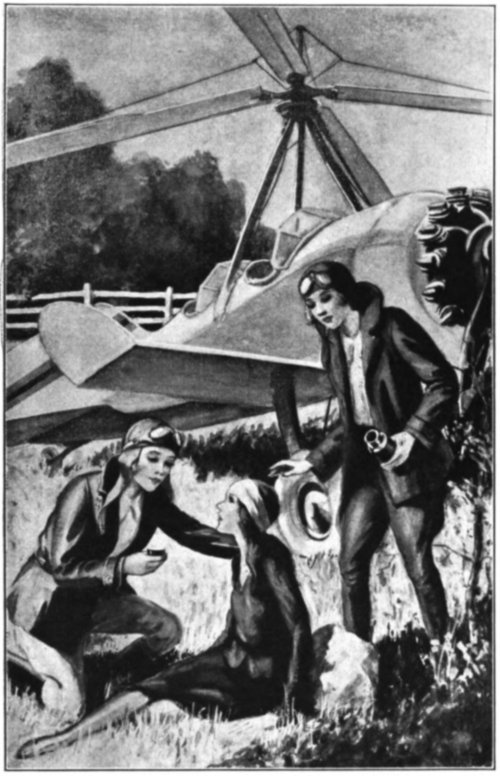
Linda nodded; luckily her autogiro didn’t need
a special field. She descended and brought it to a
stop, not far from the injured girl. She and Dot
climbed out, dashed over the field to the road, and
picked up the victim in their arms. She was a
young girl, possibly about fourteen years of age,
whether dead or merely unconscious, they could
not tell. Blood was running from her head.
12
“We’ll carry her over beside the autogiro, and
apply first aid,” said Linda. “Luckily I have all
sorts of supplies with me—and water.”
She was a pretty girl, except that there was
something decidedly pathetic about her whole appearance.
Her clothing was not ragged, but dreadfully
out of style; her straight hair hung about
her temples without any attempt to make it becoming.
It was neither long nor short, and had no
ribbon, no pin of any kind to keep it out of her
eyes. Her sweater looked like a man’s, and her
skirt was evidently handed down from an older
woman. Her whole body was so thin that she
looked almost emaciated. Her face was a blank
white, with no make-up to relieve the pallor.
Linda bound up the wound, and after some minutes
the girl finally opened her eyes. Deep, black
eyes they were, that appeared huge in such a small,
colorless face, eyes that gazed at the girls without
any understanding.
“How do you feel now?” asked Linda, still
kneeling beside her, and offering her water from
a thermos bottle.
The girl raised her eyebrows, and muttered a
feeble, “All right.”
13
Meanwhile, Dot ran over to the road to see
whether there wasn’t a car somewhere in sight.
But there was neither a car nor a house. It was
a barren stretch of country—she didn’t know
where.
It was a lonely place indeed for a poor helpless
girl to have such a dreadful accident, through no
fault of hers. But now that she was conscious,
surely she could tell them where the nearest town
was, so they could take her to a hospital.
Linda, too, was realizing that they could not
hope for a machine to come along, that they would
have to take the girl with them in the “Ladybug.”
She was just about to ask her who she was, and
where she came from, when she was startled by
the very question from the girl herself.
“Please tell me who I am, pretty lady,” she
said, pathetically. “I can’t seem to remember anything.”
Linda gasped.
“I don’t know. My friend saw the accident from
the air—from our autogiro, while we were flying.
You were walking along the road, and a car
swerved at you going eighty miles an hour. I think
the driver was crazy, or drunk, for he almost
seemed to drive right at you. And he didn’t even
stop.... So we landed our plane, to look after
you.”
“What was I doing on the road?”
14
“Just walking.... Look in your sweater pockets.
Maybe there’s a letter, or something.”
“You look—please. I’m so tired,” sighed the
girl, and her eyes closed.
Linda searched frantically, hoping that the girl
would not die without their even finding out who
she was. But the search was of no avail; the pockets
of her sweater were full of nothing but holes.
Dot returned from the road and glanced questioningly
at the girl, and then at Linda.
“Unconscious again?”
“No, I’m all right,” replied the stranger herself,
wearily opening her eyes.
“Have you thought of your name yet?” inquired
Linda.
“No, I haven’t. My head hurts so. Please take
me to a hospital!”
Between them, Dot and Linda managed to get
her to her feet, and helped her into the autogiro,
where she sat on Dot’s lap in the passenger’s
cockpit. Linda started the motor.
“Ever been in a plane before?” asked Dot, as
the “Ladybug” taxied.
The girl shook her head.
15
Linda consulted her map. She did not know
where she was, but as she had flown almost directly
west from Lake Michigan, she decided to
fly east. If they did not pass another town, they
could land at Milwaukee.
It was growing late—they had spent more time
on the ground than they had realized, and Linda
felt uneasy. If darkness came on before they
reached a town, the girl might die before they
found a hospital. And besides, Linda’s Aunt
Emily, who was always worrying about her, would
be sure that she had been kidnaped or killed.
The girl in Dot’s lap seemed perfectly inert as
the time passed, until the sun set. Then she uttered
a queer moan.
“Does your head hurt?” asked Dot, in her ear.
“Yes—but that isn’t it. I’m—I’m—afraid!”
“Of an airplane? I can assure you that you’re
with one of the best pilots in the world!”
“Oh, not that! I’m not afraid of flying!”
“What then?”
“Of the dark,” she whispered, fearfully. “Of—ghosts!”
Dot looked at the girl as if she were crazy. In
these modern times—how had she been brought
up? If she were a child of six, it would have been
different. She wondered whether she could have
understood her correctly, the motor was making
so much noise. She bent over and asked her to repeat
what she had said.
16
“Ghosts!” replied the girl. A frightful shiver
ran through her whole body, so intense that Dot
could feel it in hers. She thought the girl was
delirious.
“There’s no such thing, my dear,” she reassured
her, patting the shaking frame.
“Oh, yes, there is! And I mustn’t be out alone
at night! Never!”
“Put your head on my shoulder, and try to go
to sleep,” urged Dot, comfortingly. “We’ll soon
be at the hospital.”
But it was not so soon as she hoped. They flew
on and on, without seeing any lights that would
indicate a city. And all the while the girl continued
to sob.
At last, however, they glimpsed bright lights
ahead, and Linda flew low enough to read the signs
of Milwaukee. She followed a huge beacon light
that led to an airport, and brought her autogiro
down to earth.
While she wired to her aunt at Green Falls that
she and her companion would have to spend the
night at Milwaukee, Dot succeeded in finding a
taxicab, which they all took to the nearest hospital.
17
The girl was perfectly conscious when they were
admitted, but when the authorities asked for her
name, she still could not give it.
“I don’t remember anything,” she said; “before
these ladies were bending over me on that
country road. Except about a ghost that I see and
hear at nights.”
Dot looked helplessly at the doctor.
“She isn’t an idiot, is she, Doctor?” she whispered.
“No, no! It’s a case of loss of memory—after
concussion. Brought on by that blow on the back
of her head.”
“But why the ghost?”
“That is some memory that is vivid enough to
pierce through the fog which is surrounding her
past life. It is a good sign—when one fact remains,
the others are more likely to follow.”
The nurse was ready to take her to her bed,
when the girl uttered a wail that was pitiful to
hear.
“Don’t leave me!” she begged Linda and Dot.
“You are the only friends that I have in this
strange world. And in the other world there is that
frightful ghost!”
18
Impulsively, Linda bent down and kissed her affectionately.
“You must let the nurse take care
of you now, dear—and be a good girl. We have to
get some supper. But we’ll be back to-morrow.
We promise.”
“If that specter doesn’t carry me off to-night!”
“He can’t carry you away from the hospital,”
replied the nurse, smilingly. “We never let ghosts
into the hospital.”
“Never?”
“Absolutely not.”
The girl seemed reassured, and Linda and Dot
returned to their taxi, to find a hotel where they
could spend the night.
“Did you ever hear of anything so queer in all
your life?” demanded Dot. “Or anything more
pitiful?”
“We’ll have to do something, Dot,” said Linda,
thinking seriously. “We’ll buy all the papers to-morrow
and look for the names and descriptions
of missing persons. We’ve just got to find that
kid’s parents.”
“If she has any.”
“What makes you say that?”
“The way she was dressed. As if nobody in the
world cared a bit for her.”
“That’s sure. But she must live somewhere. She
couldn’t exist in the woods, on berries, or on that
lonely stretch of country where we found her.”
19
“Well, let’s try to forget her for the time being,”
urged Dot. “Here’s the hotel, and I certainly
am hungry.”
“So am I. But I wish we could dress for dinner.
Dot, we always ought to carry some extra clothing
on these trips, because we never know when we’re
going to need it.”
“Oh, what’s the dif, Linda? These suits are becoming,
so what do we care?”
They went to their room and took off their
sweaters and helmets. When they had washed their
faces and combed their hair, they were so presentable
that no one even noticed them as they entered
the dining room. After all, it was a common
sight to see girls in knickers.
The dinner was delicious, and they ate it with
great enjoyment, but neither girl could get the
accident out of her mind, or the pathetic child—for
she seemed like only a child to them, with her
strange superstition. So they decided, when they
finished their meal, to call two of the Milwaukee
newspapers, and to give them the story, with their
own names as references.
“And may we print yours and Miss Crowley’s
pictures, Miss Carlton?” asked the delighted reporter.
“We have them on file, you know.”
Linda groaned.
20
“How is that going to help identify this girl?”
she demanded. “It’s her picture you ought to
print.”
“We would, if we had it. We’ll get it later. But
your pictures will call attention to the article....
However, we don’t wait for permission in a case
like this, Miss Carlton. You’ll just have to grin
and bear it!”
21
Chapter II The Lost Girl
When the young girl whom Linda and Dot had
rescued opened her eyes in the hospital the following
day, it was a strange world which she
looked upon. It was as if she had been abruptly
transported to another planet, where her name
and her past life were forgotten. She remembered
her hurt head, and the girls who had come down
in the airplane, but her mind was still an utter
blank about the days and years that had gone before.
Her forehead throbbed with pain as she tried
vainly to think. It was horrible, terrifying, to be
stranded in an unfamiliar place like this, without
any money in her pockets, without any home to
go to after she was well. She pressed her fingers
over her eyelids in an effort to bring back something.
But one memory only remained—the dreadful
vision of a ghost!
22
Kind as her nurse tried to be, she seemed like
only a human machine to this unhappy child, who
waited feverishly for the return of Linda Carlton
and Dorothy Crowley—her only friends in
the whole world.
About eleven o’clock they came, carrying a
bunch of roses and a pile of newspapers. The girl
held out her arms in the pathetic appeal of a lost
child, and both Linda and Dot kissed her tenderly.
“How’s the head this morning?” asked Dot,
cheerfully, as she put the flowers into a vase.
“Oh, it’s better—but—” She glanced eagerly
at the newspapers. “Have you looked at those
yet? Has—anybody—reported my loss?”
“I’m afraid not, dear,” replied Linda, sympathetically.
“Only ourselves. But give them time.
If you lived far in the country, as you surely must,
they perhaps couldn’t reach them. But when they
read of the accident, and see the description of
you, they’re sure to come after you.”
“You haven’t been able to remember yet who
you are?” inquired Dot.
The girl burst into tears; the strain of it all, in
her weakened condition, was too much for her.
“No, I haven’t,” she sobbed.
“Try to think about the house you lived in,”
suggested Linda. “The room you slept in—the
dining room—the garden. Shut your eyes and imagine!”
23
“When I shut my eyes, all that I can see is that
ghost! No, no—I’m afraid of darkness.”
“Then try to remember your father or your
mother. Their eyes—their smiles—” put in Dot.
“It’s no use. Oh, what shall I do? Where can I
go after I leave this hospital? I’m—I’m—the most
‘alone’ person in the whole world!”
“But you still have us! We’ll take care of you,”
offered Dot, impulsively. “We’ll take you with us
to Green Falls, where we’re spending the summer,
won’t we, Linda?”
“Of course,” agreed her companion.
The girl smiled happily, but only for a moment.
“It’s wonderful of you—but I can’t stay. I’ll
have to go somewhere soon—and where shall it
be?”
“I’ll tell you what we’ll do,” said Linda
brightly. “After you have a visit with us, and get
strong, we’ll get you some kind of job—taking
care of children or something. And you can be
studying something to support yourself. Stenography
or typing—in case you can’t find your parents.
How would you like that?”
“Fine! Only I don’t know what those words
mean—Sten—sten——”
24
Linda and Dot looked at each other and smiled.
What could they do with a girl like this? It was
too much for them to solve the problem alone, but
perhaps Miss Carlton could offer a wise suggestion.
The girl stretched out her arms helplessly.
“Oh, I know I’m dumb!” she exclaimed. “But
please don’t give me up!”
Yet she wasn’t stupid, or uneducated, for she
used perfect English, and the girls noticed when
she ate her lunch, which the attendant brought her
on a tray, that her table manners were of the best.
She had evidently been brought up correctly by
someone.
“We won’t!” Linda assured her. “We’ll come
back for you to-morrow morning, and if the doctor
says that you can leave the hospital, we’ll take
you with us in our airplane.” She purposely didn’t
use the word “autogiro,” for fear of confusing
her.
“Now get a good rest this afternoon,” she
added, “and look for us bright and early in the
morning.”
It was a promise, of course, for Linda and
Dot felt as if this young girl was their special
responsibility. A most inconvenient promise,
however, for it meant remaining another day in
Milwaukee.
25
“Are you sure that you have enough money,
Linda?” asked Dot, as they returned to their hotel
for lunch.
“Oh, plenty,” was the reply. “That’s not what’s
worrying me. It’s Aunt Emily. She won’t like it
a bit. Still, she wouldn’t want us to leave a helpless
child. I’ll call her up, instead of sending another
wire.”
“Why not fly home across the lake this afternoon,
and come back to-morrow?” suggested Dot.
“For two reasons. One is, I want to give the
‘Ladybug’ an inspection to-day, and the other is,
Aunt Emily might not want us to come back. She
might suggest that we just send the girl some
money. But that poor little lonely thing needs
friendship more than she needs money.”
“True. But how shall I put in my time while you
go over the ‘Ladybug?’”
“Take in a picture show. Or stop back at the
hospital.... We can do something together to-night.”
The afternoon passed all too quickly for Linda
at the airport, but when she left at six o’clock,
she had the reassurance that her autogiro was in
perfect condition. She had taken double precaution
this time, for she did not want to run the risk
of the slightest mishap with this strange forlorn
girl in her care.
26
Her aunt accepted the explanation which Linda
offered that evening over the telephone, interrupting
her three times to ask her whether she and
Dot were surely all right. Early the next morning
the girls sped to the hospital in a taxi, to find
their little charge bandaged and dressed, ready for
departure.
“We’ll fly north along the shore of the lake—or
maybe over the water, since you love that, Dot—and
land opposite Green Falls for our picnic
lunch. Then we’ll fly straight across Lake Michigan
to home.”
“Home!” repeated the little girl wistfully. How
wonderful it must be to have a home—a place to
go to, where somebody cared for you!
But by the time she and Dot had squeezed into
the passenger’s cockpit of the autogiro, she was
smiling excitedly. She had been too much dazed on
the other flight to enjoy it, but now she found it
a thrilling adventure. Her head still hurt, but not
enough to spoil her delight. How lucky she was,
she thought, to have found two wonderful friends
like these girls!
“You are not afraid, dear?” shouted Dot, above
the noise of the engine.
27
“Oh, no! I love it!” Her black eyes were shining,
and there was even a faint color in her cheeks.
“You have heard of airplanes before, even if
you haven’t heard of typewriters, haven’t you?”
The girl nodded, with intelligence.
Conversation was difficult, and the girls relapsed
into silence, until Linda brought the
“Ladybug” down on the western shore of Lake
Michigan, presumably opposite Green Falls,
where the girls spread out their picnic lunch.
Then it seemed as if all three of them wanted to
talk at once.
“We’ve got to get you a name,” announced Dot,
as she unwrapped the chicken sandwiches which
she had secured from the hotel. “If you can’t remember
your own, we’ll have to give you one!”
“Don’t you suppose you’d recall it if you heard
it?” asked Linda.
“I don’t know,” replied the girl, dubiously.
“Mary? Elizabeth? Jane?” suggested Dot.
“Dorothy? Elsie? Emma?” added Linda, at
random.
But the girl’s memory was still a blank.
“Just give me one—anything you like!” she
pleaded.
28
“All right, that’ll be fun,” agreed Dot, cheerfully.
“I always thought it would be more exciting
to name a real person than a doll.” She was making
an effort to keep up the girl’s spirits.
“What’ll it be, Linda?”
“Amy!” cried the latter. “After Amy Johnson,
you know. I think she’s the most courageous
woman flyer in the whole world to-day! She went
from England to Australia all alone, and then
went up into Siberia.”
“She certainly ‘goes places,’” laughed Dot. “I
like the name of ‘Amy,’ too.” She turned to the
girl. “Does it suit you?”
“Why consult me?” returned the latter, with
humor. “Did you ever hear of anybody’s being
asked about the name she got?”
Linda and Dot both laughed, and Dot gave
“Amy” a hug.
“These sandwiches are wonderful!” exclaimed
Linda. “Dot, you sure do know how to get good
food.”
“Wait till you see the caramel cake I wheedled
out of that chef at the hotel. He had made it for
a special party, but I convinced him he’d have to
make another.”
“You’re marvelous!” cried her chum, admiringly.
29
Little Amy simply couldn’t say anything. She
had never tasted food like this before—at least, if
she had, she couldn’t remember. She ate daintily,
not greedily, for she wanted it to last a long
time.
“Amy had better stay with me at Green Falls,”
decided Linda; “because there’s more room at our
bungalow.” She and her aunt lived alone together,
except for occasional visits from her father, who
had a business in New York, while Dorothy Crowley
was a member of a large family.
“O.K. with me,” agreed the latter. Then, turning
to Amy, “You’ll love Linda’s Aunt Emily.
She’s the most motherly soul.”
“You’re sure it is all right for me to go with
you?” asked the girl, plaintively.
“Of course it is!” Linda assured her.
An hour and a half later, they arrived at the
Green Falls Airport, and were surprised to find
Ralph Clavering, Linda’s most devoted admirer,
patiently waiting for them with his car.
“Welcome to our city!” he cried, rushing towards
the girls as they climbed out of the autogiro.
“Safe and sound!” Then he stopped, surprised
at the sight of the queerly-dressed child
at their side. He frowned, and muttered to himself,
“Look what the cat—or rather, the ‘Ladybug’—dragged
in!” But aloud he said nothing besides
his greeting.
30
Linda introduced her little friend as “Miss
Johnson,” and they all got into his car.
“Kidnaped?” inquired Ralph, as he started the
engine.
“Who?” replied Linda. “Dot or Amy—or me?”
“Oh, I don’t know. I always expect something
like that when you don’t show up when you’re
expected—Linda, guess what? I’m getting a
plane!”
“An airplane!” repeated Linda, excitedly. “But
you weren’t to have one till you graduated from
college.”
“I know. But I convinced Dad I had to have one
to follow you around on your wild-goose chases,
all over the globe.”
“Now, Ralph, don’t be silly!”
“It’s the honest truth. That’s the reason I’m
getting one.”
Linda blushed; she never could accustom herself
to this wealthy young man’s obvious devotion.
His parents were millionaires, and all his life
Ralph had had everything he wanted. Until he met
Linda Carlton. He had asked her to marry him as
soon as she graduated from High School, but she
had refused, saying that such a thing was out of
the question until he was through college. Besides,
she was too much in love with her “Ladybug” to
be in love with any man. But Ralph went on asking
at regular intervals, just the same.
31
“What kind?” she inquired.
“An autogiro. I’m rather keen on them, and
Dad and Mother think they’re the safest, so
they’re rooting for them, too.”
“I think that’s perfect! And you have your
pilot’s license, too.” Ralph Clavering had taken
instructions in flying the same time that Linda
had, more to be with her than because he was actually
air-minded. But when his father had refused
him a plane of his own, he had lost his enthusiasm.
It was only a few minutes’ ride from the airport
to the Carltons’ bungalow. Miss Emily Carlton
was waiting anxiously on the porch.
“Linda dear!” she exclaimed, as her niece ran
up the steps. “I was so afraid something had happened.”
“But I told you everything was all right last
night, Aunt Emily!”
“Yes, of course. But you never can tell what
may happen in the meantime.”
Linda patted her arm reassuringly, and took
hold of Amy’s hand.
32
“This is Amy, Aunt Emily—the girl we rescued.
We want to go upstairs now, and change our
clothing. I think Amy can wear some of my sports
things—they’d be short—And Ralph,” she
added, turning to the young man, “can’t you stay
to dinner?”
“No, thank you, I must get back. But there’s a
dance over at Kit’s to-night—may I come and get
you?” Kit was his sister, one of the first girls in
Linda’s group to be married, soon after graduation
from High School.
Linda hesitated, and looked inquiringly at Amy.
She hated to go off and leave her alone the first
night, yet obviously she could not take her.
“Yes, go, Miss Linda,” the girl urged her immediately.
“I am so tired that I want to go to bed
soon after supper.”
“O.K. then,” agreed Linda, as Dot and Ralph
left together, and she hurried upstairs with Amy.
“Don’t call me ‘Miss Linda,’ Amy,” she said.
“I’m only eighteen. And you must be fourteen,
aren’t you?”
To her dismay the girl burst into tears.
“I don’t know,” she said. “I don’t know anything—Linda.”
“Well, don’t worry about it. It’ll be all right
soon—everything will come back to you.”
Amy shuddered.
33
“Maybe it would be better to forget. I told you
about the ghost—and though there isn’t anything
else definite, I just have a horror of the past. It’s
vague——”
“It’s the strangest thing the way you seem to
use all sorts of words one wouldn’t expect of a
girl of your age,” interrupted her companion,
“and then don’t know what others mean. Like
stenography and typewriting, for instance.”
“By the way, what are those things?” asked
Amy, wiping away her sudden tears.
“Oh, business terms—I’ll explain later. Clothes
are more important now. We must hurry with our
dressing, and get back to Aunt Emily—Let’s see—my
tennis dress ought to do——”
It was a white pleated silk, quite short, and
fitted Amy nicely. Linda took time to curl the girl’s
hair, and to put a ribbon around her head, to hide
the bandage. She was amazed to see how really
attractive the girl was, when she was dressed in
becoming clothing.
“The shoes don’t fit, but you can wear them for
the rest of to-day,” she concluded. “To-morrow
we’ll drive into town—there aren’t any stores in
Green Falls—and get you some to fit.”
“I don’t know why you do all this for me, Linda.
I never did anything for you!”
34
“But you would if you could. And we love you,
Amy. Aunt Emily does, too, and you must think
of us as your own family, until you find your parents.”
Linda was right about her aunt; the motherly
woman took Amy right to her heart, and when
Linda left with Ralph soon after supper, for
dances were informal and began early in Green
Falls, Miss Carlton was teaching the young girl
parchesi, and they were laughing and chatting like
old friends.
35
Chapter III Planning the Treasure Hunt
“Who is this Cinderella you brought home,
Linda?” asked Ralph, as the young couple started
for the party. “You sure fixed her up some since
this afternoon.”
“She’s a girl we picked up in the road,” Linda
explained. “Didn’t Aunt Emily tell you why we
were staying over in Milwaukee?”
“No; only that some friend was in the hospital.
I didn’t get the details. All that I was interested
in was when you’d be back.”
Briefly, Linda told him the story of the accident
and of the girl’s loss of memory, adding that
“Amy” was a fictitious name which they had
given her, until she should recall her own.
“I mean to find her family if I have to search
the whole United States!” she concluded.
“And if you have to give up your own summer
vacation in the bargain,” muttered Ralph, sulkily.
“You would, Linda!”
36
“But it’s exciting! Like reading a mystery
story, you know.”
“You’ll get into trouble, I warn you.”
“If I do, I’ll get out again,” she returned,
lightly. “I have a charmed life.”
“I wouldn’t count on that too much if I were
you.”
“Tell me who will be here to-night,” urged
Linda, seeing that Ralph was getting irritable over
her newest adventure.
“Only half a dozen couples, I believe. Mostly
the old crowd—you and Dot and Sue Emery and
Sarah Wheeler—and those two married girls Kit
is so thick with—Madge Keen and Babs Macy.”
“Why don’t you tell me which boys?” teased
Linda, with a twinkle in her eye. “Don’t you think
I’m interested?”
“I hoped you weren’t. Now that your friend
Jackson Carter has gone back South where he belongs,
with that fascinating drawl of his, I rather
hoped I’d have you to myself.”
“Well, I’m going to the party with you!”
“Yes, but that doesn’t say it’ll be more than
two minutes before some fellow cuts in. Why in
the name of peace and enjoyment they always invite
more fellows than girls to a party is something
to make me wonder.”
37
“It’s to make us happy—to make us seem popular,”
explained Linda.
“Nobody has to make you seem popular!” he
returned, morosely.
“Tell me the boys, Ralph!” she repeated.
“Men, my child—not boys! Why, three of ’em
are married. And the rest of us would like to be,”
he muttered, under his breath.
But he refused to tell her; she’d find out soon
enough for herself. Her first discovery, when
Ralph stopped his car at his sister’s, proved to be
one of her oldest friends, Harriman Smith, a
young man whom she had not seen for several
months. He dashed down the steps to greet her.
“Harry!” she cried, in delight, pressing his
hand in genuine pleasure. It was he who had stood
by her, believed in her, when nobody else but her
chum, Louise Haydock, had thought she could fly
the Atlantic Ocean.
“Linda! It’s heaven to see you again!” he exclaimed.
“Hello, Ralph,” he added, shaking hands
with her escort. “How’s tricks with you?”
“O.K., Harry. When’d you get here?”
“Half an hour ago. By plane.”
“You have a plane?” demanded Linda.
38
“No—be yourself, Linda! I’m a poor working
man. No, I came with Kit’s husband—Tom Hulbert.
I have a couple of weeks’ vacation, and decided
I’d like to spend them with the old crowd.
I’m staying with the Hulberts.”
Linking arms, all three entered the bungalow
together, which was much larger and more luxurious
than most of the cottages at Green Falls,
for Kit’s wealthy father, Mr. Clavering, had presented
the young couple with it soon after their
marriage. A small orchestra of three pieces had
been hired for the dancing, to take the place of
the usual radio music, and the large living room
was easily able to accommodate twice the number
of couples Kit had invited.
As Ralph had surmised, although there were
only seven girls, five extra young men had been
asked to the party.
Tiny Kit Hulbert, dressed in a fairy-like dance
costume of pale-green chiffon, floated over to greet
the newcomers.
“I hear you’ve had another adventure, Linda,”
she said. So timid herself that she had given up
learning to fly after a few feeble attempts, she
nevertheless had a great admiration for the other
girl’s skill and courage.
39
“It isn’t finished yet,” replied Linda. “We’re
in the middle of a mystery. I’ll tell you all about
it, Kit, when Ralph isn’t around. He’s rather fed
up.”
“I’ll say I am. How soon can we dance, Sis?”
asked the young man, impatiently.
“Right away,” agreed Kit, nodding to the violinist
in the corner to start the music.
The supper, served informally on the big porch
that evening, was early; for the Hulberts had an
exciting piece of news for their guests, and they
could hardly wait for the opportunity to tell it. As
soon as everybody was seated, Tom Hulbert, who
was a lieutenant in the U. S. Flying Corps, and
an excellent pilot, called for attention.
“Our next party is going to be a wow!” he
began.
“They always are,” interrupted Sue Emery,
enthusiastically.
Tom bowed. “Thank you, Miss Emery,” he said,
formally. “But this is absolutely different—entirely
new! Kit’s father is giving us a treasure
hunt. By airplanes!”
“Airplanes!” gasped everybody at once.
Linda’s eyes shone with excitement. What a
novel idea!
“But most of us can’t go!” whined Sue Emery.
“We’re not pilots!”
40
“Sure you can. Mr. Clavering’s going to rent
a lot of planes, so anybody with a pilot’s license
to fly can enter, and take a passenger. And there’s
a bully prize—Oh, I’m not going to tell what it is!
And a dinner at the end of the hunt—maybe a
week-end party!”
“Here’s where we girls with licenses score!”
cried Dot, triumphantly. “We can do the inviting,
for once!”
“As if you didn’t always do the picking and
choosing!” muttered Ralph. He would have his
autogiro by that time, but, of course, Linda Carlton
wouldn’t go with him. Not an independent
young lady like her!
“I’m not worried,” drawled Jim Valier, Dot’s
devoted boy friend, as he reached for his sixth
chicken-salad sandwich, although so far he had
only eaten one. “Dot’s got to take me—and I won’t
have to do any work. Just share the glory!”
Dot’s chin went up in the air.
“I believe I’ll ask a girl—they’re more reliable,”
she retorted. “Sue, will you go with me?”
Sue whimpered; she would rather go with a
man, but an invitation was an invitation, and she
didn’t want to be left out.
“I’d hate to be so mean to Jim,” she replied.
“You better let him go.”
41
“You come with me, Miss Emery,” urged Frank
Lawlor, the young man who was seated at her
right, and who was an experienced flyer.
“Thank you—I’d love to, Mr. Lawlor,” she
murmured, gratefully.
“When is this exciting event to take place?”
asked Harriman Smith, wondering whether he
would be there to enjoy it.
“Next Saturday,” replied Tom Hulbert. “Entries
must be in by Wednesday.”
Linda was silent; suppose she were too busy
looking up Amy’s parents to take part! Oh, but
that wouldn’t be fair! She simply couldn’t miss
this. Surely her Aunt Emily would look after
Amy.
As if reading her thoughts, Kit asked her
whether she would be able to go into it.
“You better stay home, Linda,” advised Jim
Valier. “So we get a chance at the prize!”
“Don’t be silly,” she replied. “You’ll all probably
have speedier planes than my ‘Ladybug.’”
The plan was so fascinating that nobody wanted
to start dancing again. Instead they sat and talked
and talked, until long past midnight. It was after
one o’clock when Linda finally reached home—a
late hour for an informal party at Green Falls.
42
Her aunt was waiting up for her, but she did
not seem to be at all worried. As long as the autogiro
was in the hangar, Miss Carlton felt safe
about Linda.
Ralph left her at the door, and the girl made no
mention of the treasure hunt. Instead she inquired
about Amy, and asked that she herself be allowed
to sleep late the following day.
Remembering the request, Miss Carlton did not
call her to the telephone although it rang four
times the next morning for Linda, before she was
awake. Two impatient young men—Harriman
Smith and Ralph Clavering—each called twice to
no avail.
Finally, about ten o’clock, Linda put in her appearance
at the breakfast table. Miss Carlton and
Amy had long since finished theirs, and the little
girl was reading a story in the hammock on the
porch. Miss Carlton, however, came and sat with
her niece as she ate, and gave her the news.
“Which boy are you going to call back, dear?”
she asked.
“Neither,” laughed Linda, as she complacently
ate her cantaloupe. “I haven’t time for young men
to-day, Aunt Emily.”
43
“You aren’t going anywhere in that autogiro,
are you?” Try as she did, the older woman could
never keep the note of fear from her voice when
an airplane was mentioned.
“No, no, Auntie. It’s about Amy. I want to do
things for her. And I want your help.”
Miss Carlton heaved a sigh of relief. This was a
different matter.
“First we must get her some decent clothing.
And then don’t you think we ought to get her picture
to the newspapers, and her description to the
radio, so that her people can come and get her?”
“Of course! My, but it is sad, for a child like
her to lose her memory. It’s bad enough for an
older person, but it just seems pitiful for anyone
her age.”
“Oh, I haven’t a doubt but that it will come
back,” said Linda, hopefully. “The doctor at the
hospital said it was probably only temporary, from
that blow on her head. Sometimes another blow
will restore it, he told me, but, of course, that
wouldn’t be safe on account of her cut. Publicity
is the thing we need now.”
“What will you do? Run in to town?”
“No, I don’t think that tiny newspaper office
would do any good. So I thought if you’d take her
and superintend getting the clothing, I’d take my
roadster and go on to Grand Rapids.”
44
“Yes, that will suit me perfectly. Only why
don’t you take Harry or Ralph with you? I’d feel
safer, for that’s quite a distance.”
“All right, Aunt Emily. If either of them comes
over in time.”
“Either of whom?” demanded a masculine voice
from the living room, as the screen door banged.
“Speaking of angels!” returned Linda, turning
about to greet Ralph Clavering.
“It’s about time you got up, Lazy Betsy!” he
teased. “Did your aunt tell you I phoned twice?”
“Yes. Sit down and have some coffee, Ralph.
You must have rushed through your breakfast!”
“Rushed! I’ve been up since eight o’clock!”
“Virtuous soul— But what’s on your mind
now?”
“The treasure hunt. Dad wants you to help Tom
Hulbert and me with the arrangements. It’s going
to be ticklish business.”
“What treasure hunt?” inquired Miss Carlton.
She was usually more delighted over Linda’s social
affairs than the girl herself.
“By airplanes!” replied Ralph, excitedly.
“Isn’t that a whiz of an idea?”
“Oh, no! No!” gasped Miss Carlton, in terror.
“No, Ralph! That is worse than foolhardy! Oh,
my boy, you’d all be killed!”
45
“Not if we plan the thing thoroughly. Start at
different places—good fields to land——”
“I beg you not to do it!” she wailed, prophetically.
“Think of the tragedy it may bring about!
Whose idea was it, Ralph?”
“Dad’s—and Kit’s.”
Miss Carlton shook her head mournfully. “I
thought your father had more sense, Ralph. But
does your mother approve?”
“Mother’s away for a couple of weeks. Went
to Bar Harbor to visit Aunt Kate—her sister, you
know. So naturally she won’t be consulted.”
“I can never give my consent to it,” stated
Miss Carlton, nervously.
“Wait till we get our plans ready. You may
change your mind—Now, Linda, can you help
me?”
“I’m afraid not to-day, Ralph. I have to do
things for Amy. Maybe to-morrow.”
“Too late,” he said, almost gruffly, as he rose
and went to the door. “I might have known you
would have your own affairs. Never mind, I’ll get
Dot!”
Linda went towards him and patted his arm.
“Don’t be cross, Ralph. Think of the child’s
parents. How frantic they must be! I’ve just got
to do something.”
46
“Oh, I suppose you’re right. And noble. You
always are!”
“I don’t see why you bother with anybody you
think so holy and righteous,” remarked Linda,
pulling down the corners of her mouth.
“Now children, don’t quarrel,” put in Miss
Carlton. “You can blame it on me, Ralph. I refuse
to let Linda have any part in this absurd treasure
hunt.”
“Then what’s the use of having it?” demanded
Ralph.
“Very sensible conclusion,” agreed Miss Carlton.
“Give it up, and plan a nice picnic instead.”
“A nice, old-fashioned one! And take our bicycles?”
“You run along, Ralph,” said Linda, “and get
Dot and Jim to help you. I really must get ready
to go to Grand Rapids!”
So, putting the treasure hunt temporarily from
her mind, she ran out to the porch to tell Amy
about her plans for the day.
47
Chapter IV A Stranger at Green Falls
“Big doings to-day, Amy!” announced Linda,
cheerfully, as Ralph Clavering departed. “Come
on—get ready!”
“What?” demanded the girl, excitedly. “You
haven’t heard from anybody who—wants—me?”
Her eagerness was pathetic, and Linda stooped
over and kissed her.
“No, there is no news as yet. But we are going
to try to make some. I’m going to take your picture
and give it to the newspapers.”
“Oh, I see!” Plainly, Amy was disappointed.
“Do you really think it’s any use, Linda? If there
were anybody to claim me, wouldn’t they have
come three days ago?”
“I don’t know—not necessarily. Suppose they
didn’t read the newspapers?”
“If they didn’t then, why should they now?”
asked Amy, with keen logic.
48
“Well, their friends might tell them. Besides,
only our pictures—Dot’s and mine—were in before,
and now we’re putting in yours. And we’re
having it announced over the radio.”
“What is a radio?” inquired Amy.
“Come inside and I’ll show you. But wait, first
let me get these snapshots of you. Stand over
there, and look pretty!”
The girl smiled and did as she was told. To her
knowledge she had never seen a picture taken before.
“It’s funny,” remarked Linda, as she took out
her roll of films from the camera, “that you remember
how to read. You didn’t have any trouble
understanding that story, did you?”
“Some,” confessed the girl. “There were lots
of things I hadn’t heard of. But I don’t think it’s
my memory, Linda—I think I just never did hear
of those things.”
“You must have lived in the country,” concluded
the other. “Somewhere around where we
picked you up. I think maybe the best idea of all
would be to try to fly back to that spot, and hunt
for a house. We’ll do that next week, if Aunt Emily
is willing.”
“Next week! Linda, I feel as if I had no right
to stay on and on here——”
49
“Of course, you have. And you’re going to have
a wonderful time to-day. Aunt Emily is taking you
into town to buy you some clothes.”
“But I can’t pay for them!”
“You’re not supposed to. They’re presents. Like
Christmas presents. You’ve heard of them, I suppose?”
“Yes! Yes!” cried Amy, excitedly. “You hang
up your stocking—and—and—sometimes there are
cookies——”
Linda’s eyes shone.
“You have a memory, Amy! You have! Think
some more!”
“I can’t,” sighed the girl. “That’s all.”
“But something did come back! Run along and
get ready now, for Aunt Emily’s waiting—and I
must answer that telephone.”
The caller proved to be Harriman Smith, and
Linda immediately told him of her plans for the
day, inviting him to go with her to Grand Rapids.
Harry replied that he could be at the bungalow
in five minutes, and he was punctual to the dot.
He did not tell Linda that the Hulberts’ cars
were both out, and that he had run the whole distance.
“I sure am a lucky guy,” he said to Linda, as
he got into the roadster beside her; “to get ahead
of Ralph Clavering like this.”
50
“Oh, Ralph’s busy planning the treasure hunt,”
she replied. “And that reminds me, Harry, if I
am allowed to take part in it, will you go as my
passenger?”
“I’d be thrilled!” he cried enthusiastically.
“But why do you say ‘if,’ Linda? Surely after you
flew the Atlantic Ocean alone, your Aunt Emily
couldn’t object to a trifle like a treasure hunt?”
“I know; it doesn’t seem logical. But don’t forget
that I flew to Paris before I had all those disasters
in the Okefenokee. She’s more timid than
ever now. And besides, I guess she doesn’t like the
idea of the hunt—all those planes going to the
same place, with the danger of collisions. And
some of the flyers are only beginners.”
“Who are planning to enter?”
“I haven’t heard definitely. But, of course,
Ralph and Dot and I will all enter. And there are
Tom Hulbert, and Madge Keen’s husband, and
Frank Lawlor. That’s six, at least. I don’t know
whether there’ll be any strangers or not. It’s just
a Green Falls affair, but I suppose anybody that
Mr. Clavering knew could get in all right. I’m going
to be dreadfully disappointed if I can’t enter.”
“You don’t really think there’s much chance?”
51
“I’ll tell you what I’m counting on, Harry; that
Daddy will come home, and he’ll tell Aunt Emily
to let me go. You know he’s the best sport that
ever was; he isn’t afraid of taking a few risks.”
“And he has a lot of confidence in your flying,”
added Harry. “That is the trouble with your aunt,
I believe. If she had ever gone up with you, and
had seen for herself what a marvelous pilot you
are, she’d feel differently.”
“Thanks, Harry,” said Linda, pleased at the
compliment, for when Harriman Smith said anything,
he meant it. He was not given to idle praise.
“I do so wish I could get her to go.”
There were so many things to talk about—Linda’s
summer adventure and her new autogiro;
Harry’s college course and the job he was holding
on the side, that they reached Grand Rapids before
they knew it. Harry insisted that they have
the pictures developed while they ate their lunch,
and wait until afterwards to visit the newspapers.
It was with great difficulty that Linda convinced
the city editors that they should publish Amy’s
pictures instead of her own. But at last she succeeded,
and added a description of the man who
had been the cause of the accident. Harry visited
a broadcasting station at the same time, that the
news might be given out over the radio. By three
o’clock they were ready to start back to Green
Falls.
52
Not satisfied with merely the day with Linda,
Harry tried to date her for the evening.
“Will you go to the tennis matches with me
after dinner?” he asked. “At the Club, I mean.
You’re not in them by any chance?”
“Oh, no, I’m not nearly good enough. I was
beaten early in the tournament. But Dot Crowley’s
in the finals, and so is Jim Valier.”
“They always were good. Well, how about it,
Linda? I’ll get a taxi, if Tom doesn’t offer me his
car. They’ll probably go over in Kit’s.”
“Thank you, Harry, but I think I better not
make any plans until I see what Aunt Emily and
Amy are doing. I left them last night—and I want
to be with them to-night. So you go with Tom and
Kit, and if I can, I’ll see you there.”
“And promise me at least two dances?”
“Oh, certainly,” she agreed.
Fifteen minutes later she parked her car in the
garage behind the bungalow, and ran in to see
what success Amy and her aunt had had. The girl
was dressed in everything new from head to foot;
her hair, too, had been cut and waved becomingly.
She was dancing around the living room in excited
happiness. All her cares were forgotten for
the time being, in the joy her new clothing afforded
her.
53
“Don’t I look wonderful, Linda?” she cried.
“Like a different girl? Miss Carlton has been a
real fairy godmother!”
“You certainly do, Amy! Oh, Aunt Emily always
knows just the right things to buy!”
The young girl’s eyes suddenly grew wistful,
and she frowned. “I think, Linda, that I must have
been very poor, because I am sure I never had
clothes like this before.”
“Your clothes were different, dear,” Linda admitted.
“But you may not have been poor. Perhaps
it was only because you lived far out in the
country—away from the stores. And maybe your
mother didn’t know how to sew, or was an invalid——”
“I don’t believe I have a mother,” replied
Amy. “You couldn’t forget a mother—like—like
your Aunt Emily. No, I feel sure my mother is
dead.”
“Well, we’ll soon solve it all,” Linda reassured
her, and proceeded to recount to her what she and
Harry had accomplished that afternoon.
“Would you like to go to the Club to the tennis
matches after dinner, Amy?” she asked.
“What kind of matches?” The girl looked inquiringly
at an ash tray on the table.
54
“Not that kind of matches!” laughed Linda, following
her gaze. “You know what tennis is, don’t
you?”
Amy shook her head, and Linda explained as
best she could.
But though the girl knew nothing about the
game, she was eager to go to the Club, so that she
could display her new clothing. Miss Carlton arranged
for an early dinner, and they all decided
to drive over in Linda’s roadster.
Green Falls was a small resort, and Linda and
her aunt knew practically everyone there. As they
seated themselves on the wide veranda which overlooked
the tournament court, they nodded and
smiled to the other spectators on all sides. Dot
Crowley came out of the Clubhouse, and stopped
to ask Linda to wish her luck, for she was playing
against Sarah Wheeler in the girls’ finals.
As she left them to take her place on the court,
Lt. Hulbert came over to the Carltons, bringing a
stranger with him. The visitor was an exceedingly
attractive man of perhaps thirty-five, perfectly
dressed, obviously a person of wealth and distinction.
Linda thought he might be an ambassador,
or perhaps a doctor or lawyer.
55
“Linda,” said Tom Hulbert, “I want to present
a gentleman who is very anxious to meet you,
who has heard of your wonderful exploits, and
who is something of a flyer himself. Miss Carlton,
let me introduce Lord Dudley, of England.”
Linda blushingly held out her hand, and Tom
proceeded to introduce the titled foreigner to Miss
Carlton. Not knowing Amy, he did not include her,
but he noticed that the man was looking at her.
“I hear your praises sung wherever I go, Miss
Carlton,” Lord Dudley said, with an engaging
smile. “Not only in your own country, but in England,
France,—even Germany. You are a very
famous person.”
“It is very kind of you to say that,” replied
Linda, embarrassed as usual at the praise. “But
tell me about your own flying. Have you your
plane here?”
“No, it’s being repaired—I left it in England.
I drove up here in a hired motor.”
“It’s too bad you haven’t your plane,” said
Linda. “For we are to have a treasure hunt by
airplane on Saturday.” She glanced shyly at her
aunt, who was frowning. “But you can use one of
Mr. Clavering’s——”
The tennis matches were to begin immediately,
for Dot and Sarah were shaking hands with formality,
and the umpire was mounting his stand. So
Tom drew his friend away to the seats which
Kitty was saving for them.
56
“I’ve seen that man before!” cried Amy, excitedly.
“Where? When?” demanded Linda, hopefully.
Was another memory coming back?
“I don’t know.”
“But if he had known you, he would have said
something,” remarked Miss Carlton. “I was going
to introduce you, dear, but I didn’t get a
chance.”
“Oh, that’s all right!”
“He looks like Ronald Colman,” remarked
Linda, after some thought. “Yes, that’s it. You’ve
seen him in the movies, Amy.”
“What are movies?” asked the girl, to Linda’s
and Miss Carlton’s amazement.
There was no time to explain, for the tennis
match had begun, and Linda was anxious not to
miss a single play. But all the while she was thinking
of the titled Englishman whom she had just
met; later in the evening, when the dancing began,
she unconsciously searched the room for him. But
he had evidently left early, for she did not see him
again.
57
Chapter V A Flying Engagement
At seven o’clock the following morning, just as
the cook was putting on her apron, the door bell
of the Carltons’ bungalow rang sharply.
“Beggar probably wants his breakfast,” the
woman muttered, as she slowly went to the door.
But there were few beggars at Green Falls, and
they always came to the back door.
A blond, freckle-faced young man, without any
hat, stood on the porch, grinning shyly. At the gate
was the most dilapidated-looking Ford she had
ever seen.
“Good morning,” he said, briskly, and the cook
would never have suspected from his bright,
cheery tone that he had been driving all night.
“I’m a reporter from the Grand Rapids Star,
and I want to see Miss Linda Carlton just as soon
as possible.”
58
“Miss Linda ain’t seein’ no more reporters,”
replied the woman, flatly. “She seen enough a
couple of weeks ago to last her the rest of her
life.”
“But I want to help her,” insisted the young
man. “Help her find the lost child’s parents.”
“Oh! That’s different. Come along in, and give
me your card.”
Smiling happily at his success, the young man
entered the living room.
“Had your breakfast?”
“Why—er—I had some coffee in a thermos
bottle.”
“You could eat some?”
“I’ll say I could!”
“All right. Set down there and read the paper
while I fix some. I don’t want to wake Miss Linda
jest yet.”
The cook kept him waiting an hour, but she rewarded
him with such a breakfast as he could not
have bought at the best hotel. The choicest honeydew
melon, griddle cakes, home-cooked ham,
coffee, and even fried potatoes. It made the
young man think of the meals his mother cooked
on the farm.
Just as he was finishing his second cup of
coffee, Miss Carlton appeared, followed immediately
by Linda and Amy.
59
The boy stood up and flushed a vivid red in a
vain effort to murmur apologies and explanations.
It was plain to be seen that he was from the country,
and that this was his first newspaper job.
“My name’s Michael O’Malley,” he finally said,
producing a card from his pocket. “And the paper
is going to give me a tryout on this story; I can
stay as long as I like, provided I get something interesting.”
He was talking very fast now, almost
as if he were afraid to stop, lest Miss Carlton put
him out. “You see, I’m crazy about detective
stories, and this seems like a chance to do some
real sleuthin’. If we can only find the young lady’s
family, and run down that guy that ran her
down!”
Linda smiled. She couldn’t help liking the boy;
he was so sincere, so earnest, so eager to please.
“Sit down again, Mr. O’Malley,” she said;
“while we eat our breakfast, we’ll talk it over.”
“Thank you, Miss Carlton,” he breathed, reverently.
He treated Linda as if she were some sort
of goddess.
“And have some more griddle cakes,” urged
Miss Carlton, hospitably. She, too, liked the boy.
He grinned.
60
“You know, they taste exactly like my mother’s!”
he exclaimed. “I never found anybody who
could make ’em like this except her. We lived on a
farm, you see—and there were five boys. And
maybe my mother couldn’t cook!”
“Now,” continued Linda, after her aunt had
seen to the boy’s wants, “there really isn’t a whole
lot to do. I’m sure we’ll get a phone call from
Amy’s parents to-day, for they’ll be crazy to get
her back, and must be watching the papers. The
only ‘detective’ part of the story is to find that
man. After all, it probably was only an accident,
but still, he ought to be punished.”
“What did he look like?”
“Well, you see we were up in the air, and
couldn’t get a very good look at him. But he wore
no hat, and he had an immense amount of gray
hair—and, I think, whiskers. I know it seems
funny that a man his age should be driving so
fast.”
“What kind of car was it?” demanded the reporter.
“Gray—and open. But I couldn’t tell you the
make, or anything more in description. It all happened
so quickly, and it shot away before we could
really see it.”
“You didn’t even get the state or the license
number?”
“No, of course not.”
61
Mr. O’Malley sighed.
“Looks pretty hopeless. But do you mind if I
stick around here to-day till Miss Amy’s parents
show up? I’d like to be on tap with that much of
the story.”
“We’ll be glad to have you,” replied Miss
Carlton, hospitably. “Stay until to-morrow if you
like, Mr. O’Malley, as our guest.”
“Oh, thank you, Miss Carlton!” he answered
gratefully. “It—you—make me feel so at home,
and I’ve been kinda homesick in Grand Rapids.
And—would you call me ‘Mike,’ please?”
“Certainly, Mike,” agreed his hostess.
“And I’ll see that you get the story of our
treasure hunt for your paper,” added Linda, generously.
“A treasure hunt by airplane.”
“Gee Whitakers!” cried the boy, enthusiastically.
“That is something new!”
Miss Carlton frowned, but said nothing. Amy,
too, was silent. She could not be hopeful like the
others of hearing from her parents, for she felt
sure that there were no parents to hear from.
The telephone rang, and Linda jumped up
eagerly, hoping that it meant good news for Amy.
To her amazement she heard the fascinating voice
of Lord Dudley at the other end of the wire.
62
“Good morning, Great Aviatrix!” he said.
“This is one of your many admirers—Claude Dudley.”
Linda flushed; this was going to be more exciting
than news of Amy’s family.
“Good morning, Lord Dudley,” she replied.
“I am going to ask you a big favor, Miss Carlton,”
he said. “I have to get back to Chicago to-day,
and I was wondering whether you would take
me across Lake Michigan in your autogiro. We
could lunch at the Lakeside Inn—a place that I
know to be particularly charming.”
Linda’s heart beat rapidly; no young man had
ever been able to thrill her like this before. How
flattered she was to have him call upon her!
“I’d love to, Lord Dudley,” she replied, slowly.
“But you must wait until I ask my aunt’s permission.”
“Well! Well!” he exclaimed, in amazement. “I
didn’t know modern girls did that any more!”
Linda laughed.
“This girl does. Will you hold the wire, Lord
Dudley?”
“Certainly, Miss Carlton. Your favor is well
worth waiting for.”
Linda put down the telephone and turned to her
aunt, repeating the conversation.
63
“We don’t know anything about him,” remarked
the older woman. “But he seemed like a
gentleman. And Tom Hulbert introduced him, so
I guess he is all right. If your autogiro is in perfect
condition, I suppose I am willing.”
Linda turned to her young guest.
“Do you mind if I go off, Amy?” she inquired.
“Not a bit, Linda. I want you to have a good
time.”
So Linda returned to the telephone and promised
to be ready at half-past eleven.
She would not admit to herself how thrilled she
was, but she selected her prettiest dress, and was
ready for Lord Dudley some minutes before his
taxi arrived. She ran out on the porch to meet him.
“We must keep the cab,” she said, as she shook
hands with him, and noticed that he was even
better looking than she had thought, “in order to
get to the airport.”
“Right,” he agreed, giving the necessary directions
to the driver.
“Now you must tell me all about yourself, Miss
Carlton,” he said, as he seated himself beside her
in the cab. “I mean the things that haven’t been
in the papers.”
64
“There really isn’t anything to tell,” replied
Linda, modestly. “I’m just an ordinary girl, with
a high-school education and a year at a ground
school, where I earned my transport pilot’s license.
The only thrilling thing about me is my
‘Ladybug’—that’s the name of my autogiro.”
“I know something more thrilling than any of
those things,” he said, with his engaging smile.
“Something the newspapers have never been able
to describe— Your flawless beauty!”
Linda flushed to the lobes of her ears at the
compliment; it didn’t seem possible that a young
man like this, who had been everywhere and met
thousands of beautiful girls, could find her so attractive.
Yet there was a note of sincerity in his
low, deep voice that prevented any doubt.
“I wish you would tell me about yourself, instead,”
she urged, anxious to change the subject.
“About your family in England, and how you happened
to come to America.”
“There isn’t much to tell about that, either,” he
replied. “There is an old castle at home, but I’m
afraid it wouldn’t interest you. It’s so run down.
It needs lots of money spent on it. My father is an
old man, and it has been the dream of his life to
see the castle in good order again, with the gardens
well kept, as they were in years gone by. So
I have come to America to try to make some
money.”
65
The smile which was usually on Lord Dudley’s
lips had vanished, and his eyes grew wistful. What
a wonderful man he was, Linda thought, to put
his father’s wishes above everything else!
“Here is the airport, Lord Dudley,” she announced.
“We’ll have to postpone our conversation
until we get to the tea room. You can’t talk
in an autogiro.”
“No; I realize that. But how interesting it will
be. I have heard of Cierva, the inventor, in England,
and I even saw him once on one of my trips
to Spain, but I have never flown in an autogiro.”
“You’ll get the thrill of your life!” Linda promised.
“I got the thrill of my life last night,” he said,
and Linda could not help knowing that he was referring
to his meeting her.
She gave the “Ladybug” a hasty inspection, although
the head mechanic at the airport assured
her that it was in perfect condition. Lord Dudley
shouted his admiration of its quick take-off into
the air, and settled himself comfortably for the
beautiful flight over the lake. Linda, too, found the
trip delightful; in the dreamy mood that she was
experiencing, she was almost glad that they could
not talk. Was it possible, she wondered, that at last
she had fallen in love?
66
As Lord Dudley had promised, the Inn was
charming, and the luncheon excellent. Linda was
sorry when it was over, for it meant parting from
her fascinating companion.
“I can never thank you enough, Miss Carlton,”
he said in a low tone, as he took her hand into
both of his for a moment. “And—may I come
back again?”
“Oh, yes, indeed!” she answered, with eagerness.
“When I do come back, I—I—will just have to
ask you something—Linda, my dear. I know I
shouldn’t—I am a poor man—but—” He hesitated,
and leaning over, pressed a kiss on her hand.
Then, without another word, he put her into her
autogiro.
Her heart in a turmoil, Linda mechanically
started her motor and flew away. Lord Dudley’s
meaning was clear, but what was the answer?
Could she possibly decide so quickly whether she
loved him or not, whether she was ready to give
up everyone else for his sake, even her own country,
to cast her lot with his? It was too much to
think about; she was thankful when she reached
home to be able to put the question aside in favor
of Amy’s problems.
67
She ran up the steps hopefully, wondering
whether there was any news, and she found Amy
and Mike in their bathing suits and rain coats, all
ready for a swim.
“Haven’t you heard anything?” she demanded
eagerly. “No phone calls?”
“Only from other reporters,” sighed Mike, and
Amy suddenly burst out crying.
“I must be an orphan,” she sobbed. “That is
why you and Miss Emily seem so wonderful to
me, Linda. I am sure that I never knew anybody
like you in my past life.”
“Don’t give up yet, dear. If you had been in
an orphan asylum, the authorities would have
claimed you long ago. Maybe your family is poor,
and can’t get the money immediately. Please don’t
cry—you don’t have to make a pool of tears like
Alice in Wonderland to swim in. There’s a marvelous
lake this side of the falls!”
“Alice in Wonderland!” repeated Amy, slowly.
“I’ve heard of her.”
“Of course you have. I’ll hunt up a copy of the
book, and see what it recalls to you. Now if you
wait five minutes for me, I’ll get into my bathing
suit and go along with you!”
68
Fifteen minutes later the three young people
parked the roadster at the shore of the lake, and
joined the others in bathing. Linda introduced
both Mike and Amy to everybody, so that the
strangers felt quite at home.
Ralph Clavering immediately took possession
of Linda.
“Where were you to-day?” he demanded. “I
expected you to play tennis with me.”
“I thought you were angry at me, Ralph,” she
returned, demurely.
“I was, but the worst part of it all is, I can
never stay angry. Are you going to enter the
treasure hunt?”
“I sort of hope so. Aunt Emily hasn’t said anything
against it lately, and I was flying to-day.”
“Flying! Where?”
“Across Lake Michigan.”
“Alone?” This jealous young man always felt
that he had a right to know of all Linda’s engagements.
“No; I took Lord Dudley across.” She tried to
keep her tone matter-of-fact.
“How you girls fall for titles!” he almost
sneered. “I don’t like the man.”
“Men never do admire handsome men,” Linda
answered, slyly.
69
“If you call him handsome!— Well, you have
to give us to-morrow. Kit’s expecting you to
lunch.”
“O.K.,” agreed the girl, disappearing with a
swan dive into the lake.
70
Chapter VI The Telegram
“I hear you have made a new conquest, Linda!”
Tiny Kitty Hulbert, Ralph Clavering’s married
sister, sat on the edge of the diving board the following
morning and talked to Linda, who was
watching the newspaper reporter, Mike O’Malley,
trying to teach Amy to swim. But the young girl
was terribly frightened, and was not making
progress.
Linda blushed and smiled.
“I wouldn’t say that, exactly——”
“But it’s true,” said Kitty. “I never saw anybody
more thrilled than Lord Dudley. He thinks
you’re just about perfect.”
“When did you see him?” asked Linda, trying
to keep her voice calm. This was Wednesday, the
day after her flight across the lake, and incidentally
the last day for the contestants to register
for the treasure hunt.
71
“Oh, we haven’t seen him since you did yesterday,”
returned Kitty. “But I heard about the
flight before he left, and he seemed awfully excited.
Just like a kid of sixteen, in love for the
first time.”
Linda blushed; so other people had noticed it,
too! She wondered if it would be the talk of Green
Falls.
“Have you known him long, Kit?” she inquired.
“No. One of Tom’s friends—John Kuhns—met
him in a railroad station, just after he had landed
from England, and he seemed so sort of lost and
lonely that he entertained him. His family liked
him so much that they invited him to their summer
place, and then suddenly changed their plans
and went abroad instead. So John asked Tom to
look out for him, and that is how we happen to be
entertaining him at Green Falls. I was kind of
scared at the idea of royalty, but he seems just
like anybody else.”
“I wonder how old he is,” mused Linda, more
to herself than to Kitty.
“Too old for you, dear,” replied Kitty. She
knew how much Ralph cared for Linda, and she
hated to see him suddenly cut out by a foreigner
with a title, charming as Lord Dudley was.
“You’re not serious about him are you, Linda?”
72
“Oh, I like him,” replied the other. “I guess
all the girls do— By the way, Ralph invited me to
your house to lunch to-day. Is that right?”
“Yes indeed, I’m expecting you. And you know
it’s the last chance to register for the hunt. You’re
entering, aren’t you?”
“I hope to. I’m going to pin Aunt Emily to a
definite answer before I come over to-day. I must
go in now, Kitty, for I see that Amy is tired of
swimming. She’ll want to go home in a minute.”
“Haven’t her parents turned up yet?”
“No, they hadn’t when we left.”
“It seems queer.”
“Yes, it does. I’m really worried about her now.
If she could only remember!”
“Well, as long as your Aunt Emily is taking
care of her, she’ll be all right. Now go along—get
your swim, and I’ll see you at one o’clock.”
Linda dived into the water, but she did not swim
long. Amy was standing still, up to her neck,
clinging nervously to Mike’s hands. Though the
sun and the air were warm, she seemed to be shaking
all over.
“Miss Amy’s scared to death,” announced
Mike. “She acts like a person who has never gotten
over a drowning scare.” He turned to the girl.
“Have you ever been drowned, Miss Amy?”
73
The girl burst out laughing at the absurdity of
the question, and seemed her normal self again.
But she was glad that Linda suggested that they
all go home.
They entered the house with the usual hope, a
hope which was gradually dying now, of hearing
from Amy’s family. But Miss Carlton had to tell
them again that no one except her own friends
had telephoned. Linda hurried off to dress for the
luncheon at Kit’s.
“Where are you going, dear?” Miss Carlton
asked her, half an hour later, when her niece appeared
in a new dress, a flowered chiffon, which
she would hardly have worn for lunch at home by
themselves.
“I’m going to Kitty’s, Aunt Emily. To help
plan for the treasure hunt. You—you don’t mind
if I take part in it, do you? I have to let them know
to-day.”
Miss Carlton sighed.
“I suppose it would be unreasonable to try to
keep you out,” she admitted. “But I am so afraid
of crashes with other planes. It is just like driving
a car—much safer where there is no other traffic,
for you never can tell what the other people will
do.”
74
“I know. But I’ll be careful, Aunt Emily. And
Ralph and Kitty are so anxious for me to go into
it.”
Miss Carlton weakened; as usual the mention of
the Claverings had a softening effect upon her.
She liked Linda to be with them, to take part in
the social affairs of her young friends.
“All right, dear. I agree, though I really don’t
approve.”
Linda kissed her.
“But you never do approve, even if I only go
up in the air for half an hour,” she teased.
“I thought I was growing used to it, till those
awful things happened to you in the Okefenokee
Swamp.”
“But it was thieves, not airplanes, that caused
all the trouble. It might have happened if I had
been riding horseback.”
“True. Have your own way, dear.” But Linda
could tell by her voice that she wasn’t angry.
Ten minutes later Linda parked her roadster in
front of Kit’s bungalow and ran up the porch with
the good news. Kit and Dot, Ralph and Mr.
Clavering were all sitting on the big couch hammock,
poring over a map.
“We have to fly over Lake Michigan!” announced
Dot, proudly. “Isn’t that marvelous?”
75
“Perfect,” agreed Linda, glad that this hunt
was not to be a “play” flight of a few miles or so.
A hundred miles as a beginning—that ought to be
thrilling.
“The first landing is to be the Milwaukee airport,”
said Mr. Clavering. “That is all I am going
to tell you. The seven planes are to leave Green
Falls at ten o’clock Saturday morning.”
“Seven?” repeated Linda. “Who are the
seven?”
Fumbling in his pocket, Ralph produced a typewritten
list. He read it aloud.
“1. Tom and Kitty Hulbert.
2. Dot Crowley and Jim Valier——”
“So you’re taking Jim after all!” interrupted
Kit. “I thought you said he was too lazy.”
Dot smiled.
“I guess I was only teasing,” she admitted.
“To continue,” said Ralph.
“3. Bert and Madge Keen.
4. Frank Lawlor and Sue Emery.
5. Joe Elliston and Sarah Wheeler——”
“Joe Elliston!” cried Linda. “Since when has
he become a flyer?”
“He just received his private pilot’s license last
week,” explained Ralph. “He hasn’t a plane of his
own, but Dad’s renting one for him.”
76
“I guess I’m taking a chance,” remarked Mr.
Clavering. “But the plane’s insured.”
“And you and I are the sixth and seventh,
Linda,” concluded Ralph. “May I ask who your
passenger is to be?”
“If you tell me who yours is,” she countered.
“I am going alone.”
“Oh, I see. Well, I’m taking Harry.”
“Not Lord Dudley?” inquired the young man,
with a gleam of jealousy.
“Oh, no. I promised Harry.”
“Lord Dudley thinks he’s going with you,” remarked
Kitty. “He expects to be back.”
“Then why doesn’t he take a plane and enter,”
sneered Ralph. “I’ll bet he’s not so much of a
flyer as he makes out to be.”
“How you love him!” remarked Kitty, rising
to greet Madge Keen, who was the last of her
guests to arrive.
“Now come to luncheon,” added the young
hostess, with a nod to the maid who was waiting
for the signal. “You must all be starved after
your swims.”
77
A simple affair like this was always a party at
Kitty Hulbert’s, for the young matron had such
beautiful things, such lovely flowers, such trained
servants that she enjoyed displaying them. The
table was arranged as elaborately as if a banquet
were being served.
As usual, Linda found herself seated next to
Ralph, and she began to talk to him immediately,
to take his mind away from the subject of Lord
Dudley.
“Has your autogiro come yet?” she inquired.
“No, but it’ll be here to-morrow. Want to go up
on a test flight with me, Linda?”
“Of course I do!” she replied eagerly. “I think
it’s wonderful that you’re getting it, before you
even graduated from college.”
“Now Linda, don’t rub it in,” replied the young
man. Although he should have completed his
course at Harvard the preceding June, there had
been a condition in mathematics, which kept him
from getting his degree. His father had wanted
him to go to summer school, but with his usual
lazy attitude towards life, Ralph had refused. He
was just as well satisfied that he did have to return
in the fall; it would be more fun to hang
around college than to buckle down to his father’s
business.
“I didn’t want to be mean,” apologized Linda.
“Only you know you weren’t supposed to get a
plane of your own till you graduated.”
78
She stopped talking; Kitty was taking a telegram
from the maid, and glancing at Linda. What
was it? For her? News of Amy—or a message
from her father?
“This is for you, Linda,” said her hostess. “I
do hope it isn’t bad news.”
“Maybe it’s something about Amy,” she said
expectantly, and all eyes were on her as she slit
open the envelope.
But as she read the message, a vivid blush
spread over her face, and she felt as if the others
about the table must know what it contained.
“Am returning to-night with Tom for my
answer. Love. Claude.”
“Why Linda! What’s happened?” demanded
Dot, in surprise.
“Nothing, nothing,” she murmured, in confusion.
“Nothing’s wrong. It’s—just a personal
message.”
“Not about Amy?”
“No.”
There was an embarrassed silence, and Kitty
came to the rescue by leading the conversation
back to the subject of the treasure hunt.
79
“I’m allowed to tell you this much about it,”
she added. “Everybody flies to Lake Winnebago
after the hunt for a big celebration. Dad’s rented
an entire Inn for the week-end, and all our
parents are invited to be chaperons.”
“And will the prize be awarded then?” asked
Dot, more to keep the conversation away from
Linda than because she wanted to know.
“No. The lucky pilot finds the prize for himself—after
following the directions he receives.”
“You better say ‘she,’” remarked Ralph, “for
I think it’s a great deal more likely that Linda or
Dot will get it, than any of us fellows.”
Linda forced a smile, but her mind was not on
the conversation. Even the treasure hunt had lost
its interest; she longed to get home, where she
could be alone to think things out.
The party broke up at last, and she managed to
get away without even an explanation to Dot of
the mysterious contents of the telegram.
She paused in the living room of her own bungalow
only long enough to give Mike O’Malley the
facts and the names of the contestants in the
hunt, for the young man was returning to Grand
Rapids. With a sigh of relief, she rushed up to
her own room, and locked the door, there to try
to come to some decision.
80
But the conclusion she came to was not at all to
Lord Dudley’s liking, as he learned to his dismay
after supper, when he came over to take her
canoeing.
“My plan is this, Linda dear,” he said, as they
pushed off from the shore: “Take me as your
passenger in the hunt on Saturday—win the prize,
as, of course, you will—and instead of returning,
simply elope in the autogiro. We can wire your
aunt from the nearest city, wherever that happens
to be, when we are married. Doesn’t the romance
of that appeal to you?” he asked, rapturously.
Linda slowly shook her head.
“I couldn’t, Lord Dudley——” she began.
“Please call me ‘Claude!’” he pleaded.
She smiled.
“Well, then—Claude—I couldn’t. First of all,
I’ve promised to take Harriman Smith on the
flight——”
“Shucks!” he interrupted, abandoning his usual
dignity.
“And besides, I couldn’t be so mean to Aunt
Emily. She would hate it—and she’d have a right
to. No, Claude, I’m not willing to marry you on so
short an acquaintance. A year from now—or possibly
six months—I don’t know.”
The man stopped paddling and regarded her
helplessly.
81
“It’s because I’ve told you I’m only a poor
man,” he said, thinking immediately that money
had something to do with her refusal. “And
you’re an heiress!”
Linda opened her eyes wide in amazement.
“What makes you think I’m an heiress, Lord
Dudley?” she asked, forgetting to use his first
name. “Really—we’re not rich.”
“But the newspapers said you were. And that
big prize you won, flying the Atlantic alone——”
The man’s surprise was evidently as great as
Linda’s.
“Yes, I have that—invested in bonds. But
$25,000 isn’t a fortune. And I haven’t anything
else, except the money I sold my Bellanca for,
which Daddy put into a trust fund for me, in case
his business fails. No, Lord Dudley, I really expect
to earn my own living.”
“I see,” he replied, and he could not keep the
bitter disappointment out of his tone. “That is
why we had better not risk it?”
82
He seemed content to leave it at that, and Linda
was silent. As a matter of fact, money had never
entered into her consideration of the marriage.
The idea of leaving her aunt, her friends—especially
Harry and Dot, and even Ralph—to go to a
strange country had been a much more vital drawback.
Charming as he was, Lord Dudley was only
a stranger.
“Let’s forget it, and talk about something
else,” she suggested, quietly. “Tell me why you
don’t go into the treasure hunt yourself. It’s going
to be lots of fun.”
“I’m too busy,” he replied irritably, as one
might speak to a child. “I have to get back to
Chicago early to-morrow morning.”
“In that case,” concluded Linda, “hadn’t we
better paddle back home now?”
Without any reply the Englishman turned the
canoe about and silently made for the shore. It
was only half-past nine when he left her at the
steps of her bungalow, refusing her invitation to
come in to see her Aunt Emily.
“And that is the end of him,” Linda thought
as she went quickly to bed, little imagining that
she would ever see him again.
83
Chapter VII The Widow in Black
“Linda, it’s come! My autogiro!” shrieked
Ralph Clavering, bursting into the Carltons’ bungalow,
without even waiting to knock. “And I’ve
had her up already! The man gave me a lesson!”
Linda almost fell down the steps in her wild excitement
at this piece of news. Another autogiro
in Green Falls! Her “Ladybug’s” twin!
“Wonderful! Great!” she cried, seizing both his
hands and executing a dance. “In plenty of time
for the treasure hunt.”
“Yes. Don’t forget that you promised to go up
with me this afternoon!”
“Try and keep me out!” she replied. “I just
can’t wait. I don’t even care about lunch, if you’ll
just give me time to get into my flying suit——”
“What’s this? What’s this?” demanded Miss
Emily Carlton, entering the living room with Amy
at her heels. “You’re not going to go without
your lunch, Linda!”
84
“Then may we have ours right away?” pleaded
her niece. “Ralph and I, I mean?”
“Yes, I suppose so. Only do be careful, Linda,
with a new plane. Are you quite sure all the parts
are there?”
Ralph smiled.
“The autogiro couldn’t have arrived safely,
Miss Carlton, if it hadn’t been perfect. You see
they don’t deliver planes in trucks—they fly ’em!”
“All right, then,” agreed the older woman,
grudgingly. “Then I’ll go and see about lunch.”
It was a thrilling afternoon for Linda, and even
more pleasant for Ralph, in the possession of his
first flying machine. Together they went over to
the airport and took the new autogiro into the
skies, first with Linda, then with Ralph at the controls.
In the joy of flying Linda forgot for the time
being all about the queer experience of the preceding
day with Lord Dudley. She was Linda Carlton
the aviatrix to-day, interested in nothing but aviation.
She even forgot about Amy until she returned
to the bungalow at supper-time, and found the
little girl waiting wistfully on the porch all alone.
Linda knew from her expression that no one had
telephoned.
85
“Nobody cares about me except the newspaper
reporters,” she remarked the following day—the
Friday before the treasure hunt—when still nothing
had happened, and no one had come to claim
her. “And even they are beginning to lose
interest.”
“Not Mike O’Malley!” replied Linda, cheerfully.
“I had a letter from him to-day—he’s arriving
this morning. He expects to drive that
battered Ford of his over to Lake Winnebago, to
be in at the finish of the hunt.”
Amy sighed; she had not been included in the
plans for the event, although Miss Carlton had
been invited for the week-end at the Inn. The girl
would have to be left in care of Anna, Miss Carlton’s
competent cook.
“I wish Mike would stay here with me,” said
the girl. She didn’t add that she would be lonely;
it wouldn’t be grateful to these wonderful people
who were doing so much for her.
“Mike has work to do for his paper,” replied
Linda.
Scarcely had she finished the sentence when the
Ford stopped at the gate, and the young man, sunburned
and grinning, jumped out. He felt almost
as if he were coming home, to be back again at the
Carltons’.
86
“Hello, everybody!” he cried merrily. “Here
I am—all ready for the big hunt!”
“It’s more than I am,” replied Linda. “I’ve got
to spend the whole day going over the ‘Ladybug.’
But come on in, Mike—I’ll get you something to
eat. Of course, you’re hungry?”
“You said it!”
“And as soon as you finish eating, you better
take Amy swimming. Aunt Emily went shopping,
and I have to go to the airport, so I’ll be glad if
you can keep Amy from being lonely.”
“O.K. with me,” he agreed, following Linda
into the dining room. “By the way, Miss Carlton,
any change in plans, or contestants, for the treasure
hunt?”
“Not that I know of,” she replied, as she hunted
some buns and milk for the boy, who ate hungrily,
as usual.
Suddenly he stopped eating, and peering towards
the living room, listened intently.
“Do my ears deceive me, or is somebody snitching
my Lizzie?” He jumped up and ran to the
living-room window.
“No, I think that’s the station taxicab,” replied
Linda. “Its engine sounds like a boiler factory.”
“Almost as loud as an airplane’s!” teased Mike.
87
“Who is it, Linda? Who is that getting out of
the cab?” demanded Amy holding the other girl’s
arm tensely. “Do you know her?”
“No,” replied Linda, as she watched a woman
in black who was coming up the porch steps.
“She’s a stranger to me—oh—maybe—Amy, do
you remember her?” She peered anxiously into the
younger girl’s face.
The latter shook her head sorrowfully.
“No, I don’t. Not a glimmer—not even a vague
memory, like I had when I saw that man at the
tennis matches.”
“What man?”
“Lord Somebody——”
“Oh! Lord Dudley. But you saw him afterwards.
He was here——”
“No, I never happened to be around. And I
couldn’t remember anything about him anyway.
But I feel positive I never saw this woman.”
The girls were standing close together, Amy
still clinging to Linda’s arm, when Mike opened
the screen door to the stranger’s knock.
The woman hesitated a moment, and stepped
inside, looking quickly about the room. With a
bright smile of recognition, she came over to
Amy.
88
“Helen darling!” she exclaimed, pushing Linda
aside and kissing Amy gushingly. “Oh, I’m so
thankful to have you safe!”
Tears came to Amy’s eyes, but she could not
pretend that she remembered the woman.
“Who—are you?” she stammered.
The woman looked shocked.
“Helen! Can’t you remember me? I am your
Aunt Elsie—I’ve cared for you ever since your
mother died. Oh, surely, dear—” She looked helplessly
at Linda.
“Helen—we call her ‘Amy’—has lost her memory,”
explained the latter. “You see she was hit
on the back of the head by a car. But surely you
read about it in the papers?”
“Yes, yes. But I thought that she would recognize
me,” wailed the woman hysterically, wiping
tears from her eyes. “She disappeared about two
weeks ago—we live in a little town in Montana—and
I was almost crazy with fear. Then I read
about this girl being hit by something—it was an
airplane, wasn’t it?—and I came on to Grand
Rapids, and a newspaper man there showed me
the picture.”
Mike swelled with pride. That must have been
his newspaper!
“It was a car she was hit by,” corrected Linda.
“An airplane rescued her.”
89
“You don’t say!” exclaimed the woman. “I
heard it the other way about. Well, we’ll prove
that later. Now, come along, Helen.”
But anxious as the girl had been for people of
her own to claim her, now that this stranger had
done so, she was afraid to go. She did not like the
woman.
“What is my other name?” she questioned,
without making any move to obey her.
“Tower—Helen Tower. I am Mrs. Fishberry.
Can’t you possibly remember, dear?”
The girl shook her head.
“Couldn’t I stay here a little longer—Mrs. Fishberry?”
she asked.
“Certainly not.” The woman looked annoyed.
Amy clung to Linda, her whole frame shaking
violently.
“She must have been unkind to me before,” she
sobbed. “You know I felt that there was something
to be afraid of in my past life. Oh, Linda,
please keep me till that doctor who is treating me
can make me well! I’ll work and repay all you
do for me!”
“Of course, we’ll be glad to, Amy, dear,” replied
Linda, reassuringly. “Just so long as you’re
content to stay!”
90
“That is impossible,” interrupted Mrs. Fishberry.
“I cannot allow it for a minute, and will
bring legal proceedings if you try to steal this
child! Come, Helen—the taxi’s waited long
enough!”
Reluctantly Amy started to obey, when Mike
O’Malley stepped forward and held up his hand
like a traffic cop.
“Just a minute! Just a minute!” he said.
All eyes turned towards him instantly.
“You spoke of legal proceedings, Mrs. Fishmarket,
or whatever your name is—what legal
proofs have you that the girl belongs to you?”
The woman winced in surprise, and Amy and
Linda looked at Mike with admiration. How clever
of him to think of that!
The stranger drew herself up haughtily.
“I confess I did not bring legal proofs,” she
said. “I thought that after sacrificing the best
years of my life to bringing up Helen, that she
would know me, and want to come to me. But it
seems that I cannot expect love or gratitude.”
“Well, you can’t expect us to turn her over to a
person she dislikes, unless that person has a right
to her,” returned Linda.
91
“Very well,” concluded the other. “I’ll go.
But I’ll be back with the proofs. And you are
going to be sorry for your insolence, Miss Linda
Carlton!”
With this final remark, she turned and left the
house.
“Whew!” exclaimed Mike, wiping his forehead.
“She’s a hot one. But I think there’s something
fishy about her, besides her name. I don’t believe
she’s your aunt at all, Helen.”
“Don’t call me that!” pleaded the girl. “That
name means nothing to me, and I am used to being
called ‘Amy’ now.”
“All right, dear,” agreed Linda. “Now don’t
think any more about it. You’ll be my adopted sister,
for as long as you like—” She turned to the
boy, “Mike, you are a bright man—I certainly am
thankful we had you here!”
The young man blushed vividly over his
freckles, and suggested that they go on with their
swim as they had planned.
92
Drying her eyes, Amy ran off to get into her
suit, but Linda remained some minutes where she
was, thinking. It was queer—terribly queer. The
woman was so unlike Amy, so different a type, so
common—so really vulgar. Yet Amy was one of
the sweetest, most refined little girls Linda had
ever met; she might almost have been brought up
by her own Aunt Emily, from the training she
showed. Yet if the woman weren’t a relation what
could she possibly want with Amy? The child was
obviously poor; what could be the reason, unless
it were love?
Linda sighed; the problem was too much for her.
So, as she often did with other difficulties, she put
it aside while she flung herself wholeheartedly into
the inspection of her autogiro.
Dressed in overalls, and covered with grease,
but satisfied that her afternoon’s work had been
worthwhile, she returned to the house just in time
for supper. She parked her roadster in the garage
and dashed into the house, hoping to be able to
get to her own room to dress before anyone saw
her. But she was unsuccessful; Harriman Smith
was waiting for her in the living room.
“Hello, Harry!” she exclaimed, laughing.
“Don’t look at me! I’m a sight. But if you’ll just
give me fifteen minutes——”
“You look fine, Linda!” protested the boy,
thinking that her blue overalls were becoming
and that her hair was all the more attractive when
it blew around her face. “You see,” he continued,
talking rapidly, “I’m in a hurry. I’m here because
I have bad news—at least bad for me, though it
will be good news for some other lucky fellow.
I have to go back to work to-night, and that means
I can’t go in the treasure hunt with you to-morrow.”
93
“Oh, I’m so sorry, Harry!” she exclaimed, with
genuine regret.
“Another fellow in the company got sick, and so
they just had to recall me,” he explained. “I
shouldn’t have cared so much if it had happened
Monday, but I was looking forward to this affair
a great deal.”
“I’m awfully disappointed, too,” said Linda,
wondering whether she would go alone or ask
somebody else.
“Thanks, Linda—I really appreciate that.
When there is a whole stag line just dying for the
honor— But Linda, may I ask a favor?”
“Why, yes, certainly, Harry.”
“Don’t take Lord What’s-his-name in my place.
Anybody but him!”
“Why?” asked Linda in surprise, not that she
had the slightest idea of doing any such thing,
but because she wanted to know Harry’s reason.
Unlike Ralph Clavering, Harriman Smith never
stooped to petty jealousy.
“Well—I want to be fair, but—there’s something
slimy about that man.”
“What do you mean?”
94
“Oh, he’s too smooth. None of us fellows like
him. It’s not because he’s an Englishman—I’ve
known several of them, and thought them O.K.,
but—well—he just doesn’t click with me. So will
you take somebody else?”
Linda smiled.
“I wouldn’t take Lord Dudley anyway, Harry,
because he has gone away,” she replied. “But I
really think you’re unfair about him. It’s because
he’s a lot older than all you boys that he seems
so different. He’s halfway between us and our
parents. That sort of makes him a different generation.”
“You do like him, don’t you, Linda?” persisted
the young man, keeping his eyes fastened on her,
fearing her answer.
Linda shrugged her shoulders.
“You needn’t worry, Harry,” she said. She was
silent a moment, thinking of something different.
“I know what I’ll do!” she cried. “I’ll take Amy
with me!”
“Amy!”
“Yes. The kid is crazy about planes. She’s
afraid of a lot of things, like the water, and the
dark, and a strange woman who came here to-day,
but she adores flying. And she hates to be left
alone.”
95
“Well, that’s O.K. with me!” exclaimed Harry,
with a sigh of relief. It was better than he had
expected. “Now I must say good-by, Linda. I
just have time to get supper and catch my train.”
Linda hurried into her bath as soon as the
young man left, and in half an hour she was ready
for supper, when she told Amy her good fortune
about being included in the hunt. The girl was so
delighted that she almost forgot the unpleasant
experience of the morning. But Miss Carlton, who
had listened gravely to the story when she returned
from her shopping trip, was worried.
96
Chapter VIII Amy’s Relatives
The day after Mrs. Fishberry’s visit to the
Carlton bungalow, the woman stepped off the train
at Chicago and took a taxicab to an apartment
house in the center of that city. Ringing the bell
three times, she was finally admitted by a man
about her own age.
“Hello, Ed,” was her greeting.
“Well, Elsie,” he said, questioningly, as she
drew off her gloves and seated herself in a large
leather chair. The apartment was obviously that
of a bachelor, furnished by the hotel, in a style
that one would expect to appeal to a man.
“Did you see the kid?” he asked, as he lighted
a cigarette.
“Yeah. But she didn’t like me. Claimed she
never saw me before, and that I’m not her real
aunt.”
“Well, of course, you aren’t,” he observed, in
a matter of fact tone.
97
“No, but I will be soon—when you and I are
married. You’re surely her uncle, aren’t you?”
“Yeah. No doubt about that.”
“Well, then——”
“We won’t be married till we make sure we get
the money!” he announced, firmly.
The woman looked sulky.
“You’ve got the money, haven’t you?” she demanded.
“The girl’s father is dead, isn’t he?”
“Listen, Elsie,” he said, irritably. “I’ve told
you about this before, but you can’t seem to get
it through your thick head. There were two of
us boys, and the old man. My mother died young.
Well, I was supposed to be a ‘bad egg,’ but my
brother was everything my father admired. That’s
the kid’s father, you see. He married early, but
soon after the child was born he and his wife were
killed in an automobile accident. So, of course,
Dad—the kid’s grandfather—took her to raise.”
“But I’ve heard all that!” interrupted Mrs.
Fishberry.
“Sure you have. But you don’t understand
about the old man’s money. It seems he left a will
hidden in the house, and nobody could find it. And
I happen to know that he meant all his money to
go to the kid, and not a cent to me.”
98
He smiled, in a way that was always fascinating
to women, and Elsie Fishberry smiled, too. How
clever he was!
“Lucky thing for me,” he continued, “that the
will was lost! I might have had to work all these
years!”
“Well, you got the money!” she concluded,
happily. “So it beats me why you want more,
when the old man left a hundred thousand dollars!”
Ed frowned impatiently.
“I tell you I haven’t got it, Elsie! Why can’t
you believe me?”
“Then how is it that you live in luxury while
that kid and her nurse almost starved in that old
house?”
“Because a Trust Company still keeps charge
of the bonds. They won’t hand ’em over to me till
the girl dies, or till the old man’s will is found.
But they give me the income, and I’m supposed to
let the nurse have some of it to take care of the
kid.”
The woman laughed harshly.
“Did you ever give her a cent?”
“Yes. You’d be surprised. I visited the old place
two or three times and gave the woman five dollars.
Once the kid almost drowned in the Fox
River, when I was there.”
99
“I guess you didn’t do anything to save her!”
laughed Mrs. Fishberry.
“No, I can’t say that I did. It would have been
easier for me if she had died. But a couple of
boys happened along and fished her out.”
“Didn’t she yell for help?”
“Sure. But I pretended I was deaf. And that
nurse really is deaf—she’s so old. About eighty,
I figured. She took care of me and my brother—the
kid’s father—when we were children.”
“And where is that nurse now?”
The man shrugged his shoulders.
“Maybe at home—maybe out looking for the
kid.”
“That reminds me what I specially wanted to
tell you,” remarked Mrs. Fishberry. “So long as
they won’t believe I’m the child’s aunt—they call
her ‘Amy,’ you know—we’ve got to dig up some
pictures and records to prove it.”
“You mean you’ve got to dig them up—at the
old house,” corrected Ed. “I’m not going near
the place till Monday, and then I’m going to set
it on fire.”
“Set it on fire!” exclaimed the other, in horror.
100
“Sure. If the Trust Company knows that the
place is burned, they will give up all hope of finding
the will, and hand out the old man’s bonds to
me. After all, I’m the real heir. I’m the son, and
this kid is only a granddaughter, even if Dad did
like her better than me.”
“You’re a wise one,” remarked Mrs. Fishberry,
with admiration. “But suppose that old nurse
happens to be inside—and catches you?”
“I’ve thought of that. I’m going disguised as
an old man, and I expect to work at night, anyway.
Don’t worry, Elsie—I’m not going to bungle
this— But you get those pictures before Monday—they
ought to be in the family Bible and the album
on the parlor table. I’ll map out the directions
how to get to the house.”
“Suppose the nurse is there?”
“If she is, don’t say anything about the kid.
Just tell her that I sent you for the stuff. After
all, I’ve got a right to ’em.”
“And if she isn’t there, how’ll I get in?”
“I’ll give you my key.”
The woman was silent for a moment, thinking
rapidly.
“Listen, Ed,” she said, finally, “if you’re going
to get all that money in bonds from your father’s
estate, let’s give up this other scheme. It’s not
worth it.”
The man jumped up angrily.
101
“Not worth it!” he snarled, and his face was
far from attractive now. “Not worth it for twenty-five
thousand dollars!”
“We may not get it,” she whimpered.
“Oh, yeah? Well, if we don’t, it’ll be your fault!
Because you balled up the works. Listen, Elsie,
did you do what I asked when you were at the
Carltons’? Suggest that you believed it was Linda
Carlton hit the kid with her autogiro, and not a
car?”
“Yeah. I did. But I don’t believe they hardly
took it in.”
“Linda Carlton’ll take it in when we sue her
for damages. I think maybe we better ask fifty
thousand, and then we’ll be sure to get twenty-five.”
“Are you sure Linda has twenty-five thousand?”
“Positive. Didn’t she get that for her ocean
flight?”
“Sure. But maybe she blew it in on clothes,”
suggested the woman.
“Somehow I don’t believe she did,” replied Ed,
with a knowing smile. Then, abruptly he frowned.
“Elsie, you’ve got to get hold of that kid and
take her away somewheres—pretend it’s her old
home. It’s a lucky break for us that she lost her
memory.”
102
“I’ll say so.”
Suddenly Mrs. Fishberry jumped up and darted
over to her host’s chair, seating herself on the
arm.
“Listen, Ed,” she said, coyly taking his hand,
“have you thought that we’ve got to be married
before this suit comes into court, if you don’t want
to appear in it? If I sue for damages, I’ve got to
be the child’s real aunt.”
The man laughed.
“You win, Elsie! O.K. with me. You get those
pictures by Sunday, and the kid too, and I’ll get
the license. We’ll get married Monday morning.”
103
Mrs. Fishberry stood up, satisfied. She had won
everything she wanted. The plan was simple; she
would go out in the country to that old house on
the Fox River on Saturday, and get her pictures
and records. On Sunday she would take them to
the Carltons’, and demand that the young girl
come away with her. She would return to Chicago
and put the child into an insane asylum, from
which there would be no hope of escape. On Monday,
Mrs. Fishberry would be married to Ed
Tower, and after the old house was burned to the
ground, they would go on their honeymoon. When
they returned, they would collect the small fortune
from the Trust Company and proceed to sue Miss
Linda Carlton for the sum of fifty thousand dollars!
She did not see a single flaw in the plan, for if
the young girl was in an asylum, there would be
no one to protest.
104
Chapter IX The Take-Off
“I think Mr. Clavering is too optimistic,” remarked
Miss Carlton at the breakfast table Saturday
morning. “It doesn’t seem possible to me
that all seven planes will come through that treasure
hunt without any mishaps. And if someone is
injured, nobody would feel like having a week-end
party at that Inn.”
“Nothing’s going to happen, Aunt Emily,”
Linda replied, her eyes sparkling with excitement.
She and Amy were both dressed for the flight, and
anxious to get off.
Miss Carlton rose from the table and kissed her
niece good-by. She and half a dozen of the older
folks were going by boat across Lake Michigan,
and then on by automobile to Lake Winnebago,
where the party was to be held.
“I hope you win, dear,” she said. “And don’t
forget to take the lunch Anna has packed for you.”
“We’ll see you to-night, Auntie,” returned
Linda. “At the Inn.”
105
“I sincerely hope so,” answered the other, a
little doubtfully.
In fairness to the contestants, Mr. Clavering had
arranged that the planes start from different
places, so that they would not have to wait long
in turn for their take-offs. Linda and Ralph were
to go early to the Green Falls airport to fly their
autogiros up the shore, to wait until ten o’clock,
the appointed time. Tom Hulbert and Frank Lawlor
were to motor to a town a short distance from
Green Falls, where their planes were in readiness,
while Joe Elliston, Dot Crowley, and Bert Keen
were all to leave from the Green Falls airport.
These last three pilots, with their passengers,
were waiting at the airport when Linda, Ralph,
and Amy drove over about half-past nine.
“Hurry up and get those windmills out of the
way!” ordered Joe Elliston. “They clutter up
the place.”
“And be sure you don’t cheat!” remarked Sarah
Wheeler. “Wait till ten o’clock before you start.”
“As if five or ten minutes would make any difference,”
replied Ralph. “The victor will probably
win by hours, not minutes.”
“I hope there won’t be a thunderstorm,” observed
Madge Keen, who was flying with her husband.
“It certainly is hot.”
106
“I’m dropping out if anything like that happens,”
said Sarah flatly. “I’m not taking
chances.”
Joe looked a little doubtfully at the sky, although
the sun was shining brightly. But, being
an amateur, he was nervous, although he had been
lucky enough to secure a Fleet, which was the
kind of plane he had used for his lessons.
Linda put Amy into the autogiro, and started
her motor. How smoothly it was running! Yesterday’s
work was worthwhile.
“Good-by, everybody! See you all in Milwaukee!”
she called. They had been given instructions
to fly to the airport in that city, and there to ask
for directions.
Ralph took off a few minutes later, not quite so
gracefully as Linda, but nevertheless without any
mishaps.
Fifteen minutes later they waved to each other
as they came down along the shore of the lake, a
short distance from each other, to wait for ten
o’clock to arrive.
“Are you going straight across the lake?”
Ralph asked Linda.
“No,” she replied. “If I fly southwest, I can
reach Milwaukee a lot faster. If we went directly
across the lake from here, we’d have over thirty
miles to fly down the western shore of Lake Michigan.”
107
The young man looked dubious.
“I guess I’m a fool, but I believe I’ll take the
longer route. I’m kind of afraid of that lake. I’d
hate to have to swim it.”
Linda smiled, but not in contempt. She admired
him all the more for his cautiousness in handling
his new autogiro.
They waited together until two minutes of ten,
then, with a handclasp and a mutual expression of
hope for good luck, they walked back to their machines
and gave them the gun.
Like Linda, Amy was in high spirits, and she
thoroughly enjoyed the beautiful flight over the
water. It was lovely and cool in the sky, so different
from the hot atmosphere below. Linda
watched her compass carefully and reached Milwaukee
without any deviation.
Looking about cautiously, to make sure that
none of the other planes was making a landing at
the same time, she brought her “Ladybug” down
on the runway and climbed out.
A smiling mechanic came towards her, congratulating
her upon her success thus far, and handing
her a typewritten message.
108
“Fly to Columbus airport,” she read. “And
there receive further directions.”
“How far is Columbus?” she asked the mechanic.
“Fifty miles?”
“A little over, perhaps. Want an inspection, or
some gas?”
Linda glanced at the indicator. “I don’t believe
so,” she answered. Then, turning to her companion,
she asked, “Are you hungry, Amy?”
“No! No!” cried the girl. “Let’s not take the
time to eat. Let’s have a drink of water, and get
on our way. We just have to win!”
Linda smiled and nodded in agreement, and the
mechanic brought them some water.
“Have you any news of the other flyers in our
race?” she asked him. “How many have been here
so far?”
“Two—Lt. Hulbert and a Mr. Lawlor, I believe.
About fifteen minutes ago—the lieutenant was the
first. And I heard that one fellow couldn’t get his
plane into the air at all, and that he had to drop
out before he even started.”
“That must have been Joe Elliston!” exclaimed
Linda, immediately. “He was scared, anyway.”
“Yes, I believe that was the name, though the
message wasn’t very clear. His plane is a Fleet?”
109
“Yes. Poor kid!” remarked Linda, sympathetically.
“I wish we could help him.”
“Come on, Linda, we must go!” urged Amy, impatiently.
“Now you’re going to taste some speed, Amy,”
Linda said, as they climbed into the cockpits. “I’m
going to let her out to the limit. I want to reach
Columbus in half an hour—I’m very hungry!”
Scarcely had they made their ascent when they
spotted another plane approaching the airport.
Though they could not see the pilot, Linda identified
it as an Avian, the plane which Dot Crowley
had selected for the hunt.
“Step on it! Step on it!” cried Amy, clapping
her hands. “Go on, Linda!”
Thrilled with the excitement of the race, Linda
urged her “Ladybug” to her greatest speed.
What fun it was to know that you were safe, and
yet to fly along at more than a hundred miles an
hour! And how glad she was that she had brought
Amy! The child was having the time of her life.
Clouds, deep piles of heavy white clouds were
gathering above them when Linda brought her
autogiro down at the Columbus airport. Again a
mechanic came out with a typewritten message,
but this time a warning was also issued.
110
“We are advising all pilots in the hunt to wait
until the storm is over,” he said. “The sky looks
bad, and the weather report is unfavorable.”
Linda frowned and opened the lunch box which
Anna had packed.
“You really think it is dangerous?” she asked,
looking up at the clouds.
“We certainly do. Those clouds mean a thunderstorm.”
“Oh, what do we care?” demanded Amy, as
she hastily ate a sandwich. “It didn’t stop the
others, did it?”
“No. But they were here a little earlier, before
the skies were so black.”
“How many?” inquired Linda.
“Three. Two Moths and an Avian.”
“Tom Hulbert and Frank Lawlor—and—and
Dot!” cried Linda. So Dot Crowley had caught up
to them and had beaten them! Funny, they hadn’t
seen her plane go past. But perhaps she was flying
higher.
“Then we’ll have to go, too,” Linda decided,
rather recklessly for her. “We’ll eat while you
put in some gas.”
She opened the paper and read the directions.
This time they were more difficult. This was to be
the finish!
111
“Fly northwest, past Beaver Dam to Fox River.
Follow the river, west, then north, to Lake Waupin.
Continue about ten miles, looking for a large
old house of gray plaster, with a flat roof and a
tower. Land in a field behind this, and search the
barn. Treasure is hidden in the barn. It is in bright
red wrapping.”
Reading the words over her shoulder, Amy
gasped in excitement.
“Those words are familiar, Linda. I—I know
the Fox River! I’m sure I do.”
Linda, who had completely forgotten the mystery
about the girl in the excitement of the morning,
gazed at her in surprise.
“But you are supposed to come from Montana,”
she said. “You couldn’t have come this far.”
“I don’t know,” replied the perplexed girl.
“But I do know these names are familiar.”
All the while the skies grew darker than before,
the thunder sounded nearer and nearer, and Linda
became more fearful. Was she acting foolishly, in
defiance of her aunt’s dearest wishes? But how
she hated to give up, now that she had come this
far!
112
Suddenly another plane swooped down from
the skies with an awful speed that sent a shiver
through Linda’s body. It was going to crash, she
felt sure; the pilot could not control it. She pulled
Amy back into the hangar, and watched her autogiro
nervously. Would it be hit by that speeding
plane, hit and dashed to pieces, too?
But miraculously the descending plane passed
over the “Ladybug” and hit the ground with a
thump, bouncing high into the air—seeming to
hover a breathless second—then turning a pancake.
It was all Linda could do to restrain a
scream, and Amy cried out in fright.
But a second later a woman crept smilingly from
the upturned plane, and dragged a man after her.
It was Madge Keen and her husband.
“Thank Heaven!” cried Linda, dashing breathlessly
to their side. “You’re not hurt?”
“No, only bruised a lot,” replied Madge. “It
was a wonderful escape. I guess Bert was in too
much of a hurry—we were frightened of the storm.
Doesn’t it look black?”
“It certainly does,” Linda admitted. “But I
guess I’ll try it.”
Madge seized the other girl’s hand and pleaded
with her to wait.
“It’s certain death!” she said. “You’ll never
make it, Linda!”
113
“I thought maybe I could get above the clouds,”
replied the other. “And my autogiro’s so safe,
compared to ordinary planes.”
“Nothing’s safe in a storm like this,” remarked
Madge. “We’re going to wait here for Ralph, and
take a taxi to a hotel. We saw him in Milwaukee,
and we agreed to do that if the storm came on—that
all three of us would drop out of the race.
We’d have to now, anyhow,” she added, pointing
to the wrecked plane.
“Well, so long, then,” answered Linda, hurrying
Amy into the autogiro.
They had scarcely left the ground when the rain
came in torrents and the thunder and lightning
grew sharper and sharper, until the terrific claps
seemed to be breaking right about them, almost
into their ears. With stoic courage Linda made for
the heights. But she could not get out of the storm
by climbing, so wisely she directed her plane as
best she could away from its direction, going almost
exactly west.
Though well protected with their slickers and
helmets, the rain poured into the girls’ faces, making
it impossible for Linda to see anything. With
the clouds and the rain all about her, the earth was
entirely invisible, and she had to depend solely
upon her instruments.
114
“We’re getting away from it!” cried Amy, who
had been pretty well frightened for a while. Indeed,
they did seem to be making progress, for the
thunder seemed a little more distant.
The pilot could not take time to bother with the
speaking tube, so she made no reply. She was
afraid that she would come upon another plane in
this semi-darkness, and that there would ensue one
of those crashes which her Aunt Emily so dreaded.
But it was over soon—they had evidently passed
through it, and the skies were lighter, with blue
patches appearing here and there. With a deep
sigh of thankfulness, Linda dipped her autogiro
lower, that they might study the landscape, for
she felt sure that they were now off their course.
It was ten minutes later, and the sun was shining,
when they came to a river, a broad, beautiful
stream that seemed almost too wide to be the Fox
River, as Linda had pictured it.
“I don’t think this is it!” she shouted to Amy.
“But look for a gray stone house with a tower.”
“There are too many houses,” replied Amy.
“The one we want is supposed to be all alone.”
Linda flew still lower, along the bank of the
river. Suddenly Amy spied a tower.
115
“That must be it!” cried Linda, in excited joy.
“And there’s a good big field—” Abruptly all her
delight died. For there were already three planes
standing in that field! She must have lost the
treasure hunt!
“We’re too late!” she wailed.
“Don’t land!” shouted Amy, with intense excitement.
“There isn’t any barn around here. Besides,
I know—I’m sure—this isn’t the Fox River!
It’s the Wisconsin.”
“Then those pilots are wrong?”
“They must be.”
“Amy, are you sure?”
“Yes, positive. Go on, Linda! We’ll beat ’em
yet. Fly north! This is somehow familiar ground
to me!”
116
Chapter X The Treasure
Linda directed her plane upward and consulted
her map. If Amy was right, and this was the Wisconsin
River, there was still a chance of getting
that prize. If the girl was wrong, it would be too
late anyhow, for one of those three pilots would
certainly have found the treasure by this time. In
which case it would be better for Linda to fly directly
to Lake Winnebago.
Assuming that Amy was right, and this was the
Wisconsin and not the Fox River, she turned her
plane to the northeast. Unfortunately, however,
this act headed her right back into the storm.
Fresh clouds seemed to be gathering everywhere;
it was impossible to climb above them, or
to pass through them. The wind was blowing
fiercely, sending the rotor blades about at a terrific
speed. The autogiro seemed to sway; she felt herself
suddenly in the grip of a whirlwind. Amy,
frightened at last, held on to the sides of the cockpit
with a deadly grip. Neither girl wore a safety
belt; it seemed any moment as if they would both
be dashed over the sides of the plane.
117
“Be ready to jump, Amy, if I give a signal!”
Linda shouted through the speaking tube to her
companion. Her face was white and her lips tense
with fear; the autogiro was out of her control entirely.
She could only wait, and trust grimly to
the rotors.
Had it been any other plane than an autogiro,
Linda realized that it would long ago have been
hurled mercilessly through space, probably upside
down. But the little “Ladybug” was gallantly
battling the winds, and Linda prayed fervently
that she might get it under control.
Again it rocked violently, and with a shiver of
agony, she turned to the tube to tell Amy to step
off. Perhaps, she thought, she could stay with it
herself a little longer. Just as she was about to
speak, the autogiro righted itself again and the
rain began to fall in torrents, wetting them thoroughly,
but dispelling the worst of the cloud. A
moment later the joy stick responded to Linda’s
touch; the plane made headway out of the grip of
the wind. The young aviatrix breathed a prayer of
thanksgiving.
118
They continued to fly onward amid the driving
rain for some distance until the storm was spent
at last, and Linda came low to take a look at the
landscape. It was Amy who first spotted the river.
“There it is, Linda!” she cried joyously, as one
who sees a familiar sight after a long sojourn in
a foreign country. “The Fox River! I know it! I’m
positive of it! Keep right on—past Lake—Lake—I
forget the name.”
“Lake Waupin?” shouted Linda, consulting her
map.
“Yes! Yes! How did you know?”
“By my map. How did you?”
“It’s where I lived. I’m sure.”
“Of course!” cried Linda. “This is somewhere
near the spot where you met with your accident.
I remember Dot and I flew over Lake Waupin,
though we didn’t know its name then. But where
is there any house around here? It looks so desolate.”
“Keep on going—follow the river. I’ll watch
for a tower.”
Linda’s excitement was intense; even if she
didn’t succeed in finding the treasure, she must be
on the way to clearing up the mystery of Amy’s
past life. She pressed forward eagerly, watching
the river, and looking for signs of a house.
A few miles farther on Amy spotted it, and
almost rose in her seat.
119
“There it is, Linda!” she called. “And it’s sort
of familiar to me. Oh, can it be my home?”
“It seems reasonable,” replied Linda, although
it certainly did not fit in with Mrs. Fishberry’s
theory that Amy lived in Montana.
Just as Mr. Clavering had said, there was a field
beyond, large enough for any kind of plane to
land. Linda, however, did not bother with this;
she selected a small spot behind the barn and
brought the “Ladybug” to earth.
Wild with excitement the two girls jumped out
and ran hand in hand to the barn. The big doors
stood partially open; the place was empty and deserted.
Amy peered inside.
Almost immediately Linda spotted the treasure.
A soap box conspicuously painted red was reposing
in the corner of the barn, where it could easily
be seen at a glance. With a scream of delight she
darted forward and made a motion to drag it out
to the light to examine its contents. But it was no
effort at all; the box was evidently empty.
“Don’t you s’pose there’s anything in it?”
she gasped, as she set it down at the door, and
began to pull out the newspaper packing. “Or is
the box itself supposed to be the prize?”
Amy laughed.
120
“I don’t know what you could use it for, except
as an ash box,” she replied. “It wouldn’t make a
very good parlor ornament.”
Linda continued to pull out the papers, thrusting
them aside in haste, until at last her hands touched
a candy box. But as she lifted that out, she realized
that it, too, was empty!
She held it over to Amy, and the girl’s eyes grew
angry, as she took hold of the box.
“If it’s a trick—after all we went through—”
she began.
“Well, we’ll have to be good sports,” replied
Linda, taking the box back and untying the red
ribbon. “But before I open it, Amy, I want to
say that if there is anything valuable in it, it’s to
be half yours. I’d never have found it if it hadn’t
been for you.”
“That’s sweet of you, Linda dear,” replied the
younger girl. “And I’ll agree—provided it’s something
that can be divided. But if it should be a
watch or a bracelet, or something like that, you
have to consent to keep it.”
“O.K.,” answered Linda, and the girls clasped
hands solemnly on the agreement; then laughed at
themselves for taking so seriously what might
prove to be only a joke.
121
Linda opened it at last, and found an envelope
inside addressed to
“The Winner of the Treasure Hunt.”
She guessed now what the prize must be: money,
of course! That would be something which either
a man or a girl could use, no matter which one
won it. But she was not prepared for the amount
which greeted her, as she slit the envelope, and
drew out the long green paper inside. A check of
one thousand dollars, payable to the winner of
the hunt, with a space left for the proper name to
be filled in, and with the signature of R. W. Clavering
at the bottom!
“What is it?” inquired Amy gazing at the odd
piece of paper, without any understanding. “Does
it mean you will get a thousand dollars?”
“It is a thousand dollars!” replied Linda.
“Surely, Amy, you have seen checks before?”
The girl solemnly shook her head.
“Never,” she asserted.
“Well, it’s all right! And you have to take five
hundred!” cried Linda, in delight. “That will pay
your way at a business college, Amy—so that you
never have to go back to that horrid Mrs. Fishberry!
Oh, isn’t it just too good to be true!” She
gave the girl a joyous hug. “Now let’s start back,
Amy.”
Her companion hesitated.
122
“I’d love to see that house,” she said. “It—it
is somehow familiar to me.”
Linda consulted her watch.
“We might as well,” she agreed. “It’s early.
And we can easily make Lake Winnebago in an
hour. All right, come on.”
“But suppose somebody lives there——”
“Then we’ll just make up an excuse and go
away. Or—Amy—suppose it were your real
family!”
“Oh, Linda, suppose!” The tears came to
Amy’s eyes, and she added, wistfully, “Isn’t it
strange that I can’t remember a thing about Mrs.
Fishberry, or anybody else?”
“You will soon,” Linda insisted optimistically.
“Things are coming back gradually. Come on,
let’s knock at the back door.”
Hand in hand, the girls ran across the field of
tall grass and weeds which separated the house
from the barn and came to the kitchen, which
was built out from the house as a separate wing,
two stories in height. But the door was closed and
barred, and all the windows apparently were
locked up. There seemed to be little doubt that the
place was deserted.
“Do you remember it, Amy?” asked Linda,
anxiously.
123
“Yes—but only like something that happened
in a dream,” she replied. “It seems to me that I
ran barefoot through the fields—and—and—I can
sort of remember drowning in the Fox River, and
nobody helping me— Yes, it must have been
here.”
“Let’s go around front,” suggested Linda,
watching Amy’s face all the while.
“Yes, let’s. It’s an ugly house, isn’t it, Linda?
So big and gloomy—and—ugh!” A shiver ran
through the girl’s body, and she clung to Linda
wretchedly. Another memory flashed into her
brain.
“Linda,” she sobbed, “there’s a ghost in that
tower.”
Linda stepped back and looked up at the roof
of the house. As Mr. Clavering had said, there
was a tower by which the pilots could identify the
house. It rose straight from the flat mansard roof,
about two stories in height. It was square, with
a small window on each side, but from the ground
where the girls stood, it was impossible to see
within.
“How do you know?” asked Linda.
124
“I know it because I could see it at night from
my bed-room window. I slept over the kitchen, in
that wing, and I could see the tower. Oh, Linda,
I’m afraid! We’re here all alone!”
“Don’t, don’t, dear!” pleaded Linda. “But
we’ll go back to the autogiro unless you want to
go around front. There can’t be anybody at home
now——”
She stopped suddenly, for she heard a queer
noise inside, as if someone were moving about.
“Do you hear that?” whispered Amy, as if she
were afraid to speak aloud.
“Yes. Let’s go see if we can get in!”
Amy held back, but Linda went over to the
nearest window and peered in. She saw only a
dreary room, with dark, ugly furniture—a room
which looked as if no one had recently lived in it.
“That wasn’t anybody real, Linda,” protested
Amy. “It was the ghost. It often made queer
noises at night. Oh, please let’s get away before
anything happens!”
“All right. But I would love to investigate. I’m
going to make Dot come over with me on Monday,
if we have to climb in a window. I don’t believe in
ghosts, Amy!”
“Oh, you mustn’t do that, Linda! The house is
evil—I know now that I’m lucky never to have to
go back to it. I don’t ever want to see it again!”
125
Anxious to get the girl away from her morbid
thoughts, Linda challenged her to a race back to
the autogiro, and they reached it together in a
couple of minutes.
They climbed into the cockpits and Linda went
through the usual motions of starting the engine.
But, though the self-starter responded to her efforts,
the motor refused to take hold. There would
be a little spurt, then silence again. Patiently
Linda tried over and over; each time the engine
failed to respond.
With a greater sense of fear than Amy had
experienced even in that terrific whirlwind, she
clung desperately to the sides of the cockpit.
“Linda, what’s the matter?” she gasped,
hoarsely.
“Only a faulty spark plug, I think,” responded
the other, cheerfully. “I can easily fix it.”
“No, no,” said the other girl, with assurance.
“I know what it is—it’s that evil spirit—that
ghost in the tower!”
“Now Amy, be sensible,” returned Linda, lightly.
But when she glanced at the girl’s white,
drawn face, she realized how intensely she was
suffering, and a real fear took possession of her,
too—a deadly fear that the child would lose her
reason as well as her memory.
126
“Linda, you don’t know! You can’t know!”
Amy leaned over and gripped her companion’s
hand. “If we stay here after dark, something
dreadful will happen to us!”
“Well, we’re not going to stay here that long,”
Linda assured her, with a great effort to keep her
voice calm and natural. “Now jump out and help
me.”
As fast as she could, Linda went to work to
locate and replace the missing spark plug, and
all the while she tried to keep Amy occupied with
little jobs to help her. But it was pitiful to watch
the young girl’s trembling hands, her white face,
her shaking body. She was more of a hindrance
than a help, yet Linda worked on as fast as she
could, desperately hoping that nothing else would
prove to be wrong.
The tests and the work took longer than any
job Linda had done since she had taken her course
at the ground school, and it was after six o’clock
when the engine finally responded. Linda heaved
a deep sigh of relief, as she turned to announce
the good news to Amy.
But the girl was not listening; her eyes were
fixed upon the figure of a woman hurrying towards
them.
127
“Who is it?” demanded Linda, excitedly, hopefully.
Oh, if this should only prove to be the girl’s
mother! “Do you recognize her?”
“Yes,” replied Amy, stepping back and clutching
Linda’s arm. “It’s the Fish!”
At the same moment Linda too identified the
woman who had come to her house that week to
claim the young girl as her niece.
Mrs. Fishberry advanced triumphantly.
“I’m glad to find you here, Helen,” she said.
“Though why you trust yourself with a person
who almost killed you, is beyond me.”
“What do you mean?” demanded the girl,
angrily.
“You know what I mean. And I have a witness,
Miss Carlton, to prove that you—and not a car—knocked
Helen down— But never mind that now.
I have a picture of you, Helen, and here is your
baptism certificate, and your mother’s Bible. Now
will you come with me?”
“No! No!” cried the girl. “I don’t ever want to
see you again.”
Mrs. Fishberry held out the Bible and the family
album for Linda to examine. At the same time
she grasped Amy firmly by the arm.
“Do I have to go?” implored the girl. “I’ll die
if I ever have to live in that house again.”
128
Mrs. Fishberry’s eyes narrowed.
“So you remember it, do you?” she demanded.
“Only faintly—it—seems to me that I did live
there. Was there a ghost?”
“Of course not,” replied Mrs. Fishberry. “You
lived here with your old grandfather and when he
died, maybe you imagined you saw his ghost— But
come along. I’m taking you to Chicago with me.
I promise you won’t have to live there again.”
Amy looked reassured.
“All right,” she agreed. “I’ll go. But please
give Miss Carlton our address, so that she can
write to me, and can send me my pretty clothes.”
“Miss Carlton will hear from me soon,” replied
the woman with a knowing smile. “Just now I
can’t give any address, for we’ll go to a hotel in
Chicago. Now come. I have a taxi down the road.”
Tearfully Amy kissed Linda good-by, as if she
were her only real friend in the world, and the
aviatrix returned to her autogiro. But she was
despondent; all the joy of finding the treasure was
lost in the grief of the parting with Amy.
129
She climbed into the cockpit and started her engine.
As the “Ladybug” rose into the air, and
reached the height of the tower, Linda remembered
the ghost and could not restrain her impulse
to circle back around the house, to take a glimpse
for herself through the windows. Luckily there
were no large trees close to the walls; she believed
that she could pass the place on the side, and with
the use of her field glasses, peer into the very
window which had been visible to Amy if she had
really slept in that wing over the kitchen, as she
believed.
Turning the autogiro about, Linda dipped it to
the proper height, and directed it back towards
the tower. She decreased her speed to the lowest
that she dared, and passed slowly by the tower,
her glasses at her eyes.
The sight which Linda saw through the dusty
window almost brought a scream of horror to her
lips. It was unreal! Uncanny! Unbelievable!
There, as clear as the tower itself, was a horrible
dark figure, crouching against the pane of glass,
with a face so thin that it seemed nothing but
bones. Yet it was not a dead skeleton, for two evil,
gleaming eyes stared vacantly at Linda. And, as
the plane passed by, a deadly white hand was
raised from the figure’s dark cloak, and seemed to
point with menace at the young pilot.
130
Dumb with horror, Linda continued to stare at
the apparition, forgetful of the autogiro she was
piloting. Then abruptly she realized that she was
dropping to the ground, and with a jerk she pulled
back the joy stick.
Wiping the cold beads of sweat from her forehead,
she put on all possible speed, and made a
record flight to Lake Winnebago. Yet the ghastly
vision haunted her all the way to her destination;
never in her life was she more thankful for a safe
landing than when she finally brought the “Ladybug”
to earth on the field near the Inn, where
Mr. Clavering’s party had already gathered.
131
Chapter XI The Return of the Flyers
The older people who had gone by boat and taxicab
to the Inn at Lake Winnebago arrived early
on Saturday afternoon. What was their surprise
to be met at the door by Joe Elliston and Sarah
Wheeler!
“How did you get here so soon?” demanded
Mr. Clavering in amazement. “And did you find
the prize?”
The young man flushed.
“No, sir, we never even got started. One of my
wheels dug into a sand bank at the take-off, and
was slightly damaged. There didn’t seem to be
much use waiting to have it fixed, while the others
got all that start. So I went back and got my car,
and Sarah and I drove.”
Miss Carlton nodded approvingly.
“You certainly showed good sense, Joe,” she
remarked. “I have been terribly nervous and worried
all afternoon, on account of that frightful
storm.”
132
“Oh, you can be sure that Linda is equal to
any kind of weather,” put in Sarah, reassuringly.
“If there’s one aviatrix in the world who knows
what she’s doing, it’s your niece!”
“I hope so,” commented the older woman. “But
it isn’t only Linda I’m worried about—it’s everybody.
I shan’t have a happy minute until all seven
planes arrive.”
“Then you’ll never have a happy moment, Miss
Carlton,” remarked Joe, teasingly. “Because our
plane can’t arrive!”
“Well then, six planes,” corrected the other,
smiling.
“It’s possible,” observed Mrs. Crowley, “that
they may all have been forced down on account of
that storm. So they may not get here till morning.
I don’t intend to worry until I hear bad
news.”
“That’s the idea!” approved Mr. Clavering.
“Now how about some iced drinks, and some sandwiches.
What’ll it be?”
The whole group, composed of half a dozen
older people and the young couple, seated themselves
on the beautiful porch overlooking the lake
and sipped the cooling drinks with which the maids
supplied them at Mr. Clavering’s orders. They
had scarcely finished when a taxicab drew up to
the Inn and Ralph and the two Keens got out.
133
“What luck?” demanded everybody at once.
Madge Keen laughingly told the story.
“The only prize we got was a lot of bruises at
Columbus, trying to make a landing in too great
a hurry, to get out of the storm. Bert smashed the
plane, Mr. Clavering.”
“Don’t worry about that,” replied the latter,
reassuringly. “The insurance will take care of any
damage. Are you sure you’re not hurt?”
“Positive.”
“And you, Ralph?”
“I left my autogiro at the Columbus airport,”
replied the young man; “because I didn’t want to
risk the storm. I knew if I waited it would be too
late, for the other four planes had already gone
when I arrived.”
“Then Linda and Dot were both flying through
that dreadful thunderstorm!” cried Miss Carlton,
woefully.
“And Kit and Sue!” added Mr. Clavering.
The party separated to go to their respective
rooms to unpack, and half an hour later the young
people gathered at the lake in their bathing suits.
The storm had completely passed and the sun was
shining brightly. Several of the older people joined
the group, but both Mr. Clavering and Miss Carlton
preferred to wait at the Inn for news of the
missing flyers.
134
It was still early, however—too early to worry
about their arrival—and Mr. Clavering was rewarded
about five o’clock by the sight of two
planes flying one behind the other. Both passed
over the Inn, and the passengers leaned out and
waved. Although neither Mr. Clavering nor Miss
Carlton could make out who they were, the latter
knew that neither was Linda. She did not know
much about airplanes, but at least she could identify
an autogiro when she saw it.
Both planes landed some distance from the Inn,
and Mr. Clavering decided to go after the flyers in
his car.
“I was afraid there weren’t going to be any
planes here at all,” he remarked to Miss Carlton
as he left the porch. “It would have been humiliating
to have all the pilots come over in cars.”
“Humiliating, perhaps, but very sensible,” returned
the other. She watched the sky all the
while he was gone and kept looking at her watch.
Why, oh, why, must her precious child be the last
to arrive?
135
Kit and Tom Hulbert, Sue Emery and Frank
Lawlor returned with Mr. Clavering in a few minutes.
They were all in high spirits, obviously unharmed
by the storm, but they announced immediately
that they had not found the treasure.
“Linda got it, of course,” said Kit. “But she deserves
it, and I’m glad.”
Miss Carlton’s face lighted up with joy, not because
her niece had won the prize, but because
she believed she was safe.
“You have seen Linda?” she asked, eagerly.
Kit shook her head.
“No, Miss Carlton, we haven’t. Nobody has
seen her since the storm. But we four got on the
wrong track, and got lost, and Dot Crowley did
the same thing. We all landed beside a river, where
there was a house with the tower, but it wasn’t
the right house.”
“Where is Dot?” inquired Miss Carlton.
“Coming. And you see that accounts for everybody
except Linda, because Dad told me that the
others have already arrived. So Linda must have
the prize.”
Miss Carlton groaned.
“I don’t agree with you, Kitty dear,” she said.
“It’s more likely that Linda has crashed during
that storm, and is stranded—possibly hurt—in
some lonely place.”
136
“Now please don’t worry, Miss Carlton,” urged
Kitty, sympathetically. “It’s only six o’clock, and
you know Linda is the best flyer of all. Besides, the
‘Ladybug’ is safer than an ordinary plane.”
Mr. Clavering had given orders that the dinner
be moved on to seven-thirty, in the hope that
Linda might arrive in time. At exactly five minutes
after the hour the “Ladybug” came roaring
through the skies, and to the amusement of everyone,
landed right on the front lawn of the Inn.
Trying to smile gayly in spite of her encounter
with Mrs. Fishberry and her vision of the strange
ghost in the tower, Linda Carlton stepped out.
Everybody ran down the steps to greet her, and
her aunt kissed her as if she had never expected
to see her again.
“You’re safe!” she cried, with intense relief.
“Get the treasure?” demanded Dot, excitedly.
“Yes,” replied Linda, smiling. “And it’s wonderful,
Mr. Clavering!” She dug into her pocket
and displayed the thousand dollar check to everyone’s
view.
“Whew!” exclaimed Jim Valier. “Congratulations,
Linda! And can I go with you next time?”
At his joking words everybody all at once remembered
Amy. “What has happened to the
child?” demanded several of them at the same
time.
Linda looked serious.
137
“She’s all right,” she hastened to inform them.
“But the queerest thing happened. That house
must have been her old home, and Mrs. Fishberry
was there. She took her away with her.”
Mr. Clavering nodded.
“That isn’t so strange as you might think,” he
said. “When I picked out the spot to hide the
treasure, I was flying over the country where Dot
Crowley said the accident must have occurred.
And I selected that house because the tower was
so easily visible from the skies.”
“And did you meet Mrs. Fishberry when you
hid the treasure?” inquired Linda.
“No. The house was locked up and deserted.
So I went to the barn. I thought if anyone should
happen along to steal it, that a check like that
wouldn’t be of any use to them. I gave my bank a
list of the people who might be entitled to cash it,
with strict orders to refuse anyone else.”
The banquet and the dance that followed were
a huge success; even Miss Carlton had to admit
that the treasure hunt had ended wonderfully,
without a single real mishap. Moreover, there was
no jealousy regarding Linda’s triumph; they all
thought that she deserved her good fortune and rejoiced
with her. Strangely enough, she herself was
the only member of the party who was not entirely
happy. She was worried about Amy, and
still haunted by the dreadful apparition which
she had seen.
138
She could not bring herself to confide her experiences
and her fears to her aunt, who was so
timid about everything, but the following day,
when the party had scattered for swimming and
for golf, she sought Dot Crowley, and took her
down to a bench beside the lake, where they could
be alone.
She told the other girl of her mistrust of Mrs.
Fishberry, and of her dread of what might happen
to Amy, in the keeping of that woman. Then she
concluded by describing the ghost in the tower.
Dot’s eyes opened wide in amazement.
“It must be a fake, Linda,” she said.
“It can’t be,” replied the other. “Because it
moved. I saw the hands move, and I’m almost
positive the eyes followed me!”
“No wonder the poor girl was so terrified. Remember
that first night in the hospital?”
“Yes. The thing frightened me, I can assure
you, Dot. And yet I feel that I’ve got to get to
the bottom of it all. It fascinates, too, but it terrifies
me.”
“What terrifies you, Miss Carlton?” asked a
voice behind them.
139
“You do!” replied Linda, laughingly, as she
turned about to see Mike O’Malley grinning at
her.
“Well, I didn’t mean to,” he apologized. “But
will you forgive me and tell me all about the hunt,
and winning that marvelous prize?”
“Of course,” agreed Linda, and she proceeded
to relate the story, even including Mrs. Fishberry’s
reappearance.
“Did you get her address, when she took Amy
away?” he asked.
“No, I tried, but Mrs. Fishberry wouldn’t give
it—said she hadn’t a permanent one, only a hotel
in Chicago.”
“Shucks!” cried Mike, in dismay. “There’s
something queer about this business! That fish is
crooked, if I know what I’m talking about. How
about that home in Montana she talked about the
first time? And why didn’t she mention this place
before, if she had a key, and could get in?— Miss
Carlton, if you care for Amy, I think you’d better
go after her— I’d—like to help you.”
“Yes, I believe you’re right, Mike,” agreed
Linda. “Only I don’t know just what to do.”
“Let’s fly over to the place to-morrow,” suggested
Dot. “We could go right from here, instead
of going home to Green Falls first.”
140
“It suits me,” agreed Linda. It was just what
she was wanting, yet dreading to do.
“May I trail along after you in my Ford?”
asked Mike.
“Yes, indeed,” replied Linda. “I’d love to have
you. And will you bring some tools, so that we
can force our way into that tower, if it is necessary?
I suspect trouble there.”
“You’re really going to dare that?” demanded
Dot.
“Dare what?” demanded Mike.
Linda and Dot exchanged whimsical glances.
“You wait and see,” said Linda. “If we get into
that tower, I’ll show you the strangest sight you
ever laid your eyes on!”
“Then,” asserted the boy, “we’ll get in, if we
have to scale the walls! I’m always out for strange
stories for the Star.”
“Well, you’ll get one there,” Linda promised,
“if you help us get in.”
141
Chapter XII Trickery
When Linda left Amy with Mrs. Fishberry at
the old house, the latter slowly led the way towards
the road. But as soon as the autogiro vanished
from sight she stood still, and gazed straight
at the girl.
“You still don’t remember me, Helen?” she
asked.
The girl shook her head.
“No, I don’t, Mrs. Fishberry.”
“Call me Aunt Elsie, please— But you claim to
remember the house?”
“Yes—sort of. But you said I lived in Montana,”
she replied, in confusion.
142
“You lived here with your grandfather for a
while,” Mrs. Fishberry explained, “after your
father and mother died. They were killed in an
automobile accident when you were a baby—”
So far this was the truth. But what the woman
went on to add was a lie which she told at Ed
Tower’s request.—“After your grandfather died,
I took you to Montana to live with me. Your uncle
Ed is your only living relative. He and your father
were brothers.”
“And their name was Tower?” asked Helen.
“Yes. I think that’s why your grandfather built
that high tower on his house—because of his name.
The idea pleased him.”
“But if my uncle Ed is my only living relative,
what are you? I thought you said you were my
aunt!”
“I’m not really your aunt yet—but I will be on
Monday, for I’m going to marry your uncle Ed,”
admitted Mrs. Fishberry. “No, I am a widow now—an
old friend of the family. But I offered to
bring you up when your grandfather died, and
you have always called me ‘Aunt Elsie.’ Your
uncle was traveling so much on business that he
couldn’t take care of you.”
Mrs. Fishberry smiled to herself with satisfaction
as she told this story. Not a bad story, she
thought, for one that had to be made up so quickly.
And the girl actually seemed to believe it!
143
Both were silent for a moment, while another
idea leaped into the woman’s mind. Why not leave
the girl here, locked in this empty house, while
she returned to Chicago? They could get her again
on Monday, when Ed came over to set fire to the
place. Surely there must be food in the kitchen.
But she mustn’t let Helen suspect that she was
going to be left alone!
“I don’t see the car,” she remarked, casually.
“The driver must have gone away. I told him if
I didn’t come back in half an hour that he needn’t
wait— We’ll spend the night here, dear, and your
uncle will drive over for us to-morrow.”
The girl stared at the speaker in horror. She
simply couldn’t spend another night in this awful
house! All too vividly she remembered the ghost
in the tower.
“We can’t, Aunt Elsie!” she protested. “It’s
too—awful!” Her voice had sunk to a hoarse
whisper.
“What’s too awful?” asked Mrs. Fishberry,
lightly.
“That house. The ghost in the tower.”
“What ghost?”
“There is a terrible ghost in that tower at night.
I can see it from my old bed-room window. His—hands—move!”
144
“Now dear, you’re being silly,” reproved the
woman. “How can you remember anything like
that, that happened so long ago! It must have
been some foolish dream you had when you were
not much more than a baby.”
“But I can even picture it now!” she persisted.
“Oh, come on,” urged the other, grasping her
by the arm. “You’re too old for such ridiculous
fancies now. Besides, I’m right here. Nothing can
harm you.” She almost dragged her back by force
to the house.
“I—I—know I’ll die, Aunt Elsie,” sobbed
Helen, her voice shaking with fear. “Or go crazy.”
Mrs. Fishberry drew down the corners of her
mouth.
“I think that you’re crazy now,” she remarked,
with biting scorn.
The girl started to cry piteously. She was weak
and helpless; now that Linda Carlton and her
dear Aunt Emily had been taken from her,
there was no one in the world to protect her. For
she had no faith in this strange uncle, who apparently
cared as little for her as did this harsh
woman.
“I want Linda!” she cried. “Oh, Linda, why
did you leave me?”
“You little fool!” exclaimed Mrs. Fishberry in
exasperation. “You’re acting like an idiot. That
girl was no friend to you.”
145
“She was the best friend I ever had!” cried
Helen, vehemently.
“Oh, yeah?” snarled her companion. She was
so irritated that she gave up her pretense of being
the kind aunt. “And you were too dumb to see
through those scheming Carltons!”
“What do you mean?” demanded Helen, up in
arms at the slur to her new friends.
“They were trying to pull the wool over your
eyes, of course! So that you wouldn’t remember
anything.”
“What do you mean by ‘pull the wool over my
eyes?’”
“It’s just an expression, Miss Dumb-bell. I see
that I have to explain everything to you, as if you
were a child six years old. I’ll have to tell you in
words of one syllable:
“Linda Carlton was doing stunts with that
plane of hers near to the ground. Somebody, never
mind who, but somebody we know, saw her. And
she crashed and hit you! There wasn’t any car
driving along the road at all. So she made up the
story and got her friend to swear that it was
true!”
Helen’s dark eyes were blazing with righteous
anger.
146
“Don’t you dare to say Linda Carlton would
lie!” she exclaimed. “She’s the soul of honor, and
so is Dot Crowley!”
“You don’t say so,” observed Mrs. Fishberry,
sarcastically. “Well, I happen to know she did lie,
and we’ve got proof of it. Why do you suppose she
and her aunt were so nice to you? Because they
thought you were beautiful, or interesting, or
rich?”
“No, I guess not,” admitted Helen, choking
over the words. “I guess I was a sight in those
dreadful clothes—” She turned to her companion
accusingly. “If you took care of me, why didn’t
you dress me better?”
“Because we’re poor. I had to sacrifice everything
to provide food for you.”
“But your clothes are pretty nice,” observed
the girl, shrewdly.
“Well, what of it?” snapped the other. “You
haven’t answered my question yet. Why did the
Carltons make so much of you, if it wasn’t to stop
your mouth? They thought that if they entertained
you for a week in their house, afterwards,
if your memory came back, you wouldn’t sue
them.”
147
“What do you mean by ‘sue them?’” asked
Helen, with that amazing ignorance that she
showed every once in a while regarding ordinary
words. “There was a girl in Linda’s crowd named
Sue Emery——”
“You get dumber by the minute!” returned
Mrs. Fishberry. “We’re going to make Miss Linda
Carlton pay fifty thousand dollars damages because
she smashed into you with her plane. Now,
do you get that?”
“You wouldn’t!” cried Helen, in horror. “You
just couldn’t!”
“Sure we could. The law is on our side.” The
woman’s manner suddenly changed, and she remembered
to play the part of the fond aunt. “Now
don’t you worry, Helen,” she added. “It’s for you
we’re doing it. We’ll spend the money on you.
First, for a good doctor—a specialist to restore
your memory—and then for education and pretty
clothes. You’ll be a fine lady some day, if you
don’t act silly about Linda Carlton.”
“But I love her, and I don’t believe anything
against her.”
“You love her more than you do me, because she
took care of you for a week, while I gave the best
years of my life to you!”
“I’m sorry, Aunt Elsie, but you can’t expect me
to be grateful for something I can’t remember.”
148
While they had been talking they had reached
the front door of the house and stopped at the
steps of the porch. The wooden boards had rotted
and the heavy door was sadly in need of paint.
Everything about the place suggested neglect,
ruin, and decay.
Helen shuddered.
“Let’s not stay here!” she begged. “I’d rather
walk all the way to town than sleep in this haunted
house over night.”
“Nonsense,” replied the other. “I’m tired and
hungry. Come on in.”
She pulled the girl up the steps, and, selecting a
large key from her hand bag, inserted it into the
lock and turned the knob. The heavy door creaked
and opened.
Inside, the house was gloomy and forbidding.
All the old-fashioned shutters were closed so that
the appearance within was almost of night. Helen
stopped at the doorway and shivered with fear.
“Come along back to the kitchen and we’ll see
if we can find something to eat,” said Mrs. Fishberry
in a cheerful tone.
“I don’t want to!” objected Helen.
“Don’t be a coward!” returned the other. “I’m
ashamed of you!”
149
Plucking up her courage the girl led the way
through the large dim hall, with its great dark
staircase in the center, to the wing where the
kitchen had been built. The door of this room was
locked on the outside with another huge key.
“Here we are!” exclaimed Mrs. Fishberry, as
she opened the door. “Now can’t we get some
light into this room?”
She walked over to the windows and tried to
raise them. But they were evidently nailed and
barred on the outside.
“I wonder whether there is any food,” she remarked.
“And what kind of stove this is.”
“It’s an oil stove,” answered Helen, in a flash.
“And there’s a supply of oil under that table.
And here’s where the food is kept,” she added,
pointing to a large cupboard.
Mrs. Fishberry eyed her narrowly.
“You remember pretty well, Helen,” she said.
“Yes, I do. Look, here’s tea and sugar and oatmeal.
Well, we won’t starve.”
“That’s good. Now can you remember where to
get the water?”
“Yes, there’s a pump out back. But this door
won’t open. It must be barred up—yes, I remember
it was when Linda and I looked at it.”
“That’s all right. You go out the front door
with these two buckets and bring in some water.
I’ll be looking about for a place to sleep.”
150
While the girl was gone, Mrs. Fishberry made
an inspection. A small, winding staircase led from
the kitchen to a room above, a bedroom, and in
this she decided that Helen could sleep. It would
be a simple matter to slip out of the kitchen and
lock the girl in, leaving her here until Monday
morning. With food and water at hand, no court
could hold Mrs. Fishberry responsible if anything
happened. And what was the use of taking her to
Chicago and paying unnecessary board for her
in the meanwhile?
It was all accomplished without the slightest
difficulty. When Helen returned, Mrs. Fishberry
waited only long enough to light the oil stove and
to put some oatmeal on to cook. Then she asked
the girl to run up the staircase and see whether
she had dropped her handkerchief when she was
up in the bedroom. By the time Helen had returned
the kitchen door to the hall was locked and Mrs.
Fishberry was turning the key in the outer door
of the house.
Five minutes later she stepped into her taxicab
and bade the driver return to the railroad station.
151
Chapter XIII The Haunted House
When Helen came down the crooked staircase
from the bedroom into the kitchen, she did not
perceive at once that she was alone. Though not
so dark as the rest of the house—for there were
no shutters at the kitchen windows—this room was
far from bright. Two small windows afforded the
only means of admitting the light, and each of
these had several boards nailed across the outside.
“Aunt Elsie, where are you?” she called, trying
to keep her voice calm.
There was no answer.
“Aunt Elsie!” she cried, in a louder tone, as
she rushed over to the door. To her horror she
found it locked.
Darting to the nearest window, she peered outside.
But as there was no view of the front from
the kitchen, she did not see her.
In a panic she started to scream.
“Mrs. Fishberry! Aunt Elsie! Where are you?”
152
Wildly she looked about the dimly-lighted room,
as if in some corner she expected to see the ghost
of the tower, working its evil upon them, because
they had dared to return to this old house.
But she saw nothing, and overcome with terror,
she sank to the floor in a bitter abandon of weeping.
The room grew darker; the silence became ominous.
Any moment she expected that weird apparition
with its skinny hands to enter through
the closed windows, and torture her. Now and
again she heard queer moans and creaks, but
whether they were caused by the wind in the trees
outside, or mice in the ancient boards, she did
not know.
She must have fallen asleep, crouched in that
position on the floor, for when she regained consciousness
it was entirely dark in the kitchen.
Hardly realizing where she was, she stumbled to
her feet and went right to the drawer in the cupboard
where the candles were kept. She lighted
one, and shivered anew at the weird, gloomy shadows
it cast upon the walls. If the house seemed
forbidding before, it was actually ghostly now.
Strange shapes seemed to rise out of the darkness,
to leer at her in her loneliness. She groped her way
to the stove and sat down upon the hard kitchen
chair beside it to think.
153
It was the thought of Linda Carlton that kept
her from losing her reason. Linda, who had flown
over the Atlantic Ocean alone in the darkness,
Linda who had assured Helen that her fears were
groundless. She must live through this experience,
she told herself, live to be a credit to the girl who
had saved her life! Live to stand up for Linda
Carlton when she should be accused by false witnesses!
With a grim determination to control herself
at any cost, she walked back to the cupboard
for a saucer and a spoon, and forced herself to
eat the oatmeal which had all the while been cooking
on the oil stove.
The food revived her, and the water tasted good.
Somehow she felt better.
Remembering that her bedroom was lighter than
the kitchen, because she could open the shutters,
Helen took a candle and ascended the stairs. But
here a new terror took possession of her. She recalled
the fact that she could see the ghost in the
tower from the window!
154
Trembling at the very thought, she placed her
candle on the old-fashioned wash stand and sat
down on the big wooden bed to try to get command
of herself. What would Linda Carlton do in a
case like this, she steadfastly asked herself?
“Forget it, of course,” she replied aloud in a
natural tone, and the sound of her own voice, without
even a tremble, gave her courage.
“I won’t even open that shutter,” she decided,
“and then I shan’t have to see it!”
With this resolve, she set herself to the task of
opening the other window and of making her
preparations for bed. How familiar it all was! She
remembered even the contents of the bureau
drawers: an old doll which she had kept since her
childhood, some other toys, and a few clothes.
Very few indeed, for she must have been exceedingly
poor.
As she wandered about the old-fashioned room,
so different from the bedrooms of Linda’s friends,
her eyes lighted upon the book case. Filled with
strange volumes of adventure, which must have
belonged to her grandfather. And then, on a bedside
table, she came upon her own little Bible.
As she opened this worn black book, a picture
fell out. An old-fashioned picture of an old woman—a
kindly person, with a sweet smile. Helen’s
heart beat fast; she seized the picture with trembling
fingers. Memories flooded back to her in wild
confusion, but at the center of them all was this
dear woman—her old nurse—Mrs. Smalley!
155
“Oh, darling Nana!” she cried, ecstatically kissing
the photograph, and calling the woman by the
old familiar name. “Nana, you have brought back
my memory to me!”
But a start of dismay followed closely upon her
joy. Where was Nana now?
“Why, she’s out looking for me, of course!”
she answered herself. “And she is so poor that
she probably had to walk all the way to the city,
and never even saw a newspaper until she got
there! Oh, my poor dear Nana! She can’t walk
fast! Those wretched feet of hers! And her deafness,
and her failing eyesight!”
The thought of the beloved nurse’s plight took
Helen’s worries away from herself entirely. She
forgot how lonely, how fearful, how forsaken she
was. If only she could get out of this house, and
hunt the dear soul! Do something for Nana, who
would gladly lay down her life for her child!
But escape was impossible now; she must wait
until to-morrow when Mrs. Fishberry had promised
that her uncle would return.
156
“My uncle?” thought Helen, trying vainly to
remember such a man. Surely he had not lived
here, for she could recall her life perfectly with
Mrs. Smalley. They had lived alone after the death
of her old grandfather, whom she could still
vaguely recall. They had slept together in this
bed, and cooked on that little oil stove, and tended
a garden on the side of the house. Oh, there had
been precious little money—she remembered how
her nurse had sometimes sold books and pieces of
furniture, and how she had often sent her to the
post office to see whether there was a letter. Probably
it was there she was walking on the day of
that accident. But what letter could she have expected?
From whom? From her uncle, of course!
Who once in a while sent Mrs. Smalley a five-dollar
bill.
But Helen could not remember what he was
like. Perhaps he had visited them when she was
a very small child, but she did not know what he
looked like. And from what Mrs. Smalley had said,
he was not a good man, or a kind one.
157
But who was Mrs. Fishberry? Try as she might,
she could not recall ever having seen her before.
And why did her uncle want her now, after neglecting
her all these years? Oh, if she had only
known all this when she was with Linda Carlton,
she need not have gone away with that woman!
And now she would be free to hunt for Mrs. Smalley!
Linda would have been glad to help, would
have flown all over the country, if need be, in her
autogiro, to find her.
Helen sighed, but she did not despair. With
the return of her memory a great weight was
lifted from her heart. That ghost would not come
into her room, she assured herself, with the shutters
tightly closed, and the morning would bring
freedom. Freedom to find Mrs. Smalley, to share
with her that wonderful prize of five hundred dollars
which Linda had so generously insisted that
she take.
So she read her Bible for a while, as her nurse
had trained her to do every evening before she
went to bed, and at last, tired out by her exciting
day in the skies, she fell fast asleep.
When she awoke, without even once experiencing
any bad dream, she was in high spirits. How
good it was to see the sunshine pouring in through
the one open window and to hear the birds singing
in the trees. Surely to-day her uncle would
come for her.
158
She dressed and cooked herself some oatmeal
and made tea for her breakfast. A search in the
cupboard rewarded her with the discovery of some
dried beans and a few home-made cookies. Made
for her, of course, by dear Mrs. Smalley—in the
hope that her child would return! How unhappy
the good woman must have been when day after
day brought only disappointment!
All day long Helen watched at her bed-room
window for some signs of arrival; all day long she
listened for the sound of a motor car. But hour
after hour passed quietly, until the sun began to
sink in the sky, and she at last gave up hope of
being rescued.
With the horror of approaching night a new
fear took possession of her. Suppose they never
came at all! Suppose Mrs. Fishberry meant to
abandon her entirely in this gruesome house, until
she starved to death, or lost her mind? How long
could she hope to keep alive on those dried beans?
And the limited supply of water! How dreadful it
must be to die of thirst—far more horrible she believed,
than of hunger.
But she must not give up so easily. There were
knives in that kitchen cupboard; if she worked
patiently enough she could cut the woodwork. By
cutting the wood and breaking the glass she need
not be a prisoner long.
But she would not begin that night, she hastily
decided. Such an act of destruction might enrage
that ghost in the tower, if it were the spirit of
her grandfather, as she had always believed it to
be. No, she would wait for daylight. How sorry
she was that she had wasted this whole day!
159
It was more difficult for her to go to sleep that
night than upon the previous one, for she was not
tired. But she resolutely read her Bible and kept
her thoughts upon Linda and Nana until her eyelids
began to droop.
Then, with a contented sigh, she fell back on her
pillow asleep.
160
Chapter XIV Two Surprises for Linda
Mike O’Malley, the young reporter who had
volunteered his help in making an investigation
of the empty house, departed immediately after
his conversation with Linda and Dot on Sunday
morning at Lake Winnebago.
“I’ll be over at the place to-morrow, late in the
afternoon,” he promised, as he put the map of
directions into his pocket. “And I’ll bring tools
with me. Maybe I’ll even commandeer a ladder
from the nearest farmhouse, so we can climb in a
window if it is necessary. Like regular robbers!”
“That’s an idea!” approved Linda, thinking
how useful such a thing might be in getting into
the tower. “Make it a good high one!”
The two girls left their secluded spot and
strolled back to the Inn to join the other guests.
Here a surprise of an exceedingly unpleasant nature
awaited Linda. Her Aunt Emily handed her
a telegram which was far from being a message
of congratulation upon winning the race, as the
older woman suggested that it might be.
161
Opening it hastily, she read these threatening
words:
“Miss Linda Carlton,
Green Falls, Mich.
“You are hereby informed that my client,
Mrs. Edward Tower (formerly Mrs. Elsie
Fishberry), of Chicago, will sue you for
$50,000 damages for striking her niece, Helen
Tower, with your autogiro. We have a witness.
Leo Epstein, Attorney at Law.”
Linda read the message through twice before
she could really believe it. With a blank stare she
handed it silently to her aunt.
“Why, that’s absurd!” cried the older woman,
unusually angry for her. “Fifty thousand dollars!
Why, you haven’t got that much money!”
“I know. But I suppose Mrs. Fishberry thought
we were enormously rich. Mike O’Malley said
there was something crooked about this woman,
and I believe him. I bet this is the only reason
she bothered to get Amy back.”
162
“It’s a frame-up, of course,” said Miss Carlton.
“The witness is someone who is being bribed to
lie. And a dishonest lawyer, who is willing to take
the case for what he can get out of it. You have
a witness too, however, in Dot.”
“Yes, but the judge may say that since she’s
my friend that of course she would testify for me.
Oh, Aunt Emily, what shall we do? Wire for
Daddy to come to Green Falls?”
“I’m afraid we can’t do that, my dear. I had
a telegram from him yesterday just before we
left home—I forgot to tell you in the excitement
over the treasure hunt—informing me that he was
sailing for Paris to-day. He is going to wander
about France, in some of the smaller towns, partly
on business and partly for pleasure. We simply
can’t wire him.”
“Then what shall we do?” repeated Linda, desperately.
“I don’t know. We’ll have to think about it.
Write to Mr. Irwin, I suppose. He is a wonderful
lawyer, you know.”
“Will you do that for me right away, Aunt
Emily?”
163
“Yes, dear, if you’ll promise to cheer up and
forget it for the time being. After all you have
done nothing wrong, and there is nothing to worry
about— Now, will you go get ready for lunch? It
ought to be announced any minute now.”
Leaving the disagreeable telegram with her
aunt, Linda went to her room to dress. When she
returned, another surprise awaited her, which she
did not know whether to regard as pleasant or not.
She had tried to put the thought of Lord Dudley
out of her mind, and here he was again—as fascinating
and as handsome as ever.
He was standing in the corner of the reception
room talking with Tom Hulbert and another man,
a stranger to Linda, when the girl came down the
stairs.
“Miss Carlton!” he exclaimed, with his charming
smile, and in another moment he was shaking
hands with her and introducing the stranger, John
Kuhns, a friend of Tom Hulbert, to her.
“But how did you know about this party?”
demanded Linda. “We all told you about the
treasure hunt, but I didn’t think you knew about
the house-party here at the lake.”
“Oh, Mr. Clavering invited me to join you all
here, before I left Green Falls. But I’ve been very
busy, in Chicago, and I couldn’t get away last
night. If it hadn’t been for Mr. Kuhns, I shouldn’t
be here now.”
164
At this moment Ralph Clavering and his father
joined the little group, the younger man as usual
looking annoyed at the reappearance of another
admirer of Linda.
“I hope that you and Mr. Kuhns can arrange to
stay until to-morrow, Lord Dudley,” said the
older man cordially. “The party isn’t breaking up
till the afternoon.”
“That’s awfully kind,” replied the Englishman,
“but I’m afraid I can’t. I have some rather important
business on for to-morrow. So Kuhns
and I are flying back this afternoon.” He turned
to Linda. “In which case,” he said, “since my
time is so short, may I have a stroll with you after
luncheon, Miss Carlton?”
Linda hesitated.
“We were all going to take our planes up this
afternoon—” she began.
“That can be postponed until four o’clock,”
suggested Mr. Clavering, graciously. Ralph, however,
frowned moodily, and walked away.
Linda herself was not so sure that she wanted
a tête-à-tête with this man. It would be easier to
forget him if she did not see much of him. But
there was no real reason to refuse, so she met him
again at half-past two on the porch.
165
“I certainly want to congratulate you, Miss
Carlton,” he said, as they strolled towards the
lake. “And I hear that the prize is money.”
“Yes,” she replied, smiling. “A thousand dollars.
But I am sharing it with Amy, because she
really found the place.”
“Amy?” he repeated. “That girl—your protégée?”
“Yes.”
“And where is she now?” he asked casually.
Linda wondered whether he were merely talking
to keep the conversation impersonal. Well, he
needn’t worry about her; fascinating as he was,
she didn’t want to marry him!
“Her aunt took her away from me,” she replied.
“It seems that where the treasure was hidden,
was really her old home.”
“Indeed!” he remarked. “And you say you
met her aunt? Then you found out who she was,
and everything is all right?”
“Yes. Her real name is Helen Tower. The woman
had pictures, and a key to the house. But she
was a very disagreeable person.”
“Too bad for the child,” he muttered. “Did the
girl know her?”
“No, she didn’t. And she didn’t want to go.
But Mrs. Fishberry insisted. And now she is making
things very unpleasant for me.”
166
“How’s that?”
“She claims that I smashed into Amy with my
autogiro—that there wasn’t any car at all. And
she’s going to sue me for fifty thousand dollars!”
“How can she?” demanded her companion,
angrily. Then his eyes twinkled, and he asked suddenly,
“Was there really a car, Linda?”
Linda’s eyes blazed. Did this man actually think
she would lie? Of course, he hadn’t known her
long, but she thought he knew her well enough
for that.
“Of course, there was a car,” she replied,
haughtily. “A gray car, driven by an elderly man,
at eighty miles an hour—or something like that. I
have Miss Crowley as a witness, but they say they
have one, too, and I suppose I shall have to go
to court.”
“Always in the newspapers,” he remarked,
teasingly.
“Yes, and not only that, but I expect to take a
job in the fall that may take me far away from
Chicago. It’s going to be awfully inconvenient,
even if I don’t have to pay any money.”
167
They strolled along in silence for a little while,
and Linda had a sudden desire to be back with
her other friends. This Englishman was not so
fascinating upon further acquaintance, and she
longed for Dot. If she had a chance to talk to her
about the telegram, she would feel better. Dot
always had such wonderful suggestions.
Lord Dudley, however, had one to offer.
“Why don’t you try to buy the woman off, Miss
Carlton?” he asked.
“What for?” she demanded, angrily.
“Oh, say for about twenty-five thousand—maybe
less, if she’d take it. It would save you a lot
of time and worry, and maybe money in the end.
You may be telling the truth, but how’s a judge to
know that, if the other people have a witness?”
Linda drew herself up proudly. She was actually
beginning to dislike the man.
“I wouldn’t think of it!” she exclaimed. “That
would be the same as admitting that I was guilty.
No, thank you—I’d rather fight.”
Looking ahead of her, she suddenly spied Ralph
sitting alone on a bench beside the lake. He was
probably furious with her for going off with this
stranger, and all of a sudden she saw his point of
view. Who was Lord Dudley anyhow, to step in
between them like this?
“I’ll race you to that bench!” she challenged,
abruptly. “Ralph looks lonely.”
168
“I’m too old to run,” he replied, smiling. “But
you go along. I really must be getting back to the
Inn. We’re leaving soon—” He hesitated, and
held out his hand. “It’s good-by, now, Miss Carlton.
I’m sailing for England early next week. I
don’t suppose I’ll see you again till you come there
on one of your flights.”
“Good-by, Lord Dudley,” she replied. “But
don’t expect me soon! I’ve been across the Atlantic
you know, and next time I’ll be flying the
Pacific.”
169
Chapter XV The Ghost in the Tower
Linda spent Monday morning inspecting her
autogiro and making some minor repairs in preparation
for her flight back to Green Falls. She
did not tell her aunt that she and Dot were planning
to stop at the empty house, for she did not
want to worry the good woman. If everything
went well, she ought to be home before supper.
Dot had persuaded Bert Keen to return the
airplane which she had flown in the race, and she
took the precaution of packing some sandwiches
and some fruit in the autogiro. On an adventure
like this, you never could tell what would happen.
“I hope that Mike O’Malley is there when we
arrive,” she remarked, as, early in the afternoon,
she and Linda climbed into the “Ladybug.”
“So do I,” agreed Linda. “But I am not counting
on him. I have my own tools, and—guess
what?”
170
“What?” demanded her companion.
“I’ve been practicing picking locks! We won’t
need a ladder, after all! I’m quite good at it. I
think I’d make a first-class burglar.”
“That’s some accomplishment!”
“It really is. And you never can tell when it
will come in handy. If some child were locked in
a burning house, or some old woman with heart
disease had a spell in the bath tub——”
“Now, Linda!” protested her companion. “So
you really think that you can get into that house?”
“Without a doubt. And it’s going to be lots
of fun.”
“Yes—maybe. Suppose there really is a ghost
in the tower, Linda! You know you do read of
such things——”
In spite of her gayety, Linda shivered. The
memory of that ghastly face at the window was
still vivid to her.
“It won’t be so bad if we go together,” she replied.
“And there must be some explanation of
that queer apparition.”
171
The day was beautiful and clear, and the sun
shining; amidst all this loveliness the girls could
not believe in ghosts. Dismissing the gruesome
subject from their minds, they gave their attention
to the country over which they were passing.
Linda was flying low in the hope that she might
identify the spot where the accident had occurred.
She wanted to see how far it really was from the
house which Helen Tower believed to have been
her home.
It was Dot who spied it first—the big oak in the
field, where they had landed to offer help to the
injured girl. A moment later they saw the road,
winding as it did over the hill, from whence that
gray car had so suddenly and so disastrously appeared.
Dot marked the spot on the map which she held
in her lap and Linda flew on towards the house
with the tower. About three miles beyond they
caught a glimpse of it through the trees.
They flew across in front of the house, over a
big field which had evidently once been a lawn, but
which was now overgrown with weeds and tall
grass, but Linda decided not to land there. It was
too conspicuous a place to leave the “Ladybug,”
in case anyone came along. Instead she came
down behind the barn as before, the girls walked
around to the front of the house, by the side away
from the kitchen. Linda carried her tool kit—“just
like an ordinary robber,” she remarked—and
they climbed the wooden porch steps to the
front door.
172
“Wait!” whispered Dot, in awe. “I hear an
awfully queer sound!”
Both girls stood motionless and listened. A dull,
rasping noise reached their ears, which continued
with monotonous regularity, now and then changing
to a squeak.
“The ghost!” breathed Dot.
“No,” replied Linda. “It’s some animal—or
possibly a human being. We better knock on the
door before I start to pick the lock. If Mrs. Fishberry
is here, she’d jump at the chance to have
us arrested.”
Raising her hand, Dot thumped loudly on the
door. A reply instantly came to them.
“Linda! Oh, Linda!” a girl’s voice screamed.
“It’s Amy—I mean Helen!” exclaimed Linda,
breathlessly. “Just what I was afraid of! That
woman locked her in!”
“But what could be the point of torturing the
child?” demanded Dot.
“I don’t know. That’s for us to find out.” She
lifted her voice. “Amy!” she cried, at the top of
her lungs.
“Here I am—around the back!” yelled the girl.
173
In excited haste Linda and Dot ran down the
steps and around the side of the house. There
at the kitchen window, from whose panes the
glass had been broken, stood the girl, patiently
cutting away at the woodwork with a dull carving
knife.
Both girls ran up and kissed her through the
broken window.
“I heard the plane, and I was hoping it was
you!” said Helen.
“Are you all right?” demanded Linda, almost
afraid to ask. She dreaded to think what confinement
in this ghastly house might have done to the
nervous girl.
“I’m fine,” replied the other. “Only I’m a prisoner.
But I was going to work my way out.”
“Are you alone?”
“Yes. Mrs. Fishberry locked me in and ran
away on Saturday.”
“Oh, you poor girl!” cried Linda. “And are
you starved to death?”
“No. I had oatmeal and water and dried lima
beans. Really, I’m all right. And Linda—I remember
everything!”
“Honestly?”
“Yes. You can call me Helen now—that really
is my right name. I’ll tell you all about it when I
get out of here.”
174
“I’ll get you out,” replied Linda. “I’ll pick the
lock on the front door, and on your inside door.”
“Can you really? Is there anything you can’t
do, Miss Linda Carlton?”
Linda laughed; it was wonderful to find the girl
in such good spirits.
“You stay here, Dot,” she said, “and keep Amy—I
mean Helen—company. I won’t be long.”
She was right in her surmise; the job did not
take long, and she was extremely proud of her
new accomplishment. In less than half an hour she
opened the heavy door and stepped into the dimly-lighted
house. The huge square hall, with its great
staircase, the closed shutters, the sparsely furnished
rooms cast a gloomy atmosphere. It was
just the sort of house a ghost might be expected
to haunt.
By means of her flashlight she made her way
through the hall to the door where she supposed
the kitchen to be. She knocked loudly, calling,
“Yo-ho, girls!”
“Yo, Linda!” was the reassuring reply.
But here it was not necessary to pick the lock,
for Mrs. Fishberry had left the key in the door.
So Linda merely turned it and walked into the
room.
175
The two girls rushed at each other in joy, and
Dot bounded around the house to join in the happy
reunion.
“First I’m going to get some fresh air and
some fresh water,” announced Helen. “Then let’s
go.”
“Go?” repeated Linda. “Why, we just came.”
Helen looked puzzled.
“But didn’t you come for me?” she asked.
“And now that you’ve set me free——”
“We weren’t sure that you’d be here,” explained
Linda. “In fact, we didn’t expect to find
you—we thought you were with Mrs. Fishberry.
We really came to explore.”
“Explore?”
“Yes. The tower—the ghost you were so frightened
of.” Linda did not add that she had seen it
herself.
“Oh, maybe that was my imagination,” returned
Helen, lightly. “I don’t care about it now
that everything has come back. All I want is to
find my old nurse—Mrs. Smalley.”
“Mrs. Smalley?” repeated Dot. “You don’t
mean Mrs. Fishberry?”
“No, I don’t. I’ll tell you all about it, while we
explore the house, if you insist on doing that.”
176
So, as the girls walked about from room to
room, examining everything, peeping into closets,
inspecting Helen’s bedroom, the girl told them the
story of her life. They listened breathlessly, sharing
with her the intense desire to find the dear
old nurse who had been all the mother Helen had
ever known.
Both Dot and Linda agreed that it was necessary
to set to work at once, but Linda was not
willing to leave until she had visited that tower.
Though Helen had been able to put the vision
of the ghost out of her mind, Linda could not
do it so easily. She had seen for herself—in
daylight.
“We’ll go as soon as we have a look at the
tower,” she agreed. “But I’ve just got to go up
there, Helen. Please show us the way.”
The girl shuddered.
“I’m afraid something may happen, Linda. I—I
don’t want to go.”
“Well, just show us the staircase, and you can
stay at the bottom of it and wait for us.”
“But I’m as much afraid for you as I am for
myself,” she insisted.
“Nevertheless, I’ve got to go. It may have
something to do with Mrs. Fishberry—it may help
clear things up. By the way, Helen, do you remember
her now?”
177
“No, I don’t.”
“Do you remember your uncle?”
“Only that there was one, and neither Mrs.
Smalley nor my grandfather liked him. They both
said he was wicked.”
“He may be up in this tower, ready to spring at
us with a gun,” suggested Dot. “That would be
worse than a ghost.”
Helen led the way to the third floor of the big
old house, and thence to a room which was scarcely
more than a closet, with a spiral staircase
which ascended to the tower. Linda went up first,
followed by Dot, while Helen slowly mounted
after them.
It was so dark that had it not been for the
flashlight, Linda would never have noticed the
door at the top. This opened inward, and she
stepped into the tower room. But it, too, was pitch
black—a fact which she could not explain when
she recalled seeing at least two windows in the
tower from the autogiro.
“What a horrible place!” exclaimed Dot, as
she too reached the top. “Such a musty smell!
And dust!”
“Are you still alive?” came a faint voice from
below, and a moment later Helen joined them.
178
“Better close that door,” advised Linda. “We
don’t want to fall down the steps.”
“Where are the windows?” demanded Dot.
“Behind those curtains,” cried Linda, making
the discovery as she turned her flashlight upon a
heavy drapery which hung over the wall.
“Let’s pull them down and get some daylight,”
she suggested. Grasping them with both hands,
she gave a tremendous pull, and the heavy curtains
fell to the floor in a heap.
The sight which she disclosed made all three
girls cry out in horror. The ghost which both
Linda and Helen had seen was revealed to them
now!
Helen hid her head on Dot’s shoulder, but Linda
was no longer afraid. Seen from behind, for the
figure was facing the window, it was by no means
so gruesome. A human skeleton had been draped
with a black cloak, and the hollows in the bones
of its face had been filled with some preparation
like wax. When she examined it closely, Linda saw
that the eyes were glass, probably covered with
some phosphorous compound, to make them
gleam. And the hands, which had especially confounded
her on that previous occasion, were actually
moving now. But there was a reason: a light
string attached them to each other, and a small
weight slid along the string, pulling first one hand
down and then the other. It was clever and ingenious—and
horrible.
179
But Linda could not help laughing at herself
for being fooled so.
“It looks like a college boy’s prank,” she said,
as Helen was finally induced to examine it for
herself. “I suppose your father or your uncle did
it in their youth—to frighten the other boys. And
they must have forgotten all about it, and left it
here.”
“Maybe my uncle did it on purpose to frighten
me,” remarked Helen. “I think he had some reason
for wanting Mrs. Smalley and me to move—perhaps
so that he could get the house for himself.”
“Possibly,” admitted Linda.
“Well, let’s pull the old thing down, anyway,”
suggested Dot. “No use frightening the countryside.
And hadn’t we better take down the other
curtains and see whether there are any more?”
Linda turned about and pulled at another drapery.
This, however, disclosed only a bare window.
A third showed a blank wall behind. Then she
and Dot proceeded to dismantle the ghost and to
pile it into the corner. It was while they were
doing this that a panel fell out of the wall.
180
“More mysteries!” exclaimed Dot, excitedly.
“Here’s a hidden closet. Maybe we’ll find some
money!”
“Or a lost will,” added Linda, jokingly, never
thinking that she had guessed the very thing.
“How did you know, Linda?” demanded Dot,
picking up the yellowed packet. “That’s exactly
what it is! What was your grandfather’s name,
Helen?”
“Henry Adolph Tower,” replied the girl. “I
never knew that he left a will. Is it his?”
“Yes. Oh, come on over here, Linda—give me
your flashlight. It’s getting dark in here again.
Let’s read it!”
So busy had the girls been that they had hardly
noticed the fading light until they tried to read
the words on the written and printed pages. But
they had not started from Lake Winnebago until
three o’clock, and the flight had been a considerable
distance.
181
Breathlessly, Dot read out the formal, legal
words of the will, picking her way slowly among
the unfamiliar terms. But there could be no doubt
about the contents. Henry Adolph Tower had left
the house and grounds and the sum of one hundred
thousand dollars in bonds and cash to his granddaughter
Helen, and a bequest of five thousand
dollars to Mrs. Smalley. A Trust Company in Chicago
had these in keeping until the will should be
probated.
Helen’s eyes were gleaming and her cheeks were
flaming. She simply could not believe her good
fortune. Oh, if she could only tell dear old Nana
about it, this very minute!
“Now aren’t you glad we came up here?” demanded
Dot.
“I should say I am,” she replied. “Oh, Linda—and
Dot—you have done so much for me!”
“What’s that queer smell?” asked Linda
abruptly changing the subject.
“Something’s burning,” said Dot.
“I wonder if I left any beans on cooking,” remarked
Helen. “I was so excited when I heard
you girls come in that plane, that I don’t remember
whether I left the oil stove burning or not.”
“Could the kitchen be on fire?” demanded Dot,
holding the will tightly in her hands. “Girls,
we’ve got to get out of here!”
Taking the flashlight Linda led the way down
the staircase and opened the door of the small
room that led to the hall. An overpowering cloud
of smoke rushed against her, stifling her so that
she closed the door immediately again.
182
“Stay here!” she commanded to the others,
who had just come down the spiral staircase.
“Keep the door closed, while I see whether I can
force my way through. The house is on fire!”
Closing the door again, she crept out on her
hands and knees through the smoke-filled passageway.
The atmosphere was dense with the smoke,
so overpowering that Linda gasped helplessly for
breath. But she pushed onward to the main staircase,
only to see that great wooden structure already
in flames.
With a cry of terror she crept back to the door
of the room that led to the tower, and fell with a
dull thud against it. Dot rushed forward and
opened the door, and knew from one look at her
chum’s face that escape through the house was
impossible.
“Come back to the tower!” she cried, “where
we can get some air through the windows!”
But Linda only leaned weakly against the steps.
She could not answer.
“We’ll have to carry her, Helen!” Dot said.
“Take hold of her feet. I’d rather jump from the
tower if I have to die than be burned alive!”
183
Together the two girls managed to get Linda up
the steps and once there they shattered the glass
of the tower windows, for they could not raise
them. The fresh air was reviving; Linda was able
to stand up and lean out of the window while the
others cried for help.
At that very moment, Mike O’Malley drove up
to the house in his car, followed by a huge telephone
repair truck!
184
Chapter XVI While the House Burned ...
When Mrs. Fishberry left Helen Tower locked
in the empty house on Saturday evening, to take
a train back to Chicago, she was exceedingly
pleased with herself. Everything had turned out
wonderfully, she believed, and she would soon be
married to a rich man. When the law suit was
over she would go abroad with Ed—or perhaps
join him abroad, for he seemed to think it was
necessary to get out of the country immediately.
Well, perhaps he was a little bit crooked——
185
But Mrs. Fishberry did not believe him to be
as wicked as he really was. She thought that perhaps
Linda Carlton had hit Helen with her autogiro,
and though there was no real witness to the
accident except Dorothy Crowley, Mrs. Fishberry
did not consider it wrong to bribe someone to
make up the testimony. After all, Linda Carlton
must be rich; there was no reason why she
shouldn’t part with some of her money. The girl
was always winning prizes—probably without
much effort on her part, Mrs. Fishberry believed.
She was so late getting into Chicago that night
that she waited until Sunday noon to call Ed. She
was anxious to tell him of her success, not only in
obtaining the pictures and the records about his
niece, but of securing the girl herself under lock
and key. Ed would rejoice at the news, for he had
not expected her to accomplish this feat before
Sunday.
To her dismay, however, a strange voice answered
the telephone in Ed’s apartment. When
Mrs. Fishberry gave him her name, he explained
that he was Leo Epstein, the lawyer whom Tower
had employed to take charge of the damage suit
against Linda Carlton.
“And I have sent a telegram to Miss Carlton,
informing her of our intentions,” he said.
“In my name?” demanded Mrs. Fishberry.
“Yes, of course.”
“But I’m not married to Mr. Tower yet,” she
protested. “It won’t be legal for me to sue Miss
Carlton unless I’m the girl’s real aunt.”
186
“It’ll be legal by the time the case comes up.
Those things take a long time—unless Miss Carlton
is willing to settle out of court. Maybe she will
pay us twenty-five thousand dollars to keep us
from suing her.”
“She’ll never do that!” asserted Mrs. Fishberry.
“Why do you say that?” asked the lawyer.
“Mr. Tower seemed to think that there might be
some chance of it.”
“Because I know Miss Carlton. She isn’t the
sort of person to run away from trouble. And Mr.
Tower doesn’t know Miss Carlton, or he wouldn’t
think she would.”
“Hm,” remarked Mr. Epstein.
“Well, when will Mr. Tower be back?” the
woman inquired impatiently. “I would like to be
married before we get the girl.”
“That isn’t possible, Mrs. Fishberry,” he said.
“And it really doesn’t make a bit of difference.
Mr. Tower is out of town now and may not be
back for several days. He left word for me to tell
you to call him up at the Central Hotel in Milwaukee
to-morrow morning, if you had anything
to say to him that was important. I suppose if
you wanted to see him, you could go there. That
is the only message I have, Mrs. Fishberry.”
187
“I see,” replied the other, as she hung up the
receiver. She was so angry at the way Ed Tower
did things, the way he never seemed to consider
what she wanted to do, that she thought of going
home to Montana, and dropping her part in the
affair. After all, was it worth it? What was she
going to get out of it? And she certainly didn’t
want to have to look after Helen Tower for the
rest of her life.
Ed was certainly a selfish man. Oh, he was attractive,
and nice if he wanted to be, but wasn’t
he just using her now to help him get this money?
How was she to be sure that he would ever share
it with her if he did get it?
She would have dropped the whole thing then
and there—for Mrs. Fishberry had never been a
dishonest woman before—had it not been for the
thought of poor Helen Tower locked alone in that
empty house. Although she had no love for the
girl, and believed her to be feeble-minded, she
could not bear the thought of her being burned
alive, as she might be if Ed went alone to the
house without knowing that Helen was there. No;
Mrs. Fishberry couldn’t back out now. She’d have
to take the sleeper to Milwaukee in time to be
there in the morning, to go with Ed and rescue the
girl.
188
A little after eight o’clock the following morning
she arrived at the Central Hotel and was informed
that Mr. Tower was at breakfast. She
joined him, for she had eaten nothing on the train.
“Hello, there, Elsie!” he cried, cheerily, as she
seated herself at the table with him. “Have you
found my niece?”
“Yes,” she replied, briefly.
“Where is she now?”
“Locked in the empty house.”
“But we don’t want her there!” he stormed.
“Of all the fool places to leave her—” He stopped,
remembering that he was in a public place, and
refused to discuss the subject until they were both
seated in his gray open roadster, speeding away
from Milwaukee somewhat later in the day.
It was then that Mrs. Fishberry insisted upon
an explanation of his disapproval of what she had
done with Helen.
“I don’t see why I should have been bothered
with her over Sunday,” she said resentfully,
“when you were off having a good time!”
“Oh, is that so?” he retorted, in irritation.
“Well, I told you to get hold of her—and keep
her. Now if she sees me set fire to the house, how’s
that going to fix me with the police?”
“I never thought of that,” admitted Mrs. Fishberry.
“That’s the trouble with you! You never think!
Well, we’ll have to think of something now.”
189
They drove along at a rapid rate after leaving
the city, stopping only once to have an early dinner
at a wayside inn. It was then that the man decided
upon a plan.
“I think the best idea is for you to drive when
we get in sight of the house, and I’ll get out and
hide somewhere while I put on a disguise. You
take the key and go into the house and get the
kid. But when you get outside again, you’ll have
to pretend that there’s something the matter with
the car, because I want it left for me. So you and
the kid can walk to the station. I won’t sneak up
to the house till after you’re well out of sight,
so as Helen won’t see it burning.”
“That’s all very well for you,” objected the
woman, “but not so good for me. You know it’s
at least five miles to the station!”
“Can’t help that! It’s your fault for not thinking
what would happen if you left the kid in that
house.”
“Oh, all right,” she agreed, sullenly. There
seemed to be nothing else to do.
190
But this plan was naturally never carried out,
for the simple reason that when Mrs. Fishberry
arrived a little after seven o’clock, the girl was
nowhere to be found. A hasty glance at the broken
lock on the front door, the open kitchen door, and
the smashed windows assured her that Helen had
made her escape. It never occurred to her to suspect
that the latter might be somewhere else in the
house—or in the tower. She felt relieved that she
was gone; she was tired of the whole affair.
She ran back to her companion with the news.
He fairly snorted with anger.
“Balled everything up, didn’t you?” he cried.
Mrs. Fishberry stood still and laughed. He was
such a funny-looking object in that disguise—a
gray wig and a false beard, and a long linen
duster. Though the sun had set, it was not yet
dark, and she could plainly see him, crouched under
some bushes.
“You’re a sight!” she sneered. “And I bet
they catch you!”
“What’s the matter with you, Elsie?” he demanded.
“Nothing—oh, nothing,” she replied hastily,
but already she had decided that she was through
with Ed Tower.
The man came out of his hiding place and lifted
a suitcase from the rear of his car. But he did
not think to ask Elsie Fishberry for the key, and
here he made a mistake which he was to regret
bitterly later on.
191
He trudged along up the path to the house,
afraid to hurry lest someone see him and suspect
him. If he walked along like an ordinary old peddler,
nobody would think anything about him.
But once inside the house, he did not loiter a
minute. Opening up his suitcase, he took out great
wads of cotton waste which had been previously
soaked in oil. These he piled under the huge wooden
staircase, and applied a match. As the rags
burst into flames he hurriedly left the house, carefully
closing the door behind him.
Before he had reached the road he could see
the smoke pouring through the chimney of the
fireplace, and out of the broken kitchen window.
There was no doubt that he had succeeded in
setting the house on fire, no doubt that it would
burn to the ground. By to-morrow the news would
have reached the papers. On Wednesday he ought
to be able to go to the Trust Company in Chicago
and collect that money which was his father’s
small fortune. For now at last the officials would
be assured that Henry Adolph Tower’s will could
never be found.
He chuckled to himself with satisfaction as he
reached the road and looked about for his car.
But that chuckle abruptly changed to an oath as
he failed to see it. It was gone! Elsie Fishberry
had double-crossed him, and had run away!
192
For a few minutes he stood there in the road,
hoping that she was only playing a practical joke
upon him, and that she would suddenly drive into
sight. But as the time passed he gave up hoping,
and snatching off his wig and his beard, he flung
them, with his linen coat, into the bushes, and
started on his five-mile hike to the station.
193
Chapter XVII The Rescue
The very cause of Mike O’Malley’s delay in
arriving at the empty house on Monday evening
proved to be the thing that saved the three girls
in the tower. It was the huge ladder on the telephone
repair truck.
When Mike left the girls on Sunday with his
promise to help them, he drove straight back to
Milwaukee to give the story of the treasure hunt
to his newspaper. At the same time he asked for
Monday afternoon off, in order to follow the
“Linda Carlton Mystery,” as he called the accident
to Helen Tower. When this leave was granted
he sat down in his boarding-house bedroom to
contemplate what he had better take with him.
“There’s something in that tower that mystifies
Miss Linda,” he said to himself. “And she seems
to think it is closed off from the rest of the house.
I wonder how we could get in.”
194
He had all sorts of ideas—of going up in the
autogiro and coming down in a parachute, of
jumping from the “Ladybug” to the window—but,
of course, these things wouldn’t do, because
most likely the windows would be closed and
locked. No; a ladder was the only solution; but
how could he carry a ladder on his little Ford?
It was one of his brothers who solved the problem
for him. As he had told Miss Carlton on the
occasion of his first visit to the bungalow at Green
Falls, Mike O’Malley was one of a large family.
Two of his brothers had left the farm for jobs
in Milwaukee, and one of these was with the
telephone company. Pat—for that was his name—would
be the very person to help!
It was easily arranged, the only difficulty being
that his brother could not leave until four o’clock.
However, the boys planned to meet outside of the
city, thereby avoiding the worst of the traffic, and
they made good speed along the country road.
A little before eight, supperless but happy, they
drove up to the empty house.
“We’re too late!” shouted Pat, leaning out of
his truck. “She’s on fire!”
195
Mike had been pretty sure of this fact several
minutes earlier, when he had noticed some smoke
in the sky, but he had said nothing. They must go
on, he had decided, for Linda and Dot might be
trapped inside.
“We better get out of here,” called Pat, above
the noise of the two engines. “Don’t forget we’ve
got gas, and both our cars may explode.”
“Pull over there in the field,” directed Mike,
briefly. “I’ve got to make sure that the girls are
safe.”
And then they heard the cries, the wild terrified
screams of those three girls trapped in the
tower of the burning house.
There wasn’t a moment to be lost. Pat took
down his extension ladder, and directed Mike how
to help him get it up. They worked as fast as they
could, but the task appeared to be endless to the
tortured girls, watching them in breathless silence
from the high windows. It seemed to them as if
the ladder would never reach to their height.
“Wish I was a real fireman,” was the only
remark which Mike made during the whole tense
proceeding.
196
The flames were reaching the roof of the house
now, and smoke was streaming from the tower
windows. Forcing his hands not to shake, Mike
held the ladder while Pat pulled it to its full
height. There was one terrible moment, while
they all waited to see whether it would reach to
the edge of the window— It did! The boys let out
a cry of, “Ready now! Come down, girls!” and
held tightly—and prayed.
Dot leaned out of the window to make sure that
the ladder was firmly gripping the ledge, and to
Mike’s surprise, neither she nor Linda climbed
out, but little Helen instead. Holding on to Dot’s
hand, the young girl stepped over, and made her
perilous way down the ladder, to the ground.
There was a slight delay, while more smoke
poured from the windows. Evidently Dot and
Linda were arguing about who should come next,
but Dot had to give in, for she knew it was of no
use to try to withstand Linda. So she climbed
over the ledge and started downward, only to see
the window ledge itself catch fire when she was
halfway down!
197
If Linda had been wearing a dress instead of
knickers, there would have been little hope for her
now. But as it was she managed to straddle the
flame and to step on the ladder, just as it, too,
caught fire at the top. It swayed for one dreadful
second, but the boys held tightly, and pushed it
farther against the wall. No one ever came down a
ladder faster than Linda Carlton at that moment;
it seemed as if her feet scarcely touched the rungs.
When she was finally only six feet above the
ground she jumped. It was none too soon; the
ladder gave way, and the young people all ran to
safety.
“Mike!” cried Linda joyously grasping his
hands in an ecstasy of relief: “You’re a wonder!
How did you ever know to bring a ladder?”
The young man was too excited to talk. He
couldn’t say a word.
“We must get these cars out of the way,” ordered
Pat, who had not even been introduced.
“Let’s all meet down by the road.”
“O.K.,” agreed Mike, signaling to Helen to get
into his Ford.
“My ‘Ladybug!’” exclaimed Linda abruptly.
She had all but forgotten it. Suppose it were
burned!
“Want any help?” asked Mike, as Pat started
to drive his truck down to the road.
“No, thanks. But take Dot and Helen with you.
I’ll meet you there—I hope!”
198
Running as fast as she could, keeping her face
turned from the intense heat of the fire, she passed
the barn and saw that it too was beginning to burn.
Oh, if the “Ladybug” were only safe! Next to
their lives she valued her trusted autogiro. Insurance
would mean little to her; it was this particular
plane that she loved, almost as if it were
a horse or a dog.
But, miraculously, it was all right, though she
realized that she was just in time, for now that the
barn was burning, a spark might fly any moment
that would set it into flames. Never before had she
been so quick in starting its engine. Thank goodness
it was in perfect condition, after her work
of the morning!
As soon as she had left the ground she circled
down to the road, and saw the lights of the truck
and the Ford, for it was almost dark now. Selecting
a field opposite, she landed her autogiro again
and ran across to join the group around the cars.
All the young people had by this time regained
their spirits and were talking excitedly and happily,
asking each other questions, hardly waiting
for explanations, and all shouting at once. Though
Pat O’Malley had been a stranger to the girls
fifteen minutes before, he now seemed like one of
their best friends.
“If we only had something to eat!” sighed
Mike, “my joy would be complete.”
“Didn’t you boys have any supper?” demanded
Dot. It was quite dark now, it must be after eight
o’clock, she thought.
199
“No. Did you?”
“No.”
“Did you, Helen?” inquired Mike, who still had
only a hazy idea how the young girl had happened
to be there.
“No. And I only had dried lima beans for
lunch.”
“The nearest village is about five miles,” volunteered
Pat. “I’ve worked along this road before.
Shall we all pile into my truck and hunt it?”
“I couldn’t leave my autogiro—” began Linda,
when Dot interrupted with a suggestion. She had
just remembered the food she had brought from
the inn at Lake Winnebago.
“Wait!” she cried, joyfully. “I’ve got chicken
sandwiches and peaches in the plane! Does that
sound good?”
“Does it sound good!” repeated Mike. “Oh,
boy!”
Linda and the two young men ran over to the
field immediately, and returned in a few minutes,
their arms piled with boxes and the thermos bottles
of water which Linda always carried in the
“Ladybug.” Going over to the bank beside the
road, they all sat down while Dot untied the
bundles.
200
“I’ll have to count the sandwiches and divide
them evenly,” she said, laughingly. “Just as if
we were all starving Armenians.”
“I think Helen should get the most,” suggested
Mike. “She really has almost starved.”
“Oh, this is great!” exclaimed Dot, as she examined
the boxes. “There are ten sandwiches—and
six peaches—and—and——”
“And what?” demanded Pat, hungrily.
“And two apple pies!”
Both boys let out a whistle, and Helen clapped
her hands.
“But how did you two girls ever expect to eat
all that for your supper?” asked Pat.
Dot giggled.
“I told the cook to put in a lot,” she replied,
“because when Linda and I go off on trips we
never know how long we’ll be stranded.”
“But there aren’t any desert islands around
here,” remarked Mike, who had heard the story
of the girls’ adventures in the Okefenokee Swamp.
“No, but you never can tell,” returned Dot.
“Now—fall to! Here are two sandwiches and a
peach for each one of you, and Helen gets the
extra peach.”
201
They ate silently for several minutes, everybody
too hungry to talk. Suddenly Helen stopped in the
act of breaking her second peach in two, and cried
in dismay,
“Dot! We forgot the will!”
“What will?” demanded Mike.
Linda explained briefly, while Dot reached down
into her blouse. Even in the darkness they could
all see the yellowed packet which she triumphantly
held up to their view.
“I wasn’t going to let that get away!” she
announced, proudly.
She handed it to Mike who, with the aid of his
flashlight, examined it with the greatest satisfaction.
“That’s bully, Helen!” he cried, when he had
seen enough of it to make sure that it was legal.
“And don’t let the Fish get any of the money!”
“You’re not planning to go back to her, are
you?” asked Linda. She was thinking of the law
suit, and wondering how Mrs. Fishberry could sue
her if Helen denied ever having known her.
“I certainly am not!” replied the girl, emphatically.
Dot proceeded to cut the pies, which they ate
perhaps less ravenously, but at least with as great
enjoyment as the sandwiches, while they discussed
what they would do next.
202
“I’ve got to get back to Milwaukee to-night,”
announced Pat, as he began to collect the sandwich
papers into a pile.
“So do I,” agreed Mike. “Anybody want to
come with me?”
“No, thank you,” replied Linda, rising from
the ground. “I’ll take both the girls back to Green
Falls with me in the ‘Ladybug.’”
“You aren’t afraid to fly at night?” inquired
Pat.
“Mercy no! The only thing I’m worried about
is Aunt Emily. She expected us for supper.”
“Perhaps she didn’t get there herself,” suggested
Mike. “They had a motor trip and a boat
trip both you know.”
“But Mr. Clavering’s cars and boats are always
reliable,” returned Linda. “Oh, well, so
long as we arrive before midnight, I don’t suppose
that she’ll be terribly worried.”
“We’ll wait here till we see you safely up in
the air,” concluded Mike. “Then Pat and I will
be going.”
“Wait a minute!” exclaimed his brother, who
had just finished his task of picking up the papers.
“Look what I’ve found over here in the bushes!”
To the amazement of everyone, he held up a
gray wig and beard, and a linen coat to their view.
203
“What are they?” demanded Linda, as Pat
turned the flashlight upon his discovery.
“Looks like a Hallowe’en suit,” volunteered
Mike. “But what is it doing here?”
“Helen,” asked Dot, turning to the young girl,
“can you remember having any masquerade parties
at your house?”
“We never had any parties,” she replied. “We
were too poor. On my birthdays Nana—I mean
Mrs. Smalley—would make cookies, and she and
I and my doll would play it was a party. That was
all.”
Linda was silent. There had been something familiar
about the beard in particular, for it was
bigger and longer than most real ones. Now she
remembered what it reminded her of.
“Remember that old man who knocked Helen
down, Dot?” she inquired.
A smile broke over Dot’s face.
“Of course! A disguise! I never could understand
why a man apparently so aged would be
driving at that reckless rate of speed. He wasn’t
old at all, I guess!”
“By George, that’s the answer!” cried Mike,
positively elated by the discovery. “Now all we’ve
got to do is to catch the man. Helen, have you
any idea who he could be?”
204
“I’m afraid,” answered the girl reluctantly,
“that he’s my uncle. And if he is, you won’t catch
him. He’s wicked—and clever.”
“Anyhow, we’ll try,” Mike assured her. “Shall
I take charge of this stuff, while I see what can
be done?”
Helen nodded, and he walked with the girls
over the field to the “Ladybug,” and stood watching
Linda take off into the sky. Fascinated, he
continued to gaze at the autogiro until its light
was all that he could see—a little spark of flame
in the heavens—and then he turned about and
joined his brother across the road.
205
Chapter XVIII In Quest of the Money
It was a strange and wonderful experience to
Helen Tower to fly at night—for on that other
occasion she had been only semi-conscious—and
she was more thrilled than she had ever been in
her life. No longer did the darkness frighten her;
the immensity of the heavens, the brightness of
the stars, the exhilaration of the swift motion
through the air all held her entranced. She did
not try to say a word to Dot who was sitting so
close to her; she only watched the sky with wide-open
eyes.
It was cold, up there in the skies, in the night,
but all the girls were dressed warmly, for even
Helen wore the flyer’s suit which she had put on
Saturday morning for the treasure hunt. How
many things had happened in the meanwhile; yet
here she was riding back to Green Falls in the
autogiro, just as she had expected to do!
206
The night was calm and pleasant, and Linda
felt sure of her way. She made the journey in
record time, crossing Lake Michigan, and arriving
at the airport long before midnight. Before summoning
a taxicab, she hastened to telephone to her
aunt.
“Hello, Aunt Emily,” she said. “I’m so sorry
we had to be late——”
“Are you speaking from long distance, Linda?”
asked the older woman, immediately. “Where
are you? And are you all right—you and Dot
both?”
Linda laughed. It was exactly what Miss Carlton
always asked, every time her niece took the
autogiro up in the air.
“Of course we are!” she replied. “And we’re
right here at Green Falls airport.”
“Oh, that’s a relief, dear! I was so worried.
Ralph is here with me, waiting for news. I’ll send
him right over in his car.”
“That’s fine, Aunt Emily. And by the way, we
have Helen—Amy, you know—with us.”
“That’s good news! And tell her that I have
some news to tell her, too. I hope that she will
find it good this time—not like Mrs. Fishberry’s
surprise visit.”
“What is it?”
207
“Better wait and see,” replied Miss Carlton.
“Ralph’s leaving now—see you in ten minutes—good-by
dear.”
Linda turned to Dot, who had just finished calling
her mother.
“Ralph’s coming for us,” she told her. “So he
can take you home first——”
Dot giggled.
“Jim’s on the way, too,” she explained to
Linda. “Isn’t it funny, though, the way our boy
friends go and sit with our families when we are
out on our adventures?”
“They really didn’t know what an adventure
this was,” said Linda. “How much shall we tell
them?”
“Oh, everything, of course. It’ll be all in the
papers to-morrow—trust Mike O’Malley for that!
But it can’t worry our folks now, because it’s all
over.”
Ralph and Jim arrived at the same time, and
almost fell over each other in their wild rush to
the girls.
“Where have you been, Linda?” Ralph demanded,
as if he were a father speaking to a disobedient
child. “Bert Keen’s and Tom Hulbert’s
planes both came back ages ago. What made the
‘Ladybug’ so slow?”
208
“We were rescuing Helen,” she replied, with
a nod towards the girl beside her. “And being
rescued ourselves!”
“Rescued! Linda, why don’t you let me go with
you when you’re planning something dangerous,
instead of always taking another girl?”
“I didn’t know it was going to be dangerous,
Ralph,” she apologized. “But I’ll tell you all
about it when we get home, because Aunt Emily
will want to hear it, too.”
And recount it she did to every last detail, even
including the improvised ghost in the tower, to
the consternation of Ralph and her Aunt Emily,
when, fifteen minutes later, they were seated on
the porch of the Carltons’ summer home.
“It’s a miracle that you came out alive!” exclaimed
Miss Carlton, incredulously, when Linda
had finished the story. “If Mike O’Malley and
that brother of his hadn’t just happened
along——”
“They didn’t happen along, Aunt Emily,”
Linda insisted. “Mike had promised to help us!”
“Why is it that some outsider like O’Malley or
Ted Mackay always has to be the one to protect
you,” muttered Ralph, “when I’d be only too
glad——”
209
“Well, you can next time,” agreed Linda, smiling.
“Now, Aunt Emily, how about something to
eat?”
“Certainly, dear,” agreed the latter. “And we
ought not to sit out here on the porch, for you
girls must be cold. Come into the dining room,
and I’ll make some hot cocoa.”
It was while they were drinking this, and eating
their cookies, that Linda suddenly remembered
the surprise which her aunt had mentioned.
“What is the news you have for Helen?” she
inquired.
“Oh, I almost forgot!” exclaimed Miss Carlton.
Then, turning to the girl, she asked, “You say
that you have recovered your memory, dear? Can
you recall a woman named Mrs. Smalley?”
Helen’s eyes lighted up with affection and joy.
“Indeed I can! She’s the very dearest memory
I have!” she replied, eagerly.
“Well, dear, she’s here. Up in bed. She arrived
yesterday, while we were away—absolutely worn
out. It seems that she had trudged miles and miles
in search of you. So Anna very wisely put her to
bed. She was somewhat rested to-day, but decided
not to get up.”
“Can I see her?” demanded Helen.
210
“I think that she’s asleep.”
“Oh, I won’t awaken her! I just want to look
at her.”
“All right, dear,” agreed Miss Carlton, and,
as soon as Ralph had left, she led the girls up to
the old lady’s room.
Helen tiptoed over to the bedside and, kneeling
down, looked eagerly at the worn face on the pillow.
Her voice choked with emotion, as she sobbed
in thanksgiving.
“Nana darling!” she whispered.
The old lady opened her eyes, and put out her
wrinkled arms to embrace the girl.
“My precious child!” she cried. “You do remember
me, Helen?” she asked hastily, for Miss
Carlton had told her of the girl’s loss of memory.
“Yes, yes! I am all right, Nana dearest! And
so happy!”
The reunion of the two devoted friends—the
child and the nurse—was touching to see. Linda
and her aunt crept noiselessly away, and Helen
slept that night with her dear old nurse.
211
The morning newspapers carried the story of
the fire, as Linda had expected. But she was surprised
to see no mention of her own name, or of
the terrifying rescue. Mike O’Malley had actually
sacrificed that thrilling piece of news because he
was too modest to mention his own part in the
affair!
But a question which had not occurred to Linda
before had been played up in the headlines.
“Who,” the newspaper demanded, “was responsible
for setting this house on fire?”—A man in
disguise was suspected, it said, because a gray
wig and beard had been found near the road. And
these must have been left there recently, for otherwise
they would have been wet from Saturday’s
storm!
“Clever Mike!” thought Linda, as she read
this deduction. “Now why didn’t we think of that
before?”
She and Helen and Mrs. Smalley discussed the
question from every angle that morning and decided
that the criminal who ran Helen down on
purpose was the same man that had set fire to the
house. And both Helen and Mrs. Smalley agreed
that this must be Ed Tower.
“But do you remember a Mrs. Fishberry, who
claims that she took care of Helen, ever since her
grandfather died?” Linda asked Mrs. Smalley.
The old lady shook her head.
212
“It is a lie,” she answered, quietly. “I have
always taken care of Helen. And I never heard of
any person by that name.”
“She claims to be Mrs. Edward Tower now,”
added Linda, telling about the threatened law suit.
But none of these things worried Helen now;
she was too much excited over the joy of finding
her old nurse and of discovering her grandfather’s
will in her favor, to worry much about her uncle,
or this new aunt. She wanted to talk about the
happiness the future held for her and Mrs.
Smalley.
“We’ll get the money,” she said, “and then
we’ll buy a house in Spring City, shan’t we, Nana—to
be near to the Carltons!”
“Near to Aunt Emily—yes,” agreed Linda.
“But I shan’t be in Spring City next winter. I
am going to take a job as soon as we get back.”
“A job?” demanded Helen. “Where? What?”
“Flying, of course. Relief work with a lumber
company perhaps. I may go to Alaska. But don’t
tell Aunt Emily yet, for it isn’t settled.”
“Oh, poor Miss Carlton!” sighed Mrs. Smalley,
and added, turning to her charge, “Helen dear, I
hope that you don’t ever decide to go in for
flying!”
“I only want to go to school,” returned the girl,
simply. “With girls of my own age.”
213
“And thank Heaven that you can now!” exclaimed
Mrs. Smalley, happily.
“Which reminds me,” put in Linda, “that we
must go to Chicago to collect that money, Helen.
Suppose we rest to-day, while I give the ‘Ladybug’
an inspection, and fly to-morrow? Does that suit
you?”
It suited the girl perfectly, and accordingly, the
following day, Linda and Helen flew across Lake
Michigan to Chicago, the aviatrix as usual promising
her aunt that she would return before dark.
But once again that promise was not to be fulfilled.
Leaving the “Ladybug” at the Chicago airport,
the girls took a taxi to the Trust Company which
had been mentioned in Henry Adolph Tower’s
will. When Linda sent in her card, the Vice-president,
a Mr. Hudson, came out himself to meet her.
“How do you do, Miss Carlton?” he said, cordially.
“I have read a great deal about you in the
newspapers. I am very much honored to meet
you.”
Linda blushed; she was always embarrassed
when older people showed her such deference. So
she hastily told the part of the story that concerned
the finding of the will, and produced that
document to prove it.
214
The man examined it gravely.
“You are too late, I am afraid, Miss Carlton,”
he said. “We waited all these years, and refused
to give Mr. Edward Tower the money because we
believed that his father must have left a will. But
when we learned that the old house had burned
to the ground, we felt sure that there was no
longer any hope of finding one. Yesterday morning
we handed over all the bonds and money to
Mr. Tower.”
“Oh!” gasped Linda in dismay. What a dreadful
thing to happen to Helen, after she had built
such high hopes! Was she really penniless after
all?
“But when Mr. Tower hears of this, perhaps
he will give it all back,” said Mr. Hudson, soothingly.
“No, no—he won’t!” cried Helen, miserably.
“You don’t know my uncle, Mr. Hudson, or you
couldn’t suggest such a thing! He never gave us
anything in our lives!”
The bank officer looked surprised.
“But he was supposed to be taking care of you
out of the income from the estate,” he protested.
“That was the understanding we had, when we
gave him the interest every six months.”
215
“Well, he wasn’t! We almost starved—my
nurse and I! If it hadn’t been for a little garden
we had—and now and then selling some of grandfather’s
books, I don’t know how we should have
lived!— Oh, he was cruel—my uncle, I mean! It
was he who set fire to the house!” She was speaking
rapidly, in jerks, so that it was difficult to
understand her.
“You mean you think he actually burned that
house down on purpose, so that this will would be
destroyed?” inquired Mr. Hudson.
“Yes. Disguised as an old man! Didn’t you see
that in the papers?”
“Yes, I do recall it, now that you mention it.
If you really think that is the case, you girls must
take out a warrant for his arrest, and try to catch
him—before he sails for England.”
“England?” repeated Linda. “He is going
abroad?”
“Of course,” put in Helen. “He’s running away
with the money as fast as he can.”
Mr. Hudson nodded.
216
“Yes, you may be right, Miss Tower,” he said.
“For when I asked him his address—whether it
was still the same one we have on our records—he
said he couldn’t give me any, because he was
going to England, and probably going into air
service there.”
Linda stood up.
“There isn’t a moment to be lost!” she cried.
“Mr. Hudson, do you happen to know how he was
traveling to New York, or wherever it is he is
sailing from?”
“Yes, I do. He mentioned the fact that he was
flying—going by the first scheduled plane this
morning. He said he never used trains.”
“So he’s air minded,” muttered Linda, thinking
how much harder that would make things for
them.
“I’m afraid you can’t catch him,” said Mr.
Hudson. “If I only knew what boat he was taking
we could wire——”
“We’re going to catch him!” announced Linda,
with that firmness which she so often displayed in
a crisis. “We’re flying, too! In my own autogiro!
And though Mr. Tower has a start on us, we
shan’t have to stop for stations, and passengers!”
“Wait a minute,” urged the officer, seeing that
she was determined to carry out her plan. “Let
me help you! While you girls get some lunch, I’ll
see about obtaining a warrant for Tower’s arrest.
And you can telephone your folks at the same
time.”
217
Linda nodded, and pressed the elderly man’s
hand gratefully. People were always so good to
her—so kind! And, handing him the will for safekeeping,
she and Helen rushed off to follow his
instructions.
218
Chapter XIX A Clew to Follow
After Helen Tower’s outburst of rage and disappointment
over losing the money which she had
been counting on receiving, she became absolutely
silent. Without a word she followed Linda out of
the office to a telephone booth, then to a restaurant
across the street from the Trust Company’s
building. It was an automat, and Linda thought
that the novelty of putting nickels into a slot machine
to obtain food might divert Helen’s thoughts
from her own troubles. Surely a girl who had
lived in the country all her life had never seen
anything so unusual as this; surely she would be
interested. But Helen showed no enthusiasm at all.
“What do you want for your lunch, Helen?”
Linda asked.
“I’m not hungry,” replied her companion, listlessly.
“But you must eat, while we have the chance!”
Tears came up into Helen’s eyes.
219
“I’m a pauper again,” she said, in a melancholy
tone. “I can’t even pay for what I eat.”
“Don’t be silly, dear!” urged Linda, with an
effort at cheerfulness. “Don’t forget you have
five hundred dollars of that prize money—which
you earned yourself! And besides, I think we’re
going to catch that man.”
Helen, however, refused to be encouraged.
“Even if we do, he’ll have spent it,” she objected.
“Then he’ll have to pay it back! Or go to
prison— But come along, we must get into line
with our trays. We’ll choose a regular hot dinner
now, and then I’ll buy some sandwiches to tuck
into the autogiro for our supper, so we shan’t have
to stop on our way, and lose any time.”
In spite of her indifference, the attractive food
did make its appeal to Helen, and once she began
to eat she found that she was hungry. She even
smiled when Linda went back to the slot machines
for ice cream and chocolate cake.
It was while the girls were eating their dessert
that a familiar figure entered the restaurant. A
woman, whom both Linda and Helen had been
hoping they would never see again in their lives.
It was none other than Mrs. Fishberry!
Helen’s eyes met Linda’s in annoyance.
220
“I sincerely hope she doesn’t see us,” remarked
the latter, giving all her attention to her ice cream.
But this wish was not fulfilled, for the woman
noticed them and recognized them immediately.
And, glad of a chance to clear herself of her part
in the unpleasant affair, she hurried over to their
very table and sat down with her tray.
“How do you do?” she said, brightly. “I am so
glad that you are with Miss Carlton again, Helen.
When I came back to the old house for you on
Monday, I wondered where you had gone.”
The old sense of fear came back to Helen, and
she reached for Linda’s hand. What was this
woman planning to do to her now?
Noticing this gesture, Mrs. Fishberry smiled.
“You needn’t be afraid of me,” she said, reassuringly.
“I’m not after you now—in fact, I don’t
want you! I’ve broken with Ed Tower.”
“You mean you aren’t married to him?” demanded
Linda, thinking at once of the threatening
telegram, and of the law suit that was planned.
“No, I’m not—and I’m not going to be!” returned
the other, emphatically. “He’s too crooked
for me.” She did not add that Tower himself had
tired of her, and tried to escape from her first.
221
“I ran away from him in his own car,” she
continued, “while he was setting that house on
fire. A crime like that was too much for me.”
“He did set the house on fire?” Linda repeated,
excitedly. “We thought so.”
“Linda and I and another girl were in it,” remarked
Helen, grimly.
“Oh, my heavens!” exclaimed the woman,
aghast at these words. “But you got out?”
“Yes,” replied Linda briefly, as she rose from
her seat. “We must go now, Mrs. Fishberry— Oh,
I might ask you—I suppose that law suit is off,
then, if you are not Mrs. Tower?”
“Yes, of course.”
“And one thing more—just to clear things up
in my own mind—did you ever see Helen in your
life before your visit to Green Falls?”
“No, I didn’t,” admitted the woman. “That
was all Ed’s lie—to get money out of you. Oh, I
am innocent—I’ve never done anything bad till
I got in his clutches. But he looks like a prince,
and smiles like an angel, and he wound me right
around his little finger!”
An inspiration came to Linda: perhaps Mrs.
Fishberry knew something of Ed Tower’s plans.
Perhaps she would be willing to tell, now that she
was so angry with him.
222
“You don’t know where he is now, do you?”
she asked, trying to speak casually, as if she were
not much concerned.
“No, I don’t!” replied the other, flatly. “And I
don’t care! I’m going to clear out of here, and go
back to Montana.”
“Mr. Tower didn’t say anything to you about
going abroad?”
“Oh, yes, he did. He’s clearing out of the country,
the minute he collects that money from his
father’s estate. He got some kind of job with an
air-transport company at Newport News.”
“Air-transport company!” repeated Linda, in
amazement. “But why should he want to get a job,
when he had all that money? Does he like work so
much?”
“No, but he was afraid to go to England by
an ordinary passenger boat, for fear he’d be
caught. You know—passports, and all that sort
of thing. Nobody but me and the man who got him
this job know that he’s going.”
“So if the police look for him, they won’t be
able to find him?” concluded Linda, with a twinkle
in her eye. What luck it was, to get the very information
she wanted—and from a person she had
actually tried to avoid!
She held out her hand.
223
“Shall we part good friends, Mrs. Fishberry?”
she asked, pleasantly.
“O.K. with me,” replied the woman, accepting
the hand shake with a smile.
The girls were hardly out of the door when
Linda grasped her companion’s arm and whistled
for joy.
“We’re going to get him now, Helen!” she
cried, exultantly. “Think of the time we’ll save
by flying straight to Virginia, instead of going
around by New York!”
“You believe Mrs. Fishberry was telling the
truth?” inquired Helen, doubtfully.
“Oh, yes! Your uncle has let her down—decided
that he didn’t want to marry her and share the
money with her after all—and she’s sore. She
was glad to tell all she knew about him!”
They were walking rapidly, approaching the
Trust Company’s building, when Linda suddenly
stopped, and frowned.
“Why didn’t I ask Mrs. Fishberry to describe
Mr. Tower?” she demanded. “We may not know
him if we do see him!”
224
“I might recognize him,” remarked the other
girl. “Though at the present minute, I haven’t the
slightest idea what he looks like. But that really
doesn’t matter, Linda. If Mr. Hudson gets that
warrant for his arrest, all we have to do is ask
for him.”
“Maybe,” agreed Linda, trying to be hopeful.
“Only I’m afraid that once he got that money,
he’d travel under a different name.”
Helen looked dismayed at the idea.
“He would if he could, I suppose,” she said.
“But let’s hope that he got this job under his
own name—and had to keep it.”
Returning to the office where Linda was to meet
Mr. Hudson again, she sat down at a desk to plot
out her flight to Virginia. She had expected to
follow the regular air line from Chicago to New
York, but, of course, this plan was changed now.
“It’s going to be fun, Helen!” she cried, as
she bent over the map. As usual the anticipation
of a long flight gave her a joyous thrill.
“We’ll fly southeast,” she announced, “and I
think I can pass right over Spring City. The only
difficult part is the Allegheny Mountains—but I’ve
flown over mountains before. You aren’t afraid,
are you, Helen?” she asked. “You wouldn’t rather
go back to Green Falls, and wait for me there?”
“I should say not!” protested the girl, eagerly.
“I love flying, you know that, Linda! And I never
get a bit sick.”
225
“There’s not much danger of that in an autogiro,”
replied the capable young aviatrix. “You
see we don’t feel air pockets, as people do in other
planes—now, let me see—I think we can make
Spring City before dark to-night! Wouldn’t it be
fun to stay in our own house?”
“I should say it would!” exclaimed Helen, in
delight. “But could we get in?”
“Surely. I always carry a key with me—with
my other keys, you know. Oh, Helen, that will be
fun! And we’ll start early to-morrow morning for
Newport News, Virginia.”
“Do you suppose we’ll catch him?”
“I hope so. If he left here this morning, he’d
hardly be planning to sail before Friday morning.
And I think we’ll arrive some time Thursday
afternoon.”
“If everything goes right,” amended the
other.
“Yes,” agreed Linda. “If everything goes right.
If we don’t run into a storm over the mountains!”
226
Chapter XX Flying Over the Mountains
Everything went well with Linda Carlton and
Helen Tower on that first lap of their flight in the
autogiro from Chicago to Spring City, in Ohio.
The weather continued fine all afternoon and the
“Ladybug’s” motor droned on in perfect rhythm.
It was not yet dark when Linda made her landing
in the field behind her own house.
Helen was wildly excited at the idea of seeing
the Carlton home; for the time being she had forgotten
her terrible disappointment at the loss of
her money. In the calm happy hours of the flight
her faith in the goodness of the world had been
restored. She believed that somehow, some way,
Linda Carlton would succeed in the end.
“Why, your place is as big as our old house!”
she exclaimed. “All except that extra wing—and
the tower. But so different! So beautiful!”
Linda smiled; she too had always admired her
charming home.
227
She unlocked the door, and after they had both
washed and eaten some supper which Linda ordered
sent in from a delicatessen store, the aviatrix
spent the rest of the daylight going over her
engine. She wanted everything in perfect shape
to start again on their journey at six o’clock the
next morning.
She took the opportunity, however, to call her
aunt on the telephone, and enjoyed surprising her
with the news that she and Helen were sleeping
in her own home that night.
When the alarm clock rang at five-thirty the
following morning, Linda could not believe that
day had really come. Then, as she sleepily crept
out of bed, she glanced out of the windows, and
saw the reason for the total lack of light. The skies
were cloudy!
“Just our luck!” she muttered. “The day we
have to fly over the mountains!”
“Hadn’t we better wait awhile?” suggested
Helen, sleepily; “to see if it clears up?”
“We daren’t,” replied Linda, gravely. “If we
don’t get to Virginia to-day, there won’t be any
use of going at all. Mr. Tower will surely be off
for England to-morrow.”
228
At these words Helen became wide awake, and
recalled the importance of their flight to her,
and she dressed quickly, even insisting upon
getting the breakfast, while Linda filled her autogiro
with gas and oil from a supply which she
kept at home.
While Helen packed sandwiches and filled the
thermos bottles with water for their lunch, Linda
hunted an old rain coat and some extra clothing
from the closets. Her own slicker was packed
in the “Ladybug,” but Helen would need something
if they ran into the storm.
They made their start about half-past six,
before it was actually raining. Linda made good
time across Ohio and West Virginia, keeping
steadily onward, bearing to the southeast, in spite
of the light rain that was falling. Neither girl
wanted to land for lunch, so Helen fed Linda sandwiches
and water from the passenger’s cockpit.
The aviatrix’s one idea was to cross the Allegheny
Mountains before the storm grew too intense.
But it was not to be, for as she came to the hills,
Linda saw that she was running right into the
storm area. All about her was grayness; she could
not see land anywhere, and in this mountainous
region, her altimeter was not an infallible guide.
In the effort to play safe she directed the “Ladybug’s”
nose upward, to keep clear of the mountains,
but here the wind was intense, sending the
rain into their faces, delaying their progress.
229
Never, she thought impatiently, had she been
flying so slowly. It was impossible to make headway
in the face of this wind. At this rate, they
would be too late; they could not hope to reach
the coast before nightfall!
Desperately deciding that she must take a
chance for once, she dropped her autogiro several
hundred feet. The relief was immediate; the winds
were far less intense, and her progress became
more rapid. But she must watch carefully, she
warned herself; in this obscurity she could not
tell how near to the ground she was.
At that moment she was far from the earth, just
as her altimeter intimated, for she was flying over
a valley. But she could not know that it was a
valley—at least not until it was too late! Even to
Linda’s watchful eyes the disaster came suddenly.
In an instant the mountain seemed to be rushing
at her, with the same inevitable force that Ed
Tower’s car had run into Helen. With a gasp of
horror she shut off her power, praying that the
rotors would break the fall. The plane hovered a
moment, for it had not been going fast, and began
to descend on the side of that mountain. But it
was too close to it; a moment later it crashed
against the hill, with an impact that threw both
girls from their cockpits.
230
Linda jumped to her feet immediately, unharmed
except for some bruises, and dashed over
to her companion who was lying in the bushes,
still unable to understand what had happened.
“Are you hurt, Helen?” Linda cried, fearfully.
How dreadful it was that everything seemed to
happen to this poor child! Now, if some bones
were broken, in this lonely place far away from
doctors and hospitals, there would be little chance
for the girl’s recovery. Linda shivered with fear
as she knelt down beside her.
But Helen sat up and smiled reassuringly.
“No, I’m all right, Linda,” she said. “But what
happened?”
“We bumped into a mountain,” returned Linda,
laughing in sheer relief. “It’s this awful weather—I
couldn’t see where I was going.”
“Is the ‘Ladybug’ wrecked?”
“I don’t know yet. I haven’t examined her. I
was too much scared about you.”
Helen stood up.
“Well, come on, let’s look and know the worst.
I guess it’s good-by to my money now.”
231
Linda did not reply, but dashed back to the autogiro
to examine it for damages. The propeller was
all right, and the rotor blades—thank goodness—for
evidently the “Ladybug” had struck on her
side. But one wheel and one wing were damaged.
“It doesn’t look so bad,” remarked Helen, as
she watched Linda anxiously. “Can you make it
fly again, or shall we have to stay here the rest of
our lives?”
Linda laughed good-naturedly.
“Oh, somebody’d rescue us before that. Ralph
Clavering, probably—Aunt Emily told him just
where we were going. But that isn’t going to be
necessary, because I can fix it.”
“Can you really, Linda? Even that broken
wheel?” demanded the girl, in awe.
“Yes. I carry an extra wheel and material to
mend the wings. But it’s going to take time.”
Helen’s smile faded; she knew what this meant.
They would be too late to catch her uncle!
“Well, it can’t be helped,” she remarked, with
a sigh of resignation. “We’re lucky that we got
out alive.”
Linda looked about her, surveying the landscape.
It was a lonely place, with no house anywhere
in sight. Trees and bushes covered the
mountainside sparsely, and below in the valley a
stream was running. But there was no shelter anywhere
from the storm.
232
“I’m going to get right to work,” she announced
to Helen, “and you better see what you
can do about making a fire. If you go up the mountain
farther, under those thick trees, you may be
able to find some dry wood. And then we can get
warm and make some hot tea for our supper.”
“Supper?” repeated Helen. “It isn’t time for
that yet, is it?”
“No, not yet. But I’m afraid I’ll be a good while
fixing the ‘Ladybug.’ We’ll have to make the best
of it.”
Helen nodded, determined to be a good sport
and not to make things any harder than was
necessary for Linda. After all, it was for Helen’s
sake that the brave young pilot had risked this
flight over the mountains in the storm. She would
do her part to make the older girl as comfortable
as possible.
She spent the rest of the afternoon collecting
wood and clearing a dry spot under the trees for
their camp fire, and she managed to cook supper
from a can of baked beans which Linda had in
the autogiro. What light there was—for it was
still drizzling a little and the skies were gray—was
fading when Linda, tired and dirty, announced
that she had completed her task.
233
“That supper certainly smells good,” she said,
as she used a little of their water to wash her
hands. “And I’m starved!”
“So am I,” agreed Helen. “Are you really finished,
Linda? Do you think the ‘Ladybug’ will
fly again?”
“I hope so,” replied the aviatrix, seating herself
beside the fire and taking the plate of beans
which Helen offered. “My only difficulty will be
to get her started. There’s no place for a take-off.”
“I never thought of that. I believed that an
autogiro could start anywhere.”
“Well, not quite anywhere. There must be a
little runway,” explained Linda. “But I think the
two of us together can push her over to that road—at
least it’s supposed to be a road, I guess—if
we go carefully. Will you help me after supper?”
“Of course,” agreed Helen. “It isn’t much of
a road—I was looking at it this afternoon—but at
least it’s clear of bushes. But do you really think
we can make it?”
“I hope so. There aren’t any trees in the way.
If there had been any in the spot where we hit,”
she added, “I don’t suppose we should be alive
to tell the tale.”
Helen shuddered.
234
“You do have the most marvelous escapes,
Linda!” she remarked. Then she looked grave.
“But all on account of me. What a peaceful summer
you would have had, if you hadn’t happened
to see my accident.”
“My summer has been fine!” Linda assured
her. “And I should have been flying somewhere,
anyhow—and probably would have met with other
adventures. I don’t like things to be slow, you
know.”
The girls finished their supper, and as soon as
they had cleared up and put out the fire, they
started upon their dangerous task of getting the
“Ladybug” out of the underbrush. For a time it
seemed as if it were going to be impossible, but by
digging up some bushes, and removing some rocks
in its path, they finally got her started. The difficulty
then was to stop her, but Linda carefully
applied her brakes, and finally they managed to
reach the road.
It had grown dark by the time they had finished,
but the rain had ceased and they felt well pleased
with their success. Hot and tired and damp with
perspiration and the recent rain, Linda sat down
on the wet grass for a rest.
235
“Let’s take a swim, Helen,” she suggested. “I
see a stream down in the valley. Then we ought to
be able to get some sleep, so long as it’s stopped
raining. We can spread our slickers on the
ground.”
“Sleep!” repeated the other girl in dismay.
“Aren’t we going to fly?”
Linda shook her head.
“I’m sorry, dear,” she replied, gently. “But
I’m not going to risk it. I don’t know where we
are, and these mountains are too unfamiliar for
me to try it on a night like this, particularly when
I’m so tired, and I haven’t even tested the ‘Ladybug.’”
Helen nodded; she saw the wisdom of Linda’s
decision. They were probably too late now, anyway.
This was Thursday night; they must have
lost all chance of catching her uncle before he
sailed.
The mountain stream was shallow and cold, but
it felt good to Linda after her hard afternoon’s
work. She waded about until she found a place
deep enough to lie down, and here she relaxed with
content.
But it was too cold to stay in the water long,
and fifteen minutes later, with renewed energy she
began to build a new fire, down by the stream,
away from the autogiro. By this time her young
companion was exhausted; when she made a feeble
effort to help Linda with the fire, the latter commanded
her to spread out her slicker and go to
sleep.
236
An hour or so later, when Linda’s fire was burning
brightly, the clouds dispersed and the stars
shone out in the sky. With a contented sigh Linda
sat there for a long time, until the fire had burned
out, and the mountains looked black and forbidding.
She could not help wondering about them;
they were so deep and silent in the night. What
strange creatures might live there? Were there
any dangerous animals prowling about, to molest
these two lonely girls? The thought made Linda
shiver for a moment, and she rose abruptly to
her feet, determined to get her revolver out of the
autogiro.
Her sudden movement brought a quick response
from the woods. A black, shadowy creature appeared
from behind a tree only a dozen feet beyond
her, and she involuntarily cried out in terror.
Oh, why hadn’t she thought of that revolver
sooner? She hadn’t even a stick to protect her
if this was a bear or a wolf, sneaking up in a
nightly attack in search of food.
Her cry wakened Helen, who shot up from the
ground as if she had been hit.
“What is it, Linda?” she demanded, her voice
hoarse with terror. “A bear, or a ghost?”
237
“Neither—” returned the other, vexed with
herself for her fear: “It’s—it’s—a deer! And look—Helen—he’s
running for his life! He’s much
more afraid of us than we are of him!”
Helen sighed in relief, but she still clung to
Linda’s arm.
“Come and sleep beside me,” she urged. “The
next visitor may be a lot worse!”
“I’ll be prepared for the next one,” asserted
Linda. “With my revolver, my knife—and a stout
stick!”
But though she put all these weapons beside
her, Linda had no use for them that night, and
both girls slept soundly until the sun wakened
them the next morning.
238
Chapter XXI A Strange Landing
Flying over the mountains in the bright, calm
sunlight was a very different proposition from
clearing them in the face of wind and rain, and
Linda encountered no difficulty at all as she set
out the next morning. Neither she nor Helen had
much hope of catching the man who had stolen
the bonds and the money, but both girls decided
it was worth taking a chance. So long as they had
come this far, it would be foolish to turn back
without finishing the flight.
They arrived at the Newport News airport a
little before ten o’clock, and Linda set herself immediately
to the task of finding out where the air-transport
company was located. When she had secured
this information she stepped back into her
autogiro, prepared to fly to the spot. She was not
wasting any time now with taxicabs, for wherever
she went, she felt sure there would be a landing
place large enough for the “Ladybug.”
239
She had been directed to the shore on the Chesapeake
Bay, and here she found hangars and planes
and officers. A smiling young man came to greet
her immediately.
“Good morning,” said Linda, quickly. “We
have come from Chicago to find a man named Edward
Tower. I understand that he was sailing to
England on an air transport—leaving to-day, perhaps?”
Her heart beat rapidly while she waited for his
answer.
The young man nodded.
“There was a transport that left at nine o’clock
this morning,” he replied, to both girls’ utter dismay.
Only an hour ago! They had lost the race
by sixty short minutes!
“Oh!” gasped Linda, sadly, and tears of disappointment
came into Helen’s eyes.
The young man seemed to be thinking.
“I can’t recall anyone by the name of Tower,”
he said. “And I myself went over the lists.”
Linda’s eyes narrowed.
“Then Mr. Tower must be using another name—just
as he used the disguise of an old man—”
she added, to Helen. Then, turning to the officer,
she explained that she had a warrant for Tower’s
arrest.
240
“There couldn’t be another boat going to England?”
she asked.
“No. Air transports aren’t like passenger
boats,” he replied, “sailing every few days. There
are only a limited number in existence.”
Linda was silent, trying to think of something
that she could do. It was the young man who
finally made the suggestion which she followed.
“Look here, Miss,” he said, “why don’t you
go after the boat? You have an autogiro, haven’t
you?”
“Yes—” replied Linda, not knowing what he
meant.
“Well, fly out over the ocean till you find them.
I’ll show you a picture of the transport, so you
can spot it. But you couldn’t miss it anyhow.
Then hover over it, and I’ll give you a mail bag
to drop down. That’ll be a signal—the Captain’ll
clear the deck for you to land.”
“Land on a ship’s deck?” repeated Linda, in
amazement.
“Sure. With a ’giro it’s easy—if you know how
to manage her. Lt. Melville Pride did it a while
ago—maybe you read about it in the papers?”
“No, I must have missed that,” answered
Linda. “But did he take off again? I wouldn’t
want to go all the way to England.”
241
“Sure he took off. The crew helped, I believe— But,
of course, Lt. Pride is an expert. If you’re a
beginner, I wouldn’t advise you to try it.”
Linda looked grave, but Helen burst out laughing.
“I guess you don’t know that this is Miss Linda
Carlton!” she announced proudly. “The girl who
flew the Atlantic Ocean alone!”
The young man gasped, and held out his hand,
which Linda shook cordially.
“I’m honored to meet you, Miss Carlton,” he
said. “And, of course, you can land on that ship.
Go ahead and do it!”
“I will,” replied Linda, who always made her
decisions quickly. “Just let me look at my
gas——”
Ten minutes later she took off from the shore,
pointing her autogiro out towards the ocean. Her
spirits were high; she had never been so excited
before. This, she thought to herself, must be the
way the pirates of old felt, when they went after
a ship!
242
It was not long before she spotted the ship, for
the “Ladybug” made much better time than the
transport. Circling about, she gradually descended
until she was almost over the ship. Then she
leaned out of the cockpit and dropped the mail
bag, with a message pinned on it to the effect that
she wanted to make a landing.
Confusion immediately arose on the ship’s deck,
as Linda could easily see, without even the aid of
her glasses. Men and officers hurried to and fro,
clearing a large space. They had no way of knowing
that their visitor was not some high government
official, but only a girl of eighteen!
At last the man who was probably the captain
gave her the signal, and Linda descended cautiously,
thankful that she had had plenty of practice
in coming down on exact spots. Her experience
in the Okefenokee Swamp had not been in
vain, for she landed with confidence now. It was
as pretty a demonstration as the crew had ever
seen.
“Pretty neat!” exclaimed the Captain, rushing
over to her side. Then, in consternation, he exclaimed,
“By George! It’s a girl!”
“Two girls!” corrected Linda, climbing out of
the cockpit, and trying not to look embarrassed.
How she wished her companion were Dot Crowley,
instead of modest little Helen Tower! For Dot
would do all the talking, and take charge of everything.
243
She looked about in confusion at the men who
gathered so quickly around her, and she could not
distinguish the Captain. Then, all of a sudden,
she spied a familiar face. Lord Dudley, amongst
all those strangers!
“Miss Carlton!” he exclaimed, in surprise.
“Am I the reason we are being honored with this
visit?”
Linda laughed and shook her head.
“I’m afraid not, Lord Dudley,” she said, holding
out her hand. “But it’s good to see somebody
that I know. Now will you please introduce me
to the Captain?”
“Certainly,” agreed the man, and he hastened
to do the honors.
Cautiously, however, Linda asked to speak with
the Captain alone, and he took her into a cabin
while she stated her business, asking for a man
named Edward Tower, and showing her warrant
and a note from Mr. Hudson, stating the facts concerning
the will, and the taking of the money and
bonds.
The Captain, however, gazed at the papers
gravely.
“We haven’t any man by that name,” he stated.
“Then he must be using another name,” Linda
replied, desperately. “Oh, he must be here! He
just must!”
244
The Captain looked exceedingly sorry for her,
but he explained that he did not see how he could
possibly find out. “We haven’t a detective on
board,” he added, helplessly.
Linda stood up. She had forgotten Helen, had
left her sitting alone in the autogiro. Their only
hope now lay in the girl’s recognizing her uncle.
She went back to the deck, where Lord Dudley
met her and claimed her as his guest. That he was
proud of her, in front of all those officers and men,
could not be disputed. He had almost decided to
ask her again to marry him.
Together they walked towards the “Ladybug,”
from which Helen Tower suddenly leaped.
“Uncle Ed!” she cried, in wildest excitement.
Linda and Lord Dudley looked about them,
questioningly.
“You’ve found him, haven’t you, Linda?” demanded
the girl, rushing over and grabbing Lord
Dudley by the arm. “Hand over my money!” she
commanded, dramatically.
Lord Dudley pretended to look puzzled, but beneath
it all Linda could see a hidden tinge of fear
in his eyes.
“But this is Lord Dudley, Helen—” Linda insisted.
245
“It’s my uncle Ed Tower!” repeated the girl,
emphatically. “I know it. Don’t you remember,
Linda—when I saw him before on the Country
Club porch, at that tennis match, I said he looked
familiar?”
“Why, this is nonsense,” objected the man, trying
to keep his voice calm. “I will appeal to the
Captain if you think it is necessary, Miss Carlton.”
But the Captain, it seemed, was only too ready
to help the girls. Immediately he demanded a
search of the man’s belongings; if Lord Dudley
was in reality Edward Tower, the money and the
bonds must be hidden somewhere in his quarters.
The Captain sent three trusted officers to find out.
Linda and Helen remained on deck with the
Captain and the man posing as Lord Dudley, and
the girls told the story of the finding of the will
and the confession of Mrs. Fishberry. Ten minutes
later the searchers returned, bringing fifty
thousand dollars in bonds, and fifty thousand in
cash! There could be no doubt now of the man’s
identity.
“You want to arrest Tower, don’t you, Miss
Carlton?” asked the Captain, as he put the valuables
into her hands. “Even though you got the
money?”
Linda looked questioningly at Helen.
246
“We had better,” answered the younger girl.
“He might try to run over me again. Or burn more
houses, with people in them!”
Linda nodded; it was not safe for a man like
Ed Tower, who could even pose successfully as an
English lord, to be at large. There was no telling
what wickedness he might accomplish in the
future.
“Then suppose I send a pilot back with him in
your autogiro—with the warrant for his arrest.
You girls can wait here until the autogiro returns.”
Linda agreed, and it was all accomplished in an
incredibly short time. An hour later, with their
small fortune carefully stored in the “Ladybug,”
they set out for home.
Their first stop was Baltimore, for they flew
north this time, and here they were met by an old
friend of Linda’s father, a banker who took charge
of their money and bonds, and who insisted upon
taking them to his home to spend the week end
with his daughters.
247
It was Monday afternoon when the girls finally
reached Green Falls, having flown the whole journey—through
Pennsylvania, over the Allegheny
Mountains, north through Ohio and Michigan—without
a single mishap. The entire summer colony
was out to greet them, it seemed, but little
Helen Tower saw only Mrs. Smalley, her dear
old nurse.
The look of happiness and gratitude on the faces
of these two devoted friends—happiness that they
could live comfortably together, gratitude to
Linda for what she had done for them—was
enough to repay the brave aviatrix for her perilous
summer.
SAVE THE WRAPPER! — The Linda Carlton Series — THE BETTY LEE SERIES — THE JEAN MARY SERIES — The Girl Scouts Series — THE MERRY LYNN SERIES — Marjorie Dean High School Series — THE Ann Sterling Series
If you have enjoyed reading about the
adventures of the new friends you have
made in this book and would like to read
more clean, wholesome stories of their entertaining
experiences, turn to the book
jacket—on the inside of it, a comprehensive
list of Burt’s fine series of carefully selected
books for young people has been placed for
your convenience.
Orders for these books, placed with your
bookstore or sent to the Publishers, will
receive prompt attention.
By EDITH LAVELL
A splendid group of books detailing the adventures
of daring Linda Carlton. If you are air-minded, read
THE LINDA CARLTON SERIES.
Handsome Cloth Binding
Attractive Colored Jackets
PRICE, 50 CENTS EACH
POSTAGE 10c. EXTRA
Linda Carlton, Air Pilot
Linda Carlton’s Ocean Flight
Linda Carlton’s Island Adventure
A. L. BURT COMPANY
PUBLISHERS New York Chicago
By HARRIET PYNE GROVE
A Delightful Series of School Stories for Girls of High School Age!
Follow popular, lovable Betty Lee through
her interesting High School adventure.
Handsome Cloth Binding Attractive Colored Jackets
PRICE, 50 CENTS EACH
POSTAGE 10c. EXTRA
BETTY LEE, FRESHMAN
BETTY LEE, SOPHOMORE
BETTY LEE, JUNIOR
BETTY LEE, SENIOR
By ELLA DOLBEAR LEE
The adventures of a group of young American girls
in their travels throughout America and Europe. Filled
with splendid anecdotes of travel, and each volume has
a separate little romance all its own.
Handsome Cloth Binding
Attractive Colored Jackets
PRICE, 50 CENTS EACH
POSTAGE 10c. EXTRA
JEAN MARY’S ADVENTURE
JEAN MARY’S SUMMER MYSTERY
JEAN MARY IN VIRGINIA
JEAN MARY’S ROMANCE
BY EDITH LAVELL
A new copyright series of Girl Scouts stories by
an author of wide experience in Scouts’ craft, as
Director of Girl Scouts of Philadelphia.
Clothbound, with Attractive Color Designs.
PRICE, 50 CENTS EACH
POSTAGE 10c. EXTRA
THE GIRL SCOUTS AT MISS ALLEN’S SCHOOL
THE GIRL SCOUTS AT CAMP
THE GIRL SCOUTS’ GOOD TURN
THE GIRL SCOUTS’ CANOE TRIP
THE GIRL SCOUTS’ RIVALS
THE GIRL SCOUTS ON THE RANCH
THE GIRL SCOUTS’ VACATION ADVENTURES
THE GIRL SCOUTS’ MOTOR TRIP
THE GIRL SCOUTS’ CAPTAIN
THE GIRL SCOUTS’ DIRECTOR
By HARRIET PYNE GROVE
Cloth Bound. Jackets in Colors.
The charm of school and camp life, out-door
sports and European travel is found in these winning
tales of Merilyn and her friends at boarding
school and college. These realistic stories of the
everyday life, the fun, frolic and special adventures
of the Beechwood girls will be enjoyed by all girls of
high school age.
MERILYN ENTERS BEECHWOOD
MERILYN AT CAMP MEENAHGA
MERILYN TESTS LOYALTY
MERILYN’S NEW ADVENTURE
MERILYN FORRESTER, CO-ED.
THE “MERRY LYNN” MINE
BY PAULINE LESTER
Author of the Famous Marjorie Dean College Series
These are clean, wholesome stories that will be of great
interest to all girls of high school age.
All Cloth Bound Copyright Titles
PRICE, 50 CENTS EACH
Postage 10c. Extra.
MARJORIE DEAN, HIGH SCHOOL FRESHMAN
MARJORIE DEAN, HIGH SCHOOL SOPHOMORE
MARJORIE DEAN, HIGH SCHOOL JUNIOR
MARJORIE DEAN, HIGH SCHOOL SENIOR
By HARRIET PYNE GROVE
Stories of Ranch and College Life
For Girls 12 to 16 Years
Handsome Cloth Binding with Attractive Jackets in Color
ANN STERLING
The strange gift of Old Never-Run, an Indian whom
she has befriended, brings exciting events into Ann’s
life.
THE COURAGE OF ANN
Ann makes many new, worthwhile friends during her
first year at Forest Hill College.
ANN AND THE JOLLY SIX
At the close of their Freshman year Ann and the Jolly
Six enjoy a house party at the Sterling’s mountain
ranch.
ANN CROSSES A SECRET TRAIL
The Sterling family, with a group of friends, spend a
thrilling vacation under the southern Pines of Florida.
ANN’S SEARCH REWARDED
In solving the disappearance of her father, Ann finds
exciting adventures, Indians and bandits in the West.
ANN’S AMBITIONS
The end of her Senior year at Forest Hill brings a
whirl of new events into the career of “Ann of the
Singing Fingers.”
ANN’S STERLING HEART
Ann returns home, after completing a busy year of
musical study abroad.
For sale by all booksellers, or sent on receipt of price by the Publishers A. L. BURT COMPANY, Publishers,
114-120 EAST 23rd STREET NEW YORK
Transcriber’s Notes
Copyright notice provided as in the original—this e-text is public domain in the country of publication.
Silently corrected palpable typos; left non-standard (or amusing) spellings and dialect unchanged.
In the text versions, delimited italics text in _underscores_ (the HTML version reproduces the font form of the printed book.)