PART I: FROM THE BOTANICAL STANDPOINT — Trees and Woods of the Lignum-vitae Family — Porlieria — Bulnesia — “Retama” or “Retamo” [6] — “Palo Santo” or “Palo Balsamo” — “Vera” or “Maracaibo Lignum-vitae” — Guaiacum — Description of Species — Minute Anatomy of the Wood of Guaiacum — Distinguishing Features of the Woods of Guaiacum and Bulnesia — Check List of Common Names
LIGNUM-VITAE
A STUDY OF THE WOODS OF THE ZYGOPHYLLACEAE
WITH REFERENCE TO THE TRUE LIGNUM-VITAE
OF COMMERCE—ITS SOURCES, PROPERTIES,
USES, AND SUBSTITUTES
BY SAMUEL J. RECORD
Professor of Forest Products, Yale University
The true lignum-vitae belongs to the family Zygophyllaceae. The plants
included in this family are mostly herbs, undershrubs, and shrubs;
many of them are xerophytic. The only trees of the family belong to three[1]
closely related genera, namely Guaiacum, Porlieria,[2] and Bulnesia. These
are confined to tropical and sub-tropical regions of the Western Hemisphere.
[1] The genus Balanites is included in the Zygophyllaceae by some botanists, but the
structure of the wood has no resemblance to that of the three genera herein described.
[2] Some botanists do not accord generic rank to Porlieria, but include it as a section
of the extended genus Guaiacum (see 40, p. 59).
These three genera are composed of mostly evergreen trees and shrubs
with opposite, compound, abruptly pinnate leaves, and with showy flowers
solitary or in umbel-like clusters. The fruits are 2-5 lobed or parted, and
each portion contains usually a single seed.
Guaiacum and Porlieria are alike in having blue or purple flowers, and
leathery fruits containing seeds covered with a thin fleshy and often highly
colored exocarp. Bulnesia, on the other hand, has yellow flowers, and the
fruit, instead of being fleshy, is a 5-parted dry capsule with each part
flattened into a conspicuous wing. The seeds are not provided with a fleshy
covering.
In Guaiacum the stipules are deciduous, and the stamens are almost
invariably without appendages. In the other two genera the stamens have
prominent appendages and the stipules of the leaves are persistent, being
thorny in Porlieria. The latter genus is further characterized by having
small linear leaflets which exhibit nyctitrophic or “sleep” movements, and
flowers that are tetramerous instead of pentamerous as they are in the other
two.
These trees are found commonly in very dry regions and are accordingly
of very slow growth, short-boled and bushy. The trunks, however, are often
very stout with little taper. Some of the species of each genus are typically
shrubs and others tend to become so in the most unfavorable sites. In the
better situations, however, the trees grow more rapidly and are taller,
straighter, and smoother, though such timber is not necessarily better and
may, indeed, be of poorer quality on that account.
The woods of Guaiacum, Porlieria, and Bulnesia have many properties in
common. They are cross-grained, extremely hard and horn-like, and are
considerably heavier than water even when thoroughly dry;[3] the heart
portion is infiltrated with a fragrantly scented gum-resin which gives the
wood an oily appearance and feel.
[3] The maximum density determined by the writer was 1.32 (about 82-1/2 lbs. per
cubic foot) for Nicaraguan lignum-vitae. Krais (“Die Hölzer”) gives the range for
dry wood of Guaiacum as 1.17 to 1.39, or from 73 to nearly 87 pounds per cubic
foot. Other reliable figures of density are 1.248 (Laslett) and 1.33 (Beauverie).
Stone (46) gives 89 pounds per cubic foot for Guaiacum sanctum and cites Sargent
(40) as authority. This is an error, as the values given by Sargent are 0.9563 to
1.2736, average 1.1432. Boulger (5) uses the same figure as Stone.
Growth rings are often distinct, largely on account of color variations,
though affected more or less by the relative abundance of pores and by the
distribution of wood parenchyma. The woods are diffuse-porous and the
pores, which vary in size from minute and indistinct to readily visible in
some cases, are open in the sapwood but commonly filled with resin in the
heart. They are often associated with or surrounded by parenchyma which
may extend into fine tangential or irregularly spaced concentric lines. The
rays are uniform and numerous but are too fine to be seen without a lens.
On the longitudinal surface, typically the tangential, very fine and
regularly-disposed cross-lines or “ripple marks” are visible with the lens
but not without it. These lines are at right angles to the axis of the tree
and are not affected in direction or regularity by the criss-crossing of the
fiber-layers. The number of these markings per inch of length averages
about 250, which is so much greater than in any other wood that this
feature alone is sufficient to establish the identity of the group (36, p.
259).[4] These ripple marks are also characteristic of the inner bark (secondary
phloem). (For structure of the bark of Guaiacum officinale see
Joseph Moeller’s “Anatomie der Baumrinden,” Berlin, 1882, pp. 332-3.)
[4] In a specimen (Yale No. 974) of the shrub Larrea divaricata Cav. (Zygophyllaceae)
from Argentina the number of ripple marks is about 270 per inch. In this wood
the ground mass is composed of small thick-walled fiber-tracheids with very abundant
and prominent bordered pits. The rays are 1 to 12, mostly 6, cells high, uni-seriate
or more commonly bi-seriate in the median portion; rather indistinctly storied.
The wood parenchyma contains crystals some of which are large and conspicuous.
The representatives of this genus are shrubs or small trees growing in
dry sub-tropical regions, and are not of commercial importance. Four
species have been described, one belonging to a group of plants connecting
the Mexican and Texas flora, two inhabiting the corresponding zone in
Argentina and Chile, and a fourth,[5] little known, in Bolivia.
[5] This fourth species is described by Baillon (Adansonia, 10:315-16, 1872) under
the name of “Guaiacum (Porlieria) microphyllum.” It was found in Bolivia. The
leaves are only 1/5 inch long and 1/6 inch broad.
Porlieria angustifolia Gray (= Guaiacum angustifolium Engl.) is found
in western Texas and adjacent regions of Mexico where it is common on the
dry gravelly mesas of the valley of the lower Rio Grande. It is a small tree
with very knotty branches, attains a height of 25 to 30 feet and a diameter
of 6 to 8 inches, becoming reduced to a low shrub toward its eastern,
northern, and western limits. “The hard and heavy yellowish-brown wood
is called ‘guayacan’ about Saltillo, and used as a sudorific and in venereal
diseases.” (12, p. 113.)
“The wood is exceedingly heavy, very hard, close-grained, compact, the
open ducts smaller and less regularly distributed than in Guaiacum; medullary
rays very thin, numerous; color, rich dark brown turning green with
exposure, the sapwood bright yellow; sp. gr. 1.1101; ash 0.51; probably
possessing medicinal properties similar to those of lignum-vitae.” (39, p.
29.)
Porlieria Lorentzii Engl. is a shrub or small tree on the Argentine steppes
where it occasionally reaches a height of 25 feet and a diameter of 10 inches.
It is covered with a thin dark gray scaly bark. The yellowish wood is very
compact and fine-textured and makes a fairly satisfactory substitute for
boxwood in turnery and carving. Its most common use is in the manufacture
of domestic utensils, particularly spoons, and to the latter owes its vernacular
name of “cucharero” (maker of spoons). The Indians use the wood,
called by them “chukupi,” for making smoking-pipes (44, p. 378; 49,
p. 105.)
The above is probably the species referred to by Castro (8, p. 77) as
“guayacan blanco,” “chuchupi,” “chucupi,” or “chucarea,” though he gives
the scientific name as P. hygrometrica. The following information is on his
authority: The tree is found in Córdoba, Salta, Jujuy, Tucuman, Mendoza,
San Luis, San Juan, and La Rioja, and is very abundant in the Andean
provinces. In its better development it reaches a height of 13 to 20 feet and
a diameter of 4 to 6 inches. The wood is hard and very strong and resilient.
Specific gravity 1.11. It is susceptible of a high polish, has a high luster,
and on account of its flexibility is in demand for canes and whipstocks. It is
also used for turnery and carves with ease. In general carpentry it finds a
place in the making of sash, doors, and blinds.
Porlieria hygrometrica R. & P. (= Guaiacum hygrometricum Bail.), is
an ungainly shrub with sprawling branches and dropping leaves. When it
“sleeps” it gives the appearance of being diseased or even in a dying condition.
It was discovered by Ruiz and Pavon, first in Peru near Huanuco,
where it was called “turucasa,” meaning “thorns fragile and not sharp”
(referring to the stipular spines); afterwards in Chile where the Spaniards,
who have imputed to it the sudorific property of guaiac, call it “guayaco,”
also “palo santo.” Misled, no doubt, by the common name, Molina, who did
not see the plant, has erroneously referred to it as Guaiacum officinale L.
(13, pp. 465-6.)
This genus, so far as known, is confined to South America. There are
eight species, but only two, the “palo santo” of Argentina and the “vera”
of Colombia and Venezuela, supply timber of commercial value. The others
are low-branching shrubs on the dry foothills of the Andes Mountains in
Argentina.
[6] In Patagonia the name “retamo” is given to Lippia juncea Sch. (38, p. 194).
Bulnesia Retamo Gris. is one of the latter group which sometimes develops
into a short stout broom-like tree with a height up to 25 feet and a diameter
of from 10 to 20 inches. According to Castro (8, pp. 131-2) the tree occurs
in Misiones, San Luis, La Rioja, San Juan, Córdoba, and Catamarca. The
tree is said to be of fine appearance and the branches, which are without
leaves during the greater part of the year, are slender and pendulous. The
gray-yellowish-green bark is from 7 to 8 mm. thick and has prominent
corky lenticels and shallow furrows.
According to the same authority, the sapwood is yellowish-white, the
heartwood dark-yellowish with veins of deeper color. The specific gravity
is given as 0.917. The moduli of elasticity in bending, in kilograms per
square millimeter, are: maximum 1,053; mean, 897; minimum, 780. The
coefficients of resistance to rupture in bending, in kilograms per square
millimeter, are: maximum, 12.25; mean, 7.50; minimum, 4.50.
The wood is “hard as iron” and is used to a limited extent for cross-ties,
carpentry, posts, canes, tool handles, and also in the construction of furniture
of “great durability and beautiful appearance.” The twigs and leaves
have a place in medicine and the boughs are used by the mountaineers for
thatching their huts. The charcoal from retamo wood is of a very high
quality. Spegazzini (44, p. 397) states that the wood makes excellent fuel
and occasionally supplies material for turnery.
This wood is supplied by Bulnesia Sarmienti Lorentz which is “indigenous
to the Argentine province of Gran Chaco about halfway up the Rio Berjemo”
(17, p. 453); Castro (8, p. 56) says it grows in Chaco, Salta, Tucamán,
Jujuy, and Corrientes; it also occurs in Paraguay. It attains a height
of 50 or 60 feet and a diameter of 40 inches (44, p. 376), has a straight
bole with a very thin smooth gray bark, and in the interior of the Chaco
generally rises above all of the other trees in the forest (49, p. 105). It is
a tree of the dry regions and is for the most part in groups or patches
yielding at most only a few hundred board feet per acre. Although the
wood is well known to certain local minor industries making small cabinets
and turnery, it is not obtainable in any considerable amount.
The sapwood is narrow and light-colored; the heartwood is usually deep-brown,
often more or less greenish, and sometimes with alternate lighter
and darker bands. The pores are small, thick-walled, numerous, and arranged
in radial lines or groups, sometimes spreading or branching outward
as in the late wood of white oak.
The specific gravity, as determined by the writer on two specimens, oven-dry,
is as follows: All-heart specimen, 1.21; specimen with one-fifth sapwood,
1.18. According to Castro (8, p. 56) the sp. gr. is from 1.216 to 1.303.
The moduli of elasticity in bending, in kilograms per square millimeter,
are: maximum, 988; mean, 872; minimum, 827. The coefficient of resistance
to rupture in bending, in kilograms per square millimeter, are: maximum,
14.07; mean, 10.81; minimum, 8.91.
The heartwood is thoroughly impregnated with resin of the nature of
guaiac and contains in addition a small amount of essential oil which is
fragrantly scented, somewhat suggesting sandalwood. This odor is quite
pronounced upon heating and the wood is in local demand for incense in
churches; hence the name “palo santo”[7] (holy wood). It is used by the
Indians in northern Argentina for firewood, torches, and the making of
utensils for various purposes.
[7] In Patagonia the name “palo santo” is given to Flotowia diacanthoides Less.
(38, p. 192).
The name “palo balsamo” is a commercial term which has been in use
since 1892, and refers to the oil content of the wood. By distillation the
heartwood yields 5 or 6 per cent of this oil which is known to the trade as
“oil of guaiac wood,” “oleum ligni guaiaci,” “Guajakholzöl,” or “essence
de bois gaïac.”[8]
[8] The name “champaca oil” was later given to this same oil although it has not the
slightest resemblance to the genuine champaca oil from Michelia champaca L. (Bericht
von Schimmel & Co., Apr. 1893, p. 33). (17, p. 453.)
For many years the manufacture of this oil was confined to Germany and
France, but during the war 2,000 pounds were distilled in New York. Since
the sale is limited, this represents at least a five years’ supply. The wood is
obtained in the form of logs, reduced to sawdust and fine chips, and distilled.
Efforts to obtain the oil from the wood of Guaiacum were without
success. Apparently no effort has been made to distill it from Bulnesia
arborea.
Oil of guaiac wood is a viscous, heavy oil, yellowish in color, which at
ordinary temperature gradually solidifies to a crystalline mass. The crystals
are needle-shaped, sharply outlined, and characterized by a channel-like
middle line. The solidified oil is white and of about the consistency of cold
lard. The melting point is between 40° and 50°C. The odor of the specimens
examined by the writer is mild, slightly pungent, and vaguely suggesting
rose.
The following description of the properties and composition of the oil of
guaiac wood is from Gildemeister and Hoffman (17, pp. 453-4). “The
odor of the oil is very pleasant, being violet and tea-like. The specific
gravity lies between 0.965 and 0.975 at 30°; the angle of rotation is -6°
to -7° at 30°. The oil is soluble in 70 per cent alcohol. The saponification
number found of an oil was 3.9, the ester number 2.4, and the acid number
1.4.
“The crystalline constituent of the oil is guaiac alcohol or guaiol
(Wallach), a sesquiterpene hydrate C15H26O. Guaiol is an odorless body,
crystallizing in large transparent prisms, and melting at 91°. It boils under
ordinary pressure at 288°, at 10 mm. pressure at 148°. Its solution in
chloroform is laevogyrate. With dehydrating agents a hydrocarbon C15H24
is formed, accompanied by an intensely blue substance. On boiling guaiol
with acetic acid anhydride a liquid acetyl compound is produced which
boils at 155° under a pressure of 10 mm. The odoriferous constituent of
the oil has not yet been investigated.”
The New York manufacturers of oil of guaiac wood sell the oil in small
quantities to perfumers, mostly in France, the price (1919) being about
$2 an ounce. They inform the writer that they are not familiar with the
use the perfumers make of it. According to Gildemeister and Hoffman
(17, pp. 436, 454), it is used in the perfume industry for the purpose of
producing a tea-rose odor and also as an adulterant of oil of rose.
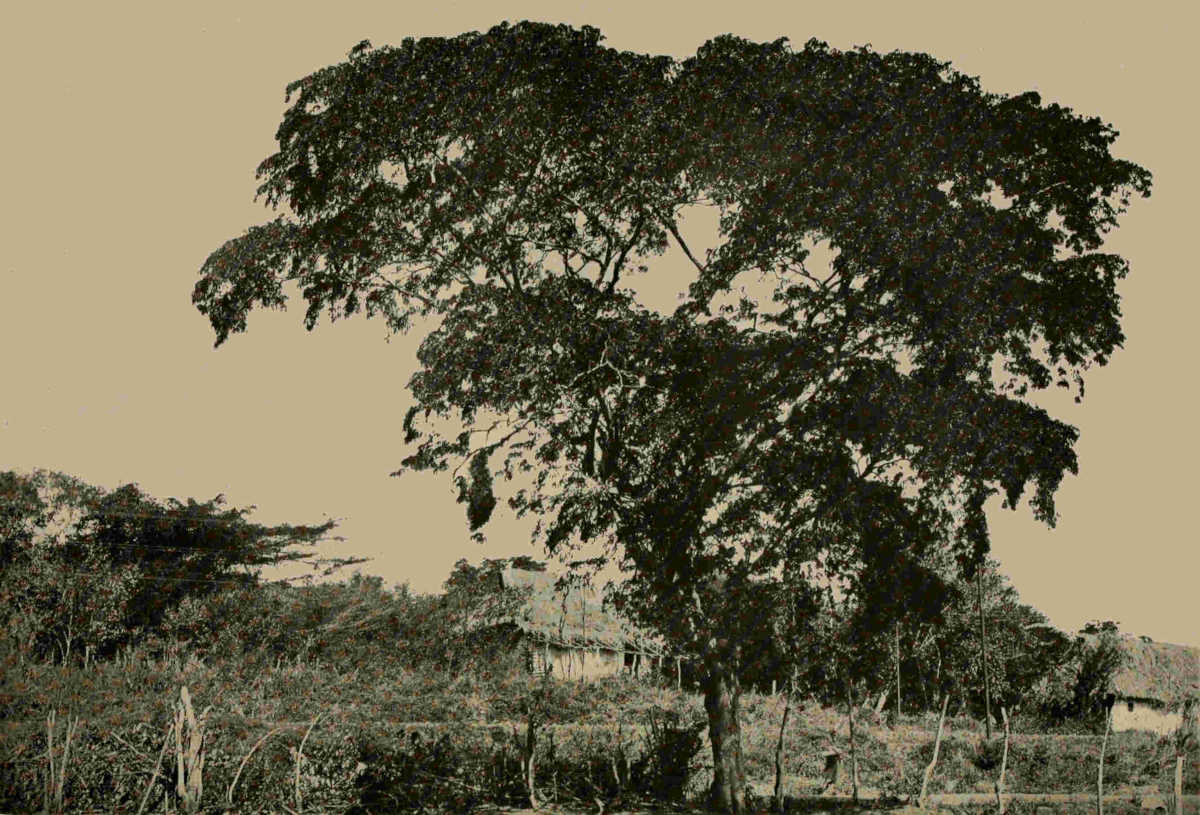
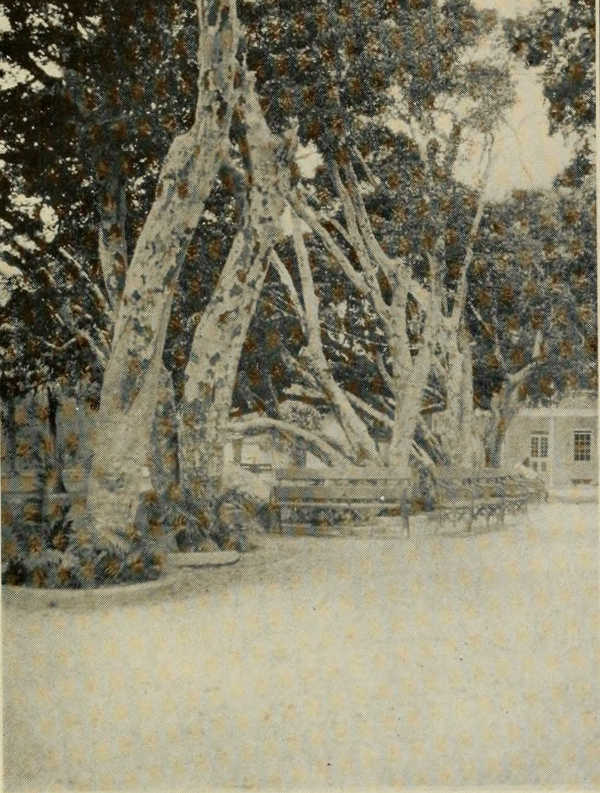
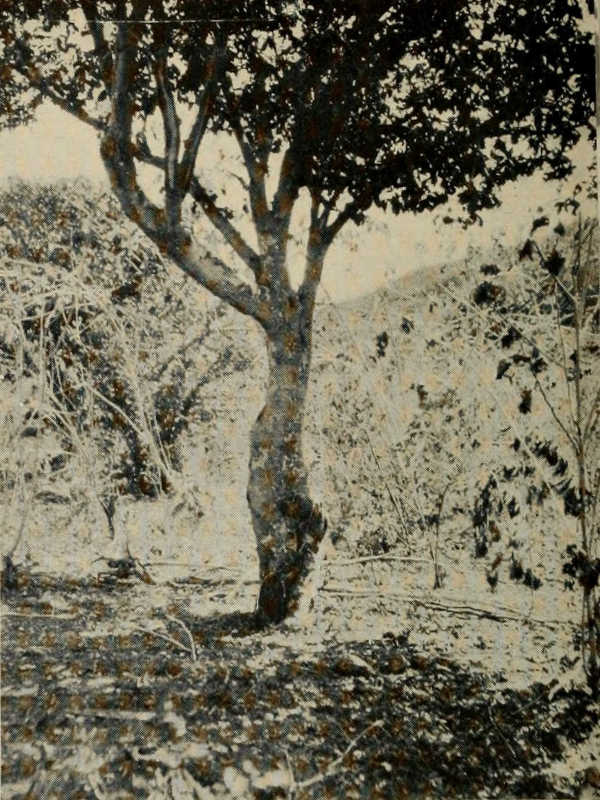
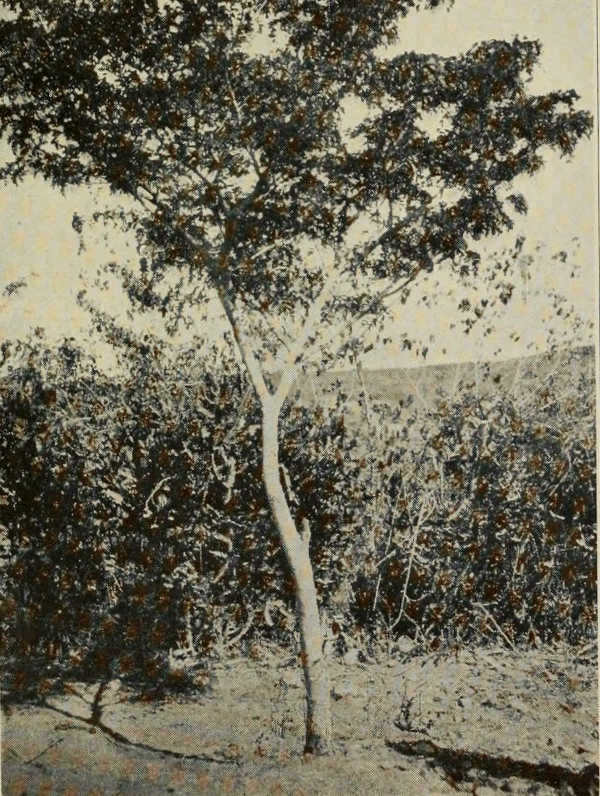
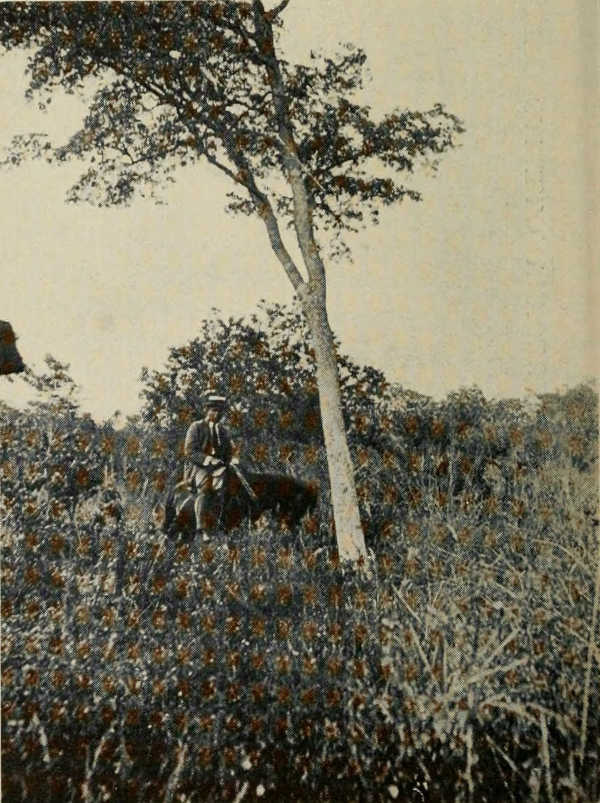
These names are applied to Bulnesia arborea Engl. (= Zygophyllum
arboreum Jacq., = Guaiacum arboreum DC.) which occurs in the coastal
region of Colombia and Venezuela. (See plate.) According to Sargent (40,
p. 60) this species is “widely distributed through the northern countries of
South America from Cartagena to Venezuela.” The fact that it was formerly,
and occasionally is now, referred to as a species of Guaiacum accounts for
some of the conflicting statements regarding the range of that genus. Flückiger
says (14, p. 102): “This tree, occurring in New Granada (Colombia),
has already been noticed (1571-1577) by Francisco Hernandez (Nova plantarum,
animal. et mineral. Mexicanor. hist. Romae 1651, fol. 63) under
the name of guayacan. He mentions its large umbels with yellow flowers,
those of Guaiacum officinale, the ‘hoaxacan’ or lignum sanctum, being
blue.”
Triana and Planchon (47, p. 362) describe this tree under the name of
Guaiacum arboreum DC. and call attention to the differences in flowers
and fruit between it and G. officinale. They report its occurrence in Colombia
in the valley of the Magdalena up to an altitude of 2,600 feet above sea
level, in Cartagena, the savannas of the valley of Uphar, Santa Marta;
and in Estado Carabobo of Venezuela. The common names of “guayacan”
and “guayacan polvillo” are given for this species and the wood is described
as being of a dark yellow color tending to greenish and with an almost
pulverulent fracture. There is indication of confusion of species here since
the name “guayacan polvillo” is commonly applied to a certain species of
Tecoma or Tabebuia (Bignoniaceae) and the pulverulent nature of the
fracture would seem to refer to the lapachol compound which abounds in
the wood of this and closely related species.
Stone (46, p. 18) describes the wood of Bulnesia arborea under the name
of Guaiacum arboreum DC., and gives its source as Brazil, citing Miers
as authority. The only other reference to the occurrence of this tree in
Brazil that the writer has found is by Beauverie (3, p. 248) who apparently
follows Stone and it seems probable that this information was incorrect,
especially so in view of a statement by Huber (24, pp. 179-180) to similar
effect.
The wood of Bulnesia arborea is known to the trade as “vera,” “vera-wood,”
and “Maracaibo lignum-vitae.” The most common local name for it
is vera.[9] The variations in the color of the wood, attributed to the effect of
site, give rise to the names “vera aceituno” (olive), “vera amarilla”
(yellow), “vera azul” (blue), and “vera blanca” (white). “Guayacan”
and “palosano” are synonyms for vera (1, p. 178). Another native name,
a variant of vera, is “bera” or “berra.” Humboldt (25, pp. 7-8) says: “On
leaving Cumana we enjoyed during the short duration of the twilight
from the top of the hill of San Francisco, an extensive view over the sea,
the plain covered with bera and its golden flowers; and the mountains of
the Brigantine.” A foot-note referring to the tree reads: “Palo sano,
Zygophyllum arboreum Jacq. The flowers have the smell of vanilla.”
[9] The wood, along with true lignum-vitae, has recently been introduced in the
brush-back trade under the fantastic name of “Congo cypress”!
Vera usually grows in places more favorable for its development than is
the case of the other zygophyllaceous trees. Consequently it is often comparatively
slender, straight-boled, and of rather good timber form. Sargent
(40, p. 60) calls it a small tree, but all of the other writers refer to it as
attaining large dimensions. Few reliable figures of size are available.
Sievers (43, p. 194) says that it reaches a height of approximately 100 feet
in the Maracaibo region. The present writer has seen logs of this species in
New York, transshipped from Curaçao, that were from 14 to 20 inches in
diameter and from 8 to 12 feet long. They were smooth, straight, cylindrical
and free from knots, indicating that they had come from rather tall
trees. The bark was dark gray, smoothish, with longitudinal wrinkles. The
bark of a smaller stem was very thin, of a gray-greenish color and showed
fine longitudinal wrinkling, crossed at right angles with numerous fine
white lines.
Mr. H. M. Curran supplies the following information regarding this tree
in Venezuela: “Vera is a common tree of the dry foothills lying between
Porto Cabello and the Lake Maracaibo. It does not extend into the extremely
dry coastal hills and sand dune areas, but where a little more
moisture and better soils are found it is often a very prominent feature in
the vegetation. Perhaps four or five trees per acre may be found over considerable
areas though the stand would probably be less than 1,000 board
feet per acre. The tree as commonly met with is from 40 to 50 feet in height,
slender, with a rather small branched crown and is fairly straight, though
many individuals are twisted. The tree seldom makes a clear length of more
than 15 or 20 feet. The flowers are bright yellow, and the tree is quite ornamental
when in bloom. The fruits following the fall of the flowers are rather
membranaceous winged pods. The wood is hard, very durable, and is
commonly used for fence posts, telegraph poles, and durable construction
in general.”
The wood of vera has many technical properties in common with the true
lignum-vitae (Guaiacum). In the specimens examined by the writer the
heartwood is more or less striped and banded, and varying in color from
light olive-green to chocolate-brown. The surface of fresh wood often turns
dark green upon exposure to the air and sun. The sapwood is mostly thin
and is light yellow except near the heart where the vessels become green
upon oxidation of their contents, thus giving a finely striped effect.
Generally the color is lighter than in Guaiacum. One finds the same arrangement
of pores as in Bulnesia Sarmienti except that the radial lines are
usually narrower and not so inclined to branch. The specific gravity of the
heartwood, as determined by the writer on oven-dry material, varies from
1.11 to 1.21. J. Martinex Espino (see 1, p. 178) gives 1.14 as the average
density. The heartwood is impregnated with the mildly scented resin typical
of the woods of this family.
The heartwood is very durable under exposure and will last indefinitely
in the ground. Mr. H. M. Curran found among the ruins of an old Spanish
fort on the tip of Araya Peninsula, Venezuela, a pole which was in perfect
preservation after some 300 years. A specimen of this wood was examined
by the writer and identified as the heartwood of Bulnesia arborea. (For
features distinguishing the woods of Bulnesia and Guaiacum see page 19.)
This genus, the source of the true lignum-vitae of commerce, is well
distributed over the islands and coastal regions of tropical North America.
The range in South America seems to be limited to the northern fringe of
coast and adjacent islands. Most of the commercial timber is supplied by
the West Indies;—Cuba, Haiti, Dominican Republic, Jamaica, and the
Bahamas. Considerable material is also obtained from the west coast of
Nicaragua.
At least six species[10] are recognized by botanists but very little reliable
information is available regarding their respective ranges. There are
two species in the West Indies, namely, Guaiacum officinale L. and G.
sanctum L.[11] The latter is a small evergreen tree sometimes reaching a
height of 30 feet with a small and stout trunk, rarely 12 inches in diameter,[12]
clothed with a thin pale or white scaly bark. The slender pendulous branches
are enlarged at the nodes and somewhat furrowed. The ovoid, five-cornered
fruit is greenish-yellow to bright orange, the seeds dark brown or black
and covered with a scarlet exocarp. It is often cultivated for decorative
purposes on account of the beauty of its flowers and foliage. It grows
naturally in southern Florida, “abundantly on Upper Metacombe and
Lignum-vitae Keys and less commonly on Lower Metacombe and Umbrella
Keys” (40, p. 63), and is the only representative of the genus reaching the
United States. The species occurs throughout the West Indies and, according
to Vail and Rydberg (48, p. 106), grows naturally in Yucatan. It has
never been of great commercial importance because of its small size and is
still less so now than formerly. Flückiger (14, p. 101) says of it: “It is
found in southern Florida, the Bahama Islands, Key West, Cuba, San
Domingo (including the part called Hayti), and Puerto Rico, and is
certainly the source of the small but excellent lignum-vitae exported from
the Bahamas as well as some of that shipped from Hayti.”
[10] For key to these species see Vail and Rydberg (48, p. 105).
[11] Varietal forms of G. sanctum exist in Haiti, but have not been described. According
to Mr. C. D. Mell, one of these produces a large timber tree, the bera or so-called
bastard lignum-vitae of Haiti.
[12] Sargent (40, p. 63) gives maximum diameter of trunk as 2.5 to 3 feet.
The specific gravity of oven-dry wood of this species from Florida, as
determined by Sharples (see 39, pp. 268-9), varies from 0.9563 to 1.2736,
average 1.1432. The variations are in part due to the presence of more or
less sapwood in some of the specimens. The specific gravity, oven-dry, of a
specimen from Florida was found by the writer to be 1.09 for the sapwood
portion and 1.19 for the heartwood. The sapwood of Guaiacum sanctum is
usually thicker than in G. officinale.
In longitudinal compression, the ultimate strength in kilos of two specimens
of Florida wood was found by Sharples (see 39, p. 420) to be
11,930 and 11,648, respectively. These values were somewhat in excess of
those for the best specimens of hickory but were materially exceeded by
some pieces of Osage orange, black locust, and some less common woods. In
resistance to indentation the wood of Guaiacum sanctum is given first rank
(see 39, p. 253) among 405 woods tested, and is far above any of the
common woods of the United States.
Guaiacum officinale is a low or medium-sized evergreen tree with a thick
bole often 10 to 12, occasionally 18 to 20, inches in diameter. Its branches
are crowded and flexuose and the pinnate leaves are leathery. The fruits
are two-cornered and yellowish, bearing seeds light to dark brown with a
cream-colored exocarp. Its range includes all of the West Indies and the
northern coast of South America, especially Venezuela and Colombia.
Schomburgk (42, pp. 850, 1,012) says it is cultivated in gardens along the
coastal region of British Guiana and also grows in the forests along the
Essequibo, where it reaches tree size. No other reference to its occurrence
in British Guiana has been found. According to Vail and Rydberg (48,
p. 106) the species grows naturally in Panama, and Harshberger (21, p.
664) mentions it as occurring in Honduras.
Oviedo (see 14, p. 101), who landed in America in 1514, mentions this
tree, under the name of “guayacan,” as a native. (This should dispose of
the claim of a Brazilian botanist (7, p. 81) that Guaiacum officinale L.
was introduced into San Domingo from the Matto Grosso by the Spaniards
in 1508, and thereafter considered native there). Oviedo appears to have
been aware of two species, one of which he found in Espanola (San Domingo)
as well as Nagranda (Nicaragua), and the other in the island of
Sanct Johan (Porto Rico), whence it was called “lignum sanctum.” This
name is still in use, particularly for the wood of Guaiacum sanctum.
Four Mexican or Central American species of Guaiacum are described
by Vail and Rydberg (48, pp. 106-7), but very little is available regarding
their commercial importance and range. G. guatemalense Planch. is said
to be a small tree about 15 feet high with stems clothed with somewhat
corky bark. The flowers, which are azure blue, appear before the new leaves;
the fruit is reddish or orange, the seeds reddish-brown. The type was
collected on the hot plains of Zacapa, Guatemala, and nothing further is
known of its range.
Guaiacum Planchoni A. Gray is said to be a much branched shrub, 6 to 10
feet high, with grayish corky bark, leaves crowded or fascicled on short
modified branchlets; flowers solitary. The type was collected between
Tehuantepec and the Pacific Ocean, Oaxaca.
Guaiacum Palmeri Vail is, according to the same authorities, a shrub or
possibly a small tree, with leaves fascicled as in the preceding. The fruit
is yellowish-green, leathery, with seeds covered with a dark-red (?) fleshy
exocarp. The type was collected at Guaymas, Sonora.
Guaiacum Coulteri A. Gray produces wood of value, though to what
extent is undetermined. This tree is known to occur all along the western
part of Mexico from Sonora to Oaxaca and it is possible that the commercial
lignum-vitae of Nicaragua and the east coast of Mexico is supplied by this
species. According to the botanists the tree is small, often reduced to a
shrub, with clustered blue flowers and with greenish fruit containing brown
seeds covered with a pale yellowish aril.
Hemsley (22, p. 159) suggests the possibility of this and G. guatemalense
Planch. being the same species, but the material at his disposal was insufficient
to decide the question.
In 1913, Dr. H. N. Whitford made an examination of the forest on
Maria Magdalena Island, the middle one of the Tres Marias group off the
coast of Tepic, Mexico. He found a tree called “guayacan” which was
afterward identified as Guaiacum Coulteri. In a manuscript report he says:
“This species is probably the lignum-vitae of commerce. It occurs
growing very scattered with the ‘palo prieto’ and on the flats near the
mouths of the arroyos. The trees are mostly small, between 8 and 12 inches
in diameter, yielding logs from 6 to 10 feet in length. One tree was 24
inches in diameter yielding a log only two feet long. It had three branches
8 inches in diameter and 6 feet long that would make good logs. The
forests on the main coast are said to produce trees much larger than those on
the island. Guayacan is very hard, very durable and very heavy. It is dark
greenish-brown in color with concentric rings of nearly black. It is very
fine-grained.”
The pores are circular or elliptical and are irregularly distributed, being
sometimes abundant and sometimes few and scattering. Usually no definite
arrangement can be noted, but occasionally they are in echelon and in some
cases a tendency to a ring-porous structure has been observed. There may
be considerable difference in the size of the pores in the same specimen while
in others they are fairly uniform. In a piece of Cuban lignum-vitae, 14 of
the largest pores were found to have an average size of 0.15 × 0.11 mm.;
the maximum was 0.18 × 0.14 mm. In a specimen from Nicaragua the pores
were nearly all small, the largest measuring about 0.10 × 0.08 mm. The
walls in both cases were about 0.01 mm. thick.
The vessel segments, wood fibers, wood parenchyma strands, and the
rays are in horizontal seriation. The bordered pits between contiguous
vessels are small, very numerous, and with rounded or hexagonal outlines;
the pits between the vessels and rays are small, numerous, and half-bordered.
The wood fibers are very thick-walled, very small, short, crowded
together without any definite arrangement, and provided with numerous
weakly bordered pits. The vessel segments are mostly 0.09 to 0.10 mm. in
length, with simple perforations throughout, without tyloses, but with
abundant resin (in heartwood) which dissolves readily in alcohol. The
rays are from 1 to 8, mostly 5 or 6, cells high and either uni-seriate throughout
or two cells wide in the middle portion. The individual cells are very
small, thick-walled, sometimes containing crystals, and commonly resinous.
Wood parenchyma is present in varying amount in association with the
vessels, or diffused, or in tangential lines of irregular length or sometimes
in concentric bands several cells wide apparently limiting growth rings.
The variations in the amount and arrangement of the parenchyma are very
noticeable, not only in different woods but also in different parts of the
same specimen.
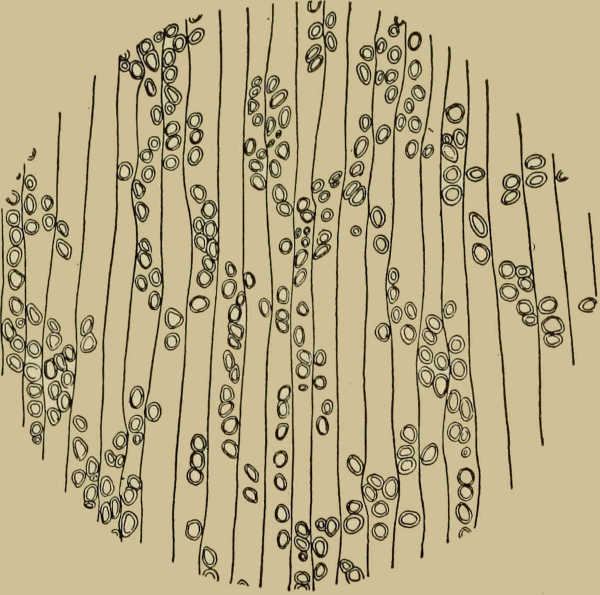
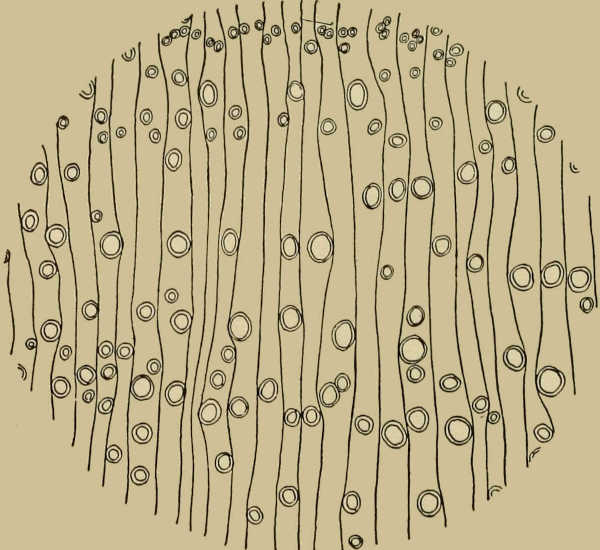
Cross section of Bulnesia arborea (Maracaibo) Note the radial distribution of the pores
Cross section of Guaiacum from Haiti Note irregular distribution of the pores
Guaiacum
Bulnesia
Pores irregularly disposed. (See opposite page.)
Pores in radial arrangement. (See opposite page.)
Pores often widely variable in size; largest sometimes visible without lens.
Pores small and fairly uniform in size; not individually distinct without lens.
Pores mostly circular or oval.
Pores often angular in outline.
Parenchyma paratracheal and metatracheal; also often terminal in fine lines distinct with lens.
Parenchyma paratracheal and diffuse; indistinct with lens.
Crystals present but not abundant in wood parenchyma and rays.
Crystals very abundant in wood parenchyma and rays.
Rays mostly uni-seriate; sometimes 2-seriate in middle portion.
Rays commonly 2-seriate (occasionally 3-seriate) in middle portion.
Essential oil not known to be present.
Essential oil known to be present, at least in one species.
Woods of the two genera are alike in being very dense, fine-textured,
cross-grained; dark brown or greenish in color with oily appearance and
feel; mildly and pleasantly scented when warmed; containing guaiac resin
with characteristic color reactions. Woods with very fine and uniform
ripple marks, invisible without lens, averaging about 250 per inch of
length. These ripple marks are likely to be absent in small twigs (0.5 cm.
or less) such as one commonly finds in herbarium material. The characteristic
alternating or fine-roe grain was not found in stems or twigs less than
1 cm. thick. The interlocked grain is not due, as sometimes supposed, to the
crossing of true right and left hand spirals around the stem, but to a
weaving back and forth of the fiber layers in an irregular “lazy-S” manner
up and down the trunk.
Guaiacum officinale: Lignum-vitae (U. S.; general trade);
guaiacum-wood (England); holy wood, wood of life, Indian wood (Lit.);
guayacan, guaiacan, guayakan (Spanish); hoaxacan, lignum sanctum,
guayacan blanco (Porto Rico); guayacan negro, guayacan prieto, palo
santo (Cuba); gayac jaune vert (Martinique); bois de gaïac or bois
de gayac, bois sant (Fr.); Pockholz, Guaiacholz, Guajak, Guajakholz,
Franzosenholz, Lignum Sanctum-holz (Ger.); guaiaco nero, legno santo,
legno benedetto, legno nefritico, legno di guaiaco (Ital.); pokhout
(Dutch); guaiaco (Port.); “Congo cypress” (Brush-back trade).
Guaiacum sanctum: Lignum-vitae (America; general); Bahama
lignum-vitae (Eu. trade); palo santo, lignum sanctum, lignum
guaici (Spanish); vera, bera (Haiti); vera amarilla, vera prieta,
guayacancillo (Cuba); ironwood (Florida); guaiaco banco, legno santo,
legno benedetto (Ital.). The wood of this species is often not
distinguished from the foregoing and the same names may be used for
both.
Guaiacum spp.: Lignum-vitae (Trade); guayacan, palo santo
(Mex.).
Bulnesia arborea: Vera, vera aceituna, vera amarilla, vera azul,
vera blanca, bera, berra (Venezuela, Colombia); Maracaibo lignum-vitae,
vera-wood (Trade); guayacan, palo sano (Colombia); gayac de Caracas
(Fr.); Vera-holz (Ger.); “Congo cypress” (Brush-back trade).
Bulnesia Sarmienti: Palo santo (Argentina); palo balsamo
(Trade); palo santo negro (Paraguay); páo santo (Port.).
Bulnesia retamo: Retama, retamo (Argentina).
Porlieria angustifolia: Guayacan.
Porlieria Lorentzii: Guayacan blanco (Argentina); cucharero,
chucarea, chukupi, chuchupi, chucupi (Indian names, Arg.).
Porlieria hygrometrica: Guayaco, palo santo (Chile); turucasa
(Peru).
PART II: FROM THE COMMERCIAL STANDPOINT — The True Lignum-vitae of Commerce — General Considerations — Present Sources of Supply — Future Sources of Supply — Value of lignum-vitae imports entered for consumption in the United States — Uses of Lignum-vitae — Resin of Guaiacum: Its Properties and Uses
The wood of Guaiacum is the true lignum-vitae of commerce. It enters
the market in the form of bolts or short logs from 2 to 10 feet in length
and 3 inches and upward in diameter. These logs usually retain part or
all of their bark and this provides one of the best features for the ready
separation of the different kinds recognized by the trade.
The sapwood is usually thin or, if the logs have lain for a long time on
the ground or in the water, it may be entirely absent. Logs without sapwood
are commonly known as “nigger heads” because they are all black
and the surface is etched and channeled in such a way as to expose the criss-crossing
grain and give the appearance of being braided or interwoven. It
was formerly the practice to hew off the sapwood before shipment, at least
for certain grades of wood, but hewn logs are comparatively rare now and
such hewing as is done is to remove irregularities.
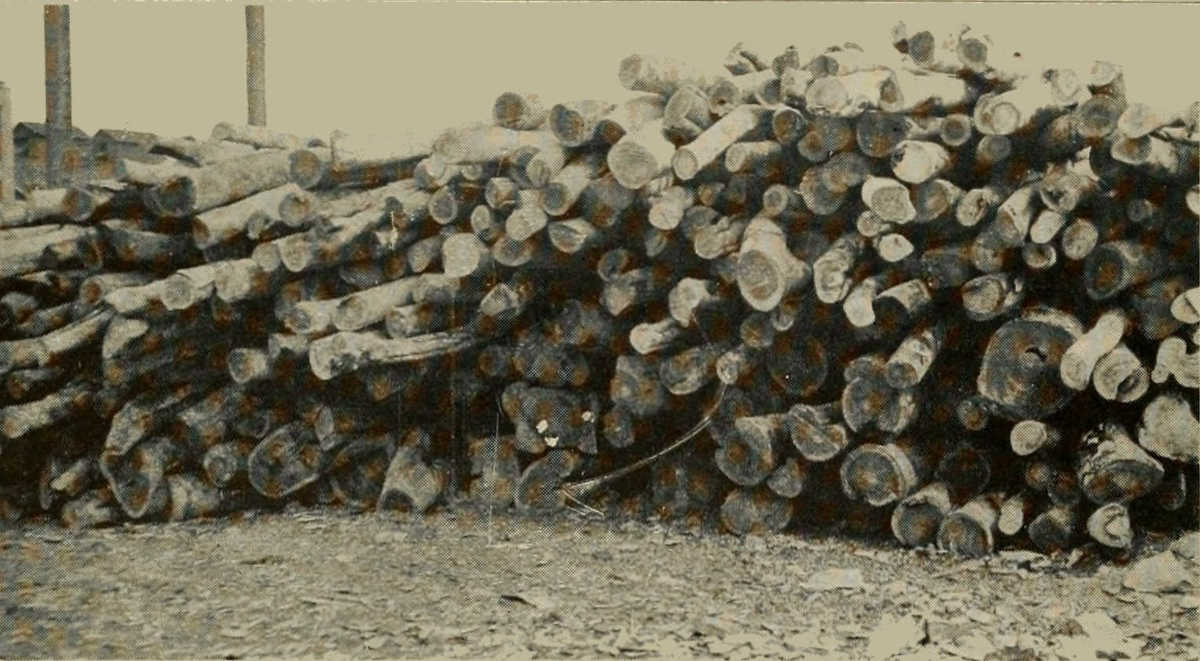
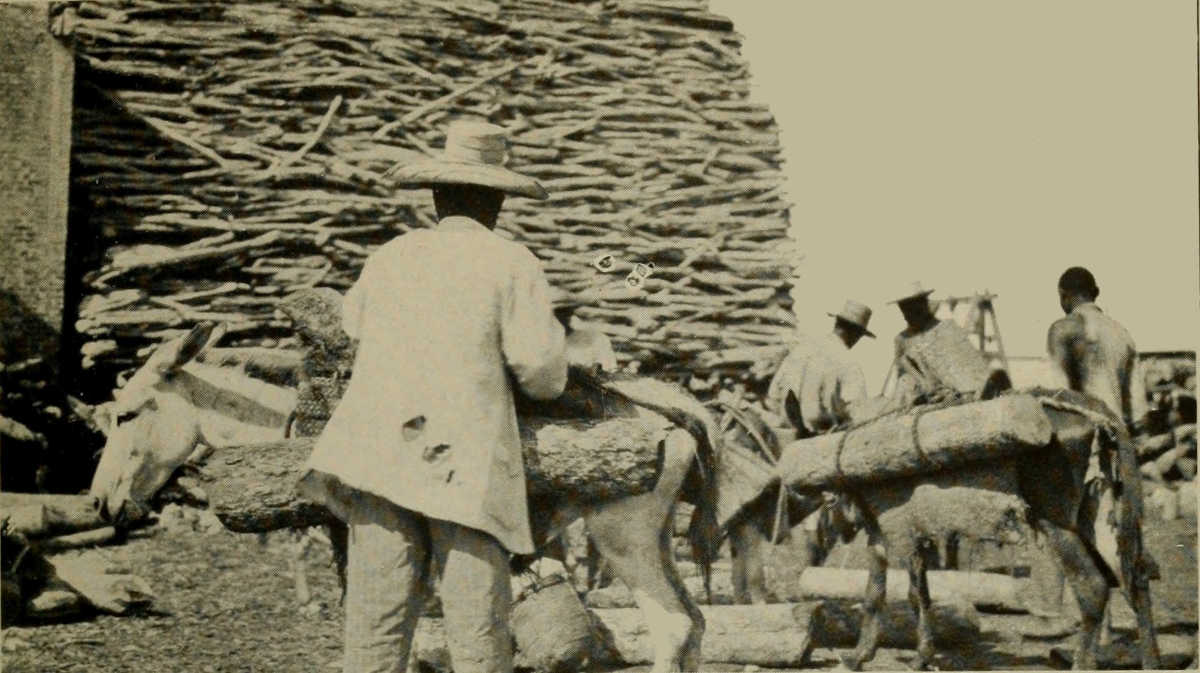
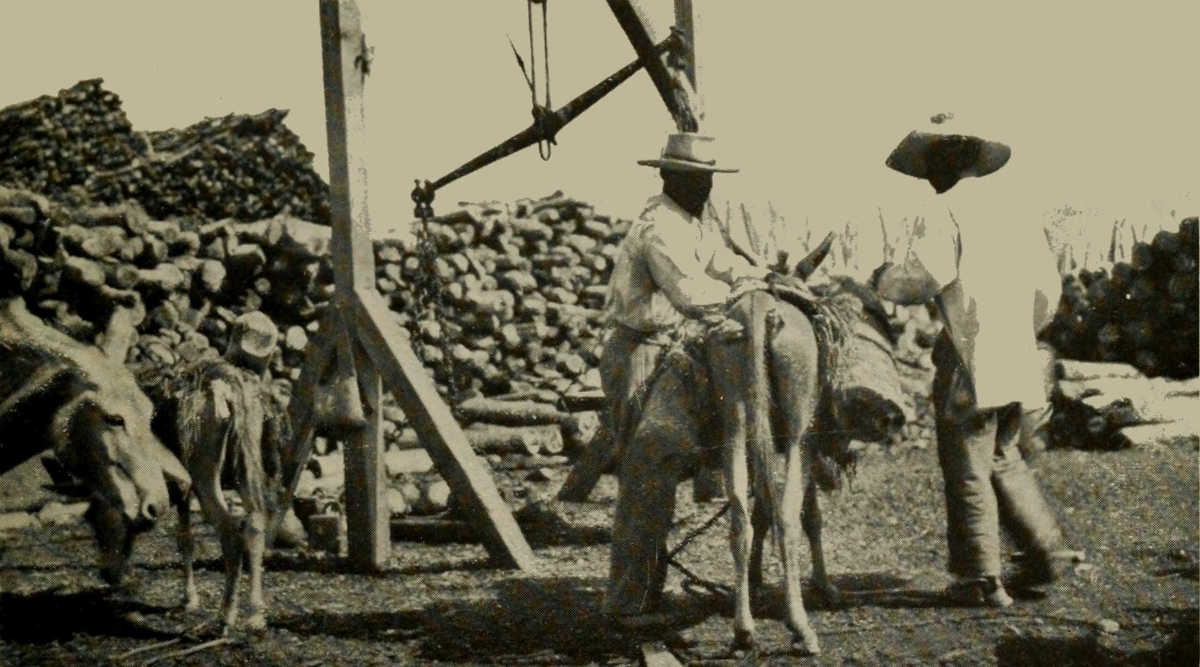
The logs are cut by natives and carried in some primitive way, often on
pack animals (see plate), to a dock to await shipment. They may lie exposed
to the weather for months or even years. Under the intense tropical sun
they are likely to check and become ring-shaken, at least at the ends,
though the various kinds are not equally susceptible to this. Worms often
get in and riddle the sapwood, and the writer has seen a few logs with worm
holes, the size of a lead pencil, in the heart.
One of the most serious defects of lignum-vitae is heart-rot or “doze.”
Although the heart is very durable when exposed to decay after the tree is
felled, it is subject to rot in the living tree just as in the case of many of our
most durable native woods. Although dealers specify strictly sound wood,
a certain amount of “dozey” material is likely to be included in every shipment
when the demand for lignum-vitae is heavy.
The highest grade logs are smooth, cylindrical, free from knots, checks,
shakes, “doze,” and worm holes, with very thin sapwood or none at all,
with a finely interlocked grain, and heavily impregnated with resin. The
preferred lengths and diameters depend upon the uses to which the wood
is to be put. Thus the Navy Department specifies that “sizes 3 inches
average diameter and smaller shall be not less than 2 feet in length; sizes
4 inches and 5 inches average diameter shall be not less than 3 feet in
length; sizes 6 inches average diameter and larger shall be not less than
4 feet in length” except in special cases.
The color of the heartwood exhibits a wide variation. The typical is an
oily olive-brown with concentric layers of alternately lighter and darker
shade. It is very common for the ends of the logs to show a dark blue or
green heart as a result of the oxidation of the coloring matter. Upon oven-drying
specimens of this color the blue or green was found to disappear.
Several different kinds of lignum-vitae are recognized in the trade and
they are usually designated by the name of the country or of the port of
origin. The principal kinds now found on the New York market are Cuban,
San Domingan, Jamaican, Haitian, and Nicaraguan. Others less common
are Bahaman, Mexican, and South American. Buyers usually specify exactly
the kind of wood they want and their likes and dislikes are often very
pronounced. To what extent these opinions are based on facts and to what
extent they are mere prejudices could not be determined, but they do exist
and exert a very material influence on the market.
So far as the writer’s investigations have gone, specimens from the same
region and presumably of the same kind exhibit about as much variation in
structure as was found in material of the different kinds recognized by the
trade. In general, however, the Mexican, Nicaraguan, and Haitian wood
had smaller pores and finer rays than that from Cuba and Florida.
The following notes are based largely upon data obtained from prominent
timber dealers in New York City.
Cuba.—Most of the Cuban lignum-vitae is obtained from Oriente Province
in the eastern part of the island and is shipped from Santiago. According
to a Government report in 1917 (20, p. 52) not more than 4,000
tons exist in accessible places, not more than one-third of this would repay
the cost of getting it out, and the total supply is in danger of early exhaustion.
A New York dealer questions this conclusion and cites the fact that a
single operator in this region got out 1,000 tons in 1918 and that others
were also engaged in the business. During the fiscal years of 1914 and
1915, 3,067 tons, valued at $127,000, were exported from Santiago. More
recent figures are not available. There is some wood in Pinar del Rio, in the
western part of the island, but it is not now being exploited.
Cuban lignum-vitae is considered the standard, at least for the larger
sizes. The logs are mostly from 4 to 8 feet long, with a few of the smaller
sizes 10 feet. The diameters range from 6 to 24 inches, but only a very small
percentage are over 16.
The commercial species is Guaiacum officinale, although G. sanctum is
also present and may enter to a minor extent into the supply. The latter
species is locally known as “guayacancillo” to distinguish it from the other
which is called “guayacan,” “guayacan negro,” or “palo santo.”
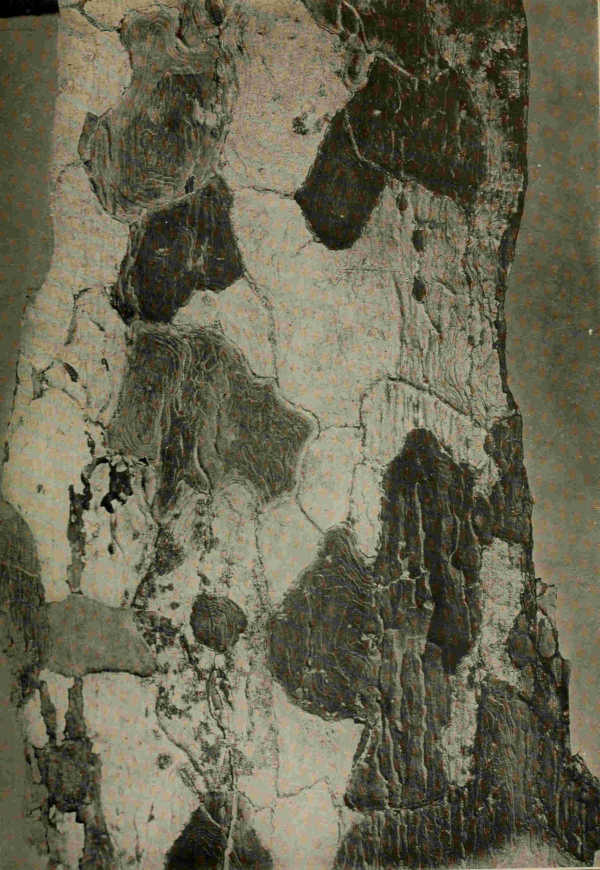
The bark of the Cuban wood is distinctive and is considered typical of
high-grade wood in general. It is thin, smooth, and flaky. These flakes are
of irregular size and shape and the scars, owing to the laminated structure
of the bark and to the variation in depth of different parts of a scale, are
marked like a contour map. (See plate.) The fresh scars are glossy and vary
in color from reddish-brown to olive-green, the older patches becoming ashy-gray
or nearly white. (A large Cuban specimen of Guaiacum in the collection
of the Yale Forest School is labeled “vera.” The color is lighter than that of
the typical wood and the bark is ashy-gray and granular, suggesting that
of logs from Nicaragua.)
A specimen of Cuban wood taken from a storage yard in New York was
found to contain a little over 20 per cent moisture. The specific gravity,
oven-dry, was 1.17.
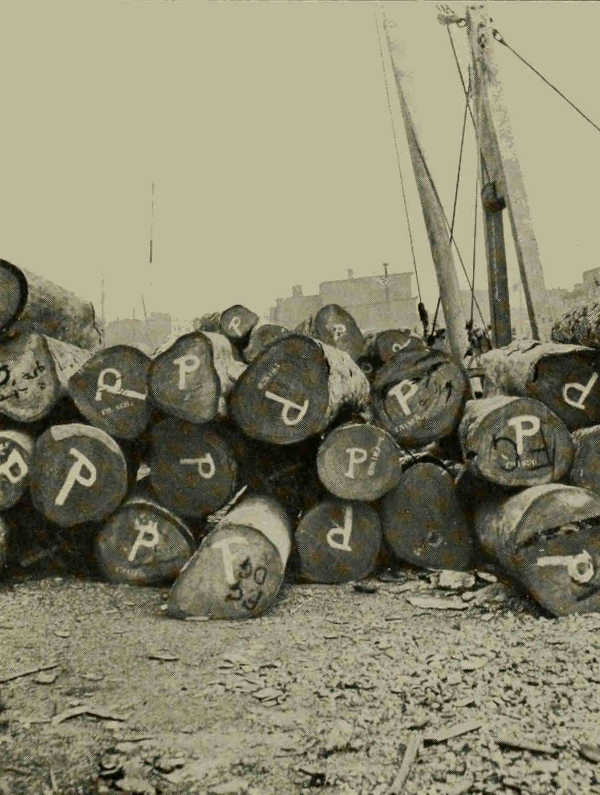
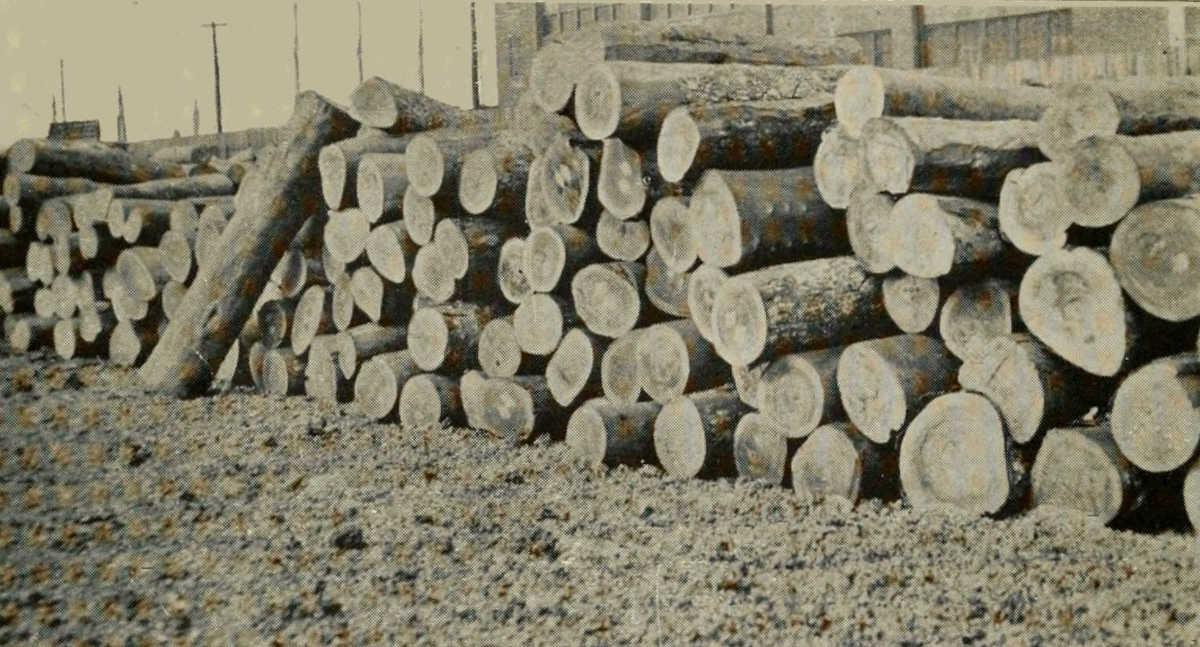
Jamaica.—The wood from Jamaica is small and is supposed to be of
Guaiacum sanctum. The logs are from 2 to 8 feet long and from 3 to 10,
mostly 3 to 5, inches in diameter. (See plate.) Not over 5 per cent exceed 8
inches. The sap is usually wide and the bark is smooth as in Cuban logs. The
wood is much in demand for mallets for which the small size especially
adapts it. It is reputed to be of as high quality as the Cuban and is restricted
in its uses only on account of the small sizes now available. Flückiger (14, p.
102), referring to the wood of this source on the market in the seventies,
says that it is small and of only ordinary quality.
Bahama Islands.—This wood is also of Guaiacum sanctum, is accordingly
of small size, rarely 5 inches thick, and is also largely used for
mallets. Almost no stock was obtained from the islands during the war,
owing largely to the lack of shipping facilities. The supply remaining is
believed to be small. The exports in 1914 and 1915 were valued at $3,017
and $5,161, respectively.
Porto Rico.—The wood from this source is small but of good quality.
Both Guaiacum officinale and G. sanctum are native but the latter is “now
of only limited occurrence along the south coast” (6, p. 75). Although comparatively
little Porto Rican wood has been on the market during the past
few years, due principally to lack of shipping facilities, it is believed that
the island will continue a source of supply for small stock for many years.
The logging conditions in the mountains are very unfavorable. (See 23,
pp. 44-45.)
Haiti.—“Lignum-vitae is scattered over the whole of Haiti” (20, p.
136). Most of the wood, however, is considered by dealers and users as
non-genuine and is often called “bastard lignum-vitae” in the trade, and
“vera” or “bera” locally. It is unquestionably a species of Guaiacum and
not of Bulnesia, as the name “vera” or “bera” would indicate, since it has
blue flowers and the typical fruits of Guaiacum.[13]
[13] Specimens of the leaves and fruits of this tree recently collected by Mr. C. D.
Mell have been identified by Dr. Rydberg as an unnamed variety of G. sanctum.
Prejudice against this material is not of recent origin. Flückiger, following
a reference to San Domingan lignum-vitae, which he terms the best on
the market in the seventies, says (14, p. 102): “The wood obtained from
the Haytian ports (of the western part of the same island) is much less
esteemed in the London market.”
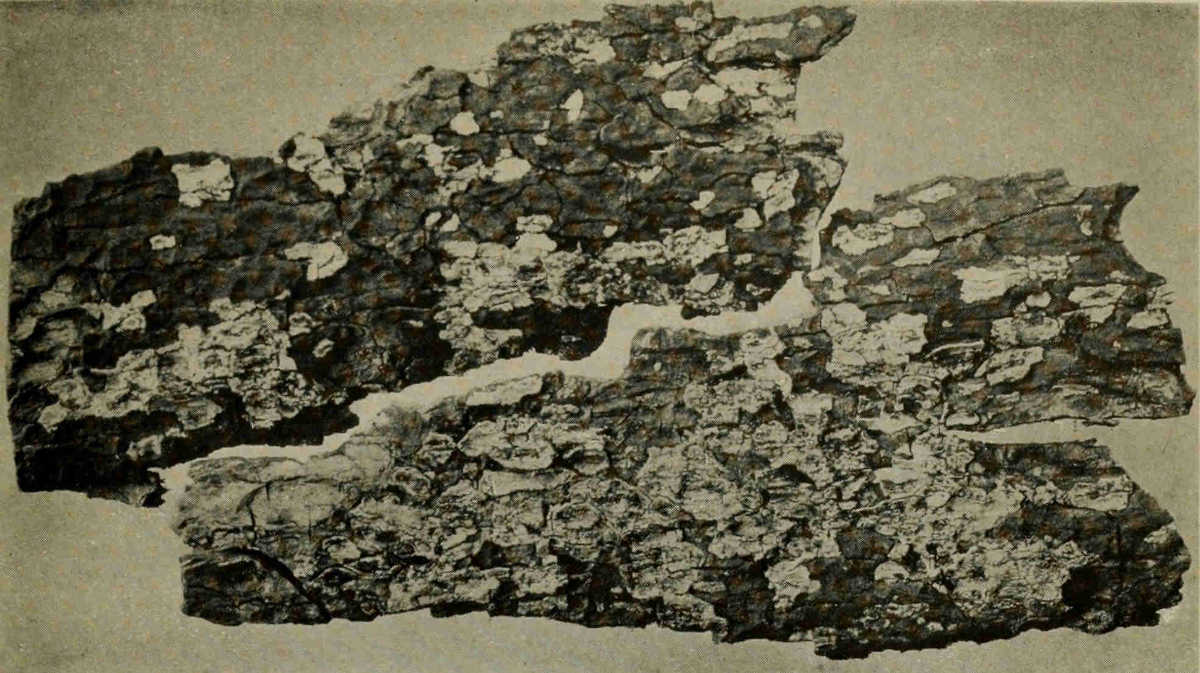
The logs are from 3 to 5 feet long and from 4 to 14 inches in diameter.
The bark is rough, composed of fine scales partly slate-colored and partly
ashy-gray, somewhat resembling that of pignut hickory. (See plate.) The
sapwood is usually thick and the grain seems to be less interwoven than in
the Cuban wood. Several lots were examined by the writer and a high percentage
of the logs were found to be “dozey.” The specific gravity, oven-dry,
of a specimen of Haitian wood was 1.30.
It is believed that a large amount of genuine lignum-vitae exists in
Haiti but the transportation facilities in the interior are extremely poor.
In 1915, 6,172,853 pounds, and in 1916, 6,226,574 pounds of lignum-vitae
were exported from Haiti.
Dominican Republic.—Wood from this region is called San Domingan.
It is recognized as genuine and has the characteristic bark and other
features of the Cuban. Only occasional logs of the “bastard” variety are
included, presumably more because of the small demand for it than because
it is not found. Wiesner (50, p. 950) states that the best wood of Guaiacum
officinale comes from San Domingo.
The logs now on the market are from 2 to 3 feet long and mostly between
4 and 10 inches in diameter, rarely as large as 16 inches. Some wood-users
consider it the best lignum-vitae in the trade, especially for the smaller
sizes. It is said that much larger wood than is now being obtained is available
in considerable quantity in this country but that the natives lack the
necessary facilities for getting it out. “Lignum-vitae is plentiful, especially
from the bay of Samana southward and westward to the Province of
Barahona” (20, p. 181).
The value of this wood shipped from the Dominican Republic during the
five fiscal years 1912-1916 was $157,706.
Nicaragua.—Nicaraguan lignum-vitae has been on the market for many
years but until recently there has been considerable objection to its qualities
on the part of certain users, particularly in France, England, Holland,
and Denmark, who claimed that it had too great a tendency to check and
split. On the other hand, it has been used without discrimination in Japan,
China, Germany, and to a greater or less extent in the United States. The
shipyards on the Pacific coast use it exclusively. Makers of bowling balls
and of sheaves insist that it is unsuited for their purposes because of the
tendency to split. The writer is informed by dealers that the prejudice
against this material has been largely overcome through improved methods
of handling and manufacture.
The largest log of which record is available was 36 inches in diameter,
9 feet long, and weighed 4,260 pounds (27, p. 35). Usually the logs are
4 to 8 feet long and from 9 to 24 inches in diameter, with a good percentage
over 12 inches. They are straight, smooth, and cylindrical, and free from
defects except end checks which give a bad appearance but generally do
not extend deeply. The specific gravity, oven-dry, of a specimen of Nicaraguan
wood was found to be 1.32.
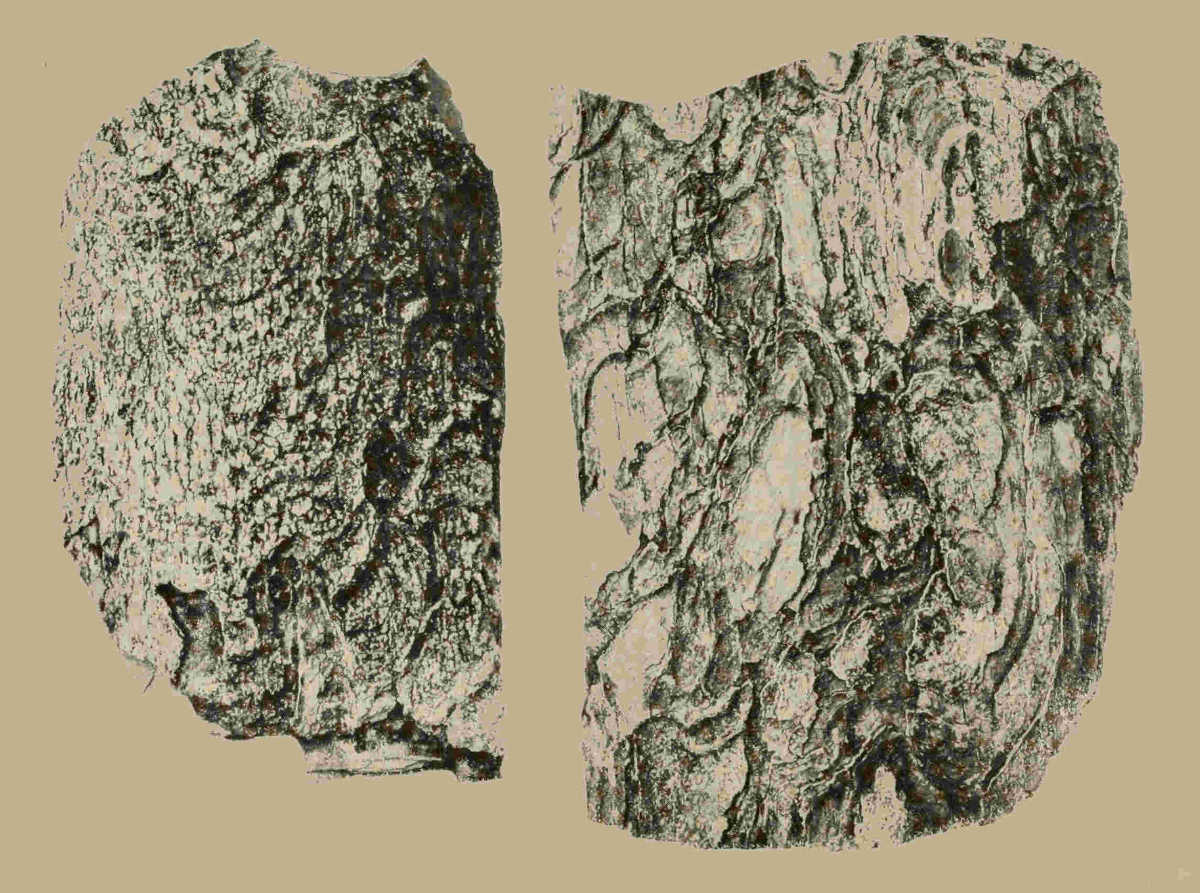
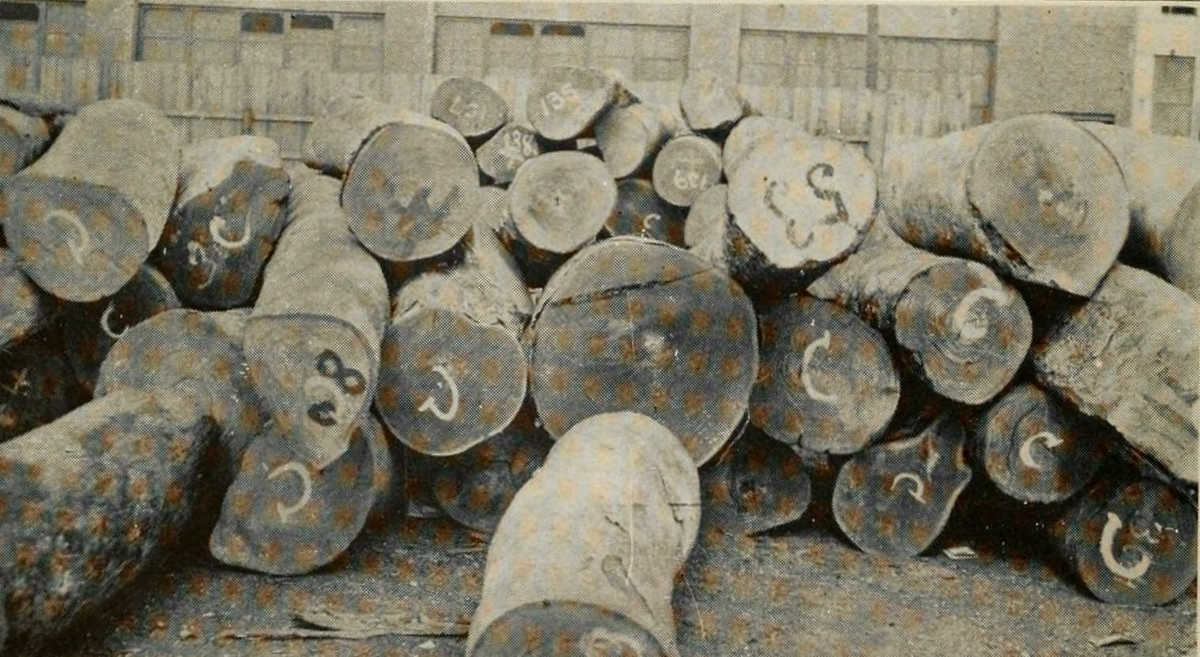
The species supplying the Nicaraguan wood is not known. The bark is
thin, dull gray in color, irregularly flaky, but not smooth or shiny; sometimes
pitted and coarsely granular. (See plate.)
The principal port of shipment is Corinto and, according to a consular
report, 55 tons, valued at $1,849, were exported in 1916 and 265 tons, worth
$8,839, in 1917.
Mexico.—The amount of lignum-vitae coming out of Mexico is at present
very small. The writer had occasion to inspect a carload of logs from the
northwestern part of the country. The sticks were of various lengths up to
6 feet and ranged in diameter from 8 to 11 inches. They were all more or
less faulty, being crooked, gnarly, and knotty. Many were double-hearted
at one end due to cutting above the fork of the trunk, an undesirable practice.
The sapwood was very thick and white, the heart small, oily, and of
good color but often affected by spots of dry rot or “doze” of varying size.
The bark was very thin, smoothish, granular, and varying in color from
light to dark gray. The writer was unable to determine the extent to which
this shipment was typical of the region.
A specimen of lignum-vitae from the west-central coast of Mexico was
found to have a specific gravity, oven-dry, of 1.30. The wood was very
dense, highly resinous, and free from defects. The pores were minute.
West Indies.—The West Indies will probably continue to supply the
bulk of the high-grade lignum-vitae for many years if prices remain at a
sufficiently high level to warrant the increased expense attending the more
and more difficult logging. Improvement of the transportation facilities
and logging methods in certain regions will permit the getting out of
material now too large and heavy to be handled in the primitive native
manner over rough trails.
Central America.—There is believed to be a large supply of accessible
lignum-vitae in Nicaragua but the former prejudice against the material
from this source has retarded its exploitation. It is reported that the Government
of Honduras is taking steps to introduce its wood into the market.
Mexico.—Jordan (27, p. 805) says that lignum-vitae is very plentiful on
the west coast of Mexico from the state of Sonora to Oaxaca, but grows to
a greater size and degree of hardness in southern Sinaloa and Nayarit. In
the “Catalogo forestal” (9, pp. 16-17) both Guaiacum sanctum and G.
officinale are listed as of quite general occurrence throughout Mexico. Thus
the range of the former, known locally as “palo santo,” is given as Vera
Cruz, Chipas, Oaxaca, Guerrero, Michoacán, Jalisco, Tepic, Sinaloa, Zacatecas,
Mexico, Pueblo, Tiaxcala, and Morelos. The range of the other
called “guayacan,” is given as Yucatan, Tabasco, Vera Cruz, Oaxaca,
Guerrero, Michoacán, Colima, Jalisco, Tepic, Sonora, Hidalgo, Pueblo,
and Morelos. Although the specific names given are presumably incorrect,
the report is of interest in indicating the distribution and possible future
sources of lignum-vitae in Mexico.
Northern South America.—There is a very considerable quantity of true
lignum-vitae in the coastal region of Colombia and Venezuela. Very little
of it is now on the market, partly because the trade fears the substitution of
“vera” for the genuine. In 1917, a shipment of a few tons was received
by a New York dealer from the Port of Colombia. The logs were 5 or 6
feet long, 4 to 15 inches in diameter, straight and well-shaped and with all
of the sapwood trimmed off. It proved to be excellent wood, approximately
Cuban quality, according to report.
It is likely that some of the Venezuelan lignum-vitae will enter the
market in the near future. A specimen of the wood which some timberland
owners are offering was examined by the writer. It was found to be genuine
and apparently of high quality.
Curaçao figures in the commerce reports as a large exporter of various
woods, including lignum-vitae and vera, but little if any timber is of local
origin, although both Guaiacum officinale and G. sanctum are native of the
islands (19, p. 331). Vice-consul Gorsica says (18, p. 15):
“Before the war considerable business in woods was done at Curaçao.
Woods from the Venezuelan ports, Maracaibo and Carupano, and from
Dominican ports were carried to this place for transshipment to the United
States and to Europe. Maracaibo relies almost entirely on Curaçao for the
exportation of woods, owing to a sand bank at the entrance of the Gulf of
Maracaibo, which makes it impossible for vessels with a draft of over 12
feet to go into or out of the gulf. Dealers in Maracaibo woods, as a rule,
own light-draft sailing vessels built to trade with Curaçao.... Restrictive
rules, lack of shipping space, the irregular calls of steamers, and the suspension
of service of different lines have very nearly killed the wood business.”
Mr. H. M. Curran supplies the following information regarding true
lignum-vitae in Northern Venezuela:
“The dry coastal hills of northern Venezuela have a certain amount of
lignum-vitae scattered through them. It has been little exploited probably
due to its rather local occurrence, small size and the fact that the region
is but little known to anything but small coasting vessels. Only one or two
trees per acre are found in the best stands. It seldom reaches a height of
over 30 feet, is often much less, and has a broad bushy crown of very dark
green foliage. The bole is usually less than 8 or 10 feet in length, and the
common diameter of the mature tree is between 8 and 20 inches; rarely 24
inches. It is a very ornamental tree when in blossom and is often completely
covered with a mass of violet-blue flowers. These are succeeded by great
masses of orange-yellow pods which are likewise very ornamental. The tree
is much used as a shade tree or ornamental shrub in town and about country
houses. It has peculiar close dark green mottled bark, and is of very unsymmetrical
form. Another variety or species is found with a rather rough
bark, though the wood and general appearance of the tree from the forester’s
point of view is practically the same. The wood is not exploited to any
extent and only now and then is seen on the market.”
(U. S. Commerce Reports)
Fiscal year
Value
1900
$123,021
1901
146,834
1902
87,399
1903
127,262
1904
88,234
1905
103,830
1906
179,280
1907
175,296
1908
99,796
1909
90,576
1910
95,695
1911
143,682
1912
96,675
1913
101,547
1914
72,632
1915
132,411
1916
73,412
1917
222,731
1918
171,844
1919
308,512
—————
Total value for 20 years
$2,640,669
Bushing blocks.—The most important use for lignum-vitae is in bearings
or bushings, particularly for lining the stern tubes of propeller shafts of
steamships. In this extremely important and trying position it will last about
three times as long as steel or bronze. The great density and tenacity of the
wood enable it to withstand the enormous strains upon it, while the resin
content serves as a natural lubricant which minimizes the friction and wear
of the parts. Although other woods, including beech, and more recently
yellow guayacan, have been used, none has proved a satisfactory substitute
for the genuine lignum-vitae.
In reference to this use of the wood, Galletley says (15, p. 384): “It
has one remarkable application, namely, its use for the particular bush, or
bearing, of the screw shaft of steamships, next to the screw itself, where
only a substance able to bear much friction could possibly last for any length
of time. Its highly resinous character renders it self-lubricating in a
position where no other lubricant is practicable except water.”
The stimulation of the shipbuilding industry due to the war occasioned
a very large increase in the demand for lignum-vitae. The Navy Department
at one time advertised for bids to supply 427,000 pounds of logs of
this wood, a large proportion of which were to be from 18 to 24 inches in
diameter at the small end.
The Emergency Fleet Corporation was also a large purchaser. A specimen
inquiry from this source called for quotations on logs which would cut
approximately 10,000 board feet edge-grain. These were to be “high-grade
lignum-vitae hewed square or rectangular, to be well seasoned, generally
sound and straight, free from injurious shakes, worm holes, excessive sap,
large or unsound knots, and other injurious defects. Ordinary season checks
will not be considered a defect and slight heart and ring-shakes are not
considered a defect in pieces 13 inches in the shorter diameter and over.”
Quotations were also solicited on supplying as an alternate, 6,000 square
feet of edge-grain slabs of random lengths (minimum 12 inches) not less
than 1⅛ nor more than 1¼ inches in thickness.
The stern tube, in which the propeller shaft revolves, extends from the
peak bulkhead in the after part of the hull to the stern post and, in a large
steamship, is from 3 to 7 feet long and from 12 to 22 or even 30 inches in
diameter. The forward end, and in some recent instances the after end as
well, is made water-tight by means of a stuffing box and flange.
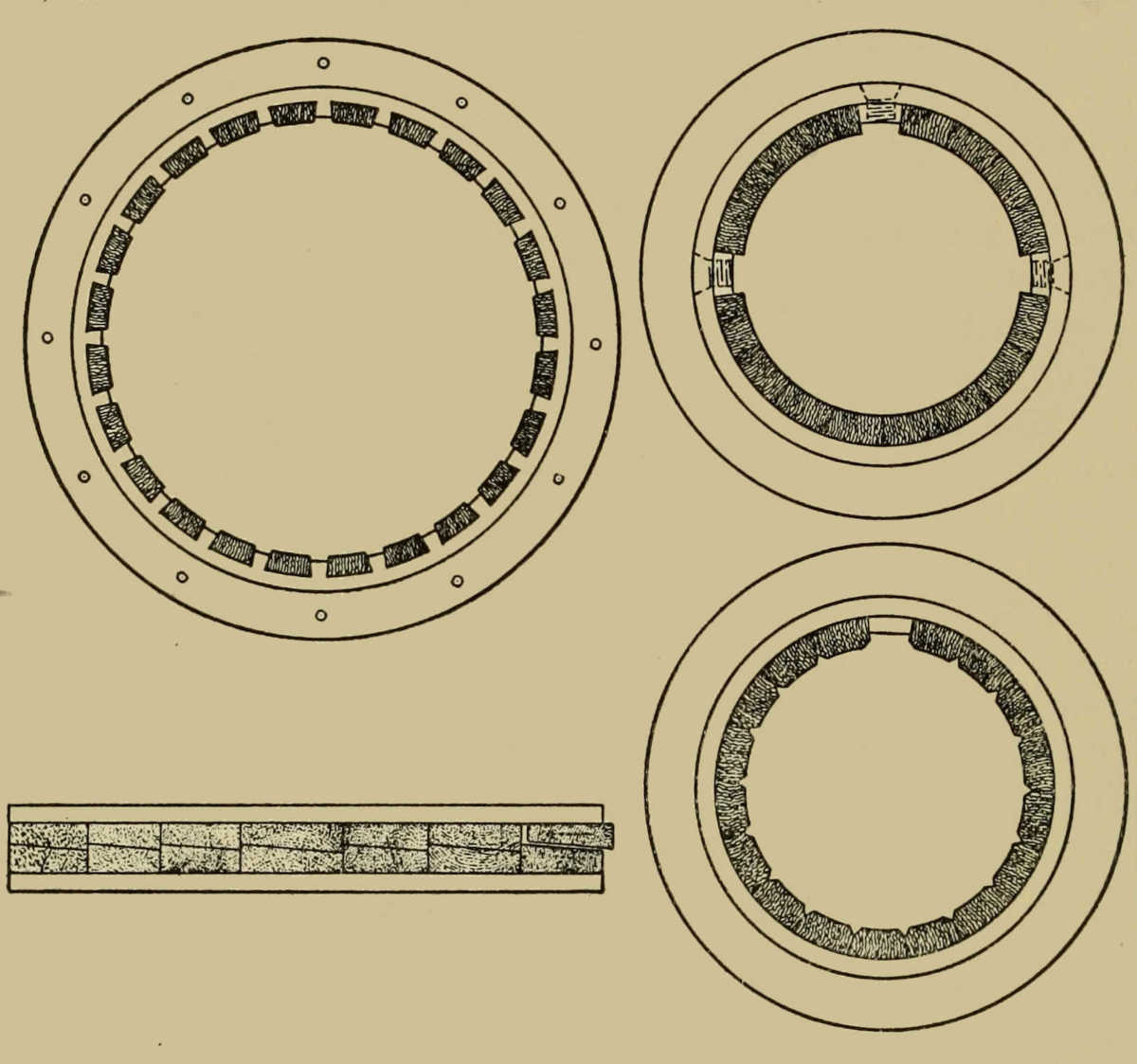
The stern tube is composed of three parts, namely, (1) an outer steel
tube with (2) a brass or bronze bushing or sleeve with longitudinal cleats
or retaining strips which hold in place (3) the lining of end-grain wooden
bearing blocks. The number of retaining strips varies in different forms
of construction. There may be only one in which case it is located at the
upper part of the tube; or two, one at each side; or three, one at each side
and one at the top; or as many as there are rows of blocks, in some instances
24. In the first methods the lining between the retaining strip is of much
the same structure as a wooden-stave pipe, each stave in this case being a
row of end-grain blocks placed end to end, beveled along the side and
machined on the faces to fit the bore of the tube. (See drawing, p. 30.)
The retaining strips serve not only to hold the blocks in place but also
provide grooves into which water enters. The water serves the dual
purpose of cooling and lubricating. Where the rows of blocks are arranged
in a solid layer it is considered a good practice to cut V-shaped grooves at
the joining lines to act as waterways. When ships operate in muddy water,
sand is likely to wash into these grooves and cut the bearings. In some of
the recent battleships, the Texas for example, sea water is excluded by
making the after end of the tube water-tight at the stern post.
There are two principal methods of preparing the blocks for stern
bearings. In one the logs are cross-cut into short blocks or “pancakes,” the
thickness (in direction of the fiber) varying from 1 to 2 inches according
to the size of the stern tube. These “pancakes” are then sawed into rectangular
blocks from 2 to 4 inches wide, not less than 4 inches long, the
maximum lengths being determined by the diameter of the heartwood portion
of the log. As soon as the blocks are sawed out they are dipped in shellac
to prevent checking and warping prior to use.
Cross sections of stern tubes of different types
At left a large stern tube with waterways between the strips of lignum-vitae blocks. Below a
strip of blocks in position showing lengthwise cut to permit wedging into place.
At right: above, section of tube of a steam trawler showing solid lining with 3 retaining
strips and waterways; below, section of a small tube, with single retaining strip at top and
grooves for waterways cut between the blocks.
There is a large amount of waste in cutting out these blocks, being about
33 per cent in logs 16 inches and over in diameter, about 50 per cent in
those between 12 and 16 inches, and reaching as high as 75 per cent in the
smaller sizes. On this account a minimum diameter of 12 inches is usually
specified. It is also claimed that logs of the larger diameters yield better
and particularly more resinous wood. The wood close to the pith is avoided
because of the danger of checking there, while the sapwood is not used
because it lacks the necessary resin.
In the second method the logs are cut into cants or planks of the required
thickness and as wide as the diameter of the heart portion of the log will
allow. These cants are then placed edgewise on an adjustable frame,
rotating about a fixed center on the table of the band saw. In this way the
blocks are cut with the proper degree of curvature to fit exactly into the
sleeve. The blocks are then beveled and cut in two lengthwise, with a slight
taper to permit wedging into place. (For more detailed description of this
method of sawing blocks see Woodworker, Apr. 20, 1920, p. 40.)
After the blocks are fitted, wooden strips are temporarily placed in the
grooves, and the tube is fixed in a lathe and bored out to the exact diameter
required to fit the propeller shaft. To prevent the blocks drying out and
checking or getting loose the tube is kept filled with wet sawdust and
shavings until permanently installed in the ship.
The life of a lignum-vitae bearing is said to be about ten years. If the
propeller shaft is out of alignment it may wear out the bearing in two
years or less. The greatest wear is sustained by blocks in the lower part of
the bearing since these support the most of the weight, not only of the shaft
but also of the propeller which may be as great as nine tons. When to this
dead load is added the impact of the waves it is obvious that only the densest
and most tenacious woods would be able to withstand the enormous
strains produced. Various woods have these properties but none other than
lignum-vitae combine with them the natural lubricant indispensable to the
prevention of heating and rapid attrition.
Small bushings are sometimes bored from solid wood instead of being
built up. The process of manufacture of the so-called “patent feathering
wheel bushings” which are used on certain side-wheel steamers is as follows:
The logs are cut into bolts 16 to 18 inches long, slabbed to an octagonal
form to remove the sapwood, and then turned in a lathe to a diameter of
5-1/16 or 5-7/8 inches. These cylinders are then cut into 7-inch and 8-inch
blocks and the centers bored to the required size.
Bearings for water turbines.—“In America the bearings that are by
virtue of their position permanently under water are usually made of
lignum-vitae. This form of construction is most satisfactory, because the
bearings cannot be lubricated and the lignum-vitae contains a quantity of
oil which together with the water supplies sufficient lubrication. These
bearing discs are made in two parts; the lower one, or so-called step, consists
usually of a cylindrical section cut from a sound lignum-vitae log. The
shaft bears immediately upon the perfectly smooth end-grain of the disc,
which withstands the wear and tear of the revolving shaft for many years
without lubrication. However, when the water is muddy or contains sand it
often wears the disc in a relatively short time, but even then it lasts considerably
longer than steel under similar conditions. Steel or other metal
could not be used unless lubrication was properly applied to the bearing
parts.
“In addition to the step a collar is fitted around the shaft and on top of
the step. This serves the dual purpose of holding the shaft from vibrating,
and also prevents the wheel from slipping down in event the step bearing
wears too much due to excessive friction and the enormous pressure.
“The collar is cut lengthwise so as to facilitate removing it for repairs.
This method of constructing the step bearing is a simple and practical device
which supports the lower end of the vertical turbine shaft. Its arrangement
is efficient, accessible, interchangeable, and as firm as any of the other bearings
in common use. It is of the greatest importance, however, that the
bearing surfaces of the discs be finished by expert workmen and installed
with the greatest care.” (32.)
Bowling balls.—Lignum-vitae of prime grade is the only wood which can
be used satisfactorily in bowling balls. It was at one time extensively
employed for this purpose but now only about one ball in ten is made of
wood. Quebracho of Argentina, mancono of the Philippines, and various
other woods have been tried but with poor success, owing to their tendency
to check and split.
For the 8-3/4 inch regulation ball, choice round logs from 9 to 12 inches
in diameter and with the pith in the exact center are required. From such
logs are cut 14-inch bolts and the ends immediately coated with shellac.
Such a block is placed in a lathe, a ball rough-turned out of the middle
portion, and dipped in hot shellac. The ball is then passed to a skilled workman
at another lathe for final turning to size. It is next placed in a socket
chuck and worked down with sand-paper of increasing fineness, followed by
polishing with a woolen cloth. The thumb-and-finger holes are then bored,
the ball set on pins and shellacked by means of a wide camel’s-hair brush.
In order to attain an exact weight the ball is tested from time to time
during the finishing process and slight over-weight of the finished ball is
overcome by increasing the depth of the holes a trifle.
The finishing of the balls requires a high degree of skill, and one man
can do about three in a day. If, for any reason, the work is stopped, the
wood is immediately coated with shellac to prevent checking.
“Cutting-up” wood.—This term is applied to logs of poorer grade which
are cut up into small pieces for miscellaneous uses, one of the most important
being caster wheels. Large quantities of culls, the crooked, eccentric, and
variously defective logs, are disposed of for this purpose at a price of from
$25 to $30 per ton. The advantage of lignum-vitae for casters is that it does
not split or splinter and is less likely to mar the floor than metal is.
Mallets.—The largest market for mallet wood is in England. Small
round sticks with a rather thick sapwood are preferred for this purpose.
Much of this class of material is supplied by Guaiacum sanctum. Lignum-vitae
is considered superior to other woods for this purpose because of its
hardness and weight together with its freedom from splitting and from
brooming at the ends.
Pulleys, dead-eyes, etc.—Lignum-vitae finds a very important application
in the manufacture of pulleys where it is used for the sheaves or wheels.
Manufacturers prefer cylindrical logs of good quality and 8 inches and up
in diameter. The properties which make the wood particularly applicable
for this purpose are freedom from checking and splitting and great resistance
to wear. According to Galletley (15, p. 384), “sheaves of pulley
blocks made of it have been known to last in constant use for seventy years.”
Wooden sheaves are never used with steel cables or wire rope.
Another use in the shipbuilding industry is for dead-eyes and bull’s-eyes.
A dead-eye is a round flattish block, a few inches in diameter, with a
grooved rim to fit in the bight of a rope or encircled by an iron band, and
pierced with three holes to receive a lanyard. It is used to extend the
shrouds and stays. A bull’s-eye differs from the preceding in having a single
hole instead of three. In making these articles the direction of the grain of
the wood is not important, though slabs are easier to shape.
A minor use of lignum-vitae in shipbuilding is for the collars of rope
guides. The collars noted by the writer in the construction of emergency
tillers were about 2 inches thick with rounded corners about a 2-inch
opening and bolted in pairs in a frame.
Fuel.—Between 150 and 200 tons of lignum-vitae are used annually in
New York for firewood to burn in open grates. It makes a very hot and
lasting fire and is said to excel all other woods for this purpose. The selling
price per ton, delivered to residence, is about $25 per ton. Only cull logs are
used for this purpose. In some factories the sawdust and refuse are used
as fuel under the boilers.
Railroad cross-ties.—The only data available regarding the use of
lignum-vitae for cross-ties are contained in a report of the chief engineer
of the Panama Railroad on the use and life of hardwood ties laid in the
roadbed of the line from 1878 to 1895 (34, p. 85). During this interval
more than 100,000 ties were laid. They were procured from the north coast
of Colombia and were shipped to Colon from the port of Barranquilla.
“They were of a variety of wood commonly known as lignum-vitae (Guayacum
recina), and now spoken of as black guayacum to distinguish it from
yellow guayacum, a wood of the same family,[14] but with less power of
resistance to mechanical wear or decay.”
[14] The yellow wood referred to is a species of Tecoma or Tabebuia of an entirely
different family—the Bignoniaceae or catalpa family.
In 1891 this note was made: “The exceptional durability of these ties
(about 30 years, when of good quality) reduces the number of yearly requirements
to small proportions.” The report further states that in 1913
many of the early-laid ties were still in use in the roadbed and that others
had been removed only because they were too small for the increased
traffic. The condition of the ties removed is described as follows:
“The hardwood ties laid in the old track were, generally speaking, in
very good condition. There were little, if any, signs of decay, but in many
cases, especially with the smaller ties, they were badly worn at the rail
seat by the mechanical action of the base of the rail, no tie plates being used
on the ties. They were also ‘spike killed,’ caused by replacing spikes and
changing rail. It will be interesting to note that many of the ties removed
from the main track at that time, and later, are now being relaid on the
tracks connecting with the new terminal docks at Cristobal. The timber
in the ties is practically as good as ever. As their smaller size is not objectionable
in the yard tracks, it is expected that they will still have a long life
in other services. Tie plates are not necessary with these ties, which results
in some saving.
“The mechanical wear on the old hardwood ties in contradistinction to the
decay of the wood is demonstrated by the fact that while the base of the
rail and the driven spikes have cut into the hardwood and weathered it, the
material in the balance is as good as ever. The same experience has, of
course, long been encountered and commented upon in the tie records of the
United States. The difference between the experience there and here, however,
lies in the fact that the ties referred to in the former records have
probably not been used for a period longer than 8 to 10 years, while local
hardwood ties are from 20 to 25 years old, and have been used in a tropical
climate where all other wood decays in from 3 to 5 years.
“The black guayacum cross-tie is probably a thing of the past. Such
material is now so valuable for other purposes in connection with machinery
and manufacturing arts, that it is not to be expected that it can be procured
at reasonable prices for cross-ties. The Panama Railroad Company has
procured only 4,000 or 5,000 guayacum cross-ties in the past six years, and
most of these have been of the inferior variety known as yellow guayacum.”
Miscellaneous.—Among the miscellaneous uses for lignum-vitae may be
mentioned stencil and chisel blocks, watch-makers’ blocks, mortars and
pestles, brush backs, dowels, golf-club heads, wooden cogs, and block
guides for band saws. The sawdust or flour obtained in cutting up the
wood is in demand by the drug trade at a price varying from $20 to $40
a ton.
Medicine.—“Guaiacum, owing to its reported medicinal virtues, was one
of the first plants of the New World to attract the attention of Europeans....
One Gonsalvo Ferrand has the reputation of having carried it to
Europe about 1508; and three works describing its virtues were published
in Germany previous to 1520” (40, p. 60).
The name lignum-vitae (wood of life) originated from the supposition
that the wood was possessed of extraordinary remedial power. “It was used
in Europe so early as 1508, and attained great celebrity as a remedy for
lues venerea; but the general professional verdict is that it has no distinct
influence in syphilis, nor yet in chronic rheumatism and gout, scrofula, or
cutaneous eruptions against which it was formerly much used. It is usually
exhibited in decoctions, and in combination with other medicines, as in the
compound decoction of sarsaparilla” (10, p. 674).
“The ancient treatment of syphilis by guaiacum, which gained for the
drug such immense reputation, consisted in the administration of vast
quantities of the decoction, the patient being shut up in a warm room and
kept in bed” (14, p. 103). On account of this use the wood is still known in
Germany as “Pockholz,” and “Franzosenholz”; also “Guaiacholz.”
At first only the wood was employed medicinally, there being no known
use for the resin. It is now recognized that the medicinal properties are
confined to the resin or “concrete juice” which, because of its greater convenience
in handling and preparation, is almost the only form of the drug
now in the trade. It is a reputed diaphoretic and alterative and is occasionally
prescribed in cases of gout and rheumatism.
The following description of the resin, known as “guaiac” or “guaiaci
resin,” is taken from the latest edition of the American Pharmacopoeia
(35, p. 211):
“In irregular fragments or in large, nearly homogeneous masses, occasionally
in more or less rounded or ovoid tears, enclosing fragments of
vegetable tissues; externally brown, becoming greenish-gray-brown on exposure,
the fractured surface having a glossy luster, the thin pieces being
translucent and varying in color from reddish to yellowish-brown; odor
balsamic; taste slightly acrid.
“Guaiac melts between 80° and 90°C. It is readily soluble in alcohol,
ether, chloroform, creosote, and in the solutions of the alkalies or in hydrated
chloral T.S. It is sparingly soluble in carbon disulphide or benzene and is
not more than 15 per cent insoluble in alcohol; the alcoholic solution, on the
addition of an excess of chlorine water or tincture of ferric chloride, becomes
blue, changing quickly to green, the color being best seen when the solutions
are diluted with an equal volume of water.... The powder is grayish,
becoming green on exposure to the air.”
The resin completely infiltrates the heartwood and makes up about one-fourth
its weight. A specimen of the wood tested by Galletley (15, p. 384)
has a specific gravity of 1.332 and yielded 30 per cent resin as follows:
With naptha, 9.4 per cent; with ether, 18.37 per cent; with alcohol, 2.22
per cent. The resin for the market is collected in the form of natural exudations
(“tears”), by heating sticks of the wood and collecting the melted
resin as it runs out, or by boiling the chips and sawdust with a solution of
common salt and skimming off the substances which rise to the surface.
(14, p. 103; 10, p. 674; 37, p. 694.)
Owing to the difficulty of securing the native resin during the war, New
York dealers began its extraction from the sawdust and other waste supplied
by factories using lignum-vitae. About 300 pounds of resin can be obtained
from a ton of sawdust. The value of the resin varied from about 50 cents a
pound before the war to about $1.50 during that period.
The sawdust is very fine, of the nature of wood flour, and is decidedly
yellow or orange-yellow in color. The writer boiled some of it in water to
which a small amount of table salt had been added. A sticky and frothy
scum formed on the surface and, after being removed and dried, the substance
crumbled to a fine grayish lusterless powder, turning dull green on
exposure to the air and light. The water in which the sawdust was boiled
was filtered and allowed to stand in the open for two weeks. It was of a
rather opaque orange-yellow color, remaining unchanged with exposure, and
had the characteristic scent of the heated wood. The coloring principles of
the resin is known as “guaiac yellow” and, so far as known to the writer, it
is not employed in dyes or stains.
In oven-drying some specimens of the wood at a temperature of 100° C.,
a few blocks of fresh wood “bled” rather freely. The exuding resin was a
deep reddish-brown in mass, translucent and garnet-colored in thin pieces;
very brittle and crumbling readily between thumb and finger. It was very
sticky while hot and drew out in long threads when touched with the finger.
Left exposed to the air it gradually assumed a very dark green color. The
specific gravity of this resin was found to be 1.23. The resin extracted with
alcohol assumed a waxy consistency upon volatilization of the solvent but did
not harden even after several weeks’ exposure.
The composition of guaiacum resin was obtained by Hadelich (1862) to
be as follows (see 14, p. 104):
Per cent
Guaiaconic acid (C38H40O10)
70.3
Guaiaretic acid (C20H26O4)
10.5
Guaiac beta-resin
9.8
Gum
3.7
Ash constituents
0.8
Guaiacic acid, coloring matter (guaiac yellow) and impurities
4.9
The decomposition products of dry distillation are: At 118°C., Guaiacene
(C5H8O); at 205-210°C., Guaiacol (C6H8.OCH.OH), and Kreosol
(C6H3.OH (CH3)2).
“After the removal by distillation of the liquids just described, there
sublime upon further application of heat pearly crystals of pyro-guaiacin
(C38H44O6), an inodorous substance melting at 180°C. It is colored green
by ferric chloride and blue by warm sulphuric acid. The similar reactions
of the crude resin are probably due to this substance (Hlasiwetz).”
According to Lücker (29, p. 290), the formula for guaiac resin acid is
C20H24O4 and for guaiaconic acid is C20H24O5. (For additional data on
the chemical composition of the resin see Tschirch “Die Harze und die
Harzbehälter,” pp. 805-811).
Guaiacum resin is used in the preparation of the tincture of guaiac
(tinctura guaiaca) and the ammoniated tincture of guaiac (tinctura guaiaca
ammoniata).
“The tincture is of a deep-brown color, is decomposed by water, and
affords blue, green, and brown precipitates with the mineral acids. It is
colored blue by nitric acid, by chlorine, and by tincture of ferric chloride,
and usually by spirit of nitrous ether, and is similarly changed when heated
successively by diluted hydrocyanic acid and solution of copper sulphate.
Either in substance or tincture, guaiac gives a blue color to gluten and
substances containing it, to mucilage of gum arabic, to milk, and to various
freshly cut roots, as to the potato, carrot, and horseradish. This is on account
of the fact that oxidizing enzymes or oxidases are present in all of these
substances and guaiac resin is one of the most delicate reagents for detecting
this class of enzymes.” (11, p. 539.)
The tincture of guaiac has also been used in the detection of blood stains.
It produces a blue color when, in connection with hydrogen peroxide or
other ozonized substance, it is brought in contact with the red coloring matter
of the blood. It is also recognized as a valuable aid in distinguishing
nucleated red blood disks, such as characterize birds, fishes, and reptiles,
from the non-nucleated in man and other mammals. Its use in this connection
for demonstration purposes in jury trials is recommended by Bertolet
(4, pp. 127-130).
Substitutes for True Lignum-vitae — Woods of the Lignum-vitae Family — Woods of Other Families
“Maracaibo lignum-vitae,” or vera.—The properties which especially
adapt lignum-vitae to its most exacting uses are extreme density, durability
and toughness, combined with self-lubrication. All of the woods of the
family possess these properties to a degree but, as already shown, that of
Guaiacum alone, and apparently only certain kinds of it, meet the full requirements
of the trade. The wood of Porlieria is not upon the market
because the trees are too small. Bulnesia, however, is of comparatively good
timber form and can be had in considerable quantity. It is sometimes used
as a substitute for the genuine lignum-vitae, but its principal use is said to
be for steps and collars for water turbines. (See page 31.)
This “Maracaibo lignum-vitae” or vera-wood is not considered suitable
for propeller shaft bushings and certain other purposes. The objections that
have been made to it are that it does not wear well and that the grain is
less interwoven than in the best of the genuine wood and accordingly there
is more liability to cup-shakes, radial cracks, and similar defects. One New
York dealer states that 75 per cent of the vera logs he has seen showed bad
ring-shakes. The lower resistance to wear may be due, in part at least, to
the large number of crystals present in the wood of this genus since they
would act in the nature of a very fine, sharp and hard sand or grit.
The writer has been unable to determine the extent to which these objections
are justifiable. The fact remains that the wood is less used now than
it was a few years ago and is in little demand at a price from one-third to
one-half that of the Cuban. The only figures available on the amount of
vera exported are for transshipments from Curaçao during the fiscal years
1912, 1913, 1914, 1915, the values being $4,822, $3,431, $4,361, and
$1,941 respectively. These values include an unknown amount of Haitian
wood of the same name.
“Paraguay lignum-vitae.”—This is the wood of Bulnesia Sarmienti
locally known as “palo santo” on account of its use for incense in churches.
As previously stated, this wood has a place on the market in the manufacture
of the “oil of guaiac wood” used by perfumers. It is also used to a small
extent in Argentina for chucks and bearings and for various purposes such
as small articles of furniture, utensils, and ornaments (31, p. 122).
In Paraguay it occurs scattered among the quebracho trees, and owners
of timberlands there are seeking a market for their wood under the name of
“Paraguay lignum-vitae.” Unless the wood should prove of much better
quality than the vera (described above), which is unlikely, the much higher
cost of transportation will probably prevent its exploitation.
“Philippine lignum-vitae.”—There is no wood on the market which is
recognized by the trade as a satisfactory substitute for lignum-vitae. A few
have been proposed and advertised. Among these may be mentioned the
“mancono,” sometimes called “Philippine lignum-vitae” (41, p. 19). The
botanical name of this tree is Xanthostemon verdugianus Naves, and it
belongs to the Myrtaceae or eucalypt family.
The heartwood of mancono is brownish, turning purple when exposed to
the air; the sapwood is very narrow and of a pale reddish color. The wood
is very heavy and hard, the specific gravity of the oven-dry material being
about 1.24. The grain is fine and twisted. The wood checks badly upon
exposure to the air, though most of the cracks are said to be superficial
(26, pp. 3-4). The writer is informed that the experimental use of this wood
for bowling balls proved its unsuitability for that purpose. There are no
records of it having been tested for bushing blocks for steamships.
“Red lignum-vitae.”—The term “red lignum-vitae” is sometimes used in
the trade to designate quebracho when used for articles of turnery. This is
an extremely hard reddish wood, becoming claret-red upon exposure, chiefly
used as a source of tannin extract. There are two species, Schinopsis Lorentzii
Engl. (= Quebrachia Lorentzii Griseb.) and Schinopsis Balansae
Engl. The principal sources of supply at present are Argentina and Paraguay.
The wood is used for some of the purposes for which true lignum-vitae
is employed, for example bowling balls and other turned articles, but is
unsuited for bearings. The wood has no resemblance to Guaiacum except in
density, which is given by Mell and Brush (33, p. 6) as 1.2 to 1.4. It lacks
odor, is not oily, has a reddish color, is without ripple marks, and some of the
rays contain intercellular canals.
“Indian lignum-vitae.”—The true lignum-vitae does not grow naturally
in the Old World but Guaiacum officinale is occasionally cultivated in the
tropical regions, as in Calcutta and Madras (15, p. 132). An Indian wood
sometimes known as “lignum-vitae of Pegu” (29, p. 35), the “varnish tree”
of Burma, is Melanorrhoea usitata Wall. of the Anacardiaceae or sumac
family. The description of this wood as given by Gamble (16, p. 217)
suggests lignum-vitae in that it is highly resinous, fine-textured, very hard
and heavy, though the latter statement is hardly consistent with the given
weight per cubic foot, namely, 54 pounds. Some authorities give the weight
as 59 pounds. A writer in Hardwood Record (29, p. 35) says that this
wood’s “extreme closeness of grain and density of structure suggests a
relationship with the true lignum-vitae” but there is no evidence that it is
suitable for, or has ever been used as, a substitute for the latter.
“African lignum-vitae.”—A New York dealer informs the writer that
he has been offered 100 tons of “African lignum-vitae,” but the nature of
this wood and the species producing it were not known. According to one
writer (29, p. 35), “the ‘African lignum-vitae’ (Combretum truncatum) is a
large tree which is abundant in lower Guinea and the Mosambique districts.
The wood is very hard, heavy, close-grained, and with a deep reddish-brown
heartwood and light-colored sapwood.” This wood belongs to the
family Combretaceae, is not closely related to the true lignum-vitae and,
so far as known to the writer, has not been used in bearings.
“Australian lignum-vitae.”—Boulger (5) describes six Australian woods
which are sometimes called “lignum-vitae,” namely, (1) Acacia falcata
Willd. (Leguminosae), (2) Myrtus semenoides F.v.M. (Myrtaceae), (3)
Eucalyptus polyanthena Schau. (Myrtaceae), (4) Phyllanthus Ferdinandi
Müll. Arg. (Euphorbiaceae), (5) Vitex lignum-vitae A. Cunn. (Verbenaceae),
(6) Dodonoea viscosa L. (Sapindaceae). He says that the last
mentioned, which is found throughout the Tropics, is “suited for all the
uses of the true lignum-vitae.” In India, according to Gamble (16, p. 132),
this species is only a shrub, the wood of which is used for engraving, turning,
tool-handles, and walking sticks.
Baker (2, pp. 49, 57, 232, 375) mentions four Australian woods as possible
substitutes for lignum-vitae, namely, Elaeocarpus Bancroftii F. M. &
B. (Tiliaceae), Geijera parviflora Lindl. (Rutaceae), Eucalyptus Thozetiana
F. Muell. (Myrtaceae), and Casuarina Cambagei Baker (Casuarineae).
Of the third he says (p. 232): “The timber of this tree is
probably harder than that of any Eucalyptus tree. It is very heavy, close-grained
and interlocked, has a chocolate color, and much resembles in
texture, color, and hardness, lignum-vitae, Guaiacum officinale, Linn.,
of Central America. In fact it is more deserving the title of Australian
‘lignum-vitae’ than other trees of the continent passing under that
name, and it is so named in the museum specimens.” As to the wood of
Casuarina Cambagei (p. 375): “It is very dark chocolate in color, hard,
close-grained, without a figure, ... dresses to hard, firm, even surface, takes
a good polish, and ... is the most suitable of all Australian timbers for
shaft bearings, being the nearest substitute for lignum-vitae so extensively
used for this purpose.” There is no evidence that any Australian wood has
actually been used for such a substitute.
Other woods called lignum-vitae.—Boulger (5) also reports that the
name lignum-vitae is applied to the following additional woods: Metrosideros
scandens B. & S. (Myrtaceae), a tall creeper in New Zealand; Ixora
ferrea Benth. or Siderodendron triflorum Vahl. (Rubiaceae) of British Guiana,
also known as “hackia,” “West Indian ironwood” and “Martinique ironwood”;[15]
also to an unknown species shipped from Guayaquil and called
“Guayaquil lignum-vitae,” though “having nothing in common with the
true lignum-vitae, to which it is inferior.” Further this author (5, p. 289)
states that “among the ancients and in France the name (lignum-vitae) has
been applied to Tetraclinis articulata Vahl.”
[15] These names are applied to Tabebuia sp. (Bignoniaceae) according to Stone and
Freeman (44, p. 31).
“Guayacan.”—The generic name Guaiacum (also spelled Guayacum)
is derived from the vernacular name “guayacan.” The latter, or some
variant of it, is applied by Spanish-speaking people not only to all the
woods of the lignum-vitae family (Zygophyllaceae) but to many others as
well. It seems to be the equivalent of the English term “ironwood” and is
likely to be used to designate any hard and heavy timber, particularly one
which is not well known by some other name.
In Argentina, the names “guayacan” or “guayakan,” and “guayacan negro”
are applied to Caesalpinia melanocarpa Griseb. of the Leguminosae or
pea family. This tree reaches a height of 65 feet and a diameter of 20
inches (44, p. 354). The wood varies in color from chocolate-brown to nearly
black, is very hard, heavy,[16] durable, and more or less cross-grained. It is in
local demand for turnery but apparently is not exported.
[16] Castro (8, p. 47) gives the specific gravity of this wood as ranging from 1.113
to 1.811. Another leguminous wood, “guaycuruzú,” is reported by Castro to have a
density of 1.655. Since the specific gravity of dry wood substance is between 1.50 and
1.56, it seems impossible for any wood to have so great a density as these larger values,
even allowing for infiltrated substances.
“Yellow guayacan.”—The fallaceous contention that because true lignum-vitae
is called “guayacan,” any wood called “guayacan” is true lignum-vitae,
has resulted in much confusion and in the substitution of inferior
material for the genuine.
A most conspicuous instance of this is described in Hardwood Record
(28, p. 22). It appears that in 1918 the Navy Department accepted the bid
of the officials of the Panama Railroad, Canal Zone, for over 300,000
pounds of lignum-vitae logs. A specimen of the wood supplied was examined
by the writer and found to be (as reported) a species of Tecoma (or
Tabebuia) of the Bignoniaceae or catalpa family, though locally known as
“yellow guayacan” or “yellow guayacum.” (See “Uses of lignum-vitae;
Railroad cross-ties.”) It is also reported that considerable of this wood
was purchased by the Emergency Fleet Corporation, and used for stern
bearings but with what success the writer is unable to determine. In order
to prevent checking the logs were stored under water, shipped in wet sawdust
kept wet while cutting and fitting into the tubes, a practice which might be
followed with the more refractory kinds of genuine material with success.
The wood in question seems to be lacking in the essential properties of the
genuine and it will be very surprising if it proves to be a satisfactory substitute.
“Yellow guayacan has never been used anywhere for bearings,” says a
writer in Hardwood Record (28, p. 22), “and only the slightest knowledge
of the structure of the wood is required to convince anyone that it is not
suitable for any part of a vessel coming in contact with water and subjected
at the same time to great wear and tear, as in the case of bushing blocks.”
The Bureau of Construction and Repair of the Navy Department advises
the writer in a letter dated March 29, 1919, that it “made one purchase of
Tabebuia with the expectation that this material would be suitable for the
same uses for which the genuine lignum-vitae is required. Tests have proven
that this material has sufficient strength and hardness but is lacking in oil
content which prohibits its use for stern tube bearings which require wood
of self-lubricating properties.”
The writer found some of this material in the New York Navy Yard and
was informed that it has been used to a small extent for stern bearings
either alone or in connection with genuine lignum-vitae. In the latter case
the lower half of the tube would be lined with the genuine wood, the upper,
where wear is less, with the substitute. The workmen had no difficulty
whatever in recognizing this substitute and were outspoken against its
employment where the genuine could be had.
The “yellow guayacan” grows also in Mexico and is sometimes called
“Mexican lignum-vitae.” The writer saw about 200 tons of it in New York
where it had been stored for several months owing to the inability of the
owners to dispose of it profitably. A wood of the same or, more likely, a
closely related species grows in Colombia and is called “guayacan polvillo.”
One in British Guiana is, as stated elsewhere in this paper, called “hackia”
or “lignum-vitae.” These woods are hard and heavy and more or less cross-grained,
sometimes decidedly so. They are of a yellow color due to the
deposits of a crystalline substance called “lapachol.” They bear so little
resemblance to the true lignum-vitae that there is no occasion for confusing
them with it.
The writer was recently informed by a person familiar with the timbers
of Central America that at least 40 different kinds were locally called
“guayacan.” While this may be an exaggeration it serves to emphasize the
need for discrimination on the part of the buyers and users of lignum-vitae
if they would avoid being imposed upon, whether intentionally or otherwise.
“Palo santo” or “páo santo.”—The woods of the Zygophyllaceae are
often called “palo santo” in Spanish America. The equivalent Portuguese
term is “páo santo.” The wood of Zollernia paraënsis Huber (Leguminosae)
of Brazil is known by this name and, presumably on this account, it
has been exported as a substitute for the wood of Guaiacum officinale which,
according to Huber (24, pp. 179-181), it resembles in its physical properties.
He describes the tree as tall with a cylindrical trunk and light gray and
scaly bark. The heartwood, which is relatively large and distinctly differentiated
from the light yellow sapwood, varies in color from light gray or
greenish to almost black. Sometimes it is spotted like “snakewood” (Brosimum
Aublettii P. & E.) and is then called “muirapinima preta.” A specimen,
said to have been a part of the Huber collection, was examined by the
writer and found to be hard, heavy, and fine-textured, but perfectly straight-grained,
fissile, and non-resinous.
SUMMARY AND CONCLUSIONS
(1) The true lignum-vitae of commerce belongs to the family Zygophyllaceae,
of which only three genera, namely, Guaiacum, Porlieria, and
Bulnesia, have representatives of tree size, and these are confined to the
tropical and sub-tropical regions of the Western Hemisphere. Porlieria is
of no commercial importance.
(2) The genus Bulnesia, with its several species, is confined to South
America. Bulnesia arborea Engl., the only species of present commercial
importance, grows in Colombia and Venezuela, and supplies the wood known
as “vera” or “Maracaibo lignum-vitae.” It is sometimes used as a substitute
for the genuine but is considered inferior.
(3) The true lignum-vitae is produced only by species of Guaiacum, of
which six have been described by botanists. The commercial range of this
genus includes the West Indies, Mexico, Central America, and the coastal
region of northern South America. It is not definitely known which species
supply the Mexican and Central American wood of commerce.
(4) Lignum-vitae is one of the heaviest woods in the world. The weight
(oven-dry) per cubic foot of the heartwood is usually between 75 and 80
pounds. The wood has been an article of trade for more than four centuries.
It was formerly supposed to possess remarkable curative powers but is now
little employed in medicine. Its principal uses are for bearings (especially
for lining the stern tubes of steamships), sheaves, caster-wheels, bowling
balls, and miscellaneous articles of turnery. During the war there was an
unusual demand for this wood in the shipbuilding industry.
(5) The properties which make lignum-vitae valuable are great density
and hardness, extreme toughness, and resistance to wear. The large resin
content of the wood acts as a preservative and a natural lubricant, thus
making it especially adapted for service under water, as in the case of
propeller bushings and water-wheel work.
No wood has been found which is a satisfactory substitute for the more
exacting uses to which true lignum-vitae is so eminently suited.
(6) The woods of the Zygophyllaceae can be readily distinguished from
all others by the fineness of the “ripple marks” (about 250 per inch), the
density and grain of the wood, and the peculiar fragrant resin content. The
woods of Guaiacum and Bulnesia can be readily separated by noting the
arrangement of the pores as they appear under a hand lens. The different
kinds of true lignum-vitae logs can best be separated by their size and by the
appearance of the bark.
(7) Dealers have no difficulty in getting an abundant supply of genuine
lignum-vitae logs. Although the more conveniently located timber has in
many places been cut out, increased prices have made it possible to secure
timber previously considered inaccessible. The supply appears adequate to
meet the demands for a great many years.
ACKNOWLEDGMENT
The writer is indebted to various dealers and wood-users for valuable
assistance in the preparation of this paper. Particular acknowledgment is
made of the invaluable services rendered by Mr. C. D. Mell of New York
City.
LITERATURE CITED
(1) Alamo, Francisco de P.: Publicacion ordenanda por el gobierno del Estado Miranda (Venezuela) 1911.
(2) Baker, Richard T.: The hardwoods of Australia and their economics. Tech. Ed. Ser. No. 23, Tech. Museum, N.S.W., Sydney, 1919.
(3) Beauverie, J.: Le bois industriels, Paris, 1910, pp. 280-287.
(4) Bertolet, R. M.: On the guaiacum process for the detection of blood
as a valuable aid in distinguishing nucleated from non-nucleated blood
disks. Am. Jour. Med. Sciences, 67 (n.s.): 133: 127-130, Jan. 1874.
(5) Boulger, G. S.: Wood. London, 1908.
(6) Brush, W. D., L. S. Murphy, and C. D. Mell: Trees of Porto Rico.
Appendix I to “Forests of Porto Rico” by L. S. Murphy. Bul. No. 354,
U. S. Dept. Agr., Washington, D. C., 1916.
(7) Candido de Souza Brito, Ezequiel: Zonas naturas de produccao
brasilera em suas relacoes botanicas e dendrologicas. Boletim, Ministerio
da Agric., Indus., e Commercio. Rio de Janeiro, 1912 (?).
(8) Castro, Eduardo B.: Las maderas Argentinas; su importance industrial.
Rosario, 1918.
(9) Catalogo forestal de la Republica Mexicana. Secretaria de Fomento,
Dept. de Bosques. Mexico, 1912.
(10) Dispensatory of the United States. 18th edition.
(11) Dispensatory of the United States of America. 20th edition. Phila. &
London, 1918.
(12) Englemann, George: Botanical appendix. In “Memoir of a tour to
northern Mexico, connected with Col. Doniphan’s expedition, in 1846 and
1847,” by A. Wizlizenus. Senate. Misc. Doc. No. 26, 30th Congress, 1st Sess.,
Washington, D. C., 1848, pp. 87-115.
(13) Fée, A.: Notice sur les plantes dites sommeillantes, et en particulier
sur le Porlieria hygrometrica R. et Pav. Bull. Soc. Bot. de France, 5: 451-469,
1858.
(14) Flückiger, Friederich A., and Daniel Hanbury: Pharmacographia
in Great Britain and British India. London, 1879.
(15) Galletley, A.: Observations on the wood of certain resin-producing
trees. Trans. Edinburg Bot. Soc., 17: 381-388, 1888-9.
(16) Gamble, J. S.: A manual of Indian timbers. London, 1902.
(17) Gildemeister, E., and Fr. Hoffman: The volatile oils. Am. ed. Milwaukee,
1900.
(18) Gorsica, C. S.: Curaçao trade in woods. Commerce Reports, Washington,
D. C., No. 153, July 1, 1918.
(19) Haman, Miles: Lignum-vitae in Curaçao. American Forestry, 23:
282: 331, June, 1917.
(20) Harris, Garrard: The West Indies as an export field. Special Agts.
Ser. No. 141, Dept. of Commerce, Washington, D. C., 1917.
(21) Harshberger, John W.: Phytogeographic survey of North America.
Vol. XIII of “Die Vegetation der Erde.” Leipzig and New York, 1911.
(22) Hemsley, W. Botting: Biologia Centrali-Americana. Botany. Vol. I.
London, 1879.
(23) Hill, Robert T.: Notes on the forest conditions of Porto Rico. Bul.
No. 25, U. S. Division of Forestry, Washington, D. C., 1899.
(24) Huber, J.: Boletim do Museu Gœldi (Museu Parænse) de Historia
natural e Ethnographia, VI. Para, 1910.
(25) Humboldt, Alexander de: Personal narrative of travels to the
equinoctial regions of the New Continent during the years 1799-1804. Vol.
III, London, 1822.
(26) Hutchinson, W. I.: A Philippine substitute for lignum-vitae. Bul.
No. 9, Bur. Forestry, Manila, 1910.
(27) Jordan, Francis C.: Commercial woods of Mazatlan district. Commerce
Reports, Washington, D. C., No. 126, May 29, 1918.
(28) Largest order for lignum-vitae. Hardwood Record, Chicago, Nov.
10, 1918, p. 22.
(29) Lignum-vitae. Hardwood Record, Chicago, Dec. 10, 1912, p. 35.
(30) Lücker, Eduard: Beiträge zur Kenntniss der Chemie des Guajadharzes.
Dissertation, Jena, 1892. See Beihefte zum Bot. Centralblatt, 3:
290-1, 1893.
(31) Mauduit, Fernando, y Vicente Peluffo: Arboricultura Argentina.
Buenos Aires, 1905.
(32) Mell, C. D.: Turbine bearings of lignum-vitae. Nautical Gazette,
Feb. 15, 1919.
(33) Mell, C. D., and W. D. Brush: Quebracho wood and its substitutes.
Cir. 202, U. S. Forest Service, Washington, D. C., 1912.
(34) Panama railroad cross-ties. The Canal Record, Oct. 22, 1913, p. 85.
(35) Pharmacopoeia of the United States of America. Ninth dec. rev.,
Philadelphia, 1916.
(36) Record, Samuel J.: Storied or tier-like structure of certain dicotyledonous
woods. Bulletin Torrey Botanical Club 46: 253-273, July 1919.
(37) Rogers, Allen: Industrial chemistry. New York, 1915.
(38) Rothkugel, Max: Los bosques Patagonicos. Buenos Aires. 1916.
(39) Sargent, Charles S.: Report on the forests of North America (exclusive
of Mexico). Vol. 9, Tenth Census. Misc. Doc. 42, part 9, House of
Rep., Washington, D. C., 1884.
(40) Sargent, Charles S.: The silva of North America. Vol. I. Boston and
New York, 1894.
(41) Schneider, E. E.: Commercial woods of the Philippines: Their
preparation and uses. Bul. No. 14, Bur. Forestry, Manila, 1916.
(42) Schomburgk, Richard: Versuch einer Fauna und Flora von Britisch-Guiana.
Leipzig, 1848.
(43) Sievers, W.: Die Cordillere von Mérida nebst Bemerkungen über
das karabische Gebirge. Geogr. Abhandlungen h. v. Prof. D. Albrecht Penkt
in Wien, 3: 1: 174, 1888.
(44) Spegazzini, Carlos: Maderas. Exposición International de Agricultura
de 1910. Argentina. (Complete publication not available.)
(45) Stone, Herbert, and W. G. Freeman: The timbers of British Guiana.
London, 1914.
(46) Stone, Herbert: The timbers of commerce and their identification.
London, 1904.
(47) Triana, J., et J. E. Planchon: Prodromus florae Novo-Granatensis
ou enumeration des plantes de la Nouvelle-Grenade. Ann. Sci. Nat., Bot.,
15: 352-382, 1872.
(48) Vail, Anna Murray, and Per Axel Rydberg: Zygophyllaceae. North
American Flora, 25: 2, June 3, 1910.
(49) Venturi, Santiago, y Miguel Lillo: Contrabución al conocimiento de
los arboles de la Argentina. Buenos Aires, 1910.
(50) Wiesner, Julius: Die Rohstoffe des Pflanzenreiches. Band II. Leipzig,
1903.
ADDITIONAL REFERENCES
Beauverie, J.: Le Bois, Vol. II. Paris, 1905, pp. 950-953.
Bentley and Trimen: Medicinal plants. Vol. I, No. 41. London, 1880.