All the world over, poverty is a misfortune. In New York it is a
crime. Here, as in no other place in the country, men struggle for
wealth. They toil, they suffer privations, they plan and scheme, and
execute with a persistency that often wins the success they covet.
The chief effort of every man and woman in the great city is to secure
wealth. Man is a social being—woman much more so—and here
wealth is an absolute necessity to the enjoyment of social pleasures.
Society here is organized upon a pecuniary basis, and stands not as it
should upon the personal merits of those who compose it, but upon a pile of
bank-books. In other cities, poor men, who are members of families
which command respect for their talents or other admirable qualities, or
who have merit of their own sufficient to entitle them to such recognition,
are welcomed into what are called the “Select Circles” with as
much cordiality as though they were millionaires. In New York,
however, men and women are judged by their bank accounts. The most
illiterate boor, the most unprincipled knave finds the door of fashion open
to him, while St. Peter himself, if he came “without purse or
scrip,” would see it closed in his face.
Society in New York is made up of many elements, the principal of which
it is proposed to examine, but, unfortunately, wealth is the one thing
needful in most of the classes into which it is divided. Nor is this
strange. The majority of fashionable people have never known any of the
arts and refinements of civilization except those which mere wealth can
purchase. Money raised them from the dregs of life, and they are firm
believers in it. Without education, without social polish, they see
themselves courted and fawned upon for their wealth, and they naturally
suppose that there is nothing else “good under the sun.”
Those who claim precedence base their demand upon their descent from the
original Dutch settlers, and style themselves “the old
Knickerbockers.” The majority of these are very wealthy, and
have inherited their fortunes from their ancestors. They are owners
of valuable real estate, much of which is located in the very heart of the
city. The incomes derived from such property are large and
certain. They are frequently persons of cultivation, and were it not
for their affectation of superiority, would, as a class, be decidedly
clever people, even if many of them are stupid. They make an effort
to have their surroundings as clumsy and as old-fashioned as possible, as a
mark of their Dutch descent. They sport crests and coats of arms such
as the simple old Dutchmen of New Amsterdam never dreamed of; and rely more
upon the merits of their forefathers than upon their own. They are
extremely exclusive, and rarely associate with any but those who can
“show as pure a pedigree.” Their disdain of those whose
families are not as “old” as their own is oftentimes amusing,
and subjects them to ridicule, which they bear with true Dutch
stolidity. They improve in their peculiar qualities with each
generation, and the present pompous Knickerbocker who drives in the Park in
solemn state in his heavy chariot, and looks down with disdain upon all
whose blood is not as Dutch as his own, is a very different personage from
his great ancestor, the original Knickerbocker, who hawked fish about the
streets of New Amsterdam, or tanned leather down in “the
swamp.”
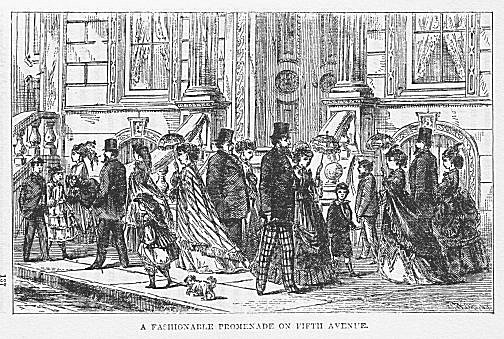
Strange to say, the Knickerbocker class receives fresh additions every
year. Each new comer has a Van to his name, and can show a
string of portraits of yellow-faced worthies, in leather breeches, and
ruffles, and wigs, which he points to with pride as his
“ancestors.” The statistician would be sorely perplexed
in attempting to ascertain the number of Dutch settlers in New Amsterdam
were he to trace back the pedigrees of the present Knickerbockers, for if
the claims of the present generation be admitted, one of two things is
sure—either the departed Dutchmen must have been more “numerous
fathers” than they cared to admit at the time, or the original
population has been underestimated.
The next in order are those who, while making no boast of family, are
persons who have inherited large wealth from several generations of
ancestors. Freed from the necessity of earning their livings, they
have an abundance of leisure in which to cultivate the “small sweet
courtesies of life.” They are neither shoddyites nor snobs, and
while there are many who do no credit to their class, they constitute one
of the pleasantest portions of metropolitan society. They furnish
some of the most agreeable men, and some of the most beautiful and charming
women in the city. Their homes are elegant, and abound in evidences
of the taste of their owners, who spend their money liberally in support of
literature and the arts. Here are to be found some of the rarest
works of European and American masters. Unfortunately this class of
New Yorkers is not very large. It is destined to increase, however,
with the growth of wealth in the city. Good men, who have begun where
the forefathers of these people started, will constantly contribute their
children to swell this class, in which will always be collected those who
unite true merit to great wealth, those who are proud of their country and
its institutions, contented with its customs, and possessed of too much
good sense to try to add to their importance by a ridiculous assumption of
“aristocratic birth,” or a pitiful imitation of the manners of
the great of other lands.
The third class may be said to consist of those who value culture and
personal excellence above riches. There is not much individual wealth
in this class, but its members may be regarded as “persons in
comfortable circumstances.” They are better educated, have more
correct tastes, and do the most to give to New York society its best and
most attractive features. It is a class to which merit is a sure
passport. It is modest and unassuming, free from ostentatious parade,
and, fortunately, is growing rapidly. It is made up of professional
men of all kinds, clergymen, lawyers, poets, authors, physicians, painters,
sculptors, journalists, scientific men, and actors, and their
families. Its tone is vigorous and healthy, and it is sufficiently
free from forms to make it independent, and possessed of means enough to
enable it to pursue its objects without hindrance.
The remainder of those who constitute what is called society are the
“New Rich,” or as they are sometimes termed, the
“Shoddyites.” They constitute the majority of the
fashionables, and their influence is felt in every department of domestic
life. They are ridiculed by every satirist, yet they increase.
Every year makes fresh accessions to their ranks, and their follies and
extravagances multiply in proportion. They occupy the majority of the
mansions in the fashionable streets, crowd the public thoroughfares and the
Park with their costly and showy equipages, and flaunt their wealth so
coarsely and offensively in the faces of their neighbors, that many good
people have come to believe that riches and vulgarity are
inseparable. They make themselves the most conspicuous, and are at
once accepted by strangers as the “best society” of the
metropolis.
They are almost without exception persons who have risen from the
ranks. This is not to their discredit. On the contrary, every
American is proud to boast that this is emphatically the land of self-made
men, that here it is within the power of any one to rise as high in the
social or political scale as his abilities will carry him. The
persons to whom we refer, however, affect to despise this. They take
no pride in the institutions which have been so beneficial to them, but
look down with supreme disdain upon those who are working their way
up. They are ashamed of their origin, and you cannot offend one of
them more than to hint that you knew him a few years ago as a mechanic or a
shopkeeper.
Some of the “fashionables” appear very unexpectedly before
the world. But a short while ago a family may have been living in the
humbler quarter of the city, or even in a tenement house. A sudden
fortunate speculation on the part of the husband, or father, may have
brought them enormous wealth in the course of a few days. A change is
instantly made from the humble abode to a mansion on Fifth or Madison
avenue. The newly acquired wealth is liberally expended in
“fitting up,” and the lucky possessors of it boldly burst upon
the world of fashion as stars of the first magnitude. They are
courted by all the newly rich, and invitations to the houses of other
“stars” are showered upon them. They may be rude,
ignorant, uncouth in manner, but they have wealth, and that is all that is
required. They are lucky indeed, if they hold their positions
long. A few manage to retain the wealth which comes to them thus
suddenly, but as a rule those who are simply lucky at the outset, find Dame
Fortune a very capricious goddess, and at the next turn of her wheel pass
off the stage to make room for others who are soon to share the same
fate.
During the oil speculations, and during the war, the shoddy class was
largely increased by those who were made suddenly and unexpectedly rich by
lucky ventures in petroleum lands and stocks, and by army contracts.
Now other speculations provide recruits for this class, to which Wall
street is constantly sending fresh “stars” to blaze awhile in
the firmament of society, and then to make way for others. The shoddy
element is not, however, confined to those who acquire wealth with rapidity
or by speculations. There are many who rise very slowly and painfully
in the world, who, when blessed with fortune, throw themselves headlong
into the arms of “shoddy.”
It is not difficult to recognize these persons. They dress not
only handsomely, but magnificently, making up in display what they lack in
taste. They cover themselves with jewels, and their diamonds, worn on
ordinary occasions, might in some instances rival the state gems of
European sovereigns. Their rough, hard hands, coarse faces, loud
voices, bad English, and vulgar manners contrast strikingly with the
splendors with which they surround themselves. They wear their honors
uneasily, showing how little they are accustomed to such things. They
look down with disdain upon all less fortunate in wealth than themselves, and
worship as demi-gods those whose bank accounts are larger than their
own. They are utterly lacking in personal dignity, and substitute for
that quality a supercilious hauteur.
Extravagance is the besetting sin of New York society. Money is
absolutely thrown away. Fortunes are spent every year in dress and in
all sorts of follies. Houses are fitted up and furnished in the most
sumptuous style, the building and its contents being sometimes worth a
million of dollars. People live up to every cent of their incomes,
and often beyond them. It is no uncommon occurrence for a fine
mansion, its furniture, pictures, and even the jewels of its occupants, to
be pledged to some usurer for the means with which to carry on this life of
luxury. Each person strives to outdo his or her acquaintances.
Those who have studied the matter find no slight cause for alarm in the
rapid spread of extravagance among all classes of the city people, for the
evil is not confined to the wealthy. They might afford it, but people
of moderate means, who cannot properly make such a heavy outlay, are among
those most guilty of the fault.
In no other city of the land is there to be seen such magnificent
dressing on the part of the ladies as in New York. The amount of
money and time expended here on dress is amazing. There are two
objects in view in all this—the best dressed woman at a ball or party
is not only sure to outshine her sisters there present, but is certain to
have the satisfaction next day of seeing her magnificence celebrated in
some of the city journals. Her vanity and love of distinction are
both gratified in this way, and such a triumph is held to be worth any
expense. There is not an evening gathering but is graced by the
presence of ladies clad in a style of magnificence which reminds one of the
princesses in the fairy tales. Says a recent writer:
“It is almost impossible to estimate the number of dresses
a very fashionable woman will have. Most women in society can afford
to dress as it pleases them, since they have unlimited amounts of money at
their disposal. Among females dress is the principal part of
society. What would Madam Mountain be without her laces and diamonds,
or Madam Blanche without her silks and satins? Simply commonplace old
women, past their prime, destined to be wall-flowers. A fashionable
woman has just as many new dresses as the different times she goes into
society. The élite do not wear the same dresses
twice. If you can tell us how many receptions she has in a year, how
many weddings she attends, how many balls she participates in, how many
dinners she gives, how many parties she goes to, how many operas and
theatres she patronizes, we can approximate somewhat to the size and cost
of her wardrobe. It is not unreasonable to suppose that she has two
new dresses of some sort for every day in the year, or 720. Now to
purchase all these, to order them made, and to put them on afterward,
consumes a vast amount of time. Indeed, the woman of society does
little but don and doff dry-goods. For a few brief hours she flutters
the latest tint and mode in the glare of the gas-light, and then
repeats the same operation the next night. She must have one or two
velvet dresses which cannot cost less than $500 each; she must possess
thousands of dollars’ worth of laces, in the shape of flounces, to
loop up over the skirts of dresses, as occasion shall require.
Walking-dresses cost from $50 to $300; ball-dresses are frequently imported
from Paris at a cost of from $500 to a $1000; while wedding-dresses may
cost from $1000 to $5000. Nice white Llama jackets can be had for
$60; robes princesse, or overskirts of lace, are worth from $60 to
$200. Then there are travelling-dresses in black silk, in pongee,
velour, in piqué, which range in price from $75 to $175. Then
there are evening robes in Swiss muslin, robes in linen for the garden and
croquet-playing, dresses for horse-races and for yacht-races, robes de
nuit and robes de chambre, dresses for breakfast and for dinner,
dresses for receptions and for parties, dresses for watering-places, and
dresses for all possible occasions. A lady going to the Springs takes
from twenty to sixty dresses, and fills an enormous number of Saratoga
trunks. They are of every possible fabric—from Hindoo muslin,
‘gaze de soie,’ crape maretz, to the heavy silks of Lyons.
“We know the wife of the editor of one of the great morning
newspapers of New York, now travelling in Europe, whose dress-making bill
in one year was $10,000! What her dry-goods bill amounted to heaven
and her husband only know. She was once stopping at a summer hotel,
and such was her anxiety to always appear in a new dress that she would
frequently come down to dinner with a dress basted together just strong
enough to last while she disposed of a little turtle-soup, a little
Charlotte de Russe, and a little ice cream.
“Mrs. Judge ---, of New York, is considered one of the
‘queens of fashion.’ She is a goodly-sized lady—not
quite so tall as Miss Anna Swan, of Nova Scotia—and she has the happy
faculty of piling more dry-goods upon her person than any other lady in the
city; and what is more, she keeps on doing it. To give the reader a
taste of her quality, it is only necessary to describe a dress she wore at
the Dramatic Fund Ball, not many years ago. There was a rich blue
satin skirt, en train. Over this there was looped up a
magnificent brocade silk, white, with bouquets of flowers woven in all the
natural colors. This overskirt was deeply flounced with costly white
lace, caught up with bunches of feathers of bright colors. About her
shoulders was thrown a fifteen-hundred dollar shawl. She had a
head-dress of white ostrich feathers, white lace, gold pendants, and purple
velvet. Add to all this a fan, a bouquet of rare flowers, a lace
handkerchief, and jewelry almost beyond estimate, and you see Mrs. Judge
--- as she appears when full blown.
“Mrs. General --- is a lady who goes into society a great
deal. She has a new dress for every occasion. The following
costume appeared at the Charity Ball, which is the great ball of the
year in New York. It was imported from Paris for the occasion, and
was made of white satin, point lace, and a profusion of flowers. The
skirt had heavy flutings of satin around the bottom, and the lace flounces
were looped up at the sides with bands of the most beautiful pinks, roses,
lilies, forget-me-nots, and other flowers.
“It is nothing uncommon to meet in New York society ladies who
have on dry-goods and jewelry to the value of from thirty to fifty thousand
dollars. Dress patterns of twilled satin, the ground pale green,
pearl, melon color, or white, scattered with sprays of flowers in raised
velvet, sell for $300 dollars each; violet poult de soie will sell for $12
dollars a yard; a figured moire will sell for $200 the pattern; a
pearl-colored silk, trimmed with point appliqué lace, sells for
$1000; and so we might go on to an almost indefinite length.”
Those who think this an exaggerated picture have only to apply to the
proprietor of any first-class city dry-goods store, and he will confirm its
truthfulness. These gentlemen will tell you that while their sales of
staple goods are heavy, they are proportionately lighter than the sales of
articles of pure luxury. At Stewart’s the average sales of
silks, laces, velvets, shawls, gloves, furs, and embroideries is about
$24,500 per diem. The sales of silks alone average about $15,000 per
diem.
A few years ago the dwelling of a wealthy citizen of New York was
consumed by fire. The owner of the mansion soon after applied to a
prominent Insurance Company for the payment of the sum of $21,000, the
amount of the risk they had taken on the wearing apparel of his daughter, a
young lady well known in society for the splendor of her attire. The
company refused to pay so large a sum, and protested that the lady in
question could not have possessed so costly a wardrobe. Suit was
brought by the claimant, and, as a matter of course, an enumeration of the
articles destroyed and their value was made to the court. The list
was as follows, and is interesting as showing the mysteries of a
fashionable lady’s wardrobe:
|
6 silk robes—red, enamelled, green, blue, yellow, pink,
black—with fringes, ruches, velvets, lace trimmings, etc.
|
$950
|
|
1 blue Marie Louise gros-de-Naples, brocaded with silver taken from the
looms of Lyons; cost, without a stitch in it
|
300
|
|
Silver bullion fringe tassels and real lace to match
|
200
|
|
1 rose-colored satin, brocaded in white velvet, with deep flounce
of real blonde lace, half-yard wide; sleeves and bertha richly trimmed with
the same rose-colored satin ribbon; satin on each side, with silk cord and
tassel; lined throughout body, skirt and sleeves with white silk
|
$400
|
|
1 white satin of exceedingly rich quality, trimmed with blonde and
bugles; two flounces of very deep point d’Alençon, sleeves of
the same, reaching down to the elbows, and bertha to match, with white
bugles and blonde to match
|
2500
|
|
1 royal blue satin dress, trimmed, apron-shape, with black Brussels lace
and gold and bugle trimmings, with one flounce, going all around the skirt,
of black Brussels lace; body and sleeves to match; sleeves looped up with
blue velvet roses set in lace, to imitate a bouquet
|
1500
|
|
1 dove-colored satin dress, trimmed with velvet, half-yard deep; a long
trail with the velvet going all around, with llama fringe and dove-colored
acorns, forming a heading to the velvet, and going all up the skirt and
around the long Greek sleeves; the sleeves lined with white satin and
quills of silver ribbon going around the throat; lined throughout with
white silk, having belonging to it a cloak and hood, lined and trimmed to
match; made in Paris
|
425
|
|
1 black Mantua velvet robe, long train, sleeves hanging down as far as
the knees, open, lined with white satin, and trimmed all round with
seed-pearls, as well as all round the top of low body—the seed-pearls
forming clusters of leaves going down front of skirt and all round the
skirt and train
|
500
|
|
1 rich moire-antique dress, embroidered in gold from the body to the
skirt and sleeves and all round, taken up and fastened up with gold
embroidery to imitate the folds and wrinkles of the dress, trimmed round
the edge with white Brussels lace, having an underskirt of amber satin
trimmed with Brussels lace, to show underneath; lined throughout with
silk
|
400
|
|
1 large Brussels shawl, of exquisite fineness and elegance of design, to
go with it
|
700
|
|
1 crimson velvet dress, lined throughout with rose-colored silk; train
very long, trimmed with rich silk, blonde lace covering the entire train,
being carried around and brought up the front of the dress and body,
forming the bertha; and sleeves looped up with white roses; turquoise fan
and slippers to match
|
400
|
|
1 blue mercantique (lined), low body, trimmed with Honiton lace, body
and sleeves; one piece of silk to match, unmade, intended for high body,
and bons; sleeves slashed open and lined with white satin
|
200
|
|
1 rose-colored robe, with flounces; high and low body, having fringe and
trimming woven to imitate Russian fur; both bodies trimmed with fringe
ribbons and narrow lace
|
$250
|
|
1 mauve-colored glacé silk, braided and bugled all around the
bottom of skirt, on the front of body, around the band of Garibaldi body,
down the sleeves and round the cuffs of Garibaldi body; the low body, with
bertha deeply braided and bugled, with sleeves to match; long sash, with
end and bows and belts, all richly braided and bugled with thread lace
|
180
|
|
1 vraie couleur de rose gros-de-Naples, with flounces richly brocaded
with bouquet in natural size and color, made to represent the same in
panels, trimmed with gimp and fringe to match; also, high and low body,
with bertha and trimmings to match
|
300
|
|
1 pink morning robe, very superb, trimmed down the side with white satin
a quarter of a yard wide, sleeves trimmed to match, satin-stitched, with
flounces in pink silk on edge of satin, passementerie cord and tassels
|
250
|
|
1 gold-colored silk aersphane, with three skirts, each skirt trimmed
with quillings of yellow satin ribbon, looped up with pink roses: body to
match, trimmed with silk blonde; white blonde round the neck; satin
quillings; silk blonde on the sleeves, and lace and yellow satin; rich
underskirt to match
|
100
|
|
2 very richly embroidered French cambric morning-dresses, with bullion
and heavy satin ribbons running through; one lined throughout with pink,
the other with blue silk
|
100
|
|
1 rich black silk glacé, trimmed with bugles and black velvet
|
200
|
|
1 blue-black Irish silk poplin, made in Gabrielle style, trimmed with
scarlet velvet all round the skirt; sleeves and body-belt and buckle to
match
|
125
|
|
1 Cashmere, shawl pattern, morning-dress, lined; sleeves and flies lined
with red silk, cord and tassels to match; not twice on
|
100
|
|
1 white Swiss muslin, with double skirt and ribbon running through the
upper and lower hems of each skirt, of pink satin; body with Greek sleeves
to match
|
90
|
|
1 straw-colored silk dress, trimmed with black velvet, and body of the
same
|
80
|
|
1 white Swiss muslin robe, with one plain skirt and one above, graduated
by larger and smaller tucks to imitate three flounces; the sleeves with
puffs, and long sleeves with tucks, down and across to match skirts, and
Garibaldi body made to match; one pink satin under-body to go with it
|
95
|
|
1 white Swiss muslin dress, with three flounces, quilled and tucked,
graduated one above the other, with headings of lace on the top of each
flounce; low body, with tuck, bretelles and broad colored sarsnet
ribbon
|
90
|
|
1 India muslin dress, very full, embroidered to imitate three
flounces; and Greek body and sleeves, also embroidered to match sky-blue
skirt and body to go underneath
|
$110
|
|
1 India muslin dress, double skirt, richly embroidered, with high jacket
and long sleeves embroidered to match
|
90
|
|
1 pink satin skirt and bodice, to go underneath
|
25
|
|
1 white long morning dress, embroidered round the skirt and up the
front, in two flounces, one hanging over the other; sleeves and cuffs to
match
|
60
|
|
1 white muslin, with white spots, skirt and bodice trimmed with bullion
and narrow real Valenciennes lace
|
80
|
|
2 white cambric morning-dresses, one very richly embroidered, in wheels
and flounces; and jacket to match
|
275
|
|
1 white Swiss muslin jacket, very richly embroidered; skirt and bodice
to match
|
100
|
|
3 cambric tight-fitting jackets, with collar and sleeves very richly
embroidered, to imitate old Spanish point
|
120
|
|
5 Marie Antoinettes, made entirely of French muslin, with triple bullion
and double face; pink satin ribbon running through. Cost $60 each
|
300
|
|
1 piqué morning dress and jacket, richly embroidered
|
75
|
|
1 piqué skirt, richly embroidered
|
50
|
|
6 fine Swiss muslin skirts, four yards in each, trimmed with two rows of
real lace, to set in full, finely finished
|
55
|
|
2 very rich bastistes, for morning-dresses
|
120
|
|
2 very fine cambric skirts, delicately embroidered, to wear with open
morning-dresses
|
60
|
|
2 fine linen skirts, embroidered in open work
|
40
|
|
2 silk grenadine dresses, trimmed with Maltese lace and velvet; two
bodices to match, blue and green
|
200
|
|
2 silk baréges, trimmed with velvet and fringe, and bodice to
match
|
200
|
|
1 Scotch catlin silk full dress, Stewart, trimmed with black velvet and
fringe, made to match colors of dress
|
100
|
|
3 Balmoral skirts, very elegant, embroidered in silk
|
90
|
|
1 ponceau silk dress, trimmed with llama fringe and gold balls; body and
sleeves very richly trimmed to match
|
250
|
|
1 blue silk to match, trimmed with steel fringe and bugles; body and
sleeves richly trimmed
|
250
|
|
1 French muslin jacket, with lapels and sleeves to turn back, very
heavily embroidered
|
40
|
|
1 set point d’Alençon, consisting of shirt sleeves,
handkerchief, and collar
|
120
|
|
1 point d’Alençon extra large handkerchief
|
100
|
|
1 set Honiton lace, consisting of handkerchief, collar, and
sleeves
|
$80
|
|
1 set Maltese lace, consisting of handkerchief, collar, velvet cape
|
300
|
|
1 set Irish point lace, very rich, consisting of wide, deep sleeves,
handkerchief and collar
|
80
|
|
1 cape of ditto, going up to the neck and shut at the back
|
35
|
|
2 black lace mantillas
|
40
|
|
1 black lace jacket
|
15
|
|
1 cape, composed of Valenciennes lace
|
75
|
|
2 dozen very rich embroidered cambric chemises, with lace
|
120
|
|
6 ditto, with puffed bullions in front
|
100
|
|
18 Irish linen chemises, with very rich fronts
|
200
|
|
7 Irish linen, embroidered
|
40
|
|
1 dozen night-dresses, very rich fronts
|
216
|
|
3 linen ditto, very rich
|
75
|
|
1 dozen embroidered drawers
|
72
|
|
2 very rich ditto
|
50
|
|
11 new pairs silk stockings, in box
|
40
|
|
1 dozen Lisle thread stockings
|
20
|
|
9 pairs boots and shoes
|
45
|
|
3 pairs embroidered slippers, very rich, in gold
|
40
|
|
1 pair Irish point lace sleeves (extra)
|
30
|
|
1 black velvet embroidered mantilla, imported
|
450
|
|
1 ditto, silk, embroidered with bugles, imported
|
100
|
|
1 glacé silk, tight-fitting basque, with black zeplore lace cape;
trimmed in every width with narrow lace to match
|
65
|
|
1 black silk Arab, with two tassels
|
25
|
|
1 dust-wrapper, from Cashmere
|
18
|
|
4 magnificent opera-cloaks
|
175
|
|
1 red scarlet cloth cloak, trimmed with yellow cord
|
12
|
|
1 cloth, drab-color cloak
|
8
|
|
1 cloak, with hood lined with silk
|
10
|
|
2 dozen cambric, embroidered, with name Fanny
|
24
|
|
1 set Russian sable muffs, cape and boa
|
100
|
|
1 tortoise shell comb, made in one piece and very rich
|
50
|
|
6 fancy combs
|
30
|
|
1 very rich mother-of-pearl, gold inlaid, and vol. feathers beautifully
painted by hand
|
85
|
|
1 fan of mother-of pearl, inlaid in gold, with silk and white and
Job’s spangles
|
45
|
|
1 blue mother-of-pearl, with looking-glass; imitation ruby and
emeralds
|
35
|
|
6 other fans, of various kinds
|
25
|
|
1 parasol, all ivory handle throughout, engraved with name in full,
covering of silk and Irish point lace, very fine, covering the entire
parasol
|
100
|
|
Several other parasols
|
$25
|
|
1 real gold head-ornament, representing the comet and eclipse
appearing
|
100
|
|
About twenty hair-nets, silver, gold, and all colors and pearls
|
40
|
|
4 ladies’ bonnets, some exceedingly elegant
|
100
|
|
1 box marabout feathers, for dressing the hair
|
50
|
|
1 box artificial flowers
|
l5
|
|
1 lot new ribbon, for sashes; velvet, silk, and satin
|
35
|
|
1 small miniature model piano, played by mechanism, from Vienna
|
50
|
|
1 lady’s writing-desk, inlaid with tortoise-shell and
mother-of-pearl, lined with silk velvet, with compartments and secretary;
carved mother-of-pearl paper-knife, gold seal, gold pencil, case full of
fancy writing paper; made in Paris
|
200
|
|
1 bula work-box, elegant; inlaid with silver and lined with ci-satin,
fitted with gold thimble, needle, scissors, pen-knife, gold bodkin, cotton
winders; outside to match French piano
|
125
|
|
1 long knitting-case to match the above, fitted with needles, beads and
silk of every description
|
40
|
|
1 papier-maché work-box, and fitted up
|
5
|
|
1 morocco work-bag, ornamented with bright steel; fitted up with
scissors, thimble, etc
|
3
|
|
1 lady’s Russia leather shopping-bag, with silver and gilt clasps
for chain and key
|
15
|
|
1 18-karat gold filigree card-case
|
20
|
|
1 set gold whist-markers, in hands on little box, a present unto her
|
50
|
|
1 lady’s small work-bag, silk fittings
|
5
|
|
1 solid silver porte-monnaie
|
19
|
|
1 little blue porte-monnaie; velvet, and cords and tassel
|
3
|
|
1 ladies’ companion, with fixings in silver; a present
|
45
|
|
1 hair-pin stand; a small book-case, with small drawers and mirror
|
14
|
|
1 basket of mother-of-pearl, and gilt and red satin, full of
wax-flowers
|
35
|
|
1 elegant Bible in gilt, edge mounted in gold
|
30
|
|
43 volumes various miniature books, bound most elegantly in morocco, and
brought as a present from Europe
|
100
|
|
1 silver pin-cushion and sewer for fastening on the table
|
23
|
|
1 elegant, richly carved ivory work-table, brought from Mexico, inside
fitted up with silk and different compartments, standing three feet
high
|
400
|
|
1 lady’s solid silver rutler, from Mexico
|
25
|
|
1 gilt head-ornament, representing a dagger
|
3
|
|
1 lady’s English dressing-case, solid silver fittings,
English make and stamp, rosewood, bound with brass and gilt, fitted and
lined with silver
|
$250
|
|
1 pair rich carved ivory hair brushes, engraved with name and crest
|
155
|
|
1 ditto engraved and crest
|
55
|
|
1 small ivory hair-brush
|
12
|
|
1 ebony hair-brush, inlaid with mother-of-pearl
|
20
|
|
1 Berlin-wool worked cushion
|
50
|
|
1 sewing-chair, elegantly embroidered seat and back
|
75
|
|
1 Berlin-wool Affghan
|
100
|
|
1 fire-screen, Berlin work, beads, representing Charles II. hunting
|
125
|
|
1 large sole-leather trunk, about four feet long and three feet deep,
lined with red morocco, handsomely ornamented in gold, embossed on the red
morocco, with seven compartments; very scientifically constructed for the
necessities of a lady’s wardrobe, with springs to hold open each
compartment; and the lace compartment could, at pleasure, be rested on two
steel legs, covered with gilt embossed morocco, representing a writing
table, with a portfolio, containing writing materials; it had two large
French patent locks
|
250
|
|
1 lady’s travelling trunk, with cover, containing a quantity of
worn dresses, zouave cloth and gold, druided jacket cloaks, woollen ditto,
opera cloak, etc
|
73
|
|
Total
|
$21,000
|
Such lavish expenditure is a natural consequence of a state of society
where wealth is the main distinction. Mrs. John Smith’s
position as a leader of the ton is due exclusively to her great
riches and her elaborate displays. Mrs. Richard Roe will naturally
try to outshine her, and thus rise above her in the social scale.
Many persons seeking admission into such society, and finding wealth the
only requisite, will make any sacrifice to accomplish their end. If
they have not wealth they will affect to have it. They could not
counterfeit good birth, or high breeding, but they can assume the
appearance of being wealthy. They can conduct themselves, for a while
at least, in a manner utterly disproportioned to their means, and so they
go on, until their funds and credit being exhausted, they are forced to
drop out of the circles in which they have moved, and the so-called friends
who valued them only for their supposed wealth, instantly forget that
they ever knew them. No more invitations are left for them, they are
not even tolerated in “good society,” and are “cut”
on the street as a matter of course.
Not a year passes but records the failure of some prominent business man
in New York. His friends are sorry for him, and admit that he was
prudent and industrious in his business. “His family did
it,” they tell you, shaking their heads. “They lived too
fast. Took too much money to run the house, to dress, and to keep up
in society.” Only the All Seeing Eye can tell how many men who
stand well in the mercantile community are tortured continually by the
thought that their extravagance or that of their families is bringing them
to sure and certain ruin; for not even in New York can a man live beyond
his actual means. They have not the moral courage to live within
their legitimate incomes. To do so would be to lose their positions
in society, and they go on straining every nerve to meet the demands upon
them, and then the crash comes, and they are ruined.
Those who dwell in the great city, and watch its ways with observant
eyes, see many evils directly attributable to the sin of
extravagance. These evils are not entirely of a pecuniary
nature. There are others of a more terrible character. Keen
observers see every day women whose husbands and fathers are in receipt of
limited incomes, dressing as if their means were unlimited. All this
magnificence is not purchased out of the lawful income of the husband or
father. The excess is made up in other ways—often by the
sacrifice of the woman’s virtue. She finds a man willing to pay
liberally for her favors, and carries on an intrigue with him, keeping her
confiding husband in ignorance of it all the while. She may have more
than one lover—perhaps a dozen. When a woman sins from motives
such as these, she does not stop to count the cost. Her sole object
is to get money, and she gets it. It is this class of
nominally virtuous married and unmarried women that support the infamous
houses of assignation to be found in the city.
The curse of extravagance does not manifest itself in dress alone.
One cannot enter the residence of a single well-to-do person in the city
without seeing evidences of it. The house is loaded with the richest
and rarest of articles, all intended for show, and which are oftentimes
arranged without the least regard to taste. The object is to make the
house indicate as much wealth on the part of its owner as possible.
It makes but little difference whether the articles are worth what was paid
for them, or whether they are arranged artistically—if the sum total
is great, the owner is satisfied. It is a common thing to see the
walls of some elegant mansion disfigured with frescoes, which, though
executed at an enormous cost, are utterly without merit or taste.
Again one sees dozens of paintings, bought for works of the old masters,
lining the walls of the richest mansions of the city, which are the merest
daubs, and the works of the most unscrupulous Bohemians. Not long
since, a collection of paintings was offered for sale in New York, the
owner being dead. They had been collected at great expense, and were
the pride of their former owner. With a few exceptions they were
wretched copies, and in the whole lot, over five hundred in number, there
were not six genuine “old masters,” or “masters” of
any age.
Entertainments are given in the most costly style. From ten to
twenty thousand dollars are spent in a single evening in this way. At
a fashionable party from twelve to fifteen hundred dollars’ worth of
champagne is consumed, besides other wines and liquors. Breakfasts
are given at a cost of from one to three thousand dollars; suppers at a
still higher cost. This represents the expense to the host of the
entertainment; but does not cover the cost of the toilettes to be provided
for the family, which make up several thousand dollars more.
Suppers or dinners are favorite entertainments, and the outlay required
for them is oftentimes very heavy. The host frequently provides
nothing but viands imported from foreign lands. Sets of china of
great cost, or of silver equally expensive, or even of gold, are displayed
ostentatiously. Sometimes the supper-room is entirely refitted in
red, blue, or gold, everything, even the lights and flowers, being of one
color, in order that the affair may be known as Mrs. A---’s red,
blue, or gold supper. Some of the most extravagant
entertainers will place at the side of each cover an exquisite bouquet
inside of which is a costly present of jewelry.
All this reckless expenditure in the midst of so much sorrow and
suffering in the great city! “The bitter cold of winter,”
says the Manager of the ‘Children’s Aid Society,’ in his
appeal for help, “and the freezing storms have come upon thousands of
the poor children of this city, unprepared. They are sleeping in
boxes, or skulking in doorways, or shivering in cellars without proper
clothing, or shoes, and but half-fed. Many come bare-footed through
the snow to our industrial schools. Children have been known to fall
fainting on the floor of these schools through want of food. Hundreds
enter our lodging-houses every night, who have no home. Hundreds
apply to our office for a place in the country, who are ragged,
half-starved, and utterly unbefriended.”
We have spoken of the women of fashion. What shall we say of the
men? They are neither refined nor intellectual. They have a
certain shrewdness coupled, perhaps, with the capacity for making
money. Their conversation is coarse, ignorant, and sometimes
indecent. They have not the tact which enables women to adapt
themselves at once to their surroundings, and they enjoy their splendors
with an awkwardness which they seek to hide beneath an air of worldly
wisdom. They patronize the drama liberally, but their preference is
for what Olive Logan calls “the leg business.” In person
they are coarse-looking. Without taste of their own, they are totally
dependent upon their tailors for their “style,” and are nearly
all gotten up on the same model. They are capital hands at staring
ladies out of countenance, and are masters of all the arts of
insolence. Society cannot make gentlemen out of them do what it
will. As John Hibbs would say, “they were not brought up to it
young.” They learn to love excitement, and finding even the
reckless whirl of fashion too stale for them, seek gratification out of
their own homes. They become constant visitors at the great
gaming-houses, and are the best customers of the bagnios of the city.
If men have their dissipations, the women have theirs also. Your
fashionable woman generally displays more tact than her husband. She
has greater opportunities for display, and makes better use of them.
If the ball, or party, or sociable at her residence is a success, the
credit is hers exclusively, for the husband does little more than pay the
bills. Many of these women are “from the ranks.”
They have risen with their husbands, and are coarse and vulgar in
appearance, and without refinement. But the women of fashion are not
all vulgar or unrefined. Few of them are well educated, but the New
York woman of fashion, as a rule, is not only very attractive in
appearance, but capable of creating a decided impression upon the society
in which she moves. She is thoroughly mistress of all its arts, she
knows just when and where to exercise them to the best advantage, she
dresses in a style the magnificence of which is indescribable, and she has
tact enough to carry her through any situation. Yet, in judging her,
one must view her as a butterfly, as a mere creature of magnificence and
frivolity. Don’t seek to analyze her character as a wife or
mother. You may find that the marriage vow is broken on her part as
well as on her husband’s; and you will most probably find that she
has sacrificed her soul to the demands of fashion, and “prevented the
increase of her family” by staining her hands in the blood of her
unborn children. Or, if she be guiltless of this crime, she is a
mother in but one sense—that of bearing children. Fashion does
not allow her to nurse them. She cannot give to her own flesh and
blood the time demanded of her by her “duties in society;” so
from their very birth the little innocents are committed to the care of
hirelings, and they grow up without her care, removed from the ennobling
effect of a mother’s constant watchful presence, and they add to the
number of idle, dissolute men and women of fashion, who are a curse to the
city.
Your fashionable woman is all art. She is indeed “fearfully
and wonderfully made.” She is a compound frequently of false
hair, false teeth, padding of various kinds, paint, powder and
enamel. Her face is “touched up,” or painted and lined by
a professional adorner of women, and she utterly destroys the health of her
skin by her foolish use of cosmetics. A prominent Broadway dealer in
such articles sells thirteen varieties of powder for the skin, eight kinds
of paste, and twenty-three different washes. Every physical defect is
skilfully remedied by “artists;” each of whom has his
specialty. So common has the habit of resorting to these things
become, that it is hard to say whether the average woman of fashion is a
work of nature or a work of art. Men marry such women with a kind of
“taking the chances” feeling, and if they get a natural woman
think themselves lucky.
As it is the custom in fashionable society in New York to prevent the
increase of families, it is natural no doubt to try to destroy childhood in
those who are permitted to see the light.
The fashionable child of New York is made a miniature man or woman at
the earliest possible period of its life. It does not need much
labor, however, to develop “Young America” in the great
metropolis. He is generally ready to go out into the world at a very
tender age. Our system of society offers him every facility in his
downward career. When but a child he has his own latch-key; he can
come and go when he pleases; he attends parties, balls, dancing-school, the
theatre and other evening amusements as regularly and independently as his
elders, and is rarely called upon by “the Governor,” as he
patronizingly terms his father, to give any account of himself. He
has an abundance of pocket-money, and is encouraged in the lavish expenditure
of it. He cultivates all the vices of his grown-up friends; and
thinks church going a punishment and religion a bore. He engages in
his dissipations with a recklessness that makes old sinners envious of his
“nerve.” His friends are hardly such as he could
introduce into his home. He is a famous “hunter of the
tiger,” and laughs at his losses. He has a mistress, or perhaps
several; sneers at marriage, and gives it as his opinion that there is not
a virtuous woman in the land. When he is fairly of age he has lost
his freshness, and is tired of life. His great object now is to
render his existence supportable.
Girls are forced into womanhood by fashion even more rapidly than boys
into manhood. They are dressed in the most expensive manner from
their infancy, and without much regard to their health. Bare arms and
necks, and short skirts are the rule, even in the bleakest weather, for
children’s parties, or for dancing-school, and so the tender frames
of the little ones are subjected to an exposure that often sows the seeds
of consumption and other disease. The first thing the child learns is
that it is its duty to be pretty—to look its best. It is taught
to value dress and show as the great necessities of existence, and is
trained in the most extravagant habits. As the girl advances towards
maidenhood, she is forced forward, and made to look as much like a woman as
possible. Her education is cared for after a fashion, but amounts to
very little. She learns to play a little on some musical instrument,
to sing a little, to paint a little—in short she acquires but a
smattering of everything she undertakes. She is left in ignorance of
the real duties of a woman’s life—the higher and nobler part of
her existence. She marries young, and one of her own set, and her
married life is in keeping with her girlhood. She is a creature in
which nothing has been fully developed but the passions and the
nerves. Her physical constitution amounts to nothing, and soon gives
way. Her beauty goes with her health, and she is forced to resort to
all manner of devices to preserve her attractions.
It is a habit in New York to allow children to give large entertainments at fashionable resorts, without the restraining
presence of their elders. Here crowds of boys and girls of a
susceptible age assemble under the intoxicating influence of music,
gas-light, full dress, late suppers, wines and liquors. Sometimes
this juvenile dissipation has been carried so far that it has been sharply
rebuked by the public press.
An English writer gives the following clever sketch of a fashionable
young lady of New York, whom he offers as a type of the “Girl of the
Period:”
“Permit me to present you to Miss Flora Van Duysen Briggs.
Forget Shakspeare’s dictum about a name; there is a story
attached to this name which I shall tell you by and by. Miss Flora is
a typical New York girl of the period; between sixteen and seventeen years
old; a little under the medium height; hair a golden brown; eyes a violet
blue; cheeks and lips rosy; teeth whiter and brighter than pearls; hands
and feet extremely small and well-shaped; figure petite but
exquisitely proportioned; toilette in the latest mode de
Paris; but observe, above all, that marvellous bloom upon her face,
which American girls share with the butterfly, the rose, the peach and the
grape, and in which they are unequalled by any other women in the
world.
“Miss Flora’s biography is by no means singular. Her
father is Ezra Briggs, Esq., a provision merchant in the city.
Twenty-five years ago, Mr. Briggs came to New York from one the Eastern
States, with a common-school education, sharp sense, and no money. He
borrowed a newspaper, found an advertisement for a light porter, applied
for and obtained the situation, rose to be clerk, head-clerk, and small
partner, and fagged along very comfortably until the Civil War broke out,
and made his fortune. His firm secured a government contract, for
which they paid dearly, and for which they made the Government pay
dearer. Their pork was bought for a song, and sold for its weight in
greenbacks. Their profits averaged 300 per cent. They were more
fatal to the soldiers than the bullets of the enemy. One consignment
of their provisions bred a cholera at Fortress Monroe, and robbed the Union
of 15,000 brave men. Their enemies declared that the final defeat of
the Southerners was owing to the capture of 1000 barrels of Briggs’s
mess beef by General Lee. But Briggs was rolling in wealth, and could
afford to smile at such taunts.
“Flora’s mother had been a Miss Van Duysen. She was a
little, weak, useless woman, very proud of her name, which seemed to
connect her in some way with the old Dutch aristocracy. In point of
fact, Briggs married her on this account; for, like most democrats, he is
very fond of anything aristocratic. Mrs. Briggs, née
Van Duysen, has nothing Dutch about her but her name. The
Knickerbockers of New York were famous for their thrift, their economy,
their neatness, and, above all, their housewifely virtues. Mrs.
Briggs is thriftless, extravagant, dowdy in her old age, although she had
been a beauty in her youth, and knows as little about keeping a house as
she does about keeping a horse. During the war, at a fair given for
the benefit of the Sanitary Commission, in Union Square, several
Knickerbocker ladies organized a kitchen upon the old Dutch model, and
presided there in the costumes of their grandmothers. Mrs. Briggs was
placed upon the committee of management, but declined to serve, on account
of the unbecoming costume she was invited to wear, and because she
considered it unladylike to sit in a kitchen. But Mrs. Briggs
preserved her caste, and benefited the Sanitary Commission much more than
she would have done by her presence, by sending a cheque for $500
instead.
“Do we linger too long upon these family matters? No; to
appreciate Miss Flora, you must understand her surroundings. She has
never had a home. Born in a boarding-house, when her parents were not
rich, she lives at a hotel now that her father is a millionaire. Mr.
Briggs married the name of Van Duysen, in order to get into society.
Miss Van Duysen married Briggs’s money, in order to spend
it. Miss Flora Van Duysen Briggs combines her mother’s name and
her father’s money; her Mother’s early beauty and her
father’s shrewdness; her mother’s extravagance and her
father’s weakness for the aristocracy. She has good taste, as
her toilette shows; but she does not believe that anything can be
tasteful that is not expensive. Her aim is to run ahead of the
fashions, instead of following them; but she is clever enough to so adapt
them to her face and figure, that she always looks well-dressed, and yet
always attracts attention. Her little handsome head is full of native
wit, and of nothing else. Her education has been shamefully
neglected. She has had the best masters, who have taught her
nothing. Like all other American girls, she plays on the piano, but
does not play the piano—you will please notice this subtle but
suggestive distinction. She has picked up a smattering of French,
partly because it is a fashionable accomplishment, and partly because she
intends to marry; but I will not yet break your heart by announcing her
matrimonial intentions. Compared with an English or French girl of
the same age, she has many and grave deficiencies; but she atones for them
by a wonderful tact and cleverness, which blind you to all her faults and
lend a new grace to all her virtues.
“Truth to say, the admirers of Miss Flora, whose name is Legion,
give her the credit for all her own virtues, and blame her father and
mother, and the system, for all her faults. Born, as we have said, in
a boarding-house, left entirely in charge of the nurse-maid, educated at a
fashionable day-school, brought into society before fifteen, living in the
whirl, the bustle, the luxury, and the unhomeliness of a hotel, what could
you expect of Miss Flora but that she should be, at seventeen years of age,
a butterfly in her habits, a clever dunce as regards solid knowledge, and a
premature woman of the world in her tastes and manners? The
apartments which the Briggs family occupy at the Fifth Avenue Hotel are
magnificently decorated and furnished, but they do not constitute a
home. Several times Mr. Briggs has offered to purchase a house in a
fashionable thoroughfare; but his wife objects to the trouble of managing
unruly servants, and terrifies Mr. Briggs out of the notion by stories
of burglars admitted, and plate stolen, and families murdered in their
beds, through the connivance of the domestics. What more can any one
desire than the Briggs family obtain at the hotel for a fixed sum per week,
and a liberal margin for extras? The apartments are ample and
comfortable; the cuisine and the wines are irreproachable; there is
a small table reserved for them, to which they can invite whom they choose;
an immense staff of servants obey their slightest wish; their carriages,
kept at a neighboring livery stable, can be sent for at any moment; they
are as secluded in their own rooms as if they lived in another street, so
far as the family in the next suite is concerned; they are certain
to meet everybody, and can choose their own company; the spacious hotel
parlors are at their disposal whenever they wish to give an evening party,
reception, or thé dansant. What more could they gain by
setting up a private house? Mr. Briggs, having never tried the
experiment, does not know. Mrs. Briggs, whose only reminiscence of a
private residence is the one in which her mother let lodgings, does not
know. Miss Flora Van Duysen Briggs, having never been used to any
other way of life than the present, neither knows nor cares, and
‘does not want to be bothered.’
“The Briggs family spend their winters in town, their summers at
Newport, Saratoga, or some other watering-place, at which nobody cares
anything about the water. The frequenters of these rural or seaside
retreats are presumed to come for their health, but really come to show
their dresses. Thus Miss Flora’s life varies very little all
the year round; she rises late, and is dressed for breakfast; after
breakfast she practises upon the piano, shops with her mamma, and returns
to be dressed for luncheon; after luncheon she usually takes a brief nap,
or lies down to read a novel, and is then dressed for the afternoon
promenade, as you have just seen her; after the promenade she is dressed
for a drive with mamma in the Central Park; after the drive she is dressed
for dinner, or dines in her out-of-door costume, preparatory to being
dressed for the opera, the theatre, a ball, or a party. Every Tuesday
she receives calls; every Thursday she calls upon her
acquaintances. Whenever she has a spare moment, it is bestowed upon
her dressmaker. If she thinks, it is to design new trimmings; if she
dreams, it is of a heavenly soirée dansante, with an eternal
waltz to everlasting music, and a tireless partner in paradisiacal
Paris.
“As all the best and—in a double sense—the dearest
things of Miss Flora’s life come from Paris, it is quite natural that
she should look to Paris for her future. The best of all authorities
declares that ‘where the treasure is there will the heart be
also.’ Miss Flora’s treasures are in the Parisian
magasins, and her heart is with them. Although scores of young
men kneel at her feet, press her hands, and deride the stars in comparison
with her eyes, she cares for none of her worshippers. She smiles upon
them, but the smile is no deeper than the lips; she flirts with them, but
stops at that sharp, invisible line which separates a flirtation from a
compromising earnestness; she is a coquette, but not a jilt. If she
encourages all, it is because she prefers none. Her heart has never
been touched, and she knows that none of her admirers in her own country
can hope to touch it. Her rivals scornfully assert that she has no
heart; but as she is, after all, a woman, this assertion must be
incorrect. She is in love with an ideal, but that ideal has a
title. So soon as Mr. Briggs can dispose of his business, Miss Flora
is to be taken to Paris. Within two years afterwards she will be led
to the altar by a French duke, marquis, or count, who will fall in love
with her father’s bank-book, and then she will figure as an ornament
of the French Court, or the salons of the Faubourg
Saint-Germain. This is her ambition, and she will certainly
accomplish it. The blood of the Van Duysens and the money of Briggs
can accomplish anything when united in Miss Flora. With this end in
view, the little lady is as inaccessible to ordinary admirers as a
princess. She is a duchess by anticipation, and feels the pride of
station in advance. There is no danger that she will falter in the
race through any womanly weakness, nor through any lack of knowledge of the
wiles of men. With the beauty of Venus and the chastity of Diana, she
also possesses qualities derived directly from Mother Eve. An English
matron would blush to know, and a French mère would
be astonished to learn, secrets which Miss Flora has at her pretty
finger-ends. She has acquired her knowledge innocently, and she will
use it judiciously. Nothing escapes her quick eyes and keen ears, and
under that demure forehead is a faculty which enables her to ‘put
this and that together,’ and arrive at conclusions which would amaze
her less acute foreign sisters. You may not envy her this faculty,
but do not accuse her of employing it improperly. She will never
disgrace herself nor the coronet which she already feels pressing lightly
upon her head. As she trips out of sight, it may give any man a
heart-pang to think that there is at least one lovely woman who is
impenetrable to love; but then, if she were like those dear, soft, fond,
impressible, confiding beauties of a former age, she would not be
herself—a Girl of the Period.”
New York has long been celebrated for its magnificent social
entertainments. Its balls, dinner parties, receptions, private
theatricals, pic-nics, croquet parties, and similar gatherings are
unsurpassed in respect to show in any city in the world. Every year
some new species of entertainment is devised by some leader in society, and
repeated throughout the season by every one who can raise the money to pay
for it. The variety, however, is chiefly in the name, for all
parties, breakfasts, dinners, suppers, or receptions are alike.
Of late years it is becoming common not to give entertainments at
one’s residence, but to hire public rooms set apart for that
purpose. There is a large house in the upper part of Fifth avenue,
which is fitted up exclusively for the use of persons giving balls,
suppers, or receptions. It is so large that several entertainments
can be held at the same time on its different floors, without either
annoying or inconveniencing the others. The proprietor of the
establishment provides everything down to the minutest detail, the wishes
and tastes of the giver of the entertainment being scrupulously respected
in everything. The host and hostess, in consequence, have no trouble,
but have simply to be on hand at the proper time to receive their
guests. This is a very expensive mode of entertaining, and costs from
5000 to 15,000 dollars, for the caterer expects a liberal profit on
everything he provides; but to those who can afford it, it is a very
sensible plan. It saves an immense amount of trouble at home, and
preserves one’s carpets and furniture from the damage invariably done
to them on such occasions, and averts all possibility of robbery by the
strange servants one is forced to employ. Still, many who possess
large and elegant mansions of their own prefer to entertain at their own
homes.
On such occasions, the lady giving the entertainment issues her
invitations, and usually summons the famous Brown, the Sexton of Grace
Church, to assist her in deciding who shall be asked beyond her immediate
circle of friends. Mr. Brown is a very tyrant in such matters, and
makes out the list to suit himself rather than to please the hostess.
He has full authority from her to invite any distinguished strangers who
may be in the city.
Upon the evening appointed a carpet is spread from the curbstone to the
front door, and over this is placed a temporary awning. A policeman
is engaged to keep off the crowd and regulate the movements of the
carriages. About nine o’clock magnificent equipages, with
drivers and footmen in livery, commence to arrive, and from these gorgeous
vehicles richly dressed ladies and gentlemen alight, and pass up the
carpeted steps to the entrance door. On such occasions gentlemen are
excluded from the carriage if possible, as all the space within the vehicle
is needed for the lady’s skirts. The lady is accompanied by a
maid whose business it is to adjust her toilette in the dressing
room, and see that everything is in its proper place.
At the door stands some one, generally the inevitable Brown, to receive
the cards of invitation. Once admitted, the ladies and gentlemen pass
into the dressing rooms set apart for them. Here they put the
last touches to their dress and hair, and, the ladies having joined their
escorts, enter the drawing room and pay their respects to the host and
hostess. When from one to two thousand guests are to be received, the
reader may imagine that the labors of the host and hostess are not
slight.
Every arrangement is made for dancing. A fine orchestra is
provided, and is placed so that it may consume as little space as
possible. A row of chairs placed around the room, and tied in couples
with pocket-handkerchiefs, denotes that “The German” is to be
danced during the course of the evening. There is very little
dancing, however, of any kind, before midnight, the intervening time being
taken up with the arrivals of guests and promenading.
About midnight the supper room is thrown open, and there is a rush for
the tables, which are loaded with every delicacy that money can buy.
The New York physicians ought to be devoutly thankful for these
suppers. They bring them many a fee. The servants are all
French, and are clad in black swallow-tail coats and pants, with immaculate
white vests, cravats and gloves. They are as active as a set of
monkeys, and are capital hands at anticipating your wants. Sometimes
the refreshments are served in the parlors, and are handed to the guests by
the servants.
The richest and costliest of wines flow freely. At a certain
entertainment given not long since, 500 bottles of champagne, worth over
four dollars each, were drunk. Some young men make a habit of
abstaining carefully during the day, in order to be the better prepared to
drink at night. The ladies drink almost as heavily as the men, and
some of them could easily drink their partners under the table.
After supper the dancing begins in earnest. If The German is
danced it generally consumes the greater part of the evening. I shall
not undertake to describe it here. It is a great mystery, and those
who understand it appear to have exhausted in mastering it their capacity
for understanding anything else. It is a dance in which the greatest
freedom is permitted, and in which liberties are taken and encouraged,
which would be resented under other circumstances. The
figures really depend upon the leader of the dance, who can set such as he
chooses, or devise them, if he has wit enough. All the rest are
compelled to follow his example. The dance is thoroughly suited to
the society we are considering, and owes its popularity to the liberties, to
use no stronger term, it permits.
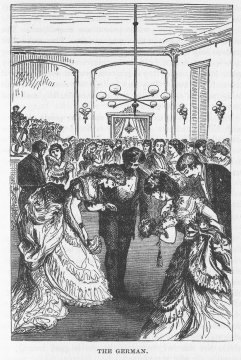
The toilettes of the persons present are magnificent. The
ladies are very queens in their gorgeousness. They make their trails
so long that half the men are in mortal dread of breaking their necks over
them; and having gone to such expense for dry goods in this quarter, they
display the greatest economy about the neck and bust. They may be in
“full dress” as to the lower parts of their bodies, but they
are fearfully undressed from the head to the waist.
Towards morning the ball breaks up. The guests, worn out with
fatigue, and not unfrequently confused with liquor, take leave of their
hosts and go home. Many of them repeat the same performance almost
nightly during the season. No wonder that when the summer comes they
are so much in need of recuperation.
Only wealthy marriages are tolerated in New York society. For men
or women to marry beneath them is a crime society cannot forgive.
There must be fortune on one side at least. Marriages for money are
directly encouraged. It is not uncommon for a man who has won a
fortune to make the marriage of his daughter the means of getting his
family into society. He will go to some young man within the pale of
good society, and offer him the hand of his daughter and a fortune.
The condition demanded of the aforesaid young man is that he shall do what
may lie within his power to get the family of the bride within the charmed
circle. If the girl is good looking, or agreeable, the offer is
rarely refused.
When a marriage is decided upon, the engagement is announced through one
of the “society newspapers,” of which there are several.
It is the bounden duty of the happy pair to be married in a fashionable
church. To be married in or buried from Grace or St.
Thomas’s Church, is the desire of every fashionable heart.
Invitations are issued to the friends of the two families, and no one is
admitted into the church without a card. Often “no cards”
are issued, and the church is jammed by the outside throng, who profane the
holy temple by their unmannerly struggles to secure places from which to
view the ceremony. Two clergymen are usually engaged to tie the knot,
in order that a Divorce Court may find it the easier to undo. A
reporter is on hand, who furnishes the city papers with a full description
of the grand affair. The dresses, the jewels, the appearance of the
bride and groom, and the company generally, are described with all the
eloquence Jenkins is master of.
If the wedding be at Grace Church, Brown, “the great sexton”
is in charge. A wedding over which he presides is sure to be a great
success. A wonderful man is Brown. No account of New York
society would be complete without a few words about Brown. He has
been sexton of Grace Church ever since the oldest inhabitant can remember,
and those familiar with the matter are sorely puzzled to know what the
church will do when Brown is gathered to his fathers. The
congregation would sooner part with the best Rector they have ever had than
give up Brown. A certain Rector did once try to compel him to resign
his post because he, the Rector, did not fancy Brown’s ways, which he
said were hardly consistent with the reverence due the house of God.
The congregation, however, were aghast at the prospect of losing Brown, and
plainly gave the Rector to understand that he must not interfere with the
sexton. Never mind about his want of reverence. The
Rector’s business was to look after the religious part of the
congregation, while Brown superintended the secular affairs of that
fashionable corporation. They had use for the Rector only on Sunday;
but Brown they looked up to every day in the week. The Rector meekly
subsided, and Brown forgave him.
A very lucky man is Brown, and very far from being a fool. There
is no sharper, shrewder man in New York, and no one who estimates his
customers more correctly. He puts a high price on his services, and
is said to have accumulated a handsome fortune, popularly estimated at about
$300,000. Fat and sleek, and smooth of tongue, he can be a very
despot when he chooses. He keeps a list of the fashionable young men
of the city, who find it to their interest to be on good terms with him,
since they are mainly dependent upon him for their invitations.
Report says that, like a certain great statesman, Brown is not averse to
receiving a small present now and then as a reminder of the gratitude of
the recipients of his favors.
Brown is sixty years old, but time has dealt lightly with him, and he is
still hale and hearty. He knows all the gossip of New York for thirty
years back, but also knows how to hold his tongue. To see him in his
glory, one should wait until the breaking up of some great party.
Then he takes his stand on the steps of the mansion, and in the most
pompous manner calls the carriages of the guests. There is no chance
for sleep in the neighborhood when the great voice of the “great
sexton” is roaring down the avenue. He takes care that the
whole neighborhood shall know who have honored the entertainment with their
presence.
He has a sharp tongue, too, this Brown, when he chooses to use it, and a
good story is told of this quality of his. He was once calling the
carriages at a brilliant party. Among the guests was Harry X---, a
young gentleman of fortune, concerning whose morals some hard things were
said. It was hinted that Mr. X--- was rather too fond of faro.
The young gentleman and the great sexton were not on good terms, and when
Brown, having summoned Mr. X---’s carriage, asked, as usual,
“Where to, sir?” he received the short and sharp reply,
“To where he brought me from.” “All right,
sir,” said Brown, calmly, and turning to the driver he exclaimed in a
loud tone, “Drive Mr. X--- to John Chamberlain’s
faro-bank.” A roar of laughter greeted this sally, and Brown
smiled serenely as his discomfited enemy was driven away.
Fashionable weddings are very costly affairs. The outfits of the
bride and groom cost thousands of dollars, the extravagance of the man
being fully equal to that of his bride. A wedding is attended with
numerous entertainments, all of which are costly, and the
expenses attendant upon the affair itself are enormous. The outlay is
not confined to the parties immediately concerned, the friends of the happy
pair must go to great expense to give to the bride elegant and appropriate
presents. One, two, or three rooms, as may be required, are set apart
at every fashionable wedding, for the display of the presents. These
are visited and commented upon by the friends of the bride and groom, such
being the prescribed custom. The presents are frequently worth a
handsome fortune. At the marriage of the daughter of a notorious
politician not long since, the wedding presents were valued at more than
$250,000. Efforts have been repeatedly made to put a stop to the
giving of such costly presents, but the custom still continues.
As it is the ambition of every one of the class we are discussing to
live fashionably, so it is their chief wish to be laid in the grave in the
same style. The undertaker at a fashionable funeral is generally the
sexton of some fashionable church, perhaps of the church the deceased was
in the habit of attending. This individual prescribes the manner in
which the funeral ceremonies shall be conducted, and advises certain styles
of mourning for the family. Sometimes the blinds of the house are
closed, and the gas lighted in the hall and parlors. The lights in
such cases are arranged in the most artistic manner, and everything is made
to look as “interesting” as possible.
A certain fashionable sexton always refuses to allow the female members
of the family to follow their dead to the grave. He will not let them
be seen at the funeral, at all, as he says, “It’s horribly
vulgar to see a lot of women crying about a corpse; and, besides,
they’re always in the way.”
The funeral over, the bereaved ones must remain in the house for a
certain length of time, the period being regulated by a set decree.
To be seen on the street within the prescribed time, would be to lose
caste. Many of the days of their seclusion are passed in
consultations with their modiste, in preparing the most fashionable
mourning that can be thought of. They no doubt agree fully with a
certain famous modiste of the city, who once declared to
a widow, but recently bereaved, that “fashionable and becoming
mourning is so comforting to persons in affliction.”
Well, after all, only the rich can afford to die and be buried in style
in the great city. A lot in Greenwood is worth more than many
comfortable dwellings in Brooklyn. A fashionable funeral entails
heavy expenses upon the family of the deceased. The coffin must be of
rosewood, or some other costly material, and must be lined with
satin. A profusion of white flowers must be had to cover it and to
deck the room in which the corpse is laid out. The body must be
dressed in a suit of the latest style and finest quality, and the cost of
the hearse and carriages, the expenses at the church and cemetery, and the
fees of the undertaker, are very heavy. The average expense of such
an occasion may be set down at from $1500 to $2000.
Until the passage of the new Charter in 1870, the Police Department was
independent of the control of the city officials, and consequently
independent of local political influences. There was a
“Metropolitan Police District,” embracing the cities of New
York and Brooklyn, and the counties of New York, Kings, Richmond and
Westchester, and a part of Queen’s county, in all a circuit of about
thirty miles. The control of this district was committed to a
commission of five citizens, who were subject to the supervision of the
Legislature of the State. The Mayors of New York and Brooklyn were
ex-officio members of this board.
The Charter of 1870 changed all this. It broke up the Metropolitan
District, and placed the police of New York and Brooklyn under the control
of their respective municipal governments. To the credit of the force
be it said, the police of New York were less under the influence of the
Ring than any other portion of the municipality, and improved rather than
depreciated in efficiency.
As at present constituted, the force is under the control and
supervision of four Commissioners appointed by the Mayor. The force
consists of a Superintendent, four Inspectors, thirty-two Captains, one
hundred and twenty-eight Sergeants, sixty-four Roundsmen and 2085
Patrolmen, Detectives, Doorkeepers, etc.
The present Superintendent of Police is Mr. James J. Kelso. He is
the Commander-in-chief of the force, and it is through him that all orders
are issued. His subordinates are responsible to him for the proper
discharge of their duties, and he in his turn to the Commissioners.
He was promoted to his present position on the death of Superintendent
Jourdan, and has rendered himself popular with men of all parties by his
conscientious discharge of his important duties. Mr. Kelso is
eminently fitted for his position. His long service in the force, and
great experience as a detective officer, have thoroughly familiarized him
with the criminals with whom he has to deal, and the crimes against which
he has to contend. He has maintained the discipline of the force at a
high point, and has been rigorous in dealing with the offenders against the
law. His sudden and sweeping descents upon the gambling hells, and
other disreputable places of the city, have stricken terror to the
frequenters thereof. They are constantly alarmed, for they know not
at what moment they may be captured by Kelso in one of his characteristic
raids.
In person Mr. Kelso is a fine-looking, and rather handsome man. He
shows well at the head of the force. It is said that he was
overwhelmed with mortification last July, when the Mayor compelled him to
forbid the “Orange Parade,” and thus make a cowardly surrender
to the mob. When Governor Hoffman revoked Mayor Hall’s order,
at the demand of the indignant citizens, Kelso was perhaps the happiest man
in New York. He had a chance to vindicate his own manhood and the
honor of the force, and he and his men did nobly on that memorable day.
The city is divided into two Inspection Districts, each of which is in
charge of two Inspectors. Each Inspector is held responsible for the
general good conduct and order of his District. It is expected that
he will visit portions of it at uncertain hours of the night, in order that
the Patrolmen may be made more vigilant by their ignorance of the hour of
his appearance on their “beats.” The Inspectors keep a
constant watch over the rank and file of the force. They examine the
Police Stations, and everything connected with them, at pleasure, and
receive and investigate complaints made by citizens against members of the
force. The creation of this useful grade is due to John A. Kennedy,
the first Superintendent of the Metropolitan Police.
The Inspection Districts are sub-divided into thirty-two
precincts, in each of which there is a Police Station. Each Station
is in charge of a Captain, who is held to a strict accountability for the
preservation of the peace and good order of his precinct. He has
authority to post the men under his command in such parts of his precinct,
and to assign them to such duties as he deems expedient, under the
supervision of the Superintendent. He is required to divide his force
into two equal parts, called the First and Second Platoons. Each
Platoon consists of two Sections. Each of the four Sections is in
charge of a Sergeant.
In the illness or absence of the Captain, the Station and Precinct are
commanded by one of the Sergeants, who is named for that purpose by the
Superintendent. The special duties of the Sergeants are to patrol
their precincts, and see that the Roundsmen and Patrolmen are at their
posts and performing their duties properly. They are severally
responsible for the condition of their Sections. One of the Sergeants
is required to remain at the Station House at all times.
Two Roundsmen are selected by the Commissioners from the Patrolmen of
each precinct, and one of them is assigned to each platoon. They have
the immediate supervision of the Patrolmen, and are required to exercise a
vigilant watch over them at all times.
The Patrolmen are the privates of the force. They are assigned
certain “beats” or districts to watch. Many of these
beats are too large for the care of one man, and more is expected of the
Patrolman than he is capable of performing. He is required to
exercise the utmost vigilance to prevent the occurrence of any crime within
his beat, and to render the commission of it difficult, at the least.
The occurrence of a crime on the streets is always regarded as presumptive
evidence of negligence on his part, and he is obliged to show that he was
strictly attending to his duties at the time. He is required to watch
vigilantly every person passing him while on duty, to examine frequently
the doors, lower windows, and gates of the houses on his beat, and warn the
occupants if any are open or unlocked; to have a general knowledge of the
persons residing in his beat; to report to his commanding officer
“all persons known or suspected of being policy dealers, gamblers,
receivers of stolen property, thieves, burglars, or offenders of any
kind;” to watch all disorderly houses or houses of ill-fame, and
observe “and report to his commanding officer all persons by whom
they are frequented;” to do certain other things for the
preservation of the public peace; and to arrest for certain offences, all
of which are laid down in the volume of Regulations, of which each member
of the force is obliged to have a copy. Patrolmen are not allowed to
converse with each other, except to ask or impart information, upon meeting
at the confines of their posts; “and they must not engage in
conversation with any person on any part of their post, except in regard to
matters concerning the immediate discharge of their duties.”
The uniform of the force is a frock coat and pants of dark blue navy
cloth, and a glazed cap. In the summer the dress is a sack and pants
of dark blue navy flannel. The officers are distinguished by
appropriate badges. Each member of the force is provided with a
shield of a peculiar pattern, on which is his number. This is his
badge of office, and he is obliged to show it when required. The men
are armed with batons or short clubs of hard wood, and revolvers. The
latter they are forbidden to use except in grave emergencies.
The general misdemeanors of which the police are bound to take notice,
are: Attempts to pick a pocket, especially where the thief is a known
pickpocket; cruel usage of animals in public places; interfering with the
telegraph wires; selling or carrying a slingshot; aiding in any way in a
prize fight, dog fight, or cock fight; destroying fences, trees, or lamps,
or defacing property; aiding in theatrical entertainments on Sunday;
disorderly conduct; participating in or inciting to riots; assaults;
drunkenness on the streets; gambling; discharging fire-arms on the streets;
and other stated offences. The officer must be careful to arrest the
true offender, and not to interfere with any innocent person, and is
forbidden to use violence unless the resistance of his prisoner is such as
to render violence absolutely necessary, and even then he is held
responsible for the particular degree of force exerted. If he is
himself unable to make the arrest, or if he has good reason to fear an
attempt at a rescue of the prisoner, it is his duty to call upon the
bystanders for assistance; and any person who refuses him when so called
on, is guilty of a misdemeanor, for which he may be arrested and
punished.
Promotions are made in the force as follows: Inspectors are chosen from
the Captains, Captains from Sergeants, Sergeants from Roundsmen, and
Roundsmen from the most efficient Patrolmen.
The duties of a policeman are hard, and the salaries are moderate in
every grade. The hours for duty of the Patrolmen are divided in the
following manner: from six to eight o’clock in the morning; from
eight o’clock in the morning to one in the afternoon; from one in the
afternoon to six; from six to twelve midnight; from twelve midnight to six
in the morning. These “tours” of duty are so distributed
that no one man shall be called on duty at the same hour on two successive
days. One-third of the entire force, about 700 in all, is on duty in
the daytime, and two-thirds, about 1400 men, at night. Sickness and
casualties bring down this estimate somewhat, but the men are such fine
physical specimens that sick leaves are now comparatively rare.
Besides the Patrolmen there are several divisions of the force.
Forty men, called the Court Squad, are on duty at the various Courts of
Justice. Four have charge of the House of Detention for Witnesses,
No. 203 Mulberry street. The Sanitary Squad consists of a captain,
four sergeants, and fifty-seven patrolmen. Some of these are on duty
at the ferries and steamboat landings. Others are detailed to examine
the steam boilers in use in the city. Others execute the orders of
the Board of Health. Another detachment, nine in number, look after
truant children. Others are detailed for duty at banks and other
places. The Detectives will be referred to hereafter.
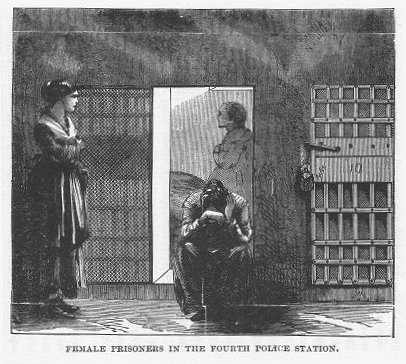
The qualifications demanded of an applicant for admission into the force
are thus set down in the book of Regulations: “No person will
be appointed a Patrolman of the Metropolitan Police Force unless, he
“First, is able to read and write the English language
understandingly.
“Second, is a citizen of the United States.
“Third, has been a resident of this State for a term of one year
next prior to his application for the office.
“Fourth, has never been convicted of a crime.
“Fifth, is at least five feet eight inches in height.
“Sixth, is less than thirty-five years of age.
“Seventh, is in good health, and of sound body and mind.
“Eighth, is of good moral character and habits.
“Applicants for the office must present to the Board of
Commissioners a petition signed by not less than five citizens of good
character and habits, and verified by the affidavit of one of
them.”
As none but “sound” men are wanted, the applicant is then
subjected to a rigid medical examination; and the writer is informed by one
of the most efficient surgeons of the force, that scarcely one applicant in
ten can stand this test. The applicant must also give, under oath, an
exact statement as to his parentage, nationality, education, personal
condition in every respect, business or employment, and physical
condition.
The strictest discipline is maintained in the force, and offences are
rigidly reported and punished. All members are required at once to
communicate intelligence of importance to their superior officers.
The men are regularly drilled in military exercises, to fit them for
dealing efficiently with serious disturbances. The writer can
testify, that during their parade in the Spring of 1871, they presented as
fine an appearance, and executed their manœuvres as correctly as any
body of regular troops.
The finest looking and largest men are detailed for service on
Broadway. One of their principal duties is to keep the street free
from obstructions, no slight task when one considers the usual jam in the
great thoroughfare. It is a common habit to denounce the
“Broadway Squad” as more ornamental than useful, but the
habitués of that street can testify to the arduous labor performed
by the “giants,” and the amount of protection afforded by them
to the merchants and promenaders. Scarcely a day passes that they do
not prevent robberies and cut short the operations of pickpockets.
The number of arrests made by the force is fair evidence of their
efficiency. Since 1862 the annual number has been as follows:
|
Total arrests in New York
|
|
|
1862
|
82,072
|
|
1863
|
61,888
|
|
1864
|
54,751
|
|
1865
|
68,873
|
|
1866
|
75,630
|
|
1867
|
80,532
|
|
1868
|
78,451
|
|
1869
|
72,984
|
During the year 1869, the arrests were divided as follows:
|
Males
|
51,446
|
|
Females
|
21,538
|
The principal causes for which these arrests were made were as
follows:
|
|
Males
|
Females
|
|
Assault and Battery
|
5,638
|
1,161
|
|
Disorderly conduct
|
9,376
|
5,559
|
|
Intoxication
|
15,918
|
8,105
|
|
Intoxication and disorderly conduct
|
5,232
|
3,466
|
|
Petty larceny
|
3,700
|
1,209
|
|
Grand larceny
|
1,623
|
499
|
|
Malicious mischief
|
1,081
|
32
|
|
Vagrancy
|
1,065
|
701
|
During the past nine years over 73,000 lost children have been restored
to their parents by the police. More than 40,000 houses have been
found open at night, owing to the carelessness of the inmates, who have
been warned of their danger by the police in time to prevent robbery.
There is scarcely a fire but is marked by the individual heroism of some
member of the force, and the daily papers abound in instances of rescues
from drowning by the policemen stationed along the docks. In
times of riot and other public danger, the police force have never been
found lacking, and they have fairly won the “flag of honor”
which the citizens of New York are about to present to them in recognition
of their gallant and efficient services on the 12th of July, 1871.
That there are individuals whose conduct reflects discredit upon the force
is but natural; but as a whole, there does not exist a more devoted,
gallant, and efficient body of men than those composing the police of New
York.
The Station Houses of the city are so arranged as to be central to their
respective precincts. The new buildings are models of their kind, and
the old ones are being improved as rapidly as possible. Perhaps the
best arranged, the handsomest, and most convenient, is that of the Fourth
Precinct, located at No. 9 Oak street. The locality is one of the
worst in the city, and it is necessary that the police accommodations
should be perfect. The building is of red brick, with a fine white
granite façade, with massive stone steps leading from the street to
the main entrance. The entrance leads directly to the main room, or
office. On the right of the entrance is the Sergeant’s desk, of
black walnut, massive and handsomely carved. Back of this is a fine
book-case of the same material, for the record books and papers of the
station. The telegraph instrument is at the side farthest from the
windows—a precaution looking to its safety in case of a riot or
attack on the station. Speaking-tubes, and boxes for papers,
communicate with the other apartments. The walls are adorned with
fine photographs of the late Superintendent Jourdan, the present
Superintendent Kelso, and the Police Commissioners. Back of the
office is the Surgeon’s Room, with every convenience for the
performance of the Surgeon’s duties. The office of the Captain
in command of the station is to the left of the entrance, and is fitted up
with a Brussels carpet, and black walnut furniture. The walls are
covered with fine engravings and photographs of prominent men. The
Captain is also provided with a bed-room, bathroom, etc., which are
elegantly furnished. The Sergeants’ bedrooms are large,
airy, and well furnished. Bathrooms for the Sergeants and Patrolmen
are located in the basement. The sleeping rooms of the Sergeants and
Roundsmen, and four large dormitories for the Patrolmen, are situated on
the second and third floors. Each Patrolman has a private closet for
his clothing, etc., and each bedstead is stamped with the occupant’s
section number. The fourth story is used for store-rooms. On
the first floor there is also a large sitting-room for the Patrolmen.
Attached to the Station House, and connected with it by a bridge, is the
prison, a brick building three stories in height. It is entered
through the Patrolmen’s sitting-room, and is the largest in any city
station house. It contains fifty-two cells, all of which are of a
good size and are well ventilated. Four of these (Nos. 1, 16, 17, 32)
are somewhat larger than the others, and are humorously called by the force
“Bridal chambers.” They are reserved for the more
respectable prisoners. Over the prison are two large rooms designed
for the unfortunates who seek a night’s shelter at the
station—one for men and the other for women. They are provided
with board platforms to sleep on. These platforms can be removed, and
the whole place drenched with water from hydrants conveniently located.
As a matter of course, this model station is in charge of one of the
most efficient, experienced, and reliable officers of the force. It
is at present commanded by Captain A. J. Allaire, whose personal and
official record fairly entitles him to the high and honorable position he
holds in the force.
The station houses are kept scrupulously clean. Neatness is
required in every department of the police service. The Inspector may
enter them at any hour, and he is almost sure to find them in perfect
order.
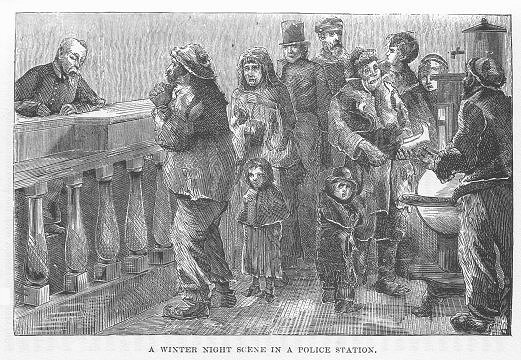
These stations afford a temporary shelter to the outdoor poor. In
all of them accommodations are provided for giving a night’s lodging
to the poor wretches who seek it. When the snow lies white over the
ground, or the frosts have driven them out of the streets, these poor
creatures come in crowds to the station houses, and beg for a shelter for
the night. You may see them huddling eagerly around the
stove, spreading their thin hands to catch the warmth, or holding some
half-frozen child to be thawed by the heat, silent, submissive, and
grateful, yet even half afraid that the kind-hearted Sergeant, who tries to
hide his sympathy for them by a show of gruffness, will turn them into the
freezing streets again. When the rooms devoted to their use are all
filled, others still come, begging, ah, so piteously, to be taken in for
the night. I think there is no part of the Sergeant’s duties so
hard, so painful to him, as to be forced to turn a deaf ear to these
appeals. Let us thank God, however, he does not do so often, and even
at the risk of being “overhauled” for exceeding his duty, the
Sergeant finds, or makes, a place for those who seek his assistance in this
way. Many of those who seek shelter here are constant tramps, who
have nowhere else to go. Others are strangers in the city—poor
people who have come here in search of employment. Failing to find
it, and what little money they brought with them being exhausted, they have
only the alternative of the station house or the pavement. Many who
are simply unfortunate, suffer almost to perishing before seeking the
station house, mistakenly supposing that in so doing they place themselves
on a par with those who are brought there for offences against the
law. But at last the cold and the snow drive them there, and they
meet with kindness and consideration. I could not here present a
description of the quiet and practical way in which the members of the
“Force” relieve such sufferers. No record is kept of such
good deeds by the force, and the Sergeant’s book is modestly silent
on this subject; but we may be sure it is written in letters of living
light on the great book that shall be opened at the last day.
The stations are connected with each other and with the headquarters by
telegraph. The telegraph system has been so perfected that by means
of a set of numbers struck on a bell, each of which refers to a
corresponding number in the book of signals, questions are asked and
answered, and messages sent from station to station with the greatest
rapidity.
The Headquarters of the Police Force are located in a handsome building,
five stories high, known as No. 300 Mulberry street. The
building extends through to Mott street, in the rear. It is situated
on the easterly side of Mulberry street, between Bleecker and Houston
streets. It is ninety feet in width. The Mulberry street front
is of white marble, and the Mott street front is of pressed brick, with
white marble trimmings. It is fitted up with great taste, and every
convenience and comfort is provided for the members of the force on duty
here. The greatest order is manifest. Everything and every man
has a place, and must be in it at the proper times. There is no
confusion. Each department has its separate quarters.
The Superintendent’s office is connected by telegraph with every
precinct in the city. By means of this wonderful invention, the
Superintendent can communicate instantly with any point in the city.
The news of a robbery or burglary is flashed all over New York and the
adjoining country before a man has fairly secured his plunder. If a
child is lost, all the precincts are furnished immediately with an accurate
description of it, and the whole force is on the lookout for the little
wanderer, and in a marvellously quick time it is restored to its
mother’s arms. By means of his telegraph, the Superintendent
can track a criminal, not only all over the city, but all over the
civilized world, and that without leaving his office. One of the most
interesting rooms in the headquarters is that for the trial of complaints
against members of the force. Every charge must be sworn to. It
is then brought before the Commissioners, or rather before one who is
appointed by the Board to hear such complaints. He notifies the
accused to appear before him to answer to the charge. Except in very
grave cases the men employ no counsel. The charge is read, the
Commissioner hears the statements of the accused, and the evidence on both
sides, and renders his decision, which must be ratified by the full
“Board.” The majority of the charges are for breaches of
discipline. A Patrolman leaves his beat for a cup of coffee on a cold
morning, or night, or reads a newspaper, or smokes, or stops to converse
while on duty. The punishment for these offences is a stoppage of pay
for a day or two. First offences are usually forgiven. Many
well-meaning but officious citizens enter complaints
against the men. They are generally frivolous, but are heard
patiently, and are dismissed with a warning to the accused to avoid giving
cause for complaint. Thieves and disreputable characters sometimes
enter complaints against the men, with the hope of getting them into
trouble. The Commissioner’s experience enables him to settle
these cases at once, generally to the dismay and grief of the
accuser. Any real offence on the part of the men is punished promptly
and severely, but the Commissioners endeavor by every means to protect them
in the discharge of their duty, and against impositions of any kind.
Another room in the headquarters is called “The Property
Room.” This is a genuine “curiosity shop.” It
is filled with unclaimed property of every description, found by, or
delivered to the police, by other parties finding the same, or taken from
criminals at the time of their arrest. The room is in charge of the
Property Clerk, who enters each article, and the facts connected with it,
in a book kept for that purpose. Property once placed in this room is
not allowed to be taken away except upon certain specified
conditions. Unclaimed articles are sold, after being kept a certain
time, and the proceeds are paid to the Police Life Insurance Fund.
The pay of a policeman is small, being only about $1200 per annum.
In order to make some compensation for this deficiency, the Police Law
contains the following provisions:
“If any member of the Municipal Police Force, whilst in the actual
performance of duty, shall become permanently disabled, so as to render his
dismissal from membership proper, or if any such member shall become
superannuated after ten years of membership, a sum of not exceeding $150,
as an annuity, to be paid such member, shall be chargeable upon the
Municipal Police Life Insurance Fund. If any member of the Municipal
Police Force, whilst in the actual discharge of his duty, shall be killed,
or shall die from the immediate effect of any injury received by him,
whilst in such discharge of duty, or shall die after ten years’
service in the force, and shall leave a widow, and if no widow, any child
or children under the age of sixteen years, a like sum by way of annuity
shall become chargeable upon the said fund, to be paid to such widow so
long only as she remains unmarried, or to such child or children so long as
said child, or the youngest of said children, continues under the age of
sixteen years. In every case the Board of Municipal Police shall
determine the circumstances thereof, and order payment of the annuity to be
made by draft, signed by each trustee of the said fund. But nothing
herein contained shall render any payment of said annuity obligatory upon
the said Board, or the said trustees, or chargeable as a matter of legal
right. The Board of Municipal Police, in its discretion, may at any
time order such annuity to cease.”


