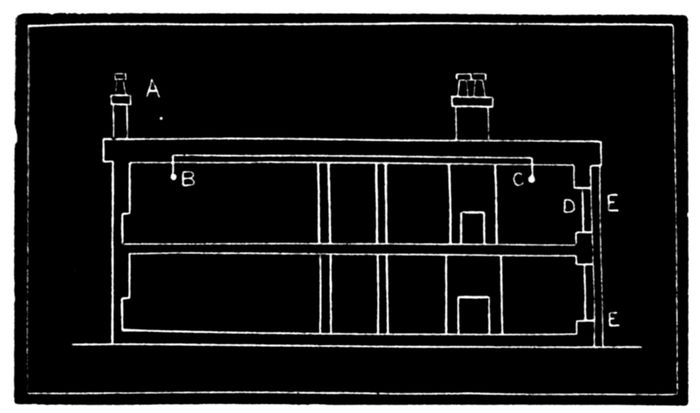
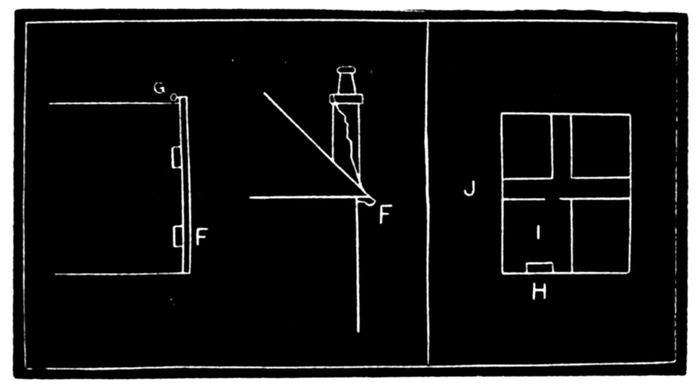
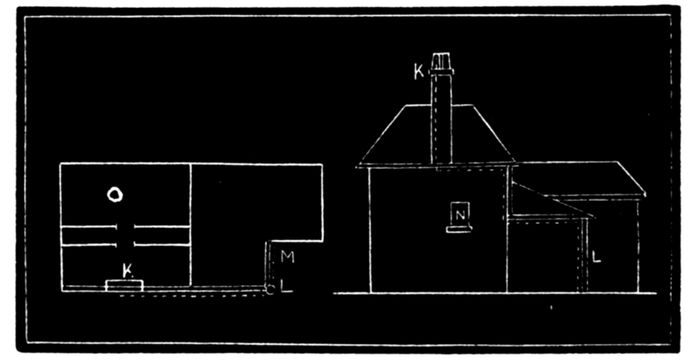
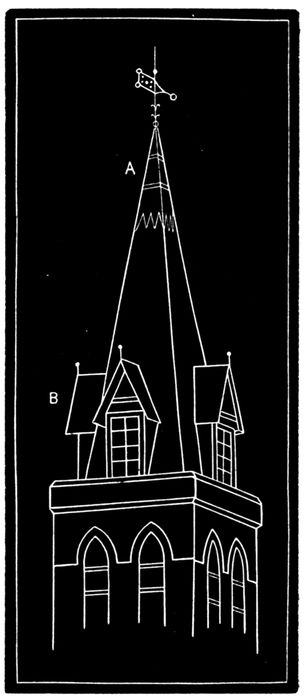
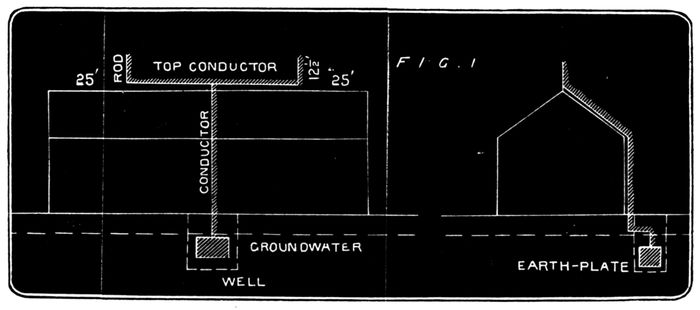
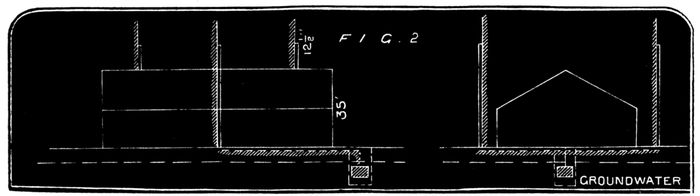
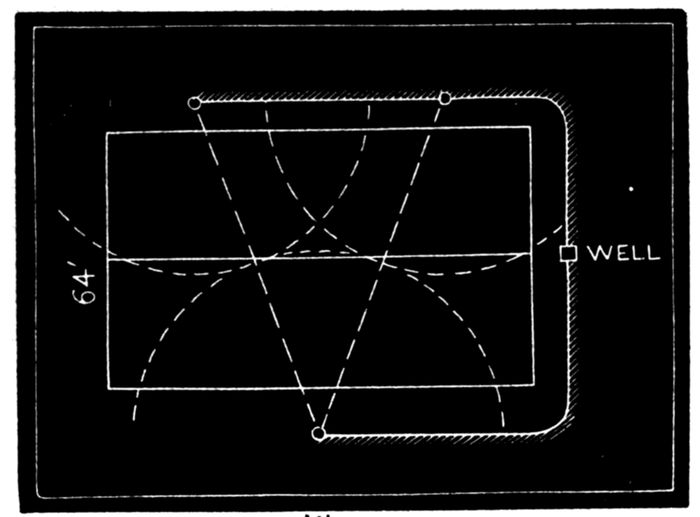
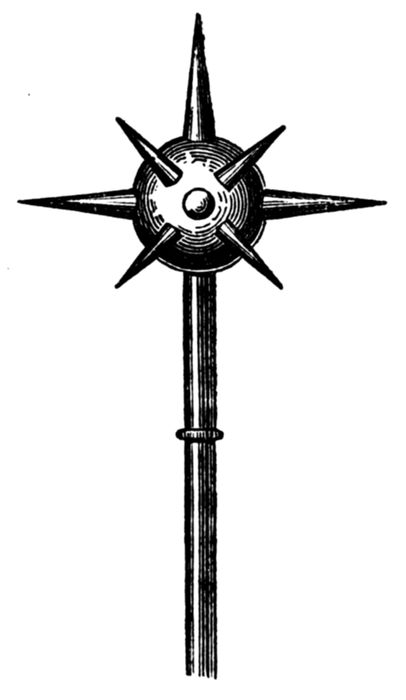
APPENDIX F. ABSTRACTS OF PRINTED DOCUMENTS. — FRENCH OFFICIAL PUBLICATIONS. — REPORT made to the ACADEMY OF SCIENCES, by Franklin , Leroy , Coulomb , de la Place , and Rochon . — REPORT made to the NATIONAL INSTITUTE, by Leroy , La Place , and Coulomb , on a Lightning Rod for Powder Magazines proposed by Regnier . — INSTRUCTIONS for erecting Lightning Rods for Powder Magazines , adopted by the Fortifications Committee . — REPORT on the foregoing Instructions made by La Place , Rochon , Charles , Montgolfier , and Gay Lussac to the National Institute . — INSTRUCTIONS about LIGHTNING RODS adopted by the Academy of Sciences. — Second Part, 18th December, 1854. Prepared by a Committee consisting of MM. Becquerel , Babinet , Duhamel , Despretz , Cagnard de Latour , and Pouillet . — Special Report for the New Buildings of the Louvre, 18 December, 1854, by the same Committee. — REPORT on the points of upper terminals made by Messrs. Delieul, by a Committee consisting of MM. Becquerel , Babinet , Duhamel , Despretz , Cagniard de Latour , Regnault , de Senarmont , and Pouillet . — INSTRUCTIONS upon LIGHTNING RODS for POWDER MAGAZINES, by a Committee consisting of MM. Becquerel , Babinet , Duhamel , Fizeau , Edm Becquerel , Regnault , le Maréchal Vaillant , and Pouillet . — INSTRUCTIONS by the Committee consisting of MM. Alphand , Belgrand , Fizeau , Comte du Moncel , Ed. Becquerel , Desains , Ch. Sainte Claire-Deville , Duc , Ballu , Magne , Davioud , Felix Lucas , and R. Francisque Michel , appointed to inspect the Lightning Rods on the Municipal Buildings of Paris . — REPORT by the joint Secretary ( Francisque Michel ) of the Lightning Rod Committee to the Prefect of the Department of the Seine . — INSTRUCTIONS as to the application of LIGHTNING CONDUCTORS for protection of POWDER MAGAZINES, ETC. — Appendix A. — By the late Sir W. Snow Harris, F.R.S. — Appendix B.—As to Solid or Hollow Conductors. By Sir W. Snow Harris, F.R.S. — REPORT ON THE DESTRUCTION BY LIGHTNING OF A GUNPOWDER STORE AT BRUNTCLIFFE, YORKSHIRE. By Major Y. D. Majendie, R.A. — REPORTS OF COMMITTEES ON THE POWDER MAGAZINES AT PURFLEET. — EXPERIMENTS AND OBSERVATIONS ON ELECTRICITY. — AN ESSAY on the cause of LIGHTNING , and the manner by which the thunder clouds become possessed of their electricity, deduced from known facts and properties of that matter, to which are added plain directions for constructing and erecting safe conductors. By John Simmons . 8vo. 1775. — A TREATISE on ATMOSPHERIC ELECTRICITY. — HARRIS’S LIGHTNING CONDUCTORS. REPORT to the Committee upon Mr. Snow Harris 's and other Lightning Conductors . — THE DIFFERENCE between LEYDEN DISCHARGES and LIGHTNING FLASHES. By C. V. Walker , Hon. Sec. Lon. Electrical Soc. London. 1842. — THE EFFECT OF A LIGHTNING FLASH on the steeple of BRIXTON CHURCH, and OBSERVATIONS ON LIGHTNING CONDUCTORS GENERALLY. By C. V. Walker. London. 1842. — ON THE NATURE OF THUNDERSTORMS; and on the means of protecting buildings and shipping against the destructive effects of lightning. By W. Snow Harris, F.R.S. 1843. — AN ACCOUNT of the CHIMNEY of the EDINBURGH GAS WORKS. By G. Buchanan, C.E., F.R.S.E. — PAPERS relative to SHIPWRECKS BY LIGHTNING, as prepared by Sir Snow Harris , and presented by him to the Admiralty . — STATISTICS OF BUILDINGS AND SHIPS STRUCK BY LIGHTNING. By F. Duprez, Member of the Academy. — RESUMÉ. — ON ATMOSPHERIC ELECTRICITY. — LE COUP DE FOUDRE DE L’ILE DU RHIN PRES DE STRASBOURG. Par M. F. Hugueny. 4to. Paris. 1869. — DIRECTIONS FOR CONSTRUCTING LIGHTNING RODS. From “ Essays on Meteorology ,” by Professor Joseph Henry . — ON LIGHTNING AND LIGHTNING CONDUCTORS. By W. H. Preece , Mem. Inst. C.E. — LIGHTNING RODS AND HOW TO CONSTRUCT THEM.—— By John Phin , C.E. New York. 1873. — TRAITÉ DES PARATONNERES, &c. Par A. Callaud. Paris. 1874. Royal 8vo. — BLITZABLEITER-ANLAGEN. PROF. C. ZENGER’S SYMMETRISCHE BLITZABLEITER. C. Korte and Co., Prague. — PROF. ZENGER, ON THE ACTION OF SYMMETRICAL CONDUCTORS AND LIGHTNING CONDUCTORS. — PROTECTION OF LIFE AND PROPERTY FROM LIGHTNING. By W. McGregor. Bedford, 1875. 8vo. 43 pages. — LYNILDENS FARLIGHED I NORGE. By H. Mohn , Kristiania. 1875. — LECTURE DELIVERED BEFORE THE SOCIETY OF ARTS, 28th April, 1875 . By R. J. Mann , M.D. — ON THE PROTECTION OF BUILDINGS FROM LIGHTNING. By Professor J. Clerk Maxwell, F.R.S. — On Boiler and Factory CHIMNEYS and LIGHTNING Conductors. by R. Wilson. 1877. — NOUVEAU PARATONNERRE ACCEPTÉ PAR L’ACADÉMIE DES SCIENCES. Par Jarriant. 8vo. Paris. 1877. — A PRACTICAL TREATISE ON LIGHTNING CONDUCTORS. By Henry W. Spang. Philadelphia. 1877. — Ueber BLITZABLEITER und BLITZSCHLÄGE in GEBÄUDE welche mit BLITZABLEITERN versehen waren. Von G. Karsten. Kiel. 8vo. 1877. — ÉTUDE sur les PARATONNERRES leur CONSTRUCTION leur INSTALLATION. Par Jarriant. 8vo. Paris. 1878. — REPORT on THE LIGHTNING CONDUCTORS of the SMALL ARMS AMMUNITION FACTORY at DUM DUM, CALCUTTA. By W. P. Johnston. Government Telegraph Press. 1878. 4to. — ATMOSPHERIC ELECTRICITY. By David Brooks. Philadelphia. 1878. 8vo. — CATALOGUE Messrs. A. Collin et Fils , Article PARATONNERRES. Paris. 4to. — THE SCIENTIFIC AMERICAN, NOVEMBER 1st, 1879. — REMARKS ON THE ATMOSPHERIC ELECTRICITY AND ON THE ACTION OF LIGHTNING CONDUCTORS. By Prof. Dr. G. Karsten. 2nd edition. Kiel, 1879. — LIGHTNING CONDUCTORS. By Richard Anderson , London, 1879. — REPORT upon LIGHTNING DISCHARGES in the Province of Schleswig-Holstein. By Dr. Leonhard Weber. 1880. 8vo. — DIE KONSTRUKTION und ANLEGUNG DER BLITZABLEITER zum Schutze aller Arten VON GEBÄUDEN SEESCHIFFEN und TELEGRAFEN STATIONEN. Von Dr. Otto Buchner. Weimar. 1867. 8vo. — EARTH CONNECTIONS OF LIGHTNING CONDUCTORS. By Lieut.-Col. Stotherd, R.E. — REMARKS on some PRACTICAL points connected with the construction of LIGHTNING CONDUCTORS. By R. J. Mann , M.D., F.R.A.S. ( Quarterly Journal Meteor. Soc. , October, 1875). — ON THE PROTECTION OF BUILDINGS FROM LIGHTNING. By R. S. Brough , 4to, Mussoorie , 1878. — LIGHTNING CONDUCTORS. By Professors Ayrton and Perry . ( Journal Society of Telegraph Engineers. Vol. V., 1876, p. 412.) — ON THE PROPER FORM OF LIGHTNING CONDUCTORS. By W. H. Preece , C.E. ( British Association Report , 1880). — First Experiments, June 28, 1880. — Second Experiments, July 19, 1880. — ÉTABLISSEMENT DE LA FORMULE RELATIVE AU RAYON D’ACTION DES PARATONNERRES. Par Emile Lacoine . ( L’Electricité , October, 1880.) — ON THE SPACE PROTECTED BY A LIGHTNING CONDUCTOR. By W. H. Preece , C.E. ( Phil. Mag. , Dec., 1880.) — SHORT ACCOUNT of the STRIKING BY LIGHTNING of the RAILWAY TERMINUS at ANTWERP, on the 10th of JULY, 1865. By M. Melsens , Member of the Royal Academy of Belgium. — ON LIGHTNING PROTECTORS WITH POINTS, CONDUCTORS, and MULTIPLE EARTH CONNECTIONS, a detailed Description of the Lightning Protector erected on the Town Hall of Brussels in 1865, with an Account of the Principles adopted in the Construction, by M. Melsens, Member of the Royal Academy of Sciences of Belgium. — DE L’APPLICATION du RHE-ÉLECTROMÈTRE aux PARATONNERRES DES TÉLÉGRAPHES. Par M. Melsens. — TROISIÈME NOTE sur les PARATONNERRES. Par M. Melsens. — QUATRIÈME NOTE sur les PARATONNERRES. Par M. Melsens.
(51)
In 1784, the attention of the French Government having
been directed to the desirability of protecting the powder magazines
of the kingdom from damage by lightning by the employment
of conductors, a system of construction was proposed by
two officers of the Engineers and Artillery. This system was
referred by the Minister of War to the Academy of Sciences
for consideration and report. From time to time subsequently
other proposals of a like nature, and other inventions and improvements
in the construction of lightning rods were considered by
the Academy, and reported upon by various Committees.
At the request of the Conference, I have endeavoured, in the
following pages, to give in as condensed a form as possible an
accurate abstract of their contents, and to avoid, in all cases,
the expression of any opinion, either adverse or concurrent, upon
the principles or suggestions contained in them.
Certain proposals for erecting lightning rods for protecting the
powder magazines at Marseilles having been submitted to the Academy
for their opinion, a committee, consisting of the above-named, was
appointed to examine and report.
They begin by enunciating the theory which should regulate the
erection of conductors, and they lay down the following rules:—
1. The extent of the building should first be ascertained to decide
whether one or more conductors should be used. Electrical experiments
had not yet made known anything of the extent to which the
action of the point of the conductor reached. But since buildings
had been supplied with conductors many observations had shown that
those parts of them which were more than 45 feet French (48 English)
from the point of the conductor had been struck by lightning.
2. When there are many points or arrows on the building they
should be connected together and also connected with all parts of
the roof which are covered with lead, and also connected with the
(52)weathercocks or ornamental metal points so as to form one metallic
system with the conducting bars.
3. It is not less important that these bars should be thoroughly
joined together; for a solution of continuity in them produces a resistance
to the passage of the electricity according to the extent of their
separation.
4. It is necessary that the bars should communicate thoroughly with
moist earth or, better still, with water.
As to the height of the points they should be at least 12 or 15 feet
(13 to 16 feet English), or even more if the building is a large one.
It is certain that the higher they are the wider the extent of their
action. They should be 2 inches (2·2 English) square at the base
and greater in proportion as their height exceeds 15 feet (16 English).
If the conducting bars are 8 or 10 lines (or, say 1 inch) square, it
will be more than enough. No case had occurred in which iron bars
of this size had been in any way damaged or altered by the passage of
lightning.
The reporters then proceed to examine the two proposals for protecting
the powder magazines at Marseilles, sent in by M. Ravel de
Puy Contal and M. Pierron. They were both for the same building
which was 31 toises long and 8 toises wide (about 198 by 51 English
feet). The first provided for the erection of three points on the ridge
of the roof, and of four others, one at each angle of the building; the
second had also three points on the ridge, but the other four were
alternated on the two sides of the roof, and iron bars were carried
all along and connected with all the points. The manner in which
the terminals were fastened to the roof and the conducting bars
fastened together and led to the water was the same in each proposal.
The reporters remark concerning the second that the conducting
bars laid horizontally along the roof would involve a great and unnecessary
expense, but the points should be retained, only instead of
placing them alternately they should be set up so that each of them
was half way between the middle and the end of the roof, and instead
of connecting these points by bars along the length of the roof, they
should be connected with the one connecting the three points on the
ridge by bars joining it perpendicularly.
As to the method proposed for joining the several parts together
the reporters cannot help thinking that in their desire to make
thoroughly good connections MM. Pierron and de Ravel had proposed
a plan involving too much difficulty and superfluous expense
[It seems to have been proposed to screw the bars into each other],
and they recommend instead of this to make at the base of each point,
immediately above its insertion into the roof, a circular flange about
2 inches in diameter and 2 lines thick, with a hole half an inch in
diameter in the middle and at the ends of each conducting bar to make
a similar flange and to bolt the flanges together with a sheet of lead
between them. Crutches should be fixed on the roof to carry the conducting
bars. The points should be fixed three on the ridge and two
on each side of the roof half way between the point in the middle and
that at each end. These four should be connected with the conducting
rods running along the ridge and should overtop the ridge by at
(53)least 6 feet (6 feet 5 inches English). By this arrangement all parts
of the roof would be well protected.
The reporters highly approve of the way in which the conducting
bars are connected with water by being led into the sea, but if at the
other end of the building there is sufficient earth on the surface, and
the soil is not entirely rock the conductor from the point placed at
that end might be led into it. It is recommended that the points of
copper should be screwed to the terminals for convenience of removal
when necessary.
6 Nivose, Year 8 (23rd December, 1789.)
The reporters think it desirable to make some general observations
on lightning rods, the rather that it appears that some persons have
had fears as to the certainty of their effect.
It is impossible to reject the theory upon which Franklin had
proceeded in providing lightning rods for the purpose of protecting
buildings from damage by lightning. Still, as the theory needed to be
confirmed by facts, it might at first have been doubted whether the
lightning rods were really effectual; but now that observation, and
experiment had proved the truth of the theory there was no longer
any room to question their utility. It may even be remarked that
observations had not only proved that they were effective when well
constructed, but that they conducted the lightning down without
accidents, even when they had some defects, which might have caused
one to doubt their efficacy. The defects alluded to were a blunted
point and a break in the continuity of the conductor. With reference
to these two cases observations have shown—1st. That although the
points have been blunted, they still attract the lightning from the clouds
to themselves in preference to the surrounding objects. 2nd. That although
the several parts of the conductor are not thoroughly joined
together, the lightning will still, if the break be not too considerable,
pass along the conductor without accident.
In support of the first proposition they quote the observations of
Doctor Rittenhouse, of Philadelphia, who had examined several of the
points in that city, and had found them melted, showing clearly that
they had been struck by lightning, and probably more than once, as
it had been shown by many observations that where, from local
circumstances (not then fully ascertained,) lightning had struck in
certain places or on certain buildings, it was not uncommon to see it
strike again; and a number of observations of a different sort had
shown that lightning was attracted by metals on buildings even when
they were but slightly pointed, such as tin weathercocks, or iron
crosses, and even plain sheets of iron.
One of the most striking examples in support of the second proposition,
was the case of an American ship, reported in the Phil. Trans.
for 1770. During the night, in the midst of a storm, the crew
(54)reported that there was a stream of fire in the rigging, just above the
middle of the lightning conductor. The captain saw a stream of fire,
sometimes in sparks, and sometimes only a steady light; and on
examining the conductor next morning, found that one of the links of
its chain was broken. Fortunately the two pieces, being kept in
place by the fastening to the shrouds, were only about three quarters
of an inch apart. These two broken ends formed a sort of points, and
on its passage between them the lightning had become visible. But
this was all; no shock was felt, nor anything which caused any
suspicion that the fracture of the conductor had in any way hindered
the passage of the lightning. Franklin also had shown by experiment
that in a lightning rod where the upper end was only connected with
the part entering the ground by a very fine brass wire, although the
wire was melted by the passage of the lightning, it still was conducted
from top to bottom without any damage to the house; and in
other instances metallic wires, though partly melted by the lightning,
had still served as conductors. But it is not contended from these
examples that a very exact and continuous connection of all the
different parts should be dispensed with.
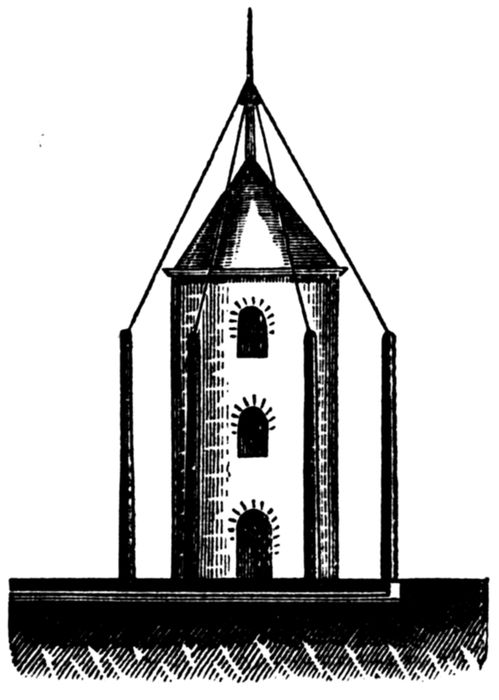
The lightning rod proposed by Regnier consisted of a piece of wood,
coated with resin, rising 2 metres (6 feet 7 inches) above the roof, and
having fixed on its top a sort of inverted funnel of copper, at the
upper end of which was fixed the point. To the lower edge of the
funnel were fastened ropes formed of twenty-seven annealed iron wires
well bound together, which were, at a suitable distance, connected
with iron bars, fastened to masts, and leading to moist earth. The
point had a small piece of platinum at its upper end.
The reporters observe that the wooden support may be employed by
way of extra precaution, though there was no known instance of
lightning leaving metal for wood; but it should be strong enough to
resist the wind. They approve of the method proposed for connecting
(55)the point with the metal bars, metallic ropes being very suitable for
this purpose, and keeping them well away from the building was quite
right; but they add that the metallic bars should not only communicate
with moist earth, but also with water in wells or otherwise.
A lightning rod is an electrical conductor terminating in a point
and carried down to the common receiver. It may be regarded as a
metallic tree, and divided into (1) the upper terminal, (2) the trunk,
and (3) the roots.
1. The upper terminal is a very pointed, conical or pyramidal
spike of metal having a base 3 or 4 centimetres (1½ inches) in radius.
The point is of gold or platinum, soldered to a copper rod 1 or 2
metres long (3 feet 3 inches to 6 feet 7 inches). This rod is joined
to the rest of the upper terminal, which is of iron, either by solder, a
screw, or a pin. It is important that all the parts of the upper
terminal should be joined with care so as to prevent fracture; at the
bottom of the terminal are several feet by which it can be leaded to
the vault or bolted to the framing of the roof. Several devices for
giving some play to the terminal so as to diminish the effect of vibration
have been proposed, but it is better to make the terminal strong
enough to resist. At the bottom of the terminal is joined the piece
connecting with the conductor; this ought to be very complete and
continuous, especially at the point of junction with the terminal.
Frequently the terminal is enlarged at this point to facilitate the
passage of the lightning. To preserve the terminal from rust it is
sometimes gilded—it has been proposed to tin it—more frequently it
is merely painted; experience shows that this is sufficient. Instead
of making the whole terminal conical or pyramidal, a square bar of
iron, finished with a point of copper tipped with gold or platinum, is
sometimes used. This plan may usually be adopted without danger,
but they are more liable to be broken or bent by vibration.
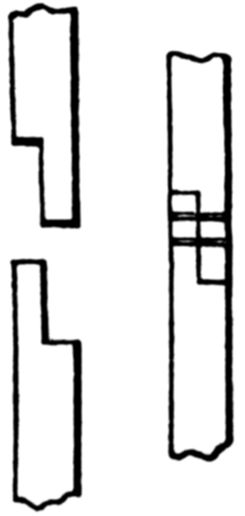

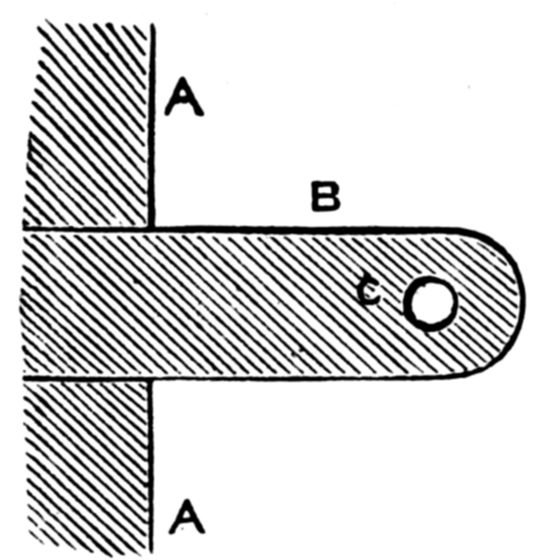
2. The trunk or conductor is made of iron bars 13 to 20 millimetres
square (½ to ¾ inch) notched at the ends and bolted together
(56)with a plate of lead between the two (Fig. 1). For powder magazines
a bar of 27 millimetres (1 inch) square is recommended. They follow
the outline of the roof, cornice, and wall, and each bar is fixed by a half
collar (Fig. 2) or cramp placed in the middle of the bar or as far as
possible from the junction of two bars. Instead of the iron bars ropes
of copper or iron wire, or even of hemp, may be used; these last may be
used provisionally, but for permanent conductors they have no advantage
either in economy or conductivity. The copper rope conducts
the lightning better, but its smaller size and cylindrical form, by
diminishing its absolute and relative surface, counterbalances its
superior conductivity. The great and real advantage of metallic, and
especially of copper ropes, is in their continuity and their flexibility.
The conductor is led down to the surface of the ground where it is
bent and led parallel to the surface towards a pit full of water, or
deep enough to allow the end of the conductor to rest in damp earth;
from 2 metres (6 feet 6 inches) above the ground to the pits the conductor
is enclosed in a channel or trough like the fuse of a mine, the
object of this is to protect the conductor from the dampness of the
soil and from contacts. These would be unimportant so long as
there is a perfect connection between the point of the conductor and
the common reservoir, but this continuity may be destroyed by degradation
of the conductor, and it is chiefly at the joints that this discontinuity
is to be feared. When the conductor has to be buried it
should be in an oaken trough, well put together and tarred or charred
or surrounded by powdered charcoal so that the metal cannot be
rusted by infiltrations or humidity; in some soils it is better to make
the subterranean part of the conductor of lead, taking care by
increasing the surface to make up for its inferior conductivity.
Sometimes water pipes may be made use of, but only when they serve
to lead water away and when they terminate in an isolated reservoir.
It is important to lead the conductor far away from water pipes
carrying water to public fountains or into the interior of houses.
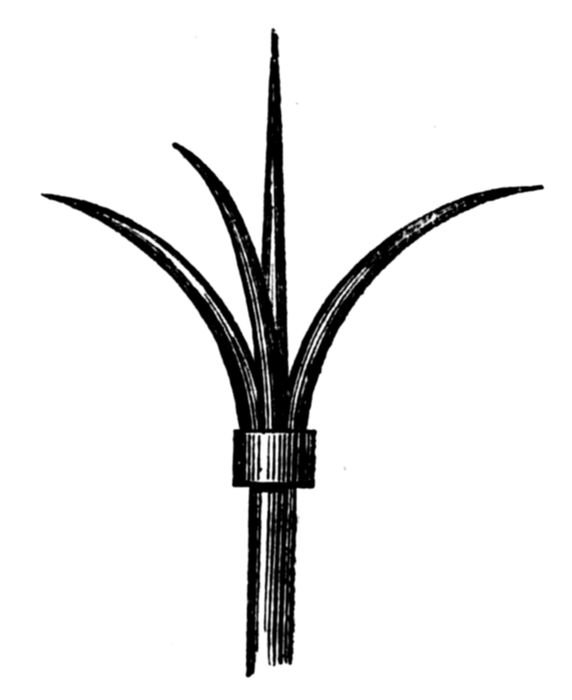
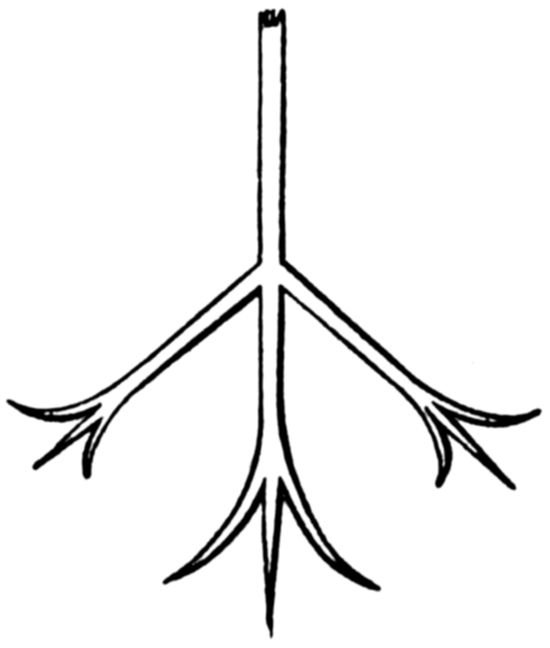
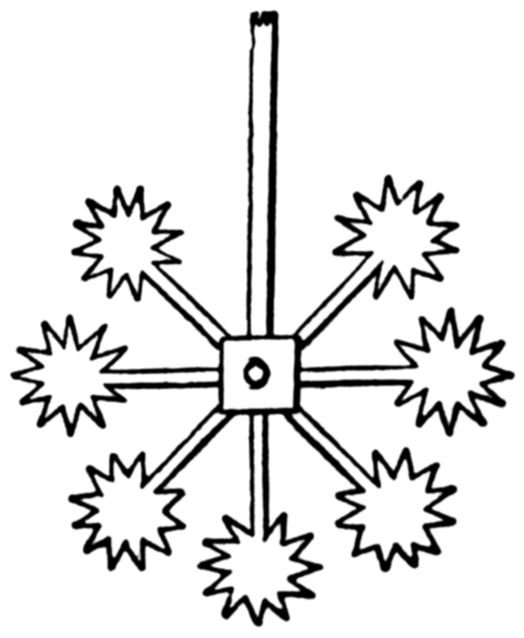
3. If the conductor leads to a well full of water the roots (Fig. 3)
need not be more than a few spindles terminated in points and long
enough to be always immersed. When the conductor only leads to a
bed of earth it is supplied with a system of roots (Fig. 4), having for its
object the multiplication of the points for the escape of the lightning,
and these are increased in number according as the soil is a less
good conductor. The pits should be some distance from the foundations
of the building, so that the lightning may not damage them,
and it is important, by all possible means, to increase the natural
humidity of the soil. When the wells cannot be closed it is necessary
that the conductor should be insulated and plunged deeply in the
water for fear that the communication of the electricity to the well-chains
or pump-rods might cause accidents or alarm. After some
other instructions it is added that the dispersal of the electricity in
the common reservoir is, next to the continuity of the conductor, that
which most deserves the attention of the physicist and the engineer.
It has been remarked that a point extended its sphere of activity as
far as 10 metres (32 feet 9 inches), that beyond this distance its effect
became less sensible, and that when the points were too near together
(57)they neutralised one another. So upon a building of a given size it is
necessary to set up so many that all parts shall be covered by their
spheres of attraction, which should meet and not overlap each other.
Lightning in passing from a cloud to the earth does not always take
a vertical direction, it sometimes follows the path of the rain drops,
which is inclined by the wind, so when a magazine is very lofty, or on
an elevated spot it is not useless to fix horizontal or inclined points on
the gables or angles. In some places the magazines are dominated
by other buildings; in these cases the neighbouring buildings
should be protected, or the magazines should have horizontal
points towards them. If the ramparts dominate the magazine it will
be prudent to set upon them a lightning rod on a mast. Trees are only
struck by lightning because their tops serve as points but their trunks
are bad conductors, hence it is prudent not to have plantations,
especially of lofty trees near magazines. However many points may
be set up on a magazine they should all be connected together, and
all joined to the principal conductor, and it would be well to have
more than one principal conductor so that if one loses its continuity
the lightning may have a path by the other. Stone, wood, and gunpowder
are bad conductors, and pieces of metal may without danger
be used in the inside of magazines, provided they are connected
with the principal conductor by branch conductors of suitable size:
still it is prudent to keep the metal outside.
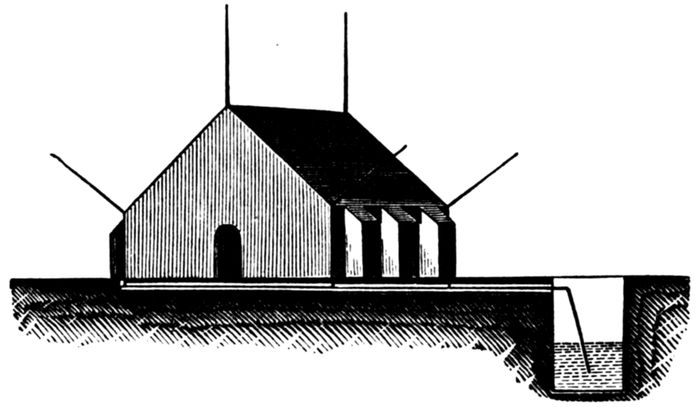
Reference is then made to “Regnier’s System of Lightning Rods,”
Appendix F., p. 53, which is thought to be much too expensive.
The reporters say that experience has taught that the point of a
lightning rod 4 or 5 metres (13 to 16⅓ feet) does not effectually protect
a space round it greater than one having a radius of 10 to 12
metres (32¾ to 39¼ feet). That when there are points or considerable
masses of metal on a building having a lightning rod it is absolutely
(58)necessary to connect them by branches with the principal conductor.
That it is not less important that the metallic bars should be
thoroughly well connected together so that the electricity may find
no resistance in its path from the point to the common receiver.
And lastly, that it is necessary that the conductor should have a
perfect communication with moist earth, or better, with water.
They then proceed to discuss the instructions, or that part of them
which relates to the construction of the lightning rods. They
recommend the use of gilded copper points, notwithstanding the
doubt concerning them which had been raised in consequence of
their deterioration by oxidation, and their being blunted by lightning.
They say that experience has shown that an iron rod 20
millimetres (·8 inch) square is more than sufficient to carry the most
violent discharge of lightning, and that it is consequently needless
to make them larger, as recommended in the Instructions; that
it is only at the joints that there is any cause for fear because, in
spite of the insertion of the piece of lead, the contact is not perfect;
that it would be easy by enlarging the bars at their junctions to
increase the number of points of contact, and by lengthening the
bars to make fewer joints. That in this respect the use of iron wire
ropes would be very advantageous, but they fear that the ropes would
be easily destroyed, and that the use of copper wire rope instead
of iron would be too expensive.
When the conductor reaches the ground too much care cannot be
exercised in making a free communication between it and the soil.
It is upon this that its good effect principally depends, for houses
have been struck although provided with a conductor, because it
only communicated with a very dry soil. M. Patterson, of Philadelphia,
in the fourth volume of the American Phil. Trans., has
published a means of making a good contact which seems useful. He
proposes to lay the conductor in a bed of galena worked into a paste
with melted sulphur. The galena is a good conductor, and would
have the advantage of protecting the iron from the damp. He has
also proposed a simple means of providing for the easy dispersion of
the electric fluid in cases where the soil is not very damp, which
consists in making a hole in the ground and filling it with charcoal,
into which the conductor is plunged. But M. Guyton used the
conducting power of charcoal for this purpose more than thirty years
ago, and it has been applied in many ways. Charcoal, like galena,
is a good conductor, and this property renders its employment desirable
in cases where the soil is dry.
Upon the proposal to fix inclined or horizontal points they think
that vertical points will suffice; and with reference to the Regnier
system, they remark that it would certainly be very expensive, and
that it would not be necessary to adopt it until the usual system had
been found insufficient.
(59)
First Part, 23rd April, 1823.
Prepared by a Committee consisting of MM. Poisson, Lefevre-Gineau, Girard, Dulong, Fresnel, and Gay Lussac.
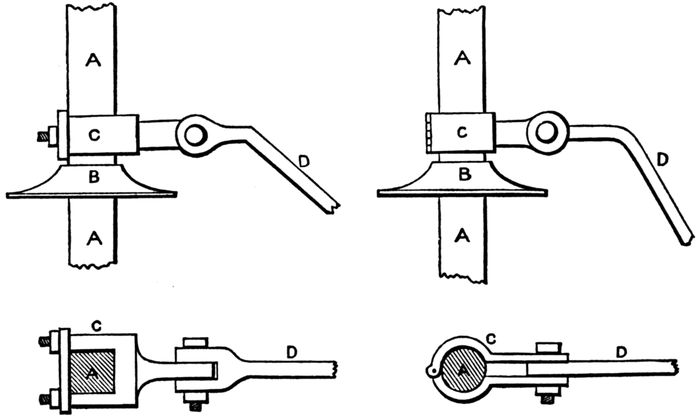
After some theoretical remarks the Committee describe the conductor
they recommend, giving the name of tige (upper terminal) to
the part rising into the air above the roof, and that of conductor to
that part extending from the upper terminal to the ground. The
upper terminal is a square or round bar of iron tapering from base
to summit. If from 7 to 9 metres (23 feet to 29 feet 6 inches) high,
which is the smallest height to be used on large buildings, it should
be 54 to 60 millimetres (2·1 to 2·3 inches) square or diameter at the
base, if 10 metres (32 feet 9 inches) high, it should be 63 millimetres
(2·5 inches). About fifty-five centimetres (1 foot 9½ inches) of the
upper end is cut off and replaced by a point of copper either gilded
at the end or tipped with a little piece of platinum. At the lower
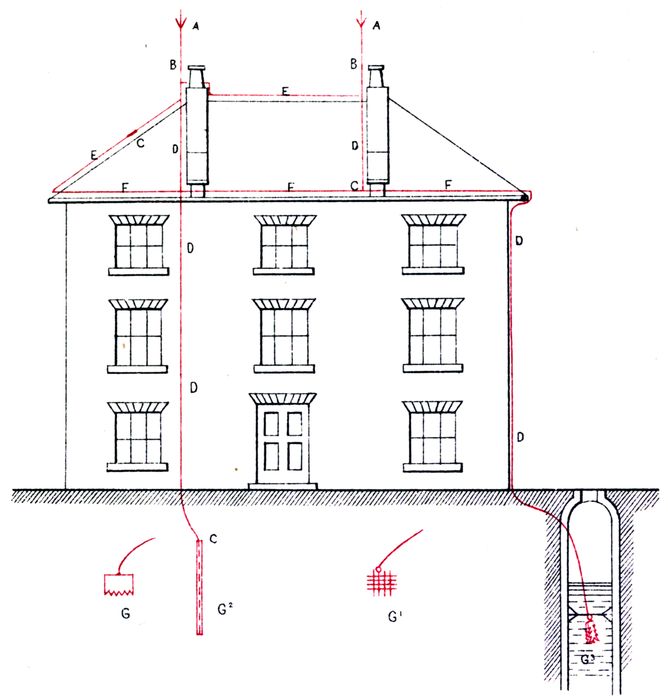
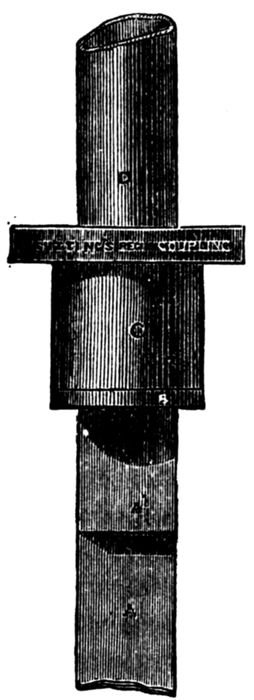
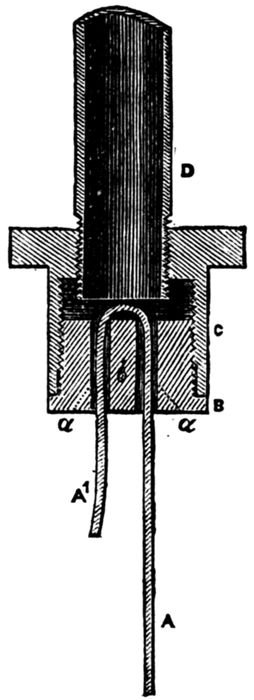
end of the terminal (A), 8 centimetres (3·15 inches) above the roof, is
fixed a base (B) to throw off the rain which would run down the terminal,
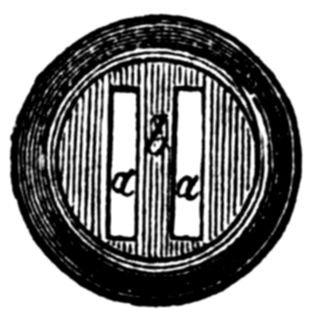
and above this base the terminal is clasped by a collar (C), as
shown in the drawing, to which is bolted the conductor (D). The
engraving shows the modification of the arrangement as adapted to
both round and square terminals. The conductor is a bar of iron
15 to 20 millimetres (·59 to ·79 inches) square, joined firmly to the
upper terminal by bolting it tightly between the two ears of the
collar. The best way of joining the bars together is shown in figure
1, p. 55. It is to be held up at a distance of 12 to 15 centimetres
(4·7 to 5·9 inches) from the roof by crutches, and to be kept at a like
distance from the walls of the building. At 50 or 55 centimetres (19·6
to 21·6 inches) below the surface it is turned away perpendicularly
from the wall for a distance of 4 or 5 metres (13 feet 1 inch to 16
(60)feet 5 inches) if it does not sooner meet with water. To avoid rusting
the rod is carried in a trench filled with charcoal, and then
turned down a well so as to have at least 65 centimetres (25·7 inches)
in the water when at its lowest level, where it terminates in three or
four branches to facilitate the exit of the electricity from the conductor.
If there is no well convenient, a pit should be made 13 to 16 centimetres
(5·1 to 6·3 inches) in diameter, and 3 to 5 metres (9 feet 10
inches to 16 feet 4 inches) deep, down the middle of which the conductor
should be led and the hole filled with charcoal tightly rammed.
As the iron bars forming the conductor are not easily bent to follow
the lines of the building a metallic rope may be used. It is made of
four strands, each composed of 15 iron wires, and forming a rope of
16 or 18 millimetres (·62 to ·7 inches) in diameter. Each strand is
tarred separately, and the whole also well tarred when put together.
It is attached to the upper terminal in the same way as the bars
by pinching between the ears of the collar (c). At 2 metres (6
feet 7 inches) above the ground it is joined to the bars which form
the earth connection by being pinned into a socket formed at the end
of the first bar. Ropes of copper or brass wire may be used, and
they need not be more than 16 millimetres (·62 inches) in diameter.
It is necessary to connect any considerable metallic masses (lead
roofs, metal gutters, or tie rods) with the conductor, because if this
be not done, and the conductor be broken, or have a bad earth connection,
the lightning may leave the conductor for the metallic mass.
Modifications of this form of conductor for use on churches, ships,
and powder magazines (for the latter carrying the conductors on
masts is recommended) are then described.
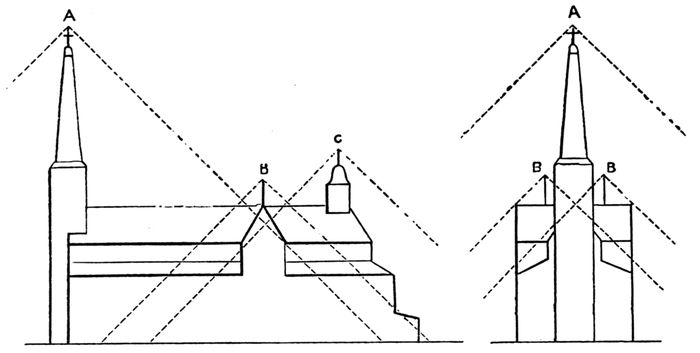
The report says that the terminal of a conductor protects efficiently
a circular space round its base, having a radius equal to twice its
height; but that it is prudent to estimate that a conductor on a
church spire only protects a circle having a radius equal to the height
of the conductor.
The conductor should go the shortest way to earth. It should be
on the side most exposed to the weather, especially on spires.
Notwithstanding the considerable advance in knowledge since 1823,
the instructions of that date have no need to be altered, at least in
their essential principles; but the methods of construction of buildings
having materially altered, and metal having largely replaced wood and
stone, buildings had, so to speak, become metallic masses, which
would have incomparably greater attraction for thunder clouds. The
Palais d’industrie in the Champs Elysees, for example, nearly 3 hectares
(7·4 acres) in extent, and 40 metres (131 feet) in height had everywhere
enormous masses of iron, brass, and zinc.
The company undertaking the building had sought the advice of the
(61)Academy as to the means to be employed to protect it from lightning,
and it had been found necessary to revise the instructions of 1823, in
order to introduce such modifications as were necessary.
Quoting the passage referring to the connecting of metallic masses
with the conductor, the Committee think that the time had come to
enter into fuller details on this point.
Formerly the use of metal was almost restricted to ridges, gutters,
and tie rods; now metal was used everywhere, and what is important,
in large surfaces and great masses; and this new system realised on
a large scale the first objection to lightning rods—it attracts the
lightning.
When this objection was applied to lightning rods, it had only the
appearance of truth, but when applied to the masses of metal then
used in buildings, it was not only specious, but true, and founded
upon well established laws; these buildings do attract the lightning,
and render its effects more disastrous.
In the case of two buildings alike in size and shape, situated on the
same soil, one made of wood and stone as formerly, the other with
much metal as now, and both without lightning rods—if the conditions
are such that the lightning must discharge itself, it will always strike
the latter, and never the former; in the same way as on bringing to
the conductor of an electrical machine a ball of wood or stone, and
one of metal, it is always the latter which will receive the spark.
Lightning rods, therefore, are so much the more indispensable as the
buildings contain greater surfaces and greater masses of metal.
The nature of the soil must be taken into account, as well as the
buildings and other objects upon it. A dry soil, with a subsoil of dry
sand, chalk, or granite, does not attract the lightning, because it is a
bad conductor. Unless when accidentally wetted the buildings on it
participate to some extent in this immunity, at least if they are not
built in the modern style, and are not very large. But if there are at
a moderate depth underneath this dry ground, large metallic veins, vast
caverns, sheets of water, or only abundant springs—these will attract
the lightning, which will destroy everything in its path unless protected.
If the wet or metallic strata are very deep, the danger of an
explosion is diminished by the difficulty of passing the intervening
envelope, and by the weakening of the action of the cloud by the
increase of distance.
On the 19th April, 1827, the packet boat New York was twice
struck by lightning. On the first occasion, having no conductor, it
received considerable damage; on the second, the conductor was
fixed; it was made of a pointed bar of iron, 1·2 metre (about 4 feet)
long, and 11 millimetres (·43 inch) diameter at the base, and a
surveyor’s chain about 40 metres (131 feet) long, forming a connection
between the foot of the rod and the sea; the chain was made
of iron wire 6 millimetres (·24 inch) in diameter; the links were 45
centimetres (17·7 inches) long, ending in loops, and joined together
by two round rings. When struck the chain was dispersed in burning
fragments and globules, which set the deck on fire in many places,
notwithstanding the hail upon it and the rain which fell heavily; the
bar at the top was melted for a length of 30 centimetres (11·8 inches)
(62)from the point, and down to a diameter of 6 millimetres (·2 inches).
The rest of the rod remained with about 8 centimetres (3·1 inches)
of the chain attached to it, the longest piece of chain found was less
than 1 metre (3 feet 3 inches) long, and was blistered as by fire.
On the 13th June, 1854, the Jupiter was struck by lightning. The
conductors were in place; that of the mainmast which was struck
went 2 metres (6 feet 6 inches) into the sea, and had at its end a ball
2 kilos in weight. After being struck the conductor had disappeared
and the pieces of it were scattered everywhere. The conductor, about
70 metres (230 feet) long, was a cable of three strands formed of
sixty brass wires, each one half or two-thirds of a millimetre (·019 or
·026 inches) thick. The cable was mostly in bits no bigger than pins,
but there were some pieces a few decimetres long, these had been
turned violet colour as by fire, and those first touched were still
burning hot.
These two examples show that a conductor may be destroyed, but
they also show that it is not useless even then, since it will have
received the discharge and directed it, and so prevented greater mischief.
The Jupiter received no damage; whilst not far off, a Turkish
vessel, which also had a conductor (but the chain of which did not
reach the water) having been struck by lightning in the same storm,
had a hole more than 30 centimetres (11·8 inches) deep, and almost
such as would have been made by a cannon ball, in her side just above
the copper, and near the water line.
The question is, are such accidents to conductors inevitable, or are
they the result of faulty construction? All the facts established in
the accounts of lightning and its phenomena, leave no doubt on this
point. All the lightning rods which have been destroyed were of bad
materials, insufficient, badly constructed, not in accordance with the
principles which theory has deduced from experience.
The conductor of the New York had several faults; its upper
terminal was too small, and too much drawn out; its conductor had
much too small a sectional area; and the use of a chain in such cases
should be strictly excluded.
There is no example known in which lightning has been able to
melt iron rods 2 centimetres (·78 inch) in diameter, or 3 square
centimetres (1·18 inch) in section; and copper may be used in still
smaller sizes.
The conductor of the Jupiter, although better than the former, had
also a radical defect. The fragments of the conductor which were
examined bore but few traces of fusion, and none of these traces
extended to the entire thickness of the cable; they were also limited to a
group of some of the sixty wires of which it was composed. This
seemed to show that the discharge was not carried equally by all the
wires, and that those wires which it followed being insufficient to
carry it, were the ones melted, and the others were broken or
volatilised with explosion. Hence the breaking of the cable and
dispersion of fragments of some decimetres in length, which, though too
hot to be touched, were not hot enough to set wood on fire. This
explanation, however, raises a singular question, whether, in a cable
of similar wires twisted and bound together, the lightning can choose
(63)some wires in preference to the rest, even when the whole of them are
hardly sufficient to give it a free passage.
Undoubtedly, yes; at any rate under certain conditions. No doubt
if at both ends of the cable, for the length of a decimetre, the wires
first tinned separately are afterwards soldered together, so as to make
a sort of metallic cylinder, electricity, whether natural or artificial,
having to pass along the cable, will not show a preference for one wire
over another; but where this is not done—if at the two ends, or,
more generally, at the two points of junction with other conductors,
the wires are isolated by layers of dust or oxide—if, in addition, the
cable only touches the terminals by its outside wires, then things
happen very differently. The electricity takes those wires that are in
contact with the terminal; these reduced to few in number become
incapable of carrying it; and the whole cable broken by the explosion
exhibits the phenomena shown in the case of the Jupiter.
The deficiency in each case was due to one cause—insufficiency of
sectional area. In the first case the insufficiency is apparent, the
iron wires 6 millimetres (·24 inch) thick were nine or ten times too
small; in the second, the insufficiency is more hidden, it results from
badly made junctions.
The two most fundamental rules for the construction of the rod and
conductors are—1st. That they shall have a sufficient sectional area.
2nd. That they shall be continuous and without a break from the
point of the upper terminal to the common receiver (the earth). But
this continuity may in strictness be interpreted in two ways: it may
be said that two pieces of metal in contact form a sufficiently continuous
connection; and it may be said, on the other hand, that most
frequently this simple contact is no more than a break in consequence
of oxidation and the interposition of foreign bodies.
The instruction of 1823, without adopting the first interpretation,
does not appear to have sufficiently recommended the second, which
should exclusively regulate all construction of lightning rods. No
doubt it is possible, by taking great care, to join and bolt together
two pieces of iron or copper closely enough to make a practically
continuous conductor, but when there are many joints we fear that
evil might arise from the negligence of workmen, and still more from
the chemical alteration of the surfaces, the deposition of foreign
matter, and the mechanical dislocation produced by time and
repeated shocks.
Hence, the three following practical rules should always be
observed:—1. To reduce as much as possible the number of the joints.
2. To make all the joints with hard solder, and they should be upon
surfaces of at least 10 centimetres (3·9 inches) square, and further
strengthened by straps and bolts. 3. Not to make the upper terminal
so gradually pointed as usual. The upper terminal of iron should be
not less than 2 centimetres (·78 inch) diameter, the end should be
filed down and a screw tapped 1 centimetre (·39 inch) high and 1
centimetre diameter, and to this a cone of platinum 2 centimetres
diameter and 4 centimetres (1·5 inch) high, and consequently having
an angle at the point of 28° or 30° should be fitted, screwed, and
carefully soldered.
(64)In other respects the instructions of 1823 should be followed; no
fact which leads to a modification of the general rules there proposed
1, for the sectional area of the conductors; 2, for the method
of fastening to buildings; 3, for the method of making the earth connection,
has since come to light.
The subject, however, is not exhausted, there still remains the important
and difficult question: what is the circle of protection afforded
by a well constructed lightning rod? The opinion generally received
at the end of the last century was that the circle of protection had
a radius of twice the height of the terminal, and the instruction of
1823 adopted this opinion, but with some restrictions as in the case
of spires. It is important to remember that these rules rest upon a
more or less arbitrary basis, and this is said not to condemn them,
but only to prevent there being attached to them a value which they
do not possess.
More observations are required, and it is only with reserve that these
rules are admitted. They are neither general nor absolute, they depend
upon a variety of circumstances, and especially on the materials of
the buildings. For example, the radius of the circle of protection,
which would be sufficient for a building having only wood tiles or slate
on its upper portion, would not be sufficient for a building in which
the covering or the framing of the roof was of metal. In the former
case the active portion of the thunder cloud, although further from
the lightning rod than from the roof, would exert a greater action
on the rod, whilst in the latter the action on the rod and on the roof
would be almost equal at an equal distance.
A special note upon ships, and another on the Palais de l’Exposition
close the report.
Referring to the subject of the earth connection the Committee
say; in the earliest instructions, it is said that the conductors should
communicate with the water in a river, a pond, or wells, or at least
with moist earth. This rule, although quite correct in itself, frequently
leads to erroneous practice. It is sometimes thought that
lightning is extinguished by water, as fire is; and when water is
scarce the conductors are plunged into a well-cemented cistern.
This is a most dangerous mistake; the conductor should be in connection
with the common receiver, that is, the great water-bearing
strata (nappes d’eau,) of much greater extent than the thunder cloud.
At other times where wells are possible but costly, advantage is
taken of the alternative allowed by the instructions. Instead of wells
the conductors are put in connection with the earth, without being
careful to see that it preserves sufficient moisture in times of drought
when storms are most to be expected, and without being careful to
see that the moist connection is sufficiently large. They specially
note this latter error, as it appears to be still more common than
the former. They do not hesitate to say that recourse should never
be had to this method of connection with the common receiver. They
(65)recommend that in default of rivers or very large ponds, the conductor
should always be connected by large surfaces with the inexhaustible
subterranean water-bearing strata.
Secondly, where these strata are at a moderate depth below the
surface, the Committee consider it necessary to make use of a conductor
with two branches, the principal to descend to the subterranean water;
the secondary, leaving it at the ground level, is put in connection
with the surface. And for this reason; after great droughts thunder
clouds exert but a feeble influence upon a dry, badly conducting soil.
All their energy is felt by the subterranean waters; and the electricity
will be carried by the principal branch. On the other hand, after a
summer shower, when the surface soil gets moist, it is at once made a
good conductor. It is that which is affected by the thunder cloud:
while, at the same time, it screens the subterranean water from electrical
influence. In such a case it is indispensable that the surface of the
ground should be in direct connection with the conductor; and this
the secondary branch supplies.
There is a final question how the conductors should be connected
with the various metallic portions of the building. The ridges are
throughout of iron; but the interior arrangements require that, in
some portions of the building, there should be, properly speaking,
only one floor, whilst in other parts there are six. Each floor may be
regarded as a great metallic network, composed of several strong plate
girders, crossed by numerous joists analagous to rails, while these are,
in their turn, crossed by a multitude of smaller iron rods; and the
meshes of this network are filled with tiles. In enquiring into the
effect of a thunder storm upon those portions where there are six
such floors one above the other, it is easy to see that if the roof were
a great continuous sheet of metal, it would take up the whole electrical
energy of the cloud, at any rate, as far as the floors underneath it are
concerned. In this case it would be amply sufficient if the covering
were well connected with the lightning rods. But in this case the roof
is metallic, only in a very small portion; it may be said that the ridges
only form a network with very large meshes, and, consequently, is an
insufficient shield, through which the upper floor may still receive a
considerable shock. Therefore the Committee propose the following
arrangements:—1st. The principal pieces of each floor should be put
in connection with the conductor. 2nd. It is very desirable that all
the joists of the upper floors should be connected together by a rod
bolted, and, if possible, soldered to each, which rod should be connected
with the conductors. 3rd. It seems probable that, in general,
the roof frames are in good connection with each other, and, consequently,
it would suffice if all the upper terminals are connected
with them. If, however, it happens either by changes of level in the
gutters, or from other causes that the connections become doubtful
special iron connections must be made. 4th. The zinc gutters and
ridges should be connected with the lightning rods.
(66)
The committee examined the points presented by Messrs. Delieul,
one of platinum, made exactly as described in the report of the
previous 18th December; the other, a cone similar in form, size, and
external appearance, but rather less costly, being made of a cap of
platinum, fixed with hard solder upon the conical end of the iron rod.
It was thought that this second arrangement would not practically be
inferior to the other; but it must be made by a skilful workman, who
knows how to insure that the solder should take to the whole of the
surfaces brought together. They see no objection to the substitution
of palladium, or gold or silver of a standard of ·950 for the platinum.
But all these metals are costly; few workmen know how to work in
them, or at least to employ that precision, and take that minute care,
which are indispensable to success. These reasons have raised again
a proposition that was discussed in the former commission, which
consists in making the points of copper. The copper point is 2 centimetres
(·78 inch) in diameter, like the upper part of the iron rod, to
which it is screwed and brazed; its length is about 20 centimetres
(7·87 inches), and it terminates in a cone 3 or 4 centimetres (1·1 or
1·5 inches) high.
They see no reason why this should not be used with almost the same
confidence as the preceding forms. If there is ground to fear that it
may undergo changes from atmospheric influences, this is counterbalanced
by certain advantages. 1st, copper is with palladium, gold,
and silver, among the best conductors of heat and electricity; and the
point of the cone will be much less heated than the platinum point;
and 2nd, the terminal, with a copper point, is much less expensive,
and can be made everywhere.
On the report being put to the vote M. Despretz could not approve
the proposal to employ copper points, fearing that the deposition of
carbonate or some other badly conducting matter would diminish the
efficacy of the lightning rod.
After referring to some general principles, and to the construction
of lightning rods recommended in the reports of the earlier Committees:
the Committee recommend, that the upper terminal including
the copper point should be from 3 to 5 metres (9 feet 10 inches to 16
feet 5 inches) high; that the junction of the conductor and the upper
terminal, and also the several joints of the conductor, should be
(67)covered with solder, and insist very strongly upon the necessity of
communication with the nappe d’eau souterraine, which they define as
“the water level in neighbouring wells which never dry up, and
which retain at least 50 centimetres (19·68 inches) in depth of water
in the most unfavourable seasons.”
The special arrangements to be adopted in setting up lightning
rods for powder magazines are: not to fix them on the building itself
but outside the surrounding walls. For each large sized magazine
(27·89 metres, by 20 metres, and 11 metres high, equal to 91 feet
6 inches by 65 feet 7 inches, and 36 feet high) there should be three
conductors—two near the ends of the long side of the enclosing wall
most exposed to storms, and the third in the middle of the opposite
side. The upper terminals should be only 5 metres (16 feet 5 inches)
high, and should be raised on a pier, a mast, or other support 15 metres
(49 feet 2 inches) high, down which the conductor should be led to the
ground. There should be a circuit which the Committee call circuit
de ceinture carried entirely round the enclosing wall to which each
conductor should be joined, and a conductor should be carried from
the most convenient point of this circuit to the underground water.
For middle sized magazines two terminals and supports, and for
small magazines one terminal and support will suffice; but in all
cases there should be a circuit de ceinture. This need not be deep
below the surface, nor covered over; it may even be in an open
gutter, but a conductor must be led from it to the underground water,
even if in order to do this it is necessary to carry the conductor
several hundred metres or several kilometres. It need not, however,
be made of bars and carried all the way in a trench, but it may be
made of six wires 6 or 7 millimetres (about ·25 inches) in diameter,
and carried on posts like telegraph wires, except that they need not
be insulated.
The Committee find that platinum tips are useless, and recommend
instead that the point of the terminal should be made of pure copper,
50 centimetres (19·7 inches) long, and terminating in a cone, forming
an angle of 30°. This should be scarfed, pinned, and soldered to the
end of the terminal. The terminal should be of wrought iron in one
length, and where possible galvanized; but on no account painted.
The connection with the conductor should be by a piece fitted and
bolted; and, lastly, the whole joint should be well covered with
solder.
The Committee consider that on an ordinary building a terminal
will effectively protect a cone, having the point for its apex, and a
base whose radius is 1·75 of its height. But in practice the terminals
(68)may be much farther apart, if there is a circuit des faites. This is
defined as a metallic conductor, which extends without break over
the ridges of all the buildings which it is intended to protect, and
which is joined by metallic contact to all the upper terminals and to
the conductor, and consequently to the underground water which
alone forms the common reservoir. All pieces of metal of any considerable
size should be connected with the conductor.
If the conductor is made of iron bars, they should be galvanized if
possible, and the joints should be fitted, bolted, and finally covered
with solder. If the bars cannot be galvanized, they should be well
painted. The Committee recommend the employment, especially in
the circuit des faites, of an arrangement for compensating for the
lengthening and shortening of the bars by the variations of temperature.
This is made by inserting in the circuit a curved band of
copper which will yield to the movement of the rods. If the conductor
is made of galvanized iron wire rope, each wire should be 2·5
or 3 millimetres (·09 to ·11 inch) in diameter, and there should be
such a number of them that the sum of their sectional areas shall be
equal to one-fifth more than that of a bar of iron 20 millimetres
(·78 inch) square. The rope should be all in one piece, and the joints
with the terminal and earth connection should be covered with solder.
The supports should not be insulated, and there should be as few
as possible of them. At the underground end of the conductor
should be fixed a large sheet or hollow cylinder of metal, and this
should be always, even in the greatest droughts, plunged at least
1 metre (3 feet 3 inches) into the subterranean water. If from any
cause this water cannot be reached, the conductor may be joined to
one of the main water-pipes of the city; but if the conductor cannot
be led either to the subterranean water or to a main water-pipe, no
lightning-rod should be erected. It would do more harm than good.
In the case of buildings of any importance, two or more conductors
leading to the subterranean water should be employed. It
should be so arranged that the underground part and the earth
connection may be easily inspected and cleaned from rust, and the
whole should be inspected and cleaned at least once a year, at the
end of the autumn. The Committee is of opinion that it would be
better to put all the lightning-rod work in the hands of special
workmen, under the control of an agent appointed by the administration,
and not to trust it to the blacksmiths and locksmiths usually
employed. The Committee lastly recommend that they should be
permanently appointed, and meet every year after the inspection, to
report and decide upon the steps to be taken to remedy any defects
that may be discovered.
This report gives a detailed description of the state of the lightning
rods attached to the public buildings of Paris.
In most cases the upper terminals were of great length, some of
them as much as 9 metres (nearly 30 feet) in height; the conductors
(69)were in almost all cases of iron, either in bars or wire rope; the
earth connections were of various kinds and extent.
The report frequently states that the points were blunted; that
the upper terminals and the conducting rods were deeply rusted;
that especially at the joints the conductors were seriously deficient;
and that the underground portion was greatly deteriorated by rust.
A description is given of an accident from lightning to the church of
St. Sulpice; but this building had no lightning rod. In the case of
the church of St. Clotilde there are five upper terminals, two on the
two spires, the remaining three along the ridge of the main roof.
The building was amply protected as far as its length was concerned,
but the transept was not so thoroughly protected. The five terminals
were joined to a conductor which went round the building, and was
connected with the ground. A second conductor led from one of
the terminals to the ground, where it terminated in a second pit.
The conductors were made of iron rods 18 millimetres (·71 inch) in
diameter, joined by collars and pinned and the whole covered with
paint. They terminated in distributors plunged in the underground
water in walled pits. They were supported by insulated collars.
The building has an iron roof. The church had been struck by
lightning at least four times since the lightning rods had been erected.
The first time, twelve years ago, the lightning struck the rod placed
on the transept, and carried away the platinum tip of the copper
point. Since then the rod has received another discharge, and the
copper point is bent to the S.W. In January, 1872 or 1873, the
lightning struck the western tower, and shattered one of the stones
above one of the windows of the staircase.
“One of the platinum tips is gone, and many are blunted. The
conductivity of the conductor is very bad, and the joints are very
much damaged: hence the accident to the tower. The greater
number of the glass insulators are broken, or gone altogether.”
In the case of the church of St. Eloi, which had one terminal on
the spire, one conductor, formed of iron wire rope 2 centimetres
(·78 inch) in diameter, joined at 3 metres (9 feet 10 inches) above
the ground to an iron rod 25 millimetres (·97 inch) in diameter,
which entered the ground and ended without branches in a pit filled
with charcoal. The soil was dry and calcareous. The conductor was
made up of many lengths of rope, old pieces apparently having been
used; the joints were in bad condition, and needed soldering. The
underground part was deeply rusted.
“In September, 1874, lightning struck the spire, twisted the conductor,
broke the terminal, threw down the part above the cross, and
made great cracks in the apse.”
During the building of the Mairie of the 20th Arrondissement,
the lightning struck a fir-pole in the scaffolding. It did not do any
damage, being carried away by the chain attached to the pole, from
which it took all the rust, and being thence conducted by some pieces
of iron roof framing lying on the ground.
There are several other accounts of accidents, but they are mostly
represented by the foregoing examples.
(70)
Issued with Army Circulars, dated May 1st, 1875.
(Abstracted by Prof. T. Hayter Lewis, F.S.A.)
1. The principles adopted by Sir W. S. Harris, as shown in the
Appendices A and B, to this paper, still held to be sound.
2. The terminating plane of action of lightning is sometimes beneath
the surface of earth, which, if moist, forms good medium for diffusion
of electricity.
3. Dry soil is to be regarded as non-conducting matter.
4. Therefore conductor to be taken into soil permanently damp.
5–6. Underground magazines are usually in dry soil, and should
therefore be fitted with conductors as in the case of similar magazines
above ground.
8–9. Casemated batteries of modern construction, with magazines
in basement should have conductors on the parapet or terreplein from
end to end of battery, attached to vertical conductor into earth. Flagstaff
should have conductor. In large works there should be several
points 5 feet above top of building. Iron verandahs and railings are
good conductors when with good earth connections.
10. Iron buildings are good conductors. But if covered with
asphalte, concrete, &c., rods or points must be provided projecting
above asphalte, &c., and with good earth connections. Iron shields
should be connected with conductors.
11. Copper is recommended as best conductor; it is not liable to
corrosion, and very durable.
12. But if exposed to injury, or likely to be stolen or corroded,
copper may be replaced by iron, provision being made for its smaller
conductivity—viz., ⅕th that of copper.
13. Copper rods to be ½ inch diameter; copper tubes to be ⅝ × ⅛
inch thick; copper bands to be 1½ × ⅛ inch thick.
14. If the conductor be of iron, solid rods to be 1 inch diameter;
solid bands to be 2 inches wide × ⅜ inch.
15–16. The fusing temperature of copper is 1994° Faht.; whereas
that of iron is 2786° Faht. So far there is a marked advantage over
copper. But it rusts easily, and then the electrical resistance is immensely
increased. Roughly speaking, an equal conducting power
may be obtained either in iron or copper for the same cost, the
number of iron conductors being greater in proportion to the less
cost, and the more conductors being the better.
17–19. Expansion and contraction are to be carefully provided
against; e.g. by suitable bends at intervals in long lines of horizontal
conductors and by bearing collars, allowing of slip in vertical lines.
20. Soldered or welded joints are desirable, but not absolutely
necessary.
21. Gives engravings of connections recommended by Sir W. S.
Harris, where soldered joints cannot be used, and which fulfil the
conditions specified in sections 17–19.
(71)22. Soldered or welded joints to be used where discharge is possible
with unsoldered joints, and likely to ignite dust or inflammable
substances near.
23. Iron may be connected by similar joints as for copper, or by
screw joints as for gas pipes. No white lead to be used, it being a
bad conductor.
24. Iron flat bands may be connected by rivets or screws, working
in slots, to provide for expansion, each surface in contact being at
least six times the sectional area of band.
25. Copper bands to be similarly connected. Joints between different
metals may be soldered, screwed, or rivetted, the extent of
surface in contact being regulated by the dimensions of the metal of
the least conducting power. Access of moisture to surfaces in
contact must be prevented, on account of local galvanic action and
decomposition.
26. No precise limit can be fixed to protecting power of conductors.
In England the limit is usually assumed as being the radius
of the height from ground. It may be sufficiently correct for practical
purposes, but cannot always be relied upon.
27. Conductors do not attract lightning; they only diminish the
resistance due to the air. Even a change in the nature of the soil
-over which a cloud passes may produce a discharge.
28. One angle of a building may receive a discharge, though
another angle have a conductor. So every prominent part of a
building containing explosive material should have a conductor.
29. In buildings of uniform height, provide a solid rod 5 feet above
it at each end, and at each 45 feet in length; if the conductor be of
iron the top should be gilt.
30. Buildings not over 20 feet long to have one vertical conductor
at end, and a horizontal conductor on ridge.
31. If 20 to 40 feet long to have one vertical conductor in centre,
and one along ridge, as last.
32. If 40 feet long to have two vertical conductors; if 100 feet long
three conductors; in both cases with conductor along ridge.
33. Similar principles to be adopted in larger and more complicated
buildings.
34. Each prominent part should have a conductor. The value of
three or four points to terminals is not apparent unless the points
are widely separated.
35. Conductors are to be connected horizontally, e.g., by ridge or
eaves, which, when of metal, should be invariably connected with conductor.
All metal surfaces whatever to be also so connected.
36. Sir W. S. Harris considers the relative conductivity of the
several metals as being—of lead 1, tin 2, iron 2½, zinc 4, copper 12.
So lead cannot be altogether depended on.
37. Avoid long lengths of horizontal conductors without earth
contacts, as the currents might leave the conductor, and pass to earth,
causing danger. Avoid sharp angles.
38. Good earth connections most important. Conductors are to be
led into springs or wells or earth permanently wet. Not into watertight
tanks. Shingle, dry sand, or dry mould are not sufficient.
(72)Provide several earth connections in all large systems of conductors
as a precaution.
39. Lead conductors into ground in trenches 18 inches deep. Not
less than 30 feet of metal to be in contact with moist earth.
40. Lead a flow of water over trenches if possible, e.g., from rain
water pipes.
41. Trenches in rocky or dry soil to be 30 to 120 feet long, so as to
obtain all moisture possible.
42. Connections in trenches may be of old iron, forming continuous
metallic surface, the trenches to be filled with cinders or coal ashes.
Water pipes form excellent earth connections, but gas pipes are
dangerous.
43–44. Frequently inspect conductors, especially as to joints connecting
different metals and defects in iron from rust.
45–46. Galvanize iron, care being taken that the coating is good.
47. Great care to be taken in case of contact of zinc coating with
other metals, especially copper.
FRED. E. CHAPMAN.
Inspector General of Fortifications.
1. The earth’s surface and clouds are the terminating surfaces of
electric actions, and buildings, &c., are only points, as it were, of
earth’s surface in which the whole action vanishes.
2. Electricity when confined to substances resisting its progress,
as air, glass, dry wood, stones, &c., exerts a terribly explosive power.
3. But when confined to bodies, such as metals, offering small
resistance, its violent expansion or disruptive action is greatly reduced
or avoided altogether, and becomes a continuous current comparatively
quiescent. But if body be small, as wire, it may be heated
or fused. Resistance is so small that a shock has traversed copper
wire at the rate of 576,000 miles a second; resistance increases
with length and diminishes with area of section of conductor.
4. So a building metallic in all its parts, or a man in armour is safe.
5. So endeavour to bring buildings into the same passive or non-resisting
state as if of metal.
6. So conducting channels of copper should be systematically
applied to walls, either in plates united in series one over another,
not less than 3½ inches wide and 1/16th and ⅛th of an inch thick, or
of stout copper pipe not less than 3/16ths of an inch thick, and 1½ to
2 inches diameter, fixed to building by braces or copper nails or
clamps. Terminals to be solid metal rods, projecting above to a
moderate and convenient height. Earth connections to be by one or
two branches, leading out about a foot below ground—if possible
into moist ground, but if dry, use old iron or other metallic chains
so as to expose a large metallic surface.
7. All metals in roof, &c., of building to be connected with main
conductors; any prominent chimney to have a pointed conductor
taken along it to metals of roof.
8. An electrical discharge never leaves a perfect conductor to pass
(73)to a very bad one, so the apprehension of lateral discharge is absurd.
Furious discharges have fallen on the conductors to the masts of
H.M. ships, and passed through copper bolts in bottom without
injury even to persons leaning against the conductors.
9. Metallic bodies have no specific attraction for electricity more
than wood or stone have; all matter is indifferent so far as regards a
specific attraction. Lightning falls indiscriminately upon trees, rocks
and buildings, whether with metals about them or not; e.g., at
Plymouth Dockyard in May, 1841, a granite chimney, 120 feet high,
without any metal in it, was struck, and yet it was within 300
feet of a clock-tower of equal height, having metal weathercock, a
dome covered with metal and large conductor along it to ground.
The damage ceased where the chimney passed through a massive
metallic roof, having a conductor from it to the ground. Here the
lightning fell on a building, which, according to the popular idea,
held no “invitation” in preference to a structure which did hold such
“invitation.”
10. If efficient conductors provide free and uninterrupted course
for electrical discharge, it will follow that course without danger to
general structure; if not, then this irresistible agency will find a
course for itself and shake all imperfect conducting matter in
pieces in doing so. The great object is to provide a line or lines of
small resistance in given directions, less than the resistance in any
other line of the building. The conductor no more attracts lightning
than a gutter or water pipe attracts a flow of water.
11. It follows that a magazine if of metal would be safer than if
built in the usual way. Metallic gutters and ridges, with continuous
metallic communications to earth, are unobjectionable.
Note.—It is as wrong to isolate conductors from buildings by glass
or resin, as it would be to place rain water pipes 10 feet from the
building from which they should carry off the water.
An instance is given of an iron conductor which was placed 10 feet
from a house, the latter being, notwithstanding, struck at the point
nearest to the conductor, which was untouched.
12. Pointed terminations tend to break the force of lightning when
it falls on them. Before explosion a large amount of discharge passes
off through pointed conductors.
Pointed conductors should be solid copper rods, about ¾ inch diameter,
and a foot long, united by brazing to the conducting tube. It is not
necessary to gild the points, or form them of platinum. Sometimes
even, this would be detrimental, as platinum has only half the conducting
power of copper. The oxidations of the surface of conductor
is of little moment; and in case of copper very trifling. In any case
the conducting surface is better than the bad—or non-conducting air.
The electric telegraph wires work well, though enclosed by gutta percha
or other non-conducting matter. It is sufficient if the terminal solid
rod be even roughly pointed. But even a ball, a foot diameter, would
be a point as opposed to 1,000 acres of charged clouds.
Note.—Experience contradicts the idea that the conductor protects
a certain area. The foremast of a ship has been struck, though the
mainmast has been protected by conductor.
(74)13. Copper linings to doors and windows of magazines, are not
objectionable, but useless for keeping out lightning. They should be
connected with the general system of conductors.
1. A given quantity of electricity melts the same quantity of metal,
whether in a solid or hollow form. So far it is immaterial which form
the conductor has. But supposing the mass of metal to be so large
that the heating effect may be neglected. It is proved that the greater
the surface, the less is its intensity or power at any point, the
intensity approaching the second power or square of the surface
inversely. It is important to give the charge free room of expansion
by increasing the surface of conductor, so as to reduce the mechanical
activity of shock to the least possible. Rectangular flat bars may be
employed.
2. A rain water pipe communicating with main conductor, should
have earth connection. All imperfect substances, as masonry, and
ship masts, transmit a certain portion of electricity without explosive
action. One great use of the conductor is to relieve the wood or
masonry of the quantity it cannot discharge without explosion.
3. Conductors of small iron rod or wire are very objectionable.
They commonly rust at the joints, and have fallen to pieces, and often
been knocked to pieces by lightning. Iron may, certainly, be employed
with advantage, but should be galvanized. Zinc is an even better
conductor than iron; and being spread over the surface is not open
to the objection of making a conductor of two metals of unequal
conducting power. A good and efficient conductor might be formed
of galvanized iron. It should be of wrought iron, galvanized, of
2 inches diameter, with screwed joints of extra thickness. Copper
tubing is, however, always to be preferred.
4. In dry or rocky soil, complete the conductor by leading old iron
chains out from the walls in several directions, or by leading a flow of
water over them. Fortunately a thunder storm is usually attended
by heavy rains. The iron chains should extend 30 to 50 feet, and
be a foot or 18 inches under ground. The termination in a large
surface of moist earth would be preferable to that in a well, as the
action is a superficial one of expansion in all directions. In the tin
leaf coatings of the electrical jar, the charge is not influenced by the
thickness of metal.
(Abstracted by G. J. Symons, F.R.S.)
The Gunpowder exploded at 4.30 p.m. on August 6th, 1878, during
the greatest intensity of a violent thunderstorm. The building,
was brick, with brick arched roof, length 9 feet, width 5 feet, height
(75)6 feet (internal dimensions). The store had a uniform thickness of
three bricks, and was furnished at the one end with an iron door,
at the other end with a lightning conductor. The conductor consisted
of a copper wire rope, 10 gauge copper wire, the rope being
7/16 inch thick, having four points at the top (one large one in the
centre, and three smaller ones round it), it extended to about 13 feet
above the top of the building, and about the same length was carried
into the ground and terminated in a drain. The conductor had been
erected in 1876, by Mr. John Bisby, of Leeds, and was fixed to a
pole distant about 2 inches from the end of the building opposite to
that in which the iron door was fixed, it was not connected with the
iron door in any way. No one was near the store when the powder
exploded, and it seems probable that the earth connection of the conductor
was bad, that the mass of iron in the door offered at least an
equally good path—and that the gunpowder was ignited by a flash
passing between, the two imperfect conductors.
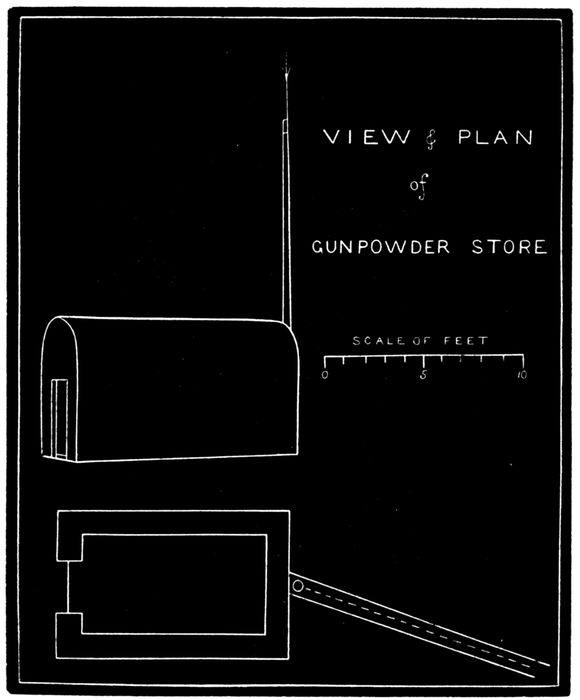
“The only structural damage effected was produced by the impingement
of bricks, which striking with great force, had in a few instances,
partially penetrated or displaced brick work in the dwelling-houses
and buildings, and a portion of the iron of an iron church was broken
by a piece of projected débris. A brick was driven through a window
in one of the houses at three hundred yards, and broke a bedstead.
As far as I have been able to discover no other structural injury was
occasioned.”
(76)This accident appears to suggest several conclusions:—
“In the first place it appears to me to afford a striking confirmation
of the principle which has been repeatedly and emphatically enunciated
by Sir William Snow Harris and other authorities on the
subject of lightning conductors, that in order to secure an efficient
protection for a given building, all the metal of the building, and as
far as possible the whole of the structure itself, should be brought
into actual connection with the system of conduction; in other words,
that the general conducting power of the mass of the edifice should be
completed, and all attractive and prominent parts allied in one protective
combination, so as to “bring the whole” (as it has been
expressed by Sir William Snow Harris) “as nearly as may be into
that passive or non-resisting state which it would assume, supposing
the whole were a mass of metal.” In the present case, assuming the
conductor itself to have been efficient, a point which there seems no
sufficient reason for doubting, the system of conduction was obviously
defective. Not only was the whole length of the building
left unprotected, the conductor having been on a pole at one end, and
carefully insulated from the building, but the iron door which was at
the opposite end, was absolutely unconnected therewith, and was not
itself supplied with any earth connection.”
“It appears clear, therefore, that even what may be deemed per se
an efficient lightning conductor, i.e. a conductor, which considered
alone, offers a path of little or no resistance even to a powerful
electric current, does not afford a reliable protection to a building
unless it be scientifically applied, and with due regard to those principles
upon which the more eminent authorities on electrical science
are agreed. To a disregard of these principles, especially in respect
of the iron door being left out of the system of conduction, and unconnected
therewith, I believe the present accident may be attributed.”
(Phil. Trans., 1773, p. 42, and 1778, Part I., p. 232.)
(Abstracted by Prof. W. G. Adams, F.R.S.)
Report of a Committee consisting of the Hon. Henry Cavendish,
Dr. Watson, Dr. Franklin, Mr. J. Robertson, Mr. Wilson, and Mr.
Delaval, appointed by the Royal Society, “to consider of a method
for securing the powder magazine at Purfleet.”
A powder mill at Brescia having blown up in consequence of being
struck by lightning, the Board of Ordnance applied to Mr. B. Wilson
to know in what way the powder magazine could be protected. He
recommended that a blunt conductor should be employed, whereas
Dr. Franklin recommended a pointed conductor. The Committee met
and Dr. Franklin read a paper on the subject, and the report of the
Committee was in conformity with Dr. Franklin’s views.
The Committee went to Purfleet and examined the buildings.
They found that the barrels of powder, when the magazines were full,
(77)lay piled on each other up to the spring of the arches; on each barrel
were four copper hoops, which with vertical iron bars formed broken
conductors within the building. These iron bars were ordered to be
removed.
The Committee advised that at each end of each magazine a well
should be dug in or through the chalk, so deep as to have in it at
least four feet of standing water. From the bottom of this water
should arise a piece of leaden pipe to or near to the surface of the
ground, where it should be strongly joined to the end of an upright
iron bar, an inch and a half in diameter, fastened to the wall by
leaden straps, and extending ten feet above the ridge of the building,
tapering from the ridge upwards to a sharp point, the upper twelve
inches of copper, the iron to be painted.
Lead was mentioned for the underground part as less liable to rust,
in the form of a pipe as giving greater stiffness for the substance, and
iron for the part above ground as stronger, and less likely to be cut
away. The pieces of which the bar may be composed should be
screwed strongly into each other by a close joint with a thin plate of
lead between the shoulders. Each rod in passing above the ridge
should be strongly and closely connected by iron or lead, or both, with
the leaden coping of the roof, so making metallic communication
between the two bars of each building.
It was also advised that two wells be dug within twelve feet of the
doors, one to the north of the north building and the other to the
south of the south building, and that metallic communications be
made between the water in them and the leaden coping of the roof.
The Board house stood 150 yards from the magazines, on elevated
ground, and was a “lofty building with a pointed hip-roof, the copings
of lead down to the gutters, from which leaden pipes descend at each
end of the building into the water of wells of forty feet deep, for the
purpose of conveying water forced up by engines to a cistern in the
roof.”
As to the Board-house, they thought it already well furnished with
conductors by the several leaden communications above-mentioned
from the point of the roof down into the water, and that by its height
and proximity it may be some security to the building below it; they
therefore proposed no other conductor for that building, and only
advised erecting a pointed iron rod on the summit, similar to those
before described and communicating with those conductors.
Mr. Wilson dissented from that part of the Report which recommended
that each conductor should be pointed, because, he says, “by
points we solicit the lightning, and may promote the mischief by drawing
the charges from charged clouds, which would not discharge at all
on the building if there were no points on the conductors.” By experiments
made and appealed to at the Committee the difference in the
effects between pointed and blunted conductors is as twelve to one.
Mr. Wilson states that, “A thunder cloud, therefore, if it acted at 1200
yards distance upon a point, would require a blunted end to be
brought within the distance of 100 yards, and beyond those limits
would pass over it without affecting it at all.” He also says, “The
longer the conductors are above the building, the more danger is to be
(78)apprehended from them. I have always considered pointed conductors
as being unsafe by their great readiness to collect the lightning
in too powerful a manner.”
Mr. Wilson adds an account of an accident to St. Paul’s Church,
and some curious reasoning on it in support of his own views. (See
Phil. Trans. 1773, p. 59–61.)
On the 15th of May, 1777, the Board House at Purfleet was struck
by lightning, and some of the brickwork damaged (See Phil. Tran.,
1778, Pt. I., p. 232). About 6 p.m., after heavy rain through the
day, a heavy cloud hung over the house for some time, and Mr.
Nickson, who watched it from the house and gives the account, says
he suspected that some of the conductors might find employment from
it. He had not been long at the window before a violent flash of
lightning and clap of thunder came together. The lightning struck
one of the iron cramps that hold the coping, and made a dent in the
lead of the cramp and the stone adjoining it, throwing some stone
down and slightly disturbing about a cubic foot of brickwork at A. The
iron cramp was situated over a plate of lead, and the ends of it,
inserted in the stone, came within 7 inches of that plate, which communicated
with the gutter, and served as a fillet to it; this gutter
was part of the main conductor of the building. The lightning struck
through the stone, &c., to the corner of the plate, fusing a very small
portion of it. From this point no farther effect of the lightning
could be traced. At the distance of seven feet and a-half from the
place struck, a large leaden pipe went down from the gutter to a
cistern of water in the yard. It is remarkable that the surface of
one of the hip-rafters, four inches and a-half in diameter, covered
with lead (communicating with the gutter), and reaching within
twenty-eight inches of the place struck, seems not to have been at all
affected. The distance from the point of the conductor on the house
to the part struck was forty-six feet.
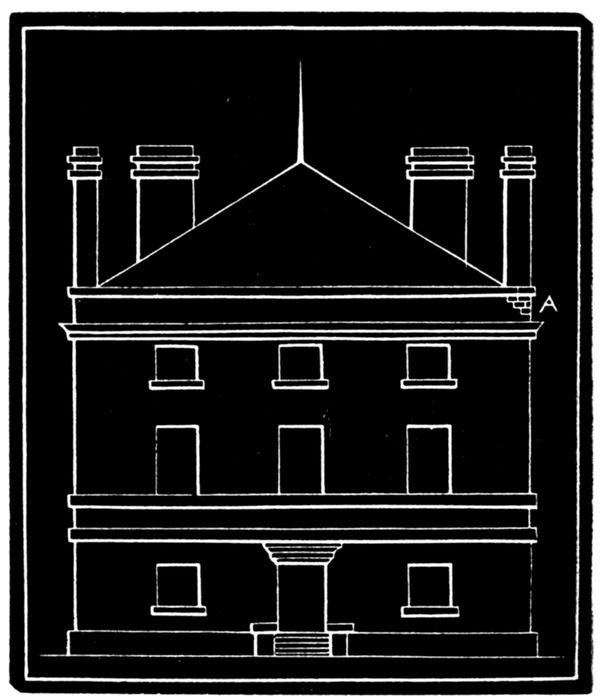
A fresh Committee of the Royal Society, consisting of Mr. Henly,
(79)Mr. Lane, Mr. Nairne, and Mr. Planta, recommended a channel to
be made from cramp to cramp round the parapet, filled with lead, and
connected in four places with the main conductor on the roof of the
building.
Mr. Wilson again dissented from their report, and attributed the
hanging of a heavy cloud over the house (it being calm at the time)
to the presence of the pointed lightning conductor.
An account of Mr. Wilson’s elaborate series of experiments at the
Pantheon on a long cylinder to illustrate the effects of pointed and
rounded conductors occupies seventy pages of the Philosophical
Transactions; and another Committee of the Royal Society, consisting
of Sir John Pringle, Dr. Watson, Henry Cavendish, W. Henly,
Bishop Horsley, T. Lane, Lord Mahon, E. Nairne, and Dr. Priestley,
report in favour of having additional conductors ten feet high, with
copper eighteen inches long, finely tapered and acutely pointed placed
upon the magazines. They conclude that “elevated rods are preferable
to low conductors terminated in rounded ends, knobs, or balls
of metal,” conceiving that, the experiments and reasons, made and
alleged to the contrary by Mr. Wilson, are inconclusive.
Mr. Wilson’s objections are again urged by Dr. Musgrave, but
called in question by Mr. Nairne (see Phil. Trans., 1778, Pt. 2,
p. 823), who makes a series of experiments to illustrate the advantage
of pointed conductors.
Both Mr. Wilson’s and Mr. Nairne’s experiments agree in showing
that “pointed conductors draw off the electricity from a cloud at a
much greater distance than those which are blunted.” Mr. Wilson
objecting that this draws the charged cloud from a greater distance;
and Mr. Nairne concluding that “a charged body is exhausted of
more of the fluid by a pointed than by a blunted conductor,” and so
is not likely to cause so much damage since it discharges itself more
gradually.
By Benjamin Franklin. Fifth edition. London, 1774.
(Abstracted by Prof. T. Hayter Lewis, F.S.A.)
The author shows that pointed bodies draw off electricity much
more effectually than blunt ones.
When the land is hot, “the lower air is rarified and rises; the
cooler, denser air above, descends.”
The clouds meet over the heated place, “and if some are electrified
and others not, lightning and thunder succeed, and showers fall.”
“As electrified clouds pass over a country, high hills and trees,
towers, spires, masts, chimneys, &c., as so many points, draw the
electrical fire and the whole cloud discharges there.”
Therefore it is dangerous to take shelter under a tree. It is safer
to be in the open fields, especially if the clothes are wet.
Metals are fused, possibly without heat; the lightning creating a
violent repulsion of the particles of the metal it passes through.
[He afterwards admits this opinion to be erroneous.]
(80)Describes experiments with sharp-pointed metallic bodies, and
says: “May not the knowledge of this power of points be of use to
mankind in preserving houses, churches, ships, &c., from the stroke
of lightning, by fixing on their highest parts upright rods of iron,
made sharp as a needle, and gilt, to prevent rusting; and from the
feet of these rods lead iron wire down the outside of the building into
the ground; or down one of the shrouds of a ship and her side till it
reaches the water.”
“Would not pointed rods probably draw the electrical fire silently
out of a cloud before it came nigh enough to strike, and thereby
secure us from that most sudden and terrible mischief?”
He mentions the case of the topmast heads of a ship being struck,
but having flames upon them like very large torches before the
stroke.
He thinks that if there had been a good wire conductor from
the heads to the sea there would have been no stroke or damage.
He records the experiments on the 10th of May, 1752, at Marly,
of M. D’Alibard, who placed upon an electrical body a pointed bar of
iron 40 feet high. In a thunder storm sparks of fire were attracted
from it.
Again, at Paris, on the 18th of May, with the same result, by M.
de Lor, with a bar of iron 99 feet high upon a cake of resin 3 inches
thick and 2 feet square.
Similarly in London in July, 1752, by Mr. Canton.
He refers to other experiments.
He experimented in 1752 with a kite of thin silk (as being able to
bear the wet), having a very sharp-pointed wire fixed to its top, above
which it rose about a foot. The kite was raised by twine, the part in
the hand being made of silk and kept quite dry.
The pointed wire will draw the electric fire from thunder clouds,
and when the rain has wet (sic) the kite and twine, so that it conducts
the electric fire freely, they will be electrified, and the electric
fire will stream out plentifully on the approach of the knuckle.
“Spirits may be kindled, &c., as with a rubbed glass or tube, and
thereby the sameness of the electric matter with that of the lightning
be completely demonstrated.”
September, 1752. He erected “an iron rod to draw the lightning
into his house in order to experiment on it.”
After many experiments, he concluded that “the clouds of a
thunderstorm are most commonly in a negative state of electricity,
but sometimes in a positive state.” The latter, he believed, rare.
“So that, for the most part, in thunderstrokes, it is the earth that
strikes into the clouds, and not the clouds into the earth.”
In the contrary (rare) case the cloud was, “I conjecture, compressed
by the driving winds or some other means, so that part of what it
had absorbed was forced out, and formed an electric atmosphere
round it in its denser state, so communicated positive electricity to
my rod.”
“The electric fluid, moving to restore the equilibrium between the
cloud and the earth, takes, in its way, all the conductors it can find
(v. page 132 of Franklin’s book)—as metals, damp walls, moist
(81)wood, &c.—and will go considerably out of a direct course for the
sake of the assistance of a good conductor.”
“Explosions only happen when the conductors cannot discharge
it as fast as they receive it, by reason of their being incomplete, disunited,
or too small, or not of the best materials for conducting.”
He supposes that a wire ¼ inch diameter will conduct the electricity
of any one stroke of lightning ever known.
Iron is the best material, as least liable to fuse.
“Pointed rods erected on buildings and communicating with moist
earth would either prevent a stroke, or, if not prevented, would conduct
it so that the building should suffer no damage.
He gives instances of a small wire acting as conductor and saving
the building, though the wire, being too small, was utterly destroyed.
His theory as to the crooked course of lightning is as follows:
“Who knows but that there may be, as the ancients thought, a
region of this fire (electric) above our atmosphere, prevented by our
air and its own too great distance of attraction from joining our
earth. Yet some of it be low enough to attach itself to our highest
clouds,” which thence become electrified, &c.
“I am still at a loss about the manner in which clouds become
charged with electricity, no hypothesis I have yet formed perfectly
satisfying me.”
He describes how he and others have been struck down by electric
shocks without feeling pain or sustaining permanent injury.
For protecting powder magazines, erect a mast not far from it, and
15 or 20 feet above the top of it, with a thick iron rod fastened to it,
reaching down till it comes to water.
“In buildings the rod may be fastened to the walls, chimneys, &c.,
with staples of iron. The lightning will not leave the rod (a good
conductor) to pass into the wall (a bad conductor) through these
staples. It would rather, if anywhere in the wall, pass out of it into
the rod to get more readily into the earth.”
If the building be very extensive, two or more rods may be placed
at different parts for greater security.
It is well not to sit near the chimney, or gilt objects, during a
thunderstorm.
(Abstracted by Prof. T. Hayter Lewis, F.S.A.)
“As on the earth the operation necessary for the excitation and
collection of the electric fluid is attrition.” ... “So we may rationally
conclude that attrition is the means of excitation and collection
of electric matter in the clouds as well as on the earth.”
By metallic conductors buildings may be preserved from the effects
of lightning
(82)Electricity ascends from the earth to the clouds by means of moist
air.
“A conductor is a continuation of metal from a certain height
above the highest part of a building to moist earth or water” ...
“for easy and safe passage of lightning.”
Metal is the best of all conductors.
The author quotes from Franklin “buildings that have their roofs
covered with lead and spouts of lead continued from roof into ground
to carry off the water, are never hurt by lightning when it falls on
such a building.”
The conductor may be made of any metal, and flat or round.
But nowhere less than ¾ inch diameter except at terminal.
But iron rusts, so copper or lead should be used. Lead is best,
used in strips 4 inches wide and ⅒th inch thick.
Good earth contact required in moist earth (going therein at least
5 feet) or water.
The several lengths of the conductor must be well in contact by
being screwed, if of iron; soldered, if of lead.
The upper terminal to be iron or copper rod 9 or 10 feet long,
¾ inch diameter, and 2 to 5 feet above top of highest chimney or other
part of building.
It should be pointed as this attracts electricity better.
Lead roofs to be connected with conductor. (Examples given of
house and ship struck.)
No building or object is known to have been struck by lightning
within 50 feet of a proper conductor. But a tree has been shivered
within 52 feet, so we may conclude that protecting influence extends
to 50 feet horizontally in every direction from the point of conductor.
In gunpowder stores, conductors are not to be fixed to the buildings,
but at (say) 12 feet away, fastened to a standard, the top being
as high above the building as it can be conveniently.
No metal on sides or roof of the building is to be exposed to the
lightning so as to attract it.
(Abstracted by Prof. W. G. Adams, F.R.S.)
In Chapter V., on lightning identified with electricity, the author
speaks of fire-balls and the Aurora Borealis, and ascribes the formation
of shooting stars to electrical action. He does not believe they come
from distant space into our atmosphere, but regards them as concretions
formed by a flash of lightning darting through gaseous
media and atmospheric air expanded by heat, carrying metallic dust
and earthy particles ejected from volcanoes, or carried up by evaporation
or other causes, and diffused over an immense surface in the
upper regions of the air. “The lightning carries, like a ploughshare,
the accumulated matter in its progress, and, by the powerful
(83)electrical attraction thus excited, these particles will be drawn into
the vortex of the lightning instantaneously; for, the lightning finally
encountering an electricity of an opposite kind, an explosion ensues,
and the collected mass is instantaneously fused and agglutinated,
while the meteorite thus formed tumbles to the ground.... We
therefore do not see the necessity of considering meteoric stones
extra atmospheric.”
In this way John Murray goes on page after page, but the above
will probably be sufficient notice of his work.
The following are the conditions he lays down for a good conductor:—
1. A finely pointed summit to offer an unresisting entrance.
2. A sufficient length to anticipate, as it were, the descending
electricity, and receive it on its summit before it could reach any
part of the building.
3. A superior conducting power in the material of the rod to
facilitate its passage to the earth.
4. A sufficient thickness to prevent its fusion, which, however, will
greatly depend on the resistance it has encountered in entering the
conductor. And, finally
5. A safe conduction to a well or moist surface below ground.
He says: “Let the wires below ground in contact with moisture
pass through a cylinder of zinc before they diverge to form the root,
the copper wires will in this case always remain free from any oxidation.”
(February 11th, 1840. Parliamentary Paper. Fcap. folio).
(Abstracted by Professor W. E. Ayrton).
Instances are given of ships not provided with lightning conductors
being struck and damaged, whilst others lying near, and provided
with conductors, were not injured. The question of lightning conductors
attracting lightning considered, and evidence shown to the
contrary. Lateral discharge from a lightning conductor considered.
Evidence against it, if only the conductor were continuous and of
sufficient size. Faraday considered that a man leaning against one
of Harris’s conductors when the electricity descended would not be
hurt. Proposition to place a globe of glass on the head of the mast
in place of a lightning conductor considered, and the conclusion
arrived at that it would do harm.
Wheatstone stated that “in the Report of the Committee of the
Academy of Sciences of Paris, appointed to investigate the utility of
lightning conductors, there is no instance on record of an iron rod of
½ inch in diameter being fused or even made red-hot by a flash.”
Mechanical objections to lightning conductors on ships considered
and discussed. Decided that the application of Mr. Harris’s conductor
tended rather to strengthen than weaken the mast and spars. Then
(84)follows a large number of letters, giving accounts of accidents from
lightning to ships, &c.
Decision arrived at that on the whole Mr. Harris’s conductor is the
best of those examined.
(Abstracted by Prof. T. Hayter Lewis, F.S.A.)
The author alludes to the experiments of Franklin, &c.
The distance to the lower surface of clouds, observed by Le Gentil
and others, shows an average of 1000 to 2000 feet, whereas the
greatest length of spark with a large machine is 3 to 4 feet.
The inductive action bears some inverse ratio to the distance.
Leaves of trees have a remarkable property of silently drawing off
electricity.
He gives the particulars of a large number of experiments, with
arguments thereon, to prove the theory of the difference between
Leyden discharges and lightning.
Quotes examples of lightning on conductors and buildings to show
that the conductor takes part only of the charge, the remainder
taking other paths. Contiguous semi-insulated bodies must not be
left unconnected with the lightning rod.
He quotes, with approval, the advice of Faraday, viz., to tie
together with a metallic connection all contiguous readily-conducting
bodies.
Cites numerous other opinions to the same effect, viz., that all
metallic parts of a building should be connected with the conductor.
He sums up by stating “that the Leyden charge differs considerably
not so much in nature as in degree from that of the cloud, inasmuch
as the proximity of the coatings in the one case is infinitely
small compared with the distance in the other,” &c.
He expresses great confidence in Sir W. S. Harris’s system for protecting
ships.
(Abstracted by Prof. T. Hayter Lewis, F.S.A.)
The author refers to Faraday’s experiments, as shewing instances
of lateral discharge, and says, “unless precautions are taken to
prevent its proceeding from a lightning conductor, that instrument
literally invites the enemy within doors.”
He gives detail of the accident at Brixton, there being no lightning
conductor.
(85)The stroke did much damage to the steeple and then passed off
harmlessly by the metal gutters and rain-water pipes.
One side of the steeple was drenched with wet and carried off part
of the stroke.
He quotes examples of the apparently protective action of high
trees.
Lofty trees near lofty buildings would materially mitigate, if not
prevent, the violence of the stroke.
The accident at Brixton shows that the lightning takes not simply
the shortest, but, in addition, the largest path.
Had the steeple been provided with a lightning conductor outside,
passing near the clock face or the bells, or water pipe, it is more than
probable that a flash would pass from it to these vicinal conductors.
If outside the tower the danger would be greater. He recommends
that the metal cross on the steeple be replaced by a stone one, and
that the present iron rain water-pipes be connected by copper rods or
plates, which are also to be connected with the lead work of roof.
The bells are also to be connected with each other and with the
conductor.
Every bolt-clamp or other piece of metal within “striking distance”
of the conductor, unless in direct communication with it, is liable to
cause lateral discharge.
The odour developed by lightning was, at Brixton, decidedly
sulphurous, as a piece of stone which was shattered by the stroke
retained the odour of sulphur distinctly for several hours.
(Abstracted by Prof. Ayrton.)
The backstroke may do injury, that is, a person may be killed in
consequence of a flash of lightning passing between the clouds and
the earth at some distance from the person.
In the Phil. Trans. for 1787, Mr. Brydone writes to the President
of the Royal Society, and mentions the case of two men riding in
two carts, the front one drawn by two horses, these horses and the
man driving them were killed;, the man on the hinder cart and a
shepherd at a distance, saw the occurrence and heard a report but
observed no lightning.
A metallic screen appears to protect the interior from the action of a
current, as well as from static induction.
Dr. Franklin found he could not destroy a wet rat by artificial
electricity, although he could a dry one.
The first lightning conductor was erected in England at Payneshill,
by Dr. Watson, in 1762.
The lightning conductor should expose a large surface, and should
be united with all the great masses of metal in its vicinity. For
stationary elevations the conductor should consist of solid or tubular
rods or flat plates of metal. We must consider the mechanical action
(86)the lightning may produce on the conductor, as well as any possible
heating action. Sir W. Snow Harris mentions that there were no
signs of fusion in the fragments of the linked brass rod, at Charles
Church, Plymouth, torn to pieces in 1824, or in the small pieces of the
conductor at the Hotel des Invalides, at Paris, consisting of a strand
of twenty iron wires, and which was smashed in 1839.
He says the benefical effect of superficial conductors appears to
depend on the removal of the electrical particles further out of the
sphere of each other’s influences.
“Thus we find,” says Sir W. Snow Harris, “in a variety of cases
of damage by lightning that the passing charge, in striking on large
expanded sheets of metal has become comparatively tranquil, and has
been traced no further, whilst in striking on large masses of metal
exposing but a small surface, it has assumed an intensely active state.”
He goes on to state that the resistance of the conductor must be
kept as low as possible, and as neither the resistance nor the heat
developed is increased by rolling the wire out into a flat surface, he
argues that “there is, consequently, no disadvantage in giving a lightning
rod as much superficial capacity as possible, as regards conducting
power, whilst, on the contrary, the diminished intensity attendant
on it is very advantageous: this effect of superficial conductors
appears to depend on the removal of the electrical particles further
out of the sphere of each other’s influence.”
What quantity of metal is requisite for a lightning rod? He concludes
from the results of a number of accidents that “a copper rod
¾ inch diameter, or an equal quantity of copper under any other form,
would withstand the heating effect of any discharge of lightning
which has yet come within the experience of mankind.”
Practical deductions.—“From the various enquiries contained in the
first 123 pages of this book, we arrive at the following deductions:—
“1st. Copper is the best kind of metal for a conductor.
“2nd. The quantity of metal should not be less than that represented
by the section of a solid cylinder ½ inch diameter.
“3rd. The metal should be placed under as great an extent of surface
as is consistent with strength, and should be perfectly continuous.
“4th. The conductor should involve in its course the principal
detached masses of metal in the building.
“5th. It should be placed as close as possible to the walls which are
to be defended, and not at a distance from them, and be carried at
once directly into the ground.
“6th. It should be attached to the most prominent points of the
building, and if the length be very considerable its dimensions should
be increased.
“Lastly. In extensive ranges of buildings, all the most prominent
parts should have long pointed rods projecting freely into the air, and
the greater the range of building the higher they should be.
“In particular cases, in which expense must necessarily be considered,
wrought iron tubing may be employed; it should not,
however, be less than 2 inches in diameter, and 3/10ths of an inch in
thickness.”
Insulating the lightning conductor from the building is quite valueless.
(87)The method of fixing lightning conductors to ships is explained at
considerable length.
Range over which the protecting power of the lightning rod extends.—Great
doubts exists as to the answer to this question, since in many
cases one portion of a building has been struck while a lightning rod
in good condition existed close by.
For example, the powder magazine at Bayonne was 56 feet long,
36 feet wide, covered with thick vaulted masonry and a sloping roof
with gable ends, protected by plates of lead; the gutters were also of
lead, and there were the usual spouts for discharging the rain. The
lightning rod projected about 20 feet above the building, and was
attached to the lead of the roof by a metallic socket through which it
passed, and which was soldered to one of the lead coverings. Instead
of being carried, however, directly into the earth at the foot of the
wall, it was turned outward at about 2 feet from the ground, and
being bent at right angles, was continued on semi-insulating posts of
wood into a trench filled with charcoal, distant 33 feet from the wall.
On the 23rd of February, 1829, the building was struck, the point
of the conductor melted, and the leaden plates by which it was
attached to the wood posts at the foot of the wall, were more or less torn
and perforated by holes. No damage, however, ensued to the building
in the course of the conductor. At the south-west corner, a sheet of
lead covering the gable end was torn out immediately over a point
where two stones of the cornice were united by an iron cramp.
Sir W. Snow Harris considers the possibility of this damage having
arisen “from the conductor (in consequence of being continued at so
great a distance from the building) not offering a sufficiently easy line
of transit for the discharge to the earth,” but he rejects this explanation
and concludes that the damage arose from the lightning striking
the building in two points.
Again, the Heckingham poorhouse, although armed with eight
pointed lightning rods, was struck, in 1787, at a point m, 70 feet
from the nearest conductor c.
(88)
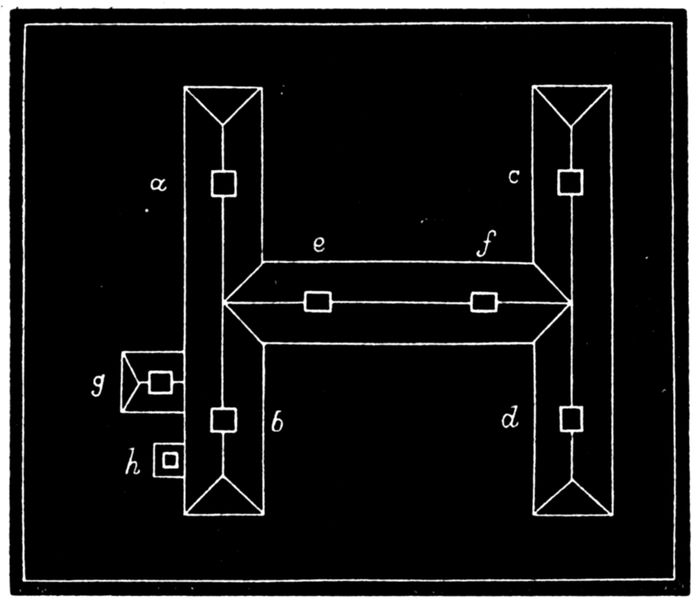
The squares at a, b, c, d, e, f, g, h, indicate chimneys to which lightning
conductors were attached. The centre range was 108 feet long,
the flanks each about 160 feet long: the details of the lightning
conductors are not given. One portion of the lightning discharge
struck one of the conductors and was carried off by it without damage
to the building, one portion struck the building at the point m
and also the shed at s, doing some damage, and a third portion struck
the ground immediately in front of the building near a gate, G.
The ship Ætna was struck in 1830 by several heavy electrical
discharges when at Corfu. These for the most part passed down a
chain conductor attached to the mainmast. One of the discharges,
however, struck the ship near the bow, and exploded about 12 feet
above the forecastle close to the foremast, knocking people down, &c.
The Board-house at Purfleet was a lofty building with a pointed
roof, well leaded and connected by lead gutters and pipes with the
earth, and with wells 40 feet deep for the purpose of conveying water
forced up to a cistern on the roof. It was, therefore, only thought
necessary to add an iron spike about 10 feet long to the middle of
the highest part of the roof. The building, however, in 1777, was
struck and slightly damaged at a point 46 feet from the conductor.
Several other examples illustrating how small an area a lightning
rod protects follow.
Sir W. Snow Harris further concludes that experience shows that
lightning will not leap from a lightning rod to a piece of insulated or
semi-insulated metal near it, although a discharge may take place
between the rod and a distant metallic mass in connection with the
earth, but not otherwise in connection with the rod.
He lastly considers the question, formerly much debated as to
whether a lightning rod attached to a house will attract to the house
a discharge that otherwise would not have struck it, and he concludes
that there is no foundation for the erroneous impression that the
existence of a lightning conductor can ever cause damage.
(89)
[Proceedings of the Royal Scottish Society of Arts, 1850–51.]
(Abstracted by G. J. Symons, F.R.S.)
This chimney has a total height of 341½ feet (329 feet above
ground), it is circular; at the top the internal diameter is 11 feet
4 inches, and the external 13 feet 10 inches; and at the bottom,
internal diameter 20 feet, external 26 feet 3 inches.
Respecting the conductor Faraday was consulted, and replied as
follows:—
“The conductor should be of ½ inch copper rod, and should rise
above the top of the chimney by a quantity equal to the width of the
chimney at the top. The lengths of rod should be well joined
metallically to each other, and this is perhaps best done by screwing
the ends into a copper socket. The connection at the bottom should
be good; if there are any pump pipes at hand going into a well they
would be useful in that respect. As respects electrical conduction, no
advantage is gained by expanding the rod horizontally into a strap or
tube—surface does nothing, the solid section is the essential element.[4]
There is no occasion for insulation (of the conductor) for this reason.
A flash of lightning has an intensity that enables it to break through
many hundred yards (perhaps miles) of air, and therefore an insulation
of six inches or one foot in length could have no power in
preventing its leap to the brickwork, supposing that the conductor
were not able to carry it away. Again, six inches or one foot is so
little that it is equivalent almost to nothing. A very feeble electricity
could break through that barrier, and a flash that could not
break through five or ten feet could do no harm to the chimney.
“A very great point is to have no insulated masses of metal. If,
therefore, hoops are put round the chimney, each should be connected
metallically with the conductor, otherwise a flash might strike a hoop
at a corner on the opposite side to the conductor, and then on the
other side on passing to the conductor, from the nearest part of the
hoop there might be an explosion, and the chimney injured there or
even broken through. Again, no rods or ties of metal should be
wrought into the chimney parallel to its length, and therefore to the
conductor, and then be left unconnected with it.”
In answer to some further inquiry, Professor Faraday again
wrote:—
“The rod may be close along the brick or stone, it makes no
difference. There will be no need of rod on each side of the building,
but let the cast-iron hoop and the others you speak of be connected
with the rod, and it will be in those places at least, as if there were
rods on every side of the chimney.
“¾ rod is no doubt better than ½ inch, and except for expense I
like it better. But ½ inch has never yet failed. A rod at Coutt’s
(90)brewery has been put up at 1½ inch diameter—but they did not mind
expense. The Nelson column in London has ½ inch rod, ¾ is better.
“I do not know of any case of harm from hoop-iron inclosed in
the building, but if not in connection with the conductor, I should
not like it; even then it might cause harm if the lightning took the
end furthest from the conductor.”
The following paragraph states what was done:—
“The electric conductor stands 6 feet above the iron top-plate, ⅝-inch
round copper, made fast to stone and brickwork with 7⅞-inch copper
holdfasts let 4 inches into the masonry or brickwork, with a head on
the inside and an eye on the outside to receive the rod as it was
carried up. By these holdfasts an ascent can easily be made to the
top by a small tackle suspended to the holdfasts. The conductor is
metallically connected to all the ironwork on the stalk—the plate on
the top, projecting cope, malleable iron hoops, bolts on the top of
stone pedestal, and also the ascending chain. The rod descends into
a well about 10 feet from the foundation, and is immersed about
8 feet deep in water, and the end turned up 2 feet in a horizontal
direction, and flattened.”
(August 5th, 1854. Parliamentary Paper. Fcap. folio).
(Abstracted by Professor W. E. Ayrton).
Number of merchant ships destroyed by lightning, loss to the
country. Application of lightning conductors to ships in 1820.
Mode of applying them. Mechanical difficulties; how overcome.
The saving to the Exchequer which has resulted.
Long account of various ships in the Royal Navy not provided with
lightning conductors, struck by lightning and damaged. Loss of life
and injury that has resulted. Long account of ships provided with
lightning conductors, and so preserved.
Sir Snow Harris states that “although his system of lightning conductors
ought to guard against all those violent and regular shocks of
lightning falling within the ordinary experience of mankind, it is not
to be expected that the system could guard against every possible kind
of atmospheric electrical discharge, be the circumstances what they
may, such as thunderbolts, fire-balls; nor is it expected that it should
guard against meteorolites, or against sweeping electrical action mixed
up with convulsions of nature; nor can it quiet those minor electrical
effects producing electric glow; nor can it always obviate that tremendous
concussion and expansion of the atmosphere in cases in
which a thunder-cloud discharges its lightning in a dense explosion on
the masts, and which may rupture, or mechanically tear to pieces,
frangible matter.”
(91)
[Académie Royale de Belgique, Extrait du Tome 31 des Mémoires, 5th December, 1857.]
(Abstracted by Professor T. Hayter Lewis, F.S.A.)
M. Duprez refers to the Report of a Committee of the Institute
of France. (Vide Comptes rendus, 1852–6.)
He divides the subject into the following heads:—
1. The frequency with which lightning rods are struck.
2. Their terminal points and the effects of the stroke on
them.
3. The conductors and their ground connections.
4. The protective power of the lightning rods.
1. Concerning the frequency with which lightning conductors are
struck by lightning.
The author cites 144 cases of lightning rods having been struck.
Of these seventeen were struck two or three times, so that the total
number of electric discharges on them was 168, as far as recorded.
But very many cases are not recorded at all, e.g., from 1793 to
1813 only two cases were noted. The great number of lightning rods
struck would seem at first to support the idea that they attract
lightning.
But we must compare the number of rods struck with those
fixed, and we find from a communication made in 1777 to the
Academy of Berlin, that, even then, a large number were fixed to the
most important edifices of N. Italy and England.
The same in 1784 to those in the ports of France and to the ships
in the said ports.
In 1794 the fortresses of Russia were ordered to be so protected.
In 1769 there were 166 edifices in Hamburg alone, and 104 in its
environs, with conductors.
If the number of conductors were so great in the last century, we
must conclude that the number of those struck must be very inconsiderable
as compared with those fixed.
In Hamburg, e.g., not one rod is recorded as having been struck.
In 1785, Ingen-Housz reports that of all the lightning rods placed
by his direction on the Austrian powder magazines and other buildings
only one had been struck.
In 1772, Franklin wrote, that during the twenty years in the
course of which lightning rods had been fixed in America he knew of
five cases only in which these rods had been struck.
Sir W. S. Harris reports in 1854, as the results of twenty-two
years’ experience, that the number of vessels struck unprotected by
lightning rods, as compared with that of vessels protected by his plan,
was as three to two.
The above show that the idea of danger from lightning rods is not
well founded.
Besides which it must be remembered that they are frequently
placed in the most exposed positions, e.g., of the 144 rods struck,
(92)seventy-four were on ships, and fifteen others on buildings which had
been struck before.
One would think that the number of terminals placed on a building
would diminish the chances of their being struck, but it does not
seem to be so; e.g., twelve buildings in the first list had many
terminals communicating with a common conductor or different conductors.
Yet the lightning struck, with explosive effect, one or other of the
rods of these buildings.
And in each of two cases the lightning struck at once the three
rods fixed to a building.
Of the 144 cases above cited:—
| 74 |
were to lightning rods fixed on ships |
| 30 |
were to lightning rods fixed on towers |
| 9 |
were to lightning rods fixed on powder magazines |
| 31 |
were to lightning rods fixed on ordinary buildings. |
|
|
| 144 |
|
In forty-four cases where one of Sir W. S. Harris’ conductors was
fixed to each mast of a ship, the mainmast was struck twenty-seven
times; the foremast was struck fourteen times; the mizen was
struck twice; both the main and foremast twice.
2. As to the points of the lightning rods struck, and the effect produced
on them.
(Sir W. Snow Harris’s system as adopted in the British Royal
Navy since 1830 is described. They are formed of bands of copper
let into the masts. They have no upper terminals or points, and
fifty-five are included in the list already quoted of 144 lightning
rods struck.)
Of the eighty-nine cases remaining in the list, only fifty-one are
recorded as having their upper terminals ended with points.
Of these, thirty had their points melted to a greater or less extent;
six of them were of copper or brass; five were of copper gilt or iron
gilt; one was of brass silvered; and four were of platinum. The
others are not distinctly described, and the sizes seldom given.
One of brass was 25·4 centimetres (c. 10 inches) long, and 5 millimetres
(⅕th inch) diameter at its base, and was melted for ¼th of its
length.
One of copper was 24 centimetres (c. 9½ inches) long, and 9 millimetres
(c. ⅓rd inch) diameter at base, and was almost all melted.
One of platinum was 8 centimetres (c. 3 inches) long, and 1
centimetre (c. ⅓rd inch) diameter at base. This was melted for a
length of 5 or 6 millimetres (c. ⅕th inch.)
It results from the above facts that the points of the lightning rods
have been much too slender.
The Institute of France recommends, therefore, for the points 2
centimetres diameter (c. ¼th inch) at base, and only 4 centimetres
(c. 1½ inches) high, with an angle of opening of 28 to 30
degrees.
It has been urged, especially in Germany, against the employment
of pointed upper terminals that these points are fused by the
(93)lightning, this fusion being regarded as dangerous on account of its
action on inflammable substances near.
As to this, the author cites three cases of buildings set on fire,
though protected by lightning rods. But the precise cause of the
fire was not ascertained.
Several observations show that the melted metal trickled down
the side of the lightning rod.
At Strasbourg the metal was pressed down on one side, and had
bent like wax softened by heat. At other times the lightning disperses
the melted metal in all directions. (Examples quoted.)
With these facts before us we cannot altogether deny that some
danger may arise from the fusion of the metal at the point of the
terminal. But this danger can be much lessened, if not removed,
by adopting the size, etc., of the lightning rods recommended by the
Institute of France.
Besides fusion, the points sometimes show distinct traces of mechanical
action caused by lightning.
The author quotes six examples of this where the points had been
curved.
This shows the necessity of strengthening the points of the upper
terminals. The curvature arises, probably, from the points being
much heated by the lightning, and acted on by the wind.
One case is noted of a point which had the appearance of having
been struck violently by a hammer.
Also of one in which the base of a point, where it was screwed to
the rest of the upper terminal, was split for a length of 11 millimetres
(c. ½ inch).
Also of a platinum point screwed on the upper terminal (copper),
and retained by a pin, where the stroke tore away the pin, the point
falling intact at the foot of the lightning rod.
3. Of Conductors of lightning rods struck, and their contact with the
ground.
The author refers to forty-one cases of lightning rods struck when
not on Harris’s principle.
Of these, 5 were of copper bands soldered together; 5 were of
copper wire either as rope or chain; 1 was made of bands of sheet
iron; 11 were of bars of iron joined by screws or by solder; 3 had
pieces of lead between the parts where they were screwed together;
3 were of simple iron wire, or of rope or chain of iron wire; 3 were
of iron joined together by hooks; 12 are described as chains (metal
not specified); 1 is described merely as a conductor.
The dimensions of the above are seldom given.
The largest bands reported are 16 centimetres (c. 6¼ inches) in width.
The largest bars reported are 55 centimetres (c. 2¼ inches) in
width and 15 centimetres (c. ½ inch) in thickness.
The description of the earth connection is also imperfect.
Of eighty-nine lightning rods described as struck, only twelve are
noted as having their ends in running water or wells, and one in
damp soil.
Fifteen simply entered the ground, it being noted expressly of six
of these that it was dry.
(94)In three cases were the lightning rods were struck the author found
that the part at the base and in the damp earth had terminated in a
plate of lead, protected above the ground by a wooden enclosure.
Three conductors of ships did not communicate with the sea.
Twenty-three cases are noted of ordinary conductors (not on Sir
W. S. Harris’s principle).
The lightning melted, or reduced almost to powder, three.
The first was on a house, and was of copper wire, the diameter not
known, ending with a chain of iron buried in the earth.
The second was on a ship’s mainmast, and was of iron wire 6 millimetres
(c. ¼ inch), diameter, 46 centimetres (c. 18 inches) long, folded
at their extremities, and united by rings.
The third (also to a ship) was a rope of three strands formed in
the whole of 60 brass wires, each being one half to two-thirds of a
millimetre thick.
The two last conductors had their ends in the sea.
The parts of these conductors, in place of being soldered or screwed
together, were joined merely by hooks and rings like a surveyor’s chain.
Evidently a bad form as their contact is imperfect.
In three other conductors, whose different parts were screwed
together with lead between them, the stroke melted the lead.
This shows the danger of lead from its fusibility, in addition
to its less conducting power.
The author gives examples of this, wherein a leaden pipe, 8 centimetres
(c. 3¼ inches) external diameter, and 13 millimetres (c. ½
inch) thick, was melted.
He quotes Arago as calling attention to the importance of the
form of the bends in conductors, abrupt bends being dangerous.
Two examples are quoted to prove this, the conductors having been
broken by the lightning stroke at a sudden bend.
To provide lest the lightning, after having struck the lightning
rods, should abandon them for larger masses of metal near them,
these masses should be made to communicate with the conductors.
Cases are cited where the lightning quitted the conductor and
struck metallic bodies near. Also, in respect of painting conductors,
the author quotes a case where part of a bell wire adjoined a lead
pipe which communicated with the conductor. Part of the wire was
painted in oil colour, the other part not. The latter was melted, the
first not, but the paint (though otherwise uninjured) had ceased to
adhere to it.
Three examples are cited of danger from conductors ending in
watertight tanks.
In one case the stroke broke the conductor.
In another it left the conductor and injured the building.
In the third it merely melted the point of the upper terminal.
Nevertheless, it often happens that the lightning, in spite of
imperfect communication with the earth, disperses itself inoffensively.
Out of fifteen cases of lightning rods struck, in which the conductors
were simply buried, more or less, in the soil, they carried off
the stroke in eleven without the buildings being injured, or any trace
(95)being left of it, except that the ground was upheaved where the latter
was too dry.
The French Institute, in their report on the protection of the
Louvre, considered it necessary to employ, under certain circumstances,
a conductor with two branches, the one descending into a
subterranean source of water, the other communicating simply with
the surface of the earth.
On the other hand, Arago thought that conductors need not
enter the ground, but communicate only with a metallic surface
lying on the ground.
This view is confirmed by the cases which the author mentions
where the surface of the earth being wetted by rain formed a conductor.
Nevertheless, the two branches are desirable, in case one should
fail.
Fifty-five conductors on Sir W. S. Harris’s system are recorded
as having been struck, but the damage was quite trivial.
Two electrical phenomena are to be noted as sometimes occurring
when a lightning rod is struck.
First, when a conductor is formed of metallic plates a peculiar
noise is heard like water pouring on a fire.
Second (independently of the form of the conductor), electric sparks
are emitted from bodies near. The author cites example at Berne,
1815.
4. Protective agency of lightning rods.
Out of 168 cases of lightning rods struck (vide page 91) there are
only twenty-seven (c. ⅙th) in which the buildings or ships have not
been preserved, and of this sixth many of the conductors were imperfect;
e.g., four terminated in earth which was unusually dry, and
two of them were of insufficient size.
Another was formed of pieces having their ends hooked.
Two conductors ended in watertight tanks.
Another was in the form of a surveyor’s chain, the parts not being,
consequently, in close contact.
Others were badly jointed, or had imperfect communication with
the ground or with the sea.
In two cases the stroke broke the conductor at points where its
direction was abruptly changed.
In two other cases the lightning left the conductors struck, and
fell upon buildings near without causing damage to those on which
the rods were fixed.
In the instance of a lightning rod fixed to the mainmast of the
Jupiter (1854), the conductor was made of sixty brass wires, one half
to two-thirds of a millimetre (0·02 inch) thick, and was broken by the
stroke into thousands of pieces. The Institute Committee concluded
that the lightning was not conducted by all the wires of the conductor.
Those which it followed were insufficient to transmit it;
some were melted, some broken. The Committee recommended,
therefore, that each metallic wire be tinned separately at the extremity
of the conductor, and soldered thereto for a length of about
a decimeter (c. 0·4 inch), so as to form a metallic cylinder.
(96)In the last six cases the particulars of the lightning rods are not
given sufficiently to show the cause of their failure, but five are described
as being of chain or ropes of metal wire.
It results from the above facts that when the lightning rods have
proved insufficient protection, their failure has been owing to defects
in their construction; it is rather surprising to find how well buildings
and ships have been protected, even when the lightning rods
have not been well constructed.
In every one of the fifty-five cases where Sir W. S. Harris’s rods
were fixed they have protected the ships, except that not having points
some slight damage has sometimes occurred to the tops of the masts.
This shows their superiority over ropes or chains.
Arago thought that lightning rods were protection against ordinary
lightning, but not when it assumed the form of fire-balls. The
author cites several examples to show that this opinion was not well
founded.
He considers a perfectly constructed lightning rod to be a perfect
safeguard.
But he adds that the lightning stroke produces electric disturbances
in its vicinity, although the building be intact.
He cites an example of this in respect of a prison whose inmates
(300) experienced a great enfeebling of their muscular power during
some seconds.
Very few records exist relating to the area of action of lightning
rods, and the elements for determining their protective power are
slight. The author gives a table showing the heights of points,
horizontal distances, &c., in certain cases, and cites four instances of
ships whose foremasts were struck although the mainmasts had lightning
rods, and one where the mizen was struck though the fore and
mainmasts were protected.
| TABLE GIVEN BY M. DUPREZ. |
|---|
| |
|
In Metres. |
In English Feet. |
|
1st Case. |
2nd Case. |
3rd Case. |
4th Case. |
1st Case. |
2nd Case. |
3rd Case. |
4th Case. |
| Length of upper terminal, or height of point above that portion of the building on which the upper terminal was fixed. |
1·5 |
3·4 |
1·5 |
2·3 |
5 |
11 |
5 |
8 |
| Vertical height of point above the place struck. |
1·5 |
7·6 |
6·7 |
71·2 |
5 |
25 |
22 |
232 |
| Horizontal distance of place struck from the base of upper terminal. |
15·2 |
7·3 |
17·4 |
59·9 |
50 |
24 |
57 |
197 |
These instances show that we should be misled in considering, as
being protected, a circular space whose radius was double the height
of the lightning rod.
The protected radius appears to be only equal to double the simple
height of the upper terminal above any required point, and reckoned
horizontally from a point vertically under the conductor.
(97)[It will be observed that M. Duprez here contradicts himself in
two consecutive sentences, and in a subsequent part of his work
(p. 30) of the Memoir, he again says: “Aucun des cas indiqués dans
le numéro précédent n’infirme la règle généralement admise, savoir
que la sphère d’action d’un paratonnerre s’étend, dans toutes les
circonstances, à un espace circulaire d’un rayon égal au double de la
longeur de la tige, c’est-a-dire de la hauteur de la pointe au-dessus de
la partie du bâtiment sur laquelle la tige est fixée.”
But the table given by M. Duprez gives two instances in which
the stroke fell within the radius of once the height.—Ed.]
In the paragraphs which the author numbers 1, 2, 3, 4, and 6, he
refers to former statements as to the proportion of lightning rods
struck, &c. (Vide page 91, &c.)
5. There being several terminals on an edifice does not seem to
diminish the chances of each being struck.
7. In vessels, when the three masts have lightning rods, the mainmast
is most frequently struck.
8. Refers to Sir W. S. Harris’s lightning rods as being without terminal
rods or points.
9. The points of ordinary lightning rods have been made too slight.
10. Out of fifty-one cases of lightning strokes, thirty points have
been more or less melted; and the fusion is not without danger to
the buildings.
11. The lightning often leaves traces of mechanical action more or
less decided.
12. Refers to defective constructions of ordinary lightning rods.
13. Lead plates in conductors composed of bars joined together are
dangerous.
14. So are abrupt bends.
15. Conductors should communicate with the masses of metal near.
16. And must not end in watertight tanks. But
17. Conductors often protect buildings, though the ground connections
are imperfect.
18. It is well for a conductor to have two branches, viz., one in
water, and the other on the surface of the ground.
19, 23. Refers to the complete efficiency of Sir W. S. Harris’s
conductors.
20. Mentions the noise, electric sparks, &c., given off during a
stroke, as before stated (page 95).
21. Mentions the efficacy of lightning rods generally.
22. Their failure being owing to defective construction.
24. There is no proof that the electricity being in the form of a ball
has been the cause of any conductor’s inefficiency.
25. The lightning rarely bursts on a building or ship without
striking the lightning rod placed on it. Exceptions have, however,
occurred in ten cases, as here described. But
26. None of these instances invalidate the rule generally admitted,
(98)that the protective action of the lightning rod extends, under all circumstances,
to a circular space whose radius is equal to double the
length of the upper terminal, i.e., the height of the point above the
part of the building on which the upper terminal is fixed.
By Reuben Phillips. London, 1863.
(Abstracted by W. H. Preece, C.E.)
This is a pamphlet of seven chapters, and fifty-seven pages, written
to ventilate the author’s own notions of the nature of electricity and
its production in the atmosphere. He considers electricity to be two
fluids of a species of substance, consisting of separated subsidiary
atoms. “Electricity is comparable to a flying bullet; the vis vivâ of
the bullet is like electrical intensity, and the mass of the bullet
answers to the quantity of electricity.” What the subsidiary atoms
are like he does not say.
Chapter I. is a fair resumé of what is known of the electricity
evolved by the friction of wet steam against solids in the hydro-electric
machine. He agrees with Faraday that the cause of the evolution of
electricity by the liberation of confined steam, is not evaporation, but
the friction of the water particles against the sides of the jet-piece or
orifice. Pure gases do not excite electricity; but impure air, when
compressed does, from the friction against the orifice of those particles
of water which are suddenly condensed by the cooling influence of the
expanding air.
Chapter II. is an attempt to show that electricity is evolved by the
friction of “gaseous matter” against water, or vice versâ. Ordinarily
the issuing vapour in the hydro-electric machine is positively, and the
boiler negatively, electrified; but cases occur where this is reversed.
According to the author, water by friction against gaseous matter or
air, becomes positively electrified.
Chapter III. applies this theory to thunder clouds, which are
formed by the rapid inter-mixture of masses of the atmosphere thrown
into circulation by heat. There are some capital descriptions of
thunder clouds. They are often accompanied by whirlwinds, and
always by rain. It is the friction of the whirlwind on the drops of
rain that developes electricity—the rain being positively, and the air
negatively, electrified. Hail is due to the ascending current of air
carrying the drops of water to the region of snow and frost! His
notions are somewhat hazy, thus:—“Much of the positive electricity
is conveyed to the earth by the lightning; but the corresponding
negative electricity from being carried upwards with the vertical wind,
cannot so easily escape to the earth, so that the storm cloud contains,
on the whole, more negative electricity than positive electricity” (p. 38.)
Chapter V. contains the author’s explanation of fire-balls, which he
supposes to be a “glowing discharge,” preparatory to the final spark
or flash of lightning. “Probably most of the shooting stars are
merely electrical fire-balls high up in the atmosphere”(!)
(99)Chapter VI. is devoted to the Aurora Borealis, which plays about
the magnetic pole, and is an electrical phenomena of the upper strata
of the atmosphere; and Chapter VII. is an attempt to explain the
auroral light as “probably produced by the collision of the subsidiary
atoms when they are in the act of electro-apposition.”
The pamphlet is said to be a condensed account of the discoveries
of the author in matters connected with atmospheric electricity—discoveries
which were described in papers handed to the Royal
Society, but which that Society did not read. The Royal Society
were wise.
(Abstracted by G. J. Symons, F.R.S.)
A very full account of an accident by ball lightning. The facts
are set out as clearly as possible, the authority is given for every
statement, and most carefully engraved plans and engravings are
given of all the necessary details. It does not bear upon the question
of lightning conductors except in that it shows that a discharge of
globular lightning traversed a horizontal distance of 919 yards, passed
in front, but below the top, of a building which had three good conductors
upon it and struck a chestnut tree, which was by no means
the highest tree in the locality.
(Smithsonian Miscellaneous Collections. 8vo., 1871.)
(Abstracted by A. J. Frost).
1. The rod should consist of round iron, of not less than ¾ of an
inch in diameter. A larger size is preferable to a smaller one
(ordinary gas pipe may be employed). Other forms of rod, such as
flat or twisted, will conduct the lightning, and in most cases answer
sufficiently well. They tend, however, to give off lateral sparks from
the sharp edges at the moment of the passage of the electricity
through them, which might, in some cases, set fire to very combustible
materials.
2. It should be throughout its whole length in perfect metallic continuity,
either by screwing the parts firmly together or by welding.
3. The rod should be covered with a coating of black paint.
4. It should be terminated above with a single point, the cone of
which should be encased with platinum not less than 1/20 inch in thickness.
5. The shorter and more direct the rod is in its course to the earth
the better; acute angles should be avoided.
6. It should be fastened to the house by iron eyes, which may be
insulated by cylinders of glass; this, however, is not absolutely
necessary.
(100)7. The connection to the earth should be as perfect as possible—in
cities nothing is better for this purpose than to unite it to the gas
or water pipes. When a connection cannot be formed in this way
the rod should terminate in a well containing water, or if this is not
practicable it should terminate in a plate of iron, or some other metal
buried in moist ground. It should, before it descends to the earth,
be bent, so as to pass off nearly at right angles to the side of the
house, and be buried in a trench, surrounded with powdered charcoal.
8. The rod should, in preference, be placed on the west side of the
house, and on chimnies where a current of heated air ascends during
the summer season.
9. A single rod may be placed on small houses, and its elevation
should be at least half of the distance to which its protection is expected
to extend.
10. Metallic roofs should be united with the lightning rods.
11. As a general rule, large masses of metal within the building,
particularly those which have perpendicular elevation, ought to be
connected with the rod.
(Journal of the Society of Telegraph Engineers, 27 November, 1872.)
(Abstracted by Prof. T. Hayter Lewis, F.S.A.)
The author refers to the Escurial having been on fire seven times—four
of them certainly from lightning; yet no lightning conductor is
fixed even now.
The average deaths from lightning in England are eighteen per
annum; in France, ninety-five.
From January 1, to July 31, 1872, 9·26 per cent. of instruments,
of different forms, used in the telegraph offices, were injured by
lightning.
Electricity is force, not matter, and Current is a well-defined
term which implies a transference of electricity from one place to
another.
Thunderstorms differ only in degree from the phenomena which
cause the ordinary snapping sparks from the machine.
In any case there must be two conducting masses in opposite
electrical states, separated by a non-conductor or dielectric.
The light is the effect of the discharge, and is simply incandescent
matter. It indicates the path of the discharge and nothing more.
Death by lightning is painless.
Potential is that function of electricity which determines its motion
from one point to another.
The path of electrical discharge is prepared beforehand by induction.
The particles of air, &c., are in a state of “tottering equilibrium.”
A moving ship, a man on horseback may destroy this, and we have a
discharge with all the effects of light, heat, and mechanical energy.
It is very doubtful whether thunder-clouds are themselves the
(101)sources of electricity, producing thunder and lightning; they are
more probably, mere accumulators as the coatings of a Leyden jar.
Clouds have been known to be absent during a discharge.
Moreover, the charge of a Leyden jar exists not in the coatings
but in the dielectric separating them.
So the discharge exists in the air and not in the clouds.
Sheet lightning is a mere reflection of forked.
Evidence proves that some such phenomena as ball or globular
lightning exists, and an explanation of it has been given by C. Varley.
Discharge is invariably through the line of least resistance. It
may be through metals, bricks, trees, animals, and not always in a
single track; it is often divided into two, three, or even four lines.
Thus, an electrical discharge in air, is simply a discharge between
two electrified conductors, of such different potentials as to break the
resistance of the dielectric separating them.
There is nothing hidden, mysterious, or unknown in it.
A ship is a prominent object; generally a conductor, and reduces
the line of resistance between the sea (inner coating) and the cloud
(exterior coating of the condenser) determining discharge.
Trees, buildings (except tall spires, &c.) are less prominent.
The effects of lightning experienced on telegraph wires, poles, and
instruments by direct discharge are less numerous than those by induction,
and seldom destructive.
There were only two cases in the past season where line wires
(No. 8 iron, diameter 0·170 inch) were absolutely fused.
Accumulation of a charge upon a cloud converts it into a powerful
inducing body.
It induces in the wire an opposite electrical state. Discharge
takes place. The cloud suddenly loses its coercive power. The wire
recovers its neutral condition, and produces a powerful current in
opposite direction.
Wires are affected although buried two feet underground. Unprotected
poles are often destroyed. In one case, twenty successive poles
were so.
Instruments have had their cases burst out, wood-work has been
burnt, and the wires of electro-magnets, &c., been fused.
Clouds are not perfect conductors, so do not part with all their discharge
at once. There may be several successive discharges.
Protection.—Sir. W. S. Harris’s system approved.
Houses.—Unnecessary expense is often incurred in protecting them.
A warm flue, terminating in a metal grate, is a dangerous conductor,
as it ends in the room and not in earth: hence so many accidents
indoors. A lightning conductor should expose a prominent metallic
point, and offer a path of little or no resistance thence to earth.
Hitherto expensive plates or ropes have been used for this. But
the author thinks galvanized iron wire ¼ inch diameter amply sufficient
for any dwelling house.
Telegraphic poles, protected by lightning conductors of No. 8 wire
(½ the above size), have never been injured.
In one case, fifteen per cent. of unprotected poles have been struck.
But no case of damage has occurred for many years since the poles
(102)were earth-wired. The cross-arms are often damaged as far as the
earth wires, never below.
The author can conceive no case in which ½ inch standard galvanized
iron wire is not ample.
The conductor should be solid and continuous from the gilded or
platinum point to the ground.
Joints should be well soldered. Chains and linked rods should not
be used.
Earth connections should be formed with iron gas- or water-mains,
or be several feet in coke, or in a well.
Each conductor should make a separate earth.
All masses of metal in the line of probable discharge are to be connected
with conductor.
Conductors should be examined periodically, they should not be
insulated, nor be near soft metal gas-pipes, nor bent in acute angles.
The area of protection appears to be that of a cone, whose radius
is equal to the height of the conductor.
One conductor is enough for small houses, but each stack of
chimneys should have one in connection with the main conductor.
Lead roofs and iron pipes are easily made into protectors for
buildings.
Details given for protecting telegraph apparatus.
The telegraph companies abandoned the use of protectors. The
Post Office re-introduced them with good results. The Indian telegraph
apparatus is protected, and accidents scarcely ever occur.
Prevention.—Points prevent the accumulation of charges. But
with very tall conductors—as to spires—a current results constantly
in one direction, producing electrolytic action and destruction of
conductor, as proved by one at Llandaff Cathedral.
So earth should be made with large masses of metal, as gas- or
water-mains.
Galvanised iron fastenings should not be used to secure copper
conductors to buildings, as galvanic action would be set up.
Appendix.—Letters quoted from Mr. Latimer Clark and Dr.
Faraday as to damage to underground wires from lightning.
The Discussion on Mr. Preece’s paper was conducted by Prof. Abel,
Capt D. Galton, Mr. G. J. Symons, who referred to Dr. Franklin’s
suggestion as to cold fusion, Prof. Ayrton, who entered at length
into the system of prevention used with the Indian telegraphs, Sir
W. Thomson, and Mr. Latimer Clark.
Mr. Preece replied, more especially alluding to the phenomena of
fire balls.
(Abstracted by W. H. Preece, C.E.)
The author is not an electrician nor a patentee, but the Editor of
an engineering paper called the Technologist. The book is written
chiefly to counteract the machinations of a great nuisance in the United
(103)States, called the “lightning rod man.” The Author thinks a good
rod as important as a fire insurance policy. Every case of injury
that he has examined was due to defective rods, or to the absence
of them. The lightning rod is an American invention. He mentions
several cases of marked immunity from accident due to proper conductors,
notably St. Paul’s and the Monument, London; the Cathedral,
Geneva; and St. Mark’s, Venice.
The lightning rod should form the path of least resistance, and it
may be of iron or of copper. If of iron he prefers a flat bar 1 inch
by ¼ inch, weighing 13 ounces per foot, or No. 00 copper, weighing
6½ ounces per foot. He also advocates copper rope.
He thoroughly believes in the conduction through the mass of the
metal, and quotes (p. 12) several experiments in support of that view.
He believes in a good earth and in connecting all waterspouts,
eaves, gutters, and metal work generally with the earth and with
the conductor; he thinks one good rod enough, and sees no reason
why lightning rods should not be painted, indeed, thinks it better to do
so, for they become less unsightly; he has no faith in points, nor in
gilding, or platinising; he recommends instead cast iron caps to
chimneys; he discards insulation as absurd, and suggests that rods
may be tacked, or stapled, or strapped to buildings, although he
prefers staples; recommends strongly that wet earth should be
reached, and that as large a metal surface as possible should be
exposed to the ground and embedded in coke; he does not like any
connections with the gas pipes.
He suggests that iron conductors may be welded or have merely
butt joints, but recommends solder with copper, after being bound
with fine wire.
He adduces the fact that Mr. Brooks, of Philadelphia, measured
the resistance of three rods attached to three buildings that had been
damaged, and found the average to be above the resistance of one
hundred miles of telegraph wire.
(Abstracted by Latimer Clark, C.E.)
This work consists of 171 pages. It commences with a short
history of the subject, which occupies the first chapter. The remaining
nineteen chapters treat successively of the collecting points and
their mode of action; the conducting rods and the methods of attachment
to different classes of building, and their connection with the
earth, with concluding observations.
The second chapter treats of the height of conductors and the area
protected, in which he follows the usual rules, and recommends lofty
rods, their office being not only to safeguard the building, but to
withdraw electricity silently from the air and thus prevent strokes of
lightning or diminish their violence.
In Chapter III., after citing the opinions of many other writers, he
(104)strongly advocates protectors furnished with sharp points of platina,
or some inoxydisable metal, securely screwed and soldered on to
copper rods, and condemns points of iron or copper. Throughout
the work he treats cost as a secondary consideration and considers it
false economy to spare any expense necessary to ensure the thorough
perfection of the whole system.
In Chapters IV., V., and VI. he gives drawings of connections and
of various forms of weathercocks.
In Chapter VII. he recommends multiple points, especially in
mountainous countries and where storms are prevalent. He also
points out that many buildings are naturally protected by the metal
roofs and ornaments belonging to them. So long as these are connected
with the ground, he prefers that the projecting rod should be
of round iron of considerable length and in one piece, and the conducting
cable should wind round it as a collar, and be strongly
attached to it by set screws and soldering. He does not advise that
all the masses of metal within a building should be connected with a
conductor, especially if they are in proximity with human beings, but
with a well-made conductor he considers it safer to leave them
isolated. (Chapter IX.)
For the conductor he recommends Gay Lussac’s construction, viz.,
a rod of iron about ⅝ inch square, carried by iron supports, or a
twisted cable of iron wires having a diameter of ⅝ inch to ¾ inch,
well tarred or galvanised, 6 or 8 feet from the soil these are securely
united to an iron bar ⅝ inch to 1 inch diameter. If of copper they
may be smaller. Has seen rods of copper of ⅜ inch effectually protect
churches, but regards this as a minimum size for a length of 80
feet and ¾ inch as a maximum. The single wires of the cords may
have a diameter of 1 millimetre; the joints are made by splicing the
strands together and soldering them. (He recommends conductors
of straw in some cases for country use. Chapter X.)
The conductor is led along the ground in a channel of half drain
tiles, surrounded with coke and terminates in a copper grapnel
embedded in a basket of coke. (Chapter XIII.)
Chapters XIV., XV., and XVI. gives details of the construction of
lightning conductors for tall chimneys, powder magazines, and ships.
In Chapter XVIII. he gives numerous examples of the utility of
conductors, and in Chapter XIX. he gives a resumé of his instructions,
again insisting on the perfect continuity of the connections and the
perfection of all the parts; these instructions are also embodied in a
note read before the Academie des Sciences, in 1862, a copy of which
is given at page 167 of M. Callaud’s work.
(Abstracted by G. J. Symons, F.R.S.)
This is really a trade circular, but it gives, in a compact form, the
considerations which have induced Prof. Zenger to propose his new
system, and a description of the mode in which it is carried out. In
(105)the first place it may be well to reprint from the Meteorological
Magazine, Vol. VIII. (1873), page 155, the report of the paper read
by Prof. Zenger at the British Association Meeting.
Professor Zenger read a paper, on this subject, illustrating it with the well-known
experiment in physics of placing two insulated hemispheres of brass
plate in contact with another insulated sphere of brass. If the former were
charged with electricity and removed from the inner brass sphere, there was
found no trace of electricity on its surface. The electricity was shown to be
accumulated on the surface of the outer spherical conductor, with equal tension
in every point of the surface. Professor Zenger showed that if the outer
hemispheres were replaced by two circular wires, no action whatever in the
inner conductor was found. He said it was easy to see that this simple
experiment might prove useful in regard to the construction of electric
apparatus and of lightning conductors to protect buildings, and even whole
cities, from the destructive action of atmospheric lightning. He had, therefore,
endeavoured to ascertain the effects if any other form of a symmetrically-arranged
conductor were used, instead of a circular form. In the first instance,
he had tried the parabolic wires joined to the electroscope; next, a rectangular
wire with five different openings. If placed exactly in the middle of the
rectangular wire, no action was observed; if placed eccentrically, however,
there was small but increasing action; and if he placed a needle or another
sharp-pointed instrument between the protecting wire and the electroscope,
he still better observed the different action produced by placing the electroscope
in an eccentrical position. He therefore thought that it was possible
by symmetrical wires placed on buildings, or over whole cities, so to procure
an entire protection from atmospherical electricity. If the electric clouds
should even enter between the objects protected and the protecting wires,
their activity would be greatly diminished, for the wires would become
immediately charged, and nearly all the electricity accumulated on their
surface without any danger to the protected buildings.
Mr. Glaisher, who had taken the chair in the temporary absence of the
president, said their thanks were due to Professor Zenger for his communication
upon a subject so important. What they wanted to know was the
distance at which buildings were protected by a lightning conductor, and
Professor Zenger’s assertion that the sections of a globe were as effective as
the whole globe itself, would be an important addition to scientific knowledge
if proved to be so.
Professor Clerk-Maxwell, who said he had paid some attention to the
subject of shielding bodies from electrical action by means of the wire,
feared that the form that Professor Zenger had given them would be rather
difficult to work out mathematically.
Professor Zenger said that the correspondent of the Engineer newspaper
had just informed him that the instrument hut of the Atlantic Telegraph
Company at Valencia was protected by wires on the principle he had just
mentioned, and the plan of protecting the hut had been devised by Mr.
Cromwell Varley.
We now pass on to Messrs. Korte’s paper, which refers entirely to
the application of this symmetrical principle to buildings. They
begin by claiming that Prof. Zenger’s system is the only one based
upon scientific investigations and practical experiments, and that
although far better than the primitive arrangements generally adopted
it costs no more. They urge that the conductors should be symmetrically
arranged, and yet they say that they should lead to the
side of the house most exposed to the weather. They recommend
that the upper terminal should be a long oval of gilt brass, something
like a blunt spear-head, and that, in ordinary cases, a single
(106)copper rod of 0·20 inch diameter (not a rope of that size) will be
sufficient; it is to be taken through porcelain insulators, and the
earth terminal is to be a copper plate nearly ¼ of an inch thick, buried
from 6 to 9 feet deep in coke.
(Abstracted by Latimer Clark, C.E.)
Mr. McGregor does not give any new facts in connection with
lightning, but discusses the theory and action of conductors, and
quotes numerous opinions from other writers, with practical suggestions
and precautions to be observed in fixing conductors.
Among the principal opinions adduced are the following:—
1. Professor Jenkin’s statement, that if a conductor be armed with
a point, the electricity passes into the air rapidly in times of excitement
by induction, and so equalises the tension of the surrounding
atmosphere as to mitigate, or, in some cases, to prevent the
discharge of lightning.
2. De la Rive’s observation that a slight break of continuity in a
conductor is filled by a succession of brilliant sparks during a storm,
though there be no lightning; that blunt points or balls are equally
effective when struck, but are more usually accompanied by explosion
than by continuous discharge.
3. The opinions of De la Rive, Dr. Mann, and Preece, that a
conductor practically protects a conical space—of which the radius is
about double the height—and that the conductor should therefore
extend to some height above the building.
4. Ganot’s opinions that a conductor should terminate in a point or
points, have sufficient sectional area, be thoroughly connected with
the earth, and be connected with lateral metallic surfaces of large
extent if it passes near them; either iron or copper may be used, and
existing rain and water pipes, &c., may be utilised; but the joints
should be made carefully and tested. Chimneys with soot act as
dangerous conductors, and should therefore be protected.
The author does not give any precise directions as to the best form
or size of conductors.
(Abstracted by C. Terkelsen.)
The author, having been specially commissioned to enquire into and
investigate the danger of lightning in Norway, found that lighthouses,
telegraph stations, and other much exposed buildings, which were
provided with conductors, did not by far suffer so much as churches,
which in the most cases were unprotected.
Out of about 100 churches reported to have been struck by lightning,
only three were provided with lightning conductors: on the first, Kongsberg,
(107)the conductor was in good order, and the church was comparatively
uninjured; the second church, Fossnes, built of wood, had a
conductor, but made of zinc wire, which melted, and of course left the
church unprotected; on the third, Brónó (struck 17th October, 1872),
the wire had rusted, where it joins the earth, and the church was
destroyed.
The author gives a full description of the different cases.
Of 100 churches struck by lightning, fifty-six were totally destroyed,
and had to be rebuilt; twenty-four of that number were churches built of
stone, twenty-nine of wood; the building material of the remaining
three is unknown. It would thus appear that stone buildings are
almost as much exposed to be damaged by lightning as wooden ones.
Of the above-named churches only one can be said to have been saved
by a lightning conductor, viz., Kongsberg. In 1820 the lightning
struck the church, set fire to a great part of the wood-work, and did
other damage. The tower was then covered with sheet iron. In
1852 the lightning struck the tower again, which, however, then was
provided with a conductor consisting of two thin copper plates, 2½
inches wide, fastened on the north and south side of the tower, and
both beginning with the iron rod, on which the vane is fastened; but
this rod did not end in a point, but in a gilt cross. The conductors
were carried down the brickwork of the church to the field, and
across the market place, and ended in an old water-butt. When the
concussion took place one of the lightning conductors was disabled;
but no material injury was done to the tower. In 1872, July 16th,
the lightning struck a farmhouse about 700 feet from the above-mentioned
church; the farmhouse being about thirty feet, and the tower
about 150 feet high.
The construction of a lightning conductor ought to be as follows:
It consists of the following three chief parts. (1) The receiver;
(2) the conductor; (3) the earth connection. The receiver consists of
a copper point 8 inches long and ¾ inch thick; which is screwed into
an iron rod, 1½ to 2 inches thick. The screw must fit well and the
flats of the copper and iron fittings must be well connected and afterwards
soldered round the joint to prevent water and air from rusting
the iron. There are various ways of fastening the receiver to the
building, but the engineer is generally guided by circumstances. The
conductor may be made of iron or copper in the shape of rods or wire
twisted like rope. If made of iron rods they should be round and ⅝
to ¾ inch thick; if iron wire-rope is used the thickness must be
equal to a rod of ¾ inch; if made of copper the rod must be at least
¼ inch thick, or if made of copper wire-rope ⅜ inch. In both cases
the conductor is put in metallic connection with the receiver, and then
guided into earth.
The earth connection is merely a continuation of the conductor and
must be buried as deep as possible in the earth, and reach the water, if
it is to be found.
The end which reaches the water may be constructed in various
ways, according to circumstances, but it is of the greatest importance
that the earth conductor never gets dry. If there is great difficulty
in getting at the water, the earth conductor may be constructed in
(108)the following manner. It is made of copper, and has joined to it as
many branches as are thought necessary. Each branch has rivetted
or soldered to it a copper plate 1 or 2 feet square; they are carried
as far away from the building as possible, and buried deep into the
earth. Besides this there must be laid an extra conductor, perfectly
metallically connected with the chief conductor just under the surface
of the earth, alongside of it, out from the building, with as many
branches, and as long, as possible. This conductor becomes efficient,
as soon as the surface of the earth gets wet through rain, which
generally falls during a thunderstorm.
(Abstracted by E. E. Dymond, F.M.S.)
Draws attention in the first place to certain established principles.
Different powers of various substances for conducting electricity.
Electrical induction.
In dull fine weather the surface of the earth negative, the surrounding
air commonly positive, the surface of the sea positive.
How a thunder storm begins, gradually approaching cloud, lightning
between it and earth. According to Delisle and Petit, a lightning
stroke may extend 9 or 10 miles, but for ordinary circumstances the
striking distance varies between 650 and 6,500 feet. The lightning
stroke follows the line of least resistance, and invariably falls upon the
most prominent conducting substance, and passes through substances
affording an easy way and offering small resistance without disturbing
their molecular condition; shatters bad conductors; heats, sometimes
melts, good but insufficient ones.
Describes the various forms of lightning—flash, diffused, sheet, and
ball.
A continuous rod of good conducting metal must be carried from
the top of the building to the ground. Describes varying carrying
capacities of iron, zinc, or copper; recommends from his experience in
South Africa, 42–strand rope of 1/16th inch galvanised iron wire.
The disintegrating energy is mainly expended on the extremities of
the conductor.
In Natal he used to enclose the top of the rope in a tube of stout
zinc, finished at the top by a gilded ball of wood, and he opened the
strands of the wire above it into a brush. The French electricians
strongly recommend a cluster of points.
The earth contact must be good and damp. The French system of
Callaud described.
Gay Lussac recommended that all large metallic masses should be
brought into connection with the conductor, and the conductor not
insulated from the building. M. Callaud, on the contrary, adopts
insulating supports for the conductor, and condemns the connecting
of metals in the building.
The metals used in the construction of the buildings may be utilised
as conductors; rain pipes, metal ventilating pipes, but not soft metal
gas pipes.
(109)
(Reprinted from the Report of the British Association for the Advancement of Science, 1876.)
Most of those who have given directions for the construction of lightning
conductors have paid great attention to the upper and lower extremities of
the conductor. They recommend that the upper extremity of the conductor
should extend somewhat above the highest part of the building to be protected,
and that it should terminate in a sharp point, and that the lower
extremity should be carried as far as possible into the conducting strata
of the ground, so as to “make” what telegraph engineers call “a good earth.”
The electrical effect of such an arrangement is to tap, as it were, the gathering
charge, by facilitating a quiet discharge between the atmospheric accumulation
and the earth. The erection of the conductor will cause a somewhat
greater number of discharges to occur at the place than would have occurred
if it had not been erected, but each of these discharges will be smaller than
those which would have occurred without the conductor. It is probable, also,
that fewer discharges will occur in the region surrounding the conductor. It
appears to me that these arrangements are calculated rather for the benefit of
the surrounding country, and for the relief of clouds labouring under an accumulation
of electricity, than for the protection of the building on which the
conductor is erected.
What we really wish is to prevent the possibility of an electric discharge
taking place within a certain region, say, the inside of a gunpowder
manufactory.
If this is clearly laid down as our object, the method of securing it is
equally clear.
An electric discharge cannot occur between two bodies unless the difference
of their potentials is sufficiently great compared with the distance between
them. If, therefore, we can keep the potentials of all bodies within a certain
region equal or nearly equal, no discharge will take place between them.
We may secure this by connecting all these bodies by means of good conductors,
such as copper-wire ropes; but it is not necessary to do so; for it
may be shown by experiment that if every part of the surface surrounding
a certain region is at the same potential, every point within that region must
be at the same potential, provided no charged body is placed within the
region.
It would therefore be sufficient to surround our powder-mill with a conducting
material (to sheathe its roofs, walls, and ground-floor with thick
sheet-copper), and then no electrical effect could occur within it on account of
any thunderstorm outside.
There would be no need of any earth-connection. We might even place a
layer of asphalt between the copper floor and the ground, so as to insulate the
building. If the mill were then struck with lightning, it would remain
charged for some time, and a person standing on the ground outside and
touching the wall might receive a shock; but no electrical effect would be
perceived inside, even on the most delicate electrometer. The potential of
every thing inside, with respect to the earth, would be suddenly raised or
lowered, as the case might be; but electric potential is not a physical condition,
but only a mathematical conception, so that no physical effect could be
perceived.
It is therefore not necessary to connect large masses of metal, such as
engines, tanks, &c., to the walls, if they are entirely within the building.
If, however, any conductor, such as a telegraph wire or a metallic supply-pipe
for water or gas, comes into the building from without, the potential of
this conductor may be different from that of the building, unless it is connected
with the conducting shell of the building. Hence the water or gas
supply-pipes, if any enter the building, must be connected to the system of
lightning-conductors; and since to connect a telegraph-wire with the conductor
would render the telegraph useless, no telegraph from without should
(110)be allowed to enter a powder-mill, though there may be electric-bells and
other telegraph apparatus entirely within the building.
I have supposed the powder-mill to be entirely sheathed in thick sheet-copper.
This, however, is by no means necessary in order to prevent any
sensible electric effect taking place within it, supposing it struck by lightning.
It is quite sufficient to enclose the building with a network of good conducting
substance. For instance, if a copper wire, say No. 4, B.W.G. (0·238
inch in diameter), were carried round the foundation of a house, up each of
the corners and gables, and along the ridges, this would probably be a sufficient
protection for an ordinary building against any thunderstorm in this climate.
The copper wire may be built into the wall to prevent theft, but it should be
connected to any outside metal, such as lead or zinc on the roof, and to metal
rain-water pipes.
In the case of a powder-mill, it might be advisable to make the network
closer by carrying one or two additional wires over the roof and down the
walls to the wire at the foundation. If there are water- or gas-pipes which
enter the building from without, these must be connected with the system of
conducting-wires; but if there are no such metallic connections with distant
points, it is not necessary to take any pains to facilitate the escape of the
electricity into the earth.
It is desirable, however, to provide for the safety not only of the building
itself, but of the system of conductors which protects it. The only parts of
this system which are in any danger are the points where the electricity
enters and leaves it. If, therefore, the system terminates above in a tall rod
with a sharp point, and downwards in an “earth wire,” the external discharge
will be almost certain to occur at the ends of these electrodes, and the only
possible damage will be the loss of a few particles from their extremities;
but even if the rod and wire were destroyed altogether, the building would
still be safe.
(Abstracted by Prof. T. Hayter Lewis, F.S.A.)
The author refers to the wide-spread disbelief in the efficiency of
conductors, the common opinion being that metallic bodies, especially
when pointed, attract lightning, and are therefore dangerous. This
is quite erroneous.
“On an electrified cloud passing over a pointed conductor, the
opposite and induced electricity of the earth is discharged from the
point of the conductor, and the cloud and air are often thereby
neutralized without producing lightning at all. But when a discharge
does take place, the conductor offers a line of comparatively
small resistance.”
The author further says that, “if electrified clouds be driven to
the erection in such masses that the opposite electricity does not
stream away from the point of the conductor in sufficient quantities
to prevent a spark from passing, the spark or flash will pass from
cloud to conductor in preference to any neighbouring point.”
He refers to the safety of conductors, as shown by Sir W. S.
Harris’s reports.
When injury to buildings has occurred where lightning rods are
fixed, they have been “ignorantly and wrongly applied,” or joints
have rusted, the rods been broken, or earth contact has become
imperfect.
He refers to Harris and Faraday as to sectional area of conductor.
(111)Considers a rope to be better than a rod, as it is less liable
to be fractured and to have badly formed joints.
The upper extremity should project into the air as high as the
diameter of the chimney top.
The rod should not be inside a chimney, as gases are liable to
injure it.
The conductor should communicate with all metal in the chimney.
Insulation is not required.
All contact between copper and iron should be avoided on account
of galvanic action.
Earth contact should be tested every year. Anderson’s galvanometer
approved of for this.
(Abstracted by G. J. Symons, F.R.S.)
This pamphlet is really a letter by M. Francisque Michel respecting
some new patterns of lightning conductors made by M. Jarriant, and
submitted to the Académie des Sciences by M. le Comte du Moncel.
The author states that there have been many theories as to the
advantage of conductors rising to great heights above buildings, and
that, on the other hand, some persons have urged that buildings
should bristle all over with points, and thus prevent any disruptive
discharge. He thinks that, owing to the translation of the storm-cloud
by the wind, these short points will not always have time to
act, and says that the only rational plan is to place a conductor high
above the house it is intended to protect, and so constructed that it,
and it alone, offers a path of scarcely appreciable resistance to the
electric discharge. He says that in Germany they put a metal
sphere on the top of the conductors, but in France, both the Academy
and the Commission of the City of Paris have advised that they
should terminate in a point.
M. Francisque Michel says that formerly a conductor was supposed
to protect all objects within a cone whose base had a radius of twice
the height of the conductor; but that he and M. Félix Lucas had
investigated the question geometrically, and have arrived at the conclusion
that the radius cannot exceed 1·75 of the height. Hence, in
many buildings, it became necessary either to increase the number
of the conductors or to make them more lofty, both alternatives leading
to increased expense. M. Jarriant’s design, which consists of
galvanized angle iron bolted together, enables the increased elevation
to be obtained at a price twenty per cent. below that of the old patterns.
The angle irons themselves offer much surface, their angles
are useful for discharging electricity, and they carry at the top the
copper terminal recommended by the Académie.
(112)
(Abstracted by Prof. T. Hayter Lewis, F.S.A.)
“The identity of electricity, manifested by friction, with that contained
in the atmosphere, was not fully verified until Franklin’s
experiment with his kite in June, 1752.”
“In restoring the equilibrium between the opposite electricities of
high potential, the discharge will pass by the shortest path, even
though a poor conductor, in preference to a longer path through a
good conductor.”
The electricity of the earth is usually negative—of the atmosphere,
usually positive.
He quotes experiments at Kew to this effect.
The friction of solid and liquid particles against the earth, and
against each other in the air, produced by the wind, is a source of
atmospheric electricity.
The height of the lower part of the thunder-clouds above the sea
in the United States averages about 2,500 feet.
Dense thunder-clouds are good conductors, and are electrified to a
certain extent by the induction of the electricity contained in the
surface-earth. As electricity accumulates in the thunder-clouds it
acts by induction on the surface-earth, and causes a corresponding
increase of potential in the earth and the objects thereon.
He alludes to the vitreous tubes (fulgurites), 5 feet to 75 feet deep,
as being formed by electricity passing to the subterranean water-bed
through sand or other dry earth.
A highly positively electrified cloud within 3,000 feet of a building
causes the latter to be intensely negatively electrified by induction.
So also the earth beneath the building and the upper portion of the
subterranean water bed.
Whatever offers the least resistance to the stroke will be its chosen
path and it will never leave a very good line of conductors, which is
in a short path between two opposite electricities, for an inferior one.
151 persons are killed by lightning annually in the United States,
France, England, and Switzerland.
He quotes Sir W. S. Harris’s system for the Navy as preventive.
There is no absolute safety anywhere out of doors. It can only
be found inside a structure having good conductors, with good earth
connections.
Conductors cannot prevent disruptive discharge. They simply
furnish a good path for lightning which passes over them without
doing any damage.
Protective Area.—A committee appointed in 1875 by the Prefect of
the Seine reports as protected, a circular space whose radius is equal to
1·45 [Should be 1·75, see page (67). Ed.] of height of conductor. But
this is not always to be relied upon.
It is necessary that a conductor extend along the ridge, gable ends,
and eaves of a house, and above each chimney.
(113)Lightning is electricity of very high potential, and the difference
of conductivity between the resistance of copper and iron to a lightning
discharge is small and practically amounts to nothing.
Iron rod conductors not to be less than 7/16 inch diameter. No
case is recorded where such a rod, properly connected with the earth,
has been fused or greatly heated by lightning.
Paint or an ordinary amount of rust does not affect conductivity.
A conductor of large surface exercises a much greater protective
action than the same quantity of metal in the form of a wire or
solid rod.
Not because electricity in motion resides on the surface, but that
the expansive action of a discharge may have a wider scope through
the metal.
So iron rain water-pipes are good conductors, and should be connected
with metal spouting, conductor on ridge, &c.
Cable conductors bend easily and can be made in one length, so
often answer better than bars.
If earth connection is good, rusty joints are of little consequence.
Conductors are not to be insulated.
Iron pipes for gas, water, heating, &c., also iron columns extending
from basement to near the roof are to be connected with conductor
and earth terminals.
The pipes on each side of gas meter are to be connected by iron
bands.
Air terminals are to rise about 4 feet above each chimney or other
elevated projection.
High steeples to have horizontal conductors round them at every
20 feet in height connected with vertical conductors.
One terminal in the centre of a building not over 25 feet long or
wide is sufficient, or one at each end of the ridge. One to each 20
feet of a large building, with one at each end and to each chimney, &c.
When the horizontal portion of a lightning conductor, or path
along the roof of a building from ridge to eaves (sic) exceeds 50 feet
in length, the path becomes rather indirect for a lightning discharge,
which is then apt to select a shorter route through the building.
The upper part of terminal need not be gilt.
Points are practically of no use.
Chimneys are very likely to be struck, owing to the heated air
rising from them.
Provide against this by metal caps.
There is danger also, owing to the vapour rising from them, from
barns stored with new hay or grain, stables, schools, churches, &c.,
containing many people, flocks of sheep, &c.
Earth terminals must be in moist ground.
The author quotes Prof. F. Jenkin as to the difference of conductivity
between well moistened and perfectly dry earth (as porcelain,
&c.) in electricity of low potential, as 1,000,000,000,000 to 1.
Gas and water mains usually 4 feet or so deep in dry earth, therefore
not good conductors.
Examples quoted of injury to their joints by lightning, which
passed from conductors to the mains.
(114)Suggests, as earth terminal, an iron pipe, 10 feet long, 2 inches
diameter, open at each end, perforated at sides, put in vertically, and
having the water from pipes for rain and waste led into it.
To be 8 feet from foundation.
Gives engravings of numerous forms proposed for conductors,
most of them being defective, and none show improvement on
Franklin’s round rod.
Copper rods held by iron staples, and connected with iron earth
terminals, are bad, owing to galvanic action.
Copper wires in cable conductors become brittle, and snap when
vibrated by the wind; sometimes, also, they are eaten away by
electrolytic action.
He gives a drawing of a house protected as suggested by him, viz.,
by metal rain water-pipes connected with the metal gutters and
ridge; also with his improved earth terminal by a good iron bar
conductor.
Gas, water, and other pipes are to be connected together, and with
conductor.
These often give better path for lightning than the conductors.
But dangerous if without proper earth terminal.
He disagrees with Prof. C. Maxwell’s theory as to disconnecting
the metal covering, &c., of buildings from the earth.
Lightning conductors detached from buildings do not afford absolute
protection.
Lightning has great affinity for gas-holders, so one of the nearest
guide columns should be connected by a metallic conductor with the
pipe leading to street main, and also with a vertical earth terminal.
When a telegraph line is altogether metallic, well insulated upon
poles, &c., and not metallically connected with the earth, the electricity
of a storm-cloud will not exert so strong an inductive influence upon
it as upon a line whose ends terminate in the earth.
Line wire is often melted, poles and apparatus shattered, and
employés sometimes killed.
As a remedy, a galvanised iron wire is now fastened to every fourth
pole by iron staples, from 4 inches above the top of the pole to a coil
about 10 feet long of iron wire beneath its lower end.
(Abstracted by R. Van der Broek.)
In this pamphlet Dr. Karsten gives an account of two cases in
which buildings that were provided with lightning conductors were
damaged by lightning. The author states that the statistics for the
year 1873 show that in Schleswig-Holstein twenty-six per cent. of all
the cases of fire were caused by lightning; 1/130th part of these cases
occurred in the towns and the remainder in the country.
(115)Do lightning conductors guarantee absolute protection? The
author answers this question as follows: There is no absolute
certainty in empirical matters; each new case may direct our attention
to circumstances that had been overlooked. If lightning conductors
cannot be said to ensure perfect safety, they certainly afford
a very high degree of protection.
The flash of lightning which struck the church at Garding, on the
18th of May, 1877, fractured the conductor in fifteen places and
pierced the wall of the steeple in two places. The inefficiency of the
conductor resulted from the carelessness with which it was fixed;
the line was laid down the north side of the steeple and fastened
with twenty-five wall eyes; these wall eyes were hammered too deep
into the wall, thus damaging the line and forming a short and sharp
bend in each case, besides also unduly straining the wire. The
damage to the steeple was the consequence of a neglected secondary
circuit. There are an excessively large number of tie-rods in the
steeple; the heads of these rods are not connected together, neither
are they, except in one case, in close proximity to any of the larger
masses of metal that are about the building. The conductor passed
close to one of those heads; the south side of the steeple, where the
opposite head is, becoming wet through the rain, a secondary circuit
was formed, and a return shock followed; the damage to the steeple
was trifling.
The rod was provided with a conical point rather blunt but surmounted
by a short platinum point. The copper line-wire was of
good material—not of a uniform thickness, but at the weakest places
not weighing less than 240 grammes per lineal metre (8 oz. per yard
or rather less than ¼ inch diameter if solid). The earth-plate was
sunk into a well 10 metres deep, and tested faultless after the
discharge.
(Abstracted by G. J. Symons, F.R.S.)
This pamphlet opens with two pages devoted to the consideration
of Michaëlis’s work published in 1783, “De l’effet des pointes placées
sur le Templè de Salomon;” then it becomes more practical, refers to
the Academy of Bordeaux propounding in 1750 the question as to
the identity of lightning and electricity, and to Franklin’s letter in
the same year to Collinson, giving his reasons for believing in the
analogy; states that the experiments suggested by him were repeated
by Buffon and Dalibar in March, 1752, and subsequently
repeated at Marly before Louis XV. Then the writer refers to the
erection of the first conductor in France, to the popular displeasure
which it excited, and to the long legal process before the proprietor
was allowed to keep it in position.
(116)The author thinks that in many cases it is better to slightly increase
the number of conductors than to make them of excessive length,
because the latter course causes them to fatigue and jar the roof
timbers by their vibration with the wind.
Respecting platinum points he speaks strongly and to the following
effect:—“I have already mentioned that Franklin’s first conductor
was melted. Since then, the upper terminals of conductors have been
made of platinum, because it is the least fusible, the least oxidizable
of all metals, and a very suitable one for making into points. Moreover,
the sharper a point the greater its preventive action, and hence
I condemn every conductor without a platinum point. Although
some manufacturers employ simple copper cones, which may certainly
last some time without deterioration, believing in the desirability of
the points being always in perfect order, I reject their system
entirely.”
Few persons are used to making platinum points, it is a Parisian
speciality, those which the author prefers, form a cone of about 10
degrees at the opening of the point and are about 1½ inches long,
then screwed and soldered into a mass of copper forming a nut on
the conical copper rod, which is 1 foot or 1 foot 6 inches long. The
platinum point thus mounted can only give rise to a galvanic action
so extremely feeble as not in the least to affect the durability of the
apparatus. Some persons for the sake of cheapness suppress this
platinum point, but they are wrong, the saving is slight and the
result defective. The author objects to conductors made of bar iron
because the joints are always defective, and if the section be too
small they may be so heated as to set fire to the charcoal in which
the lower extremity is buried.(!) However, the author prefers a rope,
but he does not say whether of iron or copper, and he puts a strand
of hemp in the middle so as to make it more pliable.
“Arrived at the ground the conductor ought not to be in immediate
contact with the earth, for the damp would slowly destroy it; we
avoid this (?) by making it pass through a trough filled with coke.
Experience has shown that iron thus buried in coke undergoes no
change even during thirty years.... Broken coke is better than
charcoal because of the great quantity of water which it absorbs.”
The author then says that after passing through this trough the
conductor must be continued into a well, or into very moist earth,
and should end with a discharger like a fork with many prongs.
He recommends that all the iron be galvanized.
Although the concluding paragraph, coming from a manufacturer,
sounds rather like self-recommendation, it undoubtedly contains
important truths. M. Jarriant says:—
“I cannot too strongly advise that in erecting conductors those
specialists should be employed, whose studies and constant practice
enable them to ensure perfect work. It is necessary also that every
workman should remember that in placing a lightning conductor he
holds in his hands the lives of men, that he should feel conscientiously
interested in the perfection of his work, and, finally, that he should
feel that it is a mission which he fulfils, and not a mere matter of
trade at which he works.”
(117)
(Abstracted by W. H. Preece, C.E.)
This is an interesting report of a careful inspection and an electrical
testing, by a skilled electrician, of the lightning conductors at this
place. Although most carefully protected by well arranged and
adequate copper rods, copper bands, iron rods, and iron tubes, and
terminated in points, it was found that the points were covered either
with rust or with paint, and that the earth connections were so bad
as to render the buildings unsafe, although there was no difficulty in
obtaining a good earth at any part of the factory.
(Abstracted by W. H. Preece, C.E.)
A pamphlet by a distinguished American telegraph engineer, giving
his view on the magnitude and origin of atmospheric electricity,
which he attributes principally to the friction of air on ice in the
Polar regions, and which circulates southwards in the higher regions
of the air, and northwards in the crust of the earth. Hence also
Aurora Borealis which is always preceded by high winds and most
frequent when the earth is covered with snow.
Thunderclouds are usually about 2 miles high and from 13 to 23
miles thick. Lightning is much less frequent in mountainous than
in plain countries. Copper lightning conductors are often applied
to iron ships and iron buildings, but absurdly, as they are in such
cases superfluous.
The author advocates immense earth plates where there are no gas-
and water-pipes, which he calls the best lightning rods ever erected,
because they are electrically in perfect connection with the earth.
The track of a railway makes a capital earth. He has never known
an accident where proper conductors were used, whereas he has
known many accidents from imperfectly and improperly constructed
lightning rods, though of the latest and most approved patents.
(Abstracted by Prof. T. Hayter Lewis, F.S.A.)
The authors state that a Municipal Commission has recommended,
to the exclusion of all other points, copper about ¾ inch diameter,
terminating in a cone of 30°.
As to the area protected Messrs. Collin refer to the reports of the
Academy in 1823 and 1854, admitting, as a limit of protected area,
(118)a circumference of which the radius equals double the height of the
upper terminal for slightly elevated buildings, and simply the height
for towers, &c., but this rule is badly defined.
The authors quote formulæ based upon the assumed altitude of the
storm cloud, but state them to be unreliable.
The Academy in 1854 reports that an electrified cloud is equally
attracted at equal distances by a metallic part of the roof and by the
terminal of the conductor.
Exposed points of pinnacles, &c., are to be united to main conductors.
If copper be too expensive use iron wire.
The conductors are to be supported at about 10 centimetres (4 ins.)
from walls and roofs.
The Academy recommends them to be isolated on glass or porcelain,
but the New Commission rejects this, and suggests that all
metallic parts be united to the conductor,—also recommends that
wells be sunk to water level, as earth connections.
But this would often entail a depth of 20 to 100 metres, or even
more. So the conductors may be sunk into moist earth and surrounded
with coke, and if necessary, may terminate in a sheet of
copper.
A good earth is very important. Connection with water mains
advised.
The authors have fixed 8,000 lightning conductors on their principle
without failure.
They give engravings of the various parts.
They engrave a diagram of a powder magazine which they propose
to protect by a tall isolated lightning conductor fixed at a distance
from it, and at such a height as that it will be included in a cone
whose radius is equal to the height of the conductor.
(Abstracted by Alfred J. Frost.)
We learn that a lightning rod company in Cincinatti has patented
a system of lightning protection, which consists of an iron rod running
along the ridge of the building with points at each end projecting
upwards. It is supported upon large glass insulators, and has no
electrical connection with the building, and no rod running to the
ground. It is said that there are many public buildings in Iowa
which have been provided with this system of lightning rods.
Professor Macomber, of the Iowa Agricultural College, in reply to
an inquiry, says that it would be possible that a house insulated with
a glass foundation could be struck by lightning, but adds, “By insulating
a building the tendency to be struck by lightning would be very
much lessened, and the severity of the shock much decreased. Practical
illustrations of this can easily be obtained by means of an electrical
machine. A spark can be made to pass from the machine to an
insulated body, although the force of the shock will be much less than
(119)when not insulated. Practically, it would be almost impossible to
insulate a building, because after rain commenced to fall it would wet
it so that communication with the earth would be established.”
(Abstracted by H. Van der Broek.)
The author of this pamphlet, Prof. Dr. G. Karsten, states that
thunderstorms are particularly dangerous in Schleswig-Holstein. He
attributes that fact to the scarcity of woods in that province, not
more than five per cent. of the surface being wooded; whilst in the
Prussian empire the proportion of woods is twenty-three per cent.
Woods promote a uniform dampness of the atmosphere and lessen
the up-current of air, which up-current contributes considerably to
the formation of thunderstorms; and the woods thus cause the discharges
of the electricity to take place principally between the clouds.
We do not yet know with certainty what the causes of atmospheric
electricity are, but we do know under what conditions or circumstances
thunderstorms may occur.
Thunderstorms are only formed when a violent condensation of the
rarified particles of water, which the atmosphere contains, takes place.
Such a sudden condensation, and the consequent formation of a
thunderstorm, may occur when two different masses of air—the one
moist and warm, the other dry and cold—intermix rapidly. The
former of these currents we call the South, or Equatorial current, the
latter the North, or Polar current. If these currents penetrate each
other, or intermix slowly, long continued falls of snow and rain ensue;
if they mix rapidly thunderstorms are formed during the warmer
seasons, and sometimes also during the colder seasons.
The Schleswig-Holstein Provincial Fire Insurance Association alone
paid, in sixteen years, the sum of £102,832 (an average of £6,427) for
damages caused by lightning. This province loses altogether £12,500
per annum through fires caused by lightning.
The author’s very interesting remarks on the construction of lightning
conductors are briefly summarised in the following general rules:
1. Copper and iron form the best materials for lightning conductors;
lead and zinc may be used for secondary conductors.
(Nebenleitungen.)
2. If the conductor be constructed of iron, it should weigh from
1,200 to 3,400 grammes per metre (2½ lbs. to 7 lbs. per
yard), according to its length; a copper conductor should
weigh, under the same circumstances, from 250 to 600
grammes per metre (½ lb. to 1¼ lbs. per yard).
3. The conductor must be connected with all the projecting
corners and pointed parts of the building.
4. There must be no sharp curves or bends in the conductor.
5. The conductor must be connected with all the large and
(120)extensive masses of metal that may be about the building.
This connection may be made by wires leading towards the
rod, as well as in the direction of the earth contact.
6. The rods must be surmounted by good points, which must
not be liable to be fused by the discharges of the electricity.
7. The height of the rods must be in proportion to the size and
shape of the buildings; but it is better to erect several
short rods than one extraordinarily long one.
8. In making the connection with the earth all sharp curves
must be avoided.
9. The underground part of the conductor must be made of
galvanized metal, so as to minimise the effects of oxidation,
or, in case a layer of coke is used, to prevent the action of
the sulphur.
10. The earth-contact should terminate in a plate, which, if possible,
should always be immersed in water. If this can be
so arranged the plate must have a surface ⅒th of a square
metre (1 foot square) for conductors for small buildings,
whilst a plate of a surface of 2 square metres (5 feet square)
will be sufficient for conductors for the largest buildings.
11. Where a permanent contact with water cannot be established,
several plates of a larger size must be used, and laid in a
stratum of coke.
12. In the case of very large buildings, provided with several rods
and secondary conductors, several earth-contacts should be
made which should be connected with each other.
With reference to the upper terminal point, the author remarks, in
an appendix to the second edition of his pamphlet, that it should be
made of a conical form of a basis of from 20 to 30 millimetres (0·8 in.
to 1·2 in.), and of a length of 150 millimetres (6 inches); it must consist
of pure copper and be gilded. It is useful to provide it with a
platinum needle 15 millimetres (half an inch) long, and about 4 millimetres
(0·2 inch) thick at its base; or with a cone of chemically pure
silver, the proportion between whose base and height must be as 2 : 3.
(Abstracted by Prof. T. Hayter Lewis, F.S.A.)
The following are brief references to some of the principal facts
recorded in this volume:—
1600 A.D. Dr. Gilbert showed that magnetic and electrical phenomena
were emanations of one force.
1650. Otto Von Guericke constructed a little electrical machine
(mainly of a ball of sulphur on a revolving axis).
Sir I. Newton constructed a machine of glass, but used it merely
for amusement.
(121)1675. The polarity of a ship’s compass was found to be reversed
by a stroke of lightning.
1708. Dr. Wall said that the light and crackling of rubbed amber
seemed in some degree to resemble lightning and thunder.
1709. F. Hauksbee, F.R.S., showed the similarity between the
electric flash and lightning.
1720. S. Gray, F.R.S., showed this by experiment, but was discredited.
1745. The first great step in this science was made at Leyden, by
J. N. Allamand and P. van Musschenbroek, who discovered the properties
of the Leyden jar. The priority of this invention disputed
by Dr. Winckler, of Leipzig; a mania for experiments arose.
Louis XV. tried them, unsuccessfully, on 180 of his Guards; but
with perfect success on 700 Carthusian Monks.
1746. Dr. Franklin, of Philadelphia, saw some electrical experiments,
and in
1747 received a glass tube and some books on electricity from
London; then began to make experiments; sold his business, bought
apparatus and made electricity his study. Discovered that electricity
passed most easily and quickly through sharply pointed metals; that it
was positive and negative; and that lightning and electricity were
identical. He sent these results to the Royal Society, who refused
to allow them to appear in their Transactions; he then published
them in a pamphlet. It was not appreciated in England, but met
with great applause in France, and was also translated into German,
Italian and Latin.
1747. The subject was taken up in England in a thoroughly
practical manner. Dr. Watson, Mr. Folkes, Lord C. Cavendish,
Dr. Bevis, &c., experimented on a wire stretched across the Thames.
The charge was found to come back by the water. The same result
followed through moist earth. A gun was fired at a distance of four
miles; the passage of the charge appearing to be instantaneous.
New experiments were made by Dr. Watson with glass rods,
2 and 3 feet long and 1 inch diameter. These showed that the rods,
&c., contained electricity only as a sponge holds water.
1752. Experiments by Messrs. Dalibard and De Lor, at Marly-la-Ville,
near Paris, in May, described.
1752. July. Franklin tried his Kite successfully, then his fame was
established, and he erected, on his own house, the first lightning rod.
1753. Prof. Richmann, St. Petersburg, was killed whilst experimenting.
The use of conductors opposed, violently in France, by
Abbé Nollet.
1755. An earthquake at Massachusets, was laid to the charge of
the numerous lightning conductors. Franklin pushed their use by
means of his publication, “Poor Richard,” which had an enormous
circulation; particulars given showing success of lightning conductors.
1762. The first lightning conductor used in England, and Dr.
Watson asked to send in designs for lightning rods for ships. He
did so, but in an unpractical way, and they were disused.
1764. St. Bride’s steeple struck.
(122)1769. The Dean and Chapter asked Royal Society for advice as to
protecting St. Paul’s. Committee of Royal Society disagreed as to
whether rods should be pointed. Pointed rods were used.
1769. The first conductor fixed to a public building in Europe
was to a church steeple in Hamburg.
De Saussure, at Geneva, had some difficulty in explaining to the
citizens that his conductors were not dangerous to his neighbours.
There was a great fear, generally, as to their use, e.g., a lightning
rod was erected, secretly, by the Priests at the Cathedral of Siena,
and excited great terror in the townsmen when discovered, but a
terrific stroke of lightning left the tower uninjured.
1772. Dr. Ingenhousz’s experiments.
1774. The University of Padua protected by conductors.
1777. A building at Purfleet was struck though it had a conductor,
but this was shown to be defective.
Sir J. Pringle had to resign his Presidency of the Royal Society
because he advocated points, but experiments were made and ended
in favour of points.
1778. The Venetians decreed that lightning rods should be erected
throughout the Republic.
1819. Electro-magnetism discovered by Œrsted.
1822. Sir W. S. Harris took up the question of providing good
conductors for ships, and afterwards made a list of 250 accidents to
ships in 40 years; also of 200 seamen killed or wounded in that
time. At this time no importance was attached to the subject in
England, except in the case of Sir W. S. Harris. He insisted on
the necessity of lightning rods. A commission of inquiry was appointed
by H.M. Government to investigate the best method of applying
lightning rods to H.M.’s ships, and they reported (in 80 pages
folio) that lightning rods were rather new fangled things, but might
be tried, without special harm to anybody. So most ships were
fitted with them after Sir W. S. Harris’s design. He was knighted
in 1847. An iron built ship, metal rigged, is as well protected from
lightning as Solomon’s Temple. Harris combated the opinion of
those who said that lightning rods attracted lightning.
Even in 1826 a government engineer recommended, on this
ground, that all lightning rods should be pulled down, and, in 1838,
the Governor-General of India ordered this by the advice of his
“scientific officers.” This was not countermanded until several
buildings had been destroyed.
Army circulars are now regularly issued, containing Sir W. S.
Harris’s suggestions. (These quoted by Mr. Anderson).
Sir C. Barry suggested that Sir W. S. Harris should design lightning
conductors for new Houses of Parliament. He reported in
1855. He used conductors of 2 inch copper tubes, ⅛th-inch thick,
to towers and other elevated parts, secured to masonry by metal
staples. The cost was £2,314.
As to conductors, Le Roy recommended that they should rise not
less than 15 feet above chimney and summit of any edifice.
Mr. Anderson gives technical names of parts of lightning rods in
different countries. Chains first used, and gave rise to many accidents.
(123)Tin and lead conductors tried; lead especially, from its easy
application to sharp curves, &c., but it is liable to be broken, and is a
bad conductor; so it went out of use.
Some particular buildings are constantly under attack from lightning,
e.g., Church of Rosenberg in Carinthia, not standing in a very high
position, but greviously damaged in 1730, &c.; rebuilt in 1778,
with lightning rod, and not injured since. Some of these effects
may be explained on meteorological grounds: the height and thickness
of the charged clouds only slightly varying, perhaps, in districts
where there are prevailing winds. The height of clouds sometimes
enormous. Instances are given of their being 15,000 to 25,000
feet above the sea. But sometimes clouds are almost flat on the earth,
two instances are given of this. A remarkable and often fatal
discharge is the “return stroke,” always less violent than the
direct stroke, but often very powerful, and caused by the inductive
action exerted by a thunder-cloud. Men and animals are charged
with opposite electricity to the cloud. When the latter is discharged
by the recombination of its electricity with that of the ground, the
induction ceases, and all bodies charged by induction return to a
neutral condition. Hence the dangerous “return stroke.” Lord
Mahon first demonstrated this by experiment. As to origin of
atmospheric electricity, De Saussure considered it due to the
evaporation of water by the sun’s heat. Peltier (1765–1845) considered
the earth itself to be one immense reservoir of electricity. As
light comes from the sun, so electricity is generated by heat from
the interior of the globe. No electricity is produced by atmosphere,
nor held by it, except temporarily.
There is no recorded case in which a well made lightning rod, with
“good earth,” did not do its duty.
In 1822 there was an extraordinary number of thunder storms in
France, so lightning rods were ordered by Minister of Interior for all
public buildings, and he applied to the Academy of Sciences for advice.
1823. A Committee (Gray Lussac, &c.) reported. They laid it down,
as a rule, that a lightning rod protected a circular area, having
a radius of double the height of the rod; and they said nothing
about regular inspection of lightning rods. So disasters occurred,
and another Committee was appointed (Pouillet, &c.). They reported
1854. The theory as to the protected area was abandoned. It
was recommended that lightning rods should have as few joints
as possible. The joints to be well soldered, the points to be of
copper (not platinum), and not to be very finely pointed. The rods
to be of copper, not iron. The Louvre was well protected by lightning
rods, but slightly injured, 1854. Another Committee was
appointed, and, 1855, Pouillet again reported on its behalf. It recommended
that the points (always of copper) should be thicker, and
the rod to have a never-failing connection with water or moist earth,
1866. Several French powder magazines were struck though provided
with lightning rods, and the Minister of War asked the Academy for
another report. Another Committee (Becquerel, &c.) was appointed,
and, 1867, Pouillet again reported. He defines lightning as an
immense electric spark passing from one cloud to another, or from
(124)cloud to earth, to restore equilibrium. The best protection for a
building would be iron rods surrounding it on all sides, and passing
deep into ground. Conductors should be inspected every year.
The conductor now remains essentially as Franklin invented it.
Of the inner nature of “lightning” we are utterly ignorant. The
first conductors were always of iron as being cheap.
Sir H. Davy pointed out the different conducting powers of
different metals. Becquerel, Lenz, Ohm, and Pouillet made similar
investigations, with the following results:—
|
Silver. |
Copper. |
Lead. |
Tin. |
Iron. |
Iron = 1
Copper = |
| |
|
|
|
|
|
|
| Davy |
109·1 |
100 |
69·1 |
|
14·6 |
6·85 |
| |
|
|
|
|
|
|
| Becquerel |
73·5 |
100 |
8·3 |
15·5 |
15·8 |
6·33 |
| |
|
|
|
|
|
|
| Lenz |
136·25 |
100 |
14·62 |
30·84 |
17·74 |
5·64 |
| |
|
|
|
|
|
|
| Ohm |
35·60 |
100 |
9·7 |
16·8 |
17·4 |
5·75 |
| |
|
|
|
|
|
|
| Pouillet |
81·26 |
100 |
|
|
18·2 to 15·6 |
5·49 to 6·41 |
(The difference being owing, probably, to the greater or less purity of the Metals.)
1815. Brass wire rope generally used in Bavaria, but a steeple
was struck down though with a brass wire conductor 1 inch diameter.
The real defect was “bad earth,” but attributed to bad form of conductor;
so this was abandoned. Brass not a reliable metal, and
often destroyed by smoke. Purity of copper essential.
Professor Matthiessens’ experiments shewed that the conductivity
of copper varied from—
| |
Pure |
100· |
| to |
Australian |
88·86 |
| |
Russian |
59·34 |
| and |
Spanish, Rio Tinto |
14·24 |
Hotel de Ville, Brussels, lightning rods designed by Professor
Melsens on the principle of a great number of small ones in preference
to one of large size, and covering building with network of
metal, having many points and many earth contacts. He considers
that the relation of section to surface of the lightning rod has a
marked and definite, though unknown, result.
Author describes weathercocks and methods of fixing them.
Lightning rods generally—methods used in France: Terminal rods,
usually of wrought iron, galvanized; their height depends on the
size and area of building it protects. This is generally to be considered
(125)to be within a cone of revolution, of which the radius = height
of rod above ridge × 1·75.
Points described. The conductors are of iron, rebated, soldered,
and bolted at joints, with lead between. Bent plates of copper introduced
to provide against contraction and expansion. In large
buildings, metallic connections are formed on ridge by iron bars-¾
in. × ¾ in.
Precautions are taken against the destruction of iron underground,
viz., by enclosing it in vertical sprints of wood, tarred or creosoted,
rising a few inches above ground, or by a coating of tar or by a
wrapper of sheet lead. The earth connection is a trough filled
with broken charcoal, through which the conductor passes, ending
in several branches, or in a grating between layers of charcoal.
Galvanized iron cables sometimes used, and (rarely) copper of ½ in.
diameter.
America. Gutters and water pipes, &c., used where possible. If the
roof be of wood, slate, &c., a conductor is laid along ridge, and
connected with gutters and rain water pipes. If these latter be less
than 3 in. diameter, the conductor is often extended from roof down
the side of building close to the pipe. All metal chimney caps,
railings, water and gas pipes, and other large or long pieces of metal,
inside and out, are connected with conductor. The upper terminal
usually projects 4 ft. above chimney or other highest part of building.
It is a round rod, 7/16th in. diameter, hammered out to join it to
conductor. A building 25 ft. wide and broad has one terminal in
centre and one at each end. In larger buildings, one terminal to
each 20 ft. of roof. Not always pointed.
Steeples have horizontal conductors at every 20 feet, connected
with vertical conductors, to provide against discharge in centre,
caused by deflection of discharge in the air by rain. Conductors are
fixed to buildings by iron staples or straps; the earth connections are
similar to ours. Also are used iron pipes, about 3 in. diameter and
10 ft. long, placed vertically in moist earth and carefully connected
with conductor.
Newall’s system: Copper conductors are the best, and in the end,
cheapest. Terminal rods are usually 3 to 5 ft. long, and ⅝th to ¾ in.
diameter, branching out at top.
German “reception rod” described as being of iron, 10 to 30 ft.
long; the area of protection theory discredited. The electric fire, seeking
its nearest path to earth, is not to be diverged from it to the
rod. These high rods of no use except, e.g., near high trees, and are
often dangerous from being blown down. Barns containing new hay
are likely to be struck, as hay sends out stream of warm air.
Designs explained for protecting private houses by short terminal
points to chimneys, gables, &c. A copper rope at least ⅝th in. diameter
should be used; a copper rod, ½ in. diameter, has never been
fused, so far as is known. In chimneys of manufactories, where rope
is liable to corrosion, a greater thickness should be used.
Laughton-en-le-Morthen steeple injured, though with lightning rod,
but this was only a small, thin copper tube, ⅞th in. external diameter,
and 1/32 in. thick; weighing 8oz. per foot, or equal to a rod about 0·12 in.
(126)diameter, the joints were corroded, and the earth contact was imperfect.
Nevertheless, only one buttress was injured. It is of
little consequence whether the conductor be inside or outside, if it be
carried to earth by the shortest route. At first it was more generally
put inside in France, but this was given up for fear of accidents.
But it is beyond controversy that a good conductor is absolutely
harmless to all surrounding objects, and a man might lean against a
copper half-inch rod, carrying off a heavy stroke of lightning into
“good earth,” without being aware of its passing.
It is useless and dangerous to isolate conductors from buildings.
All masses of metal should be connected with conductors.
Prof. Clerk Maxwell’s theory described (as to disconnecting the
conductors, &c., from the earth): He states that it is not necessary
to connect masses of metal, as engine tanks, &c., if entirely within
the building, unless a conductor as, e.g., telegraph wire, water or gas
pipe come into the building from outside, then they must be connected
with conductor.
List of accidents from lightning, also deaths or injuries in England
and Wales, Prussia, United States, Sweden and Austria.
Particulars of damage to St. George’s Church, Leicester, 1846, and
to West-end Church, Southampton. Also, to Merton College, Oxford,
and St. Bride’s Church, Fleet Street, none of these having lightning
rods.
Wrexham Church struck, this had a copper conductor, but it was
too small and the earth contact was doubtful.
List of buildings struck at home and abroad from 1589 to September,
1879, the authorities for the statements being given.
List of powder magazines struck between 1732 and 1878.
Earth Connections. Franklin’s report, 1772, strongly urges the
importance of this, in speaking of the powder magazine at Purfleet.
In ordinary cases, moist earth is sufficient, but in such a case as this
he recommends that a well should be dug at each end of magazine,
with 3 to 4 ft. of water in it.
The importance of “good earth” is shewn by numerous accidents
to buildings, as, e.g., in 1779, the church of St. Mary, Genoa, and,
in 1872, the cathedral of Alatri, in which latter case, the discharge
left moist earth to pass off by a water pipe, which it broke; but the
church was uninjured. Also at Clevedon Church, where the conductor
passed into a drain which was dry, but the stroke merely
injured one buttress and passed off by gas and water pipes.
Mr. Anderson states that earth contacts must be large. That it is
important that metal work be connected with lightning rod in at
least two parts, to realize a closed metallic circuit, and so offer entry
and exit. The earth contacts of the eight conductors of the Hotel
de Ville, Brussels, described, viz., their being enclosed in an iron box,
8 in. × 3 in. × 3½ in., with three series of conductors (details given):
one passing into a well, another to the gas main, the third to water
main.
In ordinary buildings, the grating, with charcoal, coke, or cinders,
&c., as before described, may be sufficient; but with large buildings,
contact with water is absolutely necessary.
(127)Periodical inspection. Author strongly urges this because conductors
deteriorate from action of wind and weather above ground;
the “earth” often becomes bad, owing to new drains, &c.; buildings
may be altered in regard of the quantity and position of metals. An
instance is given of damage to a building owing to the change of
position of iron safe. Conductors are often displaced by workmen;
and the number and position of new gas and water mains, new trees,
&c., also influence the power of conductors.
Appendix. This contains a very full list of books relating to lightning
conductors.
(Abstracted by Alexander Siemens).
The serious damage caused in Schleswig-Holstein by lightning led
to an official inquiry into the subject, the following is an abstract of
the first report of the commission.
It is stated that trees, by their gradual but uninterrupted discharge
of electricity, have a dispersing effect upon thunder-clouds, and tend
to lessen the energy of lightning. In six cases out of the twelve
examined, houses with trees close by, were struck, but not so heavily
as in another case where the building had no protection whatever.
Trees do not, however, afford complete protection to neighbouring
buildings, their conductive capacities not being sufficient to convey, in
the immeasurably short time required, such heavy discharges of electricity
as lightning flashes. This is instanced by their being often
wholly, or partially, destroyed by the current, or, as occurred in four
cases, by their passing it over to better conductors, buildings, &c.
If a thunder-cloud passed over a perfectly plane surface, the discharge
would take place in a vertical line between earth and cloud,
but prominent objects, such as isolated trees, buildings, lightning conductors,
and iron pumps, reaching down to underground water, act
as attractive points, and divert the discharge, the path of which is also
influenced by any conductors which happen to come between them and
the thunder-cloud, such influence depending upon the capacity of the
conductors. So that, generally an electric discharge chooses that path
which, taking the distance into account, offers the best means of conduction.
It is frequently found that inflammable material is struck by lightning
without being ignited, on account, it is presumed, of the short
duration of discharge not allowing the material to become sufficiently
hot to burn, but whether the duration of discharge is dependent upon
the nature of the charge of the thunder-cloud, or solely upon the condition
of the objects struck, has not been ascertained. The latter
is, however, not without influence, as in two of the four cases which
resulted in fire, the cause was presumably due to newly gathered hay
stored at the top of the houses struck, and in the other two cases to
trees, which were struck at the same time, the hay and the trees being
bad conductors, and prolonging the duration of discharge.
(128)Four cases are given of buildings having lightning conductors being
struck.
The first case is that of a windmill, the conductor of which terminated
in a sheet of metal placed in a well near the building. The
discharge was exceedingly heavy, but beyond the platinum point being
almost entirely fused, no other damage was done.
The second is that of a house with two separate lightning conductors,
each ending in a copper plate, spirally coiled up, and laid in underground
water. One of the conductors was struck, and the lightning
passed from it, and, running horizontally along the thatched roof of
the house, descended by the other, causing no damage.
The third case refers to a church and, adjoining it, a school building.
A portion of the discharge was diverted from the conductor by an
anchor in the church wall three metres off (which it magnetized), and
forced its way through the ceiling of the school-house to a number of
gas brackets, which were turned up towards the ceiling. It was
ascertained that the ground floor of the house was completely under
water, and well connected to earth through the gas mains and an
iron pump, a good continuous conductor thus being formed.
Accordingly, the report recommends that lightning conductors
should be connected to the large masses of metal, such as gas and
water mains, which are found in our houses.
In the fourth instance a church had a lightning conductor, which
was connected to the top of two large iron supports running through
the steeple to the nave, and which terminated in a coiled earth-plate,
1 sq. metre (11 sq. ft.), supposed to lie in water 7 metres (23 ft.)
underground. The lightning struck the conductor and, passing to the
iron supports, sprang from one through the outer wall, close to an
iron window frame, and from the other across the stucco ceiling,
going to earth 100 feet off through the altar gilding, which it blackened.
It was subsequently found that the copper earth-plate was only
⅓ metre (1 ft. 1 in. sq.), and that it was buried loosely round the rod
in dry sand, the rod itself reaching 2 to 3 metres further down,
and just touching water without an earth-plate, and also that the two
supports had no earth connection, thus forming a great danger instead
of a safeguard to the church.
(Abstracted by R. Van der Broek.)
The book is divided into two parts:
1. General, or Introductory, and
2. Practical.
The first, or Introductory part, is sub-divided into:
1. Historical and statistical notes;
(129)2. The theory of atmospheric electricity, and of the lightning
conductor; and
3. A chapter on natural lightning conductors.
The great philosopher, Lichtenberg, of Gottingen, said in the year
1794: “People are struck and their dwellings are destroyed by
lightning because they will have it so. It does not matter to us
whether parsimony, carelessness, ignorance, or anything else is the
cause of this.” The author asserts that this dictum may be equally
applied to the present generation.
Professor J. H. Winkler, of Leipzig, discovered, in the year 1746,
that electricity is the principal cause of thunderstorms.
The first lightning conductor in Germany was erected 1769, at
Hamburg, on the steeple of the Jacobi Church.
Between the years 1835 and 1863, a period of 19 years, 2238
persons were killed by lightning in France. The maximum in one
year (1835) was 111 and the minimum 48. The total number of
persons struck by lightning amounted to 6714; of this large number
1700 persons would have escaped, if they had been careful to avoid
the neighbourhood of trees, whilst the storms were raging. The
greatest number of the accidents caused by lightning occur during
the months of July and August; not a single fatal case is on record
for the months of November, December, January, and February.
The annual average number of persons killed by lightning was 3 in
Belgium, 22 in England, and 10 in Sweden. In the low-lying
Departments of France the average is 2 or 3; the average increases
rapidly for the Mountainous Departments to 24, 28, 38, 44, and (in
Auvergne) 48. The per centage of males in France is 67, females 10,
and in the remaining cases the sex was not stated. In Prussia the
proportion is 184 males to 105 females, in Sweden 5 males to 3
females.
The largest number of persons killed by one discharge is 8 or 9.
The author states that the return shock is only mechanical in its
effects.
Professor Müller lays down the following conditions for lightning
conductors:—
1. The rod must end in a very sharp point.
2. There must be no want of continuity between the extreme point
and the earth contact: and
3. The different parts of the conductor must be of the requisite
dimensions.
In practice we find that the first mentioned condition is incorrect,
as sharp points are too liable to be fused.
The rod must be made of a pyramidal or a conical form. Short
rods of not above 2 metres (6 feet 7 inches) in length may be made
of a cylindrical form. The best form of rod is one tapering from a
base of from 50 to 60 millimetres (2 inches to 2·4 inches) in diameter
to a diameter of not less than 14 millimetres (0·56 inches). As it is
difficult to fix rods of a height of 10 metres (33 feet), it is better to
erect one long rod, and several shorter ones on different parts of the
roof and connect them together. The principal rod should have a
(130)height of from 2½ to 3 metres (8 to 10 feet) and the secondary rods
(Nebenstangen) should be at least 1 metre (3 feet 3 inches) high.
The form of point universally used in Germany is a strongly firegilded
copper cone.
Kuhn advocates the use of chemically pure silver for the points.
His arguments in favour of this metal are incontrovertible. The conducting
power of silver is 1·36; that of pure copper being 1. The
fusibility of silver (1,000 c.) is sufficiently high for the purpose. The
atmosphere, unless it contains sulphur in a gaseous or a liquid form,
has no effect on silver. Silver is cheaper than platinum, and not
more expensive than a gilded copper cone, and it can be easily soldered
to other metals.
The point should be screwed on, as well as soldered to the rod.
All other but the conical form of point should be rejected.
The best material for the earth contact is galvanised iron.
As regards the protection of sea-going vessels, Snow Harris’s
arrangement, converting, as it were, the vessel into one mass of
metal, is perfect.
The first practicable lightning conductor for the protection of
telegraph wires was constructed by Steinheil in 1846. His arrangement
was somewhat modified by Breguet and Fardely. Meiszner
introduced a real improvement.
On the Prussian railway telegraphs two “point-systems” are in
use, one for small stations, and the other for larger stations.
It is desirable that all lightning conductors be examined once a
year. The metallic connection throughout must be perfect, the point
must be kept free from rust, and the earth contact must be good.
The whole circuit should also be tested by means of a battery and a
galvanometer.
(Journal of the Society of Telegraph Engineers, May 12, 1875.)
(Abstracted by W. H. Preece, C.E.)
Arguing from the case of a powder magazine at East London, Cape
of Good Hope, when the iron conductor was led into a cemented
water-tank, frequently dry, and where it was destroyed, the author
raises two questions:
1. Should such tanks be used for earth?
2. Is iron the proper metal to use?
He gives a decided negative reply to the first, and advocates the use
of galvanized iron properly protected from atmospheric action. He
suggests rods 1 inch in diameter, or bands 2in. × ⅜in. thick.
In the discussion which followed it was mentioned that the ground
about Torquay is so insulated that plates had to be carried out to sea
to secure a good earth for the telegraph there, and that of the
numerous churches which had been inspected, there was not a single
conductor that could be passed. It was pointed out that when copper
conductors were fixed with iron wall-eyes—a frequent thing—galvanic
(131)currents were set up, and the conductor destroyed at the ground
line.
It was stated that the earth connection of a supposed perfect conductor
was found to be equal to a resistance of 1,000 Ohms.
Mr. Preece, Major Malcolm, R.E., Dr. Mann, Mr. Pidgeon, Mr.
Kempe, Mr. Graves, Mr. Spagnoletti, and Mr. Latimer Clark, took
part in the discussion.
(Abstracted by G. J. Symons, F.R.S.)
States that there are certain principles accepted as established facts,
e.g., that conductors should be of metal of high conductivity, and of
adequate dimensions. That in 1854 the French electricians held that
a “quadrangular iron bar ¾ in. diameter, was sufficient in conducting
power for all purposes.” Since then, wire ropes, owing to their pliability,
have nearly superseded solid rods, and copper has been preferred
to iron because of its higher conducting power and less liability to
oxidise. But provided that the iron be galvanized, and of five times
the sectional area of a copper conductor, considers the metal immaterial.
Author states that the resistance of a conductor increases with its
length, therefore sectional area of conductor must be increased for
lofty buildings. Modern French electricians employ copper rope 0·4
to 0·8 in. diameter. M. R. Francisque Michel considers galvanized
iron wire rope 0·8 in. diameter sufficient for all ordinary cases.
Copper wire rope 0·5 in. diameter (6¾ oz. per foot) recently applied
to St. Paul’s Cathedral.
Importance of perfect earth connection strongly insisted upon, but
it is matter of some difficulty, and the oxidation of the earth terminals,
and their inefficiency doubtless lead to most of the reported failures
of lightning conductors. Author quotes Pouillet and Becquerel, as
saying, that for the efficient discharge of the lightning, which could be
carried by a copper rod 0·8 in. diameter, contact must be obtained
with 1,200 square yards of moist earth, but this large requirement can
only easily be obtained in towns by connection with the water mains.
Various modes of obtaining adequate earth contact by iron harrows,
Callaud’s grapnel in basket of coke, &c., described.
Explains the rationale of testing goodness of earth currents by the
galvanometer. Calls attention to the destruction of upper terminals
of conductors to factory chimneys by the emission of sulphurous fumes,
and suggests that they might be cased in lead.
Calls attention to the importance of every joint being made
absolutely perfect.
Urges the superiority of points for upper terminals, owing to their
facilitating silent discharge, and rendering lateral discharges from the
conductor less probable.
(132)Thinks that multiple points of copper kept fairly sharp and clean
are, on the whole, the best upper terminals.
Considers that all large masses of metal in a building should be
connected with the conductor; but quotes M. Callaud, who holds the
opposite view. Dr. Mann, however, points out that if the conductor
be efficient and perfect, the accidents which M. Callaud contemplates,
and on which he bases his arguments, could not occur.
Calls attention to the ready path afforded by the column of heated
smoke discharged by chimneys, and hence alludes to the placing of a
coronal conductor, as well as a multiple point on important chimneys.
Suggests the utilization of rain water pipes, by perfecting their
joints, and securing a good earth connection at their base.
(Abstracted by W. H. Preece, C.E.)
A carefully prepared theoretical and practical paper, adapted for use
in India. Author advocates the use of iron from its higher temperature
of fusion, and greater specific heat than copper, its long protection
from decay by galvanization and its cheapness. He prefers wire
cables from the absence of joints in them. He gives precise instructions
for the formation of a good earth, and advocates periodic electrical
tests.
(Abstracted by W. H. Preece, C.E.)
The authors controvert Clark Maxwell’s views that a building
would be perfectly protected from lightning by being enclosed in
a network, or cage of wires, without the use of the earth. They
object to the application of the laws of static electricity alone to such
a case. Current induction intervenes, and this is not subject to
the screening action of a cage. Hence, though a metallic cage may
assist the protection of a house, it does not do so perfectly.
(Abstracted by G. J. Symons, F.R.S.)
Author states that ever since lightning conductors have been used,
there have been disputes as to whether the discharge passes over the
surface of conductors or through their mass. Snow Harris, Henry,
Melsens, and Guillemin have held that it passed over the surface;
Faraday held the opposite view.
The arguments in favour of the surface form are, in the opinion of
the author, deductions from exploded theories, from imperfect experiments,
or from erroneous interpretations of well ascertained facts.
(133)No direct experiments have ever been made to solve the question, as
far as the author knows. Quantities of electricity, that is static
discharges from condensers, are in incessant use for telegraphic
purposes, and are found to follow exactly Ohm’s laws, even with the
most delicate apparatus. The knowledge of the flow of electricity
through conductors, of the retarding influence of electrostatic capacity
upon this flow, and of the distribution of charge, has become so much
greater of late years through the great extension of submarine telegraphy
and the labours of Sir William Thomson, Clerk Maxwell, and
others, that the author questions if any English electrician would
now be found to argue in favour of the surface form. Nevertheless,
as ribbons and tubes still continue to be used, and it appeared very
desirable to settle the question experimentally, the author determined
to try and do so.
Dr. Warren de la Rue, who is always ready to place his splendidly
equipped laboratory at the service of science, not only allowed the
author to use his enormous battery and his various appliances, but
aided him by his advice, and assisted him in conducting the experiments.
Copper conductors, 30 feet long, of precisely the same mass,
(a) drawn into a solid cylinder, (b) made into a thin tube, and (c) rolled
into a thin ribbon, were first of all obtained. The source of electricity
was 3,240 chloride of silver cells. The charge was accumulated in a
condenser of a capacity of 42·8 microfarads. It was discharged
through platinum wire of ·0125 diameter, of different lengths. The
sudden discharge of such a large quantity of electricity as that contained
by 42·8 mf. raised to a potential of 3,317[5] volts is very difficult
to measure. It partakes very much of the character of lightning.
In fact, the difference of potential per unit length of air is probably
greater than that of ordinary lightning itself. It completely deflagrates
2½ inches of the platinum wire, but by increasing the length of
the wire it could be made to reproduce all the different phases of heat
which are indicated by the various shades of red until we reach white
heat, fusion, and deflagration. Hence the character of the deflagration,
which is (by its scattered particles) faithfully recorded on a white
card to which the wire is attached, is a fairly approximate measure
of the charge that has passed, while the length of wire, raised to a
dull red heat, is a better one, for any variation in the strength of the
current within moderate limits is faithfully recorded by the change of
colour.
Experiment 1.—Similar charges were passed through the ribbon,
tube, and wire, and in each case 2½ inches of wire were deflagrated.
No difference whatever could be detected in the character of the
deflagration.
Experiment 2.—Ten inches of wire were taken and similar charges
passed through. In each case the wire was raised to very bright
redness, bordering on the fusing point, and in two cases the wire
broke. In each case the wire knuckled up into wrinkles, and gave
(134)evidence of powerful mechanical disturbance. The same wire was not
used a second time. No difference could be detected in the effect
through the different conductors.
Experiment 3.—Silver wire of the same diameter and length was
used, and similar charges transmitted through it. Redness was
barely visible, but the behaviour of the wire was similar in each case.
The conclusion arrived at unhesitatingly was, that change of form
produced no difference whatever in the character of the discharge,
and that it depended simply on mass.
As it might be urged that the length of conductor tested was so
short, and its resistance so small that considerable variations might
occur and yet be invisible, similar lengths (30 feet) of lead—a very
bad conductor, its resistance being twelve times that of copper—were
obtained, drawn as a wire, made as a tube, and rolled as a ribbon,
each being of similar weight.
Experiment 4.—Charges from the same condenser, 42·8 mf., but
with 3,280 cells, were passed through, and the discharges observed on
6 inches of platinum wire 0·0125 inch diameter, which in each case
was heated to bright redness. No variation whatever could be detected,
whether the wire, the tube, or the ribbon were used.
Experiment 5.—In order to form some idea as to how closely any
variation in the character of the discharge could be estimated, a long
piece of platinum wire was used, and the length adjusted until just
visible redness was obtained; then a diminution of 10 per cent. (3
feet) produced a marked change to dull redness, and further excisions
raised the temperature to brighter and still brighter red.
The conclusion arrived at was that any change in resistance of 5
per cent. would have been clearly and easily discernible.
It therefore appears proved that the discharges of electricity of
high potentials obey the laws of Ohm, and are not affected by change
of form. Hence, extent of surface does not favour lightning discharges.
No more efficient lightning conductor than a cylindrical
rod or a wire rope can therefore be devised.
(Abstracted by G. J. Symons, F.R.S.)
This author gives a formula for determining the area protected,
which he considers to vary with the height of the storm cloud, and the
elevation of the ground. He states that the mean elevation of the
storm clouds at Constantinople is as low as about 325 feet. He says
that conductors placed near the extremities of a building have their
radius of protection diminished, and therefore recommends a line
conductor running round the building. (The circuit des faites of the
Paris Municipal Commission, see ante page 68).
He says that his formula leads to nearly the same results as have
hitherto been adopted, but he gives three examples, the results of
which are—length of conductor being 1·00, radius protected is respectively
3·80, 1·10, and 2·20.
(135)
(Abstracted by G. J. Symons, F.R.S.)
In the early part of this paper the author discusses the distribution
of electricity in the space between the storm cloud and the earth’s
surface, and points out that the air in an electric field is in a state of
tension or strain; and this strain increases along the lines of force
with the electromotive force producing it until a limit is reached,
when a rent or split occurs in the air along the line of least resistance—which
is disruptive discharge, or lightning.
Since the resistance which the air or any other dielectric opposes
to this breaking strain is thus limited, there must be a certain rate of
fall of potential per unit length which corresponds to this resistance.
It follows, therefore, that the number of equipotential surfaces per
unit length can represent this limit, or rather the stress which leads
to disruptive discharge. Hence we can represent this limit by a
length. We can produce disruptive discharge either by approaching
the electrified surfaces producing the electric field near to each other,
or by increasing the quantity of electricity present upon them; for
in each case we should increase the electromotive force and close
up, as it were, the equipotential surfaces beyond the limit of resistance.
Of course this limit of resistance varies with every dielectric;
but we are now dealing only with air at ordinary pressures. It
appears from the experiments of Drs. Warren de la Rue and Hugo
Müller that the electromotive force determining disruptive discharge
in air is about 40,000 volts per centimetre, except for very thin
layers of air.
If we take into consideration a flat portion of the earth’s surface,
and assume a highly charged thunder-cloud floating at some finite
distance above it, they would, together with the air, form an electrified
system. There would be an electric field; and if we take a small
portion of this system, it would be uniform.
If the cloud gradually approached the earth’s surface, the field
would become more intense, the equipotential surfaces would gradually
close up, the tension of the air would increase until at last the limit
of resistance of the air would be reached; disruptive discharge would
take place, with its attendant thunder and lightning.
(136)If the earth-surface be not flat but have a hill or a building, as A
or B, upon it, then the lines of force and equipotential planes will be
distorted, as shown in fig. 1. If the hill or building be so high as to
make the distance HD equal to the limit of resistance (fig. 2), then
we shall again have disruptive discharge.
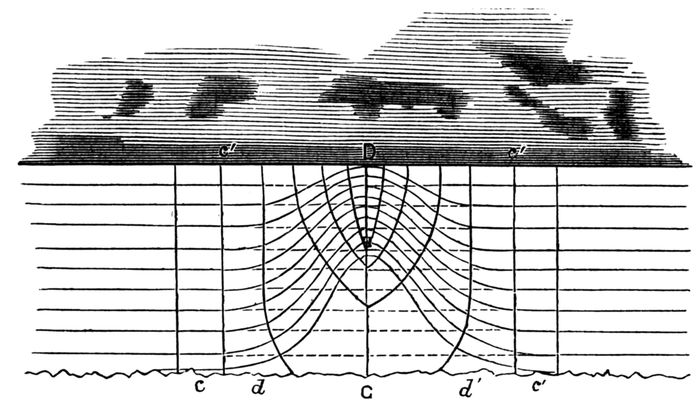
If instead of a hill or building we erect a solid rod of metal, G H,
then the field will be distorted as shown in fig. 2. Now it is quite
evident that whatever be the relative distance of the cloud and earth,
or whatever be the motion of the cloud, there must be a space d d´
along which the lines of force must be longer than c c´ or H D; and
hence there must be a circle described around G as a centre which is
less subject to disruptive discharge than the space outside the circle;
and hence this area may be said to be protected by the rod G H.
The same reasoning applies to each equipotential plane; and as each
circle diminishes in radius as we ascend, it follows that the rod
virtually protects a cone of space whose height is the rod, and whose
base is the circle described by the radius G c. It is important to find
out what this radius is.
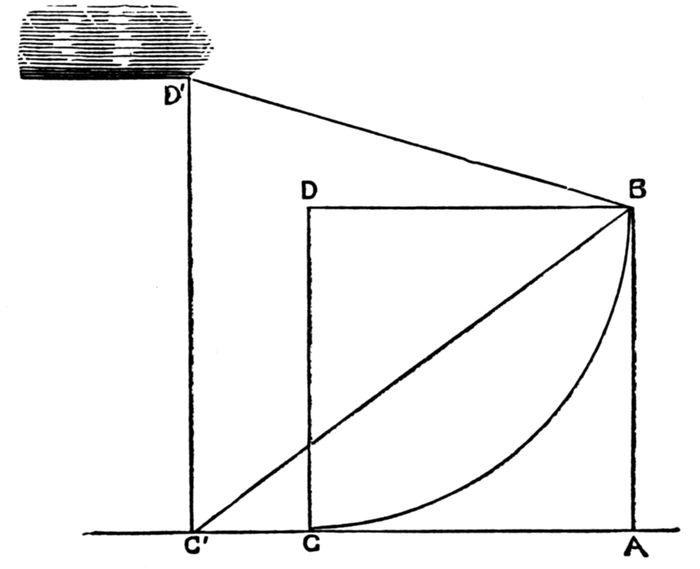
(137)Let us assume that a thunder-cloud is approaching the rod A B
(fig. 3) from above, and that it has reached a point D´ where the
distance D´ B is equal to the perpendicular height D´ C´. It is
evident that if the potential at D´ be increased until the striking-distance
be attained, the line of discharge will be along D´ C´ or D´ B,
and that the length A C´ is under protection. Now the nearer the
point D´ is to D the shorter will be the length A C´ under protection;
but the minimum length will be A C, since the cloud would never
descend lower than the perpendicular distance D C.
Supposing, however, that the cloud had actually descended to
D when the discharge took place. Then the latter would strike
to the nearest point; and any point within the circumference of the
portion of the circle B C (whose radius is D B) would be at a less
distance from D than either the point B or the point C.
“Hence a lightning-rod protects a conic space whose height is the
length of the rod, whose base is a circle having its radius equal to the
height of the rod, and whose side is the quadrant of a circle whose radius
is equal to the height of the rod.”
Upon this rule the author makes the following concluding remarks:
“I have carefully examined every record of accident that I could
examine, and I have not yet found one case where damage was
inflicted inside this cone when the building was properly protected.
There are many cases where the pinnacles of the same turret of a
church have been struck where one has had a rod attached to it; but
it is clear that the other pinnacles were outside the cone; and therefore,
for protection, each pinnacle should have had its own rod. It is
evident also that every prominent point of a building should have its
rod, and that the higher the rod the greater is the space protected.”
(Abstracted by R. Van der Broek.)
On the date mentioned, between three and four o’clock in the afternoon,
a violent storm burst over Antwerp, during which the lightning
struck the Railway Terminus, without, however, occasioning
any other damage than the perforation of a single hole in one of the
glass squares of the roof.
The author states that the effect of the discharge on this square
of glass, which was about 4mm (0·2in.) thick, was remarkable; it appeared
as if it had been traversed by a projectile from below, the perforation,
viewed from above, being broken and chipped, whilst viewed from
below it showed a clean edge. The sinuosities caused by the chipping
on the upper surface had rounded edges, and the glass appeared to
have been subjected to incipient fusion. Not a single fragment of
glass was found on the glass squares or in the gutters of the roof.
The author arrives at the following conclusions: The square of
glass was pierced in the same manner as any square of similar nature
and dimensions, placed in identical circumstances, would be, were it
(138)traversed by a spherical projectile fired at a low velocity from a firearm.
The fracture resembled one that would be produced by a
missile thrown from below, that is to say, from the earth to the sky.
The form of the opening indicated that the earth was positively
electrified.
The author notices that, according to M. F. Duprez, negative electricity
generally shows itself in abnormal conditions of the atmosphere,
during storms, rains, &c., and when the wind blows from the
western quarters between N. and S. Now, on the day in question, it
rained and the wind blew from the west.
The author publicly thanks M. Ruhmkorff for his skilful and disinterested
co-operation in proving the correctness of his (the author’s)
view of the distribution of the electricity at the Antwerp discharge.
M. Ruhmkorff has, at request, pierced squares of ordinary glass about
1mm (0·04in.) thick by the discharge of his great induction apparatus
charged by a powerful Leyden battery.
(Abstracted by R. Van der Broek.)
As the author states in his preliminary observations that it is
impossible to give a complete condensed description of the Lightning
Protector, which he erected on the Town Hall at Brussels, we will
merely draw attention to a number of facts, regarding the system
followed, some of them, we believe, of a novel description.
M. Daniel Colladon, the author states, has observed that as a rule
lightning does not strike a single part or prominent point of the
objects that are struck or destroyed by it; and that, in the majority
of cases, it does not strike in the form of a single spark, but in the
form of a sheet with one or more principal centres of intensity. The
correctness of this observation, the author considers fully borne
out by the ravages which the electric discharge committed on the
Town Hall at Brussels, on the 10th September, 1863. He gives an
elaborate description of the effects of the flash on the building. It is
interesting to note that the ravages principally took place at the side
exposed to the west north-west wind, which was blowing at the time
the building was struck.
In the ensuing winter the Municipal Council of Brussels took into
consideration the necessity of protecting the Town Hall against a
similar disaster, and the author was requested to superintend the
erection of lightning protectors on the building.
The characteristics of the author’s system, as exemplified by the
lightning protectors erected on the Brussels Town Hall, may be
briefly summarised as follows:—
1. The points are very numerous—of three kinds; some long,
sharp, and gilded, others of middling length, made of iron;
(139)and finally some small and very sharp, consisting of
copper.
2. The points are replaced by aigrettes (brushes of points diverging
from a common base).
3. The conductor is not insulated.
4. The connections are simple and unchangeable, the joints are
each embedded in a mass of zinc.
5. The surface exposed to the air is considerable.
6. The conductor consists of thin, and numerous wires, which
are very flexible, so as easily to be led round all the corners
of the buildings.
7. The conductor is made of galvanised iron.
8. The earth connections are multiple: firstly, a well within
which a large surface of metal is plunged; and, secondly,
two enormous networks of metal pipes, offering an immense
contact surface with the earth. One of these networks is
in direct communication with all the reservoirs and all the
water sources of the environs of Brussels and also in indirect
communication with two rivers and two canals.
The author has arrived at the conclusion that the height of the rod
is a secondary question, as the radius of protection has not been
determined by irrefutable proofs, and as that length is, in comparison
with the distance and the extent of the thunder-clouds, so small a
factor that it may safely be neglected. The author states that he has
been greatly gratified to meet with the same opinion in a paper
which Mr. W. H. Preece published in Vol. I., No. 3, page 366, of
the Journal of the Society of Telegraph Engineers for 1872: “When
we consider the distance of the cloud and the area of its surface, the
height of a building vanishes in the general figure.”
The author points out that M. Perrot has endeavoured to demonstrate
by experiment that the neutralizing area of a lightning protector
surmounted by a crown of sharp points is far more extensive than
that of an ordinary protector. M Perrott further thought, and
MM. Babinet and Gavarret shared his opinion, that it is sufficient to
shelter the ordinary protector from discharges of lightning by arming
it with numerous, long, sharp, and well conducting divergent points.
M. Gavarret after having repeated Mr. Perrott’s experiments, found
the results so conclusive that he wrote to the author in the beginning
of 1865: “It is at the present time no longer permitted to erect
lightning protectors with single points.”
The metal of which the points are made must be a very good conductor.
With regard to their conductivity, the metals follow each
other in the following order: copper, silver, iron, platinum. No
metals are used but those which resist fusion. The author rejected
platinum and silver: the former because it fuses very readily by the
electric discharge; and the latter, because it has, in his opinion, no
advantage over copper.
The conductor, although galvanized, received several coats of paint;
but the points (aigrettes) of course remained metallic. With regard
to the general principle of connecting the protector with any masses
of metal which may be about the building, the author has ever since
(140)1865 endeavoured to demonstrate, that it is not sufficient, as might
at first sight be supposed, to form that connection at one single
point; there must be at least two points of contact, so as always to
ensure a closed metallic circuit.
The contact with the water presents a surface of about ten square
metres (12 sq. yds.), bringing both surfaces of the cylinder into account.
With regard to the earth connection, the author quotes M. Perrot,
who remarks that with the ordinary protector the surface immerged
offers a resistance at least 10,000 times greater than the conductor
itself; it is therefore necessary to increase the surface of the earth-plate
as much as possible.
In order to retard as much as possible the oxidation of the cylinder,
the author introduced two hectolitres (6 bushels) of lime into the
well, thus rendering the water alkaline.
(Abstracted by R. Van der Broek.)
In this pamphlet the author describes in § 1 an apparatus to show
the presence of atmospheric electricity in telegraph wires.
In §§ 2 and 4 he explains how the apparatus is joined up in the
Belgian telegraph offices.
§ 3 contains a résumé of observations made at the government telegraph
offices between June, 1875, and March, 1876.
The author states in this paragraph that, on the 19th of June, 1875,
the Rheo-Electrometer at the office at Louvain, showed a deflection
of 85° East, although there was not the slighest appearance of atmospheric
electricity. The fact was, that at the time a thunder storm
was raging at Beverloo, distant from Louvain about 40 kilometres
(25 miles).
(Abstracted by R. Van der Broek.)
On the 3rd of July, 1874, the church of Ste. Croix, at Ixelles,
was struck by lightning. The building was provided with a lightning
protector, which was constructed as follows: The point consisted of
a platinum cone of about 30° (the form officially adopted in France
in 1855), all the supports of the protector were soldered with zinc.
This was attached to the steeple, and rose to 53 metres or 174 feet
above the pavement. It consisted of an iron rod 18 mm. (0·71 in.) in
diameter (M. E. Sacré’s system). The conductor passed from the
principal roof along the roofs, descending to a point near a pump,
behind the vestry, where the well (W) was situate. There is an abundance
of water in the well, which is about 7 m. (23 ft.) deep. The
conductor terminated in the well, by a cast-iron plate 0·65 m.
(2 ft. 1 in.) by 0·50 m. (1ft. 8 in.), thus presenting a surface of 0·654
⬜ m. (7 sq. ft.). A little in front of the transept there is a supplementary
rod B 5·25 m. (17 ft. 3 in.) high, 11 m. (36 ft.) distant from
(141)the point (c in diagram) which was struck; and 22 m. (72 ft.) distant
from that point there was a second rod D, whose height was 9 m.
(29½ ft.) above the top of the roof.
The damage to the church was trifling, but the author contends
that the fact of the church having been struck at all, proves that a
building armed with a protector constructed on the usual principle
is not completely protected.
| A. |
Principal conductor on steeple. |
| B. D. |
Two supplementary receiving rods. |
| C. |
Stone cross at end of transept, which was struck, |
| W. |
Well in which conductor made earth connection. |
(Abstracted by R. Van der Broek.)
This treats § 1 of observations on the distribution of the spark of
electric batteries and machines over numerous metallic conductors of
different sections, lengths, and nature, and on the passage of electricity
of tension in bad conductors.
§ 2. Effects of soldered joints on the conductivity and the resistance
of conductors. Interrupted lightning protectors.
§ 3. The distribution of sparks from Holtz’s machine and Ruhmkorff’s
coil over two conductors outwardly identical, but one of iron
and the other of copper. Comparative resistance to fusion and
rupture for iron and copper conductors. Identical damage produced
by discharges in several homogeneous and solid conductors.
APPENDIX I. GENERAL CORRESPONDENCE. — EDDYSTONE LIGHT.—REPORT of Professor Faraday on Electrical Phenomenon which occurred thereat on the 11th January, 1853 . — ACCIDENT at BOOTHAM BAR, YORK, compiled from notes and measurements taken by J. Edmund Clark.
(183)
Trinity House, London, E.C.,
6th February, 1880.
I am directed by the board to transmit to you herewith, for
the information of the Lightning Rod Conference, copies of reports
made by Professor Faraday to this Corporation, one respecting
a remarkable stroke of lightning which occurred at the Eddystone
Lighthouse in January, 1853, and the other upon a similar accident
experienced at the Nash Lights in August, 1852.
The case to which Admiral Sullivan directed the attention of the
Conference, as stated in your letter of the 30th October last, was
probably one of these two.
Should you desire any further details in connection with this subject,
the Corporation desire me to assure you of the pleasure with
which they will afford any information at their command.
I am, Sir,
Your obedient servant,
ROBIN ALLEN.
G. J. Symons, Esq.
[We have been favoured with copies of three separate reports by
Professor Faraday, and think that it is better to give them in chronological
order. There is only one other point in the correspondence
from the Trinity House which it seems necessary to mention, viz., that
the sections of the copper rods now used are as under.—Ed.]
CONNECTING BRANCHES.
1¼ in.
REPORT on the LIGHTNING RODS of LIGHTHOUSES, 1843.
Dungeness.—Dungeness Lighthouse stands about 14 feet above
the sea and measures 97 feet to the top of the lantern. The tower
is of brick with wood floors; the roof and frame of the lantern are of
metal seated upon a stone pedestal, to which it is secured. There
is no conductor to the building. The weathercock is fitted with a
(184)glass repeller, and a rod similarly fitted is attached to the two copper
flues which rise by the side of the lantern.
Eddystone.—The height of the top of the lantern of the Eddystone
above the sea is about 95 feet. The roof and framing of the
lantern are of metal, secured through a stone plinth to the gallery of
the tower by metal fastenings. A conductor of copper rod, ¾ inch
diameter, is attached to the outside of the building; the rod rises
3 feet above the top of the lantern and terminates in the sea at low
water; it is fixed to the tower and lantern by metal stays and fastenings
and is isolated by glass ferules. To give stability to the building
eight wrought iron ties are fixed in the interior of the house, extending
downwards from the underside of the lantern floor through the
next two stories, terminating by inserting the ends into the stone
floor, the upper ends are riveted into an iron ring round the manhole
in the ceiling and further secured by iron bolts passing through the
stonework and communicating indirectly with the metal work of the
lantern.
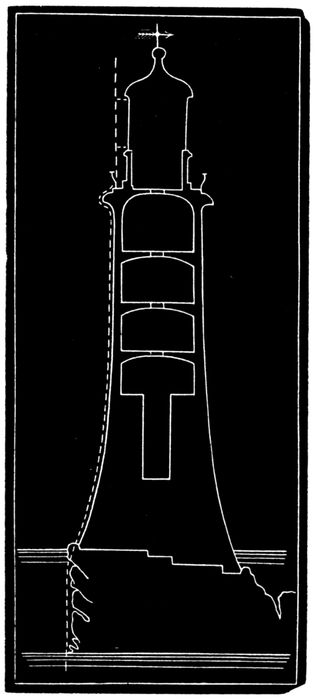
Spurn Point High Light.—The Spurn High Light stands about
16 feet above the level of the sea, and measures 100 feet to the top of
the lantern. The tower is of brick with wood floors; the roof and
(185)framing of the lantern are of metal, seated upon a stone plinth to
which it is secured; the weathercock is surmounted by a glass
repeller. An isolated conductor of copper rod, ¾ inch diameter, is
attached to the outside of the tower rising some feet above the
lantern and passing down the side of the tower below the surface of
the ground.
South Foreland.—The South Foreland High Light stands above
300 feet above the sea, and measures from the ground to the top
of the lantern 67 feet. The tower is of brick, the lantern roof and
framing are of metal with a cast iron pedestal; the weathercock is
fitted with a glass repeller. A conductor of copper rod, ¾ inch
diameter, is attached to the outside of the tower, of the same
height as the weathercock. The rod is fastened to the lantern
and tower with metal stays and fastenings, and passes into the
ground, turning off at right angles to the tower a little below the
surface. A copper flue connected with a stove in the base of the
tower, passes up the centre of the tower through the roof of the
lantern, to the lower end of which a copper rod has been attached,
which is carried to the outside of the building into the ground.
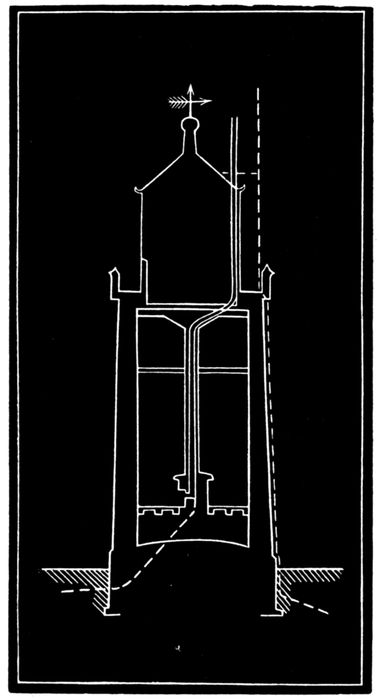
South Foreland High Light.
The undersigned have, according to their instructions, met and
considered the circumstances under which lighthouses are placed as
respects lightning, and have arrived at the following conclusions:—
That lighthouses should be well defended from the top to the
bottom.
(186)That as respects the top, the metal of the lantern, and upwards, is
sufficient to meet every need, and satisfy every desire and fear.
That for the rest of the course down the tower, a copper rod ¾ of
an inch in diameter is quite, and more than, sufficient.
That at the bottom, where the rod enters the earth, it is desirable
at its termination to connect it metallically with a sheet of copper
3 or 4 feet long by 2 feet or more wide; the latter to be buried in the
earth, so as to give extensive contact with it.
That glass repellers are in every case useless.
That glass thimbles are not needed, but do no harm.
That if the repeller be removed, and the point on the vane be
terminated as the lightning rods usually are, and then the metal of
the lantern be strongly attached to, and connected with, the upper
end of the copper rod, and the rod continued down the tower to the
earth, and the sheet of copper buried in it, such a system will be an
effectual and perfectly safe lightning conductor.
That then there need be no rod end rising by the side of, and
above the lantern.
That the rod may (if required on other accounts) come down on
the inside of the building, or in a groove in the wall; but should not
be unnecessarily removed from observation and inspection.
That all large metallic arrangements in the stonework, or other non-metallic
parts of the tower of the lighthouse, such as tying bars,
metal flues, &c., should be well connected, by copper, with the
conductor.
That the vicinity of two metallic masses without contact, or
metallic communication, is to be avoided.
That, as to the South Foreland High Light, the lantern, the central
stove, and the copper rod proceeding from it to the earth, connected
as they now are, form a perfect lightning conductor, even without the
rod that is there erected; but
That it is important casual arrangements should never be depended
upon for lightning conductors; but a copper rod be established for
the especial purpose: for, if the former be trusted to, the carelessness
or ignorance of workmen may, at after periods, upon occasions of
repair or cleansing, cause the necessary metallic connection to be left
imperfect or incomplete, and then the arrangement is not merely
useless but dangerous.
That, as to the Eddystone, it is desirable to connect the system of
wrought iron ties in it with the lightning conductor, by joining
the lower part of that iron rod which is nearest to the conductor
with the latter, by a copper rod or strap, equivalent to the conductor
in sectional area.
That the Dungeness Lighthouse is in a very anomalous condition;
to rectify which the two repellers should be removed, and also the
representative of the top of a lightning rod attached to the flue, and
that then a good copper conductor should be attached to the metal
of the lantern, upon the principles already expressed.
(187)23, Gt. George Street,
25th September, 1843.
The reference, on the important subject of lightning conductors,
is to Mr. Faraday and to me. On receiving it I prepared drawings of
the buildings to which our immediate attention was required, with an
explanation of their present conductors.
These were considered at a meeting with Mr. Faraday, when he
explained the principles and their application to the several cases,
deduced from his copious experiments and scientific observations.
I have since received from him the accompanying Report for my
signature along with his, but the report is altogether Mr. Faraday’s
and therefore I prefer adding my approval of all it contains in this
separate sheet, and recommending that authority be given to me to
act upon it.
I am, Sir, &c.
(Signed) J. WALKER.
Jacob Herbert, Esq.
Trinity House.
Royal Institution,
27th September, 1852.
I fortunately reached the Nash Low Lighthouse last Thursday,
before any repairs were made of the injury caused by the
discharge of lightning there, and found everything as it had been
left: the repairs were to be commenced on the morrow.
The night of Monday, 30th August, was exceedingly stormy, with
thunder and lightning; the discharge upon the lighthouse was at six
o’clock in the morning of the 31st, just after the keeper had gone to
bed. At the same time, or at least in the same storm, the flag-staff
between the upper and lower lights was struck, and some corn stacks
were struck and fired in the neighbourhood. It is manifest that the
discharge upon the tower was exceedingly powerful, but the lightning
conductor has done duty well—has, I have no doubt, saved the building;
and the injury is comparatively slight, and is referable almost
entirely to circumstances which are guarded against in the report
made by myself and Mr. Walker 22nd September, 1843.
The conductor is made fast to the metal of the lantern, descends
on the inside of the tower to the level of the ground, and passes
through the wall and under the flag pavement which surrounds the
tower. It is undisturbed everywhere, but there are signs of oxidation
on the metal and the wall at a place where two lengths of copper are
rivetted together, which show how great an amount of electricity it
has carried.
A water-butt stands in the gallery outside the lantern. A small
(188)copper pipe, 1 inch in diameter, brings the water from the roof of the
lantern into this butt; it does not reach it, but terminates 10 or 12
inches above it. A similar copper pipe conducts the surplus water
from the butt to the ground, but it is not connected metallically with
the other pipe, or with the metal of the conductor, or the lantern.
Hence a part of the lightning which has fallen upon the lantern has
passed as a flash, or, as we express it, by disruptive discharge from
the outside of the lantern to this tub of water, throwing off a portion
of the cement at the place, and has used this pipe as a lightning conductor
in the rest of its course to the ground. The pipe has holes
made in it in three places, but these are at the three joints, where, it
being in different lengths, it is put together with tow and white lead,
and where of course the metallic contact is again absent; and thus
the injury there (which is very small) is accounted for. The pipe
ends below at the level of the ground in a small drain, and at this
end a disruptive discharge has (naturally) occurred, which has blown
up a little of the cement that covered the place. Some earth is
thrown up at the outer edge of the pavement round the tower over
the same small drain, which tends to show how intense the discharge
must have been over the whole of the place.
Inside of the lantern there are traces of the lightning, occurring at
places where pieces of metal came near together but did not touch,
thus at the platform where a covering copper plate came near to the
top of the stair railing, but the effects are very slight. All the
lamps, ventilating tubes, &c., remained perfectly undisturbed, and
there was no trace of injury or effect where the conductor and the
lantern were united.
Inside of the tower and the rooms through which the conductor
passes there were and are no signs of anything (except at the rivetting
above mentioned) until we reach the kitchen or living-room which is
on a level with the ground, and here the chair was broken and the
carpet and oil-cloth fired and torn. To understand this, it must be
known that the separation between this room and the oil-cellar
beneath is made by masonry consisting of large stones, the vertical
joints of which are leaded throughout, so that the lead appears as a
network upon the surface, both of the kitchen floor above, and the
roof of the oil cellar beneath, varying in thickness in different places
up to ⅓ or more of an inch, as in a piece that was thrown out. The
nearest part of this lead to the conductor is about 9 inches or a little
more distant, and it was here that the skirting was thrown off, and
the chair broken; here also that the fender was upset and the little
cupboard against the skirting emptied of its articles. If this lead had
been connected metallically with the conductor, these effects would
not have happened.
The electricity which in its tendency to pass to the earth took this
course, naturally appeared in the oil-cellar beneath, and though the
greater portion of it was dissipated through the building itself, yet a
part appeared in its effects to have been directed by the oil cans, for
though they were not at all injured or disturbed, the wash or colour
in the wall above four or five of them was disturbed, showing that
slight disruptive connections or sparks had occurred there.
(189)At the time of the shock, rain was descending in floods, and the
side of the tower and the pavement was covered with a coat of water.
This being a good conductor of electricity has shown its effects in
connection with the intense force of the discharge. A part of the
electricity leaving the conductor at the edge of the pavement and the
tower, broke up the cement there, in its way to the water on the
surface, which for the time acted to it as the sheet of copper—which I
conclude is at the end of the conductor—does, i.e., as a final discharge
to the earth. Also on different parts of the external surface of
the tower near the ground, portions of cement, the size of half a hand,
have been thrown off by the disruptive discharges from the body of the
tower to this coat of water: all testifying to the intensity of the shock.
I should state that the keeper says he was thrown out of bed by the
shock. However, no trace of lightning appears in the bedroom, still
there are evidences that powerful discharges passing at a distance, and
on the other side of thick walls may affect bodies and living systems,
especially by spasmodic action, and something of the kind may have
occurred here. It may be as well for me to state that the upper
floors are leaded together like that of the kitchen. The reason why
they did not produce like effect is evident in that they from their position
could not serve as conductors to the earth as the lower course could.
The keeper said he had told the coppersmith to make the necessary
repairs in the pipe, and I instructed him to connect the waste pipe
and the upper pipe by a flat strap of copper plate. I would recommend
that the lead of the lower floor be connected metallically with
the conductor to a plate of copper in the earth. I could not see the
end of the present conductor, not being able by any tools at the lighthouse
to raise the stonework, but I left instructions with the keeper
to have it done, and report to me the state of matters.
I am, &c.,
(Signed) M. FARADAY.
The Secretary,
Trinity House.
Royal Institution,
24th January, 1853.
In reference to the remarkable stroke of lightning which
occurred at the Eddystone Lighthouse, at midday on 11th January of
this year, and made itself manifest by a partial flash discharge in the
living rooms, I have to call your attention to the drawing herewith
returned, and to the circumstances which appear (from it) to have
accompanied and conduced to the discharge.
In the body of the stone work above the store-room exist eight
rings of metal; each going round the building, and each being four
inches square of solid iron and lead. Also, latterly the bedroom
and sitting-room have been lined with a framework of iron bars,
situated vertically, and pinned by long bolts into the stonework.
(190)The part of the tower above the floor of the living-room is, therefore,
filled with a metallic system, which, with the metal lantern,
gives a very marked character to the upper half of the structure.
The recent metallic arrangements (but not the rings) are connected
with the lightning rod; and the copper part of this rod, beginning at
the floor of the living-room, then proceeds downwards by the course
which can be followed in the drawing, and terminates on the outside
of the rock between high and low water marks.
Considering all these circumstances, I was led to conclude that the
conductor was in a very imperfect condition at the time of low water;
and I had little doubt that I should find that the discharge had taken
place when it was in this state, and very probably with a spring tide.
The day of the stroke was the 11th January—a new moon occurred
on the 9th, so that it was at a time of spring tide.
The occurrence took place at midday; and, according to the tide
tables, that was close upon the time of low water at Devonport. The
end of the conductor would then be 6 feet from the water, if the
latter were quiescent, and I cannot doubt that this circumstance gave
rise to that diverted discharge which became so manifest to the
keepers. Mr. Burges, with whom I have conversed about the matter,
thinks it probable that, through the violence of the waves, the conductor
does not now descend so much as is represented in the drawing.
I think it essential that the lower end of the conductor be made
more perfect in its action; and I should prefer this being done on the
outside of the tower and rock, if the rod can be rendered permanent
in such a situation.
If it be impossible to prolong and fix the lower end of the conductor
where it now is, so that it shall have large contact with the sea at
low water, then I would suggest, whether or no, on the more sloping
part of the rock, about midway between high and low water, three or
four holes could not be sunk to the depth of 3 feet, and about 3 or 4
feet apart, and that copper rods being placed in these, they should
be connected together, and the lightning rod continued to them.
If this cannot be done, then it might be right to consider the propriety
of the making a hole through the centre of the building and
rock, about 2 or more inches in diameter, and 30 feet deep, and continuing
the conductor to the bottom.
A conversation with Mr. Burges regarding the present state of
the Bishop’s Rock Lighthouse, now in course of construction, induces
me also to suggest the propriety of making provision for the lightning
conductor as the work proceeds.
It would be easy now to fix terminal rods of copper, and to combine
them upwards with the work. Considering the isolated and
peculiarly exposed condition of a lighthouse on this site, I would propose
that there be two conducting rods from the lantern, down the outside
on opposite sides of the tower, each terminating below in two or
three prolongations, entering as proposed into the rock, or into fissures
below low water mark, so as to be well and permanently fixed.
I am, &c.,
(Signed) M. FARADAY.
The Secretary,
Trinity House.
(191)[The present Eddystone Lighthouse, that is the stone one erected
in 1757–59 from Smeaton’s designs, has a total height from low
water level to the top of the vane of 107 feet. The annexed engraving
shows two conductors, the old and defective one passing down
the left hand side and terminating half way between high and low
water level, and the proposed new one on the right terminating in
holes in the rock.—Ed.]
(192)[The following letter would have been placed in Appendix A. along
with the replies from British Manufacturers of Lightning Conductors;
but it did not arrive until long after they had been printed off.—Ed.]
Please find enclosed answer to your questions. In addition to
manufacturing rods, we have been protecting buildings with these
rods for thirty years. We sell in this way at retail from five to six
hundred thousand feet each year. We also issue a guarantee of $500
(£100) on each building that we protect, which we hold ourselves
ready to make good in case of failure. Now, in this extensive
business, we have only had to pay one dollar damage done by lightning.
We regard this as a practical demonstration that our method
of protecting buildings with iron rods is as near perfect as it can be.
There is more profit to be made out of the copper rod, as it is made
cheaply out of sheet copper, and can be sold much higher than the
iron rod. But knowing that iron for all practical purposes is the
best material for lightning rods, we feel it to be our duty to do all we
can to introduce it. We would most respectfully ask the Conference
to investigate this question as to what kind of metal is best for rods
for practical use, iron or copper. Our own late Professor Joseph
Henry pronounced in favour of iron. We have many facts in relation
to buildings being struck by lightning which we could give at
some future time if desired. We have gathered up a large number
of points that have been melted by lightning strokes. They are
melted down about ½ inch. They all look as if the same amount of
heat had been applied to each, showing very clearly that the quantity
of electricity in lightning strokes is quite uniform. We have never in
any instance known of the rod being melted, showing that the rod
which we use is of sufficient size.
1 & 2. We make spiral twisted iron rods weighing 45 lbs. to the
hundred feet [7¼ oz. per foot]. The rod is of the same sized material
throughout its length, except that a copper point, plated with silver
and tipped with platinum, is screwed on the upper terminal.
3. No proportion is observed between the length and sectional area.
4. Joints are made by means of copper nuts.
5. Attached to building by means of zinc strips, or a casting that
fits closely to the rod, which is screwed down.
6. The rod extends from 9 to 10 feet in the ground.
7. A circle twice the diameter of height of rod above roof.
8. All terminals on the roof are connected. There are never less
than two ground rods, and these are increased as the number of
upper terminals are increased.
We also manufacture copper rods, but do not use them where we
protect buildings, nor do we recommend them to other dealers from
the fact that our experience of thirty years has demonstrated that
iron is the best material for lightning rods.
Mount Pleasant,
Iowa, United States.
(193)A colliery chimney near Sunderland, 180 feet high, was struck by
Lightning, November 13th, 1878, and I was sent for to repair it.
Upon getting to the top, which was about 15 feet diameter, I found a
great many of the bricks displaced, and the upper terminal of the
conductor (which was a tube 0·50 in. internal, and about 0·62 in.
external diameter, and which had stood about 1 foot above the top
of the chimney) had been fused and was lying on the top of the
chimney, it was quite brittle, and easily broken by the hand. The
upper 10 feet of ½ inch wire rope was in a similar state; it seemed
as if it had been passed through an exceedingly hot furnace, and
I rubbed it to dust in my hands. This 10 feet length was above the
first holdfast, below the holdfast the wire rope was perfectly good.
The holdfast was one of those which are driven into a wooden plug
let into the wall and pinned tightly down on the rope, which had
been badly bruised in the fixing—in fact, knocked almost flat. I
believe that this was the cause of the accident, and that the lightning
travelled down as far as this holdfast, and there meeting obstruction,
returned destroying the wire and rod and shattering the brickwork.
The earth connection was good, the end was buried in a trench 2 feet
deep and 15 feet long.
I have been in communication with several of the principal brick
builders here by whom the great majority of the chimney stalks in
Glasgow and the west of Scotland are erected, and I believe the
following statements may be taken as correct:—
(1) Very few stalks under ninety feet in height have lightning
conductors, but, as a rule, the higher stalks have conductors. One of
my correspondents says that “this rule holds good in four cases out
of five.”
(2) A chimney being struck by lightning is an extremely rare
occurrence in this district. One builder of long experience (Mr.
McDonald) says, “I have known of several stalks that were struck
by lightning, that had no conductors. I cannot point to one that
was struck by lightning and had a conductor.” Another firm of old
standing (Allan and Mann) say—“In our experience we have not
known of a chimney stalk, with lightning conductor fixed, damaged
by lightning.” Another firm (Bell, Hornsby and Co.) say—“In
our experience we have not known an ordinary stalk with or without
a conductor struck by lightning,” and Mr. Goldie says—“During the
last twenty years I can remember only one such case,” and he is
not sure whether the stalk had a conductor or not. There are three
cases known to have occurred in Glasgow, but I never heard of any
others among the hundreds—I may say thousands—of chimneys
which are here. The great stalk at St. Rollox was struck shortly
after its erection. A stalk at the works of Messrs. Alexander Paul
and Co., was struck about nine years ago. Mr. Goldie makes the
(194)remark—and I think it is well worthy of notice—that in all these
cases the accident happened shortly after the completion of the stalk.
In these circumstances the stalk would still, no doubt, contain a large
amount of moisture.
I think the St. Rollox stalk had a conductor fixed before it was
struck, but I am not aware whether either of the others had.
Mr. Higginbotham (Todd and Higginbotham) tells me that the
stalk at their works was struck before it was quite completed. It
was very slightly injured. It was afterwards struck as mentioned in
my letter. On that occasion it had a lightning conductor.
The damage done was not very serious, but necessitated the
binding of the stalk with numerous iron hoops—as thus strengthened
it still stands. Mr. Higginbotham says that the opinion at the time
was that the conductor saved the stalk from complete destruction,
but that it was too small.
They, therefore, had it replaced by a much heavier one—copper
rope ⅜th of an inch diameter, kept 1½ inches from the brickwork by
glass insulators—which still remains.
140, Bath Street, Glasgow.
There was no lightning conductor of any kind at Wells Church.
The electric fluid struck the east side of the Tower just above the
ridge of the nave roof. The tower stands, or stood, at the west end.
I enclose an account of the fire from a local paper:—
Wells.—Total Destruction of the Church.—“Near midnight
of Saturday last, August 2nd, 1879, a terrific thunderstorm
burst over this town and a large district around, causing most
intense alarm and unfortunately ending in sad disaster. The
storm raged throughout the night, and was accompanied in many
places by a perfect deluge of rain. Between three and four a.m.
of Sunday, the 3rd, it appeared to reach its height, the lightning
being of a most vivid and alarming nature, and the thunder reverberating
in continuous peals. A lull then occurred, but between five
and six a.m. the storm again burst out with great fury, and at 5.50
the electric fluid struck the church on the eastern face of the tower
immediately above the apex of the roof, driving out a large portion
of the stone work, the flints flying hundreds of feet around. One
large stone fell upon the roof of a house, near the east window, and
penetrated to the room below, which was fortunately unoccupied;
but the tenant, Mr. R. Wharf, who slept in the next room, was
aroused, and one or two persons in the road seeing what had occurred,
and observing smoke directly after issuing from the roof of the church,
raised an alarm of fire, which quickly awakened the whole town.
(195)The first visible injury to Wells Church was the “skinning” of a
portion of the tower (about 10 feet high by 5 feet broad) extending
downwards from the east window of the tower (i.e., the window which
looked over the roof of the nave,) to the point at which the lead-covered
nave joined the tower. The lightning is believed to have set
fire to the roof at this point, and also to have travelled along the lead
roof to the chancel, and in crossing the vestry to have ignited the
surplices, as the church was seen to be on fire at both ends before the
middle was touched. The “skinning” was accompanied by great
disruptive force, as the stones from the tower were not only shot the
full length of the church, but one large one fell on the roof of a house
60 feet beyond the east end of the church.
As your questions in the Times of to-day allude only to protection
to buildings from lightning, I need not say anything on the perfect
protection afforded to Her Majesty’s ships by the conductors of Sir
Snow Harris, from the time they were used in every ship in the
service.
H.M.S. “Beagle,” Commander FitzRoy, was one of the first ships
fitted with them. At Monte Video a heavy shock of lightning passed
down the mainmast and through the ship without doing the slightest
injury; but as the vane staff which tapered to a fine point, was fused
at the point, it enables me to answer one of your questions. The
copper was melted till the diameter was about one eighth of an inch,
but below that point the conductor was not injured in any way.
You will like to know a case in which a copper wire acted as a
perfect conductor, though fused throughout its length. It was at
Monte Video, in the house of the English Consul, a flag-staff was
struck, and conducted the lightning through a flat roof, near the bell
wire of a suite of rooms (the wire ran in sight near the cornice) through
a hole in each dividing wall, and then down to the bell in the basement;
the wire was melted into drops like shot, which burnt a row
of small holes in the carpet of each room. A dark mark, on the
cornice above, showed where the wire had been. At the bell there
was a slight explosion, and some little damage, but I do not recollect
whether anything acted partially as a conductor from that point, and
so carried off that part of the charge.
This, I think, shows that even an ordinary bell wire will act as a
conductor for a rather strong stroke of lightning, as the large flag-staff
was shattered.
I am anxious to call the attention of your conference to a point
that it will be interesting to clear up. That is, whether a conductor
should be a solid rod, or in a shape to give the largest amount of
surface in the section? When I tell you that Faraday and Harris
each told me that the other “knew nothing about it,” because they
differed entirely on this point, I think you will see the importance
of it. I had at the time to approve of the conductors for lighthouses.
I will, if you wish it, give you more particulars on this point, as I
(196)believe it has never yet been settled: lighthouses having been fitted
with Faraday’s, and ships and public buildings with Harris’ conductors.
The one being a solid bolt, the other a hollow tube or
double thin plates.
If Harris was right there is an unnecessary amount of copper in
Faraday’s solid conductors; if Faraday is right, there is an unnecessary
outlay in putting a given amount of copper into the shape of a
tube, instead of using it as a solid rod.
P.S.—You should get from the Trinity House particulars of a case
in which, with a good solid conductor, the iron floor of a lighthouse,
aided by some lead in the wall, diverted the lightning from the conductor,
and caused damage inside. I think it was a Portland lighthouse,
but it is so many years since that I may not be right.
Three or four years since, I was looking out of my office window in
Finsbury, when a flash of lightning struck the tower of the church of
St. Giles’, Cripplegate, towards which my sight happened at the time
to be directed. As a portion only of the flag-staff, placed at one
corner of the tower, was destroyed, I obtained permission to ascend
the tower and discover the reason. I found a substantial copper
rope conductor fixed in a somewhat careless fashion to the back
of the tower, and passing some distance into the earth. This copper
rope was about an inch in diameter, and was carried upwards,
under and over several projections and cornices, and across the roof
of the tower to its centre—where it stood erect, and evidently did its
assigned work admirably. Clumsy and unsatisfactory as the fixing
of this bent copper rope seemed to me to be, it is quite certain that
it was most efficient; and had it not been for the flag-staff, capped
with lead, which was carried up considerably higher than the copper
rope, no evidence whatever of the lightning’s path would have been
revealed. As it was, the discharge of lightning struck the leaden cap
of the flag-staff, and descended down the wet, wooden pole, until the
summit of the copper-rope conductor in the centre of the tower was
reached, when the discharge flew across to the metallic earth conductor,
leaving the lower part of the flag-staff unhurt, but shattering
to splinters that portion which was higher than the summit of the
copper rope.
27, St. Mary’s Road, Highbury.
A small public-house of mine (the “Wheatsheaf”) stands at
Trolley Bottom, in the parish of Flamstead, between St. Albans
and Dunstable. On Wednesday, August 6th, 1879, about 2 p.m.,
during a storm, not otherwise very severe, my tenant was seated
by the tap-room window (A on the plan) his wife being seated opposite
to him, and having the window on her left, whilst she held her child
(197)with her right hand; there were at the same time in the room about
five men besides. A sharp flash of lightning occurred, and the poor
woman (when the smoke cleared away) was observed to have fallen
backwards. She gasped twice, never spoke, and died immediately,
and bore no further mark of injury, I understand, than a slight mark
as of scorching on her neck, below the left ear. I fail to recollect
whether her clothing was scorched or not, the child’s shoe and sock
were both burnt, but she, herself, was unharmed. All present were
sensible of an atmosphere heavily laden with sulphurous fumes; but,
excepting as above, were absolutely unhurt.
On visiting the house about a week afterwards, with a view to its
repair, I found a small round hole as if made with a bullet in a
pane of the window (A) close to which the woman was sitting, but
could discover no further injury either to the other panes, the window-frame,
the floor, or anything in the room. In the parlour, B, the
window-frame was violently wrenched outwards two or three inches,
several of the panes were broken, one sash-line being scorched, as also
the frame and linings in places, especially in the neighbourhood of the
sash-weights (iron). The wooden chimney-piece E, was slightly
moved from its position, the various articles upon it were scattered,
and a bottle of ink which stood there, was thrown with some violence
to the ceiling. The upper part of the chimney to that room, G, and
a portion of the wall, of which it was a part, forming the gable end to
the house were shattered, and at H a stout post, contiguous to the
house wall, and supporting the roof of a lean-to, was split and
wrenched from its position. The windows and frames upstairs, C
D, were in the same state as that at B. The chimney, K, to the tap-room,
was quite uninjured, and no harm was done to any part of the
back of the house.
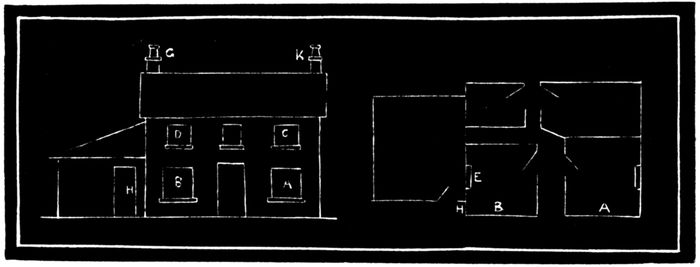
Flamstead is about four miles from Luton, and six from St.
Albans, and stands on high land. Trolley Bottom is a hamlet half-a-mile
distant, and is, as its name implies, low-lying. My house is,
perhaps, the lowest in position there. It faces the North-West.
I fear that my experiences will be found to have but little bearing
upon the main point you have in view, viz., the comparative merits of
different descriptions of Lightning Conductors. I venture to think,
however, that they are not altogether without interest as illustrating
the effects of lightning in a by no means exposed situation.
(198)I am writing only from memory what was told me at the time, and
should you desire further information on any points, shall be happy
to endeavour to obtain it for you.
It would interest me very much to know how it is to be accounted
for that, whilst in the room in which the poor woman was struck, no
further damage was done, other parts of the house were, comparatively
speaking, wrecked.
I was in a house at Cannes (France) belonging to my late father
on the occasion of its being struck by lightning about five or six years
ago.
The storm in which it occurred was a very short one, consisting of
only four explosions, every one of which took effect on some building
in Cannes.
The rain was falling in torrents, and to this I consider we owed
our safety as the shoots and stack-pipes being full of water acted as
conductors. The villa stood high, but another building very much
higher, and on higher ground, was within 100 yards. The lightning
struck the metal cowl of a brick chimney, which, being an addition,
was led down outside the walls of the house.
In the explosion the front of the grate of the room to which this
chimney belonged, together with fire-irons, &c., were all projected
across the room (a large one), about 30 feet; but no marks of
lightning having entered the room were apparent. In fact the lightning
after blowing up this chimney, together with much of the roof
and wall of the house (great portions of the solid masonry of which
I found 50 and 60 yards off!) appears to have left the chimney and,
taking the course of the iron shoot round the house, to have divided
into three streams, each of which ultimately found its way down a
separate stack-pipe, melting in its way all the soldering of the joints,
but otherwise leaving them uninjured.
One stream passed thus into a well, the door of which (locked the
night before) was burst open, I presume by the sudden expansion of
the air, another stream of the electric fluid passed into an underground
drain, which it burst up, hurling into the air the trees
planted above it, the third passing across a level asphalt roof, which it
melted in spite of the water lying on it, descended into the earth
harmlessly.
You will see by this that the amount of electric fluid must have
been very great to require all these modes of dispersion, and it suggests
the question whether the diameter of the ordinary conductors
would be sufficient to carry off so great a stream. Of course, in this
case, there was no conductor, and therefore no means of testing it.
The Lodge,
Parkstone, Dorset.
(199)Thank you very much for the Pamphlet, which I have read with
great interest. Messrs. W. & W. (page 6) state that conductors
in masts (like Harris’s) are “most objectionable.” The best answer
to that is: that while ships were struck in the Navy, and lives lost
every year before they were introduced, no ship fitted with them ever
received the slightest damage; and since all ships were ordered to be
fitted—now about 30 to 35 years—I have never heard of the slightest
damage, or the loss of one life—that fact upsets all theories on the
subject!
Then connections between the higher and lower masts, and
especially at right angles, are objected to on the ground that at a
bend the conductor may be fused; such a thing was never heard of in
the thousands of conductors that must have been fitted in the navy.
Even if the movable plate were turned back the lightning following
the longest conductor would leave one mast for the other, as the
conductor went right over the mastheads, and the two conductors
nearly touched each other.
At Spring Grove, near Isleworth, the church had a high spire
which was fitted with a conductor, but the Vicarage was struck and
some damage done to it, though, I think, much nearer to the tower
than its height. I believe many are contented with one or two
conductors to a building that should have many more. My small
house here is about 70 feet long by 38 feet wide, and I have seven
conductors—one to each chimney.
If it is once decided beyond dispute, that copper conducts in proportion
to its volume; then a rod, or flat-plate, of about the proportions of
one to four or five, for the purpose of fitting closer round projections,
would be the cheapest and simplest form; but if it conducts in proportion
to surface then of course a tube, double plate, or wire rope,
would give the greatest protection at a given cost.
I firmly believe in the surface theory of Harris. I had been with
him often when he made experiments nearly fifty years since, and
witnessed a strip of tin foil of the thinnest kind, and about ¼ inch
wide, protect a model mast of about six inches in diameter from
electric shock, that without it split the mast to pieces, aided by a small
hole through its centre filled with gunpowder. And I always thought
that the surface-conducting theory of Harris was indisputable. But
about 20 years since, having to approve a proposal of the Trinity
House for a new conductor of a Lighthouse, which, like previous ones,
was an inch in diameter copper rod called “Faraday’s Plan,” I thought
I would go up to the Royal Institution and ask him why he did not use
a copper tube instead, giving much greater conducting power with less
copper. I did so, and he asserted positively that the conducting
power depended entirely on the volume of copper in the section of
the conductor, no matter whether it was in a bolt, plates, or tube;
and that if Harris said differently, “He knows nothing whatever
about it;” of course, I approved the rod conductor. But singularly
enough, though I had not seen Harris for years, he came to town a
few days after, and came to the Board of Trade to see me, and bring
me a piece of his large tube conductor, with a connection, that he
was fitting to the Houses of Parliament. When I told him what
(200)Faraday’s opinion was, he answered, “Then he knows nothing about
it.” I was still inclined to believe in Harris; but a few years after,
a young Indian R.E. Officer—Lieut.-Col. Stewart—whose death not
long after was a serious loss to the service, was sent home to procure
the electric cables for connecting different Indian ports. I was asked
by the Secretary of the Indian Office to give him all the help I could.
One day he came to me with a piece of the cable he proposed using.
Inside the iron wires was a single stout copper wire about ⅒ of an
inch in diameter. I asked him why he had not the central wire of
several strands as usual, as I believed it would greatly increase the
conductive power. He said that he had carried out a number of experiments
on this point before deciding; and that he was satisfied the
conducting power depended on the amount of copper in the conductor,
and consequently a solid wire was better than one of the same size
made up by twisting small wires together.
This of course shook my confidence in Harris’ theory; but it is a
point that can be easily decided by experiments on a larger scale;
and I hope your Committee will be able to decide it finally.
Messrs. W. & W. prefer to a conductor on the masts a wire rope
carried down from the truck, stopped to a back stay. The following
fact will show its danger:—A French frigate, some fifty years since,
had one so fitted as an experiment; while striking T.G. masts the
conductor formed a large bight as the mast was lowered; a man
standing on cap or cross-trees—I forget which—formed a shorter
conductor between two parts of the wire rope and was killed without
any other damage being done.
With reference to your recent letter in the “Times,” I shall be
glad if you will inform me whether there has come under the consideration
of the Conference the question of lightning conductors on
board iron ships with iron masts; for my part they would seem to
be useless, and that if the iron mast have sufficient metallic communication,
through the bottom, with the outside of the ship either by
means of the screw shaft or in some other way; no additional conductor,
copper ribbon, or strip, down the masts and along the decks
over the ship’s side, or copper tube down the shrouds and over the
ship’s side could be of the slightest benefit.
In some ships one or other of these arrangements has been adopted,
and in others both have been applied at same time.
Fern Hill Cottage, Windsor Forest.
I have observed your letter in “The Architect” of Saturday last.
With reference to the subject on which it treats, I chance to have
noticed since my residence here (a period of eight years) what I
suppose to be an unusual frequency of lightning striking objects
immediately round this spot, and the neighbourhood generally.
(201)This inference is suggested by the fact that within the period
mentioned lightning has fallen within fifty yards of the same spot
three times—that this summer (one of those occasions) two other
houses, both (say) within 500 yards in a direct line from this spot,
were also struck—and generally, I believe, more objects are struck in
this neighbourhood than usually happens to be the case.
My idea may be a fallacy, for I have no sort of statistics by which
to test it; but if you suppose it is not so, and if such points come
within the scope of your inquiry, I should be glad to send you a map
marked with the spots where, and the dates when, lightning has fallen
in or near this town. The only local peculiarities I notice are: 1.
An unusual number of houses close to this have lightning conductors
(a mere coincidence, and not placed there on any impression like my
own). 2. We are at the bottom of a deep bay of parabolic plan
which may influence the movements of electrical disturbance. 3. A
soil of sand and gravel containing much oxide of iron.
Athelney, Bournemouth, Hants.
[Mr. Baldry kindly supplied the map, and we find that a half circle
of half a mile radius struck from the cliff-edge half a mile west of
Bournemouth Pier includes the churches of St. Peter, with one conductor,
and Holy Trinity with three; eight private houses with conductors,
of which four houses have one each, and the other four have
two, five, six and seven respectively, and within this area six objects
are known to have been struck—three in the year 1879, two in 1871,
and one in 1870. We do not know of any English locality where
there are so many houses with conductors; but there are many more
remarkable cases of repeated injury within small areas—e.g., in one
storm in June, 1878, there were at least eight separate buildings
injured within a circle of half a mile radius struck from the Metropolitan
Cattle Market in the north of London.—Ed.]
It occurs to me that it is worth while for the delegates of the
Royal Institute of British Architects to raise the question, and, if
possible settle, whether or not the gas pipes which permeate many
buildings might or might not be utilized as lightning conductors;
and whether any risk of gas explosion would be incurred thereby.
In my own practice there occurred the case of a lofty building, with
a domed roof, and a sun-burner with a 1½ inch gas-pipe to supply it,
rising to the summit of the dome, and a large iron cowl over the
sun-burner.
The same circumstance occurs in most modern theatres. If the
cowl were struck by lightning there was perfect metallic connection
thence to the street gas mains—and one of larger sectional and superficial
area than an ordinary lightning conductor would give.
2, Finsbury Circus, City, E.C.
(202)Lightning conductors have been a great hobby with me for
many years, and I have induced a great number of clergymen and
others to fix them to their towers and houses. During my time
in the navy and merchant service I witnessed many fearful effects of
lightning, and for the last thirty years I have been striving to persuade
my friends to secure their houses from these terrific visitations.
On the 24th December, 1699, the upper half of the fine steeple of
this town was hurled to the ground, and a large portion of the church
broken in. Pinnacles were then substituted for the upper portion
of the steeple, to which I have had an efficient conductor attached.
As far as I can gather from records, and from the abortions so frequently
substituted for the original pinnacles of towers, I have come
to the conclusion that nearly every tower in this country has been struck
by lightning during the last 400 years, when nearly all the towers
were built. Many years since, the Illustrated News gave a sketch of
a beautiful steeple (in Norfolk, I believe) destroyed by lightning. It
was stated that this was the second steeple which had met with so
sad a fate. After the destruction of the first, a second steeple was
built by subscription, at a cost of £1,000, and the scaffolding had
been removed only ten days when, during a terrific thunderstorm,
this second steeple was entirely destroyed! I wrote immediately to
the incumbent to ask about the conductor, and his answer was that
none had been fixed, but that it was quite decided that an efficient
one should be attached to the third steeple! This would almost appear
incredible, and I regret that I did not dot down the name of the
Parish and other data, but I think it was about 20 years since.
The conductors I recommend are simply copper rods of ¼ inch
diameter, attached to the highest chimney, and brought to the ground
two or three feet under the surface. When buildings are longer than
they are high, I always advise a conductor at each end. I generally
place the conductor four or five feet above the chimney, and bring it
out from the base of the building. Where a steeple or pinnacle has
a vane it is only necessary to fix the conductor to the base of the
spindle. Sir W. Snow Harris recommended much heavier copper
conductors, but their great expense has prevented their adoption.
The old conductors in men-of-war were composed of long copper links,
of which nine feet went to the lb., and these were always efficient
when in place. Now of ¼ inch copper rod there are only five feet to a
lb., so that I give a larger margin for security.
I observed your notice that you required information in reference
to lightning and lightning conductors. A case was brought to my
attention last year which occurred in Middlesborough. I enclose
you particulars of the same extracted from my report, together with
a tracing shewing the elevation and plan of the chimney shaft which
was struck with lightning.
7, Westminster Chambers, Victoria Street, S.W.
(203)
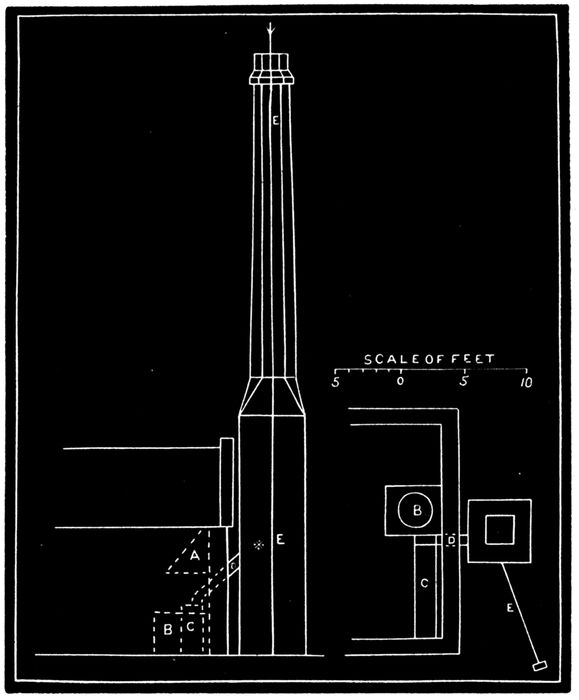
A. Wooden cover over boiler.
B. Boiler.
C. Iron disinfecting apparatus.
D. Iron flue into chimney.
E. Conductor.
* Position of fracture.
Extract from a Letter from Mr. E. D. Latham, C.E., Borough
Surveyor of Middlesborough, dated October 11th, 1878, with
reference to the striking by lightning of the chimney in connection
with the washhouse at the Middlesborough Fever Hospital at
Linthorpe:—
“The chimney, which is a brick one, is about 50 feet high and
5 feet square at the base and stands at the north end of the washhouse,
as shown on the accompanying sketch. The conductor, a ⅜th
inch copper rope, is fixed on the south side of the chimney with
holdfasts, no insulators, and finishes in the usual manner, about 2 feet
above the top. The conductor is carried under the ground for a distance
of about 9 feet from the chimney, and terminates at a depth of
about 4 feet in hard, rather dry clay, the end being wrapped about three
times round a common brick buried in the ground. At a distance of
about 9 feet above the ground at the same side as the conductor, and
only about one foot from it there is a fracture in the brickwork where
the electric fluid appears to have penetrated the chimney and gone a
short distance down the inside, to the flue connected with the iron disinfecting
(204)apparatus, which stands at the side of the clothes boiler, as
shown on the plan. The stone work of the top of the boiler was
broken and other damage done.”
Extract from the reply of Mr. Baldwin Latham, C.E., to the above
communication:—
“It is no uncommon thing for buildings provided with what are
called lightning conductors to be damaged by lightning, and the cause
is due to the inadequacy of the conductor to carry the electric fluid,
which will leave the conductor for a better or a larger conductor.
Wire ropes are found to be one of the worst forms, the same amount
of metal when applied in a solid rod or ribbon is far more efficient, as
it offers less resistance than the strands of a rope. You say your
conductor is perfect, but by examination of the drawings it will be
seen that the lightning descended the conductor to a certain point.
At this point the iron flue enters the shaft, but some distance from
the conductor; the mass of metal located there was a better conductor
than the rope, so that in leaving the rope for the better conductor,
the electric fluid passed through the brickwork and caused the damage.
If the boiler and flues did not join in metallic communication, damage
would arise from the fluid passing from the flue to the boiler, and if
the boiler were not in metallic communication with the earth, farther
damage would arise when the fluid left the boiler for the earth. It is
well known that electricity of high tension will leave small conductors
for large ones, and the knowledge of this fact is made use of in protecting
the telegraph system throughout the country. Many buildings
and chimneys have been struck that have been fitted with
so-called lightning conductors. A perfect system of protection
against lightning consists in linking together all the conductors about
the buildings. Such was the system introduced by Sir W. Snow
Harris and adopted by the Government.”
Reply of Dec. 12th, 1878, acknowledging receipt of Mr. Baldwin
Latham’s Letter.
“I am directed by the Town Council to tender you their thanks
for the trouble you have taken, and the valuable information you
have given with reference to the lightning conductor at the Middlesborough
Fever Hospital.
GEORGE BAMBRIDGE.
Town Clerk.
Corporation Hall, Middlesborough.
At the suggestion of the Engineers of the Telegraphs in the district,
the earth portion of the rope has been imbedded in a mass of
coke, and a quantity of old iron has been placed at the bottom of it,
to counteract the influence of the boiler and disinfecting apparatus.
(205)I beg to report an incident which occurred on board the barque
“Southern Queen,” from Pensacola, while coming up Channel on
the morning of the 30th of December, 1879, the Eddystone Lighthouse
bearing about north, dist. 20 miles. At 6 a.m. of the above
date, saw a terrific squall rising in the W.N.W. point of the horizon,
with vivid Lightning in it.
We immediately reduced sails down to lower topsails and foresail,
and about 7 a.m. the squall of wind and hailstones overtook us: it
blew furiously for about twenty minutes, and in the height of the
squall a thunderbolt broke on the ship, shattering the main royal
mast-head, thence the Lightning ran down the main royal stay to the
fore topmast head, and shattering that also. Thence it ran down the
chain of the fore-topsail haulyard and shattered about a fathom of
the chain in bits. When the bolt struck the ship it made a report
like a hundred ton gun fired off. The concussion on the ship threw
every man off his feet. It filled the cabin with smoke, and also the
hold: the smoke had a sulphury smell; also all the compasses in the
ship were so magnetized that they were flying right round.
And on arrival into the Commercial Docks we observed that a
plank on each side of the ship, in the wake of the main chains, had
been blown out by the Lightning. On the port side the oakum has
been blown out of the seams, and the edges of the planks shattered.
Since the ship has lightened up out of the water, we have discovered
that the electric fluid has passed out by a copper bolt, cut the
copper sheathing in the shape of a star, and turned it back.
Any further particulars I will be most happy to supply if required.
D. MORGAN, Master, “Southern Queen.”
[Two of the delegates visited the ship, but with the exception of
learning from the mate that he saw “a ball of fire descend from the
mizen and go over the port side” they had not been able to obtain
any additional particulars. They obtained some fragments of the
broken chain, a much rusted iron one, weighing however about two
pounds per foot.—Ed.]
The patterns of lightning conductors obtained from Messrs. Hart,
as requested, are an improvement on the first “Spratt’s Patent”
purchased by the above-named firm; the original was a mixture
of copper and zinc wire, which, when it was exposed to a wet and
smoky atmosphere, a galvanic action took place and soon destroyed it.
About two months ago I engaged Messrs. Davis, of Derby and
Newgate Street, to test a rope of the above construction that had
been fixed about ten years at No. 1, Aberdeen Terrace, Blackheath,
and I was present at the time, and though we had a very powerful
battery we could not get a current through any part of it, as both the
copper and zinc had decayed: the copper wire is not stout enough
to allow for corrosion in this climate.
St. Michael’s Church, Blackheath Park, with the needle spire, as
we call it—built just fifty years ago—had a ½ inch iron rod; and as
(206)it now runs through the new vestry just built I have advised the
churchwardens to have it tested, and they are going to have it done
in the course of a week or so.
St. Alphege Church, Greenwich, has a ribbon of copper about
1½ inches wide by ¼ inch thick, and that has been up many years, and
is as sound as when it was fixed, for I examined it about two
months ago.
I have advised the owner of No. 1 Aberdeen Terrace, to have a
ribbon of copper, as I am certain that wire ropes are not to be
depended on in this climate.
Hoping these few remarks will not be deemed out of place,
95, Blackheath Hill, Greenwich, S.E.
I have the honor to forward notes of an accident from
lightning, which I lately witnessed, having been informed that your
Committee desires such information.
The very rough sketch which I attach is, I believe, accurate; but I
was only allowed to look in at the door while a strong light was held
within, and to view the outside of the building. A native draughtsman
belonging to the office, however, was allowed to make some
measurements, which he communicated to me.
It seemed to me that the case was worthy of record, because the
building was so little injured.
JOHN ASTED, Lieut.-Col. R.E.
Masulipatam,
Madras Presidency,
17th May, 1878.
May 8th, 1878.—Camped at Pedda Kondur, a village on the west
bank of the Kistna river, about 10 miles below Bezoarah anicut. All
the morning there was a southerly wind blowing unsteadily; by noon
it fell calm, and was very hot, clouds gathering in the east. Soon
after midday thunder was heard to the east, and a storm was evidently
approaching. About 3 p.m. wind began to blow from the east,
and soon rose to a gale, bringing thick clouds of dust, and the thunder
sounded very near. It rained rather heavily, which laid the dust,
and black clouds could then be seen over-head, and nearly all round:
the thunder, which was very loud, sometimes sounding quite over-head.
By half-past four the rain had slackened, but thunder was
almost incessant, and very loud. Just at this time a stream of lightning
descended within 80 yards of the tent, and was accompanied by
a tremendous explosion. The lightning struck a small pagoda near
the village, and some of the natives said that they observed smoke
rise from the summit when the lightning descended.
The accompanying rough sketch will show what the building is like.
The main part of it is a square pyramid, each side of the square, outside
measurement, being about 18 feet; height of apex above ground,
(207)32 feet. Built on to one side of the pyramid is an entrance chamber,
with flat roof, about 10 feet square, and the same in height. The
apex of the pyramid is surmounted by a metal (probably copper)
finial, about 1 foot in height; the ordinary attachment of such a finial
to masonry is by means of a small stake built into the masonry, on
which the finial—which is cast hollow—is fixed, and round which it
is plastered with mortar.
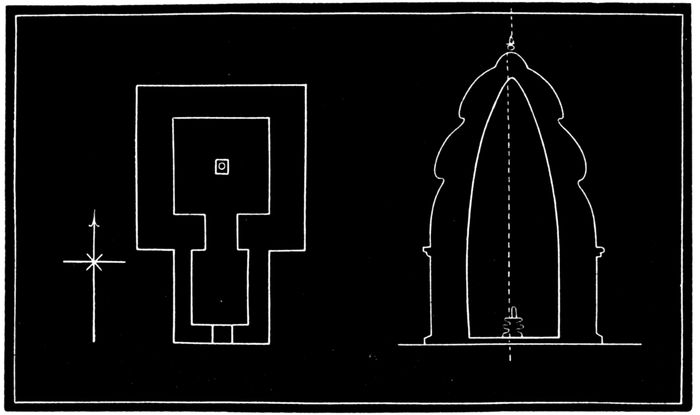
The interior of the pyramid forms one room, about 10 feet square,
with a domed ceiling, the thickness of the dome at crown being 2½
feet. In the centre of this room is placed the idol, in this case a
lingam, or cylindrical stone pillar, 1 foot 4 inches high, and about 9
inches in diameter, which stands on a square hollow stone tray (not
cut out of one stone, but fitted in two or more pieces) in which the
offerings of ghee, &c. are placed. This tray has a small spout on
each face to carry off the liquid ghee and water with which the priests’
ablutions are made. The tray is raised on masonry, so that the
height of the top of the lingam is 3 feet 4 inches from the floor. The
floor of the room is 1 foot above the surrounding ground; there is only
one doorway leading from the porch or entrance room above mentioned;
and the sacred edifice is closed by a substantial wooden door,
with iron hinges and lock, on the outer face of the entrance chamber.
The whole building is of brick in mortar, unplastered, and presents
the appearance of being weather worn.
The pagoda is at a distance of about 20 yards from some low native
houses, and stands in an open space, on two sides of which is the
native village; round the houses are some trees, mostly of small size,
but within 50 yards of the pagoda are two separate trees, which
certainly exceed it in height. The village is situated on the margin
of the Kistna river, and the surface of water in wells is at least 10
feet below the surface of the ground.
The lightning struck the metal finial on the top of the pagoda, and
passed vertically through the dome, travelled along the east side of
the lingam without leaving any mark, and bored a small round hole
in the stone tray beneath it, passing into the ground below without
(208)disturbing the idol or its foundation. The hole in the tray was not
quite large enough to admit the point of a little finger, and it was
situated on a joint of the stone, a place where moisture would probably
linger. The finial appeared undisturbed, but the masonry immediately
round its base was shattered, and a shower of pieces of
brick and mortar was sent from the top of the pyramid and scattered
over the ground on the east side to a distance of about 20 feet from
the base. The masonry of the apex of the pyramid was cracked in
three places, and a small hole was bored in it, on the east side of the
finial, apparently about the same size as that in the stone tray; but
otherwise the masonry of the building appeared totally uninjured—not
a crack could be found anywhere.
The soil at this place is a clayey loam, rather lighter than the
ordinary delta alluvial soil.
When the building was struck a sulphurous smell was noticed.
JOHN ASTED, Lieut.-Col. R.E.
Masulipatam,
17th May, 1878.
Irish Lights Office, Dublin,
13th March, 1880.
Adverting to your letter of the 13th ultimo, I have now the
honour to forward herewith for the information of the Lightning Rod
Conference copies of two Reports relating to the lighthouse at Berehaven
being struck by lightning, in 1877, which, no doubt, is the
Station alluded to by Professor Tyndall in his conversation with Mr.
Inglis, of the Trinity House.
I am, Sir,
Your obedient Servant,
W. LEES, Secretary.
Irish Lights Office, Dublin,
February, 1877.
I most respectfully beg leave to state that, in accordance with your
instructions I proceeded to Berehaven Lighthouse, and on my arrival
at that station I made a very careful examination and found that the
lightning was conveyed into the lantern by the iron stay bars that
were connected to the lightning conductor at a collar about 5 feet
over the gutter on the outside of the dome for the purpose of securing
it, and bolted to the dome of lantern by iron bolts. After bursting
off the several coats of paint at the heads of the bolts, it put out the
lights, breaking the glasses, and knocking down both light keepers
insensible; it having twisted off the lead voice-tube where it was
secured to the side of the lightroom by a holdfast, bursting out the
stone sheeting between the iron pillars supporting the marble top; it
then passed through the voice tube to the principal keeper’s bedroom,
(209)where it burst out the studding and lath and plaster, and tearing
away the voice-tube, the foot-board of the bed, and destroying the
pictures that were hanging on the walls. It would appear that the
current was interrupted in its course by the sudden bend of the voice-tube;
for, after having dealt destruction in this apartment it was
attracted by the iron holdfasts and spikes that secured the voice-tube
and studding to the walls, and passed out through the external
walls of dwelling to the out offices, where it passed along the eave
gutters to the end of them; it then followed one of the iron holdfasts,
and entered the wall, destroying it, and bursting out the cut-stone
kneeler and barge course, it then passed down through the roof
of the low buildings, destroying the slating, passing through the walls
of the pantry, &c., tearing up portions of the 3 inch Yorkshire
flagging of the floor and yard, dealing destruction to the shelving,
doors, door frames, brickwork, glass, &c., and bursting up the seat
of principal keeper’s w.c., it passed along the sewer to the assistant
keeper’s w.c., breaking up the flags and seat and then passed out
through the roof. Another current was attracted by the eave gutters
at the east angle of the dwelling near the tower, and passed along
them to the north east angle, splitting them through the centre. At
this point its course was changed to the west, and passed into the
assistant keeper’s yard and down the rain water pipe to the water
tank, splintering it and the slating and brick wall, &c.; it also
appears that the lightning struck the south-east side of the tower
and entered it in several places at the base and near the lightning
conductor, and apparently glanced off it where it was secured by
holdfasts to the tower, rooting up the solid rock, but giving no
indication that it had been conveyed to earth by the conductor as
intended: the lightning also entered the assistant keeper’s kitchen
through the chimney, knocking down a portion of the brickwork, &c.
I may remark that the lightning conductor is formed by a copper
rod, which stands about 10 feet over the gutter on the outside of the
lantern, and is secured by three iron stays to the dome, as before
described, and passes down through the centre of the gutter to the
under side, where it is connected to a ½-inch copper-wire rope, which
continues down the outside of the lantern close to the glass to the
floor of the balcony, passing through the stone floor by means of a
hole, jumped through it, then continues down the face of the tower
closely pressed to it by the iron holdfasts and copper bands, which
secure it until it reaches the rock at the base of the tower, where it
terminates in a small hole 3 inches by 3 inches, jumped out of the
rock about 6 inches under the surface.
After having made a careful survey of the damage done, I deemed
it advisable, and at the solicitation of the principal keeper, who seems
to have been greatly shaken and nervous, to have the iron stay-bars
disconnected from the dome of the lantern and the bolt-holes plugged
up with timber, fearing a recurrence of the accident, as the weather
was very stormy, and should lightning come on no person on the
rock would enter the lantern. I also considered it prudent to have
the loose gutters and cut-stone, also a part of the gable of the out
offices, taken down, as it was in danger of falling into the narrow
yard, which might cause a sad accident.
(210)Having provided workmen and materials and scaffolding for doing
this work I again landed on the rock on Saturday last, with great
difficulty, having been detained a day by the storm, and pointed out
the temporary repairs that were necessary to be done for the protection
of the people on the rock.
The probable cost of repairing the damage done the buildings,
independent of the lightning conductor, and which require to be done
without delay, will be £120. Hoping the action I have taken in this
matter will meet with your kind approval, I have the honour to be
Your most obedient Servant,
[The other report is to the same effect as the above, and is therefore
omitted.—Ed.]
ACCIDENT BY LIGHTNING at Upwood Gorse, Caterham, the
residence of J. Tomes, Esq., F.R.S. 28 May, 1879.
As I happened to be visiting Mr. Tomes, in the autumn of 1879,
I took the opportunity of obtaining all the particulars I could with
reference to the accident which occurred on the night of the 28th
May, 1879, when his house was struck by lightning.
The house, a sketch plan and elevation of which are annexed,
stands upon a hill upwards of 700 feet above sea level, and is somewhat
higher than any other object in the vicinity. It is covered by a
steep tiled roof, that of the principal portion of the house being somewhat
higher than the rest, and upon the ridge of this roof stand two
brick chimney stacks of equal height. Upon the eastern stack, at its
southern end, was fixed a lightning conductor (shown by the line,
A. B. C., on the south elevation), the upper part consisting of a point
and a length of copper tube ½ an inch external and ⅜ inch internal
diameter, which was screwed into a collar connected to a woven band
of one zinc and thirteen copper wires carried through glass insulating
rings along the slope of the roof, over the rain-water gutters and down
the side of the house into the ground, going only 12 inches into dry
chalk.
The electric fluid struck the lightning conductor, hurled the rod
down and shattered the chimney pots and some of the brickwork.
The rod was broken at the point marked A on the south elevation,
where the sectional area of the copper rod was reduced by the screw
being cut into it for the collar, which connected the rod with the
woven band. This junction and a portion of the band are forwarded
for inspection, from which it will be seen there are no rough broken
surfaces, but that the thread of the screw was partly melted. The
copper wires composing the band were bright and nodulated here and
there throughout their length, showing that it had been heated up to
a sweating temperature. The zinc wire was not continuous, having
been wasted by oxidization. It showed no indication of having been
hot.
(211)
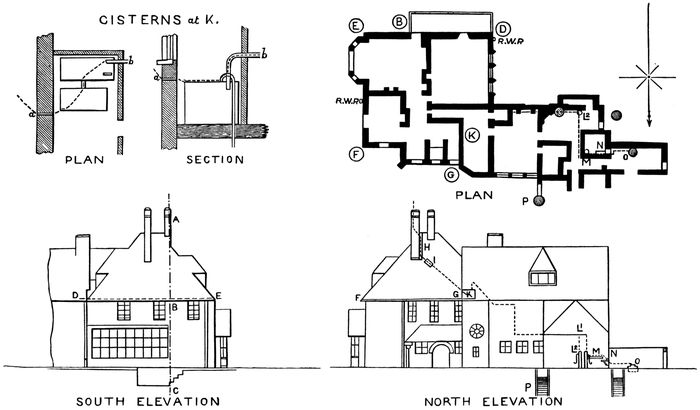
UPWOOD GORSE, CATERHAM. Scale—1 inch = 32 feet.
(213)Having broken the conductor, the discharge appears to have divided
at the ridge of the roof, a portion passing down the southern and a
portion down the northern slope of the roof. That portion which
passed down the southern slope apparently followed the course of the
conductor band as far as the iron rain-water gutter, which it cracked,
and perforated two holes, about half an inch diameter, in two panes
of glass at B. Here the current apparently again divided, as shown
by the dotted line from D to E on the south elevation, some passing
westwards and some eastwards along the rain-water gutter round the
eaves of the house, as traced by the broken joints of the gutter.
Westwards these joints (which were made of red lead) were only
broken from B to D, but eastwards they were broken from B to E,
and right round the eastern side of the house to F, and along the
northern side as far as G.
What seemed to be the greater portion of the discharge, however,
passed down the northern slope of the roof and along the course
shown by the dotted lines on the Plan and north elevation. The
lightning first followed the lead flashing H of the chimney stack,
next broke some tiles at I, and then without disturbing any of the
rest of the tiling, leapt across the roof, a distance of some 15 feet, to
two galvanised iron water cisterns in the roof at K, perforating a hole
through the 9–inch brick wall of the house in its course.
This hole, which was circular, was large enough to admit one’s
finger easily and was blackened on its interior; when first examined,
eight or ten minutes after the occurrence, it was still quite hot. One
edge of the lead flashing outside the wall was fused at G, close to the
rain-water gutter, from which it would seem that the current again
divided at the wall of the house. There are two galvanised iron
cisterns at K, connected by a pipe underneath (see adjoining sketch
plan), and the discharge appears to have passed from one cistern to
the other and then along the 1½ inch iron barrel rising main, from
pumps, to the point L1 in the back kitchen, where the iron pipe
separated into two branches leading to the two pumps L2 and M.
Probably a portion of the discharge passed down the iron suction
pipe from the pump L2 into the rain-water tank P, but however this
may have been, a considerable portion passed from point L1 along the
1½ inch iron pipe LM to the pump M in the scullery, and thence along a
¾ inch iron pipe to a water tap fixed over the iron sink N, but not in
metallic connection with it. Here the lightning broke the slate at
the back of the sink and sent it showering across the scullery, breaking
the things on the opposite side of the room. The iron sink was set
on brick piers and connected, by means of a 1½ inch iron pipe, with
the self-acting syphon “Flush Tank” O in the yard. This “Flush
Tank” consisted of a cylindrical cast-iron tank about 26 inches in
diameter and 26 inches deep, buried two-thirds in the ground, so that
it formed a fair earth connection.
There is an account of the accident in a letter by Mr. Charles S.
Tomes in Nature, of 12 June, 1879 (which has been made use of in
the present description), and there is also a letter about the accident
by Mr. Newall on the next page of Nature to Mr. Tomes’ letter. The
description in this latter letter is, however, erroneous in several
(214)particulars, especially where it speaks of the lightning passing round
the iron gutters to the iron water cisterns.
ROGERS FIELD,
B.A. Lond., M. Inst. C. E., F.M.S.
[Note.—Mr. Tomes has most kindly sent the whole of the upper
parts of the conductor; and as the accident appears a very instructive
one we give full details, together with engravings of the more important
portions of the conductor.—Ed.]
This conductor was of the pattern known as Spratt’s patent. The
upper terminal was what the vendors call a “reproducing point,”
which they say is “formed of two or more metals: the inner or core
being steel, and the outer of silver alloy, tipped with platinum;” the
idea of the inventor is said to have been that “should the outer coating
become fused by an extraordinary charge of electricity, the core
will remain intact to receive any further discharge.” In the present
case the top is broken and the iron centre is rusted and bent, but
there is no indication on the remaining portion of heat or fusion.
This point A was well screwed into a stout copper collar B.
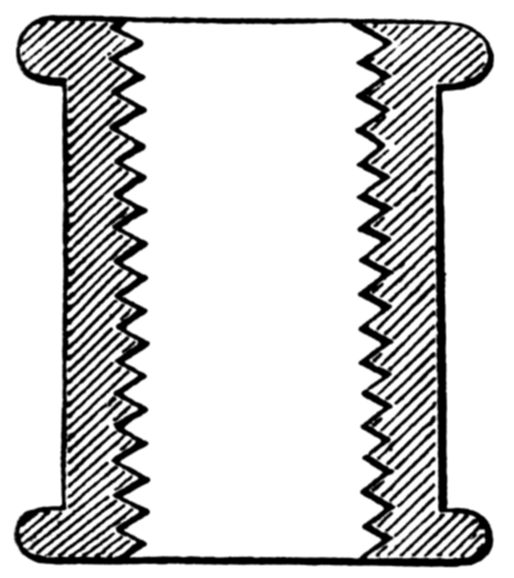
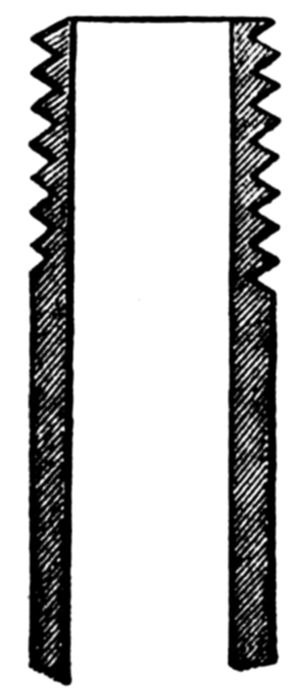
Into the same collar was screwed the upper end of a copper tube C,
5 ft. 1 in. long, external diameter, 0·5 in., and internal diameter
about 0·36 in., giving a thickness of only 0·07 in., or but little more
than a sixteenth of an inch. The mass of copper was therefore about
equal to a tape 1½ × 1/16, or ¾ × ⅛, or to a rod one-third of an inch in
diameter—the area being as nearly as possible 0·09 in. The tube
weighs 29½ ounces, which corroborates the above measurements and
shows that it weighs rather less than 6 ounces per foot. This part
of the conductor was evidently greatly heated, as there are distinct
marks of sweating in several places. The lower part of this tube was
screwed into the collar D (which is drawn of its actual size in the annexed
sketch) in order to make connection with the short length of copper
(215)tube F, a portion of which is also engraved, of its
actual size. It was at E that the rupture occurred.
The charge passed the point A, then the top collar
B, and although it greatly heated the 5 ft. copper
tube C, still no damage was done, and so it passed
into the second collar. Here, however, there seem
to have been two faults: the short copper tube F,
was very slight, weighing but little over 3½ ozs. to
the foot, and this, which represents but a very
slight conductor, was greatly lessened by a deeply-cut
thread to the upper end, whereby the area was
reduced to less than 1/20th of an inch. As this was
not screwed home, the total sectional area at E
immediately below the collar was reduced to the
above small amount, rupture and fusion occurred,
and much of the charge left the conductor. This
short length of tube was, however, raised to a
sweating temperature in two places.

The conductor consisted of 14 wires made into
a flat plait, the wires seem to have been of the
following dimensions:—
|
Each of No. |
|
Total area. |
| 12 |
copper wires, |
15 |
B.W.G., dia. of each |
·072 in.: |
0·048 in. |
| 1 |
copper wire, |
18 |
B.W.G., dia. of each |
·049 in.: |
0·001 in. |
| 1 |
zinc wire, |
|
of each |
·049 in.: |
0·001 in. |
Thus the total sectional area of the plait G would
be about 0·050 in., or rather more than that of the
short copper tube into the lower end of which it
was roughly thrust and riveted—but the joint was
bad, there was no solder at all, and the metallic
contact was very imperfect.
As to the state of this plait (which was less than
an inch wide, and less than ⅒ in. thick), and as
to the ridiculously imperfect earth terminal, details
are given in Mr. Field’s letter.
It may be well to recapitulate the dimensions:—
| Description. |
Length. |
Dimensions. |
Sectional Area. |
Heat Effects. |
| “Reproducing point” |
9 in. |
0·45 × 0·45 in. |
0·20 |
None visible. |
| Collar |
1¼ in. |
0·75 in. diam. |
0·24 |
None visible. |
| Copper tube |
5 ft. 1 in. |
External 0·5 in. dia.
Internal 0·36 in. dia. } |
0·09 |
{Sweated in places. |
| Collar |
1⅛ in. |
External 0·75 in. dia.
Internal 0·50 in. dia. |
0·24 |
None visible. |
| Short tube |
7 in. |
External 0·50 in. dia.
Internal 0·375 in. dia. |
0·09 |
{Sweated in places. |
| Short tube where threaded |
¾ in. |
External 0·438 in. dia.
Internal 0·375 in. dia. |
0·04 |
Fused. |
| Plait |
53 ft. |
? 0·7 × 0·072 in. |
0·05 |
Sweated in places. |
(216)We herewith hand you our circular, setting forth our ideas as to
lightning conductors. We claim that if one or more sharp edges or
points is so essential on the most elevated part or parts of a conductor,
why not establish this principle the entire length of the conductor?
or why not leave these most elevated part or parts blunt, or
erect a small gilt ball?
Indianapolis, Indiana, U.S.A.
[The engravings are not drawn to scale, but are here reproduced; the shaded parts are galvanized iron, the lighter parts copper.—Ed.]
I think that it would be very valuable if the Conference considered
how far iron ventilating pipes to drains will safely act as lightning
conductors. These pipes generally consist of iron jointed with red
lead or putty. Will not these joints interfere? Very often also a
portion of the pipe is wholly of lead. So many of these pipes are now
carried up to a very high level that the question is important.
ROGERS FIELD, M.Inst.C.E.
Our opinion is that the drain to our Powder Magazine at Bruntcliffe
(see ante page 74) had no water in it at the time of the
occurrence.
Victoria Collieries,
Gildersome.
We have the pleasure to send you a plated model of our new Conductor
Coupling, and hope you will be pleased with it.
When screwed up, the contact between the rod and the copper tape
is perfect. It is, of course, a very simple thing, but it overcomes the
difficulty of soldering, which is always more or less uncertain, and
rivetting up aloft is apt to be scamped.
And as to soldered connections, apart from the uncertainty of
permanent contact, it is very important to keep the soldering iron
(217)away from roofs, it often damages the lead, and (as at Canterbury) the
fire-pot is a source of great danger to buildings.
A is the copper tape conductor. B is a screw plug, having two
slots, a a (see fig. 3), and an intervening division b, all cast in one
piece. The tape or rope A is passed through one of the slots a, and
bent over the division piece b, the bent portion A1 is then returned
through the other slot. A screw socket forming the coupling C,
bearing a collar to rest in a ring bolt built into the structure to be
protected, is then screwed on to the plug B, and into this socket the
rod or tube D is screwed, it being suitably tapped for its reception,
until the lower end of the rod or tube is in firm contact with the
tape or rope. These latter are then firmly held together, and cannot
by any possibility come apart.
Note.—In fig. 2 the rod and tape are not shown in actual contact,
the drawing being intended to exhibit the separate parts.
147, Queen Victoria Street.
I have the pleasure of furnishing details of the recent damage to
Christ Church, at Carmarthen. The circumstances are these:
At the Eastern end of the church stands an ordinary square
tower, covered with a sloping slated roof; this roof is capped by an
ornamental open ironwork ridging, terminating at each end in a
(218)light open iron pinnacle, and having in the centre another pinnacle
similar to those at the extremities. A is a view of this ironwork
from the east end of the church.
The conductor consisted of seven copper ropes stranded together,
each rope consisting of seven strands of No. 18 wire, the whole
having a diameter of about ½ an inch. It was fixed to the building
by ordinary copper staples; it ran up, and was attached to the
southern portion of the ornamental railing, and it terminated in a
single point. There was no special connection between the conductor
and the iron guttering of the church.
I could not ascertain in what manner the earth was made, but it
was an imperfect one, giving a resistance of 115 ohms, and this resistance
would have been greater but for an accidental circumstance
mentioned further on.
The lightning struck the central iron pinnacle of the ornamental
ridge and broke it off. In falling to the ground it was shattered into
about twenty pieces; but on the upper extremity, which was a solid
cast-iron spike, about ¾ inch square, there were marks of fusion across
the whole of the top to the depth of ⅛th of an inch.
I could not observe other marks of fusion at the point where the
pinnacle was broken off, but the lightning made its way to the conductor,
and on reaching the ground, at a distance of 4 feet from the
point where it entered, it burst out with explosive violence, blowing
a circular hole in the ground 2 feet in diameter and 8 inches deep
(marked B in plan). The earth from this hole was blown into the
air, and fell in a fine shower on objects standing 3 or 4 feet high
and 14 or 15 feet from the hole.
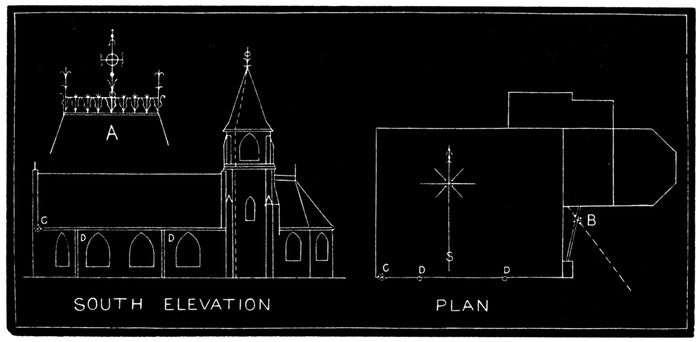
Christ Church, Carmarthen.
A second flash struck the iron guttering at the south-western
extremity of the church (C), broke off a 2 feet length, and ran down
the waterspouts (D D). Opposite one of these a second hole, 9
inches deep and a foot in diameter, was blown out of the ground,
some 3 feet from the base of the spout.
(219)On examining more closely the surroundings of the lightning conductor,
I observed that the church gas-pipe, an iron one, about
1¼ inches in diameter, passed through the wall of the building about
6 feet from the conductor, and was carried in a direction corresponding
with the hole caused by the explosion (see plan). I immediately
concluded that this explosion was due to the current breaking across
from the conductor to the gas-pipe, and on opening up the hole I
found this to be the fact. The conductor crossed the gas-pipe at nearly
a right angle, being about a foot above it. The under portion of the
conductor bore evident marks of fusion, and, more interesting still,
the gas-pipe was slightly coated with a very thin deposit of copper,
so thin that it perished in my attempt to remove it; but still there
was an undoubted coating at one spot. But for the proximity of the
conductor to the gas-pipe, the earth resistance of the former would
doubtless have been greater than it was, and the damage would probably
have been increased.
I was sorry that no means existed for examining the ornamental
ridge, but doubtless the metallic contact between the sections was
very imperfect, and to this cause was due the rupture of the pinnacle.
The fact, too, that the protector did not prevent the south-western
portion of the building being struck bears on the question of the area
made safe by a protector.
The tower stood 89 feet above the ground, the top of the iron
pinnacle 99 feet, and the protector extended 1 foot 6 inches above
the latter, thus reaching a total height of 100 feet 6 inches. The
total length of the church was 123 feet.
The point C where the gutter was struck was 84 feet in a direct
line from the conductor, and stood 24 feet above the ground.
This gives a vertical height of the conductor of 76 feet 6 inches above
the point struck, the distance of the latter being a radius 8 feet greater
than the height of the former.
Cardiff,
January 10th, 1880.
The discharge occurred about 3 a.m., 22nd June, 1876. The
principal injury occurred to the bracket lamp at A. This lamp, which
was an ordinary street one, was supported by an iron bracket 2 ft.
6 in. long, and 11 ft. 6 in. above the pavement. The gas was conveyed
to it by 11 ft. 6 in. of vertical iron gas barrel, and thence to the
burner by about 3 ft. of ordinary ½ in. composition pipe. The glass
of the lamp was not broken, but about 18 inches of the composition
piping was twisted and split open as with a sharp knife, and the
other 18 inches was melted; the gas was ignited and burning
from the top of the iron barrel, thus producing a large flame which
ignited the house to which it was fixed. That part of the lead
(220)pipe which was inside the lamp was uninjured, whence it would
appear that the point struck was at or near to the top of the iron
gas barrel; and this is supported by the fact that the lead over the
shop window and close to the bracket was turned up off the wood-work.
The lamp, as will be seen by the plan, is attached to the corner of
a house, the eaves of which were 20 ft. above the lamp, while the
ridge, with a little lead flashing, was 24 ft., and the chimney pots
were 31 ft. above the lamp, and not 15 ft. distant horizontally. This
house was slated and had wood gutters, and an iron rain-water
pipe, but the latter was 33 ft. horizontally from the point struck.
The wooden gutters were very old and rotten, and one of them was
very slightly shifted; it is not certain that this was done by the
lightning, and there was no other indication of its presence.
C is a lamp bracket extending 4 ft. from the wall of the house, and
at D are two old iron brackets.
At the distance of only 8 ft. from the lamp in the opposite direction
(N.W. of the lamp) rises Bootham Bar, a massive stone structure,
of which the four turrets rise to 44 ft. 3 in. above the pavement, and
therefore 33 ft. above the lamp. The whole roof, about 750 square
feet, is covered with thick sheet lead, and the building also contains
the old portcullis B heavily shod with iron.
The noteworthy feature of the case appears to be, that the only
injury is found at a spot surrounded by objects close to it, and greatly
exceeding it in height; in fact, that the lightning dipped into a sort
of cavity, instead of striking at the higher objects.
It is evident that in this case, although the composition pipe was
melted, the iron one afforded ample conduction, and the city gas mains
a perfectly safe earth terminal.
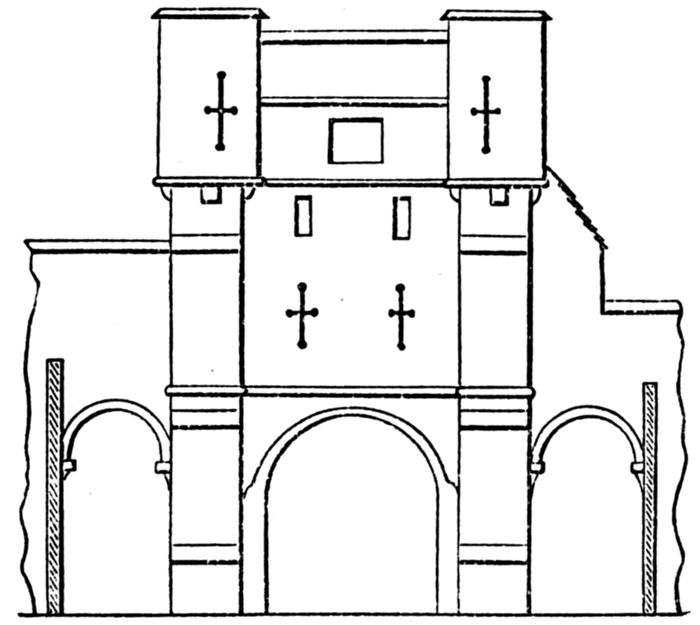
SOUTH-EAST VIEW OF BOOTHAM BAR.
(221)ACCIDENT AT BOOTHAM BAR, YORK.
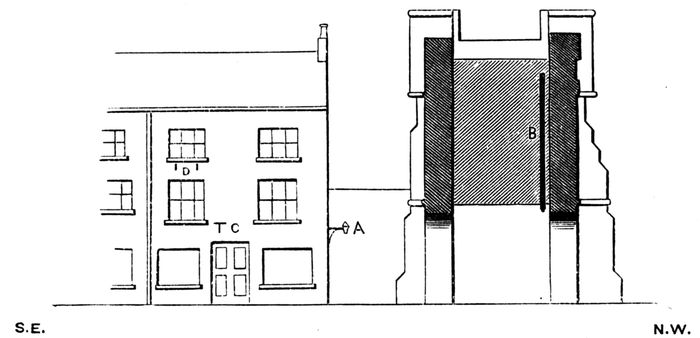
VIEW OF HOUSE AND SECTION OF BAR.
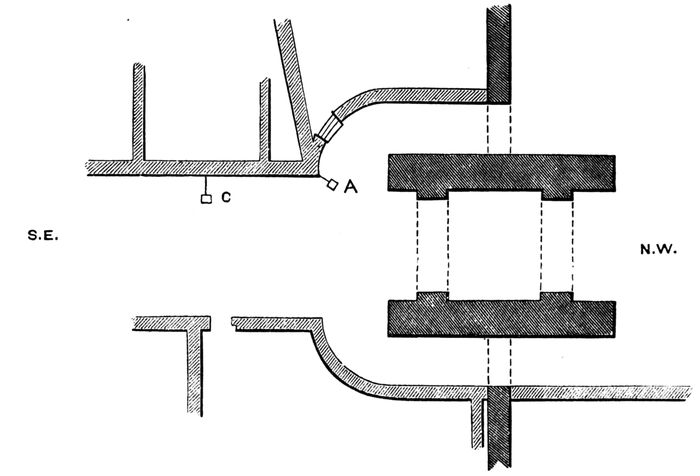
GROUND PLAN OF HOUSES AND OF BAR.
A Gas bracket struck.
B Iron sheathed portcullis.
C Old gas bracket.
D Old Iron brackets.