AUTHOR OF “YOUNG AMERICA ABROAD,” “THE ARMY AND NAVY STORIES,”
“THE WOODVILLE STORIES,” “THE BOAT-CLUB STORIES,”
“THE STARRY FLAG SERIES,” ETC.
BOSTON:
LEE AND SHEPARD, PUBLISHERS.
NEW YORK:
LEE, SHEPARD AND DILLINGHAM.
1871.
Entered, according to Act of Congress, in the year 1869, by
WILLIAM T. ADAMS,
In the Clerk’s Office of the District Court of the District of Massachusetts.
ELECTROTYPED AT THE
BOSTON STEREOTYPE FOUNDRY,
No. 19 Spring Lane.
TO
MY YOUNG FRIEND
JAMES DEWITT CARSON
This Book
IS AFFECTIONATELY DEDICATED.
THE LAKE SHORE SERIES.
THROUGH BY DAYLIGHT; or, The Young Engineer
of the Lake Shore Railroad.
LIGHTNING EXPRESS; or, The Rival Academies.
ON TIME; or, The Young Captain of the Ucayga
Steamer.
SWITCH OFF; or, The War of the Students.
BRAKE UP; or, The Young Peacemakers.
BEAR AND FORBEAR; or, The Young Skipper of Lake
Ucayga.
PREFACE.
Lightning Express is the second volume of the Lake
Shore Series, and has been published in Oliver Optic’s
Magazine, Our Boys and Girls. The story, like its predecessor,
relates to the Lake Shore Railroad, though the war
between the rival academies occupies a considerable portion
of the book. Waddie Wimpleton and Tommy Toppleton, as
they appear in these volumes, are not strangers, in real life,
to the writer; and probably all his readers are familiar with
similar young gentlemen in their own spheres.
The author has endeavored to keep the moral movement of
the story up to the proper standard, and is not afraid that
any reasonable young man will like either Tommy or Waddie
well enough to imitate their conduct, while he is satisfied that
all will be pleased with the moral heroism of Wolf Penniman,
and will indorse his views of Christian duty.
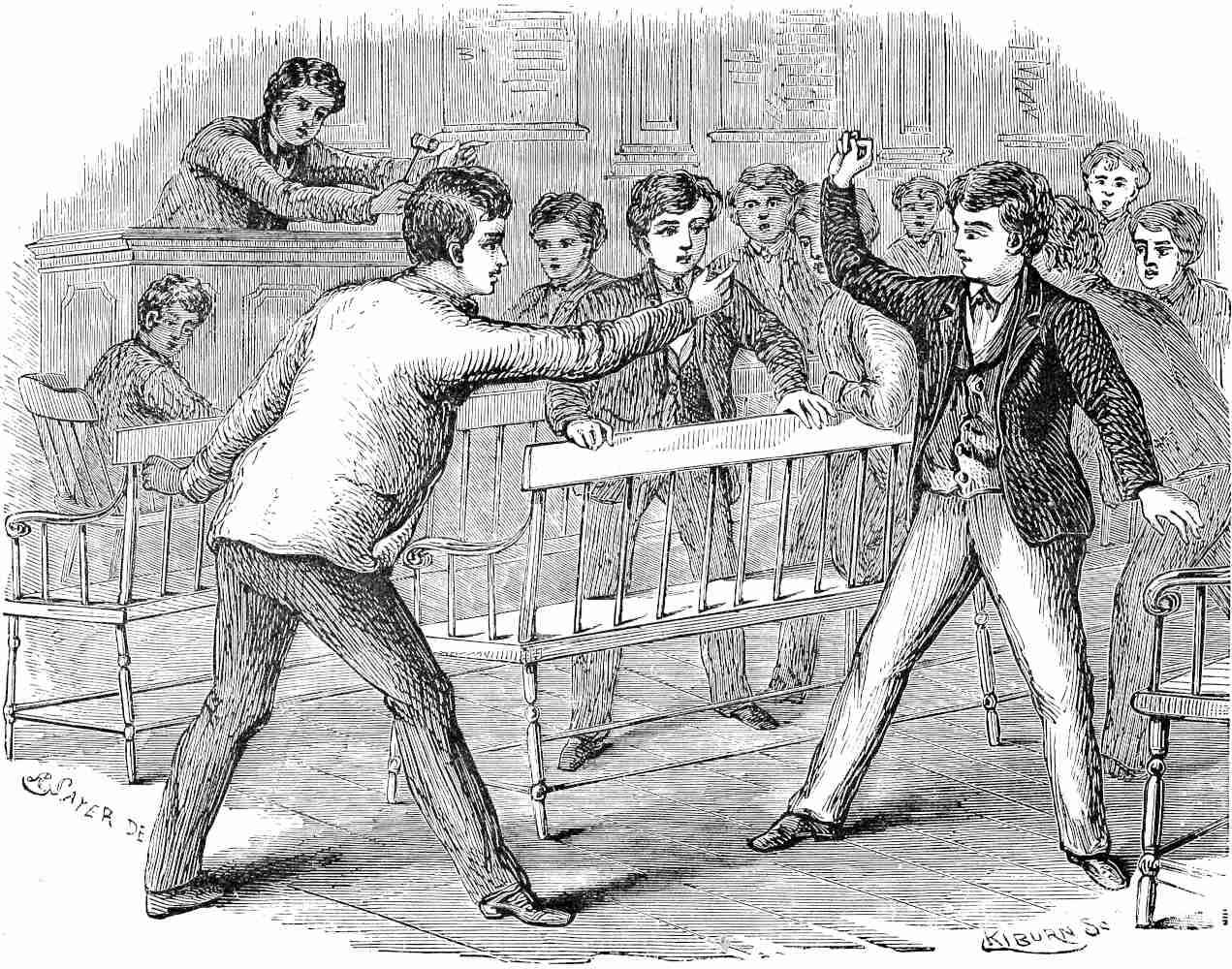
“Order, gentlemen, order!” said Mr. Tommy
Toppleton, rapping his gavel on the desk
before him. “While I am president of the Lake
Shore Railroad, I will have order!”
Tommy was the son of his father; on this question
there could be no dispute. Not only was his
father a great man, but Tommy, in his own estimation,
was a great man also; on this question,
unfortunately, there was some dispute. Perhaps it
was the young gentleman’s misfortune, certainly it
was not his fault, that he was the only son of a
very rich father, and had been indulged until he
was, so far as the circumstances would admit, a
spoiled child. He had many excellent qualities;
but he had come to think that among the boys he
was the central figure, and that without him they
were nothing, and could do nothing.
Tommy regarded other boys, even the students
of the Toppleton Institute who were his equals in
wealth and social position, as in some sense footballs
for his capricious toes. Many of his companions
did not like him, because he “put on airs,”
because he was overbearing and tyrannical to his
inferiors, and because he always claimed the highest
position and the loftiest dignity among them.
When the Lake Shore Railroad Company was organized,
he was elected one of the board of directors,
and then by them was chosen president. He
had filled this office from the beginning, and he
expected always to fill it.
The company had been in operation about a year,
during which time it had dealt mainly with imaginary
certificates of stock, bonds, rolling stock, and
other material, the object being to give the
students a knowledge of railroad business. The actual
building of the road had rendered the company
somewhat more real; but, as all the property was
in fact owned by Major Toppleton, who held the
bonds of the company for its full value, it was still
to the students an educational rather than a practical
business enterprise. The real owner, therefore,
was the real manager of the road. He told
the directors what votes to pass, and they were
pliant enough to obey. All the forms of electing
officers, appointing the superintendent, road-master,
engineers, and other officers, were punctiliously adhered
to.
The capital stock of the company was two hundred
thousand dollars, represented by two thousand
shares of one hundred dollars each, which had been
apportioned among the students of the Institute, in
unequal parts. Some owned one hundred shares,
others only two or three. Tommy Toppleton was
the happy possessor of a quarter part of the capital
stock of the concern, and threw five hundred votes,
each representing a share, in a stockholders’ meeting.
An account was kept with each owner of
stock, and transfers from one to another were frequent.
I am sorry to detract from the dignity of
the enterprise by confessing that a share, whose par
value was one hundred dollars, was frequently bartered
away for a pint of pea-nuts, though, as the
road, like many others, was mortgaged for its full
value, perhaps the compensation was adequate.
Two thousand mortgage bonds of one hundred
dollars each had been issued, duly signed by the
officers, and bearing interest at seven per cent. As
the company had no receipts for the first quarter
of the year, the railroad was heavily in debt, and
the students were not likely to be burdened with
any extra spending money from their dividends. I
had run the dummy during the fall and winter,
carrying passengers as far as Grass Springs; not for
the fun of it, but at regular fares—twenty cents
to Spangleport, five miles distant, fifty cents to the
Springs, thirteen miles, and between the two latter
points, thirty cents. There had been considerable
travel, enough to make a breeze with the steamboat
company, though not enough to pay the interest
and expenses of running.
As the students were not permitted to neglect
their studies for the purpose of serving as conductors
and engineers, outsiders had been employed
to some extent. Major Toppleton did not regard
the Lake Shore Railroad as a mere plaything. During
the winter he had procured his charter, and he
had expended an immense sum of money on the
road since he commenced, for his ideas had enlarged
as he progressed, and he intended to have a regular
line to Ucayga, at the foot of the lake. In a quiet
way he had bought up the stock of the steamboat
company, and a report was circulated in the spring
that the boats would run only between Middleport
and Hitaca, at the head of the lake, when the railroad
was completed. The Centreporters were filled
with horror and indignation, for this scheme would
leave them no means of communication with Ucayga,
on the great lines of railroad, except by the way
of Middleport, and would compel them to patronize
the hated Lake Shore line. But this project was
only rumored; it had not yet been developed.
The assembly in which Mr. Tommy Toppleton
insisted that order should be preserved while he
was the president of the Lake Shore Railroad, was
the annual meeting of the stockholders, at which the
election of officers was to take place. By permission
of Major Toppleton I was allowed to own five
shares in the road, though, as I was not a member
of the Institute, I was not eligible as a purchaser
of stock. But I felt an interest in the enterprise,
and an interest in the method of conducting the
business, and I had purchased my stock at a fearful
depreciation from the par value. One of the
fellows, by the name of Limpenfield, had run out
of pocket money, and being sorely tempted to enjoy
a feast of cream cakes, I had taken advantage
of his necessities, and bought five shares for twenty-five
cents!
The meeting threatened to be rather stormy, for
I happened to know that there were two tickets
in the field for a board of directors, on one of
which the name of Tommy Toppleton did not appear,
though the canvassing had been so carefully
conducted that the person principally concerned had
no suspicion of his own unpopularity, and least of
all that the stockholders would have the audacity
to tip him out of his exalted position. But this
question had not yet come to an issue. The excitement
was over another matter.
“I move you that we proceed to the election of
officers at once,” said Barnscott.
“I move you that we adjourn to Grass Springs!”
shouted Wetherstane.
“Second the motion!” added Putnam.
“Order, gentlemen! What motion do you second,
Putnam?” demanded the president.
“The motion to adjourn to Grass Springs, of
course.”
“What do we want to adjourn to Grass Springs
for?” demanded Barnscott.
“Question! Question!” called the crowd.
“There is no motion before the stockholders!”
roared Tommy, hammering the desk vigorously with
his gavel, for he was a model presiding officer, and
would no more have served in this capacity without
a gavel than he would have gone to meeting without
a coat.
“Mr. President, I made a motion,” said Barnscott.
“So did I,” added Wetherstane.
“Neither of them is before the house. Gentlemen,
you interrupt the company’s business by your
disorder. I insist that the proceedings be conducted
with parliamentary propriety.” Tommy had been to
the legislature with his father when the charter was
obtained, and indulged in technical phrases which
all the students did not fully comprehend.
“I move you—”
“Order!” screamed Tommy, at the top of his
lungs, and as savage as a yellow wasp.
“I move you—”
“Order!” repeated the vigorous president, indicating
each of the movers by pointing at them
with his gavel. “Take your seat, Barnscott! Sit
down, Wetherstane! This business shall be done
in an orderly manner, or not at all;” and Tommy
swelled up till he was as big as the presiding
officer of the Senate of the United States.
“I thought this was a free country, and that
the stockholders of the Lake Shore Railroad had
a right to speak in the meetings,” growled the irrepressible
Barnscott.
“Sit down!” thundered Tommy.
“I have a certificate for ten shares; and that
gives me the right to speak and to vote in this
meeting,” added the indignant Wetherstane.
“Take your seat, or I will have you put out of
the hall!” yelled the president.
“I’ll sell my stock to any fellow that wants it
for a stick of molasses candy,” continued the wrathy
Barnscott. “What is the use of owning stock if
you are to be muzzled like a mad dog?”
“Shall we have order, or not?” cried the president,
disgusted with the irregular proceedings of
the turbulent stockholders.
“Order! Order!” shouted a respectable majority
of the assembly.
Tommy was evidently out of breath, and disposed
to resort to disagreeable measures. The meeting
was held in the chapel of the Institute, and the
principal, if not the major, was within calling distance.
Rather than have a lecture from either of
them, the violent makers of motions subsided for a
time, and permitted the president to do the lecturing.
Tommy took a swallow of water from a
tumbler on the desk, and then looked majestically
around the room, as if to satisfy himself that no
further disorder was intended, and that the turbulent
ones were disposed to listen to his remarks.
“Gentlemen, order is Heaven’s first law, and it
must be the first law of the Lake Shore Railroad
Company, especially in a meeting of its stockholders,”
Tommy began, and then paused, looking as
solemn as an owl at noonday, to note the effect of
his impressive words.
As no one objected to this proposition, Tommy
took another swallow of cold water, and proceeded
with his remarks.
“No business can be done while we are in confusion,”
he continued, with due seriousness, as he
straightened back his neck. “This is a parliamentary
assembly, like the legislature of the state, and
we purpose to do all things in a parliamentary
manner. Such bodies, met together for purposes
of debate, are subject to certain well-established
rules, sanctioned by usage, and governed by precedents.”
“Whew!” whistled Briscoe. “I wonder what
book he stole that from.”
“I beg your pardon, Mr. President, but I made a
motion, which was properly seconded,” interrupted
Wetherstane, quite mildly now. “I don’t think any
other business can be brought before the house till
that one has been settled.”
“The motion was in order,—a motion to adjourn
is always in order,—but it was not properly before
the stockholders. The motion does not become a
question, and is not before the house, until it has
been stated by the presiding officer. A motion cannot
be entertained until it has been seconded; and
made and seconded, it does not become a question
until it has been stated by the president. One question
must be disposed of before another can be entertained.
Gentlemen, I insist upon order. I am
now ready to hear any motion;” and Tommy, having
laid down the law, intended that everybody
should abide by it.
CHAPTER II. THE STOCKHOLDERS IN COUNCIL.
Mr. Tommy Toppleton had reduced the
riotous assembly before him to a tolerable
degree of subjection. The president was obliged to
embody in his own person the dignity of the Lake
Shore Railroad, since those in front of him refused
to be conscious of the glory of being stockholders.
He was ready to hear any motion, and it was evident
that he intended to keep the peace. But the
boys were really excited. They had been discussing
the interests of the road, and some of their
projects would certainly prove to be treasonable to
the house of Toppleton. It must be confessed that
a great many of them could not see the difference
between their own interests and those of the road;
and being excited, they did not set a good example
to their elders in Congress and other deliberative
bodies, but behaved very much like full-grown
men on similar occasions.
“Mr. President,” said Wetherstane, springing to
his feet, as soon as it was evident that a motion
was in order.
“Mr. President,” called Barnscott, almost at the
same instant. “I move—”
“Wetherstane has the floor,” interposed the impartial
presiding officer, vigorously pounding the
desk with his gavel; and I must say he made
noise enough to entitle him to preference as one
of the gentlemanly conductors on our road, where
noise seemed to be at a premium.
“What sort of way is that?” demanded Barnscott.
“I have the floor.”
“Wetherstane attracted my attention first, and
he has the floor,” replied Tommy, decidedly.
“I was up first,” persisted Barnscott.
“Take your seat, sir!” roared the president; and
the pine boards of which the lid of the desk was
composed were in imminent danger of being fractured
by his gavel.
“Mr. President, I rise to a point of order,” said
Lennox.
“Order, gentlemen!” roared Tommy. “I have
decided that Wetherstane has the floor. If any
stockholder is so disposed, he can appeal from the
decision of the chair.”
Under ordinary circumstances, Tommy Toppleton
did not permit any appeal from the decision of the
chair, and always insisted upon having his own way;
but it was in the nature of a triumph for him to
direct the deliberations of his fellow-students, and
to introduce forms and methods of which the majority
of them had never heard.
“I appeal from the decision of the chair,” added
Lennox.
“Points of order necessarily take precedence of
all other questions,” said Tommy, with the utmost
dignity and self-possession.
“Ahem!” coughed a fellow in the crowd, which
brought down a regular board-splitter from the
gavel.
“The chair decided that Wetherstane had the
floor. An appeal is taken. The question now before
the house is, Shall the decision of the chair
stand as the decision of the stockholders? This
question is debatable, and the presiding officer may
participate in the discussion. You will all see that,
occupying a position where I can see all the members
of the assembly, I could not very well make
a mistake in regard to who spoke first. I am quite
confident that Wetherstane had said ‘Mr. President’
before Barnscott opened his mouth.”
Various opinions were expressed by individual
stockholders, and they were about equally divided
on the merits of the question. Each claimant for
the floor had half a dozen advocates, who were
confident that their man had spoken first. It was
really a matter between Tommy and the stockholders,
which they were likely to decide as they
loved or hated the president.
“Question! Question!” called the students, when
they began to be weary of the fruitless debate.
“Those in favor of sustaining the decision of the
chair will manifest it by saying, ‘Ay.’”
“Ay!” shouted many voices.
“Those opposed say, ‘No.’”
“No!” responded the determined opponents of the
president.
“It is a vote!” said Tommy, who was not quite
willing to believe that one of his decisions could
be reversed by a majority.
“A vote!” exclaimed Lennox. “Why, Mr. President—”
“Silence, sir! A vote cannot be debated,” thundered
Tommy, with awful dignity. “Any member
has the right to doubt the vote, and call for a
count.”
“I doubt the vote, Mr. President, and call for a
count,” added Lennox.
“The vote is doubted,” said Tommy, rapping violently
to repress the noise and confusion. “Those
in favor of sustaining the decision of the chair will
rise and stand uncovered till counted.”
“Uncovered?” demanded Briscoe. “Shall we take
our things off?”
“Order!”
Tommy’s friends, and those who had not backbone
enough to vote against his decision, rose and
were counted. I voted with this side because I
really believed that Wetherstane had spoken first.
“Twenty-one,” said the president, after he had
counted the affirmatives; and I noticed that his
lips were compressed, as if to subdue some angry
emotions which he felt at the result.
“Those opposed stand till counted.”
A large majority, obtaining pluck from mere numbers,
sprang to their feet.
“All up! All up!” shouted the more demonstrative
of the rebels, who had doubtless been to town
meetings in their day.
“Order!” screamed Tommy, more fiercely than
ever; for the vote, to him, looked like factious
opposition. “Eighty-six in the negative,” he added,
when he had completed the count.
Silence reigned in the hall then, and perhaps
many of the students were appalled to think of
what they had done. They had actually voted
down the high and mighty Tommy Toppleton,
whose word was law. The experience of the nations
that deliberative bodies are not favorable to
the rule of tyrants was in a fair way to be realized
by the heir of the house of Toppleton. The boys
watched the president, expecting an outburst of
indignation and wrath at his defeat; but, happily,
the dignity of the presiding officer prevailed over
the feelings of the individual, and with a mighty
struggle he repressed his emotions. As I have had
occasion to say before, Tommy was in the main a
good fellow; he would have been a first-rate one
if he had not been spoiled by the weak indulgence
of his father and mother. He had been taught to
have his own way, and his passions were a volcano
within him, ready to break out whenever he was
thwarted. I am inclined to think this was the first
time he had ever conquered himself, and restrained
his wrath when defeated.
“The decision is in the negative,” added Tommy,
with admirable self-possession for one of his temperament.
“Barnscott has the floor.”
“Mr. President,” said the lucky claimant, “I move
that we proceed to the election of officers for the
ensuing year.”
“Second the motion,” added Faxon.
“It is moved and seconded that the stockholders
proceed to the election of officers,” continued Tommy,
who could not see why all this storm had been
created on so simple a proposition. “The question
is now before the house.”
“Mr. President!” shouted Wetherstane, loud
enough to have been heard on the other side of
Ucayga Lake.
“Wetherstane,” replied Tommy, indicating that the
speaker had the floor.
“I move you that we adjourn to Grass Springs
at two o’clock this afternoon,” added the young gentleman,
who, beyond the possibility of a doubt, had
the floor now.
“Second the motion,” added Putnam.
“It is moved and seconded that we adjourn to
Grass Springs at two o’clock this afternoon,” repeated
the president, wondering what this movement
meant.
“What’s to be done with my motion?” demanded
Barnscott. “I thought one thing had to be settled
before another was brought up.”
“A motion to adjourn is always in order,” said
the president.
“Mr. President, I rise to a point of order,” interposed
Skotchley, a quiet kind of fellow, who had
studied deeper into parliamentary law than even
Tommy Toppleton, for he had been the presiding
officer of a juvenile debating society.
“State your point, Skotchley.”
“I respectfully submit that the motion to adjourn
is not in order, for the reason that, to entitle it to
precedence, it should simply be a motion to adjourn
without fixing a time.”
Tommy was nonplussed. The question took him
out of his depth. He had Cushing’s Manual in his
pocket, but it would not be dignified to consult it
in the presence of the stockholders. However, he
knew that Skotchley was well posted, and he deemed
it prudent to follow his lead.
“The chair decides that the point is well taken,
and that the motion to adjourn is not in order,”
said he, though probably he would not have been
so pliant if he had not been opposed to the substance
of the motion. “By the ruling out of this
motion, Barnscott’s is now in order.”
“That’s a pretty how d’ye do!” exclaimed Putnam.
“Order! The motion to proceed to the choice
of officers is now before the house.”
“Mr. President, I move to amend the motion by
the addition of the words, ‘at Grass Springs at two
o’clock this afternoon,’” said Wetherstane.
“Second the motion,” added Putnam, who was
evidently “in the ring,” for he seconded only the
Grass Springs motions.
Tommy stated the amendment, and there was a
silence of a minute or two, for a wonder. Then
Barnscott did not see why the amendment had
been brought forward, and wanted to know what
Grass Springs had to do with election of officers.
He evidently was not “in the ring.” He should
vote against the amendment, and he hoped all the
rest of the stockholders would do the same.
“Mr. President,” said Briscoe, who had more
pluck than most of his companions, “who ever
heard of the stockholders of a railroad holding a
meeting for the election of officers right in the
place where they do their business? It is contrary
to custom, and I protest against any innovations.
They always have a free train, and take the
stockholders to a place where there is a good hotel.
After they have voted, they have a first-rate supper
at the expense of the corporation. If they don’t
always do it, they always ought to do it. I am
in favor of having this meeting at the hotel in
Grass Springs, and, after the business is done, of
eating as good a supper as the landlord can get
up for us.”
“Question! Question!” shouted the stockholders,
who seemed to be unanimously in favor of
following the precedent.
Barnscott made a speech in favor of an immediate
election. He did not believe stockholders
usually had a dinner; but, as he continued his remarks
rather longer than prudence justified, he was
interrupted by calls for the question.
“Are you ready for the question?” said Tommy,
who did not know what to make of the remarkable
proceedings of the company. “You can vote what
you please, fellows; but carrying out the vote is
quite another thing. You can vote that Lake Ucayga
dry up if you like, but it won’t dry up.”
“Dry up!” shouted some of the ruder ones.
“Question!”
“Those in favor of amending the motion will say
‘Ay,’” added the president.
The motion was carried by a majority of three to
one. The original motion was then passed by a vote
of the same ratio. Briscoe then moved that the
directors be instructed to make the arrangements
for the meeting and the dinner in the afternoon,
which was also carried. The meeting then adjourned;
but it was clear enough to Tommy Toppleton
that the stockholders were taking things into
their own hands, and that his father would have
something to say in regard to the astounding vote.
CHAPTER III. THE PRESIDENT OF THE ROAD.
“What does all this mean, Wolf?” said Mr.
Tommy Toppleton to me, after the stockholders’
meeting had adjourned.
“What does it mean?” I repeated, moved by the
condescension of the high and mighty scion of the
house of Toppleton in addressing me, and, in some
sense, making a confidant and adviser of me.
Probably he came to me because he was rather
confused in regard to the identity of his friends. As
president of the Lake Shore Railroad, he had rendered
a decision from which the stockholders had
appealed, and he had been beaten by a vote of four
to one. He was vexed and mortified at the result,
and was disposed to regard it as a personal insult.
He had always had his own way, and could see no
reason why he should not always have it. In the
excitement of building the road, the students had
regarded him as the representative of his father,
who was doing an immensely great thing to add to
the popularity of the Toppleton Institute; and his
offensive manner, his domineering, haughty, and even
tyrannical conduct, had hardly been noticed. But,
after the road had lost its novelty, the lordly demeanor
of the little magnate was not relished, and
he was beginning to feel the effects of his conduct.
I did not like to tell Tommy even as much of the
real truth as I knew myself, and the leaders of the
opposition had not taken me into their confidence.
It was an ungracious task to inform the high-spirited,
uncurbed, and wilful young gentleman that his
fellow-students were dissatisfied with him, and that
an attempt to run him out of his office was to be
made. But Tommy put the question squarely to
me, and I could not well avoid the issue. He evidently
regarded me as a dependent of the house of
Toppleton, whose will could only be the reflection
of that of his employers.
“What does it mean? That’s what I want to
know,” added Tommy, his face lighted up with an
excitement which threatened a storm.
“The fellows seem to be disposed to do things
as other corporations do,” I replied, cautiously, for
I did not wish to rouse the sleeping lion in the
little lord.
“Wasn’t I fair and impartial?” demanded he.
“I think you were,” I replied; and I did not lose
sight of the fact that he had decided against Barnscott,
whose motion he favored, when he gave the
floor to Wetherstane.
“The stockholders voted me down just as though
they meant to insult me,” continued Tommy, smartly.
“Do you know why they want to go to Grass
Springs to elect officers?”
“For the sake of the dinner, I suppose,” I answered.
“But, Tommy, there is going to be an
opposition to you, at this election.”
“An opposition to me!” exclaimed the president,
amazed at the intelligence.
“I have only heard it whispered among the fellows.”
“What have I done that the fellows should be
down upon me?”
“I don’t know that I ought to say anything
about it, Tommy. It is really none of my business.
I shall vote for you.”
“If you know anything about it, tell me,” continued
Tommy, rather imperiously.
“I only know that there is another ticket for
directors in the field.”
“And my name is not upon it?”
“No, it is not.”
Tommy stamped his foot upon the floor, and
looked decidedly ugly. I was rather sorry that I
had said anything, though it was better for him to
be prepared for the result before it was announced.
“Wolf, I don’t blame you for this; but I want
you to tell me all about it,” said he, after he had
partially choked down his wrath. “What have I
done to set the fellows against me? What do they
say about it?”
“They say you put on airs—that you order them
around as though you were their master.”
“Well, I am president of the road,” said he, as
if this were a sufficient explanation; and I think he
really considered it very unreasonable in the students
to object to his conduct.
“I only tell you what the fellows say.”
“Wolf, do you think I have put on airs?” demanded
he.
“So far as I am concerned myself, I haven’t a
word of fault to find,” I replied, evasively.
“You! Well, you are only a hired hand,” added
he, with refreshing candor. “Do you think I have
treated the fellows badly?”
“Not badly; but you know they are rich men’s
sons, and consider themselves as good as you are.”
“But my father built this road, and pays for everything.
Not a single one of these fellows ever gave
a cent for anything.”
“I don’t believe the money makes any difference.”
“Why don’t you say I’m to blame, if you think
so?” snapped he, impatiently.
“I believe if you had not been quite so sharp with
the fellows they would have liked you better,” I answered,
desperately. “You tell them to do this and
that, and order them just as though they were servants
in your father’s house. They won’t stand it.
They are not paid for their work, as I am.”
“Thank you; you are very complimentary. I suppose
you will call me a tyrant next,” sneered he.
“I am only telling you what I have heard the fellows
say,” I meekly responded.
“Why didn’t you tell me this before?” snarled
he; and I was fully convinced then, if I had not
been before, that honest counsel to such a person
is a thankless task.
Tommy walked up and down the hall precisely as
his magnificent father would have done, if he had
been vexed and disconcerted. I had told him wholesome
truth, for which he was not grateful to me.
“Come with me, Wolf,” said he, imperiously, after
he had considered the matter a while.
The rest of the students were scattered about
the building and play-ground of the institute, talking
over the meeting, or electioneering for the great occasion,
in the afternoon, if Major Toppleton did not
veto the proceedings. I followed Tommy over the
lawn, where many of the students were assembled
in groups. He took no notice of them, unless it
was to cast angry and scornful glances at them. He
led the way to his father’s house, where we found
the major in his library.
“Father, we may as well burst up the Lake Shore
Railroad, so far as the students are concerned,” said
the irate and disgusted president of the company.
“What’s the matter now, Tommy?” asked the
major, looking up from the newspaper he was reading.
“They are going to run me off the ticket for
directors,” growled Tommy, dropping heavily into
an arm-chair, as though the end of the world had
come, and there was nothing more to live for. “They
say I have been putting on airs.”
“Perhaps you have, Tommy!” suggested the
major, who, for some reason or other, was disposed
to receive the intelligence very good-naturedly.
“I am the president of the road, and have only
done my duty. I’m not going down on my knees
to those who are under me.”
“But a certain degree of gentlemanly forbearance
and consideration is prudent in business relations,”
added the major. “Now let me hear what the matter
is, and we will see what can be done.”
Between Tommy and myself we told the great
man what had transpired at the hall, and announced
the vote of the stockholders, relating to the adjourned
meeting and the dinner. The major actually
laughed at the impudence of the boys. He
was a politic man when policy paid better than
violence. There was certainly a breeze among the
stockholders of the Lake Shore Railroad. Tommy
was in peril of losing his office, which would leave
the owner of the road without a suitable representative
in the board of directors. The movement must
be checked, or the connection of the Institute with
the road must be dissolved.
The major was ready to act. The vote of the
stockholders was to be carried out in substance. A
free train to Grass Spring was to be run at one
o’clock; and, at the invitation of the president, a
supper was to be served at the hotel after the
meeting. This course would conciliate the refractory
stockholders, and save the present directors from
the accident of being turned out of office. Tommy
seemed to be of the opinion that the stockholders
ought to be compelled to vote for him, rather than
coaxed into it; but he yielded to the superior experience
of his father, and consented to feast the electors.
He was instructed to invite all the students
to the supper, and to have it specially understood
that it was his entertainment, not the company’s.
There was yet another question to be settled by
the students, but not in their capacity as stockholders.
The military department of the Institute was
still maintained, in spite of the novelty of the railroad.
The boys were organized as a battalion of
two companies, and it is hardly necessary to say
that Tommy was the major. It was the custom of
the Institute to camp out for a week during what
was called the home vacation, because the students
did not generally go home during this period. The
stockholders’ meeting was held on the Saturday preceding
this vacation, and it was necessary to determine
where and when the camp should be formed,
for this question was left to the students. It was
proposed to hold the meeting after the stockholders
adjourned, when the major would call the battalion
to order.
It was possible, if not probable, that the camping
out would be dispensed with the present year, for the
new locomotive and cars had just arrived, and were
lodged in the houses erected for them. The major
had instructed me—or rather the board of directors
had done so—to run the new engine on Monday.
It was thought that the students would not be inclined
to camp out with this new excitement in
store for them.
The road was in order as far as Grass Springs,
and in a few weeks it would be completed to Ucayga.
I ran regular trips to the former place, every
two hours, on the dummy, which was now so degraded
by contrast with the locomotive, that it was
of small account. But the students did not seem
to feel that degree of interest in the new order of
things which had been expected. They were excited
when the locomotive and cars arrived; shouted,
yelled, and screamed till they were hoarse; but the
fact that the engine was not to be used as a plaything
by any one who desired to do so, operated as
a damper upon the boys. Perhaps Tommy, more
than any one else, was responsible for this state of
things; for his domineering spirit had disgusted his
fellow-students.
In my next trip on the dummy Major Toppleton
went to Grass Springs, and ordered the supper for
the stockholders. At one o’clock I was in the cab
of the new locomotive, which, in compliment to the
occasion, was to make its first trip to the Springs.
It was a beautiful machine, of about two thirds of
the ordinary size. The cars were of a corresponding
size. Never was an engineer prouder and happier
than I was when I ran the engine out of the
house. I had borrowed some flags and decorated it
for the great occasion. Faxon was with me in the
cab, though Lewis Holgate, the son of Christy, who
had robbed my father, was employed as fireman.
At the appointed time the students appeared, and,
after giving sundry cheers for the train, took their
seats, and I started the locomotive. I felt like a
real engineer then. The boys screamed as the train
moved off, and in half an hour we put on the brakes
at Grass Springs. The students hastened to the
hotel where the meeting and the supper were to
take place. Leaving the engine in charge of Lewis,
I hastened to the meeting, where I intended to
electioneer for Tommy Toppleton.
CHAPTER IV. OFF FOR THE CAMP.
“The time to which this meeting was adjourned
has arrived, gentlemen, and you are requested
to come to order,” said Tommy Toppleton, rapping
on the table with the gavel, which he had been
careful to bring with him.
“Mr. President,” said Barnscott, springing to his
feet, with half a dozen others, all anxious to make
the first motion.
“Barnscott,” replied Tommy, giving him the floor.
“I move you we proceed to the choice of officers.”
“Second the motion,” added Putnam.
“It is moved and seconded that we proceed to
the election of officers,” repeated the president.
“Question! Question!” shouted the stockholders;
for there was now no difference of opinion on this
point.
The motion was carried without opposition. I
had intended to make a little speech myself before
any business was done. Indeed, it had been arranged
by Tommy and his father that I should do
so; but Barnscott was too quick for me.
“Mr. President,” I shouted, as soon as the vote
was declared, “I have a word to say to the stockholders,
if you will allow me to speak directly to
them.”
“Go on! Go on!” yelled the students.
“Gentlemen, though what I have to say does not
exactly belong to the business on hand, I hope it
won’t be taken amiss,” I began. “By the vote of
the stockholders this morning, the expenses of the
supper to be provided for the company at this hotel
were to be paid for out of the treasury of the corporation.
It is well known that the company is in
debt, that the interest on its bonds has not been
paid. The president, therefore, in consultation with
the munificent patron of the road, did not think it
right to use the funds of the company in paying
for a supper.”
“Are we to have no supper?” demanded Wetherstane.
“We are,” I replied, earnestly. “The liberality
of the president of the road is well known to all
of you, and I have the pleasure of informing you
that he has decided to provide the supper at his
own expense. It is my pleasant privilege, therefore,
to invite you, in behalf of President Toppleton,
to a supper at this hotel, after the adjournment.
I wish the stockholders especially to understand that
this invitation is extended by the president in his
private capacity.”
Some applause followed my speech; but it was
by no means as general and hearty as I desired.
It was an electioneering movement, and with this
invitation before them, I did not see how the stockholders
could well avoid reëlecting Tommy. I saw
the leaders of the opposition looking significantly at
each other, as though they regarded my movement
as a diversion against their scheme. A committee
to collect, count, and declare the vote was appointed
by the chair, and indorsed by the meeting; and I
had the honor to be one of the three.
During the voting, intense excitement prevailed
in the hall. It was a general jabber. As far as
my duties would permit, I had been at work for
Tommy. I had used all my powers of persuasion
to induce certain large stockholders to vote for him;
but, as fast as I made an impression, it seemed to
be removed by the opposition, and when the meeting
assembled I was not sure that I had converted
a single share, for each of which a vote was given.
But Tommy was reasonably confident of an election.
He threw five hundred votes for himself to begin
with, as the representative of so many shares; and
one more than the same number, in addition, would
elect him. If he could not get so many votes, he
was more unpopular than any of his friends suspected.
“Have all the stockholders voted?” shouted Tommy.
“If so, I declare the poll closed!”
The committee retired to sort and count the ballots,
taking with us the stock book, in order to
detect any illegal voting. I do not think any
similar occasion among full-grown men excited more
interest and anxiety than this election. Tommy
Toppleton was really on trial for insolence and
tyranny, and the result was to be his acquittal or
conviction. We counted the votes; and Faxon, who
was the chairman, and a friend of the president, led
the way to the hall, with the result written on a
piece of paper in his hand.
“Order, gentlemen!” called Tommy; and his unsteady
voice indicated the anxiety with which he
waited the issue. “You will listen to the report
of the committee.”
“Whole number of votes, two thousand,” read
Faxon, while breathless silence pervaded the hall.
“Necessary to a choice, one thousand and one.
Thomas Toppleton has eight hundred and eighty-two;”
and the chairman read the rest of the names
on the same ticket, who had nearly all the vote.
“Edward Skotchley has twelve hundred and eighteen.”
The chairman then declared that Edward Skotchley,
and the others on both tickets, except Tommy,
were elected. Some faint applause followed the
announcement; but most of the students appeared
to be appalled at what they had done. The president’s
face was as red as a blood beet, and I expected
his wrath would boil over. Even the supper
had not saved him, and certainly it was a hard case.
I was sorry for him, while I could not approve of
his haughty and overbearing manner. I went up
to the desk with the intention of giving him what
I considered good advice.
“Don’t get mad, Tommy,” said I, in a low voice,
but so that he could hear me.
“It’s an insult,” added he, between his closed
teeth.
“Never mind if it is. Don’t let them see that
they are punishing you,” I added.
This last remark of mine had the desired effect;
and, to my astonishment, he smiled as blandly as
though nothing had happened. He did not relish
the idea of letting his enemies triumph over him,
and though he now looked like peace itself, I was
satisfied that the punishment of the rebels was reserved
for another occasion.
“Mr. President!”
Both Tommy and myself looked to see who had
the audacity to break the impressive silence that
still reigned in the hall. It was Skotchley—Edward
the Silent, as he was often called, on account
of his quiet way.
“Skotchley,” said Tommy, who, though he did
not regard his successful rival very favorably, was
hypocrite enough to smile sweetly upon him.
“Mr. President, I wish to say that my name was
used without my knowledge or consent. I voted
for the old board myself, and am so well satisfied
with the president, that, even if I considered myself
qualified for the position,—which I do not,—I
could not accept it.”
“Toady!” snuffed some of the students.
Skotchley glanced at the knot of stockholders
from whom the offensive word had come. The
quiet dignity of his manner silenced them.
“Under no circumstances could I, or would I,
accept this office,” added Skotchley, as he seated
himself, amid the applause of Tommy’s friends.
The speaker was not excused; but he adhered
to his purpose, and the students were obliged to
ballot again. Tommy’s singular conduct in not getting
mad made a sensation. The students could
not comprehend it. While the second ballot was
in progress, he sat at the table, cool and smiling.
I am satisfied it was this conduct alone which
created a reaction in his favor; for on the second
ballot he was elected by a majority of one hundred
and eleven. He accepted the position, and thanked
the stockholders for their continued favor, as coolly
as though nothing had occurred to disturb the current
of his thoughts.
The present incumbents of the other elective
offices were chosen without opposition, and the
flurry was over; but it was clear enough, if Tommy
did not mend his ways, he would never be
elected again. The affairs of the railroad were
finished, and those of the battalion were taken
up. Tommy was chosen major by a small majority,
and the other officers were elected. The
location of the encampment caused considerable
discussion. Those who had been the leaders of the
opposition in the railroad company were in favor
of pitching the tents on the Horse Shoe, an island
on the lake, opposite Grass Springs, and two miles
from the west shore.
Tommy’s party advocated the Sandy Bay Grove,
because the railroad passed near it. They urged
that the Wimpletonians usually encamped on the
Horse Shoe. One of the other side was bold enough
to say that was the reason why he wished to go
there. I do not know how long the discussion
would have lasted if the landlord of the hotel had
not given the president a broad hint that the
supper was ready. This brought the matter to a
crisis, and when the vote was taken, there was
a large majority in favor of the Horse Shoe.
A committee was appointed to wait upon the
owner of the island, who was a resident of Grass
Springs.
The landlord of the hotel did justice to himself,
and to the great occasion with which his house
had been honored. Tommy sat at the head of
the middle table, and presided with dignity and
discretion. Some very good speeches were made,
for boys, and the festival was a decided success.
I left the table before the party broke up, in order
to have the locomotive ready for the return. At
six o’clock we started. Faxon informed me that
the Horse Shoe had been engaged for the encampment,
and that the sum of ten dollars was to be
paid for the use of the island.
“But I can tell you one thing, Wolf. There will
be one of the jolliest rows over there that you
ever heard of,” added Faxon.
“I hope not.”
“The Wimpleton fellows were going there; and
if there isn’t a fight before the week is out, I never
will guess again.”
“Well, do our fellows know it?” I asked.
“Know it!” exclaimed Faxon. “Of course they
do, and that is the particular reason why they want
to go there.”
“Have the Wimps engaged the island?”
“No; there is where we have the start of them.
They have always used it without leave or license.”
It did look like an exciting time for the next
week. As soon as Tommy Toppleton understood
the reason why his battalion had selected the
Horse Shoe, he joined heartily with them; for
no one hated the Wimpletonians more thoroughly
than he did. He entered heart and soul into the
project, and issued his order for the march at
seven o’clock on Monday morning, so as to reach
the island before the enemy could take possession
of it. I was directed to have the train ready
at that hour.
Though it was rather late when we arrived, the
boys went to work in making the preparations for
the camp, and before they retired, the tents, baggage,
and cooking utensils were loaded upon one
of the platform cars. Neither the major nor the
principal opposed the plan, and at the appointed
time on Monday morning, I had the train drawn
up on the road at a convenient point near the Institute,
ready to furnish the “transportation” for
the battalion.
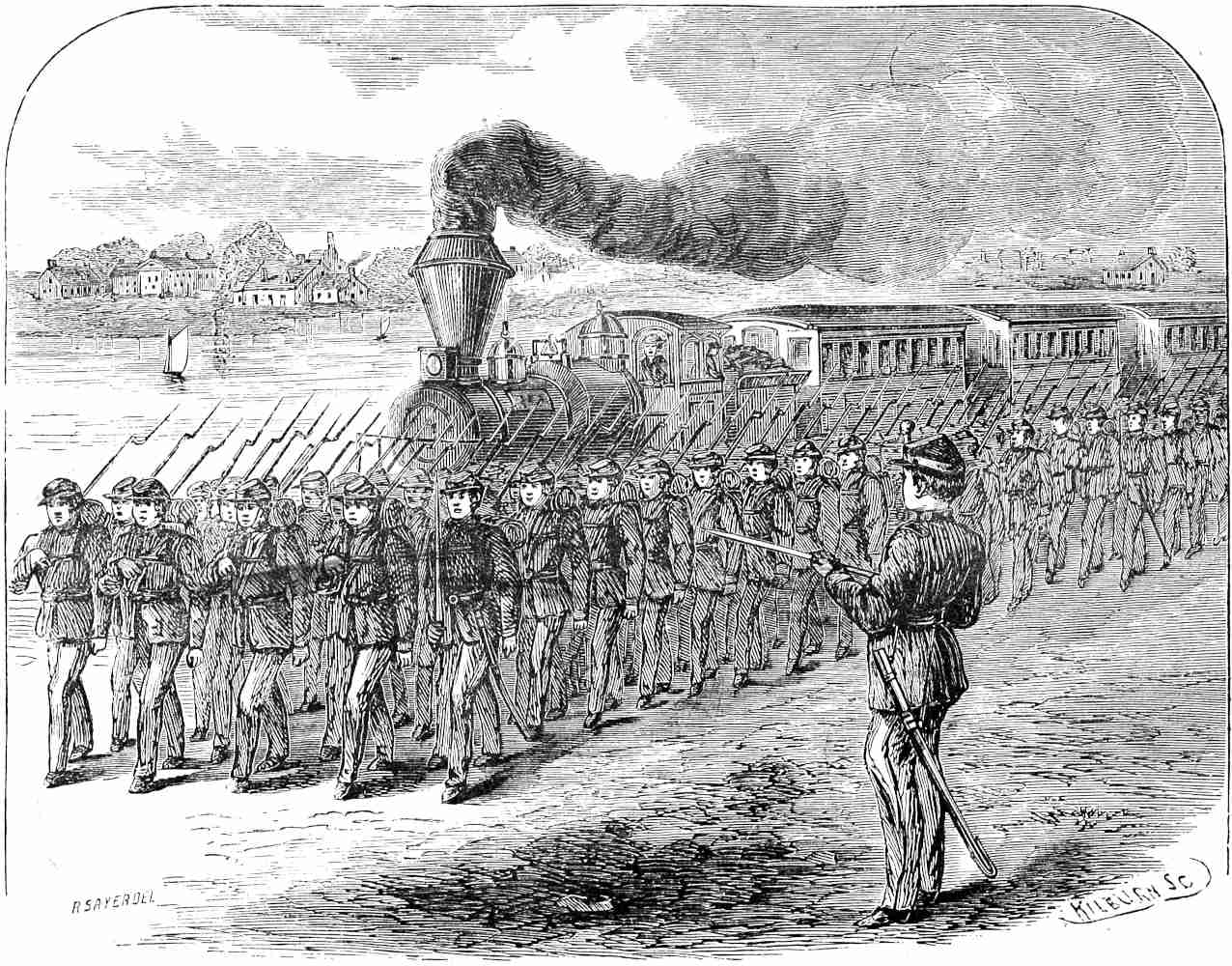
Major Tommy, intent upon being ahead of the
enemy on the other side of the lake, was on time
with his force. The battalion was to be reviewed
by the principal of the Institute before its departure,
and the two companies marched by the train,
on their way to the green where the ceremony
was to take place. As they passed me, I saluted
them with the steam whistle, and in return the
warlike heroes cheered the train. I witnessed the
impressive formalities of the review, and having
moved the cars forward, I heard the speech of the
principal at the close of the performance.
The students then entered the cars. I gave a
tremendous whistle, and off we went, the students,
true to their noisy natures, yelling like madmen.
As we moved on, we discovered a fleet of boats,
loaded with Wimpletonians, sailing down the lake.
I am not quite sure that Major Toppleton did not
know the Wimpletonians had selected the Horse
Shoe for their camp ground, and that a collision was
likely to occur between the students of the rival
academies. If he did know it, he was certainly to
blame, even though the Toppletonians had legal possession
of the land; for a man is morally responsible
far beyond the letter of the law. It was plain
enough to me that the wire-pullers on our side had
selected the Horse Shoe simply because it was the
usual encampment of their rivals.
The Toppletonians were highly excited and intensely
belligerent. The jealousy between the two
sides of the lake and between the two schools had
thoroughly infected them. There were only a few
who were not ready to fight for the banner under
which they marched. While I confess that I was to
some extent a partisan for the Toppletonians, I could
not help feeling that there was something undignified
and unmanly in this senseless quarrel. I could realize
this sentiment, even while I was anxious that the
Wimpletonians should not “get ahead” of our side.
I was not in love with Colonel Wimpleton and his
son, but I should have preferred to treat them with
dignified contempt, rather than pick a quarrel with
them.
The Wimpletonians had a whole fleet of boats,
including the dozen or more that belonged to the
Institute, and several bateaux, loaded with tents and
baggage. The wind was light early in the day, and
as they had to sail a dozen miles before they reached
their destination, they were not likely to arrive at
the island before us. Major Toppleton had ordered
the tug steamer to be at Grass Springs to convey
the students to the Horse Shoe, and she had towed
a number of boats for the use of the battalion.
“We must hurry up, Wolf,” said Faxon, who, as
usual, was on the engine with me, after glancing at
the aquatic procession on the lake.
“It will take the Wimps three hours to reach the
Horse Shoe with this breeze,” I replied. “Our party
will arrive in an hour.”
“There may be some delay at the Springs. We
don’t know that the steamer will be there when we
arrive.”
“Didn’t Major Toppleton send her to the Springs?”
I asked, not being aware that there was any contingency.
“He sent her to Ucayga last night with a freight
of flour, and told Captain Underwood to be at Grass
Springs at eight o’clock, if possible. She may be
late. She did not leave Middleport till dark, and of
course she must discharge her cargo this morning.
If there should be no steamer ready for us, what
shall we do?”
“Where are our boats?” I inquired.
“I suppose Captain Underwood left them at the
wharf at the Springs, as he passed, or possibly at the
Horse Shoe. I only know what Tommy told me,
just before we started.”
“There is a chance for a slip, after all,” I added.
“I think there is a big chance for a slip. If the
Wimps get to the island first, there will be a big
fight, for our fellows don’t wish for any better fun
than driving them off.”
“And perhaps the Wimps would like no better
fun than that of driving the Tops off.”
“Possession is nine points, you know, and the side
which gets a footing on the island first has the best
chance,” replied Faxon, cheerfully; and though he
did not bluster so much as some others, I knew that
he was “ready to go his length” in opposition to
the enemy.
“It looks like a fight, any way you can fix it,” I
added. “Why couldn’t our fellows have chosen some
other place to encamp?”
“Because the Horse Shoe suits them best. There
is a good wharf at the island, and plenty of dry
wood for the fires.”
“I don’t see the use of quarrelling when there are
a hundred other places just as good as that.”
“What’s the matter, Wolf? Have you no stomach
for a fight?” laughed Faxon.
“No; I have not.”
“But you are regarded by the fellows as a regular
fighting-cock. Your affairs with Waddie and with—”
Faxon checked himself, as he glanced at Lewis Holgate,
the fireman—“you know whom, are the foundation
of your popularity with them.”
“I am willing to fight in a good cause; but I don’t
believe in bringing on a quarrel.”
“The Wimps are always picking upon us, and
doing us mischief whenever they can. They have
torn up our track once, and we haven’t paid them
off for that.”
“You sunk all their boats for that; and I think
you are about even.”
“Not quite; but if they will let us alone, we won’t
meddle with them. We have hired the Horse Shoe
for the week, and we mean to have it. We have
the legal right to the island, and we are ready to
fight for possession.”
“I think it is all nonsense to quarrel for nothing.”
“We shall have the fun of licking them.”
“Or the fun of being licked,” I suggested.
“No danger of that. We have one hundred and
fifteen students now, and I was told that the Wimps
had fallen off to less than a hundred,” chuckled
Faxon.
“The tables may be turned by and by, when the
colonel’s plans are in operation.”
“What plans?” asked my companion, anxiously.
“You did not suppose Colonel Wimpleton would
permit this railroad scheme to go on without doing
something to offset it—did you?” I replied; and
I had received some positive information from my
father, the night before, on this interesting topic.
“What can he do? He can’t build a railroad on
his side of the lake.”
“No; but at this moment Waddie Wimpleton is
the president of a corporation.”
“What corporation?”
“A steamboat company.”
“Is that so?”
“My father was over at Centreport yesterday, and
found out all about it.”
“But what have the Wimps to do with it?”
“The colonel is building a magnificent little steamer
at Hitaca. She is to be very long and narrow,
and good for fifteen to eighteen miles an hour. The
Institute fellows on the other side are to own and
manage her, just as you do the railroad.”
“That is news, certainly,” said Faxon, musing, and
apparently not at all pleased with the plan.
“They say Major Toppleton has bought up the
steamers which now run on the lake, and means to
take them off between Ucayga and Middleport as
soon as the Lake Shore Railroad is completed.”
“Of course; what’s the use of having the boats
after the road is finished? We are to run a Lightning
Express twice a day then, and I think it is
very good-natured of the major to buy up the boats,
and thus save the owners from loss.”
“Perhaps it is; but is it good-natured for him to
deprive the Centreporters of the means of getting to
Ucayga, as he will when the boats are taken off?”
“They can go by the railroad, the same as others,”
laughed Faxon.
“They can, but they won’t. Do you think Colonel
Wimpleton would come over here and ride in these
cars? He would hang himself first.”
“Then he can hang himself, if he likes. The Middleporters
wouldn’t cry if he did.”
“But he intends neither to hang himself nor to
ride on the Lake Shore Railroad. Of course you
can’t blame him for kicking against the movements
of the major.”
“See here, Wolf; are you a Wimp or a Top?”
demanded Faxon, coloring a little, as we looked into
each other’s face.
“Why do you ask that question?” I inquired,
quietly.
“Just now you seemed to stick up for the Wimpleton
side.”
“I was only stating the case just as it is. My
sympathies are on this side; but I don’t blame
Colonel Wimpleton for not being willing to have
his facilities for going to and from Ucayga cut off.”
“You don’t blame him!”
“Certainly not.”
“I believe you are only half a Top now, Wolf.
Just now you were condemning us for standing up
for our own rights. Be on one side or the other,
old fellow.”
“I am willing to fight for the side that gives
me bread and butter, as long as it stands by the
right.”
“I don’t like this making reservations. I go the
whole figure. My country, right or wrong—that’s
what I go for.”
“So do I. My country, right or wrong; if wrong,
to set her right.”
“There you spoil all the poetry of the thing. If
you had stopped before you put the last sentence
on, it would have been just the thing. I go for
Toppleton, right or wrong.”
“I don’t,” I replied, decidedly. “I am for keeping
Toppleton right, and then I go for Toppleton.”
“What’s the use of talking, Wolf! You can’t
make me believe you are not right on the goose,”
added Faxon, good-naturedly. “When will that
magnificent steamer be launched?”
“I don’t know; but father said the hull was nearly
completed. I suppose they can’t get her ready for
service before August or September; perhaps not till
next spring.”
“And then she is to run in opposition to the
Lake Shore Railroad?”
“That’s the idea, I believe.”
“There will be jolly times then; but she can’t do
anything against our lightning express.”
“I’m not so sure of that.”
“Come, Wolf! You are a Wimp at heart, after
all. The fellows would mob you if they should hear
you sticking up for the other side,” added Faxon.
“I’m not sticking up for the other side,” I replied,
smartly, for I did not relish this charge. “I’m only
looking the facts fair in the face. The Wimps’
steamer will give you a hard run. Look at it for
yourself.”
“I don’t believe the Wimps can get ahead of us,
any how—I won’t believe it!” persisted Faxon.
“How far is it from Middleport to Ucayga?” I
asked.
“Twenty miles, to a rod.”
“How long will it take the lightning express to
go through?”
“Half an hour,” replied Faxon, sharply.
“Not much! We should have a smash every day
at that rate. The track is not stiff enough to make
that time upon. Call it forty minutes; and that is
high speed for this light rail.”
“Well, forty minutes. You don’t mean to say any
steamer can make twenty miles in that time?”
“Hold on a minute! How wide is the river at
Ucayga?”
“Half a mile.”
“Good; we have to land our passengers on this
side of the river. To take the trains east and west,
they must cross the river, and do the same when
they visit the town. How long will that take in
the old sail-boat ferry?”
“I don’t know,” replied Faxon, nettled by the
force of the argument, which he could not answer.
“Half an hour, at least, on an average. That
will make an hour and ten minutes; and the steamer
will do it in an hour and a quarter. I think the
colonel has a pretty good show,” I continued, as the
train reached Spangleport, and I blew some desperate
whistles to warn idlers about the track.
“You are a Wimp!”
“No. I’m a Top.”
“Don’t talk so before the other fellows. If
you do they will think you have sold out to the
enemy.”
“Can’t a fellow express an honest opinion?” I
asked, warmly.
“Not when it don’t jibe with the public sentiment.”
“I don’t know about that. I’m not afraid to tell
Major Toppleton what I think.”
“Don’t you do it.”
“If he wants to come out ahead, as of course he
does, it would be better for him to look the facts
and contingencies fairly in the face.”
Faxon was thinking of the matter, and by mutual
consent both of us were silent.
CHAPTER VI. A MISSION OF PEACE.
I could not exactly see that I was a traitor to
the Toppletonian interest because I believed that
a steamer could successfully compete even with a
“lightning express.” I intended to serve my employers
faithfully, and believed that I had done so.
Perhaps it was imprudent for me to express an
opinion; but I knew that Colonel Wimpleton was a
man of energy and determination, and that he would
not be content to remain long in the shade.
I observed that Lewis Holgate listened very attentively
to all that was said, though he made no
remarks. Since his father had run away with the
money he had stolen, the family were hard pressed
to get a living. Lewis was about my own age, and
was regarded as a smart fellow. The intimacy between
our families had brought us together somewhat,
and I knew that he aspired to be a “young
engineer.” He had worked with his father a great
deal, and knew an engine very well. It was necessary
for him to go to work, to assist in supporting
his mother and his brothers and sisters. He had
told me how sorry he was for what his father had
done, and I pitied him. Through my influence he
had obtained the place to “fire” on the new locomotive,
and now received a salary of three dollars
a week.
Lewis worked with me a while on the dummy, and
was competent to run it. The crime of his father
had to some extent broken his spirit, and thus far
he had behaved very well, better than his antecedents
led me to expect—for he had been rather
noted in Ucayga as a bad boy. My mother commended
me warmly for what I had done to help
him, and declared she was very glad to see me
manifest a Christian spirit towards him. My father
said I was foolish to try to serve such a fellow;
but I was best satisfied with the judgment of my
mother.
Something had already been said about another
locomotive, and an additional number of freight and
passenger cars, which the business of the road would
eventually demand. Lewis Holgate gave me to understand
that the height of his ambition was to be
the engineer of the new locomotive when it came.
I assured him that if he did his duty faithfully, I
would do all I could to further his purpose. We
were, therefore, good friends, and I gave him every
facility for learning the business. If I had had any
doubts about the propriety of what I had said to
Faxon, for which he had accused me of being a
Wimp, I should not have restrained my speech on
account of the presence of Lewis; for, after all I had
done for him, I did not think him capable of injuring
me.
“The tug steamer is not here,” said Faxon, as I
shut off the steam when the train approached Grass
Springs.
“It isn’t eight o’clock yet. We have been only
half an hour on the road,” I replied.
“I don’t believe it will be here,” added Faxon,
anxiously, as he looked out upon the waters of the
lake. “There is a stiff breeze now, and the Wimps
will be here by nine o’clock.”
I could not see why my partisan friend should
manifest any anxiety, since he and the rest of the
Toppletonians, with a few exceptions, were absolutely
spoiling for a fight with their rivals on the other
side of the lake. The train approached the Grass
Springs station, and I whistled to put on the brakes.
As soon as we stopped, Faxon left the engine, and
the battalion came out of the cars. The two companies
formed on the wharf, and I heard sharp and
imperative orders of Major Tommy, which led me
to conclude that his experience in the stockholders’
meeting had not been very profitable to him, though
some of the harshness of his tones was doubtless
attributable to his military enthusiasm.
From my place in the cab I could see the end
of the lake, with the steeples of Ucayga in the distance;
but the steamer was not on the way; she
had not even started for the Springs. The Horse
Shoe was two miles from the shore. The wind
had freshened a little, and was fair for boats coming
down the lake. The battalion from Centreport
must arrive in an hour, or an hour and a half at
the farthest, for the boats had had only ten miles
to make half an hour before. Major Tommy had
formed his lines; the quartermaster had placed all
the baggage and stores on the wharf, and everything
was in readiness to embark. It was eight o’clock by
this time, and the steamer had not yet appeared.
The Toppleton boats had probably been left at the
island, for they were not to be found at the main
shore, and the steamer could have left them with
less delay than at the Grass Springs Wharf.
“What’s to be done?” asked Major Tommy, impatiently,
after he had surveyed the ground over
and over again.
“We must get to the island some how or other,”
replied Faxon.
“That steamer won’t be here for an hour,” growled
the commander of the battalion. “Father said it
might be late; but he didn’t understand exactly
what was up.”
“The Wimps are coming,” shouted an officer in
the line.
“They are five miles off,” replied Faxon, as he
looked up the lake. “I want to be on the island
when they come.”
“So do I,” replied Tommy, casting an anxious
glance at the approaching enemy.
“Can’t you help us out, Wolf?” asked the major,
jumping on the foot-board of the engine.
Of course I was well pleased to be called upon
in the emergency, for it was manifesting a great
deal of confidence to ask advice of a boy who was
not a member of the battalion. The Toppletonians
had the legal right to use the Horse Shoe; and it
seemed to me that, if they had possession of the
island when the Wimpletonians arrived, the anticipated
fight, at least as a brutal struggle, might be
averted. Both bodies were armed with small muskets,
having bayonets upon them; and though they
were not allowed any ammunition, they might make
the combat more dangerous than they intended.
The interests of peace, therefore, appeared to require
that our battalion should be transported to the
island without delay.
“I hope you are not going to get up a fight over
there,” I ventured to say.
“Of course we are not, if the Wimps let us
alone,” replied Tommy. “If they don’t let us alone,
it will be the worse for them. I want to get over
there before they do, and that steamer, confound it,
won’t be here this hour.”
“If I were you, Tommy, I would send one company
over to the island, and take possession of it,
leaving the baggage and tents to be carried over
when the steamer comes.”
“How can I send one company over?” snapped
Tommy. “We haven’t a boat, or even a mudscow.”
“There comes the ferry-boat,” I replied, pointing
to a sloop-rigged craft which was now approaching
the shore from Ruoara, on the other side and above
the island.
“That’s the idea!” exclaimed Tommy, as he leaped
down from the cab, and ran with a speed entirely
beneath the dignity of the major of a battalion to
the ferry pier.
In three minutes more he had made a trade with
the ferryman to land as many of the force as his
boat would accommodate on the Horse Shoe. The
craft was one peculiar to the lakes in that region.
It was an ordinary sloop, though rather longer than
similar vessels are built; but the stern was open just
above the water-line, so that teams could be driven
on board. It depended upon the wind as its propelling
agent, though it was provided with a pair
of steamboat wheels, with a horse-power machine to
turn them, which could be used when the wind was
not available.
Major Tommy ordered Captain Briscoe, with Company
A, to embark in this ferry-boat, and to hold
the Horse Shoe, at any peril, until the other company
could be sent over. I was sorry to leave the
exciting scene; but I had to run the trip from
Middleport at nine o’clock. Satisfied that the Toppletonians
would secure possession of the island
before the arrival of the enemy, I turned the locomotive,
and ran back to the other terminus. The
fleet of boats was off the South Shoe, not more than
a mile from the Horse Shoe, when the train went
through Spangleport; but the ferry-boat was within
half that distance of its destination.
We did not yet run the new locomotive and cars
on the regular trips, because the travel was light,
and the dummy could be used at half the expense.
We housed the engine and cars, and, firing up the
dummy, we had steam enough to start her at the
appointed hour. Just before we left, Major Toppleton
came into the station, and asked me what had
become of the students. I told him I had conveyed
them to Grass Springs.
“I did not know they were going so early,” added
he.
“They were in a hurry,” I replied, with a smile,
when I saw that the great man did not comprehend
the strategy of the battalion, “My orders from
Major Tommy were to start at seven o’clock; and I
set them down on the wharf at the Springs at half
past seven.”
“You look wiser than you speak, Wolf,” said the
major, gazing earnestly into my face. “Is there any
mischief brewing?”
“I think there is,” I replied, candidly, though I
could not help smiling at the puzzled look of the
magnate of Middleport.
“What is it? Why didn’t you tell me about it?
They say the students of the Wimpleton Institute
went down the lake this morning.”
“Yes, sir; we passed them on the way, and the
students of both Institutes are bound to the same
place.”
“Then there will be a quarrel!” exclaimed the
major; but I think he would not have cared if he
had been sure that his side of the lake would be
victorious.
“I am afraid there will; but the Toppletonians
have the weather-gage, both on the rights of the
case and in the situation.”
I explained fully what had transpired at the
meeting of the battalion on Saturday, and the state
of the affair when I left Grass Springs, an hour
before.
“Why didn’t they tell me what they were doing?”
demanded the major. “I did not know they
were in a hurry; if I had, the steamer should have
been at Grass Springs without fail. If our boys
have hired the Horse Shoe, and pay for it, they
have a right to use it.”
The great man was unequivocally on the side of
the boys, and they might just as well have taken
him into their confidence. I was sorry to see him
so willing to permit a collision, even while our students
had the letter of the law in their favor.
“Wolf, don’t you want a vacation?” said the
major, suddenly turning to me, after musing on the
facts I had given him.
“No, sir; I don’t care about any,” I replied.
“But I prefer that you should take one. Your
pay shall go on as usual,” he continued; and of
course it was of no use for me to protest. “Can
Lewis run the dummy?”
“Yes, sir; he understands it very well.”
“All right, Wolf; I want you to be with those
boys. You have an influence with them, and they
want some help such as you can give them.”
“Am I to fight with them, sir?” I asked, laughing;
for I did not exactly relish the kind of vacation
he intended to give me.
“Certainly I don’t want any fighting if it can be
avoided. I want you to help keep the peace. If
things don’t work well, or any help is needed, come
to me at once.”
I started the dummy, and then gave it up to
Lewis. I did not exactly like my mission; for,
though I was sent to keep the peace, I knew that
the major simply expected me to see that the Toppletonians
were not whipped in the expected encounter.
CHAPTER VII. MAJOR TOMMY GETS MAD.
Though I was nominally sent to the Horse
Shoe as an ambassador of peace, I fully understood
the real object of the magnate in giving
me a vacation. The mission was certainly complimentary
to me, for I was really expected to do
the “engineering” for the Toppletonians. I was
not to permit them to be whipped by their great
enemy: if I could not prevent it myself, I was to
call in the assistance of Major Toppleton. Whatever
instructions he may have given me, this was
precisely what he meant. I was, in some sense, to
be his representative.
I desired to keep the peace, and I hoped to
have influence enough to accomplish something in
this direction; but it would not be an easy matter
to do this, and at the same time escape the wrath
of the belligerent Toppletonians. The Wimpleton
battalion, under command of Major Waddie, would
be ten times as reckless as the Toppletonians under
Major Tommy. My late enemy on the other side
was not restrained either by fear or by principle.
No violence or destruction appalled him. His
father had so often paid for damage done by him,
that he never hesitated to gratify his malice and
revenge by smashing a boat, firing a building, or
even discharging his pistol at any one who thwarted
him. He was a dangerous enemy. But Waddie
was reckless only when he was personally in a safe
position. He was prudent enough to keep his own
body out of the way of harm, except when his
wrath completely mastered him.
Lewis Holgate was glad enough of an opportunity
to run the dummy alone, for it would enable
him to prove his fitness for the position to which
he aspired. I cautioned him carefully in regard
to keeping up the water in the boiler, and the
pressure of steam he might carry. He was very
passive and tractable, and, for the sake of his own
reputation, I had no doubt he would be faithful and
careful in the discharge of his duty.
When I arrived at Grass Springs in the dummy,
the steamer was just approaching the wharf. The
company sent over to the island under Captain Briscoe
had landed, and thus far had held peaceful possession.
The Horse Shoe was the most western of
four islands, just below Ruoara. The two largest
of them lay east and west of each other, while the
one to the north of them was called the North
Shoe, and the one to the south the South Shoe.
They bore some resemblance to shoes; and the
western island having a bay which made into its
southern side, gave it the shape of a horse shoe.
The eastern island, and the nearest to the shore,
looked more like a pistol than either of the others
did like the articles for which they were named.
But the person who had christened the group, having
probably named the others first, calling each a
shoe, designated the fourth the “Shooter,” instead
of the Pistol, which would have been more appropriate.
“Shoe” and “Shooter” seemed to jingle
well with him, and, as he was satisfied, I shall not
complain.
The squadron of boats from Centreport lay
between the Horse Shoe and the South Shoe when
I came upon the ground. So far as I could judge
by seeing them at the distance of two miles, the
Wimpletonians were consulting upon their next
movement. If they intended to take possession
of the island, they had permitted the favorable
opportunity to pass. Doubtless they were also
waiting for the arrival of the bateaux, on which
their baggage was transported.
“Has anything happened?” I asked of Faxon,
as I joined the students on the wharf.
“Not a thing!” exclaimed he. “The Wimps
smell a mice, and don’t seem to be inclined to
pitch in. If I had been Waddie Wimpleton, I
would have landed on that island before this time.”
Faxon appeared to be disappointed because the
row had not come off, and more, perhaps, because
the Wimpletonians did not display a belligerent spirit.
The steamer came up to the wharf, and the students
embarked. Major Tommy stormed at Captain
Underwood for his delay, and the poor captain
defended himself very modestly and gently. He
had discharged his cargo as speedily as possible,
and he had not been told to be at the Springs at
eight, but as soon as he could. His bread and
butter depended upon keeping the right side of
the magnate, and to prejudice the son was to influence
the father.
“What are you doing here, Wolf?” asked Tommy,
as he saw me standing on the forward deck,
after the steamer started.
“Your father has just given me a vacation,” I
replied, very quietly; for I did not deem it prudent
to put on any airs about my mission. “I
thought I would come over and see how this thing
was coming out.”
“It’s coming out all right, Wolf. What did my
father say?” asked the little major, with some show
of anxiety. “Was he mad because we came away
so early?”
“O, no! I told him where you were going, and
that the Wimps were bound to the same place.
He was very glad you had obtained permission
of the owner to use the island.”
“Then it is all right—is it, Wolf?” added
Tommy, with an apparent feeling of relief. “I
didn’t know but my governor sent you here as a
spy. If he did, you can return as fast as you
came.”
Perhaps, according to Tommy’s interpretation of
my mission, I might be a spy. I had really been
sent to act as a check upon the students, who were
very jealous of any interference when they were on
camp duty, or any other military service. The
steamer sped on its way, and as the deep water
was between the Horse Shoe and the Shooter, we
had to round the southern point of the former in
order to reach the landing-place. The Wimpleton
boats still lay off the South Shoe, and Captain
Underwood said they were in the channel through
which he must pass.
“Can’t you get to the landing without going
near them?” I asked privately of the captain,
though I knew the navigation of the lake as well
as he did.
“I can go to the north of the Horse Shoe, and
come down the channel in that way,” he replied.
“These fellows are spoiling for a fight, and I am
afraid there will be some broken heads before the
day is finished. If you can prevent a row, it will
be better to do it.”
“Very well,” said he, ringing the bell to stop
her, just as he was entering the channel between
the Horse Shoe and the South Shoe.
“What’s that for?” demanded Major Tommy
from the forward deck.
“Don’t you think we had better go in at the
northward of the island?” inquired Captain Underwood,
with the utmost deference.
“No, sir! I don’t think so!” replied Tommy,
warmly. “Are you going the other way because
those boats are here? Go ahead, sir! Run them
down, if they don’t get out of the way!”
Captain Underwood felt obliged to obey this imperative
order. If he had refused to do so, it is
quite likely he would have been compelled to return
to the skippership of a canal boat, from which
he had been promoted to his present more dignified
and lucrative position.
“Don’t run them down, captain,” I ventured to
say, in a low tone, as the master rang the bell
to go ahead again.
“It is hard work to please that boy without getting
into trouble,” added the captain. “The good
book says no man can serve two masters, but I
have to serve two.”
“Blow the whistle, captain!” I suggested.
He blew the whistle till the shores resounded
with the echoing screeches; but the Wimpletonians
evidently believed the steamer had come this way
on purpose to annoy them, and they stood upon
their dignity. Not a boat moved, and the students
in them looked as resolute as though they
meant to be smashed rather than change their position.
We were almost upon them, and I was afraid
the captain intended to execute the barbarous threat
of Major Tommy. I begged him again not to run
into the boats; and seeing the enemy did not mean
to move, he stopped and backed in season to avoid
a calamity.
“What did you stop for, captain?” shouted Tommy;
but I was charitable enough to believe that
the words were intended for the benefit of the
Wimpletonians, rather than the person to whom
they were addressed.
Captain Underwood made no reply, but rang to
go ahead again, though he permitted but two or
three turns of the wheels.
“I can shove the boats out of the way without
hurting any one, I think,” said he, as the steamer
moved slowly forward.
“Look out, or you will run into us!” shouted
my old enemy, Ben Pinkerton, who was in the
nearest boat.
“Out of the way, then!” replied Captain Underwood.
“Go ahead, full steam, captain!” called Tommy;
but again I wished to believe that his order was
a threat to the enemy rather than an indication of
a wicked purpose.
Instead of obeying this rash command, the captain
rang the bell to back her, fearful that some
of the boats might be smashed.
I saw Tommy rush aft, and I supposed he intended
to come upon the hurricane deck, where
he could bully Captain Underwood more effectually.
I left the wheel-house, where I had been during
the conversation with the captain, that he might
not implicate me in the disobedience. But Tommy
did not appear, and it was plain that he had adopted
some other tactics.
“Wolf Penniman!” shouted some one at the
gangway. “You are wanted below!”
“What is wanted?” I asked of the messenger,
who could hardly speak, he was so excited.
“Major Toppleton wants you.”
I went below, and found Major Tommy standing
at the door of the engine-room, foaming with wrath;
indeed, he had steam enough on to carry a forty-horse
engine.
“Will you do as I tell you, or not?” stormed
Tommy, addressing his energetic words to the engineer.
“You must excuse me, Mr. Tommy; but I must
mind the bells. It won’t do for me to disobey the
captain’s orders,” protested the engineer, gently and
respectfully.
“Here, Wolf!” shouted Tommy. “Come here!”
I presented myself to the little magnate, and I
was conscious that I was already in a bad scrape.
“Go in there, and start up that engine! Go ahead,
full steam!” continued he.
I looked at him, but I did not move to obey.
I smiled, and looked as good-natured as possible,
for I did not wish him to think that I was
ugly about it.
“Don’t you hear me, Wolf? I tell you to start
up that engine!” repeated Major Tommy.
“It won’t do for me to step in between the man
and his engine,” I remonstrated, mildly.
“Yes, it will! I tell you to do it; and if you
don’t do it, you shall suffer for it.”
“Let us argue the point a little, major,” I replied.
“Will you do what I tell you, or not?” roared
he, swelling up as big as a major general.
“You must excuse me, major, but I can’t take
the engine out of the engineer’s hands, without the
captain’s orders.”
“I will let you know that this boat is my
father’s, and I can do with it as I please. If
you won’t start it, I will do so myself!” said
the juvenile magnate, desperately, as he rushed
into the engine-room, and seized hold of the
working-bar.
“You musn’t touch the engine,” said the man
in charge, as he took hold of Tommy’s arm, and,
with as little force as was necessary, thrust him
out of the room.
Tommy was the maddest major I ever saw.
CHAPTER VIII. CHARGE BAYONETS!
Major Tommy, in my judgment, was more
inclined to have his own way than he was
to annihilate the Wimpletonians by crushing them
under the wheels of the steamer. He had been irritated
because the captain did not obey his order;
but, I think, if the boat had gone ahead at his imperial
command, he would have been the first to
stop her. I could not believe that he was so diabolically
wicked as to run over the boats, and sacrifice
the lives of a dozen or more even of his enemies.
If it had been Waddie, the matter would have been
different, and I should have been more credulous.
When the captain opposed him, he flew to the
engineer; but I am confident that, if the man had
given the wheel a single turn, Tommy would have
ordered him to stop her. Neither the captain nor
the engineer knew that he did not intend to do all
he threatened; and I am afraid, if the wheels had
been started, the mischief would have been done,
whatever the little magnate meant, or did not mean.
I was very sorry to be dragged into the difficulty,
for Tommy and I had thus far been very good
friends. However, I had no doubts in regard to the
correctness of my position.
Forbush, the engineer, had gently, very gently,
thrust Tommy out of the engine-room. By this
time, all of Company B had gathered around the
little major, intent upon beholding the row. The
juvenile magnate was boiling over with rage, and
threatened Captain Underwood, the engineer, and
myself with total annihilation. Every one of us
should lose his situation, and be forever deprived of
the power to obtain further employment.
“Come, Tommy, keep cool,” said Faxon, trying
to smooth down the wrinkled fur on the badger’s
back.
“I won’t keep cool! I have been insulted, and I
will teach the fellows who and what I am. If I
tell the captain of this boat to run over the island,
he shall do it,” stormed Tommy, so angry that he
could hardly keep from crying.
“Be reasonable, Tommy,” added Skotchley, with
his usual quiet dignity. “We don’t want to kill
anybody.”
“Yes, we do! We want to kill the Wimps if
they don’t get out of the way.”
It was useless to say anything to the irate major
while he was so inflamed with wrath, and by general
consent the students kept still; but they were
disgusted with the commander of the battalion, and
doubtless most of them were sorry that they had not
tipped him out of both of his offices. While Tommy
was still raving like an insane person, the bell rang
again to go ahead, and the engineer promptly started
the wheels; but only a few turns were made before
the signal came to stop her. Finding I was not
needed on the main deck, and that the wrathful
major would cool off sooner if left to himself, I went
up to the wheel-house. All on board, except the
captain and one man at the wheel, had been attracted
to the vicinity of the engine-room by the
exciting scene. There was no one on the forward
deck, for even the two men employed there were
listening to the howls of Tommy.
Captain Underwood had started the boat ahead
again, and when I reached the wheel-house, she was
gently crowding her way through the fleet of boats,
a dozen in number, containing the whole force of
the Wimpletonians, over ninety of them. She struck
the boats as gingerly as though they had been eggs.
She did them no harm, beyond scraping the fresh
paint upon them, as she slowly forced her way
through them. I watched the movement with interest,
for I was curious to know what the Wimpletonians
intended to do.
The fleet lay in the deep water, so that there
was no room on either side for the steamer to pass
to her destination without getting aground. Captain
Underwood was a prudent man, and worked his
craft very carefully. He had given her headway
enough to carry her through the squadron of boats;
but, as they swarmed along her bow, and under her
guards, the students in them fastened to her with
their boat-books, so that they could not be shaken off.
“Back her quick, and you will shake them off
without harming any of them,” I suggested to the
captain, when I saw that he was nettled by the
failure of his plan.
“Out of the way there! Your boats will be
smashed under our wheels!” shouted he to the
enemy.
At that moment half a dozen of the Wimpletonians
leaped over the rail of the steamer upon the
forward deck, with their muskets in their hands.
“What’s that for?” said the captain, quietly.
“They mean mischief,” I replied, as I saw a dozen
more follow the six; and among the latter was
Waddie Wimpleton, glittering with gold lace, for
he was in the full uniform of a major of infantry.
“Stand by those two doors!” shouted he, drawing
his sword and pointing to the entrances near
which the Toppletonians were still listening to the
howlings of Major Tommy. “Hurry up, there!” he
added to those in the boats.
The Wimpletonians poured in over the rail, until
the deck was crowded. Company B had stacked
their muskets on this deck, and except the officers,
our boys were unarmed, while every Wimpletonian
presented a musket with a fixed bayonet upon it.
As the enemy were boarding the steamer, the captain,
amazed at the audacity of the young ruffians,
rang the bell to back the boat; but before she had
headway enough to shake off the fleet, which clung
to her like swarming bees, all the Wimpletonians,
except one in each boat, were on our deck.
“Up there, twenty of you!” said Major Waddie,
indicating the hurricane deck with a flourish of his
sword.
“What are the rascals going to do?” added
Captain Underwood, who had not given the enemy
credit for the skill and daring they now displayed.
“Don’t let a single Top go on the hurricane
deck!” shouted Waddie; and the twenty students
he had sent up stationed themselves at the head of
the stairs, to prevent any of our party from leaving
their prison; for such it had now become to
them.
Captain Underwood began to think the frolic, as
he had at first regarded it, was becoming a serious
affair, and I saw that he looked somewhat anxious.
Our fellows had left their muskets on the forward
deck, and they were now in possession of the enemy.
I am inclined to think it was fortunate they were
there, rather than in the hands of their owners, or
some of the students on both sides would doubtless
have been seriously injured. As the matter now
stood, the Wimpletonians had entire possession of
the Middleport, for that was the name of the steamer.
Twenty of them stood in the act of charging bayonets
in the direction of the two doors leading from
the forward deck. Our fellows could do nothing;
and even the captain, with the wheel in his hand,
was as powerless as they were.
Major Waddie, with his chapeau and white plume,
looked as though he were the commander-in-chief of
a great army, and had just achieved a bloody victory.
I must do him the justice to say that he had managed
the affair very well, though I saw that his two
captains, Dick Bayard and Ben Pinkerton, were
always near him with words of counsel. I was at
a loss to determine whether the capture of the
steamer had been devised on the instant, or whether
the boats had taken the position in the channel for
that purpose in the beginning. I was inclined to
believe that the bold step was first suggested when
their leaders saw the muskets of the Toppletonians
stacked on the forward deck, and not a single soldier
present to guard them. Ben Pinkerton afterwards
told me that this view was correct.
While the conquerors were disposing their forces
so as to hold the prize they had captured, Major
Tommy and the audience who were listening to his
angry declamation were completely intrapped. The
startling event was calculated to turn the spouter’s
thoughts into a new channel. It seemed to me that
the emergency had arisen which would justify me
in calling the attention of Major Toppleton to the
affair; but unfortunately I could not leave just then.
The steamer had backed half a mile from the island,
and had now shaken off all the boats which clung
to her.
“I don’t know what these ruffians intend to do,”
said Captain Underwood, as he rang the bell to stop
her.
“Waddie Wimpleton is reckless enough to do
almost anything,” I replied; for I regarded the situation
as difficult, if not dangerous.
“I will keep the boat moving towards Middleport,
at any rate.”
“That’s right, captain; if they have us, we have
them at the same time, and we can carry them to
Middleport as prisoners of war,” I added, with a
smile which was not wholly natural.
Captain Underwood rang the bell to go ahead,
and soon gave her full speed, heading the boat up
the lake.
“Hallo, there!” shouted Major Waddie from the
forward deck, as he flourished his sword towards the
wheel-house. “Stop her!”
The captain paid no attention to this imperious
command.
“Do you hear me? I say, stop her!” yelled
Waddie.
“Hold your tongue, you little bantam!” replied
Captain Underwood, irreverently; for, as he owed
no allegiance to the house of Wimpleton, he felt
that he could afford to speak without measuring his
words.
“Will you obey me, or not?” demanded Waddie,
furious because his imperious will was not regarded.
But the two captains, who were really the brains
of the battalion, interposed. I do not know what
they said, but the major with the chapeau desisted
from his attempt to bully the captain. They were
more practical in their operations than the commander,
and presently I saw them forming their
forces before the two doors. Captain Bayard drew
up his company before one of them, and Captain
Pinkerton before the other.
“Charge bayonets!” said Waddie, fiercely.
The order was repeated by the two captains, who
placed their most reliable men in the front.
“Forward!” screamed Major Waddie, making a
desperate lunge into the empty air with his flashing
sword.
“Forward!” repeated the two captains, as they
drove their men through the doors, into the narrow
space on each side of the boiler and engine-room.
The Toppletonians were in these spaces, and I
saw that the object of the movement was to drive
them aft, and get possession of the engine-room,
so as to control the machinery, and thus prevent
the captain from taking the boat to Middleport.
Our fellows, unarmed, could not stand up against
the bayonets of the enemy, and we heard them fall
back. I concluded, by this time, that Major Tommy
had come to his senses; though, if he was disposed
still further to vent his ire, he had an excellent opportunity
to do so against the sharp-pointed weapons
of his conquerors.
The Toppletonians were not only driven aft, but
were forced below the deck into the little cabin,
which was hardly large enough to hold them all.
A little later, we heard a violent altercation in the
engine-room, and then the boat stopped. The Wimpletonians
had certainly won a complete victory.
CHAPTER IX. FEATHERS AND THE ENGINEER.
Major Tommy Toppleton and Company
B were prisoners in the little cabin,
while Major Waddie Wimpleton and Companies A
and B of his battalion were in possession of the
steamer. The wheels had stopped, and this was
evidence to us in the wheel-house that Forbush, the
engineer, had been driven from his post.
“This will never do,” said Captain Underwood.
“The young rascals will blow us all up. They have
stopped the engine, and have not let off steam.”
Though it was really becoming quite a serious
matter, I saw that the captain could hardly keep
from laughing, there was something so absurd in
the situation. Major Waddie, in his chapeau and
gold lace, strutted before us on the forward deck,
and we had regarded the whole affair as a joke; but
now we were actually in the toils of the captors.
They had not yet disturbed the occupants of the
wheel-house; but this step had only been deferred
till the other parts of the boat were made secure.
The Toppletonians had all been locked up in the
cabin, and the engine-room, the citadel of the boat,
had yielded.
“It is time something was done,” I replied to the
captain. “I have been opposed to a fight, but I
think one is necessary about this time.”
“What shall we do?”
“That’s the question. The Wimpletonians are
armed with ugly weapons,” I added. “There are
three of us besides Forbush. I see the victors have
neglected to secure the captured arms on the forward
deck. We can jump down, arm ourselves, and
fight it out.”
“But there are nearly a hundred of the rascals,”
answered Captain Underwood. “Some of them are
pretty well grown, and all of them have been exercised
with the bayonet. I don’t relish having one
of those things stuck into me, and I shouldn’t dare
to punch any boy with such an ugly iron. I think
I would rather do what fighting I do without any
bayonet.”
The captain was a very prudent man, certainly;
and I was aware how dangerous it would be to
injure one of the Wimpletonians. They were reckless;
we were cautious, and fearful of hurting them;
so that they had every advantage over us, besides
that of mere numbers. While we were debating
the question, Forbush appeared on the forward deck.
One of his hands was covered with blood, and it
was plain he had not abandoned his post without
an attempt to retain it.
“Captain Underwood, they have driven me out
of the engine-room at the point of the bayonet,”
said the engineer, holding up his bloody hand.
“Come up here,” replied the captain.
“We have a good head of steam on, and the
engine needs some one to look out for it.”
“Go and fix it as it ought to be!” said the imperious
Major Waddie, as he stalked up to the
engineer with his drawn sword in his hand.
“If there were no one but you on board, I would
blow you so high you would never come down
again,” added Forbush, as he glanced at his wounded
hand.
“None of your impudence, but do as I tell you,”
puffed Waddie.
“Look out for the engine, Forbush,” added the
captain; “and speak to the fireman.”
Forbush went to the engine, and presently the
sound of the steam hissing through the escape pipe
assured us the peril of an explosion was provided
for. The engineer, having attended to this duty,
appeared upon the forward deck again. He was
not a very demonstrative man, but I could see that
he was nursing his wrath under the imperious manner
of Waddie. Passing through the Wimpletonians,
he went to the bow of the boat.
“Major, there is Wolf Penniman in the wheel-house,”
said Dick Bayard, as he discovered me at
one of the windows.
“We’ll fix him in due time,” replied Waddie, as
he glanced up at me with an ugly look, which
assured me I had nothing to hope for from his
magnanimity. “We must get rid of those fellows
in the cabin next.”
“Well, what are you going to do with them?”
asked Captain Ben Pinkerton.
“Land them in some out-of-the-way place on the
east shore, where it will take them all day to get
home again,” suggested Captain Dick Bayard.
“Where?” inquired Major Waddie, apparently
pleased with the idea.
“At the point off the North Shoe, for instance,”
replied Bayard.
“That’s the plan!” exclaimed the major, as he
sheathed his glittering blade, apparently satisfied that
the battle was finished. “Wolf Penniman, come
down here!” he added; turning to me again.
“No, I thank you,” I replied, cheerfully.
“If you want to get out of this scrape with a
whole skin, you had better mind what I tell you,”
continued Waddie, involuntarily putting his hand
on the hilt of his sword.
“I think I can best keep a whole skin up here,”
I answered.
“Better go down,” interposed the captain. “Moses
and I will go with you.”
Moses was one of the deck hands, who had been
steering when the capture was made. There were
two more of them, besides the fireman below, making
seven men on board.
“Very well; if you think best I will go down,” I
replied.
“We had better keep together,” he added.
I led the way down the ladder, and as the captain
followed me, he beckoned to the deck hands to
keep near us.
“You have concluded to mind—have you?”
sneered Waddie, as I presented myself before his
imperial majorship.
“I concluded to come down,” I answered.
“Wolf, you will go to the engine-room, and mind
the bells,” he continued.
“Mr. Forbush is the engineer of this boat,” I
replied.
“No matter if he is; you will do as I tell you,
or take the consequences.”
“Then I will take the consequences,” I answered,
for I had no intention of helping the Wimpletonians
land their conquered foe on the North Point.
“Here! form around him! Charge bayonets!
Drive him into the engine-room!” said Waddie,
smartly.
Instead of waiting for this programme to be carried
out, I walked forward to the extreme point of
the bow, where the engineer had taken position. I
was not quite sure that I could successfully resist
the order; but it was not in my nature to obey
the haughty commands of Major Waddie.
“That’s right!” said Forbush, as I joined him.
“I’m glad to see a little grit.”
Captain Underwood and the three deck hands followed
me; but Waddie drew his sword, and, filled
with rage, crowded through them towards me.
“Wolf, I command this boat now, and I order
you to the engine-room,” fumed the major, as he
pointed his sword at me, as though he intended
to run me through; and I am not sure that such
was not his purpose.
Forbush’s patience appeared to be exhausted, and
before I had time to make any reply, he suddenly
sprang upon Waddie, wrenched the sword from his
grasp, and, seizing him by the collar, jammed him
against the rail with so much force, that the bantam
major howled with pain and terror. The dignity
of his military position was knocked out of him, and
the glory of the chapeau, feathers, and gold lace
departed.
“Look out for the rest of them!” called Forbush.
I picked up one of the guns which the captors
had thrown one side, and the three deck hands followed
my example. Captain Underwood, still true
to his humane philosophy, took a handspike. But
the sudden movement of the engineer seemed to
paralyze the valiant soldiers for the moment, as they
paused to see what the grimy Forbush intended to
do with their leader.
“Rally! rally!” shouted Captain Bayard, who,
now that the major was hors de combat, was the
ranking officer. “Charge bayonets!”
“You keep back!” replied Forbush. “If one of
you takes a single step forward, I will throw this
fellow overboard;” and he jammed poor Waddie
against the rail again, until we could almost hear
his bones crack.
“Don’t! don’t!” groaned Waddie. “Keep the fellows
back, Dick Bayard, or he will kill me!”
“That’s so,” replied the stout engineer, who did
not weigh less than one hundred and eighty, and
was six feet high.
By this time the four men and myself were drawn
up in line of battle. It was clear enough to the
Wimpletonians that, if the action began, there would
be some broken heads, if not bleeding bodies. However
lightly they regarded bayonet wounds when the
weapons were in their own hands only, they seemed
to have a great respect for the cold steel in the
hands of others. They formed their line in the act
of charging bayonets; but they did not charge any.
There they stood, arrested by the plaintive cry of
their gallant leader.
“Now, come out here, Feathers!” said Forbush,
as he took Waddie by the collar, besmearing the
major’s face with blood from his wounded hand, and
trotting him up to the line. “Come up here again,
and take command! Order these cubs upon the
hurricane deck, or I will make short work of you!”
The engineer emphasized his commands by shaking
Waddie most unmercifully.
“You let me alone!” howled the discomfited
commander of the battalion.
“I’ll let you alone when I have done with you,”
added Forbush, as he twisted his gripe upon the
collar of his victim, so as almost to choke him.
“You’ll kill me!” gasped Waddie.
“Will you give the order I told you?”
“Send the fellows upon the hurricane deck!”
whined Waddie to Dick Bayard, crying and howling
at the same time.
“Don’t do it, Dick!” said Pinkerton, who could
not endure the thought of having the victory wrested
from the conquerors in the very moment of their
triumph.
“Waddie says so. What can we do?” replied
Bayard.
“They don’t mind,” added Forbush, shaking the
unfortunate major again.
“Do as I tell you, Dick Bayard!” called Waddie,
writhing under the torture.
Very reluctantly the senior captain gave the order,
and the Wimpletonians crept up the ladders to the
hurricane deck.
“Now let me alone!” growled Waddie, trying to
shake off his powerful persecutor.
“Hold still, Feathers!” replied Forbush, applying
a little gentle force, as if to assure his victim that
the tragedy was not yet ended.
The engineer was now in excellent humor, and
was exceedingly pleased with the turn he had given
to the affair.
“Ain’t you going to let me go now?” added the
major, in a pleading tone.
“Not yet, Feathers. You must give security for
the good behavior of your crowd.”
“What are you going to do with me?” asked
Waddie.
“I’m going to throw you overboard if you don’t
behave like a man. Now, Captain Underwood, you
can let out our boys. These rascals have locked
them up in the cabin.”
“Better get rid of the Wimps first,” I whispered
to the captain.
“What shall we do with these fellows?” he replied,
with a significant glance at me, as he comprehended
my meaning.
“Land them at North Point,” I suggested.
“Good!” laughed Forbush. “It is a poor rule
that won’t work both ways. What do you say, Captain
Underwood?”
“Anything to get rid of them!” replied the captain,
impatiently.
“Very well; I will take care of Feathers. I will
keep him in the engine-room with me,” added Forbush.
“Now, Wolf, you and the three deck hands
stay here. If those fellows up there attempt anything
mischievous, you call me, and Feathers and I
will settle it—won’t we, Feathers?”
Forbush laughed till his fat sides shook, and then
dragged Major Waddie to the engine-room.
CHAPTER X. KEEPING THE PEACE.
“Hadn’t we better let our boys out before
we go ahead?” asked Captain Underwood,
in a low tone, as the engineer disappeared with his
prisoner.
“There will be a fight if we do,” I replied. “We
can land the Wimps in ten or fifteen minutes.”
“What will Tommy say?” added Captain Underwood.
“No matter what he says. It is better to keep
the peace than to let them out.”
Doubtless he fully agreed with me; but he dreaded
the wrath of his employer’s son even more than
the violence of the Wimpletonians. He went up
to the wheel-house, and rang the bell to go ahead.
The discomfited enemy on the hurricane deck were
discussing the exciting topic very earnestly. It was
humiliating for all of them to lay down their arms,
practically, on account of the capture of their
leader. Ben Pinkerton was in favor of fighting
it out, and rescuing Waddie from the gripe of his
persecutor by force and arms; but timid counsels
finally prevailed, and the battalion kept quiet.
I had gone up the ladder when the boat started,
so that I could see what they were doing, and
hear what they were saying; but I kept my line
of retreat open, so that I could make for the forward
deck if a storm appeared. It was only a
short run to North Point, and we soon made the
landing at a rude pier, erected for passengers going
to an interior town. As soon as the steamer was
made fast, Forbush appeared on the forward deck,
dragging Waddie by the collar, and carrying the
sword in his hand. Taking position in the bow of
the boat, where he could not be assaulted in the
rear, the engineer planted his prisoner in front of
him, while the deck hands, reënforced by the fireman
and myself, formed a line between him and
the gangway.
“Now, Feathers, if your men are good soldiers
they will obey you,” Forbush began. “Just give
them the order to march down in single file, and
go ashore!”
Waddie was humiliated by his defeat. He was
ashamed to confess, practically, that the battalion
had been defeated by his regard for his own safety.
But he was still in the power of the fierce engineer,
whose bloody hand was upon his throat. He
hesitated; but every instant of delay caused Forbush
to tighten his hold, and it was painfully apparent
to him that he must give the order, or be
choked by his unrelenting tyrant.
“Speak, Feathers, speak!” said the engineer.
“Give your orders, and speak up like a man, so
that they can hear you!”
“Don’t! Don’t! You hurt me!” whined the
major.
“That’s nothing to what will come if you don’t
do as I tell you.”
“March them down, Dick Bayard,” howled Waddie,
as Forbush emphasized his determination by a
fierce twist at the neck of his victim.
“In single file,” added the engineer.
“Single file, Dick!” repeated Waddie.
“Single file—forward, march!” said Captain Dick
Bayard, who was plainly disgusted with the proceedings.
The column of valiant warriors, grand even in
their misfortunes, descended the ladder on the port
side, and stepped on shore. They looked as sheepish
as the lambs on the neighboring hills; but
they were full of bottled-up rage, and as soon as
Waddie was out of trouble, it was probable that
something would be done.
“Now let me go!” snapped Waddie, when the
last of the file had left the boat.
“Not yet, Feathers,” replied Forbush, as he
glanced at the two companies on the pier. “Order
your troops to march up to the grove on the
shore.”
“What for?” groaned Waddie.
“Good soldiers never ask questions,” laughed the
engineer, as he twisted the major’s collar again.
Waddie gave the order as he was required,
and Dick Bayard, who appeared to be on the
watch for a chance to redeem the fortunes of the
day, doggedly led the battalion away from the
steamer.
“Now it is all right, Feathers,” said Forbush.
“Next time, when you want a steamer, you had
better apply at the captain’s office.”
“I didn’t want your old steamer,” snarled the
gallant major.
“What did you take her for, then?”
“Because you were going to run down our boats.
I heard Tommy Toppleton tell the captain to
do so.”
“Why didn’t you get out of the way?”
“We never get out of the way for Toppleton
humbugs,” sneered Waddie. “You haven’t seen
the end of this.”
“We shall probably see the end of it together.
Here is your cheese knife, Feathers; but behave
yourself, or you haven’t seen the worst of it yet.
Mind that, Feathers!”
Waddie took his sword, and looked daggers;
but he dared not use any, or even the weapon
he held in his hand. Sullenly, he walked across
the deck to the pier. He wanted to do something,
but he was prudent when his own person
was in peril.
“Cast off the fasts, Moses,” said Forbush, as he
hastened to the engine-room.
“Come down here!” shouted Major Waddie to
his forces in the grove. “Come! Double quick!”
I do not know what the valiant major intended
to do next; but probably, if his forces had not been
sent to the grove by the forethought of the engineer,
he would have ordered an assault upon the
Middleport, and endeavored to recapture her. He
would have directed his troops to charge upon anything,
so long as he could keep behind them, and
make good his own escape in case of disaster. He
was reckless enough to do anything; but as soon
as the fasts were cast off, Captain Underwood rang
to back her, and the boat was clear of the pier
long before Waddie could bring up his forces.
“We are well out of that,” said the captain, as
he rang to go ahead. “Now you can let our boys
out of the cabin.”
I was not exactly satisfied with the situation in
which I found myself, for though I was very happy
in having escaped the wrath of Waddie Wimpleton,
I had still to encounter the ire of the other
“scion of a noble house.” I had expected to be
broiled on a gridiron, or subjected to some fearful
punishment, for my sins against the house of Wimpleton;
and probably I should have been a sufferer,
if Forbush had not taken the matter in hand, and
brought it to an issue. Now Tommy would berate
me for refusing to obey his order, when the engineer
had declined to do so; but I was willing to
meet this charge, if I could escape the responsibility
of advising the captain to keep “our boys” prisoners
after we had subdued the enemy.
I went to the cabin door to discharge my mission.
It had been fastened with a piece of wood, placed
in the staple over the hasp, for the padlock with
which it was usually secured was lost. I threw
the door wide open, and announced to the prisoners
below that they were free.
“The door is open, Major Toppleton,” called one
of the students to his chief.
“Where are the Wimps?” demanded Major Tommy,
as he led the way out of the cabin.
“We put them on shore here, at North Point,
where they intended to land you,” I replied.
“Why didn’t you obey my order when I told you
to take charge of the engine?” continued Tommy,
his face beginning to kindle up with anger again.
“I couldn’t take the engine out of Mr. Forbush’s
hands,” I replied with becoming meekness.
“Forbush shall be discharged when the boat returns,”
said Tommy, shaking his head.
“Perhaps you will change your mind when you
learn what he has done,” I suggested. “He recaptured
the boat, after he had been driven at the
point of the bayonet from the engine-room. He
was wounded in the hand, too, in the scrape. I
don’t know how we should have got out of it if
it hadn’t been for him. He is a plucky fellow, and
stood up against the bayonets of the whole crowd
of Wimps.”
“What did he do?” asked Tommy, curiously.
“He captured Waddie Wimpleton, took his sword
away from him, and made him order his command
to the hurricane deck.”
“When was that?”
“Well, a short time ago,” I replied, cautiously.
“Why didn’t you let us out then?” he demanded.
“All the Wimps were here on deck. We let you
out just as soon as we got rid of them.”
“What did you let them go for, if you had
Waddie?”
“There were two companies of them, and they
were armed with bayonets. We were glad enough
to get rid of them.”
Tommy thought, if he had been called with his
force, he could have taken care of the Wimpletonians;
but he behaved better than I expected. I
turned his attention back to Forbush, and minutely
described to the major and his men the operations
of the engineer, and the conduct of Waddie under
the torture. Tommy laughed, and the soldiers
laughed. It was a good joke, and they were sorry
they had not seen the fun.
“I hope you won’t find fault with Mr. Forbush,
after the good service he has rendered, and the
cut he received in the hand in doing his duty,” I
ventured to suggest.
“No! No! No!” murmured the boys.
“I am willing to forgive him,” replied Tommy,
magnanimously. “But if he had obeyed my order,
there would have been no trouble.”
“What do you think the consequences would
have been if he had obeyed your order?” I mildly
inquired.
“No matter what they were; both he and you
ought to have done as I told you to do.”
“The fellows in the boats would have been
smashed up under the wheels of the steamer.”
“No, they wouldn’t. I only meant to duck them
a little. I should have stopped the wheels in a
minute.”
I was very glad to hear Tommy acknowledge
that he did not mean to annihilate the Wimpletonians,
for I had a very good opinion of him, on
the whole. Though he did not mean seriously to
injure the enemy, I have no doubt some of them
would have been sacrificed if he could have had
his own way. It is a blessed thing that boys can’t
always have their own way.
I walked with Tommy to the engine-room, where
Forbush was binding up the wound on his hand.
The little major kindly inquired about the injury,
and thanked the engineer for the service he had
rendered; but he could not help adding that it
would have been better if the order he gave had
been obeyed. He then went up to the wheel-house
to see the captain; and as it did not appear that
he had done anything worthy of especial commendation,
Tommy wanted to know why he had not
let him out of the cabin sooner.
“We didn’t think it was best to open the doors
till we had landed the Wimpletonians,” replied
Captain Underwood, with more candor than prudence.
“You didn’t, eh?” said Tommy, waxing angry.
“Wolf thought you wouldn’t care to see the
other boys.”
“Then he advised you not to let us out—did
he?”
“He thought it wasn’t best; and I thought so
too,” added the captain, willing to share the blame
with me.
“What did you mean, Wolf?” demanded the
major, turning to me.
“The Wimps had two companies, and you had
only one,” I replied; but it was in vain that I
tried to smooth the matter over.
He was mad with me, because, in my capacity
as a messenger of peace, I had prevented a fight;
but I was satisfied. The boat ran up to the landing-place
on the Horse Shoe, and the “troops”
and their baggage were disembarked.
“Wolf, you may go back to Middleport in the
steamer; I don’t want you here,” said Tommy.
But I was the ambassador of peace!
CHAPTER XI. AT THE HORSE SHOE.
“I should like to stay with you a few days,
Major Tommy,” I ventured to say, after the
young lord had given me the imperative order to
depart on the steamer.
“I say I don’t want you here,” replied Tommy,
flatly. “We can get along without you.”
“Perhaps I may be of some service to you,” I
modestly suggested.
“I don’t want any fellow about me that won’t
obey orders,” protested the little major. “You advised
the captain to keep us locked up in that cabin,
when we might have cleaned out the Wimps, and
paid them off for what they did.”
“Your father sent me down here, Tommy, to do
anything I could to assist you,” I added.
“I don’t care if he did!” replied Tommy, irritated
rather than conciliated by this remark.
“He wished me to stay with you; it was not by
my own desire that I came.”
“Did he send you here to be a spy upon our
actions? If he did, so much the more reason why
we should get rid of you. We don’t want any spies
and go-betweens here.”
“I am not a spy, Tommy.”
“Go on board the steamer, and tell my father I
won’t have you here.”
“Very well,” I replied, as I walked away from
the imperious little magnate.
“Wolf is a good fellow,” I heard the dignified
Skotchley say to Tommy, as I departed. “I wouldn’t
send him off.”
“You wouldn’t, and you needn’t. I will, and shall,”
replied Tommy, curtly.
By this time the officers and soldiers of Company
A had gathered at the shore, and I found I had
quite a number of friends who were willing to intercede
for me; but if all the officers of the battalion
had gone down upon their knees to him in
my behalf, he would not have yielded. I was banished
from the island; and, though I was very willing
to go, much preferring to spend my vacation in
some contemplated improvements upon our garden,
I did not wish to be sent away in disgrace. I saw
that Skotchley did not like the manner in which
his interposition had been treated, and just as the
boat was about to start, I was not a little surprised
to see him come on board.
“Faxon is as mad as a March hare,” said he, walking
up to me.
“What is the matter?”
“He says it is mean to send you off in this way.”
“I am willing to go; I don’t care about staying
here, for there will be a fight soon,” I added. “But
Major Toppleton sent me here, and I thought I
ought to stay.”
“I would stay, if I were you,” said Skotchley.
“No; I won’t make any trouble. But the steamer
is starting; you will be carried off if you don’t
go on shore.”
“That is just what I want,” replied the dignified
student, with a smile. “Like yourself, I don’t wish
to make any trouble; but I will not be snubbed by
Major Tommy Toppleton. I prefer to spend my
vacation in some other place.”
“All ashore,” said Captain Underwood, nodding
to my companion.
“I am going with you, captain.”
“Very well;” and the bell was rung to start her.
“Hallo, there! Stop her, Captain Underwood!”
called the imperious major.
The captain obeyed, of course.
“Where are you going, Skotchley?” demanded
Tommy.
“I am going to Middleport,” replied Skotchley,
in his quiet manner.
“I don’t see it!” added the major, his face reddening
with anger at this breach of discipline.
“You are first lieutenant of Company B.”
“I prefer not to remain.”
“But I prefer that you should remain,” stormed
Tommy.
“I am sorry to disappoint you, but I have decided
to go.”
“Will you come on shore, or will you be brought
on shore?”
“Neither.”
“Captain Briscoe, take a file of men, and bring
Skotchley on shore. He is a deserter,” added
Tommy.
Whew! A deserter!
“Go ahead, captain,” I suggested to the timid
master of the steamer. “There will be a row here
in five minutes, if you don’t.”
“It is all my place is worth to disobey that stripling,”
replied Captain Underwood, disgusted with
the situation. “His father rules all Middleport, and
he rules his father.”
I saw Faxon remonstrating in the most vigorous
manner with the commander of the battalion, and
presently the former came on board with the olive
of peace in his hand. He begged Skotchley to return
to the shore, in order to save all further
trouble.
“If Tommy will permit Wolf to remain, I will,”
replied the dignified student.
Faxon returned to the shore with these terms;
but Tommy indignantly declined them. He would
have Skotchley, and he would not have me. The
order was given again for Captain Briscoe to bring
the refractory lieutenant on shore with a file of soldiers;
but the men would not “fall in” to execute
such a command. Skotchley was the most influential
fellow among the students, as his election to the
presidency of the railroad proved. Though he was
dignified, and remarkably correct in his deportment,
he was very popular. Tommy had just snubbed him,
and this had excited the indignation of the crowd.
Briscoe and a dozen others threatened to leave the
camp, and actually made a movement towards the
steamer.
Major Tommy was in a quandary. There was a
mutiny among the forces, and the prospect at that
moment was the breaking up of the camp. The
students had long been disgusted with Tommy’s
tyranny, and it did not require much to kindle the
flames of insurrection in the battalion. Hurried consultations
among groups of officers and privates indicated
a tempest. The little magnate was shrewd
enough now to see that he had gone too far, but
his pride would not permit him to recede.
The disaffected ones who had the courage to strike
for their own rights were collecting near the pier.
Briscoe appeared to be the leading rebel, and the
force which gathered around him included half the
battalion. Tommy was informed that they intended
to desert in a body.
“Start your boat, Captain Underwood,” said
Tommy, in order to prevent the departure of the
rebels.
The captain pulled the bells, and the wheels of
the Middleport turned.
“Now stop her!” shouted the major; and it was
evident that he intended only to move the steamer
far enough from the shore to prevent the escape of
the disaffected portion of his command.
I heard the last order, but the captain did not,
for I had moved to the stern, in order to see the
result.
“Stop her, I say,” repeated Tommy, savagely.
Still Captain Underwood did not, or would not,
hear him, and the Middleport went on her way.
“Tell the captain to stop her!” screamed Tommy,
at the top of his lungs.
I deemed it to be in the interests of peace not to
heed this order, for I was afraid, if I communicated
it to the captain, he would obey. The little major
screamed till he was hoarse; but we were clear of
the island, though it was certain there was an account
to be settled in the future.
“Our Academy would be a great institution, if
Tommy Toppleton went to school somewhere else,”
said Skotchley.
“It is a great pity he is so overbearing,” I replied.
“He seems to think all the rest of the fellows
were created only to be his servants, and he treads
upon them as though they were worms beneath his
feet. I have not been accustomed to have a fellow
speak to me as he did to-day.”
“He is very haughty; but he is a generous fellow,
and has many other good qualities.”
“But one can’t live with him, he is so overbearing.
I am rather sorry now that I did not accept
the office of president of the Lake Shore Railroad,
when I was elected. It would have brought affairs
to a head. But I did not want to spite him, for
he never treated me so badly before.”
Tommy had made a great mistake in alienating
such a fellow as Skotchley. It was evident that
the tempest among the students could not much
longer be delayed, if it had not already commenced.
From the deck of the Middleport, we saw the two
companies march to the camp ground, and begin to
pitch the tents. It was probable that the mutiny
had been nipped in the bud by the departure of the
steamer with Skotchley on board. I was afterwards
told that the students regarded Tommy’s order to
start the boat as yielding the point, and that, when
he failed to stop her, he accepted the situation, and
made a virtue of necessity, permitting the boys to
believe that the Middleport had departed in obedience
to his command.
The boats of the Wimpletonians were moving
towards North Point, for those in charge of them
had comprehended the final defeat of their party.
It only remained for them to seek another camp
ground, or make the attempt to drive the Toppletonians
from their position. Skotchley and I agreed
that they would not long be quiet, and that the
week would be filled up with quarrels and skirmishes
between the students of the rival academies.
In an hour the steamer arrived at the wharf in
Middleport, and we went on shore. I invited
Skotchley, as the Institute was closed, to spend the
week with me at my father’s house. He thanked
me very cordially, and accepted the invitation; but
before I went home, I deemed it proper to report
to Major Toppleton the events which had transpired
during the forenoon. I intended to call at his house
on my way home; but we met him coming down
the street towards the pier.
“I thought you went up to the camp, Wolf,” said
he, much surprised when he saw me.
“I have been, sir, and a sweet time we have had
of it. Tommy sent me off, and would not permit
me to remain on the island.”
“What has happened?” he asked, anxiously.
I told him the story of the morning’s adventures,
though it took me half an hour to do so.
“And Tommy sent you off—did he?” laughed
the major.
“Yes, sir—because I advised the captain not to
let our fellows out of the cabin until we got rid of
the Wimps; but if they had been let out, there would
have been a fight with bayonets.”
“I am very glad you didn’t let them out then;
but Tommy is rather a difficult subject to manage,”
continued the major, lightly. “I have to coax him
a great deal, for he is bound to have his own way.
If he is thwarted, it has a bad effect upon him. I
sent you up to the island to keep the run of things
there; but of course I did not expect you to oppose
him.”
“I did the best I could, sir.”
“You did very well; but I am sorry Tommy
sent you away, for I thought you might have some
influence with him. Did he send you away too,
Skotchley?” he added, turning to my companion.
“No, sir; I came of my own accord,” replied the
dignified student: but he did not think it necessary
to add that he and Tommy had fallen out.
“You think there will be a fight between the
two sides up there?” continued the major.
“Before the week is out there will be.”
“Something must be done,” said the major, anxiously.
I saw now that he was quite as much the victim
of Tommy’s waywardness as the students of the
Institute.
CHAPTER XII. UP THE LAKE.
Major Toppleton was absolutely afraid
of his son. There was a rumor in Middleport—though
I did not hear of it until after the
events narrated had transpired—that his father had
positively refused to permit Tommy to have his own
way on one occasion, when the young gentleman insisted
upon discharging a favorite servant of his
mother. The major declined to yield, and stuck to
his text. The result was, that Tommy, in his rage,
ran away in the dead of winter, and was not found
for two whole days, during which time he lived on
the fat of the land at the Hitaca House, whither he
had gone in the steamer. He refused to go home
till his father promised to discharge the obnoxious
servant, declaring that he would not live in the same
house with the woman, and threatening to go to
New York and ship as a common sailor. Undoubtedly
it would have been better for the young gentleman
if he had shipped as a common sailor, for in
that capacity he would have ascertained how much
of his own way he could enjoy. His father yielded,
and Tommy, having conquered in this instance, had
no trouble in maintaining his supremacy. The major
was afraid he would run away, or do some other
terrible thing; and the man who was the lord and
master of all Middleport was the slave of his tyrannical
son. This is not the only instance on record of
the same thing.
I supposed Major Toppleton would take some
steps to prevent a quarrel between the rival students,
but he did not. It was a delicate and difficult matter
to interfere with Tommy; and the fact that I
had been sent back proved that he would not submit
to any dictation, or even suggestion.
“I am rather glad you have come back, Wolf,”
said the great man; and I saw that he was trying
to conceal his anxiety in regard to the students.
“I have just received a letter from Hitaca, informing
me that my new yacht is finished, and I was
on my way to the wharf to find some one to send
after her. I have been told that you are a boatman
as well as an engineer, Wolf.”
“I have handled all sorts of boats on the lake.
I used to sail the Marian on the other side; and
she is the largest boat in this part of the lake,” I
replied.
“But she is not more than half as large as the
Grace.”
“The Grace!” I exclaimed, delighted with the
name.
“She is called after my daughter. Do you think
you can handle her?”
“I know I can, sir.”
“She is thirty-five feet long, and measures fifteen
tons. She has a cabin large enough to accommodate
half a dozen persons.”
“I should like to bring her down first rate,” I
added, glancing at Skotchley; and I saw by his
looks that he would like to accompany me.
“If you think you can manage her, you may go.
You will want two or three hands to help you.”
“I will find them, sir.”
“You must take the steamer up the lake as soon
as she goes. I will write an order on the builder
to deliver the boat to you; call at my house for it
before you start.”
I was delighted with this mission, for I had a
taste for boats almost as strong as that for a steam-engine.
I was fond of the water, and should have
preferred a situation in a steamer to anything else.
Skotchley was as much pleased as I was with the
cruise in prospect; and, after I had told my mother
where I was going, we called at the major’s for the
order. He gave me some money to pay the expenses,
and, with two of my friends, we embarked
in the steamer for Hitaca, where we arrived at half
past four. Near the steamer’s wharf, up the river,
I saw a beautiful yacht, which I at once concluded
was the Grace; and she was worthy of her name,
if anything made of wood and iron could be equal
to such an honor.
I presented my order to the builder, who was in
doubt about delivering it to me, whom he stigmatized
as a boy; but when I informed him that I
was the engineer of the Lake Shore Railroad, he
made no further objection. He did me the honor
to say that he had heard of me, and that he had
ridden in the dummy from Middleport to Spangleport.
I was not a little astonished to find that my
fame had travelled so far as Hitaca; but it appeared
that everybody in the vicinity knew all about the
quarrel between the two sides of the lake.
The Grace was moored in a basin of the river,
and the builder put my party on board of her in a
skiff. She was a magnificent boat, far exceeding anything
of the kind I had seen, or even dreamed of.
She was sloop-rigged, painted black outside, and
white on deck. But her cabin was the principal attraction
to me, and I hastened below to inspect it.
It was finished and furnished in a style equal to the
major’s house, with two little state-rooms, and a little
cuddy forward, with a cook-stove in it. I was astonished
and delighted, and would gladly have resigned
my situation as engineer for a position on
this beautiful craft.
I sent Tom Walton and Joe Poole up to a store
to purchase a list of groceries and provisions which
I had made out, with Skotchley’s assistance, on board
of the steamer; for we should need some supper,
and perhaps breakfast, before we could reach Middleport.
While they were gone, Skotchley and I
devoted ourselves to a new examination of the
wonders of the Grace. The builder was pleased
with my enthusiasm, and the warm praise both of
us bestowed upon his work. He opened all the
lockers, and explained everything about the yacht,
from the keel to the mast-head.
“When will that railroad be done?” asked the
builder, after we had exhausted the Grace, cabin,
deck, and rigging.
“In a month or two,” I replied; and I could not
fail to observe the sly twinkle in his eye.
“They say Major Toppleton has bought up both
the steamers, and intends to run them, in connection
with the railroad, only from Middleport to Hitaca.”
“I have heard so; but I know nothing about it.”
“Do you see that steamer?” he added, pointing
to a vessel, which had just been launched.
“I see her. Is that the new one Colonel Wimpleton
is building?” I asked, with no little curiosity.
“That’s the boat, and if I mistake not she will
give your road a hard run.”
“I should like to see her,” I continued.
The builder kindly conducted me all over her.
Everything about her was first-class work, and I
confess that I rather envied the Wimpletonians the
possession of such a steamer. They were just building
her cabins and upper works, and I saw that
she was to be far ahead of anything on the lake.
“I suppose there will be some lively competition
when this boat is finished,” said I, as we left the
steamer. “But I hope it will be good-natured.”
“The boat has rather the advantage of you,”
added the builder. “If the major will build a
bridge over the river at Ucayga, he will win the
day. As it is, the steamer will have the weather-gage.”
It was hardly prudent for me to think so, for I
was to run the “Lightning Express” in opposition
to the new boat. But our provisions had arrived,
and just then I was more interested in the cruise
of the Grace than in the trips of the new steamer.
Skotchley and I went on board. As the river below
Hitaca was narrow, and the navigation difficult, the
builder, with some of his men, assisted us to work
her out into the open lake. The wind was tolerably
fresh from the westward, and as soon as the
men had left us, I took the helm, and headed the
Grace for Middleport. The yacht was a furious
sailer, and she tore through the water at a rapid
rate.
“I rather like this,” said Skotchley, as he seated
himself at my side.
“So do I,” I replied. “I wish the major would
make me skipper of this boat, and let some one else
run the locomotive.”
“I don’t want anything better than this for my
vacation. I should like to spend the week in her,
cruising up and down the lake.”
“Perhaps you can. The major is going a fishing
in her, I heard him say. Very likely he will let
you have a berth in her.”
“I’m afraid not. Tommy will spoil all my chances
of anything good for this term,” added the dignified
student, shaking his head.
“I think the fellows on the Horse Shoe are likely
to bring Tommy to his senses before they get
through with him. They have him there alone,
and I don’t think they will let him have his own
way all the time. At any rate, they began as
though they would not.”
“If I were in Tommy’s boots, I should try to
make the fellows love instead of hate me. He is
smart, and can make himself very agreeable when
he isn’t ugly. In my opinion, there will be a big
row on the Horse Shoe, even without any help from
the Wimps. Tommy is plucky, and I am not sure
that it will not be a good thing for him if the
Wimps attack his camp. His position is a little like
that of some king I have read of, who got up a foreign
war to save himself from being tipped off the
throne by his own subjects.”
“Supper is ready,” said Tom Walton, who attended
to the culinary department of the Grace, having
had some experience in the art of cooking. “Shall I
take the helm, while you go down?”
I was very happy to have him do so, for Tom
was a good boatman, which was the particular reason
why I had invited him to be one of the party. We
went down into the cabin, where the table was set
for us. It was neatly and tastily arranged. The
viands consisted of beefsteak, potatoes, milk toast,
and coffee; and I must do Tom the justice to say
that they tasted as good as they looked. Certainly
I never felt happier than when I sat down to that
supper. There was something decidedly marine in
the surroundings. The fresh breeze created quite a
sea for an inland lake, and the Grace tossed up and
down just enough to make her seem like a vessel.
“Wolf! Wolf!” shouted Tom Walton, at the
helm, just as I was taking my second cup of coffee;
for I did not expect to sleep much that night.
“What’s the matter?” I demanded, springing into
the standing-room, fearful that some calamity impended
over the beautiful yacht.
“There’s some one calling to us from over there,”
he replied, highly excited, as he pointed towards
the eastern shore. “There he is! It’s a man in a
boat, or on a raft.”
“Help! Help!” cried the person, in a voice
which sounded strangely familiar to me.
“Let out the main sheet, Tom. We will run over
and see what the matter is,” I replied, taking the
helm.
In a few moments the Grace swept round into
the wind, under the lee of the person who had
appealed to us for aid. He was on a kind of raft,
sitting upon the wet planks, over which the waves
flowed freely. I ran the bow of the yacht up to
his frail craft, to which the sufferer was clinging
with both hands. Giving the helm to Tom, I rushed
forward to help the man, whose face presented a
most woe-begone aspect.
My astonishment may be surmised when I recognized
in this person Colonel Wimpleton!
CHAPTER XIII. IF THINE ENEMY HUNGER.
As soon as the Grace came within reach of
Colonel Wimpleton, on the raft, he improved
his opportunity. Grasping the bob-stay, he made
his way on board, with my assistance. He was
so clumsy and terrified that without my help he
would certainly have fallen overboard. He plumped
upon the deck on all fours, in a most undignified
attitude for the magnate of Centreport. I helped
him to rise. In doing so, I discovered that his
breath was very odorous of liquor, which seemed
to do something towards explaining the unfortunate
plight in which we had found him. He was
not intoxicated at the time he was pulled on board
the Grace; but perhaps he had had time to work
off the effects of the potions whose incense still
lingered about him.
“Wolf Penniman!” exclaimed he, as he grasped
one of the fore-stays, and, steadying himself with
it, gazed into my face; and his expression seemed
to indicate that he would rather have been rescued
by any other person than by me.
“Colonel Wimpleton!” I replied, returning his
compliment.
“Is it you, Wolf?” he added, as if unwilling
to believe the evidence of his own eyes.
“Yes, sir; it is I. But if you feel bad about it,
you can return to the raft.”
He glanced at the little staging of three planks
on which he had made his involuntary cruise, and
shuddered as he did so, partly with cold, and partly
with dread.
“I will pay you well for whatever you do for
me, Wolf,” said he, glancing doubtfully at the boat,
and then at me.
“Let me tell you in the beginning, Colonel Wimpleton,
that you can’t pay me the first red cent,”
I replied, with proper spirit.
“You won’t turn me adrift again—will you?”
“No, sir; I will do anything I can for you.”
“We have not been very good friends lately.”
“No, sir; but that shall not prevent me from
assisting you to any extent within my power.
What shall I do for you, sir?”
“I am very cold and numb,” said he, curling up
with the chills that swept through his frame.
“Come into the cabin, sir. I think we can warm
and dry you so that you will be quite comfortable.”
“Thank you, Wolf;” and I think this was the
first time he had ever used a gracious word to me.
Tom Walton had put the helm up, and the yacht
filled away on her course again. I took Colonel
Wimpleton’s arm, and conducted him to the cabin.
The fire was still burning in the little cook-room,
and shutting down the hatch on the deck, I soon
made the place so hot that it almost melted me.
Seating my distinguished guest before the stove, I
gave him a mug of hot coffee, though, before he
drank it, he asked me if there was any brandy on
board. I told him we had none, and he contented
himself with the coffee, which was quite as beneficial.
Under my mild treatment, the patient gradually
recovered the use of his limbs. I went on deck,
and sent Tom down to give him some supper; and
our zealous cook provided him a fresh beefsteak,
coffee, and toast, which Tom said he ate just as
though he had been a common man. It was now
quite dark, and we were off Southport, on the east
shore. The wind had subsided, and we were not
likely to reach Middleport before morning. I gave
Tom the helm again, and went below to inquire
into the colonel’s condition. He was still wet, and
was fearful that his exposure would bring on the
rheumatic fever, to which he was liable. I suggested
to him that he should go to bed, and have
his clothes dried. For such a man as he was, he
was very pliable and lamb-like.
I conducted him to one of the little state-rooms,
which contained a wide berth. I put all the blankets
on board upon the bed, and the colonel, taking
off all his clothes, buried himself in them. I tucked
him up, and he declared that he felt quite comfortable.
Hanging up all his garments in the cook-room,
I filled the stove with wood, assured they
would soon dry in the intense heat of the apartment.
“Can I do anything more for you, colonel?” I
asked, returning to his room.
“No, thank you, Wolf; I am very comfortable
now,” he replied from the mass of blankets and
quilts which covered him.
“Where do you wish to go, sir?”
“Home! Home!” he answered with energy.
“We are bound for Middleport, sir, and we will
land you as soon as we arrive.”
“Thank you, Wolf. I feel like a new man now.
I was sure I should be drowned. I had been on
that raft over three hours.”
“Indeed, sir! It was a very uncomfortable
craft.”
“The lake was very rough, and the waves washed
over me every minute. I gave myself up for lost.
I suffered all that a man could endure in those
three hours,” said he, shuddering as he thought of
his unpleasant voyage.
Probably, accustomed as he was to luxury and
ease, he had had a hard time of it; but a man inured
to work and weather would not have suffered
half so much as he did; though, chilled and terrified
as he was, I did wonder that he had not been
washed from his raft, to perish in the deep waters
beneath him.
“I am very glad we happened to come along as
we did,” I added.
“It was fortunate for me, Wolf. I will give you
a thousand dollars for the service you have rendered
me as soon as I get home.”
“Excuse me, sir; but I cannot take anything,”
I replied, warmly.
“Why not, Wolf?”
“Because I should despise myself if I took anything.
There are some things in this world that
cannot be paid for with money.”
“You are a strange boy, Wolf.”
“Perhaps I am; but I think too much of myself
to take money for doing a kindness to any one in
distress.”
“Very likely I can do something else for you.”
“I don’t require anything to be done for me,
Colonel Wimpleton,” I persisted.
“If you have been up to Hitaca, probably you
have seen the steamer I am building there.”
“Yes, sir, I saw her; and a very fine boat she
will be.”
“I shall want an engineer for her,” he suggested.
“Of course you will, sir. An engineer is a necessity
in a steamer,” I replied; but I refused to
bite at the bait he threw out to me.
“Are you the captain of this boat, Wolf?” he
asked, glancing round at the pleasant little state-room
in which he was lying.
“For the present I am.”
“Whose boat is it?”
“Major Toppleton’s.”
“I saw her at the yard in Hitaca; but I had no
idea she was so large and fine, as she lay in the
river.”
“She is just finished, and the major sent me up
to bring her down to Middleport. I don’t suppose
I shall go in her again, for I belong on the railroad.”
“I know you do,” he replied; and his tone seemed
to indicate that, at that moment, he was sorry I did.
I did not care to discuss the relations of the two
sides of the lake with him, and I turned his attention
from the subject by asking what I could do
for him.
“I do not need anything more, Wolf. I am warm
and comfortable, and I am very much obliged to
you for what you have done. Did you know who
it was when you saw me on the raft?”
“Yes, sir; I recognized you when the boat came
up to the raft.”
“You did?”
“Yes, sir; certainly I did.”
“Were you not tempted to let me remain where
I was?” he asked, raising his head on the bed, so
as to see my face.
“No, sir, I was not.”
“I should think you would have been.”
“Why, I am not a heathen, Colonel Wimpleton!”
I replied.
“No; we have had considerable trouble, and I
suppose you have no reason to think very kindly
of me,” stammered he, as though the words almost
choked him.
“I don’t think you used me just right, sir; but
I’m not an Indian.”
“I think I should have perished in half an hour
more. It was getting dark, and I was as numb
as though I had been frozen. But I shall make
it all right somehow, Wolf.”
“It is all right now.”
“Did you see anything of Dr. Pomford as you
came up the lake?”
“Dr. Pomford? I don’t know him, sir.”
“I suppose not. He is from Philadelphia, and
is spending a week with me. He is fond of fishing,
and we came up here to try our luck.”
“But how came you on that raft, sir?” I inquired.
“Did you lose your friend overboard?”
“No; we had a boat, which we fastened to the
raft on the fishing-ground. We found the raft
there, moored with stakes in the deep water. Dr.
Pomford had the misfortune to drop his bottle of
brandy overboard, after we had been fishing about
an hour. Being quite chilly, he went back to the
hotel after some more, leaving me on the raft, for
the fish were biting well, and I did not like to
leave them; besides, he is a younger man than I
am, and can move about easier. His boat was
fastened to one of the stakes, and I think, when
he started, he must have pulled it up. I don’t
know how it happened, but as soon as the doctor
was out of sight behind the cliff, I found myself
adrift.”
It was not polite for me to say anything; but
I could not help thinking, that if the brandy bottle
had dropped overboard sooner, the colonel would
have understood the matter better. I had never
heard that the great man was in the habit of
drinking too much; but the odor of his breath
led me to my conclusion. I think he was somewhat
fuddled, or he would have gone with the
doctor in the boat.
“I never suffered so much in three hours before
in my life,” continued the colonel. “No canal
boat, steamer, or other craft came near me, and
I cried for help till my voice gave out. Wolf, I
would have given half my fortune, if not the whole
of it, to have been taken from that raft a moment
before you saw me. If I had known you were in
charge of the boat, I should not have expected
you to save me.”
“My mother always taught me to love my enemies,”
I answered.
“I hear the ministers talk about such things,
but I never believed much in them. I am under
very great obligations to you, Wolf. You have
treated me as well as though I had always been
your best friend.”
“It is all right, sir. I am satisfied, if you are.”
“I am not satisfied; and I shall never be satisfied
until I have made you some return for all
this.”
“I shall not take anything, sir,” I replied, resolutely.
“I will give you a man’s wages, if you will take
the place as engineer of the new steamer.”
“Thank you for the offer, Colonel Wimpleton;
but I cannot accept it at present. I never desert
my friends till they kick me.”
“That is as much as to say that I kicked you
before you left Centreport.”
“I think we had better bury the past.”
“I will make it all right with your father; he
shall have better wages than he has now.”
“I am much obliged to you, sir; but we are
both of us very well satisfied where we are.”
The great man seemed to be intensely annoyed
at my obstinacy; and it certainly was a hard case
for him that he was not permitted even to do me
a favor. My pride would not permit me to accept
a gift from one who had treated me so badly as
he had; but it was a pleasure to serve him, to
heap the fiery coals of kindness upon his head.
As I had feared, the wind died out entirely,
and the Grace lay helpless upon the smooth surface
of the lake. But below, everything was cheerful—even
Colonel Wimpleton. The lamps burned
brightly in the cabin and state-room, and I enjoyed
myself hugely, not caring whether the wind
blew or not. I gave the great man his underclothing
when it was dry, and he put it on. He
wanted to talk, and he did talk in his bed till
nearly midnight, when a breeze from the southward
sprang up, which compelled me to take my
place at the helm. The wind freshened, and the
Grace flew before it, so that we came to anchor
at two o’clock off Major Toppleton’s mansion.
CHAPTER XIV. COLONEL WIMPLETON BIDS HIGH.
During the run of twenty miles down the
lake, I had sat alone at the helm the greater
portion of the time, for my companions were disposed
to sleep. Colonel Wimpleton snored so that
I could hear him in the standing-room. Skotchley
had turned in, occupying the port state-room, while
Tom Walton lay on a locker, where I could call
him in a moment if his services were needed.
While I sat there I did a great deal of heavy thinking,
mostly over the relations of Toppleton and
Wimpleton. When that magnificent steamer was
completed, there would be lively times on the lake.
The offer which Colonel Wimpleton had made
me of the position of engineer on board the new
steamer was very tempting to me, and I wished
very much that I could honorably accept it; but
it was no use to think about it. Whatever might
be said of Major Tommy, his father had invariably
treated me very handsomely. He had come to my
father’s assistance at a time when he needed help,
and had actually put over two thousand dollars into
his pocket. I felt it to be my duty to endure a
great deal from the son for the sake of the father,
as, it now appeared, the former was the chief man
of the two.
As we approached Middleport, I called Tom Walton,
and, with as little noise as possible, anchored
the Grace. It was a moonlight night, and since
the wind had come up from the southward, the
weather was warm and pleasant. The sleepers below
had not been disturbed; but, after Tom and I
had made everything snug on deck, I waked Colonel
Wimpleton, and told him where we were. I
offered to row him across the lake in the little
tender of the Grace.
“Thank you, Wolf. I will get up at once,” said
he. “What time is it?”
“About half past two, sir.”
“I have slept well. I had no idea of getting home
to-night.”
“We are at anchor off Major Toppleton’s house.”
“Then I think I had better leave as soon as
possible. I hope the major won’t punish you for
what you have done for me.”
“I don’t think he will. We get along very well
together, sir.”
“Better than you did with me, I suppose,” replied
he, with a grim smile. “But I never knew
you before, Wolf. It would be different if you
should come over to Centreport again.”
“I will have the boat ready in a few moments,”
I replied, wishing to change the subject.
I carried the colonel’s clothing to him. It had
been nicely dried, and in a few moments he appeared
on deck. I could hardly believe he was the Colonel
Wimpleton who had been so unjust, not to say savage,
towards me. He was a lamb now, and I was
very willing to believe that his three hours of peril
had done him a great deal of good, though I was
afraid the impression would be removed when he
returned to his usual associations. I helped the
great man into the boat, and pushed off.
“Have you thought of the offer that I made
you, Wolf?” said the colonel, as I gave way at the
oars.
“It is useless for me to think of it, sir. I cannot
leave Major Toppleton while he wishes me to stay
with him.”
“But I offer you double your present wages.”
“The major has been very kind to me, and was
a good friend to our family when we needed a
friend. It would not be right for me to leave him,
and I cannot think of such a thing.”
The magnate of Centreport seemed to me to be
more nettled by my refusal than I thought the occasion
required. But I enjoyed a certain triumph in
finding him thus teasing me to return to his side of
the lake—a triumph which was none the less grateful
because I had won it by kindness. The colonel
was silent for a few moments, hitching about in the
boat as though the seat was not comfortable.
“How old are you, Wolf?” he asked, with sudden
energy.
“Sixteen in July, sir.”
“I have one more offer to make you,” he added.
“It won’t do any good, Colonel Wimpleton; for,
as I have said, I never desert my friends while
they use me well. If you would fill this boat up
with gold, it wouldn’t make any difference with
me,” I replied, rather warmly.
“Don’t be obstinate, Wolf.”
“I am very much obliged to you, sir, for your
kind offer, and I would accept it if I could.”
“You shall be captain of the new steamer, and
have two dollars a day for your services. You
will have a nice state-room in the boat, and nothing
to do but superintend the management of her. I
find you are very popular, not with the boys alone,
but with the men and women, and it is for my
interest to have you on the steamer.”
“I thank you very much, sir; but I cannot leave
my present place.”
“Think of it, Wolf; and talk the matter over
with your father. If you like, he shall be the engineer
of the steamer.”
“I thought the boat was to be managed by boys.”
“But I can’t trust every boy in the engine-room.
If I can’t get you as engineer, I must have a man.”
“I should be very glad to take either of the
places you offer me, but I cannot, sir. Major Toppleton
has done the handsome thing for me and for
my father, and I think you would despise me if I
turned against him.”
He continued to press the matter with so much
earnestness that I came to think I was of a great
deal more importance in the world than I really
was. But I was steadfast in my allegiance to the
friend who had served our family when we were in
distress. I pulled the boat up to the steps in front
of the colonel’s house, and assisted him to get out.
He invited me to go in with him, but I declined.
“Now, Wolf, I’m not going to let this affair pass
off without doing something for you. I feel that
you have saved my life,” said he, as I seated myself
at the oars.
“It’s all right as it is, sir.”
“No, it isn’t. You will hear from me again soon.”
I gave way at the oars, and he walked towards
his house. I had conquered him, and it was certainly
very remarkable that I had, at this moment,
both the mighty men as my friends, though my
relations with Tommy Toppleton threatened to make
a breach with one of them. I felt that I had carried
out the spirit of my mother’s instructions, and
I ought not to be blamed for thinking very kindly
of myself, because I had discharged my Christian
duty to one who had taught me to be his enemy.
In this frame of mind I pulled back to the Grace,
and leaped upon deck.
“What have you been doing, Wolf?” demanded a
stern voice, as a tall form emerged from the cabin.
Whew! It was Major Toppleton! I could not
imagine what had brought him out of his bed at
that unseasonable hour; and I was speechless with
astonishment.
“What have you been doing, Wolf?” repeated he;
and I saw that all hands had been called.
“I have just landed Colonel Wimpleton at his
house, sir,” I replied, with due deference.
“And you have been entertaining my greatest
enemy in my yacht—have you?” added the major,
in a tone which seemed to threaten the pleasant
relations that had thus far subsisted between us.
“I picked him up on the lake, when he was perishing
with the cold, and in danger of being drowned.”
“I don’t object to your picking him up when he
needed help. One must do that for a dog. But
why didn’t you put him ashore at the nearest land—in
the woods or on the rocks?”
“Because he was so benumbed with cold that he
was nearly helpless.”
“You gave him a supper at my expense; you
could not have used me any better in my own yacht
than you did him.”
“I did everything I could for him, sir,” I replied,
humbly.
“You did—did you? Didn’t you know that he
is a scoundrel? that he is my bitterest enemy?”
demanded the major, warmly.
“I did, sir; but I thought it my duty to take
care of him when he was suffering.”
“Fiddledy-dee! What do you mean by talking
such bosh as that to me? I believe you have a
soft place in your head, Wolf. Joe Poole says you
treated him like a lord. I don’t keep a yacht for
the accommodation of Wimpleton. If you mean to
sell out to the other side, do so at once.”
“I have no such intention;” and I was on the
point of defending myself by saying that the colonel
had made me several handsome offers, which I had
declined; but I concluded such a defence would do
me no good, and only irritate the major.
“Of course I should not expect you to let even
Wimpleton drown; but you have overdone the
thing; you ought to have put him ashore at Southport,
or Port Gunga.”
“He wanted to come home, sir.”
“No matter if he did; I don’t keep a yacht for
his use.”
“I am sorry I have offended you, sir,” I added;
but I could not regret what I had done.
“Don’t do it again. The less you do for the other
side, the better you will suit me,” he continued,
more gently, evidently because his anger had expended
itself, rather than because he accepted my
apology. “How did you get along with the boat?”
“First rate, sir.”
“Wolf, I have been uneasy all night about those
boys on the island. I have been afraid the Wimpleton
scoundrels would tear up the railroad track, and
I have kept the dummy going every hour since dark.
I am tired out. I am afraid they will have a fight
up at the Horse Shoe, and somebody will get killed.
I’m going to bed now; but I want you to run up
there, and have an eye upon the boys. You need
not go very near the island, but be sure you know
what the students are about. The Wimpleton boys
have camped on the Shooter, and the two sides are
not more than forty rods apart. If things go wrong
there, you will run over to Grass Springs, and send
me word by Lewis Holgate.”
Having delivered his instructions, Joe Poole landed
the major before his house. With the assistance
of Skotchley and Tom Walton, I hoisted the mainsail
and got up the anchor. When Joe returned,
both of my companions “pitched into” him for telling
the major that I had treated his enemy “like
a lord.”
“I only told the truth,” replied Joe. “But I
didn’t mean to do Wolf any harm.”
“Didn’t you know any better?” added Tom.
“I thought I was doing a good thing for Wolf,
when I said that he had treated the colonel so
well, after he had used him so shabbily.”
“Humph, you are a Sunday school scholar!”
sneered Tom.
“So am I, Tom,” I interposed. “I don’t blame
Joe for telling only the truth, and I should have
told the major myself if he had not.”
This remark quieted the sneerer, and I think that
Sunday school doctrine had the better of the argument.
Tom ran up the jib, and, passing through
the Narrows, I headed the Grace for the Horse
Shoe. Tom had slept three or four hours, while I
had not yet closed my eyes. I gave him the helm,
and directing him to call me when we came up
with the islands, I stretched myself on the cushioned
locker, and dropped asleep.
The day was dawning when the helmsman called
me. I had not slept more than an hour and a half;
but my interest in the mission upon which I had
been sent thoroughly roused me. I took the helm,
and going to the eastward of the South Shoe, I
headed the Grace through the narrow channel between
the Horse Shoe and the Shooter, which would
enable me to obtain a fair view of both camps. Major
Toppleton’s fears were not groundless, for I found
that the Wimpletonians had not devoted the night
to sleep, as the Toppletonians evidently had, for the
former had just effected a landing on the northern
part of the Horse Shoe. As the Grace passed out
of the channel, I saw the bateaux, loaded with tents
and baggage, landing their freight.
A battle impended.
CHAPTER XV. THE IMPENDING BATTLE.
I certainly did not expect to find anything
at the Horse Shoe or in its vicinity, so early
in the morning, to indicate a battle, or even a
change of position. Men engaged in a holy cause,
or in realizing the promptings of ambition, may
fight all day on the bloody field, and then look
out for the chances of another day during the
darkness of the night; but boys do not do so,
as a general rule. The Wimpletonians had evidently
done something besides sleeping during the
night. Dissatisfied with the proceedings of the
first day, they were determined to make a better
show the second day.
On the other hand, the Toppletonians appeared
to be fast asleep, without even a guard to protect
or warn them of the approach of their enemy.
Before daylight the Centreport battalion had been
transported from the Shooter to the Horse Shoe,
and were now in position to give battle to their
haughty foe—if either was more haughty than
the other. I saw them on the shore, landing the
last of their baggage, and securing their boats in
a little cove. On the highest part of the island
I could distinguish, in the gloom of the early
morning, a line of sentinels stretching entirely
across the land.
Before the Grace was clear of the island, Skotchley,
who had made a good night’s rest of it, came
on deck, and I pointed out to him the change
which the Wimpletonians had made.
“What do you think of it, Skotchley?” I asked.
“I think there will be an awful row before noon,”
he replied, shaking his head. “Of course the
Wimps haven’t gone over there for nothing.”
“I don’t know but it would be the best thing
in the world to let them fight it out. If one side
or the other should get thoroughly thrashed, perhaps
both would be willing to keep the peace.”
“I think not; for of course the vanquished
party would never be satisfied till it had retrieved
its fortunes.”
“When do you think the fight will commence?”
“I should say it is liable to begin at any moment,”
added Skotchley; “but I shall not expect
it for several hours after our fellows find out that
their territory has been invaded.”
“Can we do anything to prevent the fight?” I
asked, earnestly.
“I do not see that we can,” answered Skotchley.
“What can we do? You know what Tommy is.
If we should attempt to reason with him, he would
flare up.”
“I don’t mean to reason with him; that would
be stupid.”
“Of course we can’t do anything with Waddie.”
“All we have to do is to inform Major Toppleton
of the state of affairs on the island,” I replied,
as I put the helm down, and told Tom Walton to
haul in the sheets till the yacht was close on the
wind. “We shall get to Middleport with this
breeze before the dummy starts.”
It was only four o’clock in the morning, and
though we had to beat up to our destination, I
was confident the Grace would do it in a couple
of hours. I had not had quite rest enough to
make me feel good, and giving the helm to Tom,
I lay down again. I was soon asleep, and the
two hours of rest which I obtained set me right.
“Middleport ahoy!” shouted Tom, as we approached
our destination.
“What time is it, Tom?”
“Six o’clock. This yacht makes quick time of it.”
“Where is Joe Poole?”
“He has just turned out, and is getting breakfast.”
“That’s sensible,” I replied, going on deck. “Clear
away the anchor, and stand by the jib-halyards.”
In a few moments more, the Grace was at anchor
in the deep water off the major’s house. The
great man was still asleep; but it would be necessary
to wake him. The belligerents on the island
would soon be punching each other with their
bayonets if something was not done. But I could
not help feeling that the presence of Major Toppleton
at the scene of action would hardly better
the situation. He was as violent, arbitrary, and
exacting as his son. It was possible that he might
do something to give the victory to the partisans
of his own side; but it was hardly to be expected
that he would prevent the fight.
“Skotchley, will you go ashore and call upon
the major? You have only to tell him that the
Wimps have landed on the Horse Shoe,” said I to
the dignified student.
“I don’t object; but why don’t you go?” he
replied.
“I wish to go somewhere else.”
“Where?” he asked, curiously.
“I will tell you some other time, perhaps.”
“Just as you like, Wolf.”
I pulled up the tender, and both of us got into
it. I rowed to the steps in front of the major’s
house, and landed Skotchley. I had made up my
mind what to do, and I had but little time to
carry out my purpose. I felt in duty bound to
prevent the fight on the island, if I could, even
independently of the mighty will and pleasure of
Major Toppleton. It was wicked to permit those
boys, armed with deadly weapons, and irritated by
a long-standing rivalry, to plunge into a strife which
might become more serious than either party intended.
“Mr. Wolf!” called the sweet voice of Grace
Toppleton, just as I was about to push off the boat.
I was sorry to meet even her at such a moment,
great as the luxury would have been on an ordinary
occasion. She tripped lightly down the walk
to the landing-steps; and certainly she never looked
prettier and more graceful than on that pleasant
summer morning, with the fresh dew, as it were,
glowing upon her cheeks.
“Good morning, Mr. Wolf,” she continued, as, out
of breath with the haste she had made, she presented
herself before me. “That beautiful yacht!”
she exclaimed, as she glanced at the elegant craft
which bore her name. “Isn’t she a sylph!”
“She is all she seems to be,” I replied, with becoming
enthusiasm, “and I think she is worthy of
her name.”
“How very gallant you are, Mr. Wolf!” she
pouted.
“I have been sailing her all night, and I ought
to speak well of her.”
“Father said he had sent you to Hitaca after
her; but we did not expect to see you till this
afternoon. I want to go on board of her. I was
so surprised when I first saw her this morning!”
It was very awkward, but I could not help myself.
I had a mission to perform which must be
done at once, or not at all. I could not disregard
her wishes, and I assisted her into the boat.
“I have been up to the Horse Shoe, where the
students are encamped, since I returned from Hitaca,”
I continued, as I seated myself at the oars.
“I suppose they are having a nice time up there,”
she replied.
“I’m afraid not;” and as briefly as I could, I
told her the situation of affairs between the contending
forces.
As I hoped and expected of one of her gentle
nature, she was shocked and alarmed at the prospect
of a fight, especially as her brother was foremost
in the strife.
“Skotchley has gone up to call your father, and
I suppose he will interfere,” I added.
“I hope he will;” but the manner in which she
spoke seemed to indicate that she entertained the
same doubt which had disturbed my calculation.
“I was thinking of doing something more,” I replied,
rather doubtfully.
“What, Mr. Wolf?”
I related to her my adventure with Colonel Wimpleton
during the night, and assured her that the
great man of Centreport was very thankful to me
for the service I had rendered him.
“I was going over to see him,” I added.
“To see Colonel Wimpleton!” she exclaimed,
as though she thought such a step would be the
sum of all abominations, for even she could not
wholly escape the pestilent rivalry that existed between
the two sides.
“I am not afraid of him. If I can induce him
to compel the students from his side to leave the
Horse Shoe, the fight will be avoided.”
“I am sorry you said anything to me about it,
for father will not let you speak to Colonel Wimpleton
about the matter. But, Mr. Wolf, you do
as you think best, and I will not say a word.”
I assisted her on board of the yacht, and Tom
Walton was as polite to her as her beauty and her
position required. I was sorry to leave her; but I
was intent upon the duty of preventing the fight.
I pulled over to the other side of the lake.
Haughty servants told me the magnate of Centreport
was asleep, and must not be disturbed;
but one who had seen me there in the night with
the colonel, ventured to tell him that I wished to
see him. I was promptly admitted to his bedroom,
where I stated my business.
“I don’t think there is any great danger of a
quarrel,” said he, after he had listened attentively
to my story.
“I think there is, sir. The students from this
side have landed on the Horse Shoe.”
“Well, our boys have always used that island for
their camp.”
“But the Toppleton students engaged the Horse
Shoe of the owner, and you will agree with me
that they have the best right to the ground. If
you will direct the boys from this side to leave
the island, there will be no further trouble.”
“Do you think I shall tell our boys to run away
from those on the other side?” demanded he, indignantly.
“I am willing to do anything for you,
Wolf, after what has happened; but I think you
need not concern yourself about this affair.”
“I don’t want to have a fight, sir.”
“Nor I either.”
“Then I hope you will do the right thing, and
send your boys off the island.”
“I will not do it.”
“Well, sir, suppose Waddie should get punched
with a bayonet?” I suggested.
“I think Waddie can take care of himself. But,
understand me, Wolf, if I can do anything for you,
I will do it.”
“I have nothing to ask but this.”
“I will see what can be done,” he replied, rubbing
his head, which I judged was still suffering
from the effects of the brandy from the bottle that
had been lost overboard. “I don’t want any fighting.
I will go up to the Horse Shoe by and by,
if I feel able.”
I pressed the matter as strongly as I could; but
the stupid rivalry was too strong in his mind to
permit anything which looked like yielding. I left
him, hoping that the peril of Waddie, if no higher
consideration, might induce him to take some active
steps to avert the disgraceful alternative. I pulled
with all my might across the lake, and I was not
a moment too soon, for I had hardly jumped upon
deck before Major Toppleton appeared on the shore,
and hailed the yacht for a boat. Taking Grace with
me, I pulled to the steps. The great man had his
overcoat on his arm, and it was evident that he intended
to be a passenger in the yacht to the scene
of action.
“Let me go too, father,” said Grace. “I must
sail in that beautiful yacht this very day.”
“We cannot wait,” replied the major, rather petulantly.
“I don’t want you to wait. I am all ready,” she
added.
“If there is going to be a fight up there, you
will be in the way.”
“I will stay in the yacht. Don’t say no; be a
good papa.”
And he was a good papa. Miss Grace was permitted
to have her own way, though, being like
her mother, who was a very amiable and gentle
lady, having her own way did not seem to injure
her, as it did her brother. I need not say that I
was delighted with the arrangement. We got up
the anchor, hoisted the jib, and in a few moments
were standing down the lake before the fresh breeze.
On the way Joe Poole served up breakfast in good
style, and even the major declared that the beefsteak
and fried potatoes were excellent.
“The row has commenced!” shouted Tom Walton,
at the helm, while we were at the table.
Fortunately our appetites had been satisfied before
this startling announcement was made, and we
all hastened on deck to see the fight.
CHAPTER XVI. THE BATTLE OF THE HORSE SHOE.
Miss Grace Toppleton turned pale when
Tom announced that the battle had commenced;
but her father only uttered an exclamation
of rage and impatience. The yacht was just entering
the narrow channel between the Horse Shoe
and the Shooter, and our position commanded a full
view of the field. The Wimpletonians had landed
on the north side of the island, near the middle of
which was a ridge. The camp of the Toppletonians
was at the head of the little bay between the two
arms of the Horse Shoe. Behind it was a gentle
slope of ground, which terminated at the ridge,
beyond which the descent on the north shore was
more abrupt.
On this longer declivity, the two hostile battalions
were drawn up in the order of battle. The
statement that the conflict had commenced was premature;
for, though the two “serried ranks” faced
each other, no bones had yet been broken. The
field presented the traditional aspect of boy fights
when the contestants meet in force; the parties faced
each other, and each waited for the other to advance.
Though I was not an impartial judge, I could not
help seeing that the Wimpletonians had displayed
more generalship than the Toppletonians; for, instead
of waiting on the steeper descent at the north
shore, with the ridge above them, for an attack,
they had boldly mounted the hill, and taken possession
of the high ground, which gave them an advantage
that more than compensated for their inferior
numbers.
The Toppletonians had not discovered the movement
of the enemy till they appeared upon the
ridge, which is another convincing proof that “eternal
vigilance is the price of liberty.” If they had
kept even half a dozen sentinels in the exposed portions
of the island during the night, they could
easily have prevented the landing of the Wimpletonians;
but probably they had no suspicion of a
night movement.
The combatants appeared to be waiting “for something
to turn up;” for, while the Grace was running
down the channel and coming to anchor, no movement
was made by either of them. The array did
not at present indicate the bloody encounter I had
feared, and had labored to prevent; but it was plain
enough that something would result from the situation.
They would not be likely to face each other
all day without doing some mischief. I could see
Waddie Wimpleton, in his chapeau, white plume,
and gold lace, promenading up and down his lines;
and, though I could not hear him, I knew very well
what big things he was saying.
“Well, what’s to be done?” said Major Toppleton,
when the Grace had come to anchor.
“If I were you, sir, I would tell our boys to go
back into their camp,” I replied.
“What! and let the Wimpleton students have it
all their own way! Not if I know myself,” added
the major, indignant even at the suggestion. “Our
boys have hired the island, and it belongs to them.
They shall stay there!”
The major was as crazy as the colonel had been,
and as neither was willing to sacrifice anything, I
could not see how the fight was to be avoided. Of
course none of us had any influence with the invaders,
and we could not induce them to retire from
the island.
“Can’t you think of any way to get the Wimpleton
boys off, Wolf?” asked the major, impatiently;
and I saw that my services were not required as a
peacemaker, but rather as an active belligerent.
“I don’t see any way now, sir,” I replied; “but
I may think of something by and by.”
“By and by! They may kill each other before
you make up your mind,” sneered the great man.
“I will go on shore.”
I pulled up the boat for him, and rowed him to
the landing-place. I walked up the slope with him,
in order to obtain a better view of the situation.
It had already occurred to me that a diversion in
the rear of the Wimpletonians might compel them
to retire; but, as I was somewhat fearful that such
a step would make them more desperate, and hasten
the conflict, I did not deem it prudent to suggest
the idea. We were within a few rods of the
Toppleton line, when Major Tommy discovered us.
Whether he was ashamed of his inaction, or fearful
that his father would interfere with the pastime he
had laid out, I do not know; but our coming evidently
had some influence upon him, for he immediately
commenced yelling as though the battle was
to be fought with loud words.
“Attention—battalion!” said he, flourishing his
sword. “Charge bayonets!”
“Stop a minute, Tommy!” called Major Toppleton,
senior.
“Forward—march!” added Major Tommy, regardless
of his father’s interference.
“Hold on a minute, Tommy!” repeated his father.
“I want to see you.”
“Forward—march!” screamed the little major,
desperately. “Now give them fits! Don’t mind a
scratch! Drive them before you!”
“Charge bayonets!” cried Major Waddie, on the
other side; and it was clear enough that he did
not intend to run away.
In vain did Major Toppleton senior attempt to
check this forward movement. The Toppletonians
dashed gallantly up the hill, rushing upon the enemy
with an impetuosity which threatened them with
total annihilation. But then the Wimpletonians began
to move forward; and I felt my heart rising up
into my throat, and my blood growing cold in my
veins, as the combatants approached each other. I
could almost hear the groans of the wounded, and
see the outstretched forms upon the green sod, so
real did the scene appear to me.
The two lines met, and I heard the clatter of
cold steel as the bayonets struck against each other;
but I had not time to form an exact idea of what
was going on before I saw the Toppletonians give
way in the centre. It was a confused mêlée, and I
could only see a general punching and hammering
with the muskets. When I saw a soldier on either
side make a direct thrust with his bayonet, it was
warded off with a blow. Indeed, the battle seemed
to be fought literally “at the point of the bayonet;”
for, so far as I could judge, neither party
went near enough to do any damage. Each side
seemed to have the requisite discretion to keep out
of the reach of the weapons of the other side. I
think there were not many in either rank that had
the ferocity actually to wound their adversaries with
the weapons in their hands.
This was the beginning of the affray, and the
contending forces had not yet become desperate;
and, though they rushed upon each other with
appalling savageness, as seen by the observer, the
contest was at a safe distance, neither party permitting
the other to come near enough actually to
inflict wounds. In fact, it was just such fighting as
I had often seen between parties of boys, and consisted
in rushing up and falling back. Dangerous
as the weapons were, there was really no bloodthirsty
spirit on either side.
The Toppletonian centre was broken. Captain
Bayard had been pressing things, and the force in
front of him, to avoid any actual punching of the bayonets,
fell back. Major Waddie strode furiously up
and down his line—in the rear of it, of course—yelled,
and stormed, and gesticulated. When he saw
the centre in front of him give way, he screamed in
his fury, and Bayard, who seemed to have some of
the spirit of his illustrious namesake, forced his
company forward till some of them were actually
pricked by the steel of the Toppletonians. But
this spurring seemed only to infuriate them; Waddie
yelled louder than ever, and Bayard, perceiving
his advantage, encouraged his soldiers till the line
before them yielded, and were swept backward
down the hill.
Captain Pinkerton, on the right, inspired by the
success of the centre, and goaded on by the frantic
yells and gestures of Major Waddie, crowded his
company forward, and the line in front of him,
whose equanimity was disturbed by the rupture of
the centre, fell back also.
“Three cheers, and drive them!” roared Major
Waddie, hoarsely, as his white plume flaunted in the
fresh breeze.
Then the Wimpletonians yelled along the whole
length of the line, and rushed down the hill,
the demoralized Toppletonians fleeing before them.
Major Toppleton and myself were obliged to retire
in order to avoid the onslaught of the victorious
battalion.
“The scoundrels!” ejaculated the great man, who
appeared to be quite as much disconcerted as his
son.
“The Wimps have the best of it,” I replied.
“This is disgraceful!” muttered the major.
I thought so myself; not the defeat, as he understood
it, but the battle itself, as I understood it.
Near the camp of the Toppletonians was a belt
of trees extending across the island, into which the
discomfited battalion retreated. The Wimpletonians
followed them closely, and I was afraid the camp
and baggage of our boys would be captured by the
enemy. In the shadow of the grove, Major Tommy
and his two captains rallied the intimidated Toppletonians,
and they made a stand under the friendly
shelter of the trees, the enemy halting at the verge
of the grove. The great man and myself hastened
to headquarters, where we found Tommy breathless
with rage and excitement at his unexpected defeat.
His father taunted him upon his misfortune, which
did not help his fiery mood.
“What could I do when the fellows gave way?”
stormed he. “They are a pack of cowards, and
would run a mile rather than be pricked with the
point of a pin.”
“It is easy enough for you to talk, Tommy Toppleton,”
snapped private Putnam. “If you went in
the front instead of the rear, it would make a difference
with you.”
“I was in the place where a commander ought
to be,” retorted Tommy, stung by this reproach.
“I will give you enough of it before you get
through.”
“You needn’t call us cowards while you keep
yourself in a safe place,” added Putnam.
“Attention—battalion!” shouted Major Tommy,
suddenly.
“What are you going to do now?” asked his
father.
“I’m going to drive the Wimps into the lake this
time.”
“What’s the use! If you go out of the grove,
you will only be driven back,” replied the major,
senior.
“Why don’t you make a flank movement?” I
suggested.
“What do you mean by that?” asked Tommy,
whose attention was arrested by the idea.
“Send one company round to the other side of
the Wimps,” I replied.
“If I send half my men away, the Wimps will
defeat the rest here.”
“No; half your force can hold this wood. If you
can get one company on the high ground, you will
have the advantage over them.”
Major Tommy thought favorably of the idea; and
I thought it would be safer for both parties to fight
the battle by running and manœuvring than for
them to make a stand-up conflict on the open field,
as they had done. Briscoe was sent with his company
to make the flank movement. He double-quicked
his command towards the east shore of the
island, and began to ascend the slope. Major Waddie
promptly “smelt a mice,” and despatched Captain
Bayard’s company to watch and check the
movements of the flanking force. I went with
Briscoe, intent upon using whatever influence I had
to keep the parties from coming into actual contact
with each other. We reached the summit of the
slope by hard running, in advance of Captain Bayard;
and here the Toppleton company halted on the
highest ground on the island.
“Now you are all right, Briscoe,” said I. “Send
half a dozen fellows to demonstrate against their
boats, and you will get them out of the way.”
“You do that, Wolf,” replied he. “Go down, and
shove them off, and I will do the rest.”
I ran down the slope alone to the landing, where
I found Colonel Wimpleton.
CHAPTER XVII. THE PRISONER OF WAR.
Colonel Wimpleton was just landing from
a boat, in which he had been ferried over
from the main shore, having come from Centreport
to this point in his chaise. As soon as he landed,
he dismissed the man who had brought him over.
The two great men of the vicinity were both on the
island.
As soon as I left Captain Briscoe’s company, and
moved towards the landing-place, Bayard, in command
of the Wimpleton company, evidently suspected
my purpose, though I really had no intention of
meddling with the boats, but only of making a demonstration.
Half a dozen soldiers were sent in a
hurry to guard the fleet. This was Briscoe’s opportunity.
The force before him was now reduced so
that an attack was hopeful. I heard him shouting,
and a moment later the company of Bayard came
helter-skelter over the summit of the hill. Our
fellows, mortified by their first defeat, had made a
desperate charge, and driven the enemy before them.
It was not safe, therefore, for me to meddle with the
boats, even if I had intended to do so.
“How goes the battle, Wolf?” asked the colonel,
with a smile, as I met him on the beach.
“Just now it seems to be going in favor of Toppleton,”
I replied; “though our boys were just
driven half way across the island by yours.”
“Well, that’s good.”
“But I can’t stay here now, sir; I am afraid I
shall be captured,” I added, glancing at the six
soldiers who were coming down the hill towards me.
“Don’t be alarmed, Wolf; I will see that you
are not hurt,” laughed the colonel.
“I don’t wish to be captured.”
“You shall leave when you please. After thinking
over the matter, I concluded that I should take
our boys off the island,” added the great man of
Centreport; “but I don’t intend to have them driven
off.”
“I’m very glad to hear it, sir.”
“Where is Waddie?”
I explained the situation to him, and informed him
of what had already transpired on the island. He
was pleased with the victory which those who bore
his name had achieved, and with this brilliant record
of the Wimpleton battalion he was ready to
retire. But while we were talking about the matter,
the din of battle from the high ground saluted
us. It appeared that Tommy Toppleton, too impatient
to wait for the result of the flanking movement,
had charged upon the company of Wimpletonians
in front of him. Our fellows had wiped out
the disgrace of the early part of the action, and
had driven the enemy up the hill, over its summit,
regaining all the ground lost, and taking the summit
of the slope, which was “the key to the situation.”
“This won’t do,” said Colonel Wimpleton, as he
saw with dismay that his party was defeated. “I
can’t take them away under these circumstances.”
But the battle was lost to the Wimpletonians.
Major Tommy had gained the crown of the hill, and
held it with his whole force. The ground was so
steep in front of him that double the number of the
foe could not dislodge him. The enemy had not
yet pitched their tents, and their baggage was now
in danger of capture. Major Waddie consolidated
his battalion, and formed a line at the foot of the
hill, ready to defend his camp equipage. He was
furious at his defeat, and when he saw me his eyes
flashed fire.
“Arrest that traitor!” said he, flourishing his
sword, and pointing to me.
“Not yet, Waddie!” interposed his father. “I
have given him a safe conduct.”
“You are not in command here,” replied the ungracious
son. “What are you doing down here,
Wolf Penniman?”
“I should have gone before if your father had not
detained me.”
“Keep cool, Waddie,” said the colonel. “You
have enough to do to whip the Toppletonians.”
“That’s what I’m going to do,” added Major
Waddie, as he glanced at the summit of the
hill.
“I will take care of Wolf, and see that he don’t
whip the whole of you.”
“I will hang him as a traitor if he don’t start
quick. He has no business over here.”
“He is a non-combatant,” laughed the colonel.
I do not know what the gallant commander of
the Wimpleton battalion would have deemed it
necessary to do with me, if the exigency of battle
had not called his attention to other matters. I do
not pretend to be a brave fellow, but I am willing
to say I was not afraid of being hanged, even independently
of the powerful protection of the colonel.
Major Tommy, flushed with his recent success, was
intent upon following up his victory. I heard him
call his battalion to the charge, and the words induced
my feathery persecutor to leave me. Tommy
evidently intended to drive the enemy into the lake,
or to force them to surrender on the shore.
“Charge—bayonets! Forward—march!” yelled
he; and down came the Toppletonians at a furious
pace.
“Now stand up to it, fellows!” screamed Waddie.
“This is your last chance. Don’t run if they punch
you through.”
Not only Waddie, but the two captains in his
battalion, who had more real influence than the commander,
urged the Wimpletonians to stand firm,
and not be driven from their position. But the
time for argument was short. The victorious Toppletonians
swept down the hill, and rushed furiously
at the foe. This time I am quite sure there were
some wounds given on both sides. Major Tommy,
mortified, no doubt, by the taunts of Putnam, and
perhaps of others, did not march in the rear of his
column, but very imprudently placed himself in advance
of it. Fortunately for him, there were several
privates near him who were inspired by his gallant
example, and the centre of the column broke through
the enemy’s front. This would have been a success
to the Toppletonians if the right and left wings had
supported the movement with equal zeal. They
did not, and were forced back by the desperate
Wimpletonians, and in a moment more were retreating
up the hill, closely pursued by the enemy.
When it was too late, Tommy saw where he was.
He was standing, supported by only half a dozen
privates, several rods in advance of his battalion.
A squad of the enemy, led on by Captain Pinkerton,
charged upon him. The daring little major defended
himself with zeal and courage, slashing right and
left with his sword. His supporters, seeing the situation,
fell back and joined their companions. Closely
pressed by his exultant foe, Tommy struck savage
blows against the muskets of his assaulters; but suddenly
his sword blade snapped off near the hilt.
“Capture him! Capture him!” shouted Pinkerton;
and sending part of his squad behind Tommy,
he cut off his retreat.
The gallant major was now unarmed, and incapable
of making any defence. His companions in
arms had been forced back to the summit of the
hill.
“Surrender!” cried Pinkerton.
“Never!” yelled Tommy, with tragic grandeur,
as he made a dive at the captain, with the intention
apparently of wresting his sword from him.
Such bravery deserved a better fate; but two of
the enemy came behind the impetuous major, and,
grasping him by the shoulders, threw him down.
The whole squad then fell upon him, and poor Tommy
was a prisoner of war. Two of the stoutest of
his captors, each of them half a head taller than he
was, were detailed to guard the major, and he was
marched to a tree near the camp baggage.
The Toppletonians were driven to the top of the
hill, and resumed their position upon its summit.
It was useless for the Wimpletonians to attempt to
drive them beyond the ridge, and they returned to
their former halting-place on the level ground. I
began to be a little uneasy about the fate of Tommy
when Major Feathers returned, for I was afraid the
latter, inspired by no lofty ideas of military honor,
would subject his prisoner to some indignities. I
saw Waddie hold a conference with his two captains,
the result of which was soon apparent. Captain Bayard,
attended by a single private, who carried a white
handkerchief suspended on a pole, as a flag of truce,
walked up the hill. I was not informed until afterwards
of the nature of their mission; but, in the
opinion of the Wimpletonians, the capture of Tommy
decided the fate of the day, and they regarded the
battle as ended, with victory perched upon their
banners. Major Waddie was graciously pleased to
declare that he did not wish to pursue his conquest
any farther, and if the Toppletonians would retire
from the island, their commander should be returned
to them unharmed.
By the misfortune of Major Tommy, Captain
Briscoe was the ranking officer, and the message
of Major Waddie was delivered to him. By the advice
of Major Toppleton, senior, the terms of peace
were promptly rejected, and an intimation given that
the Toppletonians intended to recapture their commander,
and drive the invaders into the deep waters
of the lake. While these negotiations were in progress,
Colonel Wimpleton left me, and went to the
headquarters of the battalion. Doubtless he saw his
powerful rival on the top of the hill, and wished
to counteract the influence of his counsels with his
own.
When the flag of truce returned, I saw a private
run to the tree where Major Tommy had been secured
with a rope taken from one of the boats.
Then the two stout fellows in charge of him
conducted him to a boat, and pushed off. It was intended
that the commander of the Toppleton battalion
should not be recaptured, and the threat of
his forces was rendered futile. But his command
immediately repeated the assault, when the nature
of Colonel Wimpleton’s advice was evident. The
beach in the rear of the Centreport battalion was
covered with small round stones, with which the
soldiers had plentifully supplied themselves. The
onslaught of the Toppletonians was received with a
volley of these missiles. They reeled under this unexpected
reception, and being on the grass they
could not procure any similar ammunition. Captain
Briscoe, imitating the example of his illustrious commander,
marched in front. The stones seemed to be
aimed at him, and he actually fell, hit by one of
them. His forces, appalled at this savage warfare,
and by the fall of their leader, halted, and then fell
back beyond the reach of the mischievous missiles.
Briscoe was picked up, and borne to the top of the
hill. The affair was becoming more serious, and, I
may consistently add, more disgraceful, especially as
the contending parties were now virtually directed
by Major Toppleton and Colonel Wimpleton, who
were old enough to have known better.
It was plain enough that our boys could not
stand up against these volleys of stones, and that
the Wimpletonians could hold their ground for the
rest of the week. The battle was now to be a matter
of strategy and manœuvring. On the hill, as
they saw Major Tommy sent off in the boat, they
concluded that he was safe enough for the present,
and were not disposed to accept any ignominious
terms of peace. The two fellows in charge of the
prisoner of war had pulled off a quarter of a mile
from the shore, and were watching the issue of the
combat. I was curious to know what would be done
next, but I concluded to operate a little on my own
account. Following the shore round the island, I
reached the pier, and went on board of the yacht.
Skotchley and Grace, in the standing-room, were
watching the action, while Tom Walton and Joe
Poole had gone up to the mast-head, where they
could obtain a better view of the field of battle.
“All hands, unmoor!” I called, and my ready crew
descended to the deck.
The mainsail had not been lowered, and we had
only to get up the anchor and hoist the jib. Before
the fresh breeze we stood down the channel towards
the boat in which Tommy was an unwilling passenger.
CHAPTER XVIII. RESCUING A PRISONER.
On the passage I told Grace and Ned Skotchley
what had transpired during the time I
had been on shore; and both of them agreed with
me that it was disgraceful to allow boys to fight.
Grace even had the courage to say that her father
ought to have compelled the Toppletonians to leave
the island, rather than encourage such outrageous
conduct.
“What are you going to do now?” asked Skotchley.
“I’m going to recapture Tommy.”
“I thought you were a non-combatant,” laughed he.
“So I am; but I’m not going to leave Tommy
in the hands of those fellows. I’m afraid the Wimps
will abuse him when they have time to attend to
his case.”
“Don’t let them hurt him,” pleaded Grace.
“I will not. Tommy is as brave as a lion; if he
had been as prudent as Waddie, he would not have
been captured,” I replied.
By this time we were within hail of the boat in
which the prisoner of war was held. His guards did
not know the Grace, as she was a new craft on the
lake, and did not expect any mischief from her.
They sat on each side of the vanquished little
major, whose hands were tied together so that he
could do no harm. I ran the yacht up into the
wind so that her bowsprit was over the boat.
“What are you about? You will run into us!”
shouted one of the sentinels.
“We won’t hurt you,” replied Tom Walton, as
he hooked on to the boat.
I ran forward, and Tom and I dropped into the
boat, while Joe Poole held the painter, which I
threw up to him to avoid accidents.
“Wolf Penniman!” exclaimed Baxter, one of
the guards, when he recognized me. “What do
you want?”
“I want Major Tommy,” I replied, cutting that
young gentleman’s fetters, while Tom Walton stood
between me and the astonished sentinels.
“You can’t have him! He is a prisoner,” retorted
Baxter, picking up his musket.
“He was a prisoner, but he isn’t now,” I added.
“You are free, Tommy. Jump aboard as quick as
you can.”
But Raymond, the sentinel in the bow of the
boat, presented his bayonet, while Tom Walton,
with an oar in his hand, was checking a forward
movement on the part of Baxter. It is not easy
to walk over a bayonet in the hands of a stout
fellow who has been trained to use it skilfully,
and the prospect before me was not very encouraging.
However, Joe Poole turned the fortunes
of the day in our favor, by fastening to the back
of Raymond’s collar with the boat-hook, and pulling
him over backwards into the bottom of the
boat. I seized his musket, and wrenched it from
his grasp, so that the obstacle to Major Tommy’s
escape was removed.
The little magnate was not slow to avail himself
of his opportunity, and springing over the prostrate
form of Raymond, still pinned down by the boat-hook,
he leaped on board of the yacht. The combat,
so far as I was concerned, was happily ended,
and Tom Walton and I made good our retreat,
which was effectually covered by Joe Poole, who
flourished his boat-hook with a vigor that set at
nought the paltry bayonets of the war-worn veterans
from whose gripe we had rescued the unfortunate
commander of the Toppleton forces.
“Don’t let them go!” shouted Tommy, as he
beheld the result of the brief struggle. “Capture
them!”
“Let go the painter!” I whispered to Joe Poole.
“Capture them!” repeated Tommy, furiously, as
he saw the boat recede from the yacht.
“Hard a-port the helm!” I called to Skotchley,
who was in the standing-room.
“What are you about?” demanded Tommy, as
I went aft to take the helm.
“Don’t meddle with them, Mr. Wolf—don’t,
please!” interposed Grace.
“Shut up, Grace! If you say a word, I’ll throw
you overboard,” said the ungallant major, who was
unhappily one of those boys who believe they may
say anything to a sister.
“I came out here after you, Tommy,” I replied,
indignant at the harsh words the little major had
addressed to Grace. “I don’t think it is worth
while to meddle with those fellows.”
“What do you suppose I care what you think!”
cried Tommy. “Isn’t this my father’s yacht?”
“It is your father’s yacht.”
“Then you will capture those fellows, or I will
know the reason why,” he added, stoutly.
“Don’t touch them, Mr. Wolf—don’t, please,”
said Grace.
“Mr. Wolf!” sneered Tommy. “Mr. Wolf will
do what I tell him.”
“I don’t think it is quite proper to get into
a row with a young lady on board!” I added,
mildly.
“Wolf Penniman, you are a coward and a traitor!”
exclaimed Tommy. “And you are another!”
he added, fixing his indignant gaze upon Skotchley.
“Thank you, Tommy,” replied the dignified student,
coolly.
“You shall be court-martialed as a deserter and
a coward!”
“Well, I think I can stand it.”
Major Tommy glanced at the boat from which
he had been removed, and in which his two guards
had taken the oars and were pulling for the shore.
He seemed to think that they would add two more
to the force of the Wimpletonians, and that it was
a grave military indiscretion to permit the enemy
thus to be augmented. Besides, he must have his
own way, and any opposition was quite enough to
rouse the evil spirit in his nature. He insisted
again that the two guards should be captured. I
tried to excuse myself from meddling in the warfare,
and Grace stood by me with a zeal which
brought down the wrath of her brother upon her.
“I say that boat shall be taken,” persisted he,
violently.
“It is impossible,” I replied, weary of his tyranny.
“She is dead to windward of us.”
“Please don’t, Mr. Wolf,” added Grace.
“Hold your tongue, Grace!” snapped he, as he
sprang to the tiller, and shoved me one side.
“Don’t, Tommy,” added Grace, placing her hand
upon his shoulder to deter him.
The little monster actually turned upon her, and
struck her a blow in the face which sent her reeling
over into her seat. I could not stand that;
my blood boiled up, and boiled over. I sprang
upon him, and in a small fraction of an instant,
Major Tommy Toppleton was lying flat on the
floor of the standing-room.
“O, don’t touch him, Mr. Wolf!” begged Grace.
“You villain you, how dare you put your hand
upon me?” gasped Tommy, springing to his feet,
as savage as a young tiger.
“I don’t like to see any one strike a young lady,
least of all when she is his sister.”
“I’ll let you know!” whined he, crying with passion,
as he leaped upon me.
Walton and Skotchley each grasped one of his
arms, and held him so that he was powerless. He
raved, tore, and swore; and it was evident enough
to me, when my indignation subsided, that I had
sacrificed myself, if not my father and the whole
family.
“I won’t say anything more, Tommy,” interposed
Grace, terrified by the violence around her. “You
may have your own way.”
“Give me that helm, Wolf!” cried Tommy.
“I will give it to you,” I replied, moving aside,
influenced by the action of Grace; and I don’t
know but Tommy would have beaten his head to
jelly against the trunk if some concession had not
been made to his wrath.
He cooled off as rapidly as he had become heated,
when all opposition was removed. He threw the
yacht up into the wind, and Tom Walton and I
trimmed the sails; but the new helmsman could
not manage her, and she lay with her sails flapping
idly in the wind.
“Ease her off a little, Tommy, and she will go
it,” I ventured to suggest.
“Mind your own business, Wolf Penniman. Your
time is out from this moment, and Grace shall never
put her foot into this yacht again, if it is named
after her,” blustered Tommy.
I subsided, and seated myself on the trunk amidships
to wait the issue. The new skipper, however,
adopted my suggestion, though he snubbed me for
making it. The Grace, accommodating as she was,
would not sail into the wind’s eye, and before Tommy
was ready to tack, in beating up to the chase,
the boat landed her hands on the beach. I saw
that he was vexed; but he “chewed up” his wrath.
He soon came about, and headed for the channel
between the Horse Shoe and the Shooter. I concluded
that he must be anxious to join his battalion;
but it would be impossible to beat the
yacht up the narrow passage. It was no use for
me to say anything, and I did not, for he would
be sure to go in direct opposition to any suggestion
of mine.
He ran the Grace up to the north point of the
Shooter, and came about. I thought it my duty
to tell him that the water was very shoal ahead
of him, as he approached the Horse Shoe on this
tack. He politely insinuated that I was to hold
my tongue, which I succeeded in doing for a moment
longer, until the yacht grated on the gravel
bottom, and stuck fast.
“That’s just where I wanted her,” said Tommy,
unmoved by the event. “Joe Poole!”
Joe Poole appeared before the imperious little
magnate, and was directed to bring up the boat
and land our uncomfortable passenger. Tommy
jumped into the boat, and as he took his seat in
the stern-sheets, he delivered his parting volley at
me, to the effect that, like Othello, my occupation
was gone, and that I should be driven out of Middleport
as a coward and a traitor. To this mild
speech I permitted myself to make no reply.
“Hurrah! Hurrah! Hurrah!” shouted the Toppleton
battalion on the shore.
This shout of triumph attracted the attention of
the major, and he hurried up Joe Poole, who soon
landed him on the beach. On the whole, I concluded
that I had not made much by meddling
with the conflict, even so far as to rescue Tommy
from his captors. During the events which I have
related, I had closely watched the movements of
the contending forces. Company B of the Toppleton
battalion had been sent round the island to
flank the enemy, and obtain a position where stones
were available as ammunition. This operation had
been successful, and the Wimpletonians had been
forced back from their stronghold, for they could
not stand up against volleys of stones any better
than their rivals. Company A had dashed down
the hill at the right time, and the enemy were
driven upon their baggage. This success had drawn
forth the shout of triumph.
Fortunately for us on board of the Grace, Tommy
had sailed her shaking in the wind, so that she
had gone on the shoal very gently, though hard
enough to give us two hours of severe exertion.
As we worked, moving ballast from the forward to
the after part of the yacht, we watched the movements
of the contending forces. As I anticipated,
Tommy ordered another charge as soon as he
reached the battalion, though the Wimpletonians
were actually engaged in loading their baggage
into the boats. We saw a flag of truce hoisted by
the defeated party, and a parley took place, the
result of which was, that they were permitted to
retire without further molestation. Long and loud
were the cheers of Toppleton when the fleet moved
away from the island, and pulled towards the
Shooter. The victors then returned to their camp.
We got the Grace off at last, and, after passing
around the Horse Shoe, I anchored off the pier
in the channel. Major Toppleton soon appeared,
accompanied by Tommy, and I expected to be discharged
at once.
CHAPTER XIX. A TYRANNICAL SON.
“I suppose my time is out, Miss Toppleton,”
said I to Grace, as I saw the big major and
the little major approaching the pier.
“Your time out?” she replied, looking anxiously
at me.
“I shall be discharged from my situation, and
perhaps be driven out of Middleport.”
“O, no! I hope not, Mr. Wolf.”
“Tommy is very arbitrary, and after what has
happened, he will not permit me to remain on the
same side of the lake with him.”
“I am sorry you touched him,” said she, musing.
“I should not have touched him if he had struck
me. I was indignant and angry.”
“Well, I don’t blame you, Mr. Wolf, for it is
abominable for a boy to strike his sister,” she added,
placing her hand upon her pretty face, where her
brother’s rude hand had left its mark. “But Tommy
rules the whole house at home; and I suppose
he will have his own way now, as he always did.”
As Tommy got into the boat which I had sent
for him and his father, I saw that he was still in a
very unamiable frame of mind. He was talking
loudly and indignantly to his father, who appeared
to be trying to soothe him and moderate his wrath.
For my own part, I could not regret what I had
done, unpleasant as the consequences promised to be.
It was not in my nature to stand by and see a little
bully, like Tommy, strike a young lady,—not pat
her gently, but strike her a heavy blow,—not even
if he were her brother. I had been tempted to
give the young ruffian the pounding which he richly
deserved, and to continue the operation until he was
willing to promise better things.
Perhaps the handsome offer which Colonel Wimpleton
had made me rendered me somewhat more
independent than I should otherwise have been. I
was certainly in good condition to be discharged,
and did not feel much like submitting to any gross
indignities from the great man of Middleport, or his
hopeful son. But Major Toppleton had been very
kind to me, and to my father, and I could not forget
the service he had rendered to us.
The boat came alongside, and Tommy leaped upon
the deck, followed by his father; and I could not
help noticing that the senior major looked very
anxious and uncomfortable. Tommy had doubtless
been making strong speeches to him, and it was
really melancholy to think of a man of his abilities,
dignity, and influence reduced to a kind of slavery
by the tyranny of his own son; and all the more
melancholy because he could not realize that he was
spoiling the boy by this weak indulgence.
“Wolf Penniman,” said the little major, majestically,
“I always keep my promises.”
“Keep cool, Tommy,” interposed his father, stepping
into the standing-room, where Grace and I
were seated alone, for Skotchley and Tom Walton
had gone forward.
“You know what I said, father. I won’t have
Wolf around me any longer. He has been a coward
and a traitor, and he had the audacity to knock me
down. Wolf Penniman, you are discharged!” continued
Tommy, blustering furiously.
“Don’t be too fast, Tommy,” interposed his father.
“Wolf went after the boat in which you were a
prisoner, captured it, and restored you to your command.
Captain Briscoe told you that he did not
dare to make his last move till he saw that Wolf
had taken you out of the hands of the enemy.”
“I don’t blame him for that; but he refused to
obey my orders, and then knocked me down. I
say you may discharge him, or discharge me.”
The alternative was a reminder of the Hitaca incident,
and a hint that, if his father did not obey
orders, Tommy would run away again, and there
would be no suitable person to inherit the great
man’s millions. I made no reply, but bowed meekly
to my fate. It appeared that, after all, I was not
to run the Lightning Express train, about which so
much had been said.
“Don’t let him discharge Mr. Wolf, father,” interposed
Grace, her pretty cheeks red with indignation;
and with such an advocate I could afford to
be still.
“Discharge Mr. Wolf!” sneered the little magnate.
“Will you learn to mind your own business,
Grace?”
“He struck me in the face, father, and that was
the reason why Mr. Wolf knocked him down. I am
sorry he did so, but I think Tommy was to blame,”
continued Grace.
“You needn’t stick up for him; if you do, it
won’t make any difference.”
“I am astonished that you should strike your
sister,” added Major Toppleton, whose painful expression
fully proved his sincerity.
“Well, you needn’t be!” replied Tommy, rudely
and disrespectfully. “If she don’t mind her own
business, and let my affairs alone, I shall teach her
better. I have said all I have to say, and I’m
going ashore to look out for my battalion. Remember,
Wolf is discharged!”
Tommy abruptly left the yacht, and, leaping into
the boat, ordered Joe Poole to pull him ashore.
The fiat had gone forth. I was discharged. Tommy
was the president of the road, and doubtless he
had the power to dismiss me.
“Here is trouble,” said Major Toppleton, with a sigh.
“I hope you won’t let Mr. Wolf be discharged,”
said Grace, when the irate little magnate was out
of hearing.
“What can I do?” replied the major, impatiently.
“Tommy is the president of the road, and he has
the right to discharge an employee. If I interfere,
there will be such a tempest as we had a year ago.”
Poor magnate! How I pitied him! Just as I
had seen a baby tyrannize over its loving mother,
so did Tommy tyrannize over his father. The great
man—how little he seemed to be then!—mused
for a while over the unpleasant situation.
“I’ll tell you what we can do, Wolf. I want
a skipper for this boat. If you will withdraw from
the railroad for a time, I will give you this situation,
with the same pay you are now receiving.”
“I am entirely satisfied, sir, and shall be, whatever
you or Tommy may do,” I answered, meekly.
“I certainly like the boat better than the train;
but I suppose Tommy will not permit me to take
charge of her.”
The major bit his lips with vexation. His fetters
galled him, and he had not the resolution to shake
them off. He ordered me to get the yacht under
way, and start for Middleport. As soon as she was
clear of the narrow channel, the major asked me
down into the cabin, and we had a talk, which
lasted till the Grace came to anchor before the
owner’s mansion.
“You know how I’m situated, Wolf,” said he,
turning his gaze from me, as if ashamed to acknowledge
his subservience to the wilful boy. “Tommy
must have his own way; he is desperate if he does
not. He will run away, or drown himself in the
lake, if he does not.”
I could not help smiling at the infirmity of the
father, and he made haste to defend himself. Tommy
was subject to fits when he was a child, and he
was fearful that irritation would bring on a return
of the malady. The young gentleman had actually
threatened to commit suicide if he could not have
his own way.
“I only wish to smooth the thing over for a time,
for Tommy is a good-hearted boy, and he will come
to his senses if he is not thwarted,” added he.
“You are not a father, Wolf, and you can’t understand
the matter.”
“I am willing to do whatever you desire, sir,” I
replied. “Perhaps I ought to say, that I can afford
to be discharged just now. You have used me
very handsomely, Major Toppleton, and I am grateful
for your kindness. I will never leave your
service of my own accord. Last night Colonel
Wimpleton told me about his new steamer, which
is to run in opposition to our Lightning Express,
and offered me a man’s wages to go either as engineer
or as captain of her. I told him I could not
leave my friends while they used me so well, and
declined the offer. I did not mean to tell you of
this, and should not, if things had not turned out
just as they have.”
The major bit his lip again. He was disposed
to be angry; and, in a passion, he was as nearly
like Tommy as one pea is like another. But he did
not give way to the inclination.
“I declined the offer,” I repeated, when I saw
him struggling with the mischief within him.
“When will that steamer be ready to run?” he
asked.
“In a couple of months, the builder told me.”
“I’m glad you told me of this,” he continued,
after chewing upon it for some time. “Perhaps it
will have some influence upon Tommy.”
And there the matter ended for the present,
Grace said she would do all she could for me;
and however the rest of the house might regard
me, I felt sure of an earnest advocate in her. She
went on shore with her father, and as the skipper
of the yacht, I spent the rest of the day in
working upon her, and in putting down a set of
moorings for her.
The next day I took a party up the lake in her,
and for the rest of the week I was kept busy in my
new occupation. I acquitted myself to the satisfaction
of my employers, not only in pleasant weather,
but in a heavy squall, which caught us in the middle
of the widest part of the lake, off Gulfport.
The Wimpletonians encamped on the Shooter
after they were driven from the Horse Shoe. The
combat of Monday was not decisive enough to satisfy
them, and the war was renewed, and continued
during the week, with varying success. Each party
stole the boats of the other, and inflicted whatever
mischief it could. On Thursday night, in the midst
of a violent storm, when the Toppleton Guards
sought shelter in their tents, the invading hordes
of Wimpletonians crossed the channel, and actually
conquered the territory of their rivals. Having
levelled their tents, cut the cords, and broken up
the tent-poles, they retired, satisfied with the mischief
they had done. The Toppletonians were defeated
in a similar attempt to invade the Shooter
the next night; and when the end of the week
arrived, neither could claim any material advantage
over the other. The Wimpletonians had retrieved
the disaster of the first day, and would have held
the island if they had not been afraid of the interference
of the owner.
Both parties returned to their studies, their hatred
of each other not a jot abated, and more than ever
before the Toppletonians were on the lookout for
some opportunity to spite the other side.
When the battalion returned on Saturday night,
I was up the lake in the Grace, and I did not see
Major Tommy for several days. When we did meet,
he seemed to have forgotten everything that had
happened; but Grace told me she had listened to
the conversation between her father and him relating
to the affair with me. At first the young
gentleman was furious at the idea of retaining me
in the yacht; but when he heard of Colonel Wimpleton’s
offer he yielded the point, and permitted
me to remain.
On the 1st of September the Lake Shore Railroad
was completed. Lewis Holgate had run the dummy
while I was skipper of the yacht; but the major
would not permit him to go on the locomotive, and
I was summoned back to my old position without
opposition from the little magnate.
CHAPTER XX. THE LIGHTNING EXPRESS TRAIN.
There was something about Tommy’s actions
which I did not like. Though he spoke to me,
as before, the old grudge was not wiped out. I saw
that he and Lewis Holgate were very thick together,
and I soon found that my fireman had ceased to be
as tractable as at first. I heard he had reported
among the boys that I was a Wimpletonian at heart,
and would sell out the Lake Shore Railroad to the
other side any time when I could get a chance.
The road was completed, and I ran the first train
through to Ucayga. Major Toppleton had altered
the Middleport into a ferry-boat at my suggestion,
and she plied, in connection with the railroad, from
our station on one side of the river to the town on
the other. When we had gone over the ground a
few times, the major sprang the trap. The two
boats which ran the whole length of the lake were
advertised to start from Middleport, touching at Centreport.
Passengers from the latter place could cross
in one of them, and go by the railroad to Ucayga—they
could, but they did not like to do so. The
steamers plied in connection with the road, and the
Centreporters were as angry as though they had
been shut out from the rest of the world; for their
splendid boat was not yet ready to run in opposition
to the new arrangement.
On Monday morning the Lightning Express train
was to make its first trip. Major Toppleton told me
to be sure and “make time.” The track had been
carefully examined, and strengthened where it was
weak. I was to prove to the Centreporters that a
steamboat could not compete with the Lake Shore
Railroad. Everybody was excited, and the president
of the road absented himself from school, in order
to see that the programme was properly carried out.
I could have dispensed with his services; but he
insisted upon riding on the foot-board, probably to
see that I did not sell out the concern to the other
side.
“The cars are full, Wolf;” said Tommy, after I
had backed the locomotive into the station, and the
cars were shackled to it.
“I am glad to hear it,” I replied.
“I saw quite a number of people from the other
side among the passengers.”
“So much the better. We shall convince them
that we can make time on this side of the lake.”
Turning suddenly as I made this remark, I saw
Lewis Holgate give Tommy a significant wink. I
did not understand what it meant, and it troubled
me a little. I should have been very glad to get rid
of my fireman; but he was on such intimate terms
with the president that it was useless for me to say
anything. He did not attend to his duty, did not
keep the working parts of the engine well oiled, and
even neglected his fires. In fact, he had risen above
his business since he had run the dummy.
“All aboard!” shouted the gentlemanly conductor,
as he gave me the signal to start.
As I always did before I let on the steam, I
glanced at the machinery around me. The reversing
lever had been changed since I adjusted it. It must
have been done by one of my companions in the
cab. I restored the lever to its proper position for
going ahead, and opened the throttle valve. The
train started, but it went heavy. The engine acted
weak. Glancing at the steam gauge, I saw that it indicated
only three quarters of the necessary pressure.
“How’s your fire?” I asked of Lewis.
“Good!”
“Look at it and see. The steam is low.”
He obeyed me; but I saw that he put hardly a
spoonful of coal into the furnace, and closed the door,
while I was looking out ahead. The train went well
down the grade; but when we approached Spangleport,
we dragged hard.
“Fill up your furnace, Lewis,” said I, rather sharply,
as I observed that the gauge had hardly gained
anything.
He put another spoonful of coal into the furnace.
“Fill it up!” I added, warmly; and I began to
feel that some one was trying to sell me out.
“It won’t burn if I put in too much,” growled
Lewis.
“Shovel it in,” I continued, glancing into the fire
box, which was nearly empty.
“More yet,” I added, as he attempted to close
the door.
I kept my eye on him till I was satisfied that
we should soon have all the steam we could use.
When I stopped the train at Spangleport we had
lost five minutes, and, what was worse, I had nearly
lost my temper. Lewis Holgate appeared to be
laboring for the defeat, rather than the success, of
the Lightning Express train. The presence of Mr.
President Tommy on the foot-board seemed to be a
partial explanation of his conduct. But I was determined
that the enterprise should not be a failure.
I was fully resolved to make time if steam could
do it. Lightning Express was on trial, and if it
failed, the Centreporters, whom I was now accused
of favoring, would take courage.
We stopped but a moment at Spangleport. I
opened the furnace, and stirred up the fire myself.
At the same time I kept one eye on Lewis, and
the other on Tommy; for I wanted to catch one of
them reversing a crank, or doing any other mischief.
Both of them looked innocent, though I saw them
exchanging significant glances. By this time I had
a full head of steam, and was satisfied that I could
make up the lost time, if no further obstacles were
thrown in my way. The eight miles of road between
Spangleport and Grass Springs was almost as
straight as an arrow, and I expected to recover the
lost ground on this run. Only an hour had been
allowed for the passengers to reach Ucayga. If the
train was behind time, those going east and west
would lose their passage.
“All aboard!” shouted the conductor, as he gave
me the signal to start the train.
“You are on time, Wolf, and you needn’t hurry
yourself,” said Tommy, as he consulted his watch.
“There’s time enough,” I replied, determined not
to be deceived by him.
I was nervous and excited, for I was conscious
that both of my companions on the engine were
laboring to make the Lightning Express a failure
in my charge. I kept my hand on the lever of the
throttle valve, almost afraid that it would be wrenched
from my grasp. I let on the steam, and kept letting
it on till the Ucayga—for that was the name which
had been given to the locomotive, in compliment to
the place which it was necessary to conciliate—seemed
to fly through the air.
“Shovel in the coal, Lewis,” said I to my unwilling
fireman, while we were rushing on at this furious
rate.
“I think there is enough coal in the furnace,” replied
he, opening the door.
“I don’t think so. Shovel it in!”
He put in about half a shovel full, and did it
so doggedly that I was fully convinced he was
laboring to defeat the experiment. I spoke to him
very sharply. I threatened to stop the train, and
send for Major Toppleton.
“I am the president of this road. If you have
any complaints to make, you will make them to
me,” interposed Tommy, who was holding on to the
cab with both hands.
“Will you tell the fireman, then, to do his duty?”
“He is doing it.”
“Will you tell him to put in more coal?”
“Fill it up, Lewis,” added Tommy, who seemed
to be conscious that there was a point beyond which
even he could not go.
My rascally assistant then attempted to choke the
fires by overloading the furnace; but I watched him,
and succeeded in preventing him from doing the
mischief he intended. I continued to increase the
speed of the Ucayga until, I think, we were going at
the rate of forty miles an hour. Tommy’s hair stood
on end, and so did my own, for that matter; but I
was desperate. I blew a long whistle as we approached
Grass Springs. When I shut off the steam
I looked at my watch. We had made the eight
miles in twelve minutes, and the train was on time
when we went into the Springs. I was satisfied
then.
The moment the engine stopped, Tommy jumped
off. He did not say anything, but I was convinced
that he did not like riding on the locomotive, going
at lightning-express rates. I was glad to get rid of
him. I need not say that the events of the morning
made me very uncomfortable. I had seen but little
of Tommy since the events on the Horse Shoe; but
I was conscious that he was nursing his wrath
against me. Long before this time he would have
driven me out of Middleport if he had not been so
unpopular himself among the boys. My friend Dick
Skotchley—for as such I was proud to regard him—had
fought my battle for me among the students.
Tommy was so conceited and overbearing that all
the fellows hated him; and they were ripe for a
mutiny against him in his capacity as president of
the road, as well as in that of major of the battalion.
More than this, Tommy’s father was still my friend,
though he feared his son. Without egotism I may
say that I was popular in Middleport. If I had not
been, I should have been kicked out, like a dog,
by my imperious little master.
“How are you, Wolf?” shouted Tom Walton, as
I was about to start the train.
“Jump on, Tom,” I replied, as the conductor gave
the word to go ahead.
My friend leaped into the cab, and I let on the
steam. He told me he was spending a few days
with his aunt at the Springs, and that he was looking
for something to do. He was an active, industrious,
quick-witted fellow, who never needed to be
told twice how to do the same thing. Though
he knew nothing about an engine, he had the ability
to learn, and it immediately occurred to me that
he would make a first-rate fireman, for it was evident
that Lewis Holgate and myself could not much
longer stand together on the same foot-board.
“This is bully—isn’t it, Wolf?” said Tom, as
the engine attained her highest speed, though, as
there were now occasional curves, I was obliged to
ease her a little at times.
“Do you like it?” I inquired.
“First rate. It is almost as good as the Grace—not
quite,” replied he, with proper enthusiasm. “Is
this the Lightning Express folks talk so much
about?”
“This is the Lightning Express. We have come
through in a hurry this time. Five minutes’ delay
would ruin the Lake Shore Railroad, and cause
more crowing over at Centreport than ten thousand
roosters could do in a year. But we are on
time.”
“I’m glad you are,” laughed Tom. “I expect
the train will always be on time while you run it.”
“If nothing happens, I shall put my passengers
down in Ucayga at the time promised.”
“I hope nothing will happen, then.”
But at that very instant, before he had finished
the remark, I saw, as we shot round a curve, a little
child at play between the two rails. A woman was
running towards it in frantic haste. My blood froze
with horror. At first I felt like fainting; but I
closed the valve and whistled to put on the brakes.
“Jam down that brake, Lewis!” I gasped to the
fireman, indicating the one on the tender.
Tom Walton did not say anything, but passing
through the window in the cab, he made his way to
the cow-catcher. I grasped the reversing levers, and
I think all the passengers must have been thrown off
their seats when I checked the train. But it was
still doubtful whether I could stop in season to save
the child, and my heart was in my mouth.
CHAPTER XXI. MAKING UP TIME.
It seemed to me, if the locomotive ran over that
child, that I could not have the audacity to live
another day, though it would not be my fault. It
was so awful, so horrible, that I prayed to be
saved from the catastrophe. I did not feel as though
I could ever hold up my head again if that innocent
little child was sacrificed. It would be better
that the Lake Shore Railroad should be sunk at
the bottom of the lake than that a single precious
life should be lost.
My blood ran cold through my veins as I gazed
at the little child, who seemed to be paralyzed with
astonishment as the iron monster swept towards
her. It was a little girl, not more than four or
five years old. The woman who ran shrieking towards
the track was doubtless her mother. What
a moment of agony it was to her! My heart bled
for her, and the triumph of the Lightning Express
sank into insignificance as I contemplated the thrilling
scene.
As the engine came nearer to the little girl, my
hopes rose higher, for our speed was effectually
checked by the efforts we had made. Tom Walton
was on the cow-catcher, and I knew that he would
do the right thing at the right time. The child
showed no disposition to move; indeed, I think she
had no power to do so, even if she comprehended
the nature of her peril. As we came near enough,
I saw her eyes set in a kind of fixed stare, which
indicated astonishment rather than fear.
“Jam down the brakes, Lewis!” I called to the
fireman, as I labored to check the speed of the engine;
and I must do him the justice to say that
he was not at all backward in obeying my order,
though I doubt whether he would have been equally
zealous if it had been I, instead of the child, who
was on the track.
The speed of the train was checked, but it was
not stopped; and so far as the life of the child
was concerned, we might as well have been going
at the rate of forty as five miles an hour, for the
slightest blow of the cow-catcher would have killed
her. All this transpired within a few seconds.
Hardly an instant elapsed after the steam was shut
off, and the brakes put on, before I was trying to
back the engine. The sparks flew under the drivewheels,
but still the iron mass swept on towards
the child, whose instants appeared to be numbered.
It seemed to me that I stopped breathing as the
little child disappeared behind the forward part of
the locomotive. I expected to hear a shriek—to
be conscious that the child was a gory, mangled,
and shapeless mass beneath.
Almost at the same moment, Tom Walton straightened
up, holding the child in one arm. The engine
had almost stopped, and was still groaning and struggling
under my ineffectual labors to bring it to a
complete stand. My heart leaped the instant I saw
the child in the arms of my friend. My blood,
rolled back by the fearful suspense, seemed to be
bursting through my veins, and I was disposed to
shout for joy.
“She is safe!” cried Tom, at the top of his
voice, as he leaped from the engine upon the
ground, and placed the little girl in the arms of
her mother.
I saw the horror-stricken parent press the little
one to her bosom. I heard the sob of convulsive
agony which attended the tremendous reaction. It
was like passing from death to life for her, and I
felt that I could almost understand even a mother’s
emotion.
“Thank God! Thank God!” I cried; and they
were not idle words that I uttered, for it seemed to
me that the Good Father had interposed to save
me from what I should have remembered with horror
all the rest of my life.
I could not but regard it as an interposition of
Providence in my favor, rather than the child’s;
but in the mother’s favor rather than that of either
of us, for she would have been the greatest sufferer.
I am sure this incident had a powerful influence
upon me, not for the moment, or the day only, but
for all the rest of my life. It has kept my eyes
open when I was disposed to close them; it has
decided the question of running a risk when nothing
else seemed to restrain me; it taught me
to regard human life as too sacred to be trifled
with.
I saw the fond mother clasp her child, and with
the reaction came the thought that I was running
the Lightning Express train; that the reputation
of Middleport depended upon the time I should
make.
“Jump on, Tom!” I called to my friend, as he
paused for a moment to gaze at the mother and
her rescued child.
“That was a narrow squeak!” said he; and the
whole face of the generous fellow expanded into one
smile of satisfaction.
“It was, indeed, Tom,” I replied, as I let on the
steam, and whistled to take off the brakes. “It
was a merciful providence that you were on the
engine with me. If you had not been, the child
would have been dead at this instant.”
“I am glad I was here, then. I think that woman
will keep her child in the house after this,” replied
he.
I crowded on the steam again, and once more
the train flew like the wind along the lake shore.
All the time I was thinking of that little child;
of the anguish that would have filled that cottage
by the lake, at this moment, if Tom Walton had
not happened to be on the engine with me. I
could have done no more than I did do, and though
the train was on the very point of stopping, there
was still momentum enough left in it to have
crushed the little one to death. I was grateful
to God as I had never been before for sparing me
such a calamity.
In the exhilaration of the moment I urged forward
the locomotive till I saw the steamer which was
waiting to convey the passengers across the river. I
looked at my gold watch, thought of Grace Toppleton,
as I always did when I glanced at its face,
and almost forgot why I had taken it from my
pocket in thinking of the expression of her beautiful
face when I should relate to her the thrilling
incident which had just occurred. I was on time;
I was ahead of time, for I had driven the engine
at a furious speed. But I had worked carefully;
I had favored it on the curves, and I felt as safe
myself as if I had been in my father’s house.
The brakes were put on, and the train stopped
at the rude pier which had been built for the
steamer. Major Toppleton had carefully instructed
Captain Underwood, and the boat was ready to
start on the instant. Hardly had the cars stopped
before the deck hands began to load the baggage
on the trucks. Everybody worked as if the salvation
of the nation depended upon his individual
exertions, and I am afraid that some of the passengers
had occasion to weep as they saw the
rude manner in which their baggage was tossed
about. I do not think it would have taken a moment
longer for the men to handle the trunks
respectfully—for this seems to me to be the proper
word, since the feelings of the traveller are so
largely centred in his luggage.
Major Toppleton stood on the platform, and drove
up the men. He did not seem to care whose trunk
was smashed if he only succeeded in carrying out
his own plans. He had allowed just one hour for
the transportation of the passengers from Middleport
to the station in Ucayga, and I think he
would cheerfully have given ten thousand dollars
rather than fail in the enterprise.
Tommy stood on the platform near his father;
but there was no expression of satisfaction on his
face. He had labored to defeat the enterprise in
order to overwhelm me. It was disaster to him,
and I am inclined to think he was still holding
in lively remembrance the disobedience of which
I had been guilty three months before.
The trucks, piled high with trunks and valises,
were wheeled on the forward deck of the Middleport,
from which they could be rolled to the baggage
car on the other side when the train arrived.
The boat started. The long experience of Captain
Underwood enabled him to clear or make a landing
in the shortest possible time. But fifteen minutes
had been allowed for getting the passengers over,
and I had the satisfaction of seeing the trucks on
the platform upon the other side of the river full
five minutes before the train was due. My anxiety
had come to an end. I looked upon the Lightning
Express as a glorious triumph, and, in contrast with
it, I could not help thinking how cheap and mean
we should have felt if the train had rushed off
before the passengers arrived. The failure would
have been charged upon me, and I am afraid I
could not have saved myself by exposing the conspiracy
which had been instigated by Tommy.
The trains from the east and from the west,
which passed each other at Ucayga, were both
on time, as they generally were. I saw the truck
unloaded, then loaded again with the baggage of
the passengers who were going up the lake, and
in a few moments the Middleport was crossing
the river. The train was to leave at quarter past
ten, but the promptness of the steamer’s people
allowed me five minutes of grace. Lewis had left
the engine, when he knew that it was his duty to
“oil up,” and I was performing this work myself,
when Major Toppleton came up, his face beaming
with smiles. My fireman was talking with Tommy
on the platform.
“Well, Wolf, this works to a charm,” said the
magnate, rubbing his hands with satisfaction.
“Yes, sir; we came through on time, after all,”
I replied, as I poured the oil on one of the piston
rods.
“I heard there was a child on the track this side
of the Springs.”
“Yes, sir; Tom Walton, who was on the engine
with me, went out on the cow-catcher and saved it.
I think we should have lost the trip if Tom had
not been with me,” I continued, fully explaining
the exciting incident.
“Tom is a good fellow, and he always has his
head near the ends of his fingers,” answered the
major.
I wanted to tell him that Tommy and my fireman
had done what they could to defeat the great
enterprise; but I concluded that it would be useless
to do so, for the son was the master. I had
made a good impression in Tom Walton’s favor,
and I reserved my next step till a more convenient
season.
CHAPTER XXII. THE NEW FIREMAN.
“All aboard!” shouted our bustling conductor,
who was a very gentlemanly young man,
and had had considerable experience in this capacity.
He wore a gold badge on the lapel of his coat,
wrought in the shape of a train of cars, on which
was inscribed the word “Conductor,” in such curious
old English text that no one who did not know
what it was could read it. He alleged that the
jewel had been presented to him by a host of admiring
passengers; but those who knew him best
declared that he had spent a whole month’s salary
in its purchase. It was a very pretty thing, and,
wherever he got it, he was certainly polite enough
to have merited it.
The gentleman with the gold jewel bowed, and
gracefully made the signal to me; and, after glancing
at the reversing handle, I grasped the throttle
valve, ready to start. At this moment Lewis sprang
upon the foot-board. I had attended to the fire
myself, and was thoroughly disgusted with the conduct
of my fireman.
“Stop!” shouted Tommy, imperiously.
It was the president of the road who spoke, and
I was obliged to obey.
“It is against the rules of the road for any one
to ride on the engine,” continued the little magnate.
“I never heard of any such rule before, Mr.
President, or I should not have disregarded it,” I
replied, as gently as I could, though I know my
face flushed with indignation.
“I make the rule now, then,” added Tommy.
“Tom is only going to Grass Springs with me,”
I ventured to suggest.
“He shall not ride on the engine. Conductor, you
will collect his fare,” replied Tommy, glancing at
the gentlemanly person with the gold jewel.
“Wolf, I haven’t a red cent in my trousers pocket;
but I suppose I can walk to the Springs,” said
my friend, who knew how vain it would be to
appeal against the orders of the magnificent little
president.
I slipped half a dollar into his hand, and he
jumped down.
“Have you the money to pay your fare?” demanded
the gentlemanly conductor, for he was
ready enough to “spoony” to the president.
“I have,” answered Tom, with dignity, as he
stepped into the forward car.
It was a gratuitous insult to me, and Lewis Holgate
chuckled with delight. I bit my lips with
vexation; but I said nothing—it was of no use
to say anything. Even Major Toppleton himself
would not have dared to dispute the fiat of his son.
“All right!” cried the conductor; and I started
the train, a minute behind time.
I was vexed and unhappy. I felt like a free
man reduced to slavery. I had lost Tommy’s favor,
and I was nobody, though everybody else praised
me. I felt that I had done my duty to the road,
and to Middleport in general. I had worked hard
at electioneering to keep Tommy in his position as
president. I had supported him to the best of my
ability; but he insulted me without remorse. I
could not help thinking that it was stupid and
servile in me to stand it; and I did not think I
could endure another snubbing without resenting it.
I felt weak and ashamed of myself, especially as
Colonel Wimpleton was still anxious to have me
go in the new steamer.
I ran into Grass Springs on time, and Tom left
the train, though not without saying a parting
word to me. I wanted him to “fire” with me,
and I had a plan in my mind to bring it about;
but while the president of the road was bottling
up his spite against me, I could hardly hope to
gain my point.
The steamer for Hitaca was advertised to leave
Middleport at eleven o’clock, and at the appointed
hour I had the passengers on the wharf. Within
a few moments of the time, the boat was off, and
those who were bound to Centreport made the
passage in an hour and a quarter from Ucayga,
which was three quarters of an hour less than
they had ever accomplished it before. Major
Toppleton was more delighted than ever, and, though
it was against the rules of the road for any one to
ride on the engine, he jumped upon the foot-board
as lively as though he had been a boy. I ran up
to the engine-house.
“It works splendidly, Wolf!” said the great man,
rubbing his hands.
“It has come out right this time; but I think
it is making rather close calculations,” I replied, as
we walked out of the building.
“What do you mean, Wolf?” he asked, anxiously,
as though he feared there was still room for
the great enterprise to fail, as indeed there was if
Lewis Holgate continued on the engine with me.
“We have hardly five minutes to spare now,
and the slightest accident might cause us to miss
our connections.”
“But with me the battle is to make the time to
Ucayga inside of an hour. If it is more than an
hour, it will sound bad, and we might just as well
be an hour and a half as an hour and a quarter.
I thought it was done handsomely this trip.”
“Perhaps it was, sir; but I was five minutes
behind time when we reached Spangleport, and if
I had not run at the rate of a mile in a minute
and a half we should have missed the trains. Then
the child on the track threw me back two minutes
more, and compelled me to run the engine at its
highest speed. The iron on the track is not heavy
enough for such high rates.”
“But why were you five minutes late at Spangleport?”
asked the major.
Should I tell him why? It might endanger my
place to bring a charge against Tommy; but I felt
myself independent enough to do so.
“My fireman did not do his duty. I have been
obliged to run the engine and fire too,” I replied,
explaining all that Lewis had done.
“What, Holgate! Discharge him then, at once,”
said the great man, impatiently.
“I am afraid that will not be so easy a matter,”
I added, with a smile.
“I think it will.”
“Lewis does not act altogether on his own account,
though he wants my place.”
“Turn him off. Don’t let him run another trip.”
“I am sorry to say, sir, that Tommy is at the
bottom of the mischief.”
“Tommy?”
“Yes, sir.”
I told him that Tommy had been working against
me since the affair at the Horse Shoe; that he was
trying to undermine me. The major was incredulous.
Tommy was obstinate, he knew, but the
president would not do anything to injure the Lake
Shore Railroad. He was willing to believe that
Lewis Holgate wished to get me out of my place,
but not that his son was a party to the conspiracy.
“Lewis left the engine while we were waiting
for the boat at Ucayga, and I should not have had
steam enough to start the train if I had not shovelled
in the coal myself. He did not even oil up,
as he should have done, and as I told him to do,”
I continued.
“Discharge him, then.”
“But all this time he was talking with Tommy;
and you may be sure that your son will not permit
him to be discharged.”
Major Toppleton bit his lips. He was beginning
to comprehend the situation. He was actually afraid
to carry his purpose into execution now, and, as I
expected he would when the pinch came, he changed
the subject of conversation, and said no more about
getting rid of Lewis Holgate.
“I think, if we could save the two stops at Spangleport
and Grass Springs, I could make the time
without difficulty, even if we lost a few moments
on the way,” I suggested, as the entering wedge
of the plan I had formed.
“But we can’t neglect those two places. The
people would tear up the rails if we failed to accommodate
them.”
“We will not neglect them. I suggest that you
run the dummy half an hour before the Lightning
Express for way passengers.”
I explained fully my plan, and he was willing to
adopt it, especially when I added that Lewis Holgate
could handle the dummy very well indeed.
He understood me then, and I thought I could see
a smile of relief on his face.
“But you must have a fireman,” he added.
“Yes, sir; and I would like to have Tom Walton.
He is a faithful fellow, and learns quick.”
“Engage him then at once. Who is the superintendent
now?”
“Wetherstane, sir.”
He knew very well who the superintendent was,
and knew also that he was one of the president’s
most bitter opponents. Wetherstane would discharge
any one whom Tommy did like, or hire any
one whom he did not like, without any scruples,
and enjoy the operation. When the session of the
Institute closed, the superintendent was waited upon
by the major. I do not know what passed between
them; but the next day posters in all the places
on the line announced the new arrangement. Tom
Walton was engaged.
In the afternoon I ran the Lightning Express
through the second time. Tommy was not on the
engine this time, and by closely watching my fireman,
I compelled him to do his duty; but without
this care on my part, we should have failed in our
connections. The next day, the last that Lewis was
to run with me, for the new arrangement was to
take effect on Wednesday morning, I found that
the tender tanks were empty just as the engine
was to move down to the station for the train.
They had been filled an hour before, and I was
satisfied this was another trick to bring me into
disgrace. If I had not discovered the fact in season
to correct the mischief, the trip would have
been lost, to say nothing of a worse calamity, if
anything could be worse in the estimation of the
major.
The pit under the track where the engine stood
was half filled with water, and it was evident enough
to me that my rascally fireman had uncoupled the
connecting hose while I was at dinner, and emptied
the tanks in this manner. I was provoked, and
disposed to pitch into the rascal. But this was
his last chance, I thought, and I concluded to
hold my peace. The scoundrel had probably drawn
off more of the water than he intended, or I might
not have discovered the condition of the tender in
season to fill it. But the train started on time, and
I was fortunate enough to make the connection at
Ucayga.
I had Tom Walton’s appointment in my pocket,
and when we stopped at the Springs I gave it to
him, telling him to be at Middleport the next morning.
This sharp movement had been prudently kept
from the president, and I hoped, as he would be in
school when the train started, that he would not ascertain
what had been done until my friend had
made one or two trips.
The next morning, at half past eight, Lewis Holgate
started the dummy for Ucayga. He was very
curious to know what I was going to do for a fireman;
but I kept Tom in the shade till he was on
the way to the foot of the lake. There was to be
an awful row soon; but I was willing to postpone
it as long as possible. My friend was faithful and
intelligent, and before the train reached Ucayga, he
comprehended his duties. I made my time without
hurrying on this occasion.
In the afternoon, just as the Lightning Express
was to start on her second trip, Tommy rushed up
to the engine, looking as furious as a lunatic. At
Ucayga, where the dummy waited till the express
train had started, Lewis Holgate discovered who his
successor was. That Tom was a friend of mine was
enough to bring down upon him the wrath of the
president. With such an assistant, I was not likely
to permit the Lightning Express to be a failure.
“What are you doing on that engine?” demanded
Tommy.
“I fire on this engine now,” replied Tom Walton,
good-naturedly.
“No, you don’t! not while I am president of the
Lake Shore Railroad. Get off, and clear out!”
“If he leaves, I do,” I interposed, quietly; but
my blood was up.
Tommy looked at me, and ground his teeth with
rage.
CHAPTER XXIII. THE PRESIDENT AND THE ENGINEER.
In five minutes it would be time for the Lightning
Express train to start, and that was a very
short time in which to fight the impending battle.
Tommy was as unreasonable as a mule, and it was
useless to attempt to conciliate him. Besides, I was
tired of being buffeted by him. I was ashamed of
my own servility, and much as I liked my occupation,
I had deliberately come to the conclusion that
it would be better for me to “hire out” for my
board and clothes, than be a football for Tommy’s
capricious toes. I had always treated him respectfully
and kindly; but he had insulted me a dozen
times within a month.
“Are you the president of the Lake Shore Railroad?”
demanded Tommy, violently.
“I haven’t that honor,” I replied.
“Then it is not for you to say who shall and who
shall not run on the engine.”
“That is very true; but it is for me to say whether
I will run on it myself or not. Tom Walton was
regularly appointed by the superintendent to fire on
this engine. He does his duty to my satisfaction.”
“Who appointed him? I never heard of his appointment
till half an hour ago.”
Tom coolly took the letter of the superintendent
from his pocket, and exhibited it to the president.
“If that isn’t all right, it isn’t my fault,” added
the new fireman.
“That isn’t worth the paper it is written on,” said
Tommy, his face red with wrath.
“What’s the reason it isn’t?” inquired Wetherstane.
“I wrote it and signed it, and I am superintendent
of the road.”
“Did you write that?” gasped Tommy.
“I did; and I’m superintendent of the Lake Shore
Railroad,” answered Wetherstane, whose back was up.
“Without consulting me?”
“I didn’t know that the superintendent had to go
to the president every time a new fireman was wanted.
If Tom Walton isn’t fireman, then I’m not superintendent.”
“I won’t have Tom Walton on the road,” fumed
Tommy, as he glanced at the fireman, who looked
as good-natured as the quarter of an apple pie. “I’m
president of this road.”
“And I’m superintendent,” retorted Wetherstane.
“Then I order you to discharge Tom Walton at
once. If you appointed him, you did. Now discharge
him.”
Wetherstane saw that he could not very well
refuse to obey this order, since his right to appoint
the obnoxious fireman was not now disputed.
“I’ll discharge him to-night, if you insist upon it,”
said he, doggedly.
“I insist upon it now. Tom Walton, you are discharged,”
added the president.
“I don’t want to make a row, and I guess I’ll
be off,” whispered the new fireman to me.
“You can’t help yourself,” I replied; and he
jumped down from the foot-board.
“All aboard!” shouted the gentlemanly conductor.
I let off steam, and stepped down from the
locomotive. The conductor made the signal to start;
but I did not heed it; I had lost my interest in the
Lightning Express.
“All right! Go ahead!” said the conductor, impatiently,
when his signal was disregarded.
“Jump on your engine, and go ahead,” added
Tommy.
“I can’t run the engine without a fireman; and I
would not if I could,” I replied; and I felt that I
was vindicating myself.
“Do you mean to say you won’t run this train?”
demanded Tommy.
“That is precisely what I mean. I won’t run it
without Tom Walton. You discharged him on purpose
to insult me.”
“Where’s Faxon?” asked Tommy, who seemed to
be conscious, at last, that the train must go.
Faxon was in the station, and appeared to answer
to his name.
“Faxon, you will run this train through,” continued
Tommy.
“I don’t know how. I can run the dummy, but
I don’t know anything about running a locomotive,”
replied Faxon, who was among the number of those
who were utterly disgusted with the tyranny of the
president.
“We are five minutes behind time now,” fretted
the conductor, who had come forward to learn the
cause of the delay.
“Here comes Major Toppleton,” said half a dozen
of the interested spectators.
The magnate bustled into the centre of the group,
and Tommy told him I refused to run the train,
and had taken that moment to spite him.
“My fireman has been discharged,” I replied.
“Tom Walton!” exclaimed the major.
“Yes, sir; turned out!” laughed Tom.
“This won’t do, Tommy,” said the great man, pulling
out his watch.
“Tom Walton can’t run on this train,” replied the
little president, decidedly.
“Let him go this trip, till we can arrange matters,”
pleaded the father.
“No, sir; he shall not put foot on the engine
again.”
“But we are losing the trip,” protested the major.
“I can’t help that.”
“Won’t you run this trip through to oblige me?”
said the magnate, taking me aside.
“I can’t run it without a fireman,” I replied. “I
will do anything to oblige you, sir; but Tommy
means to ruin me if he can.”
“Start the train, and I will see that Tom Walton
is with you as soon as you will need him,” added
the great man, in a whisper.
“I will, sir.”
I jumped upon the engine, and started her, just
ten minutes behind the time. I saw Major Toppleton
take Tom Walton into the forward car with
him, as I opened the throttle valve. The president
also jumped upon the rear car, after the train started,
as though he suspected the purpose of his disobedient
father, and intended to defeat him. As
the train went out of the station, Tom crawled
over the tender, and took his place on the foot-board.
“Tommy is rather rough on me,” said he, with
his usual good-natured smile.
“He is rough on almost everybody, and the roughest
of all upon his own father,” I replied, as I let
on more steam. “Fill up the furnace, Tom. We
are behind time, and must make up ten minutes.
We will make time as long as we are on the
engine.”
In a few moments the train was flying down the
gentle slope, and, by the time we came to the up
grade beyond, Tom had steam enough to do anything
of which the engine was capable. I knew that Tommy
was in one of the cars, and I wondered that he
did not stop the train, as by this time he must be
aware that his father had disobeyed and evaded his
peremptory mandate. I could hardly keep from
laughing when I thought of the magnate of Middleport,
so haughty and unyielding to others, bowing
so low to his own son. It was simply ridiculous,
and very ludicrous. But I had little doubt of the
ultimate fate of Tom Walton and myself. The
world was upside down on our side of the lake,
and the great man had virtually become the little
man.
I was not quite sure that Major Toppleton could
help himself, after he had so often yielded to Tommy,
and thus encouraged him to insist upon having his
own way. After abandoning his fortress even once
before, I did not see how he could hold it afterwards.
But all this was a question between Tommy and his
father, and they must fight it out themselves. My
self-respect would not any longer allow me to be the
victim of his petty tyranny. Yet I have no hesitation
in saying that Tommy, if his wilfulness could
have been subdued, would have been one of the
best fellows in the world; and the sequel of my
story will justify my belief.
I had no difficulty in making up the ten minutes
we had lost by the president’s unseasonable demonstration,
and at a quarter to ten I stopped the train
at the ferry landing. I confess that my heart beat
a lively tattoo against my ribs, as I saw the passengers
hastening into the boat, for I dreaded a scene
with Tommy and his father. I would have avoided
it if I could, for I had no taste for disturbances.
But neither Tommy nor his father appeared
at once.
“Wolf, I don’t want you to get into trouble for
my sake,” said Tom Walton. “I am willing to
take myself off, and let you live in peace with
Tommy.”
“Tommy don’t want peace with me. Ever since
our affair at the Horse Shoe, he has been down upon
me,” I replied. “I don’t know how the major prevailed
upon him to let me stay as long as I have.
But he has insulted me and domineered over me
in every possible manner, and I have stood just as
much of it as I can. If you were not a friend of
mine, Tommy would not object to you.”
“Well, I don’t want to stand in your way, Wolf,”
added Tom.
“You don’t stand in my way. If you are discharged,
it will be for my sake. I think we had
better hang together. If I can’t hold this place for
you, I may be able to get you another quite as
good.”
“Thank you, Wolf; you have always been a good
friend, and I will do just what you say. If you
think it would be best for me to go, I want you
to say so.”
“I don’t think so. My mind is made up. If you
can’t stay, I can’t; and I shall stick to my text to
the end of time,” I replied, with sufficient emphasis
to be understood.
The gentlemanly conductor, with the gold jewel,
walked up to the engine at this moment, and interrupted
our conversation.
“There’s going to be the jolliest row you ever
heard of,” said he, chuckling as though he enjoyed
the prospect.
“Where is the president?” I asked.
“He and his governor are talking over the matter
in the car. The little gentleman made an awful
tempest on the train, and all the passengers laughed,
and enjoyed the fun. The president is going to
have his own way, or drown himself in the lake,”
laughed the conductor.
I learned that this remark was “founded on
facts,” and it was evident that Tommy had not forgotten
his old tricks. I stood on the engine, expecting
the crash every moment; but I was ready
for it.
The dummy, in charge of Lewis Holgate, stood on
the track ahead of the locomotive, prepared to follow
our train. Tommy and his father seemed to
be having a hard time of it, for neither of them had
appeared when the boat from the other side returned,
and I concluded that the scene was to be deferred
till a more convenient season. As the passengers
were getting into the cars, I saw the major go on
board of the steamer, which immediately started for
the other side. A moment later Tommy approached
the engine, attended by Lewis Holgate.
“Our time has come, Tom,” I whispered to my
companion.
“Now, Tom Walton, you will get off that engine,
or the baggage masters shall pitch you off,” began
the president.
“I got off before when you told me,” replied
Tom, laughing. “I always obey orders.”
“Of course you include me in the order,” I
added.
“I don’t include you, Wolf Penniman; but you
will find that you are not the president of the Lake
Shore Railroad, and can’t dictate to me. If you
are mean enough to leave, after all we have done
for you, you can do so.”
I was mean enough to leave after all they had
done for me, and stepped down upon the platform.
“Just as you like; but don’t let me see you
round this road again,” continued Tommy, his face
red with anger.
I walked away with Tom Walton.
CHAPTER XXIV. THE PRESIDENT HAS A FALL.
I do not think, after all Tommy’s blustering,
that he believed I would really leave the service
of the Lake Shore Railroad. It was plain
enough that Major Toppleton had been crowded
down in the debate with his son, and had yielded
the point. I supposed he had gone over to Ucayga,
to avoid the unpleasant scene that was likely to
ensue. In this, however, I was mistaken, for I afterwards
learned that he had gone to procure the services
of an engineer, for he had not much confidence
in the ability of Lewis Holgate to run the locomotive.
I bought two tickets for Middleport at the office,
and with Tom took a seat in one of the cars.
Tommy was busy instructing Lewis in regard to
his duties on the engine, of which he knew as
little as any person connected with the road, and
he did not follow my movements.
“Well, we are men of leisure now, Tom,” I remarked,
as we seated ourselves.
“I have had rather too much of that sort of
thing lately, and I would rather not be a man of
leisure,” answered Tom, dryly.
“You will soon find something to do,” I replied.
“Is Lewis Holgate going to run this train?”
“I suppose so. Tommy and he are on the best
of terms; and I know that Lewis has been trying
to use me up for some time, in order to get my
place. I hope he is satisfied now.”
“Does he understand the business?” asked Tom,
curiously.
“He did very well on the dummy; but he is too
careless to be relied on. I don’t think he understands
a locomotive. He hasn’t his thoughts about
him always. But I hope he will do well.”
The train started, and dragged at a snail’s pace
for a mile. I realized from the motion that the
engineer did not feel at home on the foot-board,
for it was attended by frequent jerks, and by as
frequent slacking of the speed. When the conductor
picked up the tickets, he told me Lewis
had with him on the foot-board a man from the
steamer, so that he could not have been embarrassed
by having too much to do. At Grass Springs
we were ten minutes behind time; but Lewis did
better on the next stretch, which was level and
straight; but even here he was losing time, and
it was fortunate that the boat would wait at Middleport
until the arrival of the train.
After we passed the Springs I saw Tommy stalking
through the car, and coming towards me. I
pitied him much more than I should if he had
been defeated in his purpose, for success to him
was ruin. In spite of all he had done to vex and
annoy me, I tried to harbor no ill will against him.
He knew that the train was behind time, and that
it was still losing. I had no doubt that the fact
vexed him. It seemed to me that an opportunity
presented itself by which I could show him that
I had no ill feelings towards him. I wished still
to carry out the good principles which my mother
had taught me; and, as the little president
approached my seat, I promptly decided that I would
ride on the engine the rest of the way, and give
Lewis such instructions as he evidently needed. I
meant to do this, hoping it would make things a
little pleasanter between us.
“Tommy, I suppose you see that Lewis is losing
time,” said I, as he halted in the aisle, and stared
at me as savagely as though I had been a snake
in his path.
“What are you doing here?” demanded he.
“I was going to say, if I could be of any service,
I would ride on the engine with Lewis, and
show him how to run it.”
“I guess not,” said he, shaking his head. “What
are you doing here?”
“I’m going home,” I replied, not comprehending
what he was driving at.
“Didn’t I tell you never to let me see you about
this road again?” continued he, with imperial majesty,
and, I may add, with lion-like ferocity.
“I believe you did; but I am going home, and
the railroad is now the only conveyance up the
lake.”
“How dare you disobey me?” stormed he.
“I was not aware that I had disobeyed you.”
“What are you on this train for, then?”
“But I paid my fare, and Tom Walton’s too,” I
replied.
“I don’t care if you did! After what has happened,
I won’t have you on the road.”
“Even Centreporters are allowed to ride on the
road by paying their fare.”
“No matter if they are; you can’t.”
“After I get home, I won’t trouble you or the
road,” I added, mildly.
“But you won’t get home on this road,” said
he, seizing the connecting line which ran through
all the cars to the engine, and giving it a violent
twitch.
Lewis Holgate, unfortunately for me, understood
this signal, and whistled to put on the brakes. The
conductor was counting his tickets at the end of the
car, and came forward to witness the scene. The
train came to a halt.
“Now, Wolf Penniman, out with you!” said
Tommy, fixing a savage gaze upon me.
“I don’t wish to make any trouble, Tommy; but
I have paid my fare, and I intend to ride to Middleport,”
I replied, as calmly as I could, though my
blood was boiling with indignation at the gratuitous
insults heaped upon me.
“Good, my boy! Don’t budge an inch,” said
a respectable-looking gentleman in the seat behind
me.
“Mind your own business!” snapped Tommy to
the speaker.
“What, you young puppy!” said the gentleman,
springing to his feet. “Don’t you give me a word
of impudence! If you do, I’ll thrash you within
an inch of your life!”
This was not exactly the kind of customer Tommy
liked to deal with, for there was fight in the
stranger’s eye; but he was just the person whom
Tommy’s case required.
“Are you going to get out, Wolf Penniman, or
are you going to be put out?” added the president,
turning from the stranger to me.
“I’m not going to get out, and it remains to be
seen whether I’m going to be put out.”
“He has paid his fare,” suggested the gentlemanly
conductor, in a low tone.
“Give him back his money, then.”
I refused to take it, and the belligerent gentleman
urged me not to budge an inch.
“Put him out, conductor,” said Tommy.
“If you put him out, you must put me out,”
suggested Tom Walton, with one of his broad,
good-natured laughs.
“Put them both out!” stormed Tommy.
“I shall be prosecuted, if I do, for assault and
battery.”
“That’s so,” growled the gentleman behind me.
“I’ll see you through,” interposed Tommy, violently.
“This thing has gone far enough,” said the stranger,
rising in his seat. “This road was chartered
for the accommodation of the public. These two
young men have paid their fare, and have behaved
themselves properly in the car. I say, for one, they
shall not be put out.”
“So say we all of us!” shouted several of the
passengers, who were annoyed by the delay; and
most of them understood the merits of the case.
“Now, conductor, start your train, and don’t keep
us waiting here all day,” added the gentleman.
“Go ahead!” shouted some of the passengers.
“You can’t go ahead till these fellows are put
out,” replied Tommy, who seemed to feel that he
had the weather-gage in the dispute.
“Go ahead!” “Go ahead!” cried the passengers.
“Why don’t you put them out, as I tell you?”
said Tommy to the conductor.
“If you say so, I will, whatever happens,” replied
the conductor.
“I do say so!”
The proprietor of the gold jewel put his hand
upon my collar; but he had hardly done so before
my belligerent friend did him a similar service, and
jerked him away from me. Other passengers crowded
forward.
“It’s an outrage! Bully for the young engineer,”
shouted the noisiest of the crowd.
The conductor was intimidated. He had no heart
in the job he had undertaken, and he gave up with
no show of fight.
“Now go ahead!” said the belligerent stranger.
“We won’t submit to any outrage here.”
“This train won’t start till those persons are put
out of the car,” added Tommy.
“Won’t it?”
“No, it won’t. I’m the president of this road,”
replied Tommy.
“Are you? Well, this train’s going ahead,” added
the stranger.
To my astonishment, he seized the distinguished
little functionary by the collar, and dragged him
towards the door. The conductor attempted to
interfere; but the passengers, among whom there
were hardly a dozen Middleporters, crowded upon
him, and prevented him from doing anything.
“Out with him!” “Out with him!” called the
indignant passengers, not a few of whom were Centreporters.
The stout stranger landed Tommy on the ground,
and then, by a dexterous movement, pitched him
down the steep bank to the beach on the shore of
the lake. If the president of the road was never
astonished before, he was astonished then. He had
discovered that his lordly will, though it carried
terror into his own family, could not accomplish
much among the general public.
“Now go ahead!” said the gentleman, as he
stepped into the car.
“I can’t go without the president,” replied the
conductor.
“Then go with him!” yelled a stout fellow, who,
I think, had drank more liquor than was good for
him, as he seized the gentlemanly official, and
hustled him after the president.
Some one pulled the string; but the train did
not start. I looked out the window. I was sorry
to see that Tommy appeared to be hurt, for he
sat on the ground, rubbing one of his legs. The
conductor went to his assistance. Lewis Holgate
now appeared, and I told the stranger he was the
engineer.
“Will you go ahead now?” demanded my uncompromising
friend.
“What’s the row here?” inquired Lewis.
He was informed; but, instead of going ahead,
he went down to the place where Tommy and
the conductor were. Several of the passengers got
out, and went forward to the engine. Half a dozen
of them beset me with entreaties to run the train
up to Middleport; but I positively refused. Indeed,
I was thinking of going to the assistance
of the disabled president, though I was sure my
services would not be welcome, when the train
started. The passengers crowded in, and it was
evident that some one had taken possession of the
engine.
“Here’s a pretty kettle of fish!” said Tom
Walton.
“I’m sorry for it; but I can’t help it. I have
as much right to ride on this road as any one else,”
I replied.
“We are going it now,” added Tom, as the
train began to leap forward at the rate of thirty
miles an hour.
“Don’t you submit to any imposition, young
man. I’ve heard all about your case, and if you
want any help, call on me,” said my belligerent
supporter.
I thanked him, and he gave me his card,
which I deposited in my wallet. The new engineer
understood his business, and in less than
half an hour we entered the station at Middleport.
CHAPTER XXV. THE PRESIDENT IN TROUBLE.
I had not waited to ascertain the condition of
Tommy Toppleton. I had seen the stout stranger
pitch him down the bank. The gentlemanly
conductor had rushed down after him, to render
whatever assistance he might require. Lewis Holgate
had left the engine to sympathize with his
powerful young friend. My occupation was gone;
but I felt a certain pride and satisfaction in having
stood up for my rights. I had not allowed
Tommy to tread upon me this time, and I felt
more like a man than I had ever felt before.
I wish to add, to some of my unreasoning young
friends, that I felt an equal pride and satisfaction
in the fact that I had so often submitted. I had
not made haste to get into a row, and it was just
as pleasant to think of what I had endured, as of
the resistance I had made to oppression. If Tommy
had been even tolerably reasonable, there could
have been no trouble. It was a very agreeable
reflection that I had not been forward in making
issue with my imperious young master. If he had
not been laboring to ruin me, I think I could even
have borne his insults.
I was very curious to know what construction
Major Toppleton would put upon my conduct. My
gratitude to him made me anxious to retain his
good opinion, and I had submitted to much for
his sake. He certainly could not blame me for
what I had done. I had merely refused to be
put out of the cars after I had paid my fare. I
had simply rebelled against an exhibition of petty
malice, as contemptible as it was unreasonable. But,
after all, it was not safe to predict what the magnate
of Middleport would do when his son was
involved in the affair, for the father was quite as
much a victim of the young gentleman’s tyranny
as I was.
The stout stranger was on his way to Hitaca,
and he went on board the steamer to continue his
journey. Of course there was a great deal of excited
talk about the incident of the day, and of
the dozen Middleporters on board, those who had
the courage to say anything condemned Tommy
and upheld me. I thought I was safe enough;
and perhaps I should have been, if exciting news
had not come down from the scene of the affair.
The engineer who had taken possession of the
locomotive let off the steam; and being on his way
up the lake, he abandoned the machine. As there
was no one to take charge of it, Wetherstane, the
superintendent, asked me to run it into the engine-house,
which I did. I had been duly discharged,
and it was not proper for me to do anything more.
I walked home with Tom Walton; and we discussed
the matter as thoroughly as the occasion
required.
“How do you suppose it’s coming out, Wolf?”
asked Tom, as good-naturedly as ever, but still
anxiously.
“I haven’t the least idea,” I replied. “I have
yielded as long as I could, and I am willing to
take the consequence.”
I felt that I was not likely to be a martyr as
long as Colonel Wimpleton kept his offer of a
place on the new steamer open to me, with the
promise of a man’s wages.
“If I were the major, I should rebel against
Tommy a little, just to see how it would seem,”
laughed Tom Walton. “Don’t it look strange that
a great man like him—I mean the major—should
be such a fool as to let his son have his own
way?”
“It is strange; but I have learned that Major
Toppleton is more afraid of Tommy than of all
the rest of the world.”
“If my mother should let me have my own
way like that, I couldn’t respect her. I should
think the major would turn over a new leaf, and
be a free man.”
“He is his own master—”
“Not much!” exclaimed Tom, interrupting me;
“Tommy is master here.”
“Well, he has the right to obey his son, if he
chooses to do so,” I added. “I don’t know, but I
can’t help thinking that this matter has come to
a head now. Major Toppleton wants me to run
the engine, and Tommy don’t want me to do it.
I hope the thing will be settled to-day.”
It was settled that day.
I went home, and pretty soon my father came
to his dinner. He had, of course, been my confidant
in all the matters relating to my quarrel
with Tommy. I told him all about the stirring
events of the morning, after we sat down to dinner;
and he was so interested that he neglected
to touch the food before him till he had heard
the whole of it.
“Have I done wrong, father?” I asked.
“Certainly not. You couldn’t have done anything
else. You live here, and the railroad is now
the only way for you to come up the lake. You
paid your fare, and they had no more right to put
you off the cars than they had to throw you into
the lake,” he replied, warmly.
I ought to add here, that my relations with the
road had been discussed every day, and often two
or three times a day. My father, and my mother
especially, had cautioned me not to be impulsive,
and not to resist while it was decent to submit.
Our obligations to Major Toppleton were acknowledged,
and all of us were very anxious to keep the
peace with him.
“I don’t see how Major Toppleton can uphold
that boy any longer,” added my mother.
“I don’t see how he ever could do it,” said my
father. “But that is his business, not mine. I
don’t think we make much, however, by trying to
keep on the right side of these rich men by sacrificing
our own self-respect. I am thankful that the
major does not hold the mortgage on my house.”
“I suppose he could get it, if he wanted it,” suggested
my mother.
“Well, it has two years to run, whoever has it;
and as long as I pay the interest, we shall be safe
enough,” continued my father. “I am thankful we
are not in such a scrape as we were on the other
side of the lake.”
We ate our dinner in peace, in spite of the storm
which had raged without. My father was in deep
thought, and it was not difficult to conjecture the
subject of his meditations. Doubtless he congratulated
himself most heartily that it was not in the
power of either of the magnates to harass and
annoy him. The major could discharge us both,
and even make Middleport too warm to contain
us; but the colonel was ready to receive us both
with open arms. It seemed just as though I was
a shuttlecock, to be batted back and forth from
one side of the lake to the other at the will and
pleasure of the mighty men who ruled the neighborhood.
But I had some hope that Major Toppleton would
sustain me, or at least that he would not persecute
our family, even if he yielded to the caprices of
his son. Whatever mischief had been done, I had
not done it, though I had been the indirect cause
of it. I had not stopped the train; I had not put
Tommy out of the car; I had not pitched him
down the bank. If these things had been done
on my behalf, I had no agency in them. The indignant
passengers, who were detained by the whim
of the little president, had been the responsible
actors, and I had no doubt the stout stranger was
ready to answer for his conduct. Whether he was
or not, this was not my affair. I had his card in
my pocket; but so far as I could ascertain, no one
knew anything about him. I regarded him as a
person of some consequence.
We finished our dinner, and my father was on
the point of returning to the mill, when Tom Walton
rushed into the kitchen, out of breath with
running. His appearance indicated that some unusual
event had occurred, for my friend was one
of the cool sort, and not easily stirred by small
matters.
“The dummy has just come in,” exclaimed Tom,
in the intervals between his rapid breathing.
“Well, what of it?” I inquired, not deeming
this very startling intelligence.
“Tommy Toppleton’s leg is broken,” gasped Tom.
“Broken!” I exclaimed.
“Snapped off, like a pipe-stem, below the knee,
they say.”
“I am sorry for that,” I added; and I almost
wished it had been my leg, instead of the little
tyrant’s.
“His father is the maddest man that ever drew
the breath of life.”
“I dare say,” said my father, shaking his head.
“How did it happen?” I inquired.
“Why, that stout man did it when he pitched
him down the bank,” answered Tom. “I’ll bet it
will cost that man a penny or two. That’s what
they say up to the station.”
“I will go up and see about it,” I added, taking
my hat.
“You!” ejaculated Tom, with a stare of astonishment.
“Why not?”
“If you know what you are about, you will
keep out of the way,” suggested Tom, with significant
emphasis.
“I haven’t done anything that I am ashamed
of,” I replied. “I am not afraid to see the major,
and tell him the whole story. I’m sorry for Tommy’s
misfortune, but it is all his own fault.”
“Face the music, Wolf,” said my father. “No
one ever makes anything by skulking in the dark.
You have a tongue, and you can explain your own
conduct better than any one can do it for you.”
“But they are all down upon you like a hundred
of brick, Wolf,” continued Tom, who was fearful
that I might be lynched in the excitement which
he said prevailed in the vicinity of the major’s
house.
“I can’t help it. When I was insulted, I did
not resist nor make any row.”
“But you left your train at the time it ought to
have started,” said Tom.
“I should not have done so if the president had
not taken that time to insult me. It was not necessary
for him to discharge my fireman at such a time.
But no matter for all this; I am going up to Major
Toppleton’s house. It he chooses to kick me out,
he may do so.”
I could not help feeling that my chances of a
fair hearing at such a time were very small, but I
could not have kept away from the centre of the
excitement if I had tried. I must know my fate,
whatever it might be.
CHAPTER XXVI. THE NEW STEAMER. — Transcriber’s Notes
However much Tommy Toppleton deserved
the fate which had befallen him, I really
pitied him. I am sure that not a single emotion
of triumph had a place in my heart. I neither
said nor thought that it served him right. I was
sorry for him, and my regret was entirely unselfish.
The only personal consideration that disturbed me
was the reflection that I must in the future be entirely
banished from the presence of Grace Toppleton.
I had not the impudence, boy of sixteen as
I was, to believe that I was in love with her. If
such a thought had entered my head, the wide
difference between her social position and mine
would have driven it out.
I was deeply interested in her as a friend. She
had been very kind and considerate towards me.
She had treated me with respect and regard, and
did not seem to think that I was not her equal in
the social scale. I never spoke to her, and never
even thought of her, except with a respect bordering
upon reverence. I was content to stand off at
a proper distance and admire her pretty face, her
graceful form, and her gentle manners. I thought
she was an angel; not merely because she was
beautiful in person, but because her pure heart and
kind manners seemed to elevate her far above the
low and selfish lives of those around her.
By the time I reached the mansion of Major
Toppleton, the excitement had in a measure subsided.
The bone of Tommy’s leg had been set,
but he was suffering severe pain. It appeared that
the major had procured the services of an engineer
at Ucayga, who had run the dummy up from that
point, starting only half an hour behind the Lightning
Express. Arriving at the place where the imperious
little president had stopped our train, the
magnate found the conductor and Lewis Holgate
bearing Tommy towards the nearest house. He was
placed in the dummy and brought home.
Of course Lewis and the conductor told their own
story, and I was represented as the wickedest fellow
in that part of the country. All the mischief had
been done by me; and as Tommy lay writhing in
agony, my sins became as mountains in the eyes
of his father. Tommy was a saint then, and I
was a demon.
I went to the side door of the mansion and rang
the bell. The servant who opened the door bestowed
upon me a look of positive horror. I inquired
for Major Toppleton, and was shown into
the library, where I had so often before conferred
with the great man. As I was entering the room,
Grace crossed the hall, and discovered me.
“O, Mr. Wolf! Why did you come here?” exclaimed
she; “my father is terribly incensed against
you.”
“I have only done what I thought was right,
Miss Grace,” I replied. “I did not even know
that Tommy was hurt, till a few moments ago.”
“Father says you were the cause of it.”
“I was not—at least, not intentionally.”
“I know you were not. Whatever happens, Mr.
Wolf, we shall be friends.”
To my astonishment she extended her pretty,
white hand, and I took it. It was her good by
to me.
“I know you would not do any wrong, Mr.
Wolf,” she continued; “and I wish Tommy was
like you.”
She gently shook my hand, and left the room.
Whatever her father thought, she understood the
situation without any explanation. She had hardly
left the room before her father came in. He looked
ugly and remorseless, as he had never before been
to me.
“Have you the impudence to come here, after
what has happened, Wolf?” said he, with a heavy
frown.
“I hope you will not consider it impudence, sir.
I did not know that Tommy was hurt till a little
while ago,” I replied, as meekly as the occasion
required. “I am very sorry indeed that anything
has happened.”
“Don’t be a hypocrite, Wolf!”
“I am not, sir; I am truly sorry that Tommy
was hurt.”
“You are the cause of all this; and if you had
broken his leg yourself, you would not have been
more to blame.”
“You have always been very kind to me, and
you cannot understand the matter, or you would
not say that.”
“I understand it very well. I think, after all I
have done for you, I had a right to expect something
better from you. You insisted upon crossing
and vexing Tommy.”
“He was very unreasonable, and I could not submit
any longer. I paid my fare in the cars, and
there was no other way for me to get home.”
“That’s enough. You needn’t attempt to explain
it. Perhaps Tommy was wrong; I don’t say that
he was not. But it was not for you to make
trouble.”
“I don’t think I made it, sir.”
“I think you did. No more words. You have
abused my good nature. I don’t want to see you
again. You and your father are both discharged,
and the sooner you leave Middleport, the better
you will suit me.”
I afterwards ascertained that Tommy had insisted,
even in the midst of his agony, that my father and
I should be immediately discharged. Grace told me
this when I met her on the lake a few weeks later
in the season. She said it to defend her father,
who, arbitrary as he was, had some well-defined
ideas of justice.
I took my cap and left the house, after an attempt
to declare that I felt no ill-will towards the major,
who, however, would not permit me to finish the
sentence. The catastrophe had come. The hint
that the sooner our family left Middleport, the better
it would suit the magnate, seemed to indicate
an intention on his part to drive us out of the
town. When I reached home, I found my father
there. The mandate dismissing him had already
been sent to him. We talked the matter over for
a time; and while we both regretted Tommy’s misfortune,
we agreed that it would be better for both
of us to work for half the wages we had been
receiving, rather than be the slaves of the little
magnate.
For my own part, I felt that I had borne enough
from Tommy. I was willing to be tried on the
facts of the case, for I think no one will say that
I ought to have submitted to being put out of
the cars, after I had paid my fare, just to gratify
the petty malice of the little tyrant. I had done
my duty faithfully, even while the president of
the Lake Shore Railroad had been willing to sacrifice
the interest of the concern for the sake of
ruining me.
In the afternoon, when it was time for the train
to arrive from Ucayga, I went to the station. The
Lightning Express had not appeared, and it did
not come till half an hour behind time. In spite
of his sufferings, Tommy still felt an interest in
the outside world, and insisted that Lewis Holgate
should have the locomotive. His father could not
deny his request, though he knew that Lewis was
incompetent. The engineer, whom the major had
engaged, refused to serve as fireman under a boy,
and the steamboat hand was retained in this position.
The trains east and west had waited that
day for the Lightning Express, or the passengers
would have been compelled to lie over.
The next day, Lewis did a little better; but in
the course of the week he was behind time twice;
and once the conductors on the other lines refused
to wait. But Tommy obstinately declined to permit
his friend to be superseded by the experienced
engineer who ran the dummy. Lewis declared that
it was not his fault that the train was behind time;
but I knew that he was lacking in judgment. He
did not understand when to ease off the machine
and when to crowd on the steam. He had no
talent or fitness for his occupation.
I had made up my mind not to apply to Colonel
Wimpleton for any situation. If he wished to employ
me, and to redeem some of his large promises,
he knew that I was out of a situation, and he could
send for me. I did not mean to begin by cringing
to him. I suppose, after the first impulses of gratitude
subsided, some of the old feeling of malice
towards me came back to him. It is very likely
that Waddie, who had never forgiven me for deranging
his plans, during the battle on the Horse
Shoe, by recapturing Tommy, had some influence
with his father. Whatever the reason was, I was
not sent for. Father and I worked in the garden,
where there was enough for both of us to do. He
had money enough on hand, our joint earnings, to
support the family for some months. We were both
of the opinion that it was not prudent to apply to
Colonel Wimpleton for situations. If he wanted us,
he must come for us.
While we were thus waiting for “something to
turn up,” the Ucayga, the new Centreport steamer,
arrived. She was certainly a magnificent boat, surpassing
all the ideas I had ever formed of a floating
palace. I went over to see her, and I could not
but realize that she would be a formidable rival of
the Lightning Express, even if she did require
half an hour longer to make the trip. On her
passage down the lake, she had made sixteen miles
an hour without pressing; but as half her freight
and passengers depended upon Ruoara, she was to
be allowed an hour and three quarters for the trip,
against an hour and a quarter required to make
the passage by the Lake Shore Railroad.
Flaming posters about the streets of Centreport
announced that the Ucayga would leave at quarter
past eight, and connect with the trains east and
west at the foot of the lake. It all looked very
pretty, but the battle was yet to be fought. The
competition was for through-passengers. When the
boats from Hitaca reached Centreport twice each
day, the question with travellers was to be, whether
they would go to Ucayga by the new steamer
or by the railroad. The boats from up the lake
usually arrived at quarter past eight and quarter
past two, allowing fifteen minutes at Centreport,
and fifteen more to land their passengers at Middleport.
If the Ucayga could get off on time, she
was safe enough on her connections. It was a
question of minutes and seconds on which the success
of the steamboat enterprise depended. But
of the hard-fought battle which ensued, I shall speak
in another story—“On Time.”
Everybody in Centreport and Middleport was excited
over the impending contest, for it was still
a battle between the two sides of the lake. Major
Toppleton professed to be entirely confident of the
result, and mysteriously hinted at resources for winning
the race which had not yet been developed.
The Ucayga made her first trip crowded with passengers,
while the Lightning Express train was comparatively
deserted. Still the major was confident,
declaring that “a new broom sweeps clean,” but
the passengers would soon return to the railroad,
especially during the approaching winter, when the
steamer was liable to be troubled with ice in the
lower part of the lake.
But a shadow soon came over the dream of
Colonel Wimpleton, who boasted grandiloquently
over his success. The up-lake boats began to be
regularly ten minutes late; and one day, in spite
of all the crowding done on board of the Ucayga,
she missed her connections. Then she did it again,
and again, and people would not trust her. Steamer
stock went down. As Major Toppleton’s hopes
rose, Colonel Wimpleton’s fell. It was plain enough
now that the major required the Hitaca boats to be
ten minutes late. The colonel swore terribly when
he realized the nature of the trick.
As my connection with the Lightning Express
had ceased, it would not be proper for me to remain
any longer under that flag; and I must take
leave of the Lake Shore Railroad for the present,
to forage in a new field.
About the time the Ucayga arrived at Centreport,
Tommy Toppleton was able to leave the
house on crutches. The only word the major
had spoken to me since our interview in his mansion,
was to tell me that I had lamed his son for
life. I did not believe this, and it was a great satisfaction
for me to hear the doctor say that Tommy’s
leg would be as good as ever in a few weeks.
I hoped his sufferings would do him good, and do
something to modify his arbitrary character.
I need hardly say that the rival Academies were
still rivals. Neither was satisfied with the result
of the battles on the Horse Shoe, and each was
thirsting for an opportunity to overwhelm the
other. I could not justify myself for giving the
details of this miserable warfare, if it were not for
contrasting it with the glorious peace and fraternity
which grew out of it.
Tommy was, perhaps, as unpopular as ever; but
his misfortune, if it did not excite the sympathy of
the Toppletonians, prevented them from manifesting
their feelings in a mutiny, as they intended, at my
discharge. I am happy to say that I stood first
rate with the students on the Middleport side, when
Tommy and his father had done their worst; but
the mutiny came at last, when Tommy’s tyranny
could be no longer endured. I was satisfied. I
shall always remember with pleasure most of my
experience on the Lake Shore Railroad, and especially
on the Lightning Express.
OLIVER OPTIC’S MAGAZINE,
The only Original American Juvenile Magazine published once a Week.
EDITED BY OLIVER OPTIC,
Who writes for no other juvenile publication—who contributes each year
Four Serial Stories,
The cost of which in book form would be $5.00—double the subscription
price of the Magazine!
Each number (published every Saturday) handsomely illustrated by
Thomas Nast, and other talented artists.
Among the regular contributors, besides Oliver Optic, are
SOPHIE MAY, author of “Little Prudy and Dotty Dimple Stories.” ROSA ABBOTT, author of “Jack of all Trades,” &c. MAY MANNERING, author of “The Helping-Hand Series,” &c. WIRT SIKES, author of “On the Prairies,” &c. OLIVE LOGAN, author of “Near Views of Royalty,” &c. REV. ELIJAH KELLOGG, author of “Good Old Times,” &c.
Each number contains 16 pages of Original Stories, Poetry, Articles of
History, Biography, Natural History, Dialogues, Recitations, Facts and
Figures, Puzzles, Rebuses, &c.
Oliver Optic’s Magazine contains more reading matter than any
other juvenile publication, and is the Cheapest and the Best Periodical of
the kind in the United States.
TERMS, IN ADVANCE.
Single Subscriptions, one year,
$2.50
One Volume, Six Months,
1.25
Single Copies,
6 cts.
Three copies,
6.50
Five copies,
10.00
Ten copies (an extra copy free),
20.00
Canvassers and local agents wanted in every State and town, and liberal
arrangements will be made with those who apply to the Publishers.
A handsome cloth cover, with a beautiful gilt design, will be furnished
for binding the numbers for the year for 50 cts. All the numbers for 1867
will be supplied for $2.25. Bound volumes, $3.50.
Any boy or girl who will write to the Publishers shall receive a specimen
copy by mail free.
LEE & SHEPARD, Publishers,
149 Washington Street, Boston.
LEE & SHEPARD’S JUVENILE PUBLICATIONS.
SOPHIE MAY’S BOOKS.
LITTLE PRUDY STORIES.
Six volumes. Illustrated. In Sets or separate. Per
volume, 75 cents.
LITTLE PRUDY.
LITTLE PRUDY’S Sister Susy.
LITTLE PRUDY’S Captain Horace.
LITTLE PRUDY’S Cousin Grace.
LITTLE PRUDY’S Story Book.
LITTLE PRUDY’S Dotty Dimple.
DOTTY DIMPLE STORIES.
By the author of “Little Prudy Stories.”
Six volumes. Illustrated. In Sets or separate. Per
volume, 75 cents.
DOTTY DIMPLE at her Grandmother’s.
DOTTY DIMPLE at Home.
DOTTY DIMPLE out West.
DOTTY DIMPLE at Play.
DOTTY DIMPLE at School.
DOTTY DIMPLE’S Flyaway.
Read the high commendation of the North American Review, which
places Sophie May’s Books at the
Head of Juvenile Literature.
“Genius comes in with ‘Little Prudy.’ Compared with her, all other
book-children are cold creations of Literature only; she alone is the real
thing. All the quaintness of childhood, its originality, its tenderness and its
teasing,—its infinite, unconscious drollery, the serious earnestness of its
fun, the fun of its seriousness, the natural religion of its plays, and the delicious
oddity of its prayers,—all these waited for dear Little Prudy to embody
them. Sam Weller is not more piquant; Hans Anderson’s nutcrackers and
knitting-needles are not more thoroughly charged with life. There are six
little green volumes in the series, and of course other dramatis personæ
must figure; but one eagerly watches for every reappearance of Prudy, as
one watches at the play for Owens or Warren to re-enter upon the stage.
Who is our benefactress in the authorship of these books, the world knows
not. Sophie May must doubtless be a fancy name, by reason of the spelling,
and we have only to be grateful that the author did not inflict on us the
customary alliteration in her pseudonyme. The rare gift of delineating
childhood is hers, and may the line of ‘Little Prudy’ go out to the end of the
earth.... To those oversaturated with transatlantic traditions we recommend
a course of ‘Little Prudy.’”
Sold by all booksellers and newsdealers, and sent by mail, post-paid, on
receipt of price.
LEE & SHEPARD, Publishers, Boston.
LEE & SHEPARD’S JUVENILE PUBLICATIONS.
By the Author of “Spartacus to the Gladiators.”
ELM ISLAND STORIES.
To be completed in six vols. Ill. Per vol., $1.25.
LION BEN OF ELM ISLAND. 16mo. Illustrated. $1.25.
“Elm Island lays off the coast of Eastern Maine, a wild and romantic
region, and the incidents of the story are recorded as happening when this
country was just emerging from its struggle for independence. It is a
capital story of the rough-and-tumble life of the early settlers.”—Chicago
Journal of Commerce.
CHARLIE BELL, THE WAIF OF ELM ISLAND. 16mo. Illustrated. $1.25.
“This volume tells the story of Charlie Bell, who was thrown upon Elm
Island like a waif from the ocean, and adopted by Lion Ben. With Yankee
boys he shares the exciting adventures of a new country and a rude state
of society.”
THE ARK OF ELM ISLAND. 16mo. Illustrated. $1.25.
This volume of the series is by no means inferior in interest to its predecessors,
dealing principally with adventures at sea, which are always
delightful to boys.
THE BOY FARMERS OF ELM ISLAND. 16mo. Illustrated. $1.25.
The fourth volume of the series gives, in graphic and earnest style, the
efforts of three lads to transform Elm Island from a wilderness to a fruitful
and productive land. It is full of life, adventure, and fun.
THE YOUNG SHIPBUILDERS OF ELM ISLAND. 16mo. Illustrated. $1.25.
“Mr. Kellogg is winning laurels as a writer for and educator of youth.
Health and vigor are in his writings, and the lad has more of the first-class
man in him after the perusal.”—Providence Press.
Sold by all Booksellers and Newsdealers, and sent by mail, postpaid,
on receipt of price.
LEE & SHEPARD, Publishers, Boston.
LEE & SHEPARD’S JUVENILE PUBLICATIONS.
TALES OF ADVENTURE.
THE FRONTIER SERIES.
Four volumes. 16mo. Ill. Price, per set, $5.00.
THE CABIN ON THE PRAIRIE. By Rev. Charles H.
Pearson. 16mo. Illustrated. $1.25.
“The Cabin on the Prairie is an earnest, healthy book, full of the
hardships, trials, and triumphs of life in our new settlements.”
PLANTING THE WILDERNESS; or, The Pioneer Boys.
By James D. McCabe, Jr. 16mo. Illustrated. $1.25.
“Planting the Wilderness tells of the strange adventures of real life,
which, more than the fancies of the novel writer, are of absorbing interest.”
TWELVE NIGHTS IN THE HUNTERS’ CAMP. By
Rev. W. Barrows. 16mo. Illustrated. $1.25.
“Twelve Nights in the Hunters’ Camp is a pleasant, stirring, sensible
book, full of life and incident, and all aglow with the breezy freshness
of woods and prairies, lakes and rivers.”
A THOUSAND MILES’ WALK across the Pampas and
Andes of South America. By Nathaniel H. Bishop.
16mo. Illustrated. $1.50.
“A Thousand Miles’ Walk across South America is a record of the
experiences of a Yankee boy, full of enthusiasm to see and learn by actual
experience the wonders of that almost terra incognita.”
This series of books are of sterling merit, and while they
closely follow real experiences, are full of those thrilling incidents
which charm both youth and age.
Sold by all Booksellers and Newsdealers, and sent by mail, postpaid,
on receipt of price.
LEE & SHEPARD, Publishers, Boston.
LEE & SHEPARD’S JUVENILE PUBLICATIONS.
OLIVER OPTIC’S BOOKS.
ARMY AND NAVY STORIES.
THE SOLDIER BOY; or, Tom Somers in the Army.
16mo. Illustrated. $1.50.
“This is a story of the rebellion, narrating the adventures of a patriotic
youth, who left the comforts of home to share the dangers of the field.
He is carried through several battles, and for a while shared the hospitalities
of the rebels as a prisoner. The story is true to history, giving in the form
of personal adventure correct accounts of many stirring scenes of the war.”—Hartford
Courant.
THE SAILOR BOY; or, Jack Somers in the Navy.
16mo. Illustrated. $1.50.
“Jack is the brother of Tom, the Soldier Boy, whose adventures in the
army were so much enjoyed. We have only to repeat that there are few
better stories for boys than these of Mr. Adams’. Always bright and even
sparkling with animation, the story never drags; there are no stupid tasks
or tiresome descriptions; the boys whose characters are drawn are real
boys, impulsive, with superabundant animal life, and the heroes are manly,
generous, healthy creations.”—Hartford Press.
THE YOUNG LIEUTENANT; or, The Adventures
of an Army Officer. 16mo. Illustrated. $1.50.
“The Young Lieutenant” is a sequel to “The Soldier Boy,” and carries
the reader through the stormy scenes of the rebellion, creates Thomas
Somers an officer, and as such he performs much difficult work in the rebellion.
YANKEE MIDDY; or, Adventures of a Naval Officer.
16mo. Illustrated. $1.50.
“The incidents of the story are those which have occurred on the ocean,
and on the bays, inlets, and rivers of the South, common in the experience
of all our naval officers who have been actively employed during the war.”—Notices
of the Press.
FIGHTING JOE; or, The Fortunes of a Staff Officer.
16mo. Illustrated. $1.50.
“The description of battles and sieges, of picket and skirmishing, of camp
life and marching, are wrought out with thrilling detail, making the story
truly fascinating; while, in connection with this, useful and practical information
respecting men and places is conveyed, and a proper spirit of morality
and patriotism inculcated.”—Notices of the Press.
BRAVE OLD SALT; or, Life on the Quarter-Deck.
16mo. Illustrated. $1.50.
A book of adventure, of personal experience, describing a living hero, and
exhibiting the great truth that, by fidelity of conscience, country, and God,
earthly and heavenly blessings are secured.
Sold by all booksellers and newsdealers, and sent by mail, post-paid, on
receipt of price.
LEE & SHEPARD, Publishers, Boston.
LEE & SHEPARD’S JUVENILE PUBLICATIONS.
OLIVER OPTIC’S BOOKS.
WOODVILLE STORIES.
16mo. Handsomely Illustrated. In sets or separate.
RICH AND HUMBLE; or, the Mission of Bertha
Grant. $1.25.
“No author is more welcomed by the young, and no books can be more
safely placed in their hands. His writings, as in this volume of ‘Rich and
Humble,’ inspire the reader with a lofty purpose. They show the wrong
courses of life only to present, by contrast, the true and right path, and
make it the way which youth will wish to walk in, because of its being the
most pleasant and inviting.”—Mass. Teacher.
IN SCHOOL AND OUT; or, The Conquest of Richard
Grant. $1.25.
“Oliver Optic is as well known and as highly appreciated among the
young people of our land as Charles Dickens is among the older folks. ‘In
School and Out’ is equal to anything he has written. It is a story that will
deeply interest boys particularly, and make them better.”—Notices of the
Press.
WATCH AND WAIT; or, The Young Fugitives.
$1.25.
The author has used, to the best advantage, the many exciting incidents
that naturally attend the career of a fugitive slave, and the seeds that he may
sow in youthful hearts will perhaps bear a hundred-fold.
WORK AND WIN; or, Noddy Newman on a Cruise.
$1.25.
“A nautical story of adventure and endurance, written to delineate the
upward progress of a boy whose moral attributes were of the lowest order,
in consequence of neglected education, but in whom high religious principles
were afterwards developed.”—Notices of the Press.
HOPE AND HAVE; or, Fanny Grant among the
Indians. $1.25.
“This is a story of Western adventure and of peril among the Indians,
and contains the experience of Fanny Grant, who, from a very naughty girl,
became a very good one, by the influence of a pure and beautiful example
exhibited by an erring child, in the hour of her greatest wandering from the
path of virtue.”—Philadelphia Age.
HASTE AND WASTE; or, The Young Pilot of
Lake Champlain. $1.25.
“This is a story of boyish daring and integrity upon Lake Champlain,
and older heads than those of sixteen may read and profit by it.”
The stories in the “Woodville” series are hinged together only so far as
the same characters have been retained in each.
Sold by all booksellers, and sent by mail, post-paid, on receipt of price.
LEE & SHEPARD, Publishers, Boston.
LEE & SHEPARD’S JUVENILE PUBLICATIONS.
OLIVER OPTIC’S BOOKS.
THE BOAT CLUB SERIES.
A library for Young People. Each volume illustrated. In sets or separate.
THE BOAT CLUB; or, the Bunkers of Rippleton.
$1.25.
“One noticeable feature of this author’s books is their purity. Not a line
is to be found in any work of his but what will tend to elevate and purify the
mind of the boy or girl who may peruse it.”
ALL ABOARD; or, Life on the Lake. $1.25.
“All Aboard” was written to gratify the reasonable curiosity of the
readers of the “Boat Club,” to know what occurred at Woodlake during the
second season; and though it is a sequel, it has no direct connection with its
predecessor. The Introduction in the first chapter contains a brief synopsis
of the principal events of the first season; so that those who have not read
the “Boat Club” will labor under no disadvantage on that account.
NOW OR NEVER; or, the Adventures of Bobby
Bright. $1.25.
The author has been for many years a successful teacher in one of the
Boston Public Schools, and the knowledge of youthful character thus obtained
has been used to good advantage in his works.
TRY AGAIN; or, the Trials and Triumphs of Harry
West. $1.25.
The story of Harry West is a record of youthful experience designed to
illustrate the necessity and the results of perseverance in well doing. The
true success of life is the attainment of a pure and exalted character; and he
who at three-score-and-ten has won nothing but wealth and a name, has
failed to achieve the noblest purpose of his being. This is the moral of the
story contained in this volume.
LITTLE BY LITTLE; or, the Cruise of the Flyway.
$1.25.
Paul Duncan, the hero of this volume, is a nautical young gentleman, and
most of the events of the story occur upon the water, and possess that exciting
and captivating character for which this author’s books are famous. But
the author hopes that something more than exciting incidents will be found
upon his pages; that though he has seldom, if ever, gone out of his way to
define the moral quality, or measure the moral quantity, of the words and
deeds of his characters, the story will not be found wanting in a true Christian
spirit.
POOR AND PROUD; or, the Fortunes of Katy
Redburn. $1.25.
The history of a smart girl, where fortunes are made to depend upon her
good principles, her politeness, her determined perseverance, and her overcoming
that foolish pride, which is a snare to the feet. In these respects she
is a worthy example for the young.
Sold by all booksellers and newsdealers, and sent by mail, post-paid, on
receipt of price.
LEE & SHEPARD, Publishers, Boston.
LEE & SHEPARD’S JUVENILE PUBLICATIONS.
OLIVER OPTIC’S BOOKS.
YOUNG AMERICA ABROAD.
A Library of Travel and Adventure in Foreign Lands. 16mo.
Illustrated by Nast, Stevens, Perkins, and others.
OUTWARD BOUND; or, Young America Afloat.
$1.50.
“In Outward Bound, the Ship Young America, sails for Europe, with
a school of eighty-seven boys aboard her, who pursue the studies of a school,
and at the same time work the ship across the Atlantic, being amenable to
regular naval discipline.”
SHAMROCK AND THISTLE; or, Young America
in Ireland and Scotland. $1.50.
“This volume continues the history of the academy ship and her crew of
boys, with their trips into the interior as well as voyages along the coast of
Ireland and Scotland. The young scholar will get a truer and fuller conception
of these countries by reading this unpretentious journal of travel, than
by weeks of hard study upon the geographies and histories.”
RED CROSS; or, Young America in England and
Wales. $1.50.
“The third volume of Oliver Optic’s Library of travel and adventure
chronicles the doings of the Young America and her crew in British ports
and waters, and is replete with thrilling adventures and descriptions of noted
places.”
DIKES AND DITCHES; or, Young America in
Holland and Belgium. $1.50
“The author takes his readers on voyages up the rivers and canals of Holland
and Belgium, on tramps through the cities, their schools, their art galleries,
and their wonderful buildings, giving at every turn vivid impressions
of what is seen and heard therein and thereabouts.”
PALACE AND COTTAGE; or, Young America in
France and Switzerland. $1.50
“This volume relates the history of the American Squadron (Young
America and Josephine) in the waters of France, with the journey of the
students to Paris and through a portion of Switzerland. As an episode,
the story of the runaway cruise of the Josephine is introduced, inculcating
the moral that ‘the way of the transgressor is hard.’”
DOWN THE RHINE; or, Young America in Germany.
$1.50.
This volume concludes the first series of Young America, and is as interesting
and instructive as the preceding volumes. So great has been the success
of this series, that Oliver Optic is now preparing a second. “Up the
Baltic” will be the first volume, to be followed by “Northern Lands,” “Vine
and Olive,” “Sunny Shores,” “Cross and Crescent” and “Isles of the Sea.”
Sold by all book-sellers and news-dealers, and sent by mail on receipt of
price.