In the arts of peace a noble rivalry exists between
the sister kingdoms of Great Britain;
and as England may boast in her Eddystone
tower of a splendid work of science and philanthropy,
and in her Smeaton of an engineer not less remarkable
for genius than resolution, so may Scotland
proudly point to the lighthouse on the Bell Rock as a
national monument, and to her Robert Stevenson as
scarcely inferior to Smeaton in skill and intrepidity.
We have already stated that the charge of lighting
the Scottish coast—which, owing to its exposure to
heavy seas and furious winds, to its numerous rocks and
islands and rugged promontories, is one of the most
dangerous in Europe, perhaps in the world—is intrusted
to a body called the “Commissioners of Northern Lights,”
incorporated by Act of Parliament in 1786. At first the
erection of only four lights was contemplated: at Kinnaird
Head, in Aberdeenshire; on the Orkney Islands; on the
Harris Islands; and at the Mull of Kintyre, in Argyleshire.
But the vast development of the commerce of
Scotland soon called for additional assistance to the navigators
of her waters, and at the present time her shores
are surrounded with a ring of warning lights.
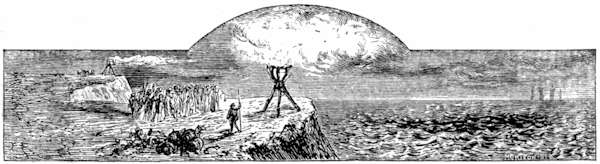
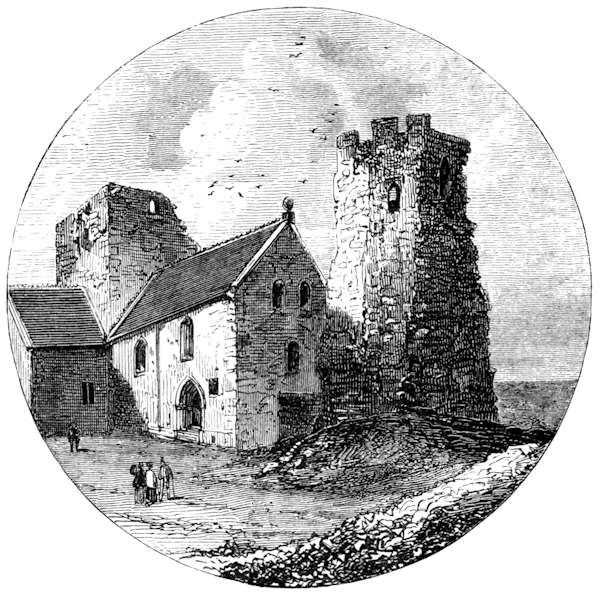
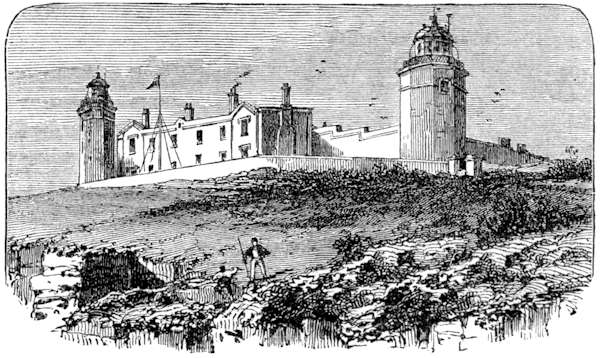
The most ancient public light on the Scottish coast is
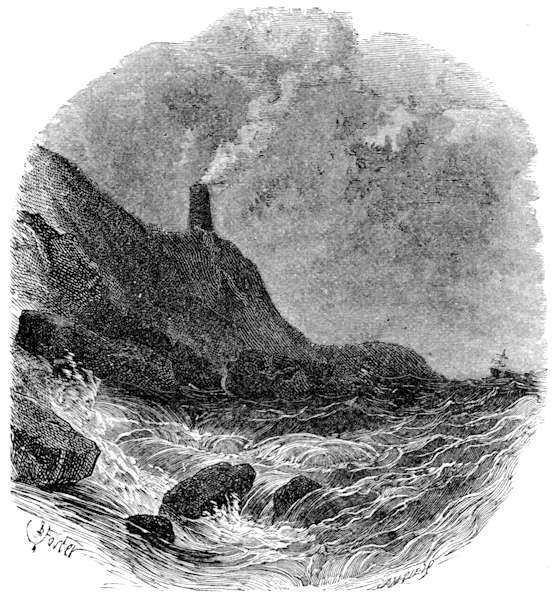
that situated on the Isle of May; an island which, like a
natural breakwater, lies off the mouth of the Firth of
Forth, and commands, as it were, the great highway to
the Scotch capital and its prosperous port. It seems to
have been erected at a very early period; and over the
entrance-door of the weather-beaten tower is cut the
figure of the sun, with the date of 1635.
After the Union, very considerable discontent was expressed
by the English and Irish merchants that, for the
maintenance of this beacon, they were charged exactly double
the rate paid by Scottish vessels. They also complained of
the insufficiency of the light, which was simply a coal-fire
exposed in an open chauffer, or brazier. The Edinburgh
Chamber of Commerce taking up the matter, the proprietor
of the light consented to increase its magnitude, and accordingly
enlarged his chauffer to three feet square, doubling
the consumption of coal, which had formerly been about
200 tons per annum. Thenceforth it became the “most
powerful coal-light in the kingdom;” but, owing to its
exposure, was frequently unsteady in foul weather; and,
moreover, was apt to be confused with the lime-kilns and
accidental fires on the neighbouring coast. The Duke of
Portland had by this time become proprietor—through
marriage—of the light and the island; but to repeated
applications that he would substitute an oil-light and reflectors
for the wavering and uncertain coal-fire, he turned
a deaf ear. At length, on the 19th of December 1810,
two men-of-war were wrecked near Dunbar, in consequence,
it was believed, of a lime-kiln on the Haddingtonshire
coast being mistaken for the Isle of May light.
The Admiralty were thus led to interfere, and, after some
negotiations with the Duke of Portland, an Act of Parliament
was passed in 1814 empowering the Commissioners
of Northern Lights to purchase the island and its
lighthouse for a sum of £60,000. The tolls were then
reduced to an uniform scale, a new tower was erected, and
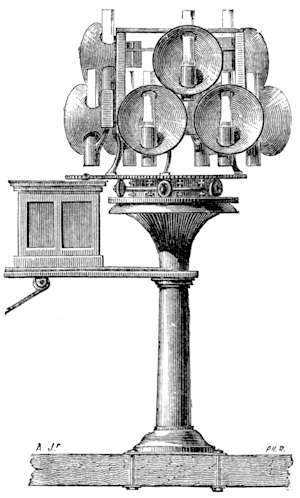
a light on the catoptric system was first exhibited on the
1st of February 1816.
Meanwhile, the progress made in lighting other important
points of the Scottish coast had been considerable.
The lighthouse at Grass Island in Harris was completed
on the 10th of October 1789. On the same date was kindled
a light at North Ronaldshay, in Orkney. In 1790, on the 1st
of October, a light was exhibited at Pladda, a small island
south-west of Arran, in the Firth of Clyde. As a guide
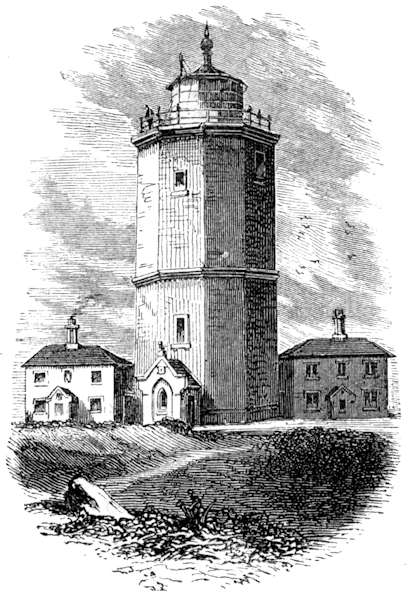
to the Pentland Firth a lighthouse was erected on the
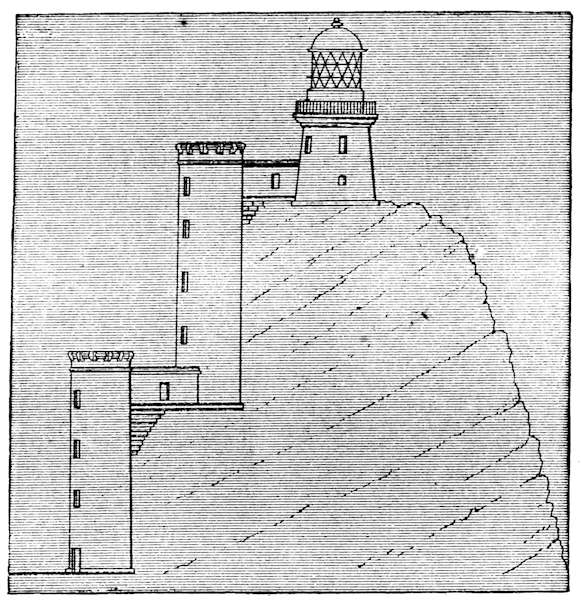
Pentland Skerries in 1794. The Skerries are a couple of
desolate islands, exposed to the stress of the North Sea
and the currents of the Pentland Firth; and the works
here consist of an upper and lower lighthouse, respectively
100 and 80 feet above the sea-level, and 60 feet apart.
They deserve our special notice as the first memorials of
the skill and energy of Robert Stevenson as an engineer.
He was on the spot when the two lights were first exhibited,
October 1, 1794; and, his task completed, sailed
from Orkney on the 9th of October in the sloop Elizabeth.
On the following day he landed within a few miles of
Kinnaird Head lighthouse, and continued his journey to
Edinburgh by road, reaching the capital in safety. A
different fate, however, awaited his former companions;
the sloop having put back to Cromarty Roads, was afterwards
driven to Orkney, and ultimately lost, when all on
board perished.[31]
We have spoken of a lighthouse erected on North
Ronaldshay in 1789. An experience of twelve years
showed that its position had been unfortunately selected,
and that it by no means assisted the mariner in navigating
the difficult straits of the Orkney archipelago.
Every winter ships were cast away, and precious lives
were lost, on the islands of Stronsay and Sanday, though
the latter is only eight miles distant from North Ronaldshay.
In 1796 three homeward-bound vessels were
lost on this fatal island, and eight more in the next
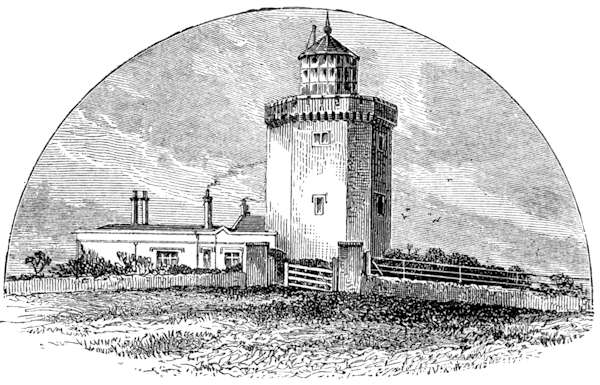
three years. It was therefore resolved, in 1801, that a
beacon, or tower of masonry, should be erected upon
the Start Point, or eastern extremity of the low shores
of the island of Sanday; and erected in such a manner
that, if found necessary, it might be converted into a
lighthouse.
In 1802 Mr. Stevenson sailed on his annual voyage of
inspection to the Northern Lighthouses, carrying with him
a foreman and sixteen artificers to commence the works on
Start Point. It was the month of April, but, even at this
advanced period of the season, the Orkney Islands were
found covered to the depth of six inches with snow.
Operations were commenced, however, without a day’s
delay: a sandstone quarry was opened on the adjacent
island of Edda; and by the middle of May sufficient materials
were collected for the commencement of the edifice.
The foundation-stone was laid, with masonic ceremonies, on
the 15th of May, when an address was delivered by Mr.
Traill, the minister of the parish, some portions of which
may be preserved in these pages:—
“The moment is auspicious. The foundation-stone is
laid of a building of incalculable value;—a work of use,
not of luxury. Pyramids were erected by the pride of
kings to perpetuate the memory of men whose ambition
enslaved and desolated the world. But it is the benevolent
intention of our Government on this spot to erect a
tower—not to exhaust, but—to increase the wealth and
protect the commerce of this happy kingdom....
“Consider the great national objects for which this
building will be erected. To protect commerce, and to
guard the lives of those intrepid men who for us cheerfully
brave the fury of the waves and the rage of the
battle. The mariner, when he returns to the embraces of
his wife and children, after ascribing praise to the great
Giver of safety, shall bless the friendly light which guided
him over the deep, and recommend to the protection of
Heaven those who urged, who planned, and who executed
the work. This day shall be remembered with gratitude.
It shall be recorded that, at the beginning of a new century,
the pious care of Government was extended to this
remote island. These rocks, so fatal to the most brave
and honourable part of the community, shall lose their
terror, and safety and life shall spring from danger and
death.”[32]
By steadily prosecuting the works throughout the
summer, they were brought to a fortunate completion in
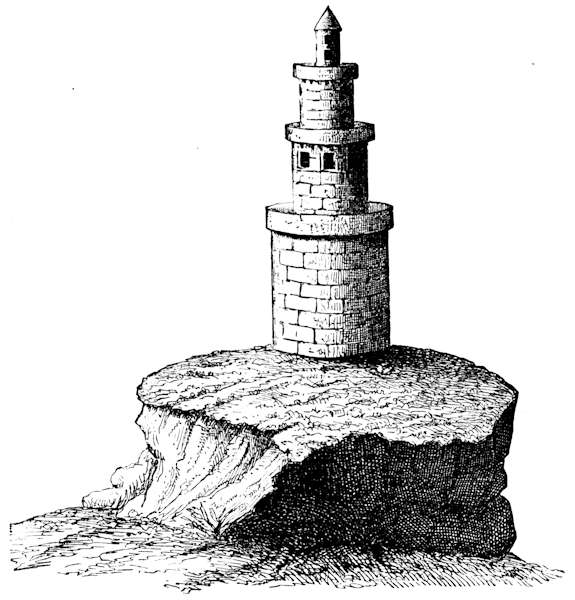
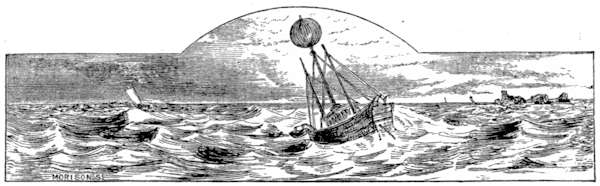
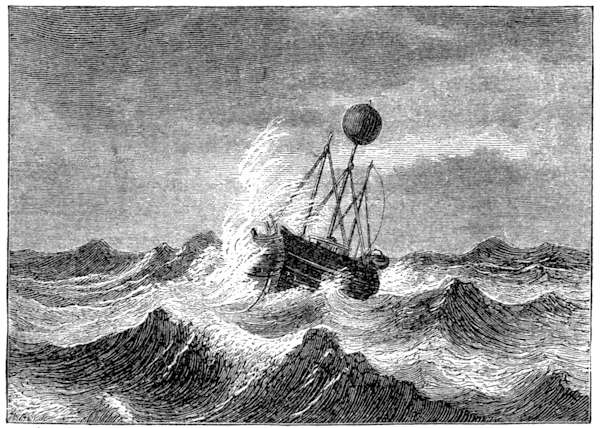
the month of September. The beacon rose to a height of
100 feet, and terminated with a massive ball of masonry,
measuring fifteen feet in circumference.
It was found, however, that the construction of this
beacon did not prevent the occurrence of frequent wrecks
upon the island. It was proverbial with its inhabitants
to observe, that if wrecks were to happen, they might as
well be sent to the poor island of Sanday as anywhere else.
In fact, the inhabitants of this and the neighbouring islands
lived upon the proceeds of their wreckage, and melancholy
remains of many a “tall ship” met the eye in every
direction.
For example, says Mr. Stevenson, although quarries are
to be generally met with in these islands, and the stones
are very suitable for building dykes, yet instances occur of
the land being enclosed, even to a considerable extent,
with ship-timbers. A park[33] might be seen paled round,
chiefly with cedar-wood and mahogany from the wreck of
a Honduras-built ship;[34] and in one island, after the loss
of a ship laden with wine, the inhabitants took claret to
their barley-meal porridge, instead of their usual beverage.
When Mr. Stevenson complained to one of the pilots of
the badness of his boat’s sails, he replied, with grim
humour, “Had it been God’s will that you came na here
wi’ these lights, we might a’ had better sails to our boats,
and more o’ other things.” A much higher rent was
given for the farms than they were absolutely worth, in
consideration of the profits that would probably accrue
from wrecks on their respective shores.
Under these circumstances it was deemed advisable to
convert the North Ronaldshay lighthouse into a beacon,
and the Start Point beacon into a lighthouse, both transformations
being successfully effected in the course of the
year 1805; and the light exhibited on Start Point,
January 1st, 1806.
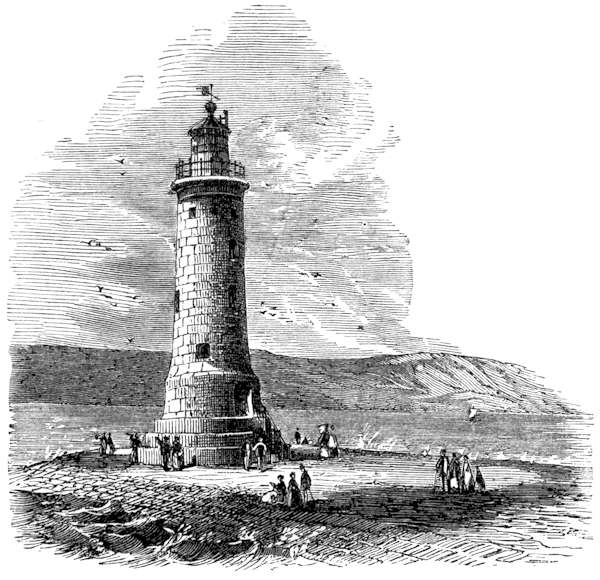
Continuing our brief chronological resumé, we find that,
for the better navigation of the noble estuary of the Forth,
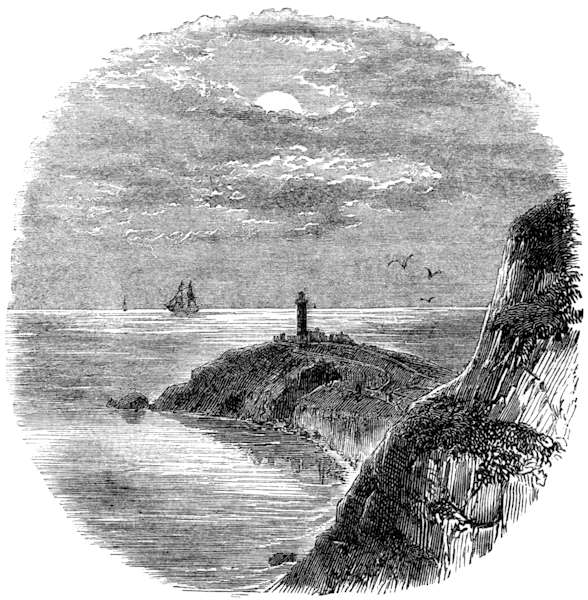
a lighthouse was erected on the island of Inchkeith—which
lies nearly opposite the town of Portobello on the south
shore, and Burntisland on the north—in 1805. Its base
is 175 feet above the sea, and the building itself measures
45 feet in height. The light is a revolving one.
We now come to a description and historical account of
the celebrated lighthouse to which this chapter is more
particularly devoted.
Pharos loquitur.
“Far in the bosom of the deep
O’er these wild shelves my watch I keep,
A ruddy gem of changeful light,
Bound on the dusky brow of Night:
The seaman bids my lustre hail,
And scorns to strike his timorous sail.”
Sir Walter Scott.[35]
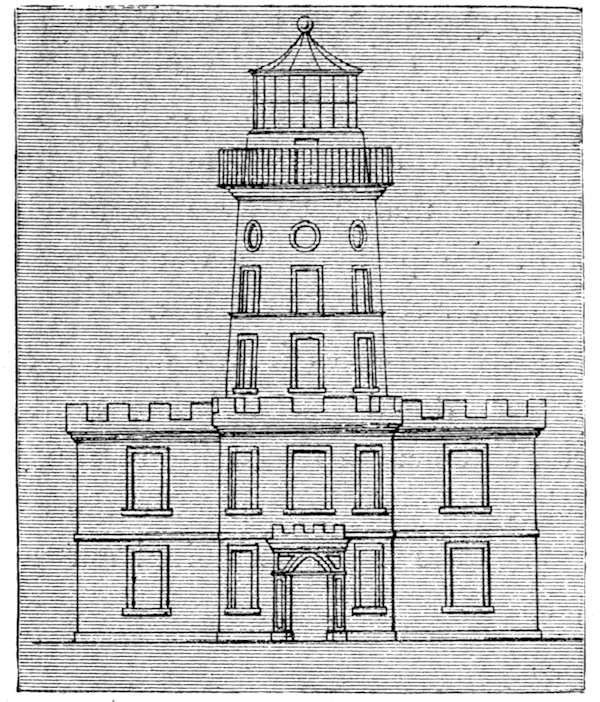
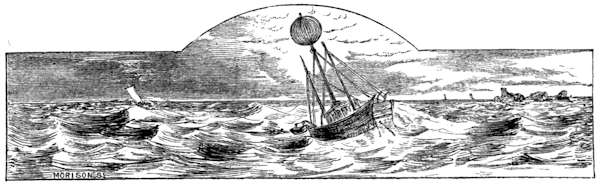
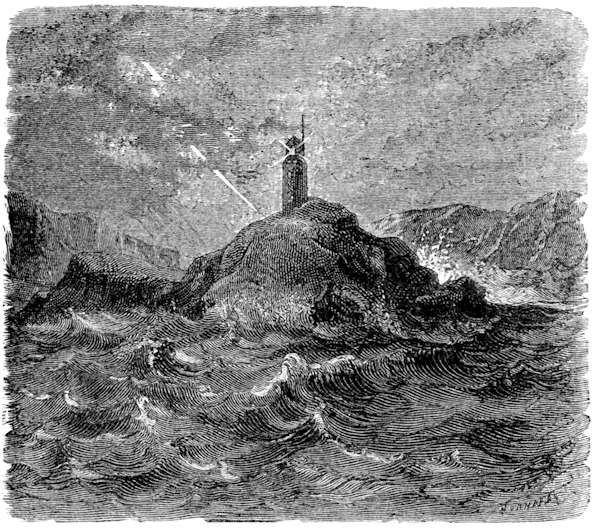
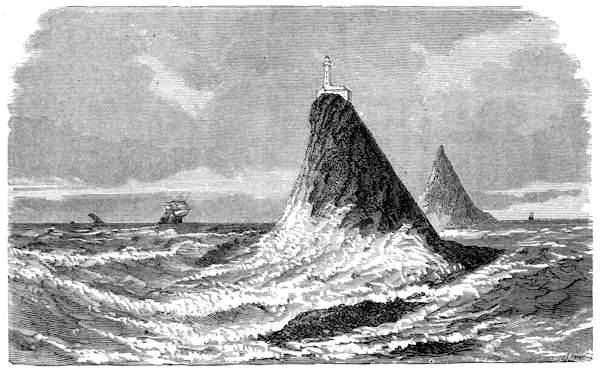
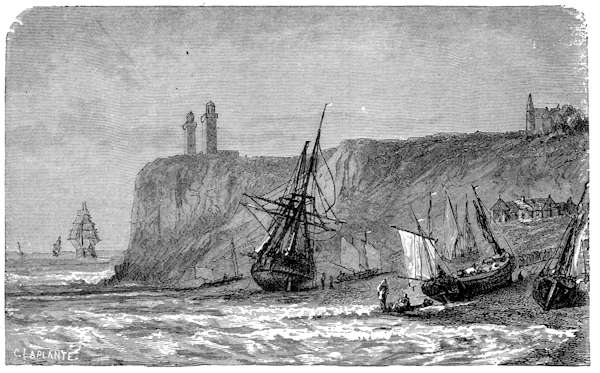
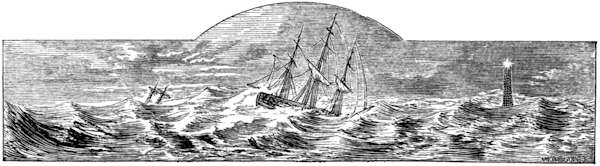
INCHKEITH LIGHTHOUSE.
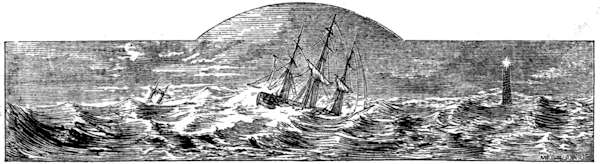
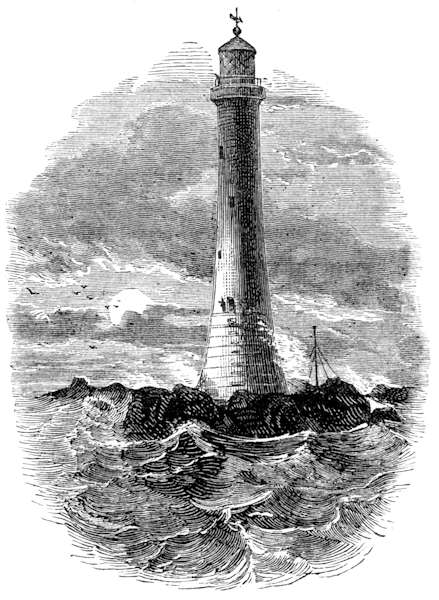
The Inch Cape, or Bell Rock, is a “dangerous sunken
reef,” situated on the northern side of the entrance of the
Firth of Forth, at a distance of eleven miles from the promontory
of the Red Head, in Forfarshire; of seventeen
miles from the island of May; and of thirty miles from
St. Abb’s Head, in Berwickshire. Its exact position is in
lat. 56° 29´ N., and long. 2° 22´ E. Its extreme length
is estimated by Mr. Stevenson at 1427 feet, and its extreme
breadth at about 30 feet, but its configuration or
margin is extremely irregular. The geological formation
of the rock is a reddish sandstone, which in some places
contains whitish and greenish spots of circular and oval
forms. Its lower portions are covered with various aquatic
plants, such as the great tangle (fucus digitatus), and the
badderlock, or hen-ware (fucus esculentus); while the
higher parts are clothed with the smaller fuci, such as
fucus marmillosus, and fucus palmatus, or common dulse.
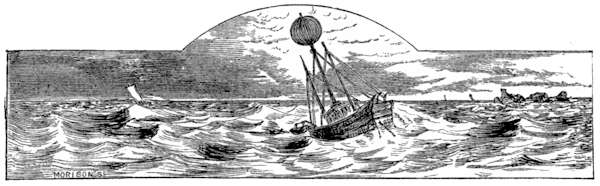
The name “Inch Cape” occurs in a chart published in
1583, and refers, we suppose, to its situation as an “inch,”
or island, off the Red Head promontory. Its better known
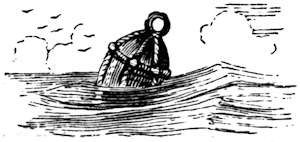
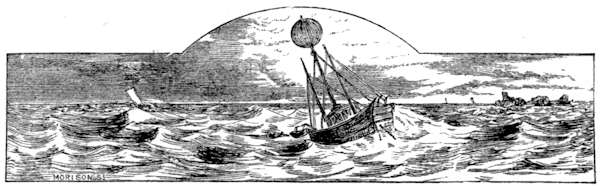
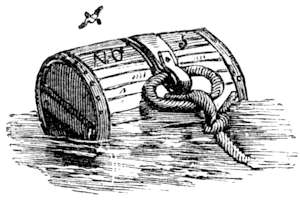
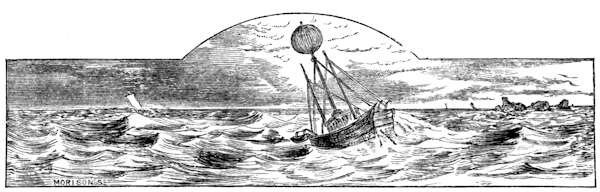
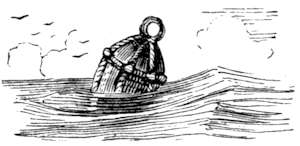
appellation, “the Bell Rock,” may allude to its bell-like
figure, but more probably originated in the circumstance
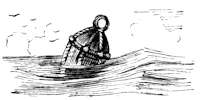
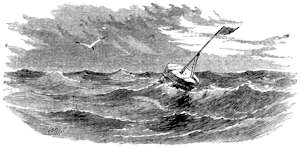
that a bell with a float was fixed upon it by a former
abbot of Aberbrothock (Arbroath), in such a manner that
it was set in motion by the winds and waves, and by its
deep tones afforded a much-needed warning to navigators
of the dangerous character of the spot.
In connection with this humane device—whose actual
existence there seems no good reason to doubt—an old
tradition has long been current, which Southey embodies
with much picturesque effect in his well-known ballad of
“Sir Ralph the Rover”:—
“No stir in the air, no stir in the sea,
The ship was still as she could be;
Her sails from heaven received no motion,
Her keel was steady in the ocean.
“Without either sign or sound of their shock,
The waves flowed over the Inchcape Rock;
So little they rose, so little they fell,
They did not move the Inchcape Bell.
“The Abbot of Aberbrothok
Had placed that bell on the Inchcape Rock;
On a buoy in the storm it floated and swung,
And over the waves its warning rung.
“When the rock was hid by the surge’s swell,
The mariners heard the warning bell;
And then they knew the perilous rock,
And blessed the Abbot of Aberbrothok.
“The sun in heaven was shining gay,
All things were joyful on that day;
The sea-birds screamed as they wheeled around,
And there was joyaunce in their sound.
“The buoy of the Inchcape bell was seen,
A darker speck on the ocean green;
Sir Ralph the Rover walked his deck,
And he fixed his eye on the darker speck.
“He felt the cheering power of spring,
It made him whistle, it made him sing;
His heart was mirthful to excess,
But the Rover’s mirth was wickedness.
“His eye was on the Inchcape float;
Quoth he, ‘My men, put out the boat,
And row me to the Inchcape Rock,
And I’ll plague the Abbot of Aberbrothok.’
“The boat is lowered, the boatmen row,
And to the Inchcape Rock they go;
Sir Ralph bent over from the boat,
And he cut the bell from the Inchcape float.
“Down sunk the bell with a gurgling sound,
The bubbles rose and burst around;
Quoth Sir Ralph, ‘The next who comes to the rock
Won’t bless the Abbot of Aberbrothok.’
“Sir Ralph the Rover sailed away,
He scoured the seas for many a day;
And now grown rich with plundered store,
He steers his course for Scotland’s shore.
“So thick a haze o’erspreads the sky,
They cannot see the sun on high;
And the wind hath blown a gale all day,—
At evening it hath died away.
“On the deck the Rover takes his stand,
So dark it is they see no land:
Quoth Sir Ralph, ‘It will be lighter soon,
For there is the dawn of the rising moon.’
“‘Canst hear,’ said one, ‘the breakers roar?
For methinks we should be near the shore;’
‘Now where we are I cannot tell,
But I wish I could hear the Inchcape bell!’
“They hear no sound, the swell is strong;
Though the wind hath fallen they drift along,
Till the vessel strikes with a shivering shock,—
‘O Christ! it is the Inchcape Rock.’
“Sir Ralph the Rover tore his hair,
He curst himself in his despair;
The waves rush in on every side,
The ship is sinking beneath the tide.
“But even in his dying fear
One dreadful sound could the Rover hear,—
A sound as if with the Inchcape bell
The devil below was ringing his knell.”
It would be difficult to name a position on the Scottish
coast where a lighthouse was more a matter of necessity
for the safety of ships than this long-famous rock. The
beacons which, one after another, had been erected upon it,
the furious waves had swept away; and a structure was
needed not less solid and permanent than that of the
Eddystone. To design such a structure, and to plant it
solidly amid the waves, became, in 1806, the task of Mr.
Robert Stevenson. As the rock was frequently under
water to the depth of twelve feet, the task was scarcely
less difficult than that whose successful achievement has
helped to perpetuate the name and fame of Smeaton.
On the 7th of August 1807 the work was begun. The
first stage was the erection of a wooden workshop and
residence for the artificers, and this apparently simple
operation occupied the whole season, the supports having
to be firmly fixed in holes dug out of the solid rock.
The hardness and compactness of the sandstone, however,
soon blunted their tools, and rendered necessary the constant
employment of a smith with his forge. But it often
happened, says Mr. Stevenson, to our annoyance and disappointment,
in the early state of the work, when the
smith was in the middle of “a favourite heat,” and fashioning
some useful article, or sharpening the tools, after the
flood-tide had compelled the men to strike work, a sea
would come rolling over the rocks, dash out the fire, and
endanger that indispensable implement, the bellows; or, if
the sea were smooth, while the smith often stood at work
knee-deep in the water, the tide rose imperceptibly, first
cooling the exterior of the fireplace, or hearth, and then
quietly blackening and extinguishing the fire from below.
Mr. Stevenson was frequently amused at the anxiety and
perplexity of the unfortunate smith when coaxing his fire,
and endeavouring in vain to contend against the rising
tide. Obviously the work would go on but slowly, until
the workshop (also intended to serve as a beacon) was
completed, and the smith protected against the insidious
waters.[36]
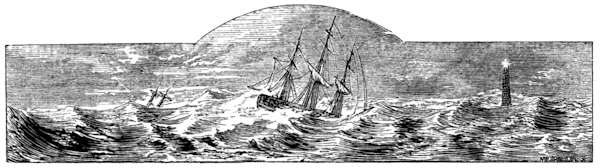
Dangers of a far more serious kind also beset the
patient founders of the Bell Rock Lighthouse.
On the 2nd of September, after the first cargo of stones
had been landed, and while thirty-two artificers were
busily occupied in their various departments of labour, a
gale arose, and the attendant vessel—named the Smeaton,
after the great English engineer—broke adrift from her
moorings. This unfortunate circumstance, at first, was
known only to Mr. Stevenson and his landing-master, who
fully appreciated the gravity of the situation—thirty-two
men on an insulated rock, which, at flood-tide, lay
twelve feet under water, with only two boats at hand, and
these not capable in foul weather of carrying more than
eight men each.
While the artisans were at work, chiefly in sitting and
kneeling postures, excavating the rock, or boring with the
tools, and while the din of their hammers and the clang
of the smith’s forge filled the air, there was sufficient life
and motion in the scene to keep Stevenson’s mind from
fully realizing the dangers of his position. But by degrees
the water began to rise, and with slowly-swelling
waves it gained upon those engaged in work on the lower
portions of the sites of the beacon and lighthouse. From
the run of the sea upon the rock, the forge-fire was more
quickly extinguished than usual; and the volumes of
smoke having ceased, the men at work could examine
every object around. After having had about three
hours’ work, the majority began to make towards their
respective boats for their jackets and stockings, when, to
their astonishment, instead of three boats, they found only
two, the third being adrift with the Smeaton. Not a word
was uttered, but all appeared to be silently calculating
their numbers, while they gazed from one to another with
dismay and perplexity plainly painted on their countenances.
The landing-master, conceiving that he might be
censured for allowing the boat to quit the rock, remained
at a distance, while Mr. Stevenson placed himself on the
most elevated crag, endeavouring to track the progress of
the Smeaton, and surprised that the crew did not cut her
boat adrift, as it greatly retarded her way. The workmen
looked steadfastly upon their engineer, occasionally
turning towards the vessel, which was still far to leeward.
All this took place in the most perfect silence, and the
melancholy solemnity of the scene was such that it produced
an ineffaceable impression on Mr. Stevenson’s mind.
In the meantime the engineer was meditating various
schemes which might be adopted for the general safety of
the party. The most feasible seemed to be, that as soon
as the waves should reach the highest summit of the rock,
all should disembarrass themselves of their upper garments;
and while a certain number went on board each
boat, the remainder should hang by the gunwales, and the
boats should row gently towards the Smeaton, as the
Pharos, or floating-light, lay too much to the windward
of the rock. Stevenson wished to propose this plan; but,
on attempting to speak, his mouth was so parched that
his tongue refused utterance, and he now learned by experience
that the saliva is as necessary as the tongue itself
for speech. Turning to one of the rock-pools, he lapped
a little water, and obtained immediate relief. But great
was his joy, when, on rising from this unpleasant beverage,
a voice called out, “A boat! a boat!” and, on looking
around, at no great distance a large boat loomed through
the deep, and was evidently making for the rock. She
proved to be a pilot-boat from Arbroath, express with
letters; and willingly taking on board Stevenson and his
company, rescued them from their critical position. In
return for this service, the pilot was pensioned by the
Lighthouse Commissioners in his old age.
On the 6th of September, the whole company on board
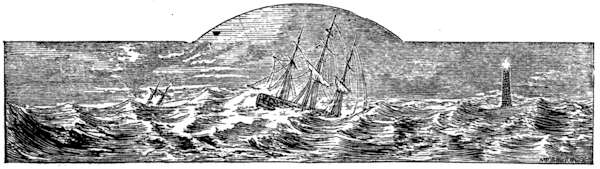
of the light-ship, or Pharos, was surprised by a tremendous
gale, which prevented them from approaching the rock
for ten days, and exposed them to real danger.
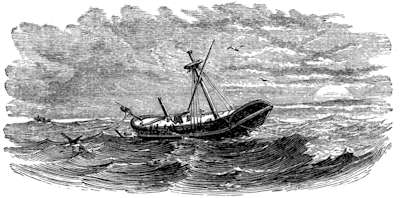
About two o’clock P.M., says Stevenson, a very heavy
sea struck the ship, flooded the deck, and poured into the
berths below. Everybody thought that she had foundered,
and that their last moment had come. Below deck total
darkness prevailed; several of the artificers were at prayer,
repeating hymns, or uttering devout ejaculations; others
protested that if they should be fortunately spared to
reach land once more, no one would induce them to tempt
the treacherous waves again. Through the confusion
Stevenson made his way upon deck. An astounding
spectacle met his gaze. The billows appeared to be ten
or fifteen feet in height of unbroken water, and each
threatened the little vessel with immediate destruction;
but still, with wonderful buoyancy, she continued to rise
upon the waves, and escape their worst violence.
“On deck,” we are told,[37] “there was only one solitary
individual looking out to give the alarm, in the event of
the ship breaking from her moorings. The seamen on
watch continued only two hours; he who kept watch at
this time was a tall, slender man of a black complexion;
he had no great-coat nor over-all of any kind, but was
simply dressed in his ordinary jacket and trousers; his
hat was tied under his chin with a napkin, and he stood
aft the foremast, to which he had lashed himself with a
gasket, or small rope round his waist, to prevent his
falling upon deck or being washed overboard. When Mr.
Stevenson looked up he appeared to smile, which afforded
a further symptom of the confidence of the crew in their
ship.”
About six o’clock in the evening the gale abated, and
the sun rose the next morning in a comparatively serene
sky. The waves still rolled very heavily, and at the
Bell Rock they threw up their spray in columns of from
forty to fifty feet in height. When Mr. Stevenson was
able to visit the rock, he found abundant evidence of their
force: six large blocks of granite had been removed from
their places and flung over a rising ledge into a hole some
twelve or fifteen paces distant. The ash-pan of the
smith’s forge, with its weighty cast-iron back, had also
been washed from their places of supposed security; the
chain of attachment had been broken, and these ponderous
articles were found on the very opposite side of the rock.
Such incidents as these stimulated Stevenson’s desire to
complete the erection of the beacon, which would serve
as a warning to the mariner, and as an asylum for the
artificers on the rock. By dint of persevering exertions,
it was at length completed; and soon afterwards, on the 6th
of October 1807, the works were relinquished for the
season. Though only about one hundred and thirty-three
hours had been actually devoted to them, enough had
been effected to afford an example of what may be accomplished
under similar circumstances, when every heart and
hand labour with conscientious zeal; for the artificers
had wrought at the construction of the beacon as if for
life, or like men stopping a breach in a wall to repress
the inroads of a destroying flood.[38]
During the winter the men were engaged in quarrying
and preparing the stones, and collecting divers materials.
The stones were laid down in courses in the positions they
would occupy in the future lighthouse; they were then
carefully numbered and marked, bored or fixed with
oaken trenails and stone joggles, after the plan adopted
by Smeaton in building the Eddystone lighthouse; and in
this state laid aside for trans-shipment to the rock.
The operations of the second season (1808) were
commenced at as early a date as the weather permitted.
A new tender, the Sir Joseph Banks, was provided for
the reception of the men when not at work, and as it lay
alongside the rock, protected from the winds, the process
of landing or embarkation was conducted with very great
facility.
The mode in which the different artificers were employed
is thus described by Mr. Stevenson[39]:—
“Preparations having been made for a second forge upon
the beacon, the smiths commenced their operations both
upon the higher and lower platforms, where forges had
been erected. They were employed in sharpening the
picks and irons for the masons, and in making bats,
movable cranes, and other apparatus of various descriptions
connected with the railways. The landing-master’s
crew were occupied in assisting the mill-wrights in laying
the railways to land. Sailors, of all descriptions of men,
are the most accommodating in the use of their hands.
They worked freely with the boring irons, and assisted in
all the operations of the railways, acting by turns as boatmen,
seamen, and artificers. We had no such character
on the Bell Rock as the common labourer. All the
operations of this department were cheerfully undertaken
by the seamen, who, both on the rock and on shipboard,
were the inseparable companions of every work connected
with the erection of the Bell Rock Lighthouse. It will
naturally be supposed, that about twenty-five masons,
occupied with their picks in executing and preparing the
foundation of the lighthouse, in the course of a tide of
about three hours, would make a considerable impression
upon an area even of forty-two feet in diameter. But in
proportion as the foundation was deepened, the rock was
found to be much more hard and difficult to work, while the
baling and pumping of water became much more troublesome.
A joiner was kept almost constantly employed in
fitting the picks to their handles, which, as well as the
points of the irons, were very frequently broken. At
eight o’clock the water overflowed the site of the building,
and the boats left the rock with all hands for breakfast.”
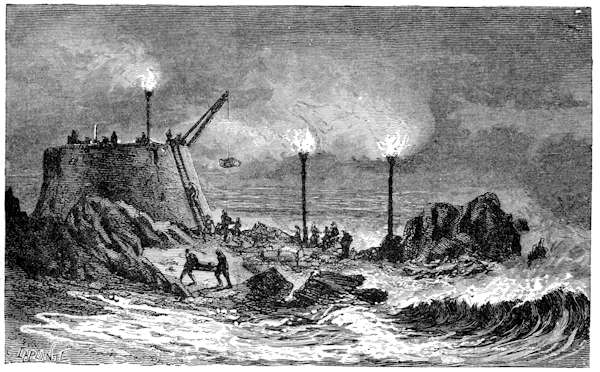
The appearance of the rock at this time was very
curious, and with its effects of light and shade would have
pleased the eye of a Rembrandt. Its surface was thronged
with men; the two forges flamed, one above the other,
like Cyclopean furnaces; while the anvils thundered with
the rebounding clash of their wooden supports, in strange
contrast with the noisy clamour of the ocean-surge.
During the night, if the men were at work, the spectacle
presented to a passing vessel was of the most picturesque
character. To the artificers themselves, the effect of
extinguishing the torches was sometimes startling, and
made terrible the darkness of the night; while the sea,
lit up with a phosphoric glow, rolled in upon the rock
like waves of fire.
As the enterprise proceeded, the smiths were sometimes
left on the beacon throughout the day, and the din of
their anvils formed, in foggy weather, an excellent guide
for the boats. This circumstance confirmed Mr. Stevenson’s
opinion as to the propriety of erecting in the lighthouse
large bells to be rung by machinery, and tolled day
and night during the continuance of hazy weather, so as
to prevent the mariner from drawing too near the dangerous
rock.
So much progress had been made in the preliminary
operations by the 10th of July, that on that day it was
determined to lay the foundation-stone. The ceremony
attending it was very simple. Mr. Stevenson, attended
by his three assistants, applied the square, the level, and
the mallet in due form, and pronounced the following
benediction:—“May the Great Architect of the Universe
complete and bless this building!” Three earnest cheers
were then given, and success to the future operations was
drunk with the greatest enthusiasm.
The first course of masonry was now laid down. It was
only one foot in thickness, yet it contained 508 cubic feet
of granite in outward casing; 8076 cubic feet of Mylnefield
stone in the hearting; 104 tons of solid contents; 132
superficial feet of hewing in the face-work; 4519 superficial
feet of hewing in the beds, joints, and joggles; 420
lineal feet boring of trenail holes; 378 feet lineal cutting
for wedges; 246 oaken trenails; 378 oak wedges in pairs.
By the end of the season the lighthouse was raised to a
level with the highest part of the margin of the foundation-pit,
or about 5½ feet above the lower bed of the
foundation-stone. Work was discontinued on the 21st of
September.
Months rolled away, and the third season in due time
came round. The artificers resumed their building operations,
in 1809, on Saturday, the 27th of May; and in
spite of various accidents and delays, and considerable
obstruction from the inclemency of the weather, had so
far progressed by the end of June as to be able to continue
their labours on the masonry while the rock was under
water. On the 8th of July, it was remarked, with no
small demonstrations of joy, that the tide (a neap one)
ceased for the first time to overflow the building at high-water.
Flags were accordingly hoisted at every vantage-point,
as well as on board the yacht, the tender, the stone-praams,
and the floating light; a salute of three guns
was fired; and, we need hardly say, the loudest and
heartiest cheers pealed through the air and mingled with
the music of the waves.
It is unnecessary to follow, step by step, the operations
of Stevenson and his “undaunted band.” Such details
would possess no interest for the general reader; but he
will understand how great must have been the skill and
perseverance of the engineer, how arduous the industry of
all engaged, when we record that by the 25th of August
the solid part of the building had been raised to the
height of 31½ feet above the rock, and of 17 feet above
high-water of spring tides.
Having during two seasons landed and built up more
than one thousand four hundred tons of stone, while the
work was low down in the water, and before the beacon
had been rendered inhabitable, and as not more than seven
hundred tons were required to complete the masonry, Mr.
Stevenson had good reason to conclude that another season
would consummate his enterprise. But the success of
the work absolutely depending on the stability of the
beacon, he paid frequent visits to the rock in the course of
the winter, to see that it braved unhurt the fury of winds
and waves.
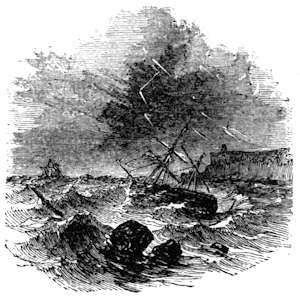
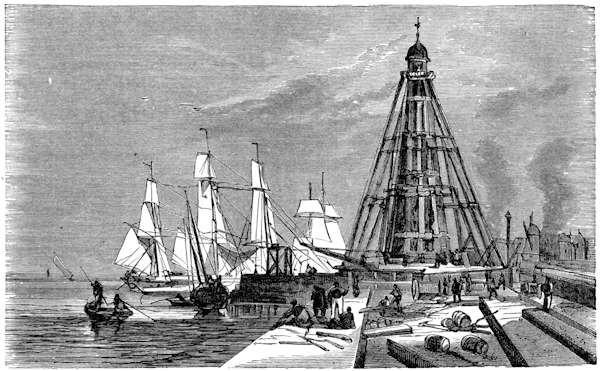
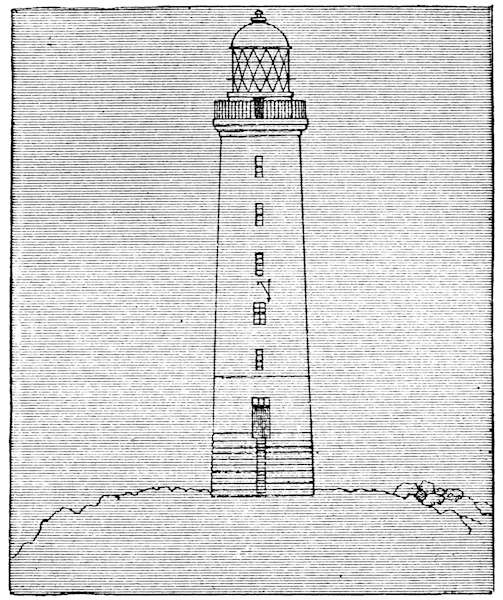
THE BUILDING OF THE BELL ROCK LIGHTHOUSE.
The operations of the fourth and last season were commenced
on the 10th of May. The artificers took permanent
possession of the beacon, which consisted at this
time of three floors—one occupied as the cook-house and
provision store; the second divided into two cabins, one
for the engineer and the other for the foreman; and the
third provided with three rows or tiers of beds, capable of
accommodating about thirty men. Below these three
floors was a temporary floor, at the height of twenty-five
feet above the rock, used for preparing mortar, and for
the smith’s workshop. The beacon was connected with
the lighthouse by a bridge of timber.
The apartment which Mr. Stevenson himself occupied
he has described in characteristic language.
It measured, he says, not more than four feet three
inches in breadth on the floor; and though, from the
oblique direction of the beams of the building, it widened
towards the top, yet it did not admit of the full extension
of his arms when he stood on the floor; while its
length was little more than sufficient for suspending a cot-bed
during the night. This was tied up to the roof during
the day, leaving free room for the admission of occasional
visitants. His folding-table was attached with hinges immediately
under the small window of the apartment, and
his boots, barometer, thermometer, portmanteau, and two
or three camp-stools, formed the bulk of his movables. His
diet being plain, the paraphernalia of the table were proportionately
simple; though everything had the appearance
of comfort, and even of neatness, the walls being covered
with green cloth, formed into panels with red tape, and
his bed festooned with curtains of yellow cotton-stuff. If,
in speculating upon the abstract wants of man in such a
seclusion, one were reduced to a single book, the Sacred
Volume, whether considered for the striking diversity of
its story, the morality of its doctrines, or the important
truths of its gospel, would have proved by far the greatest
treasure.
In the early part of July, a visit was paid to the works
by Mrs. Dickson, the only daughter and surviving relative
of Smeaton, the great engineer. She was conveyed
to the rock on board the Smeaton tender, which had been
so named by Stevenson from a sense of the deep obligation
he owed to the labours and abilities of his predecessor.
It is unnecessary to say that she was exceedingly
gratified by her visit.
Passing over the daily details of the work, we arrive at
the 29th of July, as one of the epoch days of the undertaking.
The last stone was landed on the Bell Rock, and
you may be sure such an occasion was duly celebrated.
On the 30th, the last course (the 90th) of the building
was laid, finishing the exterior wall, and the engineer then
solemnly pronounced a suitable benediction: “May the
Great Architect of the Universe, under whose blessing this
perilous work has prospered, preserve it as a guide to
the mariner!”
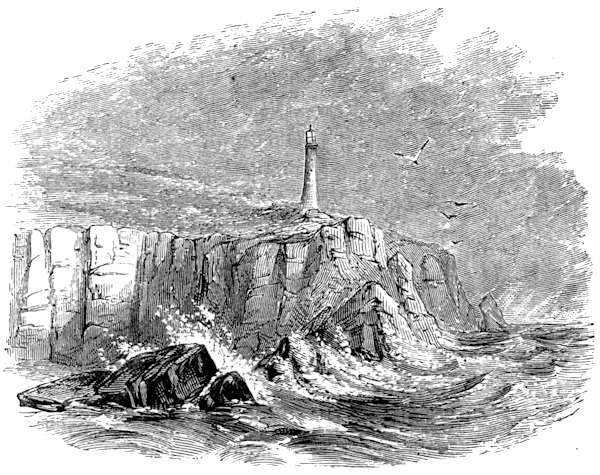
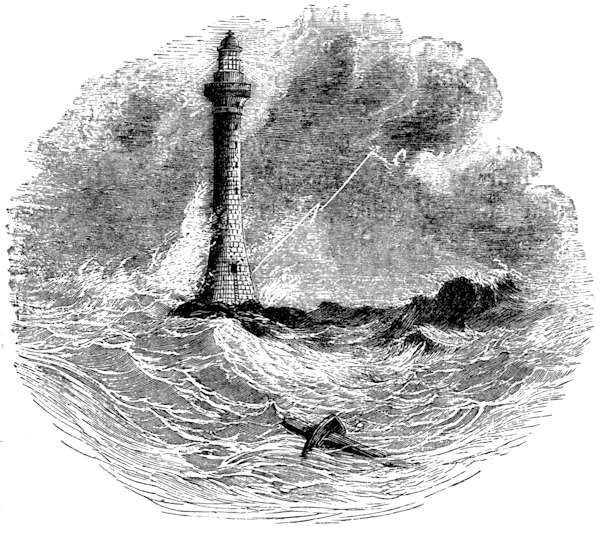
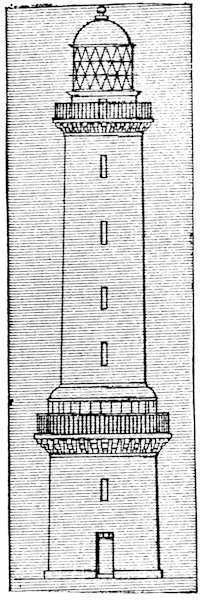
BELL ROCK LIGHTHOUSE.
With the minute particulars recorded by Stevenson of
the completion of the interior of the building, it is needless
to weary the reader. Their technicalities would puzzle
him, and in their prolonged detail we can find nothing to
excite his interest. He will understand that Stevenson
neglected nothing which could ensure the safety and
efficiency of his structure, and on the 17th of December
1810, the following advertisement intimated to the public
that his enterprise had been successful, and that thenceforth
the perils of the Bell Rock would virtually cease to
exist:—
“A lighthouse having been erected upon the Inch
Cape, or Bell Rock, situated at the entrance of the Firths
of Forth and Tay, in north latitude 56° 29´ and west
longitude 2° 22´,—The Commissioners of the Northern
Lighthouses hereby give notice, that the light will be from
oil, with reflectors, placed at the height of about 108 feet
above the medium level of the sea. The light will be
exhibited on the night of Friday, the 1st day of February
1811, and each night thereafter, from the going away of
daylight in the evening until the return of daylight in the
morning. To distinguish this light from others on the
coast, it is made to revolve horizontally, and to exhibit a
bright light of the natural appearance, and a red-coloured
light alternately, both respectively attaining their greatest
strength, or most luminous effect, in the space of every
four minutes; during that period the bright light will, to
a distant observer, appear like a star of the first magnitude,
which after attaining its full strength is gradually
eclipsed to total darkness, and is succeeded by the red-coloured
light, which in like manner increases to full
strength, and again diminishes and disappears. The
coloured light, however, being less powerful, may not be
seen for a time after the bright light is first observed.
During the continuance of foggy weather, and showers of
snow, a bell will be tolled by machinery, night and day,
at intervals of half a minute.”
It was found that this light could be clearly seen and
recognized, in fair weather, at a distance of seven
leagues.
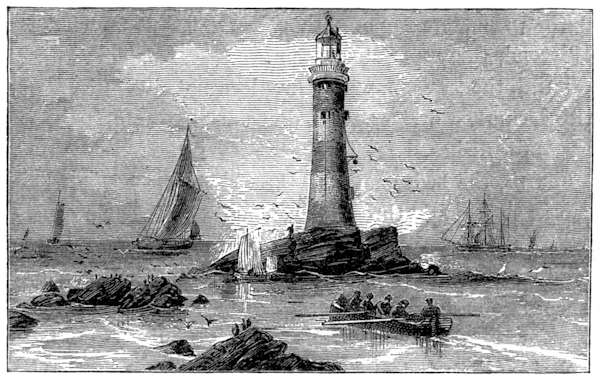
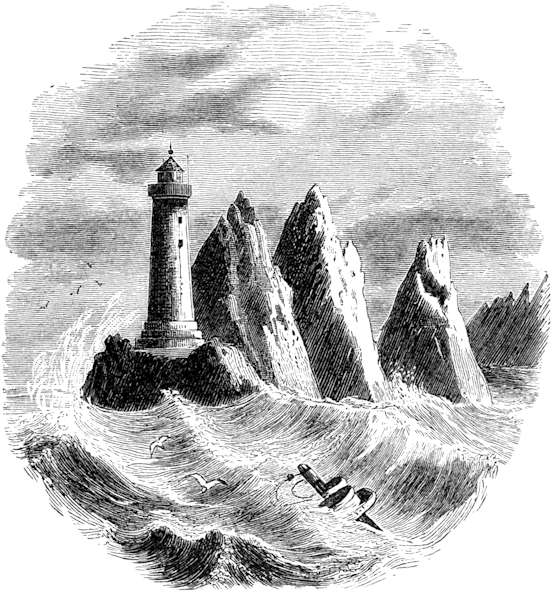
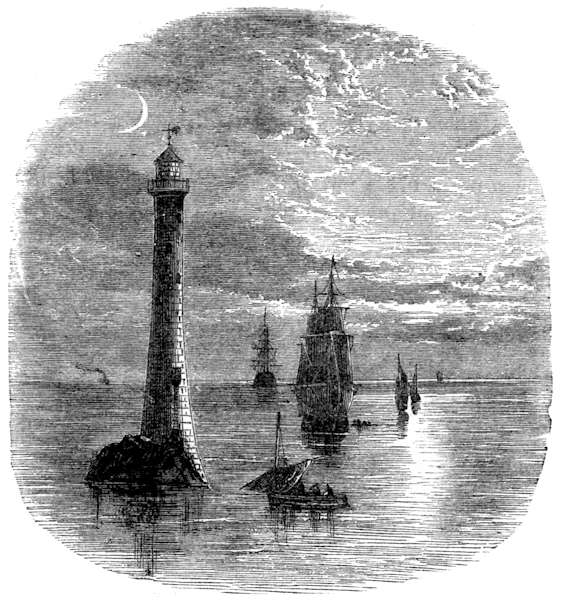
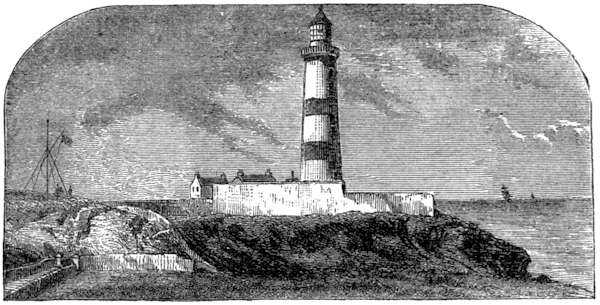
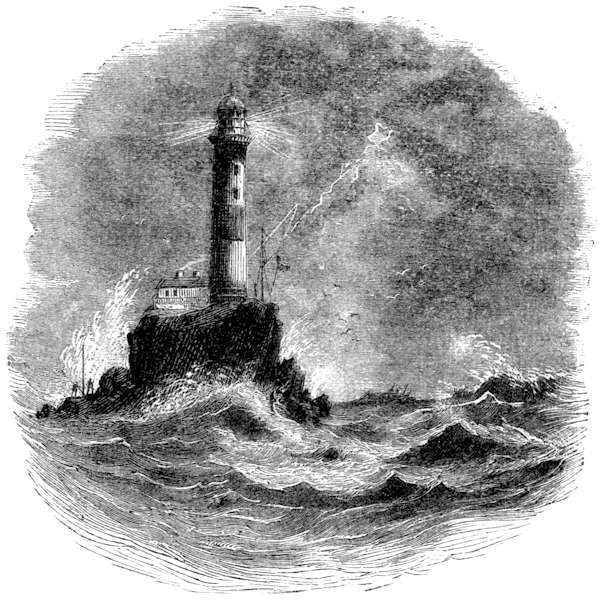
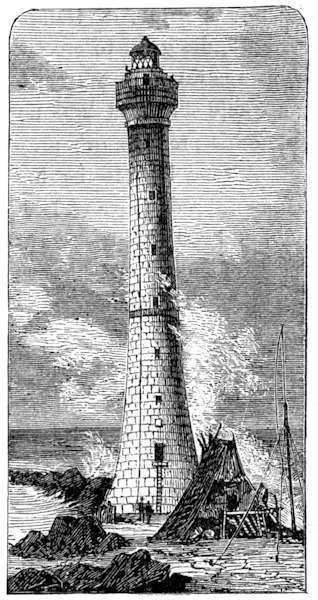
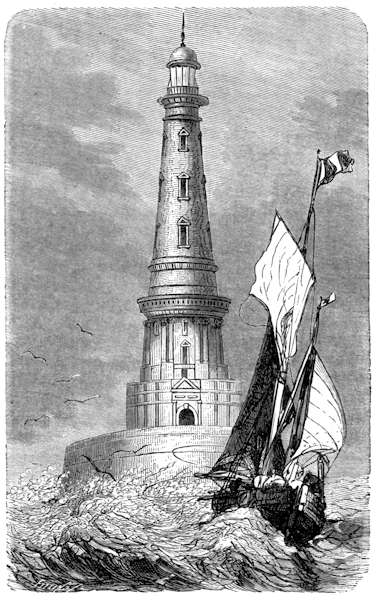
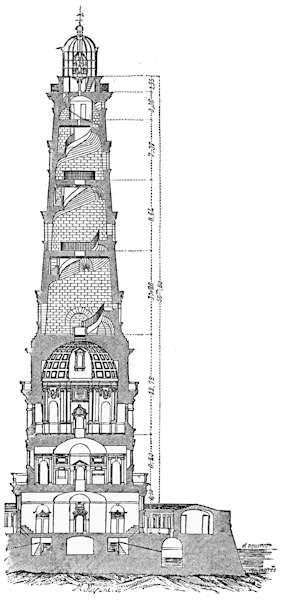
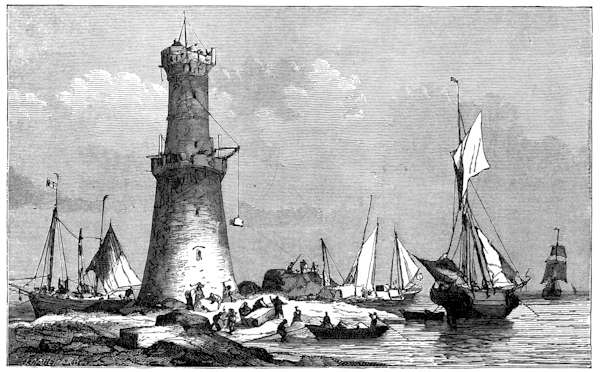
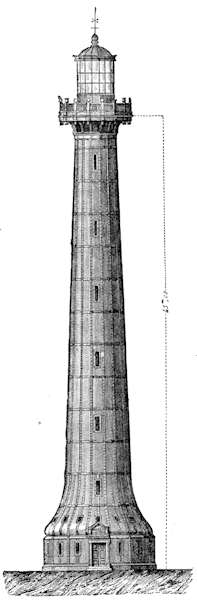
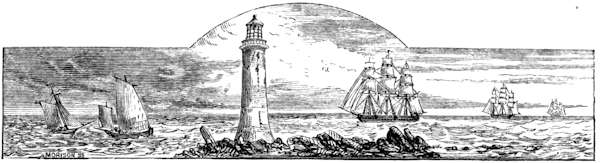
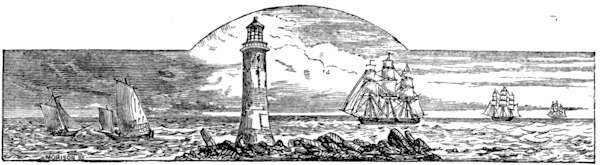
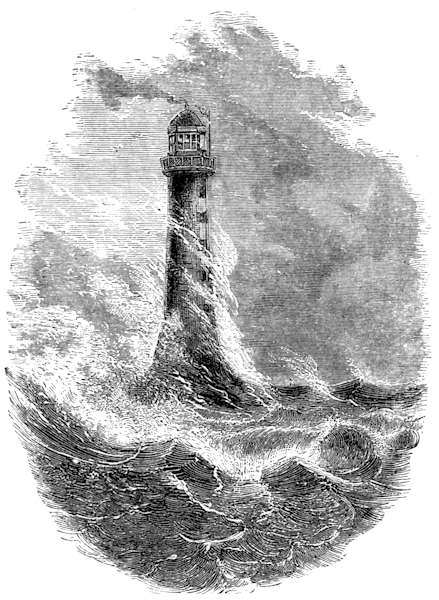
The Bell Rock Lighthouse, thus happily completed, is
a circular building, 42 feet in diameter at the base, and
13 feet at the top. The masonry is 100 feet high, and
the whole structure, including the light-room, 115 feet.
From the entrance door, a circular stair leads to the first
apartment, which is used as a store-room. Wooden steps
ascend to the other apartments, which are appropriated to
the light-keepers, and to the appurtenances of the lighting
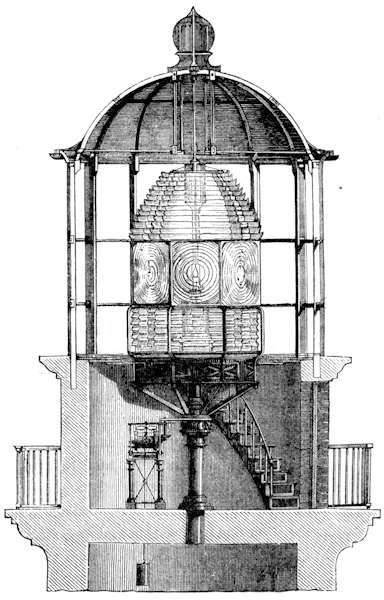
apparatus. The light-room, which is formed of cast
iron, and glazed with polished glass, is octagonal in shape,
12 feet in diameter, and 15 feet in height. It is covered
with a dome, and terminates in a ball.
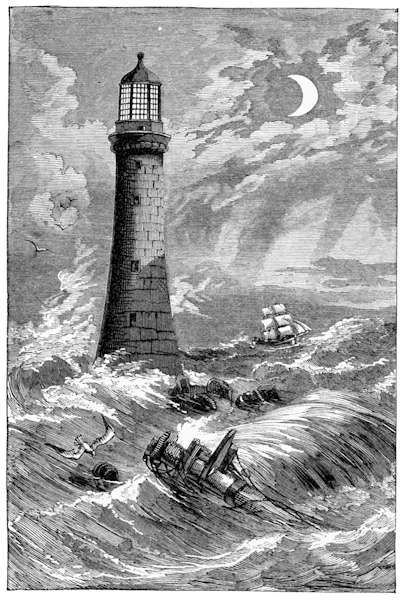
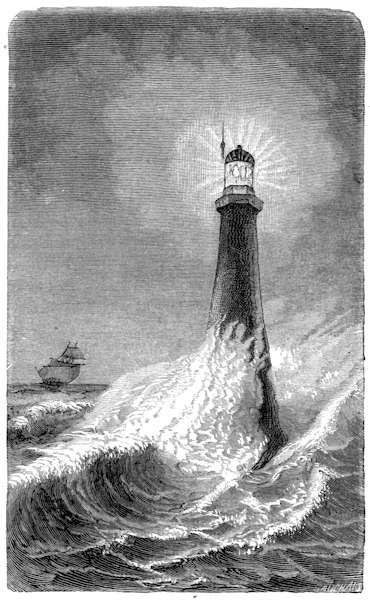
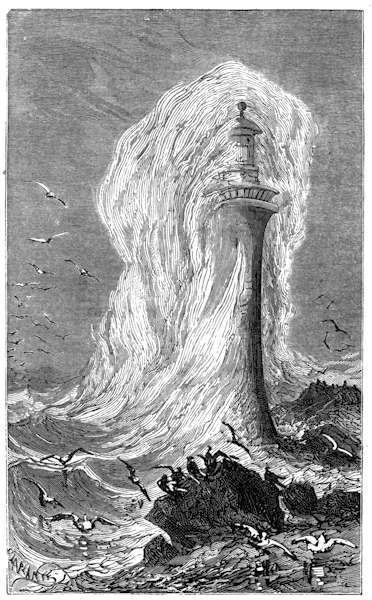
The manner in which this noble structure braves the
assault of waters has been graphically described by Mr.
Stevenson. It is during the winter’s storms, he says, and
when viewed from the Forfarshire coast, that it appears in
one of its most interesting aspects, standing proudly
among the waves, while the sea around it is in the
wildest state of agitation. The light-keepers do not seem
to be in motion, but the scene is by no means still, as the
clang and clamour, the motion and fury of the waves, are
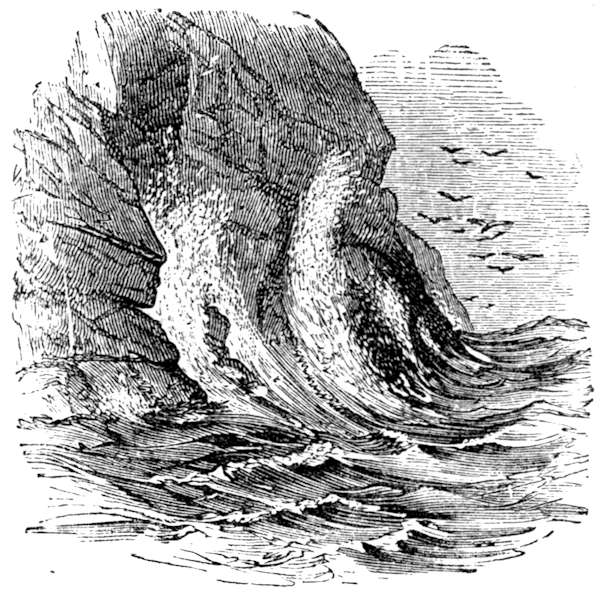
incessant. The seas rise in the most surprising fashion
to the height of about seventy feet above the rock, and
after expending their force in a perpendicular direction,
fall in foaming masses round the base of the lighthouse,
while considerable portions of the spray seem to adhere,
as it were, to the building, and gather down its sides in
the condition of froth as white as snow. Some of the
great waves burst and are expended upon the rock before
they reach the lighthouse; while others strike the base,
and embracing the walls, meet on the western side, where
the violent collision churns the eddying waters into the
wildest foam.
The management of the Bell Rock lighthouse is provided
for as follows:—The nearest town is Arbroath,
about eleven miles distant, where a cutter called the
Pharos is stationed as the lighthouse tender. Once a
fortnight, or in the course of each set of spring-tides, she
visits the rock, to relieve the light-keepers and replenish
their store of provisions and fuel. The keepers are four
in number, three of whom are always on duty, while one
is ashore. If the weather be favourable, each light-keeper
is six weeks on the rock, and a fortnight on land with his
family. The pay is from £50 to £60 per annum, with a
stated allowance of bread, beef, butter, oatmeal, vegetables,
and small beer, and fourpence a day extra for tea. A suit
of uniform is also provided once in three years.
The watches in the light-room are relieved with as much
punctuality as on board a man-of-war, no keeper being
allowed to leave until his successor presents himself, under
the penalty of immediate dismissal. To ensure the strictest
regularity in this respect, a timepiece is placed in each light-room,
and bells are hung in the bed-rooms of the dwelling-houses,
which, being connected by mechanical appliances
with the lighthouse, can be rung as necessity requires.
At Arbroath, as at other stations, the light-keepers’
dwellings are very neatly built and comfortably arranged,
each having its little garden attached. There are also
suitable storehouses provided, a room for the master and
crew of the lighthouse tender, and a signal-tower fifty feet
high, on whose summit a small observatory is erected,
with an excellent achromatic telescope, a flag-staff, and a
copper signal-ball measuring eighteen feet in diameter.
A similar ball crowns the lighthouse dome, and by these
means daily signals are exchanged, to signify that all is
well. Should the ball at the top be allowed to remain
down, as is the case when particular supplies are needed,
or either of the light-keepers have been seized with illness,
assistance is immediately dispatched in the tender.
The total cost of the lighthouse, of the buildings at
Arbroath, of the tender, and the first year’s stores, was
£61,350.
A curious accident is recorded in connection with the
lighthouse as having occurred on the 9th of February
1832, about ten o’clock P.M.
A large herring-gull flew against one of the south-eastern
mullions of the light-room with so much violence
that two of the polished plates of glass, measuring each
about two feet square and a quarter of an inch thick, were
dashed to atoms, and scattered over the floor, to the great
alarm of the keeper on watch, and of his two associates,
who rushed instantly into the light-room. It happened,
fortunately, that although one of the red-shaded sides of
the reflector-frame was passing in its revolution at the
moment, the fragments were so minute that no injury was
done to the valuable red glass. The gull was found to
measure five feet from tip to tip of its expanded wings.
A large herring was found in its gullet, and in its throat
a piece of plate glass about an inch in length.[40]
Before quitting the subject of the Bell Rock Lighthouse,
it is desirable we should refer to another of Mr.
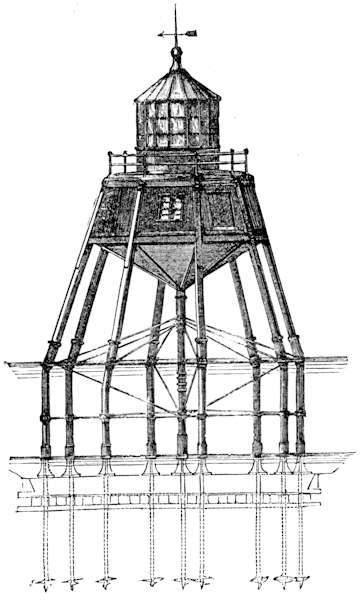
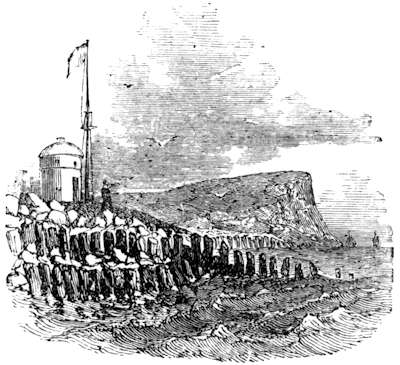
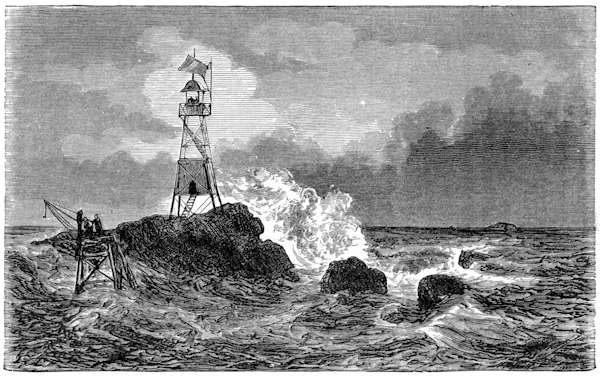
Stevenson’s achievements, the Beacon on the Carr rock.
The Carr is the seaward extremity of a sunken reef, visible
only at low water, which extends about two miles from
the shore of Fifeness, on the northern side of the mouth
of the Forth estuary. Its position is unusually dangerous,
as it lies in the track of shipping ascending and descending
Scotland’s great eastern river. In the course of nine
years it proved fatal to no fewer than sixteen vessels.
As all attempts had failed to mark its position by a floating
buoy, the authorities resolved to erect a beacon of
masonry upon it, and in 1813 the difficult work was commenced
under Mr. Stevenson’s direction. The dimensions
of the Carr are only 23 feet in breadth by 15 feet in
length, and it was impossible, therefore, to obtain a base
for a building of greater diameter than 18 feet.
Five seasons were spent in the erection of the beacon,
so many were the obstacles which the workmen had to
conquer, especially from the prevalence of rolling seas and
stormy winds. In the fifth year, when the whole of the
masonry had been completed, a November hurricane swept
away the upper part of the structure. A modification of
the original design was then adopted; and on the courses
of masonry left intact by wind and waves six columns of
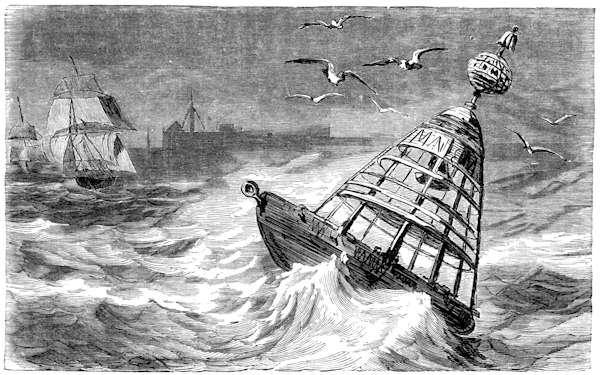
cast iron were planted, terminating in a cast iron ball of
three feet in diameter, which rose about twenty-five feet
above the average sea-level. The whole was completed
in the sixth season (September 1821).[41]
The Carr rock is about six miles north-north-east of
the Isle of May lighthouse, and twelve miles south-west
of the Bell Rock.
In a recent pamphlet,[42] Mr. Thomas Stevenson, the engineer
to the Board of Northern Lights—who has an
hereditary as well as an individual claim to be heard on
all matters of this kind—has suggested various modes of
lighting beacons and buoys. As he observes, the importance
of raising them to the rank of illuminated night-marks
must be apparent to all who know anything of
coast navigation; and he is certainly justified in thinking
that the subject is worthy of more attention than has
hitherto been given to it.
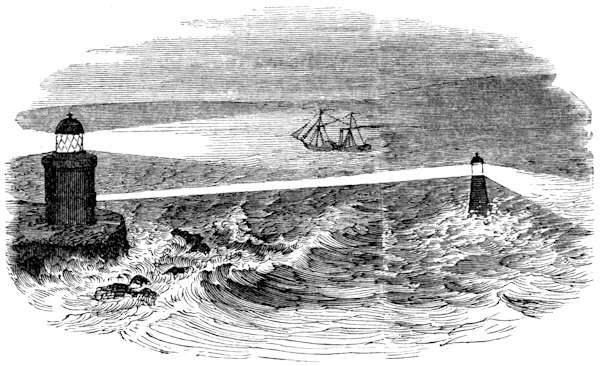
He speaks, in the first place, of apparent or borrowed
lights, where a ray is thrown on a buoy or beacon—as in
the case of the Arnish Rock, referred to on page 274,—from
a neighbouring lighthouse. The only other existing
example of an apparent light is to be found at the harbour
of Odessa, in the Black Sea. It was constructed in 1866,
and is situated three hundred feet from the shore.
Mr. Stevenson’s next suggestion applies to dipping lights
for sunk rocks, where it would be difficult or impossible to
erect a beacon for containing the necessary optical apparatus.
Here he would so arrange the lamp and reflectors of the lighthouse
as to dip vertically, and thus project a cone of rays
upon the sea for a considerable area round the secret danger.
On seeing the illuminated wave-space the mariner would
alter his course, and give the sunken rock a “wide berth.”
The other methods proposed by Mr. Stevenson are:—
The conduction either of voltaic, magnetic, or frictional
electricity, singly or combined, to the buoy or beacon,
through wires, submarine, or, where practicable, suspended
in the air, so as to produce a spark either with or without
vacuum tubes, or by means of an electro-magnet and the
deflagration of mercury.
The conduction of gas from the shore in submarine pipes.
Self-acting electrical apparatus, produced by the action
of sea-water or otherwise at the beacon itself, so as to require
no connection with the shore.
And, finally, Mr. Stevenson recommends different applications
of sound, so as to produce distinct and powerfully
audible warnings during the prevalence of a thick fog or
mist:—
The propagation of sound during fogs through pipes
communicating with the shore,[43] or the origination of sound
at the beacon or buoy itself, by condensing the column of air,
or by acting on a column of water contained in the pipe.
Bells rung by electricity. Mr. Wilde, of Manchester,
states that bells twelve or eighteen inches in diameter,
placed on different beacons, and as far off as ten miles from
the shore, could be tolled a hundred times a-minute by
means of a three and a half or four inch electro-magnetic
machine worked by an engine of about two-horse power.
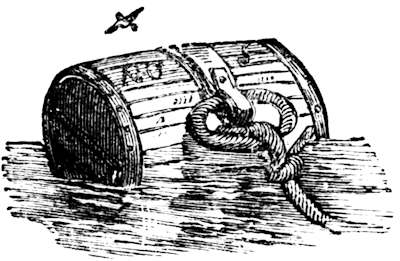
And, finally, bells may be rung by the simple pressure
of the waves through the agency of a float, which would
sink or rise according as the tide sunk or rose. This was
proposed for the beacon at the Carr Rock by the late Mr.
Stevenson in 1810.
By the adoption of one or other of these suggestions,
according to the conditions of the locality, there can be no
doubt that the subsidiary illumination of our shores and their
contiguous waters would be very considerably improved.