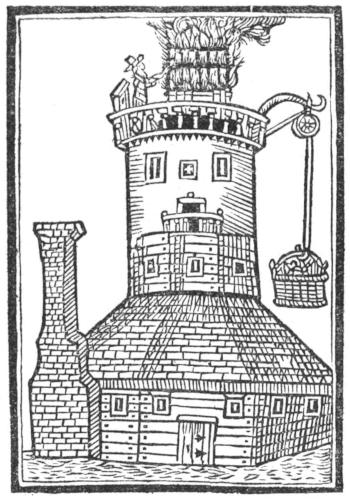
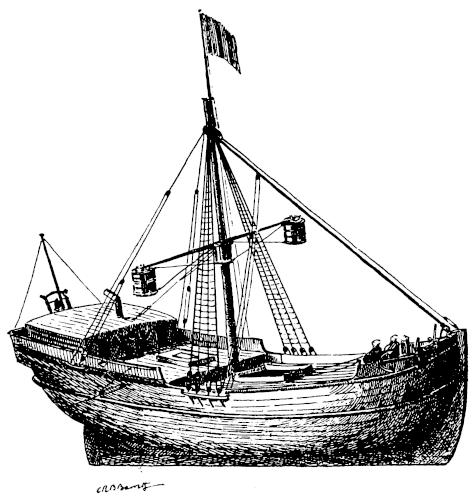
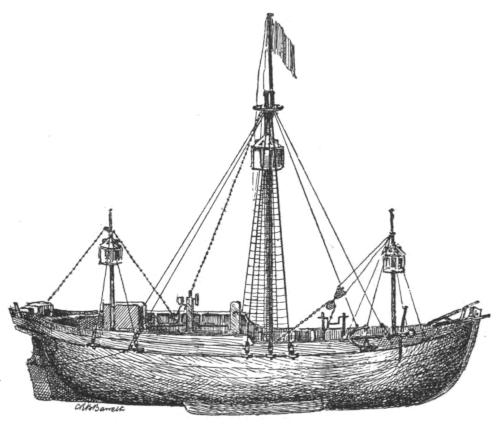
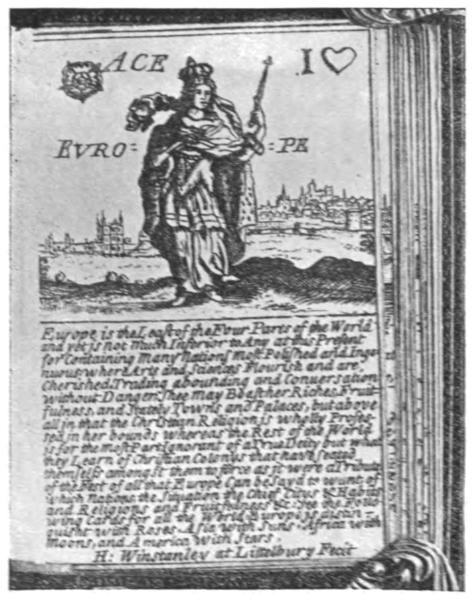
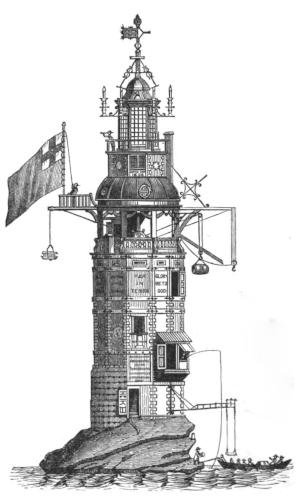
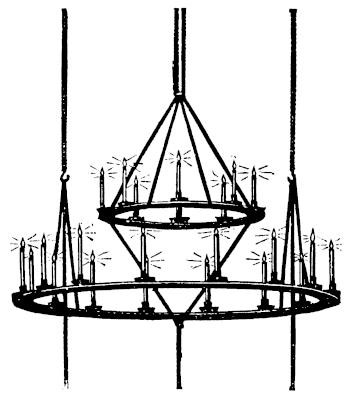
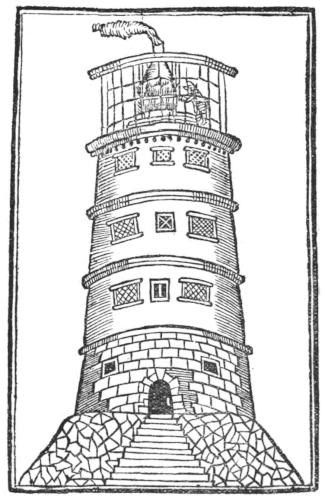
(From a receipt for Lighthouse dues, dated December 19, 1690,
in the possession of Lord Kenyon.)
LIGHTHOUSES
THEIR HISTORY AND ROMANCE
BY
W. J. HARDY, F.S.A. AUTHOR OF ‘THE HANDWRITING OF THE KINGS AND QUEENS OF ENGLAND;’
‘BOOK PLATES,’ ETC.
WITH MANY ILLUSTRATIONS
THE RELIGIOUS TRACT SOCIETY 56 Paternoster Row, and 65 St. Paul’s Churchyard
1895
PREFACE
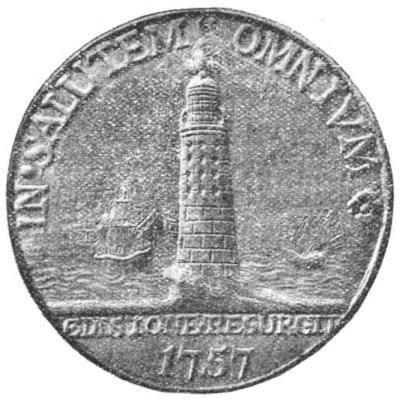
THE EDDYSTONE MEDAL, 1757.
I have for some years past devoted a good deal
of time to the study of facts connected with the
history of English coast-lighting, and I have now
woven together into this volume such of the scattered
references to the subject which I have found, and have
entitled it, Lighthouses: their History and Romance.
That there is much romantic incident in connection
with our lighthouses, and that many of them possess
interesting histories, the reader of the following pages
will, I think, admit; and it is really surprising that
no history of them has before this been compiled.
I could not have obtained the facts I have here been
able to bring together had I not received constant and
generous assistance from all those in whose power it
was to render it; and were I to attempt to convey to
the officials of the British Museum and Public Record
Office, who have assisted me, individual thanks, I should
unduly prolong this preface. Yet I cannot leave unrecorded
my gratitude to Mr. W. Y. Fletcher, F.S.A.,
late of the Printed Books Department, in the first-named
office, and to Mr. G. H. Overend, F.S.A., in
the latter.
Not one half of the facts here recorded could have
been obtained had I not received free and full access
to the muniments of the Corporation of the Trinity
House. This was accorded to me through the instrumentality
of Sir Edward Birkbeck, Bart., and my
good friend, his brother, Mr. Robert Birkbeck, F.S.A.
I presented their introduction to Sir Sydney Webb,
K.C.M.G., the Deputy-Master of the Trinity House,
and that gentleman, Mr. Kent, the Secretary, and
Mr. Weller, one of the officials of the department, gave
me every assistance in their power and the freest access
to their records. To Mr. Dibdin and his assistants at
the National Lifeboat Institution I also desire to
express my gratitude for various information supplied,
and in particular for some of the wreck incidents I have
mentioned.
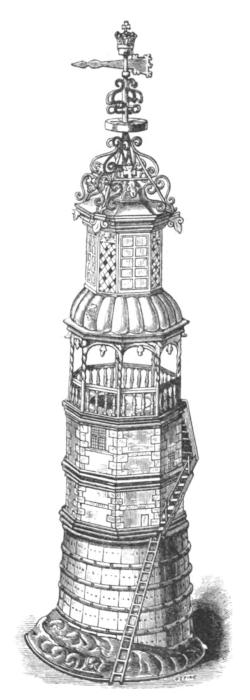
I am particularly grateful to Lord Kenyon for
allowing the reproduction of two very interesting contemporary
pictures of seventeenth-century lighthouses—those
at Dungeness and the Scillies; and to Mr. Mill
Stephenson, F.S.A., the Secretary of the Royal Archaeological
Institute, for the use of one of the illustrations—the
Silver Model of Winstanley’s Eddystone Lighthouse—that
appeared, some years ago, in the Journal of
the Society.
My thanks are due, and I return them with pleasure,
to my fellow-worker, Mr. William Page, F.S.A., who
has always brought to my knowledge any fact connected
with Lighthouse history that he came upon in his
researches.
In presenting to the public the last volume which
I published through the Religious Tract Society, The
Handwriting of the Kings and Queens of England,
I was permitted to thank the Rev. Richard Lovett,
M.A., the Society’s Book Editor, for his constant help
and advice in bringing out that work. I trust that I
may be again accorded the privilege of thanking him
for his unfailing courtesy and good nature in discussing
and settling points of detail in connection with this
present work.
It was very good of the old abbot so to do;
but in doing what he did, he was no better
than a great many of his fellows. Marking
dangerous reefs, and leading the mariner safely
into port, were, formerly, the work of Christian
charity; they were two of the many useful offices which
the Church performed when there was no one else to carry
them out, and for which we, who see the same things so
much better done, often forget to bestow upon her even
a word of praise or gratitude. Bells on rocks, marks on
shoals and sands, and beacon lights used to be maintained
by the great monasteries, or by their various
offshoots, in this country; and those beacon lights, dim,
flickering, and uncertain though they may have been,
were the direct ancestors of the modern lighthouse.
We do not, of course, claim for Christian charity the
credit of originating the idea of these warning signals
for ships. Long before the dawn of Christianity,
Lybians, Cushites, Romans, Greeks, and Phoenicians
had protected navigation by the means of lighthouses—high
columns, on the summits of which were placed fires
of wood in open grates, or lamps lit by oil, all similar in
style, though on a smaller scale, to the wonderful tower
of white marble, erected at Alexandria, nearly three
centuries before the birth of Christ, by Ptolemy Philadelphus
at a cost of about £170,000 of our money.
THE PHAROS, ALEXANDRIA.
Opinions differ as to whom should be ascribed the
honour of paying for this mighty work; Alexander the
Great and Cleopatra have been credited with it; but,
on the whole, such reliable evidence as there is points
more to Ptolemy as its projector. This being so, we
may perhaps believe the story about the inscription that
was placed upon the tower. The architect’s name was
Sostratos, and he, desiring to be perpetually remembered
in connection with the lighthouse, cut deeply into one
of the stones these words: ‘Sostratos of Guidos, son of
Dixiphanus, to the Gods protecting those upon the
sea.’ Then—being assured that Ptolemy would permit
no name save his own to be remembered in connection
with the work—he coated over the inscription with a
layer of cement, and placed thereon one wholly laudatory
of Ptolemy and associating his name alone with the
erection of the pillar. Time went by; monarch and
architect had been gathered to their fathers, and at last
the cement began to crack, and then drop away; bit by
bit it vanished together with the writing upon it, and
the letters on the true face of the stone beneath stood
out clear and readable—then the world knew to whose
skill was due this blessing to sailors and travellers!
But it is not needful to speak further of these more
ancient lighthouses, or their builders; reference is made
to them only to remind the reader of the antiquity of
coast lighting as a system. These pages concern the
lighthouses of our own country alone, and there is no
evidence to prove or suggest that the shores of England
were lighted prior to the Roman occupation. Indeed,
of direct evidence of lighthouses being used by the
Romans in Britain, there is exceedingly little. The
system was extensively employed by them in Gaul, and
the Tour d’Ordre at Boulogne—or ‘the Old Man of
Bullen,’ as Elizabethan sailors called it—is mentioned
as a lighthouse in the year 191 A.D.; so that it is hardly
likely that the Romans would, for long, have left navigation
around England unassisted by lights.
We may, therefore, accept the ruined tower at Dover,
and some similar remains on the English and Welsh
coasts, as remains of Roman lighthouses.
Whether or not, with the decay of the Roman power
in England, lighthouses fell to ruin, we do not know;
probably this was so, and probably, too, they were not
resuscitated till Christianity had become firmly established
here and was teaching men charity towards their
fellow men. So early as the opening of the fourteenth
century we find monks and hermits in England, and
other maritime parts of Europe, doing their best to
warn mariners of the dangers that lurked around their
monasteries or hermitages, by means of lights maintained
during the season of darkness.
To the north of the island of Jersey lie a cluster of
sharp-pointed rocks, known as the Ecrehou. Sailors
give them a wide berth when they can; as well they
may, for their cruel spike-like reefs stretch far, and on
calm days, when the water is not breaking upon them,
they lie silently and treacherously in wait for the passing
ship.
On the largest of these rocks there was, in the year
1309, a hermitage, or priory, served from the Norman
abbey of Val Richer. Land in Jersey had, years before,
been given to support two monks here who, by day,
used to sing masses for the souls of those who had
perished by shipwreck, and then, as night closed in,
kindle, and keep burning till daybreak, as good and
bright a light as they could upon their tiny building.
Here is a picture romantic enough, and research
would, no doubt, enable us to paint many such. The
ruined chapels that one so often sees to-day, perched
upon a rocky crag or headland of our coast, were often,
in all probability, lighthouses to the mariner of old.
But it is not necessary to leave too much to imagination.
A great deal more can be said to prove that the
maintenance of sea-lights was, in mediaeval England,
really a religious office. Most of us have heard of (many
have seen) the famous lighthouse on St. Catherine’s
Point in the Isle of Wight. It was built only at the
close of the last century, but hard by it, from the
hermitage chapel on Chale Down, a light had been
nightly kept, by the monks there serving God, for more
than five hundred years. I shall tell the history of this
lighthouse later on.
So, too, in 1427, a hermit who had settled at Ravenspurn—close
by the Spurn Point on the Humber—moved
by the constant disasters to shipping that he witnessed,
set to work to build a lighthouse to warn vessels entering
the river of the dangers of the point; and of this lighthouse
also I shall have more to say presently.
Then on the chapel of St. Nicholas, which stood above
the harbour of Ilfracombe, there was maintained by the
priests who served in the chapel a fire of wood, which
was lighted, throughout the winter, at dusk, and by
being constantly tended gave throughout the night a
light that to ships at a distance seemed like a bright
star, and guided them safely into port. The site of
this chapel is yet called Lantern Hill, and a light is
still shown there from a lighthouse at night during the
winter months.
In one instance, at least, the work of coast lighting was
performed by a religious guild: the Brethren of the
Blessed Trinity of Newcastle-upon-Tyne—the Trinity
House of Newcastle, as it is now called. In 1537
Henry VIII committed to this guild the general care
of all matters connected with the navigation of the
Tyne, and amongst other things which the guild had
expressed its willingness to do, was to build two towers
on the north side of ‘Le Shelys,’ one a certain distance
above the other, to embattle these towers for due defence
of the port, and to maintain on each ‘a good and steady
light by night,’ for the guidance of passing ships. In
1746 these two lighthouses, one of which was movable,
were still standing; they were illuminated only by a few
candles, but were the sole lighthouses of which the
River Tyne, at its entrance, could boast.
Then, to emphasize further the fact that, prior to the
religious changes in the reign of Henry VIII, coast
lighting was carried on as a work of Christian charity,
we may call to mind the traditions, so often associated
with the towers or steeples of parish churches on the
coast, that those towers or steeples had once been lighthouses.
Blakeney, in Norfolk, is one of these, Boston is
another; from the summit of ‘Boston Stump’—as the
marvellously high tower of the latter church is called—we
are told that a light was formerly displayed by
which sailors in the German Ocean could shape their
course to enter ‘Boston Deeps’ in safety.
The dissolution of the monasteries swept away, almost
at a blow, the men who tended these coast lights as
a sacred duty, and it confiscated the property from the
profits of which such lights had been maintained. Leland,
when he travelled through England and Wales, after the
dissolution had been some little time in progress, found
few coast lights remaining: here and there he mentions
them, but it is difficult, from his language, to decide
whether those he refers to were still nightly lit, or
whether he gained from the sailors and fisher-folk with
whom he talked that they had been regularly lit shortly
before.
That our coast, only a little previous to the dissolution,
was well lit, and that lighthouses of some kind or other
were not uncommon, we may gather from the writer of
the Pilgrimage of Perfection, who, in the year 1526—when
speaking of the benefit to the soul by frequent
contemplation of death—says: ‘It depresseth all vanities,
dissolution, and lightness of manners, and, like as the
beacon lighted in the night, directeth the mariner to the
port intended, so the meditation of death maketh man to
eschew the rocks and perils of damnation’: and that,
after the dissolution, all, or the great majority, of these
lights were extinguished, we may certainly infer by
a study of The Mariner’s Mirrour, compiled by Wagener,
a Dutch navigator, in 1586, and translated into English
two years later by Anthony Ashley. Wagener describes
minutely every object on the sea-coast of England, but
does not refer to any nocturnal lights, with the exception
of those at Shields, which we have seen were established
under peculiar circumstances and only just prior to the
dissolution.
But the want of lighthouses must have been keenly
felt by sailors; and those engaged in navigation, no
longer able to get what was needed as charity, seem,
after a while, to have suggested paying for it. One of
the earliest post-reformation lighthouses suggested was
that at Winterton, for which we hear proposals in 1585,
just about the time that Wagener wrote his description
of the English coast. Now what was the site which
naturally suggested itself for establishing this light?
Why, the top of the church steeple; where, likely enough,
a similar light had formerly been maintained as an act
of charity.
The proposal emanated from ‘the masters of her
Majesties Navye,’ and was made on behalf of the
seamen of the counties of Norfolk and Suffolk; ‘there
be,’ it says, ‘many perillous sandes in the sea, thwarte
of Hasborrowe Winterton, and the towne of Great
Yermouthe, wheruppon manye shippes and men are
often perished in the night tyme.’
The danger of these sands might well be avoided
‘iffe a contynuall lighte were maynteyned uppon the
steeple of Winterton,’ which might be easily done,
without any ‘greate imposition or taxation,’ if every
English ship trading by the coast, or to the East
countries, paid some small contribution.
Nothing seems to have come of this proposal, and
the next suggestion we hear of for a lighthouse at
Winterton is one some twenty years later in 1607,
made by the Trinity House to maintain a light, not
on a church steeple, but in a building specially erected
for the purpose.
Nor was this a solitary lighthouse scheme. We hear,
just then, of another—a very mad one, it is true, but
none the less interesting on that account—for a lighthouse
on the Goodwins, of which I shall speak later.
Probably there were many more such proposals before
Queen Elizabeth and her council just then, for it is
impossible to conceive that men, many of whom must
have had personal experience of the benefits of coast
lighting, would be content to sit down and do without
them just because the religious changes had swept away
the machinery that had before supported them.
CHAPTER II THE TRINITY HOUSE
Now, some time before the monastic dissolution,
there had been founded in Deptford Church
a guild or fraternity of sailors who undertook
to watch over the interests of all concerned
in shipping. This guild, dedicated to the
honour of the Trinity, had, by the time of which
we are speaking, or a little later—say the opening years
of the reign of James I—come to be known by the
name we know it to-day, the Trinity House, and had
developed into a rich and powerful corporation possessed
of important royal charters, regulating the general
management of navigation, and supporting and administering
a number of exceedingly useful charities.
But this great corporation was ambitious, jealous of
the powers it possessed, and greedy to usurp more; the
superintendence of the buoys and beacons which marked
out channels by day had become vested in it, and its
governing body alleged that it was also possessed of the
sole right of establishing lighthouses.
The question had arisen in respect to one of the
lighthouse schemes we have just mentioned. It had
been proposed, as pointed out, not from charity, but as
a commercial speculation. Persons had come forward
and said they were willing to establish a lighthouse at
such and such a place, and to maintain a light there
throughout the night, in return for certain tolls which
they should levy on passing ships; and they had applied
to the sovereign for the necessary licence to gather the
toll, and had received the desired warrant. But, said the
Trinity House, if anybody is to have this privilege, we
will; the right to erect lighthouses and gather money
for their support is surely vested in us by our various
charters and Acts of Parliament!
So began a very pretty squabble, that did not die out
till hard on the end of the last century, between the
Crown, the Trinity House, and the private lighthouse
speculator or builder. The wealthy shipowners, many
of whom were probably also colliery owners, became
alarmed at the number of lighthouse projects that were
quickly launched. It was all very well to give a voluntary
contribution to support one or two lighthouses at
specially dangerous points, but on the whole it paid
better to lose a ship or two now and then, and a few
men’s lives, than be put to a regular fixed charge for
the safety of navigation. That was their view, and as
the Trinity House Board was largely composed of men
whose interests were identical, that was their view also.
Lighthouses were considered a luxury, and if bestowed
at all the Board must be the bestowers, and the bestowals
be made as seldom as possible.
Debates in Parliament and discussions in the Privy
Council followed, and the opinion of the law officers of
the crown was taken. The general impression seemed
to be that the Trinity House was really charged with
the erection and maintenance of coast lights, but that it
could not impose rates for so doing. If it wanted to do
that, it must get a special patent or licence from the
crown, and this the crown might give either to the
Trinity House or to any private individual.
And so the squabble went on till towards the end of the
eighteenth century, and every lighthouse scheme emanating
from a private person was opposed with ruthless
vigour by the Trinity House. The watchful care of the
present corporation for the interests of navigation, the
perfect system of its machinery, and the public spirit of
all concerned in its management, stand out in pleasant
contrast to the policy and action of the Trinity House
of the past, when schemes for lighting the Lizard,
St. Catherine’s, the Forelands, the Goodwins, Dungeness,
the Spurn, the Farne Islands, and a host of
others, were condemned as ‘needless,’ ‘useless,’ or ‘dangerous,’
and ‘a burthen and hindrance’ to navigation.
But despite opposition and hostility, lighthouses, for
which rates were gathered, were built in considerable
numbers, so that by the first half of the seventeenth
century these welcome signals to the mariner broke
forth into the gloom of night from many a dangerous
headland of the English coast. Of course they were
not erected in positions that called for the display of
great engineering skill; reefs and shoals that lay far
out at sea had to go unmarked till much more recent
times. The ever-shifting Goodwins drew forth suggestions
for indicating their dangers as early as the days of
Queen Bess, but the suggestions emanated from those
whose enterprise was greater than their capacity, and
came to nought. The Eddystone lighthouse, fourteen
miles from shore, was really the first great engineering
triumph connected with coast lighting, and Winstanley,
with all his pedantry, deserves a niche in the Temple of
Fame for having erected a lighthouse there at all!
Floating lights, or lightships, were, I think, projected
as early as 1623, though the project was not then
actually carried into effect[1]; and they were proposed
again, as ‘a novelty,’ half a century later at the Nore.
But the Trinity House laughed at the suggestion, and
the Nore remained without a light till 1730, or thereabouts,
when the first lightship actually established was
anchored there.
But it is not fair to say thus much and no more about
the Trinity House. Its history was written not long
since by Mr. Barrett, and the reader who turns to this
will see that if its ‘lighthouse policy’ was bad and
illiberal, the utility of the corporation was manifested
in many other ways; all through the reign of Charles I
it was busy rendering efficient service to the Navy.
The corporation dissuaded the king from building,
merely for show, what was then a ‘big ship’—124 feet
long, and 46 feet in breadth, and drawing 24 feet of
water; no existing port could take such a ship, and
no anchor or cable would hold her. The brethren might
have preached from the lesson taught by the Armada;
ours were the small craft that won in combat with the
floating castles of Spain. ‘The wit and ingenuity of man,’
say the brethren, could not produce a seaworthy craft
with three tiers of ordnance. If your majesty desires
to serve the Navy, build two ships—the same money
will do it!’ It is very curious to mark how Government
got for nothing a great deal of valuable advice, and
it is not very clear when the practical control of the
dockyard at Deptford ceased to be in the Trinity
House.
All this time the corporation charities were not forgotten.
Besides enlarging the almshouses at Deptford,
they were building others at Stepney, and organizing
means for the relief of aged seamen, which was practically
a scheme for insurance against old age and
sickness.
Let us also, before we leave the subject of the Trinity
House, say something further as to its history up to the
time of the control of all lighthouses around the English
coast being vested in it by Act of Parliament. In the
angry days of the struggle between the King and
Parliament, the board was loyal to the former, and
paid its debt to the latter by being superseded in its
authority by a committee. But with the restoration of
Charles II came also a restoration of the ancient privileges
of the Trinity House, which were watched over
by General Monk as master. Other famous men presided
over the corporation somewhat later; amongst
them Samuel Pepys, in whose Diary are many allusions
to his work there.
In the Restoration year the corporation moved from
its former home to the more central one in which we
now know it, near the Tower of London. Trinity
Monday was that year kept in good style by a dinner
for forty. But the corporation did not long enjoy the
comforts of its new home; the flames of the fire of
London licked round it, burnt the woodwork, and gutted
it, destroying valuable pictures and also papers and
parchments which would have drawn aside the veil that
now shrouds the early history of the fraternity. It was
not till August, 1670, that the house was built again;
the rebuilding was no light matter, and in 1672 the
corporation was £1,100 in debt, and some years elapsed
ere that was wiped out. Meanwhile, every brother,
elder or younger, seems to have behaved with a public
spirit, foregoing any participation in the funds of the
institution, leaving that for the poor and needy.
A little after this, whilst Pepys was master of the
Trinity House, the suggestion was put forward of a compulsory
purchase by the board of all existing lighthouses.
We will not speculate as to the object the
brethren had in desiring this acquisition; it is sufficient
to state that its policy towards lighthouse schemes in
general was not one which could have given the public
much confidence; the time had not yet come for the
scheme proposed.
But a little more than a century later the lighthouse
policy of the Trinity House had entirely changed. The
board no longer thwarted proposals for lighthouses and
lightships in places needful; it was itself proposing
them and helping, with its powerful hand, the sailor to
fight for his rights in demanding that, for the dues he
paid, the private owner should show a good and a steady
light, and was furthering every project put forth by men
of science for improving the power and intensity of
lighthouse luminants.
The result was inevitable. Sailors, merchants, the
people at large, began to look upon the corporation as
every one looks upon it to-day—as a public-spirited
institution, labouring its hardest in the interests of navigation.
So it came about that in the year 1836 privately
maintained lights were altogether extinguished, and the
entire control of our lighthouse system handed over to
the corporation that now directs it.
ANCIENT COAST-LIGHT.
CHAPTER III ANCIENT METHODS OF LIGHTING
So much for the general history of coast lighting.
The reader will now wish to hear
something about the luminants used of old,
and of the improvements that have been
made in the system of lighting. It has been
said that the lighthouses of the ancients were
tall columns, on the tops of which grates were placed,
and in these fires of wood or coal were kept burning.
The mediaeval lighthouses of England were, some of
them, of similar construction, but there were varieties;
if the light was placed on the steeple or tower of
a church or chapel it would probably be of the kind
mentioned; but if the light was shown from within the
tower, candles or oil lamps would be used. The hermits
of the Ecrehou refer to the fire which they kept burning
all night to warn passing vessels; the monks or hermits
of Chale, in the Isle of Wight, displayed a light of
candles or oil in the top story of their tower, which was
an octagon with windows on every side.
After the Reformation the use of oil seems at first to
have been entirely laid aside; a few of the lighthouses
erected were lit by candles, but coal or wood fires certainly
illuminated the majority. Given a properly filled
grate and a fair breeze, this was certainly the best kind
of light.
But towards the close of the seventeenth century it
entered into the mind of economical man to enclose his
coal or wood fire in a lantern with a funnel or chimney
at the top. This saved the fuel, but, for that reason, it
did not improve the light, and the fire, no longer fanned
by the sturdy sea-breezes, needed the constant use of
bellows to maintain a flame. Sailors complained a good
deal of these shut-in lights, which were tried at Lowestoft,
the North Foreland, and the Scilly Islands, and
after a while the lanterns were removed; but coal or
wood fires were used as lighthouse luminants as late as
1822.
The situation of the Eddystone—miles from the
mainland, with no space for fuel-stacking—rendered it
necessary to think of some other luminant than a fire
of coal or wood, and candles, a considerable number of
them, of course, were used there from the date of its
first construction till comparatively recent times, when
oil lamps were substituted.
The use of oil as a luminant for lighthouses did not—after
the Reformation—come in till almost the middle
of the last century. This is strange, as oil was certainly
used for that purpose by the mediaeval lighthouse-keepers.
In November, 1729, a certain Thomas Corbett
begged the permission of the Trinity House to try the
experiment of lighting the South Foreland lighthouse
with oil. I do not know if this trial was ever made, or
what was thought of it if it were; but certainly oil was
not generally re-adopted as a lighthouse luminant till
much later.
In 1763 we first hear of an endeavour to increase the
intensity of the light shown by means of a reflector.
It was then successfully tried by William Hutchinson,
a master mariner of the port of Liverpool, in connection
with a rudely constructed flat-wick oil lamp;
M. Argand, a citizen of Geneva, about the year 1780,
improved on this system by his cylindrical-wick lamps
in conjunction with a silvered reflector. This is probably
the form of light which The Gentleman’s Magazine tells us
was, in 1783, displayed from a hill near Norwood, and
nightly viewed by an astonished crowd on Blackfriars
Bridge. On Argand’s system Augustine Fresnel afterwards
improved, by his large concentric-wick lamp and
lenses. Gas was suggested by Aldini of Milan in 1823;
but for many years was used only for lighthouses on
piers and harbours, or in places adjacent to gas works;
and it was not till 1865 that we find gas construction
taking place at out-of-the-way lighthouse stations for
the purpose of supplying the light.
The year 1853 saw the first attempt at the use of
electricity as a lighthouse luminant; a series of experiments
with it were then carried out under Faraday’s
supervision at the South Foreland. Nine years later
Drummond tried the lime-light at the same lighthouse.
But there is yet one feature in the system of coast
lighting which deserves attention. The difficulty felt
by mariners in identifying a particular light when seen,
was evidently experienced as early as the opening years
of the last century, when lighthouses had begun to
materially increase in number. It was not, however,
till 1730 that we find any plan of distinction put forward.
In that year Robert Hamblin, a barber at Lynn,
patented his invention ‘for distinguishing of lights for
the guidance of shipping,’ which was, that at each
lighthouse station the lights should be placed ‘in such
various forms, elevations, numbers, and positions that
one of them should not resemble another,’ and he undertook—as
soon as the distinguishing features were agreed
upon—to prepare and publish a chart of the coasts of
England and Wales, in which such lights should be
distinctly expressed. It is probable that in a measure
Hamblin’s plan was acted upon, as lights erected after
this date were mostly arranged in groups.
But the really effectual method of distinguishing one
lighthouse from another is that at present in use, of
hiding the light shown for a certain number of minutes
or seconds, varying at different lighthouses. It is unnecessary
to dwell upon the constructive skill displayed
in the machinery by which this temporary eclipsing is
produced; but of the antiquity of the system it is our
province to speak. It seems to have been first tried at
Marstrand, a once thriving port of Sweden, some twenty
miles to the north of Gottenburg, and its effects and
utility were discussed in maritime circles throughout the
world. But France alone, of the various countries that
considered the new system, adopted it; long before we
in England had taken any steps in the matter, France
had given public notice that the French coast would be
illuminated by lights which might be known one from
another by the differences in the periods of their being
visible or eclipsed, and the French government issued
an explanatory chart.
So much for the general history of coast lighting.
Now that we have seen with what vigour the lighthouse
battle was fought in the past, and the fierce opposition that
has been offered to almost every lighthouse scheme put
forward, we shall not wonder that such ‘luxuries’ as
lighthouses did not rapidly multiply on the English
coast; a century ago there were not forty on our shores
from Berwick round to the Solway Firth. Of some of these
we shall speak in subsequent chapters, again reminding
the reader that the general acquirement of all lighthouses
by the Trinity House took place in the year
1836, and that, for many years before that date, the
policy of the Trinity House towards lighthouse schemes
had entirely changed. As I said at the close of the
last chapter, all selfish hostility to privately maintained
lights had ceased, and the Trinity House was working
in the true interests of navigation, and its only desire
for the entire control of our English lighthouses was
that in regard to their management the very best should
be done that could be done.
CHAPTER IV GRACE DARLING
With the exception of the lights at the
head of Berwick pier, those on the Farne
Islands, on the Northumbrian coast, off
Bamborough, are the most northerly in
England. Legend tells us that from a now
ruined tower on one of the islands a light was
formerly shown as a warning to passing ships; and
if that was so, then in all probability it was one of those
lights of which we have already spoken as being supported
by charity, and was tended by a monk or hermit
from the famous monastery of Holy Island. Such light
would, of course, have been extinguished at the dissolution
of the religious houses, and no other, however dim
or flickering, marked the dangers of the Farne rocks till
the year 1776. Proposals were made for a lighthouse on
these islands some hundred years before, by a certain
Sir John Clayton, who put forward many schemes for
lighthouses, as objects of profit, at many points on the
coast, but nothing came of it; it was crushed by the
influence of the Newcastle traders, who did not relish
having to pay for it. The sailors engaged in the northern
coasting trade set these proposals afloat again in 1727,
but they were stifled before they came to anything,
though the then secretary to the Trinity House admits
that he has heard ‘judicious commanders’ speak well of
the suggestion.
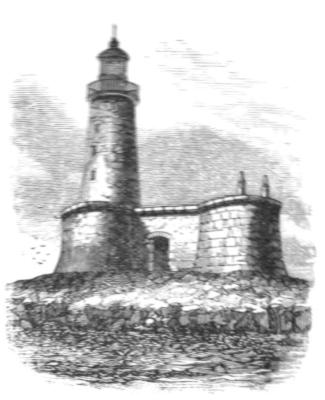
OUTER FARNE LIGHTHOUSE.
However, opposition—honest or the reverse—kept the
Farne rocks without a lighthouse till the year 1776,
when the first of the two that at present light them was
set up. The second, on the Longstones, was built in
1810, and it is this latter that has become familiar to us
as the scene of Grace Darling’s heroism.
It was customary, sixty or seventy years ago, to place
a family in charge of a lighthouse—a man, his wife, and
one or two children, all of whom, male and female, if
above a certain age, received a trifling salary, and were
looked upon—women and girls quite as much as men and
boys—as assistant light-keepers; indeed, there were
women light-keepers appointed by the Trinity House so
late as 1860.
An arrangement such as this was adopted at the
Longstones lighthouse; William Darling, his wife, and
their daughter Grace, a girl of twenty-one, trimmed and
tended the lights as recognized officials of the Trinity
House.
Grace was born at Bamborough, but she had gone
with her parents to live at the Longstones when but a
few months old. In this desolate home she had grown
accustomed to every form of weather; the laughter of a
summer’s breeze equally with the wail of a winter’s gale
had been her cradle song. As she grew up, she spent
the time she was not helping her parents, in rowing and
fishing, and when ten or eleven years old her father
could trust her to manage the lighthouse boat even in
the roughest weather. Grace was no scholar—her
opportunities of acquiring information were obviously
limited—but she could read and write well, and she
made good use of the former accomplishment, eagerly
drinking in every scrap of information that her father’s
twenty or thirty books contained regarding acts of
courage and daring performed by the toilers of the sea
either in peace or war. Her great ambition was
that, one day, she might have the opportunity of
emulating the example of those whose deeds she loved
to study.
That opportunity came to her at last. At dusk, on
September 6, 1838, the wind that throughout the day
had been freshening was blowing considerably more
than half-a-gale, and in the teeth of this the steamer
Forfarshire, hailing from Hull and bound for Dundee,
passed between the Farne rocks and the Northumberland
coast. The ship was ‘labouring’ heavily, and
Grace, as well as her father and mother, eagerly watched
her progress till night closing in hid her from their
view.
With the darkness the wind blew yet more fiercely;
all through the night it raged with unpitying fury, and
the watchers on the Longstones talked long and anxiously
over the vessel that had passed them. Darling did not
like the look of her, or the way the storm seemed to
be handling her. Neither father, mother, nor daughter
took any sleep that night: when not busy tending to
the light or wiping the spray from the glass of the
lantern they peered into the darkness, thinking perhaps
they might catch a glimpse of some signal of distress
either from the steamer or some other vessel, yet no
light or signal was observable.
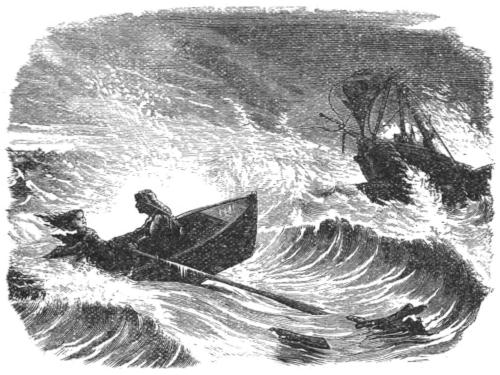
GRACE DARLING AND HER FATHER ON THE WAY TO THE WRECK.
But the first rays of morning revealed to Darling that
his apprehensions for the Forfarshire were well-founded.
On Hawkers Rocks, a mile away from the lighthouse,
could be seen the remains of the wrecked vessel, the
remnant of her living freight clinging to it. What could
be done? It seemed madness to launch the lighthouse
boat in such a gale, but Grace begged her father to
make the attempt; she would go with him, she said, and
God, she felt sure, would give them strength to perform
the daring enterprise.
We know what happened. Darling yielded to his
daughter’s prayer, and the survivors of the Forfarshire,
few in number it is true, but all that outlived the fury
of that awful night, were brought by Grace and her
father safely back to the lighthouse and carefully nursed
by the humane keepers till the weather changed and
they were taken to Bamborough. Thus the ambition
of Grace’s life had been realized; she had tested her
courage, and it had not failed her.
All along the Northumbrian coast the news of the
daring deed spread with wonderful rapidity: presents
and letters were heaped upon Grace Darling in a manner
she had never expected. The Trinity House granted
the ‘family’ leave of absence from the lighthouse, and
the Duke and Duchess of Northumberland entertained
them at Alnwick, where, on leaving, Grace was presented
with a purse containing £700. Her exploit was the
talk of London and of all England, and the print-sellers’
windows gave a liberal display of her portraits.
She received all these tokens of approbation with an
unaffected pleasure that added to her charms and her
popularity, but her naturally retiring disposition would
not allow her to accept the offer of an enterprising theatre
manager to appear nightly on the London boards.
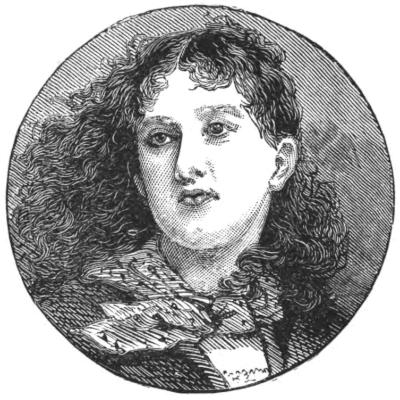
GRACE DARLING.
Neither were offers of a more permanent nature—offers
of a heart and home—accepted by her; the very
exploit that had made her famous seemed to bind her
affections more closely to her insular home and her
duties there. She spent the rest of her days on the
lighthouse, helping her father and mother as before, and
only paying an occasional visit to the mainland. Though
innumerable accounts of her early days and of her daring
exploit exist—the latter is the subject of poem, song,
and story—we hear little of her subsequent life, or of
the time when the illness which a few years later
terminated fatally first manifested itself. She died on
October 20, 1842, and was buried in the churchyard at
Bamborough. Her death was the signal for a fresh
outburst of literary commemoration of her daring act;
but no more appropriate tribute to her memory exists
than the lifeboat now stationed at Bamborough, which
bears her name, and which, winter after winter, renders
good service to vessels wrecked or in distress, often on
the very reef on which the Forfarshire stranded. Grace
Darling is not forgotten by the stalwart Northumbrian
sailors who man that lifeboat; her story and the song
in praise of her courage has been taught to them by
their fathers and mothers, and they may yet be heard to
sing it, as in their well-fitted boat, possessed of the
latest appliances to ensure safety, they make their way
to some sinking ship, and think of the frail girl and her
father, who in nothing more than an open rowing boat
risked their lives to save a perishing crew.
CHAPTER V THE SPURN HEAD
Passing southwards from the Farne, the next
lighthouse of which there is anything like
ancient mention is Tynemouth; probably
the monks at this important northern offshoot
from St. Alban’s Abbey had shown
a light from their priory, and when we first hear
of the lighthouse there in the seventeenth century
it was in great ruin. At Flamborough Head we have
Camden’s authority for saying that the name was derived
from a Roman pharos there; but there is no
evidence of a mediaeval lighthouse at this spot, and
before coming to one of these we must pass on to the
Spurn Point, at the mouth of the Humber.
Here a lighthouse was erected in 1427, under circumstances
which are in themselves interesting and
romantic; so, in accordance with a promise in the first
chapter, I will tell the story somewhat in detail.
The coast between Flamborough Head and the Wash
has undergone very remarkable changes within historic
times: the old chroniclers record very frequent inundations
of the low-lying lands, and finally the entire
washing away of a thriving port-town which sent
a couple of members to Parliament. Its destruction—so
the chroniclers say—was due to the extreme ungodliness
of the inhabitants, who, such as escaped
a watery grave, fled higher up the Humber to the then
insignificant village of Hull, and soon raised it into
a centre of commercial activity. These folk did very
well, and, we will hope, lived to repent of their former
wickedness; but how about the poor wretches who had
been carried into eternity unrepentant? This was the
thought that weighed on the pious mind of a monk at
Meaux Abbey, and so strongly did it impress him that
he determined to leave his brethren and lead a hermit’s
life near the submerged town, spending his days in
prayer for the perished souls.
Persons fired with religious enthusiasm sometimes
forget to have a due regard for the minor requirements
of the law. This is exactly what the pious monk from
Meaux Abbey did: he endowed his hermitage with
certain property from the profits of which he and his
successors could support themselves, but he quite forgot
to get the king’s licence for such a gift, which was, of
course, a gift in mortmain. Now all this happened in
the closing years of Richard II’s luckless reign, and so
much were the crown officers busied in other and
weightier matters, that no one ever found out what
a terrible thing Brother Matthew had done till Henry
of Lancaster had been proclaimed king. A heavy
pecuniary fine might have been the result of the monk’s
hastiness, but for this fortunate circumstance. By an
odd coincidence, Henry’s landing in England had taken
place in the Humber close to the new hermitage which,
small and mean though it was, gave him a comfortable
shelter for the night. When the affair came to be
looked into, this was remembered, and Brother Matthew
was not only speedily forgiven, but he and his successors
had bestowed upon them the important privilege
of the right to take any wreck cast upon the shore
within two leagues of the hermitage.
The monk’s successor was a certain Brother Richard
Redbarrow, and a very good and charitable man he
seems to have been: the constant wrecks around him,
though they yielded him considerable profit, made his
heart bleed for those who lost their lives by shipwreck.
The possession of a full bag of treasure, or a cask of
dainty wine, was no compensation for the sorrow which
would fill his heart when the gray morning revealed
a dozen or more lifeless bodies stretched upon the beach,
and he determined to do what he could to prevent or
lessen shipwreck, and beside his hermitage he set to
work to build a lighthouse.
Had Brother Richard possessed money enough to
finish what he began, we might never have known of his
Christian work; but he had not, and in the year 1427
he petitioned Parliament to obtain from the king the
grant of a small toll on the shipping entering or leaving
the port of Hull towards finishing his ‘beken’ tower;
the cost of the light upon it he was ready to bear.
Parliament thought it an excellent plan, and so did
the king. Brother Richard got his grant, and no doubt
the lighthouse was built and did good service for many
a year to come. But in time the sea encroached, acre by
acre, till hermitage and lighthouse both disappeared, and
in the general survey of monastic property taken at the
dissolution, we find no mention of either one or the other.
But these inroads of the sea, these changes in the
form of the coast-line, made the entrance to the Humber
no safer. In Elizabeth’s days the Spurn was an exceedingly
sharp headland, stretching far into the river, and
collecting around it a quantity of shifting sand and
shingle, so that the sailors of Hull determined to petition
the queen in favour of a lighthouse there which
one or their own countrymen—the famous navigator,
Sir Martin Frobisher—was seeking leave to erect at the
Spurn Point, or hard by it. No doubt Sir Martin’s suit
was opposed in the usual quarter, and before he could
ride down the opposition he had been carried off by
wounds from the Frenchmen’s guns, and nothing came
of his proposal.
After this, in 1618, his kinsman, Peter Frobisher, put
forward the same suggestion, but it was again laughed at
as a madman’s scheme, and opposed and finally ‘shelved,’
so that ships got in and out of the Humber as best they
could, the traders preferring risk to a settled tax.
The next proposals we hear of for a lighthouse at the
Spurn came in the days of the Commonwealth; Sir
Harry Vane—from whom the Lord Protector had not yet
been delivered—submitted them to the committee for
managing the affairs of the Trinity House[2], which
committee actually approved the scheme. But the
Trinity House of Hull, constituted as before, liked it
not at all: a lighthouse at the Spurn, if erected, would
not stand ‘three springs,’ and the only persons it could
benefit would be an enemy seeking to enter the Humber
by night; no native ship would do so mad a thing as
that for fifty lighthouses.
These arguments are obviously weak, but somehow
they managed to have the desired effect, and a lighthouse
at the Spurn was once more postponed till some
years after the Restoration. Then a private individual,
a certain Justinian Angel, built one, lit it, and applied to
the king for leave to gather toll for its support. The
opponents of the scheme now raved in vain: there was the
light, and with it ships did come in and out of the Humber
by night, and shipwreck grew to be the exception.
Charles II gave Angel his patent, remarking to Sam
Pepys, then Master of the Trinity House, that as the
patentee only asked for a voluntary contribution, it could
be no hardship to anybody. Sam thought it wise to
explain that, in so long opposing the scheme, the Trinity
House had only done what it deemed its duty, to which
the merry monarch replied that ‘caution’ was ‘always
reasonable,’ and with that safe remark passed on.
There was nothing for it now but to influence as much
as possible such shipowners as were willing to pay,
against the light. The Trinity House seems to have
thought the best way to do this was to circulate wild
rumours of Angel’s huge profits; we are glad now that
these rumours were set afloat, for they drew from Angel
a statement as to his expenses and management, which
gives us a very vivid picture of his lighthouse; this is
what he says:—
At most other lighthouses—he is speaking of the
‘high’ or ‘upper’ lighthouse, they were generally in
pairs, a high light and a low light—the grate was
fastened to a back like a chimney, and exposed only
one way to the wind, namely, ‘that to the seaward,’
whilst in the low light there would be exhibited ‘two or
three candles closed in with glass.’ But at the Spurn
things were of necessity quite different. Here the fire
on the high lighthouse must needs show ‘all round,’ and
so it was entirely unscreened, standing upon ‘a swaype’
fourteen feet above the top of the lighthouse tower, and
burning a vast amount more coal than a fire partly
screened would burn; besides, the fire needed to be
specially ‘bright,’ and so only ‘picked’ coal was used,
which cost threepence a chaldron more than ordinary
coal.
Then the cost of repairs was exceptional; in such an
exposed situation the flames, fanned by a winter’s gale,
blazed so fiercely that often three or four of the iron
bars of the grate would be melted in a single night.
Then the consumption of fuel would be enormous, and
‘four pair of hands’ was too little to feed the greedy
furnace and keep it up to the requisite height.
If the ‘high’ light was costly to maintain, the ‘low’
light was—as a ‘low’ light—even more so: for at the
Spurn this, too, was given by a coal fire instead of by
the usual candles, and so cost as much ‘as two such
lights elsewhere.’
In addition to all this, the carriage of coal to the
Spurn Head was unusually costly, for the way from the
nearest spot at which the Newcastle boats could discharge
their coals lay, half of it, over soft sand, into
which cart wheels sank deeply, and half over ‘a sharp
shingle’ that lamed the oxen that drew it.
Light-keepers’ salaries were, too, a heavy item; two
men and a competent overseer were always needed at
the Spurn, and on rough and boisterous nights much
additional help was required.
Altogether, from the first lighting of the lights in
November, 1675, to Christmas, 1677, the expenditure
had amounted to £905, and the receipts to £948, a profit
of £43 in two years and a month.
Charles II thought this was not out-of-the-way; he
gave Angel further powers and facilities for gathering
his tolls, and at last the grumbling and the moaning
died away, not to be renewed till nearly a century later.
Then there were worthier grounds for them: the owner
was lord of the manor within which the Spurn lighthouses
stood, and he would not move them to a position
rendered necessary by the continued alteration of
the sand banks.
Parliament was applied to, and with an airy disregard
of the claims of private property, vested the lighthouse
rights in the Trinity House of Deptford Strand—the
very body that had for so long fought against the erection
of lighthouses at the Spurn at all. Armed with
these rights the Trinity House promptly rendered the
old lighthouses useless by erecting, in a position where
they really assisted navigation, those at present standing,
and they called to their aid, as architect and engineer,
John Smeaton, who had just then won his laurels by
the wonderful stone tower he had built on the Eddystone
rocks.
Of the disused lighthouses, as they appeared some
twenty years before they were rendered useless by
Smeaton’s buildings, we have a curious description,
written by the then secretary to the Trinity House:
the coals, he says, are placed in ‘a bricket or cradle of
iron,’ which is suspended on a beam and hoisted or let
down at pleasure. The upper light was then shown on the
top of the tower, whilst the lower was placed against
the tower on a platform a few feet from the ground.
Perhaps it was this somewhat unusual arrangement with
the beam that Dr. Johnson had in his mind when he
described, in his Dictionary, a lighthouse as ‘a high
building at the top of which lights are hung to guide
ships at sea’—certainly not a very accurate description
of a lighthouse as the thing was then generally constructed
and arranged.
CHAPTER VI THE HUMBER TO THE THAMES
Leaving the Humber, and coming southwards
to the mouth of the Thames, we pass some
of the earliest post-Reformation lighthouses
erected—Winterton, where we have seen a light
was proposed to be shown from the church
steeple in 1585; Caister, Yarmouth, Corton,
Lowestoft, Orfordness, and Harwich; at all which places,
and many others, lighthouses were erected in the early
part of the seventeenth century.
There was a lighthouse at Caister some few miles
south of Winterton, set up about the year 1600; soon
afterwards we have a quaint account of the way in
which this was maintained. It did not aspire to the
dignity of being a coal fire; the building was merely
a meanly constructed wooden tower with a lantern at
the top, lit with candles—or should have been lit with
candles: but mark the italics—should. How was it
actually illuminated? A contemporary report shall tell
us. ‘Often but one candle of six to the pound ... or at
the most two’ burnt in the lantern. This was insufficient:
wrecks happened in consequence, and the shipowners
grumbled louder than ever at having to pay
dues. As stated before, the lighthouse at Caister was
in the hands of the Trinity House, and it must be said
to the credit of that body that on learning of the defects,
it did its best to remedy them.
An inquiry was held, and revealed a sad laxity of
duty in the appointed keeper. He ought to have lived
at the tower, but he did not. Such a residence, when
we consider the position of the Caister lighthouse, must
have been solitary and dreary enough, and we can
scarcely wonder that the keeper left his employment
and went to labour more congenial. But he was dishonest
over his retirement: he did not put his intention
into writing, but went off without notice, and deputed
‘the preparing, lighting, and watching’ of the candles to
an old and decrepid woman who dwelt some miles
inland, and who, as might have been expected, was
unable to perform her task with regularity. To reach
the lighthouse, she had a lengthy walk; and in the
teeth of an easterly gale she found this more than her
strength could bear; thus on many a winter’s night she
had to retrace her steps without accomplishing the object
of her journey: so that often when most needed no light
at all showed from the Caister lighthouse. A new
keeper was appointed; he was to live at the lighthouse,
to light his candles—three in number—at sunset, snuff
them, and replenish them as needful till ‘fair day.’
Surely a lighthouse, well and regularly tended, was
needed at Caister! There was not, there is not, a more
dangerous bit of coast on the eastern shore of England.
Caister sandbanks rival the dreaded Goodwins in
their terrors for the luckless ship that is driven upon
them. Now, with a good system of signalling from the
adjacent lightships, and with two or three well-appointed
lifeboats, the loss of life is often considerable, and many
are the risks run by the lifeboat crews in their gallant
efforts to rescue the shipwrecked. Here is the story of
one such risk, and it is typical of dozens more that
have happened since lifeboats have been placed near
Caister.
It was just midnight on March 11, 1875, when the
schooner Punch, on her voyage from Newcastle to
Dublin, ran upon the shoals off Caister. It was a
‘dirty’ night, pitch dark, and blowing hard from the
east. The sands, partially uncovered at low water, are
quicksands as the tide flows, and a ship once fairly
driven on them has little hope of getting off again; as for
her crew—well, there is now this hope for them, that the
lifeboat-men will see the signals of distress and hazard
their lives to save them. The crew of the Punch knew
what the grasp of Caister sands meant, and up flared
their signal fires so soon as she struck. The waves, as
though eager to secure for the greedy sands their prey,
broke over the vessel in quick succession and dimmed
the fire; but there was a plentiful supply of tar and
oil on board, and their signals blazed up again. Then
the lifeboat-men saw it and hastened to them. As their
boat neared the sands her crew could see, by the fire
flaring on deck, that the hulk was gradually sinking
down, and that there was a stretch of uncovered sand
still around the ship. Before their eyes, almost within
speaking distance, the Punch would be sucked into
the sand, and with her the half-dozen men on board!
There was but one thing for it—anchor the lifeboat
to the sand and jump on to the shifting mass. Leaving
a couple of men in the lifeboat, her coxswain, heaving-line
in hand, leaped overboard, followed by a number
of his crew, and went staggering and stumbling towards
the wreck—at one moment only ankle-deep in water
and the next high up to their shoulders. And so they
waded on for a hundred yards in the fury of the winter
storm. They called to the crew, and the crew answered
them. Think what the feelings of those sinking men
must have been, their gratitude to their deliverers. One
threw a line from the deck, and it was clutched by the
foremost of the rescuers, and, a communication once
established, the schooner’s crew were one by one
hauled through the broken water over the quicksand
to the lifeboat, and with them the lifeboat-men rowed
to shore. Yes, to shore, but not to rest! They had
barely got to their homes when the cry was raised
again. ‘Another ship on the sands!’ It was morning
then, and back to the lifeboat they hastened, and a
second time rowed out. Alas! their journey was in
vain. Help had come too late, and only masses of
tangled rigging, planks, and broken spars floated over the
sands—the ship and her crew lay buried within them.
Oddly enough, we do not hear of any early lighthouse
at Yarmouth. In the official catalogue of lights on the
Norfolk coast the date of the first lighthouse of the
Yarmouth group is that at Gorleston, said to have been
established in the ‘fifties.’ But there was a lighthouse
here nearly two centuries before; and Molloy, in his
treatise on sea-law, in 1676, refers to the ‘great and
pious care’ by King Charles II in erecting a lighthouse
at Gorleston, or ‘Goldston,’ as he spells it, ‘at his own
princely charge,’ from which expression we are, I suppose
to imagine that his Majesty kept up a lighthouse
at his own expense: the thing seems improbable
and requires confirmation before we can accept it as
truth. Lighthouses in the neighbourhood at St. Nicholas
Gatt were proposed and for a time established by Sir
John Clayton between 1675 and 1678, and we find the
seamen of Yarmouth still clamouring for them in 1692.
In the seamen’s petition the loss to shipping, for want of
them, is very clearly set forth; one petition says that as
many as two hundred ships perished on the sandbanks
there during the gale on one winter’s night.
A lightship now marks the dangers of Corton sands,
some few miles further south of Yarmouth than St.
Nicholas Gatt. But Corton was one of the places at
which Sir John Clayton proposed to erect a lighthouse
long before. When the Trinity House had crushed all
his other lighthouse projects he offered the corporation
something handsome to approve of a light at Corton only,
but it would not: multiplicity of lights, it said, confused
the navigator, and its own lighthouse at Lowestoft did
all that was needed.
At Lowestoft, in 1778, were made the earliest experiments
with reflectors; a thousand tiny mirrors were
placed in the lantern, and with such success that the
flame of the oil lamp appeared at sea, some four leagues
off, like a huge globe of fire.
The lighthouse at Harwich is memorable for quite
a different reason. It played—or rather was intended
to play—an important part in English politics. When
at the eleventh hour James II and his advisers were
trying might and main to ward off the Dutchman’s
coming, and when the Trinity House officials, acting
under Pepys’ orders, were busily engaged in removing
buoys and altering the position of familiar coast marks,
the small, or lower, lighthouse at Harwich was an object
of consideration. It was—so went forth the order—to
be ‘removed’ and set up in another place.’ But how?
The operation could not be rapidly performed, for the
building was a solid bit of masonry, and all depended
on haste. A happy idea at last struck some one: the
Dutch ships would be as easily misled by an erection
of canvas, and that, ‘with the utmost secrecy,’ could be
stretched on a timber frame, carried to the place
appointed, and set up in less than an hour, whilst
a charge or so of gunpowder would at the same time
level the real lighthouse.
Whether this was ever done we do not know: the
Trinity House records which tell the first part of the
story are silent as to that point; but if it was, it certainly
did not serve the object in view, for the Dutch ships,
when they came, steered a very different course, and, as
we all know, landed in quite another part of England.
MODEL OF THE FIRST LIGHTSHIP.
From the Trinity House Museum.
CHAPTER VII THE NORE LIGHTSHIP
Coming southwards from Harwich, we are soon
at the mouth of the great water-way to London
and in view of the Nore light. This is
the first lightship of which we have had
occasion to speak in particular, though there
are now many stationed along our eastern and northern
coasts—one of them, that on the Dudgeon Sands, being
almost as old as the Nore.
We have seen the spirit in which the Trinity House
of 1674 regarded the proposals, made by a lighthouse
speculator, to establish floating lights at the Nore and
at some other parts; it regarded the proposition as that
of a madman. Well, it sounds an odd opinion to us
to-day, but really it is no more odd than the opinion
expressed, sixty or seventy years ago, by men who knew
of what they talked, as to locomotive steam-engines and
railway capabilities in general.
We do not hear of another proposal for floating lights
at the Nore till 1730. Robert Hamblin had then devised
a scheme for getting the whole of the lighting of the
English coast into his own hands, and the dues therefrom
into his own pocket. His plan was to fix floating lights
at short distances from the shore, in such positions
as would render the existing lighthouses absolutely
useless. It was a bold stroke, and so far successful
that he actually got his patent from the crown and
established some of his lights, amongst them that at
the Nore.
But his reign was short: the Trinity House addressed
a powerful remonstrance to the law officers of the crown,
the owners of private lighthouses joined in the complaint,
and Hamblin’s patent was speedily cancelled.
But before the cancelling he had parted with any rights
he possessed under his general patent with regard to the
lightships at the Nore and at one or two other points,
and in 1732, the purchaser, David Avery, placed a lightship
at the east end of the Nore Sands. After circulating
in shipping circles very glowing accounts of the benefits
which this light would yield to navigation, he began to
ask for his tolls, and by a little judicious dealing with
the Trinity House he managed to get that body on his
side in doing so. This is what he did. He arranged
that the Trinity House should itself apply for a new
patent from the crown—not in general words, but simply
for a lightship at the Nore—and that he should take
a lease of this patent, when granted, for a term of sixty-one
years at a yearly rent of £100. When we remember
what the traffic in and out of the Thames was,
even in 1730, we shall see that Avery must have made
a good profit on the £100 a year he paid the Trinity
House.
MODEL OF A LIGHTSHIP BUILT IN 1790.
(From the Trinity House Museum.)
The lightship at the Nore turned out fairly successful.
Of course the arrangements for securing her in her
position were of a very primitive type. Even now, with
the strongest of cables and anchors, a lightship will
sometimes break away from her moorings and scud
before the gale. That is why the United States Government
is replacing lightships by pile-lighthouses wherever
the thing can be done. But in 1732 these breakings-away
were far more frequent, and the first lightship at
the Nore broke her moorings twice in three months of
that year.
As a consequence, the number of lightships around
the English coast did not rapidly multiply. However,
every few years saw some improvement in the anchoring
arrangements of these vessels, and the benefit, the
utility, of lightships—when once they could be trusted
to keep their positions—became more and more apparent.
To-day we have between forty and fifty of them round
the coast of England.
The lighting arrangements on lightships were also, at
first, very rude and unsatisfactory. Small lanterns—each
containing a cluster of tiny candles that needed to
be constantly replenished—were suspended from the
yardarm of the vessel’s mast, and these, on a gusty night,
were often blown out, and occasionally blown bodily
away. Yet such arrangements were not altered till
early in the present century, when Robert Stephenson
invented the form of lantern at present used, which
surrounds the mast of the lightship. Inside this lantern
is a circular frame, on which are fixed Argand lamps
with reflectors, and each light and each reflector swings,
by means of gimbals, so that, let the lightship roll or
plunge as she may, the light is always steady and kept
perpendicular by its own weight.
We do not know with certainty what was the staff, or
crew, maintained on one of these first lightships, but
there were few lights to trim and manage, and there is
reason to believe that, when everything with regard
to coast lighting was done as cheaply as could be, there
was but one man to perform the tasks. Surely the
loneliness of his life is too awful to contemplate. Even
at the Eddystone and other isolated lighthouses the
keeper was changed but seldom, and it is not likely that
the lightship guard was oftener relieved.
The effect of such economical management must have
been disastrous to the interests of navigation. Sudden
death, illness, or accident might, at any moment, have
rendered the single keeper incapable of lighting his
lamps, and dire disaster to vessels, trusting to see the
light, must, almost of necessity, have followed; but
before long things were better ordered, and two men
were kept in every lightship.
The immobility, so far as progress is concerned, of
a lightship renders life upon one particularly tedious.
Roll or pitch she may, but forward she never goes—that
is, if all keeps well with her anchor and chains. It is of
this that present-day dwellers on lightships most complain—the
dull monotony of a life at anchor. Even the
Flying Dutchman’s penance had advantages over it; he,
at any rate, witnessed continual change of scene, he was
permitted to enjoy the rest of progress.
But monotony is about all that a modern lightship
keeper has to complain of, and even that is reduced to a
minimum by the latest regulations. A keeper nowadays
has never less than three companions; the Trinity
House boats pay him frequent visits, bringing fresh
water, fresh victuals, and a supply of books and papers;
and he can now, in many cases, by means of the telegraph
or telephone, speak with the shore whenever
needful. Besides, by her build, finish, and fittings,
a modern lightship is, to a sailor, a really comfortable
home. Each of these vessels costs between three and
four thousand pounds to turn out complete and equipped
for service.
Of course some lightship stations are much more
lonely than others. The ever-passing stream of traffic
in and out of the Thames renders the Nore one of the
‘gayest’ lightships on which to be stationed, and consequently
one of the most popular. Life there is free
from that singular and almost overpowering melancholy
so wearying to the men at, say, the Seven Stones lightship,
anchored midway between the Scillies and the
Land’s End; indeed, the two stations cannot be for
a moment contrasted. You might as well compare life
‘lived’ in Piccadilly with life ‘passed’ in a by-road at
Finsbury Park.
CHAPTER VIII THE GOODWIN SANDS AND THE FORELANDS
Four miles seawards from Deal lie the Goodwin
Sands, and the deep water between the two is
known as the Downs—the great historic resting-place
for ships, naval and mercantile, the
scene of the gathering together of many a noble
fleet of British war-ships, whose broadsides
have helped to make England the mistress of the seas.
The Goodwins shelter the Downs: that is their one
good service, and surely the mariner pays dearly for it!
No more treacherous shoal exists than that ever-shifting
mass, that greedy monster that lies beneath the surface
of the water, and grasps in the clasp of death every
luckless vessel driven within its reach.
Deep in the Goodwin Sands lie the wrecks of centuries,
the treasure of many lands. And the stories of
those wrecks, what stirring reading they would be were
they recorded! In the great storm of 1703—of which
I shall speak later on in telling the story of the
Eddystone—thirteen men-of-war were driven on the Goodwins,
dashed to pieces, and their crews engulfed in the
rising tide. Now, in our own day, each succeeding
winter brings some fresh piteous tale of disaster from
the Sands, some grievous loss of human life which
happens, despite the undauntable courage of the men
who man the lifeboats stationed along the coast from
Broadstairs to Dover. Our hearts bleed as we read of
the lifeboat which, notwithstanding all that human skill
and pluck can do, reaches the Goodwin Sands too late:
there has been no unnecessary delay since the signal of
distress was first noticed, no hanging back by the crew,
no thought for their own safety. Simply the actual
impossibility of reaching the wreck in time.
This is the story we read of yearly; and though it
may fill us with sorrow for the sufferings of the luckless
men and women on the wrecked ship, we can at least
say, as we lay aside our newspaper, All was done that
could be done to save them. Few, thank God, are now
the occasions on which we cannot say this; but the loss of
the Gutenberg, on the evening of New Year’s Day, 1860,
is one of them. It was a wild night, bitterly cold, and
the snow fell so thick that her pilot could not see the
light from the lightship, and she struck the Goodwins
about six o’clock. Her signals of distress were seen
from Deal, but there was then no lifeboat stationed
there, and the Deal boatmen telegraphed to Ramsgate,
‘Ship on the Goodwins.’ The lifeboat-men there were
ready as usual, and they hastened, as was customary, to
the harbour-master to get permission for the steam-tug
to tow them out.
The harbour-master was an important person, and he
felt the dignity of his office. Perhaps he did not like
the unceremonious way the would-be crew had come
into his presence; one sometimes forgets to be duly
respectful when the lives of an unknown number of
one’s fellow-men are at stake, and may be saved by
haste; any way, he heard this news from the breathless
spokesmen without much visible sympathy. ‘Have the
distress-signals been noticed at Ramsgate?’ he inquired.
‘No,’ cried the sailors, ‘at Deal; Deal has telegraphed
here, and we want your orders for the harbour-tug to
tow us out to the Sands.’ The harbour-master smiled.
‘That, I fear, is not official intimation,’ he said, and continued
the discharge of important duties at his desk!
Ramsgate was astir? The official answer had somehow
not been received by the knots of sailors who
thirsted to save life with the admiration the harbour-master
perhaps expected.
Further telegrams came from Deal at 8 and 9, that
signals of distress were still going up from the Sands,
and an angry crowd demanded the use of the tug, that, with
steam up, lay in the harbour. ‘Go in your own luggers,
if you will go!’ shouted the harbour-master, whose official
dignity was now relaxing into official indignation;
but he knew that was practically an impossibility.
Then, at 9.15, came the welcome cry, ‘A signal from
the South Sand lightship.’ The benevolent harbour-master
forthwith untied the red tape that held the steam-tug
to her moorings; and towing the lifeboat behind her,
she plunged into the storm. On she went, steaming her
hardest towards the Goodwins, and as those on board
her and on the lifeboat neared the Sands they saw the
lights of the breaking ship; nearer still, and the cries of
the perishing crew could be heard. The lifeboat is set
free, her sail hoisted, and she makes for the Sands!
The lights disappear, the shouting ceases, and presently
a faint light shines from the sea nearer to them. Then,
through the blackness of the night, the lifeboat crew
can see a ship’s boat coming towards them; a rope is
thrown, and she is hauled alongside the lifeboat. The
men, five in number, drenched and exhausted, are taken
on board: these are the remnant of the Gutenberg’s crew
of thirty-one, that for nearly four hours clung to their
ship as the waves dashed her to pieces on the Goodwins,
and were sacrificed to an official’s ‘sense of duty!’
But what about the history of attempts to mark with
lights the dangers of what legend calls the once cultivated
estate of Earl Godwin? These dangers were well
known to the mariner of old, and have for long been
sung in sea-song. But the ever-shifting nature of the
sands left the lighthouse builder of bygone days without
hope of the possibility of placing upon them a warning
to navigators of their exact position.
However, ‘fools rush in where angels fear to tread’:
the enthusiast and the mad speculator were often in
evidence in the days of good Queen Bess. Those days of
leaping and bounding prosperity that England then saw,
as she followed new paths to fortune, encouraged such
beings, and amongst them was one who came to court
with a project to build a lighthouse on the Goodwins.
The projector was Gawen Smith; his proposals did
not begin with this of which we have spoken. He had
been an applicant for office before; a vacancy had
happened in ‘Her Majestie’s bande,’ one of the drummers
having been gathered to his fathers, and Gawen considered
he was just the man for the post, for he could ‘sounde
on the drumme’ all manner of ‘marches, daunces and
songys.’ Had it been the post of chief-engineer for
draining the Lincolnshire fens, our friend would, no
doubt, have been able to make out a good case for his
own fitness for the appointment. Poor man! his application
for the band vacancy was never answered, so far
as we know; perhaps Secretary Cecil thought him a
better sounder of his own trumpet than beater of her
majesty’s drums!
But he was not daunted by failure to get an answer:
in due course came the application which has made him
of interest to the reader of these pages—the suggestion
for a lighthouse on the Goodwins.
He tells Cecil that he has been ‘down upon the Goodwin
Sands,’ in sundry parts of them, and though he
found the place ‘very dangerous,’ yet by the May following
he would be ready, if permitted, and if the queen
would grant him the leave to gather toll—to build
a beacon, ‘fyrme and staide uppon the foresaid Godwyne
Sande,’ twenty or thirty feet above the high-water
level; which beacon should, by night, ‘shewe his fyre’
for twenty or thirty miles, and be seen by day for hard
on twenty miles.
It was no ordinary lighthouse that Gawen was going
to build there. Should there—despite this wonderful
erection—happen a wreck upon the sands, the beacon-tower
would be an abiding-place for the shipwrecked, as it
would furnish room for forty persons above the highest
point to which the waves had been ever known to reach.
He had one other request, and when compared with
the vastness of the undertaking, it was a modest one; it
was that the queen would give him £1,000 when he
should deliver to her hand ‘grasse, herbe, or flower,’
grown upon this desolate, shifting mass of sand, and
£2,000 when the soil should be so firm that his tower
would bear the weight of cannon for the defence of the
channel!
Cecil carefully folded up the application and endorsed
it: ‘The demands of Gawen Smith touchinge the placing
of a beacon on the Goodwyn Sandes’; and there the
matter ended.
Years went by, Gawen Smith died—probably a disheartened
speculator; winter gales blew luckless vessels
on the Goodwins; and the greedy shoal drank in life
and treasure as before; but no project came prominently
forward for indicating its danger till the year 1623. Then
a more rational proposal was made, and made by men of
a very different stamp from Gawen Smith. John, afterwards
Sir John, Coke, a nautical expert, proposed means
by which a light might be exhibited upon the Goodwins.
Unfortunately we do not know exactly what his proposal
was, but that it was practical we may guess from
the fact that the English and Dutch mariners approved
it and were ready to contribute to its support, and it is
almost certain that a moored vessel, showing a light by
night, was suggested. If so, we have in this proposal
the first suggestion of a lightship: the reader will see in
a moment on what I base this theory.
Sir John Coke’s scheme came to nothing, and a like
fate attended those put forward soon afterwards by
Capt. Thomas Wilbraham and the Mayor of Rochester
and others which were for the same kind of light, whatever
that was; but in 1629—four years after Charles I’s
accession—almost the same persons petitioned the king
for licence to light the Goodwin Sands. In this case
their petition is extant, and we see what they propose.
After setting forth the dangers of the sands in the usual
terms, they state that they are ready, in order to warn
vessels of those dangers, to maintain at their own costs,
‘a light upon the main’ at or near the Goodwins, ‘whereby
every meanly skilfull mariner’ could, on the darkest
night, safely pass the place of danger. I think the
expression ‘upon the main’ must here mean the main
or open sea, especially as the words ‘at or near the Goodwins’
immediately follow: that expression cannot refer
to the mainland, eight miles off at its nearest point, for
lights at the two Forelands were then already established,
and the expression ‘on the main’ would not have been
used if a tower built on the sand had been intended.
There is, I think, but one way of interpreting this and
the earlier proposals, and that is, that they were each
of them for afloating light or lightship at the Goodwins.
Besides maintaining this nocturnal light, the petitioners
undertook to constantly provide ‘a sufficient company of
strong and experienced men, with vessels, always in a
readiness to relieve such as by day, or night, through
extremitie of weather, should unhappily be forced upon
the sands’: presumably, then, more than one vessel was
to be kept permanently moored at the Goodwins, each
craft being provided with boats, and with such life-saving
apparatus as was then known, so that assistance
could at once be sent to any ill-fated ship that ran upon
the Sands. In return for all this the petitioners craved
leave to levy one penny from every English ship passing
through the Downs and three-halfpence from every
‘foreigner,’ besides an allowance for salvage in respect
to the cargo of any wrecked ship that the petitioners
or their servants happened to rescue.
The petition bears no endorsement, so that we cannot
tell what was done upon it: the proposal as to the payment
of dues probably defeated it, especially as lights,
for which a tax had been demanded, had been established
only a little before at the Forelands. These were, neither
of them, very elaborate buildings, nor, we should fancy,
efficient lights: each was built of timber and plaster, and
had at its top a lantern in which were stuck a few candles.
The Trinity House offered a most strenuous and relentless
opposition to the Foreland lighthouses, which were set
up by Sir John Meldrum, and felt bound to inform King
Charles that there was ‘no necessity for such lights’ and
that an imposition of a rate for their support would
a grievance to navigation: in times of ‘hostility,’ the
Trinity House went on, ‘such lights would be a means
to light an enemy to land, and bring them to an anchor
in the Downs’; and moreover, ‘in a chase by night’
ships would be brought to where the king’s ships and
our own merchantmen rode peacefully at anchor, and
then these pursuing vessels might, on dark nights, by
mistake board either those frigates or merchant ships
without either having time to demonstrate what she was.
True, it might be urged that, ‘in time of hostility,’ the
Foreland lights could be put out; yet, meanwhile, they
would so far do mischief as to acquaint strangers with
our coast in every part; so that in time of war they
night get through the channel by night without lights
‘merely by their depths.’
The Trinity House at Dover had similar objections to
such costly follies as lighthouses. ‘We at sea,’ it wrote,
with professional contempt, ‘have always marks more
certain and sure than lights—high lands and soundings
which we trust more than lights’; ‘and,’ continued these
superior persons, ‘the Goodwins are no more dangerous
now than time out of mind they were, and lighthouses
would never lull tempests, the real cause of shipwreck.’
If lighthouses had been of any service at the Forelands,
the Trinity House, as guardians of the interests of shipping,
would surely have put them there!
The real objection to the Foreland lights—their dimness
and general badness—was never once mentioned;
the outcry against the lighthouses was by those who
had to pay for them, the shipowners and merchants;
and from their point of view good lights or bad were
equally objectionable. Probably the king—who must
have been getting quite used to these extraordinary
outbursts of eloquence every time a lighthouse was
proposed anywhere, and who was beginning to have
a shrewd suspicion as to the motives that caused them—knew
how much of this expressed alarm was genuine.
He stayed, for a little time, Sir John Meldrum’s patent,
empowering him to gather tolls for the Foreland lighthouses,
and then granted it, ordering his Admiral of the
Narrow Seas to arrest vessels that would not pay.
We do not know if Sir John Meldrum, after this
confirmation, improved his system of lighting; let us
hope he did; but it is doubtful, for the same ramshackle
towers, well patched with timber and iron, were
not replaced with more substantial structures for more
than sixty years afterwards. A new tower, of flint and
lime, was set up at the North Foreland in 1694, and
then a coal fire was used to light the lighthouse. This
was soon after completely gutted by fire, and for a long
time the only light shown there was a lantern, containing
one candle, stuck on a pole!
After a while a tower of brick and stone was raised,
and it is probable that some part of this forms the
lighthouse we see at the North Foreland to-day; then
the owners went back to their coal fire again, and kept
it up so badly that bitter complaints arose from those
who worked the Channel trade. Inquiry was held, and it
was found that the grates were but half filled with fuel.
This was scandalous, for the profits of the two Foreland
lights had grown—I am speaking of the opening
years of the last century—to be enormous. The
Trinity House thought the outcry offered a reasonable
pretext for acquiring possession of the lights, but the
crown officers would not transfer the patent; they only
warned the patentee to amend his light, and he did so.
Then, in 1727, the Trustees of Greenwich Hospital
bought both lighthouses, and possession of them remained
in that charity till the general transfer of lighthouses
to the Trinity House, some sixty years ago.
One of the first things the trustees did was to close
in the open coal fire at the North Foreland, and so save
their coals. The plan succeeded no better there than
at other lighthouses at which it was tried: shipwreck
on the Goodwins became much more frequent, and
sailors said that often they could see the outline of the
Foreland before they got a glimpse of the fire on the
lighthouse; and so the lantern was taken off and the fire
was left to burn unshaded till 1790, when the tower was
raised one hundred feet, to its present height, and a lantern
lit with oil lamps supplanted the coal fire altogether.
Of the history of the South Foreland lighthouse there is
not a great deal to record; yet, from a scientific point of
view, that lighthouse certainly demands attention, from
the fact that many of what have been in turn regarded as
the most approved methods of coast-lighting have been
first put into practice there. It was suggested as an experiment
station so long ago as 1729: magnifying lenses
were first used there in 1810. In 1853, Faraday made
his initial experiments there with the electric light as
a means of coast illumination; and there—nine years
later—the lime-light was first applied for a similar
purpose. Having said this much we may leave the
South Foreland light, for of its history and romance we
know little, practically nothing.
But before we pass on to Dungeness lighthouse
a word more must be said about the Goodwin lights.
We left their history in 1629 very far from the date at
which a light was actually placed upon them. Nothing
came of the suggestion then made to indicate the
dangers of the Sands by means of floating lights, and
the existence of lighthouses on the North and South
Forelands, for which heavy dues were payable, gave
little hope of success to any project to light the Goodwins.
As a consequence we hear of no subsequent proposal
for a lightship there till well on in the eighteenth
century, that is, after the practicability of this form of
coast illumination had been actually demonstrated at
the Nore and the Dudgeon.
But the then proposers of the lightship at the Goodwins
were only two poor pilots, who could not be
expected to carry on a battle with so powerful an
antagonist as the Trinity House. The secretary of
that body, writing, about the year 1750, of the pilots’
humane but ineffectual effort, congratulates himself that
so crushing had been their defeat, that his Board was
unlikely to be troubled again with such ridiculous and
tiresome suggestions. The Trinity House, he observes,
‘was not fond of them!’
However, times changed as the years went by: the
Trinity House, and those for whom it spoke, grew
larger-minded, had greater scientific knowledge, and
were more public-spirited. Thus before the end of the
century of which we have been speaking, the Trinity
House had itself established a lightship at the Goodwins—the
first of the three which now warn mariners of the
presence of the Sands.
Of course these lightships are not as useful as lighthouses;
but it is pretty certain that to do what Gawen
Smith wanted to do in the days of Queen Bess—reclaim
the Goodwins and build a lighthouse on them—is
practically impossible. Projects for doing this came
before the Trinity House in plenty during the first
half of the present century, one being to enclose that
part of the Sands called ‘Trinity Bay’ and form it into
a harbour of refuge; and, according to the author of
Memorials of the Goodwin Sands, the Trinity House
itself, at the close of the seventeenth century, made trial
borings, to great depths, to see if a solid bottom could
be reached: it could not.
But although it may be impossible to build a lighthouse
on the Goodwin Sands, it must not pass unnoticed
that between 1840 and 1850 at least two temporarily
successful attempts were made to erect what their
inventors termed ‘refuge beacons’ on the Goodwins:
one of these was a mast forty feet high, sunk into the
sand in a strong frame of oak, on which mast was fitted
a gallery—never less than sixteen feet above high-water
mark. This gallery, so its inventor stated, was capable
of holding thirty or forty persons. In it a supply
of food and drink could be left in a properly protected
case, and a flag, which the shipwrecked persons
who availed themselves of the refuge could immediately
hoist, and thus acquaint the coastguard on the mainland
of their presence there. The gallery could be reached
by means of a chain ladder from the sands, and a ‘basket
chair’ was kept in readiness in the gallery, in which
might be placed persons too exhausted to ascend the
ladder; this would be easily lowered and hauled up
again to the top. This wonderful erection stood for
nearly three years and then disappeared—whether run
down or washed away nobody knows. It would be
interesting to learn if during that period the wonderful
paraphernalia was ever put in operation, if any shipwrecked
mariners availed themselves of the refuge
gallery, and if so, whether or not they found a comfortable
meal awaiting them!
On the whole, then—though it is perhaps dangerous
to predict that anything is impossible—it may be stated
as exceedingly improbable that the Goodwin Sands will
ever be turned into terra firma, or that a lighthouse will
be built upon them; and without penetrating into the
secrets of the official breast, it may be taken as correct
that such is the opinion of the present Trinity Board.
Could such a work be carried out, its advantages would
be, of course, enormous. As a fortification and place of
defence of the Downs and Channel its value is incalculable,
and that, as some of us may remember, was
the opinion of our great commander, the Duke of
Wellington.
CHAPTER IX DUNGENESS LIGHTHOUSE
After passing the Goodwins the pilot of the
southward-bound ship can sail on with little
to trouble him till he gets near Dungeness.
That was a very ‘nasty’ spot till marked
by a lighthouse; the surrounding flatness
added to the dangers, for over the long stretches of
shingle and sand the steeple of Lydd Church rose up
clear and distinct, looking in the twilight to those at
sea like ‘the forme of the saile of some talle shippe’—so
said the mariner of James I’s reign,—which led the
steersman to shape his course ‘confidently’ that way,
with a result that, darkness closing in, his ship would
run upon the far-stretching sands with but slender chance
of getting off again in safety.
What light, if any, charity had maintained at or near
Dungeness before the dissolution of the monasteries we
know not; but certainly for long after it none was
placed there, and shipwreck to an enormous extent
happened each winter; in one over a thousand lifeless
bodies of shipwrecked victims were collected at and near
the ‘nesse,’ and merchandise to the value of £100,000
perished there.
No wonder, then, that when, in the very early years
of the seventeenth century, lighthouse building began as
a financial speculation, the speculators hit upon Dungeness
as a spot at which a lighthouse was necessary and
expedient. And it is wonderful to find that arguments
were seriously put forward against this project.
A little prior to the year 1616 Sir Edward Howard,
one of the king’s cup-bearers, built a lighthouse at
Dungeness, and petitioned the crown for leave to gather
toll for its support. The Trinity House offered an
uncompromising opposition; nevertheless James I gave
Sir Edward the licence he sought. But Sir Edward
found that the dues were paid with reluctance, and was
glad, ere long, to part with his interest in the lighthouse
to one William Lamplough, Clerk of the King’s Kitchen,
on whose behalf the crown, by its customs officers,
interfered, directing that the tolls should be paid.
That was too much for the shipowners and the Trinity
House. They were, in 1621, eagerly promoting a bill
in Parliament for the ‘suppression’ of the lighthouse,
which they described as a nuisance to navigation; but
Parliament would not interfere with the king’s grantee,
and the end of it was that Lamplough was told by the
crown that he must keep a better light at Dungeness
than he had lately done. The remonstrance was, no
doubt, needed; for it seems that the coal fire which at
first had illuminated the lighthouse had been replaced
by a few candles, which were kept badly ‘snuffed’ and
gave a wretchedly poor light.
But the opponents of lighthouses did not rest with
the improvement in the lights. The Trinity House
continued to excite opposition, and the corporation of
Rye—quaint, sleepy old Rye, then very wide awake to
its own interests—seems to have considered it a favourable
opportunity for possessing itself of some one else’s
property without paying for it. It remembered that the
first idea of a lighthouse at Dungeness emanated from
a townsman of Rye, and begged the gentleman at
Lincoln’s Inn who fought their legal battles for them,
to draft a Bill to be prosecuted in Parliament for vesting
the title to the lighthouse in the mayor and jurats of
Rye, who promised to bestow the profits on the repair
of their much decayed harbour. That man of law was
also a man of the world. In acknowledging their instructions,
he advised the jurats to ‘make Mr. Speaker’ their
‘friend’; he evidently thought that so doing assisted
Parliamentary procedure considerably!
Perhaps the jurats neglected this sage advice: perhaps
the price of friendship was too high. The Bill was
drafted, the man of law did his part, but there the matter
ended: the Bill remained a bud, it never blossomed into
an Act, and Lamplough’s patent again resisted attack;
he, in 1635, pulling down the then existing tower, and
building one altogether more substantial, that stood till
a century ago, when the lighthouse now there was
erected.
We hear no more of the ‘hindrance’ and ‘inconveniency’
of Dungeness lighthouse after this; its popularity
was general, so much so that when, in Cromwell’s
time, the Earl of Thanet, who was the ground-landlord,
threatened the then owner, whose rent was in arrear,
‘to pull downe’ the structure, the latter did not pay, he
only appealed to England’s Protector, who held that it
was not a fitting state of affairs that ‘the safety of many
lives and of the State’s ships should be left to the will
of the Earl of Thanet’—and he granted the owner
protection.
After the Restoration there was a deal of squabbling
over, and confusion about, the title to Dungeness light.
The former owner had forfeited his right to it for
adhering to the crown, and now the crown was once
again a power in the land, and the ‘Parliament man,’
to whom the lighthouse land been given, would not quit,
alleging a title by purchase; but into all that the reader
need not go. The only point in it that will interest him
is that at least one, probably more, of the Winstanley
family had an interest in the title. Can these Winstanleys
have been ancestors of Henry of Eddystone fame? If
so, then we have, perhaps, a clue to what gave him the
idea of erecting a lighthouse as an object of profit.
A coal fire continued to light Dungeness till the completion
of the now existing lighthouse, 110 feet high, in
1792. Then eighteen sperm-oil lamps took the place of
the flickering fire, and shone steadily out to sea. This
third lighthouse at Dungeness was built under the
direction of Wyat, after the model of Smeaton’s lighthouse
on the Eddystone. It now stands more than five
hundred yards from the high-water mark, though when
first it was built, it was barely a hundred, so rapidly has
the neck of shingle grown.
This increased distance was becoming somewhat misleading
to passing ships, so the Trinity House has placed
a small revolving light nearer the sea, and in connection
with it a siren fog-horn, which latter was a present
from America. The utility of the fog-horn is great,
though it renders a foggy night spent in the neighbourhood
of Dungeness anything but tranquil.
But then, not many people—that is, people unused to
the songs of the modern sea siren—are likely to spend
a night at or near Dungeness. True, there is now a
railway to it, and there are a few houses built around
the lighthouse. These are tenanted by people whose
work is in some way connected with it, with the coastguard
duty, with Lloyds’ signalling station, with the
new lifeboat, or with the Dutch ‘Consulate,’ an ambitious
title bestowed upon a grocer’s shop whose fortunate
owner happens to have a patent from the Netherlands
Government in connection with signalling vessels of that
nationality that pass the ‘Ness.’ These people are,
probably, pretty well used to the siren’s cries, which are
particularly frequent during autumn and winter nights,
when fogs hang in the Channel.
Some twenty years after the present lighthouse was
built, a violent storm, accompanied by thunder and
lightning, swept round it, and the lightning, striking it,
cracked it in such a way that it was at first thought
necessary to pull down the whole structure and set up
a fresh building in its stead. But the cracks were carefully
filled up with cement, the tower was bound round
with iron hoops, barrel fashion, and now it stands as
firm as ever. If it is taken away, it will be because
Nature’s work in lengthening the shingle banks renders
it useless where it is.
CHAPTER X ST. CATHERINE’S POINT TO THE EDDYSTONE
There is not much to say about the lighthouses
along our southern coast between
Dungeness and St. Catherine’s, in the Isle
of Wight; but the lighthouse at this latter
place has an interesting history.
What now remains of the ancient building
tower, octagonal without but square within,
which consists of four distinct stories; the two lower
were entered from an annexe building, whilst the two
upper were mere stages reached by ladders. The beam-holes
may still be seen, and they show that this was the
arrangement. Two entrances to the tower remain—low
and narrow doorways, one exactly over the other; the
upper being the narrower of the two. The basement is
lit by a couple of square-headed windows, not very wide,
with arched lintels in the inner face.
Such is the ancient lighthouse of St. Catherine’s as
we see it to-day; certainly a picturesque ruin, and certainly
possessed of interesting and romantic associations.
The spot was already a hermit’s cell in the year 1312,
when the Bishop of Winchester admitted Walter de
Langeberewe to ‘the hermitage on the hill of Chale,
dedicated to St. Catherine the Virgin.’ Whether or not
it was then part of the hermit’s duty to light and trim
a lamp in his hermitage to warn vessels of the presence
of St. Catherine’s Point, hard by, we do not learn; but
we know, now, that this was no unusual task for the
occupant of a hermitage.
Two years after Walter’s admission, that is, in the
winter of 1314, a ship—one of a fleet chartered by some
merchants of Aquitaine to bring over a consignment of
wine into England from the vineyard of a monastery in
Picardy—went ashore near the hermitage, and soon the
force of the waves dashed her to pieces, scattering her
cargo, which was, most of it, washed ashore. Her crew
escaped safely to land, and then gathered together as
many of the casks as they could, which—thinking that
the owners would imagine all had been lost with the
ship—they proceeded to dispose of, for the best terms
they were able to make, to the inhabitants round about.
But in process of time the true story of the wreck
travelled over the Channel and reached the ears of the
merchants of Aquitaine, who forthwith brought an action
in the English courts against the sailors and those who
had bought the shipwrecked cargo. In the end damages
were awarded to the merchants, and the incautious
purchasers supposed that the matter had been brought
to a conclusion. But it was not so; the Church—the
monks in Picardy—had been wronged, for the wine
really belonged to them; the merchants had only the
consignment of it; and so the pope interfered and
held that the purchasers must atone for their illicit
trading. He decided what form the atonement should
take: Walter de Godeton, one of the largest buyers,
was to establish in the hermitage of St. Catherine
a priest who would offer continual prayer for those
perished at sea, and he was also to build a tower
adjoining the hermitage, from which a light should
nightly be displayed to warn passing ships of the danger
of St. Catherine’s Point. The ruin which we see to-day
is evidence that this part of the papal direction was duly
carried out. What was the subsequent history of this
lighthouse, we do not know; but at the general sweeping
away of hermitages and oratories this useful light seems
no longer to have been maintained.
In the seventeenth century, and again in the eighteenth,
schemes were set on foot for re-erecting a lighthouse
near the ruined tower of St. Catherine’s, though none
was actually established at the spot till just at the end of
the last century. That is the date at which the lighthouse
now standing there was erected—a lighthouse
famous throughout the maritime world for the extraordinary
brilliancy of its light, given by electricity.
Weymouth and Melcombe Regis were important ports
during the Middle Ages, and it is possible, nay probable,
that some system of guiding incoming vessels by night
existed there in early times; but if it did, all trace
of it is lost. Portland Hill seems a natural place for
a lighthouse, yet the first we hear of one there is quite
at the beginning of the last century, when Captain
William Holman’s petition to erect one was submitted
to the Trinity House.
The board considered that at the spot suggested the
land was so high and the water so deep, ‘to the very
shore,’ that lights were needless; adding that the duty
proposed would add to the already heavy burdens borne
by the shipowners. The report concludes with the argument,
used before in other cases, that had lights been
needed at Portland, the board would have suggested
them. Not perhaps convinced with this method of
argument, the corporation of Weymouth and the seamen
of that port again urged the actual necessity for
a lighthouse. Their petition and those that succeeded
it were, however, ‘shelved.’
But the value of lighthouses was getting to be too
widely appreciated for a scheme like that at Portland to
be crushed, because it was thought that ‘navigation’
paid enough for light dues already. The seamen
clamoured and raised public opinion on their side, and
so the Trinity House thought the best thing to do was
for itself to propose lighthouses at Portland, which it
did, and obtained a patent on May 6, 1716.
The superior economy of the ‘closed’ fire-light was
then, as we have seen in other instances, attracting
attention, and the fire at the higher lighthouse at Portland
was arranged on that plan; but it did no better
there than elsewhere, and in 1731 we find the mariners
‘who used the western trade’ urging the Trinity Board
to ‘open’ the fires on the lighthouses there, and allow
the smoke to escape, instead of dimming and clouding
the glass.
But probably ill-keeping had as much as anything to
do with the badness of the lights, which was frequently
a subject of complaint by nautical men. In 1752 we
get a curious picture of the condition in which the lights
were maintained: two brethren of the Trinity House,
who had been sent to consider the position of a proposed
lighthouse at the Lizard, thought well to inspect those
at Portland, and approached them on a summer’s evening
by sea. ‘It was,’ they say, ‘nigh two hours after sunset
before any light appeared in either of the lighthouses.’
Then, in the lower light, there came a faint glimmer,
which continued for about an hour, and ceased. Half
an hour after, a light appeared in the upper lighthouse,
and gave a very fitful light, only showing at intervals
for the first hour, and then ‘gave a tolerable good light,’
though not so steady as the lower.
The two brethren asked the captain of their boat if
this state of things was the rule or the exception, and
received an answer that the ill-keeping was the rule;
the lights never showed in time, and often not all
through the night. It must be said to the credit of
these two brothers that they suggested that the captain
and his friends, who ‘used the coasting trade,’ should
memorialize the Trinity House on the subject.
West of Portland, none of the other headlands from
that, as far as Plymouth, were marked by lighthouses
till within a hundred years ago—that is to say, as far
as we know. What may have been the case before the
dissolution of the monasteries cannot now be definitely
ascertained; there are many ruined chapels along the
coast between these two points, and there is a legend
connected with that which stands on the hill above
Torquay, to the effect that it was founded by a sailor
who had been rescued from shipwreck near the spot,
and who—as a thankoffering for safety—gave money to
support a small band of monks from Torr Abbey to
keep a light there for the benefit of ships going up and
down the Channel.
But when we reach Plymouth we are practically
opposite the best known lighthouse in England, the
Eddystone. The history of this isolated building does
not perhaps go back very far; yet it is certainly as
interesting and full of incident as that of any of which
we have yet spoken.
CHAPTER XI SUGGESTIONS FOR A LIGHTHOUSE ON THE EDDYSTONE—HENRY WINSTANLEY
Though comparatively modern, the history
of the lighting of the Eddystone rocks, if
we begin it with the suggestions for such
a laudable scheme, commences a good deal
earlier than many people imagine; that is
to say, it was not originated by Henry
Winstanley. On March 1, 1665, the Duke of York, as
head of the Admiralty, considered and referred to the
Trinity House a petition from Sir John Coryton and
Henry Brouncker for leave to erect ‘certain lighthouses’
on the south and south-west coast of England, which
was at that time entirely unlit. They suggested placing
‘coal-fire lights’ on the Scilly Islands, the Lizard, Portland
Hill, the Start, at St. Catherine’s in the Isle of
Wight, and on the Eddystone!
The scheme, save for the proposed lighthouse at
the Lizard, was a new one, and the suggestion to
light the Eddystone rocks, thirteen miles from land,
was an entire novelty; it had not been proposed in
post-Reformation times, and the most devotional and
adventurous monk or hermit can surely never have
looked upon those wave-washed rocks as a possible
home, however much their loneliness might have
attracted him.
When the Trinity House came to consider the proposal,
the lighthouse at Scilly was that generally approved:
the alternative proposals had then dwindled down to
one, namely, that for the Eddystone. The brethren ‘well
knew’ that the spot—‘the Edie Stone,’ as they call it—was
one on which the projected work ‘could hardly be
accomplished’; but they were sure that, ‘if a lighthouse
be settled upon the Edie Stone, it might be of as great
use as other lights in his majesty’s kingdoms.’ As to
what was proposed to be gathered for support of this
light, the Trinity House considered that 2d. a ton from
vessels that would have its benefit would be amply
sufficient, and the brethren held that ‘the natives of his
majesty’s kingdoms’ should be, by authority, free from
paying anything at all; if these terms were agreed to,
they had nothing to say against a lighthouse at the
Eddystone.
Here then, in 1665, we have an interesting expression
of opinion as to a lighthouse on the Eddystone and—as
we have said—the earliest proposition for such a
building. Perhaps the proposers, on reflection, considered
their scheme too adventurous, too costly to
allow of possible profit; at all events nothing further
was done in the matter of any of the lighthouses
suggested.
But the commerce of Plymouth, and its importance
as a seaport for the New World, were then growing year
by year, and the number of vessels to and from America
and the West Indies that had to run in jeopardy by
reason of the Eddystone shoal was very rapidly increasing.
We are not, therefore, surprised to find
another scheme for a lighthouse on these rocks put
forward at no very distant date.
It was presented to the ‘Court’ of the Trinity House,
and came under consideration on February 11, 1692.
The minute of the proceedings reads as follows:—
‘Proposall’s of Walter Whitfield, Esqʳᵉ, read. Where,
under the authority of the corporation, he will undertake,
at his own charge, to erect a lighthouse upon Dunnose,
and to secure the Eddistone from being obnoxious to
the navigation, upon such conditions as to the allowance
for the charge of setting upp and maintayning thereof,
and a share of the profitts arissing therefrom, as shall
be agreed on; he being, besides, to be at the whole
trouble and charge of obtayning subscriptions and of
procuring and passing the King’s letters patent for the
same. Which said proposals having been considered
and debated, it was the opinion of the Board that a light
upon Dunnose would be unnecessary, if not altogether
useless; but, on the contrary, one uppon the Eddistone
would be of great use and benefit to the navigation.
And thereupon it was ordered that he should be desired
to explain himself, whether he meant the setting a lighthouse
upon Eddistone: and if so, what he estimated his
charge thereof would be, and what he would be content
to take from the navigation.’
This is the record of the first step taken towards
establishing the famous lighthouse at the Eddystone,
with which, hitherto, the name of Henry Winstanley has
been alone associated. Who was Walter Whitfield,
where he came from, what was his profession, and what
led him to turn his mind to lighthouse erection, we
do not know; but it is certain that, as he soon after
explained, it was by means of a lighthouse on the Eddystone
that he proposed to indicate the dangers of those
rocks; and though we may rightly regard Winstanley
as the builder of the first Eddystone lighthouse, we
certainly cannot properly regard him as the projector of
the scheme. The credit for this must be given first to
those who suggested it in 1665—Sir John Coryton and
Henry Brouncker—and secondly to Walter Whitfield,
whoever he may have been.
In his ‘explanation’—offered in March, 1692—Whitfield
entered into more detail as to what he proposed
with regard to the Eddystone. It was that he should
build there ‘a substantiall lighthouse’ wholly at his own
charge, on condition that the Trinity House would be
‘assistant to him therein’ and allow him the entire profits
for the first three years, and then one half the clear
income for the term of fifty years; on the expiry of this
lease, the ‘sole profit’ to revert to the Trinity House, in
whose name the patent was to be applied for. The
proposal was judged ‘so reasonable’ that the board
immediately accepted it, with a proviso that Whitfield
should pay them twenty shillings a year for the first
three years of his term.
By the middle of June, 1692, preliminaries had been
so far settled that the petition to Queen Mary—William
III was absent abroad—for the grant of a patent
for a lighthouse at the Eddystone had been placed in
the hands of the Earl of Pembroke, then master of the
Trinity House, for presentation to the queen. The
earl duly gave it in; on the 20th of the month it
was referred to the law officers of the crown, and they
reported in its favour on the 11th of July.
But, for some reason, the patent was not granted till
two years later, June 20, 1694, and after that there was
another mysterious delay of two years before anything
further was done; then, on June 10, 1696, another agreement
was entered into between Whitfield and the Trinity
House. There are some important differences between
the terms of this agreement and that of 1692; they
are far more advantageous to Whitfield, who is to enjoy
the entire issues of the lighthouse for five years, and the
moiety for fifty. Directly after this last agreement, the
lighthouse was commenced—not by Whitfield at all, but
by Henry Winstanley.
The delay in the actual grant of the patent, and then—that
granted—in the commencement of the work, not by
Whitfield but by Winstanley, is noteworthy, and points
to this: Whitfield, on receiving intimation that the
sought-for patent would be granted, made some preliminary
experiments on the Eddystone; these so far
convinced him of the hazardous nature of the undertaking
that he hesitated to take up the patent, but at
length did so. He then made further experiments, which
confirmed his estimate of the dangers and difficulties of
the work, and he was, perhaps, induced to abandon it on
Henry Winstanley, more venturesome and enterprising
than himself, stepping in and offering to erect the building
if more favourable terms were conceded. This, likely
enough, is the explanation of the delays and of the
second agreement between Whitfield and the Trinity
House. Of an agreement between Winstanley and
Whitfield I have failed to find any trace; but it is
probable that one was entered into; at all events, there
is the authority of a contemporary document at the
Trinity House for stating that Winstanley himself finally
undertook the erection of the Eddystone lighthouse,
under the authority of the Trinity Board, at his sole
expense.
Let us pause for a moment in the narrative of the
Eddystone’s history, and consider what is known of
Henry Winstanley. He was born, probably, at Littlebury,
a mile from Saffron Walden, in Essex, about the
year 1646. The names of his parents are not known,
but one of his brothers was Robert, the author of Poor
Robin’s Perambulations from Saffron Walden to London.
Of Henry’s early life and education we have but slender
particulars. That he travelled abroad we may judge
from a statement made by himself that he had seen the
most renowned palaces of France, Germany, and Italy;
and the probability is that his tour was undertaken with
a view to obtaining proficiency in art—a profession in
which he was certainly successful. Both as a draftsman
and an engraver he distinguished himself, and worked
more with ‘an eye to the main chance’ than most persons
gifted with artistic power; for he appears to have selected
subjects for his labours that would attract the observation
of, and appeal directly to, the wealthy. He engraved
the Manor House at Wimbledon, and dedicated his work
to its opulent and noble owner, Thomas Earl of Danby;
he drew and engraved a vast picture of Audley End
House, of which building he was, in 1694, clerk of the
works, and he sent his picture, with a characteristic
letter, to the Earl of Suffolk: that is the letter in which
he refers to his early travels on the Continent. To mention
one of his minor productions as a draftsman, there
is now amongst the collection of playing cards at the
British Museum, a pack designed and executed by
Winstanley.
PACK OF PLAYING CARDS DESIGNED BY WINSTANLEY.
Besides being an artist, Winstanley distinguished himself
in the science of mechanics, though the particular
branch of that science in which he seems to have
laboured was rather of the order to astonish than to
yield profitable scientific result. His house and garden
at Littlebury bristled with mechanical contrivances of
every description. If you chanced to tread upon a particular
board in the passage, forthwith a door at the end
of it flew open, and out sprang a skeleton and stood before
you; as you sat yourself comfortably on a seat in the
summer-house, before which was a duck-pond, the seat
on which you sat was promptly swung round into the
centre of the pond. In London he exhibited some of his
contrivances with considerable monetary profit, and his
moving wax-works held their own at Hyde Park Corner
till 1709.
Whatever wealth he possessed came to him either by
some of the means described, or by inheritance. Jean
Ingelow’s sprightly poem about the Eddystone lighthouse,
beginning,—
‘Winstanley’s deed, you kindly folk,
With it I fill my lay;
And a nobler man ne’er walked the world,
Let his name be what it may,’
tells how the ‘lovely ladies’ flocked to his London shop,
where he followed the trade of a mercer, and anxiously
inquired after the arrival of his homeward-bound ships,
bringing the fabrics in which they yearned to clothe
themselves; but the poet here follows an error into which
many writers have fallen. There is no evidence that
Henry Winstanley was a mercer; so that, whatever
circumstances determined him to put a lighthouse on
the Eddystone, it was not the loss of one of his own
ships with a costly cargo of rich novelties in stuffs from
abroad! Rudyerd, the architect of the second Eddystone
lighthouse, was a mercer, whose shop was on Ludgate
Hill—hence probably the mistake arising from a confusion
of the two men.
So much for the personal particulars connected with
Henry Winstanley; in the next chapter we will resume
the history of the actual construction of the Eddystone
lighthouse, about which we have much more definite
information.
CHAPTER XII THE FIRST EDDYSTONE
Winstanley tells us that work was commenced
in 1696. Government so far smiled
upon the undertaking that the guardship
Terrible was appointed to accompany both
Winstanley and his men on their journeys
between Plymouth and the rock; the log-book and
journal of this vessel afford us authentic details of
the progress of the building. On Saturday, June 6,
we find that Captain St. Loe and ‘the Ingineer’ were
taken from Plymouth to the Eddystone. But their
stay on this occasion was of short duration. The
regular work began on July 14, and the plan seems
to have been to bring the Terrible to an anchor at
a short distance from the Eddystone, and then to
despatch Winstanley, and such workmen as he took
with him, in the long-boat, to the rock, leaving them
to work all day and fetching them back at night; such
entries as these in the log being typical of the rest:
‘July 15—proving calm, sent the Ingineers (sic) by long-boat
to work; we lying by, off and on, all day. At
night they came on board us again. 16th, at 4 a.m.,
sent the long-boat with the Ingineers to the stone again,
returned at night,’ and so on. The Terrible was, except
when pursuing some French privateer that chanced to
come in sight, in pretty constant attendance, Commissioner
St. Loe often coming out from Plymouth to
visit the work. Not unfrequently the man-of-war lay
off ‘the stone’ all night. Except for an occasional rough
day, which prevented Winstanley and his men landing,
work was kept on continuously till August 15, when the
Terrible was ordered to Ushant, and we hear no more
of the works that year.
Winstanley tells us something of what this first year’s
work comprised. ‘The first summer was spent in
making twelve holes in the rock, and fastening twelve
great irons to hold the work that was to be done
afterwards.’
It was his hope to finish the Eddystone lighthouse
in the second year’s work—that is, if he could get
adequate assistance from the naval authorities at Plymouth.
It was—so he told the Trinity House, and
the Trinity House told the Admiralty—his intention
to begin work so soon as the calm summer days permitted
it. And on June 30, 1697, the commissioners
of the Navy wrote to Commissioner St. Loe informing
him of the fact, and directing ‘all possible encouragement
and assistance’ to be given ‘for the effecting an
undertaking that may lead to so much public good, by
means of the guardship Terrible and her boats and
men,’ not only for the carrying off and bringing on
shore, when occasion should require it, the persons employed
in this work, ‘but for defending them from any
attempts that may be made by the enemy for obstructing
the same, unless the guardship and her boats be
otherwise employed on his majesty’s service’—in such
case some other man-of-war at Plymouth was to take
the Terrible’s place. This it seems was an additional
favour granted at Winstanley’s request, since, by want
of an arrangement of that kind, a great deal of valuable
time had been lost in the past.
Now let us see what the log of the Terrible for 1697
has to tell us. Presumably Winstanley and his men
had been taken to the Eddystone prior to June 14, on
which date we find the Terrible ‘standing off’ the rock,
and guarding it; but we have no note of her having
landed any one upon it. The next two or three days
were spent on similar duty, the vessel anchoring each
night in Cawsand Bay, and proceeding to the Eddystone
at daybreak. On June 25, Commissioner St. Loe came
on board and the Terrible at once sailed with him to
the fleet cruising in the Channel, returning to Plymouth
Sound at night. From the 27th to the 30th she appears
to have been fog-bound off Fowey, and here we may
leave her to return to what was meanwhile passing on
the Eddystone.
It would seem that Winstanley and his men had, this
year, not returned at night to the guardship, but had
slept on the rock, the Terrible returning each morning
to guard them; but, as we see on June 25, St. Loe,
without following his instructions by making other
provision for watching the Eddystone, should the
Terrible be otherwise employed, had put himself on
board the guardship and sailed to the fleet. On returning
to Plymouth she appears to have endeavoured
to resume her position off the rock, but, in the fog,
missed her way, and finally cast anchor, much to the
west of it, off Fowey, and here she remained for the
next three or four days.
This was a grand opportunity for the French privateers.
Probably on the first day of the Terrible’s absence,
one of their vessels, ‘a small French challoope,’ as she is
called, sent her boat, manned with thirty armed men,
who, landing on the rock, soon overpowered Winstanley
and his handful of labourers, and forcing them
into the guardship’s boat stripped them stark naked,
cut them adrift, and carried the engineer back to the
privateer, which, on taking all on board, steered away
to sea[3].
How the luckless workmen in the Terrible’s boat got
back to shore we do not know, but by some good
fortune they must soon have done so, and have given
intelligence of what had happened; since, within a few
days—namely, on the afternoon of the 28th—information
of this affair had actually reached the Admiralty.
On the following day, Josiah Burchett, the secretary,
addressed an apparently well-deserved rebuke to St.
Loe:—
‘Admiralty, June 29, [16]97.
‘Sir,
... ‘The Board are surprised to heare of the Enginer
who was erecting a Light House on the Eddystone
being taken away by a French boate and carryed to
France, and the more soo because the order sent you
relateing to this matter particularly directed that they
should have the assistance of the Terrible guardshipp,
together with her boates and men, when she was not
employed on other necessary services, not only for
carrying off and bringing the workmen a shore, but for
defending them from any attempts which might be
made on them; and it is the direction of their Lordshipps
that you doe let them know how it comes to
pass that these people had not a sufficient strength to
defend them from the enemy according to the said
orders, and you having been short in the relation of
this unhappy accident, the Board would have you informe
yourself, as well as possibly you can, how this whole
matter happened and give them a particular account
there of.’
More to the point than this inquiry made of Commissioner
St. Loe, was the request made by the Admiralty
on the following day to the Commissioners of
Sick and Wounded, that they should get Winstanley
exchanged ‘as soon as possible may be.’ This was
apparently done, and the prisoner, none the worse for
his short captivity[4], was at work upon the Eddystone
with his former workmen by July 6, when the Terrible
made an early start from Plymouth and landed those
whose business took them to ‘the stone’ by eight
o’clock. Narcissus Luttrell makes two references to
the event, one on July 3, 1697: ‘The Lords of the
Admiralty have sent to France to have Mr. Winstanley,
the engineer, who was taken off the Edistone rock, near
Plymouth, exchanged according to cartell.’ Ten days
later he records the fact that Winstanley had returned,
‘being exchanged according to cartell.’ Narcissus, it
may be here observed, himself became personally and
financially interested in the Eddystone later on. The
rule seems now to have been for the Eddystone party
to return to the Terrible at or about sunset, and sail
back to Plymouth; a method more cautious, but which
evidently impeded the progress of the work, since they
often lay weather-bound at Plymouth for several days,
as the summer was a very stormy one. It is noteworthy
that when Sunday was a fine day the ox or the
ass was pulled out of the pit without hesitation.
It is curious that Winstanley himself makes no mention
of this exciting occurrence. All he says of the second
year’s work is that it was spent in making a solid body
or round pillar, twelve feet high and fourteen in diameter,
which, when finished, gave him and his men more time
to work on the stone itself, and ‘something to hold by.’
In the early part of the third year, 1698, the wooden
pillar was raised, which, to the vane on the top, was
eighty feet high. Being all finished, with the lantern
and all the rooms in it, ‘we ventured,’ says Winstanley,
‘to lodge there, soon after midsummer, for the greater
dispatch of the work.’ By so doing the engineer and
his men received a sharply enforced lesson, which taught
them to judge, by comparison, what a winter’s gale
would be like on their sea-girt home, and what might be
the isolation and privation of those whose lot it would
be to dwell there during a considerable part of the year.
The very night of taking up their residence on the rock,
a fierce storm raged in the Channel; waves broke over
the building, drenching the inmates and their scanty
store of provisions, washing away their building material,
and filling them, all unused to such exhibitions of
Nature’s fury, with the wildest alarm. The storm continued
for several days and nights, and it was only on
the eleventh day that their boat from Plymouth was
able to venture near the Eddystone. We can imagine
with what thankful hearts Winstanley and his men came
on board her, and returned for rest and refreshment in
more secure quarters.
Before long the engineer and his men returned to the
rock, and must have laboured with considerable energy,
since by November 14, 1698, the whole structure was
complete, and the tallow candles—for such was the
lighting power used in the first Eddystone lighthouse—lighted.
It is not difficult to picture the satisfaction
with which Winstanley watched the ray of light, slight
and dim as it was, penetrating into the darkness of that
November night, his triumph at the accomplishment of
his task, and his charitable satisfaction at the thought of
its benefit to his fellow-men.
Here is the wonderful work which his fertile imagination
had produced. One has only to glance at it to see
how deficient it was in every requisite element of stability,
how it was susceptible to the action of the storm. Its
polygonal form rendered it peculiarly liable to be swept
away by the waves; whilst the upper part courted every
wind of heaven, being ornamented with large wooden
candlesticks, and burdened with useless vanes, cranes,
and other ‘top-hamper,’ to use a sailor’s phrase. Had
Winstanley been seeking to erect a Chinese pagoda, his
work would have been singularly successful.
Its gaudy painting, with suns, compasses, and mottoes,
was all in keeping: the last included Post tenebras lux,
Glory be to God, Pax in terra. The rooms included
a kitchen and accommodation for the keepers, a state-room,
finely carved and painted, a chimney, two store
cupboards and two windows. This is Winstanley’s own
description accompanying the engraving. In this picture
he complacently fishes from the state-room window.
How unlike other lighthouses! It was a tower of defence;
it possessed a kind of movable shoot on the top,
by which he could shower stones upon an enemy attacking
the building on any side. How characteristic of the
man—the jeers and warnings of his fellow-men only
excited his obstinacy.
WINSTANLEY’S EDDYSTONE LIGHTHOUSE.
The question of returning to the mainland did not
then much disturb the minds of the dwellers in the
lighthouse. They had purchased experience by their
recent incarceration, and had no doubt with them a good
store of provisions. When, however, a month had passed,
and no boat had been able to come to them, these
provisions had dwindled, and the inmates of the lighthouse
must have been beginning to tire of their lodging,
to yearn for the comfort of the home fireside—especially
at the festive season then so near upon them. At last
only three days before Christmas, the Plymouth boat
came out with relief-men and provisions, and carried
back Winstanley and those with him to the shore:
‘We were,’ says the engineer, ‘almost at the last extremity
for want of provisions, when, by the providence
of God, came two boats’ with supplies, ‘and the family
that was to take care of the lights.’
At Plymouth tidings of the appearance of the light
had, no doubt, been eagerly sought after, and each
incoming vessel questioned on the subject. When the
first news reached port we cannot say, but it must have
done so early in December, as on the 17th of that
month, the Trinity House ordered the following notice
to be inserted in The London Gazette and posted at the
various ports of the kingdom, in which, as we see,
allusion is made to the fact that the light had then been
‘for some time’ kindled: ‘The Masters, wardens, and
assistants of Trinity House having at the request of
navigation[5], with great difficulty, hazard, and expense
erected a light-house upon a dangerous rock called the
Eddiston, lying at the mouth of Plimouth Sound, as
well for the avoiding the said rock as for the better
directing of ships thro’ the channell and in and out
of the harbour aforesaid. They doe hereby give notice
that the said light hath been kindled for some time;
and that being discernible in the night at the distance
of some leagues, it gives entire satisfaction to all masters
of ships that have come within sight thereof.’ This
being so it was expected that vessels would cheerfully
pay the dues for its support, sanctioned by the king’s
patent.
We do not learn when the ‘family’—sent to the
lonely rock just before Christmas, 1698—was relieved,
or of what that family consisted. If it included a man
and his wife only, then it is to be hoped that the couple
selected had either won the Dunmow flitch or would at
least be deserving of it; the Eddystone rock would have
been close quarters for a pair not happily matched.
SILVER MODEL OF EDDYSTONE LIGHTHOUSE AFTER ALTERATION.
It is probable that early in the following year, 1699,
Winstanley returned to the Eddystone to see how the
structure had borne the wintry blast. He found it
unshaken, but he also found that it was not nearly
high enough; the sea, dashing against the rocks, being
frequently thrown above the lantern, and often for long
together completely hiding the light. He therefore
determined, besides strengthening the foundations, to
take down the upper part of the building and rebuild it,
as shown in the silver model of it here figured. This
was so much higher than that removed that the total
elevation was 120 feet. Even with this alteration
Winstanley tells us that in great storms the sea ‘flies, in
appearance, 100 feet above the vane.’
That William III took a personal interest in the
Eddystone lighthouse is proved by the fact that, through
Major-General Trelawny, he commissioned a certain
Thomas Bastin, the brother of an officer in the army,
and a man who tried to ease the pinch of poverty by
sketching various notable buildings, to make for him
accurate pictures of Winstanley’s work both before and
after its alteration; these, in January, 1702, were hanging
in one of the king’s apartments at Kensington. How
we learn the fact is that his majesty had forgotten to
pay Mr. Bastin’s little bill, which came to £30, and so
there is some correspondence on the subject in the
Treasury papers.
Besides the natural dangers of Eddystone there were
some that we may term artificial, to which those who
resided there were exposed. We have seen how, during
the progress of the work, the men from a French vessel
swooped down on the undefended workmen and treated
them in no very agreeable manner; but it was not only
from foes that the ‘islanders’ were liable to attack:
‘Spare us from our friends’ might well have been their
motto had they coveted one. What days those were,
those days of vigorous ‘pressing’ for sea service! there
was recruiting then, with a vengeance. Perhaps it was
needful, perhaps it was not; any way, it was carried on
with a want of discrimination too often apparent in those
whose hands are tied up with red tape, for we find that
even the light-keepers of the Eddystone—or at least the
male portion of them—were not safe from the press-gang’s
grasp. They were ‘pressed’ into his majesty’s
service, though very speedily released.
There is not much history of the first Eddystone
lighthouse, after its completion, handed down, so we
may pass quickly to its closing chapter; and a tragic one
it is. When altering his building in 1699, Winstanley
had laughed at the fears of the inmates who, on many
a night during the previous winter, had verily believed
their last hour had come. He wished he might be there
during the fiercest gale that ever swept the Channel, for
his lighthouse was as safe as a castle. This was a bit of
bravado. Men of scientific experience had pointed out
the defects in the construction of Winstanley’s wonderful
work—defects which we have only to look at our illustrations
to see for ourselves, and which are almost as
apparent after the alterations in the building.
But despite all that was said to him, Winstanley
persisted that his lighthouse was perfectly secure. We
know what happened. How his wish to be in the
lighthouse under circumstances that would test its
strength to the utmost was gratified, and what was the
result.
An old man, who was alive in 1780, could perfectly
remember the scene at the Barbican steps, Plymouth,
when, with every appearance of ‘dirty’ weather, Winstanley
persisted in setting off for the lighthouse on the
afternoon of November 26, 1703. But the story of the
great storm that raged that night and the following day
has often been told—too often to bear repetition here.
Inland, almost as much as at sea, its fury and its fatal
consequences were experienced. Around Winstanley’s
house at Littlebury it whirled dead leaves and broken
wood against the window panes, and shook the very
building itself to and fro, yet but one thing, one ornament,
fell to the ground—that was the silver model of
the wonderful lighthouse. At what hour this happened
we do not know, neither do we know the exact time at
which the Eddystone lighthouse, with its inmates, fell
into the sea, so we cannot say if there was any agreement
between the two; but there were not wanting
many folks who lived round about in the Essex farms
and villages who firmly believed that the fall of the
silver model was Mrs. Winstanley’s warning of the
tragedy at Plymouth.
The memory of that terrible gale lingered long in the
minds of those who experienced it; the papers of the
day are filled with accounts of pitiable disasters and of
hairbreadth escapes; but no incident made a deeper
impression in the mind of the public than the overthrow
of Winstanley’s lighthouse—‘going souse into the sea like
the Edistone’[6] was a favourite saying long after other
incidents in the hurricane had been forgotten.
Apart from everything else, the destruction of the
Eddystone lighthouse was a very heavy financial loss to
Mrs. Winstanley: the principal part of her husband’s
capital had been invested in the undertaking; he had,
we learn from official papers, expended on the building
and maintenance of the lighthouse at the time of its
destruction, £6,814 7s. 6d.—for this vouchers were forthcoming—and
he had received from dues £4,721 19s. 3d.,
which left him at least £2,000 and more out of pocket;
but it was also shown that quite £1,000—for which the
vouchers had perished in the lighthouse—had been paid
by Winstanley, from first to last, over the building, so
that his estate was the loser of something over £3,000
by the disaster.
That being so, Mrs. Winstanley might reasonably look,
with assurance of success, to the petition that was quickly
presented to the crown—pointing out that she was a fit
and deserving object for the bestowal of a pension from
the royal bounty. After due time had been wasted in
official correspondence this was given in the shape of
a donation of £200 and pension of £100 a year.
CHAPTER XIII THE SECOND EDDYSTONE
It was unlikely that the Eddystone lighthouse,
which in the few years of its existence had
proved so beneficial to navigation, would be
allowed to remain for long unrestored, more
especially as the loss of life and treasure upon
the Eddystone reef, which followed on the destruction
of the lighthouse, bore terrible testimony to its
utility. John Lovett, a London merchant, purchased
Winstanley’s interest in the patent, and entered into an
agreement with the Trinity House, by which it was
arranged that the corporation’s name should be used in
applying to Parliament for licence to gather tolls for
a new Eddystone lighthouse so soon as it should be
erected. Parliament readily passed the requisite bill,
and the new building was commenced.
The structure then raised is generally spoken of as
‘Rudyerd’s lighthouse,’ being built and designed by the
John Rudyerd already referred to, who was, as we pointed
out, a silk mercer in Ludgate Hill. A silk mercer is
not, perhaps, quite the man we should go to nowadays
to act as architect and engineer for a lighthouse; but to
him his fellow merchant, Lovett, entrusted the erection,
and Rudyerd, aided by a couple of shipwrights from
Woolwich Dockyard, set to work and erected a wooden
tower built, for some distance up, around a core of
granite, which managed to withstand for more than half
a century the gales that swept the Channel, and might,
for all we know, have been standing there to-day, had it
not been consumed by fire.
RUDYERD’S EDDYSTONE LIGHTHOUSE.
In erecting the tower, Rudyerd and his shipwrights
had much the same difficulties to contend with as
Winstanley: the sudden storms and the sudden descents
of the press-gangs each in turn considerably hindered
the work; and at last it became necessary for government
to grant special protections from pressing for all those in
any way engaged in building the lighthouse. These
protections are interesting documents; they give a minute
description of the personal appearance of the person
protected, and prove incidentally that many, indeed most,
of the men that had been employed by Winstanley were
again employed by Rudyerd; altogether the staff of
workers and boatmen numbered about twenty.
As the men employed by Rudyerd had also worked
on the first Eddystone lighthouse, they would naturally
possess a lively recollection of the exciting incident of
the descent of the French privateer already described;
and one cannot wonder that they now asked for something
more than protection from the press-gang’s grasp—they
demanded that of a man-of-war to watch by the
rock so long as they worked there; and without it they
would not go. The Admiralty saw no necessity for such
waste of a ship’s time; it argued, in well-framed official
language, that the men’s fears were vain, since on the
previous occasion the French king had severely punished
his officer who took them prisoners, and had at once
sent back Winstanley himself ‘with encouragement.’
But the workmen were not to be talked into going
to the Eddystone unprotected by British guns. Winstanley
may have been treated with the courtesy described,
but they had not been; they had the vivid
remembrance of some time spent at sea in an open boat
and in the costume of galley slaves.
At last the Admiralty gave way, a man-of-war was
set apart for service at the Eddystone, and the timber
tower, that for long had lain ready at Plymouth,
was towed out to the rock, set up on the site of the
former lighthouse, and before very long—on August 28,
1708—the candles in the lantern were illuminated.
From first to last Rudyerd’s lighthouse had cost Lovett
hard on £10,000; but, as his lease was to be for ninety-nine
years from the time of kindling the lights, he might
reasonably have considered he was making a profitable
investment. Yet, like so many lighthouse speculators,
he was doomed to disappointment. Difficulties were
experienced in collecting the dues, and troubles and
annoyances of various kinds continually arose, with the
result that he died, probably a ruined man, not long
after the building was finished; the fortune over the
Eddystone lighthouse was made by his successors in
title—the mortgagees of the undertaking who came into
possession on Lovett’s death.
Of incidents connected with the history of the Eddystone
under their ownership we do not hear much;
Rudyerd’s structure was obviously more secure than
Winstanley’s, yet for many years it was not without
considerable anxiety that the friends of those in charge
of the lighthouse awaited tidings of the safety of the
building after any particularly heavy storm had swept
the Channel. But as year by year these left the lighthouse
unshaken such alarms subsided, and we find that
the post of keeper of the Eddystone lights was one
keenly sought after.
The principal thing those stationed on the rock had
to complain of was occasional shortness of their food
supply. For a considerable time the provision of this
was left to the owners’ agent, one Pentecost Barker,
whose diary has been preserved. Now, whether from
Mr. Barker’s bad management or from his employers’
stinginess, those on the rock, according to the entries in
his journal were left much too often with insufficiency of
food and insufficiency of candles for the lantern. See
what he enters under December 8, 1729: it was ‘a day
of terrible perplexity’ to him, for the ‘people on the
Eddystone’ had no candles. Without casting a slur
on his memory, we cannot but think that this was his own
fault, for, says he, this ‘so teazed and fretted’ him that
he had a fit. This was very sad; but there are other
entries in his diary which suggest that the fit may have
been produced not so much by mental agitation as by
what he took to allay it!
As most of us know, Rudyerd’s lighthouse was entirely
destroyed by fire in December, 1755, after an
existence of forty-eight years. How this fire originated
is uncertain; probably the candle-flames, blown by an
unusually strong gust of wind, came in contact with the
woodwork of the lantern and set it alight. The fire
was discovered at two in the morning, as one of the
keepers went from the watching-room to snuff the
candles, and it spread with amazing rapidity. There
were then three keepers on the rock, and these had, each
of them, very narrow escapes from burning; yet only
one death could be directly attributed to the fire. This
was of an old man of ninety who, as he stood on the
rock gazing open-mouthed at the progress of the flames,
swallowed a portion of molten lead. Helpless with
agony he was lifted into the relief boat that came out to
the rock, and on its reaching Plymouth was carried to
the hospital, where he lingered for several days; after
death, the surgeons opened his body, and found in it
a lump of lead weighing seven ounces.
CHAPTER XIV THE THIRD AND FOURTH LIGHTHOUSES AT THE EDDYSTONE
The destruction of the second lighthouse at
the Eddystone could not have happened at
a more unfortunate time, for the long dark
nights of the next few months were the
worst in the year for vessels passing up and
down Channel in proximity to the rock. It is strange,
therefore, that, though the proprietors took in hand the
rebuilding of the lighthouse immediately after the
fire, the means, then well known, of marking dangerous
shoals by a lightship, were not sooner taken. No lightship
was placed by the Eddystone rock till the August
following the fire.
The man consulted by the proprietors about rebuilding
the lighthouse was John Smeaton, who, by the way
in which he carried out the work, won for himself
a fame that has lasted till to-day. The lighthouse built
by him withstood the storms of years, and, as we most
of us remember, it was only in 1881 that it was deemed
necessary actually to remove it and to build another
lighthouse on another part of the Eddystone rocks.
THE EDDYSTONE BUILT BY SMEATON.
When Smeaton first met the proprietors he alarmed
their economical feelings by proposing to build a stone
and not a wooden lighthouse; but so powerfully did he
urge the ultimate saving that would be effected by having
a building of this more durable material that he left
them with an order to carry out the work as he thought
fit, and he started off to Plymouth to execute his commission.
SMEATON’S MODE OF DOVETAILING THE STONES.
Many were the difficulties he encountered; the mayor
of the town would not lend him the Guildhall as a room
in which to piece together his models—he thought it
would ‘spoil the floor’; for the same reason the keeper
of the Assembly Rooms refused the use of his chief
apartment; it was, he said, the only decent dancing-floor
in Plymouth, and his life would be a burden to
him if he permitted it to be spoilt—there was a large
feminine population at Plymouth! Then Smeaton had
the same trouble with the press-gangs that Winstanley
and Rudyerd had experienced. His workmen, too,
caused him some anxiety; there were many incipient
‘strikes’ among them, and though he seems to have
known how to deal with such outbreaks, they naturally
retarded the work and ruffled his temper a great
deal.
Smeaton’s troubles with the press-gangs certainly seem
a little remarkable, as we read of them. Surely in the
half century that had elapsed since Winstanley and
Rudyerd had been annoyed by such outbursts of official
vigilance, even government departments must have
become more enlightened. Yet here, in 1755, and during
the next two or three years, we find the officers of
the ‘press’ acting with a want of discrimination equal
to that their predecessors had displayed fifty years
before, and repeatedly hindering the good work being
carried on at the Eddystone by ‘pressing’ the workmen
and boatmen into the king’s service. It must be said,
in fairness to the heads of the Admiralty, that, when the
matter was brought to their notice, they speedily directed
the men’s release; the officers’ excuse generally was
that they did not believe the men’s story, that they were
employed on ‘Eddystone service’; so Smeaton soon
saved this excuse being made by painting on the main-sail
of the Eddystone store-boat a large picture of the
lighthouse, and by giving to each of the workmen
a stamped silver medal[7] which served as a talisman
in case the press-gang interfered with them on shore.
Smeaton began work at the stone-yard at Mill Bay,
Plymouth, in March, 1757, and shortly afterwards on
the rock itself; and on August 24, 1759, the last stone
of the lighthouse had been fixed in position. On it was
engraved the short but expressive motto: Laus Deo!
What a contrast was the whole building, even to this
devout utterance, to the production of Winstanley’s
fantastic imagination; yet, perhaps, a less fanciful mind,
a less imaginative disposition than his, would not have
hazarded what, in his day, was regarded more or less as
a mad project, and so the possibility of the lighthouse on
the Eddystone rocks might have remained undemonstrated.
SMEATON’S CHANDELIER.
The corona in which the candles were to be placed,
and all the ‘tackle’ for hanging it, reached the Eddystone
on October 17, and Smeaton tells us with pride
that, in less than half an hour after its arrival, it was
placed in position and the candles fixed in the sockets
prepared for them. Then the signal was given to the
lightship, hard by, that her services were no longer
required, and she, hoisting her sail and hauling up her
anchors, made her way back to Plymouth. At dusk
Smeaton lighted his candles, and found, to his great
satisfaction, that by opening vent holes at the bottom
of the lantern he could keep down the temperature,
and so, in summer, prevent the candles from melting—a
feat which Winstanley and Rudyerd had failed to
accomplish.
The light in the new lighthouse was pronounced excellent,
and boats coming within hail of the rock told of the
testimony to its goodness that incoming vessels had
brought to Plymouth. Smeaton might well be proud
of his work—and so no doubt he was; but he showed
no anxiety to return to shore to receive the plaudits
and congratulations of mankind. He, and some of his
helpers, waited in the lighthouse, attending to its duties,
till the two men he had selected as keepers arrived
there; then he and his companions sailed back to
Plymouth. Thus, as Smeaton himself writes, after
‘innumerable difficulties and dangers, was a happy
period put to this undertaking,’ without loss of life or
limb.
From that day to this not a night has passed on
which the Eddystone rocks have been unmarked by
a light, though, as the reader was reminded a little way
back, Smeaton’s building no longer performs the duty
of a lighthouse. As the illuminating power was in
Winstanley’s time, so it remained until the opening
years of the present century, when a general improvement
in coast-lighting was being adopted. It is really
surprising that candles, with the trouble they necessitated,
lasted so long as they did as lighthouse luminants,
for we must remember—what the present generation is
probably forgetting—that candles in those days needed
continual snuffing to keep them bright; and it is amusing
to read in Smeaton’s account of his lighthouse the
evident pride with which he refers to a contrivance,
worked by the Eddystone clock, which sounded a gong
every half-hour, so warning the keeper on duty that he
must apply his snuffers to the four-and-twenty candles
in the lantern!
SECTION OF THE EDDYSTONE LIGHTHOUSE BUILT BY SMEATON.
The improved lighting at the Eddystone came into
operation on the Trinity House acquiring possession of
the lighthouse on the expiry of the lease—that would
be about the year 1807. Very soon afterwards it was
discovered that the rock on which the building stood
was becoming undermined by the action of the tide.
Robert Stevenson was consulted in 1813, and for the
next sixty years the records of the Trinity House show
that repairs to the lighthouse of some kind or other were
being carried on almost continuously. But this stopping
cracks, underpinning, and shoreing up could not go on
indefinitely; and in 1877 the board resolved to instruct
Sir James Douglas, its late engineer-in-chief, to build
a new Eddystone lighthouse on a neighbouring rock
which offered a perfectly solid foundation—the improved
diving appliances of modern days of course rendered
possible a much more complete submarine examination
of the spot selected. It is worthy of note that, whilst
engaged in their explorations, the divers found a number
of relics of the first lighthouse, including the weights of
the large standard clock that had given Winstanley
and his keepers the time, and which the waves had
swallowed up a hundred and seventy years before,
when the unstable and fantastic tower was blown into
the sea.
The present Eddystone lighthouse differs in many
important respects from Smeaton’s; instead of the
tower being a curved shaft from its foundation, Sir
James Douglas has designed his building with a cylindrical
base, which not only prevents the waves from
breaking against the tower itself, but provides a convenient
landing-stage and exercise ground all round
the lighthouse, a boon which a recent visitor to the
lighthouse tells us is greatly appreciated by the
keepers.
About incidents connected with the erection of this
fourth lighthouse on the Eddystone it is scarcely necessary
to say very much, for they are in the recollection
of most of us. Both the foundation stone and the last
stone of the tower were placed in position by the present
Duke of Saxe-Coburg and Gotha, late Master of the
Trinity House, the former in 1879 and the latter in
1881. Dangerous as was much of the work performed,
Douglas could say at its completion, as Smeaton had
done, that from it there had resulted neither loss of life
nor injury to limb; yet some of those engaged in the
building operations experienced hairbreadth escapes:
Mr. Douglas, a son of Sir James, was standing on the
old tower, superintending its un-building, when a portion
of the machinery employed struck and hurled him towards
the sharp rugged rocks seventy feet below; had
he fallen upon these, he must inevitably have been
dashed to pieces. The workmen on the tower, on the
rocks, and in the supply-boat, were powerless to help
or save him, and, silent and horror-stricken, waited
the end. Suddenly a shout burst from the lips of all,
‘Saved!’ and the young engineer was borne high above
the angry rocks on the breast of one of the huge waves
that rolled in from the westward, and quickly rescued
by the men in the supply-boat.
THE PRESENT EDDYSTONE LIGHTHOUSE.
Granite is the material of which the present lighthouse
is built, and the blocks are skilfully dovetailed
together, so as to give the building the strength of
solidity; indeed, for five-and-twenty feet from the base
it is actually solid, with the exception of a large water-tank
let into the granite. It stands 130 feet above the
high-water mark, and so in height exceeds any of
its predecessors. The light is given by an oil lamp
fitted with a burner which was invented by Sir James
Douglas, and which possesses illuminating power
equal to that of a quarter of a million candles—more
than six thousand times the power of that shed from
Smeaton’s light. It is visible at sea for over fifteen
nautical miles, so that in a westerly direction its range
overlaps that shed from the Lizard, the lighthouse of
which we shall speak next.
The living arrangements in the new Eddystone are
the most approved, and all is done to render the keepers’
isolation as little irksome as possible. Irksome to a
certain degree it must always be—the very isolation
necessitates that, and this is frequently prolonged beyond
the period intended; for communication with the rock
on the days arranged is not always possible, and it is
since the erection of the present lighthouse that the
keepers’ food supply has been on one occasion nearly
exhausted. When the boat from Plymouth at last
effected a landing it was found that those on the rock
were reduced in their store to a few biscuits.
So much for the history of the four lighthouses that,
in turn, have marked the Eddystone reef; but before
speaking of the next lighthouse along the coast that
claims our attention, there is one word more to be said
about the third Eddystone. Smeaton’s massive tower
was—on the present lighthouse being completed—taken
down, stone by stone, and re-erected on Plymouth Hoe,
where, as a landmark, it still renders service to the
mariner. Thus the curious reader may see for himself
what his ancestors a few generations back regarded, and
rightly regarded, as the most wonderful lighthouse ever
erected. If he likes he can go within it and see the
interior arrangements just as they were when the building
stood on the Eddystone—the candelabra in its
original position, the clock which reminded the keepers
of ‘snuffing time’ for the candles, and besides these,
sundry relics of John Smeaton himself. Then, if in
after days, when far from Plymouth and its bright and
breezy Hoe, he desires to refresh his memory, to call to
mind what the old lighthouse was like, he has only
to pull out of his pocket any current copper coin of the
realm, and there, to the left of Britannia, he will find
a small but faithful representation of the building which
won for its builder so famous a name.
CHAPTER XV THE LIZARD
Now let us pass on to the Lizard Point, where
the massive whitened lighthouse with its four
towers is quite one of the features of the
Cornish coast. This excellently ordered
building, with its wonderfully powerful light,
was erected in 1752, and as the keepers narrate the
fact, the majority of sightseers feel that they are in
quite an antiquarian atmosphere, and think—even
should their minds momentarily revert to the lighthouses
of the ancients—that they are at least looking upon one
of the oldest English lighthouses. The reader of these
pages will not allow such historic errors to possess him;
the thought that will cross his mind will be,—Strange that
so important a point on the English coast should have
remained unlit till 1752, so long after the building of
lighthouses—though opposed and hindered in quarters
where they should have been welcomed and encouraged—had
become general all along our shores.
Certainly it was strange that no lighthouse, that is,
none with anything but a most limited existence, was
placed on the Lizard till 1752; but a lighthouse was
there for a short time, considerably more than a century
earlier, and it is the history of that lighthouse, full as it
is of incident and romance, that claims our attention here.
Unlike the rest of such buildings erected in post-Reformation
times, this lighthouse owed its existence to
philanthropy—to a desire on the part of one who well
knew the treachery of the coast, the long reefs of rocks
(now near the surface, now far below it) that stretched
seawards; one who lived within hearing of the breakers’
roar, and the cry of shipwrecked men and women, that
so often rose above the howling of a winter’s gale.
Many a time he, with such of his servants as were willing
to turn out from home and battle with the wind and
rain, had spent long hours in aiding as best they could
the maimed and helpless victims washed ashore, and had
tended to their wants beneath the shelter of his own roof.
This heroic Cornish gentleman was Sir John Killegrew;
early in the year 1619 he began to take active
measures towards placing a lighthouse on the Lizard
Point. He confided his project to a friend, Sir Dudley
Carleton, the future Lord Dorchester, then English
ambassador at the Hague, and it is likely enough that
from him he first learned of the necessity of obtaining
a royal charter for the good work he had in hand—that
is to say, if he was to gather any toll towards its support.
He was not a rich man, and so felt the necessity of doing
this; for the expense of a nightly fire was quite beyond
his means, though he was willing and able to bear the
cost of the actual erection of a tower on which that fire was
to burn. So he asked that, for the sum of ‘twenty nobles
by the yeare,’ the king would allow him, entirely at his
own cost, to erect a lighthouse at the Lizard, and, for
a term of thirty years, collect from ships that passed the
point such voluntary contribution as the owners, by their
captains, might be disposed to offer. This, it will be
said, was not a very exorbitant demand; nor indeed was
it, but it touched a principle, and, as we shall see, one
which in the end proved fatal to success.
The Council considered the petition; then by the
king’s command submitted it to the Trinity House for
opinion! This opinion, in due course, was delivered. It
began by giving our Scotch-born sovereign—who perhaps
did not know much of so southerly a part of his
dominions as Cornwall—quite a nice little geographical
account of the Lizard; and it arrived at the conclusion
that it was not ‘necessarie nor convenient on the Lizard
to erect a light, but, per contra, inconvenient, both in
regard of pirates, or foreign enemys; for the light would
serve them as a pilot to conduct and lead them to safe
places of landinge; the danger and perill whereof we
leave to your majesty’s absolute and profound wisdom.’
Well-chosen words these—‘Absolute and profound
wisdom!’ If anything was likely to win a favour from
James I, it was an expression of admiration for the
mental abilities which—be it said to his credit—he
really believed he possessed.
But James I, though he might be pleased, probably
knew how much genuine alarm the Trinity House felt
at the Lizard and other lighthouse schemes put forward
about that time, and he took cum grano what was said,
despite the flattery that enwrapped it. That is one
reason why, in the face of such a very hostile report,
Killegrew got what he wanted; the other is that, following
some sage advice which his friend Carleton had
given him, and making friends at court, the Cornish
knight had become possessed of a share of Buckingham’s
friendship, and what ‘Steenie’ said, James did—or, as
in this case, what ‘Steenie’ asked to do, James gave
him permission. As Lord High Admiral of England,
Buckingham, in July, 1619, granted the sought-for
patent in the terms of the petition, but with a clause
compelling the patentee to immediately extinguish the
lights should the approach of an enemy be apprehended.
Killegrew had been in London to press his suit, and
he now returned to Cornwall in high spirits with his
patent. He must have pushed forward the work with
considerable energy, as within a few months of his return
he was able to tell his friend at the Hague that the
‘tower or lighthouse’ was already ‘well forward,’ and
that he hoped, by God’s assistance, to finish it by the
end of September and to light it ere the storms of
autumn and winter began. But the task had not been
an easy one in many ways, one of them being the
difficulty in obtaining labour. The fact was that the
Cornish folk round about, born and bred to wrecking—most
of the houses near the Lizard were built of ‘the
ruins of ships’—were no friends to any project that
would rob them of their ill-gotten gains. Says Killegrew,
the work had been far more costly than he anticipated,
and chiefly because of the difficulty of getting
labour. Why? The writer shall tell us:—
‘The inabytants neer by think they suffer by this
erection. They affirme I take away God’s grace from
them. Their English meaning is that now they shall
receve no more benefitt by shipwreck, for this will
prevent yt. They have been so long used to repe
profitt by the callamyties of the ruin of shipping, that
they clayme it heredytarye, and heavely complayne
on me.’
Here is a vivid and a terrible picture of life amongst
the dwellers on the Cornish coast. Killegrew felt that
the lighthouse would rob these people of their gruesome
harvest, and if it did, then he saw better times ahead.
‘I hope,’ he went on in the same letter, ‘they will now
husband their land, which their former idell lyfe hath
omitted in the assurance of theyr gayne by shipwrack.’
The lighthouse, a substantial structure, built of lime
and stone, was completed well before Christmas, 1619,
a supply of coal laid in, and a fire nightly kindled, which,
wrote Killegrew, ‘I presume speaks for yt selfe to the
most part of Christendom.’ The cost of maintenance
came to about 10s. a night, and that, added to the expense
of building, had by the next January put him out of
pocket £500; so that his limited funds were nearly
exhausted. Yet the ‘voluntary contribution’ he had
asked had not brought him in a single farthing; shipwreck
had materially decreased, but not a vessel putting
into Plymouth or Falmouth had given anything towards
the support of the Lizard lights; the thank-offerings for
safe deliverance, which his sanguine imagination pictured
being offered by grateful mariners, came not at all.
There was now nothing for it, since sailors would not,
or rather could not, pay out of gratitude, but to seek for
a compulsory levy. He sent in his petition for this to
the king, who in turn sent it to the Trinity House,
which body answered much as before, save that the condemnation
of the absurdity of a lighthouse at the Lizard
was more vehement and emphatic on the suggestion of
compulsory payment! But against this manifestly insincere
condemnation, Killegrew received, thanks no
doubt to Carleton, very influential testimonials from
Holland, and these decided the king to grant the requisite
patent. He had, it may be said, additional grounds for
so doing, since, besides the favour of the Dutch navigators,
English seamen came forward and spoke to the
benefit of the light; contribute they could not—their
masters, hostile to every lighthouse scheme, would not
allow that—but speak they could, and they did so, fearlessly
and without reserve.
Thus, when Killegrew’s pockets were nearly empty, he,
in conjunction with a certain William Mynne, Secretary
Calvert’s brother-in-law, obtained from James I licence
to gather a halfpenny a ton from all passing vessels
towards the maintenance of the Lizard lights.
Killegrew’s patent did him very little good; the shipowners
refused point-blank to pay, and they, with the
Trinity House at their backs, cried so loudly and so
much, and stirred up such powerful interest, that James
cancelled his grant, the Lizard lights were extinguished,
and Killegrew ended his days considerably the poorer
for his philanthropic venture.
But the official extinguisher was not applied to the
lights without a protest, an indignant protest, from many
who, when they spoke of the utility of Killegrew’s work,
knew of what they were speaking. Our naval sea-dogs,
as fearless of the threats of wealthy traders and powerful
corporations as they were of an enemy’s broadside, spoke
up manfully for the Lizard lights. Sir William Monson,
good seaman as ever sailed, who had won his laurels
fighting the Spaniard, admitted that ‘in time of war’
such a light might be dangerous, but ‘in time of peace’
held it most necessary. ‘The art of navigation,’ he said,
was not so certain that a man might assume to himself
what land ‘he should fall withall, nor the time,’ and so
‘it were fit men should be furnished with as many helps
as can be devised’; and he vouched for it that he himself,
‘in his return from the southward,’ had oftener
‘fallen with the Lizard’ than with any other point.
Then, speaking as one who had too often tasted the
weariness of a lengthy voyage, he continued that there
was no man who had been long at sea, but would be
glad to ‘make’ the land of his destination as quickly as
he might; and, said he, men would be bolder to ‘bear
in’ with the shore of England if they knew that ‘a light
upon the Lizard could be seen by them seven or eight
leagues off’—the distance he was informed Killegrew’s
light had been seen at sea. So much for the ‘comfort’
of the light to vessels that had met with no mishap:
how much more it would be appreciated in case of
accident may, he says, be gauged by example of some
wounded traveller on land, losing his way on a dark cold
night, and espying a light in a cottage or hearing a ring
of bells, by either of which he may be directed to a
haven of rest.
Then he tells of some of his personal adventures when
off the Lizard Point in the Armada days, thirty years
before. Many a good prize could then have been secured,
and many a sound English ship saved, had light shone
forth from that perilous headland. It had been said, too,
that the light would help pirates in the Channel; that,
says Monson, need not stand, for ‘I say the tenth of ten
thousand ships that sail that way is not a pirate’; and
he asks the king and his advisers to consider, ‘after
that,’ if it were fit ‘to take away a light by which men
receive so much good.’
However, despite this testimony, and more like it,
Killegrew’s light was put out—the tax for its support
was a burden, and so it must go. The accounts of the
Plymouth corporation record the expenditure of money
For ‘pulling down’ the Lizard lighthouse, which the shipowners
considered ‘burthensome to all ye countrie.’
Ten years later, Sir William Killegrew, of Pendennis
Castle, a kinsman of Sir John, applied to the king for
a renewal of the patent in his favour. ‘I am so bold,’
he writes, ‘as to desire the king to grant the patent to
me.... ’Tis a thing all seamen desire,’ and they
wondered by what unjust complaints so great a benefit
was lost. ‘Every year many ships are [now] wrecked for
want of it, and I am,’ wrote Sir William, ‘at the entreaty
of all men, desired to set it up again.’
But no answer was returned to that petition, and
when, some thirty years later, Sir John Coryton proposed
a lighthouse at the Lizard, the Trinity House, in
condemning the suggestion, wrote triumphantly that
a former lighthouse there had been found altogether
useless and very quickly ‘discontinued.’
So it was that no lighthouse was established at the
Lizard till after the middle of the last century, when
that we now see was erected. It was proposed in 1748
by a certain Captain Farrish, who suggested building
a lighthouse there which should show four lights. These
proposals were made to the Trinity House, not to the
crown, and that body—after arranging that the speculator
should, when the lighthouse was built, hold it of
them for a term of sixty-one years at a rent of £80
a year—offered no opposition to the scheme. The patent
was applied for in the corporation’s name, and granted.
What became of Captain Farrish, we do not know;
but he figures no more, after this, in the negotiations
with the Trinity House—a Mr. Thomas Fonnereau
taking his place. He built the lighthouse and took the
profits for the sixty-one years.
As agreed, the petition to the crown for the patent
was made by the Trinity House, and it is strange to
note how, by the irony of fate, that corporation is forced
to make therein the most of every point on which Sir
John Killegrew had relied, and which it had so uncompromisingly
condemned!
By the close of 1751 the four towers of the lighthouse
were nearly completed, and early in the following year
the size of the grates in which the four fires were to blaze,
and of the lanterns which were to envelop them, were
being actively considered by Fonnereau and the Trinity
House. The lighthouse and its final completion were
quite the talk of the day in the West of England, and the
kindling of the fires on the evening of August 22, 1752,
was watched by thousands of spectators, who had flocked
to the Lizard from the adjacent towns and villages.
Though it was the middle of the eighteenth century,
there were doubtless many in that Cornish crowd who
did not regard this establishment of a lighthouse with
quite as much satisfaction as those who had our sailors’
welfare at heart; wrecking, and the love of it, had yet
a place in the heart of Cornishmen—and of the Cornishwomen
too, for that matter: the keenest searchers
after the harvest of the sea were not, by any means, all
of the sterner sex!
Coal fires, shut in by glass, did no better at the Lizard
than elsewhere, and very soon came complaints from all
sides of the feebleness of the Lizard lights; yet Fonnereau
made no change. The plan worked economically, and that
is probably all he cared about. But better days for the
mariner were at hand. The Trinity House, by the end
of the century, was growing into something very different
from what it had been; public-spirited men sat at its
council-board, and so soon as Fonnereau’s term expired
the corporation took over the control of the lighthouse,
substituting oil lamps for the shut-in coal fires. A great
deal of structural alteration was needed for this, and
whilst it was being carried out no better light was given
than that of ordinary lanterns lit by oil and fastened
on poles or masts.
Such lights were, of course, entirely inadequate, and
to minimize as much as possible the inconvenience, the
Trinity House bade its labourers work their hardest, week-day
and Sunday alike. This was too much for the piety
of the neighbouring clergy, magistrates, and villagers.
To them the safety of numberless sea-borne souls was
as nought to the evil example set by the wicked carpenters
and stonemasons who worked at the lighthouse
on the Lord’s day. The parson of Lizard Town called
these men into his study, read them a serious lecture,
and with threats of legal prosecution frightened them
out of doing another stroke of work that Sunday. Before
the next a happy compromise was arrived at:
considering the urgency of the case, the parson and
magistrates would say nothing so long as operations
were suspended during service-time!
So, in due course, the alterations were made, the new
lanterns completed, lit with oil, and a better and steadier
light given than had been obtained before—a light so
good and so steady that, as they saw it, some of the
inhabitants were heard actually to complain of it. The
light given by Fonnereau’s coal fire was so fitful that it
had not really spoiled business very much; but with the
new lights—why, a wreck would never happen at all!
It was the Trinity House now, and not Sir John Killegrew,
that took God’s grace from these simple Cornish
fisher-folk!
Oil was burned at the Lizard till the spring of the
year 1878, when—after numerous experiments had been
made—the complete system of electric lighting now in
use was introduced at a cost of very nearly £15,000,
and a fog-horn erected equalling, if not exceeding, in
the discordancy of its note, that at Dungeness.
CHAPTER XVI THE WOLF, THE LAND’S END, AND THE LONGSHIPS
Soon after a lighthouse had been built at the
Lizard, the dangers of the Wolf Rock, that
lies between that point and the Land’s End
attracted the attention of the Trinity House.
The rock takes its name from the wolf-like
howling of the waves that once washed
through it—noises that were silenced, years before the
lighthouse was proposed there, by the superstitious
fishermen, who, caring not for such uncanny music, filled
up the cavity with stones. At first the idea of a lighthouse
on the Wolf seemed impossible; the Eddystone
lighthouse had been difficult enough to erect, and here
were far greater difficulties to be encountered—less space
on which to build, and less capability of landing materials.
It was therefore proposed to fix on the rock the copper
figure of a wolf, which was to be so constructed that the
air passing through it would produce the howling sounds
which in times past had, to a certain extent, acted as
a safeguard to mariners by warning them of the presence
of danger. The figure was duly constructed, but the
force of the waves that, even in smooth weather, broke
over the rock, rendered all efforts to fix it ineffectual,
and the idea had to be abandoned.
Then a bell-buoy—similar to that which the venerable
abbot had placed on the Inchcape Rock—was suggested
for the Wolf. But the fishermen did not like this; it
would, they said, frighten the fish, and they threatened,
were it put there, to cut it away. The fact is, the fishermen
at the Land’s End were, like their neighbours at
the Lizard, not over anxious for any indication of danger—anything
that would prevent shipwreck.
So the idea of marking the Wolf was, for a while,
abandoned; but the progress in the science of lighthouse
construction made during the early years of this century,
and Robert Stevenson’s successful erection on the Bell
Rock, suggested that perhaps, after all, a lighthouse
might be built on the Wolf. Stevenson was asked to
consider the matter, and after doing so he undertook
to put one there at a cost of £150,000. Why his offer
was not accepted we do not know; possibly the figure
was too high. At all events, instead of a lighthouse,
a beacon—first of oak and then of wrought iron—was
the only indication of this treacherous rock till the year
1860, when the Trinity House, unwilling that the dangers
of the Wolf should only be indicated by day, set about
erecting the lighthouse that now stands there, and which
rises to the height of 110 feet.
WOLF ROCK LIGHTHOUSE.
It took nine years to finish, and certainly the task of
building it did not prove less difficult than was anticipated.
Every variety of engineering trouble presented
itself, but only to be overcome by those entrusted with
the work. The ordinary reader could not grasp all
these, even were they set out before him; but he can
at least realize that, as but two feet of the Wolf Rock
are dry, even at dead low water, the lighthouse builders
can, at the commencement of their operations, have had
but a remarkably short time each day available for
work.
Earlier by far than any idea of placing a lighthouse
on the isolated Wolf, was that for building one at the
Land’s End. This place was talked of as a western
harbour for England in 1702, and an estimate for making
one there, at the cost of £30,000, included the expenses
of erecting a lighthouse. But nothing came of this
harbour scheme, and three years later, high and low
lighthouses were proposed at Porthdenack Point and on
one of the headlands—probably that on the north—of
Whitsand Bay. These also were never actually commenced.
Perhaps it was felt that, whilst the Carn Bras—a
mile to the west of the Land’s End—and the group
of rocks around it remained unmarked, to build lighthouses
at the Land’s End would not have been of much
service. And who, in those opening years of the
eighteenth century, would have suggested a lighthouse
on the Carn Bras? True, Winstanley had placed such
a building on the Eddystone; but the storm had soon
blown it bodily into the sea, and the stability of the
second lighthouse there was still untried.
So the dangers of the western extremity of Old
England were left to do their worst for home-coming
ships for nearly a hundred years more; then the Carn
Bras was marked by the now famous ‘Longships’
lighthouse.
This rock stands over seventy feet above the sea at
low water, and the lighthouse upon it is, to the top of
the lantern, fifty-two feet. The light, a flashing or
revolving light, is produced by nineteen oil lamps, fitted
with Argand burners, and there is in connection with
the building a fog-bell and fog-explosive.
The situation of the Cam Bras is lonely in the extreme,
but, so far as care and forethought can make it so,
residence there is really comfortable. Besides the lantern,
the lighthouse consists of three stories—the lowest
for coals, water, provisions, and stores; on the second is
the living-room and kitchen, and the third is the keepers’
sleeping apartment. Three men are always in residence
on the rock, whilst a fourth—regularly employed by the
Trinity House—resides in one of the neatly kept cottages
at Sennan Cove, set apart as homes for the keepers. This
fourth man is in readiness to go at once to the rock in
the event of his services being needed, to replace a keeper
seized with illness or injured. No keeper is supposed to
stay on the Carn Bras more than four weeks in succession,
though it often happens, especially in winter-time,
that the ‘guard’ cannot be regularly ‘relieved.’
LONGSHIPS LIGHTHOUSE.
This uncertainty in the communication necessitates
keeping at the lighthouse a considerable store of provisions;
more indeed—so, on one occasion, thought an
economically minded and newly appointed inspector—than
was actually necessary. A fortnight’s provision on
a place only a few miles from shore! The thing was
ridiculous. He had come out to the Longships on
a fine, bright morning, when the sea was docile as a tame
cat, and had reached the lighthouse without difficulty or
discomfort; had he possessed a little more experience,
he would have known that the sea thereabouts soon loses
its temper, that its smiles quickly change into angry
scowls. As it was, he bought his experience that day,
for whilst he looked carefully round the building, and
lectured the keepers for their extravagance in demanding
stores for so long a time, the sunshine of the morning was
hidden, and the wind began to freshen. At first it only
whistled through the lighthouse, and made louder speaking
necessary, but soon it ruffled the surface of the
water, so that the waves beat against the rock and the
spray from them was driven up to the windows of the
living-room. This did not look like getting back to
Sennan Cove by noon, as Mr. Inspector had intended,
and ere long it was blowing a gale of wind. Then his
heart sank. As for the keepers—well, history does not
record their feelings; but as even officials are human,
they must surely have chuckled (inwardly, of course)
at the demonstrative lesson their recent lecturer was
receiving as to the uncertainty of communication with
the Longships.
Needless to say, the Sennan boat did not return for
him that day, nor that evening; no, nor not on the next,
nor the next, nor the next. Not till a week had run
did the weather allow a boat of any kind to get near the
Cam Bras. Poor man! let us hope he made the best of
his incarceration; any way, it is recorded that he was
not afterwards heard to complain of the keepers’ foresight
in ordering in a good stock of provisions at a time,
a store that would leave a little margin in case of
accident.
Those who have read James Cobb’s fascinating story,
The Watchers on the Longships, will notice how strangely
the present orderly management of the lighthouse, and
of everything connected with it, contrasts with the happy-go-lucky
arrangements for maintaining the light that
existed in the lawless days when first it was established.
The philanthropic schoolmaster who lived hard by the
Land’s End, and by whose exertions the Longships
lighthouse was established, was no creature of the
author’s imagination; and, with the recollection of Killegrew’s
struggle against popular prejudice fresh in our
minds, we can well believe that Cobb’s powerful picture
of life and sentiment amongst the Cornish wreckers is
not over-painted.
THE WRECKER.
No man did more to fight against this terrible
‘custom’ than the late Rector of Morwenstow, a desolate
seaside village on the coast of North Cornwall.
When he came there some sixty years ago, he found
that not only the fishermen, but the small farmers
whose farms lay near the coast, looked to the wrecks
that happened to supply them, to a great extent, with
food and household necessaries, and they regarded
anything which would lessen shipwreck more or less as
an interference with their just rights and privileges.
Worse than this, they did not hesitate to procure shipwreck.
The men and women of Morwenstow were
wreckers, and nothing better. It was right, they argued,
to till their ground to get as fat a harvest as they might,
and it was fair to lure ships to destruction, so as to
make the most of the harvest the sea would bear them.
The rector’s servants had a good store of wrecking and
smuggling stories to tell; some of them not reflecting
too much credit on his predecessors in the rectory. Here
is one of them:—
At Morwenstow and many other seaside parishes in
Cornwall it was the rule, if a shipwreck happened near
by in service time, to bring word of it to the parson,
who generally announced the fact to the congregation,
and they, be it said, did not remain much longer to
worship.
There was one parson who did not think this hasty
departure quite fair on him, hampered as he was by his
clerical robes. One day a piece of paper was handed to
him as he read the service, on which was written news of
a vessel driving towards the rocks below. The parson
finished the prayers, but instead of going to the pulpit
walked towards the font. The congregation never
stirred; they only thought their minister was about to
perform a christening. The sound of the parson’s voice
coming from the west end of the church made them
turn round, and there they saw him in outdoor attire,
his clerical garb laid aside, and not at the font but at
the door, his hand upon the handle. ‘My Christian
brethren,’ said the reverend gentleman, ‘there’s a ship
wrecked upon the rocks below; this time we’ll all start
fair;’ and so saying, off he ran towards the rocks, his
flock, you may believe it, following him pretty closely!
You could not get a Cornishman to look on wrecking
as a crime. ‘I don’t see, sir,’ said a very pious old
parish clerk one day, ‘why there’s no prayers for foul
weather; we always prays for fair weather, but the foul
makes us richer.’ How can you wonder at such a sentiment
when Cornwall, or rather the Scilly Islands, had
a good saint, St. Warna, who sent wrecks in time of
distress, and to whom the people would pray for a demonstration
of her mercy in exceptionally bad seasons!
CHAPTER XVII THE SCILLIES
The Scillies were the home of at least one
religious fraternity in pre-Reformation days;
and surely, when we consider the situation
of these islands, we may accept it as probable
that the inmates of such houses—following
the usual rule—displayed some kind of nocturnal
light to aid vessels coming from the west or from
Ireland. But this is only surmise; the first we hear of
a project for erecting a lighthouse on the Scillies is in
1661. The Trinity House then condemned the scheme,
but twenty years later itself proposed an exactly similar
thing, and obtained from the crown a patent to carry it
out and to gather toll for its support. It so happens that
at this latter date Sir John Clayton had also suggested
a lighthouse in the Scillies, and he naturally wrote a
stinging letter to the Trinity Board, taxing them with
activity in the good work only when they feared that some
one else would undertake it; but with that we need not
trouble ourselves. The corporation, as we have said,
got the patent and built the lighthouse. Some of the
incidents in its building, and in the first few years of its
existence, are interesting and characteristic, and illustrative
of the life and spirit of Western England.
One of the first steps that the Trinity House took in
the work was to write to Sir William Godolphin, then
Governor of the Scillies, asking him to recommend to
the surveyors being sent out, persons of local knowledge
whose word could be relied on and who were not
wreckers. This was certainly a wise step, for the
surveyors found, on arriving, that most of the islanders
regarded them ‘with an evil eye,’ and cared for lighthouses
no more than they did for ‘crowners’ inquests.
By the middle of May, 1681, all was ready for the
surveyors’ start: plans and drawings of the proposed
lighthouse were prepared, and government so far assisted
in the undertaking that it gave the Trinity House
opportunity of purchasing any materials required from
the naval stores at Plymouth; it also furnished the
surveyors with one of her majesty’s yachts to convey
them to Scilly.
The lighthouse to be erected was to be certainly
substantial—brick-built, circular, four storeys high, with
walls six feet thick at the base, and all timber used was
to be ‘of the best English heart oak.’ Its solidity has
paid, for the lighthouse at St. Agnes, Scilly, of to-day
is, in the main, that put there more than two hundred
years ago.
Altogether it was quite the most important lighthouse
undertaking on which the Trinity House had as
yet embarked, and it was with considerable anxiety
that it awaited the arrival of the surveyors’ first report;
this reached the board on July 20, and told that all
had so far gone well, and that a site for the building
had been selected at ‘Agnes,’ some three miles from
‘the Bishop and Clerk rocks.’ The superintendent of
the works was not over-pleased with his lodging, which,
though the best the island afforded, he considered dear
at half-a-crown a week, for it was, he said, but ‘little
better than a hogsty.’
Before the end of September the board heard of the
completion of the lighthouse, and that a fire had been
lit upon it, which was plainly seen from the Land’s End.
Eighty chaldrons of coal were ordered from Swansea,
and the regular lighting was fixed for October 30 next,
due notice to that effect being given in the Gazette, and
at Billingsgate and the Custom House, whilst letters
announcing the fact were also written to the English
merchants in the Canaries, Spain, and Portugal. Last,
but not least, collectors were appointed at the different
southern ports to collect the dues from incoming or
outgoing ships.
ST. AGNES LIGHTHOUSE, SCILLY ISLES.
(From a receipt for lighthouse dues in the possession of Lord
Kenyan, dated December 19, 1690.)
The old receipts for the payment of such dues
are interesting, from the representation they give of the
lighthouse in question. The light was given, as the
reader will notice, from a coal fire enclosed in a lantern,
having a funnel in the roof: this is the earliest instance of
one of these enclosed coal fires. It was not successful, as
we know, for the smoke collected in the lantern and
dimmed the light, and the fire needed constant attention
to keep it bright; it was, however, continued here for
a long time, because it was economical.
But the Trinity House, before the year was ended, had
to consider a difficulty in connection with the Scilly
lighthouse much more serious than an insufficient or
dim light—it had to consider the conduct of an unfaithful
servant. It had wisely declined to appoint as
keeper any one born and bred in islands where it was
well known that the inhabitants preyed on human life
and lured mariners to shipwreck; but it unfortunately
did not suspect danger from one who had only gone
out to live there since the lighthouse had been in
progress, and this want of suspicion led to the appointment
of a man who before three months had elapsed
proved himself to have become a wrecker.
One dark and rainy night, just before Christmas, 1680,
the fire on the Scilly lighthouse, which home-coming
vessels had been told to expect, did not shine forth.
On came a richly laden ship, sure of her position and
safety, as no light was visible, and only when too late
was warned by the sound of the waves as they broke
upon the rocks, of her proximity to the reefs that lie
around the Scillies. To attract attention and bring
help she discharged her cannon, and then, but not till
then, the fire on the lighthouse shot up bright and
clear. Doubtless the keeper and his accomplices had
watched the lights of the approaching vessel, and allowed
the fire to slumber till she was actually upon the rocks:
then, in the hope, perhaps, of escaping condemnation,
should the matter reach the ears of his employers, he
fanned his fire into flame. But his ruse did not succeed, nor
could it well have done so, since he was found, but a few
hours after, in company with the greedy band of wreckers
on the rocks, and much of his plunder was subsequently
discovered hidden in the heap of coal that stood ready
for use beside the lighthouse.
Similar troubles ensued with subsequent keepers,
though no such flagrant case was discovered; but it
was often needful to caution those engaged in looking
after the lighthouse to avoid ‘meddling with wrecks,’
which, despite the presence of a lighthouse, seem to have
been not infrequent, and to avoid ‘drinking’ and the
company of wreckers. There is other evidence that for
a long time to come the keepers were too much hand
and glove with the inhabitants of the islands to avoid
suspicion. Altogether this first lighthouse that the
Trinity House had built for fully fifty years, and certainly
the most elaborate one, cost the board a good
deal of annoyance and a good deal of money; so much
of the latter, that the Duke of York, then master, was
asked soon after its erection graciously to ‘forego’ his
annual allowance on account of the poverty of ‘the
House,’ which he graciously did.
It will be remembered that in the autumn of the
year 1707 Sir Cloudesley Shovell’s vessel, and the fleet
accompanying it, were cast away on the Scillies, Sir
Cloudesley and many others perishing. On that occasion
the keeper of the lighthouse took time by the
forelock, and, quite as soon as news of the disaster
reached London, there came from him an assurance as
to the ‘goodness’ of his light when the wreck occurred.
The board made no answer till it had heard some of
the sailors who escaped, and these all agreed that, on
the occasion, the light was dim in the extreme, owing
they believed, to ‘the foulness of the glass.’
The admiral’s body was carried by the tidal current
to Porth Hellick, and there found burial till it was exhumed
and removed to its present more dignified resting-place
in Westminster Abbey. If you go to Porth Hellick,
the fisher-people round about will show you the very
spot of his temporary burial—not a blade of grass
grows upon it! If you ask them they will tell you the
reason. A Cornish sailor, on board the admiral’s ship,
warned the officer in command of the nearness of the
rocks of Scilly, and bid him beware. This was intolerable,
and the man, though he had ventured, from his
local knowledge, to tell his superior of approaching
danger, was judged by Sir Cloudesley guilty of a gross
breach of discipline, and ordered forthwith to be hanged
at the yardarm. Here he was hanging when the vessel
struck the rocks. Of course tradition says that the
disaster was but a due punishment of the admiral for
his injustice and a response to the curses of the sailor,
who had before his execution repeated the 109th Psalm,
and made its imprecations applicable to those at whose
hands he was dying. Sir Cloudesley, so the story goes
on, was not drowned in that shipwreck, but was washed
ashore, exhausted from exposure, close to the spot in
question. On his finger glistened a diamond set in
a most precious ring: the man who found him could
not resist this wonderful heaven-sent gift, and, lest the
wearer should hinder him from getting it, battered out of
him the little remaining life he possessed, and buried
him in the sand.
There is a common Cornish superstition that over
a sinner’s grave the grass will not grow; and that is
why the ground which covered the admiral’s body still
lies bare. Mark the deliciously national sentiment displayed
in the story. The murdered man, not the
murderer, is the sinner! It was no crime in the wrecker’s
law to slaughter a man, or a woman either, on whose
body was valuable jewelry or costly raiment; the
worth of that jewelry or raiment was regarded, as Sir
John Killegrew told Carleton, as ‘God’s grace’ sent to
them!
If you dip into Cornish legend you will see this
illustrated over and over again. And more: not only
was it no murder to kill the living man or woman who
might hinder you from gathering in the harvest of the sea—the
harvest that God sent you: it was no murder to kill
the revenue officer who tried to stop you in gathering the
harvest your illicit trade sent you. The graves of some
of these officers used, a couple of generations ago, to
be shown in the Cornish churchyards, bare of grass,
and the reason was that those who lay beneath them
were murderers—murderers because in doing their duty
to their king and country they had brought to the
scaffold some notorious smuggler who likely enough, as
a wrecker, had slaughtered some half-drowned victim of
shipwreck to strip his body!
But this is a digression; let us resume our narrative
of St. Agnes lighthouse.
As a result of the lax keeping of the lights, Whiston’s
mad proposals were made to Parliament in 1716; he
suggested that from one of the Scilly Islands there
should be discharged into the air, at intervals throughout
the night, huge fire-balls, to warn mariners of their whereabouts.
But people only laughed at his suggestions,
and nothing came of them.
Later on we hear that the ‘badness’ of the Scilly
lights was ‘the talk of the Exchange’; and indeed it
seemed that each successive keeper fell more or less into
the evil habits of his predecessor: the idle life led many
into drunken habits, and that probably accounts a good
deal for the lax keeping. ‘You drink so much,’ wrote
the Trinity House Secretary to one keeper, ‘that you
are not fit for business.’ This was in 1740, and the
particular keeper was no doubt the man referred to by
Robert Heath—a writer on the Scilly Islands in 1750—as
having kept his fire so badly that often it was scarcely
visible on the neighbouring island of St. Mary. ‘Some,’
continues Heath, ‘think that often this keeper left his
fire unlit all through the night,’ or else kept it so low
that by daybreak nothing but lifeless embers filled the
grate.
However, things mended soon after this: the Trinity
House placed better-class keepers at St. Agnes—men of
better education and less likely to be contaminated by the
ill-example of the inhabitants of the islands; and after the
closed-in coal fire had been changed, in 1790, for a
powerful oil lamp, we hear no more complaints about
the Scilly lights. The then owner of the islands bought
the cradle, or grate, in which the coal fire had burned,
and turned it into a flower-stand, which he placed in the
wonderful gardens at Tresco, where it may still be seen—certainly
it is an interesting relic.
THE BISHOP’S ROCK LIGHTHOUSE.
The lighthouse at St. Agnes remained the most westerly
in England till the year 1858, when that on the Bishop’s
rock was erected; it is a massive structure of grey granite.
A much less solid erection—similar in construction to
that upon ‘the Smalls,’ of which I shall presently speak—was
all but completed some eight years before; but
on the night of February 6, 1850, the whole affair was
demolished by the force of a storm which snapped off
the iron supports that had been fixed into the rock, as
though they had been so much matchwood.
CHAPTER XVIII LIGHTHOUSES ON THE WESTERN COAST
After turning the south-west corner of England
we find few existing lighthouses with
anything like respectable antiquity; indeed,
the voyager along our western shores of a
century and a half ago was almost entirely
without lights to guide him. At the monastic
dissolution, however, matters were probably otherwise;
one of the few lighthouses mentioned by Leland as surviving
the commencement of the religious changes is at
Pendinas, or Cape Cornwall, near St. Just: ‘There is,’
he says, ‘at this point a chapel of St. Nicholas and
a pharos for light for shipps sailing by night in those
quarters.’ Then we have seen that the monks maintained
lights at Ilfracombe[8], and the number of ruined
chapels and hermitages along both the southern and
northern banks of the Severn, on the islands in its
midst, and on the coast of South Wales, leaves us in little
doubt that, when these buildings were tenanted, and discharging
the functions for which they were intended, the
mariners’ path was not unlit.
Before, however, we come to talk of lighthouses to the
north of the Bristol Channel, the story of that of Burnham,
at the entrance of the port of Bridgewater, must be told.
There was no lighthouse there till early in the present
century, but the small craft—fishing boats and the like—could,
after nightfall, shape their course so as to avoid
some treacherous banks by means of a light placed
nightly in a fisherman’s cottage on the sandhills close to
the sea; it had been first put there, years before, by
a fisherman’s wife to show her husband where to anchor
his boat on return from fishing. But at the time of which
we speak it no longer served that purpose, for the fisherman
had ere that found a watery grave. The wife
was then a tottering widow, crazed by the grief that her
husband’s death had caused her, and one form of her
insanity was that he would yet come back, and so, night
by night, she trimmed the lamp and placed it in the
window that he might find it burning when he brought
his boat to shore. Then it pleased God to rest her
troubled spirit, and the lamp was lit no more.
No mariner’s chart marked the widow’s light, but the
fishermen of Burnham had learnt to know it and to
appreciate its benefit in making the port; so when it
ceased to burn they set to work to see how a similar or
a better light might be maintained there, and the parson
of the place, more perhaps out of good-nature than from
an eye to business, offered to build a small lighthouse if
they and others using the port would contribute some
trifling sum towards its support. They consented, the
patent was obtained, and the parson duly built his lighthouse.
Certainly he can never have regretted doing so,
for the trade of Bridgewater increased, the tolls yielded
him quite a respectable income, and when, after an
existence of some thirty years, it was acquired by the
Trinity House he got £13,500 for his rights.
That is the story of Burnham lights: the lighthouse
one sees there to-day was put up in 1836, very
shortly after the Trinity House had bought out the
parson. About the other lighthouses on the Bristol
Channel, on either bank, there is not much to say, so we
will pass on to consider some of those on the Welsh
coast.
Probably one of the first attempts to erect a lighthouse
here, as an object of profit, was not made till fully sixty
years after such an undertaking had been projected for
the east coast. In 1662, and again in 1665, petitions to
the crown requested leave to set up lighthouses on
St. Anne’s Head, at Milford Haven. A patent was duly
granted and the buildings erected, but—likely enough
through opposition in the usual quarter—the lights
therein were not maintained, and the buildings fell into
decay. The scheme was, however, successfully revived
in the closing years of Queen Anne’s reign, Joseph Allen,
the then projector, paying the Trinity House £10 a year
in order to stop opposition—as things went, he got off
cheap.
THE SMALLS LIGHTHOUSE.
Another sixty years or so after this, ‘the Smalls’—a
group of rocks off St. David’s Head—were first marked
by a lighthouse. The project to put it there was a bold
one, and surely would never have been dreamed of had
Winstanley not taught lighthouse projectors that isolated
rocks might form a field for their labours. The proposal
came from a wealthy Quaker merchant at Liverpool
named Phillips, who said it was his mission in life to
perform ‘a great and holy good to serve and save
humanity.’ How could he better do this than by building
a lighthouse, and by building it on the then almost
unlit coast of Wales? It was just the kind of profitable
philanthropy that a man of his tenets would love to
indulge in—there was money to be made and good to
be done by it.
Call to mind for a moment the period when this
wealthy Quaker set about carrying out his design, in the
year 1775, or about that time: there were then plenty
of experienced engineers in practice—John Smeaton, to
mention one—and Liverpool possessed its share of them.
But to these the Quaker did not turn: they would have
their own ideas on the subject of lighthouse building,
based on practice and scientific principles: he had his,
based on economy, and so he went, not to an engineer,
but to one Henry Whiteside, a maker of musical instruments;
he might not know much about lighthouse
building, but he would be ‘cheap,’ and in the construction
of his violins, spinettes, and harpsichords he
displayed considerable ingenuity.
Whiteside was young and enterprising, he liked the
idea of the work proposed to him, and before many
months had passed he had laid aside his half-finished
musical instruments, and was on the Smalls with a gang
of Cornish miners, quarrying sockets in the hard stone
into which were to be fastened the iron pillars that the
lighthouse was to stand upon.
Perhaps the good folk who lived along the coast gave
a no more genial welcome to Whiteside and his workmen
than had the men and women of the Lizard and
of Scilly to the lighthouse builders of the seventeenth
century; perhaps they avowed that a light upon the
Smalls which would warn vessels from their doom, would
take ‘God’s grace’ from them; any way they do not
seem to have given the fiddle-maker many useful hints
as to the vagaries of the waves that washed around the
Smalls. They told him the rock stood twelve feet above
high-water level, and on that assurance he and his men
set to work through the calm days of summer, finding
but little to hinder them in their labour. From summer
they worked into autumn, and on till October winds
ruffled the waters of the Atlantic from hillocks into
mountains, and drove an occasional wave as many feet
above the Smalls as Whiteside and his men had been
used to see them wash below it. The first big storm
came up somewhat suddenly: the men were at work,
and had so far progressed that they were getting into
position the first of the iron rods that were to support
the structure. To this they clung as shipwrecked sailors
cling to the masts of their shattered ships. Their cutter,
whose crew had evidently no sympathy with the workmen
or their work, made sail on the approach of the danger,
and left Whiteside and his men to shift for themselves.
All through that night the storm raged, every hour
that passed angering the waves, driving them over the
rocks with greater fury and drenching those clinging to
the bending iron rod. Only when the tide had ebbed to
its lowest dared they relinquish their hold. Escape from
the rock was impossible, for no vessel could come near
them in such a storm; but Fortune smiled, and before the
close of the next day the sea had so far calmed down
that their boat came to them and, wonderful to relate,
every man was brought safe to shore.
Their experience taught them that some material more
elastic than iron would have to be used in the construction
of the lighthouse if it was to stand against an
Atlantic gale. As soon, therefore, as he got to shore,
Whiteside set about obtaining the requisite heart of oak,
and with this he and his builders returned to work, but
before beginning to set up their supports they soldered
into the rock a number of iron rings, to which they could
lash themselves for safety should another storm—such
as that they had tasted—drive the waves over the surface
of the rock. History does not record if this happened
or not, but it probably did before the completion of the
work, for that was not accomplished till just before
August 1776, when the light in the lantern was first lit,
and showed at a distance of seven or eight leagues.
Strange and fragile-looking enough, as the reader may
see, was this lighthouse built by Whiteside, but it was
‘seaworthy,’ and stood till recently.
The charm of danger weaned Whiteside from his love
of the gentle art of fiddle-making, and he practised it no
more, but became the Quaker’s lighthouse keeper at the
Smalls. He managed it profitably for his master—let
us hope he did it efficiently; but he burned in his
lamps on the average only 200 gallons of oil during the
year.
The dues soon brought the Quaker in a handsome
income, and with that he was satisfied: he took no
personal interest in the lighthouse or its management,
all which he left to a care-taker who lived hard by
St. David’s Head. Knowing, as this man must have
known, how uncertain was the communication with the
Smalls, he should certainly have taken care that his men
on the rock were well provided with materials for maintaining
the light and with provisions for their own
support. But there is evidence that he did neither one
nor the other, and that Whiteside and those with him
undoubtedly felt the neglect. Still, though the wind
might rock their dwelling, and drive the spray far above
it, and though they might sometimes regard their lot as
hard and complain of it as solitary, they seem, during
the first twelve months of their residence, to have been
but once in actual alarm for their personal safety.
Whiteside’s letter, and his men’s postscript, written on
that occasion, will best describe their feelings, their
evident anticipation of a fate similar to that which, some
seventy years before, had befallen the inmates of the
Eddystone:—
‘From the Smalls,
‘February 1, 1777.
‘Sir,
‘Being now in a most dangerous and distressed
condition upon the Smalls, do hereby trust providence
will bring to your mind this, which prayeth for your
immediate assistance to fetch us off the Smalls, before
the next spring [tides], or we fear we shall perish, our
water near all gone, our fire quite gone, and our house in
a most melancholy manner.
‘I doubt not but you will fetch us from here as fast as
possible. We can be got off at some part of the tide,
almost any weather.
I need say no more, but remain your distressed humble
servant,
‘Hy. Whiteside.
‘Postscript. We were distressed in a gale of wind upon
January 13, since which we have not been able to keep
any light; but we could not have kept any light above
sixteen nights longer for want of oil and candles, which
makes us murmur and think we are forgotten. We
doubt not that whoever picks up this will be so merciful
as to cause it to be sent to Thos. Williams, Esq. Trelethin,
near St. David’s, Wales.’
Placing their letter in a bottle, Whiteside and his men
flung it into the sea, offering up a prayer as they did so
that it might reach land and come to those able to help,
ere it was too late; let us hope that their prayer was
answered. At all events there is no record of the dwellers
on the Smalls having perished on their insular home.
Let us hope, too, that after this a more generous allowance
of food for the keepers and of oil for the lamps
was permitted. But all we know for certain about the
subsequent management of the lighthouse is that only
two keepers were kept there. This, no doubt, was
economical, but the system possessed serious drawbacks,
as we shall see by the following incident—one of the
most exciting and melancholy in lighthouse history.
Some five-and-twenty years after the erection of the
lighthouse at the Smalls, there came about, one autumn,
a spell of exceptionally stormy weather, and no communication
was had with the rock for four months.
People on shore grew naturally anxious, and the lighting
of the light was eagerly watched for as each day closed
in. Would the stock of oil hold out another night? or
would the food supplies for the unhappy men enable
them to keep body and soul together, so that they might
discharge their duties? These were the questions on
every one’s lips, and the safety of the lighthouse keepers
at the Smalls was the talk of every town and village in
the neighbourhood. Time after time efforts were made
to carry relief to the lighthouse, but all were fruitless; for
miles round the rock the sea ran so high that no boat
could possibly have lived in it. All that could be learnt
was that crouched in the corner of the gallery running
round the lantern was one of the keepers; despite the
blinding snow and bitter cold, there he was whenever
a boat got within sight of the building.
What could it mean? Had the wretched man lost
his reason, and been driven by privation and the ceaseless
cry of the tempest into a hopeless lunatic who
refused to quit the station he had taken up? It was
idle to speculate; all that was certain was that at least
one whole and sane man remained upon the rock, for
the light was regularly lit at nightfall, as could be seen
from the shore, and those that brought news of the
crouching figure seen in the lighthouse gallery declared
that no light was burning in the lantern by day.
At last came a lull in the storm, the cutter reached the
lighthouse, and brought from it the two men—one alive
the other dead. Sickness had seized the dead man
almost at the outset of the tempest, and despite the care
of his companion his illness terminated fatally, and left
the living soul that now returned to shore to endure
a loneliness a thousand times more lonely and more horrible
from the fact that it was passed with a lifeless body.
He dared not commit that body to the waves; had he
done so, the suspicion of murder must infallibly have
rested on him; and who could then have lifted from
him the mantle of suspicion? There was nothing for it
but to live with the corpse till help arrived from shore,
and so he did the best thing he could under the circumstances,
and lashed his dead mate to the ironwork of the
gallery that ran outside the lantern—this was the crouching
figure that had been seen through the sleet and snow
by those who got within sight of the lighthouse.
Subsequent isolations of the Smalls have taken place—some
for lengthy periods; but no such gruesome incident
has attended them. Nor, indeed, could it well do so, for
a rule was soon afterwards put in force for this lighthouse,
by which three persons were always on duty there. The
wisdom and charity of this arrangement—which was
soon afterwards generally adopted at isolated lighthouse
stations—has been since constantly demonstrated, and
most of us will recollect that within the last two or three
years illness seized one of the keepers at the very lighthouse
of which we have been speaking, during a storm
that precluded communication with the rock for a considerable
time: the sick man’s lot was, of course, far less
hard from the fact that whilst one of his companions
was on duty, the other could minister to his wants.
Not long before the acquirement of this lighthouse by
the Trinity House it was almost demolished during the
fury of a storm; the boards of the floor of the living
room, beneath the lantern, being forced up so close to
the ceiling that one of the men was almost crushed
between the two before he could extricate himself from
his perilous position. After this, the erection of a lighthouse
at the Smalls more stable and more fitted for the
comfort of its inmates was undertaken: a granite tower
was completed in 1885, and it is certainly quaint to
compare the accounts of the building of this lighthouse—directed
by the Trinity House engineer and carried
out by a band of from fifty to sixty skilled workmen—with
the primitive arrangements and appliances with
which, a century before, the Liverpool fiddle-maker and
his half-dozen Cornish miners had set up the first lighthouse
there. But this comparison must not create in
our minds any contempt for the earlier enterprise so
pluckily carried out.
LIGHTHOUSE AT HOLYHEAD.
Leaving the Smalls, we pass on to the coast of North
Wales, where a lighthouse was proposed early in the
reign of Charles II. There is amongst the State Papers
of that reign a petition, dated in June, 1665, to erect
‘a double lighthouse,’ i.e. a high light and a low light,
at Holyhead; but there is no record of this petition
being granted, or of any lighthouse being then established
there. Legend tells us that the ancients had a pharos
at this point, but within historic times the headland was
unlit until, comparatively speaking, recently.
Seven miles NNE. of Holyhead lie the Skerries, and
the dangers, the treachery, of this far-stretching shoal
attracted the attention of the lighthouse builder at
a very much earlier date than the erection of the lighthouse
at Holyhead; indeed, we first hear of lighting
the Skerries in a scheme brought before Cromwell’s
Council of State in 1658, for rendering possible the
nocturnal navigation of St. George’s Channel. The
scheme emanated from a certain Henry Hascard, who
spoke from experience of the need of what he proposed, as
he had been ‘for long employed in the Irish trade.’ The
Council admitted the necessity of the scheme, but nothing
appears to have been done to carry it into effect.
Again, in 1662, a lighthouse on the Skerries was proposed
independently; but the difficulties of the undertaking
and the opposition of Trinity House crushed the
proposal. Then, thirty years later—after the Eddystone
lighthouse had been set up—the proposal was renewed;
but the Trinity House still opposed the suggestion,
though it offered itself to erect a lighthouse on the
Skerries if the ‘Irish trade’ would give a definite promise
of contributing. This the traders would not do, and
the scheme was not finally carried through till the year
1714, when a wealthy and enterprising merchant named
Trench, who was the leaseholder of the islands, built
a lighthouse there at a cost of fully £3,000, saying that
the thing was needful, and that he would take the risk
of loss. Poor man, it was a bad speculation for him:
his son lost his life in its construction, the traders
managed in different ways to evade the payment of the
lighthouse dues which his patent authorized, and ten
years later he went to his grave a ruined man. After
his death, the patent passed to a married daughter,
whose husband tried in vain to get enough toll to
support his light, and then sold the rights for a mere
song.
But the purchase was a fortunate one for the purchaser,
or for his descendants or assigns; increase in
traffic to Ireland, and a better machinery for gathering
the lighthouse dues, turned the Skerries light into a very
profitable possession: and one cannot read of the vast
sum of £445,000, paid by the Trinity House to the
owners in 1835, without a sigh of regret for the ill-luck
of the original builder of the lighthouse.
There is, as the reader will see on looking at the map,
hardly a more useful lighthouse for the Irish navigation
than the Skerries; but it did not do all that was needed
to make safe nocturnal passages in St. George’s Channel.
The Isle of Man, girt round as it is with innumerable
rocks and islets, must have formed a serious obstacle to
safety in crossing to Ireland before any lighthouse was
placed there; and it is not strange to find a warning light
on the Gulf of Man, forming part of the scheme of 1658
already mentioned; though it is remarkable that Hascard
only suggested its being illuminated during ‘the six
fairest months of the year.’ Probably the meaning of
this is that during the winter season communication
between England and Ireland was then regarded as
practically impossible—no vessel would attempt it.
Hascard’s scheme was supported by the mariners of
Chester, Liverpool, and other ports in the north and
west, but opposed, as we have said, by the Trinity House
on the old grounds that its maintenance would add to
the already too heavy burdens put upon the shipowners,
though it must be said that, in 1664, the
‘brethren’ were induced to admit its utility, if a proper
check was put on the amount of the contribution demanded!
However, nothing came of the suggestion for
a lighthouse on ‘the Calf,’ and none was put there till
the last century; in fact, the only assistance that sailors
of the eighteenth century received in their passage to
Ireland by night was the benefit of two or three lighthouses
at the entrance of the port of Dublin.
We have now gone nearly round the coast of England
in the survey of our lighthouses, and the part that we
have yet to travel—that north of the Skerries—possesses
exceedingly few about which there is much to say.
Indeed, the almost entire absence of any lighthouses on
the west coast, set up during the late sixteenth and
the seventeenth centuries, is a noteworthy feature in the
history of the subject with which we have been dealing.
It certainly points very strongly to the smallness of the
west coast trade in those days. What lights the religious
houses of Wales, and of Cheshire, Lancashire, Cumberland,
and Westmoreland, may have supported, out of
charity, we do not know; but, whatever they were, or
wherever they were situated, no early attempt was made
to re-erect them after the religious changes had snuffed
them out.
Late in the seventeenth century, as the trade of Chester
and Liverpool rapidly increased, some attempts seem to
have been made to place lights at certain points along
the shores of the Dee and the Mersey; but the majority
of lighthouses that we now see north of the Skerries
have barely a century of history of which to boast: the
most northerly in England, on the west coast, St. Bees,
was established in 1714 as an open coal fire, and this
form of light was continued there till within a hundred
years ago.
So ends the present attempt at giving a history of
coast lighting in this country, by recalling incidents
connected with the erection and existence of some of
our more famous lighthouses. The subject is an interesting
and, in a sense, a romantic one; moreover, it
has hitherto received but scant attention, save from
a purely scientific point of view, and from that we have
not ventured to regard it. The picture of the coast of
England lighted by charity, and of its being for many
years hardly lit at all, is a novel one, and becomes the
more curious as we realize what must have been the
effect of such a condition of affairs.
Again, the picture which reveals every obstacle being
thrown in the way of assisting navigation by means of
nocturnal lights, appears strange to modern eyes, whilst
the harsh and selfish condemnation as useless of lighthouses,
which experience has taught us to regard as
essential to the safety of shipping, falls somewhat discordantly
on modern ears. That these obstacles and
prejudices were, in most instances, successfully overcome
is to the credit of those who overcame them, whether
the particular project was undertaken out of charity or
in the hope of private gain. Indeed, it may be safely
said that the history of many of our English lighthouses
reveals what pluck, and skill, and perseverance will
accomplish, and is, for that reason if for no other, well
worthy of careful study and full record.
[2] The acting body of the Trinity House adhering to the late king, its
labours had been transferred to a committee of the Parliament.
[3] This is the incident attributed by Smeaton and others to the building
of the second lighthouse an the Eddystone.
[4] Wright’s History of Essex, vol. ii. p. 179, says that Winstanley was
offered a liberal salary by the French king to remain in France, but refused
the offer. This is somewhat inconsistent with the statement that the old
king, Louis XIV, censured the officer of the privateer that had made the
capture, and ordered Winstanley’s immediate return, saying he was at war
with England, but not with humanity, and that a lighthouse on the Eddystone
would be a benefit to mankind at large.
[5] The reader will have noticed that credit for the undertaking did not lie
with the Trinity House.
[6]The Beaux Stratagem. By Farquhar, 1707, scene v.