Lightfoot stamped his hoofs on the
hard rocks, shook his horns, wiggled the
little bunch of whiskers that hung beneath
his chin, and called to another goat who
was not far away:
“I’m going up on the high rocks!”
“Oh, you’d better not,” said Blackie. “If you
go up there you may slip and fall down here
and hurt yourself, or some of the big goats may
chase you back.”
“Well, if they do I’ll just jump down again,”
went on Lightfoot, as he stood on his hind legs.
“You can’t jump that far,” said Blackie,
looking up toward the high rocks which were
far above the heads of herself and Lightfoot.
For Lightfoot and Blackie were two goats,
and they lived with several others on the rocky
hillside at the edge of a big city. Lightfoot
and Blackie, with four other goats, were owned
by the widow, Mrs. Malony. She and her son
Mike had a small shanty on the ground in the
shadow of the big rocks. The reason they kept
most of the goats was for the milk they gave.
For some goats, like cows, can be milked, and
many persons like goats’ milk better than the
cows’ kind, which the milkman brings to your
door every morning, or which is brought to
the house from the stable or the lot where the
cows are milked if you live in the country.
“You can never jump down that far if the
big goats chase you away when you get on top
of the high rocks,” went on Blackie as she looked
up.
“Well, maybe I can’t do it all in one jump,”
Lightfoot said slowly, “but I can come down in
two or three if the big goats chase me away.
Anyhow, maybe they won’t chase me.”
“Oh, yes, they will!” bleated Blackie in the
animal talk which the goats used among themselves.
They could understand a little man talk, but
not much. But they could talk and think
among themselves.
“The big goats will never let you come up
where they are,” went on Blackie, who was
called that because she was nearly all black.
She would give milk to the Widow Malony
when she grew older.
“Why won’t the big goats let me go up there?”
asked Lightfoot. “I know it is nicer up there
than down here, for I have heard Grandfather
Bumper, the oldest of all us goats, tell how far
he can see from the top of the rocks. And nice
sweet grass grows up there. I’d like some of
that. The grass here is nearly all dried up and
gone.”
Lightfoot saw, off to one side, a tomato can,
and he hurried toward it. Sometimes these
cans had paper pasted on them, and the goats
liked to eat the paper. For it had a sweet taste,
and the paste with which it was fastened to the
can was even sweeter.
“That’s just the reason the big goats don’t
want you to go up where they are,” said Blackie,
as Lightfoot came back, looking as disappointed
as a goat can look, for there was no paper on the
can. Some one had eaten it off. “The big
goats want to save the sweet grass on the high
rocks for themselves. Some of the best milk-goats
are there, and they have to eat lots of grass
to make milk.”
“Well, I’m going up, anyhow,” said Lightfoot.
“At least I’m going to try. If they drive
me back I’ll get down all right. I’m getting
to be a pretty good jumper. See!”
He gave a little run, and leaped lightly over
a big rock not far from the shanty of the Widow
Malony.
“Oh, that was a fine jump!” exclaimed
Blackie. “I’ll never be able to jump as far as
you. But I wouldn’t go up if I were you.”
“Yes, I shall,” declared Lightfoot, as he shook
his horns again and started to climb the rocks.
He was very fond of having his own way, was
Lightfoot.
Lightfoot did not remember much about the
time when he was a very very small goat. He
could dimly recall that he had once lived in a
green, grassy field with other goats, and then,
one day, that he had been taken for a long ride
in a wagon. He went to a number of places,
finally reaching the home of the Widow Malony
and her son Mike, who was a tall, strong lad
with a happy, laughing face, covered with freckles
and on his head was the reddest hair you ever
saw.
Lightfoot soon made himself at home among
the other goats Mrs. Malony kept. At first
these goats said very little to him, but one day,
when he was but a small kid (as little goats are
called) he surprised the other animals among
the rocks by giving a big jump to get away from
a dog that ran after him.
“That goat will soon be a fine jumper,” said
Grandpa Bumper, who was called that because
he could bump so hard with his horns and head
that all the other goats were afraid of him.
“Yes, he’ll be a great jumper,” went on the oldest
goat of them all. “I think I shall name him
Lightfoot, for he comes down so lightly and so
easily after he makes his leap.”
And so Lightfoot was named. As far as he
knew there were none of the other goats who
were any relation to him. He was a stranger
among them, but they soon became friendly
with him. Among the six goats owned by the
Widow Malony there were only two who were
any relation. These were Mr. and Mrs. Sharp-horn,
as we would call them, though of course
goats don’t call each other husband and wife.
They have other names that mean the same
thing.
But though he had no brothers or sisters or
father or mother that he knew, Lightfoot was
not unhappy. There was Blackie, with whom
he played and frisked about among the rocks.
And Grandpa Bumper, when he had had a good
meal of the sweet grass that grew on top of the
rocks, with, perhaps, some sweet paste-paper
from the outside of a tomato can to finish off,
would tell stories of his early life. And he
would tell of other goats, in far-off mountains,
some of them nearly as big as cows, with great,
curved horns on their heads. Lightfoot loved
to listen to these stories.
There was not much for the goats to do at
the home of the Widow Malony. They had no
work to do except to jump around on the rocks
and to eat when they were hungry and could find
anything they liked, though some of the goats
were milked. There was more milk than the
widow and her son could use, so they used to sell
some to their neighbors who did not keep goats.
But many others besides Mike and his mother
kept goats, for all the neighbors of the Malonys
were poor squatters who lived among the rocks
on the edge of the big city. They were called
“squatters” because they did not own the land
whereon they built their poor shanties, some of
them being a few boards covered with sheets of
tin from some old building. These people just
came along and “squatted” on the land. Some
had been there so long they thought they
owned it.
Mrs. Malony and her son were very poor.
Sometimes, had it not been for the milk of the
goats, they would have had nothing to eat. The
widow took in washing, and Mike earned what
he could running errands. But, for all that,
the widow and Mike were cheerful and tried
to be happy. They kept their shanty clean, and
were clean themselves. And they took very
good care of the goats. Mike made a little shed
for them to sleep in when Winter came; and
when the grass on the rocks was scarce Mike
would get a job in the city, cutting the lawn of
some big house, and he would bring the clipped
grass home to Lightfoot and the others.
“Yes, I’m going up on top of the rocks,”
said Lightfoot to himself as he began to climb
upward.
The path to the top was a hard and rough one
to climb. But Lightfoot did not give up.
“I know I can do it,” he declared, still to himself.
“I was nearly up once but Mr. Sharp-horn
chased me back. I was only a little goat
then.”
Lightfoot knew he was much larger and
stronger now, and he certainly was a better
jumper. He really did not know how far he
could jump, for he had not had much chance.
On the lower rocks there were not many good
jumping places. The ground was too rough.
“Wait until I get up to the top,” thought
Lightfoot to himself. “Then I’ll do some
jumping. I wonder if they’ll chase me
back?”
Part way up the rocky path he stopped to
look toward the top. He saw Mr. Sharp-horn
looking down at him, and Lightfoot pretended
to be looking for some grass that grew in the
cracks of the rocks. As he did this the widow
came to the door of her shanty.
“Mike! Mike!” she called. “Where are
you? Sure an’ I want you to be takin’ home
Mrs. Mackinson’s wash. ’Tis all finished I
have it.” And then, as she shaded her eyes from
the sun, and looked up at the rocks, Mrs. Malony
saw Lightfoot half way to the top.
“Would you look at that goat now!” she
called. “Come here, Mike me boy, and see
where Lightfoot is. Sure an’ it’s the illigint
climber he’s gettin’ to be altogether!”
“Yes, Lightfoot’s a good goat,” said Mike as
he came around the corner of the shanty where
he had been trying to fix a broken wheel on a
small cart he had made from a soap box. “He’s
a fine leaper and he’s going to be better when
he grows up. I wonder what he’s trying to do
now?”
“Sure, go to the top of the rocks, isn’t it?”
asked Mrs. Malony.
“If he does the Sharp-horns or old Bumper
will send him down quick enough!” laughed
Mike. “They don’t want the small Nannies
and Billies eatin’ the top grass. You’d better
come back, Lightfoot! he called to the climbing
goat. But if Lightfoot heard and understood
he gave no sign.
“I’d like to stay and see what happens when
he gets to the top,” laughed Mike, running his
fingers through his red hair.
“Ye’ve no time,” called his mother. “Be off
wid this wash now, like a good boy. Sure it’s
the money from it I’ll be needin’ to get meat
for the Sunday dinner. Off wid ye now!”
“All right, Mother. Just as soon as I fix the
wheel on me cart.”
The Widow Malony did not use the kind of
language you, perhaps, talk. She made what
we would call “mistakes.” Mike had been to
school, and he could speak more correctly, but
he, too, sometimes made mistakes in his talk.
However that did not so much matter. He
intended to work hard so he could get money to
study, and his mother tried to help.
While Mike went back to fix his wagon, so
he could take home the basket of clean clothes,
Lightfoot, the leaping goat, once more began
scrambling up the rocks toward the top. Mr.
Sharp-horn, who had looked over the edge to
see the smaller goat climbing up, had moved
back to eat some more grass, and he forgot about
Lightfoot.
“Now none of them is looking, I’ll get to the
top,” thought Lightfoot. “And when I do I’ll
have some fun, and get something good to eat.
I want some long-stemmed grass. That at the
foot of the rocks is dry and sour.”
On and on he climbed. Now and then he
would stop to kick up his heels, he felt so fine,
and again he would push his horns against the
hard rocks to see how strong his head and neck
were getting.
“Soon I’ll be able to butt as well as Grandpa
Bumper,” thought Lightfoot.
Some neighboring children, playing in the
yard of their shanty next to that of the Malonys,
saw Lightfoot kicking and butting.
“Oh look at that funny goat of Mike’s!”
called a little girl.
“Sure, he’s a fine goat!” declared her brother.
“I wish we had one like that. Our Nannie is
getting old,” he added.
On and on went Lightfoot, cutting up such
funny capers that the little boy and girl, watching
him, laughed with glee.
At last the goat was close to the top of the
rocks, where there was a smooth level place and
where sweet grass grew. Lightfoot peeped
carefully over the top. He did not want Mr.
Sharp-horn or Grandpa Bumper to rush at him
the first thing and, maybe, knock him head over
heels down the rocky hill.
But, as it happened, all the other goats were
away from the edge and did not see Lightfoot.
Up he scrambled and began cropping the sweet
grass.
“Oh, this is fine!” he cried.
He was eating the grass, when, all at once,
Mr. Sharp-horn looked up and saw him.
“Well, the idea!” cried that big goat. “The
idea of that kid coming up here, where only
we big goats are supposed to come! He is too
young for this place, yet. I must drive him
down and teach him a lesson.” Then lowering
his head, and shaking his horns, the man-goat
rushed at Lightfoot.
Mr. Sharp-horn did not mean to be unkind.
But small animals are always kept in their own
places by the larger ones until they have grown
big enough to take their own part. That is one
of the lessons goats and other animals have to
learn.
Lightfoot was soon to have his lesson. He
was eating away at the sweet grass, thinking
how good it was, when he heard a clatter of
hoofs.
Looking up quickly Lightfoot saw Mr.
Sharp-horn running toward him swiftly.
Lightfoot knew what that lowered head of the
older goat meant.
“Go on down out of here!” bleated Mr.
Sharp-horn.
“I don’t want to,” answered Lightfoot, and
stamped with his forefeet, his hard hoofs rattling
on the ground.
“But you must go down!” said the older goat.
“This is no place for you kids. It is for the older
goats. Keep on the rocks below.”
“I am old enough to come up here now,” said
Lightfoot. “Besides, I am hungry.”
“That makes no difference!” cried Mr. Sharp-horn.
“Get down, I say!”
He kept on running toward Lightfoot with
lowered head. The boy-goat thought the man-goat
was, perhaps, only trying to scare him, and
did not turn to run. But Mr. Sharp-horn was
in earnest. On and on he came, and when
Lightfoot turned to run it was almost too late.
However he did turn, and he did run, for he
had no idea of being butted with those long
horns. Before him was the edge of the rocks,
and then, when it was too late, Lightfoot saw
that he had run to the wrong place on the edge.
There was, here, no path down which he could
scramble. The rock went straight down, and
he must either stand still and be butted over the
edge, or he must jump.
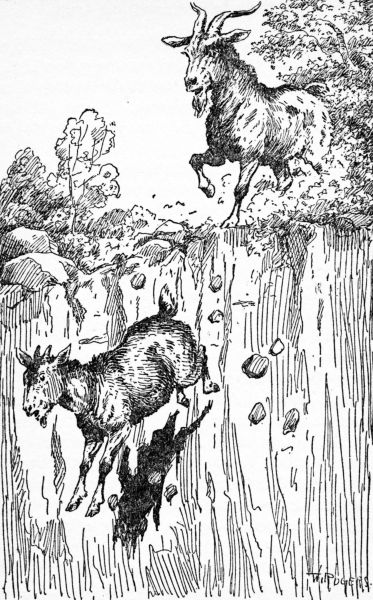
He gave a bleating cry and straight over the
edge of the rocks he jumped.
CHAPTER II LIGHTFOOT IS HURT
Mr. Sharp-horn, the man-goat, was
so surprised at what Lightfoot had
done in leaping over the edge of the
cliff that, for a second, he did not know what to
do. Indeed Sharp-horn, who was running very
fast, could hardly stop in time to save himself
from sliding over.
“Look out there, Lightfoot!” he called. “I
didn’t mean to make you do that. I wouldn’t
have hurt you very much. Why did you
jump?”
But Lightfoot could not answer now. He
was falling down through the air. Indeed he,
himself, hardly knew why he had jumped. He
almost wished he had not.
Far down below he saw the shanty of the
Widow Malony, and he saw the hard rocks and
ground all around it. Somewhere down there
Lightfoot would land, and he might be badly
hurt. For he was not one of the kind of goats
that are said to turn somersaults in the air, when
they leap, and land on their big, curved horns.
“What’s the matter?” called Grandpa
Bumper, as he heard Mr. Sharp-horn shouting
in his bleating voice.
“Lightfoot has jumped over the edge!” called
the other goat.
“Oh, my! He’ll be killed!” cried Mrs.
Sharp-horn. “You shouldn’t have chased him,
Sharpy,” for sometimes she called her goat-husband
that.
“I—I didn’t mean to make him jump,” went
on Mr. Sharp-horn. “I was only trying to scare
him away from our feeding place. He is too
young to come up here. I’m sorry.”
“Oh, what a big jump he made!” cried
Grandpa Bumper, for he knew it was about
twenty-five feet from the rocky edge down to
the ground below. “If he isn’t killed or hurt
it will be a wonder.”
Of course all this took place much more
quickly than I can tell it. It was only a few
seconds. Lightfoot was falling down and down,
or, rather, he had jumped down.
And as he left the edge of the rocks, and
looked below, he wished he had taken the butting
from Mr. Sharp-horn. But it was too late
now. And then, all of a sudden, Lightfoot did
that which gained him the name of being a very
wise young goat.
Below he saw the tin and board roof of the
Malony shanty. It stood about fifteen feet high,
and Lightfoot thought if he could land on that
it would shorten his big jump. He would not
have to go so far, and then he could leap down
that much more easily.
So he gave himself a shake and a twist in the
air, as some acrobats do in the circus, and as cats
and goats do when they jump, and, instead of
heading straight for the hard ground, Lightfoot
aimed his four feet at the roof of the shanty.
Just then Mrs. Malony came to the door to
watch her son going down the street with the
basket of clothes on his wagon.
“Look! Look, Mike!” called the widow.
“Sure it’s a flyin’ goat Lightfoot is now. He’s
fallin’ down out of the sky!”
And indeed it did look so. But before Mike
could answer, Lightfoot had landed on the roof
of the shanty amid a great clattering of the
boards and tin that kept out the rain. The roof
was flat, and the boards were springy, so the goat
sort of bounced up and down, like the man when
he falls into the circus net, though, of course, to
a less degree.
And it was this that saved the goat from being
hurt. He was shaken up a bit and jarred, but
he had safely jumped from the top of the rocks
to the roof of the shanty. From there it was
easy to get down, for at one side was a shed,
with a little lower roof, and when Lightfoot
had leaped to this he had no trouble in jumping
to a soft place on the ground just outside the
kitchen door.
“Well, of all things!” exclaimed the Widow
Malony. “You’re th’ jumpinest goat I ever
had! You’re that light on your feet a clog-dancer
would admire you. Sure it’s a fine goat
you are!”
“We never had any goat to jump the likes of
Lightfoot!” cried Mike, running back to see if
his pet were hurt, for he loved Lightfoot better
than any of the others. He patted the shaggy
coat of the animal, and, looking at him, saw that
he was not in the least harmed. Lightfoot felt
a little pain, but he could not tell Mike about
it.
“Oh, how did you ever dare do it?” asked
Blackie, running up to Lightfoot with a piece
of paste-paper in her mouth. “Weren’t you
afraid?”
“I—I guess I didn’t have time to be,” answered
Lightfoot. “I didn’t think they’d drive
me away from up there.”
Mike went on with the washing when he
found Lightfoot was not hurt, and Mrs. Malony
went back in the shanty. From the edge of the
rocks above the other goats looked down.
“Say, youngster,” called Mr. Sharp-horn to
Lightfoot, “I didn’t mean to make you do that.
Are you hurt?”
“Not a bit,” answered Lightfoot, who was
beginning to feel a bit proud of himself now.
“That was a wonderful leap,” said Mrs.
Sharp-horn.
“Indeed it was!” added Grandpa Bumper.
“Of course I have made such leaps as that when
I was younger, but I can’t any more. For a
kid that was very good, Lightfoot.”
“He won’t be a kid much longer,” said Mrs.
Sharp-horn. Then she said something in a low
baa-a to her goat-husband.
“Why, yes,” answered Mr. Sharp-horn, “I
guess, after this big leap he did to-day, Lightfoot
can come up among us other goats now.
You may come up to the top of the rocks whenever
you like,” he went on to Lightfoot. “We
won’t chase you away any more.”
“And may Blackie come up with me and eat
the sweet grass?” asked Lightfoot, having a kind
thought for his little friend.
“Can she climb that far?” asked Grandpa
Bumper.
“I’ll help her,” offered Lightfoot.
“Then you may both come,” went on the old
grandfather goat who ruled over the rest.
“Your grass down there is getting pretty dry,”
he went on. “Come up whenever you want to.
And, Lightfoot, don’t try any more such risky
jumps as that. You might break a leg.”
So, after all, you see, Lightfoot’s big jump
turned out to be a good thing for him and
Blackie. After Lightfoot had rested a bit he
and Blackie went up to the top of the rocks,
Lightfoot helping the girl-goat over the rough
places, and soon all the Widow Malony’s animals
were cropping the sweet grass on top of
the high rocks.
Lightfoot’s leap was talked about among the
goats for many a day after that. The goat grew
bigger and stronger, and every chance he found
he practiced jumping until he could do almost
as well as Mr. Sharp-horn, who was the best
leaper of all the goats in Shanty-town, as the
place of the squatters was called.
Day after day Lightfoot would practice jumping
and climbing among the rocks, sometimes
alone and sometimes with Blackie. One day,
when he had made a very hard jump from one
rock to another, he heard some boy-and-girl-talk
in the road in front of the widow’s shanty.
Looking down, Lightfoot saw a small cart
drawn by a pony, and seated in the cart was a
man, and with him were his two children.
“Oh, look, George!” called the little girl,
“there’s that nice goat we saw when we were
going to the circus, the day we got back Tinkle,
our pony.”
“So it is, Mabel,” answered the boy. “Could
we ever have a goat, Daddy?” he asked his father
as the pony cart stopped.
“Oh, I guess not,” said the man. “Tinkle is
enough for you.” Then to Mrs. Malony, who
came to the front gate, he said: “That’s a fine
goat you have.”
“Sure an’ you may well say that. You’re the
gintleman who went past here a few days ago,
aren’t you?”
“Yes. I was on my way to the circus, and it
was there we got back my children’s pony which
had been stolen.”
“Well, I’m glad you have him back,” said the
Widow Malony, with a twinkle in her kind,
Irish-blue eyes. “You should have seen Lightfoot
leap from the top of the rocks to the roof
of me shanty one day.”
“Did he really do that?” asked George.
“He did,” and Mrs. Malony told about it.
Meanwhile Tinkle, the trick pony, of whom I
have told you in the book of that name, was
having a little talk with Lightfoot.
“Were you really stolen?” asked Lightfoot,
when Tinkle told some of his adventures.
“Indeed I was. And did you really jump
from the top of those rocks?”
“I did,” answered the leaping goat, holding
his head high and feeling very proud.
“That’s more than I could do, though I can
do circus tricks,” said Tinkle. “There’s been
a book written about me and my tricks and adventures.”
“You don’t tell me!” cried Lightfoot. “But
what’s a book?”
Before Tinkle could answer Mr. Farley, the
father of George and Mabel, called good-by to
the Widow Malony and drove on with the
children in the pony cart.
“Good-by!” called Tinkle to Lightfoot. “If
ever you get to the circus ask Tum Tum, the
jolly elephant, or Mappo, the merry monkey,
about me.”
“I will,” promised Lightfoot, “though I never
expect to go to a circus.”
“Sure they were nice little children,” said
Mrs. Malony, “and it was a fine pony cart they
had. How would you like to pull a stylish cart
like that, Lightfoot?” she asked as she went back
in the shanty to finish her washing.
For many days after this Lightfoot lived
around the squatter’s shanty learning to leap and
do other things that goats have to do in this
world. And one day he had an adventure that
was not exactly pleasant.
Lightfoot was getting to be quite a big goat
now, and sometimes he wandered away farther
than he had ever gone before. Two or three
streets from where the Malony shanty was built
ran an electric car line. At first Lightfoot did
not know what it was, but the other goats told
him that people rode in the queer, yellow
cars which went rolling along in such a
queer way on the shiny rails, a bell clanging
in front.
One afternoon Lightfoot wandered down to
the trolley tracks. An ash wagon had passed
a little while before, and the goat had seen fall
from it a tin can with a big, red, tomato-paper
pasted on it.
“I’ll get that paper and eat off the paste,”
thought Lightfoot.
The can was in the middle of the tracks.
Lightfoot began nosing it, tearing off the paper
and eating small pieces. It tasted very good to
him.
Suddenly there was the clanging of a bell,
and along came a car, headed straight for Lightfoot.
The goat looked up.
“Bother!” he exclaimed to himself. “You’ll
have to wait until I finish my lunch,” he went
on. “I’m not going to hurry out of the way
for you. I’m as good as you!” Lightfoot
wanted his own way, you see.
But goats have no rights on a trolley track,
though Lightfoot did not know this. The motorman
clanged his bell, and cried:
“Get off the tracks, you goat, or I’ll bump
into you!”
Now Lightfoot knew very little indeed about
trolley cars. He did not know how strong they
were. And so, as he stood between the rails,
chewing the paper from the can, and saw the big
yellow car clanging its way toward him, Lightfoot
stamped his hoofs, shook his horns and said
to himself:
“Well, do as you please, but I’m not going
to move until I finish eating. I guess I can butt
as hard as you!”
“Get out of there!” called the motorman
again. But Lightfoot did not understand.
The car slowed up a little, but still came on.
“Bump into him, Bill!” called the conductor
to the motorman, and the next instant the fender
of the street car struck Lightfoot’s lowered
horns, and tossed him to one side over into a
ditch full of weeds.
“Oh, dear! I’m hurt this time, sure!” thought
poor Lightfoot. “I thought I could knock that
car off the track, but, instead, it knocked me
off! Oh, dear!”
CHAPTER III LIGHTFOOT SAVES A GIRL
For a few seconds after Lightfoot had been
tossed into the ditch full of weeds the goat
could not get up or even move. The trolley
car clanged on its way down the tracks.
“What happened?” asked some of the passengers.
“Oh, a goat got on the track and the motorman
had to knock him off,” explained the conductor.
“I hope you didn’t hurt him,” said a little
girl sitting in a front seat to the motorman.
“No, I didn’t hit him very hard,” answered
the motorman. “But I just had to get him out
of the way. I’d never hurt any animal, for
my children have a dog and a cat, and I love
them as much as they do. The goat really
butted into me as much as I did into him.”
And this, in a way, was true. If Lightfoot
had stood still, and had not tried to hit the fender
of the car with his horns, he would have
been easily pushed to one side. But he had to
learn his lesson, and, like the lessons boys and
girls have to learn, all are not easy or pleasant
ones.
So poor Lightfoot lay groaning in the ditch
among the weeds as the trolley car went on.
At least he groaned as much as a goat can groan,
making a sort of bleating noise.
“Oh, dear!” he thought. “Never again will
I do such a thing as this! I will stick to jumping,
for I can do that and not be hurt. I wonder
if any of my legs or my horns are broken?”
Lightfoot, lying on his side in the ditch, shook
his head. His horns seemed to be all right.
Then he tried to scramble to his feet. He felt
several pains and aches, but, to his delight, he
found that he could get up, though he was a
bit shaky.
“Well, none of my legs is broken, anyhow,”
said Lightfoot to himself. “But I ache all over.
I guess I’ll go home.” Home, to Lightfoot,
meant the rocks around the shanty of the widow
and her son.
As Lightfoot limped from the ditch to the
road he passed a puddle of water. He could see
himself in this, as you boys and girls can see
yourselves in a looking glass. The sight that
met his eyes made Lightfoot gasp.
“I’d never know myself!” he said sadly.
Well might he say that. One of his legs was
cut, and some blood had run from it. His side
was scratched and bruised and some skin was
scraped from his black nose. “I’m a terrible
looking sight,” he said.
He walked along, limping, until he came
within sight of the shanty. From behind it
came Blackie.
“Why Lightfoot!” she cried in surprise.
“Where in the world have you been? I’ve been
looking everywhere for you. Why! what has
happened to you?”
“I—I tried to butt a trolley car off the tracks,”
said the boy-goat. “I was eating some pasty
paper off a tomato can that fell from an ash
wagon, when the car came along. I wouldn’t
get out of the way and—well, it knocked me
into the ditch. Oh, dear!”
“I’m so sorry,” said Blackie sympathetically.
“Come on up to the top of the rocks and you
can roll in the soft grass. Maybe that will make
you feel better.”
“No, I don’t believe I could climb to the top
of the rocks now,” said Lightfoot. “I am too
sore and stiff. I’ll just lie down here in the
shade.”
“Do,” said the kind Blackie, “and I’ll bring
you some nice brown paper I found.”
Goats love brown paper almost as much as
they do the kind that has paste on it and that
comes off cans. For brown paper is made from
things that goats like to eat, though of course it
is not good for girls and boys any more than
is hay or grass.
“Well, what’s the matter with you, Lightfoot?”
asked Grandpa Bumper, the old goat,
as he came scrambling down the rocks a little
later to get a drink of water from the pail near
the kitchen door of the Widow Malony’s shanty.
“What happened to you?”
“I got in the way of a trolley car,” said Lightfoot,
and he told what had happened.
“Well, let that be a lesson to you,” said the
old goat-man. “You are a strong goat-boy, and
a fine jumper, but the strongest goat amongst
us is not able to butt against a trolley car. I
once heard of an elephant butting a locomotive
with his head but he was killed. His name was
Jumbo.”
“I wonder if he was any relation to Tum
Tum,” said Lightfoot, who was beginning to
feel a little better now.
“Who is Tum Tum?” asked Grandpa
Bumper.
“Oh, he is a jolly elephant who lives in a circus.
I met a trick pony named Tinkle, who
once was in the circus, and Tinkle told me about
Tum Tum.”
“I’m sure I don’t know about Tum Tum,”
went on the old goat. “And I never saw a circus,
though I have heard of them.”
“Maybe I’ll be in one some day,” murmured
Lightfoot.
“Well, whatever you do, never again try to
butt a trolley car,” advised the old goat, and
Lightfoot said he never would.
In a few days he felt better, though his bruises
and cuts still hurt a little. But, with Blackie,
he managed to get to the top of the rocks, and
there, eating the sweet grass and lying stretched
out in the sun, he was soon himself again and
could jump as well as ever. He told the other
goats about his adventure with the trolley car,
and they all said he was brave, if he was foolish.
It was more than a month after he had been
butted into the ditch by the trolley car that
Lightfoot once more wandered down that same
street. He felt hungry for some pasty paper
from a tomato can, and he wanted to see if any
had fallen from an ash wagon.
Lightfoot looked up and down the street. He
did not see a can but he did see a little girl, and
she was standing in the middle of the trolley
track, almost in the spot where Lightfoot had
stood when he was hurt.
“I wonder if she is going to try to knock a
car off the track,” thought Lightfoot. And just
then, the little girl, who was about four years
old, turned her back and stooped to pick up her
doll, which had dropped from her arms to the
ground.
As she did so, around the corner of the street,
came a trolley car, just like the one that had hit
Lightfoot. The motorman happened to be
looking the other way, and did not see the little
girl. She was so taken up with her doll that
she did not hear the rumble of the car, and the
motorman, still looking the other way, did not
ring his bell.
“That little girl will be hurt!” cried Lightfoot
“She can never knock the car off the
track if I couldn’t. I must save her! I must
push her off the rails.”
Then, with a loud “Baa-a-a-a!” Lightfoot
trotted on to the tracks in front of the car, and,
as the little girl straightened up he gently put
his head against her back and slowly pushed her
from the tracks, leaping away himself just in
time, as the car rolled right over the place where
the little girl had been standing.
CHAPTER IV LIGHTFOOT AND THE WAGON
With a clang of the bell the trolley car
came to a stop, the motorman putting
the brakes on hard. Then he jumped
off the front platform and ran to where the little
girl had sat down in the grass at the side of the
tracks. She had sat down rather hard, for
Lightfoot had pushed her with more force than
he intended. He was so anxious to get her out
of the way of one of those clanging cars that
once upon a time had hurt him so.
“What is it?”
“What’s the matter?”
“What happened?”
The passengers in the trolley car, surprised by
the sudden way it stopped, called thus to one
another as they hurried out. They saw the little
girl sitting in the grass, holding her doll by one
leg. They saw Lightfoot, the goat, standing
near by as though keeping guard over the little
girl, and they saw the motorman holding the
shiny handle, by which he turned on and off the
electricity that made the car go.
“Oh, what’s the matter?” asked a small boy
who had gotten off the car with his mother.
“Did the goat bite the little girl?”
“No, my dear. Goats don’t bite. They butt
you with their horns.”
“I don’t want any goat to butt me!” and the
little boy hid behind his mother’s skirts.
Then the little girl, sitting on the grass, made
up her mind to cry. Up to now she had not
quite known whether to laugh or to cry, but suddenly
she felt that she had been hurt, or scared,
or something, and the next thing, of course, was
to cry.
Tears came into her pretty blue eyes, she
wiped them away with the dress of her doll and
then she sobbed:
“Go away you bad goat you! Go ’way! I
don’t like you! You—you tried to bite me!”
She had heard the little boy say that. But
the little boy, getting brave as he saw that
Lightfoot did not seem to want to bite, or butt
either, any one, came from behind his mother’s
skirts and said:
“Goats don’t bite, little girl; they butt. My
mamma says so, and if you is hurted she’ll kiss
you and make you all well.”
Some of the passengers laughed on hearing
this, and the lady with the little boy went to
where the little girl was sitting on the grass,
picked her up in her arms and wiped away her
tears.
“There, my dear,” she said. “You’re not
hurt. See the pretty goat. He won’t hurt
you.”
“You’re right there!” exclaimed the motorman.
“He saved her from being hurt by my
car, that’s what he did.”
“What do you mean?” asked the conductor.
“I mean the goat butted the little girl off the
tracks, just as the lady said goats do. She was
standing on the tracks, picking up her doll, when
my car came along. I wasn’t paying much attention,
and I was almost on her when the goat
saw what the trouble was and pushed her off
the tracks with his head. He didn’t really butt
her, but he got her out of the way just in
time.”
“He’s a smart goat,” said one of the men who
had been riding in the trolley car.
“He is that!” exclaimed the motorman.
“And now that I look at him I remember him.
He’s the goat we knocked off the track about two
months ago. Don’t you remember?” he asked,
turning to the conductor.
“Sure enough he is,” agreed the conductor,
and he explained to the passengers the accident,
or adventure, that had happened to Lightfoot,
as I told it to you before.
“He must have remembered how the car hurt
him,” said the lady with the little boy, “and
he didn’t want the child to be hurt. He is a
smart goat!
“Does any one know where the little girl
lives?” asked the lady. “She ought not be allowed
to stay here near the tracks.”
None of the passengers knew the child, nor
did the motorman or conductor. As they were
wondering what to do along came Mike Malony.
“Hello, Lightfoot!” called Mike as he saw
his goat. And then, as he noticed the crowd,
the stopped trolley car and the little girl, he
asked:
“What’s the matter? Is Tessie hurt?”
“No one is hurt, I’m thankful to say,” replied
the motorman; “but the little girl might have
been only for the goat. Do you know her?”
“Sure, she’s Tessie Rooney. She lives near
me,” explained Mike. “I’ll take her home if
you like.”
“I wish you would,” said the lady who had
given Tessie a five cent piece, which to Tessie
was almost as much as a dollar. The child
forgot all about her tears and what had happened
to her.
“Sure I’ll take her home,” said Mike, kindly.
“Do you know whose goat that is?” asked the
lady, as her little boy whispered something to
her.
“That’s mine,” said Mike proudly. “And
there’s no better jumping goat in these parts.”
“Nor smarter goat either,” said the motorman,
and Mike, to his surprise, learned what
his pet had done.
“Do you want to sell the goat?” asked the
lady. “My little boy would like him. I have
an idea that I could hitch him to a cart and
have him draw my boy about. Some neighbor’s
children have a little pony named Tinkle, and
they have great fun riding around with him.
My boy is too small for a pony, but a goat might
be good for him. Will you sell him to me—Lightfoot
I think you said his name was?”
“Well, ma’am, not wishing to be impolite to
you, but I can’t sell Lightfoot,” said Mike
slowly, and he put his hand on the goat’s head.
“You see I’ve had him ever since he was a little
kid, and I like him too much to sell him.”
The lady saw how Mike felt about it, so she
said kindly:
“Well, never mind, my boy. I wouldn’t want
to take your pet away from you, any more than
I’d want my little boy to lose his, if he had
one. It’s all right. But you are lucky to have
so good a goat.”
“Yes’m; I think so myself. Come on now,
Tessie. I’ll take you home, and if ever you
come by yourself on the trolley tracks again
I’ll never give you another pickaback ride.”
“Oh, then I won’t ever come,” lisped Tessie,
her hand in Mike’s. “And will you give me
a piggy back ride now?”
“Yes,” promised Mike; and amid the laughter
of the trolley car passengers Mike took the
little girl up on his back and trotted off, making
believe he was a horse. Lightfoot ran alongside,
and, seeing him, Tessie said:
“Lightfoot pushed me so hard I sat down in
the grass, Mike.”
“Well, it’s a good thing he did, Tessie, else
you might have been harder hit by the car.
Now you take my advice and keep away from
the tracks or, mind—no more pickaback
rides!”
A day or so after that Mike, going up to the
top of the rocks to take some salt to his mother’s
goats, saw Lightfoot leaping about, kicking up
his heels and shaking his horns.
“Sure it’s a fine goat you are intirely, as my
dear mother would say,” said Mike softly.
“And I wish I could do it.”
“If I only could do it,” he said, “it would
be great! I could drive home with the washings,
and then, maybe, I could earn money with
you. I wonder if I could make it myself? I
could get the wheels, and a big soap box—
“No,” went on Mike, after a moment of
thought, “that wouldn’t do. It would be all
right for taking home the washings, but not
to give rides for money. I’ve got to get a regular
goat harness and a wagon. How can I do
it?”
Now you know what Mike was thinking of.
He had heard the lady speak of a pony cart,
and he wanted a goat wagon for Lightfoot. If
he had that he could, as he said, drive home with
the big baskets of clean clothes to his mother’s
customers. Then Mike had an idea he could
give rides to children in the goat wagon, and
so earn money.
“But where can I get the wagon and harness?”
he asked himself over and over again.
At last, when he had talked the matter over
with his friend Timothy Muldoon, the railroad
gate-tender, in his little shanty at the foot of the
street, Mike got the idea.
“Sure why don’t ye advertise in the papers?”
asked Tim, as Mike called him. “That’s what
everybody does that has anything to sell or wants
to buy. Advertise for a goat wagon and harness.
Sometimes goats dies, and the folks that
owns them don’t get another, but sells the outfit.”
“But it costs money to advertise,” objected
Mike.
“Sure and won’t the paper you work for trust
you?” asked the gateman.
“The paper I work for?” repeated Mike,
wonderingly.
“I mean the one you delivers for, nights,”
for Mike had a paper route for an evening
paper, the Journal.
“They ought to know you there,” went on
Tim. “Tell the advertising man what you want,
and that you’ll pay him when you can.”
“I’ll do it!” cried Mike, and he did. When,
rather timidly, he explained to the man at the
desk in the office what he wanted, and told him
that he had delivered the Journal for several
years, a bargain was made.
The man would put the advertisement in the
paper for Mike, saying he wanted to buy a
second-hand goat wagon and harness. He was
to pay for the advertisement at the rate of two
cents each day, for the Widow Malony and her
son were so poor that even two cents counted.
“And you can easy make up that two cents
by getting two new customers for the paper,”
said Tim, when Mike told him what had happened.
“Yes. But how am I going to pay for the
goat wagon and harness in case some one has
it to sell?” Mike questioned.
“Well, maybe I have a bit of a nest egg laid
away,” said Tim, with a smile. “I might lend
you the money, and when you get rich you can
pay me. Or whoever sells the outfit might let
your mother make up the amount by washing.
We’ll see about that.”
To Mike’s delight he had two answers to his
advertisement. One was for a very fine goat
wagon and harness, but the price asked was more
than even Tim would advise paying.
“You can get that, or one like it, when you’ve
made a hundred dollars on the goat rides,” said
the gate-man to Mike.
The other outfit was just about right, Tim and
Mike thought, and the man who had the wagon
and harness for sale said Mrs. Malony could
pay for it by doing washing and ironing. So,
after Mike had paid for the advertisement, no
more money need be paid out.
“Sure, Lightfoot, now there’ll be grand times
for you!” cried Mike as he came home one day
with the wagon and harness.
CHAPTER V LIGHTFOOT IN THE PARK
Lightfoot, the leaping goat, who was
cropping the sweet grass on top of the
rocks from which he had once made his
great jump, looked down in the yard near the
shanty and saw his master Mike busy over something
new.
“I wonder what that is?” thought Lightfoot
to himself, for goats and other animals wonder
and are curious about things, as you can tell
by holding out something in your hand to your
dog or cat. They will come up to it and smell
it, to see if it is good to eat.
And so Lightfoot wondered. Mike was good
to him, and often brought him some lumps of
salt, or a bit of carrot or turnip, for though
goats like to eat grass, and even bits of paper
and other queer things, they like nice things
too, like sweet vegetables.
“I guess I’ll go down and see what it is Mike
has,” said Lightfoot to himself, and so he started
down the rocky path. Though he was a good
leaping goat he did not want again to try to
jump on top of the widow’s shanty. That was
too dangerous.
“Where are you going, Lightfoot?” asked
Blackie, the girl-goat, who had been cropping
grass near her friend, as she saw him start down
the rocky path.
“The boy Mike is down there, and he may
have something good to eat,” answered Lightfoot.
“If he has I’ll give you some.”
“You are very kind,” said Blackie, and she
followed down after Lightfoot, only more
slowly, for she was not so good a jumper or rock-climber
as was he.
Down near his mother’s shanty, Mike was
looking at the goat wagon and harness he had
just brought home.
“It’s almost as good as new, Mother!” cried
the Irish boy. “Look at the wheels spin, would
you!” and turning the wagon on one side he spun
two wheels around until they went so fast he
could not see the spokes.
“Be careful now and don’t break it,” cautioned
the Widow Malony.
“Oh, sure ’tis a grand strong wagon!” cried
Mike. “It would hold two baskets of clothes.
And I can ride four boys or girls around in it
at once, and get pennies.”
“Well, sure an’ it’s the pennies we need,”
sighed Mrs. Malony, for she found it hard to
get along on what she could earn. Mike was
getting to be a bigger boy now, and he ate more,
though his mother never told him this. She
wanted him to grow strong.
“Give me a bit of salt, Mother,” said Mike.
“I want to get Lightfoot friendly, so he’ll not
be afraid of the harness or wagon, for I’m going
to hitch him up soon.
“Here he comes now with Blackie,” went on
Mike, as he saw the two goats coming down the
rocky path. “You’re just in time, Lightfoot,
though I don’t need Blackie to learn to pull the
wagon. She wouldn’t be strong enough. But
I’ll give her some salt.”
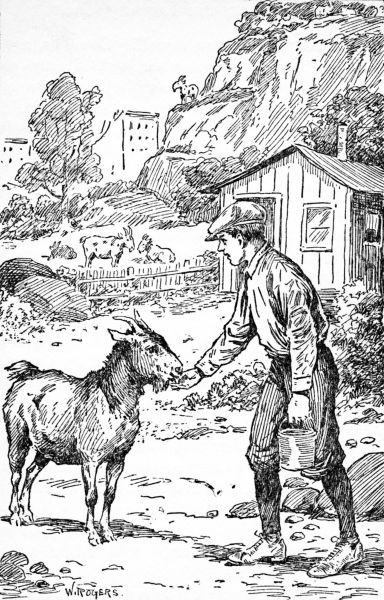
The two goats licked the salt from Mike’s
hands, and liked it very much. Mike turned
the wagon right side up, and then took up part
of the harness.
“I wonder how Lightfoot will act when I put
it on him,” thought Mike. “He’s never been
harnessed.”
While the goat was chewing some sweet
chopped carrots which Mrs. Malony spread out
in front of him, Mike gently slipped a part of
the harness over the goat’s back. At first Lightfoot
jumped a little to one side. But, as he saw
that there were still more carrots left, and as he
felt Mike patting him, Lightfoot thought it was
all right.
“I guess it’s just a new game that boy Mike is
playing,” said the goat to himself. “Well, he’s
always kind to me, so I’m sure it will be all
right. Anyhow these carrots are good. Have
some, Blackie.”
“I will,” said the other goat. “But what is
that queer thing on your back, Lightfoot?”
“Oh, some game that boy is playing,” answered
the goat. “It won’t hurt us, for Mike is
always kind,” and he and Blackie went on eating
the carrots.
“Well, so far so good,” said Mike to himself
when he had most of the harness on his pet, and
Lightfoot had stood still. “Now to get the bit
in his mouth. That’s going to be harder.”
“Better get Jack Murphy to come over and
help you,” said Mrs. Malony. “He used to
keep goats in Ireland, and he knows a lot about
’em, though I don’t know if he ever harnessed
’em to a cart.”
But Mr. Murphy had, as it happened, and,
being a neighbor of the Malonys, he soon came
over when Mike called him and showed the boy
how to put the iron bit in Lightfoot’s mouth, and
run the reins back through rings fastened in a
part of the harness that went around the middle
of the goat’s back.
It was not easy to do, and, several times, Lightfoot
tried to break away. But Mike and Mr.
Murphy held him until the harness was in place
and tightly strapped on.
“Now see if you can drive him about,” said
Mr. Murphy, when Mike had hold of the reins
and the bit was in Lightfoot’s mouth. The goat
was shaking his head about, trying to get rid of
the piece of iron between his teeth. It did not
really hurt him. It just felt queer. But it was
firmly held by straps, and Lightfoot could not
shake it loose.
“I can’t drive him without first hitching him
to the wagon,” said Mike, for as yet the goat had
not been put between the shafts of the little cart.
“Don’t hitch him to that yet,” advised Mr.
Murphy. “Sure he might run away and break
it. Just drive him about the yard by the reins
and run after him.”
“He may run away with me,” laughed Mike.
“Well, that can’t be helped. Maybe he will.
But he’ll soon get used to the harness and behave.
Lightfoot is a wise goat.”
But even wise goats don’t like it the first time
they are put in harness, and Lightfoot was no
different in this way from others, though he was
such a good jumper. When Mike took hold of
the reins and called to Lightfoot to “gid-dap,”
the goat, who was now big and strong, started off
with such force and suddenness that Mike was
almost jerked from his feet.
“Run!” called Mr. Murphy. “Run with
him, and along after him, Mike. Try to turn
him to the right and the left so’s he’ll know how
to mind the reins when he’s fast to the wagon.
Run after him!”
Mike, holding fast to the reins, ran, and the
goat ran too. And, being a good runner, Lightfoot
easily kept ahead of Mike. It was all Mike
could do not to let go the reins.
“Run!” called Mr. Murphy. “Run faster,
Mike!”
Mike tried but he stumbled over a stone and
fell. However, he kept hold of the reins,
winding them around his wrists and as Lightfoot
kept on going he pulled Mike all about the yard.
“Bless an’ save us!” cried Mrs. Malony coming
to the door of her shanty. “What’s happenin’?”
“He’s teaching Lightfoot to pull to harness,”
said Mr. Murphy.
“Hum! It looks more like Lightfoot was
teachin’ Mike,” said the widow. “Won’t Mike
be hurt?”
“Not a bit. Many a time in th’ old country
I’ve been dragged by a goat. It’s good for one.”
Around and around the yard Lightfoot
dragged Mike, the chickens and ducks scattering
in all directions, the old rooster flying up on the
fence and crowing with all his might.
At last Lightfoot, finding he could not get the
iron bit out of his mouth, and could not shake
off the harness, and looking back and seeing
Mike being dragged about on the ground,
thought:
“Well, I guess I’m tired. I seem to be held
fast no matter what I do. I’ll quit.”
And that is just what Mike wanted, for he was
tired of being pulled about in this fashion.
“Well, I guess he’s learned that part, anyhow,”
said Mr. Murphy. “Now we’ll hitch
him to the wagon.”
While Mr. Murphy was bringing up the
wagon, and Mike was holding Lightfoot,
Blackie came up and asked:
“What was all that for, Lightfoot?”
“Oh, I guess it was a new kind of game. I
can’t say I like it though. I had rather jump
on the rocks,” answered Lightfoot.
“No, it was not a game,” said Grandpa
Bumper, coming up just then. “You are being
taught to let yourself be harnessed up to draw
a cart, Lightfoot, and here they come with the
cart now.”
“What does that mean?” asked the leaping
goat. “Will it hurt?”
“No, not if you behave yourself. Once I was
a cart-drawing goat, and I worked in a nice
park. I’ll tell you about it so you’ll know what
to do.”
And when the cart was brought up, and the
shafts, one on each side of Lightfoot, were being
fastened with straps, the younger goat stood very
still, listening to Grandpa Bumper tell, in goat
language, just what it all meant.
“Why, he seems to like it,” said Mike as he
fastened the last strap. “He didn’t try once to
get away, Mr. Murphy.”
“I guess he’s getting used to it,” said the kind
Irishman.
But if he and Mike had known, it was what
Grandpa Bumper had said to Lightfoot that
made the young goat stand so still and allow
himself to be hitched to the cart.
“Well,” said Lightfoot to the old goat when
the harnessing was finished, “it may not be so
bad after all. I guess I’ll be good and not run
away. I’ll pull the cart nicely.”
“It will be best, I think,” said the old goat.
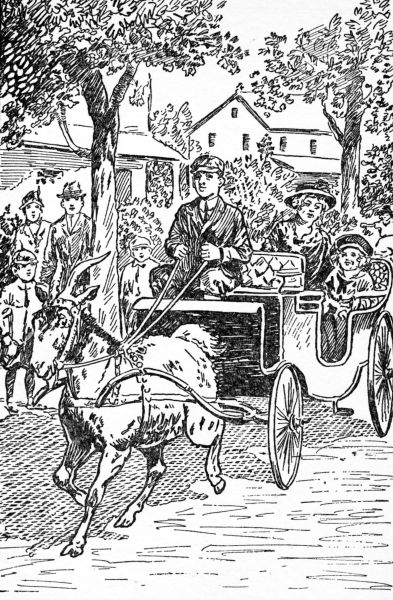
So, when Mike took his seat in the cart, and
pulled on the reins, calling to Lightfoot to “Gid-dap!”
the goat started off, pulling the little
wagon as though he had done it all his life.
“Oh, this is great!” cried Mike. “I never
thought he would learn as easily as this.”
“He is a smart and sensible goat,” the Irishman
said. “Now look out if he gets going too
fast.”
But Lightfoot did not seem to want to run
away. He trotted along up and down the street,
soon learning to turn to the right or the left as
Mike pulled the reins.
Once or twice Lightfoot started to run
swiftly, but Mike pulled back on the reins, and
the iron bit in his mouth, pressing on his tongue
and teeth, told Lightfoot that he must go more
slowly.
In a few days he had become used to the cart
and harness and Mike could drive him anywhere.
The other goats came to the top of the
pile of rocks and looked down at Lightfoot.
Many of them wished they could be harnessed
up, for Lightfoot got many extra good things
to eat from Mike, who liked his driving goat
very much. Lightfoot was now a driving goat
as well as a leaping one.
“And now it’s time, I guess,” said Mike one
day, “to see if I can earn money with my goat
and wagon.” He had taken a number of baskets
of clean clothes home to his mother’s employers,
and, no matter how heavy the basket
was, Lightfoot had no trouble in pulling it, with
Mike sitting on the front seat of the cart.
Mike made his wagon nice and clean, put a
strip of old carpet in the bottom, and started one
day for a part of the city where rich folks lived.
Along the streets there, on pleasant afternoons,
nurse maids would be out walking with the
children of whom they took care. When he
got to this place Mike drove his goat wagon
slowly up and down.
It was not long before a little boy, well dressed,
who was walking along with his nurse, cried:
“Oh, Marie! See the wonderful goat wagon!
May I have a ride in it?”
“No, no, Master Peter. It is not to ride in.”
“Yes, it is! I want a ride! Will you give
me a ride, boy?” he called to Mike.
“You must not ask for rides,” said Marie, the
maid. “The boy sells rides—that is, I think he
does,” and she looked at Mike and smiled.
“Yes,” answered Mike, “my goat wagon is
for hire.”
“Then I want a ride!” cried little Peter. “I
want a ride, Marie!”
“But we must ask your mamma,” said the
maid. “Come, she is just going out in the car.
We will ask her.”
Mike saw a richly dressed lady getting into
a big automobile in front of a fine house. Peter
ran to her and said something. The lady beckoned
to Mike, who drove his wagon toward her.
“Do you hire out your goat wagon for rides?”
asked the lady.
“Yes’m,” said Mike.
“And is he perfectly safe?”
“Yes’m. I drive him myself. I won’t let
him run away.”
“Then I think you may have a ride up and
down the block, Peter. Marie, here is money
to pay the goat-boy. But be careful, won’t
you?” she cautioned Mike.
“Oh, yes’m,” he promised. He helped Peter
into the goat wagon, on to one of the three rear
seats, Marie getting in also. Then Mike started
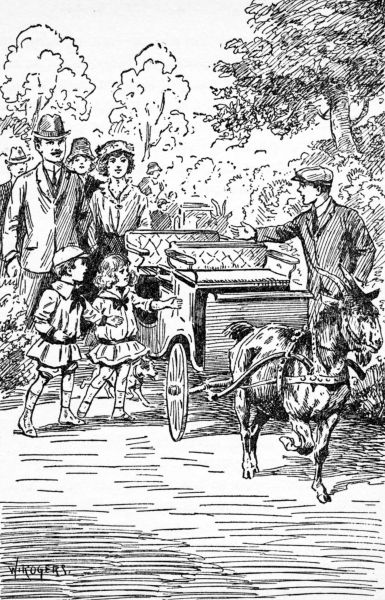
Lightfoot off down the street at a gentle trot.
“Oh, I love this!” cried Peter. “When I
grow up I’m going to drive a goat wagon!”
“Oh, Master Peter!” cried Marie.
“Well, I am,” he said. “It’s ever so much
more fun than making an automobile go. Anybody
can do that.”
Up and down the block Mike drove Lightfoot,
giving the little boy and his nurse a fine ride.
Then the other children wanted rides, and their
parents or nurses, seeing how gentle the goat was,
and how well Mike managed him, let their boys
and girls get in the cart. Mike was kept busy
all the afternoon giving rides to the little tots,
and when he had finished he had nearly two
dollars, in ten- and five-cent pieces, for some
children took more than one ride.
“Talk about your luck!” cried Mike as he
drove toward his shanty, a happy smile on his
freckled face. “I’ll soon be rich.”
“Look at that, Mother!” he cried, as he poured
the money from his pocket on to the table.
“That’s what Lightfoot earned for us to-day!”
“Thanks be!” exclaimed Mrs. Malony.
“Sure an’ the money will come in handy, for I
have the grocer to pay to-night. Tell me about
it, Mike darlin’.”
And Mike told, while Lightfoot, unharnessed,
ate a good supper, and then told the other goats
of his new adventures.
For several weeks Mike went about the different
streets of the city giving rides to children,
and hardly a day passed that he did not make
a dollar or a little more. Of course when it
rained he could not do this. And then one day
Mike came home with bright eyes and a laughing
face.
“What do you think, Mother dear!” he cried.
“I have a regular job with Lightfoot!”
“What is it, Mike?”
“I’m to drive him and the goat wagon in the
park, and the man is to give me ten dollars a
week. That’ll be better than going about the
streets. I’ll get paid regular. Hurray!” and
Mike hugged and kissed his mother.
CHAPTER VI LIGHTFOOT BUTTS A BOY
When Mike had quieted his joy and
happiness down a bit, he explained
to his mother how it had come about.
It seemed that as he was driving Lightfoot about,
hitched to the cart, and giving a number of
children a ride on a quiet street, a man had
come up to Mike.
“I have a goat stand in the park,” the man
explained. “I own a number of goats and
wagons, and hire boys to drive them. Would
you like to sell me your goat and wagon? I
need another.”
“But I told him I wouldn’t sell Lightfoot,”
Mike explained. “Then he wanted me to hire
my outfit to him at so much a week, but I
wouldn’t do that, for I wouldn’t let anybody but
myself drive my goat.”
“That’s right,” agreed Mrs. Malony, who was
almost as fond of Lightfoot as was Mike himself.
“What did the man say then?”
“Well, he wanted to know if I’d come to the
park and drive the goat myself. He said he’d
give me eight dollars a week, but I said I could
earn more than that working for myself. Then
he raised it to ten dollars and I took him up.”
“But how does he make any money out of it?”
asked Mrs. Malony.
“Oh, he keeps all I take in over ten dollars,
and I guess it will be more than that lots of
times, for big crowds of children go to the park
these Summer days. Then, too, we don’t give
such long rides as I’ve been giving. They
charge only five cents a ride in the park, and
I charge ten sometimes, but then I go all around
a big block.
“But I think it’ll be a good thing for us,
Mother. Ten dollars a week is a lot of money.
Of course I’ll have to buy the feed for Lightfoot
out of that, and a bit of lunch for myself.”
“Sure, I can put that up for you in the morning,”
said the widow with a smile. “It’s great,
Mike my boy! Sure we’ve had good luck ever
since we got Lightfoot.”
The next day, bright and early, Mike drove
his goat and wagon to the big park which was
in the upper part of the city, not far from where
the squatters had built their shanties on the
rocks.
“Well, I see you are on time,” said the man
who had the privilege of managing the goat
wagons in the park. No wagons other than
those he permitted could come in to give the
children rides, so if Mike had not accepted his
offer the boy could not have done a park business
on his own account.
“Yes, Lightfoot and I are all ready,” said
Mike.
In a little while the other goats were brought
from the stable in the park where they were
kept, and harnessed to small wagons. The
wagons were better painted than Mike’s, but
were no cleaner nor larger. And as a friend of
his mother’s had given her a strip of bright red
carpet, Mike put this in the bottom of his goat
cart, so that it looked gay and cheerful.
“Huh! Got a new boy, it seems,” said one
of the small drivers, as he noticed Lightfoot and
Mike.
“Yes, an’ if he tries to take away any of my
customers he’ll get in trouble,” said another,
shaking his fist at Mike.
“Here, you boys! No quarreling!” said the
manager of the goat wagons, a Mr. Marshall.
“You’ll all do as I say, and I won’t have any
picking on this boy. Business isn’t any too good,
and I want you all to do your best.”
Mike said nothing to the other boys, but he
was not afraid to take his own part.
The other goats looked at Lightfoot, and one,
hitched to the wagon driven by the boy who had
spoken a bit crossly to Mike, said to Lightfoot:
“Where did you come from?”
“From the high rocks,” answered Lightfoot.
“Do you mean the mountains?” asked another
goat.
“I don’t know, but it’s over that way,” said
Lightfoot, and he pointed with his horns in the
direction of Mike’s home.
“Oh, he means the rocks by the squatters’
shanties!” exclaimed the goat who had first
spoken. “Why, we can’t have anything to do
with goats like that! We give rides to well
born children. This goat comes from a very
poor home indeed.
“What right have you got to come here among
us?” he asked Lightfoot.
“I don’t know anything about it,” said Lightfoot.
“I was driven here, and I’ll do my best
to give good rides to the children. I may not
have come from the mountains, but the rocks
where I live are very high and sweet grass grows
on top. Can any of you jump from the high
rocks down on top of the widow’s shanty?”
“Thank you, we don’t live near shanties,” said
another goat. “We live in the park stable.”
“Just the same that was a good jump,” remarked
a quiet goat, with short horns. “I was
over that way once. I think I know the place
you mean,” he went on to Lightfoot, and Mike’s
goat was glad to know he had one friend.
“Well, he may be a good jumper but I don’t
believe he can butt hard with his horns and
head,” said the ill-tempered goat, who was called
Snipper from the habit he had of snipping off
leaves and flowers in the park.
“I once nearly butted a trolley car off the
tracks,” said Lightfoot, “and I did shove a little
girl out of the way of the car.”
“Pooh! That’s nothing,” sneered Snipper.
“Let’s see how hard you can butt,” and he rose
up on his hind legs and aimed his head and horns
at Lightfoot.
“Look out, Lightfoot!” cried Mike. But the
new goat was ready for Snipper. Rising on his
own hind legs, Lightfoot butted the other goat
so hard that he nearly fell over backward into
the cart.
“Good! Well butted!” cried the kindly,
short-horned goat. “That was fine!”
“You wouldn’t say so if you felt it,” bleated
Snipper.
“Well, it was your own fault. You started
the quarrel,” went on the friendly goat.
“I can butt better than he can, and I’ll show
him too, next time,” grumbled Snipper, rubbing
his head against a tree.
“Say!” cried the boy who had spoken roughly
to Mike, “if your goat doesn’t leave mine alone
I—I’ll do something to you!”
“Oh, no, you won’t,” said Mike. “I’m not
afraid of the likes of you.”
“Here, boys, stop your quarreling,” said the
man. “Get ready now, some children and their
mothers are coming. Perhaps they may want
rides.”
Along the path that led to the goat stand came
a number of boys and girls. Seeing them, the
boys in charge of the goats called:
“Here you are for a ride! This way for a
ride! We’ve got the best goats in the park!
Only five cents a ride!”
The children stopped. Some begged their
fathers or mothers to let them have a ride. One
man, with a boy and girl consented.
“Which wagon and goat do you want?” asked
the father.
For a moment the tots were undecided.
“Here, take mine! It’s the best!” cried the
boy whose goat had been butted by Lightfoot.
For a moment the children seemed about to get
into that wagon, then the little girl cried:
“Oh, see what a pretty red carpet is in this
wagon!” and she ran over to Mike’s. “I want
to ride in this!”
“So do I,” said her brother, and they got in.
Mike was pleased and happy, but the other boy,
whose name was Henry, scowled.
“I’ll fix you for that,” he muttered to Mike,
but Mike did not care. He started Lightfoot
down the park road and the goat drew the delighted
children swiftly and carefully.
Thus it was that Mike and Lightfoot began
their work in the park. From then on, for several
weeks, Mike would take his goat and cart
to the stand every morning, and all day long he
would drive parties of children up and down.
Lightfoot was growing stronger and more used
to harness and cart, and he could soon pull as
well as the best goat in the park.
Every Saturday night Mike took home ten
dollars to his mother, and this was the best of
all. Of course Mike took in more than this
from the children who paid him for their rides,
but all over ten dollars went to Mr. Marshall.
Out of the ten dollars Mike paid for hay and
oats for Lightfoot, for now that he had work
to do, the goat could not live on grass alone.
The other goats accepted Lightfoot for a
friend now, and even Snipper was on good terms
with him, for they all saw that Lightfoot was
as strong as any of them and could take his own
part. But Henry, the boy who drove Snipper,
did not make friends with Mike.
And this is how he did it—not a very fair
way, I should say. One noon Mike took the harness
off Lightfoot, and, putting a rope around
the goat’s neck, tied the other end to a tree, so
Lightfoot would not stray away, as he had once
or twice, meaning nothing wrong. Mike’s
mother had not had time to put up his lunch
that morning, so Mike went down to a little restaurant
in the park, intending to get a glass of
milk and some sandwiches.
“Now behave yourself, Lightfoot, while I’m
gone. I’ll soon be back,” said Mike.
Lightfoot wiggled his little stubby tail.
Whether he understood or not I can not say.
He went on cropping grass, after he had eaten
his hay and other fodder.
In a little while Henry came along. He saw
Lightfoot tethered all by himself, the other goats
having been taken to the stable. Henry looked
about, and, seeing no signs of Mike, took up a
stick, and, going toward Lightfoot, said:
“I’ll teach you to butt my goat! You won’t
do it after I am through with you!”
Then, with the stick, he fell to beating Lightfoot.
At first Mike’s goat did not know what
to make of this. He looked up and seeing that
it was one of the goat-boys, but not Mike, thought
maybe it was a new kind of game. But as the
blows from the stick fell harder and harder
Lightfoot knew that it was no game.
Whack! Bang! Whack! Henry beat the
stick on Lightfoot’s back.
Lightfoot tried to get away, but the rope held
him. Then, suddenly the goat became angry,
and you can not blame him. He knew he had
strong horns and a strong head, given him by
nature to butt with and defend himself.
“And I’m going to butt that boy who is beating
me with the stick!” thought Lightfoot. Before
Henry knew what was happening Lightfoot
rushed straight at him with lowered head,
and the next thing Henry knew he found himself
falling backward head over heels in the
grass. The goat had butted him down good and
hard.
For a moment Henry lay dazed, hardly knowing
what had happened. Then, all of a sudden,
Lightfoot felt sorry.
“My master would not want me to do this,”
he said to himself. “Maybe he will punish me
when he comes back. I know what I’ll do; I’ll
run away.”
With a strong jump, and a leap, Lightfoot
broke off, close to his neck, the rope that held
him. And then, before Henry could get up,
off through the bushes in the park bounded
Lightfoot. He had run away.
CHAPTER VII LIGHTFOOT ON A BOAT
The park where Lightfoot, the leaping
goat, had worked with Mike for several
weeks, giving rides to children, was
quite a large one. There were many paths in
it, and driveways. There were also patches of
woods, and places where the bushes grew in
tangled clumps, making many hiding places.
“I’d better hide myself for a while,” thought
Lightfoot, for, though he was a tame goat, he
still had in him some of the wildness that is in
all animals, even your pussy cat; and this wildness
made him want to hide when he thought
himself in danger. And the danger Lightfoot
feared was that he would be beaten with a stick
for knocking over the boy who had tormented
him.
“I’ll hide under these thick bushes,” said the
goat to himself, when he had run quite a distance
from the stand in the park where the small
wagons were kept.
The bushes were thick, but with his strong
head and horns Lightfoot soon poked a way for
himself into the very middle of them, and there
he lay down upon the ground to rest. For he
had run fast and was tired. His heart was beating
very hard.
Though he did not know it, Lightfoot had
done just as a wild goat would have done—one
that lived in a far-off country who had
never seen a wagon, a harness or a squatter’s
shanty. He had hidden himself away from
danger.
And, with beating heart, as he crouched under
the bush, Lightfoot wondered what he would do
next.
“I can’t go back to the park and help Mike
with the wagon, giving the children rides,”
thought Lightfoot. “If I do that boy with the
stick will be waiting for me. He’ll be angry
at me for knocking him down. That little girl
wasn’t mad at me for knocking her off the trolley
tracks; but then that was different, I guess.
And maybe Mike will be angry with me too.
I’ll be sorry for that.
“He won’t give me any more lumps of salt,
nor sweet carrots. I won’t see Blackie again,
nor Grandpa Bumper. I’ll never jump around
on the rocks any more and see the Sharp-horns.
Well, it can’t be helped, I suppose. I must do
the best I can. I’ll stay here for a while and
see what happens.”
So Lightfoot remained in hiding, and when
Mike had finished getting his little lunch in the
restaurant he came back to reharness his goat to
the wagon, ready to give the children rides in
the afternoon.
“Why, where’s Lightfoot?” asked Mike in
surprise, as he came back and saw the broken
rope where he had tied his pet. “Where’s my
goat?”
“How should I know?” asked Henry in a
cross sort of voice. “He butted me over on my
back a little while ago.”
“You must have done something to make him
do that,” quickly cried Mike. He looked at the
end of the broken rope. At first he thought
Henry might have cut it on purpose to let Lightfoot
get away, but the ends of the rope, frayed
and rough, showed that it had not been cut,
but broken.
“Have any of you seen Lightfoot?” asked
Mike of the other boys. But they had all been
to dinner themselves and had not seen what had
happened. The other goats, too, had been taken
to the stable for the noon meal.
Only Henry had seen Lightfoot run away,
and he felt so unkindly toward the goat and
Mike that he would not tell. Mike ran here
and there, asking the park policemen and other
helpers if they had seen his goat, but none had.
Lightfoot had taken just the best possible time
to run away—noon, when every one was at dinner.
And now the goat was safely hidden in
the bushes.
“Well, I’ve just got to find him,” said Mike
to himself, as he looked at the goat’s harness
hanging on a tree, and at the wagon with its
strip of bright red carpet. “I’ve just got to find
Lightfoot!”
Telling Mr. Marshall what had happened,
and promising to come back with Lightfoot as
soon as he could find him, and take up again the
work of giving children rides in the park, Mike
set off to find his pet.
Along the paths, cutting across the grassy
lawns, looking under clumps of bushes, asking
those he met, Mike went on and on looking for
Lightfoot. Now and then he stopped, to call
the goat’s name. But though once Lightfoot,
from where he was hiding, heard his master’s
voice he did not bleat in answer, as he had always
done before.
“He is looking for me to whip me,” thought
Lightfoot, “and I am not going to be whipped!”
Poor Lightfoot! If he had known that Mike
would not whip him, but would have petted him,
and given him something nice to eat, the goat
might have come out from the bush where he
was hiding and have trotted up to Mike. Had
Lightfoot done this he would have saved himself
much trouble. But then, of course, he
would not have had so many adventures about
which I will tell you.
After calling and looking for Lightfoot, even
very near the bush under which the goat was
hidden, but never suspecting his pet was there,
Mike walked farther on. He had not given up
the search, but now he was far from the place
where Lightfoot was hiding.
Lightfoot stayed under the bushes and listened.
He did not hear any one coming toward him,
and he began to think he was now safe. He was
beginning to feel a bit hungry again, so he
reached out and nibbled some of the leaves.
“My! That tastes good!” he said to himself.
“It’s better even than the grass that grows on top
of the rocks at home.”
Then, all of a sudden, Lightfoot felt homesick.
He thought of the fun he had had with Blackie
and the other goats, and he wanted to go back
to them.
“I think I’ll do that,” he said. “Maybe, after
all, Mike will not let that other boy beat me.
But I’ll wait until after dark.”
The sun sank down in the west. The children
and their nurses went home from the park. The
goats and wagons were taken to the stable.
Mike came back from his search.
“Well, did you find your goat?” asked Mr.
Marshall.
Mike shook his head sadly.
“No, I didn’t,” he answered. “But I’ll look
again to-morrow.”
“If you don’t find him pretty soon,” went on
the man, “I’ll have to get another goat and
wagon.”
Mike felt sadder than ever at this for he knew
the money he had been able to earn with Lightfoot
was much needed at home. And it was
with a sorrowful heart that Mike told his mother
what had happened.
“Never mind, Mike me darlin’,” said the good
Irish woman. “Maybe Lightfoot will come
back to us some day.”
At dark Lightfoot crept out from under the
bush. The lights were sparkling in the park,
and he thought he could easily find his way back
to Shanty-town. Mike had driven him from
there to the park and back many times.
But the darkness, even though there were
lights here and there, bothered Lightfoot. He
soon became lost. He did not know which way
he was going. Once, as he crossed a green lawn
in the park he saw, standing under a lamp, a
policeman with a club. Lightfoot did not know
what a policeman was but he knew what a club
was used for—to beat goats.
“But he sha’n’t beat me,” thought Lightfoot,
so he kept in the shadows and got safely past.
On and on he wandered, trying to find his way
back to the rocks where he had spent so many
happy months. But he could not find them,
and at last he became so tired that he crawled
under some bushes and went to sleep.
It was morning when Lightfoot awakened.
He found he was in a strange place. It was a
place of many streets and with big cars running
back and forth on shining rails. But they did
not run as did trolley cars. Instead a big engine
pushed them and pulled them. Though Lightfoot
did not know it, he was near a railroad yard.
He came out from under the bush to look for
something to eat. He saw an empty can with
a piece of paper on it that he knew was covered
with paste. He wanted that paper very much.
But as he crept out to get it a boy picking up
coal from the tracks saw him and cried:
“Oh, fellers! Look at de goat! Let’s chase
him!”
And chase after Lightfoot they did, shouting
and throwing lumps of coal. Lightfoot had no
mind to be caught, so he ran across the tracks.
The boys shouted at him, the men in the railroad
yard yelled at him, and when he crossed the
tracks the engines tooted their whistles at him.
Altogether Lightfoot was very much frightened.
On and on he ran. Some of the boys were
getting closer now, for Lightfoot could not run
over the shiny rails as easily as they.
“I’m going to get that goat!” cried the boy
who had first seen Lightfoot.
Lightfoot heard the boy’s shout, though he
did not understand the words. The goat knew
he must run faster and faster, and he did. He
came to a place near the line of the railroad
tracks where he could see some water. He knew
what water was, for he drank it, and also, when
it rained hard, there was a little pond and a
stream that formed on top of the big rocks, so
he was used to seeing large puddles.
But Lightfoot was not going to do that. He
was only looking for a good place to hide.
Pretty soon he saw it. Floating on the water
was something that looked like a little house.
Smoke was coming from a stovepipe in the roof,
and beyond the house, and seeming to be a part
of it, were two big, long black holes.
“Those holes would make a good place to
hide,” thought Lightfoot.
He ran up alongside of them and looked down.
There was nothing in them, and no one was in
sight. The boys chasing after him were behind
some freight cars just then and could not
see the goat.
“I’ll hide down there,” said Lightfoot to himself.
“It isn’t as far to jump as it was from the
top of the rocks to the roof of the shanty. I’ll
hide there.”
Down into the dark hole, near the funny little
house, leaped Lightfoot. And where do you
suppose he was now?
He was down in the bottom of a canal boat,
down in the big hole, in the hold, as it is called,
next to the cabin, or little house. In the hold,
though it was empty now, is loaded the cargo the
boat carries—hay, grain or coal.
For the first time in his life Lightfoot was
on a boat.
CHAPTER VIII LIGHTFOOT ON A VOYAGE
With a heart that beat hard and fast
after his long run, Lightfoot, the goat,
crouched down in a dark corner of the
hold in the canal boat.
“My!” thought poor Lightfoot as he curled
up in as small a space as he could. “I got away
from them just in time. I hope they don’t find
me.”
He listened with his ears pointed forward,
just as a horse does when he hears or sees something
strange. There was a sort of thumping
noise somewhere in the canal boat, near the
wooden wall or partition against which Lightfoot
was resting himself.
There was a rattling of dishes and pans, and
then Lightfoot heard the noise of coal being
put in the stove. He knew that sound, for in
the shanty of Widow Malony he had often heard
it before, when Mike or his mother would make
a fire to cook a meal.
And pretty soon Lightfoot smelled something
cooking. He sniffed the air in the dark hold of
the canal boat. It was not the smell of such
food as Lightfoot cared to eat, for it was meat
and potatoes being cooked. And though he did
like a cold boiled potato once in a while, he did
not want meat.
“I wonder what is going on here?” thought
the goat.
If he had known, it was the noises in the cabin-kitchen
of the canal boat—the captain’s wife was
getting dinner. For on these canal boats, of
which there are not so many now as there used
to be, the captain and his family live in a little
house, or cabin, where they eat and sleep just
as if the house were on land. Instead it is on a
boat, and the boat is pulled by horses and mules
from one city to another, bringing to port coal,
grain or whatever else they are loaded with.
Lightfoot remained hiding in the dark hold,
listening to the noises in the kitchen cabin, and
smelling the good smells. Then Lightfoot
heard voices in the cabin. It was the captain
of the boat speaking to his wife.
“We’ll soon pull out of here,” he said.
“Where are you going to voyage to now?”
asked the captain’s wife.
“To Buffalo,” he answered. “I’m going there
to get a load of grain and bring it back here.”
“Are you going to take the boat out empty?”
asked the woman, as she set a dish of potatoes
and meat on the little table in the cabin.
“No,” he answered, “we are going to travel a
little way in the boat, then we will take on a load
of coal. We will carry that a hundred miles or
so, and then when we take that out the boat
will be empty again, and, after it is cleaned, we
will go on to Buffalo and get the grain. We
will start soon.”
Lightfoot heard all this through the wooden
wall, but he did not know what it meant. He
looked about the hold as well as he could. He
could see no one in it. It was like being in a
big, empty barn.
Then Lightfoot heard the sound of some boys’
voices calling, and as he remembered the boys,
with the lumps of coal, who had chased him he
shrank farther back into a dark corner.
Lightfoot could hear the patter of running
feet. He did not want the boys to find him.
He heard them calling again.
“Say, Mister, did you see a goat around here?”
asked one of the boys.
“Goat? No, I didn’t see a goat.” It was the
canal boat captain talking. “Get away from
here now! I’m going to start the boat soon, and
if you don’t want to be taken away on her you’d
better go ashore.”
“Come on, fellers!” cried the boy who had
first seen Lightfoot. “That goat ain’t here. He
must have run up along the canal,” and away
ran the boys, which was just what Lightfoot
wanted.
Up above him Lightfoot could see the glimmer
of daylight, for the hatches, or covers of the
hold, were off, now that it was empty. When
the boat was loaded with grain the covers would
be put on, but they were not needed for coal,
since water does not harm that.
“Well, I seem to be down in a sort of big
hole,” thought Lightfoot, as he looked up. “It
was easy enough to jump down, but I don’t know
that I can jump out again. However, I don’t
want to do that now. I want to stay where I am
so those boys can’t get me. But I wish Mike
were here with me.”
Lightfoot was beginning to feel a little lonesome,
but there was so much that was new and
strange all about him that he did not feel homesick
long. He kept on walking to the other end
of the canal boat.
Then he sniffed the air. He heard noises
which he knew were made by horses, and then
he caught the smell of hay, oats and straw.
“I must be near a stable,” said Lightfoot.
“But I don’t understand it. What does it
mean?”
He walked on a little farther and soon he came
to another wooden wall. Behind it he could
hear horses, or mules, he did not know which,
chewing their food and stamping about in their
stalls. Lightfoot thought this was queer.
But those of you who have seen canal boats
know what it was. Each boat has to carry on
it several teams of horses or mules to pull the
boat along, since one pair of horses would get
tired if they pulled all the while.
A canal, you know, is a long ditch, or stream
of water, going from one city to another. Men
cut the ditch through the earth and then let the
water flow in so boats will float.
Along the side of the ditch of water is a little
road, called a “towpath,” and along this the
horses walk, pulling, or towing, the canal boat
by a rope that is fastened to the boat at one end
and to the collars of the horses at the other end.
In fact the horses pull the canal boat along the
water much as Lightfoot pulled the goat wagon
in which the children rode.
Years ago there were many canal boats, but
now, since there are so many railroads, the canals
are not so often used, for it is slower traveling on
them than on the railroad trains, which go very
fast.
“Well, I certainly am in a queer place,”
thought Lightfoot. “I don’t know whether I
am going to like it or not. Still it is better than
being beaten with a stick, or having boys chase
after you with lumps of coal.”
He listened to the horses stamping about in
their stalls, and chewing their food. Then there
were more noises, and the sound of men calling:
“Gid-dap there!” Next came the pounding of
horses’ hoofs on wooden planks, and the voices
of men shouting.
“What in the world is going on?” thought
Lightfoot.
“Hello, in there, you horses. What is going
on, if you please?” he called.
He could hear that the horses stopped chewing
their oats; and one said to another:
“What is that?”
“I don’t know,” was the answer. “It sounded
as if somebody were in the hold.”
“That’s just where I am,” said Lightfoot.
“Who are you?” asked a horse.
“Lightfoot, the leaping goat,” was the answer.
And then Lightfoot told something of himself
and the adventures he had had so far—of why
he ran away from the park, and, to get away from
the boys, of having jumped down into the boat.
“Well, if you’re there,” said a horse on the
other side of the wall, “you’re likely to stay for
some time. It is too high for you to jump out.”
“I see it is,” answered Lightfoot, “even though
I am called the leaping goat. But what will
happen to me?”
“You are going on a voyage now,” was the
answer of the horse. “That noise you heard was
the captain leading some of the horses out of
our stable, here on the boat, over a board, called
a gangway, to the canal towpath. Very soon
they will begin to pull the boat along the canal,
and, after a while, it will be our turn. You are
going on a voyage, Lightfoot.”
“Is a voyage nice?” asked the goat.
“You had better wait and see,” was the answer.
“I wish I could come in your stable,” said
Lightfoot. “I would not take up much room.”
“You would be welcome,” said a horse, “but
there is no way for you to get in unless you can
get out of the hold, on to the towpath and come
down the plank. Some day maybe you can do
that.”
“I hope so,” said Lightfoot, who was now getting
very hungry.
Just then the captain called:
“All aboard! Cast off the lines!”
And the next thing Lightfoot knew was that
the boat began slowly to move. It had started
up the canal. Lightfoot was on a voyage,
though where he was going he did not know.
CHAPTER IX LIGHTFOOT GOES ASHORE
Lightfoot, down in the hold of the
canal boat, felt the craft slipping through
the water easily. He was being carried
with it.
“Well, this is not so bad, for a start,” thought
the goat. “It is much easier than riding in a
wagon, as I once did.”
When Lightfoot was a small goat, before he
had come to live with Mike and his mother, he
remembered being taken from one place to another,
shut up in a box and carried in a wagon.
The wagon jolted over the rough road, tossing
Lightfoot from side to side and hurting his side.
The motion of the canal boat was much easier,
for there were no waves in the canal, except at
times when a steam canal boat might pass, and
even then the waves were not large enough to
make the Sallie Jane bob about. Sallie Jane
was the name of the boat on which Lightfoot
was riding.
“This is a nicer ride than I had in the wagon,”
thought Lightfoot, “only I don’t know where I
am going. But then,” he thought, “I didn’t
know where I was going the other time. However,
I came to a nice place—the shanty where
Mike and his mother lived, and maybe I’ll go to
a nice place now. Anything is better than being
beaten with a stick and chased by boys with
lumps of coal to throw at you.”
Then Lightfoot began to feel more hungry.
From somewhere, though the exact place he did
not know, he could smell hay and oats.
“I guess it must be from the stable where
the horses are that I was talking to,” he said to
himself. “I’m going to ask them if they can’t
hand me out something to eat. It isn’t any fun
to be hungry, even if you are on a canal boat
voyage.”
So Lightfoot went to the end of the boat where
the stable was, and, tapping on the wall with his
horns, waited for an answer:
“What is it, Lightfoot?” asked one of the
horses, for he had told them his name.
“If you please,” said the goat, “I am very
hungry. Could you not kindly pass me out some
of the hay or oats that I smell?”
“We would be glad to do so,” said a kind
horse, “only we can not. There is no opening
from our stable into the hold where you are. If
you could jump out you could get right in where
we are.”
“I’m afraid I can’t do that,” said Lightfoot.
“It is pretty high to jump. But I’ll try.”
Lightfoot did try to jump up, but he could not.
It is easy to jump down, but not easy, even for
a goat, to jump up.
“I can’t do it!” sighed the goat. “And the
smell of your hay and oats makes me very hungry!
Why is it I can smell it so plainly if there
is no opening from your stable to where I am?”
“I don’t know,” answered one horse.
“No, but I do!” whinnied another. “Don’t
you remember, Stamper,” he said to the horse in
the stall next to him, “on the last voyage this boat
was loaded with hay and grain? Some of that
must be left around in the corners of the hold.
That is what Lightfoot smells so plainly.”
“So it is,” said the first horse. Then he called:
“Lightfoot, look and smell all around you.
Maybe you will find some wisps of hay or some
little piles of grain in the dark corners of the
hold where you are. If you do find them, eat
them.”
“Thank you, I will!” called Lightfoot.
Then he began to walk around in the big
hollow part of the canal boat, sniffing here and
there in corners and cracks for something to eat.
He could smell hay very plainly, and as he went
toward a corner, in which some boards were
piled, the smell was very much stronger. Then,
all of a sudden, Lightfoot found what he was
looking for.
“Oh, here’s a nice pile of hay!” he called, and
the horses in their stalls heard him.
“That’s good,” one of them said. “Now you
will not be hungry any more, Lightfoot.”
“No, I guess I won’t,” said the goat. “At last,
after I have had some bad luck, I am going to
have some good.”
Then he began to eat the wisps of hay which
had lodged in the corner of the canal boat when
the cargo had been unloaded a few days before.
There was hay enough for more goats than
Lightfoot, but the men who unloaded the canal
boat did not bother to sweep up the odds and
ends, so the goat traveler had all he wanted.
After Lightfoot had eaten he felt sleepy, and,
lulled by the pleasant and easy motion of the
canal boat, he cuddled up in a corner near the
horse-cabin, and, after telling his unseen friends
what had happened to him, he went to sleep.
How long he slept Lightfoot did not know,
but he was suddenly awakened by hearing a
rumbling sound, like thunder.
“Hello! What’s this?” cried the goat, jumping
up. “If it’s going to rain I had better look
for some shelter.”
“Oh, it isn’t going to rain,” said a voice from
the horse stable. “Those who have been pulling
the boat are tired and are coming down the plank
into their stalls. We are going out to take their
places. It is our turn now.”
“Oh, I see,” returned Lightfoot. “But how
do you horses get on shore? Do you swim across
the canal?”
“No, though we could do that,” said Cruncher,
a horse who was called that because he crushed
his oats so finely. “You see,” he went on, “when
the captain wants to change the teams on the
towpath he steers the boat close to the shore.
Then he puts a plank, with cross-pieces, or cleats,
nailed on it, so we won’t slip, down to our stable,
and we walk up, go ashore, and take our places
at the end of the towline. The tired horses come
in to rest and eat.”
“Then is the boat close to the shore now?”
asked Lightfoot.
“Yes, right close up against the bank,” answered
Cruncher as he made ready to go out on
the towpath.
“Oh, I wish I could get ashore,” said Lightfoot.
“I like you horses, and I like this boat,
because it saved me from the boys who were
chasing me, but still I had rather be out where I
can see the sun.”
“I don’t blame you,” said Nibbler, who was
called that because he used to nibble the edge of
his manger. “Sometimes I get tired of this dark
stable. But then, twice a day, we go out in the
air to pull the boat.”
“Do you think I could get on shore?” asked
Lightfoot.
“Well, if you could jump up out of the hold,
where you are, you could,” said Cruncher, his
hoofs making a noise like thunder on the planks
as he walked up. “If you can do that you can
go ashore.”
“I’m going to try,” said Lightfoot, and he
began jumping up as high as he could to get out
of the deep hole into which he had leaped.
But, jump as he did, Lightfoot could not get
out of the hold. It was like being down in a
deep well. If he had been a cat, with sharp
claws to stick in the wooden sides of the boat,
or a bear, like Dido, the dancing chap, Lightfoot
might have got out. But as he was neither of
these, he could not.
Again and again he tried, but it was of no use.
Then he felt the boat moving again, and he
knew it was being pulled along the canal by
the horses.
“There is no use jumping any more,” thought
Lightfoot. “If I did jump out now I would
only land in the water. I must stay here until I
can find some other way to get out.”
Lightfoot found more hay and a mouthful of
grain in one of the corners of the boat, and after
he had eaten he felt better. But still he was
lonesome and homesick.
Pretty soon it grew dark, and Lightfoot could
see the stars shining over head. He cuddled up
in a corner, among some old bags, and went to
sleep.
For three days Lightfoot traveled on in the
canal boat. All he could see were the dark sides
of the hole in which he was. He could talk to
the horses through the wooden walls of their
stable, but he could not see them.
Now and then the boat would pull up to shore,
and the tired horses would come aboard while
the others would take their turn at the towrope.
All this while Lightfoot lived on the hay and
grain he found in the cracks and corners of the
canal boat. Had it not been for this the goat
would have starved, for neither the captain nor
his wife knew Lightfoot was on board, and the
horses, much as they wished, could not pass the
goat any of their food.
One day the boat was kept along the shore towpath
for a long while. Lightfoot tried again to
jump out but could not. Then, all at once he
heard a very loud noise. It was louder than
that made by the hoofs of the horses, and the goat
cried:
“Surely that is thunder!”
He saw something black tumble down into the
hold at the end farthest from him.
“No, it is not thunder,” said Cruncher. “The
captain is loading the boat with coal. Don’t be
afraid.”
“I’m not afraid,” said Lightfoot. “Only coal
is very black and dirty stuff.”
“Yes, it is,” agreed Nibbler. “But it may be
a good thing for you, Lightfoot.”
“How?” asked the goat.
“In this way,” said Nibbler. “I have seen
this boat loaded with coal before. They fill the
hold as full as they can, and they don’t put the
covers on.”
“But if they fill it full,” said Lightfoot, “they
will cover me with the coal, and then how can
I get out?”
“I’ll tell you,” answered Nibbler. “They will
not fill all the boat at once. It takes about two
days. And when half the boat is full the coal is
in a pile in the middle, like a hill. You can
climb up the side of the coal-hill, Lightfoot, and
then you will be out of the hold. You can
scramble up on top of our stable-cabin and from
there you can easily jump to shore.”
“Oh, that will be fine!” cried the goat.
“Do you think you can walk up the hill of
coal in this boat?” asked Cruncher.
“Surely I can,” Lightfoot said. “I could
climb up the rocky, rocky path back of the cabin,
and surely I can climb up the coal hill.”
All that day men with wheelbarrows dumped
coal into the hold of the canal boat. It made a
black dust, and Lightfoot kept as far away from
it as he could.
“It is a good thing I am going to get out,” he
said. “For the coal will soon cover up all my
hay and grain and I would starve.”
Lightfoot waited until after dark, so no one
would see him. Then he scrambled up the sloping
sides of the pile of coal in the middle of the
canal boat until he could jump to the edge and
so to the roof of the stable cabin.
“Good-by, kind horses,” he called to Cruncher
and the others. “I am sorry I can’t stop to see
you, but I had better go ashore.”
“Yes, while you have the chance,” said Nibbler.
Then, with a nimble leap, Lightfoot jumped
from the canal boat to the towpath. He had
gone ashore.
“I wonder what adventures I’ll have next,”
he said to himself as he wiggled his way into the
bushes at the edge of the path.
CHAPTER X LIGHTFOOT IN THE WOODS
Without stopping to look back at the
canal boat from which he had escaped,
Lightfoot ran on through the bushes,
and soon found himself in some woods. He was
afraid some one from the boat might run after
him, and take him back there.
“Not that it was such a bad place,” thought
the goat, as he went in and out among the trees;
“but it is no fun to be in a place from which you
can’t get away when you want to. If it had not
been that they made a little hill of coal in the
boat maybe I’d never have gotten away.
“I liked those horses, though I never saw them,
and the hay and grain in the cracks was good
eating. Still I had rather be out here and free.”
No one except the canal horses knew Lightfoot
had been on the boat. The captain and his
wife had not seen him jump down into the hold,
nor had the boys picking coal. They only
imagined the goat might be somewhere near the
boat when they asked about him, but they really
had not seen him get aboard.
Lightfoot ran on a little farther and then,
thinking he was safe, hidden behind a bush,
turned and looked back. He was on a side hill
that ran along the canal, and he could look
down on the towpath. He saw a team of horses
hitched to a long rope, which, in turn, was fast
to the canal boat.
“There are my kind friends, the horses,”
thought Lightfoot. “But I don’t know which
ones they are. I wish I could stop and speak to
them, but it would not be safe. Anyhow I said
good-by to them, and thanked them.”
As Lightfoot looked, the team pulling the
canal boat turned around a curve in the towpath
and were soon out of sight. Then, once
more, the goat turned and went on into the
woods.
“Well, I shall not be hungry here, anyhow,”
thought Lightfoot. “There are more bushes
and trees here than in the park where Mike used
to drive me about, hitched to the little wagon.
I wonder if I am allowed to eat these leaves.”
Lightfoot looked around. He saw no
policemen or park guards, such as he had seen
when he was in the other place, and, as he felt
a bit hungry after his run, he nibbled some of
the green leaves. They had a good taste and he
ate many of them. No one called to him to stop,
and no one hit him with a stick.
“This is a good place,” thought Lightfoot.
As with most animals, when he had eaten well,
the goat felt sleepy, and picking out a smooth
grassy place beneath some trees he cuddled up,
and was soon asleep.
How long he slept Lightfoot did not know,
but when he awakened he had a feeling that he
wished he was back with Mike again, drawing
children about the park. Whether Lightfoot
had dreamed about his shanty home amid the
rocks I do not know. I do not know whether or
not animals dream, but I think they do.
At any rate Lightfoot felt lonesome. He
missed the cheerful whistle of the Irish boy, and
he missed, too, the nice combing and rubbing-down
that his master, Mike, used to give him
every morning in order to keep his coat in good
condition.
Some of the goats that lived on the rocks had
coats very rough with tangled hairs, to say nothing
of the burrs and thistles that clung to them.
But Mike kept Lightfoot slick and neat, brushing
him as a groom brushes his horses.
“But I don’t look very slick now,” thought
Lightfoot, as he turned his head and saw a lot
of burdock burrs on one side, while the other
side carried a tangle of a piece of a briar brush.
“I must clean myself up a bit,” thought the
goat.
By twisting and turning about, using first one
hind foot and then the other, as a cat scratches
her ears, Lightfoot managed to get rid of most
of the things that had clung to him as he tore his
way through the bushes. Then he walked on
again, until, feeling thirsty, he began to sniff the
air for water. For goats and other animals can
smell water before they can see it, though to us
clean water has no smell at all.
Lightfoot soon found a little spring in the
woods, and from it ran a brook of water, sparkling
over the green, mossy stones.
As Lightfoot leaned over to get a drink from
the spring he started back in surprise.
“Why!” he exclaimed to himself. “Why!
There’s another goat down there under the
water. He’s a black goat. I’m white.”
Lightfoot thought for a moment as he drew
back from the edge of the spring. Then he said
to himself:
“Well, if it’s only another goat I needn’t be
afraid, for we will be friends.”
He went to the spring again and looked down
into the clear water. Again he saw the black
goat, and he was just going to speak, asking him
how he felt, what his name was, where he came
from and so on, when Lightfoot happened to
notice that the black goat moved in exactly the
same way, and did the same things that he, himself,
did. Then he understood.
“Ha! Ha!” laughed Lightfoot to himself.
“How silly I am! That is only my reflection in
the spring, just as if it were a looking glass. But
what makes me so black on my face, I wonder?”
Then he remembered.
“It’s the black coal dust, of course!” he cried.
“It must have stuck to me all over, but I brushed
some of it off when I went to sleep in the grass.
Now I must wash my face.”
He glanced once more into the spring looking
glass, and saw that indeed he was quite dirty from
the coal dust. Taking a long drink of the cool
water he went below the spring to the brook,
and there he waded in and splashed around in
the water until he was quite clean. This made
him feel hungry again, and he ate more leaves
and grass.
“And now,” said Lightfoot, as he noticed the
sun going down in the west, and knew that it
would soon be night, “it’s time for me to think
of what I’m going to do.”
Lightfoot was not afraid to stay out alone in
the woods all night. He had spent many a night
on the rocks, though of course the other goats
had been with him then. But he was a bigger
and older goat now, and he was not afraid of
being alone. Of course a little kid might have
been, but Lightfoot was a kid no longer.
“I’ll stay here to-night, I think,” said the goat
after a while. “It is good to be near water so
you can drink when thirsty. I’ll stay here to-night
and in the morning I’ll try to find my way
back to Mike.”
Lightfoot slept well that night, for it was not
cold, and in the morning, after he had eaten some
leaves and grass and had drunk some water he
started out to find the Malony shanty near the
rocks.
But a goat is not like a dog or a cat, some of
which can find their way home after having been
taken many miles from it. So, after wandering
about in the woods, and finding no place that
looked like his former home, Lightfoot gave up.
“It’s of no use,” he said. “I guess I am lost. I
must have come farther in that canal boat than I
knew. Well, the woods are a good place to
stay. I shall not be hungry here.”
Lightfoot wandered on and on for several
days. Once some boys, who were in the woods
gathering flowers, saw the goat behind some
bushes.
“Oh, let’s chase after him!” called one, and
they ran toward Lightfoot.
But the goat leaped away and soon left the
boys far behind. If one of them had been Mike,
Lightfoot would have gone to him, but Mike was
not there.
One day as Lightfoot was wandering through
the woods, wishing he were back in his home
again, for he was lonesome, having no one to
talk to but the birds, he heard a noise in the
bushes.
It was a smashing, crashing sort of noise, as
though made by some big animal.
“Maybe it is one of the canal horses,” thought
Lightfoot. “I hope it is. They’ll be company
for me. Maybe one of them ran away.”
He looked through the underbrush and saw a
big, shaggy, brown animal, standing on its hind
feet. With its front paws it was pulling berries
from a bush and eating them.
“Excuse me,” said Lightfoot in animal language.
“But could you tell me the way to the
Widow Malony’s shanty?”
The big animal stopped eating berries, looked
up at the goat in surprise and asked, in a sort of
growly voice:
“Who are you?”
“I am Lightfoot, the leaping goat,” was the
answer. “Who are you?”
“I am Dido, the dancing bear, I am glad to
meet you. Come over and have some berries,”
and Lightfoot went.
CHAPTER XI LIGHTFOOT MEETS SLICKO
Lightfoot and Dido stood looking at
one another for a few seconds. It was
the first time the goat had ever seen a
bear, for though there were wild animals in the
park where Mike used to drive him, Lightfoot
had never been taken near the bear dens. But
it was not the first time Dido had seen a goat.
“Do you like raspberries?” asked Dido, pulling
a branch toward him with his big paw and
stripping them off into his big red mouth.
“I don’t know,” answered the goat. “I never
ate any.”
“Help yourself,” invited Dido. “Just reach
out your paw and with your long claw-nails strip
off the berries into your mouth.”
“But I haven’t any paw,” said Lightfoot.
“That’s right, you haven’t,” observed Dido reflectively,
scratching his black nose. “Well, you
have a mouth, anyhow, that’s one good thing.
You’ll have to pick off the berries one by one in
your lips. You can do that.”
“Yes, I think I can do that,” answered Lightfoot,
and he did. At first the briars on the berry
bush stuck him, but he soon found a way to keep
clear of them. Dido did not seem to mind them
in the least.
“Did you say you were a dancing bear?” asked
Lightfoot of his new friend, when they had eaten
as many berries as they wanted.
“Yes, I can dance. Wait, I’ll show you,” and
in a little glade in the woods Dido began to
dance slowly about.
“Can you do any tricks?” asked Dido. “I can
play soldier, turn somersaults and things like
that.”
“I can draw children about the park in a little
cart,” said the goat, “and I am a good jumper, I’ll
show you,” and he gave a big jump from a log to
a large, flat rock.
“You are a good jumper,” said Dido. “That
is much farther than I could jump. Some of
the men in the circus could jump farther than
that, though.”
“What do you know about a circus?” asked
Lightfoot.
“I used to be in one,” answered Dido. “In
fact I may go back again. I am out now, traveling
around with my master who blows a brass
horn to gather together the boys and girls. And
when they stand in a circle around me I do my
tricks and my master takes up the pennies in his
hat. It’s lots of fun.”
“Where is your master now?” asked Lightfoot.
“He is asleep, not far away, under a tree. He
lets me wander off by myself, for he knows I
would not run away. I like him too much and
I like the circus. I want to go back to it.”
“I met some one who was in a circus,” said
Lightfoot.
“Who?” the dancing bear asked.
“Tinkle, a pony,” answered the goat.
“Why, I know him!” cried Dido. “He is a
jolly pony chap. He draws a little boy and girl
about in a cart.”
“That’s right,” said Lightfoot. “I did the
same thing for the children in the park. Oh,
how I wish I were back with my master, Mike,”
and he told about his adventures, and the dancing
bear told his, speaking of having been put
in a book, like Tinkle.
“Do you think you could tell me the way back
to the shanty at the foot of the rocks, where I
made my first big jump?” asked Lightfoot of
Dido, after a while.
The bear thought for a minute.
“No,” he answered slowly, in animal talk, “I
don’t believe I could, I’m sorry to say. I have
traveled about in many places, but if I have
gone past the shanty where the Widow Malony
lives, I do not remember it.”
Just then came through the woods a sound
like:
“Ta-ra! Ta-ra! Ta-rattie tara!”
“What’s that?” asked Lightfoot, in surprise.
“That’s my master, blowing the brass horn to
tell me to come back,” answered Dido. “I must
go. Well, I’m glad to have met you. And if
you ever get to the circus give my regards to
Tum Tum, the jolly elephant, and Mappo, the
merry monkey.”
“I will,” promised Lightfoot. “I have heard
Tinkle, the trick pony, speak of both of them.
Good-by!”
“Good-by!” called Dido, and, with a wave
of his big paw, stained from the berries he had
pulled off to eat, he lumbered away through the
woods to his master who was blowing the horn
for him.
“Well, I had a nice visit,” said Lightfoot to
himself as he ate a few more berries. “Dido
would be good company, but I can not travel
with him, as I can do no tricks. I wonder if I
shall ever find my own home again.”
On and on through the woods wandered Lightfoot.
Now and then he would stop to nibble
some grass or leaves, and again to get a drink
from some spring or brook. When he was tired
he would stretch out under a bush or a tree and
go to sleep. Then he would wander on again.
The second night in the woods found him far
from the canal, and much farther from the park
and his home near the big rocks. He was completely
lost now, and did not know where he
was. But it was not so bad as if a boy or a girl
were lost. For Lightfoot could find plenty to
eat all around him. He had but to stop and
nibble it. And, as it was Summer, it was warm
enough to sleep out of doors without any shelter,
such as a barn or a shed.
One day as Lightfoot was eating some blackberries
in the way Dido, the dancing bear, had
taught him, he heard a noise in the bushes as
though some one were coming through.
“Oh, maybe that is the dancing bear!” exclaimed
the lonesome goat. “I hope it is.”
An animal presently jumped through the
bushes out on the path and stood looking at
Lightfoot; but at first glance the leaping goat
saw that it was not Dido. It was a small white
animal, with very large ears, one of which
drooped over, giving the animal a comical look.
“Hello!” exclaimed Lightfoot in a friendly
voice. “I don’t believe I’ve seen you before.”
“Maybe not,” was the answer. “But I’ve seen
you, or some one like you. A boy, in whose
woodshed I once lived, had a goat like you.”
“Was his name Mike?” asked Lightfoot
eagerly. And then he knew it could not be, for
he knew his Mike had no such animal as this.
“No, his name was not Mike,” was the answer.
“But what is your name?”
“Lightfoot.”
“Mine’s Flop Ear, and I’m a rabbit. A funny
rabbit some folks call me. I’m in a book.”
“This is queer,” said Lightfoot. “You speak
about being in a book. So did Dido, the dancing
bear.”
“Oh, did you meet Dido?” cried Flop Ear,
looking at Lightfoot in a funny way. “Isn’t he
the dearest old bear that ever was?”
“I liked him,” said Lightfoot.
“And he’s almost as jolly as Tum Tum, the
jolly elephant. Tum Tum is in a book, too.”
“What’s all this about being in a book?”
asked Lightfoot.
“Well, I don’t exactly understand it myself,”
answered Flop Ear. “But I know children like
to read the books about us. Tell me, have you
had any adventures?”
“I should say I had!” cried Lightfoot. “I
ran away, and I was on a canal boat, and I
climbed a hill of coal and—”
“That’s enough!” cried Flop Ear, raising one
paw. “You’ll find yourself in a book before you
know it. Then you’ll understand without my
telling you. Would you like to have a bit of
cabbage?”
“I should say I would,” cried Lightfoot. “I’ve
been living on grass, berries and leaves—”
“Well, I brought some cabbage leaves with me
when I came for a walk this morning,” said Flop
Ear, “and there’s more than I want, and you are
welcome to them.” From the ground where he
had dropped it Flop Ear picked up a cabbage
leaf and hopped with it over to Lightfoot. The
goat was glad to get it, and while he was chewing
it he told the rabbit of running away from the
park. In his turn Flop Ear told how he had
been caught by a boy and how he had gnawed his
way out with the mice, meeting Grandma
Munch in the woods.
“And so I’ve lived in the woods ever since,”
said Flop Ear.
“Could you tell me how to get out of the woods
and back to my home with Mike, near the
rocks?” asked Lightfoot.
“I’m sorry, but I can’t,” answered the rabbit.
The rabbit and the goat talked in animal language
for some little time longer, then Flop Ear
said he must go back to his burrow, or underground
home.
“And I’ll travel on and see if I can find my
home,” said Lightfoot. “I’ve been lost long
enough.”
For two or three days more Lightfoot wandered
about in the woods. He looked everywhere,
but he could not find his home near the
rocks. One afternoon, as he was asleep under a
tree, he was suddenly awakened by feeling something
hit him on the nose.
“I wonder if it’s going to rain?” said Lightfoot,
jumping up suddenly. Then something hit
him on his left horn and bounded off. Lightfoot
saw that it was an acorn, many of which he had
seen in the woods.
“I guess it fell off a tree,” he said.
“No, it didn’t. I dropped it,” said a chattering
voice in the air. “I am lonesome and I
wanted some one to talk to. So I awakened you
by dropping an acorn on your pretty black nose.
Excuse me.”
“But who are you and where are you?” asked
Lightfoot.
“I am Slicko, the jumping squirrel,” was the
answer, “and I’m perched on a limb right over
your head.”
Lightfoot looked up, and there, surely enough,
was a little gray animal with a very big tail,
much larger than Lightfoot’s small one.
CHAPTER XII LIGHTFOOT’S NEW HOME
Leaving Lightfoot and Slicko talking
together in the woods, we will go back
a little while and see what is happening
in the shanty near the rocks, where Mike Malony
lived with his widowed mother. Mike came in
one day, after a long search through the park.
Though it was several weeks since Lightfoot had
run away the boy never gave up hope that, some
day, he would find his pet.
“Well, Mike me lad, did you hear anything of
your goat?” asked Mrs. Malony.
“No, Mother,” was the answer, “and I don’t
believe I ever shall. Lightfoot is gone forever.”
“Oh, don’t say that, Mike! He may come
back. And if he doesn’t, can’t you take one of
the other goats and train it to drag a cart?”
“No,” said Mike, with a shake of his head,
“I couldn’t do that. The other goats are for giving
milk, and the like of that, but they wouldn’t
be like Lightfoot for drawing the children. No
goat will be like Lightfoot to me. I’ll have to
get work at something else, I guess, Mother.”
“I’m afraid you will, Mike me boy,” said his
mother, and now as she was a bit sad, she was
not smiling at her freckle-faced and red-haired
son. “Our money is almost gone, and we need
more to buy something to eat. Lucky it is we
have no rent to pay. You had better look for a
job, Mike.”
Mike did, but work was not to be had. Meanwhile
the money which the Widow Malony had
put away was getting less and less. Mike came
in one day, tired, and feeling very unhappy, for
he had walked far looking for work without
finding it. He had even tried training one of
the other goats to draw a cart, but they did not
seem able to learn, being too old, I suppose.
Blackie had been sold to bring in a little money.
“Well, maybe better luck will come to-morrow,
lad. Don’t give up. Whist!” she cried.
“There’s the letter man’s whistle. Sure he can’t
be comin’ here!”
“But he is, Mother!” cried Mike. “Maybe it’s
some of the men I gave me name to, sendin’ for
me to give me work.”
With trembling hands Mrs. Malony opened
the letter. When she had read it she cried:
“Th’ saints be praised, Mikey me lad. Our
troubles are over now! Our troubles are over
now!”
“How?” asked Mike.
“Sure I’ve been left a farm, Mike! A farm
with green grass and a house, and cows and a
place to raise hay and a horse to haul it to market.
Read!”
Mike read the letter. It was true. A cousin
of his mother, who had known her in Ireland,
had died and left her his farm, as she was his
nearest relative. The letter was from the lawyers
saying she could claim the farm and live on
it as soon as she pleased.
The troubles of the Widow Malony and her
son were indeed over as far as money was concerned.
They sold what few things they had,
even the goats, for it would be hard to carry
them along, and then, bidding good-by to the
other squatters, they moved to the farm that had
been left them. It was many miles from the big
city, out in the country.
“Sure ’tis a grand farm!” cried Mike as he
saw the snug house in which he and his mother
were to live. “’Tis a grand farm entirely.
And would ye look at the river right next door!
I can go swimmin’ in that and sail a boat.”
“’Tis no river, Mike, me boy,” said his
mother. “That’s a canal, same as the one that
runs near the big city where we come from,
though I guess you were never over that far.”
“No,” said Mike, “I was not. A canal; eh?
Sure it’s a funny thing. A river made by men,”
and he sat down to look at it.
But there were many things to do on the
Malony farm, and Mike and his mother were
happy in doing them, for now they saw better
times ahead of them.
“Sure this would be a fine place for Lightfoot,”
said Mike as he sat on the steps one day
and looked across the green fields. “He’d be
fair wild with th’ delight of it here,” and his
face was a bit sad as he thought of his lost pet.
It was about the time that the farm had been
left to the widow and her son that Lightfoot met
Slicko the jumping squirrel in the woods as I
have told you.
“And so you were lonesome! And that’s the
reason you awakened me by dropping a nut on
my nose?” asked Lightfoot of Slicko.
“Yes,” was the answer. “And I guess you are
glad it wasn’t Mappo, the merry monkey, who
tried to wake you up that way.”
“Why?” asked Lightfoot.
“Because Mappo would likely have dropped
a cocoanut on your nose, and that’s bigger and
heavier than an acorn.”
“Well, I guess it is,” laughed Lightfoot. “I’m
glad you didn’t do that. But why are you lonesome?”
“I am looking for a rabbit named Flop Ear
to play with,” answered Slicko. “He and I used
to have jolly times together. We were both
caught, but we were both let go again, and since
then we have lived in these woods. But I
haven’t seen him for some days.”
“I met him, not long ago,” said Lightfoot.
“Did he have one ear that drooped over in a
queer way?”
“Yes, that was Flop Ear,” answered the squirrel.
“Please tell me where to find him. I want
to have some fun. We have both had many
adventures that have been put in books, and we
like to talk about them.”
“So you have been put in a book, too,” said
Lightfoot. “It is getting to be quite fashionable,
as the ladies in the park used to say. I’d like to
be in a book myself.”
“Perhaps you may be,” said Slicko. “I’ll tell
you how I got in after I have some fun with
Flop Ear. Please tell me where I can find
him.”
“I left him over that way,” and Lightfoot
pointed with his horns.
“Thank you. I’ll see you again, I hope,” and
Slicko was scampering away with a nut in her
mouth when Lightfoot called after her:
“Can you tell me where to find a canal? I
was carried away on a canal boat, and I think
now, if I can find the canal, I can walk along the
path beside it and get to my own home. I am
tired of wandering in the woods.”
“There is a large brook of water over that
way,” said Slicko, pointing with her front paw
from the tree. “I have heard them call it a
canal. Maybe that is what you are looking for.”
“Oh, thank you. Maybe it is,” said Lightfoot.
“I’ll know it as soon as I see it again.”
Leaving the jumping squirrel to frisk her way
among the tree branches, Lightfoot set off to find
the “brook” as Slicko had called the canal. It
did not take him long to find it, for it curved
around in a half circle to meet the very woods in
which the leaping goat then was.
“Yes, it’s the same canal,” said Lightfoot, as
he saw coming slowly along it a boat drawn by
two big-eared mules. “Now all I have to do is
to follow the towpath, and I’ll soon be at the big
city again, and I can then find my way back to
the shanty on the rocks, and Mike.”
Lightfoot might have reached the city had
he walked the right way along the canal bank,
but he hurried along away from the big city
instead of toward it. Day after day he wandered
on, and whenever he saw any men or boys
he hid in the trees or bushes along the towpath.
“I wonder when I shall come to the city,”
thought Lightfoot, who was getting tired.
On and on he went. He did not stop to speak
to any of the canal horses or mules. When he
was hungry he ate grass or leaves, and when he
was thirsty he drank from woodland brooks or
from the canal, where the banks were not too
steep.
One day Lightfoot came to a place where the
canal passed through a little village. The goat
could see people moving about, some on the
banks of the canal.
“This does not look like the big city,” said the
goat. “I think I will ask one of the canal
horses.”
He stepped from the bushes out on the path,
and was just going to speak to a horse, one of a
team that was hauling a boat loaded with sweet-smelling
hay in bales, when a boy, who was driving
the team, saw the goat and cried:
“Ha! There is a Billie! I’m going to get
him!” and he raced after Lightfoot. But the
goat was not going to be caught. Along the towpath
he ran, the boy after him. Lightfoot knew
he could easily get away, but then, right in front
of him, came another boy with a long whip.
This boy, too, was driving a team of horses
hitched to another canal boat.
Lightfoot did not know what to do. He did
not want to run into the woods on one side of the
path, for fear he would be lost again. Nor
could he swim if he jumped into the canal. And
then he saw, right in front of him, a bridge over
the water.
“That’s my chance,” thought the goat, and
lightly he leaped to one side, getting away from
both boys, and over the bridge he ran. The boys
did not dare leave their horses long enough to
follow.
Over the bridge and down a country road on
the other side of the canal ran Lightfoot. He
saw some cows and sheep in the fields on either
side of the road. Then he saw a little white
house with green shutters. In the front yard,
picking some flowers, was a woman. Lightfoot
looked at her.
“I wonder—I wonder,” said Lightfoot slowly
to himself, “where I have seen that woman before,
for I am sure I have.”
The woman kept on picking flowers. Lightfoot
stood near the gate watching her, but she
did not see him. Pretty soon she called:
“Mike, bring me the watering can. The
flower beds are dry.”
“All right, Mother, I will. Sure if I had
Lightfoot back again I’d make a little sprinkling
cart and have him draw it. It’s a grand place
for goats—the country farm.”
Lightfoot pricked up his ears. He could not
understand it. But that name Mike—that
voice—
He walked into the yard. The woman picking
flowers looked up. Mike came along with
the sprinkling can, and when he saw the goat
he nearly dropped it.
“Sure! Look at the likes of him as fine as
ever—finer! Oh, Lightfoot, I’m so glad!” And
this time Mike did drop the watering pot, splashing
the water all about as he ran forward to
throw his arms around the goat’s neck while Mrs.
Malony patted him.
And so Lightfoot came to his new home. By
mistake he had gone the wrong way, but it turned
out just right. He could not tell how glad he
was to see Mike and his mother again, for he
could not speak their language. But when
Lightfoot met the horses, the cows and the pigs
on the farm the widow and her son owned, the
goat told them all his adventures, just as I have
written them down in this book.
“Lightfoot has come back to me! Lightfoot
has come back!” sang Mike. “I wonder how he
found this place?”
But Lightfoot could not tell. All he knew
was that he was with his friends again, and on a
farm, which he thought much nicer than the
park, pretty as that was.
The leaping goat soon made himself at home.
He was given a little stall to himself in the
stable with the horses, who grew to like him
very much.
Mike had brought with him from the city the
goat wagon, and many a fine ride he had in it,
pulled along the country road by Lightfoot, who
was bigger and stronger than before.
“I wonder what Blackie, Grandpa Bumper
and the other goats would think of me now?”
said Lightfoot one day as he rolled over and over
in a green meadow where daisies and buttercups
grew.
But as the other goats were not there they
could say nothing. And so Lightfoot had his
many adventures, and he was put in a book, just
as he hoped to be, so I suppose he is happy now.
THE END
Transcriber’s Notes:
Printer’s, punctuation and spelling inaccuracies were silently
corrected.
Archaic and variable spelling has been preserved.
Variations in hyphenation and compound words have been preserved.