“Hurra! hurra!” shouted Ben Field, Joe
West, and Willie Prime, throwing up their
caps, and giving an extra cheer as they stopped
in front of Mrs. Western’s gate.
“What are you hurraing for?” asked Frankie,
who stood inside the gate, whistling, with
both hands in his pockets.
“Coz you’ve got pants on,” said Ben. “You
won’t have to stay in the yard now all the
time, just as if you’re a girl.”
“Don’t know,” Frankie said, doubtfully,
putting his hand on the latch.
“That’s right, Frank,” said Joe, “come on;
we’ll have a game of marbles. I ain’t too big
to play with a little fellow, are you, Will?”
Joe was eight and Willie seven years old,
and though Frankie was but six, he felt quite
as large in his new pants and jacket, as either
of them; so he said, with an odd little air of
dignity, “I ain’t a little fellow, and I don’t
want to play marbles.”
“Of course not,” said Willie, “or you’d wear
dresses. I did. I can just remember.”
“He had a dress on yesterday, and a sun-bonnet,”
Ben said, with a provoking laugh.
“He’s growed a lot since then.”
“Stop laughing at me, Ben Field. Do you
see my copper toes,” and one of the new boots
was thrust threateningly through the fence.
“Never mind him, Frank,” said good-natured
Joe. “Come on, boys, let’s go to the creek
and wade.”
“Don’t you want to go too?” asked Willie,
seeing Frankie’s wistful look at the mention
of the creek.
“Oh yes!” he exclaimed, delightedly.
“Just wait a minute till I ask mamma;” and
off he ran, tumbling down two or three times,
and rushing into the house like a small hurricane.
Not in the kitchen, nor the sitting-room;
“Where is mamma?” he said to himself impatiently.
At last he opened the parlor door
and found her there, fast asleep on the sofa.
“Oh dear!” he thought, discontentedly.
“Mamma never’ll let me wake her up, an’ the
boys won’t wait, an’ I can’t go.” With a sad
face he went back to the gate. “I can’t go.
Mamma’s asleep.” He put his hands in his
pockets, winked his eyes very fast, and began
to whistle. All this to keep from crying, and
disgracing his new pants by acting like a girl.
“I don’t believe your mother’ll care one bit.
Just to walk to the creek,” said Joe.
“No, of course she won’t,” added Will.
“Take off your boots and go barefoot like us
boys.”
The temptation to go barefooted was too
strong for Frankie, so down he plumped on
the grass, and off came the copper-toed boots
and clean white stockings. In a few minutes
all four boys were running along the dusty
road in their bare feet. It seemed very new
and funny for a while, but after they had gone
half a mile, Frankie began to wish for the cool
shade and moist greensward of home. The
sun burned his head, and the sand of the road
his feet.
“Oh dear!” he said, “ain’t we most there?”
“Tired a’ready!” laughed Ben. “You’re
a great boy. Better go home and sit in mammy’s
lap.”
In his sorrowful little heart, poor, tired
Frankie wished most heartily that he was on
his mother’s lap that very minute, but he
thought it wouldn’t be manly to say so. He
was too tired even to resent what Ben had
said, so he kept still and trudged on.
“I know what we’ll do,” said Joe. “Will
and I’ll make a chair and carry you. And
you, Ben Field, had better keep mighty still,
or I’ll settle your case in a hurry.” For some
reason, just then Ben thought best to start off
in pursuit of a butterfly.
Joe and Willie made a chair of their crossed
hands, on which Frankie seated himself, and
put an arm around each of the boys’ necks.
This mode of traveling pleased him very
much, and it seemed but a little while before
they reached the creek.
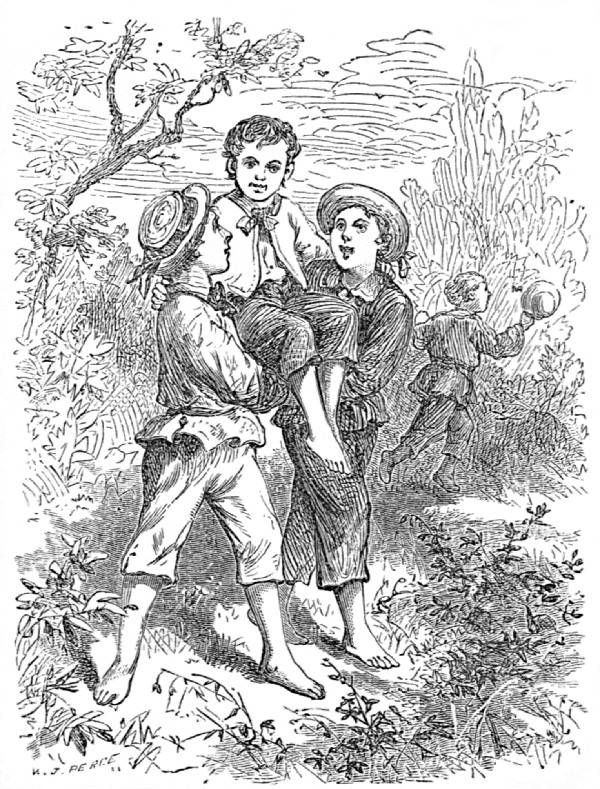
“WILL AND I’LL MAKE A CHAIR AND CARRY YOU.” Page 14.
“Ain’t it jolly?” said Joe, as he led Frankie
into the clear, cool water.
“Oh! oh! see the fishes! the dear little
fishes!” said Frankie, stooping to pick them
up. But the gay little shiners knew better
than to allow themselves to be picked up,
even by such a nice little boy. Losing his
balance in his attempts to seize one of them,
Frankie had a sudden bath in the creek.
“Oh dear! my new pants and jacket!”
was the first thing the wet little fellow found
breath to say after Joe and Willie had fished
him out of the water and set him on the bank
to dry.
“That comes of bringin’ babies along,” said
Ben, running down the bank.
That was the drop too much, and Frankie
commenced crying, saying, between his sobs,
“I want to go home. Oh! please let’s go
home.”
So Joe and Will made a chair again for
Frankie and started for home, leaving Ben to
enjoy his wading alone.
They set Frankie down by the gate, and,
picking up his boots and stockings, he went
into the house.
“Why, Frankie Western!” exclaimed his
mother, as the wet, muddy, rueful little figure
stood in the sitting-room door. “Where
have you been? Your new clothes are ruined.”
And, carrying the speechless little
fellow into the kitchen, she soon had him
thoroughly washed, and put on one of his
old dresses in place of the new pants and
jacket which were hung up for future attention.
It was a good deal of water for one day,
and the crash towel was rough, and to go back
into a dress and apron after wearing pants,
was something of a trial, but the poor child
was too tired, and too glad to be at home to
care much about it. After he was dressed he
sat contentedly in his chair till supper-time,
then ate his bread and milk and went to bed.
It was not long before he was dreaming of
fishes and creeks, and muddy pants, nor very
long before the morning sun drove away the
dreams and opened his eyes. Jumping up, he
put on his stockings and boots, but pants and
jacket were nowhere to be seen, nothing but
the brown gingham dress and apron.
“Mamma, mamma, I want my pants. Please,
mamma,” he said, running into the kitchen
where his mother was getting breakfast.
“They must be cleaned first. Put on your
dress and come to breakfast.” Her voice was
so pleasant that Frankie forgot his impatience,
and dressed himself quickly and quietly.
After breakfast he was about to run out as
usual, when his mother said,
“No, Frankie. Mother wants you to stay in
the house this morning. She has something
to say to you.”
“But I don’t want to stay, mamma,” and he
walked slowly toward the door.
“Frankie must stay.” This was decisive,
and he sat down in his chair.
After his mother had finished her work,
she took him into the sitting-room, and gave
him a seat on a stool by her side.
“Now, Frankie,” she said, “I want you to
tell me just what you did and where you
went yesterday afternoon.”
Frankie gave a truthful account of his adventures
at the creek. Then his mother said,
“Did you know you were disobeying your
mother, and, more than that, disobeying God?”
“O mamma, I didn’t think, I wanted to go
so much,” and Frankie looked as though he
wanted to cry.
“I know you wanted to go, but you must
do what is right, not what you want to do.
I will teach you a verse from the Bible that
you must remember whenever you are tempted
to disobey your mother. It is this: ‘Children
obey your parents in the Lord, for this is
right.’ Can you repeat it now?”
After a few trials, Frankie could say it without
a mistake, and he seemed to understand
it, for, when his mother told him that he
could run out and play, he put his arms
around her neck and kissed her, saying softly,
“I’ll remember, mamma, that God tells me to
mind you.”

CHAPTER III. ALECK—THE NEW FRIEND.
Frankie had never been to school, but his
mother had taught him to read, and had given
him some nice books. These he used to read
over and over again until he almost had them
by heart. Then, every Sunday his teacher
selected a good Sunday School book for him
to read during the week. The book she gave
him on the Sabbath after his adventure in the
creek, was the story of a naughty boy who
disobeyed his parents. Frankie read the story
with great interest, and did not leave it until
it was finished; then, going to his mother, he
said, earnestly,
“Mamma, did Miss Campbell know I didn’t
mind you and went to the creek?”
“I don’t know, Frankie,” replied his mother.
“Why do you ask?”
“Because she gave me a book that tells
about a little boy that didn’t mind, and ran
away to a pond, and got drowned; and I
thought she must have known it.”
“It may be that she did, but that is of less
consequence than the fact that God knows it.
Think of it, Frankie, the great and holy God!
He sees everything you do, and hears everything
you say, and knows all your thoughts.”
“Oh, dear!” sighed Frankie. “I wish he
didn’t. I never can have any more fun when
I think of that. Is he looking at us all the
time, every one of us?”
“‘Every one of us, and all the time,’” answered
his mother. “‘His eyes are in every
place, beholding the evil and the good.’ But
that need not trouble you, if you do right.”
“But I don’t do right, you know, mamma,
always, and I don’t believe I can if I try ever
so hard. I get tired being good too. I want
to play and have fun.”
“‘Tired being good,’ my child. It is the
only way to be happy. I know a little boy
who is happy all day long, and all he has to
make him so, is ‘being good.’ I am going to
take something to his sick mother this evening,
and you may go with me.”
“Is it the little lame boy, mamma, that lives
down by the paper-mill? Oh, won’t that be
nice! and may I take him one of my books to
read?” Frankie asked eagerly.
His mother helped him choose a book, and,
after tea, they started. Their way led them
along the bank of the creek. The sun was
just setting and all the sunset colors were reflected
in the water. The hush of the Sabbath
was on the busy, noisy village, and
nothing could be heard but the faint hum of
insects and the good-night song of the birds.
Walking by his mother’s side, with his hand
in hers, all these pleasant sights and sounds
around them, and in his heart the thought of
pleasing poor, lame Aleck,—all these made
Frankie quietly happy. Looking up into his
mother’s face, he said, “God is looking at us
now, mamma, and I ain’t afraid. I wish I
could see him too.”
“If you love and obey God, Frankie, you
will see him, for when you die, He will take
you to heaven, to live with him forever.”
This and much more his mother said, and
Frankie listened and pondered her words in
his childish heart.
At last they reached the widow’s little
brown house at the foot of a steep, wood-covered
hill. It was a “wee sma’ place,” as widow
Espey said, but “didna they hae a’ the bonny
world outside?”
The sick woman was lying on a clean white
bed in one corner of the room. Her face was
pale and thin, but the light of a sweet content
shone through her eyes. The lame boy,
Aleck, was sitting by the bed, his crutches
lying on the floor beside him. He had his
mother’s face, and the same patient, happy
look.
“We have been talkin’, my bairn an’ I, o’
the guid land on the ither side,” the widow
said, after her visitors were seated. “I dinna
ken the time, but it wi’ nae’ be lang before I
sha’ gang awa’ to my ain countrie.”
Tears came into Aleck’s eyes and rolled
down his thin, white cheeks.
“Dinna greet, laddie, dinna greet,” and the
mother stroked his hand that was clasped in
hers. “The time wi’ be as naething before the
guid God wi’ ca’ ye too, an’ we sha’ aye dwell
thegither. Dinna doot his word, my bairn.”
The child bravely kept back his tears and
said, “Nae, mither, I ken it wi’ a’ be for the
best; but oh, my ain mither, take your laddie
wi’ ye,” and again the tears came to his eyes.
Frankie’s tender heart was touched. Going
to Aleck’s side, he said eagerly, “Don’t cry,
little boy. You may have my mamma if your
mamma dies.”
Instantly the dying mother’s face brightened,
and she said, in faint, earnest tones, “O Mrs.
Western, if ye wad be a mither to my mitherless
bairn.”
“With God’s help I will. He shall be to
me as my own child,” said Mrs. Western,
going nearer the bedside.
“Noo I can gang to my hame wi’ a gladsome
heart. The Laird wi——.” The voice
grew fainter, fainter, the breathing shorter.
The sobbing child clung about his mother’s
neck, all the anguish of his soul in the cry, “O
mither, mither.” The mother’s lips moved
silently, a glorified look overspread the pallid
face, then came the awful stillness. The boy
had lost a mother; heaven had gained an
angel.
All the sad rites were performed under Mrs.
Western’s supervision, and, when everything
was done, even to the turfing of the last resting-place
in the quiet cemetery, the brown
cottage was sold, and Aleck was taken to
Frankie’s home. He shared Frankie’s room,
and Mrs. Western did all that she could to
lighten his lonely little heart. He mourned
for his mother in a quiet, patient way, but
seemed anxious to be cheerful, and grateful
for his pleasant home and kind friends.
Thus, in the great darkness, the Lord made
his pathway light. “He carries the lambs in
his arms.”

CHAPTER IV. REMEMBER THE SABBATH DAY.
The sunny summer passed away; autumn
came and brightened the hills and valleys for
a little time, then was buried beneath its own
dead leaves; and now winter has brought its
snow and cold winds to Frankie’s home.
Frankie loves the winter. The keen winds
only make his eyes brighter and cheeks rosier.
Then he has such a nice sled, and there are
such famous hills for coasting! To be sure, it
mars his pleasure to think of Aleck, who is so
lame and weak that he has to stay in the house
all the time, but he is a merry-hearted little
fellow, and dearly loves to go flying down the
long hill on his swift-going sled.
“I say it’s too bad, Aleck! Can’t you ever
ride down hill?” Frankie’s bright face looked
troubled. He was buttoning his warm overcoat,
to go out for a morning ride.
Aleck’s patient face for a moment wore a
sad, weary look, then, looking up cheerfully,
he said, “Oh, I dinna mind, Frankie,—not
much. You ken I’m used to staying i’ the
house. Then this window is sae sunny, and
Dickie sings most a’ the time, and the flowers
are sae bonny.”
“Well, I get awful tired when I have to stay
in. It’s just like having Sunday every day.”
Frankie gave his fur cap an energetic pull
over his eyes, and was starting off with a merry
whistle, but his mother, who had been a quiet
listener to the conversation, said, “Wait a moment,
Frankie, I want to talk to you. Why
is it that you do not like Sunday? Don’t you
like to give one day to God for all the six
working and playing days He gives you?”
“I want to go, mamma. Oh, dear, the boys’ll
be gone,” was the impatient reply, as he twisted
the knob of the half-opened door. “Can’t
I go, mamma?”
Mrs. Western said nothing, and, unheeding
her reproachful look, he ran off, drawing his
sled after him.
It was a clear, crisp, sparkling winter morning.
Coasting never was better, and Joe and
Will were as merry as ever, but Frankie did
not enjoy it.
“What’s the matter, Frank?” asked Joe,
seeing his sorrowful expression. “Fingers
cold?”
“No,” said Frankie, “but I am going home,”
and without a word of explanation he ran off.
Rushing into the sitting-room, his eyes filled
with tears, he put his arms around his mother’s
neck and said, “O mamma, I am sorry.”
“So am I, darling,” said his mother, kissing
the tearful face. “Sit down here by me and we
will talk a little about the Sabbath, and see
why it is my little boy dislikes it so much.”
“I would like it, mamma, only it is so long.
I don’t like to keep so still, and I get so sleepy
in church, and I keep thinking about my sled
and the fun I could have if it wasn’t Sunday.”
He paused, quite satisfied that he had made
a good case for himself, and his mother,
taking up her sewing, told him, in her low,
calm tones, the following story.
“A father sent his little boy on a long
journey, through a dark and dangerous way;
but before bidding him good-bye, he gave him
a letter which would tell him how to escape
the dangers, and how to find the way through
the darkness. This is what he said to the
child, who stood all eagerness and haste to be
gone.
“‘My child, you are just starting on your
journey. You are full of life and hope, and
the way looks bright before you, but even in
this broad, sunny path, are many dangers; and,
as you travel further, the path narrows, the
flowers are fewer, and the forest is darker; still
further on, are rocks, and underbrush, and
pitfalls, and at the end of this rough way is
a dark and rapid river which you must cross.
If you pass over this stream safely, you will
find yourself in a beautiful place. In that
land I will give you a home, and you shall
live with me forever.’
“‘But how can I go all that dark way,
father?’ and the boy’s face was full of doubt
and fear.
“The father handed him a letter, saying,
“‘This letter will tell you just what to do.
Whenever you are in trouble, look at this.
Nothing can happen to you about which this
will not help you. But you are not to travel
all the time. Every seventh day you shall
pause in your journey to rest and read this
letter, and think of all I have told you, and
of the pleasant home to which you are going.
It will give you so much strength, and make
your heart so light and happy that you can
travel faster and further than if you had not
stopped.’
“‘But need I stop at first, father, when the
way is easy and I am not tired?’ asked the
boy.
“‘Oh yes, my child, or you will forget it by
and by; then, though the way be easy, it has
dangers which you cannot avoid unless you
study the letter very carefully, and store it in
your mind, so that you will know what to do
if danger comes suddenly. Therefore, my
child, remember to rest in your journey one
day out of seven, read this letter, and think of
your father and the home beyond the river.’
“Merrily the child started off, chasing the
butterflies and plucking the flowers as he ran
along the sunny way, so full of glee that he
seldom thought of his father’s letter until the
day of rest came. Then he read it, and tried
to think of what his father had said to him;
but it was very hard to shut out the visions of
the butterflies and birds and flowers. He was
restless and tired, for he cared more to please
himself than obey his father; so he gradually
gave up the day of rest, and then commenced
his troubles. All his roses were full of sharp
thorns, the path was crowded with rough
stones and pricking briers, great snakes darted
out from the trunk of every fallen tree, and he
grew so weary with constant running, was so
bruised with frequent stumbling, and so torn
and scratched with briers, that you would
hardly have known him. If he had gone on
in this way much longer I do not think he
ever could have reached the pleasant home
which his father was to have ready for him.
But in the midst of his troubles he remembered
the letter, and, drawing it out of his
pocket, read the almost forgotten message,
‘Remember the Sabbath day to keep it holy.’”
“That’s one of the commandments, mamma,”
Frankie said. “But was that a true story
about the little boy? What was his name?”
“Frankie Western,” replied his mother.
“God, his heavenly Father, has given him a
letter, the Holy Bible, which will tell him
how to live every day so as to escape all the
sins that lie in his path, like the stones and
thorns and briers which troubled the little boy.
His Father has told him to leave his work
and play on the Sabbath, and study this letter,
the Bible; but he does not like to do it, and I
fear that in future he will have as much
trouble as did the child about whom I have
told you. He will say more naughty words,
and be more apt to disobey mamma, and to
feel cross toward Benny Field. Then as he
grows older, and the way becomes darker,
I fear he will lose the way and never reach his
home in heaven.”
“I don’t want to lose the way, mamma. I
won’t if I’m good, will I, mamma, and stay in
Sundays, and read the Bible like Aleck?”
asked Frankie, anxiously.
“No, darling, you will not lose your way if
you love God and do just as he commands
you; and one of his commandments is, ‘Remember
the Sabbath day to keep it holy.’”
CHAPTER V. FRANKIE TRUSTS IN CHRIST.
Although Frankie was a merry, thoughtless
little fellow, his mother’s story about
keeping the Sabbath made such a deep impression
upon his mind that the next Sunday
morning his first thought on waking was as
to how he should spend the day. There
seemed to be a great many hours from dawn
till dark, and he sighed half aloud as he
thought of the smooth crust of snow and the
snow-man left unfinished the day before.
Aleck was awake, and, hearing the sigh,
asked what was the matter. “Oh, I was just
thinking, Aleck,” was the reply, “how long it
will be before Monday. Don’t it seem ever so
long to you? I wish you could go to church
with mamma and me. It’s nice to hear them
sing, but I get sleepy when the minister talks.
Didn’t you ever go to church?”
“Yes, but I canna remember about it very
well. It was before I was lame. But I am
sure I wad like to gang to the kirk,” said
Aleck.
“What made you lame?” Frankie asked,
for the first time seeming to realize that his
patient playmate had not always been a cripple.
“I fell down the stairs i’ the paper-mill
where my mither was. It hurt my back some
way.”
“Won’t you get well some time?” asked
Frankie, earnestly.
“I dinna ken, but I’m thinkin’ ’twill nae be
lang till I gang to my mither.”
“O Aleck,” and Frankie put his arms about
his neck, “you mean you’re going to die, and
you mustn’t. You’d have to be put way down
in the ground.”
“Only my body, Frankie. My soul would
be wi’ God and my mither. And oh! it is sic
a bonny place, and Sunday a’ the time. Then
I wi’ be free frae pain.”
“Can everybody go there, Aleck? Am I
going too, and mamma, and my papa that’s
way off in California?”
“Everybody who loves Jesus. If you love
him he wi’ take you right there when you
die. Why dinna you love him, Frankie?”
“I do want to,” was the earnest answer,
“but I don’t know how. I don’t believe I
love him, or I wouldn’t be so naughty.”
“The minister at the kirk wi’ tell you a’
about it, an’ your Bible an’ your mither, an’
if you pray, God wi’ help you.”
“I will try, Aleck. I’ll ask mamma about
it, and I’ll listen to everything Mr. Price says,
and I’ll pray too.”
Frankie was very much in earnest, and,
after he was dressed, he knelt by the bedside
and prayed that God would help him to be
good and to love Jesus. On the way to
church he talked with his mother, and she
tried to lead him to the Good Shepherd. Mr.
Price’s sermon was written for the lambs of the
flock, and was full of encouragement to the
little ones to “come to Jesus.” Frankie
listened with earnest attention to that “sweet
story of old, when Jesus was here among
men;” his eyes filled with tears, and his
heart throbbed at the story of the cruel death
on the cross; and when, in conclusion, Mr.
Price spoke of the tender love that the Saviour
had for little children, and entreated them to
give their hearts to him and love him in return,
he whispered softly, “I will try to love
Jesus.”
Frankie was not the only one of the children
whose heart had been touched, as the
next hour spent in the Sabbath School testified.
The teachers sought to deepen the impression,
and the Holy Spirit so wrought upon
their young hearts that many went home rejoicing
in a Saviour’s love.
That Sabbath was a happy day in Frankie’s
home. Mrs. Western’s heart was full of a
mother’s joy over her child, and Aleck shared
in her happiness; as for Frankie, although he
could comprehend but little, he knew that
Jesus loved him, had died for him, and that
he wanted the love and service of just such
little children. He was but a child, and
would often err, but the hand in which his
was clasped was the same strong hand which
upholds the best and wisest of us all.
CHAPTER VI. THE FIRST DAY OF SCHOOL.
In the spring, Frankie commenced going
to school. Miss Campbell, his Sabbath
School teacher, received a dozen little boys
and girls at her own house. They were all
nearly of an age and old playmates, so a merry
little company they made—full of fun and
mischief; but never had school a gentler,
lovelier mistress than Miss Campbell, or Miss
Ruth, as she wished the children to call her.
The first day of school was as delightful
as April sunshine could make it, and Frankie’s
heart seemed full of sunshine; at least it shone
out of his bright eyes, as he kissed his mother,
and bidding Aleck good-bye, he ran down
the walk, and disappeared behind the poplars.
His mother and Aleck watched till the trees
hid him from view, then Mrs. Western took
her sewing, and Aleck his book. He studied a
little each day and always looked forward to
the lesson hour with pleasure, but this morning
a sigh escaped him as he turned from the
out-door sunshine to the in-door work. Full
of pity for the patient child, Mrs. Western sat
down beside him, and smoothing his hair
caressingly, said, “It is hard, my child. I
wish you could go too, but your heavenly
Father knows best. He does not willingly
afflict you.”
The tender words brought tears to his
eyes, and, resting his head wearily on his
hand, he said, “I ken it is a’ for the best, I
hae a guid hame. You are like my ain mither.
The Laird is guid, but I am sae tired.”
“You will not feel so tired when you can be
out in the air more,” replied Mrs. Western,
cheerily. “Keep up your courage. You may
be a strong, hearty boy yet.”
“Please tell me about heaven. It seems
to me it is a bonny country, fu’ o’ singin’
birds, and wi’ the ‘green pastures and still
waters;’ but I read in the Book that the
streets were a’ paved wi’ gold.” The boy’s
eye brightened as he spoke of heaven.
“‘Eye hath not seen, ear hath not heard,
neither hath it entered into the heart of man
to conceive’ the beauties, the glories of
heaven,” said Mrs. Western; “but this we
know, that our Father is there, and that we
shall be free from pain, and sorrow, and sin.
It will not be long before we shall know for
ourselves all the glories of that home.”
Thus they talked of heaven until Aleck
forgot all the suffering and weariness of earth.
Frankie reached Miss Campbell’s just in
time to get his seat before school commenced.
Miss Campbell read a brief chapter in the
Bible, and offered an earnest prayer to God,
that he would help them to do right and perform
all their duties faithfully. Then the
lessons were assigned, and they all went to
work in earnest. “‘New broom sweeps
clean,’” said Mrs. Keller, grimly, as she looked
in upon them in the afternoon. “Wait a
week or so and your hands’ll be full. Mark
my words, Ruth, those young ones will torment
the life out on ye.”
Miss Ruth smiled, and looked hopefully at
her little charge, as she said, “I don’t expect
to escape my share of trouble, Mrs. Keller,
but I do not think that much of it will come
by these little ones.”
The children heard the conversation, and
mentally resolved to be very good, in order to
disappoint Mrs. Keller and to please Miss
Ruth.
When school closed they all joined in
singing one of their Sunday school hymns—“Let
us walk in the Light.” Frankie lingered
a little after the others went out, and
going to Miss Ruth said, “Won’t you tell me,
please, just what it means to walk in the
light? Is it to be good?”
“To be good?” said Miss Ruth. “Yes;
those who walk in the light of God’s commandments
are good. But I will explain it.
If you were walking alone in the woods on a
night so dark that you could not see one step
before you, would you not be in danger of
falling? And if, in the path, there were deep
holes, fallen trees, and tangled underbrush,
would you dare to walk in such a place on a
dark night?”
“No, ma’am,” said Frankie, promptly. “I’d
take our lantern, and then I guess it wouldn’t
be so very easy.”
“Not very easy, perhaps,” Miss Ruth replied,
“but if in your lantern you had so bright a
light that you could see your path plainly,
then you could walk around a fallen trunk,
separate the tangled briers, and avoid the
dangerous holes. With such a journey
before you, would you not be very grateful
to a kind friend who would offer you such a
lantern, saying, ‘Take this to be a lamp unto
your feet and a light unto your path. If you
walk in this light, and trust to me, I will guide
you safely through the wilderness into the
pleasant land beyond, where you will need
no light, and where you will forget all the
rough way in which you have come, or remember
it only to sing praises to Him who
was your Guide and Friend.’”
“Oh, Miss Ruth,” Frankie said eagerly, “I
know what you mean. The light is the Bible,
and the pleasant land is heaven. Mamma
once told me something like what you have
said.”
“Then, Frankie,” said Miss Ruth, “remember
to ‘walk in the light’ of God’s word.”
Bidding his teacher good-night, Frankie
went home, his heart full of what he had
heard about the “light of God,” and of resolutions
to “walk in that light.”
When he went in he found Aleck watching
for him, anxious to hear about the school. So
he told him the events of the day, and the
conversation he had with Miss Ruth, adding,
in conclusion, “and I’m going to try to walk
in the light, Aleck. Let us read the Bible
the first thing in the morning, before we have
a chance to do anything wrong.”
“Yes,” said Aleck, “and then we’ll pray.”
“And ‘watch,’” added Mrs. Western.
“Watch over your thoughts and feelings, and
all the little actions of the day. Trust in
God, watch and pray, and He will give you
the victory.”

CHAPTER VII. THE COASTING MATCH—WHO BEAT?
Miss Ruth found that Mrs. Keller was
mistaken; that, instead of being torments, her
pupils were little comforts, and she loved
them all very dearly. The spring and summer
days flew by, vacation came, and again in the
autumn she gathered the children about her.
Much to the annoyance of the little girls,
and somewhat to Frankie’s, Ben Field had
gained admission. “Oh, dear!” sighed Kate
Plummer, “that Ben Field is just going to
spoil our fun. I can’t endure him.”
“I do wish Miss Ruth had said he couldn’t
come,” said Lou White, then, tossing back her
brown curls, “there’s one thing about it, I
shan’t notice him.”
“Nor I,” “nor I,” said they all, excepting
Millie Ray. Sweet Millie Ray! “Poor Ben,”
she said, “how lonely he’ll be. Don’t you
think we ought to be good to him, Frank,”
turning to Frankie, who was just entering the
school-room. “Don’t you think we ought to
be good to Ben Field?”
“Of course, Millie,” said Frankie. “Why?
Who isn’t?”
“Oh, nobody, only some of us are sorry he’s
coming to school,” Millie answered. “Ain’t
you sorry?”
Frankie hesitated a moment, then said
frankly, “No, Millie, I’m not sorry when I
think about it as I ought to. Ben needs to
come as much as any of us. I guess he’ll be
pleasant enough if we are good to him.”
Frankie’s influence gave Ben a better reception
from the girls than he would otherwise
have met with, and, for a time, he was
quite a pleasant playmate. But after a few
weeks, when the novelty had worn off, his old
spirit of mischief manifested itself. He delighted
in teasing the younger boys and
little girls.
One day, after the snow came, the boys
had a race in coasting, to see which of their
sleds was the swiftest. They started at the
very top of a long hill. There was Willie
Prime on his Reindeer, Joe West on his
Express, Ben Field on his Lightning, David
Dwight on his Victor, and Frankie on his Light.
They are ready to start. Frankie counts,
“one—two—three—four”—and away go Reindeer,
Express, Lightning, Victor, and Light.
Willie steers too much toward the right, and
Reindeer plunges head-foremost into a drift;
Joe looks around to see Willie, Express runs
off from the track, and both are landed in a
ditch on the left. The race is now for Lightning,
Victor, and Light; Light being a little
in advance, Lightning next, then Victor. Ben
is very anxious to win the race. By a push
he may turn Light from the track, and thus
gain upon Frankie. He steers his sled to the
right, and comes down upon Light so suddenly
that Frankie is thrown off into the snow, and
Victor and Lightning reach the foot of the hill
nearly at the same time.
“You ought to be ashamed of yourself,
Ben Field. That was a mean trick. I’d
play fair if I didn’t beat.” All this Frankie
said, as he brushed the snow from his clothes,
and his flashing eyes looked every word of it.
“Guess I ain’t ashamed to beat,” Ben said,
sullenly.
“But it wasn’t fair,” said the girls, all in a
breath. “You know Frank was ahead till you
steered your sled right into his.”
“You’d better keep still. I don’t want
girls meddlin’ with my business,” said Ben,
rudely.
“We are the judges,” answered Lou White.
“We aren’t meddling.”
By this time, Frankie had thought what he
ought to do. It was hard, but Jesus gave
him strength to do it bravely. “Never mind,”
he said. “Don’t say any more about it.
Forgive me, Ben, for being angry with you.”
Ben did feel ashamed then, and the boys
and girls looked very much surprised.
“I’d rather not beat than be so mean,”
Willie said.
“I’d give it to him,” said Joe, as he carefully
examined Express to see if it was marred
by its tumble into the ditch.
“I beat anyhow,” Ben said, sullenly, kicking
in the snow.
“I think Frank Western beat the best,” said
little Millie Ray. “Let’s judge that Frank
beat, girls.” So Millie, and Kate, and Lou,
and all the girls said that Frankie beat.
“No,” said Frankie, “that isn’t fair. I
didn’t beat. Perhaps I might, but I didn’t.”
“Just like girls,” muttered Ben. “Go for
a fellow they like.” He walked off, vexed
with himself and his playmates, while the
others went into the school-room and told
Miss Ruth all about it.
Miss Ruth opened the large Bible, and
turning to Proverbs, read:
“A soft answer turneth away wrath, but
grievous words stir up anger.”
“Better is it to be of an humble spirit with
the lowly, than to divide the spoil with the
proud.”
“He that is slow to anger is better than
the mighty; and he that ruleth his spirit,
than he that taketh a city.” Then, turning
to the New Testament, she read:
“Love your enemies.”
“My little children, let us not love in word,
neither in tongue; but in deed and in truth.”
Miss Ruth closed the Bible, saying nothing,
for she knew that the children understood
what she had read, and that God’s word
would reach their hearts better than anything
she might say.
They took their seats quietly, and when Ben
came in, he was much surprised to meet none
but pleasant looks.
When Frankie was on his way home after
school, Ben came running to overtake him, all
out of breath.
“Hallo! Frank Western, stop a minute,”
he shouted. Frank waited for him. It was
an awkward thing for Ben to do, something
he had probably never done before, but he
went through with it quite well.
“I say, Frank, that was a mean trick I served
you. You took it so cool I was ashamed of
myself, and I don’t blame the boys and girls
for being down on me.”
He had not asked forgiveness, but Frankie
did not wait for that.
“Never mind, Ben,” he said, cordially.
“We’ll have another race to-morrow. Come
home with me and see Aleck. Poor fellow!
He gets lonesome.” So they walked on
together.
“What makes you so much better than the
other boys?” asked Ben, abruptly.
“O Ben, don’t speak in that way,” said
Frankie, looking troubled. “I’m not good,
but, do you know, it is ever so much easier
to keep from getting angry if you think about
Jesus.”
Ben looked astonished, but Frankie told
him in his own childlike way of the Saviour,
and how he would help even little children to
serve him.
It was in this way that Aleck and Frankie
worked for Jesus, by obeying him, and by
telling others of him.