Cannibalism is not met with on the Congo until
we ascend almost to Stanley Pool. The first
tribe of the Bateke—the Alali—on the north bank,
are said to eat human flesh sometimes, but only
those who have been killed for witchcraft. The
Amfuninga, or Amfunu, the next tribe of Bateke,
are also credited with the same vice. It is only a
report; we have no evidence of the fact. From
Bolobo (2° South lat.) upwards it is known to be a
custom. White men have had to witness the
cutting up of victims, being powerless to prevent
the act. When remonstrated with, the natives
have replied, ‘You kill your goats, and no one finds
fault with you; let us kill our meat then.’ When
eating their ghastly meal, the parents give morsels
of the cooked flesh to the little ones, to give them
the taste for such food.
Why they eat human flesh it would be difficult to
say. Tribes towards the east coast eat their
enemies that they may gain their strength and
courage, and it is probable that some such notion
underlies the custom on the Upper Congo. We
hope to settle among these folk soon, and may get
to understand the reasons.
It is customary on the upper river to bury—sometimes
alive—slaves or wives of a deceased
chief. This is done that he may not appear
without attendants in the spirit world.
‘The dark places of the earth are full of the
habitations of cruelty.’
There are two customs which prevail through
the country—Ndembo, and another, very much like
Freemasonry, called Nkimba.
In the practice of Ndembo, the initiating doctors
get some one to fall down in a pretended fit, and in
this state he is carried away to an enclosed place
outside the town. This is called ‘dying Ndembo.’
Others follow suit, generally boys and girls, but
often young men and women. Most feign the fit;
but sometimes, when it has become the fashion,
others will be attacked with hysteria, and so the
doctor gets sufficient for a wholesale initiation,
twenty or thirty, or even fifty.
They are supposed to have died. But the parents
and friends supply food, and after a period varying,
according to custom, from three months to three
years, it is arranged that the doctor shall bring
them to life again. The custom is not only degrading,
but extremely mischievous in its results.
So bad is it, that before we reached San Salvador
the king of Congo had stopped the custom in his
town; and others had followed suit in neighbouring
districts, giving the reason that it was too vile to
be continued.
When the doctor’s fee had been paid, and money
(goods) saved for a feast, the Ndembo people are
brought to life. At first they pretend to know no
one and nothing; they do not even know how to
masticate food, and friends have to perform that
office for them. They want everything nice that any
one uninitiated may have, and beat them if it is
not granted, or even strangle and kill people. They
do not get into trouble for this, because it is thought
that they do not know better. Sometimes they
carry on the pretence by talking gibberish, and behaving
as if they had returned from the spirit
world. After this they are known by another
name, peculiar to those who have ‘died Ndembo.’
There seems to be no advantage accruing to the
initiated, the license and the love of mystery seem
to be the only inducements. We hear of the custom
far along on the upper river, as well as in the
cataract region.
The Nkimba custom is an introduction from the
coast of comparatively recent times. The initiatory
fee is paid (about two dollars of cloth and two
fowls), and the novice repairs to an enclosure outside
of the town. He is given a drug which stupefies
him, and when he comes to himself he finds his
fellow Nkimbas wearing a crinoline of palm frondlets,
their bodies whitened with pipeclay, and
speaking a mysterious language. Only males are
initiated into this rite, which is more like our own
Freemasonry. Living apart for a period, varying
from six month to two years, he acquires the
mysterious language, and at the end of his time he
is reckoned a full brother, Mbwamvu anjata, and all
Nkimbas in all districts hail him as a brother, help
him in his business, give him hospitality, conversing
freely with him in the mystic language. It is no
gibberish, as that attempted by the Ndembo folk,
but until quite lately no white man could get any
collection of words. I have, however, been able to
get over two hundred words and forty sentences;
and while still unable to understand thoroughly the
principles on which it has been made up, it is
evident that it has been made. The vocabulary is
limited, and is characterised by the system of alliteral
concord. Some words are slight changes of
ordinary Congo, and others bear no resemblance.
‘Lusala, a feather, is Lusamwa,
Vana, to give, is Jana.
Kwenda, to go, is Diomva.
Masa, maize, is Nzimvu.’—(qy. from Ngemvo, the beard of maize).
The common people are given to understand that
the Nkimba know how to catch witches. In the
daytime they wander in the grass, and dig for
roots, and gather nuts in the woods, often beating
people on the roads who do not run away on their
approach. At night they rush about screaming
and yelling and uttering their wild trill. Woe to
the unfortunate man who ventures out of his house
in the night for any purpose, a beating and heavy
fine will surely follow.
There is no other nonsense to add to the mystery
and fear, but the whole raison d’être is the establishment
of this fraternity or guild, for mutual help
and protection; and the period of separation is for
the acquirement of the useful mystic language.
Ndembo is an unmitigated abomination; Nkimba
is comparatively harmless and useful. It is making
its way in from the coast, and may be found interiorwards
on the south bank for one hundred and
seventy-five miles.
An instance of the usefulness of Nkimba is supplied
in the story of the founding of our Bayneston
Station. It was decided that a promontory, jutting
into the river near Vunda, would be a most advantageous
site for a base of water transport on the
piece of river, still used by Mr. Stanley, and lying
between Isangila and Manyanga. We were then
using the wild river there because the road by land
was blocked.
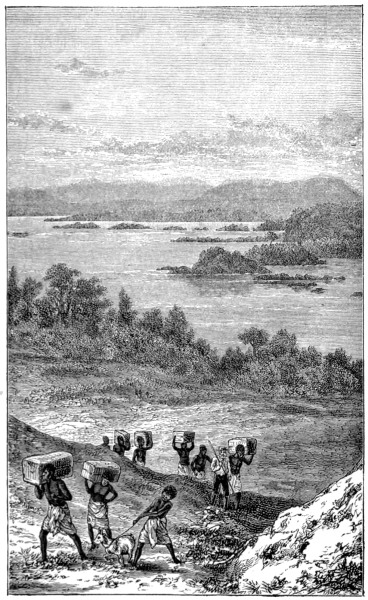
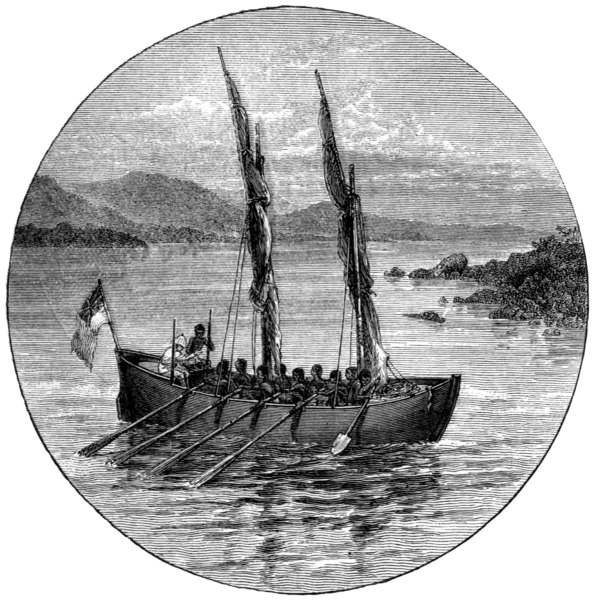
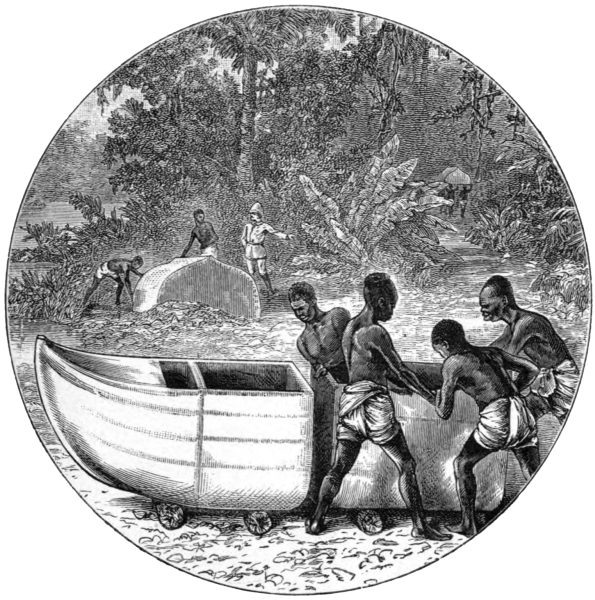
We had carried overland for fifty miles our steel
sectional boat, the Plymouth. Landing on the promontory,
Messrs. Comber and Hartland pitched
their tents for the night, sending a message to the
towns on the hills by a fisherman that they would
like to see the chiefs in the morning. Up to eleven
o’clock no one appeared, and they determined to go
themselves. As they neared the towns all was in
the wildest excitement; no white man had ever
been there before. The women had been sent into
the woods, and the men advanced in the grass with
their guns to fight the intruders. The missionaries
had with them a headman who was a Nkimba, and
seeing the dangerous state of affairs, he rushed
forward uttering the Nkimba trill; this was replied
to, and all was quiet. The missionaries were received
by some of the principal men, who agreed to
let them have the headland, and, a fortnight later,
they signed the contract, selling the land to us, in
consideration of a fitting present. Although some
of our best scholars are called away sometimes to
be initiated into Nkimba, we do not regard it as an
unmixed evil.
* * * * *
The natives of the Congo basin are not idolators,
and as they know of no means of communicating
with Nzambi (God), they betake themselves to
charms. A Congo boy grows up, and sees every
one with his charms. One man boasts that he has
a charm that will make him rich, and he ties to it
a little strip of every piece of cloth he buys; others
have charms to keep away witches, against theft or
sickness, to stop or to bring rain—charms which
enable them to cure sicknesses, or to perform the
office of witch-doctor, of Nganga-a-moko, or to discover
theft. From very babyhood a child hears
the word Nkixi (a charm, x = sh) frequently uttered;
no wonder, then, that as he grows up he thinks
that there must be something in it. He knows a
man, who for a consideration, will teach him to
make a charm, or perhaps will sell him a little
image and bundle of mysteries. Fondly hoping
that it will do all that the charm-doctor has promised,
he always keeps it with him, and perhaps
believes that his own life is in the thing, and if
any one got possession of it he could cause his
death; he dare not sleep without it near him, and
so the falsehood works until he becomes its slave.
I have watched a chief on market-day weaving
his spells. He would bring out his charms and
spread them on a mat, take a little red powder,
work it into a paste, and put some on his image
and on each side of his own forehead; then rummage
in his bundles and find some mysterious
nuts, or something strange, scrape a tiny fragment
and put it into his mouth, nibble it, and spit and
sputter over his image and charms; then take a little
gunpowder, and mix a little mystery with it, and
burn it on a stone. Next, chewing some cola-nut,
he would spit and sputter it over the charms, burn
more powder, rummage further among his charms;
and finally, making some marks on his temples
and forehead, he would be ready to go to market.
Such a man is feared. Who knows what he
could do with all those charms? His air of mystery,
the fuss he makes, his boasts—these, with a
large amount of knavery, make the common people
think him a great man.
On one occasion, in the early times of the mission,
Mr. Comber was forbidden to sleep in a town on
the road. He was compelled to sleep out in the
grass with his people without shelter. There was
some sign of rain, so the carriers begged one of
their number, who boasted much of his rain-charms,
to avert the coming storm. He worked hard with
his charms, but notwithstanding it rained hard on
the shelterless folk nearly all night. The medicine-man
said that his charms would not work with
white men about.
Among our hired labourers from the coast and
elsewhere, we have often had in our gangs rascals
making much fuss about their charms, and in consequence
much feared by all their work-fellows.
They were consulted by their mates in sickness,
and demanded heavy pay for their advice. Then,
because they were supposed to have such great
powers for evil as well as for good, they would
borrow money or goods, and no one dare refuse, or
make them repay. They would need to be constantly
propitiated, and thus one scoundrel would
get eventually a large share of the wages of his
mates. We could never get direct evidence or
proof, and could not interfere; and as the payments
would mostly be made after they had received
their wages, and were beyond our reach, we
had to know of the evil, but were powerless to
check it.
This, however, is more a coast type. Those
nearest to ‘civilization’ are far more superstitious,
or rather make more use of superstitions, than the
natives of the interior. But everywhere the same
principles work in a variety of forms.
There are doubtless many simple folk who believe
it all; many must, however, be consciously
imposing on their fellows. To-day, even in England,
there are people who would hesitate to take down
the horseshoe which was put up over the doorway
‘for luck.’ Others still believe it unlucky to pass
under a ladder. Dream-charms and fortune-telling
have not yet disappeared from this Christian
land.
There is an infinite variety of nkixi in Congo,
almost anything may go towards their composition.
Dry leaves, snakes’ heads, hawks’ claws, feathers,
elephant’s skin, stones, seeds, nuts, beans, the
horns of the smaller antelopes, but with all a
quantity of red ochre. Pipeclay also plays an important
part.
Images have been mentioned, not that they
are idols, or more personal than bundles of
mysteries; but just as children playing with clay
would think first of making a little man, so
Congos, often make little images, hideous, rudely
carved, with perhaps a piece of looking-glass on
the chest.
In some towns there may be seen a great image,
under a sheltering roof, which represents the charm
that protects the town. Children are placed under
its protection by the payment of a fee to the Nganga,
who weaves certain spells and makes certain articles
taboo. In some places it is nlongo (taboo) to eat
an egg, or a fowl, goat’s head, hippopotamus flesh,
pork, yams, antelope flesh, rats, bananas. This
taboo must be observed to insure the protection of
the fetish; to break it would entail disease and
death. Sometimes a town possesses an image-charm
which will enable its doctor to find out
thefts, and in consequence the people are afraid to
steal. Talking with a man once about this ‘thief-medicine,’
he positively declared the truthfulness
of the oracle. ‘Why, I was found out myself once,’
he said; ‘I went to Dedede’s town, and stole a
piece of cloth from a man’s house. No one saw
me, or had any means of knowing that I did it;
and yet the thief-doctor found me out at once.
What can you say after that?’
Often in the houses of the sick, the ‘medicine’
may be seen in one corner of the room, a dirty
image and charms, bespattered with blood and
chewed cola-nut.
So strong is the belief in the discerning power
of these charms, that a thief will sometimes return
what he has stolen, rather than incur the disease
that might follow. I know a case in which a man
lost something in a town. He paid a small fee to
the thief-doctor, who arranged with his charms to
curse the thief with disease if the articles were not
restored by the next morning. The things appeared
in due course, and were found lying in front of the
door, having been returned during the night.
These charms are sometimes addressed and often
scolded when they do not act as they ought; but
even the images in no way take the places of idols,
neither are they regarded as personalities or sentient
beings. Any such address is only by way of
apostrophe or ill-temper. Such a scene as that
depicted in a recent work on The Congo, of a
native prostrate praying to his fetish image, is
altogether due to imagination and a graphic pen;
such a thing we have never heard of, and it is contrary
to radical principles.
A fetish, of whatever kind, is but a charm, and
imports no more than is conveyed by that word.
It is an appeal to the black art for protection and
help, as they know nothing of a God who loves
and cares for them, and with whom there can be
any communication. The gospel of the love of
God in its fullest revelation in Christ, and brought
to bear upon their hearts by the gracious influence
of the Holy Spirit, is the only power which can
lift these poor people out of their darkness and
degradation, and satisfy the yearnings of their
hearts.
Circumcision is largely practised in some parts,
and is generally performed early, but is by no
means universal. It is not a religious rite. The
customs of Ndembo and Nkimba are in no way connected
with it. It is simply a custom supposed to
have some advantages.
There is something which approaches to a sacrifice,
although very imperfectly. Blood is sometimes
used in the weaving of a spell1 or charm,
whether for medicine or any other purpose. The
victim slaughtered is called kimenga, and the blood
used in the charm or smeared on the nkixi is
called nzabu a menga. Sometimes the blood of a
beast slain in the chase is poured out on the grave
of a great hunter to insure further success. This
ceremony, and libations of palm wine poured out
(very rarely) on the graves of great men, are the
only traces of ancestral worship, and are not worthy
of being thus dignified. The spirit of the dead
hunter visiting his grave may be pleased at the
sight of the blood, which will recall to him past
times. Perhaps the spirits of dead chiefs can, in
some way, enjoy a libation of the palm wine, to
which they were once so addicted.
CROSSING A RIVER.
In concluding this sketch of native
customs and superstitions, it may be well
to note one or two which help us to express
some of our religious ideas. When coming
down from Stanley Pool on my last journey,
I was sleeping in a town, and at midnight heard a woman screaming and calling
out the name of a fetish. This lasted for some time,
until, not understanding the customs, I felt apprehensive
lest some might think that I had bewitched
her. I learned, however, that it was all right, and
in the morning a new phase of fetishism was explained
to me. This woman had placed herself
under the protection of a charm. She had been to
a doctor, who wove mysterious spells, drummed,
sang, and danced, gave her something to drink,
made certain articles of food taboo, and behaved
in such a wild and strange manner that he was
able to persuade her that a certain fetish influence
or spirit had entered into her, which would bring
her luck, would protect her from evil influences,
and which, should a witch approach her to do her
harm, would arouse her to a sense of her danger.
On the night in question the poor woman had
a bad dream, and waking with a sense of horror,
believed that her good fetish spirit had made
known to her the approach of a witch. So,
rushing out in wild excitement, she screamed and
shouted to the fetish, and thus tried to frighten
the witch.
We can use their phraseology to explain how we
may be brought under a higher, holier, and more
blessed influence. They can the better understand
how our Heavenly Father will give us His Holy
Spirit, who will dwell within us to be our Guard
and Guide, to warn us against wrong-doing, to
protect us from our spiritual foes, and to purify
our hearts. That woman’s dream gave us words
to express most graphically and intelligibly the
great truths of which they in their darkness still
had a shadow.
Another custom helps us. When a slave has a bad
master, who ill-treats him, and who may, perhaps,
intend to sell him on the coast, the slave will run
away to a chief who has a good name in the country,
and tell him that he has come to be his slave.
If the chief is willing, he orders a goat to be killed;
the chief and the slave eat goat together; the
covenant is made, and the new slave is called a ‘goat.’
His old master hears that his slave is with the
other chief, and comes with bluster to demand him
back. The new master refuses to give him up in
spite of all threats, and finally the old master is
obliged to accept a fair price. Slaves thus obtained
are much esteemed, for they are generally
faithful, and having thus made their choice, are
not likely to run away again. Sometimes free
people in trouble will thus become slaves for
protection.
So, borrowing their terms, we can urge the dear
lads of our schools to take refuge with the Saviour,
who will redeem them from a more terrible bondage,
and deliver them from the power of the evil one;
a Saviour who will be their protector, and who will
take them to live with Him, a Master in whose
service is truest freedom. We have reason to believe
that some of our lads have taken the Saviour
thus to be their Lord and Master, and trusting in
Him for pardon, rejoice to consider themselves His
‘goats.’
Our couriers came in one day and told us that
they had seen a man killed on Mbimbi market. A
chief had caught a man for debt on market-day;
and as there is a stringent law to provide perfect
security on market-day, the chiefs sentenced the
offender to death. He was allowed to find a substitute,
and bought a slave in a neighbouring district.
This poor innocent man was beaten to death on the
market in the place of the chief. We have thus
words and ideas to aid us in telling the story of the
loving Saviour, through whose blood we have
redemption, pardon, and reconciliation.
Trade and commerce appear only to increase the
wickedness and cruelty, for while their influence
quickens the intelligence, activity, and industry of
the people, it can have no moral and spiritual
effect. It is best that there should be both legitimate
traders and missionaries, each working in
their own sphere. Trade will but elevate to a certain
point. The gospel only will work the radical
cure.
The children, passing in numbers through our
schools, understand many of the evils which
degrade and enthral their fellow countrymen, and
deplore them. When they grow up they will form
a party, which will in time make itself heard; and
as the young people have much influence in a town,
changes may take place fairly soon. It all means
steady persistent work, which must in the end
prevail.