 All the folk of St. Aliquis are Christians.
Nobody, far and wide, except a few Jews
in Pontdebois, openly dissents from the
Catholic religion, denies the validity of
the creeds, or refuses a certain outward
conformity to the Church practices. The
age is not greatly interested in improving the general
moral and social condition of the common people. The
common people even are not always interested in this
themselves. Each peasant prays for "just treatment"
and for good luck. Otherwise, castle and village alike
accept as a kind of natural law the immutability of
society. God has established the various orders and
gradations. All that one can ask is that each man shall
accept the condition assigned to him and live in it
efficiently and happily.
All the folk of St. Aliquis are Christians.
Nobody, far and wide, except a few Jews
in Pontdebois, openly dissents from the
Catholic religion, denies the validity of
the creeds, or refuses a certain outward
conformity to the Church practices. The
age is not greatly interested in improving the general
moral and social condition of the common people. The
common people even are not always interested in this
themselves. Each peasant prays for "just treatment"
and for good luck. Otherwise, castle and village alike
accept as a kind of natural law the immutability of
society. God has established the various orders and
gradations. All that one can ask is that each man shall
accept the condition assigned to him and live in it
efficiently and happily.
Religious Attitude of Knights
Conon, like every other knight, has no temptation to
unbelief. The doctors of the Church know all about
religion, just as the king's falconers know all about
hawking. It is sensible to trust the expert. If you ask
idle questions, you merely risk your soul, as do the
followers of Mahound, the false prophet. The baron
frequently denounces the arrogance and covetousness of
the clergy and resists their pretentions, but he nevertheless
trusts them to supply him with the Sacraments and
bless his death and burial so that his soul may pass
promptly through purgatory into paradise—where existence
presumably is one grand admixture of a marriage
feast in a fine garden and of a magnificent tournament.
Plenty of knights are lax and blasphemous, but they
hardly are deliberately unbelieving.[84] Good knights ought
to hear mass every morning;
venerate holy objects
and places; hate
Jews and Saracens; worship
the Virgin and the
saints; also keep most of
the major fasts and other
special occasions of the
Church. Conon does all
these things. He is "a
good Christian." But
he is exempted from any
serious thinking for
himself upon mysterious
matters.
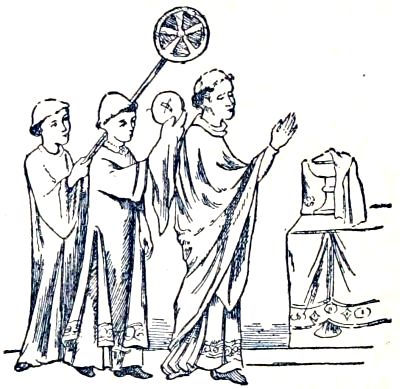
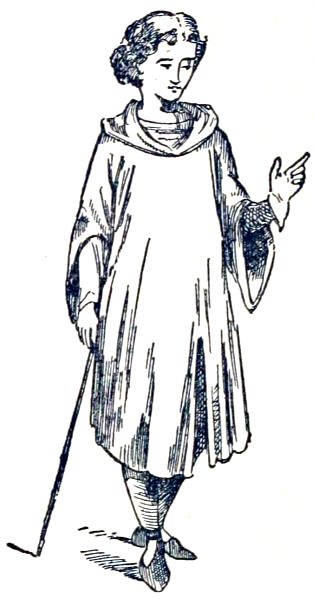
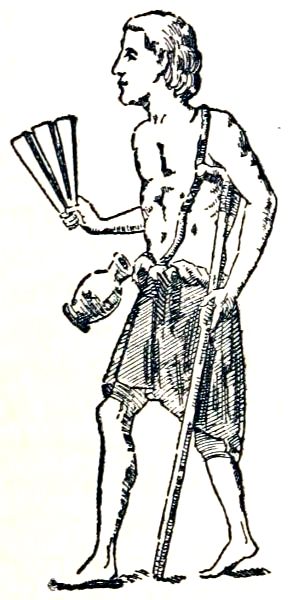
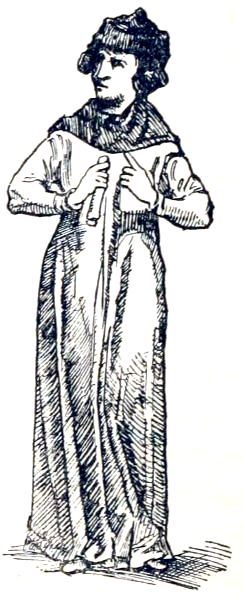
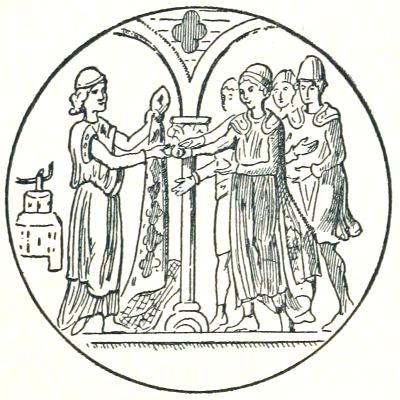
A GROUP OF PRIESTS, THIRTEENTH CENTURY
The one who is near the altar is wearing
a chasuble and the second and third are
clad in the dalmatica, or deacon's gown.
The second carries the consecrated wafer
and the third a sort of fan. (From a
manuscript in the Bibliothèque nationale.)
When Conon prays in
the morning, if not hurried
he lies down with his head turned toward the east,
and his arms stretched out like a cross. He recites the
favors which God has shown him in the past, beseeches
Heaven to continue favorable. Often he adds a Credo and
a certain paraphrase of the Lord's Prayer then very common—"Our
Father, who desirest that we all be saved,
grant that we acquire Thy love even as have the angels
who do thy pleasure on high; and give us our daily
bread—for the soul the Holy Sacrament, and for the
body its needful sustenance." Yet if his mood is not
unusually humble and contrite, he is likely to conclude
patronizingly, "And I confide also in the strength of my
heart, which thou hast bestowed, in my good sword
and my fleet horse, yet especially in Thee!"
Many a cavalier breaks into blasphemies when things
go wrong. Such men are like William Rufus of England,
who cried, "God shall never see me a good man—I
have suffered too much at His hands!" Or Henry II,
who, on learning that his son Henry had revolted, cried
aloud, "Since Thou, O God, hast taken away from me
that which I prized the most, Thou shalt not have what
Thou prizest most in me—my soul." And even Conon,
once when hard beset, had exclaimed, like a certain
crusading lord: "What king, O Lord, ever deserted thus
his men? Who now will trust in or fight for thee?"
Nevertheless, one should deal mercifully with such
sinful words, for, after all, is not the world very evil and
the temptation to rail at God extremely great? It is
true that things are not as they were in the year A.D.
1000, when even the wisest felt very sure the Last Day
was at hand. Eclipses, comets and famines had then
seemed foreshadowing this. People crowded the churches
in agony, expecting to hear the Seven Trumpets announce
Antichrist. Repeatedly since then, when the years
have been calamitous, monks and old wives have stirred
multitudes by vehement predictions that the plagues
of the Apocalypse and the other preliminaries to the
millennium are not to be delayed. As late as A.D. 1200
the monk Rigord, at the abbey of St. Denis, wrote:
"The world is ill; it grows so old that it relapses into
infancy. Common report has it that Antichrist has
been born at Babylon and that the Day of Judgement is
nigh."
A Fearful Excommunication
Fears like this restrain even reckless seigneurs and
sodden peasants from proceeding to inconceivable
crimes. The agonies of the damned will be so dreadful!
The preachers understand very well that it is of little
use to try to restrain the wicked by talking of "the love
and mercy of God." If King Philip had only used love
and mercy upon his vassals he would be now a king
without a kingdom. It is the dread of the eternal burning
which apparently keeps a large part of all Christendom
tolerably obedient to the more essential mandates of
morality and of the Church.
When a great criminal deliberately defies the Church
there is a ceremony which makes even the righteous
inquire as to their own salvation. A few months ago a
certain impious baron robbed a parish church of a chalice.
Instantly at Pontdebois the bishop took action. The
great bell of the cathedral tolled as for a funeral; and
such it was, though of the soul, far more precious than
merely the body. The bishop appeared in the chancel
with all his clergy. Each cleric held a lighted candle.
The building was hung with black tapestry. Amid a
terrible hush the bishop announced the name of the
offending knight to the crowded nave, then proclaimed
in loud voice: "Let him be cursed in the city and cursed
in the field; cursed in his granery, his harvest, and his
children; as Dathan and Abiram were swallowed up by
the gaping earth, so may hell swallow him; and even as
to-day we quench these torches in our hands, so may the
light of his life be quenched for all eternity, unless he do
repent!" Whereat all the priests dashed their torches to
the pavement and trampled them out. One could almost
see that sacrilegious baron writhing in the flames of
Gehenna.
After a scene like this there is no reinstatement for
the sinner save by some great act of penance and mortification.
An excommunicated person is next door to an
outlaw. He may find sundry companions in crime, but
most people will shun him as they would a leper. This
particular baron, after vain boasts and defiance, at last
was so conscience-torn and forsaken that he made an
abject peace with the bishop. First, he gave ruinously
costly gifts to the cathedral; then he presented himself
barefoot and in the robe of a pilgrim at the chancel.
He prostrated himself and for a day and a night remained
in prayer before the high altar, eating and drinking
nothing. After that he knelt again while some three-score
clerics and monks present each smote him with a
rod, he crying aloud, "Just are Thy judgments, O Lord!"
after every blow. Not till all this was accomplished
did the bishop raise him, pronounce the absolution, and
give him the kiss of peace. It was very dreadful.[85]
For lesser offenses against the Church there are lesser
but effective penalties. In Pontdebois there was once a
religious procession in Lent. A certain woman marched
therein with pretended devoutness, but then went home
and in defiance of the fast-time dined upon some mutton
and ham. The odor escaped into the street. The woman
was seized, and the bishop condemned her to walk
through the town with her quarter of mutton on
the spit over her shoulder, the ham slung round her
neck, and with a ribald crowd, of course, trailing
behind. After that penance the fasts were well kept in
Pontdebois.
Festive Side of Popular Religion
Yet one must not think of the religion of this Feudal
Age as in general sad. On the contrary (by one of those
abrupt contrasts now grown familiar) clergy and people
get vast joy, not to say amusement, even out of the
sacred ordinances. "Men go gayly along the road to
salvation." For example, the great pilgrimages (pardons)
are often festive reunions with merchants chaffering and
jongleurs playing or doing their tricks while the whole
company proceeds to some shrine.
Even in the church building solemnity is not always
maintained. The choir, indeed, belongs pretty strictly
to worship, but in the nave all sorts of secular proceedings
can go on, even the meetings of malcontent factions and
of rioters. The church bells ring for markets, for musters,
or for peaceful gatherings almost as often as they ring
for the holy services. As for the sacred festivals, good
bishops complain that they are so numerous that the
secular element intrudes utterly, and disfigures them with
idleness and carousing. The peasants may go to early
mass; after that they will drink, chatter, sing, dance
(in a very riotous fashion), and join in wrestlings, races,
and archery contests until nightfall.
Besides these ordinary abuses of holy things, every
parish seems to have its own special Reign of Folly,
although the name of the celebration varies from place
to place. Even the younger clergy participate in such
mock ceremonies. In Pontdebois the subdeacons elect
a Pope of Buffoons, give him a silver tiara, and enthrone
him with much dignity, electing at the same time several
"cardinals" to help direct his revels. There are noisy
processions, cavalcades, and even scandalous parodies
of some of the most sacred services of the Church. The
mock pope issues "bulls" enjoining all kinds of horseplay,
and actually strikes a kind of lead money with such
legends as "Live merrily and rejoice," or, "Fools are
sometimes wise." It seems next to impossible to confine
such proceedings to the streets, the market place and
the church porch, although decent bishops fight against
intrusions into the holy building. The canons of the
cathedral have finally induced the junior clergy and the
lay rabble to refrain from the more extreme parodies
and from such pranks as stealing the church bells by
giving the "Pope" and all his noisy rout a grand dinner.
Pious churchmen groan on such days, but they comfort
themselves by saying that these proceedings make religion
popular and give an outlet for "the flesh," which if
restrained too much, will succumb before even worse
temptations of the devil.
In St. Aliquis village the parish priest actually participates
in a ceremony equally calculated to astonish another
age. On a certain Sunday the folk celebrate the
virtues of the ass which bore our Lord and the Holy
Virgin when St. Joseph fled with them into Egypt. The
peasants take the best ass in the neighborhood, caparison
it gayly, and lead it through the streets to the church, all
the children running along, waving flower wands and
shouting, with the older folk almost equally demonstrative.
At the holy portal the priest meets them and
announces in Latin "This is a day of mirth. Let all
sour lookers get themselves hence. Away with envy!
Those who celebrate the Festival of the Ass desire
jollity!"
Mass of the Ass
Then the ass is led straight up into the chancel and
tethered to the altar rail. A solemn Prose, half Latin,
half French, is chanted, setting forth the virtues of the
faithful, stolid beast which enabled our Lord to escape
the wicked Herod. Ever and anon the cantor stops and
all the crowded church rings with the refrain, "He! haw!
sire ass—he! haw!" everybody trying to pull down his
nose and bray as lustily as possible. Finally, when the
ass has been led decorously back to his stall, the choristers,
with many friends, indulge in a bountiful repast.
This Festival of the Ass is celebrated in very many
French cities and villages.
One must also comprehend that certain saints are
the particular patrons of given regions. St. Martin is
a potent saint through all France, but St. Denis is the
especial guardian of the royal domains; St. Nicholas of
Lorraine, St. Andre of Burgundy, and of course St.
George of England. St. Michael, too, may assist French
knights sooner than he will foreigners. There are also
many local saints of incalculable sacredness in their own
small regions, yet hardly heard of elsewhere. Thus, if
you travel very far, you are likely to lose all trace of
good St. Aliquis, and, indeed, peevish visitors have
suggested that he has never been canonized at Rome or
properly accepted by the Catholic Church. For all that,
he is venerated locally, perhaps with greater fervor than
any other holy one, saving always our Blessed Lady
herself.
There is no saint with whom it is possible to compare
the Virgin. She is the "Lady of Heaven," the "Queen of
the Holy City," the "Dame débonnaire." God the
Father and God the Son seem perhaps to be inaccessible
celestial emperors, but the Holy Virgin, who understands
the needs of toiling men, will transmit their
pleas and exert her vast influence in their behalf. Therefore,
on her statues she is dressed like a feudal queen
with rich stuffs, a crown glittering with jewels, and she
bears a royal scepter and an orb of the world. All the
saints are her vassals and do her liege homage.
There is another set of joyous celebrations legitimate
and uplifting. At Christmas time, on Noël eve the
good folk will install a heifer, an ox, and an ass in the
parish church "to warm the holy babe with their breath."
Torches are lighted everywhere and fires are lit upon
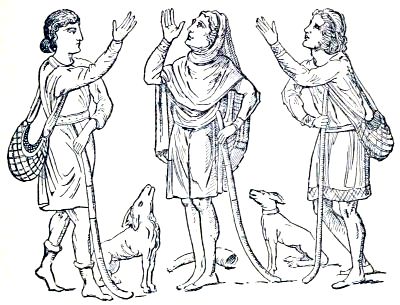
the hills. Groups of people march about dressed like
shepherds bound for the Christchild's manger and led
by pipes and viols, while all sing joyously:
"Good sirs, now hark ye!—
From far lands come we,
For it is Noël."
Then in the church are sung long responses, telling the
story of Christmas in the vernacular and interspersed
with comments by the animals in Latin, because (as
says the hymn)
All the beasts in other days
Spoke French less well than Latin.
So the cock crows out his satisfaction, the goat bleats, the
calf bellows, the ox lows, the ass brays. It is all done
simply, reverently, and for the benefit of simple, loving
souls.
In Pontdebois, however, they have a more elaborate
performance. Twelve clerks, representing six Jews and
six pagans, present themselves in the cathedral choir,
declaring they wish to examine the evidence that the
babe newly born is truly the Redeemer. Whereat appear
in stately sequence all the prophets who have forewarned
the coming of Christ, besides Moses with his
horn, Balaam with his ass, the three Hebrew children of
the fiery furnace, the pagan sybils, and the twelve
apostles. Each responds with canticles in sonorous
Latin, until the twelve doubters declare themselves
satisfied and fall down to worship the Infant King.
Mystery Plays
At Easter there are other mystery plays telling the
story of the divine Passion and of the Resurrection; and
still others come at intervals through the year. Some of
the participants are priests, but many others laymen,
both men and women.[86] All the more important episodes
in the Bible are acted out with considerable detail
and with much comedy interspersed. The crowds howl
with glee when Ananias, like a shrewd Jew, chaffers for
the sale of his field, or when hideous devils leap up from
hell to seize Herodias's daughter the instant she has
accomplished her wicked will with John the Baptist.
There is no attempt to represent ancient times. Herod
is dressed like a feudal duke, and before him is carried a
crucifix. The numerous devils are always black; the
angels wear blue, red, and white; "God" appears wearing
a papal tiara; and the "souls of the dead" appear
covered with veils—white for the saved, red or black for
the damned. It is a source of great delight for the people
to take part in these plays, and even the great folk are
not above joining in them. One need not comment on
how completely such proceedings impress the imaginations
of the unlearned with the stories of the Old and
New Testaments. The Bible can be read only by the
few, but an essential part of it is seen and reasonably
comprehended by the many.
So much for ordinary religious beliefs and occasions.
But there are plenty of people who find their sins are
so terrible that they must resort to some great penances,
often consuming the remainder of their lives, in order to
propitiate Heaven. Besides the monks and the nuns
dwelling in convents, there exist a great many hermits
and "religious solitaries," who abide in little huts in
the woods, perhaps maintaining a tiny chapel for travelers,
and being fed on the offerings of forest rangers and
peasants. Not all these hermits live, however, in genuine
solitude. Right in St. Aliquis village there is
something everywhere common—a female recluse.
Many years ago, a certain peasant woman, Elise,
murdered her husband. She was promptly condemned
to the gallows, but Baron Garnier, with unusual mercy,
pardoned her on condition "that she be shut up within
a small house in the cemetery, that she might there do
penance and so end her days." A stone hut was accordingly
built, and the unhappy woman conducted thither
with a regular procession, two priests blessing the hut
and giving Elise a kind of consecration. She was put
inside. Every aperture was then built up except a
narrow chink to admit air, a little light, and a small dole
of food from her relatives.
Elise has been vegetating in this hut for now twenty
years—living in filth and darkness, but talking most
piously to visitors standing outside. Seemingly, she
does little except to mutter almost incessant prayers.
Already her crime is forgotten. The peasants speak of
her as "that holy woman" and even wonder whether,
after she dies in her cell—for she will never leave it—she
cannot be enrolled among the saints. There are
many other much more innocent recluses, male and
female, who have been walled up voluntarily—either out
of piety or of sheer love of idleness, possibly because of
both.
Recluses and Pilgrims
Nevertheless, ordinarily the best way to discharge the
load of a guilty conscience is by pilgrimage. Confessors
often impose this means of penance upon penitents, as
the best way of winning the divine mercy. Since death
is about the only judicial penalty for great crimes, a
penance of pilgrimage for six, ten, or twelve years—going
from shrine to shrine all over Christendom—is
really a substitute for a term of imprisonment. Pilgrims
of this pronounced type are required to go barefoot, with
head shaved, to quit their families and wives, and to
fast continually—that is, never to touch meat more
than once a day.
Even exalted nobles thus spend the remainder of a
lifetime expiating their iniquities. Everyone has heard
of Count Fulk the Black of Anjou, who heaped up misdeeds
even to the murdering of his wife. Then at last he
realized the awful peril to his soul. Three times he
made the long pilgrimage to Jerusalem, the third time
letting himself be dragged upon a hurdle through the
streets of the Sacred City, while two varlets smote him
with whips.
Such great criminals often carry passports issued by
bishops, certifying that they are expiating by pilgrimage
specified evil deeds—and requesting Christian folk to
give them lodging, food, and assistance. These penitents,
if knights, are likely to wear chains upon their wrists
and neck, forged of their own armor, as witnesses at
once of their social position and their genuine repentance.
Most pilgrims, however, have no such fearful things
weighing down their souls. They are simply ordinary
erring men who are moved by a genuine piety, possibly
admixed with a willingness to find excuse for "seeing the
world." Every day they appear at the gate of St. Aliquis
castle to ask a share in the supper and a bed on the
rushes in the hall, and they are respectfully treated,
although Conon sometimes complains that their trailing
robes of brown wool, heavy staffs, and sacks slung
at belt are merely the disguises for so many wandering
rogues. Unwashed and unkempt though many of them
are, it never does to repulse them, lest you lose the
Scriptural blessing for those who received strangers and
so "have entertained angels unawares."
Pilgrims, too, are good newsmongers. They supply
you with tidings from Italy, Germany, Spain, or even the
Holy Land. They will carry letters also to foreign
parts and transmit verbal messages to kinsmen. They
do not always travel alone, but by twos, fives, or even
tens. Recently at Dunkirk, where the peasants revolted,
the bishop laid upon twenty-five of their leaders the
penance that they should spend a year going about in a
body to different holy places and joining in religious
processions "in twenty-six churches," wearing no clothing
save their trousers, going barefoot, and carrying the
rods with which they had been disciplined.
Innumerable are the shrines where sinners can profit
their souls by a visit. Every important abbey claims to
be a pilgrimage resort, and the monks will tell of remarkable
miracles wrought by all the saints whose relics
they chance to treasure. Probably there are more than
a thousand such places whose claims have been somewhat
recognized by the Church. Many of these shrines
have some famous image of the Madonna, frequently
brought from the East by Crusaders, but often very old
and, to carnal thinking, ugly, perhaps only a "black
virgin," a clumsy doll carved of wood. This matters not,
provided it is holy and efficacious. "Our Lady of the
Fountain" at Samour, "Our Lady of the Osier" near
Grenoble, "Our Lady of Good Hope" at Valenciennes,
Our Lady of Chartres, of Liesse, of Rocamadour, of
Auray, of Puy—these are merely examples.
Favorite Pilgrim Shrines
The greater the distance the pilgrim must go, the
greater his merit ordinarily. Happy the pilgrim who
can venerate the bones of an actual apostle, as at Rome.
Happiest of all is he who can go to Jerusalem and pray
at the Holy Sepulcher. Nevertheless, God has provided
very efficacious shrines nearer home. Right at Paris
there are the seats of St. Génevieve and the great St.
Denis. You can pay
your devout homage
at Tours to the puissant
St. Martin, the
ideal of pious warriors.
In Normandy,
where Mont St.
Michel looks across
the sands to the
tumbling ocean, one
can pray best to the
mighty archangel
nearest to God. It
avails much, also, to
visit St. Martial of
Limoges, St. Sernin
of Toulouse, and
more still to visit
Spain and at Compostella beseech the intercession of St.
James the Apostle.
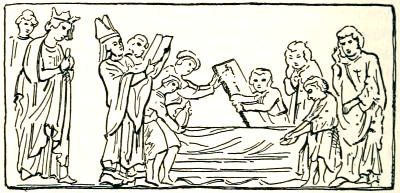
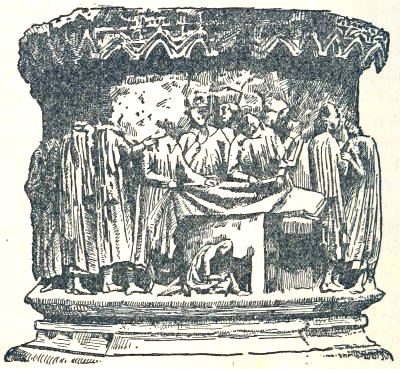
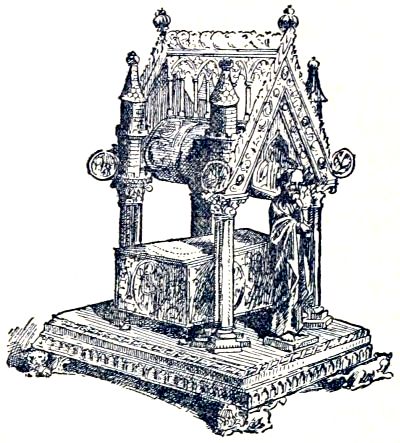 A SHRINE IN THE FORM OF AN ALTAR
(THIRTEENTH CENTURY) IN THE CATHEDRAL AT RHEIMS
A SHRINE IN THE FORM OF AN ALTAR
(THIRTEENTH CENTURY) IN THE CATHEDRAL AT RHEIMS
Assuredly, however, Rome is best (always barring
Jerusalem), and on the way thither the pilgrim can lighten
his spiritual load by visiting many excellent Italian
shrines—such as "Our Guardian Lady" at Genoa, and,
at Lucca, "Our Lady of the Rose." In the city of St.
Peter itself, time fails to enumerate the three hundred
churches worthy of a devout visit. Besides the majestic
cathedral of the Prince of the Apostles and the tomb of
St. Paul, even the most hurried pilgrim will not fail to
repair to St. Maria Maggiore, where is the actual manger
in which Christ was born; and St. John Lateran, where
are the holy stairs Christ ascended while wearing the
crown of thorns; St. Peter in Montorio, where Peter
himself was crucified, St. Lawrence Without the Walls,
where the blessed martyrs St. Stephen and St. Lawrence
are buried; not to mention others. A man must be a
master criminal if he cannot deliver his soul by suitable
visits to these invaluable shrines in Rome.
As is well known, the blessed saints both in this life
and after death wrought many miracles through their
relics. These wonders continue to-day, although the
iniquities of mankind render them infrequent. Every
now and then Heaven still permits some holy man to
work undoubted miracles. Thus only recently it is
said that when the venerable abbot of St. Germer
preached the Fourth Crusade in England, he need only
bless a fountain, lo! its waters made the dumb speak,
the blind see, and the sick recover. Once (so a pilgrim
related in the castle only the other day) when this abbot
reached a village which wanted a supply of water, he
gathered all the folk in the church. Right in the presence
of the people he smote a stone with his staff and water
flowed forth—not merely potable, but healing for all
maladies.
God also speaks to us in dreams as he did to Pharaoh
and Nebuchadnezzar. He caused St. Thomas à Becket
to visit the late king Louis VII and warn him to make a
pilgrimage to St. Thomas's new shrine of Canterbury to
pray for the recovery of his son Philip, later "Augustus."
Henry II of England was Louis' foe, but the king made
the solemn pilgrimage unimpeded, and the crown prince
duly recovered.
Omens, Spirits and Monsters
Omens of calamity, too, appear often, although it is
not always clear whether sent from God or the devil. A
few years ago the wolves in the forest near the monastery
of St. Aliquis howled steadily all through the day of
the feast of St. Honore. "A clear sign of trouble,"
announced the prior; and four days later the feud began
betwixt Conon and Foretvert, which convulsed the whole
countryside. Many a man is warned to prepare for
death by seeing a will-o-the-wisp in the marshes, a
shooting star, or a vulture hovering above his house. If
thirteen people chance to sit at one table, or if one chances
to dream of a physician, it is proof positive some one in
the house is about to die. The same is true if a man inadvertently
puts on a clean white shirt on Friday;
while if the left eye of a dead man will not close promptly
the deceased will soon have company in purgatory. Any
woman, also, who thoughtlessly washes her clothes in
lye during the holy week is not long for this world. It is
needless to explain how sinister are eclipses and comets.
In July, 1198, there was a great comet visible. Sage
people wagged their heads with melancholy satisfaction
when Richard the Lion Hearted died very soon after.
Time will fail to list all the strange beings, neither
human, angel, nor exactly devil, that Providence permits
to infest the world. These creatures possess no souls, and
when they perish are gone like cattle, although they live
long and are very hard to kill. Probably they are more
numerous in wild and solitary places, yet towns and
crowded castles are not free from them. Thus there are
fées (fairies) good and bad—creatures relatively like
human beings; undines in the waters, who by their
perfidious beauty lure unwary knights to destruction;
ogres who lie in wait to devour small children; ghouls
who disinter the dead and gnaw their bones; vampires
who rise every night from the tombs and suck the blood;
wolf-men (humans turned into beasts) who attack
lonely travelers; dracs, who carry off little children to
their subterranean realms; will-of-the-wisps in the
marshes, who are the souls of unbaptized dead infants;
also many rather friendly spirits such as the soleves,
who sometimes overnight do a weary laborer's work for
him. It needs much knowledge to tell the good spirits
from the bad—to know, e.g., whether you are dealing
with a goblin who will only display harmless antics,
or an estrie, a real imp of darkness, who may hug you
like a bear, to suffocation.
The Church does not forbid the belief in these creatures,
nor of such pagan monsters as giants, pygmies,
cyclops, satyrs, tritons, sirens, etc., although it plainly
teaches us that they are only ministers of the devil.
The existence of the devil is as certain as that of the
Holy Trinity. As has been said already, the fear of
falling into his clutches has often a more excellent effect
upon the sinner than the love of God. Countless legends
and sculptures in the cathedrals tell all about the master-fiend.
The monk in his convent, the peasant in his hut,
yes (for all his brave words and his long sword), the
baron in his castle, all tremble lest they meet him.
The devil produces all kinds of misery, and he can
actually take possession of the living bodies of men. It
is affirmed that once, not far from St. Aliquis, a knight
was sitting peaceably at table when suddenly the devil
entered into him. The fiend spoke through the poor
man's mouth. He raved and uttered blasphemies. The
priest brought his book of exorcisms. When he recited
them, the devil screamed horribly. Yet for some days
he resisted the holy formulas, and then departed, leaving
his victim utterly exhausted.
Bargains with the Devil

RICHARD CŒUR DE LION
From Capefigue's Histoire de Philippe-Auguste
It is much worse when you make a direct pact with
the devil. Some time ago, it is affirmed, there was a
young scholar at Paris. He was much troubled because
he progressed slowly in his studies. Then Satan visited
him, saying: "Do me homage. I will make you excel
in wisdom!" He gave the youth a stone, asserting that,
"So long as you hold this stone in your hand you will
know everything." Soon the lad astonished the schools
by his erudition, but, on falling sick, confessed his crime,
threw away his stone, and at once forgot all his learning.
Speedily he died. At once the devils began to torture his
soul, but God promptly sent an angel ordering them "to
let alone this soul which you have tormented." Immediately
the soul flew back into the body, which sprang to
life even as the Paris students were celebrating the funeral
service. The revived scholar, however, at once entered
a convent and took no more chances with carnal studies.
Very many people, however, have compounded with
the devil and been less fortunate. The fiend apparently
will not come unless one is in a desperate plight and
willing to promise everything. Then usually the unhappy
mortal must deny the Christian faith, repudiate
the saints, utter blasphemies, and, it is even asserted,
kiss the arch fiend upon the buttocks. Next a horrid
oath must be taken, standing inside of three magic
circles and burning incense. After that the devil will, it
is true, give his votary great worldly prosperity and especially
riches through a long life, but in the end the
fiend never fails to claim his soul for an eternal possession.
It is even said that Satan made such a bargain with the
great ecclesiastic Gerbert, who became Pope Sylvester II.
He was very wise[87] or very wicked, probably both; and
in the opinion of many he rose to be Pope by the aid of
"a hierarchy of demons and a brass idol which uttered
oracles." But on the day of his death (A.D. 1002) Satan
demanded his own; and whenever a pope lies near his
end the bones of Sylvester II rattle in the tomb. The
Church discredits this scandalous story, but it is widely
believed.
Since the recent trial of a witch and a wizard before
the bishop at Pontdebois, the folk near St. Aliquis have
gained a much more precise knowledge of the black art.
Magicians usually begin their ceremonies by creating a
magic smoke of various inflammables and spices, also by
burning such fiend-compelling ingredients as the brain of
an eagle, the blood of a black cat, and plenty of hellebore.
The smoke thus created is so dense and foul that uninitiated
customers are readily convinced there are demons
rising in the vapor and talking to the wizard. Thanks to
such assistance, the magician, and his even more sinful
wife, the witch, were able to instruct how to find a pot
of gold and how to rob the house of a rich Jew, but
especially they could prepare philters—some of them
intended to inspire love and others hatred. Wives could
buy fearful compounds made of substances from "the
three domains of nature"—the entrails of animals, scales
of fishes, parings of nails, human blood, pulverized load-stone,
and such powerful drugs as mandragora—which, if
duly brewed and beaten up together, then put in an
unfaithful husband's goblet, would win back his affection.
Other such potions, a little changed, however, would
make sworn lovers separate.
Methods of Witchcraft
These dealers in the black art at Pontdebois could also
sell magic rings which had power over demons, thereby
protecting the wearer from sudden death, illness, or
dangers of travel, and enabling him to drive good bargains.
The witch and wizard also possessed, undoubtedly,
the "evil eye"—which, if resolutely fixed on an ox
or sheep, would cause it to perish and was almost
as dangerous to human beings. However, the twain
were presently ruined (thus showing how fickle a protector
is the devil) because a certain silly nobleman got
them to "overcast" a knightly enemy against whom he
lacked the courage to press an honorable war. After
the wizard had burned much incense, the witch had
proceeded to shape a puppet of virgin wax as much like
the victim as possible. Then, with a shameless parody
of the baptismal service, she christened the doll with the
name of her patron's enemy. Next the wizard placed
the livers of swallows under the armpits and upon the
place where the heart of the puppet ought to be. Finally,
he and his wife pierced the wax image with red-hot
needles, then cast it into a blazing fire, chanting all the
while cabalistic words—probably beseeching the special
help of the devil.[88]
Inevitably, soon after this the knight thus assailed
would have sickened and died had not, by the mercy of
God, the whole proceeding been discovered. The knight
was saved by the powerful exorcisms of the bishop. The
wizard—after proper tortures to get confession—was
buried alive. His wife, the witch, was burned. The
foolish cavalier who had plotted murder saved his life,
for he had powerful relatives, but was condemned to go
on a pilgrimage to Rome. Certain fatuous women who
had bought love philters were publicly rebuked in the
church and spent an unhappy afternoon in the pillory.
Good Christians hope that it will be a long day before
the black art is again practiced so iniquitously in this
part of France.
Nevertheless, there are some forms of divining which
the Church counts as innocent. Any time you desire
you can consult the holy books. With proper prayer and
circumspection you should open the Bible at random
and note the tenor of the first passage that meets your
eye. Is it favorable to your condition, or unfavorable?
The pious Simon de Montfort thus consulted the "sacred
lots" ere taking the cross for the Albigensian crusade.
Chapters of canons use this method to see what the omens
are concerning a candidate for a bishopric. According
to jongleurs' tales, even popes thus seek for an oracle
ere taking any important step in the government of the
Church, although these stories are wisely doubted. A
more precise method of augury is the "Sortes Apostolorum."
Fifty-six sentences (expressing sentiments good
or bad) are written on parchment; a string is attached
to each and allowed to protrude while the sentences
are covered up. You say a prayer, seize a string at
random, then follow it down to read its sentiment. In
this way the saints and not the devil will reveal the
future to you.
Undoubtedly the peasants carry their belief in bad
omens or unlucky actions too far. Conon and Adela
laugh heartily at some of their notions. To avoid bad
luck, Georges, when weaning a calf, always pulls it
away from its mother by the tail backward. He never
begins plowing until he has walked thrice around the
plow with a lighted candle. Jeanne never spins or sews
on Thursdays or Fridays, lest she make the Virgin weep.
In the springtime a bone from the head of a mare should
be set out in the garden to drive off the caterpillars. Time
fails to list these rustic beliefs; besides, they vary from
village to village. But what peasant has not as many
thereof as he has hairs in his head?
Universal Adoration of Relics
There is one pious matter shared in alike by great and
humble and highly approved by the Church, although
the wiser ecclesiastics deprecate some of its excesses—the
worship of holy relics.
Saints' relics abound. Where is the monastery,
church, or even castle without them? Sometimes they
rest in golden caskets in the very place where the holy
personages departed this life. Sometimes they have been
brought from Rome or Palestine by pious pilgrims; very
often they come as gifts. The direct purchase of relics
is somewhat sacrilegious, but you can present a king,
duke, or great ecclesiastic with a good relic just as you
give him some hawks or ermine skins—as a reward for
favors past or expected. The Pope is always sending
desirable relics to bishops and abbots whom he wishes to
honor; and, as all know, after the Latins sacked Constantinople
in 1204 there was hardly a shrine in all
France which did not get the skull, a few ribs, or even
the entire body of some Eastern saint. The booty in
relics in fact, was almost as important as that of gold and
jewels.
Possessing relics is most desirable. Prayers said near
them have extra efficacy. Oaths taken upon their
caskets are doubly binding, but sometimes the holy
objects are surreptitiously removed when the pledge is
being given; it is then no perjury to break the promise.
In dealing with slippery individuals one must, therefore,
beware. On the other hand, who is ignorant of the
manner in which William the Norman inveigled Harold
the Anglo-Saxon into taking a great oath of fealty? The
slow-witted Englishman swore to the pact, believing the
casket on which he rested his hands contained relics of
very inferior worthies, who could never punish him if he
perjured himself; but the instant the words were said
the priests opened the sacred box, showing it full of the
bones of the most powerful saints imaginable. Harold
turned pale with horror, realizing how he had been
trapped. When later he broke his oath, beyond a doubt
it was these angered saints who wrought his death at
Hastings.
Good relics also imply a source of income, provided
that they are properly advertised so as to make the
church or abbey possessing them a pilgrimage resort.
Sometimes, indeed, one fears lest overzealous monks
exaggerate the miracles wrought by the relics at their
abbey church. The tale runs that when the Abbey of St.
Vanne was deeply in debt, the abbot asserted: "Our
debts will all be paid with the red tunic of St. Vanne (a
relic). I never doubt it."
The monks at St. Aliquis are proud of their collection,
although by no means the largest in the region. They
have two teeth of the prophet Amos; hairs of St. Martin
and St. Leonard; finger-nail parings of the martyrs of the
Theban legion; bits of the robe of St. Bernard; finger
bones of Saints Saturnin, Sebastian, and of the Patriarch
Jacob; a fifth rib of St. Amond; a skull of one of the
Holy Innocents; a chip of the stone on which Christ
stood when He ascended to heaven; the jaw bone of St.
Sixtus; some of the hay from the manger of Bethlehem;
and, last but not least, a fair-sized splinter of the true
Cross. The mere adoration of such things cancels many
grievous years in purgatory.
It is advantageous to the whole region to have such a
collection. If there is need of rain, the relics can be
carried in procession around the thirsty country and
relief is sure to follow. If there is a public assembly,
the holy relics can be brought in before the contending
knights or burghers—wise counsels will ensue. If you
are going on a journey, a visit to a shrine with such
relics almost guarantees a safe return. We have already
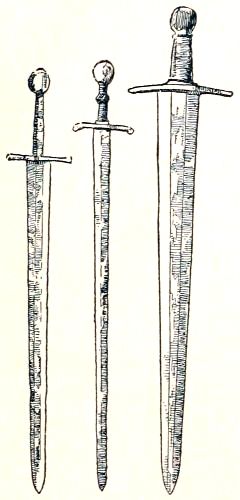
seen how Conon (as did other knights) kept certain relics
always in his sword hilt, to confirm his oaths and to
lend efficacy to his actions.
Contests Over Relics
The enormous value of such sacred things often makes
them the booty of thieves. Thus in 1219 a band of
robbers stole the remains of St. Leocadia from the Abbey
of Vic, and when pursued cast the holy bones into the
Aisne, whence they were rescued with serious difficulty.
We need not multiply records of similar crimes. Profligate
noblemen will sometimes seize and keep very sacred
relics in their castles, as talismans against long-delayed
justice.
Not less miraculous is the manner in which the relics
have been preserved when less sacred objects have been
lost. This is, indeed, a divine mystery, not lightly to be
inquired into. When, however, two identical relics of
the same saint are displayed in France, how are worldly
questionings to be silenced? For surely the holy men
of old had only one head and two arms apiece. Not long
since, the monks of St. Étienne exhibited a skull of St.
Denis. But the monks of St. Denis claimed they had
the skull of their own patron saint already. What lack
of charity ensued! The backbiting did not cease till the
great Pope Innocent III tactfully silenced the controversy
without actually deciding which relic was the more
authentic. Many say that such relics can miraculously
duplicate themselves—so that all are equally genuine;
and undoubtedly God has worked far greater wonders
than this.
Nevertheless, such is the sinfulness of men that spurious
relics are often imposed upon the faithful. Good churchmen
do zealous work in exposing these sacrilegious
frauds. Not long since, Father Grégoire had Conon give
a terrific flogging to a pretended pilgrim who was trying
to sell the credulous peasants "a bit of the sail of St.
Peter's boat and a feather of the Angel Gabriel." It is
more serious when a spurious shrine is set up. Near
Lyons recently the peasant women insisted in venerating
"the tomb of St. Guinefort." It was discovered to
be only the spot where a lady had buried a favorite
greyhound. In another case, many years ago, the great
St. Martin found near Tours a chapel where the people
worshiped a supposed martyr. The saint stood on the
sepulcher and prayed, "Reveal unto me who is really
here!" Soon a dark form arose and the specter confessed
to Martin: "I am a robber. My soul is in hell, but my
body is in this sepulcher." The saint, therefore, destroyed
the chapel, and saved many from wasting their
prayers and substance.
It is a dangerous business, however, to be over-skeptical
concerning popular relics. Even great churchmen,
such as the late Bishop of Orléans, are liable to be
mobbed if they call an alleged and much-venerated
skull of St. Génevieve "the head of some old woman"—as
once did that astute prelate. Nevertheless, the authorities
try to do their duty. Pope Innocent III has
issued a formal warning to the French clergy against
accepting spurious relics, and the monks of every
monastery never hesitate to dispute the authenticity of
almost every kind of a relic provided only it is deposited
in a neighboring and rival abbey!
"Translations" of Relics
If, however, relics are genuine, it is impossible to
exaggerate their desirability. They are produced on
numerous holidays; and often a special holiday is proclaimed
when they are "translated." Then you may
see the relics of some saint being carried through the
streets of a village or town, the holy objects themselves
borne in their golden boxes under a canopy, accompanied
by all the local clergy, with perhaps the barons and the
duke of the entire region being allowed to assist the
highest prelates in carrying or at least in escorting the
sacred casket.
Thus has been explained certain features of the religion
of the laity, humble and exalted. At length we can
approach one of those great institutions which have
built up the strength of Catholic Christianity. A league
from the castle lies the other great center for the countryside—the
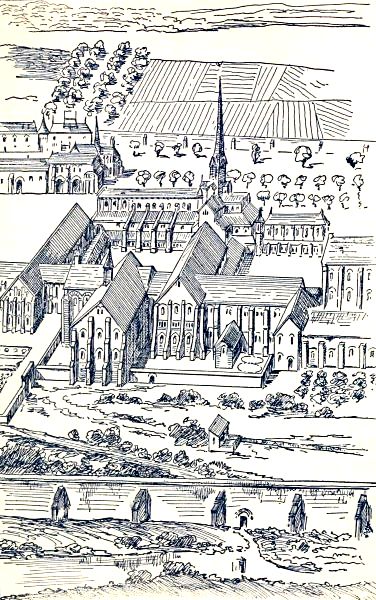
monastery of St. Aliquis.