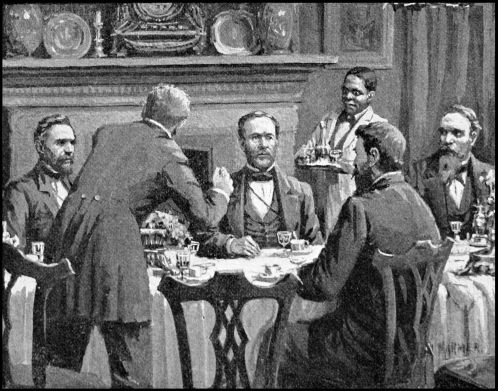
The "Lost Army"—Speculations, North and South, as to its
Doings—Diary of an Officer—Keeping Thanksgiving Day—Howell
Cobb's Plantation—The Negroes—A Quaint Philosopher—Strategy
of the March—Howard's Brilliant Advance—Investment
of Savannah—Capture of Fort McAllister—Fall of
Savannah.
Volumes might be written about the march from Atlanta
to the sea. It abounded in picturesque and dramatic incidents,
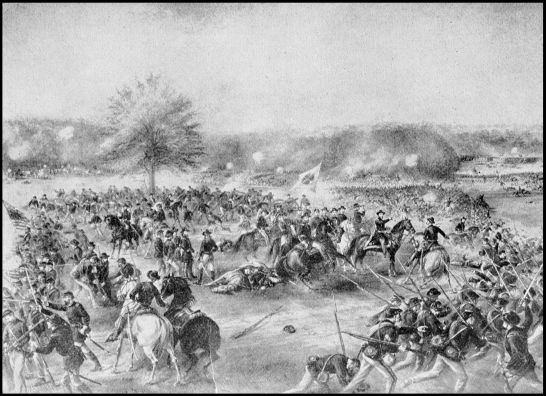
and in pathetic scenes as well. Of real fighting
there was scarcely any. There were no Rebel armies left
to oppose Sherman's progress. The negroes welcomed
the Union Army with fervent exultation, and the few loyal
whites hailed its advent as a time of deliverance. The
soldiers fared reasonably well. It was harvest time in the
richest State of the South, and provisions were abundant
on Sherman's line. There was no wanton pillaging, but
foraging for the actual needs of the army was conducted
on a generous scale. Grain, vegetables, bacon, fresh meat,
poultry and all other supplies were taken from barns and
houses. There were few conflicts between the army and the
people. Now and then resistance would be offered to a
foraging party, but with no serious effect. Occasionally,
some soldiers would become disorderly and commit acts of
violence and pillage, but such breaches of order were
sternly repressed and punished whenever knowledge of
them came to the ears of the higher officers.
So they marched on through the glorious Indian summer,
more as if on a holiday picnic than on an errand of actual
war. Meantime the North was wondering where they
were. The only information of their movements came
through Rebel sources, which were generally either ill-informed
or untruthful. The Rebel authorities, indeed, were
much mystified as to Sherman's real purpose. Their uncertainty
is shown by the following extract from the
columns of The Richmond Dispatch of November 18th,
only a few days after the start:
"The only official information received by the press
yesterday was that Sherman had destroyed the Northwestern
and Atlantic railroad from Atlanta to Allatoona, the
Chattahoochee bridge included. This movement is difficult
to understand, except as explained by unofficial reports
that were in circulation during yesterday. If they
be true, the destruction of the railroad can be understood,
though it will still appear a superfluous labor. The reports
had it that Sherman, having burned Atlanta on the 15th,
last Tuesday, had set out for Macon with three corps,
amounting together to thirty-five thousand men, and that
he had, on yesterday, reached Jonesborough, twenty-two
miles south of Atlanta. If there is truth in these accounts,
as we believe there is, Wheeler has much to answer for.
It devolved upon him to watch Sherman and keep posted
as to his movements. Only four days ago he reported him
'moving toward Bridgeport.' Now it is said, he reports
him moving toward Macon, as above stated. We regret
to say this latter report is corroborated by other evidence.
"Sherman will, we think, meet with opposition he does
not calculate upon before he reaches the fortifications of
Macon. These works, should he ever reach them, he will
find of the most formidable character, and with the troops
that before that time will be collected in them, they must
give him a vast deal more trouble than he evidently counts
upon. If the Georgians will battle for their trenches as
the Petersburg Militia did last June for theirs, or the Richmond
Militia did at Staunton River bridge later in the
summer, Macon will be saved.
"In undertaking this expedition, Sherman is too prudent
a man to rely upon subsisting his army on the country.
It becomes interesting and important to consider what
point he calculates upon making his base of supplies.
His destruction of the railroad northwest of Atlanta
proves that he has cut loose from the Chattanooga base.
He must, then, be looking to some point on the Atlantic or
the Gulf. We are disposed, for several reasons, to believe
that Pensacola is the selected point; this, not because of
its greater proximity than any other post to his present
field of operations, but because it is ascertained that for
more than a month very large supplies have been accumulated
there. If he fail to take Macon at the first dash,
he will probably run for Pensacola, and make it a new
base of operations. It is not to be presumed that he
carries with him supplies sufficient to enable him to enter
upon a siege which shall occupy any considerable length
of time.
"We have ventured the opinion that Sherman had Pensacola
in view as a new base of supplies; but it is proper
to say there are reasons why he might select some point
on the Atlantic as being nearer at hand. Savannah, for
instance, offers advantages, did its approach not involve
the certainty of a great deal of heavy fighting.
"We look with intense interest to full and authentic
news from Georgia."
The following appeared in The Richmond Whig of the
same date:
"It was officially reported at the War Department last
night that Sherman has torn up the railroad track between
Atlanta and Allatoona, and has burnt the bridge over the
Chattahoochee. We also have unofficial information that
a part of Sherman's army, at last accounts, had reached
Jonesborough, thirty miles south of Atlanta. A more extravagant
and even more untrustworthy rumor advanced
him to Selma. Another rumor, which we chronicle as the
'latest,' was, that he was advancing on Macon. While he
can't possibly go to both places at the same time, we have
a strong hope that, in a fit of desperation, he will essay a
movement southward. The sequel will but develop that
the evil one does not always protect his own."
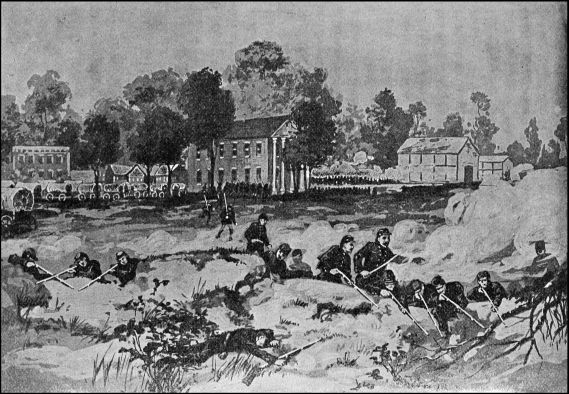
The right wing, the Army of the Tennessee, did march
on Macon, then turned to the left to fight the battle of
Griswoldville.
The outlook entertained at the North was expressed by
a wise editorial in The Cincinnati Gazette, as follows:
"From private advices, both by letter and telegraph, we
learn that Sherman is advancing from Atlanta toward
Savannah River in two columns. The first set out, one
account says, the 7th, another the 9th inst. (probably the
last date), on the road to Macon. On the 13th or 14th
inst., it was seventy miles in advance, driving everything
before it, and destroying everything behind that could aid
the enemy, and intending to pursue this policy to the end.
The other column, we understand, set out three or four
days later, and undoubtedly intended to unite with the
other at a suitable point. The army is stated in some accounts
at 45,000, and in others at 55,000, a large portion
being cavalry under Kilpatrick. The largest estimate is
probable, the army being composed of four corps, and
largely reinforced.
"Sherman took with him rations for many days, but expected
to find ample provisions on the route. Corn and
sweet potatoes he will find in abundance and probably
hogs.
"Such is our information from several sources; but at
the same time it should be recollected that a general, at
the head of a movable army in the field, must act according
to circumstances, and he may have turned from the
course we suppose him to have taken by contingent events,
of which we have now no knowledge. We understand him
to be on his march through Georgia, to make the South
Atlantic Squadron, at Beaufort, his new base of supplies,
if he needs one, but if the country, as we suppose, is
sufficient to maintain his army, there is no absolute need
of any new base.
"Here it will be inquired, What opposition will he encounter,
and what is his object? There will be no army
in front of him and the Georgia militia will be utterly
inefficient in obstructing his progress. Hood is powerless;
Lee has no men to spare, and if he had, it would take a
large army to encounter Sherman. The field is, therefore,
open before him, and the main question is, what can he
accomplish? In our opinion, he can accomplish the most
important results reached in the war. When a column
reaches Macon, it can destroy, effectually, the only remaining
railroad communication between the eastern and
western parts of the Confederacy. When a column shall
reach Augusta, it destroys the largest manufactories and
depot of military munitions in the South. The greatest
and almost only powder manufactory is there. When the
railroad to Augusta, and from Savannah to Charleston are
destroyed, there is no further practicable military communication
between the country east of the Savannah and
west of it. We shall have severed the Confederacy by
another impassable line.
"But this is only the beginning. If Sherman can reach
Beaufort, after a week's rest, he can move right on through
North Carolina to Danville, thus making Eastern Virginia
a prison and a grave for Lee's army and the Rebel Government.
This, we say, is perfectly practicable with an
average share of luck. We do not know that General
Sherman has all this in his plan; but why not? Why
should he not aim at the greatest results? What is to
prevent these results? He has a large, well equipped disciplined
army. What is there from the Roanoke to the
Tennessee to oppose him? Nothing that can oppose any
serious resistance to a disciplined army.
"But what of Hood? Hood has no larger army than
Thomas has, besides all the garrisons, gunboats and militia
in the rear. It will be less safe for him to advance than to
retreat. Such is the outline of the military operations we
suppose to be on foot. We wait further information with
solicitude, but with hope that the final will be brilliant
and decisive."
A private letter from one of Sherman's officers, just before
the start from Atlanta, gave this view of the case:
"We are under orders to prepare for a sixty days' campaign;
so you see that does not look much like spending
the winter in Atlanta, as many have hoped to do. It is not
supposed that any below a Major-General knows what is to
be the programme—nor do they; but it is generally conjectured
that a large force is soon to start for Savannah,
via Augusta and Milledgeville. General Thomas will have
force, with what will be left him by Sherman, to 'do the
agreeable' to Hood. You may expect that 'something
may turn up' before this army settles down for the winter."
Among the many accounts of the march to the sea, one
of the most graphic and accurate was furnished by an army
officer to the New York Evening Post. Writing from Atlanta
on November 14th, he said:
"On the 12th instant the last train of cars whirled rapidly
past the troops moving south, speeding over bridges
and into the woods as if they feared they might be left
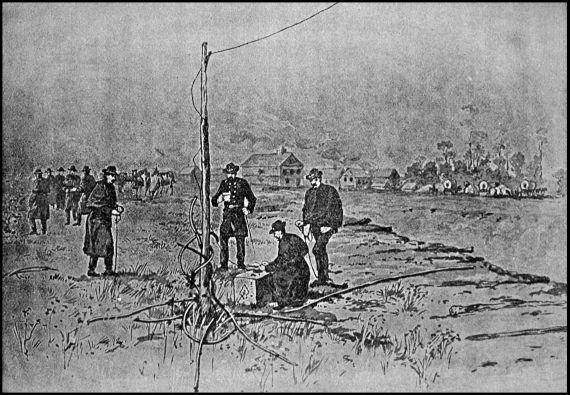
helpless in the deserted land. At Curtisville the last communications
with the North were served with the telegraph
wire. It bore the message to General Thomas, 'All
is well.' And so we have cut adrift from our base of operations,
from our line of communications, launching out into
uncertainty at the best; on a journey whose projected end
only the general in command knows.
"As for the army, they do not stop to ask questions.
"Sherman says 'Come,' and that is the entire vocabulary
to them. A most cheerful feature of the situation is
the fact that the men are healthful and jolly as men can be,
hoping for the best, willing to dare the worst.
"Behind us we leave a track of smoke and flame. Half of
Marietta was burned up, not by orders, however; for the
command is that proper details shall be made to destroy all
property which can ever be of use to the Rebel armies.
Stragglers will get into these places, and dwelling houses
are leveled to the ground. In nearly all cases these are
the deserted habitations formerly owned by Rebels, who
are now refugees.
"From Kingston to Atlanta the rails have been taken
up on the road, fires built about them, and the iron twisted
in all sorts of curves; thus they are left, never to be
straightened again. The Secesh inhabitants are in agony
of wonder at all this queer manœuvring. It appears as if
we intended evacuating Atlanta, but our troops are taking
the wrong direction for the hopes and purposes of these
people.
"Atlanta is entirely deserted of human beings, excepting
a few soldiers here and there. The houses are vacant;
there is no trade or traffic of any kind; the streets are
empty. Beautiful roses bloom in the gardens of fine
houses, but a terrible stillness and solitude covers it all,
depressing the hearts even of those who are glad to destroy
it. In your peaceful homes at the North you cannot conceive
how these people have suffered for their crimes."
The next night he wrote of the burning of Atlanta:
"A grand and awful spectacle is presented to the beholder
in this beautiful city, now in flames. By order, the Chief
Engineer has destroyed by powder and fire all the store-houses,
depot buildings and machine shops. The heaven
is one expanse of lurid fire: the air is filled with flying,
burning cinders; buildings covering over two hundred
acres are in ruins or in flames; every instant there is the
sharp detonation or the smothered burning sound of
exploding shells and powder concealed in the buildings,
and then the sparks and flame shooting away up into the
black and red roof, scattering the cinders far and wide.
"These are the machine shops where have been forged
and cast Rebel cannon, shot and shell, that have carried
death to many a brave defender of our nation's honor.
These warehouses have been the receptacle of munitions
of war, stored, to be used for our destruction. The city,
which next to Richmond, has furnished more material for
prosecuting the war than any other in the South, exists
no more as a means for the enemies of the Union."
November 24th found the army of Georgia, Slocum
commanding, at the State capital, Milledgeville, which
they captured without firing a gun. The Legislature fled
at their approach without waiting for the formality of
adjournment; and this panic, says the correspondent
quoted, "spread among the citizens to such an extent as
to depopulate the place, except of a few old gentlemen and
ladies, and the negroes; the latter welcoming our approach
with ecstatic exclamations of joy: 'Bless de Lord! the
Yanks is come; de day ob jubilee hab arribed'; and then
accompanied their words with rather embarrassing hugs.
"General Slocum, with the Twentieth Corps, first
entered the city, arriving by way of Madison, having accomplished
his mission of destroying the railroads and valuable
bridges at Madison. The fright of the legislators, as described
by witnesses, must have been comical in the extreme.
They little imagined the movement of our left
wing, hearing first of the advance of Kilpatrick on the extreme
right toward Macon, and supposed that to be
another raid. What their opinion was when Howard's
army appeared at McDonough it could be difficult to say;
and their astonishment must have approached insanity
when the other two columns were heard from—one directed
toward Augusta and the other swiftly marching straight
upon their devoted city.
"It seemed as if they were surrounded upon all sides
except toward the east, and that their doom was sealed.
With the certain punishment for their crimes looming up
before them, they sought every possible means of escape.
Private effects, household furniture, books, pictures, everything
was conveyed to the depot and loaded into the cars
until they were filled and heaped, and the flying people
could not find standing room.
"Any and every price was obtained for a vehicle. A
thousand dollars was cheap for a common buggy, and men
rushed about the streets in agony of fear lest they should
'fall victims to the ferocity of the Yankees.'
"Several days of perfect quiet passed after this exodus,
when, on a bright, sunshiny morning a regiment entered
the city, with the band playing national airs, which music
had many a day since been hushed in the capital of
Georgia.
"But few of the troops were marched through the city.
Some two or three regiments were detailed, under the
orders of the engineers, to destroy certain property designated
by the general commanding. The magazines, arsenals,
depot buildings, factories of one kind and another,
with storehouses containing large amounts of government
property, and some 1,700 bales of cotton burned. Private
houses were respected everywhere, even those of noted
Rebels, and I heard of no instance of pillage or insult to
the inhabitants. One or two of the latter, known as having
been in the Rebel army, were prisoners of war, but
the surgeons at the hospitals, the principal of the insane
asylum, and others, expressed their gratitude that such
perfect order was maintained throughout the city.
"General Sherman is at the Executive Mansion, its former
occupant having with extremely bad grace fled from
his distinguished visitor, taking with him the entire furniture
of the building. As General Sherman travels with a
menage (a roll of blankets and haversack full of hard-tack),
which is as complete for a life out in the open air as in a
palace, this discourtesy of Governor Brown was not a serious
inconvenience.
"General Sherman's opening move in the present campaign
has been successful in the highest degree. At first
moving his Army in three columns, with a column of Cavalry
on his extreme right, with eccentric lines, he diverted
the attention of the enemy, so that he concentrated his
forces at extreme points, Macon and Augusta, leaving unimpeded
the progress of the main body. In this campaign—the
end of which does not yet appear—it is not the purpose
of the General to spend his time before fortified cities,
nor yet to incumber his wagons with wounded men. His
instructions to Kilpatrick were to report to Howard and so
demonstrate against Macon.
"Slocum, with the Twentieth Corps, arrived at Milledgeville
on the 22d instant, preceding Davis, with the Fourteenth
Corps, one day. On the same day Kilpatrick struck
the Macon and Western Road, destroying the bridge at
Walnut Creek. The day following Howard, with the Fifteenth
and Seventeenth Corps, after a battle, arrived at Gordon,
and began the destruction of the Georgia Central
Railroad.
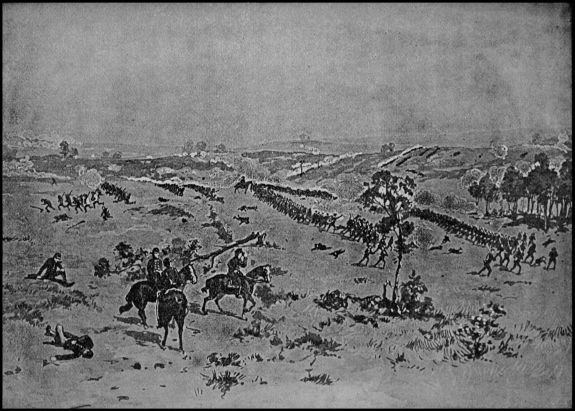
"It was back of this that the most serious fight of the
campaign occurred to this date, supported by General Chas.
R. Wood's entire division. General Wolcot in command of a
detachment of cavalry and a brigade of infantry, was thrown
forward to Griswoldville, toward Macon, for demonstrative
purposes merely. The enemy, some five thousand
strong, advanced upon our troops, who had thrown up
temporary breastworks, with a section of a battery in
position. The cavalry fell slowly back on either flank of
brigade, protecting them from attack in flank and rear.
The Rebels are composed of militia chiefly, although a
portion of Hardee's old corps was present, having been
brought up from Savannah.
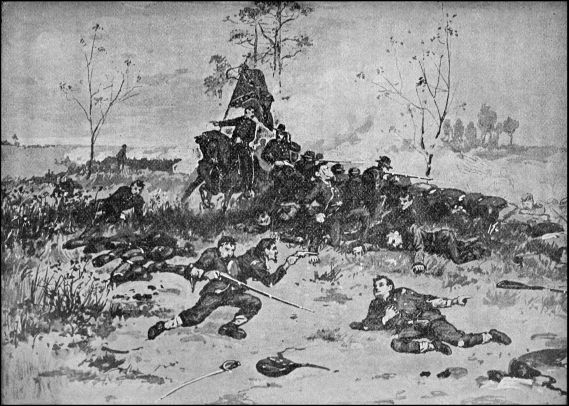
"With that ignorance of danger common to new troops,
the Rebels rushed upon our veterans with the greatest
fury. The rebels made the attack, but with most fatal
results and were soon in full flight, leaving more than
three hundred dead on the field. Our loss was some forty
killed and wounded, while their killed, wounded and
prisoners are estimated to exceed two thousand. A pretty
severe lesson they have received."
The whole army moved on, and three days later reached
Tennille Station, on the Georgia Central Railroad. Continuing
his story, the correspondent wrote on November
27: "General Sherman was with Slocum at Milledgeville.
The rebels seem to have understood, but too late, that
it was not Howard's intention to make a serious attack upon
Macon. They have, however, succeeded in getting Wheeler
across the Oconee at a point below the railroad bridge.
We first became aware of their presence in our front by
the destruction of several small bridges across Buffalo
Creek, on the two roads leading to Sandersville, over
which were advancing the 20th and 14th Corps.
"We were delayed but a few hours. The passage was
also contested by the rebel cavalry under Wheeler, and
they fought our front all the way, and into the streets of
Sandersville. The 20th Corps had the advance, deploying
a regiment as skirmishers, forming the remainder of a
brigade in line of battle on either side of the road. The
movement was executed in the handsomest manner, and
was so effectual as not to impede the march of the column
in the slightest degree, although the roll of musketry was
unceasing. Our loss was not serious, twenty odd killed and
wounded.
"As the 20th Corps entered the town they were met by
the 14th, whose head of column arrived at the same moment.
While these two corps had met with the obstructions
above mentioned, the army under General Howard
were attempting to throw a pontoon across the Oconee at
the Georgia Central Railroad bridge. Here they met a
force under the command of General Wayne, which was
composed of a portion of Wheeler's cavalry, militia, and a
band of convicts who had been liberated from the penitentiary
upon the condition that they would join the army.
"The most of these desperados have been taken prisoners,
dressed in their State prison clothing. General Sherman
has turned them loose, believing that Governor Brown
had not got the full benefits of his liberality. The rebels
did not make a remarkably stern defense of the bridge, for
Howard was able to cross his army yesterday, and commenced
breaking railroad again to-day. In fact, all of the
army, except one corps, are engaged in this same work.
Morgan, with his army, was hardly able to reach this point
when he met General Hardee, who has managed to get
around here from Macon. Our troops struck the railroad
at this station a few hours after the frightened band escaped.
"We had been told that the country was very poor east
of the Oconee, but our experience has been a delightful
gastronomic contradiction of the statement. The cattle
trains are getting so large that we find difficulty in driving
them along. Thanksgiving Day was very generally observed
in the army, the troops scorning chickens in the
plentitude of turkeys with which they have supplied themselves.
"Vegetables of all kinds, and in unlimited quantities,
were at hand, and the soldiers gave thanks as soldiers may
and were merry as only soldiers can be. In truth, so far as
the gratification of the stomach goes, the troops are pursuing
a continuous thanksgiving.
"In addition to fowls, vegetables, and meats, many obtain
a delicious syrup made from sorghum, which is cultivated
on all the plantations, and stored away in large
troughs and hogsheads. The mills here and there furnish
fresh supplies of flour and meal, and we hear little or nothing
of 'hard tack'—that terror to weak mastication. Over
the sections of country lately traversed I find very little
cultivation of cotton. The commands of Davis appear to
have been obeyed; and our large droves of cattle are turned
nightly into the immense fields of ungathered corn to eat
their fill, while the granaries are crowded to overflowing
with both oats and corn.
"We have also reached the sand regions, so that the
fall of rain has no terrors, the roads are excellent, and
would become firmer from a liberal wetting. The rise of
the rivers will not bother us much, for every army corps
has its pontoon, and the launching of its boats is a matter
of an hour.
"Just before his entrance into Milledgeville, General
Sherman camped on one of the plantations of Howell
Cobb. It was a coincidence that a Macon paper, containing
Cobb's address to the Georgians as general commanding,
was received the same day. This plantation was the
property of Cobb's wife, who was a Demar.
"We found his granaries well filled with corn and wheat,
part of which was distributed and eaten by our animals and
men. A large supply of syrup made from sorghum (which
we have found at nearly every plantation on our march), was
stored in an out-house. This was also disposed of to the
soldiers and to the poor, decrepit negroes, which this humane,
liberty-loving Major-General left to die in this place
a few days ago. Becoming alarmed, Cobb sent to that
place and removed all the able-bodied mules, horses, cows,
and slaves. He left here some fifty old men—cripples,
and women and children—with clothing scarce covering
their nakedness, with little or no food, and without means
of procuring any. We found them cowering over the fireplaces
of their miserable huts, where the wind whirled
through the crevices between the logs, frightened at the
approach of the Yankees, who they had been told would
kill them. A more forlorn, neglected set of human
beings I never saw.
"General Sherman distributed to the negroes with his
own hands the provisions left here, and assured them that
we were their friends, and they need not be afraid. One old
man answered him: 'I spose dat you's true: but, massa,
you'll go 'way to-morrow, and anudder white man will
come.'
"This terrorism, which forms so striking a feature of
slavery, has had marked illustrations ever since we left Atlanta.
Many negroes were told that as soon as we got
them into our clutches they were put into the front of the
battle, and we killed them if they did not fight; that we
threw the women and children into the Chattahoochee, and
when the buildings were burned in Atlanta, we filled them
with negroes to be devoured by the flames. These stories,
which appear so absurd to us, are not too extravagant for
the simple, untutored minds of the negroes. They are
easily frightened, and full of superstition. In most any
other instance, such bloody tales would have frightened
them entirely out of our sight to the woods and other hiding
places; but they assert, with much earnestness and glee that
'massa can't come dat over we; we knowed a heap better.
What for de Yankees want to hurt black men. Massa
hates de Yankees, and he's no fren' ter we; so we am de
Yankee's bi's fren's.' Very simple logic, that; but it is
sufficient for the negroes.
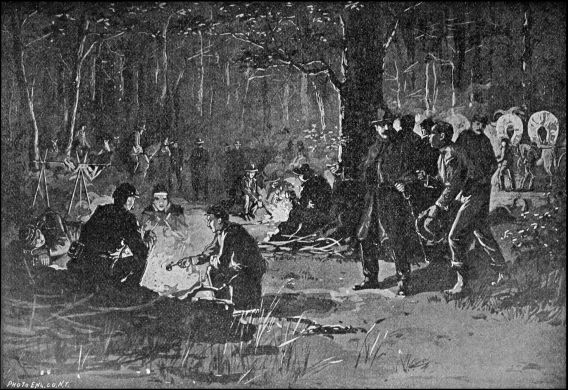
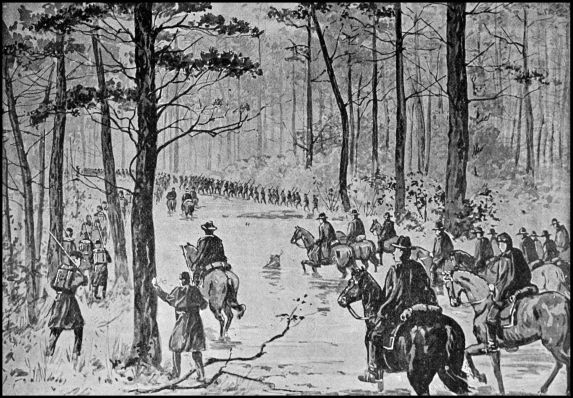
A BIVOUAC AMONG THE GEORGIA PINES.
"Near Covington, one Judge Harris has a large plantation;
before we arrived it was well stocked; I can't answer
for its condition afterward. A jollier set of negroes I never
saw than his were when the blue coats came along. Stories
of their cruelty to the negroes were also told by their masters
to frighten them, but the negroes never put faith in them.
I asked Judge Harris's head man: 'Well, how do you like
the Yankees?' 'Like him! bully, bully, bully. I'se wanted
to see 'em long time; heard a heap 'bout 'em. Say, Sally,
dese here be gentlemen dat's passing.' A compliment to
our soldiers, which they no doubt would have appreciated
could they have heard Mr. Lewis.
"'Yass, sar; I'se hope de Lord will prosper dem and
Mr. Sherman.'
"'Why do you hope that the Lord will help the Yankee?'
"'Because I t'inks, and so we all t'inks, dot you'se down
here in our interests.'
"'You're about right there. Did you ever hear that
President Lincoln freed all the slaves?' 'No, sar; I never
heard such a t'ing. De white folks nebber talk 'fore
black men; dey mighty free from dat.' In other parts of
the South the negroes I have seen seem to understand there
is a man named Lincoln, who had the power to free them
and had exercised it. We have reached here a stratum of
ignorance upon that subject. All knowledge of that nature
has not only been kept from the blacks, but only a few of
the whites are well-informed.
"General Sherman allows all able-bodied negroes (others
could not make the march) to join the column, and he takes
especial pleasure when they join the procession, on some
occasions telling them they are free; that Massa Lincoln
has given them their liberty, and that they can go where
they please; that if they earn their freedom they should
have it—but that Massa Lincoln had given it to them anyhow.
They all seem to understand that the proclamation
of freedom had made them free, and I have met but few instances
where they did not say they expected the Yankees
were coming down sometime or other, and very generally
they are possessed with the idea that we are fighting for
them and that their freedom is the object of the war.
"'Stick in dar,' was the angry exclamation of one of a
party of negroes to another, who was asking too many
questions of the officer who had given them permission to
join the column. 'Stick in dar, it's all right; we'se gwine
along, we'se free.'
"Another replied to a question, 'Oh, yass, massa, de
people hereabouts were heap frightened when dey heard
you'se coming; dey dusted out yer sudden.'
"Pointing to the Atlanta & Augusta Railroad, which had
been destroyed, the question was asked, 'It took a longer
time to build this railroad than it does to destroy it?'
"'I would think it did, massa; in dat ar woods over dar
is buried ever so many black men who were killed a working
on dat road.'
"'Does the man live here who worked them?'
"'Oh no, sar; he's dun gone long time.'
"By the way, the destruction of railroads in this campaign
has been most thorough. The ordinary method of
destruction was to place the rails across a pile of burning
sleepers, their own weight bending them.
"But this does not injure the rail so much but that it may
be heated and straightened again. Instruments have been
made; one is a clasp, which locks under the rail. It has a
ring in the top into which is inserted a long lever, and the
rail is thus ripped from the sleepers. When the rail has
become heated a wrench is applied, which fits close over the
ends of the rail; by turning them in opposite directions the
rail is so twisted that even a rolling machine could not bring
it back into shape. In this manner have been destroyed
some thirty miles of rails which lay in the city of Atlanta,
and also all the rails on the Augusta & Atlanta road from
the last named place to Madison; and thus far the Georgia
Central road, from a few miles east of Macon to Terryville
Station, where I am now writing."
The army reached Johnson's, on the south side of the
railroad, on November 29, when the writer continued:
"General Sherman's second step in this campaign will
have been equally successful with the first, if he is able
to cross the Ogeechee to-morrow without much opposition.
Davis and Kilpatrick's movement has been a blind in order
to facilitate the passage over the Ogeechee of the main
body of the army, which for two days past has been
marching on parallel roads south of the railroad.
"Thus far, we have reason to believe that the rebels are
ignorant of our principal movement, and are trembling with
fear that Augusta is our objective.
"Kilpatrick is doing the same work which he accomplished
with such high honor when covering our right
flank in the early days of the campaign. His column now
acts as a curtain upon the extreme left, through which the
enemy may in vain attempt to penetrate.
"The most pathetic scenes occur upon our line of march
daily and hourly. Thousands of negro women join the
column, some carrying household truck; others, and many
of them there are, who bear the heavy burden of children
in their arms, while older boys and girls plod by their sides.
These women and children are, by some commanders,
ordered back, heartrending though it may be to refuse them
liberty. One begs that she may go to see her husband and
children at Savannah. Long years ago she was forced
from them and sold. Another has heard that her boy was
in Macon, and she is 'done gone with grief goin' on four
years.'
"But the majority accept the advent of the Yankees as
the fulfillment of the millennial prophecies. The 'day of
jubilee,' the hope and prayer of a lifetime, has come. They
cannot be made to understand that they must remain behind,
and they are satisfied only when General Sherman
sometimes tells them that we shall come back for them some
time, and that they must be patient until the proper hour of
deliverance comes (this because they so swarmed).
"The other day a woman with a child in her arms was
working her way along amongst the teams and crowds of
cattle and horsemen. An officer called to her kindly:
'Where are you going, aunty?'
"She looked up into his face with a hopeful, beseeching
look, and replied:
"'I'se gwine whar you'se gwine, massa.'
"At a house a few miles from Milledgeville we halted
for an hour. In an old hut I found a negro and his wife,
both of them over sixty years old. In the talk which ensued
nothing was said which led me to suppose that either
of them was anxious to leave their mistress, who, by the
way, was a sullen, cruel-looking woman, when all at once
the old negress straightened herself up, and her face, which
a moment before was almost stupid in its expression, assumed
a fierce, almost devilish aspect.
"Pointing her shining black finger at the old man
crouched in the corner of the fireplace, she hissed out:
"'What for you sit dar; you 'spose I wait sixty years for
nutten? Don't yer see de door open. I'se follow my
child; I not stay. Yes, nodder day I goes 'long wid dese
people; yes, sar, I walks till I drop in my tracks.' A more
terrible sight I never beheld. I can think of nothing to
compare with it, except Charlotte Cushman's 'Meg Merrilies.'
Rembrandt only could have painted the scene, with
its dramatic surroundings.
"It was near this place that several factories were
burned. It was odd enough to see the delight of the
negroes at the destruction of places known only to them as
task-houses."
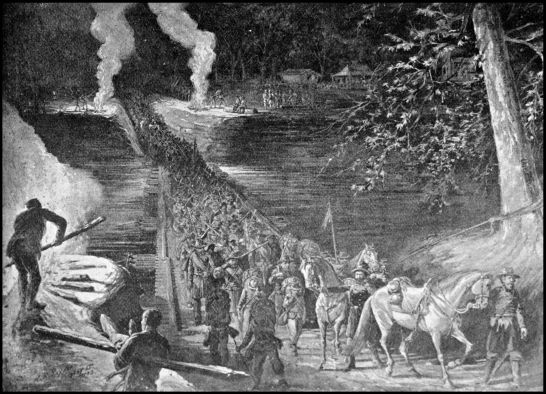
Sherman did cross the Ogeechee River without having
to fight. The 20th Corps moved down the railroad, destroying
it to the bridge. The 17th Corps covered the
river at this point, where a light bridge was only partially
destroyed. It was easily repaired, so that the infantry and
cavalry could pass over it, while the wagons and artillery
used the pontoons. The Ogeechee is about sixty yards in
width at this point. It is approached on the northern or
western side through swamps, which would be impassable
were it not for the sandy soil, which packs solid when the
water covers the roads, although in places there are treacherous
quicksands which the army had to span with corduroy
roads.
Here they met a quaint old man who had been station
agent before the railroad was destroyed. The correspondent
had a long chat with him about the war, and about
Sherman's march, and the old man said:
"'They say you are retreating, but it is the strangest sort
of a retreat I ever saw. Why, dog bite them, the newspapers
have been lying in this way all along. They allers
are whipping the Federal armies, and they allers fall back
after the battle is over. It was that ar' idee that first opened
my eyes. Our army was allers whipping the Feds, and
we allers fell back. I allers told 'em it was a humbug, and
now I know it, for here you are, right on old John Wells's
place; hogs, potatoes, corn, and fences all gone. I don't
find any fault. I expected it all.'
"'Jeff. Davis and the rest,' he continued, 'talk about
splitting the Union. Why, if South Carolina had gone out
by herself, she would have been split in four pieces by this
time. Splitting the Union! Why, the State of Georgia is
being split right through from end to end. It is these rich
fellows who are making this war, and keeping their precious
bodies out of harm's way. There's John Franklin
went through here the other day, running away from your
army. I could have played dominoes on his coat-tails.
There's my poor brother, sick with smallpox at Macon,
working for $11 a month, and hasn't got a cent of the stuff
for a year. 'Leven dollars a month and 11,000 bullets a
minute. I don't believe in it, sir.'
"'My wife came from Canada, and I kind o' thought I
would sometime go there to live, but was allers afraid of
the ice and cold; but I can tell you this country is getting
too cussed hot for me. Look at my fence-rails a-burning
there. I think I can stand the cold better.'
"'I heard as how they cut down the trees across your
road up country and burn the bridges; why (dog bite their
hides), one of you Yankees can take up a tree and carry it
off, tops and all; and there's that bridge you put across the
river in less than two hours—they might as well try to stop
the Ogeechee as you Yankees.
"'The blasted rascals who built this yere bridge thought
they did a big thing.
"'To bring back the good old times,' he said, 'it'll take
the help of Divine Providence, a heap of rain, and a deal of
elbow grease, to fix things up again.'"
The steady progress of the army was recorded at Scarborough
on December 3, thus:
"Pivoted upon Millen, the army has swung slowly round
from its eastern course, and is now moving in six columns
upon parallel roads southward. Until yesterday it was impossible
for the rebels to decide whether or not it was General
Sherman's intention to march upon Augusta. Kilpatrick
had destroyed the bridge above Wainesborough, and
falling back had again advanced, supported by the 14th
Army Corps, under General Davis. South of this column,
moving eastward through Birdsville, was the 20th Corps,
commanded by General Slocum. Yet further south, the
17th Corps, General Blair in command, followed the railroad,
destroying it as he advanced. West and south of the
Ogeechee, the 15th Corps, General Osterhaus in immediate
command, but under the eye of General Howard, has moved
in two columns.
"Until now Davis and Kilpatrick have been a cover and
shield to the real movements. At no time has it been possible
for Hardee to interpose any serious obstacle to the
advance of the main body of our army, for our left wing
has always been a strong arm thrust out in advance, ready
to put in chancery any force which might attempt to get
within its guard.
"The rebel councils of war appear to have been completely
deceived, for we hear it reported that Bragg and
Longstreet are at Augusta with ten thousand men, made up
of militia, two or three South Carolina regiments, and a
portion of Hampton's Legion, sent there for one month. It
is possible, now that the curtain has been withdrawn, and
as it may appear that we are marching straight for Savannah,
their generals may attempt to harass our rear.
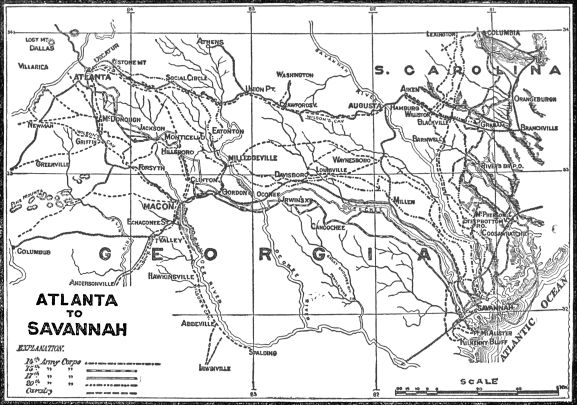
ATLANTA TO SAVANNAH
"The work so admirably performed by our left wing, so
far as it obliged the rebels in our front constantly to retreat,
by threatening their rear, now becomes the office of
the Fifteenth Corps, our right wing, on the right bank of
the river. Its two columns are moving one day's march in
advance of the main body of the army, marching down the
peninsula between the Savannah and Ogeechee rivers. The
necessity and value of these flank movements first of the
right wing with Kilpatrick's cavalry, then of Davis and Kilpatrick
on the left, and now of Howard on our right, is because
we cannot run over and demolish any and all the
Rebel force in Georgia. They could not for a moment
stand before this army upon any ordinary battle-ground, but
a very small force of infantry or cavalry at a river could delay
a column half a day, and perhaps longer, and as our soldiers
have got tired of chickens, sweet potatoes, sorghum,
etc., and have been promised oysters on the half shell, oysters
roasted, stewed, etc., in short, oysters; they don't care
to be delayed."
The right, Blair and Logan, found a sparse population
and rather meagre supplies. The lessoning do not apply
to them, the breadth swept by their columns varied from
40 to 60 miles.
That Sherman was marching on Savannah was at last
clear to the Rebels; and it was equally clear to them
that they would not be able soon to stop him. By
December 6th the army was at Ogeechee Church, Logan's
Corps still on the west side of the river. Kilpatrick's
Cavalry engaged the enemy under Wheeler several times
near Waynesborough, with success. General Howard
made a bold and brilliant movement between the Little
Ogeechee and the Great Ogeechee. He pushed ahead of
the rest of the army thirteen miles, to the canal connecting
the Ogeechee and Savannah Rivers, bridged the canal,
crossed it and took up a strong position beyond. This
forced the enemy to abandon their line of works between
the rivers and fall back to the fortifications of Savannah.
Sherman now moved forward more cautiously. The
country was swampy and the roads narrow causeways, and
the enemy had great advantages in defending the city.
There was a Union fleet off the coast, and Sherman sought
to open communications with it. By December 12th his
investment of the city was complete, and only Fort McAllister
barred his way to the shore. General Howard
had sent three scouts down the river in a canoe past the
fort and they had almost reached Admiral Dahlgren, commander
of the fleet; but did not venture to return. Next
day Howard, having consulted with Sherman, directed
General Hazen's Division to cross the Ogeechee by King's
Bridge and move down toward the fort. Then he went
with Sherman to a signal station which he had established
on the roof of Cheves's rice-mill, and watched the operations.
Hazen's advance, under Colonel W. S. Jones, reached a
point only half a mile from the fort early in the afternoon,
but it was five o'clock before a sufficient force could be
brought up and made ready for the assault. Sherman and
Howard watched the scene, anxious, and impatient to have
the fort taken before dark. A boat from the fleet approached
and signalled the question: "Have you taken the
fort?" Sherman signalled back, "No; but we shall in a
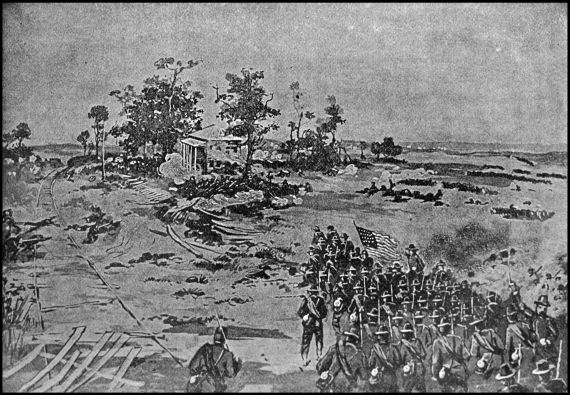
minute;" for Hazen was just ordering the charge. A
sharp struggle followed. The works were strong and
torpedoes did much damage. But in fifteen minutes all
was over. The garrison was captured, and the Stars and
Stripes floated over Fort McAllister.
The army and the fleet now joined forces. Howard
pressed the work of building roads across the swamps and
draining the rice fields. On December 17th, Sherman
summoned Hardee, the Rebel commander, to surrender,
but Hardee refused. Howard and Slocum brought up
their batteries and pressed the army forward, however,
and Hardee, after a detachment of Sherman had crossed
the Savannah, saw the situation was hopeless; so before
his last road was taken he took to flight with his troops
and light artillery, leaving his heavy guns and stores behind.
At daybreak of December 21st the Union troops
occupied the city, and Sherman's official dispatch announcing
the event reached Lincoln at Washington on Christmas
Day. "I beg to present you," he said, "as a Christmas
gift, the city of Savannah, with 150 heavy guns and
plenty of ammunition, and also about 25,000 bales of
cotton."
Before this, however, the Nation had been informed of
the whereabouts of the "lost army" by means of this dispatch,
which was received at the War Department,
Washington, on December 14th:
"Hilton Head, S. C, Monday, Dec. 12th, 1864,
"via Fort Monroe, Dec. 14th.
"To Major-General Halleck, Chief of Staff.
"General:—Captain Duncan, of General Howard's
scouts, has just come in from General Howard, having
descended the Ogeechee River in a small boat. They left
the army on the evening of the 9th. General Sherman's
whole army was then within ten miles of Savannah, advancing
to attack it. The enemy's works, five miles from the
city, were probably attacked yesterday, as heavy firing was
heard in that direction.
"Captain Duncan represents the army to be in the best
spirits possible, and the most excellent condition. Very
little opposition had been met with on the march, as the
enemy could not tell what routes were to be taken. The
army has lived off the country, and has accumulated a
considerable number of horses and cattle. It was also well
supplied.
"The following is a copy of the dispatch brought by
Captain Duncan:
"'Hdqrs. Army of the Tennessee, near Savannah Canal,
December 9th, 1864.
"'To the Commander of the United States Naval Forces
in the vicinity of Savannah, Ga.
"'Sir:—We have met with perfect success thus far. The
troops are in fine spirits and General Sherman near by.
"'Respectfully, O. O. Howard, Major-General,
"'Commanding Right Wing of the Army.'
"Another dispatch brought by Captain Duncan, directed
to the Signal Officer of the fleet, from General Howard's
Chief Signal Officer, requests a good lookout to be kept
for signals.
"I have the honor to be, very respectfully, your obedient
servant,
J. G. Foster,
"Major-General Commanding."
Sherman afterward wrote of this great march and its
results as follows:
"I was left with a well-appointed army to sever the
enemy's only remaining railroad communications eastward
and westward, for over one hundred miles, namely, the
Georgia State railroad, which is broken up from Fairborn
Station to Madison and the Oconee and the Central railroad
from Gordon clear to Savannah, with numerous
breaks on the latter road from Gordon to Eatonville, and
from Millen to Augusta, and the Savannah and Gulf railroad.
We have consumed the corn and fodder in a region
of country thirty miles on each side of a line from Atlanta
to Savannah, as also the sweet potatoes, cattle, hogs, sheep,
and poultry. We have carried away more than ten thousand
horses and mules, as well as a countless number of
slaves. I estimate the damage done to the State of
Georgia at a hundred millions of dollars, at least twenty
millions of which has inured to our advantage, and the
remainder is simply waste and destruction. This may
seem a hard species of warfare, but it brings the sad realities
of war home to those who have been directly or indirectly
instrumental in involving us in its attendant calamities.
"The behavior of our troops in Savannah has been so
manly, so quiet, so perfect, that I take it as the best evidence
of discipline and true courage. Never was a hostile
city filled with women and children occupied by a large
army with less disorder, or more system, order, and good
government."