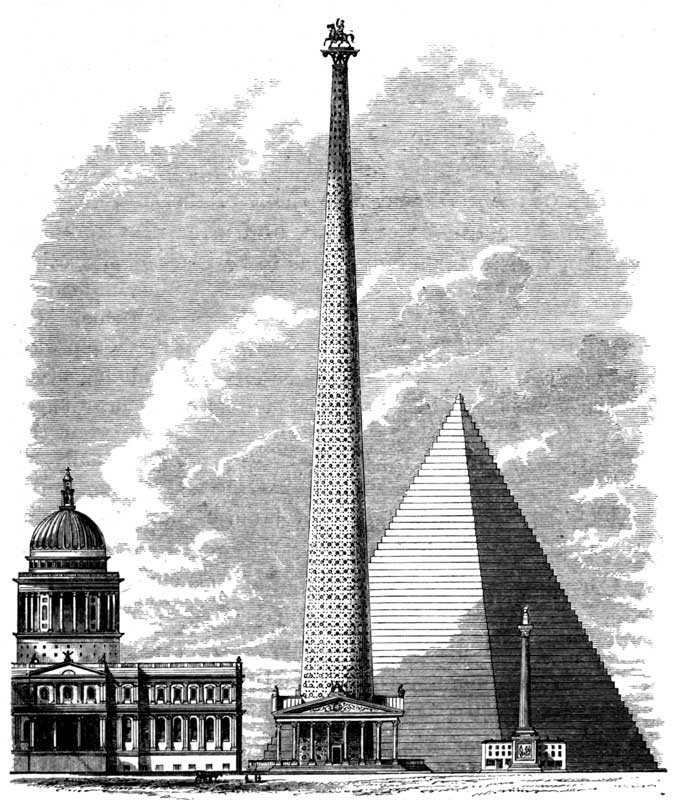
THE WATT AND THE TREVITHICK ENGINES AT DOLCOATH.
Having up to 1816 traced the progress of the steam-engine in Cornwall
through a century, during the latter half of which Trevithick, sen.,
and his son were among its most prominent improvers, the latter
having devoted a quarter of a century to the work, the effect of
which is shown in the skeleton outlines of a few classes of engines,
one important feature still remains for examination before a correct
judgment can be formed of the events of this period and their prime
movers.
The use of an increasing pressure of steam gave increased force and
value to the improved steam-engine, but the power of constructing
engines and boilers to render the increased pressure manageable was the
result of a lifetime of labour.
Savery, whose engine was scarcely more than a steam-boiler, failed
to control its force, and is said to have blown the roof from over
his head. The mechanism of Newcomen's engine was well arranged, but
suitable only for the working of pumps, and its power was limited to
the weight of the atmosphere, from which it was called the atmospheric
engine.
In 1756, an atmospheric engine with a cylinder of 70 inches in diameter
worked at the Herland Mine, "the only objection to which was the cost
of the coal, to lessen which several methods had been suggested for
increasing the elasticity of the steam, and reducing the size of the
boiler."[47]
In 1775 Richard Trevithick, sen., removed the flat top of a Newcomen
boiler, and substituted a semicircular top, enabling it to contain
stronger steam, and at the same time he improved the mechanical part
of the engine by finding a better resting-place for the steam-cylinder
than the top of the large boiler. Pryce gives a drawing of this engine
as the best at that time in Cornwall.[48]
"It is known as a fact that every engine of magnitude consumes
3000l. worth of coal every year.
"The fire-place has been diminished and enlarged again. The flame
has been carried round from the bottom of the boiler in a spiral
direction, and conveyed through the body of the water in a tube (one,
two, or three) before its arrival at the chimney.
"Some have used a double boiler, so that fire might act on every
possible point of contact, and some have built a moorstone boiler,
heated by three tubes of flame passing through it.
"A judicious engineer does not attempt to load his engine with a
column of water heavier than 7 lbs. on each square inch of the
piston."[49]
While Pryce's book was being printed, Watt in 1777 wrote of the Cornish
steam-engines:—
"I have seen five of Bonze's engines, but was far from seeing the
wonders promised. They were 60, 63, and 70 inch cylinders at Dolcoath
and Wheal Chance. They are said to use each about 130 bushels of coals
in the twenty-four hours, and to make about six or seven strokes per
minute, the stroke being under 6 feet each. They are burdened to 6,
6½, and 7 lbs. per inch."[50]
The 63-inch was an open-top cylinder atmospheric engine at Dolcoath
Mine under the management of Trevithick, sen.; and shortly after, in
1777 or 1778, Watt's first engine was erected in Cornwall.[51]
In 1783 Trevithick, sen., gave Watt an order for a patent engine for
Dolcoath, in size similar to the old Newcomen atmospheric, having a
cylinder 63 inches in diameter, that a working trial might be made
between the rival engines. The Watt engine having a cylinder-cover,
with the patent air-pump and condenser, was known in the county as the
Dolcoath great 63-inch double-acting engine. Three steam-engines were
then at work in that mine: Trevithick senior's Carloose (then called
Bullan Garden) atmospheric 45-inch cylinder, the atmospheric 63-inch
cylinder, and Watt's 63-inch cylinder double-acting vacuum engine; all
of which continued in operation side by side for five years until 1788,
when for a time Dolcoath ceased to be an active mine. Trevithick, jun.,
was then a boy of seventeen years.
After ten years of idleness and rust, as if mourning the death of
Trevithick, sen., in 1798 Richard Trevithick, jun., as engineer, and
Andrew Vivian as manager, induced shareholders to resuscitate the old
mine. Fire was again given to the voracious jaws of the boilers, and
the three engines recommenced their labours and their rivalries.
A year or two before this Trevithick had made models of high-pressure
steam-engines. Davies Gilbert, in 1796, met him among other engineers,
giving evidence in the Watt lawsuits, when he mentioned his ideas of
an engine to be worked solely by the force of steam. Watt had claimed
such an engine in his patent twenty-seven years before, but had failed
to carry it into practice. Hornblower had tried something like it in
his double-cylinder expansion engine, but he did not use high-pressure
steam, and consequently also failed.
The idea, therefore, of expansive steam was not new, but the useful
mastery of it was. Savery had tried expansive steam before Watt
patented it; the latter went to law with Hornblower for an infringement
of the idea, when neither of them had in truth constructed an
expansive steam-engine. The low pressure of the steam from the boilers
used by Hornblower and Watt did not admit of profitable expansion
in the cylinder; at its full boiler pressure it constituted but a
comparatively small portion of the power of the engine: to reduce that
power by expansion was as apt to be a loss as a gain. The steam-engine
was still dependent for its power mainly on steam as an agent for
causing the required vacuum, until 1796, when Trevithick disclosed his
method of constructing small cylindrical boilers and engines suitable
for giving power from the strong pressure of the steam, irrespective of
vacuum.
Lean, who favoured Watt rather than Trevithick, thus records the advent
of Watt's expansive engine:—
"In 1779 to 1788 Mr. Watt introduced the improvement of working steam
expansively, and he calculated that engines which would previously do
nineteen to twenty millions would thus perform twenty-six millions;
but I do not find any record of this duty being performed in practice.
In 1785 Boulton and Watt had engines in Cornwall working expansively,
as at Wheal Gons and Wheal Chance in Camborne; but in these the steam
was not raised higher than before, and the piston made a considerable
part of the stroke therefore before the steam-valve was closed.
"In 1798, on account of a suit respecting their patent, which was
carrying on by Boulton and Watt, an account of the duty of all the
engines in Cornwall was taken by Davies Gilbert, Esq., and the late
Captain Jenkin, of Treworgie, and they found the average to be about
seventeen millions."[52]
One of these so-called expansive Watt engines, erected at Wheal Chance,
was converted into a real expansive engine by Trevithick, as described
in the foregoing chapter, by his high-pressure steam-boilers and the
addition of his pole-engine. The conversion of the other, a 63-inch
low-pressure vacuum engine at Wheal Gons, will be traced in this
chapter.
Mr. Taylor, who for many years took an active interest in Cornish
mining, says:—
"In 1798 an engine at Herland was found to be the best in the county,
and was doing twenty-seven millions, but being so much above all
others, some error was apprehended. This engine was probably the best
then ever erected, and attracted therefore the particular attention of
Messrs. Boulton and Watt, who, on a visit to Cornwall, came to see it,
and had many experiments tried to ascertain its duty. It was under the
care of Mr. Murdoch, their agent in the county.
"Captain John Davey, the manager of the mine, used to state that
it usually did twenty millions, and that Mr. Watt, at the time he
inspected it, pronounced it perfect, and that further improvement
could not be expected."[53]
This best engine from the hands of Watt and Murdoch in the Herland Mine
in 1798 may be taken as a Watt stand-point, when its usual duty was
twenty millions; and Trevithick and Bull erected a competing engine,
probably with an increased steam pressure, for Trevithick's portable
high-pressure engines were at that time coming into notice;[54] but no
trace remains of the result of this contest of the Watt and the Bull
engine, though it was one of the causes of the lawsuits.
"In 1799 Henry Clark worked as a rivet boy in Dolcoath, and carried
rivets to construct Captain Trevithick's new boiler, said to be the
first of the kind ever made. It looked like a great globe about 20
feet in diameter, the bottom hollowed up like the bottom of a bottle;
under this the fire was placed: a copper tube attached to this bottom
went around the inside of the boiler, and then passed out through the
side of the boiler, the outside brick flues then carrying the heat
around the outside of the boiler and into the chimney.
"Captain Trevithick's first plunger-pole lifts in Dolcoath were put in
at this time and worked by this engine. Glanville, the mine carpenter,
was head man over the engines when Captain Trevithick was away."[55]
"Charles Swaine worked as a rivet boy in making Captain Trevithick's
cylindrical wrought-iron boilers for the Dolcoath engine. Several
of Captain Trevithick's high-pressure boilers were working in the
mines before that, but not made exactly like the Dolcoath engine
boilers. When I was a boy about the year 1804, several years before
I worked on the Dolcoath engine boilers, I carried father's dinner
to the Dolcoath smiths' shop, where he worked, and used to stop
and watch the wood beam going up and down of Captain Dick's first
high-pressure steam-whim. She was not a puffer, but a puffer-whim
worked near by, called the Valley puffer. At that time most of Captain
Dick's high-pressure boilers were smallish, cast iron outside, and
wrought-iron tube."[56]
In 1799, shortly after the reopening of Dolcoath Mine, Trevithick,
jun., selected his father's second-hand atmospheric engine of 1775,[57]
to further improve it by a new boiler of uniformly globular figure,
with concave circular bottom, under which fire was placed; it was of
wrought iron, 24 feet in diameter, surrounded by external brick flues;
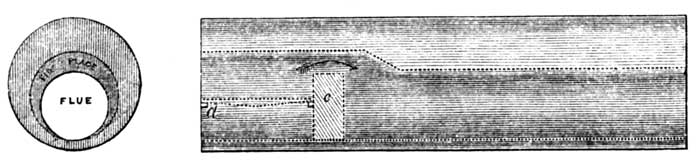
a large copper tube, starting from the boiler bottom, immediately
over the fire, served as an internal flue, carrying the fire by a
sweep around the interior in the water space, and then out through the
side of the boiler into the external brick flue. It may be said that
there was nothing new in a circular form of boiler, or in an internal
tube; but it will be admitted that this repaired engine, in this its
third stride in the march of advancement, made publicly known those
principles which in a few years more than doubled the power, the
economy, and the applicability of the steam-engine. His patent drawing
of 1802 shows this form of boiler applied to a small portable engine,
in which, for the sake of simplicity of structure and cheapness, cast
iron was used instead of wrought iron, and the internal tube omitted.[58]
The full detail estimate, from which the following items are extracted,
of the cost of alteration was written by Trevithick, jun., in the book
and on the page adjoining that containing the account of the former
alteration and re-erection of the same engine by Trevithick, sen., in
1775.
"A 45-inch cylinder engine, working 20 lbs. to the inch:—
| |
£ |
s. |
d. |
| Boilers, 8 tons at 42l. |
336 |
0 |
0 |
| Iron about ditto, 6 cwt. at 42l. |
12 |
12 |
0 |
| Castings about ditto, 15 cwt. at 42s. |
18 |
0 |
0 |
| Safety-valve and cocks |
1 |
0 |
0 |
| Wood about bob, 200 ft. at 6s. |
60 |
0 |
0 |
| Cast iron about ditto, 45 cwt. at 25s. |
56 |
5 |
0 |
| Brass about ditto, 60 lbs. at 2s. |
6 |
0 |
0 |
| Piston-rod, 4 in., 14 ft. long, 550 lbs. at 1s. |
27 |
10 |
0 |
| T-piece, 10 cwt. at 25s. |
12 |
0 |
0 |
| Cover, and bottom, and piston, 35 cwt. at 32s. |
56 |
0 |
0 |
| Nozzles, 6 cwt. at 32s. |
9 |
12 |
0 |
| Steam and perpendicular pipe, 10 cwt. at 25s. |
12 |
10 |
0 |
| Receiver, 2 ft. 4 in. long, and bottom, 15 cwt. at 25s. |
18 |
15 |
0 |
| Air-pump, bottom, and case, 10 cwt. at 25s. |
12 |
10 |
0 |
| Plunger, 22 in., 6 ft. long, 12 cwt. at 40s. |
24 |
0 |
0 |
| Force lift |
5 |
0 |
0 |
| Engineer |
66 |
0 |
0" |
The term "single" refers to its open-top cylinder as originally erected
by Newcomen, when it was called the Carloose engine, and so it remained
after its re-erection in 1775, under the name Dolcoath new engine,
alias Bullan Garden; but after the last re-erection in 1799 it had a
cylinder-cover, and was called the Shammal 45-inch engine; "working 20
lbs. to the inch" meant the force on each inch of the piston, including
vacuum on the one side of 14 lbs. and steam on the other side of 6 lbs.
to the inch.
Watt, on his first visit to Cornwall, in 1777, spoke disparagingly of
the Newcomen atmospheric engines "burdened to 6 or 7 lbs. net to the
inch." Fifty years later Stuart described Watt's engine as "using steam
of a somewhat higher temperature than 212 degrees, so as to produce a
pressure between 17 and 18 lbs. on each square inch of the piston; yet
in practice, from imperfect vacuum and friction, it cannot raise more
water per inch than would weigh about 8½ lbs.,"[59] or an increase of
net force—when compared with the Newcomen atmospheric—of only a pound
or two on the inch in the lapse of years embracing the active lifetime
of Watt. The cause of this slight increase of power is so simple that
it has been passed by unnoticed by very many. The steam pressure in
the Newcomen atmospheric was continued unaltered in the Watt vacuum
engine. Trevithick constructed the first boiler and engine capable of
safely and economically using the power of high-pressure steam. Nelson
was obliged to come to close quarters, that his shot, propelled by
weak cannon and low-pressure powder, might penetrate wooden ships. We
now manufacture and control high-pressure powder, so that 12 inches
of iron armour-plates cannot resist its force; but this knowledge
has taken nearly as long in growing to perfection as did the mastery
of high-pressure steam, and its use in the much more complicated
steam-engine.
Watt's engine, as described a quarter of a century after the expiration
of his patent and the advent of the high-pressure steam-engine, still
derived its gross force from 14 lbs. of vacuum and 2 or 3 lbs. of
steam, resulting in a net force of 8½ lbs. Trevithick's engine of
1799, which heralded the last hours of the Watt patent authority,
and may be taken as the first distinct evidence of comparatively
high-pressure steam in large Cornish pumping engines, derived its power
from 14 lbs. of vacuum and 6 lbs. of steam, being together but 2 or 3
lbs. on the inch more than the Watt engine, but its net force of 12
lbs. to the inch was half again as much as the net force of the Watt
engine, the increase being wholly from the steam pressure, which was
never practised by Watt, and which in its almost unlimited force gives
the greatly increased power to modern steam-engines.
Trevithick's estimate for a new engine of the same size as the old
was 2000l., but as the old one could be improved for 1300l., the
latter course was adopted, the wooden main beam with its segment head
was retained, a cover was added to the cylinder, and a new piston-rod
and piston; a pole air-pump was used in lieu of the more usual Watt
air-pump bucket; a feed-pole forced water into the boiler,—an indirect
proof of increased steam pressure. The new globular boiler with
internal tube weighed 8 tons; the engineer's charge for carrying out
the work was 66l.
The use of strong steam as the prime mover of the steam-engine
increased more rapidly beyond than within the limits of Cornwall, for
in 1802 was erected at Coalbrookdale a high-pressure steam-puffer
engine, to which Trevithick attached a pump which forced water through
a column of upright pipes, that the power of the engine might be
accurately measured. It worked with steam of from 50 to 145 lbs. on the
inch, and wholly discarded the vacuum which had been Watt's mainstay.
"The boiler is 4 feet diameter, the cylinder 7 inches diameter, 3-feet
stroke. The water-piston is 10 inches in diameter, drawing and forcing
35 feet perpendicular, equal beam. I first set it off with about 50
lbs. on the inch pressure against the steam-valve, for the inspection
of the engineers about this neighbourhood. The steam continued to rise
the whole of the time it worked; it went from 50 to 145 lbs. to the
inch.
"The engineers at this place all said that it was impossible for so
small a cylinder to lift water to the top of the pumps, and degraded
the principle, though at the same time they spoke highly in favour of
the simple and well-contrived engine.
"After they had seen the water at the pump-head, they said that it was
possible, but that the boiler would not maintain its steam at that
pressure for five minutes; but after a short time they went off, with
a solid countenance and a silent tongue."[60]
This high-pressure steam pumping engine in 1802 may be taken as the
first pumping engine of the puffer class using such strong steam.
In the spring of the following year[61] a somewhat similar engine was
erected in London. "The cylinder is 11 inches in diameter, with a
3½-feet stroke. It requires the steam at a pressure of 40 to 45
lbs. to the inch to do its work well, working about twenty-six or
twenty-seven strokes per minute. It is much admired by everyone that
has seen it, and saves a considerable quantity of coal when compared
with a Boulton and Watt. Mr. Williams, Mr. Robert Fox, Mr. Gould, and
Captain William Davey were here, and much liked the engine; they gave
me an order for one for Cornwall as a specimen." This particular engine
was for driving machinery in a cannon manufactory. A high-pressure
pumping engine was at work at Greenwich, and some were at work in
Cornwall.
"Penydarran, near Cardiff,
"October 1st, 1803.
"Mr. Giddy,
"Sir,—In consequence of the engine bursting at Greenwich, I have
been on the spot to inspect its effects. I found it had burst in
every direction. The bottom stood whole on its seating; it parted
at the level of the chimney. The boiler was cast iron, about 1 inch
thick, but some parts were nearly 1½ inch; it was a round boiler,
6 feet diameter; the cylinder was 8 inches diameter, working double;
the bucket was 18 inches diameter, 21 feet column, working single,
from which you can judge the pressure required to work this engine.
The pressure, it appears, when the engine burst, must have been very
great, for there was one piece of the boiler, about 1 inch thick and
about 5 cwt., thrown upwards of 125 yards; and from the hole it cut
in the ground on its fall, it must have been nearly perpendicular and
from a very great height, for the hole it cut was from 12 to 18 inches
deep. Some of the bricks were thrown 200 yards, and not two bricks
were left fast to each other, either in the stack or round the boiler.
It appears the boy that had care of the engine was gone to catch eels
in the foundation of the building, and had left the care of it to one
of the labourers; this man, seeing the engine working much faster than
usual, stopped it, without taking off a spanner which fastened down
the steam-lever, and a short time after being idle it burst, killed
three on the spot and another died soon after of his injuries. The
boy returned that instant, and was then going to take off the trig
from the valve. He was hurt, but is now recovering; he had left the
engine about an hour. I would be much obliged to you if you would
calculate the pressure required to burst this boiler at 1 inch thick,
supposing it to be a sound casting, and what pressure it would require
to throw the materials the distance I have before stated, for Boulton
and Watt have sent a letter to a gentleman of this place, who is about
to erect some of those engines, saying that they knew the effects
of strong steam long since, and should have erected them, but knew
the risk was too great to be left to careless enginemen, and that it
was an invention of Mr. Watt, and the patent was not worth anything.
This letter has much encouraged the gentlemen of this neighbourhood
respecting its utility; and as to the risk of bursting, they say it
can be made quite secure. I believe that Messrs. Boulton and Watt are
about to do me every injury in their power, for they have done their
utmost to report the explosion, both in the newspapers and in private
letters, very different to what it really was; they also state that
driving a carriage was their invention; that their agent, Murdoch, had
made one in Cornwall and shown it to Captain Andrew Vivian, from which
I have been enabled to do what I have done. I would thank you for any
information that you might have collected from Boulton and Watt, or
from any of their agents, respecting their even working with strong
steam, and if Mr. Watt has ever stated in any of his publications the
effects of it, because if he condemns it in any of his writings, it
will clearly show from that, that he did not know the use of it. Mr.
Homfray, of this place, has taken me by the hand, and will carry both
the engines and the patent to the test. There are several of Boulton
and Watt's engines being taken down here, and the new engines being
erected in their place. Above 700 horse-powers have been ordered at
12l. 12s. for each horse-power for the patent right, and the
persons that ordered them make them themselves, without any expense
to me whatever. If I can be left quiet a short time I shall do well,
for the engines will far exceed those of Boulton and Watt. The engine
at Greenwich did fourteen millions with a bushel of coals; it was
only an 8-inch cylinder, and worked without an expansive cock, and
under too light a load to do good duty; also on a bad construction,
for the fly-wheel was loaded on one side, so as to divide the power
of the double engine, and connected to the pump-rods on a very bad
plan. I remember that Boulton and Watt's 20-inch cylinders when on
trial did not exceed ten millions; I believe you have the figures
in your keeping. Let us have the 60-horse power at work that is now
building, and then I will show what is to be done. It will be loaded
at 30 lbs. to the inch on each side the piston, it has an 8-feet
stroke with an expansive cock, and the blowing cylinder directly over
the steam-cylinder, as free from friction as possible. There was no
engine stopped on account of this accident; but I shall never let the
fire come in contact again with the cast iron. The boiler at Greenwich
was heated red hot and burnt all the joints the Sunday before the
explosion.
"I have received a letter from a person in Staffordshire who has a
cylinder-boiler at work with the fire in it, and he says the engine
performs above all expectation; he requests me to give him leave
to build a great many more. I shall put two steam-valves and a
steam-gauge in future, so that the quicksilver shall blow out in case
the valve should stick, and all the steam be discharged through the
gauge. A small hole will discharge a great quantity of steam at that
pressure. There will be a railroad-engine at work here in a fortnight;
it will go on rails not exceeding an elevation of one-fiftieth part
of a perpendicular and of considerable length. The cylinder is 8½
inches in diameter, to go about two and a half miles an hour; it is to
have the same velocity of the piston-rod. It will weigh, water and all
complete, within 5 tons.
"I have desired Captain A. Vivian to wait on you to give you every
information respecting Murdoch carriage, whether the large one at Mr.
Budge's foundry was to be a condensing engine or not.
"Is it possible that this engine might be burst by gas?
"I am, Sir,
"Your very obedient servant,
"Richard. Trevithick.
This high-pressure puffer pumping engine at Greenwich, in 1803,
worked a pump of 18 inches in diameter. The engine boy having fixed
the safety-valve while he fished for eels, caused an explosion of
the boiler. This was the first mishap from the use of high-pressure
steam. The boiler was globular, 6 feet in diameter, and from an inch
to an inch and half in thickness, made of cast iron; the cylinder, of
8 inches in diameter, was partly let into and fixed on the boiler.
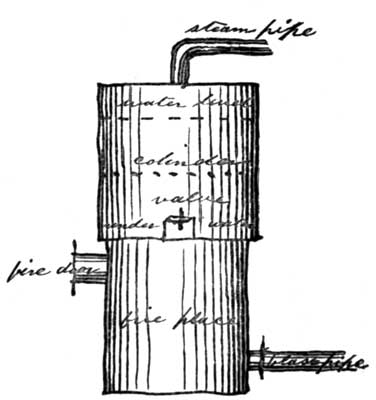
Its general design is seen in the patent drawing of 1802, Fig.
1.[62] Trevithick determined in future to use two safety-valves, and
also a safety steam-gauge. At that time one of his high-pressure
puffer-engines, with a cylindrical boiler and internal tube, was
working in Staffordshire.
The Greenwich high-pressure puffer-engine did fourteen millions of
duty with a bushel of coals, 84 lbs. A 60-horse-power engine was being
built in Wales, with an 8-feet stroke, to work expansively with 30 lbs.
of steam on the inch in the boiler. For a more thorough test with the
low-pressure vacuum engines, in competition, the Government intended to
use the new engines, and some of Watt's engines having been removed to
make room for them, Boulton and Watt wrote to a gentleman who was about
to order an engine from Trevithick, "We knew the effects of strong
steam long since, and should have erected them, but knew the risk was
too great." Moreover, "it was an invention of Mr. Watt's, and the
patent (Trevithick's) was not worth anything." This admission clearly
shows not only that Watt did not make high-pressure steam-engines, but
that he did his best to prevent others from making them.
"Penydarran, Cardiff, January 5th, 1804.
"Mr. Giddy,
"Sir,—I received yours a few days since, and should have answered
it sooner, but I was at Swansea for the last four weeks, and wished
to return here to give you as full an account of our proceedings as
possible.
"We have had an 8-inch cylinder at work here by way of trial; it
worked exceedingly well a hammer of the same size as is now being
worked here by an atmospheric engine 28 inches diameter, 5-feet
stroke, which does not master its work with greater ease than the
8-inch cylinder. The 8-inch is now removed to Swansea, and is winding
coals; the baskets hold 6 cwt. of coal; it lifts 80 yards in a minute
and a quarter, and burns 6 cwt. of coal in twenty-four hours. There
were twelve horses on this pit before, lifting 80 tons of coal in the
course of the twenty-four hours. You may fairly state that the 8-inch
cylinder does between thirty and forty horses' work in twenty-four
hours, with 6 cwt. of coal.
"One of Boulton and Watt's 18-inch double engine, about half a mile
from it, lifting baskets of the same size, and with the same velocity,
burns above three times the quantity of coal.
"The 8-inch engine requires the steam to be about 46 or 48 lbs. to the
inch to do its work well. The standers-by would not believe that such
a small engine could lift a basket of coal, but are now much pleased
with it, and have given orders for several more. There will be another
at work here for the same purpose in about six weeks, a 15-inch
cylinder, 6-feet stroke, which is a great power for a winding engine.
"Mr. Watt says, in a letter to Mr. Homfray, that he could not make any
of his experiments in strong steam answer the purpose. It is my belief
that he never made any experiments of any consequence in strong steam.
"A great number are building at different foundries. Mr. Sharratt, a
founder at Manchester, who has four in building, said that he would
not pay the patent right; on giving him notice of a trial he agreed to
pay the patent right.
"I have received a letter from London, saying that an engineer called
Dixon has two engines on the same plan working; and says that he
shall not pay anything to the patentee; that the words in Mr. Watt's
specification are enough to indemnify him from my threats. We have
had three counsels' opinions on the subject, and they all agree that
the patent is good. Counsels Marratt and Gibbs principally treated
on the construction of the engine, more than on the principle; but
Erskine was principally on the principle of the engine, and said very
little of its construction. They all say the words in Mr. Watt's
specification will have no weight whatever against us.
"I shall leave this place to-morrow for London to make inquiry into
those engines, and to get the business into court if they will
contend. I shall be at No. 2, Southampton Street, Strand, and expect
to be in town about five or six days, and if you will be so good as to
return here, from Oxford, with me, I will call on you in my journey
down. It is but 50 miles from Bristol, and not so much as 100 miles
from Oxford, and the coach passes very near this place.
"There is a great deal of machinery and mining here, which would
engage your attention for a few days, and very pleasant gentlemen
about the neighbourhood.
"If I had not been called to Swansea to put up the winding engine,
the road-engine would have been at work long since, but in my absence
very little was done to it. The work is all ready, and a part of it
put together. If I could tarry four or five days longer I could set
it to work before going to London. They promise me that it shall be
completed before my return. I think there is no doubt of its being
finished, as I have Frank Bennetts here from Cornwall about it, and a
plenty of hands to assist him.
"I have a thousand things to relate to you, too much for paper to
contain, therefore must request you to be so good as to go down from
Oxford with me, and I will promise, on warrant, that the road-engine
shall be finished before my return. When it is set to work I shall
return to Cornwall.
"I remain, Sir,
"Your humble servant,
"Richard. Trevithick.
In 1804 an 8-inch cylinder high-pressure puffer-engine, with steam
of 48 lbs. to the inch, worked a large hammer as well as a 28-inch
cylinder atmospheric engine, and more economically than a Watt
low-pressure steam vacuum engine with an 18-inch cylinder, which was
five times as large as the little high-pressure. In consequence of this
superiority those who came to witness the trial ordered several more of
Trevithick's engines, one of which with a 15-inch cylinder and 6-feet
stroke was to be at work in a few weeks.
Watt wrote to Mr. Homfray "that he could not make any of his
experiments in strong steam answer the purpose," and Trevithick
declared Watt never could have tried any experiments with high steam.
Dixon refused to pay patent right because the words of Mr. Watt's
specification, "in cases where cold water cannot be had in plenty, the
engines may be wrought by the force of steam only, by discharging the
steam into the open air after it has done its office," "are enough to
indemnify him." Eminent counsel were of opinion that "the words in
Watt's specification will have no weight whatever."
Marratt and Gibbs were inclined to rest on the difference in the
construction of the two kinds of engines, while Erskine boldly said
that the principle was different, and he cared little for the kind of
construction.
The admission by Watt that he could do nothing with high steam after
an experience of thirty years from the date of his patent, shows how
difficult the work was to those who had to find the way; yet Trevithick
had several at work within a few months of his first mental sight of a
steam-engine without condensing water, fitful glimpses of which passed
and repassed while he sat unobserved in the crowded law court in 1796
hearing the remarks of engineers and counsel.
"The public until now called me a scheming fellow, but their tone is
much altered. An engine is ordered for the West India Docks, to travel
itself from ship to ship, to unload and to take up the goods to the
upper floors of the storehouses.
"Boulton and Watt have strained every nerve to get a Bill in the House
to stop these engines, saying the lives of the public are endangered
by them, and I have no doubt they would have carried their point, if
Mr. Homfray had not gone to London to prevent it; in consequence of
which an engineer from Woolwich was ordered down, and one from the
Admiralty Office, to inspect and make trial of the strength of the
materials."[63]
After a week or two another letter states,[64]—
"We are preparing to get the materials ready for the experiments by
the London engineers, who are to be here on Sunday next. We have fixed
up 28 feet of 18-inch pumps for the engine to lift water.
"These engineers particularly requested that they might have a given
weight lifted, so as to be able to calculate the real duty done by a
bushel of coal.
"As they intend to make trial of the duty performed by the coal
consumed, they will state it as against the duty performed by
Boulton's great engines, which did upward of twenty-five millions,
when their 20-inch cylinders, after being put in the best order
possible, did not exceed ten millions. As you were consulted on all
those trials of Boulton's engines, your presence would have great
weight with those gents, otherwise I shall not have fair play. Let
me meet them on fair grounds and I will soon convince them of the
superiority of the 'Pressure-of-steam engine.'"
Watt left no stone unturned to prevent the use of high-pressure
steam-engines, and fortune favoured him, for after four or five days
Trevithick again wrote:—
"I am sorry to inform you that the experiments that were to be
exhibited before the London gents are put off, on account of
an accident which happened to Mr. Homfray. I find myself much
disappointed on account of the accident, for I was desirous to make
the engine go through its different work, that its effect might be
published as early as possible."[65]
While constructing those numerous high-pressure engines for rolling
mills, winding engines, and pumping engines, the Welsh and Newcastle
locomotives were being made and worked, yet he found time to teach the
people of Stourbridge.
"Stourbridge, July 5th, 1804.
"Mr. Giddy,
"Sir,—I should have answered your letter some time since, but waited
to set two other engines to work first. The great engine at Penydarran
goes on exceedingly well. The engine will roll 150 tons of iron a week
with 18 tons of coal. The two engines of Boulton's at Dowlais burn
40 tons to roll 160 tons; they are a 24-inch and a 27-inch double.
The engine at Penydarran is 18½ inches, 6-feet stroke, works
about eighteen strokes per minute: it requires the steam about 45
lbs. to the inch above the atmosphere. I worked it expansive first,
when working the hammer, which was a more regular load than rolling;
then with steam high enough to work twelve strokes per minute with
the cock open all the stroke; then I shut it off at half the stroke,
which reduced the number of strokes to ten and a half per minute,
the steam and load the same in both; but I did not continue to work
it expansively, because the work in rolling is very uneven, and the
careless workmen would stop the engine when working expansive.
"When the cylinder was full of steam the rollers could not stop it;
and as coal is not an object here, Mr. Homfray wished the engine
might be worked to its full power. The saving of coal would be very
great by working expansively.
"The trials we have made for several weeks past against Boulton's
engines have been by working with the cylinder full of steam. The
cock springs out of its seat when water gets into the cylinder, and
prevents any mischief from the velocity of the fly-wheel.
"The tram-engine has carried two loads of 10 tons of iron to the
shipping place since you left this. Mr. Hill says he will not pay the
bet, because there were some of the tram-plates in the tunnel removed
so as to get the road into the middle of the arch.
"The first objection he started was that one man should go with the
engine, without any assistance, which I performed myself without help;
and now his objection is that the road is not in the same place as
when the bet was made.
"I expect Mr. Homfray will be forced to take steps that will force him
to pay. As soon as I return from here there will be another trial, and
some person will be called to testify its effects, and then I expect
there will be a lawsuit immediately. The travelling engine is now
working a hammer.
"At Worcester last week we put a 10-horse engine to work in a glover's
manufactory. The flue from the engine is carried through the drying
room and dries his leather. The steam from the engine goes to take
the essence out of the bark, and also to extract the colour out of
the wood for dyeing the leather. Then it boils the dye, and the steam
that is left is carried into his hot-house. It works exceedingly well.
This week I put another to wind coals at this place, a 10-horse power,
which works very well. All the tradesmen are set against it; they say
that there is no carpenter or mason work about it, and very little
smith-work, and that it will destroy their business. The engineer on
the spot is also against it very much. I do not expect that it will be
kept long at work after I leave it, unless the proprietor takes care
to prevent those people from doing an injury to it. Mr. Homfray was
here yesterday, but is now returned to Penydarran. I shall go from
here to Coalbrookdale.
"There is an engine there almost ready for the West India Docks. It
will be ready to send off to London in about four weeks. It will be a
very complete engine. The pumps for forcing the water will be fixed on
the back of the boiler. It will force 500 gallons of water 100 feet
high in a minute; above ten times the quantity that engines worked by
men can do. Mr. Homfray and myself shall be in town as soon as the
castings are sent off. I hope you will be there at the time. If you
wish to see the engines already at work in London, call on Mr. David
Watson, steam-engine maker, Blackfriars Road. He lives up about 500
or 600 yards above the bridge on the left-hand side; you will see his
name over his door. If you have time to inspect those engines you will
find by comparing them against Boulton's, doing the same work, that
there is a great saving of coal above other engines.... I shall go to
Liverpool and Manchester from here, and again to Coalbrookdale.
"There are three engines at the Dale begun, to work with condensers,
for places where coal is scarce. I think it is better to make them
ourselves, for if we do not, some others will, for there must be a
saving of coal by condensing. But with small engines, or where coal is
plentiful, the engine would be best without it. They say at the Dale
about putting two cylinders, but I think one cylinder partly filled
with steam would do equally as well as two cylinders.
"That engine at Worcester shuts off the steam at the first third of
the stroke, and works very uniformly. I cannot tell what coal it
burns yet, but I believe it is a very small quantity. I shall know in
a short time what advantage will be gained by working expansive. I
expect it will be very considerable. There are a great many engines
making and ordered. Boulton and Watt and several others are doing
everything to destroy their credit, but it is impossible to destroy
it now that it is so well known. I have not taken any of the ground
at Bristol to remove. I called on them and told them it was possible
to break the ground without men, and they wish me to take a piece to
clear out, but would not set but a small piece at a time; therefore
it would be disclosing the business to no purpose. They were very
desirous to know the plan, but I would not satisfy them, neither will
I unless they pay me for it in some way or other. If you direct for me
at the Dale it will find me. I am happy to find that you have a seat
in the House. I wish every seat was filled with such.
"I remain, Sir,
"Your very humble servant,
"Richard. Trevithick.
Trevithick fully understood the value of the expansive principle in
1804: when working with steam of 45 lbs. to the inch, the engine went
at a speed of twelve strokes a minute. On cutting off the steam at
half-stroke, the speed and consequent work done fell to ten and a half
strokes a minute; in other words, the work performed by the engine fell
off only one-eighth part, while the quantity of steam and consequently
of coal was reduced by one-half. The principle was established, but
the application was practically incomplete from the want of heavier
fly-wheels, to give out their momentum during the latter half of the
stroke, when the expanding steam was lessening its force.
"The saving of coal would be very great by working expansively,
but as coal is not an object here," Mr. Homfray was careless about
the expansion. Thirty-three years after this indirect check to
steam-engine economy, the writer, then living in the Sirhowey Iron
Works, and within stone's-throw of Mr. Homfray's Works, recommended
the removal of the Boulton and Watt's waggon boilers, to make room
for Trevithick's boilers, on the plea of saving one-half the fuel,
and at the same time increasing the power of the engine, and thereby
the pressure of the blast in the iron furnaces. The proprietor was
careless about the saving of coal, and was doubtful that an increased
blast would increase the quantity of iron smelted. The promise that
the wages of one-half of the number of boiler firemen would be saved,
was understood. Trevithick's high-pressure boilers replaced the Watt
low-pressure, resulting in a largely-increased quantity of iron from
the greater power and pressure of blast in the furnaces, and at
one-half the expenditure of coal in the boilers: ten men had been
employed as firemen of the Watt boilers during twenty-four hours; with
Trevithick's boilers, five men did the work.
The high-pressure puffer-engine, with an 18-inch cylinder, working with
45 lbs. of steam, rolled as much iron as the two larger low-pressure
vacuum engines of Watt, of 24 and 27 inch cylinders, which together
were more than three times the size of the high-pressure engine, and
cost three times as much.
At Stourbridge, as elsewhere, everyone was against the new plan. The
engineer in charge did not like it, and the carpenters, smiths, and
masons saw the end of their occupation as engine erectors, if there was
no longer a necessity for foundations, well-work, &c., for condensing
water, and many other things, necessary to complete a Watt engine;
while the high-pressure puffer was no sooner unloaded than it was ready
to work.
A great charm in Trevithick's character was his freedom and largeness
of view in questions of competition. He was then making three engines
at Coalbrookdale, to be worked with high-pressure steam, combined with
the Watt air-pump and condenser; and though smarting from the contest
with his great rival, yet wrote, "I think it is better to make them
ourselves, for if we do not, some others will, for there must be a
saving of coal by condensing. But with small engines, or where coal is
plentiful, the engine would be best without it."
Those words accurately describe the practice of the present day, though
written sixty-six years ago, and were followed by others equally true
in principle, though varied in form to suit special requirement. "They
say at the Dale about putting two cylinders, but I think one cylinder
partly filled with steam would, do equally as well as two cylinders."
These sagacious views required the untiring labour of the following
twelve years to perfect and make practical, when applied to the largest
engines of the time; which we shall now trace in the construction of
a strong and economical boiler, supplying high-pressure steam to the
cylinder during only a comparatively small portion of the stroke,
completing it by expansion, so that at its finish the steam had become
of low pressure when passed to the condenser. The moving parts and
expansive gear were so simplified as to be applicable to the then
existing low-pressure steam vacuum engines without the complication of
the double cylinders of Hornblower and Woolf.
"Penydarran Place, December 26th, 1804.
"Dear Sir,
"I have been favoured with your letter, and in answer, respecting Mr.
Mitchell, I am at a loss to know from your letter what kind of iron he
may likely want. If you will direct him to write to me, and explain
himself, I will immediately reply to him and do what I can to assist
and serve him. I believe there are vessels going over frequently from
Cardiff to Cornwall with coals, that he might have part in cargo and
the remainder in coals. I am happy to give you the most satisfactory
account of our 'Trevithick's engine' going on well. It has now been
at work many months, and is by far the best engine we have. We have
for weeks weighed the coal, and knowing the work it does, can speak
with confidence. Its 18 inches diameter steam-cylinder consumes as
near as can be 3 tons of coal in twenty-four hours, or 18 tons per
week; and in this time it rolls with ease 130 tons long weight of
iron from the puddling furnaces, at the same heat, into bars of 3
inches by about half an inch thick. Now, one on Messrs. Boulton and
Watt's plan, of '24 inches' steam-cylinder, at our neighbouring
works at Dowlais, employed in doing exactly the same kind of work,
consumes full as much coal, and rolls only 90 tons in the week.
These being facts, open for any person daily to see, must convince
any dispassionate man of the superiority of 'Trevithick's engines,'
and that the saving of fuel is nearly one-third, besides the other
advantages of saving water and grease, which is no little. The
packing of the piston now gives us little or no trouble, it goes
from a fortnight to a month, opening the top now and then to screw
it down, as it gets slack, which should be attended to. We use no
grease or oil in packing the piston or working the engine, having
found blacklead mixed with water, and poured 'a little now and then'
through a hole on the top into the steam-cylinder, suits the packing
of the piston much better, and is cheaper than anything else. About
1s. worth of blacklead will last our engine a week. We are now so
thoroughly convinced of the superiority of these engines that I have
just begun another of larger size. The boiler is to be 24 or 26 feet
long, 7 feet diameter, fire-tube at wide end 4 feet 4 inches, and at
narrow end, where it takes the chimney, 21 inches, steam-cylinder 23
inches diameter. This boiler, on account of the length of its tube
withinside, will, I have no doubt, get steam in proportion, and work
the engine with much less coals than our present one. Trevithick is
at Coalbrookdale, Manchester, &c., &c., very busy, a great number
of engines being in hand in that part of the world; and I think by
perseverance the prejudice is wearing away very fast, and in spite of
all Messrs. Boulton and Watt's opposition, they must and will take the
lead of theirs. Any person now wanting engines, must be next kin to an
idiot to erect one of Boulton's in preference to Trevithick's. I find
there is a small one making near you by Mr. Vivian. I hope they have
corresponded with Trevithick about the proportions of it; if they
have not, I shall be particularly obliged to you to desire them to do
so, for by his experience of what he has done they may be benefited,
for it would be a shocking thing to have a bad engine put up for the
first time in his native county.
"Mrs. Homfray unites with me in best compliments, and wishing you many
happy returns of the season.
"I remain,dear Sir,
"Your most obedient servant,
"Samuel Homfray.
"To Mr. Davies Giddy."
The evidence in this contest between the Watt low-pressure steam
vacuum engine and the Trevithick high-pressure steam-puffer engine is
in favour of the new principle; for the steam-engine with an 18-inch
cylinder did fifty per cent. more work than the vacuum engine with a
24-inch cylinder with an equal quantity of coal, though the latter was
seventy-five per cent. larger than the former; and a still greater
economy was expected from the larger boiler to be built, 26 feet long,
7 feet in diameter, with internal fire-tube 4 feet 4 inches diameter at
the fire end, tapering to 21 inches at the chimney end.
Thus in 1804 the cylindrical boiler in Wales had nearly reached its
present form, and Homfray thought that none but idiots would prefer the
Watt engine; forgetting that Trevithick's near friends and neighbours
were carrying on a similar contest at Dolcoath Mine.
"Penydarran Place, January 2nd, 1805.
"Mr. Davies Giddy,
"Dear Sir,—I have duly received your favour enclosing a letter for
Mr. Trevithick, and which I, according to your desire, forwarded to
him at Manchester, where he now is; and a letter directed to him, to
the care of Mr. Whitehead, Soho Foundry, Manchester, will find him, as
he will stay a little time there, being very busy. I had lately the
pleasure of writing to you, and gave you the account of our engine
working, and the satisfaction it gives; I have nothing more to add
on the subject, but that it is now at work, going on as usual, and I
should be happy for you to have a sight of it.
"We are beginning another of a larger size, and I have no doubt but
by making the cylindrical boiler larger, so as to take a longer tube
withinside it, by which means the fire will spend itself before it
leaves the tube to go up the chimney, that we shall work to much
better advantage in point of fuel than we do at this present one, as
this boiler is so short that a great deal of the flame of the fire
goes up the chimney. We are now better acquainted with the different
proportions than we at first were, for which reason I am anxious
that one now making by Mr. Vivian should be made according to the
directions of Mr. Trevithick.
"I beg leave to offer you the compliments of the season, and many
happy returns, and
"Remain, respectfully, dear Sir,
"Your most obedient servant,
"Samuel Homfray."
Trevithick, always busy, was just now doing the work of a host, for
everybody had to be taught how to make high-pressure steam-engines; and
the Newcastle locomotive, the Thames steam-dredging, and other special
applications of steam-power required his presence, especially the fight
with Watt at Dolcoath Mine, where Andrew Vivian, as mine manager, was
erecting a high-pressure steam-puffer whim-engine to compete with a
Watt low-pressure steam vacuum whim-engine.
"The adventurers grumbled because Captain Trevithick was so often away
from the mine. Glanville, the mine carpenter, the head man over the
engines, made a trial between Trevithick's high-pressure puffer whim
and Watt's low-pressure condenser. When Captain Trevithick heard of
it, he wrote down from London that he would bet Glanville 50l. that
his high-pressure puffer should beat Watt's low-pressure condenser.
Then he came down from London and found that the piston of his engine
was half an inch smaller in diameter than the cylinder. When a new
piston was put in, she beat Boulton and Watt all to nothing. Persons
were chosen to make a three or four weeks' trial, and when it was
over, 'a little pit was found with coal buried in it, that Glanville
meant to use in the Watt engine.'"[66]
Pooly, Smith, and others, say that Trevithick's Dolcoath puffer had
the outer case of the boiler of cast iron, the fire-tube of wrought
iron, the cylinder horizontal, and fixed in the boiler. Captain Joseph
Vivian saw Trevithick's whim in Stray Park Mine about 1800 or 1801,
and a similar one was erected in Dolcoath, and after a year or two a
Boulton and Watt low-pressure whim was put up to beat it. The trial was
in favour of the Watt engine, but everybody said the agents were told
beforehand which way the report ought to go; so the engine that puffed
the steam up the chimney was beaten.
Trevithick, who was busily engaged in Manchester at that time, the
early part of 1805, when informed of what was going on in Cornwall,
wrote:—
"I fear that engine at Dolcoath will be a bad one. I never knew
anything about its being built until you wrote to me about Penberthy
Crofts engine, when you mentioned it. I then requested Captain A.
Vivian to inform me the particulars about it, and I find that it will
not be a good job. I wish it never was begun."[67]
"Camborne, February 18th, 1806.
"Mr. Giddy,
"Sir,—On my return from town I altered the pressure of the
steam-engine at the bottom of the hill, Dolcoath. Before I returned
there was a trial between mine and one of Boulton's; both engines in
the same mine and drawing ores from the same depth. The result was,
Boulton's beat the pressure-engine as 120 to 55. Since it was altered
there have been three other trials; the result was 147 to 35 in favour
of the pressure of the steam-engine. They are now on trial for another
month, and at the next account they intend to order a new boiler for
the great engine, and work with high-pressure steam and condenser,
provided this engine continues to do the same duty as was done in the
former trials. This engine is now drawing from a perpendicular shaft,
and Boulton and Watt's from an underlay shaft; but to convince Captain
Jos. Vivian, we put it to draw out of the worst shaft in the mine, and
then we beat more than three to one; we lifted in forty-seven hours,
233 tons of stuff 100 fathoms with 47 bushels of coal. The engine was
on trial sixty-six hours, but nineteen hours were hindered by the
shaft and ropes, &c., which made the consumption of coals about ¾ths
of a bushel per hour. The fire-tube is 2 feet 3 inches diameter, and
the fire-bars were only 14 inches long. The fire-place was but 2 feet
3 inches wide by 14 inches long, and the fire about 4 or 5 inches
thick; it raised steam in plenty; it was as bright as a star. The
engine is now doing the work of two steam-whims; the other steam-whim
in the Valley is turned idle, and both shafts will not more than half
supply it. 233 tons are equal to nearly 2000 kibbals, which were drawn
in forty-seven hours.
"Mr. Harris has a 12-inch cylinder making at Hayle, for Crenver, and
Mr. Daniel has a 14-inch for Perran-sand, and a great number are
waiting for the trial of this month, before altering their boilers to
the great engines.
"The steam-whim that is now turned idle at the Valley was 13½-inch
cylinder, 4-feet stroke; it turned the whim one revolution to one
stroke, and lifted the kibbal the same height at a stroke as my
engine did, and I think took the same number of gallons of steam to
lift a kibbal as mine did. Their steam was not above 4 lbs. to the
inch; mine was near 40 lbs. to the inch; yet I raised my steam of
near 40 lbs. with a third of the coals by which they got theirs of
4 lbs. to the inch. This is what I cannot account for, unless it is
by getting the fire very small and extremely hot. Another advantage
I have is, that there is no smoke that goes off from my fire to clog
the fire sides of the boiler, while the common boilers get soot half
an inch thick, and the mud falls on the bottom of the boiler, where
the fire ought to act; but in these new boilers the mud falls to
the bottom, where there is no fire, and both the inside and outside
of the tube are clean and exposed both to fire and water. This
fire-place of 14 inches was 5 feet long when I
came down, and then the coal did not do above one-seventh of the duty
that it now does.
"I would be very much obliged to you for your opinion on what I have
stated, and what advantage you think the great engine is likely to
get from working with steam about 25 lbs. to the inch, and shut off
early in the stroke, so as to have the steam about 4 lbs. to the inch
when the piston is at the bottom. I think this, with the advantage of
the fire-place, will make a great saving.
"The present fire-place is 22 feet from fire-door to fire-door, 9 feet
wide, and 7 feet thick in fire. There is not one-tenth of the coals
that are in the fire-place on fire at the same time; it will hold 30
tons of coals at one time, and I think that a great deal of coal is
destroyed by a partial heat before it takes fire. A boiler on the
new plan will not cost more than two-thirds of the old way, and will
last double the time, and can be cleaned in three hours. It requires
twenty-four hours in the old way, and we need to clean the boilers
only one-fourth the number of times.
"Though these trials have shown so fairly that it is a great
advantage, my old acquaintances are still striving with all their
might to destroy the use of it; but facts will soon silence them.
"I am about to enter into a contract with the Trinity Board for
lifting up the ballast out of the bottom of the Thames for all the
shipping. The first quantity stated was 300,000 tons per year, but
now they state 500,000 tons per year. I am to do nothing but wind up
the chain for 6d. per ton, which is now done by men. They never
lift it above 25 feet high. A man will now get up 10 tons for 7s.
My engine at Dolcoath has lifted above 100 tons that height with 1
bushel of coals. I have two engines already finished for this purpose,
and shall be in town in about fifteen days to set them at work. They
propose to engage with me for twenty-one years. The outlines of the
contract they have sent me down, which I think is on very fair terms.
I would thank you for your answer before I leave this county.
"I am, Sir,
"Your very humble servant,
"R. Trevithick.
In the trial at Dolcoath during his absence the high-pressure
steam-puffer whim was beaten by Watt's low-pressure steam vacuum
whim-engine as 55 to 120; but having corrected some oversight in the
puffer-engine, it then beat Watt as 147 to 35. The trial was to be
continued for a month; and provided the superiority of his whim-engine
could be maintained, the adventurers would allow him to apply his
high-pressure boilers to their large Boulton and Watt pumping engine.
The trial with the whim-engines was for the greatest number of kibbals
of mineral raised to the surface by the least consumption of coal. A
dispute arose on the difference of the shafts, the one causing more
friction to the moving kibbal than the other, when Trevithick agreed
to take the worst shaft in the mine. On a trial during sixty-six hours
Watt's engine was beaten by more than four times; and as Trevithick's
engine did the work that before required two engines, one of the
low-pressure steam Watt engines was removed that the engine working
with 40 lbs. on the inch might perform the whole work.
"My fire-tube is 2 feet 3 inches in diameter, and the fire-bars only
14 inches long, and the fire only about 4 or 5 inches thick; it raised
steam in plenty, and was as bright as a star." These words certainly
imply the use of the blast-pipe, making the fire as bright as a star,
and enabling the small boiler to give the required supply of steam.
Several high-pressure puffer-engines had been ordered, and many persons
were waiting the conclusion of the month's public trial to enable them
to judge between the Watt and the Trevithick engine.
"Camborne, March 4th, 1806.
"Mr. Giddy,
"Sir,—The day after I wrote to you the first letter, I received
yours, and this day I have yours of the 1st instant.
"I am very much obliged to you for the figures you have sent me. I am
convinced that the pressure of steam will not hold good as theory
points it out, because on expanding it will get colder, and of course
lose a part of its expansive force after the steam-valve shuts. I
think there can be no risk in making this trial on Dolcoath great
engine, as they intend to have a new boiler immediately, so as to
prevent stopping to cleanse; and a boiler on this new plan can be
made for one-third less expense than on the old plan, when you count
the large boiler-house and ashes-pit, and brickwork round the boiler.
It is not intended to alter any part of the engine or condenser, but
only work with high steam from this new boiler; and if this boiler
only performs as good duty as the old one, it will be a saving of near
300l. to them on the erection. The vast matter this great engine has
in motion will answer in part the use of a fly-wheel: the whole of
the matter in motion is near about 200 tons, at a velocity of about
160 feet a minute. This I know will not be sufficient; but it will be
about equal to a fly-wheel of 20 feet diameter, 25 tons weight, twenty
rounds per minute, if weight and velocity answer the same purpose.
"Since Monday, the 18th February, being Dolcoath account-day, both
engines have been on trial, and are to be continued until the next
account, 17th instant. The engines are kept on in the usual way, as
at other times. Neither of the engines have done so much duty as on
the first trials, as they have not been so strictly attended to. The
average of the trial at this time stands 26 cwt. for a bushel of coals
to Boulton and Watt's engine; mine, 83 cwt. for a bushel of coals.
"If I do not remain in Cornwall to attend next Dolcoath account, I
shall be in town about the 15th instant, otherwise about the 20th
instant. I shall call on you immediately on my arrival. In this time
I should be glad to hear from you again. The Trinity business will
answer exceedingly well; I have two engines ready for that purpose to
put to work on my arrival in town.
"I am, Sir,
"Your very humble servant,
"Rd. Trevithick.
"P.S.—I would try the evaporation of water by both boilers, but
Boulton and Watt's engine is so pressed with work, and being on the
best part of the mine, they will not stop it a moment. A boiler of 8
feet diameter and 30 feet long will have as much fire-sides in the
tube as there is now in Dolcoath great boiler. The fire-tube in this
boiler would be 5 feet diameter, and a fire-place 6 feet long in it
would be 30 feet of fire-bars. In the whim-engines I find that a
fire-place 14 inches long and the tube 2 feet 3 inches diameter would,
being forced, burn 1 bushel per hour. At this rate the great tube
would burn near 12 bushels per hour, which is above the quantity that
the great engine boiler can consume, now at work. Small tubes would
have an advantage over large ones. Two boilers would not cost much
more than one large one, and be much stronger."
The battle-ground of the fight between low and high pressure from 1806
to 1812 had also served for the personal encounter of Trevithick, sen.,
and Watt a quarter of a century before, when the Dolcoath great pumping
engine was erected to compete with the two earlier atmospherics; all
three were still at work, overlooked by Carn Brea hill and castle, once
the resort of Druid priests, whose sacrificial rites are still traced,
by the hollows and channels for the blood of victims on the granite
rocks.
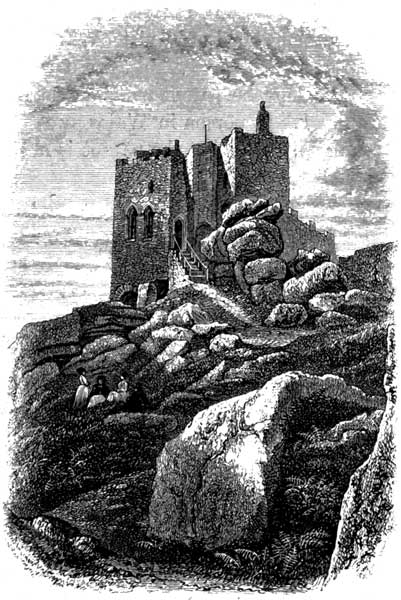
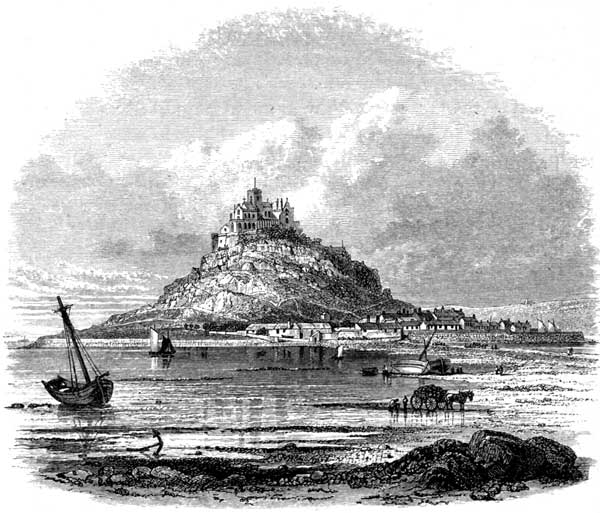
Carn Brea Castle. [W. J. Welch.]
"Camborne, March 21st, 1806.
"Mr. Giddy,
"Sir,—The trial between the two engines ended last Monday, which
was Dolcoath day. Boulton and Watt's engine, per average of trial,
1 ton 20 cwt. 2 qrs., with 1 bushel of coals; the other, 5 tons 11
cwt. 3 qrs., with 1 ditto, the same depth of shaft. The adventurers
ordered the new castings that were made for another of Boulton and
Watt's engines to be thrown aside, and another new engine of mine to
be built immediately. The great boiler for the old engine is not yet
ordered.
"I have received orders for nine engines within these four weeks, all
for Cornwall. Two 12-inch cylinders, two 16-inch ditto, three 9-inch
ditto, one 8-inch ditto, one 7-inch ditto. I expect one will be put to
work next week at Wheal Abraham, for lifting water.
"This day I shall leave Cornwall for London. Shall stop two days in
the neighbourhood of Tavistock, and take orders for three engines. As
soon as I arrive in town I will call at your lodgings. I expect that
the patent will be brought into court about the end of May. A person
in Wales owes us about 600l. patent premium, and he says that the
patent is not good. More particulars you shall have on my arrival.
"The railroad is going forward. I have the drawings in hand for the
inclined plane.
"I am, Sir,
"Your very humble servant,
"Rd. Trevithick.
The fact that expansion of steam caused reduction of heat was so
evident to Trevithick that he ventured to doubt his friend's theory.
The trials between the whim-engines having continued a fortnight,
showed that the high-pressure steam-puffer had lifted 83 cwt., while
the low-pressure steam vacuum only lifted 26 cwt. with the consumption
of a bushel of coal. A suitable high-pressure boiler for the Watt
low-pressure steam 63-inch pumping engine should be 30 feet long,
8 feet in diameter, with an internal fire-tube 5 feet in diameter;
proportions approved of in the present day. The recommendation in 1806
to use small tubes may claim to be the first practical decision on the
advantage of tubular boilers; and at the same time we read of the first
hesitating step on the part of the public to use high-pressure steam
in a Watt low-pressure engine, which was still deferred for further
consideration, even with the limited pressure of 25 lbs. to an inch;
so the large Watt pumping engines were doomed for another four or five
years to struggle through their work with low-pressure steam, though at
that time Cook's Kitchen high-pressure expansive condensing whim-engine
had been for years at work close by.
The shareholders professed to have fear of explosion; but party-feeling
and ignorance were the real causes of opposition, for working men had
no dread of the new engines, while influential men leaned toward Watt's
old-fashioned plans.
This fear of Trevithick's expansive plans and high steam is the more
surprising, because at that time a new boiler was required for the Watt
63-inch cylinder pumping engine and Trevithick's cylindrical tubular
boiler could be made for one-third less cost than the Watt waggon
boiler, thus saving 300l., and in addition he promised to apply the
higher pressure of steam to the Watt engine without any change in
its parts or expenditure of money, and make it set in motion at the
commencement of the stroke the 200 tons of pump-rods, the momentum of
which would, with the expansion of the steam, when shutting it off soon
after the first start in the movement of each stroke, carry it through
to the end; and he practically compares this advantage from hoarded
momentum in the pumping engine with his experience of the fly-wheel of
the rolling-mill expansive engine in Wales.
The whim-engine with a fire-tube 2 feet 3 inches in diameter used 84
lbs. of coal per hour; and at that rate one cylindrical boiler 30 feet
long, 8 feet in diameter, with internal fire-tube 5 feet in diameter,
would supply steam for Watt's 63-inch cylinder; but in place of it he
preferred two smaller boilers, because small tubes have an advantage
over large ones, and are much stronger.
The whim trials—high-pressure puffer against low-pressure vacuum—went
on for another fortnight, when high pressure, having done twice as
much work as low pressure, with an equal consumption of coal, the
adventurers threw aside the work that had been made for another Watt
engine, ordering one in its stead from Trevithick; but they could not
just then make up their minds to place the Watt 63-inch pumping engine
in his hands.
"Camborne, May 30th, 1806.
"Dear Sir,
"I am very happy to find you have so far continued your agreement with
the Trinity gents, and think the bargain is a good one. Must still beg
leave to remind you not to proceed to show what your engine will do
till the agreement is fully drawn up and regularly signed.
"Dolcoath agents, since they are informed of the accident at the
iron-works in Wales, of the engine blowing to pieces, have requested
me to have your opinion whether the old cylinder is strong enough for
the boiler of the intended new engine, or whether you would recommend
them to have a new one. Your answer to this as soon as possible, as
Mr. Williams and some others are likely to make some objections.
"Mr. Sims, the engineer, has published in the Truro paper, that one of
Boulton and Watt's engines at Wheal Jewell has drawn more than a ton
of ore over and above that drawn by the Dolcoath engine from the same
depth by a bushel of coal. On inquiry I found they had only tried for
twenty-two hours. They said they left off with as good a fire as they
began with. This I argued was not a fair trial. They say they are now
on a trial for a month.
"The little engine at Wheal Abraham does its duty extremely well. The
particulars as to consumption of coal cannot be fairly ascertained, as
she has never been covered, is fed with cold water, and has not water
to draw to keep her constantly at work.
"I wish I could give a better account of the mines than is in my power
to give, or of the standard price for ore, though the latter is rather
looking up than otherwise. Our friend, North Binner Downs, is better
than paying cost, but very little. At present the levels are all poor;
the lode in the west shaft has underlayed faster than the shaft, and
we have not seen it for several fathoms. The ground lately in the
shaft has been cleaner killas, and if any alteration, better ground.
It is now 9 fathoms under the 55-fathom level, and we are driving to
cut the lode. The ground in the cross-cut is harder than when you were
on the spot. The water is sinking in old Binner; it is about 7 fathoms
under the adit in the western part, and deeper in the eastern part; we
do not account for this. Wheal St. Aubyn combined poor. Wheal Abraham
looks promising, and Creuver about paying cost. Dolcoath is better
than when you left us, or when I was in London. The last sale was only
about 800 tons. The next sale on Thursday is upwards of 1100 tons, and
we expect a little better standard.
"I wish you could discover who that old gent is that wanted a large
slice in Dolcoath, that I might get at him through some unknown
channel, for I want money sadly.
"Cook's Kitchen continues poor, Tin Croft ditto; Wheal Fanny not rich.
We had a pretty little fight last account there with T. Kevill and W.
Reynolds, Esquires: black eyes and bloody noses the worst effects. T.
Kevill's face was much disfigured, and he might have found a new road
out of his coat.
"At a meeting of Condurrow adventurers yesterday, twenty-four of them
agreed to have one of our engines, cylinder 12 inches in diameter and
6-feet stroke, provided the Foxes do not object to it. When the order
is given I shall write to Mr. Hazeldine, provided I do not hear from
you that it is better to send the order to any other place.
"If you have occasion to write Mr. Hazeldine, I wish you would press
him to hasten the engines for Wheal Goshen, &c.
"I am served with a Vice-warden's petition by Mr. Harris for not
working the Weith mine in a more effectual manner, and he prays the
Vice-warden to make the sett void. The trial will come on some time
the beginning of July, and by that time I suppose we shall have two
fire-engines working thereon.
"Had Mr. Harvey done as he was desired we should have had one working
there at this time, but he has but now begun to do anything to it. We
have the cylinder and ends home from Polgooth, and my cousin Simon
Vivian is making the tubes. We have the other cylinder from Wheal
Treasury, and I have ordered Horton to cast a cock for it the same as
that at Dolcoath. We have cut the south lode at the adit level about
50 or 60 fathoms east of the engine, and have driven about 20 fathoms
on it. It turns out about half a ton per fathom at 20l. a ton. The
ground at 40s. per fathom; this all in a hole, and is better going
down. The back is sett to four men at 3s. 11d.; their time is out
this week, and I suppose they must have 5s. next. This may turn out
a few thousands, and I think too promising a thing to give up to Mr.
Harris.
"I am happy to inform you that all our friends are in good health, and
beg my most respectful compliments to Mrs. Rogers and adopted son; and
am,
"Dear, Sir,
"Yours very sincerely,
"Andw. Vivian.
"The promised news respecting the engine business I am very anxious
to have, as it will I hope make me proud, as proud I shall be when
I am able to pay everyone their demands, and have sufficient to carry
on a little business to maintain my family and self without the
assistance of others. May you succeed in your undertaking and also
be independent, is the sincere wish of your friend. John Finnis and
others are anxious to know when they will be wanted.
"A. V."
The explosion at Greenwich in 1803 was made much of, though the
fault was clearly not in the boiler. Three years afterwards, in
1806, a steam-cylinder burst in Wales, therefore Mr. Williams, a
large shareholder in Dolcoath, objected to the use of high-pressure
expansive steam in their large Watt pumping engine, and desired their
engineer, Mr. Sims, to make a competitive trial after his own fashion.
At Condurrow Mine one of Trevithick's engines was to be ordered if the
Foxes and Williamses did not object; and so it was that Trevithick's
high-pressure steam-boiler was not ordered, and the Watt vacuum engine
was for a longer time to receive no increase of power.
"Some of Captain Dick's early boilers had flattish or oval fire-tubes.
In 1820 I repaired an old one in Wheal Clowance Mine in Gwinear. The
flat top had come down a little; we put in a line of bolts, fastening
the top of the tube to the outer casing.
"About 1818 I saw in Carsize Mine in Gwinear a pumping engine that
Captain Dick had put up. The boiler was a cylinder of cast iron, with
a wrought-iron tube going through its length in which the fire was
placed. The steam-cylinder was vertical, fixed in the boiler. She had
an air-pump and worked with a four-way cock. The steam was about 100
lbs. to the inch."[68]
"About 1820 I removed one of Captain Trevithick's early high-pressure
whim-engines from Creuver and Wheal Abraham, and put it as a pumping
engine in Wheal Kitty, where it continued at work for about fifteen
years. The boiler was of cast iron, in two lengths bolted together,
about 6 feet in diameter and 10 feet long. At one end a piece was
bolted, into which the cylinder was fixed, so that it had the steam
and water around it. There was an internal wrought-iron tube that
turned back again to the fire-door end, where the wrought-iron chimney
was fixed; the fire-grate end of the tube was about 2 feet 6 inches
in diameter, and tapered down to about 1 foot 6 inches at the chimney
end. It was a puffer, working 60 lbs. of steam to the inch; it worked
very well. There were several others in the county at that time
something like it. It was made at the Neath Abbey Works in Wales."[69]
These boilers were of the kind first tried in Cornwall about 1800. The
oval tube in the Kensington model of 1798 continued in use in Cornwall
for many years. The cast-iron outer casing was soon abandoned, though
one of them in Wales remained in work fifty years, using steam of 60
lbs. to 100 lbs. to the inch.
"Hayle Foundry, August 26th, 1810.
"My dear Jane,,
"I saw Captain Andrew Vivian on Wednesday, who told me that he had
been offered 150l. a year to inspect all the engines in the county,
and report what duty they were doing, in order to stimulate the
engineers. He declined accepting it, having too much to do already;
and he thought it would be worth Trevithick's notice, as it would not
take him more than a day or two in a month.
"I remain, my dear Jane,
"Yours sincerely,
"H. Harvey..
"I wrote this letter on Sunday, with an intention of sending it then,
but thought it best to wait until this day, in hopes of hearing the
determination of Government in your favour; but your letter has
arrived without the desired information. All that I can now say is,
to desire that Trevithick will make up his mind to return to Cornwall
immediately.
"H. H."
The application to the Government for remuneration for benefits
conferred on the public was unsuccessful. The office of registrar of
Cornish engines was unsuitable; fortunately for mining interests,
illness obliged Trevithick to revisit his native county, for by
the increased power and economy of his engines Dolcoath Mine, so
frequently mentioned, and so important in olden time, now returns
70,000l. worth of tin yearly.
Trevithick's first act on returning to Cornwall in 1810 was the
erection of the high-pressure boilers and pole vacuum engine at Wheal
Prosper; at the same time renewing his proposals to Dolcoath to use
his improved boilers, which had been broken off in 1806, and to apply
high-pressure steam to their low-pressure Watt engine, with the same
safety and profit as in Wheal Prosper; the evidence was undeniable,
so his plans were agreed to, and in the early part of 1811 the
high-pressure boilers, called the Trevithick or Cornish boilers, were
constructed in the Dolcoath Mine under his directions.
Old John Bryant, who worked the Dolcoath large engines both before and
after the introduction of higher pressure steam, including the Carloose
or Bullan Garden 45-inch cylinder engine, Wheal Gons 63-inch cylinder
single engine, and the Watt 63-inch cylinder double, with the bee-but
boiler, such as Trevithick, sen., used in 1775,[70] followed by the Watt
waggon boiler, and afterwards by the globular boiler of Trevithick,
jun., in 1799,[71] and still later also with the cylindrical boiler of
1811, gave the following statement, when seventy-four years old, to the
writer:—
"In the old bee-but and the waggon boiler the steam pressure in the
boiler was not much; we did not trouble about it so long as the
engines kept going: when the steam was too high it blew off through
the feed-cistern. When Captain Trevithick tried his high steam in
Dolcoath we hoisted up the feed-cistern as high as we could; when
the steam got up, it blew the water out of the cistern. Captain Dick
holloed out, 'Why don't you trig down the clack?'
"The cylindrical boilers when they were first put in leaked very
much; we could hardly keep up the fire sometimes. I reckon the steam
was 30 or 40 lbs. to the inch. Captain Dick's boilers made him lots
of enemies. I heard say in one mine where he was trying his boilers
against Boulton and Watt's waggon, a lot of gunpowder was put into the
heap of coal."[72]
The waggon or hearse Watt boiler was attached to his 63-inch cylinder
double, and the old man recollected having raised the water cistern,
when Trevithick's globe boiler gave an increased pressure in 1799, ten
or twelve years before the cylindrical boilers were made in Dolcoath.
"Some time after Captain Dick's globe boiler and steam-whims had been
at work in Dolcoath, a letter came down from London, saying that he
would save the mine 100l. a month if they would put in one of his
new plan boilers.
"They were put in hand in the mine, and I worked about them; they were
wrought-iron cylindrical boilers, about 20 feet long, and 5 or 6 feet
in diameter; the fire-tube was about 3 feet in diameter; the fire
returned around the outside in brick flues. Three boilers were put in
side by side.
"When Captain Dick first tried them, he said to the men, Now mind, the
fire-bars must never have more than six inches of coal on them; give a
shovel or two to one boiler, and then to another. When Captain Dick's
back was turned, the men said they wasn't going to do anything of the
sort, there would never be no rest for them. They used to say that the
boilers saved more than 170l. the first month."[73]
Clark, when a boy, in 1799, helped to construct Trevithick's globular
boiler in Dolcoath, and recollected the events of the few following
years, during the contests with the whim-engines about 1806, and the
introduction of the large cylindrical wrought-iron boilers for the
pumping engines in 1811, and the struggle preceding the downfall
of the Watt low-pressure steam vacuum engine, to make room for the
high-pressure expansive steam-engine, with or without vacuum.
"About 1812 Captain Trevithick threw out the Boulton and Watt waggon
boilers at Dolcoath and put in his own, known as Trevithick's boiler.
They were about 30 feet long, 6 feet in diameter, with a tube about 3
feet 6 inches in diameter going through its length. There was a space
of about 6 inches between the bottom of the tube and the outer casing.
Many persons opposed the new plans. The Boulton and Watt low-pressure
engine did not work well with the high steam, and the water rose
in the mine workings. Captain Trevithick, seeing that he was being
swamped, received permission from the mine managers to dismiss the
old engine hands and employ his own staff. Captain Jacob Thomas was
the man chosen to put things right. He never left the mine until the
engine worked better than ever before, and forked the water to the
bottom of the mine. Before that time the average duty in the county by
the Boulton and Watt engines was seventeen or eighteen millions, and
in two or three years, with Trevithick's boilers and improvements in
the engines, the duty rose to forty millions. About 1826 he (Captain
Vivian) was manager of Wheal Towan; their engines were considered the
best in the county, doing eighty-seven millions; they had Trevithick's
boilers, working with high-pressure steam and expansive gear; few if
any of Boulton and Watt's boilers could then be found in the county.
Sir John Rennie and other scientific men, who doubted the reports of
the duty, came and made their own trials with the engines, and were
satisfied that the duty was correctly reported.
"About that time a Mr. Neville requested him to report on the engines
at his colliery at Llanelthy; one was an atmospheric of Newcomen's,
doing six millions; and four or five of Boulton and Watt's patent
engines averaged fourteen millions."[74]
When at last the cylindrical high-pressure boiler was admitted, and men
had been taught to fire them, many persons still liked the old plans,
and among them the easy-going low-pressure enginemen. The consequence
was that the Watt engines under their management refused the early
doses of Trevithick's high steam, not easily digesting it, and their
obstinacy nearly swamped Trevithick and his plans.
"When a little boy, about 1812, I frequently carried my father's
dinner from Penponds to Dolcoath Mine. One day, not finding him in the
engine-house, I sought him in the account-house, but not knowing him
in a miner's working dress, refused to give him his dinner. William
West then worked with him. I heard there was difficulty in making the
new boilers and the old engine work well; engineers from other mines
looked on from a distance, not liking the risk of explosion. People
seemed to be against the new plans; some labourers worked with them."
This narration—sixty years after the events—from Mr. Richard
Trevithick, the eldest son of the engineer, shows that William West
helped in applying high-pressure steam to the Watt low-pressure engine,
and that but few sympathized with the innovators on old customs; but
among them was Captain Jacob Thomas, who successfully fed the old
engine with strong steam.
At that time the Watt engines in Cornwall had been doing seventeen or
eighteen millions; Trevithick's new boilers increased their duty to
forty millions.
"William Pooly[75] was working in Dolcoath before Captain Trevithick's
new boilers were put in, and helped to put them in.
"The Shammal 45-inch engine was an open-top cylinder, with a chain to
the segment-head wooden beam. So was the 63-inch cylinder Stray Park
engine, then called Wheal Gons[76] in Dolcoath sett, and the Boulton
and Watt 63-inch cylinder double-acting.
"There used to be great talking about different boilers; a boiler of
Captain Trevithick's worked with higher steam than the others. Just
before Captain Dick came back to the mine a Boulton and Watt hearse
boiler had been repaired with a new bottom; it was never used. I and
William Causan took a job to cut up the boiler at 1s. 6d. the
hundredweight; it weighed 17 tons. Jeffrie and Gribble were the mine
engineers; Glanville used to be considered Captain Dick's man in the
mine. You could stand upright on the fire-bars in the middle hollow
of the hearse boiler, and so you could in the outside brick flues;
the middle hollow was like a horse-shoe. When Captain Dick put in his
cylindrical boilers he altered the 63-inch single; there was hardly
anything of her left but the main wall, with the wood bob and a chain
to the piston-rod, and also to the pump-rods. There was an air-pump,
and I think a second-hand cylinder was brought, but it was a 63-inch;
the old Shammal engine had been altered, too.
"The new boiler put in was about 8 feet in diameter and from 30 to
40 feet long, two round tubes went through it; the fire-place in one
end of one tube and in the other end of the other tube; after going
through the tubes the draught went into the brick flues under the
bottom and sides. When the new engine was put in, Gribble said, ‘Why,
these little things will never get steam enough;’ everybody said so.
"In the Boulton and Watt engines we didn't trouble about feed-pumps
and gauge-cocks.
"A wire came through a stuffing box in the top of the boiler; a
biggish stone in the boiler was fastened to one end of the wire, the
other end was fastened to a weighted lever near the water cistern,
just above the boiler; when the water got low the stone opened the
valve in the water cistern. That was when they were putting in Captain
Dick's new cylindrical boilers to the old 63-inch engine. She did so
much more work, with less coal, that in a year or so they agreed to
throw out Boulton and Watt's engine, and to put in a stronger one that
could stand Captain Dick's high steam. Jeffrie and Gribble were the
mine engineers that put her up. The 76-inch cylinder came from Wales.
The big beam was cast at Perran Foundry in 1815; you can see the name
and date upon it now. The boiler and the gear-work were made in the
mine. The exhaust-valve is exactly as when it was put in, worked by
a rack-and-tooth segment. The equilibrium valve is unchanged, except
that the rack is taken out and a link put in.
"The steam-valve was taken out soon after she went to work, and the
present double-beat valve was put in; it is the first of the kind I
ever saw. Some were made before that time with a small valve on the
top of the big one, that opened first, to ease the pressure.
"John West[77] fitted up the valve-gear in the mine with the expansive
tappets, the same as when she stopped a month or two ago, and the same
as the present new one has.
"Captain Dick's cutting off his strong steam at an early part of the
stroke, used to make the steam-valve strike very hard; so the new
plan valve, with a double beat, was put in; that must have been about
1816 or 1817; and the valve and expansive horn for working were just
exactly like what they have put into the present new engine in 1869.
She was the engine that showed them how to fork the water, and burn
only half the coal.
"I worked in this mine the old atmospheric engines, and then Boulton
and Watt; and then Trevithick's boilers in Boulton and Watt; and then
Trevithick's boilers and engine; and now I come every day to the new
engine, though I can't do much. They give me 35s. a month; and my
name is William Pooly, Dolcoath, 1869."
Three years ago (in 1869), when the writer entered the old engine-house
in which Watt's 63-inch cylinder double had been erected in 1780,
adjoining the old walls that then enclosed that early Newcomen 45-inch
cylinder Carloose engine, re-erected by Trevithick, sen., in 1775 in
Bullan Garden portion of Dolcoath, an old man sat near a small window
in a recess in the thick wall of the engine-house, within reach of
the gear-handles of the Jeffrie and Gribble 76-inch cylinder engine
that Trevithick, jun., had erected in 1816 on the foundations of the
removed Watt engine; he held in one hand a portion of slate from the
roof, and in the other an old pocket-knife, one-half of the blade of
which had been broken off, leaving a jagged fracture, with which he
made the figures of some calculation on the rude slate; on his nose
rested the brass frame of a pair of very ancient spectacles, with horn
glasses. He answered the writer's question by, "Yes, I am William
Pooly; I worked this engine, and the other engines before it—the great
double and the little Shammal working out of the same shaft; and I am
seventy-four years of age. The 63 single worked upon a shaft up there;
she was called Wheal Gons." That old man, still living, had worked in
Dolcoath Mine one of the first steam-engines of Newcomen; the 45-inch,
modified by Trevithick, sen.; then the 63-inch double of Watt; and,
finally, the high-pressure engines of Trevithick, jun.; he saw the
open-top cylinders, atmospheric of Newcomen, in the Shammal 45-inch and
Wheal Gons 63-inch, with their wooden beams with segment-headed ends,
moving in rivalry with the Watt 63-inch double, with cylinder-cover
and parallel motion; he saw the two former engines, as altered by
Trevithick, jun., using the higher steam from the globular boiler on
which Henry Clark worked in 1799, when "there used to be great talking
about different boilers, and a boiler of Captain Trevithick's worked
with higher steam than the others; and the waggon boiler of Watt, that
had just been repaired, was discarded and cut up;" thus described by
Trevithick, "the fire-place is 22 feet from fire-door to fire-door, 9
feet wide, and 7 feet thick in fire,"[78] which he proposed to replace
in 1806 by a cylindrical boiler to give steam of 25 lbs. on the inch.
Pooly also saw the finishing stroke in 1811, when the boilers still
known as the Trevithick or Cornish boilers, gave steam to the three
engines; after a twelve years' fight between low and high pressure,
commencing with Trevithick's globular boiler and internal tube, in
Dolcoath, in the year 1799, from which time it gained step by step,
though in comparatively small engines, up to 1811, when the cylindrical
boilers took the place of the condemned hearse and globular boilers,
and gave really strong and expansive steam to the three Dolcoath
pumping engines that from time immemorial had been rivals, causing
all three of them to lift an increased quantity of water, and at the
same time to save one-half in the cost of coal; this continued for
four or five years, when in 1816 the 63-inch double and the 45-inch,
being the youngest and the oldest of the three, were removed, that a
new 76-inch cylinder, better adapted to Trevithick's expansive steam
might more cheaply perform their joint work. Prior to this change the
three engines were known by the names Shammal 45-inch, formerly Bullan
Garden,[79] but before that as Carloose, of the period and form of the
Pool engine;[80] Stray Park 63 single, formerly Wheal Gons,[81] dated
from 1770 to 1777; and the 63-inch double of Watt in 1780.
"Dolcoath Mine, March 29th, 1858.
"Sir,
"I have obtained the following information respecting the building
of the first cylindrical boilers, as ordered by your late father
for Dolcoath; and some information of the results as to the coals
consumed, compared with the consumption by the boilers previously in
use here.
"George Row, now about seventy-two years old, and working at Camborne
Vean Mine, says he assisted to build the two first cylindrical boilers
with internal tubes used in Cornwall. They were built in Dolcoath Mine
in the year 1811; they were 18 feet long, 5 feet diameter, having an
oval tube 3 feet 4 inches in the largest diameter at the fire end;
the other or chimney end of the tube was somewhat smaller. They were
found too small for the work to be done, and another boiler was built
immediately, 22 feet long, 6 feet 2 inches diameter, and he believed a
4-feet tube.
"John Bryant, now seventy-four years old, works a steam-engine at
West Wheal Francis. He worked at Dolcoath the 63-inch cylinder
double-acting engine, upon Boulton and Watt's plan. When he first
worked her she had the old bee-but boiler, 24 feet in diameter. They
were taken out for the Boulton and Watt waggon boiler, 22 feet long
and 8 feet wide, with two fire-doors opposite one another.
"Then the Boulton and Watt waggon was taken out for Captain
Trevithick's boilers, which he worked for several years. Two boilers
were put in, each 18 feet long, 5 feet diameter, with an internal oval
tube, he thinks, 3 feet by 2 feet 6 inches. Shortly after, another
boiler of similar form was added, 22 feet long, 6 feet diameter,
4-feet tube.
"He cannot say what the saving of coal was, but remembers that the
duty performed by the engine with the waggon boiler was thirteen to
fourteen millions. Mr. William West came to the mine as an engineer,
and by paying great attention increased the duty of the Boulton
and Watt engine and boiler to about fifteen millions. He does not
recollect the duty the engine performed with the cylindrical boilers.
"Mr. Thomas Lean, of Praze, the present reporter of mine engines in
the western part of Cornwall, in answer to a note I sent to him, says
he has no account of any report of Dolcoath engines for the year
1812, but during the month of April in that year the engines did
21½ millions. During the whole of 1813 that engine was reported to
average a duty of twenty-one millions. The whole of the above are at
per bushel of 93 lbs., and the whole of the accounts furnished by Mr.
Lean are for Trevithick's cylindrical boilers.
"From the Dolcoath Mine books I find the following: Paid for coals for
the whole mine during the year 1811, 1150l. 15s. 10d., or per
month, 931l. 14s. 7d. During the first three months of 1812 the
coal averaged 1000l. per month. In May of this year, 1812, Captain
Trevithick is entered on the books as paid 40l. on account of
boilers; and in August of the same year, for erecting three boilers,
105l. I think the three boilers were at work in April, 1812, the
month Mr. Lean gives as the first reported. From April, 1812, to
December, during nine months, the cost of coals was 5512l. 6s.,
averaging 612l. 9s. 6d. per month. During the next year, 1813,
the cost for coal was 7019l. 17s. 5d., or an average per month
of 590l. 16s. 5d. I cannot find the price paid per ton for the
coal in these years, but the average price during 1808 and 1815 was
much alike, making it probable that the price per ton during 1811,
1812, and 1813, was nearly the same; and that the saving of the above
300l. per month in Dolcoath was wholly on account of the saving
effected by Trevithick's cylindrical boilers.
"The testimony of John Bryant, that the duty with the waggon boiler
was say fourteen millions, and that of Mr. Lean, giving twenty-one
millions with the new Trevithick boiler, bear much the same proportion
as the charges for coals in the respective periods above given.
"In the year 1816 a new 76-inch single engine was erected in the place
of the old Boulton and Watt 63-inch double engine with Trevithick's
cylindrical boilers. The average duty performed during the year 1817
was 43¾ millions. This same engine is still at work, and her
regular duty is from thirty-six to thirty-eight millions.
"I am, Sir,
"Your most obedient servant,
"Charles Thomas.
"Francis Trevithick, Esq."
Captain Charles Thomas, who was one of the most experienced of Cornish
miners, for many years the manager of Dolcoath, and in youth the
acquaintance of Trevithick, states that the new high-pressure boilers
were made in the mine in 1811, and gave their first supplies of strong
steam to the three large pumping engines in April, 1812, with such good
effect that the increasing water which had threatened to drown the
mine was speedily removed, and that with a saving of nearly one-half
of the coal before consumed. Prior to their use Dolcoath Mine paid
1000l. monthly for coal; but for the latter nine months of the year,
in consequence of the new boilers, the cost was reduced to 612l. a
month. This saving in the pumping cost of one mine crowned with success
the high-pressure steam engineer, who had been steadily gaining ground
during his fight of twelve or fourteen years on the battle-ground
chosen by Watt thirty-three years before.
The low price of tin and copper, which caused so many engines to cease
working about the close of the last century, had changed for the
better, and the present century opened with an increasing demand for
steam power. Trevithick's high-pressure portable engines had worked
satisfactorily for several years; and as a means of making public the
relative duty performed by Cornish pumping engines, and of solving
conflicting statements on the rival systems of low and high pressure
steam, it was determined that an intelligent person should examine
and give printed monthly reports of the amount of duty done by the
different engines, and in 1810 Captain Andrew Vivian was requested
to take this work of engine reporter in hand; on his refusal it was
offered to Trevithick. In August, 1811, Mr. Lean commenced such monthly
reports, showing that the duty of twelve pumping engines at the end of
that year averaged seventeen millions, exactly the duty done by the
Boulton and Watt engines thirteen years before, as reported by Davies
Gilbert and Captain Jenkin in 1798, proving the small inherent vitality
of the Watt engine.
In 1814 the Dolcoath pumping engines, with Trevithick's cylindrical
boiler and high steam expansion, are thus reported:—"The Boulton
and Watt, Dolcoath great double engine, 63-inch cylinder, did a duty
of 21½ millions; the Shammal 45-inch cylinder, single engine,
did 26¾ millions; and the 63-inch single, Stray Park engine, 32
millions." Shammal engine, nearly 100 years old, beat the Watt engine
of more than half a century later; and so did Stray Park 63-inch, which
Watt had laughed at when he first tried his hand as an engineer in
Cornwall in 1777.[82]
The marked change in these three engines, while for two or three years
under Trevithick's guidance, becoming more powerful and economical,
raised the usual swarm of detractors, and in 1815 a special trial was
made, which lasted for two days, to test the reported increased duty by
the cylindrical boilers and expansive working.
The unbelievers were then convinced, and agreed to throw out the
Boulton and Watt great double engine 63-inch cylinder, together with
its neighbour, the worn-out old 45-inch, and put in their stead one
engine with a cylinder of 76 inches in diameter, with expansive valve
and gear, and parts strong enough and suitable to the high-pressure
steam, on Trevithick's promise that it should do more than the combined
work of the other two with one-half the coal.
In 1816 this new engine commenced work, and did forty millions of
duty, increasing it during the next two or three years to forty-eight
millions, being three times the duty performed by the Watt 63-inch
double engine before it was supplied with steam from Trevithick's
boilers, and twice as much as it performed when so supplied. Lean
says, "This was the first instance of such duty having been performed
by an engine of that simple construction." The other mines followed
Trevithick's advice, but never paid him a penny. On this Lean again
says, "The engines at work in the county in 1835 would have consumed
80,000l. worth of coal over and above their actual consumption
yearly, but for the improvements that had been made since 1814."
Trevithick's engines were very durable, as well as cheap in first cost
and in working expense. This famous Dolcoath 76-inch engine remained
in constant work night and day for fifty-four years; after which good
service the steam-pipes, being thinned by rust, were held together by
bands and bolts; the steam-case around the cylinder would no longer
bear the pressure of steam; the interior of the cylinder from wear was
one inch larger in diameter than when first put in, and had to be held
together by strap-bolts. The original boilers were said to remain, only
they had been repaired until not an original plate remained; but there
they were in the old stoke-hole in 1869, when, from the fear of some
part of the engine breaking and causing accident, it was removed.
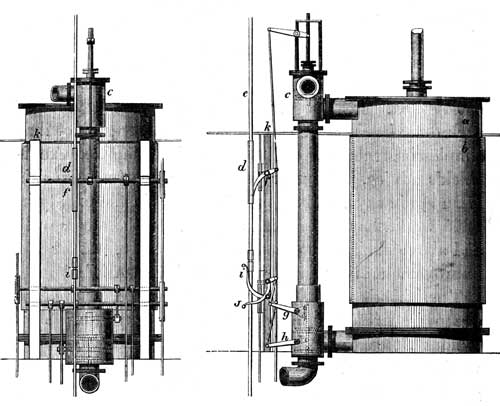
Trevithick's Dolcoath 76-inch Cylinder Pumping
Engine, erected in 1816, ceased working 1869.
a, steam-cylinder, 76 inches in diameter, 9-feet stroke; b,
steam-jacket; c, steam expansion-valve, 11 inches diameter, double
beat; the upper beat 11 inches diameter, the under beat 9½ inches,
valve 8 inches long; d, expansive cam on plug-rod; e, plug-rod
for moving the gear; f, expansive horn; g, equilibrium valve, 13
inches in diameter, single beat moved by a tooth-rack and segment; h,
exhaust-valve, 14½ inches in diameter, single beat moved by a lever
and link; i, equilibrium-valve handle; j, exhaust-valve handle;
k, Y-posts for carrying the gear arbors; l, main beam in two plates
of cast iron; m, parallel motion; n, feed-pump rod; o, air-pump
bucket-rod, the pump, 2 feet 9 inches diameter; p, the main pump
rods.
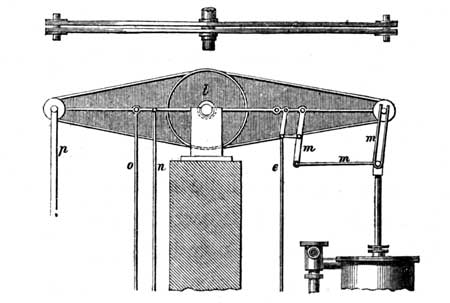
Cylinder, Main Beam, and Pump-rod of Dolcoath
76-inch Cylinder Engine.
In 1867 the writer was a member of the Dolcoath Managing Committee,
when it was determined that the old engine of 1816 should be replaced
by a new one. The cylinder sides were reduced in thickness by half an
inch; the steam-pipes and nozzles were thinned by rust and decay; the
valves and gear-work remained in good order. Captain Josiah Thomas, the
present manager of the mine, offered to sell this old engine at scrap
price, that it might be stored in the Patent Museum at Kensington as a
memento of the early high-pressure expansive steam pumping engine.
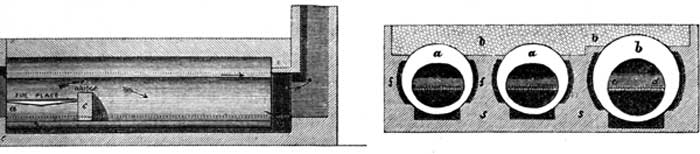
Boilers erected in 1811 in Dolcoath, used in
the Boulton and Watt 63-inch Engine, then in the new 76-inch until
1869.
a a, two wrought-iron cylindrical boilers, 5 feet in diameter, 18
feet long, with internal fire-tube, oval, 3 feet 4 inches by 3 feet;
b, a boiler, 6 feet 2 inches diameter, 22 feet long, cylindrical
tube, 4 feet diameter in the fire-place, the remainder 3 feet; c,
brick bridge; d, fire-bars; e, brick external flues under boiler;
f, brick side-flues; g, ashes, or other non-conductor; steam 30 to
50 lbs. on the inch above the atmosphere.
The steam-cylinder of 1816 was cast in South Wales; the beam still
working in the new engine of 1869 was cast in the foundry of the
Williams' at Perran. John West replaced the original flat expansive
steam-valve with a double-beat valve; the gear was principally made
by him on the mine, and remained in good working to the last. This
double-beat valve is the first the writer has met with; it is of the
same form as the modern double-beat valve; an earlier plan was to have
a small valve on the top of the main valve. The steam in ordinary
working was shut off when the piston had moved from an eighth to a
quarter of its stroke.
The Gons, or Stray Park 63-inch cylinder, survived its companions, the
63 double, and 45 single, for some ten or fifteen years, having beaten
both of them in duty. A memorandum in Trevithick's handwriting shows
that he in 1798, when designing his large globular boiler with internal
flue at the reworking of Dolcoath, tested the relative duty of the
Watt 63-inch double and the 63-inch single engine, then called Wheal
Gons, the latter in its original form of open-top cylinder atmospheric;
shortly after which it probably received a cover about the same time
as the 45-inch, for both those engines were thoroughly repaired by
Trevithick at the reworking of the mine, twelve or fourteen years prior
to the use of the cylindrical boilers.
"At the time that Boulton and Watt made their trial of Seal-hole
engine against Hornblower's engine at Tin Croft, the engines were put
in the best order, and good coals brought in for the purpose, to work
for twenty-four hours. The trial was attended by the principal mining
agents; the result was about ten millions by each engine.
"At Dolcoath Mine an old atmospheric engine continued to work for
several years by the side of one of Boulton and Watt's engines of the
same size; the water lifted and coals consumed were carefully taken
and made known to the public, showing that Boulton and Watt's engine
performed, when compared with the old engine, as 16 to 10."[83]
Hornblower was an active engineer in Cornwall before Watt; the patent
of the latter claiming the sole right of working an engine by steam
in the cylinder,[84] drove the former to use two cylinders, in one
of which the expansion was carried out, as a means not described in
Watt's patent; a lawsuit was the consequence. The two engines when
tried by Trevithick[85] performed an equal duty of ten millions. In
1798 he tested the Dolcoath atmospheric 63-inch single against Watt's
great 63-inch double action. "The atmospheric performed ten millions,"
precisely the duty of the patent Watt and the patent Hornblower
contests of six years before; but the Watt Dolcoath engine, then
considered the best he had made, did sixteen millions. These trials in
1792 and 1798 enable us to compare the Newcomen, the Hornblower, and
the Watt engines; shortly after which Trevithick tried higher steam in
one or more of those same engines from his globular boiler.[86]
"Camborne, March 10th, 1812.
""Sir Ch. Hawkins,
"Sir,—This day I shall attend the account at Wheal Prosper Mine, in
Gwythian, to contract with the adventurers for erecting a steam-engine
on my improved plan, for drawing the water 50 fathoms under the adit.
I called on Wheal Liberty adventurers at St. Agnes last week, and
found that several of them had given up their shares rather than put
in a new engine, and the remainder of them very sick.
"I told them that I would fork the water with the present engine, and
draw instead of 40 gallons each stroke, 47 fathoms deep (which she
did), 85 gallons per stroke, 65 fathoms deep, by altering the engine
on the same principle as I have done with the Dolcoath great engine,
and several more that are now altering. The expense of altering the
engine, and forking the water to bottom, and proving the mine, will
not exceed 1000l.
"All the adventurers are very anxious to again resume their shares and
make the trial, on condition that I will undertake the completion of
the job at a certain sum, but not otherwise.
"I am certain, from what Dolcoath engine is doing, that I can far
exceed the power above stated, and perform the duty with one-half
the coal the engine consumed before, and would not hesitate a moment
to engage the job on the terms they propose, but I have not money
sufficient to carry it into execution, as I must lay out a large sum
in erecting the engine on the Gwythian Mine, and unless I can be
assisted with 500l., shall not be able to undertake the job.
"If you think it worth your notice to encourage this undertaking by
lending me the above sum for six months, I will pay you interest for
it, and before drawing any part of it from you would get materials in
the mine that should amount to above that sum, and also give you an
order on the adventurers to repay you the whole sum before receiving
any part myself.
"As I have been a bankrupt, perhaps you may scruple on that account,
but that business is finally settled, and I have my certificate; and
indeed I never was in debt to any person; not one shilling of debt was
proved against me under the commission, nothing more than the private
debts of my swindling partner.
"At Wendron we are working an engine lately erected on a copper lode,
which has a very promising appearance, and near this spot you have
land at Besperson, where there is also a very kindly copper lode,
which deserves trial; if you are inclined to grant a sett, I think I
can find adventurers to join me to try the mine.
"I have lately read a letter from your hind, that the engine continues
to mend; it far exceeds my expectation. I am now building a portable
steam-whim, on the same plan, to go itself from shaft to shaft; the
whole weight will be about 30 cwt., and the power equal to twenty-six
horses in twenty-four hours.
"The only difference in this engine and yours will be the fire in the
boiler, and without mason-work, on account of making it portable.
I shall pass the rope from the fly-wheel round the cage of the
horse-whim.
"If you should fall in with any West India planter that stands in
want of an engine, he may see this one at work in a month, which will
prove to him the advantage of a portable engine, to travel from one
plantation to another. The price, completely finished and set to work,
free of all expense, in London, 105l.
"I am, Sir,
"Your very humble servant,
"Richard. Trevithick.
"N.B.—Captain John Stephens informed me, a few days since, that the
lead mine at Newlyn was rich."
In Wheal Prosper Mine the first high-pressure expansive
steam-condensing pole-engine had been worked, just before the date of
the foregoing letter, and that evidence of increased power and economy
was immediately followed by the application of the same principles of
high-pressure steam and very expansive working to the Watt low-pressure
steam vacuum engines at Wheal Alfred, Dolcoath, and other mines,
with such satisfactory results as to warrant his offering, on the
battle-ground of his first attack on the Watt low-pressure steam vacuum
principle at Seal-hole in St. Agnes, fourteen years before,[87] at his
own pecuniary risk, to so apply those principles in the Wheal Liberty
low-pressure steam-engine, which had failed to drain the mine, lifting
only at the rate of 1880 gallons of water one fathom high at each
stroke; that it should lift an increased quantity of water, and that,
too, from an increased depth, making the load equal to 5525 gallons,
and to perform such increase of work with one-half of the quantity of
coal before used; in other words, he was willing to engage to make
the old low-pressure steam-engine perform by its conversion into a
high-pressure steam-engine threefold its original work, and also to
increase its duty or economic value sixfold; resting his argument on
the similar changes, then to be seen in operation at Wheal Alfred Mine,
and especially in the Watt 63-inch double-acting engine at Dolcoath,
whose history we have been tracing. Well might Sir Charles Hawkins
hesitate to believe what the experience of sixty years has barely
sufficed to make plain to us.
"Penzance, March 27th, 1813.
"Captn. Trevithick,
"Sir,—In consequence of the conversation that has passed between
you and West Wheal Tin Croft adventurers, the said adventurers have
resolved to put an engine on that mine, agreeable to the proposals
offered by you; that is, the engine shall be capable of lifting a
5-inch bucket, 50 fathoms, 4-feet stroke, 15 strokes per minute,
or a duty equal thereto; for which they will pay you 50 guineas one
month after the engine shall be at work, and 50 guineas more at four
months after that, and 50 guineas more at four months from that time,
making the full payment of 150 guineas in nine months from the time
the engine shall set at work, the adventurers paying all expense,
except the engine materials, which shall be delivered on the mine. But
in case the engine not performing the above duty, the adventurers to
be at liberty to return the same engine, and you to pay back all the
money that you had received for the said engine.
"Signed by Gabl. Blewett,
"in behalf of the Adventurers and Company."
Trevithick was willing to spend more than his last penny in
establishing the superiority of his high-pressure steam expansive
engines, but the selfishness of adventurers retarded their progress.
The atmospheric, mentioned by Watt as working in Dolcoath in 1777,[88]
did five or six millions of duty, yet in Trevithick's hands, about 1798
to 1800, when he erected his globular boiler with internal tube, one
of them was tested with the 63-inch Watt low-pressure vacuum engine,
when the latter did sixteen millions to ten millions by the atmospheric
engine, being nearly double the duty it performed in its original form;
and we shall still trace this same engine as Bonze or Gons until it
increased to six times its first duty under the name of Stray Park
63-inch.
Trevithick having erected a high-pressure steam condensing whim-engine
at Cook's Kitchen,[89] and in Dolcoath[90] a high-pressure puffer
whim-engine, pleaded hard in 1806[91] to be allowed to supply the large
pumping engines of Newcomen and Watt with higher pressure steam from
his cylindrical boiler, which after years of consideration Dolcoath, in
1811, agreed to. In 1813 he wrote:—"That new engine you saw near the
sea-side with me is now lifting forty millions, one foot high, with one
bushel of coal, which is very nearly double the duty that is done by
any other engine in the county. A few days since I altered a 64-inch
cylinder engine at Wheal Alfred to the same plan, and I think she will
do equally as much duty. I have a notice to attend a mine meeting to
erect a new engine, equal in power to a 63-inch cylinder single."[92]
The beneficial results of those acts are too large to be here
entered into in detail. In round numbers, the early pumping engines
of Newcomen did five millions;[93] Trevithick caused them to do ten
millions of duty with a bushel of coal. Watt, during thirty years of
improvements, caused the duty to reach sixteen or twenty millions in
1800. Trevithick, on the expiry of the Watt patent, then came into
play, and before he had reigned half the time of Watt, again doubled
the duty of the steam-engine, as he states in 1813 "his new engine was
doing forty millions, being nearly double the duty of any other engine
in the county." These statements by Trevithick agree very nearly with
the generally-received accounts of the progressive duty of the large
pumping steam-engine.
"In 1798 Davies Gilbert, Esq., and the late Captain Jenkin of
Treworgie, found the average of the Boulton and Watt engines in
Cornwall to be about seventeen millions. In August, 1811, the eight
engines reported averaged 15·7 millions. During the year 1814 Dolcoath
great engine, with a cylinder of 63 inches in diameter, did twenty-one
and a half millions nearly. Dolcoath Shammal engine, with a cylinder
of 45 inches in diameter, did twenty-six and three-quarter millions.
Dolcoath Stray Park engine, with a cylinder of 63 inches in diameter,
did thirty-two millions.
"In 1815 a trial was made, to prove the correctness of the monthly
reports. Stray Park engine at Dolcoath was chosen for the purpose,
because its reported duty was such as led some persons to entertain
doubts of its accuracy. The trial was continued for ten days, to the
full satisfaction of all concerned.
"In 1816, Jeffrie and Gribble erected a new engine, 76-inch cylinder,
single, at Dolcoath, which did forty millions. This was the first
instance of such duty having been performed by an engine of that
simple construction.
"In 1819, Dolcoath engine performed the best during this year, and at
one time reached forty-eight millions.
"In 1820, Treskerby engine, to which Trevithick's high-pressure pole
had been adapted, reached 40·3 millions.
"In 1816, Sims also erected an engine at Wheal Chance, to which he
applied the pole adopted by Trevithick in his high-pressure engines.
This engine attained to forty-five millions.
"In 1828 public attention had now been attracted to the improvements
which Captain Grose had introduced into his engine at Wheal Towan.
The duty of this engine, in the month of April this year, equalled
eighty-seven millions.
"This again gave rise to suspicions of error in the returns. This
engine was accordingly subjected to a trial (as Stray Park engine had
been in 1815), which was superintended and conducted by many of the
principal mine agents, engineers, and pitmen of other mines.
"The quantity of coal consumed in 1835, compared with the quantity
that would have been consumed by the same engines in the same time,
had they remained unimproved from the year 1814, shows that the saving
to the county amounts to 100,000 tons of coal, or 80,000l. sterling
per annum."[94]
Lean seems to have calculated on a bushel of coal as 94 lbs. In 1798,
when Trevithick was about to give increased pressure of steam to the
Cornish engines, his friend Davies Gilbert reported the average duty of
the Watt engine in Cornwall to be seventeen millions.
In August, 1811, the reported duty averaged 15·7 millions. This was
the month and year in which Trevithick, after twelve years of working
evidences of the reasonableness of his promises of increased power
and economy from using high-pressure steam, was allowed to erect his
cylindrical boilers for the large pumping engines in Dolcoath Mine.
Has the reader realized that the 45-inch atmospheric Carloose engine,
of nearly 100 years before,[95] had in 1775[96] become the Bullan Garden
engine of Trevithick, sen., which was improved and re-erected by
Trevithick, jun., in 1799,[97] when the name was again changed, this
time to Shammal, because it was linked to another engine, no other than
the Watt 63-inch double engine? This Shammal 45-inch took steam from
the globular boiler, using a pole air-pump[98] and a Watt condenser,
though retaining the beam with the arched head and chain connection;
and again in 1811 took still more highly expansive steam from the
cylindrical boilers with a new beam and parallel motion, enabling it in
1814 to beat its rival, the Watt Dolcoath great double engine.[99] The
old 63-inch Gons, under the name of Dolcoath Stray Park engine, with
Trevithick's improvements, did sixty-seven per cent. more work than the
Watt 63-inch with an equal quantity of coal.
This startling fact was disbelieved by the advocates of low-pressure
steam, and as the visible change in the Dolcoath engine from Newcomen
to Watt, and from Watt to Trevithick, had been gradual and not very
striking, and the public were careless of principles, the one most
puffed was most thought of; but the money saved was tangible, and in
1815 a special trial was made, which lasted two days, to discover if it
was really true that Trevithick's appliances could so increase the duty
of the engine. The 63-inch cylinder, then called Stray Park engine,
was selected; the result proved that the large saving reported from
Trevithick's boilers and expansive working during the last three or
four years, was an incontrovertible fact.
The high-pressure steam was also given to the defeated Watt 63-inch
double engine; yet this newest of the three engines was the first to be
condemned, and her place was taken in 1816 by an engine of 76 inches in
diameter, which Trevithick promised should, with his high steam and new
expansive gear, do the work of the Watt 63-inch and the old 45-inch put
together; which was more than fulfilled by its doing forty millions,
and, as Lean says, "was the first instance of such duty having been
performed by an engine of that simple construction."
In 1819 the new 76-inch engine which had been erected by the mine
engineers, Jeffrie[100] and Gribble, who had long been employed by
Trevithick in Dolcoath, was the best in the county, doing forty-eight
millions, nearly three times the duty as given by Mr. Gilbert for the
Watt engine in 1798. In 1827 Trevithick's pupil, Captain Samuel Grose,
erected his Wheal Towan engine, which performed a duty of eighty-seven
millions, some of the working drawings of which were made by the
writer. In 1835 the principle laid down by Trevithick had become so
general in the county as to cause a saving to the Cornish mines, in
coal alone, of 80,000l. yearly. In addition to this, the increased
power of the engine lessened the first cost by at least one-half.
The national importance of such weighty facts calls for further
corroborative proof, for we can scarcely believe that two atmospheric
low-pressure steam-engines, made before the time of Watt, could be
altered so as to perform more work, and at a less cost than the
Watt engine, by an ingenious supply of higher steam pressure from
Trevithick's boilers, together with the Watt air-pump and condenser.
The following words from Watt are descriptive of his practice, though
contrary to his patent claim:—
"At a very early period, while experimenting at Kinneil, he had formed
the idea of working steam expansively, and altered his model from
time to time with that object. Boulton had taken up and continued the
experiments at Soho, believing the principle to be sound, and that
great economy would attend its adoption.
"The early engines were accordingly made so that the steam might be
cut off before the piston had made its full stroke, and expand within
the cylinder, the heat outside it being maintained by the expedient of
the steam-case. But it was shortly found that this method of working
was beyond the capacity of the average enginemen of that day, and it
was consequently given up for a time.
"'We used to send out,' said Watt to Robert Hart, 'a cylinder of
double the size wanted, and cut off the steam at half-stroke.'
"This was a great saving of steam, so long as the valves remained as
at first; but when our men left her to the charge of the person who
was to keep her, he began to make, or try to make, improvements, often
by giving more steam. The engine did more work while the steam lasted,
but the boiler could not keep up the demand. Then complaints came of
want of steam, and we had to send a man down to see what was wrong.
"This was so expensive, that we resolved to give up the expansion of
the steam until we could get men that could work it, as a few tons of
coal per year was less expensive than having the work stopped. In some
of the mines a few hours' stoppage was a serious matter, as it would
cost the proprietor as much as 70l. per hour."[101]
Pole expresses the same view, intimating that Watt only used steam of 1
or 2 lbs. pressure to the inch.
"In Watt's engine, as is well known, the pressure of steam in the
boiler very little exceeded the pressure of the atmosphere. He
recommended that when the engine was underloaded, this excess should
be equal to about 1 inch of mercury; and when full loaded, ought not
to exceed 2 inches; adding, 'It is never advisable to work with a
strong steam when it can be avoided, as it increases the leakages of
the boiler and joints of the steam-case, and answers no good end.'[102]
"Mr. Watt's engines with such boilers" (which will not retain steam of
more than 3-1/6; lbs. per square inch above the atmosphere) "cannot be
made to exert a competent power to drain deep mines, unless the supply
of steam to the cylinder is continued until the piston has run through
more than half its course.[103]
"In 1801-2 Captain Trevithick erected a high-pressure engine of small
size at Marazion, which was worked by steam of at least 30 lbs. on
the square inch above atmospheric pressure. In 1804, as Mr. Farey
admits,[104] the same gentleman introduced his celebrated and valuable
wrought-iron cylindrical boilers,[105] now universally used in this
county.
"To these, everyone at all acquainted with the Cornish improvements
ascribes a great part of the saving we have obtained. This will
farther appear from an extract from a valuable work edited by John
Taylor, Esq., F.R.S.[106]
"The monthly consumption of coal in Dolcoath Mine was, in 1811, 6912
bushels; in 1812, 4752 bushels.[107] The alteration in the boilers was
the introduction of Captain Trevithick's cylindrical boilers in the
place of the common waggon boilers, which had until then been there in
use.
"Mr. Woolf, as Mr. Farey states, came to reside in Cornwall about the
year 1813, and his 'first engines for pumping water from mines were
set up by him in 1814.'"[108]
The foregoing was read at the Philosophical Society in 1831, to refute
erroneous statements on the Watt and Trevithick engines. My friend
Mr. Henwood had at that time made official experiments in conjunction
with Mr. John Rennie on the detail, working, and duty of high-pressure
steam Cornish engines, the Watt low-pressure steam principle having
been wholly given up. Rees's 'Cyclopædia'[109] also bears the following
similar testimony to date of the increased duty:—
"Trevithick's high-pressure engine was erected in Wales in 1804 to
ascertain its powers to raise water. The duty was seventeen millions
and a half pounds raised one foot high for each bushel of coals.
"The high-pressure steam-engines require a greater quantity of coals,
in proportion to the force exerted, than the engine of Mr. Watt, and
consequently are not worked with advantage in a situation where coals
are dear.
"From the reports of the engines now working in the mines of Cornwall,
which, with the exception of a few of Woolf's engines, are all on Mr.
Watt's principle, and most of them constructed by Messrs. Boulton and
Watt, taking the average of nine engines—bad, good, and indifferent
together—they were found in August, 1811, to raise only thirteen
millions and a half. But when it was known by the engine keepers
that their engines were under examination, they took so much pains
to improve the effects, that by gradual increase the engines in
1815 lifted twenty-one millions and a half, taking the average of
thirty-three engines. In 1816, Stray Park, a 63-inch cylinder, 7 feet
9 inches stroke, single-acting, being one of the three engines on
the vast Dolcoath Mine; its performance in four different months was
thirty-one, thirty-one and a quarter, twenty-eight, and twenty-eight
and a half millions."
This statement reveals a source of error in estimating the relative
values of the Watt and the Trevithick engine; that of the latter was
the Welsh locomotive, compared in duty with the large Watt pumping
engine, pointed out in Trevithick's letter[110] of that time, as an
unfair comparison; the small high-pressure puffer, in 1804, is admitted
to have done seventeen and a half millions of duty with a bushel of
coal of 84 lbs., while in Rees' calculation of the engines, he gives
Watt 94 lbs. of coal to a bushel; and having stated that the Watt
pumping engines in Cornwall, in 1811, averaged but thirteen and a half
millions of duty, draws the false conclusion that the high-pressure
cannot compete with the low-pressure where coals are dear; yet he
agrees with other writers that the great increase in the duty of the
Cornish pumping engines commenced from 1811 (when Trevithick first
gave them his high-pressure steam); and states that in 1816 the Stray
Park 63-inch cylinder single-acting engine,[111] being one of three then
working in Dolcoath, did thirty-one millions.
The 'Encyclopædia Britannica' on the question of duty states:[112]—
"The duty of the best of Smeaton's engines was, in 1772, 9,450,000
foot pounds per cwt. of coal. On the expiration of Watt's patent,
about the year 1800, the highest duty of his engines amounted to
twenty millions, or more than double the former duty, which may
represent the economical value of the improvement effected by Watt
under his various patents.
"The reported duty of Cornish pumping engines, by the consumption of
94 lbs. of coals, rose from an average of nineteen millions and a
half, and a maximum of twenty-six millions in 1813, to an average of
sixty millions and a maximum of ninety-six millions in 1843. It is
necessary to bear in mind the distinction between the duty of a bushel
of coal and 112 lbs."
Here, also, are the same general facts as to the duty of the Watt
engine, and the marked and rapid increase of duty dating from
Trevithick's Dolcoath engines in 1811; but the confusion and even
contradictions in the statements prove how little the subject was
understood.
"A rough draft, prepared by Mr. Edmonds on Trevithick's return from
America, dated 1828, for an application to Parliament for remuneration
to Trevithick, says, 'That this kingdom is indebted to your petitioner
for some of the most important improvements that have been made in the
steam-engine.
"'That the duty performed by Messrs. Boulton and Watt's improved
steam-engines in 1798, as appears by a statement made by Davies
Gilbert, Esq., and other gentlemen associated for that purpose,
averaged only fourteen millions and a half (pounds of water lifted 1
foot high by 1 bushel of coal), although a chosen engine of theirs
under the most favourable circumstances lifted twenty-seven millions,
which was the greatest duty ever performed till your petitioner's
improvements were adopted, since which the greatest duty ever
performed has been sixty-seven millions, being much more than double
the former duty. That, prior to the invention of your petitioner's
boiler, the most striking defect observable in every steam-engine was
in the form of the boiler, which in shape resembled a tilted waggon,
the fire being applied under it, and the whole being surrounded with
mason work. That such shaped boilers were incapable of supporting
steam of a high pressure or temperature, and did not admit so much of
the water to the action of the fire as your petitioner's boiler does,
and were also in other respects attended with many disadvantages.
That your petitioner's invention consists principally in introducing
the fire into the midst of the boiler, and in making the boiler of a
cylindrical form, which is the form best adapted for sustaining the
pressure of high steam.
"'That the following very important advantages are derived from this
your petitioner's invention. This boiler does not require half of the
materials, nor does it occupy half the space required for any other
boiler. No mason work is necessary to encircle the boiler.'"
"'That, had it not been for this your petitioner's invention, those
late vast improvements which have been made in the use of steam
could not have taken place, inasmuch as none of the old boilers
could have withstood a pressure of above 6 lbs. to the inch beyond
the atmosphere, much less a pressure of 60 lbs. to the inch, and is
capable of standing a pressure of above 150 lbs. to the inch.'"
Trevithick's retrospect views of 1828 are supported by the letter of
the late Michael Williams, M.P., the most experienced of Cornish mine
workers, but belonging to the eastern district that had been for many
years the users of the Watt engines in Cornwall.
"In reference to his great improvements in the steam-engine, I have a
more particular recollection, and can confidently affirm that he was
the first to introduce the high-pressure principle of working, thus
establishing a way to the present high state of efficiency of the
steam-engine, and forming a new era in the history of steam power. To
the use of high-pressure steam, in conjunction with the cylindrical
boilers, also invented by Mr. Trevithick, I have no hesitation in
saying that the greatly-increased duty of our Cornish pumping engines,
since the time of Watt, is mainly owing; and when it is recollected
that the working power now attained amounts to double or treble that
of the old Boulton and Watt engine, it will be at once seen that it is
impossible to overestimate the benefit conferred, either directly or
indirectly, by the late Mr. Trevithick on the mines of this county.
I have often expressed my opinion that he was at the same time the
greatest and the worst-used man in the county."[113]
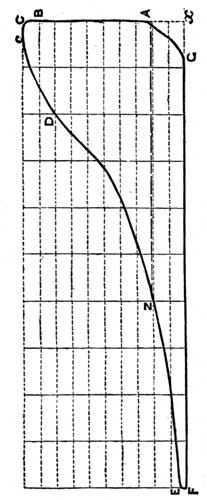
Steam Diagram of Wheal Towan Pumping Engine, erected
1827.
The late Sir John Rennie and other scientific persons were, about 1830,
associated with Mr. Henwood[114] in examining the work performed by
Cornish pumping engines: their reports are curtailed in the following
comments on Wheal Towan engine, similar to Trevithick's Dolcoath engine
of 1816, except perhaps that the last named was a little inferior
in its detail movements, while much less care was taken to avoid
unnecessary loss of heat.
Mr. Henwood also gave indicator diagrams of the expansion of the steam,
on one of which the writer has marked ten horizontal lines, indicating
the position of the piston at each foot of its stroke, and ten
longitudinal lines dividing the diameter of the cylinder into tenths.
The steam pressure in the boiler was 46·8 lbs. on the square inch
above the atmosphere, or 4·68 lbs. for each of the ten longitudinal
line divisions. x to c represents the top of the steam-cylinder 80
inches, diameter; x to F the length of the cylinder for a 10-feet
stroke of the piston. By the time the piston had moved through
one-twentieth of its course, reaching c, the expansive working had
commenced; and when one-tenth of the stroke had been run, half of a
division was cut off, showing by the curved indicator line the decrease
in pressure of steam to 44.46 lbs. The comparatively small passage
through the steam-valve not giving room for sufficient steam to follow
up the increasing speed of the piston, led to its continued expansion
in the cylinder, and by the time the piston had moved 2 feet, reaching
D, the steam pressure was reduced by two divisions or 9.36 lbs., or a
pressure of 37.44 lbs. on the piston; at this point the steam-valve was
closed, and the remaining four-fifths of the stroke was performed by
expansion; at the fifth horizontal line, or middle of the stroke, only
three divisions of steam are left, giving a pressure of 14.04 lbs. to
the inch; at the finish of the stroke there is only half a division,
from E to F, or 2.34 lbs. of steam to the inch above the pressure of
the atmosphere. On the return up-stroke of the piston, when it had
reached within a foot of the finish of its course at C, the equilibrium
valve closed, causing the enclosed steam of 2.34 lbs. to the inch to
be compressed at the finish of the up-stroke shown by the curve G A to
9.36 lbs. on the inch, equal to its pressure about the middle of the
down-stroke at N.
Trevithick's expansive engine therefore, commencing its work with
steam of 46.8 lbs. on the inch above the atmosphere, only took a full
supply from the boiler during one-tenth of its stroke, and none after
one-fifth had been performed, while at the finish of the stroke it had
about the same pressure as Watt began with.
The power of the Watt low-pressure steam vacuum pumping engine was
increased by Trevithick from two to three fold, and its economical
duty in about the same proportion; in other words, he increased
the effective power of the steam-engine two or three fold without
additional consumption of coal.
In the Wheal Towan engine the steam-cylinder was 80 inches in diameter,
with a 10-feet stroke. The shaft was 900 feet in depth; the main pumps
16 inches in diameter; the pump-rods were of wood, about 14 inches
square, and weighed more than the column of water in the pipes. The
boilers were Trevithick's cylindrical with internal tube, wholly of
wrought iron. The cylinder and steam-pipes were surrounded with sawdust
about 20 inches in thickness, as a non-conductor of heat. The upper
surfaces of the boilers were covered with a layer of ashes for the same
purpose. The duty performed was 86·58 millions of pounds of water,
raised one foot high by the consumption of a bushel of coal weighing 84
lbs. The immense power and economy of this engine are best understood
by its average labour costing only one farthing in coal for lifting
1000 tons one foot high.
At or about that time an old intimate of Trevithick's, Captain Nicholas
Vivian, managed the mine, and Mr. Neville, a shareholder, also a
user of steam-engines in Wales, observing the economical working of
Wheal Towan high-pressure steam expansive engine, doing eighty-seven
millions, requested its manager to examine colliery engines, all
of which were of the low-pressure kind; one of them was a Newcomen
atmospheric, whose duty was six millions; four or five others were Watt
low-pressure steam vacuum engines, doing fourteen millions; therefore
the high-pressure steam-engine did six times as much work with a bucket
of coal as the low-pressure steam vacuum, and fourteen times as much as
the low-pressure steam atmospheric engine. Several competitive trials
by the county engineers were published about that time, in one of
which, after a personal examination of the engine, Mr. W. J. Henwood[115]
and others reported a duty of 92·6 millions with a 91-lb. bushel of
coal.[116]
Mr. Rennie had been a pupil, a fellow-worker with low-pressure Watt,
and while his son, Sir John Rennie, was examining the high-pressure
steam expansive engine erected by Trevithick's pupil, Captain Samuel
Grose, under the management of Trevithick's friend, Captain Nicholas
Vivian, the latter was engaged in reporting on certain low-pressure
steam-engines in Wales, one of which was a Newcomen's atmospheric,
probably the last of its race, whose principle of construction was a
century old, working in company with the Watt low-pressure steam vacuum
engine, then half a century old, the principles of both systems being
on their last legs, and under the care of Trevithick's supporters.
During this jumble of engines, old and new, without a clear
comprehension of their differences in principle, Trevithick, who had
just returned from America, and lived within a few miles of Wheal
Towan, looked on unconsulted and unconcerned on questions which in
his mind had been settled by him in Dolcoath fifteen or twenty years
before. The writer, during the Wheal Towan controversy, was the daily
companion of Trevithick, and made drawings of the engine at the works
of Harvey and Co., of Hayle, where it was constructed about 1827.
Captain Samuel Grose's Wheal Towan engine was in general character
similar to his teacher's Dolcoath 76-inch engine of 1816, working with
about the same steam pressure and degree of expansion. The valves,
gear, and nozzles were perhaps improved in detail; but the groundwork
was unchanged. The first high-pressure steam Cornish pumping engine
made in France was designed and superintended by the writer at the
works of Messrs. Perrier, Edwards, and Chaper, at Pompe-à-feu, in
Chaillot, a suburb of Paris. The principle was the same as the Dolcoath
engine, and the detail differed but little from it or the Wheal
Towan, except that its exterior was a little more artistic than its
prototypes in Cornwall, in keeping with French requirements. It was
built in 1836, within a few yards of the low-pressure steam pumping
engine erected by Perrier and others in 1779, which still continued
pumping water from the Seine for the supply of Paris. Stuart says,
"An engine by Boulton and Watt was sent to France, and erected by M.
Perrier at Chaillot, near Paris. The French engineer, Proney, with a
detestable illiberality, attributes all the merit of the improvements
in the Chaillot engine to his friend Perrier, the person who merely put
together the pieces he had brought from Soho."[117]
The Perrier of 1779 was related to the Perrier of the Pompe-à-feu
engine-building works of 1836, and his nephew took the Trevithick
engine from Paris to a coal mine not far from Brussels, but not fully
understanding the use of the balance-bob—the woodwork for which had
not been completed in Paris, though all other parts had been fully
erected—did not find it easy to manage the engine. The writer viewed
Perrier's move as an infringement of the agreement between him and
Edwards, the partner of Perrier and Chaper, and therefore declined to
take any further interest in the engine.
Mr. Edwards had before that been a partner with Woolf, in a small
engineering works in Lambeth; and the writer had also before that been
a pupil of Woolf's, in the works of Messrs. Harvey and Co., of Hayle.
The drawing of 'La Belle Machine' (Plate XIII.), of 1836, serves not
only as a record of that time, but also in conjunction with the drawing
of Dolcoath engine of 1816, enables an engineer to form a sufficiently
correct idea of the Wheal Towan engine and boilers of 1827, which in
effective duty is scarcely excelled by the best pumping engines of the
present day.
The events connected with those Paris engines bring together the
engineering works of Watt, Proney, Perrier, Trevithick, and Woolf, in
the person of his once partner, Edwards. The writer, when constructing
'La Belle Machine,' had not the slightest knowledge of those links, and
heard the name and repute of his engine by the following chance:—
In 1838 a passenger leaving the train of the Great Western Railway
at Drayton Station, asked the writer's permission to walk on the
line and examine its construction. During a short conversation he
mentioned the having purchased at a sale in France the drawings of
an engine known as 'La Belle Machine,' representing the Cornish
high-pressure expansive steam pumping engine:—a, steam-cylinder, 48
inches in diameter, 8-feet stroke; b, steam-pipe from boiler; c,
regulating steam-valve, double beat; d, regulating rod and handle for
steam-valve; e, expansive steam-valve, double beat; f, balanced
lever and rod for opening expansive valve; g, expansive clamp on
plug-rod, with regulating rod and thumb-screws; h, cataract-rod for
relieving expansive valve-catch; i, quadrant relieving the catch;
j, plug-rod; k, equilibrium valve, double beat; l, clamp in
plug-rod to close equilibrium valve by its action on the handle; m,
balanced lever and rod to open equilibrium valve; n, quadrant and
catch relieving equilibrium valve by the action of cataract-rod; o,
regulating slide on cataract-rod; p, equilibrium steam-pipe conveying
steam from the top to the bottom of the piston; q, exhaust-valve,
double beat; r, clamp on plug-rod, closing the exhaust-valve by
its descent on the handle; s, balance lever and rod, opening
exhaust-valve; t, quadrant and catch, relieving equilibrium valve
by the action of cataract-rod; u, regulating slide on cataract-rod;
v, exhaust-pipe to condenser; w, Y-posts for carrying the gear.
The steam in the boiler was from 40 lbs. to 50 lbs. on the square inch
above the atmosphere.
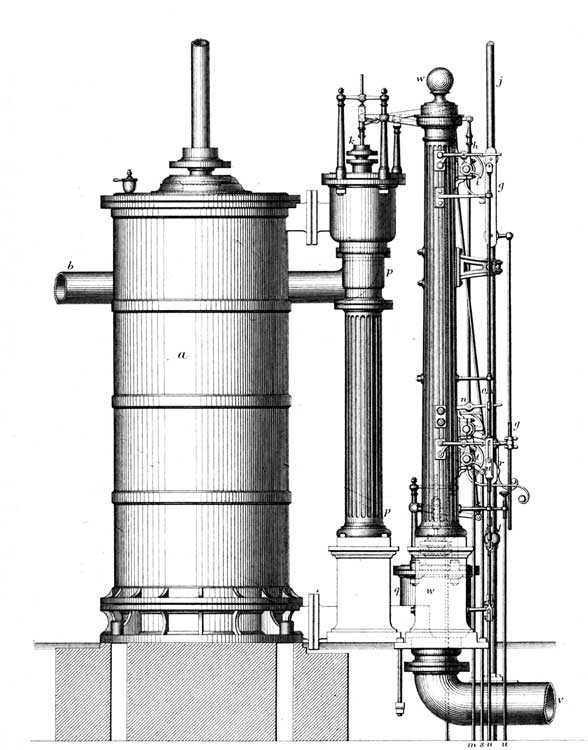
PLATE 13.
LA BELLE MACHINE. HIGH PRESSURE STEAM EXPANSION PUMPING ENGINE.—1836.
London: E.& F N. Span. 48, Charing Cross. Kell. Bros. Lith. London.
Lean states that had the pumping engines at work in Cornwall in 1835
remained unimproved since 1814, at which time they had benefited by
three years of continuous improvement, a yearly additional expenditure
of 80,000l. for coal would have been the consequence, and that the
first step was Trevithick's expansive steam from the cylindrical
tubular boiler, engines using such steam performing a duty three or
four fold what Boulton and Watt had ever attained, or perhaps thought
possible of attainment.[118] The birth of the idea of using expansive
steam may in truth be traced back nearly one hundred years to the time
of Newcomen's atmospheric engine, and the hope expressed in 1746 of
a smaller boiler and more elastic steam[119] was partially realized in
the engine and boiler of Trevithick, sen., in Bullan Garden in 1775,
followed in 1780 by the competing engine erected by Watt in Dolcoath
Mine, under Trevithick's management. Little further change was made
until 1799, when the globular boiler and internal tube of Trevithick,
jun., gave a second start to the use in large engines of more expansive
steam; and even this partial move was the result of years of thought
and practical experiment; for in 1792, when twenty-one years of age, he
was the elected judge on a competitive trial between the Watt engine at
Seal-hole, patented in 1782, and Hornblower's double-cylinder engine at
Tin Croft. Each engine performed a duty of ten millions, both of them
were called expansive, while in fact neither of them were so, for the
pressure of the steam in the boiler did not admit of it. As Lean says,
"As the steam used was raised but little above the pressure of the
atmosphere, it was found that the power gained did not compensate for
the inconvenience of a more complicated and more expensive machine."
Or, as Watt said to Robert Hart, "We resolved to give up the expansion
of the steam until we could get men that could work it," as he found
it more costly than profitable. Again in 1798, Trevithick's own
writing records his experiment in Dolcoath between the Bullan Garden
45-inch atmospheric engine and the Watt 63-inch great double-acting
engine, when the latter did sixteen millions to ten millions by the
atmospheric. At that very time he was constructing his high-pressure
steam portable engines, and in the following year, after seven years of
most active experience, prompted by the Watt lawsuit against Cornish
engineers, he in 1799 gave the beaten 45-inch engine steam of a higher
pressure from the stronger globular boiler. People, following the
ideas of Watt, were still afraid of Trevithick's plans, distinctly
laid down in his letters of 1806, recommending a cylindrical boiler
for the Dolcoath pumping engine, because similar boilers giving steam
to his whim-engines have enabled them to beat the Watt whims. This
continued until 1810, when the greatly-increased power and economy
of the high-pressure expansive steam pumping engine at Wheal Prosper
caused the neighbouring Dolcoath in 1811 to give Trevithick's plans
free scope. The long smouldering rivalry between low and high pressure,
on the eve of the final discomfiture of the former, burst forth in
loud words and evil prognostications, causing the mining interest of
Cornwall to appoint an examiner who should publish monthly the duty
performed by the various pumping engines, the first of which appeared
in the autumn of 1811, when Trevithick was building his boilers in
Dolcoath, and preparing the engines, as far as was possible, to submit
to strong steam. By expansive valves and suitable gear, balance of
power between the engine and the pump-work necessitating balance-bobs,
strengthening the pit-work to bear the more powerful and sudden
movement, and fifty other things, which we know must have presented
themselves in such work, occupied the greater part of Trevithick's time
from 1811 to 1814. That first report enumerates twelve pumping-engines,
probably all of them Watt engines, averaging a duty of seventeen
millions.
We have before traced the rapid and immense increase in the power and
in the duty of Cornish pumping engines from 1811, and it may be taken
as comparatively true in the larger sense applying to the improvement
of the steam-engine everywhere.
Dolcoath Mine, one hundred years ago, under the management of
Trevithick, sen., followed by his son as the strong-steam engineer, and
by his grandson as one of the committee of management in these modern
times, has served during that long period to illustrate the progress of
the steam-engine, and still in active operation, was thus spoken of in
'The Times' of Dec. 18th, 1871:—"This old and extraordinary mine is
now raising about 100 tons of tin every month, worth from 8000l. to
9000l."