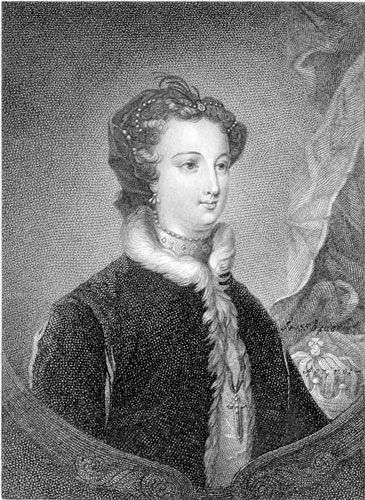
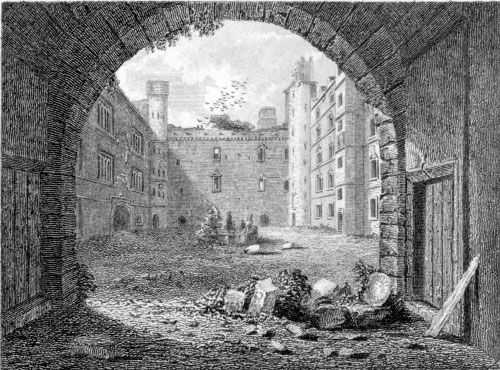
MARY’S TREATMENT OF DARNLEY, AND ALLEGED LOVE FOR THE EARL OF BOTHWELL.
As soon as she had sufficiently recovered to be able to quit the Castle,
Mary resolved on leaving the fatigues of government behind, and going for
some time into the country. Her infant son was intrusted to the care of
the Earl of Mar as his governor, and the Lady Mar as his governess. The
time was not yet arrived to make arrangements regarding his education; but
the General Assembly had already sent a deputation to the Queen, to
entreat that she would allow him to be brought up in the Reformed
religion. To this request Mary avoided giving any positive answer; but she
condescendingly took the infant from the nurse, and put it into the arms
of some of the divines. A prayer was pronounced over it; and Spottiswood
assures us, that, at the conclusion, the child gave an inarticulate
murmur, which the delighted Presbyterians construed to be an Amen.
It was the seat of the Earl of Mar at Alloa that the Queen first visited.
Being not yet equal to the fatigues of horseback, she went on board a
vessel at Newhaven, and sailed up the Forth. She was accompanied by
Murray and others of her nobility.[142] Buchanan, whose constant malice
and misrepresentation become at times almost ludicrous, says—“Not long
after her delivery, on a day very early, accompanied by very few that were
privy of her council, she went down to the waterside at a place called the
New-haven; and while all marvelled whither she went in such haste, she
suddenly entered into a ship there prepared for her. With a train of
thieves, all honest men wondering at it, she betook herself to sea, taking
not one other with her.”—“When she was in the ship,” he says elsewhere,
“among pirates and thieves, she could abide at the pump, and joyed to
handle the boisterous cables.”[143] It is thus this trustworthy historian
describes a sail of a few hours, enjoyed by Mary and her Court.
Darnley, who, though not very contented either with himself or any one
else, was about this time much in the Queen’s company, went to Alloa by
land, and remained with Mary the greater part of the time she continued at
the Earl of Mar’s. The uneasiness he suffered, and the peevish complaints
to which he was continually giving utterance, were occasioned by the want
of deference, with which he found himself treated by all Mary’s ministers.
But the general odium into which he had fallen, was entirely to be
attributed to his own folly. Between him and the Earl of Murray there had
long existed a deadly hatred against each other; in associating himself
with Morton, and plotting against Huntly and Bothwell, he had
irremediably offended these noblemen; and in deserting Morton and his
faction, he had forever lost the friendship of the only men who seemed
willing to regard him with any favour. The distressing consciousness of
neglect occasioned by his own misconduct, was thus forced upon him
wherever he turned; and instead of teaching him a lesson of humility, it
only served to sour his temper, and pervert his feelings. The Queen was
deeply grieved to see him so universally hated; and anxiously endeavoured
to make herself the connecting link between him and her incensed nobility.
This was all she could do; for, even although she had wished it, she could
not have dismissed, to please him, such of her ministers as he considered
obnoxious; a measure so unconstitutional would have led to a second
rebellion. But she hoped by treating her husband kindly, and showing him
every attention herself, to make it be understood that she expected others
would be equally respectful. Having spent some days together at Alloa,
Mary and Darnley went to Peebles-shire to enjoy the amusement of hunting;
but finding little sport, they returned on the 20th of August to
Edinburgh. Thence, they went to Stirling, taking the young Prince with
them, whom they established in Stirling Castle. Bothwell, in the meantime,
in his capacity of Lieutenant of the Borders, was in some of the southern
shires attending the duties of his charge.[144]
It is necessary to detail these facts thus minutely, as Mary’s principal
calumniator, Buchanan, endeavours to establish, by a tissue of
falsehoods, that immediately after her delivery, or perhaps before it, she
conceived a criminal attachment for Bothwell. This absurdity has gained
credit with several later writers, and particularly with Robertson, whose
knowledge of Mary’s motions and domestic arrangements at the period of
which we speak, appears to have been very superficial. Yet he may be
regarded as even a more dangerous enemy than the former. Buchanan’s
virulence and evident party spirit, carry their own contradiction along
with them; whilst Robertson, not venturing to go the same lengths, (though
guided in his belief entirely by Buchanan), imparts to the authority on
which he trusts a greater air of plausibility, by softening down the
violence of the original, to suit the calmer tone of professedly
unprejudiced history. In the progress of these Memoirs, it will not be
difficult to show that Robertson’s affected candour, or too hastily formed
belief, is as little to be depended on as Buchanan’s undisguised malice.
Buchanan wishes it to be believed, in the first place, that Mary
entertained a guilty love for Rizzio. He then proceeds to assert, that in
little more than three months after his barbarous assassination, she had
fallen no less violently in love with Bothwell, although, in the meantime,
she had been employed in giving birth to her first child, by a husband,
whom he allows she doated on nine or ten months before. To bolster up this
story, he perverts facts with the most reckless indifference. One specimen
of his style we have already seen in his account of the Queen’s voyage to
Alloa; and proceeding with his narrative, we find him positively
asserting in the sequel, that for the two or three following months, Mary
was constantly in the company of Bothwell, and of Bothwell alone, knowing
as he must have done all the while, that Murray and Darnley, Bothwell’s
principal enemies, were her chief associates, and that Bothwell spent most
of the time in a distant part of the kingdom.
Robertson dates even more confidently than Buchanan, the commencement of
Mary’s love for Bothwell at a period prior to her delivery. But upon this
hypothesis, it is surely odd, that Murray and Argyle were permitted by the
Queen to reside in the Castle previous to and during her confinement,
whilst the same favour was peremptorily refused to Bothwell; and it is no
less odd, that shortly after her delivery, Secretary Maitland, at the
intercession of the Earl of Athol, was received once more into favour, in
direct opposition to the wishes of Bothwell. It is no doubt possible, that
notwithstanding this presumptive evidence to the contrary, Mary may at
this very time have had a violent love for Bothwell; but are we to give
credit to the improbability, merely because Buchanan was the slave of
party feeling, and Robertson disposed to be credulous? Are the detected
fabrications of the one, entitled to any better consideration than the
gratuitous suppositions of the other? “Strange and surprisingly wild,”
says Keith, “are the accounts given by Knox, but more especially by
Buchanan, concerning the King and Queen about this time. I shall not
reckon it worth while to transcribe them here; and the best and shortest
confutation I could propose of them is, to leave my readers the trouble,
or rather satisfaction, to compare the same with the just now mentioned
abstracts (of despatches from Randolph to Cecil) and the three following
authentic letters,” from the French and Scottish ambassadors and the
Queen’s Privy Council.[145] Robertson, it is true, after having asserted,
that “Bothwell all this while was the Queen’s prime confident,” and that
he had acquired a “sway over her heart,” proceeds to confess, that “such
delicate transitions of passion can be discerned only by those who are
admitted near the persons of the parties, and who can view the secret
workings of the heart with calm and acute observation.” “Neither Knox nor
Buchanan,” he adds, “enjoyed these advantages. Their humble station
allowed them only a distant access to the Queen and her favourite; and the
ardour of their zeal, and the violence of their prejudices rendered their
opinions rash, precipitate, and inaccurate.” This is apparently so
explicit and fair, that the only wonder is, upon what grounds Robertson
ventured to make his accusation of Mary, having thus shown how little
dependence was to be placed on the only authorities which supported him in
it. It appears that he came to his conclusions by a process of his own,
which rendered him independent both of Knox and Buchanan. “Subsequent
historians,” he says, “can judge of the reality of this reciprocal passion
only by its effects.” Robertson must of course have been aware that he
thus opened the gate to a flood of uncertainty, seeing that the same
effects may spring from a hundred different causes. If a man be found
dead, before looking for his murderer, it is always proper to inquire
whether he has been murdered. Besides, if effects are to be made the
criterion by which to form an opinion, the greatest care must be taken
that they be not misrepresented. Mary must not be said to have been a
great deal in Bothwell’s company, at a time she was almost never with him,
and she must not be described as being seldom with her husband, at a time
they were constantly together.
Laing is another and still later writer, who has produced a very able
piece of special pleading against Mary, in which a false colouring is
continually given to facts. “After her delivery,” he says, “she removed
secretly from the Castle, and was followed by Darnley to Alloa, Stirling,
Meggetland, and back again to Edinburgh, as if she were desirous to escape
from the presence of her husband.” That Darnley followed Mary, is an
assumption of Mr Laing’s own. Conceited as the young King was, he would
rather never have stirred out of his chamber again, than have condescended
to follow so perseveringly one who wished to avoid him, first to Alloa,
then to Stirling, then into Peebles-shire, then back again to Edinburgh,
and once more to Stirling. The only correct part of Laing’s statement is,
that Mary chose to go by water to Alloa, whilst Darnley preferred
travelling by land; perhaps because he wished to hunt by the way, or call
at the seats of some of the nobility. The distance, altogether, was only
twenty miles; and the notion that Mary removed “secretly” from the
Castle, for the important purpose of taking an excursion to Alloa, is
absolutely ludicrous. In support of his assertion that Mary had lost her
heart to Bothwell, Laing proceeds to mention, that, shortly after the
assassination of Rizzio, the Earl, for his successful services, was loaded
with favours and preferment. That Mary should have conferred some reward
upon a nobleman whose power and fidelity were the chief means of
preserving her on a tottering throne, is not at all unlikely; but, to make
that reward appear disproportioned to the occasion, Laing misdates the
time when most of Bothwell’s offices of trust were bestowed upon him.
Several of them were his by hereditary right, such as those of Lord High
Admiral, and the Sheriffships of Berwick, Haddington, and Edinburgh. Part
of his authority on the Borders he had acquired during the time of the
late Queen-Regent, Mary’s mother, having been made her Lieutenant, and
keeper of Hermitage Castle, in 1558; and it was immediately after his
restoration to favour, during the continuance of Murray’s rebellion, that
he was appointed Lieutenant of the West and Middle Marches, a situation
which implied the superiority of the Abbeys of Melrose and
Haddington.[146] The only addition made to Bothwell’s possessions and
titles, in consequence of his services after Rizzio’s death, was that of
the Castle and Lordship of Dunbar, together with a grant of some crown
lands.[147]
There is another circumstance connected with Bothwell, which we omitted to
mention before, but which may with propriety be stated here. At the period
of which we write, when he is accused of being engaged in a criminal
intercourse with Mary, he had been only two or three months married to a
wife every way deserving of his love. Three weeks before the death of
Rizzio, he had espoused, in the thirty-sixth year of his age, the Lady
Jane Gordon, the sister of his friend, the Earl of Huntly. She was just
twenty, and was possessed of an elegant and cultivated understanding. They
were married at Holyrood, on the 22d of February 1566, after the manner of
the Reformed persuasion, in direct opposition to Mary’s wishes. She
entertained them, however, at a banquet on the first day; and the feasting
and rejoicings continued for a week. “The Queen desired,” says Knox, “that
the marriage might be made in the chapel at the mass, which the Earl
Bothwell would in no ways grant.”[148] Was there any love existing at this
time between Mary and her minister? Robertson and Laing seem to think
there was. Choosing to judge of Mary’s feelings towards Bothwell by
effects, not of effects by feelings, they quote several passages from
the letters of one or two of the foreign ambassadors then in Scotland,
which mention that Bothwell possessed great influence at court. That these
ambassadors report no more than the truth may be very safely granted;
though certainly there is no evidence to show that he enjoyed so much
weight as Murray, or more than Huntly. Yet he deserved better than the
former, for he had hitherto, with one exception, continued as faithful to
Mary, as he had previously been to her mother. The letters alluded to,
only repeat what Randolph had mentioned six months before. So early as
October 1565, only two months after Mary’s marriage with Darnley, and when
her love for him remained at its height, Randolph wrote to Cecil; “My Lord
Bothwell, for his great virtue, doth now all, next to the Earl of
Athol.”[149] Was Mary in love with Bothwell at this date? Or was it with
the Earl of Athol? And did she postpone her attachment to Bothwell, till
he should prove his for her, by becoming the husband of the Lady Jane
Gordon?—We proceed with our narrative.
Having spent some time with Darnley at Stirling, Mary returned to
Edinburgh, for the despatch of public business, on the 11th or 12th of
September. She wished Darnley to accompany her; but as he could not, or
would not, act with either Murray’s or Huntly’s party, he refused. On the
21st, she came again to Stirling; but was recalled once more to Edinburgh,
by her Privy Council, on the 23d. She left the French ambassador, Le Croc,
with the wayward Darnley, hoping that his wisdom and experience might be
of benefit to him.[150] The distinction which, from this period up to the
hour of his death, Darnley constantly made between his feelings for Mary
herself, and for her ministers, is very striking. With Mary he was always
willing to associate, and she had the same desire to be as much as she
could with him; but with the conditions he exacted, and by which alone she
was to purchase much of his company, it was impossible for her to comply.
She might as well have given up her crown at once, as have dismissed all
those officers of state with whom Darnley had quarrelled. The truth is,
her husband’s situation was a very unfortunate one. His own imbecility and
unlawful ambition, had brought upon him general odium; but if he had
possessed a stronger mind, or a greater stock of hypocrisy, he might have
re-established himself in the good graces of at least a part of the
Scottish nobility. But he had neither the prudence to disguise his
sentiments, nor the ability to maintain them. “He had not learned,” says
Chalmers, “to smile, and smile, and be a villain. He was still very young,
and still very inexperienced; and the Queen could not easily govern
without the aid of those odious men,”—his enemies.
Mary had been only a few days in Edinburgh, when she received a letter
from the Earl of Lennox, Darnley’s father, which afflicted her not a
little. Lennox, who resided principally at Glasgow, had gone to Stirling
to visit his son; and Darnley had there communicated to him a design, his
present discontents had suggested, which was to leave the country and
proceed to the Continent. Both Lennox and Le Croc, “a wise aged
gentleman,” as Holinshed calls him, had done all they could to divert him
from so mad a purpose; but his resolution seemed to be fixed. Mary
immediately laid her father-in-law’s letter before her Privy Council, who
“took a resolution to talk with the King, that they might learn from
himself the occasion of this hasty deliberation of his, if any such he
had; and likewise, that they might thereby be enabled to advise her
Majesty after what manner she should comport herself in this
conjuncture.”[151] On the evening of the very day that this resolution was
adopted, (the 29th of September), Darnley himself arrived at
Holyrood;—but being informed that the Earls of Argyle, Murray, and Rothes
were with the Queen, he declared he would not enter the palace till they
departed.[152] The Queen took this petulant behaviour as mildly as
possible; and glad of his arrival, even condescended to go forth from the
palace to meet her husband, and conducted him to her own apartment, where
they spent the night together.[153]
Next day, Mary prevailed upon her husband to attend a meeting of her
Council. They requested to be informed by the King, whether he had
actually resolved to depart out of the realm, and if he had, what were the
motives that influenced him, and the objects he had in view. They added,
“that if he could complain of any of the subjects of the realm, be they of
what quality soever, the fault should be immediately repaired to his
satisfaction.” Mary herself took him by the hand, and speaking
affectionately to him, “besought him, for God’s sake, to declare if she
had given him any occasion for this resolution.”[154] She had a clear
conscience, she said, that in all her life she had done no action which
could any ways prejudge either his or her own honour; but, nevertheless,
that as she might, perhaps, have given him offence without design, she was
willing to make amends, as far as he should require,—and therefore
“prayed him not to dissemble the occasion of his displeasure, if any he
had, nor to spare her in the least manner.”[155] Darnley answered
distinctly, that he had no fault to find with the Queen; but he was either
unable or unwilling to explain further. With the stubborn discontent of a
petted child, he would neither say one thing nor another—neither confess
nor deny. Without agreeing to alter his determination, whatever it might
be, and it was perhaps, after all, only a trick contrived to work upon
Mary’s affections, and intimidate her into his wishes, he at length took
his leave. Upon going away, he said to the Queen, “Farewell, Madam; you
shall not see my face for a long while.” He next bade Le Croc farewell;
and then turning coldly to the Lords of the Council, he said, “Gentlemen,
adieu.”[156]
Shortly afterwards, Mary received a letter from Darnley, in which he
complained of two things. “One is,” says Maitland, “that her Majesty
trusts him not with so much authority, nor is at such pains to advance
him, and make him be honoured in the nation, as she at first was. And the
other point is, that nobody attends him, and that the nobility deserts his
company. To these two points the Queen has made answer, that if the case
be so, he ought to blame himself, not her; for that in the beginning she
had conferred so much honour upon him, as came afterwards to render
herself very uneasy, the credit and reputation wherein she had placed him
having served as a shadow to those who have most heinously offended her
Majesty; but, howsoever, that she has, notwithstanding this, continued to
show him such respect, that although they who did perpetrate the murder of
her faithful servant, had entered her chamber with his knowledge, having
followed him close at the back, and had named him the chief of their
enterprise,—yet would she never accuse him thereof, but did always excuse
him, and was willing to appear as if she believed it not. And then as to
his being not attended,—the fault thereof must be charged upon himself,
since she has always made an offer to him of her own servants. And for the
nobility, they come to court, and pay deference and respect, according as
they have any matters to do, and as they receive a kindly countenance; but
that he is at no pains to gain them, and make himself beloved by them,
having gone so far as to prohibit these noblemen to enter his room, whom
she had first appointed to be about his person. If the nobility abandon
him, his own deportment towards them is the cause thereof; for if he
desire to be followed and attended by them, he must, in the first place,
make them to love him, and to this purpose must render himself amiable to
them; without which, it will prove a most difficult task for her Majesty
to regulate this point, especially to make the nobility consent that he
shall have the management of affairs put into his hands; because she finds
them utterly averse to any such matter.”[157]
No answer or explanation could be more satisfactory; and the whole affair
exhibits a highly favourable view of Mary’s conduct and character. Le Croc
accordingly says, in the letter already quoted,—“I never saw her Majesty
so much beloved, esteemed, and honoured; nor so great a harmony amongst
all her subjects as at present is, by her wise conduct, for I cannot
perceive the smallest difference or division.” That Darnley ever seriously
intended to quit the country, it has been said, is extremely uncertain. It
would appear, however, according to Knox, that he still harboured some
chimerical design of making himself independent of Mary, and with this
view he treacherously wrote to the Pope, and the Kings of Spain and
France, misrepresenting the state of affairs, and offering, with their
assistance, to re-establish the Catholic religion. Copies of these
letters, Knox adds, fell into Mary’s hands, who, of course, took steps to
prevent their meeting with any attention at the Continental courts.[158]
But be this matter as it may, (and its truth rests upon rather doubtful
authority, since we find no mention of it, either by the Lords of Privy
Council or the French Ambassador), it is certain that Darnley’s
determination, hastily formed, was as hastily abandoned.[159]
Shortly after her husband’s departure from Edinburgh, the Queen, attended
by her officers of state, set out upon a progress towards the Borders,
with the view, in particular, of holding justice-courts at Jedburgh. The
southern marches of Scotland were almost always in a state of
insubordination. The recent encouragement which the secret practices,
first of Murray and afterwards of Morton, both aided by Elizabeth, had
given to the turbulent spirit of the Borderers, called loudly for the
interference of the law. Mary had intended to hold assizes in Liddisdale
in August, but on account of the harvest, postponed leaving Edinburgh till
October. On the 6th or 7th of that month, she sent forward Bothwell, her
Lieutenant, to make the necessary preparations for her arrival, and on the
8th, the Queen and her Court set out,—the noblemen and gentlemen of the
southern shires having been summoned to meet her with their retainers at
Melrose. On the 10th she arrived at Jedburgh. There, or it may have been
on her way from Melrose, she received the disagreeable news, that on the
very day she left Edinburgh, her Lieutenant’s authority had been insulted
by some of the unruly Borderers, and that soon after his reaching his
Castle of Hermitage, a place of strength about eighteen miles from
Jedburgh, he had been severely and dangerously wounded. Different
historians assign different reasons for the attack made on Bothwell. Some
say that Morton had bought over the tribe of Elliots, to revenge his
present disgrace upon one whom he considered an enemy. Others, with
greater probability, assert, that it was only a riot occasioned by
thieves, whose lawless proceedings Bothwell wished to punish. But
whichever statement be correct, the report of what had actually taken
place was, as usual, a good deal exaggerated when it reached Mary. Being
engaged, however, with public business at Jedburgh, she was prevented, for
several days, from ascertaining the precise truth for herself. Finding
that she had leisure on the 16th of the month, and being informed that her
Lieutenant was still confined with his wounds, she paid him the
compliment, or rather discharged the duty of riding across the country
with some attendants, both to inquire into the state of his health, and to
learn to what extent her authority had been insulted in his person. She
remained with him only an hour or two, and returned to Jedburgh the same
evening.[160]
The above simple statement of facts, so natural in themselves, and so
completely authenticated, acquires additional interest when compared with
the common version of this story which Buchanan and his follower Robertson
have contrived to render prevalent. “When the news that Bothwell was in
great danger of his life,” says Buchanan, “was brought to the Queen at
Borthwick, though the winter was very sharp, she flew in haste, first
to Melrose, then to Jedburgh. There, though she received certain
intelligence that Bothwell was alive, yet, being impatient of delay, and
not able to forbear, though in such a bad time of the year,
notwithstanding the difficulty of the way, and the danger of robbers, she
put herself on her journey with such attendants as hardly any honest man,
though he was but of a mean condition, would trust his life and fortune
to. From thence she returned again to Jedburgh, and there she was mighty
diligent in making great preparations for Bothwell’s being brought
thither.”[161] The whole of this is a tissue of wilful misrepresentation.
No one, unacquainted with Buchanan’s character, would read the statement
without supposing that Mary proceeded direct from Borthwick to Hermitage
Castle, scarcely stopping an hour by the way. Now, if Mary heard of
Bothwell’s accident at Borthwick (which is scarcely possible), it must
have been, at the latest, on the 9th of October, or more probably on the
evening of the 8th; but, so far from being in a hurry in consequence, it
appears, by the Privy Council Register, that she did not reach Jedburgh
till the 10th, and, by the Privy Seal Register, that she did not visit
Hermitage Castle till the 16th of the month.[162] Had she really ridden
from Borthwick to the Hermitage and back again to Jedburgh in one day, she
would have performed a journey of nearly seventy miles, which she could
not have done even though she had wished it. As to her employing herself,
on her return to Jedburgh, “in making great preparations for Bothwell’s
being brought thither,” she certainly must have made extremely good use of
her time, for she returned on the evening of the 16th, and next day she
was taken dangerously ill. The motives which induced Buchanan to propagate
falsehood concerning Mary, are sufficiently known; but, being known,
Robertson ought to have been well convinced of the truth of his
allegations before he drew inferences upon such authority. But the Doctor
had laid down the principle, that he was to judge of Mary’s love for
Bothwell by its effects; and it became, therefore, convenient for him to
assert, that her visit to Hermitage Castle was one of those effects. “Mary
instantly flew thither,” he says, “with an impatience which strongly
marks the anxiety of a lover, but little suiting the dignity of a queen.”
Now, “instantly,” must mean, that she allowed at all events six, and
probably seven days to elapse; and that, too, after being informed of the
danger one of the most powerful and best affectioned of her nobility had
incurred in her behalf. Robertson must have thought it strange, that she
staid only an hour or two at the Castle. “Upon her finding Bothwell
slightly wounded,” says Tytler, “was it love that made her in such a
violent haste to return back the same night to Jedburgh, by the same bad
roads and tedious miles? Surely, if love had in any degree possessed her
heart, it must have supplied her with many plausible reasons for passing
that night in her lover’s company, without exposing herself to the
inconveniences of an uncomfortable journey, and the inclemencies of the
night air at that season.” If Mary had been blamed for an over-degree of
callousness and indifference, there would have been almost more justice in
the censure. With honest warmth Chalmers remarks, that “the records and
the facts laugh at Robertson’s false dates and frothy declamation.”[163]
On the 17th of October, Mary was seized with a severe and dangerous fever,
and for ten days her life was esteemed in great danger; indeed, it was at
one time reported at Edinburgh, that she was dead. The fever was
accompanied with fainting or convulsion-fits, of an unusual and alarming
description. They frequently lasted for three or four hours; and during
their continuance, she was, to all appearance, lifeless. Her body was
motionless; her eyes closed; her mouth fast; her feet and arms stiff and
cold. Upon coming out of these, she suffered the most dreadful pain, her
whole frame being collapsed, and her limbs drawn writhingly together. She
was at length so much reduced, that she herself began to despair of
recovery. She summoned together the noblemen who were with her, in
particular Murray, Huntly, Rothes, and Bothwell, and gave them what she
believed to be her dying advice and instructions. Bothwell was not at
Jedburgh when the Queen was taken ill, nor did he show any greater haste
to proceed thither when he heard of her sickness than she had done to
visit him, it being the 24th of October before he left Hermitage
Castle.[164] After requesting her council to pray for her, and professing
her willingness to submit to the will of Heaven, Mary recommended her son
to their especial care. She entreated that they would give every
attention to his education, suffering none to approach him, whose example
might pervert his manners or his mind, and studying to bring him up in all
virtue and godliness. She strongly advised the same toleration to be
continued in matters of religion, which she had practised; and she
concluded, by requesting that suitable provision should be made for the
servants of her household, to whom Mary was scrupulously attentive, and by
all of whom she was much beloved. Fortunately however, after an
opportunity had been thus afforded her of evincing her strength of mind,
and willingness to meet death, the violence of her disease abated, and her
youth and good constitution triumphed over the attack.
Darnley, who was with his father at Glasgow, probably did not hear of the
Queen’s illness till one or two days after its commencement; but as soon
as he was made acquainted with her extreme danger, he determined on going
to see her. Here again, we discover the marked distinction that
characterized Darnley’s conduct towards his wife and towards her nobility.
With Mary herself he had no quarrel; and though his love for her was not
so strong and pure as it should have been, and was easily forgotten when
it stood in the way of his own selfish wishes, he never lost any
opportunity of evincing his desire to continue on a friendly footing with
her. When he last parted from her at Holyrood, he had said that she should
not see him for a long while; but startled into better feelings by her
unexpected illness, he came to visit her at Jedburgh, on the 28th of
October. The Queen was, by this time, better; but her convalescence being
still uncertain, Darnley’s arrival was far from being agreeable to her
ministers. Should Mary die, one or other of them would be appointed
Regent, an office to which they knew that Darnley, as father to the young
prince, had strong claims. It was their interest, therefore, to sow
dissension in every possible way, between the Queen and her husband; and
they trembled lest the remaining affection they entertained for each
other, might be again rekindled into a more ardent flame. Mary, when cool
and dispassionate, they knew they could manage easily; but Mary, when in
love, chose, like most other women, to have her own way. They received
Darnley, on the present occasion, so forbiddingly, and gave him so little
countenance, that having spent a day and a night with Mary, he was glad
again to take his departure, and leave her to carry on the business of the
state, surrounded by those designing and factious men who were weaving the
web of her ruin.
On the 9th of November, the Queen, with her court, left Jedburgh, and went
to Kelso, where she remained two days. She proceeded thence to Berwick,
attended by not fewer than 800 knights and gentlemen on horseback. From
Berwick, she rode to Dunbar; and from Dunbar, by Tantallan to Craigmillar,
where she arrived on the 20th of November 1566, and remained for three
weeks, during which time an occurrence of importance took place.
END OF VOLUME FIRST.
PRINTED BY J. HUTCHISON,
FOR THE HEIRS OF D. WILLISON.
Footnotes:
[1] Polydore, lib. 26. quoted by Leslie—“Defence of Mary’s Honour,”
Preface, p. xiv.—Apud Anderson, vol. I.
[2] Knox seems not only to justify the assassination of Cardinal Beaton,
but to hint that it would have been proper to have disposed of his
successor in the same way. “These,” says he, “are the works of our God,
whereby he would admonish the tyrants of this earth, that, in the end, he
will be revenged of their cruelty, what strength soever they make in the
contrary. But such is the blindness of man, as David speaks, that the
posterity does ever follow the footsteps of their wicked fathers, and
principally in their impiety: For how little differs the cruelty of that
bastard, that yet is called Bishop of St Andrews, from the cruelty of the
former, we will after hear.”—Knox’s Hist. of the Reformation, p. 65.
[3] Dalyell’s “Fragments of Scottish History.”
[4] Keith, p. 68.—Knox’s History, p. 94-6.
[5] M’Crie’s Life of Knox, vol. i. p. 222.
[6] M’Crie’s Life of Knox, vol. ii. p. 206.
[7] The Biographer of Knox goes perhaps a little too far, when he proposes
to alleviate the sorrow felt for the loss of these architectural monuments
of superstition, by reminding the antiquarian that Ruins inspire more
lively sentiments of the sublime and beautiful than more perfect remains.
This is a piece of ingenuity, but not of sound reasoning. It is rather a
curious doctrine, that a Cathedral or Monastery does not look best with
all its walls standing.—M’Crie’s Life of Knox, vol. I. p. 271.
[8] It is worth while observing with what a total want of all Christian
charity Knox speaks of the death of Mary of Guise. Alluding to her burial,
he says:—“The question was moved of her burial: the preachers boldly
gainstood that any superstitious rites should be used within that realm,
which God of his mercy had begun to purge; and so was she clapped in a
coffin of lead, and kept in the Castle from the 9th of June until the 19th
of October, when she, by Pinyours, was carried to a ship, and so carried
to France. What pomp was used there, we neither hear nor yet regard; but
in it we see that she, that delighted that others lay without burial, got
it neither so soon as she herself (if she had been of the counsel in her
life) would have required it, neither yet so honourable in this realm as
sometimes she looked for. It may perchance be a pronosticon, that the
Guisean blood cannot have any rest within this realm.” Elsewhere he
says—“Within few days after, began her belly and loathsome legs to swell,
and so continued till that God did execute his judgment upon her.” And
again—“God, for his mercy’s sake, rid us of the rest of the Guisean
blood. Amen.” As Keith remarks, it was not by this spirit that the
Apostles converted the world.—Keith, p. 129.
[9] M’Crie’s Life of Knox, Vol. 1. p. 323.
[10] By the kindness of Mr Brown of Glasgow, the ingenious delineator of
the Royal Palaces of Scotland, we are enabled to give, as the vignette to
the present Volume, a view of this Palace, exhibiting the window of the
very room where Mary was born, which is the large window on the first
floor, immediately under the flight of birds.
[11] Sadler’s State Papers and Letters, vol. i. p. 263.
[12] Whittaker, vol. iv. p. 144.
[13] Mezeray, Histoire de France, tom. iii. p. 50.
[14] Miss Benger’s Memoirs, vol. i. p. 189, et seq.
[15] Melville’s Memoirs of his own Life, p. 12.
[16] In transcribing dates it may be proper to mention, that we do not
observe the old division of the year. Down till 1563, the French began the
year at Easter; but it was then altered to the 1st of January, by the
Chancellor L’Hopital. In Scotland till 1599, and in England till 1751, the
year began on the 25th of March. Thus, in all the State Papers and letters
of the age, written between the 1st of January and the 25th of March, the
dates invariably belong to what we should now consider the preceding year.
It is useful to be aware of this fact; though it is unnecessary for a
writer of the present day, to deviate from the established computation of
time.—Anderson’s Collections, vol. i.—Preface, p. li.; and Laing, vol.
i. p. 266.
[17] Keith, p. 73.
[18] Goodall’s Examination, vol. l. p. 159, et seq. The motto which
Goodall put upon his title page,
“Pandere res altà terrâ et caligine mersas,”
he has in more than one instance amply justified.
[19] Mezeray, Castelnau, Brantome, Thuanus, Chalmers, Miss Benger.
[20] This picture originally belonged to Lord Robert Stuart, Earl of
Orkney, one of Mary’s natural brothers, and is now in the possession of
William Trail, Esq. of Woodwick, Orkney, into whose family it came,
together with other relics of the Earl, by the marriage of an ancestor of
Mr Trail, to one of his descendants. Vide Appendix A.
[21] It is to the kindness of John Watson Gordon, Esq. deservedly one of
the most eminent portrait-painters in Scotland, that we are indebted, both
for the use of the painting from which the engraving has been made, and
for several of the facts we have stated above. Mr Gordon has executed
three copies of the picture—all of them exceedingly beautiful and
accurate—possessing the merits, without any of the dusky dimness, which
time has thrown over the original.
[22] The coat of arms borne by Francis and Mary is worth describing. The
coat was borne Baron and Femme;—The first contained the coat of the
Dauphin, which took up the upper half of the shield, and consisted of the
arms of France. The lower half was impaled quarterly. In one and four
the arms of Scotland, and in two and three those of England. Over the
whole was half an escutcheon the sinister half being obscured or cut off,
to denote that the English crown was in the possession of another, to the
bearer’s prejudice. Under the arms were four lines in French, thus
wretchedly translated by Strype, in his “Annals of Queen Elizabeth.”
“The arms of Mary Queen Dauphiness of France,
The noblest lady in earth for till advance,
Of Scotland Queen and of England, also
Of France, as God hath providet it so.”
Keith, p. 114. Chalmers, vol. 2d, p. 413. A painting (probably a copy)
containing these arms, and the above motto, is preserved in Mary’s
apartments at Holyroodhouse.
[23] Miss Benger, Vol. II. p. 7.
[24] Miss Benger, vol. ii. p. 43.
[25] Miss Benger erroneously antedates the death of Francis, on the 28th
of November. See her Memoirs, vol. ii. p. 74. Chalmers, who is the very
historian of dates, gives a copy of the inscription on the tomb of
Francis, which of course settles the point, vol. ii. p. 124. Miss Benger
does not appear to have seen this inscription.
[26] Conæus in Jebb, vol. ii. p. 19.
[27] Keith, p. 157 and 160.
[28] Keith, p. 160, & seq.
[29] Keith, p. 165, et seq.
[30] Keith, p. 167, et seq.
[31] Robertson says, that the amendment would not have been approved of by
“either Queen.” He alleges that Mary had only “suspended” the
prosecution of her title to the English Crown; and that “she determined to
revive her claim, on the first prospect of success.” That Robertson has,
in this instance, done injustice to Mary, is evident, from the exact
consistency of her future conduct, with what will be found stated in the
text.—Robertson, Vol. ii. p. 200.
[32] Keith, p. 170. et seq. Robertson says, that at the period of these
conferences, Mary was only in her eighteenth year; but, as they both took
place in 1561, she must have been in her nineteenth year, which Keith
confirms, who says (page 178), “The readers having now perused several
original conferences, will, I suppose, clearly discern the fine spirit and
genius of that princess, who was yet but in the 19th year of her age.”
[33] Brantome in Jebb, vol. ii. p. 82.
[34] Keith, p. 175. Throckmorton writes, “Thereto the Queen-mother said,
The King, my son, and I, would be glad to do good betwixt the Queen, my
sister, your mistress, and the Queen, my daughter, and shall be glad to
hear that there were good amity betwixt them; for neither the King, my
son, nor I, nor any of his Council, will do harm in the matter, or show
ourselves other than friends to them both.”
[35] Keith, p. 164.
[36] Keith, Appendix, p. 92.
[37] Robertson, Appendix, No. 5.—from the Cotton Library.
[38] Keith, p. 178.—Chalmers, vol. ii. p. 418—Stranguage, p. 9—and
Freebairn, p. 19.
[39] Brantome in Jebb, vol. ii. p. 483, et seq.—Keith, p. 179—and
Freebairn, p. 16 et seq.
[40] Several translations of this song have been attempted, but no
translation can preserve the spirit of the original.
Adieu, thou pleasant land of France!
The dearest of all lands to me,
Where life was like a joyful dance—
The joyful dance of infancy.
Farewell my childhood’s laughing wiles,
Farewell the joys of youth’s bright day;
The bark that bears me from thy smiles,
Bears but my meaner half away.
The best is thine;—my changeless heart
Is given, beloved France! to thee;
And let it sometimes, though we part,
Remind thee with a sigh of me.
Mary was not the only one who commemorated in verse her departure from
France. Numerous Vaudevilles were written upon the occasion, several of
which are preserved in the Anthologie Française.
[41] Jebb, vol. ii. p. 484. Keith, p. 180. Miss Benger, vol. ii. p. 125.
In an anonymous French work, entitled, “Histoire de Marie Stuart, Reine
d’Ecosse et de France,” &c. respectably written on the whole, there is an
amusing mistake concerning the locality of Holyroodhouse. In tom. i. p.
181, it is said, “The Queen landed at Leith, and then departed for
L’Islebourg,” (the name anciently given to Edinburgh), “a celebrated Abbey
a mile or two distant. In this Abbey Mary remained for three weeks, and in
the month of October 1561 took her departure for Edinburgh.” This
departure for Edinburgh alludes to the visit which Mary paid, a short time
after her arrival, to the Castle.
[42] The day that his present Majesty George IV. arrived at Leith, in
August 1822 (whose landing and progress to Holyroodhouse, though much more
brilliant, resembled in some respects that of his ancestor Mary), was as
wet and unfavourable as the weather so piously described by Knox. Was this
a “forewarning” also of the “comfort” our gracious Sovereign brought into
the country? If Knox believed in warnings, there is no telling to what
conclusions these warnings might have led.
[43] M’Crie’s Life of Knox, vol. ii. p. 22.
[44] Miss Benger (vol. ii. p. 132) erroneously supposes, that the
Archbishop of St Andrews had died before Mary’s return to Scotland. She
should have known that it was he who presided at the baptism of James VI.,
of which ceremony she gives so particular an account. See Keith, p. 360,
and Chalmers, vol. i. p. 196.
[45] Jebb, vol. ii. p. 486. Chalmers, vol. ii. p. 202.
[46] Buchanan’s Detection, in Anderson’s Collections, vol. ii. p. 52 and
58.
[47] This is apparently the first time Mary had ever expressed to Knox her
sentiments regarding this pamphlet. He had been treated less ceremoniously
by Elizabeth. But knowing the respect in which she was held by the
Protestants, he saw it for his interest to attempt to pacify her, and
wrote to her several conciliatory letters. Elizabeth put a stop to them,
by desiring Cecil, to forward to Knox the following laconic epistle, which
merits preservation as a literary curiosity:—“Mr Knox! Mr Knox! Mr Knox!
there is neither male nor female: all are one in Christ, saith Paul.
Blessed is the man who confides in the Lord! I need to wish you no more
prudence than God’s grace; whereof God send you plenty. W. Cecil.”
Chalmers, vol. ii. p. 494. Knox himself gives a somewhat different edition
of this letter, (Hist. of the Reformation, p. 212.) Where Chalmers found
the above, he does not mention.
[48] Knox’s History of the Reformation, p. 287, & seq.—Keith, p. 188. It
is worth observing, that Knox is the only person who gives us any detailed
account of these interviews, and he, of course, represents them in as
favourable a light for himself as possible. “The report,” says Randolph,
“that Knox hath talked with the Queen, maketh the Papists doubt what will
become of the world.”—“I have been the more minute in the narrative of
this curious conference,” says M’Crie, “because it affords the most
satisfactory refutation of the charge that Knox treated Mary with rudeness
and disrespect.” Different people have surely different modes of defining
rudeness and respect.
[49] Keith supposes erroneously, that this disturbance took place in the
Chapel at Holyrood. Randolph, his authority, though his expressions are
equivocal, undoubtedly alludes to the Royal Chapel at Stirling. Keith, p.
189 and 190.
[50] Knox, p. 292.
[51] Keith, p 192.
[52] It is worth while attending to the very partial and grossly perverted
account which Knox gives of this proclamation, actually introducing into
his History an edition of it, fabricated by himself. He then proceeds to
find fault with the Magistrates for yielding to “Jezabel’s” commands,
and remarks, in allusion to a counter proclamation which the Queen issued,
that the town should be patent to all her lieges until they were found
guilty of some offence,—“The Queen took upon her greater boldness than
she and Balaam’s bleating priests durst have attempted before. And so
murderers, adulterers, thieves, whores, drunkards, idolaters, and all
malefactors got protection under the Queen’s wings, under colour that they
were of her religion. And so got the Devil freedom again, whereas before
he durst not have been seen by daylight upon the common streets. Lord
deliver us from that bondage!”—Knox, p. 292-3.
[53] Randolph in Keith, p. 210.
[54] Goodall, vol. i. p. 199, et seq.
[55] Freebairn’s translation of Bois Guilbert, p. 32, et seq.—Knox’s
History, p. 307.—Chalmers, vol. i. p. 62, and vol. ii. p. 212.—Keith, p.
215 and 216.—and Goodall, vol. i. p. 191.
[56] Knox, p. 302.—Chalmers, vol. ii. p. 425.
[57] Chalmers, vol. i. p. 78.; vol. ii. p. 293, et seq.; and p. 426, et seq.
[58] Knox, p. 315.; Goodall, vol. i. p. 192.—Chalmers says, that Sir John
Gordon’s antagonist was not a Lord Ogilvy, but only James Ogilvy of
Cardell, a son of the deceased Alexander Ogilvy of Findlater. But as he
does not give any authority for this assertion, we have preferred
following Knox, Goodall, and Robertson.
[59] Chalmers, vol. i. p. 80.; and vol. ii. p. 298.
[60] Keith, p. 225.
[61] Keith, p. 226.
[62] Chalmers, vol. i. p. 84, and vol. ii. p. 302.
[63] Chalmers, vol. ii. p. 306.
[64] Chalmers, vol. i. p. 90.
[65] “The time and place for perpetrating this horrid deed,” says
Robertson, “were frequently appointed; but the executing of it was
wonderfully prevented by some of those unforeseen accidents which so often
occur to disconcert the schemes, and to intimidate the hearts of
assassins.” There is something strangely inconsistent between this
statement, and that which Robertson makes immediately afterwards in a
note, where he says,—“We have imputed the violent conduct of the Earl of
Huntly to a sudden start of resentment, without charging him with any
premeditated purpose of rebellion.” And that Huntly did not intend to
seize the Queen and her ministers, the historian argues upon these
grounds:—“1st, On the Queen’s arrival in the North, he laboured in good
earnest to gain her favour, and to obtain a pardon for his son.—2d, He
met the Queen, first at Aberdeen and then at Rothiemay, whither he would
not have ventured to come had he harboured any such treasonable
resolution.—3d, His conduct was irresolute and wavering, like that of a
man disconcerted by an unforeseen danger, not like one executing a
concerted plan.—4th, The most considerable persons of his clan submitted
to the Queen, and found surety to obey her commands; had the Earl been
previously determined to rise in arms against the Queen, or to seize her
ministers, it is probable he would have imparted it to his principal
followers, nor would they have deserted him in this manner,” Yet in direct
opposition to this view of the matter, Robertson, in telling the story of
Huntly’s wrongs, throws upon him the whole blame, and entirely exculpates
Murray.—Robertson, vol. i. p. 222, et seq.
[66] Chalmers, vol. i. p. 93, and vol. ii. p. 306.
[67] Keith, p. 226.
[68] Chalmers, vol. ii. p. 307.
[69] Knox, p. 320.—Buchanan’s History, Book xvii.—Chalmers, vol. i. p.
95, and vol. ii. p. 309, whose authority is a letter of Randolph,
preserved in the Paper Office, and written the evening of the very day on
which the battle took place. Randolph, though not on the field himself,
had two servants there, and saw the dead body of the Earl, when it was
brought into Aberdeen. Robertson and others have said, that Huntly, who
was very corpulent, was slain on the field, or trodden to death in the
pursuit. Chalmers, however, has truth on his side, when he remarks, that
“Doctor Robertson, who never saw those instructive letters (of Randolph),
grossly misrepresents the whole circumstances of that affair at Corrachie;
he says, ‘Huntly advanced with a considerable force towards Aberdeen, and
filled the Queen’s small court with the utmost consternation; and that
Murray had only a handful of men in whom he could confide; but, by his
steady courage and prudent conduct, gained a miraculous victory.’ For the
assertion of Murray’s having only a handful of men, he quotes Keith, p.
230, in which there is not one word of the force at Corrachie on either
side. The force there spoken of is what the Queen had about her two
months before on her first progress into the North, not on her return to
Aberdeen, after new troops had been raised, and old ones summoned to that
premeditated and barbarous scene.” Knox is also a better authority upon
this subject than Robertson. He gives the following curious account of the
Earl’s death and subsequent fate:—“The Earl, immediately after his
taking, departed this life, without any wound, or yet appearance of any
stroke, whereof death might have ensued; and so, because it was late, he
was cast over athwart a pair of creels, and so was carried to Aberdeen,
and was laid in the tolbooth thereof, that the response which his wife’s
witches had given might be fulfilled, who all affirmed (as the most part
say), that that same night he should be in the tolbooth of Aberdeen,
without any wound upon his body. When his lady got knowledge thereof, she
blamed her principal witch, called Janet; but she stoutly defended herself
(as the Devil can ever do), and affirmed that she gave a true answer,
albeit she spoke not all the truth; for she knew that he should be there
dead.” Knox, p. 328. “It is a memorable fact,” Chalmers elsewhere remarks,
“that Huntly and Sutherland” (who was forfeited soon afterwards, as
implicated in this pretended rebellion) “were two of those nobles who had
sent Bishop Lesley to France, with offers of duty and services to the
Queen, while Murray, Maitland, and other considerable men offered their
duties and services to Elizabeth.”
[70] Randolph in Keith, p. 230.
[71] Little did Mary then dream of Fotheringay.
[72] In Buchanan’s Cameleon, a severe satire, written at the request of
his patron the Earl of Murray, when that nobleman quarrelled with
Secretary Maitland, we have the following ridiculous account of the secret
motives which led to this disastrous northern expedition. “The Queen, by
advice of her uncles, devised to destroy the Earl of Murray, thinking him
to be a great bridle to refrain her appetites, and impediment to live at
liberty of her pleasure; not that he ever used any violence anent her, but
that his honesty was so great that she was ashamed to attempt any thing
indecent in his presence. She, then, being deliberate to destroy him, by
the Earl of Huntly, went to the north and he in her company; and howbeit
the treason was opened plainly, and John Gordon lying not far off the town
(Aberdeen) with a great power, and the Earl of Murray expressly lodged in
a house separate from all other habitation, and his death by divers ways
sought,—this Cameleon (Maitland) whether for simpleness or for lack of
foresight, or for boldness of courage, I refer to every man’s conscience
that doth know him, he alone could see no treason, could fear no danger,
and could never believe that the Earl of Huntly would take on hand such an
enterprise.” This statement, while it gives some notion of the dependence
to be placed on Buchanan’s accuracy when influenced by party feelings,
betrays, at the same time, the important secret, that Maitland saw and
felt the injustice of Huntly’s persecution.—Buchanan’s Cameleon, p. 9.
[73] Brantome in Jebb, p. 495, & seq.—Chalmers, vol. i. p.
101.—Freebairn, p. 25—and Histoire de Marie Stuart, tom. i. p. 210.
Knox, as usual, gives a highly indecorous and malicious account of this
affair, his drift being to make his readers believe (though he does not to
venture to say so in direct terms) that Mary had first tempted, and then
betrayed Chatelard; and that she was anxious to have him despatched
secretly, that he might not stain her honour by a public confession. If
such were really the fact, it is odd that Chatelard should have been
brought to a scaffold, which was surrounded by thousands, and that, even
according to Knox himself, he said nothing relating to Mary but what is
narrated in the text.—Vide Knox’s History, p. 325.
[74] Chalmers, in his account of the opening of this Parliament, seems to
have committed an error. He says, (vol. i. p. 105.) “The Queen came to
Parliament in her robes and was crowned.” That any coronation took
place, is not at all likely. Chalmers surely had forgotten that Mary was
crowned at Stirling by Cardinal Beaton just twenty years before. There was
no reason why the ceremony should have been repeated. Chalmers’ mistake is
probably founded upon the following passage, in a letter of Randolph’s,
quoted by Keith, p. 239—“The Parliament began 26th May, on which day the
Queen came to it in her robes and crowned.” The word was is an
interpolation of Chalmers. But as Randolph goes on immediately to
say,—“The Duke carried the crown, Argyle the sceptre, &c.,” Chalmers
probably thought Mary could not at the same time wear the crown. But the
crown of state, carried upon state occasions, was no doubt different from
the crown made expressly to be worn by the reigning Queen. Buchanan puts
the matter beyond a doubt, for he says explicitly;—“The Queen, with the
crown on her head, and in her royal robes, went in great pomp to the
Parliament House—a new sight to many.” Buchanan’s History, Book xvii.
[75] Knox’s History of the Reformation, p. 332 et seq.
[76] Knox, p. 345.
[77] Keith, p. 206 and 249.—Chalmers, vol. i. p. 65, et seq.—Whittaker,
vol. iii, p. 334.—Miss Benger, vol. ii, p. 145, et seq.
[78] These violars were all Scotchmen, and two of them were of the name of
Dow,—“a name,” says Chalmers, “consecrated to music.” Having never heard
of this consecration before, we think it not unlikely that Chalmers has
mistaken Dow for Gow. Vide Chalmers, vol. ii. p. 72.
[79] Jebb, vol. ii. p. 202. Chalmers, vol. i. p. 95, and vol. ii. p. 156.
Tytler’s Enquiry, vol. ii. p. 4 et seq.; Histoire de Marie Stuart, p. 218;
and Laing, vol. i. p. 10.
[80] Melville’s Memoirs, p. 110-30. The French historian Castelnau, speaks
in exactly similar terms. When sent by the King of France as ambassador to
Mary, “I found that princess,” he says, “in the flower of her age,
esteemed and adored by her subjects, and sought after by all neighbouring
states, in so much that there was no great fortune or alliance that she
might not have aspired to, not only because she was the relation and
successor of the Queen of England, but because she was endowed with more
graces and perfection of beauty than any other princess of her
time.”—Castelnau in Jebb, vol. ii. p. 460.
[81] Keith, p. 269.—Chalmers, vol. i. p. 123.
[82] Chalmers says (vol. i. p. 120), that the “Countess of Lennox sent
Murray a diamond,” which, though true, is not supported by the authority
he quotes—Randolph in Keith, who says (p. 259)—“Lennox giveth to the
Queen and most of the council jewels; but none to Murray.” The authority
Chalmers ought to have quoted is Melville (p. 127), who, on his return
from his embassy to England, brought some presents with him from Lady
Lennox, who was then not aware of the precise state of parties in
Scotland. “My Lady Lennox,” says Melville, “sent also tokens: to the Queen
a ring with a fair diamont; ane emerald to my Lord her husband, who was
yet in Scotland; a diamont to my Lord of Murray; ane orloge or montre
(watch) set with diamonts and rubies, to the secretary Lethington; a ring
with a ruby to my brother Sir Robert; for she was still in good hope that
her son, my Lord Darnley, should come better speed than the Earl of
Leicester, anent the marriage with the Queen. She was a very wise and
discreet matron, and had many favourers in England for the time.”
[83] In confirmation of the fact, that he was “well-instructed,” it may be
mentioned, that, before he was twelve years old, he wrote a tale, called
“Utopia Nova.” Some ballads are also ascribed to him; and Bishop
Montague, in his Preface to the Works of James VI., mentions, that he
translated Valerius Maximus into English. His only literary effort, which
seems to have been preserved, is a letter he wrote when about nine years
old from Temple Newsome, his father’s principal seat in Yorkshire, to his
cousin Mary Tudor, Queen of England. It deserves insertion as a curiosity:
“Like as the monuments of ancient authors, most triumphant, most
victorious, and most gracious Princess, declare how that a certain
excellent musician, Timotheus Musicus, was wont, with his
sweet-proportioned and melodious harmony, to inflame Alexander the Great,
Conqueror and King of Macedonia, to civil wars, with a most fervent
desire, even so, I, remembering with myself oftentimes how that (over and
besides such manifold benefits as your Highness heretofore hath bestowed
on me) it hath pleased your most excellent Majesty lately to accept a
little plot of my simple penning, which I termed Utopia Nova; for the
which, it being base, vile, and maimed, your Majesty hath given me a rich
chain of gold;—the noise (I say) of such instruments, as I hear now and
then, (although their melody differ much from the sweet strokes and sounds
of King Alexander’s Timotheus), do not only persuade and move, yea prick
and spur me forward, to endeavour my wits daily (all vanities set apart)
to virtuous learning and study, being thereto thus encouraged, so
oftentimes by your Majesty’s manifold benefits, gifts, and rewards; but
also I am enflamed and stirred, even now my tender age notwithstanding, to
be serving your Grace, wishing every hair in my head for to be a worthy
soldier of that same self heart, mind and stomach, that I am of. But where
as I perceive that neither my wit, power, nor years, are at this present
corresponding unto this, my good will: these shall be, therefore, (most
gracious Princess) most humbly rendering unto your Majesty immortal thanks
for your rich chain, and other your Highness’ sundry gifts, given unto me
without any my deservings, from time to time. Trusting in God one day of
my most bounden duty, to endeavour myself, with my faithful hearty
service, to remember the same. And being afraid, with these my superfluous
words to interturb (God forfend) your Highness, whose most excellent
Majesty is always, and specially now, occupied in most weighty matters,
thus I make an end. Praying unto Almighty God most humbly and faithfully
to preserve, keep, and defend your Majesty, long reigning over us all,
your true and faithful subjects, a most victorious and triumphant
Princess. Amen.—From Temple Newsome, the 28th March 1554.
Your Majesty’s most bounden and obedient subject and servant,
Henry Darnley.*
* Ellis’s Collection of “Original Letters Illustrative of English
History.” Second series, vol. ii. p. 249.
[84] Keith, p. 278.
[85] Melville’s Memoirs, p. 134.
[86] Mary’s conduct upon this occasion may be compared with that of
Elizabeth to her favourite Essex; but the Scottish Queen’s motives were of
a far purer and better kind. “When Essex,” says Walpole, “acted a fit of
sickness, not a day passed without the Queen’s sending after to see him;
and she once went so far as to sit long by him, and order his broths and
things.” “It may be observed,” remarks Chalmers, “that Mary was engaged
(or rather secretly resolved) to marry Darnley, but Elizabeth only flirted
with Essex.”
[87] Keith, p. 270, and Chalmers, vol. ii. p. 214, et seq.
[88] Castelnau in Keith, p. 277.
[89] Keith, p. 275.
[90] Keith, Appendix, p. 97.
[91] Keith, p. 280.
[92] Keith, p. 290.
[93] Of Chatelherault, Argyle, Murray, Morton, and Glencairn, all of whom
were summoned to the Convention, only Morton came. Keith, p. 287.
[94] Keith, p. 291, et seq.—Chalmers, vol. i. p. 139, et seq.; vol. ii.
p. 141.—Tytler, vol. i. p. 374, et seq. Melville’s account of this
conspiracy is, that Murray and the other Lords “had made a mynt to tak the
Lord Darnley, in the Queen’s company, at the Raid of Baith, and to have
sent him in England as they allegit. I wot not what was in their minds,
but it was ane evil-favoured enterprise whereintil the Queen was in
danger, either of kepping (imprisonment) or heart-breaking; and as they
had failed in their foolish enterprise, they took on plainly their arms of
rebellion.” Melville, p. 135. There is some reason to believe, that Knox
was implicated in this conspiracy; for, in the continuation of his
History, written by his amanuensis, Richard Bannatyne, under the authority
of the General Assembly, it appears that a Mr Hamilton, minister of St
Andrews, had openly accused him of a share in it; and though Knox noticed
the accusation, it does not appear that he ever satisfactorily refuted
it.—Goodall, vol. i. p. 207.
[95] Keith, p. 293—Spottiswoode, p. 190.
[96] Keith, p. 294, et seq.
[97] Keith, p. 297.
[98] Buchanan says, foolishly enough, that the predictions of “wizardly
women” contributed much to hasten this marriage. They prophesied, it
seems, that if it was consummated before the end of July, it would be
happy for both; if not, it would be the source of much misery. It is a
pity that these predictions were not true.
[99] Randolph in Robertson, Appendix, No. XI.—Keith, p. 307. Miss Benger,
vol. ii. p. 214.
[100] Keith, p. 303 and 304. This was a day or two before Darnley’s
marriage.
[101] Keith, Appendix No. VII. p. 99, et seq.
[102] M’Crie’s Life of Knox, vol. ii. p. 106; and Tytler’s Enquiry, vol.
i. p. 362 and 367.
[103] Knox, p. 389.
[104] Keith, Appendix, p. 264.
[105] Robertson, Appendix to Vol. i. Nos. XII. and XIII.
[106] Keith, Appendix, p. 114.
[107] Keith, p. 316, and Chalmers, vol. i. p. 155.
[108] Chalmers, vol. i. p. 156.
[109] Chalmers, vol. i. p. 157, and Keith, p. 319.
[110] Keith, p. 319.—Melville, p. 135.
[111] Blackwood in Jebb, vol. ii. p. 204.
[112] Keith, p. 331.
[113] Melville’s Memoirs, p. 147.
[114] Conæus in Jebb, vol. ii. p. 25.
[115] Dr Stuart, in support of his statements on this subject, quotes, in
addition to the authorities already mentioned, Mezeray “Histoire de
France,” tome 3, and Thuanus, “Historia sui Temporis,” lib. xxxvii. But we
suspect he has done so at random; for, on referring to these works, we
have been unable to discover any thing which bears upon the matter.
Chalmers, who is in general acute and explicit enough, says, that these
ambassadors came “to advise the Queen not to pardon the expatriated
nobles;” vol. ii. p. 158. Laing, who writes with so much apparent
candour and real ability against Mary that he almost makes “the worse
appear the better reason,” has avoided falling into the gross error of
Robertson. “It would be unjust,” he says, “to suppose, that, upon acceding
to the Holy League, for the preservation of the Catholic faith, she was
apprised of the full extent of the design to exterminate the Protestants
by a general massacre throughout Christendom; but the instructions from
her uncle rendered her inexorable towards the banished Lords.”—Laing’s
Preliminary Dissertation to the History of Scotland, vol. i. p. 9.
[116] Keith, p. 328 and 329.
[117] Goodall, vol. i. p. 222.
[118] Several of these pennies, as they were called, both of gold and
silver, remain to this day; and some of them have been already noticed. In
December 1565, there was stamped a silver penny, called the Mary Rial,
bearing on one side a tree, with the motto, Dat gloria vires; and the
circumscription, Exsurgat Deus, et dissipentur inimici ejus; and, on the
other, Maria et Henricus, Dei Gratia, Regina et Rex Scotorum. Speaking
of this coin, Keith says, that “the famous ewe-tree of Crookston, the
inheritance of the family of Darnley, in the parish of Paisley, is made
the reverse of this new coin; and the inscription about the tree, Dat
gloria vires, is no doubt with a view to reflect honour on the Lennox
family. This tree, he adds, which stands to this day, is of so large a
trunk, and so well spread in its branches, that it is seen at several
miles distance.”—Keith, p. 327, and Appendix, p. 118.—It stands no
longer.
[119] Buchanan’s History.—Melville’s Memoirs.—Keith, p. 325.
[120] Goodall, vol. i. p. 227.
[121] Melville’s Memoirs, p. 132 and 133.
[122] We translate from the original French of an edition, of the Martyre
de la Royne d’Escosse, printed at Antwerp, in the year 1583,—which very
nearly agrees with the Edition in Jebb, vol. ii. p. 202.
[123] Buchanan alone, of all the Scottish historians, has dared to
insinuate the probability of an illicit intercourse having subsisted
between Mary and Rizzio; and the calumny is too self-evidently false to
merit a moment’s notice. Every respectable writer reprobates so disgusting
a piece of scandal, however unfavourably inclined towards Mary in other
respects. Camden, Castelnau, Robertson, Hume, Tytler, Laing, and Dr
Stuart, all of whom think it worth while to advert to the subject in
Notes, put the falsehood of Buchanan’s assertion beyond the most distant
shadow of a doubt. Indeed, it is paying it too great a compliment to
advert to it at all.
[124] Miss Benger, oddly enough, says, it was on Saturday the 5th of
April; a mistake into which no other historian with whom we are acquainted
has fallen.—Miss Benger’s Memoirs, vol. ii. p. 233.
[125] The Parliament had met upon the 7th, and Mary had opened it in
person, unattended by Darnley, who refused to give it his countenance; but
no business of importance had as yet been transacted.
[126] This disease was “an inflammation of the liver, and a consumption of
the kidneys.”—Keith, Appendix, p. 119.
[127] Blackwood in Jebb, vol. ii. p. 204.—Goodall, vol. i. p. 252.
[128] Stranguage, p. 33.—Crawford’s Memoirs, p. 9.
[129] Keith, Appendix, p. 122.
[130] Conæus in Jebb. Vol. ii. p. 25.
[131] Robertson’s Appendix to vol. i. No. xv.
[132] Keith, p. 330.—Appendix, p. 119.—Melville’s Memoirs, p.
148.—Buchanan’s History of Scotland, Book xvii.—Martyre de Marie in
Jebb, vol. ii. p. 204.—Knox, p. 392.—Holinshed’s Chronicles, p.
382.—Robertson, Appendix to Vol. i. No. xv.—Some historians have
maintained, that Rizzio was actually despatched in Mary’s presence. But
this is not the fact, for Mary remained ignorant of his fate till next
day. In a letter which the Earl of Bedford and Randolph wrote to the Privy
Council of England, giving an account of this murder, and which has been
published in the first series of “Ellis’s Original Letters, illustrative
of English History,” (vol. ii. p. 207), we find these words:—“He was not
slain in the Queen’s presence, as was said.” Holinshed and others are
equally explicit. It has been likewise said, that it was not intended to
have killed him that evening; but to have tried him next day, and then to
have hanged or beheaded him publicly. That there is no foundation for this
assertion, is proved by the authorities quoted above; and to these may be
added the letter from Morton and Ruthven to Throckmorton, and “the bond of
assurance for the murder to be committed,” granted by Darnley to the
conspirators, on the 1st of March, both preserved by Goodall, vol. i. p.
264 and 266. That the conspirators meant, as others have insisted, to take
advantage of the situation in which Mary then was, and terrify her into a
miscarriage, which might have ended in her death, is unsupported by any
evidence; nor can we see what purposes such a design would have answered.
[133] Vide M’Crie’s Life of Knox, vol. i. p. 47.
[134] Knox, p. 339.—Buchanan, Book XVII.
[135] Keith, p. 332—and Appendix, 126.
[136] That something of the kind was actually contemplated, we learn from
Mary herself. “In their council,” she says in the letter already quoted,
“they thought it most expedient we should be warded in our castle of
Stirling, there to remain till we had approved in Parliament all their
wicked enterprises, established their religion, and given to the King the
crown-matrimonial, and the whole government of our realm; or else, by all
appearance, firmly purposed to have put us to death, or detained us in
perpetual captivity.”—Keith, Appendix, p. 132.
[137] Ruthven’s “Discourse” concerning the murder of Rizzio, in Keith,
Appendix, p. 128.
[138] Keith, p. 334.—Stuart’s History of Scotland, p. 138, et seq.
[139] Melville’s Memoirs, p. 154—Goodall, vol. i. p. 286.—Chalmers, vol.
ii. p. 164.
[140] Melville’s Memoirs, p. 156.—Keith, p. 337.
[141] Melville’s Memoirs, p. 158.
[142] Keith, p. 345, and Chalmers, vol. i. p. 180.
[143] Buchanan’s History, Book XVIII.—His “Detection,” in Anderson’s
Collections, vol. ii. p. 6.; and his “Oration,” p. 44.
[144] Chalmers, vol. i. p. 181, et seq. Goodall, vol. i. p. 292, et seq.
[145] Keith, p. 345.
[146] Knox, p. 386—Anderson, vol. i. p. 90—Tytler, vol. ii. p.
39—Chalmers, vol. ii. p. 206-207.
[147] Knox, p. 396, and Chalmers, p. 219.
[148] Knox, p. 392. Chalmers, vol. ii. p. 206 and 218. Laing, vol. i. p.
359. In the first edition of Tytler’s “Vindication,” Bothwell, being
confounded with the former Earl, his father, was said to be about
fifty-nine at this period. In the second edition, Tytler partly corrected
his error, but not entirely; for he stated Bothwell’s age to be
forty-three when he married. Chalmers, who is seldom wrong in the matter
of dates, has settled the question.
[149] Chalmers, vol. ii. p. 217.
[150] Chalmers, vol. i. p. 183 and 184.
[151] Maitland’s Official Letter to Catherine de Medicis, in Keith, p. 348.
[152] These noblemen, it may be observed, instead of being the friends,
were the personal and political enemies of Bothwell, with whom Darnley was
less displeased than with them.
[153] Goodall, vol. i. p. 284.—Keith, p. 348.
[154] Le Croc’s Letter in Keith, p. 346.
[155] Maitland’s Letter in Keith, p. 349.
[156] Keith, idem, p. 346 and 349.
[157] Keith, idem, p. 350.
[158] Knox, p. 399.
[159] The turn which Buchanan gives to the whole of this affair, in the
work he libellously calls a “History,” scarcely deserves notice. “In the
meantime,” he veraciously writes in his Eighteenth Book, “the King,
finding no place for favour with his wife, is sent away with injuries and
reproaches; and though he often tried her spirit, yet by no offices of
observance could he obtain to be admitted to conjugal familiarity as
before; whereupon he retired, in discontent, to Stirling.” In his
“Detection,” he is still more ludicrously false. “In the meantime,” he
writes, “the King commanded out of sight, and with injuries and miseries
banished from her, kept himself close with a few of his servants at
Stirling; for, alas! what should he else do? He could not creep into any
piece of grace with the Queen, nor could get so much as to obtain his
daily necessary expenses, to find his servants and horses. And, finally,
with brawlings lightly rising for every small trifle, and quarrels,
usually picked, he was chased out of her presence; yet his heart,
obstinately fixed in loving her, could not be restrained, but he must
needs come back to Edinburgh of purpose, with all kind of serviceable
humbleness, to get some entry into her former favour, and to recover the
kind society of marriage: who once again, with most dishonourable disdain
excluded, once again returns from whence he came, there, as in solitary
desert, to bewail his woful miseries.” Anderson, vol. ii. p. 9.—Another
equally honest record of these times, commonly known by the name of
“Murray’s or Cecil’s Journal,” the former having supplied the information
to the latter, to answer his own views at a subsequent period, says,—“At
this time, the King coming from Stirling, was repulsed with chiding.”
The same Journal mentions, that, on the 24th of September, Mary lodged in
the Chequer House, and met with Bothwell,—a story which Buchanan
disgustingly amplifies in his Detection, though the Privy Council records
prove that the Queen lodged in her Palace of Holyrood on the 24th with her
Privy Council and officers of state in attendance. As to Buchanan’s
complaint, that the King was stinted in his necessary expenses, the
treasurer’s accounts clearly show its falsehood. “The fact is,” says
Chalmers, “that he was allowed to order, by himself, payments in money and
furnishments of necessaries from the public treasurer. And the treasurer’s
accounts show that he was amply furnished with necessaries at the very
time when those calumnious statements were asserted by men who knew them
to be untrue. On two days alone, the 13th and 31st of August, the
treasurer, by the King and Queen’s order, was supplied with a vast number
of articles for the King’s use alone, amounting to 300l., which is more
than the Queen had for six months, even including the necessaries which
she had during her confinement.”—Chalmers, vol. i. p. 186. These minute
details would be unworthy of attention, did they not serve to prove the
difficulty of determining whether Buchanan’s patron, who was also Mary’s
Prime Minister, or the Historian himself, possessed the superior talent
for misrepresentation.
[160] Birrel’s Diary.—Keith, p. 351.—Goodall, vol. i. p. 302.—Chalmers,
vol. i. p. 190, vol. ii. p. 109 and 224.
[161] Buchanan’s History, book xviii.; and in his, “Detection,” he repeats
the same story, with still more venom.
[162] Both of these Registers are quoted by Chalmers, vol. i. p. 181.
[163] Miss Benger’s observations upon this subject are judicious and
forcible. “It was not till the 16th, the Queen, with her Officers of
State, passed to hermitage Castle, twenty miles distant, whether to confer
with Bothwell on business, respecting the motives for the late outrage on
his person, or purely as a visit of friendship and condolence, a
respectful, and as it should seem, well-merited acknowledgement of his
loyal services, must be left to conjecture. It is, however, not
improbable, since the Earl of Morton was, at that time, known to be in the
neighbouring March of Cessford, that Mary might be anxious to ascertain
from Bothwell’s lips, whether he ascribed the attack on his person to that
nobleman’s instigation. In Morton’s behalf she had long been importuned by
Murray, by Elizabeth, and Maitland, and, at a proper time, meant to yield
to their solicitations; but the discovery of a new treason, would have
altered her proceedings; to ascertain the fact was, therefore, of
importance. By whatever considerations Mary was induced to pay this visit,
there appears not (when calumny is discarded), any specific ground for the
suspicion, that she then felt for Bothwell a warmer sentiment than
friendship; in all her affections, Mary was ardent and romantic, and
though it should have been admitted, that she had gone to Hermitage
Castle, merely to say one kind word to the loyal servant, whose blood had
lately flowed in her service, she had, two years before, made a far
greater effort to gratify a female friend, when she rode to Callender,
to assist at the baptism of Lord Livingston’s child, regardless of the
danger which awaited her, from Murray and his party.”—Memoirs, vol. ii.
p. 289. We have dwelt too long on a calumny unsupported by any respectable
evidence.
[164] Chalmers, vol. ii. p. 224.