Eighteen years had elapsed, full of eventful
history—especially the last ten—since Carson
had renounced the business of trapping, and
of late there had been an almost irrepressible
longing once more to try his skill at his old
employment, in company with others who had
been, with himself, adepts at the business.
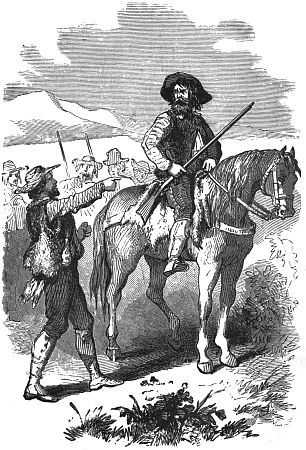
Accordingly he and Maxwell, by a great effort,
succeeded in collecting sixteen more of their
old companions, and taking care to provide
themselves abundantly with all the necessaries
for such a service, and with such added articles
of comfort as the pleasurable character of the
excursion dictated, they started, with Carson at
the head of the band, "any one of whom would
have periled his life for any other, and having
voted that the expedition should be one for hard
work, as when they trapped for gain long ago,"
they dashed on across the plains, till they came
to the South Platte, and upon its well remembered
waters, formed their camp and set their
traps, having first apprised themselves, by the
"signs," that the beaver were abundant. Indeed,
so long ago had trapping gone into disuse,
that the hunt proved successful beyond their
anticipations, and they worked down this
stream, through the Laramie plains to the
New Park, on to the Old Park, and upon a
large number of the streams, their old resorts,
and returned to Rayedo with a large stock of
furs, having enlivened the time by the recital
to each other of many of the numberless entertaining
events which had crowded upon their
lives while they had been separated.
Would not the reader like to have made
this excursion with them, and witnessed the
infinite zest with which these mature and experienced
men entered again upon what seemed
now to them the sport of their earlier years?
They made it, as much as possible, a season of
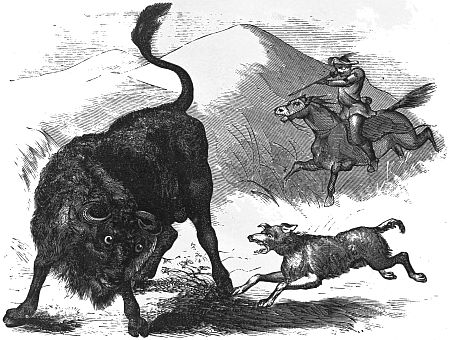
enjoyment. One of the party had lassoed a
grizzly, but, finding it inconvenient to retain
him, he had been shot, and bear steaks, again
enjoyed together, had been a part of the
Fourth of July treat they afforded their visitors,
the Sioux Indians. As we have but little
further opportunity, we will quote Fremont's
description of the Mountain Parks, for the
sake of giving the reader an idea of the locality
of this last trapping enterprise of Kit Carson:
"Our course in the afternoon brought us to
the main Platte River, here a handsome stream,
with a uniform breadth of seventy yards, except
where widened by frequent islands. It
was apparently deep, with a moderate current,
and wooded with groves of large willow.
"The valley narrowed as we ascended, and
presently degenerated into a gorge, through
which the river passed as through a gate. We
entered it, and found ourselves in the New
Park—a beautiful circular valley of thirty miles
diameter, walled in all round with snowy
mountains, rich with water and with grass,
fringed with pine on the mountain sides below
the snow line, and a paradise to all grazing
animals. The Indian name for it signifies
"cow lodge," of which our own may be considered
a translation; the enclosure, the grass, the
water, and the herds of buffalo roaming over
it, naturally presenting the idea of a park,
7,720 feet above tide water.
"It is from this elevated cove, and from the
gorges of the surrounding mountains, and some
lakes within their bosoms, that the Great Platte
River collects its first waters, and assumes its
first form; and certainly no river has a more
beautiful origin.
"Descending from the pass, we found ourselves
again on the western waters; and halted
to noon on the edge of another mountain valley,
called the Old Park, in which is formed
Grand River, one of the principal branches
of the Colorado of California. We were now
moving with some caution, as, from the trail,
we found the Arapahoe village had also passed
this way. As we were coming out of their
enemy's country, and this was a war ground,
we were desirous to avoid them. After a long
afternoon's march, we halted at night on a
small creek, tributary to a main fork of Grand
River, which ran through this portion of the
valley. The appearance of the country in the
Old Park is interesting, though of a different
character from the New; instead of being a
comparative plain, it is more or less broken
into hills, and surrounded by the high mountains,
timbered on the lower parts with quaking
asp and pines.
"We entered the Bayou Salade, (South
Park,) and immediately below us was a green
valley, through which ran a stream; and a
short distance opposite rose snowy mountains,
whose summits were formed into peaks of
naked rock.
"On the following day we descended the
stream by an excellent buffalo trail, along the
open grassy bottom of the river. On our
right, the bayou was bordered by a mountainous
range, crested with rocky and naked peaks;
and below it had a beautiful park-like character
of pretty level prairies, interspersed
among low spurs, wooded openly with pine
and quaking asp, contrasting well with the
denser pines which swept around on the mountain
sides.
"During the afternoon, Pike's Peak had
been plainly in view before us.
"The next day we left the river, which continued
its course towards Pike's Peak; and
taking a south-easterly direction, in about ten
miles we crossed a gentle ridge, and, issuing
from the South Park, found ourselves involved
among the broken spurs of the mountains
which border the great prairie plains. Although
broken and extremely rugged, the
country was very interesting, being well watered
by numerous affluents to the Arkansas
River, and covered with grass and a variety
of trees."
Carson had disposed of his furs, and was
again quietly attending to his ranche, when he
heard of the exorbitant prices for which sheep
were selling in California, and determined to
enter upon a speculation. He had already visited
the Navajos Indians, and thither he went
again, and in company with Maxwell and another
mountaineer, purchased several thousand
sheep; and with a suitable company of trusty
men as shepherds, took them to Fort Laramie,
and thence by the regular emigrant route, past
Salt Lake to California, and arriving without
any disaster, disposed of them in one of the
frontier towns, and then went down to the Sacramento
valley, to witness the change which
had come over old familiar places; not that
the mining did not interest him; he had seen
that before in Mexico, but he had not seen the
cities which had sprung into existence at a
hundred points, in the foot hills of the Sierras,
nor had he seen San Francisco, that city of
wondrous growth, which now contained thirty-five
thousand inhabitants.
But for the remembrance of the hills on
which the city rested, Carson would not have
known the metropolis of California, as the spot
where in '48 "the people could be counted in an
hour." In San Francisco he met so many old
friends, and so many, who, knowing him from
the history of his deeds, desired to do him
honor, that the attentions he received, while it
gratified his ambition, were almost annoying.
Tired by the anxiety and hard work of
bringing his property over a long and dangerous
journey to a good market, he had
looked for rest and retirement; but instead, he
was everywhere sought out and made conspicuous.
He found himself surrounded with the
choice spirits of the new El Dorado; his name
a prestige of strength and position, and his society
courted by everybody. The siren voice
of pleasure failed not to speak in his ear her
most flattering invitations. Good-fellowship
took him incessantly by the hand, desiring to
lead him into the paths of dissipation. But
the gay vortex, with all its brilliancy, had no
attractions for him; the wine cup, with its
sparkling arguments, failed to convince his
calm earnestness of character, that his simple
habits of life needed remodeling. To the storm,
however, he was exposed; but, like a good ship
during the gale, he weathered the fierce blast,
and finally took his departure from the new
city of a day, with his character untarnished,
but nevertheless leaving behind him many
golden opinions.
Some newspaper scribbler, last autumn, announced
the death of Carson, and said, in connection,
"His latest and most remarkable exploit
on the plains, was enacted in 1853, when
he conducted a drove of sheep safely to California."
Probably the writer was one of those
whose eager curiosity had met a rebuff, in the
quiet dignity with which Carson received the
officiousness of the rabble who thronged around
him on that visit. Not that he appreciated
honor less, but that its unnecessary attachments
were exceedingly displeasing to him.
In this terribly fast city, where the monte
table, and its kindred dissipations, advertised
themselves without a curtain, and where to indulge
was the rule rather than the exception,
Carson was able to stand fire, for he had been
before now tried by much greater temptations.
In the strange commingling of people from
all quarters of the globe, whom Carson witnessed
in San Francisco, he saw but a slight
exaggeration of what he had often witnessed
in Santa Fe,—and indeed, for the element of
variety, in many a trapping party, not to name
the summer rendezvous of the trappers, or the
exploring parties of Col. Fremont. To be
sure the Chinamen and the Kanackers were a
new feature in society. But whether it be in
the many nationalities represented, or in the
pleasures they pursued, except that in San
Francisco there was a lavishness in the expenditure
of wealth commensurate with its
speedier accumulation, there was little new to
him, and while he saw its magic growth with
glad surprise, the attractions this city offered
could not allure him. Nor could the vista it
opened up of a chance to rise into position in
the advancing struggles for political ascendency,
induce one wish to locate his home in a
spot so wanting in the kindly social relationships;
for he had tried the things and found
them vanity and vexation of spirit, and now
he yearned for his mountain home, and the
sweet pastoral life which it afforded in his circle
of tried friends.
He saved the money he had secured by the
sale of his flocks, and went down overland to
Los Angelos to meet Maxwell, who took the
trip by sea, which Carson having tasted once,
could not be persuaded to try again, and there
renewing his outfit, and visiting again some of
its honored citizens, they started homeward,
and had a pleasant passage till they reached
the Gila River, where grass became so scarce
that they were compelled to take a new course
in order to find food for their horses; but Carson
had no difficulty in pursuing a measurably
direct course, and without encountering a snow
storm, often terribly severe in the mountains
of this interior country, he reached Taos on
the third of December 1853.
He here received the unexpected information
that he had been appointed Indian agent for
New Mexico, and immediately wrote and sent
to Washington the bonds of acceptance of this
office. And now commences Carson's official
career, in a capacity for which he was better
fitted than any other person in the Territory.
Long had the Indians in his vicinity called
him "father," but now he had a new claim to
this title, for he was to be to them the almoner
of the bounty of the United States Government.
There was immediate call for the exercise
of the duties of his office, (for the Indians
of New Mexico had all buried the tomahawk
and calumet,) in visiting and attempting to
quiet a band of Apaches, among whom he
went alone, for they all knew him, and secured
from them plenty of promises to do well; but
he had scarcely left them, before they were
tired of the self-imposed restraint, and renewedly
continued their depredations, and several
serious battles were fought with them by the
United States troops, the first having proved
unsuccessful, but never was success wanting
when the commander of United States dragoons
had placed his confidence in the advice, and followed
the suggestions of Kit Carson, who was
admitted by them to be the prince of Indian
fighters—though he never tolerated cruelty or
the expenditure of life when there was no imperious
necessity, but yet regarded severe
measures better than a dawdling policy.
There had been serious fights in New Mexico
in 1846, while Carson was away with Fremont;
and it was better so, as the Mexicans
were his blood and kin; yet, in the change of
authority, he fully sympathized. But now, the
enemy was the different tribes of Indians, and
in the capacity of Agent for them, Carson
chose to impress them with the power of the
government for which he acted for their own
good, that they might be induced to desist from
their plundering, and be prepared for the influences
and practices of civilization; and all
the victories secured over them were due, as
history truly records, "To the aid of Kit Carson,"
"With the advice of Kit Carson;" and
never once is his name associated with a defeat;
for, if he made a part of an expedition, a condition
must be, that such means should be employed
as he knew would accomplish the end
desired; for he did not choose, by one single
failure, to give the Indians a chance to think
their lawlessness could escape its merited retribution.
Nor yet did Carson ever advise that confidence
in the promises of the Indians which
was not backed by such exhibition of power as
to command obedience; knowing that with
these children of the forest, schooled in the
arts of plunder, and the belief that white men
and white men's property were an intrusion on
their hunting grounds, and therefore lawful
prey—this was and is their law—non-resistance
would not answer, and only stern command,
backed by the rifle, ever has secured obedience—though
they appreciate the kindnesses
done by those friends who have such reliance.
But it was Carson's opinion that the country
cannot be safe while the Indians roam over it
in this wild way, or until they are located on
lands devoted to them and theirs for permanent
homes, and are compelled to settle upon and
cultivate the soil, when he thinks they will
come, by careful teaching, to display sentiments
of responsibility for their own acts.
There is little doubt that, had Carson been
appointed Superintendent of Indian Affairs for
the department of New Mexico, the reliance
sometimes placed on treaties would have been
discarded, and measures taken at an earlier
date, to locate the Apaches and Camanches and
Utahs, which might have been accomplished
with less expenditure of blood and of treasure;
but he quietly pursued his business, relying upon
the influence which his knowledge and skill had
given him to induce his superiors in official
authority to undertake such measures as seemed
to him the wisest.
The headquarters of his Indian agency were
at Taos, and while he spent as much of his time
as possible at Rayedo, the duties of his office
compelled the larger part of it at Taos. The
thousand kindly acts he was able to perform for
the Indians, by whom he was constantly surrounded,
had secured such regard for himself
that he needed no protection where he was
known—and what Indian of New Mexico did
not know him? He went among them, and
entertained them as the children of his charge,
having their unbounded confidence and love.
Every year, in the hey-day of the season,
Carson continued the custom of a revival of
earlier associations, by indulging, for a few days,
or perhaps weeks, in the chase; and was joined
in these excursions by a goodly company of his
old compeers, as well as later acquired friends,
and men of reputation and culture, from whatever
quarter of the world, visiting the territory;
and especially by a select few of the braves of
the Indian tribes under his charge. These were
seasons of grateful recurrence, and their pleasures
were long anticipated amid the wearisome duties
of his office.
The incidents of his every-day life, intervening
his appointment as Indian agent and the
rebellion, would furnish an abundance of material
for a romance even stranger than fiction. A life
so exciting as that among the Indians and brave
frontiersmen, and a name so renowned as that
of Christopher Carson, could not but attract
and concentre wild and romantic occurrences.
His life during these years is inseparably connected
with the history of the Territory of New
Mexico, which, could it be given to the public
in all its copious and interesting details, would
unquestionably concede to him all the noblest
characteristics in man.
The treaties between the United States and
the Indians, during the term of his appointment,
were mainly the result of his acquaintance with
the Indians, his knowledge of their character,
and his influence over them. Nor did the
Government fail to recognize his valuable services.
During the rebellion, and while serving
principally in New Mexico, where he distinguished
himself by his untiring prosecution of
hostilities with his savage foes, then at war with
the Government, he was promoted from rank to
rank, until he finally reached that of Brevet
Brigadier-General.
In a report to the National headquarters,
dated at Camp Florilla, near Fort Canby, N. M.,
January 26, 1864, we find the following detailed
account of operations in New Mexico:
"The culminating point in this expedition has
been reached at last by the very successful
operations of our troops at Cañon de Chelly.
Col. Kit Carson left Fort Canby on the sixth
instant with a command of four hundred men,
twenty of whom were mounted. He had a
section of mountain artillery with him, and
taking the road via Puebla, Colorado, he started
for Cañon de Chelly. He gave orders to Capt.
Pheiffer with his command of one hundred men
to enter the cañon at the east opening, while he
himself intended to enter it at the 'mouth,' or
west opening, and by this movement he expected
that both columns would meet in the
cañon on the second day, as it was supposed to
be forty miles in length.
"Capt. Pheiffer's party proceeded two days
through the cañon, fighting occasionally; but although
the Indians frequently fired on them from
the rocky walls above, the balls were spent long before
they reached the bottom of the cañon, which,
in many places, exceeded one thousand five
hundred feet in depth. It was a singular spectacle
to behold. A small detachment of troops
moving cautiously along the bottom of one of
the greatest cañons on the globe, (the largest is
in Asia, I believe,) and firing volleys upward at
hundreds of Navajoes, who looked, on the dizzy
height above them, like so many pigmies. As
they advanced the cañon widened in places, and
various spots of cultivated land were passed,
where wheat, maize, beans, melons, etc., had
been planted last year; while more than a
thousand feet above their heads they beheld
neat-looking stone houses built on the receding
ledges of rocks, which reminded the beholder of
the swallows' nests in the house eaves, or on the
rocky formation overhanging the 'sea-beat caves.'
Further on, an orchard containing about six hundred
peach-trees was passed, and it was evident
that the Indians had paid great attention to their
culture.
"On the second day a party from Col. Carson's
column met the Captain in the cañon, and returned
with him to Col. Carson's camp. A
party from the Colonel's command had, in the
meantime, attacked a party of Indians, twenty-two
of whom were killed. This had a dispiriting
effect on many others, who sent in three
of their number under a white flag. Col. Carson
received them, and assured them that the Government
did not desire to exterminate them, but
that, on the contrary, the President wished to
save and civilize them; and to that end Gen.
Carlton had given him instructions to send all
the Navajoes who desired peace to the new
reservation on the Rio Pecos, where they would
be supplied with food for the present, and be
furnished with implements, seeds, etc., to cultivate
the soil. They departed well-satisfied, and
Col. Carson immediately ordered Capt. A. B.
Carey, Thirteenth United States Infantry, with
a battalion to enter the cañon, and make a
thorough exploration of its various branches,
and at the same time to be in readiness to
chastise any body of hostile Navajoes he might
encounter, and to receive all who were friendly,
and who wished to emigrate to the new reservation.
Capt. Carey, during a passage of twenty-four
hours through a branch of the cañon hitherto
unexplored, made an exact geographical map
of this terrible chasm, and discovered many side
cañons hitherto unknown. About one hundred
Indians came in to him and declared that 'the
Navajo nation was no more;' that they were
tired of fighting and nearly starved, and that
they wished to be permitted to advise their
friends and families in the mountains; many of
whom were willing to leave the land forever,
and go to a country where they would be cared
for and protected. They said they understood
agriculture, and were certain they would make
comfortable homes on the Pecos. This was, of
course, only the opinion of some; others would
prefer to remain and culture the soil on which
they were born, and live at peace with the
territory. However, the latter were positively
informed that unless they were willing to
remove they had better not come in, and,
moreover, that the troops would destroy every
blade of corn in the country next summer.
"On the 20th of January Col. Carson came
to Fort Canby, and about six hundred Indians
had collected there; but when the wagons arrived
to remove them only one hundred wished to go,
and the remainder desired to return to their
villages and caves in the mountains, on pretence
of bringing in some absent member of their
families. Col. Carson very nobly and generously
permitted them to choose for themselves; but
told them if ever they came in again they should
be sent to Borgue Redondo, whether willing or
not. Col. Carson himself took the Indians to
Santa Fe, and will remain absent about a month.
Since his departure many Indians came in and
agreed to go to the reservation.
"I think the Colonel foresaw this, as no
person understands Indian character better than
he does. Capt. A. B. Carey, Thirteenth Infantry,
commanding in his absence, will see that
all Indians coming in will be removed, and, I
think, before April next, if the present good
feeling exists, we shall have accomplished the
removal of the entire tribe. Capt. A. B. Carey,
after successfully marching through the cañon
and noting its topography, reached Fort Canby
on the eighteenth instant, and relieved Capt.
Francis M'Cabe, First New Mexico Cavalry,
who commanded in the absence of Col. Kit
Carson.
"As the Navajo expedition is now entirely
successful, it is but justice to the officers and
men of the First Cavalry of New Mexico, and
to Col. Christopher Carson and his staff to say
that they have all acted with zeal and devotion
for the accomplishment of that great desideratum—the
removal of the Navajoes. Cut off
from the enjoyments of civilized life, deprived
of its luxuries, comforts, and even many of its
necessaries, and restricted to the exploration of
a wilderness and the castigation of an army of
savages, who defied them, and endeavored to
find a shelter among the cliffs, groves, and
cañons of their country; in pursuing them to
their haunts they have encountered appalling
difficulties, namely: want of water, grass, and
fuel; often exposed to the merciless fury of the
elements, and to the bullets and arrows of a
hidden foe. In the face of these difficulties they
have discovered new rivers, springs, and mountains
in a region hitherto unexplored, and penetrated
by companies into the very strongholds
of the enemy, who fled farther west as our
columns advanced, and on various occasions the
dismounted cavalry have, by rapid and unparalleled
night marches, surprised that enemy,
capturing his camp and securing his flocks and
herds, at a time when he imagined himself far
beyond our reach, and really when he occupied
a country never before trodden by the foot of a
white man.
"Much of the credit is due to the perseverance
and courage of Col. Kit Carson, commanding the
expedition, whose example excited all to great
energy, and inspired great resolution; but it may
not be out of place to remark that it is now demonstrated
beyond a doubt that, while the troops
of New Mexico have long borne the reputation
of being the best cavalry, they have proved
themselves in the present campaign to be the
best infantry in the world.
"Gen. James H. Carlton, who knows, perhaps,
and understands the material for an army as
well as any General in our army, has directed
the formation of a New-Mexican Brigade, and
when the savage foe is removed, that Brigade,
commanded by Brigadier-Gen. Kit Carson, would
surely reflect credit on the Territory and on the
Department Commander."
After the close of the war Christopher Carson
continued in the employ of the Government,
rendering such services as only one equally
skilled and experienced could render, until his
death. He died at Fort Lyon, Colorado, on the
23d of May, 1868, from the effects of the rupture
of an artery, or probably an aneurism of an
artery, in the neck. But a few weeks previous
he had visited Washington on a treaty mission,
in company with a deputation of red men, and
made a tour of several of the Northern and
Eastern cities.
In his death the country has lost the most
noted of that intrepid race of mountaineers,
trappers, and guides that have ever been the
pioneers of civilization in its advancement westward.
As an Indian fighter he was matchless.
His rifle, when fired at a redskin, never failed
him, and the number that fell beneath his aim,
who can tell! (The identical rifle which Carson
used in all his scouts, during the last thirty-five
years of his life, he bequeathed, just previous to
his death, to Montezuma Lodge, A. F. and A.
M., Santa Fe, of which he was a member.) The
country will always regard him as a perfect
representative of the American frontiersman,
and accord to him the most daring valor, consistent
kindliness, perseverant energy and truthfulness
which that whole great territory, that
we must still regard as lying between the civilizations,
is capable of furnishing.