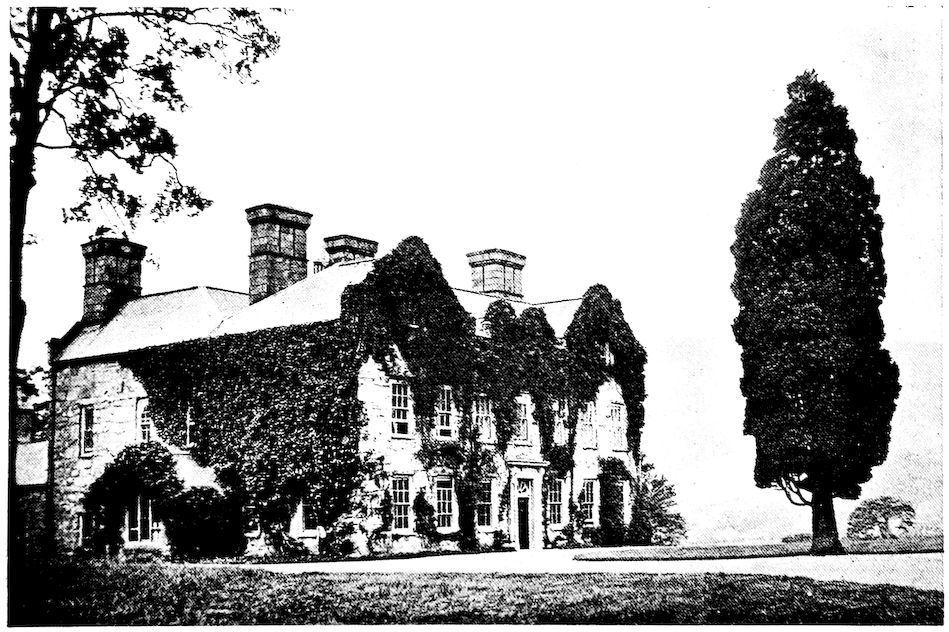
The cover image was created by the transcriber and is placed in the public domain.
LIFE OF FRANCES POWER COBBE
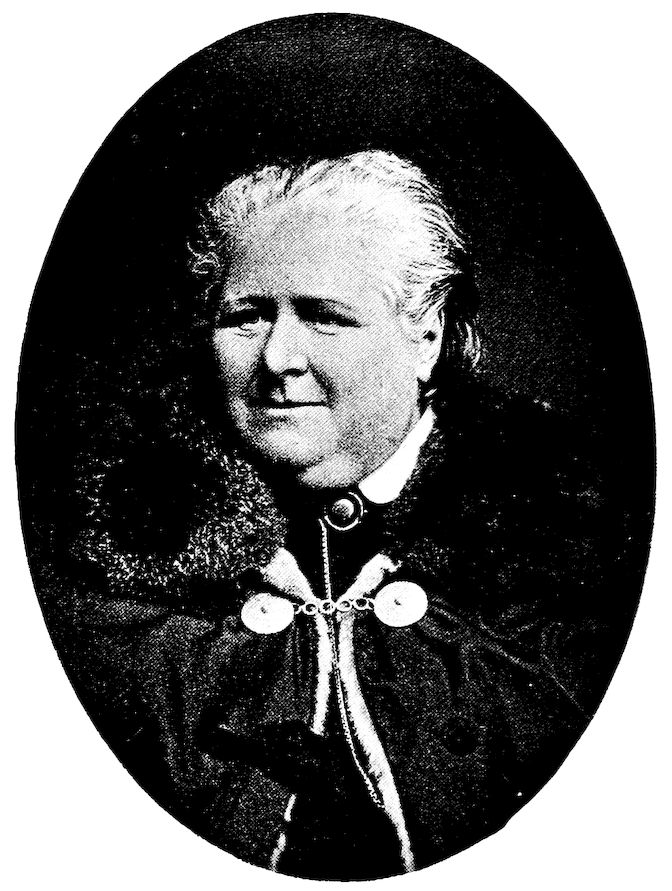
Frances Power Cobbe. 1894. [Frontispiece.
WITH
ADDITIONS BY THE AUTHOR
AND
INTRODUCTION BY BLANCHE ATKINSON
LONDON
SWAN SONNENSCHEIN & CO., LIM.
PATERNOSTER SQUARE
1904
INTRODUCTION.
v
The story of the beautiful life which came to an end on
the 5th of April, 1904, is told by Miss Cobbe herself in
the following pages up to the close of 1898. Nothing is
left for another pen but to sketch in the events of the few
remaining years.
But first a word or two as to the origin of the book.
One spring day in 1891 or ’92, when Miss Cobbe was walking
with me through the Hengwrt grounds on my way to
the station, after some hours spent in listening to her
brilliant stories of men and things, I asked her if she
would not some day write her autobiography. She stood
still, laughing, and shook her head. Nothing in her life,
she said, was of sufficient importance to record, or for
other people to read. Naturally I urged that what had
interested me so greatly would interest others, and that
her life told by herself could not fail to make a delightful
book. She still laughed at the idea; and the next time I
saw her and repeated my suggestion, told me that she had
not time for such an undertaking, and also that she did not
think her friend, Miss Lloyd, would like it. At last, however,
to my great satisfaction, I heard that the friends had
talked the matter over, and were busily engaged in
looking at old letters and records of past days, and both
becoming interested in the retrospection. So the book
grew slowly into an accomplished fact, and Miss Cobbe
often referred to it laughingly as “your” book, to which I
replied that then I had not lived in vain! It is possible
vithat the idea had occurred to her before; but she always
gave me to understand that my persuasion had induced her
to write the book. She came to enjoy writing it. Once
when I said:—“I want you to tell us everything; all your
love-stories—and everything!” she took me up to her
study and read me the passage she had written in the
1st Chapter concerning such matters. The great success of
the book was a real pleasure to both Miss Cobbe and her
friend. She told me that it brought her more profit
than any of her books. Most of them had merely a succès
d’estime. Better still, it brought her a number of kindly
letters from old and new friends, and from strangers in
far off lands; and these proofs of the place she held in
many hearts was a true solace to a woman of tender affections,
who had to bear more than the usual share of the
abuse and misrepresentation which always fall to those who
engage in public work and enter into public controversies.
The sorrow of Miss Lloyd’s death changed the whole
aspect of existence for Miss Cobbe. The joy of life had
gone. It had been such a friendship as is rarely seen—perfect
in love, sympathy, and mutual understanding. No
other friend—though Miss Cobbe was rich in friends—could
fill the vacant place, and henceforward her loneliness
was great even when surrounded by those she loved and
valued. To the very last she could never mention the
name of “my dear Mary,” or of her own mother, without
a break in her voice. I remember once being alone with
her in her study when she had been showing me boxes
filled with Miss Lloyd’s letters. Suddenly she turned from
me towards her bookshelves as though to look for something,
and throwing up her arms cried, with a little sob,
“My God! how lonely I am!”
It was always her custom, while health lasted, to rise
early, and she often went to Miss Lloyd’s grave in the fresh
viimorning hours, especially when she was in any trouble or
perplexity. Up to within a few days of her death she had
visited this—to her—most dear and sacred spot. Doubtless
she seemed to find a closer communion possible with one
who had been her counsellor in all difficulties, her helper
in all troubles, at the graveside than elsewhere. She
planted her choicest roses there, and watched over them
with tender care. Now she rests beside her friend.
Yet this anguish of heart was bravely borne. There was
nothing morbid in her grief. She took the same keen
interest as before in the daily affairs of life—in politics and
literature and social matters. There never was a nature
more made for the enjoyment of social intercourse. She
loved to have visitors, to take them for drives about
her beautiful home, and to invite her neighbours to pleasant
little luncheons and dinners to meet them. Especially she
enjoyed the summer glories of her sweet old garden, and
liked to give an occasional garden party, and still oftener
to take tea with her friends under the shade of the big
cherry tree on the lawn. How charming a hostess she
was no one who has ever enjoyed her hospitality can
forget. “A good talk” never lost its zest for her; until
quite the end she would throw off langour and fatigue
under the spell of congenial companionship, and her talk
would sparkle with its old brilliance—her laugh ring with
its old gaiety.
Her courtesy to guests was perfect. When they happened
not to be in accord with her in their views upon
Vivisection (which was always in these years the chief
object of her work and thought), she never obtruded the
question, and it was her rule not to allow it to be discussed
at table. It was too painful and serious a subject to be an
accompaniment of what she thought should be one of the
minor pleasures of life. For though intensely religious,
viiithere was no touch of the ascetic in Miss Cobbe’s nature.
She enjoyed everything; and guests might come and go
and never dream that the genial, charming hostess, who
deferred to their opinions on art or music or books, who
conversed so brilliantly on every subject which came up,
was all the time engaged in a hand to hand struggle against
an evil which she believed to be sapping the courage and
consciences of English men and women.
It is pleasant to look back upon sunny hours spent
among the roses she loved, or under the fine old trees she
never ceased to admire; upon the gay company gathered
round the tea-table in the dark-panelled hall of Hengwrt;
best of all, on quiet twilight talks by the fireside or in
the great window of her drawing-room watching the last
gleams of sunset fade from hill and valley, and the stars
come out above the trees. But it is sadly true that the last
few years of Miss Cobbe’s life were not as peacefully happy
as one would have loved to paint them to complete the
pleasant picture she had drawn in 1894. Even her cheery
optimism would hardly have led her to write that she would
“gladly have lived over again” this last decade.
The pain of separating herself from the old Victoria
Street Society was all the harder to bear because it came
upon her when the loss of Miss Lloyd was still almost fresh.
Only those who saw much of her during that anxious spring
of 1898 can understand how bitter was this pain. Miss
Cobbe has sometimes been blamed for—as it is said—causing
the division. But in truth, no other course was
possible to one of her character. When the alternative was
to give up a principle which she believed vital to the cause
of Anti-Vivisection, or to withdraw from her old Society, no
one who knew Miss Cobbe could doubt for an instant which
course she would take. It was deeply pathetic to see the brave
old veteran of this crusade brace up her failing strength to
ixmeet the trial, resolved that she would never lower the flag
she had upheld for five-and-twenty years. It was a lesson
to those who grow discouraged after a few disappointments,
and faint-hearted at the first failure. This, it seems to me,
was the strongest proof Miss Cobbe’s whole life affords of
her wonderful mental energy. Few men, well past 70,
when the work they have begun and brought to maturity is
turned into what they feel to be a wrong direction, have
courage to begin again and lay the foundations of a new
enterprise. Miss Cobbe has herself told the story of how
she founded the “British Union;” and I dwell upon it here
only because it shows the intensity of her conviction that
Vivisection was an evil thing which she must oppose to the
death, and with which no compromise was possible. She
did not flinch from the pain and labour and ceaseless
anxiety which she plainly foresaw. She never said—as
most of us would have held her justified in saying—“I
have done all I could. I have spent myself—time, money,
and strength—in this fight. Now I shall rest.” She took
no rest until death brought it to her. Probably few realise
the immense sacrifices Miss Cobbe made when she devoted
herself to the unpopular cause which absorbed the last 30
years of her life. It was not only money and strength
which were given. She lost many friends, and much social
influence and esteem. This was no light matter to a woman
who valued the regard of her fellows, and had heartily
enjoyed the position she had won for herself in the world
of letters. She often spoke sadly of this loss, though I am
sure that she never for an instant regretted that she had
come forward as the helper of the helpless.
From 1898 until the last day of her life the interests of
the new Society occupied her brain and pen. It was at
this time that I became more closely intimate with her than
before. Her help and encouragement of those who worked
xunder her were unfailing. No detail was too trifling to
bring to her consideration. Her immense knowledge of
the whole subject, her great experience and ready judgment
were always at one’s service. She soon had the care of all
the branches of the Union on her shoulders; she kept all
the threads in her hand, and the particulars of each small
organisation clear in her mind. For myself, I can bear this
testimony. Never once did Miss Cobbe urge upon me any
step or course of action which I seriously disliked. When, on
one or two occasions, I ventured to object to her view of what
was best, she instantly withdrew her suggestion, and left me
a free hand. If there were times when one felt that she
expected more than was possible, or when she showed a
slight impatience of one’s mistakes or failures, these were as
nothing compared with her generous praise for the little one
achieved, her warm congratulation for any small success.
It was indeed easy to be loyal to such a chief!
Much of Miss Cobbe’s leisure time during the years after
Miss Lloyd’s death was spent in reading over the records of
their old life. I find the following passage in a letter of
December, 1900:—
“I have this last week broken open the lock of an
old note-book of my dear Mary’s, kept about 1882–85.
Among many things of deep interest to me are letters
to and from various people and myself on matters of
theology, which I used to show her, and she took the
trouble to copy into this book, along with memoranda of
our daily life. It is unspeakably touching to me, you
may well believe, to find our old life thus revived, and
such tokens of her interest in my mental problems. I
think several of the letters would be rather interesting to
others, and perhaps useful.”
There remain in my possession an immense number of
letters, carefully arranged in packets and docketed, to and
xifrom Miss Lloyd, Lord Shaftesbury, Theodore Parker,
Fanny Kemble, and others. These have all been read
through lately by Miss Cobbe, and endorsed to that effect.
Up to the very end Miss Cobbe’s large correspondence was
kept up punctually. She always found time to answer a
letter, even on quite trivial matters; and among the mass
which fell into my hands on her death were recent letters
from America, India, Australia, South Africa, and all parts
of England, asking for advice on many subjects, thanking
for various kindnesses, and expressing warm affection and
admiration for the pioneer worker in so many good causes.
With all these interests, her life was very full. Nothing
that took place in the world of politics, history, or literature,
was indifferent to her. She never lost her pleasure in
reading, though her eyes gave her some trouble of late
years. At night, two books—generally Biography, Egyptology,
Biblical Criticism, or Poetry—were placed by her
bedside for study in the wakeful hours of the early morning.
In spite of all these resources within herself, she sorely
missed the companionship of kindred spirits. She was, as
I have said, eminently fitted for the enjoyment of social
life, and had missed it after she left London for North
Wales. Up to the last, even when visitors tired her, she
was mentally cheered and refreshed by contact with those
who cared for the things she cared for.
In the winter of 1901–2 she was occupied in bringing
out a new edition of her first book, “The Theory of
Intuitive Morals.” She wrote thus of it to me at the
time:—
“I have resolved not to leave the magnum opus of my
small literary life out of print, so I am arranging to
reprint ‘Intuitive Morals,’ with my essay on ‘Darwinism
in Morals’ at the end of it, and a new Preface, so that
when I go out of the world, this, my Credo for moral
xiiscience and religion, will remain after me. Nobody but
myself could correct it or preface it.... As I look back
on it now, I feel glad to be able to re-circulate it, though
very few will read anything so dry! It was written just
50 years ago, and I am able to say with truth that I have
not seen reason to abandon the position I then took,
although the ‘cocksureness’ of 30 can never be
maintained to 80!”
During the same winter, Miss Cobbe joined the Women’s
Liberal Federation, moved to take this decided step not
only by her strong disapproval of the war in South Africa,
but by her belief that the then existing government was in
opposition to all the movements which she longed to see
carried forward. Her accession to their ranks met with a
warm welcome from the President and Committee of the
Women’s Liberal Federation, many of whom were already
her personal friends. To the end she kept in close touch
with all that concerned women; and only a few days before
her death, was asked to allow her name to be given to the
Council as an Honorary Vice-President of the National
Union of Women Workers of Great Britain and Ireland.
In the summer of 1902 an incident occurred—small in
itself, but causing such intense mortification to Miss Cobbe
that it cannot be passed over in any true account of the
closing years of her life. In fact, those who saw most of
her at the time, and knew her best, believe that she never
recovered from the effects of it. A charge was brought
against her of cruelly overdriving an old horse—a horse
which had been a special pet. The absurdity of such a
charge was the first thing that struck those who heard of it;
but to Miss Cobbe it came as a personal insult of the
cruellest kind. The charge was pressed on with what
looked like malicious vindictiveness, and though it failed,
the intention to give her pain did not fail. She wrote to
xiiime at the time that she was “wounded to the quick.” The
insult to her character, the attempt to throw discredit upon
her life’s work for the protection of animals from suffering,
the unchivalrousness of such an attack upon an old and
lonely woman—all this embittered the very springs of
her life, and for a time she felt as if she could not stay
any longer in a neighbourhood where such a thing had been
possible. The results were very grievous for all who loved
her, as well as for herself. It had been one of her
pleasantest recreations to drive by the lovely road—which
was full of associations to her—between Hengwrt and
Barmouth, to spend two or three hours enjoying the sea
air and sunshine, and the society of the old friends who
were delighted to meet her there. To Barmouth also she
had a few years previously bequeathed her library, and had
taken great interest and pleasure in the room prepared for
the reception of her “dear books.” Yet it was in Barmouth
that the blow was struck, and she never visited the little
town again. It was pitiful! She had but a few more
months to live, and this was what a little group of her
enemies did to darken and embitter those few months!
On September 6th, she wrote to me:—
“This week I have had to keep quite to myself. I am,
of course, enduring now the results of the strain of the
previous weeks, and they are bad enough. The recuperative
powers of 80 are—nil! My old friends, Percy
Bunting and his wife, offered themselves for a few days
last week, and I could not bear to refuse their offer. As
it proved, his fine talk on all things to me most interesting—modern
theological changes, Higher Criticism, etc.—and
her splendid philanthropy on the lines I once humbly
followed (she is the leading woman on the M.A.B.Y.S.,
which I had practically founded in Bristol forty years
ago), made me go back years of life, and seem as if I
xivwere once more living in the blessed Seventies....
Altogether, their visit, though it left me quite exhausted,
did my brains and my heart good. O! what friends I
once had! How rich I was! How poor I am now!”
In October of that year she decided to leave Hengwrt
for the winter. It was a great effort. She had not left her
home for eight years, and dreaded the uprooting. But it
was a wise move. One is glad now to remember how
happy Miss Cobbe was during that winter in Clifton.
She lived over again the old days of her work in Bristol
with Mary Carpenter; visited the old scenes, and noted the
changes that had taken place. Some old friends were left,
and greatly she enjoyed their company. At Clifton she had
many more opportunities of seeing people engaged in the
pursuits which interested her than in her remote Welsh
home. Her letters at that time were full of renewed
cheeriness. I quote a few sentences:
“November 13th.
“... I hope you have had as beautiful bright weather
as we have had here, and been able to get some walks on
the mountain. Now I can no longer ‘take a walk,’ I
know how much such exercise helped me of old, mentally
and morally, quite as much as physically. I see a good
many old friends here, and a few new ones, and my niece
comes to tea with me every afternoon. They are all very
kind, and make more of me than I am worth; but it is a
City of the Dead to me, so many are gone who were my
friends long ago; and what is harder to bear is that when
I was here last, eight or ten years ago, I was always thinking
of returning home, and writing daily all that happened
to dear Mary—and now, it is all a blank.”
“November 16th.
“... It is so nice to think I am missed and wanted!
If I do get back to Hengwrt, we must manage to see more
xvof each other.... I have come to the conclusion that
for such little time as may remain for me, I will not shut
myself up again, and if I am at all able for it, I will return
home very early in the spring. I see a good many nice,
kind people here, old friends and new, and I have nice
rooms; but I sadly miss my own home and, still more,
garden. And the eternal noise of a town, the screaming
children and detestable hurdy-gurdies, torment my ears
after their long enjoyment of peace—and thrushes....
I am shocked to find that people here read nothing but
novels; but they flock to any abstruse lectures, e.g., those
of Estlin Carpenter on Biblical Criticism. I have just
had an amusing experience—a journalist sent up to gather
my views as to changes in Bristol in the last forty years.
Goodness knows what a hash he will make of them!”
During this autumn, the thought occurred to me that as
Miss Cobbe’s 80th birthday was at hand, a congratulatory
address from the men and women who appreciated
the work she had done for humanity and the lofty,
spiritual influence of her writings, might cheer her,
and help to remove some of the soreness of heart which
the recent trouble at Barmouth had left behind. Through
the kind help of Mr. and Mrs. Bunting and Mr. Verschoyle
in England, and of Miss Schuyler and Mrs. Wister in
America, an address was drawn up, and a notable list of
signatures quickly and most cordially affixed to it. The
address was as follows:—
“To FRANCES POWER COBBE
“December 4th, 1902.
“On this your eightieth birthday, we, who recognize
the strenuous philanthropic activity and the high moral
purpose of your long life, wish to offer you this congratulatory
address as an expression of sincere regard.
xvi“You were among the first publicly to urge the right
of women to university degrees, and your powerful pen
has done much to advance that movement towards
equality of treatment for them, in educational and other
matters, which is one of the distinguishing marks of our
time.
“In social amelioration, such as Ragged Schools and
Workhouse reform, you did the work of a pioneer. By
your lucid and thoughtful works on religion and ethics,
you have contributed in no small degree to that broader
and more humane view, which has so greatly influenced
modern theology in all creeds and all schools of thought.
“But it is your chief distinction that you were practically
the first to explore the dark continent of our
relations to our dumb fellow-creatures, to let in light
on their wrongs, and to base on the firm foundation
of the moral law their rights and our duty towards them.
They cannot thank you, but we can.
“We hope that this expression of our regard and
appreciation may bring some contribution of warmth
and light to the evening of a well spent life, and may
strengthen your sense of a fellowship that looks beyond
the grave.”
The Address happily gave Miss Cobbe all the gratification
we had hoped. I quote from her letters the following
passages:—
“Clifton, December 5th.
“I learn that it is to you I owe what has certainly
been the greatest honour I have ever received in my
long life—the address from English and American friends
on my 80th birthday. I can hardly say how touched I
am by this token of your great friendship, and the cheer
which such an address could not fail to give me. The
handsome album containing it and all the English signatures
(the American ones—autographs—are on their
xviiway, but I have the names in type-writing) was brought
to me yesterday by Mrs. Bunting and Mr. Verschoyle.
I had three reporters dodging in and out all day to get
news of it, and have posted to you the Bristol Mercury
with the best of their reports. It is really a very splendid
set of signatures, and a most flattering expression of
sympathy and approval from so many eminent men and
women. It is encouraging to think that they would
endorse the words about my care for animals.”
“December 8th.
“You may not know that a very fair account of the
address appeared in the Times of Saturday, and also in
at least twenty other papers, so my fame! has gone
evidently through the land. I also had addresses from
the Women’s Suffrage people, with Lady Frances Balfour
at their head, and from the A.V. (German) Society at
Dresden, Ragged School, etc.... I am greatly enjoying
the visits of many literary men and women, old friends
and new—people interested in theology and ethics and
Egypt, and all things which interest me....”
“December 24th.
“Only think that I am booked to make an address on
Women Suffrage to a ladies’ club, five doors off, on the
2nd.... The trouble you must have taken (about the
address) really overwhelms me! You certainly succeeded
in doing me a really great honour, and in cheering me. I
confess I was very downhearted when I came here, but I
am better now. I feel like the man who ‘woke one
morning and found himself famous.’”
“January 4th.
“I like to hear of your fine walk on the mountain.
How good such walks are for soul and body! I miss
them dreadfully—for my temper as well as my health and
strength. Walking in the streets is most disagreeable to
xviiime, especially now that I go slower than other people, so
that I feel myself an obstacle, and everybody brushes past
me. I sigh for my own private walks, small as they are,
where nobody has a right to come but myself, and my
thoughts can go their ways uninterrupted. But oh, for
the old precipice walk and Moel Ispry solitudes! You
will be amused to hear that I actually gave an hour’s
address to about 100 ladies at a new club, five doors
from me in this crescent, on Friday.... I was not
sorry to say a word more on that subject, and, of course,
to bring in how I trusted the votes of women to be
against all sorts of cruelty, including Vivisection. I
found I had my voice and words still at command....
They were nice, ladylike women in the club. One said
she would have seven votes if she were a man. I do
believe that it would be an immense gain for women
themselves to have the larger interest which politics
would bring into their cramped lives, and to cease to
be de-considered as children.”
Miss Cobbe was too human, too full of sympathy with her
fellow-creatures, to know anything of the self-esteem which
makes one indifferent to the affection and admiration of
others. She was simply and openly pleased by this address,
as the words I have quoted show; and more than a year
later, only a few days before her death, she wrote to an old
friend on her 80th birthday:—
“My own experience of an 80th birthday was so much
brightened by that address ... that it stands out as a
happy, albeit solemn, day in my memory.”
While in Clifton, Miss Cobbe presided at the committee
meetings of the Bristol Branch of the British Union; and
she even considered the possibility of taking up the work
once more in London. But a brief visit, when she
occupied rooms in Thurloe Gardens, proved too much for
xixher strength. The noise at night prevented her from
sleeping, and she was reluctantly—for she enjoyed this
opportunity of seeing old friends—obliged to return to
North Wales. One Sunday morning when in London, she
told me that she walked to Hereford Square to see the
little house in which she and Miss Lloyd had spent the
happiest years of their lives. But the changed aspect of
the rooms in which they had received most of the
distinguished men and women of that time distressed
her, and she regretted her visit. On February 21st, she
wrote to me from Hengwrt:—
“Dearest Blanche,
“As you see I have got home all right, and this morning
meant to write to announce my arrival.... I have
heaps of things to tell you, but to-day am dazed by
fatigue and change of air. It was quite warm in London,
and the cold here is great. But oh, how glad I am to be
in the peace of Hengwrt again—how thankful that I have
such a refuge in my old age! You will be glad, I know,
that I can tell you I am in a great deal better health than
when I left.”
The first time I went to see her after her return, I found
her standing in front of an immense chart which was spread
out on a table, studying the successions of Egyptian
dynasties. The address she had given in Clifton at the
ladies’ club was about to be printed in the Contemporary
Review, and she wanted to verify a statement she had made
in it about an Egyptian queen. She told me that this elaborate
chronological and genealogical chart had been made
by her, when a girl of 18, on her own plan. “How happy
I was doing it,” she said, “with my mother on her sofa
watching me, and taking such interest in it!” It was
very delightful to find the old woman of 80 consulting the
work of the girl of 18.
xxAlas! the improvement in her health did not continue
long. From that time till the end, I hardly received a
letter from Miss Cobbe without some reference to the
cheerless, gloomy weather. She was very sensitive to the
influences of the weather; and as one of her greatest
pleasures had always been to pass much time out of doors,
it became a serious deprivation to her when rain and cold
made it impossible to take her daily drive, or to walk and
sit in her beloved garden. She thought that some real
and permanent change had come over our climate, and the
want of sunshine, during the last winter especially, terribly
depressed her spirits and health. I spent two or three
happy days with her in the spring, and one drive on an
exquisite morning at the end of May will long live in my
memory. No one ever loved trees and flowers, mountain
and river, more than she, or took more delight in the
pleasure they gave to others.
Gradually, as the year went on, serious symptoms showed
themselves—and she knew them to be serious. Attacks of
faintness and complete exhaustion often prevented her from
enjoying the society of even her dearest friends, though in
spite of increasing weakness she struggled on with all the
weight of private correspondence and the business of her
new society; and sometimes, when strangers went to see
her, they would find her so bright and animated that they
came away thinking our fears for her unfounded.
A visit from two American friends in the summer gave
her much pleasure; but all last year her anxieties and
disappointments were great, and wore down her strength.
The Bayliss v. Coleridge case tried her grievously, and the
adverse verdict was a severe blow. The evident animus of
the public made her almost despair of ever obtaining that
justice for animals which had been the object of her efforts
for so many years. Hope deferred, and the growing opposition
xxiof principalities and powers, made even her brave
heart quail at times. One result of the trial, however, gave
her real satisfaction. The Daily News opened its columns
to a correspondence on the subject of Vivisection, and the
wide-spread sympathy expressed with those who oppose it
was, Miss Cobbe said, “the greatest cheer she had known in
this sad cause for years.” The two young Swedish ladies who
had been the principal witnesses at the trial, visited her at
Hengwrt in November, and I met them there one afternoon
at, I think, the last of her pleasant receptions. I have never
seen her more interested, more graciously hospitable, than
on that day. She listened to the account of the trial,
sometimes with a smile of approval, sometimes with tears
in her eyes; and when we went into the hall for tea, where
the blazing wood fire lighted up the dark panelling, and
gleamed upon pictures, flowers, and curtains, and she
moved about talking to one and another with her sweet
smile and kindly, earnest words, some one present said
to me, “How young she looks!” I think it was the
simplicity, the perfect naturalness of her manner and speech
that gave an aspect of almost childlikeness to the dear old
face at times. Every thought found expression in her
countenance and voice. The eyes, laughing or tearful, the
gestures of her beautifully shaped hands, were, to the last,
full of animation.
There was indeed a perennial flow of vitality which
seemed to overcome all physical weakness in Miss Cobbe.
But if others were deceived as to her health, she was not.
As the dark, dreary winter went on, she grew more and
more depressed. Four days before the end came, I
received the following sad letter. Illness and other causes
had made it impossible for me to go to Hengwrt for some
weeks. The day after her death I was to have gone.
xxii“It is very sad how the weeks go by, and we, living
almost within sight of each other, fail to meet. It is
most horribly cold to-day, and I would not have had you
come for anything.... I think our best plan by far will
be to settle that whenever you make your proposed start
abroad, you come to me for three or four days on your
way. This will let us have a little peaceful confab. I
really want very much to do what I have been thinking
of so long, but have never done yet, and give you advice
about your future editorship of my poor books. To tell
you my own conviction, even if I should be living when
you return, I do not think I shall be up to this sort of
business. I am getting into a wretched state of inability
to give attention to things, and now the chances are all
for a speedy collapse. This winter has been too great a
trial for my old worn brains, and now the cold returning
is killing.”
Happily for her, she was spared the pain of any protracted
period of mental or bodily weakness. On Monday, April
4th, she drove out as usual, wrote her letters (one to me,
received after she was dead), and in the afternoon enjoyed
the visit of a neighbour, who took tea with her. It was a
better day with her than many had been of late, and she
went to bed cheerful and well. In the morning, having
opened her shutters to let in the blessed daylight, and to
look her last upon the familiar scene of mountain, valley,
river, and wood, with the grey headstone visible in the
churchyard where her friend rested, she passed swiftly away,
and was found dead, with a smile of peace upon her face.
A short time before, she had written to me:—
“I am touched by your affectionate words, dear
Blanche, but nobody must be sorry when that time
comes, least of all those who love me.”
We can obey her request not to sorrow for her; but for all
xxiiithose—and they are more than she ever realised—who
loved her, the loss is beyond words to tell.
Miss Cobbe’s personality breathes through all her writings.
Yet there was a charm about her which not even her
autobiography is able to convey. It was the charm of an
intensely sympathetic nature, quickly moved to laughter or
to tears, passionately indignant at cruelty and cowardice,
tender to suffering, touched to a generous delight at any
story of heroism. As an instance of this, I may recall that
in the spring of 1899 Miss Cobbe started a memorial to
Mrs. Rogers, stewardess of the Stella, by the gift of £25.
The closing words of the inscription she wrote for the
beautiful drinking fountain which was erected to that brave
woman’s memory are worth recording here:
“ACTIONS SUCH AS THESE—
SHOWING
STEADFAST PERFORMANCE OF DUTY IN THE FACE OF DEATH,
READY SELF-SACRIFICE FOR SAKE OF OTHERS,
RELIANCE ON GOD—
CONSTITUTE THE GLORIOUS HERITAGE OF OUR ENGLISH RACE.
THEY DESERVE PERPETUAL COMMEMORATION:
BECAUSE
AMONG THE TRIVIAL PLEASURES AND SORDID STRIFE OF THE WORLD
THEY REVEAL TO US FOR EVER
THE NOBILITY AND LOVE-WORTHINESS OF HUMAN NATURE.”
In Miss Cobbe’s nature a gift of humour was joined to strong
practical sense. No one who ever lived less deserved the
term “Faddist” or “Sentimentalist.” Miss Cobbe was impatient
of fads. She liked “normal” people best—those who
ate and drank, and dressed and lived according to ordinary
conventions. Though, for convenience sake, she had adopted
a style of dress for herself to which she kept, letting “Fashions”
come and go unheeded, she was not indifferent to dress in
other women, and admired colours and materials, or noted
eccentricities as quickly as anyone. She once referred
laughingly to her own dress as “obvious.” For many years
xxivdressmaker’s dresses would have been impossible to her;
but she had no sympathy with the effort some women make
to look peculiar at all costs. She could thoroughly enjoy a
good story, or even a bit of amusing gossip. With her own
strong religious convictions, she had the utmost respect for
other people’s opinions. Her chosen friends held widely
different creeds, and I do not think that she ever dreamt of
proselytising.
No literary person, surely, ever had less self-conceit.
What she had written was not flourished in one’s face;
other people’s smallest doings were not ignored. One felt
always on leaving her that every one else was lacking in
something indefinable—was dull, uninteresting and common-place.
One felt, too, that the whole conception of
womanhood was raised. This was what a woman might be.
Whatever her faults, they were the faults of a great-hearted,
noble nature—faults which all generous persons would be
quick to forget. Nothing small or mean could be tolerated
by her.
Her character, as I read it, was drawn on large and
simple lines, and was of a type that is out of fashion to-day.
She had many points of resemblance to Samuel Johnson.
With a strong and logical brain, she scorned all sophistries,
evasions, compromises, and half measures, and was impatient
of the wire-drawn subtleties in which modern
moralists revel. With intensely warm affections, she was,
like the great doctor, “a good hater.” He would undoubtedly
have classified her as “a clubbable woman”;
and his famous saying, “Clear your mind of cant,” would
have come as appropriately from her lips as from his. If a
sin was hateful to her, she could not feel amiably towards
the sinner; and for the spiritual sins of selfishness, hypocrisy,
avarice, cruelty, and callousness, she had no mercy, ranking
them as far more fatal to character than the sins of the flesh.
xxvLike Johnson, too, she valued good birth, good breeding,
and good manners, and was instinctively conservative,
though liberal in her religious and political opinions.
She intensely disliked the license of modern life, both in
manners and morals, and had no toleration for the laxity so
often pardoned in persons of social or intellectual eminence.
Her mind and her tastes were strictly pure, orderly, and
regular. It is characteristic of this type of mind that she
most admired the classical in architecture, the grand style
in art, the polished and finished verse of Pope and Tennyson
in poetry. These were the two whose words she most
frequently quoted, though she tells us that Shelley was her
favourite poet.
Her gift of order was exemplified in the smallest details
and the kindred power of organisation was equally well
marked. It was the combination of impulsiveness and
enthusiasm with practical judgment and a due sense of
proportion that made her so splendid a leader in any cause
she championed.
Miss Cobbe was what is often called “generous to a
fault.” It was a lesson in liberality to go with her into the
garden when she cut flowers to send away. She did not
look for the defective blooms, or for those which would not
be missed. It was always the best and the finest which she
gave. How often I have held the basket while she cut
rose after rose, or great sprays of rhododendron or azælea
with the knife she wielded so vigorously. “Take as much
as you like,” she would say, if she sent you to help yourself.
She gave not only material things, but affection, interest
sympathy, bountifully.
She hated a lie of any kind; her first instinct was always
to stamp it out when she came across one. Perhaps, in
her stronger days, she “drank delight of battle with her
peers,” and did not crave over much for peace. But she
xxviwas not quarrelsome, and could differ without wrangling,
and dispute without bitterness.
A woman without husband or child is fortunate if, in her
old age, she has one or two friends who really love her.
Miss Cobbe was devotedly loved by a large number of men
and women. Indeed, I do not think that anyone could
come close to her and not love her. She was so richly
gifted, and gave so freely of herself.
To many younger women she had become the inspiration
of and guide to a life of high endeavour, and the letters
of gratitude and devotion which were addressed to her
from all parts of the world bear witness, as nothing else
can, to the extent of her splendid influence upon the
characters of others. Only a day or two before her
death she received letters from strangers who had lately
read her autobiography and felt impelled to write and
thank her for this story of a brave life. It is in the hope
that through it her influence may go on growing, and that
her spirit of self-sacrifice, of service to humanity, and faithfulness
to the Divine law may spread until the causes she
fought for so valiantly are victorious, that this new edition
of the “Life of Frances Power Cobbe” is sent out.
Blanche Atkinson.
AUTHOR’S PREFACE.
xxvii
My life has been an interesting one to live and I
hope that this record of it may not prove too dull to
read. The days are past when biographers thought
it necessary to apologize for the paucity of the
adventures which they could recall and the obscurity
of the achievements which their heroes might
accomplish. We have gone far in the opposite
direction, and are wont to relate in extenso details
decidedly trivial, and to reproduce in imposing type
correspondence which was scarcely worth the
postage of the original manuscript. Our sense of
the intrinsic interest of Humanity, as depicted either
in biography or fiction,—that is, of the character of
the personages of the drama going on upon our little
stage,—has continually risen, while that of the
action of the piece,—the “incidents” which our
fathers chiefly regarded,—has fallen into the second
plane. I fear I have been guilty in this book of
recording many trifling memories and of reproducing
some letters of little importance; but only
through small touches could a happy childhood and
youth be possibly depicted: and all the Letters have,
I think, a certain value as relics and tokens of friendship,
if not as expressions (as many of them are) of
opinions carrying the weight of honoured names.
xxviiiAs regards these Letters (exclusively, of course,
those of friends and correspondents now dead), I
earnestly beg the heirs of the writers to pardon me
if I have not asked their permission for the publication
of them. To have ascertained, in the first
place, who such representatives are and where they
might be addressed, would, in many cases, have
been a task presenting prohibitive difficulties; and
as the contents of the Letters are wholly honourable
to the heads and hearts of their authors, I may
fairly hope that surviving relatives will be pleased
that they should see the light, and will not grudge
the testimony they bear to kindly sentiments
entertained towards myself.[1]
There is in this book of mine a good deal of
“Old Woman’s Gossip,” (I hope of a harmless sort),
concerning many interesting men and women with
whom it was my high privilege to associate freely
twenty, thirty and forty years ago. But if it
correspond at all to my design, it is not only, or
chiefly, a collection of social sketches and friendly
correspondence. I have tried to make it the true
and complete history of a woman’s existence as seen
from within; a real Life, which he who reads may
take as representing fairly the joys, sorrows and
interests, the powers and limitations, of one of my
sex and class in the era which is now drawing
xxixto a close. The world when I entered it was a
very different place from the world I must shortly
quit, most markedly so as regards the position in it
of women and of persons like myself holding
heterodox opinions, and my experience practically
bridges the gulf which divides the English ancien
régime from the new.
Whether my readers will think at the end of
these volumes that such a life as mine was worth
recording I cannot foretell; but that it has been a
“Life Worth Living” I distinctly affirm; so well
worth it, that,—though I entirely believe in a higher
existence hereafter, both for myself and for those
whose less happy lives on earth entitle them
far more to expect it from eternal love and
justice,—I would gladly accept the permission to run
my earthly race once more from beginning to end,
taking sunshine and shade just as they have flickered
over the long vista of my seventy years. Even the
retrospect of my life in these volumes has been a
pleasure; a chewing of the cud of memories,—mostly
sweet, none very bitter,—while I lie still a little
while in the sunshine, ere the soon-closing night.
3I have enjoyed through life the advantage of being, in the
true sense of the words, “well-born.” My parents were
good and wise; honourable and honoured; sound in body
and in mind. From them I have inherited a physical frame
which, however defective even to the verge of grotesqueness
from the æsthetic point of view, has been, as regards health
and energy, a source of endless enjoyment to me. From
childhood till now in my old age—except during a few years
interval of lameness from an accident,—mere natural existence
has always been to me a positive pleasure. Exercise and
rest, food and warmth, work, play and sleep, each in its
turn has been delightful; and my spirits, though of course
now no longer as gay as in youth, have kept a level of
cheerfulness subject to no alternatives of depression save
under the stress of actual sorrow. How much of the
optimism which I am aware has coloured my philosophy
ought to be laid to the account of this bodily bien être, it
would be superfluous to enquire too nicely. At least I may
fairly maintain that, as Health is the normal condition of
existence, the views which a particularly healthy person takes
of things are presumably more sound than those adopted by
one habitually in the abnormal condition of an invalid.
As regards the inheritance of mental faculties, of which
so much has been talked of late years, I cannot trace it in
my own experience in any way. My father was a very able,
energetic man; but his abilities all lay in the direction of
administration, while those of my dear mother were of the
order which made the charming hostess and cultivated
4member of society with the now forgotten grace of the
eighteenth century. Neither paternal nor maternal gifts or
graces have descended to me; and such faculties as have
fallen to my lot have been of a different kind; a kind which,
I fear, my good father and his forbears would have regarded
as incongruous and unseemly for a daughter of their house to
exhibit. Sometimes I have pictured to myself the shock
which “The old Master” would have felt could he have
seen me—for example—trudging three times a week for
seven years to an office in the purlieus of the Strand to
write articles for a half-penny newspaper. Not one of my
ancestors, so far as I have heard, ever dabbled in printer’s ink.
My brothers were all older than I; the eldest eleven, the
youngest five years older; and my mother, when I was born,
was in her forty-seventh year; a circumstance which
perhaps makes it remarkable that the physical energy and
high animal spirits of which I have just made mention came
to me in so large a share. My old friend Harriet St. Leger,
Fanny Kemble’s “dear H. S.,” who knew us all well, said
to me one day laughing: “You know you are your Father’s
Son!” Had I been a man, and had possessed my brother’s
facilities for entering Parliament or any profession,[2] I have
5sometimes dreamed I could have made my mark and done
some masculine service to my fellow-creatures. But the
woman’s destiny which God allotted to me has been, I do
not question, the best and happiest for me; nor have I
ever seriously wished it had been otherwise, albeit I have
gone through life without that interest which has been
styled “woman’s whole existence.” Perhaps if this book be
found to have any value it will partly consist in the evidence
it must afford of how pleasant and interesting, and withal, I
hope, not altogether useless a life is open to a woman, though
no man has ever desired to share it, nor has she seen
the man she would have wished to ask her to do so.
The days which many maidens my contemporaries and
acquaintances,—
“Lost in wooing
In watching and pursuing,”—
(or in being pursued, which comes to the same thing); were
spent by me, free from all such distractions, in study and in
the performance of happy and healthful filial and housewifely
duties. Destiny, too, was kind to me, likewise, by relieving
me from care respecting the other great object of human
anxiety,—to wit, Money. The prophet’s prayer, “Give me
neither poverty nor riches” was granted to me, and I
have probably needed to spend altogether fewer thoughts on
£ s. d. than could happen to anyone who has either to
solve the problems “How to keep the Wolf from the door”
and “How to make both ends meet?” or “How, justly
and conscientiously, to expend a large income?” Wealth
has only come to me in my old age, and now it is easy to
know how to spend it. Thus it has happened that in early
womanhood and middle life I enjoyed a degree of real leisure
of mind possessed by few; and to it, I think, must be chiefly
attributed anything which in my doings may have worn the
6semblance of exceptional ability. I had good, sound working
brains to start with, and much fewer hindrances than the
majority of women in improving and employing them.
Voilà tout.
I began by saying that I was well-born in the true sense
of the words, being the child of parents morally good and
physically sound. I reckon it also to have been an
advantage,—though immeasurably a minor one,—to have
been well-born, likewise, in the conventional sense. My
ancestors, it is true, were rather like those of Sir Leicester
Dedlock, “chiefly remarkable for never having done anything
remarkable for so many generations.”[3] But they were
honourable specimens of county squires; and never, during
the four centuries through which I have traced them, do they
7seem to have been guilty of any action of which I need to be
ashamed.
My mother’s father was Captain Thomas Conway, of
Morden Park, representative of a branch of that family. Her
only brother was Adjutant General Conway, whose name
Lord Roberts has kindly informed me is still, after fifty years,
an “honoured word in Madras.” My father’s progenitors
were, from the fifteenth century, for many generations
owners of Swarraton, now Lord Ashburton’s beautiful
“Grange” in Hampshire; the scene of poor Mrs. Carlyle’s
mortifications. While at Swarraton the heads of the family
married, in their later generations, the daughters of
Welborne of Allington; of Sir John Owen; of Sir Richard
Norton of Rotherfield (whose wife was the daughter of Bishop
Bilson, one of the translators of the Bible); and of James
Chaloner, Governor of the Isle of Man, one of the Judges of
Charles I. The wife of this last remarkable man was Ursula
Fairfax, niece of Lord Fairfax.[4]
On one occasion only do the Cobbes of Swarraton seem
to have transcended the “Dedlock” programme. Richard
Cobbe was Knight of the Shire for Hants in Cromwell’s
short Parliament of 1656, with Richard Cromwell for a
colleague. What he did therein History saith not! The
grandson of this Richard Cobbe, a younger son named
Charles, went to Ireland in 1717 as Chaplain to the Duke of
Bolton with whom he was connected through the Norton’s;
and a few years later he was appointed Archbishop of Dublin,—a
post which he held with great honour until his death in
1765. On every occasion when penal laws against Catholics
were proposed in the Irish House of Lords Archbishop Cobbe
8contended vigorously against them, dividing the House again
and again on the Bills; and his numerous letters and papers
in the Irish State-Paper office (as Mr. Froude has assured
me after inspection) bear high testimony to his liberality and
integrity in that age of corruption. Two traditions concerning
him have a certain degree of general interest. One,
that John Wesley called upon him at his country house,—my
old home, Newbridge;—and that the interview was perfectly
friendly; Wesley approving himself and his work to the
Archbishop’s mind. The other is; that when Handel came
to Dublin, bringing with him the MS. of the Messiah, of
which he could not succeed in obtaining the production in
London, Archbishop Cobbe, then Bishop of Kildare, took
lively interest in the work, and under his patronage, as well
as that of several Irishmen of rank, the great Oratorio was
produced in Dublin.
Good Archbishop Cobbe had not neglected the affairs of
his own household. He bought considerable estates in
Louth, Carlow, and Co. Dublin, and on the latter, about
twelve miles north of Dublin and two miles from the pretty
rocky coast of Portrane, he built his country house of
Newbridge, which has ever since been the home of our
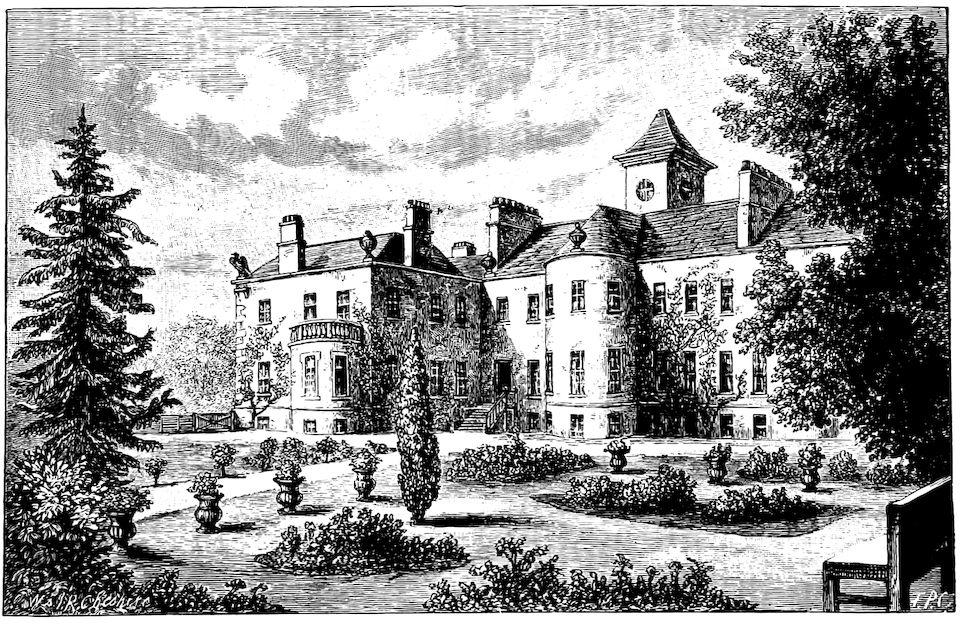
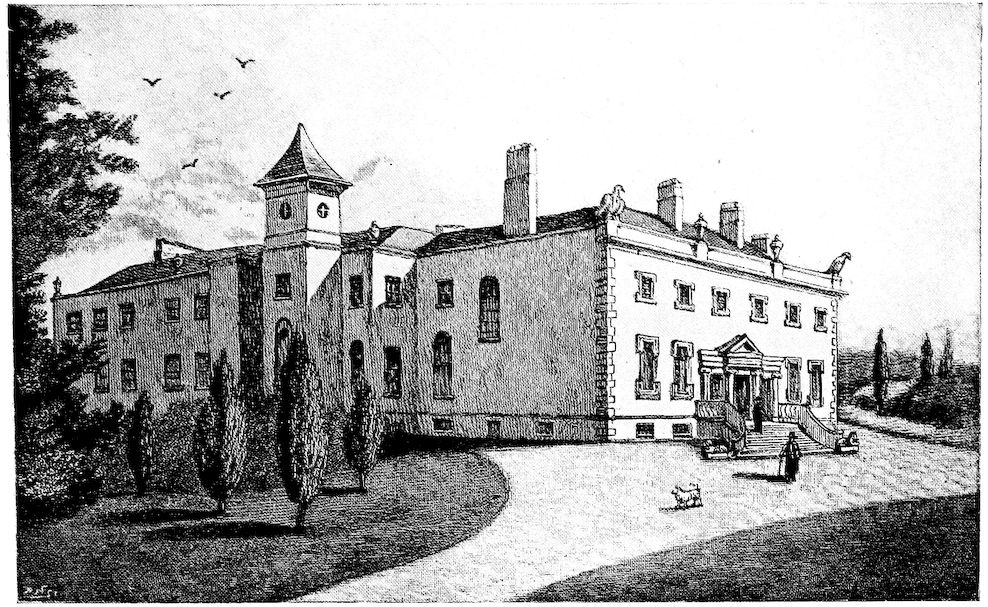
family. As half my life is connected with this dear old
place, I hope the reader will look at the pictures of it which
must be inserted in this book and think of it as it was in my
youth, bright and smiling and yet dignified; bosomed among
its old trees and with the green, wide-spreading park opened
out before the noble granite perron of the hall door. There
is another country house on the adjoining estate, Turvey, the
property of Lord Trimleston, and I have often amused myself
by comparing the two. Turvey is really a wicked-looking
house, with half-moon windows which suggest leering eyes,
and partition walls so thick that secret passages run through
them; and bedrooms with tapestry and ruelles and hidden
9doors in the wainscot. There were there, also, when I was
young, certain very objectionable pictures, beside several
portraits of the “beauties” of Charles II.’s court, (to the last
degree decolletées) who had been, no doubt, friends of the
first master of the house, their contemporary. In the
garden was a grotto with a deep cold bath in it, which, in
the climate of Ireland, suggested suicide rather than ablution.
Altogether the place had the same suggestiveness of “deeds
of darkness” which I remember feeling profoundly when I
went over Holyrood with Dr. John Brown; and it was quite
natural to attach to Turvey one of the worst of the
traditional Irish curses. This curse was pronounced by the
Abbess of the neighbouring convent (long in ruins) of
Grace-Dieu when Lord Kingsland, then lord of Turvey, had
by some nefarious means induced the English Government of
the day to make over the lands of the convent to himself.
On announcing this intelligence in his own hall to the
assembled nuns, the poor ladies took refuge very naturally in
malediction, went down simultaneously on their knees, and
repeated after their Abbess a denunciation of Heaven’s
vengeance on the traitor. “There should never want an
idiot or a lawsuit in the family; and the rightful heir should
never see the smoke of the chimney.” Needless to add,
lawsuits and idiots have been plentiful ever since, and, after
several generations of absentees, Turvey stands in a treeless
desert, and has descended in the world from lordly to humble
owners.
How different was Newbridge! Built not by a dissolute
courtier of Charles II., but by the sensible Whig, and
eminently Protestant Archbishop, it has as open and honest a
countenance as its neighbour has the reverse. The solid
walls, about three feet and a-half thick in most parts, keep
out the cold, but neither darken the large, lofty rooms, nor
afford space for devious and secret passages. The house
10stands broadly-built and strong, not high or frowning; its
Portland-stone colour warm against the green of Irish woods
and grass. Within doors every room is airy and lightsome,
and more than one is beautiful. There is a fine staircase out
of the second hall, the walls of which are covered with old
family pictures which the Archbishop had obtained from his
elder brother, Col. Richard Chaloner Cobbe, who had somehow
lost Swarraton, and whose line ended in an heiress, wife
of the 11th Earl of Huntingdon. A long corridor downstairs
was, I have heard, formerly hung from end to end with arms
intended for defence in case of attack. When the Rebellion
of 1798 took place the weapons were hidden in a hole into
which I have peered, under the floor of a room off the great
drawing-room, but what became of them afterwards I do
not know. My father possessed only a few pairs of handsome
pistols, two or three blunderbusses, sundry guns of various
kinds, and his own regimental sword which he had used at
Assaye. All these hung in his study. The drawing-room
with its noble proportions and its fifty-three pictures by
Vandyke, Ruysdael, Guercino, Vanderveldt and other old
masters, was the glory of the house. In it the happiest
hours of my life were passed.
Of this house and of the various estates bought and leased
by the Archbishop his only surviving son, Thomas Cobbe, my
great-grandfather, came into possession in the year 1765.
Irreverently known to his posterity as “Old Tommy” this
gentleman after the fashion of his contemporaries muddled
away in keeping open house a good deal of the property, and
eventually sold one estate and (what was worse) his father’s
fine library. Per contra he made the remarkable collection of
pictures of which I have spoken as adorning the walls of
Newbridge. Pilkington, the author of the Dictionary of
Painters, was incumbent of the little Vicarage of Donabate,
and naturally somewhat in the relation of chaplain to the
11squire of Newbridge, who had the good sense to send him to
Holland and Italy to buy the above-mentioned pictures, many
of which are described in the Dictionary. Some time
previously, when Pilkington had come out as an Art-critic,
the Archbishop had remonstrated with him on his unclerical
pursuit; but the poor man disarmed episcopal censure by
replying, “Your Grace, I have preached for a dozen years to
an old woman who can’t hear, and to a young woman who
won’t hear; and now I think I may attend to other things!”
Thomas Cobbe’s wife’s name has been often before the
public in connection with the story, told by Crabbe, Walter
Scott and many others, of the lady who wore a black
ribbon on her wrist to conceal the marks of a ghost’s
fingers. The real ghost-seer in question, Lady Beresford,
was confounded by many with her granddaughter Lady Eliza
Beresford, or, as she was commonly called after her marriage,
Lady Betty Cobbe. How the confusion came about I do not
know, but Lady Betty, who was a spirited woman much
renowned in the palmy days of Bath, was very indignant
when asked any questions on the subject. Once she received
a letter from one of Queen Charlotte’s Ladies-in-Waiting
begging her to tell the Queen the true story. Lady Betty in
reply “presented her compliments but was sure the Queen of
England would not pry into the private affairs of her subjects,
and had no intention of gratifying the impertinent curiosity of a
Lady-in-Waiting!” Considerable labour was expended some
years ago by the late Primate (Marcus Beresford) of Ireland,
another descendant of the ghost-seer in identifying the real
personages and dates of this curious tradition. The story
which came to me directly through my great-aunt, Hon.
Mrs. Henry Pelham, Lady Betty’s favourite daughter, was,
that the ghost was John Le Poer, Second Earl of Tyrone;
and the ghost-seer was his cousin, Nichola Hamilton, daughter
of Lord Glerawly, wife of Sir Tristram Beresford. The
12cousins had promised each other to appear,—whichever of
them first departed this life,—to the survivor. Lady
Beresford, who did not know that Lord Tyrone was dead,
awoke one night and found him sitting by her bedside. He
gave her (so goes the story) a short, but, under the circumstances,
no doubt impressive lesson, in the elements of
orthodox theology; and then to satisfy her of the reality of
his presence, which she persisted in doubting, he twisted
the curtains of her bed through a ring in the ceiling, placed
his hand on a wardrobe and left on it the ominous mark of
five burning fingers (the late Hon. and Rev. Edward Taylor
of Ardgillan Castle told me he had seen this wardrobe!) and
finally touched her wrist, which shrunk incontinently and
never recovered its natural hue. Before he vanished the
Ghost told Lady Beresford that her son should marry his
brother’s daughter and heiress; and that she herself should
die at the birth of a child after a second marriage, in her
forty-second year. All these prophecies, of course, came to
pass. From the marriage of Sir Marcus Beresford with the
ghost’s niece, Catharine, Baroness Le Poer of Curraghmore,
has descended the whole clan of Irish Beresfords. He
was created Earl of Tyrone; his eldest son was the first
Marquis of Waterford; another son was Archbishop of Tuam,
created Lord Decies; and his fifth daughter was the Lady
Betty Cobbe, my great-grandmother, concerning whom I have
told this old story. In these days of Psychological Research
I could not take on myself to omit it, though my own private
impression is, that Lady Beresford accidentally gave her
wrist a severe blow against her bedstead while she was
asleep; and that, by a law of dreaming which I have endeavoured
to trace in my essay on the subject, her mind
instantly created the myth of Lord Tyrone’s apparition.
Allowing for a fair amount of subsequent agglomeration of
incidents and wonders in the tradition, this hypothesis, I think
13quite meets the exigencies of the case; and in obedience to
the law of Parsimony, we need not run to a preternatural
explanation of the Black Ribbon on the Wrist, no doubt the
actual nucleus of the tale.
I do not disbelieve in ghosts; but unfortunately I have
never been able comfortably to believe in any particular
ghost-story. The overwhelming argument against the
veracity of the majority of such narrations is, that they contradict
the great truth beautifully set forth by Southey—
“They sin who tell us Love can die!—
With life all other passions fly
All others are but vanity—
In Heaven, Ambition cannot dwell,
Nor Avarice in the vaults of hell.
Earthly these passions as of earth,
They perish where they had their birth—
But Love is indestructible....”
The ghost of popular belief almost invariably exhibits the
survival of Avarice, Revenge, or some other thoroughly
earthly passion, while for the sake of the purest, noblest,
tenderest Love scarcely ever has a single Spirit of the
departed been even supposed to return to comfort the heart
which death has left desolate. The famous story of Miss Lee
is one exception to this rule, and so is another tale which I
found recorded in an MS. Memorandum in the writing of my
uncle the Rev. Henry Cobbe, Rector of Templeton (died 1823).
“Lady Moira[5] was at one time extremely uneasy about her
sister, Lady Selina Hastings, from whom she had not heard
for a considerable time. One night she dreamed that her
sister came to her, sat down by her bedside, and said to her,
‘My dear sister, I am dying of fever. They will not tell you
of it because of your situation’ (she was then with child),
14‘but I shall die, and the account will be brought to your
husband by letter directed like a foreign one in a foreign
hand.’ She told her dream to her attendant, Mrs. Moth, as
soon as she awoke, was extremely unhappy for letters, till
at length, the day after, there arrived one, directed as she
had been told, which contained an account of her sister’s
death. It had been written by her brother, Lord Huntingdon,
and in a feigned hand, lest she should ask to know the
contents.
“She had many other extraordinary dreams, and it is
very remarkable that after the death of her attendant, Moth,
who had educated her and her children, and was the niece of
the famous Bishop Hough, that she (Moth) generally took a
part in them, particularly if they related to any loss in her
family. Indeed, I believe she never dreamed of her except
when she was to undergo a loss. Lady Granard told me an
instance of this: Her second son Colonel Rawdon died very
suddenly. He had not been on good terms with Lady
Moira for some time. One night she dreamed that Moth
came into the room, and upon her asking her what she
wanted she said, ‘My lady, I am come to bring the Colonel
to you.’ Then he entered, came near her, and coming
within the curtains, sat on the bed and said, ‘My dearest
mother, I am going a very long journey, and I cannot bear
to go without the assurance of your forgiveness.’ Then she
threw her arms about his neck and said, ‘Dear Son, can
you doubt my forgiving you? But where are you going?’
He replied, ‘A long journey, but I am happy now that I
have seen you.’ The next day she received an account of
his death.
“About a fortnight before her death, when Lady Granard
and Lady Charlotte Rawdon, her daughters, were sitting up
in her room, she awoke suddenly, very ill and very much
agitated, saying that she had dreamed that Mrs. Moth came
15into her room. When she saw her she was so full of the idea
that evils always attended her appearance that she said, ‘Ah,
Moth, I fear you are come for my Selina’ (Lady G.).
Moth replied, ‘No, my Lady, but I am come for Mr. John.’
They gave her composing drops and soothed her; she soon
fell asleep, and from that time never mentioned her son’s
name nor made any inquiry about him; but he died on the
very day of her dream, though she never knew it.”
Old Thomas Cobbe and after him his only son, Charles
Cobbe, represented the (exceedingly-rotten) Borough of Swords
for a great many years in the Irish Parliament, which was
then in its glory, resonant with the eloquence of Flood (who
had married Lady Betty’s sister, Lady Jane) and of Henry
Grattan. On searching the archives of Dublin, however, in
the hope of discovering that our great-grandfather had done
some public good in his time, my brother and I had the
mortification to find that on the only occasion when reference
was made to his name, it was in connection with charges of
bribery and corruption! On the other hand, it is recorded to
his honour that he was almost the only one among the Members
of the Irish Parliament who voted for the Union, and yet
refused either a peerage or money compensation for his seat.
Instead of these he obtained for Swords some educational
endowments by which I believe the little town still profits.
In the record of corruption sent by Lord Randolph Churchill
to the Times (May 29th, 1893), in which appears a charge of
interested motives against nearly every Member of the Irish
Parliament of 1784, “Mr. Cobbe” stands honourably alone
as without any “object” whatever.
Thomas Cobbe’s two daughters, my great-aunts and
immediate predecessors as the Misses Cobbe, of Newbridge,
(my grandfather having only sons) differed considerably in all
respects from their unworthy niece. They occupied, so
said tradition, the large cheerful room which afterwards
16became my nursery. A beam across the ceiling still bore,
in my time, a large iron staple firmly fixed in the centre from
whence had dangled a hand-swing. On this swing my great-aunts
were wont to hang by their arms, to enable their maids
to lace their stays to greater advantage. One of them, afterwards
the Hon. Mrs. Henry Pelham, Lady-in-Waiting to
Queen Caroline, likewise wore the high-heeled shoes of the
period; and when she was an aged woman she showed
her horribly deformed feet to one of my brothers, and
remarked to him: “See, Tom, what comes of high-heeled
shoes!” I am afraid many of the girls now wearing
similarly monstrous foot-gear will learn the same lesson too
late. Mrs. Pelham, I have heard, was the person who practically
brought the house about the ears of the unfortunate
Queen Caroline; being the first to throw up her appointment
at Court when she became aware of the Queen’s private
on-goings. Her own character stood high; and the fact that
she would no longer serve the Queen naturally called attention
to all the circumstances. Bad as Queen Caroline was,
George the Fourth was assuredly worse than she. In his
old age he was personally very disgusting. My mother told
me that when she received his kiss on presentation at his
Drawing-Room, the contact with his face was sickening, like
that with a corpse. I still possess the dress she wore on
that occasion.
Mrs. Pelham’s sister married Sir Henry Tuite, of Sonnagh,
and for many years of her widowhood lived in the Circus,
Bath, and perhaps may still be remembered there by a few
as driving about her own team of four horses in her curricle,
in days when such doings by ladies were more rare than they
are now.
The only brother of these two Miss Cobbes of the past,
Charles Cobbe, of Newbridge, M.P., married Anne Power
Trench, of Garbally, sister of the first Earl of Clancarty.
17The multitudinous clans of Trenches and Moncks, in addition
to Lady Betty’s Beresford relations, of course thenceforth
adopted the habit of paying visitations at Newbridge.
Arriving by coachloads, with trains of servants, they remained
for months at a time. A pack of hounds was kept, and the
whole train de vie was liberal in the extreme. Naturally,
after a certain number of years of this kind of thing, embarrassments
beset the family finances; but fortunately at the
crisis Lady Betty came under the influence of her husband’s
cousin, the Methodist Countess of Huntingdon, and ere long
renounced the vanities and pleasures of the world, and persuaded
her husband to retire with her and live quietly at
Bath, where they died and were buried in Weston churchyard.
Fifty years afterwards I found in the library at
Newbridge the little batch of books which had belonged to my
great-grandmother in this phase of her life, and were marked
by her pencil: Jacob Boehmen and the Life of Madame Guyon
being those which I now recall. The peculiar, ecstatic
pietism which these books breathe, differing toto cœlo from
the “other worldliness” of the divines of about 1810, with
whose works the “Good-book Rows” of our library were
replenished, impressed me very vividly.[6]
I have often tried to construct in my mind some sort of
picture of the society which existed in Ireland a hundred
years ago, and moved in those old rooms wherein the first
half of my life was spent, but I have found it a very baffling
18undertaking. Apparently it combined a considerable amount
of æsthetic taste with traits of genuine barbarism; and high
religious pretension with a disregard of everyday duties and
a penchant for gambling and drinking which would now
place the most avowedly worldly persons under a cloud of
opprobrium. Card-playing was carried on incessantly.
Tradition says that the tables were laid for it on rainy days
at 10 o’clock in the morning in Newbridge drawing-room;
and on every day in the interminable evenings which
followed the then fashionable four o’clock dinner. My
grandmother was so excellent a whist-player that to extreme
old age in Bath she habitually made a small, but appreciable,
addition to her income out of her “card purse”; an ornamental
appendage of the toilet then, and even in my time, in
universal use. I was given one as a birthday present in my
tenth year. She was greatly respected by all, and beloved
by her five sons; every one of whom, however, she had sent
out to be nursed at a cottage in the park till they were three
years old. Her motherly duties were supposed to be
amply fulfilled by occasionally stopping her carriage to see
how the children were getting on.
As to the drinking among the men, (the women seem
not to have shared the vice) it must have prevailed to a
disgusting extent upstairs and downstairs. A fuddled
condition after dinner was accepted as the normal one of a
gentleman, and entailed no sort of disgrace. On the
contrary, my father has told me that in his youth his own
extreme sobriety gave constant offence to his grandfather, and
to his comrades in the army; and only by showing the latter
that he would sooner fight than be bullied to drink to excess
could he obtain peace. Unhappily, poor man! while his
grandfather, who seldom went to bed quite sober for forty
years, lived to the fine old age of 82, enjoying good health
to the last, his temperate grandson inherited the gout and in
19his latter years was a martyr thereto. Among the exceedingly
beautiful old Indian and old Worcester china which
belonged to Thomas Cobbe and showed his good taste and also
the splendid scale of his entertainments (one dessert-service
for 36 persons was magnificent) there stands a large goblet
calculated to hold three bottles of wine. This glass (tradition
avers) used to be filled with claret, seven guineas were placed
at the bottom, and he who drank it pocketed the coin.
The behaviour of these Anglo-Irish gentry of the last
century to their tenants and dependants seems to have proceeded
on the truly Irish principle of being generous before
you are just. The poor people lived in miserable hovels
which nobody dreamed of repairing; but then they were
welcome to come and eat and drink at the great house on
every excuse or without any excuse at all. This state of
things was so perfectly in harmony with Celtic ideas that
the days when it prevailed are still sighed after as the “good
old times.” Of course there was a great deal of Lady
Bountiful business, and also of medical charity-work going
forward. Archbishop Cobbe was fully impressed with the
merits of the Tar-water so marvellously set forth by his
suffragan, Bishop Berkeley, and I have seen in his handwriting
in a book of his wife’s cookery receipts, a receipt
for making it, beginning with the formidable item: “Take
six gallons of the best French brandy.” Lady Betty was
a famous compounder of simples, and of things that were
not simple, and a “Chilblain Plaister” which bore her name,
was not many years ago still to be procured in the chemists’
shops in Bath. I fear her prescriptions were not always of
so unambitious a kind as this. One day she stopped a man
on the road and asked his name—“Ah, then, my lady,” was
the reply, “don’t you remember me? Why, I am the
husband of the woman your ladyship gave the medicine to
and she died the next day. Long life to your Ladyship!”
20As I have said, the open-housekeeping at Newbridge at last
came to an end, and the family migrated to No. 9 and No. 22,
Marlborough Buildings, Bath, where two generations spent
their latter years, died, and were buried in Weston churchyard,
where I have lately restored their tombstones.
My grandfather died long before his father, and my father,
another Charles Cobbe, found himself at eighteen pretty well
his own master, the eldest of five brothers. He had been
educated at Winchester, where his ancestors for eleven
generations went to school in the old days of Swarraton;
and to the end of his life he was wont to recite lines of
Anacreon learned therein. But his tastes were active rather
than studious, and disliking the idea of hanging about his
mother’s house till his grandfather’s death should put him in
possession of Newbridge, he listened with an enchanted ear
to a glowing account which somebody gave him of India,
where the Mahratta wars were just beginning.
Without much reflection or delay, he obtained a cornet’s
commission in the 19th Light Dragoons and sailed for
Madras. Very shortly he was engaged in active service
under Wellesley, who always treated him with special kindness
as another Anglo-Irish gentleman. He fought at many
minor battles and sieges, and also at Assaye and Argaum;
receiving his medal for these two, just fifty years afterwards.
I shall write of this again a little further on in this book.
At last he fell ill of the fever of the country, which in those
days was called “ague,” and was left in a remote place
absolutely helpless. He was lying in bed one day in his tent
when a Hindoo came in and addressed him very courteously,
asking after his health. My father incautiously replied that
he was quite prostrated by the fever. “What! Not able to
move at all, not to walk a step?” said his visitor. “No! I
cannot stir,” said my father. “Oh, in that case, then,” said
the man,—and without more ado he seized my father’s desk,
21in which were all his money and valuables, and straightway
made off with it before my father could summon his servants.
His condition, thus left alone in an enemy’s country without
money, was bad enough, but he managed to send a trusty
messenger to Sir Arthur Wellesley, who promptly lent him
all he required.
Finding that there was no chance of his health being
sufficiently restored in India to permit of further active
service, and the Mahratta wars being practically concluded,
my father sold his commission of Lieutenant and returned to
England, quietly letting himself into his mother’s house in
Bath on his return by the latch-key, which he had carried
with him through all his journeys. All his life long the
impress made both on his outward bearing and character
by those five years of war were very visible. He
was a fine soldier-like figure, six feet high, and had
ridden eighteen stone in his full equipment. His face
was, I suppose, ugly, but it was very intelligent, very
strong willed, and very unmistakeably that of a gentleman.
He was under-jawed, very pale, with a large nose,
and small, grey, very lively eyes; but he had a beautiful
white forehead from which his hair, even in old age, grew
handsomely, and his head was very well set on his broad
shoulders. The photograph in the next volume represents
him at 76. He rode admirably, and a better figure on
horseback could not be seen. At all times there was an
aspect of strength and command about him, which his
vigorous will and (truth compels me to add) his not seldom
fiery temper, fully sustained. On the many occasions when
we had dinner parties at Newbridge, he was a charming,
gay and courteous host; and I remember being struck, when
he once wore a court dress and took me with him to pay
his respects to a Tory Lord Lieutenant, by the contrast
which his figure and bearing presented to that of nearly all
22the other men in similar attire. They looked as if they were
masquerading, and he as if the lace-ruffles and plum coat and
sword were his habitual dress. He had beautiful hands, of
extraordinary strength.
One day he was walking with one of his lady cousins on
his arm in the street. A certain famous prize-fighting bully,
the Sayers or Heenan of the period, came up hustling and
elbowing every passenger off the pavement. When my
father saw him approach he made his cousin take his left
arm, and as the prize-fighter prepared to shoulder him, he
delivered with his right fist, without raising it, a blow which
sent the ruffian fainting into the arms of his companions.
Having deposited his cousin in a shop, my father went back
for the sequel of the adventure, and was told that the
“Chicken” (or whatever he was called) had had his ribs
broken.
After his return from India, my father soon sought a wife.
He flirted sadly, I fear, with his beautiful cousin, Louisa
Beresford, the daughter of his great-uncle, the Archbishop of
Tuam; and one of the ways in which he endeavoured to
ingratiate himself was to carry about at all times a
provision of bon-bons and barley-sugar with which to
ply the venerable and sweet-toothed prelate; who was
generally known as “The Beauty of Holiness.” How
the wooing would have prospered cannot be told, but
before it had reached a crisis a far richer lover appeared on
the scene—Mr. Hope. “Anastasius Hope,” as he was called
from the work of which he was the author, was immensely
wealthy, and a man of great taste in art, but he had the
misfortune to be so excessively ugly that a painter whom he
offended by not buying his picture, depicted him and Miss
Beresford as “Beauty and the Beast,” and exhibited his
painting at the Bath Pump-room, where her brother, John
Beresford (afterwards the second Lord Decies) cut it deliberately
23to pieces. An engagement between Mr. Hope and Miss
Beresford was announced not long after the arrival of
Mr. Hope in Bath; and my mother, then Miss Conway,
going to pay a visit of congratulation to Miss Beresford,
found her reclining on a blue silk sofa appropriately
perusing The Pleasures of Hope. After the death of
Mr. Hope (by whom she was the mother of Mr. Beresford-Hope, Mr. Adrian and Mr. Henry Hope), Mrs. Hope
married the illegitimate son of her uncle, the Marquis of
Waterford—Field Marshal Lord Beresford—a fine old
veteran, with whom she long lived happily in the corner
house in Cavendish Square, where my father and brothers
always found a warm welcome.
At length, after some delays, my father had the great
good fortune to induce my dear mother to become his wife,
and they were married at Bath, March 13th, 1809. Frances
Conway was, as I have said, daughter of Capt. Thomas
Conway, of Morden Park. Her father and mother both
died whilst she was young and she was sent to the famous
school of Mrs. Devis, in Queen Square, Bloomsbury, of
which I shall have something presently to say, and afterwards
lived with her grandmother, who at her death bequeathed
to her a handsome legacy, at Southampton. When her
grandmother died, she being then sixteen years of age,
received an invitation from Colonel and Mrs. Champion to
live with them and become their adopted daughter. The
history of this invitation is rather touching. Mrs.
Champion’s parents had, many years before, suffered great
reverses, and my mother’s grandfather had done much to
help them, and, in particular, had furnished means for
Mrs. Champion to go out to India. She returned after
twenty years as the childless wife of the rich and
kindly old Colonel, the friend of Warren Hastings,
who having been commander-in-chief of the Forces of
24the East India Company had had a good “shake of the
Pagoda tree.” She repaid to the grandchild the kindness
done by the grandfather; and was henceforth really a
mother to my mother, who dearly loved both her and
Col. Champion. In their beautiful house, No. 29, Royal
Crescent, she saw all the society of Bath in its palmiest
days, Mrs. Champion’s Wednesday evening parties being
among the most important in the place. My mother’s part
as daughter of the house was an agreeable one, and her
social talents and accomplishments fitted her perfectly for
the part. The gentle gaiety, the sweet dignity and ease of
her manners and conversation remain to me as the memory of
something exquisite, far different even from the best manner
and talk of my own or the present generation; and I know
that the same impression was always made on her visitors in
her old age. I can compare it to nothing but the delicate
odour of the dried rose leaves with which her china vases
were filled and her wardrobes perfumed.
I hardly know whether my mother were really beautiful,
though many of the friends who remembered her in early
womanhood spoke of her as being so. To me her face was
always the loveliest in the world; indeed it was the one
through which my first dawning perception of beauty
was awakened. I can remember looking at her as I lay
beside her on the sofa, where many of her suffering hours
were spent, and suddenly saying, “Mamma you are so
pretty!” She laughed and kissed me, saying, “I am glad
you think so my child;” but that moment really brought
the revelation to me of that wonderful thing in God’s
creation, the Beautiful! She had fine features, a particularly
delicate, rather thin-lipped mouth; magnificent chestnut
hair, which remained scarcely changed in colour or quantity
till her death at seventy years of age; and the clear, pale
complexion and hazel eyes which belong to such hair. She
25always dressed very well and carefully. I never remember
seeing her downstairs except in some rich dark
silk, and with a good deal of fine lace about her cap and
old-fashioned fichu. Her voice and low laughter were
singularly sweet, and she possessed both in speaking and
writing a full and varied diction which in later years she
carefully endeavoured to make me share, instead of satisfying
myself, in school-girl fashion, with making one word serve a
dozen purposes. She was an almost omnivorous reader;
and, according to the standard of female education in her
generation, highly cultivated in every way; a good musician
with a very sweet touch of the piano, and speaking French
perfectly well.
Immediately after their marriage my parents took possession
of Newbridge, and my father began earnestly the fulfilment
of all the duties of a country gentleman, landlord and
magistrate. My mother, indeed, used laughingly to aver
that he “went to jail on their wedding day,” for he stopped
at Bristol on the road and visited a new prison with a view
to introducing improvements into Irish jails. It was due
principally to his exertions that the county jail, the now
celebrated Kilmainham, was afterwards erected.
Newbridge having been deserted for nearly thirty years, the
woods had been sorely injured and the house and out-buildings
dilapidated, but with my father’s energy and my mother’s
money things were put straight; and from that time till his
death in 1857 my father lived and worked among his people.
Though often hard pressed to carry out with a very
moderate income all his projects of improvements, he was
never in debt. One by one he rebuilt or re-roofed almost
every cottage on his estate, making what had been little
better than pig-styes, fit for human habitation; and when he
found that his annual rents could never suffice to do all that
was required in this way for his tenants in his mountain
26property, he induced my eldest brother, then just of age, to
join with him in selling two of the pictures which were the
heirlooms of the family and the pride of the house, a Gaspar
Poussin and a Hobbema, which last now adorns the walls
of Dorchester House. I remember as a child seeing the
tears in his eyes as this beautiful painting was taken out of
the room in which it had been like a perpetual ray of
sunshine. But the sacrifice was completed, and 80 good
stone and slate “Hobbema Cottages,” as we called them,
soon rose all over Glenasmoil. Be it noted by those who
deny every merit in an Anglo-Irish landlord, that not a
farthing was added to the rent of the tenants who profited by
this real act of self-denial.
All this however refers to later years. I have now
reached to the period when I may introduce myself on the
scene. Before doing so, however, I am tempted to print
here a letter which my much valued friend, Miss Felicia
Skene, of Oxford, has written to me on learning that I am
preparing this autobiography. She is one of the very few
now living who can remember my mother, and I gratefully
quote what she has written of her as corroborating my own
memories, else, perhaps, discounted by the reader as coloured
by a daughter’s partiality.
April 4th, 1894.
My dearest Frances,—
I know well that in recalling the days of your bright
youth in your grand old home, the most prominent figure
amongst those who surrounded you then, must be that of
your justly idolised mother, and I cannot help wishing to
add my testimony, as of one unbiassed by family ties,
to all that you possessed in her while she remained with
you; and all that you so sadly lost when she was taken from
you. To remember the châtelaine of Newbridge is to recall
one of the fairest and sweetest memories of my early life.
When I first saw that lovely, gracious lady with her almost
27angelic countenance and her perfect dignity of manner, I
had just come from a gay Eastern capital,—my home from
childhood, where no such vision of a typical English gentlewoman
had ever appeared before me; and the impression
she made upon me was therefore almost a revelation of
what a refined, high-bred lady could be in all that was pure
and lovely and of good report, and yet I think I only shared
in the fascination which she exercised on all who came
within the sphere of her influence. To me, almost a
stranger, whom she welcomed as your friend under her roof,
her exquisite courtesy would alone have been most
charming, but for your sake she showed me all the tenderness
of her sweet sympathetic nature, and it was no marvel
to me that she was the idol of her children and the object
of deepest respect and admiration to all who knew her.
Beautiful Newbridge with its splendid hospitality is like
a dream to me now, of what a gentleman’s estate and
country home could be in those days when ancient race and
noble family traditions were still of some account.
Ever affectionately yours,
F. M. F. Skene.
13, New Inn Hall Street, Oxford.
CHAPTER II. CHILDHOOD.
29
30
Newbridge, Co. Dublin.
31I was born on the morning of the 4th December, 1822;
at sunrise. There had been a memorable storm during the
night, and Dublin, where my father had taken a house that
my mother might be near her doctor, was strewn with the
wrecks of trees and chimney pots. My parents had already
four sons, and after the interval of five years since the birth
of the youngest, a girl was by no means welcome. I have
never had reason, however, to complain of being less cared
for or less well treated in every way than my brothers. If I
have become in mature years a “Woman’s Rights’ Woman”
it has not been because in my own person I have been made
to feel a Woman’s Wrongs. On the contrary, my brothers’
kindness and tenderness to me have been unfailing from my
infancy. I was their “little Fà’,” their pet and plaything
when they came home for their holidays; and rough words
not to speak of knocks,—never reached me from any of
them or from my many masculine cousins, some of whom,
as my father’s wards, I hardly distinguished in childhood
from brothers.
A few months after my birth my parents moved to a house
named Bower Hill Lodge in Melksham, which my father
hired, I believe, to be near his boys at school, and I have
some dim recollections of the verandah of the house, and also
of certain raisins which I appropriated, and of suffering
direful punishment at my father’s hands for the crime!
Before I was four years old we returned to Newbridge, and
I was duly installed with my good old Irish nurse, Mary
32Malone, in the large nursery at the end of the north corridor—the
most charming room for a child’s abode I have ever seen.
It was so distant from the regions inhabited by my parents
that I was at full liberty to make any amount of noise I
pleased; and from the three windows I possessed a commanding
view of the stable yard, wherein there was always visible an
enchanting spectacle of dogs, cats, horses, grooms, gardeners,
and milkmaids. A grand old courtyard it is; a quadrangle
about a rood in size surrounded by stables, coach-houses,
kennels, a laundry, a beautiful dairy, a labourer’s room, a paint
shop, a carpenter’s shop, a range of granaries and fruitlofts
with a great clock in the pediment in the centre;
and a well in the midst of all. Behind the stables and the
kennels appear the tops of walnut and chestnut trees and over
the coach-houses on the other side can be seen the beautiful old
kitchen garden of six acres with its lichen-covered red brick
walls, backed again by trees; and its formal straight terraces
and broad grass walks.
In this healthful, delightful nursery, and in walks with my
nurse about the lawns and shrubberies, the first years of my
happy childhood went by; fed in body with the freshest milk
and eggs and fruit, everything best for a child; and in mind
supplied only with the simple, sweet lessons of my gentle
mother. No unwholesome food, physical or moral, was ever
allowed to come in my way till body and soul had almost
grown to their full stature. When I compare such a lot as
this (the common lot, of course, of English girls of the
richer classes, blessed with good fathers and mothers) with
the case of the hapless young creatures who are fed from
infancy with insufficient and unwholesome food, perhaps dosed
with gin and opium from the cradle, and who, even as they
acquire language, learn foul words, curses and blasphemies,—when
I compare, I say, my happy lot with the miserable one of
tens of thousands of my brother men and sister women, I
33feel appalled to reflect, by how different a standard must they
and I be judged by eternal Justice!
In such an infancy the events were few, but I can
remember with amusement the great exercise of my little
mind concerning a certain mythical being known as “Peter.”
The story affords a droll example of the way in which fetishes
are created among child-minded savages. One day, (as my
mother long afterwards explained to me), I had been
hungrily eating a piece of bread and butter out of doors,
when one of the greyhounds, of which my father kept
several couples, bounded past me and snatched the bread and
butter from my little hands. The outcry which I was
preparing to raise on my loss was suddenly stopped by the
bystanders judiciously awakening my sympathy in Peter’s
enjoyment, and I was led up to stroke the big dog and make
friends with him. Seeing how successful was this diversion,
my nurse thenceforward adopted the practice of seizing
everything in the way of food, knives, &c., which it was
undesirable I should handle, and also of shutting objectionably
open doors and windows, exclaiming “O! Peter! Peter
has got it! Peter has shut it!”—as the case might be.
Accustomed to succumb to this unseen Fate under the name
of Peter, and soon forgetting the dog, I came to think there
was an all-powerful, invisible Being constantly behind the
scenes, and had so far pictured him as distinct from the real
original Peter that on one occasion when I was taken to visit
at some house where there was an odd looking end of a beam
jutting out under the ceiling, I asked in awe-struck tones:
“Mama! is that Peter’s head?”
My childhood, though a singularly happy, was an
unusually lonely one. My dear mother very soon after I
was born became lame from a trifling accident to her ankle
(ill-treated, unhappily, by the doctors) and she was never
once able in all her life to take a walk with me. Of course
34I was brought to her continually; first to be nursed,—for she
fulfilled that sacred duty of motherhood to all her children,
believing that she could never be so sure of the healthfulness
of any other woman’s constitution as of her own. Later, I
seem to my own memory to have been often cuddled up close
to her on her sofa, or learning my little lessons, mounted on
my high chair beside her, or repeating the Lord’s Prayer at
her knee. All these memories are infinitely sweet to me.
Her low, gentle voice, her smile, her soft breast and arms,
the atmosphere of dignity which always surrounded her,—the
very odour of her clothes and lace, redolent of dried
roses, come back to me after three-score years with nothing
to mar their sweetness. She never once spoke angrily or
harshly to me in all her life, much less struck or punished
me; and I—it is a comfort to think it—never, so far as I can
recall, disobeyed or seriously vexed her. She had regretted
my birth, thinking that she could not live to see me grow to
womanhood, and shrinking from a renewal of the cares of
motherhood with the additional anxiety of a daughter’s
education. But I believe she soon reconciled herself to my
existence, and made me, first her pet, and then her companion
and even her counsellor. She told me, laughingly, how,
when I was four years old, my father happening to be away
from home she made me dine with her, and as I sat in great
state beside her on my little chair I solemnly remarked:
“Mama, is it not a very comflin thing to have a little girl?”
an observation which she justly thought went to prove that
she had betrayed sufficiently to my infantine perspicacity that
she enjoyed my company at least as much as hers was
enjoyed by me.
My nurse who had attended all my brothers, was already
an elderly woman when recalled to Newbridge to take
charge of me; and though a dear, kind old soul and an
excellent nurse, she was naturally not much of a playfellow
35for a little child, and it was very rarely indeed that I had
any young visitor in my nursery or was taken to see any of
my small neighbours. Thus I was from infancy much
thrown on my own resources for play and amusement; and
from that time to this I have been rather a solitary mortal,
enjoying above all things lonely walks and studies; and
always finding my spirits rise in hours and days of isolation.
I think I may say I have never felt depressed when living
alone. As a child I have been told I was a very merry little
chick, with a round, fair face and abundance of golden hair;
a typical sort of Saxon child. I was subject then and for
many years after, to furious fits of anger, and on such
occasions I misbehaved myself exceedingly. “Nanno” was
then wont peremptorily to push me out into the long
corridor and bolt the nursery door in my face, saying in her
vernacular, “Ah, then! you bould Puckhawn (audacious
child of Puck)! I’ll get shut of you!” I think I feel now
the hardness of that door against my little toes, as I kicked
at it in frenzy. Sometimes, when things were very bad
indeed, Nanno conducted me to the end of the corridor at
the top of a very long winding stone stair, near the bottom
of which my father occasionally passed on his way to the
stables. “Yes, Sir! Yes, Sir! She’ll be good immadiently,
Sir, you needn’t come upstairs, Sir!” Then, sotto voce, to
me, “Don’t ye hear the Masther? Be quiet now, my
darlint, or he’ll come up the stairs!” Of course, “the
Masther” seldom or never was really within earshot on
these occasions. Had he been so Nanno would have been
the last person seriously to invoke his dreaded interference
in my discipline. But the alarm usually sufficed to reduce
me to submission. I had plenty of toddling about out of
doors and sitting in the sweet grass making daisy and dandelion
chains, and at home playing with the remnants of my
brother’s Noah’s Ark, and a magnificent old baby-house
36which stood in one of the bedrooms, and was so large that I
can dimly remember climbing up and getting into the doll’s
drawing-room.
My fifth birthday was the first milestone on Life’s road
which I can recall. I recollect being brought in the morning
into my mother’s darkened bedroom (she was already then a
confirmed invalid), and how she kissed and blessed me, and
gave me childish presents, and also a beautiful emerald ring
which I still possess, and pearl bracelets which she fastened
on my little arms. No doubt she wished to make sure that
whenever she might die these trinkets should be known to be
mine. She and my father also gave me a Bible and Prayer
Book, which I could read quite well, and proudly took next
Sunday to church for my first attendance, when the solemn
occasion was much disturbed by a little girl in a pew below
howling for envy of my white beaver bonnet, displayed in
the fore-front of the gallery which formed our family seat.
“Why did little Miss Robinson cry?” I was deeply
inquisitive on the subject, having then and always during my
childhood regarded “best clothes” with abhorrence.
Two years later my grandmother, having bestowed on me,
at Bath, a sky-blue silk pelisse, I managed nefariously to
tumble down on purpose into a gutter full of melted snow
the first day it was put on, so as to be permitted to resume
my little cloth coat.
Now, aged five, I was emancipated from the nursery and
allowed to dine thenceforward at my parents’ late dinner,
while my good nurse was settled for the rest of her days in a
pretty ivy-covered cottage with large garden, at the end of
the shrubbery. She lived there for several years with an old
woman for servant, who I can well remember, but who must
have been of great age, for she had been under-dairymaid to
my great great-grandfather, the Archbishop, and used to tell
us stories of “old times.” This “old Ally’s” great grandchildren
37were still living, recently, in the family service in the
same cottage which poor “Nanno” occupied. Ally was the
last wearer of the real old Irish scarlet cloak in our part of
the country; and I can remember admiring it greatly when
I used to run by her side and help her to carry her bundle of
sticks. Since those days, even the long blue frieze cloak
which succeeded universally to the scarlet—a most comfortable,
decent, and withal graceful peasant garment, very like
the blue cotton one of the Arab fellah-women—has itself
nearly or totally disappeared in Fingal.
On the retirement of my nurse, the charge of my little
person was committed to my mother’s maid and housekeeper,
Martha Jones. She came to my mother a blooming girl of
eighteen, and she died of old age and sorrow when I left
Newbridge at my father’s death half-a-century afterwards.
She was a fine, fair, broad-shouldered woman, with a certain
refinement above her class. Her father had been an
officer in the army, and she was educated (not very
extensively) at some little school in Dublin where her
particular friend was Moore’s (the poet’s) sister. She used
to tell us how Moore as a lad was always contriving to get
into the school and romping with the girls. The legend has
sufficient verisimilitude to need no confirmation!
“Joney” was indulgence itself, and under her mild sway,
and with my mother for instructress in my little lessons of
spelling and geography, Mrs. Barbauld, Dr. Watts and Jane
Taylor, I was as happy a little animal as well might be.
One day being allowed as usual to play on the grass before
the drawing-room windows I took it into my head that I
should dearly like to go and pay a visit to my nurse at her
cottage at the end of the shrubbery. “Joney” had taken
me there more than once, but still the mile-long shrubbery,
some of it very dark with fir trees and great laurels, complicated
with crossing walks, and containing two or three
38alarming shelter-huts and tonnelles (which I long after
regarded with awe), was a tremendous pilgrimage to
encounter alone. After some hesitation I set off; ran as
long as I could, and then with panting chest and beating
heart, went on, daring not to look to right or left, till
(after ages as it seemed to me) I reached the little window
of my nurse’s house in the ivy wall; and set up—loud
enough no doubt—a call for “Nanno!” The good soul
could not believe her eyes when she found me alone but,
hugging me in her arms, brought me back as fast as she
could to my distracted mother who had, of course, discovered
my evasion. Two years later, when I was seven years old,
I was naughty enough to run away again, this time in the
streets of Bath, in company with a hoop, and the Town
Crier was engaged to “cry” me, but I found my way
home at last alone. How curiously vividly silly little
incidents like these stand out in the misty memory of childhood,
like objects suddenly perceived close to us in a fog! I
seem now, after sixty years, to see my nurse’s little brown
figure and white kerchief, as she rushed out and caught her
stray “darlint” in her arms; and also I see a dignified,
gouty gentleman leaning on his stick, parading the broad
pavement of Bath Crescent, up whose whole person my
misguided and muddy hoop went bounding in my second
escapade. I ought to apologise perhaps to the reader for
narrating such trivial incidents, but they have left a charm
in my memory.
At seven I was provided with a nursery governess, and my
dear mother’s lessons came to an end. So gentle and sweet
had they been that I have loved ever since everything she
taught me, and have a vivid recollection of the old map book
from whence she had herself learned Geography, and of Mrs.
Trimmer’s Histories, “Sacred” and “Profane”; not forgetting
the almost incredibly bad accompanying volumes of
39woodcuts with poor Eli a complete smudge and Sesostris
driving the nine kings (with their crowns, of course)
harnessed to his chariot. Who would have dreamed we
should now possess photos of the mummy of the real
Sesostris (Rameses II.), who seemed then quite as mythical
a personage as Polyphemus? To remember the hideous
aberrations of Art which then illustrated books for children,
and compare them to the exquisite pictures in “Little Folks,”
is to realise one of the many changes the world has seen
since my childhood. Mrs. Trimmer’s books cost, I remember
being told, ten shillings apiece! My governess Miss
Kinnear’s lessons, though not very severe (our old doctor,
bless him for it! solemnly advised that I should never be
called on to study after twelve o’clock), were far from being
as attractive as those of my mother, and as soon as I learned
to write, I drew on the gravel walk this, as I conceived,
deeply touching and impressive sentence: “Lessons! Thou
tyrant of the mind!” I could not at all understand my
mother’s hilarity over this inscription, which proved so
convincingly my need, at all events of those particular
lessons of which Lindley Murray was the author. I envied
the peacock who could sit all day in the sun, and who ate
bowls-full of the griddle-bread of which I was so fond; and
never was expected to learn anything? Poor bird, he came
to a sad end. A dog terrified him one day and he took a
great flight and was observed to go into one of the tall limes
near the house but was never seen alive again. When the
leaves fell in the autumn the rain-washed feathers and
skeleton of poor Pe-ho were found wedged in a fork of the
tree. He had met the fate of “Lost Sir Massingberd.”
Some years later, my antipathy to lessons having not at
all diminished, I read a book which had just appeared, and
of which all the elders of the house were talking, Keith’s
Signs of the Times. In this work, as I remember, it was set
40forth that a “Vial” was shortly to be emptied into or near
the Euphrates, after which the end of the world was to
follow immediately. The writer accordingly warned his
readers that they would soon hear startling news from the
Euphrates. From that time I persistently inquired of
anybody whom I saw reading the newspaper (a small sheet
which in the Thirties only came three times a week) or who
seemed well-informed about public affairs, “What news was
there from the Euphrates?” The singular question at last
called forth the inquiry, “Why I wanted to know?” and I
was obliged to confess that I was hoping for the emptying of
the “Vial” which would put an end to my sums and
spelling lessons.
My seventh year was spent with my parents at Bath,
where we had a house for the winter in James’ Square,
where brothers and cousins came for the holidays, and in
London, where I well remember going with my mother to see
the Diorama in the Colosseum in Regent’s Park, of St.
Peter’s, and a Swiss Cottage, and the statues of Tam o’
Shanter and his wife (which I had implored her to be allowed
to see, having imagined them to be living ogres) and vainly
entreating to be taken to see the Siamese Twins. This last
longing, however, was gratified just thirty years afterwards.
We travelled back to Ireland, posting all the way to
Holyhead by the then new high road through Wales and
over the Menai Bridge. My chief recollection of the long
journey is humiliating. A box of Shrewsbury cakes, exactly
like those now sold in the town, was bought for me in situ,
and I was told to bring it over to Ireland to give to my little
cousin Charley. I was pleased to give the cakes to Charley,
but then Charley was at the moment far away, and the cakes
were always at hand in the carriage; and the road was
tedious and the cakes delicious; and so it came to pass
somehow that I broke off first a little bit, and then another
41day a larger bit, till cake after cake vanished, and with
sorrow and shame I was obliged to present the empty box to
Charley on my arrival. Greediness alas! has been a
besetting sin of mine all my life.
This Charley was a dear little boy, and about this date
was occasionally my companion. His father, my uncle,
was Captain William Cobbe, R.N., who had fought under
Nelson, and at the end of the war, married and took
a house near Newbridge, where he acted as my father’s
agent. He was a fine, brave fellow, and much beloved
by every one. One day, long after his sudden, untimely
death, we heard from a coastguardsman who had been
a sailor in his ship, that he had probably caught the
disease of which he died in the performance of a gallant
action, of which he had never told any one, even his wife. A
man had fallen overboard from his ship one bitterly cold
night in the northern seas near Copenhagen. My uncle, on
hearing what had happened, jumped from his warm berth
and plunged into the sea, where he succeeded in rescuing the
sailor, but in doing so caught a chill which eventually
shortened his days. He had five children, the eldest being
Charley, some months younger than I. When my uncle
came over to see his brother and do business, Charley, as he
grew old enough to take the walk, was often allowed to come
with him; and great was my enjoyment of the unwonted
pleasure of a young companion. Considerably greater, I
believe, than that of my mother and governess, who justly
dreaded the escapades which our fertile little brains rarely
failed to devise. We climbed over everything climbable by
aid of the arrangement that Charley always mounted on my
strong shoulders and then helped me up. One day my
father said to us: “Children, there is a savage bull come,
you must take care not to go near him.” Charley and I looked
at each other and mutually understood. The next moment we
42were alone we whispered, “We must get some hairs of his
tail!” and away we scampered till we found the new bull in a
shed in the cow-yard. Valiantly we seized the tail, and as the
bull fortunately paid no attention to his Lilliputian foes, we
escaped in triumph with the hairs. Another time, a lovely
April evening, I remember we were told it was damp,
and that we must not go out of the house. We had discovered,
however, a door leading out upon the roof,—and we
agreed that “on” the house could not properly be considered
“out” of the house; and very soon we were clambering up
the slates, and walking along the parapet at a height of
fifty or sixty feet from the ground. My mother, passing
through one of the halls, observed a group of servants looking
up in evident alarm and making signs to us to come down.
As quickly as her feebleness permitted she climbed to our door
of exit, and called to us over the roofs. Charley and I felt
like Adam and Eve on the fatal evening after they had eaten
the apple! After dreadful moments of hesitation we came
down and received the solemn rebuke and condemnation we
deserved. It was not a very severe chastisement allotted to
us, though we considered it such. We were told that the
game of Pope Joan, promised for the evening, should not be
played. That was the severest, if not the only punishment,
my mother ever inflicted on me.
On rainy days when Charley and I were driven to amuse
ourselves in the great empty rooms and corridors upstairs,
we were wont to discuss profound problems of theology. I
remember one conclusion relating thereto at which we
unanimously arrived. Both of us bore the name of “Power”
as a second name, in honour of our grandmother Anne
Trench’s mother, Fanny Power of Coreen. On this circumstance
we founded the certainty that we should both go to
Heaven, because we heard it said in church, “The Heavens
and all the Powers therein.”
43Alas poor “Little Charley” as everybody called him, after
growing to be a fine six-foot fellow, and a very popular officer,
died sadly while still young, at the Cape.
In those early days, let us say about my tenth year, and
for long afterwards, it was my father’s habit to fill his house
with all the offshoots of the family at Christmas, and with a
good many of them for the Midsummer holidays, when my
two eldest brothers and the youngest came home from
Charterhouse and Oxford, and the third from Sandhurst.
These brothers of mine were kind, dear lads, always gentle
and petting to their little sister, who was a mere baby when
they were schoolboys, and of course never really a companion
to them. I recollect they once tried to teach me Cricket, and
straightway knocked me over with a ball; and then carried
me, all four in tears and despair, to our mother thinking
they had broken my ribs. I was very fond of them, and
thought a great deal about their holidays, but naturally in
early years saw very little of them.
Beside my brothers, and generally coming to Newbridge at
the same holiday seasons, there was a regiment of young
cousins, male and female. My mother’s only brother,
Adjutant General Conway, had five children, all of whom
were practically my father’s wards during the years of their
education at Haileybury and in a ladies’ boarding-school in
London. Then, beside my father’s youngest brother
William’s family of five, of whom I have already spoken,
his next eldest brother, George, of the Horse Artillery (Lieut.
General Cobbe in his later years), had five more, and
finally the third brother, Thomas, went out to India in his
youth as aide-de-camp to his cousin, the Marquis of Hastings,
held several good appointments (at Moorshedabad and
elsewhere), married and had ten children, (all of whom
passed into my father’s charge) and finally died, poor
fellow! on his voyage home from India, after thirty
44years’ absence. Thus there were, in fact, including his own
children, thirty young people more or less my father’s wards,
and all of them looking to Newbridge as the place where
holidays were naturally spent, and to my father’s not very
long purse as the resource for everybody in emergencies.
One of them, indeed, carried this view of the case rather
unfortunately far. A gentleman visiting us, happening to
mention that he had lately been to Malta, we naturally asked
him if he had met a young officer of our name quartered
there? “Oh dear, yes! a delightful fellow! All the ladies
adore him. He gives charming picnics, and gets nosegays
for them all from Naples.” “I am afraid he can scarcely
afford that sort of thing,” someone timidly observed. “Oh,
he says,” replied the visitor, “that he has an old uncle
somewhere who——Good Lord! I am afraid I have
put my foot in it,” abruptly concluded our friend, noticing
the looks exchanged round the circle.
My father’s brother Henry, my god-father, died early and
unmarried. He was Rector of Templeton, and was very
intimate with his neighbours there, the Edgeworths and
Granards. The greater part of the library at Newbridge, as
it was in my time, had been collected by him, and included
an alarming proportion of divinity. The story of his life
might serve for such a novel as his friend, Miss Edgeworth,
would have written and entitled “Procrastination.” He was
much attached for a long time to a charming Miss Lindsay,
who was quite willing to accept his hand, had he offered it.
My poor uncle, however, continued to flirt and dangle and to
postpone any definite declaration, till at last the girl’s mother—who,
I rather believe, was a Lady Charlotte Lindsay, well
known in her generation—told her that a conclusion must be
put to this sort of thing. She would invite Mr. Cobbe to
their house for a fortnight, and during that time every
opportunity should be afforded him of making a proposal in
45form, if he should be so minded. If, however, at the end of
this probation, he had said nothing, Miss Lindsay was to
give him up, and he was to be allowed no more chances of
addressing her. The visit was paid, and nothing could be
more agreeable or devoted than my uncle; but he did not
propose to Miss Lindsay! The days passed, and as the end
of the allotted time drew near, the lady innocently arranged
a few walks en tête-à-tête, and talked in a manner which
afforded him every opportunity of saying the words which
seemed always on the tip of his tongue. At last the final day
arrived. “My dear,” said Lady Charlotte (if such was the
mother’s name) to her daughter, “I shall go out with the
rest of the party for the whole day and leave you and Mr.
Cobbe together. When I return, it must be decided one way
or the other.”
The hours flew in pleasant and confidential talk—still no
proposal! Miss Lindsay, who knew that the final minutes
of grace were passing for her unconscious lover, once more
despairingly tried, being really attached to him, to make
him say something which she could report to her mother.
As he afterwards averred he was on the very brink of asking
her to marry him when he caught the sound of her mother’s
carriage returning to the door, and said to himself, “I’ll wait
for another opportunity.”
The opportunity was never granted to him. Lady
Charlotte gave him his congé very peremptorily next morning.
My uncle was furious, and in despair; but it was too late!
Like other disappointed men he went off rashly, and almost
immediately engaged himself (with no delay this time) to
Miss Flora Long of Rood Ashton, Wiltshire, a lady of
considerable fortune and attractions and of excellent connections,
but of such exceedingly rigid piety of the
Calvinistic type of the period, that I believe my uncle was
soon fairly afraid of his promised bride. At all events his
46procrastinations began afresh. He remained at Templeton
on one excuse after another, till Miss Long wrote to ask;
“Whether he wished to keep their engagement?” My poor
uncle was nearly driven now to the wall, but his health was
bad and might prove his apology for fresh delays. Before
replying to his Flora, he went to Dublin and consulted Sir
Philip Crampton. After detailing his ailments, he asked
what he ought to do, hoping (I am afraid) that the great
surgeon would say, “O you must keep quiet!” Instead of
this verdict Crampton said, “Go and get married by all
means!” No further excuse was possible, and my poor
uncle wrote to say he was on his way to claim his
bride. Ere he reached her, however, while stopping at
his mother’s house in Bath, he was found dead in his
bed on the morning on which he should have gone
to Rood Ashton. He must have expired suddenly while
reading a good little book. All this happened somewhere
about 1823.
To return to our old life at Newbridge, about 1833 and
for many years afterwards, the assembling of my father’s
brothers, and brothers’ wives and children at Christmas was
the great event of the year in my almost solitary childhood.
Often a party of twenty or more sat down every day for
three or four weeks together in the dining-room, and we
younger ones naturally spent the short days and long
evenings in boyish and girlish sports and play. Certain
very noisy and romping games—Blindman’s buff, Prisoner’s
Bass, Giant, and Puss in the Corner and Hunt the Hare—as
we played them through the halls below stairs, and the
long corridors and rooms above, still appear to me as among
the most delightful things in a world which was then all
delight. As we grew a little older and my dear, clever
brother Tom came home from Oxford and Germany,
charades and plays and masquerading and dancing came into
47fashion. In short ours was, for the time, like other large
country houses, full of happy young people, with the high
spirits common in those old days. The rest of the year,
except during the summer vacation, when brothers and
cousins mustered again, the place was singularly quiet, and
my life strangely solitary for a child. Very early I made a
concordat with each of my four successive governesses, that
when lessons were ended, precisely at twelve, I was free to
wander where I pleased about the park and woods, to row the
boat on the pond or ride my pony on the sands of the sea-shore
two miles from the house. I was not to be expected to
have any concern with my instructress outside the doors.
The arrangement suited them, of course, perfectly; and my
childhood was thus mainly a lonely one. I was so uniformly
happy that I was (what I suppose few children are) quite
conscious of my own happiness. I remember often thinking
whether other children were all as happy as I, and sometimes,
especially on a spring morning of the 18th March,—my
mother’s birthday, when I had a holiday, and used to make
coronets of primroses and violets for her,—I can recall
walking along the grass walks of that beautiful old garden
and feeling as if everything in the world was perfect, and
my life complete bliss for which I could never thank God
enough.
When the weather was too bad to spend my leisure hours
out of doors I plunged into the library at haphazard, often
making “discovery” of books of which I had never been
told, but which, thus found for myself, were doubly
precious. Never shall I forget thus falling by chance on
Kubla Khan in its first pamphlet-shape. I also gloated over
Southey’s Curse of Kehama, and The Cid and Scott’s earlier
works. My mother did very wisely, I think, to allow me
thus to rove over the shelves at my own will. By degrees a
genuine appetite for reading awoke in me, and I became a
48studious girl, as I shall presently describe. Beside the
library, however, I had a play-house of my own for wet days.
There were, at that time, two garrets only in the house (the
bedrooms having all lofty coved ceilings), and these two
garrets, over the lobbies, were altogether disused. I took
possession of them, and kept the keys lest anybody should pry
into them, and truly they must have been a remarkable sight!
On the sloping roofs I pinned the eyes of my peacock’s feathers
in the relative positions of the stars of the chief constellations;
one of my hobbies being Astronomy. On another wall I
fastened a rack full of carpenter’s tools, which I could use
pretty deftly on the bench beneath. The principal wall was
an armoury of old court-swords, and home-made pikes,
decorated with green and white flags (I was an Irish patriot
at that epoch), sundry javelins, bows and arrows, and a
magnificently painted shield with the family arms. On the
floor of one room was a collection of shells from the neighbouring
shore, and lastly there was a table with pens, ink
and paper; implements wherewith I perpetrated, inter alia,
several poems of which I can just recall one. The motif of
the story was obviously borrowed from a stanza in Moore’s
Irish Melodies. Even now I do not think the verses very
bad for 12 or 13 years old.
49And he thought as he sailed of his father’s name
Of the kings of Erin’s ancient fame,
Of days when ‘neath those waters green
The banners of Nial were ever seen,
And where the Knights of the Blood-Red-Tree
Had held of old their revelry;
And where O’Nial’s race alone
Had sat upon the regal throne.
While the fisherman thought of the days of old
The sun had left the western sky
And the moon had risen a lamp of gold,
Ere O’Nial deemed that the eve was nigh,
He turned his boat to the mountain side
And it darted away o’er the rippling tide;
Like arrow from an Indian bow
Shot o’er the waves the glancing prow.
The fisherman saw not the point beneath
Which beckoned him on to instant death.
It struck—yet he shrieked not, although his blood
Ran chill at the thought of that fatal flood;
And the voice of O’Nial was silent that day
As he sank ‘neath the waters of dark Lough Neagh;
Like when Adam rose from the dust of earth
And felt the joy of his glorious birth,
And where’er he gazed, and where’er he trod,
He felt the presence and smile of God,—
Like the breath of morning to him who long
Has ceased to hear the warblers’ song,
And who, in the chamber of death hath lain
With a sickening heart and a burning brain;
So rushed the joy through O’Nial’s mind
When the waters dark above him joined,
And he felt that Heaven had made him be
A spirit of light and eternity.
He gazed around, but his dazzled sight
Saw not the spot from whence he fell,
For beside him rose a spire so bright
No mortal tongue could its splendours tell
Nor human eye endure its light.
50And he looked and saw that pillars of gold
The crystal column did proudly hold;
And he turned and walked in the light blue sea
Upon a silver balcony,
Which rolled around the spire of light
And laid on the golden pillars bright.
Descending from the pillars high,
He passed through portals of ivory
E’en to the hall of living gold
The palace of the kings of old.
The harp of Erin sounded high
And the crotal joined the melody,
And the voice of happy spirits round
Prolonged and harmonized the sound.
“All hail, O’Nial!”—
and so on, and so on! I wrote a great deal of this sort of
thing then and for a few years afterwards; and of course,
like everyone else who has ever been given to waste paper and
ink, I tried my hand on a tragedy. I had no real power or
originality, only a little Fancy perhaps, and a dangerous facility
for flowing versification. After a time my early ambition
to become a Poet died out under the terrible hard mental
strain and very serious study through which I passed in
seeking religious faith. But I have always passionately loved
poetry of a certain kind, specially that of Shelley; and
perhaps some of my prose writings have been the better for my
early efforts to cultivate harmony and for my delight in good
similes. This last propensity is even now very strong in me,
and whenever I write con amore, comparisons and metaphors
come tumbling out of my head, till my difficulty is to exclude
mixed ones!
My education at this time was of a simple kind. After
Miss Kinnear left us to marry, I had another nursery
governess, a good creature properly entitled “Miss Daly,”
but called by my profane brothers, “the Daily Nuisance.”
51After her came a real governess, the daughter of a bankrupt
Liverpool merchant who made my life a burden with her
strict discipline and her “I-have-seen-better-days” airs;
and who, at last, I detected in a trick which to me appeared
one of unparalleled turpitude! She had asked me to let her
read something which I had written in a copy-book and I had
peremptorily declined to obey her request, and had locked up
my papers in my beloved little writing-desk which my dear
brother Tom had bought for me out of his school-boy’s
pocket-money. The keys of this desk I kept with other
things in one of the old-fashioned pockets which everybody
then wore, and which formed a separate article of
under clothing. This pocket my maid naturally placed at
night on the chair beside my little bed, and the curtains
of the bed being drawn, Miss W. no doubt after a time
concluded I was asleep and cautiously approached the chair
on tiptoe. As it happened I was wide awake, having
at that time the habit of repeating certain hymns and
other religious things to myself before I went to sleep; and
when I perceived through the white curtain the shadow of
my governess close outside, and then heard the slight jingle
made by my keys as she abstracted them from my pocket, I
felt as if I were witness of a crime! Anything so base I
had never dreamed as existing outside story books of
wicked children. Drawing the curtain I could see that
Miss W. had gone with her candle into the inner room
(one of the old “powdering closets” attached to all the
rooms in Newbridge) and was busy with the desk which
lay on the table therein. Very shortly I heard the desk
close again with an angry click,—and no wonder! Poor
Miss W., who no doubt fancied she was going to detect
her strange pupil in some particular naughtiness, found the
MS. in the desk, to consist of solemn religious “Reflections,”
in the style of Mrs. Trimmer; and of a poetical description
52(in round hand) of the Last Judgment! My governess
replaced the bunch of keys in my pocket and noiselessly
withdrew, but it was long before I could sleep for sheer
horror; and next day I, of course, confided to my mother the
terrible incident. Nothing, I think, was said to Miss W.
about it, but she was very shortly afterwards allowed to
return to her beloved Liverpool, where, for all I know, she
may be living still.
My fourth and last governess was a remarkable woman, a
Mdlle. Montriou, a person of considerable force of character,
and in many respects an admirable teacher. With her I read
a good deal of solid history, beginning with Rollin and going
on to Plutarch and Gibbon; also some modern historians.
She further taught me systematically a scheme of chronology
and royal successions, till I had an amount of knowledge of
such things which I afterwards found was not shared by any
of my schoolfellows. She had the excellent sense also to
allow me to use a considerable part of my lesson hours with
a map book before me, asking her endless questions on all
things connected with the various countries; and as she was
extremely well and widely informed, this was almost the best
part of my instruction. I became really interested in these
studies, and also in the great poets, French and English, to
whom she introduced me. Of course my governess taught
me music, including what was then called Thorough Bass, and
now Harmony; but very little of the practical part of performance
could I learn then or at any time. Independently of her,
I read every book on Astronomy which I could lay hold of,
and I well remember the excitement wherewith I waited for
years for the appearance of the Comet of 1835, which one of
these books had foretold. At last a report reached me that
the village tailor had seen the comet the previous night. Of
course I scanned the sky with renewed ardour, and thought I
had discovered the desired object in a misty-looking star of
which my planisphere gave no notice. My father however
pooh-poohed this bold hypothesis, and I was fain to wait till
the next night. Then, as soon as it was dark, I ran up to a
window whence I could command the constellation wherein
the comet was bound to show itself. A small hazy star—and a
long train of light from it—greeted my enchanted eyes! My
limbs could hardly bear me as I tore downstairs into the
drawing-room, nor my voice publish the triumphant intelligence,
“It is the comet!” “It has a tail!” Everybody (in
far too leisurely a way as I considered) went up and saw it,
and confessed that the comet it certainly must be, with that
appendage of the tail! Few events in my long life have
caused me such delightful excitement. This was in 1835.
Newbridge, Co. Dublin.
CHAPTER III. SCHOOL AND AFTER.
55
57When my father, in 1836, had decided, by my governess’s
advice, to send me to school, my dear mother, though already
old and feeble, made the journey, long as it was in those
days, from Ireland to Brighton to see for herself where I
was to be placed, and to invoke the kindness of my schoolmistresses
for me. We sailed to Bristol—a 30 hours’
passage usually, but sometimes longer,—and then travelled
by postchaises to Brighton, taking, I think, three days on
the road and visiting Stonehenge by the way, to my mother’s
great delight. My eldest brother, then at Oxford, attended
her and acted courier. When we came in sight of Brighton
the lamps were lighted along the long perspective of the
shore. Gas was still sufficiently a novelty to cause this
sight to be immensely impressive to us all.
Next day my mother took me to my future tyrants, and
fondly bargained (as she was paying enormously) that I
should have sundry indulgences, and principally a bedroom to
myself. A room was shown to her with only one small bed
in it, and this she was told would be mine. When I went to
it next night, heart broken after her departure, I found that
another bed had been put up, and a schoolfellow was already
asleep in it. I flung myself down on my knees by my own
and cried my heart out, and was accordingly reprimanded
next morning before the whole school for having been seen
to cry at my prayers.[8]
58The education of women was probably at its lowest ebb
about half-a-century ago. It was at that period more pretentious
than it had ever been before, and infinitely more
costly than it is now; and it was likewise more shallow and
senseless than can easily be believed. To inspire young
women with due gratitude for their present privileges, won
for them by my contemporaries, I can think of nothing better
than to acquaint them with some of the features of school life
in England in the days of their mothers. I say advisedly
the days of their mothers, for in those of their grandmothers,
things were by no means equally bad. There was much less
pretence and more genuine instruction, so far as it extended.
For a moment let us, however, go back to these earlier
grandmothers’ schools, say those of the year 1790 or thereabouts.
From the reports of my own mother, and of a
friend whose mother was educated in the same place, I can
accurately describe a school which flourished at that date in
the fashionable region of Queen Square, Bloomsbury. The
mistress was a certain Mrs. Devis, who must have been a
woman of ability for she published a very good little English
Grammar for the express use of her pupils; also a Geography,
and a capital book of maps, which possessed the inestimable
advantage of recording only those towns, cities, rivers, and
mountains which were mentioned in the Geography, and not
confusing the mind (as maps are too apt to do) with extraneous
and superfluous towns and hills. I speak with personal
gratitude of those venerable books, for out of them chiefly I
obtained such inklings of Geography as have sufficed generally
for my wants through life; the only disadvantage they entailed
being a firm impression, still rooted in my mind, that there is a
“Kingdom of Poland” somewhere about the middle of Europe.
Beside Grammar and Geography and a very fair share of
history (“Ancient” derived from Rollin, and “Sacred”
from Mrs. Trimmer), the young ladies at Mrs. Devis’ school
59learned to speak and read French with a very good accent,
and to play the harpsichord with taste, if not with a very
learned appreciation of “severe” music. The “Battle of
Prague” and Hook’s Sonatas were, I believe, their
culminating achievements. But it was not considered in
those times that packing the brains of girls with facts, or
even teaching their fingers to run over the keys of instruments,
or to handle pen and pencil, was the Alpha and
Omega of education. William of Wykeham’s motto,
“Manners makyth Manne,” was understood to hold good
emphatically concerning the making of Woman. The abrupt
speaking, courtesy-neglecting, slouching, slangy young
damsel who may now perhaps carry off the glories of a
University degree, would have seemed to Mrs. Devis still
needing to be taught the very rudiments of feminine knowledge.
“Decorum” (delightful word! the very sound of
which brings back the smell of Maréchale powder) was the
imperative law of a lady’s inner life as well as of her
outward habits; and in Queen Square nothing that was not
decorous was for a moment admitted. Every movement of
the body in entering and quitting a room, in taking a seat
and rising from it, was duly criticised. There was kept, in
the back premises, a carriage taken off the wheels, and
propped up en permanence, for the purpose of enabling the
young ladies to practise ascending and descending with calmness
and grace, and without any unnecessary display of their
ankles. Every girl was dressed in the full fashion of the
day. My mother, like all her companions, wore hair-powder
and rouge on her cheeks when she entered the school a
blooming girl of fifteen; that excellent rouge at five guineas
a pot, which (as she explained to me in later years) did not
spoil the complexion like ordinary compounds, and which I
can witness really left a beautiful, clear skin when disused
thirty years afterwards.
60Beyond these matters of fashion, however,—so droll now
to remember,—there must have been at Mrs. Devis’
seminary a great deal of careful training in what may be
called the great Art of Society; the art of properly paying
and receiving visits, of saluting acquaintances in the street
and drawing-room; and of writing letters of compliment.
When I recall the type of perfect womanly gentleness and
high breeding which then and there was formed, it seems to
me as if, in comparison, modern manners are all rough and
brusque. We have graceful women in abundance still, but
the peculiar old-fashioned suavity, the tact which made
everybody in a company happy and at ease,—most of all the
humblest individual present,—and which at the same time
effectually prevented the most audacious from transgressing
les bienséances by a hair; of that suavity and tact we seem
to have lost the tradition.
The great Bloomsbury school, however, passed away at
length, good Mrs. Devis having departed to the land where I
trust the Rivers of Paradise formed part of her new study of
Geography. Nearly half-a-century later, when it came to
my turn to receive education, it was not in London but in
Brighton that the ladies’ schools most in estimation were to be
found. There were even then (about 1836) not less than a
hundred such establishments in the town, but that at
No. 32, Brunswick Terrace, of which Miss Runciman and
Miss Roberts were mistresses, and which had been founded
some time before by a celebrated Miss Poggi, was supposed
to be nec pluribus impar. It was, at all events, the most
outrageously expensive, the nominal tariff of £120 or £130
per annum representing scarcely a fourth of the charges for
“extras” which actually appeared in the bills of many of
the pupils. My own, I know, amounted to £1,000 for two
years’ schooling.
I shall write of this school quite frankly, since the two
61poor ladies, well-meaning but very unwise, to whom it
belonged have been dead for nearly thirty years, and it can
hurt nobody to record my conviction that a better system
than theirs could scarcely have been devised had it been
designed to attain the maximum of cost and labour and the
minimum of solid results. It was the typical Higher Education
of the period, carried out to the extreme of expenditure
and high pressure.
Profane persons were apt to describe our school as a
Convent, and to refer to the back door of our garden, whence
we issued on our dismal diurnal walks, as the “postern.”
If we in any degree resembled nuns, however, it was
assuredly not those of either a Contemplative or Silent
Order. The din of our large double schoolrooms was something
frightful. Sitting in either of them, four pianos might
be heard going at once in rooms above and around us, while
at numerous tables scattered about the rooms there were
girls reading aloud to the governesses and reciting lessons in
English, French, German, and Italian. This hideous
clatter continued the entire day till we went to bed at
night, there being no time whatever allowed for recreation,
unless the dreary hour of walking with our teachers
(when we recited our verbs), could so be described
by a fantastic imagination. In the midst of the uproar
we were obliged to write our exercises, to compose
our themes, and to commit to memory whole pages
of prose. On Saturday afternoons, instead of play, there
was a terrible ordeal generally known as the “Judgment
Day.” The two schoolmistresses sat side by side, solemn
and stern, at the head of the long table. Behind them sat
all the governesses as Assessors. On the table were the
books wherein our evil deeds of the week were recorded;
and round the room against the wall, seated on stools of
penitential discomfort, we sat, five-and-twenty “damosels,”
62anything but “Blessed,” expecting our sentences according
to our ill-deserts. It must be explained that the fiendish
ingenuity of some teacher had invented for our torment a
system of imaginary “cards,” which we were supposed to
“lose” (though we never gained any) whenever we had not
finished all our various lessons and practisings every night
before bed-time, or whenever we had been given the mark
for “stooping,” or had been impertinent, or had been
“turned” in our lessons, or had been marked “P” by
the music master, or had been convicted of “disorder”
(e.g., having our long shoe-strings untied), or, lastly, had
told lies! Any one crime in this heterogeneous list entailed
the same penalty, namely, the sentence, “You have lost your
card, Miss So and so, for such and such a thing;” and when
Saturday came round, if three cards had been lost in the
week, the law wreaked its justice on the unhappy sinner’s
head! Her confession having been wrung from her at the
awful judgment-seat above described, and the books having
been consulted, she was solemnly scolded and told to sit in
the corner for the rest of the evening! Anything more
ridiculous than the scene which followed can hardly be
conceived. I have seen (after a week in which a sort of
feminine barring-out had taken place) no less than nine young
ladies obliged to sit for hours in the angles of the three
rooms, like naughty babies, with their faces to the wall;
half of them being quite of marriageable age, and all dressed,
as was de rigueur with us every day, in full evening attire
of silk or muslin, with gloves and kid slippers. Naturally,
Saturday evenings, instead of affording some relief to the
incessant overstrain of the week, were looked upon with
terror as the worst time of all. Those who escaped the fell
destiny of the corner were allowed, if they chose to write to
their parents, but our letters were perforce committed at
night to the schoolmistress to seal, and were not as may be
63imagined, exactly the natural outpouring of our sentiments
as regarded those ladies and their school.
Our household was a large one. It consisted of the two
schoolmistresses and joint proprietors, of the sister of one of
them and another English governess; of a French, an
Italian, and a German lady teacher; of a considerable staff of
respectable servants; and finally of twenty-five or twenty-six
pupils, varying in age from nine to nineteen. All the pupils
were daughters of men of some standing, mostly country
gentlemen, members of Parliament, and offshoots of the
peerage. There were several heiresses amongst us, and one
girl whom we all liked and recognised as the beauty of the
school, the daughter of Horace Smith, author of Rejected
Addresses. On the whole, looking back after the long interval,
it seems to me that the young creatures there assembled were
full of capabilities for widely extended usefulness and
influence. Many were decidedly clever and nearly all were
well disposed. There was very little malice or any other
vicious ideas or feelings, and no worldliness at all amongst us.
I make this last remark because the novel of Rose, Blanche
and Violet, by the late Mr. G. H. Lewes, is evidently
intended in sundry details to describe this particular
school, and yet most falsely represents the girls as
thinking a great deal of each other’s wealth or comparative
poverty. Nothing was further from the fact. One of
our heiresses, I well remember, and another damsel of high
degree, the granddaughter of a duke, were our constant butts
for their ignorance and stupidity, rather than the objects of
any preferential flattery. Of vulgarity of feeling of the kind
imagined by Mr. Lewes, I cannot recall a trace.
But all this fine human material was deplorably wasted.
Nobody dreamed that any one of us could in later life be
more or less than an “Ornament of Society.” That a pupil
in that school should ever become an artist, or authoress, would
64have been looked upon by both Miss Runciman and Miss
Roberts as a deplorable dereliction. Not that which was
good in itself or useful to the community, or even that which
would be delightful to ourselves, but that which would make
us admired in society, was the raison d’être of each acquirement.
Everything was taught us in the inverse ratio
of its true importance. At the bottom of the scale were
Morals and Religion, and at the top were Music and Dancing;
miserably poor music, too, of the Italian school then in vogue,
and generally performed in a showy and tasteless manner on
harp or piano. I can recall an amusing instance in which
the order of precedence above described was naïvely betrayed
by one of our schoolmistresses when she was admonishing one
of the girls who had been detected in a lie. “Don’t you
know, you naughty girl,” said Miss R. impressively, before
the whole school: “don’t you know we had almost rather
find you have a P——” (the mark of Pretty Well) “in your
music, than tell such falsehoods?”
It mattered nothing whether we had any “music in our
souls” or any voices in our throats, equally we were driven
through the dreary course of practising daily for a couple of
hours under a German teacher, and then receiving lessons
twice or three times a week from a music master (Griesbach
by name) and a singing master. Many of us, myself in
particular, in addition to these had a harp master, a Frenchman
named Labarre, who gave us lessons at a guinea apiece, while
we could only play with one hand at a time. Lastly there
were a few young ladies who took instructions in the new
instruments, the concertina and the accordion!
The waste of money involved in all this, the piles of useless
music, and songs never to be sung, for which our parents had
to pay, and the loss of priceless time for ourselves, were
truly deplorable; and the result of course in many cases (as
in my own) complete failure. One day I said to the good
65little German teacher, who nourished a hopeless attachment
for Schiller’s Marquis Posa, and was altogether a sympathetic
person, “My dear Fraulein, I mean to practise this piece of
Beethoven’s till I conquer it.” “My dear,” responded the
honest Fraulein, “you do practice that piece for seex hours a
day, and you do live till you are seexty, at the end you will
not play it!” Yet so hopeless a pupil was compelled to learn
for years, not only the piano, but the harp and singing!
Next to music in importance in our curriculum came
dancing. The famous old Madame Michaud and her husband
both attended us constantly, and we danced to their direction
in our large play-room (lucus a non lucendo), till we had
learned not only all the dances in use in England in that
ante-polka epoch, but almost every national dance in Europe,
the Minuet, the Gavotte, the Cachucha, the Bolero, the
Mazurka, and the Tarantella. To see the stout old lady in her
heavy green velvet dress, with furbelow a foot deep of sable,
going through the latter cheerful performance for our ensample,
was a sight not to be forgotten. Beside the dancing we had
“calisthenic” lessons every week from a “Capitaine” Somebody,
who put us through manifold exercises with poles and
dumbbells. How much better a few good country scrambles
would have been than all these calisthenics it is needless to say,
but our dismal walks were confined to parading the esplanade
and neighbouring terraces. Our parties never exceeded six, a
governess being one of the number, and we looked down
from an immeasurable height of superiority on the processions
of twenty and thirty girls belonging to other schools. The
governess who accompanied us had enough to do with her
small party, for it was her duty to utilise these brief hours of
bodily exercise by hearing us repeat our French, Italian or
German verbs, according to her own nationality.
Next to Music and Dancing and Deportment, came Drawing,
but that was not a sufficiently voyant accomplishment, and no
66great attention was paid to it; the instruction also being of a
second-rate kind, except that it included lessons in perspective
which have been useful to me ever since. Then followed
Modern Languages. No Greek or Latin were heard of at
the school, but French, Italian and German were chattered
all day long, our tongues being only set at liberty at six
o’clock to speak English. Such French, such Italian, and
such German as we actually spoke may be more easily
imagined than described. We had bad “Marks” for speaking
wrong languages, e.g., French when we bound to speak
Italian or German, and a dreadful mark for bad French,
which was transferred from one to another all day long, and
was a fertile source of tears and quarrels, involving as it did
a heavy lesson out of Noel et Chapsal’s Grammar on the
last holder at night. We also read in each language every
day to the French, Italian and German ladies, recited lessons
to them, and wrote exercises for the respective masters who
attended every week. One of these foreign masters, by the
way, was the patriot Berchet; a sad, grim-looking man of
whom I am afraid we rather made fun; and on one occasion,
when he had gone back to Italy, a compatriot, whom we
were told was a very great personage indeed, took his classes
to prevent them from being transferred to any other of the
Brighton teachers of Italian. If my memory have not played
me a trick, this illustrious substitute for Berchet was Manzoni,
the author of the Promessi Sposi; a distinguished-looking
middle-aged man, who won all our hearts by pronouncing
everything we did admirable, even, I think, on the occasion
when one young lady freely translated Tasso,—
“Fama e terre acquistasse,”
into French as follows:—
“Il acquit la femme et la terre!”
67Naturally after (a very long way after) foreign languages
came the study of English. We had a writing and arithmetic
master (whom we unanimously abhorred and despised, though
one and all of us grievously needed his instructions) and an
“English master,” who taught us to write “themes,” and to
whom I, for one, feel that I owe, perhaps, more than to any
other teacher in that school, few as were the hours which we
were permitted to waste on so insignificant an art as composition
in our native tongue!
Beyond all this, our English studies embraced one long,
awful lesson each week to be repeated to the schoolmistress
herself by a class, in history one week, in geography the week
following. Our first class, I remember, had once to commit
to memory—Heaven alone knows how—no less than thirteen
pages of Woodhouselee’s Universal History!
Lastly, as I have said, in point of importance, came our
religious instruction. Our well-meaning schoolmistresses
thought it was obligatory on them to teach us something of
the kind, but, being very obviously altogether worldly women
themselves, they were puzzled how to carry out their intentions.
They marched us to church every Sunday when it did
not rain, and they made us on Sunday mornings repeat the
Collect and Catechism; but beyond these exercises of body
and mind, it was hard for them to see what to do for our
spiritual welfare. One Ash Wednesday, I remember, they
provided us with a dish of salt-fish, and when this was
removed to make room for the roast mutton, they addressed
us in a short discourse, setting forth the merits of fasting,
and ending by the remark that they left us free to take meat
or not as we pleased, but that they hoped we should fast;
“it would be good for our souls AND OUR FIGURES!”
Each morning we were bound publicly to repeat a text out
of certain little books, called Daily Bread, left in our bedrooms,
and always scanned in frantic haste while “doing-up”
68our hair at the glass, or gabbled aloud by one damsel so
occupied while her room-fellow (there were never more than
two in each bed-chamber) was splashing about behind the
screen in her bath. Down, when the prayer-bell rang, both
were obliged to hurry and breathlessly to await the chance of
being called on first to repeat the text of the day, the penalty
for oblivion being the loss of a “card.” Then came a
chapter of the Bible, read verse by verse amongst us, and then
our books were shut and a solemn question was asked. On
one occasion I remember it was: “What have you just
been reading, Miss S——?” Miss S—— (now a lady of
high rank and fashion, whose small wits had been woolgathering)
peeped surreptitiously into her Bible again, and
then responded with just confidence, “The First Epistle,
Ma’am, of General Peter.”
It is almost needless to add, in concluding these reminiscences,
that the heterogeneous studies pursued in this helter-skelter
fashion were of the smallest possible utility in later life;
each acquirement being of the shallowest and most imperfect
kind, and all real education worthy of the name having to be
begun on our return home, after we had been pronounced
“finished.” Meanwhile the strain on our mental powers of
getting through daily, for six months at a time, this mass of
ill-arranged and miscellaneous lessons, was extremely great
and trying.
One droll reminiscence must not be forgotten. The pupils
at Miss Runciman’s and Miss Roberts’ were all supposed to
have obtained the fullest instruction in Science by attending
a course of Nine Lectures delivered by a gentleman named
Walker in a public room in Brighton. The course comprised
one Lecture on Electricity, another on Galvanism, another
on Optics, others I think, on Hydrostatics, Mechanics, and
Pneumatics, and finally three, which gave me infinite
satisfaction, on Astronomy.
69If true education be the instilling into the mind, not so
much Knowledge, as the desire for Knowledge, mine at
school certainly proved a notable failure. I was brought
home (no girl could travel in those days alone) from
Brighton by a coach called the Red Rover, which performed,
as a species of miracle, in one day the journey to Bristol,
from whence I embarked for Ireland. My convoy-brother
naturally mounted the box, and left me to enjoy the interior
all day by myself; and the reflections of those solitary hours
of first emancipation remain with me as lively as if they had
taken place yesterday. “What a delightful thing it is,”
so ran my thoughts “to have done with study! Now I may
really enjoy myself! I know as much as any girl in our
school, and since it is the best school in England, I must
know all that it can ever be necessary for a lady to know.
I will not trouble my head ever again with learning anything;
but read novels and amuse myself for the rest of my life.”
This noble resolve lasted I fancy a few months, and
then, depth below depth of my ignorance revealed itself
very unpleasantly! I tried to supply first one deficiency and
then another, till after a year or two, I began to educate
myself in earnest. The reader need not be troubled with a
long story. I spent four years in the study of History—constructing
while I did so some Tables of Royal Successions
on a plan of my own which enabled me to see at a glance
the descent, succession and date of each reigning sovereign
of every country, ancient and modern, possessing any History
of which I could find a trace. These Tables I still have by
me, and they certainly testify to considerable industry.
Then the parson of our parish, who had been a tutor in
Dublin College, came up three times a week for several
years, and taught me a little Greek (enough to read the
Gospels and to stumble through Plato’s Krito), and rather
more geometry, to which science I took an immense
70fancy, and in which he carried me over Euclid and
Conic Sections, and through two most delightful books
of Archimedes’ spherics. I tried Algebra, but had as
much disinclination for that form of mental labour as I had
enjoyment in the reasoning required by Geometry. My tutor
told me he was able to teach me in one lesson as many
propositions as he habitually taught the undergraduates of
Dublin College in two. I have ever since strongly recommended
this study to women as specially fitted to counteract
our habits of hasty judgment and slovenly statement, and to
impress upon us the nature of real demonstration.
I also read at this time, by myself, as many of the great
books of the world as I could reach; making it a rule always
(whether bored or not) to go on to the end of each, and also
following generally Gibbon’s advice, viz., to rehearse in one’s
mind in a walk before beginning a great book all that one
knows of the subject, and then, having finished it, to take
another walk, and register how much has been added to our
store of ideas. In these ways I read all the Faery Queen,
all Milton’s poetry, and the Divina Commedia and Gerusalemme
Liberata in the originals. Also (in translations) I read
through the Iliad, Odyssey, Æneid, Pharsalia, and all
or nearly all, Æschylus, Sophocles, Euripides, Ovid,
Tacitus, Xenophon, Herodotus, Thucydides, &c. There was
a fairly good library at Newbridge, and I could also go when
I pleased, and read in Archbishop Marsh’s old library in
Dublin, where there were splendid old books, though none I
think more recent than a hundred and fifty years before my
time. My mother possessed a small collection of classics—Dryden,
Pope, Milton, Horace, &c., which she gave me,
and I bought for myself such other books as I needed out of
my liberal pin-money. Happily, I had at that time a really
good memory for literature, being able to carry away almost
the words of passages which much interested me in prose or
71verse, and to bring them into use when required, though I
had, oddly enough, at the same period so imperfect a recollection
of persons and daily events that, being very anxious
to do justice to our servants, I was obliged to keep a book of
memoranda of the characters and circumstances of all who left
us, that I might give accurate and truthful recommendations.
By degrees these discursive studies—I took up various
hobbies from time to time—Astronomy, Architecture,
Heraldry, and many others—centred more and more on the
answers which have been made through the ages by
philosophers and prophets to the great questions of the
human soul. I read such translations as were accessible in
those pre-Müller days, of Eastern Sacred books; Anquetil du
Perron’s Zend Avesta (twice); and Sir William Jones’s
Institutes of Menu; and all I could learn about the Greek and
Alexandrian philosophers from Diogenes Laertius and the old
translators (Taylor, of Norwich, and others) and a large
Biographical Dictionary which we had in our library. Having
always a passion for Synopses, I constructed, somewhere
about 1840, a Table, big enough to cover a sheet of double-elephant
paper, wherein the principal Greek philosophers
were ranged,—their lives, ethics, cosmogonies and special
doctrines,—in separate columns. After this I made a similar
Table of the early Gnostics and other heresiarchs, with the
aid of Mosheim, Sozomen, and Eusebius.
Does the reader smile to find these studies recorded as the
principal concern of the life of a young lady from 16 to 20,
and in fact to 35 years of age? It was even so! They
were (beside Religion, of which I shall speak elsewhere) my
supreme interest. As I have said in the beginning, I had
neither cares of love, or cares of money to occupy my mind
or my heart. My parents wished me to go a little into
society when I was about 18, and I was, for the moment,
pleased and interested in the few balls and drawing-rooms (in
72Dublin) to which my father and afterwards my uncle, General
George Cobbe, conducted me. But I was rather bored
than amused by my dancing partners, and my dear mother,
already in declining years and completely an invalid, could
never accompany me, and I pined for her motherly presence
and guidance, the loss of which was only half compensated
for by her comments on the long reports of all I had
seen and said and done, as I sat on her bed, on my return
home. By degrees also, my thoughts came to be so gravely
employed by efforts to find my way to religious truth, that
the whole glamour of social pleasures disappeared and became
a weariness; and by the time I was 19 I begged to be
allowed to stay at home and only to receive our own guests,
and attend the occasional dinners in our neighbourhood.
With some regret my parents yielded the point, and except
for a visit every two or three years to London for a few
weeks of sightseeing, and one or two trips in Ireland to
houses of our relations, my life, for a long time, was
perfectly secluded. I have found some verses in which I
described it.
“I live! I live! and never to man
More joy in life was given,
Or power to make, as I can make,
Of this bright world a heaven.
“My mind is free; my limbs are clad
With strength which few may know,
And every eye smiles lovingly;
On earth I have no foe.
“With pure and peaceful pleasures blessed
Speed my calm and studious days,
While the noblest works of mightiest minds
Lie open to my gaze.”
In one of our summer excursions I remember my father
and one of my brothers and I lionized Winchester, and came
73upon an exquisite chapel, which was at that time, and perhaps
still is, a sort of sanctuary of books, in the midst of a lovely,
silent cloister. To describe the longing I felt then, and long
after, to spend all my life studying there in peace and
undisturbed, “hiving learning with each studious year,”—would
be impossible!
I think there is a great, and it must be said lamentable,
difference between the genuine passion for study such as
many men and women in my time and before it experienced,
and the hurried anxious gobbling up of knowledge which has
been introduced by competitive examinations, and the eternal
necessity for getting something else beside knowledge; something
to be represented by M.A. or B.Sch., or, perhaps, by £ s. d.!
When I was young there were no honours, no rewards of
any kind for a woman’s learning; and as there were no
examinations, there was no hurry or anxiety. There was
only healthy thirst for knowledge of one kind or another, and
of one kind after another. When I came across a reference
to a matter which I did not understand, it was not then
necessary, as it seems to be to young students now, to hasten
over it, leaving the unknown name, or event, or doctrine,
like an enemy’s fortress on the road of an advancing army.
I stopped and sat down before it, perhaps for days and
weeks, but I conquered it at last, and then went on my way
strengthened by the victory. Recently, I have actually
heard of students at a college for ladies being advised
by their “coach” to skip a number of propositions in
Euclid, as it was certain they would not be examined
in them! One might as well help a climber by taking
rungs out of his ladder! I can make no sort of pretensions
to have acquired, even in my best days, anything like
the instruction which the young students of Girton and
Newnham and Lady Margaret Hall are so fortunate as to
possess; and much I envy their opportunities for obtaining
74accurate scholarship. But I know not whether the method
they follow can, on the whole, convey as much of the pure
delight in learning as did my solitary early studies. When
the summer morning sun rose over the trees and shone as it
often did into my bedroom finding me still over my books
from the evening before, and when I then sauntered out to
take a sleep on one of the garden seats in the shrubbery, the
sense of having learned something, or cleared up some hitherto
doubted point, or added a store of fresh ideas to my mental
riches, was one of purest satisfaction.
As to writing as well as reading, I had very early a great love
of the art and frequently wrote small essays and stories,
working my way towards something of good style. Our
English master at school on seeing my first exercise (on
Roman History, I think it was), had asked Miss Runciman
whether she were sure I had written it unaided, and
observed that the turn of the sentences was not girl-like,
and that he “thought I should grow up to be a fine
writer.” My schoolmistress laughed, of course, at the
suggestion, and I fancy she thought less of poor Mr.
Turnbull for his absurd judgment. But as men and women
who are to be good musicians love their pianos and
violins as children, so I early began to love that noble
instrument, the English Language, and in my small way to
study how to play upon it. At one time when quite young
I wrote several imitations of the style of Gibbon and other
authors, just as an exercise. Eventually without of course
copying anybody in particular, I fell into what I must suppose
to be a style of my own, since those familiar with it easily
detect passages of my writing wherever they come across
them. I was at a later time much interested in seeing many
of my articles translated into French (chiefly in the French
Protestant periodicals) and to note how little it is possible to
render the real feeling of such words as those with which
75our tongue supplies us by those of that language. At
a still later date, when I edited the Zoophile, I was perpetually
disappointed by the failures of the best translators I
could engage, to render my meaning. Among the things for
which to be thankful in life, I think we, English, ought to
assign no small place to our inheritance of that grand legacy
of our forefathers, the English Language.
While these studies were going on, from the time I left
school in 1838 till I left Newbridge in 1857, it may be noted
that I had the not inconsiderable charge of keeping house for
my father. My mother at once put the whole responsibility
of the matter in my hands, refusing even to be told beforehand
what I had ordered for the rather formal dinner parties
of those days, and I accepted the task with pleasure, both
because I could thus relieve her, and also because then and
ever since I have really liked housekeeping. I love a well-ordered
house and table, rooms pleasantly arranged and
lighted, and decorated with flowers, hospitable attentions to
guests, and all the other pleasant cares of the mistress of a
family. In the midst of my studies I always went every
morning regularly to my housekeeper’s room and wrote out
a careful menu for the upstairs and downstairs meals. I
visited the larders and the fine old kitchen frequently, and
paid the servants’ wages on every quarter day; and once a
year went over my lists of everything in the charge of either
the men or women servants. In particular I took very
special care of the china, which happened to be magnificent;
and hereby hangs the memory of a droll incident with which
I may close this chapter.
A certain dignified old lady, the Hon. Mrs. X., had paid a
visit to Newbridge with her daughters, and in return she
invited one of my brothers and myself to spend some days at
her “show” place in ——. While stopping there I talked
with the enthusiasm of my age to her very charming young
76daughters of the pleasures of study, urging them strenuously
to learn Greek and Mathematics. Mrs. X., overhearing me,
intervened in the conversation, and said somewhat tartly,
“I do not at all agree with you, Miss Cobbe! I think the
duty of a lady is to attend to her house, and to her husband
and children. I beg you will not incite my girls to take up
your studies.”
Of course I bowed to the decree, and soon after began
admiring some of the china about the room. “There is,”
said Mrs. X., “some very fine old china belonging to this
house. There is one dessert-service which is said to have
cost £800 forty or fifty years ago. Would you like to see
it?”
Having gratefully accepted the invitation, I followed my
hostess to the basement of the house, and there, for the first
time in my life, I recognised that condition of disorder and
slatternliness which I had heard described as characteristic
of Irish houses. At last we reached an underground china
closet, and after some delay and reluctance on the part of the
servant, a key was found and the door opened. There, on
the shelves and the floor, lay piled, higgledy-piggledy, dishes
and plates of exquisite china mixed up with the commonest
earthenware jugs, basins, cups, and willow-pattern kitchen
dishes; and the great dessert-service among the rest—with
the dessert of the previous summer rotting on the plates!
Yes! there was no mistake. Some of the superb plates
handed to me by the servant for examination by the light
of the window, had on them peach and plum-stones
and grape-stalks, obviously left as they had been
taken from the table in the dining-room many months
before! Poor Mrs. X. muttered some expressions of
dismay and reproach to her servants, which of course
I did not seem to hear, but I had not the strength of mind
to resist saying: “Indeed this is a splendid service; Style de
77l’Empire I should call it. We have nothing like it, but when
next you do us the pleasure to come to Newbridge I shall like
to show you our Indian and Worcester services. Do you
know I always take up all the plates and dishes myself when
they have been washed the day after a party, and put them
on their proper shelves with my own hands,—though I do
know a little Greek and geometry, Mrs. X.!”
CHAPTER IV. RELIGION.
79
81I do not think that any one not being a fanatic, can regret
having been brought up as an Evangelical Christian. I do
not include Calvinistic Christianity in this remark; for it
must surely cloud all the years of mortal life to have received
the first impressions of Time and Eternity through that
dreadful, discoloured glass whereby the “Sun is turned into
darkness and the moon into blood.” I speak of the mild,
devout, philanthropic Arminianism of the Clapham School,
which prevailed amongst pious people in England and Ireland
from the beginning of the century till the rise of the Oxford
movement, and of which William Wilberforce and Lord
Shaftesbury were successively representatives. To this
school my parents belonged. The conversion of my father’s
grandmother by Lady Huntingdon, of which I have spoken,
had, no doubt, directed his attention in early life to religion,
but he was himself no Methodist, or Quietist, but a typical
Churchman as Churchmen were in the first half of the
century. All our relatives far and near, so far as I have ever
heard, were the same. We had five archbishops and a bishop
among our near kindred,—Cobbe, Beresfords, and Trenchs,
great-grandfather, uncle, and cousins,—and (as I have
narrated) my father’s ablest brother, my god-father,
was a clergyman. I was the first heretic ever known
amongst us.
My earliest recollections include the lessons of both my
father and mother in religion. I can almost feel myself now
kneeling at my dear mother’s knees repeating the Lord’s
Prayer after her clear sweet voice. Then came learning the
82magnificent Collects, to be repeated to my father on Sunday
mornings in his study; and later the church catechism and
a great many hymns. Sunday was kept exceedingly strictly
at Newbridge in those days; and no books were allowed
except religious ones, nor any amusement, save a walk after
church. Thus there was abundant time for reading the
Bible and looking over the pictures in various large editions,
and in Calmet’s great folio Dictionary, beside listening to the
sermon in church, and to another sermon which my father
read in the evening to the assembled household. Of course,
every day of the week there were Morning Prayers in the
library,—and a “Short Discourse” from good, prosy old
Jay, of Bath’s “Exercises.” In this way, altogether I
received a good deal of direct religious instruction, beside
very frequent reference to God and Duty and Heaven, in the
ordinary talk of my parents with their children.
What was the result of this training? I can only suppose
that my nature was a favourable soil for such seed, for it
took root early and grew apace. I cannot recall any time
when I could not have been described by any one who knew
my little heart (I was very shy about it, and few, if any, did
know it)—as a very religious child. Religious ideas were
from the first intensely interesting and exciting to me. In
great measure I fancy it was the element of the sublime in
them which moved me first, just as I was moved by the
thunder, and the storm and was wont to go out alone
into the woods or into the long, solitary corridors to enjoy
them more fully. I recollect being stirred to rapture by a
little poem which I can repeat to this day, beginning:
Where is Thy dwelling place?
Is it in the realms of space,
By angels and just spirits only trod?
Or is it in the bright
And ever-burning light
Of the sun’s flaming disk that Thou art throned, O God?
83One of the stanzas suggested that the Divine seat might be
in some region of the starry universe:
“Far in the unmeasured, unimagined Heaven,
So distant that its light
Could never reach our sight
Though with the speed of thought for endless ages driven.”
Ideas like these used to make my cheek turn pale and lift me
as if on wings; and naturally Religion was the great storehouse
of them. But I think, even in childhood, there was
in me a good deal beside of the moral, if not yet the spiritual
element of real Religion. Of course the great beauty and
glory of Evangelical Christianity, its thorough amalgamation
of the ideas of Duty and Devotion (elsewhere often so
lamentably distinct), was very prominent in my parents’
lessons. God was always to me the All-seeing Judge. His
eye looking into my heart and beholding all its naughtiness
and little duplicities (which of course I was taught to consider
serious sins) was so familiar a conception that I might be
said to live and move in the sense of it. Thus my life in
childhood morally, was much the same as it is physically to
live in a room full of sunlight. Later on, the evils which
belong to this Evangelical training, the excessive self-introspection
and self-consciousness, made themselves painfully
felt, but in early years there was nothing that was not
perfectly wholesome in the religion which I had so readily
assimilated.
Further, I was, as I have said, a very happy child, even
conscious of my own happiness; and gratitude to God or
man has always come to me as a sentiment enhancing my
enjoyment of the good for which I have been thankful.
Thus I was,—not conventionally merely,—but genuinely and
spontaneously grateful to the Giver of all the pleasures which
were poured on my head. I think I may say, that I loved
God, when I was quite a young child. I can even remember
84being dimly conscious that my good father and mother
performed their religious exercises more as a duty,—whereas
to me such things, so far as I could understand them, were
real pleasures; like being taken to see somebody I loved. I
have since recognised that both my parents were, in
Evangelical parlance, “under the law;” while in my childish
heart the germ of the mysterious New Life was already
planted. I think my mother was aware of something of the
kind and looked with a little wonder, blended with her
tenderness at my violent outbursts of penitence, and at my
strange fancy for reading the most serious books in my
playhours. My brothers had not exhibited any such
symptoms, but then they were healthy schoolboys, always
engaged eagerly in their natural sports and pursuits; while
I was a lonely, dreaming girl.
When I was seven years old, my father undertook to read
the Pilgrim’s Progress to my brothers, then aged from 12 to
18, and I was allowed to sit in the room and provided with a
slate and sums. The sums, it appeared, were never worked,
while my eyes were fixed in absorbed interest on the reader,
evening after evening. Once or twice when the delightful
old copy of Bunyan was left about after the lesson, my slate
was covered with drawings of Apollyon and Great Heart
which were pronounced “wonderful for the child.” By the
time Christian had come to the Dark River, all pretence of
arithmetic was abandoned and I was permitted, proud and
enchanted, to join the group of boys and listen with my
whole soul to the marvellous tale. When the reading was
over my father gave the volume (which had belonged to
his grandmother) to me, for my “very own”; and I
read it over and over continually for years, till the
idea it is meant to convey,—Life a progress to Heaven—was
engraved indelibly on my mind. It seems to me that
few of those who have praised Bunyan most loudly have
85recognized that he was not only a great religious genius, but
a born poet, a Puritan-Tinker-Shelley; possessed of what is
almost the highest gift of poetry, the sense of the analogy
between outward nature and the human soul. He used
allegory instead of metaphor, a clumsier vehicle by far, but
it carried the same exquisite thoughts. I have the dear old
book still, and it is one of my treasures with its ineffably
quaint old woodcuts and its delicious marginal notes; as, for
example, when “Giant Despair” is said to be unable one
day to maul the pilgrims in his dungeon, because he had fits.
“For sometimes,” says Bunyan, “in sunshiny weather
Giant Despair has fits.” Could any one believe that this gem
of poetical thought and deep experience is noted by the words
in the margin, “His Fits!”? My father wrote on the flyleaf
of the blessed old book these still legible words:—
1830.
“This book, which belonged to my grandmother, was
given as a present to my dear daughter Fanny upon
witnessing her delight in reading it. May she keep the
Celestial City steadfastly in view; may she surmount the
dangers and trials she must meet with on the road; and,
finally, be re-united with those she loved on earth in singing
praises for ever and ever to Him who loved them and gave
himself for them, is the fervent prayer of her affectionate
father,
“Charles Cobbe.”
The notion of “getting to Heaven” by means of a faithful
pilgrimage through this “Vale of Tears” was the prominent
feature I think, always, in my father’s religion, and naturally
took great hold on me. When the day came whereon I
began to doubt whether there were any Heaven to be reached,
that moral earthquake, as was inevitable, shook not only my
religion but my morality to their foundations; and my
experience of the perils of those years, has made me ever since
86anxious to base religion in every young mind, on ground
liable to no such catastrophes. The danger came to me on
this wise.
Up to my eleventh year, my little life inward and outward
had flown in a bright and even current. Looking back at it
and comparing my childhood with that of others I seem to
have been—probably from the effects of solitude—devout
beyond what was normal at my age. I used to spend a great
deal of time secretly reading the Bible and that dullest of dull
books The Whole Duty of Man (the latter a curious foretaste
of my subsequent life-long interest in the study of ethics)—not
exactly enjoying them but happy in the feeling that I was
somehow approaching God. I used to keep awake at night
to repeat various prayers and (wonderful to remember!) the
Creed and Commandments! I made all sorts of severe rules
for myself, and if I broke them, manfully mulcted myself
of any little pleasures or endured some small self-imposed
penance. Of none of these things had any one, even my
dear mother, the remotest idea, except once when I felt
driven like a veritable Cain, by my agonised conscience to go
and confess to her that I had said in a recent rage (to myself)
“Curse them all!” referring to my family in general and to
my governess in particular! The tempest of my tears and
sobs on this occasion evidently astonished her, and I remember
lying exhausted on the floor in a recess in her bedroom, for a
long time before I was able to move.
But the hour of doubt and difficulty was approaching. The
first question which ever arose in my mind was concerning
the miracle of the Loaves and Fishes. I can recall the
scene vividly. It was a winter’s night, my father was
reading the Sunday evening Sermon in the dining-room.
The servants, whose attendance was de rigueur, were
seated in a row down the room. My father faced them,
and my mother and I and my governess sat round the
87fire near him. I was opposite the beautiful classic black
marble mantelpiece, surmounted with an antique head of
Jupiter Serapis (all photographed on my brain even now),
and listening with all my might, as in duty bound, to the
sermon which described the miracle of the Loaves and Fishes.
“How did it happen exactly?” I began cheerfully to think,
quite imagining I was doing the right thing to try to understand
it all. “Well! first there were the fishes and the
loaves. But what was done to them? Did the fish grow
and grow as they were eaten and broken? And the bread
the same? No! that is nonsense. And then the twelve
basketsful taken up at the end, when there was not
nearly so much at the beginning. It is not possible!”
“O! Heavens! (was the next thought) I am doubting the
Bible! God forgive me! I must never think of it again.”
But the little rift had begun, and as time went on other
difficulties arose. Nothing very seriously, however, distracted
my faith or altered the intensity of my religious
feelings for the next two years, till in October, 1836, I was
sent to school as I have narrated in the last chapter, at
Brighton and a new description of life opened. At school I
came under influence of two kinds. One was the preaching
of the Evangelical Mr. Vaughan, in whose church (Christ
Church) were our seats; and I recall vividly the emotion
with which one winter’s night I listened to his sermon on
the great theme, “Though your sins be as scarlet, they shall
be white as wool.” The sense of “the exceeding sinfulness
of sin,” the rapturous joy of purification therefrom, came
home to me, and as I walked back to school with the waves
thundering up the Brighton beach beside us and the wind
tossing the clouds in the evening sky overhead, the whole
tremendous realities of the moral life seemed borne in on my
heart. On the other hand, the perpetual overstrain of schoolwork,
and unjust blame and penalty for failure to do what it
88was impossible to accomplish in the given time, drove me to
all sorts of faults for which I hated and despised myself.
When I knelt by my bed at night, after the schoolfellow who
shared my room was, as I fancied, asleep, she would get up
and pound my head with a bolster, laughing and crying out,
“Get up, you horrid hypocrite; get up! I’ll go on beating
you till you do!” It was not strange if, under such
circumstances, my beautiful childish religion fell into
abeyance and my conscience into disquietude. But, as
I have narrated, I came home at sixteen, and then,
once more able to enjoy the solitude of the woods and
of my own bedroom and its inner study where no one
intruded, the old feelings, tinged with deep remorse for the
failures of my school life and for many present faults (amongst
others a very bitter and unforgiving temper) come back with
fresh vigour. I have always considered that in that summer
in my seventeenth year I went through what Evangelical
Christians call “conversion.” Religion became the supreme
interest of life; and the sense that I was pardoned its
greatest joy. I was, of course, a Christian of the usual
Protestant type, finding infinite pleasure in the simple old
“Communion” of those pre-ritualistic days, and in endless
Bible readings to myself. Sometimes I rose in the early
summer dawn and read a whole Gospel before I dressed. I
think I never ran up into my room in the daytime for any
change of attire without glancing into the book and carrying
away some echo of what I believed to be “God’s Word.”
Nobody knew anything about all this, of course; but as time
went on there were great and terrible perturbations in my
inner life, and these perhaps I did not always succeed in
concealing from the watchful eyes of my dear mother.
So far as I can recall, the ideas of Christ and of God the
Father, were for all practical religious purposes identified in
my young mind. It was as God upon earth,—the Redeemer
89God, that I worshipped Jesus. To be pardoned through his
“atonement” and at death to enter Heaven, were the
religious objects of life. But a new and most disturbing
element here entered my thoughts. How did anybody know
all that story of Galilee to be true? How could we believe
the miracles? I had read very carefully Gibbon’s XV. and
XVI. chapters, and other books enough to teach me that
everything in historical Christianity had been questioned;
and my own awakening critical, and reasoning, and above
all, ethical,—faculties supplied fresh crops of doubts of the
truth of the story and of the morality of much of the Old
Testament history, and of the scheme of Atonement itself.
Then ensued four years on which I look back as pitiful in
the extreme. In complete mental solitude and great
ignorance, I found myself facing all the dread problems of
human existence. For a long time my intense desire to
remain a Christian predominated, and brought me back
from each return to scepticism in a passion of repentance
and prayer to Christ to take my life or my reason
sooner than allow me to stray from his fold. In
those days no such thing was heard of as “Broad” interpretations
of Scripture doctrines. We were fifty years before
Lux Mundi and thirty before even Essays and Reviews. To
be a “Christian,” then, was to believe implicitly in the
verbal inspiration of every word of the Bible, and to adore
Christ as “very God of very God.” With such implicit
belief it was permitted to hope we might, by a good life and
through Christ’s Atonement, attain after death to Heaven.
Without the faith or the good life, it was certain we should
go to hell. It was taught us all that to be good only from
fear of Hell was not the highest motive; the highest motive
was the hope of Heaven! Had anything like modern
rationalising theories of the Atonement, or modern expositions
of the Bible stories, or finally modern loftier doctrines of
90disinterested morality and religion, been known to me at this
crisis of my life, it is possible that the whole course of my
spiritual history would have been different. But of all such
“raising up the astral spirits of dead creeds,” as Carlyle
called it, or as Broad churchmen say, “Liberating the kernel
of Christianity from the husk,” I knew, and could know
nothing. Evangelical Christianity in 1840 presented itself
as a thing to be taken whole, or rejected wholly; and for
years the alternations went on in my poor young heart and
brain, one week or month of rational and moral disbelief, and
the next of vehement, remorseful return to the faith which I
supposed could alone give me the joy of religion. As time
went on, and my reading supplied me with a little more
knowledge and my doubts deepened and accumulated, the
returns to Christian faith grew fewer and shorter, and, as I
had no idea of the possibility of reaching any other vital
religion, I saw all that had made to me the supreme joy and
glory of life fade out of it, while that motive which had been
presented to me as the mainspring of duty and curb of
passion, namely, the Hope of Heaven, vanished as a dream.
I always had, as I have described, somewhat of that
mal-du-ciel which Lamartine talks of, that longing, as from
the very depths of our being for an Eden of Divine eternal
love. I could scarcely in those days read even such poor
stuff as the song of the Peri in Moore’s Lalla Rookh (not to
speak of Bunyan’s vision of the Celestial City) without tears
rushing to my eyes. But this, I saw, must all go with the
rest. If, as Clough was saying, all unknown to me, about
that same time,—
“Christ is not risen, no!
He lies and moulders low.”
If all the Christian revelation were a mass of mistakes and
errors, no firmer ground on which to build than the promises
91of Mahomet, or of Buddha, or of the Old Man of the
Mountain,—of course there was (so far as I saw) no reason
left for believing in any Heaven at all, or any life after
death. Neither had the Moral Law, which had come to me
through that supposed revelation on Sinai and the Mount of
Galilee, any claim to my obedience other than might be made
out by identifying it with principles common to heathen and
Christian alike; an identity of which, at that epoch, I had as
yet only the vaguest ideas. In short my poor young soul
was in a fearful dilemma. On the one hand I had the choice
to accept a whole mass of dogmas against which my reason
and conscience rebelled; on the other, to abandon those
dogmas and strive no more to believe the incredible, or to
revere what I instinctively condemned; and then, as a
necessary sequel, to cast aside the laws of Duty which I had
hitherto cherished; to cease to pray or take the sacrament;
and to relinquish the hope of a life beyond the grave.
It was not very wonderful if, as I think I can recall, my
disposition underwent a considerable change for the worse
while all these tremendous questions were being debated in
my solitary walks in the woods and by the sea-shore, and in
my room at night over my Gibbon or my Bible. I know I
was often bitter and morose and selfish; and then came the
alternate spell of paroxysms of self-reproach and fanciful
self-tormentings.
The life of a young woman in such a home as mine is so
guarded round on every side and the instincts of a girl are
so healthy, that the dangers incurred even in such a spiritual
landslip as I have described are very limited compared to
what they must inevitably be in the case of young men or of
women less happily circumstanced. It has been my
profound sense of the awful perils of such a downfall of faith
as I experienced, the peril of moral shipwreck without
compass or anchorage amid the tempests of youth, which
92has spurred me ever since to strive to forestall for others the
hour of danger.
At last my efforts to believe in orthodox Christianity
ceased altogether. In the summer after my twentieth
birthday I had reached the end of the long struggle. The
complete downfall of Evangelicalism,—which seems to have
been effected in George Eliot’s strong brain in a single
fortnight of intercourse with Mr. and Mrs. Bray,—had taken
in my case four long years of miserable mental conflict and
unspeakable pain. It left me with something as nearly like
a Tabula rasa of faith as can well be imagined. I definitely
disbelieved in human immortality and in a supernatural
revelation. The existence of God I neither denied nor
affirmed. I felt I had no means of coming to any knowledge
of Him. I was, in fact (long before the word was invented),
precisely—an Agnostic.
One day, while thus literally creedless, I wandered out
alone as was my wont into a part of our park a little more
wild than the rest, where deer were formerly kept and sat
down among the rocks and the gorse which was then in
its summer glory of odorous blossoms, ever since rich to
me with memories of that hour. It was a sunny day in May,
and after reading a little of my favourite Shelley, I fell, as
often happened, into mournful thought. I was profoundly
miserable; profoundly conscious of the deterioration and
sliding down of all my feelings and conduct from the high
ambitions of righteousness and holiness which had been mine
in the days of my Christian faith and prayer; and at the
same time I knew that the whole scaffolding of that higher
life had fallen to pieces and could never be built up again.
While I was thus musing despairingly, something stirred
within me, and I asked myself, “Can I not rise once more,
conquer my faults, and live up to my own idea of what is
right and good? Even though there be no life after death, I
93may yet deserve my own respect here and now, and, if there
be a God, He must approve me.”
The resolution was made very seriously. I came home to
begin a new course and to cultivate a different spirit. Was
it strange that in a few days I began instinctively, and almost
without reflection, to pray again? No longer did I make
any kind of effort to believe this thing or the other about
God. I simply addressed Him as the Lord of conscience,
whom I implored to strengthen my good resolutions, to
forgive my faults, “to lift me out of the mire and clay and
set my feet upon a rock and order my goings.” Of course,
there was Christian sentiment and the results of Christian
training in all I felt and did. I could no more have cast
them off than I could have leaped off my shadow. But of
dogmatical Christianity there was never any more. I have
never from that time, now more than fifty years ago,
attached, or wished I could attach, credence to any part of
what Dr. Martineau has called the Apocalyptic side of
Christianity, nor (I may add with thankfulness) have I ever
lost faith in God.
The storms of my youth were over. Henceforth through
many years there was a progressive advance to Theism as I
have attempted to describe it in my books; and there were
many, many hard moral fights with various Apollyons all
along the road; but no more spiritual revolutions.
About thirty years after that day, to me so memorable, I
read in Mr. Stopford Brooke’s Life of Robertson, these words
which seem truly to tell my own story and which I believe
recorded Robertson’s own experience, a little while later:
“It is an awful moment when the soul begins to find that
the props on which it blindly rested are many of them rotten....
I know but one way in which a man can come
forth from this agony scatheless: it is by holding fast to
those things which are certain still. In the darkest hour
94through which a human soul can pass, whatever else is
doubtful, this at least is certain. If there be no God and no
future state, even then it is better to be generous than selfish,
better to be true than false, better to be brave than a coward.
Blessed beyond all earthly blessedness is the man who in the
tempestuous darkness of the soul has dared to hold fast to
these landmarks. I appeal to the recollection of any man
who has passed through that agony and stood upon the rock
at last, with a faith and hope and trust no longer traditional
but his own.”
It may be asked, “What was my creed for those first years
of what I may call indigenous religion?” Naturally, with no
better guide than the inductive philosophy of Locke and
Bacon, I could have no outlook beyond the Deism of the last
century. Miracles and miraculous inspiration being formally
given up, there remained only (as I supposed) as testimony
to the existence and character of God such inductions as were
drawn in Paley’s Theology and the Bridgwater Treatises; with
all of which I was very familiar. Voltaire’s “Dieu Toutpuissant,
Remunerateur Vengeur,” the God whose garb (as
Goethe says,) is woven in “Nature’s roaring loom”; the
Beneficent Creator, from whom came all the blessings which
filled my cup; these were the outlines of Deity for me
for the time. The theoretical connection between such a God
and my own duty I had yet to work out through much hard
study, but fortunately moral instinct was practically sufficient
to identify them; nay, it was, as I have just narrated,
through such moral instincts that I was led back straight to
religion, and began to pray to my Maker as my Moral Lord,
so soon as ever I strove in earnest to obey my conscience.
There was nothing in such simple Deism to warrant a
belief in a future life, and I deliberately trained myself to
abandon a hope which was always very dear to me. As
regards Christ, there was inevitably, at first, some reaction
95in my mind from the worship of my Christian days. I almost
felt I had been led into idolatry, and I bitterly resented then
(and ever since) the paramount prominence, the genuflexions
at the creed, and the especially reverential voice and language
applied constantly by Christians to the Son, rather than to the
Father. But after I had read F. W. Newman’s book of the Soul,
I recognised, with relief, how many of the phenomena of
the spiritual life which Christians are wont to treat as exclusively
bound up with their creed are, in truth, phases of the
natural history of all devout spirits; and my longing has ever
since been rather to find grounds of sympathy with believers
in Christ and for union with them on the broadest bases of
common gratitude, penitence, restoration and adoration,
rather than to accentuate our differences. The view which
I eventually reached of Christ as an historical human
character, is set forth at large in my Broken Lights. He
was, I think, the man whose life was to the life of Humanity
what Regeneration is to the individual soul.
I may here conclude the story of my religious life extending
through the years after the above described momentous
change. After a time, occupied in part with study and with
efforts to be useful to our poor neighbours and to my parents,
my Deism was lifted to a higher plane by one of those
inflowings of truth which seem the simplest things in the
world, but are as rain on the dry ground in summer to the
mind which receives them. One day while praying quietly,
the thought came to me with extraordinary lucidity: “God’s
Goodness is what I mean by Goodness! It is not a mere title,
like the ‘Majesty’ of a King. He has really that
character which we call ‘Good.’ He is Just, as I understand
Justice, only more perfectly just. He is Good as I
understand Goodness, only more perfectly good. He is not
good in time and tremendous in eternity; not good to some
of His creatures and cruel to others, but wholly, eternally,
96universally good. If I could know and understand all His
acts from eternity, there would not be one which would not
deepen my reverence and call forth my adoring praise.”
To some readers this discovery may seem a mere platitude
and truism: the assertion of a thing which they have never
failed to understand. To me it was a real revelation which
transformed my religion from one of reverence only into one
of vivid love for that Infinite Goodness which I then beheld
unclouded. The deep shadow left for years on my soul by
the doctrine of eternal Hell had rolled away at last. Another
truth came home to me many years later, and not till after I
had written my first book. It was one night, after sitting up
late in my room reading (for once) no grave work, but a pretty
little story by Mrs. Gaskell. Up to that time I had found the
pleasures of knowledge the keenest of all, and gloried in the old
philosopher’s dictum, “Man was created to know and to contemplate.”
I looked on the pleasures of the affections as
secondary and inferior to those of the intellect, and I strove to
perform my duties to those around me, rather in a spirit of
moral rectitude and obedience to law than in one of lovingkindness.
Suddenly again it came to me to see that Love is
greater than Knowledge; that it is more beautiful to serve our
brothers freely and tenderly, than to “hive up learning with
each studious year,” to compassionate the failures of others and
ignore them when possible, rather than undertake the hard
process (I always found it so!) of forgiveness of injuries;
to say, “What may I be allowed to do to help and bless this
one—or that?” rather than “What am I bound by duty to
do for him, or her; and how little will suffice?” As these
thoughts swelled in my heart, I threw myself down in a
passion of happy tears, and passed most of the night thinking
how I should work out what I had learned. I had scarcely
fallen asleep towards morning when I was wakened by the
intelligence that one of the servants, a young laundress, was
97dying. I hurried to the poor woman’s room which was at a
great distance from mine, and found all the men and women
servants collected round her. She wished for some one to
pray for her, and there was no one to do it but myself, and
so, while the innocent girl’s soul passed away, I led, for the
first and only time, the prayers of my father’s household.
I had read a good number of books by Deists during the
preceding years. Gibbon’s Miscellaneous Works (which I
greatly admired), Hume, Tindal, Collins, Voltaire, beside as
many of the old heathen moralists and philosophers as I
could reach; Marcus Aurelius, Seneca, Epictetus, Plutarch’s
Moralia, Xenophon’s Memorabilia, and a little of Plato. But
of any modern book touching on the particular questions
which had tortured me I knew nothing till, by the merest
good fortune, I fell in with Blanco White’s Life. How much
comfort and help I found in his Meditations the reader may
guess. Curiously enough, long years afterwards, Bishop
Colenso told me that the same book, falling into his hands in
Natal by the singular chance of a colonist possessing the
volumes, had determined him to come over to England and
bring out his Pentateuch. Thus poor Blanco White, after all
prophesied rightly when he said that he was “one of those
who, falling in the ditch, help other men to pass over”!
Another book some years later was very helpful to me—F.
W. Newman’s Soul. Dean Stanley told me that he
thought in the far future that single book would be held to
outweigh in value all that the author’s brother, Cardinal
Newman, had ever written. I entered not long after into
correspondence with Professor Newman, and have had the
pleasure of calling him my friend ever since. We have
interchanged letters, or at least friendly greetings, at short
intervals now for nearly fifty years.
But the epoch-making book for me was Theodore Parker’s
Discourse of Religion. Reading a notice of it in the Athenæum,
98soon after its publication (somewhere about the year 1845),
I sent for it, and words fail to tell the satisfaction and
encouragement it gave me. One must have been isolated and
care-laden as I to estimate the value of such a book. I had
come, as I have narrated above, to the main conclusions of
Parker,—namely, the absolute goodness of God and the
non-veracity of popular Christianity,—three years before; so
that it has been a mistake into which some of my friends
have fallen when they have described me as converted from
orthodoxy by Parker. But his book threw a flood of light on
my difficult way. It was, in the first place, infinitely satisfactory
to find the ideas which I had hammered out painfully
and often imperfectly, at last welded together, set forth in lucid
order, supported by apparently adequate erudition and heartwarmed
by fervent piety. But, in the second place, the Discourse
helped me most importantly by teaching me to regard Divine
Inspiration no longer as a miraculous and therefore incredible
thing; but as normal, and in accordance with the natural
relations of the infinite and finite spirit; a Divine inflowing
of mental Light precisely analogous to that moral influence
which divines call Grace. As every devout and obedient
soul may expect to share in Divine Grace, so the devout and
obedient souls of all the ages have shared (as Parker taught)
in Divine Inspiration. And, as the reception of Grace, even
in large measure, does not render us impeccable, so neither
does the reception of Inspiration make us Infallible. It is
at this point that Deism stops and Theism begins; namely,
when our faith transcends all that can be gleaned from the
testimony of the bodily senses and accepts as supremely
trustworthy the direct Divine teaching, the “original revelation”
of God’s holiness and love in the depths of the soul.
Theodore Parker adopted the alternative synonym to mark
the vital difference in the philosophy which underlies the
two creeds; a theoretic difference leading to most important
99practical consequences in the whole temper and spirit of
Theism as distinct from Deism. I saw all this clearly ere
long, and ranged myself thenceforth as a Theist: a name
now familiar to everybody, but which, when my family came
to know I took it, led them to tell me with some contempt
that it was “a word in a Dictionary, not a Religion.”
A few months after I had absorbed Parker’s Discourse, the
great sorrow of my life befell me. My mother, whose health
had been feeble ever since I could remember her, and who
was now seventy years of age, passed away from a world
which has surely held few spirits so pure and sweet. She
died with her weeping husband and sons beside her bed and
with her head resting on my breast. Almost her last words
were to tell me I had been “the pride and joy” of her life.
The agony I suffered when I realised that she was gone I
shall not try to tell. She was the one being in the world
whom I truly loved through all the passionate years of youth
and early womanhood; the only one who really loved me.
Never one word of anger or bitterness had passed from her
lips to me, nor (thank God!) from mine to her in the twenty-four
years in which she blessed my life; and for the latter
part of that time her physical weakness had drawn a thousand
tender cares of mine around her. No relationship in all
the world, I think, can ever be so perfect as that of mother
and daughter under such circumstances, when the strength of
youth becomes the support of age, and the sweet dependance
of childhood is reversed.
But it was all over—I was alone; no more motherly love
and tenderness were ever again to reach my thirsting heart.
But this was not as I recall it, the worst pang in that dreadful
agony. I had (as I said above) ceased to believe in a future
life, and therefore I had no choice but to think that that most
beautiful soul which was worth all the kingdoms of earth had
actually ceased to be. She was a “Memory;” nothing more
100I was not then or at any time one of those fortunate
people who can suddenly cast aside the conclusions which
they have reached by careful intellectual processes, and leap
to opposite opinions at the call of sentiment. I played no
tricks with my convictions, but strove as best I could to
endure the awful strain, and to recognise the Divine Justice
and Goodness through the darkness of death. I need not
and cannot say more on the subject.
Happily for me, there were many duties waiting for me,
and I could recognise even then that, though pleasure seemed
gone for ever, yet it was a relief to feel I had still duties.
“Something to do for others” was an assuagement of misery.
My father claimed first and much attention, and the position
I now held of the female head of the family and household
gave me a good deal of employment. To this I added
teaching in my village school a mile from our house two or
three times a week, and looking after all the sick and hungry
in the two villages of Donabate and Balisk. Those were the
years of Famine and Fever in Ireland, and there was
abundant call for all our energies to combat them. I shall
write of these matters in the next chapter.
I had, though with pain, kept my heresies secret during
my mother’s declining years and till my father had somewhat
recovered from his sorrow. I had continued to attend family
prayers and church services, with the exception of the
Communion, and had only vaguely allowed it to be understood
that I was not in harmony with them all. When my
poor father learned the full extent of my “infidelity,” it was
a terrible blow to him, for which I have, in later years,
sincerely pitied him. He could not trust himself to speak to
me, but though I was in his house, he wrote to tell me I
had better go away. My second brother, a barrister, had
a year before given up his house in Queen Anne Street
under a terrible affliction, and had gone, broken-hearted,
101to live on a farm which he hired in the wilds of Donegal.
There I went as my father desired and remained for
nearly a year; not knowing whether I should ever be
permitted to return home and rather expecting to be
disinherited. He wrote to me two or three times and said
that if my doubts only extended in certain directions he could
bear with them, “but if I rejected Christ and disbelieved the
Bible, a man was called upon to keep the plague of such
opinions from his own house.” Then he required me to
answer him on those points categorically. Of course I did
so plainly, and told him I did not believe that Christ was
God; and I did not (in his sense) believe in the inspiration
or authority of the Bible. After this ensued a very long
silence, in which I remained entirely ignorant of my destiny
and braced myself to think of earning my future livelihood.
I was absolutely lonely; my brother, though always very
kind to me, had not the least sympathy with my heresies,
and thought my father’s conduct (as I do) quite natural;
and I had not a friend or relative from whom I could look for
any sort of comfort. A young cousin to whom I had spoken
of them freely, and who had, in a way, adopted my ideas,
wrote to me to say she had been shown the error of them,
and was shocked to think she had been so misguided. This
was the last straw. After I received this letter I wandered
out in the dusk as usual down to a favourite nook—a natural
seat under the bank in a bend of the river which ran through
Bonny Glen,—and buried my face in the grass. As I did
so my lips touched a primrose which had blossomed in that
precise spot since I had last been there, and the soft, sweet
flower which I had in childhood chosen for my mother’s
birthday garland seemed actually to kiss my face. No
one who has not experienced utter loneliness can perhaps
quite imagine how much comfort such an incident can
bring.
102As I had no duties in Donegal, and seldom saw our few
neighbours, I occupied myself, often for seven or eight or
even nine hours a day, in writing an Essay on True Religion.
I possess this MS. still, and have been lately examining it.
Of course, as a first literary effort, it has many faults, and my
limited opportunities for reference render parts of it very
incomplete; but it is not a bad piece of work. The first part
is employed in setting forth my reasons for belief in God.
The second, those for not believing in (the apocalyptic part of)
Christianity. The chapter on Miracles and Prophecy (written
from the literal and matter-of-fact standpoint of that epoch)
are not ill-done, while the moral failure of the Bible and of
the orthodox theology, the histories of Jacob, Jael, David, &c.,
and the dogmas of Original Sin, the Atonement, a Devil and
eternal Hell, are criticised pretty successfully. A considerable
part of the book consists in a comparison in parallel
columns of moral precepts from the Old and New Testaments
on one side, and from non-Christian writers, Euripides,
Socrates (Xenophon), Plutarch, Sextius, Marcus Aurelius,
Epictetus, Seneca, the Zend Avesta (Anquetil du Perron’s),
The Institutes of Menu (Sir W. Jones’), the Damma Padan,
the Talmud, &c., on the other. For years I had seized every
opportunity of collecting the most striking ethical dicta, and
I thus marshalled them to what appeared to me good
purpose, namely, the disproof of the originality or exceptional
loftiness of Christian Morals. I did not apprehend till later
years, how the supreme achievement of Christianity was not
the inculcation of a new, still less of a systematic Morality;
but the introduction of a new spirit into Morality; as Christ
himself said, a leaven into the lump.
Reading Parker’s Discourse, as I did very naturally in my
solitude once again, it occurred to me to write to him and ask
him to tell me on what ground he based the faith which I
perceived he held, in a life after death? It had seemed to me
103that the guarantee of Revelation having proved worthless,
there remained no sufficient reason for hope to counter-weigh
the obvious difficulty of conceiving of a survival of the soul.
Parker answered me in a most kind letter, accompanied by
his Sermon of the Immortal Life. Of course I studied this
with utmost care and sympathy, and by slow, very slow
degrees, as I came more to take in the full scope of the
Theistic, as distinguished from the Deistic view, I saw my
way to a renewal of the Hope of the Human Race which,
twenty years later, I set forth as best as I could in the little
book of that name. I learned to trust the intuition of
Immortality which is “written in the heart of man by a
Hand which writes no falsehoods.” I deemed also that I
could see (as Parker says) the evidence of “a summer yet to
be in the buds which lie folded through our northern winter;”
the presence in human nature of many efflorescences—and
they the fairest of all—quite unaccountable and unmeaning on
the hypothesis that the end of the man is in the grave. In
later years I think, as the gloom of the evil and cruelty of
the world has shrouded more the almost cloudless skies of
my youth, I have almost fervently held by the doctrine of
Immortality because it is, to me the indispensable corollary of
that of the Goodness of God. I am not afraid to repeat the
words, which so deeply shocked, when they were first
published, my old friend, F. W. Newman. “If Man be not
immortal, God is not Just.”
Recovering this faith, as I may say, rationally and not by
any gust of emotion, I had the inexpressible happiness of
thinking henceforth of my mother as still existing in God’s
universe, and (as well as I knew) loving me wherever she
might be, and under whatever loftier condition of being. To
meet her again “spirit to spirit, ghost to ghost,” has been
to me for forty years, the sweetest thought connected with
death. Ere long, now, it must be realised.
104After nine or ten months of this, by no means harsh,
exile, my father summoned me to return home. I resumed
my place as his daughter in doing all I could for his
comfort, and as the head of his house; merely thenceforth
abstaining from attendance either at Church or at family
prayer. I had several favourite nooks and huts near and
far in the woods, which I made into little Oratories for
myself, and to one or other of them I resorted almost every
evening at dusk; making it a habit—not broken for many
years afterwards, to repeat a certain versified Litany of
Thanksgiving which I had written and read to my mother.
On Sundays, when the rest of the family went to the village
church, I had the old garden for a beautiful cathedral.
Having let myself in with my own key, and locked the doors,
I knew I had the lovely six acres within the high walls,
free for hours from all observation or intrusion. How much
difference it makes in life to have at command such peace
and solitude it is hard to estimate. I look back to some
of the summer forenoons spent alone in that garden as to
the flowering time of my seventy years. God grant that the
afterglow of such hours may remain with me to the last,
and that “at eventide it may be light!”
I knew that there were Unitarian chapels in Dublin at
this time, and much wished to attend them now and
then; but I would not cause annoyance to my father by
the notice which my journey to the town on a Sunday
would have attracted. Only on New Year’s Day I
thought I might go unobserved and interpolate attendance
at the service among my usual engagements. I went
accordingly to Dublin one 1st of January and drove to the
chapel of which I had heard in Eustace Street. It was a
big, dreary place with scarcely a quarter of the seats occupied,
and a middle-class congregation apparently very cool and
indifferent. The service was a miserable, hybrid affair,
105neither Christian as I understood Christianity, nor yet
Theistic; but it was a pleasure to me merely to stand and
kneel with other people at the hymns and prayers. At last,
the sermon, for which I might almost say, I was hungry,
arrived. The old Minister in his black-gown ascended the
pulpit, having taken with him—what?—could I believe my
eyes? It was an old printed book, bound in the blue and
drab old fuzzy paper of the year 1810 or thereabouts, and
out of this he proceeded to read an erudite discourse by some
father of English Socinianism, on the precise value of the
Greek article when used before the word Θεός! My
disappointment not to say disgust were such that,—as it was
easy from my seat to leave the place without disturbing any
one,—I escaped into the street, never (it may be believed)
to repeat my experiment.
It was an anomalous position that which I held at
Newbridge from the time of my return from Donegal, till my
father’s death eight years later. I took my place as head of
the household at the family table and in welcoming our
guests, but I was all the time in a sort of moral Coventry,
under a vague atmosphere of disapprobation wherein
all I said was listened to cautiously as likely to conceal
some poisonous heresy. Everything of this kind, however,
wears down and becomes easier and softer as time goes
on, and most so when people are, au fond, just-minded
and good-hearted; and the years during which I remained
at home till my father’s death, though mentally very lonely,
were far from unhappy. In particular, the perfect clearness
and straightforwardness of my position was, and has ever
since been, a source of strength and satisfaction to me, for
which I have thanked God a thousand times. My inner life
was made happy by my simple faith in God’s infinite and
perfect love; and I never had any doubt whether I had erred
in abandoning the creed of my youth. On the contrary, as
106the whole tendency of modern science and criticism showed
itself stronger and stronger against the old orthodoxy, my
hopes were unduly raised of a not distant New Reformation
which I might even live to see. These sanguine hopes have
faded. As Dean Stanley seems to have felt, there was, somewhere
between the years ’74 and ’78, a turn in the tide of
men’s thoughts (due, I think, to the paramount influence and
insolence which physical science then assumed), which has
postponed any decisive “broad” movement for years beyond
my possible span of life. But though nothing appears quite
so bright to my old eyes as all things did to me
in youth, though familiarity with human wickedness and
misery, and still more with the horrors of scientific cruelty
to animals, have strained my faith in God’s justice sometimes
even to agony,—I know that no form of religious creed could
have helped me any more than my own or as much as it
has done to bear the brunt of such trial; and I remain to
the present unshaken both in respect to the denials and the
affirmations of Theism. There are great difficulties, soul-torturing
difficulties besetting it; but the same or worse,
beset every other form of faith in God; and infinitely more,
and to my mind insurmountable ones, beset Atheism.
For fifty years Theism has been my staff of life. I must
soon try how it will support me down the last few steps of
my earthly way. I believe it will do so well.
CHAPTER V. MY FIRST BOOK.
107
109When I was thirty years of age I had an attack of
bronchitis from which I nearly died. When very ill and
not expecting to recover, I reflected that while my own life
had been made happy and strong by the faith which had been
given to me, I had done nothing to help any other human
soul to find that solution of the dread problem which had
brought such peace to me. I felt, as Mrs. Browning says,
that a Truth was “like bread at Sacrament” to be passed
on. When, unexpectedly to myself, I slowly recovered after
a sojourn in Devonshire, I resolved to set about writing
something which should convey as much as possible of my
own convictions to whosoever should read it. For a time I
thought of enlarging and completing my MS. Essay on True
Religion, written for my own instruction; but the more I
reflected the less I cared to labour to pull down hastily the
crumbling walls which yet sheltered millions of souls, and
the more I longed to build up anew on solid base a stronghold
of refuge for those driven like myself from the old
ground of faith in God and Duty. Especially I felt that as the
worst dangers of such transitions lay in the sudden snapping
of the supposed bond of Morality, and collapse of the
hopes of heaven and terrors of hell which had been used as
motives of virtue and deterrents from vice; so the most
urgent need lay in the direction of a system of ethics which
should base Duty on ground absolutely apart from that of the
supposed supernatural revelation and supply sanctions and
motives unconnected therewith. As it happened at this very
time, my good (orthodox) friend, Miss Felicia Skene, had
110recommended me to read Kant’s Metaphysic of Ethics, and I
had procured Semple’s translation and found it almost
dazzlingly enlightening to my mind. It would be presumptuous
for me to say that then, or at any time, I have
thoroughly mastered either this book or the Reinun Vernunft
of this greatest of thinkers; but, so far as I have been able
to do so, I can say for my own individual mind (as his
German disciples were wont to do for themselves),
“God said, Let there be Light! and there was—the
Kantian Philosophy.” It has been, and no doubt
will be still further, modified by succeeding metaphysicians
and sometimes it may appear to have been superseded, but
I cannot think otherwise than that Kant was and will
finally be recognised to have been the Newton of the laws of
Mind.
I shall now endeavour to explain the purpose of my first
book (which is also my magnum opus) by quoting the
Preface at some length; and, as the third edition has long
been out of print and is unattainable in England or America,
I shall permit myself to embody in this chapter a general
account of the drift of it, with extracts sufficient to
serve as samples of the whole. Looking over it now, after
the lapse of just forty years, I can see that my reading at
that time had lain so much among old books that the style
is almost that of a didactic Treatise of the seventeenth
century; and the ideas, likewise, are necessarily exclusively
those of the pre-Darwinian Era. Conceptions so familiar to us
now as that of an “hereditary set of the brain,” and of the
“Capitalised experience of the tribe,” were then utterly
unthought of. I have been well aware that it would, consequently,
have been necessary,—had the book been republished
any time during the last twenty years,—to rewrite much of
it and define the standpoint of an Intuitionist as regards
the theory of Evolution in its bearing on the foundation of
111ethics. For this task, however, I have always lacked
leisure: and my article on “Darwinism in Morals”
(reprinted in the book of that name) has been the best
effort I have made in such direction. I may here, perhaps,
nevertheless be allowed to say as a last word in favour of
this Essay, namely, that such as it is, it has served me,
personally, as a scaffolding for all my life-work, a key to
open most of the locks which might have barred my way.
If now I feel (as men and women are wont to do at three-score
years and ten), that I hold all philosophic opinions
with less tenacious grasp, less “cocksureness” than in
earlier days, and know that the great realities to which they
led, will remain realities for me still should those opinions
prove here and there unstable,—it is not that I am disposed
in any way to abandon them, still less that I have found any
other systems of ethics or theology more, or equally, sound
and self-consistent.
I wrote the “Essay on the Theory of Intuitive Morals”
between my thirtieth and thirty-third years. I had a great
deal else to do—to amuse and help my father (then growing
old); to direct our household, entertain our guests, carry
on the feminine correspondence of the family, teach in my
village school twice a week or so, and to attend every
case of illness or other tribulation in Donabate and Balisk.
My leisure for writing and for the preliminary reading
for writing, was principally at night or in the early
morning; and at last it was accomplished. No one but my
dear old friend, Harriet St. Leger, had seen any part of the
MS., and, as I have said, nobody belonging to my family had
ever (so far as I know) employed a printer or publisher
before. I took the MS. with me to London, where my
father and I were fortunately going for a holiday, and called
with it in Paternoster Row, on Mr. William Longman, to
whom I had a letter of business introduction from my Dublin
112bookseller. When I opened my affair to Mr. Longman, it
was truly a case of Byron’s address to Murray—
“To thee with hope and terror dumb,
The unfledged MS. authors come;
Thou printest all, and sellest some,
My Murray!”
Mr. Longman politely veiled a smile, and adopted the voice
of friendly dissuasion from my enterprise, looking no doubt
on a young lady (as I still was) as a very unpromising
author for a treatise on Kantian ethics! My spirit, however,
rose with the challenge. I poured out for some minutes much
that I had been thinking over for years, and as I paused at
last, Mr. Longman said briefly, but decidedly, “I’ll publish
your book.”
After this fateful interview, I remember going into
St. Paul’s and sitting there a long while alone.
The sheets of the book passed rapidly through the press,
and I usually took them to the British Museum to verify
quotations and work quietly over difficulties, for in the house
which we occupied in Connaught Square I had no study to
myself. The foot-notes to the book (collected some in the
Museum, some from my own books and some from old
works in Archbishop Marsh’s Library) were themselves a
heavy part of the work. Glancing over the pages as I write,
I see extracts, for example, from the following:—Cudworth
(I had got at some inedited MSS. of his in the British
Museum), Montesquieu, Philo, Hooker, Proclus, Thomas
Aquinas, Aristotle, Descartes, Müller, Whewell, Mozley,
Leibnitz, St. Augustine, Phillipsohn, Strabo, St. Chrysostom,
Morell, Lewes, Dugald Stewart, Mill, Oërsted, the Adée-Grunt’h
(sacred book of the Sikhs), Herbert Spencer, Hume,
Maximus Tyriensis, Institutes of Menu, Victor Cousin,
Sir William Hamilton, Lucian, Seneca, Cory’s Fragments,
113St. Gregory the Great, Justin Martyr, Jeremy Taylor,
the Yajur Veda, Shaftesbury, Plato, Marcus Aurelius,
Diogenes Laertius, Cicero, Confucius, and many more.
There are also in the Notes sketches of the history of the
doctrines of Predestination, and of Original Sin, which
involved very considerable research.
At last the proofs were corrected, the Notes verified, and
the time had come when the Preface must be written! How
was I to find a quiet hour to compose it? Like most women
I was bound hand and foot by a fine web of little duties and
attentions, which men never feel or brush aside remorselessly,
(it was only Hooker, who rocked a cradle with his
foot while he wrote the Ecclesiastical Polity!); and it was a
serious question for me when I could find leisure and solitude.
Luckily, just on the critical day, my father was seized with
a fancy to go to the play, and, equally luckily, I had so bad
a cold that it was out of question that I should, as usual,
accompany him. Accordingly I had an evening all alone,
and wrote fast and hard the pages which I shall presently
quote, finishing the last sentence of my Preface as I heard
my father’s knock at the hall door.
I had all along told my father (though, alas; to his
displeasure), that I was going to publish a book; of course,
anonymously, to save him annoyance. When the printing
was completed, the torn and defaced sheets of the MS. lay
together in a heap for removal by the housemaid. Pointing
to this, my poor father said solemnly to me: “Don’t leave
those about; you don’t know into whose hands they may fall.”
It was needless to observe to him, that I was on the point of
publishing the “perilous stuff”!
The book was brought out by Longmans that year (1855)
and afterwards by Crosby and Nichols in Boston, and again
by Trübner in London. It was reviewed rather largely
and, on the whole, very kindly, considering it was by an
114unknown and altogether unfriended author; but sometimes
also in a manner which it is pleasant to know has gone out
of fashion in these latter days. It was amusing to see that
not one of my critics had a suspicion they were dealing with
a woman’s work. They all said, “He reasons clearly.”
“His spirit and manner are particularly well suited to
ethical discussion.” “His treatment of morals” (said the
Guardian) “is often both true and beautiful.” “It is a
most noble performance,” (said the Caledonian Mercury),
“the work of a masculine and lofty mind.” “It is
impossible,” (said the Scotsman), “to deny the ability of
the writer, or not to admire his high moral tone,
his earnestness and the fulness of his knowledge.” But
the heresy of the book brought down heavy denunciation
from the “religious” papers on the audacious writer who,
“instead of walking softly and humbly on the firm ground
and taking the Word of God as a lamp,” &c., had indulged
in “insect reasonings.” A rumour at last went out that
a woman was the author of this “able and attractive but
deceptive and dangerous work,” and then the criticisms were
barbed with sharper teeth. “The writer” (says the Christian
Observer), “we are told, is a lady, but there is nothing feeble
or even feminine in the tone of the work.... Our
dislike is increased when we are told it is a female (!) who
has propounded so unfeminine and stoical a theory ...
and has contradicted openly the true sayings of the living
God!” The Guardian (November 21st, 1855) finally had
this delightful paragraph: “The author professes great admiration
for Theodore Parker and Francis Newman, but his own
pages are not disfigured by the arrogance of the one or the
shallow levity of the other” (think of the shallow levity of
Newman’s book of the Soul!). “He writes gravely, not
defiantly, as befits a man giving utterance to thoughts which
he knows will be generally regarded as impious.”
115I shall now offer the reader a few extracts; and first from
the Preface:—
“It cannot surely be questioned but that we want a
System of Morals better than any of those which are current
amongst us. We want a system which shall neither be too
shallow for the requirements of thinking men, nor too
abstruse for popular acceptation; but which shall be based
upon the ultimate grounds of philosophy, and be developed
with such distinctness as to be understood by every one
capable of studying the subject. We want a System of
Morals which shall not entangle itself with sectarian creeds,
nor imperil its authority with that of tottering Churches,
but which shall be indissolubly blended with a Theology
fulfilling all the demands of the Religious Sentiment—a
Theology forming a part, and the one living part, of all the
theologies which ever have been or shall be. We want a
system which shall not degrade the Law of the Eternal
Right by announcing it as a mere contrivance for the
production of human happiness, or by tracing our knowledge
of it to the experience of the senses, or by cajoling us into
obeying it as a matter of expediency; but a system which
shall ascribe to that Law its own sublime office in
the universe, which shall recognise in man the faculties by
which he obtains a supersensible knowledge of it, and
which shall inculcate obedience to it on motives so pure
and holy, that the mere statement of them shall awaken in
every breast that higher and better self which can never
be aroused by the call of interest or expediency.
“It would be in itself a presumption for me to disclaim
the ability necessary for supplying such a want as this. In
writing this book, I have aimed chiefly at two objects.
First. I have sought to unite into one homogeneous and self-consistent
whole the purest and most enlarged theories
hitherto propounded on ethical science. Especially I have
endeavoured to popularise those of Kant, by giving the
simplest possible presentation to his doctrines regarding
the Freedom of the Will and the supersensible source of
116our knowledge of all Necessary Truths, including those of
Morals. I do not claim however, even so far as regards
these doctrines, to be an exact exponent of Kant’s
opinions.... Secondly. I have sought (and this
has been my chief aim) to place for the first time, at the
foundation of ethics, the great but neglected truth that
the End of Creation is not the Happiness, but the Virtue,
of Rational Souls. I believe that this truth will be found
to throw most valuable light, not only upon the Theory, but
upon all the details of Practical Morals. Nay, more, I
believe that we must look to it for such a solution of the
‘Riddle of the World’ as shall satisfy the demands of the
Intellect while presenting to the Religious Sentiment that
same God of perfect Justice and Goodness whose ideal it
intuitively conceives and spontaneously adores. Only with
this view of the Designs of God can we understand how
His Moral Attributes are consistent with the creation of a
race which is indeed ‘groaning in sin’ and ‘travailing in
sorrow’; but by whose freedom to sin and trial of sorrow
shall be worked out at last the most blessed End which
Infinite Love could devise. With this clew, we shall also
see how (as the Virtue of each individual must be produced
by himself, and is the share committed to him in the grand
end of creation) all Duties must necessarily range themselves
accordingly—the Personal before the Social—in a
sequence entirely different from that which is comformable
with the hypothesis that Happiness is ‘our being’s end and
aim’; but which is, nevertheless, precisely the sequence
in which Intuition has always peremptorily demanded that
they should be arranged. We shall see how (as the
bestowal of Happiness on man must always be postponed
by God to the still more blessed aim of conducing to his
Virtue) the greatest outward woes and trials, so far from
inspiring us with doubts of His Goodness, must be taken
as evidences of the glory of that End of Virtue to which
they lead, even as the depths of the foundations of a
cathedral may show how high the towers and spires will
one day ascend.”—Pref., pp. V.–X.
117In the first chapter, entitled What is the Moral Law? I
take for motto Antigone’s great speech:—
“ἄγραπτα κᾀσφαλῆ θεῶν
νόμιμα....
οὐ γἀρ τι νῦν γε κᾀχθὲς, ἀλλ’ ἀεί ποτε
ζῇ ταῦτα, κοὐδεὶς οἶδεν ἐξ ὅτου ‘φάνη.
Σοφ. Ἀντιγ. 454.”
I begin by defining Moral actions and sentiments as those
of Rational Free Agents, to which alone may be applied the
terms of Right or Wrong, Good or Evil, Virtuous or
Vicious. I then proceed to say:—
“This moral character of good or evil is a real, universal
and eternal distinction, existing through all worlds and for
ever, wherever there are rational creatures and free agents.
As one kind of line is a straight line, and another a crooked
line, and as no line can be both straight and crooked, so
one kind of action or sentiment is right, and another is
wrong, and no action or sentiment can be both right or
wrong. And as the same line which is straight on this
planet would be straight in Sirius or Alcyone, and what
constitutes straightness in the nineteenth century will
constitute straightness in the nineteenth millennium, so
that sentiment or action which is right in our world, is
right in all worlds; and that which constitutes righteousness
now will constitute righteousness through all eternity.
And as the character of straightness belongs to the line, by
whatsoever hand it may have been traced, so the character
of righteousness belongs to the sentiment or action, by what
rational free agent soever it may have been felt or
performed.”
“And of this distinction language affords a reliable
exponent. When we have designated one kind of figure by
the word Circle, and another by the word Triangle, those
terms, having become the names of the respective figures,
cannot be transposed without transgression of the laws of
language. Thus it would be absurd to argue that the
118figure we call a circle, may not be a circle; that a ‘plane
figure, containing a point from which all right lines drawn
to the circumference shall be equal,’ may not be a circle,
but a triangle. In like manner, when we have designated
one kind of sentiment or action as Right, and another as
Wrong, it becomes an absurdity to say that the kind of
sentiments or actions we call Right may, perhaps, be
Wrong. If a figure be not a circle, according to our sense
of the word, it is not a circle at all, but an Ellipse, a
Triangle, Trapezium, or something else. If a sentiment or
action be not Right, according to our sense of the word, it
is not Right at all, but, according to the laws of language,
must be called Wrong.
“It is not maintained that we can commit no error in
affixing the name of Circle to a particular figure, or of
Right to a particular sentiment or action. We may at
a hasty glance pronounce an ellipse to be a circle;
but when we have proved the radii to be unequal,
needs must we arrive at a better judgment. Our
error was caused by our first haste and misjudgment,
not by our inability to decide whether an object presented
to us bears or does not bear a character to which we have
agreed to affix a certain name. In like manner, from haste
or prejudice, we may pronounce a faulty sentiment or action
to be Right; but when we have examined it in all its
bearings, we ourselves are the first to call it Wrong.”—Pp. 4–7.
After much more on the positive nature of Good, and the
negative nature of Evil, and on the relation of the Moral
Law to God as impersonated in His Will, and not the result
(as Ockham taught) of his arbitrary decree,—I sum up the
argument of this first chapter. To the question, What is the
Moral Law? I answer:—
“The Moral Law is the embodiment of the eternal
Necessary obligation of all Rational Free Agents to do and feel
those actions and sentiments which are Right. The identification
119of this law with His will constitutes the Holiness of
the infinite God. Voluntary and disinterested obedience to
this law constitutes the Virtue of all finite creatures. Virtue
is capable of infinite growth, of endless approach to the
Divine nature, and to perfect conformity with the law.
God has made all rational free agents for virtue, and
(doubtless) all worlds for rational free agents. The Moral
Law, therefore, not only reigns throughout His creation (its
behests being finally enforced therein by His power), but is
itself the reason why that creation exists. The material
universe, with all its laws, and all the events which result
therefrom, has one great purpose, and tends to one great
end. It is that end which infinite Love has designed, and
which infinite Power shall surely accomplish,—the everlasting
approximation of all created souls to Goodness and
to God.”—(Pp. 62, 63.)
The second chapter undertakes to answer the question,
Where is the Moral Law Found? and begins by a brief
analysis of the two great classes of human knowledge as a
preliminary to ascertaining to which of these our knowledge
of ethics belongs.
“All sciences are either Exact or Physical (or are
applications of Exact to Physical science).
“Exact sciences are deduced from axiomatic Necessary
truths and results in universal propositions, each of which
is a Necessary Truth.
“Physical sciences are induced from Experimental Contingent
truths, and result in General Propositions, each of
which is a contingent truth.
“We obtain our knowledge of the Experimental
Contingent Truths from which Physical science is induced,
by the united action of our bodily senses and of our minds
themselves, which must both in each case contribute their
proper quota to make knowledge possible. Every perception
necessitates this double element of sensation and intuition,—the
objective and subjective factor in combination.
120“We obtain our knowledge of the axiomatic Necessary
Truths from which Exact science is deduced, by the
à priori operation of the mind alone, and (quoad the exact
science in question) without the aid of sensation (not,
indeed, by à priori operation of a mind which has never
worked with sensation, for such a mind would be altogether
barren; but of one which has reached normal development
under normal conditions; which conditions involve the
continual united action productive of perceptions of
contingent truths).
“In this distinction between the sources of our knowledge
lies the most important discovery of philosophy.
Into whatsoever knowledge the element of Sensation
necessarily enters as a constituent part, therein there can
be no absolute certainty of truth; the fallibility of
Sensation being recognised on all hands, and neutralising
the certainty of the pure mental element. But when we
discover an order of sciences which, without aid from
sensation, are deduced by the mind’s own operation from
those Necessary truths which we hold on a tenure marking
indelibly their distinction from all contingent truths whatsoever,
then we obtain footing in a new realm....
“In the ensuing pages I shall endeavour to demonstrate
that the science of Morals belongs to the class of Exact
sciences, and that it has consequently a right to that
credence wherewith we hold the truths of arithmetic and
geometry....”
The test which divides the two classes is as follows:—
“What truth soever is Necessary and of universal extent
is derived by the mind from its own operation, and does
not rest on observation or experience; as, conversely,
what truth or perception soever is present to the mind
with a consciousness, not of its Necessity, but of its
Contingency, is ascribable not to the original agency of
the mind itself, but derives its origin from observation and
experience.”
121After lengthened discussion on this head and on the
supposed mistakes of moral intuition, I go on to say:
“The consciousness of the Contingency, or the
consciousness of the Necessity (i.e., the consciousness
that the truth cannot be contingent, but must hold good in
all worlds for ever), these consciousnesses are to be
relied on, for they have their origin in, and are
the marks of, the different elements from which they
have been derived.[9] We may apply them to the fundamental
truths of any science, and by observing whether the
reception of such truths into our minds be accompanied by
the consciousness of Necessity or of Contingency, we may
decide whether the science be rightfully Exact or Physical,
deductive or inductive.
“For example, we take the axioms of arithmetic and
geometry, and we find that we have distinct consciousness
that they are Necessary truths. We cannot conceive them
altered any where or at any time. The sciences which are
deduced from these and from similar axioms are then,
Exact sciences.
“Again: we take the ultimate facts of geology and
anatomy, and we find that we have distinct consciousness
that they are Contingent truths. We can readily suppose
them other than we find them. The sciences, then, which
are induced from these and similar facts are not Exact
sciences.
“If, then, morals can be shown to bear this test equally
with mathematics,—if there be any fundamental truths of
morals holding in our minds the status of those axioms of
geometry and arithmetic of whose Necessity we are conscious,
122then these fundamental truths of morals are entitled
to be made the basis of an Exact science the subsequent
theorems of which must all be deduced from them.—(P. 76.)...
“Men like Hume traverse the history of our race, to
collect all the piteous instances of aberrations which have
resulted from neglect or imperfect study of the moral
consciousness; and then they cry, ‘Behold what it teaches!’
Yet I suppose that it will be admitted that Man is an animal
capable of knowing geometry; though, if we were to go up
and down the world, asking rich and poor, Englishman and
Esquimaux, what are the ratios of solidity and superficies of
a sphere, a right cylinder and an equilateral cone circumscribed
about it, there are sundry chances that we should
hear of other ratios besides the sesquialterate.
“He who should argue that, because people ignorant of
geometry did not know the sesquialterate ratio of the
sphere, cylinder and cone, therefore no man could know
it, or that because they disputed it, that therefore it was
uncertain, would argue no more absurdly than he who
urges the divergencies of half civilised and barbarian
nations as a reason why no man could know, or know with
certainty, the higher propositions of morals.”
After analysing the Utilitarian and other theories which
derive Morality from Contingent truths, I conclude that “the
truths of Morals are Necessary Truths. The origin of our
knowledge of them is Intuitive, and their proper treatment
is Deductive.”
The third Chapter treats of the proposition, “That the
Moral Law can be obeyed,” and discusses the doctrine of
Kant, that the true self of Man, the Homo Noumenon, is
free, self-legislative of Law fit for Law Universal; while as
the Homo Phenomenon, an inhabitant of the world of sense,
he is a mere link in the chain of causes and effects, and his
actions are locked up in mechanic laws which, had he no
other rank, would ensue exactly according to the physical
123impulses given by the instincts and solicitations in the
sensory. But as an inhabitant (also) of the supersensitive
world his position is among the causalities which taking their
rise therein, are the intimate ground of phenomena. The
discussion in this chapter on the above proposition cannot be
condensed into any space admissible here.
The fourth Chapter seeks to determine Why the Moral
Law should be Obeyed. It begins thus:—
“In the last Chapter (Chapter III.) I endeavoured to
demonstrate that the pure Will, the true self of man, is by
nature righteous; self-legislative of the only Universal
Law, viz., the Moral; and that by this spontaneous autonomy
would all his actions be squared, were it not for his lower
nature, which is by its constitution unmoral, neither
righteous nor unrighteous, but capable only of determining
its choice by its instinctive propensities and the gratifications
offered to them. Thus these two are contrary one to
another, ‘and the spirit lusteth against the flesh, and the
flesh against the spirit.’ In the valour of the higher
nature acquired by its victory over the lower, in the virtue
of the tried and conquering soul, we look for the glorious
end of creation, the sublime result contemplated by
Infinite Benevolence in calling man into existence and
fitting him with the complicated nature capable of
developing that Virtue which alone can be the crown of
finite intelligences. The great practical problem of human
life is this: ‘How is the Moral Will to gain the victory
over the unmoral instincts, the Homo Noumenon over the
Homo Phenomenon, Michael over the Evil One, Mithras over
Hyle?’”
In pursuing this enquiry of how the Moral Will is to be
rendered victorious, I am led back to the question: Is
Happiness “our end and aim?” What relation does it
bear to Morality as a motive?
“I have already argued, in Chapter I., that Happiness,
properly speaking, is the gratification of all the desires of
124our compound nature, and that moral, intellectual, affectional,
and sensual pleasures are all to be considered as
integers, whose sum, when complete, would constitute
perfect Happiness. From this multiform nature of Happiness
it has arisen, that those systems of ethics which set
it forth as the proper motive of Virtue have differed
immensely from one another, according as the Happiness
they respectively contemplated was thought of as consisting
in the pleasures of our Moral, or of our Intellectual, Affectional,
and Sensual natures; whether the pleasures were
to be sought by the virtuous man for his own enjoyment, or
for the general happiness of the community.
“The pursuit of Virtue for the sake of its intrinsic, i.e.,
Moral pleasure, is designated Euthumism.
“The pursuit of Virtue for the sake of the extrinsic
Affectional, Intellectual, and Sensual pleasure resulting
from it, is designated Eudaimonism.
“Euthumism is of one kind only, for the individual can
only seek the intrinsic pleasure of Virtue for his own enjoyment
thereof.
“Eudaimonism, on the contrary, is of two most distinct
lands. That which I have called Public Eudaimonism sets
forth the intellectual, affectional, and sensual pleasures of
all mankind as the proper object of the Virtue of each
individual. Private Eudaimonism sets forth the same
pleasures of the individual himself as the proper object of
his Virtue.
“These two latter systems are commonly confounded
under the name of ‘Utilitarian Ethics.’ Their principles,
as I have stated them, will be seen to be wide asunder;
yet there are few of the advocates of either who have not
endeavoured to stand on the grounds of both, and even to
borrow elevation from those of the Euthumist. Thus, by
appealing alternately to philanthropy[10] and to a gross and
a refined Selfishness, they suit the purpose of the moment,
and prevent their scheme from deviating too far from the
125intuitive conscience of mankind. It may be remarked,
also, that the Private Eudaimonists insist more particularly
on the pleasure of a Future Life; and in the exposition of
them necessarily approach nearer to the Euthumists.”
I here proceeded to discuss the three systems which have
arisen from the above-defined different views of Happiness;
each contemplating it as the proper motive of Virtue:
namely, 1st, Euthumism; 2nd, Public Eudaimonism; and
3rd, Private Eudaimonism.
“1st. Euthumism. This system, as I have said, sets forth
the Moral Pleasure, the peace and cheerfulness of mind, and
applause of conscience enjoyed in Virtue, as the proper
motive for its practice. Conversely, it sets forth as the
dissuadent from Vice, the pain of remorse, the inward
uneasiness and self-contempt which belong to it.
“Democritus appears to have been the first who gave clear
utterance to this doctrine, maintaining that Εύθυμία was
the proper End of human actions, and sharply distinguishing
it from the ‘Ηδονή’ proposed as such by Aristippus. The
claims of a ‘mens conscia recti’ to be the ‘Summum
Bonum,’ occupied, as is well known, a large portion of
the subsequent disputes of the Epicureans, Cynics,
Stoics and Academics, and were eagerly argued by
Cicero, and even down to the time of Boethius. Many of
these sects, however, and in particular the Stoics, though
maintaining that Virtue alone is sufficient for Happiness
(that is, that the inward joy of Virtue is enough to
constitute Happiness in the midst of torments), yet by no
means set forth that Happiness as the sole motive of Virtue.
They held, on the contrary, the noblest ideas of ‘living
according to Nature,’ that is, as Chrysippus explained it,
according to the ‘Nature of the universe, the common
Law of all, which is the right reason spread everywhere,
the same by which Jupiter governs the world’; and that
both Virtue and Happiness consisted in so regulating our
actions that they should produce harmony between the
126Spirit in each of us, and the Will of Him who rules the
universe. There is little or no trace of Euthumism in the
Jewish or Christian Scriptures, or (to my knowledge) in
the sacred books of the Brahmins, Buddhists, or Parsees.
The ethical problems argued by the mediæval Schoolmen do
not, so far as I am aware, embrace the subject in question.
The doctrine was revived, however, in the seventeenth
century, and besides blending with more or less distinctness
with the views of a vast number of lesser moralists,
it reckons among its professed adherents no less names than
Henry More and Bishop Cumberland. Euthumism, philosophically
considered, will be found to affix itself most
properly on the doctrine of the ‘Moral Sense’ laid down
by Shaftesbury as the origin of our knowledge of moral
distinctions, which, if it were, it would naturally follow that
it must afford also the right motive of Virtue. Hutcheson,
also, still more distinctly stated that this Moral Pleasure in
Virtue (which both he and Shaftesbury likened to the
æsthetic Pleasure in Beauty) was the true ground of our
choice. To this Balguy replied, that ‘to make the rectitude
of moral actions depend upon instinct, and, in proportion
to the warmth and strength of the Moral Sense, rise and
fall like spirits in a thermometer, is depreciating the most
sacred thing in the world, and almost exposing it to ridicule.’
And Whewell has shown that the doctrine of the Moral
Sense as the foundation of Morals must always fail,
whether understood as meaning a sense like that of Beauty
(which may or may not be merely a modification of the
Agreeable), or a sense like those of Touch or Taste
(which no one can fairly maintain that any of our
moral perceptions really resemble).
“But though neither the true source of our Knowledge of
Moral Distinctions nor yet the right Motive why we are to
choose the Good, this Moral Sense of Pleasure in Virtue,
and Pain in Vice, is a psychological fact demanding the
investigation of the Moralist. Moreover, the error of
allowing our moral choice to be decided by a regard to the
pure joy of Virtue or awful pangs of self-condemnation, is
127an error so venial in comparison of other moral heresies,
and so easily to be confounded with a truer principle of
Morals, that it is particularly necessary to warn generous
natures against it. ‘It is quite beyond the grasp of human
thought,’ says Kant, ‘to explain how reason can be
practical; how the mere Morality of the law, independently
of every object man can be interested in, can itself beget
an interest which is purely Ethical; how a naked thought,
containing in it nothing of the sensory, can bring forth an
emotion of pleasure or pain.’
“Unconsciously this Sense of Pleasure in a Virtuous Act,
the thought of the peace of conscience which will follow it,
or the dread of remorse for its neglect, must mingle with
our motives. But we can never be permitted, consciously
to exhibit them to ourselves as the ground of our resolution
to obey the Law. That Law is not valid for man because
it interests him, but it interests him because it has validity
for him—because it springs from his true being, his proper
self. The interest he feels is an Effect, not a Cause; a
Contingency, not a Necessity. Were he to obey the Law
merely from this Interest, it would not be free Self-legislation
(autonomy), but (heteronomy) subservience of the Pure
Will to a lower faculty—a Sense of Pleasure. And, practically,
we may perceive that all manner of mischiefs and
absurdities must arise if a man set forth Moral Pleasure as
the determinator of his Will....
“Thus, the maxim of Euthumism, ‘Be virtuous for the sake
of the Moral Pleasure of Virtue,’ may be pronounced false.
“2nd. Public Eudaimonism sets forth, both as the ground
of our knowledge of Virtue and the motive for our practice
of it, ‘The Greatest Happiness of the Greatest Number.’
This Happiness, as Paley understood it, is composed of
Pleasures to be estimated only by their Intensity and
Duration; or, as Bentham added, by their Certainty,
Propinquity, Fecundity, and Purity (or freedom from
admixture of evil).
“Let it be granted for argument’s sake, that the calculable
Happiness resulting from actions can determine their
128Virtue (although all experience teaches that resulting
Happiness is not calculable, and that the Virtue must at
least be one of the items determining the resulting
Happiness). On the Utilitarian’s own assumption, what sort
of motive for Virtue can be his end of ‘The Greatest
Happiness of the Greatest Number?’
“No sooner had Paley laid down the grand principle of his
system, ‘Whatever is Expedient is Right,’ than he proceeds
(as he thinks) to guard against its malapplication by
arguing that nothing is expedient which produces, along
with particular good consequences, general bad ones, and
that this is done by the violation of any general rule. ‘You
cannot,’ says he, ‘permit one action, and forbid another
without showing a difference between them. Consequently
the same sort of actions must be generally permitted or
generally forbidden. Where therefore, the general permission
of them would be pernicious, it becomes necessary
to lay down and support the rule which generally forbids
them.’
“Now, let the number of experienced consequences of
actions be ever so great, it must be admitted that the
Inductions we draw therefrom can, at the utmost, be only
provisional, and subject to revision should new facts be
brought in to bear in an opposite scale....
“Further, the rules induced by experience must be not
only provisional, but partial. The lax term ‘general’
misleads us. A Moral Rule must be either universal and
open to no exception, or, properly speaking, no rule at all.
Each case of Morals stands alone.
“Thus, the Experimentalist’s conclusion, for example,
that ‘Lying does more harm than good,’ may be quite
remodelled by the fortunate discovery of so prudent a kind
of falsification as shall obviate the mischief and leave the
advantage. No doubt can remain on the mind of any
student of Paley, that this would have been his own line of
argument: ‘If we can only prove that a lie be expedient,
then it becomes a duty to lie.’ As he says himself of the
rule (which if any rule may do so may surely claim to be
129general) ‘Do not do evil that good may come,’ that it is
‘salutary, for the most part, the advantage seldom compensating
for the violation of the rule.’ So to do evil is
sometimes salutary, and does now and then compensate for
disregarding even the Eudaimonist’s last resource—a
General Rule!
“2nd. Private Eudaimonism. There are several formulas,
in which this system, (the lowest, but the most logical, of
Moral heresies) is embodied. Rutherford puts it thus:
‘Every man’s Happiness is the ultimate end which Reason
teaches him to pursue, and the constant and uniform
practice of Virtue towards all mankind becomes our duty,
when Revelation has informed us that God will make us
finally happy in a life after this.’ Paley (who properly
belongs to this school, but endeavours frequently to seat
himself on the corners of the stools of Euthumism and
Public Eudaimonism), Paley, the standard Moralist of
England,[11] defines Virtue thus: ‘Virtue is the doing good to
mankind in obedience to the will of God, and for the sake of
Everlasting Happiness. According to which definition, the
good of mankind is the subject; the will of God the rule;
and Everlasting Happiness the motive of Virtue.’
“Yet it seems to me, that if there be any one truth
which intuition does teach us more clearly than another,
it is precisely this one—that Virtue to be Virtue must be
disinterested. The moment we picture any species of
reward becoming the bait of our Morality, that moment we
see the holy flame of Virtue annihilated in the noxious gas.
A man is not Virtuous at all who is honest because it is
‘good policy,’ beneficent from love of approbation, pious
for the sake of heaven. All this is prudence not virtue,
selfishness not self-sacrifice. If he be honest for sake of
policy, would he be dishonest, if it could be proved that it
were more politic? If he would not, then he is not really
honest from policy but from some deeper principle thrust
130into the background of his consciousness. If he would,
then it is idlest mockery to call that honesty Virtuous
which only waits a bribe to become dishonest.
“But there are many Eudaimonists who will be ready to
acknowledge that a prudent postponement of our happiness
in this world cannot constitute virtue. But wherefore do
they say we are to postpone it? Not for present pleasure
or pain, that would be base; but for that anticipation of
future pleasure or pain which we call Hope and Fear. And
this, not for the Hope and Fear of this world, which are
still admitted to be base motives; but for Hope and Fear
extended one step beyond the tomb—the Hope of Heaven
and the Fear of Hell.”
After a general glance at the doctrine of Future Rewards
and Punishments as held by Christians and heathens, I go
on to argue:
“But in truth this doctrine of the Hope of Heaven being
the true Motive of Virtue is (at least in theory) just as
destructive of Virtue as that which makes the rewards of
this life—health, wealth, or reputation—the motive of it.
Well says brave Kingsley:
‘Is selfishness for time a sin,
Stretched out into eternity celestial prudence?’
“If to act for a small reward cannot be virtuous, to act
for a large one can certainly merit no more. To be bribed
by a guinea is surely no better than to be bribed by a
penny. To be deterred from ruin by fear of transportation
for life, is no more noble than to be deterred by fear of
twenty-four hours in prison. There is no use multiplying
illustrations. He who can think that Virtue is the doing right
for pay, may think himself very judicious to leave his pay
in the savings-bank now and come into a fortune all at
once by and by; but he who thinks that Virtue is the doing
right for Right’s own sake, cannot possibly draw a distinction
131between small bribes and large ones; a reward to be given
to-day, and a reward to be given in eternity.
“Nevertheless it cannot be denied that the belief in
immortal progress is of incalculable value. Such belief,
and that in an ever-present God, may be called the two
wings of human Virtue. I look on the advantages of a faith
in immortality to be two-fold. First, it cuts the knot of the
world, and gives to our apprehension a God whose providence
need no longer perplex us, and whose immeasurable and
never-ending goodness shines ever brighter before our
contemplating souls. Secondly, it gives an importance to
personal progress which we can hardly attribute to it so
long as we deem it is to be arrested for ever by death. The
man who does not believe in Immortality may be, and often
actually is, more virtuous than his neighbour; and it is
quite certain that his Virtue is of far purer character than
that which bargains for Heaven as its pay. But his task is
a very hard one, a task without a result; and his road a
dreary one, unenlightened even by the distant dawn of
‘That great world of light which lies
Behind all human destinies.’
We can scarcely do him better service than by leading him
to trust that intuition of Immortality which is written in
the heart of the human race by that Hand which writes no
falsehoods.
“But if the attainment of Heaven be no true motive for
the pursuit of Virtue, surely I may be held excused from
denouncing that practice of holding out the fear of Hell
wherewith many fill up the measure of moral degradation?
Here it is vain to suppose that the fear is that of the
immortality of sin and banishment from God; as we are
sometimes told the hope of Heaven is that of an immortality
of Virtue and union with Him. The mind which
sinks to the debasement of any Fear is already below the
level at which sin and estrangement are terrors. It is
his weakness of will which alone hinders the Prodigal from
saying, ‘I will arise and go to my Father,’ and unless we
132can strengthen that Will by some different motive, it is idle
to threaten him with its own persistence.
“Returning from the contemplation of the lowness of
aim common to all the forms of Eudaimonism, how
magnificent seems the grand and holy doctrine of true
Intuitive Morality? Do Right for the Right’s own
sake: Love God and Goodness because they are Good!
The soul seems to awake from death at such archangel’s
call as this, and mortal man puts on his rightful immortality.
The prodigal grovels no longer, seeking for Happiness amid
the husks of pleasure; but, ‘coming to himself,’ he arises
and goes to his Father, heedless if it be but as the lowest
of His servants he may yet dwell beneath that Father’s
smile. Hope and fear for this life or the next, mercenary
bargainings, and labour of eye-service, all are at end. He is
a Freeman, and free shall be the oblation of his soul and
body, the reasonable, holy, and acceptable sacrifice.
“O Living Soul! wilt thou follow that mighty hand,
and obey that summons of the trumpet? Perchance
thou hast reached life’s solemn noon, and with the
bright hues of thy morning have faded away the
beautiful aspirations of thy youth. Doubtless thou hast
often struggled for the Right; but, weary with frequent
overthrows, thou criest, ‘This also is vanity.’ But think
again, O Soul, whose sun shall never set! Have no poor
and selfish ambitions mingled with those struggles and made
them vanity? Have no theologic dogmas from which thy
maturer reason revolts, been blended with thy purer
principle? Hast thou nourished no extravagant hope of
becoming suddenly sinless, or of heaping up with an hour’s
labour a mountain of benefits on thy race? Surely some
mistake like these lies at the root of all moral discouragement.
But mark:—
“Pure morals forbid all base and selfish motives—all
happiness-seeking, fame-seeking, love-seeking—in this world
or the next, as motives of Virtue. Pure Morals rest not on
133any traditional dogma, not on history, on philology, on
criticism, but on those intuitions, clear as the axioms of
geometry, which thine own soul finds in its depths, and
knows to be necessary truths, which, short of madness, it
cannot disbelieve.
“Pure Morals offer no panacea to cure in a moment all the
diseases of the human heart, and transform the sinner into
the saint. They teach that the passions, which are the
machinery of our moral life, are not to be miraculously
annihilated, but by slow and unwearying endeavour to be
brought into obedience to the Holy Will; while to fall and
rise again many a time in the path of virtue is the inevitable
lot of every pilgrim therein.... Our hearts burn
within us when for a moment the vision rises before our
sight of what we might make our life even here upon earth.
Faintly can any words picture that vision!
“A life of Benevolence, in which every word of our lips,
every work of our hands, had been a contribution to human
virtue or human happiness; a life in which, ever wider and
warmer through its three score years and ten had grown our
pure, unwavering, Godlike Love, till we had spread the
same philanthropy through a thousand hearts ere we passed
away from earth to love yet better still our brethren in
the sky.
“A life of Personal Virtue, in which every evil disposition
had been trampled down, every noble sentiment called
forth and strengthened; a life in which, leaving day by day
further behind us the pollutions of sin, we had also ascended
daily to fresh heights of purity, till self-conquest, unceasingly
achieved, became continually more secure and
more complete, and at last—
‘The lordly Will o’er its subject powers
Like a thronèd God prevailed,’
and we could look back upon the great task of earth, and
say, ‘It is finished!’
“A life of Religion, in which the delight in God’s presence,
the reverence for His moral attributes, the desire to obey
134His Will, and the consciousness of His everlasting love, had
grown continually clearer and stronger, and of which
Prayer, deepest and intensest, had been the very heart and
nucleus, till we had found God drawing ever nearer to us
as we drew near to him, and vouchsafing to us a communion
the bliss of which no human speech may ever tell;
the dawning of that day of adoration which shall grow
brighter and brighter still while all the clusters of the suns
fade out and die.
“And turning from our own destiny, from the endless
career opened to our Benevolence, our Personal Virtue, and
our Piety, we take in a yet broader view, and behold the
whole universe of God mapped out in one stupendous Plan
of Love. In the abyss of the past eternity we see the
Creator for ever designing and for ever accomplishing the
supremest end at which infinite Justice and Goodness could
aim, and absolute Wisdom and Power bring to pass. For
this end, for the Virtue of all finite Intelligences, we behold
Him building up millions of starry abodes and peopling
them with immortal spirits clothed in the garbs of flesh,
and endowed with that moral freedom whose bestowal was
the highest boon of Omnipotence. As ages of millenniums
roll away, we see a double progress working through all
the realms of space; a progress of each race and of each
individual. Slowly and securely, though with many an
apparent retrogression, does each world-family become
better, wiser, nobler, happier. Slowly and securely, though
with many a grievous backsliding, each living soul grows
up to Virtue. Nor pauses that awful march for a moment,
even in the death of the being or the cataclysm of the
world. Over all Death and Change reigns that Almighty
changeless will which has decreed the holiness and happiness
of every spirit He hath made. Through the gates of
the grave, and on the ruins of worlds, shall those spirits
climb, higher and yet higher through the infinite ages,
nearer and yet nearer to Goodness and to God.”
CHAPTER VI. IRELAND IN THE FORTIES. THE PEASANTRY.
135
137The prominence which Irish grievances have taken of late
years in English politics has caused me often to review with
fresh eyes the state of the country as it existed in my
childhood and youth, when, of course, both the good and evil
of it appeared to me to be part of the order of nature itself.
I will first speak of the condition of the working classes,
then of the gentry and clergy.
I had considerable opportunities for many years of hearing
and seeing all that was going on in our neighbourhood, which
was in the district known as “Fingal” (the White Strangers’
land), having been once the territory of the Danes. Fingal
extends along the sea-coast between Dublin and Drogheda,
and our part lay exactly between Malahide and Rush. My
father, and at a later time my eldest brother, were
indefatigable as magistrates, Poor law Guardians and landlords,
in their efforts to relieve the wants and improve the
condition of the people; and it fell on me naturally, as the
only active woman of the family, to play the part of Lady
Bountiful on a rather large scale. There was my father’s
own small village of Donabate in the first place, claiming my
attention; and beyond it a larger straggling collection of mud
cabins named “Balisk”; the landlord of which, Lord
Trimleston, was an absentee, and the village a centre of
fever and misery. In Donabate there was never any real
distress. In every house there were wage-earners or
pensioners enough to keep the wolf from the door. Only
when sickness came was there need for extra food, wine, and
138so on. The wages of a field-labourer were, at that time,
about 8s. a week; of course without keep. His diet consisted
of oatmeal porridge, wheaten griddle-bread, potatoes and
abundance of buttermilk. The potatoes, before the Famine,
were delicious tubers. Many of the best kinds disappeared
at that time (notably I recall the “Black Bangers”), and
the Irish housewife cooked them in a manner which no
English or French Cordon Bleu can approach. I remember
constantly seeing little girls bringing the mid-day dinners
to their fathers, who sat in summer under the trees, and in
winter in a comfortable room in our stable-yard, with fire and
tables and chairs. The cloth which carried the dinner being
removed there appeared a plate of “smiling” potatoes (i.e.,
with cracked and peeling skins) and in the midst a well of
about a sixth of a pound of butter. Along with the plate of
potatoes was a big jug of milk, and a hunch of griddle-bread.
On this food the men worked in summer from six (or earlier,
if mowing was to be done) till breakfast, and from thence
till one o’clock. After an hour’s dinner the great bell tolled
again, and work went on till 6. In winter there was no
cessation of work from 8 a.m. till 5 p.m., when it ended.
Of course these long hours of labour in the fields, without
the modern interruptions, were immensely valuable on the
farm. I do not think I err in saying that my father had
thirty per cent. more profitable labour from his men for 8s.
a week, than is now to be had from labourers at 16s.; at all
events where I live here, in Wales. It is fair to note that
beside their wages my father’s men, and also the old women
whose daughters (eight in number) worked in the shrubberies
and other light work all the year round, were allowed each
the grazing of a cow on his pastures, and were able to get
coal from the ships he chartered every winter from Whitehaven
for 11s. a ton, drawn to the village by his horses. At
Christmas an ox was divided among them, and generally
139also a good quantity of frieze for the coats of the men, and
for the capes of the eight “Amazons.”
I cannot say what amount of genuine loyalty really existed
among our people at that time. Outwardly, it appeared
they were happy and contented, though, in talking to the old
people, one never failed to hear lamentations for the “good
old times” of the past generations. In those times, as we
knew very well, nothing like the care we gave to the wants
of the working classes was so much as dreamed of by our
forefathers. But they kept open house, where all comers
were welcome to eat and drink in the servants’ hall when
they came up on any pretext; and this kind of hospitality
has ever been a supreme merit in Celtic eyes. Some readers
will remember that the famous chieftainess, Grana Uaile,
invading Howth in one of her piratical expeditions in the
“spacious times of great Elizabeth,” found the gates of the
ancient castle of the St. Lawrences, closed, though it was
dinner-time! Indignant at this breach of decency, Grana
Uaile kidnapped the heir of the lordly house and carried
him to her robbers’ fortress in Connaught, whence she only
released him in subsequent years on the solemn engagement
of the Lords of Howth always to dine with the doors of
Howth Castle wide open. I believe it is not more than 50
years, if so much, since this practice was abolished.
I think the only act of “tyranny” with which I was
charged when I kept my father’s house, and which provoked
violent recalcitration, was when I gave orders that men
coming from our mountains to Newbridge on business with
“the Master” should be served with largest platefuls of meat
and jugs of beer, but should not be left in the servants’ hall
en tête-à-tête with whole rounds and sirloins of beef, of which
no account could afterwards be obtained!
Of course, the poor labourer in Ireland at that time after
the failure of the potatoes, who had no allowances, and had
140many young children unable to earn anything for themselves,
was cruelly tightly placed. I shall copy here a calculation
which I took down in a note-book, still in my possession,
after sifting enquiries concerning prices at our village shops,
in, or about, the year 1845:—
Wheatmeal costs 2s. 3d. per stone of 14 lbs.
Oatmeal costs 2s. 4d. per stone of 14 lbs.
India meal costs 1s. 8d. per stone of 14 lbs.
14 lbs. of wheatmeal makes 18 lbs. of griddle-bread.
1 lb. of oatmeal makes 3 lbs. of stirabout.
A man will require 4 lbs. food per day 28 lbs. per week.
A woman will require 3 lbs. food per day 21 lbs. per week.
Each child at least 2 lbs. food per day 14 lbs. per week.
A family of 3 will therefore require 63 lbs. of food per
week—e.g.,
s.
d.
1 stone wheat—
18 lbs. bread
2
3
1 stone oatmeal—
42 lbs. stirabout
2
4
60 lbs. food; cost
4
7
A family of 5 will require—
Man
28 lbs.
Wife
21 lbs.
3 children
42 lbs.
91 lbs. food.
s.d.
Say
30 lbs. bread—23 lbs. wheatmeal
3
10
61 lbs. stirabout—20 lbs. oatmeal
3
4
91 lbs.
7
2
141Thus, when a man had five children to support, and no
potatoes, his weekly wages scarcely covered bare food.
Before the Famine and the great fever, the population of
our part of Ireland was exceedingly dense; more than 200
to the square mile. There were an enormous number of mud
cabins consisting of one room only, run up at every corner
of the roadside and generally allowed to sink into miserable
squat, sottish-looking hovels with no drainage at all; mud
floor; broken thatch, two or three rough boards for a door;
and the four panes of the sole window stuffed with rags or
an old hat. Just 500,000 of these one-roomed cabins, the
Registrar-General, Mr. William Donelly, told me, disappeared
between the census before, and the census after the Famine!
Nothing was easier than to run them up. Thatch was cheap,
and mud abundant, everywhere; and as to the beams (they
called them “bames”), I remember a man addressing my
father coaxingly, “Ah yer Honour will ye plaze spake to the
steward to give me a ‘handful of sprigs?’” “A handful of
sprigs? What for?” asked my father; “Why for the roof of
me new little house, yer Honour, that I’m building fornenst
the ould wan!”
I never saw in an Irish cottage any of the fine old oak
settles, dressers and armchairs and coffers to be found usually
in Welsh ones. A good unpainted deal dresser and table,
a wooden bedstead, a couple of wooden chairs, and two or
three straw “bosses” (stools) made like beehives, completed
the furniture of a well-to-do cabin, with a range of white or
willow-pattern plates on the dresser, and two or three frightfully
coloured woodcuts pasted on the walls for adornment.
Flowers in the gardens or against the walls were never to be
seen. Enormous chimney corners, with wooden stools or
straw “bosses” under the projecting walls, were the most
noticeable feature. Nothing seems to be more absurd and
unhistorical than the common idea that the Celt is a beauty-loving
142creature, æsthetically far above the Saxon. If he be
so, it is surprising that his home, his furniture, his dress, his
garden never show the smallest token of his taste! When
the young girls from the villages, even from very respectable
families, were introduced into our houses, it was a severe
tax on the housekeepers’ supervision to prevent them from
resorting to the most outrageous shifts and misuse of utensils
of all sorts. I can recall, for example, one beautiful young
creature with the lovely Irish grey eyes and long lashes,
and with features so fine that we privately called her
“Madonna.” For about two years she acted as housemaid
to my second brother, who, as I have mentioned,
had taken a place in Donegal, and whose excellent London
cook, carefully trained “Madonna” into what were (outwardly)
ways of pleasantness for her master. At last, and
when apparently perfectly “domesticated”—as English
advertisers describe themselves,—Madonna married the
cowman; and my brother took pleasure in setting up the
young couple in a particularly neat and rather lonely cottage
with new deal furniture. After six months they emigrated;
and when my brother visited their deserted house he found it
in a state of which it will suffice to record one item. The
pig had slept all the time under the bedstead; and no attempt
had been made to remove the resulting heap of manure!
My father had as strong a sense as any modern sanitary
reformer of the importance of good and healthy cottages;
and having found his estate covered with mud and thatched
cabins, he (and my brother after him) laboured incessantly,
year by year, to replace them by mortared stone and slated
cottages, among which were five schoolhouses supported
by himself. As it was my frequent duty to draw for him the
plans and elevations of these cottages, farmhouses and village
shops, with calculations of the cost of each, it may be guessed
how truly absurd it seems to me to read exclusively, as I do
143so often now, of “tenants’ improvements” in Ireland.
It is true that my father occasionally let, on long
leases and without fines, large farms (of the finest wheat-land
in Ireland, within ten miles of Dublin market), at the price
of £2 per Irish acre, with the express stipulation that the
tenant should undertake the re-building of the house or farm-buildings
as the case might be. But these were, of course,
perfectly just bargains, made with well-to-do farmers, who
made excellent profits. I have already narrated in an earlier
chapter, how he sold the best pictures among his heirlooms—one
by Hobbema now in Dorchester House and one by
Gaspar Poussin,—to rebuild some eighty cottages on his
mountains. These cottages had each a small farm attached
to it, which was generally held at will, but often continued
to the tenants’ family for generations. The rent was, in
some cases I think, as low as thirty or forty shillings a
year; and the tenants contrived to make a fair living with
sheep and potatoes; cutting their own turf on the bog,
and very often earning a good deal by storing ice in the
winter from the river Dodder, and selling it in Dublin in
summer. I remember one of them who had been allowed
to fall into arrears of rent to the extent of £3, which he
loudly protested he could not pay, coming to my father to
ask his help as a magistrate to recover forty pounds, which
an ill-conditioned member of his family had stolen from him
out of the usual Irish private hiding-place “under the
thatch.”
But outside my father’s property, when we passed into the
next villages on either side, Swords or Rush or Balisk, the
state of things was bad enough. I will give a detailed
description of the latter village, some of which was written
when the memory of the scene and people was less remote,
than now. It is the most complete picture of Irish poverty,
fifty years ago, which I can offer.
144Balisk was certainly not the “loveliest village of the plain.”
Situated partly on the edge of an old common, partly on
the skirts of the domain of a nobleman who had not visited
his estate for thirty years, it enjoyed all the advantages of
freedom from restraint upon the architectual genius of its
builders. The result was a long crooked, straggling street,
with mud cabins turned to it, and from it, in every possible
angle of incidence: some face to face, some back to back,
some sideways, some a little retired so as to admit of a
larger than ordinary heap of manure between the door and
the road. Such is the ground-plan of Balisk. The cabins
were all of mud, with mud floors and thatched roofs; some
containing one room only, others two, and, perhaps, half-a-dozen,
three rooms: all, very literally, on the ground; that
is on the bare earth. Furniture, of course, was of the
usual Irish description: a bed (sometimes having a bedstead,
oftener consisting of a heap of straw on the floor),
a table, a griddle, a kettle, a stool or two and a boss
of straw, with occasionally a grand adjunct of a settle; a
window whose normal condition was being stuffed with
an old hat; a door, over and under and around which all
the winds and rains of heaven found their way; a population
consisting of six small children, a bedridden grandmother, a
husband and wife, a cock and three hens, a pig, a dog, and a
cat. Lastly, a decoration of coloured prints, including the
Virgin with seven swords in her heart, St. Joseph, the story
of Dives and Lazarus, and a caricature of a man tossed by a
bull, and a fat woman getting over a stile.
Of course as Balisk lies in the lowest ground in the
neighbourhood and the drains were originally planned to run
at “their own sweet will,” the town (as its inhabitants call
it) is subject to the inconvenience of being about two feet
under water whenever there are any considerable floods of
rain. I have known a case of such a flood entering the door
145and rising into the bed of a poor woman in childbirth, as in
Mr. Macdonald’s charming story of Alec Forbes. The
woman, whom I knew, however, did not die, but gave
to the world that night a very fine little child, whom I
subsequently saw scampering along the roads with true Irish
hilarity. At other times, when there were no floods, only
the usual rains, Balisk presented the spectacle of a filthy
green stream slowly oozing down the central street,
now and then draining off under the door of any particularly
lowly-placed cabin to form a pool in the floor,
and finally terminating in a lake of stagnant abomination
under the viaduct of a railway. Yes, reader! a railway ran
through Balisk, even while the description I have given of it
held true in every respect. The only result it seemed to
have effected in the village was the formation of the Stygian
pool above-mentioned, where, heretofore, the stream had
escaped into a ditch.
Let us now consider the people who dwelt amid all this
squalor. They were mostly field-labourers, working for the
usual wages of seven or eight shillings a week. Many of
them held their cabins as freeholds, having built or inherited
them from those who had “squatted” unmolested on the
common. A few paid rent to the noble landlord before-mentioned.
Work was seldom wanting, coals were cheap,
excellent schools were open for the children at a penny a
week a head. Families which had not more than three or
four mouths to fill besides the breadwinners’, were not in
absolute want, save when disease, or a heavy snow, or a
flood, or some similar calamity arrived. Then, down on the
ground, poor souls, literally and metaphorically, they could
fall no lower, and a week was enough to bring them to the
verge of starvation.
Let me try to recall some of the characters of the
inhabitants of Balisk in the Forties.
146Here in the first cabin is a comfortable family where there
are three sons at work, and mother and three daughters at
home. Enter at any hour there is a hearty welcome and
bright jest ready. Here is the schoolmaster’s house, a little
behind the others, and back to back with them. It has an
attempt at a curtain for the window, a knocker for the door.
The man is a curious deformed creature, of whom more will
be said hereafter. The wife is what is called in Ireland a
“Voteen;” a person given to religion, who spends most of
her time in the chapel or repeating prayers, and who wears
as much semblance of black as her poor means may allow.
Balisk, be it said, is altogether Catholic and devout. It is
honoured by the possession of what is called “The Holy
Griddle.” Perhaps my readers have heard of the Holy
Grail, the original sacramental chalice so long sought
by the chivalry of the middle ages, and may ask if the
Holy Griddle be akin thereto? I cannot trace any
likeness. A “griddle,” as all the Irish and Scotch
world knows, is a circular iron plate, on which the common
unleavened cakes of wheatmeal and oatmeal are baked.
The Holy Griddle of Balisk was one of these utensils, which
was bequeathed to the village under the following circumstances.
Years ago, probably in the last century, a poor,
“lone widow” lay on her death-bed. She had none to pray
for her after she was gone, for she was childless and altogether
desolate; neither had she any money to give to the priest to
pray for her soul. Yet the terrors of purgatory were near.
How should she escape them? She possessed but one object
of any value—a griddle, whereon she was wont to bake the
meal of the wheat she gleaned every harvest to help her
through the winter. So the widow left her griddle as a legacy
to the village for ever, on one condition. It was to pass
from hand to hand as each might want it, but every one who
used her griddle was to say a prayer for her soul. Years had
147passed away, but the griddle was still in my time in constant
use, as “the best griddle in the town.” The cakes baked on
the Holy Griddle were twice as good as any others. May
the poor widow who so simply bequeathed it have found long
ago “rest for her soul” better than any prayers have asked
for her, even the favourite Irish prayer, “May you sit in
heaven on a golden chair!”
Here is another house, where an old man lives with his
sister. The old woman is the Mrs. Gamp of Balisk. Patrick
Russell has a curious story attached to him. Having
laboured long and well on my father’s estate, the latter
finding him grow rheumatic and helpless, pensioned him with
his wages for life, and Paddy retired to the enjoyment of
such privacy as Balisk might afford. Growing more and
more helpless, he at last for some years hobbled about feebly
on crutches, a confirmed cripple. One day, with amazement,
I saw him walking without his crutches, and tolerably
firmly, up to Newbridge House. My father went to speak to
him, and soon returned, saying: “Here is a strange thing.
Paddy Russell says he has been to Father Mathew, and
Father Mathew has blessed him, and he is cured! He came
to tell me he wished to give up his pension, since he returns
to work at Smith’s farm next week.” Very naturally, and
as might be expected, poor Paddy, three weeks later, was
again helpless, and a suppliant for the restoration of his
pension, which was of course immediately renewed. But
one who had witnessed only the scene of the long-known
cripple walking up stoutly to decline his pension (the very
best possible proof of his sincere belief in his own recovery)
might well be excused for narrating the story as a miracle
wrought by a true moral reformer, the Irish “Apostle of
Temperance.”
Next door to Paddy Russell’s cabin stood “The Shop,” a
cabin a trifle better than the rest, where butter, flour, and
148dip candles, Ingy-male (Indian meal), and possibly a small
quantity of soap, were the chief objects of commerce.
Further on came a miserable hovel with the roof broken in,
and a pool of filth, en permanence, in the middle of the floor.
Here dwelt a miserable good-for-nothing old man and equally
good-for-nothing daughter; hopeless recipients of anybody’s
bounty. Opposite them, in a tidy little cabin, always as
clean as whitewash and sweeping could make its poor mud
walls and earthen floor, lived an old woman and her daughter.
The daughter was deformed, the mother a beautiful old
woman, bedridden, but always perfectly clean, and provided
by her daughter’s hard labour in the fields and cockle-gathering
on the sea-shore, with all she could need. After
years of devotion, when Mary was no longer young, the
mother died, and the daughter, left quite alone in the world,
was absolutely broken-hearted. Night after night she strayed
about the chapel-yard where her mother lay buried, hoping,
as she told me, to see her ghost.
“And do you think,” she asked, fixing her eyes on me,
“do you think I shall ever see her again? I asked Father
M—— would I see her in heaven? and all he said was, ‘I
should see her in the glory of God.’ What does that mean?
I don’t understand what it means. Will I see her herself—my
poor old mother?”
After long years, I found this faithful heart still yearning
to be re-united to the “poor old mother,” and patiently
labouring on in solitude, waiting till God should call her
home out of that little white cabin to one of the “many
mansions,” where her mother is waiting for her.
Here is a house where there are many sons and daughters
and some sort of prosperity. Here, again, is a house with
three rooms and several inmates, and in one room lives a
strange, tall old man, with something of dignity in his aspect.
He asked me once to come into his room, and showed me the
149book over which all his spare hours seemed spent; “Thomas à
Kempis.”
“Ah, yes, that is a great book; a book full of beautiful
things.”
“Do you know it? do Protestants read it?”
“Yes, to be sure; we read all sorts of books.”
“I’m glad of it. It’s a comfort to me to think you read
this book.”
Here again is an old woman with hair as white as snow,
who deliberately informs me she is ninety-eight years of age,
and next time I see her, corrects herself, and “believes it is
eighty-nine, but it is all the same, she disremembers numbers.”
This poor old soul in some way hurt her foot, and after much
suffering was obliged to have half of it amputated. Strange
to say, she recovered, but when I congratulated her on the
happy event, I shall never forget the outbreak of true feminine
sentiment which followed. Stretching out the poor mutilated
and blackened limb, and looking at it with woeful compassion,
she exclaimed, “Ah, ma’am, but it will never be a purty foot
again!” Age, squalor, poverty, and even mutilation, had
not sufficed to quench that little spark of vanity which
“springs eternal in the (female) breast.”
Here, again, are half-a-dozen cabins, each occupied by
widows with one or more daughters; eight of whom form
my father’s pet corps of Amazons, always kept working about
the shrubberies and pleasure-grounds, or haymaking or any
light fieldwork; houses which, though poorest of all, are by
no means the most dirty or uncared for. Of course there are
dozens of others literally overflowing with children, children in
the cradle, children on the floor, children on the threshold,
children on the “midden” outside; rosy, bright, merry children,
who thrive with the smallest possible share of buttermilk and
stirabout, are utterly innocent of shoes and stockings, and
learn at school all that is taught to them at least half as fast
150again as a tribe of little Saxons. Several of them in Balisk
are the adopted children of the people who provide for them.
First sent down by their parents (generally domestic servants)
to be nursed in that salubrious spot, after a year or two it
generally happened that the pay ceased, the parent was not
heard of, and the foster-mother and father would no more
have thought of sending the child to the Poor-house than of
sending it to the moon. The Poor-house, indeed, occupied a
very small space in the imagination of the people of Balisk.
It was beyond Purgatory, and hardly more real. Not that
the actual institution was conducted on other than the very
mildest principles, but there was a fearful Ordeal by Water—in
the shape of a warm bath—to be undergone on entrance;
there were large rooms with glaring windows, admitting a
most uncomfortable degree of light, and never shaded by any
broken hats or petticoats; there were also stated hours and
rules thoroughly disgusting to the Celtic mind, and, lastly,
for the women, there were caps without borders!
Yes! cruelty had gone so far (masculine guardians, however
compassionate, little recking the woe they caused), till at
length a wail arose—a clamour—almost a Rebellion!
“Would they make them wear caps without borders?” The
stern heart of manhood relented, and answered “No!”
But I must return to Balisk. Does any one ask, was
nothing done to ameliorate the condition of that wretched
place? Certainly; at all events there was much attempted.
Mrs. Evans, of Portrane, of whom I shall say more by and
by, built and endowed capital schools for both boys and girls,
and pensioned some of the poorest of the old people. My
father having a wholesome horror of pauperising, tried hard
at more complete reforms, by giving regular employment to
as many as possible, and aiding all efforts to improve the
houses. Not being the landlord of Balisk, however, he could
do nothing effectually, nor enforce any kind of sanitary
151measures; so that while his own villages were neat, trim
and healthy, poor Balisk went on year after year deserving
the epithet it bore among us, of the Slough of Despond.
The failures of endeavours to mend it would form a
chapter of themselves. On one occasion my eldest
brother undertook the true task for a Hercules; to drain,
not the stables of Augeas, but the town of Balisk. The
result was that his main drain was found soon afterwards
effectually stopped up by the dam of an old beaver bonnet.
Again, he attempted to whitewash the entire village, but many
inhabitants objected to whitewash. Of course when any flood,
or snow, or storm came (and what wintry month did they
not come in Ireland?) I went to see the state of affairs at
Balisk, and provide what could be provided. And of course
when anybody was born, or married, or ill, or dead, or going
to America, in or from Balisk, embassies were sent to
Newbridge seeking assistance; money for burial or passage;
wine, meat, coals, clothes; and (strange to say), in cases
of death—always jam! The connection between dying and
wanting raspberry jam remained to the last a mystery, but
whatever was its nature, it was invariable. “Mary Keogh,”
or “Peter Reilly,” as the case might be, “isn’t expected, and
would be very thankful for some jam;” was the regular
message. Be it remarked that Irish delicacy has suggested
the euphuism of “isn’t expected” to signify that a person is
likely to die. What it is that he or she “is not expected”
to do, is never mentioned. When the supplicant was
not supposed to be personally known at Newbridge, or
a little extra persuasion was thought needful to cover too
frequent demands, it was commonly urged that the petitioner
was a “poor orphant,” commonly aged thirty or forty, or
else a “desolate widow.” The word desolate, however, being
always pronounced “dissolute,” the epithet proved less
affecting than it was intended to be. But absurd as their
152words might sometimes be (and sometimes, on the contrary,
they were full of touching pathos and simplicity), the wants
of the poor souls were only too real, as we very well knew,
and it was not often that a petitioner from Balisk to
Newbridge went empty away.
But such help was only of temporary avail. The Famine
came and things grew worse. In poor families, that is,
families where there was only one man to earn and five or six
mouths to feed, the best wages given in the country proved
insufficient to buy the barest provision of food; wheatmeal
for “griddle” bread, oatmeal for stirabout, turnips
to make up for the lost potatoes. Strong men fainted
at their work in the fields, having left untasted for
their little children the food they needed so sorely.
Beggars from the more distressed districts (for Balisk
was in one of those which suffered least in Ireland)
swarmed through the country, and rarely, at the poorest
cabin, asked in vain for bread. Often and often have I seen
the master or mistress of some wretched hovel bring out the
“griddle cake,” and give half of it to some wanderer, who
answered simply with a blessing and passed on. Once I
remember passing by the house of a poor widow, who had
seven children of her own, and as if that were not enough,
had adopted an orphan left by her sister. At her cabin door
one day, I saw, propped up against her knees, a miserable
“traveller,” a wanderer from what a native of Balisk would
call “other nations; a bowzy villiain from other nations,”
that is to say, a village eight or ten miles away. The
traveller lay senseless, starved to the bone and utterly famine-stricken.
The widow tried tenderly to make him swallow a
spoonful of bread and water, but he seemed unable to make
the exertion. A few drops of whiskey by and by restored him
to consciousness. The poor “bowzy” leaned his head on
his hands and muttered feebly, “Glory be to God”! The
153widow looked up, rejoicing, “Glory be to God, he’s saved
anyhow.” Of course all the neighbouring gentry joined in
extensive soup-kitchens and the like, and by one means or
other the hard years of famine were passed over.
Then came the Fever, in many ways a worse scourge than
the famine. Of course it fell heavily on such ill-drained
places as Balisk. After a little time, as each patient remained
ill for many weeks, it often happened that three or four were
in the fever in the same cabin, or even all the family at once,
huddled in the two or three beds, and with only such attendance
as the kindly neighbours, themselves overburdened,
could supply. Soon it became universally known that
recovery was to be effected only by improved food and wine;
not by drugs. Those whose condition was already good, and
who caught the fever, invariably died; those who were in a
depressed state, if they could be raised, were saved. It
became precisely a question of life and death how to supply
nourishment to all the sick. As the fever lasted on and on,
and re-appeared time after time, the work was difficult, seeing
that no stores of any sort could ever be safely intrusted to
Irish prudence and frugality.
Then came Smith O’Brien’s rebellion. The country was
excited. In every village (Balisk nowise behindhand) certain
clubs were formed, popularly called “Cutthroat Clubs,” for
the express purpose of purchasing pikes and organising the
expected insurrection in combination with leaders in Dublin.
Head-Centre of the club of Balisk was the ex-schoolmaster,
of whom we have already spoken. How he obtained that
honour I know not; possibly because he could write, which
most probably was beyond the achievements of any other
member of the institution; possibly also because he claimed
to be the lawful owner of the adjoining estate of Newbridge.
How the schoolmaster’s claim was proved to the satisfaction
of himself and his friends is a secret which, if revealed, would
154probably afford a clue to much of Irish ambition. Nearly
every parish in Ireland has thus its lord de facto, who dwells
in a handsome house in the midst of a park, and another lord
who dwells in a mud-cabin in the village and is fully persuaded
he is the lord de jure. In the endless changes of ownership and
confiscation to which Irish land has been subjected, there is
always some heir of one or other of the dispossessed families,
who, if nothing had happened that did happen, and nobody
had been born of a score or two of persons who somehow,
unfortunately, were actually born, then he or she might,
could, would, or should have inherited the estate. In the
present case my ancestor had purchased the estate some 150
years before from another English family who had held it for
some generations. When and where the poor Celtic schoolmaster’s
forefathers had come upon the field none pretended
to know. Anxious, however, to calm the minds of his
neighbours, my father thought fit to address them in a
paternal manifesto, posted about the different villages,
entreating them to forbear from entering the “Cutthroat
Clubs,” and pointing the moral of the recent death of the
Archbishop of Paris at the barricades. The result of this
step was that the newspaper, then published in Dublin under
the audacious name of The Felon, devoted half a column to
exposing my father by name to the hatred of good Clubbists,
and pointing him out as “one of the very first for whose
benefit the pikes were procured.” Boxes of pikes were
accordingly actually sent by the railway before mentioned,
and duly delivered to the Club; and still the threat
of rebellion rose higher, till even calm people like ourselves
began to wonder whether it were a volcano on which we
were treading, or the familiar mud of Balisk.
Newbridge, as described in the first chapter of this book,
bore some testimony to the troubles of the last century when
it was erected. There was a long corridor which had once
155been all hung with weapons, and there was a certain board
in the floor of an inner closet which could be taken up when
desirable, and beneath which appeared a large receptacle
wherein the aforesaid weapons were stored in times of danger.
Stories of ’98 were familiar to us from infancy. There was
the story of Le Hunts of Wexford, when the daughter of the
family dreamed three times that the guns in her father’s hall
were all broken and, on inducing Colonel Le Hunt to examine
them, the dream was found to be true and his own butler the
traitor. Horrible stories were there, also, of burnings and
cardings (i.e., tearing the back with the iron comb used in
carding wool); and nursery threats of rebels coming up back
stairs on recalcitrant “puckhawns” (naughty children—children
of Puck), insomuch that to “play at rebellion” had
been our natural resource as children. Born and bred in this
atmosphere, it seemed like a bad dream come true that there
were actual pikes imported into well-known cabins, and that
there were in the world men stupid and wicked enough to
wish to apply them to those who laboured constantly for their
benefit. Yet the papers teemed with stories of murders of
good and just landlords; yet threats each day more loud,
came with every post of what Smith O’Brien and his friends
would do if they but succeeded in raising the peasantry, alas!
all too ready to be raised. Looking over the miserable fiasco
of that “cabbage garden” rebellion now, it seems all too
ridiculous to have ever excited the least alarm. But at that
time, while none could doubt the final triumph of England, it
was very possible to doubt whether aid could be given by the
English Government before every species of violence might
be committed by the besotted peasantry at our gates.
I have been told on good authority that Smith O’Brien
made his escape from the police in the “habit” of an
Anglican Sisterhood, of which his sister, Hon. Mrs. Monsell,
was Superior.
156A little incident which occurred at the moment rather
confirmed the idea that Balisk was transformed for the nonce
into a little Hecla; not under snow, but mud. I was
visiting the fever patients, and was detained late of a
summer’s evening in the village. So many were ill, there
seemed no end of sick to be supplied with food, wine and
other things needed. In particular, three together were ill
in a house already mentioned, where there were several
grown-up sons, and the people were somewhat better off
than usual, though by no means sufficiently so to be able to
procure meat or similar luxuries. Here I lingered, questioning
and prescribing, till at about nine o’clock my visit ended;
and I left money to procure some of the things required.
Next morning my father addressed me:—
“So you were at Balisk last night?”
“Yes, I was kept there.”
“You stayed in Tyrell’s house till nine o’clock?”
“Yes; how do you know?”
“You gave six and sixpence to the mother to get
provisions?”
“Yes; how do you know?”
“Well, very simply. The police were watching the door
and saw you through it. As soon as you were gone the
Club assembled there. They were waiting for your
departure; and the money you gave was subscribed to buy
pikes; of course to pike me!”
A week later, the bubble burst in the memorable Cabbage garden.
The rebel chiefs were leniently dealt with by the
Government, and their would-be rebel followers fell back into
all the old ways as if nothing had happened. What became
of the pikes no one knew. Possibly they exist in Balisk
still, waiting for a Home Rule Government to be brought forth.
At the end of a few months the poor schoolmaster, claimant
of Newbridge, died; and as I stood by his bedside and gave
157him the little succour possible, the poor fellow lifted his eyes
full of meaning, and said, “To think you should come to help
me now!” It was the last reference made to the once-dreaded
rebellion.
After endless efforts my brother carried his point and
drained the whole village—beaver bonnets notwithstanding.
Whitewash became popular. “Middens” (as the Scotch call
them, the Irish have a simpler phrase) were placed more
frequently behind houses than in front of them. Costume
underwent some vicissitudes, among which the introduction
of shoes and stockings, among even the juvenile population,
was the most remarkable feature; a great change truly,
since I can remember an old woman, to whom my youngest
brother had given a pair, complaining that she had caught
cold in consequence of wearing, for the first time in her life,
those superfluous garments.
Many were drawn into the stream of the Exodus, and have
left the country. How helpless they are in their migrations,
poor souls! was proved by one sad story. A steady, good
young woman, whose sister had settled comfortably in New
York, resolved to go out to join her, and for the purpose took
her passage at an Emigration Agency office in Dublin.
Coming to make her farewell respects at Newbridge, the
following conversation ensued between her and myself:
“So, Bessie, you are going to America?”
“Yes, ma’am, to join Biddy at New York. She wrote for
me to come, and sent the passage-money.”
“That is very good of her. Of course you have taken
your passage direct to New York?”
“Well, no, ma’am. The agent said there was no ship
going to New York, but one to some place close by, New-something-else.”
“New-something-else, near New York; I can’t think where
that could be.”
158“Yes, ma’am, New—New—I disremember what it was,
but he told me I could get from it to New York
immadiently.”
“Oh, Bessie, it wasn’t New Orleans?”
“Yes, ma’am, that was it! New Orleans—New Orleans,
close to New York, he said.”
“And you have paid your passage-money?”
“Yes, ma’am, I must go there anyhow, now.”
“Oh, Bessie, Bessie, why would you never come to school
and learn geography? You are going to a terrible place, far
away from your sister. That wicked agent has cheated you
horribly.”
The poor girl went to New Orleans, and there died of
fever. The birds of passage and fish which pass from sea
to sea seem more capable of knowing what they are about
than the greater number of the emigrants driven by scarcely
less blind an instinct. Out of the three millions who are said
to have gone since the famine from Ireland to America, how
many must there have been who had no more knowledge
than poor Bessie Mahon of the land to which they went!
Before I conclude these reminiscences of Irish peasant life
in the Forties, I must mention an important feature of it—the
Priests. Most of those whom I saw in our villages were
disagreeable-looking men with the coarse mouth and jaw of
the Irish peasant undisguised by the beards and whiskers
worn by their lay brethren; and often the purple and bloated
appearance of their cheeks suggested too abundant diet of
bacon and whisky-punch. They worried me dreadfully by
clearing out all the Catholic children from my school every
now and then on the pretence of withdrawing them from
heretical instruction, though nothing was further from the
thoughts or wishes of any of us than proselytizing; nor was
a single charge ever formulated against our teachers of saying
a word to the children against their religion. What the
159priests really wanted was to obstruct education itself and too
close and friendly intercourse with Protestants. For several
winters I used to walk down to the school on certain evenings
in the week and give the older lads and lassies lessons in
Geography (with two huge maps of the world which I made
myself, 11 ft. by 9 ft.!) and the first steps in Astronomy and
history. Several times, when the class had been well got
together and began to be interested, the priest announced
that he would give them lessons on the same night, and
they were to come to him instead of to me. Of course
I told them to do so, and that I was very glad he would
take the trouble. A fortnight or so later however I always
learnt that the priest’s lessons had dropped and all was to
be recommenced.
The poor woman I mentioned above as so devoted to her
mother went to service with one of the priests in the
neighbourhood in the hope that she would receive religious
consolation from him. Meeting her some time after I
expressed my hope that she had found it. “Ah, no Ma’am!”
she answered sorrowfully, “He never spakes to me unless
about the bacon or the like of that. Priests does be dark!”
I thought the phrase wonderfully significant.
My father, though a Protestant of the Protestants as the
reader has learned, thought it right to send regularly every
year a cheque to the priest of Donabate as an aid to his
slender resources; and there never was openly, anything but
civility between the successive curés and ourselves. We
bowed most respectfully to each other on the roads, but I
never interchanged a word with any of them save once when
I was busy attending a poor woman in Balisk in the cramps
of cholera; the disease being at the time raging through the
country. With the help of the good souls who in Ireland are
always ready for any charitable deed, I was applying mustard
poultices, when Father M—— entered the cabin (a revolting
160looking man he was, whose nose had somehow been frost-bitten),
and turned me out. I implored him to defer, or at least hasten
his ministrations; and stood outside the door in great
impatience for half an hour while I knew the hapless patient
was in agony and peril of death, inside. At last the priest
came out,—and when I hurried back to the bedside I found
he had been gumming some “Prayers to the Holy Virgin”
on the wall. Happily we were not too late with our mustard
and “sperrits,” and the woman was saved; whether by Father
M—— and the Virgin or by me I cannot pretend to say.
I have spoken of our village school and must add that the
boys and girls who attended it were exceedingly clever and
bright. They caught up ideas, were moved by heroic or
pathetic stories and understood jokes to a degree quite
unmatched by English children of the same humble class, as
I found later when I taught in Miss Carpenter’s Ragged
Schools at Bristol. The ingenuity with which, when they
came to a difficult word in reading, they substituted another
was very diverting. One boy read that St. John had a
leathern griddle about his loins; and a young man with a
deep manly voice, once startled me by announcing, “He casteth
out divils through,—through, through,—Blazes, the chief of
the Divils!”
In Drumcar school a child, elaborately instructed by dear,
good Lady Elizabeth M‘Clintock concerning Pharisees, and
then examined:—“What was the sin of the Pharisees?”
replied promptly: “Ating camels, my lady!”
Alas, I have reason to fear that the erudition of my little
scholars, if quickly obtained, was far from durable. Paying
a visit to my old home ten years later I asked my crack
scholar, promoted to be second gardener at Newbridge,
“Well, Andrew, how much do you remember of all my
lessons?”
“Ah, Ma’am, then, never a word!”
161“O, Andrew, Andrew! And have you forgotten all about
the sun, the moon and stars, the day and night, and the
Seasons?”
“O, no, Ma’am! I do remember now, and you set them
on the schoolroom table, and Mars was a red gooseberry, and
I ate him!”
CHAPTER VII. IRELAND IN THE FORTIES. THE GENTRY.
163
165I now turn to describe, as my memory may serve, the life
of the Irish gentry in the Forties. There never has been
much of a middle class, unhappily, in the country, and therefore
in speaking of the gentry I shall have in view mostly
the landowners and their families. These, with few and
always much noted exceptions, were Protestants, of English
descent and almost exclusively of Saxon blood; the Anglo-Irish
families however long settled in Ireland, naturally
intermarrying chiefly with each other. So great was, in my
time, the difference in outward looks between the two races,
that I have often remarked that I could walk down Sackville
Street and point to each passenger “Protestant,” “Catholic,”
“Protestant,” “Catholic”; and scarcely be liable to make
a mistake.
As I have said, my memory bridges over the gulf between
a very typical ancien régime household and the present
order of things, and I may be able to mark some changes,
not unworthy of registration. But it must be understood
that I make no attempt to describe what would be
precisely called Irish society, for into this, I never really
entered at all. I wearied of the little I had seen of it
after a few balls and drawing-rooms in Dublin by the
time I was eighteen and thenceforward only shared in home
entertainments and dinners among neighbours in our own
county, with a few visits to relatives at greater distance. I
believe the origin of my great boredom in Dublin balls (for I
166was very fond of dancing) was the extraordinary inanity of
the men whom I met. The larger number were officers of
Horse Artillery, then under the command of my uncle, and I
used to pity the poor youths, thinking that they danced with
me as in duty bound, while their really marvellous silliness
and dulness made conversation wearisome in the extreme.
Many of these same empty-headed young coxcombs afterwards
fought like Trojans through the Crimean War and came
back,—transformed into heroes! I remember my dentist
telling me, much to the same purpose, that half the officers in
the garrison had come to him to have their teeth looked after
before they went to the Crimea and had behaved abominably
in his chair of torture, groaning and moaning and occasionally
vituperating him and kicking his shins. But it was another
story when some of those very men charged at Balaklava!
We are not, I think, yet advanced far enough to dispense
altogether with the stern teaching of war, or the virtues
which spring out of the dreadful dust of the battlefield.
Railways were only beginning to be opened in 1840, and
were much dreaded by landed proprietors through whose
lands they ran. When surveyors came to plan the Dublin
and Drogheda Railway my father and our neighbour Mrs.
Evans, were up in arms and our farmers ready to throttle
the trespassers. I suggested we should erect a Notice-board
in Donabate with this inscription:—
“Survey the world from China to Peru;
Survey not here,—we’ll shoot you if you do.”
The voyage to England, which most of us undertook at least
once or twice a year, was a wretched transit in miserable,
ill-smelling vessels. From Dublin to Bristol (our most
convenient route) took at least thirty hours. From Holyhead
to London was a two days’ journey by coach. On one of
these journeys, having to stop at Bristol for two nights, I
167enjoyed an opportunity (enchanting at sixteen) of being
swung in a basket backward and forward across the Avon,
where the Suspension Bridge now stands. Preparations for
these journeys of ours to England were not quite so serious
as those which were necessarily made for our cousins when
they went out to India and were obliged for five or six
months wholly to dispense with the services of a laundress.
Still, our hardships were considerable, and youngsters who
were going to school or college were made up like little
Micawbers “expecting dirty weather.” Elderly ladies, I
remember, usually travelled in mourning and sometimes
kept their little corkscrew curls in paper under their bonnet
caps for the whole journey; a less distressing proceeding,
however, than that of Lady Cahir thirty years earlier, who
had her hair dressed, (powdered and on a cushion) by a
famous hairdresser in Bath, and came over to exhibit it at
St. Patrick’s ball in Dublin Castle, having passed five nights
at sea, desperately ill, but heroically refusing to lie down and
disarrange the magnificent structure on her aching head.
This lady by the way—of whom it was said that “Lady
Cahir cares for no man”—had had a droll adventure in
her youth, which my mother, who knew her well and I think
was her schoolfellow, recounted to me. Before she married
she lived with her mother, a rather extravagant widow, who
plunged heavily into debt. One day the long-expected bailiffs
came to arrest her and were announced as at the hall door.
Quick as lightning Lady Cahir (then, I think, Miss Townsend)
made her mother exchange dress and cap with her, to which she
added the old lady’s wig and spectacles and then sat in her
armchair knitting sedulously, with the blinds drawn down
and her back to the window. The mother having vanished,
the bailiff was shown up, and, exhibiting his credentials,
requested the lady to accompany him to the sponging house.
Of course there was a long palaver; but at last the captive
168consented to obey and merely said, “Well! I will go if you
like, but I warn you that you are committing a great mistake
in apprehending me.”
“O, O! We all know about that, Ma’am! Please come
along! I have a hackney carriage at the door.”
The damsel, well wrapped in cloaks and furbelows and a
great bonnet of the period, went quietly to her destination;
but when the time came for closing the door on her as a
prisoner, she jumped up, threw off wig, spectacles and old
woman’s cap, and disclosed the blue eyes, golden hair, and
radiant young beauty for which she was long afterwards
renowned. Meanwhile, of course, her mother had had
abundance of time to clear out of the way of her importunate
creditors.
Many details of comforts and habits in those days were
very much in arrear of ours, perhaps about equally in Ireland
and in England. It is droll to remember, for example, as I
do vividly, seeing in my childhood the housemaids striving
with infinite pains and great loss of time to obtain a light
with steel and flint and a tinder-box, when by some untoward
accident all the fires in the house (habitually burning all
night) had been extinguished.
The first matchbox I saw was a long upright red one
containing a bottle of phosphorus and a few matches which
were lighted by insertion in the bottle. After this we had
Lucifers which nearly choked us with gas; but in which we
gloried as among the greatest discoveries of all time.
Seriously I believe few of the vaunted triumphs of science
have contributed so much as these easy illuminators of our
long dark Northern nights to the comfort and health of
mankind.
Again our grandmothers had used exquisite China basins
with round long-necked jugs for all their ablutions and we
had advanced to the use of large basins and footpans, slipper
169baths and shower baths, when, as nearly as possible in 1840,
the first sponge bath was brought to Ireland. I was paying
a visit to my father’s cousin, Lady Elizabeth M‘Clintock, at
Drumcar in Co. Louth, when she exhibited with pride to me
and her other guests the novel piece of bedroom furniture.
When I returned home and described it my mother ordered
a supply for our house, and we were wont for a long time to
enquire of each other, “how we enjoyed our tubs?” as people
are now supposed to ask: “Have you used Pears’ soap?”
I believe it was from India these excellent inventions came.
Many other differences might be noted between the habits
of those days and of ours. Diners Russes were, of course,
not thought of. We dined at six, or six-thirty, at latest;
and after the soup and fish, all the first course was placed at
once on the table. For a party, for example, of 16 or 18,
there would be eight dishes; joints, fowls and entrées. It
was a triumph of good cookery, but rarely achieved, to serve
them all hot at once. Tea, made with an urn, was a regular
meal taken in the drawing-room about nine o’clock; never
before dinner. The modern five o’clock tea was altogether
unknown in the Forties, and when I ventured sometimes to
introduce it in the Fifties, I was so severely reprehended that
I used to hold a secret symposium for specially favoured
guests in my own room after our return from drives or
walks. All old gentlemen pronounced five o’clock tea an
atrocious and disgraceful practice.
Another considerable difference in our lives was caused by
the scarcity of newspapers and periodicals. I can remember
when the Dublin Evening Mail,—then a single sheet,
appearing three times a week and received at Newbridge
on the day after publication,—was our only source of
news. I do not think any one of our neighbours took
the Times or any English paper. Of magazines we had
Blackwood and the Quarterly, but illustrated ones were
170unknown. There was a tolerable circulating library in Dublin,
to which I subscribed and from whence I obtained a good
many French books; but the literary appetites of the Irish
gentry generally were frugal in the extreme!
The real differences, however, between Life in 1840 and Life
in 1890 were much deeper than any record of these altered
manners, or even any references to the great changes caused
by steam and the telegraph, can convey. There were certain
principles which in those days were almost universally
accepted and which profoundly influenced all our works and
ways. The first of them was Parental and Marital Authority.
Perhaps my particular circumstances as the daughter of a
man of immense force of will, caused me to see the matter
especially clearly, but I am sure that in the Thirties and
Forties (at all events in Ireland) there was very little
declension generally from the old Roman Patria Potestas.
Fathers believed themselves to possess almost boundless
rights over their children in the matter of pursuits, professions,
marriages and so on; and the children usually felt that if
they resisted any parental command it was on their peril and
an act of extreme audacity. My brothers and I habitually
spoke of our father, as did the servants and tenants, as
“The Master;” and never was title more thoroughly deserved.
Another important difference was in the position of
women. Of this I shall have more to say hereafter; suffice
it to note that it was the universal opinion, that no gentlewoman
could possibly earn money without derogating
altogether from her rank (unless, indeed, by card-playing as
my grandmother did regularly!); and that housekeeping and
needlework (of the most inartistic kinds) were her only
fitting pursuits. The one natural ambition of her life was
supposed to be a “suitable” marriage; the phrase always
referring to settlements, rather than sentiments. Study of
any serious sort was disapproved, and “accomplishments”
171only were cultivated. My father prohibited me when very
young from learning Latin from one of my brothers who
kindly offered to teach me; but, as I have recounted, he paid
largely and generously that I might be taught Music, for
which I had no faculties at all. Other Irish girls my contemporaries,
were much worse off than I, for my dear mother
always did her utmost to help my studies and my liberal
allowance permitted me to buy books.
The laws which concerned women at that date were so
frightfully unjust that the most kindly disposed men
inevitably took their cue from them, and looked on their
mothers, wives, and sisters as beings with wholly inferior
rights; with no rights, indeed, which should ever stand
against theirs. The deconsideration of women (as dear
Barbara Bodichon in later years used to say) was at once
cause and result of our legal disabilities. Let the happier
women of these times reflect on the state of things which
existed when a married woman’s inheritance and even her
own earnings (if she could make any), were legally robbed
from her by her husband, and given, if he pleased, to his
mistress! Let them remember that she could make no will,
but that her husband might make one which should bequeath
the control of her children to a man she abhorred or to a
woman of evil life. Let them remember that a husband
who had beaten and wronged his wife in every possible
way could yet force her by law to live with him and
become the mother of his children. Personally and
most fortunately (for I know not of what crime I might
not have been guilty if so tried!) I never had cause of
complaint on the score of injustice or unkindness from any
of the men with whom I had to do. But the knowledge,
when it came to me, of the legalised oppressions under
which other women groaned, lay heavy on my mind. I was
not, however, in those early days, interested in politics or
172large social reforms; and did not covet the political franchise,
finding in my manifold duties and studies over-abundant
outlets for my energies.
Another difference between the first and latter half of the
century is, I think, the far greater simplicity of character of
the older generation. No doubt there were, at the time of which
I write, many fine and subtle minds at work among the poets,
philosophers and statesmen of the day; but ordinary
ladies and gentlemen, even clever and well-educated ones,
would, I think, if they could revive now, seem to us rather
like our boys and girls than our grandparents. Thousands
of allusions, ideas, shades of sentiment and reflection which
have become common-places to us, were novel and strange to
them. What Cowper’s poetry is to Tennyson’s, what the
Vicar of Wakefield is to Middlemarch, so were their transparent
minds to ours. I remember once (for a trivial
example of what I mean) walking with my father in his later
days in the old garden one exquisite spring day when the apple
trees were covered with blossoms and the birds were singing
all round us. As he leaned on my arm, having just recovered
from an illness which had threatened to be fatal and was in a
mood unusually tender, I was tempted to say, “Don’t you
feel, Father, that a day like this is almost too beautiful and
delicious, that it softens one’s feelings to the verge of pain?”
In these times assuredly such a remark would have seemed
to most people too obvious to deserve discussion, but it only
brought from my father the reply: “God bless my soul,
what nonsense you talk, my dear! I never heard the like.
Of course a fine day makes everybody cheerful and a rainy
day makes us dull and dismal.” Everyone I knew then, was,
more or less, similarly simple; and in some of the ablest whom
I met in later years of the same generation, (e.g., Mrs.
Somerville) I found the same single-mindedness, the same
absence of all experience of the subtler emotions. Conversation,
173as a natural consequence, was more downright and
matter of fact, and rarely if ever was concerned with critical
analyses of impressions. In short, (as I have said) our fathers
were in many respects, like children compared to ourselves.
Another and a sad change has taken place in the amount
of animal spirits generally shared by young and old in the
Thirties and Forties and down, I think, to the Crimean War,
which brought a great seriousness into all our lives. It was
not only the young who laughed in joyous “fits” in those
earlier days; the old laughed then more heartily and more
often than I fear many young people do now; that blessed
laugh of hearty amusement which causes the eyes to water
and the sides to ache—a laugh one hardly ever hears now in
any class or at any age. An evidence of the high level of
ordinary spirits may be found in the readiness with which
such genuine laughter responded to the smallest provocation.
It did not need the delightful farce of the Keeley’s acting
(though I recall the helpless state into which Mr. Keeley’s
pride in his red waistcoat reduced half the house), but even
an old, well-worn, good story, or family catch-word with
some ludicrous association, was enough to provoke jovial
mirth. It was part of a young lady’s and young gentleman’s
home training to learn how to indulge in the freest
enjoyment of fun without boisterousness or shrieks or
discordance of any kind. Young people were for ever
devising pranks and jests among themselves, and even their
seniors occupied themselves in concocting jokes, many
of which we should now think childish; the order of the
“April Fool,” being the general type. Comic verse making;
forging of love letters; disguising and begging as tramps;
sending boxes of bogus presents; making “ghosts” with
bolsters and burnt cork eyes to be placed in dark corners of
passages; these and a score of such monkey-tricks for
which nobody now has patience, were common diversions in
174every household, and were nearly always taken good-humouredly.
My father used to tell of one ridiculous
deception in which the chief actress and inventor was that
very grande dame Elizabeth Hastings, Countess of Moira,
daughter of the Methodist Countess of Huntingdon. Lady
Moira, my father and two other young men, by means of
advertising and letters, induced some wretched officer to walk
up and down a certain part of Sackville Street for an hour
with a red geranium in his buttonhole, to show himself off,
as he thought, to a young lady with a large fortune who
proposed to marry him. The conspirators sat in a window
across the street watching their victim and exploding with
glee at his peacock behaviour. The sequel was better than
the joke. The poor man wrote a letter to his tormentress
(whom he had at last detected) so pitiful that her kind heart
melted, and she exerted her immense influence effectually on
his behalf and provided for him comfortably for life.
Henry, the third Marquis of Waterford, husband of the
gifted and beautiful lady whose charming biography Mr.
Hare has recently written, was the last example I imagine in
Ireland of these redundant spirits. It was told of him, and
I remember hearing of it at the time, that a somewhat grave
and self-important gentleman had ridden up to Curraghmore
on business and left his bay horse at the door. Lord
Waterford, seeing the animal, caught up a pot of whitewash
in use by some labourer and rapidly whitewashed the horse;
after which exploit he went indoors to interview his visitor,
and began by observing, “That is a handsome grey horse of
yours at the door.” “A bay, my Lord.”
“Not at all. It is a grey horse. I saw you on it.”
Eventually both parties adjourned to the front of the
house and found the whitewashed horse walking up and
down with a groom. “You see it is grey,” said the Marquis
triumphantly.
175Certainly no one in those days dreamed of asking the
question, “Is Life worth Living?” We were all, young and
old, quite sure that life was extremely valuable; a boon for
which to be grateful to God. I recall the amazement with
which I first read of the Buddhist and Brahmin Doctrine
that Existence is per se an evil, and that the reward of the
highest virtue will be Absorption, or Nirvana. The
pessimism which prevails in this fin de siècle was as
unknown in the Forties as the potato disease before the
great blight.
I much wish that some strong thinker would undertake the
useful task of tracking this mental and moral anæmia of the
present generation to its true origin, whether that origin be
the ebb of religious hope and faith and the reaction from the
extreme and too hasty optimism which culminated in 1851,
and has fallen rapidly since 1875, or whether, in truth, our
bodily conditions, though tending to prolong life and working
power to an amazing degree, are yet less conducive to the
development of the sanguine and hilarious temperament
common in my youth. I have heard as a defence for the
revolution which has taken place in medical treatment—from
the depletory and antiphlogistic to the nourishing and
stimulating, and for the total abandonment of the practice of
bleeding—that it is not the doctors who have altered their
minds, but the patients, whose bodies have undergone a
profound modification. I can quite recall the time when (as
all the novels of the period testify), if anybody had a fall or a
fit, or almost any other mishap, it was the first business of
the doctor to whip out his lancet, bare the sufferer’s arm, and
draw a large quantity of blood, when everybody and the aforesaid
novels always remarked; “It was providential that there
was a doctor at hand” to do it. I have myself seen this
operation performed on one of my brothers in our drawing-room
about 1836, and I heard of it every day occurring
176among our neighbours, rich and poor. My father’s aunt,
whom I well remember, Jane Power Trench (sister of
the first Lord Clancarty), who lived in Marlborough
Buildings in Bath, was habitually bled every year just
before Easter, having previously spent the entire winter
in her bedroom of which the windows were pasted down
and the doors doubled. A few days after the phlebotomy
the old lady invariably bought a new bonnet and walked
in it up to the top of Beacon Hill. She continued the
annual ritual unbroken till she died at 79. Surely these
people were made of stronger pâte than we? In corroboration
of this theory I may record how much more hardy were
the gentlemen of the Forties in all their habits than are
those of the Nineties. When my father and his friends went on
grouse-shooting expeditions to our mountain-lodge, I used to
provide for the large parties only abundance of plain food for
dinners, and for luncheons merely sandwiches, bread and
cheese, with a keg of ale, and a basket of apples. By degrees it
became necessary (to please my brother’s guests) to provide
the best of fish, fowl and flesh, champagne and peaches. The
whole odious system of battues, rendering sport unmanly as
well as cruel, with all its attendant waste and cost and
disgusting butchery, has grown up within my recollection by
the extension of luxury, laziness and ostentation.
To turn to another subject. There was very little
immorality at that time in Ireland either in high or low life,
and what there was received no quarter. But there was,
certainly, together with the absence of vice, a lack of some
of the virtues which have since developed amongst us. It is
not easy to realise that in my lifetime men were hanged for
forgery and for sheep-stealing; and that no one agitated for
the repeal of such Draconian legislation, but everybody
placidly repeated the observation (now-a-days so constantly
applied to the scientific torture of animals), that it was
177“NECESSARY.” Cruelties, wrongs and oppressions of all
kinds were rife, and there were (in Ireland at all events) none
to raise an outcry such as would echo now from one end of
England to the other.
The Protestant pulpit was occupied by two distinct classes
of men. There were the younger sons of the gentry and
nobles, who took the large livings and were booked for
bishoprics; and these were educated at Oxford and Cambridge,
were more or less cultivated men and associated of course
on equal terms with the best in the land. Not seldom they
were men of noble lives, and extreme piety; such for example,
as the last Protestant Archbishop of Tuam, and a certain
Archdeacon Trench, whom I remember regarding with awe
and curiosity since I had heard that he had once got up into
his own pulpit, and (like Maxwell Gray’s Dean Maitland)
made a public confession of all his life’s misdoings. The
second class of Irish clergymen in those days were men of
a rather lower social grade, educated in Trinity College, often,
no doubt, of excellent character and devotion but generally
extremely narrow in their views, conducting all controversies
by citations of isolated Bible-texts and preaching to their
sparse country congregations with Dublin brogues which,
not seldom, reduced the sublimity of their subjects to
bathos. There was one, for example, who said, as the
peroration of his sermon on the Fear of Death:—
“Me brethren the doying Christian lepps into the
arrums of Death and makes his hollow jaws ring with
eternal hallelujahs!”
I have myself heard another read the concluding chapters
of the gospels, substituting with extraordinary effect the
words “two Meal-factors,” for the “two malefactors,” who
were crucified. There was a chapter in the Acts which we
dreaded to hear, so difficult was it to help laughing when we
were told of “Perthians and Mades, and the dwellers in
178Mesopotamia and the parts of Libya about Cyraine, streengers
of Roum, Jews and Proselytes, Crates and Arabians.” It
was also hard to listen gravely to a vivid description of
Jonah’s catastrophe, as I have heard it, thus: “The weves
bate against the ship, and the ship bate against the weves;”
(and, at last) “The Wheel swallowed Jonah!”
They had a difficult place to hold, these humbler Irish
clergymen, properly associating with no class of their
parishioners; but to their credit be it said, they were nearly
all men of blameless lives, who did their duty as they understood
it, fairly well. The disestablishment of the Irish
Church which I had regarded beforehand with much
prejudice, did (I have since been inclined to think), very little
mischief, and certainly awakened in the minds of the Irish
squirearchy who had to settle their creed afresh, an interest
in theology which was never exhibited in my earlier days. I
was absolutely astounded on paying a visit to my old home a
few years after disestablishment and while the Convention
(commonly called the Contention!) was going on, to hear sundry
recondite mysteries discussed at my brother’s table and to find
some of my old dancing partners actually greedily listening
to what I could tell them of the then recent discovery of Mr.
Edmund Ffoulkes,—that the doctrine of the Double Procession
of the Holy Ghost had been invented by King Reccared.
As regards any moral obligation or duty owed by men and
women to the lower animals, such ideas were as yet scarcely
beginning to be recognised. It was in 1822, the year in
which I was born, that brave old Richard Martin carried in
Parliament the first Act ever passed by any legislature in the
world on behalf of the brutes. Tom Moore had laughed at
this early Zoophilist.
“Place me midst O’Rourkes, O’Tooles,
The ragged royal blood of Tara!
Place me where Dick Martin rules
The houseless wilds of Connemara
179But in the history of human civilisation, “Martin’s Act”
will hereafter assuredly hold a distinct place of honour when
many a more pompous political piece of legislation is buried
in oblivion. For a long time the new law, and the Society
for Prevention of Cruelty which arose to work it, were
objects of obloquy and jest even from such a man as
Sydney Smith, who did his best in the Edinburgh Review
to sneer them down. But by degrees they formed, as
Mr. Lecky says every system of legislation must do, a system
of moral education. A sense of the Rights of Animals has
slowly been awakened, and is becoming, by not imperceptible
degrees, a new principle of ethics. In my youth there were
plenty of good people who were fond of dogs, cats and horses;
but nothing in their behaviour, or in that of any one I knew
at that time, testified to the existence of any latent idea that
it was morally wrong to maltreat animals to any extent. Pious
sportsmen were wont to scourge their dogs with frightful
dog-whips, for any disobedience or mistake, with a savage
violence which I shudder to remember; and which I do not
think the most brutal men would now exhibit openly. Miss
Edgeworth’s then recent novel of Ennui had described her
hero as riding five horses to death to give himself a sensation,
without (as it would appear) forfeiting in the author’s
opinion his claims to the sympathies of the reader. I can
myself recall only laughing, not crying as I should be more
inclined to do now, at the spectacle of miserable half-starved
horses made to gallop in Irish cars to win a bribe for the
driver, who flogged them over ruts and stones, shouting (as
I have heard them) “Never fare! I’ll batther him out of
that!” The picture of a “Rosinante,” from Cervantes’ time
till a dozen or two years ago, instead of being one of the
most pathetic objects in the world,—the living symbol of
human cruelty,—was always considered a particularly
laughable caricature. Only tender-hearted Bewick in his
180woodcut, Waiting for Death, tried to move the hearts of his
generation to compassion for the starved and worn-out servant
of ungrateful man.
The Irish peasantry do not habitually maltreat animals,
but the frightful mutilations and tortures which of late years
they have practised on cattle belonging to their obnoxious
neighbours, is one of the worst proofs of the existence in the
Celtic character of that undercurrent of ferocity of which I
have spoken elsewhere.
Among Irish ladies and gentlemen in the Forties there
was a great deal of interest of course in our domestic pets,
and I remember a beautiful and beloved young bride coming
to pay us a visit, and asking in a tone of profound conviction:
“What would life be without dogs?” Still there was
nothing then existing, I think, in the world like the sentiment
which inspired Mathew Arnold’s Geist or even his “Kaiser
Dead.” The gulf between the canine race and ours was
thought to be measureless. Darwin had not yet written the
Descent of Man or made us imagine that “God had made of
one blood” at least all the mammals “upon earth.” No one
dreamed of trying to realise what must be the consciousness of
suffering animals; nor did anyone, I think, live under the
slightest sense of responsibility for their well-being. Even my
dear old friend, Harriet St. Leger, though she was renowned
through the county for her attachment to her great black
Retrievers, said to me one day, many years after I had left
Ireland, “I don’t understand your feelings about animals at
all. To me a dog is a dog. To you it seems to be something
else!”
Another difference was, that there was very little popularity-hunting
in the Forties. The “working man” was seen,
but not yet heard of; and, so far as I remember, we thought
as little of the public opinion of our villages respecting us
as we did of the public opinion of the stables. The wretched
181religious bigotry which, as we knew, made the Catholics
look on us as infallibly condemned of God in this world and
the next, was an insuperable barrier to sympathy from them,
and we never expected them to understand either our acts or
motives. But if we cared little or nothing what they thought
of us, I must in justice say that we did care a great deal for
their comfort, and were genuinely unhappy in their afflictions
and active to relieve their miseries. When the famine came
there was scarcely one Irish lady or gentleman, I think,
who did not spend time, money and labour like water to
supply food to the needy. I remember the horror with which
my father listened to a visitor, who was not an Irishwoman
but a purse-proud nouveau riche married to a very silly
baronet in our neighbourhood, who told him that her
husband’s Mayo property had just cost them £70. “That
will go some way in supplying Indian meal to your tenants,”
said my father, supposing that to such purpose it must be
devoted. “O dear, no! We are not sending it for any such
use,” said Lady —. “We are spending it on evictions!”
“Good God!” shouted my father; “how shocking! At
such a time as this!”
It has been people like these who have ever since done the
hard things of which so much capital has been made by those
whose interest it has been to stir up strife in the “distressful
country.”
I happen to be able to recall precisely the day, almost the
hour, when the blight fell on the potatoes and caused the
great calamity. A party of us were driving to a seven o’clock
dinner at the house of our neighbour, Mrs. Evans, of Portrane.
As we passed a remarkably fine field of potatoes in blossom,
the scent came through the open windows of the carriage and
we remarked to each other how splendid was the crop. Three
or four hours later, as we returned home in the dark, a
dreadful smell came from the same field, and we exclaimed,
182“Something has happened to those potatoes; they do not
smell at all as they did when we passed them on our way
out.” Next morning there was a wail from one end of
Ireland to the other. Every field was black and every root
rendered unfit for human food. And there were nearly
eight millions of people depending principally upon these
potatoes for existence!
The splendid generosity of the English public to us at that
time warmed all our Anglo-Irish hearts and cheered us to
strain every nerve to feed the people. But the agitators were
afraid it would promote too much good feeling between the
nations, which would not have suited their game. I myself
heard O’Connell in Conciliation Hall (that ill-named place!)
endeavour to belittle English liberality. He spoke (a strange
figure in the red robes of his Mayoralty and with a little
sandy wig on his head) to the following purpose:—
“They have sent you over money in your distress. But
do you think they do it for love of you, or because they feel
for you, and are sorry for your trouble? Devil a bit! They
are afraid of you!—that is it! They are afraid of you. You
are eight millions strong.”
It was as wicked a speech as ever man made, but it was
never, that I know of, reported or remarked upon. He
spoke continually to similar purpose no doubt, in that Hall,
where my cousin—afterwards the wife of John Locke, M.P.
for Southwark—and I had gone to hear him out of girlish
curiosity.
The part played by Anglo-Irish ladies when the great
fever which followed the famine came on us, was the same.
It became perfectly well known that if any of the upper
classes caught the fever, they almost uniformly died. The
working people could generally be cured by a total change of
diet and abundant meat and wine, but to the others no
difference could be made in that way, and numbers of ladies
183and gentlemen lost their lives by attending their poor in the
disease. It was very infectious, or at least it was easily
caught in each locality by those who went into the cabins.
There were few people whom I met in Ireland in those
early days whose names would excite any interest in the
reader’s mind. One was poor Elliot Warburton, the author
of the Crescent and the Cross, who came many times to Newbridge
as an acquaintance of my brother. He was very
refined and, as we considered, rather effeminate; but how
grand, even sublime, was he in his death! On the burning
Amazon in mid-Atlantic he refused to take a place in the
crowded boats, and was last seen standing alone beside the
faithful Captain at the helm as the doomed vessel was
wrapped in flames. I have never forgotten his pale,
intellectual face and somewhat puny frame, and pictured him
thus—a true hero.
His brother, who was commonly known as Hochelaga,
from the name of his book on Canada, was a hale and genial
young fellow, generally popular. One rainy day he was
prompted by a silly young lady-guest of ours to sing a series
of comic songs in our drawing-room, the point of the jokes
turning on the advances of women to men. My dear mother,
then old and feeble, after listening quietly for a time, slowly
rose from her sofa, walked painfully across the room, and
leaning over the piano said in her gentle way a few strong
words of remonstrance. She could not bear, she said, that
men should ridicule women. Respect and chivalrous feeling
for them, even when they were foolish and ill-advised, were
the part, she always thought, of a generous man. She
would beg Mr. Warburton to choose some other songs for his
fine voice. All this was done so gently and with her
184sweet, kind smile, that no one could take offence. Mr.
Warburton was far from doing so. He was, I could see,
touched with tender reverence for his aged monitress, and
rising hastily from the piano, made the frankest apologies,
which of course were instantly accepted. I have described
this trivial incident because I think it illustrates the kind of
influence which was exercised by women of the old school of
“decorum.”
Another man who sometimes came to our house, was Dr.
Longley, then Bishop of Ripon, afterwards Archbishop of
Canterbury. He was a very charming person, without the
slightest episcopal morgue or affectation, and with the
kindest brown eyes in the world. His wife was niece,
and, I believe, eventually heiress, of our neighbour Mrs.
Evans; and he and his family spent some summers
at Portrane in the Fifties when we had many pleasant
parties and picnics. I shall not forget how the Bishop
laughed when the young Longleys and I and a few
guests of my own, inaugurated some charades, and our party,
all in disguise, were announced on our arrival at Portrane,
as “Lady Worldly,” “Miss Angelina Worldly,” “Sir
Bumpkin Blunderhead,” and the “Cardinal Lord Archbishop
of Rheims.”
Our word was “Novice.” I, as Lady Worldly, in my
great-grandmother’s petticoat and powdered toupee, gave my
daughter Angelina a lecture on the desirability of marrying
“Sir Bumpkin Blunderhead” who was rich, and of
dismissing Captain Algernon who was poor. Sir Bumpkin
then made his proposals, to which Angelina emphatically
answered “No.” In the second scene I met Sir Bumpkin
at the gaming table, and fleeced him utterly; the end of his
“Vice” being suicide on the adjacent sofa. Angelina then,
in horror took the veil, and became a “No-vice,” duly
admitted to her Nunnery by the Cardinal Lord Archbishop
185of Rheims (my youngest brother in a superb scarlet dressing
gown) who pronounced a Sermon on the pleasures of fasting
and going barefoot. Angelina retired to her cell, but was soon
disturbed by a voice outside the window (Henry Longley’s);
and exclaiming “Algernon, beloved Algernon!” a speedy
elopement over the back of the sofa concluded the fate of the
Novice and the charade.
There was another charade in which we held a debate in
Parliament on a Motion to “abolish the sun and moon,”
which amused the bishop to the last degree, especially as we
made fun of Joseph Hume’s retrenchments; he being a
particular friend and frequent guest of our hostess. The
abolition of the Sun would, we feared, affect the tax on
parasols.
At Ripon, as Dr. Longley told me, the Palace prepared for
him (the first bishop of the new see) had, as ornaments of
the front of the house, two full-sized stone (or plaster)
Angels. One day a visitor asked him: “Pray, my Lord, is
it supposed by Divines that Angels wear the order of the
Garter?” On inspection it proved that the Ripon Angels
had formerly done service as statues of the Queen and Prince
Albert, but that wings had been added to fit them for the
episcopal residence. Sufficient care, however, had not been
taken to efface the insignia of the Most Illustrious Order;
and “Honi soit qui mal y pense” might be dimly deciphered
on the leg of the male celestial visitant.
A lady nearly related to Mrs. Longley, who had married an
English nobleman, adopted the views of the Plymouth
Brothers (or as all the Mrs. Malaprops of the period invariably
styled them, the “Yarmouth Bloaters”), which had burst
into sudden notoriety. When her husband died leaving her
a very wealthy woman, she thought it her duty to carry out
the ideas of her sect by putting down such superfluities of
her establishment as horses and carriages, and a well appointed
186table. She accordingly wrote to her father and begged him
to dispose of all her plate and equipages. Lord C—— made
no remonstrance and offered no arguments; and after a year
or two he received a letter from his daughter couched in a
different strain. She told him that she had now reached the
conviction that it was “the will of God that a peeress should
live as a peeress,” and she begged him to buy for her new
carriages and fresh plate. Lord C——’s answer must
have been a little mortifying. “I knew, my dear, that you
would come sooner or later to your senses. You will find
your carriages at your coachmakers and your plate at your
bankers.”
Mrs. Evans, née Sophia Parnell, the aunt of both these
ladies, and a great-aunt of Charles Stewart Parnell, was, as I
have said, our nearest neighbour and in the later years of
my life at Newbridge my very kind old friend. For a long
time political differences between my father and her husband,—George
Hampden Evans, M.P., who had managed to wrest
the county from the Tories,—kept the families apart, but after
his death we were pleasantly intimate for many years. She
often spoke to me of the Avondale branch of her family, and
more than once said: “There is mischief brewing! I am
troubled at what is going on at Avondale. My nephew’s wife”
(the American lady, Delia Stewart) “has a hatred of England,
and is educating my nephew, like a little Hannibal, to hate it
too!” How true was her foresight there is no need now to
rehearse, nor how near that “little Hannibal” came to our
Rome! Charles Parnell was very far from being a representative
Irishman. He was of purely English extraction,
and even in the female line had no drop of Irish blood. His
mother, as all the world knows, was an American; his
grandmother was one of the Howards of the family of
the Earls of Wicklow, his great-grandmother a Brooke,
of a branch of the old Cheshire house; and, beyond this lady
187again, his grand-dames were Wards and Whitsheds. In short,
like other supposed “illustrious Irishmen”—Burke, Grattan,
Goldsmith, and Wellington—Mr. Parnell was only one
example more of the supremacy of the Anglo-Saxon intellect
in every land of its adoption.
Mrs. Evans had known Madame de Stael, Condorcet and
many other interesting French people in her youth, and
loved the Condorcets warmly. She described to me a stiff,
old-fashioned dinner at which she had been present when
Madame de Stael was a guest. After dinner, the ladies, having
retired to the drawing-room, sat apart from Madame de Stael
in terror, and she looked them over with undisguised
contempt. After a while she rose and, without asking the
consent of the mistress of the house, rang the bell. When
the footman appeared, she delivered the startling order: “Tell
the gentlemen to come up!” The sensation among the
formal and scandalized ladies upstairs, and the gentlemen
just settling down to their usual long potations below, may
be well imagined.
When her husband died, Mrs. Evans built in his memory
a fine Round Tower on the plan and of the size of the best of
the old Irish towers. It stands on high ground on what was
her deer-park, and is a useful landmark to sailors all along
that dangerous coast, where the dreadful wreck of the Tayleur
took place. On the shore below, under the lofty black cliffs, are
several very imposing caverns. In the largest of these, which
is lighted from above by a shaft, Mrs. Evans, on one occasion,
gave a great luncheon party, at which I was present. The
company were all in high spirits and thoroughly enjoying the
pigeon-pies and champagne, when some one observed that the
tide might soon be rising. Mrs. Evans replied that it was
all right, there was plenty of time, and the festival proceeded
for another half-hour, when somebody rose and strolled to
the mouth of the cavern and soon uttered a cry of alarm.
188The tide had risen, and was already beating at a formidable
depth against both sides of the rocks which shut in the cave.
Consternation of course reigned among the party. A night
spent in the further recesses of that damp hole, even supposing
the tide did not reach the end (which was very doubtful),
afforded anything but a cheerful prospect. Could anybody
get up through the shaft to the upper cliff? Certainly, if
they had a long ladder. But there were no ladders lying
about the cave; and, finally, everybody stood mournfully
watching the rising waters at the mouth of their prison.
Mrs. Evans all this time appeared singularly calm, and
administered a little encouragement to some of the almost
fainting ladies. When the panic was at its climax, Mrs.
Evans’ own large boat was seen quietly rounding the
projecting rocks and was soon comfortably pushed up to the
feet of the imprisoned party, who had nothing to do but to
embark in two or three detachments and be safely landed in
the bay outside, beyond the reach of the sea. The whole
incident, it is to be suspected, had been pre-arranged by the
hostess to infuse a little wholesome excitement among her
country guests.
Our small village church at Donabate was not often
honoured by this lady’s presence, but one Sunday she saw
fit to attend service with some visitors; and a big dog
unluckily followed her into the pew and lay extended on the
floor, which he proceeded to beat with his tail after the
manner of impatient dogs under durance. This disturbance
was too much for the poor parson, who did not love Mrs.
Evans. As he proceeded with the service and the rappings
were repeated again and again, his patience gave way, and
he read out this extraordinary lesson to his astonished congregation:—“The
Pharisee stood and prayed thus with
himself. Turn out that dog, if you please! It’s extremely
wrong to bring a dog into church.” During the winter Mrs.
189Evans was wont to live much alone in her country house,
surrounded only by her old servants and multitudes of
old books. When at last, in old age, she found herself
attacked by mortal disease she went to Paris to profit by the
skill of some French physician in whom she had confidence,
and there, with unshaken courage she passed away. Her
remains, enclosed in a leaden coffin, were brought back to
Portrane, and her Irish terrier who adored her, somehow
recognised the dreadful chest and exhibited a frenzy of
grief; leaping upon it and tearing at the pall with piteous
cries. Next morning, strange to say, the poor brute was,
with six others about the place, in such a state of excitement
as to be supposed to be rabid and it was thought necessary
to shoot them all. One of them leaped the gate of the yard
and escaping bit two of my father’s cows, which became
rabid, and were shot in my presence. Mrs. Evans was buried
beside her beloved husband in the little roofless and ruined
church of Portrane, close by the shore. On another grave
in the same church belonging to the same family, a dog had
some years previously died of grief.
A brother of this lady, who walked over often to
Newbridge from Portrane to bring my mother some
scented broom which she loved, was a very singular and
pathetic character. He was a younger brother of that
sufficiently astute man of the world, Sir Henry Parnell,
afterwards Lord Congleton, but was his antipodes in
disposition. Thomas Parnell, “Old Tom Parnell,” as all
Dublin knew him for forty years, had a huge ungainly
figure like Dr. Johnson’s, and one of the sweetest, softest
faces ever worn by mortal man. He had, at some remote
and long forgotten period, been seized with a fervent and
self-denying religious enthusiasm of the ultra-Protestant
type; and this had somehow given birth in his brain to a
scheme for arranging texts of the Bible in a mysterious order
190which, when completed, should afford infallible answers to
every question of the human mind! To construct the
interminable tables required for this wonderful plan, poor
Tom Parnell devoted his life and fortune. For years which
must have amounted to many decades, he laboured at the
work in a bare, gloomy, dusty room in what was called a
“Protestant Office” in Sackville Street. Money went
speedily to clerks and printers; and no doubt the good man
(who himself lived, as he used to say laughingly, on
“a second-hand bone,”) gave money also freely in alms.
One way or another Mr. Parnell grew poorer and more
poor, his coat looked shabbier, and his beautiful long white hair
more obviously in need of a barber. Once or twice every
summer he was prevailed on by his sister to tear himself
from his work and pay her a few weeks’ visit in the country
at Portrane; and to her and all her visitors he preached
incessantly his monotonous appeal: “Repent; and cease
to eat good dinners, and devote yourselves to compiling
texts!” When his sister—who had treated him as a mother
would treat a silly boy—died, she left him a small annuity, to
be paid to him weekly in dribblets by trustees, lest he should
spend it at once and starve if he received it half-yearly.
After this epoch he worked on with fewer interruptions than
ever at his dreary text-books in that empty, grimy office.
Summer’s sun and winter’s snow were alike to the lonely old
man. He ploughed on at his hopeless task. There was no
probability that he should live to fill up the interminable
columns, and no apparent reason to suppose that any human
being would use the books if he ever did so and supposing
them to be printed. But still he laboured on. Old friends—myself
among them—who had known him in their childhood,
looked in now and then to shake hands with him, and,
noticing how pale and worn and aged he seemed, tried to
induce him to come to their homes. But he only exhorted
191them (like Tolstoi, whom he rather resembled), as usual, to
repent and give up good dinners and help him with his texts,
and denounced wildly all rich people who lived in handsome
parks with mud villages at their gates, as he said, “like a
velvet dress with a draggled skirt.” Then, when his visitor
had departed, Mr. Parnell returned patiently to his interminable
texts. At last one day, late in the autumn twilight,
the porter, whose duty it was to shut up the office, entered the
room and found the old man sitting quietly in the chair
where he had laboured so long—fallen into the last long sleep.
I never saw much of Irish society out of our own county.
Once, when I was eighteen, my father and I went a tour of
visits to his relations in Connaught, travelling, as was
necessary in those days, very slowly with post-horses to our
carriage, my maid on the box, and obliged to stop at inns on
the way. Some of these inns were wretched places. I
remember in one finding a packet of letters addressed to some
attorney, under my bolster! At another, this dialogue
took place between me and the waiter:—
“What can we have for dinner?”
“Anything you please, Ma’am. Anything you please.”
“Well, but exactly what can we have?”
(Waiter, triumphantly): “You can have a pair of ducks.”
“I am sorry to say Mr. Cobbe cannot eat ducks. What
else?”
“They are very fine ducks, Ma’am.”
“I dare say. But what else?”
“You might have the ducks boiled, Ma’am!”
“No, no. Can we have mutton?”
“Well; not mutton, to-day, Ma’am.”
“Some beef?”
“No, Ma’am.”
192“Some veal?”
“Not any veal, I’m afraid.”
“Well, then, a fowl?”
“We haven’t got a fowl.”
“What on earth have you got, then?”
“Well, then, Ma’am, I’m afeared if you won’t have the fine
pair of ducks, there’s nothing for it but bacon and eggs!”
We went first to Drumcar and next (a two days’ drive) to
Moydrum Castle which then belonged to my father’s cousin,
old Lady Castlemaine. Another old cousin in the house
showed me where, between two towers covered with ivy, she
had looked one dark night out of her bedroom window on
hearing a wailing noise below, and had seen some white
object larger than any bird, floating slowly up and then
sinking down into the shadow below again, and yet
again. Of course it was the Banshee; and somebody
had died afterwards! We also had our Banshee at Newbridge
about that time. One stormy and rainy Sunday
night in October my father was reading a sermon as usual
to the assembled household, and the family, gathered near
the fire in what we were wont to call on these evenings
“Sinner’s chair” and the “Seat of the Scornful,” were
rather somnolent, when the most piercing and unearthly
shrieks arose apparently just outside the windows in the
pleasure ground, and startled us all wide awake. At the
head of the row of servants sat our dear old housekeeper
“Joney” then the head-gardener’s wife, who had adopted a
child of three years old, and this evening had left him fast
asleep in the housekeeper’s room, which was under part of
the drawing-room. Naturally she and all of us supposed
that “Johnny” had wakened and was screaming on finding
himself alone; and though the outcries were not like those
of a child, “Joney” rose and hastily passed down the room
and went to look after her charge. To reach the housekeeper’s
193room she necessarily passed the servants’ hall and
out of it rushed the coachman—a big, usually red-faced
Englishman, whom she declared was on that occasion as
pale as death. The next instant one of the housemaids, who
had likewise played truant from prayers, came tottering
down from a bedroom (so remote that I have always
wondered how any noise below the drawing-room could
have reached it), and sunk fainting on a chair. The little
boy meanwhile was sleeping like a cherub in undisturbed
repose in a clothes basket! What that wild noise was,—heard
by at least two dozen people,—we never learned and
somehow did not care much to investigate.
After our visit at Moydrum my father and I went to yet
other cousins at Garbally; his mother’s old home. At
that time—I speak of more than half a century ago,—the
Clancarty family was much respected in Ireland; and the
household at Garbally was conducted on high religious
principles and in a very dignified manner. It was in the
Forties that the annual Sheep Fair of Ballinasloe was at its
best, and something like 200,000 sheep were then commonly
herded at night in Garbally Park. The scene of the Fair
was described as curious, but (like a stupid young prig,
as I must have been) I declined the place offered me in one
of the carriages and stopped in the house on the plea of a
cold, but really to enjoy a private hunt in the magnificent
library of which I had caught a glimpse. When the various
parties came back late in the day there was much talk of a
droll mishap. The Marquis of Downshire of that time, who
was stopping in the house, was a man of colossal strength,
and rumour said he had killed two men by accidental blows
intended as friendly. However this may be, he was on this
occasion overthrown by sheep! He was standing in the
gangway between the hurdles in the great fair, when an
immense flock of terrified animals rushed through, overset
194him and trampled him under their feet. When he came
home, laughing good humouredly at his disaster, he presented
a marvellous spectacle with his rather voyant light costume
of the morning in a frightful pickle. Another agreeable man
in the house was the Lord Devon of that day, a very able
and cultivated man (whom I straightway interrogated concerning
Gibbon’s chapter on the Courtenays!); and poor Lord
Leitrim, a kindly and good Irish landlord, afterwards most
cruelly murdered. There were also the Ernes and Lord
Enniskillen and many others whom I have forgotten, and a
dear aged lady; the Marchioness of Ormonde. Hearing I
had a cold, she kindly proposed to treat me medically and
said: “I should advise you to try Brandy and Salt. For
my own part I take Morrison’s pills whenever I am ill, if I
cannot get hydropathic baths; but I have a very great opinion
of Tar-water. Holloway’s ointment and pills, too, are excellent.
My son, you know, joined Mr. ——” (I have forgotten
the name) “to pay £15,000 to St. John Long for his
famous recipe; but it turned out no good when he had it.
No! I advise you decidedly to try brandy and salt.”
From Garbally we drove to Parsonstown, where Lady
Rosse was good enough to welcome us to indulge my intense
longing to see the great telescope, then quite recently erected.
Lord Rosse at that time believed that, as he had resolved
into separate stars many of the nebulæ which were irresolvable
by Herschel’s telescope, there was a presumption that
all were resolvable; and consequently that the nebular
hypothesis must be abandoned. The later discovery of
gaseous nebulæ by the spectroscope re-established the
theory. I was very anxious on the subject, having pinned
my faith already on the Vestiges of Creation (then a new
book), in sequence to Nichol’s Architecture of the Heavens:
that prose-poem of science. Lord Rosse was infinitely
indulgent to my girlish curiosity, and took me to see the
195process of polishing the speculum of his second telescope;
a most ingenious piece of mechanism invented mainly by
himself. He also showed me models which he has made in
plaster of lunar craters. I saw the great telescope by day,
but, alas, when darkness came and it was to have been
ready for me to look through it and I was trembling with
anticipation, the butler came to the drawing-room door and
announced: “A rainy night, my lord”! It was a life-long
disappointment, for we could not stay another day though
hospitably pressed to do so; and I never had another chance.
Lord Rosse had guessed already that Robert Chambers was
the author of the Vestiges. He explained to me the reason
for the enormous mass of masonry on which the seven-foot
telescope rested, by the curious fact that even where it stood
within his park, the roll of a cart more than two miles away,
outside, was enough to make the ground tremble and to
disturb the observation.
There was a romantic story then current in Ireland about
Lord and Lady Rosse. It was said that, as a young man, he
had gone incog. and worked as a handicraftsman in some large
foundry in the north of England to learn the secrets of
machine making. After a time his employer, considering
him a peculiarly promising young artisan, invited him
occasionally to a Sunday family dinner when young Lord
Parsons, as he then was, speedily fell in love with his host’s
daughter. Observing what was going on, the father put a
veto on what he thought would be a mésalliance for Miss
Green, and the supposed artisan left his employment and the
country; but not without receiving from the young lady an
assurance that she returned his attachment. Shortly afterwards,
having gone home and obtained his father, Lord
Rosse’s consent, he re-appeared and now made his proposals
to Mr. Green, père, in all due form as the heir of a good
estate and an earldom. He was not rejected this time.
196I tell this story only as a pretty one current when I saw
Lord and Lady Rosse; a very happy and united couple
with little children who have since grown to be distinguished
men. Very possibly it may be only a myth!
I never saw Archbishop Whately except when he
confirmed me in the church of Malahide. He was no
doubt a sincerely pious man, but, his rough and irreverent
manner (intended, I believe, as a protest against the
Pecksniffian tone then common among evangelical dignitaries)
was almost repulsive and certainly startling. Outside his
palace in Stephen’s Green there was at that time a row of
short columns connected from top to top by heavy chains
which fell in festoons and guarded the gardens of the square.
Nothing would serve his Grace (we were told with horror
by the spectators) than to go of a morning after breakfast
and sit on these chains smoking his cigar as he swung
gently back and forth, kicking the ground to gain impetus.
On the occasion of my confirmation he exhibited one of
his whims most unpleasantly for me. This was, that he
must actually touch, in his episcopal benediction, the head,
not merely the hair, of the kneeling catechumen. Unhappily,
my maid had not foreseen this contingency, but had thought
she could not have a finer opportunity for displaying her
skill in plaiting my redundant locks; and had built up
such an edifice with plaits and pins, (on the part of my head
which necessarily came under the Archbishop’s hand) that
he had much ado to overthrow the same! He did so,
however, effectually; and I finally walked back, through the
church to my pew with all my chevelure hanging down in
disorder, far from “admired” by me or anybody.
Of all the phases of orthodoxy I think that of Whately,—well
called the Hard Church,—was the last which I could
have adopted at any period of my life. It was obviously his
view that a chain of propositions might be constructed by
197iron logic, beginning with the record of a miracle two
thousand years ago and ending with unavoidable conversion
to the love of God and Man!
The last person of whom I shall speak as known to me first
in Ireland, was that dear and noble woman, Fanny Kemble.
She has not mentioned in her delightful Records how our acquaintance,
destined to ripen into a life-long friendship, began
at Newbridge, but it was in a droll and characteristic way.
Mrs. Kemble’s friend “H.S.”—Harriet St. Leger—lived
at Ardgillan Castle, eight Irish miles from Newbridge. Her
sister, the wife of Hon. and Rev. Edward Taylor and mother
of the late Tory Whip, was my mother’s best-liked neighbour,
and at an early age I was taught to look with respect on the
somewhat singular figure of Miss St. Leger. In those days
any departure from the conventional dress of the time was
talked of as if it were altogether the most important fact
connected with a woman, no matter what might be the
greatness of her character or abilities. Like her contemporaries
and fellow countrywomen, the Ladies of Llangollen,
(also Irish), Harriet St. Leger early adopted a costume
consisting of a riding habit (in her case with a skirt of
sensible length) and a black beaver hat. All the empty-headed
men and women in the county prated incessantly about these
inoffensive garments, insomuch that I arrived early at the
conviction that, rational and convenient as such dress would
be, the game was not worth the candle. Things are altered
so far now that, could dear Harriet reappear, I believe the
universal comment on her dress would rather be: “How
sensible and befitting”! rather than the silly, “How odd”!
Anyway I imagine she must have afforded a somewhat
singular contrast to her ever magnificent, not to say gorgeous
friend Fanny Kemble, when at the great Exhibition of 1851,
they were the observed of observers, sitting for a long time
side by side close to the crystal fountain.
198Every reader of the charming Records of a Girlhood
and Recollections of Later Life, must have felt some
curiosity about the personality of the friend to whom
those letters of our English Sevigné were addressed. I
have before me as I write an excellent reproduction in
platinotype from a daguerreotype of herself which dear
Harriet gave me some twenty years ago. The pale, kind,
sad face is, I think inexpressibly touching; and the woman
who wore it deserved all the affection which Fanny Kemble
gave her. She was a deep and singularly critical thinker and
reader, and had one of the warmest hearts which ever beat
under a cold and shy exterior. The iridescent genius of
Fanny Kemble in the prime of her splendid womanhood, and
my poor young soul, overburdened with thoughts too great
and difficult for me, were equally drawn to seek her
sympathy.
It happened once, somewhere in the early Fifties, that
Mrs. Kemble was paying a visit to Miss St. Leger at
Ardgillan, and we arranged that she should bring her over
some day to Newbridge to luncheon. I was, of course,
prepared to receive my guest very cordially but, to my
astonishment, when Mrs. Kemble entered she made me the
most formal salutation conceivable and, after being seated,
answered all my small politenesses in monosyllables and with
obvious annoyance and disinclination to converse with me or
with any of my friends whom I presented to her. Something
was evidently frightfully amiss, and Harriet perceived it;
but what could it be? What could be done? Happily the
gong sounded for luncheon, and, my father being absent, my
eldest brother offered his arm to Mrs. Kemble and led her,
walking with more than her usual stateliness across the two
halls to the dining-room, where he placed her, of course,
beside himself. I was at the other end of the table but I
heard afterwards all that occurred. We were a party of
199eighteen, and naturally the long table had a good many
dishes on it in the old fashion. My brother looked over it
and asked: “What will you take, Mrs. Kemble? Roast
fowl? or galantine? or a little Mayonnaise, or what else?”
“Thank you,” replied Mrs. Kemble, “If there be a
potato!”
Of course there was a potato—nay, several; but a terrible
gêne hung over us all till Miss Taylor hurriedly called for
her carriage, and the party drove off.
The moment they left the door after our formal farewells,
Harriet St. Leger (as she afterwards told me) fell on her
friend: “Well, Fanny, never, never will I bring you
anywhere again. How could you behave so to Fanny
Cobbe?”
“I cannot permit any one,” said Mrs. Kemble, “to invite
a number of people to meet me without having asked my
consent; I do not choose to be made a gazing-stock to the
county. Miss Cobbe had got up a regular party of all those
people, and you could see the room was decorated for it.”
“Good Heavens, what are you talking of?” said Harriet,
“those ladies and gentlemen are all her relations, stopping
in the house. She could not turn them out because you
were coming, and her room is always full of flowers.”
“Is that really so?” said Mrs. Kemble, “Then you shall
tell Fanny Cobbe that I ask her pardon for my bad behaviour,
and if she will forgive me and come to see me in London,
I will never behave badly to her again?”
In a letter of hers to Harriet St. Leger given to me after
her death, I was touched to read the following reference to
this droll incident:—
“Bilton Hotel,
“Wed. 9th.
“I am interrupted by a perfect bundle of fragrance and
fresh colour sent by Miss Cobbe with a note in which I am
200sorry to say she gives me very little hope of seeing her at
all while I am in Dublin. This, as you know, is a real
disappointment to me. I had rather fallen in love with
her, and wished very much to have had some opportunity
of more intercourse with her. Her face when I came to
talk to her seemed to me keen and sweet—a charming combination—and
I was so grateful to her for not being repelled
by my ungracious demeanour at her house, that I had
quite looked forward to the pleasure of seeing her again.
“F. A. K.”
I did go to see her in London; and she kept her word, and
was my dear and affectionate friend and bore many things
from me with perfect good humour, for forty years; including
(horrible to recall!) my falling fast asleep while she was
reading Shakespeare to Mary Lloyd and me in our drawing-room
here at Hengwrt! Among her many kindnesses was
the gift of a mass of her Correspondence from the beginning
of her theatrical career in 1821 to her last years. She also
successively gave me the MSS. of all her Records, but in each
case I induced her to take them back and publish them herself.
I have now, as a priceless legacy, a large parcel of her
own letters, and five thick volumes of autograph letters
addressed to her by half the celebrated men and women of
her time. They testify uniformly to the admiration, affection
and respect wherewith,—her little foibles notwithstanding,—she
was regarded by three generations.
CHAPTER VIII. UPROOTED.
201
203I draw now to the closing years of my life at Newbridge,
after I had published my first book and before my father
died. They were happy and peaceful years, though gradually
overshadowed by the sense that the long tenure of that beloved
home must soon end. It is one of the many perversities of
woman’s destiny that she is, not only by hereditary instinct
a home-making animal, but is encouraged to the uttermost
to centre all her interests in her home; every pursuit which
would give her anchorage elsewhere, (always excepting
marriage) being more or less under general disapproval. Yet
when the young woman takes thoroughly to this natural
home-making, when she has, like a plant, sent her roots
down into the cellars and her tendrils up into the garrets
and every room bears the impress of her personality, when
she glories in every good picture on the walls or bit of choice
china on the tables and blushes for every stain on the
carpets, when, in short, her home is, as it should be,
her outer garment, her nest, her shell, fitted to her
like that of a murex, then, almost invariably comes to
her the order to leave it all, tear herself out of it,—and
go to make (if she can) some other home elsewhere.
Supposing her to have married early, and that she is spared
the late uprooting from her father’s house at his death, she
has usually to bear a similar transition when she survives
her husband; and in this case often with the failing health
and spirits of old age. I do not know how these heartbreaks
are to be spared to women of the class of the daughters
and wives of country gentlemen or clergymen; but they are
204hard to bear. Perhaps the most fortunate daughters (harsh
as it seems to say so) are those whose fathers die while they
are themselves still in full vigour and able to begin a new
existence with spirit and make new friends; as was my
case. Some of my contemporaries, whose fathers lived till
they were fifty, or even older, had a bitterer trial in quitting
their homes and were never able to start afresh.
In my last few years at Newbridge my father and I were
both cheered by the frequent presence of my dear little
niece, Helen, on whom he doted, and towards whom flowed
out the tenderness which had scarcely been allowed its free
course with his own children. L’Art d’être Grandpère is surely
the most beautiful of arts! When all personal pleasures
have pretty well died away then begins the reflected
pleasure in the fresh, innocent delights of the child; a moonlight
of happiness perhaps more sweet and tender than the
garish joys of the noontide of life. To me, who had never
lived in a house with little children, it brought a whole world
of revelations to have this babe and afterwards her little
sister, in a nursery under my supervision during their
mother’s long illnesses. I understood for the first time all
that a child may be in a woman’s life, and how their little
hands may pull our heart-strings. My nieces were dear, good,
little babes then; they are dear and good women now;
the comfort of my age, as they were the darlings of my
middle life.
Having received sufficient encouragement from the succès
d’estime of my Theory of Intuitive Morals, I proceeded now
to write the first of the three books on Practical Morals, with
which I designed to complete the work. My volume of
Religious Duty, then written, has proved, however, the only
one of the series ever published. At a later time I wrote
some chapters on Personal and on Social Duty, but was
dissatisfied with them, and destroyed the MSS.
205As Religious Duty (3rd edition) is still to be had
(included by Mr. Fisher Unwin in his late re-issue of my
principal works), I need not trouble the reader by any such
analysis of it as I have given of the former volume. In
writing concerning Religious Duty at the time, I find in a
letter of mine to Harriet St. Leger (returned to me when she
grew blind), that I spoke of it thus:—
“Newbridge, April 25th, 1857.
“You see I have, after all, inserted a little preface. I
thought it necessary to explain the object of the book,
lest it might seem superfluous where it coincides with
orthodox teaching, and offensively daring where it diverges
from it. Your cousin’s doubt about my Christianity lasting
till she reached the end of Intuitive Morals, made me
resolve to forestall in this case any such danger of seeming
to fight without showing my colours. You see I have now
nailed them mast-high. But though I have done this, I
cannot say that it has been in any way to make converts to
my own creed that I have written this book. I wanted to
show those who are already Theists, actually or approximately,
that Theism is something far more than they seem
commonly to understand. I wanted, too, to show to those
who have had their historical faith shaken, but who still
cling to it from the belief that without it no real religion is
possible, that they may find all which their hearts can
need in a faith purely intuitive. Perhaps I ought rather to
say that these objects have been before me in working at
my book. I suppose in reality the impulse to such an
undertaking comes more simply. We think we have found
some truths, and we long to develop and communicate them.
We do not sit down and say ‘Such and such sort of people
want such and such a book. I will try and write it.’”
The plan of this book is simple. After discussing in the
first chapter the Canon of Religious Duty, which I define to
be “Thou shalt love the Lord thy God with all thine heart
and soul and strength,”—I discuss, in the next chapter,
206Religious Offences against that Law,—Blasphemy, Hypocrisy,
Perjury, &c. The third chapter deals with Religious Faults
(failures of duty) such as Thanklessness, Irreverence,
Worldliness, &c. The fourth, which constitutes the main
bulk of the book, consists of what are practically six Sermons
on Thanksgiving, Adoration, Prayer, Repentance, Faith,
and Self-Consecration.
The book has been very much liked by some readers,
especially the chapter on Thanksgiving, which I reprinted
later in a tiny volume. It is strange in these days of
pessimism to read it again. I am glad I wrote it when my
heart was unchilled, my sight undimmed, by the frozen fog
which has been hanging over us for the last two decades.
An incident connected with this chapter touched me deeply.
My father in his last illness permitted it to be read to him.
Having never before listened to anything I had written, and
having, even then, no idea who wrote the book, he expressed
pleasure and sympathy with it, especially with a passage in
which I speak of the hope of being, in the future life, “young
again in all that makes childhood beautiful and holy.” It
was a pledge to me of how near our hearts truly were, under
apparently the world-wide differences.
My father was now sinking slowly beneath the weight of
years and of frequent returns of the malarial fever of
India,—in those days called “Ague,”—which he had caught
half a century before in the Mahratta wars. I have said
something already of his powerful character, his upright,
honourable, fearless nature; his strong sense of Duty.
Of the lower sort of faults and vices he was absolutely
incapable. No one who knew him could imagine him as
saying a false or prevaricating word; of driving a hard
bargain; of eating or drinking beyond the strictest rules of
temperance; least of all, of faithlessness in thought or deed
to his wife or her memory. His mistakes and errors, such
207as they were, arose solely from a fiery temper and a despotic
will, nourished rather than checked by his ideas concerning
the rights of parents, and husbands, masters and employers;
and from his narrow religious creed. Such as he was, every
one honoured, some feared, and many loved him.
Before I pass on to detail more of the incidents of my own
life, I shall here narrate all that I can recall of his
descriptions of the most important occurrence in his career—the
battle of Assaye.
In Mr. George Hooper’s delightful Life of Wellington
(English Men of Action Series) there is a spirited account of
that battle, whereby British supremacy in India was
practically secured. Mr. Hooper speaks enthusiastically of
the behaviour, in that memorable fight, of the 19th Light
Dragoons, and of its “splendid charge,” which, with the
“irresistible sweep” of the 78th, proved the “decisive
stroke” of the great day. He describes this charge thus:—
... “The piquets, or leading troops on the right were
by mistake led off towards Assaye, uncovering the second
line, and falling themselves into a deadly converging fire.
The Seventy-Fourth followed the piquets into the cannonade,
and a great gap was thus made in the array. The enemy’s
horse rode up to charge, and so serious was the peril on the
right that the Nineteenth Light Dragoons and a native
cavalry regiment were obliged to charge at once. Eager
for the fray, they galloped up, cheering as they went, and
cheered by the wounded; and, riding home, even to the
batteries, saved the remnants of the piquets and of the
Seventy-Fourth.” (P. 76.)
My father, then a cornet in the regiment, carried the
regimental flag of the Nineteenth through that charge, and
for the rest of the day; the non-commissioned officer whose
duty it was to bear it having been struck dead at the first
onset, and my father saving the flag from falling into the
hands of the Mahrattas.
208The Nineteenth Light Dragoons of that epoch wore a grey
uniform, and heavy steel helmets with large red plumes, which
caused the Mahrattas to nickname them “The Red Headed
Rascals.” On their shoulders were simple epaulettes made
of chains of some common white metal, one of which I
retrieved from a heap of rubbish fifty years after Assaye, and
still wear as a bracelet. The men could scarcely have
deserved the name of Light if many of them weighed, as did
my father at 18, no less than 18 stone, inclusive of his saddle
and accoutrements! The fashion of long hair, tied in “pig
tails,” still prevailed; and my father often laughingly boasted
that the mass of his fair hair, duly tied with black ribbon, had
descended far enough to reach his saddle and to form an
efficient protection from sabre cuts on his back and shoulders.
Mr. Hooper estimates the total number of the British army at
Assaye at 5,000; my father used to speak of it as about 4,500;
while the cavalry alone, of the enemy were some 30,000.
The infantry were seemingly innumerable, and altogether
covered the plain. There was also a considerable force of
artillery on Scindias’ side, and, commanding them, was a
French officer whose name my father repeatedly mentioned,
but which I have unfortunately forgotten.[12] The handful of
209English troops had done a full day’s march under an Indian
sun before the battle began. When the Nineteenth received
orders to charge they had been sitting long on their
horses in a position which left them exposed to the ricochet
of the shot of the enemy, and the strain on the discipline of
the men, as one after another was picked off, had been
enormous; not to prevent them from retreating—they had
no such idea,—but to stop them from charging without orders.
At last the word of command to charge came from Wellesley,
and the whole regiment responded with a roar! Then came
the fire of death and men and officers fell all around, as it
seemed almost every second man. Among the rest, as I
have said, the colour-sergeant was struck down, and my
father, as was his duty, seized the flag from the poor fellow’s
hands as he fell and carried it, waving in front of the
regiment up to the guns of the enemy.
In one or other of the repeated charges which the
Nineteenth continued to make even after their commanding
officer, Colonel Maxwell, had been killed, my father found
himself in hand to hand conflict with the French General
who was in command of the Mahratta artillery. He wore
an ordinary uniform and my father, having struck him with
his sabre at the back of his neck, expected to see terrible
results from the blow of a hand notorious all his life
for its extraordinary strength. But fortunately the
General had prudently included a coat of armour under his
uniform; and the blow only resulted in a considerable dent
in the blade of my father’s sabre; a dent which (in Biblical
language) “may be seen unto this day,” where the weapon
hangs in the study at Newbridge.
At another period of this awful battle the young Cornet
dismounted beside a stream to drink, and to allow his horse
to do the same. While so occupied, Colonel Wellesley came
up to follow his example, and they conversed for a few
210minutes while dipping their hands and faces in the brook (or
river). As they did so, there slowly oozed down upon them,
trickling through the water, a streamlet of blood. Of course
they both turned away in horror and remounted to return
to the battle.
At last the tremendous struggle was over. An army of
4,500 or 5,000 tired English troops, had routed five times as
many horsemen and perhaps twenty times as many infantry
of the warlike Mahrattas. The field was clear and the
English flag waved over the English Marathon.
After this the poor, wearied soldiers were compelled to
ride back ten miles to camp for the night; and when they
reached their ground and dismounted, many of them—my
father among the rest—fell on the earth and slept where
they lay. Next morning they marched back to the field of
Assaye and the scene which met their eyes was one which
no lapse of years could efface from memory. The pomp and
glory and joy of victory were past; the horror of it was
before them in mangled corpses of men and horses, over
which hung clouds of flies and vultures. Fourteen officers of
his own regiment, whose last meal on earth he had shared in
convivial merriment, my father saw buried together in one
grave. Then the band of the regiment played “The Rose
Tree” and the men marched away with set faces. Long
years afterwards I happened to play that old air on the piano,
but my father stopped me, “Do not play that tune, pray!
I cannot bear the memories it brings to me.”
After Assaye my father fought at Argaon (or Argaum), a
battle which Mr. Turner describes as “even more decisive
than the last”; and on December 14th he joined in the
terrific storming of the great fortress of Gawiljarh, with
which the war in the Deccan terminated. He received
medals for Assaye and Argaum, just fifty years after those
battles were fought!
Charles Cobbe, 1857.
211After his return from India, my father remained at his
mother’s house in Bath till 1809, when he married my
dear mother, then living with her guardians close by, at
29, Royal Crescent; and brought her to Newbridge, where
they both lived, as I have described, with few and short
interruptions till she died in October, 1847, and he in
November, 1857. For all that half century he acted
nobly the part to which he was called, of landlord,
magistrate and head of a family. There was nothing in
him of the ideal Irish, fox-hunting, happy-go-lucky, much
indebted Squire. There never was a year in his life in
which every one of his bills was not settled. His books,
piled on his study table, showed the regular payment, week
by week, of all his labourers for fifty years. No quarter day
passed without every servant in the house receiving his, or
her wages. So far was Newbridge from a Castle Rackrent
that though much in it of the furniture and decorations
belonged to the previous century, everything was kept in
perfect order and repair in the house and in the stables, coach-houses
and beautiful old garden. Punctuality reigned under
the old soldier’s régime; clocks and bells and gongs sounded
regularly for prayers and meals; and dinner was served
sharply to the moment. I should indeed be at a loss to say
in what respect my father betrayed his Anglo-Irish race, if it
were not his high spirit.
At last, and very soon after the photograph which I am
inserting in this book was taken, the long, good life drew to
its end in peace. I have found a letter which I wrote to
Harriet St. Leger a day or two after his death, and I will here
transcribe part of it, rather than narrate the event afresh.
“Nov. 14th, 1857.
“Dearest Harriet,
“My poor father’s sufferings are over. He died on
Wednesday evening, without the least pain or struggle,
212having sunk gradually into an unconscious state since
Sunday morning. At all events it proved a most merciful
close to his long sufferings, for he never seemed even aware
of the terrible state into which the poor limbs fell, but
became weaker and weaker, and as the mortification
advanced, died away as if in the gentlest sleep he had known
for many a day. It is all very merciful, I can feel
nothing else, though it is very sad to have had no parting
words of blessing, such as I am sure he would have given
me. All those he loved best were near him. He had Dotie
till the last day of his consciousness, and the little thing
continually asked afterwards to go to his study, and
enquired, ‘Grandpa ‘seep?’ When he had ceased to
speak at all comprehensibly, the morning before he died
he pointed to her picture, and half smiled when I brought
it to him. Poor old father! He is free now from all his
miseries—gone home to God after his long, long life of good
and honour! Fifty years he has lived as master here. Who
but God knows all the kind and generous actions he has
done in that half century! To the very last he completed
everything, paying his labourers and settling his books on
Saturday; and we find all his arrangements made in the most
perfect and thoughtful way for everybody. There was a
letter left for me. It only contained a £100 note and the
words, ‘The last token of the love and affection of a father to
his daughter.’... ‘He is now looking so noble and happy,
I might say, so handsome; his features seem so glorified
by death, that it does one good to go and sit beside him. I
never saw Death look so little terrible. Would that the
poor form could lie there, ever! The grief will be far
worse after to-day, when we shall see it for the last time.
Jessie has made an outline of the face as it is now, very
like. How wonderful and blessed is this glorifying power
of death; taking away the lines of age and weak distension
of muscles, and leaving only, as it would seem, the true
face of the man as he was beneath all surface weaknesses;
the ‘garment by the soul laid by’ smoothed out and folded!
My cousins and Jessie and I all feel very much how blessedly
213this face speaks to us; how it is not him, but a token
of what he is now. I grieve that I was not more to him,
that I did not better win his love and do more to deserve
it; but even this sorrow has its comfort. Perhaps he
knows now that with all my heart I did feel the deepest
tenderness for his sufferings and respect for his great
virtues. At all events the wall of creed has fallen down
from between our souls for ever, and I believe that was the
one great obstacle which I could never overthrow entirely.
Forbearing as he proved himself, it was never forgotten.
Now all that divided us is over.... It seems all very
dream-like just now, long as we have thought of it, and I
know the waking will be a terrible pang when all is over
and I have left everything round which my heart roots have
twined in five and thirty years. But I don’t fear—how can
I, when my utmost hopes could not have pointed to an end
so happy as God has given to my poor old father?
Everything is merciful about it—even to the time when we
were all together here, and when I am neither young
enough to need protection, or old enough to feel diminished
energies....”
I carried out my long formed resolution, of course, and
started on my pilgrimage just three weeks after my father’s
death. Leaving Newbridge was the worst wrench of my
life. The home of my childhood and youth, of which I had
been mistress for nineteen years, for every corner of which
I had cared, and wherein there was not a room without its
tender associations,—it seemed almost impossible to drag
myself away. To strip my pretty bedroom of its pictures
and books and ornaments, many of them my mother’s gifts,
and my mother’s work; to send off my harp to be sold;
and make over to my brother my private possessions of
ponies and carriage,—(luckily my dear dog was dead,)—and
take leave of all the dear old servants and village people,
formed a whole series of pangs. I remember feeling a
214distinct regret and smiling at myself for doing so, when I
locked for the last time the big, old-fashioned tea-chest out
of which I had made the family breakfast for twenty years.
Then came the last morning and as I drove out of the gates
of Newbridge I felt I was leaving behind me all and
everything in the world which I had loved and cherished.
I was going also, it must be said, not only from a family
circle to entire solitude, but also from comparative wealth to
poverty. Considering the interests of my eldest brother as
paramount, and the seriousness of his charge of keeping up
the house and estate, my father left me but a very small
patrimony; amounting, at the rate of interest then obtainable,
to a trifle over £200 a year. For a woman who had always
had every possible service rendered to her by a regiment of
well-trained servants, and had had £130 a year pocket-money
since she left school, it must be confessed that this was a
narrow provision. My father intended me to continue to live
at Newbridge with my brother and sister-in-law; but such a
plan was entirely contrary to my view of what my life should
thenceforth become, and I accepted my poverty cheerfully
enough, with the help of a little ready money wherewith to
start on my travels. I cut off half my hair, being totally
unable to grapple with the whole without a maid, and faced
the future with the advantage of the great calm which follows
any immediate concern with Death. While that Shadow
hangs over our heads we perceive but dimly the thorns and
pebbles on our road.
A week after leaving Ireland I spent one night with
Harriet St. Leger in lodgings which she and her friend, Miss
Dorothy Wilson, occupied on the Marina at St. Leonard’s.
When I had gone to my room rather late that evening, I
opened my window and looked out for the last time before
my exile, on an English scene. There was the line of friendly
lamps close by, but beyond it the sea, dark as pitch on that
215December night, was only revealed by the sound of the slow
waves breaking sullenly on the beach beneath. It was like a
black wall before me; the sea and sky undistinguishable.
I thought: “To-morrow I shall go out into that darkness!
How like to death is this!”
CHAPTER IX. LONG JOURNEY.
217
219The journey which I undertook when my home duties
ended at the death of my father, would be considered a very
moderate excursion in these latter days, but in 1857 it was
still accounted somewhat of an enterprise for a “lone woman.”
When I told my friends that I was going to Egypt and
Jerusalem, they said: “Ah, you will get as far as Rome and
Naples, and that will be very interesting; but you will find
too many difficulties in the way of going any further,”
“When I say” (I replied) “that I am going to Egypt and
Jerusalem, I mean that to Egypt and Jerusalem I shall go.”
And so, as it proved, a wilful woman had her way; and I
came back after a year with the ever-delightful privilege of
observing: “I told you so.”
I shall not dream of dragging the reader again over the
well-worn ground at the slow pace of a writer of “Impressions
de Voyage.” The best of my reminiscences were given to
the world, in Fraser’s Magazine, and reprinted in my Cities of
the Past, before there was yet a prospect of a railway to
Jerusalem except in Martin’s picture of the “End of the
World”; or of a “Service d’omnibus” over the wild solitudes of
Lebanon, where I struggled ‘mid snows and torrents which
nearly whelmed me and my horse in destruction. I rejoice
to think that I saw those holy and wonderful lands of
Palestine and Egypt while Cook’s tourists were yet unborn,
and Cairo had only one small English hotel and one solitary
wheel carriage; and the solemn gaze of the Sphinx
encountered no Golf-games on the desert sands.
220My proceedings were very much like those of certain birds
of the farmyard (associated particularly with Michaelmas),
who very rarely are seen to rise on the wing but when they
are once incited to do so, are wont to take a very wide circle
in their flight before they come back to the barn door!
Paris, Marseilles, Rome, Naples, Messina, Malta, Alexandria,
Cairo, Jaffa, Jerusalem, Bethlehem, Hebron, Dead Sea,
Jordan, Beyrout, Lebanon, Baalbec, Cyprus, Rhodes, Smyrna,
Athens, Constantinople, Cape Matapan, Corfu, Trieste,
Adelsberg, Venice, Florence, Milan, Lucerne, Geneva,
Wiesbaden, Antwerp, London—such was my “swoop,”
accomplished in 11 months and at a cost of only £400. To
say that I brought home a crop of new ideas would be a
small way of indicating the whole harvest of them wherewith
I returned laden. There were (I think I may summarise),
as the results of such a journey, the following great additions
to my mental stock.
First. A totally fresh conception of the glory and beauty
of Nature. When crossing the Channel I fell into talk with
a charming old lady and told her how I was looking forward
to seeing the great pictures and buildings of Italy. “Ah,”
she said, “but there is Italian Nature to be seen also. Do
not miss it, looking only at works of art. I go to Italy to
see it much more than the galleries and churches.” I was
very much astonished at this remark, but I came home after
some months spent in a villa on Bellosguardo entirely
converted to her view. Travellers there are who weary
their feet and strain their eyes till they can no longer see or
receive impressions from the miles of painted canvas, the
regiments of statues, and the streets of palaces and churches
wherewith Italy abounds; yet have never spent a day riding
over the desolate Campagna with the far off Apennines closing
the horizon, or enjoyed nights of paradise, sitting amid the
cypresses and the garlanded vines, with the stars overhead, the
221nightingales singing, and the fireflies darting around among the
Rose de Maggio. Such travellers may come back to England
proud of having verified every line of Murray on the spot,
yet they have failed to “see Italy” altogether. Never shall
I forget the revelation of loveliness of the Ægean and Ionian
seas, of the lower slopes of Lebanon, and of the Acropolis of
Athens, seen, as I saw it first, at sunrise. But when my
heaviest journeys were done and I paused and rested in
Villa Niccolini, with Florence below and the Val d’ Arno
before me, I felt as if the beauty of the world, as I then and
there saw it, were joy enough for a lifetime. The old lines
(I know not whose they are) kept ringing in my ears.—
“And they shall summer high in bliss
Upon the hills of God.”
I shall quote here some verses which I wrote at that time,
as they described the scene in which I lived and revelled.
The beauty of Switzerland has at no time touched me as
that of Italy has always done. There is something in the
sharp, hard atmosphere of Switzerland (and I may add in the
sharp, hard characters of the Swiss) which disenchants me in
the grandest scenes.
The second thing one learns in a journey like mine is, of
course, the wondrous achievements of human Art,—Temples
223and Churches, fountains and obelisks, pyramids and statues
and pictures without end. But on this head I need say
nothing. Enough has been said and to spare by those far
more competent than I to write of it.
Lastly, there is a thing which I, at all events, learned by
knocking about the world. It is the enormous amount of
pure human good nature which is to be found almost everywhere.
I should weary the reader to tell all the little
kindnesses done to me by fellow-passengers in the railways
and steamers, and by the Captains of the vessels in which I
sailed; and of the trouble which strangers took to help me
out of my small difficulties. Of course men do not meet—because
they do not want,—such services; and women, who
travel with men, or even two or three together, seldom invite
them. But for viewing human nature en beau, commend me
to a long journey by a woman of middle age, of no beauty,
and travelling as cheaply as possible, alone.
I believe the Psychical Society has started a theory that
when places where crimes have been committed are ever
after “haunted” the apparitions are not exactly good, old-fashioned
real ghosts, if I may use such an expression, but
some sort of atmospheric photographs (the term is my own)
left by the parties concerned, or sent telepathically from their
present habitat (wherever that may be) to the scene of their
earthly suffering or wickedness. The hypothesis, of course,
relieves us from the very unpleasant surmise that the actual
soul of the victims of assassination and robbery may have
nothing better to do in a future life than to stand guard
perpetually at the dark and dank corners, cellars, and bottoms
of stone staircases, where they were cruelly done to death
fifty or a hundred years before; or to loaf like detectives
about the spots where their jewelry and cash-boxes (so useful
and important to a disembodied spirit!) lie concealed. But
the atmospheric photograph or magic-lantern theory, whatever
224truth it may hold, exactly answers to a sense which I
should think all my readers must have experienced, as I have
done, in certain houses and cities; a sense as if the crimes
which had been committed therein have left an indescribable
miasma, a lurid, impalpable shadow, like that of the ashes of
the Polynesian volcano which darkened the sun for a year;
or shall we say, like the unrecognised effluvium which
probably caused Mrs. Sleeman, in her tent, to dream she was
surrounded by naked murdered men, while 14 corpses were
actually lying beneath her bed and were next day disinterred?[14]
Walking once through Holyrood with Dr. John Brown (who
had not visited the place for many years), I was quite
overcome by this sense of ancient crime, perpetuated as it
seemed, almost like a physical phenomenon in those gloomy
chambers; and on describing my sensations, Dr. Brown
avowed that he experienced a very similar impression. It
would almost seem as if moral facts of a certain intensity,
begin to throw a cloudy shadow of Evil, as Romist saints
were said to exhale an odour of sanctity.
If there be a city in the world where this sense is most
vivid, I think it is Rome. I have felt it also in Paris, but
Rome is worst. The air (not of the Campagna with all its
fevers, but of the city itself) seems foul with the blood and
corruption of a thousand years. On the finest spring day,
in the grand open spaces of the Piazza del Popolo, San
Pietro, and the Forum, it is the same as in the darkest and
narrowest streets. No person sensitive to this impression
can be genuinely light-hearted and gay in Rome, as we often
are even in our own gloomy London. Perhaps this is sheer
fancifulness on my part, but I have been many times in Rome,
twice for an entire winter, and the same impression never
failed to overcome me. On my last visit I nearly died there
225and it was not to be described how earnestly I longed to
emerge, as if out of one of Dante’s Giri, “anywhere,
anywhere out of” this Rome!
On the occasion of my first journey at Christmas, 1857, I
stopped only three weeks in the Eternal City and then went on
by sea to Naples. I was ill from the fatigues and anxieties
of the previous weeks, and after a few half-dazed visits to
the Colosseum, the Vatican, and Shelley’s grave, I found
myself unable to leave my solitary fourth-floor room in the
Europa. A card was brought to me one day while thus
imprisoned, bearing names (unknown to me) of “Mr. and
Mrs. Robert Apthorp,” and with the singular message: “Was
I the Miss Cobbe who had corresponded with Theodore
Parker in America?” My first impression was one of alarm.
“What! more trouble about my heresies still?” It was,
however, quite a different matter. My visitors were a
gentleman (a real American gentleman) and his wife, with
two ladies who were all among Parker’s intimate friends in
America, and to whom he had showed my letters. They
came to hold out to me the right hands of fellowship; and
friends indeed we became, in such thorough sort that, after
seven-and-thirty years I am corresponding with dear
Mrs. Apthorp still. She and her sister nursed me through
my illness; and thus my solitude in Rome came to an end.
Naples struck me on my first visit, as it has done again and
again, as presenting the proof that the Beautiful is not by
itself, a root out of which the Good spontaneously grows. If
we want to cultivate Purity, Honesty, Veracity, Unselfishness
or any other virtue, it is vain to think we shall achieve our
end by giving the masses pretty pleasure-grounds and
“Palaces of Delight,” or even æsthetic cottages with the best
reproductions of Botticelli adorning the walls. Do what we
may we can never hope to surround our working men with
such beauty as that of the Bay of Naples, nor to show them
226Art to equal the treasures of the Museo Borbonico. And
what has come of all this familiar revelling in Beauty for
centuries and millenniums to the people of Naples? Only that
they resemble more closely in ignorance, in squalor and in
degradation the most wretched Irish who dwell in mud
cabins amid the bogs, than any other people in Europe.
I had intended remaining for some time to recuperate at
Naples and took a cheery little room in a certain Pension
Schiassi (now abolished) on the Chiajia. In this Pension I
met a number of kindly and interesting people of various
nationalities; the most pleasant and cultivated of all being
Finns from Helsingfors. It was a great experience to me to
enter into some sort of society again, far removed from all
my antecedents; no longer the mistress of a large house and
dispenser of its hospitality, but a wandering tourist, known
to nobody and dressed as plainly as might be. I find I
wrote to my old friend, Miss St. Leger, on the subject
under date January 21st, 1858, as follows: “I am really
cheerful now. Those days in the country (at Cumæ and Capo
di Monte) cheered me very much, and I am beginning
altogether to look at the future differently. There is
one thing I feel really happy about. I see now my actual
position towards people, divested of the social advantages I
have hitherto held; and I find it a very pleasant one. I
don’t think I deceive myself in imagining that people easily
like me, and get interested in my ideas, while I find
abundance to like and esteem in a large proportion of those
I meet.” (Optimism, once more! the reader will say!)
It was not, however, “all beer and skittles” for me at
the Schiassi pension. I had, as I have mentioned, taken a
pretty little room looking out on the Villa Reale and the
Bay and Vesuvius, and had put up the photographs and
miniatures I carried with me and my little knick-knacks on
the writing-table, and fondly flattered myself I should sit
227and write there peacefully. But I reckoned without my
neighbours! It was Sunday when I arrived and settled
myself so complacently. On Monday morning, soon after
day-break, I was rudely awakened by a dreadful four-handed
strumming on a piano, apparently in my very room! On
rousing myself, I perceived that a locked door close to
my bed obviously opened into an adjoining chamber, and
being (after the manner of Italian doors) at least two
inches short of the uncarpeted floor, I was to all
acoustic intents and purposes actually in the room
with this atrocious jangling piano and the two thumping
performers! The practising went on for two hours, and
when it stopped a masculine voice arose to read the Bible
aloud in family devotions. Then, after a brief interval for
breakfast, burst out again the intolerable strumming. I fled,
and remained out of doors for hours, but when I came back
they were at it again! I appealed to the mistress of the
house, in vain. Sir Andrew——and his daughters (I will call
them the Misses Shocking-strum, their real name concerns
nobody now) had been there before me and would no doubt
stop long after me, and could not be prevented from playing
from 7 a.m. to 10 p.m. every day of the week. I took a
large card and wrote on it this pathetic appeal:—
“Pity the sorrows of a poor old maid,
Whose hapless lot has made her lodge next door,
Who fain would wish those morning airs delayed;
O practise less! And she will bless you more!”
I thrust this under the ill-fitting door well into the music-room,
and waited anxiously for some measure of mercy to be
meted to me in consequence. But no! the hateful thumping
and crashing went on as before. Then I girded up my
loins and went down to the packet office and took a berth in
the next steamer for Alexandria.
228After landing at Messina (lovely region!) and at Malta, I
embarked in a French screw-steamer, which began to roll
before we were well under weigh, and which, when a real
Levanter came on three days later, played pitch and toss
with us passengers, insomuch that we often needed to
lie on mattresses on the floor and hold something to
prevent our heads from being knocked to pieces. One
day, being fortunately a very good sailor, I scrambled
up on deck and beheld a glorious scene. Euroclydon
was playing with towering waves of lapis-lazulæ all
flecked and veined like a horse’s neck with white foam,
and the African sun was shining down cloudless over the
turmoil.
There were some French Nuns on board going to a
convent in Cairo, where they were to be charitably engaged
taking care of girls. The monastic mind is always an
interesting study. It brings us back to the days of Bede,
and times when miracles (if it be not a bull to say so)
were the rule and the ordinary course of nature the exception.
People are then constantly seen where they are
not, and not seen where they are; and the dead are as
“prominent citizens” of this world (as an American would
say) as the living. Meanwhile the actual geography and
history of the modern world and all that is going on in
politics, society, art and literature, is as dark to the good
Sister or Brother as if she or he had really (as in Hans
Andersen’s story) “walked back into the eleventh century.”
My nice French nuns were very kind and instructive to me.
They told me of the Virgin’s Tree which we should see at
Heliopolis (though they knew nothing of the obelisk there),
and they informed me that if anyone looked out on Trinity
Sunday exactly at sunrise, he would see “toutes les trois
personnes de la sainte Trinité.”
I could not help asking: “Madame les aura vues?”
229“Pas précisément, Madame. Madame sait qu’à cette
saison le soleil se lêve bien tôt.”
“Mais, Madame, pour voir loutes les trois personnes?”
It was no use. The good soul persisted in believing what
she liked to believe and took care never to get up and look
out on Trinity Sunday morning,—just as ten thousand
Englishmen and women, who think themselves much wiser
than the poor Nun, carefully avoid looking straight at facts
concerning which they do not wish to be set right. St.
Thomas’ kind of faith which dares to look and see, and, if
it may be to touch, is a much more real faith after all than
that which will not venture to open its eyes.
Landing at Alexandria (after being blown off the Egyptian
coast nearly as far as Crete) was an epoch in my life. No
book, no gallery of pictures, can ever be more interesting or
instructive than the first drive through an Eastern city; even
such a hybrid one as Alexandria. But all the world knows
this now, and I need not dwell on so familiar a topic. The
only matter I care to record here is a visit I paid to a
subterranean church which had just been opened, and of
which I was fortunate enough to hear at the moment. I have
never been able to learn anything further concerning it than
appears in the following extract from one of my note-books,
and I fear the church must long ago have been destroyed, and
the frescoes, of course, effaced:
“In certain excavations now making in one of the hills
of the Old City—within a few hundred yards of the
Mahmoudié Canal—the workmen have come upon a small
subterranean church; for whose very high antiquity many
arguments may be adduced. The frescoes with which it is
adorned are still in tolerable preservation, and appear to
belong to the same period of art as those rescued from
Pompeii. Though altogether inferior to the better specimens
in the Museo Borbonico, there is yet the same simplicity of
attitude and drapery; the same breadth of outline and
230effect produced by few touches. It is impossible to confound
them for a moment with the stiff and meretricious style of
Byzantine painting.
“The form of the church is very peculiar, and I conceive
antique. If we suppose a shaft to have been cut into the
hill, its base may be considered to form the centre of a
cross. To the west, in lieu of nave, are two staircases;
one ascending, the other descending to various
parts of the hillside. To the east is a small chancel, with
depressed elliptical arch and recesses at the back and sides,
of the same form. The north transept is a mere apse,
supported by rather elegant Ionic pilasters, and having a
fan-shaped roof. Opposite this, and in the place of a
south transept, is the largest apartment of the whole
grotto: a chamber, presenting a singular transition between
a modern funeral-vault and an ancient columbarium. The
walls are pierced on all sides by deep holes, of the size and
shape of coffins placed endwise. There are in all thirty-two
of these holes; in which, however, I could find no
evidence that they had ever been applied to the purpose
of interment. In the corner, between this chamber and
the chancel-arch, there is a deep stone cistern sunk in the
ground; I presume a font. The frescoes at the end of the
chancel are small, and much effaced. In the eastern apse
there is a group representing the Miracle of the Loaves and
Fishes. In the front walls of the chancel-arch are two
life-size figures; one representing an angel, the other
having the name of Christ inscribed over it in Greek
letters. This last struck me as peculiarly interesting;
from the circumstance that the face bears no resemblance
whatever to the one conventionally received among us, in
modern times. The eyes, in the Alexandrian fresco, are
dark and widely opened; the eyebrows straight and
strongly marked; the hair nearly black and gathered in
short, thick masses over the ears. I was the more
attracted by these peculiarities, as my attention had
shortly before been arrested very forcibly by the splendid
bronze bust from Herculaneum, in the Museo Borbonico.
231This grand and beautiful head, which Murray calls
‘Speucippus’ and the custodi, ‘Plato in the character of
the Indian Bacchus,’ resembles so perfectly the common
representations of Christ, that I should be at a loss to
define any difference, unless it be that it has, perhaps,
more intellectual power than our paintings and sculptures
usually convey, and a more massive neck. If this Alexandrian
fresco really represent the tradition of the 3rd or
4th century, it becomes a question of some curiosity: whence
do we derive our modern idea of Christ’s face?”
Cairo was a great delight to me. I could not afford to
stop at Shepheard’s Hotel but took up my abode with some
kind Americans I had met in the steamer, in a sort of
Pension kept by an Italian named Ronch; in old Cairo,
actually on the bank of the Nile; so literally so, that I
might have dropped a stone from our balcony into the river,
just opposite the Isle of Rhoda. From this place I made
two excursions to the Pyramids and had a somewhat
appalling experience in the “King’s Chamber” in the
vault of Cheops. I had gone rather recklessly to Ghiza
without either friend or Dragoman; and allowed the
wretched Scheik at the door to send five Arabs into the
pyramid with me as guides. They had only two miserable
dip candles altogether, and the darkness, dust, heat and
noise of the Arabs chanting “Vera goot lady! Backsheeh!
Backsheeh! Vera goot lady,” and so on da capo, all in the
narrow, steeply-slanting passages, together with the
intolerable sense of weight as of a mountain of stone over
me, proved trying to my nerves. Then, when we had
reached the central vault and I had glanced at the empty
sarcophagus, which is all it contains, the five men suddenly
stopped their chanting, placed themselves with their backs
to the wall in rows, with crossed arms in the attitude
of the Osiride pilasters; and one of them in a businesslike
tone, demanded: “Backsheesh”! I instantly perceived
232into what a trap I had fallen, and what a fool I had
been to come there alone. The idea that they might march
out and leave me alone in that awful place, in the darkness,
very nearly made me quail. But I knew it was no time to
betray alarm, so I replied that I “Intended to pay them
outside, but if they wished it I would do so at once.” I took
out my purse and gave them three shillings to be divided
between the five. They took the money and then returned
to their posture against the wall.
“We want Backsheesh!”
I took my courage à deux mains, and said, “If you give
me any more trouble the English Consul shall hear of it, and
you will get the stick.”
“We want Backsheesh!”
“I’ll have no more of this,” I cried in a very sharp voice,
and, turning to the ringleader, who held a candle, I said,
“Here, you fellow! Take that candle on in front and let me
out. Go!” He went!—and I blessed my stars, and all the
stars, when I emerged out of that endless passage at last,
and stood safe under the bright Egyptian sun.
I am glad to remember Ghiza as it was in those days before
hotels, or even tents, were visible near it; when the solemn
Sphinx,—so strangely and affectingly human! stood gazing
over the desert sands, and beside it were only the ancient
temple, the rifled tombs, and the three great Pyramids. To
me in those days it seemed the most impressive Field of
Death in the world.
The old Arab Mosques in Cairo also delighted me greatly
both for their beauty and as studies of the original early
English architecture. Needless to say I was enchanted with
the streets and bazaars, and all the dim, strange, lovely
pictures they afforded, and the Eastern odours which pervaded
them in that bright, light air, wherein my chest grew
sound and strong after having been for years oppressed with
233bronchial troubles. One day in my plenitude of enjoyment
of health and vigour, I walked alone a long way down the
splendid Shoubra avenue of Acacia Lebbex trees with the
moving crowd of Arab men and women in all their varied
costumes, and trains of camels and asses laden with green
trefoil, glittering in the alternate sun and shade with never a
cart or carriage to disturb the even currents to and fro.
At last I came in sight of the Nile, and in the extreme
excitement of the view, hastily concluded that the yellow
bank which sloped down beyond the grass must be sand, and
that I could actually plunge my hands in the River of Egypt.
I ran down the slope some little distance from the avenue,
and took a few steps on the supposed yellow sand. It
proved to be merely mud, like the banks of the Avon at low
tide at Clifton, though of different colour, and in a moment
I felt myself sinking indefinitely. Already it was nearly
up to my knees, and in a few minutes I should have been
(quietly and unperceived by anybody) entombed for the
investigation of Egyptologers of future generations. It was
a ludicrous position, and even in the peril of it I believe I
laughed outright. Any way I happily remembered that I
had read years before in a bad French novel, how people
saved themselves in quicksands in the Landes by throwing
themselves down and so dividing their weight over a much
larger surface than the soles of the feet. Instantly I turned
back towards the bank, and cast myself along forward, and
then by dint of enormous efforts withdrew my feet and
struggled back to terra firma, much, I should think, after
the mode of locomotion of an Ichthyosaurus or other “dragon
of the prime.” Arrived at a place of safety I had next
to reflect how I was to walk home into the town in the
pickle to which I had reduced myself! Luckily the hot sun
of Egypt dried the mud on my homely clothes and enabled
me to brush it off as dust in an incredibly quick time.
234Before it had done so, however, a frog of exceptional
ugliness mistook me for part of the bank and jumped on
my lap. He looked such an ill-made creature that I
constructed at once the (non-scientific) hypothesis that he
must have been descended from some of the frogs which
Pharaoh’s magicians are said to have made in rivalry to
Moses; forerunners of those modern pathologists who are
just clever enough to give us all sorts of Plagues, but always
stop short of curing them.
I was very anxious, of course, to ascend the Nile to
Philæ, or at the very least to Thebes; but I was too poor
by far to hire a dahabieh for myself alone, and, in those
days, excursion steamers were non-existent, or very rare. I
did hear of a gentleman who wanted to make up a party
and take a boat, but he coolly proposed that I should
pay half of the expenses of five people, and I did not
view that arrangement in a favourable light. Eventually I
turned sorrowfully and disappointed back to Alexandria with a
pleasant party of English and American ladies and gentlemen;
and after a short passage to Jaffa, we rode up all together in
two days to Jerusalem. I had given up riding many years
before and taken to driving instead, but there was infinite
exhilaration on finding myself again on horseback, on one of
the active little, half Arab, Syrian steeds. That wonderful
ride through the Jaffa orange groves and the Plain of Sharon
with all its flowers, to Lydda and Ramleh, and then, next day,
to Jerusalem, was beyond all words interesting. I think no
one who has been brought up as we English are, on the
double literature of Palestine and England, can visit the Holy
Land with other than almost breathless curiosity mingled
with a thousand tender associations. What England is to
a cultivated American traveller of Washington Irving’s or
Lowell’s stamp, that is Palestine to us all. As for me, my
religious views made it, I think, rather more than less
235congenial and interesting to me than to many others. I find
I wrote of it to my friend from Jerusalem (March 6th, 1858):
“I feel very happy to be here. The land seems worthy
to be that in which from earliest history the human soul
has highest and oftenest soared up to God. One wants no
miraculous story to make such a country a ‘Holy Land;’
nor can such story make it less holy to me, as it does, I
think, to some who equally disbelieve it. It seems to me
as if Christians must be, and in fact are, overwhelmed and
confounded to find themselves in the scene of such events.
To me it is all pleasure. I believe that if Christ can see us
now like other departed spirits, it is those who revere him
as I do, and not those who give to him his Father’s place,
whom he can regard most complacently. If I did not feel
this it would pain me to be here.”
When I went first into the church of the Holy Sepulchre
it happened, on account of some function going on elsewhere,
to be unusually free from the crowds of pilgrims. It seemed
to me to be a real parable in stone. All the different
churches, Greek, Latin, Armenian Maronite, opened into
the central Temple; as if to show that every creed has a Door
leading to the true Holy Place.
I loved also the little narrow marble shrine in the midst
with its small, low door, and the mere plain altar-tomb,
with room to kneel beside it and pray,—if we will,—to him
who is believed to have rested there for the mystic three
days after his crucifixion; or if we will (and as I did), to
“his Father and our Father”; in a spot hallowed by the
associations of a hundred worshipping generations, and the
memory of the holiest of men.
Another day I was able to walk alone nearly all round
outside the walls of Jerusalem, beginning at the Jaffa gate
and passing round through what was then a desert, but is
now, I am told, a populous suburb. I came successively to
236Siloam and to the Valley of Hinnom, and of Jehoshaphat;
to the Tombs of the Prophets, and at last to Gethsemane.
At the time of my visit, this sacred spot, containing the
ruins of an “oil press” (whence its supposed identification),
was a small walled garden kept by monks who did their best
to spoil its associations. Above it I sat for a long time
beside the path up to St. Stephen’s Gate, where tradition
places the scene of the great first Christian Martyrdom.
The ground is all strewed still, with large stones and
boulders, making it easy to conjure up the terrific picture of
the kneeling saint and savage crowd, and of Saul standing
by watching the scene.
Leaving Jerusalem after a week with the same pleasant
English and American companions, and with a due provision
of guards and tents and baggage mules, I rode to Bethlehem
and Hebron, visiting on the way Abraham’s oak at Mamre,
which is a magnificent old terebinth, and the vineyard of
Esh-kol, then in a very poor condition of culture. We
stopped the first night close to Solomon’s Pools, and I was
profane enough to bring my sponges at earliest dawn into
Jacob’s Well at the head of the waters, and enjoy a
delicious bath. Ere we turned in on the previous evening,
a clergyman of our party read to us, sitting under the
walls of the old Saracenic castle, the pages in Stanley’s
Palestine which describe, with all his vivid truthfulness
and historic sentiment, the scene which lay before us;
the three great ponds, “built by Solomon, repaired by
Pontius Pilate,” which have supplied Jerusalem with water
for 3,000 years.
I am much surprised that the problem offered by the
contents of the vault beneath the Mosque of Hebron has not
long ago excited the intensest curiosity among both Jews and
Christians. Here, within small and definite limits, must lie
evidence of incalculable weight in favour of or against the
237veracity of the Mosaic record. If the account in Gen. L.
be correct, the bones of Jacob were brought out of Egypt
and deposited here by Joseph; embalmed in the finest
and most durable manner. We are expressly told
(Gen. L., 2 and 3) that Joseph ordered the physicians to
embalm his father, that “forty days were fulfilled for him,
for so are fulfilled the days of those which are embalmed;”
and that Joseph went up to Canaan with “all the servants
of Pharaoh and the elders of his house, and all the elders
of the land of Egypt,” (a rather amazing exodus!) and
“chariots and horsemen, a very great company.” They finally
buried Jacob (v. 13) “in the Cave of the field of Machpelah
which Abraham bought.” It was unquestionably, then, a
first-class Mummy, covered with wrappers and inscriptions,
and enclosed, of course, in a splendidly-painted Mummy-coffin,
which was deposited in that unique cave; and the
extraordinary sanctity which has attached to the spot as far
as tradition reaches back, affords presumption amounting
almost to guarantee that there, if anywhere, below the six
cenotaphs in the upper chamber, in the vault under the
small hole in the floor where the Prince of Wales and Dean
Stanley were privileged to look down into the darkness,—lie
the relics which would terminate more controversies, and
throw more light on the origin of Judaism than can be done
by all the Rabbis and Bishops of Europe and Asia together!
Why do not the Rothschilds and Hirschs and Montefiores and
Goldschmidts put together a modest little subscription of a
million or two and buy up Hebron, and so settle once for all
whether the Jewish Ulysses were a myth or a man; and
whether there were really an Israel of whom they are the
“Children?” I have talked to Dean Stanley on the subject,
who (as he tells us in his delightful Jewish Church, I., 500)
shared all my curiosity, but when I urged the query: “Did
he think that the relics of the Patriarchs would be found, if
238we could examine the cave?” he put up his hands in a
deprecating attitude, which all who knew and loved him
will remember, and said, “Ah! that is the question,
indeed!”
Is it possible that the millionaire Jews of Germany, France
and England are, after all, like my poor friends the Nuns,
who would not get up at sunrise on Trinity Sunday to see
“toutes les trois personnes de la sainte Trinité,”—and that
they prefer to believe that the bones of the three Patriarchs
are where they ought to be, but would rather not put that
confidence to the test?
One of the sights which affected me most in the course
of our pilgrimage through Judæa was beheld after a night
spent by the ladies of our party in our tent pitched among
the sands (and centipedes!) of the desert of the Mar Saba.
(Our gentlemen-friends were privileged to sleep in the vast
old monastery whence they brought us next morning the most
excellent raki.) As we rode out of the little valley of our
encampment and down by the convent of Mar Saba, we
obtained a complete view of the whole hermit burrow; for
such it may properly be considered. Mar Saba is the very
ideal of a desert. It lies amid the wilderness of hills, not
grand enough to be sublime but only monotonous and
hopelessly barren. So white are these hills that at first
they appear to be of chalk, but further inspection shows
them to be of whitish rock, with hardly a trace of vegetation
growing anywhere over it. On the hills there is sometimes
an inch of soil over the rock; in the valleys there are
torrents of stones over the inch of soil. Between our mid-day
halt at Derbinerbeit (the highest land in Judæa), and
the evening rest at Mar Saba, our whole march had
been in utter solitude; not a village, a tent, a caravan,
a human being in sight. Not a tree or bush. Of living
creatures hardly a bird to break the dead silence of the world,
239only a large and venomous snake crawling beside our track.
Thus, far from human haunts, in the heart of the wilderness,
lies Mar Saba. Fit approach to such a shrine! Through the
arid, burning rocks a profound and sharply-cut chasm
suddenly opens and winds, forming a hideous valley, such as
may exist in the unpeopled moon, but which probably has
not its equal in our world for rugged and blasted desolation.
There is no brook or stream in the depths of the ravine. If
a torrent may ever rush down it after the thunderstorms
with which the country is often visited, no traces of water
remain even in early spring. Barren, burning, glaring
rocks alone are to be seen on every side. Far up on the
cliff, like a fortress, stand the gloomy, windowless walls
of the convent; but along the ravine in an almost inaccessible
gorge of the hills, are caves and holes half-way down the
precipice,—the dwellings of the hermits. Here, in a den fit
for a fox or a hyæna, one poor soul had died just before
my visit, after five-and-forty years of self-incarceration.
Death had released him, but many more remained; and we
could see some of them from the distant road as we
passed, sitting at the mouth of their caverns, or walking
on the little ledges of rock which they had smoothed
for terraces. Their food (such as it is) is sent from the
convent and let down from the cliffs at needful intervals.
Otherwise they live absolutely alone,—alone in this hideous
desolation of nature, with the lurid, blasted desert for their
sole share in God’s beautiful universe. We are all, I suppose,
accustomed to think of a hermit as our poets have painted
him, dwelling serene in
“A lodge in some vast wilderness,
Some boundless continuity of shade,”
undisturbed by all the ugly and jarring sights and sounds of
our grinding civilization; sleeping calmly on his bed of fern,
240feeding on his pulse and cresses, and drinking the water from
the brook.
“He kneels at morn at noon and eve,
He hath a cushion plump,
It is the moss that wholly hides
The rotted old oak stump.”
But the hermits of Mar Saba, how different are they from
him who assoiled the Ancient Mariner? No holy cloisters
of the woods, and sound of chanting brooks, and hymns of
morning birds; only this silent, burning waste, this
“desolation deified.” It seemed as if some frightful
aberration of the religious sentiment could alone lead men to
choose for home, temple, prison, tomb, the one spot of earth
where no flower springs to tell of God’s tenderness, no soft
dew or sweet sound ever falls to preach faith and love.
There are many such hermits still in the Greek Church.
I have seen their eyries perched where only vultures should
have their nests, on the cliffs of Caramania, and among the
caverns of the Cyclades. Anthony and Stylites have indeed
left behind them a track of evil glory, along which many a
poor wretch still “crawls to heaven along the devil’s trail.”
Are not lives wasted like these to be put into the account
when we come to estimate the Gesta Christi? Must we not,
looking on these and on the ten thousand, thousand hearts
broken in monasteries and nunneries all over Europe, admit
that historical Christianity has not only done good work in
the world, but bad work also: and that, diverging widely
from the Spirit of Christ, it has been far from uniformly
beneficent?
It was while riding some hours from Mar Saba through
the low hills before coming out on the blighted flats of the
Dead Sea, that one of those pictures passed before me which
are ever after hung up in the mind’s gallery among the
choicest of the spoils of Eastern travel. By some chance I
241was alone, riding a few hundred yards in front of the caravan,
when, turning the corner of a hill, I met a man approaching
me, the only one I had seen for several hours since we passed
a few black tents eight or ten miles away. He was a noble-looking
young shepherd, dressed in the camel’s-hair robe,
and with the lithesome, powerful limbs and elastic step of
the children of the desert. But the interest which attached
to him was the errand on which he had manifestly been
engaged on those Dead Sea plains from whence he was
returning. Round his neck, and with its little limbs held
gently by his hand, lay a lamb he had rescued and was
doubtless carrying home. The little creature lay as if
perfectly contented and happy, and the man looked pleased
as he strode along lightly with his burden; and as I
saluted him with the usual gesture of pointing to heart
and head and the “salaam alik!”, (Peace be with
you), he responded with a smile and a kindly glance
at the lamb, to which he saw my eyes were directed. It was
actually the beautiful parable of the gospel acted out before
my sight. Every particular was true to the story; the
shepherd had doubtless left his “ninety-and-nine in the
wilderness,” round the black tents we had seen so far away,
and had sought for the lost lamb “till he found it,” where it
must quickly have perished without his help, among those
blighted plains. Literally, too, “when he had found it, he
laid it on his shoulders, rejoicing.”
After this beautiful sight which I have longed ever since
for a painter’s power to place on canvas (a better subject a
thousand-fold than the cruel “Scape-Goat”), we reached the
Dead Sea, and I managed to dip into it, after wading out a
very long way in the shallow, bitter, biting water which
stung my lips and nostrils, and tasted like a horrible mixture
of quinine and salt. From the shore, all strewed with the
white skeletons of trees washed down by the river, we made
242our way (mostly galloping) in four hours to the Ford of
Jordan; and there I had the privilege of another dip, or
rather of seven dips, taken in commemoration of Naaman and
to wash off the Dead Sea brine! It is the spot supposed
to have witnessed the transit of Joshua and the baptisms
of St. John. The following night our tents were pitched
among the ruins of Jericho. The wonder is, not that the
once flourishing city should be deserted and Herod’s great
amphitheatre there a ruinous heap, but that a town was ever
built in such an insanitary place. Closed in by the mountains
on every side from whence a fresh breeze could blow upon
it, and open only to the unwholesome flats of the Dead Sea,
the situation is pestilential.
Next day we rode back to Jerusalem through the desolate
mountains of the Quarantania, where tradition places the
mystic Fast and Temptation of Christ; a dreary, lonely,
burning desert. Here, also, is the supposed scene of the
parable of the Good Samaritan, and the ruins of a great
building, which may have been a Half-way House Inn beside
the road, bear out the tradition. I have often reflected that
orthodox divines miss half the point of that beautiful story
when they omit to mark the fact that the Samaritans were, in
Christ’s time, boycotted by the Jews as heretics; and that it
was precisely one of these heretics who was made by Jesus
the type for all time of genuine philanthropy,—in direct
and purposeful contrast to the representatives of Judaic
orthodoxy, the Priest and Levite.
The sun on my head during the latter hours of the ride
became intolerable; not like English heat, however excessive,
but roasting my very brains through all the folds of linen on
my hat and of a damp handkerchief within. It was like
sitting before a kitchen fire with one’s head in the position
proper for a leg of mutton! I felt it was a matter of life and
death to escape, and galloped on by myself in advance for
243many miles till suddenly I came, just under Bethany at the
base of the Mount of Olives, to a magnificent ancient fountain,
with the cool water gushing out, amid the massive old
masonry. In a moment I leaped from my equally eager
horse, threw off my hat and bared my neck and put my
head under the blessed stream. Of course it was a perilous
proceeding, but it saved me from a sunstroke.
That evening in Jerusalem I wished good-bye to my
pleasant fellow-travellers, who were good enough to pass a
vote of thanks to me for my “unvarying pluck and hilarity
during the fatigues and dangers of the way!” I started
next day for the two days’ ride to Jaffa, accompanied only
by a good Italian named Abengo, and a muleteer. There
was a small war going on between some of the tribes
on the way, and a certain chief named Aboo-Goosh (beneath
whose robber’s castle I had been pelted with stones on
my way up to Jerusalem) was scouring the country. We
passed, in the valley of Ajalon, some wounded men borne home
from a battle, but otherwise encountered nothing alarming,
and I obtained a great deal of curious information from
Abengo, who knew Palestine intimately, and whose wife was
a Christian woman of Nazareth. There is no use in repeating
now records of a state of things which has been modified, no
doubt, essentially in thirty years.
From Jaffa I sailed to Beyrout, and there, with kind help
and advice from the Consul, I obtained the services of an old
Turk as a Dragoman, and he and I and a muleteer laden with
my bed and baggage started to cross Lebanon and make our
way to Baalbec and, as I hoped, also to Damascus. The
snows were still thick on the higher slopes of Lebanon, and
after the excessive heat I had just undergone in Syria, the
cold was trying. But the beauty and grandeur of those noble
mountains, fringed below with fig and olive, and with their
snowy summits rising height beyond height above, was compensation
244for all hardship. By a curious chance, Lebanon
was the first mountain range worthy of the name, which I
had ever crossed. It was an introduction, of course, to a
whole world of impressions and experiences.
I had a good many escapes in the course of my ride; there
being nothing to be called a road over much of the way, and
such path as there was being covered with snow or melting
torrents. My strong little Syrian horse walked and scrambled
and stumbled up beds of streams running down in cataracts
over the rocks and boulders; and on one occasion he had to
bear me down a very steep descent, where we floundered
forward, sometimes up to his girths in the snow, in dread of
descending with irresistible impetus to the edge of a precipice
which yawned at the bottom. We did reach the verge in
rather a shaky condition; but the good beast struggled hard
to save himself, and turned at the critical moment safe along
the edge.
A sad association belongs to my sojourn among the
Maronites at Zachly; a large village on the further side of
Lebanon, on the slopes of the Haraun. I slept there on my
outward way in my tent pitched in an angle of grass outside
one of the first houses, and on my return journey I obtained
the use of the principal room of the same house from my
kind hosts, as the cold outside was too considerable for tent
life in comfort. Zachly was a very humble, simple place.
The houses were all of mud, with flat roofs made of branches
laid across and covered with more mud. A stem of a living
tree usually stood in the middle of the house supporting the
whole erection, which was divided into two or three
chambers. A recess in the wall held piles of mats, and of
the hard cushions made of raw cotton, which form both seats,
beds, and pillows. The rough, unplaned door, with wooden
lock, the window half stuffed up, the abundant population of
cocks and hens, cats and dogs and rosy little boys and girls,
245strongly reminded me of Balisk! I was welcomed most
kindly after a brief negotiation with Hassan; and the simple
women and girls clustered round me with soft words and
presents of carrots and daffodils. One old woman having
kissed my hands as a beginning, proceeded to put her arms
round my neck and embrace me in a most motherly way. To
amuse the party, I showed them my travelling bag, luncheon
and writing and drawing apparatus, and made them taste my
biscuits and smell my toilet vinegar. Screams of “Taib,
Taib! Katiyeh!” (good, very good) rewarded my small
efforts, and then I made them tell me all their names, which
I wrote in my note-book. They were very pretty: Helena,
Mareen, Yasmeen, Myrrhi, Maroon, Georgi, Malachee, Yussef,
and several others, the last being Salieh, the young village
priest, a tall, grand-looking young man with high cylindrical
black hat, black robe and flowing brown hair. I made him
a respectful salutation at which he seemed pleased. On my
second visit to Zachly I attended the vesper service in his
little chapel as the sun went down over Lebanon. It was a
plain quadrangle of mud walls, brown without and whitewashed
within; a flat roof of branches and mortar; a post
for support in the centre; a confessional at one side; a little
lectern; an altar without crucifix and only decorated by two
candlesticks; a jar of fresh daffodils; some poor prints; a
blue tea-cup for sacramental plate, and a little cottage-window
into which the setting sun was shining softly;—such was the
chapel of Zachly. A few men knelt to the left, a few women
to the right; in front of the altar was a group of children,
also kneeling, and waiting to take their part in the service.
At the lectern stood the noble figure of young Papas Salieh,
leaning on one of the crutches which in all Eastern churches
are provided to relieve the fatigue of the attendants, who,
like Abraham, “worship, leaning on the top of a staff.”
Beside the Papas stood a ragged but intelligent little acolyte,
246who chanted very well, and on the other side of the lectern
an aged peasant, who also took his part. The prayers
were, of course, unintelligible to me, being in Arabic;
but I recognised in the Gospel the chapter of genealogies
in Luke, over whose hard names the priest helped his
friend quite unaffectedly. The reading over, Papas Salieh
took off his black and red cap, and, kneeling before the
altar, commenced another chanted prayer, while the
women beside me bowed till they kissed the ground in
Eastern prostration, beating their breasts with resounding
blows. The group of children made the responses at
intervals; and then the priest blessed us, and the simple
service was over, having occupied about twenty minutes.
While we were departing, the Papas seated himself in the
confessional and a man went immediately into the penitents’
place beside him. There was something very affecting to
me in this poor little church of clay, with its humble efforts
at cleanliness and flowers and music; all built and adorned
by the worshippers’ own hands, and served by the young
peasant priest, doubtless the son and brother of some of his
own flock.
As I have said there are sad associations connected with
this visit of mine to Zachly. A very short time afterwards
the Druses came down with irresistible force,—massacred
the greater number of the unhappy Maronites and burned
the village. The spot where I had been so kindly received
was left a heap of blackened ruins, and what became of
sweet, motherly Helena and her dear little children and
good Papas Salieh and the rest, I have never been able to
learn.
It took six hours of hard riding in a bitter wind to carry me
from Zachly to Baalbec; but anticipation bore me on wings,
and to beguile the way I repeated to myself as my good
memory permitted, the whole of Moore’s poem of Paradise
247and the Peri, culminating in the scene which the Peri beheld
“When o’er the vale of Baalbec winging.” In vain, however, I
cross-questioned Hassan (we talked Italian tant bien que mal)
about Peris. He had never heard of such beings. But of
Djinns in general he knew only too much; and notably that
they had built the vast ruins of Baalbec, which no mortal hands
could have raised; and that to the present time they haunt
them so constantly and in such terrific shape, that it is very
perilous for anybody to go there alone and quite impossible
to do so after nightfall. I had reason to bless this
belief in the Djinns of Baalbec for it left me the undisturbed
solitary enjoyment of the mighty enclosure within the
Saracenic walls for the best part of two days, unvexed by
the inquisitive presence or observation of the population of
the Arab village outside.
To pitch my tent among the ruins, however, was more
than I could bring Hassan to do by any cajoling, and I
consented finally to sleep in a small cabin consisting of a
single chamber of which I could lock the door inside. When
I prepared for sleep on the hard cotton cushions laid over a
stone bench, and with the two unglazed windows admitting
volumes of cold air, I was frightened to find I had every
symptom of approaching fever. Into what an awful position,—I
reflected,—had I put myself, with no one but that old Turk
Hassan, and the Arab from whom I had hired this little
house for the night, to take care of me should I have a
real bad fever, and be kept there between life and death
for weeks! Reflecting what I could possibly do to avert
the danger, brought on, of course, by cold and fatigue,
I took from my bag the half-bottle of Raki (a very
pure spirit made from rice) which my travelling friends
had brought from the monastery at Mar Saba and had
kindly shared with me; and to a large dose of this I was
able to add some hot water from a sort of coffee-pot left, by
248good luck, in the yet warm brazier of charcoal in the middle
of my room. I drank my Raki-toddy to the last drop, and
then slept the sleep of the just,—to awaken quite well the
next morning! And if any of my teetotal friends think I did
wrong to take it, I beg entirely to differ from them on the
subject.
The days which I spent in and around Baalbec were more
than repayment for the fatigues and perils of the passage of
“Sainted Lebanon;” whose famous Cedars, by the way, I
was unable to visit; the region where they stand being at
that season too deeply covered with snow. Here is a
description I gave of Baalbec to Harriet St. Leger just after
my visit:—
“I had two wonderful days indeed in Baalbec. The
number of the vast solitary ruins exceeded all my anticipations,
and their grandeur impresses one as no remains less
completely isolated can do. Imagine a space about that of
Newbridge garden surrounded by enormous Saracenic walls
with a sweet, bright brook running round it, and then left
to entire solitude. A few cattle browse on the short grass,
and now and then, I suppose, some one enters by one
or other of the different gaps in the wall to look after them;
but in the Temple of Jupiter, shut in by its great walls,
to which the displacement of a single stone makes now
the sole entrance, no one ever enters. The fear of Djinns
renders the place even doubly alarming! Among the most
awful things in Baalbec are stupendous subterranean
tunnels running in various directions under the ruined city.
I groped through several of them, they opened out with
great doorways into others which, having no light, I would
not explore, but which seemed abysses of awe! The
stones of all these works are enormous. Those 5 or 6 feet
and 12 or 15 feet long are among the smallest. In the
temple were some which I could not span with five extensions
of my arms, i.e., something like 30 feet, but there are
still larger elsewhere among the ruins.”
249The shafts of the columns of the two Temples,—the six
left standing of the great Temple of the Sun which
“Stand sublime
Casting their shadows from on high
Like Dials which the wizard Time
Had raised to count his ages by”—
and those of the hypæthral temple of Zeus of which only a
few have fallen, are alike miracles of size and perfection of
moulding. The fragments of palaces reveal magnificence
unparalleled. All these enormous edifices are wrought with
such lavish luxuriance of imagination, such perfection of
detail in harmony with the luscious Corinthian style which
pervades the whole, that the idea of the Arabs that they are
the work not of men but of Genii, seemed quite natural. I
recalled what Vitruvius (who wrote about the time in which
the best of these temples was erected), says of the methods
by which, in his day, the largest stones were moved from
quarries and lifted to their places, but I failed to comprehend
how the colossal work was achieved here.
Passing out of the great ruined gateway I came to vast
square and hexagonal courts with walls forming exedræ,
loaded with profusion of ornaments; columns, entablatures,
niches and seats overhung with carvings of garlands of
flowers and the wings of fanciful creatures. Streets, gateways
and palaces, hardly distinguishable in their ruin, follow
on beyond the courts and portico. I climbed up a shattered
stair to the summit of the Saracenic wall and felt a sort of
shock to behold the living world below me; the glittering
brook, the almond trees in blossom and Anti-Lebanon
beyond. Here I caught sight of the well-known exquisite
little circular temple with its colonnade of six Corinthian
columns, of which the architraves are recurved inwards from
column to column. If I am not mistaken a reproduction
250of this lovely little building was set up in Kew Gardens
in the last century.
Last of all I returned to the Temple of Zeus—or of Baal
as it is sometimes called—to spend there in secure solitude
(except for Djinns!) the closing hours of that long, rich
day. The large walls are almost perfect; the colonnades of
enormous pillars are mostly still standing. From the inner
portal with its magnificent lintel half fallen from its place,
the view is probably the finest of any fane of the ancient
world, and was to me impressive beyond description. Even
the spot where the statue of the god has stood can easily be
traced. A great stone lying overturned on the pavement
was doubtless the pedestal. I remained for hours in this
temple; sometimes feebly trying to sketch what I saw,
sometimes lost in ponderings on the faiths and worships of
the past and present. A hawk, which probably had never
before found a human visitor at eventide in that weird
place, came swooping over me; then gave a wild shriek and
flew away. A little later the moon rose over the walls. The
calm and silence and beauty of that scene can never be
forgotten.
I was unable to pursue my journey to Damascus as I had
designed. The muleteer, with all my baggage, contrived to
miss us on the road among the hills in Anti-Lebanon; and,
eventually, after another visit to the ruins and to the quarries
from whence the vast stones were taken, I rode back to
Zachly and thence (a two days’ ride) over Lebanon to
Beyrout.
I remained a few days at the hotel which then existed a
mile from the town, while I waited for the steamer to take
me to Athens, and much enjoyed the lovely scene of rich
mulberry and almond gardens beside the shell-strewn strand,
with snowy Lebanon behind, towering over the fir-woods
into the deep blue sky. The Syrian peasant women are
251sweet, courteous creatures. One day as I sat under a cactus-hedge
reading Shelley, a pretty young mother came by, and
after interchanging a “Peace be with you,” proceeded
unhesitatingly, and without a word of explanation, to deposit
her baby,—Mustapha by name,—in my lap. I was very
willing to nurse Mustapha, and we made friends at once as
easily as his mother had done; and my heart was the better
for the encounter!
After I had paid off Hassan and settled my account at the
hotel, I found my financial condition exceedingly bad! I
had just enough cash remaining to carry me (omitting a few
meals) by second-class passage to Athens: which was the
nearest place where I had opened a credit from my bankers,
or where I had any introductions. There was nothing for it
but to take a second-class place on board the Austrian
Lloyd’s steamer L’Impératrice; though it was not a pleasant
arrangement, seeing that there was no other woman
passenger and no stewardess on the ship at all. Nevertheless
this was just one of the cases in which knocking about
the world brought me favourable experience of human nature.
The Captain of the Impératrice, an Italian gentleman, did his
utmost, with extreme delicacy and good taste, to make my
position comfortable. He ordered his own dinner to be
served in the second cabin that he might preside at the
table instead of one of his subordinates; and during the day
he came often to see that I was well placed and shaded on
deck, and to interchange a little pleasant talk, without
intrusion.
It is truly one of the silliest of the many silly things
in the education of women that we are taught little or
nothing about the simplest matters of banking and stock-and-share
buying and selling. I, who had always had money in
abundance given me straight into my hand, knew absolutely
nothing, when my father’s death left me to arrange my affairs,
252how such business is done, how shares are bought and sold,
how credits are open at corresponding bankers; how, even,
to draw a cheque! It all seemed to me a most perilous
matter, and I feared that I might, in those remote regions, come
to grief any day by the refusal of some local banker to honour
my cheques or by the neglect of my London bankers to
bespeak credit for me. My means were so narrow, and I
had so little experience of the expenses of living and travelling,
that I was greatly exercised as to my small concerns. I
brought with me (generally tied by a string round my neck
and concealed) a very valuable diamond ring to sell in case I
came to real disaster; but it had been constantly worn by
my mother; and I felt at Beyrout that, sooner than sell it,
I would live on short commons for much more than a week!
One day of our voyage I spent at Cyprus where I admired
the ancient church of San Lazzaro, half mosque, half church,
and said to be the final grave of Lazarus. I had visited his,
supposed, temporary one in Bethany. Another day I landed
at Rhodes and was able to see the ruined street which bears
over each house the arms of the Knight to whom it belonged.
At the upper end of the way are still visible the arch and
shattered relics of their church. Writing to Miss St. Leger
March 28th, I described my environment thus:
“Dearest Harriet,
“Behold me seated à la Turque close to a party of Moslem
gentlemen who alternately smoke and say their prayers all
day long. We are steaming up through the lovely “Isles
of Greece,” having left Rhodes this morning and Cos an
hour ago. As we pass each wild cape and green shore I
take up a certain opera glass with ‘H. S.’ on the top of the
box, and wish very much I could see through it the dear,
kind eyes that used it once. They would be pleasanter to
see than all these scenes, glorious as they are. The sun is
going down into the calm blue sea and throwing purple
253lights already on the countless islands through which the
vessel winds its way. White sea-gulls follow us and
beautiful little quaint-sailed boats appear every now and
then round the islands. The peculiar beauty of this famous
passage is derived, however, from the bold and varied outline
of the islands and adjoining coast of Asia Minor. From
little rocks not larger than the ship itself, up to large
provinces with extensive towns like Cos, there is an endless
variety and boldness of form. Ireland’s Eye magnified to
twice the height, is, I should say, the commonest type. In
some almost inaccessible cliffs one sees hermitages; in
others convents. I shall post this at Smyrna.”
As the Impératrice stopped two or three days in the
magnificent harbour of Smyrna, I had good opportunity to
land and make my way to the scene of Polycarp’s Martyrdom
amid the colossal cypresses which outdo all those of Italy
except the quincentenarians in the Giusti garden in Verona.
It was Easter, and a ridiculous incident occurred on the
Saturday. I was busy writing in the cabin of the Impératrice
at mid-day, when, subito! there were explosions in our
vessel and in a hundred other vessels in the harbour, again
and again and again, as if a battle of Trafalgar were going
on all round! I rushed on deck and found the steward
standing calm and cheerful amid the terrific noise and
smoke, “For God’s sake what has happened?” I cried
breathless. “Nothing, Signora, nothing! It is the Royal
Salute all the ships are firing, of 21 guns.”
“In honour of whom?” I asked, somewhat less alarmed.
“Iddio, Signora! Gesù Cristo, sicuro! È il momento
della Resurrezione, si sà.”
“O, no!” I said, “Not on Saturday. It was on
Sunday, you know!”
“Che, che! Dicono forse cosi i Protestanti! Sappiamo
noi altri, che era il Sabato.”
254I never got to the bottom of this mystery, but can testify
that at Smyrna in 1858 there were many scores of these
Royal Salutes (!) on Holy Saturday at noon in honour of
the Resurrection.
It was one of the brightest hours of my happy life, that
on which I stood on the deck of our ship at sunrise and
passed under “Sunium’s marble steep” and knew that I
was approaching Athens. As we steamed up the gulf, the
red clouds flamed over Parnes and Hymettus and lighted up
the hills of Peloponnesus. The bright blue waves were
dancing under our prow, and I could see over them far away
the “rocky brow which looks o’er sea-born Salamis,” where
Xerxes sat on his silver-footed throne on such a morn as
this. Above, to our right, over the olive woods with the
rising sun behind it, like a crowned hill was the Acropolis
of Athens and the Parthenon upon it.
Very soon I had landed at the Piræus and had engaged a
carriage (there was no railway then) to take me to Athens.
The drive was enchanting, between olive groves and vineyards,
and with the Temple of Theseus and the buildings on
the Acropolis coming into view as I approached Athens, till
I was beside myself with delight and excitement. The first
thing to do was to drive to the private house of the banker to
whom I was recommended, to arouse the poor old gentleman
(nothing loath apparently to do business even at seven
o’clock) to draw fifty sovereigns, and then to go to the French
Hotel, choose a room with a fine view of the Parthenon, and
to say to the master: “Send me the very best déjeuner you
can provide and a bottle of Samian wine, and let this letter
be taken to Mr. Finlay.” That breakfast, with that view,
was a feast of the gods after my many abstinencies, though
I nearly “dashed down the cup of Samian wine,” not in
patriotic despair for Greece, but because it was so abominably
255bad that no poetry could have been made out of it by Anacreon
himself. Hardly had I finished my meal, when Mr. Finlay
appeared at my door, having hurried with infinite kindness to
welcome me, and do honour to the introduction of his cousin,
my dear sister-in-law. “I put myself,” said he, “at your
orders for the day. We will go wherever you please.”
It would be unfair to inflict on the reader a detailed account
of all I saw at Athens under the admirable guidance of Mr.
Finlay during a week of intensest enjoyment. Mr. Finlay (it
can scarcely yet be forgotten) went out to Greece a few weeks
or months before Byron and fought with him and after him,
through the War of Independence. After this, having
married a beautiful Armenian lady, he bought much land in
Eubœa, built himself a handsome house in Athens and
lived there for the rest of his life, writing his great History
(in five volumes) of Greece under Foreign Domination;
making a magnificent collection of coins; and acting for
many years as the Times correspondent at Athens. He was
not only a highly erudite archæologist, but an enthusiast for
the land of his adoption and all its triumphs of art; in short,
the best of all possible ciceroni. I was fortunately not
wholly unprepared to profit by his learned expositions and
delicate observation on the architecture of the glorious ruins,
for I had made copies of prints of all at Athens and
elsewhere in Greece with ground-plans and restorations and
notes of everything I could learn about them, many years
before when I was wont to amuse myself with drawing, while
my mother read to me. I found that I knew beforehand
nearly exactly what remained of the Parthenon and the
Erechtheum and the Temple of Victory, the Propylæum on
the Acropolis and the Theseium below; and it was of intensest
interest to me to learn, under Mr. Finlay’s guidance, precisely
where the Elgin Marbles had stood, and to note the extraordinary
fact, on which he insisted much,—that there is not
256a single straight line in the whole Parthenon. Everything,
down to single stones in the entablatures and friezes, is
curved, in some cases, he felt assured, after they had been
placed in situ. The extreme entasis of the columns and the
great pyramidal inclination of the whole building, were most
noticeable when attention was once drawn to them. As we
approached the majestic ruins of Adrian’s Temple of Jupiter
on the plains below, (that enormous temple which had double
rows of columns surrounding it and quadruple rows in front
and back, of ten columns each) I exclaimed “Why! there ought
to be three columns standing at that far angle!” “Quite true,”
said Mr. Finlay, “one of them fell just six weeks ago.”
Since this visit of mine to Athens a vast deal has been
done to clear away the remains of the Turkish tower and
other barbaric buildings which obstructed and desecrated
the summit of the Acropolis; and the fortunate visitor may
now see the whole Propylæum and all the spaces open and
free, beside examining the very numerous statues and
bas reliefs some quaintly archaic, some of the best age and
splendidly beautiful, which have been dug out in recent years
in Greece.
I envy every visitor to Athens now, but console myself
by procuring photographs of all the finds from those
excellent artists, Thomaïdes, Brothers.
Mr. Finlay spoke much of Byron in answer to my
questions, and described him as a most singular combination
of romance and astuteness. The Greeks imagined that a
man capable of such enthusiasm as to go to war for their
enfranchisement must have a rather soft head as well as
warm heart; but they were much mistaken when they tried in
their simplicity to exploiter him in matters of finance. There
were self-devoted and disinterested patriots, but there were also
(as was inevitable), among the insurgents many others who
had a sharp eye to their own financial and political schemes
257Byron saw through these men (Mr. Finlay said), with
astounding quickness, and never allowed them to guide or
get the better of him in any negotiation. About money
matters he considered he was inclined to be “close-fisted.”
This was an opinion strongly confirmed to me
some months later by Walter Savage Landor, who
repeatedly remarked that Byron’s behaviour in several
occurrences, while in Italy, was far from liberal and
that, luxuriously as he chose to live, he was by no means
ready to pay freely for his luxury. Shelley on the contrary,
though he lived most simply and was always hard pressed
for money by William Godwin (who Fanny Kemble delightfully
described to me àpropos of Dowden’s Memoirs, as “one
of those greatly gifted and greatly borrowing people!”), was
punctilious to the last degree in paying his debts and even
those of his friends. There was a story of a boat purchased
by both Byron and Shelley which I cannot trust my memory
to recall accurately as Mr. Landor told it to me, and which I
do not exactly recognise in the Memoirs, but which certainly
amounted to this,—that Byron left Shelley to pay for their
joint purchase, and that Shelley did so, though at the time he
was in extreme straits for money. All the impressions, I
may here remark, which I gathered at that time in Greece
and Italy (1858), where there were yet a few alive who
personally knew both these great poets, was in favour of
Shelley and against Byron. Talking over them many years
afterwards with Mazzini I was startled by the vehemence
with which he pronounced his preference for Byron, as the
one who had tried to put his sympathy with a struggling
nation into practice, and had died in the noble attempt. This
was natural enough on the part of the Italian patriot; but I
think the vanity and tendency to “pose,” which formed so
large a part of Byron’s character had probably more to do
with this last acted Canto of Childe Harold’s Pilgrimage,
258than Mazzini, (who had no such foibles) was likely to
understand. The following curious glimpse of Byron at
Venice before he went to Greece, occurs in an autograph
letter in my possession, by Mrs. Hemans to the late Miss
Margaret Lloyd. It seems worth quoting here.
“Bronwylfa, 8th April, 1819.
“Your affection of Lord Byron will not be much increased
by the description I am going to transcribe for you of his
appearance and manners abroad. My sister, who is now at
Venice, has sent me the following sketch of the Giaour:—‘We
were presented at the Governor’s, after which we went
to a conversazione at Madlle. Benzoni’s, where we saw
Lord Byron; and now my curiosity is gratified, I have no
wish ever to see him again. A more wretched, depraved-looking
countenance it is impossible to imagine! His hair
streaming almost down to his shoulders and his whole
appearance slovenly and even dirty. Still there is a something
which impels you to look at his face, although it
inspires you with aversion, a something entirely different
from any expression on any countenance I ever beheld
before. His character, I hear, is worse than ever;
dreadful it must be, since everyone says he is the
most dissipated person in Italy, exceeding even the
Italians themselves.’”
Shortly before my visit to Athens an article, or book, by
Mr. Trelawney had been published in England, in which that
writer asserted that Byron’s lame leg was a most portentous
deformity, like the fleshless leg of a Satyr. I mentioned this
to Mr. Finlay, who laughed, and said: “That reminds me of
what Byron said of Trelawney; ‘If we could but make
Trelawney wash his hands and speak the truth, we might
make a gentleman of him!’ Of course,” continued
Mr. Finlay, “I saw Byron’s legs scores of times, for we bathed
259together daily whenever we were near the sea or a river, and
there was nothing wrong with the leg, only an ordinary
and not very bad, club-foot.”
Among the interesting facts which Mr. Finlay gave me as
the results of his historical researches in Greece was that a
school of philosophy continued to be held in the Groves of
the Academè (through which we were walking at the
moment), for 900 years from the time of Plato. A fine
collection of gold and silver coins which he had made,
afforded, under his guidance, a sort of running commentary
on the history of the Byzantine Empire. There were series
of three and four reigns during which the coins became
visibly worse and worse, till at last there was no silver in
them at all, only base metal of some sort; and then, things
having come to the worst, there was a revolution, a new
dynasty, and a brand new and pure coinage.
The kindness of this very able man and of his charming
wife was not limited to playing cicerone to me. Nothing
could exceed their hospitality. The first day I dined at
their house a party of agreeable and particularly fashionably
dressed Greek ladies and gentlemen were assembled. As we
waited for dinner the door opened and a magnificent figure
appeared, whom I naturally took for, at least, an Albanian
Chief, and prepared myself for an interesting presentation.
He wore a short green velvet jacket covered with gold
embroidery, a crimson sash, an enormous white muslin kilt
(I afterwards learned it contained 60 yards of muslin, and
that the washing thereof is a function of the highest
responsibility), and leggings of green and gold to match the
jacket. One moment this splendid vision stood six feet high
in the doorway; the next he bowed profoundly and pronounced
the consecrated formula:—
“Madame est servie!”
and we went to dinner, where he waited admirably.
260Some year or two later, after I had published some
records of my travels, and sent them to Mr. Finlay, I received
from him the following letter:—
“Athens, 26th May.
“My dear Miss Cobbe,
“Baron von Schmidthals sent me your letter of the
18th April with the Cities of the Past yesterday; his baggage
having been detained at Syria. This post brought me
Fraser with a ‘Day at Athens’ with due regularity, and now
accept my sincere thanks for both. I am ashamed of my
neglect in not thanking you sooner for Fraser, but I did not
know your address. I felt grateful for it, having been very,
very often tired of ‘Days at Athens!’ It was a treat to
meet so pleasant a ‘day,’ and have another pleasant day
recalled. Others to whom I lent Fraser, told me the ‘Day,’
was delightful. I had heard of your misfortune but I hoped
you had entirely recovered, and I regret to hear that you
use crutches still. I, too, am weak and can walk little, but
my complaint is old age. The Saturday Review has told me
that you have poured some valuable thoughts into the river
that flows through ages.
‘Rè degli altri; superbo, altero fiume!’
Solomon tried to couch its cataracts in vain. If you lived
at Athens you would hardly believe that man can grow
wiser by being made to think. It only makes him more
wicked here in Greece. But the river of thought must be
intended to fertilize the future.
“I wish I could send you some news that would interest
or amuse you, but you may recollect that I live like a
hermit and come into contact with society chiefly in the
matter of politics which I cannot expect to render interesting
to you and which is anything but an amusing subject
to me; I being one of the Greek landlords on whose head
Kings and National Assemblies practise the art of shaving.
Our revolution has done some good by clearing away old
261abuses, but the positive gain has been small. England
sent us a boy-king, and Denmark with him a Count
Sponneck, whom the Greeks, not inaccurately, call his
‘alterNEMO.’ Still, though we are all very much dissatisfied,
I fancy sometimes that fate has served Greece
better than England, Denmark, or the National Assembly.
The evils of this country were augmented by the devotion
of the people to power and pelf, but devotion to nullity or
its alter ego is a weak sentiment, and an empty treasury
turns the devotion to pelf into useful channels.
“I was rather amused yesterday by learning that loyalty to
King George has extended the commercial relations of the
Greeks with the Turks. Greece has imported some boatloads
of myrtle branches to make triumphal arches at Syra
where the King was expected yesterday. Queen Amalia
disciplined King Otho’s subjects to welcome him in this
way. The idea of Greeks being ‘green’ in anything,
though it was only loyalty, amused her in those days. I
suppose she knows now that they were not so ‘green’ as
their myrtles made them look! It is odd, however, to find
that their outrageous loyalty succeeded in exterminating
myrtle plants in the islands of the Ægean, and that they
must now import their emblems of loyalty from the Sultan’s
dominions. If a new Venus rise out of the Grecian sea she
will have to swim over to the Turkish coast to hide herself
in myrtles. There is a new fact for Lord Strangford’s
oriental Chaos!
“My wife desires to be most kindly remembered to you.
“Believe me, my dear Miss Cobbe,
“Yours sincerely,
“George Finlay.”
I left Athens and my kind friends with great regret and
embarked at the Piræus for Constantinople, but not before I
had managed to secure a luxurious swim in one of the
exquisite rocky coves along the coast near the Tomb of
Themistocles.
262Stamboul was rather a disappointment to me. The
weather was cold and cloudy and unfit to display the beauty
of the Golden Horn; and I went about with a valet de place
in rather a disheartened way to see the Dolma Batchi Palace
and a few other things accessible to me. The Scutari
Hospital across the Bosphorus where Miss Nightingale had
worked only four years before, of course, greatly attracted
my interest. How much do all women owe to that brave
heart who led them on so far on the road to their public
duties, and who has paid for her marvellous achievements by
just forty years of invalidism! Those pages of Kinglake’s
History in which he pays tribute to her power, and compares
her great administrative triumph in bringing order out of
chaos with the miserable failures of the male officials who had
brought about the disastrous muddle, ought to be quoted
again and again by all the friends of women, and never
suffered to drop into oblivion.
Of course the reader will assume that I saw St. Sophia.
But I did not do so, and to the last, I fear I shall owe a little
grudge to the people whose extraordinary behaviour made
me lose my sole opportunity of enjoying that most interesting
sight. I told my valet de place to learn what parties of
foreigners were going to obtain the needful firmaun for
visiting the Mosque and to arrange for me in the usual way
to join one of them, paying my share of the expense, which
at that time amounted to £5. Some days were lost, and
then I learned that there was only one party, consisting of
American ladies and gentlemen, who were then intending to
visit the place, and that for some reason their courier would
not consent to my joining them. I thought it was
some stupid imbroglio of servants wanting fees, and
having the utmost confidence in American kindness
and good manners, I called on the family in question
at their hotel and begged they would do me the
263favour to allow me to pay part of the £5, and to
enter the doors of St. Sophia with them accordingly; at such
time as might suit them. To my amazement the gentleman
and ladies looked at each other; and then the gentleman
spoke, “O! I leave all that to my courier!” “In that
case,” I said, “I wish you good morning.” It was a great
bore for me, with my great love for architecture, to
fail to see so unique a building, but I could not think
of spending £5 on a firmaun myself, and had no choice
but to relinquish the hope of entering, and merely walk round
the Mosque and peep in where it was possible to do so.
I was well cursed in doing this by the old Turks for my
presumption!
Nemesis overtook these unmannerly people ere long, for
they reached Florence a month after me and found I had
naturally told my tale of disappointment to the Brownings,
(whom they particularly desired to cultivate), the Somervilles,
Trollopes and others who had become my friends; and I
believe they heard a good deal of the matter. Mrs. Browning,
I know, frankly expressed her astonishment at their behaviour;
and Mrs. Somerville would have nothing to say to
them. They sent me several messages of conciliation and
apology, which of course I ignored. They had done a rude
and unkind thing to an unknown and friendless woman.
They were ready to make advances to one who had plenty
of friends. It was the only case, in all my experience of
Americans, in which I have found them wanting in either
courtesy or kindness.
I had intended to go from Constantinople viâ the Black
Sea and the Danube to Vienna and thence by the railway to
Adelsberg and Trieste, but a cold, stormy March morning
rendered that excursion far less tempting than a return to
the sunny waters of Greece; and, as I had nobody to consult,
I simply embarked on a different steamer from the one I had
264designed to take. At Syra (I think) I changed to the most
luxurious and delightful vessel on which I have ever sailed—the
Austrian Lloyd’s Neptune, Captain Braun. It was
splendidly equipped, even to a camera obscura on deck; and
every arrangement for luxurious baths and good food was
perfect, and the old Captain’s attention and kindness to everyone
extreme. I have still the picture of the Neptune, which
he drew in my little sketch book for me. There were
several very pleasant passengers on board, among others the
Marquis of Headfort (nephew of our old neighbour at
Newbridge, Mr. Taylor of Ardgillan) and Lady Headfort,
who had gone through awful experiences in India, when
married to her first husband, Sir William Macnaghten. It
was said that when Sir William was cut to pieces, she
offered large rewards for the poor relics and received them
all, except his head. Months afterwards when she had
returned to Calcutta and was expecting some ordinary
box of clothes, or the like, she opened a parcel hastily,
and was suddenly confronted with a frightful spectacle
of her husband’s half-preserved head!
Whether this story be true I cannot say, but Lady
Headfort made herself a most agreeable fellow passenger,
and we sat up every night till the small hours telling ghost
stories. At Corfu I paid a visit to my father’s cousin, Lady
Emily Kozzaris (née Trench) whom I had known at Newbridge
and who welcomed me as a bit of Ireland, fallen on her
“Isle under Ionian skies
Beautiful as a wreck of paradise.”
I seemed to be en pays de connaissance once more. After
two days in Trieste I went up by rail to Adelsberg through
the extraordinary district (geologically speaking) of Carniola,
where the whole superficial area of the ground is perfectly
barren but honey-combed with circular holes of varying
265depths and size and of the shape of inverted truncated cones;
the bottoms of each being highly fertile and cultivated like
gardens.
The cavern of Adelsberg was to me one of the most
fearsome places in the world. I cannot give any accurate
description of it for the sense of awe which always seizes
me in the darkness and foul air of caverns and tunnels and
pyramids, renders me incapable of listening to details of
heights and lengths. I wrote my recollections not long
afterwards.
“There were long, long galleries, and chambers, and
domes succeeding one another, as it seemed, for ever.
Sometimes narrow and low, compelling the visitor to bend
and climb; sometimes so wide and lofty that the eye
vainly sought to pierce the expanse. And through all the
endless labyrinth appeared vaguely in the gloom the forms
taken by the stalactites, now white as salt, now yellow and
stained as if with age,—representing to the fancy all
conceivable objects of earth and sea, piled up in this cave
as if in some vast lumberhouse of creation. It was Chaos,
when yet all things slept in darkness waiting the fiat of
existence. It was the final Ruin when all things shall
return to everlasting night, and man and all his works
grow into stone and lie buried beside the mammoth and
the ichthyosaur. Here were temples and tombs, and
vast dim faces, and giant forms lying prone and headless,
and huge lions sleeping in dark dens, and white ghosts with
phantom raiment flickering in the gloom. And through
the caverns, amid all the forms of awe and wonder, rolled
a river black as midnight; a deep and rapid river which
broke here and there over the rocks as in mockery of the
sunny waterfalls of the woods, and gleamed for a moment,
white and ghastly, then plunged lower under the black
arch into
‘Caverns measureless to man
Down to a sunless sea.’
266“It is in this deadly river, which never reflects the light of
day, that live those strange fleshy lizards without eyes, and
seemingly without natural skin, hideous reptiles which
have dwelt in darkness from unknown ages, till the organs
of sight are effaced.[15]
“Over this dismal Styx the traveller passes on further
and further into the cavern, through seemingly endless
corridors and vast cathedral aisles and halls without
number. One of these large spaces is so enormous that
it seemed as if St. Peter’s whole church and dome
could lie beneath it. The men who were with us
scaled the walls, threw coloured lights around and
rockets up to the roof and dimly revealed the stupendous
expanse; an underground hall, where Eblis and all his
peers might hold the councils of hell. Further, on yet,
through more corridors, more chambers and aisles and
domes, with the couchant lions and the altar-tombs and
the ghosts and the great white faces all around; and then
into a cavern, more lately found than the rest, where the
white and yellow marble took forms of screens and organ
pipes and richest Gothic tracery of windows,—the region
where the Genius of the Cavern had made his royal Oratory.
It was all a great, dim, uneasy dream. Things were, and
were not. As in dreams we picture places and identify
them with those of waking life in some strange unreal
identity, while in every particular they vary from the
actual place; and as also in dreams we think we have
beheld the same objects over and over again, while we only
dream we see them, and go on wandering further and
further, seeking for some unknown thing, and finding, not
that which we seek, but every other thing in existence, and
pass through all manner of narrow doors and impenetrable
screens, and men speak to us and we cannot hear them, and
show us open graves holding dead corpses whose features
we cannot discern, and all the world is dim and dark and
full of doubt and dread—even so is the Cavern of Adelsberg.”
267Returning to Trieste I passed on to Venice, the beauty of
which I learned (rather slowly perhaps), to feel by degrees
as I rowed in my gondola from church to church and from
gallery to palace. The Austrians were then masters of the
city, and it was no doubt German music which I heard for the
first time at the church of the Scalzi, very finely performed.
It was not seldom in the usual English style of sacred music;
(I dare say it was not strictly sacred music at all, perhaps
quite a profane opera!) but, in the mood I was in, it seemed
to me to have a great sanctity of its own; to be a Week-day
Song of Heaven. This was one of the rare occasions in my
life in which music has reached the deeper springs in me,
and it affected me very much. I suppose as the daffodils did
Wordsworth.
Naturally being again in a town and at a good hotel, I
resumed better clothes than I had worn in my rough rides,
and they were, of course that year, deep mourning with
much crape on them. I imagine it must have been this
English mourning apparel which provoked among the colour-loving
Venetians a strange display of Heteropathy,—that
deep-seated animal instinct of hatred and anger against
grief and suffering, the exact reverse of sympathy,
which causes brutes and birds to gore and peck and
slay their diseased and dying companions and brutal
men to trample on their weeping, starving wives. I was
walking alone rather sadly, bent down over the shells on
the beach of the Lido, comparing them in my mind to the old
venuses and pectens and beautiful pholases which I used to
collect on my father’s long stretch of sandy shore in Ireland,—when
suddenly I found myself assailed with a shower of
stones. Looking up, I saw a little crowd of women and boys
jeering at me and pelting me with whatever they could pick
up. Of course they could not really hurt me, but after an
effort or two at remonstrance, I was fain to give up my walk
268and return to my gondola and to Venice. Years afterwards,
speaking of this incident to Gibson, he told me he had seen
at Venice a much worse scene, for the victim was a poor
helpless dog which had somehow got into a position from
whence it could not escape, and the miserable, hooting, laughing
crowd deliberately stoned it to death. The dog looked from
one to another of its persecutors as if appealing for mercy
and saying, “What have I done to deserve this?” But there
was no mercy in those hard hearts.
Ever since I sat on the spot where St. Stephen was stoned,
I have felt that that particular form of death must have been
one of the most morally trying and dreadful to the sufferer,
and the most utterly destructive of the finer instincts in those
who inflicted it. If Jews be, as alleged, more prone to
cruelty than other nations, the fact seems to me almost
explained by the “set of the brains” of a race accustomed
to account it a duty to join in stoning an offender to death
and watching pitilessly his agonies when mangled, blinded,
deafened and bleeding he lies crushed on the ground.
From Venice I travelled very pleasantly in a returning
vettura which I was fortunate enough to engage, by Padua
and Ferrara over the Apennines to Florence. One day I
walked a long way in front during my vetturino’s dinner-hour,
and made friends with some poor peasants who
welcomed me to their house and to a share of their meal of
Polenta and wine. The Polenta was much inferior to Irish
oatmeal stirabout or Scotch porridge; and the black wine
was like the coarsest vinegar. I tried in vain, out of good
manners to drink it. The lives of these poor contadini are
obviously in all ways cruelly hard.
Spending one night in a desolate “ramshackle” inn on
the road high up on the Apennines, I sat up late writing
a description of the place (as “creepy” as I could make
it!) to amuse my mother’s dear old servant “Joney,” who
269possessed a volume of Washington Irving’s stories wherein
that of the “Inn at Terracina” had served constantly
to excite delightful awe in her breast and in my own as
a child. I took my letter next day with me to post in
Florence, but alas! found there waiting for me one from my
brother announcing that our dear old servant was dead. She
had never held up her head after I had left Newbridge, and
had cease to drop into her cottage for tea.
At Florence I remained many months (or rather on the hill
of Bellosguardo above the city) and made some of the most
precious friendships of my life; Mrs. Somerville’s first of all,
I also had the privilege to know at that time both Mr. and
Mrs. Browning, Adolphus Trollope, Walter Savage Landor,
Isa Blagden, Miss White (now Madame Villari), and many
other very interesting men and women. I shall, however,
write a separate chapter combining this and my subsequent
visits to Italy.
Late in the summer I travelled with a party through Milan
over St. Gothard to Lucerne, and thence to the Pays de
Vaud, where I joined a very pleasant couple,—Rev. W. and
Mrs. Biedermann,—in taking the Château du Grand Clos, in
the Valley of the Rhone; a curious miniature French
country house, built some years before by the man who called
himself Louis XVII., or Duc de Normandie; and who had
collected (as we found) a considerable library of books, all
relating to the French Revolution.
From Switzerland I travelled back to England viâ the
Rhine with my dear American friends, the Apthorps, who had
joined me at Montreux. The perils and fatigues of my
eleven months of solitary wanderings were over. I was
stronger and more active in body than I had ever been, and
so enriched in mind and heart by the things I had seen and
the people I had known, that I could afford to smile at the
depression and loneliness of my departure.
270As we approached the Black Forest I had a fancy to quit
my kind companions for a few days; and leaving them to
explore Strasburg, and some other places, I went on to
Heidelberg and thence made my way into the beautiful
woods. The following lines were written there, September
23rd, 1858:—
ALONE IN THE SCHWARZWALD.
Lord of the Forest Sanctuary! Thou
By the grey fathers of the world in these
Thine own self-fashioned shrines dimly adored,
“All-Father Odin,” “Mover” of the spheres;
Zeus! Brahm! Ormusd! Lord of Light Divine!
God, blessed God! the Good One! Best of names,
By noblest Saxon race found Thee at last,—
O Father! when the slow revolving years
Bring forth the day when men shall see Thy face
Unveiled from superstition’s web of errors old,
Shall they not seek Thee here amid the woods,
Rather than in the pillared aisle, or dome
By loftiest genius reared?
Six months have rolled
Since I stood solitary in the fane
Of desolate Baalbec. The huge walls closed
Round me sublime as when millenniums past
Lost nations worshipped there. I sate beside
The altar stone o’erthrown. For hours I sate
Until the homeward-winging hawk at even
Shrieked when he saw me there, a human form
Where human feet tread once perchance a year,
Then the moon slowly rose above the walls
And then I knelt. It was a glorious fane
All, all my own.
271But not that grand Baalbec,
Nor Parthenon, nor Rome’s stupendous pile,
Nor lovelier Milan, nor the Sepulchre
So dark and solemn where the Christ was laid,
Nor even yet that dreadful field of death
At Ghizeh where the eternal Pyramids
Have, from a world of graves, pointed to Heav’n
For fifty ages past,—not all these shrines
Are holy to my soul as are the woods.
Lo! how God Himself has planned this place
So that all sweet and calm and solemn thoughts
Should have their nests amid the shadowy trees!
How the rude work-day world is all closed out
By the thick curtained foliage, and the sky
Alone revealed, a deep zenith heaven,
Fitly beheld through clasped and upraised arms
Of prayer-like trees. There is no sound more loud
Than the low insect hum, the chirp of birds,
The rustling murmur of embracing boughs,
The gentle dropping of the autumn leaves.
The wood’s sweet breath is incense. From the pines
And larch and chestnut come rich odours pure;
All things are pure and sweet and holy here.
I lie down underneath the firs. The moss
Makes richest cushion for my weary limbs!
Long I gaze upward while the dark green boughs
Moveless project against the azure sky,
Fringed with their russet cones. My satiate eyes
Sink down at length. I turn my cheek to earth.
What may this be, this sense of youth restored,
My happy childhood with its sunbright hours,
Returning once again as in a dream?
’Tis but the odour of the mossy ground,
The “field-smells known in infancy,” when yet,
Our childish sports were near to mother Earth,
Our child-like hearts near to the God in Heaven.
CHAPTER X. BRISTOL. REFORMATORIES AND RAGGED SCHOOLS.
273
275After I had spent two or three weeks once again at my
old home after my long journey to visit my eldest brother
and his wife, and also had seen my two other dear brothers,
then married and settled in England with their children;
the time came for me to begin my independent life as I had
long planned it. I had taken my year’s pilgrimage as a sort
of conclusion to my self-education, and also because, at the
beginning of it, I was in no state of health or spirits to throw
myself into new work of any kind. Now I was well and strong,
and full of hope of being of some little use in the world. I
was at a very good age for making a fresh start; just 36;
and I had my little independence of £200 a year which,
though small, was enough to allow me to work how and
where I pleased without need to earn anything. I may boast
that I never got into debt in my life; never borrowed money
from anybody; never even asked my brother for the advance
of a week on the interest on my patrimony.
It had been somewhat of a difficulty to me after my home
duties ended at my father’s death, to decide where, with my
heretical opinions, I could find a field for any kind of
usefulness to my fellow-creatures, but I fortunately heard
through Harriet St. Leger and Lady Byron, that Miss
Carpenter, of Bristol, was seeking for some lady to help in
her Reformatory and Ragged School work. Miss Bathurst,
who had joined her for the purpose, had died the previous
year. The arrangement was, that we paid Miss Carpenter a
moderate sum (30s.) a week for board and lodging in her
house adjoining Red Lodge, and she provided us all day long
276with abundant occupation. I had by mere chance read her
“Juvenile Delinquents,” and had admired the spirit of the
book; but my special attraction to Miss Carpenter was the
belief that I should find in her at once a very religious
woman, and one so completely outside the pale of orthodoxy
that I should be sure to meet from her the sympathy I had
never yet been privileged to enjoy; and at all events be able
to assist her labours with freedom of conscience.
My first interview with Miss Carpenter (in November, 1858)
was in the doorway of my bedroom after my arrival at Red
Lodge House; a small house in the same street as Red Lodge.
She had been absent from home on business, and hastened
upstairs to welcome me. It was rather a critical moment,
for I had been asking myself anxiously—“What manner of
woman shall I behold?” I knew I should see an able and
an excellent person; but it is quite possible for able and
excellent women to be far from agreeable companions for a
tête-à-tête of years; and nothing short of this had I in
contemplation. The first glimpse in that doorway set my
fears at rest! The plain and careworn face, the figure
which, Dr. Martineau says, had been “columnar” in youth,
but which at fifty-two was angular and stooping, were yet
all alive with feeling and power. Her large, light blue
eyes, with their peculiar trick of showing the white
beneath the iris, had an extraordinary faculty of
taking possession of the person on whom they were
fixed, like those of an amiable Ancient Mariner
who only wanted to talk philanthropy, and not to tell stories
of weird voyages and murdered albatrosses. There was
humour, also, in every line of her face, and a readiness to
catch the first gleam of a joke. But the prevailing
characteristic of Mary Carpenter, as I came subsequently
more perfectly to recognise, was a high and strong Resolution,
which made her whole path much like that of a plough in a
277well-drawn furrow, which goes straight on in its own
beneficent way, and gently pushes aside into little ridges all
intervening people and things.
Long after this first interview, Miss Elliot showed Miss
Carpenter’s photograph to the Master of Balliol, without
telling him whom it represented. After looking at it
carefully, he remarked, “This is the portrait of a person
who lives under high moral excitement.” There could not
be a truer summary of her habitual state.
Our days were very much alike, and “Sunday shone no
Sabbath-day” for us. Our little household consisted of one
honest girl (a certain excellent Marianne, who I often see
now in her respectable widowhood and who well deserves
commemoration) and two little convicted thieves from the
Red Lodge. We assembled for prayers very early in the
morning; and breakfast, during the winter months, was got over
before daylight; Miss Carpenter always remarking brightly as
she sat down, “How cheerful!” was the gas. After this there
were classes at the different schools, endless arrangements
and organisations, the looking-up of little truants from the
Ragged Schools, and a good deal of business in the way of
writing reports and so on. Altogether, nearly every hour of
the day and week was pretty well mapped out, leaving only
space for the brief dinner and tea; and at nine or ten o’clock
at night, when we met at last, Miss Carpenter was often so
exhausted that I have seen her fall asleep with the spoon
half-way between her mouth and the cup of gruel which she
ate for supper. Her habits were all of the simplest and
most self-denying kind. Both by temperament and on principle
she was essentially a Stoic. She had no sympathy at all
with Asceticism (which is a very different thing, and implies a
vivid sense of the attractiveness of luxury), and she strongly
condemned fasting, and all such practices on the Zoroastrian
principle, that they involve a culpable weakening of powers
278which are intrusted to us for good use. But she was an
ingrained Stoic, to whom all the minor comforts of life are
simply indifferent, and who can scarcely even recognise the
fact that other people take heed of them. She once, with
great simplicity, made to me the grave observation that at a
country house where she had just passed two or three days,
“the ladies and gentlemen all came down dressed for dinner,
and evidently thought the meal rather a pleasant part of the
day!” For herself (as I often told her) she had no idea of
any Feast except that of the Passover, and always ate with
her loins girded and her umbrella at hand, ready to rush off
to the Red Lodge, if not to the Red Sea. In vain I remonstrated
on the unwholesomeness of the practice, and entreated
on my own behalf to be allowed time to swallow my food,
and also some food (in the shape of vegetables) to swallow,
as well as the perpetual, too easily ordered, salt beef and
ham. Next day after an appeal of this kind (made serious on
my part by threats of gout), good Miss Carpenter greeted
me with a complacent smile on my entry into our little
dining-room. “You see I have not forgotten your wish for
a dish of vegetables!” There, surely enough, on a cheeseplate,
stood six little round radishes! Her special chair was
a horsehair one with wooden arms, and on the seat she had
placed a small square cushion, as hard as a board, likewise
covered with horsehair. I took this up one day, and taunted
her with the Sybaritism it betrayed; but she replied, with
infinite simplicity, “Yes, indeed! I am sorry to say that
since my illness I have been obliged to have recourse to these
indulgencies (!). I used to try, like St. Paul, to ‘endure
hardness.’”
Her standard of conscientious rigour was even, it would
appear, applicable to animals. I never saw a more ludicrous
little scene than when she one day found my poor dog
Hajjin, a splendid grey Pomeranian, lying on the broad of
279her very broad back, luxuriating on the rug before a good
fire. After gravely inspecting her for some moments, Miss
Carpenter turned solemnly away, observing, in a tone of
deep moral disapprobation, “Self-indulgent dog!”
Much of our work lay in a certain Ragged School in a
filthy lane named St. James’ Back, now happily swept from
the face of the earth. The long line of Lewin’s Mead beyond
the chapel was bad enough, especially at nine or ten o’clock
of a winter’s night, when half the gas lamps were extinguished,
and groups of drunken men and miserable women were to be
found shouting, screaming and fighting before the dens of drink
and infamy of which the street consisted. Miss Carpenter
told me that a short time previously some Bow Street
constables had been sent down to this place to ferret out a
crime which had been committed there, and that they reported
there was not in all London such a nest of wickedness as they
had explored. The ordinary Bristol policemen were never to
be seen at night in Lewin’s Mead, and it was said they were
afraid to show themselves in the place. But St. James’ Back
was a shade, I think, lower than Lewin’s Mead; at all events
it was further from the upper air of decent life; and in these
horrid slums that dauntless woman had bought some tumble-down
old buildings and turned them into schools—day-schools
for girls and night-schools for boys, all the very sweepings of
those wretched streets.
It was a wonderful spectacle to see Mary Carpenter sitting
patiently before the large school-gallery in this place,
teaching, singing, and praying with the wild street boys, in
spite of endless interruptions caused by such proceedings as
shooting marbles into hats on the table behind her, whistling,
stamping, fighting, shrieking out “Amen” in the middle of
the prayer, and sometimes rising en masse and tearing, like
a troop of bisons in hob-nailed shoes, down from the gallery,
round the great schoolroom and down the stairs, out into the
280street. These irrepressible outbreaks she bore with infinite
good humour and, what seemed to me more marvellous still,
she heeded, apparently, not at all the indescribable abomination
of the odours of a tripe-and-trotter shop next door, wherein
operations were frequently carried on which, together with
the bouquet du peuple of the poor little unkempt scholars,
rendered the school of a hot summer’s evening little better
than the ill-smelling giro of Dante’s “Inferno.” These
trifles, however, scarcely even attracted Mary Carpenter’s
attention, fixed as it was on the possibility of “taking hold”
(as she used to say) of one little urchin or another, on whom,
for the moment her hopes were fixed.
The droll things which daily occurred in these schools, and
the wonderful replies received from the scholars to questions
testing their information, amused her intensely, and the more
unruly were the young scamps, the more, I think, in her
secret heart, she liked them, and gloried in taming them.
She used to say, “Only to get them to use the school comb is
something!” There was the boy who defined Conscience to
me as “a thing a gen’elman hasn’t got, who, when a boy
finds his purse and gives it back to him, doesn’t give the boy
sixpence.” There was the boy who, sharing in my Sunday
evening lecture on “Thankfulness,”—wherein I had pointed
out the grass and blossoming trees on the Downs as subjects
for praise,—was interrogated as to which pleasure he enjoyed
most in the course of the year? replied candidly, “Cock-fightin’,
ma’am. There’s a pit up by the ‘Black Boy’ as is worth
anythink in Brissel!”
The clergy troubled us little. One day an impressive
young curate entered and sat silent, sternly critical to note
what heresies were being instilled into the minds of his
flock. “I am giving a lesson on Palestine,” I said; “I
have just been at Jerusalem.” “In what sense?” said the
awful young man, darkly discerning some mysticism (of
281the Swedenborgian kind, perhaps) beneath the simple
statement. The boys who were dismissed from the school
for obstreperous behaviour were a great difficulty to us,
usually employing themselves in shouting and hammering
at the door. One winter’s night when it was raining
heavily, as I was passing through Lewin’s Mead, I was
greeted by a chorus of voices, “Cob-web, Cob-web!”
emanating from the depths of a black archway. Standing
still under my umbrella, and looking down the cavern, I
remarked, “Don’t you think I must be a little tougher than
a cobweb to come out such a night as this to teach such little
scamps as you?”
“Indeed you is, Mum; that’s true! And stouter too!”
“Well, don’t you think you would be more comfortable
in that nice warm schoolroom than in this dark, cold
place?”
“Yes, ’m, we would.”
“You’ll have to promise to be tremendously good, I can
tell you, if I bring you in again. Will you promise?”
Vows of everlasting order and obedience were tendered;
and, to Miss Carpenter’s intense amusement, I came into
St. James’ Back, followed by a whole troop of little outlaws
reduced to temporary subjection. At all events they never
shouted “Cob-web” again. Indeed, at all times the events
of the day’s work, if they bordered on the ludicrous (as was
often the case), provoked her laughter till the tears ran down
her cheeks. One night she sat grieving over a piece of
ingratitude on the part of one of her teachers, and told me she
had given him some invitation for the purpose of conciliating
him and “heaping coals of fire on his head.” “It will take
another scuttle, my dear friend,” I remarked; and thereupon
her tears stopped, and she burst into a hearty fit of laughter.
Next evening she said to me dolorously, “I tried that other
scuttle, but it was no go!”
282Of course, like every mortal, Mary Carpenter had les défauts
de ses qualités. Her absorption in her work always blinded
her to the fact that other people might possibly be bored by
hearing of it incessantly.
In India, I have been told that a Governor of Madras
observed, after her visit, “It is very astonishing; I listened
to all Miss Carpenter had to tell me, but when I began to tell
her what I knew of this country, she dropped asleep.”
Indeed, the poor wearied and over-worked brain, when it had
made its effort, generally collapsed, and in two or three
minutes, after “holding you with her eye” through a long
philanthropic history, Miss Carpenter might be seen to be,
to all intents and purposes, asleep.
On one occasion, that most loveable old man, Samuel J. May,
of Syracuse, came to pass two or three days at Red Lodge
House, and Miss Carpenter was naturally delighted to take
him about and show him her schools and explain everything
to him. Mr. May listened with great interest for a time, but
at last his attention flagged and two or three times he
turned to me; “When can we have our talk, which Theodore
Parker promised me?” “Oh, by and by,” Miss Carpenter
always interposed; till one day, after we had visited St. James’
Back, we arrived all three at the foot of the tremendous
stairs, almost like those of the Trinità, which then existed
in Bristol, and were called the Christmas Steps. “Now,
Mr. May and Miss Cobbe” (said Mary Carpenter, cheerfully),
“you can have your talk.” And so we had—till we got to
the top, when she resumed the guidance of the conversation.
Good jokes were often made of this little weakness, but it
had its pathetic side. Never was there a word of real
egotism in her eager talk, or the evidence of the slightest
wish to magnify her own doings, or to impress her hearers
with her immense share in the public benefits she described.
It was her deep conviction that to turn one of these poor
283sinners from the errors of its ways, to reach to the roots of
the misery and corruption of the “perishing and dangerous
classes,” was the most important work which could possibly
be undertaken; and she, very naturally, in consequence made it
the most prominent, indeed, almost the sole, subject of
discourse. I was once in her company at Aubrey House in
London, when there happened to be present half-a-dozen
people, each one devoted to some special political, religious or
moral agitation. Miss Carpenter remarked in a pause in
the conversation; “It is a thousand pities that everybody will
not join and give the whole of their minds to the great cause
of the age, because, if they would, we should carry it
undoubtedly.” “What is the great cause of the age?” we
simultaneously exclaimed. “Parliamentary Reform?” said
our host, Mr. Peter Taylor; “the Abolition of Slavery?”
said Miss Remond, a Negress, Mrs. Taylor’s companion;
“Teetotalism?” said another; “Woman’s Suffrage?” said
another; “The conversion of the world to Theism?” said I.
In the midst of the clamour, Miss Carpenter looked serenely
round, “Why! the Industrial Schools Bill of course!”
Nobody enjoyed the joke, when we all began to laugh, more
than the reformer herself.
It was, above all, in the Red Lodge Reformatory that
Mary Carpenter’s work was at its highest. The spiritual
interest she took in the poor little girls was, beyond words,
admirable. When one of them whom she had hoped was
really reformed fell back into thievish or other evil ways, her
grief was a real vicarious repentance for the little sinner; a
Christ-like sentiment infinitely sacred. Nor was she at all
blind to the children’s defects, or easily deceived by the usual
sham reformations of such institutions. In one of her letters
to me she wrote these wise words (July 9th, 1859):—
“I have pointed out in one of my reports why I have more
trouble than others (e.g., especially, Catholics). A system of
284steady repression and order would make them sooner good
scholars; but then I should not have the least confidence in
the real change of their characters. Even with my free
system in the Lodge, remember how little we knew of Hill’s
and Hawkins’ real characters, until they were in the house?
(Her own private house). I do not object to nature being
kept under curbs of rule and order for a time, until some principles
are sufficiently rooted to be appealed to. But then it
must have play, or we cannot possibly tell what amount of
reformation has taken place. The Catholics have an enormous
artificial help in their religion and priests; but I place no
confidence in the slavish obedience they produce and the
hypocrisy which I have generally found inseparable from
Catholic influence. I would far rather have M. A. M’Intyre
coolly say, ‘I know it was wrong’” (a barring and bolting
out) “and Anne Crooks in the cell for outrageous
conduct, acknowledge the same—‘I know it was wrong,
but I am not sorry,’ than any hypocritical and heartless
acknowledgments.”
Indeed nobody had a keener eye to detect cant of any kind,
or a greater hatred of it. She told me one day of her visit to a
celebrated institution, said to be supported semi-miraculously
by answers to prayer in the specific shape of cheques. Miss
Carpenter said that she asked the matron (or some other
official) whether it was supported by voluntary subscriptions?
“Oh, dear no! madam,” the woman replied; “Do you not
know it is entirely supported by Prayer?” “Oh, indeed,”
replied Miss Carpenter. “I dare say, however, when friends
have once been moved to send you money, they continue to
do so regularly?” “Yes, certainly they do.” “And they
mostly send it at the beginning of the year?” “Yes, yes,
very regularly.” “Ah, well,” said Miss Carpenter, “when
people send me money for Red Lodge under those circumstances,
I enter them in my Reports as Annual Subscribers!”
285When our poor children at last left the Reformatory, Mary
Carpenter always watched their subsequent career with deep
interest, gloried in receiving intelligence that they were
behaving honestly and steadily, or deplored their backslidings
in the contrary event. In short, her interest was truly in the
children themselves, in their very souls; and not (as such
philanthropy too often becomes) an interest in her Institution.
Those who know most of such work will best understand
how wide is the distinction.
But Mary Carpenter was not only the guardian and
teacher of the poor young waifs and strays of Bristol when
she had caught them in her charity-traps. She was also
their unwearied advocate with one Government after another,
and with every public man and magistrate whom she could
reasonably or unreasonably attack on their behalf. Never
was there such a case of the Widow and the Unjust Judge;
till at last most English statesmen came to recognise her
wisdom, and to yield readily to her pressure, and she was a
“power in the State.” As she wrote to me about her
Industrial School, so was it in everything else:—
“The magistrates have been lapsing into their
usual apathy; so I have got a piece of artillery to help me
in the shape of Mr. M. D. Hill.... They have
found by painful experience that I cannot be made to
rest while justice is not done to these poor children.”
(July 6th, 1859.)
And again, some years later, when I had told her I had
sat at dinner beside a gentleman who had opposed many of
her good projects:—
“I am very sorry you did not see through Mr. ——, and
annihilate him! Of course, I shall never rest in this world
till the children have their birthrights in this so-called
Christian country; but my next mode of attack I have not
decided on yet!” (February 13th, 1867.)
286At last my residence under Mary Carpenter’s roof came
to a close. My health had broken down two or three times
in succession under a régime for which neither habit nor
constitution had fitted me, and my kind friend, Dr. Symonds’,
peremptory orders necessitated arrangements of meals which
Miss Carpenter thought would occasion too much irregularity
in her little household, which (it must be remembered) was
also a branch of the Reformatory work. I also sadly
perceived that I could be of no real comfort or service as an
inmate of her house, though I could still help her, and
perhaps more effectually, by attending her schools while
living alone in the neighbourhood. Her overwrought and
nervous temperament could ill bear the strain of a perpetual
companionship, or even the idea that any one in her house
might expect companionship from her; and if, while I was
yet a stranger, she had found some fresh interest in my
society, it doubtless ceased when I had been a twelvemonth
under her roof, and knew everything which she could tell
me about her work and plans. As I often told her (more
in earnest than she supposed), I knew she would have been
more interested in me had I been either more of a sinner or
more of a saint!
And so, a few weeks later, the separation was made in all
friendliness, and I went to live alone at Belgrave House,
Durdham Down, where I took lodgings, still working pretty
regularly at the Red Lodge and Ragged Schools, but gradually
engaging more in Workhouse visiting and looking after
friendless girls, so that my intercourse with Miss Carpenter
became less and less frequent, though always cordial and
pleasant.
Years afterwards when I had ceased to reside in the
neighbourhood of Bristol, I enjoyed several times the pleasure
of receiving visits from Miss Carpenter at my home in
London, and hearing her accounts of her Indian travels and
287other interests. In 1877, I went to Clifton to attend an
Anti-vivisection meeting, and also one for Woman Suffrage;
and at the latter of these I found myself with great
pleasure on the same platform with Mary Carpenter.
(She was also an Anti-vivisectionist and always signed our
Memorials.) Her biographer and nephew, Professor Estlin
Carpenter, while fully stating her recognition of the
rightfulness of the demand for votes for women and
also doing us the great service of printing Mr. Mill’s most
admirable letter to her on the subject (Life, p. 493) seems
unaware that she ever publicly advocated the cause of
political rights for women. But on this occasion, as I have
said, she took her place on the platform of the West of
England Branch of the Association, at its meeting in the
Victoria Rooms; and, in my hearing, either proposed or
seconded one of the resolutions demanding the franchise,
adding a few words of cordial approval.
Before I returned to London on this occasion I called on
Miss Carpenter, bringing with me a young niece. I found
her at Red Lodge; and she insisted on my going with her over
all our old haunts, and noting what changes and improvements
she had made. I was tenderly touched by her great
kindness to my young companion and to myself; and by the
added softness and gentleness which years had brought to
her. She expressed herself as very happy in every way; and,
in truth, she seemed to me like one who had reached the
Land of Beulah, and for whom there would be henceforth
only peace within and around.
A few weeks later I was told that her servant had gone
into her bedroom one morning and found her weeping for her
brother, Philip Carpenter, of whose death she had just heard.
The next morning the woman entered again at the same hour,
but Mary Carpenter was lying quite still, in the posture in
which she had lain in sleep. Her “six days’ work” was
288done. She had “gone home,” and I doubt not “ta’en her
wages.” Here is the last letter she wrote to me:—
“Red Lodge House, Bristol,
“March 27th, 1877.
“Dear Miss Cobbe,
“There are some things of which the most clear and
unanswerable reasoning could not convince me! One of
these is, that a wise, all powerful and loving Father can
create an immortal spirit for eternal misery. Perhaps you
are wiser than I and more accessible to arguments (though I
doubt this), and I send you the enclosed, which I do not
want back. Gógurth’s answer to such people is the best I
ever heard—‘If you are child of Devil—good; but I am
child of God!’
“I was very glad to get a glimpse of you; I do not trouble
you with my doings, knowing that you have enough of your
own. You may like to see an abstract of my experience.
“Yours affectionately,
“M. C.”
And here is a Poem which she gave me in MS. the day she
wrote it. I do not think it has seen the light.
CHRISTMAS DAY PRAYER.
Dec. 25th, 1858.
Onward and upward, Heavenly Father, bear me,
Onward and upward bear me to my home;—
Onward and upward, be Thou ever near me,
While my beloved Father beckons me to come.
With Thy Holy Spirit, O do Thou renew me!
Cleanse me from all that turneth me from Thee!
Guide me and guard me, lead me and subdue me
Till I love not aught that centres not in Thee!
Thou hast filled my soul with brightness and with beauty
Thou hast made me feel the sweetness of Thy love.
Purify my heart, devote me all to duty,
Sanctify me wholly for Thy realms above.
289Holy, heavenly Parent of this earthborn spirit,
Onward and upward bear it to its home,
With Thy Firstborn Son eternal joys to inherit,
Where my blessed Father beckons me to come.—
December 25th, 1858.
M. C.
The teaching work in the Red Lodge and the Ragged
Schools, which I continued for a long time after leaving Miss
Carpenter’s house, was not, I have thought on calm reflection
in after years, very well done by me. I have always lacked
imagination enough to realize what are the mental limitations
of children of the poorer classes; and in my eagerness to
interest them and convey my thoughts, I know I often spoke
over their heads, with too rapid utterance and using too
many words not included in their small vocabularies. I think
my lessons amused and even sometimes delighted them; I
was always told they loved them; but they enjoyed them
rather I fear like fireworks than instruction! In the Red Lodge
there were fifty poor little girls from 10 to 15 years of age
who constituted our prisoners. They were regularly committed
to the Lodge as to jail, and when Miss Carpenter was absent I
had to keep the great door key. They used to sit on their
benches in rows opposite to me in the beautiful black oak-panelled
room of the Lodge, and read their dreary books,
and rejoice (I have no doubt) when I broke in with
explanations and illustrations. Their poor faces, often scarred
by disease, and ill-shaped heads, were then lifted up with
cheerful looks to me, and I ploughed away as best I could, trying
to get any ideas into their minds; in accordance with Mary
Carpenter’s often repeated assurance that anything whatever
which could pass from my thoughts to theirs would be a
benefit, as supplying other pabulum than their past familiarity
with all things evil. When we had got through one school
reading book in this way I begged Miss Carpenter to find me
another to afford a few fresh themes for observations, but no;
290she preferred that I should go over the same again. Some of
the children had singular histories. There was one little
creature named Kitty, towards whom I confess my heart
warmed especially, for her leonine disposition! Whenever
there was some mischief discovered and the question asked
Who was in fault? invariably Kitty’s hand went up: “I did
it, ma’am;” and the penalty, even of incarceration in a
certain dreaded “cell,” was heroically endured. Kitty had
been duly convicted at Sessions at the mature age of ten. Of
what high crime and misdemeanour does the reader suppose?
Pilfering, perhaps, a pocket handkerchief, or a penny? Not
at all! Of nothing less than Horse-stealing! She and her
brother, a mite two years younger than herself, were
dispatched by their vagabond parents to journey by one
road, while they themselves travelled by another, and on
the way the children, who were, of course, directed to pick
and steal all they could lay hands on, observed an old grey
mare feeding in a field near the road and reflecting that a
ride on horseback would be preferable to their pilgrimage
on foot, they scrambled on the mare’s back and by some means
guided her down the road and went off in triumph. The
aggrieved farmer to whom the mare belonged, brought the
delinquents to justice, and after being tried with all the
solemn forms of British law (their heads scarcely visible
over the dock), the children were sent respectively to a Boy’s
Reformatory, and to Red Lodge. We kept Kitty, of course,
till her full term expired when she was 15, and I am afraid
Miss Carpenter strained the law a little in detaining her still
longer to allow her to gain more discretion before returning
to those dreadful tramps, her parents. She herself, indeed,
felt the danger as she grew older, and attached herself much
to us both. A teacher whom I had imported from Ireland
(one of my own village pupils from Donabate) told me that
Kitty spoke of us with tears, and that she had seen her one
day, when given a stocking of mine whereupon to practise
darning, furtively kissing it when she thought no one was
observing her. She once said, “God bless Exeter jail! I
should never have been here but for that.” But at last,
like George Eliot’s Gipsy, the claims of race over-mastered
all her other feelings. Kitty left us to rejoin her mother,
who had perpetually called to see her; and a month or two
later the poor child died of fever, caught in the wretched
haunts of her family.
Door in Oak Room, Red Lodge, Mary Carpenter, Kitty, etc.
291In a visit which I made to Red Lodge two years ago,
I was struck by the improved physical aspect of the poor
girls in the charge of our successors. The depressed, almost
flattened form of head which the experienced eye of Sir
Walter Crofton had caught (as I did), as a terrible “Note”
of hereditary crime, was no longer visible; nor was the
miserable blear-eyed, scrofulous appearance of the faces of
many of my old pupils to be seen any more. Thirty years
have, I hope and believe, raised even the very lowest
stratum of the population of England.
Miss Carpenter’s work in founding the first Reformatory
for girl-criminals with the munificent aid of that generous
woman Lady Byron, has beyond question, contributed in
no mean degree to thinning the ranks of female crime
during the last quarter of a century. Issuing from the Red
Lodge at the end of their four or five years’ term of
confinement and instruction, the girls rarely returned,
like poor Kitty, to their parents, but passed first through
a probation as Miss Carpenter’s own servants in her
private house, under good Marianne and her successors, and
then into that humbler sort of domestic service which is best
for girls of their class; I mean that wherein the mistress
works and takes her meals with the servant. The pride and
joy of these girls when they settled into steady usefulness was
often a pleasure to witness. Miss Carpenter used to say,
292“When I hear one of them talk of ‘My Kitchen,’ I know it
is all right!” Of course many of them eventually married
respectably. On the whole I do not think that more than
five, or at the outside ten per cent. fell into either crime or
vice after leaving Red Lodge, and if we suppose that there
have been something like 500 girls in the Reformatory since
Lady Byron bought the Red Lodge and dedicated it to that
benevolent use, we may fairly estimate, that Mary Carpenter
deflected towards goodness the lives of at least four hundred
and fifty women, who, if she had not stirred in their interest,
would almost inevitably have spent their days in crime or
vice, and ended them either in jail or in the “Black Ward”
of the workhouse.
There is an epitaph on a good clergyman in one of the old
churches of Bristol which I have always thought remarkably
fine. It runs thus as far as I remember:—
“Marble may moulder, monuments decay,
Time sweeps memorials from the earth away;
But lasting records are to Brydges given,
The date Eternity, the archives Heaven;
There living tablets with his worth engraved
Stand forth for ever in the souls he saved.”
We do not, in our day (unless we happen to belong to the
Salvation Army) talk much about “saving souls” in the old
Evangelical sense; and I, at least, hold very strongly, and
have even preached to the purpose, that every human soul
is “Doomed to be Saved,” destined by irrevocable Divine love
and mercy to be sooner or later, in this world or far off
worlds to come, brought like the Prodigal to the Father’s
feet. But there is a very real sense in which a true
philanthropist “saves” his fellow-men from moral evil—the
sense in which Plutarch uses the word, and which every
theology must accept, and in this sense I unhesitatingly
affirm, that Mary Carpenter SAVED four hundred human souls.
293It must be borne in mind also that it was not only in her
own special Reformatory that her work was carried on. By
advocating in her books and by her active public pleading
the modification of the laws touching juvenile crime, she
practically originated—in concert with Recorder Hill—the
immense improvement which has taken place in the whole
treatment of young criminals who, before her time, were
simply sent to jail, and there too often stamped with the hallmark
of crime for life.
As regards the other part of Miss Carpenter’s work which
she permitted me to share,—the Ragged Schools and Streetboys’
Sunday School in St. James’s Back,—I laboured, of
course, under the same disadvantage as in the Red Lodge of
never clearly foreseeing how much would be understood of
my words or ideas; and what would be most decidedly
“caviar to the general.” A ludicrous example of this
occurred on one occasion. I always anxiously desired to
instil into the minds of the children admiration for brave and
noble deeds, and therefore told them stories of heroism
whenever my subject afforded an opening for one. Having
to give a lesson on France, and some boy asking a
question about the Guillotine, I narrated, as vivaciously
and dramatically as I knew how, the beautiful tale of the
Nuns who chanted the Te Deum on the scaffold, till one
voice after another was silenced for ever, and the brave
Abbess still continued to sing the grand old hymn of
Ambrose, till her turn came for death. I fondly hoped
that some of my own feelings in describing the scene
were communicated to my audience. But such hopes were
dashed when, a day or two later, Miss Carpenter came home
from her lesson at the school, and said: “My dear friend,
what in the name of heaven can you have been teaching those
boys? They were all excited about some lesson you had
given them. They said you described cutting off a lot of
294heads; and it was ‘chop! and a head fell into the basket;
and chop! another head in the basket! They said it was
such a nice lesson!’ But whose heads were cut off, or why,
none of them remembered,—only chop! and a head fell in
the basket!”
I consoled myself, however, for this and many another
defeat by the belief that if my lessons did not much instruct
their wild pates, their hearts were benefitted in some small
measure by being brought under my friendly influence. Miss
Carpenter always made the schoolmaster of the Day School
attend at our Sunday Night-School, fearing some wild
outbreak of the 100 and odd boys and hobbledehoys who
formed our congregation. The first Sunday, however, on
which the school was given into my charge, I told the
schoolmaster he might leave me and go home; and I then
stopped alone (we had no assistants) with the little herd.
My lessons, I am quite sure, were all the more impressive;
and though Miss Carpenter was quite alarmed when she
heard what I had done, she consented to my following my
own system of confidence, and I never had reason to repent
the adoption of it.
In my humble judgment (and I know it was also that of
one much better able to judge, Lord Shaftesbury) these elastic
and irregular Ragged Schools were far better institutions for
the class for whom they were designed than the cast-iron Board
Schools of our time. They were specially designed to civilize
the children: to tame them enough to induce them, for
example, to sit reasonably still on a bench for half-an-hour at
a time; to wash their hands and faces; to comb their
hair; to forbear from shouting, singing, “turning wheels,”
throwing marbles, making faces, or similarly disporting
themselves, while in school; after which preliminaries they
began to acquire the art of learning lessons. It was not
exactly Education in the literary sense, but it was a Training,
295without which as a substructure the “Three R’s” are of little
avail,—if we may believe in William of Wykeham’s axiom
that “Manners makyth Manne.”
Another, and, as I think, great merit of the Ragged School
system was, that decent and self-respecting parents who
strove to keep their children from the contamination of the
gutter and were willing to pay their penny a week to send
them to school, were not obliged, as now, to suffer their
boys and girls to associate in the Board Schools with the very
lowest and roughest of children fresh from the streets.
Nothing has made me more indignant than a report I read
some time ago in one of the newspapers of a poor widow who
had “seen better days,” being summoned and fined for
engaging a non-certified poor governess to teach her little
girl, rather than allow the child to attend the Board School
and associate with the girls she would meet there. As if all
the learning of a person, if he could pour it into a child’s
brain, would counterbalance in a young girl’s mind the foul
words and ideas familiar to the hapless children of the
“perishing and dangerous classes!”
People talk seriously of the physical infection which may
be conveyed where many young children are gathered in
close contiguity. They would, if they knew more, much
more anxiously deprecate the moral contagion which may be
introduced into a school by a single girl who has been
initiated into the mysteries of a vicious home. On two
separate occasions Miss Carpenter and I were startled by
what I can only describe as a portentous wave of evil which
passed over the entire community of 50 girls in the Red
Lodge. In each case it was undeniably traceable to the
arrival of new comers who had been sent by mistake of
magistrates to our Reformatory when they ought to have
gone to a Penitentiary. It was impossible for us to guess
how, with all the watchful guardianship of the teachers, these
296unhappy girls had any opportunity for corrupting their
companions, but that they did so (temporarily only, as they
were immediately discovered and banished) I saw with my
own eyes beyond possibility of mistake.
It came to me as part of my work with Miss Carpenter to
visit the homes of all the children who attended our Ragged
Schools—either Day Schools or Night Schools; nominally
to see whether they belonged to the class which should
properly benefit by gratuitous education, but also to find out
whether I could do anything to amend their condition.
Many were the lessons I learned respecting the “short” but
by no means “simple” annals of the poor, when I made
those visits all over the slums of Bristol.
The shoemakers were a very numerous and a very
miserable class among the parents of our pupils. When anything
interfered with trade they were at once thrown into
complete idleness and destitution. Over and over again I
tried to get the poor fellows, when they sat listless and
lamenting, to turn to any other kind of labour in their own
line; to endeavour, e.g., to make slippers for me, no matter
how roughly, or to mend my boots; promising similar orders
from friends. Not one would, or could, do anything but sew
upper or under leathers, as the case might be! The men
sat all day long when there was work, sewing in their stuffy
rooms with their wives busy washing or attending to the
children, and the whole place in a muddle; but they would
converse eagerly and intelligently with me about politics or
about other towns and countries, whereas the poor over-worked
women would never join in our talk. When I addressed
them they at once called my attention to Jenny’s torn frock
and Tom’s want of a new cap. One of these shoemakers, in
whom I felt rather special interest, turned to me one day,
looked me straight in the face, and said: “I want to ask
you a question. Why does a lady like you come and sit and
297talk to me?” I thought it a true token of confidence, and
was glad I could answer honestly that I had come first to
see about his children, but now came because I liked him.
Other cases which came to my knowledge in these rounds
were dreadfully sad. In one poor room I found a woman
who had been confined only a few days, sitting up in bed
doing shopwork, her three or four little children all endeavouring
to work likewise for the miserable pay. Her
husband was out looking vainly for work. She showed me
a sheaf of pawntickets for a large quantity of table and house
linen and plated goods. Her husband and she had formerly
kept a flourishing inn, but the railway had ruined it, and
they had been obliged to give it up and come to live in
Bristol, and get such work as they could do—at starvation
wages. She was a gentle, delicate, fair woman, who had
been lady’s maid in a wealthy family known to me by name.
I asked her did she not go out and bring the children to the
Downs on a Sunday? “Ah! we tried it once or twice,”
she said, “but it was too terrible coming back to this room;
we never go now.”
Another case of extreme poverty was less tragic.
There was a woman with three children whose husband
was a soldier in India, to whom she longingly hoped to
be eventually sent out by the military authorities. Meanwhile
she was in extreme poverty in Bristol, and so was
her friend, a fine young Irish woman. Their sole resource
was a neighbour who possessed a pair of good sheets, and
was willing to lend them to them by day, provided they were
restored for her own use every night! This did not appear
a very promising source of income, but the two friends
contrived to make it one. They took the sheets of a morning
to a pawnbroker who allowed them,—I think it was two
shillings, upon them. With this they stocked a basket with
oranges, apples, gooseberries, pins and needles, match boxes,
298lace,—anything which could be had for such a price,
according to the season. Then one or other of the friends
arrayed herself in the solitary bonnet and shawl which they
possessed between them, and sallied out for the day to dispose
of her wares, while the other remained in their single room
to take care of the children. The evening meal was bought
and brought home by the outgoing friend with the proceeds
of her day’s sales, and then the sheets were redeemed from
pawn at the price of a half-penny each day and gratefully
restored to the proprietor. This ingenious mode of filling
five mouths went on, with a little help, when I came to know
of it, in the way of a fresh-filled basket—for a whole winter.
I thought it so curious that I described it to dear Harriet St.
Leger one day when she was passing through Bristol and
spent some hours with me. She was affected almost to tears
and pushed into my hand, at the last moment at the Station,
all the silver in her purse, to give to the friends. The money
amounted to 7s. 6d., and when Harriet was gone I hastened
to give it to the poor souls. It proved to be one of the
numerous occasions in life in which I have experienced a sort
of fatality, as if the chance of doing a bit of good to somebody
were offered to us by Providence to take or leave and, if we
postpone taking it, the chance is lost. I was tired, and the
room inhabited by the poor women was, as it happened, at
the other end of Bristol, and I could not indulge myself with
a fly, but I reflected that the money now really belonged to
them, and I was bound to take it to them without delay.
When I reached their room I found I was in the very nick of
time. An order had come for the soldier’s wife to present
herself at some military office next day with her children,
and with a certain “kit” of clothes and utensils for the
voyage, and if all were right she would be sent to join her
husband’s regiment in India by a vessel to sail immediately.
Without the proper outfit she would not have been taken;
299and of course the poor soul had no kit and was in an agony
of anxiety. Harriet’s gift, with some trifling addition,
happily supplied all that was wanted.
I did not see so much of drunkenness in Bristol as the
prominence given to the subject by many philanthropists led
me to expect. Of course I came across terrible cases of it
now and then, as for example a little boy of ten at our Ragged
School who begged Miss Carpenter to let him go home at
mid-day, and on enquiry, it proved that he wanted to release
his mother, whom he had locked in, dead-drunk, at nine in
the morning. I also had a frightful experience of the case
of the drunken wife of a poor man dying of agonizing cancer.
The doctor who attended him told me that a little brandy was
the only thing to help him, and I brought small quantities to
him frequently, till, when I was leaving home for three weeks,
I thought it best to give a whole bottle to his wife under
injunctions to administer it by proper degrees. Happening
to pass by the door of the wretched couple a day later, before
I started, I saw a small crowd, and asked what had happened?
“Mrs. Whale had been drinking and had fallen down stairs
and broken her neck and was dead.” Horror-struck I
mounted the almost perpendicular stair and found it was so;
the poor hapless husband was still alive, and my empty brandy
bottle was on the table.
The other great form of vice however was thrust much
more often on my notice—the ghastly ruin of the wretched
girls who fell into it and the nameless damnation of the hags
and Jews who traded on their souls and bodies. The cruelty
of the fate of some of the young women was often piteous.
Thankful I am that the law for assaults has been made since
those days far more stringent and is oftener put in force.
There were stories which came to my personal knowledge
which would draw tears from many eyes were I to tell them,
but the more cruel the wrong done, the more difficult it
300generally proved to induce anybody to undertake to receive
the victims into their houses on any terms.
A gentleman whom I met in Italy, who knew Bristol well,
told me he had watched a poor young sailor’s destruction
under the influence of some of the eighteen hundred miserable
women then infesting the city. He had just been paid off
and had received £73 for a long service at sea. Mr. Empson
first saw him in the fangs of two of the wretched creatures,
and next, six weeks later, he found him dying in the
Infirmary, having spent every shilling of his money in drink
and debauchery. He told Mr. Empson that, after the first
week, he had never taken any food at all, but lived only on
stimulants.
CHAPTER XI. BRISTOL. THE SICK IN WORKHOUSES.
301
303My new life on Durdham Down, though solitary, was a
very happy one. I had two nice rooms in Belgrave House
(then the last house on the road opening on the beautiful
Downs from the Redland side), wherein a bright, excellent,
pretty widow, Mrs. Stone, kept several suites of lodgings.
It is not often, alas! that the relations of lodger and landlady
are altogether pleasant, but in my case they were eminently
so, and resulted in cordial and permanent mutual regard.
My little bedroom opened by a French window on a balcony
leading to a small garden, and beyond it I had an immense
view of Bristol and the surrounding country, over the smoke
of which the rising sun often made Turneresque pictures.
My sitting room had a front and a corner view of the
delightful Downs as far as “Cook’s Folly” and the Nightingale
Valley; and often, over the “Sea Wall,” the setting sun went
down in great glory. I walked down every week-day into
Bristol (of course I needed more than ever to economise, and
even the omnibus fare had to be considered), and went
about my various avocations in the schools and workhouse
till I could do no more, when I made my way
home as cheaply as I could contrive, to dinner. I had
my dear dog Hajjin, a lovely mouse-coloured Pomeranian, for
companion at all times, and on Sundays we generally treated
ourselves to a good ramble over the Downs and beyond
them, perhaps as far as Kings’-Weston. The whole district
is dear to me still.
The return to fresh air and to something like country life
was delightful. It had been, I must avow, an immense
304strain on my resolution to live in Bristol among all the
sordid surroundings of Miss Carpenter’s house; and when
once in a way in those days I left them and caught a glimpse
of the country, the effort to force myself back was a hard
one. One soft spring day, I remember, I had gone across
the Downs and sat for half an hour under a certain horse-chestnut
tree, which was that day in all the exquisite beauty
of its young green leaves. I felt this was all I wanted to be
happy—merely to live in the beauty and peace of Nature, as
of old at Newbridge; and I reflected that, of course, I could
do it, at once, by breaking off with Miss Carpenter
and giving up my work in hideous Bristol. But, per
contra, I had concluded that this work was wanted to
be done and that I could do it; and had seriously
given myself to it, believing that so I could best do
God’s will. Thus there went on in my mind for a little
while a very stiff fight, one of those which leave us
either stronger or weaker ever after. Now at last, without
any effort on my part, the bond which held me to live in Red
Lodge House, was loosened, and I was able both to go on
with my work in Bristol and also to breathe the fresh air in
the morning and to see the sun rise and set, and often to
enjoy a healthful run over those beautiful Downs. By degrees,
also, I made several friendships in the neighbourhood, some
most dear and faithful ones which have lasted ever since; and
many people were very kind to me and helped me in various
ways in my work. I shall speak of these friends in another
chapter.
One of my superstitions has long been that if any particular
task seems to us at the first outlook specially against the
grain, it will continually happen that in the order of things
it comes knocking at our door and practically saying to our
consciences: “Are you going to get up and do what is
wanted, or sit still and please yourself with something else?”
305In this guise of disagreeability, workhouse visiting first
presented itself to me. Miss Carpenter frequently mentioned
the workhouse as a place which ought to be
looked after; and which she believed sadly wanted
voluntary inspection; but the very name conveyed to me
such an impression of dreary hopelessness that I shrank from
the thought. When St. Paul coupled Hope with Faith and
Charity he might have said “these three are one,” for
without the Hope of achieving some good (or at least of
stopping some evil) it is hard to gird ourselves to any
practical exertion for our fellow-creatures. To lift up the
criminal and perishing classes of the community and cut off
the root of crime and vice by training children in morality and
religion, this was a soul-inspiring idea. But to bring a small
modicum of cheer to the aged and miserable paupers, who
may be supposed generally to be undergoing the inevitable
penalties of idle or drunken lives, was far from equally uplifting!
However, my first chance-visit to St. Peter’s in
Bristol with Miss Elliot, showed me so much to be done, so
many claims to sympathy and pity, and the sore lack of somebody,
unconnected officially with the place, to meet them,
that I at once felt that here I must put in my oar.
The condition of the English workhouses generally at that
period (1859) was very different from what it is now. I
visited many of them in the following year or two in London
and the provincial towns, and this is what I saw. The
sick lay on wretched beds, fit only for able-bodied tramps, and
were nursed mostly by old pauper women of the very lowest
class. The infirm wards were very frequently placed in the
worst possible positions. I remember one (in London) which
resounded all day long with din from an iron-foundry just
beneath, so that one could not hear oneself speak; and
another, of which the windows could not be opened in the
hottest weather, because carpets were taken to be beaten in
306the court below. The treatment of the pauper children was
no less deplorable. They were joyless, spiritless little
creatures, without “mothering” (as blessed Mrs. Senior said
a few years later), without toys, without the chance of learning
anything practical for use in after life, even to the lighting of
a fire or cooking a potato. Their poor faces were often
scarred by disease and half blinded by ophthalmia. The girls
wore the hideous workhouse cotton frocks, not half warm
enough to keep them healthy in those bare, draughty
wards, and heavy hob-nailed shoes which acted like galley-slaves’
bullets on their feet when they were turned to “play”
in a high-walled, sunless yard, which was sometimes, as I have
seen, six inches deep in coarse gravel. As to the infants, if
they happened to have a good motherly matron it was so far
well, though even she (mostly busy elsewhere) could do but
little to make the crabbed old pauper nurses kind and patient.
But how often, we might ask, were the workhouse matrons
of those days really kind-hearted and motherly? Of course
they were selected by the gentlemen guardians (there were
no ladies then on the Boards) for quite other merits; and
as Miss Carpenter once remarked to me from the depth of
her experience:—
“There never yet was man so clever but the Matron of an
Institution could bamboozle him about every department of
her business!”
I have sat in the Infants’ ward when an entire Board of
about two dozen gentlemen tramped through it, for what they
considered to be “inspection”; and anything more helpless
and absurd than those masculine “authorities” appeared as
they glanced at the little cots (never daring to open one of
them) while the awakened babies screamed at them in chorus,
it has seldom been my lot to witness.
On one occasion I visited an enormous workhouse in a
provincial town where there were nearly 500 sick and infirm
307patients. The Matron told me she had but lately been
appointed to her post. I said, “It is a tremendously heavy
charge for you, especially with only these pauper nurses. No
doubt you have gone through a course of Hospital training,
and know how to direct everything?”
“O, dear. No! Madam!” replied the lady with a toss of
her cap-strings; “I never nursed anybody I can assure
you, except my ’usband, before I came here. It was
misfortune brought me to this!”
How many other Masters and Matrons throughout the
country received their appointments with as little fitness for
them and simply as favours from influential or easy-going
guardians, who may guess?
I had at this time become acquainted with the friend whose
comradeship—cemented in the dreary wards of Bristol Workhouse
more than 30 years ago—has been ever since one of the
great pleasures of my life. All those who know Miss Elliot,
daughter of the late Dean of Bristol, will admit that it would
be very superfluous, not to say impertinent, to enlarge on the
privileges of friendship with her. Miss Elliot was at that
time living at the old Deanery close to Bristol Cathedral, and
taking part in every good work which was going on in the
city and neighbourhood. Among other things she had been
teaching regularly for years in Miss Carpenter’s Reformatory,
regardless of the prejudice against her unitarianism; and one
day she called at Miss Carpenter’s house to ask her what was
to be done with Kitty, who had been very naughty. Miss
Carpenter asked her to see the lady who had come to work
with her; and we met for the first time. Miss Elliot begged
me to return her visit, and though nothing was further from
my mind at that time than to enter into anything like
society, I was tempted by the great attractions of my brilliant
young friend and her sister and of the witty and wide-minded
Dean, and before long (especially after I went to
308live alone) I enjoyed much intercourse with the delightful
household.
Miss Elliot had been in the habit of visiting a poor old
woman named Mrs. Buckley, who had formerly lived close
to the Deanery and had been removed to the workhouse;
and one day she asked me to accompany her on her errand.
This being over, I wandered off to the various wards where
other poor women, and also the old and invalid men, spent
their dreary days, and soon perceived how large a field was
open for usefulness in the place.
The first matter which occupied us was the condition of
the sick and infirm paupers; first of the women only; later of
both men and women. The good Master and Matron
admitted us quite freely to the wards, and we saw and knew
everything which was going on. St. Peter’s was an
exceptional workhouse in many respects. The house was
evidently at one time (about A.D. 1600, like Red Lodge) the
mansion of some merchant prince of Bristol, erected in the
midst of the city. The outer walls are still splendid
specimens of old English wood and stonework; and, within,
the Board-room exhibits still a magnificent chimney-piece.
The larger part of the building, however, has been pulled
about and fashioned into large wards, with oak-beamed
rafters on the upper floor, and intricate stairs and passages
in all directions. Able-bodied paupers and casuals were
lodged elsewhere (at Stapleton Workhouse) and were not
admitted here. There were only the sick, the aged, the
infirm, the insane and epileptic patients and lying-in women.
Here are some notes of the inmates of this place by Miss
Elliot:—
“1. An old woman of nearly 80, and as I thought beyond
power of understanding me. Once however when I was
saying ‘good-bye’ before an absence of some months, I was
attracted by her feeble efforts to catch my attention. She
309took my hand and gasped out ‘God bless you; you wont
find me when you come back. Thank you for coming.’
I said most truly that I had never been any good to her,
and how sorry I was I had never spoken to her. ‘Oh, but
I see your face; it is always a great pleasure and seems
bright. I was praying for you last night. I don’t sleep
much of a night. I thank you for coming.’... 2. A
woman between fifty and sixty dying of liver disease. She
had been early left a widow, had struggled bravely, and
reared her son so well that he became foreman at one of the
first printing establishments in the city. His master gave
us an excellent character of him. The poor mother
unhappily had some illness which long confined her in
another hospital, and when she left it her son was dead;
dead without her care in his last hours. The worn-out and
broken-down mother, too weak and hopeless to work any
longer, came to her last place of refuge in the workhouse.
There, day by day, we found her sitting on the side of her
bed, reading and trying to talk cheerfully, but always
breaking down utterly when she came to speak of her son.
3. Opposite to her an old woman of ninety lies, too weak
to sit up. One day, not thinking her asleep, I went to her
bedside. I shall never forget the start of joy, the eager
hand, ‘Oh, Mary, Mary, you are come! Is it you at last?’
‘Ah, poor dear,’ said the women round her, ‘she most
always dreams of Mary. ’Tis her daughter, ladies, in
London; she has written to her often, but don’t get any
answer.’ The poor old woman made profuse apologies for
her mistake, and laid her head wearily on the pillow where
she had rested and dreamed, literally for years, of Mary.
“4. Further on is a girl of sixteen, paralyzed hopelessly
for life. She had been maid-of-all-work in a family of
twelve, and under her fearful drudgery had broken down
thus early. ‘Oh, ma’am,’ she said with bursts of agony,
‘I did work; I was always willing to work, if God would
let me; I did work while I could, but I shall never get
well; Never!’ Alas, she may live as long as the poor
cripple who died here last summer, after lying forty-six
310years in the same bed, gazing on the same blank, white
wall. 5. The most cheerful woman in the ward is one
who can never rise from her bed; but she is a good
needlewoman, and is constantly employed in making shrouds.
It would seem as if the dismal work gave her an interest
in something outside the ward, and she is quite eager
when the demand for her manufacture is especially great!
“In the Surgical Ward are some eight or ten patients;
all in painful diseases. One is a young girl dying of consumption,
complicated with the most awful wounds on her
poor limbs. ‘But they don’t hurt so bad,’ she says, ‘as
any one would think who looked at them; and it will soon
be all over. I was just thinking it was four years to-day
since I was brought into the Penitentiary,’ (it was after an
attempt to drown herself after a sad life at Aldershot); ‘and
now I have been here three years. God has been very good
to me, and brought me safe when I didn’t deserve it.’ Over
her head stands a print of the Lost Sheep, and she likes to
have that parable read to her. Very soon that sweet, fair
young face, as innocent as I have ever seen in the world,
will bear no more marks of pain. Life’s whole tragedy
will have been ended, and she is only just nineteen!”
[A few weeks later, on Easter Sunday morning when the
rising sun was shining into the curtainless ward, the few
patients who were awake saw this poor girl, who had not
been able to raise herself or sit upright for many weeks,
suddenly start forward, sitting straight up in bed with her
arms lifted and an expression of ecstacy on her face, and
something like a cry of joy on her lips. Then she fell back,
and all was over. The incident, which was in every way
striking and affecting, helped me to recall the conviction
(set forth in my Peak in Darien), that the dying do, sometimes,
catch a glimpse of blessed friends waiting for them
on the threshold.]
“A little way off lies a woman dying in severest sufferings
which have lasted long, and may yet last for weeks. Such
part of her poor face as may be seen expresses almost
angelic patience and submission, and the little she can say
311is all of gratitude to God and man. On the box beside her
bed there stands usually a cup with a few flowers, or even
leaves or weeds—something to which, in the midst of
that sickening disease, she can look for beauty. When we
bring her flowers her pleasure is almost too affecting to
witness. She says she remembers when she used to climb
the hedge rows to gather them in the ‘beautiful country.’”
Among the few ways open to us of relieving the miseries
of these sick wards and of the parallel ones on the other side
occupied by male sufferers, were the following:—The introduction
of a few easy chairs with cushions for those who
could sit by the fire in winter, and whose thinly-clothed
frames could not bear the benches. Also bed-rests,—long
knitted ones, fastened to the lower posts of the bed and passed
behind the patient’s back, so as to form a kind of sitting
hammock,—very great comforts where there is only one small
bolster or pillow and the patient wants to sit up in bed.
Occasionally we gave little packets of good tea; workhouse
tea at that time being almost too nauseous to drink.
We also brought pictures to hang on the walls. These we
bought coloured and cheaply framed or varnished. Their
effect upon the old women, especially pictures of children,
was startling. One poor soul who had been lying opposite
the same blank wall for twenty years, when I laid one of the
coloured engravings on her bed preparatory to hanging it
before her, actually kissed the face of the little child in the
picture, and burst into tears.
Further, we brought a canary in a cage to hang in the window.
This seems an odd gift, but it was so successful that I believe
the good visitors who came after us have maintained a series
of canaries ever since our time. The common interest excited
by the bird brought friendliness and cheerfulness among the
poor old souls, some of whom had kept up “a coolness” for
years while living next to one another on their beds! The
sleepless ones gloried in the summer-morning-song of Dicky,
312and every poor visitor, daughter or granddaughter, was sure to
bring a handful of groundsel to the general rejoicing of Dicky’s
friends. Of course, we also brought flowers whenever we
could contrive it; or a little summer fruit or winter apples.
Lastly, Books, magazines, and simple papers of various
kinds; such as Household Words, Chambers’ Magazine, &c.
These were eagerly borrowed and exchanged, especially among
the men. Nothing could be more dreary than the lives of
those who were not actually suffering from any acute
malady but were paralysed or otherwise disabled from
work. I remember a ship-steward who had been struck
with hemiplegia, and had spent the savings of his life
time—no less than £800,—in futile efforts at cure. Another
was a once-smart groom whom my friend exhorted to patience
and thankfulness. “Yes, Ma’am,” he replied promptly, “I
will be very thankful,—when I get out!”
As an example of the kind of way in which every sort of
wretchedness drains into a workhouse and of what need
there is for someone to watch for it there, I may record how
we one day perceived at the far end of a very large ward a
figure not at all of the normal workhouse stamp,—an
unmistakeable gentleman,—sitting on the side of his bed.
With some diffidence we offered him the most recent and
least childish of our literature. He accepted the papers
graciously, and we learnt from the Master that the poor man
had been found on the Downs a few days before with his
throat cut; happily not irreparably. He had come from
Australia to Europe to dispute some considerable property,
and had lost both his lawsuit and the friendship of all his
English relatives, and was starving, and totally unable to pay
his passage back to his wife and children at the Antipodes.
We got up a little subscription, and the good Freemasons,
finding him to be a Brother, did the rest, and sent him home
across the seas, rejoicing, and with his throat mended!
313But the cases of the incurable poor weighed heavily on us,
and as we studied it more, we came to see how exceedingly
piteous is their destiny. We found that it is not an
accidental misfortune, but a regular descent down the well-worn
channels of Poverty, Disease and Death, for men and
women to go to one or other of the 270 hospitals for curable
patients which then existed in England (there must be many
more now), and after a longer or shorter sojourn, to be
pronounced “incurable,” destined perhaps to linger for a
year or several years, but to die inevitably from
Consumption, Cancer or some other of the dreadful maladies
which afflict human nature. What then becomes of them?
Their homes, if they had any before going into the hospital,
are almost sure to be too crowded to receive them back, or
too poor to supply them with both support and nursing for
months of helplessness. There is no resource for them but
the workhouse, and there they sink down, hopeless and
miserable; the hospital comforts of good beds and furniture
and carefully prepared food and skilled nurses all lost, and
only the hard workhouse bed to lie, and die upon. The
burst of agony with which many a poor creature has told
me: “I am sent here because I am incurable,” remains one
of the saddest of my memories.
Miss Elliot’s keen and practical mind turned over the
problem of how this misery could be in some degree
alleviated. There was no use in trying to get sufficient
Hospitals for Incurables opened to meet the want. There
were only two at that time in England, and they received
(as they do now) a rather different class from those with
whom we are concerned; namely, the deformed and
permanently diseased. At the lowest rate of £30 a year it
would have needed £900,000 a year to house the 30,000
patients whom we should have wished to take from the
workhouses. The only possible plan was to improve their
314condition in the workhouses; and this we fondly hoped might
be done (without burdening the ratepayers) by our plan,
which was as follows:—
That the incurables in workhouses should be avowedly
distinguished from other paupers, and separate wards be
allowed to them. That into those wards private charity be
freely admitted and permitted to introduce, with the sanction
of the medical officer, such comforts as would alleviate the
sufferings of the inmates, e.g., good spring beds, or air beds;
easy-chairs, air-cushions, small refreshments such as good
tea and lemons and oranges (often an immense boon to the
sick); also snuff, cough lozenges, spectacles, flowers in the
window, books and papers; and, above all, kindly visitors.
The plan was approved by a great many experienced men
and women; and, as it would not have added a shilling anywhere
to the rates, we were very hopeful that it might be
generally adopted. Several pamphlets which we wrote, “The
Workhouse as a Hospital,” “Destitute Incurables,” and the
“Sick in Workhouses,” and “Remarks on Incurables,” were
widely circulated. The newspapers were very kind, and
leaders or letters giving us a helping hand were inserted in
nearly all, except the Saturday Review, which refused even
one of its own regular contributors’ requests to introduce the
subject. I wrote an article called Workhouse Sketches for
Macmillan’s Magazine, dealing with the whole subject, and
begged that it might be inserted gratuitously. To my delight
the editor, Mr. Masson, wrote to me the following kind letter
which I have kept among my pleasant souvenirs:—
“23, Henrietta Street,
“Covent Garden,
“February 18th, 1861.
“Dear Madam,
“As soon as possible in this part of the month, when
there is much to do with the forthcoming number, I have
315read your paper. Having an almost countless number of
MSS. in hand, I greatly feared I might, though very
reluctantly, be compelled to return it, but the reading of
it has so convinced me of the great importance of arousing
interest in the subject, and the paper itself is so touching,
that I think I ought, with whatever difficulty, to find a place
for it....
“In any case accept my best thanks for the opportunity
of reading so admirable and powerful an experience; and
allow me to express my regret that I had not the pleasure
of meeting you at Mrs. Reid’s.
“I am, dear Madam,
“Yours very truly,
“David Masson.
“Miss Frances Power Cobbe.
“Should you object to your name appearing in connexion
with this paper? It is our usual practice.”
The paper appeared and soon after, to my equal astonishment
and delight, came a cheque for £14. It was the first
money I had ever earned and when I had cashed the cheque
I held the sovereigns in my hand and tossed them with a
sense of pride and satisfaction which the gold of the Indies,
if gained by inheritance, would not have given me! Naturally
I went down straight to St. Peter’s and gave the poor old
souls such a tea as had not been known before in the memory
of the “oldest inhabitant.”
We also printed, and ourselves directed and posted circulars
to the 666 Unions which then existed in England. We
received a great many friendly letters in reply, and promises
of help from Guardians in carrying out our plan. A certain
number of Unions, I think 15, actually adopted it and set it
going. We also induced the Social Science people, then very
active and influential, to take it up, and papers on it were
read at the Congresses in Glasgow and Dublin; the latter
316by myself. The Hon. Sec. (then the young poetess Isa
Craig) wrote to me as follows:
“National Association
“For the Promotion of Social Science,
“3, Waterloo Place, Pall Mall,
“28th December, 1860.
“Dear Miss Cobbe,
“The case of the poor ‘incurables’ is truly heartrending.
I cried over the proof of your paper—a queer proceeding on
the part of the Sub-editor of the Social Science Transactions,
but I hope an earnest of the sympathy your noble appeal
shall meet with wherever our volume goes, setting in action
the roused sense of humanity and justice to remedy such
bitter wrong and misery.
“Yours sincerely,
“Isa Craig.”
A weightier testimony was that of the late Master of
Balliol. The following letters from him on the subject are,
I think, very characteristic and charming:—
“Coll. de Ball., Oxon.
“Hawhead, near Selkirk,
“Sept. 24th.
“Dear Miss Cobbe,
“I am very much obliged to you for sending me the
extract from the newspaper which contains the plan for
Destitute Incurables. I entirely agree in the object and
greatly like the touching and simple manner in which you
have described it.
“The only thing that occurs to me in passing is whether
the system of outdoor relief to incurables should not also be
extended? Many would still require to be received into the
house (I do not wish in any degree to take away from the
poor the obligation to support their Incurables outdoors,
and it is, perhaps, better to trust to the natural human
pity of a cottage than to the better attendance, warmth, &c.,
317of a workhouse). But I daresay you are right in sticking
to a simple point.
“All the world seems to be divided into Political
Economists, Poor Law Commissioners, Guardians, Policemen,
and Philanthropists, Enthusiasts, and Christian
Socialists. Is there not a large intermediate ground which
anyone who can write might occupy, and who could combine
a real knowledge of the problems to be solved with the
enthusiasm which impels a person to devote their life to
solving them?
“The way would be to hide the philanthropy altogether
as a weakness of the flesh; and sensible people would then
be willing to listen.
“I entirely like the plan and wish it success....
“I am afraid that I am not likely to have an opportunity
of making the scheme known. But if you have any other
objects in which I can help you I shall think it a great
pleasure to do so.
“Remember me most kindly to the Dean and his
daughters. I thought they were not going to banish
themselves to Cannes. Wherever they are I cannot easily
forget them.
“I hope you enjoy Garibaldi’s success. It is one of the
very few public events that seem to make life happier.
“Believe me, with sincere respect,
“Yours truly,
“B. Jowett.”
“Coll. de Ball., Oxon.
“Dear Miss Cobbe,
“I write a line to thank you for the little pamphlet you
have sent me which I read and like very much.
“There is no end of good that you may do by writing in
that simple and touching style upon social questions.
“But don’t go to war with Political Economy. 1st.
Because the P. E.’s are a powerful and dangerous class.
3182nd. Because it is impossible for ladies and gentlemen to
fill up the interstices of legislation if they run counter to the
common motives of self-interest. 3rd. (You won’t agree to
this) Because the P. E.’s have really done more for the
labouring classes by their advocacy of free trade, &c., than
all the Philanthropists put together.
“I wish that it were possible as a matter of taste to get
rid of all philanthropic expressions, ‘missions, &c.,’ which
are distasteful to the educated. But I suppose they are
necessary for the Collection of Money. And no doubt as a
matter of taste there is a good deal that might be corrected
in the Political Economists.
“The light of the feelings never teaches the best way of
dealing with the world en masse and the dry light never
finds its way to the heart either of man or beast.
“You see I want all the humanities combined with
Political Economy. Perhaps, it may be replied that such
a combination is not possible in human nature.
“Excuse my speculations and believe me in haste,
“Yours very truly,
“B. Jowett.”
About the same time that we began to visit the Bristol work
house, Miss Louisa Twining bravely undertook a systematic
reform of the whole system throughout the country. It was
an enormous task, but she had great energy, and a fund of
good sense; and with the support of Lord Mount-Temple
(then Hon. William Cowper-Temple), Mrs. Tait, and several
other excellent and influential persons, she carried out a
grand reformation through the length and breadth of the land.
Her Workhouse Visiting Society, and the monthly Journal
she edited as its organ, brought by degrees good sense and
good feeling quietly and unostentatiously to bear on the
Boards of Guardians and their officials all over the country,
and one abuse after another was disclosed, discussed,
condemned, and finally, in most cases abolished. I went up
319for a short visit to London at one time on purpose to learn
all I could from General Twining (as I used to call her), and
then returned to Bristol. I have been gratified to read in
her charming Recollections published last year (1893), that
in her well-qualified judgment Miss Elliot’s work and mine
was really the beginning of much that has subsequently been
done for the sick and for workhouse girls. She says:
“In 1861[16] began the consideration of ‘Destitute Incurables,’
which was in its results to bring forth such a complete
reform in the care of the sick in Workhouses, or at least
I am surely justified in considering it one of the good seeds
sown, which brought forth fruit in due season. One of the
first to press the claims of these helpless ones on the
notice of the public, who were, almost universally, utterly
ignorant of their existence and their needs, was Frances
Power Cobbe, who was then introduced to me; she lived
near Bristol, and with her friend Miss Elliot, also of that
place, had long visited the workhouse, and become
acquainted with the inmates, helping more especially the
school children, and befriending the girls after they went
to service. This may be said to be one of the first beginnings
of all those efforts now so largely developed by more
than one society expressly for this object.
“I accompanied Miss Cobbe to the St. Giles’s Schools
and to the Strand, West London, and Holborn Unions,
and to the Hospital for Incurables at Putney, in aid of
her plans.”—Recollections, p. 170.
While our plan for the Incurables was still in progress, I
was obliged to spend a winter in Italy for my health, and on
my way I went over the Hotel Dieu and the Salpêtrière in Paris,
and several hospitals in Italy, to learn how best to treat this
class of sufferers. I did not gain much. There were no
arrangements that I noticed as better or more humane than
320our own, and in many cases they seemed to be worse. In
particular the proximity of infectious with other cases in the
Hotel Dieu was a great evil. I was examining the bed of a
poor victim of rheumatism when, on looking a few feet across
the floor, I beheld the most awful case of small-pox which
could be conceived. Both in Paris, Florence and the great
San-Spirito Hospital in Rome, the nurses, who in those days
all were Sisters of Charity, seemed to me very heartless; proud
of their tidy cupboards full of lint and bandages, but very
indifferent to their patients. Walking a little in advance of
one of them in Florence, I came into a ward where a poor
woman was lying in a bed behind the door, in the last
“agony.” A label at the foot of her bed bore the inscription
“Olio Santo,” showing that her condition had been
observed—yet there was no friendly breast on which
the poor creature’s head could rest, no hand to wipe
the deathsweats from her face. I called hastily to
the Nun for help, but she replied with great coolness,
“Ci vuole del cotone!” and seemed astonished when
I used my own handkerchief. In San-Spirito the
doctor who conducted me, and who was personally known
to me, told me he would rather have our English pauper
nurses than the Sisters. This, however, may have been a
choice grounded on other reasons beside humanity to the
patients. At the terrible hospital “degli Incurabili,”
in the via de’ Greci, Rome, I saw fearful cases of disease
(cancer, &c.), receiving so little comfort in the way of diet
that the wretched creatures rose all down the wards, literally
screaming to me for money to buy food, coffee, and so on.
I asked the Sister, “Had they no lady visitors?” “O yes:
there was the Princess So and so, and the Countess So and so,
saintly ladies, who came once a week or once a month.”
“Then do they not provide the things these poor souls
want?” “No, Signora, they don’t do that.” “Then, in
321Heaven’s name, what do they come to do for them?” It
was some moments before I could be made to understand,
“Per pettinarle, Signora!”—To comb their hair! The
task was so disgusting that the great ladies came on purpose
to perform it as a work of merit; for the good of their
own souls!
The saddest sight which I ever beheld, however, I think
was not in these Italian hospitals but in the Salpêtrière
in Paris. As I was going round the wards with a Sister, I
noticed on a bed opposite us a very handsome woman lying
with her head a little raised and her marble neck somewhat
exposed, while her arms lay rigidly on each side out of the
bed-clothes. “What is the matter with that patient?” I asked.
Before the Nun could tell me that, (except in her head,) she
was completely paralyzed, there came in response to me an
unearthly, inarticulate cry like that of an animal in agony;
and I understood that the hapless creature was trying to call
me. I went and stood over her and her eyes burnt into
mine with the hungry eagerness of a woman famishing for
sympathy and comfort in her awful affliction. She was a
living statue; unable even to speak, much less to move hand
or foot; yet still young; not over thirty I should think, and
likely to live for years on that bed! The horror of her fate
and the piteousness of the appeal in her eyes, and her
inarticulate moans and cries, completely broke me down.
I poured out all I could think of to say to comfort her, of
prayer and patience and eternal hope; and at last was
releasing her hand which I had been holding, and on which
my tears had been falling fast,—when I felt a thrill run
down her poor stiffened arm. It was the uttermost efforts
she could make, striving with all her might to return my
pressure.
In recent years I have heard of “scientific experiments”
conducted by the late Dr. Charcot and a coterie of medical
322men, upon the patients of the Salpêtrière. When I have
read of these, I have thought of that paralyzed woman with
dread lest she might be yet alive to suffer; and with indignation
against the Science which counts cases like these
of uttermost human affliction, “interesting” subjects for
investigation!
Some years after this time, hearing of the great Asylum
designed by Mr. Holloway, I made an effort to bring
influence from many quarters to bear on him to induce him
to change its destination at that early stage, and make it the
much-needed Home for Incurables. Many ladies and
gentlemen whose names I hoped would carry weight with
him, were kindly willing to write to him on the subject.
Among them was the Hon. Mrs. Monsell, then Lady
Superior of Clewer. Her letter to me on the subject was so
wise that I have preserved it. Mr. Holloway, however, was
inexorable. Would to Heaven that some other millionaire,
instead of spending tens of thousands on Palaces of Delight
and places of public amusement, would take to heart the case
of those most wretched of human beings, the Destitute
Incurables, who are still sent every year by thousands to die
in the workhouses of England and Ireland with scarcely one
of the comforts which their miserable condition demands.
“House of Mercy,
“Clewer,
“Windsor.
“Madam,
“I have read your letter with much interest, and have at
once forwarded it to Mrs. Wellesley, asking her to show it
to Princess Christian, and also to speak to Mrs. Gladstone.
“I have no doubt that a large sum of money would be
better expended on an Incurable than on a Convalescent
Hospital. It would be wiser not to congregate so many
Convalescents. For Incurables, under good management
323and liberal Christian teaching, it would not signify how
many were gathered together, provided the space were large
enough for the work.
“By ‘liberal Christian teaching’ I mean, that, while I
presume Mr. Holloway would make it a Church of
England Institution, Roman Catholics ought to have the
comfort of free access from their own teachers.
“An Incurable Hospital without the religious element
fairly represented, and the blessing which Religion brings to
each individually, would be a miserable desolation. But
there should be the most entire freedom of conscience
allowed to each, in what, if that great sum were expended,
must become a National Institution.
“I earnestly hope Mr. Holloway will take the subject of
the needs of Incurables into consideration. In our own
Hospital, at St. Andrew’s, and St. Raphael’s, Torquay, we
shrink from turning out our dying cases, and yet it does
not do to let them die in the wards with convalescent
patients. Few can estimate the misery of the incurable
cases; and the expense connected with the nursing is so
great, it is not easy for private benevolence to provide
Incurable Hospitals on a small scale. Besides, they need
room for classification. The truth is, an Incurable Hospital
is a far more difficult machine to work than a Convalescent;
and so the work, if well done, would be far nobler.
“Believe me, Madam,
“Yours faithfully,
“H. Monsell.
“June 23rd, 1874.”
In concluding these observations generally on the Sick in
Workhouses I should like to offer to humane visitors one
definite result of my own experience. “Do not imagine that
what will best cheer the poor souls will be your conversation,
however well designed to entertain or instruct them. That
which will really brighten their dreary lives is, to be made to
324talk themselves, and to enjoy the privilege of a good listener.
Draw them out about their old homes in ‘the beautiful
country,’ as they always call it; or in whatever town
sheltered them in childhood. Ask about their fathers and
mothers, brothers and sisters, everything connected with
their early lives, and tell them if possible any late news
about the place and people connected therewith by ever so
slight a thread. But before all things make THEM talk;
and show yourself interested in what they say.”
CHAPTER XII. BRISTOL. WORKHOUSE GIRLS.
325
327Beside the poor sick and aged people in the Workhouse,
the attention of Miss Elliot and myself was much drawn to
the girls who were sent out from thence to service on
attaining (about) their sixteenth year. On all hands, and
notably from Miss Twining and from some excellent Irish
philanthropists, we heard the most deplorable reports of the
incompetence of the poor children to perform the simplest
duties of domestic life, and their consequent dismissal from
one place after another till they ended in ruin. It was stated
at the time (1862), on good authority, that, on tracing the
subsequent history of 80 girls who had been brought up in
a single London Workhouse, every one was found to be on the
streets! In short these hapless “children of the State,” as
my friend Miss Florence Davenport Hill most properly named
them, seemed at that time as if they were being trained on
purpose to fall into a life of sin; having nothing to keep
them out of it,—no friends, no affections, no homes, no
training for any kind of useful labour, no habits of self-control
or self-guidance.
It was never realized by the men (who, in those days,
alone managed our pauper system) that girls cannot be
trained en masse to be general servants, nurses, cooks,
or anything else. The strict routine, the vast half-furnished
wards, the huge utensils and furnaces of a
large workhouse, have too little in common with the ways
of family life and the furniture of a common kitchen,
to furnish any sort of practising ground for household
service. The Report of the Royal Commission on
328Education, issued about that time, concluded that Workhouse
Schools leave the pauper taint on the children, but “that
District and separate schools give an education to the
children contained in them which effectually tends to
emancipate them from pauperism.” Accordingly, the vast
District schools, containing each the children from many
Unions, was then in full blast, and the girls were taught
extremely well to read, write and cipher; but were neither
taught to cook for any ordinary household, or to scour, or
sweep, or nurse, or serve the humblest table. What was far
more deplorable, they were not, and could not be, taught to
love or trust any human being, since no one loved or cared for
them; or to exercise even so much self-control as should help
them to forbear from stealing lumps of sugar out of the first
bowl left in their way. “But,” we may be told, “they
received excellent religious instruction!” Let any one try
to realize the idea of God which any child can possibly reach
who has never been loved; and he will then perhaps rightly
estimate the value of such “religious instruction” in a
dreary pauper school. I have never quite seen the force of
the argument “If a man love not his neighbour whom he
hath seen, how shall he love God whom he hath not seen?”
But the converse is very clear. “If a man hath not been
beloved by his neighbour or his parents, how shall he believe
in the Love of the invisible God?” Religion is a plant
which grows and flourishes in an atmosphere of a certain
degree of warmth and softness, but not in the Frozen Zone
of lovelessness, wherein is no sweetness, no beauty, no
tenderness.
How to prevent the girls who left Bristol workhouse from
falling into the same gulf as the unhappy ones in London,
occupied very much the thoughts of Miss Elliot and her
sister (afterwards Mrs. Montague Blackett) and myself, in
1851 and 1860–61. Our friend, Miss Sarah Stephen (daughter
329of Sergeant Stephen, niece of Sir James), then residing in
Clifton, had for some time been working successfully a
Preventive Mission for the poorer class of girls in Bristol;
with a good motherly old woman as her agent to look after
them. This naturally helped us to an idea which developed
itself into the following plan—
Miss Elliot and her sister, as I have said, resided at that
time with their father at the old Bristol Deanery, close to
the Cathedral in College Green. This house was known
to every one in the city, which was a great advantage
at starting. A Sunday afternoon School for workhouse girls
only, was opened by the two kind and wise sisters; and soon
frequented by a happy little class. The first step in each
case (which eventually fell chiefly to my share of the business)
was to receive notice from the Workhouse of the address of
every girl when sent out to her first service, and thereupon
to go at once and call on her new mistress, and ask her
permission for the little servant’s attendance at the Deanery
Class. As Miss Eliott wrote most truly, in speaking of the
need of haste in this preliminary visit—
“There are few times in a girl’s life when kindness is
more valued by her, or more necessary to her, than when
she is taken from the shelter and routine of school life and
plunged suddenly and alone into a new struggling world
full of temptations and trials. That this is the turning
point in the life of many I feel confident, and I think delay
in beginning friendly intercourse most dangerous; they, like
other human beings, will seek friends of some kind. We
found them very ready to take good ones if the chance
were offered, and, as it seemed, grateful for such chance.
But good friends failing them, they will most assuredly
find bad ones.”—(Workhouse Girls. Notes by M. Elliot, p. 7.)
As a rule the mistresses, who were all of the humbler sort
and of course persons of good reputation, seemed to welcome
330my rather intrusive visit and questions, which were, of
course, made with every possible courtesy. A little by-play
about the insufficient outfit given by the Workhouse, and an
offer of small additional adornments for Sundays, was
generally well received; and the happy fact of having such
an ostensibly and unmistakeably respectable address for the
Sunday school, secured many assents which might otherwise
have been denied. The mistresses were generally in a state of
chronic vexation at their little servants’ stupidity and incompetence;
and on this head I could produce great effect by
inveighing against the useless Workhouse education. There
was often difficulty in getting leave of absence for the girls
on Sunday afternoon, but with the patience and good humour
of the teachers (who gave their lessons to as many or as few
as came to them), there was always something of a class, and
the poor girls themselves were most eager to lose no chance
of attending.
A little reading of Pilgrim’s Progress and other good
books: more explanations and talk; much hymn singing
and repeating of hymns learned during the week; and
a penny banking account,—such were some of the
devices of the kind teachers to reach the hearts of
their little pupils. And very effectually they did so, as
the 30 letters which they wrote between them to Miss Elliot
when she, or they, left Bristol, amply testified. Here is one
of these epistles; surely a model of prudence and candour on
the occasion of the approaching marriage of the writer! The
back-handed compliment to the looks of her betrothed is
specially delightful.
“You pointed out one thing in your kind letter, that to
be sure that the young man was steady. I have been with
him now two years, and I hope I know his failings; and I
can say I have never known any one so steady and trustworthy
as he is. I might have bettered myself as regards
331the outside looks; but, dear Madam, I think of the future,
and what my home would be then; and perhaps if I married
a gay man, I should always be unhappy. But John has a
kind heart, and all he thinks of is to make others happy;
and I hope I shall never have a cause to regret my choice,
and I will try and do my best to do my duty, so that one
day you may see me comfortable. Dear Madam, I cannot
thank you enough for your kindness to me.”
The whole experiment was marvellously successful. Nearly
all the poor children seemed to have been improved in various
ways as well as certainly made happier by their Sundays at
the Deanery, and not one of them, I believe, turned out ill
afterwards or fell into any serious trouble. Many of them
married respectably. In short it proved to be a good plan,
which we have had no hesitation in recommending ever since.
Eventually it was taken up by humane ladies in London, and
there it slowly developed into the now imposing society with
the long name (commonly abbreviated into M.A.B.Y.S.) the
Metropolitan Association for Befriending Young Servants.
Two or three years ago when I attended and spoke at the
annual meeting of this large body, with the Lord Mayor of
London in the chair and a Bishop to address us, it seemed
very astonishing and delightful to Miss Elliot and me that
our small beginnings of thirty years before should have
swelled to such an assembly!
My experience of the wrongs and perils of young servant
girls, acquired during my work as Whipper-in to the
Deanery class, remains a painful memory, and supplies strong
arguments in favour of extending some such protection to
such girls generally. Some cases of oppression and
injustice on the part of mistresses (themselves, no
doubt, poor and over-strained, and not unnaturally
exasperated by their poor little slave’s incompetence)
were very cruel. I heard of one case which had occurred
332just before we began our work, wherein the girl had been
left in charge of a small shop. A man came in out of the
street, and seeing only this helpless child of fifteen behind the
counter, laid hands on something (worth sixpence as it
proved) and walked off with it without payment. When the
mistress returned the girl told her what had happened,
whereupon she and her husband stormed and scolded; and
eventually turned the girl out of the house! This was at
nine o’clock at night, in one of the lowest parts of Bristol,
and the unhappy girl had not a shilling in her possession.
A murder would scarcely have been more wicked.
Sometimes the mistresses sent their servants away without
paying them any wages at all, making up their accounts in
a style like this: “I owe you five and sixpence; but you
broke my teapot, which was worth three shillings; and you
burnt a tablecover worth two, and broke two plates and a
saucer, and lost a spoon, and I gave you an old pair of boots,
worth at least eighteen-pence, so you owe me half-a-crown;
and if you don’t go away quietly I’ll call the police and give
you in charge!” The mere name of the police would
inevitably terrify the poor little drudge into submission to
her oppressor. That the law could ever defend and not
punish her would be quite outside her comprehension.
The wretched holes under stairs, or in cellars, or garrets,
where these girls were made to sleep, were often most
unhealthy; and their exposure to cold, with only the thin
workhouse cotton frock, leaving arms and neck bare, was
cruel in winter. One day I had an example of this, not
easily to be forgotten. I had just received notice that a girl
of sixteen had been sent from the workhouse (Bristol or
Clifton, I forget which) to a place in St. Philip’s, at the far
end of Bristol. It was a snowy day but I walked to the
place with the same odd conviction over me of which I have
spoken, that I was bound to go at once. When I reached
333the house, I found it was one a little above the usual class
for workhouse-girl servants and had an area. The snow
was falling fast, and as I knocked I looked down into the
area and saw a girl in her cotton dress standing out at a
wash-tub;—head, neck and arms all bare, and the snow
falling on them with the bitter wind eddying through
the area. Presently the door was opened and there
stood the girl, in such a condition of bronchitis as I
hardly ever saw in my life. When the mistress appeared
I told her civilly that I was very sorry, but that
the girl was in mortal danger of inflammation of the
lungs and must be put to bed immediately. “O, that
was entirely out of the question.” “But it must be
done,” I said. Eventually after much angry altercation, the
woman consented to my fetching a fly, putting the girl into
it, driving with her to the Infirmary (for which I had always
tickets) and leaving her there in charge of a friendly doctor.
Next day when I called to enquire, he told me she could
scarcely have lived after another hour of exposure, and that
she could recover only by the most stringent and immediate
treatment. It was another instance of the verification of
my superstition.
Of course we tried to draw attention generally to the need
for some supervision of the poor Workhouse girls throughout
the country. I wrote and read at a Social Science Congress
a paper on “Friendless Girls and How to Help them,” giving
a full account of Miss Stephen’s admirable Preventive Mission;
and this I had reason to hope, aroused some interest.
Several years later Miss Elliot wrote a charming little book
with full details about her girls and their letters; “Workhouse
Girls; Notes of an attempt to help them,” published
by Nisbet. Also we managed to get numerous articles
and letters into newspapers touching on Workhouse
abuses and needs generally. Miss Elliot having many
334influential friends was able to do a great deal in the
way of getting our ideas put before the public. I used to
write my papers after coming home in the evening and often
late into the night. Sometimes, when I was very anxious
that something should go off by the early morning mail,
I got out of the side window of my sitting-room at two or
three o’clock and walked the half-mile to the solitary post-office
near the Black Boy (Pillar posts were undreamed of
in those days), and then climbed in at the window again,
to sleep soundly!
Some years afterwards I wrote in Fraser’s Magazine and
later again republished in my Studies: Ethical and Social, a
somewhat elaborate article on the Philosophy of the Poor Laws
as I had come to understand it after my experience at Bristol.
This paper was so fortunate as to fall in the way of an
Australian philanthropic gentleman, President of a Royal
Commission to enquire into the question of Pauper legislation
in New South Wales. He, (Mr. Windeyer,) approved of
several of my suggestions and recommended them in the
Report of his Commission, and eventually procured their
embodiment in the laws of the Colony.
The following is one of several letters which I received
from him on the subject.
“Chambers,
“Sydney,
“June 6th, 1874.
“My Dear Madam,
“Though personally unknown to you I take the liberty as
a warm admirer of your writings, to which I owe so much
both of intellectual entertainment and profoundest spiritual
comfort, to send you herewith a copy of a Report upon the
Public Charities of New South Wales, brought up by a
Royal Commission of which I was the President. I may
add that the document was written by me; and that my
335brother Commissioners did me the honour of adopting it
without any alteration. As the views to which I have
endeavoured to give expression have been so eloquently
advocated by you, I have ventured to hope that my attempt
to give practical expression to them in this Colony may not
be without interest to you, as the first effort made in this
young country to promulgate sounder and more philosophic
views as to the training of pauper children.
“In your large heart the feeling Homo sum will, I think,
make room for some kindly sympathy with those who, far
off, in a small provincial way, try to rouse the attention
and direct the energies of men for the benefit of their kind,
and if any good comes of this bit of work, I should like
you to know how much I have been sustained amidst much
of the opposition which all new ideas encounter, by the
convictions which you have so materially aided in building
up and confirming. If you care to look further into our
inquiry I shall be sending a copy of the evidence to the
Misses Hill, whose acquaintance I had the great pleasure
of making on their visit to this country, and they doubtless
would show it to you if caring to see it, but I have not
presumed to bore you with anything further than the
Report.
“Believe me, your faithful servant,
“Will. C. Windeyer.”
I have since learned with great pleasure from an official
Report sent from Australia to a Congress held during the
World’s Fair of 1893 at Chicago, that the arrangement has
been found perfectly successful, and has been permanently
adopted in the Colony.
While earnestly advocating some such friendly care and
guardianship of these Workhouse Girls as I have described, I
would nevertheless enter here my serious protest against the
excessive lengths to which one Society in particular—devoted
to the welfare of the humbler class of girls generally—has
336gone of late years in the matter of incessant pleasure-parties
for them. I do not think that encouragement to (what is to
them) dissipation, conduces to their real welfare or happiness.
It is always only too easy for all of us to remove the centre
of our interest from the Business of life to its Pleasures. The
moment this is done, whether in the case of poor persons or
rich, Duty becomes a weariness. Success in our proper work
is no longer an object of ambition, and the hours necessarily
occupied by it are grudged and curtailed. Amusement usurps
the foreground, instead of being kept in the background, of
thought. This is the kind of moral dislocation which is even
now destroying, in the higher ranks, much of the duty-loving
character bequeathed to our Anglo-Saxon race by our Puritan
fathers. Ladies and gentlemen do not indeed now “live to eat”
like the old epicures, but they live to shoot, to hunt, to
play tennis or golf; to give and attend parties of one sort or
another; and the result, I think, is to a great degree traceable
in the prevailing Pessimism. But bad as excessive
Pleasure-seeking and Duty-neglecting is for those who are
not compelled to earn their bread, it is absolutely fatal to
those who must needs do so. The temptations which lie in
the way of a young servant who has acquired a distaste for
honest work and a passion for pleasure, require no words of
mine to set forth in their terrible colours. Even too much
and too exciting reading, and endless letter-writing may
render wholesome toil obnoxious. A good maid I once
possessed simply observed to me (on hearing that a friend’s
servant had read twenty volumes in a fortnight and neglected
meanwhile to mend her mistress’s clothes), “I never knew
anyone who was so fond of books who did not hate her
work!” It is surely no kindness to train people to hate the
means by which they can honourably support themselves,
and which might, in itself, be interesting and pleasant to
them. But incessant tea-parties and concerts and excursions
337are much more calculated to distract and dissipate the minds
of girls than even the most exciting story books, and the
good folks who would be shocked to supply them with
an unintermittent series of novels, do not see the mischief of
encouraging the perpetual entertainments now in vogue all
over the country. Let us make the girls, first safe; then as
happy as we can. But it is an error to imagine that overindulgence
in dissipation,—even in the shape of the most
respectable tea-parties and excursions,—is the way to make
them either safe or happy.
The following is an account which Miss Florence D. Hill
has kindly written for me, of the details of her own work on
behalf of pauper children which dovetailed with ours for
Workhouse girls:—
“March 27th, 1894.
“I well remember the deep interest with which I learnt
from your own lips the simple but effective plan by which
you and Miss Elliot and her sister befriended the elder
girls from Bristol Workhouse, and heard you read your
paper, ‘Friendless Girls, and How to Help Them,’ at the
meeting of the British Association in Dublin in 1861.
Gradually another benevolent scheme was coming into
effect, which not only bestows friends but a home and
family affections on the forlorn pauper child, taking it in
hand from infancy. The reference in your ‘Philosophy of
the Poor Laws’ to Mr. Greig’s Report on Boarding-out as
pursued for many years at Edinburgh, caused my cousin,
Miss Clark, to make the experiment in South Australia,
which has developed into a noble system for dealing under
natural conditions with all destitute and erring children
in the great Colonies of the South Seas. Meanwhile, at
home the evidence of success attained by Mrs. Archer in
Wiltshire and her disciples elsewhere, and by other
independent workers, in placing orphan and deserted
children in the care of foster parents, enabled the late
338Dr. Goodeve, ex-officio Guardian for Clifton, to obtain the
adoption of the plan by his Board; his wife becoming
President of one of the very first Committees formed to
find suitable homes and supervise the children.
After my efforts above detailed on behalf of the little
Girl-thieves, the Ragged street boys, the Incurables and
other Sick in Workhouses, and finally for Befriending young
Servants, there was another undertaking in which both
Miss Elliot and I took great interest for some years after we
had ceased to live at Bristol. This was the Housing of the
poor in large Cities.
Among the many excellent citizens who then and always
have done honour to Bristol, there was a Town Councillor,
Mr. T. Territ Taylor, a jeweller, carrying on his business in
College Green. At a time when a bad fever seemed to have
become endemic in the district of St. Jude’s, this gentleman
told us that in his opinion it would never be banished till
some fresh legislation were obtained for the compulsory
destruction of insanitary dwellings, such as abounded in
that quarter. We wondered whether it would be possible
to interest some influential M.P.’s among our acquaintances
in Mr. Taylor’s views, and after many delays and much
consultation with them, I wrote an article in Fraser’s
Magazine for February, 1866, in which I was able to print
a full sketch by Mr. Taylor of his matured project, and to
give the reasons which appeared to us to make such
legislation as he advocated exceedingly desirable. I said:—
“The supply of lodgings for the indigent classes in the
great towns has long failed to equal the demand. Each
year the case becomes worse, as population increases, and
no tendency arises for capital to be invested in meeting the
want....
339“But, it is asked, why does not capital come in here, as
everywhere else, and supply a want as soon as it exists?
The reason is simple. Property in our poor lodgings is very
undesirable for large capitalists. It can be made to pay a
high interest only on three conditions:—1st, That the
labour of collecting the rents (which is always excessive)
shall not be deducted from the returns by agents; 2nd,
That very little mercy shall be shown to tenants in
distress; 3rd, That small expense be incurred in attempting
to keep in repair, paint, or otherwise refresh the houses,
which, being inhabited by the roughest of the community,
require double outlay to preserve in anything better than a
squalid and rack-rent condition.
“Convinced long ago of this fact, philanthropists have
for years attempted to mitigate the evil by building, in
London and other great towns, model lodging-houses for
the Working Classes, and after long remaining a doubtful
experiment, a success has been achieved in the case of
Mr. Peabody’s, Alderman Waterlow’s, and perhaps some
others. But as regards the two great objects we are considering,—the
elevation of the Indigent, and the prevention
of pestilence,—these schemes only point the way to an
enterprise too large for any private funds. All the existing
model lodging-houses not only fix their rents above the
means of the Indigent class, but actually make it a rule
not to admit the persons of whom the class chiefly consists—namely,
those who get their living upon the streets. Thus,
for the elevation of the Indigent and the purifying of
those cesspools of wretchedness, wherein cholera and fever
have their source, these model lodging-houses are even
professedly unavailing.”—Reprinted in Hours of Work and
Play, pp. 46, 47.
Mr. Thomas Hare had, shortly before, set forth in the
Times a startlingly magnificent scheme whereby a great
Board should raise money, partly from the Rates, to build
splendid rows of workmen’s lodging-houses, of which the
340workmen would eventually, in this ingenious plan become
freeholders. Mr. Taylor’s plan was much more modest, and
involved in fact only one principal point, the grant of
compulsory powers to purchase, indispensable where the
refusal of one landlord might invalidate, for sanitary
purposes, the purification of a district; and the greed of the
class would inevitably render the proposed renovation
preposterously costly. Mr. Taylor’s Scheme, as drawn up
by himself and placed in our hands, was briefly as follows:—
“An Act of Parliament must be obtained to enable Town
Councils and Local Boards of Health (or other Boards, as
may hereafter be thought best) to purchase, under compulsory
powers, the property in overcrowded and pestilential
districts within their jurisdiction, and build thereon suitable
dwellings for the labouring classes.
“The usual powers must be given to borrow money of
the Government at a low rate of interest, on condition of
repayment within a specified time, say from 15 to 20 years,
as in the case of the County Lunatic Asylums.”
Miss Elliot and I having shown this sketch to our friends,
a Bill was drawn up embodying it with some additions;
“For the improvement of the Dwellings of the Working
Classes,” and was presented to Parliament by Mr. McCullagh
Torrens and my cousin John Locke, in 1867. But though
both the Governments of Lord Derby and of Lord Russell
the latter of whom Miss Elliot had interested personally in
the matter were favourable to the Bill, it was not passed
till the following Session; when it became law (with
considerable modifications); as 31, 32 Vict., Cap. cxxx.,
“An Act to provide better dwellings for Artisans and
Labourers,” 31st July, 1868.
CHAPTER XIII. BRISTOL. FRIENDS.
341
343What is Chance? How often does that question recur in
the course of every history, small or great? My whole course
of life was deflected by the mishap of stepping a little awry
out of a train at Bath, and miscalculating the height of the
platform, which is there unusually low. I had gone to spend
a day with a friend, and on my way back to Bristol I thus
sprained my ankle. I was at that time forty years of age (a
date I now alas! regard as quite the prime of life!), and in
splendid health and spirits, fully intending to continue for the
rest of my days labouring on the same lines as prospects of
usefulness might open. I remember feeling the delight of
walking over the springy sward of the Downs and laughing
as I said to myself “I do believe I could walk down anybody
and perhaps talk down anybody too!” The next week I
was a poor cripple on crutches, never to take a step without
them for four long years, during which period I grew practically
into an old woman, and (unhappily for me) into a very
large and heavy one for want of the exercise to which I had
been accustomed. The morning after my mishap, finding my
ankle much swollen and being in a great hurry to go on with
my work, I sent for one of the principal surgeons in Bristol,
who bound the limb so tightly that the circulation (always
rather feeble) was impeded, and every sort of distressful condition
supervened. Of course the surgeon threw the blame
on me for attempting to use the leg; but it was very little I
could do in this way even if I had tried, without excessive
pain; and, after a few weeks, I went to London in the full
confidence that I had only to bespeak “the best advice” to
344be speedily cured. I did get what all the world would still
consider the “best advice;” but bad was that best. Guineas
I could ill spare ran away like water while the great surgeon
came and went, doing me no good at all; the evil conditions
growing worse daily. I returned back from London
and spent some wretched months at Clifton. An artery, I
believe, was stopped, and there was danger of inflammation
of the joint. At last with infinite regret I gave up the hope
of ever recovering such activity as would permit me to carry
on my work either in the schools or workhouse. No one who
has not known the miseries of lameness, the perpetual contention
with ignoble difficulties which it involves, can judge
how hard a trial it is to an active mind to become a cripple.
Still believing in my simplicity that great surgeons might
remedy every evil, I went again to London to consult the
most eminent, and by the mistake of a friend, it chanced that
I summoned two very great personages on the same day,
though, fortunately, at different hours. The case was, of
course, of the simplest; but the two gentlemen gave me
precisely opposite advice. One sent me abroad to certain
baths, which proved to be the wrong ones for my trouble,
and gave me a letter to his friend there, a certain Baron.
The moment the Baron-Doctor saw my foot he exclaimed
that it ought never to have been allowed to get into the state
of swollen veins and arrested circulation in which he found
it; astringents and all sorts of measures ought to have been
applied. In truth I was in a most miserable condition, for I
could not drop the limb for two minutes without the blood
running into it till it became like an ink-bottle, when, if I
held it up, it became as white as if dead. And all this had been
getting worse and worse while I was consulting ten doctors
in succession, and chiefly the most eminent in England! The
Baron-Doctor first told me that the waters would bring out
the gout, and then, when I objected, assured me they should
345not bring it out; after which I relinquished the privilege of
his visits and he charged me for an entire course of
treatment.
The second great London surgeon told me not to go
abroad, but to have a gutta-percha boot made for my leg to
keep it stiff. I had the boot made, (with much distress and
expense), took it abroad in my trunk, and asked the
successor of the Baron-Doctor (who could make the waters give
the gout or not as he pleased), “Whether he advised me to
wear the wonderful machine?” The good old Frenchman,
who was also Mayor of his town, and who did me more good
than anybody else, replied cautiously, “If you wish, Madame,
to be lame for life you will wear that boot. A great many
English come to us here to be unstiffened after having had
their joints stiffened by English surgeons’ devices of this sort,
but we can do nothing for them. A joint once thoroughly stiff
can never be restored.” It may be guessed that the expensive
boot was quietly deposited on the nearest heap of rubbish.
After that experience I tried the baths in Savoy and others in
Italy. But my lameness seemed permanent. A great Italian
Doctor could think of nothing better than to put a few walnut-leaves
on my ankle—a process which might perhaps have
effected something in fifty years! Only the good and great
Nélaton, whom I consulted in Paris, told me he believed I
should recover some time; but he could not tell me anything
to do to hasten the event. Returned to London I sent for
Sir William Fergusson, and that honest man on hearing my
story said simply: “And if you had gone to nobody and not
bandaged your ankle, but merely bathed it, you would have
been well in three weeks.” Thus I learned from the best
authority, that I had paid for the folly of consulting an
eminent surgeon for a common sprain, by four years of
miserable helplessness and by the breaking up of my whole
plan of life.
346I must conclude this dismal record by one last trait of
medical character. I had determined, after seeing Fergusson,
to consult no other doctor; indeed I could ill afford to do so.
But a friend conveyed to me a message from a London
surgeon of repute (since dead) that he would like to be allowed
to treat me gratuitously; having felt much interest in my
books. I was simple enough to fall into the trap and to feel
grateful for his offer: and I paid him several visits, during
which he chatted pleasantly, and once did some trifling thing
to relieve my foot. One day I wrote and asked him kindly to
advise me by letter about some directions he had given me;
whereupon he answered tartly that he “could not correspond;
and that I must always attend at his house.” The suspicion
dawned on me, and soon reached conviction, that what he
wanted was not so much to cure me, as to swell the scanty
show of patients in his waiting-room! Of course after this,
I speedily retreated; offering many thanks and some small,
and as I hoped, acceptable souvenir with inscription to lie on
his table. But when I thought this had concluded my
relations with Mr. ——, I found I had reckoned without my—doctor!
One after another he wrote to me three or four
peremptory notes requesting me to send him introductions
for himself or his family, to influential friends of mine rather
out of his sphere. I would rather have paid him fifty fees
than have felt bound to give these introductions.
Finally I ceased to do anything whatever to my
unfortunate ankle, except what most of my advisers had
forbidden, namely, to walk upon it,—and a year or two afterwards
I climbed Cader Idris; walking quietly with my friend
to the summit. Sitting there, on the Giants’ Chair we passed
an unanimous resolution. It was: “Hang the Doctors!”
I must now set down a few recollections of the many friends
and interesting acquaintances whom I met at Bristol. In
the first place I may say briefly that all Miss Carpenter’s
347friends (mostly Unitarians) were very kind to me, and that
though I did not go out to any sort of entertainment while
I lived with her, it was not for lack of hospitable invitations.
The family next to that of the Dean with which I became
closely acquainted and to which I owed most, was that of
Matthew Davenport Hill, the Recorder of Birmingham,
whose labours (summed up in his own Repression of Crime and
in his Biography by his daughters) did more, I believe, than
those of any other philanthropist beside Mary Carpenter, to
improve the treatment of both adult and juvenile crime in
England. I am not competent to offer judgment on the many
questions of jurisprudence with which he dealt, but I can
well testify to the exceeding goodness of his large heart, the
massiveness of his grasp of his subjects, and (never-to-be-forgotten)
his most delightful humour. He was a man who
from unlucky chances never attained a position commensurate
with his abilities and his worth, but who was beloved and
admired in no ordinary degree by all who came near him.
His family of sons and daughters formed a centre of usefulness
in the neighbourhood of Bristol as they have since done in
London, where Miss Hill is, I believe, now the senior member
of the School Board, while her sister, Miss Florence Davenport
Hill, has been equally active as a Poor Law Guardian,
and most especially as the promoter of the great and farreaching
reform in the management of pauper orphans, known
as the system of Boarding-out, of which I have spoken in the
last chapter. I must not indulge myself by writing at too
great length of such friends, but will insert here a few notes I
made of Recorder Hill’s wonderfully interesting conversation
during a Christmas visit I paid to him at Heath House.
“Dec. 26th. I spent yesterday and last night with my
kind friends the Hills at Heath House. In the evening I
drew out the Recorder to speak of questions of evidence,
and he told me many remarkable anecdotes in his own
348practice at the Bar, of doubtful identity, &c. On one
occasion a case was tried three times; and he observed
how the certainty of the witnesses, the clearness of
details, and unhesitating asseveration of facts which
at first had been doubtfully stated, grew in each trial.
He said ‘the most dangerous of all witnesses are
those who honestly give false witness—a most numerous
class.’
“To-day he invited me to walk with him on his terrace
and up and down the approach. The snow lay thick on
the grass, but the sun shone bright, and I walked for more
than an hour and a-half beside the dear old man. He told
me how he had by degrees learned to distrust all ideas of
Retribution, and to believe in the ‘aggressive power of love
and kindness,’ (a phrase Lady Byron had liked); and how at
last it struck him that all this was in the new Testament;
and that few, except religious Christians, ever aided the
great causes of philanthropy. I said, it was quite true,
Christ had revealed that religion of love; and that there
were unhappily very few who, having intellectually doubted
the Christian creed, pressed on further to any clear or
fervent religion beyond; but that without religion, i.e., love
of God, I hardly believed it possible to work for man. He
said he had known nearly all the eminent men of his time
in every line, and had somehow got close to them, and had
never found one of them really believe Christianity. I said,
‘No; no strong intellect of our day could do so, altogether;
but that I thought it was faithless in us to doubt that if we
pushed bravely on to whatever seemed truth we should
there find all the more reason to love God and man, and
never lose any real good of Christianity.’ He agreed, but
said, ‘You are a watchmaker, I am a weaver; this is your
work, I have a different one,—and I cannot afford to part
with the Evangelicals, who are my best helpers. Thus
though I wholly disagree with them about Sunday I never
publish my difference.’ I said I felt the great danger of
pushing uneducated people beyond the bounds of an
authoritative creed, and for my own part would think it
349safest that Jowett’s views should prevail for a generation,
preparatory to Theism.
“Then we spoke of Immortality, and he expressed
himself nobly on the thought that all our differences of rich
and poor, wise or ignorant, are lost in comparison of that
one fact of our common Immortality. As he said, he felt
that waiting a moment jostled in a crowd at a railway
station, was a larger point in comparison of his whole life
than this life is, to the future. We joined in condemning
Emerson and George Eliot’s ideas of the ‘little value’
of ordinary souls. His burst of indignation at her phrase
‘Guano races of men’ was very fine. He said, talking of
Reformatories, ‘A century hence,—in 1960,—some people
will walk this terrace and talk of the great improvement
of the new asylums where hopeless criminals and vicious
persons will be permanently consigned. They will not be
formally condemned for life, but we shall all know that
they will never fulfil the conditions of their release. They
will not be made unhappy, but forced to work and kept
under strong control; the happiest state for them.’”
Here is a very flattering letter from Mr. Hill written a few
years later, on receipt of a copy of my Italics:—
“The Hawthorns,
“Edgbaston, Birmingham,
“25th Oct., 1864.
“My dear Miss Cobbe,
“Although I am kept out of court to-day at the instance
of my physician, who threatens me with bronchitis if I do
not keep house, yet it has been a day not devoid of much
enjoyment. Your charming book which, alas, I have nearly
finished, is carrying me through it only too rapidly. What a
harvest of observation, thought, reading, and discourse have
you brought home from Italy! But I am too much overwhelmed
with it to talk much about it, especially in the
obfuscated state of my intellect to which I am just now
reduced. But I must just tell you how I am amused in
350midst of my admiration, with your humility as regards
your sex; said humility being a cloak which, opening a
little at one page, discloses a rich garment of pride underneath
(vide page 438 towards the bottom). I say no more,
only as I don’t mean to give up the follies of youth for the
next eight years, that is until I am eighty, I don’t choose
to be called ‘venerable.’ One might as well consent to
become an Archdeacon at once!
“Your portraits are delightful, some of the originals I
know, and the likeness is good, but alas, idealized!
“To call your book a ‘trifling’ work is just as absurd as
to call me ‘venerable.’ It deals nobly, fearlessly, and I
will add in many parts profoundly, with the greatest
questions that can employ human intellect or touch the
human heart, and although I do not always agree with you, I
always respect your opinions and learn from the arguments
by which they are supported. But certainly in the vast
majority of instances I do agree with you, and more than
agree, which is a cold, unimpressive term.
“Most truly yours,
“M. D. Hill.”
“Heath House, Stapleton, Bristol,
“17th August, 1871.
“My dear Miss Cobbe,
“That is to say falsest of woman-kind! You have cruelly
jilted me. Florry wrote to say you were coming here as
you ought to have done long ago. Well, as your countryman,
Ossian, or his double, Macpherson, says, ‘Age is dark
and unlovely,’ and therefore the rival of the American
Giantess turns a broad back upon me. I must submit
to my fall....
“Though I take in the Echo, I have not lately seen any
article which I could confidently attribute to your pen.
“I have, however, been much gratified with your article
on The Devil, the only writing I ever read on the origin of
evil which did not appear to me absolutely contemptible.
Talking of these matters, Coleridge said to Thelwall (ex
351relatione Thelwall), ‘God has all the power that is, but there
is no power over a contradiction expressed or implied.’
Your suggestion that the existence of evil is due to
contradiction, is, I have no doubt, very just, but my stupid
head is this morning quite unable to put on paper what is
foggily floating in my mind, and so I leave it.
“I spent a good part of yesterday morning in reading the
Westminster Review of Walt Whitman’s works, which quite
laid hold of me.
“Most truly yours,
“M. D. Hill.”
Another interesting person whom I first came to know at
Bristol, (where he visited at the Deanery and at Dr. Symonds’
house,) was the late Master of Balliol. I have already cited
some kind letters from him referring to our plans for
Incurables and Workhouse Girls. I will be vain enough to
quote here, with the permission of the friend to whom they
were addressed, some of his remarks about my Intuitive
Morals and Broken Lights; and also his opinion of
Theodore Parker, which will interest many readers:—
“From Rev. Benjamin Jowett.
“January 22nd, 1861.
“I heard of your friend Miss Cobbe the other day at
Fulham.... Pray urge her to go on with her books
and try to make them more interesting. (This can only be
done by throwing more feeling into them and adapting
them more to what other people are thinking and feeling
about). I am not speaking of changing her ideas, but the
mode of expressing them. The great labour of writing is
adapting what you say to others. She has great ability,
and there is something really fine and striking in her views
of things, so that it is worth while she should consider the
form of her writings.”...
“April 16th, 1861.
“Let me pass to a more interesting subject—Miss Cobbe.
Since I wrote to you last I have read the greater part of
352her book” (Intuitive Morals) “which I quite agree with you
in thinking full of interest. It shows great power and
knowledge of the subject, yet I should fear it would be
hardly intelligible to anyone who had not been nourished
at some time of their lives on the philosophy of Kant;
and also she seems to me to be too exclusive and antagonistic
towards other systems—e.g., the Utilitarian. All systems
of Philosophy have their place and use, and lay hold on
some minds, and therefore though they are not all equally
true, it is no use to rail at Bentham and the Utilitarians
after the manner of Blackwood’s Magazine. Perhaps, however,
Miss Cobbe would retort on me that her attacks on
the Utilitarians have their place and their use too; only
they were not meant for people who ‘revel in Scepticism’
like me (the Saturday Review says, is it not very Irish of
them to say so?) Pray exhort her to write (for it is really
worth while) and not to spend her money and time wholly
in schemes of philanthropy. For a woman of her ability,
writing offers a great field, better in many respects than
practical life.”
“October 10th, 1861.
“A day or two ago I was at Clifton and saw Miss
Cobbe, who might be truly described as very ‘jolly.’
I went to a five o’clock tea with her and met various
people—an aged physician named Dr. Brabant who
about thirty years ago gave up his practice to study
Hebrew and became the friend of German Theologians;
Miss Blagden, whom you probably know, an amiable lady
who has written a novel and is the owner of a little white
puppy wearing a scarlet coat; Dr. Goodeve, an Indian
Medical Officer; and various others.”...
“February 2nd, 1862.
“Remember me to Miss Cobbe. I hope she gains from
you sound notions on Political Economy. I shall always
maintain that Philanthropy is intolerable when not based
on sound ideas of Political Economy.”
353“June 4th, 1862.
“The articles in the Daily News I did not see. Were they
Miss Cobbe’s? I read her paper in Fraser in which the
story of the Carnival was extremely well told.”...
“March 15th, 1863.
“I write to thank you for Miss Cobbe’s pamphlet, which
I have read with great pleasure. I think her writing is
always good and able. I have never seen Theodore Parker’s
works: he was, I imagine, a sort of hero and prophet; but
I think I would rather have the Church of England large
enough for us all with old memories and feelings, notwithstanding
many difficulties and some iniquities, than new
systems of Theism.”...
“March 10th, 1864.
“Miss Cobbe has also kindly sent me a little book
called Broken Lights, which appears to me to be
extremely good. (I think the title is rather a mistake.) I
dare say that you have read the book. The style is
excellent, and the moderation and calmness with which the
different parties are treated is beyond praise. The only
adverse criticism that I should venture to make is that the
latter part is too much narrowed to Theodore Parker’s
point of view, who was a great man, but too confident, I
think, that the world could be held together by spiritual
instincts.”
And here are three charming letters from Mr. Jowett to
me, one of them in reply to a letter from me from Rome, the
others of a later date.
“Dear Miss Cobbe,
“I write to thank you for the Fraser which I received this
morning and have read with great amusement and interest.
I think that I should really feel happier living to see the
end of the Pope, at least in his present mode of existence.
“I did indeed receive a most capital letter from you with
a kind note from Miss Elliot. And ‘I do remember me of
354my faults this day.’ The truth is that being very busy with
Plato (do you know the intolerable burden of writing a fat
book in two vols.?) I put off answering the letters until I
was not quite certain whether the kind writers of them were
still at Rome. I thought the Plato would have been out by
this time, but this was only one of the numerous delusions
in which authors indulge. The notes, however, are really
finished, and the Essays will be done in a few months. I
suspect you can read Greek, and shall therefore hope to send
you a copy.
“I was always inclined to think well of the Romans from
their defence of Rome in 1848, and their greatness and
strength really does seem to show that they mean to be the
centre of a great nation.
“Will you give my very kind regards to the Elliots? I
should write to them if I knew exactly where: I hear that
the Dean is transformed into a worshipper of the Virgin
and of other pictures of the Saints.[17]
“Believe me, dear Miss Cobbe,
“Yours very truly,
“B. Jowett.
“Bal. Coll., May 19th.
“Coll. de Bal., Oxon.
“Dear Miss Cobbe,
“I shall certainly read your paper on Political Economy.
Political Economy seems to me in this imperfect world
to be Humanity on a large scale (though not the whole of
humanity). And I am always afraid of it being partially
supplanted by humanity on the small scale, which relieves
one-sixth of the poor whom we see, and pauperizes the
mind of five-sixths whom we don’t see.
“I won’t trouble you with any more reflections on such an
old subject. Remember me most kindly to the Dean and his
daughters. I was going to send him a copy of the Articles
against Dr. Williams. But upon second thoughts, I won’t.355It is such an ungracious, unsavoury matter. I hope that
he won’t give up the Prolocutorship, or that, if he does,
he will state boldly his reasons for doing so. It is true
that neither he nor anyone can do much good there. But
the mere fact of a great position in the Church of England
being held by a liberal clergyman is of great importance.
“I should have much liked to go to Rome this
winter. But I am so entangled, first, with Plato,
and, second, with the necessity of getting rid of
Plato and writing something on Theology, that I do not
feel justified in leaving my work. The vote of last Tuesday
deferring indefinitely the endowment of my Professorship
makes me feel that life is becoming a serious business to
me. Not that I complain; the amount of sympathy and
support which I have received has been enough to sustain
anyone, if they needed it, (you should have seen an
excellent squib written by a young undergraduate). But
my friends are sanguine in imagining they will succeed
hereafter. Next year it is true that they probably will get
a small majority in Congregation. This, however, is of no
use, as the other party will always bring up the country
clergy in Convocation. I have, therefore, requested Dr.
Stanley to take no further steps in the Council on the
subject; it seems to me undignified to keep the University
squabbling about my income.
“Excuse this long story which is partly suggested by
your kind letter. I hope you will enjoy Rome. With
sincere regard,
“Believe me, yours truly,
“B. Jowett.”
“Rev. Benjamin Jowett to Miss Cobbe.
“Coll. de Ball., Oxon,
“February 24th, 1865.
“My Dear Miss Cobbe,
“I write to thank you for your very kind note. I am
much more pleased at the rejoicings of my friends than at
the result which has been so long delayed as to be almost
356indifferent to me. I used to be annoyed at feeling that I
was such a bad example to young men, because they saw,
as they were intended to see, that unless they concealed
their opinions they would suffer. I hope they will have
more cheerful prospects now.
“I trust that some day I shall be able to write something
more on Theology. But the Plato has proved an
enormous work, having expanded into a sort of translation
of the whole of the Dialogues. I believe this will be
finished and printed about Christmas, but not before.
“I have been sorry to hear of your continued illness.
When I come to London I shall hope to look in upon you in
Hereford Square.
“In haste, believe me,
“Yours very truly,
“B. Jowett.”
“I read a book of Theodore Parker’s the other day—‘Discourses
on Religion.’ He was a friend of yours, I
believe? I admire his character—a sort of religious Titan.
But I thought his philosophy seemed to rest too much on
instincts.”
How much Mr. Jowett had to bear from the animosity of
his orthodox contemporaries in the Sixties at Oxford was
illustrated by the following incident. I was, one day about
this time, showing his photograph to a lady, when her son, late
from Oxford, came into the room with a dog at his heels.
Seeing the photograph, he remarked, “Ah, yes! very like.
This dog pinned him in quod one day, and was made so much
of afterwards! The Dean of —— especially invited him” (the
dog) “to lunch. Jowett complained of me, and I had to send
all my dogs out of Oxford!”
The following is a Note which I made of two of his visits
to me on Durdham Down:
“Two visits from Mr. Jowett, who each time drank tea
with me. He said he felt writing to be a great labour; but
357regularly wrote one page every day. The liberal,
benevolent way he spoke of all creeds was delightful. In
particular he spoke of the temptation to Pantheism and
praised Hegel, whom, he said, he had studied deeply.
Advising me kindly to go on writing books, he maintained
against me the vast power of books in the world.”
Mr. Jowett was, of course, at all times a most interesting
personality, and one whose intercourse was delightful and
highly exciting to the intellect. But his excessive shyness,
combined with his faculty for saying exceedingly sharp
things, must have precluded, I should think, much ease of
conversation between him and the majority of his friends.
As usually happens in the case of shy people, he exhibited
rather less of the characteristic with an acquaintance like
myself who was never shy (my mother’s training saved me
from that affliction!) and who was not at all afraid of him.
In later years Mr. Jowett obtained for me (in 1876) the
signatures of the Heads of every College in Oxford to a
Petition which I had myself written, to the House of Lords
in favour of Lord Carnarvon’s original Bill for the restriction
of Vivisection. At a later date the Master of Balliol declined
to support me further in the agitation for the prohibition of the
practice; referring me to the assurances of a certain eminent
Boanerges of Science as guarantee for the necessity of the
practice and the humanity of vivisectors. It is very surprising
to me how good and strong men, who would disdain to accept
a religious principle or dogma from pope or Council, will take
a moral one without hesitation from any doctor or professor
of science who may lay down the law for them, and present
the facts so as to make the scale turn his way. Where would
Protestant divines be, if they squared their theologies with
all the historical statements and legends of Romanism? If
we construct our ethical judgments upon the statements and
358representations of persons interested in maintaining a practice,
what chance is there that they should be sound?
I find, in a letter to a friend (dated May, 1868) the following
souvenir of a sermon by Mr. Jowett, delivered in a church
near Soho:—
“We went to that sermon on Sunday. It was really very
fine and very bold; much better than the report in the
Pall Mall Gazette made it. Mr. Albert D—— was there,
but few else who looked as if they could understand him.
He has a good voice and delivery, and the “cherubic”
countenance and appealing eyes suit the pulpit; but he looks
at one as I never knew any preacher do. We sat close to
him, and it was as if we were in a drawing-room. M. says
that all the first part was taken from my Broken Lights;
that is,—it was a sketch of existing opinions on the same
plan. It was good when he said:
“The High church watchword is: The Church; always and
ever the same.
“The Low church watchword is: The Bible only the Religion
of Protestants.
“The party of Knowledge has for its principle: ‘The
Truth ever and always, and wherever it be found.’
“He gave each their share of praise and blame, saying:
‘the fault of the last party’ (his own, of course) was—that
‘sometimes in the pursuit of Knowledge they forgot
Goodness.’”
I heard him preach more than once afterwards in the
same gloomy old church. His aspect in his surplice was
exceedingly quaint. His face, even in old age, was like that
of an innocent, round-faced child; and his short, slender
figure, wrapped in the long white garment, irresistibly
suggested to me the idea of “an elderly cherub prepared for
bed”! Altogether, taking into account his entire career, the
Master of Balliol was an unique figure in English life, whom
I much rejoice to have known; a modern Melchisedek.
359Here is another memorandum about the same date,
respecting another eminent man, interesting in another
way:—
“Sept. 25th, 1860. A pleasant evening at Canon
Guthrie’s. Introduced to old Lord Lansdowne; a gentle,
courteous old man with deep-set, faded grey eyes, and heavy
eyebrows; a blue coat and brass buttons! In the course of
the evening I was carrying on war in a corner of the room
against the Dean of Bristol, Mr. C—— and Margaret Elliot,
about Toryism. I argued that if Justice to all were the
chief end of Government, the power should be lodged in
the hands of the class who best understood Justice; and that
the consequence of the opposite course was manifest in
America, where the freest government which had ever
existed, supported also the most gigantic of all wrongs—Slavery.
On this Countess Rothkirch who sat by, clapped
her hands with joy; and the Dean came down on me saying,
‘That if power should only be given to those who would
use it justly, then the Tories should never have any power
at all; for they never used it justly.’ Hearing the laughter
at my discomfiture, Lord Lansdowne toddled across the
room and sat down beside me saying: ‘What is it all about?’
I cried: ‘Oh Lord Lansdowne! you are the very person in
the whole world to help me—I am defending Tory principles!’
He laughed heartily, and said ‘I am afraid I can hardly do
that.’ ‘Oh, yes,’ I said, ‘you may be converted at the
eleventh hour!’ ‘Don’t you know,’ he said, ‘what a
child asked her mother: “Are Tories born wicked, mother,
or do they only become so?”’ Margaret said this was really
asked by a cousin of her own, one of the Adam family. It
ended in much laughter and talking about ‘Transformation,’
and the ‘Semi-attached Couple‘—which Lord Lansdowne
said he was just reading. ‘I like novels very much,’ he
said, ‘only I take a little time between each of them.’
When I got up to go away the kind old man rose in the most
courtly way to shake hands, and paid me a little old-world
compliment.”
360This was the eloquent statesman and patron of literature,
Henry, third Marquis of Lansdowne, in whose time his house,
(Bowood,) was the resort of the finest intellectual society of
England. I have a droll letter in my possession referring
to this Bowood society, by Sydney Smith, written to Mrs.
Kemble, then Mrs. Butler. It has come to me with all her
other papers and with seven letters from Lord Lansdowne
pressing her to pay him visits. Sydney Smith writes on his
invitation to her to come to Combe Fleury; after minute
directions about the route:—
“The interval between breakfast and dinner brings you
to Combe Fleury. We are the next stage (to Bowood).
Lord Lansdowne’s guests commonly come here dilated and
disordered with high living.”
In another letter conveying a similar invitation he says,
with his usual bitterness and injustice as regards America:
“Be brave my dear lady. Hoist the American flag.
Barbarise your manners. Dissyntax your language. Fling
a thick mantle over your lively spirits, and become the
fust of American women. You will always remain a bright
vision in my recollection. Do not forget me. Call me
Butler’s Hudibras. Any appellation provided I am not
forgotten.”
Among the residents in Clifton and at Stoke Bishop over the
Downs I had many kind friends, some of whom helped me
essentially in my work by placing tickets for hospitals and
money in my hands for the poor. One of these whom I specially
recall with gratitude was that ever zealous moral reformer,
Mrs. Woolcott Browne, who is still working bravely with her
daughter for many good causes in London. I must not
write here without permission of the many others whose
names have not come before the public, but whose affectionate
consideration made my life very pleasant, and whom I ever
361remember with tender regard. Of one excellent couple I may
venture to speak,—Dr. and Mrs. Goodeve of Cook’s Folly.
Mrs. Goodeve herself told me their singular and beautiful
story, and since she and her husband are now both dead, I
think I may allow myself to repeat it.
Dr. Goodeve was a young medical man who had just
married, and was going out to seek his fortune in India,
having no prospects in England. As part of their honeymoon
holiday the young couple went to visit Cook’s Folly; then a
small, half-ruinous, castellated building, standing in a spot of
extraordinary beauty over the Avon, looking down the Bristol
Channel. As they were descending the turret-stair and
taking, as they thought, a last look on the loveliness of
England, the young wife perceived that her husband’s head
was bent down in deep depression. She laid her hand on
his shoulder and whispered “Never mind, Harry? You shall
make a fortune in India and we will come back and buy
Cook’s Folly.”
They went to Calcutta and were there most kindly received
by a gentleman named Hurry, who edited a newspaper and
whose own history had been strange and tragic. Started in
his profession by his interest, Dr. Goodeve soon fell into
good practice, and by degrees became a very successful
physician, the founder (I believe) of the existing Medical
College of Calcutta. Going on a shooting party, his face was
most terribly shattered by a chance shot which threatened
to prove mortal, but Mrs. Goodeve, without help or
appliances, alone with him in a tent in a wild district, pulled
him back to life. At last they returned to England, wealthy
and respected by all, and bringing a splendid collection
of Indian furniture and curios. The very week they
landed, Cook’s Folly was advertised to be sold! They
remembered it well,—went to see it,—bought it—and
rebuilded it; making it a most charming and beautiful
362house. A peculiarity of its structure as remodelled
by them was, that there was an entire suite of rooms,—a
large library overlooking the river Avon, bedroom, bathroom
and servant’s room,—all capable of being shut off from
the rest of the house, by double doors, so that the occupant
might be quite undisturbed. When everything was finished,
and splendidly furnished, the Goodeves wrote to Mr. Hurry:
“It is time for you to give up your paper and come home.
You acted a father’s part to us when we went out first to India.
Now come to us, and live as with your son and daughter.”
Mr. Hurry accepted the invitation and found waiting for
him and his Indian servant the beautiful suite of rooms built
for him, and the tenderest welcome. I saw him often seated
by their fireside just as a father might have been. When
the time came for him to die, Mrs. Goodeve nursed him
with such devoted care, and strained herself so much in
lifting and helping him, that her own health was irretrievably
injured, and she died not long afterwards.
I could write more of Bristol and Clifton friends, high and
low, but must draw this chapter of my life to a close. I
went to Bristol an utter stranger, knowing no human being
there. I left it after a few years all peopled, as it seemed to
me, with kind souls; and without one single remembrance of
anything else but kindness received there either from gentle
or simple.
CHAPTER XIV. ITALY. 1857–1879.
363
365I visited Italy six times between the above dates. The
reader need not be wearied by reminiscences of such familiar
journeyings, which, in my case, were always made quickly
through France, (a country which I intensely dislike) and
extended pretty evenly over the most beautiful cities of
Italy. I spent several seasons in Rome and Florence, and a
winter in Pisa; and I visited once, twice or three times, Venice,
Bologna, Naples, Perugia, Assisi, Verona, Padua, Genoa,
Milan and Turin. The only interest which these wanderings
can claim belongs to the people with whom they brought me
into contact, and these include a somewhat remarkable list:
Mr. and Mrs. Browning, Mrs. Somerville, Theodore Parker,
Walter Savage Landor, Massimo d’ Azeglio, John Gibson,
Charlotte Cushman, Count Guido Usedom, Adolphus
Trollope and his first wife, Mr. W. W. Story, and Mrs.
Beecher Stowe. Of many of these I gave slight sketches in
my book, Italics; and must refer to them very briefly here.
That book, I may mention, was written principally at Villa
Gnecco, a beautiful villa at Nervi on the Riviera di Levante,
then rented by my kind friend Count Usedom, the Prussian
Ambassador and his English wife. Count Guido Usedom,—now
alas! gone over to the majority,—was an extremely
cultivated man, who had been at one time Secretary to
Bunsen’s Embassy in Rome. He was so good as to undertake
what I may call my (Italian) Political Education;
instructing me not only of the facts of recent history, but of
the dessous des cartes of each event as they were known to the
initiated. He placed all his despatches for many years in
366my hands, and explained the policy of each nation concerned;
and even taught me the cryptographs then in diplomatic use.
His own letters to his King, the late Emperor Wilhelm I.,
were lively and delightful sketches of Italian affairs; for, as
he said, he had discovered that to induce the King to read
them they must be both amusing and beautifully transcribed.
From him and the Prefects and other influential men who
came to visit him at Villa Gnecco, I gained some views of
politics not perhaps unworthy of record.
One day I asked him, “Whether it were exactly true that
Cavour had told a distinct falsehood in the Chambers about
Garibaldi’s invasion of Naples?” Count Usedom replied,
“He did; and I do not believe there is a statesman in Europe
who would not have done the same when a kingdom was in
question.” He obviously thought, (scrupulously conscientious
as he was himself) that, to diplomatists in general and their
sovereigns, the laws of morality and honour were like ladies’
bracelets, highly ornamental and to be worn habitually, but
to be slipped off when any serious work was to be done which
required free hands. He said: “People (especially women)
often asked me is such a King a good man? Is Napoleon III.
a good man? This is nonsense. They are all good men,
in so far that they will not do a cruel, or treacherous, or
unjust thing without strong reasons for it. That would be not
only a crime but a blunder. But when great dynastic
interests are concerned, Kings and Emperors and their
ministers are neither guided by moral considerations or
deterred from following their interests because a life, or
many lives, stand in the way.” He adduced Napoleon III.’s
Coup d’état as an example. Napoleon was not a man to
indulge in any cruel or vindictive sentiment; but neither was
he one to forego a step needed for his policy.
The year following these studies under Count Usedom I
was living in London, and met Mazzini one evening by special
367invitation alone at the house of Mr. and Mrs. James Stansfeld
(I speak of Mr. Stansfeld’s first wife, sister of Madame
Venturi). After dinner our hosts left us alone, and Mazzini,
whom I had often met before and who was always very good
to me, asked me if I would listen to his version of the recent
history of Italy, since he thought I had been much misinformed
on the subject? Of course I could only express my
sense of the honour he did me by the proposal; and then,
somewhat to my amazement and amusement, Mazzini
descended from his armchair, seated himself opposite me
cross-legged on the magnificent white rug before Mrs.
Stansfeld’s blazing fire, and proceeded to pour out,—I believe
for quite two hours,—the entire story of all that went before
and after the siege of Rome, his Triumvirate, and the subsequent
risings, plots and battles. If any one could have taken
down that wonderful story in shorthand it would possess
immense value, and I regret profoundly that I did not at
least attempt, when I went home, to write my recollections
of it. But I was merely bewildered. Each event which
Mazzini named,—sitting so coolly there on the rug at my
feet:—“I sent an army here, I ordered a rising there,”
appeared under an aspect so entirely different from that
which it had borne as represented to me by my political
friends in Italy, that I was continually mystified, and
asked: “But Signor Mazzini, are you talking of such and
such an event?”—“Ma sì, Signora”—and off he would go
again with vivid and eloquent explanations and descriptions,
which fairly took my breath away. At last (I believe
it was near midnight), Mrs. Stansfeld, who had, of course,
arranged this effort for my conversion to Italian Republicanism,
returned to the drawing-room; and I fear that the truly
noble-hearted man who had done me so high a favour, rose
disappointed from his lowly rug! He said to me at another
time: “You English, who are blessed with loyal sovereigns,
368cannot understand that one of our reasons for being Republicans
is, that we cannot trust our Kings and Grand Dukes
an inch. They are each one of them a Rè Traditore!” One
could quite concede that a constitutional government under a
traitor-prince would not hold out any prospect of success;
but at all events Victor Emanuel and Umberto have completely
exonerated themselves from such suspicions.
To return to Italy and the men I know there. Count
Usedom’s reference to Napoleon’s Coup d’état reminds
me of the clever saying which I have quoted elsewhere,
of a greater diplomatist than he; Cavaliere Massimo
d’ Azeglio. Talking with him, as I had the privilege of doing
every day for many months at the table d’hôte in the
hotel where we both spent a winter in Pisa, I made
some remark about the mistake of founding Religion on
histories of Miracles. “Ah, les miracles!” exclaimed
D’ Azeglio; “je n’en crois rien! Ce sont des coups d’état
célestes!” Could the strongest argument against them have
been more neatly packed in one simile? A coup d’état is a
practical confession that the regular and orderly methods of
Government have failed in the hands of the Governor, and
that he is driven to have recourse to irregular and lawless
methods to compass his ends and vindicate his sovereignty.
A coup d’état is like the act of an impatient chess player who,
finding himself losing the game while playing fairly, sweeps
some pieces from the board to recover his advantage. Is
this to be believed of Divine rule of the universe?
D’ Azeglio was one of those men, of whom I have met
about a dozen in life, who impressed me as having in their
characters elements of real greatness; not being merely clever
or gifted, but large-souled. When I knew him he was a
fallen Statesman, an almost forgotten Author, a General on
the shelf, a Prime Minister reduced to living in a single
room at an hotel, without a secretary or even a valet; yet he
369was the cheeriest Italian I ever knew. His spirits never
seemed to falter. He was the life of our table every day,
and I used to hear him singing continually over his watercolour
drawing in his room adjoining mine at the Gran’
Bretagna, on the dull Lung-Arno of Pisa. The fate of Italy,
which still hung in suspense, was, however, ever near his
heart. One day it was talked over at the table d’hôte, and
D’ Azeglio looked grave, and said: “We speak of this man and
the other; but it is God who is making Italy!” It was so
unusual a sentiment for an Italian gentleman to utter, that
it impressed the listeners almost with awe. Another day,
talking of Thackeray and the ugliness of his school of
novelists, he observed: “It is all right to seek to express
Truth. But why do these people always seem to think qu’il
n’y a rien de vrai excepté le laid?” The reason,—I might
have replied,—is, that it is extremely difficult to depict Beauty,
and extremely easy to create Ugliness! Beauty means
Proportion, Refinement, Elevation, Simplicity. How much
harder it is to convey these truly, than Disproportion,
Coarseness, Baseness, Duplicity? Since D’ Azeglio spoke
we have gone on creating Ugliness and calling it Truth, till
M. Zola has originated a literature in honour of Le Laid,
and given us books like L’Assommoir in which it is perfected,
almost as Beauty was of old in a statue of Praxiteles or in
the Dresden Madonna.
One day that M. d’ Azeglio was doing me the honour of
paying me a visit in my room, he narrated to me the following
singular little bit of history. It seems that when he was
Premier of Sardinia and Lord John Russell of England,
the latter sent him through Lord Minto a distinct message,—“that
he might safely undertake a certain line of policy,
since, if a given contingency arose, England would afford him
armed support.” The contingency did occur; but Lord
Russell was unable to give the armed support which he had
370promised; “and this,” said D’ Azeglio, “caused my fiasco.”
He resigned office, and, I think, then retired from public life;
but some years later, being in England, he was invited to
Windsor. There he happened to be laid up with a cold, and Lord
Russell and Lord Minto, who were also guests at the castle,
paid him a visit in his apartments. “Then,” said D’ Azeglio,
“I turned on them both, and challenged them to say whether
Lord Minto had not conveyed that message to me from Lord
Russell, and whether he had not failed to keep his engagement?
They did not attempt to deny that it was so.”
D’ Azeglio (I understood him to say) had himself sent the
Sardinian contingent to fight with our troops and the French
in the Crimea, for the express and sole purpose of making
Europe recognise that there was a Question d’Italie; (or
possibly he spoke of this being the motive of the Minister
who did so). Another remark which this charming old man
made has remained very clearly on my memory for a reason
to be presently explained. He observed, laughing: “People
seem to think that Ministers have indefinite time at their
disposal, but they have only 24 hours like other men, and
they must eat and sleep and rest like the remainder of the
human race. When I was Premier I calculated that dividing
the subjects which demanded attention and the time I had to
bestow on them, there were just three minutes and a-half on an
average for ordinary subjects, and eight minutes for important
ones! And if that be so in a little State like Piedmont, what
must it be in the case of a Prime Minister of England? I
cannot think how mortal man can bear the office!”
Many years afterwards I told this to an English Statesman,
and he replied—with rather startling gaieté de cœur, considering
the responsibilities for Irish murders then resting on his
shoulders:—“Quite true, it is all a scuffle and a scramble
from morning to night. If you had seen me two hours ago
you would have found me listening to a very important
371dispatch read to me by one of my secretaries while I was
dictating another, equally important; to another. All a scuffle
and a scramble from morning to night!” Count Usedom told
me that at one time he had been Minister of War in Prussia,
and that he knew a great battle was imminent next day, the
Prussian army having just come up with the enemy. He
lay awake all night reflecting on the horrors of the ensuing
fight; remembering that he had the power to telegraph to
the General in command to stop it, and longing with all his
soul to do so, but knowing that the act would be treachery to
his country. Of this sort of anxiety I strongly suspect some
statesmen have never felt a twinge.
It was at Florence in 1860 that I met Theodore Parker for
the first time. After the letters of deep sympathy and agreement
on religious matters which had passed between us, it
was a strange turn of fate which brought him to die in
Florence, and me to stand beside his death-bed and his grave.
The world has, as is natural, passed on over the road which
he did much to open, and his name is scarcely known to the
younger generation; but looking back at his work and at his
books again after thirty years, and when early enthusiasm
has given place to the calm judgment of age, I still feel that
Theodore Parker was a very great religious teacher and
Confessor,—as Albert Reville wrote of him: “Cet homme
fût un Prophète.” That is, he received the truths of what
he called “Absolute Religion” at first hand in his own faithful
soul, and spoke them out, fearless of consequences, with
unequalled straightforwardness. He was not subtle-minded.
He did not at all see obliquely round corners, as men like
Cardinal Newman always seem to have done; nor estimate
the limitations which his broad statements sometimes required.
It would have been scarcely possible to have been both the
man he was, and also a fine critic and metaphysician. But
his was a clear, trumpet voice, to which many a freed and
372rejoicing spirit responded; and if he founded no sect or school,
he did better. He infused into the religious life of England
and America an element, hardly present before, of natural
confidence in the absolute goodness of God independent of
theologies. No man did more than he to awaken the Protestant
nations from the hideous nightmare of an Eternal Hell, which
within my own recollection, hovered over the piety of
England. As he was wont himself to say, laughingly, he had
“knocked the bottom out of hell!”
I will copy here some Notes of my only interviews with
this honoured friend and teacher, to whom I owed so much:
“28th April. Saw Mr. Parker for the first time. He was
lying in bed with his back to the light. Mrs. Parker
brought me into the room. He took my hand tenderly and
said in a low, hurried voice, holding it: ‘After all our
wishes to meet, Miss Cobbe, how strange it is we should
meet thus.’ I pressed his hand and he turned his eyes,
which were trembling painfully and evidently seeing
nothing, towards me and said, ‘You must not think you
have seen me. This is not me, only the wreck of the man I
was.’ Then, after a pause he added: ‘Those who love me
most can only wish me a quick passage to the other world.
Of course I am not afraid to die (he smiled as he spoke) but
there was so much to be done!’ I said: ‘You have given
your life to God and His truth as truly as any martyr
of old.’ He replied: ‘I do not know; I had great powers
committed to me, I have but half used them.’ I gave him
a nosegay of roses and lily-of-the-valley. He smiled and
touched the lily-of-the-valley, saying it was the sweetest of
all flowers. I begged him, if his lodgings were not all he
desired, to come to villa Brichieri” [a villa on Bellosguardo,
which I then shared with Miss Blagden], “but he said he was
most comfortable where he was. Then his mind wandered
a little about a bad dream which haunted him, and I left
him.”
373“April 29th. I was told on arriving that Mr. Parker had
spoken very tenderly of my visit of the day before, but had
said, ‘I must not see her often. It makes my heart swell
too high. But you (to his wife) must see her every day.
Remember there is but one Miss Cobbe in the world.’
Afterwards he told Dr. Appleton that he wanted him to get
an inkstand for me as a last gift. [This inkstand I have
used ever since.] He received me very kindly, but almost
at once his mind wandered, and he spoke of ‘going home
immediately.’ He asked what day of the week it was? I
said: ‘This is the blessed day; it is Sunday.’ ‘Ah yes!’
he said, ‘It is a blessed day when one has got over the
superstition of it. I will try to go to you to-morrow.’ (Of
course this was utterly out of the question.) Then he
looked at the lily of Florence which I had brought, and
told him how I had got it down from one of the old walls
for him, and he smiled the same sweet smile as yesterday,
and touched the beautiful blue Iris, and soon seemed to
sleep.”
I called after this every day, generally twice a day, at the
Pension Molini where he lay; but rarely could interchange a
word. Parker’s friend, Dr. Appleton of Boston, who was
faithfully attending him, sent for another friend, Prof. Desor,
and they and the three ladies of the party nursed him, of
course, devotedly. On the 10th May I saw him lying
breathing quietly, while life ebbed gently. I returned to
Bellosguardo and at eight o’clock in the evening Prof. Desor
and Dr. Appleton came up to tell me he had passed peacefully
away.
Parker had, long before his death, desired that the first
eleven verses of the Sermon on the Mount should be read at
his funeral. Whether he intended that they should form the
only service was not known; but Desor and Appleton arranged
that so it should be, and that they should be read by Rev.
W. Cunningham, an American Unitarian clergyman who was
374fortunately at the time living near us on Bellosguardo, and who
was a man of much feeling and dignity of aspect. The funeral
took place on Sunday, the 13th May, at the beautiful old
Campo Santo Inglese, outside the walls of Florence, which
contains the dust of Mrs. Browning, of Arthur Hugh
Clough, and many others dear to English memories. It
was the first funeral I had ever attended. The coffin
when I arrived, was already lying in the mortuary chapel.
My companions placed a wreath of laurels on it, and I added
a large bunch of the lily-of-the-valley which he had loved.
Then eight Italian pall-bearers took up the coffin and carried
it on a side-walk to the grave. When it had been lowered
with some difficulty to the last resting-place, my notes
say:—
“Dr. Appleton then handed a Bible to Mr. Cunningham.
I was standing close to him and heard his voice falter. He
read like a man who felt all the holy words he said, and
those sacred Blessings came with unspeakable rest to my
heart. Then Desor, who had been pale as death, threw in
one handful of clay.... The burial ground is exquisitely
lovely, a very wilderness of flowers and perfume. Only a
few cypresses give it grandeur, not gloom. All Florence
was decorated with flags in honour of the anniversary of
Piedmontese Constitution. We said to one another: ‘It is
a festival for us also—the solemn feast of an Ascension.’”
Of course I visited this grave when I returned to Florence
several years afterwards. The cypresses had grown large
and dark and somewhat shadowed it. I had the violets, &c.,
renewed upon it more than once, but I heard later that it had
become somewhat dilapidated, and I was glad to join a subscription
got up by an American gentleman to erect a new
tombstone. I hope it has been done, as he would have desired,
with simplicity. I shall never see that grave again.
Two or three years later I edited all the twelve vols. of
Parker’s Works for Messrs. Trübner, and wrote a somewhat
375lengthy Preface for them; afterwards reprinted as a separate
pamphlet entitled the Religious Demands of the Age. Three
Biographies of Parker have appeared; the shortest, published
in England by Rev. Peter Dean, being in my opinion the best.
The letters which I received from Parker in the years before
I saw him are all printed by my permission in Mr. Weiss’
Life, and therefore will not be reproduced here.
That venerable old man, Rev. John J. Tayler, writing to me
a few years later, summed up Parker’s character I think as
justly as did Mr. Jowett in calling him a “religious Titan.”
“I read lately with much pleasure your Preface to the
forthcoming edition of Theodore Parker’s works. I agree
cordially with your estimate of his character. His virtues
were of the highest type of the hero and the martyr. His
faults, such as they were, were such as are incident to
every ardent and earnest soul fighting against wickedness
and hypocrisy; faults which colder and more worldly
natures easily avoid, faults which he shared with some of
the best and noblest of our race—a Milton, a Luther, and a
Paul. When freedom and justice have achieved some
conquests yet to come, his memory will be cherished with
deeper reverence and affection than it is, except by a small
number, now.
“I remain, dear Miss Cobbe, very truly yours,
“J. J. Tayler.”
At the time of Parker’s death I was sharing the apartment
of my clever and charming friend, Isa Blagden, in Villa
Brichieri on Bellosguardo. It was a delightful house
with a small podere off the road, and with a
broad balcony (accommodating any number of chairs)
opening from the airy drawing-room, and commanding
a splendid view of Florence backed by Fiesole and
the Apennines. On the balcony, and in our drawing-rooms,
376assembled regularly every week and often on other
occasions, an interesting and varied company. We were
both of us poor, but in those days poverty in Florence
permitted us to rent 14 well-furnished rooms in a charming
villa, and to keep a maid and a man-servant. The latter
bought our meals every morning in Florence, cooked and
served them; being always clean and respectably dressed.
He swept our floors and he opened our doors and announced
our company and served our ices and tea with uniform
quietness and success. A treasure, indeed, was good old
Ansano! Also we were able to engage an open carriage with
a pair of horses to do our shopping and pay our visits in
Florence as often as we needed. And what does the reader
think it cost us to live like this, fire and candles and food for
four included? In those halcyon days under the old régime,
it was precisely £20 a month! We divided everything
exactly and it never exceeded £10 apiece.
Among our most frequent visitors was Mr. Browning.
Mrs. Browning was never able to drive so far, but
her warm friendship for Miss Blagden was heartily
shared by her husband and we saw a great deal of
him. Always full of spirits, full of interest in everything
from politics to hedge-flowers, cordial and utterly
unaffected, he was at all times a charming member of society;
but I confess that in those days I had no adequate sense of
his greatness as a poet. I could not read his poetry, though
he had not then written his most difficult pieces, and his
conversation was so playful and light that it never occurred to
me that I was wasting precious time chatting frivolously
with him when I might have been gaining high thoughts and
instruction. There was always a ripple of laughter round the
sofa where he used to seat himself, generally beside some lady
of the company, towards whom, in his eagerness, he would
push nearer and nearer till she frequently rose to avoid falling
377off at the end! When we drove out in parties he would
discuss every tree and weed, and get excited about the difference
between eglantine and eglatere (if there be any), and
between either of them and honeysuckle. He and Isa were
always wrangling in an affectionate way over some book or
music; (he was a fine performer himself on the piano), and one
night when I had left Villa Brichieri and was living at Villa
Niccolini at least half-a-mile off, the air, being in some singular
condition of sonority, carried their voices between the walls of
the two villas so clearly across to me that I actually heard
some of the words of their quarrel, and closed my window
lest I should be an eavesdropper. I believe it was about
Spirit-rapping they were fighting, for which, and the professors
of the art, Browning had a horror. I have seen him
stamping on the floor in a frenzy of rage at the way some
believers and mediums were deceiving Mrs. Browning.
Thirty years afterwards, the last time I ever had the privilege
of talking with Robert Browning (it was in Surrey House
in London), I referred to these old days and to our friend,
long laid in that Campo Santo at Florence. His voice fell
and softened, and he said: “Ah, poor, dear Isa!” with
deep feeling.
At that time I do not think that any one, certainly no one
of the society which surrounded him, thought of Mr. Browning
as a great poet, or as an equal one to his wife, whose Aurora
Leigh was then a new book. The utter unselfishness and
generosity wherewith he gloried in his wife’s fame,—bringing
us up constantly good reviews of her poems and eagerly
recounting how many editions had been called for,—perhaps
helped to blind us, stupid that we were! to his own claims.
Never, certainly did the proverb about the “irritabile genus”
of Poets prove less true. All through his life, even when the
world had found him out, and societies existed for what Mr.
Frederic Harrison might justly have called a “culte” of
378Browning, if not a “latria,” he remained the same absolutely
unaffected, unassuming, genial English gentleman.
Of Mrs. Browning I never saw much. Sundry visits we
paid to each other missed, and when I did find her at home
in Casa Guidi we did not fall on congenial themes. I was
bubbling over with enthusiasm for her poetry, but had not
the audacity to express my admiration, (which, in truth, had
been my special reason for visiting Florence;) and she
entangled me in erudite discussions about Tuscan and
Bolognese schools of painting, concerning which I knew
little and, perhaps, cared less. But I am glad I looked into
the splendid eyes which lived like coals, in her pain-worn
face, and revealed the soul which Robert Browning trusted
to meet again on the threshold of eternity.[18] Was there ever
such a testimony as their perfect marriage,—living on as it did
in the survivor’s heart for a quarter of a century,—to the
possibility of the eternal union of Genius and Love?
I received in later years from Mr. Browning several
letters which I may as well insert in this place.
“19, Warwick Crescent, W.,
“December 28th, 1874.
“Dear Miss Cobbe,
“I return the Petition, for the one good reason, that I
have just signed its fellow forwarded to me by Mr. Leslie
Stephen. You have heard ‘I take an equal interest with
yourself in the effort to suppress Vivisection.’ I dare not
so honour my mere wishes and prayers as to put them for a
moment beside your noble acts, but this I know, I would
rather submit to the worst of deaths, so far as pain goes,
than have a single dog or cat tortured on the pretence of
sparing me a twinge or two. I return the paper, because I
379shall be probably shut up here for the next week or two,
and prevented from seeing my friends, whoever would
refuse to sign would certainly not be of the number.”
“Ever truly and gratefully yours,
“Robert Browning.”
“19, Warwick Crescent, W.,
“July 3rd, 1881.
“Dear Miss Cobbe,
“I wish I were not irretrievably engaged on Monday
afternoon, twice over, as it prevents me from accepting
your invitation. By all I hear, Mr. Bishop’s performance
must be instructive to those who need it, and amusing to
everybody.[19]
“Thank you very much,
“Ever truly yours,
“Robert Browning.”
380“19, Warwick Crescent, W.,
“October 22nd, 1882,
“Dear Miss Cobbe,
“It is about a week ago since I had to write to the new
Editor of the ‘Fortnightly,’ Mr. Escott—and assure him
that I was so tied and bound by old promises ‘to give something
to this and that Magazine if I gave at all’—that it
became impossible I could oblige anybody in even so trifling
a matter. It comes of making rash resolutions—but, once
made, there is no escape from the consequence—though I
rarely have felt this so much of a hardship as now when I
am forced to leave a request of yours uncomplied with.
For the rest, I shall indeed rejoice if that abominable and
stupid cruelty of pigeon-shooting is put a stop to. The
other detestable practice, Vivisection, strikes deeper root,
I fear; but God bless whoever tugs at it!
“Ever yours most truly,
“Robert Browning.”
381Another of our most frequent visitors at Villa Brichieri
was Mr. T. Adolphus Trollope, author of the Girlhood of
Catherine de’ Medici, “A Decade of Italian Women” and other
books. Though not so successful an author as his brilliant
brother Anthony, he was an interesting man, whom we much
liked. One day he came up and pressed us to go back with
him and pay a visit to a guest at his Villino Trollope in the
Piazza Maria Antonia,—a lovely house he had built, with a
broad verandah behind it, opening on a garden of cypresses
and oranges backed by the old crenelated and Iris-decked
walls of Florence. He had, he told us, a most interesting
person staying with him and Mrs. Trollope;—Mrs. Lewes—who
had written Adam Bede, and was then writing Romola.
Miss Blagden alone went with him, and was enchanted,
like all the world, with George Eliot.
Mr. Trollope told me many curious facts concerning Italian
society which, from his long residence, he knew more
intimately than almost any other foreigner. He described
the marriage settlement of a nobleman which had actually
passed through his hands, wherein the intending husband,
with wondrous foresight and precaution, deliberately named
three or four gentlemen, amongst whom his future wife might
choose her cavaliere servente!
We had several other habitués at our villas; Dall’ Ongaro,
a poet and ex-priest; Romanelli, the sculptor; and Miss Linda
White, now Madame Villari, the charming authoress and
hostess of a brilliant salon, wife of the eminent historian
who was recently Minister of Education.
Perhaps the most interesting of our visitors, after Mr.
Browning, was Mrs. Beecher Stowe. She impressed me
much, and the criticisms I have read of her “Sunny Memories”
and other books have failed to diminish my admiration for
her. She was one of the few women, I suppose, who have
actually felt Fame, as heroes do who receive national
382Triumphs; and she seemed to be as simple and unpretentious,
as little elated as it was possible to be. She had even a trick
of looking down as if she had been stared out of countenance;
but this was perhaps a part of that singular habit which
most Evangelicals of her class exhibited thirty years ago, of
shyness in society and inability to converse except with the
person seated next them in company. It was the verification
after eighteen centuries of the old heathen taunt against the
Christians, recorded in the dialogues of Minucius Felix, “In
publicam muta, in angulis garrula!” I have recorded
elsewhere Mrs. Stowe’s remark when I spoke with
grief of the end of Theodore Parker’s work. “Do you
think,” she said, suddenly looking up at me with
flashing eyes, “that Theodore Parker has no work to
do for God now?” I must not repeat again her
interesting conversation as we sat on our balcony watching
the sun go down over the Val d’ Arno. After much serious
talk as to the nearness of the next life, Mrs. Stowe narrated a
saying of her boy on which, (as I told her), a good heterodox
sermon in my sense might be preached. She taught the child
that Anger was sinful, whereupon he asked: “Then why,
Mama, does the Bible say so often that God was angry?”
She replied motherlike: “You will understand it when you
are older.” The boy pondered seriously for awhile and then
burst out: “O Mama, I have found it out! God is angry,
because God is not a Christian!”
Another of our habitués on my first visit to Florence was
Walter Savage Landor. At that time he was, with his dear
Pomeranian dog, Giallo, living alone in very ordinary lodgings
in Florence, having quarrelled with his family and left his villa
in their possession. He had a grand, leonine head with long
white hair and beard, and to hear him denouncing his children
was to witness a performance of Lear never matched on any
stage! He was very kind to me, and we often walked about
383odd nooks of Florence together, while he poured out reminiscences
of Byron and Shelley, some of which I have recorded
(Chap. IX., p. 257), and of others of the older generation whom
he had known, so that I seemed in touch with them all. He
was then about 88 years of age, and perhaps his great and
cultivated intellect was already failing. Much that he said in
wrath and even fury seemed like raving, but he was gentle as
a child to us women, and to his dog whom he passionately
loved. When I wrote the first Memorial against Prof. Schiff
which started the anti-vivisection crusade, Mr. Landor’s name
was one of the first appended to it. He added some words
to his signature so fierce and contemptuous that I never
dared to publish them!
We also saw much of Dr. Grisanowski, a very clever Pole,
who afterwards became a prominent advocate of the science-tortured
brutes. When I discussed the matter with him he
was entirely on the side of Science. After some years he sent
me his deeply thought-out pamphlet, with the endorsement
“For Miss Cobbe,—who was right when I was wrong;” a
very generous retractation. We also received Mr. Frederick
Tennyson, (Lord Tennyson’s brother), Madame Venturi,
Madame Alberto Mario, the late Lord Justice Bowen, (then a
brilliant young man from Oxford,) and many more.
By far the best and dearest of my friends in Florence
however, was one who never came up our hill, and who was
already then an aged woman—Mrs. Somerville. I had
brought a letter of introduction to her, being anxious to see
one who had been such an honour to womanhood; but I
expected to find her an incarnation of Science, having very
little affinity with such a person as I. Instead of this, I
found in her the dearest old lady in all the world, who took
me to her heart as if I had been a newly-found daughter, and
for whom I soon felt such tender affection that sitting beside
her on her sofa, (as I mostly did on account of her deafness)
384I could hardly keep myself from caressing her. In a letter
to Harriet St. Leger I wrote of her: “She is the very ideal
of an old lady, so gentle, cordial and dignified, like my mother;
and as fresh, eager and intelligent now, as she can ever have
been.” Her religious ideas proved to be exactly like my
own; and being no doubt somewhat a-thirst for sympathy on
a subject on which she felt profoundly, (her daughters
differing from her), she opened her heart to me entirely.
Here are a few notes I made after talks with her:—
“Mrs. Somerville thinks no one can be eloquent who has
not studied the Bible. We discussed the character of Christ.
She agreed to all I said, adding she thought it clear
the Apostles never thought he was God, only the image of
the perfection of God. She kissed me tenderly when I rose
to go and bade me come back at any hour—at three in the
morning if I liked!—May 18th. Mrs. Somerville gave me
her photograph. She says she always feels a regret thinking
of the next life that we shall see no more the flowers of this
world. I said we should no doubt see others still fairer.
“Ah! yes,” she said, “but our own roses and mignonette!
I shall miss them. The dear animals I believe we shall meet.
They suffer so often here, they must live again.”—June 3rd.
Wished farewell to Mrs. Somerville. She said kissing me
with many tears, “We shall meet in Heaven! I shall claim
you there.”
I saw Mrs. Somerville again on my other visits to Italy,
at Genoa, Spezzia and Naples; of course making it a great
object of my plans to be for some weeks near her. In my
last journey, in 1879, I saw at Naples the noble monument
erected over her grave by her daughter. It represents her
(heroic size) reclining on a classic chair,—in somewhat the
attitude of the statue of Agrippina in the Vatican.
Mrs. Somerville ought to have been buried in Westminster
Abbey. When I saw her death announced on the posters of
385the newspapers in the streets in London, I hurried as soon as
I could recover myself, to ask Dean Stanley to arrange for
her interment in the Abbey. The Dean consented freely and
with hearty approval to my proposition, and Mrs. Somerville’s
nephew, Sir William Fairfax, promised at once to defray all
expenses. There was only one thing further needed, and that
was the usual formal request from some public body or official
persons to the Dean and Chapter of Westminster. Dean
Stanley had immediately written to the Astronomer Royal to
suggest that he and the President of the Royal Society, as
the representatives of the sciences with which Mrs. Somerville’s
fame was connected, should address to him the demand
which would authorize his proceeding with the matter. But
that gentleman refused to do it—on the ground that he had
never read Mrs. Somerville’s books! Whether he had read
one in which she took the opposite side from his in the sharp
and angry Adams-Le Verrier controversy, it is not for me to
say. Any way, jealousy, either scientific or masculine, declined
to admit Mary Somerville’s claims to a place in the national
Valhalla, wherein so many men neither intellectually nor
morally her equals have been welcomed.
From the time of our first meeting till her death in 1872,
Mrs. Somerville maintained a close correspondence with me.
I have had all her beautifully-written letters bound together,
and they form a considerable volume. Of course it was a
delight to me to send her everything which might interest
her, and among other things I sent her a volume of Theodore
Parker’s Prayers; edited by myself. In October, 1863, I spent
a long time at Spezzia to enjoy the immense pleasure of her
society. I was then a cripple and unable to walk to her
house, and wrote of her visits as follows to Miss Elliot:
“Mrs. Somerville comes to me every day. She is looking
younger than three years ago and she talked to me for three
386hours yesterday, pouring out such stores of recent science
as I never heard before. Then we talked a little heresy,
and she thanked me with tears in her eyes for Parker’s
Prayers, saying she had found them the greatest comfort
and the most perfect expression of religious feeling of any
prayers she has known.”
Another time I sent her my Hopes of the Human Race.
She wrote, three weeks before her death, “God bless you
dearest friend for your irresistible argument for our
Immortality! Not that I ever doubted of it, but as I
shall soon enter my ninety-third year, your words are an
inexpressible comfort.”
Mary Somerville was the living refutation of all the idle,
foolish things which have been said of intellectual women.
There never existed a more womanly woman. Her Life, edited
by her eldest daughter Martha Somerville (her son by her first
marriage, Mr. Woronzow Greig, died long before her), has
been much read and liked. I reviewed it in the Quarterly
(January, 1874), and am tempted to enclose a letter which
Martha Somerville (then and always my good friend) wrote
about it:
“From Miss Somerville to F. P. C.
“22nd January, Naples.
“My dear Frances,
“I have this morning received the Quarterly Review and
some slips from newspapers. What can I say to express
my gratitude to you for the article,—so admirably written;
and giving so touching a picture of my Mother,—as you,
her best friend (notwithstanding the great difference of age)
knew her? Also I received lately the Academy which
pleased me much, too. The Memoir has been received far
more favourably than I ventured to expect.”
A long time after this, I paid a visit to friends at St.
Andrews and stopped from Saturday to Monday, on my way,
387at Burntisland. Writing from thence to Miss Elliot about her
own country, and countrymen, I said:—
“I came here to look up the scene of Mrs. Somerville’s
childhood, and I have found everything just as she described
it;—the Links; the pretty hills and woods full of wild
flowers; the rocky bit of shore with boulders full of fossil
shells which excited her childish wonder when she wandered
about, a beautiful little girl, as she must have been. If
ever there were a case of—
“‘Nourishing a youth sublime,
With the fairy tales of science and the long results of Time,’
it was surely hers. Very naturally I was thinking of her
all day and wondering whether she is now studying the
flora of Heaven, of which she used to speak, and pursuing
Astronomy among the stars; or whether it can be possible
these things pass away for ever! I wanted very much to
make out where Sir William Fairfax’ house had been, and
finally was directed to the schoolmaster who, it was said,
knew all about it. I found the good man in a large schoolhouse
where he has 600 pupils; and as soon as he learned
my name he seized my hand and made great demonstrations;
and straightway proceeded to constitute himself my
guide to the localities in question. The joke however was
this. Hardly were we out of the house before he said, ‘I’ll
send you a pamphlet of mine—not about Science, I don’t
care for Science, I care for Morals;—and I’ve found out
there is only a very little thing to be done, to stop all
pauperism and all crime! You are just the person to understand
me!’ The idea of this poor schoolmaster in
Burntisland compressing that modest programme into a
‘pamphlet’ seems to me deliciously characteristic of
Scotland.”
A college for Ladies was opened some years ago at Oxford
and named after Mrs. Somerville. I greatly rejoiced at the time
at this very fitting tribute to her memory; and induced my
388brother to send his daughter, my dear niece, Frances Conway
Cobbe, to the Hall. I ceased to rejoice, however, when I
found that a lady bearing a name identified with Vivisection
in England was nominated for election as a member of the
Council of the College. I entered, (as a Subscriber,) the most
vigorous protest I could make against the proposed choice,
but, alas! in vain.
One of our visitors at Villa Brichieri was a very pious
French lady, who came up to us one day to dinner straight
from her devotions in the Duomo, where a Triduo was
going on against Renan; and, as it chanced, she began to praise
somewhat excessively a lady of rank whose reputation had
suffered more than one serious injury. My English friend
remarked, smiling, in mitigation of the eulogy:—
“Elle a eue ses petits délassements!”
the answer was deliciously XVIII. Century—
“C’est ce qui m’occupe le moins. Pourvu que cela soit
fait avec du bon goût! D’ailleurs on ne parle sérieusement
que de deux ou trois. Le Prince de S., par exemple. Encore
est il mort celui-là!”
It was during one of my visits to Florence that I saw
King Victor Emanuel’s public entry into the city, which had
just elected him King. This is how I described the scene to
Harriet St. Leger:—
“Happily we had a fine day for the king’s entry on
Monday last. It was a glorious sight! The beautiful old
city blossomed out in flowers, flags, garlands, hangings and
gonfalons beyond all English imagination. In every street
there was a triumphal arch, while boulevards of artificial
trees loaded with camelias, ran from the railway to the
gate and down the via Calzaiuoli. Even the mean little
sdrucciolo de’ Pitti was made into one long arbour by twenty
green arches sustaining hanging baskets of flowers. The
Pitti itself had its rugged old face decked with wreaths. I
389had the good fortune to stand on a balcony commanding a
view of the whole procession. Victor Emanuel, riding his
charger of Solferino, looked—coarse and fat as he is,—a man
and a soldier, and more sympathetic than Kings in general.
Cavour has a Luther-like face, which wore a gleam of
natural pleasure at his reception. The people were quite
mad with joy. They did not cheer as we do, but uttered a
sort of deep roar of ecstacy, flinging clouds of flowers under
the King’s horse’s feet, and seeming as if they would fling
themselves also from their balconies. Our hostess, an
Italian lady, went directly into hysterics, and all the party,
men and women cried and kissed and laughed in the wildest
way. At night there was a marvellous illumination,
extending as far as the eye could reach, in every palazzo
and cottage down the Val d’ Arno and up the slopes of the
Apennines, where bonfires blazed on all the heights.”
In Florence my friends had been principally literary men
and women. In Rome they were chiefly artists. Harriet
Hosmer, to whom I had letters, was the first I knew. She
was in those days the most bewitching sprite the world ever
saw. Never have I laughed so helplessly as at the infinite
fun of this bright Yankee girl. Even in later years when we
perforce grew a little graver, she needed only to begin one of
her descriptive stories to make us all young again. I have
not seen her now for many years since she has returned to
America, nor yet any one in the least like her; and it is vain
to hope to convey to any reader the contagion of her merriment.
O! what a gift,—beyond rubies, are such spirits!
And what fools, what cruel fools, are those who damp them
down in children possessed of them!
Of Miss Hosmer’s sculpture I hoped, and every one hoped,
great things. Her Zenobia, her Puck, her Sleeping Faun
were beautiful creations in a very pure style of art. But she
was lured away from sculpture by some invention of her
own of a mechanical kind, over which many years of her life
390have been lost. Now I believe she has achieved a fine statue
of Isabella of Spain, which has been erected in San Francisco.
Jealous rivals in Rome spread abroad at one time a slanderous
story that Harriet Hosmer did not make her own statues. I
have in my possession an autograph by her master, Gibson,
which he wrote at the time to rebut this falsehood, and which
bears all the marks of his quaint style of English composition.
“Finding that my pupil Miss Hosmer’s progress in her
art begins to agitate some rivals of the male sex, as proved
by the following malicious words printed in the Art journal;—
“‘Zenobia—said to be by Miss Hosmer, but really executed
by an Italian workman at Rome’;—
“I feel it is but justice on my part to state that Miss
Hosmer became my pupil on her arrival at Rome from
America. I soon found that she had uncommon talent.
She studied under my own eyes for seven years, modelling
from the antique and her own original works from the living
models.
“The first report of her Zenobia was that it was the work
of Mr. Gibson. Afterwards that it is by a Roman workman.
So far it is true that it was built up by my man from her
own original small model, according to the practice of our
profession; the long study and finishing is by herself, like
every other sculptor.
“If Miss Hosmer’s works were the productions of other
artists and not her own there would be in my studio two
impostors—Miss Hosmer and Myself.
“John Gibson, R.A.
“Rome, Nov., 1863.”
Gibson was himself a most interesting person; an old
Greek soul, born by haphazard in a Welsh village. He
had wonderfully little (for a Welshman) of anything like
what Mr. Matthew Arnold calls Hebraism in his composition.
There was a story current among us of some one telling him
of a bet which had been made that another member of our
391society could not repeat the Lord’s Prayer; and it was added
that the party defied to repeat it had begun (instead of it) with
a doggerel American prayer for children:—
“Before I lay me down to sleep,
I pray the Lord my soul to keep.”
“Ah! you see,” said Gibson, “He did know the Lord’s
Prayer after all!”
Once he sat by me on the Pincian and said: “You know I
don’t often read the Bible, I have my sculpture to attend to.
But I have had to look into it for my bas-relief of the Children
coming to Christ, and, do you know, I find that Jesus Christ
really said a good thing?”
I smothered my laughter, and said: “O certainly, Mr.
Gibson, a great many excellent things.” “Yes!” he said in
his slow way. “Yes, he did. There were some people
called Pharisees who came and asked him troublesome
questions. And he said,—he said,—well, I forget exactly
what he said, but ‘Deeds not words,’ was what he meant
to say.”
The exquisite grace of Gibson’s statues was all a part of
the purity and delicacy of his mind. He was in many respects
an unique character; a simple-hearted and single-minded
worshipper of Beauty; and if my good friend Lady Eastlake
had not thought fit to prune his extraordinarily quaint and
original Autobiography, (which I have read in the MS.) to
ordinary book form and modernised style, I believe it would
have been deemed one of the gems of original literature, like
Benvenuto Cellini’s, and the renown of Gibson as a great
artist would have been kept alive thereby.
A merry party, of whom Mr. Gibson was usually one, used
to meet frequently that winter at the hospitable table of
Charlotte Cushman, the actress. She had, then, long retired
from the stage, and had a handsome house in the via
Gregoriana, in which also lived her friend Miss Stebbins and
392Miss Hosmer. Our dinners of American oysters and wild
boar with agro-dolce-sauce, and déjeuners including an awful
refection menacing sudden death, called “Woffles,” eaten
with molasses (of which woffles I have seen five plates divided
between four American ladies!) were extremely hilarious.
There was a brightness, freedom and joyousness among these
gifted Americans, which was quite delightful to me. Miss
Cushman in particular I greatly admired and respected. She
had, of course, like all actors, the acquired habit of giving
vivid outward expression to every emotion, just as we quiet
English ladies are taught from our cradles to repress such
signs, and to cultivate a calm demeanour under all emergencies.
But this vivacity rendered her all the more interesting. She
often read to us Mrs. Browning’s or Lowell’s poetry in a very
fine way indeed. Some years after this happy winter a certain
celebrated London surgeon pronounced her to be dying of a
terrible disease. She wished us farewell courageously, and
went back to New England, as we all sadly thought to die
there. The next thing we heard of Charlotte Cushman was,
that she had returned to the stage and was acting Meg
Merrilies to immense and delighted audiences! Next we
heard that she had thus earned £5,000, and that she was
building a house with her earnings. Finally we learned that
the house was finished, and that she was living in it! She
did so, and enjoyed it for some years before the end came
from other causes than the one threatened by the great
London surgeon.
One day when I had been lunching at her house, Miss
Cushman asked whether I would drive with her in her
brougham to call on a friend of Mrs. Somerville, who had
particularly desired that she and I should meet,—a Welsh
lady, Miss Lloyd, of Hengwrt? I was, of course, very
willing indeed to meet a friend of Mrs. Somerville. We
happily found Miss Lloyd, busy in her sculptor’s studio
393over a model of her Arab horse, and, on hearing that I was
anxious to ride, she kindly offered to mount me if I would join
her in her rides on the Campagna. Then began an
acquaintance, which was further improved two years later
when Miss Lloyd came to meet and help me when I was a
cripple, at Aix-les-Bains; and from that time, now more than
thirty years ago, she and I have lived together. Of a friendship
like this, which has been to my later life what my
mother’s affection was to my youth, I shall not be expected
to say more.
On my way home through France to Bristol from one of
my earlier journeys and before I became crippled, I had the
pleasure of making for the first time the acquaintance of
Mdlle. Rosa Bonheur. Miss Lloyd, who knew her very
intimately and had worked in her studio, gave me an
introduction to her and I reported my visit in a letter to Miss
Lloyd in Rome.
“Mdlle Bonheur received me most cordially when I sent
up your note. She was working in that most picturesque
studio (at By, near Thoméry). I had fancied from her
picture that she was so much taller and larger that I hardly
supposed that it was she who greeted me, but her face is
charming; such fine, clear eyes looking straight into one’s
own, and frank bearing; an Englishwoman’s honesty with
a Frenchwoman’s courtesy. She spoke of you with great
warmth of regard; remembered everything you had said,
and wanted to know all about your sculpture studies in
Rome. I said it had encouraged me to intrude on her to
hope I might persuade her to fulfil her promise of stopping
with you next winter, and added how very much you wished
it, and described the association she would have with you,
sketching excursions, bovi, and Thalaba” (Miss Lloyd’s Arab
horse). “She said over and over she would not go to Italy
without going to see you; and that she hoped to go soon,
possibly next winter.... Somehow, from talking of
394Italy we passed to talking of the North, which Mdlle. Bonheur
thinks has a deeper poetry than the South, and then to
Ireland, where she wishes to go next summer (I hope stopping
at my brother’s en passant) and of which country she said such
beautiful, dreamy things that even I grew poetic about our
‘Brumes,’—to which she quickly applied the epithet
‘grandiose,’—and our sea, looking, I said, like an angel’s eye
with a tear in it. At this simile she was so pleased that
we grew quite friends, and I can only hope she will not see
that sea on a grey day and think me an impostor! Nothing
I liked about her, so much, however, as her interest in
Hattie Hosmer, and her delight in hearing about her
Zenobia[20] (triumphans) in the Exhibition; at which report of
mine she exclaimed: ‘That is the thing above all others I
shall wish to see in London! You know I have seen Miss
Hosmer, but I have never seen any of her works, and I do
very much desire to do so’.... Her one-eyed friend sat
by painting all the time. She is not enticing to look at,
but I dare say, not bad. I said I always envied friends
whom I caught working together and that I lived alone; to
which she replied ‘Je vous plains alors!’ in a tone of
conviction, showing that, in her case at all events, friendship
was a very pleasant thing. Mdlle. Bonheur showed me three
or four fine pictures she is painting, and some prints, but of
course I was as stupid as usual in studios and only remarked
(as a buffalo might have done,) that Roman bovi were more
majestic and like Homeric Junos than those wiry little
Scotch short-horns her soul delighteth to honour. But O!
she has done a Dog, such a dog! Like Bush in outward dog,
but the inner soul of him more profoundly, unutterably wise
than tongue may tell! a Dog to be set up and worshipped
as Anubis. Certainly Mdlle. Bonheur is a finer artist than
Landseer in this, his own line. I wish she would leave the
cattle and ‘go to the dogs.’”
395My last journey but one to Italy was taken when I was
lame; and, after my sojourn at Aix-les-Bains, I spent the
autumn in Florence and the winter in Pisa; where I met
Cav. d’ Azeglio as above recorded. Miss Lloyd rejoined me
at Genoa in the spring to help me to return to England,
as I was still (after four years!) miserably helpless. We
returned over Mont Cenis which had no tunnel through
it in those days; and, on the very summit, our carriage
broke down. We were in a sad dilemma, for I was
quite unable to walk a hundred yards; but a train of
carts happily coming up and lending us ropes enough to
hold our trap together for my use alone, Miss Lloyd ran
down the mountain, and at last we found ourselves safe at
the bottom.
After another very pleasant visit together to her friend
Mdlle. Rosa Bonheur, and many promises on her part to
come to us in England (which, alas! she never fulfilled) we
made our way to London; and, within a few weeks, Miss
Lloyd—one morning before breakfast,—found, and, in an
incredibly short time, bought the dear little house in South
Kensington which became our home with few interruptions
for a quarter of a century; No. 26, Hereford Square. It
was at that time almost at the end of London. All up the
Gloucester Road between it and the Park were market-gardens;
and behind it and alongside of it, where Rosary Gardens and
Wetherby Place now stand, there were large fields of grass
with abundance of fine old lime trees and elms, and one
magnificent walnut tree which ought never to have been
cut down. Behind us we had a large piece of ground,
which we rented temporarily and called the “Boundless
Prairie,” (!) where we gave afternoon tea to our friends
under the limes, when they were in bloom. On a part
of our garden Miss Lloyd erected a sculptor’s Studio.
The House itself, though small, was very pretty and airy;
396every room in it lightsome and pleasant, and somehow
capable of containing a good many people. We often
had in it as many as 50 or 60 guests. In short, I had
once more a home, and a most happy one; and my lonely
wanderings were over.
CHAPTER XV. LONDON IN THE SIXTIES AND SEVENTIES. LITERARY LIFE.
397
399For some time before I took up my abode in London I
had been writing busily for the press. When my active
work at Bristol came to an end and I became for four years
a cripple, I naturally turned to use my pen, and, finding from
my happy experience of Workhouse Sketches in Macmillan’s
Magazine that I could make money without much difficulty,
I soon obtained almost as many openings as I could profit
by to add to my income. I wrote a series of articles for
Fraser’s Magazine, then edited by Mr. Froude, who had
been my brother’s friend at Oxford, and who from that time
I had the high privilege to count as mine also. These first
papers were sketches of Rome, Cairo, Athens, Jerusalem,
etc.; and they were eventually reprinted in a rather successful
little volume called Cities of the Past, now long out of print.
I also wrote many papers connected with women’s affairs
and claims, in both Macmillan and Fraser; and these likewise
were reprinted in a volume; Pursuits of Women.
Beside writing these longer articles, I acted as “Own Correspondent”
to the Daily News in Rome one year, and in
Florence another, and sent a great many articles to the
Spectator, Economist, Reader, &c. In short I turned out (as
a painter would say) a great many Pot-Boilers. These,
with my small patrimony, enabled me to bear the expense
of travelling and of keeping a maid; a luxury which had
become indispensable.
I also at this time edited, as I have mentioned, for Messrs.
Trübner, the 12 vols. of Parker’s Works, with a Preface.
The arrangement of the great mass of miscellaneous papers
400was very laborious and perplexing, but I think I marshalled
the volumes fairly well. I did not perform as fully as I
ought to have done my editorial duty of correcting for the
press; indeed I did not understand that it fell to my share,
or I must have declined to undertake the task. Mr. Trübner
paid me £50 for this editing, which I had proposed to do
gratuitously.
I had much at heart,—from the time I gave up my practical
work among the poor folk at Bristol,—to write again on
religious matters, and to help so far as might be possible for
me to clear a way through the maze of new controversies
which, in those days of Essays and Reviews, Colenso’s
Pentateuch and Renan’s Vie de Jésus, were remarkably lively
and wide-spread through all classes of society. With this
hope, and while spending a summer in my crippled condition
at Aix-les-Bains, and on the Diablerêts, I wrote to Harriet
St. Leger:—
“I am now striving to write a book about present controversies
and the future basis of religious faith. I want to
do justice to existing parties, High, Low and Broad, yet to
show (as of course I believe) that none of them can really
solve the problem; and that the faith of the future must
be one not based on a special History, though corroborated
by all history.”
The plan of this book—named Broken Lights—is as follows:
I discriminate the different sections of thinkers from the
point of view of the answers they would respectively give to
the supreme question, “What are the ultimate grounds of our
faith in God, in Duty and in Immortality?” First, I distinguish
between those who hold those grounds to rest on
the Traditional Revelation; and those who hold them to be
the Original Revelation of the Divine Spirit in each faithful
soul. The former are divided again, naturally, into those
401who take their authoritative tradition from a Living Prophet,
a Church, or a Book. But in Christian times we have only
had a few obscure prophets (Montanus, Joseph Smith,
Swedenborg, Brother Prince, Mr. Harris, &c.), and the choice
practically lies between resting faith on a Church, or resting
it on a Book.
I classify both the parties in the English Church who rest
respectively on a Church and on a Book, as Palæologians,
the one, the High Church, whose ground of religious faith is:
“The Bible authenticated and interpreted by the Church;”
and the other the Low Church, whose theory is still the
formula of Chillingworth: “The Bible, and the Bible only,
is the religion of Protestants.”
But it has come to pass that all the distinctive doctrines
of Christianity (over and above Theism) which the Traditionalists
maintain, are, in these days, more or less opposed to
modern sentiment, criticism and science; and among those
who adhere to them, one or other attitude as regards this
opposition must be taken up. The Palæologian party in both
wings insists on the old doctrines more or less crudely and
strictly, and would fain bend modern ideas to harmonize with
them. Another party, which is generally called the Neologian,
endeavours to modify or explain the old doctrines, so as
to harmonize them with the ethics and criticism of our
generation.
After a somewhat careful study of the positions, merits and
failures of the two Palæologian parties, I proceed to define
among the Neologians, the First Broad Church (of Maurice
and Kingsley), whose programme was: “To harmonize the
doctrines of Church and Bible with modern thought.” This
end it attempted to reach by new readings and interpretations,
consonant with the highest modern sentiment; but
it remained of course obvious, that the supposed Divinely-inspired
Authorities had failed to convey the sense of these
402interpretations to men’s minds for eighteen centuries; indeed
had conveyed the reverse. The old received doctrine of an
eternal Hell, for example, was the absolute contradiction of
the doctrines of Divine universal love and everlasting Mercy,
which the new teachers professed to derive from the same
traditional authority. This school emphatically “put the new
wine into old bottles;” and the success of the experiment
could only be temporary, since it rests on the assumption
that God has miraculously taught men in language which they
have, for fifty generations, uniformly misinterpreted.
The other branch of the Neologian party I call the Second
Broad Church (the party of Stanley and Jowett). It may
be considered as forming the Extreme Left of the Revelationists;
the furthest from mere Authority and the nearest to
Rationalism; just as the High Church party forms the
Extreme Right; the nearest to Authority and furthest from
Rationalism. I endeavour to define the difference between the
First and Second Broad Church parties as follows:—
“The First Broad Church, as we have seen, maintains
that the doctrines of the Bible and the Church can be
perfectly harmonized with the results of modern thought,
by a new, but legitimate exegesis of the Bible and interpretation
of Church formulæ. The Second Broad Church
seems prepared to admit that, in many cases, they can only
be harmonized by the sacrifice of Biblical infallibility. The
First Broad Church has recourse (to harmonize them) to
various logical processes, but principally to that of
diverting the student, at all difficult points, from criticism
to edification. The Second Broad Church uses no
ambiguity, but frankly avows that when the Bible
contradicts Science, the Bible must be in error. The First
Broad Church maintains that the Inspiration of the Bible
differs in kind as well as in degree, from that of other books.
The Second Broad Church appears to hold that it differs in
degree, but not in kind.”
403After a considerable discussion on the various doctrines of
the nature and limitations of Inspiration, I ask, p. 110, 111:—
“Admit the Inspiration of Prophets and Apostles to have
been substantially the same with that always granted to
faithful souls;—admit, therefore, the existence of a human
element in Revelation, can we still look to that Revelation
as the safe foundation for our Religion?”
“To this question the leaders of the Second Broad Church
answer unhesitatingly: ‘Yes. It has been an egregious
error of modern times to confound the Record of the
Revelation with the Revelation itself, and to assume that
God’s lessons lose their value because they have been transmitted
to us through the natural channels of human reason
and conscience. Returning to the true view, we shall only
get rid of uncounted difficulties and objections which prevent
the reception of Christianity by the most honest minds
here in England and in heathen countries.’”
But in conclusion I ask—
“‘What influence can the Second Broad Church
exercise on the future religion of the world? What
answer will it supply to the doubts of the age, and whereon
would it rest our faith in God and Immortality?’ The
reply seems to be brief. The Second Broad Church would,
like all the other parties in the Church, call on us to rest
our faith on History; but in their case, it is History
corroborated by consciousness, not opposed thereto. In
the next Chapter it will be my effort to show that under
no conditions is it probable that History can afford us our
ultimate grounds of faith. Meanwhile, it must appear that
if any form of Historical faith may escape such a conclusion
and approve itself to mankind in time to come, it is that
which is proposed by the Second Broad Church, and which
it worthily presents,—to the intellect by its learning, and
to the religious sentiment by its profound and tender
piety.”—Broken Lights, p. 120.
These four parties, two Palæologian and two Neologian,
thus examined, included between them all the members of
404the Church of England, and all the Orthodox Dissenters.
There remained the Jews, Roman Catholics, Quakers and
Unitarians, and of each of these the book contains a sketch
and criticism; finally concluding with an exposition (so far
as I could give it) of Theoretic and of Practical Theism.
The book contains further two Appendices. The first
treats of Bishop Colenso’s onslaught on the Pentateuch;
then greatly disturbing English orthodoxy. The second
Appendix deals with the other most notable book of that
period; Renan’s Vie de Jésus. After maintaining that
Renan has failed in delineating his principal figure,
while he has vastly illuminated his environment, I give
with diffidence my own view of Christ, lest Traditionalists
should, without contradiction, assume that Renan has
given the general Theistic idea of his character. After
referring to the measureless importance of the palingenesia of
which Christ spoke to Nicodemus, I draw a comparison
between the New Birth in the individual soul, and the
historically-traceable results of Christ’s life on the human
race. (P. 167.)
“Taking the whole ancient world in comparison with the
modern, of Heathendom with Christendom, the general
character of the two is absolutely analogous to that which
in individuals we call Unregenerate and Regenerate. Of
course there were thousands of regenerated souls, Hebrew,
Greek, Indian, of all nations and languages, before Christ,
and of course there are millions unregenerate now. But
nevertheless, from this time onward we trace through
history a new spirit in the world: a leaven working through
the whole mass of souls.”...
The language of the old world was one of self-satisfaction,
as its Art was of completeness. On the other hand:
“The language of the new world, coming to us through
the thousand tongues of our multiform civilization, is one
405long cry of longing aspiration: ‘Would that I could create
the ineffable Beauty! Would that I could discover the
eternal and absolute Truth! Would! O, would it were
possible to live out the good, the noble, and the
holy!’”...
“This great phenomenon of history surely points to
some corresponding great event whereby the revolution
was accomplished. There must have been a moment when
the old order stopped and the new began. Some action
must have taken place upon the souls of men which thenceforth
started them in a different career, and opened the age
of progressive life. When did this moment arrive? What
was the primal act of the endless progress? By whom was
that age opened?”
“Here we have really ground to go upon. There is no need
to establish the authenticity or veracity of special books or
harmonize discordant narratives to obtain an answer to our
question. The whole voice of human history unconsciously
and without premeditation bears its unmistakeable
testimony. The turning point between the old world and
the new was the beginning of the Christian movement.
The action upon human nature which started it on its new
course was the teaching and example of Christ. Christ
was he who opened the age of endless progress.”
“The view, therefore, which seems to be the best fitting
one for our estimate of the character of Christ, is that
which regards him as the great Regenerator of Humanity.
His coming was to the life of humanity what Regeneration is to
the life of the individual. This is not a conclusion doubtfully
deduced from questionable biographies; but a broad, plain
inference from the universal history of our race. We may
dispute all details; but the grand result is beyond criticism.
The world has changed, and that change is historically
traceable to Christ. The honour, then, which Christ
demands of us must be in proportion of our estimate of
the value of such Regeneration. He is not merely a Moral
Reformer inculcating pure ethics; not merely a Religious
Reformer clearing away old theologic errors and teaching
406higher ideas of God. These things he was; but he might,
for all we can tell, have been them both as fully, and yet have
failed to be what he has actually been to our race. He
might have taught the world better ethics and better
theology, and yet have failed to infuse into it that new Life
which has ever since coursed through its arteries and
penetrated its minutest veins.”
Broken Lights proved to be (with the exception of my
Duties of Women) the most successful of my books. It
went through three English editions, and I believe quite as
many in America; but of these last all I knew was the
occasional present of a single specimen copy. It was very
favourably reviewed, but some of my fellow Theists rather
disapproved of the tribute I had paid to Christ (as quoted
above); and my good friend, Prof. F. W. Newman, actually
wrote a severe pamphlet against me, entitled “Hero-Making
Religion.” It did not alter my view. I do not believe that
our Religion (the relation of our souls to God) can ever
properly rest upon History. Nay I cannot understand how any
one who knows the intricacies and obscurities attendant on the
verification of any ancient History, should for a moment be
content to suppose that God has required of all men to rest
their faith in Him on such grounds, or on what others report
to them of such grounds. In the case of Christianity, where
scholars like Renan and Martineau—profoundly learned in
ancient and obsolete tongues, and equipped with the whole
arsenal of criticism of modern Germany, France and England,—can
differ about the age and authority of the principal piéce
de conviction (the Gospel of St. John), it is truly preposterous
to suggest that ordinary men and women should form any
judgment at all on the matter. The Ideal Christ needs only
a good heart to find and love him. The Historical Christ
needs the best critic in Europe, a Lightfoot, a Koenen, a
407Martineau, to trace his footsteps on the sands of time. And
they differ as regards nearly every one of them!
But though History cannot rightly be Religion or the basis
of Religion, there is, and must be, a History of Religion; as
there is a history of geometry and astronomy; and of that
History of the whole world’s Religion the supreme interest
centres in the record of
“The sinless years
That breathed beneath the Syrian blue.”
Yet, as regards my own personal feeling, I must avow that
the halo which has gathered round Jesus Christ obscures him
to my eyes. I see that he is much more real to many of my
friends, both Orthodox and Unitarian, than he can ever be to
me. There is nothing, no, not one single sentence or action
attributed to him of which (if we open our minds to criticism)
we can feel sufficiently certain to base on it any definite
conclusion, and this to me envelopes him in a cloud.
Each Christian age has indeed, (as I remark in my Dawning
Lights), seen a Christ of its own; so that we could imagine
students in the future arguing that there must have been
“several Christs,” as old scholars held there were several
Zoroasters and several Buddhas. Just as Michael Angelo’s
Christ was the production of that dark and stormy age when
first his awful form loomed out of the shadows of the Sistine,
in no less a degree do the portraits of Ecce Homo and the
Vie de Jésus belong to our era of sentiment and philanthropy.
We have no sun-made photograph of his features; only such
wavering image of them as may have rested on the waters of
Galilee, rippling in the breeze. I must not however further
prolong these reflections on a subject discussed to the best of
my poor ability in my more serious books.
After Broken Lights, I wrote the sequel: Dawning Lights
just quoted above. In the first I had endeavoured to sketch
408the Conditions and Prospects of religious belief. In the second
I speculated on the Results of the changes which were taking
place in various articles of that belief. The chapters deal
consecutively with Changes in the Method of Theology,—in
the Idea of God; in the Idea of Christ; in the Doctrine of Sin,
theoretical and practical; in the idea of the Relation of this
life to the next; in the idea of the Perfect Life; in the Idea of
Happiness; in the Doctrine of Prayer; in the Idea of Death;
and in the Doctrine of the eternity of Punishment.
This book also was fairly successful, and went into a
second edition.
Somewhere about this time (I have no exact record) I
edited a little book called Alone to the Alone, consisting of
private prayers for Theists. It contains contributions from
fifteen men and women, of Prayers, mostly written for
personal use, before the idea of the book had been suggested,
under the influence of those occasional deeper insights and
more fervent feelings which all religious persons desire to
perpetuate. They are all anonymous. In the Preface I say
that the result of such a compilation,
“‘Is necessarily altogether imperfect and fragmentary,
but in the great solitude where most of us pass our lives as
regards our deeper emotions, it may be more helpful to
know that other human hearts are feeling as we feel, and
thinking as we think, rather than to read far nobler words
which come to us only as echoes of the Past.’ The book
is ‘designed for the use of those who desire to cultivate the
feelings which culminate in Prayer, but who find the rich
and beautiful collections of the Churches of Christendom no
longer available, either because of the doctrines whose
acceptance they imply or of the nature of the requests to
which they give utterance. Adequately to replace in a
generation, or in several generations, such books, through
which the piety of ages has been poured, is wholly beyond
hope; and the ambition to do so would betray ignorance of
409the way in which these precious drops are distilled slowly
year after year, from the great Incense-tree of humanity.’”
The remainder of the Preface, which is somewhat lengthy,
discusses the validity of Prayer for the attainment of
spiritual (not physical) benefits. It concludes thus—p.
xxxvi.
“And, lastly, if Religion is still to be to mankind in the
future what it has been in the past, it must still be a
religion of Prayer. Nothing is changed in human nature
because it has outgrown some of the errors of the past.
The spiritual experience of the saintly souls of old was
true and real experience, even when their intellectual
creeds were full of mistakes. By the gate through which
they entered the paradise of love and peace, even by that
same narrow portal of Prayer must we pass into it. No
present or future discoveries in science will ever transmute
the moral dross in human nature into the pure gold of
virtue. No spectrum analysis of the light of the nebulæ
will enable us to find God. If we are to be made holy, we
must ask the Holy One to sanctify us. If we are to know
the infinite joy of Divine Love, we must seek it in Divine
communion.”
This book was first published in 1871; one of the years of
the rising tide of liberal-religious hope. A third edition was
called for in 1881, when the ebb had set in. In a short
Preface to this third edition I notice this fact, and say that
those hopes were doubtless all too hasty for the slow order
of Divine things.
“Nay, it would seem that, far from the immediate
aurora of such a morning, the world is destined first to
endure a great ‘horror of darkness,’ and to pass through
the dreary and disaster-laden experience of a night of
materialism and agnosticism. Perhaps it will only be when
men have seen with their eyes how the universe appears
410without a thought of God to illumine its dark places, and
gauged for themselves where human life will sink without
hope of immortality to elevate it, that they will recognise
aright the unutterable preciousness of religion. Faith,
when restored after such an eclipse, will be prized as it has
never been prized heretofore....
“And Faith must return to mankind sooner or later. So
sure as God is, so sure must it be that he will not finally
leave his creatures, whom he has led upward for thousands
of years, to lose sight of him altogether, or to be drowned
for ever in the slough of atheism and carnalism. He will
doubtless reveal himself afresh to the souls of men in his
own time and in his own way,—whether, as of old, through
prophet-souls filled with inspiration, or by other methods
yet unknown. God is over us, and Heaven is waiting for
us all the same, even though all the men of science in
Europe unite to tell us there is only Matter in the universe,
and only corruption in the grave. Atheism may prevail for
a night, but faith cometh in the morning. Theism is
‘bound to win’ at last; not necessarily that special type
of Theism which our poor thoughts in this generation have
striven to define; but that great fundamental faith,—the
needful substructure of every other possible religious faith—the
faith in a Righteous and loving God, and in a life for
man beyond the tomb.”
The book contains 72 Prayers; half of which refer to
the outer and half to the inner life. Among the former, are
Noon and Sunset prayers; thanksgivings for the love of
friends, and for the beauty of the world; also a Prayer
respecting the sufferings of animals from human cruelty. In
the second part some of the Prayers are named, “In the
Wilderness”; “On the Right Way”; “God afar off”;
“Doubt and Faith”; “Fiat Lux”; “Fiat Pax”;
“Thanksgiving for Religious Truth”; “For Pardon of a
Careless Life”; “For a Devoted Life”; “Joy in God”;
“Here and Hereafter.”
411I never expected that more than a very few friends would
have cared for this book, and in fact printed it with the
intention of almost private circulation; but it has been continuously,
though slowly, called for during the 23 years which
have elapsed since it was compiled.
I wrote the essays included in the volume “Hopes of the
Human Race,” in 1873–1874. This has run through several
editions. The long Introduction to this book was written
immediately after the publication of Mr. Mill’s Essay on
Religion; a most important work of which Miss Taylor had
kindly put the proof sheets in my hands, and to which I was
eagerly anxious to offer such rejoinder from the side of faith
as might be in my power. Whether I succeeded in making
an adequate reply in the fifty pages I devoted to the subject, I
cannot presume to say. The Pessimist side, taken by Mr.
Mill has been gaining ground ever since, but there are
symptoms that a reaction is taking place, beginning (of all
countries!) in France. I conclude this Preface thus—p.
53.
“But I quit the ungracious, and, in my case, most
ungrateful, task of offering my feeble protest against the
last words given to us by a man so good and great, that
even his mistakes and deficiencies (as I needs must deem
them) are more instructive to us than a million platitudes
and truisms of teachers whom his transcendent intellectual
honesty should put to the blush, and whose souls never
kindled with a spark of the generous ardour for the welfare
of his race which flamed in his noble heart and animated
his entire career.”
The book contains two long Essays on the Life after
Death contributed originally to the Theological Review. In
the first of these, after stating at length the reasons for
supposing that human existence ends at death, I ask:
“What have we to place against them in the scale of
412Hope?” and I begin by observing that all the usual
arguments for immortality involve at the crucial point the
assumption that we possess some guarantee that mankind
will not be deceived, that Justice will eventually triumph
and that human affairs are the concern of a Power whose
purposes cannot fail. Were the faith which supplies such
warrant to fail, the whole structure raised upon it must fall
to the ground. Belief in Immortality is pre-eminently
a matter of Faith; a corollary from faith in God. To
imagine that we can reach it by any other road is vain.
Heaven will always be (as Dr. Martineau has said) “a part
of our Religion, not a Branch of our Geography.” But in
addressing men and women who believe in God’s Justice
and Love, I hope to show that, not by one only but by
many convergent lines, Faith uniformly points to a Life
after Death; and that if we follow her guidance in any
one direction implicitly, we are invariably conducted to the
same conclusion. Nay more; we cannot stop short of this
conclusion and retain entire faith in any thing beyond the
experience of the senses. Every idea of Justice, of Love
and of Duty is truncated if we deny to it the extension
of eternity; and as for our conception of God himself, I see
not how any one who has realised the dread darkness of “the
riddle of the painful earth,” can call him “Good” unless he
can look forward to the solution of that problem hereafter.
The following are channels through which Faith inevitably
flows towards Immortality:
1st. The human race longs for Justice. Even “if the
Heavens fall,” we feel Justice ought to be done. All literature,
from Æschylus and Job to our own time, has for its
highest theme the triumph of Justice, or the tragedy of the
disappointment of human hope thereof. But where did
we obtain this idea? The world has never seen a Reign of
Astræa. Injustice and Cruelty prevail largely, even now in
413the world; and as we go back up the stream of time to ruder
ages where Might was more completely dominant over Right,
the case was worse and worse. Where then, did Man derive
his idea that the Power ruling the world,—Zeus, or Jehovah,
or Ormusd,—was Just? Not only could no ancestral
experience have caused the “set of our brains” towards the
expectation of Justice, but experience, under many conditions
of society, pointed quite the other way. It is assuredly (if
anything can be so reckoned) the Divine spirit in man
which causes him to love Justice, and to believe that his
Maker is just, for it is inconceivable how he could have
arrived at such faith otherwise. But if death be the end
of human existence this expectation of justice has been only
a miserable delusion. God has created us, poor children of
the dust, to love and hope for Justice, but He Himself has
disregarded it, on the scale of a disappointed world. After
referring to the thousands of cases where the bad have died
successful and peacefully, and the good,—like Christ,—have
perished in misery and agony, I say “boldly and so much
the more reverently: Either Man is Immortal or God is
not Just.”
2nd. The second line of thought leading us to belief in
Immortality is,—that if there be no future life, there are
millions of human beings whose existence has answered no
purpose which we can rationally attribute to a wise and
merciful God. He is a baffled God, if His creature be
extinguished before reaching some end which He may
possibly have designed.
3rd. The incompleteness of the noblest part of man offers
so strange a contrast to the perfection of the other work of
creation that we are drawn to conclude that the human soul
is only a bud to blossom out into full flower hereafter. No
man has ever in his life reached the plentitude of moral
strength and beauty of which his nature gives promise. A
414garden wherein all the buds should perish before blooming,
would be more hideous than a desert, and such a garden is
God’s world if man dies for ever when we see him no more.
4th. Human love urges an appeal to Faith which has been
to millions of hearts the most conclusive of all.
“To think of the one whose innermost self is to us the
world’s chief treasure, the most beautiful and blessed thing
God ever made, and believe that at any moment that mind
and heart may cease to be, and become only a memory,
every noble gift and grace extinct, and all the fond love for
ourselves forgotten for ever,—this is such agony, that having
once known it we should never dare again to open our
hearts to affection, unless some ray of hope should dawn for
us beyond the grave. Love would be the curse of mortality
were it to bring always with it such unutterable pain of
anxiety, and the knowledge that every hour which knitted our
heart more closely to our friend also brought us nearer to an
eternal separation. Better never to have ascended to that
high Vita Nuova where self-love is lost in another’s weal,
better to have lived like the cattle which browse and sleep
while they wait the butcher’s knife, than to endure such
despair.
“But is there nothing in us which refuses to believe all
this nightmare of the final sundering of loving hearts?
Love itself seems to announce itself as an eternal thing. It
has such an element of infinity in its tenderness, that it
never fails to seek for itself an expression beyond the limits
of time, and we talk, even when we know not what we mean
of “undying affection,” “immortal love.” It is the only
passion which in the nature of things we can carry with us
into another world, and it is fit to be prolonged, intensified,
glorified for ever. It is not so much a joy we may take with
us, as the only joy which can make any world a heaven
when the affections of earth shall be perfected in the
supreme love of God. It is the sentiment which we share
with God, and by which we live in Him and He in us. All
its beautiful tenderness, its noble self-forgetfulness, its pure
415and ineffable delight, are the rays of God’s Sun of Love
reflected in our souls.
“Is all this to end in two poor heaps of silent dust
decaying slowly in their coffins side by side in the vault?
If so, let us have done with prating of any Faith in Heaven
or Earth. We are mocked by a fiend.”—(Hopes, p. 52.)
5th. A remarkable argument is to be found in Prof. F. W.
Newman’s Theism (p. 75). It insists on the fact that many
men have certainly loved God and that God must love them
in return (else Man were better than God); and we must
reasonably infer that those whom God loves are deathless, else
would the Divine Blessedness be imperfect, nay, “a yawning
gulf of ever-increasing sorrow.”
6th. The extreme variability of the common human belief
that the “soul of man never dies” makes it difficult to discern
its proper evidential value, still it seems to have the Note of
a genuine instinct. It begins early, though (probably) not at
the earliest stage of human development. It attains its
maximum among the highest races of mankind (the Vedic-Aryan,
early Persian and Egyptian). It projects such varied
and even contrasted ideals of the other life (e.g., Valhalla and
Nirvana) that it cannot well have been borrowed by one race
from another but must have sprung up in each indigenously.
Finally the instinct begins to falter in ages of self-consciousness
and criticism.
7th, lastly. The most perfect and direct faith in Immortality
belongs to saintly souls who personally feel that they have
entered into relations with the Divine Spirit which can
never end. “Faith in God and in our eternal Union with
Him,” said one such devout man to me, “are not two dogmas
but one.” “Thou wilt not leave my soul in Hades. Thou wilt
guide me by thy counsel and afterwards receive me to Glory.”
“Such, for a few blessed souls, seems to be the perfect
evidence of things not seen. But can their full faith
416supply our lack? Can we see with their eyes and believe
on their report? It is only possible in a very inferior
measure. Yet if our own spiritual life have received even
some faint gleams of the ‘light which never came from
sun or star,’ then, once more, will our faith point the way
to Immortality; for we shall know in what manner such
truths come to the soul, and be able to trust that what is
dawn to us may be sunrise to those who have journeyed
nearer to the East than we; who have surmounted Duty
more perfectly, or passed through rivers of affliction into
which our feet have never dipped. God cannot have
deluded them in their sacred hope of His eternal Love. If
their experience be a dream all prayer and communion may
be dreams likewise.”
In conclusion, while commending to the reader’s
consideration what appears to me the true method of solving
the problem of a Life after Death, I point to the fact that on
the answer to that question must hang the alternative, not
only of the hope or despair of the Human Race, but of the
glory or the failure of the whole Kosmos, so far as our uttermost
vision can extend.
“Lions and eagles, oaks and roses, may be good after
their kind; but if the summit and crown of the whole work,
the being in whose consciousness it is all mirrored, be
worse than incomplete and imperfect, an undeveloped
embryo, an acorn mouldered in its shell, a bud blighted by
the frost, then must the entire world he deemed a failure
also. Now, Man can only be reckoned on any ground as a
provisionally successful work; successful, that is, provided
we regard him as in transitu, on his way to another and far
more perfect stage of development. We are content that
the egg, the larva, the bud, the half-painted canvas, the
rough scaffolding, should only faintly indicate what will be
the future bird and butterfly and flower and picture and
temple. And thus to look on man (as by some deep insight
he has almost universally regarded himself) as a ‘sojourner
417upon earth,’ upon his way to ‘another country, even a
heavenly,’ destined to complete his pilgrimage and make
up for all his shortcomings elsewhere, is to leave a
margin for believing him to be even now a Divine work
in its embryonic stage. But if we close out this view
of the future, and assure ourselves that nothing more is
ever to be expected of him than what we knew him to be
during the last days of his mortal life; if we are to believe
we have seen the best development which his intellect and
heart, his powers of knowing, feeling, enjoying, loving,
blessing and being blessed, will ever obtain while the
heavens endure,—then, indeed, is the conclusion inevitable
and final. Man is a Failure, the consummate failure of
creation. Everything else,—star, ocean, mountain, forest,
bird, beast and insect—has a sort of completeness and
perfection. It is fitting in its own place, and it gives no hint
that it ought to be other than it is. ‘Every Lion,’ as
Parker has said, ‘is a type of all lionhood; but there is no
Man who is a type of all Manhood.’ Even the best and
greatest of men have only been imperfect types of a single
phase of manhood—of the saint, the hero, the sage, the
philanthropist, the poet, the friend,—never of the full-orbed
man who should be all these together. If each perish
at death, then,—as the seeds of all these varied forms of good
are in each,—every one is cut off prematurely, blighted,
spoiled. Nor is this criterion of success or failure
solely applicable to our small planet; a mere spark thrown
off the wheel whereon a million suns are turned into space.
It is easy to believe that much loftier beings, possessed of
far greater mental and moral powers than our own, inhabit
other realms of immensity. But Thought and Love are,
after all, the grandest things which any world can show;
and if a whole race endowed with them should prove such
a failure as death-extinguished Mankind would undoubtedly
be, there remains no reason why all the spheres of the
universe should not be similar scenes of disappointment
and frustration, and creation itself one huge blunder and
mishap. In vain may the President of the British Congress
418of Science dazzle us with the splendid panorama of
the material universe unrolling itself ‘from out of the
primal nebula’s fiery cloud.’ Suns and planets swarming
through the abysses of space are but whirling sepulchres
after all, if, while no grain of dust is shaken from off
their rolling sides, the conscious souls of whom they
have been the palaces are all for ever lost. Spreading
continents and flowing seas, soaring Alps and fertile
plains are worse than failures, if we, even we, poor
feeble, sinful, dim-eyed creatures that we are, shall ever
‘vanish like the streak of morning cloud in the infinite
azure of the past.’”
The second part of this essay discusses the possible
conditions of the Life after Death. I cannot summarize it
here.
The rest of the volume consists of a sermon which I
read at Clerkenwell Unitarian Chapel, in 1873, entitled
“Doomed to be Saved.” I describe the disastrous moral
consequences to a man in old times who believed himself
to have sold his soul to the Evil One, and to have cast
himself off from God’s Goodness for ever; and I contrast
this with what we ought to feel when we recognize that
we are Doomed to be Saved—destined irretrievably to be
brought back, in this life or in far future lives, from
all our wanderings in remorse and penitence to the feet
of God.
The book concludes with an Essay on the Evolution of the
Social Sentiment, in which I maintain that the primary human
feeling in the savage which still lingers in the Aryan child,
is not Sympathy with suffering, but quite an opposite, angry
and even cruel sentiment, which I have named Heteropathy;
which inspires brutes and birds to kill their wounded or
diseased companions. Half-way after this, comes Aversion;
and last of all, Sympathy,—slowly extending from the
mother’s “pity for the son of her womb,” to the Family,
419the Tribe, the Nation, and the Human Race; and, at last to
the Brutes. I conclude thus:
“Such is, I believe, the great Hope of the human race.
It does not lie in the progress of the intellect, or in the
conquest of fresh powers over the realms of nature; not
in the improvement of laws, or the more harmonious
adjustment of the relations of classes and states; not in
the glories of Art, or the triumphs of Science. All these
things may, and doubtless will, adorn the better and
happier ages of the future. But that which will truly
constitute the blessedness of Man will be the gradual dying
out of his tiger passions, his cruelty and his selfishness, and
the growth within him of the god-like faculty of love and
self-sacrifice; the development of that holiest Sympathy
wherein all souls shall blend at last, like the tints of the
rainbow which the Seer beheld around the great White
Throne on high.”
Beside these theological works I published more recently
two slight volumes on cognate subjects: A Faithless World,
and Health and Holiness. I wrote “A Faithless World”
(first published in the Contemporary Review) in reply to
Sir Fitzjames Stephen’s remark in the Nineteenth Century,
No. 88, that “We get on very well without religion” ... “Love, Friendship, Ambition, Science, literature,
art, politics, commerce, and a thousand other matters will go
equally well as far as I can see, whether there is or is not
a God and a future state.” I examine this view in detail
and conclude that instead of life remaining (in the event of
the fall of religion) to most people much what it is at present,
there would, on the contrary, be actually nothing which
would be left unchanged by such a catastrophe.
I sent a copy of this article when first published, (as I was
bound in courtesy to do), to Sir James, whom I had often
met, and whose brother and sister were my kind friends.
420He replied in such a manly and generous spirit that I am
tempted to give his letter.
“December 2nd,
“32, De Vere Gardens, W.
“My dear Miss Cobbe,
“I am much obliged by your note and by the article in
the Contemporary, which is perfectly fair in itself and full of
kind things about myself personally.
“The subject is too large to write about, and I am only
too glad to take both the letter and the article in the spirit
in which they were written and ask no further discussion.
“It seems to me very possible that there may be a good
deal of truth in what you suggest as to the nature of the
difference between the points of view from which we look at
these things, but it is not unnatural that I should think you
rather exaggerate the amount of suffering and sorrow which
is to be found in the world. I may do the opposite.
“However that may be, thank you heartily for both your
letter and your article.
“I am sure you will have been grieved to hear of poor
Henry Dicey’s death. His life had been practically
despaired of for a considerable time.
“I am, ever sincerely yours,
J. F. Stephen.”
Several of these books of mine, dealing with religious
subjects, were translated into French and published by my
French and Swiss fellow-religionists, and also in Danish by
friends at Copenhagen. Le Monde Sans Religion; Coup d’œil
sur le Monde à Venir; L’Humanité destinée au Salut; La
Maison sur le Rivage; Seul avec Dieu (Geneva Cherbuliez,
1881), En Verden uden Tro, &c., &c.
But all the time during the intervals of writing these
theological books, I employed myself in studying and writing
on various other subjects of temporary or durable interest.
421I contributed a large number of articles to the following
periodicals:—
The Quarterly Review (then edited by Sir William Smith).
The Contemporary Review (edited by Mr. Bunting).
Fraser’s Magazine (edited by Mr. Froude).
Cornhill Magazine (edited by Mr. Leslie Stephen).
The Fortnightly Review (edited by Mr. Morley).
Macmillan’s Magazine (edited by Mr. Masson).
The Theological Review (Unitarian Organ, edited by
Rev. C. Beard).
The Modern Review (Unitarian, edited by Rev. R. Armstrong).
The New Quarterly Magazine (edited by W. Oswald
Crawford).
One collection of these articles was published by Trübner
in 1865, entitled Studies New and Old on Ethical and Social
Subjects; (1 vol., crown 8vo., pp. 466). This volume begins
with an elaborate study of “Christian Ethics and the Ethics of
Christ” (Theological Review, September, 1869), which I have
often wished to reprint in a separate form. Also a very
long and careful study of the Sacred Books of the Zoroastrians,
which brought me the visits and friendships of a very
interesting Parsee gentleman, Nowrosjee Furdoonjee, President
of the Bombay Parsee Society, and of another Parsee
gentleman resident in London. Both expressed their entire
approval of my representation of their religion.
These Studies also contain a long paper on the Philosophy
of the Poor Laws, which, as I have narrated in a previous
chapter, fell into fertile soil on the mind of an Australian
gentleman and caused the introduction of some of the
reforms I advocated into the Poor Law system of New South
Wales.
There were also in this volume articles on “Hades”;
on the “Morals of Literature”; and on the “Hierarchy
of Art,” which perhaps have some value; but I have
422not of late years cared to press the book, and have
not included it in Mr. Fisher Unwin’s Re-issue of 1893
on account of the paper it contains on “The Rights of
Man and the Claims of Brutes.” This article, which
appeared first in Fraser’s Magazine, Nov., 1863, was my
earliest effort (so far as I know, the first effort of anybody)
to work out the very obscure and difficult ethical problem to
which it refers, in answer to the demands of Vivisectors.
I am not satisfied with the position I took up in this paper.
In the thirty years which have elapsed since I wrote it, my
thoughts have been greatly exercised on the subject, and I
think I see the “Claims of Brutes” more clearly, and find
them higher than I did. But, though I believe that I expressed
the most advanced opinion of that time on the duty of Man to
the lower animals, and of the offence of cruelty towards them,
I here enter my caveat against the quotation of this article
(as was lately done by a zealous Zoophilist) as if it still
represented exactly what I think on the subject after
pondering upon it for thirty years, and taking part in the
Anti-vivisection crusade for two entire decades.
I have mentioned this matter especially, because it is of
some importance to me, and also because I do not find that
there is any other opinion which I have ever published
in any book or article, on morals or religion, which I now
desire to withdraw, or even of which I care to modify the
expression. It is a great happiness to me at the end of a
long and busy literary life, to feel that I have never written
anything of which I repent, or which I wish to unsay.
A collection of minor articles, with several fresh papers
of a lighter sort,—an Allegory, The Spectral Rout, &c.—was
also published by Trübner in 1867, under the name of Hours
of Work and Play.
In 1872 Messrs. Williams & Norgate published a rather
large collection of my Essays, under the name of Darwinism
423in Morals and other Essays. The first is a review of the
theory of ethics expounded in Darwin’s Descent of Man. I
argue that the moral history of mankind (so far as it is
known to us) gives no support whatever to Mr. Darwin’s
hypothesis that Conscience is the result of certain contingencies
in our development, and that it might, at an earlier stage,
have been moulded into quite another form, causing Good to
appear to us Evil, and Evil Good.
“I think we have a right to say that the suggestions
offered by the highest scientific intellects of our time to
account for its existence on principles which shall leave it
on the level of other instincts, have failed to approve
themselves as true to the facts of the case. And I think,
therefore, that we are called on to believe still in the validity
of our own moral consciousness, even as we believe in the
validity of our other faculties; and to rest in the faith
(well-nigh universal) of the human race, in a fixed and
supreme Law, of which the will of God is the embodiment
and Conscience the Divine transcript.”—Darwinism in
Morals, p. 32.
In this same volume (included in the re-issue) are essays
on Hereditary Piety (a review of Mr. Galton’s Hereditary
Genius); one on The Religion of Childhood, on Robertson’s Life;
on “A French Theist” (M. Pécaut); and a series of studies
on Eastern Religions; including reviews of Mr. Ferguson’s
Tree and Serpent Worship (with which Mr. F. was so pleased
that he made me a present, of his magnificent book);
Bunsen’s God in History, Max Muller’s Chips from a German
Workshop, and Mrs. Manning’s Ancient and Mediæval India.
Each of these is a careful essay on one or other of the
oriental faiths referring to many other books on each subject.
Beside these there are in the same volume two articles on
Unconscious Cerebration and Dreams, which excited some
interest in their day; and seem to me (if I be not misled by
424vanity) to have forestalled a good deal which has been written
of late years about the “subliminal” or “subjective”
consciousness.
In 1875, Messrs. Ward, Lock & Tyler, for whose New
Quarterly Magazine I had written two long articles on
Animals in Fable and Art and the Fauna of Fancy, asked
my consent to re-publishing them in their Country House
Library. To this I gladly agreed, adding my article in the
Quarterly Review on the Consciousness of Dogs; and that in
the Cornhill: “Dogs whom I have met.” The volume was
prettily got up, and published under the name of “False
Beasts and True.”
From the close of 1874, when I undertook the Anti-vivisection
crusade, my literary activity dwindled down
rapidly to small proportions. In the course of eight years I
wrote enough magazine articles to fill one volume, published
in 1882, and containing essays on Magnanimous Atheism;
Pessimism and One of its Professors, and a few other papers,
of which the most important,—the Peak in Darien,—gives
its name to the book. It is an argument, (with many facts
cited in its support,) for believing that the dying, as they are
passing the threshold, not seldom become aware of the
presence of beloved ones waiting for them in the new state of
existence which they are actually entering.
After this book I wrote little for some years, but in 1888 I
was asked to contribute an article to the Universal Review
on the Scientific Spirit of the Age. I gladly acceded, but the
Editor desired to cut down my MS., so I published it as a
book with a few other older papers; notably one on the
Town Mouse and the Country Mouse; a half-humorous study
of the pros and cons of Life in London, and Life in a
Country house.
After this, again, I published two editions of a little
compilation, the “Friend of Man and His Friends the Poets;”
425a collection (with running commentary) of Poems of all ages
and countries relating to Dogs, which were likely, I
thought, to aid my poor, four-footed friends’ claims to
sympathy and respect.
Of my remaining books, the Duties of Women, and The
Modern Rack I shall speak in the chapters which respectively
concern my work for Women, and the Anti-vivisection
movement.
CHAPTER XVI. MY LIFE IN LONDON IN THE SIXTIES AND SEVENTIES JOURNALISM.
427
429Journalism is, to my thinking, a delightful profession,
full of interest, and promise of ever-extending usefulness.
During the years in which I was a professional Journalist,
when I had occasion to go into a Bank or a lawyer’s office,
I always pitied the clerks for their dull, monotonous, ugly
work, as compared with mine. If not carried on too long or
continuously,—so that the brain begins to churn leaders
sleeping or waking (a dreadful state of things into which we
may fall),—it is pre-eminently healthy, being so full of variety
and calling for so many different mental faculties one after
another. Promptitude, clear and quick judgment as to what
is, and is not, expedient and decorous to say; a ready
memory well stored with illustrations and unworn quotations,
a bright and strong style; and, if it can be attained, a
playful (not saturnine) humour superadded,—all these
qualities and attainments are called for in writing for a daily
newspaper; and the practice of them cannot fail to sharpen
their edge. To be in touch with the most striking events of
the whole world, and enjoy the privilege of giving your
opinion on them to 50,000 or 100,000 readers within a few
hours, this struck me, when I first recognised that such was
my business as a leader-writer, as something for which
many prophets and preachers of old would have given a
house full of silver and gold. And I was to be paid for
accepting it! It is one thing to be a “Vox clamantis in
Deserto,” and quite another to speak in Fleet Street, and,
without lifting up one’s voice, to reach all at once, as many
men as formed the population of ancient Athens, not to say
430that of Jerusalem! But I must not “magnify mine office”
too fondly!
From the time of my second journey to Italy I obtained
employment, as I have mentioned, as Correspondent to the
Daily News, with whose Italian politics I was in sympathy.
I also wrote all sorts of miscellaneous papers and descriptions
for the Spectator, the Reader, the Inquirer, the Academy, and
the Examiner. When in London I was engaged on the
staff of the short-lived Day (1867); and much lamented its
untimely eclipse, when my friend Mr. Haweis, unkindly
“chaffed” me by mourning over it:—
“Sweet Day!
How cool! how bright!”
I was paid, however, handsomely for all I had written
for it, and a few months later I received an invitation from
Mr. Arthur Arnold (since M.P. for Salford) to join his staff
on the newly-founded Echo. It was a great experiment on
the part of the proprietors, Messrs. Petter & Galpin, to start
a half-penny paper. Such a thing did not then exist in
England, and the ridicule it encountered, and boycotting from
the news-agents who could not make enough profit on it to
satisfy themselves, were very serious obstacles to success.
Nevertheless Mr. Arnold’s great tact and ability cleared the
way, and before many months our circulation, I believe, was
very large indeed. My share in the undertaking was soon
arranged after a few interviews and experiments. It was
agreed that I should go on three mornings every week at ten
o’clock, to the office in Catherine Street, Strand, and there in
a private room for my own use only, write a leading article
on some social subject after arranging with the editor what
it should be. I am proud to say that for seven years from
that time till I retired, I never once failed to keep my engagement.
Of course I took a few weeks’ holiday every year;
431but Mr. Arnold never expected his contributor in vain.
Sometimes it was hard work for me; I had a cold, or was
otherwise ill, or the snow lay thick and cabs from South
Kensington were not to be had. Nevertheless I made my
way to my destination punctually; and, when there, I wrote
my leader, and as many “Notes” as were allotted to me,
and thus proved, I hope, once for all, that a woman may be
relied on as a journalist no less than a man. I do not think
indeed, that very many masculine journalists could make the
same boast of regularity as I have done. My first article
appeared in the third number of the Echo, December 10th,
1868, and the last on, or about, March, 1875. Of course at
first I found it a little difficult to write exactly what, and how
much was wanted, neither more nor less; but practice made
this easier. I wrote, of course, on all manner of subjects,
politics excepted; but chose in preference those which offered
some ethical interest,—or (on the other hand) an opening for
a little fun! The reader may see specimens of both, e.g., the
papers on the great Divorce Case; Lent in Belgravia; and on
Fat People; Sweeping under the Mats, &c., in Re-echoes, a little
book compiled from a selection of my Echo articles which
Tauchnitz reproduced in his library. A few incidents in my
experience in Catherine Street recur to me, and may be worth
recording.
Terrible stories of misery and death were continuously
cropping up in the reports of Coroners’ Inquests, and I found
that if I took these reports as they were published and wrote
leading articles on them, we were almost sure next day to
receive several letters begging the Editor to forward money
(enclosed) to the surviving relations. It became a duty for me
to satisfy myself of the veracity of these stories before setting
them forth with claims for public sympathy; and in this way
I came to see some of the sadder sides of poverty in London.
There was one case I distinctly recall, of a poor lady,
432daughter of a country rector, who was found (after having
been missed for several days, but not sought for) lying dead,
scarcely clothed, on the bare floor of a room in a miserable
lodging-house in Drury Lane. I went to the house and found
it a filthy coffee-house, frequented by unwashed customers.
The mistress, though likewise unwashed, was obviously what
is termed “respectable.” She told me that her unhappy
lodger was a woman of 40 or 50, perfectly sober and well
conducted in every way. She had been a governess in very
good families, but had remained unemployed till her clothes
grew shabby. She walked all day long over London for
many weeks, seeking any kind of work or means of support,
and selling by degrees everything she possessed for food.
At last she returned to her wretched room in that house into
which it was a pain for any lady to enter,—and having begged
a last cup of tea from her landlady, telling her she could not
pay for it, she locked her door, and was heard of no more.
Many days afterwards the busy landlady noticed that she had
not seen her going in or out, and finding her door locked,
called the police to open it. There was hardly an atom of
flesh on the poor worn frame, scarcely clothes for decency,
no food, no coals in the grate. “Death from Starvation”
was the only possible verdict. When the case had been
made public, relatives, obviously belonging to a very good
class of society, came hastily and took away the corpse for
burial in some family vault. The sight, the sounds, the
fetid smells of that sordid lodging-house as endured by that
lonely, dying, starving lady, will haunt me while I live.
Another incident (in January, 1869) had a happier
conclusion. There was a case in the law Reports one
day of a woman named Susannah Palmer, who was sent
to Newgate for stabbing her husband. The story was
a piteous one as I verified it. Her husband was a
savage who had continually beaten her; had turned her
433out of the house at night; brought in a bad woman in her
place; and then had deserted her for months, leaving her to
support herself and their children. After a time he would
suddenly return, take the money she had earned out of her
pocket (as he had then a legal right to do), sell up any furniture
she possessed; kick and beat her again; and then
again desert her. One day she was cutting bread for the
children when he struck her, and the knife in her hand cut
him; whereupon he gave her in charge for “feloniously
wounding”; and she was sent to jail. The Common Sergeant
humanely observed as he passed sentence that “Newgate
would be ten times better for her than the hell in which she
was compelled to live.” It was the old epitaph exemplified:
“Here lies the wife of Matthew Ford,
Whose soul we hope is with the Lord;
But if for Hell she’s changed this life
‘’Tis better than being Mat. Ford’s wife!’”
Having obtained through John Locke (the well-known
Member for Southwark, who had married my cousin) a special
permit from the Lord Mayor, I saw the poor, pale creature in
Newgate and heard her long tale of wrong and misery. The
good Ordinary of the jail felt deeply with me for her; and
when I had seen the people who employed her as charwoman
(barbers and shoemakers in Cowcross Street) and
received the best character of her, I felt justified in appealing,
in the Echo, for help for her, and also in circulating a little
pamphlet on her behalf. Eventually, when Mrs. Palmer left
Newgate a few weeks later, it was to take possession, as
caretaker for the chaplain, of nice, tidy rooms where she and
her children could live in peace, and where her brutal
husband could not follow her, since the place belonged legally
to the chaplain.
When there was a dearth of interesting news on the
mornings of my leader-writing, it was my custom to send for
434a certain newspaper, the organ of the extreme Ritualistic
party, and out of this I seldom failed to extract Pabulum for
a cheerful article! One day, just after the 29th of September,
I found such a record of folly,—vestments, processions,
thuribles, and what not, that I proceeded with glee to write
a leader on Michaelmas Geese. Next day, to my intense
amusement, there was a letter at the office addressed to the
author of the article, in which one of the “Geese,” whom I
had particularly attacked and who naturally supposed me
to be a man, invited me to come and dine with him, and
“talk of these matters over a good glass of sherry and a
cigar!” The worldly wisdom which induced the excellent
clergyman to try and thus “silence my guns” by inducing
me to share his salt; and his idea of the irresistible attractions
of sherry and cigars to a “poor devil” (as he obviously
supposed) of a contributor to a half-penny paper, made a
delightful joke. I had the greatest mind in the world to
accept the invitation without betraying my sex till I should
arrive at his door in the fullest of my feminine finery, and
claim his dinner; but I was prudent, and he never knew who
was the midge who had assailed him.
The incident reminds me of another journalistic experience
not connected with the Echo, which throws some light on
certain charges recently discussed about “commissions”
given to newspaper writers who puff the goods of tradesmen
under the guise of instructing the public in the latest
fashions in dress, furniture and bric-à-brac. It was the
only case in which any bribe of the kind ever came to my
door. Some grandes dames anxious for the health of
work-girls, had opened a millinery establishment in
Clifford Street on purely philanthropic lines, and begged
me to write an appeal in the Times for support for it.
After visiting the beautiful, airy workrooms and dormitories,
I did this with a clear conscience (of course gratuitously) to
435oblige my friends on the Committee. Next day a smart
brougham drove to my door in Hereford Square, and an
exquisitely dressed lady got out of it, and sent in her card,
“Madame D——.” I was so grossly ignorant of fashionable
millinery, that I did not know that my visitor was then at
the very apex of that lofty commerce. She remonstrated
on my injustice in praising the Clifford Street establishment,
when her girls were exactly as well lodged and fed. “Would
I not come and see for myself, and then write and say so
equally publicly?” I agreed that this would be only fair,
and fixed an hour for my inspection; on which she gracefully
thanked me and departed, murmuring as she disappeared
that she would be happy to present me with “Une jolie
toilette!” Poor woman! She had come to the only gentlewoman
perhaps in London to whom a “toilette” by Madame
D—— offered no attractions at all, and to whom (even if I
would have accepted one) it would have been useless, seeing
that I never wore anything but the simply-made skirts and
jackets of my maid’s manufacture. Of course I visited and
justly praised her establishment, as I had promised; and I
suppose she long expected me to come and claim her “jolie
toilette!”
There was another story of which the memory is in my
mind closely associated with a dear young friend,—Miss
Letitia Probyn, who helped me ardently in my efforts,
very shortly before her untimely death, while bathing, at
Hendaye near Arcachon. The case of a woman named
Isabel Grant moved us deeply. The poor creature, in a
drunken struggle with her husband at supper, had cut him
with the bread knife in such manner that he died next day.
Her remorse was most genuine and extreme. She was
sentenced to be hanged; and just at the same time an Irishman
who had murdered his wife under circumstances of
exceptional brutality and who had from first to last gloried
436in his crime, was set free after a week’s imprisonment!
We got up a Memorial for Isabel Grant, Miss Probyn’s
family interest enabling her to obtain many influential
signatures; and we contrived that both the cases of
exceptional severity to the repentant woman and that of
lenity to the unrepentant man, should be set forth in juxtaposition
in a score of newspapers. In the end Isabel Grant
obtained a commutation of her sentence.
In 1875 the proprietors of the Echo sold the paper to
Baron Grant; and Mr. Arnold and I at once resigned our
positions as Editor and Contributor. He had created the
paper,—I may say even more,—had created first-class, half-penny
journalism altogether; and it was deeply regretted
that his able and judicious guidance was lost to the Echo.
After an interval, the paper was redeemed from the first
purchaser’s hands by that generous gentleman, Mr. Passmore
Edwards, than whom it could have no better Proprietor.
I wrote on the whole more than 1,000 leading articles, and
a vast number of Notes, for the Echo during the seven years
in which I worked upon its staff. The contributors who
successively occupied the same columns of second leaders on
my off-days were willing, (as I believe Mr. Arnold desired),
to adopt on the whole the general line of sentiment and
principle which my articles maintained; and thus I had the
comfort of thinking that, as regarded social ethics, my work
had given in some measure the tone to the paper. It was my
pulpit, with permission to make in it (what other pulpits lack
so sadly!) such jokes as pleased me; and to put forward on
hundreds of matters my views of what was right and
honourable. We did not profess to be “written by gentlemen
for gentlemen.” The saturnine jests, the snarls and the
pessimisms of the clubs were not in our way; and we did
not affect to be blasés, or to think the whole world was going
to the dogs. There were of course subjects on which a
437Liberal like Mr. Arnold and a Tory like myself differed
widely; and then I left them untouched, for (I need scarcely
say) I never wrote a line in that or any other paper not in
fullest accordance with my own opinions and convictions, on
any subject small or great. The work, I think, was at all
events wholesome and harmless. I hope that it also did,
now and then, a little good.
After the sudden and unexpected termination of my
connection with the Echo I accepted gladly an engagement,
not requiring personal attendance, on the staff of the
Standard, and wrote two or three leaders a week for that
newspaper, for a considerable time. At last the Vivisection
controversy came in the way, when I resigned my post in
consequence of the appearance of a pro-vivisecting paragraph.
The editor assured me generally of his approval of my
crusade, and I wrote a few articles more, but the engagement
finally dropped. My time had indeed become too much
absorbed by the other work to carry on regular Journalism
with the needful vigour.
It may interest women who are entering the profession in
which I found such pleasure and profit, to know that as
regards “filthy lucre,” I found it more remunerative than
writing for the best monthly or quarterly periodicals. I did
both at the same period; often sitting down to spend some
hours of the afternoon over a “Study of Eastern Religion”
or some such subject, when I had gone to the Strand and
written my leader and notes in the forenoon. Putting all
together and the profits of my books, (which were small
enough,) I made by my literary and journalistic work at one
time a fair income. This golden epoch ended, however,
when I threw myself into the Anti-vivisection movement, after
which date I do not think I have ever earned more than £100
a year, and for the last 12 years not £20. I suppose in
my whole life I have earned nearly £5,000, rather more
438than my whole patrimony. What my poor father
would have felt had he known that his daughter eked
out her subsistence by going down in all weathers
to write articles for a half-penny newspaper in the
Strand, I cannot guess. My brothers happily had no
objection to my industry, and the eldest—who drew,
as usual with elder sons in our class, more money every
year from the family property than I received for life,—kindly
paid off my charges on the estate and added £100 a
year to the proceeds, so that I was thenceforth, for my
moderate wants, fairly well off, especially since I had a
friend who shared all expenses of housekeeping with me.
In reviewing my whole literary and journalistic life as I
have done in these two chapters, I perceive that I have been
from first to last an Essayist; almost pur et simple. I have
done very little in any other way than to try to put forward—either
at large in a book or in a magazine article, or, lastly, in
a newspaper-leader—which was always a miniature essay,—an
appeal for some object, an argument for some truth, a
vindication of some principle, an exposure of what I conceived
to be an absurdity, a wrong, a falsehood, or a
cruelty. At first I had exaggerated hopes of success in
these endeavours. Books had been a great deal to me in
my own solitary life, and I far over-estimated their practical
power. When editors and publishers readily accepted my
articles and books, and reviewers praised them, I fancied,
(though they never sold very freely,) that I was really given
the great privilege of moving many hearts. But by degrees
as years went on I felt the sorrowful limitation of literary
influence. Sometimes I was wild with disappointment and
indignation when critics lauded the “style” of my books
while they never so much as noticed the purpose for sake of
which I had laboured to make them good and strong
literature.
439For my own part I have shunned Review-writing; partly
(as regarded newspaper criticism) for the rather sordid reason
that it involves the double labour of reading and writing for
the same pay per column, but generally, and in all cases,
because I cannot say,—as dear Fanny Kemble used to remark
in a sepulchral voice (quite falsely), “I am nothing if not
critical.” On the contrary, I am several other things, and
very little critical; and the pain and deadly injury I have
seen inflicted by a severe review is a form of cruelty for
which I have no predilection. It is necessary, no doubt,
in the literary community that there should be warders
and executioners at the public command to birch juvenile
offenders, and flog garrotters, and hang anarchists; but I never
felt any vocation for those disagreeable offices. The few reviews
I have ever written have been properly Essays on given
subjects, taking some book which I could honestly praise for a
peg. As in the old Egyptian Book of the Dead the soul of the
deceased protests, among his forty-two abjurations,—“I have
not been the cause of others’ tears,”—so, I hope, I may say, I
have given no brother or sister of the pen the wound (and often
the ruinous loss) of a damaging critique of his or her books.
If my writings have given pain to any persons, it can only
have been to men whose dead consciences it would be an act
of mercy to awaken, and towards whom I feel not the smallest
compunction. Briefly I conclude in this book, (doubtless
my last), a long and moderately successful literary life, with
no serious regrets, but with much thankfulness and rejoicing
for all the interest, the pleasure and the warm and precious
friendships which the profession of letters has brought to me
ever since I entered it,—just forty years ago,—when
William Longman accepted my Intuitive Morals.
CHAPTER XVII. MY LIFE IN LONDON IN THE SIXTIES AND SEVENTIES. SOCIAL. — POSTSCRIPT, 1898.
441
443When we had settled down, as we did rapidly, into our
pretty little house in South Kensington, we began soon to
enjoy many social pleasures of a quiet kind. Into Society
(with a big S!), we had no pretensions to enter, but we had
many friends, very genuine and delightful ones, ere long; and
a great many interesting acquaintances. Happily death has
spared not a few of these until now, and, of course, of them I
shall not write here; but of some of those who have “gone over
to the majority” I shall venture to record my recollections,
interspersed in some cases with their letters. I may premise
that we were much given to dining out, but not to attending
late evening parties; and that in our small way we gave
little dinners now and then, and occasionally afternoon and
evening parties,—the former held sometimes in summer
under the lime trees behind our house. I attribute my
long retention of good health to my persistence in going
to bed before eleven o’clock, and never accepting late
invitations.
I hope I shall be acquitted of the presumption of pretending
to offer in the scrappy souvenirs I shall now put
together any important contribution to the memoirs of the
future. At best, a woman’s knowledge of the eminent men
whom she only meets at dinner parties, and perhaps in
occasional quiet afternoon visits, is not to be compared to
that of their associates in their clubs, in Parliament and in
all the work of the world. Nevertheless as all of us, human
beings, resemble diamonds in having several distinct facets
to our characters, and as we always turn one of these to one
444person and another to another, there is generally some fresh
side to be seen in a particularly brilliant gem. The relation
too, which a good and kindly man (and such I am happy to
say were most of my acquaintances) bears to a woman who
is neither his mother, sister, daughter, wife or potential wife,
but merely a reasonably intelligent listener and companion
of restful hours, is so different from that which he holds
to his masculine fellow-workers,—rivals, allies or enemies
as they may be,—that it can rarely happen but that
she sees him in quite a different light from theirs.
Englishmen are not eaten up with Invidia, like
Italians and Frenchmen, such as made D’ Azeglio say to
me that it was a positive danger to a statesman to win a
battle, or gain a diplomatic triumph, so much envy did it
excite among his own party. In our country, men, and still
more emphatically, women, glory enthusiastically in the
successes of their friends, if not of others. But the masculine
mind, so far as I have got to the bottom of it, (as George
Eliot says, “it is always so superior—what there is of it!”),
is not so quick in gathering impressions of character as
ours of the softer (and therefore, I suppose, more waxlike)
sex; and when fifty men have said their say on a great
man I should always wish to hear also what the women who
knew him socially had to add to their testimony. In short,
dear Fanny Kemble’s “Old Woman’s Gossip” seems to me
admissible on the subject of the character and “little ways”
of everybody worthy of record.
It was certainly an advantage to us in London to be, as
we were, without any kind of ulterior aim or object in
meeting our friends and acquaintances, beyond the pleasure
of the hour. We never had anything in view in the way of
social ambition; not even daughters to bring out! It was not
“de l’Art pour l’Art,” but la Société pour la Société, and
nothing beyond the amusement of the particular day and
445the interest of the acquaintanceships we had the good fortune
to make. We had no rank or dignity of any kind to keep
up. I think hardly any of our friends and habitués even
knew who we were, from Burke’s point of view! I was
really pleased once, after I had been living for years in
London, to find at a large dinner-party, where at least half
the company were my acquaintances, that not one present
suspected that I had any connection with Ireland at all.
Our host (a very prominent M.P. at the time) having by
chance elicited from me some information on Irish affairs,
asked me, “What do you know about Ireland?” “Simply
that the first 36 years of my life were spent there,” was my
reply; which drew forth a general expression of surprise.
The few who had troubled themselves to think who I was,
had taken it for granted that I belonged to a family of
the same name, minus the final letter, in Oxfordshire. In
a country neighbourhood the one prominent fact about me,
known and repeated to everyone, would have been that
I was the daughter of Charles Cobbe of Newbridge.
I was proud to be accepted and, I hope, liked, on the
strength of my own talk and books, not on that of my
father’s acres.
We did not (of course) live in London all the year round,
but came every summer to Wales to enable my friend to look
after her estate; and I went every two or three years to
Ireland, and more frequently to the houses of my two brothers
in England,—Maulden Rectory, in Bedfordshire, and Easton
Lyss, near Petersfield,—where they respectively lived, and
where both they and their wives were always ready to welcome
me affectionately. I also paid occasional visits at two or
three country houses, notably Broadlands and Aston
Clinton, where I was most kindly invited by the beloved
owners; and twice or three times we let our house for a
term, and went to live on one occasion in Cheyne Walk, and
446another time at Byfleet. We always fell back, however, on
our dear little house in Hereford Square, till we let it finally
to our old friend Mrs. Kemble, and left London for good in
the spring of 1884.
I think the first real acquaintances we made in London
(whether through Mrs. Somerville or otherwise I cannot
recall) were Sir Charles and Lady Lyell, and their brother
and sister, Col. and Mrs. Lyell. The house, No. 73, Harley
Street—in after years noticeable by its bright blue door, (so
painted to catch Sir Charles’ fading eyesight on his return
from his daily walks), became very dear to us, and I confess
to a pang when it was taken by Mr. and Mrs. Gladstone after
the death of our dear old friends. Like Lord Shaftesbury’s
house in Grosvenor Square, pulled down after his death and
replaced by a brand new mansion in the latest Londonesque
architecture, there was a “bad-dreaminess” about both
transformation scenes. The Lyells regularly attended Mr.
Martineau’s chapel in Little Portland Street, as we did; and
ere long it became a habit for us to adjourn after the service
to Harley Street and spend some of the afternoon with our
friends, discussing the large supply of mental food which our
pastor never failed to lay before us. Those were never-to-be-forgotten
Sundays.
Sir Charles Lyell realised to my mind the Man of Science
as he was of old; devout, and yet entirely free-thinking in
the true sense; filled with admiring, almost adoring love for
Nature, and also (all the more for that enthusiasm), simple
and fresh-hearted as a child. When a good story had tickled
him he would come and tell it to us with infinite relish. I
recollect especially his delight in an American boy (I think
somehow connected with our friend Mr. Herman Merivale),
who, being directed to say his prayers night and morning,
replied that he had no objection to do so at night, but
thought that “a boy who is worth anything can take care of
447himself by day.”[21] Another time we had been discussing
Evolution, and some of us had betrayed the impression that
the doctrine, (which he had then recently adopted), involved
always the survival of the best, as well as of the “fittest.”
Sir Charles left the room and went downstairs, but suddenly
rushed back into the drawing-room, and said to me all in a
breath, standing on the rug: “I’ll explain it to you in one
minute! Suppose you had been living in Spain three
hundred years ago, and had had a sister who was a perfectly
common-place person, and believed everything she was told.
Well! your sister would have been happily married and had
a numerous progeny, and that would have been the survival
of the fittest; but you would have been burnt at an auto-da-fè,
and there would have been an end of you. You
would have been unsuited to your environment. There!
that’s Evolution! Good-bye!” On went his hat, and we
heard the hall door close after him before we had done
laughing.
Sir Charles’ interest in his own particular science was
eager as that of a boy. One day I had a long conversation
with him at his brother, Colonel Lyell’s hospitable house, on
the subject of the Glacial period. He told me that he was
employing regular calculators at Greenwich to make out the
results of the ice-cap and how it would affect land and sea;
whether it would cause double tides, &c. He said he had
pointed out (what no one else had noticed) that the water to
form this ice-cap did not come from another planet, but
must have been deducted from the rest of the water on
448the globe. Another day I met him at a very imposing
private concert in Regent’s Park. The following is my
description of our conversation in a letter to my friend,
Miss Elliot:—
“Sir Charles sat beside me yesterday at a great musical
party at the D.’s, and I asked him, ‘Did he like music?’
He said, ‘Yes! for it allowed him to go on thinking his own
thoughts.’ And so he evidently did, while they were singing
Mendelssohn and Handel! At every interval he turned to
me. ‘Agassiz has made a discovery. I can’t sleep for
thinking of it. He finds traces of the Glaciers in tropical
America.’ (Here intervened a sacred song.) ‘Well, as
I was saying, you know 230,000 years ago the eccentricity
of the earth’s orbit was at one of its maximum periods;
and we were 11,000,000 miles further from the sun in
winter, and the cold of those winters must have been
intense; because heat varies, not according to direct ratio,
but the squares of the distances.’ ‘Well,’ said I, ‘but
then the summers were as much hotter?’ (Sacred song.)
‘No, the summers wern’t! They could not have conquered
the cold.’ ‘Then you think that the astronomical
230,000 years corresponded with the glacial period? Is
that time enough for all the strata since?’ (Handel.) ‘I
don’t know. Perhaps we must go back to the still greater
period of the eccentricity of the orbit three million years
ago. Then we were 14 millions of miles out of the circular
path.’ (Mendelssohn.) ‘Good-bye, dear Sir Charles—I
must be off.’
“Another day last week, he came and sat with me for
two hours. I would not light candles, and we got very
deep into talk. I was greatly comforted and instructed by
all he said. I asked him how the modern attacks on the
argument from Design in Nature, and Darwin’s views,
touched him religiously? He replied, ‘Not at all.’ He
thought the proofs in Nature of the Divine Goodness quite
triumphant; and that he watched with secret pleasure
even sceptical men of science whenever they forget their
449theories, instinctively using phrases, all implying designing
wisdom.”
I remember on another occasion Sir Charles telling me
with much glee of two eminent Agnostic friends of ours who
had been discussing some question for a long time, when
one said to the other, “You are getting very teleological!”
To which the friend responded, “I can’t help it!”
At another of his much prized visits to me (April 19th,
1866) he spoke earnestly of the future life, and made this
memorable remark of which I took a note: “The further I
advance in science, the less the mere physical difficulties in
believing in immortality disturb me. I have learned to think
nothing too amazing to be within the order of Nature.”
The great inequalities in the conditions of men and the
sufferings of many seemed to be his strongest reasons for
believing in another life. He added: “Aristotle says that
every creature has its instincts given by its Creator, and each
instinct leads to its good. Now the belief in immortality is
an instinct tending to good.”
After the death of his beloved wife—the truest “helpmeet”
ever man possessed—he became even more absorbed in the
problem of a future existence, and very frequently came and
talked with me on the subject. The last time I had a real
conversation with him was not long before his death, when
we met one sweet autumn day by chance in Regent’s Park,
not far from the Zoological Gardens. We sat down under a
tree and had a long discussion of the validity of religious
faith. I think his argument culminated in this position:—
“The presumption is enormous that all our faculties,
though liable to err, are true in the main, and point to real
objects. The religious faculty in man is one of the strongest
of all. It existed in the earliest ages, and instead of
wearing out before advancing civilization, it grows stronger
and stronger; and is, to-day, more developed among the
450highest races than ever it was before. I think we may
safely trust that it points to a great truth.”
Here is another glimpse of him from a letter:—
“After service I went to Harley Street, Sir Charles, I
thought, looking better than for a long time. He thinks the
caves of Aurignac can never be used as evidence; the
witnesses were all tampered with from the first. He saw a
skeleton found at Mentone 15 feet deep, which he thinks of
the same age as the Gibraltar caves. The legs were
distinctly platycnemic, and there was also a curious process
on the front of the shoulder—like the breast of a chicken.
The skull was full-sized and good. I asked him how he
accounted for the fact that with the best will in the world
we could not find the least difference between the most
ancient skulls and our own? He said the theory had been
suggested that all the first growth went to brain, so that
very early men acquired large brains, as was necessary.
This is not very Darwinian, is it?”
It is the destiny of all books of Science to be soon
superseded and superannuated, while those of Literature may
live for all time. I suppose Sir Charles Lyell’s Principles
of Geology has undergone, or will undergo, this fate ere
long; but the magnanimity and candour which made him, in
issuing the 10th edition of that book, abjure all his previous
arguments against Evolution and candidly own himself
Darwin’s convert, was an evidence of genuine loyalty to truth
which I trust can never be quite forgotten. He was, as
Prof. Huxley called him, the “greatest Geologist of his day,”—the
man “who found Geology an infant science feebly
contending for a few scattered truths, and left it a giant,
grasping all the ages of the past.” But to my memory
he will always be something more than an eminent man of
Science. He was the type of what such men ought to be;
with the simplicity, humility and gentleness which should be
451characteristic of the true student of Nature. Of the priestlike
arrogance of some representatives of the modern scientific
spirit he had not a taint. In one of his last letters to me,
he said:
“I am told that the same philosophy which is opposed
to a belief in a future state undertakes to prove that every
one of our acts and thoughts are the necessary result of
antecedent events, and conditions and that there can be no
such thing as Free-will in man. I am quite content that
both doctrines should stand on the same foundation; for
as I cannot help being convinced that I have the power of
exerting Free-will, however great a mystery the possibility
of this may be, so the continuance of a spiritual life may
be true, however inexplicable or incapable of proof.
“I am told by some that if any of our traditionary
beliefs make us happier and lead us to estimate humanity
more highly, we ought to be careful not to endeavour to
establish any scientific truths which would lessen and lower
our estimate of Man’s place in Nature; in short, we should
do nothing to disturb any man’s faith, if it be a delusion
which increases his happiness.
“But I hope and believe that the discovery and
propagation of every truth, and the dispelling of every
error tends to improve and better the condition of man,
though the act of reforming old opinions causes so much
pain and misery.”
It will give me pleasure if these few reminiscences of my
honoured friend send fresh readers to his excellent and spirited
biography by his sister-in-law Mrs. Lyell, Lady Lyell’s
sister, who was also his brother, Colonel Lyell’s wife; the
mother of Sir Leonard Lyell, M.P.
I saw a great deal of Dr. Colenso during the years he
spent in England; I think about 1864–5. He lived near us
in a small house in Sussex Place, Glo’ster Road (not Sussex
Place, Onslow Square), where his large family of sons and
452daughters practised the piano below stairs and produced
detonations with chemicals above, while visitors called
incessantly, interrupting his arduous and anxious studies!
He was in all senses an iron-grey man. Iron-grey hair,
pale, strong face, fine but somewhat rigid figure, a powerful,
strong-willed, resolute man, if ever there were one, and an
honest one also, if such there have been on earth. His
friend, Sir George W. Cox, who I may venture to call mine
also, has, in his admirable biography, printed the three most
important letters which the Bishop of Natal wrote to me, and
I can add nothing to Sir George’s just estimate of the
character of this modern Confessor. I will give here, however,
another letter I received from him at the very beginning
of our intercourse, when I had only met him once (at Dr.
Carpenter’s table); and also a record in a letter to a friend of
a tête-à-tête conversation with him, further on. I have
always thought that he made a mistake in returning to
Natal, and that his true place would have been at the head
of a Christian-Theistic Church in London:—
“23, Sussex Place, Kensington,
“Feb. 6th, 1863.
“My Dear Miss Cobbe,
“I thank you sincerely for your letter, and for the volume
which you have sent me. I have read the preface with the
deepest interest—and heartily respond to every word which
you have written in it. A friend at the Cape had lent me
a German edition of De Wette, which I had consulted
carefully. But, about a fortnight ago, a lady, till then a
stranger to me, sent me a copy of Parker’s Edition. I value
it most highly for the sake both of the Author’s and Editor’s
share in it. But the criticism of the present day goes, if I
am not mistaken, considerably beyond even De Wette’s, in
clearing up the question of the Age and Authorship of the
different parts of the Pentateuch. I shall carefully consider
the Tables of Elohistic and Jehovistic portions, as given in
453De Wette; but, in many important respects, my conclusions
will be found to differ from his, and, as I think, upon certain
grounds. De W. leant too much to the judgment of Stäbelin.
“The above, however, is the only one of Th. Parker’s
works, which has yet come into my hands, till the arrival
of your book this morning. When I repeat that every word
of your Preface went to my very heart—and that many of
them drew the tears from my eyes and the prayer from my
heart that God would grant me grace to be in any degree a
follower of the noble brother whose life you have sketched,
and whose feet have already trodden the path, which now
lies open before me—you will believe that I shall not leave
long the rest of the volume unread. But, whatever I may
find there, your Preface will give comfort and support to
thousands, if only they can be brought to read it. Would
it not be possible to have it printed separate, as a cheap
Tract? It would have the effect of recommending the book
itself, and Parker’s works, generally, to multitudes, who
might otherwise not have them brought under their notice
effectively? I think if largely circulated it might help
materially the progress of the great work, in which I am
now engaged.
“You will allow me, I hope, to have the pleasure of
renewing my acquaintance with you, by making a call upon
you before long—and may I bring with me Mrs. Colenso,
who will be very glad to see you?
“Very truly yours,
“Jo. Natal.
“Please accept a copy of my ‘Romans,’ which Macmillan
will send you. The spirit of it will remain, I trust,
abiding, though much of the letter must now be changed.”
Writing of Dr. Colenso to a friend in February, 1865, I
said:—
“I never felt for him so much as last night. We came
to talk on what we felt at standing so much alone; and he
454said that when the extent of his discoveries burst on him
he felt as if he had received a paralyzing electric shock. A
London clergyman wrote to him the other day to give
him solemn warning that he had led one of his parishioners
to destruction and drunkenness. Colenso answered him,
that ‘it was not he who led men to doubt of God and duty,
but those teachers who made them rest their faith on God
and Duty on a foundation of falsehood which every new
wave of thought was sweeping away.’ The clergyman
seems to have been immensely dumbfounded by this
reply.”
Another most interesting man whom I met at Dr.
Carpenter’s table was Charles Kingsley.
One day, while I was still a miserable cripple, I went to
dine in Regent’s Park and came rather late into a drawing-room full of company, supported by what my maid called
my “best crutches!” The servant did not know me, and
announced “Miss Cobble.” I corrected her loudly enough
for the guests to hear, in that moment of pause: “No!
Miss Hobble!” There was of course a laugh, and from the
little crowd rushed forward to greet me with both hands
extended, a tall, slender, stooping figure with that well-known
face so full of feeling and tenderness—Charles
Kingsley. “At last, Miss Cobbe, at last we meet,” he said,
and a moment later gave me his arm to dinner. This
greeting touched me, for we had exchanged, as theological
opponents, some tolerably sharp blows for years before, but
his large, noble nature harboured no spark of resentment.
We talked all dinner-time and a good deal in the evening,
and then he offered to escort me home to South Kensington—a
proposal which I greedily accepted, but, somehow, when
he found that I had a brougham, and was not going in
miscellaneous vehicles (in my best evening toggery!) from
one end of London to the other at night, he retracted, and
455could not be induced to come with me. We met, however,
not unfrequently afterwards, and I always felt much attracted
to him; as did, I may mention, my friend’s little fox
terrier, who, travelling one day with her mistress in the
Underground, spied Kingsley entering the carriage, and
incontinently leaving her usual safe retreat under the seat
made straight to him, and without invitation, leaped on his
knee and began gently kissing his face! The dog never did the
same or anything like it to any one else in her life before or
afterwards. Of course, my friend apologised to Mr. Kingsley,
but he only said in his deep voice, “Dogs always do that to
me,”—and coaxed the little beast kindly, till they left the
train.
The last time I saw Canon Kingsley was one day late
in the autumn some months before he died. Somebody
who, I thought, he would like to meet was coming to
dine with me at short notice, and I went to Westminster
in the hope of catching him and persuading him to come
without losing time by sending notes. The evening was
closing, and it was growing very dark in the cloisters,
where I was seeking his door, when I saw a tall man,
strangely bent, coming towards me, evidently seeing
neither me nor anything else, and absorbed in some
most painful thought. His whole attitude and countenance
expressed grief amounting to despair. So terrible was it
that I felt it an intrusion on a sacred privacy to have
seen it; and would fain have hidden myself, but this was
impossible where we were standing at the moment. When
he saw me he woke out of his reverie with a start, pulled
himself together, shook hands, and begged me to come into
his house; which of course I did not do. He had an
engagement which prevented him from meeting my guest (I
think it must have been Keshub Chunder Sen), and I took
myself off as quickly as possible. I have often wondered
456what dreadful thought was occupying his mind when I caught
sight of him that day in the gloomy old cloisters of
Westminster in the autumn twilight.
The quotation made a few pages back of Sir Charles Lyell’s
observations on belief in Immortality reminds me that I
repeated them soon after he had made them, to another great
man whom it was my privilege to know—John Stuart Mill.
We were spending an afternoon with him and Miss Helen
Taylor at Blackheath; and a quiet conversation between Mr.
Mill and myself having reached this subject, I told him of
what Sir C. Lyell had said. In a moment the quick blood
suffused his cheeks and something very like tears were in his
eyes. The question, it was plain, touched his very heart.
This wonderful sensitiveness of a man generally supposed to
be “dry” and devoted to the driest studies, struck me, I
think, more than anything about him. His special characteristic
was extreme delicacy of feeling; and this showed
itself, singularly enough, for a man advanced in life, in
transparency of skin, and changes of colour and expression
as rapid as those in a mountain lake when the clouds shift
over it. When Watts painted his fine portrait of him, he
failed to notice this peculiarity of his thin and delicate skin,
and gave him the common thick, muddy complexion of
elderly Englishmen. The result is that the èthos of the face
is missing—just as in the case of the portrait of Dr. Martineau
he is represented with weak, sloping shoulders and narrow
chest. The look of power which essentially belongs to him
is not to be seen. I remarked when I saw this picture first
exhibited: “I should never have ‘sat under’ that Dr.
Martineau!” Mill and I, of course, met in deep sympathy
on the Woman question; and he did me the honour to present
me with a copy of his “Subjection of Women” on its publication.
He tried to make me write and speak more on the
subject of Women’s Claims, and used jestingly to say that
457my laugh was worth—I forget how much!—to the cause.
I insert a letter from him showing the minute care he took
about matters hardly worthy of his attention.
“Avignon, Feb. 23rd, 1869.
“Dear Miss Cobbe,
“I have lately received communication from the
American publisher Putnam, requesting me to write for
their Magazine, and I understand that they would be very
glad if you would write anything for them, more especially
on the Women question, on which the Magazine (a new
one) has shown liberal tendencies from the first. The
communications I have received have been through Mrs.
Hooker, sister of Mrs. Stowe and Dr. Ward Beecher, and
herself the author of two excellent articles in the Magazine
on the suffrage question, by which we had been much struck
before we knew the authorship. I enclose Mrs. Hooker’s
last letter to me, and I send by post copies of Mrs. Hooker’s
articles and some old numbers of the Magazine, the only
ones we have here; and I shall be very happy if I should
be the medium of inducing you to write on this question
for the American public.
“My daughter desires to be kindly remembered,
and I am,
“Dear Miss Cobbe,
“Very truly yours,
“J. S. Mill.
“P.S.—May I ask you to be so kind as to forward Mrs.
Hooker’s letter to Mrs. P. A. Taylor, as she will see by it
that Mrs. Hooker has no objection to put her name to a
reprint of her articles.”
There never was a more unassuming philosopher than Mr.
Mill, just as there never was a more unassuming poet than
Mr. Browning. All the world knows how Mr. Mill strove to
give to his wife the chief credit of his works; and, after her
death, his attitude towards her daughter, who was indeed a
458daughter also to him, was beautiful to witness, and a fine
exemplification of his own theories of the rightful position
of women. He was, however, equally unpretentious as
regarded men. Talking one day about the difficulty of doing
mental work when disturbed by street music, and of poor
Mr. Babbage’s frenzy on the subject, Mr. Mill said it did
not much interfere with him. I told him how intensely
Mr. Spencer objected to disturbance. “Ah yes; of course!
writing Spencer’s works one must want quiet!” As if
nothing of the kind were needed for such trivial books
as his own System of Logic, or Political Economy! He
really was quite unconscious of the irony of his remark. I
have been told that he would allow his cat to interfere sadly
with his literary occupation when she preferred to lie on his
table, or sometimes on his neck,—a trait like that of Newton
and his “Diamond.” This extreme gentleness is ever, surely
a note of the highest order of men.
Here are extracts from letters concerning Mr. Mill, which
I wrote to Miss Elliot in August, 1869. I believe I had
been to Brighton and met Mr. Mill there.
“We talked of many grave things, and in everything his
love of right and his immense underlying faith impressed me
more than I can describe. I asked him what he thought of
coming changes, and he entirely agreed with me about their
danger, but thought that the mischief they will entail must
be but temporary. He thought the loss of Reverence
unspeakably deplorable, but an inevitable feature of an age
of such rapid transition that the son does actually outrun
the father. He added that he thought even the most
sceptical of men generally had an inner altar to the Unseen
Perfection while waiting for the true one to be revealed to
them. In a word the ‘dry old philosopher’ showed
himself to me as an enthusiast in faith and love. The way
in which he seemed to have thought out every great question
and to express his own so modestly and simply, and yet in
459such clear-cut outlines, was most impressive. I felt (what
one so seldom does!) the delightful sense of being in
communication with a mind deeper than one would reach the
end of, even after a lifetime of intercourse. I never felt the
same, so strongly, except towards Mr. Martineau; and
though the forms of his creed and philosophy are, I think,
infinitely truer than those of Mill (not to speak of the feelings
one has for the man whose prayers one follows), I think it
is more in form than in spirit that the two men are
distinguished. The one has only an ‘inner,’ the other has
an outward ‘altar;’ but both kneel at them.”
A month or two earlier in the same year I wrote to the
same friend:—
“Last night I sat beside Mr. Mill at dinner and enjoyed
myself exceedingly. He is looking old and worn, and the
nervous twitchings of his face are painful to see, but he is
so thoroughly genial and gentlemanly, and laughs so
heartily at one’s little jokes, and keeps up an argument
with so much play and good humour, that I never enjoyed my
dinner-neighbourhood more. Mr. Fawcett was objurgating
some M.P. for taking office, and said: ‘When I see Tories
rejoice, I know it must be an injury to the Liberal Cause.’
‘Do you never, then, feel a qualm,’ I said, ‘all you Liberal
gentlemen, when you see the priests rejoice at what you
have just done in Ireland? Do you reflect whether that is
likely to be an injury to the Liberal Cause?’ The observation
somehow fell like a bomb; (the entire company, as I
remember, were Radicals, our host being Mr. P. A. Taylor).
For two minutes there was a dead silence. Then Mrs. Taylor
said: ‘Ah, Miss Cobbe is a bitter Conservative!’ ‘Not a
bitter one,’ said Mr. Mill. ‘Miss Cobbe is a Conservative.
I am sorry for it; but Miss Cobbe is never bitter.’”
It has been a constant subject of regret to me that
Mr. Mill’s intention (communicated to me by Miss Taylor) of
spending the ensuing summer holiday in Wales, on purpose
460to be near us, was frustrated by his illness and death. How
much pleasure and instruction I should have derived from his
near neighbourhood there is no need to say.
A friend of Mr. Mill for whom I had great regard was
Prof. Cairnes. He underwent treatment at Aix-les-Bains at
the same time as I; and we used to while away our long
hours by interminable discussions, principally concerning
ethics, a subject on which Mr. Cairnes took the Utilitarian
side, and I, of course, that of the school of Independent
Morality (i.e., of Morality based on other grounds than
Utility). He was an ardent disciple of Mill, but his extreme
candour caused him to admit frankly that the “mystic
extension” of the idea of Usefulness into Right, was unaccountable,
or at least unaccounted for; and that when we had
proved an act to be pre-eminently useful and likely to promote
“the greatest happiness of the greatest number,” there yet
remained the question for each of us, “Why should I perform
that useful action, if it cost me a moment’s pain?” To find
the answer (he admitted) we must fall back on an inward
“Categoric imperative,” “ought;” and having done so, (I
argued,) we must thenceforth admit that the basis of Morality
rests on something beside Utility. All these controversies
are rather bygone now, since we have been confronted with
“hereditary sets of the brain.” I think it was in these
discussions with Prof. Cairnes that I struck out what several
friends (among others Lord Arthur Russell) considered an
“unanswerable” argument against the Utilitarian philosophy;
it ran thus:
“Mr. Mill has nobly said, that,—if an Almighty Tyrant
were to order him to worship him and threaten to send him
to hell if he refused, then, sooner than worship that unjust
God, ‘to Hell would I go!’ Mr. Mill, of course, desired
every man to do what he himself thought right; therefore
it is conceivable that, in the given contingency, we might
461behold the apostle of the Utilitarian philosophy conducting
the whole human race to eternal perdition, for the sake of,—shall
we say the ‘Greatest Happiness of the Greatest number?’”
Prof. Cairnes did great public service both to England
and America at the time of the war of Secession by his
wise and able writing on the subject. In a small way I
tried to help the same cause by joining Mrs. P. A. Taylor’s
Committee formed to promote and express English sympathy
with the North; and wrote several little pamphlets, “The
Red Flag in John Bull’s Eyes”; “Rejoinder to Mrs. Stowe,” &c.
This common interest increased, of course, my regard for
Mr. Cairnes, and it was with real sorrow I saw him slowly
sink under the terrible disease, (a sort of general ossification
of the joints) of which he died. I have said he sank under
it, but assuredly it was only his piteously stiffened body
which did so, for I never saw a grander triumph of mind
over matter than was shown by the courage and cheerfulness
wherewith he bore as dreadful a fate as that of any old
martyr. I shall never forget the impression of the nobility of
the human Soul rising over its tenement of clay, which he
made upon me, on the occasion of my last visit to him at
Blackheath.
Another man, much of the character and calibre of
Prof. Cairnes, whom I likewise had the privilege to know
well, was Prof. Sheldon Amos. He also, alas! died in the
prime of life; to the loss and grief of the friends of every
generous movement.
The following is a memorandum of the first occasion on
which I met Mr. John Bright:—
“February 28th, 1866. Dined at Mr. S.’s, M.P. Sat
between Bright and Mr. Buxton. Bright so exquisitely
clean and with such a sweet voice! His hands alone are
coarse. Great discussion, in which Mr. B. completely took
the lead; the other gentlemen present seeming to hang on
462his words as I never saw Englishmen do on those of one
another. Talking of Ireland he said he would, if he ever
had the power, force all the English Companies and great
English landlords to sell their estates there; the land to be
cut up into small farms. I asked, did he believe in small
farming in 1866, and in Celtic capitalists ready to purchase
farms? He then told us how he picked up much information
travelling through Ireland on cars, from the drivers, (as if
every Irish car-driver did not recognise him in a moment
from Punch’s caricatures!) and how, especially, he visited
the only small farm he had heard of where the occupier was
a freeholder; and how it was exceedingly prosperous. I
asked where this was? He said ‘in a place called the
Barony of Forth.’ Of course I explained that Forth and
Bargy in Wexford have been for four hundred years isolated
English, (or rather Welsh) colonies, and afford no sort of
sample of Irish farming. Bright’s way of speaking was
dogmatic, but full of genial fun and quiet little bits of wit.
He spoke with great feeling of the wrongs and miseries of
the poor, but seemed to enjoy in full the delusion that it
only depended on rich people being ready to sacrifice
themselves, to remove them all to-morrow.
“I ventured to ask him why he laboured so hard to get
votes for working carpenters and bricklayers, and never
stirred a finger to ask them for women, who possessed
already the property qualification? He said: ‘Much was
to be said for women,’ but then went on maundering about
our proper sphere, and ‘would they go into Parliament?’”
Again another time I sat beside him (I know not at
whose hospitable table), and he told me a most affecting
story of a poor crippled woman in a miserable cottage near
Llandudno, where he usually spent his holidays. He had
got into the habit of visiting this poor creature, who could
not stir from her bed, but lay there all day long alone, her
husband being out at work as a labourer. Sometimes a
neighbour would look in and give her food, but unless one
463did so, she was entirely helpless. Her only comforter was
her dog, a fine collie, who lay beside her on the floor, ran in
and out, licked her poor useless hands, and showed his
affection in a hundred ways. Bright grew fond of the dog,
and the dog always welcomed him each year with gambols
and joy. One summer he came to the cottage, and the
hapless cripple lay on her pallet still, but the dog did not
come out to him as usual, and his first question to the
woman was: “Where is your collie?” The answer was
that her husband had drowned the dog to save the expense of
feeding it.
Bright’s voice broke when he came to the end of this story,
and we said very little more to each other during that
dinner.
Another day I was speaking to Mr. Bright of the
extraordinary canard which had appeared in the Times the
day before announcing (quite falsely) that Lord Russell, then
Premier, had resigned. “What on earth,” I asked, “can
have induced the Times to publish such intelligence?” (As
it happened, it inconvenienced Lord Russell very much.) “I
will tell you,” said Bright; “I am sure it is because Delane
is angry that Lady Russell has not asked him to dinner.
He expected to go to the Russells’ as he did to the
Palmerstons’, and get his news at first hand!” A day or
two later I met Lord Russell, and told him what Mr. Bright
had said was the reason of the mischievous trick Mr. Delane
had played him. Lord Russell chuckled a great deal and
said, rubbing his hands in his characteristic way: “I believe
it is! I do believe it is!”
My beautiful cousin, Laura, one of my father’s wards, had
married (from Newbridge in old days) Mr. John Locke, Q.C.,
who was for a long time M.P. for Southwark. Their house,
63, Eaton Place, was always most cordially opened to me,
and beside Mr. Locke, who was generally brimful of political
464news, I met at their table many clever barristers and M.P.’s.
Among the latter was Mr. Ayrton, against whom a virulent
set was made by the scientific clique, in consequence of his
endeavours, on behalf of the public, to open Kew Gardens
earlier in the day. He was rather saturnine, but an
incorruptible, unbending sort of man, for whom I felt respect.
Another habitué was Mr. Warren, author of Ten Thousand a
Year. He was a little ugly fellow, but full of fire and fun,
retorting right and left against the Liberals present.
Sergeant Gazelee, a worn-looking man, with keen eyes, one
day answered him fairly. There was an amusing discussion
whether the Tories could match in ability the men of the
opposite party? Warren brought up an array of clever
Conservatives, but then pretended to throw up the sponge,
exclaiming in a dolorous voice, “but then you Liberals have
got—Whalley!”
Beside my cousin Mrs. Locke and her good and able
husband, I had the pleasure for many years of constantly
seeing in London her two younger sisters, Sophia and Eliza
Cobbe, who were my father’s favourite wards and have
been from their childhood, when they were always under my
charge in their holidays, till now in our old age, almost like
younger sisters to me. They were of course rarely absent
from the Eaton Place festivities.
There was a considerable difference between dinner parties
in the Sixties and those of thirty years later. They lasted
longer at the earlier date; a greater number of dishes were
served at each course, and much more wine was taken. I
cannot but think that there must be a certain declension in
the general vitality of our race of late years for, I think, few
of us, young or old, would be inclined to share equally now
in those banquets of long ago which always lasted two hours
and sometimes three. There were scarcely any teetotalers,
men or women, at the time I speak of, in the circles to which
465I belonged; and the butlers, who went round incessantly
with half-a-dozen kinds of wine, and (after dinner) liqueurs,
were not, as now, continually interrupted in their courses by
“No wine, thank you! Have you Appolinaris or Seltzer?”
I never saw anyone the worse for the sherry and the milkpunch
and the hock or chablis, and champagne and claret;
but certainly there was generally a little more gaiety of a
well-bred sort towards the end of the long meals. My cousins
kept a particularly good cook and good cellar, and their
guests—especially some who hailed from the City—certainly
enjoyed at their table other “feasts” beside those of reason.
And so I must confess did I, in those days of good appetite
after a long day’s literary work; and I sincerely pitied Dean
Stanley, who had no sense of taste, and scarcely knew the
flavour of anything which he put in his mouth. When the
company was not quite up to his mark, the tedium of the
dinners which he attended must have been dreadful to him;
whereas, in my case, I could always,—provided the menu was
good,—entertain myself satisfactorily with my plate and knife
and fork. The same great surgeon who had treated my
sprained ankle so unsuccessfully, told me with solemn
warning when we were taking our house in Hereford Square,
that, if I lived in South Kensington and went to dinner
parties, I should be a regular victim to gout. As it happened
I lived in South Kensington for just twenty years, and
went out, I should think to some two thousand dinners,
great and small, and I never had the gout at all, but, on the
contrary, by my own guidance, got rid of the tendency
before I left London. There has certainly been a perceptible
diminution in the animal spirits of men and women in the
last thirty years, if not of their vital powers. Of course
there was always, among well-bred people a certain average
of spirits in society, neither boisterous nor yet depressed;
and the better the company the softer the general “susurro”
466of the conversation. I could have recognized blindfold certain
drawing-rooms wherein a mixed congregation assembled, by
the strident, high note which pervaded the crowded room.
But the ripple of gentle laughter in good company has
decidedly fallen some notes since the Sixties.
I am led to these reflections by remembering among my
cousin’s guests that admirable man—Mr. Fawcett. He
was always, not merely fairly cheerful, but more gay and
apparently light-hearted than those around him who were
possessed of their eyesight. The last time I met him was
at the house of Madame Bodichon in Blandford Square,
and we three were all the company. One would have
thought a blind statesman alone with two elderly women,
would not have been much exhilarated; but he seemed
actually bursting with boyish spirits; pouring out fun,
and laughing with all his heart. Certainly his devoted
wife (in my humble opinion the ablest woman of
this day), succeeded in cheering his darkened lot quite
perfectly.
Mr. and Mrs. Fawcett were the third couple who in this
century have afforded a study for Mr. Francis Galton of
“Hereditary Genius.” The first were Shelley and his Mary
(who again was the daughter of Godwin and Mary Wollstoncraft).
Their son, the late Sir Percy Shelley, was a very
kindly and pleasant gentleman, with good taste for private
theatricals, but not a genius. The second were Robert and
Elizabeth Barrett Browning. They also have left a son, of
whose gifts as a painter I do not presume to judge. The
third were Mr. Fawcett and Millicent Garrett, who, though
not claiming the brilliant genius of the others, were each, as
all the world knows, very highly endowed persons. Their
daughter, Miss Philippa Garrett Fawcett,—the Senior
Wrangler, de jure,—has at all events vindicated Mr. Galton’s
theories.
467Many of us, in those days of the Sixties, were deeply
interested in the efforts of women to enter the medical profession
in spite of the bitter opposition which they encountered.
Miss Elizabeth Garrett, Mrs. Fawcett’s sister, occupied a
particularly prominent place in our eyes, succeeding as she
did in obtaining her medical degree in Paris, and afterwards a
seat on the London School Board, which last was quite a new
kind of elevation for women. While still occupying the
foreground of our ambition for our sex, Miss Garrett
resolved to make (what has proved, I believe, to be) a happy
and well assorted marriage, which put an end, necessarily, to
her further projects of public work. I sent her, with my
cordial good wishes, the following verses:—
Some years after this I brought from Rome as a present for
my much valued friend and lady-Doctor, Mrs. Hoggan, M.D.
(widow of Dr. George Hoggan), a large photograph of the
statue in the Vatican of Minerva Medica. Under it I wrote
these lines:—
“Minerva Medica! Shocking profanity!
How could these heathens their doctors vex,
Putting the cure of the ills of humanity
Into the hands of the ‘weaker sex?’
O Pallas sublime! Would you come back revealing
Your glory immortal, our doctors should see,—
Instead of proclaiming you Goddess of Healing,
They’d prohibit your practice, refuse your degree!”
The first dinner-party I ever attended in London, before I
went to live in town, was at Mr. Bagehot’s house. I sat beside
469Mr. Richard Hutton, who has been ever since my good friend,
and opposite us there sat a gentleman who at once attracted
my attention. He had a strong dark face, a low forehead
and hair parted in the middle, the large loose mouth of an
orator and a manner quite unique; as if he were gently
looking down on the follies of mortality from the superior
altitudes of Olympos, or perhaps of Parnassus. “Do you
know who that is sitting opposite to us?” said Mr. Hutton.
I looked at him again, and replied: “I never saw him before,
and I have never seen his picture, but I feel in my inner
consciousness that it can only be Mr. Matthew Arnold;”
and Mr. Arnold, of course, it was,—with an air which made
me think him (what he was not) an intellectual coxcomb.
He wrote, about that time or soon afterwards, some dreadfully
derisive things of my Theism; not on account, apparently,
of its intrinsic demerits, but because of what he conceived to
be its upstart character. We are all familiar with a certain
tone of lofty superiority common to Roman Catholics and
Anglicans in dealing with Dissenters of all classes; the tone,
no doubt, in which the priests of On talked of Moses when
he led the Israelitish schism in the wilderness. It comes
naturally to everybody who stands serenely on “the old
paths,” and watches those who walk below, or strive to fray
new ways through the jungle of poor human thoughts. But
when Mr. Arnold had himself slipped off the old road so far
as to have liquefied the Articles of the Apostles’ Creed into
a “Stream of Tendency;” and compared the doctrine of the
Trinity to a story of “Three Lord Shaftesburys;” and reduced
the Object of Worship to the lowest possible denomination
as “a Power not ourselves which makes for righteousness;”
he must, I think, have come to feel that it was scarcely
his affair to treat other people’s heresies as new-fangled,
and lacking in the sanctities of tradition. As one
after another of his brilliant essays appeared, and it became
470manifest that his own creed grew continually thinner, more
exiguous, and less and less substantial, I was reminded of an
old sporting story which my father told of a town-bred
gentleman, the “Mr. Briggs” of those days, who for the first
time shot a cock-pheasant, and after greatly admiring it
laid it down on the grass. A keeper took up the bird and
stroked it, pretending to wonder at its size, and presently
shifted it aside and substituted a partridge, which he likewise
stroked and admired, till he had an opportunity of again
changing it for a snipe. At this crisis “Mr. Briggs” broke
in furiously, bidding the keeper to stop stroking his bird:
“Be hanged to you! If you go on like that, you’ll rub it
down to a wren!” The creed of many persons in these days
seems to be undergoing the process of being patted and
praised, while all the time it is being rubbed down to a wren!
But whatever hard things Mr. Arnold said of me, I liked
and admired him, and he was always personally most kind to
me. He had of all men I have ever known the truest insight,—the
true Poet’s insight,—into the feelings and characters of
animals, especially of dogs. His poem, Geist’s Grave, is to
me the most affecting description of the death of an animal in
the range of literature. Indeed, the subject of Death itself,
whether of beasts or of men, viewed from the same standpoint
of hopelessness, has never, I think, been more tenderly
touched. How deeply true to every heart is the thought
expressed in the stanzas, which remind us that in all the
vastness of the universe and of endless time there is not, and
never will be, another being like the one who is dead! That
being (some of us believe) may revive and live for ever, but
another who will “restore its little self” will never be.
“... Not the course
Of all the centuries to come,
And not the infinite resource
Of Nature, with her countless sum
471“Of figures, with her fulness vast
Of new creation evermore,
Can ever quite repeat the past,
Or just thy little self restore.
“Stern law of every mortal lot!
Which man, proud man, finds hard to bear
And builds himself, I know not what
Of second life, I know not where.”
We knew dear Geist, I am glad to say. When Miss Lloyd
and I came to live at Byfleet Mr. Arnold and his most
charming wife,—then living three miles off at Cobham,—kindly
permitted us to see a good deal of them, and we were
deeply interested in poor Geist’s last illness. He was a black
dachshund, not a handsome dog, but possessed of something
which in certain dogs and (those dogs only) seems to be the
canine analogue of a human soul. As to Mr. Arnold’s poem
on his other dog, Kaiser, who is there that enjoys a gleam of
humour and dog-love can fail to be enchanted with such a
perfect picture of a dog,—not a dog of the sentimental kind,
but one—
“Teeming with plans, alert and glad
In work or play,
Like sunshine went and came, and bade
Live out the day!”
Does not every one feel how true is the likeness of a happy
loving dog to sunshine in a house?
I met Mr. Arnold one day in William and Norgate’s bookshop,
and he inquired after my dog, and when I told him the
poor beast had “gone where the good dogs go,” he said,
with real feeling, “And you have not replaced her? No!
of course you could not.” I asked his leave to give a copy
of “Geist’s Grave” for a collection of poems on animals
made for the purpose of humane propaganda, and he gave it
very cordially. I was, however, deeply disappointed when
472he returned the following reply to my application for his
signature to our first Memorial inviting the R.S.P.C.A. to
undertake legislation for the restriction of vivisection. I do
not clearly understand what he meant by disliking “the
English way of employing for public ends private Societies
and Memorials to them.” The R.S.P.C.A. is scarcely a
“private society;” and, if it were so, I see no harm in
“employing it for public ends,” instead of leaving everything
to Government to do; or to leave undone.
“Cobham, Surrey,
“January 8th, 1875.
“Dear Miss Cobbe,
“Your letter was directed to Oxford, a place with which
I have now no connection, and it reaches me too late for
signing your Memorial, but I should in any case have
declined signing it, strongly as your cause speaks to my
feelings; because, first, I greatly dislike the English way of
employing, for public ends, private societies and Memorials
to them; secondly, the signatures you will profit by, in this
case, are not those of literary people, who will at once be
disposed of as a set of unpractical sentimentalists. To
yourself this objection does not apply, because you are
distinguished not in letters only, but also as a lover and
student of animals. I hope if you read my paper in the
Contemporary, you observe how I apologise for calling them
the lower animals, and how thoroughly I admit that they
think and love.
“Sincerely yours,
“Matthew Arnold.”
In my first journey to Italy on my way to Palestine I
made acquaintance with R. W. Mackay, the author of that
enormously learned, but, perhaps, not very well digested
book, the Progress of the Intellect. I afterwards renewed
acquaintance with him and his nice wife in their house in
Hamilton Terrace. Mr. Mackay was somewhat of an invalid
and a nervous man, much absorbed in his studies. I have
473heard it said that he was the original of George Elliot’s
Mr. Casaubon. At all events Mrs. Lewes had met him, and
taken a strong prejudice against him. That prejudice I
think was unjust. He was a very honest and real student,
and a modest one, not a pretender like Mr. Casaubon. His
books contain an amazing mass of knowledge, (presented,
perhaps, in rather a crude state) respecting all the great
religious doctrines of the world. I had once felt that both
his books and talk were hard and steel-cold, and that his
religion, though dogmatically the same as mine, was all
lodged in his intellect. One day, however, when he called
on me and we took a drive and walk in the Park together,
I learned to my surprise that he entirely felt with me that
the one direct way of reaching truth about religion was Prayer,
and all the rest mere corroboration of what may so be learned.
To have come round to this seemed to me a great evidence of
intellectual sincerity.
I forget now what particular point we had been discussing
when he wrote me the following curious bit of erudition:—
“Dear Miss Cobbe,
“Dixit Rabbi Simeon Ben Lakis,—Nomina angelorum et
mensium ascenderunt in domum Israelis ex Babylone.”
“This occurs in the treatise Rosh Haschanah, which is
part of the Mischna.
“The Mischna (the earliest part of the Talmud) is said
to have been completed in the 3rd century, under the
auspices of Rabbi Judah the Holy, and his disciples.
“I send the above as promised, The professed aversion
of the Jews for foreign customs seems strangely at variance
with their practice, as seen, e.g., in their names for the
divisions of the heavenly hosts; the words ‘Legion and
Sistra (castra) are evidently taken from the Roman army.
Four Chief Spirits or Archangels are occasionally
mentioned, as in Pirke Eliezer and Henoch, cf. 48, 1. Others
make their number seven, as Tobit 12, 5; Revel. 2, 4–3,
1–4, 5. The angelic doings are partly copied from the
474usages of the Jewish Temple, hence the Jerusalem Targum
renders Exod. 14, 24. ‘It happened in the morning watch,
the hour when the heavenly host sing praises before God’—comp.:
Luke 2, 13,—and the same reason is applied by the
Targumist for the sudden exit of the angel in Genes. 32,
26. One may perhaps, however, be induced to ask whether
(as in the case of Euthyphron in the Platonic dialogue) a
better cause for departure might not be found in the
inconvenience of remaining!
“Though I have Haug’s version of the Gathas, I am
far from able to decipher the grounds of difference
between him and Spiegel. Non nostrum est tantas componere
lites, a volume entitled Erân by Dr. Spiegel contains,
among other Essays, one entitled Avesta and Veda, or the
relation of Iran and India, and another Avesta and Genesis,
or the relation of Iran to the Semites. Weber’s Morische
Skizzen also contains interesting matter on similar subjects.
We were speaking about the magical significance of names.
See as to this Origen against Celsus, 1–24; Diod. Sicul, 1–22;
Iamblicus de Myst, 2, 4, 5.
“Socrates himself appears superstitiously apprehensive
about the use of divine names in the Philebus 1, 2 and the
Cratylus 400e. The suppression of it among the Jews,
(for instance in the Septuagint, where Κυριος is substituted
for Jehovah, and Sirach, Ch. 23, 9) express the same feeling.
“We were talking of the original religion of Persia.
You, of course, recollect the passage on this subject in the
first book of Herodotus, Ch. 131, and Strabo 15, see 13,
p. 732 Casaub. The practice of prohibiting selfish prayer
mentioned in the next following chapter in Herodotus, is
remarkable.
“I hope that in the above rigmarole a grain of useful
matter may be found. Mrs. Mackay is, I am glad to say,
better to-day.
“I remain, sincerely yours,
“R. W. Mackay.
“20th February, 1865,
“41, Hamilton Terrace, N.W.”
475Another early acquaintance of mine in London was Lady
Byron, the widow of the poet. I called on her one day,
having received from her a kind note begging me to do so as
she was unable to leave her house to come to me. She had
been exceedingly kind in procuring for me valuable letters of
introduction from Sir Moses Montefiore and others, which
had been very useful to me in my long wanderings.
Lady Byron was short in stature and, when I saw her,
deadly pale; but with a dignity which some of our friends
called “royal,” albeit without the smallest affectation or
assumption. She talked to me eagerly about all manner of
good works wherein she was interested; notably concerning
Miss Carpenter’s Reformatory, to which she had practically
subscribed £1,000 by buying Red Lodge and making it over
for such use. During the larger part of the time of my
visit she stood on the rug with her back to the fire and the
power and will revealed in her attitude and conversation were
very impressive. I bore in mind all the odious things Byron
had said of her:
“There was Miss Mill-pond, smooth as summer sea
That usual paragon, an only daughter,
Who seemed the cream of equanimity
Till skimmed, and then there was some milk and water.”
Also the sneers at her (very genuine) humour:
“Her wit, for she had wit, was Attic-all
Her favourite science was the mathematical” &c., &c.
I thought that for a man to hold up such a woman as
this, and that woman his wife, on the prongs of ridicule for
public laughter was enough to make him detestable.
A lady whom I met long afterwards told me, (I made a note
of it Nov. 13th, 1869) that she had been stopping, at the time
of Lady Byron’s separation, at a very small seaside place in
Norfolk. Lady Byron came there on a visit to Mrs. Francis
476Cunningham, née Gurney, as more retired than Kirkby
Mallory. She had then been separated about six weeks or
two months. She was (Mrs. B. said) singularly pleasing and
healthful looking, rather than pretty. She was grave and
reticent rather than depressed in spirits; and gave her friends
to understand that there was something she could not explain
to them about her separation. Mrs. B. heard her say that
Lord Byron always slept with pistols under his pillow, and
on one occasion had threatened to shoot her in the middle of
the night. There was much singing of duets going on in the
two families, but Lady Byron refused to take any part in it.
Miss Carpenter, who was entirely captivated by her, received
from her some charge amounting to literary executorship;
but after one or two furtive delvings into the trunks full of
papers (since, I believe, stored in Hoare’s bank), she gave up
in despair. She told me that the papers were in the most
extraordinary confusion; letters both of the most trivial and
of the most serious and compromising kind, household accounts,
poems, and tradesmen’s bills, were all mixed together in
hopeless disorder and dust. As is well known, Byron’s
famous verses:
“Fare thee well! and if for ever!”
were written on the back of a butcher’s bill—unpaid like most
of the rest. Miss Carpenter vouched for this fact.
Lady Byron was at one time greatly attracted by Fanny
Kemble. Among Mrs. Kemble’s papers in my possession are
seven letters from Lady Byron to her. Here is one of them
worth presenting:
“Dear Mrs. Kemble,
“The note you wrote to me before you left Brighton
made me revert to a train of thought which had been for
some time in my mind. I alluded once to “your Future.”
I submit to be considered a Visionary, yet some of my
477decided visions have come to pass in the course of years
let me tell you my Vision about you—That you are to be
something to the People; that your strong sympathy with
them (though you will not let them touch the hem of your
garment) will bring your talents to bear upon their welfare;
that the way is open to you, after your personal objects are
fulfilled. My mind is so full of this, that though the time
has not arrived for putting it in practice, I cannot help
telling you of it. I am neither Democratic nor Aristocratic.
I do not see those distinctions in looking at Humanity, but
I feel most strongly that for every advantage we have
received we are bound to offer something to those who do
not possess it. Happy they who have gifts to place at the
feet of their less favoured fellow-Christians!
“I cannot believe that a relation so truthful as yours and
mine will be merely casual. Time will show. I might not
have an opportunity of saying this in a visit.
“Yours most truly,
A. Noel Byron.”
“March 19th.
It is an unsolved mystery to me why such a woman did
not definitely adopt one of either of two courses. The first
(and far the best) would, of course, have been to bury her
husband’s misdeeds in absolute silence and oblivion, carefully
destroying all papers relating to the tragedy of their joint
lives. Or, if she had not strength for this, to write exactly
what she thought ought to be known by posterity concerning
him, and put her account in safe hands with all the needful
pièces justificatives before she died. That she did not adopt
either one course or the other must be a source of permanent
regret to all who recognized her great merits and honoured
them as they deserved.
Among our neighbours in South Kensington, whom we
were privileged to know were many delightful people, who
478are still, I am happy to say, living and taking active part in
the world. Among them were Mr. Froude, Mr. and Mrs.
W. E. H. Lecky, Mr. Leslie Stephen, Mrs. Brookfield,
Mrs. Simpson, and Mrs. Richmond Ritchie. But of several
others, alas! “the place that knew them knows them no
more.” Of these last were Mr. and Mrs. Herman Merivale,
Sir Henry Maine, Mrs. Dicey, Lady Monteagle (who had
written some of Wordsworth’s poems to his dictation as his
amanuensis), and my dear old friend Mrs. de Morgan.
Sir Henry Maine’s interest in the claims of women and
his strong statements on the subject, made me regard him
with much gratitude. I asked him once a question about
St. Paul’s citizenship, to which he was good enough to write
so full and interesting a reply that I quote it here in extenso:—
“Athenæum Club, Pall Mall, S.W.,
“April 6th, 1874.
“My dear Miss Cobbe,
“There is no question that for a considerable time before
the concession of the Roman citizenship to the whole
empire, quite at all events, B.C. 89 or 90,—it could be
obtained in various ways by individuals who possessed a
lower franchise in virtue of their place of birth or who were
even foreigners. The legal writer, Ulpian, mentions several
of these modes of acquiring it; and Pliny, more than once
solicits the citizenship for protégés of his own. There is
no authority for supposing that it could be directly purchased
(at least legally), but it could be obtained by various
processes which came to the same thing as paying directly,
e.g., building a ship of a certain burden to carry corn to Rome.
“I suspect that St. Paul’s ancestor obtained the citizenship
by serving in some petty magistracy. The coins of
Tarsus are said to show that its citizens in the reign of
Augustus, enjoyed one or other of the lower Roman
franchises; and this would facilitate the acquisition by
individuals of the full Roman citizenship.
479“The Roman citizenship was necessarily hereditary.
The children of the person who became a Roman citizen
came at once under his Patria Potestas, and each of them
acquired the capacity for becoming some day a Roman
Paterfamilias.
“St. Paul, as a Roman citizen, lived under the Roman
Law of Persons, but he remained under the local Law of
Property. His allusions to the Patria Potestas and to the
Roman Law of Wills and guardianship (which was like
the Patria Potestas), are quite unmistakeable, and more
numerous than is commonly supposed. In the obscure
passage, for example, about women having power over the
head, “Power” and “Head” are technical terms from the
Roman Law.
“Believe me, very sincerely yours,
“H. S. Maine.”
George Borrow who, if he were not a gipsy by blood ought
to have been one, was, for some years, our near neighbour in
Hereford Square. My friend was amused by his quaint
stories and his (real or sham) enthusiasm for Wales, and
cultivated his acquaintance. I never liked him, thinking him
more or less of a hypocrite. His missions, recorded in the
“Bible in Spain,” and his translations of the scriptures into
the out-of-the-way tongues, for which he had a gift, were by no
means consonant with his real opinions concerning the veracity
of the said Bible. Dr. Martineau once told me that he and
Borrow had been schoolfellows at Norwich some sixty years
before. Borrow had persuaded several of his other companions
to rob their fathers’ tills, and then the party set forth
to join some smugglers on the coast. By degrees the truants
all fell out of line and were picked up, tired and hungry along
the road, and brought back to Norwich school where condign
chastisement awaited them. George Borrow it seems received
his large share horsed on James Martineau’s back! The early
connection between the two old men as I knew them, was
480irresistibly comic to my mind. Somehow when I asked Mr.
Borrow once to come and meet some friends at our house he
accepted our invitation as usual, but, on finding that Dr.
Martineau was to be of the party, hastily withdrew his
acceptance on a transparent excuse; nor did he ever after
attend our little assemblies without first ascertaining that
Dr. Martineau would not be present!
I take the following from some old letters to my friend
referring to him:
“Mr. Borrow says his wife is very ill and anxious to keep
the peace with C. (a litigious neighbour). Poor old B. was
very sad at first, but I cheered him and sent him off quite
brisk last night. He talked all about the Fathers again,
arguing that their quotations went to prove that it was not
our gospels they had in their hands. I knew most of it
before, but it was admirably done. I talked a little theology
to him in a serious way (finding him talk of his ‘horrors’)
and he abounded in my sense of the non-existence of Hell,
and of the presence and action on the soul of a Spirit,
rewarding and punishing. He would not say ‘God;’ but
repeated over and over that he spoke not from books
but from his own personal experience.”
Some time later—after his wife’s death:
“Poor old Borrow is in a sad state. I hope he is starting in
a day or two for Scotland. I sent C. with a note begging him
to come and eat the Welsh mutton you sent me to-day, and he
sent back word, ‘Yes.’ Then, an hour afterwards, he arrived,
and in a most agitated manner said he had come to say ‘he
would rather not. He would not trouble anyone with his
sorrows.’ I made him sit down, and talked as gently to him
as possible, saying: ‘It won’t be a trouble Mr. Borrow, it
will be a pleasure to me’. But it was all of no use. He was
so cross, so rude, I had the greatest difficulty in talking to
him. I asked about his servant, and he said I could not help
him. I asked him about Bowring, and he said: ‘Don’t speak
of it.’ [It was some dispute with Sir John Bowring, who
481was an acquaintance of mine, and with whom I offered to
mediate.] ‘I asked him would he look at the photos of the
Siamese,’ and he said: ‘Don’t show them to me!’ So, in
despair, as he sat silent, I told him I had been at a pleasant
dinner-party the night before, and had met Mr. L——, who
told me of certain curious books of mediæval history. ‘Did
he know them?’ ‘No, and he dare said Mr. L—— did
not, either! Who was Mr. L——?’ I described that
obscure individual, [one of the foremost writers of
the day], and added that he was immensely liked by
everybody. Whereupon Borrow repeated at least 12 times,
‘Immensely liked! As if a man could be immensely liked!’
quite insultingly. To make a diversion (I was very patient
with him as he was in trouble) ‘I said I had just come home
from the Lyell’s and had heard—.’... But there
was no time to say what I had heard! Mr. Borrow asked:
‘Is that old Lyle I met here once, the man who stands at
the door (of some den or other) and bets?’ I explained who
Sir Charles was, (of course he knew very well), but he went
on and on, till I said gravely: ‘I don’t think you will meet
those sort of people here, Mr. Borrow. We don’t associate
with blacklegs, exactly.’”
Here is an extract from another letter:
“Borrow also came, and I said something about the
imperfect education of women, and he said it was right they
should be ignorant, and that no man could endure a clever
wife. I laughed at him openly, and told him some men
knew better. What did he think of the Brownings? ‘Oh,
he had heard the name; he did not know anything of
them. Since Scott, he read no modern writer; Scott was
greater than Homer! What he liked were curious, old, erudite
books about mediæval and northern things.’ I said I knew
little of such literature, and preferred the writers of our own
age, but indeed I was no great student at all. Thereupon he
evidently wanted to astonish me; and, talking of Ireland,
said, ‘Ah, yes; a most curious, mixed race. First there
482were the Firbolgs,—the old enchanters, who raised mists.’...
‘Don’t you think, Mr. Borrow,’ I asked, ‘it was
the Tuatha-de-Danaan who did that? Keatinge expressly
says that they conquered the Firbolgs by that means.’
(Mr. B., somewhat out of countenance), ‘Oh! Aye!
Keatinge is the authority; a most extraordinary writer.’
‘Well, I should call him the Geoffrey of Monmouth of
Ireland.’ (Mr. B., changing the venue), ‘I delight in
Norse-stories; they are far grander than the Greek. There
is the story of Olaf the Saint of Norway. Can anything be
grander? What a noble character!’ ‘But,’ I said,
‘what do you think of his putting all those poor Druids on
the Skerry of Shrieks and leaving them to be drowned by
the tide?’ (Thereupon Mr. B. looked at me askant out of
his gipsy eyes, as if he thought me an example of the evils
of female education!) ‘Well! well! I forgot about the
Skerry of Shrieks. Then there is the story of Beowulf the
Saxon going out to sea in his burning ship to die.’ ‘Oh,
Mr. Borrow! that isn’t a Saxon story at all. It is in the
Heimskringla! It is told of Hakon of Norway.’ Then, I asked
him about the gipsies and their language, and if they were
certainly Aryans? He didn’t know (or pretended not to know)
what Aryans were; and altogether displayed a miraculous
mixture of odd knowledge and more odd ignorance.
Whether the latter were real or assumed, I know not!”
With the leading men of Science in the Sixties we had the
honour of a good deal of intercourse. Through Dr. W. B.
Carpenter (who, as Miss Carpenter’s brother, I had met often)
and the two ever hospitable families of Lyell, we came to
know many of them. Sir William Grove was also a
particular friend of my friend Mrs. Grey. He and Lady
Grove and their daughter, Mrs. Hall, (Imogen), were all
charming people, and we had many pleasant dinners with
them. Professor Tyndall was, of course, one of the principal
members of that scientific coterie, and in those days
we saw a good deal of him. He was very friendly
483as were also Mr. and Mrs. Francis Galton. Mr. Galton’s
speculations seemed always to me exceedingly original
and interesting, and I delighted in reviewing them. The
beginning of the Anti-vivisection controversy, however, put
an end to all these relations, so that since 1876, I have
seen few of the circle. It is curious to recall how nearly
we joined hands on some theological questions before this
gulf of a great ethical difference opened before us. Some
readers may recall a curious controversy raised by Prof.
Tyndall on the subject of the efficacy of prayer for physical
benefits. Having read what he wrote on it, I sent him my own
little book, Dawning Lights, which vindicates the efficacy of
prayer, for spiritual benefits only. The following was his
reply, to which I will append another kindly note referring
to a request I had proffered on behalf of Mrs. Somerville.
“Professor Tyndall to F. P. C.
“Royal Institution of Great Britain,
“7th Nov., 1865.
“My dear Miss Cobbe,
“Our minds—that is yours and mine—sound the same
note as regards the economy of nature. With clearness
and precision you have stated the question. In fact, had I
known that you had written upon the subject I might have
copied your words and put my name to them.
“I intend to keep your book, but I have desired my
publisher to send you a book of mine in exchange—this is
fair, is it not?
“Your book so far as I have read it is full of strength.
Of course I could not have written it all. Your images
are too concrete and your personification of the mystery of
mysteries too intense for me. But as long as you are
tolerant of others—which you are—the shape into which
you mould the power of your soul must be determined by
yourself alone.
“Believe me, yours most truly,
“John Tyndall.”
484“Royal Institution of Great Britain,
“21st June.
“My dear Miss Cobbe,
“I would do anything I could for your sake and irrespectively
of the interest of your subject.
“Had I Faraday’s own letter, I could decipher at once
what he meant, for I was intimately acquainted with his
course of thought during the later years of his life. It would
however be running a great risk to attempt to supply this
hiatus without seeing his letter.
“I should think it refers to the influence of time on
magnetic action. About the date referred to he was speculating
and trying to prove experimentally whether magnetism
required time to pass through space.
“Always yours faithfully,
“John Tyndall.”
In a letter of mine to a friend written after meeting Prof.
Tyndall at dinner at Edgbaston during the Congress of the
British Association in Birmingham, after mentioning M.
Vambéry and some others, I said; “The one I liked best was
Prof. Tyndall, with whom I had quite an ‘awful’ talk alone
about the bearing of Science on Religion. He said in words
like a fine poem, that Knowledge seemed to him ‘like an
instrument on which we went up, note after note, and octave
after octave; but at last there came a note which our ears
could not hear, and which was silent for us. And at the
other end of the scale there was another silent note.’”
Many years after this, there appeared an article in the
Pall Mall Gazette which I felt sure was by Prof. Tyndall, in
which it was calmly stated that the scientific intellect had
settled the controversy between Pantheism and Theism, and
that the said Scientific Intellect “permitted us to believe in
an order of Development,” and would “allow the religious
instincts and the language of Religion to gather round that
485idea;” but that the notion of a “Great Director” can by
no means be suffered by the same Scientific Intellect.
I wrote a reply, begging to be informed when and where the
controversy between Pantheism and Theism had been settled,
as the statement, dropped so coolly in a single paragraph,
was, to say the least, startling; and I concluded by saying,
“We may be driven into the howling wilderness of a Godless
world by the fiery swords of these new Cherubim of Knowledge;
but at least we will not shrink away into it before
their innuendoes!”
I have also lost in quitting this circle, the privilege of often
meeting Mr. Herbert Spencer; though he has never (to his
honour be it remembered!) pronounced a word in favour of
painful experiments on animals.
With the great naturalist who has revolutionized modern
science I had rather frequent intercourse till the same sad
barrier of a great difference of moral opinion arose between
us. Mr. Charles Darwin’s brother-in-law, Mr. Hensleigh
Wedgwood, was, for a time tenant here at Hengwrt; and afterwards
took a house named Caer-Deon in this neighbourhood,
where Mr. and Mrs. Charles Darwin and their boys also spent
part of the summer. As it chanced, we also took a cottage that
summer close by Caer-deon and naturally saw our neighbours
daily. I had known Mr. Darwin previously, in London, and
had also met his most amiable brother, Mr. Erasmus Darwin,
at the house of my kind old friend Mrs. Reid, the foundress of
Bedford Square College. The first thing we heard concerning
the illustrious arrivals was the report, that one of the sons
had had “a fall off a Philosopher;” word substituted by
the ingenious Welsh mind for “velocipede” (as bicycles were
then called) under an easily understood confusion between
the rider and the machine he rode!
Next,—the Welsh parson of the little church close
by, having fondly calculated that Mr. Darwin would
486certainly hasten to attend his services, prepared for
him a sermon which should slay this scientific Goliath
and spread dismay through the ranks of the sceptical
host. He told his congregation that there were in these
days persons, puffed up by science, falsely so called, and
deluded by the pride of reason, who had actually been so
audacious as to question the story of the six days Creation
as detailed in Sacred Scripture. But let them note how
idle were these sceptical questionings! Did they not see
that the events recorded happened before there was any man
existing to record them, and that, therefore, Moses must have
learned them from God himself, since there was no one else
to tell him?
Alas! the philosopher, I fear, never went to be converted
(as he surely must have been) by this ingenious Welsh
parson, and we were for a long time merry over his logic.
Mr. Darwin was never in good health, I believe, after his
Beagle experience of sea sickness, and he was glad to use a
peaceful and beautiful old pony of my friend’s, yclept
Geraint, which she placed at his disposal. His gentleness
to this beast and incessant efforts to keep off the flies from
his head, and his fondness for his dog Polly (concerning
whose cleverness and breeding he indulged in delusions
which Matthew Arnold’s better dog-lore would have swiftly
dissipated), were very pleasing traits in his character.
In writing at this time to a friend I said:—
“I am glad you like Mill’s book. Mr. Charles Darwin,
with whom I am enchanted, is greatly excited about it, but
says that Mill could learn some things from physical
science; and that it is in the struggle for existence and
(especially) for the possession of women that men acquire
their vigour and courage. Also he intensely agrees with
what I say in my review of Mill about inherited qualities
being more important than education, on which alone Mill
487insists. All this the philosopher told me yesterday,
standing on a path 60 feet above me and carrying on an
animated dialogue from our respective standpoints!”
Mr. Darwin was walking on the footpath down from
Caer-Deon among the purple heather which clothes our
mountains so royally; and impenetrable brambles lay between
him above and me on the road below; so we exchanged our
remarks at the top of our voices, being too eager to think of
the absurdity of the situation, till my friend coming along the
road heard with amazement words flying in the air which
assuredly those “valleys and rocks never heard” before,
or since! When we drive past that spot, as we often do
now, we sigh as we look at the “Philosopher’s Path,” and
wish (O, how one wishes!) that he could come back and tell
us what he has learned since!
At this time Mr. Darwin was writing his Descent of Man,
and he told me that he was going to introduce some new
view of the nature of the Moral Sense. I said: “Of course
you have studied Kant’s Grundlegung der Sitten?” No;
he had not read Kant, and did not care to do so. I ventured
to urge him to study him, and observed that one could
hardly see one’s way in ethical speculation without some
understanding of his philosophy. My own knowledge of it
was too imperfect to talk of it to him, but I could lend him
a very good translation. He declined my book, but I
nevertheless packed it up with the next parcel I sent him.
On returning the volume he wrote to me:—
“It was very good of you to send me nolens volens Kant,
together with the other book. I have been extremely glad
to look through the former. It has interested me much to
see how differently two men may look at the same points.
Though I fully feel how presumptuous it sounds to put
myself even for a moment in the same bracket with Kant—the
one man a great philosopher looking exclusively into
488his own mind, the other a degraded wretch looking from
the outside through apes and savages at the moral sense of
mankind.”
There was irony, and perhaps not a little pride in his
reference to himself as a “degraded wretch looking through
apes and savages at the moral sense of mankind”! Between
the two great Schools of thinkers,—those who study from the
Inside (of human consciousness), and those who study from
the Outside,—there has always existed mutual animosity and
contempt. For my own part, while fully admitting that the
former needed to have their conclusions enlarged and tested
by outside experience, I must always hold that they were on
a truer line than the (exclusively) physico-scientific philosophers.
Man’s consciousness is not only a fact in the
world but the greatest of facts; and to overlook it and take
our lessons from beasts and insects is to repeat the old jest
of Hamlet with Hamlet omitted. A philosophy founded
solely on the consciousness of man, may; and, very likely,
will, be imperfect; and certainly it will be incomplete. But
a philosophy which begins with inorganic matter and the
lower animals, and only includes the outward facts of
anthropology, regardless of human consciousness,—must be
worse than imperfect and incomplete. It resembles a treatise
on the Solar System which should omit to notice the Sun.
I mentioned to him in a letter, that we had found some
seeds of Tropæolum, very carefully gathered from brilliant
and multicoloured varieties, all revert in a single year to
plain scarlet. He replied:—“You and Miss Lloyd need not
have your faith in inheritance shaken with respect to
Tropæolum until you have prevented for six or seven generations
any crossing between the varieties in the same garden.
I have lately found the very shade of colour is transmitted of
a most fluctuating garden variety if the flowers are carefully
self-fertilized during six or seven generations.”
489The Descent of Man of which Mr. Darwin was kind enough
to give me a copy before publication, inspired me with the
deadliest alarm. His new theory therein set forth, respecting
the nature and origin of conscience, seemed to me then, and
still seems to me, of absolutely fatal import. I wrote the
strongest answer to it in my power at once, and published
in the Theological Review, April, 1871 (reprinted in my
Darwinism in Morals, 1872). Of course I sent my review
to Down House. Here is a generous message which I
received in reply:—
“Mr. Darwin is reading the Review with the greatest interest
and attention and feels so much the kind way you speak of
him and the praise you give him, that it will make him bear
your severity, when he reaches that part of the review.”
Referring to an article of mine in the Quarterly Review
(Oct., 1872) on the Consciousness of Dogs, Mr. Darwin wrote
to me, Nov. 28th, 1872:—
“I have been greatly interested by your article in the
Quarterly. It seems to me the best analysis of the mind of
an animal which I have ever read, and I agree with you on
most points. I have been particularly glad to read what
you say about the reasoning power of dogs, and about that
rather vague matter, their self-consciousness. I dare say
however that you would prefer criticism to admiration.
“I regret that you quote J. so often: I made enquiries
about one case (which quite broke down) from a man who
certainly ought to know Mr. J. well; and I was cautioned
that he had not written in a scientific spirit. I regret also
that you quote old writers. It may be very illiberal, but their
statements go for nothing with me and I suspect with many
others. It passes my powers of belief that dogs ever commit
suicide. Assuming the statements to be true, I should think
it more probable that they were distraught, and did not know
what they were doing; nor am I able to credit about fetishes.
490“One of the most interesting subjects in your article seems
to me to be about the moral sense. Since publishing the
Descent of Man I have got to believe rather more than I
did in dogs having what may be called a conscience. When
an honourable dog has committed an undiscovered offence
he certainly seems ashamed (and this is the term naturally
and often used) rather than afraid to meet his master.
My dog, the beloved and beautiful Polly, is at such
times extremely affectionate towards me; and this leads
me to mention a little anecdote. When I was a very
little boy, I had committed some offence, so that my
conscience troubled me, and when I met my father, I
lavished so much affection on him, that he at once asked
me what I had done, and told me to confess. I was so
utterly confounded at his suspecting anything, that I
remember the scene clearly to the present day, and it
seems to me that Polly’s frame of mind on such occasions is
much the same as was mine, for I was not then at all
afraid of my father.”
In a letter to a friend (Nov., 1869) I say:—
“We lunched with Mr. Charles Darwin at Mr. Erasmus
D——’s house on Sunday. He told us that a German man
of science, (I think Carl Vogt), the other day gave a lecture,
in which he treated the Mass as the last relic of that
Cannibalism which gradually took to eating only the heart,
or eyes of a man to acquire his courage. Whereupon the
whole audience rose and cheered the lecturer enthusiastically!
Mr. Darwin remarked how much more decency
there was in speaking on such subjects in England.”
This pleasant intercourse with an illustrious man was,
like many other pleasant things, brought to a close for me in
1875 by the beginning of the Anti-vivisection crusade. Mr.
Darwin eventually became the centre of an adoring clique of
vivisectors who (as his Biography shows) plied him
incessantly with encouragement to uphold their practice, till
491the deplorable spectacle was exhibited of a man who would
not allow a fly to bite a pony’s neck, standing forth before
all Europe (in his celebrated letter to Prof. Holmgren of
Sweden) as the advocate of Vivisection.
We had many interesting foreign visitors in Hereford
Square. I have mentioned the two Parsee gentlemen who
came to thank me for having made (as they considered) a just
estimate of their religion in my article “The Sacred Books
of the Zoroastrians.” The elder of them, Mr. Nowrozjee
Furdoonjee, was President of the Parsee Society of Bombay;
but resided much in England, and had an astonishing knowledge
of English and American theological and philosophic
literature. He asked me one day to recommend him the best
modern books on ethics. My small library contained a good
many, but he not only knew every one I possessed, but
almost all others which I named as worthy of his attention.
We talked very freely on religious matters and with a good
deal of sympathy. I pressed him one day with the question,
“Do you really believe in Ahriman?” “Of course I do!”
“What! In a real personal Evil Being, who is as much a
person as Ormusd?” “O no! I did not mean that! I
believe in Evil existing in the world;”—and obviously in
nothing more!
My chief Eastern visitors, however (and they were so
numerous that my artist-minded friend was wont to call them
my “Bronzes”), were the Brahmos of Bengal, and one or two
of the same faith from Bombay. There were very remarkable
young men at that date, members of the “Church of the One
God;” nearly all of them having risen from the gross
idolatry in which they had been educated into a purer
Theistic faith, not without encountering considerable family
and social persecution. Their leader, Keshub Chunder Sen
492at any other age of the world, would have taken his place
with such prophets as Nanuk (the founder of the Sikh
religion) and Gautama; or with the mediæval Saints like St.
Augustine and St. Patrick, who converted nations. He was,
I think, the most devout man with whose mind I ever came
in contact. When he left my drawing-room after long conversations
on the highest themes,—sometimes held alone
together, sometimes with the company of my dear friend
William Henry Channing—the impression left on me was
one never-to-be-forgotten. I wrote of one such interview at
the time to my friend as follows (April 28, 1870):
“Keshub came and sat with me the other evening, and
I was profoundly impressed, not by his intellect but by
his goodness. He seems really to live in God, and the
single-mindedness of the man seemed to me utterly un-English;
much more like Christ! He said some very
profound things, and seemed to feel that the joy of prayer
was quite the greatest thing in life. He said, ‘I don’t
know anything about the future, but I only know that
when I pray I feel that my union with God is eternal. In
our faith the belief in God and in Immortality are not two
doctrines but one.’ He also said that we must believe in
intercessory prayer, else the more we lived in Prayer the more
selfish we should grow. He told me much of the beginning
of his own religious life, and, wonderful to say, his words
would have described that of my own! He said, indeed,
that he had often laid down my books when reading them
in India, and said to himself: ‘How can this English
woman have felt all this just as I?’”
In his outward man Keshub Chunder Sen was the ideal of
a great teacher. He had a tall, manly figure, always
clothed in a long black robe of some light cloth like a French
soutane, a very handsome square face with powerful jaw;
the complexion and eyes of a southern Italian; and all the
Eastern gentle dignity of manner. He and his friend
493Mozoomdar and several others of his party spoke English
quite perfectly; making long addresses and delivering
extempore sermons in our language without error of any
kind, or a single betrayal of foreign accent. Keshub in
particular, was decidedly eloquent in English. I gathered
many influential men to meet him and they were impressed
by him as much as I was.
The career of this very remarkable man was cut short a
few years after his return from England by an early death.
I believe he had taken to ascetic practices, fasting and
watching; against which I had most urgently warned him,
seeing his tendency towards them. I had argued with him
that, not only were they totally foreign to the spirit of
simple Theism, but dangerous to a man who, living habitually
in the highest realms of human emotion, needed all the more
for that reason that the physical basis of his life should be
absolutely sound and strong, and not subject to the variabilities
and possible hallucinations attendant on abstinence. My
friendly counsels were of no avail. Keshub became, I believe,
somewhat too near a “Yogi” (if I rightly understand that
word) and was almost worshipped by his congregation of
Brahmos. The marriage of his daughter—who has since
visited England—to the Maharajah of Coosh Behar, involved
very painful discussions about the legal age of the bride and
the ceremonies of a Hindoo marriage, which were insisted on
by the bridegroom’s mother; and the last year or two of
Keshub’s life were, I fear, darkened by the secessions from
his church which followed an event otherwise gratifying.
Oddly enough this Indian Saint was the only Eastern it
has ever been my chance to meet who could enjoy a joke
thoroughly, like one of ourselves. He came to me in
Hereford Square one day bursting with uncontrollable
laughter at his own adventures. Lord Lawrence, when
Governor-General of India, had been particularly friendly to
494him and had bidden him come and see him when he should
arrive in England. Keshub’s friends had found a lodging for
him in Regent’s Park, and having resolved to go and pay his
respects to Lord Lawrence at once, he sent for a four-wheeled
cab, and simply told the cabman to drive to that nobleman’s
house; fondly imagining that all London must know
it, as Calcutta knew Government House. The cabman set
off without the remotest idea where to go; and after driving
hither and thither about town for three hours, set his fare
down again at the door of his lodgings; told him he could not
find Lord Lawrence; and charged him fourteen shillings!
Poor Keshub paid the scandalous charge, and then referred
to an old letter to find Lord Lawrence’s address, “Queen’s
Gate.” Oh, that was quite right! No doubt the late
Governor-General naturally lived close to the Queen!
“Drive to Queen’s Gate.” The new cabman drove straight
enough to “Queen’s Gate”; but about 185 houses appeared
in a row, and there was nothing to indicate which of them
belonged to Lord Lawrence; not even a solitary sentinel
walking before the door! After knocking at many doors in
vain, the cabman had an inspiration! “We will try if the
nearest butcher knows which house it is;” and so they turned
into Gloucester Road, and the excellent butcher there did
know which number in Queen’s Gate belonged to Lord
Lawrence, and Keshub was received and warmly welcomed.
But that he should have to seek out a butcher’s shop (in his
Eastern eyes the most degraded of shops) to learn where he
could find a man whom he had last seen as Viceroy of India,
was, to his thinking, exquisitely ridiculous.
Ex-Governors-General and their wives must certainly
find some difficulty in descending all at once so many steps
from the altitude of the viceregal thrones of our great
dependencies to the level of private citizens, scarcely to be
noticed more than others in society, and dwelling in ordinary
495London houses unmarked by the “guard of honour” of
even a single policeman!
At a later date I had other Oriental visitors, one a gentleman
who had made a translation of the Bhagvat-Gita, and
who brought his wife and children to England, and to my
tea-table. The wife wore a lovely, delicate lilac robe wrapped
about her in the most graceful folds, but the effect was somewhat
marred by the vulgar English side-spring boots, (very
short in the leg), which the poor soul had found needful for
use in London! The children sat opposite me at the tea-table,
silently devouring my cakes and bon-bons; staring at me
with their large black eyes, veritable wells of mistrust and
hatred, such as only Eastern eyes can speak! I like dark
men and women very well, but when the little ones are in
question, I must confess that a child is scarcely a child to
me unless it be a little Saxon, with golden hair and those
innocent blue eyes which make one think of forget-me-nots
in a brook. Where is the heart which can help growing
soft at sight of one of these little creatures toddling in the
spring grass picking daisies and cowslips, or laughing with
sheer ecstacy in the joy of existence? A dark child may be
ten times as handsome, but it has no pretension, to my
mind, to pull one’s heart-strings in the same way as a blonde
babykins.
A Hindoo lady, Ramabai, for whom I have deep respect,
came to me before I left London and impressed me most
favourably. She, and a few other Hindoo women who are
striving to secure education and freedom for their sisters,
will be honoured hereafter more than John Howard, for he
strove only to mitigate the too severe punishment of criminals
and delinquents; they are labouring to relieve the quite
equally dreadful lot of millions of innocent women. An
496American Missionary, Mr. Dall, long resident in India, told
me that thousands of these unhappy beings never put their
feet to the earth or go a step from the house of their husbands
(to which they are carried from their father’s Zenana at
9 or 10 years old) till they were borne away as corpses!
All life for them has been one long imprisonment; its sole
interest and concern the passions of the baser sort of love
and jealousy! While writing these pages I have come
across the following frightful testimony by the great
traveller Mrs. Bishop (née Isabella Bird) to the truth of the
above observation concerning the dreadful condition of the
women of India:—
“I have lived in Zenanas and harems, and have seen the
daily life of the secluded women, and I can speak from
bitter experience of what their lives are; the intellect
dwarfed, so that the woman of twenty or thirty years of
age is more like a child of eight intellectually, while all the
worst passions of human nature are stimulated and
developed in a fearful degree; jealousy, envy, murderous
hate, intrigue, running to such an extent that in some
countries I have hardly ever been in a woman’s house or
near a woman’s tent without being asked for drugs with
which to disfigure the favourite wife, to take away her life,
or to take away the life of the favourite wife’s infant son.
This request has been made of me nearly two hundred
times.”
(Quoted by Lady Henry Somerset in the Woman’s Signal,
April 12th, 1894).
I had the pleasure also of visits from several French and
Belgian gentlemen who were good enough to call on me.
Several were Protestant pastors of the École Moderne;
M. Fontanés, M. Th. Bost, and M. Leblois being among
them. I had long kept up a correspondence with M. Felix
Pécaut, author of a beautiful book “Le Christ et la Conscience,”
of whom Dean Stanley told me that he (who knew
497him well) believed him to be “the most pious of living men.”
I never had the happiness to meet him, but seeing, some
twenty years later, in a Report by Mr. Matthew Arnold on
French Training Schools, enthusiastic praise of M. Pécaut’s
school for female teachers, at Fontenaye-aux-Roses, near
Paris, I sent it to my old friend, and we exchanged a mental
handshake across time and space.
An illustrious neighbour of ours, in South Kensington
sometimes came to see me. Here is a lively complimentary
letter from him:—
“From M. le Sénateur Victor Schœlcher to Miss Cobbe.
“Paris, 12, 1883.
“Dear, honoured Miss Power Cobbe,
“Je ne vous ai pas oubliée, on ne vous oublie pas quand
on a eu l’honneur et le plaisir de vous connaître. Moi je suis
accablé d’ouvrage et je ne fais pas la moitié de ce que je
voudrais faire. Je ne manque pas toutefois de lire votre
Zoophile Français qui aidera puissamment notre Ligue à
combattre les abus de la Vivisection. Tous ceux qui ont
quelque sentiment d’humanité écouteront votre voix en
faveur des pauvres animaux et vous aideront de toutes leur
forces à les protéger contre un genre d’étude veritablement
barbare. Quand à moi, l’activité, la persévérance et le
talent que vous montrez dans votre œuvre de charité
m’inspirent le plus vif et le plus respectueux intérêt.
“Ne croyez pas ceux qui tentent de vous décourager en
prétendant que votre journal est une substance trop aride
pour attacher le lecteur Français. Je le sais; il est convenu
en Angleterre que les Français sont un peuple léger. Mais
c’est là un vieux préjugé que ne gardent pas les Anglais
instruits. Soyez bien assuré que vos efforts ne seront pas
plus peine perdue dans mon noble pays que dans le votre.
Notre Société Protectrice des Animaux a quarante ans
d’existence.
“À mon prochain voyage à Londres je m’empresserai
d’aller vous faire visite pour retrouver le plaisir que j’ai
498gouté dans votre conversation et pour vous répéter, Dear
Miss Power Cobbe, that I am your’s most respectfully and
faithfully,
“V. Schœlcher.
“Permettez moi de vous prier de me rappeler au souvenir
de Madame la Doctoresse, et de M. le Dr. Hoggan.”
It was M. Schœlcher who effected in 1848 the abolition of
Negro Slavery in the French Colonies. He was a charming
companion and a most excellent man. I interceded once
with him to make interest with the proper authorities in
France for the relaxation of the extremely severe penalties
which Louise Michel had incurred by one of her extravagances.
To my surprise, I learned from him that I had gone to head-quarters,
since the matter would mainly rest in his hands. He
was Vice-President,—practically President—of the Department
of Prisons in France. He repeated with indulgence, “Mais,
Madame, elle est folle! elle est parfaitement folle, et très dangereuse.”
I quite agreed, but still thought she was well-meaning, and that her sentence was excessive. He promised that
when the first year of her imprisonment was over (with which, he
said, they made it a rule never to interfere so as not to insult the
judges,) he would see what could be done to let her off by
degrees. He observed, with more earnestness than I should
have expected from one of his political school, how wrong,
dangerous and wicked it was to go about with a black flag at
the head of a mob. Still he agreed with my view that the
length of Louise Michel’s sentence was unjustly great.
Eventually the penalty was actually commuted; I conclude
through the intervention of M. Schœlcher.
M. Schœlcher was the most attractive Frenchman I ever
met. At the time I knew him, he was old and feeble and had
a miserable cough; but he was most emphatically a gentleman,
a tender, even soft-hearted man; and a brilliantly agreeable
499talker. He had made a magnificent collection of 9,000
engravings, and told me he was going to present it to the
Beaux Arts in Paris. While sitting talking in my drawing-room
his eye constantly turned to a particularly fine cast
which I possess of the Psyche of Praxiteles, made expressly
for Harriet Hosmer and given by her to me in Rome. When
he rose to leave me, he stood under the lovely creature and
worshipped her as she deserves!
We had also many delightful American visitors, whose
visits gave me so much pleasure and profit that I easily
forgave one or two others who provoked Fanny Kemble’s
remark that “if the engineers would lay on Miss P. or Mr. H.
the Alps would be bored through without any trouble!”
Most of my American friendly visitors are, I rejoice to say,
still living, so I will only name them with an expression of
my great esteem for all and affection for several of them.
Among them were Col. Higginson, Mr. George Curtis, Mrs.
Howe, Mrs. Livermore, Mr. and Mrs. Loring-Brace, Rev. J.
Freeman Clarke, Rev. W. Alger, Dr. O. W. Holmes, Mr.
Peabody, Miss Harriet Hosmer, Mr. Hazard, Mrs. Lockwood,
and my dearly beloved friends, W. H. Channing, Mrs. Apthorp,
Mrs. Wister, Miss Schuyler and Miss Georgina Schuyler. Sometimes
American ladies would come to me as perfect strangers
with a letter from some mutual friend, and would take me by
storm and after a couple of hours’ conversation we parted as
if we had known and loved each other for years. There is
something to my mind unique in the attractiveness of
American women, when they are, as usual, attractive; but
they are like the famous little girl with the “curl in the
middle of her forehead,”—
“When she was good, she was very, very good;
When she was bad, she was horrid”!
The wholesome horror felt by us, Londoners, of outstaying
our welcome when visiting acquaintances, and of trespassing
500too long at any hour, seems to be an unknown sentiment to
some Americans, and also to some Australian ladies; and for
my own part I fear that being bored is a kind of martyrdom
which I can never endure in a Christian spirit, or without
beginning to regard the man or woman who bores me with
most uncharitable sentiments. My young Hindoo visitors
drove me distracted till I discovered that they imagined a
visit to me to be an audience, and that it was for me to
dismiss them!
I met Longfellow during his last visit to England at the
house of Mr. Wynne-Finch. His large, leonine head,
surmounted at that date by a nimbus of white hair, was very
striking indeed. I saw him standing a few moments alone,
and ventured to introduce myself as a friend of his friends,
the Apthorps, of Boston, and when I gave my name he took
both my hands and pressed them with delightful cordiality.
We talked for a good while, but I cannot recall any particular
remark he may have made.
Mr. Wynne-Finch was stepfather of Alice L’Estrange,
who, before her marriage with Laurence Oliphant was for a
long time our most assiduous and affectionate visitor, having
taken a young girl’s engouement for us two elderly women.
Never was there a more bewitching young creature, so
sweetly affectionate, so clever and brilliant in every way. It
was quite dazzling to see such youth and brightness flitting
about us. An old letter of hers to my friend which I chance
to have fallen on is alive still with her playfulness and tenderness.
It begins thus:—
“4, Upper Brook Street,
“London, Oct. 3rd, 1871.
“O yes! I know! It isn’t so very long since I heard last,
and I am in London, which I am enjoying, and am busy in
a thousand little messy things which amuse me, and I was
with Miss Cobbe on Tuesday which was bliss absolute, and
above all I heard about you from her (beside all the talk on
501that forbidden subject,—it is so disagreeable of us, isn’t it?).
I felt that ingratitude for mercies received which characterises
our race so strong in me that I want a sight of
your writing, as that is all I can get just now,” &c., &c.
Alice was of an extremely sceptical turn of mind (which
made her subsequent fanaticism the more inexplicable), and
for months before she fell in with Mr. Oliphant in Paris I
had been labouring with all my strength to lead her simply
to believe in God. She did not see her way to such faith at
all, though she was docile enough to read the many books
I gave her, and to come with us and her stepfather to hear
Dr. Martineau’s sermons. She incessantly discussed theological
questions, but always from the point of view of the evil in
creation, and, as she used to say pathetically, of “the
insufferableness of the suffering of others.” She argued
that the misery of the world was so great that a good God if
He could not relieve it, ought to hurl it to destruction. In
vain I argued that there is a higher end of creation than
Happiness, to be wrought out through trial and pain. She
would never admit the loftier conception of God’s purposes
as they appeared to me, and was to all intents and purposes
an Atheist when she said good-bye to me, before a short trip
to Paris. She came back in a month or six weeks, not
merely a believer in the ordinary orthodox creed, but inspired
with the zeal of an energumène for the doctrines, very much
over and above orthodoxy, of Mr. Harris! Our gentle,
caressing, modest young friend was entirely transformed.
She stood upright and walked up and down our rooms,
talking with vehemence about Mr. Harris’ doctrines, and
the necessity for adopting his views, obeying his guidance,
and going immediately to live on the shores of Lake
Erie! The transfiguration was, I suppose, au fond, one
of the many miracles of the little god with the bow and
arrows and Mr. Oliphant was certainly not unconcerned
502therein. But still there was no adequate explanation of this
change, or of the boasting (difficult to hear with patience from
a clever and sceptical woman) of the famous “method” of
obtaining fresh supplies of Divine spirit, by the process of
holding one’s breath for some minutes—according to Mr.
Harris’ pneumatology! The whole thing was infinitely
distressing, even revolting to us; and we sympathised much
with her stepfather (my friend’s old friend) who had loved
her like a father, and was driven wild by the insolent pretentions
of Mr. Harris to stop the marriage, of which all London
had heard, unless his monstrous demands were previously
obeyed! At last Alice walked by herself one morning to her
Bank, and ordered her whole fortune to be transferred to
Mr. Harris; and this without the simplest settlement or
security for her future support! After this heroic proceeding,
the Prophet of Lake Erie graciously consented, (in a way,) to
her marriage; and England saw her and Mr. Oliphant no more
for many years. What that very helpless and self-indulgent
young creature must have gone through in her solitary
cottage on Lake Erie, and subsequently in her poor little
school in California, can scarcely be guessed. When she
returned to England she wrote to us from Hunstanton
Hall, (her brother’s house), offering to come and see us,
but we felt that it would cause us more pain than pleasure
to meet her again, and, in a kindly way, we declined the
proposal. Since her sad death, and that of Mr. Oliphant,
an American friend of mine, Dr. Leffingwell, travelling in
Syria, wrote me a letter from her house at Haifa. He found
her books still on the shelves where she had left them; and
the first he took down was Parker’s Discourse of Religion
inscribed “From Frances Power Cobbe to Alice L’Estrange.”
A less tragic souvenir of poor Alice occurs to me as I
write. It is so good an illustration of the difference between
English and French politeness that I must record it.
503Alice was going over to Paris alone, and as I happened to
know that a distinguished and very agreeable old French
gentleman of my acquaintance was crossing by the same
train, I wrote and begged him to look after her on the way.
He replied in the kindest and most graceful manner as
follows:—
“Chère Mademoiselle,
“Vraiment vous me comblez de toutes les manières.
Après l’aimable accueil que vous avez bien voulu me faire,
vous songez encore à mes ennuis de voyage seul, et vous
voulez bien me procurer la société la plus agréable. Agréez
en tous mes remercîments, quoique je ne puisse m’empêcher
de songer que s’il avait moins neigé sur la montagne (comme
disent les Orientaux) vous seriez moins confiante. Je serai
trop heureux de me mettre au service de votre amie.
“Agréez, chère Mademoiselle, les hommages respectueux
de votre,
“Dévoué serviteur,
Baron de T.”
“1 Déc., 1871.
They met at Charing Cross, and no man could be more
charming than M. le Baron de T. made himself in the train
and on the boat. But on arrival at Boulogne it appeared that
Alice’s luggage had either gone astray or been stopped by the
custom-house people; and she was in a difficulty, the train
for Paris being ready to start, and the French officials
paying no attention to her entreaty that her trunks should
be delivered and put into the van to take with her. Of
course the appearance by her side of a French gentleman with
the Legion d’Honneur in his buttonhole would have probably
decided the case in her favour at once. But M. de T. had
not the least idea of losing his train and getting into an
imbroglio for sake of a damsel in distress,—so, with many
assurances that he was quite désolé to lose the enchanting
pleasure of her society up to Paris, he got into his
504carriage and was quickly carried out of sight. Meanwhile
a rather ordinary-looking Englishman who had noted
Miss L’Estrange’s awkward situation, went up to her
and asked in a gruff fashion; what was the matter?
When he was informed, he let his train go off and ran hither
and thither about the station, till at last the luggage was
found and restored to its owner. Then, when Alice strove
naturally, to thank him, he simply raised his hat,—said, it
was of “no consequence,” and disappeared to trouble her
no more.
“Which, therefore, was neighbour to him that fell among
thieves?”
So many recollections of Mr. Gladstone have been
published since his death that it seems hardly worth while
to record mine. I saw him only at intervals and never had
the honour of any intimate acquaintance with him; but one
or two glimpses of him may perhaps amuse my readers as
exhibiting his astonishing versatility.
I first met him, some time in the Sixties, in North Wales
when he came from Hawarden to visit at a house where I
was spending a few days, and joined me in walking to the
summit of Penmaen-bach. He talked, I need not say,
delightfully all the way as we sauntered up, but I remember
only his sympathetic rejoinder to my dislike of mules for
such mountain expeditions,—that he had felt quite remorseful
on concluding some tour (I think in the Pyrenees), for hating
so much a beast to which he had often owed his life!
505Some years after this pleasant climb, I was surprised and,
of course, much flattered to receive from him the following
note. I know not who was the friend who sent him my
pamphlet. It had not occurred to me to do so.
“4, Carlton Gardens,
“March 1st, 1876.
“Dear Miss Cobbe,
“I do not know whom I have to thank for sending
me your” (word illegible) “article on Vivisection, but the
obligation is great, for I seldom read a paper possessed
with such a spirit of nobleness from first to last.
“It is long since we met on the slopes of Penmaen-bach.
Do you ever go out to breakfast, and could we persuade you
to be so kind as to come to us on Thursday, March 9,
at ten?
“Believe me, faithfully yours,
“W. E. Gladstone.”
The breakfast in Carlton Gardens was a very interesting
one. Before it began Mr. Gladstone took me into his
library, and we talked for a considerable time on the subject
of Vivisection. At the close of our conversation, finding him
apparently agreeing very cordially with me, I asked, if he
would not join the Victoria Street Society which I had then
recently founded? He replied that he would rather not do
so; but that if ever he returned to office, he would help me
to the best of his power. This promise, I may here say, was
given very seriously after making the observation that he was
no longer (at that time) in the position of influence he had
occupied in previous years; but he obviously anticipated his
return to power,—which actually followed not long afterwards.
He repeated this promise of help to me four times in conversation
and once on one of his famous post-cards; and again
in writing to Lord Shaftesbury in reply to a Memorial which
the latter presented to him, signed by 100 of the foremost
names, as regarded intellect and character, in England.
506Always Mr. Gladstone repeated the same assurance: “All
his sympathies were” with us. Here is the letter on the
card, dated April 1st, 1877, in reply to my request that he
would write a few words to be read by Lord Shaftesbury
at one of our Meetings. It ran as follows:—
“Dear Miss Cobbe,
“You are already aware that my sympathies and
prepossessions are greatly with you, nor do I wish this to be
a secret, but I am overwhelmed with occupations, and I
cannot overtake my arrears, and my letters have been so
constantly put before the world (often, of course, without
warrant) that I cannot, I am afraid, appear in the form of
an epistle ad hoc, more than I can in person.
“Faithfully yours,
“W. E. Gladstone.
“April 1, 1877.”
(Half the words in his apology for not writing would
of course have more than sufficed for the letter desired.)
Naturally, after all this, I looked to Mr. Gladstone as a
most powerful friend of the Anti-vivisection cause; and though
I had no sympathy with his religious views, and thought
his policy very dangerous, I counted on him as a man who,
since his suffrage had been obtained in a great moral question,
was sure to give it his support in fitting time and place. The
sequel showed how delusive was my trust.
To return to the breakfast in Carlton Gardens. There sat
down with us, to my amusement, a gentleman with whom I had
already made acquaintance, an ex-priest of some distinction,
Rev. Rudolph Suffield, who had recently quitted the Church
of Rome but retained enough of priestly looks and manners
to be rather antipathetic to me. Mr. Gladstone ingeniously
picked Mr. Suffield’s brains for half-an-hour, eliciting all
manner of information on Romish doctrines and practice, till
the conversation drifted to Pascal’s Provinciales, I expressed
507my admiration for the book, and recalled Gibbon’s droll
confession that he, whom Byron styled “The Lord of irony,
that master spell,” had learned the sanglant sarcasm of his
XV. and XVI. chapters from the pious author of the Pensées.
Mr. Gladstone eagerly interposed with some fine criticisms,
and ended with the amazing remark: “I have read all the
Jesuit answers to Pascal (!) to ascertain whether he had
misquoted Suarez and Escobar and the rest, and I found
that he had not done so. You may take my word for it.”
From this theological discussion there was a diversion
when a gentleman on the other side of the breakfast table
handed across to Mr. Gladstone certain drawings of the legs of
horses. They proved to be sketches of several pairs in the
Panathenaic frieze and were produced to settle the highly
interesting question (to Mr. Gladstone) whether Greek horses
ever trotted, or only walked, cantered, and ambled. I forget
how the drawings were supposed finally to settle the controversy,
but I made him laugh by telling him that a party
of the servants of one of my Irish friends having paid a
visit to the Elgin Gallery, the lady’s maid told her mistress
next morning that they had been puzzled to understand why
all those men without legs or arms had been stuck up on the
wall? At last the butler had suggested that they were
“intended to commemorate the railway accidents.”
From that time I met Mr. Gladstone occasionally at the
houses of friends, and was, of course, like all the world,
charmed with his winning manners and brilliant talk, though
never, that I can recall, struck by any thought expressed by
him which could be called a “great” one, or which lifted up
one’s spirit. It seemed more as if half a dozen splendidly
cultivated and brilliant intellects—but all of medium height—had
been incarnated in one vivacious body, than a single
Mind of colossal altitude. The religious element in him was in
almost feverish activity, but it always appeared to me that it
508was not on the greatest things of Religion that his attention
fastened. It was on its fringe, rather than on its robe.
That Mr. Gladstone was a sincerely pious man I do not
question. But his piety was of the Sacerdotal rather
than of the Puritan type. The “single eye” was never his.
If it had been, he would not have employed the tortuous and
ambiguous oratory which so often left his friends and foes to
interpret his utterances in opposite senses. Neither did he
appear—at all events to his more distant observers—to feel
adequately the tremendous responsibility to God and man
which rested on the well-nigh omnipotent Prime Minister of
England, during the years when it was rare to open a newspaper
without reading of some military disaster like the
death of Gordon, or of some Agrarian murder like the
assassination of Lord Frederick Cavendish and of a score of
hapless Irish landlords—calamities which his policy had
failed to prevent if it had not directly occasioned. The gaiety
of spirits and the animation of interest respecting a hundred
trivial topics which Mr. Gladstone exhibited unfailingly
through that fearfully anxious period, approached perhaps
sometimes too nearly to levity to accord with our older ideal
of a devout mind loaded with the weight “almost not to be
borne” of world-wide cares.
The differences between Church and dissent occupied Mr.
Gladstone, I fancy, very much at all times. One day he
remarked to me—as if it were a valuable new light on the
subject—that an eminent Nonconformist had just told him
that the Dissenters generally “did not object either to the
Doctrine or the Discipline of the Church of England, but that
they found no warrant in Scripture for the existence of a
State Church.” Mr. Gladstone looked as if he were seeking
an answer to this objection to conformity. I replied that I
wondered they did not see that the whole Old Testament
might be taken as the history of a Divinely appointed State
509Church. Mr. Gladstone lifted his marvellous, eagle-like eyes
with a quick glance which might be held to signify “That’s
an idea!” When the little incident was told soon after to
Dean Stanley he rubbed his hands and laughingly said,
“This may put off disestablishment yet awhile!”
As a member of society Mr. Gladstone, as everybody knows,
was inexhaustibly interesting. I once heard him after a
small dinner party criticise and describe with astonishing
vividness and minuteness the sermons of at least twenty
popular preachers. At last I ventured to interpose with
some impatience and say: “But, Mr. Gladstone, you
have not mentioned the greatest of them all, my pastor,
Dr. Martineau?” He paused, and then said, weighing his
words, carefully: “Dr. Martineau is unquestionably the
greatest of living thinkers.”
Speaking of the Jews, he once afforded the company at a
dinner table a lively and interesting sketch of the ubiquity of
the race all over the globe, except in Scotland. The Scotch,
he said, knew as well as they the value of bawbees! There
was a general laugh, and some one remarked: “Why, then,
are there so few in Ireland?” Mr. Gladstone answered that
he supposed the Irish were too poor to afford them fair
pasture. I said: “Perhaps so, now, but when you, Mr.
Gladstone, have given the Irish farmers fixity of tenure, so
that they can give security for loans, we shall see the Jews
flocking over to Ireland.” This observation was made in
1879; and in the intervening twenty years I am informed
that the Jews have settled down in Ireland like sea-gulls on
the land after a storm. The old “Gombeen man” has been
ousted all over the country, and a whole Jew quarter,
(near the Circular Road) and a new synagogue in Dublin,
have verified my prophecy.
At last the day came when the sympathy of which
Mr. Gladstone had so often assured Lord Shaftesbury and
510myself, was to be put to the simplest test. Mr. Reid (now
Sir Robert Reid) was to introduce our Bill for the Prohibition
of Vivisection into Parliament (April 4th, 1883). I wrote
to Mr. Gladstone a short note imploring him to lift his
hand to help us; and if it were impossible for him to speak
in the House in our favour, at least to let his friends know
that he wished well to our Bill. I do not remember the
words of that note. I know that it was a cry from my very
heart to the man who held it in his power to save the poor
brutes from their tortures for ever; to do what I was
spending my life’s last years in vainly trying to accomplish.
He received the note; I had a formal acknowledgment of
it. But Mr. Gladstone did nothing. He left us to the
tender mercies of Sir William Harcourt, whose audacious (and
mendacious) contradiction of Mr. George Russell, our
seconder, I have detailed elsewhere.[23] From that day I
never met, nor ever desired to meet, Mr. Gladstone again.
A friend whom I greatly admired and valued, and whose
intercourse I enjoyed during all my residence in London,
from first to last, was Mr. Froude. He died just after the
511first edition of this book (of which I had of course sent him
a copy) was published; and I was told it supplied welcome
amusement to him in his last days.
The world, I think, has never done quite justice to Mr.
Froude; albeit, when he was gone the newspapers spoke of
him as “the last of the giants.” He always seemed to me
to belong to the loftier race, of whom there were then not a
few living; and though his unhappy Nemesis of Faith (for
which I make no defence whatever) and his Carlyle drew on
him endless blame, and his splendid History equally endless
cavil and criticism, his greatness was to my apprehension
something apart from his books. His Essays,—especially the
magnificent one on Job—give, I think, a better idea of the
man than was derivable from any other source, except
personal intimacy. “He touched nothing which he did not”
enlarge, if not “adorn.” Subjects expanded when talked
of easily, and even lightly, with him. There was a
background of space always above and behind him.
Though he had no little cause for it, he was not bitter. I
never saw him angry or heard him express resentment,
except once when his benevolent efforts had failed to obtain
from Mr. Gladstone’s Government a pension for a poverty-stricken,
meritorious woman of letters, while far less deserving
persons received the bounty. But when he let the Marah
waters of Mr. Carlyle’s private reflexions loose on the world
their bitterness seemed to communicate itself to all the
readers of the book. Even the silver pen of Mrs. Oliphant
for once was dipped in gall; and it was she, if I mistake
not, who in her wrath devised the ferocious adjective
“Froudacious” to convey her rage and scorn. As for
myself, when that book appeared I frankly told Mr. Froude
that I rejoiced, because I had always deprecated Mr.
Carlyle’s influence, and I thought this revelation of him
would do much to destroy it. Mr. Froude laughed good-humouredly,
512but naturally showed a little consternation.
His sentiment about the Saturday Reviewers, who at
that time buzzed round his writings and stung him
every week, was much that of a St. Bernard or a Newfoundland
towards a pack of snarling terriers. One day a clergyman
very well known in London, wrote to me after one of our
little parties to beg that I would do him the favour, when next
Mr. Froude was coming to me, to invite him also, and permit
him to bring his particular friend Mr. X, who greatly desired
to meet his brother historian. I was very willing to oblige
the clergyman in question, and before long we had a
gathering at our house of forty or fifty people, among whom
were Mr. Froude and Mr. X. I knew that the moment for
the introduction had arrived, but of course I was not going
to take the liberty of presenting any stranger to Mr. Froude
without asking his consent. That consent was not so
readily granted as I had anticipated. “Who? Mr. X?
Let me look at him first.” “There he is,” I said, pointing
to a small figure half hidden in a group of ladies and
gentlemen. “That is he, is it?” said Mr. Froude. “Oh,
No! No! Don’t introduce him to me. He has the Saturday
Review written all over his face!” There was nothing to do
but to laugh, and presently, when my clerical friend came up
and urged me to fulfil my promise and make the introduction,
to hurry down on some excuse into the tea room and never
reappear till the disappointed Mr. X had departed.
I have kept 34 letters received from Mr. Froude during
the years in which I had the good fortune to contribute
to Fraser’s Magazine when he was the Editor, and later,
when, as friends and neighbours in South Kensington, we had
the usual little interchange of message and invitations.
Among these, to me precious, letters there are some passages
which I shall venture to copy, assured that his representatives
cannot possibly object to my doing so. I may first as an
513introduction of myself, quote one in a letter to my eldest
brother, who had invited him to stay at Newbridge during
one of his visits to Ireland. Mr. Froude wrote to him:—
“I knew your brother Henry intimately 30 years ago,
and your sister is one of the most valued friends of my later
life.”
His affection for Carlyle spoke in this eager refutation of
some idle story in the newspapers:
“February 16th.
“There is hardly a single word in it which is not untrue.
Ruskin is as much attached to Mr. Carlyle as ever. There
is not one of his friends to whom he is not growing dearer
as he approaches the end of his time, nor has the
wonderful beauty and noble tenderness of his character
been ever more conspicuous. The only difference visible in
him from what he was in past years is that his wife’s
death has broken his heart. He is gentler and more
forbearing to human weakness. He feels that his own
work is finished, and he is waiting hopefully till it please
God to take him away.”
Here is evidence of his deep enjoyment of Nature. He
writes, October 31st, from Dereen, Kenmare:—
“I return to London most reluctantly at the end of the
week. The summer refuses to leave us, and while you are
shivering in the North wind we retain here the still blue
cloudlessness of August. This morning is the loveliest I ever
saw here. The woods swarm with blackbirds and thrushes,
the ‘autumn note not all unlike to that of spring.’ I am so
bewitched with the place that (having finished my History) I
mean to spend the winter here and try to throw the story of
the last Desmond into a novel.”
In reply to a request that he would attend an Anti-vivisection
meeting at Lord Shaftesbury’s house, he wrote:—
“Vivisection is a hateful illustration of the consequences
of the silent supersession of Morality by Utilitarianism.
514Until men can be brought back to the old lines, neither this
nor any other evil tendency can be really stemmed. Till
the world learns again to hate what is in itself evil, in spite of
alleged advantages to be derived from it, it will never consent
to violent legal restrictions.”
His last letter from Oxford is pleasant to recall:—
“I am strangely placed here. The Dons were shy of
me when I first came, but all is well now, and the undergraduates
seem really interested in what I have to tell
them. I am quite free, and tell them precisely what I
think.”
I do not think that Mr. Froude was otherwise than a happy
man. He was particularly so as regarded his feminine
surroundings, and a most genial and indulgent husband and
father. He had also intense enjoyment both of Nature
and of the great field of Literature into which he delved so
zealously. He once told me that he had visited every spot,
except the Tower of London (!) where the great scenes of
his History took place, and had ransacked every library in
Europe likely to contain materials for his work; not
omitting the record chambers of the Inquisition at Simancas,
where he spent many shuddering days which he vividly
described to me. He also greatly enjoyed his long voyages
and visits to the West Indies and to New Zealand; and
especially the one he made to America. He admired almost
everything, I think, in America; and more than once
remarked to me (in reference particularly to the subject of
mixed education in which I was interested): “The young
men are so nice! What might be difficult here, is easy
there. You have no idea what nice fellows they are.” There
was, however, certainly something in Mr. Froude’s handsome
and noble physiognomy which conveyed the idea of mournfulness.
His eyes were wells of darkness on which, by
some singularity, the light never seemed to fall either in life
515or when represented in a photograph; and his laugh, which
was not infrequent, was mirthless. I never heard a laugh
which it was so hard to echo, so little contagious.
The last time I ever saw Mr. Froude was at the house of
our common friend, Miss Elliot, where he was always to be
found at his best. Her other visitors had departed and we
three old friends sat on in the late and quiet Sunday afternoon,
talking of serious things, and at last of our hopes and beliefs
respecting a future life. Mr. Froude startled us somewhat by
saying he did not wish to live again. He felt that his life had
been enough, and would be well content not to awake when
it was over. “But,” said he, in conclusion, with sudden
vigour, “I believe there is another life, you know! I am
quite sure there is.” The clearness and emphasis of this
conviction were parallel to those he had used before to me in
talking of the probable extension of Atheism in coming
years. “But, as there IS a God,” said Mr. Froude,
“Religion can never die.”
CHAPTER XVIII. MY LIFE IN LONDON IN THE SEVENTIES AND EIGHTIES. SOCIAL
517
519I must not write here any personal sketch however slight
of my revered friend Dr. Martineau, since he is still,—God
be thanked for it!—living, and writing as profoundly and
vigorously as ever, in his venerable age of 89. But the
weekly sermons which I had the privilege of hearing from
his lips for many years, down to 1872, beside several courses
of his Lectures on the Gospels and on Ethical Philosophy which
I attended, formed so very important, I might say, vital a
part of my “Life” in London, that I cannot omit some account
of them in my story.
Little Portland Street Chapel is a building of very moderate
dimensions, with no pretensions whatever to ecclesiastical
finery; whether of architecture, or upholstery, or art of any
kind. But it was, I always thought, a fitting, simple place for
serious people to meet to think in; not to gaze round them
in curiosity or admiration, or to be intoxicated with colours,
lights, incense and music; as would seem to be the intention
of the administrators of a neighbouring fane! Our services,
I suppose, would have been pronounced cold, bare and dull
by an habitué of a Ritualistic or Romanist church; but for
my own part I should prefer even to be “cold,” (which we were
not) rather than allow my religious feelings to be excited
through the gratification of my æsthetic sense.
On this matter, however, each one must speak and choose
for himself. For me I was perfectly satisfied with my seat
in the gallery in that simple chapel, where I could well hear
the noblest sermons and see the preacher of whom they
always seemed a part; his “Word” in the old sense; not
520(like many other men’s sermons) things quite apart from the
speaker, as we know him in his home and in the street. Of
all the men with whom I have ever been acquainted the one
who most impressed me with the sense,—shall I call it of
congruity? or homogeneity?—of being, in short, the same all
through, was he to whom I listened on those happy Sundays.
They were very varied Sermons which Dr. Martineau
preached. The general effect, I used to think, was
not that of receiving Lessons from a Teacher, but of being
invited to accompany a Guide on a mountain-walk.
From the upper regions of thought where he led us,
we were able,—nay, compelled,—to look down on our daily
cares and duties from a loftier point of view; and
thence to return to them with fresh feelings and resolutions.
Sometimes these ascents were very steep and difficult; and
I have ventured to tell him that the richness of his metaphors
and similes, beautiful and original as they always were, made
it harder to climb after him, and that we sometimes wanted
him to hold out to us a shepherd’s crook, rather than a
jewelled crozier! But the exercise, if laborious, was to the
last degree mentally healthful, and morally strengthening.
There was a great variety also, in these wonderful sermons.
To hear one of them only, a listener would come away
deeming the preacher par éminence a profound and most
discriminating Critic. To hear another, he would consider
him a Philosopher, occupied entirely with the vastest problems
of Science and Theology. Again another would leave the
impression of a Poet, as great in his prose as the author of
In Memoriam in verse. And lastly and above all, there was
always the man filled with devout feeling, who, by his very
presence and voice communicated reverence and the sense of
the nearness of an all-seeing God.
I could write many pages concerning these Sunday
experiences; but I shall do better, I think, if I give my
521readers, who have never heard them, some small samples of
what I carried away from time to time of them, as noted
down in letters to my friend. Here are a few of them:
“Mr. Martineau preached of aiming at perfection. At
the end he drew a picture of a soul which has made such
struggles but has failed. Then he supposed what must be
the feeling of such a soul entering on the future life, its
regrets; and then inquired what influence being lifted
above the things of sense, the nearness to God and holiness
would have on it? Would it then arise? Yes! and the
Father would say, ‘This my son was dead and is alive again;
he was lost and is found for evermore.’ I cannot tell you
how beautiful it was, how true in the sense of those deepest
intuitions which I hold to be certainly true because they
bear with them the sense of being absolutely highest, the
echo of a higher harmony than belongs to our poor minds.
He seemed, for a moment, to be talking in the old conventional
way about repentance when too late; and then burst
out in faith and hope, so far transcending all such ideas
that one felt it came from another source.”
“Mr. Martineau gave us a magnificent sermon on Sunday.
I was in great luck not to miss it. One point was this.
Our moral judgments are always founded on what we
suppose to be the inward motive of the actor, not on the
mere external act itself, which may be mischievous or
beneficent in the highest degree, without, properly-speaking,
affecting our purely ethical judgment—e.g., an unintentional
homicide. Now, if, (as our opponents affirm) our Moral
Sense came to us ab extra, merely as the current opinion
which society has attached to injurious or beneficial
actions, then we should not thus decide our judgment by
the internal, but by the external and visible part of the act,
by which alone society is hurt or benefitted. The fact
that our moral judgment regards internal things exclusively,
is evidence that it springs from an internal source; and that
we judge another, because we are compelled to judge ourselves
in the same way.”
522Here is a Note I took after hearing another Sermon:—
“Sunday, June 23rd.
“‘If we confess our sins, He is faithful and just to
forgive us our sins and to cleanse us from all unrighteousness.’
“There are two ways of looking at Sin common in our
time. One is to proclaim it so infinitely black that God
cannot forgive it except by a method of Atonement itself
the height of injustice. The other is to treat it as so venial
that God may be counted on as certain to pass it over at
the first moment of regret; and all the threats of conscience
may be looked on as those of a nurse to a refractory child,
threats which are never to be executed. The first of these
views seems to honour God most, but really dishonours
Him, by representing Him as governing the world on a
principle abhorrent to reason and justice. The second can
never commend itself save to the most shallow minds who
make religion a thing of words, and treat sin and repentance
as trivial things, instead of the most awful. How shall we
solve the mystery? It is equally unjust for God to treat
the guilty as if they were innocent, and the penitent as if
they were impenitent. Each fact has to be taken into
account, and the most important practical consequences
follow from the view we take of the matter. First we must
never lose hold of the truth, that, as Cause and Effect are
never severed in the natural world, and the whole order
of nature would fall to ruin were God ever to interfere with
them, so likewise Guilt and Pain are, in His Providence,
indissolubly linked; and the order of the moral world
would be destroyed were they to be divided. But beside
the realm of Law, in which the Divine penalties are
unalterable, there is the free world of Spirit wherein our
repentance avails. When we can say to God, ‘Put me to
grief—I have deserved it. Only restore me Thy love,’ the
great woe is gone. We shall be the weaker evermore for
our fall, but we shall be restored.”
523The following remarks were in a letter to Miss Elliot:—
“January, 1867.
“I wish I could write a résumé of a Sermon which Mr.
Martineau preached last Sunday. Just think how many
sermons some people would make of this one sentence of
his text (speaking of the longing for Rest):—‘If Duty
become laborious, do it more fervently. If Love become a
source of care and pain, love more nobly and more tenderly.
If Doubts disturb and torture, face them with more earnest
thought and deeper study!’
“This was not a peroration, but just one phrase of a
discourse full of other such things.
“It seems to me that the spontaneous response of our
inner souls to such ideas is just the same proof of their
truth as the shock we feel in our nerves when a lecturer has
delivered a current of electricity proves his lesson to be true.”
“January, 1867.
“While you were enjoying your Cathedral, I was enjoying
Little Portland Street Chapel, having bravely tramped
through miles of snow on the way, and been rewarded.
Mr. Martineau said we were always taunted with only
having a negative creed, and were often foolish enough to
deny it. But all Reformation is a negation of error and
return to the three pure articles of faith—God, Duty,
Immortality.... The distinction was admirably drawn
between extent of creed and intensity of faith.”
On February 5th, 1871, Mr. Martineau preached:—
“Philosophers might and do say that all Religion is only
a projection of Man himself on Nature, lending to Nature
his own feelings, brightened by a supreme Love or
shadowed by infinite displeasure. Does this disprove
Religion? Is there no reliance to be placed on the
faculties which connect us with the Infinite? We have
two sets of faculties: our Senses, which reveal the outer
world; and a deeper series, giving us Poetry, Love,
Religion. Should we say that these last are more false
than the others? They are true all round. In fact, these
524are truest. Imagination is true. Affection is true. Do
men say that Affection is blind? No! It is the only thing
which truly sees. Love alone really perceives. The cynic
draws over the world a roof of dark and narrow thoughts
and suspicions, and then complains of the close, unhealthy
air. Memory again is more than mere Recollection. It
has the true artist-power of seizing the points which
determine the character and reconstructing the image
without details. Suppose there be a God. By what
faculties could we know Him save by those which now tell
us of Him. And why should they deceive us?”
Alas! the exercise of preaching every Sunday became too
great for Dr. Martineau to encounter after 1872, and, by his
physician’s orders, those noble sermons came to an end.
Beside Dr. Martineau, I had the privilege of friendship
with three eminent Unitarian Ministers, now alas! all
departed—Rev. Charles Beard, of Liverpool, for a long time
editor of the Theological Review; the venerable and beloved
John James Tayler; and Rev. William Henry Channing, to
whom I was gratefully attached, both on account of religious
sympathies, and of his ardent adoption of our Anti-vivisection
cause, which he told me he had at first regarded as somewhat
of a “fad” of mine, but came to recognise as a moral crusade
of deep significance. Among living friends of the same body,
I am happy to number Rev. Philip Wicksteed, the successor
of Dr. Martineau in Portland Street and the exceedingly able
President of University Hall, Gordon Square,—an institution,
in the foundation of which I gladly took part on the invitation
of Mrs. Humphry Ward.
A man in whose books I had felt great interest in my old
studies at Newbridge, and whose intercourse was a real
pleasure to me in London, was Mr. W. R. Greg. I intensely
respected the courage which moved him, in those early days
of the Fifties, to publish such a book as the Creed of
525Christendom. He was then a young man, entering public life
with the natural ambitions which his great abilities justified,
and the avowal of such exorbitant heresies (nothing short of
pure Theism) as the book contained, was enough at that
date to spoil any man’s career. He was a layman, too, and
man of the world, “Que Diable allait il faire, writing on
theology at all?” That book remains to this day a most
valuable manual of arguments and evidences against the
Creed of Christendom; set forth in a grave and reverent
spirit and in a clear and manly style. His Enigmas of Life
had, I believe, a larger literary success. The world had
moved much nearer to his standpoint; and the Enigmas
concern the most interesting subjects. We had a little
friendly controversy over one passage in the essay, Elsewhere.
Mr. Greg had laid it down that, hereafter, Love must retreat
from the discovery of the sinfulness of the beloved; and that
both saint and sinner will accept as inevitable an eternal
separation (Enigmas, 1st Edit., p. 263). To this I demurred
strenuously in my Hopes of the Human Race (p. 132–6). I
said, “The poor self-condemned soul whom Mr. Greg images
as turning away in an agony of shame and hopelessness from
the virtuous friend he loved on earth, and loves still at an
immeasurable distance,—such a soul is not outside the pale
of love, divine or human. Nay, is he not,—even assuming
his guilt to be black as night,—only in a similar relation to
the purest of created souls, which that purest soul holds to
the All-holy One above? If God can love us, is it not the
acme of moral presumption to think of a human soul being
too pure to love any sinner, so long as in him there remains
any vestige of affection? The whole problem is unreal and
impossible. In the first place, there is a potential moral
equality between all souls capable of equal love, and
the one can never reach a height whence it may justly despise
the other. And, in the second place, the higher the virtuous
526soul may have risen in the spiritual world, the more it must
have acquired the god-like Insight which beholds the good
under the evil, and not less the god-like Love which embraces
the repentant Prodigal.
In the next edition of his Enigmas (the 7th), after the
issue of my book, Mr. Greg wrote a most generous recantation
of his former view. He said:—
“The force of these objections to my delineation cannot
be gainsaid, and ought not to have been overlooked. No
doubt a soul that can so love and so feel its separation
from the objects of its love, cannot be wholly lost. It must
still retain elements of recovery and redemption, and
qualities to win and to merit answering affection. The
lovingness of a nature—its capacity for strong and deep
attachment—must constitute, there as here, the most
hopeful characteristic out of which to elicit and foster all
other good. No doubt, again, if the sinful continue to love
in spite of their sinfulness, the blessed will not cease to
love in consequence of their blessedness.”
Later on he asks:—
“How can the blessed enjoy anything to be called
Happiness if the bad are writhing in hopeless anguish?”
“Obviously only in one way. By ceasing to love, that is, by
renouncing the best and purest part of their nature....
Or, to put it in still bolder language, ‘How,—given a hell of
torment and despair for millions of his friends and fellow men—can
the good enjoy Heaven except by becoming bad, and without
being miraculously changed for the worse?’”
The following flattering letters are unluckily all which I
have kept of Mr. Greg’s writing:—
“Park Lodge, Wimbledon Common, S.W.,
“February 19th.
“My Dear Miss Cobbe,
“I have been solacing myself this morning, after a month
of harrowing toil, with your paper in the last Theological,
and I want to tell you how much it has gratified me.
527“I don’t mean your appreciative cordiality towards
myself, nor your criticisms on a portion of my speculations,
which, however (though I fancy you have rather misread
me), I will refer to again and try to profit by. I daresay
you are mainly right, the more so as I see Mr. Thom in the
same number remonstrates in an identical tone.
“That your paper is, I think, not only beautiful in
thought and much of it original, but singularly full of rich
suggestions, and one of the most real contributions to a
further conception of a possible future that I have met with
for long. It is real thought—not like most of mine, mere
sentiment and imagination.
“I don’t know if you are still in town, or have began the
villegiatura you spoke of when I last saw you, but I daresay
this note will be forwarded.
“When did No. 1 appear?
“I particularly like your remark about self-reprobation,
p. 456, and from 463 onward. By the way, do you know
Isaac Taylor’s ‘Physical Theory of Another Life?’ It is
very curious and interesting.
“Yours faithfully,
“W. R. Greg.
“I have just finished an Introduction (about 100 pp.) to a
new edition of “The Creed of Christendom,” which will be
published in the autumn, and it contains some thoughts
very analogous to yours.”
“Park Lodge, Wimbledon Common, S.W.,
“August 6th.
“My dear Miss Cobbe,
“I have read your Town and Country Mouse with much
pleasure. I should have enjoyed your Paper still more if
I had not felt that it was suggested by your intention to cut
London, and the desire to put as good a face upon that
regrettable design as you could. However you have stated
the case with remarkable fairness. I, who am a passionate
lover of nature, who have never lived in Town, and should
528pine away if I attempted it, still feel in the decline of years
the increasing necessity of creeping towards the world
rather than retiring from it. I feel, as one grows old, the
want of external stimulus to stave off stagnation. The
vividness of youthful thought is needed, I think, to support
solitude.
“I retired to Westmoreland for 15 years in the middle of
life when I was much worn, and it did me good: but I was
glad to come back to active life, and I think my present
location—Wimbledon Common for a cottage, within 5 miles
of London, and coming in five days a week—is perfection.
“I daresay you may be right; but all your friends will
miss you much—I not the least.
“Yours faithfully,
“W. R. Greg.”
Mr. Greg’s allusion to my Town and Country Mouse
reminds me of a letter which was sent me by some unknown
reader on the publication of that article. It repeats a famous
story worth recording as told thus by an ear-witness who,
though anonymous is obviously worthy of credit.
“Athenæum Club,
“Pall Mall, S.W.
“Will Miss Cobbe kindly pardon the liberty taken by a
reader of her delightful ‘Town and Country Mouse’ in
venturing to substitute the true version of Sir George
Lewis’ too famous dictum?
“In the hearing of the writer he was asked (by one of his
subordinates in the Government) as they were getting
into the train, returning to town,
“‘Well! How do you like life in Herefordshire?’
“‘Ah! It would be very tolerable, if it were not for the
Amusements’—was his reply.
“Miss Cobbe has high Authority for the mis-quotation:
for the Times invariably commits it; and the present writer
has again and again intended to correct it, and failed to
execute the intention.
529“If they are pleasures, they are pleasures; and the
paradox is absurd, instead of amusing; but the oppressive
stupidity of many of the ‘Amusements’ (to the Author of
‘Influence of Authority,’ &c.!) may well call up in the mind
the sort of amiable cynicism, which was a feature of his
own character.
“On arriving late and unexpectedly at home for a fortnight’s
Rest, he found his own study occupied by two young
ladies (sisters) as a Bedroom—it being the night of Lady
Theresa’s Ball! With his exquisite good nature he simply
set about finding some other roost; and all the complaint
he ever made was that, which has become perhaps not too
famous!”
At the time of the Franco-Prussian war, as will be
remembered by everyone living at the time in London, the
cleavage between the sympathisers with the two contending
countries was almost as sharp as it had previously been
during the American War between the partizans of the North
and of the South. Dean Stanley was one of our friends
who took warmly the side of the Germans, and I naturally
sent him a letter I had received from a Frenchman whom
we both respected, remonstrating rather bitterly against the
attitude of England. The Dean, in returning M. P.’s letter
wrote as follows[24]:—
“Deanery, March 25th, 1871.
“Dear Miss Cobbe,
“Although you kindly excuse me from doing so, I cannot
but express, and almost, wish that you could convey to
M. P. the melancholy interest with which we have read his
530letter. Interesting of course it is but to us—I know not
whether to you—it is deeply sad to see a man like M. P. so
thoroughly blind to the true situation of his country. Not
a word of repentance for the aggressive and unjust war!
not a word of acknowledgment that, had the French, as they
wished, invaded Germany, they would have entered Berlin
and seized the Rhenish provinces without remorse or compunction!—not
a spark of appreciation of the moral superiority
by which the Germans achieved their successes! I
do not doubt that excesses may have been committed by
the German troops; but I feel sure that they have been
exceeded by those of the French, and would have been yet
more had the French entered Germany.
“And how very superfluous to attack us for having done
just the same as in 1848! Our sad crime was not to have
prevented the war by remonstrating with the French
Emperor and people in July, 1870, and of that poor P. takes
no account! Alas! for France!
“Yours sincerely,
“A. P. Stanley.”
The following is a rather important note as recording the
Dean’s sentiments as regarded Cardinal Newman. I cannot
recall what was the paper which I had sent him to which he
alludes. I think I had spoken to him of my friendship
with Francis Newman, and of the information given me by
the latter that he could never remember his brother putting
his hand to a single cause of benevolence or moral reform.
I had asked him to solicit his support with that of Cardinal
Manning (already obtained) to the cause for which I was
then beginning to work,—on behalf of animals.
“Jan. 15th, 1875.
“My dear Miss Cobbe,
“I return this with many thanks. I think you must
have sent it to me, partly as a rebuke for having so nearly
531sailed in the same boat of ignorance and inhumanity with
Dr. Newman.
“I have just finished, with a mixture of weariness and
nausea, his letter to the Duke of Norfolk. Even the fierce
innuendoes and deadly thrusts at Manning cannot reconcile
me to such a mass of cobwebs and evasions. When the
sum of the theological teaching of the two brothers is
weighed, will not ‘the Soul’ of Francis be found to counterbalance,
as a contribution to true, solid, catholic (even in
any sense of the word) Christianity, all the writings of
John Henry?
“I have sent my paper on Vestments to the Contemporary.
“Yours sincerely,
“A. P. Stanley.
“Read it in the light of his old letter to B. Ullathorne,
published in (illegible).”
The papers on “Vestments,” to which Dean Stanley
alludes, had interested and amused me much when he read it
at Sion College, and I had urged him to send it to one of the
Reviews. Here is a report of that evening’s proceedings
which I sent next day to my friend Miss Elliot.
“January 14th, 1875.
“I do so much wish you had been with us last night at
Sion College. Dean Stanley was more delightful than ever.
He read a splendid paper, full of learning, wit, and sense on
Ecclesiastical Vestments. In the course of it, he said, referring
to the position of the altar, &c., that on this subject he had
nothing to add to the remarks of his friend, the Dean of
Bristol, ‘whose authority on all matters connected with
English ecclesiastical history was universally admitted to
be the best.’ After the reading of his paper, which lasted
an hour and a quarter, that odious Dr. L—— got up, and in
his mincing brogue attacked Dean Stanley very rudely.
Then they called on Martineau, and he made a charming
speech, beginning by saying he had nothing to do with
vestments, having received no ordination, and might for his
532part repeat the poem “Nothing to Wear!” Then he went
on to say that if the Church were ever to regain the Nonconformists,
it would certainly not be by proceeding in the
sacerdotal direction. He was much cheered. Rev. H.
White made, I thought, one of the best speeches of the
evening. Altogether, it was exceedingly amusing.”
On the occasion of the interment of Sir Charles Lyell in
Westminster Abbey, I sent the Dean, by his request, some
hints respecting Sir Charles’ views and character, and
received the following reply:
“February 25th, 1875.
“My dear Miss Cobbe,
“Your letter is invaluable to me. Long as was my
acquaintance with Sir Charles Lyell, and kind as he was
to me, I never knew him intimately, and therefore most
of what you tell me was new. The last time he spoke to
me was in urging me with the greatest earnestness to ask
Colenso to preach. Can you tell me one small point?
Had he a turn for music? I must refer back to the last
funeral (when I could not preach) of Sir Sterndale Bennett,
and it would be a convenience for me to know this, Yes
or No.
“You will come (if you come to the sermon) and any
friends,—thro’ the Deanery at 2.45 on Sunday.
“Yours sincerely,
“A. P. Stanley.”
Some time after this I sent him one of my theological
articles on the Life after Death. He acknowledged it thus
kindly:—
“Deanery, November 2nd.
“Dear Miss Cobbe,
“Many thanks. Your writing on this subject is to me
more nearly to the truth—at least more nearly to my hopes
and desires—than almost any others which are now floating
around us.
“Yours sincerely,
“A. P. Stanley.”
533This next letter again referred to one of my books—and
to Cardinal Newman:—
“October 12th, 1876.
“My dear Miss Cobbe,
“Many thanks for your book. You will see by my letter
last night that I had already made good progress in it; as
borrowed from the Library. I shall much value it.
Do not trouble yourself about Newman’s letter. I am
much more anxious that the public should see it than that
I should. I am amazed at the impression made upon me
by the “Characteristics” of Newman. Most of the selections
I had read before; but the net result is of a farrago
of fanciful, disingenuous nonentities; all except the personal
reminiscences.
“Yours truly,
“A. P. Stanley.”
One day I had been calling on him at the Deanery, and
said to him, after describing my office in Victoria Street and
our frequent Committee meetings there: “Now Mr. Dean,
do you think it right and as it ought to be, that I should sit
at that table as Hon. Sec. with Lord Shaftesbury on my
right, and Cardinal Manning on my left,—and that you should
not sit opposite to complete the “Reunion of Christendom?”
He laughed heartily, agreed he certainly ought to be there,
and promised to come. But time failed, and only his
honoured name graced our lists.
The following is the last letter I have preserved of Dean
Stanley’s writing. It is needless to say how much pleasure
it gave me:—
“October 16th, 1876.
“Dear Miss Cobbe,
“I have just finished re-reading with real admiration
and consolation your “Hopes of the Human Race.” May I ask
these questions: 1. Is it in, or coming into, a second edition?
If the latter, is it too much to suggest that the note on
534p. 3 could, if not omitted, be modified? I appreciate the
motive for its insertion, but it makes the lending and
recommending of the book difficult. 2. Who is ‘one of the
greatest men of Science’—p. 20? 3. Where is there an
authentic appearance of the Pope’s reply to Odo Russell—p.
107?
“Yours sincerely,
“A. P. Stanley.”
I afterwards learned from Dean Stanley, one day when I
was visiting him at the Deanery after his wife’s death, that
he had read these Essays to Lady Augusta in the last weeks of
her life, finding them, as he told me, the most satisfactory
treatment of the subject he had met; and that after her death
he read them over again. He gave me with much feeling
a sad photograph of her as a dying woman, after telling
me this. Mr. Motley the historian of the Netherlands,
having also lost his wife not long afterwards, spoke to Dean
Stanley of his desire for some book on the subject which
would meet his doubts, and Dean Stanley gave him this
one of mine.
Dean Stanley, it is needless to say, was the most welcome
of guests in every house which he entered. There was something
in his high-mindedness, I can use no other term, his sense
of the glory of England, his love of his church (on extremely
Erastian principles!) as the National Religion, his unfailing
courtesy, his unaffected enjoyment of drollery and gossip, and
his almost youthful excitement about each important subject
which cropped up, which made him delightful to everyone
in turn. There was no man in London I think whom
it gave me such pleasure to meet “in the sixties and
seventies” as the “Great Dean”; and he was uniformly
most kind to me. The last occasion, I think, on which I saw
him in full spirits was at a house where the pleasantest
people were constantly to be found,—that of Mr. and Mrs.
535Simpson, in Cornwall Gardens. Renan and his wife were
there, and I was so favoured as to be seated next to Renan;
Dean Stanley being on the other side of our tactful hostess.
The Dean had been showing Renan over the Abbey in the
morning, and they were both in the gayest mood, but I
remember Dean Stanley speaking to Renan with indescribable
and concentrated indignation of the avowal Mr. Gladstone
had recently made that the Clerkenwell explosion had caused
him to determine on the disestablishment of the Irish Church.
I have found an old letter to my friend describing this
dinner:—
“I had a most amusing evening yesterday. Kind Mrs.
Simpson made me sit beside Renan; and Dean Stanley was
across the corner, so we made, with nice Mrs. W. R. G. and
Mr. M., a very jolly little party at our end of the table.
The Dean began with grace, rather sotto voce, with a blink
at Renan, who kept on never minding. His (Renan’s) looks
are even worse than his picture leads one to expect. His
face is exactly like a hog, so stupendously broad across the
ears and jowl! But he is very gentlemanly in manner, very
winning and full of fun and finesse. We had to talk French
with him, but the Dean’s French was so much worse than
mine that I felt quite at ease, and rattled away about the
Triduos at Florence (to appease the wrath of Heaven on
account of his Vie de Jésus), and had some private jokes
with him about his malice in calling the Publicans of the
Gospels ‘douaniers,’ and the ass a ‘baudet!’ He said
he did it on purpose; and that when he was last in Italy
numbers of poor people came to him, and asked him for the
lucky number for the lotteries, because they thought he was
so near the Devil he must know! I gave him your message
about the Hengwrt MSS., and he apologised for having
written about the ‘mesquines’ considerations which had
caused them to be locked up, [to wit, that several leaves of the
Red Book of Hergest had been stolen by too enthusiastic
Welsh scholars!] and solemnly vowed to alter the passage
536in the next edition, and thanked you for the promise of
obtaining leave for him to see them.
“I also talked to M. Renan of his Essay on the Poésie de
la Race Celtique, and made him laugh at his own assertion
that Irishmen had such a longing for ‘the Infinite’ that
when they could not attain to it otherwise they sought it
through a strong liquor ‘qui s’appelle le Whiskey.’”
Sir Mountstuart Grant Duff’s delightful volume on Renan
has opened to my mind many fresh reasons for admiring the
great French scholar, whose works I had falsely imagined I
had known pretty well before reading it. But when
all is said, the impression he has left on me (and I should
think on most other people) is one of disappointment and
short-falling.
M. Renan has written of himself the well-known and often
laughed-at boast: “Seul dans mon siècle j’ai pu comprendre
Jésus Christ et St. François d’Assise!” I do not know about
his comprehension of St. Francis, though I should think it a
very great tour de force for the brilliant French academician
and critic to throw himself into that typical mediæval mind!
But as regarded the former Person I should say that of all
the tens of thousands who have studied and written about
him during these last nineteen centuries, Renan was in some
respects the least able to “comprehend” him. The man
who could describe the story of the Prodigal as a “délicieuse
parabole,” is as far out of Christ’s latitude as the pole
from the equator. One abhors æsthetics when things
too sacred to be measured by their standard are commended
in their name. Renan seems to me to have been for
practical purposes a Pantheist without a glimmer of that
sense of moral and personal relation to God which was the
supreme characteristic of Christ. When he translates
Christ’s pity for the Magdalenes as jealousy “pour la gloire
de son Père dans ces belles créatures;” and introduces the
537term “femmes d’une vie équivoque” as a rendering for
“sinners,” he strikes a note so false that no praise lavished
afterwards can restore harmony.
The late Lord Houghton was one of the men of note who
I met occasionally at the houses of friends. I had known him
in Italy and he was always kind to me and invited me to his
Christmas parties at Frystone, which were said to be delightful,
but to which I did not go. For a poet he had an extraordinarily
rough exterior and blunt manner. One day we had a
regular set-to argument lasting a long time. He attacked the
order of things with the usual pessimist observations on all
the evil in the world, and implied that I had no reasonable
right to my faith. I answered as best I could, with some
earnestness, and he finally concluded the discussion by
remarking with concentrated contempt: “You might almost as
well be a Christian!” Next day I went to Westminster
Abbey and was sitting in the Dean’s pew, when, to my
amusement Lord Houghton came in just below, with a party
of ladies and took a seat exactly opposite me. He behaved
of course with edifying propriety, but I could not help
reflecting with a smile on our argument of the night
before, and wondering how many members of that and similar
congregations who were naturally counted by outsiders as
faithful supporters of the orthodox creed, were as little so,
au fond, as either Lord Houghton or I.
With Carlyle, though I saw him very frequently, I never
interchanged more than a few banal words of civility. When
his biography appeared, I was, (as I frankly told the illustrious
biographer) exceedingly glad that I had never given him the
chance of attaching one of his pungent epigrams to my poor
person. I had been introduced to him by a lady at whose
house he happened to call one afternoon when I was sitting
with her, and where he showed himself (as it seems to me
the roughest men invariably do in the society of amiable
538Countesses),—extremely apprivoisé. Also I continually met
him out walking with one or other of his great historian
friends, who were also mine, but I avoided trespassing on their
good nature; or addressing him when he walked up and down
alone daily before our door in Cheyne Walk,—till one day
when he had been very ill, I ventured to express my satisfaction
in seeing him out of doors again. He then answered
me kindly. I never shared the admiration felt for him by so
many able men who knew him personally, and therefore had
means which I did not possess, of estimating him aright. To
me his books and himself represented an anomalous sort of
human Fruit. The original stock was a hard and thorny
Scotch peasant-character, with a splendid intellect superadded.
The graft was not wholly successful. A flavour of the old
acrid sloe was always perceptible in the plum.
The following letter was received by Dr. Hoggan in reply
to a letter to Mr. Carlyle concerning Vivisection:
“Keston Lodge, Beckenham,
“28th August, 1875.
“Dear Sir,
“Mr. Carlyle has received your letter, and has read it
carefully. He bids me say, that ever since he was a boy
when he read the account of Majendie’s atrocities, he has
never thought of the practice of vivisecting animals but
with horror. I may mention that I have heard him speak
of it in the strongest terms of disgust long before there was
any speech about public agitation on the subject. He
believes that the reports about the good results said to be
obtained from the practice of vivisection to be immensely
exaggerated; with the exception of certain experiments
by Harvey and certain others by Sir Charles Bell, he is not
aware of any conspicuous good that has resulted from it.
But even supposing the good results to be much greater
than Mr. Carlyle believes they are, and apart too from the
shocking pain inflicted on the helpless animals operated
upon, he would still think the practice so brutalising to the
539operators that he would earnestly wish the law on the
subject to be altered, so as to make Vivisection even in
Institutions like that with which you are connected a most
rare occurrence, and when practised by private individuals
an indictable offence.
“You are not sure that the operators on living animals
‘can be counted on your fingers.’ Mr. Carlyle with an equal
share of certainty believes Vivisection and other kindred
experiments on living animals to be much more largely
practised, and that they are by no means uncommonly
undertaken by doctors’ apprentices and ‘other miserable
persons.’
“You are mistaken if you look upon the Times as a mirror
of virtue; on this very subject when it at first began to be
publicly discussed last winter, it printed a letter from ...
which your letter itself would prove to be altogether
composed of falsehoods.
“With Mr. Carlyle’s compliments and good wishes,
“I remain, dear Sir,
“Yours truly,
“Mary Carlyle Aitken.”
Mr. Carlyle supported our Anti-vivisection Society from
the outset, for which I was very grateful to him; but having
promised to join our first important deputation to the Home
Office, to urge the Government to bring in a Bill in accordance
with the recommendations of the Royal Commission, he
failed at the last moment to put in an appearance, having
learned that Cardinal Manning was to be also present. I was
told that he said he would not appear in public with the
Cardinal, who was, he thought, “the chief emissary of
Beelzebub in England!” When this was repeated to me, my
remark was:—“Infidels is riz! Time was, when Cardinals
would not appear in public with infidels!”
Nothing has surprised me more in reading the memoirs
and letters of Mr. and Mrs. Carlyle than the small interest
540either of them seems to have felt in the great subjects which
formed the life-work of their many illustrious visitors. While
humbler folk who touched the same circles were vehemently
attracted, or else repelled, by the political, philosophical and
theological theories and labours of such men as Mazzini,
Mill, Colenso, Jowett, Martineau and Darwin, and every
conversation and almost every letter contained new facts, or
animated discussions regarding them, the Carlyles received visits
from these great men continually, with (it would seem) little
or no interest in their aims or views one way or the other,
in approval or disapproval; and wrote and talked much more
seriously about the delinquencies of their own maidservants,
and the great and never-to-be-sufficiently-appealed-against
cock and hen nuisance.
I had known Cardinal Manning in Rome about 1861 or
1863 when he was “Monsignor Manning,” and went a little
into English society, resplendent in a beautiful violet robe.
He was very busy in those days making converts among
English young ladies, and one with whom we were acquainted,
the daughter of a celebrated authoress, fell into his net. He
had, at all times, a gentle way of ridiculing English doings
and prejudices which was no doubt telling. One of the
stories he told me was of an Italian sacristan asking him
“what was the Red Prayer Book which all the English tourists
carried about and read so devoutly in the churches?” (of
course Murray’s Hand-books).[25]
541A few years afterwards when he had returned to England
as Archbishop of Westminster, I met him pretty frequently
at Miss Stanley’s house in Grosvenor Crescent. He there
attacked me cheerfully one evening: “Miss Cobbe I have
found out something against you. I have discovered that
Voltaire was part-owner of a Slave-ship!”
“I beg you to believe,” said I, “that I have no responsibility
whatever respecting Voltaire! But I would ask your Grace,
whether it be not true that Las Casas, the saintly Dominican,
founded Negro Slavery in America?” A Church of England
friend coming up and laughing, I discharged a second barrel:
“And was not the Protestant Saint, Newton of Olney,—much
worse than all,—the Captain of a Slave-ship?”[26]
One evening at this pleasant house I was standing on the
rug in one of the rooms talking to Mr. Matthew Arnold and
two or three other acquaintances of the same set. The
Archbishop, on entering shook hands with each of us, and
we were all talking in the usual easy, sub-humorous, London
way when a tall military-looking man, a Major G., came in,
and seeing Manning, walked straight up to him, went down
on one knee and kissed his ring! A bomb falling amongst us
would scarcely have been more startling; and Manning,
Englishman as he was to the backbone under his fine Roman
feathers, was obviously disconcerted, though dignified as ever.
In a letter to a friend dated Feb. 19th, 1867, I find I said:
“I had an amusing conversation with Archbishop Manning
the other night at Miss Stanley’s. He was most good-humoured,
coming up to me as I was talking to Sir C.
Trevelyan, about Rome, and saying ‘I am glad you think of
going to Rome next winter, Miss Cobbe. It proves you expect
the Pope to be firmly established there still.’ We had rather a
542long talk about Passaglia who he says has recanted,—[a fact I
heard strongly contradicted later.] Mr. J. (now Sir H. J.)
came behind him in the midst of our talk and almost pitched
the Archbishop on me, with such a push as I never saw
given in a drawing-room! The Dean and Lady Augusta
came in later, and she asked eagerly: ‘Where was Manning?’
having never seen him. He had gone away, so I told her
of the enthusiastic meeting which had afforded a spectacle
to us all an hour before, between him and Archdeacon
Denison. It was quite a scene of ecclesiastical reconciliation;
a ‘Reunion of Christendom!’ (They had been told
each that the other was in the adjoining room, and Archdeacon
Denison literally rushed with both hands outspread
to meet the Cardinal, whom he had not seen since his
conversion.)”
In later years, I received at least half-a-dozen notes from
time to time from his Eminence asking for details of our
Anti-vivisection work, and exhibiting his anxiety to master
the facts on which he proposed to speak at our Meetings.
Here are some of these notes:—
“Archbishop’s House, Westminster, S.W.,
“June 12th, 1882.
“Dear Miss Cobbe,
“I should be much obliged if you would send me some
recent facts or utterances of the Mantegazza kind, for
the meeting at Lord Shaftesbury’s. I have for a long time
lost all reckoning from overwork, and need to be posted up.
“Believe me, always faithfully yours,
“Henry E., Card. Archbp.”
“Cardinal Manning to Miss F. P. C.
“Eastern Road, Brighton.
“Dear Miss Cobbe,
“I can assure you that my slowness in answering your
letter has not arisen from any diminution of care on Vivisection.
543I was never better able to understand it, for I
have been for nearly three weeks in pain day and night
from neuralgia in the right arm, which makes writing
difficult.
“I have not seen Mr. Holt’s Bill, and I do not know what
it aims at.
“Before I can say anything, I wish to be fully informed.
The Bill of last year does not content me.
“But we must take care not to weaken what we have
gained. I hope to stay here over Sunday, and should be
much obliged if you could desire someone to send me a
copy of Mr. Holt’s Bill.
“Has sufficient organised effort been made to enforce
Mr. Cross’s Act?
“Believe me, always yours very truly,
“Henry E., Card. Archbp.”
“Archbishop’s House, Westminster, S.W.,
“June 22nd, 1884.
“Dear Miss Cobbe,
“I will attend the meeting of the 26th unless hindered
by some unforeseen necessity, but I must ask you to send
me a brief. I am so driven by work that for some time I
have fallen behind your proceedings. Send me one or two
points marked and I will read them up.
“My mind is more than ever fixed on this subject.
“Believe me, yours faithfully,
“Henry E., Card. Archbp.”
“Archbishop’s House, Westminster, S.W.,
“January 27th, 1887.
“My dear Miss Cobbe,
“For the last three weeks I have been kept to the house
by one of my yearly colds; but if possible I will be present
at the Meeting of the Society. If I should be unable to be
there I will write a letter.
544“I clearly see that the proposed Physiological and
Pathological Institute would be centre and sanction of ever
advancing Vivisection.
“I hope you are recovering health and strength by your
rest in the country?
“Believe me, always faithfully yours,
“Henry E., Card. Archbp.”
“Archbishop’s House, Westminster, S.W.,
“July 31st, 1889.
“My dear Miss Cobbe,
“My last days have been so full that I have not been able
to write. I thank you for your letter, and for the contents
of it. The highest counsel is always the safest and best,
cost us what it may. We may take the cost as the test of
its rectitude.
“I hope you will go on writing against this inflation of
vain glory calling itself Science.
“Believe me, always, very truly yours,
“Henry E., Card. Archbishop.”
At no less than seven of our annual Meetings (at one of
which he presided) did Cardinal Manning make speeches.
All these I have myself reprinted in an ornamental pamphlet
to be obtained at 20, Victoria Street. The reasons for his
adoption of our Anti-vivisection cause, were, I am sure,
mainly moral and humane; but I think an incident which
occurred in Rome not long before our campaign began may
have impressed on his mind a regret that the Catholic Church
had hitherto done nothing on behalf of the lower animals,
and a desire to take part himself in a humane crusade and so
rectify its position before the Protestant world.
Pope Pio IX. had been addressed by the English in Rome
through Lord Ampthill, (then Mr. Odo Russell, our representative
there)—with a request for permission to found a Society
for Prevention of Cruelty to Animals in Rome; where, (as all
545the world knows) it was almost as deplorably needed
as at Naples. After a considerable delay, the formal reply
through the proper Office, was sent to Mr. Russell refusing the
(indispensable) permission. The document conveying this
refusal expressly stated that “a Society for such a purpose
could not be sanctioned in Rome. Man owed duties to his
fellow men; but he owed no duties to the lower animals
therefore, though such societies might exist in Protestant
countries they could not be allowed to be established
in Rome.”
The late Lord Arthur Russell, coming back from Italy
to England just after this event, told me of it with great
detail, and assured me that he had seen the Papal document
in his brother’s possession; and that if I chose to publish
the matter in England, he would guarantee the truth of the
story at any time. I did very much choose to publish it,
thinking it was a thing which ought to be proclaimed on the
housetops; and I repeated it in seven or eight different
publications, ranging from the Quarterly Review to the
Echo. Soon after this, if I remember rightly, began the
Anti-vivisection movement, and almost immediately when
the Society for Protection of Animals from Vivisection
(afterwards called the Victoria Street Society) was founded,
by Dr. Hoggan and myself, Cardinal Manning gave us his
name and active support. He took part in our first
Deputation to the Home Office, and spoke at our first
meeting, which was held on the 10th June, 1876, at the
Westminster Palace Hotel. On that occasion, when it came
to the Cardinal’s turn to speak, he began at once to say that
“Much misapprehension existed as to the attitude of his
Church on the subject of duty to animals.” [As he said
this, with his usual clear, calm, deliberate enunciation, he
looked me straight in the face and I looked at him!] He
proceeded to say: “It was true that man owed no duty
546directly to the brutes, but he owed it to God, whose creatures
they are, to treat them mercifully.”
This was, I considered a very good way of reconciling
adhesion to the Pope’s doctrine, with humane principles;
and I greatly rejoiced that such a mezzo-termine could be put
forward on authority. Of course in my private opinion the
Cardinal’s ethics were theoretically untenable, seeing that if
it were possible to conceive of such a thing as a creature made
by a man, (as people in the thirteenth century believed that
Arnaldus de Villa-Nova had made a living man), or even such
a thing as a creature made by the Devil,—that most wretched
being would still have a right to be spared pain if he were
sensitive to pain; and would assuredly be a proper object of
measureless compassion. That a dog or horse is a creature
of God; that its love and service to us come of God’s
gracious provisions for us; that the animal is unoffending to
its Creator, while we are suppliants for forgiveness for our
offences; all these are true and tender reasons for additional
kindness and care for these our dumb fellow-creatures.
But they are not (as the Cardinal’s argument would
seem to imply) the only reasons for showing mercy towards
them.
Nevertheless it was a great step,—I may say an historical
event,—that a principle practically including universal
humanity to the lower animals, should have been enunciated
publicly and formally by a “Prince of the Church” of Rome.
That Cardinal Manning was not only the first great Roman
prelate to lay down any such principle, but that he far
outran many of his contemporaries and co-religionists in so
doing, has become painfully manifest this year (1894) from
the numerous letters from priests which have appeared in
the Tablet and Catholic Times, bearing a very different
complexion. Cardinal Manning repeated almost verbatim the
same explanation of his own standpoint in his speech on
547March 9th, 1887, when he occupied the chair at our Annual
Meeting. He said:
“It is perfectly true that obligations and duties are
between moral persons, and therefore the lower animals are
not susceptible of those moral obligations which we owe to
one another; but we owe a seven-fold obligation to the
Creator of those animals. Our obligation and moral duty
is to Him who made them, and, if we wish to know the limit
and the broad outline of our obligation, I say at once it is
His Nature and His perfections; and, among those perfections,
one is most profoundly that of eternal mercy. (Hear,
hear.) And, therefore, although a poor mule or a poor
horse is not indeed a moral person, yet the Lord and Maker
of that mule and that horse is the highest law-giver, and
His Nature is a law to Himself. And, in giving a dominion
over His creatures to man, He gave them subject to the
condition that they should be used in conformity to His own
perfections, which is His own law, and, therefore, our law.”
On the first occasion a generous Roman Catholic nobleman
present gave me £20 to have the Cardinal’s speech translated
into Italian and widely circulated in Italy.
I have good reason to believe that when Cardinal Manning
went to Rome after the election of Leo XIII., he spoke
earnestly to his Holiness on the subject of cruelty to animals
generally in Italy, and especially concerning Vivisection, and
that he understood the Pope to agree with him and sanction
his attitude. I learned this from a private source, but his
Eminence referred to it quite unmistakeably in his speech at
Lord Shaftesbury’s house on the 21st June, 1882, as
follows:—
“I am somewhat concerned to say it, but I know that an
impression has been made that those whom I represent
look, if not with approbation, at least with great indulgence,
at the practice of Vivisection. I grieve to say that abroad
there are a great many (whom I beg to say I do not
548represent) who do favour the practice; but this I do protest,
that there is not a religious instinct in nature, nor a religion
of nature, nor is there a word in revelation, either in the
Old Testament or the New Testament, nor is there to be
found in the great theology which I do represent, no, nor
in any Act of the Church of which I am a member; no,
nor in the lives and utterances of any one of those great
servants of that Church who stand as examples, nor is there
an authoritative utterance anywhere to be found in favour
of Vivisection. There may be the chatter, the prating, and
the talk of those who know nothing about it. And I know
what I have stated to be the fact, for some years ago I took
a step known to our excellent secretary, and brought the
subject under the notice and authority where alone I could
bring it. And those before whom it was laid soon proved
to have been profoundly ignorant of the outlines of the
alphabet even of Vivisection. They believed entirely that
the practice of surgery and the science of anatomy owed
everything to the discoveries of vivisectors. They were
filled to the full with every false impression, but when the
facts were made known to them, they experienced a
revulsion of feeling.”
Cardinal Manning also, (as I happen likewise to know)
made a great effort about 1878 or 1879, to induce the then
General of the Franciscans, to support the Anti-vivisection
movement for love of St. Francis, and his tenderness to
animals. In this attempt, however, Cardinal Manning must
have been entirely unsuccessful, as no modern Franciscan
that ever I have heard of, has stirred a finger on behalf of
animals anywhere, or given his name to any Society for
protecting them, either from vulgar or from scientific cruelty.
Knowing this, I confess to feeling some impatience when the
name of St. Francis and his amiable fondness for birds and
beasts is perpetually flaunted whenever the lack of common
humanity to animals visible in Catholic countries happens to
be mentioned. It is a very small matter that a Saint, six
549hundred years ago, sang with nightingales and fed wolves,
if the monks of his own Order and the priests of the Church
which has canonised him, never warn their flocks that to
torment God’s creatures is even a venial sin, and when
forced to notice barbarous cruelties to a brute, invariably
reply, “Non è Cristiano,” as if all claims to compassion
were dismissed by that consideration!
The answer of the General of the Franciscans to Cardinal
Manning’s touching appeal was,—“that he had consulted his
doctor and that his doctor assured him that no such thing
as Vivisection was ever practised in Italy!”
I was kindly permitted to call at Archbishop’s House and
see Cardinal Manning several times; and I find the following
little record of one of my first visits in a letter to my friend,
written the same, or next day:—
“I had a very interesting interview with the Cardinal. I
was shown into a vast, dreary dining-room quite monastic
in its whitey-brown walls, poverty-stricken furniture,
crucifix, and pictures of half-a-dozen Bishops who did
not exhibit the ‘Beauty of Holiness.’ The Cardinal
received me most kindly, and said he was so glad to
see me, and that he was much better in health after a
long illness. He is not much changed. It was droll to sit
talking tête-à-tête with a man with a pink octagon on his
venerable head, and various little scraps of scarlet
showing here and there to remind one that ‘Grattez’ the
English gentleman and you will find the Roman Cardinal!
He told me, really with effusion, that his heart was
in our work; and he promised to go to the Meeting
to-morrow.... I told him we all wished him to take
the chair. He said it would be much better for a layman
like Lord Coleridge to do so. I said, ‘I don’t think you
know the place you hold in English, (I paused and
added avec intention,) Protestant estimation’! He laughed
very good-humouredly and said: ‘I think I do, very
well.’”
550At the Meeting on the following day when he did take the
chair, I had opportunities as Hon. Sec., of which I did
not fail to avail myself, of a little quiet conversation with
his Eminence before the proceedings.
I spoke of the moral results of Darwinism on the
character and remarked how paralyzing was the idea that
Conscience was merely an hereditary instinct fixed in the
brain by the interests of the tribe, and in no sense
the voice of God in the heart or His law graven
on the “fleshly tablets.” He abounded in my sense,
and augured immeasurable evils from the general adoption
of such a philosophy. I asked him what was the Catholic
doctrine of the origin of Souls? He answered, promptly
and emphatically: “O, that each one is a distinct creation
of God.”
The last day on which His Eminence attended a Committee
Meeting in Victoria Street I had a little conversation
with him as usual, after business was over; and reminded
him that on every occasion when he had previously attended,
we had had our beloved President, Lord Shaftesbury present.
“Shall I tell your Eminence,” I asked, “what Mrs. F.” (now
Lady B.) “told me Lord Shaftesbury said to her shortly
before he died, about our Committees here? He said that
‘if our Society had done nothing else but bring you and him
together, and make you sit and work at the same table for
the same object, it would have been well worth while to have
founded it!’” “Did Lord Shaftesbury say that?” said the
Cardinal, with a moisture in his eyes, “Did he say that?
I loved Lord Shaftesbury!”
And these, I reflected, were the men whom narrow bigots
of both creeds, looked on as the very chiefs of opposing
camps and bitter enemies! The one rejoiced at an excuse for
meeting the other in friendly co-operation! The other said
as his last word: “I loved him!”
551I was greatly touched by this little scene, and going
straight from it to the house of the friend who had told me
of Lord Shaftesbury’s remark, I naturally described it to her
and to Mr. Lowell, who was taking tea with us. “Ah, yes!”
Lady B. said,—“I remember it well, and I could show you
the very tree in the park where we were sitting when Lord
Shaftesbury made that remark. But” (she added) “why
did you not tell the Cardinal that he included you? What
Lord Shaftesbury said was, that ‘the Society had brought
the Cardinal and you and himself to work together.’” Mr.
Lowell was interested in all this, and the evidence it afforded
of the width of mind of the great philanthropist, so often supposed
to be “a narrow Evangelical.”
Alas! he also has “gone over to the majority.” I met
him often and liked him (as every one did) extremely.
Though in so many ways different, he had some of Mr.
Gladstone’s peculiar power of making every conversation
wherein he took part interesting; of turning it off dusty roads
into pleasant paths. He had not in the smallest degree that
tiresome habit of giving information instead of conveying
impressions, which makes some worthy people so unspeakably
fatiguing as companions. I had once the privilege of sitting
between him and Lord Tennyson when they carried on an
animated conversation, and I could see how much the great
Poet was delighted with the lesser one; who was also a
large-hearted Statesman; a silver link between two great
nations.
I shall account it one of the chief honours which have
fallen to my lot that Tennyson asked leave, through his son,
to pay me a visit. Needless to say I accepted the offer
with gratitude and, fortunately, I was at home, in our little
house in Cheyne Walk, when he called on me. He sat for
a long time over my fire, and talked of poetry; of the share
melodious words ought to have in it; of the hatefulness of
552scientific cruelty, against which he was going to write again;
and of the new and dangerous phases of thought then
apparent. Much that he said on the latter subject was, I
think, crystallised in his Locksley Hall Sixty Years Later.
After he had risen to go and I had followed him to the stairs,
I returned to my room and said from my heart, “Thank God!”
The great poem which had been so much to me for half a
lifetime, was not spoiled; the Man and the Poet were one.
Nothing that I had now seen and heard of him in the flesh
jarred with what I had known of him in the spirit.
After this first visit I had the pleasure of meeting Lord
Tennyson several times and of making Lady Tennyson’s
charming acquaintance; the present Lord Tennyson being
exceedingly kind and friendly to me in welcoming
me to their house. On one occasion when I met Lord
Tennyson at the house of a mutual friend, he told
me, (with an innocent surprise which I could not but
find diverting,) that a certain great Professor had been
positively angry and rude to him about his lines in the
Children’s Hospital concerning those who “carve the living
hound”! I tried to explain to him the fury of the whole
clique at the discovery that the consciences of the rest of
mankind has considerably outstepped theirs in the matter of
humanity and that while they fancied themselves, (in his
words,) “the heirs of all the ages, in the foremost files of
Time,” it was really in the Dark Ages, as regarded humane
sentiment,—or at least one or two centuries past,—in which
they lingered; practising the Art of Torture on beasts, as
men did on men in the sixteenth century. I also tried to
explain to him that his ideal of a Vivisector with red face and
coarse hands was quite wrong, and as false as the
representation of Lady Macbeth as a tall and masculine
woman. Lady Macbeth must have been small, thin and concentrated,
not a big, bony, conscientious Scotch woman; and
553Vivisectors (some of them at all events) are polished and
handsome gentlemen, with peculiarly delicate fingers (for
drawing out nerves, &c., as Cyon describes).
Lord Tennyson from the very first beginning of our
Anti-vivisection movement, in 1874, to the hour of his death,
never once failed to append his name to every successive
Memorial and Petition,—and they were many,—which I, and
my successors, sent to him; and he accepted and held our
Hon. Membership and afterwards the Vice-Presidency of our
Society from first to last.
The last time I saw Lord Tennyson was one day in London
after I had taken luncheon at his house. When I rose to
leave the table, and he shook hands with me at the door as
we were parting, as we supposed, for that season; he said
to me: “Good-Bye, Miss Cobbe—Fight the good Fight.
Go on! Fight the good Fight.” I saw him no more; but I
shall do his bidding, please God, to the end.
I shall insert here two letters which I received from Lord
Tennyson which, though trifling in themselves, I prize as
testimonies of his sympathy and goodwill. I am fortunately
able to add to them two papers of some real interest,—the
contemporary estimate of Tennyson’s first poems by his
friends, the Kembles; and the announcement of the death of
Arthur Hallam by his friend John Mitchell Kemble to Fanny
Kemble. They have come into my possession with a vast
mass of family and other papers given me by Mrs. Kemble
several years ago, and belong to a series of letters, marvellously
long and closely written, by John Kemble, during
and after his romantic expedition to Spain along with the
future Archbishop Trench and the other young enthusiasts
of 1830. The way in which John Mitchell Kemble speaks
of his friend Alfred Tennyson’s Poems is satisfactory, but
much more so is the beautiful testimony he renders to the
character of Hallam. It is touching, and uplifting too, to
554read the rather singular words “of a holier heart,” applied
to the subject of “In Memoriam,” by his young companion.
“Farringford, Freshwater,
“Isle of Wight,
“June 4th, 1880.
“Dear Miss Cobbe,
“I have subscribed my name, and I hope that it may be
of some use to your cause.
“My wife is grateful to you for remembrance of her, and
“I am, ever yours,
“A. Tennyson.”
“Aldworth, Haslemere,
“Surrey, January 9th, 1882.
“My dear Miss Cobbe,
“I thank you for your essay, which I found very
interesting, though perhaps somewhat too vehement to
serve your purpose. Have you seen that terrible book by
a Swiss (reviewed in the Spectator) Ayez Pitié? Pray
pardon my not answering you before. I am so harried
with letters and poems from all parts of the world, that
my friends often have to wait for an answer.
“Yours ever,
“A. Tennyson.”
“Farringford, Freshwater,
“Isle of Wight, June 12th, 1882.
“Dear Miss Cobbe,
“I am sorry to say that I shall not be in London
the 21st, so that I cannot be present at your meeting.
Many thanks for asking me. My father has been suffering
from a bad attack of gout, and does not feel inclined to
write more about Vivisection. You have, as you know,
his warmest good wishes in all your great struggle. When
555are we to see you again? Can you not pay us a visit at
Haslemere this summer?
“With our kindest regards,
“Yours very sincerely,
“Hallam Tennyson.”
Extract from letter from John M. Kemble to Fanny Kemble.
No date. In packet of 1830–1833:—
“I am very glad that you like Tennyson’s Poems; if you
had any poetry in you, you could not help it; for the
general system of criticism, and the notion that a poet is to
be appreciated by everybody, if he be a poet, are mighty
fallacies. It was only the High Priest who was privileged
to enter the Holy of Holies; and so it is with that other
Holy of Holies, no less sacred and replete with divinity, a
great poet’s mind: therein no vulgar foot may tread. To
meet this objection, it is often said that all men appreciate,
&c., &c., Shakespeare and Milton, &c. To this I answer by
a direct denial. Not one man in a hundred thousand cares
three straws for Milton; and though from being a dramatic
Poet Shakespeare must be better understood, I believe I
may say that not one in a hundred thousand feels all that is
to be felt in him. There is no man who has done so much
as Tennyson to express poetical feeling by sound; Titian
has done as much with colours. Indeed, I believe no poet
to have lived since Milton, so perfect in his form, except
Göthe. In this matter, Shelley and Keats and Byron, even
Wordsworth, have been found wanting. Coleridge expresses
the greatest admiration for Charles Tennyson’s sonnets;
we have sent him Alfred’s poems, which, I am sure, will
delight him.”
Extract from letter from John Mitchell Kemble to Fanny
Kemble:—
“It is with feelings of inexpressible pain that I announce
to you the death of poor Arthur Hallam, who expired
556suddenly from an attack of apoplexy at Vienna, on the
15th of last month. Though this was always feared by us
as likely to occur, the shock has been a bitter one to bear:
and most of all so to the Tennysons, whose sister Emily he
was to have married. I have not yet had the courage to
write to Alfred. This is a loss which will most assuredly
be felt by this age, for if ever man was born for great
things he was. Never was a more powerful intellect joined
to a purer and holier heart; and the whole illuminated
with the richest imagination, the most sparkling yet the
kindest wit. One cannot lament for him that he is gone to
a far better life, but we weep over his coffin and wonder
that we cannot be consoled. The Roman epitaph on two
young children: Sibi met ipsis dolorem abstulerunt, suis
reliquere (from themselves they took away pain, to their
friends they left it!) is always present to my mind, and
somehow the miserable feeling of loneliness comes over one
even though one knows that the dead are happier than the
living. His poor father was with him only. They had
been travelling together in Hungary and were on their
return to England; but there had been nothing whatever
to announce the fatal termination of their journey; indeed,
bating fatigue, Arthur had been unusually well. Our other
friends, though all mourning for him as if he had been our
brother, are well.”
In my chapter on Italy I have written some pages concerning
Mr. and Mrs. Browning, and printed two or three
kind letters from him to me. It is a great privilege, I now
feel, to have known, even in such slight measure these two
great poets. But what an unspeakable blessing and honour
it has been for England all through the Victorian Age to
have for her representatives and teachers in the high realm
of poetry, two such men as Tennyson and Browning; men of
immaculate honour, blameless and beautiful lives, and lofty
and pure inspiration! Not one word which either has ever
557published need be blotted out by any recording angel, and,
widely different as they were, their high doctrine was the
same. The one tells us that “good” will be “the final
goal of ill”; the other that—
“God’s in His Heaven!
All’s right with the world!”
I have had also the good fortune to find other English
poets ready to sympathise with me on the subject of Vivisection.
Sir Henry Taylor wrote many letters to me upon it
and called my attention to his own lines which go so deep
into the philosophy of the question, and which I have since
quoted so often;
“Pain in Man
Bears the high mission of the flail and fan,
In brutes ’tis purely piteous.”
Here is one of his notes to me:—
“The Roost, Bournemouth,
“November 25th, 1875.
“Dear Miss Cobbe,
“I return your papers that they may not be wasted. I
wish you all the success you deserve, which is all you can
desire. But I can do nothing. My hands are full here, and
my pockets are empty.
“Two months ago I succeeded in forming a local Society
for the Prevention of Cruelty in this place.
“We have ordered prosecutions every week since, and
have obtained convictions in every case. And these local
operations are all that I can undertake or assist.
“Believe me, yours sincerely,
“Henry Taylor.”
He was also actively interested in an effort to improve the
method of slaughtering cattle by using a mask with a fixed
hole in the centre, through which a long nail may be easily
558driven, straight through the exact suture of the skull to the
brain, causing instant death. Sir Henry specially approved
the masks for this purpose, made, I believe, under his
own direction at Bournemouth, by Mr. Mendon, a saddler
at Lansdowne.
Mr. Lewis Morris has also written some beautiful and
striking poems touching on the subject of scientific cruelty,
and I have reason to hope that a younger man, who many
of us look upon as the poet of the future in England,
Mr. William Watson, is entirely on the same side. In short,
if the Priests of Science are against us, the Prophets of
Humanity, the Poets, are with us in this controversy, almost
to a man.
It will be seen that we had Politicians, Historians, and
thinkers of various parties among our friends in London;
but there were no Novelists except that very agreeable
woman Miss Jewsbury and the two Misses Betham
Edwards. Mr. Anthony Trollope I knew but slightly. I had
also some acquaintance with a very popular novelist, then a
young man, who was introduced in the full flush of his
success to Mr. Carlyle, whereon the “Sage of Chelsea”
greeted him with the encouraging question, “Well, Mr. ——
when do you intend to begin to do something sairious?”
With Mr. Wilkie Collins I exchanged several friendly
letters concerning some information he wanted for one of
his books. The following letter from him exhibits the
“Sairius” spirit, at all events (as Mr. Carlyle might admit),
in which he set about spinning the elaborate web of his
exciting tales.
“90, Gloucester Place, Portman Square, W.,
“23rd June, 1882.
“Dear Madam,
“I most sincerely thank you for your kind letter and for
the pamphlets which preceded it. The ‘Address’ seems
559to me to possess the very rare merit of forcible statement
combined with a moderation of judgment which sets a
valuable example, not only to our enemies, but to some of
our friends. As to the ‘Portrait,’ I feel such a strong
universal interest in it that I must not venture on criticism.
You have given me exactly what I most wanted for the
purpose that I have in view—and you have spared me time
and trouble in the best and kindest of ways. If I require
further help, you shall see that I am gratefully sensible of
the help that has been already given.
“I am writing to a very large public both at home and
abroad; and it is quite needless (when I am writing to you)
to dwell on the importance of producing the right impression
by means which keep clear of terrifying and revolting the
ordinary reader. I shall leave the detestable cruelties of
the laboratory to be merely inferred, and, in tracing the
moral influence of those cruelties on the nature of the man
who practices them, and the result as to his social relations
with the persons about him, I shall be careful to present
him to the reader as a man not infinitely wicked and cruel,
and to show the efforts made by his better instincts to resist
the inevitable hardening of the heart, the fatal stupefying
of all the finer sensibilities, produced by the deliberately
merciless occupations of his life. If I can succeed in making
him, in some degree, an object of compassion as well as of
horror, my experience of readers of fiction tells me that the
right effect will be produced by the right means.
“Believe me, very truly yours,
“Wilkie Collins.”
Of another order of acquaintances was that excellent man
Mr. James Spedding; also Mr. Babbage, (in whose horror
of street music I devoutly sympathised); and Mr. James
Fergusson the architect, in whose books and ideas generally I
found great interest. He avowed to me his opinion that the
ancient Jews were never builders of stone edifices, and that
all the relics of stone buildings in Palestine were the work
560either of Tyrians or of the Idumean Herod, or of other non-Jewish
rulers. His conversation was always most
instructive to me, and I rejoiced when I had the opportunity
of writing a long review (for Fraser I think) of his Tree and
Serpent Worship; with which he was so well pleased that he
made me a present of the magnificent volume, of which I
believe only a hundred copies were printed. Mr. Fergusson
taught me to see that the whole civilization of a country has
depended historically on the stones with which it happens
naturally to be furnished. If these stones be large and hard
and durable like those of Egypt, we find grand, everlasting
monuments and statues made of them. If they be delicate
and beautiful like Pentelic marble, we have the Parthenon.
If they be plain limestone or freestone as in our northern
climes, richness of form and detail take the place of greater
simplicity, and we have the great cathedrals of England,
France and Germany. Where there is no good stone, only
brick, we may have fine mansions, but not great temples,
and where there is neither clay for bricks, nor good stone
for building, the natives can erect no durable edifices, and
consequently have no places to be adorned with statues and
paintings and all the arts which go with them. I do not
know whether I do justice to Mr. Fergusson in giving this
résumé of his lesson, but it is my recollection of it, and to
my thinking worth recording.
One of the friends of whom we saw most in London was
Sir William Boxall, whose exquisite artistic taste was
specially congenial to my friend, and his varied conversation
and love of his poor, dear, old dog “Garry,” to me.
After Lord Coleridge’s charming obituary of him nothing
need be added in the way of tribute to his character and
gifts, or to the refined feeling which inspired him always. I
may add, however (what the Lord Chief Justice naturally
would not say on his own account), namely, that Boxall, in
561his latter years of weakness and almost constant confinement
to the house, frequently told us when we went to visit him
how Lord Coleridge had found time from all his labours to
come frequently to sit with him and cheer him; and after a
whole day spent in the hot Law Courts would dine on his
old friend’s chops, and spend the evening in his dingy rooms
in Welbeck Street. Here is a letter from Sir William which
I happen to have preserved. It refers to an article I had
written in the Echo on the death of Landseer:—
“My dear Miss Cobbe,
“Your sympathetic notice of my old friend Landseer
and his friends has delighted me—a grain of such feeling
is worth a newspaper load of worn-out criticism. I thank
you very sincerely for it.
“I should have called upon you, but I have been shut up
with the cold which threatened me when I last saw you.
“Yours very sincerely,
“W. Boxall.
“October 6th, 1879.
“There is no hope of my getting to Dolgelly. It will be
a great escape for Miss Lloyd, for I am utterly worn out.”
I find that the most common opinion about Lord
Shaftesbury is, that he was an excellent and most disinterested
man, who did a vast amount of good in his time
among the poor, and in the factories and on behalf of the
climbing-boy sweeps, but that he was somewhat narrowminded;
and dry, if not stern in character. Perhaps some
would add that his extreme Evangelicalism had in it a tinge
of Calvinistic bigotry. I shared very much such ideas about
him till one day in 1875, when I had gone to Stanhope
Street to consult Lord and Lady Mount-Temple, my unfailing
helpers and advisers, about some matter connected with Lord
Henniker’s Bill then before Parliament,—for the restriction
562of Vivisection. After explaining my difficulty, Lady Mount-Temple
said, “We must consult Lord Shaftesbury about
this matter. Come with me now to his house.” I
yielded to my kind friend, but not without hesitation,
fearing that Lord Shaftesbury would, in the first place,
be too much absorbed in his great philanthropic undertakings
to spare attention to the wrongs of the brutes;
and, in the second, that his religious views were too
strict to allow him to co-operate with such a heretic
as I, even if (as I was assured) he would tolerate my
intrusion. How widely astray from the truth I was as
regarded his sentiments in both ways, the sequel proved.
He had already, it appeared, taken great interest in the Anti-vivisection
controversy then beginning, and entered into it
with all the warmth of his heart; not as something taking him
off from service to mankind, but as apart of his philanthropy.
He always emphatically endorsed my view; that, if we could
save Vivisectors from persisting in the sin of Cruelty, we
should be doing them a moral service greater than to save
them from becoming pickpockets or drunkards. He also felt
what I may call passionate pity for the tortured brutes. He
loved dogs, and always had a large beautiful Collie lying under
his writing-table; and was full of tenderness to his daughters’
Siamese cat, and spoke of all animals with intimate knowledge
and sympathy. As to my heresies, though he knew of them
from the first, they never interfered with his kindness and
consideration for me, which were such as I can never
remember without emotion.
I shall speak in its place in another chapter of the share he
took as leader and champion of our party in all the subsequent
events connected with the Anti-vivisection agitation. I
wish here only to give, (if it may be possible for me), some
small idea to the reader of what that good man really was,
and to remove some of the absurd misconceptions current
563concerning him. For example. He was no bigot as to
Sabbatarian observances. I told him once that I belonged to
the Society for opening Museums on Sundays. He said: “I
think you are mistaken—the working men do not wish it.
See! I have here the result of a large enquiry among their
Trades Unions and clubs. Nearly all of them deprecate the
change. But I am on this point not at all of the same
opinion as most of my friends. I have told them (and they
have often been a little shocked at it), that I think if a lawyer has
a brief for a case on Monday and has had no time to study it
on Saturday, he is quite justified in reading it up on Sunday
after church.”
Neither did he share the very common bigotry of teetotalism.
He said to me, “The teetotallers have added an Eleventh
Commandment, and think more of it than of all the rest.”
Again, when (as is well known) Lord Palmerston left
the choice of Bishops for many years practically in his
hands (I believe that seven owed their sees to him),
and he, of course, selected Evangelical clergymen who
would uphold what he considered to be vital religious
truth, he was yet able to concur heartily in the appointment
of Arthur Stanley to the Deanery of Westminster. He told
me that Lord Palmerston had written to him before inviting
Dr. Stanley, and said that he would not do it if he, (Lord
Shaftesbury) disapproved; and that he had answered that he
was well aware that Dr. Stanley’s theological views differed
widely from his own, but that he was an admirable man and
a gentleman, with special suitability for this post and a claim
to some such high office; and that he cordially approved Lord
Palmerston’s choice. I do not suppose that Dean Stanley
ever knew of this possible veto in Lord Shaftesbury’s hands,
but he entertained the profoundest respect for him, and
expressed it in the little poem which he wrote about him (of
which Lord Shaftesbury gave me an MS. copy), which
564appears in Dean Stanley’s biography. He compares the
aged philanthropist to “a great rock’s shadow in a weary
land.”
It was a charge against Howard and some other great
philanthropists that, while exhibiting the enthusiasm of
humanity on the largest scale they failed to show it on a
small one, and were scantily kind to those immediately
around them. Nothing could be less true of Lord
Shaftesbury. While the direction of a score of great
charitable undertakings rested on him, and his study
was flooded with reports, Bills before Parliament and
letters by the hundred,—he would remember to perform all
sorts of little kindnesses to individuals having no special claim
on him; and never by any chance did he omit an act of
courtesy. No more perfectly high-bred gentleman ever
graced the old school; and no young man, I may add, ever
had a fresher or warmer heart. Indeed, I know not where
I should look among old or young for such ready and full
response of feeling to each call for pity, for sympathy, for
indignation, and, I may add, for the enjoyment of humour,
the least gleam of which caught his eye a moment. He was
always particularly tickled with the absurdities involved in
the doctrine of Apostolic Succession, and whenever a clergyman
or a bishop did anything he much disapproved, he was
sure to stigmatize it from that point of view. One day he
was giving me a rather long account of some Deputation
which had waited on him and endeavoured to bully him. As
he described the scene: “There they stood in a crowd in the
room, and I said to them; Gentlemen! I’ll see you.”...
(Good Heavens! I thought: Where did he
say he would see them?)—“I’ll see you at the bottom
of the Red Sea before I’ll do it!” The revulsion was
so ludicrous and the allusion to the “Red Sea”
instead of “another place,” so characteristic, that I broke
565into a peal of laughter which, when explained, made
him also laugh heartily. Another day I remember his great
amusement at a story not reported, I believe, in the Times,
but told me by an M.P. who was present in the House when
Sir P. O. had outdone Sir Boyle Roche. He spoke of “the
ingratitude of the Irish to Mr. Gladstone who had broken down
the bridges which divided them from England!”
A lady whose reputation was less unblemished than might
have been wished, and of whom I fought very shy in consequence,
went to call on him about some business. When I
saw him next he told me of her visit, and said, “When she
left my study, I said to myself; ‘there goes a dashing Cyprian!’”
One needed to go back a century to recall this droll old
phrase. More than once he repeated, chuckling with amusement,
the speech of an old beggar woman to whom he had
refused alms, and who called after him, “You withered
specimen of bygone philanthropy!” On another occasion
when he was in the Chair at a small meeting, one of the
speakers persisted in expressing over and over again his
conviction that the venerable Chairman could not be expected
to live long. Lord Shaftesbury turned aside to me and said
sotto voce, “I declare he’s telling me I’m going to die immediately!”
“There he is saying it again! Was there ever such
a man?” Nobody was more awake than he to the “dodges”
of interested people trying to make capital out of his religious
party. A most ridiculous instance of this he described to
me with great glee. At the time of the excitement (now long
forgotten) about the Madiai family, Barnum actually called
upon him (Lord Shaftesbury) and entreated him to allow of
the Madiai being taken over to be exhibited in New York!
“It would be such an affecting sight,” said Barnum, “to see
real Christian Martyrs!”
As an instance of his thoughtfulness, I may mention that
having one day just received a ticket for the Private View of
566the Academy, he offered it to me and I accepted it gladly,
observing that since the recent death of Boxall I feared we
should not have one given to us, and that my friend would
be pleased to use it. “O, I am so glad!” said Lord
Shaftesbury; and from that day every year till he died he
never once failed to send her, addressed by himself, his
tickets for each of the two annual exhibitions. When one
thinks of how men who do not do in a year as much as he
did in a week, would have scoffed at the idea of taking such
trouble, one may estimate the good nature which prompted
this over-worked man to remember such a trifle, unfailingly.
The most touching interview I ever had with him, was
one of the last, in his study in Grosvenor Square, not long
before his death. Our conversation had fallen on the woes
and wrongs of seduced girls and ruined women; and he told
me many facts which he had learned by personal investigation
and visits to dreadful haunts in London. He described all
he saw and heard with a compassion for the victims and
yet a horror of vice and impurity, which somehow made me
think of Christ and the Woman taken in adultery. After
a few moments’ silence, during which we were both rather
overcome, he said, “When I feel age creeping on me, and
know I must soon die, I hope it is not wrong to say it, but
I cannot bear to leave the world with all the misery in it.”
No words can describe how this simple expression revealed
to me the man, in his inmost spirit. He had long passed the
stage of moral effort which does good as a duty, and had
ascended to that wherein even the enjoyment of Heaven
itself, (which of course, his creed taught him to expect
immediately after death) had less attractions for him than
the labour of mitigating the sorrows of earth.
I possess 280 letters and notes from Lord Shaftesbury
written to me during the ten years which elapsed from 1875,
when I first saw him, till his last illness in 1885. Many of
567them are merely brief notes, giving me information or advice
about my work as Hon. Sec. of the Victoria Street Society,
of which he was President. But many are long and
interesting letters. The editor of his excellent Biography
probably did not know I possessed these letters, nor did I
know he was preparing Lord Shaftesbury’s Life or I should
have placed them at his disposal. I can only here quote a
few as characteristic, or otherwise specially interesting to me.
“Castle Wemyss, Wemyss Bay, N.B.,
“September 3rd, 1878.
“Dear Miss Cobbe,
“Your letter is very cheering. We were right to make
the experiment. We were right to test the man and the
law: Cross, and his administration of it. Both have
failed us, and we are bound in duty, I think, to leap over
all limitations, and go in for the total abolition of this vile
and cruel form of Idolatry; for idolatry it is, and, like all
idolatry, brutal, degrading, and deceptive....
“May God prosper us! These ill-used and tortured
animals are as much His Creatures as we are, and to say
the truth, I had, in some instances, rather be the animal
tortured than the man who tortured it. I should believe
myself to have higher hopes, and a happier future.
“Yours truly,
“Shaftesbury.”
“July 10th, 1879.
“Dear Miss Cobbe,
“I have sent your letter to Judas of X——. I find no
fault in it, but that of too much courtesy to one so lost to
every consideration of feeling and truth.
“Did you know him, as I know him, you would find it
difficult to restrain your pen and your tongue.”...
“Some good will come out of the discussion.
568“I have unmistakable evidence that many were deeply
impressed, but adhesion to political leaders is a higher
law with most Politicians than obedience to the law of
truth.
“What do you think now of the Doctrine of ‘Apostolic
Succession’?
“Would St. Peter, St. Paul, and St. John have made such
a speech as that of my Lord of P——?
“Yours truly,
“Shaftesbury.”
“Castle Wemyss, Wemyss Bay, N.B.,
“September 16th, 1879.
“Dear Miss Cobbe,
“You do that Bishop too much honour. He is not worth
notice.
“It is frightful to see that the open champions of Vivisection
are not Bradlaugh and Mrs. B. but Bishops,
‘Fathers in God,’ and ‘Pastors’ of the People!
“We shall soon have Bradlaugh and his company
claiming the Apostolical Succession; and if that succession
be founded on truth, mercy, and love, with as good a right
as Dr. G., Dr. M. or D.D. anything else.
“Your letter has crushed (if such a hard substance
can be crushed) his Lordship of C....
“Yours truly,
“Shaftesbury.”
The next letter is in acknowledgment of the following verses
which I had sent to him on his Eightieth Birthday. They
were repeated by the late Chamberlain of the City of London,
Sir Benjamin Scott, in his oration on the presentation of
the Freedom of the City to Lord Shaftesbury. I print the
letter, (though all too kind in its expression about my poor
569verses,) on account of the deeply interesting review of his
own life which it contains:—
A BIRTHDAY ADDRESS
To Anthony Ashley Cooper, 7th Earl of Shaftesbury, K.G.
April 28th, 1881.
For eighty years! Many will count them over,
But none save He who knoweth all may guess
What those long years have held of high endeavour,
Of world-wide blessing and of blessedness.
For eighty years the champion of the right
Of hapless child neglected and forlorn;
Of maniac dungeon’d in his double night;
Of woman overtasked and labour-worn;
Of homeless boy in streets with peril rife;
Of workman sickening in his airless den;
Of Indian parching for the streams of life,
Of Negro slave in bonds of cruel men;
O! Friend of all the friendless ‘neath the sun,
Whose hand hath wiped away a thousand tears,
Whose fervent lips and clear strong brain have done
God’s holy service, lo! these eighty years,—
How meet it seems thy grand and vigorous age
Should find beyond man’s race fresh pangs to spare
And for the wrong’d and tortured brutes engage
In yet fresh labours and ungrudging care!
O tarry long amongst us! Live, we pray,
Hasten not yet to hear thy Lord’s “Well done!”
Let this world still seem better while it may
Contain one soul like thine amid its throng.
Whilst thou art here our inmost hearts confess,
Truth spake the kingly Seer of old who said—
“Found in the way of God and righteousness,
A crown of glory is the hoary head.”
570“Lord Shaftesbury to Miss F. P. C.
“24, Grosvenor Square, W.,
“April 30th, 1881.
“Dear Miss Cobbe,
“Had I not known your handwriting, I should never
have guessed, either that you were the writer of the verses,
or that I was the subject of them.
“Had I judged them simply by their ability and force,
I might have ascribed them to the true Author; but it
required the envelope, and the ominous word ‘eighty,’ to
justify me in applying them to myself.
“They both touched and gratified me, but I will tell you
the origin of my public career, which you have been so kind
as to commend. It arose while I was a boy at Harrow
School, about, I should think, fourteen years of age—an
event occurred (the details of which I may give you some
other day), which brought painfully before me the scorn
and neglect manifested towards the Poor and helpless. I
was deeply affected; but, for many years afterwards, I
acted only on feeling and sentiment. As I advanced in life,
all this grew up to a sense of duty; and I was convinced
that God had called me to devote whatever advantages He
might have bestowed upon me, to the cause of the weak,
the helpless, both man and beast, and those who had none
to help them.
“I entered Parliament in 1826, and I commenced
operations in 1828, with an effort to ameliorate the
conditions of lunatics, and then I passed on in a succession
of attempts to grapple with other evils, and such has been
my trade for more than half a century.
“Do not think for a moment that I claim any merit. If
there be any doctrine that I dislike and fear more than
another, it is the ‘Doctrine of Works.’ Whatever I have
done has been given to me; what I have done I was
enabled to do; and all happy results (if any there be)
must be credited, not to the servant, but to the great
Master, who led and sustained him.
571“My course, however, has raised up for me many enemies,
and very few friends, but among those friends I hope that
you may be numbered.
“Yours truly,
“Shaftesbury.”
I sent him another little souvenir two years later:—
TO LORD SHAFTESBURY ON HIS 82ND BIRTHDAY.
With a China Tablet.
The Lord of Rome, historians say,
Lamented he had “lost a day,”
When no good deed was done.
Scarce one such day, methinks, appears
In the long record of the years
Of England’s worthier son.
If on this tablet’s surface light
His hourly toils should Shaftesbury write
All may be soon effaced:
But in our grateful memories graven
And in the registers of Heaven
They will not be erased.
London, April 28th, 1883.
The next letter refers to my Lectures on the Duties of
Women which I had just delivered.
“24, Grosvenor Square, W.,
“May 14th, 1880.
“Dear Miss Cobbe,
“... I admire your Lectures. But do you not try to
make, ‘the sex’ a little too pugnacious? And why do you
give ‘truth’ to the men, and deny it to the women?
“If you mean by ‘truth’ abstinence from fibs, I think that
the females are as good as the males. But if you mean
steadiness of friendship, adherence to principles, conscientiously
572not superficially entertained, and sincerity in a
good cause, why, the women are far superior.
“Yours truly,
“Shaftesbury.”
“24, Grosvenor Square, W.,
“May 21st, 1880.
“Dear Miss Cobbe,
“... Your lecture on Vivisection was admirable—we
must be ‘mealy mouthed’ no longer.
“Shall you and I have a conversation on your lectures
and the ‘Duties of Women’? We shall not, I believe, have
much difference of opinion; perhaps none. I approve them
heartily, but there are one or two expressions which,
though intelligible to myself, would be greatly misconstrued
by a certain portion of Englishmen.
“I could give you instances by the hundred of the
wonderful success that, by a merciful Providence, has
followed with our Ragged children, male and female.[27] In
fact, though after long intervals we have lost sight of a
good many, we have very few cases, indeed, of the failure
of our hopes and efforts.
“In thirty years we took off the streets of London, and
sent to service, or provided with means of honest livelihood
more than two hundred and twenty thousand ‘waifs and
strays.’
“Yours truly,
“Shaftesbury.”
“July 23rd, 1880.
“Dear Miss Cobbe,
“I have had a very friendly letter from Gladstone; but
on reference to him for permission to publish it, he seems
unwilling to assent.
“Our testimony, thank God, is cumulative for good. We
may hope, and we must pray, for better things.
573“I send you Gladstone’s letter. Pray return it to me,
and take care that it does not appear in print.[28]
“I am glad that you liked the ‘Dinner.’ It was, I think,
a success in showing civility to foreign friends.
“Yours truly,
“Shaftesbury.”
Lord Shaftesbury made the following remarks about the
Future State of Animals, in a very sympathizing reply to a
letter I had written to him in which I mentioned to him that
my dog had died:—
“September 29th, 1883.
“I have ever believed in a happy future for animals; I
cannot say or conjecture how or where; but sure I am that
the love, so manifested, by dogs especially, is an emanation
from the Divine essence, and, as such, it can, or rather it
will never be extinguished.”[29]
“24, Grosvenor Square, W.,
“May 14th, 1885.
“My dear Miss Cobbe,
“You must not suppose that because I did not answer
your letter, at the moment, I am indifferent to you or your
correspondence.
574“Far from it, but when I have little to do, being almost
confined to the house, I have much to write, and to get
through my work, I must frequently be relieved by a
recumbent posture.
“Nevertheless, by God’s mercy, I am certainly better;
and I think that were we blessed with some warm, genial,
weather, I should recover more rapidly.
“Bryan[30] is a good man, he is able, diligent, zealous
and has an excellent judgment. I have not been able to
attend his Committee, but his reports to me show
attention and good sense.
“I have left, as perhaps you have seen, the Lunacy
Commission. It was at the close of 56 years of service
that I did so. I dare say that you have had time to read
my letter of resignation in the Times of the 8th.
“I am very glad that Miss Lloyd is determined to print those
lines. They are very beautiful; and you must be sure to send
a copy to Miss Marsh. She admires them as much as I do.
“The thought of Calvary[31] is the strength that has governed
all the sentiments and actions of my manhood and later life;
and you can well believe that I greatly rejoice to find that
one, whom I prize so highly, has kindred sympathies....
“May God prosper you.
“Yours truly,
“Shaftesbury.”
575The most remarkable woman I have known, not
excepting Mrs. Somerville (described in my chapter on Italy),
Elizabeth Barrett Browning and Mrs. Beecher Stowe, was,
beyond any doubt or question, my dear friend, Fanny Kemble.
I have told of the droll circumstances of our first meeting at
Newbridge in the early Fifties. From that time till her
death in 1892, her brilliant, iridescent genius, her wit, her
spirit, her tenderness, the immense “go” and momentum of
her whole nature, were sources of endless pleasure to me.
When I was lame, I used to feel that for days after talking
with her I could almost dispense with my crutches, so much
did she, literally, lift me up!
Mrs. Kemble paid us several visits here in Wales, and was
perhaps even more delightful in our quiet country quarters
than in London. She would sit out for many hours at a
time in our beautiful old garden, which she said was to her
“an idyll;” and talk of all things in heaven and earth;
touching in turn every note in the gamut of emotion from
sorrowful to joyous. One summer she came to us early,
and thus sat daily under a great cherry tree “in the midst of the
garden,” which was at the time a mass of odorous and
snowy blossoms. Alas! the blossoms have returned and are
blooming as I write;—but the friend sleeps under the sod in
Kensal Green.
Mr. Henry James’ obituary article and Mr. Bentley’s
generous-hearted letter concerning her in the Times—in rebuke
of the mean and grudging notice of her which that paper had
published,—seem to me to have been by far the most
truthful sketches which appeared of the “grand old
lioness;” as Thackeray called her. Everybody could
admire, and most people a little feared her; but it needed to
come very close to her and brush past her formidable thorns
of irony and sarcasm, to know and love her, as she most
truly deserved to be loved.
576There is always something startling and perhaps the reverse
of attractive to those of us who have been brought up in the
usual English way to repress our emotions, in women who have
been trained reversely by histrionic life, to give all possible
outwardness and vividness of expression to those same emotions.
It is only when we get below both the extreme demonstrativeness
on one hand, and the conventional reserve and self-restraint
on the other, and meet on common ground of deep
sympathies, that real friendship is established; a friendship
which in my case was at once an honour and a delight.
Mrs. Kemble in her generous affection made a present to
me of the MSS. of her Memoirs, which subsequently I
induced her to take back, and publish herself, as her “Old
Woman’s Gossip,” her Records of a Girlhood and Records of
Later Life. Beside these, which, as I have said, I returned
to her one after another, she gave me, and I still possess, an
immense packet of her own old letters to her beloved H. S.
(Harriet St. Leger) and others; and the materials of five
large and thick volumes of autograph letters addressed to her,
extending over more than 50 years. They include whole
correspondences with W. Donne, Edward Fitzgerald, Henry
Greville, Mrs. Jameson, John Mitchell Kemble, George
Combe, and several others; and besides these there are either
one or half-a-dozen letters from almost every man and
woman of eminence in England in her time. Mr. Bentley
has very liberally purchased from me for publication about
100 letters from Edward Fitzgerald to Mrs. Kemble. The
rest of the Mrs. Kemble’s correspondence I have, as I have
mentioned, bound together in five volumes, and I do not
intend to publish them. Had any of Mrs. Kemble’s “Records”
remained inedited at the time of her death I should have
undertaken, (as she no doubt intended me to do) the task of
writing her biography. The work was, however, so fully
done by herself in her long series of volumes that there was
577neither need nor room for more. I am happy to add, in
conclusion, that in the arrangements I have made regarding
my dear old friend’s literary remains, I have the consent
and approval of her daughters.
I knew Mrs. Gaskell a little, but not enough to harmonize
in my mind the woman I saw in the flesh with the books I
liked so well as Mary Barton and Libbie Marsh’s Three Eras.
Of Mrs. Stowe’s delightful conversation on the terrace of our
villa on Bellosguardo, I have written my recollections, and
recorded the glimpses I had of Mrs. Browning. I have also
described Harriet Hosmer and Rosa Bonheur; our sculptor
and painter friends, from the latter of whom I have just
(1898) received the kindest letters and her impressive photograph;
and Mary Carpenter, my leader and fellow-worker at
Bristol. I must not speak here of the affection and admiration
I entertain for my dear, living friend Anna Swanwick, the
translator of Æschylus and Faust; and for Louisa Lee
Schuyler, one of the leaders in the organization of relief in
the great Civil War of America and who founded and carried
to its present marvellous extent of power and usefulness the
State Charities Aid Association of New York. Again, I have
known in England Mdme. Bodichon (who furnished Girton
with its first thousand pounds); Mrs. Josephine Butler;
Mrs. Webster the classic poetess; and Mrs. Emily Pfeiffer,
another poetess and very beautiful woman at whose house I
once witnessed an interesting scene,—a large party of ladies
and gentlemen dressed in the attire of Athenians of the Periclean
age. Miss Swanwick and I, who were alone permitted
to attend in English costume, were immensely impressed by
the ennobling effect of the classic dress, not only on young
and graceful people, but on those who were quite the reverse.
I never saw Harriet Martineau; but was so desirous of
doing it that I intended to make a journey to Ambleside for
578the purpose, and with that view begged our mutual friend,
the late Mrs. Hensleigh Wedgwood, to ask leave to introduce
me to her. It was an unfortunate moment, and I only
received the following kind message:—
“I need not say how happy I should have been to become
acquainted with Miss Cobbe; but the time is past and I am
only fit for old friends who can excuse my shortcomings.
I have lost ground so much of late that the case is clear. I
must give up all hopes of so great a pleasure. Will you say
this to her and ask her to receive my kind and thankful
regards, I venture to send on the grounds of our common
friendships?”
Of my living, beloved and honoured friends, Mrs. William
Grey, Lady Mount-Temple, Miss Shirreff, Mrs. Fawcett,
Miss Caroline Stephen, Miss Julia Wedgwood, Lady Battersea,
and Miss Florence Davenport Hill, I must not here speak.
I have had the pleasure also of meeting that very fine
woman-worker Miss Octavia Hill.
George Eliot I did not know, nor, as I have just said, did
I ever meet Harriet Martineau. But with those two great
exceptions I think I may boast of having come into contact
with nearly all the more gifted Englishwomen of the Victorian
era; and thus when I speak, as I shall do in the next
chapter, of my efforts to put the claims of my sex fairly
before the world, I may boast of writing with practical
personal knowledge of what women are and can be, both
as to character and ability.
The decade which began in 1880 brought me many sorrows.
The first was the death of my second brother, Thomas Cobbe,
of Easton Lyss. I loved him much for his own sweet and
affectionate nature; and much, too, for the love of our mother
which he shared especially with me. I was also warmly
attached to his beautiful and good Scotch wife, who survived
579him only a few years; and to his dear children, who were my
pets in infancy and have been almost like my own daughters
ever since. My brother ought to have been a very successful
and brilliant barrister, but his life was broken by the faults
of others, and when in advanced years he wrote, with
immense patience and research, a really valuable History of
the Norman Kings (thought to be so by such competent
judges as Mr. William Longman, and the Historical Society
of Normandy, which asked leave to translate it), the book
was practically killed by a cruel and most unfair review
which attributed to him mistakes which he had not made,
and refused to publish his refutation of the charge. If
this review were written (as we could not but surmise)
by an eminent historian, now dead, whose own book my
brother had, very unwisely, ignored, I can only say it
was a malicious and spiteful deed. My brother’s ambition
was not strong enough to carry him over such a disappointment,
and he never attempted to write again for
the press, but spent his later years in the solitary study of
his favourite old chronicles and his Shakespeare. A little
later my eldest brother also died, leaving no children. I
must be thankful at my age that the youngest, the Rector of
Maulden, though five years older than I, still survives in
health and vigour, rejoicing in his happy home and family of
affectionate daughters. I trust yet to welcome him into the
brotherhood of the pen when his great monograph on
Luton Church, Historical and Descriptive, sees the light
this year.
I lost also in this same decade, my earliest friend Harriet St.
Leger; and a younger, very dear one, Emily Shaen. Mrs.
Shaen and her admirable husband had been much drawn to
me by religious sympathies; and I regarded her with more
heartfelt respect, I might say reverence, than I can well
express. She endured twenty years of seclusion and
580suffering, with the spirit at once of a saint and of a
philosopher. Had her health enabled her to take her
natural place in the world, I have always felt assured she would
have been recognised as one of the ablest as well as one of
the best women of the day, and more than the equal of her
two gifted sisters; Catharine and Susanna Winkworth.
The friendship between us was of the closest kind. I often
said that I went to church to her sick-room. In her last
days, when utterly crushed by incessant suffering and
by the death of her beloved husband and her favourite son,
she bore in whispers, to me, (she could scarcely speak for
mortal weakness,) this testimony to our common faith:
“I sent for you,—to tell you,—I am more sure than ever that
God is Good.”
All these deaths and the heart-wearing Anti-vivisection
work combined with my own increasing years to make my
life in London less and less a source of enjoyment and more
of strain than I could bear. In 1884 Miss Lloyd, with
my entire concurrence, let our dear little house in Hereford
Square to our friend, Mrs. Kemble, and we left London
altogether and came to live in Wales.
CHAPTER XIX. CLAIMS OF WOMEN.
581
583It was not till I was actively engaged in the work of
Mary Carpenter at Bristol, and had begun to desire earnestly
various changes of law relating to young criminals and
paupers, that I became an advocate of “Women’s Rights.” It
was good old Rev. Samuel J. May, of Syracuse, New York,
who, when paying us a visit, pressed on my attention the
question: “Why should you not have a vote? Why should
not women be enabled to influence the making of the laws in
which they have as great an interest as men?”
My experience probably explains largely the indifference
of thousands of women, not deficient in intelligence, in
England and America to the possession of political rights.
They have much anxiety to fulfil their home duties, and the
notion of undertaking others, requiring (as they fully
understand) conscientious enquiry and reflection, rather
alarms than attracts them. But the time comes to
every woman worth her salt to take ardent interest in
some question which touches legislation. Then she
begins to ask herself, as Mr. May asked me; “Why
should the fact of being a woman, close to me the use of
the plain, direct means, of helping to achieve some large
public good or stopping some evil?” The timid, the
indolent, the conventional will here retreat, and try to believe
that it concerns men only to right the wrongs of the world
in some more effectual way than by single-handed personal
efforts in special cases. Others again,—and of their number
was I—become deeply impressed with the need of woman’s
584voice in public affairs, and thenceforth attach themselves to
the “Woman’s Cause” more or less earnestly. For my
own part I confess I have been chiefly moved by reflection on
the sufferings and wrongs borne by women, in great measure
owing to the deconsideration they endure consequent on their
political and civil disabilities. Whilst I and other happily
circumstanced women, have had no immediate wrongs of
our own to gall us, we should still have been very poor
creatures had we not felt bitterly those of our less fortunate
sisters, the robbed and trampled wives, the mothers whose
children were torn from them at the bidding of a dead or
living father, the daughters kept in ignorance and poverty
while their brothers were educated in costly schools and fitted
for honourable professions. Such wrongs as these have
inspired me with the persistent resolution to do everything
in my power to protect the property, the persons and the
parental rights of women.
I do not think that this resolve has any necessary
connection with theories concerning the equality of the sexes;
and I am sure that a great deal of our force has been wasted
on fruitless discussions such as: “Why has there never been
a female Shakespeare?” A Celt claiming equal representation
with a Saxon, or any representation at all, might just as fairly
be challenged to explain why there has never been a Celtic
Shakespeare, or a Celtic Tennyson? My own opinion is, that
women en masse are by no means the intellectual equals of men
en masse;—and whether this inequality arise from irremediable
causes or from alterable circumstances of education and
heredity, is not worth debating. If the nation had established
an intellectual test for political equality, and admission to the
franchise were confined to persons passing a given Standard;
well and good. Then, no doubt, there would be (as things
now stand) fifty per cent. of men who would win votes, and
perhaps only thirty per cent. of women. So much may be
585freely admitted. But then that thirty per cent. of females
would obtain political rights; and those who failed, would be
debarred by a natural and real, not an arbitrary inferiority.
Such a state of things would not present such ludicrous
injustice as that which obtains,—for example,—in a parish
not a hundred miles from my present abode. There is in
the village in question a man universally known therein as
“The Idiot;” a poor slouching, squinting fellow, who yet
rents a house and can do rough field work, though he can
scarcely speak intelligibly. He has a vote, of course. The
owner of his house and of half the parish, who holds also
the advowson of the living, is a lady who has travelled
widely, understands three or four languages, and studies the
political news of Europe daily in the columns of the Times.
That lady, equally of course, has no vote, no power whatever
to keep the representation of her county out of the hands of
the demagogues naturally admired by the Idiot and his
compeers. Under the regulations which create inequalities
of this kind is it not rather absurd to insist perpetually,
(as is the practise of our opponents,) on the intellectual
inferiority of women,—as if it were really in question?
I hold, however, that whatever be our real mental rank,—to
be tested thoroughly only in future generations, under changed
conditions of training and heredity,—we women are the equivalents,
though not the equals, of men. And to refuse a share
in the law-making of a nation to the most law-abiding half
of it; to exclude on all largest questions the votes of the
most conscientious, temperate, religious and (above all)
most merciful and tender-hearted moiety, is a mistake which
cannot fail, and has not failed, to entail great evil and loss.
I wrote, as I have mentioned in Chapter XV., a great
many articles, (chiefly in Fraser and Macmillan,) on
women’s concerns about the years 1861–2–3: “What shall
we do with our Old Maids?”; “Female Charity, Lay and
586Monastic;” “Women in Italy in 1862;” “The Education
of Women;” “Social Science Congress and Women’s Part in
them;” and, later, “The Fitness of Women for the Ministry
of Religion.” These made me known to many women who
were fighting in the woman’s cause; Miss Bessie Parkes (now
Madame Belloc), Madame Bodichon, Mrs. Grey, Miss Shirreff,
Mrs. Peter Taylor, Miss Becker, and others; and when Committees
were formed for promoting Woman Suffrage, I was
invited to join them. I did so; and frequently attended the
meetings, though not regularly. We had several Members of
Parliament and other gentlemen (notably Mr. Frederick Hill,
brother of my old friend Recorder Hill and of Sir Rowland),
who generally helped our deliberations; and many able women,
among others Mrs. Augusta Webster, the poetess; and Lady
Anna Gore Langton, an exceedingly sensible woman, who
also held Drawing-Room Suffrage Meetings (at which I
spoke) in her house. We had for secretary Miss Lydia
Becker; a woman of singular political ability, for whom I
had a sincere respect. Her premature death has been an
incalculable loss to the women of England. She gave me
the impression of one of those ill-fated people whose outward
persons do not represent their inward selves. I am sure she
had a large element of softness and sensitiveness in her
nature, unsuspected by most of those with whom she
laboured. She was a most courageous and straightforward
woman, with a single eye to the great political work which
she had undertaken, and which I think no one has understood
so well as she.
After Miss Becker’s lamented death the great schism between
Unionists and Home Rulers extended far enough to split even
our Committee, (which was avowedly of no party,) into two
bodies. I naturally followed my fellow-Unionist, Mrs. Fawcett
when she re-organized the moiety of the Society and established
an office for it in College Street, Westminster. Believing her to
587be quite the ablest woman-economist and politician in
England, I entertain the hope that she may at last carry a
Woman Suffrage Bill and live to see qualified single women
recording their votes at Parliamentary elections. When that
time arrives every one will scoff at the objections which
have so long closed the “right of way,” to us of the
“weaker sex.”
Beside the Committee of the Society for Woman Suffrage, I
also joined for a time the Committee which,—long afterwards,—effected
the splendid achievement of procuring the passage of
the Married Women’s Property Act; the greatest step gained
up to the present time for women in England. I can claim
no part of that real honour, which is due in greatest measure
to Mrs. Jacob Bright.
The question of granting University Degrees to women, was
opened as far back as 1862. In that year I read, in the Guildhall
in London at the Social Science Congress, a paper, pleading for
the privilege. Dean Milman, who occupied the Chair, was very
kind in praising my crude address, and enjoyed the little jokes
wherewith it was sprinkled; but next morning every daily
paper in London laughed at my demand, and for a week or
two I was the butt of universal ridicule. Nevertheless, just
17 years afterwards, I was invited to join a Deputation
headed by Lady Stanley of Alderley, to thank Lord Granville
for having (as President of London University) conceded those
degrees to women, precisely as I had demanded! I took
occasion at the close of the pleasant interview, to present
him with one of the very few remaining copies of my original
and much ridiculed appeal.
From this time I wrote and spoke not unfrequently on
behalf of women’s political and civil claims. One article of
mine in Fraser, 1868, was reprinted more than once. It
was headed “Criminals, Idiots, Women and Minors;” and
enquired “Whether the classification should be counted
588sound?” I hope that the discussion it involved on the laws
relating to the property of married women was of some
service in helping on the great measure of justice afterwards
granted.
Another paper of mine, circulated by the London National
Society for Women’s Suffrage, for whom I wrote it, was
entitled “Our Policy.” It was, in effect, an address to
women concerning the best way to secure the suffrage. I
began this pamphlet by the following remarks:—
“There is an instructive story, told by Herodotus, of an
African nation which went to war with the South Wind.
The wind had greatly annoyed these Psyllians by drying
up their cisterns, so they organised a campaign and set off
to attack the enemy at head-quarters—somewhere, I
presume, about the Sahara. The army was admirably
equipped with all the military engines of those days;
swords and spears, darts and javelins, battering rams and
catapults. It happened that the South Wind did not,
however, suffer much from these weapons, but got up one
fine morning and blew!—The sands of the desert have lain
for a great many ages over those unfortunate Psyllians;
and, as Herodotus placidly concludes the story, ‘The
Nasamones possess the territory of those who thus
perished.’
“It seems to me that we, women, who have been fighting
for the Suffrage with logical arguments—syllogisms,
analogies, demonstrations, and reductions-to-the-absurd
of our antagonists’ position, in short, all the weapons of
ratiocinative warfare—have been behaving very much like
those poor Psyllians, who imagined that darts, and swords,
and catapults would avail against the Simoom. The obvious
fact is, that it is Sentiment we have to contend against,
not Reason; Feeling and Prepossession, not intellectual
Conviction. Had Logic been the only obstacle in our way,
we should long ago have been polling our votes for
Parliamentary as well as for Municipal and School Board
589elections. To those who hold that Property is the thing
intended to be represented by the Constitution of England,
we have shown that we possess such property. To those
who say that Tax-paying and Representation should go
together, we have pointed to the tax-gatherers’ papers,
which, alas! lie on our hall-tables wholly irrespective of
the touching fact that we belong to the ‘protected sex.’
Where Intelligence, Education, and freedom from crime are
considered enough to confer rights of citizenship, we have
remarked that we are quite ready to challenge rivalry in
such particulars with those Illiterates for whose exercise
of political functions our Senate has taken such exemplary
care. Finally, to the ever-recurring charge that we cannot
fight, and therefore ought not to vote, we have replied that
the logic of the exclusion will be manifest when all the men
too weak, too short, or too old for the military standard be
likewise disfranchised, and when the actual soldiers of our
army are accorded the suffrage.
“But it is Sentiment, not Logic, against which we have
to struggle; and we shall best do so, I think, by endeavouring
to understand and make full allowance for it; and then by
steady working, shoulder to shoulder so as to conquer, or
rather win it over to our side.”
In 1876, May 13th, I made a rather long and elaborate
speech on the subject of women’s suffrage in a meeting in
St. George’s Hall, at which Mr. Russell Gurney, the
Recorder of London, took the chair. John Bright had
spoken against our Bill in the House, and though I had not
intended to speak at our meeting, I was spurred by
indignation to reply to him. In this address I spoke chiefly
of the wrongs of mothers whose children are taken from
them at the will of a living or dead father. I ended by
saying:—
“I advocate Woman Suffrage as the natural and needful
constitutional means of protection for the rights of the
590weaker half of the nation. I do this as a woman pleading
for women. But I do it also, and none the less confidently,
as a citizen, and for the sake of the whole community,
because it is my conviction that such a measure is no less
expedient for men than just for women; and that it will
redound in coming years ever more and more to the
happiness, the virtue and the honour of our country.”
Several years after this, I wrote a letter which was printed
in the (American) Woman’s Tribune, May 1st, 1884. It
expresses so exactly what I feel still on the subject that I
shall redeem it if possible from oblivion. The following are
the passages for which I should like to ask the reader’s
attention:
“If I may presume to offer an old woman’s counsel to
the younger workers in our cause, it would be that they
should adopt the point of view—that it is before all things
our Duty to obtain the franchise. If we undertake the work
in this spirit, and with the object of using the power it
confers, whenever we gain it, for the promotion of justice
and mercy and the kingdom of God upon earth, we shall
carry on all our agitation in a corresponding manner, firmly
and bravely, and also calmly and with generous good
temper. And when our opponents come to understand that
this is the motive underlying our efforts, they, on their part,
will cease to feel bitterly and scornfully toward us, even
when they think we are altogether mistaken.
“That people MAY conscientiously consider that we are
mistaken in asking for woman suffrage, is another point
which it surely behoves us to carry in mind.
“We naturally think almost exclusively of many advantages
which would follow to our sex and to both sexes from
the entrance of woman into political life. But that there
are some ‘lions in the way,’ and rather formidable lions,
too, ought not to be forgotten.
“For myself, I would far rather that women should
remain without political rights to the end of time than that
591they should lose those qualities which we comprise in the
word ‘womanliness;’ and I think nearly every one of the
leaders of our party in America and in England agrees with
me in this feeling.
“The idea that the possession of political rights will
destroy ‘womanliness,’ absurd as it may seem to us, is very
deeply rooted in the minds of men; and when they oppose
our demands, it is only just to give them credit for doing so
on grounds which we should recognize as valid, if their
premises were true. It is not so much that our opponents
(at least the better part of them) despise women, as that
they really prize what women now are in the home and in
society so highly that they cannot bear to risk losing it by
any serious change in their condition. These fears are
futile and faithless, but there is nothing in them to affront
us. To remove them, we must not use violent words, for
every such violent word confirms their fears; but, on the
contrary, show the world that while the revolutions
wrought by men have been full of bitterness and rancour,
and stormy passions, if not of bloodshed, we women will
at least strive to accomplish our great emancipation calmly
and by persuasion and reason.”
I was honoured about this time by several friendly
advances from American ladies and gentlemen interested like
myself in woman’s advancement. The astronomer, Prof.
Maria Mitchell, wrote me a charming letter, which I exceedingly
regret should have been lost, as I felt particular
interest in her great achievements. I had the pleasure of
receiving Mrs. Julia Ward Howe in Hereford Square, and
also Mrs. Livermore, whose speech at one of our Suffrage
Meetings realised my highest ideal of a woman’s public
address. Her noble face and figure like that of a Roman
Matron, her sweet manners and playful humour without a
scintilla of bitterness in it,—as if she were a mother remonstrating
with a foolish, school-boy son,—were all delightful
to me.
592Col. J. W. Higginson, who has been so good a friend and
adviser to women, also came to see me, and gave me some
bright hours of conversation on his wonderful experiences in
the war, during which he commanded a coloured regiment,
which fought valiantly under his leadership. Finally I had
the privilege of being elected a member of the famous Sorosis
Club of New York, and of receiving the following very pleasant
letter conveying the gift of a pretty gold and enamel brooch,
the badge of the Sisterhood.
“Dear Madam,
“The ladies of Sorosis—The Woman’s Club of New
York—beg your acceptance of the accompanying Pin, the
insignia of their organization, which they send by the hand
of their foreign correspondent, Mrs. Laura Curtis Ballard.
“Trifling as is this testimonial in itself, they feel that if
you knew the genuine appreciation of you and your work
that goes with it—the gratitude with which each one
regards you as a faithful worker for women—you would not
consider it unworthy your acceptance. With best wishes
for your continued health, which in your case means
continued usefulness,
“I am, dear Madam,
“With great respect and esteem,
“Your obedient Servant,
“Celia Burleigh,
“Cor. Sec. Sorosis.
“37, Huntingdon Street, Brooklyn, New York,
“June 21st, 1869.”
The part of my work for women, however, to which I
look back with most satisfaction was that in which I
laboured to obtain protection for unhappy wives, beaten,
mangled, mutilated or trampled on by brutal husbands. One
day in 1878 I was by chance reading a newspaper in which
a whole series of frightful cases of this kind were recorded,
593here and there, among the ordinary news of the time. I got
up out of my armchair, half dazed, and said to myself: “I
will never rest till I have tried what I can do to stop this.”
I thought anxiously what was the sort of remedy I ought
to endeavour to put forward. A Parliamentary Blue Book
had been printed in 1875 entitled: “Reports on the State
of the law relating to Brutal Assaults,” and the following is a
summary of the results. There was a large consensus of
opinion that the law as it now stands is insufficient for its
purpose. Lord Chief Justice Cockburn, Mr. Justice Lush,
Mr. Justice Mellor, Chief Baron Kelly, Barons Bramwell,
Pigott and Pollock, all expressed the same judgment
(pp. 7–19). The following gave their opinion in favour of
flogging offenders in cases of brutal assaults. Lord Chief
Justice Cockburn, Mr. Justices Blackburn, Mellor, Lush, Quain,
Archibald, Brett, Grove, Chief Baron Kelly, Barons Bramwell,
Pigott, Pollock, Charles, and Amphlett. Only Lord
Coleridge and Lord Denman hesitated, and Mr. Justice
Keating opposed flogging. Of Chairmen of Quarter
Sessions 64 (out of 68, whose answers were sent to the Home
Office,) and the Recorders of 41 towns, were in favour of
flogging. After all this testimony of the opinions of experts
(collected of course at the public expense), three years
elapsed during which absolutely nothing was done to make
any practical use of it! During the interval, scores of
Bills, interesting to the represented sex, passed through Parliament;
but this question on which the lives of women
literally hung, was never mooted! Something like 5,000
women, judging by the published judicial statistics, were in
those years “brutally assaulted;” i.e., not merely struck,
but maimed, blinded, burned, trampled on by strong men in
heavy shoes, and, in many cases, murdered outright; and
thousands of children were brought up to witness scenes
which (as Colonel Leigh said) “infernalise a whole generation.”
594Where lay the fault? Scarcely with the Government,
or even with Parliament, but with the simple
fact that, under our present constitution, Women, having no
votes, can only exceptionally and through favour, bring
pressure to bear to force attention even to the most
crying of injustices under which they suffer. The Home Office
must attend first to the claims of those who can bring pressure
to bear on it; and Members of Parliament must bring in the
measures pressed by their constituents; and thus the
unrepresented must go to the wall.
The cases of cruelty of which I obtained statistics, furnished
to me mainly by the kindness of Miss A. Shore, almost surpassed
belief. It appeared that about 1,500 cases of aggravated
(over and above ordinary) assaults on wives took place every
year in England; on an average about four a day. Many
of them were of truly incredible savagery; and the victims
were, in the vast majority of cases, not drunken viragos (who
usually escape violence or give as good as they receive), but
poor, pale, shrinking creatures, who strove to earn bread for
their children and to keep together their miserable homes;
and whose very tears and pallor were reproaches which
provoked the heteropathy and cruelty of their tyrants.
After much reflection I came to the conclusion that in spite
of all the authority in favour of flogging the delinquents, it
was not expedient on the women’s behalf that they should be
so punished, since after they had undergone such chastisement,
however well merited, the ruffians would inevitably return
more brutalised and infuriated than ever; and again have
their wives at their mercy. The only thing really effective, I
considered, was to give the wife the power of separating
herself and her children from her tyrant. Of course in the
upper ranks, where people could afford to pay for a suit in
the Divorce Court, the law had for some years opened to the
assaulted wife this door of escape. But among the working
595classes, where the assaults were ten-fold as numerous and
twenty times more cruel, no legal means whatever existed of
escaping from the husband returning after punishment to beat
and torture his wife again. I thought the thing to be desired
was the extension of the privilege of rich women to their
poorer sisters, to be effected by an Act of Parliament which
should give a wife whose husband had been convicted of an
aggravated assault on her, the power to obtain a Separation
Order under Summary Jurisdiction.
Mr. Alfred Hill, J.P., of Birmingham, son of my old friend
Recorder Hill, most kindly interested himself in my project,
and drafted a Bill to be presented to Parliament embodying
my wishes. Meanwhile; I set about writing an article
setting forth the extent of the evil, the failure of the measures
hitherto taken in various Acts of Parliament, and, finally, the
remedy I proposed. This article my friend Mr. Percy
Bunting was good enough to publish in the Contemporary
Review in the spring of 1878. I also wrote an article in
Truth on Wife Torture, afterwards reprinted. Meanwhile, I
had obtained the most cordial assistance from Mr. Frederick
Pennington and Mr. Hopwood, both of whom were then in
Parliament, and it was agreed that I should beg Mr. Russell
Gurney to take charge of the Bill which these gentlemen
would support. I went accordingly, armed with the draft
Bill, to the Recorder’s house in Kensington Palace Gardens,
and, as I anxiously desired to find him at home, I ventured
to call as early as 10.30. Mr. Gurney read the draft Bill
carefully, and entirely approved it. “Then,” I said, “you will
take charge of it, I earnestly hope?” “No,” said Mr. Gurney,
“I cannot do that; I am too old and over-worked to undertake
all the watching and labour which may be necessary;
but I will put my name on the back of it, with pleasure.”
I knew, of course, that his name would give the measure
great importance and also help me to find some other M.P.
596to take charge of it, so I could not but thank him gratefully.
At that moment of our interview, his charming wife entered
the room leading a little boy; I believe his nephew.
Naturally I apologized to Mrs. Gurney for my presence at
that unholy hour of the morning; and said, “I came to Mr.
Gurney in my anxiety, as the Friend of Women.” Mr.
Gurney, hearing me, put his hands on the little lad’s
shoulder and said to him, “Do you hear that, my boy? I
hope that when you are an old man, as I am, some lady like
Miss Cobbe may call you the Friend of Women!”
At last, the Bill embodying precisely the purport of that
drawn up for me by Mr. Hill, and subsequently published
in the Contemporary Review, was read a first time, the names
of Mr. Herschell (now Lord Herschell) and Sir Henry
Holland (afterwards Lord Knutsford) being on the back of it.
Every arrangement was made for the second Reading; and
for avoiding the opposition which we expected to meet from a
party which seems always to think that by calling certain
unions “Holy” a Church can sanctify that which has
become a bond of savage cruelty on one side, and soul-degrading
slavery on the other. Just at this crisis, Lord
Penzance, who was bringing a Bill into the House of Lords to
remedy some defects concerning the costs of the intervention
of the Queen’s Proctor in Matrimonial causes, introduced
into it a clause dealing with the case of the assaulted wives,
and giving them precisely the benefit contemplated in our
Bill and in my article; namely, that of Separation Orders
to be granted by the same magistrates who have convicted
the husband of aggravated assaults upon them. That Lord
Penzance had seen our Bill, then before the Lower House,
(it was ordered to be printed February 14th) and had had
his attention called to the subject, either by it, or by my article
in the Contemporary Review, I have taken as probable, but
have no exact knowledge. I went at once to call on him
597and thank him from my heart for undertaking to do this
great service of mercy to women; and also to pray him to
consider certain points about the custody of the children of
such assaulted wives. Lord Penzance received me with the
utmost kindness and likewise gave favourable consideration
to a letter or two which I ventured to address to him. It is
needless to say that his advocacy of the measure carried it
through the House of Lords without opposition. I believe
that in speaking for it he said that if any noble Lord needed
proof of the grievous want of such protection for wives they
would find it in my article, which he held in his hand.
There was still, we feared, an ordeal to go through in the
House of Commons; but the fates and hours were propitious,
and the Bill, coming in late one night as already passed
by the House of Lords and with Lord Penzance’s great name
on it,—escaped opposition and was accepted without debate.
By the 27th May, 1878, it had become the law of the land,
and has since taken its place as Chapter 19 of the 41st Vict.
An Act to amend the Matrimonial Causes Acts. The following
are the clauses which concern the assaulted Wives:—
4. If a husband shall be convicted summarily or otherwise
of an aggravated assault within the meaning of the statute
twenty-fourth and twenty-fifth Victoria, chapter one
hundred, section forty-three, upon his wife, the Court or
magistrate before whom he shall be so convicted may, if
satisfied that the future safety of the wife is in peril, order
that the wife shall be no longer bound to cohabit with her
husband; and such order shall have the force and effect in
all respects of a decree of judicial separation on the ground
of cruelty; and such order may further provide,
1. That the husband shall pay to his wife such weekly
sum as the Court or magistrate may consider to be
in accordance with his means, and with any means
which the wife may have for her support, and the
payment of any sum of money so ordered shall be
598enforceable and enforced against the husband in the
same manner as the payment of money is enforced
under an order of affiliation; and the Court or magistrate
by whom any such order for payment of money
shall be made shall have power from time to time to
vary the same on the application of either the
husband or the wife, upon proof that the means of
the husband or wife have been altered in amount
since the original order or any subsequent order
varying it shall have been made.
2. That the legal custody of any children of the marriage
under the age of ten years shall, in the discretion of
the Court or magistrate, be given to the wife.
At first the magistrates were very chary of granting the
Separation Orders. One London Police Magistrate had said
that the House of Commons would never put such power in
the hands of one of the body, and he was, I suppose,
proportionately startled when just six weeks later, it actually
lay in his own. By degrees, however, the practice of
granting the Orders on proper occasions became common,
and appears now to be almost a matter of course. I hope
that at least a hundred poor souls each year thus obtain
release from their tormentors, and probably the deterrent
effect of witnessing such manumission of ill-treated slaves
may have still more largely served to protect women from
the violence of brutal husbands.
Six years after the Act had passed in 1884, I received a
letter from a very energetic and prominent woman-worker
with whom I had a slight acquaintance, in which the following
passages occur. I quote them here (though with some hesitation
on the score of vanity) for they have comforted me
much and deeply, and will do so to my life’s end.
“On Wednesday last I was two hours with a widow,—of
O——, near W——; one of those persons who make a
country so good, brave, loving and hardworking! For 33
599long years she lived with a fiend of a husband, and suffered
furious blows, kicks, and attacks with ropes, hot water,
and crockery; was hurled down cellar-steps, &c., starved
and insulted. All the time, up early and at work managing
a large shop and superintending 35 girls....
“I wish you could have been there to hear her tell me
that ‘the law was altered now,’ and how her niece had got
a separation for brutal treatment; and (best of all) ‘her
two bairns’ (children). As for the 8s. a week ordered,—the
wife never ‘bothers after that.’ ‘The Lord has stopped
that villain’s ways, and she wants no more.’ I could not
help crying, as I looked at the exquisitely clean person and
home,—the determined face, and thought of the diabolical
horrors this good, clever woman had gone through. I told
her how you had got the law altered—and she kept saying
‘She’s a lady—she’s a lady. Bring her to O——, Missis!
and we’ll percession her down t’ street!’...
“You have love and gratitude from our hearts, I assure
you; we live wider lives and better for your presence. I
have ventured to write freely on a subject some would find
wearisome, but your heart is big and will sympathise; and
I am always longing for you to know the active result of
your achieved work. This! that poor battered, bruised
women are relieved—are safer—and bless you, and so do I,
from a full heart.
“I am, dear Miss Cobbe,
“Yours faithfully,
“A. S.”
If I could hear before I die that I had been able to do as
much for tortured brutes, I should say “Nunc Dimittis,” and
wish no more.
Some time after this (I have kept no copy or record of date)
I delivered a Lecture, which was a good deal noticed at the
time, on the Little Health of Ladies. It was an exposure of
the evils resulting to families from the state of semi-invalidism
in which so many women live, usually gently lapped therein
600by interested advisers. I exhorted women to do, as a duty
to God and man, everything possible to avoid falling into this
wretched condition, with the self-indulgence and neglect of
home and social duties leading to it or consequent on it. I
did not then know as much as I subsequently learned of the
inner history of a great deal of this misery, or I might have
added to my warning some remarkable denunciations by
honourable doctors of the practices of their colleagues.[32]
A singular incident followed the publication of this address
in one of the Magazines.
There was a lady, whose husband was a wealthy
manufacturer in the North of England, who came to London
once or twice a year, and for several years called on me;
601having much sympathy with my various interests. She
appeared to be a confirmed invalid, crawling with great
difficulty out of her carriage into our dining-room, and lying
on a sofa during her visits. One day I was told she had
come, and I was hastening to receive her downstairs, when a
tall, elegant woman, whom I scarcely recognized, walked
firmly and lightly, into my drawing-room, and greeted me
cordially with laughter in her eyes at my astonishment.
“So glad to see you so well!” I exclaimed, “but what
has happened to you?”
“It is you who have effected the cure!” she answered.
“Good gracious! How?”
“Why, I read your Little Health of Ladies, and I resolved
to set my doctor at naught and go about like other people.
And you see how well I am! There was really nothing the
matter with me but want of exercise!”
I saw her several times afterwards in good health; and
once she brought me a beautiful gold bracelet with clasp of
diamonds set in black enamel, which she had had made for
me, and which she forced me to accept as a token of her
gratitude. I am fond of wearing it still.
Another incident strongly confirmed my belief in the
source of much of the evil and misery arising from the Little
Health of Ladies. Travelling one day from Brighton I fell
into conversation with a nice-looking, well-bred woman the
only other occupant of the railway carriage. Speaking of
the salubrity of Brighton, she said, “I am sure I have reason
enough to bless it. I was for fourteen years a miserable
invalid on my sofa in London; my doctor telling me I must
never go out or move. At last I said to my husband, ‘It is
better to die than to go on thus;’ and, in defiance of our
Doctor, he brought me away to Brighton, and there I soon
grew, as you see, quite strong; and—and,—I must tell you,
I have a little baby, and my husband is so happy!”
602That clever Gynæcologist lost, I daresay, a hundred, or
perhaps two hundred, a year by the escape of his patient
from his assiduous visitations; but the lady gained health
and happiness; her husband his wife’s companionship; and
both of them a child! How much of the miseries and
ill-health, and, in many cases, death of women (of the poorer
classes especially) lies at the door of medical practitioners
and operators, too fond by half of the knife, is known to
those who have read the recent articles and correspondence
respecting the Women’s Hospitals and “Human Vivisection”
therein in the Daily Chronicle (May, 1894) and in
the Homœopathic World for June.
Quite apart from the doctors, however, a great deal of the
sickliness of women is undoubtedly due to wretched fashions
of tight-lacing, and wearing long and heavy skirts, and
tight, thin boots, which render free exercise of their limbs
impossible. Nothing makes me really despair of my sex,
except looking at fashion-plates; or seeing (what is much
worse still, being wicked, as well as foolish) the adornments
so many women use of dead birds, stuck on their
empty heads and heartless breasts. These things are a
disgrace to women for which I have often felt they deserve to
be despised and swept aside by men as soulless creatures
unworthy of freedom. But alas! it is precisely the women
who adopt these idiotic fashions in dress, and wear
(abominable cruelty!) Egrets as ornaments, who are not
despised but admired by men, who reserve their indifference
and contempt for their homely and sensible sisters. Men
in these respects are as silly as the fish in the river
caught by a gaudy artificial fly on a hook, or enticed into
a net by a scrap of scarlet cloth, and a glittering morsel
of brass. I often wonder whether women are generally,
as little capable of forming a discriminating judgment
of men?
603Lastly, there is a cause of female ill-health which always
impresses me with profoundest pity, and which has never, I
think, been fairly brought to the front as the origin of a
large part of feminine feebleness. I mean the common
want, among women who earn their livelihood, of sufficiently
brain-nourishing and stimulating food. Let any man, the
strongest in the land in body and mind, subsist for one
week on tea without milk, and bread and butter, and at the
end of that time, he will, I venture to predict, have lost half
his superiority. His nervous excitability and cheerfulness
may remain, or even be enhanced, but the faculty of largely
grasping and strongly dealing with the subjects presented to
him, and of doing thorough and complete work, nay even
the desire of such perfection and finish, will have abated;
and the fatal slovenliness of women’s work will probably
have begun to show itself. The physical conditions under
which the human spirit can alone (in this life) carry out its
purpose and attain its maximum of vigour, are more or less
lacking to half the women even in our country; and almost
completely wanting to the poor prisoners of the Zenanas of
India and the cripples of China. Exercise in the open air,
wholesome and sufficient food, plenty of sleep at night,—every
one of these sine qua non elements of real Health of
Mind, as well as of Body, are out of reach of one woman out
of every two; yet we remark, curiously, on the inferiority of
their work! It is a vicious circle in which they are caught.
They take lower wages because they can live more cheaply
than men; and they necessarily live on those low wages too
poorly to do anything but poor work;—and again their
wages are paltry because their work is so poor!
I confess, however, that—on the other hand—the spectacle of
feminine feebleness and futility when (as continually happens)
it is exhibited without the smallest excuse from inadequate
food supply, is indescribably irritating, nay, to me, humiliating
604and exasperating. Watch (for example of what I mean by
“feminine futility”) a woman asked to open a just-arrived
box, or a bottle of champagne or of soda-water. She has been
given a cold-chisel for opening the box, and a hammer; but
they are invariably “astray” when required, or she does not
think it worth while to fetch them from up or downstairs, so
she kneels down before the box and begins by fumbling
with her fingers at the knots in the cord. After five minutes’
efforts and broken nails, she gives this up in despair, and
“thinks she must cut it.” But how? She never by any chance
has a knife in her pocket; so she first tries her scissors,
which she does keep there, but which, being always quite
blunt, fail to sever the rope; and then she fetches a dinner-knife,
and gives one cut,—when the feminine passion for
economy suggests to her that she can save the rest of the
cord by pushing it (with immense effort) an inch or two along
the box, first at one side and then at the other. Then she
hopes by breaking open the top of the box at one end only,
to get out the contents without dealing further with the
recalcitrant rope; and she endeavours to pull it open where
the nails seem least firm. Alas! those nails will never yield
to her weak hands; so her scissors are in requisition again,
and being inserted and used as a wedge, immediately break off
at the points, and are hastily withdrawn with an exclamation
of agonising regret for the blunt, but precious, instrument.
Something must be thrust in, however, to prize open the box.
The cold-chisel and hammer having been at last sought, but
sought in vain, the kitchen cleaver, covered with the fat of
the last joint it has cut, is brought into play; or, happy
thought! she knows where her master keeps a fine sharp
chisel, and this is pushed in,—of course against a nail which
breaks the edge and makes it useless for ever. The poker
serves sufficiently well as a hammer to knock in the chisel,
or the cleaver, and to bang up the protruding lid of the box;
605and at last one plank of the top is loosened, and she tears it
off triumphantly, with a cry of rejoicing: “There! Now,
we shall get at everything in the box!” The goods, however,
stubbornly refuse to be extricated through the hole on
any terms; and eventually all the planks have to be
successively broken up, and the long-cared-for cord (for the
preservation of which so much trouble has been undergone)
is cut into little pieces of a foot or two in length, each
attached to a hopelessly entangled knot, while the box itself
is entirely wrecked.
The case of the soda-water, or champagne bottle is
worse again; so much so that experience warns the
wise to forbear from calling for effervescent drinks where
parlour-maids prevail. The preliminary ineffectual attempt
to loosen the wires with the fingers (the proper pliers
being, of course, missing); the resort to a steel carving-fork
to open them, and, in default of the steel fork, to
a silver one, which is, of course, bent immediately;
the endeavour to cut the hempen cord with the bread
knife with the result of blunting that tool against the
wire; the struggle to cause the cork to fly by wobbling it
with the right hand, while clasping the neck of the bottle
till it and the contents are hot in the left; then (on the
failure of this bold attempt) the cutting off the head of the
cork with a carving knife, and at the same time a small slice
of the operator’s hand, which, of course, bleeds profusely;
the consequent hasty transference of the bottle and the job to
a second attendant; the hurried search of the same in the
side-table drawer for the corkscrew; her rush to the kitchen
to fetch that instrument where it has been nefariously
borrowed and where the point of the screw has been broken
off; the difficult (and crooked) insertion of the broken screw
into the cork; the repeated frantic tugs at the bottle, held
tight between the knees, finally the climax, when the cork
606bursts out and the champagne along with it, up in the
reddening face and over the white muslin apron of the poor
anxious woman, who hurries nervously to wipe it off,
and then pours the small quantity of liquor which
remains bubbling over the glasses, till the table-cloth is
swamped;—such in brief is Feminine Futility, as exhibited
in the drawing of corks! Luckily it is possible to find
parlour-maids who know how to use, and will keep at hand,
both cold-chisels and corkscrews. But they are exceptions.
The normal woman, in the presence of a nailed-down box or a
champagne bottle, behaves as I have depicted from careful
study; and the irritation she produces in me is past words,
especially if a man be waiting for his beverage and observing
the spectacle of the helplessness of my sex. If “Man” be “a
tool-making animal,” I am afraid that “Woman” is a
“tool-breaking” one. I think every girl, as well as every
boy, ought to be given a month’s training in a carpenter’s
shop to teach her how to strike a nail straight; what is the
difference between the proper insertion and extraction of nails
and of screws; why chisels should not be employed as
screw-drivers; how far preferable for making holes are
gimlets to hairpins or the points of scissors; and, finally, the
general superiority of glue over paste or gum for sticking
wooden furniture when broken by her besom of destruction!
My dear friend Emily Shaen wrote an excellent tract which
I should like to see republished, urging that it is absurd to go
on talking of the House being the proper sphere of a woman,
while we neglect to teach her the very rudiments of a Hausfrau’s
duties, and leave her to find them all out, at her
husband’s expense, when she marries. The nature of gas
and of gasometers, and how not to cause explosions nor be
cheated in the bill; the arrangements of water-works in
houses, pipes, drains, cisterns, ball-cocks and all the rest, for
hot and cold water; the choice of properly morticed, not
607merely glued, furniture; what constitutes a good kitchen
range, and how coal should be economised in it; how to
choose fresh meat, &c., such should be her lessons. To this
might be usefully added an inkling of the laws relating to
masters and servants, debts, bills, &c., &c., and of the
elementary arrangements of banking and investing money.
It was once discovered at my school that a very clever young
lady, who could speak four languages and play two instruments
well, could not read the clock! I think there are many
grown up women, well-educated according to the ordinary
standard of their class, whose ignorance concerning the
simplest matters of household duty is not a whit less absurd.
In 1881—I prepared and delivered to an audience of about
150 ladies, in the Westminster Palace Hotel, a course of six
Lectures on the Duties of Women. My dear friend, Miss
Anna Swanwick took the chair for me on these occasions,
and performed her part with such tact and geniality as to
give me every advantage. My auditors were very attentive
and sympathetic, and altogether the task was made very
pleasant to me. I repeated the course again at Clifton the
same year, Mrs. Beddoe, the wife of Dr. John Beddoe the
anthropologist who was then living at that place, most
obligingly lending me her large drawing-rooms.
These Lectures when printed, went through three editions
in England and, I think, eight in America, the last being
brought out by Miss Willard, who adopted the little book as
the first of a series on women’s concerns, published by her
vast and wonderful organisation, the W.C.T.U.
My object in giving these Lectures was to impress women
as strongly as might be in my power, with the unspeakable
importance of adding to our claims for just Rights of all
kinds, the adoption of the highest standard of Duty; and the
strict preservation amongst us of all womanly virtues, while
adding to them those others to the growth of which our
608conditions have hitherto been unfavourable,—namely, Truth
and Courage. I desired also to discuss the new views current
amongst us respecting filial and conjugal “obedience;” the
proper attitude to be held towards (unrepentant) vice, and
many other topics. Finally I wished to place the efforts to
obtain political freedom on what I deem to be their proper
ground. I ask:
“What ought we to do at present, as concerns all public
work wherein it is possible for us to obtain a share?
“The question seems to answer itself in its mere statement.
We are bound to do all we can to promote the
virtue and happiness of our fellow-men and women, and
therefore we must accept and seize every instrument of
power, every vote, every influence which we can obtain, to
enable us to promote virtue and happiness.
“... Why are we not to wish and strive to be
allowed to place our hands on that vast machinery whereby,
in a constitutional realm, the great work of the world is
carried on, and which achieves by its enormous power,
ten-fold either the good or the harm which any individual
can reach; which may be turned to good or turned to harm
according to the hands which touch it? In almost every
case it is only by legislation that the roots of great evils
can be reached at all, and that the social diseases of
pauperism, vice and crime can be brought within hope
of cure.
“You will judge from these remarks the ground on
which, as a matter of duty, I place the demand for woman’s
political emancipation. I think we are bound to seek it, in
the first place, as a means,—a very great means,—of fulfilling
our Social Duty, of contributing to the virtue and happiness
of mankind, and advancing the Kingdom of God. There
are many other reasons, viewed from the point of
Expediency; but this is the view from that of Duty. We
know too well that men who possess political rights do not
always, or often, regard them in this fashion; but this is
no reason why we should not do so. We also know that the
609individual power of one vote at any election seems rarely
to effect any appreciable difference; but this also need not
trouble us, for, little or great, if we can obtain any influence
at all, we ought to seek for it, and the multiplication of the
votes of women bent on securing conscientious candidates,
would soon make it not only appreciable, but weighty.
Nay, further, the direct influence of a vote is but
a small part of the power which the possession
of the political franchise confers. Its indirect influence
is far more important. In a government like ours,
where the basis of representation is so immensely extensive
the whole business of legislation is carried on by pressure—the
pressure of each represented class and party to get its
grievances redressed, to make its interests prevail....
It is one of the sore grievances of women that, not possessing
representation, the measures which concern them are for
ever postponed to the bills promoted by the represented
classes (e.g., the Married Woman’s Property Bill, was, if I
mistake not, six times set down for reading in one Session
in vain, the House being counted out on every occasion).
“Thus, in asking for the Parliamentary Franchise, we are
asking, as I understand it, for the power to influence legislation
generally; and in every other kind of franchise,
municipal, parochial, or otherwise, for similar power to
bring our sense of justice and righteousness to bear on
public affairs....
“What is this, after all, my friends, but Public Spirit; in
one shape called Patriotism, in another Philanthropy; the
extension of our sympathies beyond the narrow bounds of
our homes, and disinterested enthusiasm for every good
and sacred cause? As I said at first, all the world has
recognised from the earliest times how good and noble and
wholesome a thing it is for men to have their breasts filled
with such public spirit; and we look upon them when they
exhibit it as glorified thereby. Do you think it is not
equally an ennobling thing for a woman’s soul to be likewise
filled with these large and generous and unselfish
emotions?”
610I draw the Lectures to a conclusion thus:—
“None of us, I am sure, realise how blessed a thing we
might make of our lives if we would but give ourselves,
heart and soul, to fulfil all the obligations, personal, social
and religious which rest upon us; to gain the strength—
‘To think, to feel, to do, only the holy Right,
To yield no step in the awful race, no blow in the fearful fight,’
to live, in purity and truth and courage, a life of love to
God and to man; striving to make every spot where we
dwell, every region to which our influence can extend
God’s Kingdom, where His Will shall be done on earth as it
is done in heaven.”
Some time after the delivery of these addresses when the
Primrose League was in full activity I wrote at the request
of the Committee of the Women’s Suffrage Association a
circular-letter to the “Dames” (of whom I am one) begging
them to endeavour to make the granting of votes to women
a “plank” in their platform. I received many friendly
letters in reply—but the men who influenced the League,
apparently finding that they could make the Dames do their
political work for them without votes, discouraged all movement
in the desired direction, and I do not suppose that
anything was gained by my attempt.
My last effort on behalf of women was to read a paper on
Women’s Duty to Women at the Conference of Women
workers held at Birmingham in Nov., 1890. This address
was received with such exceeding kindness and sympathy by
my audience that the little event has left very tender
recollections which I am glad to carry with me.
I will record here two paragraphs which I should like to
leave as my last appeal on behalf of my sex.
“It may be an open question whether any individual
woman suffers more severely in body or mind than any
611individual man. There are some who say that all our
passions matched with theirs
‘Are as moonlight is to sunlight, and as water is to wine.’
A sentiment, which I am happy to tell you, Lord Tennyson
has angrily disclaimed as his own, declaring that he only
‘put it into the mouth of an impatient fool.’ But that our
whole sex together suffers more physical pain, more want,
more grief, than the other, is not, I think, open to doubt.
Even if we put aside the poor Chinese women maimed from
infancy, the Hindoo women against whose cruel wrongs
their noble countryman, Malabari, has just been pleading
so eloquently in London,—if we put these and all the other
prisoners of Eastern Harems, and miserable wives of African
and Australian savages out of question, and think only of
the comparatively free and happy women of Christendom,
how much more liable to suffering, if not always actually
condemned to suffer, is the life of women! ‘To be weak is
to be miserable,’ and we are weak; always comparatively to
our companions, and weak often, absolutely, and in reference
to the wants we must supply, the duties we must perform.
Now, it seems to me that just in proportion as any one is
possessed of strength of mind or of body, or of wealth or
influence, so far it behoves him, or her, to turn with
sympathy and tender helpfulness to the weakest and most
forlorn of God’s creatures, whether it be man or woman or
child, or even brute. The weight of the claim is in exact
ratio of the feebleness and helplessness and misery of the
claimant.
“Thus, then, I would sum up the counsels which I am
presuming to offer to you. You will all remember the
famous line of Terence, at which the old Roman audience
rose in a tumult of applause: ‘I am a Man—nothing human
is alien to me.’ I would have each of you add to this in an
emphatic way. ‘Mulier sum. Nihil muliebre a me alienum
puto.’ ‘I am a woman. Nothing concerning the interests
of women is alien to me.’ Take the sorrows, the wants, the
612dangers (above all the dangers) of our sisters closely to
heart, and, without ceasing to interest yourself in charities
having men and boys for their objects, recognise that your
earlier care should be for the weakest, the poorest, those
whose dangers are worst of all—for, (after all) ruin can only
drive a Man to the workhouse; it may drive a woman to
perdition! Think of all the weak, the helpless, the wronged
women and little children, and the harmless brutes; and
save and shield them as best you can; even as the mother-bird
will shelter and fight for her little helpless fledgelings.
This is the natural field of feminine courage. Then, when
you have found your work, whatever it be, give yourself
to it with all your heart, and make the resolution
in God’s sight never to go to your rest leaving a
stone unturned which may help your aims. Half-and-half
charity does very little good to the objects; and is a
miserable, slovenly affair for the workers. And when the
end comes and the night closes in, the long, last night of
earth, when no man can work any more in this world, your
milk-and-water, half-hearted charities will bring no
memories of comfort to you. They are not so many ‘good
works’ which you can place on the credit side of your
account, in the mean, commercial spirit taught by some of
the churches. Nay, rather they are only solemn evidences
that you knew your duty, knew you might do good, and did it
not, or did it half-heartedly! What a thought for those
last days when we know ourselves to be going home to God,
God—whom at bottom after all, we have loved and shall
love for ever;—that we might have served Him here, might
have blessed his creatures, might have done His will on
earth as it is done in Heaven, but we have let the glorious
chance slip by us for ever.”
CHAPTER XX. CLAIMS OF BRUTES.
613
615Readers who have reached this twentieth Chapter of my
Life will smile (as I have often done of late years) at the
ascription to me in sundry not very friendly publications, of
exclusive sympathy for animals and total indifference to
human interests. I have seen myself frequently described
as a woman “who would sacrifice any number of men,
women and children, sooner than that a few rabbits should
be inconvenienced.” Many good people apparently suppose
me to represent a personal survival of Totemism in England;
and to worship Dogs and Cats, while ready to consign the
human race generally to destruction.
The foregoing pages, describing my life in old days in
Ireland and the years which I spent afterwards working in
the slums in Bristol, ought, I think, to suffice to dissipate
this fancy picture. As a matter of fact, it has only been of
late years and since their wrongs have appealed alike to my
feelings of pity and to my moral sense, that I have come to bestow
any peculiar attention on animals; or have been concerned
with them more than is common with the daughters of
country squires to whom dogs, horses and cattle are
familiar subjects of interest from childhood. I have indeed
always felt much affection for dogs: that is to say, for those
who exhibit the true Dog-character,—which is far from
being the case of every canine creature! Their eagerness,
their joyousness, their transparent little wiles, their
caressing and devoted affection, are to me more winning, even
I may say, more really and intensely human (in the sense in
which a child is human), than the artificial, cold and selfish
616characters one meets too often in the guise of ladies and gentlemen.
It is not the four legs, nor the silky or shaggy coat
of the dog which should prevent us from discerning his inner
nature of Thought and Love; limited Thought, it is true;
but quite unlimited Love. That he is dumb, is, to me, only
another claim (as it would be in a human child) on my consideration.
But because I love good dogs, and, in their
measure also, good horses and cats and birds, (I had once
a dear and lovely white pea-hen), I am not therefore a
morbid Zoophilist. I should be very sorry indeed to say
or think like Byron when my dog dies, that I “had but
one true friend, and here he lies!” I have,—thank God!—known
many men and women, who have all a dog’s
merits of honesty and single-hearted devotion plus the
virtues which can only flourish on the high level of
humanity; and to them I give a friendship which the best
of dogs cannot share.
That there are some Timons in the world whose hearts,
embittered by human ingratitude, have turned with relief to
the faithful love of a dog, I am very well aware. Surely the
fact makes one appeal the more on behalf of the creatures
who thus by their humble devotion heal the wounds of
disappointed or betrayed affection; and who come to cheer
the lonely, the unloved, the dull-witted, the blind, the
poverty-stricken whom the world forsakes? I think
Lamartine was right to treat this love of the Dog for Man as
a special provision of Divine mercy, and to marvel,—
“Par quelle pitié pour nos cœurs Il vous donne
Pour aimer celui que n’aime plus personne!”
Not a few deep thanksgivings, I believe, have gone up to the
Maker of man and brute for the silent sympathy,—expressed
perhaps in no nobler way than by the gentle licking of a
passive hand,—which has yet saved a human heart from the
sense of utter abandonment.
617But I have no such sorrowful or embittering experience of
human affection. I do not say, “The more I know of men
the more I love dogs”; but, “The more I know of dogs the
more I love them,” without any invidious comparisons with
men, women, or children. As regards the children, indeed,
I have been always fond of those which came in my way; and
if the Tenth Commandment had gone on to forbid coveting
one’s neighbour’s “child,” I am not sure that I should not
have had to plead guilty to breaking it many times.
In my old home I possessed a dear Pomeranian dog of
whom I was very fond, who, being lame, used constantly to
ensconce herself (though forbidden by my father) in my
mother’s carriage under the seat, and never showed her little
pointed nose till the britzska had got so far from home that
she knew no one would put her down on the road. Then
she would peer out and lie against my mother’s dress and be
fondled. Later on I had the companionship of another
beautiful, mouse-coloured Pomeranian, brought as a puppy
from Switzerland. In my hardworking life in Bristol in the
schools and workhouse she followed me and ingratiated
herself everywhere, and my solitary evenings were much
the happier for dear Hajjin’s company. Many years
afterwards she was laid under the sod of our garden in
Hereford Square. Another dog of the same breed whom I
sent away at one year old to live in the country, was
returned to me eight years afterwards, old and diseased.
The poor beast recognized me after a few moments’ eager
examination, and uttered an actual scream of joy when I
called her by name; exhibiting every token of tender affection
for me ever afterwards. When one reflects what eight
years signify in the life of a dog,—almost equivalent to the
distance between sixteen and sixty in a human being,—some
measure is afforded by this incident of the durability of a
dog’s attachment. Happily, kind Dr. Hoggan cured poor
618Dee of her malady, and she and I enjoyed five happy years
of companionship ere she died here in Hengwrt. I have
dedicated my Friend of Man to her memory.
Among my smaller literary tasks in London I wrote an
article for which Mr. Leslie Stephen (then editing the
Cornhill Magazine in which it appeared) was kind enough to
express particular liking. It was called “Dogs whom I have
met;” and gave an account of many canine individualities of
my acquaintance. I also wrote an article in the Quarterly
Review on the Consciousness of Dogs of which I have given
above (p. 127) Mr. Darwin’s favourable opinion. Both of
these papers are reprinted in my False Beasts and True.
Such has been the sum total, I may say, of my personal
concern with animals before and apart from my endeavours
to deliver them from their scientific tormentors.
It was, as I have stated, the abominable wrongs endured
by animals which first aroused, and has permanently
maintained, my special interest in them. My great-grandfather had an office in the yard at Newbridge
for his magisterial work, and over his own seat he
caused to be inscribed the text: “Deliver him that is
oppressed from the hand of the adversary.” I know not
whether it were a juvenile impression, but I have felt all
my life an irresistible impulse to rush in wherever anyone is
“oppressed” and try to “deliver” him, her, or it, as the
case may be, from the “adversary!” In the case of beasts,
their helplessness and speechlessness appeal, I think, to every
spark of generosity in one’s heart; and the command, “Open
thy mouth for the dumb,” seems the very echo of our
consciences. Everything in us, manly or womanly, (and the
best in us all is both) answers it back.
When I was a little child, living in a house where hunting,
coursing, shooting, and fishing, were carried on by all the
men and boys, I took such field sports as part of the order of
619things, and learned with delight from my father to fish in our
ponds on my own account. Somehow it came to pass that
when, at sixteen, my mind went through that strange process
which Evangelicals call “Conversion,” among the first
things which my freshly-awakened moral sense pointed out
was,—that I must give up fishing! I reflected that the poor
fishes were happy in their way in their proper element; that
we did not in the least need, or indeed often use them for
food; and that I must no longer take pleasure in giving pain
to any creature of God. It was a little effort to me to
relinquish this amusement in my very quiet, uneventful life;
but, as the good Quaker’s say, it was “borne in on me,” that
I had to do it, and from that time I have never held a rod or
line (though I have been out in boats where large quantities
of fish were caught on the Atlantic coast), and I freely admit
that angling scarcely comes under the head of cruelty at all,
and is perfectly right and justifiable when the fish are wanted
for food and are killed quickly. I used to stand sometimes
after I had ceased to fish, over one of the ponds in our
park and watch the bright creatures dart hither and thither,
and say in my heart a little thanksgiving on their behalf
instead of trying to catch them.
Fifty years after this incident, I read in John Woolman’s,
(the Quaker Saint’s,) Journal, Chap. XI., this remark:—
“I believe, where the love of God is verily perfected and
the true spirit of government watchfully attended, a tenderness
towards all creatures made subject to us will be
experienced, and a care felt in us that we do not lessen that
sweetness of life in the animal creation which the great
Creator intends for them under our government.”
To me as I have said it was almost the first, and not an
advanced, much less “perfected,” religious impulse, which
led me to begin to recognise the claims of the lower animals
on our compassion. Of course, I disliked then, and always,
620hunting, coursing and shooting; but as a woman I was not
expected to join in such pursuits, and I did not take on
myself to blame those who followed them. I do not now
allow of any comparison between the cruelty of such Field
Sports and the deliberate Chamber-Sport of Vivisection.
I shall now relate as succinctly as possible the history of
the Anti-vivisection Movement, so far as I have had to do
with it. Of course an immense amount of work for the
same end has been carried on all these twenty years by other
Zoophilists with whom I have had no immediate connection,
or perhaps cognizance of their labours, but without whose
assistance the Society which I helped to found certainly could
not have made as much way as it has done. I only presume
here to tell the story of the Victoria Street Society, and the
occurrences which led to its formation.
In the year 1863, there appeared in several English newspapers
complaints of the cruelties practised in the Veterinary
Schools at Alfort near Paris. The students were taught
there, as in most other continental veterinary schools, to
perform operations on living animals, and so to acquire, (at
the cost, of course, of untold suffering to the victims,) the
same manipulative skill which English students gain equally
well by practising on dead carcases. Living horses were
supplied to the Alfort students on which, at the time I speak
of, they performed sixty operations apiece, including every
one in common use, and many which were purely academic,
being never employed in actual practice because the horse,
after enduring them, becomes necessarily useless. These
operations lasted eight hours, and the aspect of the mangled
creatures, hoofless, eyeless, burned, gashed, eviscerated,
skinned, mutilated in every conceivable way, appalled the
621visitors, who reported the facts, while it afforded, they said,
a subject of merriment to the horde of students. The
English Society for Prevention of Cruelty to Animals laudably
exerted itself to stop these atrocities, and appealed to the
Emperor to interfere; not, perhaps, very hopefully, since, as
I have heard, Napoleon III. was in the habit of attending
these hideous spectacles in his own imperial person on the
Thursdays on which they took place. This circumstance,
taken in connection with the Empress’ patronage of Bull-Fights,
has made Sedan seem to me an event on which the
animal world, at all events, has to be congratulated.
Some years later Mr. James Cowie took over to France an
Appeal, signed by 500 English Veterinarians entreating their
French colleagues to adopt the English practice of using
only dead carcases for the exercises of students. Through
this and other good offices it is understood that the number
and severity of the operations performed at Alfort, and elsewhere
in France, were then greatly reduced. Unhappily the
humane regulations made in 1878 are now evaded, and the
dreadful cruelties above described have been actually witnessed
by Mr. Peabody and Dr. Baudry, in 1895.
On reading of these cruelties I wrote an article, The
Rights of Man and the Claims of Brutes, which I hoped might
help to direct public attention to them. In this paper I
endeavoured to work out as best I could the ethical problem
(which I at once perceived to be beset with difficulties) of a
definition of the limits of human rights over animals.
My article was published by Mr. Froude in Fraser’s
Magazine for Nov., 1863, and was subsequently reprinted
in my Studies Ethical and Social. It was, so far as I know
the first effort made to deal with the moral questions involved
in the torture of animals either for sake of scientific and
therapeutic research, or for the acquirement of manipulative
skill. In the 30 years which have elapsed since I wrote it I
622have seen reason to raise considerably the “claims” which
I then urged on behalf of the brutes, but I observe that new
recruits to our Anti-vivisection party usually begin exactly
where I stood at that time, and announce their ideas to me
as their mature conclusions.
The same month of November, 1863, in which my article,
(written some weeks before, while I was ill and lame at
Aix-les-Bains), appeared in Fraser, I was living near
Florence, and was startled by hearing of similar cruelties
practised at the Specola, where Prof. Schiff had his laboratory.
My friend Miss Blagden and I were holding our usual weekly
reception in Villa Brichieri on Bellosguardo, and we learned
that many of our guests had been shocked by the rumours which
had reached them. In particular the American physician who
had accompanied Theodore Parker to Florence and attended
him in his last days,—Dr. Appleton, of Harvard University,—told
us that he himself had gone over Prof. Schiff’s
laboratory, and had seen dogs, pigeons and other animals in
a frightfully mangled and suffering state. A Tuscan officer
had seen a cat so tortured that he forced Schiff to kill it.
Some 50 or 60 letters had been (or were afterwards) lodged
at the Mairie from neighbours complaining of the disturbance
caused by the cries and moans of the victims in the Specola.
After much conversation I asked, What could be done to
check these systematic cruelties, which no Tuscan law could
then touch in any way? It was suggested that a Memorial
should be addressed to Prof. Schiff himself, urging him to
spare his victims as much as possible. This Memorial I
drafted at once, and it was translated into Italian and sent
round Florence for signatures. Mrs. Somerville placed her
name at the head of it; and through her earnest exertions and
those of her daughters and of several other friends, the list of
supporters soon became very weighty. Among the English
signatures was those of Walter Savage Landor (who added
623some words so violent that I was obliged to suppress them!);
and among the Italians almost the whole historic aristocracy
of old Florence,—Corsi’s and Corsini’s, and Aldobrandini’s
and Strozzi’s, and a hundred more, the reading of whose
names recalled Medicean times. In all, there were 783 signatories.
Very few of them were of the mezzo-ceto class, and none
belonged to the (Red) Republican party. Schiff was himself
a “Red,” and, as such, he might, apparently, commit any
cruelty he thought fit, inasmuch as he and the other
vivisectors (we were told by a lady prominent in that party)
were seeking “the religion of the future”—in the brains and
entrails of the tortured beasts! The same lady expressed to me
her wish that “every animal in creation should be immolated,
if only to discover a single fact of science.” Another Englishwoman
(also married to a foreigner) wrote to the Daily News
to praise Schiff for “actively pursuing Vivisection.”
The Memorial, as often happens, did no direct good;
Professor Schiff tossing it aside, and politely qualifying
the signatories, (in the Nazione newspaper,) as “un tas de
Marquis.” But it certainly caused the subject to be much
discussed, and doubtless prepared the way for the complaints
and lawsuits concerning the “nuisances” of the moaning
dogs, which eventually made Florence an unpleasant abode
for Professor Schiff. He retreated thence to Geneva in
1877. The Florentine Società Protettrice degli Animali was
founded by Countess Baldelli in 1873, and has led the
agitation there against Vivisection ever since.
Meanwhile on the presentation of the Memorial, Professor
Schiff wrote a letter in the Nazione (the chief newspaper of
Florence) denying the facts mentioned in the letter of the
official Correspondent of the Daily News, and challenging the
said correspondent to come forward and make good the
statement. I instantly wrote a letter saying that I was the
Daily News’ Correspondent in Florence; that the letter
624complained of was mine; and that for verification of my
assertions therein I appended a full and signed statement by
Dr. Appleton of what he had himself witnessed in the Specola.
It was rather difficult for me then to believe that this
letter of mine (in Italian of course) duly signed and
authenticated with name, date and place, was refused
publication in the paper wherein I had been challenged to
come forward! On learning this amazing fact, I requested
Dr. Appleton to go down again to Florence and ask the
editor of the Nazione to publish my letter if in no other
way, at least as a paid advertisement. The answer made
by the editor to Dr. Appleton was, that it might be inserted,
but only among the advertisements in certain columns of
the paper where no decent reader would look for it. N.B.—the
Nazione replenished its exchequer by the help of that
class of notices which are declined by every reputable English
newspaper. After this Dr. Appleton went in despair to
Professor Schiff himself, and told him he was bound in
honour, (seeing he had made the challenge to us,) to compel
the editor to print our answer. The learned and scientific
gentleman shrugged his shoulders and laughed in the face of
the American who could imagine him to be so simple!
I left Florence soon after this first brush with the demon
of Vivisection, but retained (as will easily be understood) very
strong feelings on the subject.
At a meeting of the British Association in Liverpool in
1870 a Committee was appointed to consider the subject of
“Physiological Experimentation,” and their Report was
published in the Medical Times and Gazette, Feb. 25th,
1871; and in British Assoc. Reports, 1871, p. 144. It
consists of the following four Rules or Recommendations on
the subject of Vivisection:—
“(I.) No experiment which can be performed under the
influence of an anæsthetic ought to be done without it.
625(II.) No painful experiment is justifiable for the mere
purpose of illustrating a law or fact already demonstrated;
in other words, experimentation without the employment
of anæsthetics is not a fitting exhibition for teaching
purposes. (III.) Whenever, for the investigation of new
truth, it is necessary to make a painful experiment, every
effort should be made to ensure success, in order that the
sufferings inflicted may not be wasted. For this reason,
no painful experiment ought to be performed by an
unskilled person, with insufficient instruments and
assistants, or in places not suitable to the purpose; that is
to say, anywhere except in physiological and pathological
laboratories, under proper regulations. (IV.) In the
scientific preparation for veterinary practice, operations
ought not to be performed upon living animals for the
mere purpose of obtaining greater operative dexterity.”
These four Rules were countersigned by M. A. Lawson,
G. M. Humphry (now Sir George Humphry), J. H. Balfour,
Arthur Gamgee, William Flower, J. Burdon-Sanderson, and
George Rolleston. Of course we, who attended that celebrated
Liverpool Meeting of the British Association and had heard
the President laud Dr. Brown-Séquard enthusiastically,
greatly rejoiced at this humane Ukase of autocratic Science.
But as time passed we were surprised to find that nothing
was done to enforce these rules in any way or at any place;
and that the particular practice which they most distinctly
condemn, namely, the use of vivisections as Illustrations of
recognised facts,—was flourishing more than ever without
let or hindrance. The prospectuses of University College for
1874–5, of Guy’s Hospital Medical School 1874–5, of St.
Thomas’s Hospital, of Westminster Hospital Medical School,
etc., all mentioned among their attractions: “Demonstrations
on living animals;” “Gentlemen will themselves
perform the experiments;” &c., and quite as if nothing
whatever had been said against them.
626But worse remained. One of the signatories of the above
Rules (or as perhaps we may more properly call them, these
“Pious Opinions”?),—the most eminent of English physiologists,
Prof. Burdon-Sanderson himself, edited and brought
out in 1873, the Handbook of the Physiological Laboratory,
to which he, Dr. Lauder-Brunton, Dr. Klein, and Dr. Foster
were joint contributors. This celebrated work is a Manual
of Exercises in Vivisection, intended (as the Preface says)
“for beginners in Physiological work.” The following are
observations on this book furnished to the Royal Commission
by Mr. Colam, and printed in Appendix iv., p. 379, of their
Report and Minutes of Evidence:—
“That the object of the editor and his coadjutors was to
induce young persons to perform experiments on their own
account and without adequate surveillance is manifest
throughout the work, by the supply of elementary knowledge
and elaborate data. Not only are the names and quantities
of necessary chemicals given, but the most careful description
is provided in letter-press and plates of implements for
holding animals during their struggles, so that a novice may
learn at home without a teacher. Besides, the editor’s
preface states, that the book is ‘intended for beginners,’
and that ‘difficult and complicated’ experiments consequently
have been omitted; and that of Dr. Foster allures
the student by assurances of inexpensive as well as easy
manipulation.... Very seldom indeed is the student
told to anæsthetise, and then only during an operation. It
cannot be alleged that ‘beginners’ know when to narcotise,
and when not; but if they do then the few directions to use
chloral, &c., are unnecessary. No doubt should have been
left on this point in a Handbook designed ‘for beginners.’
Besides, where will students find cautions against the
infliction of unnecessary pain, and wanton experimentation?
On the contrary, the student is encouraged to repeat
the torture ‘any number of times.’ These facts are
significant.”
627In the Minutes of Evidence of the Royal Commission we
find that the late Prof. Rolleston, of Oxford, being under
examination, was asked by Mr. Hutton: “Then I understand
that your opinion about the Handbook is, that it is a dangerous
book to society, and that it has warranted to some extent the
feeling of anxiety in the public which its publication has
created?” Prof. Rolleston: “I am sorry to have to say that
I do think it is so” (1351). In his own examination Prof.
Burdon-Sanderson admitted that the use of anæsthetics
whenever possible “ought to have been stated much more
distinctly at the beginning of his book” (2265), and agreed
to Lord Cardwell’s suggestion, “Then I may assume that in
any future communication with ‘beginners’ greater pains will
be taken to make them distinctly understand how animals may be
saved from suffering than has been taken in this book?” “Yes,”
said Dr. B.-S., “I am quite willing to say that” (2266).
Esoteric Vivisection it will be observed, as revealed in
Handbooks for “Beginners,” is a very different thing from
Exoteric Vivisection, described for the benefit of the outside
public as if regulated by the Four Rules above quoted!
The following year, 1874, certain experiments were performed
before a Medical Congress at Norwich. They consisted
in the injection of alcohol and of absinthe into the veins of
dogs; and were done by M. Magnan, an eminent French
physiologist, who has in recent years described sympathy for
animals as a special form of insanity. Mr. Colam, on behalf
of the R.S.P.C.A., very properly instituted a prosecution
against M. Magnan, under the Act 12 and 13 Vict., c. 92;
and brought Sir William Fergusson, and Dr. Tufnell (the
President of the Irish College of Surgeons) to swear that his
experiments were useless. M. Magnan withdrew speedily to
his own country or a conviction would certainly have been
obtained against him. But it was not merely on proof of the
infliction of torture that Mr. Colam’s Society relied to obtain
628such conviction, but on the high scientific authority which
they were able to bring to prove that the torture was
scientifically useless. Failing such testimony, which would
generally be unattainable, it was recognised that the application
of the Act in question (Martin’s Act amended) to scientific
cruelties, which it had not been framed to meet, would always
be beset with difficulties. It became thenceforth apparent to
the friends of animals that some new legislation, calculated
to reach offenders pleading scientific purpose for barbarous
experiments was urgently needed; and the existence of the
Handbook, with minute directions for performing hundreds
of operations,—many of them of extreme severity,—proved
that the danger was not remote or theoretical; but already
present and at our doors.
A few weeks after this trial at Norwich had taken
place, and had justly gained great applause for Mr. Colam
and the R.S.P.C.A., Mrs. Luther Holden, wife of the
eminent surgeon, then Senior Surgeon of St. Bartholomew’s
Hospital, called on me in Hereford Square to talk over
the matter and take counsel as to what could be done
to strengthen the law in the desired direction. The
great and wealthy R.S.P.C.A. was obviously the body
with which it properly lay to promote the needed legislation;
and it only seemed necessary to give the Committee of that
Society proof that public opinion would strongly support
them in calling for it, to induce them to bring a suitable Bill,
into Parliament backed by their abundant influence. I
agreed to draft a Memorial to the Committee of the
R.S.P.C.A. praying it to undertake this task; after learning
from Mr. Colam that such an appeal would be altogether
welcome; and I may add that I received cordial assistance
from him in arranging for its presentation.
It was a difficult task for me to draw up that Memorial,
but, such as it was, it acted as a spark to tinder, showing
629how much latent feeling existed on the subject. Many
ladies and gentlemen: notably the Countess of Camperdown,
the Countess of Portsmouth (now the Dowager Countess),
General Colin Mackenzie, Col. Wood (now Sir Evelyn) and
others, exerted themselves most earnestly to obtain influential
signatures in their circles, and distributed in all directions
copies of the Memorial and of two pamphlets I wrote to
accompany it—“Reasons for Interference” and “Need
of a Bill.” With their help in the course of about
six weeks, (without advertisements or paid agency
of any kind), we obtained 600 signatures; every
one of which represented a man or woman of some
social importance. The first to sign it was my neighbour
and friend, Rev. Gerald Blunt, rector of Chelsea. After him
came Mr. Carlyle, Tennyson, Browning, Mr. Lecky, Sir
Arthur Helps, Sir W. Fergusson, John Bright, Mr. Jowett,
the Archbishop of York (Dr. Thomson), Sir Edwin Arnold,
the Primate of Ireland (Marcus Beresford), Cardinal Manning
(then Archbishop of Westminster), the Duke and Duchess of
Northumberland, John Ruskin, James Martineau, the Duke
of Rutland, the Duke of Wellington, Lord Coleridge, Lord
Selborne, Sir Fitzroy Kelly, the Bishops of Winchester,
Exeter, Salisbury, Manchester, Bath and Wells, Hereford,
St. Asaph, and Derry, Lord Russell, and many other peers
and M.P.’s, and no less than 78 medical men, several of
whom were eminent in the profession.
I shall insert here a few of the replies, favourable and
otherwise, which I received to my invitations to sign the
Memorial.
“Bishopthorpe, York,
“Dec. 28th, 1874.
“The Archbishop of York presents his compliments to
Miss Cobbe and begs to enclose the Memorial signed by
him.
630“‘Exception to suggestion 3rd,’ on the prohibition of
publishing, which he thinks unworkable, and therefore
(illegible) to the Memorial. If however it is too late to
alter it, he will not stand out even on that point.
“He thinks the practices in question detestable. The
Norwich case was a disgrace to the country.
“The Archbishop thanks Miss Cobbe for inviting him to
sign.”
“A. B. Beresford-Hope to Miss F. P. C.
“Bedgebury Park, Cranbrook,
“Jan. 26th, 1875.
“Dear Madam,
“Lady Mildred and myself trust that it is not too late
to enclose to you the accompanying signatures to the
Memorial against Vivisection, although the day fixed for its
return has unfortunately been allowed to elapse. We can
assure you of our very hearty sympathy in the cause; the
delay has wholly come of oversight.
“In regard to the details of the suggestions, I must be
allowed to express my doubt as to the feasibility of the
3rd suggestion. Its stringency would I fear defeat its own
object. I sympathise too much with the question in itself
to decline signing on account of this proposal, but I must
request to be considered as a dissentient on that head.
“Believe me, dear Madam, yours very faithfully,
“A. B. Beresford-Hope.”
“B. Jowett to Miss F. P. C.
“Dear Miss Cobbe,
“I have much pleasure in signing the paper which you
kindly sent me.
“Yours very sincerely,
“B. Jowett.
“Jan. 15th, Oxford.”
631“5, Gordon Street, London, W.C.,
“January 5th, 1875.
“My dear Miss Cobbe,
“I should have been very sorry not to join in the Protest
against this hideous offence, and am truly obliged to you
for furnishing me with the opportunity. The simultaneous
loss, from the Morals of our ‘advanced’ scientific men, of
all reverent sentiment towards beings above them and
towards beings below, is a curious and instructive phenomenon,
highly significant of the process which their nature
is undergoing at both ends.
“With truest wishes for many a happy and beneficent year
“Ever faithfully yours,
“James Martineau.”
“Manchester,
“December 26th, 1874.
“The Bishop of Manchester” [Dr. Fraser] “presents his
compliments to Miss Cobbe, and thanks her for giving him
the opportunity of appending his name to this Memorial,
which has his most hearty concurrence.”
“Palace, Salisbury,
“11th January, 1875.
“The Bishop of Salisbury’s compliments to Miss Cobbe.
He cannot withhold his signature to her Paper after reading
the ‘reasons which she has kindly sent him.’”
“Addington Park, Croydon,
“January 2nd, 1875.
“Madam,
“I have received your letter of the 31st ult. on the
subject of the Memorial to the Society for Prevention
of Cruelty to Animals with regard to Vivisection.
“I hardly think I should be right, considering my
imperfect acquaintance with the subject, in adding my
name thereto at present.
“Believe me to be, yours faithfully,
“A. C. Cantuar.”
(Archbishop Tait.)
632“Deanery, Carlisle,
“January 20th, 1875.
“Dear Madam,
“If I had a hundred signatures you should have them all!
“My heart has long burned with indignation against
these murderers and torturers of innocent animals.
“Was it for this that the great God made man the Lord
of the creation?
“It is incredible hypocrisy and folly to pretend that such
wholesale torture is necessary to enlighten these stupid
doctors!
“It seems to me peculiarly ungrateful in man, to break
forth in this wholesale Animal Inquisition when Providence
has so recently revealed to us several new natural powers
whereby human suffering is so much diminished.
“But I must restrain my feelings, and you must pardon
me. I did not know that this good work was begun.
“Only get some thoroughgoing and able friend of the
animal world to tell the tale to a British House of Parliament,
and these philosophic torturers will be stayed in their
detestable course.
“Yours,
“F. Close.”
(Dean of Carlisle.)
“27, Cornwall Gardens, S.W.,
“December 30th, 1874.
“My dear Miss Cobbe,
“I have an impression that the subject of Vivisection is
to be brought before the Senate of the University of London,
which consists mainly of great physicians and surgeons,
but of which I am a member. Hence I think I hardly
ought to sign the paper you have sent me.
“This, you see is an official answer, but I am glad to be
able to make it, for the truth is I have neither thought nor
enquired sufficiently about Vivisection to be ready with a
clear opinion.
“Even if the utmost be proved against the vivisectors,
I am inclined to think that they ought to be dealt with as
633guilty of a new offence, and not of an old one. I do not at
all like the notion of bringing old laws such as Martin’s Act
against cruelty to animals, to bear on a class of cases never
contemplated at the time of their enactment. It has a
certain resemblance to enforcing the old law of blasphemy
against persons who discuss Christianity in the modern
philosophical spirit. Perhaps I am the more sensitive on
this point since a friend elaborately demonstrated to me
that I was liable to prosecution for what seemed to me a
very innocent passage in a book of mine!
“Believe me, very truly yours,
“H. S. Maine.”
(Sir Henry Sumner Maine.)
“16, George Street, Hanover Square, W.,
“19th December, 1874.
“Dear Miss Cobbe,
“I have affixed my name with much satisfaction to this
Memorial, and I presume that you intend that men should
be in largest number on the list.
“Yours faithfully,
“W. Fergusson.”
(Sir William Fergusson, F.R.S.,
Serjeant-Surgeon to the Queen.)
This Memorial having a certain importance in the history
of our movement, I quote the principal paragraphs here:
“The practice of Vivisection has received of recent years
enormous extension. Instead of an occasional experiment,
made by a man of high scientific attainment, to determine
some important problem of physiology, or to test the
feasibility of a new surgical operation, it has now become
the everyday exercise of hundreds of physiologists and
young students of physiology throughout Europe and
634America. In the latter country, lecturers in most of the
schools employ living animals instead of dead for ordinary
illustrations, and in Italy one physiologist alone has for some
years past experimented on more than 800 dogs annually.
A recent correspondence in the Spectator shows that
many English physiologists contemplate the indefinite
multiplication of such vivisections; some (as Dr. Pye-Smith)
defending them as illustrations of lectures, and
some (as Mr. Ray-Lankester) frankly avowing that
one experiment must lead to another ad infinitum.
Every real or supposed discovery of one physiologist
immediately causes the repetition of his experiments
by scores of students. The most numerous and important
of these researches being connected with the nervous
system, the use of complete anæsthetics is practically
prohibited. Even when employed during an operation, the
effect of the anæsthetic of course shortly ceases, and, for
the completion of the experiment, the animal is left to suffer
the pain of the laceration to which it has been subjected.
Another class of experiments consists in superinducing some
special disease; such as alcoholism (tried by M. Magnan on
dogs at Norwich), and the peculiar malady arising from
eating diseased pork (Trichiniasis), superinduced on a
number of rabbits in Germany by Dr. Virchow. How far
public opinion is becoming deadened to these practices is
proved by the frequent recurrence in the newspapers of
paragraphs simply alluding to them as matters of scientific
interest involving no moral question whatever. One such
recently appeared in a highly respectable Review, detailing
a French physiologist’s efforts, first to drench the veins of
dogs with alcohol, and then to produce spontaneous combustion.
Such experiments as these, it is needless to remark,
cannot be justified as endeavours to mitigate the sufferings
of humanity, and are rather to be characterised as gratifications
of the ‘dilettantism of discovery.’
“The recent trial at Norwich has established the fact
that, in a public Medical Congress, and sanctioned by a
majority of the members, an experiment was tried which
635has since been formally pronounced by two of the most
eminent surgeons in the kingdom to have been ‘cruel and
unnecessary.’ We have, therefore, too much reason to fear
that in laboratories less exposed to public view, and among
inconsiderate young students, very much greater abuses
take place which call for repression.
“It is earnestly urged by your Memorialists that the great
and influential Royal Society for the Prevention of Cruelty
to Animals may see fit to undertake the task (which appears
strictly to fall within its province) of placing suitable restrictions
on this rapidly increasing evil. The vast benefit to
the cause of humanity which the Society has in the past
half century effected, would, in our humble estimation,
remain altogether one-sided and incomplete; if, while brutal
carters and ignorant costermongers are brought to punishment
for maltreating the animals under their charge,
learned and refined gentlemen should be left unquestioned
to inflict far more exquisite pain upon still more sensitive
creatures; as if the mere allegation of a scientific purpose
removed them above all legal or moral responsibility.
“We therefore beg respectfully to urge on the Committee
the immediate adoption of such measures as may approve
themselves to their judgment as most suitable to promote
the end in view, namely, the Restriction of Vivisection;
and we trust that it may not be left to others, who possess
neither the wealth or organization of the Royal Society for
the Prevention of Cruelty to Animals, to make such efforts
in the same direction as might prove to be in their power.”
It was arranged that the Memorial should be presented in
Jermyn Street in a formal manner on the 25th January, 1875,
by a deputation introduced by my cousin’s husband, Mr. John
Locke, M.P., Q.C., and consisting of Sir Frederick Elliot,
Lord Jocelyn Percy, General G. Lawrence, Mr. R. H. Hutton,
Mr. Leslie Stephen, Dr. Walker, Col. Wood (now Sir Evelyn)
and several ladies.
Prince Lucian Bonaparte, who always warmly befriended
the cause, took the chair at first, and was succeeded by Lord
636Harrowby, President of the R.S.P.C.A., supported by Lady
Burdett Coutts, Lord Mount-Temple (then Mr. Cowper-Temple) and others.
After some friendly discussion it was agreed that the
Committee of the R.S.P.C.A. would give the subject their
most zealous attention; and a sub-Committee to deal with
the matter was accordingly appointed immediately afterwards.
When I drove home to Hereford Square from Jermyn Street
that day, I rejoiced to think that I had accomplished a step
towards obtaining the protection of the law for the victims
of science; and I fully believed that I was free to return to
my own literary pursuits and to the journalism which then
occupied most of my time. A few days later I was requested
to attend (for the occasion only) the first Meeting of the sub-Committee
for Vivisection of the R.S.P.C.A. On entering
the room my spirits sank, for I saw round the table a number
of worthy gentlemen, mostly elderly, but not one of the more
distinguished members of their Committee or, (I think), a
single Peer or Member of Parliament. In short, they were
not the men to take the lead in such a movement and make
a bold stand against the claims of science. After a few
minutes the Chairman himself asked me: “Whether I could
not undertake to get a Bill into Parliament for the object we
desired?” As if all my labour with the Memorial had not
been spent to make them do this very thing! It was
obviously felt by others present that this suggestion was out
of place, and I soon retired, leaving the sub-Committee to send
Mr. Colam round to make enquiries among the physiologists—a
mission which might, perhaps, be represented as a
friendly request to be told frankly “whether they were really
cruel?” I understood, later, that he was shown a painless
vivisection on a cat and offered a glass of sherry; and there
(so far as I know or ever heard) the labours of that sub-Committee
ended. Mr. Colam afterwards took immense
637pains to collect evidence from the published works of Vivisectors
of the extent and severity of their operations; and
this very valuable mass of materials was presented by him
some months later to the Royal Commission, and is published
in the Blue Book as an Appendix to their Minutes.
I was, of course, miserably disappointed at this stage of
affairs, but on the 2nd February, 1875, there appeared in the
Morning Post the celebrated letter from Dr. George Hoggan,
in which (without naming Claude Bernard) he described what
he had himself witnessed in his laboratory when recently
working there for several months. This letter was absolutely
invaluable to our cause, giving, as it did, reality and firsthand
testimony to all we had asserted from books and reports. In
the course of it Dr. Hoggan said:—
“I venture to record a little of my own experience in the
matter, part of which was gained as an assistant in the
laboratory of one of the greatest living experimental
physiologists. In that laboratory we sacrificed daily from
one to three dogs, besides rabbits and other animals, and
after four months’ experience I am of opinion that not one
of those experiments on animals was justified or necessary.
The idea of the good of humanity was simply out of the
question, and would be laughed at, the great aim being to
keep up with, or get ahead of, one’s contemporaries in
science, even at the price of an incalculable amount of
torture needlessly and iniquitously inflicted on the poor
animals. During three campaigns I have witnessed many
harsh sights, but I think the saddest sight I ever witnessed
was when the dogs were brought up from the cellar to the
laboratory for sacrifice. Instead of appearing pleased with
the change from darkness to light, they seemed seized with
horror as soon as they smelt the air of the place, divining,
apparently, their approaching fate. They would make
friendly advances to each of the three or four persons
present, and as far as eyes, ears, and tail could make a
mute appeal for mercy eloquent, they tried it in vain.
638“Were the feelings of the experimental physiologists not
blunted, they could not long continue the practice of vivisection.
They are always ready to repudiate any implied
want of tender feeling, but I must say that they seldom
show much pity; on the contrary, in practice they frequently
show the reverse. Hundreds of times I have seen, when
an animal writhed with pain and thereby deranged the
tissues, during a delicate dissection, instead of being soothed,
it would receive a slap and an angry order to be quiet and
behave itself. At other times, when an animal had endured
great pain for hours without struggling or giving more than
an occasional low whine, instead of letting the poor mangled
wretch loose to crawl painfully about the place in reserve
for another day’s torture, it would receive pity so far that
it would be said to have behaved well enough to merit
death; and, as a reward, would be killed at once by
breaking up the medulla with a needle, or ‘pithing,’ as this
operation is called. I have often heard the professor say
when one side of an animal had been so mangled and the
tissues so obscured by clotted blood that it was difficult to
find the part searched for, ‘Why don’t you begin on the
other side?’ or ‘Why don’t you take another dog? What is
the use of being so economical?’ One of the most revolting
features in the laboratory was the custom of giving an
animal, on which the professor had completed his experiment,
and which had still some life left, to the assistants to
practice the finding of arteries, nerves, &c., in the living
animal, or for performing what are called fundamental
experiments upon it—in other words, repeating those which
are recommended in the laboratory hand-books. I am
inclined to look upon anæsthetics as the greatest curse to
vivisectible animals. They alter too much the normal conditions
of life to give accurate results, and they are therefore
little depended upon. They, indeed, prove far more
efficacious in lulling public feeling towards the vivisectors
than pain in the vivisected.”
I had met Dr. Hoggan one day just before this occurrence
at Mdme. Bodichon’s house, but I had no idea that he would,
639or could, bear such valuable testimony; and I have never
ceased to feel that in thus nobly coming forward to offer it
spontaneously, he struck the greatest blow on our side in the
whole battle. Of course I expressed to him all the gratitude
I felt, and we thenceforth took counsel frequently as to the
policy to be pursued in opposing vivisection.
It soon became evident that if a Bill were to be presented
to Parliament that session it must be promoted by some
parties other than the Committee of the R.S.P.C.A. Indeed
in the following December The Animal World, in a leading
article, avowed that “the Royal Society (P.C.A.) is not so
entirely unanimous as to desire the passing of any special
legislative enactment on this subject” (vivisection). Feeling
convinced that some such obstacle was in the way I turned
to my friends to see if it might be possible to push on a Bill
independently, and with the most kind help of Sir William
Hart Dyke (the Conservative whip), it was arranged that a
Bill for “Regulating the Practice of Vivisection” should be
introduced with the sanction of Government into the House
of Lords by Lord Henniker (Lord Hartismere). It is
impossible to describe all the anxiety I endured during the
interval up to the 4th May, when this Bill was actually
presented. Lord Henniker was exceedingly good about it
and took much pains with the draft prepared at first by Sir
Frederick Elliot, and afterwards completed for Lord Henniker
by Mr. Fitzgerald. Lord Coleridge also took great interest
in it, and gave most valuable advice, and Mr. Lowe (who
afterwards bitterly opposed the almost identical measure of
Lord Cross in the Commons), was willing to give this earlier
Bill much consideration. I met him one day at luncheon at
Airlie Lodge, where were also Lord Henniker, Lady
Minto, Lord Airlie and others interested, and the Bill was
gone over clause by clause till adjusted to Mr. Lowe’s
counsels.
640Lord Henniker introduced the Bill thus drafted “for
Regulating the Practice of Vivisection” into the House of
Lords on the 4th May, 1875; but on the 12th May, to our
great surprise another Bill to prevent Abuse in Experiments
on Animals was introduced into the House of Commons by
Dr. (now Lord) Playfair. On the appearance of this latter
Bill, which was understood to be promoted by the
physiologists themselves—notably by Dr. Burdon-Sanderson,
and by Mr. Charles Darwin—the Government, which had
sanctioned Lord Henniker’s Bill, thought it necessary to
issue a Royal Commission of Enquiry into the subject before
any legislation should be proceeded with. This was done
accordingly on the 22nd June, and both Bills were then
withdrawn.
The student of this old chapter of the history of the Anti-vivisection
Crusade will find both of the above-named Bills
(and also the ineffective sketch of what might have been the
Bill of the R.S.P.C.A.) in the Appendix to the Report of the
Royal Commission, pp. 336–8. Mr. Charles Darwin, in a
letter to the Times, April 18th, 1881, said that he “took an
active part in trying to get a Bill passed such as would have
removed all just cause of complaint, and at the same time
have left the physiologists free to pursue their researches,”—a
“Bill very different from that which has since been passed.”
As Mr. Darwin’s biographer, while reprinting this letter, has
not quoted my challenge to him in the Times of the 23rd to
point out “in what respect the former Bill is very different
from the Act of 1876,” I think it well to cite here the lucid
definition of that difference as delineated in the Spectator of
May 15th, doubtless by the editor, Mr. Hutton.
“The Vivisection-Restriction Bills.
“On Wednesday afternoon last, Dr. Lyon Playfair laid
on the table of the House of Commons a Bill for the
641Restriction of Vivisection, which has been drawn up by
physiologists, no doubt in part, in the interest of physiological
science, but also in part, no doubt in the interest of humanity.
The contents of this Bill are the best answer which it is
possible to give to the ignorant attack made in a daily
contemporary on Tuesday on Lord Henniker’s Bill, introduced
into the House of Lords last week. The two Bills
differ in principle only on one important point. Both of
them clearly have been maturely considered by men of
science as well as by humanitarians. Both of them assume
the great and increasing character of the evil which has to
be dealt with. Both of them approach that evil in the
same manner, by insisting that scientific experiments
which are painful to animals shall be tried only on the
avowed responsibility of men of the highest education,
whose right to try them may be withdrawn if it be
abused. Both of them aim at compelling the physiologists
who are permitted to try such experiments at all, to use
anæsthetics throughout the experiment, whenever the use of
anæsthetics is not fatal to the investigation itself....
The Bills differ, however, on a most important point. It is
certain that all the contempt showered on Lord Henniker’s
Bill by the ignorant assailants of the humanitarian party
might equally have been showered on Dr. Lyon Playfair’s.
But Lord Henniker’s Bill contemplates making physiological
and pathological experiments on living animals, even under
complete anæsthesia, illegal, except under the same responsibility
and on the same conditions as those experiments
which are not, and cannot be, conducted under complete
anæsthesia,—while Dr. Lyon Playfair leaves all experiments
conducted under anæsthetics,—and will practically, though
not theoretically, leave, we fear, those which only PROFESS
to be so conducted (a very different thing),—as utterly
without restriction as they now are. Indeed, it attempts
no sort of limitation upon them. If a whole hecatomb of
guinea-pigs, or even dogs, were known to be imported, and
their carcases exported daily from the private house of any
man who declared that he always used anæsthetics, Dr.
642Playfair’s Bill provides, we believe, no sort of machinery
by which the truth of his assertion could be even
tested.... It is, however, no small matter to have
obtained this clear admission on scientific authority that the
victimisation of animals in the interest of science is an evil
of a growing and serious kind which needs legislative
interference, and calls for at least the threat of serious
penalties....”
In short, the Bill promoted by the physiologists and
Mr. Darwin, was, like the Resolutions of the Liverpool
British Association, a “Pious Opinion” or Brutum fulmen.
Nothing more.
The Royal Commission on Vivisection was issued, as I
have said, on the 22nd June, 1875, and the Report was
dated January 8th, 1876. The intervening months were
filled with anxiety. I heard constantly all that went on at
the Commission, and my hopes and fears rose and fell week
by week. Of the constitution of the Commission much
might be said. Writing of it in the British Friend, May,
1876, the late Mr. J. B. Firth, M.P., Q.C., remarked:—
“If it were possible for a Royal Commission to be
appointed to inquire into the practice of Thuggee, I should
have very little confidence in their report if one-third of the
Commissioners were prominent practisers of the art. On
the same principle the constitution of this Commission is
open to the observation that it included two notorious
advocates of vivisection, Dr. Erichsen and Professor Huxley,
both of whom had to ‘explain’ their writings and practices
in connection with it, in the course of the inquiry.”
Certain it is, as I heard at the time, and as anyone may
verify by looking over the Minutes of Evidence, these two
able gentlemen acted, not as Judges on the Bench examining
evidence dispassionately, but as exceedingly vigorous and
keen-eyed Counsel for the Physiologists. On the humanitarian
643side there was but a single pronounced opponent of Vivisection,—Mr.
R. H. Hutton,—who nobly sacrificed his time
for half a year to doing all that was in the power of a single
Member of the Commission, and he a layman, to elicit the
truth concerning the alleged cruelty of the practice. At the
end, after receiving a mass of evidence in answer to 3,764
questions from 53 witnesses, the Commission reported
distinctly in favour of legislative interference. They say:—
“Even if the weight of authority on the side of legislative
interference had been less considerable, we should have
thought ourselves called upon to recommend it by the
reason of the thing. It is manifest that the practice is,
from its very nature, liable to great abuse, and that since it
is impossible for society to entertain the idea of putting an
end to it, it ought to be subjected to due regulation and
control.... It is not to be doubted that inhumanity
may be found in persons of very high position as physiologists....
Beside the cases in which inhumanity exists, we
are satisfied that there are others in which carelessness
and indifference prevail to an extent sufficient to form a
ground for legislative interference.”
Yet in the face of these and other weighty sentences to
the same purpose, it has been persistently asserted that the
Royal Commission exonerated English physiologists from all
charge of cruelty! In Mr. Darwin’s celebrated letter to
Professor Holmgren, of Upsala, published in the Times,
April, 1881, he said: “The investigation of the matter by a
Royal Commission proved that the accusations made against
our English physiologists were false.” Commenting on this
letter the Spectator, April 23rd, 1881 (doubtless Mr. Hutton
himself) observed:
“The Royal Commission did not report this. They came
to no such conclusion, and though that may be Mr. Darwin’s
own inference from what they did say, it is only his inference,
644not theirs. In our opinion it was proved that very great
cruelty had been practised, with hardly any appreciable
results, by more than one British physiologist.”
Nor must it be left out of sight in estimating the
disingenuousness of the advocates of vivisection, that the
above quoted sentences from the Report of the Commission
were countersigned by those representatives of Science,
Prof. Huxley and Mr. Erichsen; as were, of course, also the
subsequent paragraphs, formally recommending a measure
almost identical with Lord Carnarvon’s Bill. In spite of
this the Vivisecting clique has not ceased to assert that
English physiologists were exculpated, and to protest against
the measure which we introduced in strict accordance with that
recommendation; a measure which was even still further
mitigated, (as regarded freedom to the vivisectors,) under the
pressure of their Deputation to the Home Office, till it
became the present quasi ineffectual Act.
While the Royal Commission was still sitting in the autumn,
and when it had become obvious that much would remain to
be done before any effectual check could be placed on
Vivisection, Dr. Hoggan suggested to me that we should form
a Society to carry on the work. I abhorred Societies, and
knew only too well the huge additional labour of working the
machinery of one, over and above any direct help to the
object in view. I had hitherto worked independently and
freely, taking always the advice of the eminent men who
were so good as to counsel me at every step. But I felt that
this plan could not suffice much longer, and that the
authority of a formally constituted Society was needed to
make headway against an evil which daily revealed itself as
more formidable. Accordingly I agreed with Dr. Hoggan
that we should do well to form such a Society, he and I
being the Honorary Secretaries, provided we could obtain the
countenance of some men of eminence to form the nucleus.
645“I will write,” I said, “to Lord Shaftesbury and to the
Archbishop of York. If they will give me their names, we
can conjure with them. If not, I will not undertake to form
a Society.”
I wrote that night to those two eminent persons. I
received next day from Lord Shaftesbury a telegram (which
he must have dispatched instantly on receiving my letter)
which answered “Yes.” Next day the post brought from
him the letter which I shall here print. The next post
brought also the letter from Archbishop Thomson. Thus
the Society consisted for two days of Lord Shaftesbury, the
Archbishop, Dr. Hoggan and myself!
“Lord Shaftesbury to Miss F. P. C.
“St. Giles’s House, Cranbourne, Salisbury,
“November 17th, 1875.
“Dear Miss Cobbe,
“It is needful I am sure, to found a Society, in order to
have unity and persistency of action.
“I judge, by the terms of the circular, that the object of
the Society will be restriction and not prohibition.
“Possibly, this end is as much as you will be able to
attain. Prohibition, I doubt not, would be evaded; but
restriction will, I am certain, be exceeded.
“Not but that a little is better than nothing.
“But you will find many who will think with much
show of reason, that, by surrendering the principle, you
have surrendered the great argument.
“Faithfully yours, Shaftesbury.”
“Bishopthorpe, York,
“November 16th, 1875.
“Dear Miss Cobbe,
“I am quite ready to join the Society for restricting
Vivisection. I agree with you; total prohibition would be
impossible.
“I am, yours very truly,
“W. Ebor.”
646With these names to “conjure with,” as I have said, we
found it easy to enrol a goodly company in the ranks of our
new Society. Cardinal Manning was one of the first to join
us. On the 2nd Dec., 1875, the first Committee meeting
was held in the house of Dr. and Mrs. Hoggan, 13, Granville
Place, Portman Square, Mr. Stansfeld taking the chair.
Mrs. Wedgwood, wife of Mr. Hensleigh Wedgwood and
mother of my friend Miss Julia Wedgwood, was present at
that first meeting, and (so long as her health permitted,) at
those which followed,—a worthy example of “heredity,”
since her father and mother, Sir James and Lady Mackintosh,
had been among the principal supporters of Richard Martin,
and founders of the R.S.P.C.A. At the third meeting of the
Committee, on Feb. 18th, 1876, Lord Shaftesbury took the
Chair, for the first time, and again he took it on the occasion
of a memorable meeting on the 1st of March, but vacated it
on the arrival of Archbishop Thomson, who proved to be
an admirably efficient Chairman. We had a serious job,
that day; that of discussing the “Statement” of our position
and objects. I had drafted this Statement in preparation,
as well as compiled from the Minutes of Evidence, a series of
Extracts exhibiting the extension and abuses of Vivisection;
and also evidence regarding Anæsthetics and regarding foreign
physiologists. These appendices were all accepted and appear
in the pamphlet; but my Statement was most minutely
debated, clause for clause, and at last adopted, not without
several modifications. After summarising the Report of the
Royal Commission which “has been in some respects seriously
misconstrued” (I might add, persistently misconstrued ever
since) and also Mr. Hutton’s independent Report, in which
he desired that the “Household Animals” should be exempted
from Vivisection, the Committee carefully criticise this
Report and express their confident hope that “a Bill may
be introduced immediately by Government to carry out the
647recommendations of the Commission.” They observe, in
conclusion, that they find “a just summary of their sentiments
in Mr. Hutton’s expression of his view:—
“‘The measure will not at all satisfy my own conceptions
of the needs of the case, unless it result in putting an end to
all experiments involving not merely torture but anything at
all approaching thereto.’”
Such was our attitude at that memorable date when we
commenced the regular steady work which has now gone on
for just 18 years. On the 2nd or 3rd of March I took
possession of the offices where so large a part of my life was
henceforth to be spent. When my kind colleagues had left
me and I locked the outer door of the offices and knew
myself to be alone, I resolved very seriously to devote myself,
so long as might be needful, to this work of trying to save
God’s poor creatures from their intolerable doom; and I
resolved “never to go to bed at night leaving a stone unturned
which might help to stop Vivisection.” I believe I have kept
that resolution. I commend it to other workers.
It may interest the reader to know who were the persons
then actually aiding and supporting our movement.
There was,—first and most important,—my colleague and
friend Dr. George Hoggan, who laboured incessantly (and
wholly gratuitously) for the cause. His wife, Dr. Frances
Hoggan, who I am thankful to say, still survives, was also
a most useful member of the Committee.
The other Members of the Executive were: Sir Frederick
Elliot, K.C.M.G. who had long been Permanent Secretary at
the Colonial Office; Major-General Colin Mackenzie, a noble old
hero of the Afghan wars and the Mutiny; Mr. Leslie Stephen;
Mrs. Hensleigh Wedgwood; Dr. Vaughan (the late Master
of the Temple); the Countess of Portsmouth; the Countess
of Camperdown; my friend Miss Lloyd; my cousin, Mr.
Locke, M.P., Q.C.; Mr. William Shaen; Col. (now
648Sir Evelyn) Wood; and Mr. Edward de Fonblanque. The
latter gentleman was one of the most useful members of
the Committee, whose retirement three years later after our
adoption of a more advanced policy, I have never ceased
to regret.
Beside these Members of the Committee we had then as
Vice-Presidents, the Archbishop of York, the Marquis of
Bute, Cardinal Manning, Lord Portsmouth, Mr. Cowper-Temple
(afterwards Lord Mount-Temple), Right Hon. James
Stansfeld, Lord Shaftesbury, the Bishop of Gloucester and
Bristol (Dr. Ellicott), the Bishop of Manchester (Dr. Fraser),
Lord Chief Justice Coleridge, and the Lord Chief Baron,
Sir Fitzroy Kelly.
Dr. Hoggan had invited Mr. Spurgeon to join our Society,
but received from him the following reply:—
“Rev. C. H. Spurgeon to Dr. Hoggan.
“Nightingale Lane, Clapham,
“Dec. 24th.
“Dear Sir,
“I do not like to become an officer of a Society for I have
no time to attend to the duties of such an office, and it
strikes me as a false system which is now so general, which
allows names to appear on Committees and requires no
service from the individuals.
“In all efforts to spare animals from needless pain I wish
you the utmost success. There are cases in which they
must suffer, as we also must, but not one pang ought to be
endured by them from which we can screen them.
“Yours heartily,
“C. H. Spurgeon.
“I shall aid your effort in my own way.”
Mr. Spurgeon wrote on one occasion a letter to Lord
Shaftesbury to be read from the Chair at a Meeting; but, much
as we wished to use it, the extreme strength of the expletives
was considered to transgress the borders of expediency!
649We invited Prof. Rolleston to give us his support. The
following was his reply:—
“Oxford, Nov. 28th, 1875.
“Dear Miss Cobbe,
“I would have answered your letter before had I been
able to make up my mind to do as you ask. This, however,
I think I should not, in the interests of the line of legislation
which I advocate, do well to do. I believe I speak with
greater weight from keeping an independent position.
And as I have a great desire to throw away none of the
advantages which that position gives me, I am obliged to
decline your invitation. Allow me to say that I am much
gratified by your writing to ask me to do what I decline to
do out of considerations of expediency.
“It is also a great pleasure to me to think that what I
said at Bristol has met with your approbation. The bearing
of parts at the end or towards the end of that Address upon
the future of Vivisection was, I hope, tolerably obvious.
“I am,
“Yours very truly,
“George Rolleston.”
The newly-formed Society had been clumsily named by
Dr. Hoggan: “The Society for Protection of Animals liable to
Vivisection,” and its aim was: “to obtain the greatest possible
protection for animals liable to vivisection.” I was obliged to
yield to my colleague as regarded this awkward title which
exactly defined the position he desired to take up; but it was a
constant source of worry and loss to us. As soon as possible,
however, after we had taken our offices in Victoria Street, I
called our Society, unofficially and for popular use, simply
“The Victoria Street Society.”
These offices are large and handsome, and so conveniently
situated that the Society has retained them ever since. They
are on the first floor of a house—formerly numbered “1,”
now numbered “20,”—in Victoria Street, ten or eleven
650doors up the street from the Broad Sanctuary and the
Westminster Palace Hotel; and with Westminster Abbey and
the Towers of the Houses of Parliament in view from the
street door. The offices contain an ante-room (now piled
with our papers), a large airy room with two windows for
the clerks, a Secretary’s private room, and a spacious and
lightsome Committee-room with three windows. Out of this
last another room was accessible, which at one time was
taken for my especial use. I put up bookshelves, pictures,
curtains, and various little feminine relaxations, and thus
covered, as far as might be, the frightful character of our work,
so that friends should find our office no painful place to
visit.
We did not let the grass grow under our feet after we had
settled down in these offices. On the 20th March there went
out from them to the neighbouring Home Office a Deputation
to Mr. (now Lord) Cross to urge the Government to bring
in a Bill in accordance with the recommendations of the
Royal Commission. The Deputation was headed by Lord
Shaftesbury, and included the Earl of Minto, Cardinal
Manning, Mr. Froude, Mr. Mundella, Sir Frederick Elliot,
Col. Evelyn Wood, and Mr. Cowper-Temple. Mr. Carlyle
was to have joined the Deputation, but held back sooner than
accompany the Cardinal.
Chief Baron Kelly wrote us the following cordial expressions
of regret for non-attendance:—
“Western Circuit, Winchester,
“4th March, 1876.
“The Lord Chief Baron presents his compliments to Miss
Cobbe, and very greatly regrets that, being engaged at the
assize on the Western Circuit until nearly the middle of
April, he will be unable to accompany the deputation to
Mr. Cross on the subject of Vivisection, to which, however,
he earnestly wishes success.”
651We had invited Canon Liddon, who was a subscriber to
our funds from the first, to join this Deputation, but received
from him the following reply:
“Amen Court, 6th March, 1876.
“My dear Miss Cobbe,
“I should be sincerely glad to be able to obey your kind
wishes in the matter of the proposed Deputation, if I could.
But I am unable to be in London again between to-morrow
and April 1st, and this, I fear will make it impossible.
“I shall be sincerely glad to hear that the Deputation
succeeds in persuading the Home Secretary to make legislation
on the Report of the Vivisection Commission a Government
question. Mr. Hutton appeared to me to resist the —— criticisms
of the Times on the Report very admirably!
“Thanking you for your note,
“I am, my dear Miss Cobbe,
“Yours very truly,
“H. P. Liddon.”
A few weeks afterwards when I invited him to attend a
meeting he wrote again a letter, to the last sentence of which
I desire to call attention as embodying the opinion of this
eminent man on the human moral interest involved in our
crusade.
“Christ Church, Oxford,
“May 22nd, 1876.
“My dear Miss Cobbe,
“I sincerely wish that I could obey your summons. But,
as a professor here, I have public duties on Thursday, the
1st of June, which I cannot decline or transfer to other hands.
“I think I told you I was a useless person for these good
purposes; and so, you see, it is.
“Still you are very well off in the way of speakers, and
will not miss such a person as I. Heartily do I hope that
the meeting may reward the trouble you have taken about
it by strengthening Lord Carnarvon’s hands. The cause
652you have at heart is of even greater importance to human
character than to the physical comfort of those of our ‘fellow
creatures’ who are most immediately concerned.
“I am, my dear Miss Cobbe,
“Yours very truly,
“H. P. Liddon.”
The Deputation of March 20th to the Home Office was most
favourably received, and our Society was invited to submit
to Government suggestions respecting the provisions of the
intended Bill. These suggestions were framed at a Committee
held at our office on the 30th March, and they were adopted
by Government after being approved by its official advisers,
and presented by Lord Carnarvon in the House of Lords.
The second reading took place on the 22nd May. On that
occasion Lord Coleridge made a most judicious speech in
defence of the Bill, and Lord Shaftesbury the long and
beautiful one reprinted in our pamphlet, “In Memoriam.”
The next morning all the newspapers came out with leading
articles in praise of the Bill. It is hard now to realise
that, previous to undergoing the medical pressure which
has twisted the minds—(or at least the pens)—of three-fourths
of the press, even the great paper which has been
our relentless opponent for 17 years was then our cordial
supporter. Everything at that time looked fair for us. The
Bill, as we had drafted it, did, practically, fulfil Mr. Hutton’s
aspiration. No experiment whatever under any circumstances
was permitted on a dog, cat, horse, ass, or mule; nor any on any
other animal except under conditions of complete anæsthesia
from beginning to end. The Bill included Licenses, but no
Certificates dispensing with the above provisions. Our hopes
of carrying this bill seemed amply justified by the reception
it received from the House of Lords and the Press; and
from a great Conference of the R.S.P.C.A. and its branches,
held on the 23rd May. We held our first General Meeting
653at Westminster Palace Hotel on the 1st June and resolutions
in support of the Bill were passed enthusiastically; Lord
Shaftesbury presiding, and the Marquis of Bute, Lord
Glasgow, Cardinal Manning and others speaking with great
spirit. It only needed, to all appearance, that the Bill
should be pushed through its final stage in the Lords and
sent down to the House of Commons, to secure its passage
intact that same Session.
At this most critical moment, and through the whole month
of June, Lord Carnarvon, in whose hands the Bill lay, was
drawn away from London and occupied by the illness and
death of Lady Carnarvon. No words can tell the anxiety
and alarm this occasioned us, when we learned that a large
section of the medical profession, which had so far seemed
quiescent if not approving, had been roused by their chief
wire-puller into a state of exasperation at the supposed
“insult” of proposing to submit them to legal control in
experimenting on living animals, (as they were already
subjected to it, by the Anatomy Act, in dissecting dead bodies).
These doctors, to the number of 3,000, signed a Memorial to
the Home Secretary, calling on him to modify the Bill so as
practically to reverse its character, and make it a measure, no
longer protecting vivisected animals from torture, but
vivisectors from prosecution under Martin’s Act. This
Memorial was presented on the 10th July by a Deputation,
variously estimated at 300 and at 800 doctors, who, in either
case, were sufficiently numerous to overflow the purlieus of
the Home Office and to overawe Mr. Cross. On the 10th of
August the Bill—essentially altered in submission to the
medical memorialists—was brought by Mr. Cross into the
House of Commons, and was read a second time. On the
15th August, 1876, it received the Royal Assent and became
the Act 39–40 Vict., c. 77, commonly called the “Vivisection
Act.”
654The world has never seemed to me quite the same since
that dreadful time. My hopes had been raised so high to be
dashed so low as even to make me fear that I had done harm
instead of good, and brought fresh danger to the hapless
brutes for whose sake, as I realised more and more their
agonies, I would have gladly died. I was baffled in an aim
nearer to my heart than any other had ever been, and for
which I had strained every nerve for many months; and of
all the hundreds of people who had seemed to sympathise
and had signed our Memorials and petitions, there were none
to say: “This shall not be!” Justice and Mercy seemed to
have gone from the earth.
We left London,—the Session and the summer being over,
and came as usual to Wales; but our enjoyment of the
beauty of this lovely land had in great measure vanished.
Even after twenty years my friend and I look back to our
joyous summers before that miserable one, and say, “Ah!
that was when we knew very little of Vivisection.”
In my despair I wrote several letters of bitter reproach to
the friends in Parliament who had allowed our Bill to be so
mutilated as that the British Medical Journal crowed over
it, as affording full liberty to “science”; and I also wrote to
several newspapers saying that after this failure to obtain a
reasonable restrictive Bill, I, for one, should labour henceforth
to obtain total prohibition. In reply to my letter
(I fear a very petulant one) Lord Shaftesbury wrote me this
full and important explanation which I commend to the
careful reading of such of our friends as desire now to rescind
the Act of 1876.
“Castle Wemyss, Wemyss Bay, N.B.,
“Aug. 16th, 1876.
“Dear Miss Cobbe,
“Until we shall have seen the Act in print we cannot
form a just estimate of the force of the amendments. Some
655few, so I see by the papers, were introduced in Committee,
after my last interview with Mr. Cross; but of their
character I know nothing. I am disposed, however, to
believe that he would not have admitted anything of real
importance.
“Mr. Cross’s difficulties were very great at all times;
but they increased much as the Session was drawing to a
close. The want of time, the extreme pressure of business,
the active malignity of the Scientific men, and the
indifference of his Colleagues, left the Secretary of State in
a very weak and embarrassing position.
“Your letter, which I have just received, asks whether
‘the Bill cannot be turned out in the House of Lords?’
The reply is that, whether advisable or unadvisable, it
cannot now be done, for the Parliament is prorogued.
“In the Bill as submitted to me, just before the second
reading at a final interview with Mr. Cross, Mr. Holt and
Lord Cardwell being present, some changes were made
which I by no means approved. But the question, then,
was simply, ‘The Bill as propounded, or no Bill,’ for Mr.
Cross stoutly maintained that, without the alterations
suggested, he had no hope of carrying anything at all. I
reverted, therefore, to my first opinion, stated at the very
commencement of my co-operation with your Committee,
that it was of great importance, nay indispensable, to obtain
a Bill, however imperfect, which should condemn the
practice, put a limit on the exercise of it, and give us a
foundation on which to build amendments hereafter as
evidence and opportunity shall be offered to us.
“The Bill is of that character. I apprehended that if
there were no Bill then, there would be none at any time.
No private Member, I believe, and I still believe, could
undertake such a measure with even a shadow of hope
and there was more than doubt, whether a Secretary of
State would, again, entangle himself with so bitter
and so wearisome a question in the face of all Science,
and the antipathies of most of his Colleagues. Public
sympathy would have declined, and would not have easily
656been aroused a second time. The public sympathy
at its best, was only noisy, and not effective; and this
assertion is proved by the few signatures to petitions,
compared with the professed feeling; and by the extreme
difficulty to raise any funds in proportion to the exigency
of the case.
“The evidence, too, given to the Commission, which
was, after all, our main reliance, would have grown stale;
and, the Physiologists would have taken good care that,
for some time at least, nothing should transpire to take its
place.
“We have gained an enactment that Experiments shall
be performed by none but Licensed Persons, thereby
excluding, should the Act be well enforced, the host of
young students and their bed-chamber practices.
“We have gained an enactment that all experiments
shall be performed under the influence of Anæsthetics;[33]
and, thirdly, the greatest enactment of all, that the
Secretary of State is responsible for the due execution of
all these provisions in Parliament, and in his Office, instead
of the College of Physicians, or some such unreachable, and
intangible Body, as many Secretaries of State, except
Mr. Cross, would have evasively, appointed.
“This provision under the Statutes, so unexpected,
and valuable, could have been suggested to Parliament
by a Secretary of State only, and I feel sure that no
Secretary of State in any ‘Liberal’ Administration would
listen to the proposal; and I very much doubt whether
Mr. Cross himself, had his present Bill been rejected, would
have, in the case of a new Bill, repeated his offer of making
it a measure for which the Cabinet has to answer.
“I have seen your letter to the Echo and the Daily News.
You are quite justified in your determination to agitate the
country on the subject of vivisection, and obtain, if it be
657possible, the total abolition of it. Such an issue may be
within reach, and it is only by experience that we can ascertain
how far such a blessed consummation is practicable.
You will have a good deal of sympathy with your efforts,
and from no one more than from myself.
“Yours truly,
“Shaftesbury.”
When we all returned to town in October, the Committee
placed on the Minutes a letter from me, saying that I could
only retain the office of Honorary Secretary if the Society
should adopt the principle of total prohibition. A circular
was sent out calling for votes on the point, and by the
22nd November, 1876, the Resolution was carried, “That the
Society would watch the existing Act with a view to the
enforcement of its restrictions and its extension to the total
prohibition of painful experiments on animals.”
In February, 1877, the Committee, to my satisfaction,
unanimously agreed to support Mr. Holt’s Bill for total
prohibition; and in aid thereof exhibited on the hoardings of
London 1,700 handbills and 300 posters, which were enlarged
reproductions of the illustrations of vivisection from the
Physiological Hand-books. These posters certainly were
more effective than as many thousands of speeches and
pamphlets; and the indignation of the scientific party
sufficiently proved that such was the case. On the 27th April
we held our second annual meeting in support of Mr. Holt’s
Bill, and had for speakers Lord Shaftesbury, the good Bishop
of Winchester Dr. Harold-Browne, (now, alas! dead), Lord
Mount-Temple, Prof. Sheldon Amos, Cardinal Manning, and
Prince Lucien Bonaparte. The last remarkable man and
erudite scholar (who most closely resembled his uncle in
person, if we could imagine Napoleon I. commanding only
armies of books!), was, from first to last, a warm friend of
658our cause. After this meeting we elected him Vice-President
and here is his letter of acknowledgment:—
“Prince Lucien Bonaparte to Miss F. P. C.
“6, Norfolk Terrace, Bayswater,
“4th May, 1877.
“My dear Miss Cobbe,
“I feel highly honoured at being nominated one of the
Vice-Presidents of the Society for Protection of Animals
liable to vivisection, and ask you to return the Committee
my best thanks.
“I am a great admirer of a Society which, like yours,
opposes so strongly the abominable practice of vivisection,
because for my own part, I consider it, even in its mildest
form, as a shame to Science, a dishonour to modern
civilisation, and (what I think more important) a great
offence against the law of God.
“Believe me, my dear Miss Cobbe,
“Yours very sincerely,
“L. Bonaparte.”
Here are some further letters concerned with that meeting
or written to me soon afterwards:—
“Christ Church, Oxford,
“March 26th, 1877.
“My dear Miss Cobbe,
“I beg to thank you sincerely for your kind letter.
“So far as I can see there is, I fear, little chance of my
being at liberty to take part in the proceedings on the
27th of April.
“However, with the names which you announce, you
will be more than able to dispense with any assistance
that I could lend to the common object. You will, I trust,
be able to strengthen Mr. Holt’s hands. If what I have
heard of his measure is at all accurate, it seems to be at
once moderate and efficient.
659“I was much struck by an observation which you were,
I think, said to have made the other day at Bristol, to the
effect that as matters now stand everything depends upon
the discretion, or rather, upon the moral sympathies of the
Home Secretary. Mr. Cross, I believe, would always do
well in all such matters. But it does not do to reckon
with the Roman Empire as if it were always to be governed
by a Marcus Aurelius.
“I am, my dear Miss Cobbe,
“Yours very truly,
“H. P. Liddon.”
“House of Commons,
“26th March.
“Dear Miss Cobbe,
“I am sorry I cannot undertake to speak at your meeting
on the 27th April. I am not sure that I shall be in London
on that day, but request you to send me any notice of the
meeting.
“My time and strength are somewhat overtaxed owing
to an inability, and I may add indisposition, to say No when
I think I may be useful. I am, however, I can assure you,
in sympathy with you in your attempt to put down torture
in every form.
“I am, yours very sincerely,
“S. Morley.”
(Samuel Morley, M.P.)
“My dear Miss Cobbe,
“I will come in at some stage of your proceedings. I am
bound first to Convocation—and am engaged at Kingston
before 5.
“What I should like would be to thank Lord Shaftesbury;
but this must depend on the time that I come, and
that must depend on the exigencies of Convocation.
“Yours truly,
“A. P. Stanley.
(The Dean of Westminster.)
“April 25th, 1877.”
660“My dear Miss Cobbe,
“I am very sorry that through absence from home my
answer to your note has been delayed. I shall not be able
to take part in your meeting on the 27th, for I am not in a
state of health to take part in any public meeting; but if I
am at all able I should like much to attend it and hear for
myself the views of the speakers. I have not expressed
publicly any opinion on the question of Vivisection, being
anxious at first to await the determination of the
Commission, and then to see how the restrictions were
likely to work.
“I confess that my own mind is leaning very strongly to
the conclusion that there is no safe, right course other than
entire prohibition. The more I think of it the more I
dread the brutality which in spite of the influence of the
best men will inevitably be developed in our young
Experimenters, in these days of almost fanatical devotion
to scientific research. It seems to me to more than
counterbalance the physical advantages to our sick what
may grow out of the practice of vivisection.
“And I am very sceptical about these physical advantages.
I doubt whether the secrets of nature can
be successfully discovered by torture, any more than the
secrets of hearts. We have abandoned the one endeavour,
finding the results to be by no means worth the cost. I am
persuaded that we shall soon, for the same reason, have to
abandon the other.
“I am not able, as I say, to take part in a meeting, but
as soon as I am able I intend to preach on the subject, and
if you can forward to me any information which will be
useful I shall be much obliged to you. Believe me
“Ever my dear Miss Cobbe,
“Yours very faithfully,
“J. Baldwin Brown.”
(Rev. J. B. Brown.)
By this time there were two other Anti-vivisection
Societies in London, beside Mr. Jesse’s Society at Macclesfield,
661all working for total prohibition; and though of course
we had various small difficulties and rivalries in the course
of time, yet practically we all helped each other and the cause.
Eventually the International Society, of which Mr. and Mrs.
Adlam were the spirited leaders, coalesced with ours and
added to our Committee several of its most valuable members
including our present much respected Chairman, Mr. Ernest
Bell. The London Anti-vivisection Society, though I expended
all my blandishments on it, has never consented to amalgamation,
but has done a great work of its own for which we
have all reason to hold it in honour.
The revolt against the cruelties of science spread also about
this time to the continent. Baron Weber read his Torture
Chamber of Science in Dresden, and created thereby a great
sensation, followed by the formation of the German League,
of which he is President, and the foundation of its organ, the
Thier-und-Menschen-Freund, edited by Dr. Paul Förster, now
a member of the Reichstag. Other Anti-vivisection Societies
were founded then or in subsequent years in Hanover,
in Berlin, and in Stockholm. In Copenhagen those devoted
friends of animals, M. and Mdme. Lembcké, had long contended
vigorously against the local vivisector, Panum. In
Italy the Florence Società Protettrice, of which our Queen is
Patroness and Countess Baldelli the indefatigable Hon. Sec.,
has steadily worked against vivisection from its foundation;
and so has the Torinese Society of which Dr. Riboli is President
and Countess Biandrate Morelli the leading member.
In Riga there has also been a persevering movement against
Vivisection by the excellent Society of which the Anwalt der
Thiere is the (first-class) organ, and Madame V. Schilling the
presiding spirit.
In short, by the end of the decade, though we had been so
cruelly defeated, we were conscious that our movement had
extended and had become to all appearance one of those
662permanent agitations, which, once begun, go on till the abuses
which aroused them are abolished. In America the movement
only took definite shape in February, 1883, when, under the
auspices of the indefatigable Mrs. White, the American Anti-vivisection
Society was founded at Philadelphia; to be
followed up by its most flourishing Illinois Branch, carried
on with immense spirit by Mrs. Fairchild Allen. Mr. Peabody
and Mr. Greene have since established at Boston the New
England Anti-vivisection Society, which has already become
one of our most powerful allies.
On the 2nd May, Mr. Holt’s Bill for total prohibition
was debated in the House of Commons, and on a division
there were 83 votes in its favour and 222 against it.
At last the Committee of the Victoria Street Society
formally adopted the thoroughgoing policy; and at a Meeting,
August 7th, 1878, resolved “to appeal henceforth to public
opinion in favour of the total prohibition of Vivisection.”
We then changed our title to that of the Society for Protection
of Animals from Vivisection. Dr. Hoggan and his wife, Mrs.
Hoggan, M.D., and also Mr. de Fonblanque retired from the
Committee with cordial goodwill on both sides, and the Archbishop
of York withdrew from the Vice-Presidency. But,
beside these losses, I do not believe that we had any others,
and there was soon a large batch of fresh recruits of new
Members who had long resented our previous half-hearted
policy,—as they considered it to have been.
For my own part I had accepted from the outset the
assurance I received on all hands that a Bill for the total
prohibition of Vivisection had not the remotest chance of
passing through Parliament in the present state of public
opinion; but that a Bill might be framed, which, proceeding
only on the grounds of Restriction, might effectually and
thoroughly exclude “not only torture but anything at all
approaching thereto”; and that such a Bill had every chance
663of becoming law. To promote such a Bill had been my
single aim and hope, and when it had been prepared and
presented and received so favourably, it really appeared as
if we were on the right and reasonable tack; much as we
hated any concession whatever to the demands of the
vivisectors.
But when we found that the compromise which we proposed
had failed, and that our Bill providing the minimum
of protection for animals at all acceptable by their friends,
was twisted into a Bill protecting their tormentors, we were
driven to raise our demands to the total prohibition of the
practice, and to determine to work upon that basis for any
number of years till public opinion be ripe for our measure.
This was one aspect of our position; but there was
another. We had in truth gone into this crusade almost as
our forefathers had set off for the Holy Land, with scarcely
any knowledge of the Power which we were invading.
We knew that dreadful cruelties had been done; but we
fondly imagined they were abuses which were separable from
the practice of experimenting on living animals. We accepted
blindly the representation of Vivisection by its advocates as
a rare resource of baffled surgeons and physicians, intent
on some discovery for the immediate benefit of humanity or
the solution of some pressing and important physiological
problem; and we thought that with due and well considered
restrictions and safeguards on these occasional experiments,
we might effectually shut out cruelty. By slow, very slow
degrees, we learned that nothing was much further from the
truth than these fancy pictures of ideal Vivisection, and that
real Vivisection is not the occasional and regretfully-adopted
resource of a few, but the daily employment (Carl Vogt called
it his “daily bread”) of hundreds of men and students, devoted
to it as completely and professionally as butchers to cutting up
carcases. Finally we found that to extend protection by any
664conceivable Act of Parliament to animals once delivered to the
physiologists in their laboratories, was chimerical. Vivisection,
we recognized at last to be a Method of Research which
may be either sanctioned or prohibited as a Method, but which
cannot be restricted efficiently by rules founded on humane
considerations wholly irrelevant to the scientific enquiry.
On the moral side also, we became profoundly impressed
with the truth of the principle to which Canon Liddon refers
in the letter I have quoted, viz., that the Anti-Vivisection cause
is “of even greater importance to human character than to
the physical comfort of our fellow-creatures who are most
immediately concerned.” As I wrote of it, about this time
in Bernard’s Martyrs:—
“We stand face to face with a New Vice, new, at least in
its vast modern development and the passion wherewith it
is pursued—the Vice of Scientific Cruelty. It is not the old
vice of Cruelty for Cruelty’s sake. It is not the careless
brutal cruelty of the half-savage drunken drover, the low
ruffian who skins living cats for gain, or of the classic
Roman or modern Spaniard, watching the sports of the
arena with fierce delight in the sight of blood and death.
The new vice is nothing of this kind.... It is not
like most other human vices, hot and thoughtless. The
man possessed by it is calm, cool, deliberate; perfectly
cognisant of what he is doing; understanding, as indeed no
other man understands, the full meaning and extent of the
waves and spasms of agony he deliberately creates. It does
not seize the ignorant or hunger-driven or brutalized
classes; but the cultivated, the well-fed, the well-dressed,
the civilized, and (it is said) the otherwise kindly disposed
and genial men of science, forming part of the most
intellectual circles in Europe. Sometimes it would appear
as we read of these horrors,—the baking alive of dogs, the
slow dissecting out of quivering nerves, and so on,—that it
would be a relief to picture the doer of such deeds as some
unhappy, half-witted wretch, hideous and filthy in mien or
665stupified by drink, so that the full responsibility of a
rational and educated human being should not belong to
him, and that we might say of him, ‘He scarcely understands
what he does.’ But, alas! this New Vice has no
such palliations; and is exhibited not by such unhappy
outcasts, but by some of the very foremost men of our
time; men who would think scornfully of being asked to
share the butcher’s honest trade: men addicted to high
speculation on all the mysteries of the universe; men who
hope to found the Religion of the Future, and to leave the
impress of their minds upon their age, and upon generations
yet to be born.”
Regarding the matter from this point of view,—as our
leaders, the most eminent philanthropists of their generation,
Lord Shaftesbury, Lord Mount-Temple, Samuel Morley, and
Cardinal Manning, emphatically did,—the reasons for calling
for the total Prohibition of Vivisection rather than for its
Restriction became actually clearer in our eyes on the side of
the human moral interests than on that of the physical interests
of the poor brutes. We felt that so long as the practice
should be sanctioned at all, so long the Vice of Scientific
Cruelty would spring up in the fresh minds of students, and
be kept alive everywhere. It was therefore absolutely needful
to reach the germ of the disease, and not merely to endeavour
to allay the worst symptoms and outbreaks. It is the
passion itself which needs to be sternly suppressed; and this
can only be done by stopping altogether the practice which
is its outcome, and on which it feeds and grows.
But (say our opponents), “Are you prepared to relinquish
all the benefits which this practice brings to humanity at
large?”
Our answer to them, of course, is, that we question the
reality of those benefits altogether, but that, placing them at
their highest estimation, they are of no appreciable weight
compared to the certain moral injury done to the community
666by the sanction of cruelty. The discovery of the Elixir
Vitæ itself would be too dearly purchased if the hearts of
men were to be rendered one degree more callous and selfish
than they are now. And that the practice of vivisection by
a body of men at the intellectual summit of our social system,
whose influence must dribble down through every stratum of
society, would infallibly tend to increase such callousness,
there can exist no reasonable doubt. For my own part,
though believing that little or nothing worth mentioning
has been discovered for the Healing Art through Vivisection,
and that Dr. Leffingwell is right in saying that “if agony
could be measured in money, no Mining Company in the
world would sanction prospecting in such barren regions,”
I yet deprecate the emphasis which many of our friends have
laid on this argument against vivisection. We have gone off
our rightful ground of the simple moral issues of the question
and have seemed to admit (what very few of us would
deliberately do) that if some important discovery had been
made by Vivisection, our case against it would be lost or
weakened. I have been so anxious to warn our friends
against this, as I think, very grave mistake in tactics, that I
circulated some time ago a little Parable which I may as
well summarize here:—
“A party of Filibusters once proposed to ravage a
neighbouring island, inhabited by poor and humble people
who had always been faithful servants and friends of our
country, and had in no way deserved ill-treatment. Some
friends of justice protested that the Filibusters ought to be
prohibited from carrying on their expedition, but unluckily
they did not simply arraign the moral lawfulness of the
project, but went on to discuss the inexpediency of the
invasion, arguing that the island was very poor and barren,
and would not repay the cost of conquest. Here the
Filibusters saw their advantage and broke in: ‘No such
thing! We are the only people who know anything about
667the island, and we assure you it is full of mines of gold and
silver.’ ‘Bosh!’ replied the just men; ‘we defy you to
show us a single nugget.’ On this there was a good
deal of shuffling of feet among the Filibusters, and they
exhibited some glittering fragments as gold, but being tested
these proved to be worthless, and again other fragments
which they produced were traced to quite another part of the
district, far away from the island. Still it became evident
that the Filibusters would go on interminably bringing up
specimens, and some day might possibly produce one the
value of which could not be well disputed. Moreover the
Filibusters (who, like other pirates, were addicted to telling
fearful yarns) had the great advantage of talking all along
of things they had studied and seen, whereas the men of
the party of justice were imperfectly informed about the
resources of the island, having never gone thither, and thus
they were easily placed at a disadvantage and made to
appear foolish. It is true that the Filibusters had set them
on the wrong track by clamouring for the invasion on the
avowed ground of the spoil they should gather for the
nation, and they had only tried to nullify the effect of such
appeals to general selfishness by showing that there was
really no spoil to be had; and that the invasion was a
blunder as well as a crime. But in bandying such appeals
to expediency they had put themselves in the wrong box;
because to discuss the value of the spoil was, by implication
to admit that, if it only were rich, it might possibly be justifiable
to go and seize it!”
I have made this long explanation of our policy, because
I am painfully aware that among practical people and men of
the world, accustomed to compromise on public questions, our
adoption of the demand for total prohibition has placed us at
a great disadvantage as “irreconcilables;” and our movement
has appeared as the “fad” of enthusiasts and fanatics. For
the reasons I have given above I think it will appear that
while compromise offered any hope of protecting our poor
668clients from the very worst cruelties, we tried it frankly and
in earnest; first in Lord Henniker’s and secondly in Lord
Carnarvon’s Bill. When this last effort failed we were left
no choice but either to abandon our dumb friends to their
fate, or demand for them the removal of the source of their
danger.
It will not be necessary for me to recount further with as
much detail the history of the Victoria Street Society, of
which I continued to act as Hon. Secretary till I finally left
London in 1884. Abundance of other friends of animals,
active and energetic, were in the field, and our movement, in
spite of a score of checks and defeats, continued to spread
and deepen. Campbell’s familiar line often occurred to me
(with a variation)—
“The cause of Mercy once begun,
Though often lost is always won!”
On July 15th, 1879, Lord Truro brought into the House of
Lords a Bill for the Prohibition of Vivisection. It was not
promoted by us, and was in many respects unfortunately
managed, but our Society, of course, supported it, Lord
Shaftesbury made in defence of it one of his longest speeches.
I was in the House of Lords at the time, and thought that
there could never be a much more affecting sight than that of
the noble old man, who had pleaded so often in that “gilded
chamber” for men, women and children, standing there at
last in his venerable age, urging with all his simple eloquence
the claims of dumb animals to mercy. Against him rose and
spoke Lord Aberdare, actually (as he took pains to explain)
as President of the Society for Prevention of Cruelty to
Animals! The Bishop of Peterborough, Dr. Magee, afterwards
Archbishop of York, also made then his unhappy
speech about the rabbits and the surgical operation; (with
669which the inventor of that operation, Dr. Clay, said they
had “no more to do than the Pope of Rome”). Only
16 Peers voted for the Bill, 97 against it.
On the 16th March, 1880, Mr. Holt’s Bill for total
prohibition was down for second reading in the House of
Commons, but was stopped by notice of dissolution. From
that time our friend, Sir Eardley Wilmot, took charge of a
similar Bill promoted by our Society. Notice of it was given
by Mr. Firth on the 3rd February, 1881. The second
reading was postponed, first to July 13th, next to July 27th,
and then that day was taken by government. In October of
that year (1881) Mr. R. T. Reid took charge of our Bill, on
the resignation of Sir Eardley Wilmot. The second reading
was postponed on June 28th, 1882, and not till the 4th of
April, 1883, after all these heart-breaking postponements and
failures, there was at last a Debate. Mr. Reid and Mr.
George Russell spoke admirably in favour of the Bill, but
they were talked out without a division by a whole series of
advocates of vivisection, of whom Sir William Harcourt, Mr.
Cartwright, and Lord Playfair, were most eminent. This
was the last occasion on which we have been able to obtain
a debate in either House. Mr. Reid brought in his Bill again
in 1884, but could obtain no day for a second reading.
One touching incident of these earlier years I must not
omit. Our Hon. Correspondent at the Hague, Madame van
Manen-Thesingh, had written me several letters exhibiting
remarkable good sense as well as ardent feeling. One day I
received a short note from her telling me that she was dying;
and begging me to send over some trustworthy agent at once
to the Hague, if, (as she feared) I could not go to her myself.
I telegraphed that I would be with her next day, and
accordingly sailed that night to Flushing. When I reached
her house M. van Manen received me very kindly; but as a
man half bewildered with grief. His wife’s disease was
670cancer of the tongue, and she could no longer speak. She
was waiting for me in her drawing-room. It may be
imagined how affecting was our half-speechless interview.
After a time M. van Manen, at a sign from his wife, unlocked
a bureau and took out a large packet of papers. These he
placed before her on the table and then left the room. Of
course I understood this proceeding was intended to satisfy
me that it was with her husband’s entire consent that
Madame van Manen gave these papers to me. There were a
great many of them, Dutch, Russian, and American
securities of one sort or another, and she marked them off
one by one on a list which she had prepared. Then she
wrote down that she gave me all these, and also some laces
and jewellery, to further the Anti-vivisection cause in whatever
way I thought best; reserving a donation for the
London Anti-vivisection Society. A few efforts to convey
my gratitude and sympathy were all I could make. The
dear, noble woman stood calm and brave in the immediate
prospect of death in its most painful form, and all her
anxiety seemed to be that the poor brutes should be
effectually aided by her gifts. I left her sorrowfully, and
carried her parcel in my travelling bag, first to Amsterdam
for a day or two, and then to London, where having
summoned our Finance Committee, I placed it in their hands.
The contents (duly estimated and sold through the Army and
Navy Society) realised (over and above the legacy to the
London Society) about £1,350. With this sum we started
the Zoophilist.
The Zoophilist thus founded (May 2nd, 1881) under the
editorship of Mr. Adams, then our Secretary, has of course
been of enormous value to our cause. A new series began
on the 1st January, 1883, which I edited till my resignation
of the Hon. Secretaryship June, 1884. I also started and
edited a French journal of the same size and character,
671Le Zoophile, from November 1st, 1883, to April, 1884, when
the undertaking was abandoned, French readers having
obviously found the paper too dry for their taste. Some of
them also remonstrated with me against the occasional
references in it to religious considerations, and I was frankly
counselled by a very influential French gentleman to cease
altogether to mention God,—a piece of advice which I distinctly
declined to take! The late celebrated Mdlle. Deraismes sent
me a beautiful article for Le Zoophile, of which I should
have gladly availed myself if she would have allowed me the
editorial privilege of dropping about half a page of aggressive
atheism; but this, after a pretty sharp correspondence,
she refused peremptorily to do. Altogether I was evidently
out of touch both with my French staff and French readers.
Beside these two periodicals our Society from the first
issued an almost incredible multitude of pamphlets and
leaflets. I should be afraid to make any calculation of the
number of them and of the thousands of copies sent into
circulation. My own share must have exceeded four
hundred. Beside these and those of our successive
Secretaries (some extremely able) we printed valuable
pamphlets, Sermons and Speeches by Lord Shaftesbury,
Cardinal Manning, the Lord Chief Justice, the Dean of
Llandaff, Professor Ruskin, Bishop Barry, Mr. R. T. Reid,
Hon. B. Coleridge, Lady Paget, Canon Wilberforce, Mr.
Mark Thornhill, Mr. Leslie Stephen, the Bishop of Oxford
(Dr. Mackarness), Rev. F. O. Morris, Dr. Arnold, George
Macdonald, Mr. Ernest Bell, Baron Weber, and (above all
for scientific importance) Mr. Lawson Tait, Dr. Bell Taylor,
Dr. Berdoe, and Dr. Clarke.
Some of my own Anti-vivisection pamphlets were collected
a few years ago and published by Messrs. Sonnenschein in a
volume (crown 8vo., pp. 272) entitled the Modern Rack.
Several very useful books of reference were compiled by our
672Secretary, Mr. Bryan, and published by the Society; notably
the Vivisectors’ Directory, the English Vivisectors’ Directory,
and Anti-vivisection Evidences. Of the Nine Circles, compiled
for me and printed (first edition) at my expense, I shall
speak presently.
I must here be allowed to say that the spirited letters,
pamphlets and articles by our medical allies, Dr. Berdoe, Dr.
Clarke, Dr. Bowie and Dr. Arnold,—above all Dr. Berdoe’s
contributions to our scientific literature, have been an immeasurable
value to our cause. The day of Dr. Berdoe’s
accession to our party at one of our annual meetings must
ever be remembered by me with gratitude. His ability,
courage and disinterestedness have been far beyond any
praise I can give them. Mr. Mark Thornhill also (a distinguished
Indian Civil Servant, author of The Indian Mutiny,
etc.), has done us invaluable service by his calm, lucid and
most convincing writings, notably “The Case against Vivisection,”
and “Experiments on Hospital Patients.” Mr.
Pirkis, R.N., has been for many years not only by his steady
attendance at the Committee but by his unwearied exertions
in preparing and disseminating anti-Pasteur literature, one of
the chief benefactors of the Society.
Among our undertakings on behalf of the victims of
science was the prosecution of Prof. Ferrier at Bow Street
on the 17th November, 1881, on the strength of certain
reports in the two leading Medical Journals. We had
ascertained that he had no license for Vivisection and yet
we read as follows in a report of the proceedings at the
International Medical Congress of 1881:—
“The members were shown two of the monkeys, a portion
of whose cortex had been removed by Professor Ferrier.”—British
Medical Journal, 20th August, 1881.
“The interest attaching to the discussion was greatly
enhanced by the fact that Professor Ferrier was willing to
673exhibit two monkeys which he had operated upon some
months previously....
“In startling contrast to the dog were two monkeys
exhibited by Professor Ferrier. One of them had been
operated upon in the middle of January, the left motor area
having been destroyed.”—Lancet, October 8th, 1881.
When the reporters who had sent in their reports to the two
journals were produced, the following ludicrous examination
took place in court:—
Dr. Charles Smart Roy (the Reporter for the British
Medical Journal) was asked—
“Q. Did Professor Ferrier offer to exhibit two of the
monkeys upon which he had so operated?
“A. At the Congress, no.
“Q. Did he subsequently?
“A. No; he showed certain of the members of the
Congress two monkeys at King’s College.
“Q. What two monkeys?
“A. Two monkeys upon which an operation had been
performed.
“Q. By whom?
“A.By Professor Yeo” (!!)
The Editor of the Lancet, Dr. Wakeley, was next
examined:—
Dr. Wakeley, sworn, examined by Mr. Waddy:—
“Q. Are you the Editor of the Lancet?
“A. I am.
“Q. Can you tell me who it was furnished his Report?
“A. I have the permission of the gentleman to give his
name, Professor Gamgee, of Owen’s College, Manchester.
“Mr. Waddy: What I should ask is that one might have
an opportunity of calling Professor Gamgee.
“Mr. Gully (Counsel for the defendant): We have
communicated with Professor Gamgee, and I know very
well he will say precisely what was said by Dr. Roy.”
—Report of Trial, November 17th, 1881.
674The position of the Anti-vivisectionists on the occasion
was, it must be confessed, like that of the simple countryman
in the fair. “You lay your money that Professor
Ferrier is under that cup?” “Yes, certainly! I saw
both Professor Roy and Professor Gamgee put him there
about five minutes ago.” “Here then, see! Hay Presto!
Hocus-pocus! There is only Professor Yeo!”
The group of Vivisectors and their allies, Dr. Michael
Foster, Dr. Burdon-Sanderson, Dr. Ernest Hart, Prof.
Ferrier, Dr. Roy and many more who filled the court, all
evinced the utmost hilarity at the success of the device
whereby (as a matter of necessity) the Anti-vivisection case
collapsed.
At last, in the Philosophical Transactions of the Royal
Society for 1884, the truth came to light. In the Prefatory
Note to a record of Experiments by David Ferrier and Gerald
F. Yeo, M.D., occurs the statement:—
“The facts recorded in this paper are partly the results
of a research made conjointly by Drs. Ferrier and Yeo,
aided by a grant from the British Medical Association, and
partly of a research made by Dr. Ferrier alone, aided by
a grant from the Royal Society.”
The conjoint experiences are distinguished by an asterisk;
and among them we find those of the two monkeys which
formed the subject of the trial. Thus it stands confessed,—actually
in the Transactions of the Royal Society,—that Professor
Ferrier had the leading share (his name always appears
first) in the experiments; and that, conjointly with Professor
Yeo, he received a grant from the British Medical Association
for performing the same!
If after this experience we have ceased to hope much from
proceedings in Courts of Justice against our antagonists, it will
not be thought surprising. The Society has been frequently
675twitted with the failure of this prosecution, “for which”
our opponents say, we “had not a tittle of evidence.”
Elaborate reports in the two leading Medical journals do
not, it appears, afford even “a tittle of evidence!”[34]
Among other modes in which we endeavoured to push
forward our cause, have been special appeals to win over
particular churches or other bodies to adopt our principles.
Enormous numbers of circulars have been addressed in this
manner by our Society to the Clergy of the Church of
England, and it is believed that at least 4,000 are on our
side in the controversy; more than 2,000 had signed our
Memorial several years ago.
Another appeal was addressed by me personally to the
Society of Friends through the Clerks of the Monthly and
Quarterly Meetings in England and Ireland.
It has proved eminently successful, and has led to the
formation of a powerful “Friends’ Anti-vivisection Society,”
which lately issued an appeal to other members of their body
signed by 2,000 friends, many of them being among the most
eminent in England. This has again formed the ground of a
fresh appeal on an immense scale in Pennsylvania. Another
recent appeal to the Congregationalists has, I hear, been very
well received. On one occasion a special Petition to the
House of Lords was signed by every Unitarian Minister in
London. It was presented by the Archbishop of York, who
676also presented a Memorial (for Restriction) in 1876 signed by
all the heads of Colleges in Oxford.
Another appeal which I ventured to make (printed as a large
pamphlet) to “the Humane Jews of England,” entreating them
to remonstrate with the 40 German Jews who are the worst
vivisectors in Europe, was, unfortunately, a deplorable
failure. Four of my own private friends, Jewesses, all
expressed their sympathy warmly, and sent handsome contributions
to our funds; but not one other Jew or Jewess, high
or low, rallied to us, albeit I presented pamphlets to nearly
200 recommended to me as specially well disposed. I shall
never be tempted to address the “Humane” Jews of England
again!
One other circular I may mention as more successful.
I sent to seven hundred Head Schoolmasters the following
Letter, with which were enclosed the pamphlets mentioned
therein:—
“Hengwrt, Dolgelly,
“September, 1886.
“Dear Sir,
“Permit me respectfully to ask your perusal of the
accompanying little paper on ‘Physiology as a Branch of
Education.’ I have written it under a strong sense of the
necessity which at present exists for some similar caution.
“The leaflet describing a ‘Specimen of Modern Physiological
Instruction,’ refers to a scene in Paris which could
not be precisely paralleled in an English school, so far as
concerns the actual torture of the animals used for
exhibition, since the Vivisection Act of 1876 provided that
anæsthetics must be used in all cases of Vivisection for
Illustration of Lectures.
“It is, however, to be seriously questioned whether even
painless, (and therefore not shocking), operations on living
animals, performed before boys and girls, by the enthusiastic
English admirers of Claude Bernard and Paul Bert, may
not excite in the minds of the young witnesses a curiosity
677unmingled with pity, such as may subsequently prompt
them to become the most merciless experimenters; or, at
least, advocates and apologists of scientific cruelty.
“Trusting, Sir, that you will pardon the trespass of this
letter,
“I am, sincerely yours,
“Frances Power Cobbe.”
Twelve of these Head Masters, including some of the most
eminent, e.g., Mr. Welldon, of Harrow; Dr. Haig, of the
Charterhouse; and the lamented Mr. Thring, of Uppingham,
wrote me most interesting letters in reply expressing approval
of my views. I shall here insert that of Mr. Thring as in
many respects noteworthy.
“Rev. Edward Thring to Miss F. P. C.
“Pitlochry, Perthshire, N.B.,
“September 6th, 1889.
“My dear Madam,
“I received your little pamphlet on physiology, but I
hardly know what you expect me to do. My writings on
Education sufficiently show how strongly I feel on the
subject of a Literary Education; or rather how confident
I am in the judgment that there can be no worthy education
which is not based on the study of the highest thoughts of
the highest men, in the best shape.
“As for Science (most of it falsely so called) if a few
leading minds are excepted, it simply amounts, to the
average dull worker, to no more than a kind of upper shopwork,
weighing out, and labelling, and learning alphabetical
formulæ; a superior Grocery-assistant’s work; and has not
a single element of higher mental training in it. Not to
mention that it leaves out all knowledge of man and life,
and therefore is eminently fitted to train men for life and
its struggles! Physiology, in its worser sense adds to this
a brutalising of the average practitioner, or rather a devilish
combination of intellect-worship and cruelty at the expense
of feeling and character. For my part, if it were true that
678vivisection had wonderfully relieved bodily disease for men,
if it were at the cost of lost spirits, then I should say, Let
the body perish! And it is at the cost of lost spirits! I do
not say that under no circumstances should an experiment
take place, but I do say that under no circumstance should
an experiment take place for teaching purposes. You will
see how decided my judgment is on this matter. I send
you three Addresses on Education, which in smaller space
than my books, will illustrate the positive side of my
experience and beliefs.
“Yours faithfully,
“Edward Thring.”
Our Committee was, in all the years in which I had to do
with it, the most harmonious and friendly of which I have
ever heard. Lord Shaftesbury, who presided 49 times, and
never once failed us when he was expected, was, of course,
as all the world knows, a first-rate Chairman, getting
through an immense amount of business, while allowing every
member his, or her, legitimate rights of speech and voting. He
never showed himself, (I have been told,) anywhere more
genial and zealous than with us. Lord Mount-Temple
attended very frequently, and Lady Mount-Temple from first
to last has been one of our warmest and wisest friends.
General Colin Mackenzie, a devout and noble old soldier,
spoke little, but what he did say was always straight to the
mark, and the affectionate respect we all felt for him made
his presence delightful. Lady Portsmouth (now the
Dowager Countess) attended in those days very regularly
and Lady Camperdown has given us her unwearied help from
that time to this. I have spoken of the very valuable
services of Mr. E. de Fonblanque. In later years my friend
Rev. William Henry Channing was a great support to me.
The Cardinal was, perhaps, a little reserved, but always
carefully kind and courteous, and whatever he said bore great
679weight. Lord Bute’s advice was very valuable and full of
good sense. Mr. Shaen’s legal knowledge served us often.
In brief, each member was useful. There never were any
parties or cabals in the Committee. It was my business as
Hon. Sec. (especially after my colleague, Dr. Hoggan,
retired) to lay proposals for action before the Committee.
They were sometimes rejected and often completely modified;
but we all felt that the one thing we desired was simply to
find the best way of forwarding our cause, and we were
thankful for the guidance of the wise and experienced men
who were our leaders. In short, the feelings which inspired
us round that long oak office-table were not ill befitting our
work; and now that so many of those who sat there beside
me in the earlier years have passed from earth, I find myself
pondering whether they have met “Elsewhere;” where, ere
long I may join them. They must form a blessed company
in any world. May my place be with them, please God!
rather than with the votaries of Science, in the “secular
to be.”
In later years the personnel of the Committee has of
course been largely renewed. Lady Mount-Temple, Lady
Camperdown and Mrs. Frank Morrison almost alone remain
from the earlier body. Miss Marston also, who originally
founded the London Anti-vivisection Society, has been for many
years one of the firmest and wisest friends of the Victoria
Street Society also. I have spoken above of all that we owe
to Capt. Pirkis’ unfailing help at the Committee, even while
residing far out of town; and of the zeal wherewith he and
his gifted wife founded the first of our Branches, and have
laboured in circulating our literature. Miss Monro, Miss Rees,
Miss Bryant, and Mrs. Arthur Arnold have never wearied
through many years in patiently and vigorously aiding our
work. Of our excellent chairman, Mr. Ernest Bell’s services
to the Anti-vivisection cause it is needless for me to speak
680as they must be recognised gratefully by the whole party
throughout England.
We have had several successive Secretaries who sometimes
took the work much off my hands, sometimes left it to fall
very heavily on me and Miss Lloyd. On one occasion, we
two, having also lost the clerk, did the entire work of the
office for many weeks, inclusive of writing, editing, folding,
addressing, and actually posting an issue of the Zoophilist!
But my toils and many of my anxieties ended when I was
fortunate enough to obtain the services, as Secretary, of Mr.
Benjamin Bryan, who had long shown his genuine interest in
the cause as editor of a Northern newspaper; and, after a year
or two of work in concert with him, I felt free to leave the
whole burden on his shoulders and tendered my resignation.
The constant presence on the Committee of my long-tried
and most valued allies Mr. Ernest Bell, Capt. Pirkis, and
Miss Marston left me entirely at rest respecting the course of
our future policy in the straight direction of Prohibition.
The last event which I need record is a disagreeable incident
which occurred in the autumn of 1892. I had been seriously
ill with acute sciatica, and had been only partially relieved by a
large subcutaneous dose of morphia given me by my country
doctor. In this state, with my head still swimming and scarcely
able to sit at a table, I found myself involved in the most
acrimonious newspaper controversy which I ever remember
to have seen in any respectable journal. It will be best that
another pen than mine should tell the story, so I will quote
the calm and lucid statement of the author of the excellent
pamphlet, “Vivisection at the Folkestone Church Congress”
(page 6).
After a résumé of the notorious debate at Folkestone the
writer says:—
“The main point of attack in Mr. Victor Horsley’s paper
was a book called the Nine Circles which had been published
681some months before, and contained reports of different
classes of cruel experiments on animals, both in England
and on the Continent. To this book Miss Cobbe had given
the sanction of her name, but she was not personally
responsible for any of the quotations, having intrusted the
compilation of the book to friends living in London, and
who had access to the journals and papers in which the
experiments were recorded. Mr. Horsley’s indignation
was roused because in a certain number of cases—22 out of
the 170 narratives of different classes of experiments, many
of them involving a series, and the use of large numbers
of animals in each—the mention of the use of morphia or
chloroform was omitted. Miss Cobbe, in a letter to the
Times of October 11th, while acknowledging that the compilers
were bound to quote the fact if stated, expressed
her conviction that such statements are misleading, because
insensibility is not and cannot be complete during the
whole period of the experiment. Dr. Berdoe also wrote in
several papers defending Miss Cobbe against Mr. Horsley’s
imputations of fraud and intent to deceive, &c., and
explaining that the compilers of the book were alone responsible
for the omissions. He added, however, a further
explanation that, as it was often the painful results, and
not the operations which caused them, that it was desired
to illustrate, and as these results lasted sometimes for
many days or weeks or months and to maintain insensibility
during that period was impossible, the omissions
were not so important after all.”...
“... The assailant, however, returned to the charge
and in a more violent style than before. His letter to the
Times of October 17th, was a tirade against Miss Cobbe,
worthy, as the Spectator remarked, only of the fifteenth
century, in which the words ‘false’ and ‘lie’ were freely
used. It was a letter of so libellous a character that it is
a matter for wonder that it obtained publication. Miss
Cobbe very naturally and properly at once retired from a
controversy conducted, as she expressed it in a letter to the
Times, ‘outside of all my experience of civilised journalism.’
682She concluded with these words: ‘I need scarcely say that
I maintain the veracity of every word of the letter which
you did me the honour to publish of the 15th inst., as well
as the bona fides of all I have spoken or written on this
or other subjects during my three-score years and ten.’”
After a week or two I went to Bath to recruit my health
after the attack of sciatica; and the first newspaper I took
up at the York Hotel, contained a still more violent attack
on me than those which had preceded it. On reading it I
walked into the telegraph office next door, wired for rooms
at my favourite South Kensington Hotel and went up to
town with my maid, presenting myself at once to our Committee,
which happened to be sitting and arranging for the
impending meeting in St. James’s Hall. “Shall I attend,”
said I, “and speak, or not? I will do exactly what you
wish.” The Committee were unanimously of opinion that
I should go to the meeting and take part in the proceedings,
and I have ever since rejoiced that I did so. It was on the
evening of October 27th. My ever kind friend, Canon Basil
Wilberforce took the chair, Col. Lockwood, Bishop Barry,
Dr. Berdoe, Mr. Bell, and Captain Pirkis were on the
platform supporting me, but above all Mr. George W. E.
Russell (then Under Secretary of State for India) made a
speech on my behalf for which I shall feel grateful to him so
long as I live. We had but slight acquaintance previously,
and I shall always feel that it was a most generous and
chivalrous action on his part to stand forth in so public a
manner as my champion on such an occasion. The audience
was more than sympathetic. There was a storm of genuine
feeling when I rose to make my explanation, and I found
it, for once, hard to command my voice. This is what I
said, as reported in the Zoophilist, November 1st, 1892:
“Now to come to the story of the Nine Circles, which I
will tell as quickly as possible. When I gave up the
683Honorary Secretaryship of the Victoria Street Society six
years ago, I retired to live among the mountains in Wales;
and the chief thing which remained for me to do was to
publish as many pamphlets and papers as seemed likely to
help the cause. I have just got here my printer’s list of
the papers which I have printed in those six years. I have
made up the totals, and I find that the number in the six
years of books, pamphlets, and leaflets has been 320—that
is about one a week—and that 271,350 copies of them were
printed; 173 papers having been written by myself. (Cheers.)
Some of these were adopted by the Society and honoured
by coming out under its auspices; and others I issued quite
independently. Amongst those which I issued ‘on my own
hook,’ I am happy to say, was this book called the Nine
Circles. Therefore our dear and honoured Society is not
responsible for that book. I am alone responsible; it was
printed at my expense, and Messrs. Sonnenschein published
it for me. Therefore, I am the only person concerned with
it, and the Society has nothing to do with it. I am thankful
to hear that the revised edition will come out under the
auspices of the Society. My only privilege will be to pay
for it, and that I shall most thankfully do, in order to wipe
out the wrong I have done as concerns the present edition.
When the present book was got up, I sketched a plan of it,
and asked a lady often employed by us who was living
in London, and is a good German scholar, to make
extracts for me. She knows a great deal about the subject;
she also knows German (which I do not do sufficiently for
the purpose), and she was living in London while I was 200
miles away. Therefore I asked her to make the extracts
of which this book is compiled, and it was afterwards
revised,—as Dr. Berdoe has told us,—by him. The book
came out; and it appears now that there are some mistakes
in it. My assistant had left out certain things which
ought to have been stated. I took it for granted,—I was
quite wrong to do so,—that all my directions had been
carried out, and I made myself responsible for the book.
Therefore, whatever error there is in the matter is mine,
684and I beg that that will be quite understood. (Cheers.)
But what is all this tremendous storm which has been
raised, and this pulling of the house down about these
mistakes? Do they wish us to understand that there
are no such things as painful experiments in England?
Apparently that is what they are trying to make us think—that
there never has been anything of the kind; that they
are perfectly incapable of putting any animal to pain. Do
they really mean that? Is that what they wish us to
understand? If they do not mean that, I do not know what
it is they mean. It seems to me that they are raising this
tremendous storm very much as if the old slave-holders were
to have danced a war-dance round Mrs. Stowe and scalped
her for having said that Legree had flogged Uncle Tom with
a thousand lashes, when really there were only nine hundred
and ninety-nine. (Laughter.) That seems to me to be the
case in a nutshell.”—Zoophilist, November 1st, 1892.
I had the gratification to receive soon after the following
most kind Address and expression of confidence from the
leading Members of the Victoria Street Society:—
ADDRESS.
To Miss Frances Power Cobbe,
We, the undersigned, being supporters of the Victoria
Street Society, and others interested in the movement
against Vivisection, wish to express the strong feeling of
indignation with which we have seen your integrity called
in question by men who seem unable to conceive of the
pure unselfish devotion of high intellectual gifts to the
service of God’s humbler creatures.
It is impossible for those who know anything of the
early history of this movement to forget the great personal
sacrifice at which you undertook to make it the chief work
of your life.
It is equally impossible for us who have watched its
progress, to say how highly we have esteemed the
685indomitable courage and forcible eloquence with which you
have exposed the evils inseparable from experiments on
living animals.
Further, we wish to record our firm conviction that
you have, throughout, recognised the wisdom and the duty
of founding your attack on Vivisection upon the truth,
and nothing but the truth, so far as you have been able
to arrive at it.
We wish, in conclusion, to assure you not only of our
special sympathy with you at a time when you have been
subjected to a personal attack of an unusually coarse and
violent character, but also of our determination to give still
more earnest support to the Cause to which you have, at
so great a cost, devoted yourself:
Strafford (Earl of Strafford)
Coleridge (Lord Chief Justice)
Worcester (Marquis of Worcester)
Haddington (Earl of Haddington)
Arthur, Bath and Wells (Bishop of Bath and Wells)
J., Manchester (Bishop of Manchester)
W. Walsham, Wakefield (Bishop of Wakefield)
H. B., Coventry (Bishop of Coventry)
John Mitchinson (Bishop)
F. Cramer-Roberts (Bishop)
Edward G. Bagshawe (R. C. Bishop of Nottingham)
Sidmouth (Viscount Sidmouth)
Pollington (Viscount Pollington)
Colville of Culross (Lord Colville of Culross)
Cardross (Lord Cardross)
H. Abinger (Lady Abinger)
Robartes (Lord Robartes)
Leigh (Lord Leigh)
C. Buchan (Dow. Countess of Buchan)
Harriet de Clifford (Dow. Lady de Clifford)
F. Camperdown (Countess of Camperdown)
Kinnaird (Lord Kinnaird)
Alma Kinnaird (Lady Kinnaird)
Clementine Mitford (Lady Clementine Mitford)
Eveline Portsmouth (Dowager Countess of Portsmouth)
Georgina Mount-Temple (Lady Mount-Temple)
686H. Kemball (Lady Kemball)
J. Brotherton (Lady Brotherton)
Evelyn Ashley (Hon. Evelyn Ashley)
Bernard Coleridge (Hon. B. Coleridge, M.P.)
Geraldine Coleridge (Hon. Mrs. S. Coleridge)
Stephen Coleridge (Hon. Stephen Coleridge)
George Duckett (Sir George Duckett, Bt.)
Henry A. Hoare (Sir Henry Hoare, Bt.)
Geo. F. Shaw, LL.D.
Samuel Smith, M.P.
Theodore Fry, M.P.
George W. E. Russell, M.P.
Jacob Bright, M.P.
Th. Burt, M.P.
Julius Barras (Colonel)
Richard H. Hutton
R. Payne Smith
H. Wilson White, D.D., LL.D.
Edward Whately (Archdeacon Whately)
George W. Cox (Revd. Sir George Cox, Bart.)
R. M. Grier (Prebendary Grier)
Eleanor Vere C. Boyle (Hon. Mrs. R. C. Boyle)
E. G. Deane Morgan (Hon. Mrs. Deane Morgan)
Charles Bell Taylor, M.D.
Edward Berdoe, M.R.C.S.
Alex. Bowie, M.D., C.M.
John H. Clarke, M.D.
Henry Downes, M.D.
Henry M. Duncalfe
William Adamson, D.D.
William Adlam
Amelia E. Arnold
Ernest Bell
Rhoda Broughton
Olive S. Bryant
W. K. Burford
A. Gallenga and Mrs. Gallenga
Maria G. Grey
Emily A. E. Shirreff
Frances Holden
Eleanor Mary James
Francis Griffith Jones
E. J. Kennedy
Edith Leycester
W. S. Lilly
Mary Charlotte Lloyd
Ann Marston
Mary J. Martin
S. S. Munro
Frank Morrison
Harriet Morrison
Josiah Oldfield
Rose Pender
Fred. Pennington
Herbert Philips
Fred. E. Pirkis and Mrs. Pirkis
R. Ll. Price
Evelyn Price
R. M. Price
Lester Reed
Ellen Elcum Rees
J. Herbert Satchell
Mark Thornhill, J.P.
687Looking back on this long struggle of twenty years, in
which so much of my happiness and the happiness of others
dearer than myself, has been engulfed, I can see that,
starting from the apparently small and subordinate question
of Scientific Cruelty, the controversy has been growing and
widening till the whole department of ethics dealing with
man’s relation to the lower animals has gradually been
included in it. That this department is an obscure one, and
that neither the Christian Churches nor yet philosophic
moralists have hitherto paid it sufficient attention, is now
admitted. That it is time that it should be carefully studied
and worked out, is also clear.
Sometimes I have thought (as by a law of our being we
seem driven to do whenever our hearts are deeply concerned)
that a Divine guidance may have presided over all the heart-breaking
delays and disappointments of this weary movement;
and that it has not been allowed to terminate, as it would
certainly have done, had we carried our Bill of 1876 in its
original form through Parliament. Then our Society would
have dissolved at once; and, after a time, perhaps, the Act,
however well designed, would have become more or less a
dead letter; and the hydra-heads of Vivisection would have
reared themselves once more. But, as it has actually
happened, the delay and failure of our earlier efforts and our
consequent persistence in them, have fixed attention on this
culminating sin against the lower animals, and through it
on all other sins against them. A great revision of opinion
on the subject is undoubtedly taking place; and while some
(especially Roman Catholic) Zoophilists have diligently
sought in decrees and manuals and treatises of casuistry
for some authority defining Cruelty to animals to be a Sin,
the poverty of the results of all such investigations, and
of the anxious collation of Biblical texts by Protestants,
is gradually revealing the fact that, in this whole department
688of human duty, we must look to the God-enlightened
consciences of living men rather than to the dicta of
departed saints, or casuists, whose attention was directed exclusively
to the relations of human beings with each other and
with God, and who obviously never contemplated those which
we hold to the brutes with adequate seriousness,—if at all.
Of course we are here met, just as the first anti-Slavery
apostles were met, and as the advocates of every fresh
development of morality will be met for many a day to come,
by the fundamental fallacy of the Christian Churches (in that
respect resembling Islam) that there is a finality in Divine
teaching, and that they have been for two thousand years in
possession of the last word of God to man. Protestants are
certainly not bound in any way to occupy such a position, or
to assume that a final revise has ever been issued, or ever will
be issued by Divine authority, of a Whole Duty of Man.
Rather are they called on piously and gratefully to look for fresh
light to come down, age after age, from the Father of lights:
or (if they please rather so to consider it) further development
of the Christian Spirit to be manifested as men learn
better to incarnate it in their minds and lives. As for Theists
like myself, it is natural for us and in accordance with all
our opinions, to believe that such a movement as is now
taking place over the civilised world on behalf of dumb animals,
is a fresh Divine impulse of Mercy, stirring in thousands
of human hearts, and deserving of reverent cherishing and
thankful acceptance.
It is my supreme hope that when, with God’s help, our Anti-vivisection
controversy ends in years to come, long after I
have passed away, mankind will have attained through it
a recognition of our duties towards the lower animals far
in advance of that which we now commonly hold. If the
beautiful dream of the later Isaiah can never be perfectly
realised on this planet and none may ever find that thrice “Holy
689Mountain” whereon they “shall not hurt nor destroy”—yet
at least the time will come when no man worthy of the
name will take pleasure in killing; and he who would torture
an animal will be looked upon as (in the truest sense)
“inhuman”; unworthy of the friendship of man or love of
woman. The long-oppressed and suffering brutes will then
be spared many a pang and their innocent lives made far
happier; while the hearts of men will grow more tender to
their own kind by cultivating pity and tenderness to the
beasts and birds. The earth will at last cease to be “full of
violence and cruel habitations.”
September, 1898.
The too confident expectations which I entertained of my
permanent connection till death with the Society which I
had founded and which I designed to make my heir, have
alas! been disappointed. It was perhaps natural that in
my long exile from London and consequent absence from the
Committee, my continual letters of enquiry, advice, and (as
I fondly and foolishly imagined) assistance in the work were
felt to be obtrusive,—especially by the newer members. One
change after another in the Constitution and in the Name of the
Society, left me more or less in opposition to the ruling spirits;
and before long a much more serious difference arose. The
very able and energetic Hon. Sec., Hon. Stephen Coleridge,
(who had entered on his office in April, 1897), after making
the changes to which I have referred, proposed that we
should introduce a Bill into Parliament, no longer on the old
lines, asking for the Total Prohibition of Vivisection, but
on quite a different basis; demanding certain “Lesser
Measures,” not yet distinctly formulated, but intended to
supply checks to the practical lawlessness of licensed
Vivisectors. Mr. Coleridge and his brother (now Lord
Coleridge), had, twelve or fourteen years before, urged me
690to abandon the demand for Total Prohibition, and to adopt
the policy of Restriction and bring in a bill accordingly.
But to this proposal I had made the most strenuous resistance,
writing a long pamphlet on the Fallacy of Restriction for the
purpose; and it had been (as I thought), altogether given up
and forgotten. It would appear, however, that the idea
remained in Mr. Coleridge’s mind,—with the modification
that he now regarded “Lesser Measures” not as final
Restriction, but as steps to Prohibition; and for this policy
he obtained the suffrage of the majority of the Council,
though not of the oldest members.
The reader who will kindly glance back over the preceding
pages (300–306), will see the exceeding importance I attach
to the maintenance of the strict principle of Abolition,—whereby
our party renounces all compromise with the
“abominable sin,” and refuses to be again cheated by the
hocus-pocus of Vivisectors and their deceptive anæsthetics.
But an over-estimate (as it seems to me) of the importance of
Parliamentary action, and certainly an under-estimate of that
of the great popular propaganda whereon our hopes must ultimately
rest,—a propaganda which would be paralyzed by the
advocacy of half measures,—caused Mr. Coleridge and his
friends to take an opposite view. After a long and, to me,
heart-breaking struggle, I was finally defeated by a vote of
29 to 23, at a Council Meeting on the 9th February, 1898.
The policy of Lesser Measures was adopted by the newly-christened
National Society; and I and all the oldest members
and founders of the Victoria Street Society sorrowfully
withdrew from what we had proudly, but very mistakenly,
called “our” Society. Amongst us were Mr. Mark Thornhill,
Miss Marston, Mr. and Mrs. Adlam, Lady Mount-Temple,
Mr. and Mrs. Frank Morrison, Lady Paget, Madame Van
Eys, and Countess Baldelli. To all workers in the cause
these names will stand as representing the very nucleus of
691the whole party since it began its life 23 years ago. The
oldest and most faithful worker of all, Lady Camperdown,
who had aided me with the first memorial in 1874, and
who had attended the Committee from first to last, had risen
from her death-bed to write a letter imploring the Chairman
not to support the demand for Lesser Measures. She died
before the decision was reached, and her touching letter, in
spite of my entreaties, was not read to the Congress.
After leaving the old Society with unspeakable pain and
mortification I felt it incumbent on me, while I yet had a
little strength left for work and was not wholly “played
out” (as I believe I was supposed to be by the new spirits
at the office) to establish some centre where the only principle
on which the cause can, in my opinion, be safely maintained
should be permanently established, and to which I could
transfer the legacy of £10,000 which then stood in my Will
bequeathed unconditionally to the Committee of the National
Society. My first effort was to request the Committee of
the London Anti-vivisection Society to give me such pledge as
it was competent to afford that it would not promote any
measure in Parliament short of Abolition. This pledge being
formally refused, there remained for me no resource but to
attempt once more in my old age to create a new Anti-Vivisection
Society; and I resolved to call it The British Union
for the Abolition of Vivisection, and to make it a Federation
of Branch Societies, having its centre in Bristol where my
staunch old fellow-workers had had their office for many years
established and in first-rate order. I invited as many friends
as seemed desirous of joining in my undertaking, to a
private Conference here at Hengwrt; and I had the pleasure
of receiving and entertaining them for three days while we
quietly arranged the constitution of the new Union with the
invaluable help of our Chairman, Mr. Norris, K.C., late one
of the Justices of the Supreme Court, Calcutta.
692The British Union was, in the following month, (June,
1898), formally constituted at a public conference in Bristol;
and it is at present working vigorously in Bristol and in its
various Branches in Wales, Liverpool, York, Macclesfield,
Sheffield, Yarmouth and London. All information concerning
it and its special constitution (whereby the Branches will
all profit by bequests to the Union) may be obtained by
enquiry from either our admirable Hon. Sec., Mrs. Roscoe
(Crete Hill, Westbury-on-Trym, Bristol); our zealous
Secretary, Miss Baker, 20, Triangle, Bristol; or our Hon.
Treasurer, John Norris, Esq., K.C., Devonshire Club,
London.
To those of my readers who may desire to contribute to the
Anti-Vivisection Cause, and who have shared my views on it
as set forth in my numberless pamphlets and letters, and to
those specially who, like myself, intend to bequeath money
to carry on the war against Scientific Cruelty, I now
earnestly say as my final Counsel: SUPPORT THE
BRITISH UNION!
CHAPTER XXI. MY HOME IN WALES.
693
694
Hengwrt.
695In April, 1884, my friend and I quitted London, having
permanently let our house in South Kensington to Mrs.
Kemble. The strain of London life had become too great for
me, and advancing years and narrowed income together
counselled retreat in good time. I continued then and ever
since, of course, to work for the Anti-vivisection cause; but
I resigned my Honorary Secretaryship, June 26th, 1884,
and left the entire charge of the office and of editing the
Zoophilist to Mr. Bryan.[35]
A few months later I was disturbed to hear that the Hon.
Stephen Coleridge (Lord Coleridge’s second son) who had
always been particularly kind and considerate towards me,
had started a fund to form a farewell testimonial to me from
my fellow-workers. Mr. Coleridge addressed our leading
members and friends in the following letter:—
“12, Ovington Gardens, S.W.,
“August, 1884.
“Sir or Madam,
“At the general meeting of the Victoria Street and
International Societies for the Total Abolition of Vivisection,
on the 26th June, Miss Frances Power Cobbe, for reasons
set forth in the annual report, gave in her resignation of
696the post of Honorary Secretary, and it was accepted with
deep reluctance.
“The executive committee, meeting shortly afterwards
unanimously passed a resolution to the effect that the
occasion ought not to be passed over by the Society
unrecognised, and a list of subscribers to a testimonial for
Miss Cobbe has been opened. The object of this letter is
to acquaint you of these facts and to afford you the opportunity
of adding your name to the list should you desire to
do so.
“Year after year from the foundation of the Societies
and before, Miss Cobbe has fought against the practice of
the torture of animals with constant earnestness, conspicuous
power, and enthusiasm born of a noble cause.
“That testimonials are too plentiful it may perhaps be
urged with truth; but many of us who deprecate the
practice of Vivisection feel that such a life as this, of
honour and devotion, were it to stand unrecognised and
unacknowledged, would mark us as entirely ungrateful.
“I remain,
“Your faithful servant,
“Stephen Coleridge.”
(Honorary Secretary and Treasurer to the fund.)
In a short space of time, I was told, a thousand pounds
was collected; and it was kindly and thoughtfully expended in
buying me an annuity of £100 a year. The amount of labour
and trouble which all these arrangements must have cost Mr.
Stephen Coleridge must have been very great indeed, and
only most genuine kindness of heart and regard for me could
have induced him to undertake them. I was very much
startled when I heard of this gift and very unwilling to accept
it, as in some degree taking away the pleasurable sense I
had had of working all along gratuitously for the poor
beasts, and of having sacrificed for some years nearly all my
literary earnings to devote myself to their cause. My
697objections were over-ruled by friendly insistence, and Lord
Shaftesbury presented the Testimonial to me in the following
letter:—
“24, Grosvenor Square, W.,
“February 26th, 1885.
“My dear Miss Cobbe,
“The Committee of the Anti-vivisection Society, and
other contributors, have assigned to me the agreeable duty
of requesting you to do them the kindness and the honour,
to accept the accompanying Testimonial.
“It expresses, I can assure you, their deep and real
sense of the vast services you have rendered to the world,
by the devotion of your time, your talents and indefatigable
zeal, to the assertion of principles which, though primarily
brought into action for the benefit and protection of the
inferior orders of the Creation, are of paramount importance
to the honour and security of the whole Human Race.
“We heartily pray that you may enjoy all health and
happiness in your retirement, which, we trust, will be but
temporary. We shall frequently ask the aid of your
counsels and live in hope of your speedy return to active
exertion, in the career in which you have laboured so
vigorously, and which you so sincerely love.
“Believe me to be,
“Very truly yours,
“Shaftesbury.”
I acknowledged Lord Shaftesbury’s letter as follows:—
“Hengwrt, Dolgelly, N. Wales,
“February 27th.
“Dear Lord Shaftesbury,
“I find it very difficult to express to you the feelings
with which I have just read your letter, and received the
noble gift which accompanied it. You and all the good
friends and fellow-workers who have thus done me honour
and kindness will have added much to the material comfort
698and enjoyment of such years as may remain to me; but
you have done still more for me, by filling my heart with
the happy sense of being cared for.
“That you should estimate such work as I have been
able to do so highly as your letter expresses, while it far
surpasses anything I can myself think I have accomplished,
yet makes me very proud and very thankful to God.
“Whatever has been done by me in the way of raising
up opposition to scientific cruelty has been attained only
because I had the inestimable advantage of being supported
and guided by you from first to last, and aided step by step
by the unwearied sympathy and co-operation of my dear
and generous fellow-labourers.
“These words are very inadequate to convey my thanks
to you for this gift and all your past goodness towards me,
and those which I would fain offer through you to the
Committee and all the Subscribers to this splendid
Testimonial; especially to the Hon. Secretary, who has
undertaken the great trouble which the collection of it
must have involved. I can but repeat, I thank you and
them with my whole heart.
“Most sincerely, dear Lord Shaftesbury, and
“Gratefully yours,
“Frances Power Cobbe.”
This addition to my little income made up for certain
losses which I had incurred, and raised it to about its original
moderate level, enabling me to share the expenses of our
Welsh cottage. I was, however, of course, a poor woman,
and not in a position to help my friend to live (as we both
earnestly desired to do) in her larger house in Hengwrt. We
made an effort to arrange it so, loving the place and
enjoying the beauty of the woods and gardens exceedingly.
But we knew it could not be our permanent home; and a
suitable tenant having come on the field, offering to take it
for a term of years which would naturally reach beyond our
699lives, we felt that the end of our possession was drawing
near. I was very sorrowful for my own sake, and still
more for that of my friend who had always had peculiar
attachment to the place. I reflected painfully that if I had
been only a little better off, she might not have been obliged
to relinquish her proper home.
All this was occupying me much. It was a Thursday
morning, and the gentleman who proposed to become the
tenant of Hengwrt was to come on Monday to make a
definite offer which,—once accepted,—would have been held
to bind my friend.
I went downstairs into the old oak hall in the morning
and opened the post-bag. Among the large packet of letters
which usually awaits me there was one from a solicitor in
Liverpool. I knew that my kind old friend Mrs. Yates had
died the week before, and I had been informed that she had
left me her residuary legatee; but I imagined her to be in
narrow circumstances, and that a few hundreds would be
the uttermost of my possible inheritance; not sufficient, at all
events, to affect appreciably my available income. I opened
the Solicitor’s letter very coolly and found myself to be,—so
far as all my wants and wishes extend,—a rich woman.
The story of this legacy is a very touching one. I never
saw or heard of Mrs. Yates till a few years before her death,
and when she was already very aged. She began by
sending large and generous donations of £50, and £80, at a
time to our Society. Later, she came up from Liverpool to
London when I was managing affairs without a Secretary,
and, finding me at the office, she gave me a still larger
donation, actually in bank-notes. She was an Unitarian, or
rather a Theist, like myself; and having taken very warm
interest in my books, she seemed to be drawn to me by a
double sympathy, both on account of religious sympathies,
and those we shared on behalf of the vivisected animals. Of
700course I explained to her the details of my work, and she
took the warmest interest in it. After I resigned my office
of Honorary Secretary, she seemed to prefer to give her
principal contributions personally to me to expend for
the cause according to my judgment, and twice she sent me
large sums, with strictest injunction to keep her name, and
even the locality of the donor, secret. I called these gifts my
Trust Fund, and made grants from it to working allies all
over the world. I also spent a great deal of it in printing large
quantities of papers. Of course I began by sending her a
balance sheet of my expenditure; but this she forbade me to
repeat, so I could only from time to time write her long
letters (copied for me by my friend as my writing taxed her
sight), telling her all we were doing. At last she came to see
us here in answer to our repeated invitations, but could not
be persuaded to stop more than one night. Talking to me
out walking, she asked me: “Would I take charge of some
money she wished to leave for protection of animals in
Liverpool?” I answered that I could not engage to do this,
and begged her to entrust it (as she eventually did) to some
friend resident in the place. Then she said shyly: “Well,
you do not object to my leaving you something for yourself—to
my making you my residuary legatee?” adding to the
question some words of affection. Of course I could only
press her hand and say I was grateful for her kind thought.
She did it all so simply, that, being prepossessed with the
idea that she was in rather narrow circumstances, and that
she had already given me the savings of her lifetime in the
Trust Fund, it never even occurred to me that this residuary
legateeship could be an important matter, after she had
provided (as she was sure to do) for all legitimate claims upon
her. Nothing could exceed my astonishment when I found
how large was the sum bequeathed in this unpretending way.
My friend thought I must be ill from the difficulty I
701seem to have found in commanding my voice to tell her the
strange news when she came into the hall, a quarter of an
hour after I had read that epoch-making letter!
Certainly never was a great gift made with such perfect
delicacy. Mrs. Yates had taken care that I should have no
reason, so long as she lived, to suppose myself under any
personal obligation to her. Since then, it may be believed
that my heart has never ceased to cherish her memory with
tender gratitude, and to associate the thought of her with
all the comforts of the home which her wealth has secured
for me.
Mrs. Yates, at the time I knew her, had been for thirty
or forty years the widow of Mr. Richard Vaughan Yates, a
Liverpool Merchant. The following obituary notice of her
appeared in the Zoophilist, November 2nd, 1891. I may
add that beside her personal legacy to me (given simply by
her will to “her friend Miss Frances Power Cobbe,”
without comment of any kind) Mrs. Yates gave £1,000 to
the Victoria Street Society, as well as £1,000 to the
Liverpool Society for Prevention of Cruelty to Animals;
both bequests being over and above legacies to her executors,
relatives and dependents:—
“OBITUARY.
“The Late Mrs. Yates.
“The Victoria Street Society and the cause of Anti-vivisection
have lost their most generous supporter in Mrs.
Richard Yates, of Liverpool; a good and noble woman if
ever there were one. Born in humble circumstances, she
was one of the truest gentlewomen who ever lived. Her
wide cultivation of mind, broadly liberal but deeply
religious spirit and sound, clear judgment, remained
conspicuous even in extreme old age. The hearts of those
whom she aided in their toil for the poor brutes, with a
702generosity only equalled by the delicacy of its manifestations,
will ever keep her memory in tender and grateful
respect.”
A warmly-feeling article in the Inquirer, October 10th,
1891, known to be by her friend and pastor, Rev. Valentine
Davies, gave the following sketch of her life. It is due to
her whose generosity has so brightened my later years, that
my autobiography should contain some such record of her
goodness and usefulness.
“Mrs. Richard Vaughan Yates.
“On Thursday evening, October 1st, there passed peacefully
away one who was the last of her generation; bearing a
name honoured in Liverpool since the Rev. John Yates, in
the latter part of last century and the early years of this,
ministered in Paradise Street Chapel, and his sons took
their places in the first rank of the merchants and
philanthropic citizens of the town. Anne Simpson was
born November 10th, 1805, and to the last retained happy
recollections of her childhood’s home, a simple cottage in
the pleasant Cheshire country. She married, in the midsummer
of 1832, Mr. Richard Vaughan Yates, having first
spent a year (for purposes of education) in the household
of Dr. Lant Carpenter, at Bristol, of whom she always
spoke with great veneration. Richly endowed with
natural grace and delicacy of feeling, true nobility of heart,
and great simplicity, sustained by earnest religious feeling
and a strong sense of duty, there was never happier choice
than this, which gave to Mrs. Yates the larger opportunities
of wealth and freedom in society. She shared her
husband’s interest in many philanthropic labours, his care
for the Harrington Schools, founded by his father, and for
the Liverpool Institute, his pleasure and his anxieties in
the making of the Prince’s Park, opened in 1849, as his gift
to the town. She shared also to the full his delight in
works of art and in foreign travel. The late Rev. Charles
Wicksteed published some charming reminiscences of one
703of their Italian journeys; and still more notable was that
journey through Egypt, Sinai, and Palestine, recorded by
Miss Harriet Martineau in her Eastern Travel.
“Since her husband’s death, in 1856, Mrs. Yates has
stood bravely alone, living very quietly, but keenly
alive to all the interests of the world, with ardent
sympathy for every righteous cause, and generous help
ever ready for public needs as for private charity. No one
will ever know the full measure of her acts of kindness,
her care for the least defended, her many quiet ways of
doing good. She was a great lover of dumb creatures, and
felt a passionate indignation at every kind of cruelty.
Four-footed waifs and strays often found a pleasant refuge
in her house, and for many years she was an active worker
for the local branch of the Society for the Prevention of
Cruelty to Animals. The cabmen and donkey-boys of
Liverpool at their annual suppers have long been familiar
with her kindly face and gracious word, and many a time
has her intrepid protest checked an act of cruelty in the
public streets. The friend of Frances Power Cobbe, she
took a deep and painful interest in the work of the
Victoria Street Society for the Suppression of Vivisection,
and sustained its work through many years by generous
gifts. Herself a solitary woman in these later years, it was
to the solitary and defenceless that her sympathies most
quickly went. She desired for women larger powers to
defend their own helplessness, to share in government for
the amelioration of society, and to share also in the world’s
work. She had a surprising energy and persistence of will
in attending to her own affairs and doing the unselfish work
she had most at heart. With a plain tenacity to the duty
that was clear, she went out to the last, whenever it was
possible, to vote at every election where she had a vote to
give, and to attend meetings of a political and useful social
character. Hers was a life of great unselfishness and true
humility. Suffering most of all through sympathy with
others, she longed for more light to dissipate the darker
shadows of the world. And she herself, wherever it was
704possible to her patient faithfulness and generous kindness,
drove away the darkness, praying thus the best of prayers,
and making light and gladness in innumerable hearts.
“After only a few days of illness she fell asleep. A
memorial service was held on Sunday last in the Ancient
Chapel of Toxteth, where for many years she regularly
worshipped. The Rev. V. D. Davis preached the sermon,
and also on the following day, at the Birkenhead Flaybrick
Hill Cemetery, spoke the words of faith at her grave.”—Inquirer,
October 10th.
I have erected over her last resting-place (as I learned
that she disliked heavy horizontal tombstones), a large
upright slab of polished red Aberdeen granite. After her
name and the dates of her birth and death, Shakespeare’s
singularly appropriate line is inscribed on the stone:—
“Sweet Mercy is Nobility’s True Badge.”
On receiving that eventful Thursday morning the news of
the unlooked-for riches which had fallen to my lot, our first
act was naturally to telegraph to the would-be tenant that
“another offer” (to wit mine!) “had been accepted for
Hengwrt.” The miseries of house-letting and home-leaving
were over for us, we trust, so long as our lives may last.
There is not much more to be told in this last chapter of
my story. The expansion of life in many directions
which wealth brings with it, is as easy and pleasant as the
contraction of it by poverty is the reverse. Yet I have not
altered the opinion I formed long ago when I became poor
after my father’s death, that the importance we commonly
attach to pecuniary conditions is somewhat exaggerated, (so
long as a competence is left) and that other things,—for
705example, the possession of good walking powers, or of strong
eyesight or of good hearing, not to speak of the still more
precious things of the affections and spirit,—are larger
elements, by far, in human happiness than that which riches
contributes thereto. Of course I have been very glad of this
unlooked-for wealth in my old age. I have felt, first and
before all things else, the immense satisfaction of being able
to help the Anti-vivisection cause in all parts of the world
while I live, and to provide for some further continuance of
such help after I die. And next to this I have rejoiced that
the comfort and repose of our beautiful and beloved home
is secured to my friend and myself.
The friendly reader who has travelled with me through
the journey of my three-score years and ten, from my
singularly happy childhood in my old home at Newbridge to
this far bourne on the road, will now, I hope, leave me
with kindly wishes for a peaceful evening, and a not-too-distant
curfew bell; in this dear old house, and with my
beloved friend for companion.
The photograph of Hengwrt, which will be inserted in
these last pages, gives a good idea of the house itself, but can
convey none of the beauty of the rivers, woods and
mountains all round. No spot in the kingdom I think, not
even in the lovely Lake country, unites so many elements of
beauty as this part of Wales. The mountains are not very
lofty,—even glorious Cader where the giant Idris, (so
says the legend) sat in the rocky “chair” (Cader) on
the summit and studied the stars,—is trifling compared to
Alpine height, and a molehill to Andes and Himalayas; yet
is its form, and that of all these Cambrian rocks, so majestic,
and their tilt so great, that no one could treat them as
706merely hills, or liken them to Irish mountains which resemble
banks of rainclouds on the horizon. The deep, true, purple
heather and the emerald-green fern robe these Welsh
mountains in summer in regal splendour of colouring; and
in autumn wrap them in rich russet brown cloaks. Down
between every chain and ridge rush brooks, always bright
and clear, and in many places leaping into lovely waterfalls.
The “broad and brawling Mawddach” runs through all the
valley from heights far out of sight, till, just below Hengwrt,
it meets the almost equally beautiful stream of the Wnion,
and the two together wind their way through the tidal
estuary out into the sea at “Aber-mawddach” or “Abermaw,”—in
English “Barmouth,” eight miles to the west. On
both north and south of the valley and on the sides of the
mountains, are woods, endless woods, of oak and larch
and Scotch fir, interspersed with sycamore, wild cherry,
horse-chestnut, elm, holly, and an occasional beech. Never
was there a country in which were to be found growing
freely and almost wild, so many different kinds of
trees, creating of course the loveliest wood-scenery and
variety of colouring. The oaks and elms and sycamores
which grow in Hengwrt itself, are the oldest and some of
the finest in this part of Wales; and here also flourish the
largest laurels and rhododendrons I have ever seen anywhere.
The luxuriance of their growth, towering high on each side
of the avenue and in the shrubberies is a constant subject of
astonishment to our visitors. The blossoms of the rhodos
are sometimes twenty or twenty-five feet from the ground;
and the laurels almost resemble forest trees. It has been
one of my chief pleasures here to prune and clip and clear the
way for these beautiful shrubs. Through the midst of them
all, from one end of the place to the other, rushes the dearest
little brook in the world, singing away constantly in so human
a tone that over and over again I have paused in my labours
707of saw and clippers, and said to myself: “There must be
some one talking in that walk! It is a lady’s voice, too! It
can’t be only the brook this time!” But the brook it has
always proved to be on further investigation.
Of the interior of this dear old home I shall not write now.
It is interesting from its age,—one of the oak-panelled
rooms contains a bed placed there at the dissolution of the
neighbouring monastery of Cymmer Abbey,—but it is not in
the least a gloomy house; altogether the reverse. The
drawing-room commands a view to right and left of almost
the whole valley of the Mawddach for nine or ten miles;
and just opposite lies the pretty village of Llanelltyd, at the
foot of the wooded hills which rise up behind it to the
heights of Moel Ispry and Cefn Cam. It is a panorama
of splendid scenery, not darkening the room, but making
one side of it into a great picture full of exquisite
details of old stone bridge and ruined abbey, rivers, woods,
and rocks.
Among the objects in that wide view, and also in the still
more extensive one from my bedroom above, is the little
ivy-covered church of Llanelltyd; and below it a bit of
ground sloping to the westering sun, dotted over with grey
and white stones where “the rude forefathers of the hamlet
sleep,” together with a few others who have been our
friends and neighbours. There, in that quiet enclosure,
will, in all probability, be the bourne of my long journey
of life, with a grey headstone for the “Finis” of the last
chapter of the Book which I have first lived, and now
have written.
I hope that the reader, who perhaps may drive some
day along the road below, in the enjoyment of an autumn
708holiday in this lovely land, will cast a glance upon that
churchyard, and give a kindly thought to me when I have
gone to rest.
September, 1898.
The grey granite stone is standing already in Llanelltyd
burying ground, though my place beneath it still waits for
me. The friend who made my life so happy when I wrote
the last pages of this book, and who had then done so for
thirty-four blessed years,—lies there, under the rose trees
and the mignonette; alone, till I may be laid beside her.
It would be some poor comfort to me in my loneliness to
write here some little account of Mary Charlotte Lloyd, and
to describe her keen, highly-cultivated intellect, her quick
sense of humour, her gifts as sculptor and painter (the pupil
and friend of John Gibson and of Rosa Bonheur); her practical
ability and strict justice in the administration of her estate;
above all to speak of her character, “cast”—as one who
knew her from childhood said,—“in an heroic mould,” of
fortitude and loftiness; her absolute unselfishness in all things
large and small. But the reticence which belonged to the
greatness of her nature made her always refuse to allow
me to lead her into the more public life whereto my work
necessarily brought me, and in her last sacred directions she
forbids me to commemorate her by any written record. Only,
then, in the hearts of the few who really knew her must her
noble memory live.
I wrote the following lines to her some twenty-five years
ago when spending a few days away from her and our home
in London. I found them again after her death among her
709papers. They have a doubled meaning for me now, when the
time has come for me to need her most of all.
TO MARY C. LLOYD.
Written in Hartley Combe, Liss, about 1873.
Friend of my life! Whene’er my eyes
Beat with sudden, glad surprise
On Nature’s scenes of earth and air
Sublimely grand, or sweetly fair,
I want you—Mary.
When men and women, gifted, free,
Speak their fresh thoughts ungrudgingly,
And springing forth, each kindling mind
Streams like a meteor in the wind,
I want you—Mary.
When soft the summer evenings close,
And crimson in the sunset rose,
Our Cader glows, majestic, grand,
The crown of all your lovely land,
I want you—Mary.
And when the winter nights come round,
To our “ain fireside,” cheerly bound,
With our dear Rembrandt Girl, so brown,
Smiling serenely on us down,
I want you—Mary.
Now,—while the vigorous pulses leap
Still strong within my spirit’s deep,
Now, while my yet unwearied brain
Weaves its thick web of thoughts amain,
I want you—Mary.
Hereafter, when slow ebbs the tide,
And age drains out my strength and pride,
And dim-grown eyes and trembling hand
No longer list my soul’s command,
I’ll want you—Mary.
710In joy and grief, in good and ill,
Friend of my heart! I need you still;
My Playmate, Friend, Companion, Love,
To dwell with here, to clasp above,
I want you—Mary.
For O! if past the gates of Death
To me the Unseen openeth
Immortal joys to angels given,
Upon the holy heights of Heaven
I’ll want you—Mary!
God has given me two priceless benedictions in life;—in
my youth a perfect Mother; in my later years, a perfect
Friend. No other gifts, had I possessed them, Genius, or
beauty, or fame, or the wealth of the Indies, would have been
worthy to compare with the joy of those affections. To live
in companionship, almost unbroken by separation and never
marred by a doubt or a rough word, with a mind in whose
workings my own found inexhaustible interest, and my heart
its rest; a friend who knew me better than any one beside
could ever know me, and yet,—strange to think!—could love
me better than any other,—this was happiness for which, even
now that it is over, I thank God from the depths of my soul.
I thank Him that I have had such a Friend. And I thank
Him that she died without prolonged suffering or distress,
with her head resting on my breast and her hand pressing
mine; calm and courageous to the last. Her old physician
said when all was over: “I have seen many, a great many,
men and women die; but I never saw one die so bravely.”
It has been possible for me through the kindness of my
friend’s sister, to whom Hengwrt now belongs, to obtain for my
711remaining months or years a lease of this dear old house and
beautiful grounds; and my winters of entire solitude, and
summers, when a few friends and relations gather round me,
glide rapidly away. I am still struggling on, as my friend bade
me (literally with her dying breath), working for the cause
of the science-tortured brutes, and I have even spoken again
in public, and written many pamphlets and letters for the
press. I hope, as Tennyson told me to do, to “fight the
good fight” quite to the end. But there is a price which
every aged heart perforce must pay for the long enjoyment
of one soul-satisfying affection. When that affection is lost,
it must be evermore lonely.
1. With respect to the Letters and Extracts from Letters to myself
and to Miss Elliot, from the late Master of Balliol,—(to be found
Vol. I., pp. 316, 317, 349, 350, 351, 352, 353, and 354),—I beg to
record that I have received the very kind permission of Mr. Jowett’s
Executors for their publication.
2. It is always amusing to me to read the complacent arguments
of despisers of women when they think to prove the inevitable
mental inferiority of my sex by specifying the smaller circumference
of our heads. On this line of logic an elephant should be
twice as wise as a man. But in my case, as it happens, their
argument leans the wrong way, for my head is larger than those
of most of my countrymen,—Doctors included. As measured
carefully with proper instruments by a skilled phrenologist (the
late Major Noel) the dimensions are as follows:—Circumference,
twenty-three and a quarter inches; greatest height from external
orifice of ear to summit of crown, 6²⁄₈ inches. On the other hand
dear Mrs. Somerville’s little head, which held three times as much
as mine has ever done, was below the average of that of women.
So much for that argument!
3. The aphorism so often applied to little girls, that “it is better
to be good than pretty,” may, with greater hope of success, be
applied to family names; but I fear mine is neither imposing nor
sonorous. I may say of it (as I remarked to the charming Teresa
Doria when she ridiculed the Swiss for their mesquin names, all
ending in “in”), “Everybody cannot have the luck to be able to
sign themselves Doria nata Durazzo!” Nevertheless “Cobbe” is
a very old name (Leuricus Cobbe held lands in Suffolk, vide
Domesday), and it is curiously wide-spread as a word in most
Aryan languages, signifying either the head (literal or metaphorical),
or a head-shaped object. I am no philologist, and I
dare say my examples offend against some “law,” and therefore
cannot be admitted; but it is at least odd that we should find
Latin, “Caput;” Italian, Capo; Spanish, Cabo; Saxon, Cop;
German, Kopf. Then we have, as derivates from the physical
head, Cape, Capstan, Cap, Cope, Copse or Coppice, Coping Stone,
Copped, Cup, Cupola, Cub, Cubicle, Kobbold, Gobbo; and from
the metaphorical Head or Chief, Captain, Capital, Capitation,
Capitulate, &c. And again, we have a multitude of names for
objects obviously signifying head-shaped, e.g., Cob-horse, Cob-nut,
Cob-gull, Cob-herring, Cob-swan, Cob-coal, Cob-iron, Cob-wall; a
Cock (of hay), according to Johnson, properly a “Cop” of hay; the
Cobb (or Headland) at Lyme Regis, &c., &c.; the Kobbé fiord in
Norway, &c.
4. As such things as mythical pedigrees are not altogether unknown
in the world, I beg to say that I have myself noted the above
from Harleian MS. in British Museum 1473 and 1139. Also in
the College of Arms, G. 16, p. 74, and C. 19, p. 104.
6. Lady Huntingdon was doubly connected with Thomas Cobbe.
She was his first cousin, daughter of his maternal aunt Selina
Countess of Ferrers, and mother of his sister-in-law, Elizabeth
Countess of Moira. The pictures of Dorothy Levinge, and of her
father; of Lady Ferrers; and of Lord Moira and his wife, all of
which hang in the halls at Newbridge, made me as a child, think
of them as familiar people. Unfortunately the portrait of chief
interest, that of Lady Huntingdon, is missing in the series.
8. Part of the following description of my own and my mother’s
school appeared some years ago in a periodical, now, I believe,
extinct.
9. “It is a fact of Consciousness to which all experience bears
witness and which it is the duty of the philosopher to admit and
account for, instead of disguising or mutilating it to suit the
demands of a system, that there are certain truths which when
once acquired, no matter how, it is impossible by any effort of
thought to conceive as reversed or reversible.”—Mansel’s Metaphysics,
p. 248.
11. I am thankful to believe that he would be no longer accorded
such a rank in 1890 as in 1850!
12. Mr. Hutton, whose exceedingly interesting and brilliant Life
of the Marquess of Wellesley (in the “Rulers of India” series)
includes an account of the whole campaign, has been so kind as
to endeavour to identify this Frenchman for me, and tells me
that in a note to Wellington’s Despatches, Vol. II., p. 323, it is
given as Dupont; Wellington speaking of him as commanding a
“brigade of infantry.” My father certainly spoke of him or
some other Frenchman as commanding Scindias’ artillery.
Mr. Hutton has also been good enough to refer me to Grant
Duff’s History of the Mahrattas, Vol. III., p. 240, with regard to
the number of British troops engaged at Assaye. He (Mr. Grant
Duff) says the handful of British troops did not exceed 4,500 as
my father also estimated them.
13. The mistake recorded in these little verses was made by a
daughter of Louis Philippe when visiting her uncle, the Grand
Duke of Lucca. The incident was narrated to me by the
sculpturess, Mdlle. Felicie Fauveau, attendant on the Duchesse de
Berri.
19. This refers to an afternoon party we gave to witness poor Mr.
Bishop’s interesting thought-reading performances. He was
wonderfully successful throughout, and the company, which
consisted of about 30 clever men and women, were unanimous in
applauding his art, of whatever nature it may have been. I may
add that after my guests were departed, when I took out
my cheque-book and begged to know his fee, Mr. Bishop
positively refused to accept any remuneration whatever for the
charming entertainment he had given us. The tragic circumstances
of the death of this unhappy young man will be remembered. He
either died, or fell into a deathlike trance, at a supper party in
New York, in 1889; and within four hours of his real (or apparent)
decease, three medical men who had been supping with him, dissected
his brain. One doctor who conducted this autopsy alleged
that Bishop had been extremely anxious that his brain should be
examined post mortem, but his mother asserted on the contrary,
that he had a peculiar horror of dissection, and had left directions
that no post mortem should be held on his remains. It was also
stated that he had a card in his pocket warning those who might find
him at any time in a trance, to beware of burying him before signs
of dissolution should be visible. In a leading article on the subject
in the Liverpool Daily Post, May 21st, 1889, it is stated that by the
laws of the United States “it is distinctly enacted that no dissection
shall take place without the fiat of the coroner, or at the
request of the relatives of the deceased; so that some explanation
of the anxiety which induced so manifest a breach of both laws and
custom is eminently desirable. A second examination of the body
at the instance of the coroner, has revealed the fact that all the
organs were in a healthy state, and that it was impossible to ascribe
death to any specific cause or to say whether Mr. Bishop were
alive or dead at the time of the first autopsy.” Both wife and
mother believed he was “murdered;” and ordered that word to be
engraved on his coffin. His mother had herself experienced a
cataleptic trance of six days’ duration, during the whole of which
she was fully conscious. The three doctors were proceeded against
by her and the widow, and were put under bonds of £500 each;
but, as the experts alleged that it was impossible to decide the cause
of death, the case eventually dropped. Whether it were one of
“Human Vivisection” or not, can never now be known. If the
three physicians who performed the autopsy on Mr. Bishop did
not commit a murder of appalling barbarity on the helpless companion
of their supper-table, they certainly risked incurring that
guilt with unparalleled levity and callousness.
20. A statue of Miss Hosmer exhibited in London, purchased by an
American gentleman for £1,000.
21. Not quite so good a story as that of another American child
who, having been naughty and punished, was sent up to her room
by her mother and told to ask for forgiveness. On returning
downstairs the mother asked her whether she had done as she
had directed? “Oh yes! Mama,” answered the child, “And God
said to me, Pray don’t mention it, Miss Perkins!”
22. See Spenser—The “West” District of London was the one
which elected Miss Garrett for the School Board.
23. Sir W. Harcourt interrupted Mr. Russell when speaking of
Vivisections before students, by the assertion—
“Under the Act demonstrations were forbidden.”—Times,
April 5th, 1883.
In the Act in question—39 & 40 Vict., c. 77, Clause 3, Sect. 1—are
these words, “Experiments may be performed ... by
a person giving illustrations of lectures,” &c., &c. By the Returns
issued from Sir W. Harcourt’s own (Home) Office in the previous
year, sixteen persons had been registered as holding certificates
permitting experiments in illustration of lectures. It seems to me
a shocking feature of modern politics that an outrageous falsehood—or
must we call it mistake?—of this kind is allowed to serve its
purpose at the moment but the author never apologizes for it
afterwards.
24. Most of the following letters were lent by me to Mr. Walrond
when he was preparing the biography of Dean Stanley, and in
returning them he said that he had kept copies of them, and
meant to include them in his book. The present Editor not
having used them, I feel myself at liberty to print them here.
25. We had many good stories floating about in Rome at that
time and he was always ready to enjoy them, but one, I think, told
me by the painter Penry Williams, would not have tickled him as
it did us heretics. The Pope, it seems, offered one of his Cardinals
(whose reputation was far from immaculate) a pinch of snuff.
The Cardinal replied more facetiously than respectfully “Non ho
questo vizio, Santo Padre.” Pius IX. observed quietly, snapping his
snuffbox, “Se vizio fosse, l’avreste” (If it had been a vice you would
have had it)!
26. Curiously enough I have had occasion to repeat this remark
this Spring (1894) in a controversy in the columns of the
Catholic Times.
27. I had talked to him of our Ragged School at Bristol.
28. When our Bill was debated in Parliament in 1883, Mr.
Gladstone left us, totally unaided, to the mercies (not tender) of Sir
William Harcourt, who interrupted Mr. George Russell’s speech
in support of our Bill by the remark that the demonstrations to
students, to which he referred, were forbidden by the Vivisection
Act. Sixteen certificates granting permission for the performance
of such experiments in demonstration to students passed through
his own office that year!
29. This opinion of the great Philanthropist deserves to be remembered
with those of the many thinkers who have reached the
same conclusion from other sides.
30. The General Secretary, then, and, I am happy to say, still,—of
the Victoria Street Society.
31. The lines to which Lord Shaftesbury refers—“Best in the
Lord” (since included in many collections) begin with the words:
“God draws a cloud over each gleaming morn.
Wouldst thou ask, why?
It is because all noblest things are born
In agony.
Only upon some Cross of pain or woe
God’s Son may lie.
Each soul redeemed from self and sin must know
Its Calvary.”
Lord Shaftesbury entirely understood the point of view from which
I regarded that sacred spot.
32. Here is what Dr. Russell Reynolds, F.R.S., said in 1881 in an
address to the Medical Society of University College:—“There
is meddling and muddling of a most disreputable sort, and the
patients” (he is speaking of women) “grow sick of it, and give it
all up and get well; or they go from bad to worse.”...
“Physicians have coined names for trifling maladies, if they have
not invented them, and have set fashions of disease. They have
treated or maltreated their patients by endless examinations,
applications, and the like, and this sometimes for months, sometimes
for years, and then, when by some accident the patient has
been removed from their care, she has become quite well and
there has been no more need for caustic,” &c., &c.
And here is what Dr. Clifford Allbut said in the Gulstonian
Lecture for 1884 at the Royal College of Physicians. After
admitting that women feel more pain than men, he mentioned the
“morbid chains,” the “mental abasement,” into which fall “the flock
of women who lie under the wand of the Gynæcologist” (specialist
of women’s diseases); “the women who are caged up in London
back drawing-rooms, and visited almost daily; their brave and
active spirits broken under a false (!!) belief in the presence of a
secret and over-mastering local malady; and the best years of their
lives honoured only by a distressful victory over pain.” (Italics
mine.)—Medical Press, March 19th, 1884.
33. The certificate (A) dispensing with Anæsthetics was doubtless
inserted after Lord Shaftesbury saw the Bill.
34. Mr. Cartwright, speaking in the House of Commons, April 4th,
1883, in reply to Mr. R. T. Reid, said: “The hon. member should
have said something about the prosecution of Dr. Ferrier for having
evaded the Act. He does not do that. He has wisely given the
go-by to it, for that prosecution lamentably failed, altogether broke
down. The charge brought against Dr. Ferrier was that he
operated without a licence and infringed the law by doing those
things to which the hon. and learned member referred; but the
charge was not supported by one tittle of evidence.”
35. Many persons have supposed that I am still concerned with
the management of that journal; but, except as an occasional
contributor, such is not the case. The credit of the editorship for
the last ten years (which I consider to be great) rests entirely with
Mr. Bryan.
TRANSCRIBER’S NOTES
P. 169, changed “but really achieved” to “but rarely achieved”.
P. 277, changed “straight on end” to “straight on in”.
P. 319, changed “bought forth fruit” to “brought forth fruit”.
P. 354, changed “thoughts, I don’t” to “thoughts, I won’t”.
Corrected the issues identified in the Errata.
Silently corrected obvious typographical errors and variations in spelling.
Retained archaic, non-standard, and uncertain spellings as printed.
Re-indexed foot-notes using numbers and collected together at the end of the last
chapter.