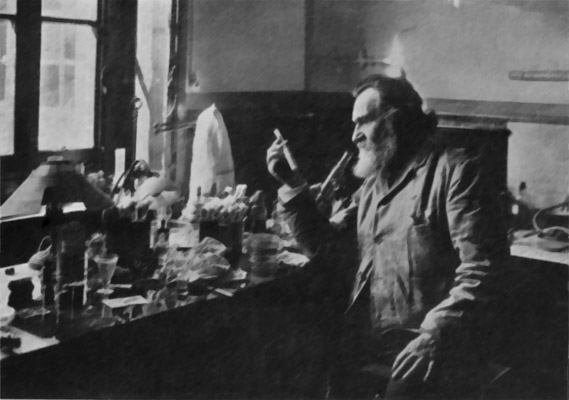
Bronchial cold — Aggravated cardiac symptoms — Farewell to Sèvres — Return
to the Institute — Protracted sufferings — Intellectual preoccupations — Observations
on his own condition — The end — Cremation.
If in this sad last chapter I occasionally dwell on
details which may seem insignificant in themselves,
it is because, at this supreme moment of Elie Metchnikoff’s
existence, everything was full of significance, for
everything converged to emphasise the powerful
unity and the ascending and continuous progress of
his ideas.
His attitude in the face of illness and death was a
teaching, a support, and an example. That is why,
relating the story of his last days, I piously describe
everything.
Towards the end of November, he caught a slight
cold, which did not prevent him from leading his
usual life, but which, nevertheless, was the starting-point
of the illness which took him from us.
On the 2nd of December, during a walk, he suddenly
felt a cardiac commotion such that he thought he
was dying. For hours, his pulse remained intermittent
and very rapid, and from that day he felt
unwell but continued to go to the laboratory.
On the 9th of December his condition became worse
and forced him to interrupt his normal life. All the
doctors were away or very busy on account of the war,
and it was only on the 11th that Dr. Renon could give
him a consultation at the Laënnec Hospital. He found
Metchnikoff’s heart very tired and nervous, prescribed a
treatment, and told us to come back in twenty-five days.
But the disease was making giant strides. In the
night of the 12th to 13th a first attack of cardiac
asthma supervened, an extremely painful one; we
had the impression that the end was near. Elie
suffered agonies but remained morally calm and
ready for death, as he had ever been since his first
heart attack, two years previously. He repeated that
he had accomplished his task and run through his
vital cycle; that what he could yet do would be but
a supplement, and that it was better to die than to
outlive his own decadence.
He only wished not to suffer too long, but that
humble desire was not to be realised. We spent two
more nights at Sèvres, terrible nights not to be
forgotten if one had centuries to live, and we then
decided to go to a nursing home in Paris, as it was
imprudent to remain any longer isolated as we were.
Having heard of Metchnikoff’s illness, Dr. Roux
offered to receive us at the Pasteur Institute in a
small lodging which was now free, the house-physician
who had occupied it having been killed.
Dr. Widal, in whom Metchnikoff had absolute confidence,
came to Sèvres on the 14th and found myocarditis.
Thanks to an absolutely incomprehensible
phenomenon, Elie had suddenly ceased to realise the
rapidity of his pulse; he had 160 beats in a minute
and only perceived less than half; it was therefore
easy to keep the truth from him.
After a last night of suffering we left our Sèvres
nest, which we had so loved. Leaning on my arm,
he slowly walked through the little garden and gazed
for the last time at the home that we were leaving
for the unknown.... He looked worn and bent
under the weight of suffering, but he was quite calm,
and his eyes, though firm and gentle, already seemed
to me to be looking very far away.
The automobile bore us slowly from Sèvres to the
Pasteur Institute, and we found ourselves in the
small flat which had been inhabited by the young
doctor who had been killed in the war. He had only
spent a short stage of his life there. How long should
we remain? And what road should we take when
we left it? We tried to smile, though our hearts
were terribly heavy, in order to cheer each other.
But, in the course of the day, we were surrounded
by friends full of solicitude, the tension relaxed, and
we felt a growing sense of comfort and security. No
more nights of mortal dread and loneliness, with no
help at hand! That thought alone inspired courage
and hope. In case of need, I had only to send down
to the next floor to ask for a doctor.
For a few days, Elie felt much better, perhaps on
account of the mental relief, but his heart was weak
and his pulse extremely rapid. Drs. Widal, Martin,
Veillon, Salimbeni, and Darré came to see him every
day; during the whole of his long illness, they never
ceased to show him the most attentive and devoted
care. They attempted by every means to save him
from pain, for, alas, they had no hope of curing him.
Nothing was neglected, and many still greater sufferings
were spared him.[33]
The war was an inexhaustible and passionately
interesting subject of conversation; Elie read a
number of newspapers and listened with avidity to
every news from private sources. Often, too, scientific
questions were discussed, which continued to
interest him intensely. These talks were an invaluable
relaxation.
Feeling infinitely grateful towards his medical
advisers and friends, he showed himself a most docile
patient, following their prescriptions with absolute
punctuality. When his condition grew worse and
he felt no hope whatever of his recovery, he often
used to say, “What is to be done? the doctors can
do nothing, for medicine is powerless. Unhappily,
it will remain so for a long time. Much work will
have to be done to rid humanity of the scourge of
diseases. But, surely, one day science will succeed
in doing so; that will be chiefly through prophylaxis
and rational hygiene. There will also be a new
science—the science of death; it will be known how
to make it less hard.”
After lunch and a short sleep, he received the daily
visit of his friend Dr. Roux, with whom he talked in
the full intimacy of friendship and affection. He
confided to him his apprehensions and desires, and
felt unlimited gratitude for his kindness to us, often
saying to me, with tears in his eyes, “I knew Roux
was a kind man and a true friend, but I see now that
he is incomparable.” Other friends also did their
utmost to serve him and to show their sympathy.
He had the great joy of feeling himself beloved and
surrounded with an atmosphere of real kindness.
Many times he said to me, “Now, only, have I
appreciated the warm-heartedness of the French
at its full value. Do not fail, in my biography, to
emphasise how deeply I feel it, and how grateful I
am. I want them to know it.”
Yet all the care and devotion of which he was the
object could neither arrest the fatal progress of disease
nor spare cruel suffering to him who had thought of
nothing but relieving the pains of others. All our
efforts were as flowers scattered over a tomb; he,
poor tortured one, was slowly, consciously sinking
into it through the implacable logic of Fate. From
the beginning of his illness, he foresaw the issue; he
lived in constant expectation of death, on the threshold
of which his calm and serenity remained as unalterable
as were his patience and resignation.
After a temporary and comparative lull, which
lasted until the end of December, the disease began
to progress again, and almost every week brought a
fresh alarming symptom. It was especially during
the night that the pain, treacherously, reappeared.
After dropping asleep fairly early, he would begin to
breathe with difficulty and then awake in an indescribable
state of anguish; perspiration drenched his
head, neck, and chest, several towels often being
required to dry him. His breathing was hard;
during bad attacks, the wheezing of his bronchial
tubes was terrifying.
He would sit up, his hands clenched, his face blue
and contracted by suffering, his darkened lips apart,
his eyes dilated—the face of a man on the rack. He
gasped like a suffocating man; at last a tearing
cough supervened, followed by expectoration, and
the attack gradually subsided.
For a time we were able to relieve him without the
use of narcotics. As long as there was a ray of hope—not
of recovery, but of a bearable life and further
work—he wished at all costs to avoid the influence of
narcosis. He breathed fumes of pyridin or ether, he
smoked Escouflaire cigarettes, and inhaled various
other things. In order to sleep after an attack, he
ate a few biscuits, and I sprinkled his head with a
menthol solution, with which I damped his temples
and forehead. That eased him, and sometimes he
slept again for a few hours.
But how many were the nights of insomnia and
suffering! How many times did he call for death
as a deliverer, and say that he resigned himself to
live for my sake only!
And in spite of the martyrdom he endured, he
always had gentle words, a caress, a consolation
even! He constantly returned to the thought that
he had nothing to complain of, that he had had a
large share of happiness and good fortune in having
accomplished his task, and even arrived at the development
of the natural death-instinct.
All those who saw him every day knew that he
was courageous and patient, every one admired his
serenity, but no one could realise the degree of his
courage and patience, for no one had seen and lived
through those miserable nights.
Often, even, when asked how he was, he said “not
bad!” after a terrible night, saying to me afterwards
in explanation, “Why grieve them, since it cannot
be helped?”
At the beginning of our stay in the Institute, he
was not yet quite bedridden. After his morning
toilet, he would lie for some hours on a sofa, reading
almost continuously, newspapers, scientific reviews,
and many works in connection with the book he had
planned on the sexual function, of which he wrote
only the introduction and a few lines of the first
chapter.[34]
Another question occupied him at that time, that
of first-born children. Certain data led him to think
that men of genius were but rarely the first-born of
their parents, and he sought for every possible
information on the subject. In his constant desire
to improve life-conditions, he even thought that a
demonstration of this fact might have a desirable
influence on the increase of population in France
after the war; if it were proved that the most successful
children are not the first-born, perhaps the system
of having two children only would be given up in
order to have a chance of giving the country a more
capable population.
His reflections on the sexual questions led him to
seek for experimental means of studying gonorrhœa.
He thought of inoculating the gonococcus into the eye
of new-born mice and entrusted M. Rubinstein, the
only worker left in the laboratory, with these experiments.
The latter began them and obtained encouraging
results, but he left Paris in the spring and
the work remained unfinished.
Metchnikoff’s mind never ceased to work unless
interrupted by acute pain; until the very end, his
brain never failed him. He often used to say
how far he was from any mystic aspirations, and
how sure he was of remaining a rationalist
until the end. And such was the case. Faithful
to himself, not even in the most painful moments
did he feel a desire to look for support outside
the ideas and principles of his whole life. Yet
his soul was sad and full of care; the war grieved
him utterly, every newspaper he read renewed his
sorrow. When a severe engagement, Verdun for
instance, was going on, he lost the little sleep he had,
and his agitation became painful.
He was deeply disillusioned by the Germans.
Having always felt great esteem for their scientific
work, he had believed in their high culture, and now
he was absolutely disconcerted by the mentality
which they manifested during the war.
Neither could he understand how the war had
been allowed to come about. He thought it ought
to have been avoided, and considered the authorities
guilty for not having done so. He said that nothing
could compensate the harm done by this insane
butchery.
The deserted laboratories, the interruption of
scientific work, filled his soul with melancholy. For,
he said, all the great, all the real questions should
have been solved by Science and were kept waiting....
He also had material worries, the war having
brought great perturbation in his affairs. The fate
of his mobilised pupils preoccupied him constantly.
The least indisposition, however trifling, of those he
loved made him unhappy. His sensibility, which had
always been very marked, increased still more, and
consumed him; it surely was one of the causes that
had worn his heart out. When already very weak
and ill, he constantly thought of giving pleasure to
those who were with him; he read innumerable
reviews and periodicals, and would tell each friend
what he had found of particular interest to the latter,
even when speech was difficult to him. His gentleness
and cordiality were most touching during the
whole of his illness, though he preserved his usual
outspokenness.... It seemed to me that this
offended no one; they all understood Elie now.
He sought a refuge from his sufferings in his own
ivory tower; these sufferings themselves were to him
a source of observations. He studied his body and
his soul as he would have studied any subject under
experiment. Every day he wrote down his auto-observations,
and carefully read the diary which I
kept for him.
During the whole of the winter he had ups and
downs. Towards the end of December the cough and
respiratory symptoms increased, and at the beginning
of January he expectorated clots of blood, due to
a passive congestion of the right lung.
On the 19th January, some liquid appeared in the
pleura on the same side. Pleurisy persisted for a
whole month and necessitated three punctures.
Every time we feared to tell him that the puncture
was necessary, but he received the news with complete
coolness, saying that he had always been in
favour of radical measures.
After the third puncture, which took place on the
19th February, a marked relief supervened, and the
improvement lasted for some time; it was the only
moment when we saw a ray of hope.
Though keeping to his bed, he worked a great deal,
read, and received not only his friends but other
visitors. At the beginning of March and at the end
of April he again expectorated blood, and the terrible,
tragical nights began again. Yet the days were
fairly good.
During that period, he had the pleasure of seeing
some of his pupils again, and of receiving several
Russian deputies and journalists. They talked to
him of political events, of the war, of the moral state
of Russia. All that interested him immensely; he
plied them with the most varied questions. It must
be remembered that, before that interview, we had
lost all touch with Russia.
During the whole of May he again had ups and
downs, but the progress of the disease was indisputable.
Tachycardia was constant, urine more and more
scanty, the swelling of the legs never decreased, cough
and oppression occurred frequently even during the
day. Elie awaited his seventy-first birthday with
impatience. Often during the night, after a painful
attack, he would count the days, hours, and minutes
which separated him from that date. At last it
arrived. Here are the lines which he added to his
notes on that day:
16th May. Against all expectation, I have lived until
this day. I have reached my 71 years. My dream of a rapid
death without a long illness has not been realised. I have
now been bedridden for five months. After several crises of
tachycardia, following upon a slight grippe with asthma, I
had congestion of one lung with pleuritic exudate. Though
some improvement followed after that, nevertheless I am
tormented by fits of sweating followed by cough and oppression.
I suffer chiefly in the night from those attacks;
they provoke insomnia which can only be combated by
pantopon.
My psychical state is twofold. In one way, I should like
to get well, but, on the other hand, I see no sense in living
any longer. Illness has not provoked in me any fear of
death, and I am more deprived than formerly of the joy of
living. The reawakening of spring leaves me quite indifferent.
There can be no question for me of that pleasure which convalescents
often feel, nor indeed of any pleasure. To the
despair that I feel in the face of medicine’s powerlessness to
cure the ills of my friends is added the feeling of its powerlessness
towards my own illness. I think that my desire to recover
and to continue to live is connected with practical
causes.
The war has compromised our finances, our income from
Russia has practically disappeared. If I die, my wife may
find herself in a very difficult situation. Given her lack of
practical notions, that may lead to very sad results. Yet it
is quite impossible to straighten our affairs before the end of
the war and the re-establishment of normal conditions.
These were the last words he wrote in his book of
notes; his hand had become weak and trembling;
he tired very soon, and henceforth I wrote under his
dictation. On the 18th June, one month before his
cremation, he dictated to me for the last time, and
this is what he said:
This is the seventh month that I have been ill and it
brings my thoughts back to the gravity of my condition.
I therefore continually realise how much satisfaction I have
derived from life during my long years. The gradual disappearance
of my “life-instinct,” which already began a few
years ago, is now more marked, more precise. I no longer
feel that degree of pleasure which I felt only a few years ago.
My affection for my nearest and dearest shows itself much more
by the anxiety and suffering provoked by their diseases and
sorrows than by the pleasure I derive from their joys or
normal health.
Those to whom I describe my feelings tell me that satiety
with living is not normal at my age. To that I oppose the
following: Longevity, at least to a certain point, is hereditary.
Now I have already mentioned, on the occasion of my 70th
anniversary, that my parents, sister, and brothers died before
reaching my present age. I knew neither of my grandparents,
which shows that they could not have been very old
when they died.
Let us now turn to the profession, since it is an established
fact that it has an influence on the duration of life. Pasteur
died at 72, but for a long time he had been unable to do
scientific work. Koch did not reach the age of 67. Other
bacteriologists died at a much earlier age than I (Duclaux,
Nocard, Chamberland, Ehrlich, Büchner, Loeffler, Pfeiffer,
Carl Fraenkel, Emmerich, Escherich).
Among those bacteriologists of my generation who are still
living the majority have already ceased from working. All
that should indicate that my scientific life is over and confirm
at the same time the fact that my “orthobiosis” has actually
reached the desirable limit.
He was anxious to prove that his end, which
seemed premature at first sight, did not contradict
his theories, but had deep causes such as heredity
and the belated introduction of a rational diet. He
had only begun to follow it at fifty-three. Facts
corroborated him after his death, for the post-mortem
examination showed that the heart lesions were of
long standing. He himself thought they went back
at least to 1881, when he had had a very grave
relapsing fever. The doctors even wondered how he
had lived with his heart in such a state, and only
accounted for it by the strict régime which he had
followed during the latter part of his life.
And indeed when it is remembered how pugnacious,
how vehement he was—always, so to speak,
in a state of ebullition, feverishly active, intensely
sensitive—it must be admitted that his life really
held more than an ordinary life of longer duration.
He was very desirous that the example of his
serenity in the face of death should be encouraging
and comforting. It should prove that, at the end of
his vital cycle, man fears death no longer; it has
lost its sting for him.
Early in June his condition became still worse.
The nights were so painful that, every evening, recourse
had to be had to pantopon.[35] It was with the greatest
impatience that he awaited his “dear Darré and dear
Salimbeni,” as he called them.
After Dr. Darré had finished his complete and
thorough medical examination, we three remained
talking around Elie’s bed for a short hour. He often
recalled his personal or scientific memories when he
was not too weary; we talked of the war, of medical
questions; often, too, we would evoke, with Salimbeni,
recollections of our journey to the Kalmuk Steppes.
We loved that peaceful hour, which ended by an
injection of pantopon, the only relief, alas, that could
be procured for him. He would thank Dr. Darré with
gratitude, and drop his poor weary head on the pillow,
awaiting in absolute security the blessed sensation of
warm heaviness which pervaded him, for he knew
that sleep and rest from his sufferings would not be
long in coming. The spectre of tragical nights never
ceased to haunt us.
Until the hot weather came, he was quite comfortable
in the small flat in the Pasteur hospital; the
temperature there had been perfectly regular all
through the winter; but now he began to be incommoded
by the heat.
M. Roux then proposed that we should be transferred
to Pasteur’s old flat; the rooms were spacious
and much cooler. This idea rejoiced and touched
Elie very much. As he thanked M. Roux, he said to
him: “See how my life is bound with the Pasteur
Institute. I have worked here for years; I am
nursed here during my illness; in order to complete
the connection I ought to be incinerated in the great
oven where our dead animals are burnt, and my
ashes could be kept in an urn in one of the cupboards
in the library.” “What a gruesome joke!” answered
M. Roux, really taking those words for a joke. But
directly after he was gone Elie turned to me with an
anxious look and said, “Well, what do you think of
my idea?” I saw by his earnest expression that he
meant what he said, and I answered that I thought it
a very good idea. The Pasteur Institute had become
his refuge, the centre of all his scientific interests;
he loved it; he had spent his best years there. Let
his ashes be laid there some day; it would be in
perfect harmony with his past. Let us only hope
that would not be too soon! But why had he given
his words that jesting form which must have misled
M. Roux? He explained it to me: knowing how
deeply conscientious his friend was, he did not wish
to express his desire as a dying wish in order that he
should feel no obligation. A simple jest, on the
contrary, left him absolutely free.
On the 26th June, Elie was carried into Pasteur’s
flat; it was a very great satisfaction to him, it brought
him nearer his laboratory. Now and then, very
seldom now, he thought he might return there one
day; he said I should wheel him there in his bath-chair.
“I know I could scarcely work there myself.
But perhaps I might still play the part of a ferment,
be useful to my pupils by giving them advice. I am
leaving so much unfinished work which it would be
interesting to go on with: the question of intestinal
flora, that of diabetes, which surely is an infectious
disease—but that will have to be proved,—and my
experiments on the subject were scarcely begun. I
think the study of gonorrhœa will give very interesting
results when they succeed in inoculating it in new-born
animals. And the question of tuberculosis is
well started! I could still help my pupils and encourage
them if I were a little better!... But I
have no illusions! I must live now only from day
to day....”
Those words were uttered with heart-rending
resignation.
He continued to get worse....
It was fortunate that pantopon should have given
him good nights, for attacks of oppression now supervened
several times during the day; tachycardia was
continuous, the heart was weakening. The quantity
of urine diminished; it often did not surpass 250 cubic
centimetres, and no diuretic succeeded in increasing
it; the legs remained swollen, ascitis was beginning to
become visible; in the night he occasionally grew
slightly delirious.
At the beginning of July he wished to sit up; he
spent part of the afternoon in an armchair, his legs
lying on cushions. We thought it was a good sign,
but in reality he found it difficult to breathe lying
down. Several times he asked me to play to him,
very soft music, as noisy sounds wearied him. I
played him some Beethoven, some Mozart; the last
time it was a Chopin prelude.
On the 9th his temperature went down in an
alarming way to 35.2° C. (95 F.). For the first time
he would not write down his ordinary observations.
“What is the good?” said he, “it has no longer any
interest.” Yet the next day he did so, for the last
time. On the 11th and 12th he put down his temperature,
and glanced superficially at the notes I
had written. On the 12th, about five o’clock in the
morning, he had a bad fit of breathlessness followed
by coughing, and brought up large clots of very red
blood. He smiled faintly. “You understand what
that means,” he said, adding some tender words.
I wheeled him to his bed, which he never left again.
On the 13th, in the early morning, he felt very ill.
Calmly and gently he warned me to be ready. “It
will surely be to-day or to-morrow.”
My heart breaking, I asked him why he said that;
was he feeling very weak? or suffering very much?
“No,” he said, “it is difficult to say what I feel;
I have never felt anything like it; it is, so to speak, a
death-sensation.... But I feel very calm, with no
fear. You will hold my hand, will you not?”
How can I describe those last three days? He
preserved all his lucidity and serenity, often smiling
at me and drawing me towards him. He inhaled
oxygen very often, as breathlessness became almost
continuous.
On the 14th there was to be a matinée performance
of Manon Lescaut, and remembering that his
god-children had long wished to see that opera, he
had had a box taken for them. He was now quite
uneasy about it. “What ill-luck,” he said, “if it
happened just before and prevented them from
going. In any case they must not come here on
their way to the theatre, so that if it happens they
will not know, and can still enjoy the performance.”
Thanks to pantopon, he spent a very good night.
He awoke about five o’clock, but remained so quiet
that I thought him asleep. When I rose about six
he held out his hand to me and told me he had been
awake for a long time. He talked to me tenderly, in
the full intimacy of our affection; he spoke sweet,
unforgettable words. He made me promise once
again not to give way to grief. “At first, our friends
will help you, and then work, that infallible remedy,
and duty.... You will have that of writing my
biography. Remember how much I wish the last
chapter to be complete. You alone can write it, for
you have seen me all the time; I have told you all
my thoughts, and yet....” I understood that he
had occasionally, out of pity for me, hidden his sufferings
and his sad thoughts. But he did not know how
often I guessed what he did not say; love and pain
have a dumb language, more eloquent than any
human words.
“You will hold my hand when the moment comes,”
he repeated. “But do not think I am afraid, now
that it is near. No, I assure you, I have an absolute
serenity of soul! I spent a divine night. It seemed
to me that I was already half outside life. This night
has taught me many things.... Everything which
troubled me, everything that seemed so disturbing, so
terrible, like this war for instance, seems so transitory
now, such a small thing by the side of the great
problems of existence!... Science will solve them
some day.” He ceased speaking. He seemed
illumined by a very exalted feeling; it was like the
last chord of his harmonious soul. What a consolation
if he could have died then!
But life is cruel. He lived through two more
days of suffering. On the 14th he inhaled oxygen
almost continually. He asked for pantopon, but we
feared to give him too much. I told him it would
induce such continuous sleep that he would not even
be able to enjoy it. “But an eternal sleep is precisely
what I want! Do understand that now
nothing is left to me but pantopon. What is the
good of making me last? Is this a life? A few
days or a month have no importance when
one is not going to recover. And you cannot
wish to prolong my sufferings.” His breathlessness
increased; he said, “Give me your hand; stay near
me!” I knew what he meant; he had the “death-sensation.”
His poor hands were hot and warmed my cold
ones.... The next day I could not warm his hands,
ice-cold for ever.
The whole day he awaited with impatience the
hour for pantopon. About nine o’clock, when Dr.
Darré came in, he said, “Dear Darré, at last!”
There was no talk that evening, he was so weary.
With what anguish I awaited the stroke of midnight,
which ended those two dread days! He had been
mistaken by barely one day. The night was not bad,
in spite of breathlessness and some fits of coughing.
The next morning he felt better. He had not read
the papers the day before, to-day I read him the communiqués
in the Petit Parisien, he said it was enough.
He also turned the pages of a book he had recently
begun to read, La Science et les Allemands.
I told him how pleased I was to see him better.
“It is true,” he said, “to-day I have no death-sensation,
but I beg you, have no illusions!”
Always that preoccupation of breaking the shock
for me. He made me bring a pocket-book with some
money in it and a few envelopes; in each of them he
made me place notes of similar value, then with his
already shaking hand, he himself wrote on each
envelope the value of the notes multiplied by their
number, and explained that it was to help me to find
quickly what I should require after the catastrophe.
He ate better at lunch than he had done lately; but
already at two o’clock the breathlessness increased.
Yet he did not look pale; he had preserved his
rosy complexion. As he inhaled the oxygen, he was
shaken by a hiccough. He pressed my hand. “It
is the end,” he said, “the death rattle; that is
how people die.” He looked at his watch on the
small table, it marked four o’clock.
“No,” he said, “it must have stopped. Four
o’clock struck some time ago.” And he smiled.
“Is it not strange that it should have stopped before
I? Go and see what time it is.”
I ran out to see the clock from the window of
another room; it was twenty minutes to five. I met
some one in the passage and asked him to go quickly
to fetch one of the Institute doctors. Then I begged
Elie not to have such ideas, and tried to cheer him.
“But, my child, why do you want to calm me? I
am quite calm; I am only stating facts,” he said,
adding tender words.
At that moment Salimbeni came in. Elie said to
him: “Salimbeni, you are a friend; tell me, is it
the end?” And as he protested, he added, “You
remember your promise? You will do my post-mortem?
and look at the intestines carefully, for I
think there is something there now.” MM. Roux and
Martin then arrived. The feeling of weight in the
intestines of which he complained was mentioned.
He did not know that he had ascitis in the peritoneum.
As I was attending to him I felt him move suddenly,
and said, “I beg you, do not make such sudden
movements; you know it is not good for you.” He
did not answer. I raised my head; his was thrown
back on the pillows, his face had assumed a blue
tinge, the white of the eyes alone could be seen under
the half-closed lids.
Not a word, not a sound.
All was over.[36]
Then an abyss of oblivion....
I saw him again, stretched on his deathbed. He
was white, cold, and dumb. His face bore a calm
and very serious expression. He looked like a
martyr who had at last entered into rest. Death
had marked his face with no dread seal. The lids
had closed of their own accord, and he seemed to be
sleeping after great lassitude; one might have
thought that, with his usual kindness, he wished to
spare us all too painful an impression....
All through the night and the next morning his
face preserved the same expression.
In the afternoon Salimbeni performed the autopsy.
Then he was laid in his coffin; twenty-four hours had
elapsed since the end. Wrapped in a white sheet,
which framed his fine face, he had the appearance of
a biblical prophet.
Now his expression had assumed absolute serenity,
illumined by gentleness and kindness. He had a look
of elevation, grandeur, and beauty which was really
divine. It was an apotheosis. His beautiful soul
beamed in its full purity; neither suffering nor any
earthly preoccupation had any hold on it. He gave
an impression of eternal rest.
It was his final image, a splendid one, the last ...
for ever.
The bier was closed and covered with a heavy
black pall. On life also a blacker and heavier pall
had fallen. The light had gone out.
Two days later, on the 18th July, he was carried
to the cemetery of the Père Lachaise, to be cremated
in all simplicity, as he had wished. Faithful to his
ideas, he had wished for a lay funeral, with no speeches,
flowers, or invitations.
His bier disappeared into a large sarcophagus; on
each side black curtains fell to hide what was going
on.... Then one hour of heavy silence whilst the
poor body was being consumed by the flames....
A death silence....
And that was all....
The mercurial, vivacious child, good-hearted,
intelligent, and precocious; the young man, ardent,
impetuous, passionate, a lover of science and of all
that was exalted; the mature man, a bold thinker,
an indefatigable investigator, eager, generous, tender,
and devoted; the old man, in everything faithful
to himself, but progressing in serenity, shining
with an ever softer light, like a mountain peak in the
setting sun; the martyr at last, enduring suffering
with patience and resignation, seeing the approach
of death without fear, observing it as he had observed
life....
The hour of silence was over; the incineration
accomplished. Of his body, little was left—a handful
of ashes. They were enclosed within an urn and
placed in the library of the Pasteur Institute.
But his beautiful, ardent soul, his audacious and
fertile ideas, all that rich inner life which had
developed into a harmonious and puissant symphony,
all that cannot be dead, cannot disappear!
The ideas, the influence we give to life must persist,
must live; they are the sacred flame which we hand
on to others and are eternal.