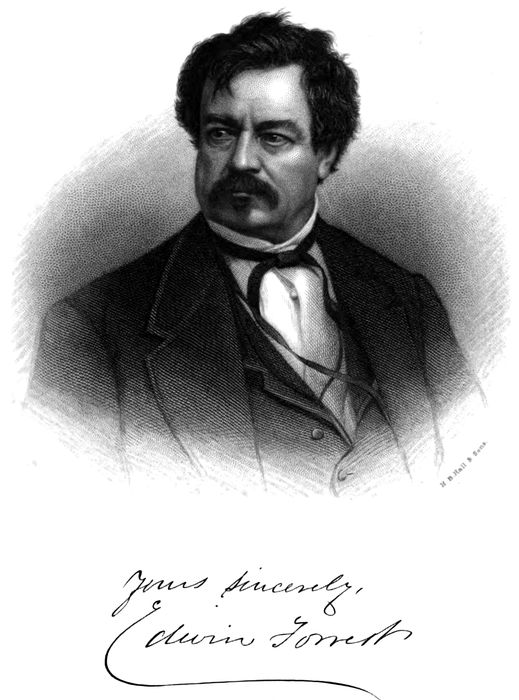
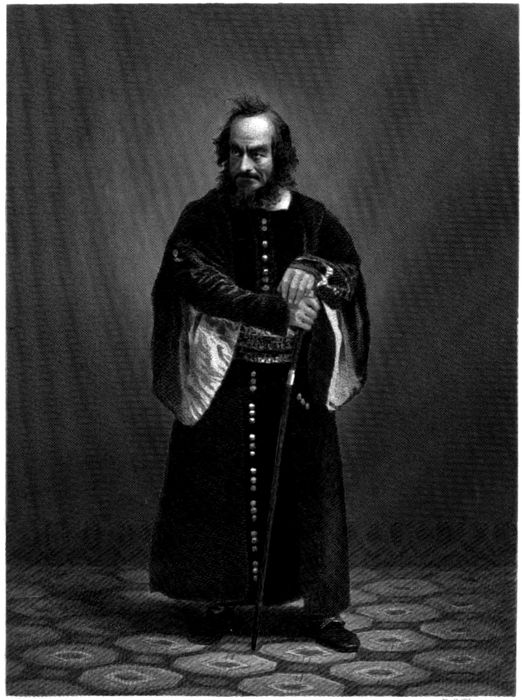
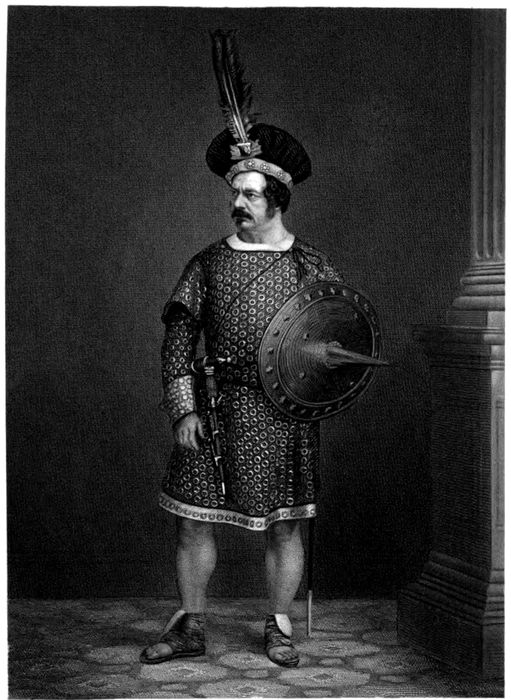
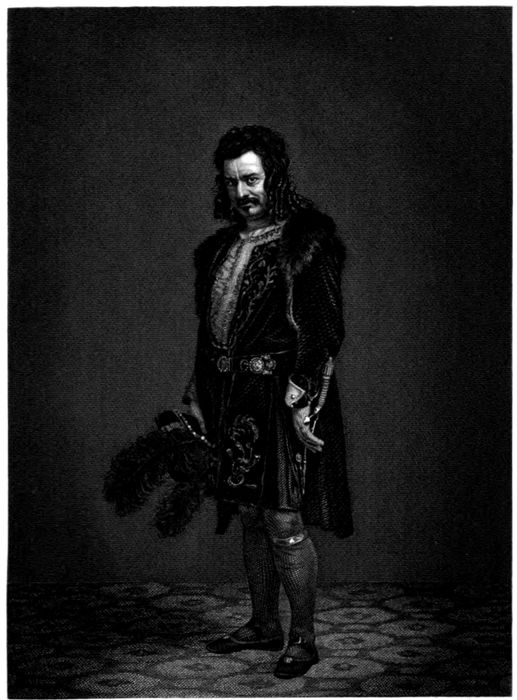
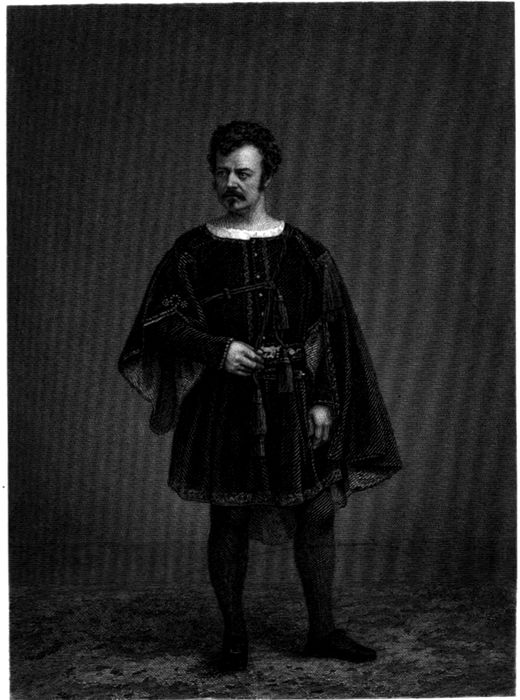
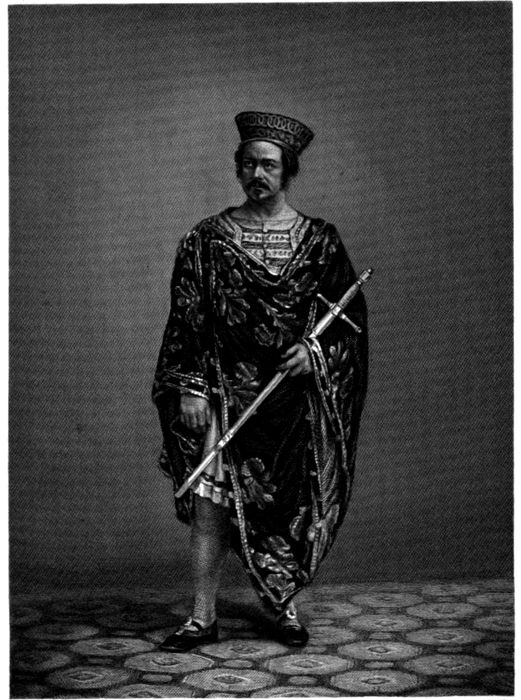
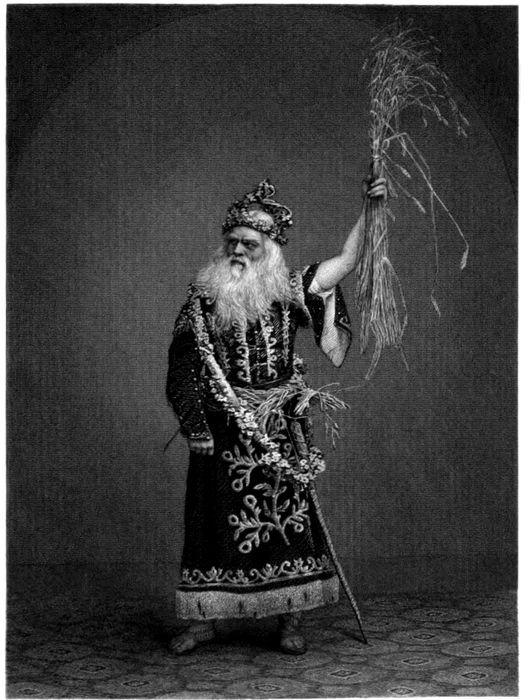
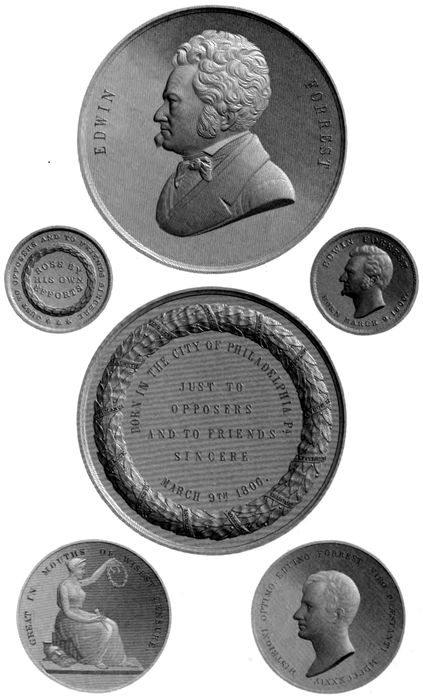
The cover image was created by the transcriber and is placed in the public domain.
ÆT 65
BY
WILLIAM ROUNSEVILLE ALGER.
“All the world’s a stage,
And all the men and women merely players.”
VOLUME II.
PHILADELPHIA:
J. B. LIPPINCOTT & CO.
1877.
Copyright, 1877, by J. B. Lippincott & Co.
CHAPTER XIV. NEWSPAPER ESTIMATES.—ELEMENTS OF THE DRAMATIC ART, AND ITS TRUE STANDARD OF CRITICISM.
433
The newspaper in some countries has been a crime and in
others a luxury. In all civilized countries it has now become a
necessity. With us it is a duty. It is often corrupted and degraded
into a nuisance. It ought to be cleansed and exalted
into a pure benefaction, a circulating medium of intelligence and
good will alone. Certainly it is far from being that at the present
time. It is true that our newspapers are an invaluable and indispensable
protection against all other tyrannies and social abuses;
and their fierce vanity, self-interest, and hostile watchfulness of
one another keep their common arrogance and encroachments
pretty well in check. If they were of one mind and interest we
should be helplessly in their power. From the great evils which
so seriously alloy the immense benefits of the press, Forrest
suffered much in the latter half of his life. The abuse he met
irritated his temper, and left a chronic resentment in his mind.
Two specimens of this abuse will show something of the nettling
wrongs he encountered.
A Philadelphia newspaper stigmatized him in the most offensive
terms as a drunkard. Now it was a moral glory of Forrest
that, despite the temptations to which his professional career exposed
him, he was never intoxicated in his life. The newspaper
in question, threatened with a libel suit, withdrew its words with
an abject apology,—a poor satisfaction for the pain and injury it
had inflicted.
The other instance was on occasion of the driving of Macready
from the stage of the Astor Place Opera House. A New York
newspaper, in language of studied insolence, called Forrest the
instigator and author of the outrage. “Mr. Forrest succeeded
last night in doing what even his bad acting and unmanly conduct
never did before: he inflicted a thorough and lasting disgrace
434upon the American character.” “To revenge himself on
Mr. Macready he packed the house and paid rowdies for driving
decent people away.” “With his peculiar tastes he will probably
enjoy the infamy and deem it a triumph.” Forrest, instead of
cowhiding the writer of this atrocious slander,—as some men of
his high-spirited nature would have done,—sent a letter, through
his legal friend Theodore Sedgwick, demanding immediate retraction
and apology. The editor assented to the request, confessing
that he had spoken with no knowledge of facts to justify him!
From the time of his first appearance on the stage, Forrest
was a careful reader of the criticisms on his performances. He
generally read them, too, with a just mind, discriminating the
valuable from the worthless, quick to adopt a useful hint, indignant
or contemptuous towards unfairness and imbecility. There
were three classes of persons whose comments on his performances
gave him pleasure and instruction. He paid earnest attention
to their remarks, and was always generous in expressing his
sense of indebtedness to them.
The first class consisted of those who had a personal friendship
for him, combined with a strong taste for the drama, and who
studied and criticised his efforts in a sympathetic spirit for the
purpose of encouraging him and aiding him to improve. Such
men as Duane and Chandler and Swift in Philadelphia, Dawson
in Cincinnati, Holley at Louisville, Canonge in New Orleans,
Leggett and Lawson in New York, and Oakes in Boston, gave
him the full benefit of their varied knowledge of human nature,
literary art, and dramatic expression. Their censure was unhesitating,
their questionings frank, their praise unstinted. Among
these friendly critics the name of James Hunter, of Albany,
one of the editors of “The Daily Advertiser,” in the important
period of young Forrest’s engagement there, deserves to
be remembered. He was one of the best critics of that day.
He used to sit close to the stage and watch the actor with the
keenest scrutiny, not allowing the smallest particular to escape
his notice. Then at the end of the play he would in a private
interview submit to his protégé the results of his observation,
carefully pointing out every fault and indicating the remedy. He
lived to see the favorite, who profited so well from his instructions,
reach the proudest pitch of success and fame. When Mr.
435Hunter died, Forrest interrupted an engagement he was filling in a
distant city in order to attend the funeral, and followed the remains
of his old benefactor to the tomb as one of the chief mourners.
The second class of commenters on the playing of Forrest
from whose judgments he received satisfaction and help was composed
of that portion of the writers of dramatic criticism for the
press who were comparatively competent to the task they undertook.
They were men who were neither his friends nor his foes,
but impartial judges, who knew what they were writing about and
who recorded their honest thoughts in an honorable spirit and a
good style. Among the many thousands of articles written on the
acting of Forrest during the fifty years of his career there are
hundreds written in excellent style, revealing competent knowledge,
insight, and sympathy, and marked by an unexceptionable
moral tone. They suggest doubts, administer blame, and express
admiration, not from caprice or prejudice, but from principle, and
with lights and shades varying in accordance with the facts of the
case and the truth of the subject. These articles have an interest
and a value in the highest degree creditable to their authors, and
they go far to redeem the dramatic criticism of our national press
from the severe condemnation justly provoked by the greater
portion of it. Did space allow, it would be a pleasure to cite full
specimens of this better class of dramatic critiques from the collected
portfolios left behind him by the departed actor. Enough
that he profoundly appreciated them, and that in various directions
they did good service in their day.
The third class whose words concerning his performances
Forrest gladly heeded were men who simply gave truthful reports
of the impressions made on themselves, not professing to
sit in judgment or to dogmatize, but honestly declaring what
they felt and what they thought. Free from prejudices and perversities,
fair average representatives of human nature in its ordinary
degrees of power and culture, their experiences under his
impersonations, ingenuously expressed, were always interesting
and instructive, throwing light on many secrets of cause and
effect, on many points of conventional falsity and of natural sincerity,
in histrionic portrayals. Often while the newspaper writer
who pretends to know the most about the dramatic art is so full
of conceit and biases that his verdict on any particular representation
436has neither weight nor justice, the instincts of the bright-minded
and warm-hearted boy or girl, the native intelligence and
sympathy of the unsophisticated man or woman, whose soul is
all open to the living truth of things, are almost infallible. Nobody
knew this better than our tragedian, or was readier to act
on it.
The light and joy he drew from these three sets of critics
found a heavy counterpoise in the unjust estimates, perverse,
exaggerated, malignant, or absurd, of which he was constantly
made the subject by five classes of censors. The first were his
personal enemies. Among the meaner fry of men who came in
contact with him, a multitude hated him from jealousy and envy,
from resentment of his independent and uncompromising ways,
his refusal to grant them his intimacy or to serve their purposes.
They sought to gratify their animosity by backbiting at his reputation,
and especially by trying to destroy his professional rank.
Year after year they made the columns of many a newspaper
groan and reek under the load of their abuse, ranging from
envenomed invective to grotesque ridicule. For example, a
jocose foe said, in parody of the great Moslem proclamation,
“There is but one Bowery, and Hellitisplit is its profit.” And a
serious foe said, “Mr. Forrest is an injury to the stage. He is a
false leader, an oppression, a bad model, and a corrupter of the
popular taste.” A great part of the hostile criticism he suffered
may be traced to bitter personal enmity, which had but slight regard
to truth or fairness in its attacks on him, whether as man or
as player.
The next class of assailants of Forrest in his professional repute
were not his personal enemies, but were the tools of the various
cliques, cabals, or social castes who had an antipathy for him
and for the party to which he belonged. The English interest
was especially active and bitter against him after his quarrel with
Macready. Some of these writers were wilfully corrupt in their
attitude and consciously false in their written estimates. They
expressed neither their own feelings nor their own convictions,
but merely the passion and policy of their employers. For example,
at the time of the death of the tragedian a well-known
editor confessed to a friend that some twenty years previously,
when he was a reporter, his employer sent him to the theatre to
437see Forrest play, and with explicit directions to write the severest
condemnation he could of the actor. He went accordingly, and
made notes for a savage satirical article, although at the moment
of his making these notes the tears were streaming down his
cheeks, so sincere and so powerful was the representation which
he was, against his conscience, preparing to abuse. Much dishonorable
work of this kind has been done, and still is done, by
men disgracefully connected with the press.
Another set of critics who assailed the acting of Forrest were
those whose tastes were repelled by his realistic method and
robust energy. He was too vehemently genuine, his art not far
enough removed from material reality, to suit their fancy. They
demanded a style more graceful, delicate, and free. Under the
impulse of their resentful prejudices they overlooked his great
merits, depreciated everything he did, angrily denied him his just
rank, magnified every fault beyond measure, and maliciously caricatured
him. A volume might be filled with articles purely of
this description, proceeding from writers whose want of native
manliness unfitted them for appreciating the magnificent manliness
of his impersonations, and whose offended fastidiousness
expressed itself in terms which were an offence to justice.
The fourth class of abusers of Forrest were men who had an
instinctive repugnance for the imposing grandeur of the types of
character he represented, for the self-sufficing, autocratic power
and stateliness of his impersonations. Mean and envious spirits
dislike to look up to those higher and stronger than themselves.
Those who either never had any romance and reverence or have
been disenchanted, feel an especial enmity or incompetent contempt
for every one whose character and bearing appeal to those
qualities. This disinclination to admire, this wish to look on
equals or inferiors alone, is the special vice of a democracy.
Demagogues, whether in politics or in letters, are men of torpid
imaginations and dry hearts,—slow to worship, quick to sneer.
The style of man enacted by Forrest, full of an imperial personality,
overswaying all who come near, massive in will, ponderous
in movement, volcanic in passion, majestic in poise, was hateful
to the cynical critic the petty proportions of whose soul were
revealed and rebuked in its presence. He seized the weapon
of ridicule to revenge himself on the actor whose grander portrayals
438angered him instead of aweing or shaming or delighting
him. There seems to be among us in America a growing dislike
for the contemplation on the stage of the grandest heroism and
power, and an increasing fondness for seeing specimens of commonplace
or inferiority promotive of amusement. Already in
his life Forrest was a sufferer by this degradation of popular
taste, and were he now to appear in our theatres he would feel it
still more.
The fifth and largest class of writers who assumed to criticise
the acting of Forrest was made up of persons professionally connected
with the press, whose blundering or extravagant estimates
arose rather from their ignorance and utter incompetency for the
task they undertook than from a spirit of antipathy or partisanship.
The censures and laudations in these notices were the
cause of an immense amount of varied mortification, amusement,
vexation, and anger, as they came under his eyes. No small
portion of the criticisms in the American newspapers on actors,
singers, lecturers, and other public characters have been written,
and still continue to be written, by uneducated and inexperienced
young men scarcely out of their teens, serving an apprenticeship
in the art and trade of journalism. With low aims and views,
slight literary culture, superficial knowledge of life, a vile contempt
for sentiment, a cynical estimate of human nature, equally
ready to extol and to denounce for pay, these writers are the
nuisance and the scandal of their craft. Were their articles
accompanied by their names they would be destitute of weight
or mischief; but, published with apparent editorial sanction, they
often assume a pernicious importance.
The art of a people expresses the character and aspiration of
a people and reacts to develop them. To sit in judgment on it
is a high and sacred office, for which none but the most intelligent,
refined, and honorable are fit. The praise and blame given
to artists play on the living sensibilities of that most sensitive
class whose careers are a vital index of the moral state of the
community. Yet this momentous office is frequently entrusted
to beardless youths, whose chief experience is in dissipation, and
who unblushingly sell their pens to the highest bidder. A severe
article exposing this abuse appeared in the “Round Table” in
1864, written by the editor, and entitled “Dramatic Critics in New
439York.” Forrest put it in one of his scrap-books with the endorsement,
“How true this is!” Mr. Sedley said, “What dramatic
criticism in New York has been the public well know. Its low,
egotistic, unfair, malicious character, its blind partialities and
undying hates, its brazen ignorance and insulting familiarity,
have given it wide notoriety and brought upon it equally wide
contempt.”
There is no art which more needs to be criticised than that of
criticism itself, because there is none which requires in its votary
such varied knowledge and cultivation, and such integrity of
mind and purity of motive; because, furthermore, no other art
is exposed to such subtle temptations of prejudice and vanity.
The critic, in assuming to be a judge, is no exception to other
writers. Like them he reveals and betrays himself in what he
writes. In dissecting others he lays his own soul bare. In consciously
judging them he pronounces unconscious judgment on
himself,—in the tenderness or the insensibility, the generosity and
candor or the meanness and spite, the knowledge and beauty or
the ignorance and foulness, which he expresses. The pen of a
base, vindictive critic is a stiletto, a fang, or an anal gland. The
pen of a competent and genial critic is the wand of an intellectual
Midas turning everything it touches to gold. For such a critic
has the true standard of judgment in his knowledge, and, whatever
the merit or demerit of the work he estimates, as he points
out its conformity with that standard or its departure from it his
lucid illustration is always full of instruction and help.
But the great majority of those journalists who presume to
print their estimates of histrionic performances are profoundly
ignorant of the elements of the dramatic art. Thus, having no
knowledge of the real standard of judgment by which all impersonations
should be tested, they cannot fairly criticise the artists
who appear before them for a verdict. Instead of criticising or
even justly describing them they victimize them. They use
them as the stalking-horses of their own presumption or caprice,
prejudice or interest. Unable to write with intelligent candor on
the subject which they profess to treat, they employ it only as a
text whereon to append whatever they think they can make
effective in displaying their own abilities or amusing their readers.
The unfittedness of such critics for their task is sufficiently proved
440by the chief attributes of their writing, namely, prejudice, absurd
extravagance, reckless caprice, ridiculous assumption of superiority,
violent efforts to lug in every irrelevant matter which
they can in any way associate with the topic to enhance the
effect they wish to produce regardless of justice or propriety.
A few specimens of these various kinds of criticism will be
found full of curious interest and suggestiveness, while they will
illustrate something of what the proud and sensitive nature of
Forrest had to undergo at the hands of his admirers and his
contemners.
One enthusiastic worshipper, in the year 1826, overflowed in the
following style: “In the Iron Chest, on Thursday evening last,
Mr. Forrest established a name and a fame which, should he die
to-morrow, would give him a niche in the temple of renown to
endure uncrumbled in the decay of ages!” Another one wrote
thus: “In his Richard, Macbeth, Lear, and Othello, Mr. Forrest
displays abilities and accomplishments which, for power and
finish, we do not believe have ever been at all approached by
any other actor that ever stepped upon the stage. The range of
his delicate and varied by-play and the terrific energy of his
explosions of naked passion leave the very greatest of his predecessors
far in the rear and deep in the shade!” Such slopping
eulogy defeats its own purpose. For want of discrimination its
exaggerations are unmeaning and powerless. To be thus bedaubed
and plastered with praise mortifies the actor, and injures
him with the judicious, though springing from a generous sensibility
and most kindly meant. This style of praise, however, is
quite exceptional. The general run of critics have altogether too
much knowingness and vanity for it. Their cue is to depreciate
and detract, to satirize and belittle, so as either directly or indirectly
to imply the superiority of their own knowledge and taste.
Your ordinary critic is nothing if not superior to the artist he
assumes to estimate. The publicity and admiration enjoyed by
the performer seem to taunt the critic with his own obscurity and
neglect, and he seeks an ignoble gratification in denying the
merit of what he really envies. This base animus of the baser
members of a properly high and useful literary guild betrays
itself in many ways. For example, one of this sort, sneering at
the idea of applauding the genius of an actor, characterized
441dramatists as “the class of men who administer in the most
humiliating of all forms to the amusement of a large and mixed
assembly.” It needs no more than his own words to place Pecksniff
before us in full life.
Through the whole dramatic life of Forrest one class of his
assailants were found accusing him of tameness and dulness,
while another class blamed him for extravagant energy and frenzied
earnestness. Both classes spoke from personal bias or capricious
whim, instead of judging by a fixed standard of truth and
discerning where reserve and quietness were appropriate and
where explosive vehemence was natural. One critic, in 1831,
says, “He wants passion and force. He has no sincerity of
feeling, no spontaneous and climacteric force. He often counterfeits
well,—for the stage,—but nature is not there.” At the
same time the critic attached to another journal wrote, “Mr.
Forrest’s greatest fault is lack of self-control and repose. His
feelings are so intense and mighty that they break through all
bounds. With added years, no doubt, he will grow more reserved
and artistic.” Thirty years later the same blunt contradiction,
the same blind caprice or prejudice, are found in the two
extracts that follow:
“For nearly three months the heavy tragedian has weighed
like an incubus on the public, which now, that the oppression of
this theatrical nightmare is removed, breathes freely. We part
with Mr. Forrest without regret; he has taken his leave, and, as
that slight acquaintance of his, William Shakspeare, remarks, he
could ‘take nothing we would more willingly part withal.’ Those
only who, like ourselves, have constantly attended his performances,
have a true knowledge of their tedium and dulness. The
occasional visitor may bear with Mr. Forrest for a night or two,
but we are really nauseated. The stupid, solemn, melancholy
evenings we have passed in watching his stupid, solemn, and
melancholy personations will always be remembered with disgust.
Nothing but a sense of duty compelled us to submit to
this ineffable bore.”
“Mr. Forrest belongs to the robustious school of tragedy,—that
class who ‘split the ears of the groundlings,’—and his eminent
example has ruined the American stage. He is a dramatic tornado,
and plucks up the author’s words by the roots and hurls
442them at the heads of the audience. He mistakes rant for earnestness,
frenzy for vigor. The modulations of his voice are
unnatural, and his pauses painful. A man in a furious passion
does not measure his words like a pedagogue declaiming before
his school, but speaks rapidly and fiercely, without taking time
to hiss like a locomotive blowing off steam. Mr. Forrest was
not so in his prime; and he has probably borrowed the habit
from some antiquated actor who has been afflicted with asthma.”
There is no candid criticism in such effusions of obvious prepossession
and satire. They show no reference to a fixed standard,
no sincere devotion to the interests of truth and art; but a
desire to awaken laughter, a purpose to make the player appear
ridiculous and the writer appear witty. The same may be
said of the following examples, wherein amusing or malignant
ridicule takes the place of fair and intelligent judgment. Such
writers care not what their victims suffer, or what justice suffers,
so long as they can succeed in gaining attention and raising a
laugh. They feel with the English critic who excoriated Payne
for his Macbeth, “No matter if the labor we delight in physics
Payne, it pays us.”
First. “Mr. Forrest’s personation of the Broker of Bogota is
feeble and uninteresting. Contrasted with his Othello, it has the
advantage which the Stupid has over the Outrageous. Febro may
be compared to one of those intolerable bores who prose and
prose, with sublime contempt of all that is interesting, for hours.
Othello is like one of those social torments who destroy your
peace of mind with incessant and furious attacks. The bore is
the negative of Good; his opposite is the affirmative of Evil.”
Second. “We can account for the popularity which Forrest enjoys
as the greatest master of the Epigastric School of Acting on
no other hypothesis than that of the innate depravity of human
taste. Like the vicious propensity in mankind to chew tobacco
and drink whisky, the majority of men have a depraved appetite
for this false and outrageous caricature of human nature which
Mr. Forrest calls acting. Our strictures apply in a lesser degree
to the stage delineations of all tragedians. They are all false,
and Forrest is only a little more so. His particular excellence
seems to lie in his extraordinary power of pumping up rage from
his epigastrium, and expectorating it upon his audience, through
443the interstices of his set teeth. Other tragedians equal him in
their facial contortions, and in the power of converting their
chests into an immense bellows violently worked. His great
rival, McKean Buchanan, excels Mr. Forrest in this department
of high art, but fails in the epigastric power. Mr. Forrest may
well claim to stand at the head of the Epigastric School. He
does not underestimate the value of epilepsy in delineation, and
‘chaws,’ tears, rends, and foams at the mouth quite as artistically
as the best of his rivals; but he especially cultivates his epigastrium.
We do not want Mr. Forrest to die soon. But when he
does pass away, we have a physiological and anatomical curiosity
which we would be pleased to have gratified at the expense of a
post mortem on the great tragedian. We have a grave suspicion
that, deep down in his stomach, beneath the liver and other less
important viscera, he has concealed additional vocal apparatus,
by means of which he is enabled to produce those diabolical
tremolo sounds which have so often thrilled and chilled his auditors.
But in our opinion, with its two great exponents, Edwin
Forrest and McKean Buchanan, the Epigastric and Epileptic
School of Acting will pass away.”
Third. “We thought to have dropped Mr. Edwin Forrest as a
subject of newspaper remark; but several of his friends, or persons
who think themselves such, are very anxious that we should do
him justice, as an actor, though that is just what they ought to
fear for him. We will take his performance as Richard. In this
part, in the first place, his gait is very bad, awkward, and ungraceful.
Richard may, possibly, have halted a little, but he did
not roll like a sailor just ashore from a three years’ cruise. A
king does not walk so. Then, his features are totally devoid of
expression; he can contort, but he can throw neither meaning nor
feeling into them. When he attempts to look love, anger, hate, or
fear, he resembles one of the ghouls and afrites in Harper’s new
illustrated edition of the Arabian Nights. He wins Lady Anne
with a smile that would frighten a fiend, and that varies not a
single line from that with which he evinces his satisfaction at the
prospect of gaining the crown, and his contempt for the weakness
of his enemies. A more outrageous and hideous contortion still
expresses his rage at Buckingham’s importunity, and at the reproaches
of his mother. When he awakes in the tent-scene, he
444keeps his jaws at their utmost possible distension for about two
minutes, and presents no bad emblem of an anaconda about to
engorge a buffalo; one might fling in a pound of butter without
greasing a tooth. At the same time, his whole frame writhes
and shakes like a frog subjected to the action of a galvanic
battery. We have seen folks frightened and convulsed before
now, but we never saw one of them retain his senses in a convulsion.
We like a deep, manly, powerful voice; but we dislike
to hear it strained to the screech of a damned soul in hell-torment,
like Mr. Forrest’s when he calls on his drums to strike
up and his men to charge. Often he displays his tremendous
physical energies where there is not the least occasion for them,
and as often does he repress them where they are needed. For
instance, Richard ought to work himself into a passion before
he slays King Henry. Mr. Forrest kills him as coolly and as
quietly as a butcher sticks a pig or knocks down a calf, and he
repulses Buckingham with the voice and action of a raving
maniac. But Mr. Forrest is not to blame for his face, which is
as nature moulded it, neither because he has but three notes to
his voice, nor because the only inflections he is capable of are
their exaltation and depression. But he need not aggravate the
slight deformity of Richard more than Shakspeare did, who
greatly exaggerated it himself. Nor do we blame him for raving,
ranting, roaring, and bellowing to houses who never applaud him
but when he commits some gross outrage upon good taste and
propriety. He adapts his goods to his market, and he does
wisely.”
As a contrast and offset to the foregoing specimens of self-display
disguised as criticism of another, it is but fair to cite a
few extracts from different writers who had really something
appropriate to say on the subject they were treating, and who
said it with exemplary directness and impartiality:
“As a reader Mr. Forrest has, in our opinion, few equals.
Believing him to be the most overrated actor on the stage, we
are yet not blind to his merit, but are glad to speak of the least
of his excellences, and only wish they were more numerous.
Let us take his inherent faults for granted, and consider his
reading at the best. Does he fail in the first essential,—intelligibility?
On the contrary, he enunciates a thought with
445such clearness that the meaning cannot be mistaken. Does
he fail to give the rhythm and the rhetoric of verse? On the
contrary, verse in his utterance retains its melody and music, and
the high-sounding eloquence of words its majesty. He subtly
marks the changes of reflection, and keeps the leading idea emphatic
and distinct. There stands the thought at least, no matter
if the feeling is a thousand miles away. He has carved the statue
correctly, though he wants the power of the ancient sculptor to
give the cold marble life. This he cannot do by ‘emphasizing
every word,’ in the unnatural way of which our correspondent
accuses him. Analyze one of his well-read sentences, and mark
how the strong word and the strong sound fall together; then
listen to most of the actors that surround him, and notice with
what amusing vehemence they shout their ‘ands’ and ‘ifs’ and
‘buts.’ They begin every sentence with a stentorian cry that
dwindles into an exhausted whisper.”
“As regards Forrest, we are often amused to hear people, who
have vainly refused for years to recognize his great histrionic
abilities, wonder how it is that he invariably attracts crowded
houses whenever he performs. We do not know any actor of
his rank who has been so scurrilously abused and to so little
purpose. The most elaborate pretences at criticism are always
poured out on his devoted head, and if the power of the press
could have written a man down he surely would have been long
since; for he has few special champions among acknowledged
critics, a fact which shows how deep is the feeling against him
among particular classes. We must candidly confess to have
never been biased by profound admiration of Forrest’s acting,
and yet we must also admit that after having calmly, patiently,
and attentively watched some entire performances of his, we were
convinced that he really possessed far greater powers of mind
than any of the critics ever had given him credit for. His style
is apt to be uneven, and men of his mould of intellect cannot
always enact the same parts with the same good taste. But of
his superb elocution,—of the noble idea of latent force and suppressed
passion which his whole manner embodies,—of the perfection
of manly dignity and physical development which have
never had a better representative on the stage than in his person,—of
the marvellous voice, so musical in its sound, and so happily
446adjusted in its modulations to increase the expression of a sentence,—there
ought, in our judgment, to be no abatement of that
admiration so long and so justly accorded to him. If all the
critics in the country were with one voice to deny the existence
of these things, their fiat would be powerless against the evidence
of men’s senses. We admit that he has no subtlety of intellect,
no finely-drawn perceptions of delicate shades of human character.
What he does is the result of the action of a very strong
mind, capable of being directed in a particular channel with resistless
energy; but this is the very class of minds out of which
have arisen some of the greatest men in the world’s annals.
When Forrest performs an engagement people go to see him
who know all his defects, but they go because it is the only acting
of the highest class they have the opportunity of seeing, and it
is so far above the rivalry of such actors as have been here during
the last decade as to admit of no comparison.”
“It is said when Canova was finishing a choice marble that his
friends were very anxious to see the work on exhibition, but the
great artist restrained their impatience, and proposed to gratify
their desire at the end of a given term. At the expiration of the
time, his friends assembled eagerly, and, in tones of disappointment,
exclaimed, ‘What have you been doing? You have been
idle; you have done nothing to your piece.’ To which he replied,
‘On the contrary, my chisel has been exceedingly busy; I
have subdued this muscle, I have brought out this feature, enlivened
this expression, polished my marble.’ ‘Oh, but,’ said
they, ‘these are mere trifles!’ ‘They may be,’ he said, ‘but trifles
make up the sum of perfection.’ The Virginius of Mr. Forrest
revived this anecdote of Canova, as well as remembrances of his
early performances. The difference in the two cases, however, is
that it is not the artist now, but his friends that see the perfection.
Virginius has long been identified with Mr. Forrest’s fame; but,
great as the lustre may be which his surpassing self-possession,
noble and balanced bearing, rich, copious, and manly elocution,
and deft, minute, and relative action have heretofore thrown upon
this character, it has now been still more varied and beautified by
the mellow tints that shadow and relieve the local splendor of
salient features. It is indeed a masterpiece of acting and the ‘top
of admiration.’ It is difficult to perceive any point of improvement
447that could give it more truth, in its lifelike resemblance, as
a copy of fiction; and we are sure, after the ribaldry which of late
years has degraded the boards, that there is not a single lover of
the drama who saw this enactment who does not feel grateful to
Mr. Edwin Forrest for his manly reassertion of the dignity of
the stage.”
“We are disposed to admit the greatest liberty possible to the
theatrical critic employed upon the daily press, but we cannot
help alluding to the disgracefully savage bitterness of the writer
in one of our weekly contemporaries as equally damaging to his
employer’s reputation and his own. Mr. Forrest has now passed
that period of his life in which he might have been injured by
the malevolence of the individual. In the mass, criticism bows
before his assured superiority, and it is simply a petty spite which
dares persistently to deny his claims to genius of the highest order.
He is no longer a man respecting whose position in the history
of the American stage there can be any dispute. He stands
completely alone. We are induced this week to make this remark
from having freshly seen him in ‘Othello’ and ‘Macbeth.’ Can
any observer who remembers his interpretation of the first of
these characters, some twenty years since, or his rendering of the
last one, but four years ago, and is disposed to examine them fairly,
with reference to his present reading and acting of either part,
deny this? If he does so, we can but feel that he is alike ungifted
with the talent to recognize and the honesty to admit the
wide difference which exists between them. His ‘Othello’ is now
a most coherent and perfect whole. Where is the artist who can
infuse a more perfect and thorough spirit of love than he does
in that scene where he meets Desdemona again in Cyprus, after
having quitted her in Venice? Where is the one who grows
under the heat of Iago’s viperous tongue into a more sublimely
savage delineation of jealousy than he does in the subsequent
acts? Is not his
‘I love thee, Cassio,
But never more be officer of mine,’
one of the most perfect bits of natural feeling that has ever been
uttered upon the stage? Friendship, anger, pity, and justice are
all struggling within him, and shape the sorrow of the words
that strip his lieutenant of the office which he considers him no
448longer worthy to retain. It may be observed that in alluding to
these points we have not marked any of those more obvious
beauties which have for many years been acknowledged in his
representation of this character. These are settled excellencies
in the estimation of all who love the tragic stage. Certain lines
have been stereotyped to us by the genius of those who have
embodied this greatest of Shaksperian characters; but for those
who will reverently observe his impersonation, there are hitherto
hidden points developed by Forrest which justify us in laughing
at those whose resolute hatred of the artist blinds them to his
excellence, and to the wonderful finish in the histrionic portraits
which he offers them. We have good artists amongst us, but we
certainly have none who can for a moment be fairly compared
with him; and therefore is it that we say the man who constantly
undervalues him simply marks himself as notoriously incapable
of balancing the critical scales.”
The next extract is taken from a long article by the well-known
scholar and author, Dr. R. Shelton Mackenzie:
“We once heard a great author say, ‘Scurrility is the shadow
of Fame, and as often precedes as follows it.’ That author was
Bulwer, and his remark has the weight of an aphorism. With
respect to Mr. Edwin Forrest, it is singular that he has been assailed
in his native town by scurrility at an advanced period of
his brilliant career, and at a time when his powers have ripened
into something very close to perfection.
“Unless the actuating principle of the writer be a merely malignant
dislike of the man, it seems almost impossible to us that
any critic, possessed of the ordinary intelligence current among
the more respectable members of the fraternity, can refuse or be so
morally blind as not to see the wide difference existing between the
Forrest of the present time and the Forrest who was admitted by
the public to be the greatest American actor some twenty years
ago. At that time he was wonderful,—wonderful by his intensity,
his dashing power, his superb manhood, his fine voice, and his
noble presence. This made him a great artist. He might have
many faults, but these were obliterated from the mind of the spectator
by his many and dazzling merits, which were even the more
striking from the comparative blemishes with which they were
mingled.
449“The artistic career of Edwin Forrest has now, however, made
a great stride in advance. He has polished, refined, and completed
his style. It was said of Garrick, who was several years
older than Forrest when he retired from the stage, that in his
latter seasons he acted better than ever, and the fact that he never,
even when a master in the art, ceased to be a student, explained
the cause. The same may be said, and even with more truth, of
Edwin Forrest. There is no living actor half so studious as
himself. His mind, always under thorough self-cultivation, has
matured in later years, and the effects are apparent. He is so
near perfection as an actor that it is impossible to be so attracted
by his excellencies now as we might have been when contrast
made them more palpable.
“Fully to appreciate the various power of Mr. Forrest cannot
be done by examining him in any single character. We have
therefore waited until his engagement is nearly completed, and
have carefully studied him in eleven different characters,—Richelieu,
Damon, Richard III., Hamlet, Othello, Virginius, Macbeth,
Lucius Junius Brutus, Febro, Jack Cade, and Lear. Of these,
perhaps, his Lear, his Othello, his Macbeth, his Richelieu, and his
Damon are the greatest; but there is comparatively so little difference
in excellence between his Hamlet and his Othello, his Virginius
and his Damon, that he might reasonably except to us for
noting that difference, which, after all, is in some measure the
result of a purely physical variation in the bodily means at his
disposal for each special embodiment.
“The almost even excellence, in so many of his great parts, to
which Edwin Forrest has attained, contains in itself a strong assertion
of his right not only to the first place in the histrionic
annals of the last few years, but registers a positive claim to the
highest position, as an artist, in all histrionic history to which the
slightest degree of faith can be attached. To be at the same
time a great Hamlet and a great Othello, even granting a difference
in the excellence of the two parts, argues that the actor possesses
to a larger extent than common that intellectual adaptability
without which it would be impossible for him to represent
two such widely different men. Slightly deranged, a philosophic
dreamer, without the capability of sustained action, energetic only
by immediate impulse, the Danish Prince differs widely from the
450passionate, powerful, one-purposed, and sublimely simple nature
of the Moor. In grasping these two opposite characters as
completely as Edwin Forrest has done, he has displayed an intellectual
strength of the highest order, approaching very nearly
to that subtlety of intelligence which is but rarely coupled with
genius, but which, when coupled with it, makes it a genius of
the highest order.
“This subtlety of intelligence he develops in his wonderful rendering
of Richard, as widely opposed a character to both or either
of the others as could well be presented to us. For the physical
nature of Richard he has preferred Horace Walpole’s ‘Historic
Doubts’ to Shakspeare’s delineation of the man, but in portraying
him intellectually Edwin Forrest has simply depended on himself.
He paints Richard with strong and vigorous execution, as a
crafty and cruel hypocrite, with a positively unequalled subtlety
of touch, rendering his hypocrisy frank and pleasant to the outside
observer and coloring it with a comedy of which he offers
no example in Othello and but a vague suspicion in Hamlet. His
love-scene with Lady Anne is a marvellous piece of acting, which
excerpts from the character as a worthy pendant to the mad scene
in Lear. It was probably much more easily, although more recently,
perfected by him than the latter, inasmuch as the last
named was the result of careful and minute study, while the
former is simply an effort of pure cultured genius which is as
positively real as stage simulation ever can be. But this difference
in character of the three extends even to those points in
which Richard touches upon the two others. Richard is a man
of strong passion as well as Othello. He is a philosopher as well
as Hamlet. But passion is suppressed in Richard under the vest
of his craft. It is addressed to other objects than Othello yearns
for. It is bold and crafty. Othello is brave and honest. This
is wonderfully discriminated by Mr. Forrest. The philosophy of
Hamlet is reflective and uncertain, colored by study and lunacy.
That of Richard is worldly and practical, subjected by him to his
immediate ambition. Here Mr. Forrest, as an artist, is truly admirable.
In Hamlet his philosophy is impulsively given to the
audience. In Richard it is reasoned out and calculated with.
“Let us look at Macbeth, reaching, as Richard does, at the Crown.
Most of our modern actors vary the two but little in their manner,
451without following the line of difference made between them
by the great dramatist. This difference was in the intellectual
strength of their natures. Richard is the tool of nobody. Macbeth
is but a plaster in the fingers of his wife. How exquisitely
does Mr. Forrest mark out the two natures! You trace Macbeth’s
indecision of purpose in his very manner. His entrance in the
first scene is characterized by it. The breaking off from his
friends,—his return to himself when addressed by them,—his interjectional
reveries,—his uncertainty of action, are all as they are
given to us by Shakspeare, but scarcely such as we might have
expected a man of Mr. Forrest’s physical temperament to embody.
In Richard the ambition is positive. He does not reason of the
acts which he commits. Hence here the artist’s actions are positive.
When he commits or orders one of these deeds which tend
to secure his desires or objects, it is done at once. The positive
decision of the man is translated by the actor, whether it be in
the passionate command or the sneering jest, by the calculated
impulse of the man.”
Here is a part of an elaborate attack written by a relentless
enemy and persecutor, quite remarkable for the untempered
way in which it mixes truth and misrepresentation, justice and
wrong:
“Mr. Forrest is now an actor who depends almost entirely
on his voice as a medium of expression. He throws all his force
into his reading; elocution is intended to compensate for everything,—for
facial expression, for suitable action, for muscular
vigor, and often, indeed, for true feeling and appreciation. By
his impressive reading he frequently gains applause when in
reality he deserves condemnation. There are whole scenes in his
Lear unredeemed by one spark of feeling, the poverty of which
he attempts to hide under a superficial gloss of elocutionary
charlatanism. His fine voice aids him in this attempt; for that
he has a noble voice, of great power,—whose tones are often
commanding, and sometimes would be tender if they were inspired
by any sincere feeling,—no one who has heard him can
doubt. Take away this voice and Mr. Forrest is a nonentity, for
he cannot act, and his face has no variety of expression. We
know that, instead of using this fine element of success well, he
has abused it; for his mannerisms of tone are perpetual, and disfigure
452every lengthy passage he reads. His voice has too great
a burden to bear.
“This is one reason why he is so very monotonous. Another
and a deeper reason is that the man himself is nothing but a
monotone. No man on the stage has a more strongly marked
individuality than Mr. Forrest; once seen, he cannot be easily
forgotten, nor can his performances ever be confused in memory
with those of others. Yet this individuality is a prison-house to
him; he cannot escape from it. He is forced, in spite of himself,
to play every character in exactly the same way. He develops
Spartacus by the identical methods he employs in Hamlet;
his Lear and his Claude Melnotte are made impressive, not by
different styles. He has but one style. He is Edwin Forrest in
everything; and, worse than this, he seems to care nothing for
the best character he plays in comparison with his own success.
Egotism is a marked peculiarity of his acting; he seems to say
to the audience, not, ‘How fine is this character! how great was
the author!’ but ever, ‘How finely I play it! am I not the greatest
actor you ever saw?’
“Of course this strong personality is sometimes to Mr. Forrest
an advantage. There are rôles which are adapted to his powers,—such
as Virginius, Damon, and Spartacus. These he plays well
because they do not require of him the transcendent power of
genius,—the imagination which enables a man to penetrate the
motives of a being foreign to himself, and to re-create in his own
living nature the beauty and the passion of a dream. These he
plays well because he finds in them something of himself. And
even in Shaksperian characters, which are alien to his nature,
he occasionally meets a passage which he can feel, and which he
therefore expresses; and these moments of earnestness, occurring
suddenly in the midst of long scenes of artificiality and dulness,
are like flashes of lightning in a black midnight: while they last
they are bright, but when they are gone they make the darkness
deeper.”
The two brief notices that succeed appeared at the same time
and in the same city in two opposed newspapers. The contrast
is amusing, and it is easy to see how little impartial critical judgment
went to the composition of either of them, as well as how
bewildering they must have been to the reader who was seeking
453from the judgment of the press to form a dispassionate opinion
on the merits of the actor:
“Having within the present year closely criticised Edwin Forrest’s
performances during a long engagement, we do not intend
to bore our readers with repetitions of what we have said. Mr.
Forrest will go through his programme like a machine, and like
most machines it may be discovered that his powers have suffered
somewhat by wear and tear. He has long since passed the
point of improvement. Fully settled in his own conceit that his
personations are the most wonderful that the world ever saw, his
only care will be to heighten defects which he considers beauties,
and to dwell with increased tenderness upon each fault. There
are some mothers who give their hearts to their puny, deformed,
and bad-tempered children, to the neglect of others who are
handsome, gentle, and intelligent. Mr. Forrest is an admirer of
this policy. He slights his better qualities in acting, and dandles
his absurdities with more than just parental fondness. His faults
are inveterate; his beauties daily grow homely. It would be
supererogation to expose at length those vices and stage tricks
which have already been freely cauterized.”
“During the week Mr. Forrest has been performing the characters
of Richelieu, Damon, Richard, and Hamlet. At each representation
the invariable compliment of a crowded house has
been paid him. With the advance of every year this actor seems
to grow greater. The intellectuality of his acting becomes more
and more apparent. The experience of years is now devoted to
his art; a lifetime is concentrated upon the development of his
transcendent genius. Mr. Forrest has shaped the colossal block
of crude genius into wonderful statues of natural and lovely proportions.
No intelligent praise can be extravagant which extols
the exceeding beauty of the conceptions of this wonderful artist.
We can scarcely think of Mr. Forrest’s fame as otherwise than
increasing. It throws around his name a luminous halo, whose
brightness and extent the progress of years will only intensify
and enlarge.”
One more specimen will suffice. It is from the pen of an
anonymous English critic:
“If Forrest is not in a paroxysm, he is a mere wicker idol;
huge to the eye, but full of emptiness,—a gigantic vacuum. His
454distortions of character are monstrous; the athletic, muscular
vigor of his Lear is a positive libel upon consistency and truth.
Spartacus was made for him, and he for Spartacus; the athlete
is everlastingly present in all his personations. His ravings in
Othello, in Macbeth, and in Richard the Third are orgasms of
vigorous commonplace.
“When Mr. Forrest represents terror, his knees shake, his
hands vibrate, his chest heaves, his throat swells, and his muscles
project as if he were under the influence of a galvanic battery or
his whole frame put in motion by a machine. He always appears
anxious to show the toughness of his sinews, the cast-iron capabilities
of his body, and the prodigious muscularity of his legs,
which really haunt the spectator’s eyes like huge, grim-looking
spectres, appearing too monstrous for realities, as they certainly
are for the dignified grace of tragedy. He delights to represent
physical agony with the most revolting exaggerations. When
he dies, he likes that the audience should hear the rattles in
his throat, and will, no doubt, some day have a bladder of pig’s
blood concealed under his doublet, that, when stabbed, the
tragic crimson may stream upon the stage, and thus give him
the opportunity of representing death, in the words of his admirers,
to the life.
“Perhaps no stronger test of Mr. Forrest’s want of intellectual
power as an actor can be given than his slow, drawling, whining
mode of delivering the speech to the senate, in the play of Othello.
No schoolboy could do it worse, and though in the more energetic
scenes there is a certain mechanical skill and seeming reality
of passion, yet the charm which this might be calculated to produce
is lost by the closeness of resemblance to a well-remembered
original. It is almost frightfully vigorous, and though there are
some touches of true energy, this is much too boisterous, coarse,
and unrelieved by those delicate inflections which so eloquently
express true feeling to obtain for it that meed of praise only due
to the efforts of original genius. There is much art and much
skill in Mr. Forrest’s acting; but its grand defect is the general
absence of truth.”
The medley of praise and abuse, the hodge-podge of incongruous
opinions, seen in the foregoing illustrations of newspaper
criticism, arose far less from any contradiction of excellences and
455faults in the acting of Forrest than from the prejudices and ignorance
of the writers. A large proportion of those writers were
obstinately prepossessed or corruptly interested, and few of them
had any distinct appreciation of the constituent elements of the
dramatic art. Destitute of the true standard of criticism, the
final canon of authority, their judgments were at the mercy of
impulse and chance influences.
But Forrest was no solitary, though he was an extreme, sufferer
in this respect. The greatest of his predecessors, all the most
gifted and famous actors and actresses, have had to undergo the
same pitiless ordeal. Those concerning whose illustrious pre-eminence
there can be no question whatever have borne the
same shower of detraction, insult, and ridicule, the same pelting
of cynical badinage. The restless vanity, presumptuous conceit,
and blasé omniscience of the common order of critics have
spared none of the conspicuous dramatic artists. And if any one
infer from the abuse and depreciation rained on Forrest that he
must have been guilty of the worst faults, he may draw the like
conclusion from the like premises in relation to every celebrated
name in the history of the stage.
The bigoted opposition and belittling estimates met by Talma
in his bold and resolute effort to displace the conventional inanity
and stilted bombast of the French stage with truth and nature
are a matter of notorious record. Some of his sapient critics
thought they were administering a caustic censure when they
uttered the unwitting compliment, extorted by their surprise at
his severe costume and grand attitudes, “Why, he looks exactly
like a Roman statue just stepped out of the antique.” The biographers
of Garrick give abundant evidence of the misrepresentation,
ridicule, and manifold censure with which his enemies and
rivals and their venal tools pursued and vexed him. He even
stooped to buy them off, and sometimes counteracted their malice
with his own anonymous pen. Horace Walpole wrote, “I have
seen the acting of Garrick, and can say that I see nothing wonderful
in it.” His small stature, his starts and pauses, were, in
especial, maliciously animadverted on. Mossop was sneered at
as “a distiller of syllables,” Macklin for the prominent “lines, or
rather cordage, of his face,” and Quin for the “mechanic regularity
and swollen pomp of his declamation.” George Steevens wrote
456a bitter satire, utterly unjust and unprovoked, on Mrs. Siddons.
She and her brother, John Philip Kemble, were stigmatized as
icebergs and pompous pretenders, and were repeatedly hissed
and insulted on the stage. Before her marriage, while Siddons
was playing at the Haymarket, a critic, trying to put her down,
wrote to Hayley, the manager, “Miss Kemble, though patronized
by a number of clamorous friends, will prove only a piece of
beautiful imbecility.” In 1807 a leading London newspaper said
of George Frederick Cooke, “His delivery of Lear is just what
it is in Richard: in its subdued passages, little and mean; in its
more prominent efforts, rugged, rumbling, and staccato, resembling
rather a watchman’s rattle than any other object in art or
nature.”
William Robson, in his “Old Play-Goer,” says of Edmund Kean,
“His person and carriage are mean and contemptible, his judgment
poor, his pathos weak, his passion extravagant and unnatural;”
and then sums up his estimate of the immortal histrionist
in these remarkable words: “He is nothing but a little vixenish
black girl in short petticoats!” On the first appearance of Kean
in Philadelphia some critics there, who were great admirers of
Cooke, called him “a quack, a mountebank, a vulgar impostor.”
William B. Wood said of Kean, when he had just finished a rehearsal
and gone out, “He is a mere mummer.” Joseph Jefferson,
great-grandfather of the Joseph Jefferson of Rip Van Winkle
fame,—a beautiful and noble old man, afterwards characterized by
Forrest in loving memory as “one of the purest men that ever
lived, sad, sweet, lofty, thoughtful, generous,”—overheard the remark,
and replied, with a quiet indignation in his tone, “Ah, Wood,
you would give all the riches you ever dreamed of amassing in
this world to be another just such a mummer.” The “London
Spectator,” in 1836, said, “Bunn in his drowning desperation
catches at any straw. He has just put forward Booth, the shadow
and foil of Kean in bygone days. Booth’s Richard seems to have
been a wretched failure.” At the same time another English
journal used the following expressive language, in which the
writer evidently does justice to himself whatever he endeavors to
do to the actors he names: “Since the retirement of Young and
the death of Kean, the very name of tragedy has passed away
from us. We have had to submit to the presumptuous and uninspired
457feelings of Mr. Bell-wether Kemble, or to the melodramatic
jerks and pumpings of Mr. Macready.”
An American critic wrote thus of the Nancy Sykes of Charlotte
Cushman: “Miss Cushman’s performance is of the Anatomical
Museum style. Her effects are thrilling and vulgar.
Her poses are awkward, and her pictures unfinished and coarse
in outline. She has an unpleasantly pre-raphaelite death scene,
and is dragged off, stiff and stark, when all the characters express
their internal satisfaction at the circumstance by smiling,
shaking hands, and joining in a feeble chorus. The secret of
her attraction is vigor. The masses like vigor. If they can have
a little art with it, very well. But vigor they must have.” Of
late it has been the fashion to extol Miss Cushman as the queenly
mistress of all the dignities and refinements of the dramatic profession;
but the foregoing notice is exactly of a piece with the treatment
visited upon Forrest for many years by the vulgar coteries
of criticism, whose aim was not justice and usefulness but effect
upon the prejudiced and the careless. Even the quiet and gentlemanly
Edwin Booth has been as unsparingly assailed as he has
been lavishly praised. An insidious article on him, entitled “The
Machine-Actor,” called him a “self-acting dramatic machine warranted;”
and while admitting, with great generosity, that “he
was not wholly destitute of dramatic ability,” attributed his success
and reputation chiefly to extraneous conditions, in especial
the shrewdness of “his managing agent, who judiciously prepared
his houses for him, and pecuniarily and personally appreciated the
power of the press and conciliated the critics.” The two following
notices of Mr. Booth’s Melnotte—the first obviously by a critic
who had, the second by one who had not, been “conciliated”—are
quite as absurd in their contradiction as those so often composed
on Forrest:
“On Monday evening last we enjoyed the first opportunity of
seeing Mr. Edwin Booth in the character of Claude Melnotte, in the
‘Lady of Lyons.’ Our impressions of Mr. Booth in the part may
be briefly summed up in saying that he is one of the very best
Claudes we have ever seen,—scholarly, sustained, and forcibly reticent
at all points,—not so youthful in his make-up as to suggest
the enthusiastic boy of Bulwer’s drama, but in all other regards
the very ideal of the character. His marvellously melodious
458voice sounds to peculiar advantage in the rich prose-poetry of the
more sentimental passages, and in the passages of sterner interest
the latent strength of the tragedian comes nobly into play.
Booth’s Claude is an unqualified success, and its first rendering
was witnessed by an audience brilliant in number and intelligence
and markedly enthusiastic in their reception of the best
points.”
“Mr. Booth’s Claude Melnotte was a failure. It was neither
serious nor sentimental, comic nor tragic. The best that can be
said of it is that it came near being an effective burlesque. When
he first came on to the stage, I almost thought it was his intention
to make it so. His carriage and general make-up were those
of one of Teniers’ Dutch boors, even to the extent of yellow
hair combed straight down the forehead and clipped square
across from temple to temple. His action consisted mainly in a
series of shrugs. I don’t remember a natural movement of body
or expression of countenance, from the beginning of the piece to
the end; nor a natural tone of voice.”
Still later we have seen different representatives of the press,
both in America and in England, alternately describing the wonderful
Othello of Salvini as “the electrifying impersonation of a
demi-god” and as “an exhibition of disgusting brutality.”
The class of examples of which these are a few specimens
show how little worthy the ordinary newspaper dramatic criticism
is to be considered authoritative. No branch of journalism,
allowing for notable individual exceptions, is more incompetent
or more corrupt, because no other set of writers have so difficult
a task or are so beset by vicious influences. Their vanity, prejudice,
and interest worked upon, their sympathies appealed to by
the artist and his friends, their antipathies by his rivals and foes,
harassed and hurried with work, moved by promises of money
and patronage, no wonder they often turn from the exactions of
conscientious labor and study to something so much easier. The
unsophisticated portion of the public, who are too much influenced
by what they read in the papers, and who fancy that
applause is a good proof of merit and censure a sure evidence
of fault, ought to know how full of fraud and injustice the world
of histrionic ambition and criticism is, and to learn to give little
weight to verdicts not ascertained to come from competent and
459honest judges. The husband of Madame Linguet, a favorite
actress at the Italian Theatre in Paris, hired a party to hiss
every other actress, but to applaud her to the echo. A ludicrous
mistake let out the secret. Linguet told his men one night to
hiss the first actress who appeared and applaud the second. The
play was changed, and in the substituted piece Madame Linguet
came forward first, and was overpowered with hisses. Sir John
Hill asked Peg Woffington if she had seen in the paper his praise
of her performance the previous evening in the part of Calista.
She thanked him for his kindness, but added that the play was
changed and she had acted the character of Lady Townley. In
a New York paper, in 1863, this notice appeared: “Mr. Forrest
repeated, by special request, his great character of Spartacus
last evening, before one of the most brilliant and enthusiastic
audiences of the season. His acting was grand throughout, and
at the end of the last act he received a perfect ovation from the
audience.” Appended to this, in his own handwriting, pasted in
one of his scrap-books, were found these words: “Mr. Forrest on
the night above referred to was in Philadelphia, and did not act
at all, having been called home by the death of his sister.”
After going over the mass of ignorant, capricious, and contradictory
criticism bestowed on Forrest,—criticism destitute of
fundamental principles or ultimate insight,—the reader may well
feel at a loss to know how he is to regulate his judgment upon
the subject and form a just estimate of the actor and his performances.
The critics, instead of aiding, bewilder him, because
themselves appear to be wildly adrift. To work our way through
the chaos it is necessary for us to understand distinctly what the
dramatic art is in its nature and object, and what are the materials
and methods with which it aims to accomplish its purpose. The
answers to these inquiries will clear away confusion, lay bare the
elements of the art, and put us in possession of those laws of
expression which constitute the only final standard for justly
criticising the efforts of the player.
Considered in its full scope, the drama is the practical science of
human nature exemplified in the revelation of its varieties of character
and conduct. It aims to uncover and illustrate man in the
secret springs of his action and suffering and destiny, by representing
the whole range and diversity of his experience in living
460evolution. The drama is the reflection of human life in the idealizing
mirror of art. In what does this reflection consist? In the
correct exhibition of the different modes of behavior that belong
to the different types of humanity in the various exigencies of their
fortunes. The critic, therefore, in order to be able to say whether
histrionic performances are true or false, consistent or inconsistent,
noble or base, refined or vulgar, artistically elaborated and complete
or absurdly exaggerated and defective, must understand the
contents of human nature in all its grades of development, and
know how the representatives of those grades naturally deport
themselves under given conditions of inward consciousness and
of exterior situation. That is to say, a man to be thoroughly
equipped for the task of dramatic criticism must have mastered
these three provinces of knowledge; first, the characters of men
in their vast variety; second, the modes of manifestation whereby
those characters reveal their inward states through outward signs;
third, the manner in which those characters and those modes of
manifestation are affected by changes of consciousness or of
situation, how they are modified by the reflex play of their own
experience.
Every man has three types of character, in all of which he
must be studied before he can be adequately represented. First
he has his inherited constitutional or temperamental character,
his fixed native character, in which the collective experience and
qualities of his progenitors are consolidated, stamped, and transmitted.
Next he has his peculiar fugitive or passional character,
which is the modification of his stable average character
under the influence of exciting impulses, temporary exaltations
of instinct or sentiment. And then he has his acquired habitual
character, gradually formed in him by the moulding power of his
occupation and associations, as expressed in the familiar proverb,
“Habit is a second nature.” The first type reveals his ancestral
or organic rank, what he is in the fatal line of his parentage.
The second shows his moral or personal rank, what he has become
through his own experience and discipline, self-indulgence and
self-denial. The third betrays his social rank, what he has been
made by his employment and caste. The original estimate or
value assigned to the man by nature is indicated in his constitutional
form, the geometrical proportions and dynamic furnishing
461of his organs, his physical and mental make-up. The estimate
he puts on himself, in himself and in his relations with others,
his egotistical value, is seen in the transitive modifications of his
form by movements made under the stimulus of passions. The
conventional estimate or social value awarded him is suggested
through the permanent modifications wrought in his organs and
bearing by his customary actions and relations with his fellows.
Thus the triple type of character possessed by every man is to be
studied by means of an analysis of the forms of his organs in
repose and of his movements in passion or habit.
The classes of constitutional character are as numerous as the
human temperaments which mark the great vernacular distinctions
of our nature according to the preponderant development
of some portion of the organism. There is the osseous temperament,
in which the bones and ligaments are most developed;
the lymphatic temperament, in which the adipose and mucous
membrane preponderate; the sanguine temperament, in which
the heart and arteries give the chief emphasis; the melancholic
temperament, in which the liver and the veins oversway; the
executive temperament, in which the capillaries and the nerves
take the lead; the mental temperament, in which the brain is
enthroned; the visceral temperament, in which the vital appetites
reign; the spiritual temperament, in which there is a fine harmony
of the whole. The enumeration might be greatly varied
and extended, but this is enough for our purpose. Each head
of the classification denotes a distinct style of character, distinguished
by definite modes of manifesting itself, the principal sign
of every character, the key-note from which all its expressions
are modulated, being the quality and rate of movement or the
nervous rhythm of the organism in which it is embodied.
Besides the vernacular classes of character ranged under their
leading temperaments, there are almost innumerable dialect
varieties arising from these, as modified both by the steady influence
of chronic conditions of life, historic, national, local, or
clique, and by fitful and eccentric individual combinations of
faculty and impulse. For instance, how many types of barbarian
character there are,—such as the garrulous, laughing, sensual
Negro, the taciturn, solemn, abstinent Indian, the fat and frigid
Esquimaux, the Hottentot, the Patagonian, the New Zealander,—all
462differing widely in stature, feature, gesture, disposition, costume,
creed, speech, while agreeing in the fundamentals of a
common nature. Among civilized nations the diversity of characters
is still greater. It would require an almost endless recital
of particulars to describe the differences of the Chinaman, the
Japanese, the Egyptian, the Persian, the Arab, the Hindu, the
Italian, the Spaniard, the German, the Russian, the Frenchman,
the Englishman, the American. And then what a maze of attributes,
each one at the same time clear in its sharpness or its profundity,
qualify and discriminate the various orders, castes, and
groups of society!—the Brahmin, the Sudra, the king, the slave,
the soldier, the doctor, the lawyer, the priest, the teacher, the
shop-keeper, the porter, the detective, the legislator, the hangman,
the scientist, and the philosopher. Every professional pursuit,
social position, mechanical employment, physical culture,
spiritual belief or aptitude, has its peculiar badge of dress, look,
posture, motion, in which it reveals its secrets; and the pettifogger
or the jurisconsult, the prophet or the necromancer, the
Quaker and the Shaker, the Calvinist and the Catholic, the tailor,
the gymnast, the gambler, the bully, the hero, the poet, and the
saint, stand unveiled before us. How the habitual life reveals
itself in the bearing is clearly seen in the sailor when he leaves
his tossing ship for the solid shore. His sensation of the strange
firmness of the earth makes him tread in a sort of heavy-light
way,—half wagoner, half dancing-master. There is always this
appearance of lightness of foot and heavy upper works in a
sailor, his shoulders rolling, his feet touching and going.
To know how consistently to construct an ideal character of
any one of these kinds, at any given height or depth in the
historic gamut of humanity, and to be able to embody and enact
it with the harmonious truth of nature, is the task of the consummate
actor. And to be qualified to catalogue all these attributes
of human being and manifestation with accuracy, recognizing
every fitness, detecting every incongruity, is the business of the
dramatic critic. Who of our ordinary newspaper writers is competent
to the work? Yet the youngest and crudest of them
never hesitates to pronounce a snap judgment on the most renowned
tragedians as if his magisterial “we” were the very ipse
dixit of Pythagoras!
463Still further, the task of the actor and of the critic is made yet
more complicated and difficult by the varied modifications of all
the classes of character indicated above under the influence of
specific passion. The great dramatic passions, which may be
subdivided into many more, are love, hatred, joy, grief, jealousy,
wonder, pity, scorn, anger, and fear. To obtain a fine perception
and a ready and exact command of the relations of the apparatus
of expression to all these passions in their different degrees as
manifesting different styles of character, to know for each phase
of excitement or depression the precise adjustment of the limbs,
chest, and head, of intense or slackened muscles, of compressed
or reposeful lips, of dilated or contracted nostrils, of pensive or
glaring or fiery or supplicating eyes, of deprecating or threatening
mien, of firm or vacillating posture, is an accomplishment
as rare as it is arduous. All this is capable of reduction by study
and practice to an exact science, and then of development into a
perfect art. For every passion has its natural law of expression,
and all these laws are related and consistent in an honest and
earnest character, incoherent only in a discordant or hypocritical
character. There is an art to find the mind’s construction in the
face. The spirit shines and speaks in the flesh. And a learned
eye looks quite through the seemings of men to their genuine
being and states. This is indeed the very business of the
dramatic art,—to read the truths of human nature through all
its attempted disguises, and expose them for instruction. How
minute the detail, how keen the perception, how subtle and alert
the power of adaptation requisite for this, may be illustrated by
a single example. Suppose a criminal character is to be played.
He may be of a timid, suspicious, furtive type, or careless, jovial,
and rollicking, or brazen and defiant, or sullen and gloomy, yet
be a criminal in all. He may be portrayed in the stage of excitement
under the interest of plot and pursuit, or in success and
triumph, or in defeat and wrath, or in the shame and terror of
detection, or in final remorse and despair. There is scarcely any
end to the possibilities of variety, yet verisimilitude must be kept
up and nature not violated.
But we have as yet hardly hinted at the richness of the elements
of the dramatic art and the scope of the knowledge and
skill necessary for applying them. The aim of the dramatic art
464being the revelation of the characters and experiences of men, the
question arises, By what means is this revelation effected? The
inner states of man are revealed through outer signs. Every distinct
set of outer signs through which inner states are made known
constitutes a dramatic language. Now, there are no less than nine
of these sets of signs or dramatic languages of human nature.
The first language is forms. When we look on an eagle, a
mouse, a horse, a tiger, a worm, a turtle, an alligator, a rattlesnake,
their very forms reveal their natures and dispositions and
habits. In their shapes and proportions we read their history.
So with man. His generic nature, his specific inheritance, his
individual peculiarities are signalized in his form and physiognomy
with an accuracy and particularity proportioned to the
interpreting power of the spectator. The truth is all there for
the competent gazer. The actor modifies his form and features
by artifice and will to correspond with what should be the form
of the person whose character he impersonates. And costume,
with its varieties of outline and color, constitutes a secondary
province artificially added to the natural language of form.
The second language is attitudes. Attitudes are living modifications
of shape, or the fluencies of form. There are, for example,
nine elementary attitudes of the feet, of the hands, of the
toes, of the head, which may be combined in an exhaustless
series. Every one of these attitudes has its natural meaning
and value. All emotions strong enough to pronounce themselves
find expression in appropriate attitudes or significant
changes of the form in itself and in its relations to others. He
who has the key for interpreting the reactions of human nature
on the agencies that affect it, easily reads in the outer signs of
attitude the inner states of defiance, doubt, exaltation, prostration,
nonchalance, respect, fear, misery, or supplication, and so on.
The third language is automatic movements, which are unconscious
escapes of character, unpurposed motions through which
the states of the mover are betrayed, sometimes with surprising
clearness and force. For instance, how often impatience, vexation,
or restrained anger, breaks out in a nervous tapping of the
foot or the finger! What can be more legible than the fidgety
manner of one in embarrassment? And the degree and kind of
the embarrassment, together with the personal grade and social
465position and culture of the subject, will be revealed in the peculiar
nature of the fidgeting. There is a whole class of these automatic
movements, such as trembling, nodding, shaking the head,
biting the lips, lolling the tongue, the shiver of the flesh, the
quiver of the mouth or eyelids, the shudder of the bones, and
they compose a rich primordial language of revelation, perfectly
intelligible and common to universal humanity.
The fourth language is gestures. This is the language so
marvellously flexible, copious, and powerful among many barbarous
peoples. It was carried to such a pitch of perfection by
the mimes of ancient Rome, that Roscius and Cicero had a
contest to decide which could express a given idea in the most
clear and varied manner, the actor by gestures, or the orator by
words. Gestures are a purposed system of bodily motions, both
spontaneous and deliberate, intended as preparatory, auxiliary, or
substitutional for the expressions by speech. There is hardly
any state of consciousness which cannot be revealed more vividly
by pantomime than is possible in mere verbal terms. As fixed
attitudes are inflected form, and automatic movements inflected attitude,
so pantomimic gestures are systematically inflected motion.
The wealth of meaning and power in gesticulation depends on
the richness, freedom, and harmony of the character and organism.
The beauty or deformity, nobleness or baseness, of its pictures
are determined by the zones of the body from which the
gestures start, the direction and elevation at which they terminate,
their rate of moving, and the nature and proportions of the figures,
segments of which their lines and curves describe. Music has
no clearer rhythm, melody, and harmony to the ear than inflected
gesture has to the eye. The first law of gesture is, that it
follows the look or the eye, and precedes the sound or the
voice. The second law is, that its velocity is precisely proportional
to the mass moved. The third and profoundest law, first
formulated by Delsarte, is that efferent or outward lines of movement
reveal the sensitive life or vital nature of the man; that afferent
or inward lines reveal the percipient and reflective life or
mental nature; and that immanent or curved lines, blended of
the other two, reveal the affectional life or moral nature.
The fifth language is what is called facial expression. It consists
of muscular contractions and relaxations, dilatations and
466diminutions, the fixing or the flitting of nervous lights and shades
over the organism. Its changes are not motions of masses of
the body, but visible modifications of parts of its periphery, as in
smiles, frowns, tears. The girding up or letting down of the
sinews, the tightening or loosening or horripilating creep of the
skin, changes of color, as in paleness and blushing, and all the
innumerable alterations of look and meaning in the brows, the
eyes, the nose, the mouth, the chin, come under this head. The
delicacy, power, and comprehensiveness of this language are inexhaustible.
So numerous and infinitely adjustable, for instance,
are the nerves of the mouth, that Swedenborg asserts that no
spoken language is necessary for the illuminated, every state of
the soul being instantly understood from the modulation of the
lips alone.
The sixth language is inarticulate noises, the first undigested
rudiments of the voice. All our organic and emotional states,
when they are keen enough to seek expression, and we are under
no restraint, distinguish and reveal themselves in crude noises,
each one the appropriate effect of a corresponding cause. We
breathe aloud, whistle, gasp, sigh, choke, whimper, sob, groan,
grunt, sneeze, snore, snort, sip, hiss, smack, sniff, gulp, gurgle,
gag, wheeze, cough, hawk, spit, hiccup, and give the death-rattle.
These and kindred noises take us back to the rawest elemental
experiences, and express them to universal apprehension
in the most unmistakable manner. The states of the organism
in its various sensations, the forms its affected parts assume under
different stimuli, are as dies which strike the sounds then made
into audible coins or medals revelatory of their faces. This is
the broadest and vulgarest language of unrefined vernacular man.
The lower the style of acting the larger part this will play in it.
From the representation of high characters it is more and more
strained out and sublimated away, the other languages quite
superseding it.
The seventh language is inflected tones, vocalized and modulated
breath. The mere tones of the sounding apparatus of the
voice, in the variety of their quality, pitch, and cadence, reveal
the emotional nature of man through the whole range of his
feelings, both in kind and degree. The moan of pain, the howl
of anguish, the yell of rage, the shriek of despair, the wail of
467sorrow, the ringing laugh of joy, the ecstatic and smothering
murmur of love, the penetrative tremor of pathos, the solemn
monotone of sublimity, and the dissolving whisper of wonder
and adoration,—these are some of the great family of inflected
sounds in which the emotions of the human heart are reflected
and echoed to the recognition of the sympathetic auditor.
The eighth language is articulated words, the final medium of
the intellect. Vocal sounds articulated in verbal forms are the
pure vehicle of the thoughts of the head, and the inflected tones
with which they are expressed convey the accompanying comments
of the heart upon those thoughts. What a man thinks
goes out on his articulate words, but what he feels is taught in
the purity or harshness of the tones, the pitch, rate, emphasis,
direction and length of slide with which the words are enunciated.
The word reveals the intellectual state; the tone, the sensitive
state; the inflection, the moral state. The character of a man is
nowhere so concentratedly revealed as in his voice. In its clang-tints
all the colors and shades of his being are mingled and symbolized.
But it requires a commensurate wisdom, sensibility,
trained skill and impartiality to interpret what it implies. Yet
one fact remains sure: give a man a completely developed and
freed voice, and there is nothing in his experience which he
cannot suggest by it. Nothing can be clearer or more impressive
than the revelation of characters by the voice: the stutter and
splutter of the frightened dolt, the mincing lisp of the fop, the
broad and hearty blast of the strong and good-natured boor, the
clarion note of the leader, the syrupy and sickening sweetness
of the goody, the nasal and mechanical whine of the pious hypocrite,
the muddy and raucous vocality of vice and disease, the
crystal clarity and precision of honest health and refinement.
Cooke spoke with two voices, one harsh and severe, one mild
and caressing. His greatest effects were produced by a rapid
transition from one of these to the other. He used the first to
convince or to command, the second to soothe or to betray.
Actions speak louder than words; and the ninth language is
deeds, the completest single expression of the whole man. The
thoughts, affections, designs, expose and execute themselves in
rounded revelation and fulfilment in a deed. When a hungry
man sits down to a banquet and satisfies his appetite, when one
468knocks down his angered opponent or opens the window and calls
a policeman, when one gives his friend the title-deed of an estate,
everything is clear, there is no need of explanatory comment.
The sowing of a seed, the building of a house, the painting of a
picture, the writing of a book or letter, any intentional act, is in
its substance and form the most solid manifestation of its performer.
In truth, the deeds of every man, in their material and
moral physiognomy, betray what he has been, demonstrate what
he is, and prophesy what he will become. They are a language
in which his purposes materialize themselves and set up mirrors
of his history. Deeds are, above all, the special dramatic language,
because the dramatic art seeks to unveil human nature by
a representation of it not in description, but in living action.
These nine languages, or sets of outer signs for revealing inner
states, are all sustained and pervaded by a system of invisible
motions or molecular vibrations in the brain and the other nerve-centres.
The consensus of these hidden motions, in connection
at the subjective pole with the essence of our personality, at
the objective pole with other personalities and all the forces of
the kosmos, presides over our bodily and spiritual evolution;
and all that outwardly appears of our character and experience
is but a partial manifestation of its working. From the differing
nature, extent, and combination of these occult vibrations in the
secret nerve-centres originate the characteristic peculiarities of
individuals. It may not be said that all the substances and
forms of life and consciousness consist in modes of motion, but
undoubtedly every vital or conscious state of embodied man is
accompanied by appropriate kinds and rates of organic undulations
or pulses of force, and is revealed through these if revealed
at all. The forms and measures of these molecular vibrations in
the nerve-centres and fibres,—whether they are rectilinear, spherical,
circular, elliptical, or spiral,—the width of their gamut, with
the slowness and swiftness of the beats in their extremes,—and
the complexity and harmony of their co-operation,—determine
the quality and scale of the man. The signals of these concealed
things exhibited through the nine languages of his organism
mysteriously hint the kinds and degrees of his power, and announce
the scope and rank of his being. This is the real secret
of what is vulgarly called animal magnetism. One person communicates
469his vibrations to another, either by direct contact, or
through ideal signs intuitively recognized and which discharge
their contents in the apprehending soul, just as a musical string
takes up the vibrations of another one in tune with it. He whose
organism is richest in differentiated centres and most perfect in
their co-ordinated action, having the exactest equilibrium in rest
and the freest play in exercise, having the amplest supply of
force at command and the most consummate grace or economy
in expending it, is naturally the king of all other men. He is
closest to nature and God, fullest of a reconciled self-possession
and surrender to the universal. He is indeed a divine magnetic
battery. The beauty and grandeur of his bearing bewitch and
dominate those who look on him, because suggestive of the
subtlety and power of the modes of motion vibrating within him.
The unlimited automatic intelligence associated with these interior
motions can impart its messages not only through the
confessed languages enumerated above, but also, as it seems,
immediately, thus enveloping our whole race with an unbroken
mental atmosphere alive and electric with intercommunication.
The variety of human characters, in their secret selfhood and
in their social play,—the variety of languages through which they
express themselves and their states, all based on that infinitely
fine system of molecular motions in the nerve-centres where the
individual and the universal meet and blend and react in volitional
or reflex manifestation,—the variety of modes and degrees
in which characters are modified under the influence of passion
within or society and custom without,—the variety of changes
in the adaptation of expression to character, perpetually altering
with the altering situations,—such are the elements of the
dramatic art. What cannot be said can be sung; what cannot be
sung can be looked; what cannot be looked can be gesticulated;
what cannot be gesticulated can be danced; what cannot be
danced can be sat or stood,—and be understood. The knowledge
of these elements properly formulated and systematized
composes the true standard of dramatic criticism.
It is obvious enough how few of the actors and critics of the
day possess this knowledge. Without it the player has to depend
on intuition, inspiration, instinct, happy or unhappy luck,
laborious guess-work, and servile imitation. He has not the
470safe guidance of fundamental principles. Without it the critic is
at the mercy of every bias and caprice. Now, one of the greatest
causes of error and injustice in acting and in the criticism of
acting is the difficulty of determining exactly how a given character
in given circumstances will deport and deliver himself.
With what specific combinations of the nine dramatic languages
of human nature, in what relative prominence or subtlety, used
with what degrees of reserve or explosiveness, will he reveal his
inner states through outer signs? Here the differences and the
chances for truthful skill are innumerable; for every particular in
expression will be modified by every particular in the character
of the person represented. What is perfectly natural and within
limits for one would be false or extravagant for another. The
taciturnity of an iron pride, the demonstrativeness of a restless
vanity, the abundance of unpurposed movements and unvocalized
sounds characteristic of boorishness and vulgarity, the careful
repression of automatic language by the man of finished culture,
are illustrations.
And then the degree of harmony in the different modes of
expression by which a given person reveals himself is a point of
profound delicacy for actor and critic. In a type of ideal perfection
every signal of thought or feeling, of being or purpose,
will denote precisely what it is intended to denote and nothing
else, and all the simultaneous signals will agree with one another.
But real characters, so far as they fall short of perfection, are
inconsistent in their expressions, continually indefinite, superfluous
or defective, often flatly contradictory. Multitudes of
characters are so undeveloped or so ill developed that they fall
into attitudes without fitness or direct significance, employ
gestures vaguely or unmeaningly, and are so insincere or little
in earnest that their postures, looks, motions, and voices carry
opposite meanings and thus belie one another. It requires no
superficial art to be able instantly to detect every incongruity of
this sort, to assign it to its just cause, and to decide whether
the fault arises from conscious falsity in the character or from
some incompetency of the physical organism to reflect the states
of its spiritual occupant. For instance, in sarcastic speech the
meaning of the tone contradicts the meaning of the words. The
articulation is of the head, but the tone is of the heart. So when
471the voice is ever so soft and wheedling, if the language of the
eyes and the fingers is ferocious, he is a fool who trusts the voice.
In like manner the revelations in form and attitude are deeper
and more massive than those of gesture. But in order that all
the expressions of the soul through the body should be marked
by truth and agreement, it is necessary that the soul should be
completely sincere and unembarrassed and that the body should
be completely free and flexible to reflect its passing states. No
character furnishes these conditions perfectly, and therefore every
character will betray more or less inconsistency in its manifestations.
Still, every pronounced character has a general unity of
design and coloring in its type which must be kept prevailingly
in view.
The one thing to be demanded of every actor is that he shall
conceive his part with distinctness and represent it coherently.
No actor can be considered meritorious who has not a full and
vivid conception of his rôle and does not present a consistent
living picture of it. But, this essential condition met, there may
be much truth and great merit in many different conceptions and
renderings of the same rôle. Then the degree of intellectuality,
nobleness, beauty, and charm, or of raw passion and material
power, in any stated performance is a fair subject for critical discussion,
and will depend on the quality of the actor. But the
critic should be as large and generous as God and nature in his
standard, and not set up a factitious limit of puling feebleness
and refuse to pardon anything that goes beyond it. He must
remember that a great deal ought to be pardoned to honest and
genuine genius when it electrifyingly exhibits to the crowd of
tame and commonplace natures a character whose scale of power
is incomparably grander than their own. It is ever one of the
most imposing and benign elements in the mission of the stage
to show to average men, through magnificent examples of depth
of passion, force of will, strength of muscle, compass of voice,
and organic play of revelation, how much wider than they had
known is the gamut of humanity, how much more intense and
exquisite its love, how much more blasting its wrath, more awful
its sorrow, more hideous its crime and revenge, more godlike its
saintliness and heroism.
It is not to be pretended that Forrest had ever made the systematic
472analysis of the dramatic art sketched above. But when
it was submitted to him he instantly appreciated it with enthusiasm;
for he was experimentally familiar with all the rudiments
of it. He was all his life an earnest student of human nature, in
literature, in social intercourse, in his own consciousness, and in
the critical practice of his profession. In fixing his rank as an
actor the only question is how far he had the ability to represent
in action what he unquestionably had the ability to appreciate in
conception. While some of his admirers have eulogized him as
the greatest tragedian that ever lived, some of his detractors
have denounced him as one of the worst. The truth, of course,
lies between these extremes. His excellences were of the most
distinguished kind, but the limitations of his excellence were
obvious to the judicious and sometimes repulsive to the fastidious.
To be the complete and incomparable actor which the partisans
of Forrest claim him to have been requires some conditions
plainly wanting in him. The perfect player must have a detached,
imaginative, mercurial, yet impassioned mind, free from chronic
biases and prejudices, lodged in a rich, symmetrical body as full
of elastic grace as of commanding power. The spirit must be
freely attuned to the whole range of humanity, and the articulations
and muscles of the frame so liberated and co-operative as
to furnish an instrument obviously responsive to all the play of
thought and emotion. Now, Forrest, after his early manhood,
under the rigorous athletic training he gave himself, was a ponderous
Hercules, magnificent indeed, but incapable of the more
airy and delicate qualities, the fascination of free grace and spontaneous
variety. He lacked the lightning-like suppleness of
Garrick and of Kean. His rugged and imposing physique,
handsome and serviceable as it was, wanted the varying flexibility
of the diviner forms of beauty, and so put rigid limitations on
him. The same was true mentally; for while his intellect was
keen, clear, broad, and vigorous, and his heart warm and faithful,
and his passion deep and intense, yet his seated antipathies were
as strong as his artistic sympathies, and shut him up in scorn and
hostility from whole classes of character. Both physically and
spiritually he was moulded in the fixed ways of the general type
of characters which his own predominant qualities caused him
to affect. These were grand characters, glorious in attributes,
473sublime in manifestation, but in spite of all his art many of their
traits were in common, and there was something of monotony
in the histrionic cortége, electrifying as their scale of heroism
and strength was. Could he but have mastered in tragedy the
spirituelle and free as he did the sombre and tenacious, he had
been perfect.
The same defect here admitted for his form and mind, it must
be confessed applied to his facial expression, gesture, and voice.
As in attitude he could express with immense energy everything
slow and tremendous in purpose or swift and resistless in execution,
while the more subtile and fleeting moods were baffled of a
vent, so in look and motion and tone he could give most vivid
and sustained revelation to all the great cardinal emotions of the
human breast, the elemental characteristics of our nature, but
could not so well expose the more elusive sentiments and delicate
activities. As in his tone and limbs so in his face and voice, the
heavy style of gymnastic culture had fixed itself in certain rigid
moulds or lines, which could not break up in endless forms
accordant with endless moods, melting into one another, all
underlaid by that living unity which it is the end of a true
æsthetic gymnastic to produce. On occasion of his first professional
visit to London an English journal well said,—
“Mr. Forrest is in person most remarkable for symmetrical
but somewhat Herculean proportions. He might take the Farnese
club and stand a perfect model to painter or sculptor. His
neck is also as a pillar of strength, and his head is finely set on.
His features are marked, but by no means of a classic caste, nor
are they well suited for histrionic effect. Abundantly indicative
of energy, they have not breadth of character, or beauty, or
variety of expression. Under strong excitement they cut or
contrast into sharp angularities, which cannot harmonize with
the grand in passion.”
Even the marvellous voice of Forrest—celebrated as it was for
power, tenderness, and manly sincerity—was prevailingly too
dark or too crashing. He articulated a certain range of thoughts
and intoned a certain range of feelings with superb correctness
and force. Still, his voice wanted a clarity and a bolted solidity
corresponding with its sombreness and its smashing violence.
That is to say, while it wonderfully expressed the ordinary contents
474of understanding and passion, it relatively failed in delivering
the contents of intellectualized imagination and sentiment.
His voice was astonishing in volume of power, tearing fury of
articulation, long-drawn cadences of solemnity and affectional
sweetness, but it was deficient in light graceful play, brilliancy,
concentrated and echoing sonority. For the absolute perfection
often claimed in its behalf its crashing gutturality needed supplementing
with that Italian quality of transparent, round, elastic,
ringing precision which delivers the words on the silent air like
crystal balls on black velvet.
The everlasting refrain in the cry of the weak or snarling
critics of Forrest was that he overdid everything,—striding,
screeching, howling, tearing passions to tatters, disregarding the
sacred bounds of propriety. That there was an apparent modicum
of justice in this charge must be admitted. And yet when all
the truth is seen the admission makes but a very small abatement
from his merit. There is a comparatively raw elemental language
of human nature, such as is seen in the sneer, the growl, the hiss,
the grinding of the teeth, muscular contortion, which is progressively
restrained, sifted out and left behind with the advance of
polished dignity and refinement. In his impersonations Forrest
unquestionably retained more of this than is tolerated by
the standard of courtly fashion. His democratic soul despised
courtly fashion and paid its homage only at the shrine of native
universal manhood. But, on the other hand, it is unquestionable
that these vigorous expressions were perfectly in accordance
with truth and nature as represented in men of such exceptional
strength and intensity as he and the types of character he best
loved to portray. He gave extraordinarily vigorous expression
to an extraordinarily wide gamut of passion because he sincerely
felt it, and thus nature informed his art with it. He did not in
cold blood overstep truth for effect, but he earnestly set forth the
truth as he conceived and felt it. With the mould and furnishing
given by his physique and soul for the great rôles he essayed,
efforts were easy and moderate which pale and feeble spindlings
might well find extravagant or shocking. The fault clearly is
more theirs than his. Power, sincerity, earnestness, are always
respectable except to the envious. His total career is proof
enough how profound and conscientious and popularly effective
475his sincerity, earnestness, and power were. But he must needs
run the scathing gauntlet which all bold originality has to run.
It is the same in all the arts. Nine-tenths of the current criticism
is worthless and contemptible, because ignorant or corrupt.
Beethoven was ridiculed as a madman and a bungler, Rossini
sneered at as a shallow trickster, Bellini, Donizetti, and Verdi
denounced as impostors, and Wagner systematically scouted as
an insufferable charlatan. As Lewes says, “The effort to create
a new form is deprecated, and a patient hearing denied. Repeat
the old forms, and the critics denounce the want of originality.
Present new forms, and the critics, deprived of their standards,
denounce the heresy. It remains with the public to discover real
genius in the artist, and it does so by its genuine response to his
work.”
In reply to the accusation of overdoing a character by excessive
force of demonstration, Forrest might fairly have asked his
critics, Overdone for whom? For Boythorn or for Skimpole?
For Coriolanus or for Launcelot Gobbo? For Spartacus or for a
dry-goods clerk? The precision with which he conceived each
of his leading characters, the patience with which he elaborated
all its elements into a consistent unity, the thoroughness with
which he assimilated it into his soul and identified himself with
it, and the unfaltering coherency and bold relief with which he
enacted it, carefully observing every condition of perspective and
light and shade and relative emphasis, placed his chief rôles
among the most complete specimens of the dramatic art in their
way. And they forced from his own generation the almost
universal acknowledgment of his solitary pre-eminence on the
American stage. An anonymous writer justly said of him in
1855, “An actor of the most positive qualities, decisive in discrimination,
pronounced in every attitude and phase, his embodiments
have sharp and stern definition. Therefore they challenge
with double force the most searching criticism, and invite while
they defy the sneers of less bold and more artificial schools.
His delineations are not mere cartoons, where the faults, like the
virtues, are elusive and shadowy. They are pictures finished
with unmistakable color, sharp expression of form, and a single,
unerring meaning. Their simplicity is such that if not grand
they would be shallow commonplace: just as it is but a step
476from Doric majesty to unrelieved and squat ugliness. A modern
school of actors is perplexing itself to get rid of demonstration
on the stage, to avoid scrupulously what is called ‘a scene,’
to express passion by silent and gentlemanly bitterness, to reduce
all emotion to bloodless and suppressed propriety. Love is
to be made a morbid gnawing; anger clipped as close as
hypocrisy; jealousy corrode, but never bubble; joy be trim
and well behaved; and madness violent only at rare intervals.
Not of such stuff as this are made the Virginius, the Lear, the
Metamora, and the Hamlet of Forrest. It is not in his nature
to polish passion until, like a sentence too much refined, it loses
all that is striking and natural. His anger is not conveyed off
like electricity by invisible agents. His moods are construed
in his audience by instinct, not by analysis. The moment he
touches an emotional key a major chord is struck that rings out
clear and piercing and brings back an echo equally distinct.”
The “London Times” said of the Metamora of Forrest, “It
is a most accurate delineation of Indian character. There is the
awkward bluntness that even approaches the comic and raises a
laugh when it defies; and there is, rising from behind this, the
awful sense of right that makes the Indian respected as a wronged
man. The dull deportment which petrifies the figurative language
that flows lazily from the lips, and the hurricane of passion that
rages beneath it, are the two elements of the character, and the
manner in which they are combined by Mr. Forrest renders his
Metamora a most remarkable performance.” In contrast with
the foregoing fairness of statement the following specimen of
base and insolent ridicule is a literary curiosity:
“The Metamora of Mr. Forrest is as much like a gorilla as an
Indian, and in fact more like a dignified monkey than a man. It
has not the face of a man, nor the voice nor the gait of a man.
Du Chaillu’s description of the gorilla would apply equally well
to Forrest’s Metamora. We are told by that celebrated traveller
that upon the approach of an enemy this ferocious baboon, standing
upright on his hind legs, his eyes dilated, his teeth gritting
and grinding, gives vent to divers snorts and grunts, and then,
beating his breast fiercely with his hands till it sounds like a
muffled drum, utters a loud roar. What a singular coincidence!
The similarity need scarcely be pointed out. Substitute the
477words ‘great tragedian’ for ‘ferocious baboon,’ omit the word
‘hind,’ and you have as accurate a description of Mr. Forrest in
Metamora as any reasonable man could wish. The snorting,
gritting, and especially the beating of the breast and roaring, are
so familiar to us, that we could almost imagine that the tragedian
and the traveller have met.”
One more example of the kind of “criticism” too common in
the American press will suffice:
“Can any man or woman who has paid a dollar to see Mr.
Forrest in any of his great characters recall any evidence in real
life to substantiate his assertions that such bellowing is natural?
Did anybody ever see anybody that looked as Mr. Forrest looks
when he pretends to be representing the passions of rage, hate,
remorse? If Mr. Forrest ‘holds the mirror up to nature,’ he first
carefully scrawls over the face certain hideous etchings, with only
a small portion of surface here and there left open for reflection.
His Othello is a creature to be kicked, instead of feared or loved,
if met with in actual life. Is it credible that any one was ever
actually moved or interested in witnessing one of this actor’s
tedious and absurd performances?”
Ample reply to these brutal inquiries is afforded by the rapt
silence, the copious tears, and the all-shaking plaudits of the
unprecedented crowds, drawn for so long a series of years in
every part of the country by the magnetic impersonations which
have secured him the first illustrious place in the history of his
country’s stage. But two or three individual anecdotes possess
interest enough to warrant their preservation here.
While he was enacting the part of Iago to the Othello of
Edmund Kean in Albany one night, a stalwart canal-boatman
was seated in the pit, so near the stage that he rested his elbow
on it close to the footlights. Iago, in the scene where he
had wrought so fearfully on the jealousy of the Moor, crossed
the stage near the boatman, and, as he passed, the man looked
savagely at him and hissed through his teeth while grinding
them together, “You damned lying scoundrel, I would like to
get hold of you after this show is over and wring your infernal
neck!” When they met in the dressing-room, Kean generously
said to Forrest, “Young man, if my acting to-night had received
as high a compliment as that brawny fellow in the pit bestowed
478on yours I should feel very proud. You made the mimic show
real to him, and I will tell you your acting merited the criticism.”
Mr. Rees recalls among his interesting reminiscences an incident
of which he was a witness in New Orleans. Forrest was delivering
the curse in Lear with his wonted fierce and overwhelming
vehemence. Mr. Rees heard a strange sound proceeding from
some one beside him, and, turning, found, to his alarm, an elderly
gentleman with his eyes fixed, his mouth open, and a deathly
paleness overspreading his face. Seizing him by the shoulders
and giving him a sudden jerk, he caused a reaction of the blood.
The gentleman gasped, heaved a deep sigh, and gazed around
like one awaking from a troubled sleep. The awful curse so
awfully uttered, which had taken away his breath, seemed still
ringing in his ears. “One moment more and I should have been
a dead man,” he said. And, looking towards the vacant stage,
he asked, “Is that terrible old man gone?”
Hazlitt tells the traditional story that once when Garrick was
acting Lear the crown of straw which he wore was discomposed
or fell off, which happening to any common actor would have
caused a burst of laughter; but with him not the slightest notice
was taken of the accident, but the attention of the audience remained
riveted. The same thing actually befell Forrest, and gave
the most astonishing proof of his absorbed earnestness and magnetizing
power. It was in the old Broadway Theatre, near Anthony
Street. He was performing Lear, with Barry, Davidge,
Conway, Whiting, Madame Ponisi, Mrs. Abbott, and other favorites
in the cast. In the last scene of the second act, when depicting
the frenzy of the aged monarch, whose brain, maddened by
injuries, was reeling on its throne, in the excitement of the moment
Forrest tore the wig of whitened hair from his head and
hurled it some twenty feet towards the footlights. The wig thus
removed, there was revealed to the audience a head of glossy
raven locks, forming a singular contrast to the hoary beard still
fastened by a white cord to the actor’s chin. Not the least embarrassment
resulted either to actor or to spectators. Amidst the
vast assembly not a titter was heard, scarce a smile discerned.
Enchained, entranced by the power of the player, two thousand
breathless spectators gazed with bedimmed eyes on the mimic
scene. Nor made he any pause or hesitation. Still did that
479superb voice, so rich and grand in melody and compass, speak
forth in anguish and wrath the indignant denunciation of the outraged
king and father, making every heart tremble with his tones.
One of the actors on the stage at the time, in describing the
event more than twenty years afterwards, said that as he recalled
the effect produced by Forrest in that scene on the house, and
on the players about him, it seemed something superhuman.
In the tragedy of Cleopatra, by Marmontel, an asp had been
made so natural that it seemed alive. As it approached the queen
its eyes sparkled like fire, and it began to hiss. At the close of
the scene one asked a critic who sat by him how he liked the
play. He replied, “I am of the same opinion as the asp.” This
is the case with the average sort of critic, whose commonplace
inferiority of soul seeks to revenge itself, whose vanity or complacency
seeks to exalt itself, by a demeaning estimate of every
artist of whom he writes. But, fortunately, there are numerous
instances of a nobler style, men equally just and generous, who
in all their judgments hold individual prejudices in abeyance,
and, actuated solely by public spirit and love of truth and of
art, follow the guidance not of whim or interest, but of general
principles, as exemplified in the great fixed types of character
and modified in their dialect variations. One writer of this kind
has admirably said,—
“Every actor has some particular excellence, which stamps his
style in everything he does. This in Forrest is the ever visible
manliness of spirit, and love of equality and liberty, which place
his Damon, Spartacus, Brutus, and all characters of a like nature
so far above the reach of other actors. He is always the true
man, casting defiance in the face of tyranny; his hand always
open to the grasp of a friend, resolute, generous, and faithful.
This spirit is something which every true heart, be its owner rich
or poor, learned or unlearned, will always acknowledge and worship
as the noblest attribute of man; and here is the real secret
of Forrest’s success. The unlettered cannot but admire him for
this feature, while to those who can appreciate artistic finish and
detail, his acting must be an inexhaustible source of pleasure.
After he has gone the stage will feel his worth. Who has not
wept over the last act of Brutus? Who has not felt his ‘seated
heart knock at his ribs’ while listening to the tragedian’s astonishing
480delivery in the third act of Damon and Pythias? Who
that has ever heard him exclaim in the last act of the Gladiator,
‘There are no gods in heaven!’ can accuse him of being coarse
or vulgar? Indeed, it may be said of his acting in many characters
(as a Shaksperian commentator has said of Lear), ‘The genius of
antiquity bows before it, and moderns gaze upon it with awe.’”
The strong proclivity of professional artists to jealousy is as
proverbial as the tendency of the critic to attack and belittle.
Forrest suffered much from both. His imperious independence,
not less than his great success, provoked it, and he was maligned,
spattered, and backbitten sufficiently from the stage as well as
from the office. If in this respect he was an exception, it was
merely in degree. The mortified and envious actors of Drury
Lane discussing Kean in the greenroom, one of them sneeringly
remarked, “They say he is a good harlequin.” “Yes,” retorted
honest Jack Bannister, “an extraordinary one; for he has leaped
over all your heads.” But the other side of this view was also
true, and Forrest numbered his most enthusiastic admirers in
the dramatic profession itself in all its ranks. They paid him
many tributes from first to last, on which he justly set the highest
value. For when the player is intelligent and candid, his special
experience makes him the most competent critic of a player.
The extent to which the peculiar style of Forrest took effect in
producing imitators, conscious and unconscious,—who often, it
is true, unhappily, copied his least praiseworthy points,—was a
vast and unquestionable testimonial to his original power. And
in here leaving the subject of criticism, it is enough, passing over
the recorded praises of his genius by many leading American
actors, to set down the deliberate estimate of James E. Murdock,
himself a player of uncommon merit, as well as a man of refined
scholarly culture. Some one had made a degrading allusion to
Forrest, when Murdock replied, “Never had I been able to find
a fitting illustration of the massive and powerful acting of Forrest
until, on a visit to Rome some years ago, I stood before
the mighty works of Michael Angelo,—his Last Judgment, his
gigantic Moses. Call it exaggerated if you will. But there it
is, beautiful in symmetry, impressive in proportions, sublime in
majesty. Such was Edwin Forrest when representing the chosen
characters of Shakspeare.” The illustration was as exact as the
481spirit that prompted it was generous. It indicates precisely the
central attribute of the subject. For the powerful and reposeful
port, the elemental poise and swing of the colossal figures of
Angelo, reveal just what the histrionic pose and bearing of Forrest
revealed, namely, the preponderance in him of the universal
over the individual, the working of the forces of nature rather
than the straining of his will. This is what makes a personality
memorable, for it is contagious on others, and so invisibly descends
the ages.
CHAPTER XV. PERSONAL AND DOMESTIC LIFE.—FONTHILL CASTLE.—JEALOUSY.—DIVORCE.—LAWSUITS.—TRAGEDIES OF LOVE IN HUMAN LIFE AND IN THE DRAMATIC ART.
482
Forrest was now in his forty-fourth year, as magnificent a
specimen of manhood perhaps as there was on the continent.
His strength, vitality, fulness of functional power, and confronting
fearlessness of soul before the course of nature and the faces
of men, were so complete as to give him a chronic sense of complacency
and luxury in the mere feeling of existence endowed
with so much ability to do whatever he wished to do.
Despite a few annoying drawbacks his cup of outward prosperity
too was full. It is true his fancy had been somewhat disenchanted
and his temper embittered by experiences of meanness,
ingratitude, and worthlessness, the envy and rancor of rivals, the
shallowness and malignity of the multitude, and especially by a
lasting soreness created in his heart from his late English trip
and its unhappy sequel. It is also true that this evil influence
had been negatively increased by the loss of the wise and benign
restraint and inspiration given him during their lives by the devoted
friendship of Leggett and the guardian love of his mother.
Still, he had an earnest, democratic sympathy with the masses of
men and a deep pride in their admiration. His popularity was
unbounded. His rank in his art was acknowledged on the part of
his professional brethren by his election as the first President of
the Dramatic Fund Association, a society to whose exchequer he
contributed the proceeds of an annual benefit for many years. He
had fought his way with strenuous vigor through many hardships
of orphanage, poverty, defective education, and a fearful furnace
of temptations. And his reputation in every respect was without
stain or shadow. This was certified by all sorts of public testimonials,
the offers of political office and honor, the studied eulogies
483of the most cultivated and eloquent civilians, the smiling
favors of the loveliest women in the land, the shouts of the
crowd, and the golden filling of his coffers. His large earnings
were invested with rare sagacity, his sound financial judgment
and skill always enabling him to reap a good harvest wherever
he tilled his fortune. He was at this time already worth two or
three hundred thousand dollars. And this, in an age of Mammon,
is a pledge to society of high deserts and a hostage for good
behavior.
But above all he was signally blessed in his married life, the
point in a character like his by far the most central and vital of
all. The first ten years of his state of wedlock had indeed been
happy beyond the ordinary portion of mortals. It was a well-mated
match, he a noble statue of strength, she a melting picture
of beauty, mutually proud and fond of each other, his native
honesty and imperious will met by her polished refinement and
conciliatory sweetness. Beyond all doubt he deeply and passionately
loved her. And well he might, for his nature was one
greatly endowed in all points for impassioned love, and she was
in person, disposition, and accomplishments equally adapted to
awaken it. “She was perfection,” said one, in allusion to her
bridal landing in America; “the most beautiful vision I ever
saw.” After the death of Forrest she herself said, “The first ten
years of our married life were a season of contentment and happiness,
scarcely ruffled by so much as a summer flaw; then bickering
began, followed by deeper misunderstanding, and the fatal
result drew on, which I have always deplored.” Yet even in these
halcyon years, too short and too few, there was one thing wanting
to finished household felicity. This one want was children,
the eternal charm of the passing ages of humanity. Of the four
pathetic creatures born to them, but one lived, and that only for
a few months. Abandoning the hope of heirs to his name and
fortune, and foreseeing that his estate was destined to be a large
one, Forrest, with the long anticipation characteristic of a reflective
mind, bethought him what disposal he had best make
of his acquisitions when he should be forced to relinquish them
in death. He settled upon a purpose combining elements of
romance, beneficence, and imposing permanence, which showed
him possessed of qualities above the vulgar average of men.
484He bought an extensive tract of land on the banks of the Hudson,
about sixteen miles from New York, on a site commanding
one of the most enchanting prospects in the world. Here he
proposed to erect a building to be called Fonthill Castle, somewhat
after the fashion of the old ruined structures on the banks
of the Rhine, whose beauty should gratify his taste, whose conveniences
should secure his household comfort, whose historic
and poetic suggestiveness should please his countrymen passing
up and down the river, and whose final object should be an enduring
memorial of his love for his profession and of his compassion
for its less fortunate members. The building of a house
is an epoch of great interest in the lives of many men. This was
especially so in the life of Forrest. In a chiselled orifice of the
corner-stone of Fonthill Castle he placed specimens of the American
coinage, a copy of Shakspeare, and the following paper,—marred
only by its betrayal of that prejudice against foreigners
which was so unworthy of his own nature and of his nationality:
“In building this house, I am impelled by no vain desire to
occupy a grand mansion for the gratification of self-love; but my
object is to build a desirable, spacious, and comfortable abode for
myself and my wife, to serve us during our natural lives, and at
our death to endow the building with a sufficient yearly income,
so that a certain number of decayed or superannuated actors and
actresses of American birth (all foreigners to be strictly excluded)
may inhabit the mansion and enjoy the grounds thereunto belonging,
so long as they live; and at the death of any one of the
actors or actresses inhabiting the premises, his or her place to be
supplied by another from the theatrical profession, who, from age
or infirmity, may be found unable to obtain a livelihood upon the
stage. The rules and regulations by which this institution is to
be governed will, at some future day, be framed by
“Edwin Forrest.”
To this charity he meant to devote his whole property forever.
As the estate grew in value an American Dramatic School was
to be added to it, lectures delivered, practical training imparted,
and native histrionic authors encouraged. It was estimated that
in fifty years the rich acres surrounding the Castle would be a
485part of New York, and that the rise of value would make the
bequest at last one of the noblest known in any age.
Fonthill Castle was built of gray silicious granite of extraordinary
hardness and fine grain, hammer-dressed and pointed
with gray cement. The building consists of six octagon towers
clumped together, the battlements of some notched with embrasures,
the others capped with corniced coping. The highest
tower rises about seventy feet from the base, the centre tower,
the main tower, the library tower, the drawing-room tower, and
the dining-room tower being of proportioned heights. The basement
contains the kitchen, cellar, and store-rooms. On the next
floor are the parlor, banquet-hall, study, boudoir, and library.
The centre tower comprises a hall or rotunda, and above this
a picture-gallery lighted from the dome. The upper rooms are
divided into chambers for guests and apartments for servants.
The staircase tower has a spiral staircase of granite inserted in a
solid brick column, rising from the basement to the top of the
tower, with landings on each floor leading to the chief apartments.
The architectural design was understood to be chiefly
the work of Mrs. Forrest, with modifications by him. It combined
the Norman and Gothic styles, softened in detail so as to
embrace some of the luxuries of modern improvements. For
instance, the drawing-room and banqueting-room are lighted with
deep, square, bay-windows, while those of the upper chambers
and of the boudoir are of the Gothic order. In other portions of
the edifice are to be seen the rounded windows of the Norman
period, with their solid stone mullions dividing the compartments
again into pointed Gothic. Loop-holes and buttresses give the
structure the military air of a fortified castle. There are two
entrances, one on the water side, one on the land side. From the
summit of the staircase tower one sees up the river as far as Sing
Sing and down to Staten Island. On the opposite shore frowns
the wall of the Palisades. On the north lie Yonkers, Hastings,
Nyack, the lovely inlet of Tappan Zee, and the cottages of
Piermont, glistening like white shells on the distant beach.
During the progress of the building Forrest had improvised
a rude residence on the grounds, which he constantly visited,
growing ever more deeply attached to the place and to his enterprise.
In this romantic spot, one Fourth of July, he gathered
486his neighbors and friends, to the number of some two or
three hundreds, and held a celebration,—reading the Declaration
of Independence and delivering an oration, followed by the distributing
of refreshments under waving flags and amidst booming
guns. It was a brilliant and joyous affair,—a sort of initial, and,
as it proved, farewell, dedication of the scene with commingled
friendly and patriotic associations. For in its opening stages of
suspicion and distress the domestic tragedy had already begun
which was destined to make the enchantments of Fonthill so
painful to him that he would withdraw from it forever, sell it to
a Catholic sisterhood for a conventual school, and take up his
final abode in the city of his birth.
In the spring of 1848 Forrest was fulfilling a professional engagement
in Cincinnati, and his wife was with him. One day,
on entering his room at the hotel unexpectedly, he saw Mrs.
Forrest standing between the knees of George W. Jamieson, an
actor of low moral character, whose hands were upon her person.
Jamieson at once left the room. Forrest was greatly excited,
but the protestations of his wife soothed his angry suspicion,
and he overlooked the affair as a mere matter of indiscreetness
of manners. Still, the incident was not wholly forgotten. And
some months later, after their return home, certain trifling circumstances
came under his observation which again made him
feel uneasy. On opening a drawer in which his wife kept her
papers, he found, addressed to her, the following letter, worn and
rumpled, and in the handwriting of this Jamieson:
“And now, sweetest Consuelo, our brief dream is over; and
such a dream! Have we not known real bliss? Have we not
realized what poets love to set up as an ideal state, giving full
license to their imagination, scarcely believing in its reality?
Have we not experienced the truth that ecstasy is not a fiction?
I have; and, as I will not permit myself to doubt you, am certain
you have. And oh! what an additional delight to think,—no,
to know, that I have made some hours happy to you! Yes, and
that remembrance of me may lighten the heavy time of many an
hour to come. Yes, our little dream of great account is over;
reality stares us in the face. Let us peruse its features. Look
with me and read as I do, and you will find our dream is ‘not
all a dream.’ Can reality take from us, when she separates and
487exiles us from each other,—can she divide our souls, our spirits?
Can slander’s tongue or rumor’s trumpet summon us to a parley
with ourselves, where, to doubt each other, we should hold a
council? No! no! a doubt of thee can no more find harbor in
my brain than the opened rose shall cease to be the hum-bird’s
harbor. And as my heart and soul are in your possession, examine
them, and you will find no text from which to discourse a
doubt of me. But you have told me (and oh! what music did
your words create upon my grateful ear) that you would not
doubt me. With these considerations, dearest, our separation,
though painful, will not be unendurable; and if a sombre hour
should intrude itself upon you, banish it by knowing there is one
who is whispering to himself, Consuelo.
“There is another potent reason why you should be happy,—that
is, having been the means of another’s happiness; for I am
happy, and, with you to remember and the blissful anticipation of
seeing you again, shall remain so. I wish I could tell you my
happiness. I cannot. No words have been yet invented that
could convey an idea of the depth of that passion, composed of
pride, admiration, awe, gratitude, veneration, and love, without
being earthy, that I feel for you.
“Be happy, dearest; write to me and tell me you are happy.
Think of the time when we shall meet again; believe that I shall
do my utmost to be worthy of your love; and now God bless you
a thousand times, my own, my heart’s altar.
“I would say more, but must stow away my shreds and tinsel
patches. Ugh! how hideous they look after thinking of you!
“Adieu! adieu! and when thou’rt gone,
My joy shall be made up alone
Of calling back, with fancy’s charm,
Those halcyon hours when in my arm
Clasped Consuelo.
“Adieu! adieu! be thine each joy
That earth can yield without alloy,
Shall be the earnest constant prayer
Of him who in his heart shall wear
But Consuelo.
“Adieu! adieu! when next we meet,
Will not all sadness then retreat,
488And yield the conquered time to bliss,
And seal the triumph with a kiss?
Say, Consuelo.”
On reading this missive, as might well be supposed, Forrest
was struck to the heart with surprise, grief, and rage. To one
of his ample experience of the world it seemed to leave no
doubt of an utter lapse from the marriage-vow on the part of
its recipient. He was heard rapidly pacing the floor of his
library until long after midnight, when his wife arrived from a
party and a violent scene of accusation and denial occurred.
He wrote an oath, couched in the most stringent and solemn
terms, which she signed, swearing that she was innocent of
any criminal infringement of her marital obligations. He was
quieted, but not satisfied. On questioning the servants as to the
scenes and course of conduct in his house during his absences,
and employing such other methods of inquiry as did not involve
publicity, he learned a variety of facts which confirmed his fear
and resulted in a fixed belief that his wife had been unfaithful to
him. Many a jealous husband has entertained a similar belief
on insufficient and on erroneous grounds. He, too, may have
done so. All that justice requires to be affirmed here is the
assertion that he was himself firmly convinced, whether on adequate
or inadequate evidence, that he had been grossly wronged,
and he acted on that conviction in good faith. The pretence that
he had tired of his marriage, longed to be free, and devised false
charges in order to compass his purpose, is a pure slander, without
truth or reason. And as to the theory of the distinguished
counsel against him, namely, that he found himself by the building
of Fonthill Castle involved in a financial ruin that would
disgrace him and change its name to Forrest’s Folly, and so,
as the easiest way out, he deliberately “determined to have a
quarrel with his wife for some private cause not to be explained,
and then to assign the breaking up of his family as the reason
for relinquishing his rural residence,”—it is not only the flimsiest
of fancies, but a perfect absurdity in face of the facts, and an infamous
outrage on the helpless memory of the dead. Could a
woman of the mind, spirit, position, and with the friends of Mrs.
Forrest be expected meekly to submit to such a fiendish sacrifice?
How does such a thought seem in the light of the first letters of
489the parties in the controversy? The supposition, too, is inconceivably
contradictory to the character of Forrest, who, however
rough, violent, or furious he may sometimes have been, was
not a man of cruel injustice or selfish malignity, was never a
sneaking liar and hypocrite. Furthermore, no financial difficulty
existed; since the fortune of Forrest at that time was about three
hundred thousand dollars, and his direct earnings from his professional
labor some thirty thousand a year. Fonthiil cost him
all told less than a hundred thousand, and on separating from his
wife, in addition to carrying the load of Fonthiil for six years
longer, the residence which he purchased and occupied in Philadelphia
was worth nearly as much more, and, besides paying out
over two hundred thousand dollars in his divorce lawsuits, his
wealth was steadily swelling all the time.
After the intense personal hostility and indomitable professional
zeal and persistency with which Charles O’Conor pushed
the cause of his fair client, in eight years securing five repetitions
of judgment, heaping up the expenses for the defendant, as he
says, “with the peculiar effect of compound interest,” he should
not have penned so unfounded and terrible an accusation. The
man who could sacrifice the honor and happiness of his wife
with the motive and in the manner O’Conor attributes to Forrest
must be the most loathsome of scoundrels. But in the very
paper in which the great illustrious lawyer presents this theory
he says, “Mr. Forrest possessed great talents, and, unless his
conduct in that controversy be made a subject of censure, he
has no blemish on his name.” The innocence of Mrs. Forrest
is publicly accredited, and is not here impugned. But history
abundantly shows that her husband’s affirmation of her guilt
does not prove him to have been a wilful monster. His suspicion
was naturally aroused, and, though it may have been mistaken,
naturally culminated, under the circumstances accompanying
its course, in an assured conviction of its justice.
In his proud, sensitive, and tenacious mind, recoiling with all
its fibres from the fancied wrong and shame, the poison of the
Consuelo letter worked like a deadly drug, burning and mining
all within. By day or by night he could not forget it. The full
experience of jealousy, as so many poor wretches in every age
have felt it, gnawed and tore him. He who had so often enacted
490the passion now had to suffer it in its dire reality. For more
than a year he kept his dark secret in silence, not saying a word
even to his dearest friends, secluding himself much of the time,
brooding morbidly over his pent-up misery. Now he learned
to probe in their deepest significance the words of his great
Master,—
“But oh, what damned minutes tells he o’er
Who dotes yet doubts, suspects yet strongly loves!”
The evidence of the love he had for his wife and of the agony
his jealousy caused him is abundant. His letters to her are
tender and effusive. Such extracts as these are a specimen of
them: “I am quite tired of this wandering, and every hour I
wish myself again with you. God bless you, my dearest Kate,
and believe me wholly yours.” “This is a warm, bright, beautiful
day, and I am sitting at an open window in the Eutaw House;
and while I write there is above me a clear, blue, cloudless sky,—just
such a day as I yearn to have with you at Fonthill.” “I
saw Mr. Mackay to-day. He spoke of you in terms of unmitigated
praise, and said you were every way worthy of my most
devoted affection. Of course he made conquest of my whole
heart. I do love to hear you praised, and value it most highly
when, as in the present instance, it is the spontaneous offering of
the candid and the good.” “Your two letters have been received,
and I thank you, my dearest Kate, for your kind attentions in
writing to me so often. Indeed, your messages are always welcome.”
“I seem quite lonely without you, and even in this short
absence have often wished you were here. But the three weeks
will pass away, and then we shall see each other again.” Many
witnesses in the trial testified to the happy domestic life of the
couple, their devoted attentions and confiding tenderness up to the
time of their dissension. And that the change which then occurred
was as secretly painful as it was publicly marked is beyond
doubt. He appeared no longer on the stage, but shunned society,
even shrank from his friends, wore a gloomy and absorbed air,
and brooded in solitude. The following verses—as unjust as
they are severe, for jealousy is always more or less insane, a
morbid fixture displacing the freedom of the mind—reflecting his
feelings were found after his death, in his handwriting, copied
into one of his scrap-books at the date of the divorce trial:
491Away from my heart, for thy spirit is vain
As the meanest of insects that flutter in air;
I have broken the bonds of our union in twain,
For the spots of deceit and of falsehood are there.
The woman who still in the day-dawn of youth
Can hold out her hand to the kisses of all,
Whose tongue is polluted by guile and untruth,
Doth justify man when he breaks from her thrall.
But think not I hate thee; my heart is too high
To prey on the spoil of so abject a foe;
I deem thee unworthy a curse or a sigh,
For pity too base, and for vengeance too low.
Then away, unregretted, unhonored thy name,
In my moments of scorn recollected alone,—
Soon others shall wake to behold thee the same
As I have beheld thee, and thou shalt be known.
When at last he spoke reservedly on the subject to his confidential
friend, he said he had begun life a very poor boy, had
struggled hard to reach a pinnacle, and it now seemed severe to
be struck down from all his happiness by one individual, and
that one the woman whom he had loved the most of all on earth.
And when the listener to whom he spoke replied with praises of
the physical and spiritual beauty of Mrs. Forrest, he exclaimed,
“She now looks ugly to me: her face is black and hideous.”
This friend, Lawson, wrote these words at the time: “I am persuaded
that both parties are still warmly attached to one another.
He, judging by his looks, has suffered deeply, and has grown
ten years older during the last few months. She is not less
affected.”
At length a natural but unfortunate incident carried their alienation
to the point of a violent and final rupture. In indignant
reply to some cutting remarks on her sister, Mrs. Forrest inconsiderately
said to her husband, “It is a lie!” If there was one
point on which he had always been proudly scrupulous, as every
friend would testify, it was that of being a man of the uttermost
straightforward veracity, whatever might betide. The words, “It
is a lie!” fell into his irascible blood like drops of molten iron.
He restrained himself, and said, “If a man had said that to me he
492should die. I cannot live with a woman who says it.” From
that moment separation was inevitable and irrevocable.
A little later they agreed to part, mutually pledging themselves
not to allow the cause to be made known. Before leaving his
house she asked him to give her a copy of the works of Shakspeare
as a memento of him. He did so, writing in it, “Mrs.
Edwin Forrest, from Edwin Forrest,” a sad alteration from the
inscription uniformly made in the books he had before presented
to her, “From her lover and husband, Edwin Forrest.” Taking
her in a carriage, with a large portrait of himself at the most
glorious height of his physical life, he accompanied her to the
house of her generous friends, Parke and Fanny Godwin, whose
steadfast fidelity had caused them to offer her an asylum in this
trying hour. Parting from each other silently at that hospitable
door, the gulf of pain between them was henceforth without a
bridge. Slow months passed on, various causes of irritation still
at work, when the following letter, which explains itself, was
written:
“I am compelled to address you, by reports and rumors that
reach me from every side, and which a due respect for my own
character compels me not to disregard. You cannot forget that
before we parted you obtained from me a solemn pledge that I
would say nothing of the guilty cause; the guilt alone on your
part, not on mine, which led to our separation; you cannot forget
that, at the same time, you also pledged yourself to a like silence,
a silence that I supposed you would be glad to have preserved;
but I understand from various sources, and in ways that cannot
deceive me, that you have repeatedly disregarded that promise,
and are constantly assigning false reasons for our separation,
and making statements in regard to it intended and calculated to
exonerate yourself and to throw the whole blame on me, and
necessarily to alienate from me the respect and attachment of the
friends I have left to me. Is this a fitting return for the kindness
I have ever shown you? Is this your gratitude to one who,
though aware of your guilt and most deeply wronged, has endeavored
to shield you from the scorn and contempt of the world?
The evidence of your guilt, you know, is in my possession; I
took that evidence from among your papers, and I have your
493own acknowledgment by whom it was written, and that the infamous
letter was addressed to you. You know, as well as I do,
that the cause of my leaving you was the conviction of your infidelity.
I have said enough to make the object of this letter
apparent; I am content that the past shall remain in silence, but
I do not intend, nor will I permit, that either you, or any one
connected with you, shall ascribe our separation to my misconduct.
“I desire you, therefore, to let me know at once, whether you
have by your own assertions, or by sanctioning those of others,
endeavored to throw the blame of our miserable position on me.
My future conduct will depend on your reply.
“Once yours,
“Edwin Forrest.”
To this the writer received immediate response:
“I hasten to answer the letter Mr. Stevens has just left with
me, with the utmost alacrity, as it affords me, at least, the melancholy
satisfaction of correcting misstatements, and of assuring
you that the various rumors and reports which have reached you
are false.
“You say that you have been told that I am ‘constantly assigning
false reasons for our separation, and making statements in
regard to it intended and calculated to exonerate myself and
throw the whole blame on you;’ this I beg most distinctly to
state is utterly untrue.
“I have, when asked the cause of our sad differences, invariably
replied that was a matter only known to ourselves, and which
would never be explained, and I neither acknowledge the right
of the world, nor our most intimate friends, to question our
conduct in this affair.
“You say, ‘I desire you, therefore, to let me know at once,
whether you have by your own assertions, or by sanctioning
those of others, endeavored to throw the blame of our miserable
position on me.’ I most solemnly assert that I have never done
so, directly or indirectly, nor has any one connected with me ever
made such assertions with my knowledge, nor have I ever permitted
any one to speak of you in my presence with censure or
494disrespect. I am glad you have enabled me to reply directly to
yourself concerning this, as it must be evident to you that we are
both in a position to be misrepresented to each other; but I cannot
help adding that the tone of your letter wounds me deeply:
a few months ago you would not have written thus. But in this
neither do I blame you, but those who have for their own motives
poisoned your mind against me; this is surely an unnecessary
addition to my sufferings, but while I suffer I feel the strong conviction
that some day, perhaps one so distant that it may no
longer be possible for us to meet on this earth, your own naturally
noble and just mind will do me justice, and that you will believe
in the affection which, for twelve years, has never swerved from
you. I cannot, nor would I, subscribe myself other than,
“Yours now and ever,
“Catharine N. Forrest.”
The above letter was succeeded five days later by another:
“In replying to the letter I received from you on Monday last,
I confined myself to an answer to the questions you therein ask
me; for inasmuch as you said you were content that the past
should remain in silence, and as I was myself unwilling to revive
any subject of dispute between us, I passed over the harsh and
new accusations contained in your letter; but on reading and
weighing it carefully, as I have done since, I fear that my silence
would be construed into an implied assent to those accusations.
After your repeated assurances to me prior to our separation, and
to others since then, of your conviction that there had been
nothing criminal on my part, I am pained that you should have
been persuaded to use such language to me. You know as well
as I do that there has been nothing in my conduct to justify
those gross and unexpected charges, and I cannot think why you
should now seem to consider a foolish and anonymous letter as
an evidence of guilt, never before having thought so, unless you
have ulterior views, and seek to found some grounds on this for
divorce. If this be your object, it could be more easily, not to
say more generously, obtained. I repeatedly told you that if a
divorce would make you happy, I was willing to go out of this
State with you to obtain it, and that at any future time my
495promise to this effect would hold good. You said such was not
your wish, and that we needed no court of law to decide our
future position for us. From the time you proposed our separation,
I used no remonstrance, save to implore you to weigh the
matter seriously, and be sure, before you decided, that such a step
would make you happy; you said it would, and to conduce as
much as lay in my power to that happiness, was my only aim and
employment until the day you took me from my home. Of my
own desolate and prospectless future I scarcely dared to think or
speak to you, but once you said that if any one dared to cast an
imputation on me, not consistent with honor, I should call on
you to defend me. That you should, therefore, now write and
speak as you do, I can only impute to your yielding to the suggestions
of those who, under the garb of friendship, are daring to
interfere between us; but it is not in their power to know whether
your happiness will be insured by endeavoring to work my utter
ruin. I cannot believe it, and implore you, Edwin, for God’s
sake, to trust to your own better judgment; and, as I am certain
that your heart will tell you I could not seek to injure you, so
likewise I am sure your future will not be brighter if you succeed
in crushing me more completely, in casting disgrace upon one
who has known no higher pride than the right of calling herself
your wife.
“Catharine N. Forrest.”
To this Forrest replied thus:
“I answer your letter dated the 29th and received by me on
the 31st ult., solely to prevent my silence being misunderstood.
Mr. Godwin has told me that the tardy reply to the most material
part of mine of the 24th was sent by his advice. I should indeed
think from its whole tone and character that it was written
under instructions. I do not desire to use harsh epithets or
severe language to you; it can do no good. But you compel me
to say that all the important parts of yours are utterly untrue.
It is utterly untrue that the accusations I now bring against you
are ‘new.’ It is utterly untrue that since the discovery of that
infamous letter, which you callously call ‘foolish,’ I have ever,
in any way, expressed my belief of your freedom from guilt. I
496could not have done so, and you know that I have not done it.
But I cannot carry on a correspondence of this kind; I have no
desire to injure or to crush you; the fatal wrong has been done
to me, and I only wish to put a final termination to a state of
things which has destroyed my peace of mind, and which is
wearing out my life.
“Edwin Forrest.”
The next step in the tragedy was the filing of an application for
divorce by Forrest in Philadelphia, instantly counterchecked by
a similar application on the part of Mrs. Forrest in New York.
He was led to his suit because, in his own words, “unwilling to
submit to calumnies industriously circulated by my enemies that
I had unmanfully wronged an innocent woman, the only choice
open to me was either to assert my rectitude before the tribunals
of my country or endure throughout life a weight of reproach
which I trust my entire life proves undeserved.” Her obvious
motive in the counter-suit was the instinctive impulse and the deliberate
determination to protect herself from remediless disgrace
and utter social ostracism. No woman with her spirit, and with
the host of friends which she had in the most honored walk of the
community, could willingly accept the fearful penalty of letting
such a case go by default, whether she were innocent or guilty.
To those who held her innocent, as the best people did, her attitude
appealed to every chivalrous sentiment of admiration and
sympathy; but to him who believed her guilty, as her husband
did, it presented every motive to aggravate anger and resentment.
The inevitable consequences resulted, and a prolonged struggle
ensued, which was a desperate fight for moral existence. The
miserable details need not be specified. As the combat thickened,
the deeper grew the passions on each side, and the more
damaging the charges and alleged disclosures. The hostile
championship likewise became intenser and wider. The trial,
with the incrimination of adultery and the recrimination of the
same offence, began in December, 1851, and reached through six
weeks. No trial of the kind in this country had ever awakened
so eager and extended an interest. The evidence and arguments
were minutely reproduced in the press, sold by wholesale in every
corner of the land, and devoured by unnumbered thousands with
497every sort of scandalous gossip and comment. The completed
report of the trial fills two enormous volumes of more than twelve
hundred pages each. The lady gained much for her cause by
her strict propriety of language, her elegant deportment, the unequalled
ability and passionate zeal of her counsel, and the exalted
character of her large circle of influential and unfaltering friends.
The man lost as much for his cause by the partisan prejudices
against him, by the imprudences of his more reckless friends, and
especially by the repelling violence and coarseness of expression
and demeanor to which in his exasperated state he was too often
tempted. Abundant examples have already been furnished in these
pages of his scholarly taste, intellectual dignity, moral refinement
and strength. Justice to the truth requires the frank admission
that there was also in him a rude and harsh element, a streak of
uncivilized bluntness or barbaric honesty of impulse, shocking to
people of conventional politeness. These people did him injustice
by chiefly seeing this cruder feature in his character, for it
was quite a subordinate part of his genuine nature. But it is
only fair to give specimens of the level to which it not unfrequently
sank him in social appearance. In his eyes observance
of external seemings was nothing in comparison with sincerity
to internal realities. After his separation, but before his divorce,
meeting his wife in the street, she said he kept her there walking
up and down for over two hours in a pouring rain, hearing and
replying to him, neither of them having an umbrella. At this
same period watching one night to see who entered or left his
house, in which his wife was still residing, though alone, a man
named Raymond came out. The following intelligible dialogue
immediately took place, as sworn to in court by Raymond himself.
“Why are you sneaking away like a guilty man?” “Edwin
Forrest, you have waylaid me by night with a bludgeon.
You want a pretence for attacking me, and I shall not give it
you.” “Bludgeon! I don’t want a bludgeon to kill you. Damn
you, I can choke you to death with my hands. But you are not
the man I am after now. If I catch that damned villain I’ll rip
his liver out. I’ll cut his damned throat at the door. You may
go this time, damn you. But I have marked you, all of you, and
I’ll have vengeance.” This style of speech, as laughable as it
is repulsive, and which really marked not at all the extent but
498merely the limitation of his culture, greatly injured him, alloying
alike his worth, his peace, and his success. In one instance alone,
however, did his violence of temper carry him beyond discourteous
and furious speech to illegal action. Meeting in Central
Park Mr. N. P. Willis, whom he regarded as one of the chief
fomenters of his domestic trouble, he inflicted severe personal
chastisement on him. The sufferer prosecuted his assailant, and
secured a verdict with damages of one dollar. Forrest brought a
suit against Willis for libel, and gained a verdict with five hundred
dollars damages.
In the divorce case a somewhat unexpected judgment was
decreed against Forrest, acquitting his wife and condemning him
to pay costs and three thousand dollars a year for alimony. He
appealed, and was defeated, with an added thousand dollars a year
alimony. Five times he appealed, carrying his case from court
to court, and every time was baffled and thrown. And it actually
was not until 1868, after eighteen years of unrelenting litigation,—years
filled with irritation, acrimony, and every species of annoyance,
settling in many instances into a lodged hatred,—that
he finally abandoned further resistance and paid over the full
award. Sixty-four thousand dollars came to Mrs. Forrest, of
which sum the various expenses swallowed fifty-nine thousand,
leaving the pittance of five thousand,—an edifying example of
the beauty of legal controversies.
The writer is unwilling in any way to enter between the now
long and forever separated disputants or to go behind the rendering
of the court. The defendant is dead, and only requires
for justice’s sake the assertion that he believed himself to have
been wronged, and that he acted on that belief with the unforgivingness
belonging to him. The plaintiff has suffered fearfully
enough for any imprudence or error, was believed by her intimate
and most honored friends to be innocent, was vindicated by
a jury after a most searching trial, and is now living in modest
and blameless retirement. She has a right to the benefit of her
acquittal, and shall be left unassailed to that unseen Tribunal
which alone is as just and merciful as it is infallible.
The verdict of the jury was hailed with acclamations by one
party, with amazement and derision by the other. Rumors and
charges of perjury, fraud, and corruption were rife, and many a
499character suffered badly, while the end left the contestants pretty
much where the beginning found them, with the exception of
the bad passion, costs, and anguish that lay between. They had
been hoisted into a public pillory in the face of the whole country,
subjected to all kinds of odious remarks, the very sanctities
of their being defiled and profaned by the miscellaneous gawking
and commenting of the prurient crowd. Besides all this long
strain on his feelings and huge drain on his purse, Forrest had
the angry grief of seeing large numbers of his most cherished
friends fall away from him to the side of his antagonist, never to
be spoken to again. And then he had the mortification of defeat
amidst the cheers and jeers of his foes, who combined to honor
the victorious lawyer to whom at every step he owed his repulses
with a brilliant banquet and a service of plate, including a massive
silver pitcher bearing the inscription, “From God the conquering
champion cometh!” He was just the kind of man to feel these
things most keenly. No wonder the unsuccessful warfare and its
shameful close stung his pride, envenomed his resentment, darkened
his life, and left on him rather a permanent wound than a
scar. But, sure of the rightfulness of his cause, his self-respect
and his faith in ultimate justice for the iniquity he felt had been
done him enabled him to bear up with defiant fortitude. And he
was far from being unsustained without, numerous as were the
familiar associates who deserted him. Whenever he appeared in
public the same enthusiastic multitudes as of old greeted him with
an even wilder admiration. Many a voice and pen were lifted to
defend and applaud him, while many attacked him. The tributes
in the newspapers more than equalled the denunciations. Two
examples in verse will show the estimate of him and his cause
formed by close acquaintances:
TO EDWIN FORREST.
Thou noble and unflinching one,
Who stoodst the test so firm and true;
Doubt not, though clouds may hide the sun,
The eye of truth shall pierce them through.
Heed not the sneer and heartless mirth
Of those whose black hearts cannot know
The sterling honesty and worth
Of him at whom they aim the blow.
500Thy peace is wrecked—thy heart is riven—
By her so late thy joy and pride,
And thou a homeless wanderer driven
Upon the world’s tumultuous tide.
Yet doubt not, for amid the throng
There’s many a heart beats warm and high
For him who cannot brook a wrong,
Whose noble soul disdains a lie.
Then hail, Columbia’s gifted son,
Pride of our glorious Drama, hail!
Thou deeply wronged and injured one,
Let not thy hope or courage fail.
Though perjury seek thy name to blight,
And venomed tongues with envy rail,
The truth, in all its lustre bright,
’Gainst heartless fops shall yet prevail.
M. C.
TO EDWIN FORREST.
May I, in this gay masquerade of thought,
When crowds will seek thee,
With gay devices curiously wrought,
And love-words greet thee,
Bestow the offering of an earnest soul,
Though it be vain
As to Niagara’s eternal roll
The drops of summer rain!
A thought of thee dwells ever in my heart
And haunts my brain,
And tears unbidden to mine eyelids start
Whene’er I hear thy name.
Yet ’tis no love-thought,—no impassioned dream
Of wild unrest
Quickening my pulses when with earnest beam
Thine eyes upon me rest.
But something deeper, holier far than this,—
A mournful thought
Of all the sorrow and the loneliness
With which thy life is fraught,—
Of thy great, noble heart, so rudely torn
From the deep trust of years,—
Of the proud laurels which thy brow has worn,
Dim with the rust of tears;
Of wrongs and treachery in the princely home
Thy genius earned;
501Thy hearth made desolate, thy pathway lone,
Thy heart’s deep worship spurned;
Thy manly prayer for justice coldly met
With mocking jeers,
The seal of exile on thy forehead set
For all thy coming years.
Most deeply injured! yet unshaken still
Amid the storm,
Thy soul leans calmly on its own high will
And waits the coming morn.
And all pure hearts are with thee, and beat high
To know at last
The world will scan thee with unbiassed eye,
Revoking all the past.
Celia.
A fortnight after the close of the trial, Forrest began a new
engagement at the Broadway Theatre.
One of the leading journals of the day said, “The return of
Mr. Forrest to the stage, from which he has been so long self-exiled,
will form the most interesting feature in the dramatic
season. There have been many, though we have not been of
the number, who have thought he would never reappear on the
boards after the unwarrantable treatment he received at the hands
of the maliciously and ignorantly prejudiced. Mr. Forrest, however,
has justly relied upon the spirit of fair play which characterizes
the American people. Let all men be fairly judged before
they are condemned, and especially those who, like him, have
long and manfully withstood such a ‘downright violence and
storm of fortune’ as would have overwhelmed most men, and
whose careers have added to the lustre of their country’s history.
We believe that he will never have cause to say, like Wolsey,—
‘I shall fall
Like a bright exhalation in the evening,
And no man see me more!’
but that he who has so long
‘Trod the ways of glory,
And sounded all the depths and shoals of honor,
Will find a way, out of his wreck, to rise in.’
“All men have their faults, and envy makes those of the great
as prominent as possible.
502‘Men’s evil manners live in brass; their virtues
We write in water.’
“Much to their ignominy, the assailants of Forrest have never
given him credit for those high-minded and disinterested acts of
generosity which those who know him best can never recall
without admiration, and which, when his history is written, will
leave little comfort to his maligners, professional or otherwise.
We wish for him a delighted welcome back to the stage, and a
complete deliverance from the toils in which his enemies have
sought to destroy him.”
The house was packed to its extremest capacity, and hundreds
clamored in the streets. An inscription was hung across the parquet,
“This is the people’s verdict!” As he entered on his ever
favorite roll of Damon, the audience rose en masse, and greeted
him with waving hats, handkerchiefs, and scarfs, and long, deafening
plaudits, which shook the building from dome to foundation.
In matchless solidity of port he stood before the frenzied tempest
of humanity, and bowed his acknowledgments slowly, as when
Zeus nods and all Olympus shakes. A shower of bouquets
entwined with small American flags fell at his feet. He addressed
the assembly thus, constantly interrupted with cheers:
“Ladies and Gentlemen,—After the unparalleled verdict which
you have rendered me here to-night, you will not doubt that I
consider this the proudest moment of my life. And yet it is a
moment not unmingled with sadness. Instinctively I ask myself
the question, Why is this vast assemblage here to-night, composed
as it is of the intelligent, the high-minded, the right-minded, and
last, though not least, the beautiful of the Empire City? Is it
because a favorite actor appears in a favorite character? No, the
actor and the performances are as familiar to you as household
words. Why, then, this unusual ferment? It is because you
have come to express your irrepressible sympathy for one whom
you know to be a deeply-injured man. Nay, more, you are here
with a higher and a holier purpose,—to vindicate the principle of
even-handed justice. I do not propose to examine the proceedings
of the late unhappy trial; those proceedings are now before
you, and before the world, and you can judge as rightly of them
as I can. I have no desire to instruct you in the verdict you
shall render. The issue of that trial will yet be before the court,
503and I shall patiently await the judgment of that court, be it what
it may. In the mean while I submit my cause to you; my cause,
did I say?—no, not ‘my’ cause alone, but yours, the cause of every
man in this community, the cause of every human being, the
cause of every honest wife, the cause of every virtuous woman,
the cause of every one who cherishes a home and the pure spirit
which should abide there. Ladies and gentlemen, I submit my
cause to a tribunal uncorrupt and incorruptible; I submit it to
the sober second-thought of the people. A little while since, and
I thought my pathway of life was filled with thorns; you have
this night strewed it with roses (looking at the bouquets at his
feet). Their perfume is gratifying to the senses, and I am grateful
for your beautiful and fragrant offering.”
The success of the entire engagement was unprecedentedly
brilliant. Called before the curtain at the close of the final performance,
he said,—
“Ladies and Gentlemen,—This is the sixty-ninth night of an
engagement which, take it all in all, has, I believe, no parallel in
the history of the stage. It is without parallel in its duration, it
is without parallel in the amount of its labors, and it is without
parallel in its success. For sixty-nine almost successive nights,
in despite of a season more inclement than any I ever remember,
the tide of popular favor has flowed, like the Pontic Sea, without
feeling a retiring ebb. For sixty-nine nights I have been called,
by your acclamations, to the spot where I now stand to receive the
generous plaudits of your hands, and I may say hands with hearts
in them. No popular assembly, in my opinion, utters the public
voice with more freedom and with more truth than the assembly
usually convened within the walls of a theatre. If this be so, I
have reason to be greatly proud of the demonstration which for
twelve successive weeks has greeted me here. Such a demonstration
any man ought to be proud of. Such a demonstration
eloquently vindicates the thought of the great poet:
‘Sweet are the uses of adversity,
Which, like the toad, though ugly and venomous,
Wears yet a precious jewel in his head.’
Such a demonstration speaks more eloquently to the heart than
any words. Such a demonstration contains in it an unmistakable
504moral. Such a demonstration vindicates me more than a thousand
verdicts, for it springs from those who make and unmake
judges.”
But despite the flattering applause of the multitude, added
to the support of his own conscience, and notwithstanding his
abounding health and strength and enhancing riches, from the
date of his separation and desire for divorce the dominant tone
of the life of Forrest was changed. His demeanor had a more forbidding
aspect, his disposition a sterner tinge, his faith in human
nature less genial expansion, his joy in existence less spontaneous
exuberance. The circle of his friends was greatly contracted, a
certain irritable soreness was fixed in his sensibility, he shrank
more strongly than ever from miscellaneous society, and seemed
to be more asserting or protecting himself cloaked in an appearance
of reserve and gloom. In fact, the excitement and suffering
he had gone through in connection with his domestic unhappiness
gave his whole nature a fearful wrench, and deposited some
permanent settlings of acridity and suspicion. The world of
human life never again wore to him the smiling aspect it had so
often worn before. His sense of justice had been wounded, his
heart cut, his confidence thrown back, and his rebelling will was
constrained to resist and to defy.
And why all this strife and pain? Why all this bitter unyielding
opposition and writhing agony under what was and
is and will be? Wherefore not quietly accept the inevitable
with magnanimous gentleness and wisdom, and, without anger or
fuss or regret, conform his conduct to the best conditions for
serenity of soul and wholesomeness of heart, in contentment with
self and charity for all? Why not rather have suppressed wrath,
avoided dispute, foregone retaliation, parted in peace if part they
must, and, each uncomplained of and uninterfered with by the
other, passed freely on in the strangely-checkered pathways of
the world, to test the good of life and the mystery of death and
the everlasting divineness of Providence? How much more auspicious
such a course would have been than to be so convulsed
with tormenting passions and strike to and fro in furious contention!
Yes, why did they not either forgive and forget and
renew their loving covenant, or else silently divide in kindness
and liberty without one hostile deed or thought? Thus they
505would have consulted their truest dignity and interest. But, alas!
in these infinitely delicate, inflammable, and explosive affairs of
sentiment, dignity and interest are usually trampled contemptuously
under foot by passion.
Every one acts and reacts in accordance with his style and
grade of character, his degrees of loyalty or enslavement to the
different standards of action prevailing around him. A man held
fast in a certain low or mediocre stage of spiritual evolution will
naturally conduct himself in any trying emergency in a very
different manner from one who has reached a transcendent height
of emancipation, spontaneity, and nobleness. And there were
two clear reasons why Forrest, in this most critical passage of his
life, did not behave purely in the best and grandest way, but with
a mixture of the vulgar method and the better one. First, he
had not attained that degree of self-detachment which would make
it possible for him to act under exciting circumstances calmly in
the light of universal principles. He could not disentangle the
prejudiced fibres of his consciousness from the personality long
and closely associated with his own so as to treat her with impartiality
and wisdom, regarding her as an independent personality
rather than as a merged part of his own. He must still continue
related to her by personal passion of some kind, when one passion
died an opposite one springing up in its place. And, secondly,
he could not in this matter free himself, although in many other
matters he did remarkably free himself, from the tyranny of what
is called public opinion. He had in this instance an extreme
sensitiveness as to what would be thought of him and said of
him in case his conduct openly deviated much from the average
social usage. Thus his personal passions, mixed up in his
imagination with every reference to the woman he had adored
but now abominated, incapacitated him from acting consistently
throughout with disinterested delicacy and forbearance, though
these qualities were not wanting in the earlier stages of the difficulty
before he had become so far inflamed and committed.
Speculation is often easy and practice hard. One may lightly
hold as a theory that which when brought home in private experience
gives a terrible shock and is repelled with horror and
loathing. Both Forrest and his wife had reflected much on what
is now attracting so much attention under the title of the Social
506question. They both entertained bold, enlightened views on the
subject, as clearly appears from a remarkable letter written from
Chicago, in 1848, by Mrs. Forrest in reply to one from James
Lawson. A comprehensive extract, followed by a few suggestions
on the general lessons of the subject, particularly as connected
with the dramatic art, shall close this unwelcome yet
indispensable chapter of the biography.
“It is impossible, my dear friend, that the wonderful change
which has taken place in men’s minds within the last ten years
can have escaped the notice of so acute an observer as you are;
and if you have read the works which the great men of Europe
have given us within that time, you have found they all tend to
illustrate the great principle of progress, and to show at the same
time that for man to attain the high position for which he is by
nature fitted, woman must keep pace with him. Man cannot be
free if woman be a slave. You say, ‘The rights of woman,
whether as maid or wife, and all those notions, I utterly abhor.’
I do not quite understand what you here mean by the rights of
woman. You cannot mean that she has none. The poorest and
most abject thing of earth has some rights. But if you mean
the right to outrage the laws of nature, by running out of her
own sphere and seeking to place herself in a position for which
she is unfitted, then I perfectly agree with you. At the same
time, woman has as high a mission to perform in this world as
man has; and he never can hold his place in the ranks of
progression and improvement who seeks to degrade woman to
a mere domestic animal. Nature intended her for his companion,
and him for hers; and without the respect which places
her socially and intellectually on the same platform, his love for
her personally is an insult.
“Again, you say, ‘A man loves her as much for her very
dependence on him as for her beauty or loveliness.’ (Intellect
snugly put out of the question.) This remark from you astonished
me so much that I submitted the question at once to Forrest,
who instantly agreed with me that for once our good friend
was decidedly wrong. (Pardon the heresy, I only say for once.)
What! do you value the love of a woman who only clings to you
because she cannot do without your support? Why, this is
what in nursery days we used to call ‘cupboard love,’ and value
507accordingly. Depend upon it, as a general rule, there would be
fewer family jars if each were pecuniarily independent of the
other. With regard to mutual confidence, I perfectly agree with
you that it should exist; but for this there must be mutual sympathy;
the relative position of man and wife must be that of
companions,—not mastery on one side and dependence on the
other. Again, you say, ‘A wife, if she blame her husband for
seeking after new fancies, should examine her own heart, and
see if she find not in some measure justification for him.’ Truly,
my dear friend, I think so too (when we do agree, our unanimity
is wonderful); and if after that self-examination she finds
the fault is hers, she should amend it; but if she finds on reflection
that her whole course has been one of devotion and affection
for him, she must even let matters take their course, and
rest assured, if he be a man of appreciative mind, his affection
for her will return. This is rather a degrading position; but a true
woman has pride in self-sacrifice. In any case, I do not think a
woman should blame a man for indulging in fancies. I think we
discussed this once before, and that I then said, as I do now, that
he is to blame when these fancies are degrading, or for an unworthy
object; the last words I mean not to apply morally, but
intellectually. A sensible woman, who loves her husband in the
true spirit of love, without selfishness, desires to see him happy,
and rejoices in his elevation. She would grieve that he should
give the world cause to talk, or in any way risk the loss of that
respect due to both himself and her; but she would infinitely
rather that he should indulge ‘new fancies’ (I quote you) than
lead an unhappy life of self-denial and unrest, feeling each day
the weight of his chains become more irksome, making him in
fact a living lie. This is what society demands of us. In our
present state we cannot openly brave its laws; but it is a despotism
which cannot exist forever; and in the mean time those
whose minds soar above common prejudice can, if such be
united, do much to make their present state endurable. It is a
fearful thing to think of the numbers who, after a brief acquaintance,
during which they can form no estimate of each other’s
characters, swear solemnly to love each other while they ‘on
this earth do dwell.’ Men and women boldly make this vow, as
though they could by the magic of these few words enchain forever
508every feeling and passion of their nature. It is absurd. No
man can do so; and society, as though it had made a compact
with the devil to make man commit more sins than his nature
would otherwise prompt, says, ‘Now you are fairly in the trap,
seek to get out, and we cast you off forever,—you and your
helpless children.’ Man never was made to endure even such a
yoke as unwise governments have sought to lay on him; how
much more galling, then, must be that which seeks to bind the
noblest feelings and affections of his nature, and makes him—
‘So, with one chained friend, perhaps a jealous foe,
The dreariest and the longest journey go.’
“That there is any necessity to insure, by any means, a
woman’s happiness, is a proposition you do not seem to have entertained
while writing your letter of May 24th; but perhaps we
are supposed to be happy under all circumstances.”
There is for man and woman on this earth one supreme happiness,
one contenting fulfilment of destiny, whether there are
more or not. It is a pure, calm, holy, and impassioned love,
joining them in one life, filling both soul and body with a peaceful
and rapturous harmony, glorifying the scenery of nature by
its reflection, making the current of daily experience a stream of
prophetic bliss, revealing to them authentic glimpses of God in
each other, and opening eternity to their faith with mystic suggestions
of worlds bygone and worlds to come, lives already led
and forgotten and lives yet to be welcomed. This is the one
absolute blessing, without whose appeasing and sufficing seal the
human creature pines for he knows not what, and dies unsatisfied,
no matter how much else is granted him. Any one to whom
this divine fortune falls, and whose conscience, instead of wearing
it proudly as a crown of glory in the sight of God, shrinks
with it guiltily before the sight of men, is a contemptible coward,
unworthy of the boon, and sure to forfeit it. As the most original
thinker, the boldest diver into the mysteries of our nature,
America has produced, expresses it,—
“The sense of the world is short,
Long and various the report,
To love and be beloved.
509Men and gods have not outlearned it,
And how oft soe’er they’ve turned it,
’Tis not to be improved.”
Thousands, enslaved by the conventional, distracted by the external,
absorbed in the trivial, may be ignorant of the incomparable
importance of the truth here expressed, care nothing
about it, and give themselves up to selfish ambitions and contemptible
materialities. This must be so, since the blind cannot
see; and even the seeing eye sees in an object only what it brings
the means of seeing; and the marvellous heights and depths of
experience are fatally locked from the inexperienced. Nevertheless,
the truth above affirmed survives its overlooking by the
unworthy, and every man and woman gifted with profound insight
and sensibility knows it and feels it beyond everything else. The
great multitudes of society also have at least dim glimpses of it,
strange presentiments of it, blind intuitions awakening a strong
and incessant curiosity in that direction. This is the secret cause
of the universal interest felt in the subject of love and in every
instance of its transcendent experience or exemplification. One
of the most central functions of art—whether written romance,
painting, sculpture, music, or the drama—is directly or indirectly
to celebrate this truth by giving it concentrated and relieved expression,
and thus inciting the contemplators to aspire after their
own highest bliss. To those whose emotions are rich and quick
enough to interpret them, what are the finest songs of the composers
but sighings for the fulfilment of affection, or raptures in
its fruition, or wailings over its loss? With what unrivalled power
Rubens, in his fearful pictures of love and war, has uncovered to
the competent spectator the horrible tragedy all through history
of the intimate association of lust and murder, libidinous passion
and death! And pre-eminently the stage, in all its forms,—tragic,
comic, and operatic,—has ever found, and always will find, its
most fascinating employment and crowning mission in the open
display—published to those who have the keys to read it, veiled
from all who have not—of the varied bewitchments, evasions,
agonies, and ecstasies of the passion of love between the sexes.
That is the most effective actor or actress whose gamut of emotional
being and experience, real and ideal, is greatest, and whose
training gives completest command of the apparatus of expression,
510making the organism a living series of revelations, setting
before the audience in visible play, in the most precise and intense
manner, the working of love, in all its kinds and degrees, through
the language of its occult signals. The competent actor shows
to the competent gazer the exact rank and quality of the love
actuating him by the adjustment of his behavior to it,—every
look and tone, every changing rate and quality in the rhythm
of his motions, every part of his body which leads or dominates
in his bearing, whether head, shoulder, chest, elbow, hand, abdomen,
hip, knee, or foot, having its determinate significance.
Thus people are taught to discern grades of character through
styles of manners, inspired to admire the noble and loathe the
base at the same time that they are deepened in their own desires
for the divine prizes of beauty and joy.
The most wholesome and triumphant art of the stage has
always taught in its personifying revelation that the highest blessedness
of human life is the perfect attunement of the natures of
man and woman in a perfect love around which nature thrills
and over which God smiles. No diviner lesson ever has been or
ever will be taught on this earth. All other fruitions here are but
preliminaries to this, all sacrifices penances for its failure, all diseases
and crimes the fruit of its violation.
In contrast with this glorious proper fulfilment of affection,
wherever we look on the history of our race we find six great
chronic tragedies which dramatic art has portrayed perhaps even
more fully than it has the positive triumph itself.
First, is the tragedy of the indifferent heart which neither receives
nor gives nor possesses love. Thin and sour natures,
frivolous, dry, cynical, or hard and arrogant,—the enchanted
charms and mysteries of nature and humanity have no existence
for them. They sit aloof and sneer, or plot and struggle and
get money and win office, or eat and drink and joke and sleep
and perish,—the amazing horrors and the entrancing delights
of experience equally sealed books to them. They may attain
incidental trifles, but, with their poor, shrivelled, loveless hearts,
not attaining that for which man most was made, to the sorrowing
gaze of nobler natures their earthly lot is a tragedy.
Secondly, is the pathetic tragedy of being loved without the
power to return it. Coquetry, which has strewn its way everywhere
511with ravaged and trampled prizes, reverses this, and without
sympathy or principle seeks to elicit and attract affection
merely to pamper vanity and gratify an obscene love of power;
and this too is a tragedy, but one of a fiendish import. The
other is a sad and painful experience, yet with something of an
angelic touch in it. It seems to hint at a great dislocation somewhere
in the past of our race, causing this plaintive discord of
conjoined but jarring souls, whose incongruous rhythms can never
blend though in juxtaposition, like an ill-matched span whose
paces will not coincide but still hobble and interfere. To be the
recipient of a great absorbing love which one is absolutely unable
to reciprocate is to any one of generous sympathies a keen sorrow.
Sometimes too it is a sharp and wearing annoyance. And
yet it is not infrequent, both out of wedlock and in it. There
are limits alike of adaptation and of misadaptation to awaken love;
and we can never have any more love than we awaken or give
any more than is awakened in us. There are fatalities in these
relations wholly beyond the reach of the will. When two persons
are married whose characters, culture, and fitnesses place
them on such different levels that they can meet only by a laborious
ascent on one side or a distasteful descent on the other,
where the ideal life of one is constantly hurt and baffled and flung
in on itself from every attempt at genial fellowship, any high
degree of love is hopeless. The conjunction is a yoke, not a
partnership. Respect, gratitude, pity, service, almost every quality
except love, may be earned. But love comes, if it come at
all, spontaneously, in answer to the native signals which evoke it.
In vain do we strive to love one not suited to us nor fitted for us;
and a sensitive spirit forced to receive the affectionate manifestations
of such a one is often sorely tried when seemingly bound
to appear blessed.
The same considerations apply with double weight and poignancy
to the third and larger class of tragedies of affection, namely,
those who love where they are not acceptable and cannot win
a return. Piteous indeed is the lot, touching the sight, of one
humbly offering his worship, patiently continuing every tender
care and service at a shrine which, despite every effort to change
or disguise its insuperable repugnance, must still feel repugnant.
And then, furthermore, there is the anguish of the homage welcomed
512at first and toyed with, but soon betrayed and cast away.
The pangs of jilted love are proverbial, and the experience is
one of the commonest as it is one of the cruellest in the world.
Broken hearts, blasted lives, early deaths, terrible struggles of
injured pride and sacred sentiment to conceal themselves and
hold bravely up, caused by failures to secure the hand of the one
devotedly beloved but idly entreated, are much more numerous
than is imagined by the superficial humdrum world. They are
in reality so numerous that if they were all known everybody not
familiar with the poetic side and shyer recesses of human nature
would be astonished. This forms a heavy item in the big statistics
of human woe.
The examples contained under the head of the fourth tragedy
are the experiences of those who are full of rich affections but
find no congenial person on whom to bestow them or from whom
to obtain a return. Accordingly, their real passions find only
ideal vents in fervent longings and dreams, in music, prayer, and
faith, or embodiment in industry and beneficence. Their unfulfilled
affection thus either fortifies their being with the culture and
good works it prompts, or opens an imaginative world into which
they exhale away in romantic desires. A noble woman whose
rare wealth and effusiveness of soul had not been happily bestowed,
once said, with a sigh, to Thackeray, when they had been
conversing of the extremes in the character of the great Swift,
“I would gladly have suffered his brutality to have had his tenderness.”
The remark pierces us with a keen and wide pain
expanding to brood in pity over the vast tragedy of humanity
pining unsatisfied in every age. Yes, exhalations of sinless and
ardent desire, yearnings of beautiful and baffled passion, are
wasted in the air, sufficient, if they were legitimately appropriated,
to make the whole world a heaven. Ah, let us trust that they
are not wasted after all, but that they enter into the air to make
it warmer and sweeter for the breathing of the happier generations
to come, when the earth shall be purely peopled with children
begotten by pairs all whose rhythms correspond, and who love
the individuality of self in one another not less because they love
the universality of God in one another more.
The fifth tragedy in the history of human affection consists of
the instances of those who have been blessed with an adequate
513love rounded and fulfilled on both sides, but who have ceased to
possess it longer, except in its results. They have in some cases
outgrown and wearied of their objects, in others been outgrown
and wearied of, in others still been parted by death. These examples
likewise are tragic each in its way, but less melancholy on
the whole than the others. These have had fruition, have, once
at least, lived. The memory is divine. If they are worthy, it
enriches and sanctifies their characters, and, in its treasures of influence,
remains to be transferred from its exclusive concentration
on one and freely poured forth on humanity, nature, and God. It
then prepares its possessor for that immortal future of which it is
itself an upholding prophecy. And so every deep and tender
nature must feel with the poet that it is better to have loved and
lost than never to have loved at all.
But the sixth tragedy of love is the most lacerating and merciless
of the whole, and that is the tragedy of jealousy. This dire
passion played the most ravaging part in the domestic life of
Forrest, and his enactment of it in the rôle of Othello held the
highest rank in his professional career. It has also exercised a
most extensive and awful sway in the entire history of the human
race up to this moment. The relative place and function of the
dramatic and lyric stage cannot be appreciated without a full
appreciation of this hydra passion, the green-eyed monster that
makes the meat it feeds on.
Even of its victims few clearly understand the ingredients
and essence of jealousy. In the catalogue of the passions it
is the impurest, the insanest, and the most murderous. Every
composition whose elements blend in harmony is pure. Earth
is pure and honey is pure, but a mixture of earth and honey
is impure. So in moral subjects. Loyalty is pure, being consonantly
composed of reverence and obedience; conscious disloyalty
is impure, being inconsonantly composed of a perception
of rightful authority and rebellious resistance to it. Now, no
other passion is composed of such an intense and incongruous
combination of intense opposites as jealousy. In it love and
hate, esteem and scorn, trust and suspicion, hope and fear, joy
and pain, swiftly alternate or discordantly mix and conflict. It
is these meeting shocks of contradictory polarities repulsing or
penetrating one another in the soul, rending and exploding in
514every direction in the consciousness of its victim, that make
jealousy the maddest and most slaughterous because it is the
most violently impure passion known to man. In every one of
its forms, when strong enough, it is a begetter of murders, has
been ever since the devil first peered on Adam and Eve embracing
in Paradise, and will be until it is abolished by slowly-advancing
disinterestedness. It is an appalling fact that the murders of
wives by jealous husbands are tenfold greater in number than
any other single class of murders. When we add to these the
husbands murdered by their wives, and the despatched paramours
on both sides, the wild and deadly raging of jealousy may be
recognized in something of its frightful fury.
The cause of the greater prevalence of murder between the
married is not far to seek. It is the weariness of an over-close
and continual intimacy, with the wearing and goading irritations
it engenders. It is the tyrannical assertion of the possession of
one by the other as something owned and to be governed. This
provokes the rebellious and revengeful instincts of a personality
aching to be free; and the aggravated and ruminating desire
is finally so nourished and stung as to burst into frenzied performance.
And those ill-starred couples one of whose members
violently destroys the life of the other are insignificant in number
when compared with those who are slowly and stealthily murdered
without the explicit consciousness of either party, by the gnawing
shock and fret of discordant nerves, the steady grinding out of
the very springs and sockets of the faculties by repressive contempt
and hate and fear. A proud, sensitive woman may go into
the presence of her husband an angel, and leave it a fiend, her
amour-propre having been wounded in its sacredest part and filled
with irrepressible resentment. Persons of genius, of absorbing
devotion to an aim, are either more unhappy in wedlock or else
more exquisitely blessed and blessing than others. They live
largely in an ideal realm, on a ticklish level of self-respect, a height
of consciousness vital to them. Socrates, Cicero, Dante, Milton,
Chateaubriand, Byron, Bulwer, Kean, Talma, Thackeray, Dickens,
are examples. A collision jars the statue off its pedestal. A tone
of contempt or a look of indifference cuts like a dagger, tears the
spiritual tissues of selfhood,—and the invisible blood of the soul
follows, draining faith, love, life itself, away. The one vast secret
515of pleasing and living happily with high sensitive natures is sympathetic
and deferential attention. Where this is not given, and
there is sorrow and chafing, an intercourse which is ever a slow
moral murder, and often inflamed into a swift physical murder,
that liberty of divorce should be granted for which the chaste and
noble Milton so long ago made his plea. Society should cease
to say, Whom man has joined together let not God put asunder!
Having seen what the constituent elements of jealousy are, it
now remains to probe its essence. What is jealousy in its substance
and action? It is the appropriation of one person by
another as a piece of property, and a spontaneous resentment and
resistance to any assertion of its personality on its own part.
The jealous man virtually says, “She belongs to me and not to
herself. If she dares to alienate herself from me or give anything
to anybody besides me, I will kill her.” The jealous woman says,
“He is mine, and if he leaves me or smiles on another I will stab
him and poison her.” This is the fell passion in its fiercest
extreme of selfishness.
Viewed in another light it is less dreadful, though just as
narrow and selfish. The lover has assimilated the beloved as a
portion of his own being. His life seems bound up in her and
dependent on her. Her withdrawal is a loss so impoverishing to
his imagination that it threatens death. He feels that the dissolution
of their unity will tear him asunder. Then jealousy is his
instinct of self-preservation, rising in grief, pain and anger to
repel or revenge an attack on the dearest part of his life. Still,
in this form as in the previous it implies the subdual and suppression
of one personality by another, and is the sure signal of
a crude character and an imperfect development. The rich, generous
nature, detached from himself, full of free affection, living
directly on objects according to their worth, ready to react on
every action according to its intrinsic claim, is not jealous. Liberty
and magnanimity at home and abroad are the marks of the
fully-ripened man. He knows his own personal sovereignty and
abundant resources as a child of God and an heir of the universe,
and frankly allows the equal personal sovereignty of each of his
fellow-creatures. He claims and grants no imposition of will or
slavish subserviency, but seeks only spontaneous companionship
in affection. Mechanical conformity and hypocrisy can be compelled.
516Love, veiled in its divinity, comes and goes as it lists,
and is everywhere the most authentic envoy of the Creator.
Jealousy is mental slavery, spiritual poverty, the ravenous cry of
affectional starvation, the blind, fallacious, desperate, murderous
struggle of a frightened and famishing selfhood.
The conduct dictated by such a passion must be of the worst
kind. It begins with a mean espionage and ends with a maniacal
violence. Its relentless cruelty compels its objects to have
recourse to the most unprincipled methods to avert its suspicion
and avoid its wrath, sinking self-respect and honorable frankness
in hypocrisy and fraud. Why is the word or even the oath of
any man or woman in regard to a question of chastity or fidelity
to the marriage vow almost universally considered perfectly worthless?
It is because the penalties of dereliction on the part of
woman are so intolerable, so much worse than death, that to secure
escape from them the social conscience justifies means which
the social code condemns. Accordingly, we see the highest personages,
the greatest dignitaries and popular favorites, go into
court and openly perjure themselves, while society cries bravo!
The woman is so fearfully imperilled that for her rescue the
fashionable standard of honor sustains deliberate perjury, the
debauching of religious conscience on the very shrine of public
authority.
This wicked social exculpation of the male and immolation of
the female is a lingering accompaniment of the historic evolution
of man, the survival in human civilization of the selfish instincts
which in the lower ranks of the animal kingdom cause the
stronger to drive away the weaker and monopolize the weakest.
Among the most potent and fearless beasts the male, seeing any
other male sportively inclined, is seized with a frenzy to kill him
and appropriate the object. Animal man has the same instinct,
and it has smeared the entire course of history with broad trails
of blood and victimized womanhood by the double weapons of
force and fear. The spectacle of the harem of one man with a
thousand imprisoned women guarded by eunuchs tells the whole
story. But surely when human beings, no longer remaining mere
instinctive animals, become free personalities, lords of thought
and sentiment, each with a separate individual responsibility distinctly
conscious and immortal, they should govern themselves
517by spontaneous choice from within and not be coerced by an
artificial terror applied from without.
The method in history of giving the strongest males possession
of the females is no doubt the mode in which nature selects and
exalts her breeds. But as society refines it will be seen that the
strength of brute instinct, the strength of position, the strength
of money, the strength of every artificial advantage, should be
put aside in favor of the diviner strength of genius, goodness,
beauty, moral and physical completeness of harmony. Freedom
would secure this as compulsion prevents it. Man is destined
to outgrow the destructive monopolizing passion of jealousy
native to his animality. This is shown by his capacity for chivalry,
which is a self-abnegating identification of his personality
with the personalities of others, not merely freeing them from
his will, but aiding them to secure their own happiness in their
own way.
The effort to suppress free choice by the use of terror has been
tried terribly enough and long enough. It has always proved an
utter failure, viewed on any large scale. Has the awful penalty affixed
to any deviation from the prescribed legal method of sexual
relations wholly prevented such deviation? It has often led to
concealment and duplicity,—two lives carried on at once, a life
of demure conformity in public, a life of passionate fulfilment in
secret. The well-understood sacrifice of truth to appearance has
ever served to inflame the mistrust and swell the vengeance of
the jealous. The only real remedy will be found in perfect truth,
frankness, and justice. In regard to the personal autonomy of
the affections, woman should be raised to the same status and
be tried by the same code as man. That code should not be as
now the legacy of the brutish and despotic past, but the achievement
of a scientific morality, those laws of universal order which
express the will of the Creator, the collective harmony of Nature.
Since the unions of the sexes are of all grades and qualities,
all degrees of impurity and beastliness or of purity and sacredness,
the parties to them cannot be justly judged by a single
rigid rule of external technicality, and ought not to be sealed with
one unvarying approval of respectable or branded with one
monotonous stigma of illicit. They should be judged by the
varying facts in the case as they are in the sight of God; and when
518those facts are not known in their true merits there is no competency
or right to judge the man or the woman at all. The
present judgments of society unquestionably ought in many cases
to be reversed. For example, it is to be said that the women
who consort with men they loathe, and against their will breed
children infected with ferocious passions and diseased tendencies,
no matter how regularly they are married or how proud their
social position, should be condemned or rescued. Also it is to
be said that persons filled with a true and divine love, whether
sanctioned or unsanctioned by conventional usages, claim to be
left to the inherent moral reactions of their acts, and to the
unprejudiced judgments of the competent. This central truth,
compromise whom it may, and encompassed with delicacies and
with difficulties as it may be, is to be firmly maintained, although
Pecksniff and Grundy shriek at it until the whole continent quivers.
The distinction of love and freedom from lust and license is
obvious, and the unleashing of the latter in the disguise of the
former cannot be too vehemently deprecated. But that a man or
a woman may cherish in the wedded state an impure and detestable
passion, or outside of it know a heavenly one, is a truth
which can be denied only by a character of odious vulgarity.
The rank and worth of a love are to be estimated by its moral
and religious quality in the sight of God and its natural influence
on character. To estimate it otherwise, as is usually done, is to
violate morality and religion with conventionality, and in place
of nature, sincerity and truth install arbitrary artifice, hypocrisy
and falsehood. The grand desiderata in all relationships of affection
are, first, the observance of open truth and honor, second, the
recognition of their varying grades of intrinsic nobleness and
charm or intrinsic foulness and criminality, and the treatment of
the parties to them accordingly. Meanwhile, the frank and clear
discussion of the subject is imperatively needed. The double
system hitherto in vogue of at once enforcing ignorance and
stimulating prurience by banishing the subject from confessed
attention and study into the two regions of shamefacedness and
obscenity has wrought immeasurable evil. For the sexual passion,
morbidly excited by nearly all the influences of society, and
then mercilessly repressed by public opinion, has a morbid development
which breaks out in those monstrous forms of vice which
519are the open sores of civilization. Take away the inflaming lures
of mystery and denial—shed the clear, cold light of scientific
knowledge on the facts of the case and the principles properly
regulative of conduct—and the passion will gradually become
moderate and wholesome. Science has brought region after
region of human life under the light and guidance of its benign
methods. The region of the personal affections in society and the
procreation of posterity, being most obstinately held by passions
and prejudices, longest resists the application of impartial, fearless
study to the usages imposed by traditional authority. The consistent
doing of this will be one of the greatest steps ever taken.
It will break the historic superstition that the conjunction of a
pair married in seeming by a priest is necessarily holier than that
of a pair married in reality by God, destroy the stupid prejudice
which makes in the affectional relations of the sexes only the one
discrimination that they are in or out of wedlock, and remove
the cruel social ban which renders it impossible for straightforward
sincerity of affection and honesty of speech to escape the
dishonor which double-facedness of passion and duplicity of
word and deed so easily shoulder aside. And when this is done,
much will have been done to inaugurate the better era for which
the expectation of mankind waits.
The principal reason why the married so frequently experience
satiety and weariness, and the consequent sting of a foreign hunger
provocative of the wandering which gives occasion for jealousy, is
that in their long and close familiarity the partners come to feel
that they have seen all through and all around each other, have
exhausted each other of all fresh charm, piquancy, and interest.
The genuine remedy for this, the only really adequate and enduring
remedy, is the recognition in each other of the infinite
mystery of all conscious being, a free personality on endless probation
and destined for immortal adventures. Then each will be
to the other—what every human being intrinsically is—a concentrated
epitome of the Kosmos and an explicit revelation of God.
There is no revelation of the free conscious God except in the
free conscious creature, and in every such being there is one.
Let a pair be worthy to see and feel this truth, and there can be
no exhaustion of their mutual interest, because before their reverential
observation there can be no end to the surprises of the
520infinite in the finite. Then the sweetness, the wonder, the varying
lure of love will never wither and die into indifference, nor roil
and perturb into jealousy and madness.
No doubt to many these views will seem a transcendental
romance, a delusive dream. Not every one has the nature finely
touched to fine issues capable of living in the ether of these ideal
heights. But there are on the earth holy and entranced souls
who live there. It is obvious enough how absurdly inapplicable
all this class of considerations must be to the basest kinds of persons,
those who, like brutes, wallow in styes of sensuality, or, like
devils, surrender themselves to the tyranny of the lowest passions.
Such must needs be relegated to an inferior standard. Those
whose consciences are coarser and lower than the code of society
may most properly be held in subjection by its laws. But those
whose consciences are purer and higher than the current social
code, the nobler natures who sincerely aspire to the fulfilment
of their destiny as children of God, should be a law unto themselves.
They will not be tyrants over or spies upon one another.
Full of self-respect and mutual respect, owning the indefeasible
sovereignty of each personality in the offices of its individual
being, they will pass and repass shrouded in transparent royalty,
exacting no subjection, making no inquiries.
And now this long and central chapter in the life of Forrest,
with the essential lessons it has for others, may be ended by a
brief statement of the moral scale of degrees in the conduct of
different men under the provoking conditions of jealousy.
One man detects the woman to whom he is legally united, but
whom he hates and loathes, in criminal relations with another.
He takes an axe, chops them in pieces, then sets the house on
fire, and, cutting his own throat, falls into the flames. In other
cases his insane fury satiates itself with a single victim, the man
or the woman, as caprice dictates. This is crazy ferocity, making
its subject first a maniac, then a tiger, then a devil. Has not
humanity by its smothered approval too long kept the diabolical
horror of this style of behavior recrudescent?
Another mournful and shocking form of this tragedy there
is. And it is a form repeated far more frequently in its essential
features than ever comes to the open light of day. A man of a
sombre, vivid, and proud nature, possessed with a passion so absorbing
521that it sways his being with tidal power, awakens to the
fact that the love he thought all his own has wandered elsewhere.
His heart stands still and his brain reels. His love is too true
and deep to change. To injure her is as impossible as to restrain
himself. He says not a word, makes not a sign, but his sad,
dark purpose is fixed. He leaves directions that no questions be
asked, no public notice taken of him or of his fate further than
the most modest funeral, and that a plain stone be reared over
him with the single word, Infelicissimus. Then a pistol-ball in
his heart closes the throbbing of an agony too great to be borne.
The suicide is the pathetic slave of his passion. Surely for such
there must be a sequel in some choicer world, where the tangled
plot will be cleared up and the soul not be thus helplessly self-entangled.
In the third case, a husband, receiving proof of the infidelity
of his honored and trusted wife, in a furious revulsion of scorn
and detestation thrusts her into the street, proclaims her offence
everywhere, and seeks release and redress in a public court. This
is one form of the average of social feeling and conduct in such
a case. It is the common spirit of revenge cloaked in justice.
It may not be thought base, but it cannot be called noble.
In still another example the jealous man is now enraged and
now distressed with conflicting impulses to revenge and to pardon.
First he storms and threatens, then he weeps and entreats; now,
he strides up and down, tearing his hair, crying and sobbing; and
now he rushes out and confides his misery, begging for sympathy
and counsel. And whether he condones or dismisses the offender
depends on her own policy. This course, ruled by no principle,
is a mess of incoherent impulse, raw and childish, a manner of
proceeding of which, although it is so common, any grown-up
and well-conditioned man should be ashamed.
In the next instance we see the man, on learning his misfortune
in losing the exclusive affection of her whom alone he has
loved, staggered by the blow, smitten to the heart with grief,
flung upon himself in recoiling anguish. But, to shield her from
disgrace, and to avoid shame to himself and scandal to the public,
he keeps the secret sacredly; ending, however, all marriage intimacy,
their lives henceforth a mere contiguity of ice and gloom
until death. This is another expression of the average level of
522men and style of social feeling, not lower, not much higher,
than might be expected.
A greatly superior example, finer and braver, comparatively
rare, perhaps, yet with a larger list of performers than many
would suppose, is where the fault is frankly confessed and freely
forgiven, just as other faults are, or the deed justified and accepted
on the ground of an integral affection and an approving
conscience willing with courageous openness to take every consequence.
There is valor, dignity, consistency, force of character
in this. It is impossible for persons of low animal instincts or
where there is treachery and lying.
But the highest degree of chivalry under such circumstances
is that exemplified by the man who, cleansed from the foul and
cruel usages of the past, freed from the taints of the tyrannical
masculine selfhood, does what man has so rarely done, but what
multitudes of women have often done. He shows a love so
pure and exalted that it subordinates his selfhood and blends his
happiness in that of the beloved object. For her well-being he
is willing to stand aside and yield up every claim. Is such generosity
beyond the limit of human nature? It may be beyond
the limit of historic human nature, trailing the penalties of the
past. It is not beyond the limit of prophetic human nature, carrying
the purposes of God.
No doubt some barrier at present is necessary; and society
has a right to give the law, from insight, but not from despotism.
Monogamic union is the true relation, and its vow should not be
broken by either party. But if it is broken the social penalty
should be the same for man as for woman. In such case the
parties should either condone or separate without furious controversy
or personal revenge. Truth and fitness should be set above
conventionality and prejudice, and frankness remove hypocrisy.
Such alone is the teaching of this chapter, which invokes the
pure, steady light of science to shine on the facts of sex, cleanse
foulness out, and bring the code of society into unison with the
code of God.
CHAPTER XVI. PROFESSIONAL CHARACTER.—RELATIONS WITH OTHER PLAYERS.—THE FUTURE OF THE DRAMA.
523
One of the most striking traits in the character of Forrest was
a profound respect for his profession and a scrupulous observance
of the duties it imposed. His conscientiousness in studying his
parts, in being punctual in rehearsal and at performance, in holding
all considerations of convenience or pleasure sternly subordinate
to the conditions for the best fulfilment of his rôle, were
worthy of exact imitation. Before beginning a season he went
into training, carefully regulating his habits in diet and in hours
of exercise and sleep; and during an engagement he always exerted
a good deal of self-denial in the nursing and husbanding
of his powers. He strove also to improve in his renderings not
only by an earnest, direct study of the part, and by a careful
attention to critical suggestions from every quarter, but likewise
by keeping his faculties alert during his own performances to
catch every hint of inspiration from nature or accident, to seize
on the causes of each failure or success, and to utilize the
experience for the future.
These same habits of punctuality and critical self-observation
belonged to Mrs. Siddons, and were one of the secrets of her
astonishing rise, just as they were of that of Forrest. The first
time that Mrs. Siddons played the part of Lady Macbeth, she
says, “So little did I know of my part when it came night that
my shame and confusion cured me, for the remainder of my life,
of procrastinating my business.” After this first performance of
Lady Macbeth, Mrs. Siddons recalled in her dressing-room what
she had done, and practised various improvements. Trying to
get the right look and tone for the words, “Here’s the smell of
the blood still,” she did it so naturally that her maid exclaimed,
524“Dear me, ma’am, how hysterical you are! I vow, ma’am, it’s
not blood, but rose-paint and water!”
Perhaps the just sense which Forrest had of the dignity of his
profession, and likewise his sense of manly behavior, will be
shown most forcibly by an anecdote. An old schoolmate of
his, who had become a clergyman, met him one day and asked
the favor of a ticket to his performance of Lear that evening,
but added that he wished his seat to be in a private box where
he could see without being seen. “No, sir,” was the reply with
which the player rebuked the preacher; “when I look at my
audience I should feel ashamed to see there one who is ashamed
to be seen. Permit me to say, sir, that our acquaintance ends
here.” Had he remembered the lines of Richard Perkins to the
old dramatic author Thomas Heywood, their quotation would
have been apt and pungent:
“Still when I come to plays, I love to sit,
That all may see me, in a public place,
Even in the stage’s front, and not to get
Into a nook and hoodwink there my face.
This is the difference: Some would have me deem
Them what they are not: I am what I seem!”
In no element or domain of his life was Forrest more misunderstood
and belied than in regard to his general and particular
relations with the other members of his profession. Justice to
his memory requires that the truth be shown; and, besides, the
subject has a strong interest.
The exercise of the dramatic faculty by itself is productive
of tenderness, largeness, flexibility, and generosity of mind and
heart. It is based on a rich, free intelligence and sensibility, and
serves directly to quicken and invigorate the imagination and the
sympathies. In fact, so far as its offices are fulfilled it delivers
one from the hard, narrow limits of his own selfhood, familiarizes
him with the conception and feeling of other grades
and styles of character, conduct, and experience, through his
passing assumptions of their parts and identification with their
varieties develops the whole range of his nature, and makes him,
while sensitive to differences, tolerant of them and full of charity.
The true moral genius of the drama, supremely exemplified in
Shakspeare, is the same genial gentleness and forbearing magnanimity
525towards every form of humanity as is shown by the God
whose earth sustains and sky overarches and rain and sun and
harvest visit and bless alike the coward and the hero, the saint
and the scoundrel. For the moral essence of the drama consists
in the recognition and appreciation of character and manners,
not in asserting the will of self nor in assailing the wills of others.
But there is a sharp contradiction between this natural tendency
of the dramatic art by itself and the ordinary influence exerted
by the professional practice of the art as a means of gaining
celebrity and a livelihood. If the former would develop a generous
emulation to see who can best reproduce in sympathetic
imagination every height and depth of human nature and life,
the latter instinctively stimulates a hostile rivalry to see who can
secure the best parts and win the most pay and praise. Thus
the members of the histrionic profession are drawn to one another
in kindly sentiment by the intrinsic qualities of their art,
but thrown into a hostile relation by those accidental conditions
of their trade which make them selfish competitors for precedence.
The breadth of the intrinsic tendency of the art is seen in the
unparalleled mutual interest and kindness of actors and actresses,
as a class standing by one another in all times of adversity with
a generosity no other class exhibits; the aggravating power of
the accidental influence of the profession is exposed in the notorious
jealousy and irritability of these hunters after popularity.
Accordingly, among the votaries of the stage a great many friendships
are fostered and a great many rankling animosities are bred.
Forrest had all his life too profound an interest in his art, too
exalted an estimate of the mission of the stage, too dignified and
just a mind, too deep and ready a sympathy, to be capable of the
contempt and dislike for his theatrical compeers and associates of
which he was often accused. He was an irascible and imperious
man. He was not a suspicious, an envious, or an unkind man.
And the high spirit of affection and munificence breathing in his
beautiful bequest of all his fortune to soothe the declining years
of aged or disabled actors and to elevate their favorite art, will
awaken a late remorse for the great wrong done his heart.
Others have suffered the same wrongs. Mrs. Siddons was
accused of “pride, insolence, and savage insensibility to the distresses
of her theatrical associates.” She was satirized in the
526daily papers for her parsimony and avaricious inhospitality. The
charges were cruelly unjust. The truth simply was that she was
engrossed in labor, study, and the fulfilment of her duties to her
family, while the meaner part of the profession and of the public
wished her to give herself to their convivialities. Lawyers are
not expected to plead cases for one another gratuitously, nor
doctors to transfer a fee to a rival. Why should an actor alone
be held bound to give his time and earnings to his associates
whenever they ask? The practice of calling up and representing
together the noblest sentiments of human nature is expected to
create in them more friendship, more genial feeling, than is cultivated
in others. This is a compliment to the profession. But
any actor of high rank who protects his individuality and asks no
favor beyond justice and good will, dignifies his profession and
serves the true interests of its members.
Forrest had too profound and assured a sense of his own place
and rank and worth to be restlessly inquisitive and sensitive as to
what his associates thought or felt about him, or to feel any mean
twinge of jealousy at any attention they could draw. He did
not, as Macready and so many other renowned players did, desire
to monopolize everything to himself when before an audience.
On the contrary, nothing so much pleased him as to see another
actor or actress studious, aspiring, and successful. Then the
more applause they secured the better he liked it. But one point
there was in his conduct which gave much offence to many and
was not forgiven by them. He shrank from all familiar association
with those of his profession who were not gentlemen and
ladies in their personal self-respect and professional conduct. He
had a horror for carelessness, sloth, unpunctuality, untruthfulness,
drunkenness, or other common neglect of duty and thrift, whether
arising from a slipshod good nature or from depravity. And it
is notorious that the dramatic profession, although the freest of
all professions from the darker crimes, is much addicted to indulgence
in the vices associated with conviviality and a relaxed
sternness of social conscience. The temptations to these snares
of soul and body Forrest had felt and resisted. The opposite
traits he had made a second nature. He liked men and women
who kept their word, did their duty, saved their money, and
aspired to do more excellent work and win a better position. It
527was because so many of those with whom he came in contact on
the stage were not studious, prompt, careful, self-respectful, but
idle, loose, negligent, reckless, that he stood socially aloof from
them, censured them, and drew their hostility. But the more
faithful and honorable body of the profession always cherished a
warm appreciation of his sterling qualities of character and stood
in the most friendly personal relations with him. Repeatedly, in
different periods of his career, in Great Britain and in America,
the whole company of a theatre, at the close of one of his engagements,
united in bestowing some gift, with an address, in
testimony of their sense of his courtesy, their admiration for his
genius, and their gratitude for his professional example. John
McCullough, who for five years played second parts to him and
was his intimate comrade on and off the stage, speaks of him
thus: “He was exact to a moment in every appointment; and
the tardiness of any one delaying a rehearsal stirred his mightiest
anger. He would sternly say to the offender, ‘You have stolen
from these ladies and gentlemen ten minutes of their time,—ten
minutes that even God cannot restore.’ But to those whom he
saw attentive and industrious he was the kindest of men. No
matter how incapable they might be, he aided them to the full
extent of his power, often at rehearsal playing the most unimportant
parts to teach an actor, and encouraging him by kind words
and treatment. He never recognized the existence of weaknesses
so long as they did not interfere with business. An actor might
be what he pleased in private life until he carried the effects into
moments of duty, and then he knew no mercy. On the stage he
was the best and easiest of men. It was a pleasure to act with
him. He would in every way assist those around him, aid them
in every possible fashion, and do all to strengthen their faith in
him and in themselves. Particularly was this so in the case of
subordinates; while to equals who showed the slightest carelessness
or injustice he was unrelenting.” And in this connection
the following letter written by Forrest to Thomas Barry, manager
of the old Tremont Theatre and of the later Boston Theatre, is
very characteristic:
“Baltimore, December 17th, 1854.
“My dear Mr. Barry,—From an expression which you used
to me while I had the pleasure to be with you last in Boston, I
528inferred that you could not justify my conduct towards Mr. ——
in refusing him permission to act with me during my late engagement
there. When I briefly replied to your expression, I
supposed I had answered your objections. But, thinking over
the matter since, I am not so certain that I had convinced you of
my undeniable right to pursue the course I then adopted. So I
will now more fully state my views of the question.
“It is an axiom that a man in a state of liberty may choose his
own associates, and if he find one to be treacherous and unworthy
he may discard him. Therefore I discard Mr. ——. Again, I
never believed in the hypocrisy which tells us to love our enemies.
My religion is to love the good and to eschew the evil. Therefore
I eschew Mr. ——. Physical cowardice may be forgiven, but
I never forgave a moral coward; and therefore I forgive not
Mr. ——. He who insists upon associating, professionally or
otherwise, with another known to despise him, is a wretch unworthy
of the name of man. Consequently Mr. —— is unworthy
of the name of man. But, sir, besides all this, I have an
indisputable right to choose from the company such actors as I
consider will render me the most agreeable as well as the most
efficient support.
“In my rejection of Mr. —— I took the earliest care not to
jeopardize any of the interests of your theatre. For I advised
you in ample time of my resolution, warning you of my intentions,
and giving my reasons therefor, so that you might choose
between the services of Mr. —— and my own. For, while I
claim the right in these matters to choose for myself, I unhesitatingly
concede the same right to another.
“And now if, after this expression of my views relative to this
thing, you still hold to the opinion that my conduct was unjustifiable,
you cannot with the slightest propriety ask me to fulfil
another engagement so long as Mr. —— remains in your company.
For I pledge you my word as a man that he shall never,
under any circumstances, act with me again.
“Yours truly,
“Edwin Forrest.
“Thos. Barry, Esq.”
Two incidents of a different kind will illustrate other qualities
in the character of Forrest. A boy of sixteen or seventeen had
529a few lines to recite. At rehearsal his delivery was incorrect and
annoying. Forrest repeated the lines, and asked to have them
read in that manner. Each attempt failed more badly than the
preceding. At last, quite irritated and out of patience, Forrest
said, “Not so, not so. Read the passage as I do.” The boy looked
up with an injured but not immodest air, and replied, “Mr. Forrest,
if I could read the lines as you do, I should not be occupying
the low position I do in this company.” Forrest felt that his
petulance had been unjust. His chin sank upon his breast as he
paused a moment in reflection. Then he said, “I am properly
rebuked, and I ask your pardon.” At the close of the rehearsal
he went to the manager and inquired, “How much do you give
that boy a week?” “Eight dollars.” “Well, during my engagement
pay him sixteen, and charge the extra amount to me.”
At another rehearsal the company had been waiting some time
for the arrival of a subordinate player who was usually very
prompt and faithful. When the delinquent entered, Forrest
broke out testily, “Well, sir, you see how long you have detained
us all.” The poor man, pale, and struggling with emotion, answered,
humbly, “I am very sorry. I came as soon as I could.
I have suffered a great misfortune. My boy died last night.” A
thrill of sympathy went through the company. Forrest stepped
forward and took the man respectfully by the hand, and said,
“Excuse me, my friend, and go back to your home at once.
You ought not to be here to-day, and we will get along in some
way without you.” Then, giving him a fifty-dollar bill, he added,
“And accept this with my sincere apology.”
The tremendous strength of Forrest, and the downright earnestness
with which he used it on those unhappy men whose
business it was to be seized, shaken, and hurled about, gave rise
to scores of apocryphal stories concerning his violence in acting
and the terrible sufferings of his subordinates. In many of these
stories, under their exaggeration, something characteristic can be
discerned. On a certain occasion when he impersonated a Roman
hero attacked by six minions of a tyrant, he complained that the
aforesaid minions were too tame; they did not come upon him
as if it were a real struggle. After his storming against their
inefficiency, the supernumeraries sulked and consulted. Their
captain said, “If you want this to be a bully fight, Mr. Forrest,
530you have only to say so.” “I do,” he replied. When the scene
came on, the hero was standing in the middle of the stage. The
minions entered and deployed in rapid skirmishing. One struck
energetically at his face, a second levelled a strenuous kick at
his paunch, and the remainder made ready to rush for a decisive
tussle. For one instant he stood astounded, his chest heaving,
his eyes flashing, his legs planted like columns of rock. Then
came two minutes of powerful acting, at the end of which one
supernumerary was seen sticking head foremost in the bass-drum
of the orchestra, four were having their wounds dressed in the
greenroom, and one, finding himself in the flies, rushed on the
roof of the theatre shouting “fire!” Forrest, called before the
curtain, panted his thanks to the audience, who, taking it as a
legitimate part of the performance, protested that they had never
before seen him act so splendidly. The story is questionable,
yet through its grotesque dilatation undoubtedly one lower and
lesser phase of the actor and of his public may be seen.
During the earlier years of his own pecuniary prosperity, Forrest
lent at various times sums of money ranging from one dollar to
five hundred dollars to a large number of his more improvident
theatrical associates. In very few instances were these sums
repaid. In most cases the obligation was suffered to go by default,
and in many the favor of the loans, so far from being felt as a
claim for gratitude, proved a source of uneasiness and alienation.
To a man of his just, careful, straightforward character and habits
this multiplied experience of dishonesty, often coupled with treachery
and slander, was extremely trying. It nettled him, it embittered
him, it tended strongly to close his originally over-free
hand against applications to borrow, and made him sometimes
suspicious that friendly attentions were designed, as they not unfrequently
were, as means to get at his purse. The rich man is
much exposed to this experience, with its hardening and souring
influence on character, especially the rich man in a profession
like the dramatic abounding with impecunious and unthrifty
members. Under these circumstances it was certain that many
unsuccessful applicants for pecuniary favors, persons whom he
refused because he thought them unworthy, would slander him.
But throughout his life his heart and hand were generously open
to the appeals of all distressed actors or actresses on whom he
531believed assistance would not be thrown away. In many an
instance of destitution and suffering among his unfortunate
brethren and sisters sick, deserted, dying, did his bounty come
to relieve and console. Among his papers a score or more of
letters were found, with widely-separated dates, from well-known
members of the profession, containing requests of this sort or
thanks for his prompt responses. For example, there was one
from the estimable gentleman and veteran actor George Holland
gratefully acknowledging a gift of two hundred dollars. The
kind deeds of Forrest were not blazoned, but carefully concealed.
Yet the few friends who had his inmost confidence, who were
themselves the frequent channels of his secret beneficence, knew
how free and full his charities were, especially to worthy and unfortunate
members of the dramatic profession. In the course of
his career he gave over fifty benefits for needy associates, dramatic
authors, and public charities,—from Porter, Woodhull, Devese,
and Stone, to John Howard Payne and J. W. Wallack and the
Dramatic Fund Association,—the proceeds of which were upwards
of twenty-five thousand dollars. And when, in consequence of
the thickening requests for such favors and the invidiousness of a
selection, he made a rule not to play for the benefit of any one,
unless in some exceptional case, he would still often give towards
the object his price for a single performance, two hundred dollars.
Yet, such is the unreasonableness of censorious minds, he
was severely blamed for showing an avaricious and unsympathizing
spirit towards his theatrical contemporaries. The accusation
frequently appeared in print and stung him, though he could
never brook to answer it.
Many a time on the last night of his engagement at a theatre
he would send for the treasurer and make him his almoner for
the distribution of sums varying from five to fifteen dollars to
the humbler laborers, the scene-shifters, gasman, watchman, and
others whose incomes were hardly enough to keep the wolf from
their doors. During one of his engagements at Niblo’s Garden
the actors and actresses for some reason did not receive their
regular salary. Learning the fact, he refused to take his share
of the proceeds until they had been paid; and, going still further,
he advanced a sum from his own pocket to make up what was
due them.
532More interesting and important, however, than his pecuniary
attitude towards his fellow-players is his moral relation. And
this in one aspect was eminently sweet and noble. If he avoided
unworthy actors with contempt, he yielded to no one in the
admiration, gratitude, and love he cherished for the gifted and
faithful, the lustre of whose genius gilded the theatre, and the
merit of whose character lifted and adorned the profession.
The earliest strong and distinct feeling of love, in the usual
sense of the word, ever awakened in him, he said, was by a young
and fascinating actress in the part of Juliet, whom he saw in a
Philadelphia theatre when he was in his thirteenth year. What
her name was he knew not, nor what became of her, nor could
he remember who played Romeo to her; but the emotions she
awakened in him by her representation of the sweet girl of
Verona, the picture of her face and form and moving, remained
as fair and bright and delicious as ever to the end of his days.
Recounting the story to his biographer one evening in the summer
of 1869 as he sat in his library, the moonlight streaming
through the trees in at the open window and across the floor, he
said, “A thousand times have I wondered at the intensity of the
impression she made on my boyish soul, and longed to know
what her after-fate was. She was a vision of enchantment, and,
shutting my eyes, I seem to see her now. Years ago I came
across the following lines, which so well corresponded to my
remembrance of her that I committed them to memory:
“‘’Twas the embodying of a lovely thought,
A living picture exquisitely wrought
With hues we think, but never hope to see
In all their beautiful reality,
With something more than fancy can create,
So full of life, so warm, so passionate.
Young beauty, sweetly didst thou paint the deep
Intense affection woman’s heart will keep
More tenderly than life! I see thee now,
With thy white-wreathed arms, thy pensive brow,
Standing so lovely in thy sorrowing.
I’ve sometimes read, and closed the page divine,
Dreaming what that Italian girl might be,
Yet ne’er imagined look or tone more sweet than thine.’”
An actor named James Fennell, endowed with a superb figure
533and a noble elocution, and a great favorite with play-goers in the
boyhood of Forrest, made an indelible impression on him. The
finished actor, however, was an unhappy man, thriftless in his affairs,
and an inveterate drunkard. When he had become an old
man his intemperance grew so gross, and his indebtedness to his
landlady was so great, that she would keep him no longer. Driven
away, he roamed about for some time in despair. Finally, on a
bitter winter’s night, amidst a pelting snow-storm, he came back
and knocked at the door. The landlady opened the window and
looked out. Fennell, a picture of woebegone wretchedness,
struck an attitude and recited the lines,—
“Pity the sorrows of a poor old man,
Whose trembling limbs have borne him to your door;
His days are dwindled to the shortest span:
Oh, give relief, and heaven will bless your store;—”
with such powerful pathos that the heart of the woman relented,
and she took him in and cared for him till, a little later, he died.
The piteous case of this actor, whose infirmity destroyed the fruits
of his genius, taught the youthful Forrest a lesson which he
never forgot.
Instead of looking to artificial stimulants to prop up forces flagging
under the strain of the irregular exertions and late hours
of a player, he learned to depend on a sufficient supply of plain,
wholesome food, carefully and slowly taken, and a scrupulous
observance of full hours of sleep. Had they followed this wise
course, how many—like the brilliant and wayward Kean, whose
conduct disgraced the profession his genius glorified, and poor
Mrs. George Barrett, whose beauty of person and motion intoxicated
the beholder—would have been kept from their untimely
and unhonored graves!
The first actor of really strong original power and commanding
art under whose influence Forrest came in his early youth was
Thomas A. Cooper. From him the boyish aspirant caught much
that was valuable. He always retained a grateful recollection of
his debt, and spoke warmly of his benefactor. In the destitute
age of the veteran, Forrest was one of the first movers in securing
a benefit for him. Unable himself to act on the occasion in New
York, he got up another benefit at New Orleans, in which he
acted the chief part, and raised a handsome sum for his old instructor.
534Cooper warmly acknowledged the kindness of his young
friend in a published card. On another occasion also the same
spirit was shown. One of the daughters of Cooper was to make
her débût in the character of Virginia, the performance to be
for the benefit of Cooper. Forrest agreed to give his services
and play the part of Virginius. As soon as he heard that Miss
Cooper would feel more confidence if her father played that part,
Forrest consented to undertake the part of Dentatus. One of
the daily journals remarked, “This is another instance of that
generous kindness on the part of Mr. Forrest which has bought
him golden opinions from all sorts of people. The public will
award him the meed which such an act merits.”
Another actor of consummate merit, both as artist and as man,
there was in Philadelphia, in whose public performances and
personal intercourse the boy Forrest took the keenest delight,—Joseph
Jefferson, the incomparable comedian, great-grandfather
of the present Joseph Jefferson the exquisite perfection and unrivalled
popularity of whose Rip Van Winkle have filled the
English-speaking world with his fame. The elder Jefferson was
a man universally beloved for his charming qualities of character
and universally admired for his inimitable art. Forrest’s memory
of him was singularly clear and strong and sweet. Whenever
touching on this theme his tongue was full of eloquent music and
his heart seemed steeped in tender reverence and love. He said
the Theatre had produced some saints as well as the Church, and
Jefferson was one of the most benignant and faultless. For thirty-five
years he was the soul and life of the Philadelphia stage, the
pre-eminent favorite of all, delighting every one who saw him
with the quiet felicities and irresistible strokes of an art that was
as nature itself. He played the characters of fools,—Launcelot
Gobbo, Dogberry, Malvolio, the fool in Lear,—Forrest said, in a
manner that made them actually sublime, suggesting something
supernatural, through their mirth and simpleness insinuating into
the audience astounding and overpowering meanings. In his age
Jefferson risked his little fortune, the modest earnings of an industrious
life, in an enterprise of his friend Warren, the theatrical
manager. It was all lost. Once more he appealed to the patrons
who had always smiled on him. The summer birds had flown,
and his benefit-night showed him an empty house. The blow
535actually killed him. He left the city and went to Harrisburg,
where he soon afterwards died among strangers. Hearing of his
poverty and loneliness at Harrisburg, Forrest, who was then in
his high tide of success, wrote to him that he would get up a
benefit for him at the Arch Street Theatre and play Othello for
him. But the heart-broken player replied that he would never
be a suppliant for patronage in that city again. While he lay in
his room very sick, the doctor called and found him reading
Lalla Rookh. “I can assure you of a cure,” said the physician.
Jefferson replied, in a sad but firm voice, “My children are all
grown up. I am of no further use to them; and I am weary of
life. I care not to get well. I think it is better to be elsewhere.”
And so he died. Chief-Justice Gibson placed a marble slab over
his dust, with a happy inscription which some nameless but
gifted friend of the actor has appended to his own tributary
verses.
For thee, poor Player, who hast seen the day
When stern neglect has bent thee to her state,
With fond remembrance let the poet pay
One tribute to thy melancholy fate.
Haply some aged man may yet exclaim,
“Him I remember in his youthful pride,
When sober age ran riot at his name,
And roaring laughter held his bursting side.”
There at his home, the father, husband kind,
Oft have I noted his calm noon of life;
With humor chastened, and with wit refined,
Enjoy the social board with comforts rife.
Him have I seen when age crept on apace,
Portraying to the life some earlier part,
The soul of mirth reflected from his face,
While bitter pangs disturbed his throbbing heart.
One night we missed him from his ancient chair,
Placed by our host beside the blazing hearth;
Another passed, yet still he was not there,
Gone was the spirit of our former mirth!
The future came, and with it came the tale,
How Time had cured the wounds the world had given;
How Death had wrapt him in his sable veil
And gently borne him to the gates of heaven.
536Beneath the shadow of a sacred dome
The pride and honor of our stage reclines;
There stranger hands conveyed him to his home,
And graced his memory with these sculptured lines:
Beneath this marble
Are deposited the ashes of
Joseph Jefferson,
An actor whose unrivalled powers
Took in the whole extent of Comic Character,
From Pathos to heart-shaking Mirth.
His coloring was that of nature, warm, fresh,
And enriched with the finest conceptions of Genius.
He was a member of the Chestnut Street Theatre,
Philadelphia,
In its most high and palmy days,
and the compeer
Of Cooper, Wood, Warren, Francis,
and a host of worthies
Who,
like himself,
Are remembered with admiration and praise.
The love and reverence which Forrest cherished for this exquisite
actor and good man were in the eyes of the numerous
friends who often heard him express them in fond lingering
reminiscences, a touching proof of the goodness of his own
heart despite all the scars it had suffered.
When Forrest was playing at Louisville in his youth, during
a rehearsal of Macbeth he came to the lines,—
“Till that Bellona’s bridegroom, lapped in proof,
Confronted him with self-comparisons,”
when Drake, the manager of the theatre, who happened to be on
the stage, said to him, “Boy, who was Bellona? And who was
her bridegroom?” The stripling tragedian was forced to answer,
“I do not know.” “Then,” exclaimed Drake, “get a classical
dictionary and study the thing out. Never go on spouting words
ignorant of their meaning.” “Thank you, sir, for so good a
piece of advice,” replied young Forrest, with a little mortification
in his air. “I have had that lesson before, but see that I have
failed to practise it as I ought to have done.” A long time after,
in another city, when Drake had become a venerable white-haired
gentleman, Forrest was rehearsing Othello in his presence. These
lines were spoken relating to the magic handkerchief:
537“A sibyl, that had numbered in the world
The sun to course two hundred compasses,
In her prophetic fury sewed the work;
The worms were hallowed that did breed the silk;
And it was dyed in mummy, which the skilful
Conserved of maidens’ hearts.”
A citizen who was standing by Drake asked him if he could
explain these strange words. He said he could not. Forrest
immediately gave, with great rapidity of utterance, an elegant and
lucid exposition of the classical superstitions on which the passage
is based. He did it with such grace and force that the
whole company broke into applause. He turned to Drake with
a low bow and said, “My dear sir, I owe this to you. Do you
remember the lesson you taught me at Louisville, fifteen years
ago, about Bellona and her bridegroom? Allow me now to
thank you.” As he took him by the hand the tears were rolling
down the cheeks both of the old man and of the young man.
Forrest ever remembered with gratitude the kindness shown
him by Mr. Jones, one of the managers under whom he made his
first journey to the West and served his practical apprenticeship
on the stage. And when the player had become a mature man,
crowned with prosperity, living in his great mansion on Broad
Street, in Philadelphia, and the manager was destitute and forsaken,
bowed by misfortune and old age, he gave his early benefactor
a home, taking him into his own house, treating him with
kind consideration, comforting his last days, and following his
dust to the grave with affectionate respect.
The relations of Forrest with the ladies who acted principal
parts with him were almost uniformly of the most satisfactory
character, marked by the greatest courtesy, justice, and delicacy.
There were two or three instances of strong dislike on both sides.
But in all the other examples, from his first assistants, Mrs. Riddle
and Miss Placide, to his latest protégées, Miss Kellogg and
Miss Lillie, there was nothing but the highest esteem and the
most cordial good-will between the parties, their kind sentiments
towards him ever sincere, his grateful recollections of them
unalloyed. To that estimable woman and gifted actress, Mrs.
Riddle, he especially felt himself indebted. In a letter to his
biographer he says of her, “To her most kind and unselfish
538friendship, her motherly care, her wise counsels, the valuable instructions
her artistic genius and experience enabled her to give
me during two of the most critical years of my young life, I owe
more of acknowledgment and affection than I can easily express
or ever forget.”
But the most beautiful of all his relations with women of the
dramatic profession was the long and sacred friendship subsisting
between him and Mrs. Sarah Wheatley. This honored lady,
distinguished even more for the rare strength and beauty of her
character than for her extraordinary histrionic talent, was a great
favorite with the theatrical public of New York. She was one
of the few examples that charm and uplift all who feel their influence,
of a perfectly balanced womanhood, commanding the
whole range of feminine virtues, from modest gentleness and self-denial
to august dignity and authority, fitted to sweeten, adorn,
or aggrandize any station. She first went upon the stage, without
any preparatory training, to relieve and support her family, and,
as it were by instinctive fitness, was instantly at home and a mistress
there. And after withdrawing from the public, she lived
amidst the worship of her children and her children’s children to
an extreme old age, full of exalted worth and serenity, the admiration
and delight of the widest circle of friends, who felt that
the atmosphere of her presence and manner more than repaid
every attention they could lavish on her. Mrs. Wheatley saw
the Othello of Forrest on the memorable night he played for the
benefit of poor Woodhull. She felt his power, foresaw what he
might become, and, with a generous impulse, went to him from
behind the scenes and spoke kindly to him words of warm appreciation.
The poor, unfriended youth was deeply touched. This
was the beginning of an acquaintance which was never interrupted
or shadowed by the faintest cloud, but grew stronger and
holier to the end. She never noticed his foibles, for he never had
them in her presence; and he thought of her with a loving veneration
second only to that he felt for his mother. Her son, Mr.
William Wheatley,—widely known to the dramatic profession as
actor and manager, and esteemed by all for his talent, integrity,
and refinement,—speaking of the beauty of this friendship after
the death of the great tragedian, whom he had known long and
most intimately, said, “If there was one sentiment deeper and
539keener than any other in the soul of Forrest, it was his reverence
for a pure and good woman: and I know that his esteem for my
mother approached idolatry, and that she regarded him with
maternal fondness.”
On a certain occasion when his friend James Oakes was with
Forrest in his room at a hotel in New York, something had
occurred which had greatly enraged him. He was pacing up and
down the floor in a fury, tearing and swearing with the greatest
violence. A servant knocked at the door, and announced that
Mrs. Wheatley was in waiting. “The change that came over my
friend at the announcement of this name,” said Oakes, “was like
a work of magic. The wrinkles left his brow, a smile was on his
mouth, and his angered voice grew calm and musical.” “Mrs.
Wheatley?” he said. “Ask her if she will do me the honor to
come to my parlor.” Then, turning to his silent friend, he exclaimed,
“Oakes, if you want to see a woman fit to be worshipped
by every good man, a model of grace and dignity, a
living embodiment of wisdom and goodness, you shall now have
that grand satisfaction.” As she entered he lifted his head illuminated
with joy, threw open his arms, and cried, “Why, Mother
Wheatley, how long it is since I saw you last,—more than a
year!” “It is a long time,” she answered, with a sweet and grave
fervor; “it is a long time; and how has it been with you all the
while, my boy?” Oakes adds, “It was a picture as charming to
behold as anything I ever saw. It stands in my memory holy to
this day.” When such experiences are found in the life of one
whose biography is to be written, they should be recorded, and
not, as is usually done, be carefully omitted; for these sacred
passages are just what is most wholesome and needful in a world
gone insane with selfish struggles, hatred, and indifference.
Of the appreciation Forrest had of the genius of the great
comedian William E. Burton, he gave a striking expression in
the last year of his life. He had been confined to his bed for
several weeks in great agony. Oakes was sitting by him. Their
talk turned upon the unrivalled gifts and charm of old Joseph
Jefferson. Forrest poured out his heart warmly, as he always
did, on this favorite theme. He then spoke of the wonderful
pathos and instructiveness which might be thrown into the
humblest comic characters, and added in close, “I would give
540twenty thousand dollars to have Burton alive again for ten years
to go over the country and play the fools of Shakspeare!”
All who knew Forrest with any intimacy were well aware of
his enthusiastic appreciation of the genius and affection for the
memory of Kean. He never tired of expatiating on this subject.
And he always felt a sharp pleasure in the recollection that when
his friend Hackett, the incomparable American Falstaff, called on
Kean in London, only a few days before his death, the first words
of the dying tragedian were a kind inquiry after the welfare of
Edwin Forrest. In his library one day, showing a friend a superb
steel engraving of Sir Thomas Lawrence’s portrait of John Philip
Kemble, he said earnestly and with a regretful tone, “I would
give a thousand dollars in gold for a likeness of Kean as good as
this is of Kemble.” He was familiar with the principal histories
of the stage and biographies of players, and felt the keenest
interest in their characters, their styles of acting, their personal
fortunes. He also felt a pride in the fame and triumphs of his
best contemporaries. He was always on kind terms with the
elder Booth, to whom he assigned dramatic powers of a very
extraordinary degree, although he believed that considerable of
their effectiveness was caught from the contagious and electrifying
example of Edmund Kean. In the last year of his life, when he
was badly broken down in health and fortune, Booth said to
Forrest one day, “I want to play the Devil.” “It seems to me,”
said Forrest, “that you have done that pretty well all your life.”
“Oh, I don’t mean that,” replied Booth; “I am referring to the
drama of Lord Byron. I want to play Lucifer to your Cain.
Would not that draw,—you cast in the character of Cain, I in
that of Lucifer?” “I think it would,” remarked Forrest. “We
must do it before we die,” replied Booth,—and went away, soon
to pass into the impenetrable shadow, leaving this too with many
another broken and unfulfilled dream.
Forrest assigned an exalted artistic rank to the very varied
dramatic impersonations of Mr. E. L. Davenport, every one of
whose rôles is marked by firm drawing, distinct light and shade,
fine consistency and finish. His Sir Giles Overreach was hardly
surpassed by Kean or Booth, and has not been approached by
anybody else. His quick, alert, springy tread full of fire and rapidity,
the whole man in every step, fixed the attention and made
541every one feel that there was a terrific concentration of energy,
an insane possession of the nerve-centres, portending something
frightful soon to come. An old play-goer on witnessing this
impersonation wrote the following impromptu:
“While viewing each remembered scene, before my gaze appears
Each famed depictor of Sir Giles for almost fifty years;
The elder Kean and mighty Booth have held all hearts in thrall,
But, without overreaching truth, you overreach them all!”
It is a satisfaction to put on record this judgment of one artist
concerning another whose merit transcends even his high reputation,—especially
as a coolness separated the two men, Mr.
Davenport having through a misapprehension of the fact of
the publication of Jack Cade by Judge Conrad inferred that it
had thus in some sense become the property of the public, and
produced the play on the stage, while Forrest held it to be
his own private property. He had been so annoyed by such
proceedings on the part of other actors before, provoking him
into angry suits at law, that his temper was sore. He wrote
sharply to Mr. Davenport, who, even if he had made a mistake,
had done no conscious wrong and meant no offence, and who
replied in a calmer tone and with better taste. Here the matter
closed, but left an alienation,—for Forrest when irritated was
relentlessly tenacious of his point. Mr. Davenport is a man of
gentle and generous character, respected and beloved by all his
companions. He is also in all parts of his profession a highly
accomplished artist and critic. Accordingly, when he expresses
the conviction, as he repeatedly has both before and since the
decease of his former friend and great compeer, that Forrest was
beyond comparison the most original and the greatest actor
America has produced, his words are weighty, and their spirit
honors the speaker as much as it does the subject.
In a letter written to Forrest twenty-five years earlier, under
date of October 10th, 1847, Mr. Davenport had said, “I have not
words to express the gratification and pleasure I felt in witnessing
your masterly performance. It was probably the last time I shall
have an opportunity to see you for years; but I assure you, however
long it may be, the remembrance will always live in my mind
as vividly as now.”
542The treatment also which Mr. John McCullough received from
Forrest during his five years of constant service under him, the
impression he made on his young coadjutor, and the permanent
esteem and gratitude he secured from him, are all pleasant to
contemplate. At the close of their business arrangement, Forrest
said to McCullough, “I believe I have kept my agreement with
you to the letter; but before we part I want to thank you for
your strict fidelity to your professional duties at all times. And
allow me to say that I have been most of all pleased to see you
uniformly so studious and zealous in your efforts to improve.
Continue in this course, firm against every temptation, and you
will command a proud and happy future. Now, as a token of
my esteem, I put in your hands the sum of five hundred dollars,
which I want you to invest for your little boy, to accumulate
until he is twenty-one years old, and then to be given to him.”
McCullough says that with the exception of two or three unreasonable
outbreaks, which he immediately forgave and forgot,
Forrest was extremely kind and good to him, sparing no pains
to encourage and further him. And in return the young man
would at any time have gladly given his heart’s blood for his
dear old imperious master, whom, in his enthusiasm, he held to
be the most truthful and powerful actor that ever lived. Such
an estimate by one of his talent and rank, making every allowance
for the personal equation, is an abundant offset for the
squeamish purists who have stigmatized Forrest as “a coarse
ranter,” and the prejudiced critic who called him “a vast animal
bewildered with a grain of genius.” It may well be believed that
in the history of his country’s drama he will be seen by distant
ages towering in statuesque originality above the pigmy herd of
his imitators and detractors.
Gabriel Harrison was another actor on whom the personality
and the playing of Forrest took the deepest effect. He was a
long time on the stage, and, though he afterwards became an
author, a teacher, and a painter, he never abated the intense fervor
of his enthusiasm for the dramatic art. His “Life of John Howard
Payne,” and his “Hundred Years of the Dramatic and Lyric
Stage in Brooklyn,” show him to be a man of much more than
common intelligence and culture. He knew Forrest well for
many years, and cherished the warmest friendship for him as a
543man whose nature he found noble and whose intercourse charming.
The last Thanksgiving Day that Forrest had on earth,
Harrison, by invitation, spent with him alone in his Broad Street
mansion, enjoying a day of frank and memorable reminiscences,
delicious effusions of mind and heart and soul. Harrison, writing
to the biographer of his friend in protest against the epithet melodramatic,
records his estimate thus: “Are the wonderful figures
of Michael Angelo melodramatic because they are so strongly
outlined? Is Niagara unnatural and full of trick because it is
mighty and thunders so in its fall? When I looked at it, its
sublimity made me feel as if I were looking God in the face; and
I have never thought that God was melodramatic. I have seen
Forrest act more than four hundred times. I have sat at his feet
as a pupil artist learning of a master artist. In all his chief rôles
I have studied him with the most earnest carefulness, from his
tout ensemble to the minutest particulars of look, tone, posture,
and motion. And I say that without doubt he was the most
honest, finished, and powerful actor that ever lived. Whenever I
saw him act I used to feel with exultation how perfectly grand
God had made him. How grand a form! how grand a mind!
how grand a heart! how grand a voice! how grand a flood of
passion, sweeping all these to their mark in perfect unison! My
memory of him is so worshipful and affectionate, and so full of
regret that I can see him no more, that my tears are blotting the
leaf on which I write.”
One further incident in the life of Forrest will also serve to
illustrate his feeling towards the personnel of his profession. It
is not without an element of romantic interest. It will fitly
close the treatment of this part of the subject. At the end of
the war he received a letter from a granddaughter of that Joseph
Jefferson whose memory he had always cherished so tenderly.
Residing in the South, the fortunes of war had reduced her
to poverty, and she asked him to lend her a hundred dollars to
meet her immediate necessities. With joyous alacrity he forwarded
the amount, and deemed the ministration a great privilege.
The sequel of the good deed will please every one who
reads it. It need only be said that at the date of the ensuing
correspondence Forrest had just been bereaved of his last sister,
Eleonora:
544“Philadelphia, June 13th, 1871.
“My dear Mr. Forrest,—I understand from my aunt, Mrs.
Fisher, that during my absence from America, and when she had
become destitute from the effects of the war, you were kind
enough to let her have one hundred dollars.
“My being nearly related to the lady sufficiently explains why
I enclose you the sum you so generously gave.
“Permit me to offer my condolence in your late sad loss, and
to ask pardon for addressing you at such a time.
“Faithfully yours,
“J. Jefferson.
“To Edwin Forrest.”
“Philadelphia, June 15th, 1871.
“Dear Mr. Jefferson,—I received your note of 13th inst.,
covering a check for one hundred dollars, in payment of a like
sum loaned by me, some years since, to your relative, Mrs.
Fisher.
“I have no claim whatever on you for the liquidation of this
debt. Yet, as the motive is apparent which prompts you to the
kindly act, I make no cavil in accepting its payment from you.
“With thanks for the touching sympathy you express in my
late bereavement, I am sincerely yours,
“Edwin Forrest.
“J. Jefferson, Esq.”
When an actor vanquishes the jealous instinct of his tribe and
really admires another, his professional training gives a distinct
relish and certainty to his praise. When Garrick heard of the
decease of Mrs. Theophilus Cibber, a sister of Arne the musician,
he said, “Then Tragedy is dead on one side.” Also when seeing
Carlin Bertinazzi in a piece where, having been beaten by his
master, he threatened him with one hand while rubbing his
wounded loins with the other, Garrick was so delighted with
the truthfulness of the pantomime that he cried, “See, the back
of Carlin has its expression and physiognomy.” Old Quin had
a strong aversion to Mrs. Bellamy, and a conviction that she
would fail. But at the close of the first act, as she came off the
stage, he caught her in his arms, exclaiming, generously, “Thou
art a divine creature, and the true spirit is in thee.” Within a
year of the expulsion of Mrs. Siddons from Drury Lane as an
545uninteresting performer, Henderson declared that “she was an
actress who had never had an equal and would never have a
superior.” She remembered this with deep gratitude to her
dying day; and when his death had left his family poor she
played Belvidera in Covent Garden for their benefit.
Forrest was abundantly capable of this same liberal spirit. No
admirer of Henry Placide in his best day could be more enthusiastic
in his eulogy than Forrest was, declaring that in his line
he had no living equal. He said the same also of the Jesse
Rural and two or three other parts of William R. Blake. He
had likewise a profound admiration for the romantic and electrifying
Othello of Gustavus Vasa Brooke. And of the performance
of Cassio in Othello and of Cabrero in the Broker of
Bogota, by William Wheatley, he said, “They were two of the
most perfect pieces of acting I ever saw. One night when he
had performed the part of Cabrero better than he ever had done
it before, producing a sensation intense enough in the applause it
drew to gratify the pride of any player, he said to me, as he left
the stage, ‘Never again will I play that part.’ And, surely
enough, he never did. The reason why was a mystery I have
not been able to this day to fathom.”
Forrest once said, “An intelligent, sympathetic actor, who
resists the social temptations of his profession and keeps dignity
of character and high purpose, ought to be the most charming
of companions. In a great many cases this is the fact. With
their insight into character, their power of interpreting even the
most unpurposed signals, the secrets of society are more open
to them than to others, and they have more adventures. This
naturally makes them interesting.” He gave two examples in
illustration. When he was playing in England, he and James
Sheridan Knowles became warm friends. Knowles had often
seen Mrs. Siddons act. Forrest asked him what was the mysterious
effect she produced in her celebrated sleep-walking scene
of Lady Macbeth. He said, “I have read all the high-flown descriptions
of the critics, and they fall short. I want you to tell
me in plain blunt phrase just what impression she produced on
you.” Knowles replied, with a sort of shudder, as if the mere
remembrance terrified him still, “Well, sir, I smelt blood! I
swear that I smelt blood!” Forrest added that the whole life of
546that amazing actress by Campbell was not worth so much to him
as this one Hogarthean stroke by Knowles.
The other anecdote related to an incident which happened
to John McCullough, who for several years had been playing
second parts to Forrest. He was staying in Washington. Two
or three nights before the assassination of President Lincoln he
was awakened by tears falling on his face from the eyes of some
one standing over him. Looking up, he saw Wilkes Booth, and
exclaimed, “Why, what is the matter?” “My God,” replied
the unhappy man, already burdened with his monstrous crime,
and speaking in a tone of long-drawn melancholy indescribably
pathetic, “My God, how peacefully you were sleeping! I cannot
sleep.”
Another element of strong interest in actors, giving them an
imaginative attraction, is the obvious but profound symbolism
of their art, the analogies of scenic life and human life. Harley,
while playing Bottom in Midsummer Night’s Dream, was stricken
with apoplexy. Carried home, the last words he ever spoke were
the words in his part, “I feel an exposition to sleep coming over
me.” Immediately it was so, and he slept forever. The aged
Macklin attended the funeral of Barry. Looking into the grave,
he murmured, “Poor Spranger!” One would have led him away,
but the old man said, mournfully, “Sir, I am at my rehearsal; do
not disturb my reverie.” The elements of the art of acting are the
applied elements of the science of human nature. They are the
same on the stage as in life, save that there they are systematized
and pronounced, set in relief, and consequently excite a more vivid
interest. How rich it would have been to share in the fellowship
of Lekain and Garrick when in the Champs Elysées they practised
the representation of drunkenness! “How is that?” said Lekain.
“Very well,” replied Garrick. “You are all drunk except your
left leg.”
Such works as Colley Cibber’s Apology, the several lives of
Garrick, Boaden’s Life of Kemble, Macklin’s Memoirs, Campbell’s
Life of Mrs. Siddons, Galt’s Lives of the Players, Proctor’s Life
of Kean, Collier’s Annals of the Stage, Doran’s His Majesty’s
Servants, were familiar to Forrest. His memory was well stored
with their contents. He had reflected carefully and much on the
general topics of which they treat, and he conversed on them
547with eloquence and with wisdom. He cherished an eager interest
in everything pertaining to his profession viewed in its most comprehensive
aspect. His intelligent and profound enthusiasm for
the theatre gave him an entire faith that the drama is destined to
flourish as long as human nature shall be embodied in men. Its
seeming eclipse by cheaper and coarser attractions he held to
be but temporary. Its perversion and degradation in meaningless
spectacles and prurient dances will pass by, and its restoration
to its own high mission, the exhibition of the grandest elements
of the soul in the noblest situations, the teaching of the most
beautiful and sublime lessons by direct exemplification in breathing
life, will give it, ere many generations pass, a glory and a popular
charm it has never yet known. Then we may expect to see a
great purification and enrichment of the subject-matter presented
on the stage. The mere animal affections will cease to have an
exaggerated and morbid attention paid to them. Justice will be
done to the generic moral sentiments of man, and to his noblest
historic and ideal types. The passions of love of truth and
spiritual aspiration will dilate in treatment, those of individual
jealousy and social ambition dwindle. Instructive and inspiring
plays will be constructed out of the veracious materials furnished
by characters and careers like those of Columbus and Galileo.
Certainly the realization of such a vision is a great desideratum;
because the theatre is a sort of universal Church of
Humanity, where good and evil are shown in their true colors
without formalism or cant. Its influence—unlike that of sectarian
enclosures—is to draw all its attendants together in common
sympathies towards the good and fair, and in common antipathies
for the foul and cruel. Men are more open and generous in
their pleasures than in their pains. Places of public amusement
are the first to vibrate to the notes of public joy or grief, defeat
or triumph. Telegrams announcing victories or calamities are
read from the stage. Theatres are sure to be decked on great
festival or pageant days, the popular pulse beating strongest
there.
The taste for dramatic representations is native and ineradicable
in man. It is a fixed passion with man to love to see the passions
of men exhibited in plot and action, and to watch the mutual
workings of characters on one another through their different
548manners of behavior. Just now, it is true, the great, complex,
terribly exciting and exacting drama of real life, revealed to us
in the newspaper and the novel and the telegraph, so fastens and
drains our sympathies that we lack the ideal freedom and restful
leisure to enjoy the stage drama so eagerly as it was enjoyed at
an earlier and simpler time. But this will not always be so;—
“The world will grow a less distracting scene,
And life, less busy, wear a gentler mien.”
Forrest looked for a revival, at no remote date, in America and
Europe, of the ancient Greek pride and joy in athletic exercises
and the development of nude strength and beauty. The reflex
influence from such a revival, he imagined, would flood the stage
with a new lustre, making it a resplendent and exalted centre for
the inspiring exposure to the public of the perfected models of
every form of human excellence. Then the gymnasium, the
circus, the race-course, dance, music, song, and the intellectual
emulations of the academy may all be grouped around the
theatre and find their dazzling climax in the scenic drama, made
religious once more as it was in the palmiest day of Greece.
CHAPTER XVII. OUTER AND INNER LIFE OF THE MAN.
549
The external life of Forrest from the close of his first engagement
after the divorce trial to the year 1869—the period stretching
from his forty-sixth to his sixty-third year—was largely but
the continual repetition of his old triumphs, varied now and then
with some fresh professional glory or new personal adventure.
To recite the details of his travels and theatrical experiences
would be to make a monotonous record of popular successes
without any important significance or general interest. A brief
sketch of the leading incidents of this period is all that the
reader will care to have.
The immense publicity and circulation given to the sensational
reports of the long-drawn legal warfare between Forrest and his
wife in their suits against each other added to his great fame a
still greater notoriety, which enhanced public curiosity and drew
to the theatre greater crowds than ever whenever he played.
From Portland and Boston to Cincinnati and St. Louis, from
Buffalo and Detroit to Charleston and New Orleans, the announcement
of his name invariably brought out an overwhelming
throng. The first sight of his person on the stage was the signal
for wild applause. At the close of the performance he was often
called before the curtain and constrained to address the assembly,
and then on retiring to his hotel was not unfrequently followed
by band and orchestra and complimented with a serenade.
The ranks of his enemies, reinforced with the malevolent critics
or Bohemians whom he would not propitiate by any favor, social
or pecuniary, continued to fling at him and annoy him in every
way they could. But while their pestiferous buzzing and stinging
made him sore and angry, it did not make him unhappy. His
enormous professional success and broad personal following prevented
550that. One example of his remarkable public triumphs
may stand to represent scores. It was the last night of a long
and most brilliant engagement in New York. The “Forrest
Light Guard,” in full uniform, occupied the front seats of the
parquet. No sooner had the curtain fallen on the performance
of Coriolanus than the air grew wild with the prolonged shouts
of “Forrest! Forrest!” At last he came forth, and the auditory,
rising en masse, greeted him with stormy plaudits. “Speech!
speech!” they cried. He responded thus:
“I need not tell you, ladies and gentlemen, that I am gratified
to see this large assemblage before me; and I have an additional
gratification when I remember that among my troops of friends I
have now a military troop who have done me the honor to grace
my name by associating it with their soldier-like corps. This
night, ladies and gentlemen, ends my labors inside of the theatre
for the season. I call them labors, for no one who has not experienced
the toil of acting such parts as I have been called upon
nightly to present to you, can have any idea of the labor, both
mental and physical, required in the performance of the task.
They who suppose the actor’s life to be one of comparative ease
mistake the fact egregiously. My experience has shown me that
it is one of unremitting toil. In no other profession in the world
is high eminence so difficult to reach as in ours. This proposition
becomes evident when you remember how many of rare talents
and accomplishments essay to mount the histrionic ladder, and
how very few approach its topmost round. My earliest ambition
was distinction upon the stage; and while yet a mere child I
shaped my course to reach the wished-for goal. I soon became
aware that distinction in any vocation was only to be won by
hard work and by an unfailing self-reliance. And I resolved
‘with such jewels as the exploring mind
Brings from the caves of knowledge, to buy my ransom
From those twin jailers of the daring heart,
Low birth and iron fortune.’
I resolved to educate myself; not that education only which
belongs to the schools, and which is often comprised in a knowledge
of mere words, but that other education of the world which
makes words things. I resolved to educate myself as Garrick,
551and Kemble, and Cooke, and, last and greatest of all, Edmund
Kean, had done. As he had done before me, I educated myself.
The self-same volume from which the Bard of Avon drew his
power of mastery lay open before me also,—the infallible volume
of Nature. And in the pages of that great book, as in the pages
of its epitome, the works of Shakspeare, I have conned the lessons
of my glorious art. The philosopher-poet had taught me
that
‘The proper study of mankind is man;’
and, in pursuit of this study, I sojourned in Europe, in Asia, in
Africa, as well as in the length and in the breadth of our own
proud Republic. To catch the living lineaments of passion, I
mixed with the prince and with the potentate, with the peasant
and with the proletary, with the serf and with the savage. All
the glorious works of Art belonging to the world, in painting and
in sculpture, in architecture and in letters, I endeavored to make
subservient to the studies of my calling. How successful I have
been I leave to the verdict of my fellow-countrymen,—my fellow-countrymen,
who, for a quarter of a century, have never denied
to me their suffrages. Ladies and gentlemen, I have spoken thus
much not to indulge in any feeling of pride, nor to gratify any
sentiment of egotism, but I have done so in the hope that the
words which I have uttered here to-night may be the means, perhaps,
of inspiring in the bosom of some young enthusiast who
may hereafter aspire to the stage a feeling of confidence. Some
poor and friendless boy, perchance, imbued with genius, and
with those refined sensibilities which are inseparably connected
with genius, may be encouraged not to falter in his path for
the paltry obstacles flung across it by envy, hatred, malice, and
all uncharitableness. Let him rather, with a vigorous heart,
buckle on the armor of patient industry, with his own discretion
for his tutor, and then, with an unfaltering step, despising the
malice of his foes,
‘climb
The steep where Fame’s proud temple shines afar.’”
A shower of bravos broke out, bouquets were thrown upon the
stage, and the actor slowly withdrew, crowned with the applauses
of the people like a victorious Roman in the Capitol.
552As the years passed on, Forrest came to take an ever keener
interest in accumulating wealth. A good deal of his time and
thought was devoted to the nursing of his earnings. He showed
great shrewdness in his investments, which, with scarcely a single
exception, turned out profitably. He was prudent and thrifty in
his ways, but not parsimonious or mean. He lived in a handsome,
generous style, without ostentation or extravagance, keeping
plenty of servants, horses, and carriages, and a table generous
in wholesome fare but sparing of luxuries. This love of money,
and pleasure in amassing it, though it became a passion, as, with
his bitter early experience of poverty and constant lessons of
the evils of improvidence, it was natural that it should, did not
become a vice or a disease; for it never prevented his full and
ready response to every claim on his conscience or on his sympathy.
And within this limit the love of accumulation is more
to be praised than blamed. In final refutation of the gross injustice
which so often during his life charged upon him the vice
of a grasping penuriousness, a few specimens of his deeds of
public spirit and benevolence—not a list, but a few specimens—may
fitly be recorded here. To the fund in aid of the Democratic
campaign which resulted in the election of Buchanan as President
he sent his check for one thousand dollars. He gave the
like sum to the first great meeting in Philadelphia at the outbreak
of the war for the defence of the Union. In 1867, when the
South was in such distress from the effects of the war, he gave
five hundred dollars to the treasurer of a fund in their behalf,
saying, “God only knows the whole suffering of our Southern
brethren. Let us do all we can to relieve them, not stopping to
question what is constitutional; for charity itself fulfils the law.”
He subscribed five hundred dollars towards the relief of the sufferers
by the great Chicago fire in 1871. The ship “Edwin Forrest”
being in distress on the coast, the towboat “Ajax,” from
New York, went to her assistance, having on board three pilots.
The “Ajax” was never heard of afterwards. To the widows of
the three lost pilots Forrest, unsolicited, sent one thousand dollars
each. On two separate occasions he is known to have sent
contributions of five hundred dollars to the Masonic Charity
Fund of the New York Grand Lodge. These acts, which were
not exceptional, but in keeping with his nature and habit, are not
553the acts of an unclean slave of avarice. The jealousy too often
felt towards the rich too often incites groundless fault-finding.
It is true that an absorbing passion for truth, for beauty, for
humanity, for perfection, is more glorious and commanding than
even the most honorable chase of riches. But it is likewise true
that reckless idlers and spendthrifts are a greater curse to society,
breed worse evils, than can be attributed to misers. Self-indulgence,
dependence, distress, contempt, the worst temptations, and
untimely death, follow the steps of thriftlessness. Self-denial,
foresight, industry, manifold power of usefulness, wait on a well-regulated
purpose to secure pecuniary independence. Money
represents the means of life,—the command of the best outer
conditions of life,—food, shelter, education, culture in every
direction. In itself it is a good, and the fostering of the virtues
adapted to win it is beneficial alike to the individual and the community,
despite the enormous evils associated with the excessive
or unprincipled pursuit of it. Sharp and exacting as he was, the
absolute honesty and honor of Forrest in all pecuniary dealings
were so high above suspicion that they were never questioned.
Although often wrongfully accused of a miserly and sordid
temper, he never was accused of falsehood or trickery. The large
fortune he obtained was honorably earned, liberally used, and
at last nobly bestowed. He had a good right to the deep, vivid
satisfaction and sense of power which it yielded him. His fortune
was to him a huge supplementary background of support, a
wide border of the means of life surrounding and sustaining his
immediate life.
An extract from a letter written by him to his biographer may
fitly be cited to complete what has been said above. Under date
of August 28th, 1870, he wrote. “The desire I had for wealth was
first fostered only that I might be abler to contribute to the comforts
of those whose veins bore blood like mine, and to smooth
the pathway to the grave of the gentlest, the truest, the most unselfish
friend I ever knew—my mother!—and so, from this holy
source, to widen the boundaries of all good and charitable deeds,—to
relieve the wants of friends less fortunate than myself, and
to succor the distressed wherever found. In early life, from
necessity, I learned to depend solely upon myself for my own
sustenance. This self-reliance soon gave me power in a small
554way to relieve the wants of others, and this I never failed to do
even to the extent of my ability. So far did I carry this feeling
for the distress of others that I have frequently been forced to
ask an advance of salary from the theatre to pay the current expenses
of my own frugal living. And this I have done when in
the receipt of eight thousand dollars a year. I have been very,
very poor; but in my whole life I have never from need borrowed
more than two hundred dollars in all. I have lent two thousand
times that sum, only an infinitesimal part of which was ever returned.”
In 1851 Forrest moved from New York to Philadelphia, and
took his three sisters to live with him. But he paid frequent
visits to his romantic castle on the Hudson. During one of these
visits an incident occurred which presents him to the imagination
in real life in a light as picturesque and sensational as many of
those scenes of fiction on the stage in which he had so often
thrilled the multitude who beheld him. The steamboat “Henry
Clay,” plying on the Hudson between New York and Albany,
when opposite Fonthill was suddenly wrapt in flames by an explosion
of its boiler, and sunk with a crowd of shrieking passengers.
The New York “Mirror” of the next day said, “We
are informed that while the unfortunate wretches were struggling,
Edwin Forrest, who was then at his castle, seeing their condition,
rushed down to the river, jumped in, and succeeded in rescuing
many from a watery grave, as well as in recovering the bodies of
several who were drowned.”
In 1856 Forrest sold Fonthill to the Catholic Sisterhood of
Mount Saint Vincent, for one hundred thousand dollars. For
the devout and beneficent lives of the members of this order he
had a profound reverence; and immediately on completing the
sale he made to the Mother Superior a present of the sum of
five thousand dollars. And so ended all the dreams of domestic
peace and bliss his fancy had woven on that enchanted spot, still
to be associated with memories of his career and echoes of his
name as long as its gray towers shall peer above the trees and be
descried from afar by the sailers on the lordly river below.
In 1857 Forrest received an unparalleled compliment from the
State of California. The Governor, Lieutenant-Governor, Secretary,
Treasurer, and Comptroller of the State, twenty-seven members
555of the Senate, with the Secretary and Sergeant-at-Arms, the
Speaker and forty-eight members of the House of Representatives,
sent him a letter of invitation to make a professional visit
to the Golden Coast. It read as follows:
“State Capitol, Sacramento, April 20th, 1857.
“Respected Sir,—The undersigned, State officers and members
of the Senate and Assembly, a small portion of your many
admirers on the coast of the Pacific, avail themselves of this, the
only mode under their control, of signifying to you the very high
estimation, as a gentleman and an actor, in which you are generally
and universally held by all who have a taste for the legitimate
drama. Genuine taste and rigid criticism have united with
the verdict of impartial history to pronounce you the head and
leader of the noble profession to which you have consecrated
abilities that would in any sphere of life render you eminent. We
believe that so long as Shakspeare is remembered, and his words
revered, your name, too, will be remembered with pride by all
who glory in the triumphs of our Saxon literature.
“In conclusion, permit us to express the hope that your existing
engagements will so far coincide with our wishes as to
permit us, at an early day, to welcome you to the shores of the
Pacific, assuring you of a warm and sincere reception, so far as
our efforts can accomplish the same, and we feel that we but express
the feelings of every good citizen of the State.”
To this he replied:
“Philadelphia, July 10th, 1857.
“Gentlemen,—With a grateful pleasure I acknowledge your
communication of April 20th, delivered to me a short time since
by the hands of Mr. Maguire.
“Your flattering invitation, so generously bestowed and so
gracefully expressed, to enter the Golden Gate and visit your
beautiful land, is one of the highest compliments I have ever received.
It is an honor, I venture to say, that was never before
conferred on one of my profession.
“It comes not from the lovers of the drama or men of letters
merely, but from the Executive, the Representatives, and other
high officials of a great State of the American Confederacy; and
556I shall ever regard it as one of the proudest compliments in all
my professional career.
“Believe me, I deeply feel this mark of your kindness, not as
mere incense to professional or personal vanity, but as a proud
tribute to that art which I have loved so well and have followed
so long:
“‘The youngest of the Sister Arts,
Where all their beauty blends.’
“This art, permit me to add, from my youth I have sought
personally to elevate, and professionally to improve, more from
the truths in nature’s infallible volume than from the pedantic
words of the schools,—a volume open to all, and which needs
neither Greek nor Latin lore to be understood.
“And now, gentlemen, although I greatly regret that it is not
in my power to accept your invitation, I sincerely trust there will
be a time for such a word, when we may yet meet together under
the roof of one of those proud temples consecrated to the drama
by the taste and the munificence of your fellow-citizens.”
During the crisis of his domestic unhappiness—1849–1852—Forrest
had withdrawn from the stage for about two years. In
1856, stricken down with a severe attack of gout and inflammatory
rheumatism, wearied also of his long round of professional
labors, he retired into private life for a period of nearly five years.
He now devoted his time to the care of his rapidly increasing
wealth, and to the cultivation of his mind by reading, studying
works of art, and conversing with a few chosen friends, leading,
on the whole, a still and secluded life. At this time an enthusiastic
religious revival was going on in the city, and it was reported
that the tragedian had been made a convert. An old and
dear friend, the Rev. E. L. Magoon, wrote to him a very cordial
letter expressing the hope that this report was well founded.
Here is the reply of Forrest:
“Philadelphia, March 27, 1858.
“I have much pleasure in the receipt of yours of the 23d
instant.
“While I thank you and Mrs. Magoon with all my heart for
the kind hope you have expressed that the recent rumor with
regard to my highest welfare may be true, I am constrained to
557say the rumor is in this, as in most matters which pertain to me,
most pitifully in error: there is not one word of truth in it.
“But in answer to your questions, my good friend,—for I know
you are animated only by a sincere regard for my spiritual as
well as for my temporal welfare,—I am happy to assure you that
the painful attack of inflammatory rheumatism with which for the
last three months I have combated is now quite overcome, and I
think I may safely say that with the return of more genial weather
I shall be restored once more to a sound and pristine health.
“Then, for the state of my mind. I do not know the time,
since when a boy I blew sportive bladders in the beamy sun, that
it was ever so tranquil and serene as in the present hour. Having
profited by the leisure given me by my lengthened illness seriously
to review the past and carefully to consider the future, both for
time and for eternity, I have with a chastened spirit beheld with
many regrets that there was much in the past that might have
been improved; more, perhaps, in the acts of omission than in
acts of commission, for I feel sustained that my whole conduct
has been actuated solely by an honest desire to adhere strictly to
the rule of right; that the past has been characterized, as I trust
the future will be, to love my friends, to hate my enemies,—for I
cannot be a hypocrite,—and to live in accordance with the Divine
precept: ‘As ye would that men should do to you, do ye also
to them likewise.’
“And now for that ‘higher welfare’ of which you speak, I can
only say that, believing, as I sincerely do, in the justice, the
mercy, the wisdom, and the love of Him who knoweth the secrets
of our hearts, I hope I may with
‘An unfaltering trust approach my grave,
Like one who wraps the drapery of his couch
About him, and lies down to pleasant dreams.’
“Hoping you are in the enjoyment of good health, and that
you still prosper in the ‘good work,’ which to you I know is a
labor of love,
“I am your friend,
“Edwin Forrest.”
At length, rested in mind and body, chastened in taste, sobered
and polished in style, but with no abatement of fire or energy,
558sought by the public, solicited by friends, urged by managers,
and impelled by his own feelings, he broke from his long repose,
and reappeared in New York under circumstances as flattering as
any that had ever crowned his ambition. Niblo’s Garden was
packed to its remotest corners with an auditory whose upturned
expanse of eager faces lighted with smiles and burst into cheers
as he slowly advanced and received a welcome whose earnestness
and unity might well have thrilled him with pride and joy.
The following lines, strong and eloquent as their theme, written
for the occasion by William Ross Wallace, contain perhaps the
most truthful and characteristic tribute ever paid to his genius,
drawing the real contour and breathing the express spirit of the
man and the player.
EDWIN FORREST.
Welcome to his look of grandeur, welcome to his stately mien,
Always shedding native glory o’er the wondrous mimic scene,
Always like a mighty mirror glassing Vice or Virtue’s star,
Giving Time his very pressure, showing Nations as they are!
Once again old Rome—the awful—rears her red imperial crest,
And Virginius speaks her downfall in a father’s tortured breast;
Once again far Albion’s genius from sweet Avon leans to view,
As he was, her thoughtful Hamlet, and the very Lear she drew.
Nor alone does Europe glory in the Actor’s perfect art,—
From Columbia’s leafy mountains see the native hero start!
Not in depths of mere romances can you Nature’s Indian find;
See him there, as God hath made him, in the Metamora shrined.
Where hast thou, O noble Artist,—crowned by Fame’s immortal flower,—
Grasped the lightnings of thy genius? caught the magic of thy power?
Not, I know, in foreign regions,—for thou art too true and bold:
’Tis the New alone gives daring thus to paint the shapes of Old:
From the deep full wind that sweepeth through thine own wild native woods,
From the organ-like grand cadence heard in autumn’s solemn floods,
Thou hast tuned the voice that thrills us with its modulated roll,
Echoing through the deepest caverns of the hearer’s startled soul:
From the tender blossoms blooming on our haughty torrents’ side—
Like some angel sent by Pity, preaching gentleness to Pride—
Thou didst learn such tender bearing, hushing every listener’s breath,
When in thee poor Lear, the crownless, totters gently down to death:
559From the boundless lakes and rivers, from our broad continuous climes,
Over which the bell of Freedom sounds her everlasting chimes,
Thou didst catch that breadth of manner; and to wreath the glorious whole,
Sacred flames are ever leaping from thy democratic soul.
Welcome then that look of grandeur, welcome then that stately mien,
Always shedding native glory o’er the wondrous mimic scene,
Always like a mighty mirror glassing Vice or Virtue’s star,
Giving Time his very pressure, showing Nations as they are!
After a long absence from Albany, Forrest fulfilled an engagement
there in 1864. It carried his mind back to his early
struggles in the same place, though few of the kind friends who
had then cheered him now remained. There was no vacant spot,
however, any more than there was any loss of fervor. On the
last night the audience—so crowded that “they seemed actually
piled on one another in the lobbies”—called him before the
curtain and asked for a speech. He said,—
“I am very glad, ladies and gentlemen, that an opportunity
is thus afforded me to say a few words, to thank you for your
generous welcome here, and also for the kind applause you have
lavished on my performances. In Albany I seem to live a twofold
existence,—I live one in the past, and I live one in the present,—and
both alike are filled with the most agreeable memories.
Here, within these very walls, even in my boyish days, I was
cheered on to those inspiring toils
‘Which make man master men.’
Here, within these walls, while yet in my boyish days, one of the
proudest honors of my professional life was achieved; for I here
essayed the part of Iago to the Othello of the greatest actor that
‘ever lived in the tide of times,’—Edmund Kean. To me there
is music in the very name,—Edmund Kean, a name blended indissolubly
with the genius of Shakspeare; Edmund Kean, who
did more by his acting to illustrate the Bard of all time than all
the commentators from Johnson, Warburton, and Steevens down
to the critics of the present day. It was said of Edmund Kean
by a distinguished English poet, that ‘he read Shakspeare by
flashes of lightning.’ It is true; but those flashes of lightning
were the coruscations of his own divine mind, which was in
affinity with the mind of Shakspeare. Now I must beg leave to
560express my heartfelt thanks for this demonstration of your favor,
hoping at no distant day to meet you again.”
Thus it is clear that, whatever the sufferings of Forrest may
have been, however many trials and pangs his growing experience
of the world may have brought him, he had great enjoyments
still. Besides the proud delight of his professional successes and
the solid satisfaction of his swelling property, he had an even
more keen and substantial complacency of pleasure in his own
physical health and strength. His enormous vital and muscular
power supported a superb personal consciousness of joy and
contentment. He trod the earth like an indigenous monarch,
afraid of nothing. The dynamic charge, or rather surcharge, of
his frame was often so profuse that it would break out in wild
feats of power to relieve the aching muscles. For instance, one
night when acting in the old Tremont Theatre in Boston, under
such an exhilarating impulse he struck his sword against a
wooden column at the side of the stage as he was passing out,
and cut into it to the depth of more than three inches. An
Englishman who sat near jumped from his seat in terror, and
tremblingly said, as he hastened out, “He is a damned brute.
He is going to cut the theatre down!” This full vigor of the
organic nature, this vivid relishing edge of unsatiated senses,
yielded a constant feeling of actual or potential happiness, and
clothed him with an air of native pride which was both attractive
and authoritative. He had paid the price for this great prize of
an indomitable physique in systematic exercises and temperance.
He wore it most proudly and kept it intact until he was fifty-nine
years old. The lesson of his experience and example in physical
culture is well worth heeding.
The fashion of society in regard to the education and care of
the body has passed through three phases. The most extraordinary
phase, in the glorious results it secured, was the worship of
bodily perfection among the Greeks, a reflex revival of which was
shown by the nobles and knights at the period of the Renaissance.
The Greek gymnastic of the age of Pericles, as described by
Plato so often and with such enthusiasm,—a gymnastic in which
music, instead of being an end in itself, a sensuous luxury of the
soul, was made a guide and adjunct to bodily training, giving
rhythm to every motion, or that grace and economy of force which
561so much enhances both beauty and power,—lifted men higher in
unity of strength and charm of health and harmony of faculties
than has anywhere else been known. The Grecian games were
made an ennobling and joyous religious service and festival. The
eager, emulous, patriotic, and artistic appreciation of the spectators,—the
wondrous strength, beauty, swiftness, rhythmic motions,
imposing attitudes of the athletes,—the legends of the presence
and contentions of the gods themselves on that very spot in earlier
times,—the setting up of the statues of the victors in the temples
as a worship of the Givers of Strength, Joy, and Glory,—served
to carry the interest to a pitch hardly to be understood by us.
The sculptures by Phidias which immortalize the triumph of
Greek physical culture show a harmony of the circulations, a
compacted unity of the organism, a central poise of equilibrium,
a profundity of consciousness and a fulness of self-control, a perfect
blending of the automatic and the volitional sides of human
nature, which must have exalted the Olympic victors at once to
the extreme of sensibility and to the extreme of repose. It is a
million pities that this ideal should ever have been lost. But in
Rome, under the military drill and unbridled license of the emperors,
it degenerated into a brutal tyranny and sensuality, the
gigantic superiority of potency it generated being perverted to
the two uses of indulging self and oppressing others.
The next swing of the historic pendulum flung men, by the
reaction of spirituality, over to the fatal opposite,—the ecclesiastic
contempt and neglect of the body. The Christian ideal, or at
least the Church ideal, in its scornful revulsion from gladiators
and voluptuaries, glorified the soul at the expense of the loathed
and mortified flesh. At the base of this cultus was the ascetic
superstition that matter is evil, that the capacity for pleasure is
an infernal snare, and that the only way to heaven is through
material maceration and renunciation. Sound philosophy and
religion teach, on the contrary, that the body is the temple of
God, to be developed, cleansed, and adorned to the highest
degree possible for His habitation.
The third phase in the history of bodily training is that neutral
condition, between the two foregoing extremes, which generally
characterizes the present period,—a state of almost universal indifference,
or a fitful alternation of unregulated attention to it and
562neglect of it. The pedagogue gives his pupils some crude exercises
to keep them from utterly losing their health and breaking
down on his hands under the barbaric pressure of mental forcing;
the drill-sergeant disciplines his recruits to go through their technical
evolutions; the dancing-master trains the aspirants for the
mysteries of the ballet; and the various other classes of public
performers who get their living by playing on the curiosity, taste,
or passion of the public, have their specialities of bodily education
for their particular work. But a perfected system of æsthetic
gymnastics, based on all that is known of the laws of anatomy,
physiology, and hygiene,—a system of exercises regulated by the
exactest rhythm and fitted to liberate every articulation, to develop
every muscle, and to harmonize and exalt every nerve,—such a
system applied from childhood to maturity for the purpose not
of making professional exhibitors of themselves, but of perfecting
men and women for the completest fulfilment and fruition of
life itself, does not yet exist. It is the great educational desideratum
of the age. Co-ordinating all our bodily organs and
spiritual faculties, unifying the outward organism and the inward
consciousness, it would remove disease, crime, and untimely
death, open to men and women the highest conditions of inspiration,
and raise them towards the estate of gods and goddesses.
Avoiding equally the classic deification of the body and the
mediæval excommunication of it, emerging from the general
indifference and inattention to it which belong to the modern
absorption in mental work and social ambition, the next phase in
the progress of physical education should be the awakening on
the part of the whole people of a thorough appreciation of its
just importance, and the assigning to it of its proportionate place
in their practical discipline. This is a work worthy to be done
now in America. As democratic Athens gave the world the first
splendid gymnastic training with its transcendent models of manhood,
so let democratic America, improving on the old example
with all the new treasures of science and sympathy, make application
to its citizens of a system of motions for the simultaneous
education of bodies and souls to the full possession of their personal
sovereignty, making them all kings and queens of themselves,
because strong and beautiful and free and happy in every
limb and in every faculty!
563There is a vulgar prejudice among many of the most refined
and religious people against the training of the body to its highest
condition, as if that necessitated an animality fatal to the
richest action of mind, heart, and soul. The fop whose delicacy
is so exquisite that the least shock of vigorous emotion makes
him turn pale and sicken, fancies the superb athlete a vulgar creature
whose tissues are as coarse as wire netting and the globules
of his blood as big as peas. But in reality the presence of
fidgeting nerves in place of reposeful muscles gives feebler reactions,
not finer ones, a more irritable consciousness, not a richer
one. Were this squeamish prejudice well founded it would make
God seem a bungler in his work, essential discord inhering in its
different parts. It is not so. The harmonious development of
all portions of our being will raise the whole higher than any
fragment can be lifted alone. The two finest and loftiest and
richest flowers of Greek genius, Plato and Sophocles, were both
crowned victors in the Olympic games. But this strong, lazy
prejudice has widely fulfilled itself in fact by limiting the greatest
triumphs of physical culture to the more debased and profane
types,—to professional dancers and pugilists. And even here it
is to be affirmed that, on this low range of brawn and pluck and
skill, physical power and prowess are better than physical weakness
and cowardice. It is better, if men are on that level, to
surpass and be admired there than to fail and be despised there.
But since one God is the Creator of flesh and spirit, both of which
when obedient are recipients of his influx and held in tune by all
his laws, the best material states are not hostile, but most favorable,
to the best spiritual fulfilments. The life of the mind will
lift out of, not mire in, the life of the body. And hitherto unknown
revelations of inspired power, delight, and longevity wait
on that future age when the vindication of a divineness for the
body equally sacred with that of the soul shall cause the choicest
persons to be as faithful in physical culture for the perfection of
their experience as prize-fighters are for winning the victory in
the ring. Give us the soul of Channing, purest lover and hero
of God, in the body of Heenan, foremost bruiser and champion
of the world; the soul of Elizabeth Barrett Browning, tender
poetess of humanity, in the body of Fanny Elssler, incomparable
queen of the stage;—and what marvels of intuitive perception,
564creative genius, irresistible authority, and redemptive conquest
shall we not behold!
Such is one of the prophecies drawn from the supremest examples
of combined mental and physical culture in the dramatic
profession. Forrest fell short of any such mark. His gymnastic
was coarse and heavy, based on bone and muscle rather than
brain and nerve. The sense of musical rhythm was not quick and
fine in him. His blood was too densely charged with amorous
heat, and his tissues too much clogged with his weight of over
two hundred pounds, for the most ethereal delicacies of spirituality
and the inspired imagination. But within his limitations he was
a marked type of immense original and cultivated power. And
his sedulous fidelity in taking care of his bodily strength and
health is worthy of general imitation. He practised athletics
daily, posturing with dumb-bells or Indian clubs, taking walks
and drives. He was extremely attentive to ventilation, saying,
“The first condition of health is to breathe pure air plentifully.”
He ever sought the sunshine, worshipping the smile of the divine
luminary with the ardor of a true Parsee. “The weather has
been pernicious,” he says in one of his letters. “Oh for a day
of pure sunshine! What a true worshipper of the Sun I have
always been! And how he has rewarded me, in the light of his
omnipotent and kindly eye, with health and joy and sweet content!
How reasonable and how sublime was the worship of
Zoroaster! I had rather be a beggar in a sunny climate than a
Crœsus in a cloudy one.” He was temperate in food and drink,
shunning for the most part rich luxuries, complex and highly-seasoned
dishes, falling to with the greatest relish on the simplest and
wholesomest things, especially oatmeal, cracked wheat, corn-meal
mush, brown bread, Scotch bannocks, cream, buttermilk. When
fatigued, he turned from artificial stimulants and sought recovery
in rest and sleep. When hard-worked, he never omitted going
regularly to bed in the daytime to supplement the insufficient
repose of the night. He had great facility in catching a nap, and
at such times his deep and full respiration was as regular as
clock-work. But above all the rest he attributed the greatest
importance to keeping his skin in a clean and vigorous condition.
Night and morning he gave himself a thorough washing, followed
by energetic scrubbing with coarse towels and a percussing of his
565back and spine with elastic balls fastened to the ends of two little
clubs. His skin was always aglow with life, polished like marble,
a soft and sensitive yet firm and flowing mantle of protection and
avenue of influences between his interior world and the exterior
world. This extreme health and vigor of the skin relieved the
tasks put on the other excretory organs, and was most conducive
to vital energy and longevity.
The one fault in the constitution of Forrest was the gouty
diathesis he inherited from his grandfather on the maternal side.
This rheumatic inflammability—a contracted and congested state
of some part of the capillary circulation and the associated sensory
nerves accumulating force to be discharged in hot explosions
of twinging agony—might have been cured by an æsthetic gymnastic
adapted to free and harmonize all the circulations,—the
breath, the blood, the nerve-force. But, unfortunately, his heavy
and violent gymnastic was fitted to produce rigidity rather than
suppleness, and thus to cause breaks in the nervous flow instead
of an equable uniformity. This was the secret of his painful
attacks and of his otherwise unexpectedly early death. There
are three natures in man, the vital nature, the mental nature, the
moral nature. These natures express and reveal themselves in
three kinds or directions of movement. The vital nature betrays
or asserts itself in eccentric movement, movement from a centre;
the mental, in acentric movement, movement towards a centre;
the moral, in concentric movement, movement around a centre.
Outward lines of motion express vital activity, inward lines express
mental activity, curved lines, which are a blending of the
two other, express moral or affectional activity. This physiological
philosophy is the basis of all sound and safe gymnastic.
The essential evil and danger of the heavy and violent gymnastic
of the circus and the ring is that it consists so largely of the outward
and inward lines which express the individual will or vital
energy and mental purpose. Each of these tends exclusively to
strengthen the nature which it exercises. Straight hitting, pushing,
lifting, jumping, in their two directions of exertion, tend to
expand and to contract. That is vital, and this is mental. Both
are expensive in their drain on the volition, but one tends to enlarge
the physical organism, the other to shrink it and to produce
strictures at every weak point. The former gives a heavy, obese
566development; the latter an irritable, irregular, at once bulgy and
constricted development. The vice of the vital nature dominating
unchecked is gluttony, and its end, idiocy. The vice of the
mental nature is avarice, both corporal and spiritual, and its end,
madness. The vice of the moral nature, when it becomes diseased,
is fanaticism; and its subject becomes, if the vital element
in it controls, an ecstatic devotee; if the mental element controls,
a reckless proselyter. Now, a true system of gymnastic will perfect
all the three natures of man by not allowing the vital or the
mental to domineer or its special motions to preponderate, but
blending them in those rotatory elliptical or spiral movements
which combine the generous expansion of the vital organs and
the selfish concentration of the mental faculties in just proportion
and thereby constitute the language of the moral nature.
Rigid outward movements enlarge the bulk and strengthen sensuality.
Rigid inward movements cramp the organism and break
the unity and liberty of its circulations, leading to every variety
of disease. But flowing musical movements justly blent of the
other two movements, in which rhythm is observed, and the extensor
muscles are used in preponderance over the contractile so
as to neutralize the modern instinctive tendency to use the contractile
more than the extensor,—movements in which the motor
nerves are, for the same reason, used more than the sensory,—will
economize the expenditure of force, soothe the sensibilities,
and secure a balanced and harmonious development of the whole
man in equal strength and grace. Such a system of exercise will
remove every tendency to a monstrous force in one part and a
dwarfed proportion in another. It will secure health and beauty
in a rounded fulness equally removed from shrivelled meagreness
and repulsive corpulence. It will make its practiser far more
than a match for the huge athletes of the coarse school, as the
man whose every limb is a whip is thrice more puissant and
terrible than the man whose every limb is a club. The deepest
secret of the final result of this æsthetic gymnastic is that
it gives one the perfect possession of himself in the perfected
unity of his organism, the connective tissue being so developed by
the practice of a slow and rhythmical extensor action that it serves
as an unbroken bed of solidarity for the whole muscular coating
of the man. Nothing else can be so conducive as this to equilibrium,
567and consequently to longevity. When the unity of the
connective tissue is broken by strictures at the articulations or
elsewhere, the waves of motion or force ever beating through the
webs of nerves are interrupted, stopped, or reflected by devitalized
wrinkles which they cannot pass. Thence result the innumerable
mischiefs of inflammation in the outer membrane and catarrh in
the inner.
The æsthetic gymnastic, which will serve as a diacatholicon and
panacea for a perverted and sick generation, is one whose measured
and curvilinear movements will not be wasteful of force but conservative
of it, by keeping the molecular vibrations circulating in
the organism in perpetual translations of their power, instead of
shaking them out and losing them through sharp angles and
shocks. This will develop the brain and nerves, the genius and
character, as the old system developed the muscles and the viscera.
It will lead to harmony, virtue, inspiration, and long life,
as the old system led to exaggeration, lust, excess, and early
death. How greatly it is needed one fact shows, namely, the
steady process which has long been going on of lessening beauty
and increasing ugliness in the higher classes of society, lessening
roundness and increasing angularity of facial contour. The
proof of this historic encroachment of anxious, nervous wear and
tear displacing the full grace of curved lines with the sinister
sharpness of straight lines is given in most collections of family
portraits, and may be strikingly seen by glancing from the rosy
and generous faces of Fox and Burke or of Washington and
Hamilton to the pinched and wrinkled visages of Gladstone and
D’Israeli or of Lincoln and Seward.
There is probably only one man now living who is fully competent
to construct this system of æsthetic gymnastic,—James
Steele Mackaye, the heir of the traditions and the developer of
the philosophy of François Delsarte. It was he of whom Forrest,
two years before his own death, said, “He has thrown floods of
light into my mind: in fifteen minutes he has given me a deeper
insight into the philosophy of my own art than I had myself
learned in fifty years of study.” If he shall die without producing
this work, it will be a calamity to the world greater than
the loss of any battle ever fought or the defeat of any legislative
measure ever advocated. For this style of gymnastic alone
568recognizes the infinitely solemn and beautiful truth that every
attitude, every motion, tends to produce the quality of which it is
the legitimate expression. Here is brought to light an education
constantly going on in every one, and far more momentous
and fatal than any other. Here is a principle which makes the
body and the laws of mechanics as sacred revelations of the will
of God as the soul and the laws of morality. Here is the basis
of the new religious education destined to perfect the children of
men, abolish deformity, sickness, and crime, and redeem the earth.
Had Forrest practised such a style of exercise, instead of weighing
upwards of two hundred pounds and suffering from those
irregularities of circulation which often disabled, at length paralyzed,
and at last killed him at sixty-seven, he would have weighed
a hundred and sixty, been as free and agile as he was powerful,
and lived without an ache or a shock to ninety or a hundred.
His faithful exercises, defective as they were in the spirit of
beauty and economy, gave him enormous vital potency and tenacity.
He felt this keenly as a priceless luxury, and was justly
proud of it. He used to be extremely fond of the Turkish bath,
and once said, “No man who has not taken a Turkish bath has
ever known the moral luxury of being personally clean.” He
was a great frequenter of the celebrated establishment of Dr.
Angell, on Lexington Avenue, in New York. After the bath and
the shampoo, and the inunction and the rest, on one occasion,
as he was striding up and down the room, feeling like an Olympian
god who had been freshly fed through all the pores of his
skin with some diviner viands than ambrosia, he vented his slight
grief and his massive satisfaction in these words: “What a pity
it is that a man should have to suffer for the sins of his ancestors!
Were it not for this damned gouty diathesis, I would not
swap constitutions with any man on earth,—damned if I would!”
It was in 1865, while playing, on a terribly cold February
night, in the Holliday Street Theatre, in Baltimore, that Forrest
received the first dread intimation that his so proudly cherished
prerogative of bodily strength was insecure. He was enacting
the part of Damon. The theatre was so cold that, he said, he felt
chilled from the extremities of his hands and feet to the centre
of his heart, and the words he uttered seemed to freeze on his
lips. Suddenly his right leg began twitching and jerking. He
569nearly lost control of it; but by a violent effort of will he succeeded
in getting through the play. Reaching his lodgings and
calling a physician, he found, to his great grief and horror, that
his right sciatic nerve was partially paralyzed.
An obvious lameness, a slight hobble in his gait, was the permanent
consequence of this attack. It was sometimes better,
sometimes worse; but not all his earnest and patient attempts to
cure it ever availed to find a remedy. It was a mortifying blow,
from which he never fully recovered, though he grew used to it.
His strength of build and movement had been so complete, such
a glory to him, he had so exulted in it as it drew admiring attention,
that to be thus maimed and halted in one of its most conspicuous
centres was indeed a bitter trial to him. Still he kept
up good heart, and fondly hoped yet to outgrow it and be all
himself again. He was just as faithful as ever to his exercises,
his diet, his bathing, his rest and sleep; and he retained, in spite
of this shocking blow, an astonishing quantity of vital and muscular
energy. Still a large and dark blot had been made on his
personal splendor, and all those rôles which required grace and
speed of bodily movement sank from their previous height.
Notwithstanding his strenuous endeavors to neutralize the effects
of this paralysis, its stealthy encroachments spread by imperceptible
degrees until his whole right side—shoulder and chest
and leg—shrank to smaller dimensions than the left, and at last he
was obliged when fencing to have the sword fastened to his hand.
And yet he continued to act to the end; acting still with a
remarkable physical power and with a mental vividness not one
particle lowered from that of his palmiest day. But, after the
year 1865, for any of his old friends who remembered the electrifying
spontaneity of his terrible demonstrations of strength in
former days, to see him in such casts as Metamora, Damon,
Spartacus, and Cade, was painful.
In the month of January, 1866, Forrest had a most gratifying
triumph in Chicago. The receipts were unprecedentedly large,
averaging for the five nights of his engagement nearly twenty-five
hundred dollars a night. He wrote to his friend Oakes:
“Eighteen years since, I acted here in a small theatre of which
the present mayor of Chicago, J. B. Rice, Esq., was manager.
The population, then about six thousand, is now one hundred
570and eighty thousand, with a theatre that would grace Naples,
Florence, or Paris. The applause I have received here has been as
enthusiastic as I have ever known, and the money-return greater.
It beats the history of the stage in New York, Boston, Philadelphia,
Baltimore, Charleston, and New Orleans. Give me joy, my
dear and steadfast friend, that the veteran does not lag superfluous
on the stage.”
Early in the same year he accepted the munificent offer made
by the manager of the San Francisco theatre to induce him to
pay a professional visit to California. He remembered the flattering
letter sent him by the government of the State nine years
before. He felt a keen desire, as a patriotic American, to view
the wondrous scenery and products of the golden coast of the
Pacific, and he also was ambitious that the youngest part of the
country should behold those dramatic portrayals which had so
long been applauded by the oldest. Landing in San Francisco
on the third of May, he was serenaded in the evening by the
Philharmonic Society, and on the fourteenth made his débût in
the Opera House in the rôle of Richelieu. The prices of admission
were doubled, and the seats for the opening night were sold at
auction. The first ticket brought five hundred dollars. “At an
early hour last night,” said one of the morning papers, “the tide
of people turned with steady current towards the Opera House.
Throng after throng approached the portal and melted into the
vast space. Inside, the scene was one of extraordinary magnificence.
Hundreds of flaming jets poured a flood of shadowless
light on the rich painting and gilding of the amphitheatre, the
luxurious draperies of the boxes, and the galaxy of wealth and
beauty smiling beneath its rays.” He played for thirty-five
nights to an aggregate of over sixty thousand persons, and was
paid twenty thousand dollars in gold. His engagement was
suddenly interrupted by a severe attack of his old enemy the
gout. He fled away to the cedar groves, the mineral springs,
and the mountains, to feast his eyes on the marvellous California
landscapes and to nurse his health. His enjoyment of the whole
trip, and in particular of his long tarry at the Mammoth Tree
Grove, was profound. He delighted in recalling and describing
to his friends one scene in this grove, a scene in which he was
himself a striking figure. Visible in various directions were
571gigantic trees hundreds of feet in height, whose age could be
reckoned by centuries, bearing the memorial names of celebrated
Americans, — Bryant, Lincoln, Seward, Longfellow, Webster,
Kane, Everett, and the darling of so many hearts, sweet Starr
King,—whose top, three hundred and sixty-six feet high, overpeers
all the rest. Here the Father of the Forest, long ago fallen,
his trunk four hundred and fifty feet long and one hundred and
twelve feet in circumference at the base, lies mouldering in gray
and stupendous ruin. A hollow chamber, large enough for one to
pass through on horseback, extends for two hundred feet through
the colossal trunk of this prone and dead monarch of the grove,
whose descendants tower around him in their fresh life, and
seem mourning his requiem as the evening breeze sighs in their
branches. Forrest mounted a horse, and, with all the pageant personalities
he had so long made familiar to the American people
clustering upon his own, rode slowly through this incredible
hollow just as the level beams of the setting sun illuminated the
columns of the grove and turned it into a golden cathedral.
In September he wrote to Oakes,—
“Here I am still enjoying the salubrious air of the mountains,
on horseback and afoot, and bathing in waters from the hot and
cold springs which pour their affluent streams on every hand.
“My health is greatly improved, and my lameness is now
scarcely perceptible. In a few weeks more I shall return to San
Francisco to finish my engagement, which was interrupted by
my late indisposition. My present intention is not to return to
the East until next spring; for it would be too great a risk to
encounter the rigors of a winter there which might prove disastrous.
You are aware that the winter in San Francisco is much
more agreeable than the summer; and after my professional
engagement there I shall visit Sacramento and some few other
towns, and then go to Los Angelos, where I shall enjoy a climate
quite equal to that of the tropics. I am determined to come
back to you in perfect health. How I should like to take a tramp
with you into the mountains this blessed day! I can give you
no reasonable idea of the beauty of the weather here. The skies
are cloudless, save with the rare and rosiest shadows, not a drop
of rain, and yet no drought, no aridity; the trees are fresh and
green, and the air as exhilarating as champagne.”
572The news of the serious illness of his sister Caroline caused
him to abandon the purpose of resuming his interrupted engagement
in San Francisco, and, enriched with a thousand agreeable
memories, on the twentieth of October he set sail for home.
The sentiment of patriotism was a fervid element in the inner
life of Forrest, a source of strength and pleasure. He had a
deep faith in the democratic principles and institutions of his
country, a large knowledge and enjoyment of her scenery, a
strong interest in her honor, industries, and fortunes, and an
unshaken confidence and pride in her sublime destiny. His
sympathy in politics, which he studied and voted on with intelligent
conviction, had always been Southern as well as democratic;
but at the first sound of the war he sprang into the most
resolute attitude in defence of the imperilled cause of freedom
and humanity. He wrote the following letter to one of his
old friends in the West in June, 1861:
“The political aspect of our country is ominous indeed, and
yet I hope with you that in the Divine Providence there will be
some great good brought out of this evil state of affairs which
will prove at last a blessing to our country. Oftentimes from
that we consider evil comes a reviving good. I trust it may prove
so in this case. I do not, however, condemn the South for their
feelings of just indignation towards the intermeddling abolitionist
of the North,—the abolitionist who for years by his incendiary
acts has made the homestead of the planter a place of anxiety and
unrest instead of peace and tranquillity. But I do condemn the
leaders of this unwarrantable rebellion, those scurvy politicians
who, to serve their own selfish ends, flatter and fool, browbeat
and threaten honest people into an attitude which seems to
threaten the safety of our glorious Union. I still believe in
man’s capacity to govern himself, and I prophesy that by September
next all our difficulties will be adjusted. The South will
know that the North has no hostile, no subversive feelings to
gratify, that it is the Union of the States—that Union cemented
by the blood of patriot sires—which is to be preserved unbroken
and inviolate, and that under its fraternal ægis all discord shall
cease, all wounds be healed. To this end we must be ready for
the field; we must gird up our loins and put on our armor; for a
graceful and lasting peace is only won when men are equals in
573honor and in courage. And to this end it gives me pleasure to
know that my namesake, your son ——, has decided to take
arms in defence of the Union of the States and the Constitution
of our fathers; and, more, that his good mother, as well as yourself,
approves his resolution. Now is the time to test if our
Government be really a shield and a protection against anarchy
and rebellion, or merely a rope of sand, an illusion, a chimera;
and it is this spontaneous uprising of every friend of freedom
rallying around the flag of his country—that sacred symbol of
our individual faith—which will proclaim to the world in tones
more potent than heaven’s thunder-peal that we HAVE a Government
stronger and more enduring than that of kings and potentates,
because founded on equal and exact justice, the offspring of
man’s holiest and noblest nature, the attribute of God himself.”
Two years later, he wrote in a letter to another friend,—
“Great God! in what a melancholy condition is our country
now! An ineradicable curse begin at the very root of his heart that
harbors a single thought that favors disunion. May God avert the
overwhelming evil!”
He made himself familiar with the triumphs of American genius
in every department of industry and art, and glowed with pride
over the names of his illustrious countrymen. The following
brief letter reveals his heart. He never had any personal
acquaintance with the brilliant man whose departure he thus
mourns.
“New York, July 15th, 1859.
“My dear Oakes,—It is with the deepest emotions I have just
heard of the death of Rufus Choate. His decease is an irreparable
loss to the whole country. A noble citizen, a peerless advocate,
a great patriot, has gone, and there is no one to supply his
place. In the fall of this great man death has obtained a victory
and humanity suffered a defeat.
“Edwin Forrest.”
One other letter of his should be preserved in this connection,
for its eloquent expression of blended friendship and patriotism:
“Philadelphia, July 28th, 1862.
“My dear Friend,—Where are you, and what are you doing?
Are you ill or well? I have telegraphed to you twice, and one
574answer is that you are ill, another that you are much better. I
called on Mr. Chickering during my recent visit to New York,
and he assured me you could not be seriously ill, or he would
have been advised of it; and so I calmed my fears. That you
have greatly suffered in mind I have reason to know. The death
of Colonel Wyman assured me of that. You must have felt it
intensely. But he fell nobly, in the discharge of a most sacred
duty which consecrates his name forever among the defenders of
the Union of his country. I too have lost friends in the same
glorious cause,—peace and renown to their ashes! Among them
one, the noblest of God’s manly creatures, Colonel Samuel Black,
of Pennsylvania. Enclosed you have a merited eulogy of him
by our friend Forney, who knew him well. Let us prepare ourselves
for more of the same sad bereavements. This unnatural
war, which has already ‘widow’d and unchilded many a one,’
has not yet reached its fearfullest extent. The Union cemented
by the blood of our fathers must and shall be preserved; this is
the unalterable decree of the people of the Free States. Better
that all the slaves should perish and the blood of all those who
uphold the institution of slavery perish with them, than that this
proud Temple, this glorious Union consecrated to human freedom,
should tumble into ruins. Do you remember what Tom Paine,
the great Apostle of Liberty, wrote to General Washington in
1796? ‘A thousand years hence,’ he writes, ‘perhaps much less,
America may be what Britain now is. The innocence of her
character, that won the hearts of all nations in her favor, may
sound like a romance, and her inimitable virtue be as if it had
never been. The ruins of that Liberty thousands bled to obtain
may just furnish materials for a village tale. When we contemplate
the fall of empires and the extinction of the nations of the
Old World we see but little more to excite our regret than
mouldering ruins, pompous palaces, magnificent monuments,
lofty pyramids. But when the Empire of America shall fall the
subject for contemplative sorrow will be infinitely greater than
crumbling brass or marble can inspire. It will not then be said,
here stood a temple of vast antiquity, a Babel of invisible height, or
there a palace of sumptuous extravagance,—but here, oh painful
thought! the noblest work of human wisdom, the greatest scene
of human glory, the fair cause of Freedom rose and fell!’
575“May God in his infinite wisdom avert from us such a moral
desolation! Write to me soon, and tell me all about yourself. I
have been ill of late and confined to my bed. I am now better.
“Edwin Forrest.
“James Oakes, Esq.”
The earnestness of the feeling of Forrest as an American
exerted a profound influence in moulding his character and in
coloring his theatrical representations. The satisfactions it yielded,
the proud hopes it inspired, were a great comfort and inspiration
to him. And he said that one of his greatest regrets in dying
would be that he should not see the unparalleled growth, happiness,
and glory of his country as they would be a hundred years
hence.
Another source of unfailing consolation and pleasure to him
was his love of nature. He took a real solid joy in the forms
and processes of the material creation, the changing lights and
shades of the world, the solemn and lovely phenomena of morning
and evening and summer and winter, the gorgeous upholstery
of the clouds, and the mysterious marshalling of the stars. His
letters abound in expressions which only a sincere and fervent
lover of nature could have used. Writing from Philadelphia in
early October, when recovering from a severe illness, he says,
“It is the true Indian summer. The sunbeams stream through
the golden veil of autumn with a softened radiance. How gratefully
I receive these benedictions from the Universal Cause!”
And in a letter dated at Savannah, November, 1870, he writes
to his biographer, “Ah, my friend, could the fine weather you
boast of having in Boston make me feel fresh and happy, Heaven
has sent enough of it here to fill a world with gladness. The
skies are bright and roseate as in summer, the air is filled with
fragrance drawn by the warm sun from the balsamic trees, while
the autumnal wild-flowers waft their incense to the glorious day.
All these things I have enjoyed, and, I trust, with a spirit grateful
to the Giver of all good. Yet all these, though they may meliorate
in a degree the sadness of one’s life, cannot bind up the
broken heart, heal the wounded spirit, nor even, as Falstaff has
it, ‘set a leg.’”
This taste for nature, with the inexhaustible enjoyment and
576the refining culture it yields, was his in a degree not common
except with artists and poets. While acting in Cleveland once
in mid-winter, he persuaded a friend to walk with him for a few
miles early on a very cold morning. Striding off, exulting in his
strength, after an hour and a half he paused on the edge of the
lake, his blood glowing with the exercise, his eyes sparkling with
delight, while his somewhat overfat companion was nearly frozen
and panted with fatigue. Stretching his hand out towards the
magnificent expanse of scenery spread before them, he exclaimed,
“Bring your prating atheists out here, let them look on that, and
then say there is no God—if they can!”
An eminent New York lawyer, an intimate friend of Forrest,
who had spent his whole life in the city absorbed in the social
struggle, was utterly indifferent to the beauties of nature. He
had never felt even the loveliness of a sunset,—something which
one would think must fill the commonest mind with glory.
Walking with him in the environs of the city on a certain occasion
when approaching twilight had caused the blue chamber of
the west to blaze with such splendors of architectural clouds
and crimsoned squadrons of war as no scenic art could ever
begin to mock, Forrest called the attention of his comrade to the
marvellous spectacle. “I have no doubt,” said the lawyer, “that
I have seen a great many of these things; but I never cared anything
about them.” The disciple of Shakspeare proceeded to
discourse to the disciple of Coke upon Littleton on the charm of
natural scenery, its soothing and delight-giving ministrations to
a man of taste and sensibility, in a strain that left a permanent
impression on his hearer, who from that time began to watch the
phenomena of the outward world with a new interest.
But even more than in his professional triumphs, his increasing
store of wealth, his animal health and strength, his patriotism, or
his love for the works of God in nature, Forrest found during the
last twenty years of his life a never-failing resource for his mind
and heart in the treasures of literature. He gathered a library
of between ten and fifteen thousand volumes, well selected, carefully
arranged and catalogued, for the accommodation of which
he set apart the finest apartment in his house, a lofty and spacious
room running the whole length of the edifice. In this bright and
cheerful room all the conveniences of use and comfort were collected.
577Beside his desk, where from his chair he could lay his
hand on it, superbly bound in purple velvet, on a stand made
expressly for it, rested his rare copy of the original folio edition
of Shakspeare, valued at two thousand dollars. Around him, invitingly
disposed, were the standard works of the historians, the
biographers, the poets, and especially the dramatists and their
commentators. Here he added to his shelved treasures many
of the best new works as they appeared, keeping himself somewhat
abreast with the fresh literature of the times in books like
Motley’s Netherlands, Grimm’s Life of Michael Angelo, and
Hawkins’s Life of Kean, which he read with a generous relish.
Here, ensconced in an arm-chair by the window, or lolling on a
lounge in the centre of the library, or seated at his study-table, he
passed nearly all the leisure time of his lonely later years. Here
he would occupy himself for many an hour of day and night,—hours
that flew swiftly, laden with stingless enjoyment,—passing
from volume to volume sipping the hived sweetnesses of the paradisal
field of literature. Here, alone and quiet in the peopled
solitude of books, he loved to read aloud by the hour together,
listening to himself as if some one else were reading to him,—the
perfection of his breathing and the ease of his articulation being
such that the labor of utterance took nothing from the interest
of the subject, while the rich music and accurate inflections of
his voice added much. Here his not numerous intimates, with
occasional callers from abroad,—Rees, Forney, and his particular
favorite, Daniel Dougherty,—would often drop in, ever sure of
an honest welcome and genial fellowship, and speed the time
with wit and humor, reminiscence, anecdote, argument, joke, and
repartee, vainly seeking to beguile him into that more general
society which would have gladly welcomed what he could so
richly give and take.
An extract from a letter of his written in June, 1870, is of
interest in this connection:
“I will read Forster’s Life of Walter Savage Landor, of which
you speak, at my first leisure; though I consider Forster personally
to be a snob. You will find among my papers in your possession
exactly what I think of him. For Landor, even as a boy,
I had a great admiration. I sate with wonder while I quaffed
instruction at the shrine of his genius. There is a book just
578published in England which I shall devour with an insatiable
mental appetite. It is called ‘Benedict Spinoza, his Life, Correspondence,
and Ethics.’ It is the first time that his works
have been collected and published in English. So that I shall
have a rare treat. His Ethics I have read in a French translation
which I found in Paris years ago; and its perusal divided my
time between the pleasures of the town and the intellectual culture
which the study of his sublime philosophy gave me. It was
called ‘Spinoza’s Ethics; or, Man’s Revelation to Man of the
Dealings of God with the World.’”
Yes, his library was indeed his sure refuge from care and
sorrow, a sweet solace for disappointment and vacancy and heartache.
Here, in the glorious fellowship of the genius and worth
of all ages, he fully gratified that love of reading without whose
employment he would hardly have known how to bear some of
the years of his checkered life. An anecdote will illustrate the
strength of this habit in him and afford an interesting glimpse of
the interior of the man. In his library one summer afternoon,
the notes of birds in the trees and the hum of bees in his garden
languidly stealing in at the open window, he sat, with the precious
Shakspeare folio in his lap, conversing with his biographer. He
said, “If I could describe how large a space Shakspeare has
filled of my inward life, and how intense an interest I feel in his
personality, no one would believe me. I would this moment
give one hundred thousand dollars simply to read—even if the
instant I had finished its perusal the manuscript were to be destroyed
forever—a full account of the first eighteen years of the
life of Shakspeare,—such an account as he could himself have
written at forty had he been so minded, of his joys and sorrows,
hopes and fears, his aspirations, his disappointments, his friendships,
his enmities, his quarrels, his fights, his day-dreams, his
loves; in short, the whole inward and outward drama of his
boyhood.” It was certainly one of the most striking tributes
ever paid to the genius of the immortal dramatist. A thorough
familiarity with the works of Shakspeare is of itself an education
and a fortune for the inner man. There all the known grades of
experience, all the kinds of characters and styles of life seen in
the world, are shown in their most vivid expressions. There all
the varieties of thought and sentiment are gathered in their most
579choice and energetic forms of utterance. There are stimulus and
employment for every faculty. There is incitement for all ambition,
solace for all sorrow, beguilement for all care, provocation
and means for every sort and degree of self-culture. Shakspeare
is one of the greatest teachers that ever lived, and those players
who have character, docility, and aspiration are his favorite pupils.
Betterton, who was born in 1635, only twelve years after the
death of Shakspeare, made a journey from London to Warwickshire
on purpose to gather up what traditions and anecdotes remained
of him. Garrick was the author of the remarkable centennial
celebration of his memory. And the voice of Kemble
faltered and his tears were visible as in his farewell speech on the
stage he alluded to the divine Shakspeare.
Anecdotes of the conduct and expressions of a man when he
is off his guard and unstudiedly natural give a truer picture of
his character than elaborate general statements. And three or
four brief ones may be given to close this chapter with an impartial
view of the inner life of Forrest in its contrasted aspects of
refinement and even sublimity at one time, and of rude severity
and coarseness at another.
One summer evening, when he was paying a visit to his friend
Oakes, they were at Cohasset, sitting on a piazza overhanging
the sea. Mr. John F. Mills, one of the best men that ever lived,
whose beautiful spirit gave pain to his host of friends for the first
time only when he died, was with them. There had been a long
storm, and now that it had subsided the moaning roar of the sea
was loud and dismal. Forrest addressed it with this extemporaneous
apostrophe, as reported by Mr. Mills: “Howl on, cursed
old ocean, howl in remorse for the crimes you have committed.
Millions of skeletons lie bleaching on your bed; and if all our
race were swallowed there to-night you would not care any more
for them than for the bursting of a bubble on your breast. There
is something dreadful in this inhumanity of nature. Therefore I
love to hear you groan, you heartless monster! It makes you
seem as unhappy as you make your victims when they empty
their stomachs into you or are themselves engulfed. Gnash your
rocky teeth and churn your rage white. Thank God, your cruel
reign will one day end, and there will be no more sea.”
The next evening they sat in the same place, but the moon was
580up, and his mood was different, more placid and pensive than
before. The swell and plunge of the billows on the beach made
solemn accompaniment to the guttural music of his voice. There
was a mournfulness in the murmur of his tones as elemental and
sad as the tremendous sighing of the sea itself. “This world,”
he said, “seems to me a penal abode. We have all lived elsewhere
and gone astray, and now we expiate our bygone offences.
There is no other explanation that I can think of for the tangled
snarl of human fates. True, since we are ignorant of these sins,
our punishment seems not just. But then we may some time
recover memory of all and so understand everything clearly. It
is all mystery now, but if there is any explanation I am convinced
we are convicts working out our penances, and hell is not hereafter
but here. Just hear those breakers boom, boom, boom. Do
they not seem to you to be drumming the funereal Rogue’s March
for this Botany Bay of a world?”
A stranger to Forrest, merely to gratify his vanity by drawing
the attention of a company to his speech, said he had seen the
celebrated actor drunk in the gutter. The friend who reported
this to Forrest would not reveal who the man was. But one day
he pointed him out on the opposite sidewalk. The outraged and
angry tragedian went quietly over and accosted the slanderer;
“Do you know Edwin Forrest, and do you say you once saw
him drunk in the gutter?” On receiving an affirmative reply he
broke out in the strong vernacular of which he was a master,
“Now, you sneaking scoundrel and lying calumniator, I am Edwin
Forrest. I ache all over to give you the damnedest thrashing
you ever tasted. But it is against my principles. I should
be ashamed of myself if I stooped to take such advantage of
your cowardly weakness. But, while I will not do it with my
body, in my mind I kick and spit on you. Now pass on, and
relish yourself, and be damned, you human skunk.”
Although Forrest used much profane language, his real spirit
was not an irreverential one. His profanity was but an expletive
habit, a safety-valve for wrath. When expostulated with on the
custom, he said, “I never knowingly swear before ladies or clergymen,
lest it should shock or grieve them. But at other times,
when it is necessary either for proper emphasis or as a vent for
passion too hot and strong, why I let it rip as it will.”
581In connection with the Broad Street mansion which he occupied
at the time of his death, Forrest built and fitted up a handsome
private theatre. John Wiser, a scenic artist, arranged and
painted it. At its completion Forrest seated himself in a large
chair, and, after expressing his pleasure at the effect, said, “John,
do you know what would be the most delightful sight in the
world, eh? If I could only see this room filled with children,
and a company of little boys and girls playing on that stage.”
One day when Forrest was walking with a friend in Brooklyn
a beggar accosted them. Tears were in his eyes, and he had a
ragged exterior as well as a tottering form and a pale and sunken
look. With a plaintive voice he said, “For the love of heaven,
gentlemen, give me a trifle for the sake of my starving family.
You will not feel it, and it will relieve a half a score of hungry
ones. Will you not aid me?” Forrest looked at the man for a
moment as if reading his very soul, and then said, while placing
a golden eagle in his hand, “Yes, my friend, you are either a
true subject for charity or else the best actor I ever saw.”
Forrest always carried his professional humor and docility with
him. He gave a ludicrous description of an amateur grave-digger
who lived in Philadelphia. He was worth fifty thousand dollars,
yet whenever a grave was to be made he liked to have a hand in
it. His nose was so turned up that his brains might have been
seen, had he possessed any. And his voice was a perfect model
for the second grave-digger in Hamlet, saying, “The crowner
hath set on her, and finds it Christian burial.”
A strolling exhibitor of snakes came to Louisville when Forrest
was playing there in his youth. Wishing to feel the strongest
emotions of fear, that he might utilize the experience in his
acting, Forrest asked the man to take care of the head of a
boa-constrictor some twelve feet in length and let the hideous
reptile crawl about his naked neck. He never forgot the cold,
clammy slip of the coils on his flesh and the sickening horror it
awakened.
CHAPTER XVIII. PRIZES AND PENALTIES OF FAME.
582
The next important feature to be studied in order to appreciate
the character and life of Forrest is his experience of the prizes
and the penalties of fame. For he had a great fame; and fame,
particularly in a democratic country, inflicts penalties as well as
bestows prizes. Not one man in a thousand has enough force
and tenacity of character to determine to gain the solid and lasting
prizes of life. Average men willingly put up with cheap and
transient substitutes for the real ends, or with deluding mockeries
of them. They seek passing pleasures instead of the conditions
of permanent happiness; applause instead of merit; a crowd of
acquaintances instead of true friends; notoriety or stagnant
indifference instead of fame. There is nothing more worthy of
contempt, although it is so miserably common, than the mean
and whining cant which puts negation and failure above affirmation
and success, constantly asserting the emptiness and deceit of
all earthly goods. In opposition to this morbid depreciation of
every natural attractiveness without and desire within, nothing is
more wholesome or grand than a positive grasp and fruition of
all the native worths of the world. A great deal of the fashionable
disparagement and scorn of the prizes of wealth, position,
reputation, is but unconscious envy decrying what it lacks the
strength and courage to seize. The fame which a gifted and
faithful man secures is the reflex signal of the effects he has
produced, and a broad, vivid, healthy enjoyment of it is an
intrinsic social good to be desired. It is one of the greatest
forces employed by Providence for the education of men and
the advancement of society. To condemn or despise it is to
fling in the face of God. The fancied pious who do this are
dupes of an impious error.
Fame is a life in the souls of other men added to our own.
583It is a feeling of the effect we have taken on the admiration and
love of those who regard us with honoring attention and sympathy.
It is a social atmosphere of respect and praise and
curiosity, enveloping its subject, fostering his self-esteem, keeping
his soul in a moral climate of complacency. The famous
man has a secret feeling that the contributors to his glory are
his friends, loyal to him, ready to protect, further, and bless him.
Thus he is fortified and enriched by them, their powers ideally
appropriated to his ideal use. Thus fame is the multiplication
of the life of its subject, reflected in the lives of its givers. This
is the real cause of the powerful fascination of fame for its
votaries; for there is no instinct deeper in man than the instinct
which leads him to desire to intensify, enlarge, and prolong his
existence; and fame makes a man feel that in some sense his
existence is multiplied and continued in all those who think of
him admiringly, and that it will last as long as their successive
generations endure. As Conrad makes Jack Cade say,—
“Fame is the thirst
Of gods and godlike men to make a life
Which nature made not, stealing from heaven
Its imaged immortality.”
And so in its ultimate essence and use fame represents a magnified
and prolonged idealization of direct personal experience.
It is ideal means of life, a deeper foundation and wider range of
reflected sympathetic life embracing and sustaining immediate
individual life. This great prize is evidently a good to be
desired, the evils connected with it belonging not to itself but to
unprincipled methods of pursuing it, vulgar errors in distributing
it, and the selfish perversion of its true offices. It exists and is
enjoyed in various degrees, on many different levels, from the
plebeian enthusiasm for the champion boxer to the aristocratic
recognition of a great thinker. As we ascend in rank we lose
in fervor. Fame is seen in its ruddiest intensity at the funeral
of Thomas Sayers celebrated by fifty thousand screaming
admirers; in its palest expansion in the renown of Plato, whose
works are read by scattered philosophers and whose name
glitters inaccessibly in the eternal empyrean. The reason for
this greater heat of glory on its lower ranges plainly is that men
584feel the sharpest interest in the lowest bases of life, because these
are the most indispensable. Existence can be maintained without
transcendent talents, but not without health, strength, and
courage. Animal perfection goes before spiritual perfection,
and its glory is more popular because more appreciable.
Forrest drank the intoxicating cup of fame on widely separated
levels, from the idolatrous incense of the Bowery Boys
who at the sight of his herculean proportions shied their caps
into the air with a wild yell of delight, to the praise of the
refined judges who applauded the intellectual and imaginative
genius of his Lear. It was a genuine luxury to his soul for many
years, and would have been a far deeper one had it not been for
the alloys accompanying it. He enjoyed the prize because he
had honorably won it, not sacrificing to it the more commanding
aims of life; and fame is a mockery only when it shines on the
absence of the goods greater than itself,—honor, health, peace,
and love. He suffered much on account of it, in consequence
of the detestable jealousies, plots, ranklings, and slanders always
kindled by it among unhappy rivals and malignant observers.
But one suffering he was always spared, namely, the bitter
mortifications of the charlatan who has snatched the outward
semblance of the prizes of desert without paying their price or
possessing their substance. Striving always to deserve his reputation,
he did not forfeit his own esteem. The satisfaction he
received from applause was the joy of feeling his own power in
the fibres of the audience thrilling under his touch. Fame was
the magnifying and certified abstract of this,—a vast and constant
assurance in his imagination of life and power and pleasure.
Dry sticks, leather men, may sneer at the idea, but the rising
moral ranks of souls are indicated by the intensity with which
they can act and react on ideal considerations. Fame puts a
favorable bias on all our relations with the approving public, and
thus enriches our inner life by aiding our sympathies to appropriate
their goods.
The actor lives in an atmosphere electrized with human publicity,
and walks between walls lined with mirrors. Everything
in his career is calculated to develop an acute self-consciousness.
And then by what terrible trials his sensitiveness is beset
in his exposure to the opposite extremes of derision and eulogy!
585Dr. Johnson, alluding at one time to the sensibility of Garrick,
said, contemptuously, “Punch has no feelings.” At another
time, praising his genius, he said, sublimely, “His death eclipsed
the gayety of nations.” The actor tastes the sweetness of fame
more keenly than any other, because no other lives so directly
on it or draws the expression of it so openly and directly. Bannister
was invited by the royal family at Windsor one evening
to read a new play, and was treated with the utmost regard.
The very next night he was stopped by a footpad, who, dragging
him to a lamp to plunder him, discovered who he was, and said,
“I’ll be damned if I can rob Jack Bannister.” Having thus the
esteem of both extremes of society, it is safe to conclude that he
enjoyed the admiration of all between. And this boon of public
honor and love will seem valuable to a performer in proportion
to the quickness and depth of his emotional power. “The awful
consciousness,” said Mrs. Siddons, “that one is the sole object of
attention to that immense space, lined as it were with human
intellect all around from top to bottom, may perhaps be imagined,
but can never be described.” A vulgar performer would rush on
as if those heads were so many turnips. The genius of imaginative
sensibility is the raw material for greatness. Forrest had
much of this, although his self-possession was so strong; and
under his composed exterior, even after he had been thirty years
on the stage, he often shrank with temporary trepidation from
the ordeal of facing a fresh audience. His enjoyment of the
tributes paid to him was commensurately deep.
And, stretching through the long fifty years of his professional
course, how varied, how numerous, how interesting and precious,
these crowded tributes were! There was no end to the compliments
paid him, echoes of the impression he had made on the
country. Now it was a peerless race-horse, carrying off prize on
prize, that was named after him. Then it was some beautiful yacht,
club-boat, or pilot-boat, of which there were a dozen or more to
whose owners he presented sets of flags. At another time it was
a noble steamer or merchantman, of which there were a good
many named for him, each adorned with a statue of some one of
his characters as a figure-head. Locomotives and fire-engines
also were crowned with his name and his likeness. Military
companies, too, took their titles from him and carried his face
586copied on their banners. The following letter indicates another
of the results of his fame:
“Waltham, February 12th, 1871.
“Edwin Forrest, Esq.:
“Dear Sir,—Being one of the small army of boys called after
you, I should feel happy to receive some token from my illustrious
namesake, if nothing more than his autograph. Hoping
to see you before you leave the stage,
“I am respectfully yours,
“Edwin Forrest Moore.”
Seven different dramatic associations, composed of amateurs
and professionals, were formed in the cities of Portland, Boston,
New York, and elsewhere, bearing his name. And the notices
of him in the newspapers were to be reckoned by thousands,
ranging all the way from majestic eulogium to gross vituperation.
Portraits of him, paintings, engravings, photographs, in his
own individuality and in his chief impersonations, were multiplied
in many quarters. Numerous plaster casts of him, four
or five busts in marble, and one full-length statue of surpassing
grandeur, were taken. Many celebrated artists studied him, from
Gilbert Stuart, whose Washington stands supremely immortal in
American portraiture, to William Page, whose lovingly elaborated
Shakspeare may become so in creative portraiture. Page has
depicted Forrest in the role of Spartacus. He shows him at that
moment of the scene in the amphitheatre where he utters the
words which he never spoke without moving the audience to
repeated bursts of applause: “Let them come in: we are armed!”
The last portrait ever painted by the dying Stuart was of Forrest,
then in his youth and only just beginning to become famous.
Forrest used often to speak of his sitting to Stuart, whose strong
fiery soul was enclosed in a frame then tottering and tremulous
with age. “He was an old white lion,” said Forrest, “and so
blind that I had to tell him the color of my eyes and of my hair.
By sudden efforts of will he threw the lines and bits of color on
the canvas, and every stroke was speech.”
Of the likenesses of Forrest published in this volume, the
frontispiece is engraved from a daguerreotype of him at the age
of forty-six; the succeeding one is from a painting by Samuel
587Lawrence, and shows him as he was at twenty-eight; the last one
is from a photograph taken when he was in his sixty-seventh
year. The illustrations of him in dramatic characters are from
photographs made after he had passed sixty and had suffered
partial paralysis. They do no justice to him as he appeared in
his perfect meridian.
Of all the expressions of admiration, affection, pleasure, called
forth by a professional artist, of all the forms or signals of fame,
perhaps none is more flattering or more delightful to the recipient
than the tributary verses evoked from souls endowed with the
poetic faculty. As such natures are finer and higher than others,
their homage is proportionally more precious. During his life
more than fifty poems addressed to Forrest were published, and
gave him a great deal of pure pleasure. A few specimens of these
offerings may properly find a place here.
The following lines felicitously copied were thrown upon the
stage to him one evening in a bouquet:
TO EDWIN FORREST.
When Time hath often turned his glass,
And Memory scans the stage,
Foremost shall then thy image pass,
The Roscius of this age.
The succeeding piece was written in 1828:
TO EDWIN FORREST.
Young heir of glory, Nature’s bold and favorite child,
Nurtured ’midst matchless scenes of wild sublimity,
Thou who wert reared with sternest truth in groves of song,
To thy bare arm the grasp is given to hurl the bolts
Of wrathful heaven. ’Tis thine, with thundering voice to shake
Creation to her centre, wakening love or rage,
And show thyself as angels or as demons are.
Yea, thou didst seem, as at the shrine I saw thee kneel,
With that bold brow of thine, like some creation bright
From higher spheres breathing thy inspiration there,
As if the Altar’s flame itself had lit thine eye
With all the dazzling radiance of the Deity.
Go forth. Already round thy brow the wreath of fame
Amidst thy godlike locks with classic grace is curled.
Go forth, and shine, the Sun of the dramatic world!
R. M. Ward.
588The next piece, in which he is associated with his friend
Halleck, is dated 1830:
TO EDWIN FORREST.
When genius, with creative fancy fraught,
Moulds some new being for the sphere of thought,
How the soul triumphs as, supremely blest,
She opes her temple to the welcome guest,
And her white pulses feel, with answering glow,
The kindred breath of the young presence flow!
Such moments, bright as hours in heaven that bring
To spirits life, a pure and deathless thing,
Cheer him who, warm with poesy’s true flame,
Rears in his bower of song the birds of fame;
He whose wreathed locks the lyric laurels wear
Green with immortal dew and cloudless air;
Whose harp-chords wildly echoed back the swell
Of glory’s clarion when Bozzaris fell,—
Thus knew his human fancies grow divine,
And poured their spirit o’er the happy line.
Yet not alone the sons of song can feel
This joy along the grateful senses steal.
To him who, musing, waits at Nature’s throne,
And feels, at last, her wealth become his own,
Then with the priceless gold, thought, passion, heart,
And feeling, tempers to the test of art,
Blends these with poesy’s mysterious spell
Strange as the sigh of ocean’s rosy shell,
No less belong the triumph-throb, the pride
To mind-ennobling sympathies allied,
The deep emotion, and the rapture free;
And these, O Forrest, we behold in thee!
Who e’er has marked thine eye, thy matchless mien,
While, all forgetful of the mimic scene,
Spurning the formal, manner-taught control,
Thou bar’st the fire that lightens in the soul,
Has deemed there moved the form that Shakspeare drew
From visions bright with passion’s warmest hue,
As, wildly garbed in awful tragic guise,
Macbeth, Othello, Lear, he saw arise.
When the last outrage of oppression falls
On man enthralled by man, and Freedom calls
Some champion to flash her steel where’er,
Bloody and black, death, shrieking, hovers near,
589Who can portray like thee the throe of hate
Which warns the tyrant of his dreadful fate?
Who image forth th’ exalted agony
Of strife and maddening hope of victory?
There thrills an echo of the pulse, the tone,
That universal man exults to own,
A voice which teaches craven souls that War
For right than guilty Peace is holier far;
Nor suffers them to breathe and pass away
As dust that ne’er forsook its primal clay.
The lines that follow next were printed in 1852, after the
divorce trial:
TO EDWIN FORREST.
In every soul where Poesy and Beauty find a place,
Thy image, Forrest, sits enshrined in majesty and grace.
Could but the high and mighty bard, whose votary thou art,
Have seen with what a matchless power thou swayest the human heart,
He too had bowed beneath the spell and owned thy wondrous sway,
And bound thy brow with laurel, and with flowers strewn thy way.
The clouds of grief that for a time obscured thy brilliant morn,
Like to the envious shadows that would dim the rising sun,
Meridian’s fame has put to flight. Cast not thy glances back,
But in the light of fearless genius hold thine onward track.
Margaret Barnett.
This sonnet was written in the same year:
TO EDWIN FORREST.
King of the tragic art! without compeer!
Thy sway is sovereign in the scenic realm;
And where thy sceptre waves, or nods thy helm,
All crowd to be thy royal presence near.
Thou speakest,—we are stilled; the solemn Past,
Rich with grand thought, and filled with noble men
Over whose lives and deeds time’s veil is cast,
Rises to view, and they do live again!
While thou dost tread life’s stage, thy lofty fame,
Undimmed, shall grow, and be the drama’s pride
Centuries hence, when all shall see thy name
Carved deep and high her noblest names beside;
And, with the noblest placed, will aye be found,
In Thespis’ fane, thy statue, laurel-crowned!
R. H. Bacon.
Here is a tribute penned in 1862, in the midst of our civil war:
590EDWIN FORREST AS “DAMON.”
Great master of the tragic art,
Whose genius moves the passions’ spring,
To melt the eye and warm the heart
With love of virtue, hate of sin,
Is it our nation’s bleeding fate
That gives thee such heroic fire
Singly to brave the Senate’s hate
And faith for country’s good inspire?
Yes; ’tis not all the mimic scene
We view when now beholding thee;
The heart-strung voice and earnest mien
Of “Damon” breathe pure liberty.
The test of friendship true is there;
But hope for freedom more than life
Starts the usurping tyrant near—
Pleads for the boy—weeps for the wife.
O art divine! when Forrest brings
His matchless eloquence to bear,
Denouncing treason’s poisonous stings,
While for his loved land falls the tear,
The temple of the Muses, filled
With beauty, fashion, youth, and age,
Proves admiration for the skilled
And perfect artist of the stage.
G. C. Howard.
And a year later the following eloquent verses were published
by their author in the Philadelphia “Press:”
FORREST.
Pride of the Grecian art,
King of the glorious act,
Whose sceptre-touch can start
From airiest fancy fact!
Sole monarch of the stage!
Thy crowning is the truth
That garners unto age
The laurel-wreaths of youth.
Were massive mien or mould
Of Thespian gods divine
E’er richer in the gold
Of Thespian grace than thine?
A voice that thrills the soul
Through all her trembling keys,
From deepening organ-roll
To flute-born symphonies;
591An eye that gleams the light
Of Tragedy’s quick fire,
And soul that sweeps aright
Each grandest poet-lyre,—
These into living thought,
Forrest! in thee sublime
The Thespian gods have wrought,
A masterpiece for Time!
Not from the clods of earth
’Mid grovelling toil and strife
Thy Genius hailed her birth
To all her peerless life;
Her viewless home hath been
Where Poesy hath flung
Its sweetest words to win
The music of thy tongue!
How Manhood’s honor rose,
How perished Woman’s shame,
When robed in worth and woes
Thine own Virginius came!
How Freedom claims a peal
And Tyranny a knell
When Brutus waves the steel
Where Slave and Tarquin fell!
When Spartacus leads on
Each gladiator-blade,
Or feudal tyrants fawn
To lion-hearted Cade,—
How every listening heart
its narrow span,
And, in that glorious art,
Adores the peerless man!
But dearer than the rest
We own thy mystic spell
To lave the lingering breast
Where Avon’s sweetness fell!
To marshal from the page
And summon from the pen
Of Shakspeare, to thy stage,
His living, breathing men!
No longer Shakspeare’s line,
But studious gaze controls;
It girds and gilds from thine
The multitude of souls!
While Genius claims a crown,
Or mimic woe a tear,
592Paled be the envious frown
And dumb the cynic sneer
That barreth from thy heart
Or veileth from thy name
The loftiest, grandest part
Of histrionic Fame!
C. H. B.
A single sonnet more shall end these examples of the poetic
tributes to the genius and worth of Forrest; tributes which,
adding lustre to his career and shedding comfort and joy into
his heart, were and are one of the most attractive illustrations of
the value and sweetness of the prize of fame:
ON ROOT’S DAGUERREOTYPE OF MR. FORREST.
Light-born, and limned by Heaven! It is no cheat,
No image; but himself, his living shade!
With hurried pulse, the heart leaps forth to greet
The man who merits more than Tully said
Of his own Roscius, that the histrion’s power
Was but a leaf amid his garland wreath.
His swaying spirit ruled the magic hour,
But his vast virtues knew no day, no death.
He seems not now, but is. And I do know,
Or think I do, what meaning from those lips
Would break; and on that bold and manly brow
There hangs a light that knows not an eclipse,
The light of a true soul. If art can give
The bodied soul this life, who doubts the soul will live?
Robert T. Conrad.
Public and private banquets were given in honor of the actor
by distinguished men in all parts of the country, occasions drawing
together brilliant assemblages and yielding the highest enjoyment
to every faculty of sense and soul. To meet around the
social table, decked with everything that wealth and taste can
command, the most eminent members of the learned professions,
artists, authors, statesmen, the leaders of the business world,
beautiful and accomplished women, and pass the hours in friendly
converse seasoned with every charm of culture and wit, is one
of the choicest privileges society can bestow in recognition and
reward of worth and celebrity. Among the more notable of
these honors may be mentioned as especially brilliant and locally
conspicuous at the time a dinner given him at Detroit by General
593Lewis Cass, one at Cincinnati by his old friend James Taylor,
one at New Orleans by a committee of the leading citizens,
including some of his early admirers, and, later, one at Washington
by his intimate and esteemed friend Colonel Forney, then
Clerk of the House of Representatives. During one of his
engagements in Washington he dined with a distinguished company
under the princely auspices of Henry Clay. The great
Kentuckian, in allusion to Pierre Soulé, a Louisiana Senator,
who was a passionate orator but wanting, perhaps, in sobriety of
judgment and steadiness of character, said to one of the guests,
“A mere actor, sir, a mere actor!” At that instant chancing to
catch the eye of Forrest, he promptly added, with the courteous
grace of self-possession and winsome eloquence native to his
thoroughbred soul, “I do not allude, Mr. Forrest, when I use
the word actor thus demeaningly, to those men of genius who
impersonate the great characters of Shakspeare and the other
immortal dramatists, holding the very mirror of truth up to
nature; I refer to the man who in real life affects convictions and
plays parts foreign to his soul.”
At a banquet given in honor of John Howard Payne, the first
vice-president, Prosper M. Wetmore, an old and dear friend of
Forrest, paid him a compliment which, received as it was by the
brilliant company with three times three enthusiastic cheers, must
have given him a proud pleasure. Mr. Wetmore said, “Before
mentioning the name of the gentleman whose health I am about
to ask you to drink, I take this opportunity to say a word in relation
to the generosity of his heart and the richness of his mind.
He was one of the very first who took an interest in the festival
of Thursday last, and kindly offered his name and services to add
to the attractions of the evening. He has always been the foremost
to do his share in honoring our sons of genius; and his
purse has never been shut against the meritorious who stood in
need of his bounty. His talents as an actor you all know and
appreciate. Allow me to give you—Edwin Forrest:
“His health; and would on earth there stood
Some more of such a frame,
That life might be all poetry,
And weariness a name.”
Such as above described were the satisfactions afforded to
594Forrest by his fame. They are what thousands have vainly
wished to win, fondly believing that if they could gain them
they should be happy indeed. But to these advantages there
are drawbacks, corresponding to these prizes there are penalties,
which were experienced by Forrest in all their varieties of bitterness.
The evils which dog the goods of public life, as their
shadows, went far to disenchant him, to sour him, to make him
turn sadly and resentfully into himself away from the lures and
shams of society.
To any man of honorable instincts, clear perceptions, and high
principles, the incompetency, corruption, and selfish biases of
many of those who assume to sit in judgment on the claims of
the competitors for public favor and glory, the shallowness and
fickleness of the average public itself, the contemptible means
successfully used by ignoble aspirants for their own advancement
and the defeat of their rivals, the frequent reaction of their own
modesty and high-mindedness to obscure and keep down the
most meritorious, have a strong influence to rob ambition of its
power, destroy all the relish of its rewards, and make fame seem
worthless or even odious. Critics write in utter ignorance of the
laws of criticism or standards of judgment, and even without
having seen the performance they presume to approve or to condemn.
Claqueurs are hired to clap one and to hiss another irrespective
of merit or demerit. Wreaths, bouquets, rings, jewelled
snuff-boxes, are purchased by actors or actresses themselves,
through confederates, to be then presented to them in the name
of an admiring public. A vase or cup or watch has been known
to go with a popular performer from city to city to be presented
to him over and over with eulogistic addresses of his own composition.
A brazen politician, successful in compassing a nomination
and election by shameless wire-pulling, mendacity, and
bribery, then receives the tribute of an ostentatious testimonial
of which he is himself the secret originator and prime manager.
No one who has not had long experience of the world and been
admitted behind the scenes, with the keys for interpreting appearances,
can suspect how common such things are. They are
terribly disheartening and repulsive to a generous soul. They
destroy the splendor and value of the outward prizes of existence,
and thus paralyze the grandest motives of action. When fools,
595charlatans, and swindlers carry off honors, then wisdom, genius,
and heroism are tempted to despise honors. When the owl is
umpire in a contest of song between the donkey and the nightingale,
and awards the prize to the brayer, the lark and the
mocking-bird may well decline to enter the lists.
In the fashionable rage for Master Betty, Kemble and Siddons
were quite neglected; as the levee of Tom Thumb drew a throng
of the nobility and fashion of London while poor Haydon,
across the street, watched them with a gnawing heart from the
door of his deserted exhibition. Cowper says in his “Task,”—
“For Betty the boy
Did strut and storm and straddle, stamp and stare,
And show the world how Garrick did not act.”
When, with pompous incompetency, Lord Abercorn told Mrs.
Siddons that “that boy would yet eclipse everything which had
been called acting in England,” she quietly replied, with crushing
knowledge, “My lord, he is a very clever, pretty boy, but nothing
more.” Garrick said it was the lot of actors to be alternately
petted and pelted. And Kemble, when congratulated on the
superb honors given him at his final adieu to the stage, responded,
“It was very fine, but then I could not help remembering
that without any cause they were once going to burn my
house.” Genius and nobility naturally love fame, worship the
public, would pour out their very life-blood to gain popular sympathy
and admiration; but after such experiences of baseness
and wrong and error the fascination flies from the prizes they
had adored as so sacred, and never more do their souls leap and
burn with the old enthusiasm of their unsophisticated days. The
injustice of the world drives from it the love and homage of its
noblest children.
Parasites and egotists seek association with a famous man
merely to gratify their vanity, though they call it friendship.
They fawn on him to share a reflection of his glory, to reap
advantage from his influence, or to beg loans of his money; and
when circumstances unmask their characters and show how they
were preying on his frankness, he is revolted and his confidence
in human nature shaken. Many a man of a sweet and loving
nature, like the noble Timon, has gone out to the world with
596throbbing heart and open arms, and, met with selfishness and
treachery, reacted into despair and hate. One of the penalties
of a great reputation with its personal following is to be annoyed
by sycophants, toadies, the impertinent curiosity of a miscellaneous
throng who have neither genuine appreciation for talent nor
sincere love for excellence, but a pestiferous instinct for boring
and preying. Mrs. Siddons, bereaved of her children amidst her
great fame, was so annoyed by worrying interruptions, assailed
by envy, slandered by enemies, and vexed by parasites, that she
breathed the deepest wishes of her soul in these lines:
“Say, what’s the brightest wreath of fame,
But cankered buds that opening close?
Ah, what the world’s most pleasing dream,
But broken fragments of repose?
“Lead me where peace with steady hand
The mingled cup of life shall hold,
Where time shall smoothly pour his sand,
And wisdom turn that sand to gold.
“Then haply at religion’s shrine
This weary heart its load shall lay,
Each wish my fatal love resign,
And passion melt in tears away.”
The falsehood, the injustice, the plots, insincerity and triviality
that gather about the surfaces and course of a showy popular
career Forrest experienced in their full extent. He was not
deceived by them, but saw through them. They repelled and
disgusted him, angered and depressed him. They did not make
him a misanthrope, but they chilled his demeanor, hardened his
face, checked the trustfulness of his sympathy, and gave him an
increasing distaste for convivial scenes and an increased liking
for his library and the chosen few in whom he could fully confide.
He was a man who esteemed justice and sincerity above
all things else. Flattery or interested eulogy he detested as
much as he did venal prejudice and blame. He loathed the
unmeaning, conventional praises of the journals, the polite compliments
of acquaintances or strangers, but was glad of all honest
estimates. His dignity kept him from mingling with the audience
as they conversed on their way out of the theatre, but he
loved to hear what they said when it was repeated by one whom
597he could trust. Nothing more surely proves that deep elements
of love and pride instead of shallow vanity and selfishness
formed the basis of his character than the fact that he hated to
mix in great companies, either public or private, where he was
known and noticed, but loved to mingle with the population of
the streets, with festive multitudes, where, unrecognized, he could
look on and enter into their ways and pleasures. “It is a great
feat,” he used to say, “to resist the temptations of our friends.”
He did it when he withdrew from the obstreperous enthusiasm
of those who adulated him while revelling at his expense and
shouting, “By heaven, Forrest, you are an institution!”—forsaking
them, and giving himself exclusively to nature, his art, his
books, and his disinterested friends.
The practice of the arts of purchasing unearned praise, the
tricks of the mean to circumvent the noble, the accredited verdicts
of titled ignorance, and the fickle superficiality of popular favor,
lessen the value of common fame in the eyes of all who understand
these things. They foul its prizes and repel ingenuous
spirits from its pursuit. The same influence is exerted in a yet
stronger degree by the experience of the malignant envy awakened
in plebeian natures by the sight of the success of others contrasted
with their own failure. It was long ago remarked that
“With fame in just proportion envy grows;
The man that makes a character makes foes.”
The selfishness—not to say the innate depravity—of human
nature, as transmitted by historic inheritance, is such that every
one who has not been regenerated by the reception or culture
of a better spirit secretly craves a monopoly of the goods which
command his desires. He dislikes his competitors, and would
gladly defeat their designs and appropriate every waiting laurel
to himself. In 1865 Forrest wrote, in a letter to Oakes, “Yes,
my dear friend, there are many in this world who take pleasure
in the misfortunes of their fellow-men and gloat over the miseries
of their neighbors. And their envy, hatred, and malice
are always manifested most towards men of positive natures.”
Souls of a generous type leave this base temper behind, and
rejoice in the glory of a rival as if it were their own. But mean
souls, so far from taking a disinterested delight in the spectacle
598of triumphant genius or valor justly crowned with what it has
justly won, are filled with pain at the sight, a pain obscenely
mixed up with fear and hate. Wherever they see an illustrious
head they would fain strike it down or spatter it with mud.
Their perverse instincts regard every good of another as so much
kept from them. There was a powerful passage in the play of
Jack Cade which Forrest used to pronounce with tremendous
effect, ingravidating every word with his own bitter experience
of its truth:
“Life’s story still! all would o’ertop their fellows;
And every rank, the lowest, hath its height,
To which hearts flutter with as large a hope
As princes feel for empire! but in each
Ambition struggles with a sea of hate.
He who sweats up the ridgy grades of life
Finds in each station icy scorn above;
Below him, hooting envy!”
The extent to which this dark and malign power operates in the
breasts of men is fearful. The careless see it not, the innocent
suspect it not; carefully disguising itself under all sorts of garbs,
it dupes the superficial observer. But the wise and earnest student
of human life who has had large experience knows that it is
almost omnipresent. In every walk of society, every profession,—even
in the Church and among the clergy,—are men who fear
and hate their superiors simply because they are superior, and
the inferiors feel themselves obscured and taunted by the superiority.
A good free man loves to reverence a superior, feels himself
blessed and helped in looking up. But the slave of egotism
and envy feels elevated and enriched only in looking down on
those he fancies less favored than himself. It is a frightful and
disheartening phase of human nature; but it ought to be recognized,
that we may be guarded against it in others and stimulated
to outgrow it in ourselves.
No other profession is so beset by the temptations and trials
of this odious spirit as the histrionic, which lives directly in the
public gaze, feeding on popular favor. And among all the actors
America has produced, no other had so varied, so intense and
immense an experience of the results of it as Forrest. He wrote
these sad and caustic words in his old age: “For more than forty
599years the usual weapons of abuse, ridicule, and calumny have
been unceasingly levelled at me, personally and professionally, by
envious associates, by ungrateful friends turned traitors, by the
hirelings of the press, and by a crowd of causeless enemies made
such by sheer malignity.” In a speech made twenty-two years
previously in the Walnut Street Theatre, in response to a call
before the curtain, he had said, “I thank you with all my heart
for this glorious and generous reception. In the midst of my
trials it is gratifying to be thus sustained. I have been assailed,
ladies and gentlemen, by a fiendish combination of enemies, who,
not content with striking at my professional efforts, have let loose
their calumnies upon my private character and invaded the sacred
precincts of my home. Apart from the support of my ardent
and cherished friends is the consciousness that I possess a reputation
far dearer than all the professional honors that the world
could bestow,—a reputation which is dearer to me than life itself.
I will therefore pursue unawed the even tenor of my way. I
will, with God’s blessing, live down the calumnies that would
destroy me with my countrymen; and, turning neither to the
right hand nor to the left hand, will fearlessly toil to preserve to
the last the reputation of an honest and independent American
citizen.”
To a man of his keen feeling and proud self-respect it must
have been a torture to read the studiously belittling estimates, the
satires, the insults, the slanderous caricatures continually published
in the newspapers under the name of criticism. No wonder they
stirred his rage and poisoned his repose, as they wounded his
heart, offended his conscience, and made him sometimes shrink
from social intercourse and sicken of the world. One critic says,
“He is an injury to the stage. He has established a bad school
for the young actors who are all imitating him. He has a contempt
for genius and a disrelish for literature.” Against this
extract, pasted in one of his scrap-books, Forrest had written,
“Oh! oh!” A second writes, “It is impossible for us to admit
that a man of Mr. Forrest’s intelligence can take pleasure in
making of himself a silly spectacle for the amusement of the
ignorant and the sorrow and pity of the educated. We prefer to
believe that it is even a greater pain for him to play Metamora
than it is for us to see him play it. In that case, how great must
600be his anguish!” A third philosophizes thus on his playing:
“The best performances of Mr. Forrest are those tame readings
of ordinary authors which offer no opportunity for enormous
blunders. In the flat, dreary regions of the commonplace he
walks firmly. But he climbs painfully up Shakspeare as a blind
man would climb a mountain, continually tumbling over precipices
without seeming to know it. He shocks our sensibilities,
astonishes our judgment, bewilders and offends us; and this is at
least excitement, if not entertainment. But his Brutus is a remarkably
stupid performance. The only way in which he can
redeem its stupidity is to make it worse; and if he wants to do
this he must inspire it with the spirit of his Hamlet or his Othello.”
A fourth makes malicious sport at his expense in this manner:
“Mr. Forrest excels every tragedian we remember in one grand
achievement. He can snort better than any man on the stage. It
is an accomplishment which must have cost him much labor, and
of which he is doubtless proud, for he introduces it whenever he
gets a chance. His snort in Hamlet is tremendous; but that
dying, swan-like note, which closes the career of the Gladiator, is
unparalleled in the whole history of his sonorous and tragic nose.
It must be heard, not described. We can only say that when he
staggers in, with twenty mortal murders on his crown, with a face
hideous with gore, and falls dying on the stage, he sounds a long,
trumpet-like wail of dissolution, which is the most supernaturally
appalling sound we ever heard from any nose, either of man or
brute.” And a fifth caps the climax by calling him “A herculean
murderer of Shakspeare!” So did a critic say of Garrick, on
the eve of his retirement, “His voice is hoarse and hollow, his
dimples are furrows, his neck hideous, his lips ugly, especially
the upper one, which is raised all at once like a turgid piece of
leather.” “He is a grimace-maker, a haberdasher of wry faces,
a hypocrite who laughs and cries for hire!” Well might Byron
exclaim,—
“Hard is his fate on whom the public gaze
Is fixed forever to detract or praise.”
A servile fawning on the press, a cowardly fear of its censures,
a tremulous sensitiveness to its comments, is one of the chief
weaknesses of American society. Its unprincipled meddlesomeness,
601tyranny, and cruelty are thus pampered. A quiet ignoring
of its impertinence or its slander is undoubtedly the course most
conducive to comfort on the part of one assailed. But the man
who has the independence and the courage publicly to call his
wanton assailant to account and prosecute him, even though
shielded by all the formidable immunities of an editorial chair,
sets a good example and does a real service to the whole community.
Every American who values his personal freedom
should crown with his applause the American who seizes an
insolent newspaper by the throat and brings it to its knees;
for unkind and unprincipled criticism is the bane of the American
people. The antidote for this bane is personal independence
supported by personal conscience and honor in calm defiance
of all prying and censorious espionage. This would produce
individual distinction, raciness, and variety, resulting in an endless
series of personal ranks, with perfect freedom of circulation
among them all; whereas the two chief exposures of a
democracy are individual envy and social cowardice, yielding
the double evil of universal rivalry and universal truckling, and
threatening to end in a dead level of conceited mediocrity. The
envy towards superiors which De Tocqueville showed to be the
cardinal vice of democracy finds its worst vent in the newspaper
press, which assails almost every official in the country with the
foulest accusations. Are these writers destitute of patriotism
and of faith in humanity? Are they ignorant of the fact that if
they convince the public that their superiors are all corrupt the
irresistible reflex influence of the conviction will itself corrupt
the whole public?
That American citizen who has original manhood and lives
a fresh, honest life of his own, regardless of the dictation of
King Caucus or Queen Average,—the most heartless and vulgar
despots that ever reigned,—sets the bravest of examples and
teaches the most needed of lessons. Fenimore Cooper did this,
criticising the errors and defects of his fellow-citizens as an enthusiastic
and conscientious patriot should who sets humanity and
truth above even country and fashion, and in consequence he was
misunderstood, lampooned, and insulted by the baser newspapers,
and finally, after one or two hundred libel suits, hounded into his
grave. If they ever come to their senses, his repentant countrymen
602will one day build him a monument. Forrest was much
this sort of man. He asserted himself, resented and defied dictation,
and wanted others to do the same. He secured at different
times a verdict with damages against the proprietors of four
newspapers, and threatened libel suits against three others, which
he withdrew on receiving ample public apology. The apology
given in one instance, where he had been professionally abused
and personally accused of drunkenness, is of so exemplary a
character that it ought to be preserved. And here it is:
“It will perhaps be remembered by most of our readers that
Mr. Edwin Forrest brought a libel suit against the proprietors
of this paper for articles which appeared in our issues of 10th,
17th, and 24th of November, 1867. The solicitations and representations
of mutual friends have induced Mr. Forrest generously
to consent to the withdrawal of the case. Under these circumstances
it becomes our duty as it is our pleasure, to express our
regret at the publication of the articles in question.
“The articles complained of were, we frankly admit, beyond
the limits of dramatic criticism; and the present proprietors, who
saw them for the first time when printed, were at the time and
still are sincerely sorry they appeared. Though not personally
acquainted with Mr. Forrest, we do know, what the world knows,
that he has always been prompt and faithful in his professional
engagements; and his bitterest enemies, if he have any, must
admit that he is not only eminent in his profession but especially
free from the vice of intemperance.”
The newspaper attack from which he suffered the most was so
peculiar in some of its features as to demand mention. In 1855 a
series of elaborate critiques on his chief rôles appeared in a leading
metropolitan journal. They were so scholarly, careful, and strong
in their analysis of the plays, and so cutting in their strictures
on the player, that they attracted wide attention and did him
much damage. Now, two hands were concerned in these articles.
The learning, thought, and eloquence were furnished by a German
of uncommon scholarship and talent, who deeply felt the
power and merit of Forrest as an actor and considered him a
man of accomplished dramatic genius. The articles, as he wrote
them, were then padded with demeaning epithets and scurrilous
estimates of Forrest by one who was filled with prejudices theoretical
603and personal. Could Forrest have totally disregarded the
articles, fortified in a magnanimous serenity, it had been well.
He could not do it. He took them home with extreme pain
and with extreme wrath, intensely resenting their injustice and
their unkindness. This is a specimen of what is inflicted and
suffered in the battle of public life. It tempts one to say, Blessed
is the man who escapes all publicity, and lives and loves and dies
happily in private! No doubt, however, it is best to say, with
the grand old Faliero,—
“I will be what I should be, or be nothing.”
His long, crowded experience of unfairness and unkindness
deposited in Forrest a burning grudge against the world, a fierce
animosity towards his injurers, an angry recoil of self-esteem,
and a morbid exaggeration of the real vices of society. In one
of his letters to a friend he writes, “This human life is a wretched
failure, and the sooner annihilation comes to it the better.” An
old poet makes one of his characters who had been deeply
wronged say,—
“I will instruct my sorrows to be proud,
For grief is proud and makes his owner stout.”
Mrs. Montagu wrote to John Philip Kemble under similar circumstances,
“If you retire, from an opinion that mankind are
insincere, ungrateful, and malignant, you will grow proud by
reflecting that you are not like these Pharisees.” How such an
opinion in Forrest marred his peace of mind and rankled in his
general feelings—although much kindliness to men and much
enjoyment of life still remained—was obvious enough in his later
years, and is vividly expressed in many of his letters. “It would
amaze and shock the honest, upright people of this country,” he
writes, “could they but know as I do how these sage judges,
these benign law-peddlers, are manipulated by outsiders to give
any decree that malice and money may demand.” Again he
writes, “I have all my life been cheated and preyed on by
harpies, right and left. While they have enjoyed my money
and maligned me I have toiled on for the next batch of swindlers.
I have squandered more than a quarter of a million dollars
on friends who, with a few noble exceptions, have returned my
kindness not only with ingratitude but with obloquy.” And at
604another time he says still more at length, “Whatever my
enemies may say of me—be it good or bad—matters but little.
I would not buy their mercy at the price of one fair word. I
claim no exemption from the infirmities of my temper, which
are doubtless many. But I would not exchange the honest vices
of my blood for the nefarious hypocrisies and assumed virtues
of my malignant detractors. I am no canting religionist, and I
cordially hate those who have wronged and backbitten me. I
have—yes, let me own that I have—a religion of hate; not of
revenge, for while I detest I would not injure. I have a hatred
of oppression in whatever shape it may appear,—a hatred of
hypocrisy, falsehood, and injustice,—a hatred of bad and wicked
men and women,—and a hatred of my enemies, for whom I have
no forgiveness excepting through their own repentance of the
injuries they have done me. I have never flattered the blown-up
fool above me nor crushed the wretch beneath me.
“‘I have not caused the widow’s tear,
Nor dimmed the orphan’s eye;
I have not stained the virgin years,
Nor mocked the mourner’s cry.’”
“As for those who misjudge and mislike me, I hate and defy
them, and appeal for justice to Nature and God, confident that
they will one day grant it.”
These expressions but too plainly reveal the sore places in his
heart. Ah, could he but have attained a sweet and magnanimous
self-sufficingness, frankly forgiven and forgotten his foes, and
outgrown all those chronic contempts and resentments,—could
he but have turned his thoughts away from brooding over the
vices of men, and dwelt prevailingly on the other side of the
picture of the world,—how much more peaceful and dignified
and happy his age would have been! But this is hardly to be
expected of one passionately struggling in the emulous arena,
his veins swollen with hot blood in which still runs the barbaric
tradition, An eye for an eye, and a tooth for a tooth. To
expurgate that old animal tradition and introduce in its place
the saintly principle of forgiveness needs patient suffering and
leisurely culture grafted on a fine spirit. When this result is
secured, man rises superior to wrong, to enmity, to disgrace, is
content to do his duty and fulfil his destiny in the love of
605truth and humanity, sure that every one will at last be rewarded
after his deserts, and letting the cruel or ridiculous caprices of
fortune and fame pass by him as unregarded as the idle wind.
It would not be fair to the truth of the case if this chapter left
the impression that Forrest found on the whole the penalties of
his fame bitterer to bear than its prizes were sweet to enjoy. The
opposite was the fact. The annoyances attendant on his great
reputation alloyed but destroyed not the comfort it yielded in its
varied tributes and in its vast supporting sense of sympathetic
life. Besides, the very vexations consequent on it were often
accompanied by their own outweighing compensations. Sallying
out of the Tremont House in Boston, one forenoon, arm in arm
with his friend Oakes, and passing down Washington Street, his
attention was caught by a hideous caricature of himself in a shop-window.
A group of boys were gazing at it in great merriment.
“Good heavens, Oakes,” he cried, “just look at that infernal
thing! It is enough to make one curse the day he was born.”
At that moment one of the boys recognized him, and exclaimed
to the others, “Here he is!” Forrest whispered to his friend,
“Boys are impartial; they have not the prejudices men have. I
am going to ask them their opinion. Look here, boys, do I look
like that?” One of them, a little older than the rest, answered,
promptly, “Well, we knew that it was you; but then you see
there is this difference,—this makes us laugh, and you make us
cry.” “Thank you, my lad, thank you,” responded Forrest,
“Come on, Oakes; I have got better than I bargained for. My
enemy when he produced that beastly monstrosity little dreamed
what a pleasure he was going to give me.” And, as they swung
slowly along, he said, half musingly, “I wonder why they always
degrade me by caricature and never exalt me by idealization.”
The solution, which he left unattempted, is this. Caricature is
the exaggeration of bad points, idealization is the heightening of
good points. It is much easier to make the bad appear worse
than it is to make the good appear better. Man intuitively likes
to attempt what he feels he can succeed in, and dislikes to attempt
what he feels he shall fail in. Therefore, when commonplace
natures represent their superiors they lower them by travesty
rather than raise them by improvement. And so in critical art
caricature abounds over idealization.
CHAPTER XIX. FRIENDSHIPS.—THEIR ESSENTIAL NATURE AND DIFFERENT LEVELS.—THEIR LOSS AND GAIN, GRIEF AND JOY.
606
In addition to the satisfaction yielded by his professional
triumphs, the growth of his fortune, the enjoyment of his health
and strength, his taste for literature, his delight in nature, his
love of country, and the tributes of his fame, there was another
element in the life of Forrest which was of eminent importance,
the source of a great deal of comfort and not a little pain,—his
friendships. Some sketch of this portion and aspect of his experience
must be essayed, though it will perforce be a brief and
poor one because these delicate concerns of the heart are shy and
elusive, leaving few records of themselves as they glide secretly
to oblivion enriching only the responsive places which they bless
and hallow as they pass. There are many histories which no
historian writes, and the inmost trials and joys of the soul are
mostly of them.
Friendship, in our times, is more thought about and longed for
than it is talked of, and more talked of than experienced. Yet
the experience itself of men differs vastly according to their
characters, situations, and companions. To some, in their relations
with humanity, the world is made up of strangers; they have
neither acquaintances, enemies, nor friends. To some it consists
of enemies alone. To a few it holds only friends. But to most
men it is divided into four groups,—a wilderness of strangers, a
throng of acquaintances, a snarl of enemies, and a knot of friends.
Among the members of this larger class the chief distinctions
lie in the comparative number and fervor of their lovers and of
their haters, and in the comparative space they themselves assign
to their experience respectively of sympathy and of antipathy.
Some men pursued by virulent foes have the gracious faculty and
habit of ignoring their existence, giving predominant attention
607to congenial persons, and forgetting annoyances in the charm
of diviner employment. Others are continually infested by persecutions
and resentments as by a species of diabolical vermin
which tarnish the brightness of every prize, destroy the worth of
every boon, and foster a chronic irritation in consciousness. To
hate enemies with barbaric pertinacity of unforgivingness tends
to this latter result, while to love friends with frank and joyous
surrender tends to the former. Both the sinister and the benign
experience were well illustrated in the life of Forrest, who had
sympathetic companionship richly and enjoyed it deeply, although
he was pestered by a mob of parasites, censors, and assailants
whom he religiously abhorred and loathed. Hostility filled a
large, dark, sad, cold place in his history, friendship a prominent,
bright, warm, and happy place. The two facts have their equal
lesson,—one of warning, one of example. Blessed is the fortunate
man who cherishes his friends with loving enthusiasm, but never
has a single grudge or fear or sneer for a foe.
The universal interest felt in the subject of friendship—the
strange fascination the story of any ardent and noble instance of
it has for all readers,—the intense longing for such an experience
which exists explicit or latent in the centre of every heart in spite
of all the corrupting and hardening influences of the world—is
a pathetic signal of the mystery of our nature and a profound
prophecy of our destiny. It means that no man is sufficient unto
himself, but must find a complement in another. It means that
man was not made to be alone, but must supplement himself
with his fellows. The final significance of friendship—whereof
love itself is but a specialized and intensified variety—is an almost
unfathomable deep, but it would appear to be this. Every man
in the structure and forces of his physical organism is an epitome
of all Nature, a living mirror of the material universe; and in the
faculties and desires of his soul he is a revelation of the Creator,
a conscious image of God. As the ancients said, man is a little
universe in the great universe,—microcosmos in macrocosmo. But
every one of these divine microcosms has a central indestructible
originality differencing it from all the rest. This is the eternal
essence or monad of its personality, which reflects in its own
peculiar forms and colors the substances and lights and shades of
the whole. Thence arises that inexhaustible charm of idiosyncrasy,
608that everlasting play and shimmer of individual qualities,
which constitutes the lure for all pursuit, the zest wherewith all
life antidotes the monotonous bane of sameness and death. Now
the secret of friendship becomes clear in the light of these statements.
First, it is the destiny of every man eternally to epitomize
in his own being the universe of matter and mind,—in
other words, to be an intelligent focal point in the surrounding
infinitude of nature and the interior infinitude of God. Secondly,
he is to recognize such an epitome embodied and endlessly varied
in the endless variety of other men, all of whom are perfectly
distinguishable from one another by unnumbered peculiarities,
every shape and tinge of their experience determined by their
personal moulds and tints. Thirdly, the entire life of every person
consists, in the last analysis, of a mutual communication
between his selfhood and that surrounding Whole made up of
everything which is not himself,—an interchange of action and
reaction between his infinitely concentrated soul and his infinitely
expanded environment. Fourthly, when two men, two of these
intellectual and sentient microcosms, meet, so adjusted as mutually
to reflect each other with all their contents and possibilities in
sympathetic communion, their life is perfected, their destiny is
fulfilled, since the infinite Unity of Being is revealed in each made
piquant with the bewitching relish of foreign individuality, and
nothing more is required, save immortality of career in boundless
theatre of space, to round in the drama with sempiternal adventures
and surprises, as, beneath the sleepless eye of the One, the
Many hide and peep beneath their incarnate masks in life after
life and world beyond world. Thus the highest idea of the experience
of friendship is that it is God glimmering in and out of
the souls of the friends in revelation of their destiny,—as Plato
would say, the perpetually varied perception of the Same under
the provocative and delightful disguise of the Other. And every
lower idea of it which has any truth is in connection with this
and points up to it,—from the revellers who entwine their cups and
attune their glee, the soldiers who stand side by side in battle,
and the politicians who vote the same ballot, to the thinkers
who see the same truths and the martyrs who die in allegiance
to the same sentiment. Everywhere, on all its ranges, friendship
means communion of lives, sharing of thought and feeling, co-operative
609fellowship of personalities, the reflection of one consciousness
in another. Those who meet only at the bottom of
the scale in sensual mirth should be able sometimes, at least by
the aid of a literary telescope, to see those who commingle at
its top in immortal faith and aspiration.
Forrest possessed in a marked degree many of the qualities of a
good friend; although, of course, it is not pretended that he had the
mental disinterestedness, the refined spirituality, or the profound
philosophic and religious insight which calls one to the most exalted
style and height of friendship as it is celebrated for perpetual
remembrance in the In Memoriam of Tennyson. He was affectionate,
quick of perception, full of spontaneous sympathy and a deep
and wide humanity, strictly truthful, in the highest degree just in
his principles and purposes though often badly warped by prejudice,
prompt in attention, retentive in memory, and inflexibly faithful
to his pledge. If he was proud, it was not an arrogant and cruel
pride, but a lofty self-assertion bottomed on a sense of worth.
And even in regard to his irascible temper, the inflammability
and explosiveness were on the surface of his mind, while tenderness,
justice, and magnanimity were in its depths, excepting where
some supposed meanness or wrong had caused hate to percolate
there. The keenness and tenacity of his feelings took effect alike
in his attractions and repulsions, so that he was as slow to forget
a comrade as he was to forgive a foe. In London he saw two
carriage-dogs who had been mates for years running along together,
when one of them was crushed by a wheel and killed.
The other just glanced at him, and, without deigning so much
as to stop and smell of him, trotted on. From the sight of this
Forrest caught such a contempt for the whole breed of carriage-dogs
that he could never afterwards look at one without disgust.
It was hardly fair perhaps to spread over an entire race what was
the fault of one, but the impulse was generous. So long as any
man with whom he had once been friends behaved properly and
treated him justly he remained as true as steel to his fellowship.
But open dereliction from duty, or clear degradation of character,
or, in particular, any instance of baseness, cowardice, or treachery,
moved his scorn and anger and fatally alienated him. It will be
remembered that while yet a mere youth he played very successfully
at Albany with Edmund Kean, whose genius he idolized.
610After the play a man whom he had always liked said to him,
“Your Iago was better than Kean’s Othello.” Forrest says, “I
never spoke to that man again!”
There was a strong feeling of kindness and admiration between
him and Silas Wright, the celebrated Democratic Senator from
New York. The day was once fixed for an important debate
between Silas Wright and Daniel Webster. Early in the morning
a man who had seen Wright drinking deeply and somewhat
overcharged went to Webster and said, “You will have an easy
task to-day in overthrowing your adversary; he already reels.”
Indignant at the meanness of the remark, the great man frowned
darkly and answered in his sternest tones, “Sir, no man has an
easy victory over Silas Wright, drunk or sober,” and stalked
away. Forrest used to tell this anecdote with characteristic
relish of the rebuke pride gave impertinence. He could well
appreciate traits of character and modes of conduct which he did
not profess to practise but openly repudiated for himself. For
instance, though he preferred truth to charity when they were
opposed, he often quoted with the warmest admiration the sentiment
uttered by some one on the death of Robert Burns: “Let
his faults be like swans’ feet, hid beneath the stream.” And he
also once said, “The finest eulogy I ever heard spoken of General
Grant was, as uttered by an old acquaintance of his, ‘He
never forgot a friend nor remembered an enemy.’ Ah, is not
that beautiful? If it be justly said, as I am sorry to say I very
much doubt, it sets a grace around his head which he himself
could never set there.” It is certainly a very curious—though
not at all an extraordinary—illustration of human nature to set
against the above utterance of Forrest the following quotation
from a letter of his dated Syracuse, October 5, 1868: “I saw by
the telegraphic news in the paper this morning that George W.
Jamieson was killed last night by a railroad train at Yonkers.
God is great; and justice, though slow, is sure. Another scoundrel
has gone to hell—I trust forever!”
Of the very large number of friends Forrest had, his intimacy
continued to the end of life with but comparatively few. Fatal
barriers and chill spaces of separation came between him and a
great many of them, caused sometimes by mere lapse of time
and pressure of occupation or removal of residence and change
611of personal tastes, sometimes by alienating disagreements and
collisions of temper. These estrangements were so numerous
that he acquired the reputation of being a quarrelsome man and
hard to get along with, which was not altogether the fact.
One class of his earlier friends were in many cases converted
into enemies on this wise. Boon companions are easy to have,
but cheap, superficial, fickle. Genuine friendship, on the other
hand, generous community of life and aspiration, co-operative
pursuit and enjoyment of the worthiest ends, is a rare and costly
prize, requiring virtues and imposing tasks. Multitudes therefore
are tempted to put up with jovial fellowship in the pleasures
of the table and let the desire for an ennobling intercourse of
souls die out. The parasitic and treacherous nature of most pot-fellowship
is proverbial. How well Shakspeare paints it in his
version of Timon! When the eyes of the generous Athenian
were opened to the selfishness of his pretended friends he became
so rankling a misanthrope that the Greek Anthology gives us this
as the epitaph sculptured on his sepulchre:
“Dost hate the earth or Hades worse! Speak clear!
Hades, O fool! There are more of us here.”
Forrest was not many years in learning how shallow, how selfish,
how untrustworthy such comrades were. He had too much ambition,
too much earnestness and dignity to be satisfied with a
worthless substitute for a sacred reality. He would not let an
ungirt indulgence of the senses in conviviality take the place of
a consentient action of congenial souls in the enjoyment of excellence
and the pursuit of glory. More and more, therefore, he
withdrew from these scenes of banqueting, story-telling, and
singing, and found his contentment more and more in books, in
the repose and reflection of solitude, and in the society of a select
few. The most of those whom he thus left to themselves resented
his defection from their ways, and repaid his former favor
and bounty with personal dislike and invidious speech.
Another class of his quondam friends he broke with not on
the ground of their general principles and social habits but in
consequence of some particular individual offence in their individual
character and conduct. His standard for a friend—his
standard of honesty, sincerity, and manly fairness—was an exacting
612one, and he brooked no gross deviation from it. When he
believed, either correctly or incorrectly, that any associate of his
had wilfully violated that standard, he at once openly repudiated
his friendship and walked with him no more. In this way dark
gaps were made in the ranks of his temporary friends by the
expulsion thence of the satellites who preyed on his money, the
actors who pirated his plays, the debauchees who dishonored
themselves, the companions who betrayed his confidence and
slandered his name. And thus the crowd of his revengeful
assailants was again swelled. A single example in illustration
of his conduct under such circumstances is marked by such racy
vigor that it must be here adduced. A man of great smartness
and of considerable distinction, with whom he had been especially
intimate, but whom, having discovered his unworthiness, he had
discarded, sought to reingratiate himself. Forrest wrote him this
remarkable specimen of terse English:
“New York, January 14, 1859.
“I hope the motives which led you to address me a note under
date of 13th inst. will never induce you to do so again. Attempts
upon either my credulity or my purse will be found alike
in vain. No person however malicious, as you assume to believe,
could change my opinion of you. Your intention to write a
book is a matter which rests entirely with yourself. May I,
however, take the liberty of suggesting that at this late day such
a thing is not really needed, to illustrate your character, to alter
public opinion, nor to prove to the world how great a dust can
be raised by an ass out of place in either diplomacy or literature?
There is already enough known of your career to prove that your
task of becoming the apologist for a prostitution which has
girdled the globe is one congenial to your tastes, fitted to your
peculiar abilities, and coincident with your antecedents even from
your birth to the present day.
“Edwin Forrest.”
Furthermore, an important circle of his most honored friends fell
away from Forrest under circumstances peculiarly trying to his
feelings. All those who in the time of his domestic unhappiness
and the consequent lawsuits sympathized with the lady and supported
613her cause against him he regarded as having committed
an unpardonable offence. He would never again speak with one
of them. It was a heavy defection. It inflicted much suffering
on him and bred a bitter sense of hostility towards them, with a
sad feeling of impoverishment. For the places they had occupied
in his heart and memory were thenceforth as so many closed
and sealed chambers of funereal gloom.
But, after all the foregoing failures have been allowed for, there
remain in the life we are contemplating a goodly number of
friendships full of hearty sincerity and wholesome human helpfulness
and joy,—friendships unstained by vice, unbroken by
quarrels, undestroyed by years. Several of these have already
been alluded to; especially the supreme example in his opening
manhood, his relations with the eloquent, heroic, and generous
William Leggett. Some account also has been given of his
endeared intimacy with James Lawson, who first greeted him on
the night of his first appearance in New York, and whose faithful
attachment to his person and interests grew closer and stronger
to the day of his death, never for an instant having seen the
prospect of a breach or known the shadow of a passing cloud.
“My friend Lawson,” said Forrest, when near his end, “is a gentleman
on whom, as Duncan remarked of the thane of Cawdor,
I have always built an absolute trust. He has, in our long communion
of nigh fifty years, never failed me in a single point nor
deceived me by so much as a look, but has been as good and
kind to me as man can be to man.” Here is one of his letters:
“Philadelphia, Dec. 1, 1869.
“Dear Lawson,—I am glad you like the notice of Spartacus.
It was written by our friend Forney, in his hearty and friendly
spirit.
“My dear friend Lawson, it is not money that I play for now,
but the excitement of the stage keeps me from rusting physically
and mentally. It drives away the canker care, and averts the
progress of decay. It is wholesome to be employed in ‘the
labor we delight in.’ What prolonged the life of Izaak Walton,
but his useful employments, which gave vigor to his mind and
body, until mildly drew on the slow necessity of death? I hope
to take you by the hand when you are ninety, and tell some
614merry tales of times long past. Day after to-morrow I leave
home for Cincinnati, and shall be absent in the West for several
months, and return with the birds and the buds, to see you once
more, I hope, in your usual enjoyment of health and happiness.
God bless you.
“Your sincere friend,
“Edwin Forrest.”
And now some examples of less conspicuous but true and
valued friendships, selected from among many, claim brief place
in this narrative. William D. Gallagher, a Quaker by persuasion,
a man of literary tastes and a most quiet and blameless
spirit, cherished from boyhood a fervid admiration and love for
Forrest ever gratefully appreciated by him. He took extreme
pains to collect materials for the biography of his friend, materials
which have been often used in the earlier pages of this volume.
Forrest desired his biographer, if he could find appropriate place
in his work, to record an acknowledging and tributary word in
memory of this affectionate and unobtrusive friend. The fittest
words for that purpose will be the following citation from a
letter of Forrest himself. “I deeply regret to inform you of the
death of William D. Gallagher, who on his recent visit to Boston
was so much pleased in forming your acquaintance and hearing
your discourses. He was a man to be honored and loved for
his genuine worth. He was quite free from every vice of the
world. He carried the spirit of a child all through his life. He
was as pure and gentle, I believe, as an angel. Though he cut no
figure in society, I was proud to know that so good a man was
my friend. I used to feel that I had rather at any time clasp his
hand than that of the heir apparent to the throne of England.”
In the chief cities which Forrest every year visited professionally
he formed many delightful acquaintances, many of which,
constantly renewed and heightened by every fresh communion of
heart and life, ripened into precious friendships. Of these, John
C. Breckinridge, of Lexington, Kentucky, and John G. Stockly,
of Cleveland, Ohio, and Charles G. Greene, of Boston, Massachusetts,
may be named. But more particular mention should be made
of James V. Wagner, of Baltimore. A Baltimore correspondent
of the “National Intelligencer,” in one of his communications,
615says, “We learn that the distinguished American tragedian during
his recent sojourn in this city has presented a splendid carriage
and pair of horses to his long-tried and faithful friend, our fellow-citizen
James V. Wagner. When the celebrated actor was but a
stripling and at the beginning of his career, Mr. Wagner took him
warmly by the hand, and has been his ardent admirer and friend
from that time to the present. The gift is a magnificent one, and
reflects credit on bestower and receiver. It is an establishment
altogether fit for a duke or a prince.” In 1874 a son of Mr.
Wagner gives this pleasing reminiscence of the frequent and
ever-charming visits of Forrest at his father’s house: “Often in
childhood have I sat upon his knee, and, as I then felt, listened
to the words of Metamora, Jack Cade, and Lear in broadcloth.
Often did he stroke my little black locks and ask me if I would
become a carpenter, a lawyer, a minister, or a merchant. I can
testify to his fondness for young children, consequently his goodness
of heart.”
Judge Conrad, the eloquent author of Jack Cade, the high-souled,
brilliant man, was a very dear and close friend of Forrest.
The impulsive and generous writer gave the appreciative and
steadfast player much pleasure and inspiration by his intercourse,
and received a cordial esteem and many important favors in
return. On Forrest’s arrival from Europe with his wife in 1846
he was greeted with this hearty letter by Conrad:
“My dear Mr. and Mrs. Forrest,—A thousand warm and
hearty welcomes home! I had hoped to greet you in person,
but my engagements preclude me that pleasure. You doubtless
find that the creaking and crazy world has been grating upon its
axis after the rough old fashion since you left us; that there are
fresh mounds in the grave-yard, and fresh troubles in the way
to it; but I am sure that you find the hearts of old as true as
ever. Your wandering way has had anxious eyes watching over
it; and your return is, in this city, hailed with general rejoicing.
Absence embalms friendships: friends seldom change when so
separated that they cannot offend. And to one who has a circle
such as you have, I should think it almost worth while to go
abroad for the luxury of returning home. Thank God that you
are back and in health!
616“Mrs. Conrad and our girls unite with me in bidding you
welcome. The news of your arrival made a jubilee with the
children. We all look forward anxiously for the privilege of
taking you by the hand.
“Very truly your friend,
“R. T. Conrad.”
One brief interruption to this friendship there was. It originated
in some misunderstanding which provoked anger and pain. Forrest
wrote at once, not unkindly, and asked an explanation. He
was rejoiced by the immediate receipt of the following letter,
which he endorsed with the single word “Reconciliation,” and
they were again united:
“Philadelphia, June 25th, 1849.
“My dear Forrest,—Your letter throws the duty of apology
upon me, and, from my heart, I ask your pardon, and will tear to
tatters all record of what has passed. But there is no madness
Coleridge tells us, that so works upon the brain as unkindness in
those we love.
“Forget what has passed,—but not until you have forgiven one
whose pulses beat sometimes too hotly, but will always beat for
you. This single cloud in our past—a past all bright to me—has
been absorbed by the nobler and purer atmosphere of your
nature. Surely it cannot now cast a shadow.
“Before the receipt of your note I had written a letter under
my own signature, replying to a brutal attack upon you in the
Boston ‘Aurora Borealis’ in relation to your course towards
dramatic authors. It will appear in McMakin’s ‘Courier,’ and I
have seized the occasion to make some editorial remarks upon the
subject that will not dissatisfy you; and, as the circulation of the
‘Courier’ is nearly wide as that of the wind, I think it will do
good.
“Let me sign this hasty note as most truly and heartily
“Your friend,
“R. T. Conrad.
“E. Forrest, Esq.”
The friendship with James Taylor, described in a previous
chapter of this biography, which was so pleasant and valuable to
617Forrest at the time, never died, but was kept fresh and strong to
the last. This will appear from the interesting letters that follow:
“Fire Island, N.Y., July 14th, 1870.
“Edwin Forrest, Esq.:
“My dear Friend,—When you were last at my house I promised
you a copy of my portrait of George F. Cooke. I could not
until now procure such a copy as I thought worthy to be sent you.
It was first photographed and then painted, and is an exact counterfeit
of the original. It is not full size. Several attempts were
made to get a good photograph copy, or negative, and in the present
size it was the most perfect. The history of this picture
(I mean the one in my possession) is as follows: A young gentleman
by the name of Jouitt studied portrait-painting with Sully
in 1816, and on his leaving for his native State, Kentucky, Sully
presented him with this picture of Cooke, being a copy of his
original picture of the great tragedian. Jouitt presented the picture
to Captain John Fowler, of Lexington, Ky., in 1818, and he
on his death-bed in 1840 gave it to me. He was an old pioneer,
and came to Kentucky with my mother in 1783. Now, my old
and much-admired friend, please accept this portrait as a testimony
of my high regard for you as a gentleman and a man of genius.
I often have a vivid recollection of the old times when we were
together,—the night you slept with me at Kean’s Hotel, and the
New Year’s dinner at Ayer’s Hotel with Clay, Merceir, and others.
We were young then, full of life, hope, and enthusiasm; and I do
not feel old yet. These days, my friend, I look back on with
pleasure. I was not then vexed or troubled with the cares of life.
If we should never meet again, I wish you much happiness and
length of days. I am here enjoying the breezes of ‘Neptune’s
salt wash,’ fishing, and sailing. I shall return to New York in
a week or ten days. Please write to me at the St. Nicholas, as I
desire to know whether the picture reached you uninjured.
“Yours very sincerely,
“James Taylor.”
“Fire Island, August 1st, 1870.
“Edwin Forrest:
“My dear Friend,—Yours of the 21st of July was forwarded
to me from New York at the close of last week, and I regret that
618it was out of my power to comply with your request to meet you
at your home in Philadelphia. I have been here now over three
weeks,—a most delightful cool place,—and I only regret that I
have to leave it in the midst of the hot season to return to Kentucky,
where business calls me. I am gratified that you liked the
portrait; it is in fact a true copy of the original. Dear Ned, I
often think of our young days in Lexington with our friends
Lewis, Turpin, Clay, and others, and how happy we were amidst
those scenes. But they are gone, and we are almost old men. I
hope we shall gracefully go down to death, having courageously
fought the battle of life. You will leave a name and a fame behind
you as one of the great masters of the dramatic art. Should
you again visit the West, you know where to find your friend,
“James Taylor.”
Another letter, much longer and more important, was addressed
by Mr. Taylor to S. S. Smith, a common friend to the two persons,—a
friend of whom Forrest once wrote to Oakes, “If my old
friend S. S. Smith does not go to heaven when he dies, the office of
door-keeper there is a sinecure and the place might as well be
shut up. He is one of the most honest, kind-hearted, trustworthy
men I have ever known. I have always cherished the warmest
esteem for him.” This letter was written after the death of Forrest,
and contains a most interesting and touching tribute to him.
It belongs in the closing chapter rather than here.
Among the long- and well-cherished friends of Forrest, of a
later date than Taylor, were the two distinguished New York
counsellors John Graham and James T. Brady. The sudden
death of the latter at the zenith of his manhood called from him
a strong expression of feeling in a letter to one of their common
friends: “The death of Brady shocked me very much. He was
a genial, noble man, and an eloquent and honest lawyer,—every
way so unlike the pettifogging peddlers of iniquity and the corrupt
and ermined ruffians of the bench whom we have known. I feel
honored in saying that I was his friend and that he was mine.
His place will not easily be supplied with any of those who knew
him, and could not know him without loving him. What an interesting
figure he was, and how he drew all eyes where he came,
with his beating heart, his bright frank face, his large and warm
619presence! He was a contrast indeed to those commonplace
creatures concerning whom nobody cares anything, and never
asks who they are, or what they do, or whence they come, or
where they go. I regret that he should have died and not have
made friends with John Graham. How I should like to have
been instrumental with you in bringing about a reconciliation
between them!”
And now we come to the central, crowning, supreme friendship
which most of all alleviated the life and blessed the heart of Forrest
alike when he was young and when he was old,—the glowing
bond of cordiality that knit his soul with the soul of James Oakes.
One of the two partners in this happy league of unselfish love
and faithful service has passed through nature to eternity, while
one still lives. To do justice to the relation on the side of the
former it is necessary to know something of the character of
the man who sustained the other side of it. And though it is a
delicate office, and one somewhat offensive to fashion, to speak
frankly of the traits of the living, except indeed in assault and
censure, yet, since truth is truth, and moral lessons have the same
import whether drawn from those who are alive or from those
who are dead, one who is called to tell the story of a departed
Damon may perhaps venture honestly and with modesty to depict
his lingering Pythias.
Oakes is a man of positive nature, downright and forthright, as
blunt and strong in act and word as Forrest himself, and, so far,
fitted to meet and mate him. He has made a host of foes by his
bluff truth of speech and deed, his sturdy standing to his opinion,
his straight march to his purpose. These foes, no matter who
they were, high or low, he has always scorned and defied with
unfaltering and unrepentant vigor. He has likewise made a host
of friends, by his sound judgment always at their service, his
genially affectionate spirit, and his unwearied devotion to gentle
works of humanity in befriending the unfortunate and ministering
to the distressed, the sick, and the dying. To these friends, rich
and poor alike, and whether basking in popular favor or crushed
under obloquy, he has always been steadfastly true. No fickle
misliker or mere sunshine friend he, but, like Forrest, tenacious
both in antipathies and sympathies. His nature has ever been
wax to receive, steel to retain, the memory of injuries and of
620benefits, hostility and love. His sensitive openness to the beauty
of nature, to the charm of poetry, to the voice of eloquence, to
the touch of fine sentiment, is extreme. Anything pathetic, noble,
or grand makes his tears spring quicker than a woman’s, and his
blood burns with instant indignation and his heart beats fast and
loud against injustice, cruelty, or meanness. And yet he is not
what is called a society man, a careful observer of the sleek proprieties
of the polite world of conventional appearances. On the
contrary, in many things his aboriginal love of free sincerity has
shocked these. And he has been a strong lover of horses, of
dogs, of sporting life, and of the rough, warm, honest ways of
fearless and spontaneous sporting men. A soft heart, a true
tongue, a clear head, self-asserting character and life, pity for
suffering, defiance to pretension, contempt for fashion when opposed
to nature, have been his passports to men and theirs to
him. From his boyhood he has taken delight in doing kind
deeds to the needy, carrying wines, fruits, flowers, and other delicacies
to the sick, being a champion for the weak and injured,
whether man or woman or child or quadruped or bird. Hundreds
of times has he been seen in drifting snow-storms, undeterred by
the pelting elements, in his wide-rimmed hat, shaggy overcoat,
and long boots up to his thighs, loaded with good things, on his
way to the bedside of some disabled friend or some poor sufferer
forgotten by others. His enemies no doubt may justly bring
many accusations against him. His friends certainly will confess
his defects and faults. He himself would blush at the thought
of claiming immunity from a full share of the weaknesses and
sins of men. But no one who knows him, whether friend or foe,
can question his extreme tenderness, tenacity, and fidelity of
nature, his rare sensibility of hate for detestable forms of character
and action, his heroic adhesion and indefatigable attentiveness to
all whom he admires and loves.
His moral portrait is limned by the hand of one who had
known him most thoroughly on his favorable side as a friend for
nearly all his lifetime, in this private epistle:
“New York, Sunday morning, May 24, 1874.
“My dear Oakes,—Your letter of the 22d reached me yesterday
morning, and was read and re-read with pleasure. When
621you tell me you foot up sixty-seven, I find it difficult to believe
you, and if you refer me to the record I shall still exclaim with
Beau Shatterly (do you remember how poor Finn used to play
it?), ‘D—n parish registers! They’re all impudent impositions
and no authority!’
“There are a few exceptional men in the world who project their
youth far forward into their lives, and this not so much from
force of constitution as from the size of their hearts. You are
one of these few phenomenal men. That you may long continue
to flourish in perennial spring is my sincerest prayer. You have
been just and generous (except to yourself),—to what extent you
forget. I think the recording angel must sometimes curse your
good deeds, you have given him or her or it (there is no sex to
angels) so many to record in that huge log-book which is kept
up aloft for future reference. In the race for salvation, while the
saints (professional) are plying steel and whipcord, jostling each
other and riding foul, you will distance them and go into the
gate at an easy canter under no pull at all. As for me, it is different.
I stood near the pyramid of Caius Sextius at Rome, at
the grave of Keats, and read his epitaph by himself, ‘Here lies
one whose name was writ in water,’ and said, That ought to be
mine. However, I went up the steps of the Santa Scala on my
knees, invested fifty francs or so in indulgences, and left the
Eternal City whiter than snow,—but perhaps only as a whited
sepulchre is sometimes whiter than snow.
“Excuse my levity. You will read between the lines and find
plenty of sad and serious thoughts there. If I did not valiantly
fight against bitter memories, I should cave.
“Yours entirely,
“F. A. D.”
Oakes had many friends besides Forrest, some of whom he had
known earlier and most of whom were friends in common to them
both. Among the chief of these may be named—and they were
men of extraordinary talent, force, racy originality of character,
and depth of human passion—George W. Kendall and A. M. Holbrook,
editors of the New Orleans “Picayune,” William T. Porter,
editor of the “Spirit of the Times,” Dr. Charles M. Windship,
of Roxbury, the romantic and tragic William Henry Herbert,—better
622known as Frank Forrester, a sort of modern Bertrand du
Guesclin, who, when the woman he loved deceived him, resolutely
severed every tie joining him with humanity and the world,
requested that no epitaph should be written on him save “The
Most Unhappy,” and quieted his convulsed brain with a bullet,—Sargent
S. Prentiss, of Mississippi, Thomas F. Marshall, of
Kentucky, George W. Prentice, Albert Pike, Colonel Powell T.
Wyman, and Francis A. Durivage. The inner lives of such
characters as these, and others whose names are not given, fully
revealed, show in human experience gulfs of delight and woe,
degrees of intensity and wonder, little dreamed of by the peaceful
and feeble superficialists who fancy in their innocence that the
life of the nineteenth century is tame and dull, wholly wanting in
the extremities of spiritual adventure and social excitement that
marked the times of old. The knowledge of the sincere life of
society to day—the real unconventional life behind the scenes—as
it was uncovered and made familiar to Forrest and Oakes,
when it is suddenly appreciated by a thoughtful scholar, an inexperienced
recluse, gives him a shock of amazement, a mingled
sorrow and wonder which make him cry, “What a sad, bitter,
strange, beautiful, terrible world it is! O God! who knows or
can even faintly guess from afar the meaning of it all? These
fathomless passions of men and women, giving a bliss and a pain
which make every other heaven or hell utterly superfluous,—these
temptations and crimes which horrify the soul and curdle
the blood,—these betrayals and disappointments that break our
hearts, unhinge our reason, and precipitate us into self-sought
graves, mad to pluck the secret of eternity,—who shall ever read
the infinite riddle and tell us what it all is for?”
As the heaping decades of years rolled by, Oakes had to part
with many of his dearest friends at the edge of that shadow which
no mortal, only immortals, can penetrate. But, unlike what happens
with most men, his friendly offices ceased not with the
breath of the departed. For one and another and another and
another of his old comrades, whom he had assiduously nursed
in their last hours, when all was ended, with his own hands he
tenderly closed the eyes, washed the body, put on the burial-garments,
and reverently laid the humanized clay in the earth
with farewell tears. To so many of his closest comrades had he
623paid this last service that at length in his twilight meditations he
began to feel a chilly solitude spreading around. It was in such
a mood that he wrote a letter to one of the surviving and central
figures of that group of strong, brave, fiery-passioned men, who
knew the full height and depth of the romance and tragedy of
human experience, and had nearly all gone, most of them untimely,
and several by their own hands. It was to Albert Pike
that he wrote. What he wrote moved Pike to compose an essay,
“Of Leaves and their Falling,” in which this touching, tributary
passage occurs. Having alluded to the dead of their circle,—Porter,
Elliot, Lewis and Willis Gaylord Clark, Herbert, Wyman,
Forrest, and others,—he proceeds: “James Oakes, of the old
Salt-Store, 49 Long Wharf, Boston,—‘Acorn’ of the old ‘Spirit
of the Times,’—lives yet, as generous and genial as ever. He
loved Porter like a brother, and, in a letter received by me yesterday,
says, ‘This is my birthday! 67 is marked on the milestone
of my life just passed. Among the few old friends of my
early days who are left on this side the river, none is dearer to
me than yourself. As I creep down the western slope towards
the last sunset, my old heart turns with irresistible longings to
those early friends, my love for whom grew with my growth and
strengthened with my strength. Alas, how few are left! As I
look back upon the long line of grave-stones by the wayside
that remind me of my early associates, a feeling of inexpressible
sadness possesses me, and my heart yearns towards the few old
friends left, to whom I cling with hooks of steel.’ And so he
thanks me for a poem sent him, and tells me how he has worked
for the estate of Forrest, and sincerely and affectionately wishes
that God may bless me and keep me in health for many years
to come.
“Ah, dear old friend! the cold November days of life have
come for both of us, and the dull bars of cloud scowl on the
barren stubble-fields, the wind blows inhospitably, and the hills
in the distance are bleak and gray and bare, and the winter
comes, when we must drop from the tree, and be remembered a
little while, and then forgotten almost as soon as the dead leaves.
“Well, what does it matter to us if we are to be forgotten
before the spring showers fall a second time on our graves, as
Porter was, except by two or three friends? What is it to the
624leaf that falls, killed by an untimely frost, whether it is remembered
or forgotten by its fellows that still cling to the tree, to fall
a little later in the season? Men are seldom remembered after
death for anything that you or I would care to be remembered
for.
“Porter would not have cared to be remembered by many, nor
by any one, unless with affection for his unbounded goodness of
heart and generosity. Nor am I covetous of large remembrance
among men. If I should die before him, I should wish, if I cared
for anything here after death more than a dead leaf does, to have
Oakes come to my grave, as I wish that he and I could go to that
of Porter, and there repeat, in the language to which no translation
can do justice, this exquisite threnody of Catullus:
INFERIÆ AD FRATRIS TUMULUM.
Multas per gentes et multa per æquora vectus,
Advenio has miseras, frater, ad inferias,
Ut te postremo donarem munere mortis,
Et mutum nequicquam alloquerer cinerem,
Quandoquidem Fortuna mihi tete abstulit ipsum,
Heu miser indigne frater ademte mihi
Nunc tamen interea hæc prisco quæ more parentum
Tradita sunt tristes munera ad inferias,
Accipe fraterno multum manantia fletu,
Atque in perpetuum, frater, ave atque vale.
“Discontented with the translations whereof by Lamb, Elton,
and Hodgson, I have endeavored this more literal one:
“Through many nations, over many seas,
Brother, to this sad sacrifice I come
To pay to thee Death’s final offices,
And, though in vain, invoke thine ashes dumb,
Since Fate’s fell swoop has torn thyself from me,—
Alas, poor brother, from me severed ruthlessly!
“Therefore, meanwhile, these offices of sorrow,
Which, by old custom of our fathers’ years
To the last sacrifice assigned, I borrow,
Flowing with torrents of fraternal tears,
Accept, though only half my grief they tell,—
And so, forever, brother, bless thee, and farewell!”
Such as he has been above described was the man who for
forty-three years best loved Edwin Forrest and whom in return
625Edwin Forrest best loved. How much this means, the narrative
of their friendship that follows will show.
At the time of their first meeting, which took place at the
close of the actor’s debut in Boston in the play of Damon and
Pythias, Forrest was within a few weeks of twenty-one and
Oakes a little less than twenty. They had so many traits and
tastes in common that their souls chimed at once. When absent
they corresponded by letter, and, seizing every opportunity for
renewed personal fellowship, their mutual interest quickly ripened
into a fervent attachment. Oakes had a passion for the theatre
and the drama. He earnestly studied the principal plays produced,
and soon began scribbling criticisms. These paragraphs
he often gave to the regular reporters and dramatic critics of the
newspapers, and sometimes sent them directly in his own name
to the editors. Afterwards, over the signature of “Acorn,” he
acquired good reputation as a stated contributor to several leading
journals in the East and the South. Both he and Forrest
were great sticklers for a vigorous daily bath and scrub, and very
fond of athletic exercises, which they especially enjoyed together,
an example which might be copied with immense advantage by
many daintily cultured people who fancy themselves above it.
They were about equally matched with the gloves and the foils,
if anything Forrest being the better boxer, Oakes the better
fencer, as his motions were the more nimble.
As time passed and their mutual knowledge and confidence
increased, the sympathies of the friends were more closely interlocked
and spread over all their business interests and affectional
experiences, and their constantly crossing letters were transcripts
of their inner states and their daily outer lives. They scarcely
held any secret back from each other. Forrest almost invariably
consulted Oakes and carefully weighed his advice before
taking any important step. Oakes made it his study to do everything
in his power to aid and further his honored friend alike in
his personal status and in his professional glory. For this end
he wrote and moved others to write hundreds and hundreds of
newspaper notices, working up every conceivable kind of item
calculated to keep the name and personality of the actor freshly
before the eyes of the public. His letters, with the alert instinct
of love, were varied to meet and minister to the trials and condition
626of him to whom they were addressed, congratulating him in
his triumph, counselling him in his perplexity, soothing him in
his anger, consoling him in his sorrow. In the innumerable
letters, transmitted for nearly fifty years at the rate of from two
to seven a week, Oakes used to enclose slips snipped from the
newspapers, and extracts from magazines and books, containing
everything he found which he thought would interest, amuse, or
edify his correspondent. Thus was he ever what a friend should
be,—a mirror glassing the soul and fortunes of the counterpart
friend; but a mirror which at the same time that it reflects what
exists also reveals the supply of what is needed.
One of the charms of the correspondence of Oakes and Forrest
is the ingenuous freedom with which their feelings are expressed.
A shamefaced or frigid reticence on all matters of sentiment or
personal affection between men seems to be the conspicuous
characteristic of the Anglo-Saxon race. The most that the
average well-to-do Englishman or American can say on meeting
his dearest friend is, Well, old fellow, how goes it? Glad to see
you! It is painful for a really rich and tender heart to move
about in this sterile wilderness of dumb and bashful sympathy or
frozen and petrified love. But these friends were wont to speak
their free hearts each to each without reserve or affectation.
Early in their acquaintance Oakes writes thus:
“My dear Forrest,—I cannot tell you how much delight I
had in your visit to me. When you left, the sinking of my heart
told me how dear you had become. The more I see of you the
more I find to honor and to love. I set your image against the
remembrance of all the scamps I have known, and think more
highly of the human race. How I long for the day when you
will visit Boston again or I shall come to you! Command my
services to the fullest extent in anything and in everything. For
I am, from top to bottom, inside and out, and all through, forever
yours,
“James Oakes.”
And Forrest replies:
“My Dearest and Best of Friends,—Thanking you for your
hearty letter, which has given me a real pleasure, I assure you
627you could not have enjoyed my visit more than I did. Your
encouraging smiles and delicate attentions gave a daily beauty
to my life while I was under the same roof with you. In my
life I have had the fellowship of many goodly men, brave and
manly fellows who knew not what it was to lie or to be afraid.
I have never met one whose heart beat with a nobler humanity
than yours. I am proud to be your friend and to have you for
mine. God bless you, and keep us always worthy of one another.
“Edwin Forrest.”
Every summer for the last thirty years of his life Forrest made
it a rule to spend a week or a fortnight with Oakes, when they
either loitered about lovely Boston or went into the country or
to the seaside and gave themselves up to leisurely enjoyment,
“fleeting the time carelessly as they did in the golden world.”
Then the days and nights flew as if they were enchanted with
speed. These visits were regularly repaid at New York, at
Fonthill, at Philadelphia. Whenever they met, after a long separation,
as soon as they were alone together they threw their arms
around each other in fond embrace with mutual kisses, after the
manner of lovers in our land or of friends in more tropical and
demonstrative climes.
A single forlorn tomato was the entire crop raised at Fonthill
Castle in the season of 1851. As the friends stood looking at it,
Oakes suddenly plucked, peeled, and swallowed it. The tragedian
gazed for some time in open-eyed astonishment. At length
with affected rage he broke out, “Well, if this is not the most
outrageous piece of selfishness! an impudent and barbarous robbery!
That was the tomato which I had cherished and depended
on as the precious product of all the money and pains I have
spent here. And now you come, whip out your jack-knife, and,
at one fell swoop, gulp down my whole harvest. I swear, it is
the meanest thing I ever knew done.” They looked each other
in the eyes a moment, burst into a hearty laugh, and, locking
arms, strolled down to the bank of the river.
When Forrest engaged his friend S. S. Smith to oversee the
laying out of his estate of Forrest Hill, at Covington, opposite
Cincinnati, he named one of the principal streets Oakes Avenue.
When he purchased and began occasionally to occupy the Springbrook
628place he named the room opposite his own Oakes’s Chamber.
In his Broad Street Mansion, in Philadelphia, there was a
portrait of Oakes in the entry, a portrait of Oakes in the dining-room,
a portrait of Oakes in the picture-gallery, a portrait of
Oakes in the library, and a general seeming presence of Oakes
all over the house. Early one summer day, while visiting there,
Oakes might have been seen, wrapped in a silk morning-gown
of George Frederick Cooke, with a wig of John Philip Kemble
on his head and a sword of Edmund Kean by his side, tackled
between the thills of a heavy stone roller, rolling the garden walks
to earn his breakfast. Forrest was behind him, urging him forward.
Henrietta and Eleanora Forrest gazed out of a window
at the scene in amazement until its amusing significance broke
upon them, when their frolicsome peals of laughter caused the
busy pair of laborers below to pause in their task and look up.
Oakes was fond of being with Forrest during his professional
engagements as well as in his vacations. And the hours they
then spent together yielded them a keen and solid enjoyment.
This experience was most characteristic of their friendship, and
is worthy of description. Oakes would go to the play and watch
with the most vigilant attention every point in the performance.
Then he would go behind the scenes to the dressing-room. There
the excited and perspiring actor, blowing off steam, stripped and
put himself in the hands of his body-servant, who sponged him,
vigorously rubbed him dry, and helped him to dress. Locking
arms, and avoiding all hangers-on who might be in the way, the
friends proceeded to their room at the hotel. Forrest would
then throw off his coat and boots, and loosen his nether garments
so as to be perfectly at ease, and call for his supper. It
was his custom, as he ate nothing before playing, to refresh himself
afterwards with some simple dish. His usual food was a
generous bowl of cold corn-meal mush and milk. This he took
with a wholesome relish, the abstinent Oakes sharing only in
sympathy. Then was the tragedian to be seen in his highest
social glory; for he threw every restraint to the wind and gave
full course to the impulses of his nature. “Now here we are,
my friend,” he would say, “and let the world wag as it will, what
do we care? Is it not a luxury to unbutton your heart once in a
while and let it all out where you know there can be no misunderstanding?
629Come, go to, now, and let us have a good time!”
And a good time they did have. They recalled past adventures.
They planned future ones. They gave every faculty of wit,
humor, and affection free play, without heed of any law beyond
that of their own friendly souls. Then, if he happened to be in
the vein, Forrest would tell anecdotes of other players, and give
imitations of them. He would take off with remarkable felicity
the peculiarities of Irishmen, Frenchmen, Germans, Englishmen,
and, above all, of negroes. Very few comic actors at their best
on the stage appear better in portraying ludicrous dialect characters
or in telling funny stories than Forrest did on these occasions
when giving himself full swing with his friend alone, thoroughly
unbent from professional duty and social stiffness. No one who
then saw him sitting on the floor mimicking a tailor at work,
rolling on the bed in convulsions of laughter, or representing the
double part of two negro woodsawyers who undertook to play
Damon and Pythias, would dream that this was the man whom
the world thought so grim and sour and gloomy. He used to
say, “It is often the case that we solemn tragedians when off the
stage are your jolliest dogs, while your clowns and comedians
are dyspeptic and melancholy in private.” There was a genuine
vein of humor in him very strong and active. He was extremely
fond of indulging it. He read “Darius Green and his Flying
Machine” with great effect. He said he would like very much
to recite it to the author, Mr. Trowbridge, and then recite to
him the “Idiot Boy,” that he might perceive the contrast of the
humor in the one and the pathos in the other as illustrated by a
tragedian.
Another feature in the friendship of Forrest and Oakes was
their frequent co-operation in works of mercy to the suffering
and of championship for the weak and wronged. In reading
over their voluminous correspondence many cases have been
brought to light in which they took up the cause of a poor man,
an orphan, or an unfortunate widow, against cruel and rapacious
oppressors. One instance of this was where a rich man was
endeavoring by legal technicalities to defraud a widow and her
children of all the little property they had. Forrest heard of it,
and his just wrath was stirred. He wrote to Oakes to stand in
the breach and defeat this iniquity, promising to furnish whatever
630money was needed to secure justice. It was a difficult case, and
the poor woman was in despair. But Oakes stood by her with
acute advice and sympathy and courage that never failed. After
a hard and long fight, and a good deal of expense, the right was
vindicated. Writing to Forrest an account of the result, and
thanking him for his check, Oakes said, “This act is in such
keeping with your magnificent soul, and joins so with a multitude
of kindred deeds in reflecting lustre on you, that if my
heart did not feel at least as much satisfaction for your sake as
for my own I would tear it out and fling it at your feet.”
The following extract is from another letter:
“Your letter enclosing a hundred and fifty dollars reaches me
this moment. In an hour it will be in the hands of the poor
forlorn creature who indeed has no claim but the claim of a
common humanity on either of us, but whose near death of disease
ought not to be anticipated by a death of neglect, starvation,
and cold. Your charity will now prevent that. Once this unhappy
woman moved in a high circle, envied and admired by all.
Now everybody deserts her death-garret. The Day of Judgment,
if there ever is one, will uncover strange secrets. Among the
shameful secrets dragged to light there will be glorious ones too,—like
this your response to my appeal for a desolated, forgotten
outcast.”
In 1856 Forrest had a severe illness which, in connection with
his domestic sorrow and vexatious litigation, greatly depressed
his spirit. Oakes, ever watchful and thoughtful for him, held it
to be essential that he should take a prolonged respite from public
life and labor. On purpose to persuade him to this course, to
which he was obstinately averse, Oakes made a journey to Philadelphia.
After their greetings he said, bluntly, “Forrest, I have
come to ask a great favor.” Forrest broke in on his speech with
these words: “Oakes, in all our long acquaintance never once
have you asked anything of me in a selfish spirit; and often as I
have followed your advice I have never yet made a mistake when
I have allowed myself to be guided by you. Whatever the request
is which you have to make, it is granted before you make
it.” Oakes was deeply moved, but, commanding himself, he said,
“Your professional life has been one of hard work. Your health
is not good, and you are no longer young. You have money
631enough. You are now at the top notch of your fame. To keep
your rank there you will have to make great exertions. You
ought to have a good long rest. Now I want you to promise
me that you will not act again for three years.” Forrest drew
a long breath and dropped his head forward on his breast. In a
minute he looked up and said, “Ah, my friend, you have tested
me in my tenderest point. But it shall be so.” Nearly four
years passed before he again confronted an audience from his
theatrical throne and welcomed their applause.
A group of the most ardent admirers of Forrest combined
and subscribed a handsome sum of money to secure a full-length
marble statue of him in one of his classic characters. But he
shrank from the long and tedious sittings, and refused to comply
with their request. Oakes, who was doubly desirous of securing
this memorial, first as a tribute to his illustrious friend, second
as an important piece of patronage to a gifted artist then just
entering his career, now undertook the work of persuasion. To
his solicitation Forrest replied, “What troubles me is the weary
sittings I must undergo. But since you put this matter on personal
grounds, and ask me to endure the load for the sake of an
old unselfish friendship,—which cannot appeal in vain,—I yield
with pleasure to your request. Whenever Mr. Ball shall come
to Philadelphia I will submit myself with alacrity to the torture.”
The name of Thomas Ball has acquired celebrity in art since
that day, but this statue of Forrest in the character of Coriolanus
will always stand as a proud landmark in his sculptured
path of fame. It was a true work of love not less than of ambition.
For in the long hours of their fellowship in the preparatory
studying and sketching and casting the sitter and the artist grew
friends. The sculptor took his model and sailed for Florence,
there to produce the work he had conceived. And when a
year and a half had gone by, the complete result, safely landed in
Boston and set up for view in an art-gallery, greeted the eyes of
Oakes and gladdened his heart. For it more than met his expectations,
it perfectly contented him. He wrote to Mr. Ball,
“I am glad the statue came unheralded to our shores, and am
content to let the verdict of the public rest on the merits of the
work. I congratulate you on an unequivocal and grand success.
As a personal likeness of Forrest it is most truthful, and as an
632illustration of the Shakspearean conception of the Roman Consul
it is sublime. For more than forty years I have known this man
with an intimacy not common among men. Indeed, our friendship
has been more like the devotion of a man to the woman he
loves than the relations usually subsisting between men. In all
my intercourse with the world I have never known a truer man
or one with a nobler nature than Edwin Forrest, whose real worth
and greatness will not be acknowledged by the world until he is
dead. I rejoice that one of his own countrymen has given to
posterity this true and magnificent portrait of him in immortal
marble. The eloquence of this marble will outlive the malevolence
of all the enemies and of all the critics who have assailed
him.”
Forrest was indeed fortunate in the peaceful and time-enduring
victory achieved for him by the artist in this sculptured Coriolanus,
whose haughty beauty, and right foot insupportably advanced
with the planted weight of all imperious Rome, will speak his
quality to generations yet unborn. What a melancholy contrast
is suggested by the words of Mrs. Siddons after seeing the marble
counterfeit of John Philip Kemble: “I cannot help thinking of
the statue of my poor brother. It is an absolute libel on his
noble person and air. I should like to pound it into dust and
scatter it to the winds.”
The Coriolanus is colossal, eight feet and a half in height and
weighing six tons. The forms and muscles of the neck, the right
side of the chest, the right arm, left forearm, feet, and lower portion
of the left leg, are delineated in perfection, the remaining
parts being concealed by the folds of the mantle which is drawn
around the left shoulder, while the head is slightly turned to the
right. The face and head are superbly finished and seem pregnant
with vitality. The whole expression is one of massive and
imperious strength, adamantine self-sufficingness, reposeful, yet
animated and resolute. It represents him at that point in the
play where he repels the intercessions of his mother and wife,
and says,—
“Let the Volces
Plough Rome and harrow Italy, I’ll never
Be such a gosling to obey instinct, but stand
As if a man were author of himself
And knew no other kin.”
633So much pleased was Forrest with the statue, as his lingering
gaze studied it and drank in its majestic significance reflected on
him from the superb and classic pomp of marble, that he begged
the privilege of purchasing it from the subscribers. And so it now
stands in the Actors’ Home founded by his will. The enthusiastic
and efficient zeal of Oakes in securing this work drew his friend
to him with an increased feeling of obligation and of attachment,
which he frankly expressed in an eloquent letter of thanks.
Forrest and Oakes had from time to time many pleasing adventures
together. A specimen or two may be related. Strolling in
a quiet square in Baltimore, they came upon a company of boys
who were playing marbles. “My little fellows,” said the tragedian,
with his deep voice of music, “will you lend me a marble
and let me play with you?” “Oh, yes,” said a barefoot, smiling
urchin, and held up a marble in his dirty paw. Forrest took
it, sank on one knee, and began his game. In less than half an
hour he had won every marble they had, and the discomfited and
destitute gang were gazing at him in astonishment. “Don’t you
see,” he then said, “how dangerous it is for you to play with a
stranger, about whose skill or whose character you are wholly
ignorant? Boys, as you grow up and mix in the fight of life it
will always be useful to you to know in advance what kind of
a fellow he is with whom you are going to deal.” One of the
boys, who had been sharply eying him, whispered to another, “I
guess he is Mr. Forrest, the play-actor, you know, at the theatre.”
The other replied, “Well, I should like to go there and see if he
can playact as well as he plays marbles.” “Yes,” said Forrest,
“come, all of you. I want you to come. I will do my best to
please you.” And he wrote an order of admission for them, gave
them back their marbles, and bade them good-morning.
Once when he was filling an engagement in Boston, Oakes
told him a story of a humble mechanic whose landlord had compelled
him to pay a debt twice over, under circumstances of cruelty
which had brought out proofs of a most heroic honesty and refined
sensibility in the poor man. Forrest listened to the narrative with
rapt attention. At its close he exclaimed, “That landlord is a
stony-hearted brute, and this mechanic is a man of a royal soul!
I must go and see him and his family before I leave Boston.”
Thanksgiving Day came that week. A friend of Oakes had sent
634him for his Thanksgiving dinner an enormous wild turkey, weighing
with the feathers on twenty-seven and a half pounds. He
showed this to Forrest on Wednesday and told him they were
to feast on it the next day. “No, old chap,” replied Forrest;
“you and I will dine on a beefsteak, and take the wild turkey
to the noble fellow who paid Shylock his money twice.” Immediately
after breakfast on Thanksgiving Day a barouche was
ordered, the big black turkey, looking nearly as large as a Newfoundland
dog, placed on the front seat, and Forrest and Oakes
took the back seat. They drove to the theatre. Forrest accosted
the box-keeper: “Mr. Fenno, I want for to-night’s performance
six of the best seats in the house, for an emperor and his family
who are to honor me by their presence.” Fenno gave him the
tickets and declined to take pay for them. He insisted on paying
for them, saying, “They are my guests, sir.” They then rode
over to East Boston to the house of the honest man, found him,
announced their names, explained the cause and object of their
visit, and were invited in by him and introduced to his wife and
four children. Forrest kissed each one of the children. He
brought in the huge turkey and laid it on the table. Then, turning
to the wife, he said, “We have brought a turkey for your
Thanksgiving dinner; and if you and your noble husband and
children enjoy as much in eating it as my friend and myself do in
offering it you will be very happy. And I am sure you deserve
great happiness, and I have faith that God will give it to you all.”
He then presented the tickets for the play of Metamora, saying,
“I shall look to see if you are all in the seats before I begin to
act.” Not one of them had ever been inside of a theatre. The
sensations that were awaiting them may be imagined. When the
curtain rose and Metamora appeared on the stage amidst that
tumultuous applause which in those times never failed to greet
his entrance, he walked deliberately to the front, fixed his eyes on
the little family, bowed, and then proceeded. Throughout the
play he acted for and at that group, who seemed far happier than
any titular royalty could have been. Though this happened
twenty years before his death, he never forgot when in Boston
to inquire after the American emperor! The honest man is still
living, and should this little story ever meet his eye he will vouch
for its entire truth.
635A few extracts taken almost at random from the letters of
these friends will clearly indicate the substantial earnestness and
warmth of their relation. Letters when honest and free reveal
the likeness of the writer, photographing the features of the
soul, a feat which usually baffles artistic skill and always defies
chemical action.
“You will doubtless receive this note to-morrow,—my birthday,—when,
you say, you will think of me. Tell me the day, my
dear friend, when you do not think of me! God bless you! Last
night I acted at Washington in Damon and Pythias. The sound
of weeping was actually audible all over the house as the noble
Pythagorean rushed breathlessly back to save his friend and then
to die. What a grand moral is told in that play! What sermon
was ever half so impressive in its teaching! Had Shakspeare
written on the subject he had ‘drowned the stage with tears.’”
“I cannot let this day pass without sending to you a renewed
expression of the esteem and high regard with which through
so many years my heart has unceasingly honored you. A merry
Christmas to you, my glorious friend, and a happy New Year,
early in which I hope again to take you by the hand.”
“As the years go by us, my noble Spartacus, many things slip
away never to return, and many things that stay lose their charm.
But one thing seems to grow ever more fresh and precious,—the
joy of an honest friendship and trust in manly worth. May this,
dear Forrest, never fail for you or for me, however long we live.”
“God bless you, Oakes, for your kindly greeting on the New
Year’s day! Though I was too busy to write, my soul went out
to you on that day with renewed messages of love, and with
thanks to Almighty God that he has quickened at least two hearts
with an unselfish and unwavering devotion to each other, and
that those two hearts are yours and mine.”
“You are almost the only intimate friend I have had who never
asked of me a pecuniary favor, and to whom I am indebted for as
many personal kindnesses as I ever received from any. I will
send you my portrait to hang in your parlor, with my autograph,
and with such words as I have not written, and will never write,
upon another.”
“It gives me great pleasure, my much-loved friend, to know
that in a few days more I shall see you again, and reach that
636haven of rest, the presence of a true friend, where the storms of
trouble cease to prevail.”
“And now, my friend, permit me to thank you for all the delicate
attentions you so considerately showed me during my late
visit, and for your noble manly sympathy for me in the wound
I received from the legal assassins of the Court of Appeals, who
by their recent decision have trampled upon law, precedent,
justice, and the instinctive honor of the human heart.”
On the eve of his professional trip to California, Forrest wrote to
Oakes, “My dear friend, how much I should like, if your business
matters would permit, to have you accompany me to California!
I would right willingly pay all your expenses for the entire
journey, and I am sure you would enjoy the trip beyond expression.
Is it not possible for you to arrange your affairs and go
with me? It would make me the happiest man in the world.”
The scheme could not be realized, and after his own return he
wrote, “Yes, in a few days I will come to you in Boston, my
dear friend. We will talk of scenes long gone, and renew the
pleasant things of the past in sweet reflections on their memory.
We will hopefully trust in the future that our friendship may
grow brighter with our years, and cease, if it must cease then,
only with our lives.”
In 1864 he had written, “I think we both of us have vitality
enough to enjoy many happy years even in this vale of tears;
but then we must occupy it together. For
“‘When true hearts lie withered,
And fond ones are gone,
Oh, who would inhabit
This bleak world alone?’”
There was a partial change in his tone four years later, when
he wrote, “I think with you that we ought not to live so much
asunder. Our time is now dwindled to a span; and why should
we not together see the sinking sun go brightly down on the
evening of our day? What a blessed thing it would be to realize
that dream of Cuba I named to you when we last met!”
In 1870 Oakes determined to retire from business, and Forrest
wrote to him from Macon, Georgia,—
“I am glad to hear you are about to close your toils in the
637‘Old Salt House’ and give your much-worn mind and body the
quiet repose they need. In this way you will receive a new and
happy lease of life, enlarge your sphere of usefulness to your
friends, and be a joy to yourself in giving and taking kindnesses.
I look forward with a loving impatience to the end of
my professional engagements this season, that I may repair to
Philadelphia, there to effect a settlement of such comforting
means as shall make the residue of your life glide on in ceaseless
ease. Do not, I beg you, let any pride or sensitiveness stand in
the way of this my purpose. It is a debt which I owe to you for
the innumerable kindnesses I have experienced at your hands,
and for your unwearied fidelity to all my interests.”
Oakes rejected the proposition, though keenly feeling how
generous and beautiful it was. Argument and persuasion from
friendly lips, however, at length overcame his repugnance, and
the noble kindness—so uncommon and exemplary among friends
in our hard grasping time—was finally as gratefully accepted as
it was gladly bestowed. This gift was the most effective stroke
of real acting that ever came from the genius of the player.
Taken in connection with his traits of generous sweetness and
his clouded passages of ferocious hate, it reveals a character like
one of those barbaric kings who loom gigantic on the screen of
the past, dusky and explosive with the ground passions of nature,
but wearing a coronet of royal virtues and blazing all over with
the jewelry of splendid deeds. It shows in him such a spirit
in daily life as would enable him to utter on the stage with
no knocking rebuke of memory the proud words of the noble
Roman:—
“When Marcus Brutus grows so covetous
To lock his rascal counters from his friends,
Be ready, gods, with all your thunderbolts,
Dash him to pieces.”
To anticipate here the sequel and earthly close of the friendship
of Forrest and Oakes would be to detract too much from the
proper interest of the last chapter of this biography. The story
may well be left for the present as it stands at this point, where a
half-century of unfaltering love and service was repaid not only
by a heart full of gratitude but also with a munificent material
638Philadelphia, there to effect a settlement of such comforting
means as shall make the residue of your life glide on in ceaseless
ease.
When the hand that wrote these tender words had been nigh
four years mouldering in the tomb the survivor was heard to say,
“Every year, every month, every day, I more and more appreciate
his noble qualities and miss more and more his precious
companionship. And I would, were it in my power, bring him
back from the grave to be with me as long as I am to stay.”
In ending this chapter of the friendships of Forrest, the justice
of history requires a few words more. For there are several
names of friends, who were long very dear to him and to whom
he was very dear, which should be added to those set down above.
The reason why no account of their relationship has been embodied
here, is simply that the writer had not knowledge of any
incidents which he could so narrate as to make them of public
interest. Yet the friendships were of the most endeared character,
full of happiness, and never marred or clouded. The names
of the Rev. Elias L. Magoon, Colonel John W. Forney, and Mr.
James Rees should not be omitted in any list of the friends of
Edwin Forrest. And still more emphatic and conspicuous mention
is due to that intimate, affectionate, and sustained relation of
trust and love with Daniel Dougherty, on which the grateful actor
and man set his unquestionable seal in leaving him a bequest of
five thousand dollars and making him one of the executors of
his will and one of the trustees of his estate.
CHAPTER XX. PLACE AND RANK OF FORREST AS A PLAYER.—THE CLASSIC, ROMANTIC, NATURAL, AND ARTISTIC SCHOOLS OF ACTING.
639
Forrest being the most conspicuous and memorable actor
America has produced, it is desirable to fix the place and rank
which belong to him in the history of his profession. To do
this with any clearness or with any authority we must first penetrate
to the central characteristics of each of the great schools
of acting, illustrate them by some examples, and explain his
relation to them.
Omitting the consideration of comedy and confining our attention
to tragedy, the most familiar distinction in the styles of
dramatic representation is that which divides them into the two
schools called Classic and Romantic or Ancient and Modern.
But this enumeration is altogether insufficient. It needs to be
supplemented by two other schools, namely, the Natural and the
Artistic.
The antique theatres of Greece and Rome stood open in the
air unroofed to the sky, and were so vast, holding from ten
thousand to two hundred thousand spectators, that the players
in order not to be belittled and inaudible were raised on the
high cothurnus and wore a metallic mask whose huge and
reverberating mouth augmented the voice. The word persona
is derived from personare, to sound through. Dramatis personæ
originally meant masks, and only later came to denote the persons
of the play. The conditions suppressed all the finer inflections
of tone and the play of the features. The actor had to
depend for his effects on measured declamation, imposing forms
and attitudes, slow and appropriate movements, simple pictures
distinctly outlined and set in bold relief. The characters principally
brought forward were kings, heroes, prophets, demi-gods,
640deities. It was the stately representation of superhuman or
exalted personages, full of exaggerated solemnity and pomp
both in bearing and in speech. All this naturally arose from
the circumstances under which the serious drama was developed,—the
audience a whole population, the player at a distance from
them, in the scenery of surrounding sea and mountains and the
overhanging heaven. The traditions of the Classic School came
directly down to the subsequent ages and gave their mould and
spirit to the modern theatre. They have been kept up by the
long list of all the great conventional tragedians in their stilted
pose and stride and grandiose delivery, until the very word
theatrical has come to signify something overdone, unreal, turgid,
hollow, bombastic.
But when, from the sixteenth to the eighteenth century, in
Italy, Spain, Germany, France, and England, the drama revived
and asserted itself in such an extended and deepened popular
interest,—when the theatres were built on a smaller scale adapted
for accurate seeing and hearing, and the actors and the stage
were brought close to the limited and select audience,—when the
plays, instead of dealing mainly with sublime themes of fate and
the tragic pomp and grandeur of monarchs and gods, began to
depict ordinary mortal characters and reflect the contents of real
life,—the scene changed from an enormous amphitheatre where
before a city of gazers giants stalked and trumpeted, to a parlor
where a group of ladies and gentlemen exhibited to a company
of critical observers the workings of human souls and the
tangled plots of human life. The buskins were thrown off and
the masks laid aside, the true form and moving displayed, living
expression given to the features, and the changing tones of passion
restored to the voice. Then the mechanical in acting gave
way to the passionate; the Classic School, which was statuesque,
receded, and the Romantic School, which was picturesque,
advanced.
The Classic School modulates from the idea of dignity. Its
attributes are unity, calmness, gravity, symmetry, power, harmonic
severity. Its symbol is the Greek Parthenon, whose plain
spaces marble images people with purity and silence. The Romantic
School modulates from the idea of sensational effect. Its
attributes are variety, change, excitement, sudden contrasts, alternations
641of accord and discord, vehement extremes. Its symbol
is the Christian Cathedral, whose complicated cells and arches
palpitate as the strains of the organ swell and die within them
trembling with sensibility and mystery. The ancient tragedian
represented man as a plaything of destiny, sublimely helpless
in the grasp of his own doings and the will of the gods. The
chief interest was in the evolution of the character, which had
but one dominant chord raised with a cunning simplicity through
ever-converging effects to a single overwhelming climax. The
modern tragedian impersonates man as now the toy and now
the master of his fate, a creature of a hundred contradictions,
his history full of contrasts and explosive crises. The chief
interest is in the complications of the character and the situations
of the plot so combined as to keep the sympathies and
antipathies in varying but constant excitement. The vices of
the former school are proud rigidity and frigidity, pompous
formality and mechanical bombast. The vices of the latter
school, on the other hand, are incongruity, sensational extravagance,
and affectation. The Classic virtue is unity set in relief,
but a mathematical chill was its fault. The Romantic virtue is
variety set in relief, but its bane was inconsistency. The true
tone of the heart, however, and the breathing warmth of life
which it brings to the stage more than atone for all its defects
and excesses.
The Romantic School early began to branch in two directions.
In one it degenerated into that Melodramatic Medley which,
although it has a nameless herd of followers, does not deserve
to be called a school, because it has no system and is but instinct
and passion let loose and run wild. In the other direction, joining
with the traditional stream of example from its Classic rival,
the Romantic issued in what should be named the Natural
School. So the Classic School, too, forked in a double tendency,
one branch of which led to death in an icy formalism and slavish
subserviency to empiric rules, while the other led to the perfecting
of vital genius and skill in the rounded fulness of truth; not
truth as refracted in crude individualities but as generalized into
a scientific art. This higher result of the double issue of the
Classic School, joined with the higher result of the double issue
of the Romantic School, constitutes the Artistic School. The
642Natural School is to be defined as having merely an empiric
foundation, in it the contents of human nature and their modes
of manifestation being grasped by intuition, instinct, observation,
and practice, with no commanded insight of ultimate principles.
The Artistic School, on the contrary, has a scientific foundation,
in it the materials and methods being mastered by a philosophical
study which employs all the means of enlightenment and
inspiration systematically co-ordinated and applied.
Betterton was a noble representative of the classic style with
a large infusion of the romantic and the natural and with a
strong determination towards the artistic. Garrick had less of
the first two and more of the third and fourth. In the history
of the British stage Garrick is an epochal mark in the progressive
displacement of theatricality by nature. He ridiculed
the noisy mechanical declamation of the stage and introduced a
quiet conversational manner. He agreed with the suggestion
of his friend Aaron Hill that Shakspeare, judging from his wise
directions to the players in Hamlet, must himself have been a
fine actor, but in advance of the taste of his time. Quin, Young,
Kemble, Conway, and Vandenhoff were examples of the classic
type of acting, while Barton Booth, Mossop, and Spranger Barry
exemplified the more passionate and impulsive romantic type.
Macklin was a bold and intelligent though somewhat coarse and
hard representative of the Natural School. Cooper and Cooke,
each of whom had a personality of great original power, veered
between the three preceding schools, with a large and varying
element of each one infused in their impersonations. But
the fullest glory of the Romantic School was seen in Edmund
Kean, the coruscations of whose meteoric genius blazed out
equally in the sensational feats of the melodramatic and in the
profound triumphs of the natural. In France, Lekain, Talma,
and Lemaître moved the stiff traditions of their art many
degrees towards the simplicity and the free fire of truth, released
the actor from his stilts, and did much to humanize
the strutting and mouthing stage-ideal transmitted by tyrannic
tradition.
The Classic and the Romantic School each had its separate
reign. The Melodramatic offshoot of the latter also had and
still has its prevalence, yielding its mushroom crops of empiric
643sensationalists. But in the historic evolution of the art of acting
there must come a complete junction of two great historic schools
in one person. The plebeian Lekain, a working goldsmith, was
not bred in the laps of queens, as Baron said an actor ought to
be; but, as Talma declared of him, Nature, a nobler instructress
than any queen, undertook to reveal her secrets to him. And
he broke the fetters of pedantry, repudiated the sing-song or
monotonous chant so long in vogue, and brought the unaffected
accents of the soul on the stage. Living, however, in the very
focus of monarchical traditions and habits, subject to every royal
and aristocratic influence, he could not establish in the eighteenth-century-theatres
of France the true Democratic School of Nature.
This was necessarily left for America and the nineteenth century.
Edwin Forrest was the man. By his burning depth and quick
exuberance of passion, his instinctive and cultivated democracy
of conviction and sentiment, his resolute defiance of old rules and
customs, and his constant recurrence to original observation of
nature, it was easy for him to master the Romantic School, while
the spirit and mode of the Classic School could not be difficult
for one of his proud mind, imposing physique, and severe
self-possession. The intense bias he caught from Kean in the
melodramatic direction and the lofty bias imparted to him by
Cooper in the stately antique way were supplemented, first, by
his wild strolling experiences and training in the West and South,
secondly, by his patient self-culture and studies at the prime
fountain-heads of nature itself. In addition to this, he rose and
flourished in the midst of the latest and ripest development of all
the unconventional institutions and influences of the most democratic
land and people the world has yet known. And so he
came to represent, in the history of the drama, the moment of the
fusion of the Classic and Romantic Schools and their passage
into the Natural School. As the founder of this school in the
United States he has been followed by a whole brood of disciples,—such
as Kirby, Neafie, Buchanan, and Proctor,—who have reflected
discredit on him by imitating his faultiness instead of
reproducing his excellence.
Substantially intellectual, impassioned, profoundly ambitious,
with flaming physical energies, with a very imperfect education,
and few social advantages, Forrest was early thrown into the
644company of men who had great natural force of mind, and were
frank and generous, but comparatively unpolished in taste and
reckless in habits, leading a life of free amusement, conviviality,
and passion often exploding in frenzied jealousies, rages, duels,
deaths. He resisted the temptations that would have proved
fatal to him, as they did to so many of his fellows, kept his self-respect,
and faithfully studied and aspired to something better.
He was exposed to the widest extremes of praise and abuse,—petted
without bounds and assailed without measure. He kept
his head unturned by either extravagance, though not uninjured,
and swiftly sprang into a vast and intense popularity. But under
the circumstances of the case—his burning impulsiveness and
exuberant energy and lack of early culture, his tempestuous
associates, and the general rawness or sensational eagerness of
our population at that time—he would have been a miracle if
his acting had not been marred with faults, if he had not been
extravagant in displays of muscle and voice, if he had not been
in some degree what his hostile critics called a melodramatic
actor. Yet even then there were excellences in his playing,
virtues of sincerity, truthfulness, intelligence, electric strokes of
fine feeling, exquisite touches of beauty, confluences of light and
shade, sustained unity of design, which justified the admiration
and gave ground for the excessive eulogies he received. In
melodrama the action is more physical than mental, the exertions
of the actor blows of artifice to produce an effect rather than
strokes of art to reveal truth. But in this sense Forrest always,
even in his crudest day, was more tragic than melodramatic, his
efforts explosions of the soul through the senses rather than
convulsions of the muscles,—vents of the mind and glimpses of
the spirit rather than contortions of the person, limbs, voice, and
face. And he went steadily on, reading the best books, studying
himself and other men, scrutinizing the unconscious acting of all
kinds of persons in every diversity of situation, sedulously trying
to correct errors, outgrow faults, gain deeper insight, and secure
a fuller and finer mastery of the resources of his art.
Consequently his career was a progressive one, and in his
latest and mentally best days he gave impersonations of the
loftiest and most difficult characters known in the drama which
have hardly been surpassed. The prejudices against him as a
645strutting and robustious ranter who shivered the timbers of his
hearers and tore everything to tatters were largely unwarranted
at the outset, and for every year afterwards were a gross wrong.
In the time of his herculean glory with the Bowery Boys it may
be true that his fame was bottomed on the great lower classes of
society, and made its strongest appeals through the signs he gave
of muscle, blood, and fire; yet there must have been wonderful
intelligence, pathos, and beauty, as well as naked power, to have
commanded, as his playing did at that early day, the glowing
tributes paid to him by Irving, Leggett, Bryant, Chandler, Clay,
Conrad, Wetmore, Halleck, Ingraham, Lawson, and Oakes. He
always had sincerity and earnestness. His audiences always felt
his entrance as the appearance of a genuine man among the hollow
fictions of the stage. His soul filled with power and passion by
nature, without anything else was greater than everything else
could be without this. A celebrated English actress generously
undertook to train a young beginner, who was yet unknown,
to assume higher parts. Tutoring her in the rôle of a princess
neglected by the man she loved, the patroness could not get the
pupil to make her concern appear natural. “Heaven and earth!”
she exclaimed. “Suppose it real. Suppose yourself slighted by
the man you devotedly loved. How would you act then in real
life?” The hopeless reply was, “I? I should get another lover
as quickly as I could.” The instructress saw the fatal, fatal defect
of nature. She shut the book and gave no more lessons. Nature
must supply the diamond which art polishes.
The youthful Forrest not only had nature in himself, but he
was a careful student of nature in others. He used to walk
behind old men, watching every movement, to attain the gait
and peculiarities of age. He visited hospitals and asylums, and
patiently observed the phases of weakness and death, the features
and actions of maniacs. His reading was a model of precision
and lucidity in the extrication of the sense of the words. One
of his earlier critics said, “He grasps the meaning of a passage
more firmly than any actor we know. He discloses the idea with
exactness, energy, and fulness, leaving in this respect nothing to
be desired. His recitation is as clear as a mathematical demonstration.”
He had also an exquisite tenderness of feeling and
utterance which penetrated the heart, and a power of intense
646mournfulness or delicious sadness which could always unseal the
eyes of the sensitive. He studied the different forms of actual
death with such minute attention that his stage deaths were so
painfully true as to excite repugnance while they compelled admiration.
The physical accompaniments were too literally exact.
He had not yet learned that the highest artistic power lowers
and absorbs the minor details in its broad grasp and conspicuous
portrayal of the whole. The Natural School, as a rule, does not
enough discriminate between the terror that paralyzes the brain
and the horror that turns the stomach. In the part of Virginius,
Forrest for some years had the hollow blade of the knife filled
with a red fluid which, on the pressure of a spring as he struck
his daughter, spurted out like blood following a stab. A lady
fainted away as he played this scene in Providence, and, feeling
that the act was artifice, and not art, he never afterwards repeated
it. So it was nature, and not art, when Polus, the Roman tragedian,
having to act a part of great pathos secretly brought in the
urn the ashes of his own son. In distinction equally from artifice
and from nature, art grasps the essential with a noble disregard of
the accidental, and finely subordinates what is particular to what
is general.
The Classic School modulates from the idea of grandeur or
dignity; its aim is to set unity in relief, and its attribute is power
in repose. The Romantic School modulates from the idea of
effectiveness; its aim is to set the contrasts of variety in relief,
and its attribute is power in excitement. The Natural School
modulates from the idea of sincerity; its aim is to set reality in
relief, exhibiting both unity in variety and variety in unity, and
its attribute is alternation of power in repose and power in excitement,
according to the exigencies of character and circumstance.
The Artistic School modulates from the idea of truth; its attributes
are freedom from personal crudity and prejudice, liberation
of the faculties of the soul and the functions of the body, and an
exact discrimination of the accidental and the individual from the
essential and the universal; and its aim is to set in relief in due
order and degree every variety of character and experience, every
style and grade of spiritual manifestation, not as the workings of
nature are made known in any given person however sincere, but
as they are generalized into laws by a mastery of all the standards
647of comparison and classification. Sincerity is individual truth,
but truth is universal sincerity. “Why do you enact that part
in Macbeth as you do?” asked a friend of Forrest. “Because,”
he replied, “that is the way I should have done it had I been
Macbeth.” Ah, but the question is not how would a Forrestian
Macbeth have done it, but how would a Macbethian Macbeth do
it? The sincere Natural School of acting is hampered by the
limiting of its vision to the reflections of nature in the refracting
individuality of the actor. The true Artistic School purifies,
corrects, supplements, and harmonizes individual perceptions by
that consensus of averages, or elimination of the personal equation,
which dispels illusions and reveals permanent principles.
Forrest stands at the head of the Natural School as its greatest
representative, with earnest aspirations and efforts towards that
final and perfect School whose threshold he thoroughly crossed
but whose central shrine and crown he could not attain. He
attained a solitary supremacy in the Natural School, but could
not attain it in the Artistic School, because he had not in his
mind grasped the philosophically perfected ideal of that School,
and did not in his preliminary practices apply to himself its scientifically
systematized drill. His ideal and drill were the old
traditional ones, based on observation, instinct, and empirical
study, modified only by his originality and direct recurrence to
nature. But Nature gives her empirical student merely genuine
facts without and sincere impulses within. She yields essential
universal truths and principles only to the student who is equipped
with rectifying tests and a generalizing method. Destitute of this,
both theoretically and practically, Forrest wanted that clearness
and detachment of the spiritual faculties and the physical articulations,
that consummated liberty and swiftness of thought and feeling
and muscular play, which are absolutely necessary to the perfect
actor. He was so great an artist that he gave his pictures background,
foreground, proportion, perspective, light and shade, gradations
of tone, and unity; but he fell short of perfection, because
carrying into every character too much of his own individuality,
and not sufficiently seizing their various individualities and giving
their distinctive attributes an adequate setting in the refinements
of an intellectualized representation of universal human nature.
The perfect artist—such an one as Delsarte was—will build
648a form of character in the cold marble of pure intellect and then
transfuse it with passion till it blushes and burns. He will also
reverse the process, seize the spiritual shape born flaming from
intuitive passion, change it into critical perception, and deposit it
in memory for subsequent evocation at will. This is more than
nature: it is art superimposed on nature. Garrick, Siddons,
Talma, Rachel, Salvini, Forrest, were natural actors, and, more,
they were artists. But the only supreme master of the Artistic
School known as yet, whose theoretic ideal and actual training
were perfect, was the great dramatic teacher François Delsarte.
Nature is truth in itself. But it is the ideal operation of truth
that constitutes art. Acting, like all art, is truth seen not in
itself, but reflected in man. It should not exhibit unmodified
nature directly. It should hold up the mirror of the human soul
and reveal nature as reflected there. It is a Claude Lorraine
mirror of intellectual sympathy, softening, shading, toning,—just
as Shakspeare says, begetting a temperance which gives
smoothness to everything seen. The fights of the gladiators and
the butcheries of the victims in the Roman amphitheatre were
not acting, but reality. The splendor of art was trodden into the
mire of fact. The error, the defect, the exaggeration in the acting
of Forrest, so far as such existed, was that sometimes excess
of nature prevented perfection of art. If certainly a glorious
fault, it was no less clearly a fault.
But as he advanced in years this fault diminished, and the
polish of art removed the crudeness of nature. Step by step
the tricks into which he had been betrayed revealed themselves
to him as distasteful tricks, and the sturdy impetuous honesty of
his character made him repudiate them. Too often in his earlier
Lear he gave the impression that he was buffeting fate and fortune
instead of being buffeted by them; but slowly the spiritual
element predominated over the physical one, until the embodiment
stood alone in its balanced and massive combination of
sublimated truth, epic simplicity, exquisite tenderness, and tragic
strength. So his young Damon was greatly a performance of
captivating points and electrical transitions, stirring the audience
to fever-heats of fear and transport. No one who saw his wonderful
burst of passion when he learned that his slave had slain
the horse that was to carry him to the rescue of his friend and
649hostage—no one who saw his reappearance before the block,
stained and smeared with sweat and dust, crazed and worn, yet
sustained by a terrible nervous energy—could say that in any class
of passion he ever witnessed a truer or a grander thing. But the
conception was rather of a hot-blooded knight of the age of chivalry
than of a contemplative, resolute, symmetrical Greek senator.
Gradually, however, the maturing mind of the actor lessened the
mere tumult of sensational excitement, and increased and co-ordinated
the mental and moral qualities into a classical and climacteric
harmony. One of the most striking evidences of the
progressive artistic improvement of Forrest was the change in
his delivery of the celebrated lament of Othello, “Farewell the
tranquil mind.” He used, speaking it in a kind of musical recitative,
to utter the words “neighing steed” in equine tones, imitate
the shrillness of “the shrill trump,” give a deep boom to the
phrase “spirit-stirring drum,” and swell and rattle his voice to
portray “the engines whose rude throats the immortal Jove’s
dread clamors counterfeit.” He learned to see that however
effective this might be as elocution it was neither nature nor art,
but an artificiality; and then he read the passage with consummate
feeling and force, his voice broken with passionate emotion
but not moulded to any pedantic cadences or flourishes. And
yet it must be owned that after all his sedulous study and great
growth in taste, his too strong individuality would still crop out
sometimes to mar what else had been very nigh perfect. For
instance, there was, even to the last, an occasional touch of vanity
that was repulsive in those displays of voice which he would
make on a favorite sonorous word. In the line of the Gladiator,
“We will make Rome howl for this,” the boys would repeat as
they went homeward along the streets his vociferous and exaggerated
downward slide and prolongation of the unhappy word
howl. And the same fault was conspicuous and painful in the
word royal, where Othello says,—
“’Tis yet to know,
(Which, when I know that boasting is an honour,
I shall promulgate,) I fetch my life and being
From men of royal siege.”
Despite this and other similar flaws, however, he had an intense
650sincerity and force of nature, a varied truth blent in one consistent
whole of grand moral effectiveness, that place him high
among the most extraordinary players. His youthful Gladiator
and Othello were as impetuous, volcanic, and terrible as any of
the delineations of Frederick Lemaître. His mature Coriolanus
had as imperial a stateliness, as grand a hauteur, as massive a
dynamic pomp, as were ever seen in John Philip Kemble. His
aged Lear was as boldly drawn and carefully finished, as fearfully
powerful in its general truth, and as wonderfully tinted, toned,
shaded, and balanced in its details, as any character-portrait ever
pictured by David Garrick. In the various parts he played in the
successive periods of his career he traversed the several schools
of his art,—except the last one, and fairly entered that,—and displayed
the leading traits of them all, the lava passion of Kean,
the superb pomposity of Vandenhoff, the statuesque kingliness
of Talma, the mechanically studied effects of Macready. His
great glory was “magnanimous breadth and generosity of manly
temperament.” His faults were an occasional slip in delicacy of
taste, inability always to free himself from himself, and the grave
want of a swift grace and lightness in the one direction equal to
his ponderous weight and slowness in the other. Thus, while in
some respects he may be called the king of the Natural School,
he must be considered only a striking member, and not a model,
of the Artistic School. After his death his former wife, Mrs.
Sinclair, who was in every way an excellent judge of acting, and
could not be thought biased in his favor, was asked her opinion
of him professionally. She replied, “He was a very great artist.
In some things I do not think he ever had an equal; certainly
not in my day. I do not believe his Othello and his Lear were
ever surpassed. His great characteristics as an actor were power
and naturalness.” In illustration of this judgment the following
anecdote, told by James Oakes, may be adduced:
“I was visiting my friend in Philadelphia, and went to the
theatre to see his Virginius. He had said to me at sunset, ‘I feel
like acting this part to-night better than I ever did it before;’ and
accordingly I was full of expectation. Surely enough, never before
in his life had I seen him so intensely grand. His touching
and sublime pathos made not only women but sturdy men weep
audibly. As for myself, I cried like a baby. I observed, sitting
651in the pit near the stage, a fine-looking old gentleman with hair
as white as snow, who seemed entirely absorbed in the play, so
much so that the attention of Forrest was drawn to him, and in
some of the most moving scenes he appeared acting directly
towards him. In the part where the desperate father kills his
daughter the acting was so vivid and real that many ladies, sobbing
aloud, buried their faces in their handkerchiefs and groaned.
The old gentleman above alluded to said, in quite a distinct tone,
‘My God, he has killed her!’ Afterwards, when Virginius, having
lost his reason, comes upon the stage and says, with a distraught
air, ‘Where is my daughter?’ utterly absorbed and lost in the
action, the old man rose from his seat, and, looking the player
earnestly in the face, while the tears were streaming from his
eyes, said, ‘Good God, sir, don’t you know that you killed her?’
After the play Forrest told me that when he saw how deeply
affected the old gentleman was he came very near breaking down
himself. He esteemed it one of the greatest tributes ever paid
him, one that he valued more than the most boisterous applause
of a whole audience.”
The following critical notice of the histrionic type and style
of Forrest is from the gifted pen of William Winter, whose dramatic
criticisms in the New York “Tribune” for the past ten
years have been marked by a knowledge, an eloquence, an
assured grasp and a conscientiousness which make them stand
out in refreshing contrast to the average theatrical commenting
of the newspaper press. Making a little allowance for the obvious
antipathy and sympathy of the writer, the article is both
just and generous:
“Mr. Forrest has always been remarkable for his iron repose,
his perfect precision of method, his immense physical force, his
capacity for leonine banter, his fiery ferocity, and his occasional
felicity of elocution in passages of monotone and colloquy.
These features are still conspicuous in his acting. The spell of
physical magnetism that he has wielded so long is yet unbroken.
The certainty of purpose that has always distinguished him remains
the same. Hence his popular success is as great as ever.
Strength and definiteness are always comprehensible, and generally
admirable. Mr. Forrest is the union of both. We may
liken him to a rugged old castle, conspicuous in a landscape.
652The architecture may not be admired, but the building is distinctly
seen and known. You may not like the actor, but you
cannot help seeing that he is the graphic representative of a certain
set of ideas in art. That is something. Nay, in a world of
loose and wavering motives and conduct, it is much. We have
little sympathy with the school of acting which Mr. Forrest
heads; but we know that it also serves in the great educational
system of the age, and we are glad to see it so thoroughly represented.
But, while Mr. Forrest illustrates the value of earnestness
and of assured skill, he also illustrates the law of classification
in art as well as in humanity. All mankind—artists among
the rest—are distinctly classified. We are what we are. Each
man develops along his own grade, but never rises into a higher
one. Hence the world’s continual wrangling over representative
men,—wrangling between persons of different classes, who can
never possibly become of one mind. Mr. Forrest has from the
first been the theme of this sort of controversy. He represents
the physical element in art. He is a landmark on the border-line
between physical and spiritual power. Natures kindred with his
own admire him, follow him, reverence him as the finest type of
artist. That is natural and inevitable. But there is another sort
of nature,—with which neither Mr. Forrest nor his admirers can
possibly sympathize,—that demands an artist of a very different
stamp; that asks continually for some great spiritual hero and
leader; that has crowned and uncrowned many false monarchs;
and that must for ever and ever hopelessly pursue its ideal. This
nature feels what Shelley felt when he wrote of ‘the desire of
the moth for the star, of the night for the morrow.’ To persons
of this order—and they are sufficiently numerous to constitute a
large minority—Mr. Forrest’s peculiar interpretations of character
and passion are unsatisfactory. They see and admire his certainty
of touch, his profound assurance, his solid symmetry. But
they feel that something is wanting to complete the artist. But
enough of this. It is pleasanter now to dwell upon whatever is
most agreeable in the veteran’s professional attitude. Mr. Forrest
is one of the few thorough and indefatigable students remaining
to the stage. He has collected the best Shakspearean library in
America. He studies acting with an earnest and single-hearted
devotion worthy of all honor, worthy also of professional emulation.
653Every one of his personations bears the marks of elaborate
thought. According to the measure of his abilities, Mr. Forrest
is a true and faithful artist; and if, as seems to us, the divine
spark be wanting to animate and glorify his creations, that lack,
unhappily, is one that nearly all artists endure, and one that not
all the world can supply.”
And now it is left to show more clearly and fully, while doing
justice to what Forrest was in his own noble School of Nature,
how he fell short in that other School of Art which is the finest
and greatest of all.
The voice of Forrest, naturally deep, rich, and strong, and
developed by constant exercise until it became astonishingly full
and powerful, ministered largely to the delight of his audiences
and was a theme of unfailing wonder and eulogy to his admirers.
It may not be said which is the most important weapon of the
actor, the chest and neck, the arm and hand, the face and head,
or the voice; because they depend on and contribute to one
another, and each in its turn may be made the most potent of
the agents of expression. But if the primacy be assigned to any
organ it must be to the central and royal faculty of voice, since
this is the most varied and complex and intellectual of all the
channels of thought and emotion. A perfected voice can reveal
almost everything which human nature is capable of thinking or
feeling or being, and not only reveal it, but also wield it as an
instrument of influence to awaken in the auditor correspondent
experiences. But for this result not only an uncommon endowment
by nature is necessary, but likewise an exquisite artistic
training, prolonged with a skill and a patience which finally work
a revolution in the vocal apparatus. Only one or two examples
of this are seen in a generation. The Italian school of vocalization
occasionally gives an instance in a Braham or a Lablache.
But such perfection in the speaking voice is even rarer than in
the singing. Henry Russell, whose reading and recitative were
as consummate as his song, and played as irresistibly on the
feelings, had a voice of perhaps the most nearly perfect expressive
power known in our times. He could infuse into it every
quality of experience, color it with every hue and tint of feeling,
every light and shade of sentiment. To speak in illustrative
metaphor, he could issue it at will in such a varying texture and
654quality of sound, such modified degrees of softness or hardness,
energy or gentleness, as would suggest bolts of steel, of gold, of
silver, or of opal; waves of velvet or of fire; ribbons of satin or
of crystal. His organism seemed a mass of electric sensibility,
all alive, and, in response to the touches of ideas within, giving
out fitted tones and articulations through the whole diapason of
humanity, from the very vox angelica down to the gruff basses
where lions roar and serpents hiss. This is a result of the
complete combination of instinctive sensibility in the mind and
developed elocutionary apparatus in the body. The muscular
connections of the thoracic and abdominal structures are brought
into unity, every part playing into all the parts and propagating
every vibration or undulatory impulse. At the slightest volition
the entire space sounding becomes a vital whole, all its walls,
from the roof of the mouth to the base of the inside, compressing
and relaxing with elastic exactitude, or yielding in supple
undulation so as to reveal in the sounds emitted precisely the
tinge and energy of the dominant thought and emotion. Then
the voice appears a pure mental agent, not a physical one. It
seems to reside in the centre of the breath, using air alone to
articulate its syllables. Commanding, without any bony or meaty
quality, both extremes,—the thread-like diminuendo of the nightingale
and the stunning crash of the thunderbolt,—it gives forth
the whole contents of the man in explicit revelation.
This perfection of the Italian School has been confined to the
lyric stage. Perhaps the nearest examples to it on the dramatic
stage were Edmund Kean for a short time in his best period, and
Forrest and Salvini in our own day. Forrest had it not in its
complete finish. He grew up wild, as it were, on a wild continent,
where no such consummate training had ever been known.
Left to himself and to nature, he did everything and more than
everything that could have been expected. But perfection of
voice, a detached vocal mentality which uses the column of respiratory
air alone as its instrument, sending its vibrations freely
into the sonorous surfaces around it, he did not wholly attain.
His voice seemed rather by direct will to employ the muscles to
seize the breath and shape and throw the words. He could crash
it in sheeted thunder better than he could hurl it in fagoted
bolts, and he loved too much to do it. In a word, his voice
655lacked, just as his character did, the qualities of intellectualized
spirituality, ethereal brilliancy, aerial abstraction and liberty from
its muscular settings and environment. Had these qualities been
fully his in body and soul, in addition to what he was, he would
have been the unrivalled paragon of the stage. The fibres of
the backbone and of the solar plexus were too much intertangled
with the fibres of the brain, the individual traits in him were too
closely mixed with the universal, for this. But nevertheless, as
it was, his voice was an organ of magnificent richness and force
for the expression of the elemental experiences of humanity in
all their wide ranges of intelligence, instinct, and passion. It
could do full justice to love and hate, scorn and admiration, desire,
entreaty, expostulation, remorse, wonder, and awe, and was
most especially effective in pity, in command, and in irony and
sarcasm. His profound visceral vitality and vigor were truly
extraordinary. This grew out of an athletic development exceptionally
complete and a respiration exceptionally deep and perfect.
When Forrest under great passion or mental energy spoke
mighty words, his vocal blows, muffled thunder-strokes on the
diaphragmatic drum, used to send convulsive shocks of emotion
through the audience. The writer well remembers hearing him
imitate the peculiar utterance of Edmund Kean in his most concentrated
excitement. The sweet, gurgling, half-smothered and
half-resonant staccato spasms of articulation betokened the most
intense state of organic power, a girded and impassioned condition
as terrible and fascinating as the muscular splendor of an
infuriated tiger. The voice and elocution of Forrest were all
that could be expected of nature and a culture instinctive, observational,
and intelligent, but irregular and without fundamental
principles. What was wanting was a systematic drill based on
ultimate laws and presided over by a consummate ideal, an ideal
which is the result of all the traditions of vocal training and
triumphs perfected with the latest physiological knowledge. Then
he could have done in tragedy what Braham did in song. Braham
sang, “But the children of Israel went on dry land.” He
paused, and a painful hush filled the vast space. Then, as if carved
out of the solid stillness, came the three little words, “through
the sea.” The breath of the audience failed, their pulses ceased
to beat, as all the wonder of the miracle seemed to pass over
656them with those accents, awful, radiant, resonant, triumphant.
He sat down amid the thunder of the whole house, while people
turned to one another wiping their eyes, and said, Braham!
If the voice is the soul of the drama, facial expression is its
life. In the latter as in the former Forrest had remarkable power
and skill, yet fell short of the perfection of the few supreme
masters. He stood at the head of the Natural School whose
representatives achieve everything that can be done by a genuine
inspiration and laborious study, but not everything that can be
done by these conjoined with that learned and disciplined art
which is the highest fruit of science applied in a systematic drill.
Imitatively and impulsively, with careful study of nature in others,
and with sincere excitement of his own faculties of thought and
feeling, he practised faithfully to acquire mobility of feature and
a facile command of every sort of passional expression. He succeeded
in a very uncommon yet clearly limited degree. The
familiar states of vernacular humanity when existing in their
extremest degrees of intensity and breadth he could express with
a fidelity and vigor possible to but few. His organic portraitures
of the staple passions of man were exact in detail and stereoscopic
in outline,—breathing sculptures, speaking pictures. Pre-eminently
was this true in regard to the basic attributes and ground
passions of our nature. His Gladiator in his palmiest day of
vital strength was something never surpassed in its kind. Every
stroke touched the raw of the truth, and it was sublime in its
terribleness. At one moment he stood among his enemies like a
column of rock among dashing waves; at another moment the
storm of passion shook him as an oak is shaken by the hurricane.
And when brought to bay his action was a living revelation, never
to be forgotten, of a dread historic type of man,—the tense
muscles, the distended neck, the obstructed breath, the swollen
arteries and veins, the rigid jaws, the orbs now rolling like the
dilated and blazing eyes of a leopard, now white and set like the
ferocious deathly eyes of a bull, while smothered passion seemed
to threaten an actual explosion of the whole frame. It was fearful,
but it was great. It was nature at first hand. And he could
paint with the same clear accuracy the sweeter and nobler phases
of human nature and the higher and grander elements of experience.
His expressions of domestic affection, friendship, honesty,
657honor, patriotism, compassion, valor, fortitude, meditation, wonder,
sorrow, resignation, were marked by a delicate finish and a pronounced
distinctness of truth seldom equalled. For example,
when in Virginius he said to his motherless daughter, “I never
saw you look so like your mother in all my life,” the pensive and
effusive tenderness of his look and speech irresistibly drew tears.
When he said to her, “So, thou art Claudius’s slave!” the combination
in his utterance of love for her and ironic scorn for the
tyrant was a stroke of art subtile and effective beyond description.
And when, in his subsequent madness, he exhibited the phases
of insanity from inane listlessness to raving frenzy, when his
sinews visibly set as he seized Appius and strangled him to
death, when he sat down beside the corpse and his face paled
and his eyes glazed and his limbs slowly stiffened and his head
dropped in death,—his attitudes and movements were a series of
vital sculptures fit to be photographed for immortality.
Still, after every eulogy which can justly be paid him, it must
be said that he remained far from the complete mastership of his
art in its whole compass. Neither in conception nor execution
did he ever grasp the entire range of the possibilities of histrionic
expression. Had he done this he would not have stood at the
head of the spontaneous and cultivated Natural School, but would
have represented that Artistic School which practically still lies
in the future, although its boundaries have been mapped and its
contents sketched by François Delsarte. For instance, the feat
performed by Lablache after a dinner at Gore House, the representation
of a thunder-storm simply by facial expression, was
something that Forrest would never have dreamed of undertaking.
Lablache said he once witnessed, when walking in the Champs
Elysées with Signor de Begnis, a distant thunder-storm above the
Arc de Triomphe, and the idea occurred to him of picturing it
with the play of his own features. He proceeded to do it without
a single word. A gloom overspread his countenance appearing
to deepen into actual darkness, and a terrific frown indicated
the angry lowering of the tempest. The lightnings began by
winks of the eyes and twitchings of the muscles of the face,
succeeded by rapid sidelong movements of the mouth which
wonderfully recalled the forked flashes that seem to rend the sky,
while he conveyed the notion of thunder in the shaking of his
658head. By degrees the lightnings became less vivid, the frown
relaxed, the gloom departed, and a broad smile illuminating his
expressive face gave assurance that the sun had broken through
the clouds and the storm was over.
By a Scientifically Artistic School of acting is not meant, as
some perversely understand, a cold-blooded procedure on mechanical
calculations, but a systematic application of the exact
methods of science to the materials and practice of the dramatic
art. It means an art of acting not left to chance, to caprice, to
imitation, to individual inspiration, or to a desultory and indigested
observation of others and study of self, but based on
a comprehensive accurately formulated knowledge of the truths
of human nature and experience, and a perfected mastery of the
instruments for their expression. To be a worthy representative
of this school one must have spontaneous genius, passion, inspiration,
and mimetic instinct, and a patient training in the actual
exercise of his profession, no less than if he belonged to the
Classic, the Romantic, or the Natural School; while in addition
he seizes the laws of dramatic revelation by analysis and generalization,
and gains a complete possession of the organic apparatus
for their display in his own person by a physical and mental drill
minute and systematic to the last degree. The Artistic School
of acting is the Classic, Romantic, and Natural Schools combined,
purified, supplemented and perfected by adequate knowledge and
drill methodically applied.
Human nature has its laws of manifestation as well as every
other department of being. These laws are incomparably more
elusive, obscure, and complicated than those of natural philosophy,
and therefore later to gain formulation; but they are not a whit
less real and unerring. The business of the dramatic performer
is to reveal the secrets of the characters he represents by giving
them open manifestation. Acting is the art of commanding the
discriminated manifestations of human nature. If not based on
the science of the structure and workings of human nature it is
not an art, but mere empiricism, as most acting always has been.
Delsarte toiled forty years with unswerving zeal to transform
the fumbling empiricism of the stage into a perfect art growing
out of a perfect science. He was himself beyond all comparison
the most accomplished actor that ever lived, and might, had he
659pleased, have raised whirlwinds of applause and reaped fortunes.
But, with a heroic abnegation of fame and a proud consecration
to the lonely pursuit of truth, he refused to cater to a public who
craved only amusement and would not accept instruction; and
he died comparatively obscure, in poverty and martyrdom. He
mastered the whole circle of the sciences and the whole circle
of the arts, and synthetized and crowned them all with an art of
acting based on a science of man as comprehensive as the world
and as minute as experience. It is to be hoped that he has left
works which will yet be published in justification of his claim,
to glorify his valiant, neglected, and saintly life, and to enrich
mankind with an invaluable bequest.
Every form has its meaning. Every attitude has its meaning.
Every motion has its meaning. Every sound has its meaning.
Every combination of forms, attitudes, motions, or sounds, has
its meaning. These meanings are intrinsic or conventional or
both. Their purport, value, rank, beauty, merit, may be exactly
determined, fixed, defined, portrayed. The knowledge of all this
with reference to human nature, methodically arranged, constitutes
the scientific foundation for dramatic representation. Then
the art consists in setting it all in free living play. The first
thing is a complete analysis and synthesis of the actions and
reactions of our nature in its three divisions of intelligence,
instinct, and passion; mind, heart, and conscience; mentality,
vitality, and morality. The second thing is a complete command
of the whole apparatus of expression, so that when it is
known exactly what the action of each muscle or of each combination
of muscles signifies, the actor may have the power to
effect the requisite muscular adjustment and excitation. The
first requisite, then, is a competent psychological knowledge of
the spiritual functions of men, with a sympathetic quickness to
summon them into life; and the second, a correspondent knowledge
of anatomy and physiology applied in a gymnastic drill to
liberate all parts of the organism from stiffness and stricture and
unify it into a flexible and elastic whole.
The æsthetic gymnastic which Delsarte devised, to perfect the
dramatic aspirant for the most exalted walks of his profession,
was a series of exercises aiming to invigorate the tissues and
free the articulations of the body, so as to give every joint and
660muscle its greatest possible ease and breadth of movement and
secure at once the fullest liberty of each part and the exactest
co-operation of all the parts. When the pupil had finished this
training he was competent to exemplify every physical feat and
capacity of man. Furthermore, this teacher arranged certain
gamuts of expression for the face, the practice of which would
give the brows, eyes, nose, and mouth their utmost vital mobility.
He required his pupil to sit before a mirror and cause to pass
over his face, from the appropriate ideas and emotions within, a
series of revelatory pictures. Beginning, for instance, with death,
he ascended through idiocy, drunkenness, despair, interest, curiosity,
surprise, wonder, astonishment, fear, and terror, to horror;
or from grief, through pity, love, joy, and delight, to ecstasy.
Then he would reverse the passional panorama, and descend
phase by phase back again all the way from ecstasy to despair
and death. When he was able at will instantly to summon the
distinct and vivid picture on his face of whatever state of feeling
calls for expression, he was so far forth ready for entrance on his
professional career.
Such is the training demanded of the consummate actor in
that Artistic School which combines the excellences of the three
preceding schools, cleansing them of their excesses and supplying
all that they lack. The prejudice against this sort of discipline,
that it must be fatal to all charm of impulse and fire of
genius and reduce everything to a frigid construction by rule, is
either a fruit of ignorance or an excuse of sloth. It is absurd
to suppose that the perfecting of his mechanism makes a man
mechanical. On the contrary it spiritualizes him. It is stiff
obstructions or dead contractions in the organism that approximate
a man to a marionette. It is a ridiculous prejudice which
fancies that the strengthening, purification, and release of the
organism from all strictures destroys natural life and replaces it
with artifice, or banishes the fresh play of ideas and the surprising
loveliness of impulse by reducing the divine spontaneity
of passion to a cold set of formulas. The Delsartean drill so far
from preventing inspiration invites and enhances it by preparing
a fit vehicle and providing the needful conditions. The circulating
curves of this æsthetic gymnastic, whose soft elliptical
lines supersede the hard and violent angles of the vulgar style
661of exercise, redeem discordant man from his fragmentary condition
to a harmonious unity. He is raised from the likeness of a
puppet towards the likeness of a god. Then, as the influence of
thought and feeling breathes through him, the changes of the
features and the movement of the limbs and of the different
zones of the body are so fused and interfluent that they modulate
the flesh as if it were materialized music.
“Unmarked he stands amid the throng,
In rumination deep and long,
Till you may see, with sudden grace,
The very thought come o’er his face,
And by the motion of his form
Anticipate the bursting of the storm,
And by the uplifting of his brow
Tell where the bolt will strike, and how.”
Delsarte could shrink and diminish his stature under the
shrivelling contraction of meanness and cowardice or suspicion
and crime until it seemed dwarfed, or lift and dilate it under the
inspiration of grand ideas and magnanimous passions until it
seemed gigantic. Every great emotional impulse that took possession
of him seemed to melt all the parts of his organism
together into a flexible whole with flowing joints, and then his
fused movements awed the spectator like something supernatural.
His face was a living canvas on which his soul
painted the very proportions and hues of every feeling. His
voice in tone and inflection took every color and shadow of
thought and emotion, from the sombre cloudiness of breathing
awe to the crystalline lucidity of articulating intellect. His
inward furnishing even richer than the outward, he would sit
down at the piano, in a coarse overcoat, in a room with bare
walls, and, as he acted and sang, Œdipus, Agamemnon, Orestes,
Augustus, Cinna, Pompey, Robert le Diable, Tartuffe, rose before
you and revealed themselves in a truth that appeared almost
miraculous and with a power that was actually irresistible. It
was no reproduction by painful mimicry of externals, no portrayal
by elaborate delineation of details. It was positive identification
and resurrection. It was a real recreation of characters
in their ensemble of being, and an exhibited reanimation of
them by imaginative insight and sympathetic assimilation. Most
662wonderful of all, and greatest proof of the value of his system of
drill, he could catch a part by inspiration and go through it
under the automatic direction of nature, and then deliberately
repeat the same thing by critical perception and conscious free
will; and he could also reverse the process with equal ease, critically
elaborate a rôle by analysis and then fix it in the nerves
and perform it with inspired spontaneity. This was the highest
possible exemplification of the dramatic art by the founder of its
only perfect school. It was Classic, because it had the greatest
dignity, repose, power, symmetry, unity. It was Romantic, because
it was full of the most startling effects, beautiful combinations,
sudden changes, surprising contrasts, and extremes. It
was Natural, because exactly conformed to the facts of experience
and the laws of truth as disclosed by the profoundest study of
nature. And above all it was supremely Artistic, because in it
intuition, instinct, inspiration, intelligence, will, and educated
discipline were reconciled with one another in co-operative harmony,
and everything was freely commanded by conscious
knowledge and not left to accident.
True art is never merely an imitation of nature, nor is it ever
purely creative; but it is partly both. It arises from the desire
to convert conceptions into perceptions, to objectify the subjective
in order to enhance and prolong it in order to revive it at will
and impart it to others. Art, Delsarte said, with his matchless
precision of phrase, is feeling passed through thought and fixed
in form. Grace without force is the product of weakness or
decay, and can please none save those whose sensibilities are
drained. Force without grace is like presenting a figure skinned
or flayed, and must shock every one who has taste. But grace
in force and force in grace, combined impetuosity and moderation,
power revealed hinting a far mightier power reserved,—this
is what irresistibly charms all. This is what only the very fewest
ever attain to in a superlative degree; for it requires not only
richness of soul and spontaneous instinct, and not only analytic
study and systematic drill, but all these added to patience and
delicacy and energy. The elements of the art of acting are the
applied elements of the science of human nature; yet on the
stage those elements are different from what they are in life in this
respect, that there they are set in relief,—that is, so systematized
663and pronounced as to give them distinct prominence. That is
precisely the difference of art from nature. It heightens effect by
the convergence of co-operative agencies. For instance, when
the variations of the speech exactly correspond with the changes
of the face, how the effect of each is heightened! Aaron Hill
said of Barton Booth that the blind might have seen him in his
voice and the deaf have heard him in his visage. Of those in
whom nature is equal he who has the greater art will carry the
day, as of those in whom art is equal he who has more nature
must win. A lady said, “Had I been Juliet to Garrick’s Romeo,
so ardent and impassioned was he, I should have expected that
he would come up to me in the balcony; but had I been Juliet
to Barry’s Romeo, so tender, so eloquent and seductive was he,
that I should certainly have gone down to him.” In these two
great actors nature and art contended which was stronger. Very
different was it with Macready and Kean, of whom it used to be
said respectively, “We go to see Macready in Othello, but we
go to see Othello in Kean.” The latter himself enjoyed, and
delighted others by showing, a transcript of the great world of
mankind in the little world of his heart. The former,—
“Whate’er the part in which his cast was laid,
Self still, like oil, upon the surface played.”
Talma said, “In whatever sphere fate may have placed a man,
the grand movements of the soul lift him into an ideal nature.”
The greatness of every truly great actor shows itself in the general
ideal which characterizes his embodiments. If he has any originality
it will publish itself in his ideal. Now, while most actors
are not only second-rate but also second-hand, Forrest certainly
was original alike as man and as player. He was distinctively original
in his personality, original and independent in the very make
of his mind and heart. This subtle and striking originality of
personal mind and genius was thoroughly leavened and animated
by a distinctively American spirit, the spirit generated by the historic
and material conditions of American society and the social
and moral conditions of American life. He was original by
inherited idiosyncrasy, original by his natural education, original
by his self-moulding culture which resented and shed every
authoritative interference with his freedom and every merely
664traditional dictation. He was original in going directly to the
instructions of nature and in drawing directly from the revelations
of his own soul. He was original in a homely intensity
of feeling and in a broad and unsophisticated intelligence whose
honest edges were never blunted by hypocritical conformity and
falsehood. And above all, as an actor he exhibited his originality
in a bearing or style of manners thoroughly democratic in its
prevailing scornful repudiation of tricks or squeamish nicety, and
a frank reliance on the simplicity of truth and nature in their
naked power.
Now, precisely the crowning originality of Forrest as an actor,
that which secures him a distinctive place in the historic evolution
of the drama, is that while the ideals which the great actors
before him impersonated were monarchical, aristocratic, or purely
individual, he embodied the democratic ideal of the intrinsic independence
and royalty of man. Give Kemble only the man to
play, he was nothing; give him the paraphernalia of rank and
station, he was imposing. But Forrest, a born democrat, his bare
feet on the earth, his bare breast to his foes, his bare forehead to
the sky, asked no foreign aid, no gilded toggery, no superstitious
titles, to fill the theatre with his presence and thrill the crowd
with his spell. There is an egotism of pride, an egotism of
vanity, an egotism of conceit, all of which, based in want of sympathy,
are contemptible and detestable. Forrest was remarkable
for a tremendous and obstinate pride, but not for vanity or conceit;
and his sympathy was as deep and quick as his pride, so
that he was not an odious egotist, although he was imperious and
resentful. Many distinguished players have trodden the stage
as gentlemen, Forrest trod it as man. The ideal of detachment,
authority throned in cold-blooded self-regard, has been often set
forth. He exhibited the ideal of identification, burning honesty
of passion and open fellowship. The former is the ideal of polite
society. The latter is the ideal of unsophisticated humanity.
Macready asserted himself in his characters; Forrest asserted
his characters in himself. Both were self-attached, though in an
opposite way, and thus missed the perfect triumph which Delsarte
achieved by abolishing self and always resuscitating alive
in its pure integrity the very truth of the characters he essayed.
Macready as an elaborate and frigid representative of titular kings
665was a sovereign on the boards, a subject elsewhere. Forrest as
an inborn representative of natural kings was a true sovereign in
himself everywhere and always. The former by his petulant
pride and pomp and his drilled exemption from the sway of the
sympathies secured the approval of a sensitive and irritable nil
admirari class. The latter by the fulness of his sympathies and
his impassioned eloquence as the impersonator of oppressed races
awakened the enthusiastic admiration of the people. A line, said
an accomplished critic, drawn across the tops of the points of Macready
would leave Forrest below in matters of mechanical detail,
but would only cut the bases of his pyramids of power and passion.
His chief rôles were all embodiments of the elemental vernacular
of man in his natural virtue and glory rather than in the refinements
of his choicest dialects. Always asserting the superiority
of man to his accidents, he will be remembered in the history of
the theatre as the greatest democrat that up to his time had ever
stepped before the footlights. He had sincerity, eloquence, power,
nobleness, sublimity. His want was beauty, charm. The epithets
strong, fearless, heroic, grand, terrible, magnificent, were fully
applicable to him; but the epithets bright, bold, brisk, romantic,
winsome, graceful, poetic, were inapplicable. In a word, though
abounding in the broad substance of sensibility and the warm
breath of kindness, he lacked the artificial polish and finesse of
etiquette; and consequently the under-current of dissent from
his fame, the murmur of detraction, that followed him, was the
resentment of the conventional society whose superfine code he
neglected and scorned.
For this penalty, however, his sincerity and direct reliance on
nature gave ample compensation in making him capable of inspiration.
Adherence to mere authority, tradition, usage, or dry
technicality, is fatal to inspiration. This carried to an extreme
makes the most cultivated player a mere professor of postures
and stage mechanics,—what the French called Macready, “L’artiste
de poses.” There is an infinite distance from such external
elaboration to the surprises of feeling which open the soul directly
upon the mysteries of experience, send cold waves of awe
through the nerves, and convert the man into a sublime automaton
of elemental nature, or a hand with which God himself gesticulates.
Then the performing of the actor originates not on the
666volitional surfaces of the brain, but in the dynamic deeps of the
spine and ganglia, and he seems an incarnate fagot of thunderbolts.
Then the gesticulating arms, modulated by the profound
spinal rhythms, become the instruments of a visible music of
passion mysteriously powerful. For all action from the distal
extremities of the nerves is feverish, twitching, anxious, with a
fidgety and wasteful expensiveness of force, while action from
their central extremities is steady, harmonious, commanding,
economical of force. The nearer to the central insertions of the
muscles the initial impulses take effect, so much the longer the
lines they fling, the acuter the angles they subtend, the vaster
the segments they cut and the areas they sweep. This suggests
to the imagination of the spectator, without his knowing
the meaning or ground of it, a godlike dignity and greatness.
Forrest was full of this hinted and hinting power. It was the
secret of his loaded personality and magnetizing port.
Art, while it is not pure and simple nature, is not anything
substituted for nature nor anything opposed to nature. It is
something superadded to nature, which gives the artist supreme
possession of his theme, supreme possession of himself, and
supreme command of his treatment of his theme. It is a grasped
generalization of the truths of nature freed from all coarse, crude,
and degrading accidents and details. The consummate artist,
observing the principle or law, does everything easily; but the
empiric, striving at the facts, does everything laboriously. Feeling
transmuted into art by being passed through thought and
fixed in form is transferred for its exemplification from the volition
of the cerebral nerves to the automatic execution of the
spinal nerves. This does not exhaust the strength, but leaves
one fresh after apparently the most tremendous exertions. Talma,
Rachel, Salvini, did not sweat or fatigue themselves, however
violent their action seemed. But when feeling, instead of having
been passed through thought and fixed in form for automatic exhibition,
is livingly radiated into form by the will freshly exerted
each time, the exaction on the forces of the organism is great.
It is then nature in her expensiveness that is seen, rather than
the art which secures the maximum of result at the minimum of
cost. It was said of Barry that excessive sensibility conquered
his powers. His heart overcame his head; while Garrick never
667lost possession of himself and of his acting. The one felt everything
himself before he made his audience feel it; the other remained
cool, and yet by his kingly self-control forced his audience
to feel so much the more. In his direct honest feeling and
exertion Forrest paid the expensive penalty of the Natural School.
After playing one of his great parts he was drenched with perspiration
and blew off steam like a locomotive brought to rest.
The nerves of his brain and the nerves of his spinal cord were
insufficiently detached in their activities, too much mixed. Like
Edmund Kean, he was as a fusee, and the points of the play were
as matches; at each electric touch his nerve-centres exploded
and his muscles struck lightning. But in the Artistic School the
actor is like a lens made of ice, through which the sunbeams
passing set on fire whatever is placed in their focus. The player
who can pour the full fire of passion through his soul while his
nerves remain firm and calm has command of every power of
nature, and reaches the greatest effects without waste. But, as
Garrick said,—
“In vain will Art from Nature help implore
When Nature for herself exhausts her store.”
The essence of the dramatic art or the mission of the theatre
is the revelation of the different grades of character and culture
as exhibited in the different styles of manners, so that the
spectator may assign them their respective ranks. The skill or
bungling of the actor is shown by the degrees of accuracy and
completeness which mark his portraitures. And the predominant
ideal illustrated in his impersonations betrays the personal
quality and level of the actor himself.
Manners are the index of the soul, silently pointing out its
rank. All grades of souls, from the bottom of the moral scale
to its top, have their correspondent modes of behavior which are
the direct expression of their immediate states and the reflex
revelation of their permanent characters. The principle of politeness
or good manners is the law of the ideal appropriation of
states of feeling on recognition of their signs. Sympathy implies
that when we see the sign of any state in another we at
once enter into that state ourselves. Interpreting the sign we
assimilate the substance signified and thus reflect the experience.
Everything injurious, repulsive, or petty, pains, lessens, and
668lowers us. The signs of such states therefore are to be withheld.
But the signs of beautiful, powerful, sublime, and blessed states
enrich and exalt those who recognize them and reproduce their
meaning. The refinement and benignity of any style of manners
are measured by the largeness and purity of the sphere of sympathetic
life it implies, the generosity of its motives, and the
universality of its objects. The vulgarity and odiousness of
manners are measured by the coarseness of sensibility, the narrow
egotism, the contracted sphere of consciousness implied by
them. Thus the person who fixes our attention on anything
spiritual, calming, authoritative, charming, or godlike, confers a
favor, ideally exalting us above our average level. But all
such acts as biting the nails or lips, taking snuff, smoking a
cigar, talking of things destitute of interest save to the vanity
of the talker, are bad manners, because they draw attention from
dignified and pleasing themes and fasten it to petty details, or
inflict a severe nervous waste on the sensibility that refuses to
be degraded by obeying their signals.
Now, there are four generic codes of manners in society, each
of which has its specific varieties, and all of which are exemplified
in the theatre,—that great explicit “mirror of fashion and mould
of form.” First there is the code of royal manners, the proper
behavior of kings. Kings are all of one family. They are all
free, neither commanding one another nor obeying one another,
each one complete sovereign in himself and of himself. The
sphere of his personality is hedged about by a divinity through
which no one ventures to peep for dictation or interference. In
his relations with other persons the king is not an individual, but
is the focal consensus of the whole people over whom he is
placed, the apex of the collective unity of the nation. He therefore
represents public universality and no private egotism. He
is the symbol of perfect fulfilment, wealth, radiance, joy, peace.
By personal will he imposes nothing, exacts nothing, but like the
sun sheds impartially on all who approach him the golden largess
of his own complete satisfaction. That is the genuine ideal of
royal manners. But the actual exemplification is often the exact
opposite,—an egotistic selfishness pampered and maddened to its
very acme. Then the formula of kingly behavior is the essence
of spiritual vulgarity and monopolizing arrogance, namely, I am
669the highest of all: therefore every one must bow to me and
take the cue from me! Then, instead of representing the universal,
to enrich all, he degrades the universal into the individual,
to impoverish all. Then his insolent selfishness at the upper extreme
produces deceit and fawning at the lower extreme. The
true king imposes nothing, asks nothing, takes nothing, though
all is freely offered him, because he radiates upon all the overflow
of his own absolute contentment. Every one who sees
him draws a reflected sympathetic happiness from the spectacle
of his perfect happiness.
The formula expressed in truly royal manners is, I am so contented
with the sense of fulfilment and of universal support that
my only want is to see every one enjoying the same happiness!
In a perfected state the formula of democratic manners will be
identical with this. For then the whole community with its solidarity
of wealth and power will be the sustaining environment
whereof each individual is a centre. But as yet the private fortune
of each man is his selfishly isolated environment; and the
totality of individual environments bristles with hostility, while
every one tries to break into and absorb the neighboring ones.
The code of aristocratic manners, too, has its sinister or false
development as well as its true and benign development. The
formula which, in its ungenial phase, it is forever insinuating
through all its details of demeanor, when translated into plain
words is this: I am superior to you and therefore command you!
But the real aristocratic behavior does not say the inferior must
obey the superior. On the contrary, it withholds and suppresses
the sense of superiority, seems unconscious of it, and only indirectly
implies it by the implicit affirmation, I am glad to be able
to bless and aid you, to comfort, strengthen, and uplift you! The
false aristocrat asserts himself and would force others to follow
his lead. The true aristocrat joyously stoops to serve. His
motto is not, I command, but Privilege imposes obligation.
The twofold aspect of plebeian manners affords a repetition
of the same contrast. The plebeian manner, discontented and
insurrectionary, says, You are superior to me, and therefore I
distrust, fear, and hate you! The plebeian manner, submissive
and humble or cringing, says, I am inferior to you, and therefore
beseech your favor, deprecating your scorn! But the plebeian
670manner, honest, manly, and good, says, You are superior to me,
and I am glad of it, because, looking up to you with admiration
and love, I shall appropriate your excellence and grow like you
myself!
Finally, we come to the democratic code of manners. The
spurious formula for democratic behavior is, I am as good as
you! This is the interpretation too common in American practice
thus far. It is the insolent casting off of despotic usages
and authorities, and the replacing them with the defiant protest
of a reckless independence. I am as good as you, and therefore
neither of us will have any regard or deference for the other!
But in wide distinction from this impolite and harsh extreme, the
formula implied in the genuine code of democratic manners is,
We are all amenable to the same open and universal standard of
right and good, and therefore we do not raise the question at all
of precedency or privilege, of conscious superiority or inferiority,
but we leave all such points to the decision of the facts themselves,
and are ready indifferently to lead or to follow according
to the fitness of intrinsic ranks!
Spurious democracy would inaugurate a stagnant level of mediocrities,
a universal wilderness of social carelessness and self-assertion.
Genuine democracy recognizes every man as a monarch,
independent and supreme in his interior personal sphere of
life, but in his social and public life affiliated with endless grades
of superiors, equals, and inferiors, all called on to obey not the
self-will of one another, or of any majority, but to follow gladly
the dictates of those inherent fitnesses of inspiration from above
and aspiration from below which will remain eternally authoritative
when every unjust immunity and merely conventional or
titular rank has been superseded. This was the style of manners,
this was the implied formula of behavior, embodied by Forrest in
all his great rôles. Affirming the indefeasible sovereignty of the
individual, he neither wished to command nor brooked to obey
other men except so far as the intrinsic credentials of God were
displayed in them. Thus, under every accidental or local diversity
of garb and bearing, he stood on the American stage, and
stands and will stand in front there, as the first sincere, vigorous,
and grand theatrical representative of the democratic royalty of
man.
CHAPTER XXI. HISTORIC EVOLUTION AND SOCIAL USES OF THE DRAMATIC ART.—GENIUS AND RELATIONSHIP OF THE LIBERAL PROFESSIONS.—HOSTILITY OF THE CHURCH AND THE THEATRE.
671
In an early chapter of this biography an analysis was given of
the dramatic art considered in its psychological origin and in its
personal uses for those who practise it. This was done that the
reader might have in his mind the data requisite for forming an
intelligent judgment on the life which was to be recorded and
criticised in the succeeding chapters. But in order to appreciate
the just moral rank and worth or the legitimate influences of such
a life in its public sphere and aspects, it is necessary to understand
something of the historic development and the social uses of the
dramatic art,—its distinctive genius in contrast with the other liberal
professions, and the natural effects on those who witness its
exhibitions. The subject teems with matters of unsuspected importance,
and its discussion will yield surprising revelations.
Before attempting to trace the rise of the Theatre and its struggle
with its rivals, we must get an adequate idea of the essential
substance of the art practised in the Theatre. For this purpose
it will be necessary to approach the subject from a point of view
different from those generally taken hitherto.
The practice of the dramatic art rests on the differences of men
amidst their similarities. The whole intercourse of life really consists
at bottom in a complex and subtile game of superiorities and
inferiorities, full of tests and tricks, surprises, pains, and pleasures.
Every one who has not been regenerated from the selfish heritage
of history into a saintly disinterestedness is constantly impelled by
a desire far deeper than his consciousness to wish to see others
inferior to himself, to feel himself superior to others, and to get
this relative estimate accepted in the imaginations of the bystanders.
Human experience in society is a half-open and half-disguised
672battle for advantage and precedence, inward and outward,
private and public, filled with attacks and defences, feints
and traps, overtures and defiances, every conceivable sort of coarse
or exquisite artifices for winning victories and inflicting defeats in
the occult and endless game of personal comparisons.
All comparisons imply standards of judgment. There are eight
of these standards,—four primary, and four secondary. The first
of the primary standards of excellence by which we try ourselves
and one another is bodily health, strength, grace, and beauty.
The second is moral character, goodness of disposition, purity
and nobility of motives. The third is genius and talent, brilliant
powers of creative or beneficent action. The fourth is technical
acquisitions, artificial learning and accomplishments, charm of
manners, skill in doing attractive or important things. The first
of the secondary standards by which men are estimated in society
is hereditary rank or caste, birth, blood, and title. The second is
official place and power, social position and influence. The third
is reputation and fame. The fourth is wealth. All these standards,
it will be observed, find their ultimate meaning and justification
in the idea of adaptedness for the fulfilment of the ends of
life. Good is the fruition of function. The highest personal
beauty and genius imply the greatest fitness for the fulfilment
of function. Wealth is a material means, fame an ideal means,
for the fruition of life.
But obviously there are distinctions of grade and of authority
among these standards, and he who ranks high when judged by
one of them may rank low according to another. It is the continual
subterfuge of self-love at the inner tribunal to evade the
tests of the standards that are unfavorable to it, and to court
comparison by those whose verdicts are surest to be flattering.
On the contrary, in testing other people, the egotistic and ungenerous
person instinctively applies the tests most likely to insure
condemnation. This is the first vice of introspection and of
mutual criticism.
The second evil is setting lower standards above higher ones,
attributing more importance to apparent or conventional claims
than to real and intrinsic merits. In all ignoble circles, among all
men and women of low sensibility or of shallow routine, there is
a steady tendency to estimate self and associates by factitious and
673hollow standards of good instead of the inherent and substantial
standards. More deference is paid to dress and title than to form
and bearing. Privileged descent and station are put before genius
and worth. Deeds and deserts go to the wall in favor of shows
and professions. Riches are esteemed above character. What
others think of us is deemed of greater account than what God
knows of us. This turning topsy-turvy of the standards for the
judging of men is what fills the world with the confusion,
wickedness, and misery of a rivalry that is as detestable as it is
pernicious and sad.
No two men can be exactly alike. Inequality is the universal
law of existence. Without it there would be an unbroken
monotony and stagnation equivalent to death. It is the play of
greater and lesser, fairer and homelier, wiser and foolisher, higher
and lower, better and worse, richer and poorer, older and younger,
that intersperses the spectacle of being and the drama of experience
with the glimpsing bewitchments of surprise, the ravishing
zest of pursuit and success, the everlasting freshness and variety
of desire, change, suspense, risk, and adventure. The essential
moral struggle for superiority, in which all men are forever
engaged whether they know it or not, is the divine method of
enchanting them with life and luring them forward. It would
be an unmixed good, covering all intercourse with the charm of
a theatrical beauty and spicing every day with the relish of a
religious game, were it not for the predominant vices of fraud,
envy, and tyranny surreptitiously introduced into the contest.
Did all men regard their superiors with joyous reverence and
aspiration, their equals with co-operative friendship, and their
inferiors with respectful kindness and help, never of their own
will raising the question as to who shall command or lead and
who obey or follow, but leaving these points to be decided by
the laws in the manifest fitness of things, the unlikenesses and
inequalities which now set them at wretched odds would be the
very conditions of their orchestral harmony and the chief elements
of their converging delight. The general genius of the
dramatic art, purified and perfected, tends directly to bring this
about, while the special genius of each of the other liberal professions
stands obstructively in the way. For the spirit of each
of the other professional classes segregates it from general
674humanity into a privileged order whose members maintain its
prerogatives by means of a necessary peculium for which their
special interest makes them desire that the rest of the world
shall depend exclusively on them. But the dramatic spirit freely
enters the soul and lot of every condition of men for the sympathetic
interpretation and intuitive feeling of their contents. The
genuine temper of this art, separate from the depraved usages of
society, would teach men to honor and copy those above, to love
and blend with those around, and to example and help those
beneath. Then the strong and cunning would no longer take
selfish advantage of their power and hold the masses of mankind
in subjection by the triple bond of interest, fraud, and fear.
According to the principles of universal order, life would everywhere
become a mutual partnership of teaching and blessing
from above and learning and following from below, a spontaneous
giving and taking of all good things in justice and love
without violence and without money. Every one rendering his
share of service in the co-operation of the whole, no portion
would be victimized by the rest, but in the perfected equity and
good will there would be abundant wealth for all and plenty of
leisure for each.
There are certain select places or focal buildings in which all
the secrets of human nature are revealed and the arts of power
grasped. Each of these has become the centre of a profession
which has employed the knowledge and skill given by its social
position to secure certain advantages to its members and make
the rest of mankind pay tribute to them in return for the benefits
they claim to bestow or in acknowledgment of the authority they
claim to possess. These are the ruling or leading classes of the
world, in whose hands the keys of power are lodged. The advantages
of their situation where all the secrets of experience are
uncovered and all the arts of influence developed, their exemption
from the hardships of physical drudgery, their varied training in
mental accomplishments and cumulative inheritance of superiority,
place the rest of mankind in subjection to them. Had
they disinterestedly used their power to enlighten and free other
men, to educate and enrich other men, the world would long
since have been redeemed. They have used it to secure special
advantages for themselves, making others their servants on whose
675uncompensated blood and sweat they live. Therefore the strife
and crime and poverty and misery of the world continue.
All forms of experience are laid bare in the palace of the king.
Every variety of character and of fortune is stripped of its disguises
there; every mode of behavior, every rank of motives,
exposed in its true signals. The lynx-eyed and selfish scrutiny
which has its seat there utilizes this knowledge, and the rules
and methods in which ages have generalized it, to endow the
imperial profession with the peculiar attributes and treasures by
which they govern. The true function of the king or other
ruler is to represent the whole people with his superiority of
position and endowment, to warn, guide, enlighten, and bless
them, using all his privileges faithfully for their service. But the
reverse of this has been his prevailing vice in all times. He has
used his power for his own selfish luxury and the emoluments
of his favorites, making government less a means of universal
welfare and more a means of exalting the few at the cost of the
many. The game of comparisons, instead of being made a
divine play of variety and surprise in service and love, has been
made a cruel engine for the oppression of the weak by the
strong. The individual interest of the governing class has perverted
its universal function into a personal privilege. The
genius of the palace is selfish luxury in irresponsible power.
In the tent of the general the same revelation of the secrets of
human nature is made as in the royal palace, and the skill in
assuming authority and in controlling men thereby acquired is
embodied in the military profession, which is always the right
arm of the imperial profession. The genuine office of the martial
profession is to raise the protecting and executive energy of
a nation to its maximum by scientific precision of movement and
unquestioning obedience to command. Its twofold vice has been
the fostering of a love of war or reckless spirit of conquest, and
the making of the officer a martinet and of the soldier a puppet
utterly mindless of right or wrong in their blind obedience to
orders. An army is a machine of destruction wielded by the
most consummate art the world has yet known. When that
absolute obedience and that perfect discipline and that matchless
devotion become intelligent and free, and are directed to beneficent
ends, they will redeem the world. But thus far the genius of the
676military headquarters is arbitrary power in automatic drill to
avenge and to destroy.
By the sick-bed, in the hospital and the asylum, all the treasures
of memory are yielded up, all the mysteries of passion exposed,
all the operations of the soul unshrouded before the eyes of the
physician. In this knowledge, and in the ability which the
accumulated experience of so many centuries has gained to
assuage pain, to heal disease, and to give alleviating guidance,
an immense deposit of power is placed in the hands of the medical
profession. The blessed function of the profession, in its
universal aspect, is to instruct the people in the laws of health
and to rescue them from suffering and danger. Its interest, in its
class aspect, thrives on the ills of other men. The more sickness
there is, the more completely dependent on them it is for remedy,
the better for their interest. The great vices of the craft have
been charlatanism and quackery, the owlish wisdom of the gold-headed
cane and the spectacled nose, and a helpless addictedness
to routine and prescription. All the defects of the profession,
however, are fast vanishing, all its virtues fast increasing,
as under the infiltrating inspirations of science it is shedding its
bigotry and pride, subordinating pathology to hygiene, repudiating
its besotted faith in drugging, and freely throwing open to
the whole world the special discoveries and insights it used so
carefully to keep to itself as sacred secrets. This is its disinterested
phase. In its selfish phase its genius is a jealous guarding
of its knowledge and repute as a means of power and gain.
The arts of rule are learned, the mechanism of human nature
is unveiled in all the agencies of influence that work it, perhaps
even more fully in the police-office, the court-house, and the
prison, than in either of the places previously named. Brought
before the bar of the judge, surrounded by the imposing and
terrible array of the law with its dread apparatus of inquisition
and punishment, every secret of the human heart is extorted.
The culprit, the hero, the high and the low, the weak and the
strong, all kinds and states of men, there betray their several
characteristics in their demeanor, and uncover the springs of the
world in its deepest interests, passions, and plots. Thus the
legal profession, manipulating the laws, sitting as umpires for the
decision of the complex conflicts of men in the endless collisions
677of their universal struggle of hostile interests, consummate
masters of every method and artifice of power, have a place
nearest to the seat of government. Their hands are on the very
index and regulator of public authority. Their omnipresent instinct,
ever since the rise of the black-gowned confraternity, has
chiefly inspired and shaped as well as administered the judicial
code of society. Now, their profound knowledge of the arts of
sway, their matchless skill in victory and evasion, their vast
professional prerogative, have been chiefly used not to bless
mankind, but to win offices, honors, and fees from them. The
universal function of the lawyer is justice, the prevention or
reconciliation of disputes, the teaching of men to live in harmonious
equity. But his private individual and class interest
is litigation, the putting of the cause of a client above the public
right, the retention of his light that other men in their darkness
may be forced to look to him for guidance. The genius of the
law is the nursing of its own authority by preserving occult
technicalities, blind submission to precedents, and the pursuit
of victory regardless of right or wrong.
But the priestly profession, in the temple of religion, has penetrated
more profoundly into the soul than any of the other ruling
castes to seize the secrets of character and elaborate the arts of
sway. Through the lattice-work of the confessional breathes the
dismal murmur of the sins and miseries of men and sighs the
glorious music of their aspirations. The whole reach of experience
in its degradations of vice and its heights of virtue, from
apathy to ecstasy, is a familiar thing to the contemplation of the
priest. Confided in or feared, set apart from other men that he
may study them and manage their faiths, nothing is hidden from
him. Suppressing or concealing his own passions, he learns to
play on those of others and mould them to his will. So Jesuitism,
entrenched in the superiority of its detaching and despotic
drill, holds obedience by that cold eyeball which has read human
nature so deeply and so long, plucking from it the tale of its
weaknesses and thus the secrets of rule. Every mystery of man
and his life is revealed to him who presides in the temple, at the
altar, the confessional, and the grave, and who is called in to
pronounce the will of God at every crisis of experience. His
style and tenure of power are more ominous, pervasive, and fatal
678than any other, because claiming a sanction supernatural and
absolute. It plants in heaven and hell the endless lever of its
hopes and fears to pry up the primitive instincts of humanity
and wrench apart the natural interests of the world. The sublime
office of the priesthood, in its generous and universal aspect,
is to teach men the truths of morality and religion and to administer
their consolations to human sorrow and doom. But,
perverting this benign office, it seeks to subdue all men to itself
by claiming the exclusive deposit of a supernatural revelation.
Then it seeks its class interest at the cost of the interests of the
whole, puts authority in the place of demonstrated truth, and
persecutes dissent as the unpardonable sin. The virtues of the
clerical profession are studiousness, personal purity, philanthropic
works, self-sacrifice, and conscientious piety. Its vices are the
hideous brood of fanaticism, intolerance, cruelty, love of power,
vanity, a remorseless greed for subjecting the real interests of the
present world to the fancied interests of a future one. The historic
animus of priesthoods has been dictatorial superstition and
bigotry, setting their own favorite dogmas above the open truths
of the universe, and either superciliously pitying or ferociously
hating all outside of their own narrow folds.
The next place for the revelation of the contents of human
nature in all the ranges of its experience is the studio of the
artist. The open and impassioned sensibility of the great artist
gives him free admission to the interiors of all whom he sees,
and his genius enables him to translate what is there and record it
in his works. All experiences are registered in the organism,
and their signals, however invisible or mystic to ordinary observers,
are obvious and full of meanings to the insight of
genius. Sir Godfrey Kneller declared that the eyebrow of
Addison seemed to say, “You are a much greater fool than you
think yourself to be, but I would die sooner than tell you so!”
The magic attraction of the greatest works of art resides really
in their occult revelation of the inherent ranks of the persons
depicted. Their clearness or foulness, their beauty or deformity,
their grace or awkwardness, their radiant joy or their squalid and
obscene wretchedness, are so many hints of the degrees of good
and evil in men and women,—explicit symbols of their potencies
of function, their harmony or discord of powers. In their forms,
679proportions, attitudes, gestures, lights and shades of expression,
their respective capacities for woe or bliss are ranged along the
scale of human possibility. Thus, in the paintings of Rubens
the whole history of voluptuousness is made transparent from
the first musical breath of desire to the last lurid madness of
murder. In the sculptures of Phidias the most exquisite living
development into unity of all the organs and faculties of man is
petrified for posterity to behold and be stimulated to the same
achievement. In the statues of Buddha is clearly seen by the
initiated eye the intoxicating sense of godhead in the soul, the
infinite dream and entrancement of nirvana,—the molecular equilibrium
of the cells of the body and the dynamic equilibrium of
the atoms of consciousness. This is the charm and mystery with
which art fascinates even its unwitting beholders. But its great
lessons of organic ranks and potencies, of higher and lower characters
and experiences, are not distinctly taught. They are only
suggested for those who have the keys to interpret them. Thus
they often give an idle pleasure or provoke a piquant curiosity,
but yield no moral fruit, no lasting benefit. The function of the
artist is revelation by inspired genius, and through this revelation
to exalt the ideals, purify and expand the sensibilities, and kindle
the aspirations of men while giving them a refined pleasure.
His vice is the luxurious enjoyment of his gifts as a subtile ministration
to self-indulgence. His class interest is not to communicate
his gifts, but to secure admiration and patronage for them.
It is questionable whether as yet art has not on the whole done
more to unnerve and mislead than to consecrate and uplift. Its
genius is sympathetic insight catering to complacence and luxury
rather than prompting to edification.
All other artists, however, must yield to the dramatic performer
of genius and experience as to the completeness with which he
pierces the secrecy of human nature and commands its manifestations.
The actor gains his knowledge of men not indirectly by
ruling and making use of them, but directly by intuitive perception
and mimetic intelligence and sympathy entering into all their
conditions and experiences, reproducing in himself their inner
states of being and the outer signs of them. Then, on the stage,
he gives systematic exhibitions of the varieties of character and
life for the amusement and the instruction of the public. The
680ideal of his art is the exemplification in living action of the
grades of personalities, the contrasts of conduct, the styles of
manners, so set off with appropriate foils and true standards as
to cause the spectators to discriminate the rank and worth of
each, be warned from the unworthy with fear and loathing, and
drawn to the excellent with admiration and love. This is contagious
education disguised in beguiling entertainment. Thus
the genius of the drama is earnest improvement concealed in free
play, edification masked in recreation.
The vice that besets the player is not selfishness, despotism,
avarice, indifference, or the subserving of a class interest opposed
to the general interest. He is characteristically free from such
faults. His great error is using his art for ostentation and vanity
merely to win applause and profit. He is tempted to sacrifice
the spirit of earnestness and teaching for the spirit of sport and
pleasure, playing a part simply for people to enjoy, instead of
adding to this lessons for them to learn. As the church, in order
to escape from its barren routine of preceptive and ceremonial
repetitions, needs the dramatic spirit of reflective sympathy and
living action, so the theatre, in order to escape from its too frequent
emptiness and tawdry frivolity, needs the academic spirit of
earnest instruction. When the dramatic spirit whose home and
throne are in the theatre shall add to what it already possesses
moral and religious earnestness, making the scene of its art a
school for training aspirants to perfection, it will be seen to be the
purest and richest spirit in the world. It will teach all to enter
into the soul and fortune of each, and each to feel himself bound
up in one bundle of life and destiny with all,—even as he, the
Christ, who was the divinest creature that ever wore this humanized
and tearful mask of clay, played the role of no individual ego,
but impersonated collective humanity, dramatically identifying
himself to the end of time with all the broken and suffering
members of our race, saying, “Inasmuch as ye have done it unto
one of the least of these, ye have done it unto me.” The universal
prevalence of that same moralized and religious dramatic
spirit in all men is all that is needed for the immediate and perfect
redemption of the world. Dogmatic theology, ecclesiastical
polity, and sectarian mechanism do more to delay than to expedite
the time.
681Thus it is plain that the professions that radiate from the palace,
the tent, the hospital, the tribunal, the temple, the studio, and the
theatre all have vices which largely neutralize their good offices
and prevent the fulfilment of their true mission, namely, the
spreading of the kingdom of heaven over the whole earth in the
redemption of men from ignorance, oppression, strife, and want.
There is another building, the seat of another profession, quite
exempt from the evils which alloy and burden the foregoing.
The academy takes all knowledge, scientifically considered, for
its province; and the teaching profession administer their possession
as no peculium of their own, but as an open and free
inheritance for all. They have no class interest to foster as
against the welfare of the whole. They have no dogma of
authority to impose, aside from the inherent authority of truth
and right. They do not wish to rule, only to teach every one
self-rule. The academic spirit would break open the enclosures
bristling with technical secrets, the strongholds of partial power,
and dispense freedom to all instead of despotic sway to the
ruler, justice to all instead of victory for the client, health to all
instead of a fee to the doctor, the grace of God to all instead
of a salary for the priest. The vice of the teaching class is the
pedagogic dryness of routine and verbal iteration. Academic
education needs to add to itself everywhere the dramatic spirit of
life, that creative action of free sympathy which will supplement
the preceptive word with the exemplifying deed and change the
prosaic aridity for poetic freshness and bloom. It also needs the
military principle of drill, or organic habits of rhythm, wherever
applicable; but not to displace spontaneous intelligence and
choice. It likewise needs to proclaim the religiousness of scientific
truth, that every truth of morals or things is a demonstrable
revelation of the will of God, and the same for all men of
all lands and faiths. Then the academic profession will in itself
reject the excesses and supply the defects of all the other professions,
and be the one guiding class in a condition of mankind
which has thrown off obsolete leading-strings. For, while the
ideal state of mankind will have no despotic or selfish ruler,
soldier, lawyer, doctor, or priest, it will always have a class of
teaching artists and artistic teachers, men of original genius
and inspiration, to refresh, enlighten, and guide their less gifted
682brethren. To such a class the final government of the world
will be intrusted, not governing by the force of authority but
by the persuasion of light. Then partisan politics, ruling by
human will declared in a majority of votes, will be transmuted
into social science, guiding by the will of God revealed in demonstration.
Those who desire to lift themselves at the expense
of others, and to live without labor by appropriating the toil of
others, will dislike such a conception, and scout it as visionary.
But their spirit is bad and must pass away; because Christ, or
God incarnate in man, is surely one day to reign, putting every
enemy under his feet and being All in all.
This millennial state might soon be ushered in if the ruling
professions, instead of guarding their class privileges and keeping
the rest of the world under them, sought disinterestedly to
fulfil their universal functions, securing order, justice, freedom,
health, virtue, piety, and education to all. But in reality the
chief desire which actuates them and shapes their policy and
efforts is the instinctive desire to avoid hardships and secure
luxuries by governing other men and appropriating the fruits
of their labor without any equitable return. This is seen now
concentrated in the universal struggle for money, because the
superstition of money enables its possessor to command the
products of others without producing anything himself. How
can this fatal spell be broken, and that condition of society be
inaugurated wherein all things shall be exchanged for love
alone, except labor and its products, and these be exchanged
on the principle of equivalences of cost, abjuring the tyrannical
fraud of profit? It can only be brought about through an increased
spirit of sympathy animating an improved social science.
And this is primarily the office of the dramatic principle of
imaginative identification, which is to make every one feel for
all others as if he were in their place.
Thus it is clear that the genuine moral work of the drama is
essentially the same as that of the gospel,—to redeem men from
self-love by sympathy for their kind. And yet the theatre and
the church have stood askance, and the priests and the players
generally been enemies. What is the origin, what the significance,
what the remedy, of this quarrel between those who
should be friends and co-workers? A brief historic sketch
683and a little human analysis will answer these questions, perhaps
with some profit as well as light.
The dramatic instinct and faculty are native in man in all
times and conditions. When David was afraid of his life in the
house of Achish, king of Gath, “he played the madman, scrabbling
on the posts of the gate and letting his spittle fall down
on his beard.” But a theatre is a fruit only of a high civilization,
and it always reflects that civilization. In India it seems to have
been at first an appanage of the palace, designed to give amusement
to the king and his nobles and favorites. It presented
poetic descriptions of nature, romantic pictures of life, songs,
dances, and satires. In the Hindoo temples also were sometimes
enacted mythological religious and mystical dramas by
the priests and their assistants, less with theatrical machinery
than in words and movements, representing avatars of the
gods, notably the avatars of Vishnu as Rama and Krishna, supernatural
adventures, transmigrations, and scenes in other worlds.
In China and Japan the drama was in ancient times, as it still is,
largely confined to the illustration of history, presenting in long-drawn
performances minute pictures of legendary or historic
personages, events, costumes, manners, and customs. But it was
in Egypt, where the priesthood was so distinct a caste, so powerful
an order, possessed of so much secret knowledge and mechanism,
that the doctrines and ritual of religion itself were first wrought
into a drama of the most sensational and appalling kind. In the
depths of the temple, with pomp of numbers and dresses, with
music, gorgeous and terrible scenery, artificial thunders and
lightnings, heavens and hells were unveiled, the dead shown in
their immortal state, celestial spirits and demons and deities were
revealed, and such lessons were enforced as suited the purposes
of the managers of the spectacle. It was a tool in the hands of
the priests to play on the fears and hopes of the people, who
were taught to regard what they saw not as anything artificial
but as a vision of the supernatural. This was the drama of the
cryptic church, the theatre of the priestly conclave.
In Greece, as in Egypt,—possibly derived thence,—the earliest
theatre and drama were religious and secret. In the Bacchic and
Eleusinian and other mysteries, the incarnation, penance, death,
and resurrection of some god were represented, and in connection
684with the spectacle various religious and philosophical doctrines
were taught in symbolic shows. Every art of influencing
the imagination and the senses was here employed,—the imposing
forms and gestures of the hierophant and his helpers impersonating
the demiurgus and his train,—light and darkness, colors,
strange noises, music, incantations, rhythmic processions, enchanting
and maddening dances. But, as there was in Greece no distinct
priesthood separate from the rulers and leaders of the state,
the intense interest and power of this mode of impression could
not remain sequestered from the people and confined to a few
sacred legends. The great freedom and restless intelligence and
critical personal emulation of the Greeks soon brought forth from
its seclusion this fascinating and peerless method of teaching,
planted it on an open stage, applied it to sacred and political
subjects, to character and experience, and gave the world the first
public theatre of the people. Still retaining in its best examples
its original religious dignity and solemnity, it added many other
qualities, developed comedy alongside of tragedy, and in its combination
of ideal and satirical types and manners rendered the
stage a mirror for the mimic reflection of the real scenes of human
life. Thus it escaped from privacy and priestly management into
publicity under the direction of a literary and political class. It
was wielded for the threefold purpose of moral and religious impression,
of social or party influence, and of displaying various
styles of character and behavior for popular amusement and
edification.
In Rome the drama was modified and varied in some particulars
from its Greek model, but no new feature was added. It
nearly lost its religious quality, became more exclusively social
and sensational, extended its range only to profane and degrade
it into the barbarity of the circus and the arena. The Greek
poet dealing with the simulated woes of the soul was displaced
by the Roman gladiator dealing in the real agonies of the body,
and the supernal beauty of classic tragedy expired in the applauded
horrors of butchery.
As the drama and the theatre in the Oriental and in the Classic
world had a priestly and religious origin and character, so was it
with their revival and first development in Christendom. The
early Christian Church regarded the games, spectacles, and plays
685of the moribund civilization amidst which it arose in regenerating
energy, with intense abomination, as intimately associated with
and characteristic of the idolatrous pagan faith, the persecuting
pagan power, and the corrupt pagan morals, against whose
insidious influence and threatening array the new type of belief
and life had to maintain itself. Tertullian and other distinguished
Christian fathers fulminated against the actors and their associates
excommunication in this world and damnation in the next.
But after a while, as the young religion got established, spread
among millions of adherents, and had itself a vast popular sway
to uphold and extend, the love of power and the spirit of politic
conformity entered into it. Seeing what a strong attraction for
the public was inherent in the spectacular drama, with its costume,
scenery, dialogue, and action, and what a power it possessed for
insinuating persuasion and instruction, the church began to adopt
its methods, modified to suit the new ideas and situation. First
the bait of amusement, sport, and burlesque was thrown out to
draw in and please the rabble by licensing to be held in the
church the Feast of Asses, the Feast of Fools, and other like
riotous and farcical mummeries borrowed with certain alterations
from the pagan Saturnalia. Then, to add a serious element of
edification, the priests dramatically constructed and enacted in
Miracle-Plays, Mysteries, and Moralities the chief events in Scriptural
history, the outlines of dogmatic theology, the lessons of
practical duty, and the claims of ecclesiastical authority, seeking
thus to draw the crowd and teach and drill them to obedience.
The virtues and vices of men, temptation, death, judgment, were
allegorized, personified, and brought on the stage to impress the
rude audience. The Creation, the Flood, the Crucifixion, the Day
of Judgment, were represented. God, Christ, the Virgin, angels,
the devil and his imps, were shown. John Rastale, brother-in-law
of Sir Thomas More, composed a Merry Interlude to serve
as a vehicle of science and philosophy, explaining the four elements
and describing various strange lands, especially the recently discovered
America. The characters were Nature, Humanity,
Studious Desire, Sensual Appetite, a Taverner, Experience, Ignorance,
and a Messenger who spoke the prologue. These plays,
simple, crude, fantastic, grotesque, as they were, suited the tastes
of the time, administered fun and terror to the spectators, who
686alternately laughed and shuddered while the meaning of the
creed and the hold of its power sank deeper into their souls.
There was a mixture in it of good and evil, recreation and fear,
truth and superstition, fitted to the age and furnishing a transition
to something better.
“When friars, monks, and priests of former days
Apocrypha and Scripture turned to plays,
The Festivals of Fools and Asses kept,
Obeyed boy-bishops and to crosses crept,
They made the mumming Church the people’s rod,
And held the grinning bauble for a God.”
But quite aside from all these dramatic excrescences of the
church, these artifices for catering to and influencing the public,
there has been always imbedded in the very substance of Christianity,
ever since the great ecclesiastical system of dogmatic
theology was evolved, a profound and awful tragedy, the incomparable
Drama of Redemption, whose subject is the birth,
life, teachings, sufferings, death, and resurrection of Christ, whose
action sweeps from the creation of the world to the day of doom,
whose characters are the whole human race, God and his angels,
Satan and his demons, and whose explicating close opens the
perfect bliss of heaven for the elect and seals the hopeless agony
of hell for the damned. This is the unrivalled ecclesiastical
drama whose meaning the Protestant Church makes implicit in
its creed but the Catholic Church makes explicit not only in the
colossal pathos and overpowering miserere of Passion Week, but
also in every celebration of the mass, at whose infinite dénouement
of a dying God the whole universe might well stand aghast.
In the course of time the companies of actors who, in connection
with the priests or under their permission and oversight, had
played in the Mysteries and Moralities, gradually detached themselves
from ecclesiastical localities and management, and, with
licenses obtained from sacred and secular authority, set up on
their own account, strolled from place to place, giving entertainments
in public squares, at fairs, in the court-yards of inns, in the
mansions of nobles, and in the palaces of royalty. Then kings
and great dukes came to have their own select companies of
players, who wore their livery, obeyed their orders, and ministered
to their amusement and ostentation. Herein the drama
687was degraded from its proper dignity to be a vassal of vanity and
luxury. In a masque performed at the marriage of an Italian
duke in the sixteenth century, Jupiter, Juno, Apollo, Diana,
Venus, and Mars appeared bringing in dishes of dainties and
waiting on the guests. The immortal gods represented as servants
to honor and ornament a human festival!
At length the dramatic profession, forsaking courts and inns,
secured a separate home of its own, and became a guild by itself,
independently established in the distinct theatre and appealing
directly to the general public for support. In the secret theatre
of the priests the substance of the drama, based on such legends
as those of the Hindoo Krishna, the Egyptian Osiris, and the
Greek Dionysus, was fiction exhibited as fact or poetry disguised
as revelation. In the open theatre of the state the substance
of the drama, in such examples as the Prometheus of
Æschylus, was mythology, moral philosophy, or poetry represented
as history. In the plays foisted on the mediæval Christian
church the dramatic substance was tradition, ceremonial,
and dogma taught as religion. But now, with the rise of the
educated histrionic profession, all this passed away, and in the
freed theatre of the people the substance of the drama became
coincident with the realities of human life, a living reflex of the
experience of society. In Portugal and Spain, Lope de Vega and
Calderon developed the highest flower and finish of the Mysteries
and Miracle-Plays in their transition from the ecclesiastical to the
social type of the drama, while in England, France, Italy, and
Germany the stage became a rounded mirror of the world, reflecting
human nature and conduct in their actual form, color, and
motion. Then the theatrical art was rapidly developed in all its
varieties,—the drama of character and fate, or tragedy; the drama
of plot and intrigue, or romance; and the drama of manners, or
comedy and farce. Then the theatre instinctively assumed for
its whole business what its comprehensive function now is and
must ever remain, yet what it has never grasped and wielded
with distinct consciousness, but only blindly groped after and
fumbled about,—namely, the exhibition of the entire range of
the types of human character and behavior so set off with the
contrasts of their foils and in the light of their standards as to
make the spectators feel what is admirable and lovely and what
688is contemptible and odious, as the operation of the laws of destiny
is made visible before them. But all who penetrate beneath
mere appearances must perceive that just in the degree in which
the theatre does this work it is trenching on the immediate province
of the church, and the players fulfilling a function identical
in moral substance with that of the priests.
The church aims directly to teach and to impress, to persuade
and to command. The theatre aims directly to entertain, indirectly
to teach, persuade, and impress. It often accomplishes the
last three aims so much the better because of the surrendered,
genial, and pleased condition of soul induced by the success of
the first one. Another advantage the theatre has had over the
church, in attempting to educate or exert influence, is that it
does it without the perfunctory air or the dogmatic animus or
repulsive severity of those who claim the tasks of moral guidance
and authority as their supernatural professional office. The teachings
of the theatre have also a freshness and attraction in their
inexhaustible range of natural variety which are wanting to the
monotonous verbal and ritualistic routine of the set themes and
unchanging forms in the ecclesiastical scheme of Sunday drill.
And then, finally, all natural competition of the dry, bleak pulpit
with the stage becomes hopeless when the priest sees the intense
sensational pleasure and impression secured for the lessons of the
player by the convergent action of the fourteen-fold charm of the
theatre,—namely, the charm of a happy and sympathetic crowd;
the charm of ornate architectural spaciousness and brilliancy; the
charm of artistic views of natural scenery; the charm of music;
the charm of light and shade and color in costumes and jewelry
and on figures and landscapes now illuminated and now darkened;
the charm of rhythmic motion in marches and processions and
dances; the charm of poetry; the charm of eloquence in word
and tone and look and gesture; the charm of receiving beautiful
lessons exquisitely taught; the charm of following an intricate
and thickening plot to its satisfactory explication; the charm
of beholding in varied exercise human forms which are trained
models of strength, beauty, and grace; the charm of seeing the
varieties of human characters act and react on one another; the
charm of sympathy with the fortunes and feelings of others under
exciting conditions rising to a climax; the charm of a temporary
689release from the grinding mill of business and habit to disport
the faculties of the soul freely in an ideal world.
Is it not obvious that such a power as this should be utilized
by the most cultivated minds in the community for the highest
ends?
When in the independent theatre such a power as this arose,
no longer asking favors or paying tribute, bidding with such a
fearful preponderance of fascinations for that docile attention of
the populace whereof the clergy had previously held a monopoly,
it was no wonder that the church looked on its rival with
deadly jealousy. And there was good ground for this jealousy
separate from any personal interests or animosities. For the
respective ideals of life held up by the priest and the player are
diametrically opposed to each other. This is the real ultimate
basis of the chronic hostility of the church and the theatre.
The deepest genius of the one contradicts that of the other. The
ecclesiastical ideal of life is abnegation, ascetic self-repression and
denial; while the dramatic ideal of life is fulfilment, harmonic
exaltation and completeness of being and function. Which of
these ideals is the more just and adequate? If God made us,
it would appear that the fulfilment of all the normal offices of
our nature in their co-ordinated plenitude of power is his will.
It is only on the theory that the Devil made us in opposition to
the wisdom and wish of God, that intrinsic and sheer denial can
be our duty. Lower abnegation as a means for higher fruition,
partial denial for the sake of total fulfilment, are clear and
rational obligations. But the idea that ascetic self-sacrifice as an
end pure and simple in itself is a virtue or a means of salvation
is a morbid superstition with which the church has always been
diseased, but from which the theatre has always been free. Accordingly,
the two institutions in their very genius, as interpreted
from the narrow professional point of view, are hostile. The
vices of the church have been sour asceticism, fanatical ferocity,
sentimental melancholy, dismal gloom, narrow mechanical formalism
and cant, and a deep hypocrisy resulting from the reaction
of excessive public strictness into secret indulgence. The
vices of the theatre, on the other hand, have been frivolity, reckless
gayety, conviviality, and voluptuousness. But these vices
have been envisaged with the virtues of quick sympathy, liberal
690sentiment, an ingenuous spirit of enjoyment, open docility, universal
tolerance and kindliness.
Purified from its accidental corruptions and redeemed from its
shallow carelessness, the theatre would have greater power to
teach and mould than the church. Aside from historic authority
and social prestige, its intrinsic impressiveness is greater. The
deed must go for more than the word. The dogma must yield to
the life. And while in the pulpit the dogmatic word is preached
in its hortatory dryness, on the stage the living deed is shown
in its contagious persuasion or its electric warning. Character
is much more plastic to manners than to opinions. Manners descend
from the top of society; opinions ascend from the bottom.
This is because opinions indirectly govern the world while manners
directly govern it. And the ruling class desire to maintain
things as they are, that they may keep their prerogatives. Therefore
they are opposed to new doctrines. But the ground masses
of the people, who are ruled, desire to change the status quo for
their own betterment. Now the church, representing the vested
interests of traditional authority and the present condition of
things, has become a school of opinions, not for the free testing
and teaching of the True, but for the drill of the Established;
while the theatre, in its genuine ideal, is what the church ought
to be,—a school of manners, or manufactory of character.
Another superiority of the genius of the drama to the genius
of theology is the freedom and largeness of the application of its
method. The moral principle of the dramatic art is disinterested
sympathy animating plastic intelligence for the interpretation and
free circulation of souls and lives. It is the redemptive or enriching
supplementation of the individual with society. For in
order to put on a superior we must first put off self. And there
is nothing nobler in the attributes of man than his ability to subdue
the tyranny of old egotistic custom with new perception and
impulse, and thus start on a fresh moral career endlessly varied
and progressive. The theatre gives this principle a natural and
universal application through the whole moral range of human
life. The ecclesiastical dogmatist restricts it to a single supernatural
application to the disciple of Christ, and would monopolize
its influence to that one channel. Notoriously every bigot would
drill the whole world in his own fixed mould, to his own set pattern,
691stiff, harsh, ascetic, exclusive. But the cosmopolite would
see exemplified in mankind the same generous liberty and variety
which prevail in nature. He would, instead of directing attention
only to the sectarian type of saint, hold up all sorts of worthy
ideals that each may be admired and copied according to its fitness
and beauty.
The church paints the world as a sad and fearful place of probation,
where redemption is to be fought for while the violent
and speedy end of the entire scene is implored. The theatre regards
it as a gift of beauty and joy to be graciously perfected and
perpetuated. The ideal of the priest and the ideal of the actor
contrast as Dominic and Pericles, or as Simeon Stylites and
Haroun-al-Raschid. All the words denoting the church and its
party—ecclesia, église, kirche, congregation—signify a portion
selected or elected and called aside by themselves for special salvation,
apart from the great whole who are to be left to the
general doom. But the word theatre in its etymology implies
that the world of life is something worthy of contemplation,
beautiful to be gazed at and enjoyed.
The priest naturally disliked the player because he was more
attractive to the public than himself. He also disliked him because
disapproving his art. The very object of the drama is by
its spectacle of action to rouse the faculties and excite the feelings
of the assembly who regard it. But the priest would not have
the passions vivified; he would have them mortified. The contemplation
of the dread passion and sacrifice of Christ, the fear
of sin and of death and judgment, should exclude or suppress all
other passions. On the contrary, the dramatist holds to the great
moral canon of all art, that perfected life is the continuous end
of life, and that the setting of intelligence and emotion into ideal
play, a spiritual gymnastic of the passions in mental space disentangled
from their muscular connections, purifies and frees
them.
The priest not only holds that the dramatic ideal of the natural
fulfilment of the offices of being is opposed to the religious ideal
of grace, is profane, and tends directly to ruin; he likewise, from
all the prejudices of his own rigidity of mould and bigoted
routine, believes that the facility and continual practice of the
actor in passing from assumption to assumption and from mood
692to mood must be fatal to moral consistency, must loosen the
fibre of character, and produce dissoluteness of soul not less
than of life. This is mostly a false prejudice. Those of the
greatest dramatic mobility of genius and versatile spiritual physiognomy,
like Cervantes, Molière, Goethe, Schiller, Dickens, Voltaire,
and the very greatest actors and actresses, like Talma,
Garrick, Rachel, Siddons, had the most firm and coherent individuality
of their own. Their penetrations and impersonations
of others reacted not to weaken and scatter but to define and
gird their own personal types of being and behavior. The
dramatic type of character is richer and freer than the priestly,
but not less distinctly maintained.
Another circumstance stirring a keen resentment in the church
against the theatre is that it has often been attacked and satirized
by it. When the divines, who had long enjoyed a monopoly of
the luxurious privilege of being the censors of morals, the critics
of other men, found themselves unceremoniously hauled over the
coals by the actors, their vices exposed to the cautery of a merciless
ridicule, their personal peculiarities caricatured, it was but
human nature that they should be angry and try to put down
the new censorship which with its secular vigor and universal
principles confronted the ecclesiastical standard. The legal, medical,
and clerical professions have often had to run the gauntlet
of a scorching criticism on the stage. Herein the drama has
been a power of wholesome purification; but it could not hope to
escape the penalty of the wrath of those it exposed with its light
and laughter. It has done much to make cant and hypocrisy
odious and to vindicate true morality and devotion by unmasking
false. Louis XIV. said to Condé, “Why do the saints who are
scandalized at Tartuffe make no complaint of Scaramouche?”
Condé replied, “Because the author of Scaramouche ridicules
religion, for which these gentry care nothing; but Molière ridicules
themselves, and this they cannot endure.” The censure
and satire on the stage, concealed in the quips of fools or launched
from the maxims of the noble, have often had marked effect.
Jesters like Heywood and Tarleton, who were caressed by kings
and statesmen, under their masks of simplicity and merriment
have shot many a brave bolt at privileged pretences and wrongs
and pompous imposition. The power of satire is often most
693piercing and most fruitful. The all-wise Shakspeare makes his
melancholy Jaques say,—
“Invest me in my motley: give me leave
To speak my mind, and I will through and through
Cleanse the foul body of the infected world,
If they will patiently receive my medicine.”
Furthermore, the priest often has an antipathy for the player
because in spite of his arrogated spiritual superiority feeling himself
personally inferior to him. The preacher, rigid, hide-bound,
of a dogmatic and formal cast, cannot take off the mobile, hundred-featured
actor, who, on the contrary, can easily include and
transcend him, caricature him, and make him appear in the most
ridiculous or the most disagreeable light.
“If comprehension best can power express,
And that’s still greater which includes the less,
No rank’s high claim can make the player’s small,
Since acting each he comprehends them all.”
Molière can show up Tartuffe, Tartuffe cannot show up Molière.
Therefore Tartuffe fears and hates Molière, excommunicates him,
denies his body consecrated burial, and, with a sharp relish, consigns
his soul to the brimstone gulf. The prevailing temper of
the clerical guild towards the histrionic guild, from the first till
now, has been uncharitable and unjust, intellectually unappreciative
and morally repulsive. This is shown all the way from
the frenzied De Spectaculis of Tertullian and the vituperative
Histrio-Mastix of Prynne to the sweeping denunciation of the
drama by Henry Ward Beecher, who, never having seen a play,
condemns it from inherited prejudice, although himself every
Sunday carrying a whole theatre into his pulpit in his own person.
An English clergyman in 1792 uttered these words in a sermon
on the drama: “No player or any of his children ought to be
entitled to Christian burial or even to lie in a church-yard. Not
one of them can be saved. And those who enter a play-house
are equally certain with the players of eternal damnation. No
player can be an honest man.” Richard Robinson, who played
Wittipol in “The Devil is an Ass” so as to win warm praise
from Ben Jonson, was, at the siege of Bassinge-House, shot
through the head after he had laid down his arms. A puritan
694named Harrison shot him, crying, “Cursed be he that doeth the
work of the Lord deceitfully!” The body of the favorite Parisian
actor Philippe in 1824 was refused religious rites by the priests,
and his friends were so incensed that the military had to be
called out to quell the riot. A kindred disturbance was narrowly
escaped at the death of Talma. When the wife of Nokes, a
dancing-master, had rescued Edmund Kean and his wife and
children from actual starvation and lent them a room, the landlord,
a Christian clergyman named Flower, said that “no theatrical
people should have the room.” And it is matter of fresh
remembrance how the same spirit of bigotry was manifested by
a Boston bishop in refusing confirmation to the universally respected
and beloved Thomas Comer because he led the orchestra
in a theatre, and by a New York pastor who declined to read the
funeral-service over the estimable George Holland because he had
been an actor.
It must be affirmed that the chief animus of the clerical profession
has been the desire to be obeyed, and that this is less
Christian and less amiable than the ruling spirit of the dramatic
profession, which is the desire to be loved. But the real spirit
which ought to reign supreme in every one is neither the desire
to be obeyed nor the desire to be loved, but the desire to be harmonized
with the principles of universal order, giving and taking
accordingly without egotistic exactions of any kind whether dictatorial
or sympathetic. And this result can only be attained by
means of the dramatic art of mutual sympathetic interpretation
universally applied under the guidance of moral and religious
principles.
The church of Christ, in opposition to the example of its
divine Founder, has been made an exclusive enclosure for a
privileged class of believers. In it their prejudices are cherished
and their ascetic ideal glorified and urged on all. The Saviour
himself was a miracle of tolerance and inclusiveness, mingling
freely with the common people, not spurning the publican, the
sinner, or the harlot, but regarding all ranks in the great brotherhood
of humanity with a sweet and inexhaustible kindness. There
was one exception alone. Towards the bigot, the pharisee, the
hypocrite, the tyrant, his scorn and indignation burned. But all
other forms of man moved only his impartial love or his healing
695compassion. This was the divinely democratic genius of Christ,
but has not been the genius of the priesthood who with arrogance
and persecution have claimed to represent him. The theatre has
been far more expansive in the range of its sympathies than the
church. The highest dramatic genius that has ever appeared
in the world, Shakspeare, shows in his works a serene charity,
a boundless toleration, a genial appreciation of the widest extremes,
kindred to that of God in nature and grace. His
loving imagination, like the all-holding sky, embraces Trinculo,
Bardolph, Poins, Falstaff, and Malvolio, as well as Bassanio, Prospero,
Hamlet, Cæsar, and Lear; Audrey and Quickly, as well as
Portia and Cordelia.
The first glory of the theatre is its freedom from sectarianism;
and its first use is to radiate abroad this generous spirit of universality,
not bigotedly limiting attention to any one province
of life or any single ideal, but revealing the whole world of man
in its heights and breadths and depths, exhibiting in turn every
variety of ideal and doing justice to them all. “The drama,”
Macklin said, “should be a perfect reproduction of general nature
as it passes through human life in every character, age, rank, and
station.” Taught this by genius, experience, and learning, it
teaches the common observer how wondrously large and rich
is the world of mankind. Emperors and clowns pass, saints and
villains jostle, heroes and murderers meet, the divine lady and
the foul virago appear and vanish,—and all the meanings and
values of their traits and fortunes are laid bare to those who see
and can understand. There is indeed no other revelation of the
complex contents and destinies of humanity in this world so competent
as that afforded in dramatic literature and the theatre.
For here all is concentrated, heightened, set off, and revealed by
aid of the most exquisite contrivances of art of every sort.
One of the most penetrative and wonderful but least generally
appreciated of these contrivances is the explication of the good
and evil or beauty and ugliness of souls and deeds, the moral
worth and significance of dispositions and situations, by means of
music. Rubinstein has depicted in his symphony of Ivan the
Terrible the character of that frightful monster of the Russian
throne. In this musical character-picture he has painted his hero
in the blackest colors, revealing his hideous traits and moods by
696violent and spasmodic tones repulsively combined. But Mozart
is the most dramatic of the composers,—the very Shakspeare
of the musicians. The personages of his operas are distinctive
creations, true to life. They appear to think, feel, and act in
tones and combinations of tones. Each of the musical characters
keeps his individuality, however the passions and scenes
and events change. The features and outlines of the characters
are defined or determined by the style, the phrases, the time,
rhythm, range, inflections, and accompaniment. In place of this,
Wagner marks his chief personages by the mannerism of repeating
the same phrase with the same instruments whenever one of
them reappears. In the Tannhäuser, as often as Venus enters
the high chromatic violin tremolo and rhythmical whisper of the
wind instruments are repeated. The artifice is profound, and its
effect mysteriously impressive. The meaning of the mystery
lies in the facts that the sounds of the music correspond with
vibrations in our nerves, and that every quality of passion has its
peculiar forms and rates of vibration. The ratios in the physical
sound are parallel with other ratios in the spiritual consciousness.
And so Giovanni and Leporello, Elvira and Anna, are
distinguished. And so the Benediction of the Poignards and
the Mass for the Dead are contrasted.
Characters are interpreted on the stage by means of their
visible motions also. For the upper classes, the most dignified
personages in the stately tragedy, there is a solemn pomp of
bearing, and the employment of marches and processions.
Everything partakes more of slowness and formality. The
most heavenly human characters, or angelic visitants from another
world, are indicated by floating contours and melodious
lines of motion. Perfected equilibrium in the body is the sign
of perfected harmony in the soul. Devils or demoniac men
are suggested by dances full of excessive energy, hideous and
sudden contortions, convulsive jumps and climaxes.
The central characteristic of the genuine melodrama, now
nearly or quite obsolete, was its combination of musical tone
and muscular movement as a method of dramatic revelation
and impression. Its theme and scene lay in the middle or
lower class and in a limited sphere. Thus, while the assassination
of a monarch suggested a tragedy, a village murder would
697form the subject of a melodrama. But all the gestures and pantomime
of the performers were regulated or accompanied by instrumental
music played forte or fortissimo, piano or pianissimo,
as the situation required. The villain was marked by an orchestral
discord or crash, while lovers billed and cooed to the
mellifluous breathings of the German flute. Villagers always
came over a bridge at the rise of the curtain to lively music.
The heroine entered to eight bars of plaintive melody. Four
harsh and strongly accented bars heralded the approach of the
villain. The characters struggled to hurried music, recognized
one another and were surprised to chords, and crept about in caves
and dark apartments to mysterious pizzicato strains. All this correspondence
of sound, color, and motion works on the souls of
the audience in the profoundest manner, obscurely suggestive of
innumerable things beyond the reach of any clear memory and
below the depths of any distinct apprehension. It stirs up that
automatic region of our nature compacted of prehistoric experiences.
Few persons have any idea how closely the theatre even in its
romantic extravaganzas and fairy spectacles reflects the truths of
human life. It merely intensifies the effect and produces a magical
impression by expanding and shrinking the measures of space
and time. But all its seeming miracles are in the outer world slowly
brought about in prosaic reality. The suddenness of the changes
in the mimic scenes ought to open our eyes to the equal marvellousness
of them in the gradual substance of history. Harlequin
in his spangled vestment, with his sword of enchantment, pursuing
the lovely Columbine, and always outwitting and baffling the
clumsy attempts of the Clown and Pantaloon to circumvent him,
is the type of how the aristocracy of genius has always snatched
the sweet prizes of the world from blundering plebeianism amidst
the astonishment, laughter, and rage of the bewildered bystanders,
who so imperfectly comprehend the game. The relations of coexistence
and sequence, the working of laws of cause and effect
that preside over events in the actual world, are not altered in
the theatre. It is only their measures or rates of action that are
trifled with so to the amazement of the senses. Appreciating this,
it is obvious that no transformation scenes on the stage can possibly
equal the real ones in life itself. Mohammed, the poor factor of
698Kadijah, receives an inspiration, preaches a new faith, is hunted by
his foes, conquers nation after nation, till a quarter of the earth
exults under his crescent flag and hails him infallible prophet
of Allah. Columbus conceives a thought, his frail pinnaces pierce
their perilous way over the ocean, and a new world is discovered.
Louis Napoleon is taken from teaching French for a livelihood
in New York to be throned in the palace of the Tuileries and to
inaugurate the Exposition Universelle surrounded by the leading
monarchs of the earth. The young Rachel, haggard and ill clad,
begged an influential person to obtain leave for her to appear on
the stage of the Théâtre Français. He told her to get a basket
and sell flowers. When she did appear, and heaps of bouquets were
thrown at her feet, after the curtain fell she flung them all into a
basket, slung it from her shoulders, and, kneeling to the man who
had advised her to go and sell flowers, asked him, half in smiles
and half in tears, if he would not buy a nosegay. Nothing that
befalls the glittering Harlequin or Columbine amidst the swift
enchantments of the theatre is fuller of astounding contrasts than
these realities, if our thought but escapes the tyranny of space
and time.
An artifice of vast power by which the theatre intensifies its
revelations of character and experience, conduct and destiny, so
as to make them more effective and apparently more significant
than the original realities themselves are in actual life, is by increasing
the range and vividness of the standards and foils by
which they are judged, carrying them lower and raising them
higher and making their contrasts sharper than they are seen
elsewhere. The fool used to have the head of his stick or mock
sceptre painted with human features, and talk and play with it as
if it were an intelligent comrade. This was his bauble, in allusion
to which Shakspeare says, “The fool holds his bauble for a god.”
Scoggan, the famous mummer, used to dress up his fists and make
them act for the amusement of a dinner company. This is the
secret of the vulgar delight in the clown, with his ridiculous dress
made up of absurdities, his face whitened with chalk and flour
and blotched with red patches and black and yellow streaks, his
lips painted in elongations so that when he laughs his mouth
seems to open from ear to ear. The mental disparity of his
standard of intelligence and manners with that in the minds of
699the spectators elicits roars of coarse joy from them. It was said
of Mazurier, the great Punchinello, that he was in deformities
what Apollo was in perfections. Humped equally before and
behind, perched on the legs of a heron, equipped with the arms
of an ape, he moved with that stiffness without force, that suppleness
devoid of reaction, characterizing the play of a body which
has not in itself the principle of its movement, and whose members,
set in action by a wire, are not attached to the trunk by
articulations, but by rags. He imitated mechanism with as close
a fidelity as in another rôle mechanism is made to imitate man.
He seemed to be human and yet to have nothing human. His
motions and falls were such that one believed him made not of
flesh and bone but of cotton and thread. His face was wooden,
and he carried illusion to such a pitch that the children took him
for a gigantic puppet which had grown.
Even below this there is a lower dramatic depth still, and filled
with yet keener sport for a large class. The reflection of human
life in the marionette or puppet-show makes a revelation of a
phase of human nature as profound and fearful as it is unexpected.
The revelation is not consciously made, but springs
from an intuitive perception of truth and sense of fitness as marvellous
as anything in the history of the drama. It has long
been known that there is an intimate likeness between the insane
class and the criminal class. They both show the effect of
removing the restraints exerted on the ego by its sympathetic
connections with the general public. The restraint exercised on
the indulgence of egotistic feelings and interests by a consideration
of the feelings and interests of others being lifted off, these
selfish instincts, which are the deepest organic heritage from
ancestral history, break recklessly out. Now, the puppet has
no sympathy. Moved not by his brain and heart but by wires
attached to his limbs, his character shows the result. He is personified
selfishness and whim. His individual will is absolutely
reckless of other wills or of consequences. His ferocity is murderous,
his jollity fiendish, his conduct a jumble of animal passions,
cunning impulses, and chaotic impressions. This is unregenerate
man released from social order and given over to himself. And
there is a deep, sinister, raw pleasure for an uncultivated soul in
the sight of a being freed from every law but that of self-indulgence.
700This is the secret of the fascination of the plebeian
puppet-show.
Sometimes there has been in it a strange and terrible element
of social satire. The lower class vent through it their hatred
for their oppressors. One type of the Italian Polichinelle was a
representative of the populace angered and made vindictive by
their wrongs. He lays the stick lustily on the shoulders of his
master and on the necks of the police, and takes summary vengeance
for the iniquities of official justice. He is also a frightful
cynic. He says, “I despise men so much that I care not what
they think or say of me. I have suffered as much as others, but
I have turned my back and my heart into leather. I am laughter
personified, triumphant laughter, wicked laughter. Pshaw for the
poor creatures knocked over by a breath! I am of iron and wood,
old also as the world.” “In thus speaking,” says his French historian,
“he is truthful; for his heart is as dry as his baton, and he
is a thorough egotist. Ferocious under his seeming good humor,
he does evil for the love of it. Valuing the life of a man no more
than that of a flea, he delights in quarrels and massacres.” He
has no sincere affection, no reverence, no fear either of God or
devil, is always eager for coarse and low enjoyment, and laughs
most loudly when he has done the cruellest deeds. He is the very
type of the strong, vital, abandoned criminal; and he opens a huge
vista into the most horrible experience of the human race.
And now it will be a relief to turn attention aloft in the opposite
direction. The upward action of the dramatic art is its
benign aspect. The egotist looks down to learn how great he
is, and up to learn how little. The generous man looks up to feel
how rich he is, and down to feel how poor. The former sees
himself in contrast with others, the latter sees himself in unison
with them. This may be exemplified in comedy as well as in
tragedy. The portraiture of reality on the stage hitherto has
perhaps chiefly aimed to amuse by exhibiting the follies and
absurdities of people and making the spectators laugh at them in
reaction from standards in their own minds. It will one day aim
to correct the follies and absurdities of the spectators by setting
before them models of superiority and ideals of perfection.
To enter into and appropriate the states and prerogatives of
those happier, greater, and better than we, either for an admiring
701estimate of them, for the enrichment of ourselves, or for the free
play of desirable spiritual qualities, is at once recreation, luxury,
redemption, and education. This is the highest application of
the dramatic principle, the mending of the characters of men
with the characters of superior men. And it tends to the reconciliation
and attuning of all the world. This is the principle
which Paul illustrates in his doctrine that true circumcision is
not of the flesh but of the soul, and that the genuine children of
Abraham are the new race of spiritual characters which, reproducing
his type of faith and conduct, will supersede his mere
material descendants. He also says that those who measure
themselves by themselves and compare themselves among themselves
are not wise. The complement of this statement would be
that we should compare ourselves with all sorts of people, that
we may put off every imperfection of our own and put on every
perfection of theirs. And the same apostle gives this principle
its supremest application in his immortal text, “Put ye on the
Lord Jesus Christ.” The Pauline formula for the salvation of
the world embodies the regenerating essence of the dramatic art,
which is the assimilation by less divine characters of a more
divine one, raising them into fellowship with the Divinest. It
calls on all men to “behold with open face, as in a mirror, the
glory of the Lord,” and gaze on it until “they are changed into
the same image, from glory to glory, by the Spirit of the Lord.”
In distinction from this high use of the dramatic life and spirit,
the fault of the ordinary range of coarse and careless men is the
utter absence of all vital sympathetic insight. Fixed in the grooves
of habit, shut up in their own hard and narrow type, they move
stolidly among other men, insensible to the treasures they contain,
giving and taking no more than so many sticks would.
And in some who have a fair share of the dramatic instinct
it suffers a direct inversion of its purest office. For the weak and
reckless allow themselves to be degraded to the level of the worst
characters they behold, adopt their customs, assume their traits,
copy their vices, and repeat their retributive ruin. The man of
moral earnestness is warned and armed by a dramatic knowledge
of the profligate and criminal. Only the impure or heedless idler
will be led astray by it.
Yet there is another abuse of this art of dramatic penetration,
702which, if less fearful, is more frequent and almost as much to
be reprehended, namely, a fruitless toying with it in a spirit of
mere frivolity. A great many persons enter imaginatively into
the states of other people, neither to honor and imitate nor to
disapprove and avoid, but in empty sport and as an ostentatious
luxury of vanity and pride. There is nothing which vulgar
natures are so fond of as, in vulgar phrase, feeling their oats,
pampering their fancied superiority to those they contemplate.
They hate to be rebuked and commanded by excellences beyond
their own attainment. They love to look down on something
beneath their own arrogated estimate of self. And so they come
to interpret almost everything they see as being inferior, and to
draw from it a reflex complacency. Their noisy laughter is but
an indirect self-applause consisting of what Emerson has called
“contemptible squeals of joy.” For whatever a man can laugh
at he deems he is superior to. Nothing did the audiences at the
old miracle-plays enjoy half so keenly as laughing at the devil
when he was driven through a trap-door in a sulphurous shower
of fire and squibs. The reason why a superficial exhibition of
wit or humor is so popular is that it affords, at so low a price
of effort, the luxury of the feeling of detachment and mastery.
The insincere or unconsecrated nature always prefers a cheap
seeming superiority to a costly real one. However much Harlequin
and Punch and Judy may relieve and amuse, and thus find
justification, they do not purify nor lift nor inspire nor educate
the ordinary spectator. The genuine drama does all these in
addition to bestowing the richest entertainment. Still, it must
be remembered that the influence of a performance depends
ultimately on the character and spirit of the spectator. Some
persons seeing Washington would think nothing of his character,
but be absorbed in admiration of his regimentals. One, at a
given exhibition, will be simply entertained. Another will be
debauched. A third will be lastingly impressed, stimulatingly
edified. A fourth may enjoy the delusive luxury of a criticising
superiority, persuading himself that he includes and transcends
the characters whose enactments he so clearly understands and
sees around. Those who laugh at those who weep fancy they
are above them while really grovelling below in vulgar insensibility.
One may easily lift armor he cannot wear.
703The next use of the theatre, the most obvious of its serious
uses, lies in the force with which it carries the great practical
truths of morality home to the heart and the soul. The power
of the stage in enforcing moral lessons, the rewards of virtue,
the beauty of nobleness, the penalties of vice and crime, the
horrors of remorse and disgrace, the peace and comfort of a self-approving
conscience, is greater than that of any other mode of
teaching. Its living exemplification of the workings of good
and evil in the secret soul and in the social sphere has an effectiveness
of incitement and of warning far beyond that of the
mere didactic precept or exhortation of the pulpit. It is said
that many a dissipated and felonious apprentice who saw Ross
play George Barnwell was turned from his evil courses by the
terrible force of the representation. One who was thus saved
used every year anonymously to send Ross on his benefit-night
the sum of ten guineas as a token of his gratitude. And Dr.
Barrowby assured the player that he had done more good by his
acting than many a parson had by his preaching. This educational
function or moral edification in uncovering the secrets of
experience and showing how every style of character and conduct
entails its own compensatory consequences is even now a
high and fruitful office of the theatre, frivolous and corrupt as it
often is. And when the drama shall be made in all respects what
it ought to be, fulfilling its own proper ideal, it will be beyond
comparison the most effective agency in the world for imparting
moral instruction and influence. The teaching of the stage is
indeed all the more insinuating and powerful because it is indirect
and not perfunctory or interested. The audience are not on
their guard against it. It works with the force of nature and
sincerity themselves.
“I have heard
That guilty creatures, sitting at a play,
Have by the very cunning of the scene
Been struck so to the soul that presently
They have proclaimed their malefactions.”
No thoughtful and earnest person could possibly see the wickedness
of Iago, the torture of Othello, the struggle and remorse
of Macbeth, depicted by a great actor and not be profoundly
instructed, moved, and morally fortified.
704Not only does the drama array its teachings of morality in
living forms so much more contagious and powerful than abstract
precepts, but it also gives the highest examples of didactic
eloquence. It abounds in the most beautiful expressions of
poetry and philosophy, the wisest and most charming instances
of insight and moralizing experience, verbal descriptions of character
and of nature set off with every adjunct of oratoric art and
heightening scenery. The preaching on the stage is often richer
and sounder as well as more splendid than that heard from the
pulpit. Besides, the pleasing excitement of the scene, the persuasive
interest of the play, the surrendered and receptive spirits
of the crowd blending in quickest sympathy and applause always
over the most disinterested and exalted sentiments, predispose
every hearer to the most favorable mood for being impressed by
what is lovely, good, and great. The actor, inspired by his theme
and his audience, makes thousands thrill and weep as he gives
burning utterance to burning thoughts or infuses his own high
spirit into beautiful and heroic examples of eloquence and virtue.
When in Macbeth Forrest said,—
“I dare do all that may become a man,
Who dares do more is none;”—
when in the Peruvian hero he replied to the accusation from
Pizarro of having spoken falsely, “Rolla utter falsehood! I
would I had thee in a desert with thy troop around thee, and I
but with my sword in this unshackled hand!” when in Damon he
said, in rebuke of the corrupt and sycophantic office-seeker,—
“I told you, boy, I favored not this stealing
And winding into place: what he deserves,
An honest man dares challenge ’gainst the world,”—
it must have been a brutish breast in which his words did not
start generous and ennobling echoes. Tell says,—
“Ha! behold in air
Where a majestic eagle floats above
The northern turrets of the citadel,
And as the sun breaks through yon rifted cloud
His plumage shines, embathed in burning gold,
And sets off his regality in heaven!”
705To have such a picture painted in speech and action so vividly
that the hearers are transported out of themselves and tremble
with pleasure is an educational influence of a pure and lofty
order. The victorious Spartacus soliloquizes,—
“A cloud is on my path, but my ambition
Sees glory in it. As travellers, who stand
On mountains, view upon some neighboring peak
Among the mists a figure of themselves
Traced in sublimer characters; so I
Here see the vapory image of myself
Distant and dim, but giant-like.”
All who take the impression of the actor and his imagery in
this passage must receive some sense of the greatness of man
and the mystery of his destiny, and feel themselves magnified
beyond their wonted state. And when Forrest spoke these
words of Virginius whole audiences were electrified by their
power and inspirited with their sublime faith:
“Whoever says Justice will be defeated—
He lies in the face of the gods. She is immutable,
Immaculate, and immortal. And though all
The guilty globe should blaze, she will spring up
Through the fire and soar above the crackling pile
With not a downy feather ruffled by
Its fierceness!”
The noble lines of the poet full of great thoughts, scarcely
heeded and soon forgotten by the reader, are by the fiery or
solemn elocution of the actor sculptured on the memories of his
auditors for ineffaceable retention.
The theatre is always in some degree a school of manners,
but it ought to be far more distinctly and systematically such.
The different personages are foils and contrasts to set one another
off. As they act and react in their various styles of being
and of behavior, they advertise and illuminate what they are, and
tacitly, but with the most penetrative effect, teach the spectator
to estimate them by mutual comparisons and by reference to
such standards as he knows. Grandeur and meanness, awkwardness
and grace, brutal or fiendish cruelty and divine sensibility,
selfish arrogance and sweet renunciation, grossness and delicacy,—in
706a word, every possible sort and grade of inward disposition
and of outward bearing are exemplified on the stage. The instructive
spectacle is too often gazed at with frivolity and mirth
alone. But more profound, more vital, more important lessons
are nowhere in the world taught. This art of manners precisely
fitted to the character and rank of the person has been
particularly studied in the Théâtre Français. The writer saw a
play represented there in which there were three distinct sets of
characters. The first belonged to the circle of royalty, the second
to the gentry, and the third were of the laboring class. The
second carefully aped the first, and the third painfully aped the
second. The bearing of the first was composed, easy, dignified;
that of the second was a lowered copy with curious differences made
most instructively perceptible; while the third was a ludicrous
travesty. The superior always, as by a secret magic, overswayed
and gave the cue to the inferior. The king, disguised, sat down
at table with a plebeian. The king ate and drank slowly, quietly,
with a silent refinement in every motion; but the plebeian hurried,
shuffled, fussed, choked, and sneezed. The actor who is really
master of his whole business teaches in a thousand indescribably
subtile ways a thousand indescribably valuable lessons for all who
have eyes to see and intelligence behind the eyes to interpret
what they see and apply its morals to their own edification.
Another service rendered by the theatre is in uncovering the
arts of deceit and villainy. In their unsophisticated openness
the innocent are often the helpless victims of seductive adepts in
dissipation and crime. All the designing ways and tricks of
the votaries of vice, the hypocritical wiles of brilliant scoundrels,
their insinuating movements, the magnetizing spells they weave
around the unsuspicious, are exposed on the stage in such a
manner as fully to put every careful observer on guard. This
unmasking of dangers, this warning and arming, is a species of
moral instruction quite necessary in the present state of society,
and nowhere so consummately exhibited as before the footlights.
Nor is it to be fancied that the instruction is more demoralizing
than guardian; for the instinctive sympathies of a public assembly
move towards virtue, not towards vice. They who seem to
be corrupted by public plays are inwardly corrupt beforehand.
A further and fairer utility of the stage is the exact opposite
707of that last mentioned. It is the delightful privilege of dramatic
performers to exhibit pleasing and admirable types of
character and display their worths and graces so as to kindle
the love and worship of those who behold, and awaken in them
emulous desires for the noble virtues and the exquisite charms
which they see so divinely embodied. If the manifestation of
heroism, piety, modesty, tenderness, self-sacrifice, glorious aspiration
in the drama is not an educational and redemptive spectacle,
it must be because the stolidity and shallowness of the
audience neutralize its proper influence. Then it is they who are
disgraced, not the play which is discredited.
It is also a signal function of dramatic acting to reveal to ordinary
people the extraordinary attributes of their own nature by
exemplifying before them the transcendent heights and depths of
the human soul. Average persons and their average lives are
prosaic and monotonous, often mean and tiresome or repulsive.
They have no conception of the august or appalling extremes
reached by those of the greatest endowments, the intensities of
their experience, the grandeurs and the mysteries of their fate. In
contrast with the tame level of vulgar life, the dull plod of the
humdrum world, the theatre shows the romantic side of life, the
supernal passions and adventures of genius, the entrancements
of dreaming ideality, the glimpsing hints and marvels of destiny.
An actor like Garrick or Salvini, an actress like Rachel or Ristori,
carrying the graduated signals of love to the climax of beatific
bliss, or the signals of jealousy to the explosive point of madness,
makes common persons feel that they had not dreamed what these
passions were. In beholding a great play greatly performed an
audience gain a new measure for the richness of experience and
the width of its extremes. Thus average people are brought
to see the exceptional greatnesses of humanity and initiated into
some appreciation of those astonishing passions, feats, and utterances
of genius which must otherwise have remained sealed mysteries
to them. Rachel used to stand, every nerve seeming an
adder, and freeze and thrill the audience with terror, as her fusing
gestures, perfectly automatic although guided by will, glided in
slow continuity of curves or darted in electric starts. The commanding
majesty, intelligence, and passion of Siddons seemed to
bring her audience before her and not her before her audience.
708A great actor enlarges the diapason of man. Our kind is aggrandized
in him. He is copy to men of grosser faculty and teaches
them how to feel. It was this sort of association in his mind
that made Dryden say of the aged Betterton, with such magnifying
pomp of phrase,—
“He, like the sun, still shoots a glimmering ray,
Like ancient Rome majestic in decay.”
But the central and essential office of the drama is to serve as
a means of spiritual purification, freedom, and enrichment. It is
a most powerful alterative for those wearied, sickened, and soured
with egotism. It takes them out of themselves, transfers their
thoughts from their own affairs, and trains them in disinterested
sympathy. They are made to hate the tyrants, loathe the sycophants,
admire the heroes, pity the sufferers, love the lovers,
grieve with the unhappy, and rejoice with the glad. Redeemed
from the dismal treadmill of the ego, they enter into the fortunes
of others and put on their feelings, and, exulting to be out of the
purgatory of self-consciousness, they roam at large in the romantic
paradise of sympathetic human kind. As we sit in the theatre
and follow the course of the play, a torrent of ideal life is poured
through the soul, free from the sticky attachments of personal
prejudices, slavish likes and dislikes, viscous and disturbing morbidities.
It therefore cleanses and emancipates. This is what
Aristotle meant in saying that the soul should be purged by the
passions of pity and terror. The impure mixture of broken interests
and distracted feelings known in daily life is washed away
by the overwhelming rush of the emotions and lessons of a great
tragedy. One may recognize in another the signs of states—a
glow of muscle, a vigor of thought, a height of sentiment—which
he could not create in himself, but which he easily enters
into by sympathy. An actor of splendid genius and tone, in the
focus of a breathless audience, is for the hour a millionaire of
soul. Two thousand spectators sitting before him divest themselves
of themselves and put him on, and are for the hour millionaires
of soul too. And so the stage illustrates a cheap way to
wealth of consciousness, or every man his own spiritual Crœsus.
The histrionic art is likewise the best illustration of history.
No narrative of events or biographic description can vie with a
709good play properly set on the stage in giving a vivid conception
of an ancient period or a great personage. It steals the keys of
time, enters the chambers of the past, and summons the sleeping
dead to life again in their very forms, costumes, and motions.
“Time rushes o’er us: thick as evening clouds
Ages roll back. What calls them from their shrouds?
What in full vision brings their good and great,
The men whose virtues make a nation’s fate,
The far forgotten stars of human kind?
The Stage, that mighty telescope of mind!”
What are the words of Tacitus or Livy in their impression on
the common mind compared with the visible resurrection of the
people and life of Rome in “Virginius,” “Brutus,” “Julius Cæsar,”
or “Antony and Cleopatra”? Colley Cibber said, with felicitous
phrase, “The most a Vandyke can arrive at is to make his portraits
of great persons seem to think. A Shakspeare goes further,
and tells you what his pictures thought. A Betterton steps beyond
both, and calls them from the grave to breathe and be themselves
again in feature, speech, and motion.” The theatrical art puts
in our hands a telescope wherewith we pierce distant ages and
nations and see them as they were.
And as it revives the truths and wonders of antiquity, so it
reflects the present world, depicting in its successive scenes all
forms of society and experience, from the luxuries of the palace
to the wretchedness of the hovel. Moreover, in addition to thus
lifting the curtain from the past and the present, it gives prophetic
glimpses of the future, in its representations of ideal types of men
and women and in its poetic pictures of happier times yet to bless
the world. While most buildings are devoted to the mere interests
and comforts of the private individual or family, or to mechanical
business and selfish scheming, well is it that there should be one
fair and open edifice dedicated to the revelation of human nature
in its whole extent, of human experience in all its seriousness and
mirth, of human love and hope in all their beautiful glory.
But, after all the uses of the theatre enumerated above, there
remains to be stated what is perhaps its most constant, most
valuable and universal benefit; namely, its delightful ministry
of recreation and amusement. In its charmed enclosure there
710is a blessed escape from the jading cares and toils and hates
and griefs and fears that so harass and corrode heart and mind
in the emulous strifes of the world. Here pictures of beauty and
bravery are exhibited, adventures of romantic interest set forth,
the most sublime deeds and engaging traits of men lifted into relief,
a tide of pride and joy and love sent warm to the hearts of the
crowd, and all factitious distinctions swept away, as thousands
of eyes gaze on the same scenes and thousands of bosoms beat
together with one emotion. In the drama all the arts are concentrated,
and made accessible to those of the most moderate
means, with a splendor which elsewhere, if found at all, can be
commanded only by the favored few. There is the rich and
imposing architecture of the theatre itself, with its stately proportions
and fair ornaments. There is the audience with its
brilliant toilets and its array of celebrity, beauty, and fashion.
There are colors in every direction, and painting in the elaborate
scenery heightened by the gorgeous illumination poured over
all. There is sculpture in the most exquisite forms and motions,
the living statuary of the trained performers. There are poetry
and oratory in the skilled elocution of the speakers. There
are the interest of the story, the interplay of the characters, and
the evolution and climax of the plot. There is the profound
magnetic charm of the sympathetic assembly, all swayed and
breathing as one. And then there is the penetrative incantation,
the omnipotent spell of rhythm, in the music of the orchestra,
the chant of the singers, the dancing of the ballet.
Here indeed is an art equally fitted to amuse the weary, to
instruct the docile, and to express the inspired. The prejudiced
deprecators of the drama have delighted to depict the kings
and queens of the stage descending from their scenic pedestals,
casting off their tinsel robes, and slinking away in slovenly
attire into cellar and garret. How much worthier of note is
the reverse aspect, the noble metamorphosis actors undergo
when the prosaic belittlement of their daily life of poverty and
care slips off and they enter the scene in the greatest characters
of history to enact the grandest conceptions of passion and
poetry! And there is an influence in great impersonations to
purify and ennoble their performers. The law of congruity
necessitates it. “If,” said Clairon, “I am only an ordinary
711woman for twenty of the twenty-four hours of the day, no
effort I can make will render me more than an ordinary woman
when I appear as Agrippina or Semiramis.” The actor, to
make heroic, sublime, or tender manifestations of the mysterious
power and pity and doom of human nature, must have these
qualities in his soul. No petty or vulgar nature could be competent
to such strokes of wonder and pathos as the “Prithee,
undo this button!” of Garrick; the “Fool, fool, fool!” of Kean;
the “Vous pleurez, Zaïre!” of Lekain; the “After life’s fitful
fever he sleeps well!” of Forrest.
The theatre offers us an unrivalled opportunity for the economical
activity of all our faculties, especially of our finer sentiments,
which there play freely, disconnected from the exacting
action of the studious intellect. The whole concentrated mass
of life shown in action on the stage is ideally radiated into the
bosoms of the beholders without cost to them. They despise,
they admire, they laugh, they weep, they feel complacent in
their contempt or in their reverence. Many who are too poor
and outcast, or too busy and worn, or too proud and irascible,
or too grieved and unfortunately circumstanced, for the indulgence
of these feelings in real life, find the luxuries copiously
and cheaply supplied in the scene. This is one reason why so
many play-goers retain such grateful recollections of their favorites.
Steele said, “From the acting of Mr. Betterton I have
received more strong impressions of what is great and noble in
human nature than from the arguments of the most solid philosophers
or the descriptions of the most charming poets.” Robson
declared, “I never came away from seeing Bannister without
feeling ten years younger, and that if I had not, with Christian,
got rid of my sins, I had got rid of what was pretty nearly as
heavy to carry, my cares.” A noble lady of Edinburgh who
in her youth had seen Siddons, when blind and nearly speechless
in the torpor of extreme age, on being reminded of the
great actress, broke into enthusiastic expressions, while smiles
lighted up the features pale and wrinkled with nearly a hundred
years.
An old English writer asking how he shall seclude and refresh
himself from fretting care and hardship puts aside every form of
vicious dissipation, and says,—
712“My faculties truly to recreate
With modest mirth and myself to please,
Give me a PLAY that no distaste can breed.
Prove thou a spider and from flowers suck gall;
I will, bee-like, take honey from a weed,
For I was never puritanical.”
Collective history looked at from the human point of view may
sometimes appear a chaos, but seen from the divine auditorium
above it is a perfect drama, the earth its stage, the generations
its actors. Thus the argument of Thomas Heywood was sound,
No Theatre, No World!
“If then the world a theatre present,
As by the roundnesse it appears most fit,
Built with starre-galleries of high ascent
In which Jehove doth as spectator sit
And chief determines to applaud the best,
But by their evil actions doome the rest,
He who denies that theatres should be
He may as well deny the world to me!”
For as the world is a stage, so the stage is a world. It is an
artistic world in which not only the natural but also the supernatural
world is revealed. This is shown with overwhelming
abundance of power in William Winter’s description of the Saul
of Alfieri as rendered by Salvini:
“It depicts the condition of an imaginative mind, a stately and
robust character, an arrogant, fiery spirit, an affectionate heart,
and, altogether, a royal and regally-poised nature, that have first
been undermined by sin and the consciousness of sin, and then
crazed by contact with the spirit-world and by a nameless dread
of the impending anger of an offended God. It would be difficult
to conceive of a more distracting and piteous state. Awe
and terror surround this august sufferer, and make him both
holy and dreadful. In his person and his condition, as these are
visible to the imaginative mind, he combines all the elements that
impress and thrill. He is of vast physical stature, which time has
not bent, and of great beauty of face, which griefs have ravaged
but not destroyed. He is a valiant and bloody warrior, and
danger seems to radiate from his presence. He is a magnanimous
king and a loving father, and he softens by generosity and
713wins by gentleness. He is a maniac, haunted by spectres and
scourged with a whip of scorpions, and his red-eyed fury makes
all space a hell and shatters silence with the shrieks of the
damned. He is a human soul, burdened with the frightful consciousness
of the Almighty’s wrath, and poised in torment on
the precipice that overhangs the dark and storm-beaten ocean
of eternity. His human weakness is affrighted by ghastly visions
and by all manner of indefinite horrors, against which his vain
struggles do but make more piteous his awful condition. The
gleams of calm that fall upon his tortured heart only light up an
abyss of misery,—a vault of darkness peopled by demons. He is
already cut off from among the living by the doom of inevitable
fate, and while we pity him we fear him. His coming seems
attended with monstrous shapes; he diffuses dissonance; his
voice is a cry of anguish or a wail of desolation; his existence
is a tempest; there can be no relief for him save death, and
the death that ends him comes like the blessing of tears to the
scorched eyelids of consuming misery. That is the Saul of the
Bible and of Alfieri’s tragedy; and that is the Saul whom Salvini
embodies. It is a colossal monument of human suffering that
the actor presents, and no man can look upon it without being
awed and chastened and lifted above the common level of this
world.”
But the culminating utility and glory and eulogy of the art of
the theatre are not that it furnishes common people an opportunity
for learning what are the exceptional greatness, beauty,
and wonder of human nature by the sight of its most colossal
faculties unveiled and its most marvellous terrors, splendors,
sorrows, and ecstasies exposed for study, but that its inherent
genius tends to produce expansive sympathy, sincerity of soul, generous
deeds, and an open catholicity of temper. No other class is
so true and liberal to its own members in distress or so prompt
in response to public calamity as that of the actors. Their constant
familiarity with the sentiments of nobleness and pity imbues
them with the qualities. In trying exigencies, personal or national,
their conduct has often illustrated the truth of the compliment
paid them by the poet:
“These men will act the passions they inspire,
And wave the sabre as they sweep the lyre.”
714Macklin said, “I have always loved the conscious worth of a
good action more than the profit that would arise from a bad
one.” A famous singer was passing through the market-place
of Lyons one day, when a woman with a sick child asked alms
of him. He had left his purse behind, but, wishing to aid the
woman, he took off his hat, sang his best, and hastily gave her
the money he collected.
“The singer, pleased, passed on, and softly thought,
Men will not know by whom this deed was wrought;
But when at night he came upon the stage,
Cheer after cheer went up from that wide throng,
And flowers rained on him. Nothing could assuage
The tumult of the welcome save the song
That for the beggars he had sung that day
While standing in the city’s busy way.”
So when in his old age the great tenor, Duprez, reappeared to
sing some stanzas he had composed in behalf of the sufferers by
an inundation, as he said he could no longer utter the sensational
cry of Arnold in William Tell, Suivez-moi, but that he still had
strength to sing Secourons le malheur, the house rang with plaudits.
The flexibility of the actor, his sympathetic art, the affecting
poetic situations in which he is seen set off by aggrandizing and
romantic adjuncts, clothe him with fascinating associations, make
him gazed after and courted. This is one secret of the keen
interest felt in him. He who gives the most powerful signs of
soul is naturally thought to have the greatest soul. The great
have always been drawn to make favorites of actors. Demosthenes
was the friend of Satyrus; Cicero, of Roscius; Louis the
Fourteenth, of Molière; Bolingbroke, of Barton Booth; Napoleon,
of Talma; Byron, of Kean. The Duke of Northumberland
gave Kemble ten thousand pounds sterling. Lord Loughborough
settled a handsome annuity on Macklin in his destitute
age; and when the old actor in his one hundred and eighth year
was about to die he besought the friend who had agreed to write
his life to make grateful mention of this.
Players have given kings and nobles greater benefits than they
have received from them, often teaching them character as well
as manners. When the Earl of Essex told Edmund Kean that
by continuing to associate with Incledon, the decayed singer, he
715would endanger his own further welcome in the upper class, the
actor replied, “My lord, Incledon was my friend, in the strictest
sense of the word, when I had scarcely another friend in the world;
and if I should now desert him in the decline of his popularity
and the fall of his fortunes I should little deserve the friendship
of any man, and be quite unworthy of the favorable opinion your
lordship has done me the honor to entertain for me.” Thus
speaking, he rose, and, with a profound bow to the earl, left the
room.
The greatest social characters have not only always affected
the society of gifted players, but have themselves had a profound
passion for the personal practice of the art. This is because the
art deals with all the most subtile secrets of human nature and
experience, out of which grow those arts of power which they feel
to be their peculiar province. It is also because in this practice
they escape from the empty round of the merely conventional
and titular which soon becomes so wearying to the soul and so
nauseous to the heart, and come into the realm of reality. The
effect produced by the king, the deference paid to him, may be
hollow. The power of the actor depends on genuine gifts, on
his own real being and skill and charm. And he sees through
all cold forms and shallow pretences. His very art, in its bedizenments
and factitious accessories, sickens him of all shams
in private life. There he wants sincerity and the unaffected substantial
goods of nature, a friendly fellowship springing straight
from the heart. When the wife of Kean asked him what Lord
Essex had said of his Shylock, the actor replied, “Damn Lord
Essex. The pit rose at me!” A common soldier with whom
Cooke had quarrelled refused to fight him because he was rich
and the persons present would favor him. Cooke said, “Look
here, sir. This is all I possess in the world,” showing three
hundred and fifty pounds in bank-notes, which he immediately
thrust into the fire, holding the poker on them till they were
consumed. Then he added, “Now I am a beggar, sir. Will
you fight me now?”
This democratic spirit which spurns social affectations and
tramples unreal claims, keenly recognizing distinctions but insisting
that they shall be genuine and not merely supposititious,
is the very genius of the drama as felt in its inmost essence.
716Rulers have ever delighted to evade their imprisonment in
etiquette, put on an incognito, and disport themselves in the
original relishes of human intercourse on the basis of facts.
Nothing in literature is more charming than the adventures in
this kind of Haroun-al-Raschid and his Vizier in the Arabian
Nights’ Entertainments. Nero and Commodus were proudest
of all to strip off their imperial insignia and win plaudits by their
performances in the amphitheatre. Julius Cæsar acted in his
own theatre the part of Hercules Furens. He was so carried
away by the spirit of the rôle that he actually killed the youth
who played Lycus and swung the body two or three times
round his head. Louis the Fourteenth appeared in the Magnificent
Lovers, by Molière, and pantomimed, danced, sang, and
played on the flute and the guitar. He especially loved in
gorgeous ballets to perform the rôle of the Sun; and in the ballet
of the Seasons he repeatedly filled the rôle of the blonde Ceres
surrounded by harvesters. Even Oliver Cromwell once acted
the part of Tactus in the play of “Lingua, or the Combat of
the Five Senses for Superiority.”
But the life of the dramatic profession is not all a brilliant
round of power, gayety, and indulgence. It too has sacrifices,
toils, tears, strenuous duty and virtue, tragedy, mystery, and
triumph. The strange picture of human life and death is nowhere
more vividly reflected than in the theatrical career. The
little prodigy James Speaight, whose performances on the violin
had for three years been applauded by crowds, when he was not
yet seven years old, was one evening slightly ill as he left the
stage. About midnight his father heard him say, “Gracious
God, make room for another little child in heaven.” The father
spoke, received no answer, and on going to him found him dead.
In 1819, a Mlle. Charton made her débût at the Odéon. Her
enchanting loveliness and talent captivated all. Intoxicated Paris
rang with her praises. Suddenly she ceased to act. A jealous
lover had flung into that beautiful and happy face a cup of vitriol,
destroying beauty, happiness, and eyesight forever. She refused
to prosecute the ruffian, but sat at home, suffering and helpless,
and was soon absorbed in the population and forgotten. What
could be more dreadful than such a doom, or more pathetic than
such submission! In fact, many of those who lived by acting on
717the stage have given as noble specimens of acting off of it as are
to be found in history. Mrs. Porter, a famous actress of the
generation preceding Garrick, riding home after the play, in a
one-horse chaise, was accosted by a highwayman with a demand
for her money. “She levelled a pistol at him, when he changed
his tone to supplication, told her his name and the abode of his
starving family, and appealed to her compassion so strongly that
she gave him ten guineas. He left her, and, as she lashed her
horse, the animal started aside, upset the chaise, and in the fall
her hip-joint was dislocated. Notwithstanding all the pain and
loss the man had thus occasioned her, she inquired into his circumstances,
and, finding that he had told her the truth, raised
sixty pounds among her acquaintances and sent it to his family.”
Her lameness forced her to leave the stage, and she had herself
to subsist upon charity.
The dread shrinking and anxiety felt by Mrs. Siddons on the
night of her first successful appearance in London, after her
earlier failure, were such as common natures cannot imagine,
and such as nothing but a holy love for her young dependent
children could have nerved even her heroic nature to bear. The
dying away of the frenzied shouts and plaudits left her half dead,
as she wrote to a friend. “My joy and thankfulness were of too
solemn and overpowering a nature to admit of words or even
tears. My father, my husband, and myself sat down to a frugal
supper in a silence uninterrupted except by exclamations of gladness
from Mr. Siddons. My father enjoyed his refreshments,
but occasionally stopped short, and, laying down his knife and
fork, and lifting up his venerable face, and throwing back his
silver hair, gave way to tears of happiness.”
The essence of the ecclesiastical and theatrical quarrel lies in
the relation of the natural passions to duty. It is especially
concentrated and prominent in regard to the passion of love,
concerning which the opposed views are seen on the one side in
the prurient plays constantly produced on the boards, and on the
other side in the repressive injunctions as constantly iterated
from the pulpit. The latter loudly commands denial, the former
silently insinuates indulgence. The one is inflamed with the
love of power, the other is infected with the love of pleasure.
The battle can never be ended by the victory of either party.
718The strife is hopeless so long as the ascetic ideal is proclaimed
alone, kindling the bigoted mental passions, and the voluptuous
ideal is exhibited alone, inflaming the loose sensual passions.
Each will have its party, and they will keep on fighting. The
only solution lies in the appearance and triumph of that juster
and broader ideal which shows that the genuine aim and end of
life are not the gratification of any despotic separate passions,
whether spiritual or physical, but the perfection of individual
being in social unity. The two combatants, therefore, must be
reconciled by a mediator diviner than either of them, armed with
a truer authority than the one and animated by a purer mind
than the other. That mediator is Science, unfolding the psychological
and physiological laws of the subject, and bringing denial
and indulgence into reconciliation by giving wholesomeness and
normality to every passion, which shall then seek fulfilment only
in accordance with the conditions of universal order, securing a
pure harmony at once of all the functions of the individual and
of all the interests of society. The incomplete and vain formula
of the church is, Deny thyself. The equally defective and dangerous
formula of the theatre is, Indulge thyself. But the perfect
and bridging formula of science is, So deny or rule in the parts
of thy being and life as to fulfil thyself in the whole.
Virtue is not confined to the votaries of the pulpit, but is
often glorified in the votaries of the stage. Vice, if sometimes
openly flaunted in the theatre, is sometimes secretly cherished in
the church. Neither should scorn the other, but they should
mutually teach and aid each other, and combine their methods
as friends, to purify, enlighten, and free the world. Each has
much to give the other, and as much to receive from it. For,
while the mischief of the ascetic ecclesiastic ideal of repression
and denial is the breeding of a spirit of sour and fanatical gloom,
its glory is the earnest conscience, the trimmed lamp, and the
girt loins. Add this sacred self-restraint, which allows no indulgence
not in accordance with the conditions of universal
order, to the genial dramatic ideal of man and life,—a perfect
organism and perfect faculties in perfect conditions of fulfilment
and liberty, or the greatest amount of harmonious experience
rooted in the physical nature and flowering in the spiritual,—and
it is the just ideal.
719The true business of the church is to inculcate morality and
religion. Its perversions are traditional routine, creed authority,
and ceremony. The true business of the theatre is to exhibit
characters and manners in their contrasts so as to secure appropriating
approval for the best, condemnation and avoidance for
the worst. Its perversions are carelessness, frivolity, and license.
When the church purifies itself for its two genuine functions,—truth
and consolation,—and the theatre cleanly administers its
two genuine functions,—wholesome recreation and earnest teaching,—their
offices will coincide and the strife of priest and player
cease.
CHAPTER XXII. FORREST IN SEVEN OF HIS CHIEF ROLES.—CHARACTERS OF IMAGINATIVE PORTRAITURE.—RICHELIEU.—MACBETH.—RICHARD.—HAMLET.—CORIOLANUS.—OTHELLO.—LEAR. — RICHELIEU. — SHAKSPEAREAN CHARACTERS. — MACBETH. — RICHARD. — HAMLET. — CORIOLANUS. — OTHELLO. — LEAR.
720
At the date of this writing, although there are many good
actors in America, there are none who are generally recognized
as great. There also appears for the time to be a decline in the
popular taste for the serious and lofty drama, and a general
preference for sensational, comic, and spectacular plays. In
vain does the call-boy summon the sublime characters and parts
that entranced the audiences of a bygone generation. They
seem to have died with the strong and stately actors who gave
them such noble life and motion. The sceptred pall of gorgeous
tragedy has vanished from the stage, it may almost be
said, and for the poet and the thinker have been substituted
the carpenter, the scene-painter, the upholsterer, and the milliner.
Nudity, prurience, broad appeals to sensual passion, extravagant
glare and movement and noise, have largely thrust aside tragic
action, romantic sentiment, and moral grandeur. Even though
the depravation be but temporary, marking a transitional crisis, it
is a feature unpleasant to contemplate. And it may be of some
service, not only in completing the picture of the life of Forrest,
but likewise in revealing the higher social uses and lessons of
his art, to give a description of the chief of those massive and
heroic rôles he loved best to fill in the ripest period of his professional
career. The accounts must be brief and fragmentary,
and very inadequate at the best. To preserve or re-create the
full impression of a great actor in a great part, he should be
sculptured in every attitude and movement, with every gesture
and look, and painted in every tone, emphasis, and inflection of
his voice. Yet, without attempting this impossible feat in the
case of Forrest, enough may be rapidly indicated in general
sketches to enable intelligent readers to form some approximate
721conception of his leading impersonations and of the influences
they were calculated to exert.
The pictures of the acting of Forrest now to be essayed must
be tantalizingly faint and imperfect, in the absence of an art to
translate and reproduce all the other eight dramatic languages
of human nature in the one language of words. But to appreciate
even these poor attempts at their worth one preliminary condition
on the part of those who read is pre-eminently necessary.
They must remember that Forrest was one of those rare men
profusely endowed with that mysterious power to interest and
impress which is popularly called personal magnetism. He was
signally charged with that secret spell, that loaded and swaying
fascination, which all feel though no one understands, which
contagiously works on those who come within its reach, seizing
curiosity, enlisting sympathy, or evoking repulsion. The distinguishing
differences of men in this respect are indescribable
and fatal. No art can efface them or neutralize them. For
an artist who makes direct personal appeal to an audience
the having or the not having this magnetic gift is as the
hidden core of destiny. With it obstacles are removed as by
magic, friends won, enemies overthrown, and wherever the
possessor sails through the community he leaves a wide phosphorescent
wake of social interest and gossip. Without it,
though flags are waved and trumpets are blown and all pains
taken to make an impression and secure a victorious career,
yet the efforts prove futile and public attention wanders listlessly
away. One seems created to be the victim of perpetual slights,
dry, trivial, destitute of charm, nobody caring anything about
him; while another, freighted with occult talismans, strangely
interests everybody. The recognition of such contrasts is one
of the most familiar facts of experience. These phenomena are
suggested by the word sphere as applied to the characteristic
influence of personality. The spiritual sphere or signalling
power of an individual is described as attractive or repulsive,
strong or weak, vast or little, harmonious or discordant. The
mystery is not so blankly baffling as it has been supposed, but
is in a large degree susceptible of rational explication.
Out of a hundred accomplished singers, beautiful in person
and marvellous in voice, one prima donna shall surpass all the
722rest in fascinating the public. There is a nameless distinction
in her bearing, there is an indescribable charm in her song,
which bewitch and enthrall, are her irresistible passports to public
enthusiasm, and make her sure of a long and dazzling career;
while one after another of the rest with desperate exertions and
fitful plaudits disappear. Here is a tragedian who exercises the
same spell and quickly obscures his distanced rivals. He advances
on the stage with a quiet step, his mantle negligently
crossing his breast, his countenance calm. Without a start,
without a gesture, without a word, he simply is and looks. Yet,
as he approaches, awe spreads around him. Why this breathless
silence all over the theatre, this rooted attention from every one?
He seats himself, he leans on the arm of the chair; his voice,
quick and deep, seems not to utter common words, but to pronounce
supernatural oracles. By what transcendent faculty does
he render hate so terrible, irony so frightful, disdain so superhuman,
devotion so entrancing, love so inexpressibly sweet, that
the whole assembly rivet their eyes and hold their breath while
their hearts throb under the mystic influence of his action? The
secret is purely a matter of law without anything of chance or
whim or caprice in it. It is the profound and universal law
which regulates the exercise of sympathetic influence by one
person on another. It has two elements, namely, beauty and
power. Beauty and power both can be expressed in shapes,
features, motions, and tones. Shapes, features, and tones are results
and revelations of modes of motion. The face is shaped
and modulated by the ideal forces within, the rhythmical vibrations
which preside over the processes of nutrition. All those
shapes or movements in a person which in their completeness
constitute, or in their segments imply, returning curves or undulations,
such as circles, ellipses, and spirals, are beautiful. They
suggest economy of force, ease of function, sustained vitality, and
potency. But abrupt changes of direction, sudden snatches and
breaks of movement, sharp angles, are ugly and repellent, because
they suggest waste of force, difficulty of function, discord of the
individual with the universal, and therefore hint evil and death.
The serpent was anciently considered a symbol of immortality on
account, no doubt, of all its motions being endless lines or undulations
circling in themselves. This is the law of beauty which
723just in proportion to its pervasive prevalence and exhibition
in any one gives its possessor charm. The subtile indication of
this in the incessant and innumerable play of the person fascinates
and delights all who see it; and those who do not consciously
perceive it are still influenced by it in the unconscious depths of
their nature.
The element of power is closely allied in its mode of revelation
and influence with that of beauty. Every attitude, gesture,
or facial expression is composed of contours and lines, static and
dynamic, latent and explicit, fragmentary and complete, straight,
curved, or angularly crooked. Now, the nature of these lines, the
degree in which their curves return or do not return into themselves,
the nature and sizes of the figures they describe, or would
describe if completed according to their indicative commencements,
determine their beauty or ugliness and decide what effect
they shall produce on the spectator. The beauty and the pleasure
it yields are proportioned to the preponderance of endless
lines suggestive of circulation of force without waste, and therefore
of perfect grace and immortal life. But that sense of power
which breeds awe in the beholder is measured by the proportion
of exertion made to effect produced. All force expended passes
off on angular lines. The angles of movement may be obtuse
or sharp in varying degrees, and consequently subtend lines of
different lengths. All attitudes and gestures compose curves
and figures, or cast lines and form angles, which constitute their
æsthetic and dynamic values, those measuring beauty, these
measuring power. For, on the principle of the lever and momentum,
the power expended at the end of a line is equal to
that exerted at the beginning of the line multiplied by its length.
The amounts of exertion and the lengths of lines are unconsciously
estimated by the intuitions of the observer, and the unconscious
interpretations to which he is led are what yield the
impressions he experiences on seeing any given actor. The
greatest sense of power is received when the minimum of initial
effort is seen with the maximum of terminal result; when the
smallest weight at the central extremity balances the largest one
at the distal extremity. The law of combined beauty and power
of action, then, is contained in the relations of returning lines and
lengths of straight lines. The measure of dramatic expression is
724this: impression of grace is according to the preponderance of
perpetuating curves, and impression of strength according to the
degrees of the angles formed by the straight lines. That actress
or actor in whose organism there is the greatest freedom of the
parts and the greatest unity of the whole, the most perfect co-operation
of all the nerve-centres in a free dynamic solidarity and
the most complete surrender of the individual will to universal
principles, will make the deepest sensation,—in other words,
will have the largest amount of what has been vaguely called
personal magnetism. The divinest character expresses itself in
softly-flowing forms and inexpensive movements. The most
royal and august majesty of function indicates its rank of power
by the slightest exertions implying the vastest effects. Frivolous,
false, and vulgar characters are ever full of short lines, incongruous,
fussy, and broken motions, curves everywhere subordinated
and angles obtrusive. Such persons are, as it is said,
destitute of magnetism. They do not interest. They cannot
possibly charm or awe. It is a law of inexpressible importance
that the quality, grade, and measure of a personality are revealed
primarily in the proportions, secondarily in the movements, of the
physical organism. These proportions and movements betray
alike the permanent features of the indwelling character and
all its passing thoughts and emotions. The truth is all there,
though the spectator may be incompetent to interpret its signals.
The most harmonious and perfect character will show the most
exquisite symmetry and grace of repose and action. The irregulated,
raw, and reckless type of character expresses itself in awkward,
violent, or incongruous movements, wasteful of energy yet
not impressive in result. Beauty of motion, the implication of endless
lines, is the normal sign of loveliness of soul. Grandeur of
soul or dynamic greatness of mind is indicated by implicit extent
and ponderous slowness of motion. When the smallest displays
of motion at the centres suggest the most sustained and extended
lines, the impression given of power is the most mysterious and
overwhelming. The most tremendous exertions, in lines and
angles whose invisible complements are small, produce a weak
impression, because they make no appeal to the imagination.
The beauty of the figures implied in the forms of the movements
of a man is the analogue of his goodness; the dimensions of the
725figures, the analogue of his strength. And in the case of every
one the spectators are constantly apprehending the forms of these
figures and how far they reach, and emotionally reacting in accordance
with the results thus attained. It is not a conscious
and critical process of the understanding or the senses, but a
swift procedure of the intuitions or organic habits, including
the sum of ancestral experiences deposited in instinctive faculty.
Many who are ignorant of this law of the revelation of human
nature, and of the sympathetic influence of man on man involved
in it, may feel that the whole conception is merely a fine-spun
fancy, with no solid basis in fact. But a perfect parallel to the
process here described as taking place through the eye has been
both mathematically and visibly demonstrated in the case of the
ear. The beauty of form as perceived by the eye depends on
implicit perception of geometric law, and is proportioned to the
simplicity of the law and the variety of the outline embodying it,
just as the harmony of colors or the harmony of sounds depends
on the implicit perception of arithmetical ratios, and is proportioned
to the harmony of times in which the vibrations of the
visible or audible medium occur. We distinguish the beauty
and the quality of a tone of the same pitch produced by different
instruments or voices, and our feelings are differently affected
with pleasure or pain as we listen to them. But the beauty of a
tone consists in the equidistance of the pulsations of air composing
it, and the quality of a tone consists in the forms of the pulsations.
The auditory apparatus reports the symmetry or asymmetry
of the pulsations in form and rate, and the soul, intuitively
grasping the secret significance, is delighted or disturbed accordingly.
The charm of a delicious, musical, powerful voice has
these four elements, beautiful forms in its vibrations, perfect
rhythm or equidistance in its vibrations, varying breadth in its
vibrations, and varying extent of vibratory surface in the sounding
mechanism. Without knowing anything about any of these
conditions, the sensitive hearer, played on by them through his
ear, accurately responds in feeling. It is exactly the same, in the
case of the eye, with the geometrical lines and figures involved in
the bearing of a person. If these are beautiful in forms, graceful
in motions, sublime in implicit dimensions, the impression is delightful
and profound; while if they are petty and incoherent, or
726clumsy and unbalanced, their appeal is superficial and disagreeable.
This is the law of personal magnetism, which always exerts
the vastest swing of power from the most exactly centred equilibrium.
The mysteries of God are revealed in space and time
through form and motion. They are concentrated in rhythm,
which, as defined by Delsarte, is the simultaneous vibration of
number, weight, and measure. We are creatures of space and
time; all our experience has been written and is organized in
that language. Our whole nature therefore in its inmost depths
corresponds and thrills to the mystic symbols of harmony or
discord with love and pleasure or with fear and pain. The
secret of the delight that waits on the perception or feeling of
beauty and power is the recognition of sequent ratios which express
symmetry in time or algebraic law, and coexistent ratios
which express symmetry in space or geometric law. Spatial
symmetry is the law of equilibrium, the adjustment of the individual
with the universal, and measures power. Temporal symmetry
is the law of health, the pulsating adjustment of function
with its norm, and measures the melodious flow of life. Rhythm
is the constant dynamic reproduction of symmetry in space and
time combined. It is the secret of personal magnetism. Its
charm and its power are at their height when the symmetries
are most varied in detail and most perfect in unity.
Now, Forrest ever possessed this magnetic temperament, this
firmly poised and ingravidated personality, and ever wielded its
signals with startling effect. The tones and inflections of his
sweet and majestic voice in its wide diapason were felt by his
hearers palpitating among the pulses of their hearts. His attitude,
look, and gesture in great situations often produced on a
whole assembly the electric creep of the flesh and the cold
shudder of the marrow. His fearlessness and deliberation were
conspicuous and proverbial. A censorious critic said, “Mr. Forrest
is the most painfully elaborate actor on the stage. He
swings in a great slow orbit, and, though he revolves with dignity
and sublimity, the sublimity is often stupid and the dignity a
little pompous. He dwells so long on unimportant passages
that one might imagine he intended to take up an everlasting
rest on a period, to go to sleep over a semicolon, or spend the
evening with a comma. His pauses are like the distances from
727star to star, and if he continues in his course people will have
time to stroll in the lobbies between his sentences. His performances
might be defined by his enemies as infinite extensions
of silence with incidental intervals of speech.” Through this
enveloping burlesque one discerns the poise, sang-froid, and
grandeur of the man.
Senator Stockton, passing the Broadway Theatre one evening,
met a friend coming out, and asked him, “What is going on in
there?” The reply was, “Oh, nothing: Forrest is in one of his
pauses!” An admiring critic said of him, and if the diction be exaggerated
it yet invests the truth, “There is no actor living who
takes a stronger hold of the feelings of his audience or grasps the
passions of the human heart with such a giant-like clutch. He is as
imposing and daring in his action as the mountain condor when
he darts on the flock, or the bird of Jove when he wheels from
the peaks and burnishes his plumage in the blaze of the sun. It
is not one here and there that submits to his sovereignty. The
entire audience are swayed and fashioned after the workings of
his soul. He permits none to escape the potency of his sceptre,
but makes all bow to his terrible and overwhelming mastery.”
Of course different persons had different degrees of susceptibility
to this elemental power and earnestness of nature and to this
trained and skilled display of art, though all must feel it more or
less either as attraction or as repulsion. The varying effects of
the playing of character through its signs is the genuine drama
of life itself. The idiot holds his bauble for a god, as Shakspeare
says. The ruffian is hardened against all delicate and noble manifestations
of mind. The dilettante, in his dryness, veneer, and
varnish, is incapable of any enthusiasm for persons. And there
are multitudes so harassed and exhausted in the selfish contests
of the day, their hearts and imaginations so perverted or shrivelled,
that the brightest signals of heroism, genius, and saintliness shine
before them in vain. The play of personal qualities, the study
and appreciation of them, are more neglected now than they ever
were before. It is one of the greatest of social calamities; for it
takes the social stimulus away from spiritual ambition or the
passion for excellence. And it is one of the supreme benefactions
conferred on society by a great actor that he intensifies and illuminates
the revelatory language of character and fixes attention
728on its import by lifting all its modes of expression to their highest
pitch.
In a previous chapter an attempt was made to describe Forrest
in those characters of physical and mental realism with which his
fame was chiefly identified during the earlier and middle portions
of his popular career. It remains now to essay a similar sketch
of those characters of imaginative portraiture which he best loved
to impersonate in the culminating glory and at the close of his
artistic career. In the Rolla, Damon, Spartacus, Metamora of
his young manhood he was, rather than played, the men whose
parts he assumed, so intensely did he feel them and so completely
did he reproduce nature. He wrestled with the genius of his art
as Hercules with Antæus, throwing it to the ground continually,
but making its vitality more vigorous with every fall. As years
passed, and brought the philosophic mind, they tempered and refined
the animal fierceness, strained out the crudity and excess,
and secured a result marked by greater symmetry in details, fuller
harmony of accessories, a purer unity in the whole, and a loftier
climax of interest and impression. Then studious intellect and
impassioned sentiment, guided by truth and taste, preponderated
over mere instinct and observation, and imaginative portraiture
took the place which had been held by sensational realism. This
is what in dramatic art gives the violence of passion moderating
restraint, puts the calm girdle of beauty about the throbbing loins
of power. Imagination, it is true, cannot create, but it can idealize,
order, and unify, unravel the tangled snarl of details, and wind
the intricacies in one unbroken thread, making nature more natural
by abstraction of the accidental and arrangement of the essential.
This was what the acting of Forrest, always sincere and
natural, for a long time needed, but at last, in a great degree,
attained, and, in attaining, became genuinely artistic.
The Richelieu of Forrest was a grand conception consummately
elaborated and grandly represented. It was a part suited
to his nature, and which he always loved to portray. The glorious
patriotism which knit his soul to France, the tender affection
which bound his heart to his niece, the leonine banter with which
he mocked his rivals, the indomitable courage with which he defied
his foes, the sublime self-sufficingness with which he trusted
729in fate and in the deepest emergencies prophesied the dawn while
his followers were trembling in the gloom, his immense personal
superiority of mind and force swaying all others, as the sun sways
its orbs,—these were traits to which Forrest brought congenial
qualities and moods, making their representation a delight to his
soul.
He dressed for the part in long robes, an iron-gray wig, and
the scarlet cap of a cardinal. He stooped a little, coughed, but
gave no signs of superannuation. As the conspiracies thickened
about him and the end drew on, he seemed visibly to grow older
and more excitable. His age and feebleness, though simulated
with an exquisite skill, were not obtruded. Though the picture
of an old man, it was the picture of a very grand old man, like
the ruin of a mighty castle, worn by time and broken by storms,
yet towering proudly in its strength, with foundations the earthquake
could not uproot and battlements over which the thunder
crashed in vain. Forrest made the character not only intensely
interesting and exciting by the great variety of sharp contrasts he
brought into reconciliation in it, but also admirable and lovable
from the honest virtues and august traits it embodied. He represented
Richelieu as a patriotic statesman of the loftiest order, and
also as a sage deeply read in the lore of the human heart, tenaciously
just, a careful weigher of motives, his sometimes rough
and repellent manner always covering a deep well of love and a
rich vein of satire.
In the opening scene, the cunning slyness of the veteran plotter
and detective, the dignity of the great statesman, and the magnetic
command of the powerful minister were revealed in rapid alternation
in a manner which was a masterpiece of art.
“And so you think this new conspiracy
The craftiest trap yet laid for the old fox?
Fox? Well, I like the nickname. What did Plutarch
Say of the Greek Lysander?
That where the lion’s skin fell short, he eked it
Out with the fox’s! A great statesman, Joseph,
That same Lysander!”
There was in the delivery of these words a mixture of sportiveness
and sobriety, complacency and irony, which spoke volumes.
Then, speaking of Baradas, the conceited upstart who
730expected to outwit and overthrow him, the expression of self-conscious
greatness in his manner, combined with contempt for
the mushroom success of littleness, made the verbal passage and
the picture he painted in uttering it equally memorable as he
said,—
“It cost me six long winters
To mount as high as in six little moons
This painted lizard. But I hold the ladder,
And when I shake—he falls!”
As his hand imaginatively shook the ladder, his eye blazed,
his voice grew solid, and the audience saw everything indicated
by the words as distinctly as if it had been presented in material
reality. Nothing could be more finely drawn and colored than
the variety of moods, the changing qualities of character and
temper, called out in Richelieu by the reactions of his soul on
the contrasted persons of the play and exigencies of the plot as
he came in contact with them. When, alluding to the attachment
of the king for his ward as an ivy, he said—
“Insidious ivy,
And shall it creep around my blossoming tree,
Where innocent thoughts, like happy birds, make music
That spirits in heaven might hear?”—
there was a fond caressing sweetness in his tones that fell on the
heart like a celestial dew. Into what a wholly different world
of human nature we were taken in the absolute transformation
of his demeanor with Joseph, the Capuchin monk, his confidant!
Here there was a grim humor, an amusing yet sinister banter:
“In my closet
You’ll find a rosary, Joseph: ere you tell
Three hundred beads I’ll summon you. Stay, Joseph.
I did omit an Ave in my matins,—
A grievous fault. Atone it for me, Joseph.
There is a scourge within; I am weak, you strong.
It were but charity to take my sin
On such broad shoulders. Exercise is healthful.”
His interview with De Mauprat reminded one of a cat playing
with a mouse, or of a royal tiger which had laid its paw on one
of the sacred cattle and was watching its quiverings under the
velvet-sheathed claws. When De Mauprat expects to be ordered
to the block, Richelieu sends him to his darling Julie:
731“To the tapestry chamber. You will there behold
The executioner: your doom be private,
And heaven have mercy on you!”
The delightful humor here follows the desperate terror like
sunlight streaming on a thunder-cloud. What a contrast was
furnished in the allusion to the detested Baradas and his confederates
when the aroused cardinal, after the failure of every
method to conciliate, towers into his kingliest port, and exclaims,
with concentrated and vindictive resolution,—
“All means to crush. As with the opening and
The clenching of this little hand, I will
Crush the small vermin of the stinging courtiers!”
The central and all-conspicuous merit of Forrest’s rendering
of Richelieu was the unfailing felicity of skill with which he kept
the unity of the character clear through all the variety of its
manifestations. It was a character fixed in its centre but mobile
in its exterior, dominated by a magnificent patriotic ambition,
open to everything great, tinged with cynicism by bitter experience,
if irascible and revengeful yet full of honest human sympathy.
He enjoyed circumventing traitors with a finesse keener
than their own, and defying enemies with a haughtiness that
blasted, while ever and anon gleams of gentle and generous
affection lighted up and softened the sombre prominences of a
nature formed to mould rugged wills and to rule stormy times.
It is only great actors who are able to make the individuality
of a character imperially prominent and absorbing yet at the
same time to do equal justice to every universal thought or sentiment
occurring in the part. Forrest was remarkable for this
supreme excellence. Whenever the author had introduced any
idea or passion of especial dignity from the depth of its meaning
or the largeness of its scope, he was sure to express it with corresponding
emphasis and finish. This makes a dramatic entertainment
educational and ennobling no less than pleasurable.
When François, starting on an important errand, says, “If I fail?”
Richelieu gazes on the boy, while recollections of the marvellous
triumphs of his own career flit over his face, and exclaims,
with an electric accentuation of surprise and unconquerable assurance,—
732“Fail?
In the lexicon of youth, which fate reserves
For a bright manhood, there is no such word
As fail!”
When the huge sword of his martial period at Rochelle drops
from his grasp, and he is reminded that he has other weapons
now, he goes slowly to his desk, the old hand from which the
heavy falchion had dropped takes up the light feather, his eyes
look into vacancy, the soldier passes into the seer, an indefinable
presence of prophecy broods over him, and the meditative exultation
of his air and the solemn warmth of his voice make the
whole audience thrill as his sculptured syllables fall on their
ears:
“True,—this!
Beneath the rule of men entirely great
The pen is mightier than the sword. Behold
The arch-enchanted wand! Itself a nothing,
But taking sorcery from the master hand
To paralyze the Cæsars and to strike
The loud earth breathless. Take away the sword:
States can be saved without it.”
When Julie, appealing to him for aid which he cannot promise,
expostulatingly asks,—
“Art thou not Richelieu?”—
he answers in a manner whose attitude, look, and tone instantly
carry the imagination and sympathy of the soul-stricken auditors
from the individual instance before them to the solemn pathos and
mystery of the destiny of all mankind in this world:
“Yesterday I was:
To-day, a very weak old man: to-morrow,
I know not what!”
So, when, amidst unveiled treason, hate and fear and sickening
ingratitude, left alone in his desolation, his spirit for a moment
wavered under the load of suspicion and melancholy, but quickly
rallied into its own invincible heroism, he so painted and voiced
the successive moods that every bosom palpitated in living
response:
733“My leeches bribed to poisoners; pages
To strangle me in sleep; my very king—
This brain the unresting loom from which was woven
The purple of his greatness—leagued against me!
Old, childless, friendless, broken—all forsake,
All, all, but the indomitable heart
Of Armand Richelieu!”
Never was transition more powerful than from the minor wail
of lamentation with which Forrest here began to the glorious
eloquence of the climax, where his vocal thunderbolts drove
home to every heart the lesson of conscious greatness and
courage. The treachery was depicted with a look and voice
expressive of a weary and mournful indignation and scorn
touched with loathing; the desertion, with bowed head and
drooping arms, in low, lingering, tearful tones; the self-assertion
was launched from a mien that swelled with sudden access of inspiration,
as if heaving off its weakness and stiffened in its utmost
erection.
Another imposing instance in which Forrest so rendered a
towering sense of genius and personal superiority as to change
it from egotism to revelation, merging the individual peculiarity
in a universal attribute, was where the armed De Mauprat comes
upon the solitary cardinal and tells him the next step will be
his grave. The defiant retort to this threat was so given as to
impress the audience with a sense of prophetic power, a feeling
that the destiny of man is mysteriously linked with unseen and
supernatural ranks of being:
“Thou liest, knave!
I am old, infirm, most feeble—but thou liest.
Armand de Richelieu dies not by the hand
Of man. The stars have said it, and the voice
Of my own prophetic and oracular soul
Confirms the shining sibyls!”
A crowning glory of the impersonation of this great rôle by
Forrest was the august grandeur of the method by which he set
the intrinsic royalty of Richelieu over against the titular royalty
of Louis. In many nameless ways besides by his subtile irony,
his air of inherent command masked in studied courtesy of
subordination, and the continual contrast of the comprehensive
measures and sublime visions of the one with the petty personal
734spites and schemes of the other, he made it ever clear that the
crowned monarch was a sham, the statesman the real one anointed
and sealed by heaven itself. This true and democratic idea of
superiority, that he is the genuine king, not who chances to hold
the throne, but who knows how to govern, received a splendid
setting in all the interviews of the king and the cardinal. When
the conspirators had won Louis to turn his back on his minister
with the words,—
“Remember, he who made can unmake,”—
who that saw it could ever forget the dilating mien and burning
oratoric burst which instantly made the sovereign seem a menial
subject, and the subject a vindicated sovereign?
“Never! Your anger can recall your trust,
Annul my office, spoil me of my lands,
Rifle my coffers: but my name, my deeds,
Are royal in a land beyond your sceptre.
Pass sentence on me if you will. From kings,
Lo, I appeal to Time!”
Again, when Louis, with mere personal passion, had harshly
rebuffed him with the words,—
“For our conference
This is no place nor season,”—
the narrow selfishness of the king makes him seem a pygmy and
a plebeian in the light of the universal sentiment and expansive
thought with which Richelieu overwhelmingly responds,—
“Good my liege, for justice
All place is a temple and all season summer.
Do you deny me justice?”
But the grandest exhibition of the superiority of democratic
personal royalty of character and inspiration to the conventional
royalty of title and place, the supreme dramatic moment of the
play, was the protection of Julie from the polluting pursuit of the
king. Folding the affrighted girl to his breast with his left arm,
he lifted his loaded right hand, and, with visage of smouldering
fire and clarion tone, cried,—
735“To those who sent you!
And say you found the virtue they would slay,
Here, couched upon this heart, as at an altar,
And sheltered by the wings of sacred Rome.
Begone!”
Baradas asserts that the king claims her. Then came such a
climax of physical, moral, and artistic power as no man could
witness without being electrified through and through. Forrest
prepared and executed this climax with an exquisite skill that
made it seem an unstudied inspiration. His intellect appeared to
have the eager fire that burns and flashes along a train of thought,
gathering speed and glory as it moves, till at last it strikes with
irresistible momentum. At first with noble repression the low
deep voice uttered the portentous words,—
“Ay, is it so?
Then wakes the power which in the age of iron
Burst forth to curb the great and raise the low.”
Here the surge of passion began to sweep cumulatively on.
The eyes grew wild, the outstretched hands quivered, the tones
swelled and rang, the expanded and erected figure looked like a
transparent mass of fire, and the climax fell as though the sky
had burst with a broadside of thunders.
“Mark where she stands! Around her form I draw
The awful circle of our solemn Church.
Set but a foot within that holy ground,
And on thy head, yea, though it wore a crown,
I launch the curse of Rome!”
The sudden passage of Richelieu from the extreme of tottering
feebleness to the extreme of towering strength, under the stimulus
of some impersonal passion, illustrated a deep and marvellous
principle of human nature. Forrest never forgot how startlingly
he had once seen this exemplified by Andrew Jackson when
discussing the expediency of the annexation of Texas to the
United States. A disinterested and universal sentiment suddenly
admitted to the mind, lifting the man out of egotism, sometimes
seems to open the valves of the brain, flood the organism with
supernatural power, and transform a shrivelled skeleton into a
736glowing athlete. Richelieu had fainted, and was thought to be
dying. The king repents, and restores his office, saying,—
“Live, Richelieu, if not for me, for France!”
In one instant the might of his whole idolized country passes
into his withered frame.
“My own dear France, I have thee yet, I have saved thee.
All earth shall never pluck thee from my heart,
My mistress France, my wedded wife, sweet France!”
It was the colossal scale of intellect, imagination, passion, and
energy exposed by Forrest in his representation of Richelieu that
made the rôle to ordinary minds a new revelation of the capacities
of human nature. When, with a tone and inflection whose
sweet and long-drawn cadence almost made the audience hear the
melody of the spheres clanging in endless space, he said,—
“No, let us own it, there is One above
Sways the harmonious mystery of the world
Even better than prime ministers,”—
he produced on the stage a religious impression of which Bossuet
might have been proud in the pulpit. And to hear him declaim,
with a modest pomp and solemn glow of elocution befitting the
thoughts and imagery, the following passage, was to receive an
influence most ennobling while most pleasurable:
“I found France rent asunder;
The rich men despots, and the poor, banditti;
Sloth in the mart, and schism in the temple;
Brawls festering to rebellion, and weak laws
Rotting away with rust in antique sheaths.
I have re-created France, and from the ashes
Of the old feudal and decrepit carcass
Civilization, on her luminous wings,
Soars, phœnix-like, to Jove. What was my art?
Genius, some say; some, fortune; witchcraft, some.
Not so: my art was Justice!”
It was no wonder that Charles Kean, after beholding this interpretation
of Richelieu by Forrest, said to his wife, “Ellen, this is
the greatest acting we have ever seen or ever shall see.” It was
but just that Henry Sedley, himself an accomplished actor and
737owned to be one of the best dramatic critics in the country,
should write, “We can imagine a Richelieu more French than
that of Mr. Forrest, but we cannot well conceive one more full
of dramatic passion, of sustained power, or of the mysterious
magnetism that takes captive and sways at will the average
human imagination.”
In all the last forty years of his life Forrest was an enthusiastic
reader and student of Shakspeare. As his experience deepened
and his observation enlarged and his familiarity with the works
of this unrivalled genius became more thorough, his love and admiration
rose into wondering reverence, and ended in boundless
idolatry. His library teemed with books illustrative of the plays
and poems of the immortal dramatist. He delighted to pore even
over the commentators, and the original pages were his solace,
his joy, and his worship. He relished the Comedies as much as
he did the Tragedies, and in the Sonnets found inexhaustible
beauties entwined with exquisite autobiographic revelations.
Thus he came within the esoteric circle of readers. One of the
latest schemes with which his heart pleased his fancy was a design
to erect in some suitable place in his native city a group of
statuary representing Shakspeare with Heminge and Condell, the
two editors whose pious care collected and gave to posterity the
matchless writings which otherwise might have been lost.
The personal feelings and the professional pride of Forrest
were more bound up with his representations of Shakspearean
characters than with any others. Of the eight Shakspearean rôles
which he played, those of Shylock and Iago were early dropped,
on account of his extreme distaste for the parts, and his unwillingness
to bear the ideal hate and loathing they awakened in the
spectators. But to the remaining six parts—Macbeth, Richard,
Hamlet, Coriolanus, Othello, and Lear—he gave the most unwearied
study, and in their representation showed the extremest
elaboration of his art. He spent an incredible amount of time and
pains in striving to grasp the true types and attributes of these
characters, and in perfecting his portrayals of them according to
the intentions of the author and the realities of nature. And he
actually attained conceptions of them far more comprehensive,
738accurate, and distinct than he received credit for. His playing
of them, too, was marked not only by a bold sweep of power and
truth, but also by a keenness of insight, a delicate perception of
fitness, a just distribution of light and shade, a felicity of transition
and contrast, which were lost on the average of an audience.
The knowledge that his finest points were not appreciated by
many was one of his trials. In spite of this, however, his own
conviction of the minute truthfulness and merit of his acting of
Shakspearean characters, based on indefatigable study of nature
and honest reproduction of what he saw, was the sweetest satisfaction
of his professional life. He always wished his fame to
stand or fall with a fair estimate of his renderings of these rôles.
And one thing is to be affirmed of him, which the carelessness of
miscellaneous assemblies superficially seeking amusement generally
failed to appreciate, namely, that he felt profoundly the solemn
lessons with which those characters were charged, and conscientiously
endeavored to emphasize and enforce them, making his
performance a panorama of living instruction, an illuminated
revelation of human nature and human destiny, and not a mere
series of piques of curiosity or traps for sensation.
In the ordinary dramatist or novelist a character is manufactured
out of a formula, but in Shakspeare every great character
is so deeply true that it suggests many formulas. In the highest
ancient art situations vary with characters; in average modern
art characters vary with situations; in Shakspeare both these results
are shown as they are in real life, where sometimes characters
are moulds for shaping situations, and sometimes situations
are furnaces for testing characters. Of old, when life was deeper
because less complex, the dramatized legend was the channel of
a force or fate; there its interest lay. In Shakspeare the interest
is not to see the supernatural force reflected blazing on a character,
but rather to see it broken up by the faculties of the character,
to see it refracted on his idiosyncrasies. This makes the task of
the player more difficult, because he must seize the unity of the
character in its relations with the plot, and keep it clear, however
modulated in variety of manifestations. This Forrest did in all
his Shakspearean impersonations. Though few who saw him
act appreciated it, the distinctness with which he kept this in
view was his crowning merit as an artist.
D G Thompson
EDWIN FORREST AS
SHYLOCK.
739
Many actors have represented Macbeth as a coward moulded
and directed at will by his stronger wife,—a weakling caught like
a leaf in an irresistible current and hurried helplessly on to his
doom. Such is not the picture painted by Shakspeare. Such
was not the interpretation given by Forrest. Macbeth is a broad,
rich, powerful nature, with a poetic mind, a loving heart, a courageous
will. He is also strongly ambitious, and prone to superstition.
To gratify his ambition he is tempted to commit a
dreadful crime, and the temptation is urged on him by what he
holds to be supernatural agencies. After misgivings and struggles
with himself, he yields. The horrid deed being perpetrated,
the results disappoint him. The supernatural prophecies that
led him on change to supernatural terrors, his soul is filled with
remorse, his brain reels, and as the sequel of his guilt thickens
darkly around him he rallies his desperate energies and meets
his fate with superb defiance. The struggle of temptation in a
soul richly furnished with good yet fatally susceptible to evil,
the violation of conscience, the overwhelming retribution,—these
points, softened with sunny touches of domestic love and poetic
moral sentiment, compose the lurid substance and movement of
the drama. And these points Forrest embodied in his portraiture
with an emotional intensity and an intellectual clearness which
enthralled his audience.
As he came over the hills at the back of the stage, accompanied
by Banquo, in his Highland tartan, his plumed Scotch
cap, his legs bare from the knee to the ankle, his pointed targe
on his arm, with his free and commanding air, and his appearance
of elastic strength and freshness, he was a picture of vigorous,
breezy manhood. His first words were addressed to Banquo in
an easy tone, such as one would naturally use in describing the
weather:
“So foul and fair a day I have not seen.”
The witches hailing him with new titles and a royal prophecy,
he starts,—
“And seems to fear
Things that do sound so fair.”
As they concluded, the manner in which, with subdued breathing
eagerness, he said,—
740“Stay, you imperfect speakers; tell me more,”—
showed what a deep and prepared chord in his soul their greeting
had struck. And when they made themselves vapor and
disappeared, he stood rapt in the wonder of it, and replied to
the question of Banquo, “Whither have they vanished?” with a
dissolving whispering voice, in an attitude of musing suspense
and astonishment,—
“Into the air; and what seemed corporal melted
As breath into the wind. Would they had stayed!”
When the missives from the king saluted him Glamis and
Cawdor, he attributed more than mortal knowledge to the weird
sisters; and at once the terrible temptation to gratify his ambition
by murder seized his soul, and conscience began to struggle
with it. This struggle, in all its dread import, he pictured forth
as he delivered the ensuing soliloquy with speaking features and
in quick low tones of suppressed questioning eagerness:
“This supernatural soliciting
Cannot be ill; cannot be good. If ill,
Why hath it given me earnest of success,
Commencing in a truth? I am thane of Cawdor.
If good, why do I yield to that suggestion
Whose horrid image doth unfix my hair,
And make my seated heart knock at my ribs,
Against the use of nature?
My thought, whose murder yet is but fantastical,
Shakes so my single state of man that function
Is smothered in surmise, and nothing is,
But what is not.”
In uttering these words he painted to eye and ear how temptation
divides the soul into the desiring passion and the forbidding
principle and sets them in deadly contention. Then the apologetic
sympathy of his reply to the expostulation of Banquo,—
“Worthy Macbeth, we stay upon your leisure,”—
showed the gentle quality of his nature:
“Give me your favor: my dull brain was wrought
With things forgotten. Kind gentlemen, your pains
Are registered where every day I turn
The leaf to read them. Let us toward the king.”
A. Robin.
EDWIN FORREST AS
MACBETH.
741Macbeth was one originally full of the milk of human kindness,
who would not play false, but would win holily what he
wished highly: yet his ambition was so sharp that the sight of
the coveted prize made him wild to snatch it the nearest way.
This conflict Forrest continually indicated by alternations of
geniality towards his comrades and of lowering gloom in himself,
while his brain seemed heaving in the throes of a moral earthquake.
Thus, when Duncan had indicated Malcolm as successor
to the throne, Macbeth betrayed the depths of his soul by saying,
with sinister mien, aside,—
“The Prince of Cumberland! That is a step
On which I must fall down, or else o’erleap,
For in my way it lies. Stars, hide your fires!
Let not light see my black and deep desires.”
The earnest and tender warmth which Forrest made Macbeth
put into his greeting of his wife after his absence, his dangers in
battle, and his mysterious adventure with the witches, proved
how deeply he loved her. And his first words,—
“My dearest love,
Duncan comes here to-night,”—
were spoken with an abstracted and concentrated air that fully
revealed the awful scheme that loomed darkly far back in his
mind. Left alone with himself, the temptation renewed the
struggle between his better and his worse self. In the long and
wonderful soliloquy, beginning—
“If it were done when ’tis done, then ’twere well,”—
he painted the gradual victory of reason, honor, conscience, and
affection over the fell ambition that was spurring him to murder,
and, as Lady Macbeth entered, he exclaimed, with a clearing and
relieved look,—
“We will proceed no further in this business.”
But the stinging taunts with which she upbraided him, and the
frightful energy of her own resolution with which she eloquently
infected him, worked so strongly on his susceptible nature that
he reinstalled his discarded purpose, and went out saying firmly,—
“I am settled, and bend up
Each corporal agent to this terrible feat.”
742In this scene he so distinctly exhibited the operation of her
influence on him, the slow change of his innocent determination
into uncertain wavering, and then the change of the irresolute
state into guilty determination, that the spectators could almost
see the inspiring temptress pour her spirits into him, as with the
valor of her tongue she chastised his hesitation away.
When he next appeared he looked oppressed, bowed, haggard,
and pale, as if the fearful crisis had exerted on him the effect of
years of misery. In half-undress, with semi-distraught air, his
hushed and gliding manner of sinewy stealth, in conjunction with
the silence and darkness of the hour, conveyed a mysterious impression
of awe and terror to every soul. He said to the servant,
with an absent look and tone, as if the words uttered themselves
without his heed,—
“Go; bid thy mistress, when my drink is ready,
She strike upon the bell. Get thee to bed.”
Then slowly came the appalling climax in the temptation whose
influences had been progressively operating in the automatic
strata of his being deeper than his free consciousness could reach.
Those influences were now ready to produce an illusion, by a
reversal of the normal action of the faculties unconscious ideas
reporting themselves outwardly as objects. Buried in thought,
he stands gazing on the floor. Lifting his head, at last, as if to
speak, he sees a dagger floating in the air. He winks rapidly,
then rubs his eyes, to clear his sight and dispel his doubt. The
fatal vision stays. He reasons with himself, and acts the reasoning
out, to decide whether it is a deception of fancy or a supernatural
reality. First he thinks it real, but, failing in his attempt
to clutch it, he holds it to be a false creation of the brain. Then
its persistence drives him insane, and as he sees the blade and
dudgeon covered with gouts of blood he shrieks in a frenzy of
horror. Passing this crisis, he re-seizes possession of his mind,
and, with an air of profound relief, sighs,—
“There’s no such thing:
It is the bloody business which informs
Thus to mine eyes.”
Then, changing his voice from a giant whisper to a full
sombre vocality, the next words fell on the ear in their solemn
743music like thunder rolling mellowed and softened in the
distance:
“Now o’er the one half world
Nature seems dead, and wicked dreams abuse
The curtained sleep.”
Gathering his faculties and girding up his resolution for the
final deed, as the bell rang he grasped his dagger and made his
exit, saying,—
“Hear it not, Duncan; for it is a knell
That summons thee to heaven or to hell.”
These words he spoke, not with the bellowing declamation
many players had given them, but in a low, firm tone tinged with
sadness, a tone expressive of melancholy mixed with determination.
As he came out of the fatal chamber backwards, with his
hands recking, he did not see Lady Macbeth standing there in
an attitude of intense listening, until he struck against her. They
both started and gazed at each other in terror,—an action so true
to nature that it always electrified the house.
Then at once began the dread reaction of sorrow, fear, and
remorse. Forrest made the regret and lamentation of Macbeth
over the crime and its irreparable consequences exquisitely
piteous and mournful. The marvellous wail of his description
of innocent sleep forfeited thenceforth, the panic surprise of his
“How is it with me when every noise appals me?”
the lacerating distress of his
“Wake Duncan with thy knocking: I would thou couldst!”
penetrated the heart of every hearer with commiseration.
Forrest gave Macbeth, in the first scene of the play, a cheerful
and observant air; after the interview with the witches he
was absorbed and abstracted; pending his direful crime he was
agitated, moody, troubled,—
“Dark thoughts rolling to and fro in his mind
Like thunder-clouds darkening the lucid sky;”
after the murder he was restless, suspicious, terrified, at times
insane. These alterations of mood and manner were distinctly
marked with the evolution of the plot through its salient stages.
744Of the pervasive remorse with which the moral nature of Macbeth
afflicted and shook him, Forrest presented a picture fascinating
in its fearful beauty and truth. When he spoke the following
passage, the mournfulness of his voice was like the sighing of
the November wind as it throws its low moan over the withered
leaves:
“Better be with the dead,
Whom we to gain our peace have sent to peace,
Than on the torture of the mind to lie
In restless ecstasy. Duncan is in his grave:
After life’s fitful fever he sleeps well:
Treason has done his worst; nor steel, nor poison,
Malice domestic, foreign levy, nothing
Can touch him farther.”
Then, seeking sympathy and consolation, he turned to the
partner of his bosom and his greatness with the agonizing outburst,—
“O, full of scorpions is my mind, dear wife.”
Close on the awful remorse and on the pathetic tenderness,
with consummate truth to nature the selfish instincts were shown
hardening the man in his crime, making him resolve to strengthen
with further ill things bad begun:
“I am in blood
Stept in so far, that, should I wade no more,
Returning were as tedious as go o’er.”
So unstably poised was his disposition between his good affections
and his wicked desires that the conflict was still repeated,
and with each defeat of conscience the dominion of evil grew
completer. As his remorseful fears translated themselves into
outward spectres, Forrest vividly illustrated the curdling horror
human nature experiences when guilt opens the supernatural
world to its apprehension. He made Macbeth show a proud and
lion-mettled courage in human relations, but seem cowed with
abject terror by ghostly visitations. His criminal course collects
momentum till it hurries him headlong to wholesale slaughters
and to his own inevitable ruin. In his mad infatuation of self-entangling
crime he says of his own proposed massacre of the
family of Macduff,—
“No boasting like a fool:
This deed I’ll do before this purpose cool.”
745Relying on the promise of the witches that none of woman born
should harm him, and that he should never be vanquished till
Birnam wood came to Dunsinane, he added crime to crime till
the whole land was in arms for his overthrow. Then, despite
his forced faith and bravery, a profound melancholy sank on him.
His vital spirits failed. He grew sick of life and weary of the
sun. To this phase of the character and career Forrest did conspicuous
justice. Nothing of the kind could exceed the exquisite
beauty of his readings of the three famous passages,—
“I have lived long enough; my way of life
Has fallen into the sere, the yellow leaf:”
“Canst thou not minister to a mind diseased,
Pluck from the memory a rooted sorrow?”
She should have died hereafter:
“There would have been a time for such a word.”
His voice lingered on the melodious melancholy of the words
and every line of his face responded to their mournful and despairing
significance.
When told that Birnam wood was moving, the sense of supernatural
power turned against him. For a moment he stood, a
solid dismay. Then he staggered as if his brain had received a
blow from the words which smote to its reeling centre. So, when
Macduff exposed to him the paltering of the fiends in a double
sense, his boasted charm seemed visibly to melt from him, and
he shrank back as though struck by a withering spell. His
towering form contracted into itself, his knees shook, and his
sword half dropped from his grasp. But the next instant, goaded
by the taunts of his adversary, he rallied on his native heroism,
braced himself for the struggle as if he resolved to rise superior
to fate whether natural or demoniac, and fell at last like a ruined
king, with all his blazing regalia on. The performance left on
the mind of the appreciative beholder, stamped in terrible impress,
the eternal moral of temptation and crime culminating in fatal
success and followed by the inevitable swoop of retribution:
“Naught’s had, all’s spent,
Where our desire is got without content.”
746
Quite early in his histrionic career Forrest wrote to his friend
Leggett, “My notions of the character of Richard the Third do
not accord with those of the players I have seen personate it.
They have not made him gay enough in the earlier scenes, but
too sullen, frowning, and obvious a villain. He was an exulting
and dashing, not a moody, villain. Success followed his schemes
too rapidly and gave him too much elation to make appropriate
the haggard and penthouse aspect he is usually made to wear.
Contempt for mankind forms a stronger feature of his character
than hatred; and he has a sort of reckless jollity, a joyous audacity,
which has not been made conspicuous enough.” In general accord
with this conception he afterwards elaborated his portraiture of
the deformed tyrant, the savage humorist, the murderous and
brilliant villain. He set aside the stereotyped idea of Richard as
a strutting, ranting, gloomy plotter, forever cynical and sarcastic
and parading his crimes. Not excluding these traits, Forrest
subordinated them to his cunning hypocrisy, his gleaming intellectuality,
his jocose irony, his exulting self-complacence and
fiendish sportiveness. He represented him not only as ravenously
ambitious, but also full of a subtle pride and vanity which delighted
him with the constant display of his mental superiority to those
about him. Above all he was shown to be possessed of a laughing
devil, a witty and sardonic genius, which amused itself with
playing on the faculties of the weaklings he wheedled, scoffing at
what they thought holy, and bluntly utilizing the most sacred
things for the most selfish ends. There can be no doubt that in
removing the conventional stage Richard with this more dashing
and versatile one Forrest restored the genuine conception
of Shakspeare, who has painted him as rattling not brooding, exuberantly
complacent even under his own dispraises, an endlessly
inventive and triumphant hypocrite, master of a gorgeous eloquence
whose splendid phrases adorn the ugliness of his schemes
almost out of sight. His mental nature devours his moral nature,
and, swallowing remorse, leaves him free to be gay. The character
thus portrayed was hard, cruel, deceitful, mocking,—less melodramatically
fiendish and electrical than the Richard of Kean, but
more true to nature. The picture was a consistent one. The deformity
of the man, reacting on his matchless intellect and courage
and sensual passion, had made him a bitter cynic. But his genius
was too rich to stagnate into an envenomed gloom of misanthropy.
Its exuberance broke out in aspiring schemes and crimes gilded
with philosophy, hypocrisy, laughter, and irony. Moving alone
in a murky atmosphere of sin and sensuality, he knew himself to
the bottom of his soul, and read everybody else through and
through. He believed in no one, and scoffed at truth, because
he was himself without conscience. But his insight and his solid
understanding and glittering wit, making of everything a foil to
display his self-satisfied powers, hid the degradation of his wickedness
from his own eyes, and sometimes almost excused it in the
eyes of others. Yet, so wondrous was the moral genius of Shakspeare,
the devilish chuckling with which he hugged the notion
of his own superiority in his exemption from the standards that
rule other men, instead of infecting, shocked and warned and
repelled the auditor:
H B Hall & Sons
EDWIN FORREST AS
RICHARD III.
747“Come, this conscience is a convenient scarecrow;
It guards the fruit which priests and wise men taste,
Who never set it up to fright themselves.”
Thus in the impersonation of him by Forrest Richard lost his
perpetual scowl, and took on here and there touches of humor
and grim comedy. He burst upon the stage, cloaked and capped,
waving his glove in triumph over the downfall of the house of
Lancaster. Not in frowning gutturals or with snarling complaint
but merrily came the opening words,—
“Now is the winter of our discontent
Made glorious summer by this sun of York.”
Gradually as he came to descant upon his own defects and unsuitedness
for peace and love, the tone passed from glee to sarcasm,
and ended with dissembling and vindictive earnestness in
the apostrophe,—
“Dive, thoughts, down to my soul. Here Clarence comes.”
The scene with Lady Anne, where he overcomes every conceivable
kind and degree of obstacles to her favor by the sheer
fascination of his gifted tongue, was a masterpiece of nature and
art. He gave his pleading just enough semblance of sincerity to
748make a plausible pathway to the feminine heart, but not enough
to hide the sinister charm of a consummate hypocrisy availing
itself of every secret of persuasion. It was a fearful unmasking
of the weakness of ordinary woman under the siege of passion.
No sermon was ever preached in any pulpit one-half so terrible
in power for those prepared to appreciate all that it meant. When
Lady Anne withdrew, the delighted vanity of Richard, the self-pampering
exultation of the artist in dissimulation, shone out in
the soliloquy wherewith he applauded and caressed himself:
“Was ever woman in this humor wooed?
Was ever woman in this humor won?
I’ll have her,—but I will not keep her long
To take her in her heart’s extremest hate,
With curses in her mouth, tears in her eyes,
The bleeding witness of my hatred by;
Having heaven, her conscience, and these bars against me!
And I no friends to back my suit withal,
But the plain devil, and dissembling looks!
And yet to win her,—all the world to nothing!”
In many places in the play his air of searching and sarcastic
incredulity, and his rich vindictive chuckle of self-applause, were
as artistically fine as they were morally repulsive. As Kean had
done before him, he made an effective point in speaking the line,
“To shrink my arm up like a withered shrub:”
he looked at the limb for some time with a sort of bitter discontent,
and struck it back with angry disgust. When the queenly
women widowed by his murderous intervention began to upbraid
him with his monstrous deeds, the cool audacity, the immense
aplomb, the half-hidden enjoyment of the joke, with which
he relieved himself from the situation by calling out,—
“A flourish, trumpets! strike alarums, drums!
Let not the heavens hear these tell-tale women
Rail on the Lord’s Anointed!”—
were a bit of grotesque satire, a gigantic and serviceable absurdity,
worthy of Rabelais.
The acting of Forrest in the tent-scene, where Richard in his
broken sleep dreams he sees the successive victims of his murderous
749hand approach and threaten him, was original and effective
in the highest degree. He struggled on his couch with horrible
phantoms. Ghosts pursued him. Visions of battle, overthrow,
despair, and death convulsed him. Acting his dreams out he
dealt his blows around with frightful and aimless energy, and
with an intense expression of remorse and vengeance on his face
fell apparently cloven to the earth. He then arose like a man
coming out of hell, dragging his dream with him, and, struggling
fiercely to awake, rushed to the footlights, sank on his knee, and
spoke these words, beginning with a shriek and softening down
to a shuddering whisper:
“Give me another horse! Bind up my wounds!
Have mercy, Jesu! Soft; I did but dream.
O coward conscience, how dost thou afflict me!
The lights burn blue. It is now dead midnight.
Cold fearful drops stand on my trembling flesh.”
The merely selfish individual instincts and passions of unregenerate
human nature are kept from breaking out into the crimes
which they would spontaneously commit, by an ethical regulation
which consists of a set of ideal sympathies representing the
rights and feelings of other men, representing the word of God
or the collective principles of universal order. The criminal type
of character embodied in Richard throws off or suppresses this
restraining and retributive apparatus, and enthrones a lawless
egotism masked in hypocrisy. Thus, Richard had so obscured,
clogged, and deadened the moral action of conscience, that his
egotistic passions held rampant supremacy, and success made
him gay and exultant, unchecked by any touch of remorse or
shame. In his own eyes he clothed himself in the glimmering
mail of his triumphant deeds of wickedness, and dilated with pride
like Lucifer in hell. He could not weep nor tremble, but he could
shake with horrid laughter. In drawing this terrible outline Shakspeare
showed that he knew what was in man. In painting the
audacious picture Forrest proved himself a profound artist. And
the moral for the spectators was complete when the hardened
intellectual monster of depravity, in the culmination of the secret
forces of destiny and his own organism, was stripped of his self-sufficiency,
and, as the supernatural world broke on his vision,
750he stood aghast, with curdled blood and stiffened hair, shrieking
with terror and despair.
Forrest was too large, with too much ingrained justice and
heavy grandeur, to be really suited for this part. He needed,
especially in its scolding contests of wit and spiteful invective, to
be smaller, lighter, swifter, more vixenish. It was just the character
for Kean and Booth, who in their way were unapproachable
in it. Yet the conception of Forrest was far truer on the whole;
and his performance was full of sterling merit.
The clear good sense, the trained professional skill, and the
deep personal experience of Forrest gave him an accurate perception
of the general character of Hamlet. There will always
be room for critical differences of judgment on the details. But
he could not commit the gross blunders illustrated by so many
noted actors who have exhibited the enigmatical prince either as
a petulant, querulous egotist morbidly brooding over himself and
irritable with everybody else, or as a robustious, periwig-pated
fellow always in a roaring passion or on the verge of it. Forrest
saw in the mind and heart of Hamlet sweet and noble elements
of the courtier, the scholar, the philosopher, the poet, and the
lover, but joined with a sensitive organization whose nerves were
too exquisitely strung not to be a little jangled by the harsh contact
of the circumstances into which he was flung. He regarded
him as naturally wise, just, modest, and affectionate, but by his
experience of wrong and fickleness in others, and of disturbed
health in himself, led to an exaggerated self-consciousness profoundly
tinged with mournfulness and easily provoked to sarcasm.
In the melancholy young Dane was embodied the sad malady of
the highest natures, the great spiritual disease of modern life,—an
over-excited intellectuality dwelling with too much eagerness
and persistence on the mysteries of things; allured, perplexed,
baffled, vainly trying to solve the problems of existence, injustice,
misery, death, and wearying itself out with the restless effort.
Thus there is produced a tendency of blood to the head, which
leaves the extremities cold, the centres congested, and the surface
anæmic. The fevered and hungry brain devours the juices of the
body, the exhausted organic and animal functions complainingly
react on the spiritual nature or conscious essence with a wretched
depression, everything within is sicklied over with a pale cast of
thought, and everything without becomes a sterile and pestilent
burden. The strong and gentle nature, finely touched for fine
issues, but too delicately poised, is stricken with the disease of
introspective inquiry, and, not content to accept things as they are
and wholesomely make the best of them, keeps forever probing
too curiously into the mysterious cause and import of events, until
mental gloom sets in on the lowered physical tone. Then the
opening of the supernatural world upon him, revealing the murder
of his father and imposing the duty of vengeance, hurries him
in his weakened and anxious condition to the edge of lunacy,
over which he sometimes purposely affects to pass, and sometimes,
in his sleepless care or sudden excitement, is really precipitated.
Such was the conception which Forrest strove to represent
in his portraiture of Hamlet. And in rendering it he did all
he could to neutralize the ill-adaptedness of his stalwart person
and abounding vigor for the philosophical and romantic sentimentality
of the part by a subdued and pensive manner and a
costume which made his figure appear more tall and slender. He
laid aside the massive hauteur of his port, and walked the stage
and conversed with the interlocutors as a thoughtful scholar would
walk the floor of his library and talk with his friends. Even when
he broke into passionate indignation or scorn a restraining power
of culture and refinement curbed the violence. Still, the incongruity
between his form and that of the ideal Hamlet was felt by
the audience; and it abated from the admiration and enjoyment
due to the sound intelligence, sincere feeling, beautiful elocution,
and just acting which he displayed in the performance.
G H Cushman
EDWIN FORREST AS
HAMLET.
751Most players of Hamlet, in the scene where he first appears
among the courtiers before the king and queen, have taken a conspicuous
position, drawing all eyes. Forrest, with a delicate perception
that the deep melancholy and suspicion in which he was
plunged would make him averse to ostentation, was seen in the
rear, as if avoiding notice, and only came forward when the king
called him by name with the title of son. He then betrayed his
prophetic mislike of his uncle by the dark look and satirical
inflection with which he said, aside,—
“A little more than kin and less than kind.”
752His reply to the expostulation of his mother against his grief
seeming so particular and persistent,—
“Seems, madam: nay, it is: I know not seems.
’Tis not alone my inky cloak, good mother,
Nor customary suits of solemn black,”—
was given with a sincerity, naturalness, and beauty irresistible in
effect. His grief and gloom appeared to embody themselves in
a voice that wailed and quivered the weeping syllables like the
tones of a bell swinging above a city stricken with the plague.
The impression thus produced was continued, modified with new
elements of emotion, and carried to a still higher pitch, when,
left alone, he began to commune with himself and to utter his
thoughts and feelings aloud. What an all-pervasive disheartenment
possessed him, how sick he was of life, how tenderly he
loved and mourned his father, how loathingly he shrank from the
shameless speed and facility wherewith his widowed mother had
transferred herself to a second husband,—these phases of his unhappiness
were painted with an earnest truthfulness which seized
and held the sympathies as with a spell.
“O that this too, too solid flesh would melt,
Thaw, and resolve itself into a dew:
Or that the Everlasting had not fixed
His canon ’gainst self-slaughter. O God! O God!
How weary, stale, flat, and unprofitable
Seem to me all the uses of this world!”
Hamlet had been a deep solitary self-communer, had penetrated
the hollow forms and shows of the conventional world, and with
his questioning spirit touched the very quick of the mystery of
the universe. His soul must have vibrated at least with obscure
presentiments of the invisible state and supernal ranges of being
in hidden connection with the scenes in which he was playing his
part. Forrest revealed this by his manner of listening to Horatio
while he described how he and Marcellus and Bernardo had seen
the ghost of the buried majesty of Denmark walking by them at
midnight. This sense of a providential, retributive, supernatural
scheme mysteriously interwoven with our human life was breathed
yet more forcibly in his soliloquizing moods after agreeing to
watch with them that night in hope that the ghost would walk
again:
753“My father’s spirit in arms! All is not well;
I doubt some foul play: would the night were come!
Till then sit still, my soul. Foul deeds will rise,
Though all the earth o’erwhelm them, to men’s eyes.”
When Hamlet, with Horatio and Marcellus, came upon the
platform at twelve to watch for the ghost, and said,—
“The air bites shrewdly: it is very cold,”—
he finely indicated by his absent and preoccupied manner that
he was not thinking about the cold, but was full of the solemn
expectation of something else. He took a position nigh to the
entrance of the ghost, and continued his desultory talk about the
custom of carousing in Denmark, till the spectral figure stalked
in, almost touching him. Then Hamlet turned, with a violent
start of amazement and a short cry, and, while the white face
looked down into his own, uttered the most affecting invocation
ever spoken by man, in a subdued and beseeching tone that
seemed freighted with the very soul of bewildered awe and piteous
pleading. His voice was in a high key but husky, the vocality
half dissolved in mysterious breath. His look was that of startled
amazement touched with love and eagerness. The remorseful
Macbeth confronted the ghost of Banquo with petrifying terror.
The thunder-struck Richard saw the ghosts of his victims with
wild horror. But Hamlet was innocent; his spirit was that of
truth and filial piety; and when the marble tomb yawned forth
its messenger from the invisible world to revisit the glimpses of
the moon, although his fleshly nature might tremble at recognizing
the manifest supernatural, his soul would indeed be wonder-thrilled
but not unhinged, feeling itself as immortal as that on
which it looked. His figure perfectly still, leaning forward with
intent face, his whole soul concentrated in eye and ear, breathed
mute supplication. And when in reply to the pathetic words of
the ghost,—
“My hour is almost come
When I to sulphurous and tormenting flames
Must render up myself,”—
he said,—
“Alas, poor ghost!”—
his voice was so heart-brokenly expressive of commiseration that
the hearers almost anticipated the response,—
754“Pity me not: but lend thy serious hearing
To what I shall unfold.”
The harrowing tale finished, the task of revenge enjoined, the
ghost disappears, saying,—
“Adieu! adieu! Hamlet, remember me.”
Nothing in dramatic art has ever been conceived more overwhelmingly
affecting and appalling than this scene and speech.
A withering spell seemed to have fallen on Hamlet and instantly
aged him. He looked as pale and shrivelled as the frozen moonlight
and the wintry landscape around him. He spoke the soliloquy
that followed with a feeble and slow laboriousness expressive
of terrible pain and anxiety:
“Hold, hold, my heart;
And you, my sinews, grow not instant old,
But bear me stiffly up! Remember thee?
Ay, thou poor ghost, while memory holds a seat
In this distracted globe. Remember thee?
Yea, from the table of my memory
I’ll wipe away all trivial fond records,
All saws of books, all forms, all pressures past,
That youth and observation copied there,
And thy commandment all alone shall live
Within the book and volume of my brain.”
To these words Forrest imparted an expression loaded with the
whole darkening and dislocating effect which the vision and injunction
of his father had exerted on him and was thenceforth to
exert. For he was changed beyond the power of recovery. He
now moves through the mysteries of the play, himself the densest
mystery of all, at once shedding and absorbing night, his steady
purpose drifting through his unstable plans, and his methodical
madness hurrying king, queen, Polonius, Ophelia, Laertes, and
himself to their tragic doom. The load of his supernatural mission
darkens every prospect; yet his royal reason rifts the darkness
with its flashes, the splendor of his imagination flings rainbows
around him, and the native tenderness of his heart contrasts
with his hard and lonely fate like an Alpine rose springing from
the crags and pressing its fragrant petals against the very glacier.
He was unhappy before, because his faculties transcended his conditions,
755his boundless soul chafed under the trifles of every-day
experience, and his nobleness revolted from the hollow shams
and frivolous routine which he saw so clearly. But now that the
realm of the dead has opened on him, filling him with distressful
doubts and burdening him with distasteful duty, revealing murder
on the throne and making love and joy impossible, his miserable
dejection becomes supreme. He seeks to escape from the pressure
of his doom in thought, conversation, friendship, sportive
wit. Embittered by his knowledge, he turns on the shallow and
treacherous praters about him with a sarcastic humor which
seems not part of his character but elicited from him by accidents
and glittering out of his gloom like lamplight reflected on an
ebony caryatid, or like a scattered rosary of stars burning in a
night of solid black.
Forrest endeavored to represent in their truth the rapid succession
of transitory and contradictory moods of Hamlet and
yet never to lose the central thread of unity on which they were
strung. That unity was imaginative intellectuality, introspective
skepticism, profound unhappiness, and a shrinking yet persistent
determination to avenge the murder of his father. The great intelligence
and skill of the actor were proved by his presenting
both the variety and the unity, and never forgetting that his
portraiture was of a refined and scholarly prince and a satirical
humorist who loved solitude and secrecy and would rather be
misunderstood than reveal himself to the crowd. Among the
many delicate shadings of character exemplified in the impersonation
one of the quietest and best was the contrast of his sharp
lawyer-like manner of cross-examining Rosencrantz and Guildenstern
and detecting that in the disguise of friends they were really
spies, with the thoughtful and gracious kindness of his dealing
with the players. Seated part of the time, he spoke to the poor
actor like an old friend, and called him back, when he was retiring,
to add another thought, and finally dismissed him with a
sympathetic touch on his shoulder and a smile.
The closet scene with the queen-mother, as Forrest played it,
was a model of justness. He began in a respectful and sorrowing
tone. Gradually, as he dwelt on her faithlessness to his father,
and her loathsome sensuality, his glowing memory and burning
words wrought him up to vehement indignation, and he appeared
756on the point of offering violence, when the ghost reappeared with
warning signal and message. The suddenness of change in his
manner—pallor of face, shrunken shoulders, fixed dilatation of
eyes—was electrifying. And when in response to the queen’s
“O Hamlet, thou hast rent my heart in twain!”
he said,—
“O throw away the worser part of it,
And live the purer with the other half.
Good-night: but go not to my uncle’s bed:
Assume a virtue if you have it not,”—
he compressed into his utterance, in one indescribable mixture,
a world of entreaty, command, disgust, grief, deference, love, and
mournfulness.
The scene in the church-yard was one full of felicitous design
and execution. Entering slowly with Horatio, he seemed, as he
looked about, invested with a religious reverence. Then he sat
down on a tombstone, and entered easily into conversation in a
humorous vein with the clown who was digging a grave. At the
same time he kept up an even flow of understanding with Horatio.
He so bore himself that the audience could reach no foregone
conclusion to withdraw their absorbed attention from the strange
funereal phantasmagoria on which the curtain was soon to sink
like a pall. Over the skull of Yorick, in quick transition from the
bantering with the clown, his reminiscences, not far from mirth,
his profound yet simple moralizing, so heartfelt and natural, were
naïve and solemn and pathetic to the verge of smiles and awe
and tears. When he learned that Ophelia was dead, and that
this grave was for her, he staggered, and bent his head for a
moment on the shoulder of his friend Horatio. Though so
quickly done, it told the whole story of his love for her and
his enforced renunciation.
Of all who have acted the part no one perhaps has ever done
such complete justice to the genius of Hamlet as Forrest did in
his noble delivery of the great speeches and soliloquies, with full
observance of every requirement of measure, accent, inflection,
and relative importance of thought. Some admired actors rattle
the words off with no sense whatever of the fathomless depths of
meaning in them. In the famous description by Hamlet of the
757disenchanting effect of his heavy-heartedness the voice of Forrest
brought the very objects spoken of before the hearer,—the goodly
frame, the earth; the most excellent canopy, the air; the brave
overhanging firmament; the majestical roof fretted with golden
fire. And when, turning from the beauty of the material universe
to the greater glory and mystery of the divine foster-child and
sovereign of the earth, man, he altered the tone of admiration to
a tone of awe, his speech stirred the soul like the grandest chords
in the Requiem of Mozart, thrilling it with sublime premonitions
of its own infinity.
Forrest thoroughly understood from the combined lessons of
experience and study the irremediable unhappiness and skepticism
of the great, dark, tender, melancholy soul of Hamlet,—how
sick he was at heart, how nauseated with the faithless shallowness
of the hangers-on at court, how weary of life. He comprehended
the misery of the affectionate nature that had lost all its illusions
and was unable to reconcile itself to the loss,—the unrest of the
ardent imagination that could not forego the search for happiness
though constantly finding but emptiness and desolation. And he
made all this so clear that he actually startled and spell-bound
the audience by his interpretation of the wonderful soliloquy
wherein Hamlet debates whether he had not better with his own
hand seize that consummation of death so devoutly to be wished,
and escape
“The whips and scorns of time,
The oppressor’s wrong, the proud man’s contumely,
The pangs of despised love, the law’s delay,
The insolence of office, and the spurns
That patient merit of the unworthy takes.”
The deep intuition that felt there were more things in heaven
and earth than philosophy had ever dreamed, the sore resentment
at the unjust discriminations of the world, the over-inquisitive intellect
of the fool of nature, horridly shaking his disposition with
thoughts beyond the reaches of his soul, the instinctive shrinking
from the undiscovered country after death, the broken will forever
hankering after action but forever baffled from it, the unfathomable
desire for rest, the intense ennui raising sighs so piteous and
profound that they seemed to shatter all the bulk,—all these were
so brought out as to constitute a revelation of the history of genius
758diseased by excessive exercise within itself with no external outlets
of wholesome activity. This lesson has the greatest significance
for the present time, when so many gifted men allow their
faculties to spin barrenly in their sockets, incessantly struggling
with abstract desires and doubts, wasting the health and strength
all away because the spiritual mechanism is not lubricated by
outward fruition of its functions, till normal religious faith is
made impossible, and at last, in their sterilized and irritable exhaustion,
they apotheosize despair, like Schopenhauer, and perpetually
toss between the two poles of pessimism and nihilism,—Everything
is bad, Everything is nothing! The true moral of the
revelation is, Shut off the wastes of an ambitious intellect and a
rebellious will by humility and resignation, do the clear duties
next your hand, enjoy the simple pleasures of the day with an
innocent heart, trusting in the benignant order of the universe,
and you shall at last find peace in such an optimistic faith as that
illustrated by Leibnitz,—Everything is good, Everything in the
infinite degrees of being from vacuity to plenum is centred in
God!
It has always been felt that in Hamlet Shakspeare has embodied
more of his own inner life than in any other of his characters.
Certainly Hamlet is the literary father of the prolific
modern brood of men of genius who fail of all satisfactory
outward activity because wasting their spiritual peace and
force in the friction of an inane cerebral strife and worry. Few
appreciate the true teaching or importance of this portrayal.
Hamlet said he lacked advancement, and that there was nothing
good or bad but thinking made it so, and that were it not that
he had bad dreams he could be bounded in a nutshell and count
himself king of infinite space. His comments on others were
usually contemptuous and satirical. He despised and mocked
Polonius, and treated Osric, Rosencrantz, and Guildenstern with
scorn and sarcasm. And yet, although he vilifies the general
crowd and the drossy age, he is clearly sensitive to public opinion
and really most anxious to appear well, and unwilling to bear
a wounded name. In a word, he represents that class of select
and unhappy spirits whose great imaginative sympathy is constantly
showing to them themselves reflected in others and others
reflected in themselves, the result of the comparisons being personal
759complacence and social irritability. For they form an estimate
of their own superiority which they cannot by action justify
to others and get them to ratify. The disparity of their inward
power and their outward production annoys them, fixes itself in
chronic consciousness, and in the consequent spiritual resistance
and fret expends all the energy which if economized and fruitfully
directed would remove the evil they resent and bless them
with the good they desire. Then they react from the world
into cynical bitterness and painful solitude. The empty struggle
and misanthropic buzz within exhaust brain and nerves, and initiate
a resentful, desponding, suicidal state made up of discordant
aspiration and despair. Unable to fulfil themselves happily they
madly seek to destroy themselves in order to end their misery.
The remedy lies in a secret at once so deep and so transparent
that hardly any of the victims ever see it. It is simply to think
less pamperingly of themselves and more lovingly of others;
cease from resistance, purify their ambition with humble faith,
and in a quiet surrender to the Universal allow their drained
and exasperated individuality leisure to be replenished and harmonized.
Corresponding with a religious attunement of the soul,
nervous tissues divinely filled with equalizing vitality and power
are the physical ground of contentment with self, nature, mankind,
destiny, and God. And the man of genius who has once
lost it can gain this combined moral and physical condition only
by a modest self-conquest, lowering his excessive exactions, and
giving him a fair outlet for his inward desires in productive
activity.
Forrest distinguished the wavering of his Hamlet from the
indecision of his Macbeth and the promptitude of his Richard,
and contrasted their deaths with a luminous marking both fine
and bold. Richard, whose selfish intellect and stony heart had
no conscience mediating between them, with solid equilibrium
and ruthless decision swept directly to his object without pause
or question. His death was characterized by convulsions of impotent
rage that closed in paralyzing horror. The conscience
of Macbeth made him hesitate, weigh, and vacillate until rising
passion or foreign influence turned the scale. His death was one
of climacteric bravery and frenzied exertion embraced in reckless
despair. The intellect of Hamlet set his heart and his conscience
760at odds, and kept him ever balancing between opposed thoughts
and solicitations. He had lost his stable poise, and was continually
tipping from central sanity now towards dramatic madness,
now towards substantial madness. He died with philosophic
resignation and undemonstrative quietude. While all the mutes
and audience to the act looked pale and trembled at the tragic
chance, he bequeathed the justification of his memory to his
dear Horatio, gave his dying voice for the election of Fortinbras,
and slowly, as the potent poison quite o’ercrowed his spirit, let
his head sink on the bosom of his one friend, and with a long
breath faintly whispered,—
“The rest is silence;”—
and then all was done.
“Now cracks a noble heart. Good-night, sweet prince,
And flights of angels sing thee to thy rest.”
In the few pages of this tragedy Shakspeare gives perhaps the
supremest existing example of the richness and power of the
dramatic art. It sums up the story of life,—the joy of lovers, the
anguish of bereavement, the trial of friendship, hope and fear,
plot and counterplot, lust, hatred, crime and the remorse that
follows, hearty mirth contrasted with sublime despair, death, and
the dark ignorance of what it all means which shuts around
the horizon with impenetrable clouds. Here are expressed an
intensity of passion, a bitter irony, a helpless doubt, a vain
struggle, a saturating melancholy and a bewildered end which
would be too repulsive for endurance were it not for the celestial
poetry which plays over it and permeates it all and makes it
appear like a strange and beautiful dream.
As to the interpretation by Forrest of the part of Hamlet in the
play it is but fair to quote in close what was said by a severe and
unfriendly anonymous critic who admitted that the intelligence
shown was uncommon, the elocution perfect, the manner discreet,
the light and shade impressive. “Mr. Forrest struggles continually
with Mr. Forrest. Mind wrestles with muscle; and although
intellect is manifest, it is plain that the body with great obstinacy
refuses to fulfil the demands of thought. To conceive bright
761images is a different thing from portraying them on the canvas.
And when Mr. Forrest, attempting with high ambition to do that
which nature forbids him to do, makes of philosophy a physical
exhibition and reduces mental supremacy to the dominion of
corporeal authority, he must blame that fate which cast him in
no common mould and gave to the body a preponderance which
neither study nor inspiration can overcome.” The critic here
indicates the defect of the actor, unquestionably, but so exaggerated
as to dwarf and obscure his greater merits.
Not many dramatic contrasts are wider than that between the
complex imaginative character of the melancholy Hamlet, spontaneously
betaking himself to speculation, and the simple passionate
character of the proud Coriolanus, instinctively rushing to
action. There was much in the build and soul of Forrest that
closely resembled the haughty patrician, and he was drawn to
the part by a liking for it accordant with his inherent fitness for
it. For several years he played it a great deal and produced a
strong sensation in it. So thoroughly suited were he and the
part for each other, so pervasive and genuine was the identification
of his personal quality with the ideal picture, that his most
intimate friend, and the gifted artist chosen for the work, selected
this as the most appropriate representative character for his portrait-statue
in marble.
The features and contour of the honest, imperious, fiery, scornful,
and heroic Coriolanus, as impersonated by Forrest with immense
solidity and distinctness, were simple but grand in their
colossal and unwavering relief. Kemble had been celebrated in
this rôle. He played it as if he were a symmetrical statue cut
out of cold steel and set in motion by some precise mechanical
action. Forrest added to this a blood that seemed to flame
through him and a voice whose ponderous syllables pulsated
with fire. Stern virtue, ambition, deep tenderness, magnanimity,
transcendent daring and pride and scorn,—the man as soldier
and hero in uncorrupt sincerity and haughty defiance of everything
wrong or mean,—these were the favorite attributes which
Forrest met in Coriolanus, and absorbed as by an electric affinity,
762and made the people recognize with applauding enthusiasm. He
might well utter as his own the words of his part to Volumnia,—
“Would you have me
False to my nature? Rather say, I play
The man I am.”
What unconsciously delighted Forrest in Coriolanus, and what
he represented with consummate felicity and force of nature, was
that his aristocracy was of the true democratic type; that is, it
rested on a consciousness of intrinsic personal worth and superiority,
not on conventional privilege and prescription. He loathed
and launched his scorching invectives against the commonalty
not because they were plebeians and he was a patrician, but because
of the revolting opposition of their baseness to his loftiness,
of their sycophancy to his pride, of their treacherous fickleness
to his adamantine steadfastness. As an antique Roman, he had
the resentful haughtiness of his social caste, but morally as an
individual his disdain and sarcasm were based on the contrast of
intrinsically noble qualities in himself to the contemptible qualities
he saw predominating in those beneath him. And although
this is far removed from the beautiful bearing of a spiritually
purified and perfected manhood, yet there is in it a certain relative
historical justification, utility, and even glory, entirely congenial
to the honest vernacular fervor of Forrest.
Coriolanus, in his utter loathing for the arts of the demagogue,
goes to the other extreme, and makes the people hate him because,
as they say, “For the services he has done he pays himself
with being proud.” At his first appearance in the play he
cries to the citizens, with scathing contempt,—
“What’s the matter, you dissentient rogues,
That, rubbing the poor itch of your opinion,
Make yourselves scabs?
He that trusts to you,
Where he should find you lions, finds you hares;
Where foxes, geese. You are no surer, no,
Than is the coal of fire upon the ice,
Or hailstone in the sun. Hang ye! Trust ye?
With every minute you do change a mind;
And call him noble that was now your hate;
Him vile, that was your garland.”
763As his constancy despises their unstableness, so his audacious
courage detests their cowardice:
“Now put your shields before your hearts, and fight
With hearts more proof than shields.”
Seeing them driven back by the Volsces, he exclaims,—
“You souls of geese
That bear the shapes of men, how have you run
From slaves that apes would beat? Pluto and hell!
All hurt behind; backs red, and faces pale
With flight and agued fear! Mend, and charge home,
Or, by the fires of heaven, I’ll leave the foe
And make my wars on you.”
In all these speeches the measureless contempt, the blasting
irony, the huge moral chasm separating the haughty speaker
from the cowering rabble, were deeply relished by Forrest, and
received an expression in his bearing, look, and tone, everyway
befitting their intensity and their dimensions. Particularly in the
reply to Sicinius,—
“Shall remain!
Hear you this Triton of the minnows? Mark you
His absolute ‘shall’?”—
the width of the gamut of the ironical circumflexes gave one
an enlarged idea of the capacity of the human voice to express
contempt. And when his disdain to beg the votes of the people
and his mocking gibes at them had aggravated them to pronounce
his banishment, his superhuman expression of scornful wrath no
witness could ever forget:
“You common cry of curs! whose breath I hate
As reek o’ the rotten fens, whose loves I prize
As the dead carcasses of unburied men
That do corrupt my air, I banish you.”
His eyes flashed, his form lifted to its loftiest altitude, and the
words were driven home concentrated into hissing bolts. As the
enraged mob pressed yelping at his heels, he turned, and with
marvellous simplicity of purpose calmly looked them reeling
backwards, his single sphere swallowing all theirs and swaying
them helplessly at his magnetic will.
764His farewell, when “the beast with many heads had butted
him away,” was a noble example of manly tenderness and dignity,
all the more pathetic from the self-control which masked his
pain in a smiling aspect:
“Thou old and true Menenius,
Thy tears are salter than a younger man’s,
And venomous to thine eyes. I’ll do well yet.
Come, my sweet wife, my dearest mother, and
My friends of noble touch, when I am forth,
Bid me farewell, and smile. I pray you, come.
While I remain above the ground, you shall
Hear from me still.”
But his most charming and delightful piece of acting in the
whole play was the interview with his family on his return with
Aufidius and the conquering Volscians before the gates of Rome.
The swift-recurring struggle and alternation of feeling between
the opposite extremes of intense natural affection and revengeful
tenacity of pride were painted in all the vivid lineaments of truth.
Fixed in the frozen pomp of his power and his purpose, he soliloquizes,—
“My wife comes foremost, then the honored mould
Wherein this trunk was framed, and in her hand
The grandchild to her blood. But out, affection!
All bond and privilege of nature, break!
Let it be virtuous to be obstinate.
What is that curt’sy worth, or those doves’ eyes,
Which can make gods forsworn? I melt and am not
Of stronger earth than others. My mother bows;
As if Olympus to a molehill should
In supplication nod; and my young boy
Hath an aspect of intercession, which
Great nature cries, ‘Deny not.’ Let the Volsces
Plough Rome and harrow Italy; I’ll never
Be such a gosling to obey instinct; but stand
As if a man were author of himself
And knew no other kin.”
But when Virgilia fixed her eyes on him and said, “My lord
and husband!” his ice flowed quite away, and the exquisite
thoughts which followed were vibrated on the vocal chords as
if not his lungs but his heart supplied the voice:
“Like a dull actor now,
I have forgot my part, and I am out,
765Even to a full disgrace. Best of my flesh,
Forgive my tyranny; but do not say,
For that, ‘Forgive our Romans.’ O, a kiss
Long as my exile, sweet as my revenge!
Now, by the jealous queen of heaven, that kiss
I carried from thee, dear; and my true lip
Hath virgined it e’er since. You gods! I prate,
And the most noble mother of the world
Leave unsaluted. Sink, my knee, i’ the earth;
Of thy deep duty more impression show
Than that of common sons.”
Yielding to the prayers of Volumnia, he took her hand with
tender reverence, and said, with upturned look and deprecating
tone,—
“O, mother, mother!
What have you done? Behold, the heavens do ope,
The gods look down, and this unnatural scene
They laugh at.”
From the solemn reverence of this scene the change was wonderful
to the frenzied violence of untamable anger and scorn with
which he broke on Aufidius, who had called him “a boy of tears:”
“Measureless liar, thou hast made my heart
Too great for what contains it. Boy! O slave!
Cut me to pieces, Volsces; men and lads,
Stain all your edges on me. Boy! False hound!
If you have writ your annals true, ’tis there,
That, like an eagle in a dovecote, I
Fluttered your Volsces in Corioli:
Alone I did it. Boy!”
The signalizing memorable mark of the Coriolanus impersonated
by Forrest was the gigantic grandeur of his scale of
being and consciousness. He revealed this in his stand and
port and moving and look and voice. The manner in which he
did it was no result of critical analysis, but was intuitive with
him, given to him by nature and inspiration. He exhibited a
gravitating solidity of person, a length of lines, a slowness of
curves, an immensity of orbit, a reverberating sonority of tone,
which illustrated the man who, as Menenius said, “wanted nothing
of a god but eternity, and a heaven to throne in.” They went far
to justify the amazing descriptions given in the play itself of the
impressions produced by him on those who approached him.
766“Being moved, he will not spare to gird the gods.
Marked you his lip, and eyes?”
“Who is yonder?
O gods! he has the stand of Marcius.”
“The shepherd knows not thunder from a tabor
More than I know the sound of Marcius’ tongue
From every meaner man.”
“Marcius,
A carbuncle entire, as big as thou art,
Were not so rich a jewel. Thou art a soldier
Even to Cato’s wish, not fierce and terrible
Only in strokes; but, with thy grim looks, and
The thunder-like percussion of thy sounds,
Thou mak’st thine enemies shake, as if the world
Were feverous and did tremble.”
“The man I speak of cannot in the world
Be singly counterpoised.”
When, after his peerless feats in battle, the army and its leaders
would idolize him with praises, crown him with garlands, and
load him with spoils, he felt his deeds to be their own sufficient
pay, and waved all the rewards peremptorily aside with a mien as
imposing as if some god
“Were slily crept into his human powers
And gave him noble posture.”
Entering the capital in triumph, the vast and steady imperiality
of his attitude, the tremendous weight of his slightest inclination,
as though the whole earth were the pedestal-slab on which he
stood, drew and fascinated all gaze.
“Matrons flung gloves,
Ladies and maids their scarfs and handkerchiefs,
Upon him as he passed; the nobles bended
As to Jove’s statue; and the commons made
A shower and thunder with their caps and shouts.”
The rare and exalted use of such acting as this is that it invites
the audience to lift their eyes above the vulgar pettinesses to
which they are accustomed and extend their souls with a superior
conception of the dignity of human nature and of the mysterious
meanings latent in it.
The Coriolanus of Forrest was a marble apotheosis of heroic
strength, pride, and scorn. His moral glory was that he asserted
767himself on the solid grounds of conscious truth, justice, and
merit, and not, as popular demagogues and the selfish members
of the patrician class do, on hollow grounds of assumption, trickery,
and spoliating fraud. There was great beauty, too, in his
reverential love for his mother, his tender love for his wife, his
hearty love for his friend, and his magnanimous incapacity for any
recognized littleness of soul or of deed. The weight and might
of his spirit could give away victories and confer favors, but could
not steal a laurel or endure flattery. His fatal defect was that he
did not know the spirit of forgiveness, and was utterly incompetent
to self-renunciation. He had the repulsive and fatal fault
of a crude, harsh, revengeful temper, that clothed his gigantic
indirect egotism in the glorifying disguise of justice and sacrificed
even his country to his personal passion. Just and true at
the roots, his virtues grew insane from pride. Wrath destroyed
his equilibrium, and belched his grandeur and his life away in
incontinent insolence of expression. Like all the favorite characters
of Forrest, however, he was no starveling fed on verbality
and ceremony, no pygmy imitator or empty conformist, but one
who lived in rich power from his own original centres and let his
qualities honestly out with democratic sincerity of self-assertion.
There is indeed a royal lesson in what he says:
“Should we in all things do what custom wills,
The dust on antique time would lie unswept,
And mountainous error be too highly heaped
For truth to o’er-peer.”
Still, self-will ought abnegatingly to give way in docile and disinterested
devotion to the public good. The great, strong, fearless
man should conquer himself, render his pride impersonal,
renounce revenge for individual slights or wrongs, and, instead
of despising and insulting the plebeian multitude, labor to abate
their vices, remove their errors, guide their efforts, and build
their virtues into a fabric of popular freedom and happiness.
Then the selfish, passional ideal of the past would give way to
the rational, social ideal which is to redeem the future. For, as
a general rule thus far in the history of the world, power, both
private and public, in the proportion of its degree, has been
complacent instead of sympathetic, despotic instead of helpful,
768indulging its own passions, despising the needs of others, filling
civilization itself with the spirit of moral murder. The chief
characters of Shakspeare embody this pagan ideal. Is there not
a Christian ideal, long since divinely born, but still waiting to
be nurtured to full growth, to be illustrated by dramatic genius,
and to be glorified in universal realization?
There was no character in which Forrest appeared more frequently
or with more effect on those who saw him than in that
of Othello. He was pre-eminently suited to the part by his own
nature and experience, as well as by unwearied observation and
study. The play turns on the most vital and popular of all the
passions, love, and its revulsion into the most cruel and terrible
one, jealousy. He devoted incredible pains to the perfecting of
his representation of it; and undoubtedly it was, on the whole,
the most true and powerful of all his performances, though in
single particulars some others equalled and his Lear surpassed
it. Unprejudiced and competent judges agreed that he portrayed
Othello in the great phases of his character,—as a man dignified,
clear, generous, and calm,—as a man ecstatically happy in an all-absorbing
love,—as a man slowly wrought up through the successive
degrees of jealousy,—as a man actually converted into
a maniac by the frightful conflict and agony of his soul,—and,
finally, as a man who in the frenzy of despair closes the scene
with murder and suicide;—that he acted all this with an intensity,
an accuracy, a varied naturalness and sweeping power very rarely
paralleled in the history of the stage. The reason why the portraiture
received so much censorious criticism amidst the abundant
admiration it excited was because the scale and fervor of the
passions bodied forth in it were so much beyond the experience
of average natures. They were not exaggerated or false, but
seemed so to the cold or petty souls who knew nothing of the
lava-floods of bliss and avalanches of woe that ravage the sensibilities
of the impassioned souls that find complete fulfilment and
lose it. It is a most significant and interesting fact that when
the matchless Salvini played Othello in the principal American
cities to such enthusiastic applause, his conception and performance
of the part were so identical with those of Forrest, and he
himself so closely resembled his deceased compeer, that hundreds
of witnesses in different portions of the country spontaneously
exclaimed that it seemed as if Forrest had risen from the dead
and reappeared in his favorite rôle. The old obstinate prejudices
did not interfere; and although Salvini made the passion more
raw and the force more shuddering and carried the climax one
degree farther than the American tragedian had done, actually
sinking the human maniac in the infuriated tiger, he was greeted
with wondering acclaim. If his portraiture of the Moor was a
true one,—as it unquestionably was,—then that of Forrest was
equally true and better moderated.
G R Hall
EDWIN FORREST AS
OTHELLO.
769In the first speech of Othello, referring to the purpose of Brabantio
to injure him with the Duke, Forrest won all hearts by
the impression he gave of the noble self-possession of a free and
generous nature full of honest affection and manly potency. He
alluded to Brabantio without any touch of anger or scorn, to himself
with an air of quiet pride bottomed on conscious worth and
not on any vanity or egotism, and to Desdemona with a softened
tone of effusive warmth which betrayed the precious freight and
direction of his heart:
“Let him do his spite;
My services, which I have done the seignory,
Shall out-tongue his complaints. My demerits
May speak, unbonneted, to as proud a fortune
As this that I have reached. For know, Iago,
But that I love the gentle Desdemona,
I would not my unhoused, free condition
Put into circumscription and confine
For the sea’s worth.”
The easy frankness of his look and the rich flowing elocution of
his delivery of these words indicated a nature so ingenuous and
honorable that already the sympathies of every man and woman
before him were won to the Moor. This impression was continued
and enhanced when, in response to the abusive epithet of
Brabantio and the threats of his armed followers, he said, in a
tone of unruffled self-command, touched with a humorous playfulness
and with a deprecating respect,—
“Keep up your bright swords, for the dew will rust them.—
Good seignior, you shall more command with years,
Than with your weapons.”
770There was an exquisite moral beauty in the whole attitude and
carriage which Forrest gave Othello in the scene in the council-chamber,
where he replied to the accusations of using spells and
medicines to draw Desdemona to his arms. There was a combination
of modest assurance and picturesque dignity in his bearing,
and a simple eloquence in his pronouncing of the narrative
of all his wooing, so artistic in its seeming artlessness, so full
of breathing honesty straight from the heart of nature, that not a
word could be doubted, nor could any hearer resist the conviction
expressed by the Duke,—
“I think this tale would win my daughter too,
Good Brabantio.”
To the bewitching power of simple sincerity and glowing truth
he put into this marvellous speech hundreds of testimonies were
given like that of the refined and lovely young lady who was
heard saying to her companion, “If that is the way Moors look
and talk and love, give me a Moor for my husband.”
When Desdemona entered, while she stayed, as she spoke, as
she departed, all the action of Othello towards her, his motions,
looks, words, inflections, clearly betokened the nature and supremacy
of his affection for her. Through the high and pure
character of these signals it was made obvious that his love was
an entrancing possession; not an animal love bred in the senses
alone, but a love born in the soul and flooding the senses with its
divineness. On the keen fires of his high-blooded organism and
the poetic enchantments of his ardent imagination the exquisite
sweetness of this surrendered and gentle Desdemona played a
delicious intoxication, and the enthrallment of his passion made
the very movement of existence a rapture. Everything else
faded before the happiness he felt. Life was too short, the earth
too dull, the stars too dim, for the blissful height of his consciousness.
In contrast with this enchanted possession, day, night, joy,
laughter, air, sea, the thrilling notes of war, victory, fame, and
power, were but passing illusions. The voice of duty could rouse
him from his dream, but the moment his task was done he sank
again into its ecstatic depths. All this still saturation of delight
and fulness of expanded being the Othello of Forrest revealed by
his acting and speech on meeting Desdemona in Cyprus after
771their separation by his sudden departure to the wars. As, all
eager loveliness, she came in sight, exclaiming, “My dear
Othello!” the sudden brightness of his eyes, the rapturous smile
that clothed his face, his parted lips, his heaving breast and outstretched
arms, were so significant that they worked on the spectators
like an incantation. And when he drew her passionately
to his bosom, kissed her on the forehead and lips, and gazed into
her face with unfathomable fondness, it was a picture not to
be surpassed of the exquisite doting of the new-made husband
while the honeymoon yet hung over them full-orbed in the silent
and dewy heaven, its inundation undimmed by the breath of
custom. Then he spoke:
“O, my soul’s joy!
If after every tempest come such calms,
May the winds blow till they have wakened death;
And let the laboring bark climb hills of seas
Olympus-high, and duck again as low
As hell’s from heaven! If it were now to die,
’Twere now to be most happy; for, I fear,
My soul hath her content so absolute,
That not another comfort like to this
Succeeds in unknown fate.”
The last lines he uttered with a restrained, prolonged, murmuring
music, a tremulous mellowness, as if the burden of emotion broke
the vocal breath into quivers. It suggested a tenderness whose
very excess made it timid and mystic with a pathetic presentiment
of its own evanescence. The yearning, aching deliciousness of
love filled his breast so more than full that even while he seemed
to strive to hold back all verbal expression for fear of losing the
emotional substance, it broke forth itself with melodious softness
in the syllabled beats of the lingering words:
“I cannot speak enough of this content:
It stops me here: it is too much of joy.
Come, let us to the castle. O, my sweet,
I prattle out of fashion, and I dote
In mine own comforts.”
In the scene of the drunken brawl in Cyprus most actors had
made Othello rush in with drawn sword, crying, with extravagant
772pose and emphasis, “Hold, for your lives!” Forrest entered
without sword, in haste, his night-mantle thrown over his shoulders
as if just from his bed. He went through the scene, rebuking
the brawlers and restoring order, with an admirable moderation
combined with commanding moral authority. Only once, when
answer to his inquiry was delayed, his volcanic heat burst out.
He spoke rapidly, with surprise rather than anger, and bore down
all with a personal weight that had neither pomp nor offence, yet
was not to be resisted. Throughout the first and second acts
Forrest played Othello as a man of beautiful human nature, noble
in honor, rich in affection, gentle in manners, though, when justly
roused, capable of a terrific headlong wrath:
“Now, by Heaven,
My blood begins my safer guides to rule;
And passion, having my best judgment collied,
Assays to lead the way. If I once stir
Or do but lift this arm, the best of you
Shall sink in my rebuke.”
In the third act the diabolical malignity and cunning of
Iago begin to take effect, more and more insinuating poisonous
suspicions and doubts into the naturally open and truthful mind
of Othello. The process and advancement of the horrid struggle
found in Forrest a man and an artist to whose experience of
human nature and life no item in the whole dread catalogue of
the courses, symptoms, and consequences of love encroached on
and subdued by jealousy was foreign, and whose skill in expression
was abundantly able to set every feature of the tragedy in distinct
relief. As now the guileless Desdemona shone on him, and anon
the devilish Iago distilled his venom, he was torn between his
loving confidence in his wife and his confiding trust in his tempter:
“As if two hearts did in one body reign
And urge conflicting streams from vein to vein.”
When he saw or thought of her a blessed reassurance tranquillized
him; when he heeded the hideous suggestions of his
treacherous servant a frozen shudder ran through him. The
waves of tenderness and violence chased one another over the
mimic scene. At one moment he said,—
773“If she be false, O, then heaven mocks itself.
I’ll not believe it.”
At another moment he writhed in excruciating anguish under the
fearful innuendoes which Iago wound about him. The spectacle
was like that of an anaconda winding her tightening coils around
a tiger until one can hear the cracking of the bones in his lordly
back.
When the fiendish suggestions of Iago first took thorough effect
the result startled even him, and he gazed on the awful convulsions
in the face of his victim as one might look into the crater
of Vesuvius. That which had seemed granite proved to be gunpowder.
As with the prairie fire: the traveller lets a spark fall,
and the whole earth seems to be one rushing flame. Then swiftly
followed those lacerating alternations of contradictory excitements
which are the essence of jealousy,—the mixture of intense
opposites into an experience of infernal discord. His love lingers
on her and gloats over her, and will not believe any evil of her.
His suspicion makes him shrink into himself with horror:
“O curse of marriage,
That we can call these delicate creatures ours,
And not their appetites.”
Now he seeks relief in loathing and hating her, trying to tear her
dear image out from among his heart-strings. From the crazing
agony of this effort he springs wildly into wrath against her traducer.
Forrest expressed these sudden and violent transitions
from extreme to extreme with exact truth to nature, by that constant
interchanging of intense muscles and languid eyes with
intense eyes and languid muscles which corresponds with the
successive apprehension of a blessing to be embraced and an evil
to be abhorred. The change in his appearance and moving too
was commensurate with what he had undergone. As he advanced
to meet his wife on her arrival in Cyprus, he walked like one
inspired, weightless and illumined with joy:
“Treading on air each step the soul displays,
The looks all lighten and the limbs all blaze.”
But after the dreadful doubt had ruined his peace, he grew so
pale and haggard, wore so startled and dismal a look, was so
774self-absorbed in misery, that he appeared an incarnate comment
on the descriptive words,—
“Look where he comes! Not poppy nor mandragora,
Nor all the drowsy syrups of the world,
Shall ever medicine thee to that sweet sleep
Which thou ow’dst yesterday.”
There was an imaginative vastness and unity in the soul of
Othello which aggrandized his experiences and allowed him to
do nothing by halves. Forrest so perceived and exemplified
this as to make his performance come before the audience as
a new revelation to them of the colossal and blazing extremes,
the entrancing, maddening, and fatal extremes, to which human
passions can mount. His love, his conflict with doubt, his melancholy,
his wrath, his hate, his revenge, his remorse, his despair,
each in turn absorbingly possesses him and floods the earth with
heaven or hell.
The unrivalled speech of lamentation over his lost happiness
he gave not, as many a famous actor has, partly in a tone of
complaining vexation and partly with a noisy pomp of declamation.
He began with an exquisite quality of tearful regret and
sorrow which was a breathing requiem over the ruins of his past
delights. The mournfulness of it was so sweet and chill that it
seemed perfumed with the roses and moss growing over the tomb
of all his love.
“I had been happy if the general camp,
Pioneers and all, had tasted her sweet body,
So I had nothing known.”
Then the voice, still low and plaintive, swelled and quivered with
the glorious words that followed:
“O, now, forever,
Farewell the tranquil mind! farewell content!
Farewell the plumed troop, and the big wars,
That make ambition virtue! O, farewell!”
And as he ended with the line,
“Farewell! Othello’s occupation’s gone!”
his form and limbs drooping, his lips sunken and tremulous, his
775very life seemed going out with each word, as if everything had
been taken from him and he was all gone. Suddenly, with one
electrifying bound, he leaped the whole gamut from mortal exhaustion
to gigantic rage, his eyeballs rolling and flashing and
his muscles strung, seized the cowering Iago by the throat, and,
with a startling transition of voice from mellow and mournfully lingering
notes to crackling thunderbolts of articulation, shrieked,—
“If thou dost slander her, and torture me,
Never pray more; abandon all remorse;
On horror’s head horrors accumulate;
Do deeds to make heaven weep, all earth amazed;—
For nothing canst thou to damnation add
Greater than that.”
The wild inspiration subsided as swiftly as it had risen, and left
him gazing in blank amazement at what he had done. Again
his struggling emotions were carried to a kindred climax when
Iago told him the pretended dream of Cassio. He uttered the
sentence, “I will tear her all to pieces,” in a manner whose force
of pathos surprised every heart. His revenge began furiously,
“I will tear her”—when his love came over it, and he suddenly
ended with pitying softness—“all to pieces.” It was as if an avalanche,
sweeping along earth and rocks and trees, were met by a
breath which turned it into a feather. In the next act he gave
an instance just the reverse of this: first he says, with doting
fondness, “O, the world hath not a sweeter creature;” then, the
imaginative associations changing the picture, he screams ferociously,
“I will chop her into messes!”
Thence onward Othello was painted in a more and more piteous
plight. The great soul was conquered by the remorseless intellect
of Iago, leagued with its own weakness and excess. He
grew less massive and more petulant. He stooped to spies and
plots, and compassed the assassination of Cassio. His misery
sapped his mind and toppled down his chivalrous sentiments
until he could unpack his sore and wretched heart in abusive
words and treat Desdemona with unrelenting cruelty.
Finally his tossing convulsions passed away, and a fixed resolution
to kill the woman who had been false to him settled down
in gloomy calmness. The curtain rose and showed him seated
at an open window looking out on the night sky. Desdemona
776was asleep in her bed. He sighed heavily, and in slow tones,
loaded with thoughtful and resigned melancholy, soliloquized,—
“It is the cause, it is the cause, my soul,—
Let me not name it to you, you chaste stars!—
It is the cause. Yet I’ll not shed her blood,
Nor scar that whiter skin of hers than snow,
And smooth as monumental alabaster.
Yet she must die, else she’ll betray more men.
Put out the light, and then put out the light.
If I quench thee, thou flaming minister,
I can again thy former light restore,
Should I repent me. But once put out thy light,
Thou cunning’st pattern of excelling nature,
I know not where is that Promethean heat
That can thy light relume.”
He permitted the audience to see the vast dimension and intensity
of his love, doubt, agony, sorrow, despair, vengeance,—and
the revelation was appalling in its solemnity. Henceforth
even his invective was moderated and quiet. He seemed to fancy
himself not so much revenging his personal wrong as vindicating
himself and executing justice. He did not make a horror of the
killing, as Kean did. He drew the curtains apart,—a slight struggle,—a
choking murmur,—and as Emilia knocked at the door,
and he turned, with the pillow in his hand, his listening attitude
and his bronze face and glistening eyes formed a dramatic picture
not to be forgotten. Then came the final revulsion of his agonizing
sorrow:
“O, insupportable! O, heavy hour!
Methinks it should be now a huge eclipse
Of sun and moon; and that the affrighted globe
Should yawn at alteration.”
His deadly distress and paralyzing bewilderment now illustrated
what he had before said, that he loved her so with the entirety
of his being that the loss of her, even in thought, brought back
chaos:
“Had she been true,
If heaven would make me such another world
Of one entire and perfect chrysolite,
I’d not have sold her for it.”
When Emilia revealed the plot by which he had been deceived,
and convinced him of the innocence of his wife, an absolute desolation
777and horror of remorse, as if a thunderbolt had burst within
his brain, smote him to the floor. Staggering to the fatal couch,
his gaze was riveted on the marble face there, and a broken heart
and a distracted conscience moaned and sobbed in the syllables,—
“Now, how dost thou look now? O, ill-starred wench!
Pale as thy smock! when we shall meet at compt,
This look of thine will hurl my soul from heaven,
And fiends will snatch at it. Cold, cold, my girl?
Even like thy chastity.
O, cursed, cursed slave! Whip me, ye devils,
From the possession of this heavenly sight!
Blow’ me about in winds! roast me in sulphur!
Wash me in steep-down gulfs of liquid fire!
O Desdemona! Desdemona! dead?”
The strain had been too great to be borne, and he was himself
nearly dead. He wore the aspect of one who felt that to live
was calamity, and to die the sole happiness left. Collecting himself,
he spoke the calm words of appeal that justice might be done
to his memory, nothing extenuated nor aught set down in malice.
He turned towards the breathless form, once so dear, with a look
of tenderness slowly dissolving and freezing into despair. Then,
with one stroke of his dagger, he fell dead without a groan or a
shudder.
“This did I fear, but thought he had no weapon;
For he was great of heart.”
Some actors have made Othello feared and disliked; others
have caused him to be regarded with moral curiosity or poetic
interest. As Forrest impersonated him he was first warmly admired,
then profoundly pitied. Of the tragedians most celebrated
in the past, according to the best descriptions which have been
given of their representations, it may be said that the Othello of
Quin was a jealous plebeian; the Othello of Kean, in parts a
jealous king, in parts a jealous savage; the Othello of Vandenhoff,
a jealous general; the Othello of Macready, a jealous theatrical
player; the Othello of Brooke, a jealous knight; the Othello
of Salvini, a jealous lover transformed into a jealous tiger; but
the Othello of Forrest was a jealous man carried truthfully through
all the degrees of his passion. One of his predecessors in the
rôle had veiled the woes of the man beneath the dignities of his
778rank and station as a martial commander; another had theatricized
the part, with wondrous study and toil, elaborating posture,
look, and emphasis, presenting a correctness of drawing which
might secure admiring criticism but could never move feeling;
yet another, fascinated with the romantic accessories and vicissitudes
of the character, made a gorgeous picture of a gorgeous
hero in a gorgeous time. Forrest analyzed away from his Othello
all adventitious circumstances; took him from the picturesque
scenes of Venice, stripped off his official robes, and placed him
on the stage in the glories and tortures of his naked humanity,
a living mirror to every one of the struggles of a master-passion
tearing a great heart asunder, driving a powerful mind into the
awful abyss of insanity, making a generous man a coward, an
eavesdropper, a murderer, and a suicide.
The explicit contents and teaching of the part as Shakspeare
wrote it and as Forrest acted it are the unspeakable privilege and
preciousness of a supreme human love crowned with fulfilment,
and the fearful nature and results of an ill-grounded jealousy.
The deeper implicit meaning and lesson it bears is the animal
degradation, the frightful ugliness and danger, the intrinsically
immoral and murderous character of the passion of jealousy.
This all-important revelation latent in the tragedy of Othello has
not been illumined, emphasized, or brought into relief on the
stage as yet. It ought to be done. The historical traditions of
tyrannical selfishness, almost universally organized in the interests
of the world, which make men feel that in sexual love the lover
possesses the object of his love as an appanage and personal
property, all whose free wishes are merged in his will and whose
disloyalty is justly visited with merciless cruelty and even death
itself, have blinded most persons to the inherent unworthiness
and vulgarity, the inherent ferocity and peril, of the passion of
jealousy. It is common among brutes, and belongs to the brutish
stage in man. It cannot be imagined in heaven among the cherubim
and seraphim. Freedom, the self-possession of each one
in equilibrium with all others and in harmony with universal
order, belongs to the divine stage of developed humanity. There
can be no certainty against madness, crime, and self-immolation
so long as an automatic passion in the lower regions of the organism
enslaves the royal reason meant to reign by right from
779God. Happen what may, self-poise and the steady aim at progress
towards perfection should be kept. This cannot be when
love is degraded to physical pleasure sought as an end, instead
of being consecrated to the fruitful purposes for which it was
ordained. The only absolute pledge of blessedness and peace
between those who love and would hope to love always is an adjustment
of conduct based not on mere feeling, whether low or
high, but on feeling as itself subdued and disciplined by reason,
justice, and truth, first developed in the thinking mind and constituted
as it were into the science of the subject, then appropriated
by the sentiments and made habitual in the individual character.
What details of conduct will result, what innovations on
the present social state will be made, when a scientific morality
shall have mastered the subject and formulated its principles
into practical rules, it is premature to say. But it is certain that
the leading of one life in the light and another one in the dark
will be forbidden. It is certain that the discords, the diseases,
the distresses, the crimes, which are now so profuse in this region
of experience will be no longer tolerated. And it is safe to
prophesy that such delirious expressions of hate and revenge as
have hitherto usually been thought tragic and terrible will come
to be thought bombastic and ludicrous:
“O that the slave had forty thousand lives;
One is too poor, too weak for my revenge!
Now do I see ’tis true. Look here, Iago;
All my fond love thus do I blow to heaven. ’Tis gone.—
Arise, black vengeance, from thy hollow cell!
Yield up, O love, thy crown, and hearted throne,
To tyrannous hate! swell, bosom, with thy fraught;
For ’tis of aspics’ tongues! O blood, blood, blood!”
Othello, like most of the characters of Shakspeare, illustrates
the historic actual, not the prophetic ideal. The present state
of society is so ill adjusted, so full of painful evils, that things
cannot always remain as temporary and local habits and mere
empirical authority have seemingly settled them. To think they
can is the sure mark of a narrow mind, a petty character, and a
selfish heart. Nothing is more certain than continuous change.
Nothing is, therefore, more characteristic of the genuine thinker
than his ability to contemplate other modes of thought, other varieties
780of sentiment, than those to which he was bred. With the
progress of social evolution the hitherto prevalent ideas of love
and jealousy may undergo changes amounting in some instances,
perhaps, to a reversal. Meanwhile, those who are not prepared
to adopt any new opinions in detail should, with hospitable readiness
impartially to investigate, consider within themselves which
is better, an imperial delicacy and magnanimity in those who love
causing them to refuse to know anything that occurs in absence
so long as each preserves self-respecting personal fidelity to the
ideal of progressive perfection? or, as at present, spiritual mutilation
and misery, treacherous concealment, espionage, detection,
disgrace, frenzy, and death?
One thing at all events is sure, namely, that of him alone whose
love for God, or the universal in himself and others, is superior to
his love for the individual, or the egotistic in himself and others,
can it ever be safely said, as it was once so mistakenly said of the
unhappy Moor,—
“This is a man
Whom passion cannot shake; whose solid virtue
The shock of accident nor dart of chance
Can neither graze nor pierce.”
Nearly every season for more than forty years Forrest played
the part of Lear many times. He never ceased to study it and
to improve his representation, adding new touches here and there,
until at last it became, if not the most elaborately finished and
perfect of all his performances, certainly the sublimest in spiritual
power and tragic pathos. As he grew old, as his experience of
the desolating miseries of the world deepened, as his perception
was sharpened of the hollowness and irony of the pomps and
pleasures of human power contrasted with the solemn drifting of
destiny and death, as the massiveness of his physique was expanded
in its mould and loosened in its fibre by the shocks of
time and fate, he seemed ever better fitted, both in faculty and
appearance, to meet the ideal demands of the rôle. He formed
his conception of it directly from the pages of Shakspeare and
the dictates of nature. His elaboration and acting of it were
original, the result of his own inspiration and study. Heeding
no traditional authority, copying no predecessor, but testing each
particular by the standard of truth, he might have proudly protested,
like the veritable Lear,—
G H Cushman
EDWIN FORREST AS
KING LEAR.
781“No, they cannot touch me for coining,—
I am the king himself.”
No person of common sensibility could witness his impersonation
of the character during his latter years without paying it the
tribute of tears and awe.
Lear appears in a shape of imposing majesty, but with the
authentic signals of breaking sorrow and ruin already obvious.
He is a king in the native build and furniture of his being, not
merely by outward rank. His scale of passion is gigantic, and
always exerted at the extremes. When deferred to and pleased,
his magnanimity is boundless and his love most tender. But,
once crossed, nothing can restrain his petulance, and his outbursts
of anger are terrible to others and dangerously expensive
to himself. His identity is always marked by greatness, like
some huge landmark dwarfing everything near. There is a royal
scope and altitude belonging to the structure of his soul which is
never lost. It is seen, whether he be ruler, outcast, or madman,
in the grandeur of his mien, in the majestic eloquence of his
thought and expression, in the towering swell of his ambition.
He is ever insistingly conscious of his kingliness, and must be
bowed to and have his way, as much when with the poor fool he
hides his nakedness from the pelting blast as when in august
plenitude of power he divides his realm among his children.
This central point of unity Forrest firmly seized, and made it
everywhere in his representation abundantly prominent and
impressive.
At the opening of the play Lear is a very old man. Moved by
some secret premonition of failing reason or decay, he is about to
abdicate his crown. He is seen to be an imperial spirit throned
in an enfeebled nature, a power girdled with weakness. An exacting
and unbridled spirit of authority, a splenetic assertion of
his kingly will, with the incessant worries and frictions to which
such a habit always gives rise, have undermined his poise and
lowered his strength, and brought his mind into that state of unstable
equilibrium which is the condition of an explosive irritability
fated to issue in madness. He himself, in the organic strata
782below his free intelligence, has obscure premonitions of his crumbling
state; but every intimation of it which reaches his consciousness
fills him with an angry resentment that seeks some instant
vent.
The task to indicate all this, so clearly, with such moving
force, with such combination of overtopping power and piteous
weakness, as to fix it all in the apprehending sympathies of the
audience, was marvellously accomplished by Forrest in the opening
scene. The vast frame whose motions were alternately ponderous
and fretful, the pale massive face, the restless wild eyes,
the rich deep voice magnificent in oratoric phrase and breaking
in querulous anger,—these, skilfully managed, revealed at once
the ruining greatness of the royal nature, dowered with imposing
and gracious qualities but fatally cored with irritable self-love.
“Know that we have divided
In three our kingdom; and ’tis our fast intent
To shake all cares and business from our age;
Conferring them on younger strengths, while we,
Unburthened, crawl toward death. Tell me, my daughters,
(Since now we will divest us, both of rule,
Interest of territory, cares of state,)
Which of you, shall we say, doth love us most?
That we our largest bounty may extend
Where nature doth with merit challenge.”
The treacherous Goneril and Regan, whose heartless natures
their younger sister so well knew, made such fulsome protestations
as shocked her into a dumb reliance on her own true affection;
and when the yearning and testy monarch fondly asks what
she can say, her whole being of love and sincerity is behind her
words:
“Unhappy that I am, I cannot heave
My heart into my mouth. I love your majesty
According to my bond.”
Then broke forth the insane pride and self-will, which, brooking
no appearance of opposition or evasion, were stricken with judicial
blindness and left to prefer evil to good, to embrace the selfishness
which was as false and cruel as hell, and to reject the love
which was as gentle and true as heaven. With a terrible look,
and a deep intensely girded voice, whose rapid accents made his
783whole chest shake with muffled reverberations, like a throbbing
drum, he cried,—
“Let it be so: thy truth then be thy dower;
For, by the sacred radiance of the sun,
The mysteries of Hecate, and the night;
By all the operations of the orbs,
From whom we do exist, and cease to be;
Here I disclaim all my paternal care,
Propinquity, and property of blood,
And as a stranger to my heart and me
Hold thee, from this, forever. The barbarous Scythian,
Or he that makes his generation messes
To gorge his appetite, shall to my bosom
Be as well neighbored, pitied, and relieved,
As thou, my sometime daughter.”
And when the noble Kent would have interceded, his frenzied
wrong-headedness peremptorily destroyed the last hope of
remedy:
“Peace, Kent!
Come not between the dragon and his wrath.”
Then, with the piteous side-revelation,—
“I loved her most, and thought to set my rest
On her kind nursery,”—
he subscribed and sealed his hideous fault by harshly driving the
poor, sweet Cordelia from his presence, and banishing from his
dominions the best friend he ever had, honest Kent.
The disease in the nature of Lear, a morbid self-consciousness
that prevented alike self-rule and self-knowledge, did not let his
passion expire like flaming tinder, but kept it long smouldering.
Forrest pictured to perfection its recurring swells and tardy subsidence.
Each advancing step showed more completely the vice
that had cloyed the kingly nobility and gradually prepared the
retributive tempest about to burst. His injured vanity feeding
itself with its own inflaming deception now made his fancy ascribe
to the angelic Cordelia, dismantled from the folds of his old favor,
such foul and ugly features of character that he called her
“A wretch whom nature is ashamed
Almost to acknowledge hers,”—
784while, perversely investing the tiger-breasted Goneril and Regan
with imaginary goodness and charm, he said to them,—
“Ourself, by monthly course
With reservation of an hundred knights,
By you to be sustained, shall our abode
Make with you by due turns. Only we will retain
The name and all the additions to a king.”
So to combine in the representation of Lear the power and the
weakness, the mental and physical grandeur and irritability, as to
compose a consistent picture true to nature, and to make their
manifestations accurate both in the whirlwinds of passion and in
the periods of calm,—this is what few even of the greatest actors
have been able to do. Forrest did it in a degree which made
the most competent judges the most enthusiastic applauders.
The nervous and tottering walk, with its sudden changes, the
quick transitions of his voice from thundering fulness to querulous
shrillness, the illuminated and commanding aspect passing
into sunken pallor and recovering, the straightenings up
of the figure into firm equilibrium, the palsying collapses,—all
these he gave with a precision and entireness which were the
transcript and epitome of a thousand original studies of himself
and of grand old men whom he had watched in different lands,
in the streets, in lunatic asylums.
But the deepest merit of this representation was not its exactness
in mimetic simulation or reproduction of the visible peculiarities
of shattered and irascible age. Its chief merit was the
luminous revelation it gave of the inner history of the character
impersonated. He made it a living exhibition of the justifying
causes and the profound moral lessons of the tragedy of the aged
monarch, who, self-hurled both from his outer and his inner
kingdom, was left to gibber with the gales and the lightnings on
the rain-swept and desolate moor. In every fibre of his frame
and every crevice of his soul Forrest felt the tremendous teachings
intrusted by Shakspeare to the tragedy of Lear. It is true
the feeling did not lead him morally to master these teachings
for a redemptive application to himself; and his own experience
paid the bitter penalty of a personal pride too exacting in its
ideal estimate of self and others. But the feeling did enable
him dramatically to portray these lessons, with matchless vividness
785and power, and a rugged realism softened and tinted with
art. Shakspeare’s own notion of Lear is remarkably expressed
by one of the characters in the play: “He hath ever but slenderly
known himself. Then we must look from his age to receive not
alone the imperfections of long-engrafted condition, but, therewithal,
the unruly waywardness that infirm and choleric years
bring with them.”
The whole history of the world in every part of society abounds
with correspondences to the cruel error, the awful wrong, committed
by Lear in accepting Goneril and Regan and rejecting
Cordelia. But there is a cause for everything that happens.
These dread and lamentable injustices arise from vices in the
characters that perpetrate them. Their blindness is the punishment
for their sin. The most inherent and obstinate sin in every
unregenerate soul is excess of egotistic self-love. The strongest
and richest natures are most exposed to this evil disguised in
shapes so subtile as to deceive the very elect, making them unconsciously
desire to subdue the wills of others to their will.
This is a proud and fearful historic inheritance in the automatic
depth of man below his free consciousness. Overcoming it, he
is divinely free and peaceful. Yielding to it, he wears his force
away in unhappy repinings and resentments. Aggravated by indulgence,
it blinds his instincts and perverts his perceptions, makes
him praise and clasp the bad who yield and flatter, denounce and
shun the good who faithfully resist and try to bless. This profound
moral truth Shakspeare makes the dim background of the
tragedy, whose foreground blazes with a dreadful example of the
penalties visited on those who violate its commands. He teaches
that those who, bound and blinded by wilful self-love, embrace
the designing and corrupt instead of the honest and pure, are left
to the natural consequences of their choice. These consequences
are the avenging Nemesis of divine providence. The actor who,
as Forrest did, worthily illustrates this conception, becomes for
the time the sublimest of preachers; for his appalling sermon
is not an exhortation verbally articulated, it is a demonstration
vitally incarnated.
The monstrous mistake of Lear soon brought its results to
sight. The poor old monarch, fast weakening, even-paced, in
his wits and muscles, but not abating one jot of his arrogant self-estimate
786and royal requiring, was so scolded, thwarted, and badgered
by Goneril that he was quite beside himself with indignation.
Then, most pitiably in his distress, relenting memory turned
his regards towards the faithful gentleness he had spurned:
“O, most small fault!
How ugly didst thou in Cordelia show,
Which, like an engine, wrenched my frame of nature
From the fixed place, drew from my heart all love,
And added to the gall. O Lear, Lear, Lear!
Beat at this gate, that let thy folly in,
And thy dear judgment out.”
Uttering these remorseful words, striking his forehead, Forrest
stood, for a moment, a picture of uncertainty, regret, self-deprecation,
and woe. Then a sense of the insulting disrespect and
ingratitude of Goneril seemed to break on him afresh, and let
loose the whole volcanic flood of his injured selfhood. Anguish,
wrath, and helplessness drove him mad. The blood made path
from his heart to his brow, and hung there, a red cloud, beneath
his crown. His eyes flashed and faded and reflashed. He beat
his breast as if not knowing what he did. His hands clutched
wildly at the air as though struggling with something invisible.
Then, sinking on his knees, with upturned look and hands straight
outstretched towards his unnatural daughter, he poured out, in
frenzied tones of mingled shriek and sob, his withering curse,
half adjuration, half malediction. It was a terrible thing, almost
too fearful to be gazed at as a work of art, yet true to the character,
the words, and the situation furnished by Shakspeare. Drawing
for the moral world comparisons from the material world, it was
a maelstrom of the conscience, an earthquake of the mind, a hurricane
of the soul, and an avalanche of the heart. By a perfect
gradation his protruded and bloodshot eyeballs, his crimsoned
and swollen features, and his trembling frame subsided from their
convulsive exertion. And with a confidence touching in its
groundlessness, he bethought him,—
“I have another daughter,
Who, I am sure, is kind and comfortable.”
He went to her, and said, with a distraught air of sorrowful anger,
more pathetic than mere words can describe,—
787“Thy sister’s naught: O Regan! She hath tied
Sharp-toothed unkindness, like a vulture, here:
I can scarce speak to thee; thou’lt not believe
With how depraved a quality,—O Regan!”
Told by her that he was old, that in him nature stood on the
verge of her confine, that he needed guidance, and had best return
to Goneril and ask her forgiveness, he stood an instant in blank
amazement, as if not trusting his ears; a tremor of agony and
rage shot through him, fixed itself in a scornful smile, and, throwing
himself on his knees, he vented his heart with superhuman
irony:
“Dear daughter, I confess that I am old:
Age is unnecessary; on my knees I beg
That you’ll vouchsafe me raiment, bed, and food.”
Goneril entered. Shrinking from her partly with loathing, partly
with fear, he exclaimed, in a tone of mournful and pleading pain
befitting the transcendent pathos of the imagery,—
“O Heavens!
If you do love old men, if your sweet sway
Allow obedience, if yourselves are old,
Make it your cause: send down, and take my part!”
As Regan and Goneril chaffered and haggled to reduce the cost
of his entertainment, he revealed in his face and by-play the effect
their conduct had on him. The rising thoughts and emotions
suffused his features in advance of their expression. He stood
before the audience like a stained window that burns with the
light of the landscape it hides. He then began in a low tone of
supplicating feebleness and gradually mounted to a climax of
frenzy, where the voice, raised to screaming shrillness, broke in
helplessness, exemplifying that degree of passion which is impotent
from its very intensity. Those critics who blamed him for
this excess as a fault were wrong, not he; for it belongs to a rage
which unseats the reason to have no power of repression, and so
to recoil on itself in exhaustion:
“You see me here, you gods, a poor old man,
As full of grief as age; wretched in both.
If it be you that stir these daughters’ hearts
Against their father, fool me not so much
To bear it tamely: touch me with noble anger.
788O, let not women’s weapons, water-drops,
Stain my man’s cheeks. No, you unnatural hags,
I will have such revenges on you both
That all the world shall—I will do such things—
What they are yet I know not—but they shall be
The terrors of the earth.”
The elemental storm at that moment heard rumbling in the distance
actually seemed an echo of the more terrible spiritual
storm raging in him.
The scene by night on the heath, where Lear, discrowned of
his reason, wanders in the tempest,—the earth his floor, the sky
his roof, the elements his comrades,—was sustained by Forrest
with a broad strength and intensity which left nothing wanting.
Even the imagination was satisfied with the scale of acting when
the old king was seen, colossal in his broken decay, exulting as
the monarch of a new realm, pelted by tempests, shrilling with
curses, and peopled with wicked daughters! His eyes aflame,
his breast distended, his arms flying, his white hair all astream in
the wind, his voice rolling and crashing like another thunder
below, he seemed some wild spirit in command of the scene;
and he called, as if to his conscious subjects,—
“Blow, winds, and crack your cheeks! rage! blow!
You cataracts and hurricanoes, spout,
Till you have drenched our steeples, drowned the cocks!
You sulphurous and thought-executing fires,
Vaunt-couriers to oak-cleaving thunderbolts,
Singe my white head! And thou, all-shaking thunder,
Strike flat the thick rotundity o’ the world!
Nor rain, wind, thunder, fire, are my daughters.
I tax not you, ye elements, with unkindness:
I never gave you kingdom, called you children;
You owe me no subscription. Then let fall
Your horrible pleasure: here I stand, your slave,
A poor, infirm, weak, and despised old man.
But yet I call you servile ministers
That will with two pernicious daughters join
Your high-engendered battles ’gainst a head
So old and white as this. O, O, ’tis foul.”
These last words, beginning with “high-engendered battles,” he
delivered with a down-sweeping cadence as mighty in its swell as
one of the great symphonic swings of Beethoven. The auditor
seemed to hear the peal strike on the mountain-top and its slow
789reverberations roll through the valleys. The next speech, commencing
with,—
“Let the great gods,
That keep this dreadful pother o’er our heads,
Find out their enemies now,”—
and ending with,—
“I am a man
More sinned against than sinning,”—
he pronounced in a way that emphasized the vast ethical meaning
involved in it, and illustrated the strong humanity of Lear. He
seemed to be saying, “These woes are just; I have been proud,
rash, and cruel; but others have treated me worse than I have
treated them.” This unconscious effort at a halting justification,
this disguised appeal for kindly judgment, was profoundly natural
and affecting. Then his brain reeled under its load of woe, and
he sighed, with a piteous bewilderment, “My wits begin to turn,”
bringing back with awful fulfilment his prophetic prayer long
before, “O, let me not be mad, sweet heaven! keep me in temper:
I would not be mad!”
There was something in the immense outspread of the sorrows
of Lear and the enlacement of their gigantic portrayal with the
elemental scenery of nature, the desolate heath, the blackness of
night, the howling gale, the stabbing flashes of lightning, overwhelmingly
pathetic and sublime. The passion of Othello pours
along like a vast river turbulent and raging, yet with placid
eddies. The passion of Lear is like the continual swell and moan
of the ocean, whose limitless expanse, with no beacon of hope to
meet the eye, baffles our comprehension and bewilders us with
its awful mystery. This part of the play, as Forrest represented
it in person and voice, gave one a new measure of the greatness
of man in his glory and in his ruin. And in the subsequent
scenes, where the disease of Lear had progressed and his faculties
become more wrecked, he was so interpreted from the splendid
might over which he had exulted to the mournful decay into which
he had sunk, that when he said, in reply to a request to be allowed
to kiss his hand, “Let me wipe it first; it smells of mortality,”
the whole audience felt like exclaiming, with Gloster,—
“O ruined piece of nature! This great world
Shall so wear out to naught.”
790The acting of all the closing scenes with Cordelia was something
to be treasured apart in the memories of all who saw it and
who were capable of appreciating its exquisite beauty and its unfathomable
pathos. When he was awakened out of the merciful
sleep which had fallen on the soreness of his soul, and heard
her whose voice was ever soft, gentle, and low, addressing him
as she had been wont in happier days, his look of wondering
weariness, his mistaking her for a spirit in bliss, his kneeling to
her, his gradual recognition of her,—all these were executed with
a unity of purpose, a simplicity of means, and an ineffable tenderness
of affection, to which it is impossible for any verbal description
to do justice. Who, that did not carry a stone in his
breast in place of a heart, could refrain from tears when he heard
the exhausted sufferer—his gaze fixed on hers, his hands moving
in unpurposed benediction, a solemn calm wrapping him after
the long tempest, passing from the old arrogance of self-assertion
into a supreme sympathy—murmur,—
“Where have I been? Where am I?—Fair daylight?
I am mightily abused.—I should even die with pity
To see another thus.”
Who that saw his instinctive action and heard his broken utterance
when she was dead, and he stood trying with insane perseverance
to restore her, fondling her with his paralyzed hands, can
ever forget? With insistent eagerness he asked,—
“Why should a dog, a horse, a rat, have life,
And thou no breath at all?”
With complaining resignation he said,—
“Thou’lt come no more,
Never, never, never, never, never!—”
With wild surprise he exclaimed, while his lips parted and a weird
and shrivelling smile stole through his wearied face,—
“Do you see this?—Look on her,—look,—her lips,—
Look there, look there!”
He stood erect and still, gazing into vacancy. Not a rustle, not
a breath, could be heard in the house. Slowly the head nodded,
the muscles of the face relaxed, the hands opened, the eyes closed,
one long hollow gasp through the nostrils, then on the worn-out
791king of grief and pain fell the last sleep, and his form sank upon
the stage, while the parting salvos of the storm rolled afar.
Such were the principal characters represented by Edwin
Forrest. So, as far as an incompetent pen can describe their
portraiture, did he represent them. The work was a dignified
and useful one, moralizing the scene not less than entertaining the
crowd. It was full of noble lessons openly taught. It was still
richer, as all acting is, in yet deeper latent lessons to be gathered
and self-applied by the spectators who were wise enough to pierce
to them and earnest enough to profit from them.
For every dramatic impersonation of a character in the unravelling
of a plot and the fulfilment of a fate is charged with
implicit morals. This is inevitable because every type of man,
every grade of life, every kind of conduct, every style of manners,
embodies those laws of cause and effect between the soul and its
circumstances which constitute the movement of human destiny,
and illustrates the varying standards of truth and beauty, or of
error and sin, in charming examples to be assimilated, or in repulsive
ones to serve as warnings. Thus the stage is potentially
as much more instructive than the pulpit, as life is more
inclusive and contagious than words. The trouble is that its
teaching is so largely disguised and latent. It sorely needs an
infusion of the religious and academic spirit to explicate and drive
home its morals. For instance, when Coriolanus says, with action
of immovable haughtiness,—
“Let them pull all about mine ears; present me
Death on the wheel, or at wild horses’ heels;
Or pile ten hills on the Tarpeian rock,
That the precipitation might down stretch
Below the beam of sight, yet will I still
Be thus to them,—”
it is a huge and grand personality, filled to bursting with arrogant
pride and indirect vanity, asserting itself obstinately against the
mass of the people. As a piece of power it is imposing; but
morally it is vulgar and odious. The single superior should not
assert his egotistic will defiantly against the wills of the multitude
of inferiors and hate them for their natural resistance. He should
modestly modulate his self-will with the real claims of the collective
792many, or blend and assert it through universal right and
good, thus representing God with the strength of truth and the
suavity of love. That is the lesson of Coriolanus,—a great lesson
if taught and learned. And, to take an exactly opposite example,
what is it that so pleases and holds everybody who sees the exquisite
Rip Van Winkle of Joseph Jefferson? Analyze the performance
to the bottom, and it is clear that the charm consists
in the absence of self-assertion, the abeyance of all egotistic will.
Against the foil of his wife’s tartar temper, who with arms akimbo
and frowning brow and scolding acidity of voice opposes everything,
and asserts her authority, and, despite her faithful virtues,
is as disagreeable as an incarnated broomstick, Rip, lazy and
worthless as he is, steals into every heart with his yielding movement,
soft tones, and winsome look of unsuspicious innocence.
He resists not evil or good, neither his appetite for drink nor his
inclinations to reform. The spontaneity, the perfect surrender of
the man, the unresisted sway of nature in him, plays on the unconscious
sympathies of the spectators with a charm whose divine
sweetness not all the vices of the vagabond can injure. It is, in
this homely and almost unclean disguise, a moral music strangely
wafted out of an unlost paradise of innocence into which drunkenness
has strayed. But the real secret of the fascination is hidden
from most of those who intuitively feel its delicious fascination.
Did the audience but appreciate the graceful spirit of its spell,
and for themselves catch from its influence the same unresisted
spontaneousness of soul in unconscious abnegation of self-will,
they would go home regenerated.
But beyond the special lessons in the parts played by Forrest,
he was, through his whole professional course, constantly teaching
the great lesson of the beauty and value of the practice of
the dramatic art for the purposes of social life itself. Should the
stage decline and disappear, the art so long practised on it will not
cease, but will be transferred to the ordinary walks of social life.
Nothing is so charming as a just and vivid play of the spiritual
faculties through all the languages of their outer signs, in the
friendly intercourse of real life. But in our day the tendency is
to confine expression to the one language of articulate words.
This suppression of the free play of the organism stiffens and
sterilizes human nature, impoverishes the interchanges of souls
793makes existence formal and barren. The most precious relish of
conversation and the divinest charm of manners is the living play
of the spirit in the features, and the spontaneous modulation of
the form by the passing experience. A man grooved in bigotry
and glued in awkwardness, with no alert intelligence and sympathy,
is a painful object and a repulsive companion. He moves
like a puppet and talks like a galvanized corpse. But it is delightful
and refreshing to associate with one thoroughly possessed
by the dramatic spirit, who, his articulations all freed and his
faculties all earnest, speaks like an angel and moves like a god.
The theatre all the time offers society this inspiring lesson. For
there are seen free and developed souls lightening and darkening
through free and sensitive faces. If bodies did not answer to
spirits nor faces reveal minds, nature would be a huge charnelhouse
and society a brotherhood of the dead. And if things go
on unchecked as they have been going on, we bid fair to come to
that. It is to be hoped, however, that the examples of universal,
liberated expression given on the stage will more and more take
effect in the daily intercourse of all classes. As a guiding hint
and stimulus in that direction, the central law of dramatic expression
may here be explicitly formulated. All emotions that
betoken the exaltation of life, or the recognition of influences that
tend to heighten life, confirm the face, but expand and brighten
it. All emotions that indicate the sinking of life, or the recognition
of influences that threaten to lower life, relax and vacate
the face if these emotions are negative, contract and darken it if
they are positive. In answer to the exalting influences the face
either grasps what it has or opens and smiles to hail and receive
what is offered; in answer to the depressing influences, it either
droops under its load or shuts and frowns to oppose and exclude
what is threatened. The eyes reveal the mental states; the muscles
reveal the effects of those states in the body. In genial
states active, the eyes and the muscles are both intense, but the
eyes are smiling. In genial states passive, the eyes are intense,
the muscles languid. In hostile states active, both eyes and
muscles are intense, but the eyes are frowning. In hostile states
passive, the eyes are languid, the muscles intense. In simple or
harmonious states, the eyes and the muscles agree in their excitement
or relaxation. In complex and inconsistent states, the
794eyes and the muscles are opposed in their expression. To expound
the whole philosophy of these rules would take a volume.
But they formulate with comprehensive brevity the central law
of dramatic expression as a guide for observation in daily life.
In filling up the outlines of the majestic characters imperfectly
limned in the preceding pages, exhibiting them in feature
and proportion and color and tone as they were, setting in relief
the full dimensions and quality of their intellect and their passion,
living over again their experiences and laying bare for public appreciation
the lessons of their fate, Forrest found the high and
noble joy of his existence, the most satisfying employment for
his faculties, and a deep, unselfish solace for his afflictions. He
reposed on the grand moments of each drama, as if they were
thrones which he was loath to abdicate. He dilated and glowed
in the exciting situations, as if they were no mimic reflections of
the crises of other souls, but original and thrilling incarnations
of his own. He lingered over the nobler utterances, as if he
would have paused to repeat their music, and would willingly
let the action wait that the thought might receive worthy emphasis.
Every inspired conception of eloquence, every delicate
beauty of sentiment, every aggrandizing attitude of man contained
in the plays he lifted into a relief of light and warmth that gave
it new attraction and more power. And to trace the thoughts
and feelings that gained heightened expression through him,
echoed and working with contagious sympathy in the hearts of
the crowds who hung on his lips, was a divine pleasure which he
would fain have indefinitely prolonged. But the movement on
the stage, that affecting mirror of life, hurries forward, the business
of the world breaks in upon philosophy, and the dreams of
the poet and the player burst like painted bubbles.
Meanwhile, not only do the parts played and the scenes amidst
which they are shown vanish and become the prey of oblivion,
but those who played them disappear also, leaving the providential
and prophetic Spirit of Humanity, a sublimer Prospero, to
say,—
“These, our actors,
As I foretold you, were all spirits, and
Are melted into air, into thin air.”
CHAPTER XXIII. CLOSING YEARS AND THE EARTHLY FINALE.
795
When in the fullest glory of his strength and his fame Forrest
bought a farm and quite made up his mind to retire from the
stage forever. While under this impulse he played a parting
engagement in New Orleans. Called out after the play, he said,
among other things, “The bell which tolled the fall of the curtain
also announced my final departure from among you. I have
chosen a pursuit congenial to my feelings,—that pursuit which
the immortal Washington pronounced one of the most noble and
useful ever followed by man,—the tilling of the soil. And now,
ladies and gentlemen, I have to say that little word which must
so often be said in this sad, bright world,—farewell.” The purpose,
however, passed away with its now forgotten cause. Again
he seriously thought for a little time, when a nomination to Congress
was pressed on him, of exchanging his dramatic career for
a political one. This idea, too, on careful reflection he rejected.
And once more, when depressed and embittered by his domestic
trouble, and sick of appearing before the public, he was for a
season strongly tempted to say he would never again enter the
theatre as a player. With these three brief and fitful exceptions
he never entertained any design of abandoning the practice of
his profession, until a shattering illness in the spring of 1872
compelled him to take the step. Then he took the step quietly,
with no public announcement.
Thus the dramatic seasons of the five years preceding his death
found the veteran still in harness, working vigorously as of old
in the art of which he had ever been so fond and so proud. His
earnings during each of these seasons were between twenty-five
and forty thousand dollars, and the applause given to his performances
and the friendly and flattering personal attentions paid
796him were almost everywhere very marked. He had no reason
to feel that he was lingering superfluous on the stage. Many, it
is true, asked why, with his great wealth, his satiation of fame,
his literary taste, his growing infirmity of lameness, he did not
give up this drudgery and enjoy the luxury of his home in
leisure and dignity. There were two chief reasons why he persisted
in his vocation. No doubt the large sum of ready money
he earned by it was welcome to him, because while his fortune
was great it was mostly unproductive and a burden of taxes. No
doubt, also, he well relished the admiration and applause he
drew; for the habit of enjoying this had become a second nature
with him. Neither of these considerations, however, was it which
caused him to undergo the toil and hardship of his profession to
the last. His real motives were stronger. The first was the sincere
conviction that it was better for the preservation of his health
and faculties, his interest and zest in life and the world, to keep
at his wonted task. He feared that a withdrawal of this spur and
stimulus would the sooner dull his powers, stagnate him, and
break him down. He often asserted this. For example, in 1871
he wrote thus, after speaking of what he had suffered from severe
journeyings, extreme cold, poor food, many vexations, and a fall
over a balustrade so terrible that it would have killed him had it
not been for his professional practice in falling: “This is very
hard work; but it is best to do it, as it prevents both physical and
mental rust, which is a sore decayer of body and soul.”
But the most effectual motive in keeping him on the stage was
a real professional enthusiasm, an intense love of his art for its
own sake. He felt that he was still improving in his best parts,
in everything except mere material power, giving expression
to his refining conceptions with a greater delicacy and subtilty,
a more minute truthfulness and finish. He keenly enjoyed his
own applause of his own best performances. This was a satisfaction
to him beyond anything which the critics or the public
could bestow or withhold. It was a luxury he was not willing
to forego. He was a great artist still delighting himself with
touching and tinting his favorite pictures, still loyal to truth and
nature, and feeling the joy of a devotee as he placed now a more
delicate shade here or a more ethereal light there, producing a
higher harmony of tone, a greater convergence of effects in a
797finer unity of the whole. Even had this been an illusion with
him, it would have been touching and noble. But it was a reality.
His Richelieu and Lear were never rendered by him with such
entire artistic beauty and grandeur as the last times he played
them. In the thoughts of those who knew that as he went over
the country in his later years the plaudits of the audiences and
the approvals of critics were insignificant to him in comparison
with his own judgment and feeling, and that he deeply relished
the minutely earnest and natural truth and power and rounded
skill of his own chosen portrayals of human nature, the fact lent
an extreme interest and dignity to his character. This unaffected
enthusiasm of the old artist, this intrinsic delight in his work,
was a sublime reward for his long-continued conscientious devotion,
and an example which his professional followers in future
time should thoughtfully heed. He wrote to a friend from Washington
near the close of his career, “Last night I played Lear
in a cold house, with a wretched support, and to a sparse and
undemonstrative audience. But I think I never in my life more
thoroughly enjoyed any performance of mine, because I really
believed, and do believe so now, that I never before in my life
played the part so well. For forty years I have studied and acted
Lear. I have studied the part in the closet, in the street, on the
stage, in lunatic asylums all over the world, and I hold that next
to God, Shakspeare comprehended the mind of man. Now I
would like to have had my representation of the character last
night photographed to the minutest particular. Then next to
the creation of the part I would not barter the fame of its representation.”
This, written to a bosom friend from whom he kept
back nothing, when the shadow of the grave was approaching,
was not egotism or vanity. It was truth and sincerity, and its
meaning is glorious. What a man works for with downright and
persevering honesty, that, and the satisfaction or the retribution
of it, he shall at last have. And there is only one thing of which
no artist can ever tire,—merit. The passion for mere fame grows
weak and cold, and, under its prostituted accompaniments, dies
out in disgust; but the zeal and the joy of a passion for excellence
keep fresh and increase to the end.
Aside from that self-rewarding love of his art and delight in
exercising it and improving in it, of which no invidious influence
798could rob him, Forrest continued still to be followed by the same
extremes of praise and abuse to which he had ever been accustomed.
But one grateful form of compliment and eulogy became
more frequent towards the close. He was in the frequent receipt
of letters, drawn up and signed by large numbers of the leading
citizens of important towns, urging him to pay them a visit and
gratify them with another, perhaps a final, opportunity of witnessing
some of his most celebrated impersonations. Among
his papers were found, carefully labelled, autograph letters of this
description from New Orleans, Savannah, Cincinnati, Louisville,
Detroit, Troy, and other cities,—flattering testimonials to his
celebrity and the interest felt in him. These dignified and disinterested
demonstrations were fitted to offset and soothe the wounds
continually inflicted on his proud sensibility by many vulgar
persons who chanced to have access to newspapers for the expression
of their frivolity, malignity, or envy. For detraction is
the shadow flung before and behind as the sun of fame journeys
through the empyrean. To illustrate the scurrilous treatment
Forrest had to bear, even in his old age, from heartless ribalds, it
is needful only to set a few characteristic examples in contrast
with his real character. His professional and personal character,
in the spirit and aim of his public life, is justly indicated in this
brief newspaper editorial:
“In the line of heroic characters—such as Brutus, Virginius,
Tell—Mr. Forrest has had no rival in this country. He is himself
rich in the generous, manly qualities fitted for such grand
ideal parts. The old-time favorite plays of the heroic and romantic
school, like Damon and Pythias, are well-nigh banished
from the stage. The materialistic tendencies and aspirations of
this intensely practical age disqualify most audiences for seeing
with the zest of their fathers a play so purely poetic and imaginative
as the immortal tale of the Pythagorean friends. That
Mr. Forrest, almost alone among his contemporaries, should cling
to this style of plays with such true enthusiasm is evidence of the
fidelity with which he seeks purity rather than attractiveness in
the models of his art. His name has never been identified with
a single one of the meretricious innovations which have within
the past two decades so lowered the dignity of the drama. Every
play associated with his person has some noble hero as its central
799figure, and some sublime moral quality and lesson in the unravelling
of its plot. And his unwavering seriousness of purpose in
everything he plays cannot be questioned, whatever else may be
questioned.”
The above estimate is sustained by the unconscious betrayal,
the latent implications, in the following speech made by Forrest
himself when called out after a performance:
“Ladies and Gentlemen,—For this and for the many tokens
of your kind approbation, I return you my sincere and heartfelt
acknowledgments. It is a source of peculiar gratification to
me to perceive that the drama is yet, with you, a subject of consideration.
Permit me to express my conviction that it is, in one
form or another, whether for good or for evil, intimately blended
with our social institutions. It is for you, then, to give it the
necessary and appropriate direction. If it be left in charge of the
bad and the dissolute, the consequences will be deplorable; but
if the fostering protection of the wise and the good be extended
to it, the result cannot but tend to the advancement of morals
and the intellectual improvement of the community. It is indeed
the true province of the drama
‘To wake the soul by tender strokes of art,
To raise the genius, and to mend the heart;
To make mankind in conscious virtue bold,
Live o’er each scene, and be what they behold;
For this, the tragic muse first trod the stage,
Commanding tears to stream through every age;
Tyrants no more their savage nature kept,
And foes to virtue wondered how they wept.’”
What a descent from the above level to the ridicule, insult, and
misrepresentation in notices like the succeeding:
“Forrest reminded us of the Butcher of Chandos, and his
rendition of the fifth act was reminiscent of the wild madness, the
ungovernable bellowings and fierce snortings of a short-horned
bull chased by a score of terriers. He raved, and rumbled, and
snorted, and paused, gathering wind for a fresh start, as if the
ghost of Shakspeare were whispering in his ear,
‘Now crack thy lungs, and split thy brazen pipe;
Blow, actor, till thy sphered bias cheek
Outswell the colic of puffed Aquilon;
800Come, stretch thy chest, and let thy eyes spout blood;
Thou blow’st for Hector.’
We are fearful that the more he studies and improves his part the
worse it will be.”
“Last night we went with great expectations to the Academy
of Music to see Forrest. We were never so astonished as to
witness there the most successful practical imposition ever played
on the public. Manager Leake has got Old Brown the hatter
there, with his white head blacked, playing leading parts under
the assumed name of Edwin Forrest.”
“Mr. Forrest dragged his weary performances out to empty
boxes last week. Save in his voice, which still soars, crackles,
rumbles, grumbles, growls and hisses, as in his younger days, this
great actor is but a dreary echo of his former self. Appropriately
may he exclaim,—
‘Othello’s occupation’s gone!’
and it would be well if, like the heroic Moor, he would bid farewell
to the bustling world by an abrupt retirement from the stage,
instead of inflicting nightly stabs upon his high reputation and
wounding his old-time friends by his attempts to soar into the
sublime regions of tragedy.”
“The interest that still crowds the theatre whenever Mr. Forrest
appears is less admiration of his present power than curiosity
to see a gigantic ruin.”
“The intellectual portion of the community never thoroughly
appreciated the style of histrionic gymnastics which our great
tragedian has introduced; the ponderous tenderness and gladiatorial
grace of his conceptions, though excellent in their way, had
never any charm for people of delicate nerves, who delight not in
viewing experiments in spasmodic contortion, or delineations of
violent death, evidently after studies from nature in the slaughterhouse!
But lately the faithful themselves are tiring of it.”
The man with a thin and acid nature who aspires to be an
author or an artist, and cannot succeed, sometimes becomes a
spiteful critic. The only pity is that he should usually find it so
easy to get an organ for his spites. Would-be genius hates and
criticises, actual genius loves and creates. The former enviously
801despises those who succeed where he has failed, the latter generously
admires all true merit.
And now it will be a relief to turn from such criticisms to
facts. The season of 1871 was marked by an experience altogether
memorable in the professional history of Forrest, his last
engagement in New York, where he played for twenty nights in
February at the Fourteenth Street Theatre, sustaining only the
two roles of Lear and Richelieu. These were his two best parts,
and being characters of old men his cruel sciatica scarcely interfered
with his rendering of them. One or two newspaper writers
complained, as if it were a crime in the actor and a personal
offence to them, that “when Forrest came this season to New
York he neglected, and apparently with a purpose, the usual
precautions of metropolitan managers, and seemed to avoid all
the modern appliances of success, either from a contempt for the
appliances or from indifference as to the result.” They did not
seem once to suspect that his scorn for every species of bribery
or meretricious advertising, his frank and careless trust in simple
truth, was, considering the corrupt custom of the times, in the
highest degree honorable to him and exemplary for others.
It was always his way to make a plain announcement of his
appearance, and then let the verdict be what it might, with no
interference of his.
There was no popular rush to see him now. In the crowd of
new excitements and the quick forgetfulness belonging to our
day, the curiosity about him and the interest in him had largely
passed away. But the old friends who rallied at his name, and
the respectable numbers of cultivated people who were glad of a
chance to see the most historic celebrity of the American stage
before it should be too late, were unanimous in their enthusiastic
admiration. They declared with one voice that his playing was
filled with wonderful power in general and with wonderful felicities
in detail. That metropolitan press, too, from which he had
so long received not only unjust depreciation, but wrong and contumely,
spoke of him and his performances now in a very different
tone. Its voice appeared a kindly response to what he had privately
written to his friend Oakes: “Well, I am here, here in New
York once more, and on Monday next begin again my professional
labor,—labors begun more than forty years ago in the same city.
802What changes since then in men and things! Will any one of
that great and enthusiastic audience which greeted my efforts as
a boy, be here on Monday evening next to witness the matured
performance of the man? If so, how I should like to hear from
his own lips if the promises of spring-time have been entirely fulfilled
by the fruits of the autumn of life!” Without any notable
exception, extreme praise was lavished on his acting, and his name
was treated with a tenderness and a respect akin to reverence.
It seemed as though the writers felt some premonition of the
near farewell and the endless exit, and were moved to be just
and kind. The late amends touched the heart of the old player
deeply. It was a comfort to him to be thus appreciated in the
city of his greatest pride ere he ceased acting, and to have the
estimates of his friends endorsed in elaborate critiques from the
pens of the best dramatic censors, William Winter, Henry Sedley,
John S. Moray, and others. It is due to him and to them
that some specimens of these notices be preserved here. Space
will allow but a few extracts from the leading articles:
“Edwin Forrest, the actor, who is identified with much that is
intellectual, picturesque, and magnificently energetic in the history
of the American stage, is again before the New York public.
His reappearance is deeply interesting upon several accounts.
His reputation, far from being confined to the United States, extends
wherever the language of Shakspeare is spoken, and to a
great many countries where translations have rendered that poet’s
meanings known. His name has grown with the name of the
American people, and has greatened with the increasing greatness
of the country. At home and abroad he is recognized as
the superbly unique representative of several characters whose
creators owe their inspiration to the genius of American history.
No other actor has presented Americans with such powerful and
original conceptions of King Lear, Coriolanus, and Macbeth. No
other unites such grand physical forces with such intellectual
vigor and delicacy. His hand has an infinity of tints at its command,
and his tenderest touches are never weak. He is, therefore,
deservedly and almost universally considered as the fair
representative of what Americans have most reason to be proud
of in the history of their stage. He is not a weak copyist of
foreign originalities and of schools of the past. His virtues and
803his vices, dramatically speaking, are his own. His genius is
thoroughly self-responsible, and his strong, conscious, and magnificent
repose is resplendently suggestive of the degree in which
the great actor rates, and has a right to rate himself.”
“Mr. Forrest can indeed be now admired more than he ever
was before; for his magnificent and picturesque energies are now
chastened and restrained by great intellectual culture, and softened
by the presence of that tender glow which varied experience
is pretty sure to ultimately lend. One strives in vain to
recall the name of any other actor, either in this country or in
England, who possesses such immense physical energies under
such perfect subservience to the intellect. We insist more particularly
upon this point, because it is one upon which even the
admirers of Mr. Forrest are not apt to dwell. There is a very
large class of people who are so absorbed in the generous breadth,
the brilliant coloring, and the large treatment of Mr. Forrest’s
favorite themes, that they neglect to give him credit for intellectual
niceties and delicate emotional distinctions. They vulgarly
admire merely the large style and heroic presence of the
man, and the rich reverberations of a voice that all the demands
of the entire gamut of passion have not yet perceptibly worn, and
they omit to give him that intellectual appreciation which is very
decidedly his due. In no other character which he is fond of playing
are all these qualifications so harmoniously united as in Lear.
In no other character are the distinctive qualities of Mr. Forrest’s
genius so beautifully blended and played. Those who have
been familiar with his rendering of this character in the days that
are past will take a curious pleasure in accompanying him from
scene to scene, and from act to act, and in remarking how true
he remains to the ideal of his younger years, and how powerful
he is in expressing that ideal. It is a rare thing for an actor to
awaken in a later generation the same quality and degree of
delight that he awoke in his own. It is a rare thing for him to
be as youthful in his maturity as he was mature in his youth, and
to thus succeed in delighting those who measure by a standard
more exacting and severe than the standard was which the
public, in an earlier age of American dramatic art, was fond of
applying. Mr. Forrest has passed these tests. We do not care
for the ignorant sarcasm of those who claim that the ‘school’ he
804represents is a ‘physical’ school. It is a school wherein Mr.
Forrest is supreme master, and where an unrivalled voice and
physique are made absolutely subservient to intellectual expression.”
“Never were plaudits better deserved by any actor in any age
than those which have been showered down upon Forrest during
the past week. His conception and his rendering of King Lear
were alike magnificent. In his prime, when theatres were crowded
by the brightest and fairest of America, who listened spell-bound
to the favorite of the hour, he never played this character half so
well. The idiosyncrasy of his nature forbade it. The fierce ungovernable
fire within him could not be restrained within the
limits of the rôle. Forrest could never modulate the transport
of his feelings. He leaped at once from a calm and even tenor
to the full violence of frenzied anger. There was no crescendo,
no gradation. He was so fully possessed of his rôle that
he threw aside every consideration of different circumstances
which the case suggested. He was for the moment Lear, but
not Shakspeare’s old man: he was Forrest’s Lear. Hence the
fire of furious anger and the decrepitude of age were alike exaggerated.
But these things have passed away. Age has tamed
the lion-like excesses of the royal Forrest, and his impersonation
of King Lear is now absolutely faultless. Seeing and hearing
him under the disadvantages of a mangled text, a poor company,
a miserable mise en scène, and a thin house, the visitor must
still be impressed by the one grand central figure, so eloquent,
so strong, so sweet in gentlest pathos. There is an unconscious
reproach in the manner in which he bows his head to the
shouts of applause. He is the King Lear of the American stage;
he gave to his children, the public, all that he had, and now they
have deserted him. They have crowned a new king before whom
they bow, and the old man eloquent is cheered by few voices.
The consciousness of his royal nature supports him. He knows
that while he lives there can be no other head of the American
stage; but still he is deserted and alone. That some such feeling
overpowered him when the flats parted, and the audience, seeing
the king on his throne, cheered him, there can be little doubt.
He bowed his head slightly in response to the acclamations of
those scantily-filled seats. But throughout the play there was
805an added dignity of sorrow, which showed that the neglect of the
public had wounded him. He knew his fate. He recognized
that he was a discrowned king, and that the fickle public had
crowned another not worthy of sovereignty and having no sceptre
of true genius. The play went on and he became absorbed
in his rôle, forgetting in the delirium of his art that his house
was nearly empty. Had there been but five there, he would have
played it. For to him acting is existence, and the histrionic fire
in his bosom can never be quenched save with life. Actors may
come and actors may go, but it will be centuries before a Lear
arises like unto this man Forrest, whom the public seems to have
so nearly forgotten.”
“The curtain rose a few minutes after eight, and the cold air
issuing from the stage threw a chill over the audience. But
when at last the scene opened and revealed Lear on his throne,
the old form in its Jove-like grandeur, the quiet eye that spoke of
worlds of reserved power, brought back the memories of old, and
round after round of applause stopped the utterance of the opening
words. There was such a heartiness of admiring welcome
about the thing, so much of the old feeling of theatrical enthusiasm,
that Forrest felt for once compelled to stand up, and, with a
bend of his leonine head, acknowledge the welcome. He tested
the love of his daughters; he gave away his kingdom, taking,
as he gave it, the sympathies of the audience. He called on the
eldest, and was taunted; he lost his ill-controlled temper, and
finally, goaded till his whole frame seemed about to shatter, he
invoked the curse of heaven. As he spoke, you could hear all
over the house that hissing of breath drawn through the teeth
which sudden pain causes, and when the curtain fell people looked
into each other’s eyes in silence. Then you would hear, ‘That
is acting.’ ‘It is awful!’ Then suddenly rose bravos, not your
petty clapping of hands, but shouts from boxes and orchestra,
and they came in volleys. The old king tottered calmly out
before the curtain, looked around slowly, and bowed back. But
there was now in that quiet eye a suppressed gleam in which
those nearest the stage could read as in a book the pride and
gratification of genius enjoying the effect of its power.”
“With the drawbacks of ordinary scenery and a wretched
support, Forrest gives us a Richelieu which at the close of the
806fourth act nightly draws forth a perfect whirlwind of applause,
and brings the veteran before the curtain amidst a wild cry of
enthusiasm which must stir old memories in his bosom. His
genius spreads an electric glow through the house and carries
the sympathies by storm.”
“Mr. Forrest’s reading of Richelieu is remarkable for its firmness
and intelligibility of purpose, for its singular pathos, for its
often unaffected melody of elocution, and—in this point approaching
his Lear—for its revelation, at intervals, of unmistakable subtlety
of thought. Like his Lear, too, the part is embroidered
over with those swift touches of electricity that gild and enrich
the underlying fabric which might otherwise appear too weighty
and sombre.”
“The actor who would vitalize this part has no common work
to perform. It is incumbent upon him to make martial heroism
visible through a veil of intellectual finesse, and to indicate the
natural soldier-like qualities of the man projecting through that
smoothness and dissimulation which the ambition of the statesman
rendered expedient. It is necessary for him to develop so
that they may be perceived by the audience those characteristics
which Bulwer has unfolded in the play through the instrumentality
of long soliloquies that are necessarily omitted upon
the stage, and unless this is done by the actor the character is
deprived of that subtlety and force and that human complexity
of motive which Bulwer, in spite of his artificiality and conceits,
contrives to make apparent.”
“This, however, is the task which Mr. Forrest performs to
perfection. Not being a purely intellectual character, Richelieu
demands in the delineation all those aids which are desirable
from Mr. Forrest’s august physique and wonderfully rich voice.
A just discrimination compels us to own that beside this representation
that of Mr. Booth appears faint and pale. A film seems
to cover it; whereas the representation of Mr. Forrest gathers
color and strength from the contrast. As a piece of mere elocution
Mr. Forrest’s reading is exquisitely beautiful, the ear floating
upon the profound and varied music of its cadences. But, flawlessly
exquisite as are these graces of enunciation, they are, after
all, merely channels in which the spirit of the entire interpretation
runs. The most cultured man in the audience which last night
807filled the Fourteenth Street Theatre might have closely followed
every line which the actor enunciated, without being able to perceive
wherein it could be more heavily freighted with significance.”
But perhaps the most gratifying testimony borne at this time
to the natural power and artistic genius and skill of Forrest was
the following eloquent article by Mr. Winter, whose repeated
previous notices of the actor had been unfavorable and severe,
but who, irresistibly moved, now showed himself as magnanimous
as he was conscientious:
“Probably the public does not quite yet appreciate either the
value of its opportunity or the importance of improving it.
Two facts, therefore, ought to be strongly stated: one, that Mr.
Forrest’s personation of Lear is an extraordinary work of art;
the other, that, in the natural order of things, it must soon pass
forever away from the stage. Those who see it now will enjoy
a luxury and a benefit. Those who miss seeing it now will sow
the seed of a possible future regret. We have not in times
past been accustomed to extol, without considerable qualification,
the acting of Mr. Forrest. This was natural, and it was right.
An unpleasant physical element—the substitution of muscle for
brain and of force for feeling—has usually tainted his performances.
That element has been substantially discarded from his
Lear. We have seen him play the part when he was no more
than a strong, resolute, robustious man in a state of inconsequent
delirium. The form of the work, of course, was always definite.
Strength of purpose in Mr. Forrest’s acting always went hand in
hand with strength of person. He was never vague. He knew his
intent, and he was absolutely master of the means that were needful
to fulfil it. Precision, directness, culminating movement, and
physical magnetism were his weapons; and he used them with a
firm hand. Self-distrust never depressed him. Vacillation never
defeated his purpose. It was the triumph of enormous and
overwhelming individuality. Lear could not be seen, because
Mr. Forrest stood before him and eclipsed him.
“All that is greatly modified. Time and suffering seem to
have done their work. It is no secret that Mr. Forrest has passed
through a great deal of trouble. It is no secret that he is an old
man. We do not touch upon these facts in a spirit of heartlessness
or flippancy. But what we wish to indicate is that natural
808causes have wrought a remarkable change in Mr. Forrest’s
acting, judged, as we now have the opportunity of judging it, by
his thrilling delineation of the tremendous agonies and the ineffably
pathetic madness of Shakspeare’s Lear. In form his performance
is neither more nor less distinct than it was of old. Almost
every condition of symmetry is satisfied in this respect. The port
is kingly; the movement is grand; the transitions are natural;
the delivery is resonant; the intellect is potential; the manifestations
of madness are accurate; the method is precise. But,
beyond all this, there is now a spiritual quality such as we have
not seen before in this extremely familiar work. Here and there,
indeed, the actor uses his ancient snort, or mouths a line for the
sake of certain words that intoxicate his imagination by their
sound and movement. Here and there, also, he becomes suddenly
and inexplicably prosaic in his rendering of meanings.
But these defects are slight in contrast with the numberless
beauties that surround and overshadow them. We have paid to
this personation the involuntary and sincere tribute of tears. We
cannot, and would not desire to, withhold from it the merited
recognition of critical praise. Description it can scarcely be said
to require. Were we to describe it in detail, however, we should
dwell, with some prolixity of remark, upon the altitude of imaginative
abstraction which Mr. Forrest attains in the mad scenes.
Shakspeare’s Lear is a person with the most tremulously tender
heart and the most delicately sensitive and poetical mind possible
to mortal man, and his true grandeur appears in his overthrow,
which is pathetic for that reason. The shattered fragments of the
column reveal its past magnificence. No man can play Lear in
these scenes so as to satisfy, even approximately, the ideal inspired
by Shakspeare’s text unless he knows, whether by intuition or
by experience, the vanity, the mutability, the hollowness of this
world. The deepest deep of philosophy is sounded here, and
the loftiest height of pathos is attained. It is high praise to say
that Mr. Forrest, whether consciously or unconsciously, interprets
these portions of the tragedy in such a manner as frequently
to enthrall the imagination and melt the heart. The miserable
desolation of a noble and tender nature scathed and blasted by
physical decay and by unnatural cruelty looks out of his eyes
and speaks in his voice. This may be only the successful simulation
809of practised art; but, whatever it be, its power and beauty
and emotional influence are signal and irresistible.”
The New York “Courier” said, in a striking editorial, “The
engagement of Edwin Forrest at the Fourteenth Street Theatre,
and the praises lavished on him by the whole press of this city,
afford us an opportunity to make a little contribution to the truth
of history.” The “Courier,” after maintaining that Forrest had
always been a great actor, and that the total change of tone in
the press was not so much owing to his improvement as to the
fact that time had softened and removed the prejudices of his
judges, continues,—
“When Edwin Forrest, who might have been called at the
time the American boy tragedian, was playing at the Old
Bowery, and Edmund Kean at the Old Park, there was a little
society of gentlemen in this city, who were passionate admirers
of the drama. Young in years, they were already ripe in scholarship
and profound as well as independent critics. Amongst them,
and constantly associating together, were Anthony L. Robertson,
afterwards Vice-Chancellor; John Nathan, afterwards law partner
with Secretary Fish; John Lawrence; John K. Keese, better
known as ‘Kinney Keese,’ the wittiest and most learned of book
auctioneers, whose mind was a Bodleian Library and whose
tongue a telegraph battery of joke and repartee, and a dozen
others,—all since eminent at the bar, in literature, or in national
politics. Their little semi-social, semi-literary society was known
as ‘The Column,’ and subsisted for many years. During the
rival engagements of Kean and Forrest these gentlemen went
backwards and forwards between the ‘Park’ and the ‘Bowery,’
and after witnessing the ‘Lear’ of the greatest of English actors
since Garrick, and the Lear of Forrest, unanimously decided,
upon the most careful and critical discussion, that, great as Kean
was, Forrest was THE Lear. Unhappily he was only an American
boy, and American actors were not then the fashion. It was
in the days of Anglomania, and the fashion was to pooh-pooh
everything that had not graduated at Covent Garden or Drury
Lane and lacked the full diploma of cockney approbation. Forrest,
both as man and actor, was a full-blooded American and
a sturdy Democrat,—two fearful crimes at a time when art was
measured wholly by an English standard and politics reduced
810criticism to almost as despicable servility as they do now. Happily
for the impartiality of discussion in art we have outlived
the period of Anglomania, and are rather virtuously proud than
otherwise of anything genuinely American. And this Edwin
Forrest is. His career, too, is a fine example at once of personal
devotion to art, and of ‘the sober second thought of the people,’
which all the critics failed to alter. For, even when the latter
were most mad against him, he always drew crowds, and we may
say safely, by the power of native genius, supported only by an
iron will, he has shone for fifty years, with increasing lustre, as
a star in the dramatic firmament. William Leggett of the Evening
Post, who was a power in New York politics and loved Forrest
as a brother, tried to draw him, in his early manhood, into
politics. Had the latter consented to abandon his profession, he
might have commanded, at that time, any nomination in the gift
of the New York Democracy, and risen to the highest political
employments in the State. But he had chosen art as a mistress,
and refused to abandon her for the colder but equally exacting
idol of the mind,—political ambition. It is to this refusal we
owe the fact that our stage is still graced by the greatest actor
America has ever produced.”
The dramatic season of 1871–72 gave an astonishing proof
of the vital endurance and popular attractiveness of the veteran
player, then in his sixty-sixth year. Between October 1st and
April 4th he travelled over seven thousand miles, acted in fifty-two
different places, one hundred and twenty-eight nights, and
received the sum of $39,675.47. He began at the Walnut Street
Theatre, Philadelphia, proceeded to Columbus and Cincinnati,
and then appeared in regular succession at New Orleans, Galveston,
Houston, Nashville, Omaha, and Kansas City. At Kansas
City excursionists were brought by railroad from the distance of
a hundred and fifty miles, at three dollars each the round trip.
From this place his series of engagements took him to Saint
Louis, Quincy, Pittsburg, Cleveland, Buffalo, Detroit, Rochester,
Syracuse, Utica, Troy, and Albany. From Albany he journeyed
to Boston, where he opened an engagement at the Globe Theatre
with Lear, before an audience of great brilliancy completely
crowding the house. He had a triumph in every way flattering,
although the herculean toils of the season behind him had most
811severely taxed his strength. How he played may be imagined
from the following report, made by a distinguished author in a
private letter. “I went last night to see Forrest. I saw Lear
himself; and never can I forget him, the poor, discrowned,
wandering king, whose every look and tone went to the heart.
Though mimic sorrows latterly have little power over me, I
could not suppress my tears in the last scene. The tones of the
heart-broken father linger in my ear like the echo of a distant
strain of sad sweet music, inexpressibly mournful, yet sublime.
The whole picture will stay in my memory so long as soul and
body hang together.”
On the Monday and Tuesday evenings of the second week, he
appeared as Richelieu. He had taken a severe cold, and was suffering
so badly from congestion and hoarseness that Oakes tried
to persuade him not to act. He could not be induced, he said,
to disappoint the audience by failing to keep his appointment.
Oakes accompanied him to his dressing-room, helped him on
with his costume, and, when the bell rang, led his tottering steps
to the stage entrance. The instant the foot of the veteran touched
the stage and his eye caught the footlights and the circling expanse
of expectant faces, he straightened up as if from an electric
shock and was all himself. At the end of each scene Oakes was
waiting at the wing to receive him and almost carry him to a
chair. Besought to take some stimulant, he replied, “No: if I
die to-night, they shall find no liquor in me. My mind shall be
clear.” And so he struggled on, playing by sheer dint of will,
with fully his wonted spirit and energy, but the moment he left
the eyes of the audience seeming almost in a state of collapse.
The play was drawing near its end. And this, though no one
thought of it, this was to be the last appearance of Edwin Forrest
on the stage. Débût, Rosalia de Borgia,—interval of fifty-five
years with slow illumination of the continent by his fame,—exit,
Richelieu! Oakes stood at the wing, all anxiety, peering
in and listening intently. The characters were grouped in the
final tableau. He stood central, resting on his left foot, his
right slightly advanced and at ease, his right arm lifted and his
venerable face upturned. Then his massive and solemn voice,
breaking clear from any impediment, was heard articulating with
a mournful beauty the last words of the play:
812“There is One above
Sways the harmonious mystery of the world
Even better than prime ministers. Alas!
Our glories float between the earth and heaven
Like clouds that seem pavilions of the sun
And are the playthings of the casual wind.
Still, like the cloud which drops on unseen crags
The dews the wild-flower feeds on, our ambition
May from its airy height drop gladness down
On unsuspected virtue; and the flower
May bless the cloud when it hath passed away.”
Then, instead of inclining for the rise of the audience and the
fall of the curtain, he gazed for an instant musingly into vacancy,
and, as if some strange intuition or prophetic spirit had raised
the veil of fate, uttered from his own mind the significant words,
“And so it ends.”
He slept little that night, and, the next day, was clearly so
much worse that Oakes insisted resolutely that he should not
act at any rate. He was announced for Virginius, and was so
set on going that his friend had almost to use force to restrain
him. Dr. S. W. Langmaid, so justly eminent for his faithful
skill, was called. He said, positively, “If you undertake to act
to-night, Mr. Forrest, you will in all likelihood die upon the
stage.” He replied, pointing to Oakes, “Then I owe my life to
that dear old fellow yonder; for if he had not obstinately resisted
I should certainly have gone.” Pneumonia set in, and for
more than a week a fatal result was feared. During all this time
Oakes was his constant nurse, catching a few moments of sleep
when he could, but for the whole period of danger never taking
off his clothes except for a daily bath. Unwearied and incessant
in attentions, he left not his station until his friend was so far
recovered as to be able to start for Philadelphia. The day after
the convalescent reached home he wrote a letter of affectionate
acknowledgment to Oakes for all the services rendered with
such a loving fidelity. Here is an extract from it: “The air is
sunny, warm, and delicious, and I am pervaded by a feeling of
rest which belongs only to home. How marvellously I was
spared from death’s effacing fingers, and permitted for a little
longer time to worship God in the glad sunshine of his eternal
temple. To your tender care and solicitude during my illness
813I owe everything.” And thus the old tie of friendship between
the pair received another degree of depth and was cemented with
a new seal.
Here it is fit to pause awhile in the narrative, go back a little
to gather up a few interesting things not yet mentioned, and supplement
the account previously given of his inner life by some
further description of the kind of man he was in social intercourse
and in the privacy of his home during his last years.
His home was always a charmed and happy place to him,
although sorrowfully vacant of wife and children. He took
great delight in the works of art he had collected. In his picture-gallery
he had paintings of which he really made friends;
and often of a night when he was restless he would rise, go to
them, light the gas, and gaze on them as if they had a living
sympathy to soothe and bless his spirit. But his library was the
favorite haunt where he felt himself indeed at ease and supplied
with just the ministration and companionship he craved. It
opened in the rear upon a spacious garden. Mr. Rees once
asked him why he did not clear up this garden and beautify it
with more flower-beds. He answered, “I prefer the trees.
When I sit here alone the whistling of the wind through their
branches sounds like a voice from another world.” He always
went away with regret and came back with pleasure. Nor was
his satisfaction altogether solitary. Writing to Oakes once he
says, “Yes, my friend, I am indeed happy once more to reach
this sweet haven of rest, my own dear home. My sisters received
me with the greatest joy, the servants with unaffected
gladness, and the two dogs actually went into ecstasies over me.
It was a welcome fit for an emperor.”
The loss of his three sisters one by one struck heavy blows
on his heart, and left his house darker each time than it had
been before. In 1863 he writes,—
“Dear friend Oakes,—I cannot sufficiently thank you for the
kind words of sympathy you have expressed for me in my late
unhappy bereavement—the loss of my dear sister Henrietta, who
on the death of my beloved mother devoted her whole life to
me. Her wisdom was indeed a lamp to my feet, and her love
a joy to my heart. Ah, my friend, we cannot but remember
814such things were that were most dear to us. Do we love our
friends more as we advance in life, that our loss of them is
so poignant, while in youth we see them fall around us like
leaves in winter weather as though the next spring would once
more restore them? I read your letter to my remaining sisters,
and they thanked you with their tears. You may remember
that once under a severe affliction of your own—the death of
a loved friend—I endeavored to console you with the hope of
immortality. That fails me now.”
In 1869 he wrote again, “My sister Caroline died last night.
We have a sad house. Why under such bereavements has God
not given us some comforting reasonable hope in the future,
where these severed ties of friendship and love may be again
united? Man’s vanity and self-love have betrayed him into such
a belief; but who knows that the fact substantiates it?” And in
1871 once more he wrote, “My sister Eleanora is dead, and
there is now no one on earth whose veins bear blood like mine.
My heart is desolate.” This obituary notice appeared at the
time:
“The death of Eleanora Forrest, sister of Mr. Edwin Forrest
the tragedian, has cast a gloom over the large circle of her
acquaintances, which time alone can dispel; but the gloom
which rests over the household in which her gentle sway and
influence brought peace and happiness no change of time or
season can ever remove. To one, at least, the light of home
went out with her life. To one, now the last of his race, his
splendid mansion will be as some stately hall deserted. Its light
has gone out; the garlands which her hands twined are dead;
‘the eyes that shone, now dimmed and gone,’ will only appear
again to him in memory. Memory, however,
“‘Is but a gift
Within a ruined temple left,
Recalling what its beauties were
And then painting what they are.’
“There was something so mild, so pure, so Christian-like, in
this lady, that her passing away from us is but a translation from
815earth to Heaven, like a flower blooming here for awhile to find
eternal blossom there.
“Kind, gentle, with a hand open to charity, she did not remain
at home awaiting the call of the destitute and suffering, but when
the storms and the tempests of winter came and the poor were
suffering, bearing their poverty and wretchedness in silence, she
came forth unsolicited to aid them. We could name many
instances of this; but she, who while living did not wish her
charities known, receives her reward from One who reads the
human heart and sways the destinies of mankind. The writer
of this speaks feelingly of one whom it was a pleasure and a
happiness to know. If ever a pure spirit left its earthly tenement
to follow father, mother, brothers, and sisters to the home
‘eternal in the skies,’ it was that of Eleanora Forrest. There
are many left to mourn her loss, but only one of kindred remains
to grieve. To him the knowledge of her many virtues, sisterly
affection, and the bright hereafter, must bring that peace no
friendly aid can effect. Let us remember, in our hours of affliction,
that
“‘Life’s a debtor to the grave,
Dark lattice, letting in eternal day.’”
The revolutions of his tempestuous blood, the resentful
memory of wrongs, the keen perception of insincerity, shallowness,
and evanescence, and the want of any grounded faith in a
future life gave Forrest many hours of melancholy, of bitterness,
and almost of despair. But he never, not even in the darkest
hour, became a misanthrope or an atheist. In one of his
commonplace books he had copied these lines which he was
often heard to quote:
“The weariness, the wildness, the unrest,
Like an awakened tempest, would not cease;
And I said in my sorrow, Who is blessed?
What is good? What is truth? Where is peace?”
A few of his characteristic expressions in his depressed moods
may have interest for the reader:
“Is there then no rest but in the grave? Rest without the
consciousness of rest? The rest of annihilation?”
“I am very sad and disheartened at the iniquitous decisions of
816these juries and judges. I could willingly die now with an utter
contempt for this world and a perfect indifference to my fate in
the next.”
“I wish the great Day of Doom were not a chimera. What
a solace it would be to all those whom man has so deeply
wronged!”
“This human life is a wretched failure, and the sooner annihilation
comes to it the better.”
While these impulsive phrases reveal his intense and unstable
sensibility, they must be taken with great allowance, or they will
do injustice to his better nature. They are transitory phases
of experience betraying his weakness. In his deeper and clearer
moods he felt a strange and profound presentiment of immortality,
and surmised that this life was neither the first nor the last of us.
But living as he did mostly for this material world and its prizes,
he could not hold his mind steadily to the sublime height of
belief in the eternal life of the soul. And so all sorts of doubts
came in and were recklessly entertained. Had his spirituality
equalled his sensibility and intelligence, and had he aimed at
personal perfection as zealously as he aimed at professional excellence,
his faith in immortality would have been as unshakable
as was his faith in God. Also could he have filled his soul with
the spirit of forgiveness and charity instead of harboring tenacious
instincts of hate and disgust, he would have been a serene and
benignant man. His complaining irritability would have vanished
in a devout contentment; for he would have seen a plan of exact
compensations everywhere threading the maze of human life.
But then he would not have been Edwin Forrest. Inconsistent
extremes, unregulated impulsiveness, unsubdued passion, some
moral incongruity of character and conduct, of intuition and
thought, belonged to his type of being. It is only required that
those who assume to judge him shall be just, and not be misled
by any superficial or partial appearance of good or evil to give an
unfair verdict. His defects were twofold, and he had to pay the
full penalty for them. First, no man can lead a really happy
and noble life, in the high and true sense of the words, who is
infested with feelings of hate and loathing towards persons who
have injured him or shown themselves detestable. He must
refuse to entertain such emotions, and with a magnanimous and
817loving heart contemplate the fairer side of society. For almost
all our experience, whether we know it or not, is strained through
and tested and measured by our emotional estimates of our fellow-men.
It is chiefly in them, or in ourselves as affected by our
thoughts of them, that God reveals himself to us or hides himself
from us. Second, Forrest not only dwelt too much on mean
or hostile persons and on real or fancied wrongs, but he did not
live chiefly for the only ends which are worthy to be the supreme
aim of man. The genuine ends of a man in this world are to
glorify God, to serve humanity, and to perfect himself. And
these three are inseparably conjoined, a triune unity. The man
who faithfully lives for these religious ends will surely attain
peace of mind and unwavering faith in a Providence which orders
everything and cannot err. The highest conscious ends of Forrest
were not religious, but were to glorify his art, to perfect his
strength and skill, and to win the ordinary prizes of society,—wealth,
fame, and pleasure. Elements of the superior aims indeed
entered largely into his spirit and conduct, but were not his
proposed and consecrating aim. This, as now frankly set forth,
was his failure, and the lesson it has for other men.
But, on the other hand, he had his praiseworthy success. If
he was inferior to the best men, he was greatly superior to most
men. For he was no hypocrite, parasite, profligate, squanderer
of his own resources, or usurper of the rights of others. After
every abatement it will be said of him, by all who knew the man
through and through, that he was great and original in personality,
honest in every fibre, truthful and upright according to the standard
of his own conscience, tender and sweet and generous in the inmost
impulses of his soul. On the other hand, it must be admitted that
he was often the obstinate victim of injurious and unworthy prejudices,
and abundantly capable of a profanity that was vulgar and
of animosities that were ferocious. This is written in the very spirit
which he himself inculcated on his biographer, to whom he addressed
these words with his own hand in 1870: “Having revealed
myself and my history to you without disguise or affectation,
I say, Tell the blunt truth in every particular you touch, no
matter where it hits or what effect it may have. To make it
easier for you, I could well wish that my whole life, moral and
mental, professional and social, could have been photographed for
818your use in this biographical undertaking. And then, ‘though
all occasions should inform against me,’ though I might have
too much cause to sigh over my many weaknesses and follies,
no single act of mine, I am sure, should ever make me blush
with shame. I always admired the spirit of Cromwell, who
said sternly, when an artist in taking his portrait would have
omitted the disfiguring wart on his face, ‘Paint me as I am!’”
Forrest was one of those elemental men who want always to
live in direct contact with great realities, and cannot endure to
accept petty substitutes for them, or pale phantoms of them at
several removes. He craved to taste the substantial goods of the
earth in their own freshness, and refused to be put off with mere
social symbols of them. He loved the grass, the wind, the sun,
the rain, the sky, the mountains, the thunder, the democracy. He
loved his country earnestly, truth sincerely, his art profoundly,
men and women passionately and made them love him passionately,—the
last too often and too much. For these reasons he is
an interesting and contagious character, and, as his figure is destined
to loom in history, it is important that his best traits be
appreciated at their full worth.
It is but justice, as an offset to his occasional fits of the blues
and to the lugubrious sentiments he then expressed, some of
which were quoted a page or two back, to affirm the truth that
if he suffered more than most people he likewise enjoyed much
more. Prevailingly he loved the world, and set a high value on
life and took uncommon pains to secure longevity. As a general
thing his spirit of enjoyment was sharp and strong. One illustration
of this was the pronounced activity of the element of
humor in him. This humor was sometimes grim, almost sardonic,
and bordering on irony and satire, but often breathed itself out
in a sunny playfulness. This lubricated the joints and sockets
of the soul, so to speak, and made the mechanism of experience
move smoothly when otherwise it would have gritted harshly
with great frictional waste in unhappy resistances. It is difficult
to give in words due illustration of this quality, of its genial
manifestations in his manner, and of its happy influence on his
inner life. But all his intimate friends know that the trait was
prominent in him and of great importance. When on board the
steamer bound for California, sick and wretched, he sent for the
819captain, and with great earnestness demanded, “For how much
will you sell this ship and cargo?” After giving a rough estimate
of the value, the captain asked, “But why do you wish
to know this?” Forrest answered, “I want to scuttle her and
end this detestable business by sinking the whole concern to the
bottom of the sea!” A soft-spoken clergyman, who occupied
the next state-room, overheard him giving energetic expression
to his discontent, and called on him to expostulate on the duty
of forbearance and patience, saying, “Our Saviour, you know,
was always patient.” “Yes,” retorted the actor, grimly, “but our
Saviour went to sea only once, and then he disliked it so much
that he got out and walked. Unfortunately, we cannot do that.”
At another time a Calvinistic divine had been trying to convince
him of the punitive character of death, arguing that death
was not the original destiny of man, but a penalty imposed for
sin. “What,” said Forrest, “do you mean to say that if it had
not been for that unlucky apple we should have seen old Adam
hobbling around here still?”
Even to the end of his life he had the heart of a boy, and when
with trusted friends it was ever and anon breaking forth in a
playfulness and a jocosity which would have astonished those
who deemed him so stern and lugubrious a recluse. One day he
went into a druggist’s shop where he was familiar, for some little
article. The druggist chanced to be alone and stooping very
low behind his counter pouring something from a jug. Forrest
slipped up and leaning over him thundered in his ear with full
pomp of declamation, “An ounce of civet, good apothecary!”
The poor trader revealed his comic fright by a bound from the
floor which would not have disgraced a gymnast.
On arriving at the places where he was to act he was often
annoyed by strangers who pressed about him with pestering importunity
merely from a vulgar curiosity. On these occasions he
would sometimes, as he reached the hotel and saw the crowd,
leap out of the carriage, say with a low bow to his agent, “Please
keep your seat, Mr. Forrest, and I will inquire about a room,”
and then vanish, laughing in his sleeve, and leaving the embarrassed
McArdle to sustain the situation as best he might.
His just and complacent pride in his work, too, kept him from
being chronically any such disappointed and grouty complainer
820as he might sometimes appear. It is a sublime joy for a man
of genius, a great artist, to feel, as the reward of heroic labor
engrafted on great endowment, that his rank is at the top of the
world; that in some particulars he is superior to all the twelve
hundred millions of men that are alive. There were passages in
the acting of Forrest, besides the terrific burst of passion in the
curse of Lear, which he might well believe no other man on
earth could equal.
The knowledge and culture of Forrest were in no sense limited
to the range of his profession. He was uncommonly well educated,
not only by a wide acquaintance with books, but also by
a remarkably varied observation and experience of the world.
Whenever he spoke or wrote, some proof appeared of his reading
and reflection. Speaking of Humboldt, he said, “Humboldt was
a man open to truth without a prejudice. He was to the tangible
and physical world what Shakspeare was to the mind and
heart of man.” Characterizing a religious discourse which much
pleased him, he said, “Its logic is incontrovertible, its philosophy
unexceptionable, and its humanity most admirable,—quite different
from those homilies which people earth with demons, heaven
with slaves, and hell with men.” On one occasion, alluding to
the facts that Shakspeare when over forty attended the funeral of
his mother, and that his boy Hamnet died at the age of twelve,
he regretted that the peerless poet had not written out what he
must then have felt, and given it to the world. His genius under
such an inspiration might have produced something which would
have made thenceforth to the end of time all parents who read
it treat their children more tenderly, all children love and honor
their parents more religiously. But, he added, it seemed contrary
to the genius of Shakspeare to utilize his own experience
for any didactic purpose. At another time he said, “Shakspeare
is the most eloquent preacher that ever taught humanity to man.
The sermons he uttered will be repeated again and again with
renewed and unceasing interest not only in his own immortal
pages, but from the inspired lips of great tragedians through all
the coming ages of the world.”
A touching thing in Forrest in his last years was the unpurposed
organic revelation in his voice of what he had suffered
in the battle of life. What he had experienced of injustice and
821harshness, of selfishness and treachery, of beautiful things relentlessly
snatched away by time and death, had left a permanent
memorial in the unstudied tones and cadences of his speech. As
he narrated or quoted or read, his utterance was varied in close
keeping with what was to be expressed. But the moment he fell
back on himself, and gave spontaneous utterance from within,
there was a perpetual recurrence of a minor cadence, a half-veiled
sigh, a strangely plaintive tone, sweet and mournful as
the wail of a dying wind in a hemlock grove.
A trait of Forrest, to which all his friends will testify, was
the perfect freedom of his usual manner in private life from all
theatricality or affectation. His bearing was natural and honest,
varying truthfully with his impulses. With an actor so powerfully
marked as he this is not common. Most great actors carry
from their professional into their daily life some fixed strut of
attitude or chronic stilt of elocution or pompous trick of quotation.
It was not so with Forrest, and his detachment from all
such habits, his straight-on simplicity, were an honor to him and
a charm to those who could appreciate the suppression of the
shop in the manly assertion of dignity and rectitude. He had
no swagger, though he had a swing which belonged to his heavy
equilibrium. His speech attracted attention only from its uncommon
ease and finish, not from any ostentation. The actor, it
has been justly said, is so far contemptible who keeps his mock
grandeur on when his buskins are off, and orders a coffee-boy
with the air of a Roman general commanding an army. He
seems ever to say by his manner, It is easier to be a hero than
to act one. Charles Lamb relates that a friend one day said to
Elliston, “I like Wrench because he is the same natural easy
creature on the stage that he is off.” Elliston replied, with
charming unconsciousness, “My case exactly. I am the same
person off the stage that I am on.” The inference instead of
being identical was opposite. The one was never acting, the
other always. Mrs. Siddons, it is said, used to stab the potatoes,
and call for a teaspoon in a tone that curdled the blood of the
waiter. Once when she was buying a piece of calico at a shop
in Bath, she interrupted the voluble trader by inquiring, Will it
wash? with an accent that made him start back from the counter.
John Philip Kemble, dissatisfied with Sheridan’s management and
822resolved to free himself from all engagements with him, rose
in the greenroom like a slow pillar of state, and said to that
astonished individual, “I am an eagle whose wings have long
been bound down by frosts and snows; but now I shake my
pinions and cleave into the general air unto which I am born.”
Sheridan looked into the heart of the eagle, and with a few
wheedling words smoothed his ruffled plumage and made him
coo like a dove in response to new proposals. Greatness of soul
is necessary for a great actor, quick detachableness, and facility
of transitions, with full understanding, sensibility, and fire; but
cold counterfeits of these, empty forms of them swollen out with
mechanic pomp, are as odious as they are frequent. Some are
great only when inspired and set off by grand adjuncts; others
are great by the native build of their being. Forrest was of this
latter class. He knew how to act in the theatre, and to be simple
and sincere in the parlor.
But, when all is said, the greatest quality and charm of Forrest,
the deepest hiding of his magnetism, was his softness and truth
of heart, the quickness, strength, and beauty of his affection.
Bitter experience had taught him, before he was an old man, not
to wear his heart on his sleeve for the heartless to peck at it.
But how shallow the observation which, not seeing his heart on
his sleeve, incontinently concluded that he had none! The reverential
gratitude with which he delighted to dwell on the memory
of his mother, the yearning fondness with which he was wont to
recall the names of his early benefactors and dwell on the thought
of the few living friends who had been ever kind and true to
him, amply demonstrated the strong grasp of his affection. “My
mother,” he one day said to him who now copies his words, “was
weeping on a certain occasion in my early childhood when she
was hard pressed by poverty and care. My father, in his grave,
almost awful way, said to her, ‘Do not weep, Rebecca. It will
do no good. I know it is very dark here. But it is all right.
Above the clouds the sun is still shining.’ I remember it made
a great impression on my young mind; and many a time in afterlife
it came up and was a comfort to me. Ah, what, what would
I not give if I could really believe that when that dear good soul
left the earth my father met her ‘on a happier shore,’ and said,
‘Rebecca, you will weep no more now. Did I not tell you it
823was all right?’” After the death of Forrest, nigh a quarter of a
century after it was written, was found among his papers a faded
and tear-stained letter, enclosing two withered leaves, which read
thus:
“Edwin Forrest, Esq., Fonthill:
“These leaves were taken from your mother’s grave, on
Sunday, August 5th, 1849, and are presented as a humble but
sacred memorial by your friend,
“W. H. M.”
There is no surer proof of plentifulness of love within than
is shown by its finding vent in endearments lavished on lower
creatures and on inanimate things,—flowers, books, pictures,
birds, dogs, horses. All these were copiously loved by Forrest.
All his life he had some dog for a friend, and for the last twenty
years he kept two or more. In the summer of 1870 a little
turkey in his garden, only a week old, by some accident got its
leg broken. He saw it, and commiserately picked up the poor
thing, carefully set its leg, laid it in a basket of wool, hung it in
a tree in the sunshine, and tenderly nursed and fed it till it was
whole. This and the succeeding incidents occurred under the
observation of his biographer, who was then paying him a visit.
He used to go into his stable and pat and fondle his horses and
talk with them, looking in their eyes and smoothing their necks,
as if they had full intelligence and sympathy with him. “Why,
Brownie, poor Brownie, handsome Brownie, are you not happy
to come out to-day?” he said, as we rode along the Wissahickon,
in a tone so tender and sad that it moistened the eyes of his
human hearer. It was his custom to go up the river-side to a
secluded place, and there get out and feed the horse with apples.
One day he had forgotten his supply, and, as he dismounted and
walked along in front of Brownie, he was touched to find the
intelligent creature following him, smelling at his pockets and
nudging him for her apples.
In one aspect it was beautiful, in another it was mournful, to
see him going about his house, lonely, lonely, solacing himself
for what was absent with humble substitutes. He had a mocking-bird
wonderfully gifted and a great favorite with him and his
824sister. It bore the nickname of Bob. In moulting it fell sick,
lost both voice and sight, and seemed to be dying. The great
soft-hearted tragedian, thought by many to be so gruff and savage,
was overheard, as he stood before the cage, talking to the sick
bird, “Ah, poor Bob, poor Bob! Your myriad-voiced throat has
filled my house with wondrous melodies these years past. Why
must this cruel affliction come to you? You are a sinless creature.
You cannot do any harm. It perplexes my philosophy to
know why you should have to suffer in this way. Ah, little
Bob, where now are all your sweet mockeries? Blind? Dumb?
It cuts me to the very soul to think of it. Ah, well, well!” And
he tottered slowly away, musing, quite as his Lear used to do on
the stage when unkindness had broken the old royal heart.
Another characteristic incident is worth relating. He had
a chamber at the Metropolitan Hotel fronting on Broadway.
Oakes and the present writer were in a rear room. He sent for
us to come to him and see the funeral-procession of Farragut
pass. He sank on his knees at the open window as the sacred
corse went by, and we saw the tears streaming down his cheeks.
The bands played a dirge, and the soldiers and marines marched
on, visible masses of music in blue and gold, as the sailors
proudly carried their dead admiral through the central artery of
the nation, and every heart seemed vibrating with reverence and
grief. “The grandest thing about this,” said Forrest, “is that he
was a good man, worthy of all the honor he receives. He whose
modesty kept his bosom from ever swelling with complacency
while he was alive may now well exult in death, as the sailors,
unwilling to confide their commander to any catafalque, lovingly
bear him on their shoulders to his grave.”
The love which Forrest had for children was one of the deepest
traits of his disposition. This tenderness was the same all
through his career, except that it seemed to grow more profound
and pensive in his age. Two anecdotes selected from among
many will set this quality in an interesting light. When he was
in the fullest strength of his manhood and was acting in Boston
at the old National Theatre, there was at his hotel a very sick
child whose mother was quite worn out with nursing it. Forrest
begged permission to take care of the little sufferer through the
succeeding night, that the mother might sleep. The mother,
825fearing that the terrible Metamora would prove rather a repulsive
nurse for her darling, hesitated, but at length gave consent. At
the close of the play he hurried back with so much haste that
half the paint was left on one of his cheeks. Through the whole
night, hour after hour, he paced up and down the room, tenderly
soothing the fevered babe, which lay on his great chest with
nothing but a silk shirt between its face and his skin. The
mother slept, and so did the child. And when the doctor came
in the morning, he said that the care of Forrest and the vitality
the infant drew from his body during the long hours had saved
its life.
All night long the baby-voice
Wailed pitiful and low;
All night long the mother paced
Wearily to and fro,
Striving to woo to those dim eyes
Health-giving slumbers deep;
Striving to stay the fluttering life
With heavenly balm of sleep.
Three nights have passed—the fourth has come;
O weary, weary feet!
That still must wander to and fro—
Relief and rest were sweet.
But still the pain-wrung, ceaseless moan
Breaks from the baby-breast,
And still the mother strives to soothe
The suffering child to rest.
Lo, at the door a giant form
Stands sullen, grand, and vast!
Over that broad brow every storm
Life’s clouds can send has passed.
Those features of heroic mould
Can waken awe or fear;
Those eyes have known Othello’s scowl,
The maniac glare of Lear.
The deep, full voice, whose tones can sweep
In thunder to the ear,
Has learned such softness that the babe
Can only smile to hear.
The strong arms fold the little form
Upon the massive breast.
“Go, mother, I will watch your child,”
He whispers; “go and rest!”
826All night long the giant form
Treads gently to and fro;
All night long the deep voice speaks
In murmured soothings low,
Until the rose-light of the morn
Flushes the far-off skies:
In slumber sweet on Forrest’s breast
At last the baby lies.
O Saviour, Thou didst bid one day
The children come to Thee!
He who has served Thy little ones,
Hath he not, too, served Thee?
Low lies the actor now at rest
Beneath the summer light;
Sweet be his sleep as that he gave
The suffering child that night!
Lucy H. Hooper.
The other anecdote, though less dramatic, is of still deeper
significance as a revelation of his soul. During the last ten or
twelve years of his life, when he was fulfilling his engagements
in the different cities, he used so to time and direct his walks that
he might be near some great public school at the hour when the
children were dismissed. There he would stand—the grim-looking,
lonely old man, whose surface might be hard, but whose
heart was very soft—and gaze with a thoughtful and loving regard
on the throng of boys and girls as they rushed out bubbling
over with delight, variously sorting and grouping themselves on
their way home. This was a great enjoyment to him, though
not unmixed with an attractive pain. It soothed his childless
soul with ideal parentage, gave him a bright glad life in reflected
sympathy with the dancing shouters he saw, and stirred in his
imagination a thousand dreams, now of the irrevocable past, now
of the mysterious future.
Resuming the narrative with the opening of June, 1872, Forrest
is lying in his bed in a woeful state, brought on him by a
nostrum called “Jenkins’s cure for gout.” A doctor Jenkins of
New Orleans told him if he would take it, it would produce an
excruciating attack of the disease, but would then eradicate it
from the system and effect a permanent cure. He took it. He
experienced the excruciating attack. The permanent cure did
not follow. As soon as Oakes learned of his situation, body
827racked with torture, limbs palsied, mind at times unhinged and
wandering, he started for the scene. His own words will best
describe their meeting. “When I entered his chamber he was
in a doze, and I stood at his bedside until he awoke. Opening
his eyes, he gazed steadily into my face for about a minute. He
knew me then, and said, in the most touching manner, ‘My friend,
I am always glad to see you, but never in my life so much so as
now.’ Again looking steadily at me for about a minute, he said,
‘Oakes, put my hand in yours: it is paralyzed but true.’ I took
his hand tenderly from the bed and placed it in mine. He could
not move the fingers, but I felt his noble heart throb through
them. At once I began organizing my hospital. I had him
washed, his flannel and the bed-linen changed, the doors and
windows flung wide open, and gave him all he could take of the
best of nourishment,—strawberries, fresh buttermilk, and beef
tea strong enough to draw four hundred pounds the whole length
of the house. Already he is greatly improved. I keep him perfectly
quiet, allowing no one on any excuse whatever to see him.”
Under this style of doctoring and nursing, all impregnated with
the magnetism of friendship, it was natural that in three weeks
he should be comfortably about his house, as he was.
One morning in the midst of his illness, but when he had
passed a night free from pain, and his mind was in a most serene
state yet marked by great exaltation of thought and language,
he began relating to Oakes, in the most eloquent manner, his
recollections of old Joseph Jefferson, the great comedian. He
told how when a boy he had visited that beautiful and gifted old
man; what poverty and what purity and high morality were in his
household; how he had educated his children; and how at last
he had died among strangers, heart-broken by ingratitude. He
told how he had seen him act Dogberry in a way that out-topped
all comparison; how at a later time he had again seen him play
the part of the Fool in Lear so as to set up an idol in the memory
of the beholders, for he insinuated into the words such
wonderful contrasts of the greatness and misery and mystery of
life with the seeming ignorant and innocent simplicity of the
comments on them, that comedy became wiser and stronger
than tragedy.
His listener afterwards said, “We two were alone. Never had
828I seen him so deeply and so loftily stirred in his very soul as he
was then about Jefferson. His eulogy had more moral dignity
and intense religious feeling than any sermon I ever heard from
the pulpit. It was as grand and fine as anything said by Cicero.
This was especially true of his closing words. When he seemed
to have emptied his heart in admiring praises on the old player,
he ended thus, querying with himself as if soliloquizing: ‘Is it
possible that all of such a man can go into the ground and rot,
and nothing of him at all be left forever? If he is not immortal,
he ought to be. It must be that he is, though our philosophy
cannot find it out.’”
It is a curious proof of how his moods shaped and colored his
beliefs to read in connection with the above the following extract
from a letter he wrote in 1866. “There is great consolation in
the sincere belief of the immortality of the soul. If I could
honestly and reasonably entertain such a faith, that the love and
friendship of to-day will extend through all time with renewed
devotion, death would have no sting and the grave no victory.
I quite envied the closing hours of Senator Foote the other day.
He was so serenely confident of seeing all his friends again, that
by the perishing light of his fervid brain he seemed for a moment
to realize the illusion of his earth-taught faith.”
It was now September. The semi-paralyzed condition of his
limbs forbade every thought of returning to the stage that season;
though, with a self-flattery singular in one of so experienced and
clear a head, he fondly hoped to recover in time, and to act for
years yet. His interest in everything connected with his profession
knew no abatement, and he always took the most cheerful
view of the future of the drama. He did not yield to that common
fallacy which glorifies the past at the expense of the present
and holds that everything glorious is always in decline and sure
ere long to perish. Sheridan said, while surrounded by Johnson,
Burke, Hume, Robertson, Gibbon, Pitt, and Fox, “The days of
little men have arrived.” The trouble is that we see the foibles
and feel the faults of our contemporaries, but not those of our
predecessors who sit, afar and still, aggrandized into Olympians
in historic memory. Mrs. Siddons often saw before her, sitting
together in the orchestra, all in tears, Burke, Reynolds, Fox,
Gibbon, Windham, and Sheridan. Yet in her day as now the
829constant talk was of the failing glory of the theatre. Also in the
time of Talma, in 1807, Cailhava presented a memoir to the Institute
of France, “Sur les Causes de la Décadence du Théâtre.”
The fact is, the theatres of the world were never so numerous, so
splendid, so largely attended, as now; the playing as a whole was
never so good, the morality of the pieces never so high, and the
behavior of the audiences never so orderly and refined. In spite
of everything that can be said on the other side, this is the truth.
The former advantage of the drama was simply that it stood out
in more solitary and conspicuous relief, occupied a larger relative
space, and made therefore a greater and more talked-of sensation.
Its rule is now divided with a swarm of other claimants. Still,
intrinsically its worth and rank must increase in the future, and
not diminish. Forrest always clearly held to this faith, and was
much cheered by it. His conviction that the drama was charged
with a sacred and indestructible mission, and his enthusiastic love
for the personal practice of its art,—these were thoughts and
feelings
“In him which though all others should decay,
Would be the last that time could bear away.”
Accordingly, he would withdraw from the worship of his life,
if withdraw he must, only piecemeal and as compelled. His
voice was unimpaired, and he had for years been solicited to give
readings. And so he resolved, since he could not play Hamlet
and Othello on the stage, he would read them in the lecture-room.
Therefore he read these two plays in Philadelphia, Wilmington,
Brooklyn, New York, and Boston. Although the rich mellow
fulness, ease, and force of his elocution were highly enjoyable,
and there were many beauties of characterization in his readings,
his physique was so deeply shattered, and his vital forces so depressed,
that the vivacity, the magnetism, the spirited variety of
power necessary to draw and to hold a miscellaneous crowd were
wanting. The experiment was comparatively a failure. The
large halls were so thinly seated that, though the marks of approval
were strong, the result was not inspiring. He felt somewhat
disheartened, much wearied, and sighed for a good long
period of rest in his own quiet home. And so on Saturday
afternoon, December 7, 1872, in Tremont Temple, Boston, he
830read Othello, and made unconsciously his last bow on earth to a
public assembly, with the apt words of the unhappy Moor, whose
character much resembled his own:
“I kissed thee ere I killed thee: no way but this,—
Killing myself, to die upon a kiss.”
Oakes went with him to the train, saw him comfortably installed
in the car, and bade him an affectionate good-bye. “Another
parting, my friend!” said Forrest: “the last one must come some
time. I shall probably be the first to die.” Arriving at the hotel
in New York, he ordered a room and a fire, and went to bed, “and
lay there thinking,” as he said, “what a pleasant time he was indebted
to his friend for in Boston.” He reached home safely on
the 9th. Two days he passed in rest, lounging about his library,
reading a little, and attending only to a few necessary matters of
business. “The time glided away like an ecstatic dream, without
any let or hindrance,” he wrote on the 11th to Oakes,—the last
letter he ever penned,—closing with the words, “God bless you
ever, my dear and much valued friend.”
The earthly finale was at hand. Twenty years before this,
in 1852, he wrote to one of his early friends:
“I thank you for your kindness in drinking my health in company
with my sisters to-day, the anniversary of my birth. The
weather here is gloomy and wears an aspect in accordance with
the color of my fate. There is a destiny in this strange world
which often decrees an undeserved doom. The ways of Providence
are truly mysterious. From boyhood to the present time
I have endeavored to walk the paths of honor and honesty with
a kindly and benevolent spirit towards all men. And I am not
unwilling that my whole course of life should be scrutinized with
justice and impartiality. When it shall be so all weighed together
I have no fear of the result. And yet I have been fearfully
wronged, maligned, and persecuted. I do not, however,
lose my faith and trust in that God who will one day hold all
men to a strict and sure account. Kind regards to all, and
believe me,
“Ever yours,
“Edwin Forrest.”
831On the eighth recurrence of the same anniversary after the
date of the above sombre epistle—that is, in 1860—he wrote
these words: “Friendship is as much prostituted as love. My
heart is sick, and I grow aweary of life.” And once more, on the
9th of March, 1871, he set down his feeling in the melancholy
sentence, “This is my birthday, another funeral procession in
my sad life, and the end not far off.” These expressions reveal
the gloomier side of a soul which had its sunny side as well,
and the more painful aspect of a life which was also abundantly
blessed with wealth, triumphs, and pleasures. But be the outward
lot of any man what it may, unless he has communion with
God, a love for his fellows that swallows up every hatred, and a
firm faith in immortality, the burden of the song of his unsatisfied
soul will ever be, “Vanity of vanities, all is vanity.”
But sooner or later there is an hour for every earthly vanity
to cease. Nothing mortal can escape or be denied the universal
fate and boon of death. Its meaning is the same for all, however
diverse its disguises or varied its forms. A slave and prisoner,
starved and festered in his chains, groaned, as the sweet and
strange release came, “How welcome is this deliverance! Farewell,
painful world and cruel men!” A Sultan, stricken and sinking
on his throne, cried, “O God, I am passing away in the hand
of the wind!” A fool, in his painted costume, with his grinning
bauble in his hand, said, as he too vanished into the hospitable
Unknown, “Alackaday, poor Tom is a dying, and nobody cares.
O me! was there ever such a pitiful to-do?” And a Pope, the
crucifix lifted before his eyes and the tiara trembling from his
brow, breathed his life out in the words, “Now I surrender my
soul to Him who gave it!”
The death of a player is particularly suggestive and impressive
from the sharp contrast of its perfect reality and sincerity with
all the fictitious assumptions and scenery of his professional life.
The last drop-scene is the lowering of the eyelid on that emptied
ocular stage which in its time has held so many acts and actors.
The deaths of many players have been marked by mysterious
coincidences. Powell, starting from the bed on which he lay
ill, cried, “Is this a dagger which I see before me? O God!”—and
instantly expired. Peterson, playing the Duke in Measure
for Measure, said,—
832“Reason thus with life:
If I do lose thee, I do lose a thing
That none but fools would keep; a breath thou art”—
and fell into the arms of the Friar to whom he was speaking;
and these were his last words. Cummings had just spoken the
words of Dumont in Jane Shore—
“Be witness for me, ye celestial hosts,
Such mercy and such pardon as my soul
Accords to thee and begs of heaven to show thee,
May such befall me at my latest hour”—
when he suddenly gasped, and was dead. Palmer, while enacting
the part of the Stranger, having uttered the sentence in his rôle,
“There is another and a better world,” dropped lifeless on the
stage. In such instances Fate interpolates in the stereotyped
performance a dread impromptu which must make us all feel
what mysteries we are and by what mysteries enshrouded.
The morning of the 12th came, and the death of Edwin Forrest
was at hand. In the early light, solitary in the privacy of his
chamber, he who had no blood relative on earth, the last of his
race, was summoned to give up his soul and take the unreturning
road into the voiceless mystery. He who in the mimic scene had
so often acted death was now to perform it in reality. Now he
who in all his theatrical impersonations had been so democratic,
was to be, in his closing and unwitnessed human impersonation,
supremely democratic, both in the substance and in the manner
of his performing. For this severing of the spirit from the flesh,
this shrouded and mystic farewell of the soul to the world, is a
part cast inevitably for every member of the family of man, and
enacted under conditions essentially identical by all, from the emperor
to the pauper. Perform or omit whatever else he may, every
one must go through with this. Furthermore, in the enactment
of it all artificial dialects of expression, all caste peculiarities of
behavior, fall away; the profoundest vernacular language of universal
nature alone comes to the surface, and the pallor of the
face, the tremor of the limbs, the glazing of the eye, the gasp, the
rattle, the long sigh, and the unbreakable silence,—are the same
for all. Death knows neither politeness nor impoliteness, only
truth. Now the hour was at hand whose coming and method
had been foresignalled years ago, when, at Washington, an apoplectic
833clot hung the warning of its black flag in his brain. No
visible spectators gathered to the sight, whatever invisible ones
may have come. No lights were kindled, no music played, no
bell rang, no curtain rose, no prompter spoke. But the august
theatre of nature, crowded with the circulating ranks of existence,
stood open for the performance of the most critical and
solemn portion of a mortal destiny. And suddenly the startling
command came. With a shudder of all the terrified instincts of
the organism he sprang to the action. There was a sanguinary
rush through the proscenium of the senses. The cerebral stage
deluged in blood, the will instantly surrendered its private functions,
all fleshly consciousness vanished, and that automatic procedure
of nature, which, when not meddled with by individual
volition, is infallible, took up the task. Then, step by step, point
for point, phase on phase, he went through the enactment of his
own death, in the minutest particulars from beginning to end,
with a precision that was absolutely perfect, and a completeness
that could never admit of a repetition. It was the greatest part,
filled with the most boundless meaning, of all that he had ever
sustained; and no critic could detect the slightest flaw in its
representation.
The appalling performance was done, the actor disrobed, transformed,
and vanished, when the servants, concerned at his delay
to appear, and alarmed at obtaining no answer to their knocking,
entered the chamber. The body, dressed excepting as to the
outer coat, lay facing upwards on the bed, with the hands grasping
a pair of light dumb-bells, and a livid streak across the right
temple. A near friend and a physician were immediately called.
But it was vain. The fatal acting was finished, and the player
gone beyond recall.
The curtain falls. The drama of a life
Is ended. One who trod the mimic stage
As if the crown, the sceptre, and the robe
Were his by birthright—worn from youth to age—
“Ay, every inch a king,” with voiceless lips,
Lies in the shadow of Death’s cold eclipse.
Valete et plaudite! Well might he
Have used the Roman’s language of farewell
Who was “the noblest Roman of them all;”
For Brutus spoke, and Coriolanus fell,
834And Spartacus defied the she-wolf’s power,
In the great actor’s high meridian hour.
How as the noble Moor he wooed and wed
His bride of Venice; how his o’erwrought soul,
Tortured and racked and wildly passion-tossed,
Was whirled, resisting, to the fatal goal,
Doting, yet dooming! Every trait was true;
He lived the being that the poet drew.
Room for the aged Cardinal! Once more
The greatest statesman France has ever known
Waked from the grave and wove his subtle spells;
A power behind, but greater than, the throne.
Is Richelieu gone? It seems but yesterday
We heard his voice and watched his features’ play.
Greatest of all in high creative skill
Was Lear, poor discrowned king and hapless sire.
What varied music in the actor’s voice!
The sigh of grief, the trumpet-tone of ire.
Now both are hushed; we ne’er shall hear that strain
Of well-remembered melody again.
No fading laurels did his genius reap;
With Shakspeare’s best interpreters full high
His name is graven on Fame’s temple-front,
With Kean’s and Kemble’s, names that will not die
While memory venerates the poet’s shrine
And holds his music more than half divine.
Francis A. Durivage.
Before noon Oakes received the shock of this portentous telegram
from Dougherty: “Forrest died this morning; nothing will
be done until you arrive.” He started at once, and reached
Philadelphia in the bitter cold of the next morning at four
o’clock. Describing the scene, at a later period, he writes, “I
went directly into his bedchamber. There he lay, white and
pulseless as a man of marble. For a few minutes it seemed to
me that my body was as cold as his and my heart as still. The
little while I stood at his side, speechless, almost lifeless, seemed
an age. No language can express the agony of that hour, and
even now I cannot bear to turn my mind back to it.”
Arrangements were made for a simple and unostentatious
funeral; a modest card of invitation being sent to only about
835sixty of his nearest friends or associates in private and professional
life. But it was found necessary to forego the design of a reserved
and quiet burial on account of the multitudes who felt so
deep an interest in the occasion, and expressed so strong a desire
to be present at the last services that they could not be refused
admission. When the hour arrived, on that dark and rainy December
day, the heavens muffled in black and weeping as if they
felt with the human gloom below, the streets were blocked with
the crowd, all anxious to see once more, ere it was borne forever
from sight, the memorable form and face. The doors were thrown
open to them, and it was estimated that nearly two thousand
people in steady stream flowed in and out, each one in turn taking
his final gaze. The house was draped in mourning and profusely
filled with flowers. In a casket covered with a black cloth,
silver mounted, and with six silver handles, clothed in a black
dress suit, reposed the dead actor. Every trace of passion and
of pain was gone from the firm and fair countenance, looking
startlingly like life, whose placid repose nothing could ever
disturb again. All over the body and the casket and around
it were heaped floral tributes in every form, sent from far and
near,—crosses, wreaths, crowns, and careless clusters. From
four actresses in four different cities came a cross of red and
white roses, a basket of evergreens, a wreath of japonicas, and
a crown of white camelias. Delegations from various dramatic
associations were present. A large deputation of the Lotus
Club came from New York with the mayor of that city at their
head. All classes were there, from the most distinguished to the
most humble. Many of the old steadfast friends of other days
passed the coffin, and looked their last on its occupant, with
dripping eyes. One, a life-long professional coadjutor, stooped
and kissed the clay-cold brow. Several poor men and women
who had been blessed by his silent charities touched every heart
by the deep grief they showed. And the household servants
wept aloud at parting from the old master who had made
himself earnestly loved by them.
The only inscription on the coffin-lid was the words,
Edwin Forrest.
Born March 9, 1806. Died December 12, 1872.
836The pall-bearers were James Oakes, James Lawson, Daniel
Dougherty, John W. Forney, Jesse R. Burden, Samuel D. Gross,
George W. Childs, and James Page. The funeral cortége, consisting
of some sixty carriages, moved through throngs of people
lining the sidewalk along the way to Saint Paul’s Church, where
the crowd was so great, notwithstanding the rain, as to cause
some delay. It seemed as though the very reserve and retiracy
of the man in his last years had increased the latent popular
curiosity about him, investing him with a kind of mystery. A
simple prayer was read; and then, in the family vault, with the
coffined and mouldering forms of his father and mother and
brother and sisters around him, loving hands placed all that was
mortal of the greatest tragedian that ever lived in America.
The announcement of the sudden and solitary death of Forrest
produced a marked sensation throughout the country. In the
chief cities meetings of the members of the dramatic profession
were called, and resolutions passed in honor and lamentation for
the great man and player, “whose remarkable originality, indomitable
will, and unswerving fidelity,” they asserted, “made
him an honor to the walk of life he had chosen,” and “whose
lasting monument will be the memory of his sublime delineations
of the highest types of character on the modern stage.”
For a long time the newspapers abounded with biographic
and obituary notices of him, with criticisms, anecdotes, personal
reminiscences. In a very few instances the bitterness of ancient
grudges still pursued him and spoke in unkindness and detraction.
There are men in whose meanness so much malignity mixes that
they cannot forgive or forget even the dead. But in nearly every
case the tone of remark on him was highly honorable, appreciative,
and even generous. Two brief examples of this style may
be cited.
“One thing must be said of Edwin Forrest, now that he lies
cold in the tomb—he never courted popularity; he never flattered
power. Importuned a thousand times to enter society, he rather
avoided it. The few friendships he had were sincere. He never
boasted of his charities; and yet we think, when the secrets of
his life are unsealed, this solitary man, who dies without leaving a
single known person of his own blood, will prove that he had a
heart that could throb for all humanity. Having known him and
837loved him through his tribulations and his triumphs for more
than a generation, we feel that in what we say we speak the truth
of one who was a sincere friend, an honest citizen, and a benevolent
man.”
“In our view Edwin Forrest was a great man; the one genius,
perhaps, that the American stage has given to history. The
conditions of his youth, the rough-and-tumble struggle of a life
fired by a grand purpose, the loves, hates, triumphs, and failures
that preceded the placing of the bays upon his brow, and the
long reign that no new-comer ventured to disturb, all point to a
nature that could do nothing by halves and bore the ineffaceable
imprint of positive greatness. He was, essentially, a self-made
man. All the angularities that result from a culture confined
by the very conditions of its existence to a few of the many
directions in which men need to grow were his. His genius
developed itself irresistibly,—even as a spire of corn will shoot
up despite encumbering stones,—gnarled, rugged, and perhaps
disproportioned. His art was acquired not in the scholar’s closet
or under the careful eye of learned tradition, but from demonstrative
American audiences. Therefore such errors of performance
as jumped with the easily excited emotions of an unskilled
auditory were made a part of his education and his creed by a
law which not even genius can surmount. So Forrest grew to
giant stature, a one-sided man. Experience and a liberal culture
in later life worked for him all that opportunity can do for greatness.
That these did not wholly remove the faults of his early
training was inevitable, but they so broadened his life and power
that men of wisest censure saw in him the greatest actor of his
time, and a man who under favorable early conditions would
have stood, perhaps, peerless in the history of his art. Such a
man, bearing a life flooded with the sunshine of glory, but often
clouded with storm and almost wrecked by the pain that is born
of passion, needs from the nation that produced and honored
him, not fulsome adulation or biased praise, but dispassionate
analysis and intelligent appreciation.”
One elaborate sketch of his life and character was published—by
far the ablest and boldest that appeared—whose most condemnatory
portion and moral gist ought to be quoted here, for
two reasons. First, on account of its incisive power, honesty,
838and splendid eloquence. Second, that what is unjust in it may
be seen and qualified:
“The death of this remarkable man is an incident which seems
to prompt more of indefinite emotion than of definite thought.
The sense that is uppermost is the sense that a great vitality,
an enormous individuality of character, a boundless ambition, a
tempestuous spirit, a life of rude warfare and often of harsh injustice,
an embittered mind, and an age laden with disappointment
and pain, are all at rest. Mr. Forrest, partly from natural
bias to the wrong and partly from the force of circumstances and
the inexorable action of time, had made shipwreck of his happiness;
had cast away many golden opportunities; had outlived
his fame; had outlived many of his friends and alienated others;
had seen the fabric of his popularity begin to crumble; had seen
the growth of new tastes and the rise of new idols; had found
his claims as an actor, if accepted by many among the multitude,
rejected by many among the judicious; and, in wintry age,
broken in health, dejected in spirit, and thwarted in ambition,
had come to the ‘last scene of all’ with great wealth, indeed,
but with very little of either love or peace or hope. Death, at
almost all times a blessing, must, in ending such an experience
as this, be viewed as a tender mercy. His nature—which
should have been noble, for it contained elements of greatness
and beauty—was diseased with arrogance, passion, and cruelty.
It warred with itself, and it made him desolate. He has long
been a wreck. There was nothing before him here but an arid
waste of suffering; and, since we understand him thus, we cannot
but think with a tender gratitude that at last he is beyond
the reach of all trouble, and where neither care, sorrow, self-rebuke,
unreasoning passion, resentment against the world, nor
physical pain can any more torment him. His intellect was not
broad enough to afford him consolation under the wounds that
his vanity so often received. All his resource was to shut himself
up in a kind of feudal retreat and grim seclusion, where
he brooded upon himself as a great genius misunderstood and
upon the rest of the world as a sort of animated scum. This
was an unlovely nature; but, mingled in it, were the comprehension
and the incipient love of goodness, sweetness, beauty, great
imaginings, and beneficent ideas. He knew what he had missed,
839whether of intellectual grandeur, moral excellence, or the happiness
of the affections, and in the solitude of his spirit he brooded
upon his misery. The sense of this commended him to our
sympathy when he was living, and it commends his memory to
our respect in death.”
The writer of the powerful article from which the above extract
is taken, in another part of it, said of Forrest, “He was
utterly selfish. He did not love dramatic art for itself, but
because it was tributary to him.”
Now, although the brave and sincere spirit of the article is
as clear as its masterly ability, something is to be said in protest
against the sweeping verdict it gives and in vindication of
the man so terribly censured. That there is some truth in
the charges made is not denied. All of them—except the two
last, which are wholly baseless—have been illustrated and commented
on in this biography, but, as is hoped, in a tone and
with a proportion and emphasis more accordant with the facts
of the whole case. The charges, as above made, of sourness,
ferocity, arrogance, cynicism, wretchedness, wreck, and despair,
are greatly unjust in their overcharged statement of the sinister
and sad, profoundly unfair in their omission of the sunny and
smiling, features and qualities in the life and character with
which they deal. The writer must have taken his cue either
from inadequate and unfortunate personal knowledge of the man
or from representations made by prejudiced parties. Ample
data certainly are afforded in preceding pages of this volume to
neutralize the extravagance in the accusations while leaving the
truth that is also in them with its proper weight.
One fact alone scatters the entire theory that the social and
moral condition of the tragedian was so fearfully dismal, forlorn,
and execrable,—the fact that he had high and precious friendships
with women, tenderly cherished and sacredly maintained.
These were the foremost joy and solace of his life. They were
kept up by unfailing attentions, epistolary and personal, to the last
of his days. Into these relations he carried a fervor of affection,
a poetry of sentiment, a considerate delicacy and refinement of
speech and manner, which secured the amplest return for all he
gave, and drew from the survivors, when he was gone, tributes
which if they were published would cover him with the lustre of
840a romantic interest. But it is forbidden to spread such matters
before the common gaze. They have a sacred right of privacy
which must be no further violated than is needed to refute the
absurd belief that the experience of Edwin Forrest was one of
such unfathomable desolation and unhappiness.
No, a portrait in which he is shown as a man whose all-ruling
motives were cruel egotism, pride, vanity, and avarice, a man
“whose nature fulfilled itself,” and for that reason made his life
a half-ignominious and half-pathetic “failure,” will be repudiated
by his countrymen. At the same time his genuine portrait will
reveal the truth that while he loved the good in this world well,
he hated the evil too much,—the truth that while he sought success
by honorable means, he too rancorously loathed those who
opposed him with dishonorable means,—and the truth that while
he won many of the solid prizes of existence and enjoyed them
with a more than average measure of happiness, he missed the
very highest and best prizes from lack of spirituality, serene
equilibrium of soul, and religious consecration.
His literary agent for three years and intimate theatrical confrère
for a much longer period, Mr. C. G. Rosenberg, moved by
the injurious things said of him, published an article admitting
his explosive irritability, but affirming his justice and kindness
and fund of genial humor and denying the charges of an oppressive
temper and arrogant selfishness. His business manager
and constant companion for a great many years loved him as a
brother, and always testified to his high rectitude of soul and his
many endearing qualities. In one of his latest years, when this
faithful servant lost a pocket-book containing over three thousand
dollars of his money, and was in excessive distress about it, Forrest,
without one sign of anger or peevishness or regret, simply
said, in a gentle tone, “Do not blame yourself, McArdle. Accidents
will happen. We can make it all up in a few nights. So
let it go and never mind.” John McCullough, who for six years
had every condition requisite for reading his character to the
very bottom, bore witness to his rare nobility and social charm,
saying, “In heart he was a prince, and would do anything for a
friend. A thorough student of human nature, gifted with intensity,
he applied himself to the heart, and ever reached it. He
was essentially an autocrat. His personal magnetism was great,
841and he could draw everything to him. Wherever he might be,
men recognized him as king, and he reigned without resistance,
also without imposition.” For six years, after the close of the
War, he gave a one-armed soldier, as a vegetable garden, the free
use of a piece of land worth twenty-five thousand dollars. This
is an extract from one of his letters: “Notice has been sent me
that the price of the picture by Tom Gaylord is one hundred and
fifty dollars, but that if I think this too much I may fix my own
price. No doubt it is more than the painting is worth, but as
the young man is just beginning, and needs to be cheered on, I
shall gladly give it to encourage him for his long career of art.”
When a certain poor man of his acquaintance had died, and his
widow knew not where to bury him, he gave her a space for this
purpose in his own lot in the cemetery. And every winter he
gave private orders to his grocer to supply such suffering, worthy
families as he knew, with what they needed, and charge the bills
to him. Surely these are not the kind of deeds done by, these
not the kind of tributes paid to, a misanthropic old tyrant, discontented
with himself, sick of the world, and breathing scorn
and wrath against everybody who approached him.
The following letter, addressed by one of the oldest and
choicest friends of Forrest to another one, speaks for itself:
“Newport, Ky., December 30, 1872.
“S. S. Smith, Esq.,—
“My dear Friend,—Our old and distinguished friend is no
more. It is a great sorrow to us and to his country. The papers
show that all mourn his loss, for he and his fame belonged to the
public. I knew Forrest well; except yourself, no man knew him
better than I did. He was a man of genius, of great will and
energy, and, without much education, by his own untiring efforts
raised himself to the very highest pinnacle of fame in his profession.
There was a grandeur in the man, in every thing he did
and said, and hence the great admiration his friends had for him.
He was a truly noble and generous man, one who loved his
friends with devotion, and despised his enemies. I first made his
acquaintance at Lexington, Kentucky, in the fall of 1822. He
came there with Collins & Jones as one of their theatrical corps.
He was then between sixteen and seventeen, and was the pet of
842us college boys. He made his first appearance as Young Norval,
and the boys were so much taken with him that after the play
was over we went to the greenroom, and took him, dressed as he
was in character, to a supper. That night he slept with me in
my boarding-house. We had breakfast in my room, and it was
late before he left. I wanted to lend him a suit to go home in;
but no, he would go in his Highland costume, a feather in his
hat, straight down Main Street, with a crowd of boys following
him to his hotel. He played all that winter in Lexington, and
when the Medical and Law Colleges broke up in the spring he
went to Cincinnati. That was in March or April, and he boarded
at Mrs. Bryson’s, on Main Street. In the summer of 1823 he
came to Newport with Mrs. Riddle and her daughter and two or
three actors, and rented a house on the bank of the river. I
assisted him in fixing up a small theatre in the old frame buildings
of the United States barracks at the Point of Licking, and we
had plays there until October. My brother-in-law, Major Harris,
played Iago to his Othello. I was to have played Damon to his
Pythias, but some difficulty occurred which prevented it. Forrest
was then very poor, but kept up his spirits, and spent many nights
with me in my father’s old office. His great delight was to get
in a boat and sail for hours on the river when the wind was high.
In the fall of 1823 he returned with Collins & Jones to Lexington,
the Drakes, I think, uniting, and played the winter of 1823-24.
He played with Pelby and his wife, and Pemberton, an actor from
Nashville. He improved rapidly in his profession, and had always
one of the most prominent characters cast to him. In fact, he
would play second to no man. I was very intimate with him
that whole winter, and on the first day of January, 1824, Tom
Clay and several of us gave a fine dinner at Ayers’s Hotel, and
he was the distinguished guest. We all made speeches and recitations,
and before we had finished the entertainment we had an
extensive audience. Forrest had many intimate friends among
the students, and he often attended the college declamations. He
had a great admiration for the eloquence of Doctor Holley, our
President, and has often told me of the benefit he derived from
the style of this remarkable orator. In March of 1824 I returned
home, after the breaking up of the Law School, and played
Zanga, in Young’s Revenge, at the Columbia Street Theatre,
843for the benefit of old Colonel John Cleve Symmes. We had
a crowded house. Sallie Riddle played in the same piece. It
was to enable Mr. Symmes to get to his Hole at the North
Pole; but, poor man, he never got further than New York. I
think Mr. Forrest went that spring to New Orleans. I am very
certain he was not in Cincinnati when I played in the Revenge,
otherwise he would have performed in the same play. It has been
published in the papers that Forrest was once a circus rider and
tumbler. No such thing. The only time he was ever connected
with a circus was when with the circus company in Lexington
he played Timour the Tartar. Mrs. Pelby and others were in
the same piece. He looked Grandeur itself when mounted on
Pepin’s famous cream-colored horse. After March, 1824, I did
not meet Mr. Forrest again until the spring of 1828. He was
then playing in New York, and I saw him in his great character
of Othello. His star had then begun to rise, and it continued to
rise until it reached its zenith, and there it continued to shine
until the last hour of his life. His place cannot be filled in this
country. Great actors are born, and not made. To be a great
tragedian a man must possess the soul, the passion, and the
eloquence to delineate the character he represents. Forrest had
that beyond most men.
“I thank you for the paper containing his will and other reminiscences
of him. My wife has been since his death clipping from
the newspapers all that has been written about him, and has
put the notices in her scrap-book. Some of the journals have
done him justice, others have not; but posterity will cherish his
memory and feel proud of the man. In 1870 I had a copy made
of my portrait of George Frederick Cooke by Sully, and sent it to
him. I think you saw it. He wrote me at Fire Island, New York,
a long and affectionate letter acknowledging the receipt of the
portrait and pressing me to spend a week with him at his house.
My daughter, Mrs. Jones, has the letter, and has copied it in her
book of original letters written to my father by Henry Clay and
many other distinguished men of our country. The last time
Mr. Forrest was in Cincinnati he walked over one morning to
see me and the family. We took him back in my carriage to
his hotel, and as he parted from my daughter Martha and myself
his eyes were filled with tears, and he exclaimed, ‘God bless
844you!’ and left us. This was the last time I ever saw our distinguished
and much beloved friend. My daughter, only last
night, was speaking of this event of our parting, and how much
affected Mr. Forrest seemed to be.
“Forrest was a great favorite with my wife. She knew him in
1823 and 1824, and, before our marriage, had often witnessed his
performances at Lexington when a girl. She well knew the great
friendship that united us: hence in referring to our boy and girl
days in Lexington, Kentucky, she often speaks of Forrest, and
how much he was respected and his company sought by the college
boys at Old Transylvania. I have a very fine daguerreotype
picture of our friend, and two quite large photographs he
sent me through you several years ago. They will be faithfully
preserved and handed down to my children and to their children
as the picture of a man concerning whom it may well be said,
‘Take him for all in all, we shall not look upon his like again.’
“All we have left to us, my friend, is to meet and talk over the
pleasure we once enjoyed in the company of our friend. He was
so full of wit and humor! And how well he told a story! I remember
the day, some years back, he and you spent at my house.
All my family were present, together with several friends, and he
fascinated us all at dinner by his eloquence, and his incidents of
foreign travel. How heartily we laughed at the anecdotes which
he told with such fine effect! Then we had music at night, and
he recited the ‘Idiot Boy,’ to the delight of every one, and it
was the ‘witching time of night’ when the company broke up.
“I am very truly your friend and obedient servant,
“James Taylor.”
Alas, how easy it is, and how congenial it seems to be to many,
to let down and tarnish the memory of a great man by an estimate
in which his vices are magnified and his virtues omitted!
So did old Macklin say of David Garrick, “He had a narrow
mind, bounded on one side by suspicion, by envy on the other, by
avarice in front, by fear in the rear, and with self in the centre.”
But against every unkind or demeaning word spoken of the
departed Forrest a multitude of facts protest. Two of these may
be cited to show the genius he had to make himself loved and
admired and remembered.
845On receiving intelligence of the death of his benefactor, a
literary gentleman who had been tried by severe misfortunes of
poverty and blindness and paralysis, and had experienced extreme
kindness as well as generous aid at the hands of Forrest,
wrote to Oakes a long letter, eloquent with gratitude and admiration,
and closing with the poetic acrostic which follows.
The writer thoroughly knew and loved the actor both personally
and professionally,—a fact that adds value to his eulogistic
appreciation:
Ever foremost in histrionic fame,
Death cannot dim the lustre of thy name.
Wondrously bright the record of thy life,
In spite of wrongs that drove thee into strife.
Nobler by far than titled lord or peer!
Friend of thy race, philanthropist sincere,
On earth esteemed for charms of intellect,
Renowned as well for manhood most erect;
Reserved, but kind, from ostentation free,
Envying no one of high or low degree,
Scorning all tricks of meretricious kind,
Thy course is run, thy glory left behind!
Louis F. Tasistro.
On the first anniversary of his death a company of gentlemen,
actuated by purely disinterested motives, met in New York
and organized the Edwin Forrest Club, with a president, vice-president,
and seven directors. “The primary object of the club
shall be to foster the memory of the great actor, to erect a statue
of him in the Central Park, and to collect criticisms, pictures, and
all things relating to him, for the purpose of forming a Forrest
Museum.” After the memory of Forrest had been drunk standing,
Mr. G. W. Metlar, a friend from his earliest boyhood, paid an
affectionate eulogy to his worth. Others offered similar tributes.
And the corresponding secretary of the club, Mr. Harrison, said,
“Gentlemen, however well the world may know Mr. Forrest as
an actor, it knows comparatively nothing of him as a man. A
kinder heart never beat in the bosom of a human being. In
the finer sympathies of our nature he was more like a child than
one who had felt an undue share of the rude buffets of ingratitude.
When speaking with him of the troubles of others I
have often seen his eyes suffused with tears. The beggar never
846knocked at his door and went away unladen. And many is the
charity that fell from his manly hand and the relieved knew not
whence it came; but
‘Like the song of the lone nightingale,
Which answereth with her most soothing song
Out of the ivy bower, it came and blessed.’
And I may say with conscientious pride that however much any
of the great actors may have done for their national stage, Mr.
Forrest, equal to any of them, has done as much for the theatre
of his country, and will remain a recognized peer in the everlasting
group.
‘He stands serene amid the actors old,
Like Chimborazo when the setting sun
Has left his hundred mountains dark and dun,
Sole object visible, the imperial one
In purple robe and diadem of gold.
Immortal Forrest, who can hope to tell,
With tongue less gifted, of the pleasing sadness
Wrought in your deepest scenes of woe and madness?
Who hope by words to paint your Damon and your Lear?
Their noble forms before me pass,
Like breathing things of a living class.’
The longer I allude to the tragedian the stronger becomes the
sadness that tinctures my feelings to think that he is no more,
and that the existence of the gifts Nature had so liberally
bestowed on him had to cease with the cessation of his pulse.”
Everything set down by the biographer in this volume has
been stated in the simple spirit of truth. And if the pen that
writes has distilled along the pages such a spirit of love for their
subject as makes the reader suspect the writer possessed with a
fond partiality, he asks, Why is it so? His love is but a response
to the love he received, and to the grand and beautiful qualities
he saw. A dried-up and malignant heart does not breathe such
effusive words in such a sincere tone as those which, in 1869,
Forrest wrote to Oakes: “The good news you send of the restored
health of our dear friend Alger gives me inexpressible
relief. Now I go into the country with abounding joy.”
The fortune Forrest had laboriously amassed would amount,
it was thought, when it should all be made available, to upwards
847of a million dollars. It was found that in his will he had left the
whole of it—excepting a few personal bequests—to found, on
his beautiful estate of “Spring Brook,” about eight miles from
the heart of Philadelphia, the Edwin Forrest Home, for the
support of actors and actresses decayed by age or disabled by
infirmity.
The trustees and executors have arranged the grounds and
prepared the buildings, removed thither all the relics of the testator,
his books, pictures, and statues, and made public announcement
that the home is ready for occupation. Thus the greatest
charity ever bequeathed in the sole interest of his own profession
by any actor since the world began is already in active operation,
and promises to carry the name it wears through unlimited
ages. It pleasantly allies its American founder with the
old tragedian Edward Alleyn, the friend of Shakspeare, who two
hundred and fifty years ago established munificent institutions
of knowledge and mercy, which have been growing ever since
and are now one of the princeliest endowments in England.
Those who loved Forrest best had hoped for him that, reposing
on his laurels, pointed out in the streets as the veteran of a
hundred battles, the vexations and resentments of earlier years
outgrown and forgotten, enjoying the calls of his friends, luxuriating
in bookish leisure, overseeing with paternal fondness the
progress of the home he had planned for the aged and needy of
his profession, taking a proud joy in the prosperity and glory
of his country and in the belief that his idolized art has before
it here amidst the democratic institutions of America a destiny
whose splendor and usefulness shall surpass everything it has
yet known,—the days of his mellow and vigorous old age should
glide pleasantly towards the end where waits the strange Shadow
with the key and the seal. Then, they trusted, nothing in his
life should have become him better than the leaving of it would.
For, receding step by step from the stage and the struggle, he
should fade out in a broadening illumination from behind the
scenes, the murmur of applause reaching him until his ear closed
to every sound of earth.
It would have been so had he been all that he should have
been. It was ordained not to be so. Shattered and bowed, he
was snatched untimely from his not properly perfected career.
848But all that he was and did will not be forgotten in consequence
of what he was not and did not do.
He will live as a great tradition in the history of the stage.
He will live as a personal image in the magnificent Coriolanus
statue. He will live as a learned and versatile histrionist in the
exact photographic embodiments of his costumed and breathing
characters. He will live as a diffused presence in the retreat he
has founded for his less fortunate brethren. Perhaps he will live,
in some degree, as a friend in the hearts of those who perusing
these pages shall appreciate the story of his toils, his trials, his
triumphs, and his disappearance from the eyes of men. He will
certainly live in the innumerable and untraceable but momentous
influences of his deeds and effluences of his powerful personality
and exhibitions caught up by sensitive organisms and transmitted
in their posterity to the end of our race. And, still further, if, as
Swedenborg teaches, there are theatres in heaven, and all sorts
of plays represented there, those who in succeeding ages shall
recall his memory amidst the shades of time may think of him
still as acting some better part before angelic spectators within
the unknown scenery of eternity.
Here the pen of the writer drops from his hand in the conclusion
of its task, and, with the same words with which it began,
ends the story of Edwin Forrest.
APPENDIX. — I. THE WILL OF EDWIN FORREST. — II. THE FORREST MEDALS. — I. — II. — III. — THE FORREST TOKENS. — I. — II. — III. — IV. — V. — VI. — VII. — VIII. — IX. — X. — XI. — XII. — XIII.
849
I, Edwin Forrest, of the city of Philadelphia, State of Pennsylvania,
do make and publish this my last Will and Testament.
I give, bequeath and devise unto my friends James Oakes, Esquire,
of Boston, James Lawson, Esquire, of New York, and Daniel Dougherty,
Esquire, of Philadelphia, all my property and estate, real and
personal, of whatsoever description and wheresoever situated, upon
the trusts and confidences hereinafter expressed; and I also appoint
them my executors to administer my personal estate and bring it into
the hands of said trustees; that is to say, upon trust,
First. That they the said trustees, the survivors and survivor of
them, shall be authorized to sell all my real estate, at public or private
sale, at such times as in their judgment shall appear to be for the best
advantage of my estate, excepting from this power my country place,
in the Twenty-third Ward of the city of Philadelphia, called “Springbrook,”
and to convey to purchasers thereof a good title, in fee simple,
discharged of all trusts and obligation to see to the application of the
purchase moneys; and such purchase moneys, and the proceeds of all
the personal estate, shall be invested in such securities and loans as are
made lawful investments by the laws of Pennsylvania, and shall be in
the joint names of the trustees under my Will. The investments which
I shall have made my executors or trustees may retain or change as they
may think for the best advantage of my estate.
Secondly. Upon trust, to pay to my two sisters, Caroline and Eleanora,
jointly, while both remain single, and to the survivor of them until
her marriage or death, which shall first happen, an annuity of six thousand
dollars, in equal quarterly payments, in advance, from the date
of my decease; and should one marry, then to pay the said annuity of
six thousand dollars unto the other until marriage or death, whichever
850event shall first happen; said annuity, however, not to be a charge upon
any real estate which shall be sold, but only upon the proceeds, and
upon trust to permit my said sisters, and the survivor of them, to use
and occupy my country place called Springbrook, with the necessary
furniture and utensils, and stock, until marriage or death as aforesaid,
free of all charge for rent, and to take the income and profits thereof;
and the said trustees shall pay the taxes thereon, and keep the same in
repair.
Thirdly. To take and hold all said property and estate in trust for
an institution, which they will call “The Edwin Forrest Home,”
to embrace the purposes of which I hereinafter give the outlines;
which institution shall be established at my country place called Springbrook,
certainly within twenty-one years after the decease of the survivor
of my said sisters, and sooner if found judiciously practicable.
The following is an Outline of my Plan for said Home, which may be
filled out in more detail by the Charter and By-Laws.
Article 1st. The said Institution shall be for the support and maintenance
of Actors and Actresses, decayed by age, or disabled by infirmity,
who if natives of the United States shall have served at least
five years in the Theatrical profession; and if of foreign birth shall
have served in that profession at least ten years, whereof three years,
next previous to the application, shall have been in the United States;
and who shall in all things comply with the laws and regulations of the
Home, otherwise be subject to be discharged by the Managers, whose
decision shall be final.
Article 2d. The number of inmates in the Home shall never exceed
the annual net rent and revenue of the Institution; and after the number
of inmates therein shall exceed twelve, others to be admitted shall
be such only as shall receive the approval of the majority of the inmates
as well as of the Managers.
Article 3d. The said corporation shall be managed by a Board of
Managers, seven in number, who shall in the first instance be chosen
by the said Trustees, and shall include themselves so long as any of
them shall be living, and also the Mayor of the city of Philadelphia
for the time being; and as vacancies shall occur, the existing Managers
shall, from time to time, fill them, so that, if practicable, only one
vacancy shall ever exist at a time.
Article 4th. The Managers shall elect one of their number to be
the President of the Institution; appoint a Treasurer and Secretary,
Steward, and Matron, and, if needed, a Clerk; the said Treasurer,
Secretary, Steward, Matron, and Clerk subject to be at any time discharged
by the Managers; except the Treasurer, the said officers may
851be chosen from the inmates of the Home; and the Treasurer shall not
be a Manager, nor either of his sureties. The Managers shall also
appoint a Physician for the Home.
Article 5th. Should there be any failure of the Managers to fill any
vacancy which may occur in their board for three months, or should
they in any respect fail to fulfil their trust according to the intent of
my Will and the Charter of the Institution, it is my will, that upon
the petition of any two or more of said Managers, or of the Mayor of
the City, the Orphans’ Court of Philadelphia county shall make such
appointments to fill any vacancy or vacancies, and all orders and decrees
necessary to correct any failure or breach of trust, which shall
appear to said court to be required, as in case of any other testamentary
trust, so that the purposes of this charity may never fail or be
abused.
Article 6th. The purposes of the said “Edwin Forrest Home” are
intended to be partly educational and self-sustaining, as well as eleemosynary,
and never to encourage idleness or thriftlessness in any who
are capable of any useful exertion. My library shall be placed therein
in precise manner as now it exists in my house in Broad Street, Philadelphia.
There shall be a neat and pleasant theatre for private exhibitions
and histrionic culture. There shall be a picture gallery for the
preservation and exhibition of my collection of engravings, pictures,
statuary, and other works of art, to which additions may be made from
time to time, if the revenues of the Institution shall suffice. These
objects are not only intended to improve the taste, but to promote
the health and happiness of the inmates, and such visitors as may
be admitted.
Article 7th. Also as a means of preserving health, and consequently
the happiness, of the inmates, as well as to aid in sustaining the Home,
there shall be lectures and readings therein, upon oratory and the histrionic
art, to which pupils shall be admitted upon such terms and
under such regulations as the Managers may prescribe. The garden
and grounds are to be made productive of profit as well as of health
and pleasure, and, so far as capable, the inmates not otherwise profitably
occupied, shall assist in farming, horticulture, and the cultivation
of flowers in the garden and conservatory.
Article 8th. “The Edwin Forrest Home” may also, if the revenues
shall suffice, embrace in its plan, lectures on science, literature and the
arts; but preferably oratory and the histrionic art, in manner to prepare
the American citizen for the more creditable and effective discharge
of his public duties, and to raise the education and intellectual
and moral tone and character of actors, that thereby they may elevate
852the drama, and cause it to subserve its true and great mission to mankind,
as their profoundest teacher of virtue and morality.
Article 9th. The “Edwin Forrest Home” shall also be made to
promote the love of liberty, our country and her institutions, to hold
in honor the name of the great Dramatic Bard, as well as to cultivate
a taste and afford opportunity for the enjoyment of social rural pleasures.
Therefore there shall be read therein, to the inmates and public,
by an inmate or pupil thereof, the immortal Declaration of Independence,
as written by Thomas Jefferson, without expurgation, on every
Fourth day of July, to be followed by an oration under the folds of
our National flag. There shall be prepared and read therein before
the like assemblage, on the birthday of Shakspeare, the twenty-third
of April in every year, an eulogy upon his character and writings, and
one of his plays, or scenes from his plays, shall, on that day, be represented
in the theatre. And on the first Mondays of every June and
October the “Edwin Forrest Home” and grounds shall be opened for
the admission of ladies and gentlemen of the theatrical profession, and
their friends, in the manner of social picnics, when all shall provide
their own entertainments.
The foregoing general outline of my plan of the Institution I desire
to establish, has been sketched during my preparations for a long
voyage by sea and land, and should God spare my life, it is my purpose
to be more full and definite; but should I leave no later Will or Codicil,
my friends, who sympathize in my purposes, will execute them in
the best and fullest manner possible, understanding that they have
been long meditated by me and are very dear to my heart.
They will also remember that my professional brothers and sisters
are often unfortunate, and that little has been done for them either to
elevate them in their profession or to provide for their necessities under
sickness or other misfortunes. God has favored my efforts and given
me great success, and I would make my fortune the means to elevate
the education of others, and promote their success and to alleviate
their sufferings, and smooth the pillows of the unfortunate in sickness,
or other disability, or the decay of declining years.
These are the grounds upon which I would appeal to the Legislature
of my Native State, to the Chief Magistrate of my Native City, to the
Courts and my Fellow-Citizens to assist my purposes, which I believe to
be demanded by the just claims of humanity, and by that civilization
and refinement which spring from intellectual and moral culture.
I, therefore, lay it as a duty on my Trustees to frame a bill which
the Legislature may enact as and for the Charter of said Institution,
which shall ratify the Articles in said Outline of Plan, shall authorize
853the Mayor of the City to act as one of its Managers, and the said
Court to exercise the visitatorial jurisdiction invoked; and prevent
streets from being run through so much of the Springbrook grounds as
shall include the buildings and sixty acres of ground. Such a Charter
being obtained, the corporation shall be authorized, at a future period,
to sell the grounds outside said space, the proceeds to be applied to
increase the endowment and usefulness of the Home. And so far as I
shall not have built to carry out my views, I authorize the said Managers,
with consent of my sisters, or survivor of them, having a right
to reside at Springbrook, to proceed to erect and build the buildings
required by my outline of plan, and towards their erection apply the
income, accumulated or current, of my estate. And should my sisters
consent, or the survivor of them consent, in case of readiness to open
the Home, to remove therefrom, a comfortable house shall be procured
for them elsewhere, furnished, and rent and taxes paid, as required in
respect to Springbrook, at the cost and charge of my estate, or of
the said corporation, if then in possession thereof. Whensoever the
requisite Charter shall be obtained, and the corporation be organized
and ready to proceed to carry out its design, then it shall be the duty
of said Trustees to assign and convey all my said property and estate
unto the said “Edwin Forrest Home,” their successors and assigns
forever; and for the latter to execute and deliver, under the corporate
seal, a full and absolute discharge and acquittance forever, with or
without auditing of accounts by an auditor of the court as they may
think proper, unto the said Executors and Trustees.
In testimony whereof, I have hereunto set my hand and seal, this fifth
day of April, eighteen hundred and sixty-six.
EDWIN FORREST, [SEAL.]
Signed, sealed, declared and published as and for his last Will and
Testament by Edwin Forrest, in our presence, who at his request
and in his presence, and in presence of each other, have hereunto
set our hands as witnesses thereto.
Eli K. Price,
H. C. Townsend,
J. Sergeant Price.
Whereas I, Edwin Forrest, of the city of Philadelphia, State of
Pennsylvania, having made and duly executed my last Will and Testament
in writing, bearing date the fifth day of April, eighteen hundred
and sixty-six. Now I do hereby declare this present writing to be as a
854Codicil to my said Will, and direct the same to be annexed thereto,
and taken as a part thereof.
And I do hereby give and bequeath unto my friend James Lawson,
Esq., of the city of New York, the sum of five thousand dollars.
And, also, to my friend Daniel Dougherty, Esq., the sum of five
thousand dollars.
And, also, to my beloved friend Miss Elizabeth, sometimes called
Lillie Welsh, eldest daughter of John R. Welsh, broker, of Philadelphia,
the sum of five thousand dollars.
And, also, to my friend S. S. Smith, Esq., of Cincinnati, Ohio, the
sum of two thousand dollars.
And, also, to the benevolent society called the Actors’ Order of
Friendship, “the first one of that name established in Philadelphia,”
I will and bequeath the like sum of two thousand dollars.
In witness whereof, I, the said Edwin Forrest, have to this Codicil
set my hand and seal, this fifth day of April, eighteen hundred and
sixty-six.
EDWIN FORREST, [SEAL.]
Published and declared as a Codicil to his Will in our presence, by
E. Forrest, who in his presence and at his request have signed as
witnesses in presence of each other.
Eli K. Price,
H. C. Townsend,
J. Sergeant Price.
Whereas I have this day, October 18th, 1871, provided my friend
James Oakes with an annuity of twenty-five hundred dollars during his
life, I have erased from this Codicil and do revoke the five thousand
dollars’ legacy to him, and now do bequeath the said sum of five
thousand dollars intended for James Oakes, to my beloved friend Miss
Elizabeth, sometimes called Lillie Welsh, eldest daughter of John R.
Welsh, broker, of Philadelphia. This five thousand dollars is to be
given in addition to the sum of five thousand dollars already bequeathed
to the said Miss Welsh, making in all to her the gift of ten
thousand dollars ($10,000).
In witness hereof I set my hand and seal.
EDWIN FORREST, [SEAL.]
Witnesses present at signing:
Geo. C. Thomas,
J. Paul Diver.
FORREST MEDALS.
855
The duplicate of the first medal in gold was presented by Mr. Forrest to the New
York Historical Society, at a meeting held June 22d, 1868, through the hands of
James Lawson. It was accepted, with a vote of thanks to the donor, and placed in
the archives of the Society.
The legend or motto on the second medal is from a sonnet by James Lawson “To
Andrew Jackson,” which may be found in Duyckinck’s Cyclopædia of American
Literature, vol. ii. p. 280, New York edition, 1855.
The tokens were issued by tradesmen as a mode of advertisement. They are an
interesting proof of the great popularity of the tragedian.
Ob.—A profile head of Forrest, facing to the left. Below the head
engraver’s initials, “C. C. W., Sc.”
Rev.—The muse of Tragedy seated, holding in one hand a wreath,
the other holding a dagger, and resting on her lap. A mask
resting beside her.
Leg.—“Great in mouths of wisest censure.”
Ex.—“C. INGHAM, Del.”
Metal, silver; size, 111 16 inch; edge plain. Two struck
in gold, twenty-six in silver.
Ob.—A profile bust of Forrest, facing to the left.
Leg.—“Edwin Forrest.”
Ex.—In small letters, “A. W. Jones, Del. F. B. Smith & Hartmann,
N. Y., fecit.”
Rev.—A wreath bound with a ribbon, on which are inscribed the
names of Mr. Forrest’s celebrated characters. Within the
wreath, “Born in the City of Philadelphia, Pa., March 9,
1806.” “Just to opposers, and to friends sincere.”
Metal, copper; size, 3 inches; edge plain. Two struck
in silver; also struck in tin.
856
Ob.—A profile head of Forrest, facing to the left. Below the head
the engraver’s name, “Merriam, Boston.”
Leg.—“Edwin Forrest, born March 9, 1806.”
Rev.—An olive wreath, enclosing the words, “Rose by his own efforts,”
also engraver’s name, “Merriam, Boston.” Outside of the
wreath, “Just to opposers, and to friends sincere.”
Metal, copper; size, 1⅕ inch; edge plain. Also struck
in tin.
Ob.—A profile bust of Forrest enclosed with laurel branches, and
facing to the right.
Rev.—“E. Hill, Dealer in Coins, Medals, Minerals, Autographs, Engravings,
Old Curiosities, &c., No. 6 Bleecker St., N. York,
1860.”
Metal, tin; edge plain; size, 1⅛ inch.
Ob.—Same as last.
Rev.—Half-length figure of a man smoking. Legend, “No pleasure
can exceed the smoking of the weed.”
Metal, tin; edge milled; size, 1⅛ inch.
Ob.—Same as No. I.
Rev.—A box of cigars (regalias), two pipes crossed above the box.
Legend, “Levick, 904 Broadway, New York, 1860.”
Metal, tin; edge milled; size, 1⅛ inch.
Ob.—Same as No. I.
Rev.—“F. C. Key & Sons, Die Sinkers and Medalists, 123 Arch St.,
Phila.,” enclosed within a circle of thirty-two stars.
Metal, tin; edge plain; size, 1⅛ inch.
857
Ob.—A profile bust of Forrest, facing to the right. Legend, “Edwin
Forrest.”
Rev.—Same as Rev. IX., last.
Metal, tin; edge plain; size, 1⅛ inch.
Ob.— Same as No. V.
Rev.—Profile bust of Webster, facing to the right. Legend, “Daniel
Webster.”
Metal, tin; edge plain; size, 1⅛ inch.
Ob.—Same as No. V.
Rev.—“Dedicated to Coin and Medal Collectors,” enclosed by two
palm branches crossed. Ex., “1860.”
Metal, tin; edge plain; size, 1⅛ inch.
Ob.—Same as No. V.
Rev.—A race-horse standing, and facing to the left. “Mobile Jockey
Club.” “Member’s Medal.”
Metal, tin; edge plain; size, 1⅛ inch.
Ob.—Same as No. V.
Rev.—A witch riding on a broomstick. “We all have our hobbies.”
“G. H. L.”
Metal, tin; edge plain; size, 1⅛ inch.
Ob.—Same as No. V.
Rev.—The name “Key” in large letters occupying the entire centre of
the field; within the name are enclosed in small letters the
following, “Ornamental Medal and Seal Die Sinkers, &c.,
&c., 329 Arch St., Phila.” The whole surrounded by a constellation
of stars.
Metal, tin; edge plain; size, 1⅛ inch.
858
Ob.—Same as No. V.
Rev.—“Not transferable, 1853.”
Metal, tin; edge plain; size, 1⅛ inch.
Ob.—Same as No. V.
Rev.—Cupid on a dolphin. Ex., “1860.”
Metal, tin; edge plain; size, 1⅛ inch.
Ob.—Same as No. V.
Rev.—“F. C. Key & Sons, Die Sinkers and Medalists, 123 Arch St.,
Philadelphia.”