SENSATIONAL AND ARTISTIC ACTING.—CHARACTERS OF PHYSICAL
AND MENTAL REALISM.—ROLLA.—TELL.—DAMON.—BRUTUS.—
VIRGINIUS.—SPARTACUS.—METAMORA.
A nation beginning its career as a colony is naturally dependent
on the parent country for its earliest examples in culture.
Some time must elapse; wealth, leisure, and other conditions
favorable to spiritual enrichment and free aspiration must be
developed, before it can create ideals of its own and achieve
æsthetic triumphs in accordance with them. Such was the case
with America. Its mental dependence on England continued
long after its civil allegiance had ceased. Little by little, however,
the colonial temper and servile habit were repudiated in one
province after another of the national activity. Jefferson was our
first audacious and fruitful original thinker in politics. In painting,
Stuart arose as a bold and profound master, with no teacher
but nature. In fiction, Cooper opened a rich field, and reaped a
harvest of imperishable renown. In religion, the inspired genius
of Channing appeared with a leavening impulse which still works.
And in poetry, Bryant was the earliest who treated indigenous
themes with a distinction which has made his name ineffaceable.
In no other region of the national life was the colonial dependence
so complete and so prolonged as in the drama. The chief
plays and actors alike were imported. Scarcely did anything
else dare to lift its head on the theatrical boards. All was servile
imitation or lifeless reproduction, until Forrest fought his way to
the front, burst into fame, and by the conspicuous brilliance of
his success heralded a new day for his profession in this country.
Forrest, as an eloquent writer said a quarter of a century ago,
was the first great native actor who brought to the illustration of
Shakspeare and other poets a genius essentially American and
at the same time individual,—a genius distinguished by its freedom
from all trammels and subservience to schools, by its force
in a self-reliance which seemed loyalty to nature, and by its freshness
in an ideal which gave to all his efforts a certain moral elevation,—a
genius which, after every deduction, still remained as
a something peculiarly noble and enkindling, highly original in
itself, and distinctively American. This is certainly his historic
place; and it was perhaps more fortunate than calamitous that he
was left in his early years so largely without teachers and without
models, to develop his own resources in his early wanderings
as a strolling player in the West by direct experience of the soul
within him and direct observation of the impassioned unconventional
life about him. He was thus forced to shape out of the
mint of his own nature the form and stamp and coloring of his
conceptions. There was fitness and significance in such a genius
as his maturing and pouring itself out under the shade of the
Western woods, rising up amid their grandeur clear and simple
as a spring, till, fed and strengthened, it leaped forth fresh and
thundering as a torrent.
In characterizing Forrest as a tragedian by the epithet American,
it is necessary that we should understand what is meant by
the word in such a connection. We mean that he was an intense
ingrained democrat. Democracy asserts the superiority of man
to his accidents. Its genius is contemptuous of titular claims or
extrinsic conditions in comparison with intrinsic truth and merit.
Its glance pierces through all pompous circumstances and pretences,
to the personal reality of the man. If that be royal and
divine, it is ready to worship; if not, it pays no false or hollow
tribute, no matter what outward prestige of attraction there may
be or what clamor of threats. That is the proper temper and
historic ideal of our republic; and that was Forrest in the very
centre of his soul, both as a man and as an actor.
But his individuality was in the general sense as deeply and
positively human as it was American or democratic. That is
to say, he was an affirmative, believing, sympathetic character,
not a skeptical, negative, or sneering one. He so vividly loved
in their plain and concrete reality his own parents, brothers and
sisters, friends, native land, that he could give vivid expression
to such sentiments in abstract generality without galvanizing his
nerves with any artificial volition. His affections preponderated
over his antipathies. He was not fond of badinage, but full of
downright earnestness. He loved the sense of being, enjoyed it,
was grateful for its privileges, and delighted to contemplate the
phenomena of society. He had the keenest love for little children,
and the deepest reverence for old age. He valued the goods of life
highly, and labored to accumulate them. He had a vivid sensibility
for the beauties of nature. He had an enthusiastic admiration
of great men, and a ruling desire for the prizes of honor and
fame. His soul thrilled at the recital of glorious deeds, and his
tears started at a great thought or a sublime image or a tender
sentiment. Friendship for man, love for woman, a kindling patriotism,
a profound feeling of the domestic ties, a burning passion
for liberty, and an unaffected reverence for God, were dominant
chords in his nature. He had no patience with those vapid weaklings,
those disappointed aspirants or negative dreamers, who think
everything on earth a delusion or a temptation, nature a cheat,
man a phantom or a fool, history a toy, life a wretched chaos, death
an unknown horror, and nothing between worth an effort. He
was, on the contrary, a wholesome realist, full of throbbing vitality
and eagerness, embracing the natural goods of existence with a
sharp relish, and putting a worshipful estimate on the ideal glories
of humanity. Intellect, instinct, and affection in him were all
alive,—free and teeming springs of personal power. This rich
fulness of positive life and passion in himself both opened to
him the elemental secrets of experience and enabled him to play
effectively on the sympathies of other men.
Let such a man, trained under such circumstances, endowed
with a magnificent physique, overflowing with energy and fire,
become an actor, and it is easy to see what will be the leading
ideal exemplified in his personations. Exactly what this dominant
ideal was will be illustrated in the descriptions which are to
follow. But a clear statement of it in advance will aid us the
better to appreciate those descriptions.
The rank of any work of art is determined by the ideal expressed
in it, and the accuracy of its expression. As has been well said,
no art better illustrates this fact than the art of acting. Take,
for instance, the genius of Kemble. His ideal was authority.
He was never so impressive as in the illustration of a king or
ruler. In Coriolanus, in Macbeth, in Wolsey, in every character
that gave opportunity for it, he was ever expressing the sense of
mental or official power as the noblest of human attributes. So
the ideal of Cooke was skepticism. He was always best as a
social infidel, uttering the bitterest sarcasms. It was this faculty
that rendered his Man of the World so great a triumph. The
ideal of Kean, again, was retribution. He was grandest as the
sufferer and avenger of great wrongs. And the ideal of Macready
was that of Kemble modified by its more fretful and impatient
expression, making him ever most effective in the display of
some form of pride or wounded honor, as in Werner, Richelieu,
Melantius.
In distinction from the special ideals of these and the other
most celebrated tragedians of the past, the ideal of Forrest was
unquestionably the democratic ideal of universal manhood, a
deep sense of natural and moral heroism, sincerity, friendship,
and faith. This imperial self-reliance and instinctive honesty, this
unperverted and unterrified personality poised in the grandest
natural virtues of humanity, is the key-note or common chord
to the whole range of his conceptions, on which all their varieties
are modulated, from Rolla and Tell to Metamora and Spartacus,
from Damon and Brutus to Othello and Lear. Fearless,
faithful manhood penetrates them all, is the great elevating principle
which makes them harmonics of one essential ideal. To
have exemplified so sublime an ideal, in so many grand forms,
each as clearly defined as a sculptured statue, during a half-century,
before applauding millions of his countrymen, is what
stamps Forrest and makes him worthy of his fame, singling him
out in the rising epoch of his country's greatness as one of the
most imposing and not unworthiest of her types of nationality.
There are two contrasted styles of the dramatic art which have
long been recognized and discriminated in the two schools of
acting, the Romantic and the Classic. Before proceeding to
the best rôles of Forrest in his earlier period, it is indispensable
that we clearly seize the essence of the distinction between these
two schools. Otherwise we shall fail to see the originality and
importance of the relation in which he stood to them.
The one school, in its separate purity, is sensational or natural,
exhibiting characters of physical and mental realism; the other
is reflective or artistic, representing characters of imaginative
portraiture. The former springs from strong and sincere impulses,
the latter from clear and mastered perceptions. That is
based on the instincts and passions, and is predominantly imitative
or reproductive; this rests on the intellect and imagination,
and is predominantly creative. The one projects the thing in
reflex life, as it exists in reality; the other reveals it, as in a glass.
That is nature brought alive on the stage; this is art repeating
nature refined at one mental remove. They resemble and contrast
each other as the hurtless image of the bird mirrored in
the lake would correspond with its concrete cause above, could
it, while yet remaining a mere reflection, address our other senses
as it now does the eye alone. The sensational acting of crude
nature is characteristically sympathetic and mimetic in its origin,
enslaved, expensive of force, and mainly seated in the nervous
centres of the body. The artistic acting of the accomplished master
is characteristically spiritual and self-creative in its origin, free,
economical of exertion, and mainly seated in the nervous centres
of the brain. The one actor lives his part, and is the character
he represents; the other plays his part, and truly portrays the
character he imagines.
The Classic style is self-controlled, stately, deliberately does
what it consciously predetermines to do, trusts as much to the
expressive power of attitudes and poses as to facial changes
and voice. It elaborates its rôle by systematic critical study,
leaving nothing to chance, to caprice, or to instinct. The Romantic
style permeates itself with the situations and feeling of its
rôle, and then is full of impetuosity and abandon, giving free vent
to the passions of the part and open swing to the energies of the
performer. The one is marked by careful consistency and studious
finish, the other by impulsive truth, abrupt force, electric bursts.
That abounds in the refinements of polished art, this abounds in
the sensational effects of aroused and uncovered nature. The
former is adapted to delight the cultivated Few, the latter thrills
the unsophisticated Many.
Now, it was the originality of Forrest that he combined in a
most fresh and impressive manner the fundamental characteristics
of both these schools,—in his first period with an undoubted preponderance
of the characters of physical realism, but in his second
period with an unquestionable preponderance of the characters of
imaginative portraiture. He was from the first both an artistic and
a sensational actor. None of his great predecessors ever came
upon the stage with conceptions more patiently studied, wrought
up with a more complete consistency in every part, or with the
perspective, the foreshortening, the lights and shades, arranged
with more conscientious fidelity. His idea of a character might
sometimes, perhaps, be questioned, but the clearness with which
he grasped his idea, and the thorough harmony with which he
put it forth and sustained it, could not be questioned. In this
respect he was one of the most consummate of dramatic artists.
And as for the other side of the picture, the spontaneous sincerity
and irresistible force of his demonstrations of the great passions
of the human heart were almost unprecedented in the effects they
wrought.
In an accurate use of the words, sensational acting would be
acting that took its origin in the senses and passed thence through
the muscles without the intervention of the mind. This is the
acting learned by the parrot, the dog, or the monkey, and by the
mere mimic. Artistic acting, on the other hand, is acting which
originates in the creative mind and is freely sent thence through
the proper channels of expression. The true definition of art is
feeling passed through thought and fixed in form. When the intellectualized
feeling is fixed in its just form, it should be made
over to the automatic nerves, and the brain be relieved from the
care of its oversight and direction. Then playing becomes beautiful,
because it is at ease in unconscious spontaneity. Otherwise,
it often becomes repulsive to the delicate observer, because it is
laborious. This was the one defect of Forrest which lamed him
in the supreme height of his great art. His brain continued to
do the work. There was often too much volition in his play,
causing a muscular friction and an organic expense which made
the sensitive shrink, and which only the robust could afford. But
no one was more completely an artist in always passing his emotions
through his thought, knowing exactly what he meant to
do and how he would do it.
The word melodramatic properly describes an action in which
the movement is physical rather than mental, and in which more
is made of the interest of the situations than of the revelation of
the characters. For example, the pantomimic expression of great
passions is melodramatic. In this sense Forrest often produced
the highest effects where the subject and the scene, the logic of
the situation, required it. But in the popular sense of the term,
which makes it synonymous with crudity and falsity, hollow extravagance,
a vulgar aiming at a sensation by exaggeration or
artifices which disregard the harmonious fitness of things, no
actor could be more free from the vice. He was always sincere,
always earnest, always careful of the sustained congruity
of his representation. And within these limits, surely the more
intense the sensation he could produce, the better. Sensation is
the very thing desired in attending a play. The spectators know
enough for their present purpose; they want to be made to feel
more keenly, more purely, more nobly. Power and perfection on
the lowest level are superior to weakness and failure on that level,
and are not incompatible with power and perfection on all the
higher levels, but rather tributary to them. Did we not desire
to be strong rather than weak, to be handsome rather than ugly,
to be admired rather than scorned, all aspiration would cease,
and the human race stagnate and end. To be capable of such
astounding outbursts of power and passion as to electrify all who
behold, curdle their very marrow, and cause them ever after to
remember you with wondering interest and fruitful imitation, is
a glorious endowment, worthy of our envy. To sneer at it as
sensationalism gives proof of a mean disposition or a morbid soul.
In the same sense in which Forrest was melodramatic, God
and Nature themselves are so. What can be more genuinely
sensational than Niagara, Mont Blanc, the earthquake, the tempest,
the forked flash of the lightning, the crashing roll of the
thunder, the crouch of the tiger, the dart of the anaconda, the
shriek of the swooping eagle, the prance of the war-horse in his
proud pomp? And the attributes of all these belong to man, with
additions of nameless grandeur, terror, and beauty beside, making
him an incarnate representative of God on the earth. To see Forrest
in Lear, or Salvini in Saul, is to feel this. True sensationalism,
banished in our tame times from the selfish and servile walks
of common life, is the very desideratum and glory of the Stage.
ROLLA.
One of the first characters in which Forrest enjoyed great
popularity was that of Rolla, the Peruvian hero. The play of
"The Spaniards in Peru," by Kotzebue, as rewritten by Sheridan
from a paraphrase in English, was for a long time a favorite with
the public. It brought the adventurers and wonderful achievements
of the most romantic kingdom in Christendom into picturesque
combination with the strange scenes, simplicity, and
superstition of the newly-discovered transatlantic world, and was
full of music, pomp, pictures, poetic situations, and processions.
In literary style, the knowing critics call it tawdry and bombastic;
in ethical tone, sentimental and inflated. But the average audiences,
especially of a former generation, were not fastidious censors.
They went to the theatre less to judge and sneer than to
be moved with sympathy, enjoyment, and admiration. And they
found this play rich in strong appeals to the better instincts of
their moral nature. What the blasé found turgid, affected, or
ludicrous, the unsophisticated felt to be eloquent, poetic, and
noble. For the fair appreciation of a piece of acting, assuredly
this latter point of view is preferable to the former; for tragedy
is a form of poetry, and has as one of its purest functions the
revelation of the moral ingredients of man, lifted, enlarged, and
glorified in its mirror of art.
Rolla is depicted as simple, grand, a nobleman of nature, frank,
ardent, impulsive, magnanimous,—his own truth and heroism investing
him with an invisible robe and crown of royalty. It was
a rôle precisely adapted to the young tragedian whose own soul it
so well reflected. Endowed with all the chivalrous sentiments,
expansive and kindling, uncurbed by the nil admirari standards
of fashionable breeding, he could fill up every extravagant phrase
of the part without any feeling of extravagance.
Pizarro and his followers are pictured throughout the play in
an odious light, as tyrants assailing the Peruvians without provocation
and slaughtering them without mercy. The sympathies
of Las Casas and of the noble Alonzo have been alienated from
their own countrymen and transferred to the barbarians, who are
represented in the most favorable colors as honest, affectionate,
brave, standing in defence of their liberty and their altars. Alonzo,
disgusted and shocked by the atrocities of Pizarro, has joined the
Peruvians, and has been placed in conjunction with Rolla at the
head of their forces. The aged Orozembo, seized by the Spaniards
and brought before their leader, is questioned, "Who is this
Rolla joined with Alonzo in command?" He replies, "I will
answer that; for I love to repeat the hero's name. Rolla, the
kinsman of the king, is the idol of our army; in war, a tiger; in
peace, more gentle than the lamb. Cora was once betrothed to
him; but, finding she preferred Alonzo, he resigned his claim,
to friendship and her happiness." Pizarro exclaims, "Romantic
savage! I shall meet this Rolla soon." "Thou hadst better not,"
replies Orozembo; "the terrors of his eye would strike thee dead."
In the next scene the way is still further prepared for the impression
of his appearance. His beloved Alonzo and Cora are
discerned playing with their child in front of a wood. They talk
of Rolla, of his sacrifice for them, and of his noble qualities.
Shouts arise, when Alonzo says, "It is Rolla setting the guard.
He comes." At that instant the sonorous tones of his voice are
heard from outside the stage, like the martial clang of a trumpet,
uttering the words, "Place them on the hill fronting the Spanish
camp." Every eye is fixed, the whole audience lean forward as
he enters, and in a flash the magnetic spell is on them, and they
breathe and feel as one man. The stately ease of his athletic
port, his deep square chest, broad shoulders, and columnar neck,
his frank brow, with the mild, glowing, open eyes, the warm
blood mantling the brave and wooing face, seize the collective
sympathy of the assembly, and they break into wild cheering.
He seems to stand there, in his barbaric costume and majestic
attitude, as a romantic picture stereoscoped by nature herself.
And when, in reply to the exclamation of Alonzo, "Rolla, my
friend, my benefactor, how can our lives repay the obligations
which we owe thee?" he says, "Pass them in peace and bliss;
let Rolla witness it, and he is overpaid,"—the very soul of friendship
and nobility seems to flow in the sweet music of his liquid
gutturals, and the charm is complete.
From this point onward to the close all was moulded and
wrought up in perfect keeping. He had fashioned to himself a
complete image of what Rolla should be in accordance with the
conception in the play, his carriage, walk, and attitudes, his style
of gesture, his physiognomy, his tone and habit of voice. He
had imprinted this idea so deeply in his brain, and had trained
himself so carefully to its consistent manifestation, that his portrayal
on the stage had all the unity of design and precision of
detail which characterize the work of a masterly painter. Instead
of using canvas, pigment, and brush, he painted his part in the air
in living pantomime. In all his rôles this was his manner more
and more up to the crowning period of his career.
He gave extraordinary effectiveness to the famous address
which Rolla pronounces to the Peruvian warriors on the eve of
battle, by the manly truth and simplicity of his delivery,—"My
brave associates, partners of my toil, my feelings, and my fame."
Instead of launching forth in a swollen and mechanical declamation,
he spoke with the straightforward truth and the varied and
hearty inflection of nature; and his honest earnestness woke
responsive echoes in every breast. Like Macklin and Garrick on
the English stage, Talma on the French, and Devrient on the German,
Forrest on the American was a bold and original innovator
on the inveterate elocutionary mannerism of actors embodied in
what is universally known as theatrical delivery. For the mouthing
formality, the torpid noisiness, the strained monotony and
forced cadences of the routine players, these men of genius substituted—only
enlarging the scale of power—the abruptness, the
changes, the conversational vivacity of tone, emphasis, and inflection,
which are natural to a free man with a free voice played
upon by the genuine passions of life. This was one of the chief
excellences and attractions of Forrest throughout his professional
course. He was ever a man uttering thoughts and sentiments,—not
an elocutionist displaying his trade.
Alonzo, filled with a presentiment of death, charged his friend,
in such an event, to take Cora for his wife and adopt their child.
Rolla, finding after the battle that Alonzo was a prisoner, repeated
his parting message to his wife. Cora's suspicion was aroused, and
she accused him of deserting his friend for the sake of securing
her. Then was shown a fine picture of contending emotions in
Rolla. Disinterested and heroic to the last degree, to be charged
with such baseness, and that, too, by the woman whom he loved
and revered,—it stung him to the quick. Injured honor, proud
indignation, mortified affection, and magnanimous resolution were
seen flying from his soul through his form and face. He determines
to rescue Alonzo by piercing to his prison and assuming
his place. Disguised as a monk, he asks the sentinel to admit
him to the prisoner. Being refused, he tries to bribe the sentinel.
This fails, and he appeals to him by nobler motives, revealing
himself as the friend of Alonzo, who has come to bear his last
words to his wife and child. The sentinel relents. Rolla lifts
his eyes to heaven, and says, "O holy Nature, thou dost never
plead in vain!" and rushes into the arms of his friend. After an
earnest controversy, Alonzo changes dress with him, and escapes,
Rolla exclaiming, with a sigh of satisfaction, "Now, Cora, didst
thou not wrong me? This is the first time I ever deceived man.
If I am wrong, forgive me, God of Truth!"
All this was done with a sincerity and energy irresistibly contagious.
And when Elvira has armed him with a dagger and
led him to the couch of the sleeping Pizarro, when, instead of
slaying his foe, he wakens him and drops the weapon, showing
how superior a heathen can be to a Christian, and when the
tyrant calls in his guards and orders them to seize the hapless
Elvira, the contrast of the confronting Rolla and Pizarro, the
example of godlike magnanimity and its foil of unnatural depravity,
stands in an illumination of moral splendor that thrills
every heart.
Two more scenes remained to carry the triumph of Forrest in
the part to its culmination. The child of Alonzo and Cora, in
ignorance of who he is, has been captured by the Spanish soldiers,
and is brought in. Pizarro bids them toss the Peruvian imp into
the sea. With a start and look of alternating horror and love,
Rolla cries, "Gracious Heaven, it is Alonzo's child!" "Ha!"
exclaims Pizarro: "welcome, thou pretty hostage. Now is Alonzo
again in my power." After vain expostulation, Rolla prostrates
himself before the cruel captain, saying, "Behold me at thy feet,
thy willing slave, if thou wilt release the child." Other actors,
including the cold and stately Kemble, as they spoke these words,
sank directly on their knees. But Forrest introduced a by-play
of startling power, full of the passionate warmth of nature. Regarding
Pizarro with an amazement made of surprise and scorn
waxing into noble anger, he is seen making the strongest exertion
to refrain from rushing on the tyrant and striking him down. He
begins to kneel. Half-way in the slow descent, repugnance to
stoop his manhood before such baseness checks him, and he
partly rises, when a glance at the child overcomes his hesitation,
and he sinks swiftly on his knees. The Spaniard replies, "Rolla,
thou art free to go; the boy remains." With the rapidity of
lightning, Rolla snatches the child and lifts him over his left
shoulder, and, waving his sword, cries, in clarion accents, "Who
moves one step to follow me dies on the spot!" He strikes down
three of the guards who oppose him, and rushes across a bridge
at the back of the stage. The soldiers fire, and a shot strikes
him as he vanishes with the child held proudly aloft. The view
changes to the Peruvian court. The king is seen with his nobles,
and with Alonzo and Cora distracted at the loss of their child.
Shouts are heard. "Rolla! Rolla!" The hero staggers in,
bleeding, ghastly, and faint, and places the child in its mother's
arms, with an exquisite touch of nature first drawing the little
face down to his own and planting a kiss on it, staining it from
his bleeding wounds in the act. She exclaims, "Oh, God, there
is blood upon him!" He replies, "'Tis mine, Cora." Alonzo
says, "Thou art dying, Rolla." He answers, faintly, "For thee
and Cora." One long gasp, a wavering on his feet, a convulsion
of his chest, and he sinks in an inanimate heap.
The truth and power with which all this was done were attested
by the crowds that thronged to see it, their intense emotion, and
the universal praise for many years awarded to it.
TELL.
Another chosen part of Forrest, in which he was received with
extraordinary favor, was that of William Tell. This play, like
the former, had a basis of untutored love and magnanimity; but
the romantic heroism of the character was less remote to the
American mind, less strained in ideality, than that of Rolla. The
plot was simpler, the language more eloquent, domestic love more
prominent, and patriotic enthusiasm more emphatic. In fact, the
three constant keys of the action are parental affection, ardent
attachment to native land, and the burning passion for liberty,
corresponding with three central elements of strength in the personality
of the actor now drawn to the part with a hungry instinct.
In preparation for this rôle, Forrest had first the native congruity
of his own soul with it. Then he studied the character in
the text of Knowles with the utmost care, analyzing every speech
and situation. Furthermore, he saturated his imagination with
the spirit of the life and legends of Switzerland, by means of
histories, books of travel, and engravings, till its people and their
customs, its torrents, ravines, pastures, chalets, cloud-capped
peaks, and storms, were distinct and real to him. In the next
place, he paid great attention to his make-up, arraying himself in
a garb scrupulously accurate to the fashion of a Switzer peasant
and huntsman.
No actor placed greater stress on a fitting costume than Forrest.
He knew its subtle influences as well as its more obvious effects.
The more vital unity and sensitiveness we have, the more important
each adjunct to our personality becomes. A man who is a
sloppy mess of fragments is not influenced much by anything,
and in return does not much influence anything; but to a man
whose body and soul form, as it were, one vascular piece, the
action and reaction between him and everything with which he is
in close relation is of great consequence. The dress of such a
person is another self, corresponding in some sort with the outer
man as his skin does with the inner man.
When Forrest came upon the stage with his bow and quiver,
belted tunic and tight buskins, with free, elastic bearing, and
high tread, deep-breathing breast, resounding voice, his whole
shape and moving moulded to the robust and sinewy manners
of the archer living in the free, open airs between the grass and
the snow, he was an embodied picture of the legendary Swiss
mountaineer. At the first sight a keen sensation was produced
in the audience, for it kindled all the enthusiastic associations
fondly bound up with this image in the American imagination.
It is morning, the sunrise creeping down the flanks of the
mountains and spreading over the lake and valley, in the background
Albert shooting at a mark, as Tell appears in the distance
returning from an early chase. Approaching, he sees the boy,
and pauses to watch him shoot. Poised on a crag, leaping
with eager gaze of fondness fixed on the little marksman, he
looks like the statue of a chamois-hunter on the cliffs of Mont
Blanc, carved and set there by some superhuman hand. Then
the magic voice, breathing love blent in freedom, is heard:
"Well aimed, young archer!
There plays the skill will thin the chamois herd,
And bring the lammergeyer from the cloud
To earth; perhaps do greater feats,—perhaps
Make man its quarry, when he dares to tread
Upon his fellow-man. That little arm
May pull a sinewy tyrant from his seat,
And from their chains a prostrate people lift
To liberty. I'd be content to die,
Living to see that day. What, Albert!"
The lad, with a glad cry of "Ah, my father!" flies into his embrace,
while in unison, from pit to gallery, a thousand hearts throb
warmly.
One point of very great beauty and power in this tragedy is
the remarkable manner in which the author has combined the
impassioned love of national liberty with the impassioned love
of the natural scenery associated with that liberty. To these
numerous descriptions, marked by the highest declamatory merit,
Forrest did ample justice with his magnificent voice.
Indeed, elocutionary force and felicity were ever a central
charm in his acting. He did not thrust the gift ostentatiously forward
for its own sake, but kept it subordinated to its uses. His
first aim in vocal delivery was always to articulate the thought
clearly,—make it stand out in unmistakable distinctness; his
second, to breathe the true feeling of the words in his tones; his
third, by rate, pitch, inflection, accent, and pause, to give some
imaginative suggestion of the scenery, of the thought, and thus
set it in its proper environment. In the first aim he rarely failed;
in the second he generally succeeded; and he often triumphed in
the third. One example, which no man of sensibility who heard
him pronounce it could ever forget, was this:
"I have sat
In my boat at night, when, midway o'er the lake,
The stars went out, and down the mountain gorge
The wind came roaring,—I have sat and eyed
The thunder breaking from his cloud, and smiled
To see him shake his lightnings o'er my head,
And think I had no master save his own.
You know the jutting cliff, round which a track
Up hither winds, whose base is but the brow
To such another one, with scanty room
For two abreast to pass? O'ertaken there
By the mountain blast, I've laid me flat along,
And while gust followed gust more furiously,
As if to sweep me o'er the horrid brink,
And I have thought of other lands, whose storms
Are summer flaws to those of mine, and just
Have wished me there,—the thought that mine was free
Has checked that wish, and I have raised my head
And cried in thraldom to that furious wind,
Blow on! This is the land of liberty!"
And the following is another example, still happier in the climax
of its eloquence:
"Scaling yonder peak,
I saw an eagle wheeling near its brow:
O'er the abyss his broad expanded wings
Lay calm and motionless upon the air,
As if he floated there without their aid,
By the sole act of his unlorded will,
That buoyed him proudly up. Instinctively
I bent my bow; yet kept he rounding still
His airy circle, as in the delight
Of measuring the ample range beneath
And round about: absorbed, he heeded not
The death that threatened him. I could not shoot—
'Twas liberty! I turned my bow aside,
And let him soar away."
Old Melctal, the father of Tell's wife, is led in by Albert, blind
and trembling, his eyes having been plucked from their sockets by
order of Gesler. As Tell, horror-struck, listened to the frightful
story from the lips of the old man, the revelation of the feelings
it stirred in him was one of the most genuine and moving pieces
of emotional portraiture ever shown to an audience. It was an
unveiled storm of contending pity, amazement, wrath, tenderness,
tears, loathing, and revenge. Every muscle worked, his soul
seemed wrapt and shaken with thunders and lightnings of passion,
which alternately darkened and illumined his features, and he
seemed going mad, until at last he seized his weapons and darted
away in search of the monster whose presence profaned the earth,
crying, as he went, "Father, thou shalt be revenged, thou shalt
be revenged!" The power of this effort is shown in the fact that
more than one critic compared his struggle with his own feelings
under the narrative of Melctal to his subsequent struggle with
the guards of Gesler, when, like a lion amidst a pack of curs, he
hurled them in every direction, and held them at bay till overpowered
by sheer numbers. The mental struggle was quite as
visibly defined and terrible as the physical one.
In this play Forrest presented four successive examples of that
proud assertion of an independent, high-minded man which has
been said to be the real type of his character as a tragedian.
These specimens were differenced from one another with such
clean strokes and bold colors that it was an æsthetic as well as a
moral luxury to behold him enact them. The first was a trenchant,
sarcastic scorn of baseness, spoken when he sees the servile
peasants bow to Gesler's cap, and the hireling soldiery driving
them to it:
"They do it, Verner;
They do it! Look! Ne'er call me man again!
Look, look! Have I the outline of that caitiff
Who to the outraged earth doth bend the head
His God did rear for him to heaven? Base pack!
Lay not your loathsome touch upon the thing
God made in his own image. Crouch yourselves;
'Tis your vocation, which you should not call
On free-born men to share with you, who stand
Erect except in presence of their God
Alone."
The second example is the stern stateliness of unshaken heroism
with which he confronts insult and threats of torture and
death, when, chained and baited by the soldiers, Sarnem bids
him down on his knees and beg for mercy. They try to force
him to the ground, inciting one another with cowardly ferocity
to strike him, put out his eyes, or lop off a limb. His bearing
and the soul it revealed were such as corresponded with the
descriptive comment wrung from the onlooking Gesler:
"Can I believe my eyes? He smiles. He grasps
His chains as he would make a weapon of them
To lay his smiter dead. What kind of man
Is this, that looks in thraldom more at large
Than they who lay it on him!
A heart accessible as his to trembling
The rock or marble hath. They more do fear
To inflict than he to suffer. Each one calls
Upon the other to accomplish that
Himself hath not the manhood to begin.
He has brought them to a pause, and there they stand
Like things entranced by some magician's spell,
Wondering that they are masters of their organs
And not their faculties."
The third example is fearless defiance of tyrannical power,
when, bound and helpless, he confronts the cowering Gesler with
majestic superiority. The Austrian governor says, "Ha, beware!
think on thy chains!" Tell replies, with swelling bosom and
flashing eyes,—
"Though they were doubled, and did weigh me down
Prostrate to earth, methinks I could rise up
Erect, with nothing but the honest pride
Of telling thee, usurper, to the teeth,
Thou art a monster! Think upon my chains!
Show me the link of them which, could it speak,
Would give its evidence against my word.
Think on my chains! 'They are my vouchers, which
I show to heaven, as my acquittance from
The impious swerving of abetting thee
In mockery of its Lord!' Think on my chains!
How came they on me?"
The fourth example is that of a grand, positive exultation
in the moral beauty and glory of human nature in its undesecrated
experiences. In response to the contemptible threat of
the despot that his vengeance can kill, and that that is enough,
Tell raises his face proudly, stretches out his arm, and says, in
rich, strong accents,—
"No: not enough:
It cannot take away the grace of life,—
Its comeliness of look that virtue gives,—
Its port erect with consciousness of truth,—
Its rich attire of honorable deeds,—
Its fair report that's rife on good men's tongues:
It cannot lay its hands on these, no more
Than it can pluck his brightness from the sun,
Or with polluted finger tarnish it."
The capacities of parental and filial affection in tragic pathos
are wrought up by Knowles in the last two acts with consummate
and unrelenting skill. The varied interest and suspense of
the dialogue and action between Tell and Albert are harrowing,
as, neither knowing that the other is in the power of Gesler,
they are suddenly brought together. Instinct teaches them to
appear as strangers. The struggle to suppress their feelings and
play their part under the imminent danger is followed with painful
excitement as the plot thickens and the dread catastrophe
seems hurrying. Tell, ordered to instant execution, seeks to
speak a few last words to his son, under the pretext of sending
a farewell message to his Albert by the stranger boy. In a voice
whose condensed and tremulous murmuring betrays all the
crucified tenderness it refuses to express, he says,—
"Thou dost not know me, boy; and well for thee
Thou dost not. I'm the father of a son
About thy age; I dare not tell thee where
To find him, lest he should be found of those
'Twere not so safe for him to meet with. Thou,
I see, wast born, like him, upon the hills:
If thou shouldst 'scape thy present thraldom, he
May chance to cross thee; if he should, I pray thee,
Relate to him what has been passing here,
And say I laid my hand upon thy head,
And said to thee—if he were here, as thou art,
Thus would I bless him: Mayst thou live, my boy,
To see thy country free, or die for her
As I do!"
Here he turns away with a slight convulsive movement mightily
held down, and Sarnem exclaims, "Mark, he weeps!" The
whole audience weep with him, too; as well they may, for the
concentration of affecting circumstances in the scene forms one of
the masterpieces of dramatic art. And Forrest played it in every
minute particular with an intensity of nature and a closeness of
truth effective to all, but agonizing to the sympathetic. His last
special stroke of art was the natural yet cunningly-prepared contrast
between the extreme nervous anxiety and agitation that
marked his demeanor through all the preliminary stages of the
fearful trial-shot for life and liberty, and his final calmness. Until
the apple was on the head of his kneeling boy, and he had taken
his position, he was all perturbation and misgiving. Then this
spirit seemed to pass out of him with an irresolute shudder, and
instantly he confirmed himself into an amazing steadiness. Every
limb braced as marble, and as motionless, he stood, like a sculptured
archer that looked life yet neither breathed nor stirred. The
arrow flies, the boy bounds forward unhurt, with the transfixed
apple in his hand. Tell then slays Gesler, and, dilating above the
prostrated Austrian banner, amidst universal exultation both on
and off the stage, closes the play with the shouted words,—
"To arms! and let no sword be sheathed
Until our land, from cliff to lake, is free!
Free as our torrents are that leap our rocks,
Or as our peaks that wear their caps of snow
In very presence of the regal sun!"
DAMON.
The Damon of Forrest perhaps surpassed, in popular effect, all
his other early performances. The romantic story of the devotion
of the ancient Greek pair of friends, as narrated by Valerius
Maximus, has had a diffusion in literature and produced an impression
on the imaginations of men almost without a parallel.
This is because it appeals so penetratingly to a sentiment so deep
and universal. Above the mere materialized instincts of life there
is hardly a feeling of the human heart so profound and vivid as
the craving for a genuine, tender, and inviolable friendship. After
all the disappointments of experience, after all the hardening results
of custom, strife, and fraud, this desire still remains alive, however
thrust back and hidden. Remove the disguises and pretences,
even of the aged and worldly-minded, and it is surprising
in the souls of how many of them the spring of this baffled yet
importunate desire will be found running and murmuring in careful
concealment. In the hurry and worry of our practical age,
so crowded with toil, rivalry, and distraction, the sentiment is less
gratified in real life than ever, a fact which in many cases only
makes the ideal still more attractive. Accordingly, when the
sacred old tale of the Pythagorean friends was wrought into a
play by Banim and Shiel, it struck the taste of the public at once.
The play, too, had exceptional rhetorical merit, and was constructed
with a simple plot, marked by a constant movement full
of moral force and pathos.
Forrest had seen the rôle of Damon filled by Cooper with
transcendent dignity and energy, and the remembrance had been
burned into his brain. It was one of the most finished and
famous impersonations of that celebrated actor, who charged it
with honest passion and clothed it with rugged grandeur. The
representation by Cooper, though unequal and careless, was so
just in its general outlines to the idea of the author, that when
Forrest first hesitatingly essayed the character, he had as a disciple
of truth, perforce, largely to repeat the example. But he
came to the part with a fresher youth, a more concentrated nature,
a keener ambition, and a more elaborate study; and, original in
many details as well as in the more conscientious working up of
the harmony of the different scenes, it was soon conceded that
in the portrayal as a whole and in the unprecedented excitement
it produced he had eclipsed his distinguished English forerunner
on the American stage. He entered into the spirit and
scenery of the subject with so intelligent and vehement an earnestness
that he seemed not to act, but to be, Damon, speaking the
words spontaneously created in his soul on the spot, not uttering
any memorized lesson. It was like a resurrection of Syracuse,
with the despot and his tools plotting the overthrow of its republican
government, and the faithful friends seeking to prevent the
success of the scheme. The spectators forgot that the Sicilian
city had vanished ages since, and Dionysius and Pythias and
Procles and Calanthe all gone to dust. The reality was before
them, and its living shapes moved and spoke to the spell-bound
sense.
The Damon of Forrest was in every respect grandly conceived
and grandly embodied. His noble form carried proudly aloft in
weighty ease, clad in Grecian garb, with long robe and sandals,
corresponded with the justice and dignity of his soul. He was in
no sense a sentimentalist or fanatic, but a man with intellect and
heart balanced in conscience,—equally a patriot, a philosopher,
and a friend,—his sentiments set in the great virtues of human
nature loyal to the gods, his convictions and love not mere
instincts but embedded in his reason and his honor. Yet, trained
as he had been in the lofty ethics of Pythagoras, the austere discipline
deadened not, but only curbed, the tremendous elemental
passions of his being. Beneath his cultivated stateliness and
playfulness the impetuous volume and energy of his natural
feelings made them, reposing, grand as mountains clad with verdure,
aroused, terrible as volcanoes spouting fire. An inferior
actor would be tempted to weaken or slur everything else in
order to give the higher relief to the great central topic of friendship.
It was the rare excellence of Forrest that he gave as
patient an attention and as sustained a treatment to the gravity
and zealous devotion of the senator, the thoughtful habit of the
scholar, the fondness of the husband and father, as he did to the
touching affection of the friend, in his portraiture of Damon.
He makes his appearance in the street, on his way to the Senate,
when he encounters a crowd of venal officers and soldiers
thronging to the citadel, brandishing their swords and cheering
for the despot. He says, with a musing air first, then quickly
passing through indignant scorn to mournful expostulation,—
"Then Dionysius has o'erswayed it? Well,
It is what I expected: there is now
No public virtue left in Syracuse.
What should be hoped from a degenerate,
Corrupted, and voluptuous populace,
When highly-born and meanly-minded nobles
Would barter freedom for a great man's feast,
And sell their country for a smile? The stream
With a more sure eternal tendency
Seeks not the ocean, than a sensual race
Their own devouring slavery. I am sick
At my inmost heart of everything I see
And hear! O Syracuse, I am at last
Forced to despair of thee! And yet thou art
My land of birth,—thou art my country still;
And, like an unkind mother, thou hast left
The claims of holiest nature in my heart,
And I must sorrow for, not hate thee!"
The soldiery shout,—
"For Dionysius! Ho, for Dionysius!
Damon. Silence, obstreperous traitors!
Your throats offend the quiet of the city;
And thou, who standest foremost of these knaves,
Stand back and answer me, a Senator,
What have you done?"
And then he slowly leans towards them with dilating front, and
sways the whole crowd away from him as if by the invisible
momentum of some surcharging magnetism.
"Procles. But that I know 'twill gall thee,
Thou poor and talking pedant of the school
Of dull Pythagoras, I'd let thee make
Conjecture from thy senses: But, in hope
'Twill stir your solemn anger, learn from me,
We have ta'en possession of the citadel.
Damon. Patience, ye good gods! a moment's patience,
That these too ready hands may not enforce
The desperate precept of my rising heart,—
Thou most contemptible and meanest tool
That ever tyrant used!"
Procles in a rage calls on his soldiers to advance and hew their
upbraider in pieces. At this moment Pythias enters, sees how
affairs stand, and, hastening to the side of his friend, calls out,—
"Back! back! I say. He hath his armor on,—
I am his sword, shield, helm; I but enclose
Myself, and my own heart, and heart's blood, when
I stand before him thus.
Damon. False-hearted cravens!
We are but two,—my Pythias, my halved heart!—
My Pythias, and myself! but dare come on,
Ye hirelings of a tyrant! dare advance
A foot, or raise an arm, or bend a brow,
And ye shall learn what two such arms can do
Amongst a thousand of you."
A brief altercation follows, and the mob are appeased and
depart, leaving the two friends alone together. They proceed to
unbosom themselves, fondly communing with each other, alike
concerning the interests of the State and their private relations,
especially the approaching marriage of Pythias with the beautiful
Calanthe. The unstudied ease and loving confidence of the
dialogue, in voice and manner, plainly revealing the history of
love that joined their souls, their cherished luxury of interior trust
and surrender to each other, formed an artistic and most pleasing
contrast to the hot and rough passages which had preceded. And
when the fair Calanthe herself breaks in upon them, and Damon,
unbending still more from his senatorial absorption and philosophic
solemnity, changes his affectionate familiarity with Pythias
into a sporting playfulness with her, the colloquial lightness and
tender banter were a delightful bit of skill and nature, carrying
the previous contrast to a still higher pitch. It was a lifting and
lighting of the scene as gracious and sweet as sunshine smiling
on flowers where the tempest had been frowning on rocks.
Learning that the recreant servants of the State are about to
confer the dictatorship of Syracuse on Dionysius, Damon speeds
to the capitol, to resist, and, if possible, defeat, the purpose. Undaunted
by the studious insolence of his reception, almost single-handed
he maintains a long combat with the conspirators, battling
their design step by step. It was a most exciting scene on all
accounts, and was steadily marked by delicate gradations to a
climax of overwhelming power. He wielded by turns all the
weapons of argument, invective, persuasion, command, and defiance,
exhibiting magnificent specimens of impassioned declamation,
towering among the meaner men around him, an illuminated
mould of heroic manhood whereon every god did seem to have
set his seal.
Finally, they pass the fatal vote, and cry,—
"All hail, then, Dionysius the king.
Damon. Oh, all ye gods, my country! my country!
Dionysius. And that we may have leisure to put on
With fitting dignity our garb of power,
We do now, first assuming our own right,
Command from this, that was the senate-house,
Those rash, tumultuous men, who still would tempt
The city's peace with wild vociferation
And vain contentious rivalry. Away!
Damon. I stand,
A senator, within the senate-house!
Dion. Traitor! and dost thou dare me to my face?
Damon. Traitor! to whom? to thee?—O Syracuse,
Is this thy registered doom? To have no meaning
For the proud names of liberty and virtue,
But as some regal braggart sets it down
In his vocabulary? And the sense,
The broad, bright sense that Nature hath assigned them
In her infallible volume, interdicted
Forever from thy knowledge; or if seen,
And known, and put in use, denounced as treasonable,
And treated thus?—No, Dionysius, no!
I am no traitor! But, in mine allegiance
To my lost country, I proclaim thee one!
Dion. My guards, there! Ho!
Damon. What! hast thou, then, invoked
Thy satellites already?
Dion. Seize him!
Damon. Death's the best gift to one that never yet
Wished to survive his country. Here are men
Fit for the life a tyrant can bestow!
Let such as these live on."
Forrest was so absolutely possessed by the sentiment of these
passages, that if, instead of standing in the Senate of Syracuse
and representing her little forlorn-hope of patriots, he had been
standing in the capitol of the whole republican world as a representative
of collective humanity, his delivery could not have been
more proudly befitting and competent. Such was the immense
contagious flood of inspiration with which he was loaded, that
repeatedly his audiences rose to their feet as one man and cheered
him till the dust rose to the roof and the very walls seemed to
quiver.
Damon is cast into prison and doomed to die. The curtain
rises on him seated at a table, writing a last testament to be given
to Pythias. The solitude, the stillness, the heavy hour, the retrospect
of his life, the separation from all he loves, the nearness
of death, combine to make his meditations profound and sad.
The picture of man and fate which he then drew—so calm and
grave and chaste, so relieved against the other scenes—was an
exquisite masterpiece. He lays down his stylus. In an attitude
of deep reflection—the left leg easily extended and the hand
pendent by its side, the right leg drawn up even with the chair,
his right elbow resting on the table, the hand supporting his
slightly-bowed head, the opened eyes level and fixed, with a voice
of manly and mournful music, every tone and accent faultless in
its mellow and pellucid solemnity—he pronounces this soliloquy:
"Existence! what is that? a name for nothing!
It is a cloudy sky chased by the winds,—
Its fickle form no sooner chosen than changed!
It is the whirling of the mountain-flood,
Which, as we look upon it, keeps its shape,
Though what composed that shape, and what composes,
Hath passed—will pass—nay, and is passing on
Even while we think to hold it in our eyes,
And deem it there. Fie! fie! a feverish vision,
A crude and crowded dream, unwilled, unbidden,
By the weak wretch that dreams it."
The effect was comparable to that of suddenly changing the
scene from the clamorous multitude, bustle, and struggle of a
noonday square to the midnight sky, with its eternal stars and
moon shining on a lonely lake, whose serenity not a ripple or a
rustling leaf disturbs.
Pythias visits him in his dungeon. The interview is conducted
in a manner so unaffected, so true to the finest feelings of the
human heart, that few and hard indeed were the beholders who
could remain unmoved. On the lamentation of Damon that he
is denied the satisfaction of pressing his wife and child to his
bosom before he dies, Pythias proposes to gain that privilege for
him by being his hostage, if the tyrant will consent. He makes
the request.
"Dionysius. What wonder is this?
Is he thy brother?
Damon. Not in the fashion that the world puts on,
But brother in the heart.
Dion. Oh, by the wide world, Damocles,
I did not think the heart of man was moulded
To such a purpose."
Six hours are granted Damon in which to reach his villa on
the mountain-side, four leagues distant, take his farewell, and return,
assured that if he is not at the place of execution at the
moment appointed the axe falls on his substitute.
The meeting with his Hermion and their boy in the garden of
his villa, his resolute adaptation of his manner to the untimely
innocent prattle of the child, the various transitions of tone and
topic, the pathos of the intermittent upbreaking of his concealed
struggle, the gradual unveiling of the awful announcement of his
impending destiny, the determined efforts at firmness in himself
and consolation for her, the clinging and agonized farewell,—all
these were managed with a truthfulness and a distinct setting to be
attained by no player without the utmost patience of study added
to the deepest sincerity of nature.
He has lingered to the latest allowable moment. Hurrying
out, he calls to his freedman, Lucullus, "Where is my horse?"
and receives the following reply:
"When I beheld the means of saving you,
I could not hold my hand,—my heart was in it,
And in my heart the hope of giving life
And liberty to Damon—and—
Damon. Go on!
I am listening to thee.
Lucullus. And in hope to save you
I slew your steed.
Damon. Almighty heavens!"
An ordinary actor would have said "Almighty heavens," at
once; but Forrest, seeming taken utterly by surprise, did not
speak the words till he had for some time prepared the way for
them by a display of bewildered astonishment, which revealed the
workings of his brain so clearly that the spectators could scarcely
believe that the actor was acquainted with the plot in advance.
The facts of the situation seemed presenting themselves to
his inner gaze in so many pictures,—the calamity, his broken
promise, the disappointment and death of his friend, the dread
dishonor,—and their expressions—wonder, rage, horror, despair,
frenzy—visibly came out first in slow succession, then in chaotic
mixture. At last the gathered tornado explodes in one burst of
headlong wrath. Every rigid muscle swollen, his convulsed face
livid, his dilated eyes emitting sparks, with the crouch and spring
of an infuriated tiger he plunges on the hapless Lucullus and
hoists him sheer in air. Vain are the cries of the unfortunate
wretch, idle his struggles. Articulating with a terrible scream
the words,—
"To the eternal river of the dead!
The way is shorter than to Syracuse,—
'Tis only far as yonder yawning gulf,—
I'll throw thee with one swing to Tartarus,
And follow after thee!"—
his enraged master disappears with him in his grasp. The feelings
of the audience, wound to an intolerable pitch, audibly give
way in a long, loosened breath, as they sink into their seats with
a huge rustle all over the house.
Meanwhile, the fatal crisis nears, and Damon, delayed by the
loss of his steed, comes not. The stroke of time on the dial-plate
against the temple dedicated to the Goddess of Fidelity
moves unrelentingly forward. All is ready. The tyrant, his
skepticism confirmed, is there, indignant at the soul that in its
fling of proud philosophy had made him feel so outsoared and
humbled. Pythias, agitated between a dreadful suspicion of his
friend and the fear of some unforeseen obstacle, parts with Calanthe,
and prepares for the beheading steel. A vast multitude
on the hills stretch their long, blackening outline in the round
of the blue heavens, and await the event.
"Mute expectation spreads its anxious hush
O'er the wide city, that as silent stands
As its reflection in the quiet sea.
Behold, upon the roof what thousands gaze
Toward the distant road that leads to Syracuse.
An hour ago a noise was heard afar,
Like to the pulses of the restless surge;
But as the time approaches, all grows still
As the wide dead of midnight!
A horse and rider in the distance,
By the gods! They wave their hats, and he returns it!
It is—no—that were too unlike—but there!"
Damon rushes in, looks around, exclaims, exultingly,—
"Ha! he is alive! untouched!"
and falls, with a hysterical laugh, exhausted by the superhuman
exertions he has made to arrive in time. He soon rallies, and,
when his name is pronounced, leaps upon the scaffold beside his
friend; and all the god comes into him as, proudly erecting his
form, he answers,—
"I am here upon the scaffold! look at me:
I am standing on my throne; as proud a one
As yon illumined mountain where the sun
Makes his last stand; let him look on me too;
He never did behold a spectacle
More full of natural glory. Death is— Ha!
All Syracuse starts up upon her hills,
And lifts her hundred thousand hands. She shouts,
Hark, how she shouts! O Dionysius!
When wert thou in thy life hailed with a peal
Of hearts and hands like that one? Shout again!
Again! until the mountains echo you,
And the great sea joins in that mighty voice,
And old Enceladus, the Son of Earth,
Stirs in his mighty caverns. Tell me, slaves,
Where is your tyrant? Let me see him now;
Why stands he hence aloof? Where is your master?
What is become of Dionysius?
I would behold and laugh at him!
Dionysius. Behold me!
Go, Damocles, and bid a herald cry
Wide through the city, from the eastern gate
Unto the most remote extremity,
That Dionysius, tyrant as he is,
Gives back to Damon life and freedom."
Like one struggling out of a fearful dream, the phantom mists
receding, horror expiring and brightening into joy, the great actor
lifts himself, relaxes, staggers into the arms of his Pythias, and the
curtain sinks. The people, slowly scattering to their homes, do not
easily or soon forget the mighty agitation they have undergone.
BRUTUS.
The two celebrated characters of early Roman history, Brutus
and Virginius, each the hero of a startling social revolution, as
well as of an appalling domestic tragedy, in which personal affection
is nobly sacrificed to public principle,—these imposing forms,
each enveloped in his grand and solemn legend, stalking vivid and
colossal in the shadows of antique time,—these sublime democratic
idols of old Rome, men of tempestuous passion and iron
solidity, whose civic heroism was mated with private tenderness
and crowned with judicial severity,—like statues of rock clustered
with ivy and their heads wreathed in retributive lightnings,—both
these personages in all their accompaniments were singularly
well fitted for the ethical, passionate, single-minded, and
ponderous individuality of Forrest to impersonate with the highest
sincerity and power. He achieved extraordinary success in them.
There was in himself so much of the old Roman pride, independence,
concentrated and tenacious feeling, majestic and imperious
weight, that it was not hard for him to steal the keys of
history, enter the chambers of the past, and reanimate the heroic
and revengeful masks. He did so, to the astonishment and delight
of those who beheld the spectacle.
The play of "Brutus, or the Fall of Tarquin," the best of the
dramatic productions of John Howard Payne, has been greatly
admired. Its title rôle was a favorite one with Kean, Cooper,
Macready, Booth, and Forrest; and they all won laurels in it. The
interest of the plot begins at once, and scarcely flags to the end.
The murderous tyrant, Tarquin, has forced his way to the throne
through treason, poison, and gore, and holds remorseless rule, to
the deep though muffled indignation and horror of the better
citizens. His fears of the discontented patriots have led him to
murder their master-spirit, Marcus Junius, and his eldest son.
The younger son, Lucius, escaped, and affected to have lost his
reason, playing the part of a fool, and meanwhile abiding his time
to avenge his family and his country. He kept his disguise so
shrewdly that he was allowed to be much at court, a harmless
butt for the mirth of the tyrant and his fellows.
Forrest kept up the semblance of imbecility, the shambling
gait, the dull eyes and vacant face, the sloppy, irresolute gestures,
the apparent forgetfulness, with the closest truth. He had for
years studied the traits and phases of these poor beings in visits
to lunatic-asylums. But in the depicting of the fool there was
some obvious unfitness of his heavy bearing, noble voice, and
native majesty to the shallow and broken qualities of such a
character. It did not appear quite spontaneous or natural. He
clearly had to act it by will and effort. Yet there was a sort of
propriety even in this, as the part was professedly an assumed
and pretended one. But when he cast off the vile cloud of idiocy
and broke forth in his own patrician person, the effect of the foregone
foil was manifest, and the new and perfect picture stood in
luminous relief. When Claudius and Aruns had been badgering
him, and had received some such pointed repartees as a fool will
seem now and then to hit on by chance, as they went out he
followed them with a look of superb contempt, and said, in an
intonation of intense scorn wonderfully effective,—
"Yet, 'tis not that which ruffles me,—the gibes
And scornful mockeries of ill-governed youth,—
Or flouts of dastard sycophants and jesters,—
Reptiles, who lay their bellies on the dust
Before the frown of majesty!"
And the house was always electrified by the sudden transformation
with which then, passing from the words,
"All this
I but expect, nor grudge to bear; the face
I carry, courts it!"
he towered into prouder dimensions, and, as one inspired, delivered
himself in an outbreak of declamatory grandeur:
"Son of Marcus Junius!
When will the tedious gods permit thy soul
To walk abroad in her own majesty,
And throw this visor of thy madness from thee,
To avenge my father's and my brother's murder?
Had this been all, a thousand opportunities
I've had to strike the blow—and my own life
I had not valued at a rush.—But still—
There's something nobler to be done!—My soul,
Enjoy the strong conception! Oh! 'tis glorious
To free a groaning country,—
To see Revenge
Spring like a lion from the den, and tear
These hunters of mankind! Grant but the time,
Grant but the moment, gods! If I am wanting,
May I drag out this idiot-feignéd life
To late old age, and may posterity
Ne'er hear of Junius but as Tarquin's fool!"
The manner in which, in his fictitious rôle, in his interview
with Tullia, the parricidal queen, whose prophetic soul is ominously
alive to every alarming hint, he veered along the perilous
edges of his feigned and his real character, the sinister alternation
of jest and portent, was a passage of exciting interest, sweeping
the chords of the breast from sport to awe with facile and forceful
hand. The same effect was produced in a still higher degree in
the interview with his son Titus, whose patriotism and temper he
tested by lifting a little his false garb of folly and letting some
tentative gleams of his true nature and purposes appear.
"Brutus. I'll tell a secret to thee
Worth a whole city's ransom. This it is:
Nay, ponder it and lock it in thy heart:—
There are more fools, my son, in this wise world,
Than the gods ever made.
Titus. Sayest thou? Expound this riddle.
Would the kind gods restore thee to thy reason—
Brutus. Then, Titus, then I should be mad with reason.
Had I the sense to know myself a Roman,
This hand should tear this heart from out my ribs,
Ere it should own allegiance to a tyrant.
If, therefore, thou dost love me, pray the gods
To keep me what I am. Where all are slaves,
None but the fool is happy.
Titus. We are Romans—
Not slaves—
Brutus. Not slaves? Why, what art thou?
Titus. Thy son.
Dost thou not know me?
Brutus. You abuse my folly.
I know thee not.—Wert thou my son, ye gods,
Thou wouldst tear off this sycophantic robe,
Tuck up thy tunic, trim these curléd locks
To the short warrior-cut, vault on thy steed,
Then, scouring through the city, call to arms,
And shout for liberty!
Titus. [Starts.] Defend me, gods!
Brutus. Ha! does it stagger thee?"
The simulation had been dropped so gradually, the unconsciously
waxing earnestness of purpose and self-betrayal were
carried up over such invisible and exquisite steps, that, when the
electric climax was touched, he who confronted Brutus on the
stage did not affect to be more startled than those who gazed on
him from before it really were.
Finding his son is in love with the sister of Sextus, and in no
ripe mood for dangerous enterprise, he turns sorrowfully from
him, murmuring,—
"Said I for liberty? I said it not.
My brain is weak, and wanders. You abuse it."
When left alone, he soliloquizes, beginning with sorrow, and passing
in the succeeding parts from sadness to repulsion, then to
anxiety, afterwards to hope, and ending with an air of proud joy.
"I was too sudden. I should have delayed
And watched a surer moment for my purpose.
He must be frighted from his dream of love.
What! shall the son of Junius wed a Tarquin?
As yet I've been no father to my son,—
I could be none; but, through the cloud that wraps me,
I've watched his mind with all a parent's fondness,
And hailed with joy the Junian glory there.
Could I once burst the chains which now enthrall him,
My son would prove the pillar of his country,—
Dear to her freedom as he is to me."
Few things in the history of the stage have been superior in
its way to what Forrest made the opening of the third act in
Brutus. It is deep night in Rome, thunder and lightning, the
Capitol in the background, in front an equestrian statue of Tarquinius
Superbus. Brutus enters, revolving in his breast the
now nearly complete scheme for overthrowing the despot. Appearance,
thoughts, words, voice, manner, all in strict keeping
with the time and place, he speaks:
"Slumber forsakes me, and I court the horrors
Which night and tempest swell on every side.
Launch forth thy thunders, Capitolian Jove!
Put fire into the languid souls of men;
Let loose thy ministers of wrath amongst them,
And crush the vile oppressor! Strike him down,
Ye lightnings! Lay his trophies in the dust!
[Storm increases.
Ha! this is well! flash, ye blue-forkéd fires!
Loud-bursting thunders, roar! and tremble, earth!
[A violent crash of thunder, and the statue of Tarquin, struck
by a flash, is shattered to pieces.
What! fallen at last, proud idol! struck to earth!
I thank you, gods! I thank you! When you point
Your shafts at human pride, it is not chance,
'Tis wisdom levels the commissioned blow.
But I,—a thing of no account—a slave,—
I to your forkéd lightnings bare my bosom
In vain,—for what's a slave—a dastard slave?
A fool, a Brutus? [Storm increases.] Hark! the storm rides on!
Strange hopes possess my soul. My thoughts grow wild.
I'll sit awhile and ruminate."
Seating himself on a fragment of the fallen statue, in contemplative
attitude, his great solitary presence, blending with the entire
scene, presented a tableau of the most sombre and romantic
beauty.
Valerius enters. Brutus cautiously probes his soul, and is rejoiced
to find him worthy of confidence. As they commune on
the degradation of their country, the crimes of the royal family,
and the hopes of speedy redemption, we seem to feel the sultry
smother and to hear the muffled rumble of the rising storm of
an outraged people. As Valerius departs, Tarquin himself advances,
and gives a new momentum to the movement for his own
destruction. Still supposing Brutus to be an imbecile, with
shameless garrulity he boasts of the fiendish violence he has
done to Lucretia, the wife of Collatinus, and the near kinswoman
of Brutus himself. This woman was of such transcendent loveliness
and nobility of person and soul as to have become a poetic
ideal of her sex throughout the civilized world in all the ages
since. While Tarquin boastfully described his deed, the effect on
his auditor was terrific to see. The inward struggle was fully
pictured without, in the hands convulsively clutched, the eyes
starting from their sockets, the blood threatening to burst through
the swollen veins of the neck and temples. Finally, the quivering
earthquake of passion broke in an explosion of maniacal
abandonment.
"The fiends curse you, then! Lash you with snakes!
When forth you walk, may the red flaming sun
Strike you with livid plagues!
Vipers, that die not, slowly gnaw your heart!
May earth be to you but one wilderness!
May you hate yourself,—
For death pray hourly, yet be in tortures,
Millions of years expiring!"
He shrieked this fearful curse upon the shrinking criminal with
a frenzied energy which so amazed and stirred the audience that
sometimes they gave vent to their excitement in a simultaneous
shout of applause, sometimes by looking at one another in silence
or whispering, "Wonderful!"
Lucretia, unwilling to survive the purity of her name, has
stabbed herself. Collatinus rushes wildly in with the bloody
steel in his hand, and tells the tale of horror:
"She's dead! Lucretia's dead! This is her blood!
Howl, howl, ye men of Rome.
Ye mighty gods, where are your thunders now?"
Brutus, the full gale of oratoric fire and splendor swelling his
frame and lighting his features, seizes the dagger, lifts it aloft,
and exclaims:
"Heroic matron!
Now, now, the hour is come! By this one blow
Her name's immortal, and her country saved!
Hail, dawn of glory! Hail, thou sacred weapon!
Virtue's deliverer, hail! This fatal steel,
Empurpled with the purest blood on earth,
Shall cut your chains of slavery asunder.
Hear, Romans, hear! did not the Sibyl tell you
A fool should set Rome free? I am that fool:
Brutus bids Rome be free!
Valerius. What can this mean?
Brutus. It means that Lucius Junius has thrown off
The mask of madness, and his soul rides forth
On the destroying whirlwind, to avenge
The wrongs of that bright excellence and Rome.
[Sinks on his knees.]
Hear me, great Jove! and thou, paternal Mars,
And spotless Vesta! To the death, I swear,
My burning vengeance shall pursue these Tarquins!
Ne'er shall my limbs know rest till they are swept
From off the earth which groans beneath their infamy!
Valerius, Collatine, Lucretius, all,
Be partners in my oath."
The above apostrophe to the dagger was marvellously delivered.
As he held it up with utmost stretch of arm and addressed it, it
seemed to become a living thing, an avenging divinity.
The next scene was given with a contrast that came like enchantment.
A multitude of relatives and friends are celebrating
the obsequies of Lucretia. Brutus, with solemn and gentle mien,
and a delivery of funereal gloom in which admiring love and
pride gild the sorrow, pronounces her eulogy. He paints her
with a bright and sweet fondness, and bewails her fate with a
closing cadence indescribably plaintive.
"Such perfections
Might have called back the torpid breast of age
To long-forgotten rapture: such a mind
Might have abashed the boldest libertine,
And turned desire to reverential love
And holiest affection. Oh, my countrymen!
You all can witness when that she went forth
It was a holiday in Rome; old age
Forgot its crutch, labor its task,—all ran;
And mothers, turning to their daughters, cried,
'There, there's Lucretia!' Now, look ye, where she lies,
That beauteous flower by ruthless violence torn!
Gone! gone! gone!
All. Sextus shall die! But what for the king, his father?
Brutus. Seek you instruction? Ask yon conscious walls,
Which saw his poisoned brother, saw the incest
Committed there, and they will cry. Revenge!
Ask yon deserted street, where Tullia drove
O'er her dead father's corse, 'twill cry, Revenge!
Ask yonder senate-house, whose stones are purple
With human blood, and it will cry, Revenge!
Go to the tomb where lies his murdered wife,
And the poor queen, who loved him as her son,
Their unappeaséd ghosts will shriek, Revenge!
The temples of the gods, the all-viewing heavens,
The gods themselves, shall justify the cry,
And swell the general sound, Revenge! Revenge!"
The instant change, in that presence of death, from the subdued,
mournful manner to this tremendous burst of blazing eloquence
was a consummate marvel of oratoric effect, in which
art and nature were at odds which was the greater element. It
might be said of Forrest in this scene,—as Corunna in the play
itself described to Horatius the action of Brutus,—
"He waved aloft the bloody dagger,
And spoke as if he held the souls of men
In his own hand and moulded them at pleasure.
They looked on him as they would view a god.
Who, from a darkness which invested him,
Sprang forth, and, knitting his stern brow in frowns,
Proclaimed the vengeful will of angry Jove."
The throng are so possessed with him that they propose to
make him king in place of Tarquin; but the patriot, his unselfish
soul breathing from his countenance and audible in his accent,
convinces them of his personal purity:
"No, fellow-citizens!
If mad ambition in this guilty frame
Had strung one kingly fibre,—yea, but one,—
By all the gods, this dagger which I hold
Should rip it out, though it entwined my heart.
Now take the body up. Bear it before us
To Tarquin's palace; there we'll light our torches,
And, in the blazing conflagration, rear
A pile for these chaste relics, that shall send
Her soul amongst the stars. On!"
They sweep away to their victims, deliver the State, and seal an
ample vengeance.
The primary climax of the play has thus been reached. Brutus
has emerged from his idiot concealment and vindicated himself
as the successful champion of liberty and his country. He is
next to appear in a second climax, of still greater intensity and
height, by the personal sacrifice of himself as the martyr of duty.
The first action has the superior national significance, but the
second action has the superior human significance, and therefore
properly succeeds. Titus, the only son of the liberator, corrupted
by his love of power and pleasure, has, in a measure, joined the
party of the Tarquins. He is therefore regarded by the victor patriots
as a traitor to Rome. Brutus, torn between his parental
affection and his public duty, is profoundly agitated, yet resolute.
He spares the life of Tarquinia, the betrothed of Titus, at the
same time warning him,—
"This I concede; but more if thou attemptest,—
By all the gods!—Nay, if thou dost not take
Her image, though with smiling Cupids decked,
And pluck it from thy heart, there to receive
Rome and her glories in without a rival,
Thou art no son of mine, thou art no Roman!"
For the defective treatment of the theme of the love of Brutus
for his son by the author the actor made the very best amends in
his power by improving every opportunity to suggest the depth
and fervor of the tie, in look and gesture and tone, in order to
exalt the coming catastrophe. Seated calmly in the curule chair
as Consul, robed with purple, the lictors with their uplifted axes
before him, a messenger announces the seizure of a young man
at the head of an insurgent band. Valerius whispers to Brutus,—
"Oh, my friend, horror invades my heart.
I know thy soul, and pray the gods to put
Thee to no trial beyond a mortal bearing."
Mastering his agitation by a mighty effort, Brutus responds,—
"No, they will not,—they cannot."
The unhappy Titus is brought in guarded. The father, all his
convulsed soul visible in his countenance and motions, turns
from him, rises, walks to his colleague, and says, with tremulous,
sobbing voice,—
"That youth, my Titus, was my age's hope,—
I loved him more than language can express,—
I thought him born to dignify the world."
The culprit kneels to him, and begs for clemency:
"A word for pity's sake. Before thy feet,
Humbled in soul, thy son and prisoner kneels.
Love is my plea: a father is my judge;
Nature my advocate!—I can no more:
If these will not appease a parent's heart,
Strike through them all, and lodge thy vengeance here!"
Almost overpowered, Brutus hesitates a moment, rallies, straightens
himself up, and exclaims, with lofty dignity,—
"Break off! I will not, cannot hear thee further!
The affliction nature hath imposed on Brutus,
Brutus will suffer as he may.—Enough!
Lictors, secure your prisoner. Point your axes.
To the Senate—On!"
The last scene shows the Senate in the temple of Mars, Brutus
in the Consular seat. He speaks, beginning with solemn air and
tones of ringing firmness:
"Romans the blood which hath been shed this day
Hath been shed wisely. Traitors, who conspire
Against mature societies, may urge
Their acts as bold and daring; and though villains,
Yet they are manly villains. But to stab
The cradled innocent, as these have done,—
To strike their country in the mother-pangs
Of struggling childbirth, and direct the dagger
To freedom's infant throat,—is a deed so black
That my foiled tongue refuses it a name."
Here he pauses, falters a little, then slowly adds,—
"There is one criminal still left for judgment:
Let him approach."
Titus is led in by the lictors, with the edges of their axes turned
towards him. He kneels.
"Oh, Brutus! Brutus! must I call you father,
Yet have no token of your tenderness?
Brutus. Think that I love thee by my present passion,
By these unmanly tears, these earthquakes here,
Let these convince you that no other cause
Could force a father thus to wrong his nature.
Romans, forgive this agony of grief,—
My heart is bursting,—Nature must have way.
I will perform all that a Roman should,—
I cannot feel less than a father ought!"
The piteous look and choking accents with which he said to his
son, "Think that I love thee by my present passion," were irresistible.
They seemed to betoken that his heart was breaking.
The sound of weeping was usually audible in the audience, and
hundreds might be seen wiping the tears from their cheeks.
Justice holds its course, and the Consul sentences the guilty
citizen to the block:
"Brutus. The sovereign magistrate of injured Rome
Condemns
A crime, thy father's bleeding heart forgives.
Go,—meet thy death with a more manly courage
Than grief now suffers me to show in parting;
And, while she punishes, let Rome admire thee!
Farewell!
Titus. Farewell forever!
Brutus. Forever! Lictors, lead your prisoner forth.
My hand shall wave the signal for the axe;
Then let the trumpet's sound proclaim its fall.
Poor youth! Thy pilgrimage is at an end!
A few sad steps have brought thee to the brink
Of that tremendous precipice, whose depth
No thought of man can fathom. Justice now
Demands her victim! A little moment,
And I am childless.—One effort, and 'tis past!—
Justice is satisfied, and Rome is free!"
Forrest made the finale an artistic climax of superlative originality,
finish, and power. He climbs the steps of the tribune
to wave his hand, as agreed, in signal for the execution. His
face grows pale. He struggles to lift his arm. Then, when the
trumpet announces that the deed is done, he absently wraps his
head up in his toga, as if it were something separate from his
body which must not know what has taken place. Suddenly his
whole form relaxes and sinks heavily on the stage.
VIRGINIUS.
The rôle of Virginius, as filled by Forrest, had, with many
resemblances to that of Brutus, also many important differences.
In the domestic pictures of the first part, the sacred innocence
and artless ways of the motherless daughter and the overflowing
fondness of the widowed father, an element of more varied and
tender beauty is introduced. The play has a wider range of interest
than that of Brutus, and, while more attractive in some
portions, is quite as terrible in others. To the perfecting of his
performance of it Forrest devoted as much study and labor as to
any part he ever acted. It obtained a commensurate recognition
and approval from the general public. In its outlines as a piece
of physical realism his rendering of Virginius was as pronounced
as that of his Brutus, and in its artistic finish as an example of
imaginative portraiture it was unquestionably far superior. In
addition to the exceptional power with which the central motives
were presented, there were incidental features of extreme felicity.
For instance, the vein of sarcasm which Virginius displays towards
the Decemvirs and their party was worked with a master-hand,
and the friendship for the crabbed but brave and good old Dentatus
was exhibited with a careless and bluff cordiality direct from
nature. As a complete picture of the antique passion and sublime
strength of the Roman character, the whole performance stood
forth in pre-eminent distinctness and vitality.
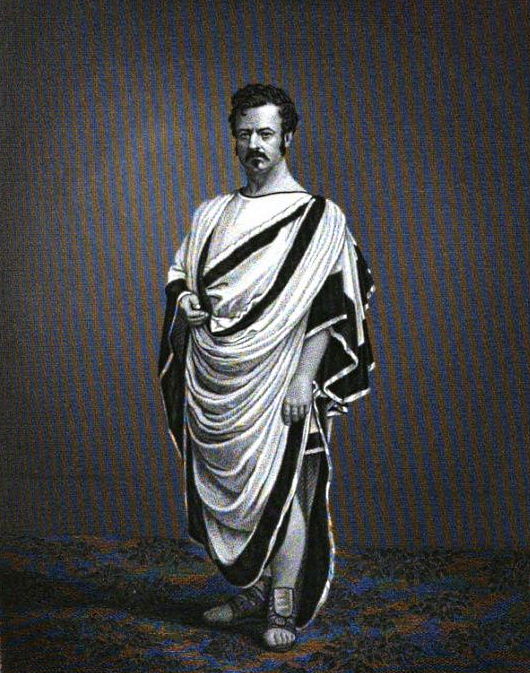
W. G. Jackman
EDWIN FORREST AS
VIRGINIUS.
Sometimes, as an artist is lifting the curtain to expose his picture
to view, with the removal of the first corner of drapery the
connoisseur catches a glimpse of an exquisite bit of drawing and
color which convinces him that the entire work is a great and
beautiful one. When Forrest made his entrance in Virginius,
with an irritated and impetuous air, the earliest sound of his
voice, so deep and resonant, coining and propelling its words in
air with such easy and percussive precision, seized the attention
of the auditory and gave assurance that something uncommon
was to come. With a quick articulation and an expostulating
tone he said, "Why did you make him Decemvir, and first Decemvir,
too?" He refers to the shameless Appius Claudius, and
the key-note of the play is struck by his inflection of the words.
He is not displeased on seeing reason for suspecting that his
daughter—an only and idolized child left him by his dead wife—is
in love with the noble young Lucius Icilius, for whom he has
an excellent liking. He sends for Virginia, who is still a schoolgirl,
that he may question her. She comes in, and sits upon his
knee, saying, "Well, father, what is your will?" At the sight of
her his face lights as if a sunbeam had suddenly fallen on it, and
his voice has a sweet, low, half-smothered tone, as if the words
were spoken in his heart, and only their softened echoes came
forth:
"Virginius. I wished to see you,
To ask you of your tasks,—how they go on,—
And what your masters say of you,—what last
You did. I hope you never play
The truant?
Virginia. The truant! No, indeed, Virginius.
Virginius. I am sure you do not. Kiss me!
Virginia. Oh! my father,
I am so happy when you are kind to me!
Virginius. You are so happy when I'm kind to you!
Am I not always kind? I never spoke
An angry word to you in all my life,
Virginia! You are happy when I'm kind!
That's strange; and makes me think you have some reason
To fear I may be otherwise than kind."
The parental tenderness of his manner, his speech, his kiss,
seemed to combine the love of a father and a mother in one. His
hand meanwhile was playing with her tresses in a way suggestive
of unpurposed instinctive fondness, exquisitely touching.
The transition was perfect when, meeting Icilius, after scrutinizing
him earnestly, as though to read his very soul, the rough
soldier and honest man succeeds to the adoring father:
"Icilius!
Thou seest this hand? It is a Roman's, boy;
'Tis sworn to liberty,—it is the friend,
Of honor. Dost thou think so?
Icilius. Do I think
Virginius owns that hand?
Virginius. Then you'll believe
It has an oath deadly to tyranny,
And is the foe of falsehood! By the gods,
Knew it the lurking-place of treason, though
It were a brother's heart, 'twould drag the caitiff
Forth. Dar'st thou take this hand?"
And when, a little later, he led his daughter to her lover and
formally betrothed them in these eloquent words, his whole frame
betraying the struggle at composure, it was a consummate moral
painting of humanity in one of its most sacred aspects:
"Didst thou but know, young man,
How fondly I have watched her, since the day
Her mother died, and left me to a charge
Of double duty bound,—how she hath been
My pondered thought by day, my dream by night,
My prayer, my vow, my offering, my praise,
My sweet companion, pupil, tutor, child!—
Thou wouldst not wonder that my drowning eye
And choking utterance upbraid my tongue
That tells thee she is thine!"
The plot progresses, and the air is thick with the clamor and
strife of Rome, the hates of parties and the reverberation of war.
Virginius is called to a distance with the army. His daughter is
left under the guardianship of her uncle. One day the lustful
Appius has a sight of her passing in the street.
"Her young beauty,
Trembling and blushing 'twixt the striving kisses
Of parting spring and meeting summer,"
inflames him. He charges one of his minions to seize her, under
the pretext that she is the child of one of his slaves, sold
to Virginius and falsely proclaimed his daughter. With details
of cruel atrocity the deed is accomplished, in spite of the desperate
interference of Icilius. Lucius is sent as a messenger
to the camp to inform Virginius. Lucius tells him he is wanted
immediately at Rome. With a start and a look of dread anxiety
he demands to know wherefore. The messenger prevaricates
and delays, but, on being chided and commanded to speak out,
says, "Hear me, then, with patience." Virginius replies, while his
restless fingers and the working of his toes, seen through the
openings of his sandals, most effectually contradict the words,
"Well, I am patient."
"Lucius. Your Virginia—
Virginius. Stop, my Lucius!
I am cold in every member of my frame!
If 'tis prophetic, Lucius, of thy news,
Give me such token as her tomb would,—silence.
I'll bear it better.
Lucius. You are still—
Virginius. I thank thee, Jupiter, I am still a father!"
The change of his countenance while uttering the word "father,"
from the expression it wore on the word "silence," was like an
unexpected sunburst through a gloomy cloud. As Lucius went
on in his narration, the breathing of the listener thickened with
intensity of suspense, his heart beat with remittent throb, and he
started at each point in the outrage like one receiving electric
shocks.
He departed for Rome, where his poor daughter was guarded
in the house of her uncle, Numitorius, in the deepest distress and
terror. He entered; and such was his expression as he cried,
"My child! my child!" and she rushed into his arms, that there
were scarcely ever many dry eyes in the theatre at that moment.
Then it was something divine to be seen, and never to be forgotten,
to behold how he turned from his blistering and disdainful
apostrophe to the villain who had dared set his panders after her,
and, taking her precious head in his hands, gazed in her face,
saying,—
"I never saw you look so like your mother
In all my life!
Virginia. You'll be advised, dear father?
Virginius. It was her soul,—her soul, that played just then
About the features of her child, and lit them
Into the likeness of her own. When first
She placed thee in my arms,—I recollect it
As a thing of yesterday!—she wished, she said,
That it had been a man. I answered her,
It was the mother of a race of men.
And paid her for thee with a kiss. Her lips
Are cold now,—could they but be warmed again,
How they would clamor for thee!
Virginia. My dear father,
You do not answer me! Will you not be advised?
Virginius. I will not take him by the throat and strangle him!
But I COULD do it! I could DO IT!"
They go to the Forum, where Appius is seated on the tribunal,
supported by the lictors and an armed troop. The acting of Forrest
in the trial-scene that followed was as genuine and moving,
set in as bold relief, as anything the American theatre has known.
Who that saw him can ever forget the imperial front with which,
bearing Virginia on his arm, he advanced before the judgment-seat,—the
firm step, the indomitable face, the parental love that
seemed to throw a thousand invisible tendrils around his child to
hold her up! The tableau caused a silence that was absolute,
and was maintained so long that the suspense had begun to be
painful, when the kingly voice of Virginius broke the spell:
"Does no one speak? I am defendant here!
Is silence my opponent? Fit opponent
To plead a cause too foul for speech! What brow
Shameless, gives front to this most valiant cause,
That tries its prowess 'gainst the honor of
A girl, yet lacks the wit to know that they
Who cast off shame should likewise cast off fear!"
The strong, lucid, cutting tones in which these words were
spoken went vibrating into the breasts of the listeners, and
thrilled them with sympathetic echoes. The perjured witness
was summoned by the recreant judge. And the next passage of
the play had a moral meaning deep enough, and was represented
with a truth and power grand enough, to turn the stage for the
time being into a pulpit and make the world tremble at its
preaching.
"Virginius. And are you the man
That claims my daughter for his slave?—Look at me,
And I will give her to thee.
Claudius. She is mine, then:
Do I not look at you?
Virginius. Your eye does, truly,
But not your soul.—I see it, through your eye,
Shifting and shrinking,—turning every way
To shun me. You surprise me, that your eye,
So long the bully of its master, knows not
To put a proper face upon a lie,
But gives the port of impudence to falsehood
When it would pass it off for truth. Your soul
Dares as soon show its face to me!"
Now the interest grows yet intenser and the influence of the
actor yet more penetrating in its simplicity and terrible beauty.
Virginius finds that nothing can save his daughter from the last
profanation of the tyrant except her immediate immolation by
himself. For a moment he is lost in a reverie, striving to think
what he can do. By chance he perceives a knife lying on the
stall of a butcher. At the sight of this providential instrument
an electric change passes over his face, revealing all his purpose
with a grim joy, like the lightning-flash at night illumining the
murky sky and giving an instantaneous outline of the clouds
loaded with the coming storm. He moves gradually towards
the stall, smiling on Virginia a tender smile, full of the consolation
he sees in the prospect of her deliverance even by death.
He pats her lovingly on the shoulder while changing her from
his left arm, that with it he may reach the knife. He stealthily
seizes it and passes it behind him from the left hand to the
right. With deep fondness he breathes, "My dear Virginia," and
gives her quick and fervent kisses, which he appears striving
to press into her very soul. Tears seem to moisten his words,—
"There is one only way to save thine honor,—
'Tis this!"
And, swift as motion of the human arm can make it, the knife
pierces her heart. The storm has burst, the lightning has wreathed
its folds around the consecrated instrument of the work, and now
the thunder-tones of his voice crash through the theatre in the
awful exclamation,—
"Lo, Appius! with this innocent blood
I do devote thee to the infernal gods!
Make way there!
If they dare
To tempt the desperate weapon that is maddened
With drinking my daughter's blood, why, let them.
Thus, thus it rushes in amongst them. Way, there!"
His exit here used to excite the wildest huzzas, the men in the
pit standing with their hats in their uplifted hands, and the women
in the boxes waving their handkerchiefs.
Virginius heads the revolution, in which the revolted troops
and the commons join. The tyranny is hurled to the dust, the
people freed, and Appius lodged in prison. But the wronged
and wretched father is broken down by the preternatural horror
and excitement he has undergone, and loses his reason. He is
next seen in his own desolate home, with a pale and haggard
face, and a look half wild, half dreamy, talking to himself:
"'Tis ease! 'tis ease! I am content! 'Tis peace,—
'Tis anything that is most soft and quiet.
And after such a dream! I want my daughter.
Send me my daughter! Will she come, or not?
I'll call myself. Virginia!"
His call of Virginia was a call dictated by a dethroned mind.
It was a sound that appeared to come from a mysterious vault.
There was a kind of semi-wakefulness in it, like the utterance of
a thought in a dream. It had a touch of pity. It was an inverted
form of sound, that turned back whence it issued and fell dead
where it was born, feeling that there was no reply for it to keep
it alive. Yet, after a pause, he fancies he hears her answering;
and he rapidly asks,—
"Is it a voice, or nothing, answers me?
I hear a sound so fine there's nothing lives
'Twixt it and silence."
And then, with an entranced listening, he follows the illusory voice
around to different parts of the room, in the vain attempt to find
its source. An apathetic stare, a blank, miserable stupor, succeeds,
soon broken by the fancy that he hears her shrieking in
the prison for rescue from Appius,—and he darts away. Appius,
meanwhile, is planning an escape, and gloatingly counting over
in imagination the victims he will pick out to expiate for his
present shame, when the shattered Virginius, appalling even in
his ruins, rushes in upon him, wildly crying, "Give me my
daughter!" The affrighted prisoner replies,—
"I know nothing of her, Virginius, nothing.
Virginius. Do you tell me so?
Vile tyrant! Think you, shall I not believe
My own eyes before your tongue? Why, there she is!
There at your back,—her locks dishevelled, and
Her vestment torn,—her cheeks all faded with
Her pouring tears.
Villain! is this a sight to show a father?
And have I not a weapon to requite thee?"
In his distraught fury, feeling over his body for some weapon he
discovers his own hands. A wild and eager delight shudders
through him as, holding these naked instruments before him, he
springs on the terrified Appius and strangles him to death.
Lucius, Icilius, and Numitorius enter, bearing the urn of Virginia.
The wronged father and sufferer looks up, and sighs, with
a bewildered gaze,—
"What a load my heart has heaved off! Where is he?
I thought I had done it."
They call him by name. He makes no response. Icilius places
the urn in his right hand, with the single word, "Virginia." He
looks at Icilius and the urn, at Numitorius and Lucius, seems
struck by their mourning garb, looks again at the urn, breaks
into a passion of tears, and falls on the neck of Icilius, exclaiming,
"Virginia!"
METAMORA.
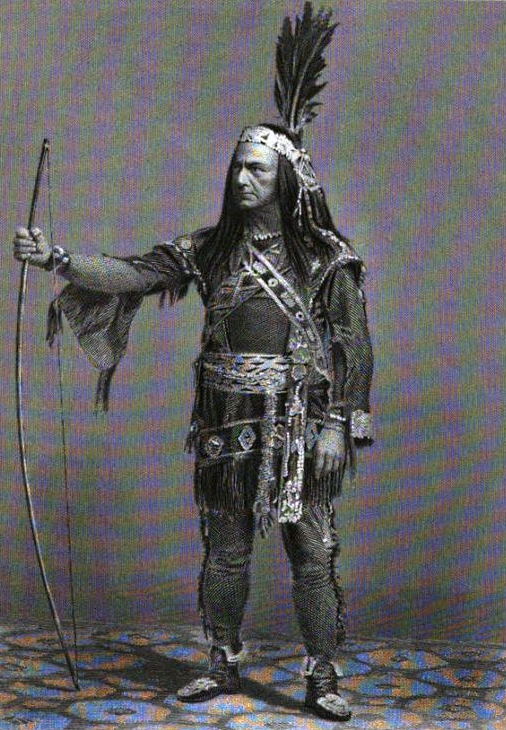
Jas Bannister
EDWIN FORREST AS
METAMORA.
The famous prize-play of Metamora, by John Augustus Stone,
is not a work of much genius, and if published would have no
literary rank; yet it had all that was essential, in the striking
merit of furnishing the genius of the enactor of its leading character
the conditions for compassing a popular success of the
most remarkable description. With his performance of Metamora,
Forrest impressed the masses of the American people in a
degree rarely precedented, and won a continental celebrity full of
idiomatic enthusiasm. Of course there were good reasons for
this warm favor from the surrendered many, despite the disdain
of the squeamish few, who can generally enjoy nothing, only
conceitedly criticise everything.
In the first place, the subject was indigenous, and thus came
home to the American heart and curiosity. In the imagination
of our people for more than a century the race of the aborigines
of the land were clothed with romantic associations and regretted
with a sort of national remorse. The disinterestedness of the fancy
and the soul, relieved from all proximity to their squalor, ferocity,
and vice, with a beautiful pity lamented their wrongs, their evanescence,
and the rapid disappearance of the wigwam and papoose
and war-dance and canoe of the painted tribes from hill and glen
and wood and lake. In this wide-spread sentimental interest the
play took hold of powerful chords. Although prosaic research
and experience have so largely divested the character of the
Indian of its old romance and made his actual presence a nuisance,
nevertheless so long as the memories of our primeval settlements
and of our bloody and adventurous frontier traditions shall live,
so long will the American Indian be remembered with a sigh as
the lost human poetry of the nature wherein he was cradled.
Furthermore, the play was stocked with fresh suggestions
and images of nature,—a store-house of those simple metaphors
drawn direct from the great objects of the universe, full of a rude
pathos and sublimity, and so natural to the genius of Indian chief
and orator in their talk. There was a piquance of novelty and a
refreshing charm to people—hived in towns and cities, and, stifled
with artificial customs, almost oblivious of any direct contact of
their senses with the solemn elementary phenomena of the surrounding
universe—in hearing Metamora speak, in a voice that
echoed and painted them, of the woods, the winds, the sun, the
cliffs, the torrents, the lakes, the sea, the stars, the thunder, the
meadows and the clouds, the wild animals and the singing birds.
The meaning of the words so fitly intoned by the player awoke
in the nerves of the audience dim reminiscences of ancestral experiences
reverberating out of far ages forgotten long ago, and
they were bound by a spell themselves understood not.
And then there was the interest of a style of character and
life, of an idealized historic picture of a vanished form of human
nature and society, all whose elements stood in strange and fascinating
contrast with the personal experience of the beholders. It
was the first time the American Indian had ever been dramatized
and put on the stage; and this was done in a theme based on
one of the romantic episodes of his history embodied in a chieftain
of tragic greatness.
In a production of art whose subject and materials lie in the
domain of unreclaimed nature, genius is not, indeed, permitted
to falsify any fundamental principle or fact, but is free to modify
and add. Otherwise, the creative function of art is gone, and
only imitation left. In this respect of combined truth and originality,
the acted Metamora of Forrest was a wonder never surpassed,
in its own kind, in the long story of the stage. He appeared
the kingly incarnation of the spirit of the scene, both of the
outward landscape and of the taciturn tribe that peopled it with
their gliding shapes. He appeared the human lord of the dark
wood and the rocky shore, and the natural ruler of their untutored
tenants; the soul of the eloquent recital, the noble appeal,
and the fiery harangue; the embodiment of a rude magnanimity,
a deep domestic love, an unquivering courage and fortitude,
an instinctive patriotism and sense of justice, and a relentless
revenge. He appeared, too, the votary of a superstition of singular
attractiveness, blooming with the native wild-flowers of the
human mind, a faith so unaffected and open that it seemed to be
read by the stars of the Great Spirit as they looked down on the
lone Indian kneeling by the mound of his fathers, the hunted
patriot lying in ambush for his foes. Through all this physically-realized,
wondrous portraiture of the poetic, the tender, the noble,
the awful, the reverential, was mingled the glare of the crouching
tiger. It was thus that Forrest in his great creation of Metamora
rendered all that there was in the naturalistic poem of Indian life,
to all that there was justly adding an infusion of that ideal quality
by which art appeals to the nobler feelings of admiration and
sympathy in preference to the meaner ones of hate and scorn.
In this performance he elaborated a picture of the legendary and
historic American Indian which to this day stands alone beyond
all rivalry.
Never did an actor more thoroughly identify and merge himself
with his part than Forrest did in Metamora. He was completely
transformed from what he appeared in other characters,
and seemed Indian in every particular, all through and all over,
from the crown of his scalp to the sole of his foot. The carriage
of his body, the inflections of his voice, his facial expressions, the
very pose of his head and neck on his shoulders, were new. For
he had recalled all his observations while on his visit with Push-ma-ta-ha
among the Choctaws, when he had adopted their habits,
eaten their food, slept in their tents, echoed the crack of his rifle
over the surface of their lakes, and left the print of his moccasins
on their hunting-grounds. He had also patiently studied their
characteristics from all other available sources. Accordingly,
when he came to impersonate Metamora, or the Last of the
Wampanoags, modelled by the author of the play after that celebrated
New England Sachem, the son of Massasoit, known in
history as King Philip of Pokanoket, it was the genuine Indian
who was brought upon the stage, merely idealized a little in some
of his moral features. The attributes unnoticed by careless observers
were distinctly shown,—the sudden muscular movements,
the repressed emotion, the peculiar mode of breathing, the deep
and vigorous gutturals flung out from the muscular base of the
abdomen, and the straight or slightly inward-pointing line of the
footfall. With a profound truth to fact, the general bearing of
Metamora on ordinary occasions was marked by a dull monotony
of manner, broken with awkward abruptness, and his grand poses
were limited to those times of great excitement when the human
organism, if in a state of dynamic surcharge, is spontaneously
electrified with heroic lines, and becomes an instrument with
which impersonal passions or the laws of nature gesticulate.
With the single and very proper exception of this partially
heightened moral refinement, the counterfeit was so cunningly
copied that it might have deceived nature herself. Many a time
delegations of Indian tribes who chanced to be visiting the cities
where he acted this character—Boston, New York, Washington,
Baltimore, Cincinnati, New Orleans—attended the performance,
adding a most picturesque feature by their presence, and their
pleasure and approval were unqualified. A large delegation of
Western Indians, seated in the boxes of the old Tremont Theatre
on such an occasion, were so excited by the performance that in
the closing scene they rose and chanted a dirge in honor of the
death of the great chief.
This incident recalls one which happened in the earliest theatre
in Philadelphia, when Mrs. Whitelock, the sister of Mrs. Siddons,
was playing, and when Washington was present. At the beginning
of the performance a group of Indians, who had come from
the wilderness to conclude a treaty, made their appearance in the
pit in their native costume. The dark, tall, gaunt figures glided
in, and, without noticing the audience or seeming to hear the
claps of welcome which greeted them, seated themselves, and
fixed their eyes on the stage, as unchangingly as if they were
petrified. They sat through the chief play like statues, with immovable
tranquillity. But in the after-piece an artificial elephant
was introduced, which so electrified these sons of the forest that
they suddenly sprang up with a cry. They said there had once
been a great beast like this in their land. The next day they
called on the manager, inspected the mammoth of sticks, pasteboard,
and cloth, and asked to see by daylight the heavenly
women who had appeared on the stage the previous night.
The opening scene of Metamora was a glen, with ledges of
stone, trees, bushes, running vines, and flowers, the leading character
seen, in his picturesque, aboriginal costume, standing on
the highest rock in an attitude that charmed the eye. Leaning
forward on his firmly-planted right foot, the left foot thrown easily
back on its tip, he had a bow in his hands, with the arrow sprung
to its head. As the arrow sped from the twanging string he
raised his eyes with eager gaze after it, gave a deep interjection,
"Hah!" bounded upon a rock below, and vanished. In a few
moments he re-entered, with his left arm bleeding, as if it had
been bitten in a struggle with a wild beast. Oceana, a white
maiden, passing, sees his wound and offers him her scarf to bind
it up. The mother of Oceana had once befriended Massasoit
when he was sick. Metamora, in his gratitude, had visited her
grave with offerings for the dead, and, on such an occasion, had
rescued Oceana from a panther. He hesitates before accepting,
and fills the delay with a by-play of pantomime so true to Indian
nature, so new and strange to the spectators, that it was invested
with an absorbing interest. At length he says, "Metamora will
take the white maiden's gift." He then gives her an eagle's
feather, bids her wear it in her hair, and if she is ever in danger
he will fly to her rescue at the sight of this pledge of his friendship.
As the play moves on, the audience are gradually borne back
to the early days of their fathers, and their dread struggle to
establish themselves on these Western shores. We see the thin
and thriving settlements constantly augmenting with reinforcements,
and pushing the natives before them. We are taken within
the homes of the Indians, shown their better qualities, their hopeless
efforts, their mixed resolution and misgiving before their
coming fate. Our sympathies are enlisted, before we know it,
with the defeated party against ourselves; and thus the author
and actor won their just victory. For the English are made to
represent power and fraud, the Indians truth and patriotism; and
when their fugitive king pauses on a lofty cliff in the light of the
setting sun, gazes mournfully on the lost hunting-grounds and
desecrated graves of his forefathers, and launches his curse on
their destroyers, every heart beats with sorrow for him.
The class of speeches in which the instinctive love of nature
that unconsciously saturated the Indian soul is expressed, and
the closeness of their daily life to the elements of the landscape
and the phenomena of the seasons is revealed, were delivered
with matchless effect. Metamora, poised like the bronze statue
of some god of the antique, says, "I have been upon the high
mountain-top when the gray mists were beneath my feet, and the
Great Spirit passed by me in wrath. He spoke in anger, and the
rocks crumbled beneath the flash of his spear. Then I felt proud
and smiled. The white man trembles, but Metamora is not
afraid."
And again: "The war and the chase are the red man's brother
and sister. The storm-cloud in its fury frights him not; and
when the stream is wild and broken his canoe is like a feather,
that cannot drown."
Another class of speeches, equally unique in character, and
breathing with compressed passion, were those in which the relative
positions of the intruding race and the native lords of the
soil were described. The style with which these were pronounced
made the form of the actor seem a new tenement in which the
departed Sachem of the Pequots lived and spoke again. "Your
lands?" he exclaims, with sarcastic disdain. "They are mine.
Climb upon the rock and look to the sunrise and to the sunset,—all
that you see is the land of the Wampanoags, the land of Metamora.
I am the white man's friend; but when my friendship is
over I will not ask the white man if I have the right to be his
foe. Metamora will love and hate, smoke the pipe of peace or
draw the hatchet of battle, as seems good to him. He will not
wrong his white brother, but he owns no master save Manito,
Master of Heaven."
And at another time: "The pale-faces are around me thicker
than the leaves of summer. I chase the hart in the hunting-grounds;
he leads me to the white man's village. I drive my
canoe into the rivers; they are full of the white man's ships. I
visit the graves of my fathers; they are lost in the white man's
corn-fields. They come like the waves of the ocean forever rolling
upon the shores. Surge after surge, they dash upon the
beach, and every foam-drop is a white man. They swarm over
the land like the doves of winter, and the red men are dropping
like withered leaves."
In these passages his declamation seemed to make the whole
tragedy of the story of the American Indians breathe and swell
and tremble.
A wonderful interest, too, was concentrated in the personal
traits of Metamora himself as an individual; so true to his word,
so faithful to his friend, so devoted to his wife and child, so proud
of his land and his fathers, so fearless of his foe, so reverential
before his God. "To his friend Metamora is like the willow,—he
bends ever at the breath of those that love him. To others
he is an oak. Until with your single arm you can rive the
strongest tree of the forest from its earth, think not to stir Metamora
when his heart says No."
In the earliest scene with his wife, when ready to start on a
hunt, he lingered, and directed her to take her child from its
couch on the earth. He then lifted it in his hands, and stood for
several seconds in an attitude so superbly defined in its outlines
of strength and grace that several pictures of it were published
at the time. He asked, with a look of fondness, suppressing his
stern reserve, "Dost thou not love this little one, Nahmeokee?"
"Ah, yes!" she replied. He then continued, in a caressing murmur
like the runneling music of a brook, "When first his little
eyes unclosed, thou saidst that they were like to mine." The
expression of human love was so simple and complete, and so
exquisitely set in the wild seclusion of nature, suggestive of the
self-sufficingness of this little nest of affection embosomed in the
wood and forgetful of all else in the world, that it made many a
soft heart beat fast with an aching wish that stayed long after the
scene was gone.
In a later scene he describes to his wife a vision he has had in
the night. He relates it in a rich, subdued undertone, waxing
intenser, and giving the hearer a mixed feeling of mysterious
reverie and prophetic inspiration. "Nahmeokee, the power of
dreams has been on me, and the shadows of things to be have
passed before me. My heart is big with great thoughts. When
I sleep, I think the knife is red in my hand and the scalp of the
white man is streaming." Here he gave an additional height to
his figure, a slight downward inclination to his head and eyes,
dropped his left arm listlessly, and, while the two halves of his
whole form were seen finely distinguished along the median line,
with his right hand, extended to its fullest distance straight from
the shoulder, grasped his bow, which stood perfectly erect from
the ground. It was a posture of beautiful artistic precision and
meaning, expressive of reflection with a quality of earnest listening
in it, as if waiting for a reply. The words of Nahmeokee,
not fitting his mood, slightly ruffled his temper, and then, with a
crisp tone of voice which in its change of quality and accent was
so unexpected that it was like a sudden sweep of the wind that
rustles the dry leaves and hums through the wood, he said, "Yes,
when our fires are no longer red in the high places of our fathers,—when
the bones of our kindred make fruitful the fields the
stranger has planted amid the ashes of our wigwams,—when we
are hunted back like the wounded elk far towards the going down
of the sun,—our hatchets broken, our bows unstrung, and our
war-whoops hushed,—then will the stranger spare; for we shall
be too small for his eye to see!"
The controversy between the natives and the new settlers
having reached a perilous height, the latter dispatch a messenger
asking Metamora to meet them in council. Very angry, and
deeming all talk useless, he yet concludes to go. Unannounced,
abruptly, he makes his peremptory appearance amidst them. Settling
strongly back on his right leg, his left advanced at ease
with bent knee, his right side half presented, his face turned
squarely towards them, he says, with Spartan curtness, and in a
manner not insolent, and yet indescribably defiant, "You sent for
me, and I have come." His action was so wonderfully expressive
in speaking these few words that they became a popular phrase,
circulating in the mouths of men in all parts of the country.
The same result also followed in another and simpler scene.
He had promised to meet the English at a certain time and place.
They demanded of him, "Will you come?" By mere force of
manner he gave an immense impressiveness to the simple reply,
"Metamora cannot lie." The very boys in the streets were seen
trying to imitate his posture and look, swelling their little throats
to make the words sound big, as they repeated, "Metamora cannot
lie."
In an interview with the English, after deadly hostilities have
begun to rage, Aganemo, a subject of Metamora, who, for some
supposed wrong, has turned against him, is called in, and bears
testimony against his chief and his tribe. Metamora cries, "Let
me see his eyes;" and, going close in front of him, addresses the
cowering recreant: "Look me in the face, Aganemo. Thou
turnest away. The spirit of a dog has entered thee, and thou
crouchest. Dost thou come here with a lie in thy heart to witness
against me? Thine eye cannot rest on thy chieftain. White
men, can he speak words of truth who has been false to his nation
and false to his friends?" Fitz Arnold says, "Send him hence."
Metamora interposes with an imperial mien full of dread import,
"I will do that," and strikes him dead on the spot, exclaiming,
"Slave of the whites, follow Sassamon,"—Sassamon being the
name of another traitor whom he had previously slain in the
midst of his own braves.
Fitz Arnold orders his men to seize the high-handed executioner
of their witness. Towering alone in solitary and solid
grandeur, with accents and gestures whose impassioned sincerity
painted every thought as a visible reality and made the excited
audience lean out of their seats, Metamora hurled back his electric
defiance:
"Come! my knife has drunk the blood of the traitor, but it is
not satisfied. Men of the pale race, beware! The mighty spirits
of the Wampanoags are hovering over your heads. They stretch
their shadowy arms and call for vengeance. They shall have it.
Tremble! From East to West, from the South to the North,
the tribes have roused from their slumbers. They grasp the
hatchet. The pale-faces shall wither under their power. White
men. Metamora is your foe!"
The soldiers level their guns at him. He suddenly seizes a
white man and places him before himself. The living shield thus
extemporized falls, perforated with bullets. Metamora hurls his
tomahawk to the floor, where it sticks quivering, while he cries,
"Thus do I defy your power!" and darts away, leaving them
dumb with astonishment.
The pathos with which Forrest rendered portions of the play
of Metamora was one of its most remarkable excellences and
one of his most distinctive trophies as a dramatic artist. No
theory of the passions or mere mechanical drill in their expression
can ever teach a man to be pathetic. Only a disagreeable
mockery of it can thus come. Pathos is the one particular affection
that knows no deceit, but comes in truth direct from the
soul and goes direct to the soul. It may lie dormant in us, as
music lies in the strings of a silent harp, till a touch gives it life.
Speaking more or less in all, it speaks most in those who cherish
it most; and when it speaks it is felt by all,—red man and white
man, barbarian and philosopher. The pathos of Metamora was
not like that of Damon when he parted with his family to go to
his execution, not like that of Brutus when he sentenced his son
to death, not like that of Virginius when he slew his daughter.
It was a pathos without tears or gesture. The Indian warrior
never weeps. It was almost solely a pathos of the voice, and
was as broad and primitive as the unperverted faith and affection
of man. The supreme example of this quality in the play was
finely set off by the contrast that immediately foreran it, its soft,
sad shades following a scene of lurid fury and grandeur.
A peace-runner brings Metamora the news that Nahmeokee is
a captive in the power of his enemies. Leaving fifty white men
bound as hostages to secure his own safety, he starts alone to
deliver her. As he approaches the English camp, he hears Nahmeokee
shriek. With one bound he bursts in upon them, levels
his gun, and thunders,—
"Which of you has lived too long? Dogs of white men, do
you lift your hands against a woman?" "Seize him!" they cry,
but shrink from his movement. "Hah!" he scornfully exclaims,
"it is now a warrior who stands before you, the fire-weapon in
his hands. Who, then, shall seize him? Go, Nahmeokee; I will
follow thee." Then, reminding them of his hostages, he turns on
his heel and departs.
He is next discovered, with a slow and heavy step, approaching
his wigwam, where his rescued wife waits to receive him. He has
seen that the too unequal struggle of his countrymen is hopeless,
and he appears sad and gloomy. Telling Nahmeokee, who looks
broken with grief, that he is weary with the strife of blood, he
says, "Bring me thy little one, that I may press him to my burning
heart to quiet its tumult." Without his knowledge, the child
had been killed by the white men a few hours previous. The
mother goes where the child is lying upon the ground, lifts the
skin that covers him, points at him, and drops her head in tears.
Metamora looks at the child, at the mother, stoops, and, with
rapid motions, feels the little face, arms, and legs. Suppressing
the start of horror and the cry of grief a white man would have
given, he sinks his chin slowly upon his breast and heaves a deep
sigh, and then utters the simple words, "Dead! cold!" in a tone
low as if to be heard by himself alone, and sounding like the
wail of a sorrow in some far-away world. Having lifted the dead
child and fondled it in his bosom and laid it tenderly back, he
walks slowly to the weeping Nahmeokee, places his hand on her
shoulder, and says, in a soft voice quivering with the tears not
suffered to mount in the eyes, "Well, is he not happy? Better
that he should die by the stranger's hand than live to be his
slave. Do not bow down thy head. Thou wilt see him again
in the happy land of the spirits; and he will look smilingly as—as—as
I do now." Here the quality of smilingness was in the
tones of the voice only, while his face wore the impress of intense
grief. The voice and face thus contradicting each other presented
a pathos so overwhelming that it seemed as if nothing
human could surpass it or resist it.
His manner now changes. Some great resolution seems to
have arisen in him. His words have a tender yet ominous meaning
in their inflection as he asks Nahmeokee, "Do you not fear
the power of the white man? He might seize thee and bear
thee off to his far country, bind those arms that have so often
clasped me, and make thee his slave. We cannot fly: our foes
are all about us. We cannot fight, for this [drawing his long
knife] is the only weapon I have saved unbroken from the strife.
It has tasted the white man's blood and reached the cold heart
of the traitor. It has been our best friend, and it is now our only
treasure." Here he drew her still closer, and placed her head on
his bosom, and, with the long knife in his hand, pointed upwards,
and with an alluring, indescribably sweet and aerial falsetto tone,
painted a picture that seemed to take form and color in the very
atmosphere. There was a weird dreaminess in his voice and a
visionary abstractness in his gaze, as with the words "long path
in the thin air," he indicated the heavenward journey of his dead
child, that seemed actually to dissolve the whole scene, theatre,
actor, spectators, and all, into a passing vapor, an ethereal enchantment.
"I look through the long path in the thin air, and think I see
our little one borne to the land of the happy, where the fair
hunting-grounds never know snows or storms, and where the
immortal brave feast under the eyes of the Giver of Good. Look
upward, Nahmeokee! See, thy child looks back to thee, and
beckons thee to follow." Drawing her closer with his left arm,
and lowering his right, he whispers, "Hark! In the distant wood
I faintly hear the tread of the white men. They are upon us!
The home of the happy is made ready for thee!" While this
picture of fear and hope is vivid before her mind, he strikes the
blow, and in an instant she is dead in his arms. He clasps her
to his breast, presses his lips on her forehead, and gently places
her beside the dead child. He then shudders, and draws forth
the knife sheathed in her side, and kisses its blade in a sudden
transport, exclaiming, "She knew no bondage to the white men.
Pure as the snow she lived, free as the air she died!"
At this moment the hills are covered with the white men,
pointing their rifles at his heart. "Hah!" he cries. Their leader
shouts, "Metamora is our prisoner!" "No," he proudly responds,
dilating with the haughtiest port of defiance. "I live, the last of
my race, live to defy you still, though numbers and treachery
overpower me. Come to me, come singly, come all, and this
knife, which has drunk the foul blood of your nation, and is now
red with the purest of mine, will feel a grasp as strong as when
it flashed in the glare of your burning dwellings or was lifted
terribly over the fallen in battle."
The order is given to fire upon him; and he replies, "Do so. I
am weary of the world; for ye are dwellers in it. I would not
turn on my heel to save my life." They shoot, and he staggers,
but in his dying agonies launches on them his awful malediction:
"My curses on ye, white men! May the Great Spirit curse
ye when he speaks in his war-voice from the clouds! May his
words be like the forked lightnings, to blast and desolate! May
the loud winds and the fierce red flames be loosed in vengeance
upon ye, tigers! May the angry Spirit of the Waters in his
wrath sweep over your dwellings! May your graves and the
graves of your children be in the path where the red man shall
tread, and may the wolf and the panther howl over your fleshless
bones! I go. My fathers beckon from the green lakes and the
broad hills. The Great Spirit calls me. I go,—but the curses
of Metamora stay with the white men!"
He crawls painfully to the bodies of his wife and child, and, in
a vain effort to kiss them, expires, with his last gasp mixing the
words, "I die—my wife, my queen—my Nahmeokee!"
SPARTACUS.
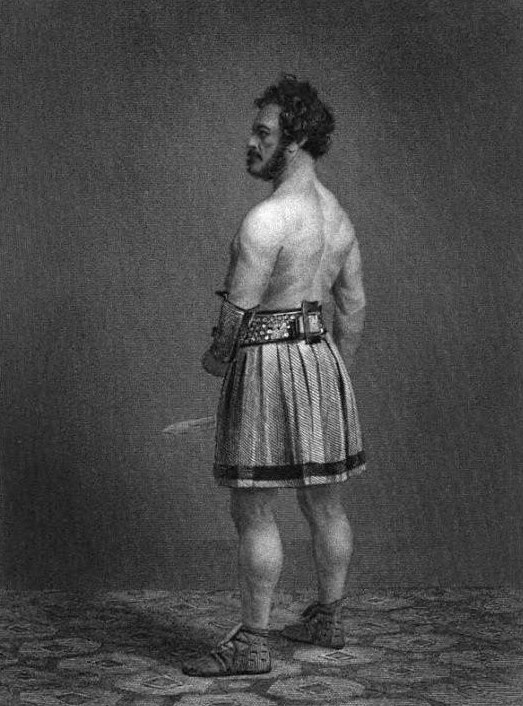
F. Halpin
EDWIN FORREST AS
THE GLADIATOR.
"The Gladiator," written by Robert Montgomery Bird, was
another prize-play, in which Forrest acquired a popularity which,
if less general, was more intense, than that secured for his Metamora.
If the admiration and applause given to it were drawn less
universally from men and women, from old and young, they were
more fervent and sustained, being fed by those elementary instincts
which are strongest in the robust multitude. The Spartacus of
Forrest was more abused and satirized by hostile critics than any
of his other parts, because it was the most "physical" and "melodramatic"
of them all. Muscular exertion and ferocious passion
were carried to their greatest pitch in it, though neither of these
was displayed in a degree beyond sincerity and fitness or the demands
of the given situations on the given embodiment of the
character. There are actual types of men and actual scenes of life
which are transcendently "physical" and "melodramatic." No
actor can truly represent such specimens of human nature and
such conjunctures of human history without being highly "physical"
and profoundly "melodramatic." Is it not the office of the
player, the very aim of his art, correctly to depict the truth of man
and life? And, recollecting what sort of a person the veritable
Thracian gladiator was, and what sort of a part he played, one may
well ask how he can be justly impersonated on the stage if not
invested with the attributes of brawny muscularity, terrific indignation,
stentorian speech, and merciless revenge. Forrest was
blamed and ridiculed by a coterie because he did exactly what, as
an artist cast in such a rôle, he ought to do, and any deviation
from which would have been a gross violation of propriety. He
simply exhibited tremendous mental and physical realities with
tremendous mental and physical realism. What else would the
demurrer have?
The fact is, the cant words "physical" and "melodramatic," as
demeaningly used in dramatic criticism, express a vulgar prejudice
too prevalent among the educated and refined,—a prejudice
infinitely more harmful than any related prejudice of the ignorant
and coarse. They seem to fancy the body something vile, to be
ashamed of, to receive as little attention and be kept as much out
of sight as possible. But since God created the body as truly as
he did the spirit, and decreed its uses as much as he did those
of the spirit, the perfecting and glorifying of the former are just
as legitimate as the perfecting and glorifying of the latter. The
ecclesiastical interpretation of Christianity for these fifteen hundred
years is responsible, in common with kindred ascetic superstitions
of other and elder religions, for an incalculable amount of
disease, deformity, vice, crime, and untimely death. The contempt
for bodily power and its material conditions in a superbly-developed
and trained physical organism, the foul and dishonoring
notion of the superior sanctity of the celibate state, the teaching
that chastity is the one thing that allies us to the angels, with
which every other sin may be forgiven, without which no other
virtue is to be recognized,—these and associated errors—discords,
distortions, and inversions of nature—have been prolific
sources of evil. They lie at the root of the so common prejudice
against a magnificent and glowing condition of the physical organism,
a prejudice which feeds the conceit of the votaries of the
present mental forcing system, and causes so many dawdling
idlers to neglect all use of those vigorous measures of gymnastic
hygiene which would raise the power and splendor of body and
soul together to their maximum.
The type of man produced by the Athenians in their best age,
its unrivalled combination of health and strength, energy and
grace, acumen and sensibility, organic harmony of mental peace
and vital joy, was very largely the fruit of their unrivalled system
of gymnastics regulated by music. Free America, with this example
and so much subsequent experience, with all the conquests
of modern science at her command, should inaugurate a system
of popular training which will acknowledge the equal sanctity
of body and soul and render them worthy of each other, a union
of athletic and æsthetic culture making the body the temporary
illuminated temple of its indwelling immortal divinity.
The separating of human nature into opposed parts whose
respective highest welfare is incompatible must ever be productive
of all kinds of morbidity, monstrosity, and horror, through the
final reactions of the violated harmony of truth. Leading to the
enforced culture of one side, the mental, and the enforced neglect
of the other, the material, it is fatal to that rounded wholeness of
the entire man which is the synonym of both health and virtue.
For the helpless subsidence of the soul in the body is brutality
or idiocy; the insurrectionary sway of the body over the soul is
insanity; the remorseless subdual of the body by the soul is egotistic
asceticism or murderous ferocity; but the parallel development
and exaltation of accordant body and soul give us the ideal
of health and happiness fulfilled in beauty, or the enthronement
of divine order in man. Therefore such a stimulating instance
of organic glory, extraordinary outward poise and inward passion,
as the people, thrilled in their most instinctive depths of
enthusiasm, used to shout at when they saw Forrest in his early
assumptions of the rôle of Spartacus, is not to be stigmatized as
something offensive, but to be hailed as something admirable.
In those happy and glowing years of his prime and of his fresh
celebrity, what a glorious image of unperverted manhood, of personified
health and strength and beauty, he presented! What
a grand form he had! What a grand face! What a grand voice!
And, the living base of all, what a grand blood! the rich flowing
seed-bed of his human thunder and lightning. As he stepped upon
the stage in his naked fighting-trim, his muscular coating unified
all over him and quivering with vital power, his skin polished by
exercise and friction to a smooth and marble hardness, conscious
of his enormous potency, fearless of anything on the earth, proudly
aware of the impression he knew his mere appearance, backed
by his fame, would make on the audience who impatiently awaited
him,—he used to stand and receive the long, tumultuous cheering
that greeted him, as immovable as a planted statue of Hercules.
In the rank and state of his physical organism and its feelings he
had the superiority of a god over common men. The spectacle,
let it be repeated, was worthy the admiration it won. And had
the personal imitation of the care and training he gave himself
been but equal to the admiration lavished on their result, the
benefit to the American people would have been beyond estimate.
But in this, as in the other lessons of the drama, the example was
relatively fruitless, because shown to spectators who applaud without
copying, seeking entertainment instead of instruction. This,
however, is clearly the fault of the people, and not of the stage.
The play of "The Gladiator" is founded on that dark and frightful
episode in the history of Rome, the famous servile war headed
by the gladiators under the lead of Spartacus. Our sympathies
are skilfully enlisted on the side of the insurgents, who are
goaded to their desperate enterprise by insufferable wrongs and
cruelties. It abounds in pictures of insolent tyranny on one side,
and with eloquent denunciation and fearless resistance on the
other, and the chief character is a powerful presentation of a deep
and generous manhood, outraged in every fibre, lashed to fury by
his injuries, and, after superhuman efforts of revenge, expiring in
monumental despair and appeal to the gods. The horrors of
oppression, the irrepressible dignity of human nature, the reckless
luxury of the rulers, the suffering of the slaves, the revolting
arrogance of despotism, and the burning passion of liberty, are
set against one another; and all through it the mighty figure of
Spartacus is made to fill the central place. It was just the part
for a democrat, who, despising what is factitious, gloried in the
ineradicable attributes of free manhood; and Forrest made the
most of it. For instance, it is easy for those who knew him to
imagine the energy and relish with which he would utter the
following lines when he came to them in his part:
"I thank the gods, I am barbarian;
For I can better teach the grace-begot
And heaven-supported masters of the earth,
How a mere dweller of a desert rock
Can bow their crowned heads to his chariot-wheels.
Man is heaven's work, and beggars' brats may herit
A soul to mount them up the steeps of fortune,
With regal necks to be their stepping-blocks."
In the intense sincerity and elaborate as well as spontaneous
truth of his performance, it was not a play that the spectators
saw, but a history; not a history, but a resurrection. Entering in
the garb of a slave, bound and whipped, his mighty frame and
terrible aspect made the abuse seem more awful. Tortured with
insulting questions, his proud spirit stung by wrong on wrong,
he broke forth in desperation, and carried the passions of the
audience by storm, as with clenched hands, and half erect from
their seats, while the blood ran quicker through their veins, they
saw him rush into combat with his enemies and chase them from
the stage. They delighted to see the cruel subduer of the world
humbled by her own captive, who held her haughty prætors by
the heart and called on Thrace, on Africa, on the oppressed of all
nations, to pour the flood of their united hates on the detested
city. They rejoiced to hear him recite with bitter eloquence the
story of her degradation, and heap on her with hot scorn the
recollection of the time when Tiber ran blood and Hannibal hung
over her like a cloud charged with ruin. Every step, every word,
vibrated on their feelings, and when he fell their hearts swelled
with a pang. For the actor had been lost in the slave, the insurgent,
the conqueror, the victim.
His first appearance as a captive in imperial Rome was deeply
affecting. "Is it a thousand leagues to Thrace?" he said, with a
whispered agony, the deadly lament of hopeless exile. He has
been purchased by Lentulus, an exhibitor of gladiators, on the
strength of the report that he was the most desperate, skilful, and
unconquerable fighter in the province. Bracchius, another proprietor
of gladiators, owns one Phasarius, a Thracian, who has
always been victorious in his combats. Phasarius was a younger
and favorite brother of Spartacus, supposed to have been killed
in battle years before, but really taken captive and brought to
Rome. Now Bracchius and Lentulus propose a combat between
their two slaves. Spartacus, chained, is ordered in. He
asks, "Is not this Rome, the great city?" Bracchius replies,
"Ay, and thou shouldst thank the gods that they have suffered
thee to see it. What think'st thou of it?"
"Spartacus. That if the Romans had not been fiends, Rome
had never been great. Whence came this greatness but from the
miseries of subjugated nations? How many myriads of happy
people that had not wronged Rome, for they knew not Rome,—how
many myriads of these were slain, like the beasts of the field,
that Rome might fatten upon their blood, and become great?
Look ye, Roman, there is not a palace upon these hills that cost
not the lives of a thousand innocent men; there is no deed of
greatness ye can boast, but it was achieved by the ruin of a nation;
there is no joy ye can feel, but its ingredients are blood
and tears."
Lentulus breaks in, "Now, marry, villain, thou wert bought not
to prate, but to fight."
"Spartacus. I will not fight. I will contend with mine enemy,
when there is strife between us; and if that enemy be one of
these same fiends, a Roman, I will give him the advantage of
weapon and place; he shall take a helmet and buckler, while I,
with my head bare and my breast naked, and nothing in my hand
but my shepherd's staff, will beat him to my feet and slay him.
But I will not slay a man for the diversion of Romans."
His master threatens to have him lashed if he refuses to contend
in the arena. The fearful attitude and fixed look with which
Spartacus received this threat, suggesting that he would strike
the speaker dead with a glance, were a masterpiece of expressive
art not easily forgotten by any one who saw it. Its possessing
power seemed to freeze the gazer while he gazed. Still refusing
to fight, in moody despair he bewails the destruction of his home
by the Romans, and their murder of his wife and young child.
The female slaves of Bracchius here pass by, and, to his amazement,
among them Spartacus sees his lost Senona and her boy.
After a touching interview of contending joy and grief with them,
he agrees to enter the arena, on condition that if he is victorious
his reward shall be their liberation.
The next act opens with a view of the great Roman amphitheatre,
crowded with the people gathered to see those bloody
games which were their horrid but favorite amusement. The first
adversary brought against Spartacus is a Gaul. He soon slays
him, though with great reluctance, and only as moved to it by
the prospect of freedom for his wife and child. Then they propose
as a second champion a renowned Thracian. He flings
down his sword and refuses to fight with one of his own countrymen.
But at last, on learning that liberty is to be had in no
other way, he suddenly yields. The Thracian is introduced. It is
Phasarius. A scene of intense pathetic power follows, as little
by little the brothers are struck with each other's appearance,
suspect, inquire, respond, are satisfied, and rush into a loving embrace.
The prætor treats their recognition and their transport
of fraternal affection as a trick to escape the combat, and orders
them to begin. Spartacus proposes to his brother to die sword
in hand rather than obey the unnatural command. In reply,
Phasarius rapidly informs him that he has already organized the
elements of a revolt among his comrades, and that it awaits but
his signal to break out. Crassus angrily calls on his guards to
enter the amphitheatre and punish the dilatory combatants. The
manner in which Spartacus retorted, "Let them come in,—we are
armed!" never failed to stir the deepest excitement in the theatre,
causing the whole assembly to join in enthusiastic applause.
Port, look, gesture, tone, accent, combined to make it a signal
example of the sovereign potency of manner in revealing a
master-spirit and swaying subject-spirits.
On the entrance of the guards, Phasarius gives a shout, and
the confederate gladiators also plunge in, and a general conflict
begins. In this scene the acting of Forrest absorbed his whole
heart. He was so thoroughly imbued with the spirit of it that
everything he did was perfectly natural, full of that genuine fire
which is so much beyond all exertion by rule. It was universally
agreed that more spirited and admirable fighting was hardly to
be conceived, the varied postures into which he threw his massive
form being worthy to be taken as studies for the sculptor.
The rebellion grows apace in success and numbers. Spartacus
rescues his wife and child from the Roman camp, and seizes the
niece of the prætor. Phasarius falls in love with this young
woman, and demands her of his brother. Being refused because
she is affianced to a youth in Rome, he insists on his demand. In
the altercation occurs one of the finest and loftiest passages in
the play, and it was rendered with a sublime eloquence:
"Spartacus. Come, look me in the face,
And let me see how bad desires have changed thee.
Phasarius. I claim the captive.
Spar. Set thine eye on her:
Lo, you! she weeps, and she is fatherless.
Thou couldst not harm an orphan? What, I say,
Art thou, whom I have carried in my arms
To mountain-tops to worship the great God,
Art thou a man to plot a wrong and sorrow
'Gainst such as have no father left but Him?"
Phasarius revolts, and takes off more than half the army. Disastrously
defeated by Crassus, he returns with a broken fragment
of his forces, and is generously forgiven and restored to favor by
Spartacus, who intrusts him with an important separate command,
and confides Senona and her boy to his keeping, with the
solemn charge that he shall avoid all collision with the enemy.
Phasarius, however, thirsting for Roman blood, seeks an engagement,
and is totally routed, his force cut in pieces, and the mother
and child both slain. The unhappy man, then, mortally wounded,
presents himself before his brother, tells his fearful tale, and expires
at his feet. In this interview the emotions of anxiety,
deprecation, grief, wrath, and horror, were depicted in all their
most forcible language in the person of Spartacus. One action
in particular was effective in the highest degree. Phasarius described
the crucifixion by the Romans of six thousand of their
Thracian captives. The highway on both sides, he said, was lined
with crosses, and on each cross was nailed a gladiator.
"I crept
Thro' the trenched army to that road, and saw
The executed multitude uplifted
Upon the horrid engines. Many lived:
Some moaned and writhed in stupid agony;
Some howled and prayed for death, and cursed the gods;
Some turned to lunatics, and laughed at horror;
And some with fierce and hellish strength had torn
Their arms free from the beams, and so had died
Grasping headlong the air."
The agitations of the soul of the listener up to this point had
been delineated with fearful distinctness. But when told that
his wife and child had been killed, his head suddenly fell forward
on his breast and rested there, after vibrating four or five times
in lessening degrees on the pivot of the neck, as if utterly abandoned
to itself. It was marvellously expressive of the exhausted
state, the woe-begone despair, of one who had received a shock
too great to be borne, a shock which, had it been a little severer,
would have prostrated his whole figure, but, as it was, simply
prostrated his head.
Deprived of all his kindred and of all hope, alone on the flinty
earth, rage and recklessness now seize the desolate Thracian, and
he resolves to sacrifice his captive, the niece of the prætor, in
retaliation for the slaughter of his own family; but a nobler sentiment
restrains him, and he dismisses her to her father. In this
passage he displayed the agony of generous grief subduing the
desire of vengeance with a power which, as a prominent English
critic said, reminded the beholder of the head of Laocoön struggling
in the folds of the serpent, or of the head of Hercules
writhing under the torture of the poisoned shirt.
The prætor in return for his daughter sends Spartacus an
offer of pardon if he will surrender. Disdainfully rejecting the
overture, he has the horses in his camp slain, and sets everything
on the chance of one more battle, but against such odds as he
knows can result only in his defeat. With a frenzied thirst for
vengeance he fights his way to the presence of the Roman general,
and, in the very act of striking him down, exhausted from
the accumulated wounds received in his passage of blood, grows
faint, reels, falls in the exact attitude of the immortal statue of
the Dying Gladiator, and expires.
A most remarkable proof of the histrionic genius of Forrest
was given in the profoundly discriminated manner with which the
same mass and fury of revengeful passion, the same rude breadth
and tenderness of affection and pathos, were shown by him in the
two characters of Metamora and Spartacus. In the Indian there
was a stoical compression of the emotions out of their revealing
channels, an organic suppression of starts and surprises and lamentations,
a profound impassibility of demeanor, an exterior of
slow, stubborn, monotonous self-possession, through which the
volcanic ferocity of the interior crept in words of slow lava, or
flared as fire through a smouldering heap of cinders. In the
Thracian there was more variety as well as incomparably more
freedom and impulsiveness of expression. The exterior and interior
corresponded with each other and mutually reflected instead
of contradicting each other. In different exigencies the gladiator
exhibited in his whole person, limbs, torso, face, eyes, and voice,
the extremes of sullen stolidity, pining sorrow, convulsive grief,
ambitious pride, pity, anger, resolution, and despair, each well
shaded from the others. He had a wider gamut, as civilization
is more comprehensive than barbarism. The movements and
expressions of Metamora seemed to be instinctive, and originate
in the nervous centres of the physique; those of Spartacus to be
volitional, originating in the cerebral centres. In civilized life the
body tends to be the reflex of the brain; in savage life the brain
to be the reflex of the body. This historic and physiological
truth Forrest knew nothing about, but the practical results of the
fact he intuitively observed.
The seven characters, now described as fully as the writer can
do it with the data at his command, were the favorite ones in
which Forrest had gained his greenest laurels at the time of his
visit to Europe. Jaffier, Octavian, Sir Edward Mortimer, Sir
Giles Overreach, Iago, and other kindred parts, which he often
acted with distinguished ability and acceptance, he liked less and
less, and gradually dropped them altogether. In Febro, Cade,
Melnotte, and Richelieu he had not yet appeared. His Richard,
Macbeth, Othello, Lear, Hamlet, and Coriolanus will be more
appropriately treated in a later chapter of his life, when he had
elaborated his conceptions of them to the highest finish in his
power. But his performances at the time now under consideration
were, in their spiritual substance, their general treatment and
outlines, what they remained to the end. The subsequent changes
were merely improvements in details, in gradual climax, in grouping,
in symmetry and unity. With his advancing years and experience
and study, more and more the parts were made to grow
before the audience, so to speak, from their roots upward, gaining
strength and expansion as they rose. Gusty irregularity, crudity,
misproportion, discord, were carefully struck out, and harmony
secured by the just blending of light and shade. But from first
to last his style was consistent, and, like his personality, knew no
revolutions, only development.
In the practice of his profession it was a noble characteristic of
Forrest that he disliked to impersonate essentially bad or ignoble
characters. He hated to set forth passions, thoughts, or sentiments
meant to be regarded as base and repulsive, unless, indeed,
it was to make them odious and hold them up to detestation.
Into this work he threw himself with a gusto that was extreme.
He was but too vehement in the utterance of sarcastic denunciations
of every form of meanness or cruelty, his relish of the excoriation
being often too keen, his inflection of tone too widely
sweeping, and his emphasis too prolonged for the measure of any
average sympathy. All was sincere with him in it, but his expression
was pitched in the scale of reality, while the appreciation
of the listeners was only pitched in the calmer scale of ideality.
He loved to stand out in some commanding form of virtue,
heroism, or struggle, battling with trials that would appall common
souls, setting a great example, and evoking enthusiasm.
This was his glory. The zeal with which he ever regarded this
phase of his profession, the delight with which he revelled in the
contemplation of ideal strength, fortitude, courage, devotion, was
a grand attribute of his soul. Accordingly, all his favorite parts
were expressions of a high-souled manhood, reverential towards
God, truth, and justice, and fearing nothing; a proud integrity
and hardiness competent to every emergency of life and death;
an unbending will, based on right and entwined with the central
virtues of honor, friendship, domestic love, and patriotic ardor.
And surely these are the qualities best deserving universal respect,
the democratic ideals most wholesome to be cultivated.
This is what he most innately loved and stood on the stage to
represent. He did it with immense earnestness and immense
individuality. He did it also with a conscientious devotion to
his chosen art and profession that never faltered. In none of his
performances was there ever anything in the least degree savoring
of pruriency or indelicacy. Never, after his boyhood was
past, could he be induced to appear in any trivial or unmeaning
role, destitute of moral purpose and dignity. With not one of
those many innovations which have detracted so much from the
rank and purity of the drama was his name ever associated. He
was ever strongly averse in his own person to touching in any
way any play which was not enriched and elevated by some
imaginative romantic or heroic creation. And, with a world-wide
removal from the so common frivolity and carelessness of
his associates on the boards, he approached every one of his
performances with a studious sobriety, and went through it with
an undeniable dignity and earnestness, which should have lifted
him beyond the reach of ridicule, whatever were the faults an
honorable criticism might affirm.
The substance of the honest objections made to his acting may
be designated as ascribing to it two faults, an excess and a defect.
The excess was too much display of physical and spiritual force
in the expression of contemptuous or revengeful and destructive
passion. There was a basis for this charge, though the accusation
was grossly exaggerated. The muscular and passional
strength and intensity of Forrest, both by constitution and by
culture, were so much beyond those of ordinary men that a
manifestation of them which was entirely natural and within the
bounds to him often seemed to them a huge extravagance, a wilful
overdoing for the sake of making a sensation. In him it was
perfectly genuine and not immoderate by the tests of nature,
while to them it appeared far to transgress the modest limits of
truth. Of course such explosions repelled and pained, sometimes
revolted, the sensibilities of the delicate and fastidious,
while the more ungirdled and terrific they were, so much the
greater was the pleased and wondering approval of those whose
sympathies were stormed and self-surrendered. Such was the
histrionic fault of excess in Forrest, if it may not rather be called
the fault of those whose natures were keyed so much below his
that they could not come into tune with him.
The defect corresponding to this excess was lack of souplesse,
physical and spiritual mobility. He was unquestionably deficient,
when tried by a severe standard, in bright, alert, expectant, rich
freedom of play in nerves and faculties. His disposition was
comparatively obstinate in its pertinacity, and his body adhesive
in its heaviness. This gave him the ponderous weight of unity,
the antique port of the gods, but it robbed him in a degree of
that supreme grace which is the ability to compass the largest
effects of impression with the smallest expenditure of energy. It
cannot be denied that he needed exactly what Garrick had in
such perfection, namely, that detached personality, that quicksilver
liberty and rapidity of motion, which made the great English
actor such a memorable paragon of variety and charm. Yet,
when these abatements are all allowed, enough remains amply
to justify his large historic claim in the honest massiveness and
glow of his delineations, set off alike by the imposing physique
fit to take the club and pose for a Farnesian Hercules, by a studious
and manly art unmarred with any insincere trickery, and
by a powerful mellow voice of vast compass and flexible intonation,
whose declamation, modelled on nature, and without
theatrical affectation, ever did full justice to noble thoughts and
beautiful words.
Cibber said, in allusion to Betterton, "Pity it is that the momentary
beauties from an harmonious elocution cannot be their
own record, that the animated graces of the player can live no
longer than the instant breath and motion that presents them, or
at best but faintly glimmer through the memory or imperfect
attestation of a few surviving spectators." Could the author of
this biography paint in their true forms and colors and with full
completeness the once vivid and vigorous achievements of the
buried master, had he with sufficient knowledge and memory command
of some notation whereby he could record every light and
shade of each great rôle so that they might be revived from the
dead symbols in all the lustre of their original reality, even as a
musician translates from the dormant score into living music an
overture of Mozart or a symphony of Beethoven, then were there
a deathless Forrest breathing in these pages who should stir the
souls of generations of readers to rise and mutiny against the
depreciating estimates of his forgotten foes and the encroachments
of literary oblivion. But, alas! to such a task the pen that essays
the tribute is unequal, and the writer must be content with the
pale presentments he can but imperfectly produce, sighing to
think how true is the refrain of regret taken up in every age by
those who have mourned a departed actor, and never better
worded, perhaps, than in the famous lines by Garrick:
"The painter dead, yet still he charms the eye;
While taste survives, his fame can never die.
But he who struts his hour upon the stage
Can scarce extend his fame for half an age.
Nor pen nor pencil can the actor save,—
The art and artist share one common grave."