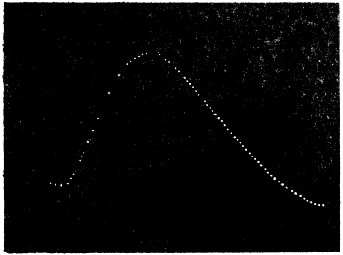
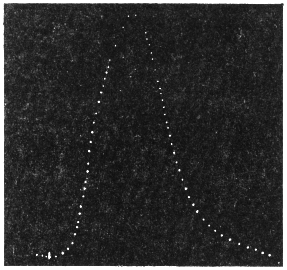
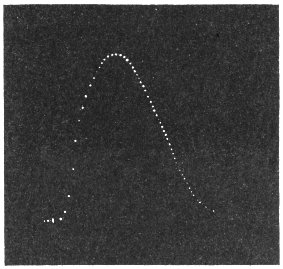
By
Prof. Sir J. C. Bose.
The phenomenon of movement in plants under the action
of external stimuli presents innumerable difficulties and
complications. The responding organs are very different:
they may be the pulvini of the ‘sensitive’ or those of
the less excitable leguminous plants; the petioles of leaves,
which often act as pulvinoids; and organs of plants in a
state of active growth.
Taking first the case of the pulvinus of Mimosa, we find
that it responds to mechanical stimulation, to constant
electric current, to induction shock, to the action of
chemical agents, to light, and to warmth as differentiated
from thermal radiation. The reactions induced by these
agents may be similar or dissimilar. An identical agent,
again, may give rise to movements which are not merely
different, but sometimes even of diametrically opposite
characters. Certain organs, for example, direct themselves
towards light, others away from it. Some plants close
their leaflets on the approach of darkness, in the so-called
position of ‘sleep’; apparently similar ‘sleep’ movement
is induced in others by the action of the midday sun.
In Mimosa, the responsive movement is brought about
by a sudden diminution of turgor in the pulvinus. But
very little is definitely known about the responsive reaction
in growing organs. Thus in a tendril, one-sided contraction
causes a shortening of the concave side and a
sudden increase of growth on the convex. No explanation
of this difference has hitherto been forthcoming.
Under the action of light of different intensities a growing
organ may approach the source of light, or place itself at
right angles or move away from it. Again under the
identical stimulus of gravity, the root moves downwards,
and the shoot upwards. The sign of response in different
organs thus changes, apparently without any reason. It
is thus seen, that there is hardly any responsive movement
that has been observed of which an example directly to
the contrary may not be found. For this reason it has
appeared hopeless to unify these very diverse phenomena,
and there has been a tendency towards a belief that it
was not any definite physiological reaction, but the individuality
of the plant that determines the choice of its
movement.
The complexities which baffle us may, however, arise
from the combination of factors whose individual reactions
are unknown to us. I shall show, for example, how the
movement of a pulvinus under a given stimulus is determined
by the point of application, direct stimulus producing
one effect, and indirect the diametrically opposite.
The normal reaction is again modified by the tonic condition
of the plant. There is again the likelihood of
the presence of other modifying factors. It is clear how
very different the results would become by the permutation
and combination of these diverse factors.
For a comprehensive study of the phenomenon of
plant movement, it is therefore necessary to investigate
in detail the effect of a given stimulus under definite
changes of the environmental condition. With regard to a
given stimulus we have to determine the effects of intensity,
of duration, and of the point of application. The investigation
has to include the effects exhibited not merely by
the pulvinated but also by growing organs. As a result
of such a comprehensive study, it may perhaps be possible
to discover some fundamental reaction operative in bringing
about the responsive movement in all plant organs.
I shall in the course of the following series of Papers,
describe the different apparatus by which the movement
of pulvinated organ and its time-relations are automatically
recorded. In a growing organ the induced movement under
stimulus is brought about by the change in its rate of
growth. That the change is solely due to the particular
stimulus can only be assured by strict maintenance of constancy
of external conditions, during the period of experiment;
this constancy can, in practice, be secured only for
a short time. The necessity for shortening the period of
experiment also arises from a different consideration; for
numerous and varied are the stimulating and mechanical
interactions between neighbouring organs. These effects,
however, come into play after a certain lapse of time.
They may be eliminated by reduction of the period of
experiment.
In order to shorten the period of experiment for the
study of growth movements, the rate of growth has to be
very highly magnified, so as to determine the absolute rate
and its variations in the course of a minute or so. I shall
in a subsequent Paper give full account of an apparatus
I have been able to devise, by which it is possible to
record automatically the rate of growth magnified many
thousand times.
I stated that anomalies of plant movements would disappear,
if we succeeded in carrying out in detail investigations
of effects of the different individual factors in operation.
In illustration of this I shall, in the first Paper of
the series, give an account of the mysterious movement of
the ‘Praying’ Palm of Faridpur, and describe the investigations
by which the problem found its solution.
By
Sir J. Bose,
Assisted by
Narendra Nath Neogi, M.Sc.
Perhaps no phenomenon is so remarkable and shrouded
with greater mystery as the performances of a particular
Date Palm near Faridpur in Bengal. In the evening, while
the temple bells ring calling upon people to prayer, this
tree bows down as if to prostrate itself. It erects its head
again in the morning, and this process is repeated every
day of the year. This extraordinary phenomenon has been
regarded as miraculous, and pilgrims have been attracted
in large numbers. It is alleged that offerings made to the
tree have been the means of effecting marvellous cures. It
is not necessary to pronounce any opinion on the subject;
these cures may be taken as effective as other faith-cures
now prevalent in the West.
This particular Date Palm, Phœnix dactylifera, is a full-grown
rigid tree, its trunk being 5 metres in length and
25 cm. in diameter. It must have been displaced by storm
from the vertical and is now at an inclination of about
60° to the vertical. In consequence of the diurnal movement,
the trunk throughout its entire length is erected in
the morning, and depressed in the afternoon. The highest
point of the trunk thus moves up and down through
one metre; the ‘neck,’ above the trunk, is concave to
the sky in the morning; in the afternoon the curvature
disappears, or is even slightly reversed. The large leaves
which point high up against the sky in the morning are
thus swung round in the afternoon through a vertical
distance of about five metres. To the popular imagination
the tree appears like a living giant, more than twice the
height of a human being, which leans forward in the
evening from its towering height and bends its neck till
the crown of leaves press against the ground in an
apparent attitude of devotion (Fig. 1). Two vertical
stakes, each one metre high, give a general idea of the
size of the tree and movements of the different parts of
the trunk.
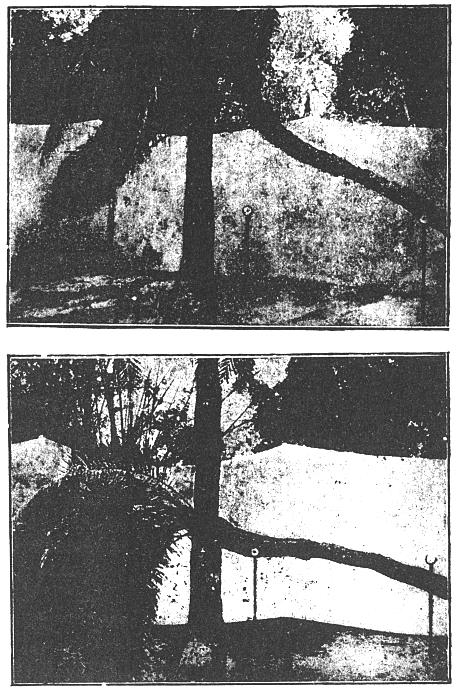
Fig. 1. The Faridpur ‘Praying’ Palm; the upper photograph shows position
in the morning; the lower, position in the afternoon. The two fixed stakes
are one metre in height. In front is seen erect trunk of a different Palm.
For an investigation in elucidation of this phenomenon
it was necessary:—
1. To obtain an accurate record of the movement of
the tree day and night, and determine the time
of its maximum erection and fall.
2. To find whether this particular instance of movement
was unique, or whether the phenomenon
was universal.
3. To discover the cause of the periodic movement of
the tree.
4. To find the reason of the remarkable similarity
between the diurnal movement of the tree, and
the diurnal variation of moto-excitability in
Mimosa pudica.
5. To determine the relative effects of light and
temperature on the movement.
6. To demonstrate the physiological character of the
movement of the tree.
7. To discover the physiological factor whose variation
determines the directive movement.
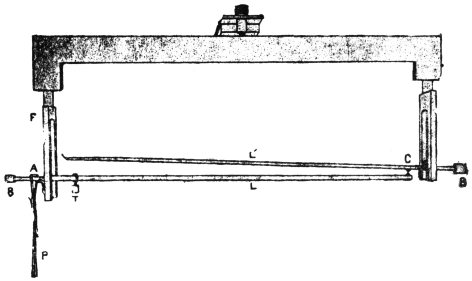
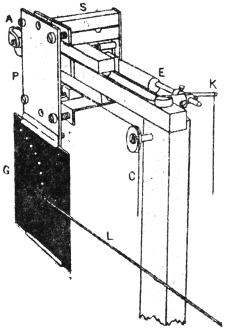
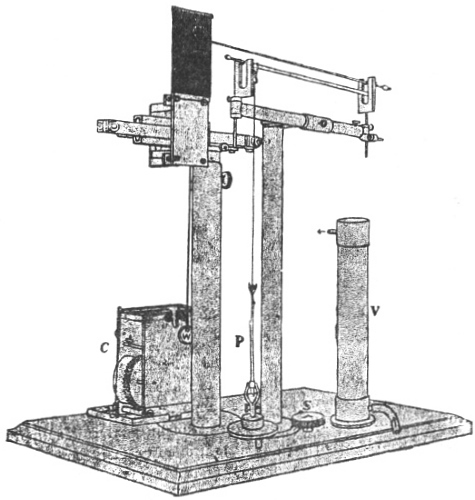
I shall now describe the principle and construction of
my recording apparatus (Fig. 2) seen attached to a horizontally
growing stem of Mimosa pudica. When used to trace
the movement of the palm tree, a reducing device is employed
to keep the record within the plate. A lever, R′, records
the movement of the attached tree or plant on a moving
plate of smoked glass. The plate is not in contact with the
tip of the recording lever, but separated from it by a distance
of about 3 mm. A special oscillating device, actuated
by clock-work, C, makes the plate move forwards and backwards.
The forward movement brings about a momentary
contact of the recording tip with the smoked plate inscribing
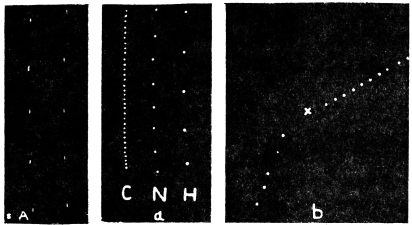
a dot. These single dots are made at intervals of 15
minutes; at the expiration of the hour, however, contact
is made three times in rapid succession, printing a thick
dot. It is thus easy to determine the movement of the tree
at all times of the day and night. A second lever, R, placed
above, gives on the same plate, thermographic record of the
diurnal variation of temperature. For this I use a differential
thermometer, T, made of a compound strip of brass
and steel. Curvature is induced by the differential expansion
of the two pieces of metal. The up or down movement
of the free end of the compound strip is further magnified
by the recording lever. This arrangement was extremely
sensitive and gave accurate record of variation of temperature.
By the forward movement of the oscillating plate
two dots are made at the same time,—one for the temperature
and the other for the corresponding movement of
the tree. As the two recorders do not move vertically up
or down, but describe a circle, the dots vertically one above
the other may not correspond as regards time. Any possibility
of error in calculation is obviated by the fact that
the thick dots in both the records are made every hour,
and the subsequent thin dots at intervals of 15 minutes.
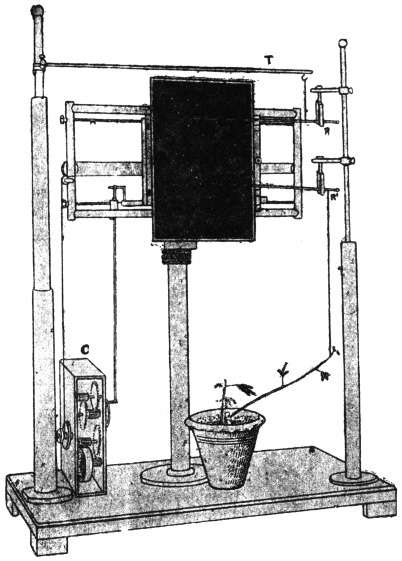
Fig. 2. Apparatus for automatic record of movement of trees and plants; T,
differential metallic thermometer; R, recording lever for temperature; R′, for
recording plant movement; C, clock-work for oscillation of recording plate. The
same clock-work moves plate laterally in 24 hours.
A difficulty arose at the beginning in obtaining sanction
of the proprietor to attach the recorder to the tree. He
was apprehensive that its miraculous power might disappear
by profane contact with foreign-looking instruments. His
misgivings were removed on the assurance that the instrument
was made in my laboratory in India, and that it
would be attached to the tree by one of my assistants,
who was the son of a priest.
From results of observation it is found that the tree
moves through its entire length; the fall of the highest
point of the trunk is one metre. The movement is not
passive, but an active force is exerted; the force necessary
to counteract this movement is equivalent to the weight of
47 kilograms: in other words, the force is sufficient to lift a
man off the ground. But far greater force would be required
to restrain the change of curvature of the neck of
the hard and rigid tree.
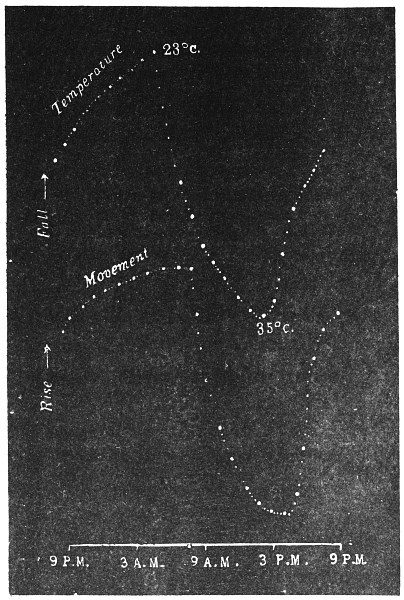
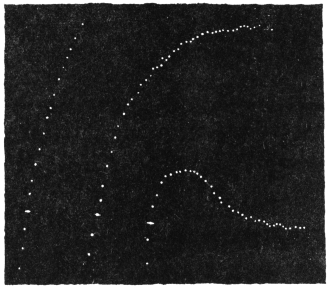
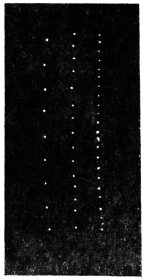
Fig. 3. Record of diurnal movement of the ‘Praying’ Palm (Phœnix dactylifera).
Thermographic curve for 24 hours commencing at 9 in the evening
is given in the upper record; the corresponding diurnal curve of movement of
the tree is given in the lower. Successive dots at intervals of 15 minutes;
thick dots at intervals of an hour.
Before entering into the investigation of the cause of
periodic movement I shall give a general account of its
characteristics. A casual observation would lead one to
conclude that the tree lifted itself at sunrise and prostrated
at sunset. But continuous record obtained with my recorder
attached to the upper part of the trunk shows that the
tree was never at rest, but in a state of continuous
movement, which underwent periodic reversals (Fig. 3).
The tree attained its maximum erection at 7 in the morning,
after which there is a rapid movement of fall. The down
movement reached its maximum at 3-15 P.M., after which
it was reversed and the tree erected itself to its greatest
height at 7 next morning. This diurnal periodicity was
maintained day after day.
The next question which I wished to investigate was
whether the movement of the particular Faridpur tree was
a unique phenomenon. It appeared more likely that similar
movement would, under careful observation, be detected in
all trees. The particular palm tree was growing at a considerable
inclination to the vertical; the movement of the
tree and its leaves became easily noticeable, since the
ground afforded a fixed and striking object of reference. In
a tree growing more or less erect, the movement, if any,
would escape notice, since such movements would be executed
with only the empty space as the background.
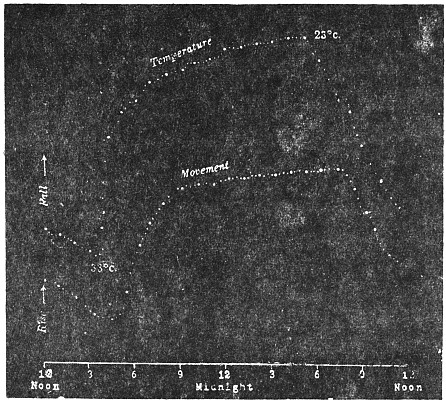
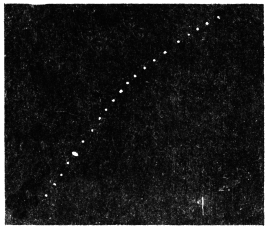
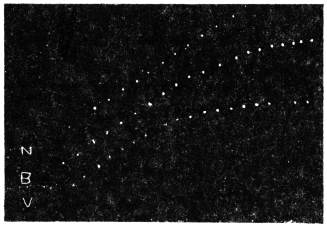
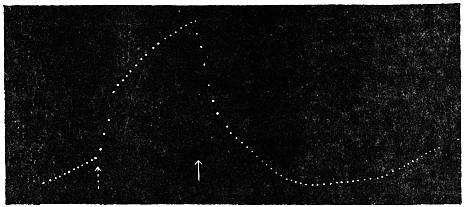
Fig. 4. Record of the Sijbaria Palm from noon for 24 hours. Successive dots,
at intervals of 15 minutes.
Experiment 1.—Believing the phenomenon to be universal
I experimented with a different Date Palm that
was growing at my research station at Sijbaria on the
Ganges, situated at a distance of about 200 miles from
Faridpur. The surrounding conditions were very different.
The tree was much younger; it was 2 metres in height and
inclined 20° to the vertical. The curve obtained with this
tree (Fig. 4) was very similar to that of the Faridpur Palm,
though this extent to the movement was much reduced.
The tree attained the highest erect position at 7-15 A.M. and
the lowest at 3-45 P.M. Hence the movement of the Faridpur
Palm is not a solitary phenomenon.
The recurrent daily movement of the tree must be due
to some diurnal changes in the environment,—either the
recurrent changes of light and darkness, or the diurnal changes
of temperature. These changes synchronise to a certain
extent; for, as the sun rises, light appears and the temperature
begins to rise. It is therefore difficult to discriminate the
effect of light from that of temperature. The only satisfactory
method of discrimination would have been in the erection
of a large structure with screens to cut off light. The effect
of fluctuation of temperature under constant darkness would
have demonstrated the effect of one agent without complication
arising from the other. Unfortunately screening the tree
was impracticable. I shall presently describe other experiments
where the action of light was completely excluded.
The curve of movement of the tree, however, affords
us material for correct inference as regards the relative
effects of light and temperature. The experiment was
commenced in March; light appeared at about 5 A.M., the
sunrise being at 6-15 A.M.; the sun set at 6-15 P.M., and it
became dark by 7 P.M. The incident light would be the
most intense at about noon; after this it would decline
continuously till night time. If the movement was due to
light, its climax, either in up or down movement, would
be reached at or about noon, and the opposite climax at
midnight. But instead of this we find (Fig. 3) the up-movement
reaching its highest point not at noon, but
at 7 in the morning; after this the fall is rapid and
continuous, and the lowest position was reached not in
the evening but at 3-15 P.M. The fluctuation of light has,
therefore, little to do with the movement of the tree.
Turning next to the element of variation of temperature
we are at once struck by the fact that the curve of movement
of the tree is practically a replica of the thermographic
curve (Fig. 3). The fall of temperature is seen to
induce a rise in the tree and vice versâ. There is a lag in
the turning points of the two curves; thus while temperature
began to rise at 6 A.M., the tree did not begin to fall
till 7 A.M. There is in this case a lag of an hour; but
the latent period may, sometimes, be as long as three hours.
The delay is due to two reasons; it must take some time
for the thick trunk of the tree to attain the temperature
of the surrounding, and secondly, the physiological inertia
will delay the reaction. As a result of other investigations,
I find that the induced effect always lags behind the inducing
cause. It is interesting in this connection to draw
attention to the parallel phenomenon, which is described
below, of lag in the variation of sensibility of Mimosa in response
to variation of temperature. In this case the lag was
found to be about three hours. Returning to the Palm, the
tree continues to fall in the forenoon with rising temperature.
At about 2-30 P.M. the temperature was at its maximum
after which it began to decline; the movement of the tree
was not reversed into erection till after 3-15 P.M., the lag
being now 45 minutes nearly.
I may state here that the movement of the tree is not
primarily affected by the periodicity of day and night, but
by variation of temperature. In spring and in early summer
the rise of temperature during the early part of the
day and the fall of the temperature from afternoon to
next morning, are regular and continuous; the corresponding
movements of the tree are also regular. But at other
seasons, owing to the sudden change of direction of the
wind, the fluctuations of temperature are irregular. Thus
at night there may be a sudden rise, and in the earlier
part of the day sudden fall of temperature. And the
record of movement of the tree is found to follow these
fluctuations with astonishing fidelity, the rise of temperature
being followed by a fall of the tree and vice versâ.
That the movement is determined by the temperature
variation is exhibited in a striking manner in Fig. 4,
where, between 8 and 9 A.M., a common twitch will be
noticed in the two curves.
While trying to obtain some clue to the mysterious movement
of the tree, my attention was strongly attracted by
certain striking similarities which the record of the movement
of the tree showed to the curve of the diurnal
variation of moto-excitability, of the pulvinus of Mimosa
pudica, an account of which will be found in a subsequent
Paper of the series.[A]
The excitability of the main pulvinus of Mimosa pudica
I find does not remain constant during the 24 hours, but
undergoes a striking periodic change. At certain hours of the
day, the excitability is at its maximum; at a different period
it practically disappears. The period of insensibility is about
7 A.M., which, strangely enough, is also the time when the
palm tree attains its maximum height. At about 3 in the
afternoon the excitability of Mimosa reaches its climax, and
this is the time when the head of the palm tree bends down
to its lowest position. For the determination of the periodic
variation of excitability of Mimosa I devised a special
apparatus by which an electric stimulus of constant intensity
was automatically applied to the plant every hour of the
day and night, the responsive moment being recorded at
the same time. The amplitude of responsive fall of leaf
under uniform stimulus gave a measure of excitability of
the leaf at any particular moment. In the lower curve
of Fig. 5 is given the record of diurnal variation of excitability
of Mimosa. Comparison of this figure with Figs.
3 and 4, will show the remarkable resemblance between
the curves of diurnal movement of the Palm tree, and
of diurnal variation of moto-excitability of Mimosa. The
excitability of Mimosa reached its maximum at about 3
in the afternoon, when the Palm was at its lowest position.
After this hour excitability fell continuously till
7 or 8 next morning. Corresponding to this is the continuous
erection of the Palm from its lowest position
at 3 P.M. to the highest between 7 and 8 A.M. Still more
remarkable is the modifying influence of variation of temperature
on the diurnal curve of excitability in Mimosa,
and the diurnal curve of movement of the Palm. This
will be quite evident from the inspection of the temperature
curves in Figs. 4 and 5.
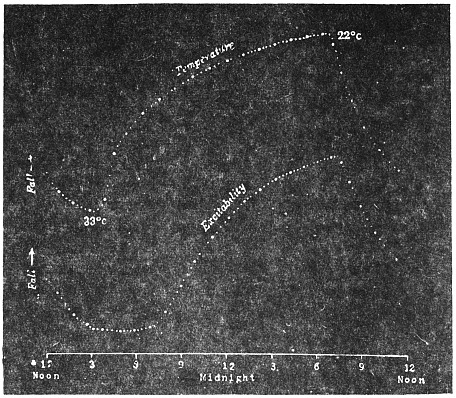
Fig. 5. Curve of variation of moto-excitability of Mimosa pudica. The upper
curve gives variation of temperature and the lower, the corresponding variation
of excitability.
I have shown elsewhere[B] that the variation of moto-excitability
of the pulvinus of Mimosa is a physiological
function of temperature. The remarkable similarity between
the diurnal variation of moto-excitability of Mimosa
and diurnal movement of the Palm is due to the fact that
both are determined by the physiological action of temperature.
I shall presently describe experiments, which
will establish the physiological character of the movement
of the tree in response to changes of temperature.
The records that have been given show that it is the
diurnal variation of temperature, and not of light that is
effective in inducing the periodic movement of the tree.
Further experiments will be given in support of this conclusion.
As regards the possibility of light exerting any marked
influence on the movement of the Palm tree, I have shown
from study of time-relations of the movement, that this
could not be the case. Moreover, it is impossible for light to
reach the living tissue through the thick layer of bark
that surrounds the tree. That the effect of light is negligible
will appear from the accounts of following experiments,
where the possibility of the effect of changing intensity
of light is excluded by maintaining the plant in constant
darkness, or in constant light.
The employment of the large Palm was obviously
impracticable in these investigations. I, therefore,
searched for other plant-organs in which the movement
under variation of temperature was similar to that of the
Date Palm. I found that the horizontally spread leaves of
vigorous specimens of Arenga saccharifera growing in a
flower pot executed movements which were practically the
same as that of the Faridpur tree. The leaf moved downwards
with rise of temperature and vice versâ.
There are many practical advantages in working with
a small specimen. It can easily be placed under glass
cover or taken to a glass house, thus completely eliminating
the troublesome disturbance caused by the wind.
Diurnal movement in continued darkness: Experiment 2.—The
plant was placed in a dark room and records taken
continuously for three days. These did not differ in any
way from the normal records taken in a glass house under
daily variation of light and darkness. Exposure of plant
to darkness for the very prolonged period of a week or
more, undoubtedly interferes with the healthy photo-tonic
condition of the plant. But such unhealthy condition did
not make its appearance in the first few days.
There may be a misgiving that the movement of the
tree might be due to physical effect of temperature. If the
upper strip of a differential thermometer be made of the
more expansible brass and the lower of iron, the compound
strip bends down with the rise of temperature. Similarly
the movement of the tree might be due to the upper half
being physically more expansible. It would have been
possible to discriminate the physical from the physiological
action by causing the death of the tree; in that case physical
movement would have persisted, while the physiological
action would have disappeared. As this test was
not practicable, I tried the effect of physiological depression
on the periodic movement of the leaf of Arenga
saccharifera.
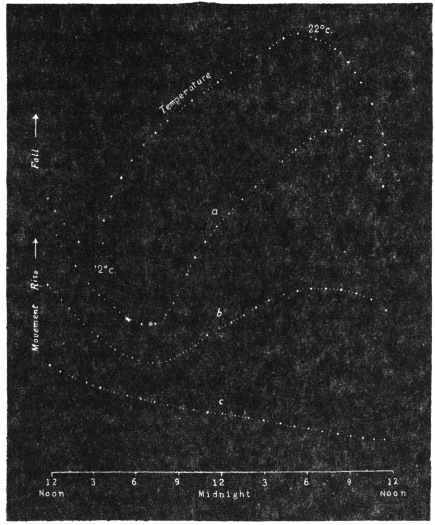
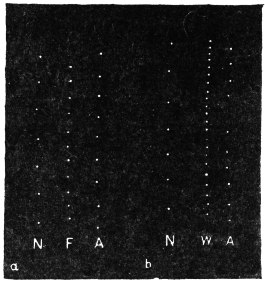
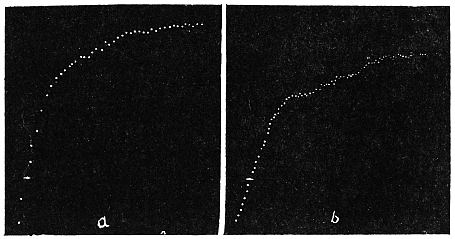
Fig. 6. Effect of physiological depression on diurnal movement of the
petiole of Arenga saccharifera. The uppermost curve exhibits variation of
temperature, (a), normal diurnal curve, (b), modification after 3 days’ and (c)
after 7 days’ withholding of water.
Effect of Drought: Experiment 3.—In Fig. 6 is given
a series of records of movement of the leaf-stalk of Arenga,
first under normal condition, afterwards under increasing
drought, brought about by withholding water. The
uppermost is the thermographic record which remained
practically the same for successive days. Below this
are records of movement of the leaf (a) under normal
condition, (b) after withholding water for three days, and
(c) after deprivation for seven days. It will be noticed how
the extent of movement is diminished under increasing
physiological depression brought on by drought. On the
seventh day, the responsive movement disappeared, there
being now a mere fall of the leaf, which was slow and
continuous. After this I supplied the plant with water and
the periodic movement was in consequence nearly restored
to its original vigour.
Effect of poison: Experiment 4.—In another experiment
the normal diurnal record with the leaf was taken and
the plant was afterwards killed by application of poisonous
solution of potassium cyanide. The diurnal movement
was found permanently abolished at the death of the
plant.
These experiments conclusively prove that the periodic
movement of the leaf-stalk induced by variation of temperature
is a physiological phenomenon, and from analogy
we are justified in drawing the inference that the movement
of the Faridpur tree is also physiological. The
question, however, was finally settled by the unfortunate
death of the tree which occurred the other day, nearly a
year after I commenced my investigations. While presiding
at my lecture on the subject, His Excellency Lord
Ronaldshay, the Governor of Bengal, announced that a telegram
had just reached him from his officer at Faridpur
that “the palm tree was dead, and that its movements had
ceased.”
Since my investigation with the Faridpur ‘Praying’
Palm, I have received information regarding other Palms,
which exhibit movements equally striking. One of the
trees is growing by the side of a tank, the trunk of the
tree being inclined towards it. The up-lifted leaves of
this tree are swung round in the afternoon and dipped
into the water of the tank.
The movement of the tree has been shown to be
brought about by the physiological action of temperature
variation; in other words the diurnal movement of the
‘Praying’ Palm is a THERMONASTIC PHENOMENON. I have
found various creeping stems, branches and leaves of
many trees, exhibit this particular movement of fall with
a rise of temperature, and vice versâ. Such movements,
I shall, for the sake of convenience, distinguish as belonging
to the negative type.
Having found that the temperature is the modifying
cause, the next point of inquiry relates to the discovery of
the force, whose varying effects under changing temperature
induces the periodic movement. I shall, in this connection,
first discuss the various tentative theories that may
be advanced in explanation of the movement.
It may be thought that the fall of the tree during
rise of temperature may be due to passive yielding of the
tree to its weight, there being increased transpiration and
general loss of turgor at high temperature. I shall, however,
show that the diurnal movement persists in the
absence of transpiration.
Diurnal movement in absence of transpiration: Experiment 5.—In
the leaf of Arenga saccharifera, I found that
the petiole was the organ of movement. I cut off the
transpiring lamina and covered the cut end with collodion
flexile. The plant was now placed in a chamber saturated
with moisture. The petiole continued to give records of
its diurnal movement in every way similar to the record
of the intact leaf. In another experiment with the water
plant, Ipoemia reptans, immersed in water, the normal
diurnal movement was given by the plant, where there
could be no question of variation of turgor due to transpiration.
(See also Expt. 7.)
In the diurnal movement of the ‘Praying’ Palm the
concave curvature of the rigid neck in the morning,
became flattened or slightly convex in the afternoon.
The force necessary to cause this is enormously great, and
could on no account result from the passive yielding to
the weight of the upper part of the tree.
From the facts given above it will be seen that the
diurnal movement is not brought about by variation in
transpiration. I now turn to another phenomenon which
appeared at first to have some connection with the movement
of the tree. Kraus found that the tissue tensions of
a shoot exhibit a daily periodicity. He, however, found
that between 10°C. and 30°C., variation of temperature
had no effect on the daily period. But as regards the
diurnal movement of the tree, it is the temperature which
is the principal factor. Kraus also found a daily variation
of bulk in different plant-organs; this variation of bulk
is connected with transpiration, for the removal of the
transpiring leaves arrested this variation. But the periodic
movement of the tree, as we have seen, is independent
of transpiration.
Millardet observed a daily periodicity of tension in
Mimosa pudica. He found that maximum tension occurs
before dawn; the petiole becomes erected, the movement
being upwards or towards the tip of the stem. Tension
decreases during the day, and reaches a minimum early
in the evening; in correspondence with this is the fall
of the petiole, the movement being away from the tip
of the stem.[C] If the plant were placed upside down the
periodic movement of the petiole in relation to the stem
will evidently remain the same, but become reversed in
space. Maximum tension in the morning will make the
petiole approach the tip of the stem, i.e., the movement
will be downwards instead of upwards as in the normal
position. The experiment described below will show that
the diurnal movement induced by variation of temperature
is not reversed by placing the plant in an inverted position.
Diurnal movement in inverted position: Experiment 6.—I
took a vigorous specimen of Arenga saccharifera growing
in a pot, and took its normal record, which as explained
before exhibited down-movement during rise, and an up-movement
during fall of temperature. The plant was now
held inverted, the upper side of the petiole now facing the
earth. The diurnal curve of movement should now show
an inversion, if that movement was solely determined by
the anisotropy of the organ. But the record did not exhibit
any such inversion. After being placed upside down, the
leaf did not, on the first day, show any diurnal movement;
there was, on the other hand, a continuous down-movement
on account of the fall of the leaf by its own weight.
But in the course of 24 hours the leaf readjusted itself to
its unaccustomed position, and became somewhat erected
under the action of geotropic stimulus. After the attainment
of this new state of geotropic equilibrium, the leaf
gave a very pronounced record of its diurnal movement
which did not show any reversal; the inverted leaf continued
to exhibit the same characteristic movements as in
the normal position, that is to say, a down movement
during rise, and an up-movement during fall of temperature.
As the plant in the inverted position did not show any
reversal of the periodic curve, it is clear that the diurnal
movement is determined by the modifying influence of
temperature on the physiological reaction of the plant to
some external stimulus which is constant in direction. I
shall presently show that it is the constant geotropic stimulus
modified by the action of temperature, which determines the
diurnal movement of the tree.
This will be better understood if I refer once more to
certain characteristics in the movement of the “Praying”
Palm. The neck of the tree was seen to be concave in
the morning. The physiological effect of raising temperature
is virtually to oppose or neutralise the geotropic curvature
as seen in the flattening or slight reversal of curvature
in the afternoon. Similarly, various plant organs, growing
at an inclination to the vertical, are subjected to geotropic
action, and thus assume different characteristic angles. This
state of equilibrium is not static but may better be described
as dynamic; for it will be shown that this state of
geotropic balance is upset in a definite way, by variation
of temperature.
That geotropism is an important factor in the diurnal
movement is supported by the fact that the Sijbaria Palm with
an inclination of 20° to the vertical exhibited a daily
movement which was only moderate in extent. But the
Faridpur Palm growing at an inclination of 60° was
subjected more effectively to geotropic action, and exhibited
movements which were far more pronounced. I shall now
proceed to describe crucial experiments which will demonstrate
the effect of change of temperature on geotropic
curvature.
In the instances of diurnal movement already described
the trees or their leaves were already at an inclination to
the vertical. I now took a radial and erect shoot of
Basella cordifolia growing in a pot and laid it horizontally
for two weeks. The procumbent stem curved up and
attained a state of equilibrium under the action of geotropic
stimulus.
Diurnal curve of Basella cordifolia: Experiment 7.—The
plant was completely immersed in a vessel of water,
and its diurnal curve recorded. This resembled in all
essentials the diurnal curve of the Palm; the slight
deviation was due to the fact that owing to difference in
the season (August) the temperature maximum was attained
at 12-25 P.M. and the minimum at 6 A.M. The geotropic
curvature was reduced to its minimum at the maximum
temperature, and vice versâ. As in the case of the Palm
so also in the procumbent stem of Basella there was a
physiological lag, which was 50 minutes in the morning
and about the same in the afternoon. The free end of
the stem thus exhibited a diurnal movement up and down.
The temperature, as stated before, began to rise from
6 A.M. and the down-movement commenced 50 minutes
later, i.e., at 6-50 A.M. The temperature, after reaching
the maximum, began to fall at 12-25 P.M., and the previous
movement of fall of the stem was arrested and
reversed into an erectile movement shortly after 1 P.M.
There are thus two “turning points,” one at 7 A.M., and
the other at about 1 P.M.; at these periods the movement
of the plant remains more or less arrested for more than
half-an-hour.
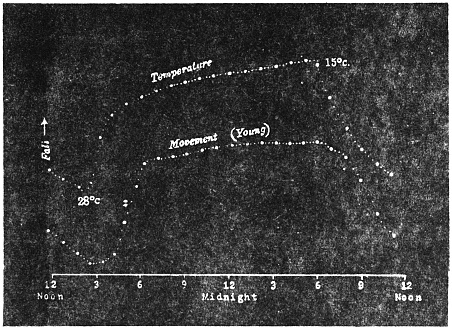
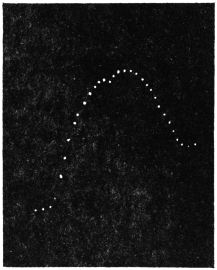
Fig. 7. Diurnal curve of movement of procumbent young stem of Mimosa
pudica. Successive dots at intervals of 15 minutes.
I obtained records of similar diurnal movements with
various procumbent or creeping stems. Figure 7 gives the
diurnal record of the procumbent stem of a young specimen
of Mimosa pudica.
The experiment that has just been described shows
clearly that geotropic curvatures of stems is opposed, or
neutralised to a greater or less extent, during rise of temperature,
and this antagonistic reaction is removed during
the fall of temperature. The diurnal movement of the
plant completely immersed under water shows once more
that transpiration has little to do with the diurnal movement.
The diurnal rhythm of up and down movement in
the particular specimen Basella had become established
under the daily variation of temperature. I now attempted
to reverse this rhythm by artificial variation of temperature.
The plant was placed in water in a rectangular
metallic vessel which was placed within a second outer
vessel. The plant could thus be subjected, without any
mechanical disturbance, to variation of temperature, by
circulating warm or cold water in the outer vessel. In
order to reverse the natural rhythm I subjected the plant
to the action of falling temperature at the “turning” point
at 7 A.M., at a time when the plant would have undergone
a down-movement under the daily rise of temperature.
Conversely the plant was subjected to the action of rising
temperature at the second “turning” point at 1 P.M. when
the movement under diurnal fall of temperature would
have been one of erection.
Effect of fall of temperature: Experiment 8.—As stated
before the experiment was carried out in the morning;
ice cold water was circulated in the outer chamber, the
fall of temperature was in this case sudden, and there was
an almost immediate responsive movement. This appeared
anomalous, since the latent period of response to slow
variation of temperature was found from the diurnal curve
to be as long as 50 minutes.
As a result of further investigations I found that variation
of temperature produces two different effects which may be
distinguished as transient and persistent. Sudden variation
of temperature affects the superficial tissue, and gives rise
to a transient reaction, while it takes a long time for
temperature variation to react on the geotropically active
tissue in the interior. The persistent effect therefore takes
place after a latent period from one to three hours according
to the thickness of the plant.
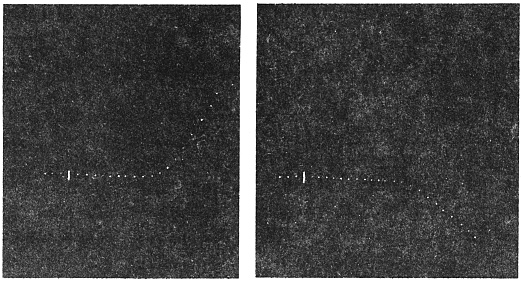
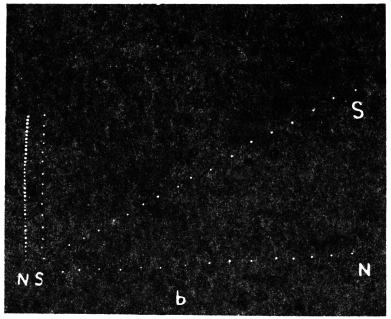
Fig. 8. Reversal of normal rhythm: Erectile response Basella to gradual fall
of temperature.
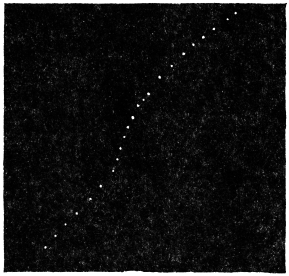
Fig. 9. Responsive fall of Basella to gradual rise of temperature.
(Dots at intervals of 5 minutes).
The persistent effect of rise of temperature is a movement
downwards, that of fall of temperature is a movement
upwards. These definite reactions will be seen
exhibited in Figs. 8 and 9. The plant was stationary at the
turning point in the morning hence the curve at first was
horizontal. The temperature was gradually lowered through
5°C., from 29°C., to 24°C. in the course of five minutes
and maintained at the lower temperature. There was no
immediate effect, but after a latent period of 65 minutes
the plant responded by a movement of erection. The
natural movement at this period of the day would have
been one of fall, but artificial change of temperature in
the opposite direction effectively reversed the normal
diurnal movement. The latent period for this reverse
movement is, as stated before, 65 minutes as against 50
minutes in the normal diurnal movement. The increase
in the latent period is probably due to the added physiological
inertia in reversing the normal rhythm.
Effect of rise of temperature: Experiment 9.—The temperature
was raised through 5°C at the second turning point,
at 1 P.M. After a latent period of 50 minutes the plant
began to rise steadily (Fig. 9) thus exhibiting once more
the reversal of its normal diurnal movement.
From the experiments described above it will be seen
that the movement of the Palm, and of other organs growing
at an inclination to the vertical, is brought about by the
action of temperature in modifying the geotropic curvature.
The ever present tendency of geotropic movement is opposed
or helped by the physiological reaction induced by rise
and fall of temperature respectively. The state of equilibrium
is never permanent, but the dynamic balance is
being constantly readjusted under changing conditions of
the environment.
The movement of the tree furnishes an example of
the negative type of THERMONASTIC MOVEMENT. Parallel
phenomena are found in floral organs, where, in the well-known
instance of Crocus, the perianth leaves open outwards
during rise of temperature and close inwards during
the onset of cold. Looked at from above, the opening outwards
during rise of temperature is a movement downwards,
and therefore belongs to the negative type. In such cases
the changed rate of growth by variation of temperature
is the most important factor in the movement. It may
be asked whether all thermonastic movements must necessarily
belong to the negative type, where rise of temperature
is attended by a movement downwards. I shall in
my Paper on “Thermonastic Phenomena” show that there
is also a positive type where rise of temperature induces an
up-movement or of closure.
The ‘Praying’ Palm of Faridpur, growing at an
inclination of about 60° to the vertical, exhibited a diurnal
movement by which its head became erected in the morning
and depressed towards the afternoon, the outspread leaves
pressing against the ground.
The record of the diurnal movement showed that the
head was erected to the highest position between 7 and 8
in the morning, after which there was a continuous fall
which reached its climax at 3-15 P.M.; after this the movement
was reversed and the maximum erection was again
reached next morning.
This phenomenon is not unique, but is found exhibited,
more or less, by all trees and their branches and leaves.
Diurnal records of temperature, and movement of the
tree showed, that the two curves closely resembled each
other. Rise of temperature was attended by a fall of the
tree, and vice versâ.
The movement is brought about by the physiological
action of temperature; it may be arrested by artificially
induced physiological depression, and is permanently
abolished at death.
The movement is primarily determined by the modifying
influence of temperature on geotropic curvature. Rise
of temperature is found to oppose or neutralise geotropic
curvature, the fall of temperature inducing the opposite
effect. The ever present tendency of upwards geotropic
movement is opposed or helped by the effects of rise and
fall of temperature respectively.
The movement of the ‘Praying’ Palm is a thermonastic
phenomenon. The tree, apparently so rigid, responds as a
gigantic pulvinoid to the changes of its environment.
By
Sir J. C. Bose,
Assisted by
Narendra Nath Sen Gupta.
The leaf of Mimosa pudica undergoes a rapid fall when
subjected to any kind of shock. This plant has, therefore,
been regarded as “sensitive,” in contradistinction to ordinary
plants which remain apparently immobile under external
stimulus. I shall, however, show in course of this Paper
that there is no justification in regarding ordinary plants
as insensitive.
Let us first take any radial organ of a plant and subject
it to an electric shock. It will be found that the organ
undergoes a contraction in length in response to the
stimulus. On the cessation of excitation the specimen
gradually recovers its original length. Different organs of
plant may be employed for the experiment, for example,
the tendril of Cucurbita, the pistil of Datura, or the
flower bud of Crinum. The shortening may be observed by
means of a low power microscope. Greater importance is,
however, attached to the detailed study of response and its
time relations. The pull exerted by a delicate organ during
its excitatory contraction is slight; hence arises the necessity
of devising a very sensitive apparatus, which would
give records magnified from ten to a hundred times.
The magnification of movement is produced by a light
lever, the short arm of which is attached to the plant
organ, the long arm tracing the record on a moving smoked
plate of glass. The axis of the lever is supported by jewel
bearings. The principal difficulty in obtaining accurate
record of response of plant lies in the friction of contact
of the recording point against the glass surface. This
difficulty I have been able to overcome by providing a
device of intermittent instead of continuous contact. For
this, either the writer is made to vibrate to and fro, or
the recording plate is made to oscillate backwards and
forwards.
1. The Resonant Recorder.—In this the writing lever is
made of a fine steel wire. One end of this wire is supported
at the centre of a circular electromagnet; this latter is
periodically magnetised by a coercing vibrator, which completes
an electric circuit ten hundred, or two hundred times
in a second. The writing lever is exactly tuned to the
vibrating interrupter and is thus thrown into sympathetic
vibration. Successive dots in the record thus measure time
from 0.1 to 0.05 second. The employment of the Resonant
Recorder enables us to measure extremely short periods of
time for the determination of the latent period or the
velocity of transmission of excitation.[D]
2. The Magnetic Tapper.—Measurement of very short
intervals is not necessary in ordinary records of response.
In this type of recorders, the circular magnet is
therefore excited at longer intervals, from several seconds
to several minutes; this is done by completion of the
electric circuit at the required intervals, by means of a
key operated by a clock.
3. The Mechanical Tapper.—In this, magnetic tapping
is discarded in favour of mechanical tapping. The hinged
writing lever is periodically pressed against the recording
plate by a long arm, actuated by clock-work.
4. The Oscillating Recorder.—Here the plate itself is
made to oscillate to-and-fro by eccentric worked by a
clock. The frame carrying the plate moves on ball-bearings.
The advantage of the Oscillating Recorder lies in
the fact that a long lever, made of fine glass fibre, or
of aluminium wire, may be employed for giving high
magnification. A magnification of a hundred times may
be easily obtained by making the short arm 2.5 mm. and
the long arm 25 cm. in length.[E]
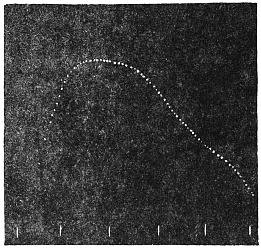
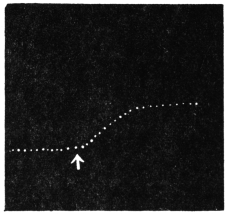
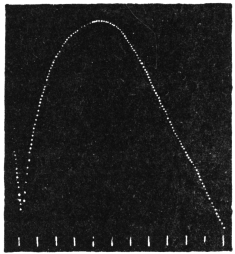
Fig. 10. Response of a straight tendril of Passiflora to electric shock. Successive
dots at intervals of 5 seconds. The vertical lines below are at intervals
of a minute. In this and in all following records (unless stated to the contrary)
up-curve represents contraction, and down-curve expansion or recovery.
Experiment 10.—As a typical example I shall describe the
response of a straight tendril of Passiflora. A cut specimen
was mounted with its lower end in water. Suitable electric
connections were made for sending a feeble induction shock
of short duration through the specimen. In this and all
other records, unless contrary be stated, up-curve represents
contractile movement. On application of stimulus
of electric shock, an excitatory movement of contraction
occurred which shortly reached its maximum; the apex-time
was one minute and forty seconds, and recovery
was completed after a further period of five minutes
(Fig. 10). Stronger shocks induce greater contraction
with prolongation of the period of recovery. The specimen
was afterwards killed by application of poisonous
solution of potassium cyanide; this brought about a permanent
abolition of response. The experiment just
described may be taken as typical of response of radial
organs.
In a radial organ contraction takes place equally in
all directions; it therefore shortens in length, there being
no movement in a lateral plane. But if any agency
renders one side less excitable than its opposite, diffuse
stimulation will then induce greater contraction on the more
excitable side which will therefore become concave.
Excessive stimulation is found to reduce the excitability
of an organ. Under unilateral mechanical stimulation a
tendril of Passiflora becomes hooked or coiled, the concave
being the excited side. From what has been said,
the unexcited convex side will relatively be the more
excitable.
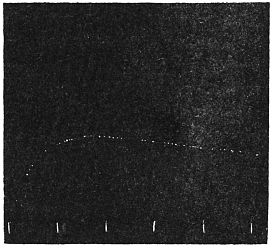
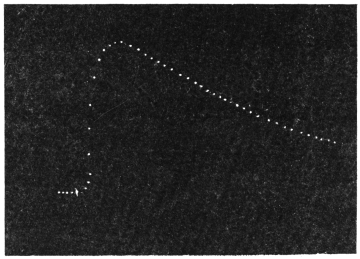
Fig. 11. Response of a hooked tendril of Passiflora to electric shock. Successive
dots at intervals of 5 seconds.
Experiment 11.—I took a specimen of hooked tendril,
and excited it by an electric shock. The response was
by the greater contraction of the more excitable convex
side, on account of which the curved specimen tended to
open out. The record of this response is seen in Fig. 11;
the apex-time was nearly two minutes, and the recovery
was completed in the further course of 15 minutes.
From the responses of organs rendered anisotropic by the
differential action of the environment we pass to others
which show certain amount of anatomical and physiological
differentiation between their upper and lower sides. I
find that many petioles of leaves show movement in response
to stimulus. Many pulvini, generally regarded as
insensitive, are also found to exhibit responsive movements.
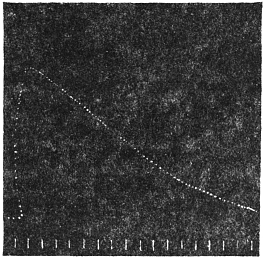
Fig. 12. Response of the main pulvinus of Mimosa pudica.
The most striking and familiar example of response is
afforded by the main pulvinus of Mimosa pudica of which
a record is given in Fig. 12. It is generally assumed
that sensibility is confined to the lower half of the organ.
It will be shown in a subsequent Paper that this is not
the case. The upper half of the pulvinus is also sensitive
though in a feeble degree, its excitability being about 80
times less than that of the lower half. On diffuse stimulation
the predominant contraction of the lower half causes
the fall of the leaf, the antagonistic reaction of the upper
half being, in practice, negligible. In order to avoid unnecessary
repetition, I shall ignore the feeble antagonistic
reaction of the less excitable half of the organ, and shall
use the word ‘contraction’ for ‘relatively greater contraction.’
It is interesting in this connection to refer to the response
of the leaf of Water Mimosa (Neptunia oleracea).
Here the reaction is very sluggish in comparison with that
of Mimosa pudica. A tabular statement of contractile response
of various radial, anisotropic and pulvinated organs
will show a continuity in the contractile reaction; the difference
exhibited is a question of degree and not of kind.
TABLE 1—PERIODS OF MAXIMUM CONTRACTION AND OF RECOVERY OF
DIFFERENT PLANTS.
| Specimen | Period of maximum
contraction | Period of
recovery. |
Radial organ:
Tendril of Passiflora | 100 seconds | 4 minutes. |
Anisotropic organ:
Hooked tendril of Passiflora | 120 " | 13 " |
Pulvinated organ:
Pulvinus of Neptunia Oleracea | 180 " | 57 " |
| Pulvinus of Mimosa pudica | 3 " | 16 " |
As regards the excitatory fall of the leaf of
Mimosa pudica, Pfeffer and Haberlandt are of opinion
that this is due to the sudden diminution of turgor in the
excited lower half of the pulvinus. The weight of the
leaf, no longer supported by the distended lower cells,
causes it to fall. This is accentuated by the expansion of
the upper half of the pulvinus which is normally in a state
of compression. According to this view the excitatory fall
of the leaf is a passive, rather than an active, movement.
I have, however, found that in determining the rapidity of
the fall of Mimosa leaf the factors of expansive force of
the upper half of the pulvinus and the weight of the leaf
are negligible compared to the active force of contraction
exerted by the lower half of the pulvinus (p. 87).
With regard to the fall of turgor, it is not definitely
known whether excitation causes a sudden diminution in the
osmotic strength of the cell-sap or an increase in the
permeability of the ectoplast to the osmotic constituents
of the cell. Pfeffer favours the former view, while others
support the theory of variation of permeability.[F]
Whatever difference of opinion there may be in regard
to the theories of osmotic and permeability variations, we
have the indubitable fact of diminution of turgor and
contractile fall of the pulvinus of Mimosa under excitation.
The restoration of the original turgor brings about
recovery and erection of the leaf. In connection with
this the following experiments on responsive movements
of the leaf under artificial variation of turgor will be
found of interest:—
Effect of Increased Turgor: Experiment 12.—A young
Mimosa plant was carefully transplanted and the root
embedded in soil placed in a linen bag. This was held
securely by a clamp, and one of the leaves of the plant
attached to the recorder. Withholding of water for a day
caused a general loss of turgor of the plant. A vessel
full of water was now raised from below so that the
linen bag containing the roots was now in water. The
effect of increased turgor by suction of water by the
roots became apparent by the upward movement of the
leaf. The distance between the immersed portion of the
plant and the leaf was 2 cm. and the up-movement of
the leaf was indicated within 10 seconds of application of
water (Fig. 13). The velocity with which the effect of
increased turgor travelled was thus 2 mm. per second.
The leaf exhibited increasing erection with absorption of
water.
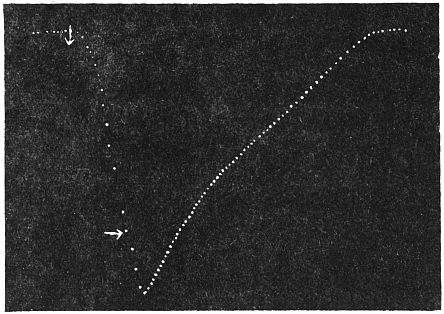
Fig. 13. Response of Mimosa pulvinus to variation of turgor. Increased turgor
by application of water at point marked with vertical arrow induced erectile movement.
Diminution of turgor by application of KNO3 solution at the point marked
with the horizontal arrow, brought about the fall of the leaf within 80 seconds.
Successive dots at intervals of 5 seconds (The down curve represents up-movement
and vice versâ.)
Effect of Diminution of Turgor: Experiment 13.—While
the leaf in the above experiment was in process of
erection, a quick change was made by substituting KNO3
solution for the water of the vessel in which the roots
were immersed. The plasmolytic withdrawal of water at
the roots gave rise to a wave of diminished turgor, the
effect of which became perceptible within 40 seconds by
the movement of fall of the leaf. (Fig. 13.)
In Mimosa excitation is manifested by the contraction
of the pulvinus and the consequent movement of the leaf.
But in most plants, excitatory movement cannot be realized
on account of the rigidity of the plant structure, the
thickness of the cell-wall and the want of facility for
escape of water from the excited cells. I shall show later
how excitation may be detected in the absence of mechanical
movement.
As regards stimulation of vegetable tissues, there are
various agencies besides electric shock, which induce excitatory
contraction; these agencies I shall designate as stimuli.
Excitation is detected in Mimosa by the downward movement
of the leaf. It will be found that such excitatory
movement is caused by a mechanical blow, by a prick or
a cut, by the application of certain chemical agents, by
the action of electric current and by the action of strong
light. The study of the action of these stimuli will be
given in greater detail in subsequent Papers.
I shall give below a general classification of different
stimuli which cause excitation in vegetable tissues.
Electric Stimulus.—Induction shock, condenser discharge,
the make of kathode and the break of anode.
Mechanical Stimulus.—Mechanical blow, friction, prick
or cut.
Chemical Stimulus.—Effect of certain acids and of
other chemical substances.
Thermal Stimulus.—Sudden variation of temperature;
application of heated wire.
Radiation Stimulus.—Luminous radiation of the more
refrangible portion of the spectrum; ultra-violet rays;
thermal radiation in the infra-red region.
All these different forms of stimulus induce an excitatory
contraction, a diminution of turgor, and a negative
mechanical response or fall of a motile leaf.
A radial organ responds to stimulus by contraction in
length; as all its flanks are equally excitable there is no
lateral movement under diffuse stimulus.
Physiological anisotropy is induced in an organ, originally
radial and isotropic, by the unequal action of the environment
on its different sides. Diffuse stimulus induces a
greater contraction of the more excitable side.
In a curved tendril the concave side is less excitable
than the convex. Diffuse stimulus tends to straighten
the curved tendril.
In the pulvinus of Mimosa pudica, the lower half is
eighty times more excitable than the upper, and the fall of
the leaf is due to the predominant contraction of the more
excitable lower half.
A diminution of turgor takes place in the excited cells.
Restoration of turgor brings about recovery of the leaf
to its normal erect position. Independent experiments show
that the fall of the leaf may be brought about by an
artificial diminution of turgor, and the erection of the leaf
by an increase of turgor.
BY
Sir J. C. Bose.
Several phenomena of daily periodicity are known,
but the relations between the recurrent external changes and
the resulting periodic variations are more or less obscure.
As an example of this may be cited the periodic variation
of growth. Here the daily periodicity exhibited by a
plant is not only different in varying seasons, but it also
differs in diverse species of plants. The complexity of the
problem is very great, for not only are the direct effects
of the changing environment to be taken into consideration
but also their unknown after-effects. Even in the case of
direct effect, different factors, such as light, temperature,
turgor, and so on, are undergoing independent variations;
it may thus happen that their reactions may sometimes be
concordant and at other times discordant. The nyctitropic
movement of plants affords another example of daily periodicity.
The fanciful name of ‘sleep’ is often given to
the closure of the leaflets of certain plants at night. The
question whether plants sleep or not may be put in the
form of the definite inquiry: Is the plant equally excitable
throughout day and night? If not, is there any definite
period at which it practically loses its excitability? Is
there, again, another period at which the plant wakes up,
as it were, to a condition of maximum excitability?
In the course of my investigations on the irritability
of Mimosa pudica, I became aware of the existence of such
a daily periodicity; that is to say, the moto-excitability
of the pulvinus was found to be markedly diminished
or even completely abolished at a certain definite period
of the day; at another equally definite period, the excitability
was observed to have attained its climax. The
observations on the periodic variation of excitability appeared
at first to be extremely puzzling. It might be
thought, for example, that light would prove to be favourable
for moto-excitability; in actual experiment the results
apparently contradicted such a supposition: for the excitability
of the plant was found much higher in the evening
than in the morning. Favourable temperature, again,
might be regarded as an important factor for the enhancement
of the moto-excitability; it was, nevertheless,
found that though the excitatory response was only
moderate at that period of night when the temperature
was at its minimum, yet the excitability was altogether
abolished at another period when the temperature was
several degrees higher. The obscurities which surrounded
the subject were only removed as a result of protracted
investigation and comparison of continuous automatic records
made by the plant itself during several months,
beginning with winter and ending in summer.
The question whether a plant like Mimosa exhibits
diurnal variation of excitability can be experimentally investigated
by subjecting the plant at every hour of the
day and night to a test-stimulus of uniform intensity, and
obtaining the corresponding mechanical responses. Under
these circumstances the amplitude of response at any
time will serve as a measure of the excitability of the
plant at the particular time. Any periodic fluctuation of
response will then demonstrate the periodic character of
variation of excitability.
The investigation thus resolves itself into:—
The successful construction of a Response Recorder
which will automatically record the response of
the plant to uniform periodic stimulation at all
hours of day or night;
the study of the effects of various external conditions
on excitability;
the diurnal variation of excitability and its relation
to the changes of external conditions.
I will first give a diagrammatic view of the different
parts of the apparatus which I devised for this investigation.[G]
The leaf of Mimosa is attached to one arm of a
light aluminium lever, L, by means of thread. At right
angles to the lever is the writing index W, which traces on
a smoked glass plate allowed to fall at a definite rate
by clockwork the responsive movement of the leaf. Under
a definite stimulus of electric shock the leaf falls down,
pulling the lever L, and moving the writer towards the
left. (Fig. 14.) The amplitude of the response-curve
measures the intensity of excitation. The leaf re-erects
itself after a time, the corresponding record exhibiting
recovery. A second stimulus is applied after a definite
interval, say an hour, and the corresponding response
shows whether the excitability of the plant has remained
constant or undergone any variation.
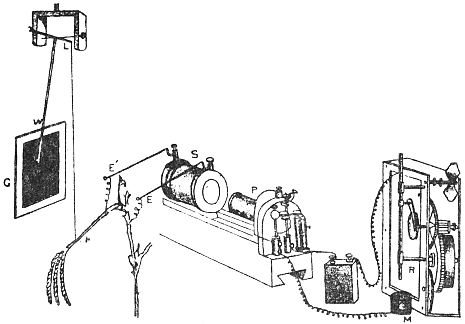
Fig. 14. Diagrammatic representation of the complete apparatus for determination
of diurnal variation of excitability. Petiole of Mimosa, attached by
thread to one arm of lever L; writing index W traces on smoked glass plate G,
the responsive fall and recovery of leaf. A, primary, and S, secondary, of induction
coil. Exciting shock passes through the plant by electrodes E, E′.
A, accumulator. C, clockwork for regulating duration of tetanizing shock. Primary
circuit of coil completed by plunging rod, V, dipping into cup of mercury M.
Electric mode of excitation.—I find that one of the
best methods of stimulating the plant is by means of
tetanizing induction shock. The sensitiveness of Mimosa
to electric stimulation is very great; the plant often
responds to a shock which is quite imperceptible to a
human subject. By the employment of a sliding induction
coil, the intensity of the shock can be regulated with
great accuracy; the secondary if gradually brought nearer
the primary till a stimulus is found which is minimally
effective. The intensity of stimulus actually employed is
slightly higher than this, but within the sub-maximal
range. When the testing stimulus is maintained constant
and of sub-maximal intensity, then any variation of excitability
is attended by a corresponding variation in the
amplitude of response.
The exciting value of a tetanizing electric shock depends
(1) on the intensity, (2) on the duration of shock. The
intensity may be rendered uniform by placing the secondary
at a fixed distance from the primary, and keeping
the current in the primary circuit constant. The constancy
of the current in primary circuit is secured by the employment
of an accumulator or storage cell of definite electromotive
force. It is far more difficult to secure the constant
duration of the tetanizing shock in successive stimulations
at intervals of, say, one hour during twenty-four hours.
The duration of the induction shock given by the secondary
coil depends on the length of time during which the
primary circuit is completed in successive excitations. I
have succeeded in overcoming the difficulty of securing
uniformity of duration of shock by the employment of a
special clockwork device.
The clockwork plunger.—The alarum clock can be so
arranged that a wheel is suddenly released and allowed
to complete one rapid revolution at intervals of, say, one
hour. There is a fan-governor by which the speed of
the revolution can be regulated and maintained constant.
This will specially be the case when the alarum spring
is long and fully wound. The succession of short releases
twenty-four times during the day produce relatively little
unwinding of the spring. On account of this and the
presence of the fan-governor, the period of a single revolution
of the wheel remains constant. By means of an
eccentric the circular movement is converted into an up
and down movement. The plunging rod R thus dips into
a cup of mercury M, for a definite short interval and
is then lifted off. The duration of closure can be regulated
by raising or lowering the cup of mercury. In
practice the duration of tetanizing shock is about 0.2
second.
The same clock performs three functions. The axis
which revolves once in twelve hours has attached to it
a wheel, and round this is wound a thread which allows
the recording glass plate to fall through six inches in
the course of twenty-four hours. A spoke attached to the
minute hand releases the alarum at regular and pre-determined
intervals of time, say once in an hour. The
plunging rod R, actuated by the eccentric, causes a
tetanizing shock of uniform intensity and duration to be
given to the plant at specified times.
Constancy of resistance in the secondary circuit.—In
order that the testing electric stimulus shall remain uniform,
another condition has to be fulfilled, namely, the
maintenance of constancy of resistance in the secondary
circuit, including the plant. Electric connections have to
be made with the latter by means of cloth moistened with
dilute salt solution; drying of the salt solution, however,
gives rise to a variation of resistance in the electrolytic
contact. This difficulty is overcome by making the electrolytic
resistance negligible compared to the resistance
offered by the plant. Thin and flexible spirals of silver
tinsel attached to the electrodes E, E′ are tied round the
petiole and the stem, respectively. In order to secure better
electric contact, a small strip of cloth moistened with
dilute salt and glycerine is wound round the tinsel. As
the resistance of contact is relatively small, and as drying
is to a great extent retarded by glycerine, the total resistance
of the secondary circuit undergoes practically no
variation in the course of twenty-four hours. This will
be seen from the following data. An experiment was
commenced one day at 1 P.M., when the resistance offered by
8 cm. length of stem and 2 cm. length of petiole was found
to be 1.5 million ohms. After twenty-four hours’ record, the
resistance was measured the next day and was found unchanged.
The fact that the stimulus remains perfectly
uniform will be quite apparent when the records given
in the course of this paper are examined in detail.
The amplitude of response affords, as we have seen, a
measure of the excitability of the plant. In actual
record friction of the writer against the glass surface becomes
a source of error. This difficulty I have been able to
overcome by the two independent devices, the Resonant
Recorder and the Oscillating Recorder. In the former the
writer is maintained by electric means in a state of continuous
to and fro vibration, about ten times in a second.
There is thus no continuous contact between the writer
and the smoked glass surface, friction being thereby
practically eliminated. The writer in this case taps a
record, the successive dots occurring at intervals of 0.1
second. The responsive fall of the leaf is rapid, hence
the successive dots in this part of the record are widely
spaced; but the erection of the leaf during recovery
takes place slowly, hence the recovery part of the curve
appears continuous on account of the superposition of the
successive dots. The advantage of the Resonant Recorder
is that the curve exhibits both response and recovery.
This apparatus is admirably suited for experiments which
last for a few hours. There is, however, some drawback
to its use in experiments which are continued for days
together. This will be understood when we remember
that for the maintenance of 10 vibrations of the writer
in a second, 10 electric contacts have to be made; in
other words, 36,000 intermittent electric currents have to
be kept up per hour. This necessitates the employment of
an electric accumulator having a very large capacity.
In the Oscillating Recorder the recording plate itself
moves to and fro, making intermittent contact with the
writer about once in a minute. The recording smoked
glass plate is allowed to fall at a definite rate by the
unwinding of a clock wheel. By an electromagnetic
arrangement the holder of the smoked glass plate is made
to oscillate to and fro, causing periodic contact with the
writer.
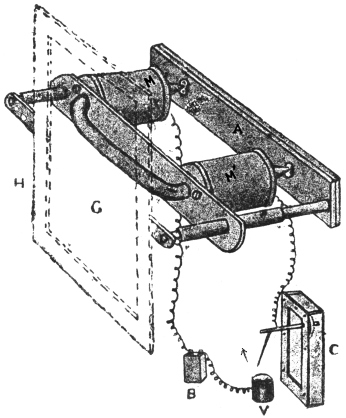
Fig. 15. The Oscillator. Electromagnet M, M′, periodically magnetized by
completion of electric current by clockwork C. Periodic attraction of soft iron
armature A moves attached glass plate G to left, making thereby electric
contact with writer.
The Oscillator is diagrammatically shown in Fig. 15.
M, M′ are the two electromagnetic coils, the free ends of
the horseshoe being pointed. Facing them are the conical
holes of the soft iron armature A. This armature carries
two rods which slide through hollow tubes. The distal
ends of the rods support the holder H, carrying the
smoked glass plate. Under normal conditions, the plate-holder
is held by suitable springs, somewhat to the right
of, and free from contact with, the writer. A clockwork
C carries a rotating arm, which makes periodic contact
with a pool of mercury contained in the vessel V, once
in a minute. On the completion of the electromagnetic
circuit, the armature A is attracted, the recording glass
plate being thereby moved to the left making contact with
the writer. The successive dots in the record thus take place
at intervals of a minute. Only a moderate amount of electric
current is thus consumed in maintaining the oscillation
of the plate. A 4-volt storage cell of 20 amperes capacity
is quite sufficient to work the apparatus for several days.
The responsive fall of the leaf of Mimosa is completed
in the course of about two seconds. The leaf remains in
the fallen or ‘contracted’ position for nearly fifteen
seconds; it then begins to recover slowly. As the successive
dots of the Oscillating Recorder are at intervals of a
minute, the maximum fall of leaf is accomplished between
two successive dots. The dotted response record
here obtained exhibits the recovery from maximum fall
under stimulation (cf. Fig. 23). The recovery of the leaf
in one minute is less than one-tenth the total amplitude
of the fall, and is proportionately the same in all the
response records. Hence the successive amplitudes of response
curves that are recorded at different hours of the
day afford us measures of the relative variations of excitability
of the plant at different times. This enables us
to demonstrate the reality of diurnal variation of excitability.
In my experimental investigations on the subject
I have not been content to take my data from any
particular method of obtaining response, but have employed
both types of recorders, the Resonant and Oscillating. It
will be shown that the results given by the different instruments
are in complete agreement with each other.
Before giving the daily records of periodic variation
of excitability, I will give my experimental results on the
influence of various external conditions in modifying excitability.
The conditions which are likely to affect excitability
and induce periodicity are, first, the effects of
light and darkness: under natural conditions the plant is
subjected in the morning to the changing condition from
darkness to light; then to the action of continued light
during the day; and in the evening to the changing
condition from light to darkness. A second periodic factor
is the change in the condition of turgidity, which is at
its maximum in the morning, as evidenced by the
characteristic erect position of the petiole. Finally, the
plant in the course of day and night is subjected to a
great variation of temperature. I will now describe the
effects of these various factors on excitability. It should
be mentioned here that the experiments were carried out
about the middle of the day, when the excitability,
generally speaking, is found to remain constant.
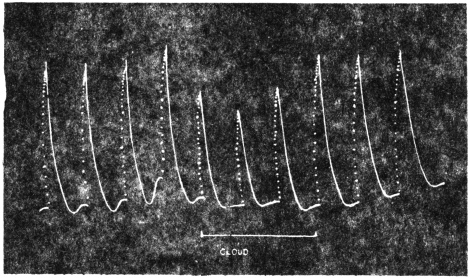
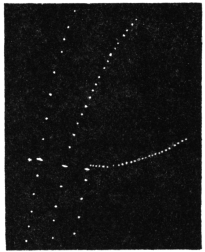
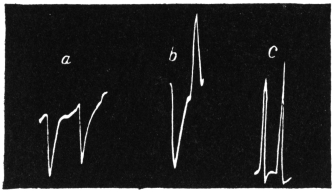
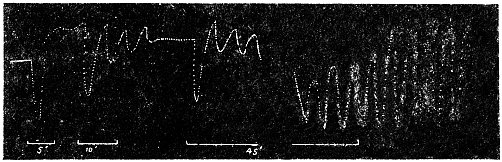
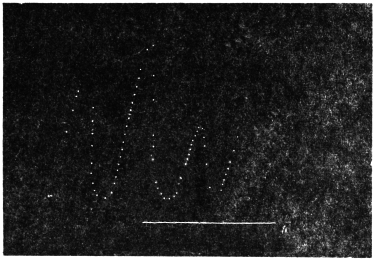
Fig. 16. Effect of cloud. Dotted up-curve indicates responsive fall, and
continuous down-line exhibits slow recovery. First four responses normal; next
three show depression due to diminution of light brought on by cloud, the duration of
which is indicated by horizontal line below. Last three records show restoration
of excitability brought on by clearing of sky. All records read from left to right.
I have frequently noticed that a depression of excitability
occurred when the sky was darkened by passing
clouds. This is clearly seen in the above records
obtained with the Resonant Recorder. Uniform sub-maximal
stimuli had been applied to a specimen of Mimosa at
intervals of fifteen minutes. The dotted up-line represents
the responsive fall, and the continuous down-line,
the slow recovery. The first four are the normal uniform
responses (Fig. 16). The next three show the depressing
effect of relative darkness due to cloudy weather.
The sky cleared after forty-five minutes, and we notice
the consequent restoration of normal excitability.
Effect of sudden darkness and its continuation. Experiment
14.—In the next record (Fig. 17) is shown the
immediate and continued action of darkness. The first
two are the normal uniform responses in light. By means
of screens, the plant was next subjected to sudden darkness;
this brought about a marked depression of excitability.
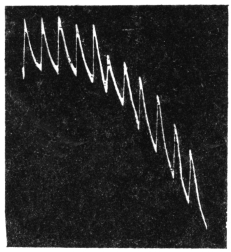
Subjection to sudden darkness thus acts as a
stimulus inducing a marked but transient fall of excitability.
Under the continuous action of darkness, however,
the excitability is at first restored and then undergoes
a persistent depression.
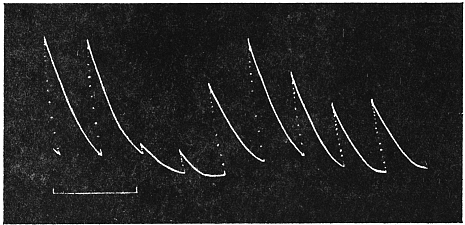
Fig. 17. Effect of sudden darkness. Plant subjected to sudden darkness
beyond horizontal line seen below. First two responses normal. Note sudden
depression of excitability, revival and final depression under continued
darkness.
Effect of transition from darkness to light: Experiment
15.—Here we have to deal first with the immediate effect
of sudden transition, and then with the persistent effect of
continuous light. In the record given in Fig. 18 the plant
had been kept in the dark and the responses taken in
the usual manner. It was then subjected to light; the
sudden change from darkness to light acted as a stimulus,
inducing a transient depression of excitability. In this
connection it is interesting to note that Godlewski found
that in the phenomenon of growth, transition from darkness
to light acted as a stimulus, causing a transient
decrease in the normal rate. The effect of continued light
on Mimosa is an enhancement of excitability.
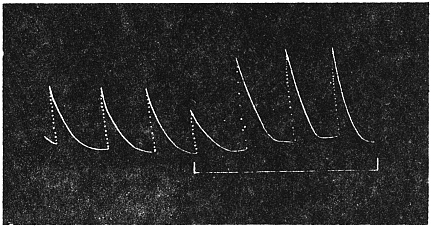
Fig. 18. Effect of change from darkness to light. The first three records
are normal under darkness. Horizontal line below indicates exposure to light.
Note preliminary depression followed by enhancement of excitability.
I have often found that the moto-excitability is depressed
under excessive turgor. Thus the “over-turgid” leaf of
Biophytum sensitivum does not exhibit any mechanical
response on rainy days.
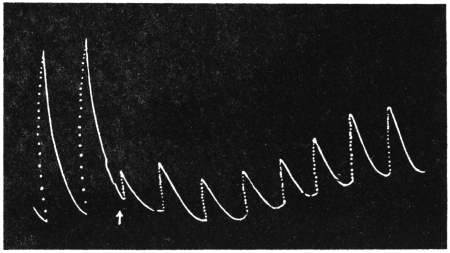
Fig. 19. Effect of enhanced turgor, artificially induced. First two responses
normal. Application of water, at arrow, induces depression of moto-excitability.
Experiment 16.—The effect of excessive turgor on moto-excitability
may be demonstrated in the case of Mimosa
by allowing its main pulvinus to absorb water. The result
is seen in the above record (Fig. 19), where water was
applied on the pulvinus after the second response. It is
seen how a depression of moto-excitability results from
excessive turgor brought on by absorption of water. In
such cases, however, the plant is found to accommodate itself
to the abnormal condition and gradually regain its normal
excitability in the course of one or two hours.
The moto-excitability of the pulvinus of Mimosa is
greatly modified under the influence of temperature. For
the purpose of this investigation I enclosed the plant in
a glass chamber, raising the temperature to the desired
degree by means of electric heating. Responses to identical
stimuli were then taken at different temperatures. It
was found that the effect of heightened temperature, up
to an optimum, was to enhance the amplitude of response.
Thus with a given specimen it was found that while at
22°C. the amplitude of response was 2.5 mm., it became
22 mm. at 27°C., and 52 mm. at 32°C. The excitability
is enhanced under rising, and depressed under falling
temperature. The moto-excitability of Mimosa is practically
abolished at the minimum temperature of about 19°C.
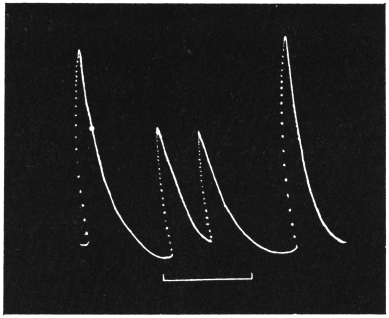
Fig. 20. Effect of moderate cooling during a period shown by horizontal
line below. Moderate depression followed by quick restoration.
Effect of lowering of temperature: Experiment 17.—A
simple way of exhibiting the effect of lowering of temperature
is by artificial cooling of the pulvinus. This cannot
very well be done by application of a stream of cooled
water, because, as we have seen, absorption of water by
the pulvinus is attended by a loss of excitability: diluted
glycerine has, however, no such drawback. This fluid at
ordinary temperature was first applied on the pulvinus,
and after an interval of half an hour records were taken
in the usual manner. Cooled glycerine was then applied
and the record taken once more; the results are seen in
Figs. 20 and 21. In the former, the first response was
normal at the temperature of the room, which was 32°C.;
the next two exhibit depression of excitability under
moderate cooling; the duration of application of moderately
cooled glycerine is there indicated by the horizontal line
below. On the cessation of application, the normal temperature
was quickly restored, with the restoration of
normal excitability.
In the next record (Fig. 21) is shown the effect of a
more intense cold. It will be noticed that the first effect
was a depression, and subsequently, a complete abolition
of excitability. Thick dots in the record represent applications
of stimulus which proved ineffective. It will also
be noticed that even on the cessation of cooling, and the
return of the tissue to normal temperature the induced
abolition of excitability persisted as an after-effect for a
considerable time. I have likewise found that the after-effect
of cold in abolishing the conduction of excitation
is also very persistent. These experiments show that owing
to physiological inertia, the variations of excitability in
the plant often lag considerably behind the external changes
which induce them.
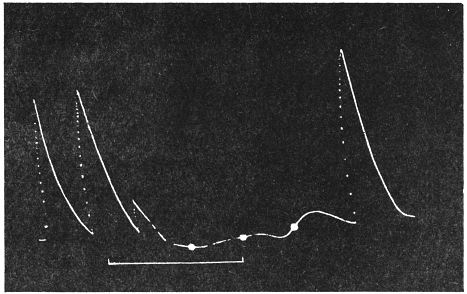
Fig. 21. Effect of application of more intense cold. Note sudden depression
followed by abolition of excitability, also persistent after-effect.
Effect of high temperature: Experiment 18.—It has been
shown that the moto-excitability is enhanced by rising
temperature; there is, however, an optimum temperature
above which the excitability undergoes a depression. This
is seen in the following record (Fig. 22), where the
normal response at 32°C. was depressed on raising the
temperature to 42°C.; the excitability was, however,
gradually restored when the plant was allowed to regain
the former temperature.
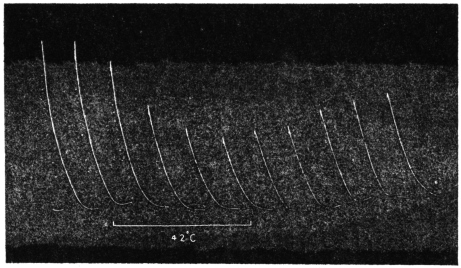
Fig. 22. Effect of temperature above optimum. Note depression of excitability
induced by high temperature, and gradual restoration on return to normal.
I may now briefly recapitulate some of the important
results: darkness depresses and light exalts the moto-excitability.
Excessive turgor depresses motility. Still more
marked is the effect of temperature. Lowering of temperature
depresses and finally abolishes the moto-excitability: rise of
temperature enhances it up to an optimum temperature, but
beyond this point the excitability undergoes depression. The
change in excitability induced by the variation of external
condition is not immediate; the induced effect, generally
speaking, lags behind the inducing cause.
I will now give automatic records of responses taken
once every hour for twenty-four hours. They prove conclusively
the diurnal variation of excitability in Mimosa.
After studying in detail the variations characteristic of
particular times of the day, I will endeavour to correlate
them with the effects brought on by the periodic changes
of the environment.
Experiment 19.—As a typical example I will first give
a record obtained in the month of February, that is, say,
in spring. From this it will not be difficult to follow
the variations which take place earlier in winter or later
in summer.
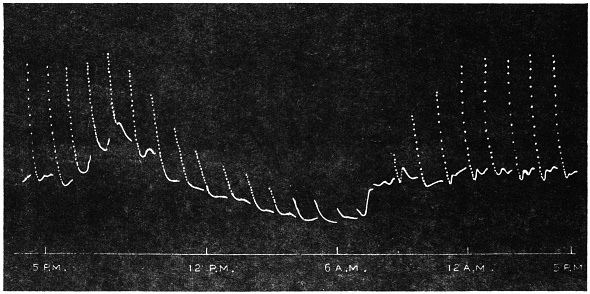
Fig. 23. Record for twenty-four hours, exhibiting diurnal variation of excitability (spring specimen). The displacement of
base-line is due to nyctitropic movement.
The record given in Fig. 23 was commenced at 5 P.M.
and continued to the same hour next day. The first thing
noticeable is the periodic displacement of the base-line.
This is due to the nyctitropic movements of the leaf. It
should be remembered that the up-movement of the leaf
is represented by down-curve, and vice versâ. After the
maximum fall of the leaf, which in this case was attained
at 9 P.M., there followed a reverse movement: the highest
erection, indicative of maximum turgor, was reached at
6 A.M. The leaf then fell slowly and reached a middle
position at noon. The extent of the nyctitropic movement
varies in individual cases; in some it is slight, in others
very large. The erectile movement began, as stated before,
at about 9 P.M.; in some cases, however, it may occur as
early as 6 P.M.
In following the characteristic variations of response
occurring throughout the day, we find that while they
are practically uniform between the hours of 5 and
6 P.M., a continuous decline is manifested after setting in
of darkness (7 P.M.); the fall of excitability continues
even after sunrise (6-30 A.M.), response being practically
abolished at 8 A.M. The excitability is then gradually
restored in a staircase manner, the maximum being
reached after 12 noon. After attaining this, the excitability
remains more or less constant till the evening. It will be
noticed that the amplitude of response at 5 P.M. on the
second day was the same as the corresponding response
on the previous day.
The results of this and numerous other records taken
in spring may be summarized as:—
1. The maximum excitability of Mimosa is attained
between 1 and 3 P.M., and remains constant
for several hours. In connection with the constancy
of response at this period, it should be
remembered that when the response is at its
maximum a slight increase of excitability cannot
further enhance the amplitude of response.
2. The excitability, generally speaking, undergoes a
continuous decline from evening to morning,
the response being practically abolished at or
about 8 A.M.
3. From 8 A.M. to 12 noon, the excitability is gradually
enhanced in a staircase manner, till the
maximum excitability is reached after 1 P.M.
I have obtained numerous records in support of these
conclusions, some of which are reproduced in the following
figures. In these cases responses to uniform stimuli
at intervals of half an hour were taken at different parts
of the day, the recorder employed being of the Resonant
type.
Mid-day record: Experiment 20.—The record of daily
periodicity previously given shows that the excitability
reaches its maximum after 12 noon, and that it remains
constant at the maximum value for several hours. This
fact is fully borne out in the following record obtained
with a different specimen (Fig. 24). The responses were
taken here from noon to 3 P.M., once every half-hour.
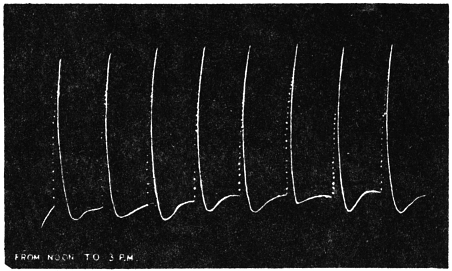
Fig. 24. Mid-day record from noon to 3 P.M. exhibiting uniform excitability.
Responses taken once every half-hour.
Evening record: Experiment 21.—The record given in
Fig. 23 shows that the amplitude of response falls continuously
after 6 P.M. It might be thought that the
diminished amplitude in the first part may be due to the
natural nyctitropic fall of the leaf. The range of the
pulvinar movement being limited, it is clear that the
extent of the responsive fall must become smaller on
account of the natural fall of the leaf during the first
part of the night. That this is not the whole explanation
of the decline of response in the evening will be clear
from certain facts which I will presently adduce. It was
stated that the leaf of Mimosa exhibits nyctitropic fall
from 6 to 9 P.M., after which there is a reverse movement
of erection. In certain specimens, however, the
erectile movement commenced as early as 6 P.M. It is
obvious that in these latter cases diminution of amplitude
of response cannot be due to the reduction of the range
of movement of the leaf. In Fig. 25 is given a series of
records from 6 to 10 P.M. obtained with a leaf in which
erectile movement had commenced early in the evening.
Though the full range of responsive movement was in
this case available, yet the amplitude of successive responses
is seen to undergo continuous diminution.
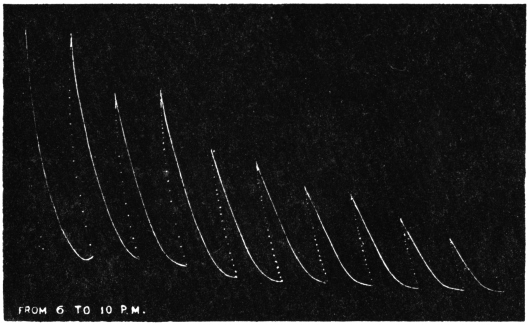
Fig. 25. Evening record from 6 to 10 P.M., showing gradual depression of
excitability.
Record in the morning: Experiment 22.—The excitability
is, as we have seen, nearly abolished about 8 A.M.,
after which there is a gradual restoration. This gradual
enhancement of excitability to a maximum in the course
of the forenoon is seen well illustrated in the
record below (Fig. 26).
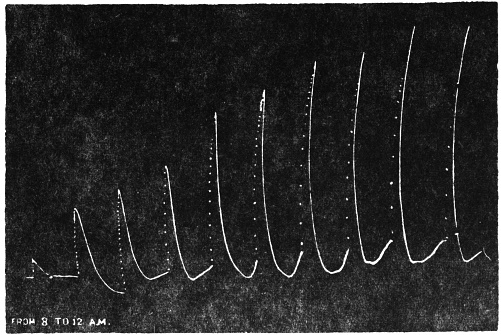
Fig. 26. Morning record from 8 A.M. to 12 noon, exhibiting gradual enhancement
of excitability.
The record of daily periodicity given in Fig. 23 may
be regarded as a typical example. Modifications may,
however, be observed which are traceable to individual
peculiarities. As an example of this, I give a record
(Fig. 27) obtained with a specimen in which nyctitropic
movement was very pronounced. The periodic variation
of excitability exhibited here is practically the same as
shown by other specimens. The interesting variation is in
the character of the recovery from stimulus; the leaf
was falling from 6 to 9 P.M.; owing to the shifting of
the base-line upwards the recovery appears to be incomplete.
After 9 P.M. the leaf was erected, at first slowly,
then at a very rapid rate. The consequent fall of the
base-line late at night is very abrupt; hence there is an
apparent over-shooting in the line of recovery.
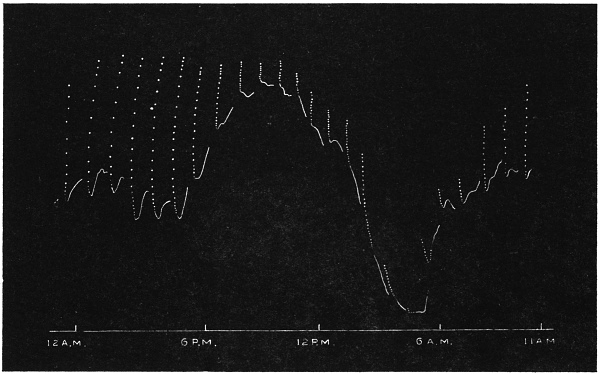
Fig. 27. Record of diurnal variation of
excitability; it exhibits marked nyctitropic movement.
So far I have merely described the observed diurnal
variation of excitability. We may next inquire whether
there is any causal relation between the change of external
conditions and the observed variation of excitability.
It has been shown that the moto-excitability is greatly
influenced by temperature. In order to find in what manner
the diurnal variation of excitability was influenced by
the daily variation of temperature, I took special care to
secure by means of the thermograph a continuous record
of temperature variations. The table which follows shows
the relation between the hours of the day, temperature,
and amplitude of response, in a typical case of diurnal
variation of excitability.
TABLE II.—SHOWING THE RELATION BETWEEN HOUR OF THE DAY, TEMPERATURE,
AND EXCITABILITY. (SPRING SPECIMEN.)
Hours
of day. | Temperature. | Amplitude
of Response. | Hours
of day. | Temperature. | Amplitude
of Response. |
| 5 | p.m. | 28°.0 | C. | 28.0 | mm. | 5 | a.m. | 20°.0 | C. | 5.0 | mm. |
| 6 | " | 25.5° | " | 28.0 | " | 6 | " | 20.5° | " | 4.2 | " |
| 7 | " | 24.5° | " | 27.0 | " | 7 | " | 21°.0 | " | 3.5 | " |
| 8 | " | 23°.0 | " | 23.5 | " | 8 | " | 22°.0 | " | 2.5 | " |
| 9 | " | 22°.0 | " | 21.5 | " | 9 | " | 24°.0 | " | 0.0 | " |
| 10 | " | 21°.0 | " | 18.0 | " | 10 | " | 26°.0 | " | 6.0 | " |
| 11 | " | 20.5° | " | 15.0 | " | 11 | " | 26.5° | " | 15.5 | " |
| 12 | " | 20°.0 | " | 13.0 | " | 12 | " | 28°.0 | " | 22.5 | " |
| 1 | a.m. | 20°.0 | " | 10.0 | " | 1 | p.m. | 28°.0 | " | 26.0 | " |
| 2 | " | 20°.0 | " | 8.0 | " | 2 | " | 28.5° | " | 28.0 | " |
| 3 | " | 20°.0 | " | 7.5 | " | 3 | " | 28.5° | " | 28.0 | " |
| 4 | " | 19.5° | " | 6.0 | " | 4 | " | 29°.0 | " | 28.0 | " |
From the data given in the table, two curves have been
obtained. One of these shows the relation between the
hours of the day and temperature; the other exhibits the
relation between the hours of the day and the excitability
as gauged by the amplitude of response (Fig. 28). It will
be seen that there is, broadly speaking, a marked resemblance
between the two curves, which demonstrate the
predominant influence of temperature on diurnal variation
of excitability.
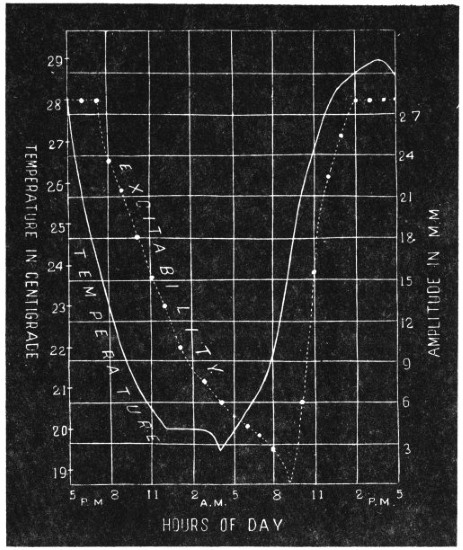
Fig. 28. The continuous curve shows the relation between the hour of the day
and temperature. The dotted curve exhibits relation between the hour of the day
and excitability.
It has been shown (page 59) that owing to physiological
inertia, the change of excitability, generally speaking, lags
behind the inducing cause. This fact finds striking illustration
in the lag exhibited by the curve of excitability in
reference to the temperature curve. The minimum temperature
was attained at about 4 A.M., but the excitability
was not reduced to a minimum till four hours later and
again there is a marked fall of temperature after 5 P.M.,
but the excitability did not become depressed till two hours
later.
There is again the factor of variation of light, the effect
of which is not so great as that of temperature. The
periods of maximum of light and temperature are, however,
not coincident.
We may now discuss in greater detail the diurnal variation
of excitability in Mimosa, taking the typical case, the
record of which is given in Fig. 23. The temperature here
is seen to remain almost constant, and at an optimum, from
1 to 5 P.M., the condition of light is also favourable. Hence
the excitability is found to be constant, and at its maximum
between these hours. The temperature begins to fall
after 6 P.M., and there is, in addition, the depressing
action of gathering darkness. Owing to the time-lag,
the fall of excitability does not commence immediately
at 6 P.M., but an hour afterwards, and continues
till the next morning. During this period we have the
cumulative effect of twelve hours’ darkness and the
increasing depression due to cold, the temperature minimum
occurring at 4 A.M. On account of the combined effects
of these various factors, and phenomenon of lag, the period
of minimum excitability is in general reached about 8 A.M.
In certain other cases this may occur earlier. After the
attainment of this minimum, the excitability is gradually
and continuously increased, under the action of light and
of rising temperature, till the maximum is reached in the
afternoon.
It was said that temperature exerted a predominant
influence in inducing variation of excitability. We may,
therefore, expect that the diurnal period would be modified
in a certain way according to the season. In winter the
night temperature falls very low; hence the depression of
excitability is correspondingly great, and results in the
complete abolition of excitability. The after-effect of intense
cold is seen in the condition of inexcitability persisting
for a very long period in the morning. In summer the
prevailing high temperature modifies the diurnal periodicity
in a different manner. When the night is warm, the fall
of excitability is slight. In the day, on the other hand,
the temperature may rise above the optimum, bringing
about a depression. In such a case the excitability in the
earlier part of the evening may actually be greater than
in the middle of the day. These modifications are shown
in a very interesting way in the following record (Fig. 29)
taken at the end of April. The temperature of Calcutta
at this season often rises above 100°F. or 38°C. Table III
also exhibits, in the case of the summer specimen, the
relation between the hours of the day, temperature, and
excitability.
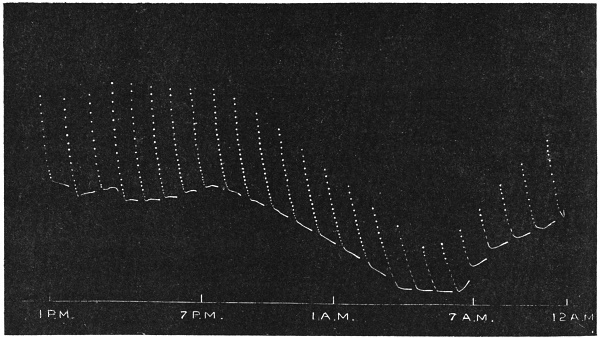
Fig. 29. Diurnal variation of excitability exhibited by summer specimen.
An inspection of the record given in Fig. 29 shows that
the amplitude of response was enhanced after 4 P.M. The
temperature up to that time was unusually high (38°C.),
and there was in consequence a depression of excitability.
After that hour there was a mitigation of heat, the
temperature returning towards the optimum. Hence we
find that the maximum excitability was attained between
the hours 4 and 6 P.M. The minimum temperature at
night was higher in the present case than that of the
experiment carried out in February; in the former the
minimum was 25.5°C., while in the latter it was 19.5°C.
On account of this difference the night record in summer
shows a fall of excitability which is far more gradual than
that obtained in spring. The excitability is here not
totally abolished in the morning, but reaches a minimum
after 8 A.M.; the sensitiveness is then gradually enhanced
in a staircase manner.
TABLE III—SHOWING THE RELATION BETWEEN HOURS OF THE DAY, TEMPERATURE,
AND EXCITABILITY. (SUMMER SPECIMEN.)
Hours
of day. | Temperature. | Amplitude
of Response. | Hours
of day. | Temperature. | Amplitude
of Response. |
| 1 | p.m. | 38°.0 | C. | 22.0 | mm | 1 | a.m. | 26°.0 | C. | 21.5 | mm. |
| 2 | " | 38°.0 | " | 23.0 | " | 2 | " | 26°.0 | " | 20.0 | " |
| 3 | " | 38°.0 | " | 24.5 | " | 3 | " | 25.5° | " | 18.5 | " |
| 4 | " | 37°.0 | " | 28.0 | " | 4 | " | 25.5° | " | 17.0 | " |
| 5 | " | 35.5° | " | 29.0 | " | 5 | " | 25.5° | " | 16.0 | " |
| 6 | " | 33°.0 | " | 27.0 | " | 6 | " | 26°.0 | " | 15.0 | " |
| 7 | " | 31°.0 | " | 26.0 | " | 7 | " | 27°.0 | " | 14.0 | " |
| 8 | " | 30°.0 | " | 26.0 | " | 8 | " | 29°.0 | " | 13.0 | " |
| 9 | " | 29°.0 | " | 25.0 | " | 9 | " | 30.5° | " | 11.0 | " |
| 10 | " | 27°.0 | " | 24.5 | " | 10 | " | 33°.0 | " | 16.0 | " |
| 11 | " | 27°.0 | " | 24.0 | " | 11 | " | 35°.0 | " | 17.0 | " |
| 12 | " | 26.5° | " | 22.5 | " | 12 | " | 37°.0 | " | 21.0 | " |
The moto-excitability of Mimosa was gauged every hour
of the day and night, by the amplitude of the response
to a testing stimulus. This is effected by means of automatic
devices which excite the plant periodically by an
absolutely constant stimulus, and record the corresponding
mechanical response.
From the record thus obtained, it was found that the
excitability of the plant is not the same throughout the
day, but undergoes a variation characteristically different
at different times of the day. In a typical case in spring
the excitability attained its maximum value after 1 P.M. and
remained constant for several hours. There was then a
continuous fall of excitability, the minimum being reached
at about eight in the morning. The plant at this time
was practically insensitive. The moto-excitability was then
gradually enhanced in a staircase manner till it again
reached a maximum next afternoon.
The effect of sudden darkness was found to induce a
transient depression, followed by revival of excitability.
The effect of persistent darkness was to induce a
depression.
Exposure to light from darkness caused a transient
depression, followed by an enhancement of excitability.
Excessive turgor induced a diminished response.
Lowering of temperature induced a depression of excitability,
culminating in an abolition of response. The after-effect
of excessive cold was a prolonged depression of
excitability.
Excitability was enhanced by rising temperature up to
an optimum; above this point a depression was induced.
Owing to physiological inertia the change of excitability
induced by variation of external condition lags
behind the inducing cause.
The diurnal variation of excitability is primarily due
to diurnal variation of temperature. The effect is modified
in a minor degree by variation of light.
By
Sir J. C. Bose,
Assisted by
Surendra Chandra Das, M.A.
The most suitable plant for researches on irritability of
plants is Mimosa pudica, which can be obtained in all
parts of the world. An impression unfortunately prevails
that the excitatory reaction of the plant can be obtained
only in summer and under favourable circumstances; this
has militated against its extensive use in physiological
experiments, but the misgiving is without any foundation;
for I found no difficulty in demonstrating even the most
delicate experiments on Mimosa before the meeting of the
American Association for the Advancement of Science held
during Christmas of 1914. The prevailing outside temperature
at the time was considerably below the freezing
point. With foresight and care it should not be at all
difficult to maintain in a hot-house a large number of
these plants in a sensitive condition all the year
round.
In order to remove the drawback connected with the
supply of sufficient material, I commenced an investigation
to find whether a detached leaf preparation could be made
as effective for the study of irritability as the whole plant.
Here we have at the central end of the leaf the pulvinus,
which acts as the contractile organ; the conducting strand
in the interior of the petiole, on the other hand, is the
vehicle for transmission of excitation. The problem to
be solved is the rendering of an isolated petiole-and-pulvinus
of Mimosa as efficient for researches on irritability
as the nerve-and-muscle preparation of a frog. On the
success of this attempt depended the practical opening out
of an extended field of physiological investigation which
would be unhampered by any scarcity of experimental
material.
In connection with this it is well to note the surprising
difference in vegetative growth as exhibited by plants
grown in soil and in pots. A pot-specimen of Mimosa
produces relatively few leaves, but one grown in the open
ground is extremely luxuriant. As an instance in point, I
may state that for the last five months I have taken
from a plant grown in a field about 20 leaves a day for
experiment, without making any impression on it. A large
box containing soil would be practically as good as the
open ground, and the slower rate of growth in a colder
climate could be easily made up by planting half a dozen
specimens. The protection of the plants from inclemencies
of weather can be ensured by means of a glass cover
with simple heat-regulation by electric lamps, in place of
an expensive green-house.
Returning to the question of the employment of an
isolated leaf, which I shall designate as a petiole-pulvinus
preparation, instead of the entire plant, the first attempts
which I made proved unsuccessful. The cut leaf kept in
water would sometimes exhibit very feeble response, at
other times all signs of excitability appeared to be totally
abolished. It was impossible to attempt an investigation on
the effect of changing environment on excitability when the
normal sensitiveness itself underwent so capricious a change
These difficulties were ultimately overcome from knowledge
derived through systematic investigation on the
relative importance of the different parts of the motor
apparatus, on the immediate and after-effect of section on
the excitability of the leaf, and on the rate of decay of
this excitability on isolation from the plant. The experience
thus gained enabled me to secure long-continued and
uniform sensibility under normal conditions. It was thus
possible to study the physiological effects of changing
external conditions by observing the responsive variation
in the isolated petiole-pulvinus preparation. I propose to
deal with the different aspects of the investigation in the
following order:—
1. The effect of wound or section in modification of
normal excitability.
2. The change of excitability after immersion in water.
3. Quantitative determination of the rate of decay of
excitability in an isolated preparation.
4. Effect of amputation of the upper half of pulvinus.
5. Effect of removal of the lower half.
6. Influence of the weight of leaf on rapidity of
responsive fall.
7. The action of chemical agents.
8. Effect of “fatigue” on response.
9. The influence of constant electric current on
recovery.
10. The action of light and darkness on excitability.
The isolated petiole-pulvinus preparation is made by
cutting out a portion of the stem bearing a single lateral
leaf. The four diverging sub-petioles may also be cut off.
In order to prevent rapid drying the specimen has to be
kept in water. Preparations made in this way often
appeared to have lost their sensibility. I was, however,
able to trace this loss to two different factors: first, to
the physiological depression due to injury caused by section,
and, second, to the sudden increase of turgor brought on
by excessive absorption of water. I shall now proceed to
show that the loss of sensibility is not permanent, but is
capable of restoration.
In connection with the question of effect of injury, it
is to be borne in mind that after each excitation the
plant becomes temporarily irresponsive and that the excitability
is fully restored after the completion of protoplasmic
recovery. A cut or a section acts as a very intense
stimulus, from the effect of which the recovery is very
slow. If the stem be cut very near the leaf, the excitation
of the pulvinus is very intense, and the consequent
loss of excitability becomes more or less persistent. But
if the stem be cut at a greater distance, the transmitted
excitation is less intense, and the cut specimen recovers
its excitability within a moderate time. I have also succeeded
in reducing the excitatory depression by previously
benumbing the tissue by physiological means. The isolated
specimen can be made still more compact by cutting off
the sub-petioles bearing the leaflets; the preparation now
consists of a short length of stem of about 2 cm. and
an equally short length of primary petiole, the motile
pulvinus being at the junction of the two.
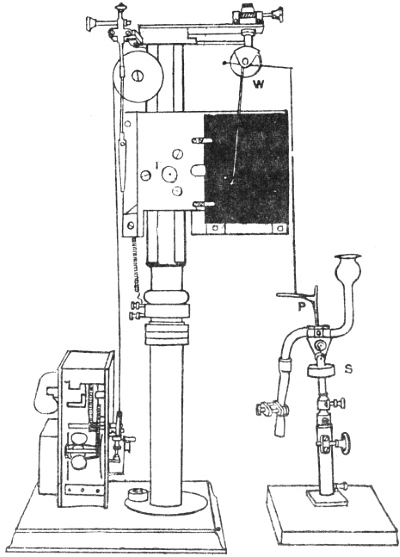
Fig. 30—The Resonant Recorder, with petiole-pulvinus preparation. (From a
photograph.)
For the restoration of sensitiveness, and to meet working
conditions, the lower end of the cut stem is mounted
on a T-tube, with funnel-attachment and exit-tube, as
shown in Fig. 30. The other two cut ends—of the stem
and of the petiole—may be covered with moist cloth or
may be closed with collodion flexile to prevent rapid
evaporation and drying up of the specimen. A slight
hydrostatic pressure maintains the specimen in a moderately
turgid condition. A preparation thus made is
insensitive at the beginning, but if left undisturbed it
slowly recovers its excitability. The history of the depression
of excitability after shock of preparation and its
gradual restoration is graphically illustrated by a series of
records made by the plant (Fig. 31).
The petiole-pulvinus preparation thus made offers all
facilities for experiment. Owing to its small size it can
be easily manipulated; it can be enclosed in a small
chamber and subjected to varying conditions of temperature
and to the action of different vapours and gases. Drugs
are easily absorbed at the cut end, and poison and its
antidote can be successively applied through the funnel
without any disturbance of the continuity of record. In
fact, many experiments which would be impossible with the
entire plant are quite practicable with the isolated leaf.
The arrangement for taking records of response is seen
in Fig. 30, which is reproduced from a photograph of the
actual apparatus. For recording the response and recovery
of the leaf under stimulation, I use my Resonant Recorder
fully described in the ‘Philosophical Transactions’ (1913).
The petiole is attached to one arm of the horizontal lever.
The writer, made of fine steel wire with a bent tip, is
at right angles to the lever, and is maintained by electromagnetic
means in a state of to-and-fro vibration, say, ten
times in a second. The record, consisting of a series of
dots, is free from errors arising from friction of continuous
contact of the writer with the recording surface. The successive
dots in the record at definite intervals of a tenth of
a second also give the time-relations of the response curve.
On account of its small size, the petiole-pulvinus preparation
offers great facilities for mounting in different ways
suitable for special investigations. Ordinarily, the cut stem
with its lower end enclosed in moist cloth is supported
below. A very suitable form of stimulus is that of induction
shock from a secondary coil, the intensity of which is
capable of variation in the usual manner by adjusting the
distance between the primary and the secondary coils. The
motile pulvinus, P, may be excited directly. For investigations
on velocity of transmission of excitation, stimulus is
applied on the petiole at some distance from the pulvinus,
by means of suitable electrodes. Excitation is now transmitted
along the intervening length of petiole, the conducting
power of which will be found appropriately modified
under the action of chemical and other agents. In this
normal method of mounting, the more excitable lower half
of the pulvinus is below; excitatory reaction produces the
fall of the petiole, gravity helping the movement. The preparation
may, however, be mounted in the inverted position,
with the more excitable lower half of the pulvinus facing
upwards. The excitatory movement will now be the erection
of the petiole, against gravity.
Under natural conditions the stem is fixed, and it is the
petiole which moves under excitation. But a very interesting
case presents itself when the petiole is fixed and the
stem free. Here is presented the unusual spectacle of the
plant or the stem “wagging” in response to excitation.
The isolated specimen can be kept alive for several days
immersed in water. The excitability of the pulvinus, however,
undergoes great depression, or even abolition, by the
sudden change of turgor brought on by excessive absorption
of water. The plant gradually accommodates itself to the
changed condition, and the excitability is restored in a staircase
manner from zero to a maximum.
In studying the action of a chemical solution on excitability,
the solution may be applied through the cut end or
directly on the pulvinus. The sudden variation of turgor,
due to the liquid, always induces a depression, irrespective
of the stimulating or the depressing action of the drug.
The difficulty may be eliminated by previous long-continued
application of water on the pulvinus and waiting till the
attainment of uniform excitability which generally takes
place in the course of about three hours. Subsequent application
of a chemical solution gives rise to characteristic
variation in the response.
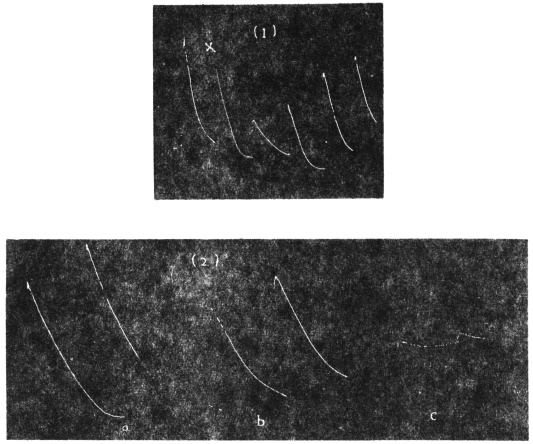
Fig. 31—Variation of excitability after section. (1) Immediate effect; (2)
variation of excitability in a second specimen during 50 hours: (a) response
4 hours after section; (b) response after 24 hours; (c) after 49 hours. Up-line
of record represents responsive fall of the leaf, down-line indicates recovery from
excitation.
Variation of excitability after section: Experiment 23.—In
order to test the history of the change of excitability
resulting from the immediate and after-effect of section, I
took an intact plant and fixed the upper half of the stem in
a clamp. The response of a given leaf was now taken to
the stimulus of an induction shock of 0.1 unit intensity, the
unit chosen being that which causes a bare perception of
shock in a human being. The specimen was vigorous and
the response obtained was found to be a maximum. The
stem bearing the leaf was cut at the moment marked in
the record with a cross, and water was applied at the cut
end. The effect of section was to cause the maximum fall
of the leaf, with subsequent recovery. After this, successive
responses to uniform stimuli at intervals of 15 minutes
show, in (1) of Fig. 31, that a depression of excitability has
been induced owing to the shock caused by section. In
course of an hour, however, the excitability had been restored
almost to its original value before the section. This
was the case with a vigorous specimen, but with less
vigorous ones a longer period of about three hours is
required for restoration. In certain other cases the response
after section exhibits alternate fatigue; that is to say, one
response is large and the next feeble, and this alternation
goes on for a length of time. The isolated specimen, generally
speaking, attains a uniform sensibility after a few
hours, which is maintained, with very slight decline under
constant external conditions, for about 24 hours. On the
third day the fall of excitability is very rapid, and the
sensibility declines to zero in about 50 hours after isolation
[Fig. 31 (2)]. We may describe the whole cycle of change
as follows: by the shock of operation the isolated preparation
is rendered insensitive for nearly an hour, the excitability
is then gradually restored almost to its normal value
before operation. Under constant external conditions, this
excitability remains fairly constant for about 24 hours
after which depression sets in. The rate of fall of excitability
becomes very rapid 40 hours after the operation, being
finally abolished after the fiftieth hour. It is probable
that in a colder climate the fall of excitability would be
much slower. The most important outcome of this inquiry
is the demonstration of the possibility of obtaining persistent
and uniform sensibility in isolated preparations.
On account of this, not only is the difficulty of supply
of material entirely removed but a very high degree of
accuracy secured for the investigation itself.
Experiment 24.—The determination of the rôle played
by different parts of the pulvinus in response and recovery
is of much theoretical importance. Our knowledge on this
subject is unfortunately very scanty. The generally accepted
view is that on excitation “the actual downward curvature
of the pulvinus is partly due to a contraction of the
walls of the motor cells consequent upon the decrease of
turgor, but is accentuated by expansion of the insensitive
adaxial half of the pulvinus—which was strongly compressed
in the unstimulated condition of the organ—and also by the
weight of the leaf.”[H] According to Pfeffer, after excitation
of the organ, “the original condition of turgor is gradually
reproduced in the lower half of the pulvinus, which expands,
raising the leaf and producing compression of the
upper half of the pulvinus, which aids in the rapid curvature
of the stimulated pulvinus.”[I]
It was held, then, that the rapidity of the fall of leaf
under stimulus is materially aided (1) by the expansion of
the upper half of the pulvinus, which is normally in a state
of compression, and (2) by the weight of the leaf. So
much for theory. The experimental evidence available
regarding the relative importance of the upper and lower
halves of the pulvinus is not very conclusive. Lindsay
attempted to decide the question by his amputation experiments.
He showed that when the upper half was removed
the leaf carried out the response, but rigor set in when
the lower half was amputated. Pfeffer’s experiments on
the subject, however, contradicted the above results. He
found that “after the upper half of the pulvinus was
carefully removed, no movement was produced by stimulation,
whereas when the lower half is absent a weakened
power of movement is retained.” Pfeffer, however, adds,
“since the operation undoubtedly affects the irritability, it
is impossible to determine from such experiments the
exact part played by the active contraction of the lower
half of the pulvinus.”[I]
The cause of uncertainty in this investigation is twofold.
First, it arises from the unknown change in irritability
consequent on amputation; and, secondly, from absence of
any quantitative standard by which the effect of selective
amputation of the pulvinus may be measured. As regards
the first, I have been able to reduce the depressing action
caused by injury to a minimum by benumbing the tissue
before operation, through local application of cold, and also
allowing the shock-effect to disappear after a rest of several
hours. As regards the physiological gauge of efficiency of
the motor mechanism, such a measure is afforded by the
relation between a definite testing stimulus and the resulting
response with its time-relations, which is secured by
my Resonant Recorder with the standardised electrical
stimulator.
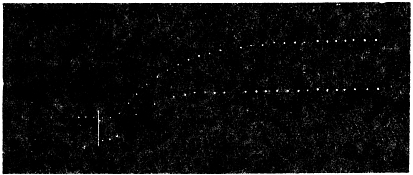
Fig. 32—Effect of amputation of upper half of pulvinus. Upper record gives
normal response before amputation, and the lower, response after amputation.
(Successive dots at intervals of 0.1 sec). Apex-time 11 sec, in both.
In carrying out this investigation I first took the record
of normal response of an intact leaf on a fast moving
plate. A second record, with the same stimulus, was taken
after the removal of the upper half of the pulvinus, having
taken the necessary precautions that have been described.
Comparison of the two records (Fig. 32) shows that the only
difference between them is in the exhibition of slight diminution
of excitability due to operation. But, as regards
the latent period and the quickness of attaining maximum
fall, there is no difference between the two records before
and after the amputation of the upper half. The upper
part of the pulvinus is thus seen practically to have little
influence in hastening the fall.
Experiment 25.—The shock-effect caused by the amputation
of the lower half was found to be very great, and it required
a long period of rest before the upper half regained
its excitability. The excitatory reaction of the upper half
is by contraction, and the response is, therefore, the lifting
of the petiole. Thus, in an intact specimen, excitation
causes antagonistic reactions of the two halves. But the
sensibility of the upper half is very feeble and the rate
of its contractile movement, relatively speaking, very slow.
The record of the response of the upper half of the pulvinus,
seen in Fig. 33, was taken with an Oscillating Recorder,
where the successive dots are at intervals of 1 sec.: the
magnification employed was about five times greater than
in recording the response of the lower half (Fig. 32). The
intensity of stimulus to evoke response had also to be
considerably increased. Taking into account the factors of
magnification and the intensity of stimulus for effective response,
the lower half I find to be about 80 times more
sensitive than the upper. Thus, under feeble stimulus the
upper half exerts practically no antagonistic reaction. The
excitatory response of the upper half is also seen to be
very sluggish.
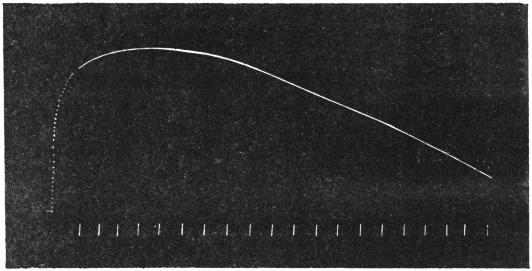
Fig. 33.—Response after amputation of lower half of pulvinus. (Successive
dots at intervals of a second; vertical lines mark minutes.) Apex-time, 40 secs.
Experiment 26.—It is obvious that the mechanical
moment exerted by the weight of the leaf must help its
responsive fall under excitation. But the relative importance
of the factors of active contraction of the lower half
of the pulvinus and of the weight, in the rate of the
responsive down-movement, still remains to be determined.
A satisfactory way of solving the problem would lie in
the study of the characteristics of response-records taken
under three different conditions: (1) When the leaf is helped
in its fall by its weight; (2) when the action of the
weight is eliminated; and (3) when the fall has to be
executed against an equivalent weight. An approximation
to these conditions was made in the following manner.
We may regard the mechanical moment to be principally
due to the weight of the four sub-petioles applied at the
end of the main petiole. In a given case these sub-petioles
were cut off, and their weight found to be 0.5 grm. The
main petiole was now attached to the right arm of the
lever, and three successive records were taken: (1) With
no weight attached to the petiole; (2) with 0.5 grm.
attached to its end; and (3) with 0.5 grm. attached to
left arm of the lever at an equal distance from the fulcrum.
In the first case, the fall due to the excitatory
contraction will practically have little weight to help it; in
the second case, it will be helped by a weight equivalent
to those of the sub-petioles with their attached leaflets; and
in the third case, the fall will be opposed by an equivalent
weight. We find that in these three cases there is very
little difference in the time taken by the leaf to complete
the fall (Fig. 34).
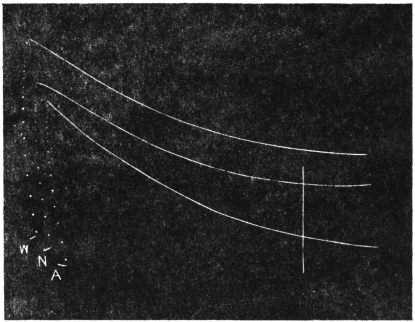
Fig. 34.—Effect of weight on rapidity of fall. N, without action of weight;
W, with weight helping; and A, with weight opposing.
It has been shown that the presence or absence of the
upper half of the pulvinus makes practically no difference
in the period of fall; it is now seen that the weight
exerts comparatively little effect. We are thus led to
conclude that in determining the rapidity of fall, the factors
of expansive force of the upper half of the pulvinus and
the weight of the leaf are negligible compared to the active
force of contraction exerted by the lower half of the
pulvinus.
In connection with this subject it need hardly be said
that the various experiments which I had previously carried
out with the intact plant can also be repeated with the
isolated preparation. I will only give here accounts of
experiments which are entirely new.
The chemical solution may be applied directly to the
pulvinus, or it may be absorbed through the cut end, the
absorption being hastened by hydrostatic pressure. The
normal record is taken after observing precautions which
have already been mentioned. The reaction of a given
chemical agent is demonstrated by the changed character
of the record. The effect of the drug is found to depend
not merely on its chemical nature, but also on the dose.
There is another very important factor—that of the tonic
condition of the tissue—which is found to modify the
result. The influence of this will be realised from the
account of an experiment to be given presently, where an
identical agent is shown to produce diametrically opposite
effects on two specimens, one of which was in a normal,
and the other in a sub-tonic, condition. The experiments
described below relate to reactions of specimens in a normal
condition.
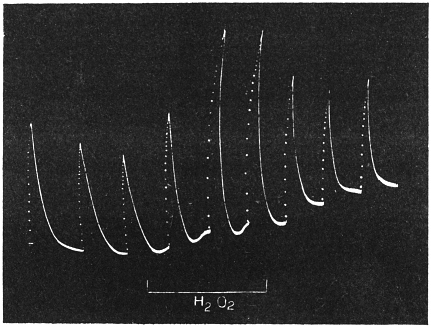
Fig. 35.—Stimulating action of hydrogen peroxide.
Hydrogen Peroxide: Experiment 27.—This reagent in
dilute solution exerts a stimulating action. Normal records,
were taken after long-continued application of water on
the pulvinus. The peroxide, as supplied by Messrs. Parke
Davis & Co., was diluted to 1 per cent., and applied to
the pulvinus; this gave rise to an enhancement of response.
Re-application of water reduced the amplitude to the old
normal value (Fig. 35).
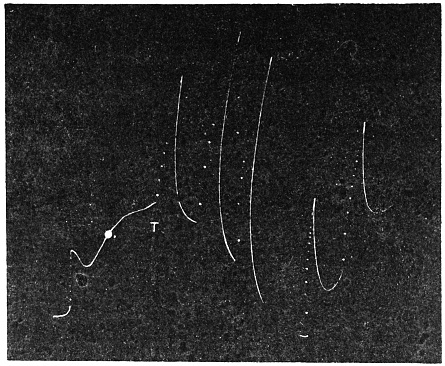
Fig. 36.—Incomplete recovery under the action BaCl2 and transient
restoration under tetanisation at T.
Barium Chloride: Experiment 28.—The action of this
agent is very characteristic, inducing great sluggishness in
recovery. The preparation had been kept in 1-per cent.
solution of this substance for two hours. After this the
first response to a given test-stimulus was taken; the
response was only moderate, and the recovery incomplete.
The sluggishness was so great that the next stimulation,
represented by a thick dot (Fig. 36), was ineffective.
Tetanising electric shock at T, not only brought about
response, but removed for the time being the induced
sluggishness. This is seen in the next two records, which
were taken under the old test-stimulus. There is now an
enhanced response and a complete recovery. Beneficial
effect of tetanisation disappeared, however, on the cessation
of stimulus. This is seen in the next two records which
were taken after two hours. The amplitude of response was
not only diminished, but the recovery also was incomplete.
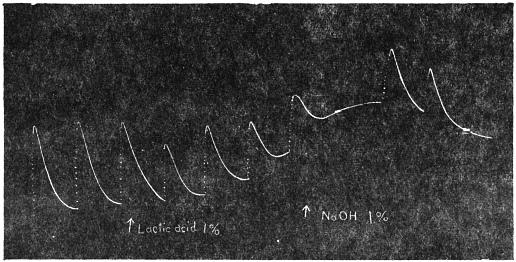
Fig. 37.—Antagonistic action of alkali and acid. Arrest of response in
contraction under NaOH (↑), restoration and final arrest in expansion under
lactic acid. (↑)
Antagonistic actions of Alkali and Acid: Experiment
29.—Alkali and acid are known to exert antagonistic
actions on the spontaneous beat of the heart; dilute solution
of NaOH arrests the beat of the heart in systolic
contraction, while dilute lactic acid arrests the beat in
diastolic expansion. I have found identical antagonistic reactions
in the pulsating tissue of Desmodium gyrans, the
telegraph plant. It is very interesting to find that these
agents also exert their characteristic effects on the response
of Mimosa in a manner which is precisely the same. This
is seen illustrated in Fig. 37, where the application of
NaOH arrested the response in a contracted state; after
this, the antagonistic effect of dilute lactic acid is seen
first, in its power of restoring the excitability; its continued
application, however, causes a second arrest, but this
time in a state of relaxed expansion.
CuSO4 Solution.—This agent acts as a poison, causing a
gradual diminution of amplitude of response, culminating
in actual arrest at death. Certain poisons, again, exhibit
another striking symptom at the moment of death, an
account of which will be given in a separate paper.
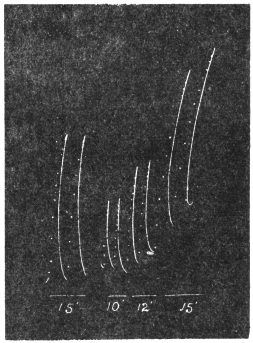
Fig. 38.—“Fatigue” induced by shortening intervening period of rest.
With Mimosa, after each excitation the recovery becomes
complete after a resting period of about 15 min. With
this interval of rest the successive responses for a given
stimulus are equal, and are at their maximum.
Experiment 30.—When the resting interval is diminished
the recovery becomes incomplete, and there is a
consequent diminution of amplitude of response. There
is thus an increased fatigue with diminished period of
rest. This is illustrated in Fig. 38, where the first two
responses are at intervals of 15 min.; the resting interval
was then reduced to 10 min., the response undergoing a
marked diminution. Conversely, by increasing the resting
interval, first to 12 and then to 15 min., the extent of
fatigue was reduced and then abolished.
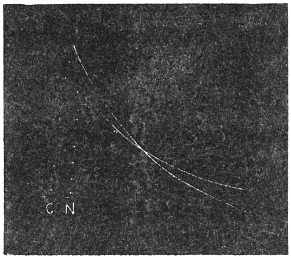
Fig. 39.—Action of constant current in removal of fatigue by hastening
recovery; N, curve of response in fatigued specimen; C, after passage of current.
Experiment 31.—From the above experiment it would
appear that since the incompleteness of recovery induces
fatigue, hastening of recovery would remove it. With this
idea I tried various methods for quickening the recovery
of the excited leaf. The application of a constant electric
current was found to have the desired effect. Two electrodes
for introduction of current were applied, one on
the stem and the other on the petiole, at some distance
from the pulvinus. In order to avoid the excitatory effect
of sudden application, the applied current should be increased
gradually; this was secured by means of a potentiometer
slide. In my experiment a current having an
intensity of 1.4 micro-ampère was found to be effective.
Responses at intervals of 10 min., as we have seen, exhibit
marked fatigue. Two responses were recorded on a fast-moving
plate, N before, and C after, the application of
the current. It will be seen (Fig. 39) how the application
of current has, by hastening the recovery, enhanced the
amplitude of response and brought about a diminution
of fatigue. In connection with this, I may state that the
tonic condition is, in general, improved as an after-effect
of the passage of current. This is seen in some cases by
a slight increase in excitability; in others, where the responses
had been irregular, the previous passage of a current
tends to make the responses more uniform.
In taking continuous records of responses I was struck
by the marked change of excitability exhibited by the intact
plant under variation of light. Thus the appearance of a
cloud was quickly followed by an induced depression, and
its disappearance by an equally quick restoration of excitability.
This may be explained on the theory that certain
explosive chemical compounds are built up by the photosynthetic
processes in green leaves, and that the intensity
of response depends on the presence of these compounds.
But the building up of a chemical compound must necessarily
be a slow process, and it is difficult on the above
hypothesis to connect the rapid variation of excitability
with the production of a chemical compound, or its cessation,
concomitant with changes in the incident light.
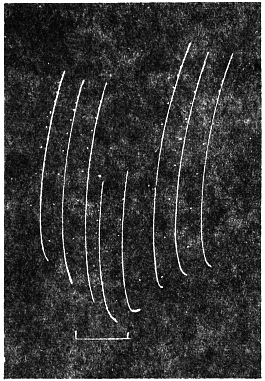
Fig. 40.—Stimulating action of light, and depressing action of darkness.
Horizontal line below represents period of darkness.
Experiment 32.—In order to find out whether photo-synthesis
had any effect on excitability, I placed an intact
plant in a dark room and obtained from it a long series
of responses under uniform test-stimulus. While this was
being done the green leaflets were alternately subjected to
strong light and to darkness, care being taken that the
pulvinus was shaded all the time. The alternate action
of light and darkness on leaflets induced no variation in
the uniformity of response. This shows that the observed
variation of excitability in Mimosa under the alternate
action of light and darkness is not attributable to the
photo-synthetic processes.
I next took a petiole-pulvinus preparation from which
the sub-petioles bearing the leaflets had been cut off, and
placed it in a room illuminated by diffused daylight.
The normal responses were taken, the temperature of the
room being 30°C. The room was darkened by pulling
down the blinds, and records were continued in darkness.
The temperature of the room remained unchanged at 30°C.
It will be seen from records given in Fig. 40, that in
darkness there is a great depression of excitability. Blinds
were next pulled up and the records now obtained exhibit
the normal excitability under light. The sky had by this
time become brighter, and this accounts for the slight
enhancement of excitability. This experiment proves
conclusively that light has a direct stimulating action on
the pulvinus, independent of photo-synthesis.[J]
On isolation of a petiole-pulvinus preparation, the shock
of operation is found to paralyse its sensibility. After suitable
mounting the excitability is restored, and remains
practically uniform for nearly 24 hours. After this a depression
sets in, the rate of fall of excitability becomes rapid
40 hours after the operation, sensibility being finally abolished
after the fiftieth hour.
Experiments carried out on the effect of weight, and
the influence of selective amputation of the upper and
lower halves of the pulvinus, show that in determining the
rapidity of fall of leaf, the assumed factors of the expansive
force of the upper half of the pulvinus and the weight of
the leaf are negligible compared to the force of active contraction
exerted by the lower half of the pulvinus. The
excitability of the lower half is eighty times greater than
that of the upper.
Chemical agents induce characteristic changes in excitability.
Hydrogen peroxide acts as a stimulant. Barium
chloride renders the recovery incomplete: but tetanisation
temporarily removes the induced sluggishness. Acids and
alkalis induce antagonistic reactions, abolition of excitability
with alkali taking place in a contracted, and with acid in
an expanded condition of the pulvinus.
The responses exhibit fatigue when the period of rest is
diminished. The passage of constant current is found to
remove the fatigue.
Response is enhanced on exposure to light, and diminished
in darkness. Light is shown to exert a direct
stimulating action on the pulvinus, independent of photo-synthesis.
By
Sir J. C. Bose.
The plant Mimosa offers the best material for investigation
on conduction of excitation. With regard to this
question the prevailing opinion had been that in plants
like Mimosa, there is merely a transmission of hydro-mechanical
disturbance and no transmission of true excitation
comparable with the animal nerve. I have, however,
been able to show that the transmission in the plant
is not a mechanical phenomenon, but a propagation of
excitatory protoplasmic change. This has been proved by
the arrest of conduction by the application of various
physiological blocks. Thus local application of increasing
cold retards, and finally abolishes the conducting power.
The conducting tissue becomes paralysed for a time as an
after-effect of application of cold; the lost conducting
power may, however, be quickly restored by tetanising
electric shocks. The conducting power of an animal nerve
is arrested by an electrotonic block, the conductivity being
restored on the cessation of the current. I have succeeded
in inducing similar electrotonic block of conduction in
Mimosa. Conductivity of a selective portion of petiole
may also be permanently abolished by local action, of
poisonous solution of potassium cyanide.[K]
Having thus established the physiological character of
the transmitted impulse in plants I shall now proceed to
give some of the principal results of my earlier and
recent investigations on the effects of various agencies on
conduction of excitation in plants.
Apart from any question of hydro-mechanical transmission,
it is important to distinguish two different modes
of transmission of excitation. In a motile tissue contraction
of a cell causes a physical deformation and stimulation
of the neighbouring cell. Examples of this are
furnished by the cardiac muscle of the animal, the pulvinus
of Mimosa, and the stamen of Berberis. This mode
of propagation may better be described as a convection
of excitation.
The conduction of excitation, as in a nerve, is a
different process of transmission of protoplasmic change.
The conducting tissue in this case does not itself exhibit
any visible change of form. In the plant the necessary
condition for transmission of excitation to a distance is
that the conducting tissue should be possessed of protoplasmic
continuity in a greater or less degree. This
condition is fulfilled by vascular bundles. There being
greater facility of transmission along the bundles than
across them, the velocity in the longitudinal direction is
very much greater than in the transverse.
For accurate determination of velocity of transmission
the testing stimulus should be quantitative and capable of
repetition. Abnormal high velocity has been observed in
Mimosa by applying crude and drastic methods of stimulation,
by a transverse cut or a burn. This is apt to
give rise to a very strong hydro-dynamic disturbance, which
travelling with great speed, delivers a mechanical blow
on the responding pulvinus. Such hydro-dynamic transmission
is not the same as physiological conduction.
In the primary petiole of Mimosa the highest velocity
under electric stimulation I find to be about 30 mm.
per second. This velocity is considerably lower than the
velocity in the nerve of higher animals, but higher than
in the lower animals. As an example of the latter,
mention may be made of the velocity of 10 mm. per
second in the nerve of Anodon and 1 mm. per second in
the nerve of Eledone.
Experiment 33.—The conduction of excitatory impulse
takes place in both directions. This can be demonstrated
by taking a petiole of Biophytum sensitivum or of Averrhoa
carambola. These petioles are provided with a series of
motile leaflets. Stimulation at the middle point of the
petiole gives rise to two waves of excitation, one of which
travels towards the central axis of the plant, and the other
away from it. The centrifugal velocity is greater than
the centripetal as will be seen from the following results:
| Biophytum | Velocity in centrifugal direction | 2.90 mm per second. |
| " centripetal " | 2.00 mm " " |
| Averrhoa | " centrifugal " | 0.50 mm " " |
| " centripetal " | 0.26 mm " " |
Variation of temperature has a marked effect on the
velocity of transmission of excitation. Lowering of temperature
diminishes the velocity, culminating in an arrest.
Rise of temperature, on the other hand, enhances the
velocity. This enhancement is considerable in specimens
in which the normal velocity is low, but in plants in
optimum condition, the velocity being already high, cannot
be further enhanced. The following tabular statement
gives results of effects of temperature on velocity of transmission
in Mimosa and Biophytum:—
TABLE IV.—EFFECT OF TEMPERATURE ON VELOCITY OF TRANSMISSION.
| Specimen. | Temperature. | Velocity. |
| Mimosa (winter specimen) | 22°C | 3.6 mm. per second. |
| 28°C | 6.3 mm. " " |
| 31°C | 9.0 mm. " " |
| Biophytum | 30°C | 3.7 mm. " " |
| 35°C | 7.4 mm. " " |
| 37°C | 9.1 mm. " " |
The velocity of transmission is very much lower in
winter than in summer. In the petiole of Mimosa, the
velocity in summer is as high as 30 mm. per second; in
winter it is reduced to about 4 mm. The lowering of
velocity in winter is partly due to the prevailing low temperature
and also to the depressed state of physiological
activity.
In a Mimosa plant, different leaves will be found of
different age. Of these the youngest will be at the top.
Lower down, we obtain a fully grown young leaf, and
near the base, leaves which are very old. The investigation
deals with the effect of age on the conducting power of the
petiole.
Comparison of conducting power in different leaves:
Experiment 34.—Selecting three leaves from the same plant
we apply an identical electric stimulus at points 2 cm.
from the three responding pulvini. The electric connections
are so made that the same tetanising shock is applied
on the three petioles, very young, fully grown, and very
old. The secondary coil is gradually pushed in till the
leaves exhibit responsive fall. The fully grown leaf was
the first to respond, the velocity of transmission being 23 mm.
per second. The secondary coil had to be pushed nearer
the primary through 6 cm. before excitation could be
effectively transmitted through the young petiole; for the
oldest leaf still stronger stimulus was necessary, since in this
case the secondary had to be pushed through an additional
distance of 4 cm. for effective transmission of excitation.
I also determined the relative values of the minimal intensity
of stimulus, effective in causing transmission of excitation
in the three cases. Adopting as before the intensity
of electric stimulus which causes bare perception in a
human being as the unit, I find that the effective stimulus
for a fully grown young petiole is 0.3 unit, while the
very young required 2.5 units, and the very old 5 units.
Hence it may be said that the conducting power of a very
young is an eighth, and of the very old one-sixteenth of
the conductivity of the fully grown young specimen.
It will thus be seen that the conducting power of a
very young petiole is feebler than in a fully grown specimen.
The conducting tissue, it is true, is present, but the
power of conduction has not become fully developed. This
power is, as we shall see later, conferred by the stimulus
of the environment. In a very old specimen the diminution
of conducting power is due to the general physiological
decline.
I have already shown that transmission in the plant
is a process fundamentally similar to that taking place in
the animal nerve; it has also been shown that the effects
of various physical and chemical agents are the same in
the conducting tissues of plant and of animal.
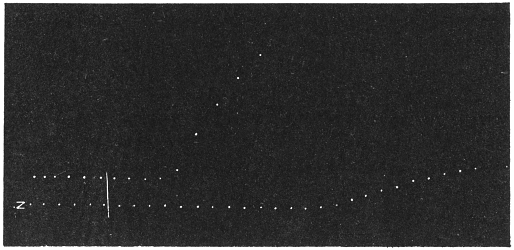
Fig. 41—Action of glycerine in enhancing the speed and intensity of transmitted
excitation. Stimulus applied at the vertical line. Successive dots in record are
at intervals of 0.1 sec.
Effect of application of glycerine: Experiment 35.—It is
known that desiccation, generally speaking, enhances the
excitability of the animal nerve. As glycerine, by absorption
of water, causes partial desiccation, I tried its effect
on conduction of excitation in the petiole of Mimosa.
Enhancement of conducting power may be exhibited in
two ways: first, by an increase of velocity of transmission;
and, secondly, by an enhancement of the intensity
of the transmitted excitation, which would give rise to a
greater amplitude of response of the motile indicator. In
Fig. 41 are given two records, N, before, and the other after
the application of glycerine on a length of petiole through
which excitation was being transmitted. The time-records
demonstrate conclusively the enhanced rate of transmission
after the application of glycerine. The increased intensity
of transmitted excitation is also seen in the enhanced
amplitude of response seen in the more erect curve in the
upper record.
Different specimens of Mimosa are found to exhibit
differences in physiological vigour. Some are in an optimum
condition, others in an unfavourable or sub-tonic
condition. I shall now describe certain characteristic
differences of conductivity exhibited by tissues in different
conditions.
Effect of intensity of stimulus on velocity of transmission.—In
a specimen at optimum condition, the velocity
remains constant under varying intensities of stimulus.
Thus the velocity of transmission in a specimen was determined
under a stimulus intensity of 0.5 unit; the next
determination was made with a stimulus of four times the
previous intensity, i.e., 2 units. In both these cases the
velocity remained constant. But when the specimen is in
a sub-tonic condition, the velocity is found to increase
with the intensity of the stimulus. Thus the velocity
of conduction of a specimen of Mimosa in a sub-tonic
condition was found to be 5.9 mm. per second under a
stimulus of 0.5 unit; with the intensity raised to 2.5
units, the velocity was enhanced to 8.3 mm. per second.
After-effect of stimulus.—In experimenting with a particular
specimen of Mimosa I found that on account of its
sub-tonic condition, the conducting power of the petiole
was practically absent. Previous stimulation was, however,
found to confer the power of conduction as an after-effect.
It is thus seen that stimulus canalises a path for
conduction.
The effect of excessive stimulus in a specimen in an
optimum condition is to induce a temporary depression of
conductivity; the effect of strong stimulus on a sub-tonic
specimen is precisely the opposite, namely, an enhancement
of conductivity. I give below accounts of two typical
experiments carried out with petiole-pulvinus preparation
of Mimosa. Excessive stimulation in these cases was caused
by injury.
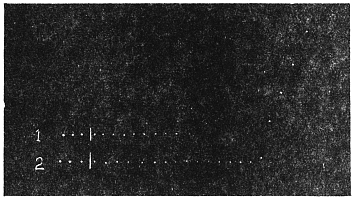
Fig. 42.—Effect of injury, depressing rate of conduction in normal specimen;
(1) record before, and (2) after injury. (Dot-intervals, 0.1 sec.).
Action of Injury on Normal Specimens: Experiment 36.—A
cut stem with entire leaf was taken, and stimulus applied
at a distance of 15 mm. from the pulvinus. From the
normal record (1) in Fig. 42 the velocity of transmission was
found to be 18.7 mm. per sec. The end of the petiole
beyond the point of application of the testing stimulus was
now cut off, and record of velocity of transmission
taken once more. It will be seen from record (2) that
the excessive stimulus caused by injury had induced a
depression in the conducting power, the velocity being
reduced to 10.7 mm. per sec. Excessive stimulation of
normal specimens is thus seen to depress temporarily the
conducting power.
Action of Injury on Sub-tonic Specimens: Experiment
37.—I will now describe a very interesting experiment which
shows how an identical agent may, on account of difference
in the tonic condition of the tissue, give rise to diametrically
opposite effects. In demonstrating this, I took a
specimen in a sub-tonic condition, in which the conducting
power of the tissue was so far below par, that the test-stimulus
applied at a distance of 15 mm. failed to be
transmitted (Fig. 43). The end of the petiole at a distance
of 1 cm. beyond the point of application of test-stimulus
was now cut off. The after-effect of this injury was
found to enhance the conducting power so that the stimulus
previously arrested was now effectively transmitted, the
velocity being 25 mm. per sec. This enhanced conducting
power began slowly to decline, and after half an hour
the velocity had declined to 4.1 mm. per sec. The end
of the petiole was cut once more, and the effect of injury
was again found to enhance the conducting power, the
velocity of transmission being restored to 25 mm. per sec.
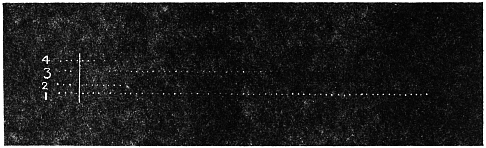
Fig. 43.—Effect of injury in enhancing the conducting power of a sub-normal
specimen; (1) Ineffective transmission becoming effective at (2) after
section; (3) decline after half an hour, and (4) increased conductivity
after a fresh cut.
There are two different types of propagation of excitation:
by convection, and by conduction. In the former the
excited cell undergoes deformation and causes mechanical
stimulation of the next; example of this type is seen in
the stamen of Berberis. The conduction of excitation consists,
on the other hand, of propagation of excitatory
protoplasmic change. The transmission in the petiole of
Mimosa is a phenomenon of conduction.
This conduction takes place along vascular elements.
The conductivity is very much greater in the longitudinal
than in the transverse direction.
Rise of temperature enhances, and fall of temperature
lowers, the rate of conduction. Excitation is transmitted
in both directions; the centrifugal velocity is greater than
the centripetal.
Dessication of conducting tissue by glycerine enhances
the conducting power. Local application of cold depresses
or arrests the conduction. Application of poison permanently
abolishes the power of conduction.
Conductivity is modified by the effect of season, being
higher in summer than in winter.
The power of conduction is also modified by age. In
young specimens the conducting power is low, the conductivity
is at its maximum in fully grown organs; but a
decline of conductivity sets in with age.
The tonic condition of a tissue has an influence on
conductivity. In an optimum condition, the velocity is the
same for feeble or strong stimulus. Excessive stimulation
induces a temporary depression of the conducting power.
The effects are different in a sub-tonic tissue: velocity
of transmission increases with intensity of stimulus; after-effect
of stimulus is to initiate or enhance the conducting
power. The conducting path is canalised by stimulus.
By
Sir J. C. Bose.
I have in my previous works[L] described investigations
on the conduction of excitation in Mimosa pudica. It was
there shown that the various characteristics of the propagation
of excitation in the conducting tissue of the plant
are in every way similar to those in the animal nerve.
Hence it appeared probable that any newly found phenomenon
in the one case was likely to lead to discovery of a
similar phenomenon in the other.
As the transmission of excitation is a phenomenon of
propagation of molecular disturbance in the conducting
vehicle, it appeared that the excitatory impulse could be
controlled by inducing in the conducting tissue two opposite
‘molecular dispositions’, using that term in the widest
sense. The possibility of accomplishing this by the directive
action of an electric current had attracted my attention for
many years.
I have previously carried out an electric method of investigation,
dealing with the influence of electric current
on conductivity. The method of Conductivity Balance which
I devised for this purpose[M] was found very suitable. Isolated
conducting tissues of certain plants were found to exhibit
transmitted effect of excitatory electric change of galvanometric
negativity, which at the favourable season of the
year was of sufficient intensity to be recorded by a sensitive
galvanometer. A long strand of the conducting tissue was
taken and two electric connections were made with a
galvanometer, a few centimetres from the free ends.
Thermal stimulus was applied at the middle, when two
excitatory waves with their concomitant electric changes
were transmitted outwards. By suitably moving the point
of application of stimulus nearer or further away from one
of the two electric contacts, an exact balance was obtained.
This was the case when the resultant galvanometer deflection
was reduced to zero. If now an electrical current be
sent along the length of the conducting tissue, the two
excitatory waves sent outwards from the central stimulated
point will encounter the electric current in different ways;
one of the excitatory waves will travel with, and the other
against the direction of the current. If the power of transmitting
excitation is modified by the direction of an electric current
then the magnitudes of transmitted excitations will be different
in the two cases, with the result of the upsetting of
the Conductivity Balance. From the results of experiments
carried out by this method on the effect of feeble
current on conductivity, the conclusion was arrived at that
excitation is better conducted against the direction of the
current than with it. In other words, the influence of an
electric current is to confer a preferential or selective direction
of conductivity for excitation, the tissue becoming a better
conductor in an electric up-hill direction compared with a
down-hill.
The results were so unexpected that I have for long been
desirous of testing the validity of this conclusion by independent
method of inquiry. I shall presently give full account
of the perfected method, and the various difficulties which
had to be overcome to render it practical. Before doing
this I shall describe a simple method which I have devised
for demonstrating the principal results.
The petiole of Averrhoa bilimbi has a large number of
paired leaflets, which, on excitation, undergo downward
closure. Feeble stimulus is applied at a point in the
petiole, and the transmission of excitation is visibly manifested
by the serial fall of the leaflets. The distance to
which the excitation reaches is a measure of normal power
of conduction. Any variation of conductivity, by the
passage of an electric current in one direction or the other
is detected by the enhancement or diminution of the distance
through which excitation is transmitted. I shall
describe the special precautions to be taken in carrying
out this investigation.
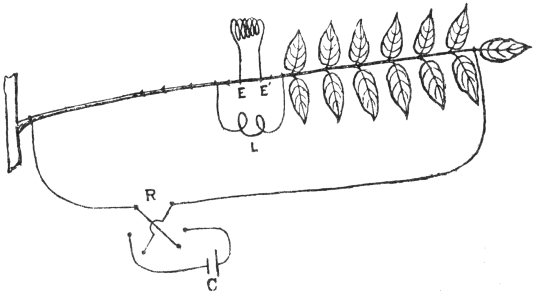
Fig. 44.—Diagram of experimental arrangement for control of transmitted excitation
in Averrhoa bilimbi. For explanation see text.
Electric stimulus of induction shock of definite intensity
and duration is supplied at the middle of the petiole at EE′
(Fig. 44). The leaflets to the left of E, are not necessary
for the purpose of this experiment and therefore removed.
The intensity of the induction shock may be varied in the
usual manner by removing the secondary coil nearer or
farther from the primary. The duration of the shock is
always maintained constant. On application of electric
stimulus excitation is transmitted along the petiole, the distance
of transmission depending on the intensity of stimulus.
With feeble stimulus two pairs of leaflets may undergo
an excitatory fall; with stronger stimulus the transmission
is extended to the end of the petiole, and all the leaflets
exhibit movements of closure. We shall now study the
modifying influence of a constant current on conduction
of excitation. C is an electric cell, R the reversing key
by which the electric current could be sent from right to
left or in the opposite direction. When the current is sent
from right to the left, the excitatory impulse initiated at
EE′ travels against the direction of the current in an
‘up-hill’ direction. When the current is reversed it flows
in the petiole from left to right and the transmitted
impulse travels with the current or in a ‘down-hill’
direction.
Two complications are introduced on the completion of
the electric circuit of the constant current: the first,
is the distributing effect of leakage of the induction
current used for excitation, and second, the polar variation
of excitation induced by the constant current.
Leakage of induction current.—Before completing the
constant current circuit, the alternating induction current
goes only through the path EE′. On completion of the
constant current circuit, the alternating induction current
not only passes through the shorter path EE′ but also by
the circuitous path of the constant current circuit. The
escaping induction current would thus excite all the
leaflets directly and not by its transmitted action.
This difficulty is fully overcome by the interposition of a
choking coil which will be described below. A simpler,
though less perfect, device may be employed to reduce and
practically eliminate the leakage. This consists of a loop,
L, of silver wire placed outside EE′. The leakage of induction
current is thus diverted along this path of negligible
resistance in preference to the longer circuit through the
entire petiole, which has a resistance of several million ohms.
Polar action of current on excitability.—It is well known
that an electric current induces a local depression of excitability
at the point of entrance to the tissue, or at the
anode, and an enhancement of excitability at the point of
exit, or at the cathode. But the excitability is unaffected at
a point equally distant from anode and cathode. This is
known as the indifferent point. The exciting electrodes
EE′ are placed at the indifferent point. But when the
current enters on the right side, the terminal leaflets to the
right have their excitability depressed by the proximity of
anode, but the leaflets near the electrodes EE′, being at
a distance from the anode are not affected by it. Moreover
it will be shown that the enhanced conductivity conferred
by the directive action of the current overpowers any
depression of excitability in the terminal leaflets due to
the proximity of the anode. I shall, for convenience, designate
the transmission as ‘up-hill’, when excitation is
propagated against the direction of the constant electric
current, and ‘down-hill’ when transmitted with the direction
of the current.
Transmission of excitation ‘Up-hill’: Experiment 38.—I
shall give here an account of an experiment which may be
taken as typical. I took a vigorous specimen of Averrhoa
bilimbi, and applied a stimulus whose intensity was so
adjusted that the propagated impulse brought about a fall
of only two pairs of leaflets. This gave a measure of
normal conduction without the passage of the current.
The constant electric current was now sent from right to
left. A necessary precaution is to increase the current gradually
by means of a suitable potentiometer slide, to its full
value. The reason for this will be given later. The intensity
of the constant current employed was 1.4 micro-ampères.
Now on exciting the petiole by the previous
stimulus, the conducting power was found to be greatly
enhanced. The excitatory impulse now reached the end of
the petiole, and caused six pairs of leaflets to fall.
Transmission of excitation ‘Down-hill’: Experiment 39.—In
continuation of the previous experiment, the constant
electric current was reversed, its directions being now from
left to right. Transmission of excitation was now in a
down-hill direction. On applying the induction shock stimulus
of the same intensity as before, the conducting power
of the petiole was found to be abolished, none of the
leaflets exhibiting any sign of excitation. This modification
of the conducting power persists during the passage of the
constant current. On cessation of the current the original
conducting power is found to be restored. It will thus be
seen that the power of conduction is capable of modification,
and that the passage of an electric current of
moderate intensity induces enhanced power of conduction
in an ‘up-hill’ and diminished conductivity in a ‘down-hill’
direction.
In my ‘Researches on Irritability of Plants’ I have
shown how intimately connected are the various physiological
reactions in the plant and in the animal, and I
ventured to predict that the recognition of this unity of
response in plant and animal will lead to further discoveries
in physiology in general. This surmise has been
fully justified, as will be seen in the following experiments
carried out on the nerve-and-muscle preparation of a
frog. It is best to carry out the experiments with vigorous
specimens; this ensures success, even in long continued
experiments, which can then be repeated with unfailing
certainty for hours. It is also an advantage to use a large
frog for its relatively great length of the nerve.
Directive action of current on conduction of excitation
in a nerve-and-muscle preparation: Experiment 40.—A
preparation was made with a length of the spine and two
nerves leading to the muscles. The specimen is supported
in a suitable manner, and electric connections made with
the toes, one for the entrance and the other for exit of
the constant current. The current thus entered, say, by
the left toe ascended the muscle and went up the nerve
on the left side, and descended through the other nerve on
the right side along the muscle and thence to the right
toe. Before the passage of the constant electric current
the spinal nerve was stimulated by an induction shock
of definite intensity. The nervous impulse was conducted
by the two nerves, one to the left and the other to the
right, and caused a feeble twitch of the respective muscles.
A feeble current of 1.5 micro-ampère was sent along the
nerve-and-muscle circuit, ascending by the left and descending
by the right side. It will be seen that excitation
initiated at the spine is propagated ‘against’ the
electric current on the left side, and ‘with’ the current
on the right side. On repetition of previous electric
stimulus the effect of directive action of current
was at once manifested by the left limb being thrown
into a state of strong tetanic contraction, whereas the right
limb remained quiescent. By changing the direction of
the constant current the induced enhancement of conductivity
of the nerve was quickly transferred from the
left to the right side, the depression or arrest of conduction
being simultaneously transferred to the left side.
Turning the reversing key one way or the other brought
about supra or non-conducting state of the nerve, and
this condition was maintained throughout the duration of
the current.
I shall next describe a more perfect method for obtaining
quantitative results both with plant and animal. In
order to demonstrate the universality of the phenomenon,
I next used Mimosa pudica instead of Averrhoa, for
experiments on plants.
For determination of normal velocity of transmission
of excitation and the induced variation of that velocity,
I employed the automatic method of recording the velocity
of transmission of excitation in Mimosa, where the excitatory
fall of the motile leaf gave a signal for the arrival
of the excitation initiated at a distant point. In this
method the responding leaf is attached to a light lever,
the writer being placed at right angles to it. The record
is taken on a smoked glass plate, which during its descent
makes an instantaneous electric contact, in consequence
of which a stimulating shock is applied at a given point
of the petiole. A mark in the recording plate indicates
the moment of application of stimulus. After a definite
interval the excitation is conducted to the responding pulvinus,
when the excitatory fall of the leaf pulls the writer
suddenly to the left. From the curve traced in this manner
the time-interval between the application of stimulus and
the initiation of response can be found, and the normal
rate of transmission of excitation through a given length
of the conducting tissue deduced. The experiment is then
repeated with an electric current flowing along the petiole
with or against the direction of transmission of excitation.
The records thus obtained enable us to determine the
influence of the direction of the current on the rate of
transmission. I shall presently describe the various difficulties
which have to be overcome before the method just
indicated can be rendered practical.
The scope of investigation will be best described according
to the following plan[N]:—
PART I.—INFLUENCE OF DIRECTION OF ELECTRIC CURRENT
ON CONDUCTION OF EXCITATION IN PLANTS.
General method of experiment.
Effect of feeble current on velocity of transmission of
excitation ‘up-hill’ or ‘down-hill.’
Determination of variation of conductivity by the
method of minimal stimulus and response.
The after-effect of current.
PART II.—INFLUENCE OF DIRECTION OF ELECTRIC CURRENT
ON CONDUCTION OF EXCITATION IN ANIMAL NERVE.
The method of experiment.
Variation of velocity of transmission under the action
of current.
Variation in the intensity of transmitted excitation.
PART I.—INFLUENCE OF DIRECTION OF CURRENT ON
TRANSMISSION OF EXCITATION IN PLANT.
THE METHOD OF EXPERIMENT.
I may here say a few words of the manner in which
the period of transmission can be found from the record
given by my Resonant Recorder, fully described in my
previous paper. The writer attached to the recording lever
of this instrument is maintained by electromagnetic means
in a state of to-and-fro vibration. The record thus consists
of a series of dots made by the tapping writer,
which is tuned to vibrate at a definite rate, say, 10 times
per second. In a particular case whose record is given in
Curve 1 (Fig. 46), indirect stimulus of electric shock was
applied at a distance of 15 mm. from the responding
pulvinus. There are 15 intervening dots between the
moment of application of stimulus and the beginning of
response; the time-interval is therefore 1.5 seconds. The
latent period of the motile pulvinus is obtained from a
record of direct stimulation; the average value of this in
summer is 0.1 second. Hence the true period of transmission
is 1.4 seconds for a distance of 15 mm. The velocity
determined in this particular case is therefore 10.7 mm.
per second.
Precaution has to be taken against another source of
disturbance, namely, the excitation caused by the sudden
commencement or the cessation of the constant current. I
have shown elsewhere[O] that the sudden initiation or cessation
of the current induces an excitatory reaction in the
plant-tissue similar to that in the animal tissue. This
difficulty is removed by the introduction of a sliding
potentiometer, which allows the applied electromotive force
to be gradually increased from zero to the maximum or
decreased from the maximum to zero.
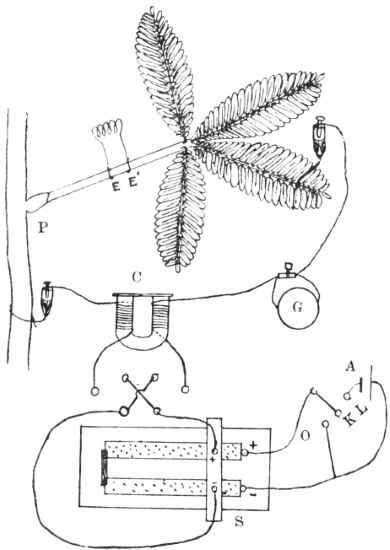
Fig. 45.—Complete apparatus for investigation of the variation of conducting
power in Mimosa. A, storage cell; S, potentiometer slide, which, by alternate
movement to right or left, continuously increases or decreases the applied
E.M.F.; K, switch key for putting current “on” and “off” without variation
of resistance; E, E′, electrodes of induction coil for stimulation; C, choking coil;
G, micro-ammeter.
The experimental arrangement is diagrammatically shown
in Fig. 45. After attaching the petiole to the recording
lever, indirect stimulus is applied, generally speaking, at
a distance of 15 mm. from the responding pulvinus. Stimulus
of electric shock is applied in the usual manner, by
means of a sliding induction coil. The intensity of the
induction shock is adjusted by gradually changing the
distance between the secondary and the primary, till a
minimally effective stimulus is found. In the study of the
effect of direction of constant current on conductivity, non-polarisable
electrodes make suitable electric connections,
one with the stem and the other with the tip of a sub-petiole
at a distance from each other of about 95 mm.
The point of stimulation and the responding pulvinus are
thus situated at a considerable distance from the anode or
the cathode, in the indifferent region in which there is no
polar variation of excitability. By means of a Pohl’s commutator
or reverser, the constant current can be maintained
either “with” or “against” the direction of transmission
of excitation. The transmission in the former case is
“down-hill,” and in the latter case “up-hill.” Electrical
connections are so arranged that when the commutator is
tilted to the right, the transmission is down-hill, when tilted
to the left, up-hill.
The electrical resistance offered by the 95 mm. length
of stem and petiole will be from two to three million ohms.
The intensity of the constant current flowing through the
plant can be read by unplugging the key which short-circuits
the micro-ammeter G. The choking coil C prevents
the alternating induction current from flowing into the
polarising circuit and causing direct stimulation of the
pulvinus.
Before describing the experimental results, it is as well
to enter briefly into the question of the external indication
by which the conducting power may be gauged. Change
of conductivity may be expected to give rise to a variation
in the rate of propagation or to a variation in the magnitude
of the excitatory impulse that is transmitted. Thus
we have several methods at our disposal for determining
the induced variation of conductivity. In the first place
the variation of conductivity may be measured by the induced
change in the velocity of transmission of excitation.
In the second place, the transmitted effect of a sub-maximal
stimulus will give rise to enhanced or diminished amplitude
of mechanical response, depending on the increase or
decrease of conductivity brought about by the directive
action of the current. And, finally, the enhancement or
depression of conductivity may be demonstrated by the
ineffectively transmitted stimulus becoming effective, or the
effectively transmitted stimulus becoming ineffective.
Exclusion of the factor of Excitability.—The object of
the enquiry being the pure effect of variation of conductivity,
we have to assure ourselves that under the particular
conditions of the experiment the complicating factor of
polar variation of excitability is eliminated. It is to be
remembered that excitatory transmission in Mimosa takes
place by means of a certain conducting strand of tissue
which runs through the stem and the petiole. In the
experiment to be described, the constant current enters by
the tip of the petiole and leaves by the stem, or vice versâ,
the length of the intrapolar region being 95 mm. The
point of application of stimulus on the petiole is 40 mm.
from the electrode at the tip of the leaf. The responding
pulvinus is also at the same distance from the electrode
on the stem. The point of stimulation and region of response
are thus at the relatively great distance of 40 mm.
from either the anode or the cathode, and may therefore be
regarded as situated in the indifferent region. This is
found to be verified in actual experiments.
A very convincing method of demonstrating the influence
of electric current on conductivity consists in the
determination of changes induced in the velocity of transmission
by the directive action of the current. For this
purpose we have to find out the true time required by the
excitation to travel through a given length of the conducting
tissue (1) in the absence of the current, (2) ‘against’
and (3) ‘with’ the direction of the current. The true time
is obtained by subtracting the latent period of the pulvinus
from the observed interval between the stimulus and response.
Now the latent period may not remain constant,
but undergo change under the action of the polarising
current. It has been shown that the excitability of the
pulvinus does not undergo any change when it is situated
in the middle or indifferent region. The following results
show that under parallel conditions the latent period also
remains unaffected:—
TABLE V.—SHOWING THE EFFECT OF ELECTRIC CURRENT ON THE LATENT
PERIOD.
| Specimens | I. | II. |
| sec. | sec. |
| Latent period under normal condition | 0.10 | 0.09 |
| " " " current from right to left | 0.11 | 0.10 |
| " " " current from left to right | 0.09 | 0.09 |
The results of experiments with two different specimens
given above show that a current applied under the given
conditions has practically no effect on the latent period,
the slight variation being of the order of one-hundredth
part of a second. This is quite negligible when the total
period observed for transmission is, as in the following
cases, equal to nearly 2 seconds.
Induced changes in the Velocity of Transmission.—Having
found that the average value of the latent period in summer
is 0.1 second, we next proceed to determine the influence
of the direction of current on velocity.
Experiment 41.—As a rule, stimulus of induction shock was
applied in this and in the following experiments on the petiole
at a distance of 15 mm. from the responding pulvinus. The
recording writer was tuned to 10 vibrations per second; the
space between two succeeding dots, therefore, represents a
time-interval of 0.1 second. The middle record, N in Fig. 46,
is the normal. There are 17 spaces between the application
of stimulus and the beginning of response. The total time
is therefore 1.7 seconds, and by subtracting from it the latent
period of 0.1 second we obtain the true time, 1.6 seconds.
The normal velocity is found by dividing the distance 15 mm.
by the true interval 1.6 seconds. Thus V = 1 5/1.6 =
9.4 mm. per second. We shall next consider the effect of
current in modifying the normal velocity. The uppermost
record (1) in Fig. 46 was taken under the action of an
‘up-hill,’ or ‘against’ current of the intensity of 1.4 microampères.
It will be seen that the time interval is reduced
from 1.7 seconds to 1.4 seconds; making allowance for the
latent period, the velocity of transmission under ‘up-hill’
current V1 = 1 5/1.3 = 11.5 mm. per second. In the lowest
record (3) we note the effect of ‘down-hill’ current, the
time-interval between stimulus and response being prolonged
to 1.95 seconds and the velocity reduced to 8.1 mm. per
second. The conclusion arrived at from this mechanical
mode of investigation is thus identical with that derived
from the electric method of conductivity balance referred
to previously.
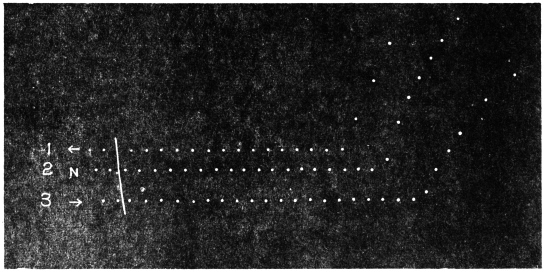
Fig. 46.—Record showing enhancement of velocity of transmission “up-hill” or
against the current (uppermost curve) and retardation of velocity “down-hill” or
with the current (lowest curve). N, normal record in the absence of current;
← indicates “up-hill” and → “down-hill” transmission.
That is to say, the passage of a feeble current modifies
conductivity for excitation in a selective manner. Conductivity
is enhanced against, and diminished with, the
direction of the current.
The minimum current which induces a perceptible change
of conductivity varies somewhat in different specimens.
The average value of this minimal current in autumn is
1.4 microampères. The effect of even a feebler current
may be detected by employing a test stimulus which is
barely effective.
TABLE VI.—SHOWING EFFECTS OF UP-HILL AND DOWN-HILL CURRENTS OF
FEEBLE INTENSITY ON PERIOD OF TRANSMISSION THROUGH 15 MM.
| Number. | Intensity of current
in microampères. | Period for up-hill
transmission. | Period for down-hill
transmission. |
| 1 | 1.4 | 14 tenths of a second | 16 tenths of a second |
| 2 | 1.4 | 13 " " | 15 " " |
| 3 | 1.6 | 19 " " | Arrest. |
| 4 | 1.7 | 12 " " | 14 tenths of a second |
Having demonstrated the effect of direction of current
on the velocity of transmission, I shall next describe other
methods by which induced variations of conductivity may
be exhibited.
In this method we employ a minimal stimulus, the
transmitted effect of which under normal conditions gives
rise to a feeble response. If the passage of a current
in a given direction enhances conductivity, then the
intensity of transmitted excitation will also be enhanced;
the minimal response will tend to become maximal.
Or excitation which had hitherto been ineffectively transmitted
will now become effectively transmitted. Conversely,
depression of conductivity will result in a diminution
or abolition of response. We may use a single
break-shock of sufficient intensity as the test stimulus. It is,
however, better to employ the additive effect of a definite
number of feeble make-and-break shocks.
We may again employ additive effect of a definite
number of induction shocks, the alternating elements of
which are exactly equal and opposite. This is secured
by causing rapid reversals of the primary current by
means of a rotating commutator. The successive induction
shocks of the secondary coil can thus be rendered exactly
equal and opposite.
Experiment 42.—Working in this way, it is found that
the transmitted excitation against the direction of current
becomes effective or enhanced under ‘up-hill’ current. A
current, flowing with the direction of transmission, on the
other hand, diminishes the intensity of transmitted excitation
or blocks it altogether.
Henceforth it would be convenient to distinguish currents
in the two directions: the current in the direction of transmission
will be distinguished as Homodromous, and against
the direction of transmission as Heterodromous.
The passage of a current through a conducting tissue in
a given direction causes, as we have seen, an enhanced
conductivity in an opposite direction. We may suppose this
to be brought about by a particular molecular arrangement
induced by the current, which assisted the propagation of
the excitatory disturbance in a selected direction. On the
cessation of this inducing force, there may be a rebound
and a temporary reversal of previous molecular arrangement,
with concomitant reversal of the conductivity variation.
The immediate after-effect of a current flowing in a
particular direction on conductivity is likely to be a transient
change, the sign of which would be opposite to that
of the direct effect. The after-effect of a heterodromous
current may thus be a temporary depression, that of a
homodromous current, a temporary enhancement of conductivity.
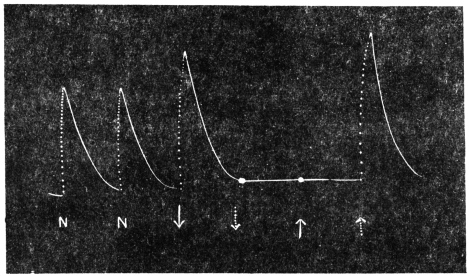
Fig. 47.—Direct and after-effect of heterodromous and homodromous currents.
First two records, N, N, normal. ↓, enhanced transmission under heterodromous
current; ⇣ arrest of conduction is an after-effect of heterodromous
current. Next record ↑ shows arrest under homodromous current. Last
record ⇡ shows enhancement of conduction greater than normal, as an after-effect
of homodromous current. (Dotted arrow indicates the after-effect on
cessation of a given current. ↑ homodromous and ↓ heterodromous current.)
Experiment 43.—This inference will be found fully
justified in the following experiment:—The first two responses
are normal, after which the heterodromous current
gave rise to an enhanced response. The depressing after-effect
of a heterodromous current rendered the next response
ineffective. The following record taken during the
passage of the homodromous current exhibited an abolition
of response due to induced depression of conductivity.
Finally, the after-effect of the homodromous current is seen
to be a response larger than the normal (Fig. 47). These
experiments show that the after-effect of cessation of a
current in a given direction is a transient conductivity
variation, of which the sign is opposite to that induced by
the continuation of the current.
PART II—INFLUENCE OF DIRECTION OF ELECTRIC CURRENT
ON CONDUCTION OF EXCITATION IN ANIMAL NERVE.
I shall now take up the question whether an electric
current induced any selective variation of conductivity in
the animal nerve, similar to that induced in the conducting
tissue of the plant.
THE METHOD OF EXPERIMENT.
In the experiments which I am about to describe,
arrangements were specially made so that (1) the excitation
had not to traverse the polar region, and (2) the
point of stimulation was at a relatively great distance
from either pole. The fulfilment of the latter condition
ensured the point of stimulation being placed at the
neutral region.
In the choice of experimental specimens I was fortunate
enough to secure frogs of unusually large size, locally
known as “golden frogs” (Rana tigrina). A preparation
was made of the spine, the attached nerve, the muscle
and the tendon. The electrodes for constant current were
applied at the extreme ends, on the spine and on the
tendon (Fig. 48). The following are the measurements, in
a typical case, of the different parts of the preparation.
Length of spine between the electrode and the nerve
= 40 mm. length of nerve = 90 mm. length of muscle =
50 mm. length of tendon = 30 mm. Stimulus is applied
in all cases on the nerve, midway between the two electrodes
this point being at a minimum distance of 100 mm.
from either electrode. The point of stimulation is, therefore,
situated at an indifferent region.
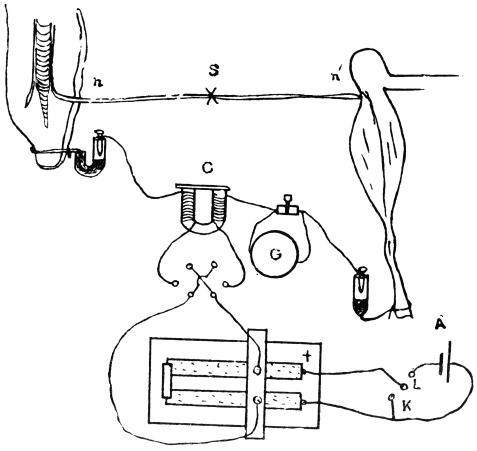
Fig. 48.—Experimental arrangement for study of variation of conductivity of
nerve by the directive action of an electric current. n n′, nerve; S, point of
application of stimulus in the middle or indifferent region.
Great precautions have to be taken to guard against
the leakage of current. The general arrangement for the
experiment on animal nerve is similar to that employed
for the corresponding investigations on the plant. The
choking coil is used to prevent the stimulating induction
current from getting round the circuit of constant current.
The specimen is held on an ebonite support, and every
part of the apparatus insulated with the utmost care.
In the case of the conducting tissue of the plant a
very striking proof of the influence of the direction of current
on conductivity was afforded by the induced variation
of velocity of transmission. Equally striking is the
result which I have obtained with the nerve of the frog.
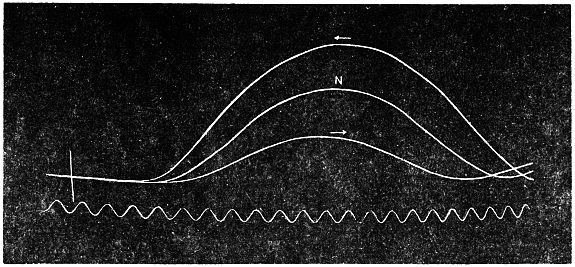
Fig. 49.—Effect of heterodromous and homodromous current in inducing variation
in velocity of transmission through nerve. N, normal record, upper record shows
enhancement, and lower record retardation in velocity of transmission under
heterodromous and homodromous currents, respectively.
Experiment 44.—The experiments described below were
carried out during the cold weather. The following records
(Fig. 49), obtained by means of the pendulum myograph,
exhibit the effect of the direction of current on
the period of transmission through a given length of nerve.
The latent period of muscle being constant, the variations
in the records exhibit changed rates of conduction. The
middle record is the normal, in the absence of any current.
The upper record, denoted by the left-hand arrow, shows
the action of a heterodromous current in shortening the
period of transmission and thus enhancing the velocity
above the normal rate. The lower record, denoted by
the right-hand arrow, exhibits the effect of a homodromous
current in retarding the velocity below the normal
rate. I find that a very feeble heterodromous current is
enough to induce a considerable increase of velocity, which
soon reaches a limit. For inducing retardation of velocity, a
relatively strong homodromous current is necessary. I give
below a table showing the results of several experiments.
TABLE V—EFFECT OF HETERODROMOUS AND HOMODROMOUS CURRENT OF
FEEBLE INTENSITY ON VELOCITY OF TRANSMISSION.
| Specimen. | Intensity of
heterodromous
current. | Acceleration
above normal. | Intensity of
homodromous
current. | Retardation
below normal. |
| microampère | per cent. | microampères | per cent. |
| 1 | 0.35 | 16 | 1.0 | 20 |
| 2 | 0.70 | 13 | 1.5 | 19 |
| 3 | 0.80 | 18 | 2.0 | 14 |
| 4 | 0.80 | 11 | 2.0 | 13 |
| 5 | 1.00 | 18 | 2.5 | 12 |
| 6 | 1.50 | 15 | 3.0 | 40 |
In the next method of investigation, the induced variation
of intensity of transmitted excitation is inferred from
the varying amplitude of response of the terminal muscle.
Testing stimulus of sub-maximal intensity is applied at the
middle of the nerve, where the constant current induces no
variation of excitability. Stimulation is effected either by
single break-shock or by the summated effects of a definite
number of equi-alternating shocks, or by chemical stimulation
Experiment 45.—Under the action of feeble heterodromous
current the transmitted excitation was always enhanced,
whatever be the form of stimulation. This is seen
illustrated in Fig. 50. Homodromous current on the other
hand inhibited or blocked excitation (Fig. 51).
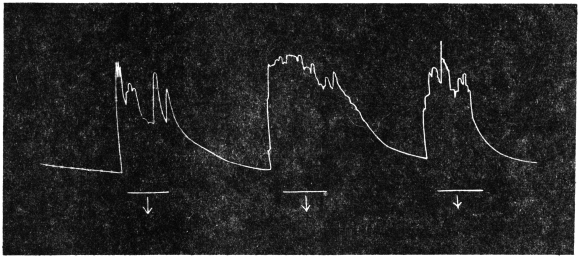
Fig. 50.—Ineffectively transmitted salt-tetanus becoming effective under heterodromous
current, denoted by down-pointing arrow.
Complication due to variation of Excitability of Muscle.—In
experiments with the plant, there was the unusual
advantage in having both the point of stimulation and the
responding motile organ in the middle or indifferent region.
Unfortunately this ideally perfect condition cannot be
secured in experiments with the nerve-and-muscle preparation
of the frog. It is true that the point of stimulation
in this case is chosen to lie on the nerve at the middle
or indifferent region. But the responding muscle is at
one end, not very distant from the electrode applied on
the tendon. It is, therefore, necessary to find out by
separate experiments any variation of excitability that
might be induced in the muscle by the proximity of either
the anode or the cathode, and make allowance for such
variation in interpreting the results obtained from investigations
on variation of conductivity.
In the experimental arrangement employed, the heterodromous
current is obtained by making the electrode on
the spine cathode and that on the tendon anode. The
depressing influence of the anode in this case may be
expected to lower, to a certain extent, the normal excitability
of the responding muscle. Conversely, with homodromous
current, the tendon is made the cathode and under
its influence the muscle might have its excitability raised
above the normal. These anticipations are fully supported
by results of experiments. Sub-maximal stimulus of equi-alternating
induction shock was directly applied to the
muscle and records taken of (1) response under normal condition
without any current, (2) response under heterodromous
current, the tendon being the anode, and (3) response
under homodromous current, the tendon being now made
the cathode. It was thus found that under heterodromous
current the excitability of the muscle was depressed, and
under homodromous current the excitability was enhanced.
The effect of current on response to direct stimulation
is thus opposite to that on response to transmitted excitation,
as will be seen in the following Table.
TABLE VIII.—INFLUENCE OF DIRECTION OF CURRENT ON DIRECT AND
TRANSMITTED EFFECTS OF STIMULATION.
| Direction of current. | Transmitted excitation. | Direct stimulation. |
| Heterodromous current | Enhanced response | Depressed response |
| Homodromous current | Depressed response | Enhanced response |
The passage of a current, therefore, induces opposing
effects on the conductivity of the nerve and the excitability
of the muscle, the resulting response being due to
their differential actions. Under heterodromous current a
more intense excitation is transmitted along the nerve, on
account of induced enhancement of conductivity. But this
intense excitation finds the responding muscle in a state
of depressed excitability. In spite of this the resulting
response is enhanced (Fig. 50). The enhancement of conduction
under heterodromous current is, in reality, much
greater than is indicated in the record. Similarly, under
homodromous current the depression of conduction in the
nerve may be so great as to cause even an abolition of
response, in spite of the enhanced excitability of the
muscle (Fig. 51). The actual effects of current on conductivity
are, thus, far in excess of what are indicated in the
records.
On the cessation of a current there is induced in the
plant-tissue a transient conductivity change of opposite
sign to that induced by the direct current (cf. Expt. 43).
The same I find to be the case as regards the after-effect
of current on conductivity change in animal nerve. Of
this I only give a typical experiment of the direct and
after-effect of homodromous current on salt-tetanus.
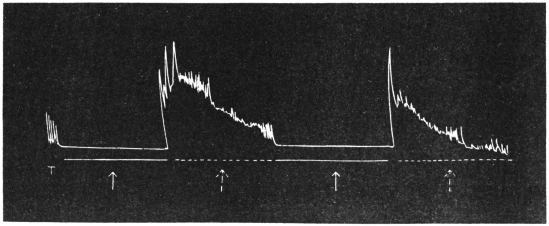
Fig. 51.—Direct and after-effect of homodromous current. Transmitted excitation
(salt-tetanus T,) arrested under homodromous current denoted by up-pointing
arrow; on cessation of current represented by dotted line there is a transient
enhancement above the normal.
Experiment 46.—In this experiment sufficient length of
time was allowed to elapse after the application of the salt
on the nerve, so that the muscle, in response to the transmitted
excitation, exhibited an incomplete tetanus T. The
homodromous current was next applied, with the result of
inducing a complete block of conduction, with the
concomitant disappearance of tetanus. The homodromous
current was gradually reduced to zero by the appropriate
movement of the potentiometer slide. The after-effect of
homodromous current is now seen in the transient enhancement
of transmitted excitation, which lasted for nearly
40 seconds. After this the normal conductivity was restored.
Repetition of the experiment gave similar results (Fig. 51).
The results that have been given are only typical of
a very large number, which invariably supported the
characteristic phenomena that have been described.
It will thus be seen that with feeble or moderate
current, conductivity is enhanced against the direction
of the current and depressed or blocked with the direction
of the current. Under strong current the normal effect is
liable to undergo a reversal.
It has thus been shown that a perfect parallelism exists
in the conductivity variation induced in the plant and in
the animal by the directive action of the current. No
explanation could be regarded as satisfactory which is not
applicable to both cases. Now with the plant we are
able to arrange the experimental condition in such a way
that the factor of variation of excitability is completely
eliminated. The various effects described about the plant-tissue
are, therefore, due entirely to variation of conductivity.
The parallel phenomena observed in the case of
transmission of excitation in the animal nerve must, therefore,
be due to the induced change of conductivity.
The action of an electrical current in inducing variation
of conductivity may be enunciated under the following
laws, which are equally applicable to the conducting
tissue of the plant and the nerve of the animal:—
1. The passage of a current induces a variation of conductivity,
the effect depending on the direction and intensity
of current.
2. Under feeble intensity, heterodromous current enhances, and
homodromous current depresses, the conduction of excitation.
3. The after-effect of a feeble current is a transient conductivity
variation, the sign of which is opposite that
induced during the continuation of current.
The variation of conductivity induced by the directive
action of current has been investigated by two different
methods:—
(1) The method in which the normal speed and its
induced variation are automatically recorded;
(2) That in which the variation in the intensity of
transmitted excitations is gauged by the varying
amplitudes of resulting responses.
The great difficulty arising from leakage of the exciting
induction current into the polarising circuit was
successfully overcome by the interposition of a choking
coil.
The following summarises the effects of direction and
intensity of an electric current, on transmission of excitation
through the conducting tissue of the plant.
The velocity of transmission is enhanced against the
direction of a feeble current, and retarded in the direction
of the current.
Feeble heterodromous current enhances conductivity,
homodromous current, on the other hand, depresses it.
Ineffectively transmitted excitation becomes effectively
transmitted under heterodromous current. Effectively transmitted
excitation, on the other hand, becomes ineffectively
transmitted under the action of homodromous current.
The after-effect of a current is a transient conductivity
change, the sign of which is opposite to that induced
during the passage of current. The after-effect of a heterodromous
current is, thus, a transient depression, that of
homodromous current, a transient enhancement of conductivity.
The characteristic variations of conductivity induced in
animal nerve by the direction and intensity of current are
in every way similar to those induced in the conducting
tissue of the plant.
These various effects are demonstrated by the employment
of not one, but various kinds of testing stimulus,
such as the excitation caused (1) by a single break-induction
shock or (2) by a series of equi-alternating
tetanising shocks or (3) by chemical stimulation.
By
Sir J. C. Bose,
Assisted by
Guruprasanna Das, L.M.S.
The leaf of Mimosa pudica undergoes an almost
instantaneous fall when the stimulus is applied directly on
the pulvinus which is the responding organ. The latent
period, i.e., the interval between the application of stimulus
and the resulting response is about 0.1 second. Indirect
stimulus, i.e., application of stimulus at a distance from the
pulvinus, also causes a fall of the leaf; but a longer
interval will elapse between the incidence of stimulus and
the response; for it will take a definite time for the
excitation to be conducted through the intervening tissue.
I have already shown that this conduction of excitation
in plant is analogous to the transmission of nervous
impulse in animal.
The power of conduction varies widely in different
plants. In the petiole of Mimosa pudica the velocity may
be as high as 30 mm. per second. In the stem the
velocity is considerably less, i.e., about 6 mm. per
second in the longitudinal direction; but conduction across
the stem is a very much slower process. In the petiole of
Averrhoa the longitudinal velocity is of the order of 1 mm.
per second.
The record of the transmitted effect of stimulus is found
to exhibit a remarkable preliminary variation. This was
detected by my delicate recorders, which gave magnifications
from fifty to hundred times. I shall give a detailed
account of a typical experiment carried out with Averrhoa
carambola, which will bring out clearly the characteristic
effects of Indirect Stimulus.
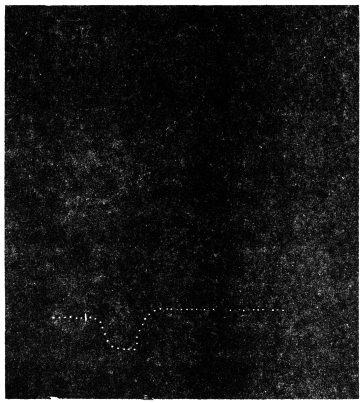
Fig. 52.—Effect of indirect Stimulus on leaflet of Averrhoa carambola. Stimulus
was applied at the short vertical line. Successive dots at intervals of
one second. Note the positive response preceding the negative.
Experiment 47.—Stimulus of electric shock applied at a
point on the long petiole of Averrhoa causes successive fall
of pairs of leaflets. In the experiment to be described one
of the leaflets of the plant was attached to the recorder.
Stimulus was applied at a distance of 50 mm. The successive
dots in the record are at intervals of a second. It
will be noticed that two distinct impulses—a positive and
a negative—were generated by the action of Indirect Stimulus.
The positive impulse reached the responding organ
after 1.5 second and caused an erectile movement. The
velocity of the positive impulse in the present case is 33 mm.
per second. The normal excitatory negative impulse
reached the motile organ 44 seconds after the application
of stimulus, and caused a very rapid fall of the leaflet, the
fall being far more pronounced than the positive movement
of erection (Fig. 52). In this and in all subsequent records,
the positive and negative responses offer a great contrast.
The movement in response to positive reaction is slow,
whereas that due to negative reaction is very abrupt, almost
‘explosive,’ the successive dots being now very wide apart.
As regards the velocity of impulse the relation is reversed,
the positive being the quicker of the two. In the
present case, the velocity of the excitatory negative impulse
is 1.1 mm. per second, as against 33 mm. of the positive
impulse.
The negative impulse is due to the comparatively slow
propagation of the excitatory protoplasmic change, which
brings about a diminution of turgor in the pulvinus and
fall of the responding leaflet. The erectile movement of
the leaflet by the positive impulse must be due to an
increase of turgor, brought on evidently, by the forcing
in of water. This presupposes a forcing out of water somewhere
else, probably at the point of application of stimulus.
It may be supposed that an active contraction occurred
in plant cells under direct stimulus, in consequence of
which water was forced out giving rise to a hydraulic
wave. On this supposition the positive impulse is to be
regarded as hydro-mechanical. I have, however, not yet
been able to devise a direct experimental test to settle the
question.
In the last experiment the stimulus was applied at the
moderate distance of 50 mm. Let us now consider the
respective effects, first, of an increase, and second, of a
decrease of the intervening distance. In a tissue whose
conducting power is not great, the excitatory impulse is
weakened, even to extinction in transmission through a long
distance. Thus the negative impulse may fail to reach
the responding organ, when the stimulus is feeble or the
intervening distance long or semi-conducting. Hence, under
the above conditions, stimulus applied at a distance will
give rise only to a positive response.
A reduction of the intervening distance will give rise
to a different result. As the negative response is the more
intense of the two, the feeble positive will be masked by
the superposed negative. The separate exhibition of the two
responses is only possible by a sufficient lag of the negative
impulse behind the positive. This lag increases with
increase of length of transmission and decreases with the
diminution of the length. Hence the application of stimulus
near the responding organ will give rise only to a
negative response, in spite of the presence of the positive,
which becomes masked by the predominant negative.[P]
These inferences have been fully borne out by results of
experiments carried out with various specimens of plants
under the action of diverse forms of stimuli. In all cases,
application of stimulus at a distance causes a pure positive
response; moderate reduction of the distance induces a
diphasic response—a positive followed by a negative; further
diminution of distance gives rise to a resultant negative
response, the positive being masked by the predominant
negative.
From what has been said it will be understood that
the exhibition of positive response is favoured by the conditions,
that the transmitting tissue should be semi-conducting,
and the stimulus feeble. It is thus easier to exhibit
the positive effect with the feebly conducting petiole
of Averrhoa than with the better conducting petiole of
Mimosa. It is, however, possible to obtain positive response
in the Mimosa by application of indirect stimulus to the
stem in which conduction is less rapid than in the petioles.
TABLE IX.—PERIODS OF TRANSMISSION OF POSITIVE AND NEGATIVE
IMPULSES IN THE PETIOLE OF AVERRHOA AND STEM OF MIMOSA.
| No. | Specimen | Distance
in mm. | Stimulus | Transmission
period for
positive
impulse. | Transmission
period for
negative
impulse. |
| 1 | Averrhoa | 70 | Thermal | 22.0secs | 65 secs. |
| 2 | " | 130 | " | 40.0 " | 95 " |
| 3 | " | 10 | Induction-shock | 6.0 " | 20 " |
| 4 | " | 20 | " | 14.0 " | 48 " |
| 5 | " | 35 | Chemical | 21.0 " | 50 " |
| 6 | Mimosa | 5 | Induction-shock | 0.5 " | 12 " |
| 7 | " | 10 | " | 0.6 " | 9.4 " |
| 8 | " | 20 | " | 1.1 " | 10 " |
| 9 | " | 60 | " | 2.0 " | 29 " |
| 10 | " | 35 | Chemical | 5.0 " | 17 " |
From the results given in course of the Paper we are
able to formulate the following laws about the effects of
Direct and Indirect Stimulus on pulvinated organs:—
1. Effect of all forms of Direct stimulus is a diminution of
turgor, a contraction and a negative mechanical
response.
2. Effect of Indirect stimulus is an increase of turgor, an
expansion and a positive mechanical response.
3. Prolonged application of indirect stimulus of moderate intensity
gives rise to a diphasic, positive mechanical
response followed by the negative.
4. If the intervening tissue be highly conducting, the transmitted
positive effect becomes masked by the predominant
negative.
The laws of Effects of Direct and Indirect stimulus
hold good not merely in the case of sensitive plants, but
universally for all plants. This aspect of the subject will
be treated in fuller detail in later Papers of this series.
By
Sir J. C. Bose
Assisted by
Guruprasanna Das.
In experiments with different pulvinated organs, great
difference is noticed as regards their excitability. If electric
shock of increasing intensity from a secondary coil
be passed through the pulvini of Mimosa, Neptunia, and
Erythrina arranged in series, it would be found that
Mimosa would be the first to respond; a nearer approach
of the secondary coil to the primary would be necessary
for Neptunia to show sign of excitation. Erythrina would
require a far greater intensity of electric shock to induce
excitatory movement. Organs of different plants may thus
be arranged, according to their excitability, in a vertical
series, the one at the top being the most excitable. The
specific excitability of a given organ is different in different
species.
In addition to this characteristic difference, an identical
organ may, on account of favourable or unfavourable
conditions, exhibit wide variation in excitability. Thus
under favourable conditions of light, warmth and other
factors, the excitability of an organ is greatly enhanced.
In the absence of these favourable tonic conditions the
excitability is depressed or even abolished. I shall, for
convenience, distinguish the different tonic conditions of
the plant as normal, hyper-tonic and sub-tonic. In the first
case, stimulus of moderate intensity will induce excitation;
in the second, the excitability being exceptionally high,
very feeble stimulus will be found to precipitate excitatory
reaction. But a tissue in a sub-tonic condition will require
a very strong stimulus to bring about excitation. The
excitability of an organ is thus determined by two factors:
the specific excitability, and the tonic condition of the
tissue.
A muscle contracts under stimulus; this is assumed to
be due to some explosive chemical change which leaves
the tissue in a condition less capable of functioning, or
in a condition below par. Herring designates this as a
process of dissimilation. The excitability of the muscle is
restored after suitable periods of rest, by the opposite
metabolic change of assimilation. “Assimilation and Dissimilation
must be conceived as two closely interwoven processes,
which constitute the metabolism (unknown to us
in its intrinsic nature) of the living substance. Excitability
diminishes in proportion with the duration of D-stimulus,
or, as it is usually expressed, the substance fatigues
itself. It is perfectly intelligible that a progressive fatigue
and decrement of the magnitude of contraction must ensue.
The only point that is difficult to elucidate is the initial
staircase increment of the twitches, more especially in
excised, bloodless muscle, which seems in direct contradiction
with the previous theory.”[Q]
With reference to Herring’s theory given above, Bayliss
in his “Principles of General Physiology” (1915), page 377
says, “In the phenomenon of metabolism, two processes
must be distinguished, the building up of a complex system
or substance of high potential energy, ‘anabolism,’ and the
breaking down of such a system, ‘catabolism,’ giving off
energy in other forms. The tendency of much recent
work, however, is to throw doubt on the universality of
this opposition of anabolism and catabolism as explanatory
of physiological activity in general.”
The results obtained with the response of plants to stimulus
may perhaps throw some light on the obscurities
that surround the subject. They show that the two processes
may be present simultaneously, and that the ‘down’
change induced by stimulus may, in certain instances, be
more than compensated by the ‘up’ change.[R] I shall, for
convenience, designate the physico-chemical modification, associated
with the excitatory negative mechanical and electrical
response of plants, as the “D” change; this is attended
by run down of energy. The positive mechanical and
electrical response must therefore connote opposite physico-chemical
change, with increase of potential energy. This I
shall designate as the “A” change, which by increasing the
latent energy, enhances the functional activity of the tissue.
That stimulus may give rise simultaneously to both A, and
D, effects, finds strong support in the dual reactions exhibited
in plant-response. Under indirect stimulus, the two
responses are seen separately, the more intense negative
following the feeble positive. When by the reduction of
the intervening distance, stimulus is made direct, the resultant
response, as previously stated, is negative; and this is
due not to the total absence of the positive but to its
being masked by the predominant negative. Let us next
consider the question of unmasking this positive element
in the resultant negative response.
Under favourable conditions of the environment, the excitability
of the organs is at its maximum. A given
stimulus will bring about an intense excitation, and the
‘down’ D-change will therefore be very much greater than
the A-change. Let us now consider the case at the opposite
extreme where, owing to unfavourable condition, the excitability
is at its lowest. Under stimulus the excitatory D-change
will now be relatively feeble compared to the A-change,
by which the potential energy of the system becomes
increased. In such a case successive stimuli will increase the
functional activity of the tissue, and bring about staircase
response. Biedermann mentions the staircase response of
excised bloodless muscle as offering difficulty of explanation.
It is obvious that the physiological condition of the excised
muscle must have fallen below par. The staircase response
in such a tissue is thus explained from considerations that
have just been adduced.
The results obtained with Mimosa not only corroborate
them, but add incontestable proof of the simultaneous existence
of both A and D changes. The physiological condition
of a plant, Mimosa for example, is greatly modified by the
favourable or unfavourable condition of the environment. In
a hyper-tonic condition its excitability becomes very great;
in this condition the plant responds to its maximum even
under very feeble stimulus. Here the D-change is relatively
great, and successive responses are apt to show sign of
fatigue.
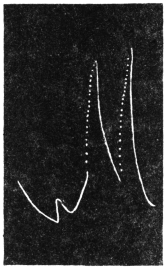
Fig. 53.—Record showing
the effect of stimulus modifying
tonicity and producing
staircase effect. (Mimosa)
But the plant in a sub-tonic condition will exhibit
feeble or no excitation. The D-change will be absent
while the A-change will take place under the action of
stimulus. This, by increasing the potential energy, will
enhance the functional activity of the tissue.
Staircase response in Mimosa: Experiment 48.—The
theoretical considerations will be
found experimentally verified in the
record obtained with a specimen of
Mimosa in a sub-tonic condition
(Fig. 53). Owing to the lack of
favourable ‘tone’ the leaf was relaxing
as seen in the first part of the
curve. The stimulus of electric
shock, applied at the thick dot in
the curve slanting downwards, gave
no response but raised the tone of
the tissue by arresting the growing
relaxation. Subsequent stimuli gave
rise to staircase responses. Stimulus
has, through the A-effect, raised the
functional activity of the tissue to
a maximum.
It has been shown that while favourable tonic condition
has the effect of raising the excitability and enhancing
the negative response with the associated D-change, a condition
of sub-tonicity, on the other hand, induces depression
of excitability, a diminution of negative response and of the
attendant D-change. In this condition the positive element
in the response with the A-change will come into greater
prominence. These considerations led me to experiment with
specimens exhibiting increasing sub-tonicity, with a view of
unmasking the positive element in the response, i.e., the
A-change. In the last experiment a specimen was found
which happened to be in a sub-tonic condition on account
of the unfavourable condition of its surroundings. I was
next desirous of securing specimens in which I could induce
increasing sub-tonicity at will.
I have shown (Expt. 23) that a detached branch of
Mimosa can be kept alive for several days with the
cut end immersed in water. In this condition the pulvinus
retains its sensitiveness for more than two days.
The excitability undergoes a continuous decline and is
abolished about the fiftieth hour. Isolation from the
parent organism thus causes a continuous depression of the
tonic condition of the specimen. The case is somewhat
analogous to the depression of excitability in an excised
bloodless muscle. It is thus possible to secure specimens
of varying degrees of sub-tonicity. A specimen that has
been detached for six hours will exhibit a slight amount of
depression, while a different specimen isolated for twenty-four
hours will occupy a very much lower position in the
scale of tonicity.
Experiment 49.—The staircase response of Mimosa
given in figure 53 was obtained with the stimulus of
induction shock. In order to establish a wider generalisation
I now used the stimulus of light given by an
arc lamp. There may be a difficulty on account of the
diurnal movement of Mimosa; the leaf, generally speaking,
has a movement in a downward direction from morning
till noon, after which there is a comparative state of
rest. It is better to choose the time of noon for experiment.
In any case the response to stimulus is very
abrupt and in strong contrast with the slow diurnal movement.
A horizontal pencil of light was thrown upwards
by means of a small mirror and made to fall on the
lower half of a pulvinus of the Mimosa leaf. The excitatory
down movement is followed by recovery on the
cessation of light. The intensity of stimulus can be
modified by varying the intensity of light. I took for
my first series of experiments a specimen that had been
isolated for six hours. Stimulation was caused by successive
applications of light for 25 seconds at intervals of
3 minutes. Figure 54 shows how the functional activity
of the sub-tonic specimen is enhanced by stimulus, the
successive responses thus exhibiting the staircase effect.
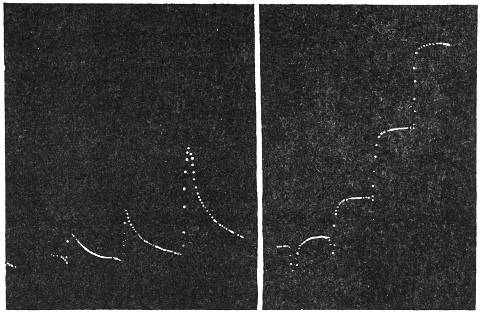
Fig. 54.—Staircase response in sub-tonic Mimosa.
Fig. 55.—Positive, diphasic and negative response under successive stimulation.
Experiment 50.—A still lower degree of sub-tonicity was
ensured by keeping the specimen in an isolated condition
for 12 hours. Stimulus of light for 20 seconds’ duration
was applied at intervals of 2 minutes. In the record (Fig. 55)
the first two responses, not shown, were purely positive.
The third exhibited a positive A-effect, followed by the
negative response D-effect. The A-effect is thus seen fully
unmasked. In subsequent responses the A-effect became
more and more overshadowed by the D-effect. At the third
response the masking is complete and the excitatory negative
response is at its maximum. The record of staircase
effect (Fig. 54) also exhibits a preliminary positive twitch
at the beginning of the series, which disappeared after
the second response.
The modifying influence of tonic condition on response
I find to be of universal occurrence. In vigorous specimens
the electric response to stimulation is negative; but
tissues in sub-tonic condition give positive response and after
long-continued stimulation the abnormal positive is converted
into the normal negative. It is very interesting that
under condition of sub-tonicity diverse expressions of physiological
reaction exhibit similar change of sign of normal
response. Thus in my measurement of the velocity of
transmission of excitation in the conducting tissue of
Mimosa, I find that, when the tissue is in an optimum
condition, exhibiting high velocity of transmission, excessive
stimulus has the effect of diminishing the conducting
power. But in a depressed condition of the tissue
the effect is precisely the opposite. Thus in a given case
the velocity of transmission was low; strong electric stimulation
enhanced the rate by 33 per cent. In extreme
cases of sub-tonicity, where the conducting power was in
abeyance, the excessive stimulus caused by wound not
only restored the power of conduction but raised the
velocity of transmission to 25 mm. per second (Expt. 37).
The excitability of a plant is found to be modified
by its tonic condition.
A sub-tonic specimen of Mimosa, like an excised bloodless
muscle, shows a preliminary staircase response. Stimulus
induces simultaneously both “A” and “D” effects,
with their attendant positive and negative reactions.
A tissue in optimum condition exhibits only the resultant
negative response, the comparatively feeble positive being
masked by the predominant negative. With decline
of tone, the “D” effect diminishes and we get “A” effect
unmasked.
In extreme sub-tonic specimen, we get first only the
“A” effect, with its positive response. Successive stimulation
converts the pure positive into diphasic and ultimately
into normal negative response.