"Parish government formed the unit in the government of the city. Each
parish was a self-governing community, electing its own officers with
the exception of its rector, making its own bye-laws, and, to meet
expenses, levying and collecting its own rates. Its constables served
as policemen, attended the Sessions, and acted as the fire brigade.
They looked after the parish-trained soldiers, acted as recruiters,
and had the care of the parish armour, which was kept in a chest in
the church. They distributed money among lame soldiers, gathered
trophy money, relieved cripples and passengers, but unfeelingly
conveyed beggars and vagabonds to prison. The parish soldiers kept
watch and ward over the parish defences. The parish stocks, in which
offenders were placed, stood near the churchyard stile. The constables
were also responsible for such lighting as the parish required, and
kept the parish lanthorn.
"The officials looked after the parish poor, dispensing charity by
gifts of bread and money. The parish boundaries were perambulated
every Ascension Day. Parish dinners were held on the choosing of the
churchwardens, the visitation of the Archdeacon, etc. The parish
officials invoked the aid of the law when parochial rights were
infringed, especially by neighbours. The church was the centre of
parochial life and in it the business of the parish was transacted.
"Parishes were grouped as wards. The wards chose city Councillors, and
these elected their Aldermen. The six wards formed the municipality
over which presided the Mayor. The Corporation exercised a general
supervision over the whole of the parishes of which there were
forty-five.
"Gradually the duties and powers of the various parish officials have
been transferred to the City Council. The united parish soldiers
became the city trained bands. In 1900 the last remnant of parochial
officialdom passed into the power of the Corporation when parish
overseers ceased to exist, and, for rating purposes, the City of York
became one parish instead of the original forty-five separately rated
areas."
[1]
The Cathedral, i.e. the Liberty of St. Peter, and the Royal Castle
were outside municipal control. The Archbishops also had their
privileges. They had once owned all the city on the right bank of the
Ouse. In the fifteenth century they still retained many of their
privileges and possessions in this quarter, as, for example, the right
of holding a fair here in what was formerly their shire. These
archiepiscopal rights have not all lapsed, for in 1807 the Archbishop
of the time, successfully asserting his legal rights, saved from
demolition the city walls on the west side of the river.
York was a royal borough, that is, the freemen of the city had to pay
rent to the king, from whom it was farmed directly. It was not owned
by any knight or lord, that is, apart from the Archbishop's
possessions, which belonged to the western section of the city; the
city proper was almost entirely on the opposite side of the river. The
King retained possession of certain properties, such as Galtres
Forest, lying in the valley stretching northwards from York. He had a
larder and a fish pond at York; also a court, offices, and a prison
(Davy Hall, of which the name alone remains) for the administration of
the forest. These town-properties were, of course, entirely
extra-parochial.
York received a long succession of royal charters. Henry I. granted
the city certain customs, laws and liberties, and the right to have a
merchant guild. The possession of these rights was confirmed by King
John in the first year of his reign. In 1396 Richard II., at York,
made the city a county in itself. In consequence the office of bailiff
was replaced by that of sheriff.
The King's official representative in the city was called the sheriff,
whose office in York has been continuous down to the present day. The
sheriffs—there were usually two—were responsible for the
maintenance of order, for the local soldiery, and the collection of
the royal taxes and dues. The sheriff was a busy and important
mediæval official.
The Mayor was the real governor of the city. He was a powerful
official and literally ruler of the city. In practice he was most
often a wealthy and important merchant; and, like the Aldermen,
belonged to the group of men who governed the trade guilds as well as
the municipality. Various symbols were attached to his office. The
chief objects among the corporation regalia at the present time are
the sword, mace, and cap of maintenance.
There were three city councils, "the twelve," "the twenty-four," and
"the forty-eight," as they were called. There were the Aldermen and
Councillors—the "lords" and "commons" of the municipal parliament.
The ordinary council-chamber was at Ouse Bridge: the other was the
Common Hall, the present Guildhall. Sometimes the whole community of
citizens met, when for the moment the government of the city became
essentially and practically democratic. This was only done on
important occasions to decide broad questions of policy, or when
numbers were needed to enforce a decision. The commons really
possessed no administrative power. The form of civic government was
supposed to be representative, but as a matter of fact it was not only
not founded on popular election (a procedure enforced in 1835 by the
Municipal Reform Act), but was kept exclusively in the hands of the
wealthy merchant and trading class, the middle class. Men of this
class became Aldermen. When a vacancy occurred in the upper house of
civic government, they chose a man like themselves. The Mayor was
elected by the Aldermen, who naturally chose one of themselves. In
fact the government of the city was in the hold of a "close
self-elected Corporation."
The civic spirit developed a good deal during the fifteenth century,
no doubt in connection with the simultaneous increase in the wealth
and social pretension of the rising merchant middle class. It appeared
in the greater respect bestowed on the office of Mayor and the pomp
and reverence attached to his position. The "right worshipful" the
Mayor and the Aldermen wore rich state robes edged with fur. In
addition, contemporary city records reflect the new spirit in such
expressions as "the worshupful cite," "the said full honourabill
cite," "this full nobill city." This spirit, however, developed more
fully in the sixteenth century.
The Mayor held his court in the Common Hall, where he heard pleas
about apprentices and mysteries (i.e. the rules of the crafts);
offences against the customs of the city; breaches of the King's
peace. It was his duty to administer the statute merchant. The
Recorder was the official civic lawyer.
The governors of the city were intimately connected with the control
of trade, and the rule of the pageants. These phases of city life
overlapped considerably and were interdependent. Weaving was the
principal trade. The Mayor and Aldermen were the masters of the
mysteries of the weavers. Power to enforce the ordinances of the other
mysteries was granted by the Mayor and Corporation.
There were times when the King took the government into his own hands.
This was done during the rebellion of the Percies, a northern family
skilled and experienced in rebelling. Henry IV. withdrew the right of
government from the city in 1405, but he restored it in 1406 after the
execution of Archbishop Scrope, who had been so popular with the
people of York.
Of mediæval punishments the most obvious were the stocks, a
contemporary picture of which is to be seen in one of the
stained-glass windows of All Saints', North Street. Examples of stocks
survive in the churchyards of Holy Trinity, Micklegate, and St.
Lawrence's. They were near the entrance to the churchyard and
commanded full public attention. The petty offender, condemned to
spend so many hours in the public gaze and subject to whatever
treatment the public chose to inflict on him, sat on the ground or on
a low seat, while his feet were secured at the ankles by two vertical
boards. The upper was raised for the insertion of the ankles in the
specially cut-out half-round holes in each board, so that when the
boards were touching and in the same vertical plane, the ankles were
completely surrounded by wood.
To its political importance York owed the ghastly exhibition of heads
and odd quarters of traitors and others who had gained punishment of
national importance, which usually consisted of "hanging, drawing and
quartering," when the quarters and the head were sent to London and
the principal towns of the kingdom to be exhibited on gateways,
towers, and bridges. This practice served to provide the public with
convincing proof that a traitor was actually dead, and was very
necessary in an age when Rumour, "stuffing the ears of men with false
reports" held sway over "the blunt monster with uncounted heads, the
still discordant wavering multitude." Micklegate Bar was so used. In
Shakespeare's Henry VI. Queen Margaret makes, with reference to the
Duke of York, this bitter play of words:—
"Off with his head and set it on York gates;
So York may overlook the town of York."
One very interesting practice in connection with the mediæval system
of law and policing was the use of the right of sanctuary. The
monasteries, the Minster, and all churches had this right of giving a
sacrosanct safety to criminals and others flying from their pursuers,
whether officers of the law or the general mob, whose right, be it
noted, it was to join in the chase after offenders (the "hue and cry")
and help to arrest them. Provided the pursued reached the prescribed
area, which, in some cases, as at the nationally famous sanctuary of
St. John of Beverley, prevailed for some distance from the church
itself, he was safe from his pursuers. Hexham Abbey and Beverley
Minster still exhibit their sanctuary chairs or frith-stools. In the
north door of Durham Cathedral there is an ancient, massive knocker,
the rapper, of the form of a ring, being held in the mouth of a
grotesque head. The frith-stool, to which the seeker went at once,
stood near the high altar at which he made his declarations on oath.
His case was carefully investigated and often sanctuary-seekers were
allowed to exile themselves from the kingdom. The coroner was the
public officer of inquiry. The Church took every care that the crime
of breaking the sanctuary so granted was regarded not at all lightly.
The right of sanctuary, after being changed to apply to certain towns
only—among them York—continued till it was ended by law in the reign
of James I.
Condemned heretics were burnt
[2] at Tyburn, the site of local
executions, some way from Micklegate Bar along the main south road.
According to the general principle, the King was the ultimate and
absolute owner and ruler of the land and people. The rights,
liberties, customs, and powers possessed by individuals and corporate
bodies were specified parts of the royal power which the King had
granted on some consideration or other. Thus, knights, archbishops,
and nobles received lands and rights in return for the provision, when
required, of military service by themselves and a certain force of
their retainers, except that no personal military service was required
from the archbishop from the very nature of his calling. The
monasteries and other Church institutions had many possessions and
rights. The Church, which was established in the realm before
Parliament, was a very great owner of land. The authorities of cities,
with their trade-guilds, received the right of trading, or holding
markets, and of levying tolls or municipal taxes. They received also
the right of making their own local laws or bye-laws. These
authorities, whether individuals or corporate bodies, to whom rights
and liberties were granted, had their own officers and laws
controlling their liberties. Besides the King's peace, there were,
therefore, the jurisdictions of these various rights granted from the
supreme royal authority.
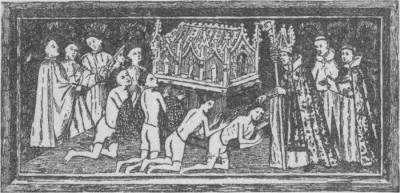 KNIGHTS DOING PENANCE AT A SHRINE.
From a Fifteenth-Century Manuscript.
ToList
KNIGHTS DOING PENANCE AT A SHRINE.
From a Fifteenth-Century Manuscript.
ToList
From York there went to the national Parliament the lord Archbishop of
York, the lord Abbot of St. Mary's Abbey, those nobles who resided in
the city and were Lords Temporal, and the two representatives of the
commonalty of the city. The body of Lords Spiritual was of great
importance in the Middle Ages. The Convocation of the lords of the
Church had itself a share in the governing of the nation as well as of
the Church, its own particular sphere. The Church was one of the most
powerful and richest factors in national affairs. The clear division
of the Parliament of the Middle Ages into three groups reflects the
sharp divisions that there were between the three great classes of the
nation—the nobles, the clergy, the people.
In the fifteenth century, as in other centuries, York was frequently
visited by the King. From time to time, as when the King and Court
proceeded north during the wars with Scotland, Parliament was moved to
York, where it was held in the Chapter House of the Minster. Six of
the seven windows of the Chapter House contain their original stained
glass, in which appear shields of King Edward I. and members of the
Court. The Chapter House was used as a Parliament house during the
reigns of the first three Edwards. The King, in mediæval times, was
actual commander-in-chief, and it suited him well for Parliament to
meet in the political capital of the north, so that he could continue
the civil administration while conducting warfare in the north.
Henry IV. was in York on several occasions, chiefly because of
rebellions. The house of Percy, which engaged frequently in revolt and
faction, led the rebellion of 1403 in which Henry Percy, called
Hotspur, was killed at the battle of Shrewsbury. Harry Hotspur, whom
Shakespeare made in accordance with tradition the fiery and valorous
counterpart of Prince Hal, Henry IV.'s heir and Falstaff's companion,
was buried in the Minster. When Archbishop Scrope headed a revolt,
also not unconnected with the Percies, from York and was arrested,
Henry IV. hastened to York, and the popular archbishop was executed
forthwith, a royal and sacrilegious deed that caused intense
indignation especially among the people of York, who for some months
lost the right of local government as a result of this affair.
The Wars of the Roses (1455-1485), a long internecine feud between
kings, lords, and landed gentry, affected the towns but little. The
baronage suffered heavily, the middle class lightly. No town ever
stood a siege, while Towton was the only battle in which the common
soldiers had heavy losses. Warwick made it a practice to spare the
commoners, whereby he conciliated the people. Under Yorkist rule,
after the decisive battle of Towton (1461) England can be described as
not unprosperous. One very notable feature was the immense amount of
building that was done, and that not so much of castles, as of country
houses, churches, and cathedrals, so many of which splendidly adorn
the land to-day. The only people seriously affected by the Wars of the
Roses were the main participants. Compared with modern warfare, which
is unabated scientific extermination, mediæval warfare was often of
the nature of a mild adventure. The size of the opposing forces was
very small even compared with the scanty population. The chief weapons
were lances, swords, long-bows, and cross-bows, but protective armour
was worn. The fighting was generally sporadic and desultory and the
casualties were very few.
It was at York that Henry VI. awaited the news of the result of the
battle of Towton. Edward IV. entered York as victor after the battle.
York, like other cities at the time, took care to maintain the good
graces of both sets of combatants. Although through the Wars of the
Roses national parliamentary government ultimately broke down and gave
way to the strong personal kingship of Henry VII., the towns, which
actually suffered little, increased their local powers. Civic
government developed much and trade flourished during the century.
York had a good friend in Richard, Duke of Gloucester. The city was
very loyal to him and helped him by raising troops in his support.
When he visited York he was received with immense festivity and
magnificence. The Mayor and Corporation in their correspondence with
him addressed him as "our full tender and especial good lord." They
had to thank him "for his great labour now late made unto ye king's
good grace for the confirmation of the liberties of this city." But
for his death at Bosworth, York would have benefited greatly by his
munificence.
Henry VII. was in York in 1487. After Bosworth (1485) the city had
assured him of its loyalty. The marriage of Henry of Richmond, who
represented the House of Lancaster, and Elizabeth, daughter of Edward
IV. Duke of York, fittingly followed the conclusion of the Wars of the
Roses. With Henry VII.'s reign a new era began in English history.
Throughout the century the city could not avoid contact with rival
parties and powers. In spite, however, of rebellions and the Wars of
the Roses, the capital of the north managed generally to steer a safe
course through many storms.
Other links with national affairs were the periodic visits of the
King's judges who travelled on circuit over the country, stopping at
important centres to hold assize there. Their duties consisted not
only in settling matters of litigation, but also in reviewing the way
in which all the King's affairs were being conducted in each locality.
They supervised the work of the sheriffs.
Galtres Forest and the Fish Pond, both royal property, helped to
furnish the king's table with food. From the royal Larder at York such
foodstuffs as venison, game, and fish were despatched salted to
wherever the King required them.
Business, in one form or another, was the occupation of the majority
of the citizens. There were a few capitalist merchants, many traders,
and thousands of employed workpeople, skilled and unskilled. Such
street names as Spurriergate, Fishergate, Girdlergate, Hosier Lane,
and Colliergate would suggest that men in the same trade had their
premises in the same quarter, possibly in the same street.
The English middle class, which had taken form in the fourteenth
century, was well established in the fifteenth century, when it became
so important as to be an appreciable factor in the national life. The
middle class arose through currency, the use of money to bring in more
money by trading. Trade became the monopoly of the middle class, the
successful master-traders. It was men of this class, the capitalist
employers, the merchants and traders who were the mayors and aldermen,
who ruled the city. The exclusiveness, which was eminently
characteristic of this class, appeared especially in their attitude
towards national taxation and in that towards trade organisations.
With regard to taxation the towns persistently avoided the assessment
of individual traders, who did not wish to disclose the amount of
their wealth, by agreeing that the whole town should pay to the
Exchequer a sum to be raised by the Mayor and Corporation. The middle
class achieved its aims politically by transformation from within.
Instead of making a direct assertive attack, these master-traders
usually so developed their own interests within the established
institutions (such as the guilds) that they ultimately gained their
object quietly and shrewdly. This class established itself against the
King and the nobles on the one hand, and during the century in
effective fashion against the workers on the other. This appears in
the more definite distinctions of class among the citizens that arose.
The masters had got the control of the guilds into their own power.
While maintaining the original outward appearance of the guilds as
societies of men affected by the same interests in daily life, the
employers had actually become a powerful vested class that ruled both
city and guild life. In the fifteenth century the workmen were
founding fraternities of their own.
Memory of the Jews, the money-dealers of other times, survived if only
from the harrowing stories of the various persecutions that had taken
place all over England, and not least in York. The Jews had been
expelled from the country by Edward I., with the encouragement of the
Church, in 1290, partly for economic, partly for religious reasons.
Their supplanters, the Italian bankers, whom Edward favoured, soon
acquired from their trading an unpopularity equal to that of the Jews
as traders. The rise of the middle class had coincided with the
release of money in coin from the hoards of the Jews, and from the
coffers of the Knights Templars, whose order was abolished in 1312.
The merchant and trading class, apart from the nobility and the
Church, formed the bulk of the people of the nation. They were the
solid part of the nation, that paid taxes, that supplied clerks,
monks, and priests, that liberally supported the Church, that kept the
nation progressive and solvent by commercial undertakings.
The professions, as we use the term to-day, had not as yet attained
sufficient importance for them to form a distinct class division.
There were a few capable physicians, but generally the practice of
medicine was shared by the Church and the barber-surgeons. Priests and
officers of the Church had the privilege peculiar to the Church by
which even a poor but intellectually capable man could rise to high
office and become the social equal of nobles. Architecture was
practised by master-masons under the patronage of leading
ecclesiastics and nobles. Teaching was nearly all the work of the
Church. The lawyers, however, were already to be distinguished from
those who gained profit by dealing in goods, for they made profit from
transactions on paper, from managing the interests of others, from
trading in their own acute mental powers.
The wool trade was by far the most extensive and flourishing trade of
England in the fourteenth and fifteenth centuries. This was the trade
that made England great commercially. Wool was England's raw material
and the source of most of her wealth. The numerous monasteries had
huge sheep-farms. Edward III. had encouraged foreign clothworkers to
settle in England (in York, as in other places). The first York
craftsmen to be incorporated were the weavers, who received a charter
from Henry II., in return for which they paid a tax to the King for
the customs and liberties he granted them. The weavers were the
largest and wealthiest body of traders.
Guilds had developed from societies of masters and men engaged in the
same trade, to the trade-guilds, which in the fourteenth century were
trade corporations, the lower ranks of members being the workers, the
higher ranks, including the office-holders, the richer merchants, the
capitalist employers. The ruling committees of the trade-guilds made
regulations and generally governed their particular trades. Despite
the power of the guilds the municipal authority maintained its
supremacy in civic government because it enforced the ordinances of
the trades. Moreover, disputes between the guilds themselves gave the
city authority opportunities of increasing its power, of which it
availed itself.
The system of serfdom, by which serfs were bound to a particular
domain and owned by their overlord, had not yet ceased. Nearly all the
workmen of York, however, were freemen, i.e. they had full and
complete citizenship. The members of the councils of aldermen and
councillors, the mayors and city officials, the members of the
trade-guilds, were all freemen.
In the fifteenth century the wealthy and important employers and
traders governed the guilds. They were in the position and had the
power to regulate the conduct in every way of their own trades. Thus,
rules were laid down as to the terms of admission of men to the
practice of a trade; the government of the guild and the meetings of
the members and ruling committees; the moral standard of the members
in their work and trafficking; the payments of masters to workers; the
prices of goods to be sold to the public or other traders; the rates
of fines and the amount of confiscations inflicted on those who broke
the rules of their guild; the terms on which strangers, English and
foreign, were to be allowed to pursue their trade in the city; whether
Sunday trading was to be permitted or not; the duties of the
searchers; everything incident to the share of the guild in the city's
production of pageant plays.
The question of the terms of the residence and trading of strangers
received constant consideration. The city had, in many respects,
complete local autonomy and rules were made with regard to strangers
who came to carry on their trades in the city. From 1459 aliens had,
by municipal law, to live in one place only, at the sign of the Bull
in Coney Street, unless they received special permission from the
Mayor to reside elsewhere. The guilds were ruled by masters and
wardens. They had their various officials. The searchers were officers
appointed to observe that the rules of the trade were being carried
out properly. They took care that only authorised members pursued the
trade of the guild of which they were the officers. They vigilantly
watched the conduct of the members, and it was their duty to take
action in case of infringement of the rules and to bring offenders
before the Mayor in his court.
The wealthy trading class all over the country did great and lasting
work in founding grammar schools and building or rebuilding cathedrals
and churches or parts of them. There was a social side to the guilds.
This appeared in the public processions and the performances of plays,
the morality and mystery plays of mediæval England. There was also a
strong religious side to the guilds. The processions and plays were
fundamentally religious. The Church's festivals were recognised as
holidays. Much money was given and bequeathed for the foundation of
chantries, which with their priests have their place also in the
educational life of the city.
The merchants lived well. They were rich from trade, and through the
corporate guilds governed their own trades both legislatively and
executively; the highest offices in civic life were theirs; they lived
in houses as splendid as they cared to have them; they furnished their
homes with quantities of silver plate, both for use and for ornament,
for this was the most suitable outlet for superfluous wealth in days
when modern facilities for investment did not exist; they wore clothes
of fine material, richly trimmed; they were honoured citizens; they
were earnest in religion and their benevolence to the Church is very
remarkable. They were forming a lesser aristocracy now that they were
becoming owners of agricultural land as well as town property. They
had the benefits of wealth and comfort, while they were shrewd enough
to avoid the penalties of advertised riches. A typical instance of a
successful merchant who rose to high positions was that of Sir Richard
Yorke, who was Mayor of the staple of Calais and Lord Mayor of York in
1469 and 1482, and member of Parliament. A window in St. John's
Church, Micklegate, in commemoration of him is still to be seen. A
shield bearing his arms (azure, saltire argent) appears in the glass;
another bears the arms of the Merchants of the Wool staple of Calais.
He was knighted by Henry VII. when that king was in York in 1487.
Masters took apprentices, who themselves generally became masters in
their turn. The conditions of apprenticeship were ruled in detail by
the guilds.
When a workman became a skilled artisan he was called a journeyman,
[3]
that is, a man who earned a full day's pay for his work. The legal
hours of work were, from March to September, from 5 a.m. to 7.30 p.m.,
with half an hour for breakfast, and an hour and a half for dinner.
Saturday was universally a half-holiday. There were 44 working weeks
in a year and, consequently, a total of holidays and non-working times
of eight weeks. The burden of the very long hours was increased by the
great physical exertion required from men who had to do much that is
now done with the help of machinery. The strain was not always
unrecognised, for the Minster workmen were allowed a period of rest
during the working day.
Some of the men engaged in the construction of the Minster were not
York men. The men employed there were by exception under
ecclesiastical control. They were not governed by any of the city
trade guilds. The master-mason was in charge of the whole of the
building operations.
A list of trades in the city will suggest the kinds of business there
were. Some of the names will go far to explain some modern surnames.
Wool Trades:—
Mercers.
Tapiters and couchers (makers of tapestry, hangings, carpets, and coverlets).
Fullers.
Cardmakers.
Littesters (dyers, listers).
Shermen (shearmen).
Sledmen.
Dyers.
Weavers of woollen.
Leather Trades:—
Barkers (tanners).
Curriers.
Building Trades:—
Carpenters, wrights and joiners.
Plasterers.
Tilers.
Ironmongers.
Painters.
Glaziers.
Food Trades:—
Spicers (grocers—Cf. French épicier).
Cooks and waterleaders.
Baxters (bakers).
Vintners and taverners.
Bouchers (butchers).
Pulters (poultry-dealers).
Wine-drawers (carters of wine).
Sauce-makers.
[4]
Outfitting Trades:—
Tailors.
Skinners (vestment makers).
Glovers.
Hosiers.
Hatmakers.
Capmakers.
Cordwainers (cobblers).
Saddlers.
Girdlers and nailers.
Spuriers and lorimers (makers of spurs, bits for bridles, etc.).
Armour Trades:—
Armourers.
Smiths.
Bowers and flecchers (fletchers)—(makers of bows and arrows. Cf. French flèche).
Household Trades:—
Coopers.
Pewterers and founders.
Chaundlers (makers of candles and wax images).
Potters.
Culters.
Bucklemakers, sheathers, bladesmiths.
Drapers.
Linenweavers.
Miscellaneous Trades:—
Goldsmiths.
Latoners (workers in the metal called latten).
Barber-surgeons (the mediæval medical practitioners).
Parchemeners and bookbinders.
Scriveners.
Writers of texts.
Ostlers (inn-holders).
Shipwrights.
Fishers and mariners.
Artist craftsmen of York supplied most of the churches of the north of
England with their beautiful vessels, furniture, and ornaments. In the
workshops of the city, the metropolis of the north, there were worked
and made embroidered vestments of all kinds, engraved chalices and
vessels of silver and of gold, and carved work, including statues and
images in stone, wood, and wax. Bells were cast with beautiful
lettering. Brasses for grave-slabs were made bearing finely designed
effigies.
Marketing, i.e. trading, was done mostly at the frequent and regular
markets and at the fairs. The right to hold a market or a fair was
among the rights obtained by means of royal charters. While markets
were held once or several times a week or every day, fairs took place
more rarely and at some of the most important and popular holiday
seasons of the year, like Whitsuntide. Fairs attracted a much larger
public than the markets.
In the city there were markets in different places for different kinds
of produce on certain days. For instance, in the fifteenth century
there was a market of live-stock at Toft Green every Friday. The
public squares, called Thursday Market and Pavement, were used as
market-places. Some markets were held in the streets. Stalls were set
up on which to exhibit the wares. The ordinary foodstuffs and
materials, just as in the open market held at the present time in the
long and broad Parliament Street, formed of Thursday Market and
Pavement and the space formerly occupied by a compact mass of old
houses between the two originally distinct squares, were the things
sold and bought at the mediæval markets: such as butter, meat, fish,
linen, leather, corn, poultry, herbs. Some, for example butchers'
shops, kept open market every day. Craftsmen worked goods at the
premises of their merchant employers, which usually combined the
latters' home and workshop; it was chiefly at the markets and fairs
that these goods were sold.
Markets and fairs were controlled by the authority, whether municipal
or archiepiscopal, that possessed the right of holding them. Again,
particular care was taken to ensure preference being obtained by the
citizens over strangers. The Lammas fairs were held under the
authority of the Archbishops, who assumed the rule of the city and
suburbs for the period of the fair. The sheriffs' authority, in
consequence, was suspended for that period. The Archbishop, meanwhile,
took tolls, and all cases that arose during the holding of the fair
were judged by a court set up by him.
Fairs combined both trading and entertainments, for they were held on
public holidays. They fostered trade and served to provide a change
from the ordinary routine of life. It was perhaps at fairs that
mediæval people were at their noisiest, for these were occasions when
they gave themselves up unrestrainedly to merry-making, wild and
clamorous. Strolling players and the whole variety of mediæval
entertainers set up their stands and booths, and amused the dense
surging crowds that thronged the squares and streets.
York had a large overseas trade, especially in wool and manufactured
cloth. Some of its merchants owned property abroad. Some went abroad
and encountered perils by sea and perils from foreigners on the
continent. York traded with the Low Countries, where Veere (near
Middleburg) and Dordrecht were ports that ships entered to discharge
cargoes loaded on the York quays. The trade between York and the
Baltic ports was much greater than that done with them from any other
English port.
Foreign sailors were to be seen in the streets of fifteenth-century
York; foreign goods were handled in the city. Wines were imported from
France, fine cloths from Flemish towns, silks, velvet, and glass from
Italy, while from the Baltic came timber and fur. From the North sea
came fish, much of which was brought to York from the coast by
pack-horse across the moors. The herring was an important article of
food.
Money was measured in marks, shillings, and pence. Of the current
coins those in gold were called the angel, half-angel, the noble,
half-noble, and quarter-noble; in silver there were the groat,
half-groat, the penny, and half-penny. The local branch of the royal
Mint was housed within the Castle. The building containing it was
rebuilt in accordance with an order of 1423. The coins from this mint,
which was at work during a large part of the fifteenth century, bore
distinctive marks to show the place of minting. Silver coins bore the
inscription CIVITAS EBORACI. The archbishops continued to use their
privilege of coining money.
The following extracts, interesting for the substance and the literary
form, are taken from the city records as published by the Surtees
Society, vols. 120, 125, "The York Memorandum Book."
From the ordinances of the Pewterers, 1416.
"Ordinaciones pewderariorum.
"Ceux sont les articles de lez pewderers de Lounders, les queux les
genz de mesme lartifice dyceste citee Deverwyk ount agrees pur agarder
et ordeiner entre eux par deux ans passez, devant Johan Moreton,
maire."
Others of the earlier ordinances are in Anglo-French; many are in
Latin. Later ordinances are in English as in the case of those of the
Carpenters, 1482, of which the following are the opening paragraphs:—
"In the honour of God, and for the weile of this full honourabill cite
of York, and of the carpenters inhabit in the same at the special
instaunce and praier of" ... (here follows a list of names) ...
"carpenters of this full nobill cite, ar ordeyned the xxijti day of
Novembyr in the xxijti yere of the reing of king Edward the iv. in
the secund tym of the mairalte of the ryght honorabill Richard York
mair of the said cite, by the authorite of the holl counsell of the
said full honourable cite, for ewyr to be kept thez ordinaunces
filluyg,
"Furst, for asmoch as here afore ther hath beyn of old tym a
broderhode had and usyd emong the occupacion and craft above said, the
wich of long continuaunce have usid, and as yit yerly usis to fynd of
thar propir costes a lyght of diwyrs torchis in the fest of Corpus
Christi day, or of the morn aftir, in the honour and worship of God
and all saintes, and to go in procession with the same torchis with
the blessid sacrament from the abbey foundyd of the Holy Trenite in
Mykylgate in the said cite on to the cathedrall chyrch of Saint Petir
in the same cite; and also have done and usyd diwyrs odir right full
good and honourabill deides, as her aftir it shall more playnly apeir.
It is ordenyd and esyablyshid be the said mair, aldermen, and all the
holl counsell of the said full nobill cite, be the consent and assent
of all tham of the said occupacion in the said cite, that the said
fraternite and bredirhode shalbe here after for ewyr kept and
continend as it has beyn in tymis passid, and that every brodir thar
of shall pay yerly for the sustentacion thar of vjd, that is to say,
at every halff yer iijd, providyng allway that every man of the said
occupacion within the said cite shalnot be compellid ne boundeyn to be
of the said fraternite ne brodirhood, ne noyn to be thar of bot soch
as will of thar free will."
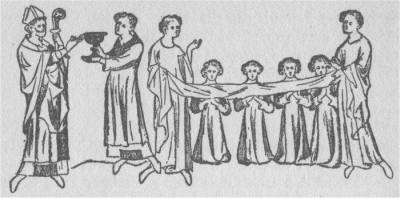 ADMINISTERING HOLY COMMUNION WITH THE HOUSEL CLOTH.
From a Fourteenth-Century Manuscript.
ToList
ADMINISTERING HOLY COMMUNION WITH THE HOUSEL CLOTH.
From a Fourteenth-Century Manuscript.
ToList
Insistence can hardly be too great on the tremendous and wide-spread
influence of the Church in the Middle Ages. The greatness of the
Church continued during the fifteenth century; it derived from the
traditions of an age when absolute power prevailed, from the
undisputed usage of centuries, from a logical system of dogmas, and
from international sanctions. The ornate services, allegiance to the
distant Pope, the immense hold of the priests on the laity, the large
territorial possessions of ecclesiastical bodies, impressed the people
with the power of the Church. These things came to the fifteenth
century as established facts. The spirit of revolt indeed had appeared
with Wiclif and his followers in the fourteenth century, but Lollardy
met with severe repressive opposition. It was not till Tudor times
that the new spirit, stimulated by the Revival of Learning, the
Reformation, the invention of printing from type, geographical
discovery, the suppression of long years of internecine warfare, and
the establishment of a strong government, had accumulated enough
energy to burst the bonds of mediævalism. The fifteenth century was at
the end of an age.
It is interesting to note that Wiclif (d. 1384), one of England's
greatest men, was ordained in York. He stands out as a "daring and
inspired pioneer" who strove to provide the land with priests who were
true and earnest shepherds. He attempted the superhuman task of
reviving true religion among a people that had become to a certain
extent dull, irreverent, ignorant, and thoroughly superstitious.
By the fifteenth century the Church was suffering from those ills
which needed and later gained drastic treatment. The Church had done
almost miraculous work in the first few centuries of its existence, if
we think only of the success with which it substituted its system of
morality for that of pagan Rome. The fifteenth century followed those
centuries when the Church of England, under the direction of great and
earnest men, was doing its work with conspicuous success. Yet, the
very forces that enabled the Church to make itself a living power in
the Dark Ages, the early centuries embracing the Fall of Rome, the
Empire of Charlemagne, and the kingship of Alfred the Great, became
harmful to its continued activity beneficially in many directions. The
inadequacy of its work in these centuries appears in the lack of
spiritual activity and in the predominance of the material side of
religion. The mediæval Church suffered badly from excessive
conservatism, which led towards sloth and a complacent inactivity. The
morbid element showed itself during the fifteenth century mainly in
lack of real earnestness, in the enjoyment of luxurious laziness, and
in the steady neglect of the age to revise its Christianity. The
Church moreover, with its complete segregation from other estates of
the realm had become unpopular socially, while in its political and
temporal aspects it had become an immense corporation with strong
vested interests. Kings found it necessary to fight it; religious
reformers had to rise up and overcome every form of repression used
against them. The decadence is exemplified incidentally in the
increasing poverty in material and expression of the monastic
chronicles, which practically died out by 1485. The period of turmoil
and change was yet to come.
Such was the general state of affairs. Nevertheless the forms and
practices of the Church continued. The granting of indulgences and
pardons, the inexhaustible demand for Peter's pence, went on
vigorously. A recognised means of publicly raising funds was employed
in February 1455-6, when the Archbishop proclaimed an indulgence of
forty days to those who would help the Friars Preachers, whose
cloister and buildings including 34 cells together with their books,
vestments, jewels, and sacred vessels, had been destroyed by fire.
The faith of the ordinary citizen was, however, intact. The Church
came into the people's life daily. The citizen could not walk away
from his home without seeing a church, and meeting a priest or a
friar. He attended the Church services and fulfilled his religious
duties. Baptism, marriage, death, illness, public rejoicing,
soldiering, dramatic entertainments, the language of daily life—all
these bore the stamp of the Church. The very days of relief from work
were holy-days, feast days in the Church's calendar. Taking part in
the public processions on Corpus Christi Day, a great annual holiday,
was a religious exercise; at the same time this day was devoted
especially to entertainment. Wills of the century show that the
citizens lived as religiously as formerly. This spirit is seen perhaps
most characteristically in the numbers of candles that wealthy
citizens bequeathed for use in church, and in the sums of money they
left to specified clergy and other "religious" for the provision of
masses for the souls of themselves, their wives and families, and for
those for whom they ought to pray. Masses were thus provided for by
hundreds, and in some cases by thousands. The following extracts from
the will
[5] of a rich citizen and merchant of York, who had been
sheriff and mayor of the city, show admirably the spirit of a member
of the middle class in the fifteenth century:—
"In the name of God Amen. The 4th day of September in the year of our
Lord 1436, I Thomas Bracebrig, Citizen and merchant, York, sound of
mind and having health of body, establish and dispose my Will in this
manner. First, I command and bequeath my soul to God Almighty, to the
blessed Mary, Mother of God and ever Virgin, and to All Saints, and my
body to be buried in the parish church of St. Saviour in York, before
the image of the Crucifix of our Lord Jesus Christ, next to the bodies
of my wives and children lately buried there, for having which burial
in that place I bequeath to the fabric of the same parish church 20s.
Also I bequeath for my mortuary my best garment with hood appropriate
for my body. Also I bequeath to Master John Amall, Rector of the said
parish church for my tithes and oblations forgotten, and that he may
more specially pray for my soul, 20s. Also I bequeath for two candles
to burn at my exequies 30 lbs. of wax. Also 10 torches to burn around
my body on the said day of my burial, and that each torch shall
contain in itself 14 lbs. of pure wax.... Also I bequeath to 10 men
carrying or holding the said 10 Torches in my exequies 10 Gowns, so
that each of the said 10 poor men shall have in his gown and hood
3½ ells of russet or black cloth, and that the aforesaid gowns
shall be lined with white woollen cloth. And I will that my Executors
shall pay for the making of the same gowns with hoods.... Also I will
and ordain that two fit and proper chaplains shall be found to
celebrate for my soul, and the souls of my parents, wives, children,
benefactors, and for the souls of those for whom I am bound or am
debtor, as God shall know in that respect, and for the souls of all
the faithful departed, for one whole year, immediately after my
decease, in my parish church...."
The will is a very long one. Altogether 470 lbs. of wax, to last 15
years, would be necessary to satisfy the requirements of the will. 765
masses are specially arranged for; besides, provision was made for
masses to be said by more than 21 chaplains, the religious of 5
priories for women, and by every friar and priest of the four orders
of friars in York. There were also bequests to 2 anchoresses, 1
anchorite, and 1 hermit, to pray for the soul of the testator and the
souls aforesaid. Bequests were made to the poor of St. Saviour's; to
lepers "in the 4 houses for lepers in the suburbs," to the poor in
maisons-dieu; to the prisoners in the Castle, in the Archbishop's
prison, and in the Kidcote. The testator ordered gifts of coal, wood,
and shoes, and 1000 white loaves of bread, to be made among the poor
and needy. The bequests to relatives and directions to the Executors
occupy a large part of the Will, which is that of a particularly
wealthy and important citizen. Charity, however, was a marked
characteristic of these men who had become rich through trade. With a
generous spirit they put into practice the teachings about giving to
the poor and to prisoners. The amount of money spent in founding
chantries, in paying priests for masses for the departed, testifies to
their faith.
It was part of the policy of the Church to keep the instruction of the
people, young and old, in its own control. Practically all the
educational work in York during the century was the work of the
Church.
Through the monasteries and hospitals the Church did valuable work in
feeding the poor, helping the needy, and in educating the poorer
citizens' boys. The royal Hospital of St. Leonard did such work. It
was a peculiar institution, being under the authority of the King, and
containing a sisterhood as well as a brotherhood. It included a
grammar school and a song-school. As an institution it was
self-supporting; food was made on the premises, and the carpenters'
and similar work was done by brethren in the Hospital's own workshops.
The large number of priests were variously employed. There were
priests who officiated in the monastic churches, in the parish
churches (as rectors and chaplains, of whom there were 300 in York in
1436), in the cathedral where the number of chantry-chapels was very
great and where services were held simultaneously as well as
frequently. Some priests were vicars, that is, while the living or
"cure" of souls was held by the rector, the vicar was the actual
priest in charge, for the rector probably held more than one benefice
and could not serve personally in more than one. Generally it was a
corporate body, like the Dean and Chapter, or a monastery, that was
the rector of a number of livings at the same time.
Of the many clergy serving the Minster the Dean, who was the
incumbent, ranked first. Much of the revenue of the Dean and Chapter,
the Governing Body, came from landed possessions in York and various
parts of the surrounding country. These possessions, divided into
prebends, provided livings for the thirty-six prebendaries or canons,
who collectively formed the Chapter. Each canon served at the Minster
during a specified portion of the year, when he lived at his residence
at York. The residences of the prebendaries were mostly round the
Minster Close. While his own parish was served vicariously while he
was at York, each canon had a minor-canon or vicar-choral to act as
his deputy at York when he was absent. These vicars-choral formed a
corporate body and lived collegiately in the Bedern. The numerous
chantries in the Minster were served by priests who also lived
collegiately but at St. William's College. The College, at the head of
which was a Provost, was founded about the middle of the century.
Previously these priests had lived in private houses.
The parish priest was occupied in performing the services in his
church, in hearing confessions, in teaching the children, in visiting,
interrogating, consoling, and ministering the Sacraments to the sick
and dying, and in guiding and sharing the life of his parish
generally. Each parish church had a number of clergy besides the
parish priest attached to it: the number varied from one to ten or
more according to the number of chantries at the church. Each priest
was helped a great deal in parochial affairs by the parish clerk. The
latter was the chief lay official for business in connection with the
parish church. His duties required him to be a man of some education.
The Archbishop was both bishop of the diocese of York, and head of all
the dioceses which together formed the Northern Province of the two
provinces into which England was divided for the purpose of Church
rule. His diocese formerly extended so far south as to include
Nottingham and Southwell.
The Archbishop was a Primate and occupied a high position in the
State. Besides being supreme head of the Church in the northern
province, he was a great landowner. He possessed, besides his palace
near the Minster, a number of seats (like Cawood Castle) in the
country. When he was in London he resided at his fine official palace,
York House. The Archbishops were great lords of the realm in every
way. Archbishop Neville, brother of Warwick "the king-maker,"
celebrated his installation in 1465 with a very famous feast. The huge
amount and delicacy of the dishes prepared, the number of retainers
employed, the splendour of the scene, which was honoured by the
presence of the Duke of Gloucester and members of some of the most
noble families in the kingdom, all the details of this sumptuous
feast, were intended to impress King Edward IV. with the might of the
Nevilles.
Ecclesiastical preferment was often a reward for services in other
branches of the service of the State. Sometimes great offices in the
Church and the State were held simultaneously. Thus, Archbishop
Rotherham was also Chancellor of England for a time. Both Richard
Scrope and William Booth, archbishops of the century, had been
lawyers. The appointment of George Neville, who had been nominated
when only twenty-three to the see of Exeter, was a purely political
one, the bestowing of a high and lucrative office on a member of a
noble family that was enjoying the full sunshine of popularity and
power. The King could also benefit from Church positions otherwise
than by presenting them to partisans. During the two and a half years
that the see of York was kept vacant between the time of the execution
of Archbishop Scrope and the appointment of Henry Bowett (in 1407),
the revenues went, in accordance with the established practice, to the
royal purse.
There were also "clerks," educated men, but not priests, who were in
"minor orders." Many a man, asserting that he was a clerk, made
application for trial by an ecclesiastical court, so as to get the
benefit of the less stringent judgment of the Church courts, to which
belonged the right of dealing with ecclesiastical offenders.
One abuse within the Church was pluralism, that is, the holding of
more than one office at the same time with the result that the holder
was drawing revenue for work he could not himself do. William Sever,
for instance, while Abbot of St. Mary's, York, became Bishop of
Carlisle. These two high offices, one monastic and the other secular,
he held simultaneously from 1495 to 1502.
The religious orders were of two kinds, viz. monks (and nuns) who
lived in seclusion in monasteries, abbeys, or convents, and friars,
who lived under a rule but came out into the world to preach and work.
Both kinds took the vows of chastity, poverty, and obedience to the
rule (e.g., Cistercian or Benedictine, Franciscan or Dominican). Some,
but not all, monks and friars were priests. There were four well-known
orders of mendicant friars, viz. Franciscan (Grey friars, friars
minor), Dominican (Black friars, friars preachers), Carmelite (White
friars), Augustinian (Austin canons). Monks and friars wore sandals,
and long, loose gowns with hoods or cowls which they could pull over
their heads to serve as hats. The alternative titles of some of the
orders of friars came from the colour of their friars' gowns. The
Carmelites used undyed cloth, which was white in comparison with the
black of the Dominicans. The Benedictine monks of St. Mary's Abbey
wore black garments. Their heads were shaved on the crown, the
technical term for which was the tonsure.
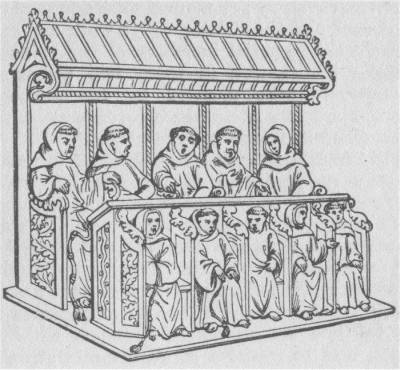 SEMI-CHOIR OF FRANCISCANS.
From a Fifteenth-Century Manuscript.
ToList
SEMI-CHOIR OF FRANCISCANS.
From a Fifteenth-Century Manuscript.
ToList
Monks spent their time in attending the frequent services in the
monastery church, which they entered at the night and early morning
services directly from the dormitories; in copying manuscripts, which
occupied a large part of their day; in contemplation and in study; in
manual work; in recreation. The cloister where work was carried on and
the church were the essential buildings of the monastery. Monastic
life centred in these two places. Its arrangements were dictated by
the purpose of making a religious atmosphere pervade everything; thus
a religious book was read at meals.
The luxury and laxity that obtained in monastic life were not confined
to the fifteenth century. The Archbishop had frequent occasion in the
fourteenth century to complain, for instance, of the use by monks and
nuns of ornaments, and of clothes of finer material than the
traditional rule permitted. He condemned the wearing of clothes cut to
a worldly pattern. The religious had to be admonished from time to
time not to admit strangers within the cloister, and to conform in all
respects strictly to their rule.
During the century St. Mary's Abbey contained about sixty monks,
including the Abbot, the supreme head, and the Prior, who held the
second highest office; besides, there was a very large number of
lay-brethren, servants and officers, for in addition to the internal
work at the abbey, there was the management of the abbey estates and
business. Abbots and monks were always keen traders. Altogether the
personnel of St. Mary's might have numbered about two hundred.
The influence of such a monastery as St. Mary's was very far from
being restricted to affairs within the abbey walls. Through its Abbot
it had a spokesman in the House of Lords. There were cells dependant
on the abbey and often at a distance. The Abbot had a number of
residences in the country and one in London. The abbey itself had
numerous possessions of land and manors in many parts of the country.
This was a principal source of revenue. St. Mary's Abbey also had
jurisdiction over many churches, not only in York and Yorkshire, but
in other counties as well. The other monastic institutions and the
Minster and some of the hospitals, for example St. Leonard's, had
similar rights of jurisdiction and the ownership of land, property,
and churches.
In some of the churchyards there lived anchorites, anchoresses, and
hermits. These were individuals who chose to live a solitary life
spent in prayer and religious work. Anchorites led a life of strict
seclusion, for they were literally shut in their cells, from the
world. They did not, however, eschew all intercourse with others, for
their solitary lives of devotion, and in some cases of study, gave
them a reputation for wisdom that led people to seek them for their
advice. Permission was given by the Church authorities to those who
took up this mode of life, the assumption of which formed part of a
special service. The Pontifical of Archbishop Bainbridge, who held the
see from 1508 to 1514, contains an office for the Enclosing of an
Anchorite. Hermits lived in less strict seclusion. Their aims were
similar, but they went about in the world doing good works.
One of the worst features of the religious decadence of the Middle
Ages was the craftiness of such spurious types of men as those whom
Chaucer painted in the Pardoner and the Somonour, and Charles Reade
depicted in the peripatetic "cripples" of "The Cloister and the
Hearth." Chaucer wrote in the true spirit of comedy mores corrigere
ridendo, but Langland, his contemporary, who described similar types
of men of State as well as of Church, did so from the point of view of
a moral reformer whose satire is a trenchant weapon.
There were many other types of religious men, but it must suffice to
refer to Pardoners, who by virtue of papal bulls gave pardons,
expecting, exacting if necessary, a reward in return, and to mention
only palmers and pilgrims, who were seen in York when they came to
visit the shrine of St. William in the Minster. The palmers were
pilgrims who had visited the Holy Land. They liked to wear a
scallop-shell in their broad-brimmed hats as a sign of their extensive
travels. Journeying from shrine to shrine was a favourite occupation,
a professional one, of those pilgrims who loved a wandering and easy
life, seeing the sights and living at the expense of the monastic
hospitality. Some pilgrimages were done by proxy, through the
employment of professional pilgrims. A pilgrimage to a shrine
celebrated for miraculous cures or the efficacy of the spiritual
benefit derived from worshipping at it and invoking the help of the
saint, was for many an exercise of deep religious devotion. There is
no doubt, moreover, that at the shrines of the saints the Church
proved itself a great healer. It was in fact the popular physician.
Apart from surgery, the medical practice of the twentieth century is
in some ways the successor of that of the Church of the fifteenth.
When very popular religious men died, or when, if they were already
dead as in the case of William, Archbishop of York (who died in 1153
and was canonised in 1227), popularity sprang up, it was quite usual
for it to be discovered that miracles were being wrought at their
tombs. The case of the popular Archbishop Scrape who was executed is a
typical one. In this way the calendar of saints was enlarged, the
devout had a new interest, the Church maintained its position in the
popular eye and mind, and its funds increased.
The mediæval Church, however, appeared perhaps at its best in its
Church services, which drew their effect from the sanctity of the
magnificent building (whether cathedral or parish church), the awe
inspired by the Church politic, the use of Latin and the learned
atmosphere, the religious teaching, and, not least, the imposing
ceremonies, and the ornate ritual performed amid a profusion of
lighted wax candles by priests and dignitaries in resplendent
vestments.
The only school engaged in higher education in York in the century was
St. Peter's School, a very old foundation, where Alcuin, who (in 782)
had carried educational reform to the land of the Franks, had been
master. At this school, which was attached to the cathedral, were
educated those who were to spend their lives in scholarship,
especially, as now, after residence at Oxford or Cambridge; future
priests and clerks; the sons of the nobility and of the more wealthy
members of the merchant class in the city. Other regular schools were
the Grammar School at the royal Hospital of St. Leonard and the one at
Fossgate Hospital. This educational work was one of the most valuable
kinds of public work done by these hospitals.
A more elementary and less well organised education was given by the
parish priests and the chantry priests, from whom the children of the
city generally, boys and girls, received at least oral instruction.
Girls usually received a practical upbringing at home. The only
schools for girls were those attached to women's monasteries, of which
there was St. Clement's Nunnery alone in York.
Educational welfare work, as distinct from direct and organised
class-teaching, was carried on by the friars, the religious men who
lived under a rule but who went out to work in the world, instead of
spending their lives in seclusion as the monks did. The Dominican and
Franciscan Friars played an important part in education by teaching,
especially at the Universities. Education was also a foremost interest
of the Augustinians, who supported a college at Oxford.
Books, which had all to be written by hand, were scarce. The copying
of manuscripts, which was done mostly in the monasteries, was
laborious work. Instruction was given as a rule orally, but also by
means of pictorial art and drama. The stained-glass windows were more
than ornamental additions to the church building: they were part of
the means of instruction. Mediæval drama had originated in the
Church's effort to make events described in the gospel more real
through their representation dramatically.
The teaching of manual skill and craftsmanship was entirely the work
of the masters of the crafts under the general supervision of the
guilds. The work of the age was made beautiful, and being handwork
each piece of work gained the interest of individuality. The details
of architectural ornament, in consequence, show wonderful diversity of
form. The naïve spirit of the ordinary handicraft workman was often
reflected in his work. The arts of the goldsmith, silversmith,
bell-founder, vestment-maker (which required elaborate embroidery),
and the sculptor, were practised in York with excellent results.
There has never been a university of York, although under Alcuin the
school of York was doing work of high quality, work that gained
European fame. Even within the last hundred years, when so many
provincial universities and university colleges have been established,
York, one of the most appropriate places, has not obtained a
university.
News and information reached the citizens mainly from personal
intercourse. Merchants visiting other cities discussed with fellow
merchants not only their immediate business but also past and current
events. Pilgrims, palmers, and sailors recited their adventures on
distant seas and lands, and told of the wonders of the world. The
ordinary citizen, who read little, depended on conversations with
better-informed citizens and strangers. The city council was
continually in communication with the King and the great officers of
State: information filtered down from the council to the citizens. The
messengers often supplied the latest semi-official news. Officials and
servants attached to the royal service or to that of nobles or of
ecclesiastics (like the Archbishop of York), were the source of much
political gossip. The news of the country passed to and fro between
the city and the monastic lands, the castles, the manors, and the
forests by means of the visits of men who lived at those places.
Markets and fairs and public assemblies, whether the holding of
assizes or on State visits, were occasions for the dissemination of
news. The ordinary citizen gathered news and information also from the
pulpit and from guild and parochial meetings, and from the bellman.
The only authoritative news he received at first hand he got by
listening to the public reading of proclamations.
In the Middle Ages educated men who had no inclination for the life of
the Church, monastic or secular, nor for landed proprietorship, with
which was combined hunting and soldiering, became clerks. The clerks
in the royal service helped in the work of administration of national
affairs. Tradesmen's sons of ability and opportunity succeeded in
gaining good positions in this service. Nobles also employed clerks.
Altogether there seems to have been in the fifteenth century good
provision for higher education. The people of the Middle Ages were not
illiterate. The outstanding age of illiteracy (not to mention a host
of other evils) in England was the age that began with the Industrial
Revolution, when statesmen failed to make the public services keep
pace with the rapidly increasing population and the rapid development
of new conditions. That there was as large a public ready and eager to
buy the books that printing from type made possible has been regarded
as a disproof of general illiteracy. The books were published in the
vernacular: the people read them. It was in 1476 that Caxton set up
his press at Westminster. The first printing press established in York
was set up in 1509.
Nevertheless the general state of education and scholarship in England
in the fifteenth century was at a low level, mainly owing to lack of
enthusiasm and to the limited subjects of study. Natural science was
unable yet to flourish. Mediæval education was humanistic, but the old
springs of this form of study were nearly dried up. The Greek classics
were entirely lost. Even the few Latin classics that the mediævals
possessed, they did not understand aright. To Virgil's æneid they gave
a Christian interpretation! Grammar was the basis of study, which
dealt mainly with such works as those of Cicero, Virgil, Boethius.
The fifteenth century, the last century of an age, was a backwater in
education as in literature. The great revival was to come. The
fifteenth century was indeed a century of revolution in so far as
under the almost placid surface of continuity and conformity, there
were forces of revolt at work, probing, accumulating knowledge and
experience, perhaps unconsciously, for the day of liberation and
change. The Bible was not yet popularly available. Wiclif had been a
pioneer in the work of translation and publication, but Tyndale and
Coverdale in the sixteenth century supplied what he had aimed at doing
in the fourteenth. The fifteenth century was the quiet dark hour
before the dawn. As Coleridge expressed it: No sooner had the Revival
of learning "sounded through Europe like the blast of an archangel's
trumpet than from king to peasant there arose an enthusiasm for
knowledge, the discovery of a manuscript became the subject of an
embassy: Erasmus read by moonlight because he could not afford a
torch, and begged a penny, not for the love of charity, but for the
love of learning." But even then, when the enthusiasm and the will
were there, such was the dearth of material for learning that, as in
the case of Erasmus, the pioneers had practically nothing to work at
but the classical texts and a few meagre vocabularies with etymologies
of mediæval scholarship. In 1491 Grocyn began to teach Greek at
Oxford. In 1499 Erasmus first visited England. Referring to his visit
to this country in 1505-6 he wrote: "There are in London five or six
men who are thorough masters of both Latin and Greek; even in Italy I
doubt that you would find their equals." England's position was,
therefore, in this respect a good one.
In the Middle Ages holidays were taken at festivals marked in the
Church calendar. Some feasts, like that of Whitsuntide, were
universally observed. The ordinary length of a festival was eight
days, that is, the full week—the octave. Apart from pilgrimages, the
ordinary people travelled little. Moreover the life and property of
travellers were not altogether secure in the forest land, with the
result that treasure and distinguished people travelled under the care
of an armed escort. A large city like York was practically
self-supporting in public amusements. The fifteenth century saw the
full development of the religious mystery plays, and the allegorical
morality plays, which with their comic interludes had become popular
from the thirteenth and fourteenth centuries. The feast of Corpus
Christi (instituted about 1263) was the most important time in the
year for the playing of these typically mediæval dramas. Begun more
than three centuries earlier within the Church and performed by the
clergy, as a dramatic reinforcement of the services and preaching, the
mediæval drama owed its origin mainly to the Church which maintained
its influence as long as this drama continued. It soon came into the
care of laymen, who took part in the productions. In the fifteenth
century, these plays, which were produced almost entirely by laymen,
were so numerous that they were formed in cycles or groups. The texts
of some of the most famous cycles, those of York, Chester, Wakefield,
and Coventry, have survived. The various trade-guilds made themselves
responsible for the production of one pageant of the local cycle, or
two or three guilds joined to produce a pageant, so that the whole
city produced a large number of plays to celebrate the feast of Corpus
Christi. Among its officers a guild had its pageant-master, whose duty
it was to supervise the guild's dramatic work.
The York plays, the texts dating from the middle of the fourteenth
century, are extant. In 1415 fifty-seven pageant plays were produced.
Productions were made in York down to 1579. The following are examples
taken from among the fifty-seven plays and guilds:—
| The Shipwrights | produced | the | Building of the Ark, |
| the Fishers and Mariners | " | | Noah and the Flood, |
| the Spicers | " | " | Annunciation, |
| the Tilers | " | " | Birth of Christ, |
| the Goldsmiths | " | " | Adoration, |
| the Vintners | " | " | Wedding in Cana, |
| the Skinners | " | " | entry into Jerusalem, |
| the Baxters | " | " | Last Supper, |
| the Tapiters and Couchers | " | | Christ before Pilate, |
| the Saucemakers | " | " | Death of Judas, |
| the Bouchers | " | " | Death of Christ, |
| the Carpenters | " | " | Resurrection, |
| the Scriveners | " | " | Incredulity of Thomas, |
| the Tailors | " | " | Ascension, |
| the Mercers | " | " | Day of Judgment. |
The full cycle gave in dramatic form the leading episodes of the
Scriptures from the Creation to the Last Day.
While the trade-guilds were thus responsible for individual pageants,
help and control were given by the Guild of Corpus Christi
(inaugurated in 1408 and incorporated in 1459), and the city council.
The guild had a very large number of members, among whom were the
Archbishop, many bishops and abbots and nobles. These dramatic
productions belonged to the religious and social sides of the guilds.
The plays, however, did not always provoke pleasure, for sometimes
members of some of the guilds complained of the financial burden they
were forced to bear in order to produce the plays allotted to them.
The guilds also took part in public processions with torches on Corpus
Christi Day in celebration of this popular festival. In the
processions, which were closely connected with the religious and
guild-phases of city life, there walked city clergy wearing their
surplices, the master of the Guild of Corpus Christi, the guild
officials, the bearers of the shrine of the guild, the mayor, aldermen
and corporation, and officers and members of the Guild of Corpus
Christi and of the city trade-guilds. As the procession went on its
way litanies and chants were sung by the clergy. The shrine, the
central feature of the procession, was presented in 1449. It was
itself of gilt and had many images some of which were gilded, while
the main ones under the "steeple" were in mother-of-pearl, silver, and
gold: to it were attached rings, brooches, girdles, buckles, beads,
gawds and crucifixes, in gold and silver, and adorned with coral and
jewels.
On the occasion of the processions and performances of pageants, as at
fairs, the city was filled with a boisterous multitude which turned
what was by tradition a religious exercise and entertainment, to a
time of riotous merry-making, and uncouth disorder. In 1426 a kind of
crusade was preached by a friar minor, William Melton, against the
riotous and drunken conduct of the people at the Corpus Christi
festival. He denounced the disgracing of the festival and affirmed
that the people were forfeiting by their conduct the indulgences
granted for the festival. The result of the friar's crusade was the
holding of a special meeting of the city council, which decided that
the processions and pageants were to be held on separate days, the
pageants on the eve of Corpus Christi, and the procession on the feast
itself. Formerly both had taken place on the same day.
The pageants were produced in suitable parts of the city. Stages on
wheels were brought to these places, some of them open spaces, others
main streets. The stages, which were the work of citizen workmen, were
of three storeys, the central and principal one, the stage proper,
representing the earth. Demons, in gaudy attire, came up from the
flame-region of the lowest storey; divine messengers and personages
came down from the star and cloud adorned upper storey. The
tiring-room was below and behind the stage. The acting was by members
of the guilds. They, no doubt, practised here, as elsewhere, the
ranting delivery of their speeches so denounced by Hamlet in his
critical address to the Players, whom he admonished to speak
"trippingly on the tongue" and not to "out-Herod Herod." There are
several references in Shakespeare to these plays of the Middle Ages.
For instance, in Twelfth Night:
"Like to the old Vice
......
Who with dagger of lath
In his rage and his wrath,
Cries, Ah, ah! to the devil."
and in Henry V.:
"... this roaring devil i' the old play
that every one may pare his nails with a wooden dagger."
Stands for spectators were erected by private enterprise for profit in
many places in the city. The general assembly, preparatory to the
beginning of the performances, took place on Pageant Green, now called
Toft Green (which lies behind that side of Micklegate which is
opposite Holy Trinity). The first performances were made at the gates
of Holy Trinity Priory (on the west side of the river); there were
four performances in Micklegate (a street near the Priory); four in
Coney Street (the main street on the east side of the river)—and
likewise performances in other parts of the city. The last three
performances took place at the gates of the Minster; in Low Petergate,
and in Pavement, which was one of the city market squares.
When Richard III. came to York in 1483, part of his entertainment
consisted of performances of pageants.
The only other public dramatic entertainments were crude, coarse,
popular plays, done by strolling players. A mediæval crowd at fair
time was entertained by mountebanks, tumblers, and similar rough
makers of unrefined mirth.
The Corporation had a band of minstrels in its service.
Of physical games archery was the most practised. This was the
national physical exercise, one which had helped the English soldiers
to gain a great reputation for themselves, as at Agincourt (1415). At
York the "butts," where men practised archery, were outside the city
walls.
Class divisions were well marked. They appeared in manners, in dress,
and in occupation.
Fashions varied considerably as the century progressed. There were
close-fitting dresses and loose ones, small head-dresses like the caul
(a jewelled net to bind in the hair) and high and broad erections that
went to the other extreme. Men now wore their hair long; later they
had it close-cropped. Perhaps the most wonderful fashion was that
which men followed in wearing hose of different colours. With all the
vagaries of fashion the most striking feature of dress was the use of
rich and a manifold variety of colours. Excepting the case of the
dress of the religious, which was generally of a sombre hue, colour
characterised men's clothes as much as it did the dresses of women.
The doublet was the coat of the time. Sleeves were generally big. Long
and pointed shoes were characteristic, but it was the cloak that
proved so effective a piece of dress, the cloak that has such scenic
possibilities, that can so nicely express character. There were only
few kinds of personal ornament. The most usual were brooches, belts,
chains, and pendants, and especially finger-rings, of which the signet
ring was a popular form.
The nobles, great landowners, in many cases of Norman origin, were
lords over a considerable number of people. York, being a royal city,
escaped many of the troubles consequent on rule by an immediate
overlord. Besides himself, his family, and personal servants, a lord
provided for a retinue of armed retainers, who formed a kind of
body-guard and a force to serve the king as occasion demanded; in
addition, important household officials, such as secretaries and
treasurers. Among noblemen's followers there were many dependents,
some, no doubt, parasites, but a number, especially if literary men,
in need of patronage to help them to live as well as to pursue their
vocation.
The different kinds of religious men have already been mentioned from
archbishops and abbots to the scurrilous impostors who used a
religious exterior to rob poor people, at whose expense they lived
well a wandering, loose, hypocritical life. In York, there were monks
and friars, cathedral, parochial, and chantry priests, and clerks. The
monastic life was a recognised profession. In the monasteries there
were, besides regular monks, novices or those who aspired to take the
full monastic vows, and, especially in the fifteenth century, by which
time the importance of lowly, arduous service for the brethren and
personal labour had lapsed, a very large number of semi-religious and
lay brethren, who were really servants to the regular monks. In the
fifteenth century the religious houses were extremely wealthy. Some of
the monks were of noble birth. Nobles, when travelling, usually lodged
at the monastic houses, which were dotted all over England. The kings
resided often at abbeys when visiting the provinces. Richard III.,
when Duke of Gloucester, resided at the Austin Friary in York.
The one monastic house for women was St. Clement's Nunnery. There
were, moreover, sisterhoods in the hospitals of, for example, St.
Leonard and St. Nicholas.
St. Leonard's Hospital, among its many functions, was a home of royal
pensioners.
The townspeople were chiefly merchants and tradesmen and those they
employed, and the wives and families of all of them. Men of this type,
both rich and poor, rose to important positions in trade and city
life, and in the King's service. Some entered the service of nobles.
Great dignity was attached to the higher positions of authority in
city and guild life. Trade led to wealth and increased comfort and a
higher social state. Men in the King's service received preferment
more often than direct monetary reward.
Women had only the monastic life to enter as a profession. They could
become full members of a number of the York trade-guilds. The social
position of women in the retrograde fifteenth century fully agrees
with the absence of women from among those who achieved notability in
the city during the century.
The most interesting type of citizens was that composed of the
freemen, who formed the vast majority of the inhabitants. As the name
implies, they were historically the descendants of the men who in
earlier times were freed from serfdom. It was the freemen who, through
the Mayor and Corporation, paid rent to the King for the city, its
rights and possessions. There are still, it may be noted, freemen of
the city, distinct from those distinguished men who have received its
honorary freedom. The main privileges of the mediæval freemen included
the right of trading in the city, and of voting. They also had rights
over the common lands attached to the city, and they were eligible to
fill the offices of local civic government if thought wealthy enough
to be elected into such a "close self-elected corporation."
Soldiers of the royal army were stationed in York at the Castle. The
Wars of the Roses, wars of kings and nobles, lasted from 1455 to 1485
and, although York itself hardly experienced the warfare, it saw
contingents of the forces of both sides, as well as the leaders and
royal heads of both parties.
There lived in the city a number of men in the royal service. Some
worked at the administrative offices of the royal forest of Galtres,
Davy Hall, where the chief officer himself dwelt. There were also the
men who worked at the royal Fish Pond near which was Fishergate in
which street most of these men lived.
Those afflicted with leprosy, a disease which in England disappeared
toward the end of the fifteenth century, dwelt apart for fear of
infecting the healthy. The four hospitals outside the four main
entrances to the city served to keep the disease isolated.
York received from time to time a large number and a great diversity
of visitors. Distinguished visitors usually received gifts from the
Corporation. Kings, queens, and full court and retinue came, and
sometimes the entire houses of Parliament. At such times great crowds
of nobles, spiritual lords, commoners, officers, military and civil,
thronged the city and taxed its accommodation. On such an occasion as
Richard III.'s attendance at the Minster for mass, or the visit of
Henry V., the narrow streets were packed to suffocation with people
assembled to watch the processions of gorgeously arrayed sovereigns,
princes, peers, ecclesiastics, soldiers, and distinguished commoners.
The Duke of Gloucester, afterwards Richard III., was very popular in
the North, especially in York, where he was received (as in 1483) with
magnificence and festivity. The north was loyal to him and gave him
much support in his political schemes.
The visits of the royal judges of assize, of sailors and pilgrims,
have already been mentioned. Pedlars, who were active nomad tradesmen,
were always to be found in town and country dealing in their small
wares.
Last, and some of the unhappiest, among the types of people to be
found in a mediæval city were serfs who had absconded from the lands
or the service to which they were bound. They sometimes fled to a city
for the security it afforded. Serfdom, however, was rapidly
disappearing.


