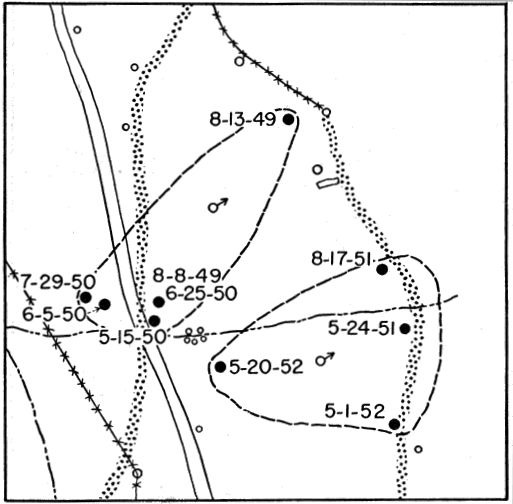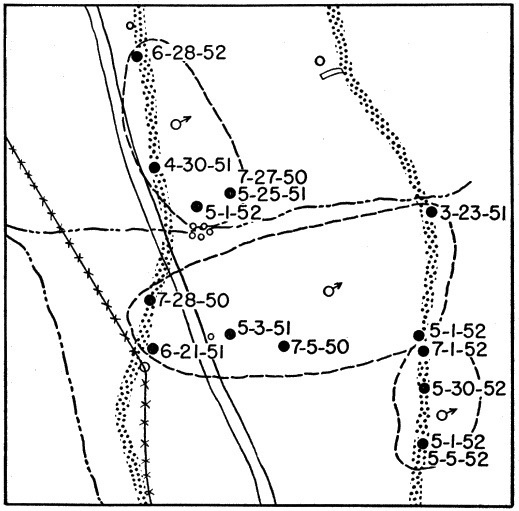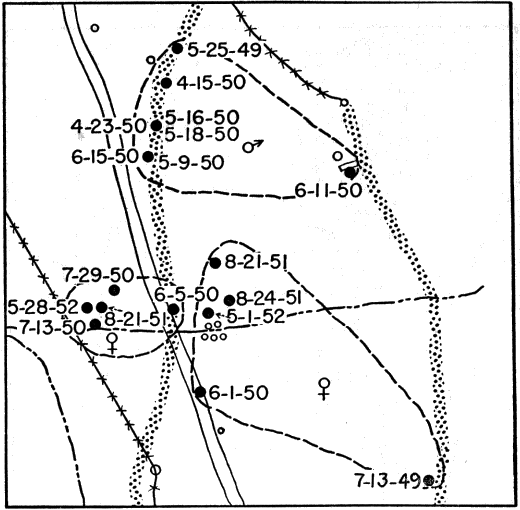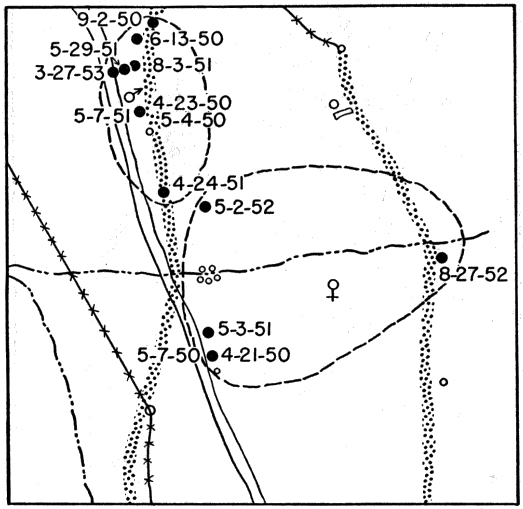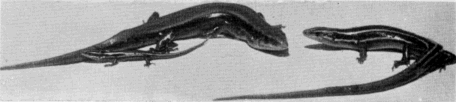
Fig. 1. Old adult male, year-old young and hatchling in July, showing
differences in size and pattern.
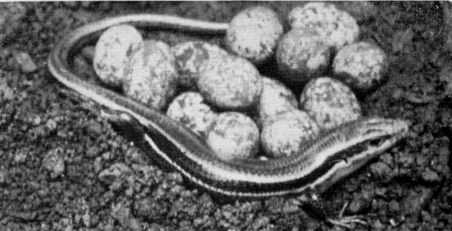
Fig. 2. Adult female skink in a natural nest, with her clutch of eggs
late in incubation. The nest cavity is excavated in loose soil beneath
a flat rock, which was raised momentarily to expose the nest to view.
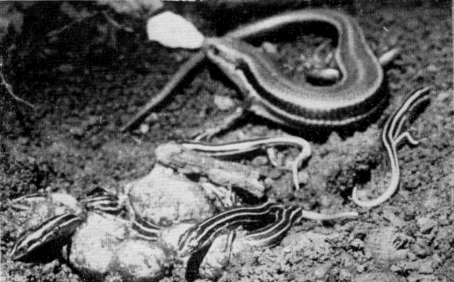
Fig. 3.
The same female and nest, with eggs in process of hatching.
Noble and Bradley (1933:77) mention frequent homosexual
matings between captive males. However, I observed no homosexual
matings, either under natural conditions or in confinement.
The pugnacious behavior of males that are in breeding condition
ordinarily would prevent homosexual mating. Males in such weakened
condition as to be unable to defend themselves effectively
might evoke sexual attack, instead of the usual fighting response in
other males. Although no actual experiments were performed in
the present study in connection with the courtship and mating behavior,
accounts of some workers seem misleading. My own observations
indicate that the capacity for sex discrimination in this
particular kind of lizard, and probably in others, has been underrated.
For example, it has been stated that the male rushes with
open mouth at the neck of any other skink that happens to be
around, and he identifies it as a male if it fights back, or as a female
if it does not. On the contrary my observations indicate that sex
recognition occurs almost as soon as the male is aware of another
skink’s presence. The red head of the breeding male is an excellent
example of a social releaser in the sense that this term was
used by Tinbergen (1948:8). Like the red belly of the breeding
male stickleback, it facilitates sex recognition and evokes hostile
behavior on the part of other males. Courtship, mating, and fighting
reactions however, seem to be evoked by the interaction of a
complex of social releasers. Whereas males and females are strikingly
different in appearance in the breeding season, visual sex
recognition is complicated by ontogenetic changes. The body
stripes characteristic of the female pattern, become dull or even
disappear in some old females, which then approximate the typical
male pattern. On the other hand newly matured males in their
first breeding season retain distinct body stripes of the female pattern.
Their sex is evidenced mainly by their reddish facial suffusion,
which is not quite so extensively developed as it is in older
individuals. Also, in these newly matured males the temporal region
is not so swollen as it is in old males.
The male whose dormancy was terminated in early winter by
bringing him into a warm room causing him to assume breeding
coloration and to breed some four months earlier than those under
natural conditions has already been mentioned. By the time the
regular breeding season arrived, this male had long since undergone
sexual regression and retained no trace of the red suffusion. In
this condition, placed in a terrarium with a mixed group of breeding
adults, his social status was of unusual interest. He exhibited
no interest in the females and was less pugnacious toward other
males than were the individuals in breeding condition. Although
he seemed somewhat more nervous and timid, his hostile behavior
was not entirely suppressed, as from time to time he moved up to
other males and bit them viciously. His color pattern resembled
those of certain old adult females in which the body stripes have
been suppressed, but the breeding males evidenced no uncertainty
as to his sex and were uniformly hostile. Their reactions were not
noticeably different toward him than they were toward breeding
males. The importance of an olfactory stimulus as a social releaser
in sexual behavior of lizards has not been appreciated, although
Noble and Mason (1933:10) did demonstrate its importance
in the behavior of the female toward her eggs.
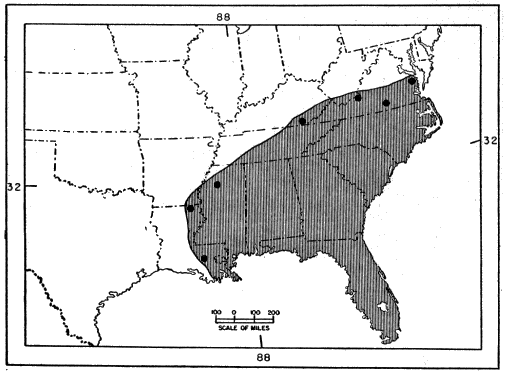
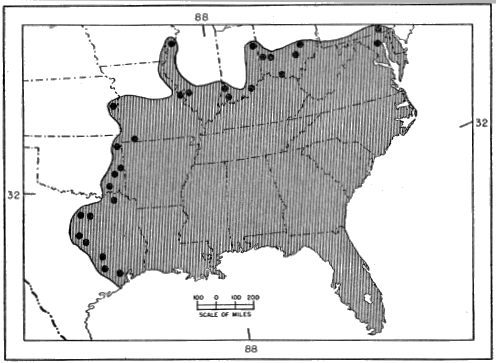
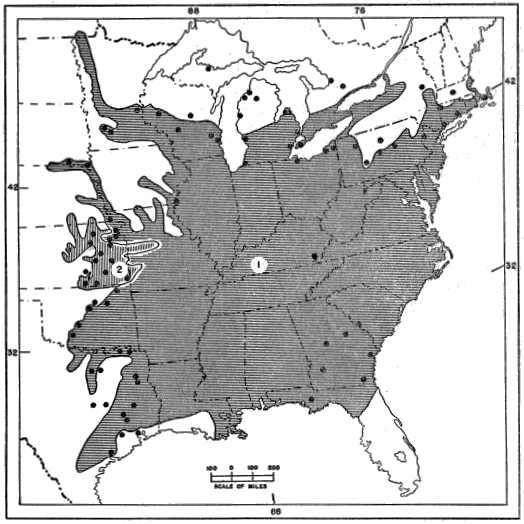
It is evident from published accounts, and from my own limited
experience with fasciatus in parts of its range other than northeastern
Kansas, that the phenology of the breeding cycle is subject to
geographic variation, synchronizing with the somewhat different
climatic conditions under which the species occurs. However, the
difference is less than might be expected, in view of the species’
extensive range. As a result of the early spring, and the warm
summer climate in the southern states, dates of laying and hatching
may be several weeks advanced. On April 12, 1952, Dr. Wilfred
T. Neill showed me several live E. fasciatus, collected a few
days before along the Trinity River in southeastern Texas, which
appeared to be at the height of breeding condition. In northeastern
Kansas on that date, general emergence had not yet occurred,
and it was not until about May 10 that the population attained the
peak of breeding condition. On May 8, 1948, near Burr Ferry,
Vernon Parish, Louisiana, I caught an adult female in her nest
burrow, and she contained eggs ready to be laid. Data with which
Mr. Robert Gordon kindly provided me for specimens from southern
Louisiana and southeastern Texas, in the Tulane University collection,
indicate gravid females on June 4, 1952, and June 17, 1948
(3), and females with their egg clutches on June 16, 1948, June 17,
1948, June 23, 1950; and hatching dates in captivity of July 19, 1949,
July 19, 1950, July 25-26, 1949. These dates correspond well with
those for specimens obtained in northeastern Kansas in the same
years. In the northern part of the range, Ruthven (1911:264)
recorded that in the Saginaw Bay region, females taken on June 19
had eggs nearly ready to be laid, and after July 2 clutches were
found frequently; young of the year were first observed on July
31. A juvenal specimen in the University of Minnesota Natural
History Museum, collected on August 11, 1938, at Dresser Junction,
Wisconsin, is 301⁄2 mm. in snout-vent length—approximately
the size of juveniles in northeastern Kansas at the same season.
Evans and Roecker (1951:6) record hatching as occurring in the
first week of September at Arden, Ontario, indicating that at the
northern edge of the range hatching may be delayed as much as
two months. With such delayed hatching, but little time remains
for the young to grow before they are forced into retirement for
hibernation.
Territoriality in the usual sense is lacking in the five-lined skink,
and could scarcely exist in an animal of its habits. To defend a
definite area (territory) against intruders of its own species, the
animal would have to detect such intruders promptly. The skink,
however, is so secretive in habits that at any given time the individual
is likely to be hiding and inactive, even when conditions are
favorable for it to be in the open, and other individuals therefore
can then wander onto its home range unopposed. Even when an
individual is active, it lacks the ability to detect others, except
within a radius which would encompass only a small fraction of
the entire home range. The senses are inadequate to inform one
lizard of the presence of another until the two are only a few yards,
or even a few inches apart. Usually the lizard is on the ground,
where even small objects obstruct its view, and vision is probably
effective for only a few yards. Hearing is probably effective for
about the same radius in detecting animals of approximately its
own size. Scent is effective in detecting prey near at hand or on
contact, but probably does not serve for detection of other lizards
that are not in the immediate vicinity. Therefore, the area covered
by one in the course of its normal activities may harbor many others,
and individuals most of the time are unaware of the others on their
home ranges.
Under most circumstances these skinks behave toward each other
with tolerance or indifference, but during the breeding season adult
males become hostile, and fight on sight. Their reddish facial suffusion
serves as a social releaser which elicits hostile behavior and
facilitates sex recognition. As the breeding season wanes, the reddish
suffusion fades rapidly and male hostility, probably controlled
by the same hormonal complex, is likewise suppressed. Hostile behavior
is rare in adult females or young at any time.
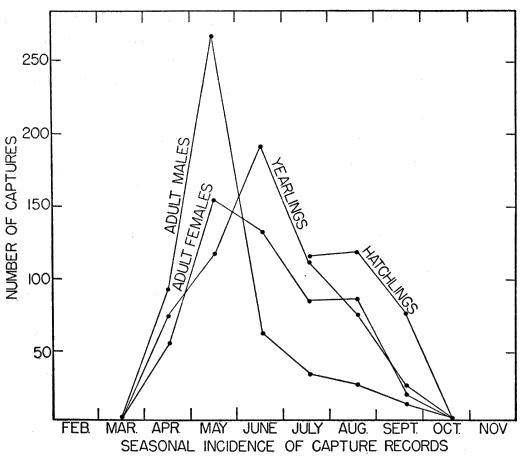
Combats and pursuits have been observed most frequently the
last week of April and especially in the first two weeks of May. At
this season funnel traps set along rock ledges often caught two
adult male skinks together. In almost every instance one of the two
confined males was mutilated, with pieces of skin and flesh bitten
from the tail and with chin, snout, and neck scarred; most serious
wounds were usually in the sacral region or base of the tail or both.
Often the wounds were so severe that the skink died in a short
time in captivity and presumably others that were released died also.
On April 28, 1949, a large adult male skink, chased by another, ran out
in the middle of a trail and stopped. The pursuer stopped a few inches from
it, then after a long pause, retreated in the direction from which it had come.
For the five minutes that the pursued skink was watched, it lay motionless,
partly hidden by dry leaves, evidently seeking to avoid further pursuit by concealment.
I caught it without difficulty, and it seemed weak and dazed, as if
injured in the fight. Its reddish suffusion was conspicuous, but not fully
developed.
On May 3, 1949, an adult male having bright red facial suffusion was observed
searching persistently in ground litter; he was seen to find and pursue
a female, and to copulate. A few minutes after mating was completed and the
pair separated, a second male also searching in the vicinity came within sight
of the first one. The two noticed each other at a distance of about 18 inches,
indicating their awareness by their more alert, jerky movements, and spasmodic
vibrating of their tails. The newcomer darted at the other, and for a moment
[53]
they dodged and sparred. As one broke away to run, the other seized it by the
tail. They were on an exposed tree root about an inch in diameter. The skink
that was caught twisted its body around underneath the root and seized its
adversary by the tail likewise, so that their linked bodies encircled the root,
each squirming to disengage itself from the other’s jaws. After a few seconds
they did break apart, and then maneuvered briefly menacing each other at close
quarters, but they gradually moved away and lost contact.
On May 10, 1949, two adult males were seen to approach each other slowly,
pausing for perhaps a minute when they were a little more than one foot apart.
Then one edged up to the other, and with a sudden lunge seized it by the head.
The one seized broke away with a vigorous jerk, and promptly retaliated by
biting the first one’s head. After a few seconds of rapid sparring and thrashing,
they broke apart, and one chased the other for several feet until it eluded further
pursuit by dodging and hiding.
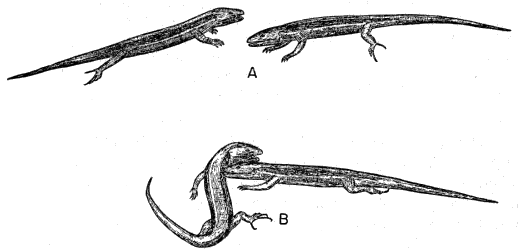
Fig. 9. Adult male skinks fighting. A. Menacing approach. B. One has
lunged and secured a grip on the other’s side, holding it at right angle. The
one caught is unable to flex its body and neck enough to secure a retaliatory
grip on the attacker, and must break away by violent thrashing.
On May 12, 1950, my attention was attracted by a rustling in dry leaves.
Within a few inches of my foot two adult males were struggling fiercely with
jaws interlocked. Sudden violent twisting and thrashing alternated with quiet
periods of a few seconds duration, in which the lizards scarcely moved except
for heavy panting and twitching of their tails. After perhaps two minutes of
fighting, one broke away and ran. For a distance of several feet it was closely
pursued by the other, which, however, soon lost contact with it in the rough
terrain and surface litter.
On May 12, 1951, rustling in dry leaves attracted my attention to two large
adult males fighting. For about fifteen minutes that they were observed, they
struggled, with neither yielding ground, though they thrashed and rolled about
over an area of several square feet. Sometimes they were disengaged for short
intervals. Then facing in opposite directions, with their heads side by side,
they would snap at each other’s necks and shoulders (Figure 9). Part of the
time both males had grips and were biting each other simultaneously, but more
frequently one or the other had a temporary advantage. When one secured a
grip it would strain to the utmost, biting as hard as it could and lunging forward
with frequent short jerks, meanwhile striving to keep out of reach of the
[54]
other’s jaws. The one caught in the attacker’s grip was usually unable to flex
its body sharply enough to reach its opponent at all, or could barely reach it
at such an oblique angle that its jaws slipped off the smooth body. Sometimes
the one held did succeed in catching the other’s front foot. The one caught in
the other’s jaws always succeeded in tearing loose after a short time. In the
interval while the attacker rested with jaws partly relaxed, the victim had an
opportunity to break away. Even when both were free, they did not obtain
grips easily, but often made several unsuccessful lunges and bites, the jaws of
each slipping off the firm, smooth sides of its opponent. Sometimes the attacker
seized a fold of skin, or sometimes obtained a wide grip on its body. One
which had obtained a grip sometimes rolled rapidly, spinning the other around
and dashing it against the ground. As these rotations stopped, the victim might
come to rest on its back in such a position that it was temporarily helpless, but
always broke loose after further struggles. Neither showed any inclination to
retreat until finally, when they were interlocked, rolling about almost at my
feet, I attempted to catch them. Then they instantly disengaged and rushed
away, and one escaped. The one caught had suffered but little injury in the
fight. Numerous tooth marks were discernible as minute abrasions on the surface
of the scales, but the bony dermal armor had not been perceptibly penetrated
during the prolonged and violent struggle.
The eggs of Eumeces fasciatus are like diminutive chicken eggs in
appearance. They are white when first laid, slightly translucent
when held to the light. Within a day or two after they are laid,
these eggs are soiled to a dull tan color, somewhat mottled, as a
result of being rolled and dragged about in contact with the floor
and wall of the nest burrow. Like the eggs of most other reptiles,
those of Eumeces fasciatus have parchmentlike shells. These shells
are thin and easily punctured. As incubation proceeds, the egg
enlarges by gradual absorption of moisture and the somewhat elastic
shell is stretched. An egg left in water for as much as a day does
not gain in weight appreciably. Except for occasional abnormal
ones, the eggs of any one clutch are notably uniform in size and
shape at the time they are laid. As incubation proceeds, some eggs
enlarge more rapidly than others, and attain larger ultimate size.
Differences in shape also appear, some eggs becoming relatively
elongate and thin, while others are thick and blunt. Some become
distorted to asymmetrical shapes. In nests that have been deserted
by the females, eggs of irregular shape are especially noticeable.
It seems probable that the frequent shifting of the eggs by the
female prevents unequal drying or stretching in different areas of
the shell. Normal young were observed to hatch from grossly misshapen
eggs. Under conditions of drought, the eggs may not enlarge
normally during the latter part of incubation, and may become
indented or partly collapsed, and yet apparently normal young
hatch from them. Both in the field, and in laboratory experiments,
eggs were found to have remarkable tolerance for excess moisture.
After heavy rains of summer thunderstorms, nests were sometimes
found to have water trickling through them, and on occasion eggs
were found to be partly submerged in water in the nest cavity. Exposed
rocks at the heads of small gullies often were chosen by the
female skinks as the shelter for their nests. In these situations the
nests were exposed to run-off water. In July, 1951, especially, unusually
heavy precipitation resulted in the flooding of many nests.
In some instances desertion by the females and destruction of the
eggs seemed to have been caused by this flooding, even in the well-drained
hillside situations where this study was made.
Table 5.—Measurements in Millimeters and Weights in Grams of Eggs
in the Same Clutch at Different Stages During Their Incubation,
Showing Gradual Increase in Size.
| |
June 17
(laid) |
June
18 |
June
24 |
June
28 |
July
17 |
July
20 |
July
28 |
July 30
(hatched) |
Average length
(for 7) |
..... |
.... | |
.... | |
.... | |
13.7 | |
14.3 | |
14.7 | |
....... |
Average width
(for 7) |
..... |
.... | |
.... | |
.... | |
10.5 | |
10.9 | |
11.1 | |
....... |
| Typical length |
..... |
11.1 | |
.... | |
12.5 | |
14.0 | |
14.3 | |
14.8 | |
....... |
| Typical width |
..... |
7.5 | |
.... | |
9.9 | |
11.0 | |
11.2 | |
11.0 | |
....... |
| Maximum length |
..... |
11.5 | |
.... | |
.... | |
14.5 | |
15.0 | |
15.5 | |
....... |
| Maximum width |
..... |
7.5 | |
.... | |
.... | |
10.9 | |
11.1 | |
11.4 | |
....... |
| Minimum length |
..... |
10.5 | |
.... | |
.... | |
12.5 | |
12.8 | |
13.5 | |
....... |
| Minimum width |
..... |
7.0 | |
.... | |
.... | |
9.9 | |
10.0 | |
10.5 | |
....... |
| Average weight |
..... |
.38 | 10 |
.58 | 5 |
.63 | 9 |
.82 | 8 |
.90 | 7 |
1.0 | 7 |
....... |
| Typical weight |
..... |
.4 | |
.... | |
.... | |
.... | |
.9 | |
1.0 | |
....... |
| Maximum weight |
..... |
.... | |
.... | |
.... | |
.... | |
1.0 | |
1.1 | |
....... |
| Minimum weight |
..... |
.... | |
.... | |
.... | |
.... | |
.7 | |
.7 | |
....... |
| Superior number indicates the number of individuals averaged. |
The extent of tolerance to immersion in water probably depends on the stage
of development, the temperature, the oxygen content of the water and other
factors. One egg was fully immersed for ten minutes on July 20, 1951, then
returned to a container with damp soil in the laboratory, where it seemed to
develop normally. On July 30 it was opened and found to have a living fetus,
[56]
which was a week short of hatching. On July 22 another egg of the same
clutch was immersed and left in water for 23 hours. On July 30 it was ruptured
in handling and found to contain a living fetus. On July 31 two eggs were
placed in a dish of water in a refrigerator. On August 5 they were removed
and opened. Fetuses were dead and were not appreciably larger than the one
of the same clutch in the egg opened on July 31. On August 5 two of the remaining
eggs of this clutch were placed in a Petri dish, partly immersed in
water, with approximately one-fourth of the surface of each protruding and
exposed to the air. Forty-eight hours later it was found that both eggs had
hatched. Evaporation had reduced the water in the dish to an amount sufficient
to cover only about the lower one-third of each egg. One hatchling was
missing, evidently having climbed out of the shallow dish and escaped to the
floor. The other was found still standing in the water with its head protruding,
and it was lively and in good condition. The remaining four eggs in this clutch,
which had been kept in a container of damp earth, were also hatching on this
date. On July 10, 1952, an egg in a late stage of incubation was immersed in
water in the laboratory. On July 14 when removed, it had fungus growing on
it, and was found to have a dead fetus, nearly full-sized.
The range of temperature tolerance of the embryo is wide, probably
comparable to that of the adult. Time required for incubation
is dependent on temperature. Persistently wet and cloudy weather
in the summer of 1951, keeping temperatures relatively low in nests,
was a contributing cause to late hatching that summer. As compared
with 1952, hatching was about one month delayed in 1951,
but later emergence and breeding accounts for part of the difference.
The extent to which low temperature may delay incubation
was indicated by the effect of refrigeration on several experimental
eggs, as recorded below.
| 1. |
July 8, 1952 |
Egg transferred from natural nest to jar of damp soil in
refrigerator at 13.8°C. |
| |
July 14, 1952 |
Seems to be in good condition. |
| |
July 19, 1952 |
Partly collapsed. Weight and measurements same as on
July 8; opened and found to contain a dead fetus. Snout-vent
length 23 mm., forehead bulging, skin delicate and
membranous. Colors somewhat dull, indicating that it was
not quite fully developed, although it had attained the
minimum hatching size. |
| 2. |
July 10, 1952 |
Egg from natural nest (15.0 × 10.5 mm., .95 gm.) put in
refrigerator at 11.6°C. Control (14.5 × 10.6 mm., .8 gm.)
from the same clutch kept in hatching medium in laboratory. |
| |
July 13, 1952 |
Control egg hatching; refrigerated egg shows no indication
of hatching. |
| |
July 14, 1952 |
Experimental egg 15.8 × 10.8 mm., 1.0 gm., seems to be in
good condition. Nest from which it was taken found to
have all remaining eggs hatching today. |
| |
July 19, 1952 |
Experimental egg 15.0 × 10.0 mm., 1.0 gm., removed from
refrigerator and transferred to container in damp rotten
wood in laboratory. Seems to be in good condition.
|
| |
July 23, 1952 |
Experimental egg found to be hatched this morning, and
hatching must have occurred either in the night or late
yesterday. Eggshell still damp and pliable. |
| 3. |
July 10, 1952 |
Egg from natural nest (14.0 × 10.5 mm., .8 gm.) put in
refrigerator at 11.2°C., in container with damp decayed
wood. Control egg (14.2 × 10.1 mm., .8 gm.) from the
same clutch kept in the same hatching medium in the laboratory. |
| |
July 12, 1952 |
Nest from which experimental and control eggs were taken
has started to hatch, and two hatchlings were seen there. |
| |
July 13, 1952 |
Control egg hatched. |
| |
July 14, 1952 |
Experimental egg 14.2 × 10.1 mm., .8 gm., seems to be in
good condition. Nest in field examined and all eggs were
hatched, with only three of the hatchlings remaining, the
others having dispersed. |
| |
July 19, 1952 |
Experimental egg 14.0 × 10.0 mm., .95 gm., still appears to
be in good condition; removed from refrigerator and kept in laboratory. |
| |
July 23, 1952 |
Experimental egg found to be hatched, and hatchling active
although still in hiding beneath rotten wood. Probably it
hatched early in the day of July 22; the empty shell is still moist. |
These experiments seem to show that, in the later stages of incubation
at least, lowering of temperature to 11° or 12°C. almost halts
development of the fetus. Harm does not necessarily result, however,
and when again warmed to normal incubation temperatures,
the eggs eventually hatch, the incubation period being lengthened
by a time approximately equivalent to the interval of refrigeration.
Under natural conditions the time required for incubation probably
varies within wide limits, controlled mainly by temperature.
No two clutches receive the same amount of heat, as sites differ
greatly in extent of insulation, and exposure to sunlight. Each
year, earliest appearance of hatchlings is in a warm, sunny situation,
and in cooler, well shaded places hatchlings appear somewhat later.
Their incubation is evidently somewhat protracted, although later
emergence from hibernation and later breeding of adults in these
situations might also contribute to the delay.
Widely different incubation periods have been recorded in the
literature and the variation probably is not due to temperature alone.
Noble and Mason (1933:4) recorded incubation periods for six
females from the same locality, and evidently kept under the same
laboratory conditions, as 47, 41, 36, 29, 29, and 27 days. Despite
the wide difference in incubation time, all six clutches hatched
within a 12-day period from July 5-17. It seems improbable that
differences in temperature account for the 20-day disparity between
maximum and minimum incubation time, in these females kept
under similar conditions. Cagle (1940:229) recorded an even
shorter incubation period for one kept in the laboratory, which laid
eggs on June 30; hatching occurred on July 23 and 24. Retention
of eggs in the oviduct by females kept under unnatural conditions
would partly explain their late laying and the short incubation
period of their clutches. Such ability to retain eggs in the oviduct
while their development proceeds would not be especially surprising
in E. fasciatus since its congener E. lynxe of the highlands in southern
Mexico is normally ovoviviparous (Hartweg, 1931:61; Taylor,
1936:171). Cagle did not determine incubation time for any of the
natural nests found, but evidently in all of them laying occurred
earlier than in the single female brought to the laboratory while
still gravid. All the eggs in natural nests found by him were brought
to the laboratory and most of them were hatched. Cagle remarked:
“The fact that these 26 nests hatched within a period of nine days
seemingly indicates that the egg laying period extends over not
more than two weeks.”
In the present study no incubation periods so short as those recorded
by Noble and Mason, and Cagle, were observed. Incubation
times were recorded for clutches both in the laboratory and in
the field, but for most of the clutches only approximate incubation
periods were recorded. Failure to record the exact date of laying or
of hatching, or both resulted from attempts to avoid frequent disturbance
of females in their nests, which might have caused them to
desert.
One clutch of eggs laid in a terrarium probably on June 17, 1951—possibly
a day or two earlier—hatched on July 30, after an incubation of about 44 days.
Another clutch, found in a terrarium on July 17, 1951, was estimated to have
been laid about a week earlier, judging from the average length (11.8 mm.)
and average weight (.55 gm.) of the eggs. These eggs hatched on August 9,
a little more than three weeks after their discovery. A clutch found in the
field on June 25, 1951, evidently recently laid (average length 12 mm., weight
.45 gm.), hatched 41 days later, on August 5. Another clutch found in a terrarium
on July 17, 1951, was estimated to have been laid ten days or two weeks
before, as the average length was 12.7 mm. The eggs hatched on August 7,
three weeks after their discovery. On June 25, 1951, an incomplete clutch of
three eggs was found with a female which still had an unlaid egg. The three
eggs probably had been laid the same day or the day before. They were kept
in the laboratory and weighed and measured at intervals until July 28, 33 days
after their discovery when both those that remained were accidentally punctured
[59]
and found to have nearly full term fetuses. In the field a nest which
contained only a gravid female on June 24, 1951, had a clutch of eggs already
mud stained and slightly enlarged on June 29. The most probable date of
laying was June 26. On August 6 the eggs had all hatched but several young
were still in the nest. Probably most hatched on August 5. The incubation
time was hence approximately 40 days.
On June 21, 1951, a natural nest was found with eggs already somewhat enlarged
(12.5 × 8 mm.) and mud stained. This nest was checked from time to
time in the next few weeks, and after 39 days, on July 30, it was found that
all the eggs had recently hatched, but six young were still in the nest cavity.
Another nest was found on June 24, 1951, with the eggs already markedly
enlarged (14 × 8 mm.) indicating that laying must have been several days
earlier—probably well over a week. Hatching occurred approximately 34
days later, probably on July 28, since on July 26 there was no sign that hatching
was imminent, and on July 30 only the empty dried eggshells remained in
the nest.
The incubation time approximated six weeks for those nests with
most complete records. Under wet and stormy weather conditions
such as prevailed in 1951, this may have been the normal incubation
period, but in warmer and drier years incubation time is shortened.
In the five-lined skink each adult female normally produces one
clutch of eggs annually. The size of the clutch produced is subject
to individual variation, and is influenced by the age, size and condition
of the female. Geographic variation in clutch size might also
be expected. Data were obtained from breeding females killed and
dissected, from counts of eggs found in natural nests in the field, and
from clutches of eggs laid by females kept in captivity. For the
total of 115 recorded clutches represented by the combined data
from all these sources, the average number of eggs per clutch was
9.5.
In many females dissected for the purpose of obtaining egg
counts, ovulation had not yet occurred. The ovarian eggs present
in each of these females included two main size groups, the larger
ones in process of maturing and evidently destined for deposition
in the current season, and minute, immature ones. A few of intermediate
size were always present, however, resulting in uncertainty
as to the size of the clutch being produced, especially when development
had not proceeded far. Even when the larger eggs formed
a fairly distinct size group, some usually were well below maximum
size. Relatively high counts of clutches were obtained from these
examinations of enlarged ovarian eggs. Evidently development
frequently is arrested, and resorption may occur before ovulation.
As a result the numbers of ovarian eggs developing are a poor indication
of actual clutch size. A series of gravid females were obtained
and examined after ovulation; the numbers of eggs in their
oviducts probably indicates accurately the sizes of their clutches.
Gravid females taken from their nest burrows and kept in the laboratory
in containers with loose damp soil soon excavated new burrows
and deposited clutches. Many natural nests were found in the
field, and the egg counts obtained from them provided further data
concerning clutch size. Although most of these clutches probably
had their full complements of eggs, others certainly had sustained
losses to predators, or to the females themselves, which may eat
some of the eggs. Therefore the average number found is erroneously
low. Some of the natural nests found may have contained
two or more clutches or parts of them, and the higher counts obtained
from natural nests therefore are also questionable.
For different sets of data on clutch size, numbers were as follows:
Table 6. Size of Clutch.
| Source of Sample |
Number of
clutches |
Mean |
Standard
deviation |
Maximum |
Minimum |
| Early ovarian |
25 |
11.4 ± .46 |
2.28 |
20 |
5 |
| |
|
|
|
|
|
Late ovarian,
uterine, or laid
in captivity |
56 |
9.16 ± .21 |
1.85 |
15 |
4 |
| |
|
|
|
|
|
| In natural nests |
34 |
8.82 ± .32 |
1.85 |
16 |
4 |
On the average, larger females produce more eggs per clutch
than do smaller females. Of 49 females for which measurements
were recorded, and which had uterine or large ovarian eggs, 31
were 70 mm. or more in snout-vent length. These 31, mostly or
entirely old adults, averaged 9.9 eggs per clutch, whereas 18 others
that were 69 mm. or less in snout-vent length, and that must have
been mainly or entirely newly matured adults in their first breeding
season, averaged only 7.8 eggs per clutch.
Smith (1946:350) states that in the northern part of the range
of this skink there is some indication of decrease in size of clutches.
This is not well shown by published records. For the southern
states, most of the published records of clutch size are by authors
who did not clearly distinguish between the three kinds of five-lined
skinks, and there is some doubt as to which species is involved
in each record. For 56 clutches reported upon from north
of approximately latitude 37°, I obtain a slightly higher figure than
for 11 clutches from south of this line. Geographic trends are, of
course, obscured by individual variation, and perhaps by abnormal
clutches produced by individuals kept in captivity.
In Table 7, the figures marked with asterisks pertain to clutches
that might have belonged to skinks of the species E. laticeps or
E. inexpectatus since they were recorded in regions where laticeps
and in some cases, inexpectatus also, occurs along with fasciatus.
If these questionable clutches are excluded the remaining 55,
definitely of fasciatus, average 8.48 eggs per clutch, whereas the
12 questionable clutches average 8.42. Both figures are close to
the average of 8.82 ± .32 eggs for the 34 natural nests recorded in
the present study. For the total of 1661 eggs of 182 clutches, from
the combined sample of all available records for clutches found in
the present study or reported upon in the literature, the average
egg number is 9.13.
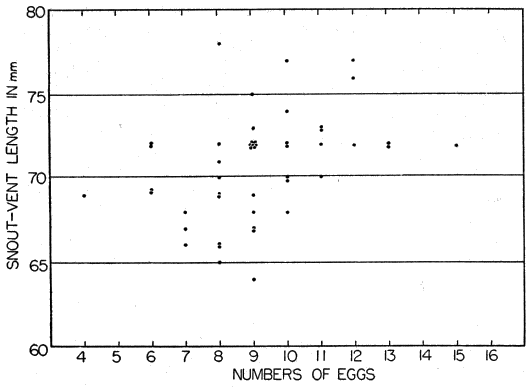
Fig. 10. Correlation between size of female and number of eggs in clutch;
females in their first breeding season, mostly less than 72 mm. in snout-vent
length, produce smaller clutches, on the average, than do larger and older females,
but there is extensive overlap.
To sum up the available information on clutch size, the number
of eggs is most typically 9, 10, or 11 and is more in large old females,
than in small, newly matured females. In natural nests,
even in those that are successful, there is often some loss of eggs,
which are eaten by predators, or by the female herself, with the
result that the egg counts made by various observers average somewhat
lower than the numbers actually produced. The loss during
incubation cannot be measured readily since it is almost certainly
sharply increased by the disturbance entailed in observing nests.
Exposing nests, even momentarily, for observation, may result in
compacting of the surrounding soil, desiccation, temporary or permanent
desertion by the female, and exposure to predation. Some
indication of the incidence of loss during incubation might be obtained
by counting and measuring the eggs in newly found nests
and correlating numbers with size (indicating the length of time
incubated).
Table 7.—Numbers of Eggs Per Clutch, Time of Occurrence, Laying
Dates and Hatching Dates, as Reported in the Literature by Various
Authors.
| Author |
Numbers
of eggs
per clutch |
Date recorded |
Natural
nest |
Laying date |
Hatching
date |
Locality |
| Allard |
7* |
.... |
Yes |
.... |
.... |
Northern
Georgia |
| |
|
|
|
|
|
|
| Bishop |
8* |
.... |
Yes |
.... |
.... |
Breathitt Co.,
Kentucky |
| |
|
|
|
|
|
|
| Blanchard |
9* |
.... |
.... |
.... |
.... |
Tennessee |
| |
|
|
|
|
|
|
| Burt |
6; 11 |
May, and
June 18, 1926 |
Yes |
June 12, 1926 |
.... |
Douglas Co.,
Kansas |
| |
|
|
|
|
|
|
| Burt |
9*, 9*,
9*, 10* |
June 25 to
July 13, 1926 |
Yes |
.... |
.... |
Arkansas |
| |
|
|
|
|
|
|
| Burt |
8* |
June 6, 1933 |
Yes |
.... |
.... |
Ashville,
North Carolina |
| |
|
|
|
|
|
|
| Burt |
8* |
June 28, 1934 |
Yes |
.... |
.... |
Scott,
Mississippi |
| |
|
|
|
|
|
|
| Burt |
6* |
July 7, 1933 |
Yes |
.... |
.... |
Emma,
Georgia |
| |
|
|
|
|
|
|
| Burt |
6* |
July 8, 1933 |
Yes |
.... |
.... |
Elk River,
Alabama |
| |
|
|
|
|
|
|
| Cagle |
Average
9.16 in 26
nests (6-15) |
June-July |
Yes |
June 30 |
July 23-24 |
Elkville, Illinois |
| |
|
|
|
|
|
|
| Conant |
7, 9, 10,
11, 13 |
.... |
.... |
.... |
July 27,
July 27 |
Ohio |
| |
|
|
|
|
|
|
| Dunn |
12* |
.... |
.... |
.... |
Aug. 9 |
|
| |
|
|
|
|
|
|
Evans and
Roecker |
6, 7 |
.... |
Yes |
.... |
First
week of
Sept. |
Arden, Ontario |
| |
|
|
|
|
|
|
Fitch
(field
notes) |
9 |
July 22, 1947 |
Yes |
.... |
.... |
Vernon Parish, Louisiana |
| |
|
|
|
|
|
|
| McCauley |
3; 20 in 3
other nests
combined |
.... |
Yes |
July 5 and 6 |
August 30 |
Maryland |
| |
|
|
|
|
|
|
Noble and
Mason |
2, 5, 5,
6, 7, 8, 8 |
.... |
No |
May 23, 27, 31;
June 6, 6, 13, 20 |
July 5,
5, 6, 7, 9, 17 |
Anderson Co., Kansas |
| |
|
|
|
|
|
|
| Ruthven |
6, 6, 8, 9,
11, 13, 14 |
.... |
Yes |
.... |
.... |
Michigan |
| |
|
|
|
|
|
|
| Smith |
9 |
.... |
Yes |
.... |
.... |
Ohio |
Lizards and snakes of several different families, are known to
brood their clutches of eggs, although the great majority of oviparous
forms do not do so. The brooding habit is perhaps best
known in Eumeces fasciatus, and has been described by many
authors. By far the most thorough account is that of Noble and
Mason (1933) who observed and experimented upon seven females
that laid clutches of eggs in captivity. These females, kept in separate
terraria, excavated nest burrows for reception of their
clutches, and remained with them throughout the time of incubation.
There were three characteristic brooding postures; curved
in a semicircle around the clutch, in an S-shaped figure extending
among them, or lying straight, either over or among the eggs. The
brooding females, taken quietly from their nests without disturbing
them, were found to have temperatures averaging .4°C. higher
than the nests. Evidently normal room temperatures were maintained
in the laboratory where the terraria were kept. The females
occasionally left their nests, especially in late afternoon, to wander
about the terraria, and to bask in sunlight. While basking, their
temperatures averaged 2.7°C. higher than the nest temperatures.
The authors suggested that an important function of the brooding
female was to transfer warmth from absorbed sunlight to the eggs.
They state: “In nature the importance of the mother’s body heat
in the incubation of the eggs probably varies greatly with the type
of nesting site selected.” They suggest that in clutches deposited
in logs or stumps beneath a thin layer of bark exposed to direct
sunlight the need for warming by the female would be less.
My own observations do not support the idea that brooding by
the female serves to hasten the development of the eggs. Both in
the laboratory and in natural nests, clutches deserted by disturbed
females hatched and the hatching was not unduly delayed. In the
field, females were never observed to bask in the sun beside their
nest burrows, and seemingly left them infrequently even to feed.
When a female was caught in her nest burrow, her temperature
nearly always approximated that of the surrounding earth with
which she was in contact. The temperature in each nest depends
primarily upon its situation. When the immediate vicinity of the
nest receives direct sunlight, the eggs are warmed without the aid
of the female, but when there is no sunlight the temperature is
much lower. In order to maintain an appreciably higher nest temperature
the female would have to make frequent trips to spots
perhaps several feet or several yards away to find sunlight. Upon
returning to the nest, her body heat would be quickly dissipated
into the eggs and the surrounding damp soil. She would need to
shuttle back and forth almost continually between the nest and a
spot exposed to sunshine. Cloudy weather often preventing the
warming of the eggs by absorption of solar heat prevails during
much of the incubation season, in the region of the present study,
and probably to an even greater extent throughout the range as a
whole.
Noble and Mason state (op. cit.:9) that while in some non-brooding
kinds of lizards the eggs are actually damaged by turning, the female
fasciatus frequently turns her eggs and moves the whole clutch
about in the nest cavity. On returning to their nests the experimental
females each invariably touched one or more eggs with their tongues
as an olfactory test. Eggs of other kinds of lizards not of the
genus Eumeces, and shellacked eggs of fasciatus, or paraffin models
of them, ordinarily were discarded immediately after a single touch
of the tongue. Eggs of other individuals of the species, and even the
eggs of Eumeces laticeps were accepted as part of the brood.
Any of the experimental females would quickly retrieve one of
her eggs moved a short distance outside the nest cavity. Even if
the whole clutch of eggs were scattered about, the female would,
over a period of hours, gather the eggs and return them to the nest
cavity. This movement of the eggs is accomplished by rolling or
pushing them in a loop of the body or tail, or, less frequently,
by grasping an egg in the jaws, lifting it, and gently placing it in
a new position. Even if the females were blindfolded, they were
still able to retrieve scattered eggs, but one in which the tongue
tip was experimentally removed showed no further interest in its
eggs, presumably having lost the capacity to recognize them by olfactory
test.
In the present study clutches unattended by females were observed
to sustain heavy losses, both in the laboratory and in the
field, and no doubt the attending female performs important
functions other than that of warming the eggs. In the damp or wet
nest cavity, the eggs tend to adhere to each other and to the earth
walls and floor, and become sealed to such surfaces as a result of
partial drying, reducing the amount of surface exposed to the air
and probably hindering respiration. An eggshell sealed in prolonged
contact with the soil tends to rot with the result that it
is easily ruptured, and even if it is not broken there is the likelihood
of fungi or microorganisms gaining entry and killing the embryo.
In many of the eggs that were handled to obtain measurements and
weight, rupturing of shells occurred. The shells are tough and
elastic to the extent that even when eggs being handled were
accidentally dropped on the floor on several occasions, no damage
to them resulted. However, slight friction on the shell was sometimes
sufficient to puncture one. Particles of sharp rock from the
nest cavity may adhere to the shell, and result in rupturing, perhaps
at weak spots where prolonged contact with the soil has caused
deterioration. The female tends to keep her eggs in a compact
cluster, shifting their position frequently so that no part of an
eggshell adheres to its surroundings long enough for rotting to occur,
and most of the surface of each egg is exposed to the air.
Another important function of the brooding female seems to be
that of altering the nest burrow and shifting the eggs so that the
effects of unfavorable weather are minimized. The usual response to
warm and dry weather is deepening of the nest burrow. A cavity
originally in loose soil on the underside of a flat rock, having the
eggs in contact with the rock surface, may be displaced downward.
The female excavates loose soil from the floor of the burrow and
packs it on the top and sides, until the eggs are two or even three
inches underground, in a cavity different in position and shape
from the original one, although derived from it by gradual stages.
In many instances, however, no such response to drying was observed.
Probably extensive alteration of the nest burrow no longer
is possible after drying of the soil has progressed beyond a certain
stage as these skinks are not strong diggers. In some nests that
were examined frequently, with resulting desertions by the attending
females, the outlines of the cavities became indistinct and the
soil around them became dry and packed. In heavy rains, when
nest burrows are partly flooded, the females move the eggs to avoid
their being submerged. The extent of the female’s activity within
the nest burrow is suggested by the glazed condition of the earth
walls and floor, and by the mottled appearance which the eggshells
soon acquire as a result of being slid and dragged about in the nest
cavity.
Still another important function of the female is to dampen the
nest burrow to prevent desiccation of the eggs. Even in dry weather,
females taken from nests almost invariably voided water in relatively
large quantities. They drink dew or other available water,
and may void the contents of the bladder to moisten the nest cavity,
as on numerous occasions, when nests were exposed by raising
flat rocks covering them, part of the chamber was seen to be recently
watered, and distinctly moister than the surrounding soil.
Noble and Mason (op. cit.:16-19) found that brooding females,
in the laboratory, would vigorously defend their eggs against small
enemies, including mice and lizards and the smaller kinds of snakes
that were tested. The female watched alertly as the intruder approached,
and attempted to bite it if it came too near or touched
an egg. The females failed to defend their nests against persons
and against a large blacksnake; when confronted with such a threat,
the female would run from her nest cavity to hide. Cagle (1940:228)
stated that the brooding females found by him stayed in the
nests even when the logs in which they were situated were chopped
open with an ax, and that the skinks would attempt to bite when
touched with the finger.
In the present study, females whose nests were exposed never
made any active attempt to defend them. Many darted away and
hid as soon as they were exposed. In other instances, especially
when the nest cavity was only partly exposed, from one side, the
female cowered back against the inner wall, opening her mouth in
threat if closely approached. If further molested she might then
attempt to escape. In brooding females a tendency to sluggishness,
and an affinity for the eggs delayed the usually speedy escape reactions.
The temperature of the female was ordinarily lower than
it would have been in the open or on the underside of a flat rock,
and this also tended to slow her reactions. Gravid females when
exposed in nest cavities that still contain no eggs are similarly
sluggish and reluctant to leave differing little or none in behavior
from those that have laid their clutches. Usually the female was
found with her body encircling the eggs, holding them together in
a compact cluster in the center of the nest cavity. The eggs rest
in contact with the loose soil on the floor of the cavity, with each
other, and with the female’s body in the case of the outer ones of
the cluster.
Normal brooding habits proved to be difficult to follow because
the females were easily disturbed. In many instances those that
had excavated nest burrows, but had not yet laid, deserted the nests
after the disturbance involved in raising the sheltering rock. Females
that had already laid before discovery of their nests were
somewhat less inclined to desert, but many did so.
On numerous occasions, at the time of year when most females
are gravid and are staying in nest burrows, I have discovered well
formed nest burrows empty and seemingly deserted, with no female
in evidence nearby. In some instances the female may have been
out foraging or basking although she was not seen, and in other
instances the female may have been killed by a predator or eliminated
by some other accident. However, it seems that gravid females
frequently do desert their original nest burrows, for one cause
or another, and excavate new ones. Such desertions were noted
many times in the females observed on the study area, where the
disturbance from my own activities in raising the sheltering rocks
may have caused shifts, but it was probably not the sole motivation.
One female shifted approximately 120 feet, to excavate her second
nest burrow in a site that was damper and more heavily shaded
than the first site. This was in the notably dry summer of 1952.
Most of the favorite sites under flat rocks in open situations, that
were used in 1950 and 1951, were not occupied in 1952 or 1953,
although several females did use them for original excavations,
which were deserted before laying, as drought conditions developed.
In the summers of 1952 and 1953 nests were difficult to find, and
those discovered were on the average deeper and better protected
than those found in other years.
As compared with other North American lizards in general,
Eumeces fasciatus is notable for the relatively exposed and superficial
situations chosen as nesting sites. However, it occurs in a
climate of high humidity; in contrast, the great majority of our
lizards live in arid climates where the eggs are in much greater
danger of desiccation, and require better shelter to maintain the
humidity at a sufficiently high level. Accounts in the literature and
observations in the present study indicate that these skinks exercise
a wide range of choice of nesting sites. Ruthven (1911:264) stated
that in northern Michigan nests were usually in decaying logs;
occasional nests were found in burrows in sand, but invariably decaying
wood was present in or around at least part of the nest.
Blanchard (1922) mentions a nest in Tennessee that may have
been made by either this species or E. laticeps “in a hollow in a
dead willow tree about fifteen feet from the ground buried in the
loose, damp, rotted wood.” Noble and Mason (op. cit.:16) quote
Blanchard (in litt.) that in northern Michigan fasciatus nests in logs
that are exposed to sunlight. Conant (1951:31) stated that several
clutches of eggs found in Ohio were an inch to six inches beneath
the upper surface of the log or stump which sheltered them. Evans
and Roecker (1951:70) record finding two incubating females inside
rotten pine logs, in Ontario. Cagle, studying this species near
Elkville, Illinois, in oak-hickory woods, found 25 natural nests of
which three were in loose soil among the roots of a fallen tree,
another was under loose bark of a log, and the remainder were all
in cavities of partly decayed logs. Bishop (1926:119) recorded
finding a female with a clutch of eggs beneath damp boards at
Quicksand, Breathitt County, Kentucky.
In the present study, more than one hundred natural nests were
found, of which just one (containing two clutches of eggs) was in
decaying wood beneath the bark of an old log. All other nests
were beneath rocks. On the University of Kansas Natural History
Reservation, where most of the nests were found, the policy is not
to tear apart decaying logs; therefore the nests probably present
in such situations were not ordinarily found. On several occasions
groups of hatchlings were seen on logs within which they probably
had hatched. In the area of the study, however, decaying logs are
scarce. The hardwood forests consist mostly of young trees that
are second growth on cutover areas or pioneer on areas that were
previously grassland. Because of frequent cutting there are few
old mature trees, and logs have not accumulated on the forest floor.
In northeastern Kansas, nesting in logs is comparatively rare. On
wooded slopes and the edges of level hilltops, the flat limestone
rocks that are often abundant provide preferred nesting sites. Even
on collecting trips off the Reservation, where stumps and logs could
be torn apart and searched, flat rocks were found to provide the
main source of nesting sites. These nest rocks varied from less than
an inch in thickness to nine inches or more, and from a few inches
in diameter to three feet or more. Some were resting loosely on the
surface of the soil and others were deeply sunken, on one side. Some
were in situations exposing them to nearly the maximum amount of
sunshine whereas others were in sites nearly always shaded. The
varied character of the nesting sites chosen demonstrated a wide
range of tolerance for temperature, moisture, and other factors, in
the gravid and brooding female and in the developing embryo.
As already mentioned, Noble and Mason (op. cit.:9-10) noted
that females would accept and brood the eggs of other individuals
just as readily as their own, and several writers have reported gregarious
nesting habits, with two or more females occupying either
the same nest cavity, or separate cavities that were in close proximity.
For instance, Cagle wrote that among the small logs he
found to contain nests, four logs each contained one nest, five each
contained two nests, and two each contained three nests, while three
other nests were found within an eight inch square area in loose
soil among tree roots. McCauley (1939:93) in Maryland found
three females brooding clutches of eggs, which totaled 20, and
which were so near together that there was uncertainty as to which
clutch certain eggs belonged in.
The gregarious nesting habit may be of benefit in permitting
maximum utilization of choice nesting sites, where such sites are
in short supply in an environment otherwise favorable. Also, the
gregarious tendencies make possible more continuous guarding of
the eggs against such natural enemies as can be repulsed by the
female, since each female occasionally interrupts her brooding to
bask or forage.
Many of the nests that I found were in close proximity to others.
Often two nests, and sometimes even three, were found beneath the
same rock, and sometimes a distance of only two or three inches
intervened between the separate clutches. It seemed, however, that
in almost every instance each female had excavated a separate nest
chamber originally. In some instances adjacent nest chambers communicated
with each other.
On July 13, 1948, a communal nest was discovered beneath loose
bark of a decaying elm log. There were 22 eggs in the combined
clutch, and there were two females in the vicinity. The bark was
raised on several different days to examine the eggs, and one or both
females always were found with the eggs.
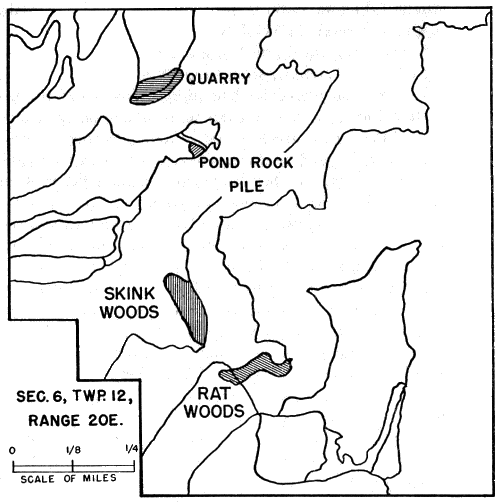
On June 10, 1949, at the pond rock pile, a flat rock was turned and
an unusual nesting aggregation consisting of a minimum of eight
females, and probably more than ten, was found. The nests were
somewhat disturbed by movement of the rock. The ground beneath
was honeycombed with tunnels connecting the flask-shaped nest
cavities, which were in part open to the rock surface on their upper
sides. Clutches of eggs numbered 13, 12, 11, 8, and 6 (the last
attended by a female which appeared to be still distended with
several more unlaid eggs). Of five other females taken, two had laid
and three were still gravid. Of the five clutches, two had eggs
noticeably larger than those in the other three, and with their shells
mottled brown from adhering earth. These nest cavities were
about half an inch deep and two to three inches wide. The females
were released as soon as they had been examined. One female
moved about over the nest areas exposed, and evinced interest in
a lone egg which had become separated from the others. She moved
up to it, standing high off the ground, with her head turned at
right angles to her body as if preparing to push the egg forward in
the angle thus formed, and tested it with her tongue, but then she
became alarmed and left the vicinity. The flat rock was lowered
over the nests again with a minimum of disturbance.
On July 9, 1949, the flat rock covering the nests was raised again.
Most of the eggs had hatched. Two broods of hatchlings were still
in their respective nest cavities, and one entire clutch had not begun
to hatch although its incubation was nearly completed. Three eggs
of Scincella laterale were found mixed with the Eumeces eggs. One
of these was opened to verify their identity; the other two hatched a
few days later in the laboratory.
The following selected excerpts from my field notes, setting
forth histories of several nests, so far as they were known, give some
idea of the types of nesting sites chosen, the behavior of the females,
and the hazards to which the eggs are exposed.
No. 1. At corner of pond rock pile.
June 21, 1951. Female escaped when rock was turned. One egg measured
12.5 × 8 mm., mud-stained.
June 22, 1951. Nest not in evidence when rock was turned; digging into loose
soil beneath to a depth of about an inch I exposed the eggs but did not disturb
them further.
July 23, 1951. When rock was turned, female did not attempt to escape, but
withdrew to far corner of nest cavity; when caught she voided a large scat
which seemed to consist mainly of Ceuthophilus remains. Largest eggs in
the clutch were 18 × 10 mm. but two were noticeably smaller, and all were
heavily coated with dried mud.
July 30, 1951. Six young in the nest cavity, still not fully active; all of them
were heavily coated with dried mud.
No. 2. At hilltop ledge, under flat rock 13 × 10 × 1 inches,
with one edge sunken in soil; exposed to sunshine for most of day.
June 24, 1951. Female, snout-vent length 70 mm., tail 27-51, weight 5 gms.
Nine eggs, one of which measured 14 × 8 mm.
July 18, 1951. Nine eggs still in their original nest cavity, attended by the
female; she escaped into crevice behind the rock. The eggs were in slightly
damp soil, and in contact with the undersurface of the rock on their upper
sides; one egg was 17 × 10 mm.
July 26, 1951. Eggs caked with dried mud; still attended
by female.
July 30, 1951. Dry and empty eggshells in nest cavity, evidently all the eggs
had hatched; no other trace of female nor of young; July 28th seems most
probable hatching date—if, on the 27th, some of eggs almost certainly
would have shown signs of hatching on the 26th when they were examined,
and if on the 29th some stragglers almost surely would have remained at
the nest on July 30.
No. 3. In small gully, on lower slope in hickory woods,
beneath rock 9 × 9 × 1 inches, shaded by trees on south
side for much of the day, especially during latter part of morning.
June 24, 1951. The gravid female was deep in nest burrow.
[71]
June 29, 1951. When rock was lifted no trace of nest was
visible except for slightly disturbed loose soil at the point where it had been. When some
of this loose soil was cleared away, nest was revealed, with 11 eggs, mud-stained,
approximately 12.5 × 8 mm. The female was cold and sluggish,
and did not attempt to escape, but cowered in the back of the nest burrow,
with jaws gaping; she was caught and marked.
July 20, 1951. Eight eggs remaining in the nest—two were accidentally destroyed
in moving them. These two were fertile and contained live embryos,
one of which measured 29 mm. in over-all length. One of the
remaining eggs was 16.5 × 10 mm. Female was present with the eggs.
July 25, 1951. Eggs still present in the nest cavity; female not in evidence,
but might have been concealed in corner of nest chamber as it was not disturbed.
July 28, 1951. Female was again found with the eggs. One or more of the
seven remaining eggs were punctured in moving them during their examination.
Eggs about 16 × 10 mm.
August 3, 1951. Female was in nest with the eggs some of which are slightly
indented from drying.
August 6, 1951. When rock was turned, female darted out and ran to cover
about ten feet away. The eggs had hatched but two young remained in
the nest cavity, still rather slow and feeble in their movements and not yet
fully active. When routed from cover a second time, the female ran back
to the nest rock and took shelter beneath it.
No. 4. On upper slope above ledge, under a rock 18 × 9 inches,
in site shaded most of day; burrow nearly concealed beneath rock.
June 24, 1951. Nest occupied by a gravid female, apparently ready to lay.
June 30, 1951. Rock covering this nest has been undermined by a mole tunnel,
and many nearby rocks are undermined also. The eggs were almost
certainly destroyed by the mole’s tunneling and may have been eaten by it,
since no remains are in evidence.
No. 5. At hilltop ledge beside old abandoned road,
beneath flat rock nine inches in diameter and about
11⁄2 inches thick, shaded for first half
of morning and most of afternoon, but exposed to mid-day sunshine.
June 29, 1951. Standing water in bottom of nest chamber
11⁄2 inches below underside of the rock. Some
of the eggs are more than half submerged. One egg is 14 × 8 mm.
July 21, 1951. Entrance of abandoned nest burrow has been enlarged by
running water channelled through in run-off during and after heavy rains;
shrivelled remains of eggs present at the bottom of the burrow.
No. 6. On grassy hilltop a few yards from ledge under flat rock,
9 × 6 × 2 inches.
July 23, 1951. Large female (snout-vent length 75 mm.) with three eggs,
16 × 22 mm.
July 27, 1951. Female escaped from nest cavity as rock was raised. Three
eggs were still in the nest, and a young skink was partly emerged from one.
A second egg not yet hatching was somewhat flaccid, 16 mm. long, heavily
coated with dried mud. The third egg much shrivelled, was opened and
found to have a dead fetus, perhaps a week short of hatching.
[72]
July 28, 1951. The flat rock which formerly covered the nest cavity was found
to have been raised and displaced, and no trace of the female, eggs or
young remained. Of possible predators that might have moved the rock
and destroyed the nest, skunk and opossum seemed the most likely, but
there was no definite clue as to the predator’s identity.
No. 7. Two feet northeast of pond rock pile,
under rock about one foot square on upper surface with maximum thickness
of about eight inches, lying with upper side at 45-degree angle. The nest
was under one edge, with approximately three inches of rock over it. The
rock was exposed to sunshine throughout the day, except for grass shading
its edges.
July 23, 1951. When rock was turned, the female darted out of the nest cavity,
but in her dash to escape she dropped into a nearby pitfall. When handled,
she voided feces which contained the nearly intact shell of a skink egg. Six
eggs present in the nest; one selected as typical was 111⁄2 × 8 mm. The eggs
were slightly misshapen and might have been damaged from drying.
July 26, 1951. When rock was raised, female darted out and escaped. The
six eggs still remained in the nest.
August 2, 1951. When rock was raised the female was not in evidence, and
only three eggs could be found; they had fallen from the nest cavity to the
bottom of the depression where the rock was imbedded and were somewhat
dried and indented.
No. 8. North slope, beneath rock approximately 18 × 15 × 4 inches,
at edge of small gully, where shaded most of the time including mid-day hours.
July 20, 1951. Female attempted to escape from the nest. Four eggs visible in
nest, one 151⁄2 × 10 mm.
July 25, 1951. When rock was raised the female ran from the nest.
July 27, 1951. When rock was raised the female was in the nest with the eggs;
she ran and hid beneath a boulder five feet away. After a few minutes she
emerged and ran 15 feet to a hickory sapling and climbed it.
July 28, 1951. Female was not in the nest but the four
eggs were still present.
July 30, 1951. Female found dead and partly eaten by ants beside rock one
foot from nest; eggs still present in the nest.
July 31, 1951. Eggs still present in the nest.
August 3, 1951. Eggs still present, including some deep in the nest cavity
which apparently were overlooked previously.
August 6, 1951. One much indented egg found outside the nest cavity was
opened and found to contain a live fetus, seemingly fully developed and
normal. The opened egg was placed on damp soil in a shady place near the
nest, but two hours later the hatchling had been killed and partly eaten by
swarms of ants.
August 9, 1951. The remaining eggs had disappeared, evidently taken by a
predator as no empty shells remained to indicate that the young had hatched.
Cagle (1940:229 and 232) has graphically described and illustrated
the hatching of the five-lined skink, and numerous observations
in the present study have served to corroborate his description.
The first indication that the time of hatching is at hand is a twitching
or jerking movement within the egg which continues until the
shell is slit. According to Noble and Mason (1933:5) the shell is
slit with the elongate premaxillary egg tooth which has its distal
third bent forward nearly at right angles to its base. Some young
remain for an hour or more with only the snout visible, however,
once the head is extruded it is not again withdrawn unless the lizard
is badly startled. The eyes are opened and blinked slowly, closed
for a few minutes, and opened again. After the eyes have become
adjusted, the fore-body emerges and the front legs are freed. In
one clutch, observed by Cagle, hatching time for individual eggs
varied from 45 minutes to five and three-fourths hours. If startled
by visual or tactile stimuli, the little skink may lunge forward
through the slit shell, with a sudden straightening of its body, and
rush away for several inches. Its movements are slow, stiff and
clumsy as compared with those of a skink that is a few days old
and fully active. Hatching of a clutch ordinarily extends over 24
hours or more. Some of the young may be fully hatched and active
before others from the same clutch have slit their eggshells.
Eggs ready to hatch ordinarily weigh somewhat more than one
gram, up to at least as much as 1.7 grams, but much of this weight
is made up of water absorbed during incubation. The hatchlings
usually weigh from .2 to .45 grams. For each of two eggshells
recently vacated, that were washed and squeezed dry, weights were
approximately .125 grams. Hatchlings of the same brood differ
perceptibly in size with several per cent variation in total length,
and weight. Some seem to be less fully developed than others. On
July 8, 1952, hatching of the last young in a clutch was observed.
Upon emergence, it differed in appearance from the others of the
brood hatched a few hours earlier. The top of its head bulged
slightly as in fetuses. The umbilicus was not yet closed, and the
protruding yolk mass hindered the hatchling’s movements and made
crawling difficult. In order to progress it had to stand high off the
ground to prevent its ventral surface from dragging. Protrusion of
the yolk mass has been described in newly emerged hatchlings for
the closely related E. anthracinus (Clausen, 1938:3-7) as well as in
fasciatus. Cagle (loc. cit.) states that the mass of yolk is at first
about 3 mm. in diameter, but is completely used at the end of the
third day. A group of young retained by him, without food, died
the sixth day after hatching, seemingly from starvation. Three of
five recently hatched young were found by Cagle to have eaten ant
pupae placed in a box with them on the preceding day, even though
the skinks still retained the yolk masses. One hatchling of this group
ate its own tail that had been broken off in handling. Cagle described
a color change taking place during the first few hours after
hatching; the ground color, dull greenish at first, darkens to an
iridescent black, the pale stripes are altered from an original tan
color to bronze, with a tinge of reddish on the head, and the ventral
surface which is partially transparent showing the outlines of the
internal organs at first, soon becomes opaque white.
Contrary to the statement by Noble and Mason (1933:5) that
in captivity the hatchlings seldom stayed together more than a few
hours, litters of young fully active, a day or two after hatching were
found in the nests with the females still looped around them on
several occasions. On one such occasion, although the brood scattered
immediately into surrounding vegetation where they hid, I
succeeded in catching the female and six of the young, and put
them all together in a nylon bag to carry them back to the laboratory.
Several hours after the bag had been placed on a table it
was noticed that the family had again gathered into a compact
cluster in the bag with the female’s body looped around the young
in the characteristic brooding position seen in those with young or
eggs in their nest cavities. When hatching is complete, the female
may leave before the young have dispersed. On August 5, 1950, a
nest under observation was found to have all of the young or most
of them still clustered in the cavity, but the female was not in evidence.
The young were active, and immediately took alarm as the
rock was raised exposing them. Almost instantly, they scattered
and vanished. Subsequent search revealed five of the young, each
poorly concealed in tufts of grass or under dry leaves or other
ground litter at the edges of the depression where the rock had lain.
Once hidden, these young were reluctant to run again and depended
on concealment.
Having once left the nest, the young probably do not return to
it, as many nests examined within a few days after hatching were
never found occupied either by females or young after their original
dispersal. As soon as the dispersal occurs family ties are permanently
severed. On July 19, 1950, a group of active hatchlings was
observed moving about over a log, on what was probably the first
day of activity away from the nest. The log was in the bottom of a
steep-walled gully, where it had come to rest the night before. It
had been an erect but dead and partly undermined snag on the
edge of the gully, and was blown down that night in a violent
thunderstorm. Most of the log was held clear of the rushing water
in the bottom of the gully by projecting limbs. The little skinks
were darting in and out of holes and crevices in the log, pausing frequently
to bask. As many as four were in sight simultaneously,
but probably the total included several more, as it was difficult to
keep track of individuals. An adult female, presumably the mother
of the litter was also present, but she took no interest in the young,
and they showed no evidence of dependence on her. On the contrary,
several times when one or another of the young happened
to come near the female in the course of its wandering, and noticed
her, it was seen to shy away in sudden alarm.
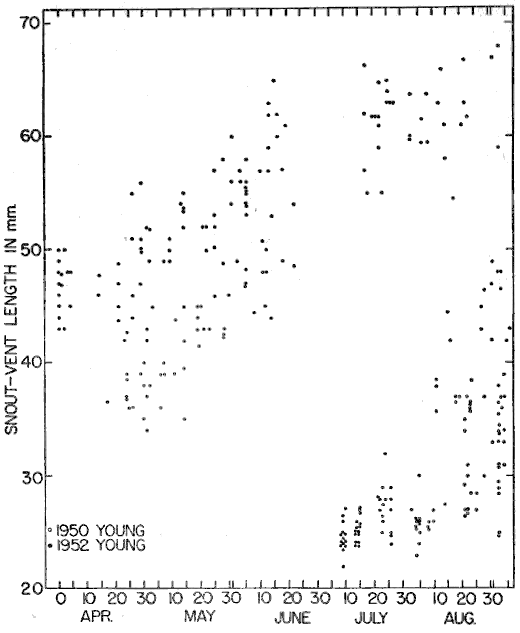
Fig. 11. Sizes on specific dates of young hatched in 1950 and 1952. Approximate
size ranges at different times of year, and differences in trend between
the two years are brought out.
The young were much more active than the female. These and
other young observed in the open were almost constantly in motion.
Pauses to bask at any one spot were of only a few seconds duration.
A certain log in Skink Woods evidently was the site of one or more
successful skink nests each year that observations were made, although
a nest was actually found in it only in 1948. On July 26,
1950, recently hatched young were active on this log. Temperature
was about 22°C. and the young were alternating frequently between
shade and sunshine to maintain their body temperature.
Collectively they seemed to cover every square inch of the log surface,
poking and probing into niches, crevices and insect borings.
They had a tendency to seek out the highest points on the log as
resting places.
In moving about, foraging or sunning, the young often carry the
tail arched high, and keep it in motion with slow squirming undulations.
These undulations may be continued even when the lizard
itself has come to rest momentarily. The movements of the tail
together with its vivid blue color serve to attract attention to it.
Such behavior has not been observed in adults or partly grown
young. Jopson (1938:90) observed an instance in which two dogs
cornered a young five-lined skink (either the present species or
E. laticeps) but were distracted by the wriggling of its bright blue
tail “either dropped by autotomy or knocked off” so that the skink
itself was allowed to escape. On another occasion these same two
dogs attacking an adult male skink, were not distracted by the
wriggling but dull colored broken tail, and they killed the lizard.
The subject of growth in Eumeces was briefly discussed by Taylor
(1936:66) in his revision of the genus. Sorting fairly large series
of museum specimens into seeming age-size groups, Taylor concluded
that skinks require as much as 9 or 10 years to attain adult
size. For fasciatus, for instance, the snout-vent length of 65.7 mm.
(small adult size) was considered typical of individuals in their
ninth year of life, with yearly gain of only 6 or 7 mm. in length in
the young. I have seen the original data on which this conclusion
was based, and the age groupings, as assigned by Taylor, seemed
plausible. However, in the light of present knowledge, it is certain
that the seeming intervals between his assumed age groups would
have disappeared with a still larger series of specimens. The eight
or nine size groups that Taylor recognized as distinct annual age
groups actually comprise only two age groups, each having such
wide dispersion of individuals (by retardation of some and acceleration
of others) that there is overlapping in size between them.
Growth in reptiles is now much better understood. Many species
have been studied by a variety of methods, including observation of
growth in captives, recording of growth in marked individuals
living under natural conditions, and sorting of large series into
age-size groups. Two species of Eumeces have been studied in
some detail. Breckenridge (1943:601-602) marked all the individuals
of septentrionalis that could be found in a small colony in
Minnesota and he concluded from the growth recorded in several
that were recaptured, that these skinks grow to mature size (65 mm.
and larger) at the end of their second year of life and are ready to
breed the following spring. Rodgers and Memmler (1943:61) plotted
the size distribution of a large year-round collection of skiltonianus
from near Berkeley, California. They found that in this species
hatching occurs in July and August, hatchlings are about 25 mm.
in snout-vent length, and grow to about 50 mm. by the time they are
one year old, and to about 65 mm. at two years of age, but most of
them breed at the end of their third year. Within the genus the
species septentrionalis and skiltonianus belong to groups separate
from each other and from that including fasciatus. While septentrionalis
and skiltonianus resemble each other in their growth pattern
and in the time required to reach sexual maturity, fasciatus
is notably different in its more rapid growth and the shorter time it
requires to reach breeding maturity. This would scarcely be expected,
as all three are of similar size. Furthermore, skiltonianus in
the region of Rodgers’ and Memmler’s study has a longer growing
season than fasciatus in northeastern Kansas, while septentrionalis
in Minnesota has a growing season markedly shorter than either.
It is noteworthy that each of these three skinks is the northernmost
lizard in the section of the country where it occurs.
In the present study growth was investigated by measuring
and marking large numbers of young, many of which were recaptured
for subsequent records, and by sorting into age-size groups all
available measurements. An understanding of the latter set of
data was facilitated by correlating it with the growth records of
marked individuals. Changes in the phenology of growth from
year to year according to weather conditions were noted.
As already indicated, hatching occurs from early July to mid-August
in northeastern Kansas. Unseasonably cool weather with
frequent rains may cause cumulative delay in breeding and incubation
so that hatching may average several weeks later than it does
in years with relatively warm and dry weather during the breeding
season. Within any one year hatching time is concentrated, so that
the majority of the young hatch within a period of two weeks, but
microclimates in the situations where the nests are made may differ
enough to cause this much spread. Individuals living on north
slopes in thick woods, and receiving the minimum amount of sunlight
may have their emergence from hibernation and attainment
of breeding condition delayed. Later, nesting in the same situations,
they may have incubation of their clutches similarly delayed.
Newly hatched young average just under an inch in snout-vent
length (23-27 mm.) and weigh .2 to .45 grams. Most rapid growth
occurs in the period of weeks following hatching. The growth rate
during this late summer period cannot be well shown by comparing
average size of series taken on successive dates, because each series
is likely to include some newly hatched young.
In 1949, a series of recently hatched young averaged 26.7 mm. on
July 10. By August 26, average length in a series collected was
42.9 mm., indicating an average gain of at least .35 mm. per day.
One that may be considered typical was marked on July 23, 1950,
soon after hatching, and it had a snout-vent length of 26.5 mm. and
weighed .25 grams. It was recaptured just a month later when it
had grown to 36 mm. snout-vent length, and weighed .8 grams.
Potential growth rate under favorable conditions is shown by the
fact that some individuals have attained a snout-vent length of 50
mm. by the third week of August, thus approximately doubling their
hatching length. A maximum growth rate of about .5 mm. per day
is indicated for these accelerated individuals, but on the average,
young are considerably less than 50 mm. in length even when they
enter hibernation. At the other extreme, representing retarded
growth, is an individual having a snout-vent length of only 34 mm.
on May 1. It must have been approximately nine months old on
that date, but of course had spent at least six months in hibernation.
Even if it made rapid growth subsequently, this yearling could
scarcely have attained by midsummer the pre-hibernation length of
the most accelerated individuals.
During the growing season following their first hibernation period,
the young grow to small adult size in most instances. After emerging
from a second hibernation they mature sexually and constitute an
important part of the breeding population.
Many of the skinks marked before their first hibernation, as
hatchlings, when they were a few days or a few weeks old, were
subsequently recaptured as well-grown yearlings or small adults,
affording ample information as to the usual growth rate and the
extremes of acceleration or retardation that occasionally occur. Records
of selected individuals in this group of skinks, marked early
in life and recaptured after a hibernation, are recorded below.
Table 8. Records of Individual Skinks Marked as Hatchlings (Before
the First Hibernation) and Recaptured the Following Year. Rapid
Rate of Early Growth Is Shown.
| |
Date |
Snout-vent length in mm. |
Tail length in mm. |
Weight in grams |
Remarks |
| No. 1. |
August 8, | 1951 |
23 | 1⁄2 |
301⁄2 |
.25 |
Had just hatched when
first recorded; second capture was made soon
after emergence from hibernation. All three
captures within a 50-foot diameter. |
| |
April 28, | 1952 |
39 | |
55 + 1⁄2 |
1.3 |
| |
June 7, | 1952 |
48 | |
69 + 1 |
.... |
| |
|
| |
|
|
|
| No. 2. |
July 8, | 1952 |
25 | |
25 (broken stub) |
.3 |
|
| |
April 23, | 1953 |
42 | |
17 + 26 |
.... |
|
| |
June 23, | 1953 |
56 | |
22 + 36 |
.... |
|
| |
|
| |
|
|
|
| No. 3. |
July 16, | 1948 |
26 | 1⁄2 |
37 |
.... |
Caught at the same place
on both occasions; in a little less than a year
this female grew to small adult size. |
| |
July 5, | 1949 |
68 | |
1011⁄2 |
.... |
| |
|
| |
|
|
|
| No. 4. |
August 23, | 1950 |
36 | |
55 |
.9 |
The interval between
captures included about two months of active
life, plus the hibernation period; caught at the
same place on both occasions. |
| |
May 19, | 1951 |
46 | |
691⁄2 |
1.7 |
| |
|
| |
|
|
|
| No. 5. |
September 2, | 1950 |
34 | 1⁄2 |
33 (broken stub) |
.... |
Tail broken at first capture;
recaptured 40 feet from original location. |
| |
June 12, | 1951 |
45 | |
48 + 3 |
2.0 |
| |
|
| |
|
|
|
| No. 6. |
July 28, | 1949 |
36 | |
56 |
.... |
Recaptured 75 feet from
original location. |
| |
April 21, | 1950 |
49 | |
83 |
2.5 |
| |
|
| |
|
|
|
| No. 7. |
August 31, | 1951 |
38 | |
58 |
.... |
All three captures within
a 70-foot diameter. |
| |
May 25, | 1952 |
48 | |
82 |
.... |
| |
June 30, | 1952 |
63 | 1⁄2 |
57 + 26 |
.... |
| |
|
| |
|
|
|
| No. 8. |
August 23, | 1950 |
36 | |
44 (broken stub) |
.7 |
Tail broken at first capture.
Capture sites 150 feet apart. |
| |
July 23, | 1951 |
69 | |
37 + 49 |
.... |
| |
|
| |
|
|
|
| No. 9. |
August 23, | 1949 |
39 | |
531⁄2 (regenerated) |
.... |
This male was retarded
in growth, being still well short of small
adult size as its second hibernation period
approached; all four captures recorded within
a few yards. |
| |
June 7, | 1950 |
46 | |
701⁄2 (regenerated) |
2.1 |
| |
July 23, | 1950 |
58 | |
88 (regenerated) |
3.7 |
| |
September 3, | 1950 |
62 | |
91 (regenerated) |
4.9 |
| |
|
| |
|
|
|
| No. 10. |
July 31, | 1949 |
38 | |
23 (broken stub) |
.... |
Capture sites 20 feet apart. |
| |
June 17, | 1950 |
58 | |
43 + 36 |
3.6 |
| |
|
| |
|
|
|
| No. 11. |
August 13, | 1949 |
40 | |
66 |
.... |
Approximately a year
after its original record this skink was recaptured
80 feet away, still short of small adult size. |
| |
August 8, | 1950 |
63 | |
90 (regenerated) |
5.0 |
| |
|
| |
|
|
|
| No. 12. |
August 19, | 1949 |
42 | |
40 (broken stub) |
.... |
All three captures within
a 50-foot diameter. |
| |
June 13, | 1950 |
58 | 1⁄2 |
58 + 28 |
4.1 |
| |
July 5, | 1950 |
63 | |
62 + 31 |
5.9 |
Many other young were not caught and marked until the growing
season following their first hibernation, and were recaptured within
this second growing season weeks or months after they were originally
marked, and after they had made substantial growth. Those
recaptured near the end of this second growing season, when they
were a year old, or a little more, usually had attained small adult
size or were nearing it. Selected records of these yearlings are
presented below.
Table 9. Selected Records of Individual Skinks Marked as Yearlings
(After Emergence From the First Hibernation) and Recaptured
One or More Times the Same Year. Rapid Growth Is Shown.
| |
Date |
Snout-vent
length
in mm. |
Tail length
in mm. |
Weight
in
grams |
Remarks |
| No. 1. |
May 2, |
1951 |
38 | |
531⁄2 |
.... |
Capture sites 30 feet apart. |
| |
September 25, |
1951 |
62 | |
25 + 31 |
.... |
| |
|
|
| |
|
|
|
| No. 2. |
May 8, |
1951 |
39 | |
57 |
.... |
Capture sites 150 feet apart. |
| |
August 2, |
1951 |
60 | |
67 + 25 |
.... |
| |
|
|
| |
|
|
|
| No. 3. |
April 17, |
1952 |
39 | |
55 |
1.1 |
Capture sites 30 feet apart. |
| |
June 23, |
1952 |
57 | |
73 (regenerated) |
.... |
| |
|
|
| |
|
|
|
| No. 4. |
May 20, |
1952 |
45 | |
67 |
.... |
Capture sites 15 feet apart. |
| |
May 28, |
1952 |
47 | |
71 |
.... |
| |
June 9, |
1952 |
53 | |
82 |
.... |
| |
|
|
| |
|
|
|
| No. 5. |
May 22, |
1952 |
48 | 1⁄2 |
771⁄2 |
2.0 |
Capture sites 10 feet apart. |
| |
July 20, |
1952 |
63 | |
106 |
5.3 |
| |
|
|
| |
|
|
|
| No. 6. |
June 11, |
1950 |
49 | |
49 (broken stub) |
2.4 |
Capture sites 20 feet apart. |
| |
September 2, |
1950 |
63 | |
63 + 31 |
4.9 |
| |
|
|
| |
|
|
|
| No. 7. |
April 14, |
1950 |
47 | |
72 |
1.9 |
Capture sites 50 feet apart. |
| |
May 29, |
1950 |
50 | |
821⁄2 |
2.5 |
| |
|
|
| |
|
|
|
| No. 8. |
May 12, |
1952 |
49 | |
77 |
.... |
Capture sites 60 feet apart. |
| |
June 18, |
1952 |
61 | 1⁄2 |
98 |
.... |
| |
|
|
| |
|
|
|
| No. 9. |
June 4, |
1950 |
54 | |
89 |
2.8 |
Both captures at same site. |
| |
August 1, |
1950 |
64 | 1⁄2 |
101 (broken stub) |
5.7 |
| |
|
|
| |
|
|
|
| No. 10. |
June 11, |
1950 |
49 | |
49 (broken stub) |
2.4 |
Capture sites 20 feet apart. |
| |
September 2, |
1950 |
63 | |
63 + 31 |
4.9 |
| |
|
|
| |
|
|
|
| No. 11. |
June 13, |
1949 |
57 | |
68 (regenerated) |
.... |
|
| |
August 8, |
1949 |
70 | |
37 + 11 |
.... |
|
Adult skinks can be found in greatest numbers in the breeding
season and many of the young that were marked were recaptured
as newly matured breeding adults soon after their second hibernation,
often still short of average adult size. Selected records of such
individuals are presented below.
Table 10. Records of Individual Skinks Marked as Young and
Recaptured as Adults.
| |
Date |
Snout-vent
length
in mm. |
Tail length
in mm. |
Weight
in grams |
Remarks |
| No. 1. |
Male |
| |
|
|
Probably less than a month old at first
capture 21 months later and 185 feet away, he had red facial suffusion
already somewhat faded as the breeding season waned. |
| August 21, 1950 |
34 | |
48 |
.7 |
| May 30, 1952 |
69 | |
37 + 49 |
.... |
| |
|
| |
|
|
|
| No. 2. |
Male |
| |
|
|
All three captures within a 70-foot diameter. |
| July 31, 1949 |
39 | |
64 |
.... |
| August 22, 1949 |
47 | |
75 |
.... |
| May 19, 1951 |
73 | |
69 (regenerated) |
.... |
| |
|
| |
|
|
|
| No. 3. |
Male |
| |
|
|
Capture sites 10 feet apart. |
| August 5, 1949 |
36 | |
57 |
.... |
| May 3, 1951 |
67 | |
103 |
5.1 |
| |
|
| |
|
|
|
| No. 4. |
Male |
| |
|
|
Capture sites 535 feet apart. |
| June 16, 1951 |
44 | |
41 (broken stub) |
.... |
| May 28, 1952 |
63 | |
77 (regenerated) |
.... |
| |
|
| |
|
|
|
| No. 5. |
Male |
| |
|
|
Capture sites 100 feet apart. |
| April 12, 1950 |
45 | |
73 |
1.9 |
| May 1, 1951 |
67 | |
17 + 48 |
.... |
| |
|
| |
|
|
|
| No. 6. |
Male |
| |
|
|
This individual had
attained approximately average adult size by
the 1951 breeding season; all three captures were
within a distance of 90 feet. |
| April 12, 1950 |
46 | |
4 + 15 |
1.3 |
| August 10, 1950 |
67 | |
75 (regenerated) |
5.3 |
| May 12, 1951 |
71 | |
77 (regenerated) |
.... |
| |
|
| |
|
|
|
| No. 7. |
Male |
| |
|
|
|
| April 30, 1950 |
48 | 1⁄2 |
781⁄2 |
2.4 |
| June 15, 1950 |
56 | |
94 |
2.9 |
| May 19, 1951 |
67 | |
90 (broken stub) |
.... |
| |
|
| |
|
|
|
| No. 8. |
Male |
| |
|
|
Capture sites 450 feet apart. |
| May 3, 1950 |
47 | |
51 + 4 |
1.7 |
| May 29, 1951 |
75 | |
115 (regenerated) |
.... |
| |
|
| |
|
|
|
| No. 9. |
Male |
| |
|
|
Capture sites 90 feet apart. |
| June 2, 1949 |
51 | |
46 (broken stub) |
.... |
| May 2, 1950 |
66 | 1⁄2 |
311⁄2 + 51 |
7.0 |
| |
|
| |
|
|
|
| No. 10. |
Male |
| |
|
|
Capture sites within 40 feet. |
| May 20, 1950 |
58 | |
921⁄2 |
4.0 |
| June 21, 1950 |
61 | |
95 |
4.7 |
| August 21, 1950 |
70 | |
108 (broken stub) |
7.2 |
| |
|
| |
|
|
|
| No. 11. |
Male |
| |
|
|
|
| June 25, 1950 |
62 | |
100 |
5.1 |
| May 1, 1951 |
71 | |
113 |
7.1 |
| |
|
| |
|
|
|
| No. 12. |
Female |
| |
|
|
Capture sites 160 feet apart. |
| April 15, 1950 |
46 | 1⁄2 |
731⁄2 |
1.5 |
| May 20, 1951 |
72 | |
113 |
.... |
| |
|
| |
|
|
|
| No. 13. |
Female |
| |
|
|
Capture sites 20 feet apart. |
| June 11, 1950 |
51 | |
69 |
2.5 |
| May 25, 1951 |
66 | |
40 |
.... |
| |
|
| |
|
|
|
| No. 14. |
Female |
| |
|
|
Capture sites 20 feet apart. |
| June 6, 1949 |
52 | |
47 (regenerated) |
.... |
| May 20, 1950 |
68 | 1⁄2 |
69 (regenerated) |
7.5 |
| June 9, 1950 |
71 | |
71 (regenerated) |
.... |
|
| |
|
| |
|
|
|
| No. 15. |
Female |
| |
|
|
Capture sites 20 feet apart.
|
| July 2, 1950 |
60 | |
100 |
4.2 |
| May 21, 1951 |
74 | |
33 + 35 |
.... |
| |
|
| |
|
|
|
| No. 16. |
Female |
| |
|
|
Capture sites
35 feet apart. |
| June 12, 1950 |
57 | |
83 |
3.1 |
| May 1, 1951 |
71 | 1⁄2 |
53 (broken stub) |
6.4 |
| |
|
| |
|
|
|
| No. 17. |
Female |
| |
|
|
This female probably hatched in July 1948
and was nearing adult size when first caught at an age of a little less
than a year. By the next breeding season it was an average sized
adult; both captures at same site. |
| June 22, 1949 |
62 | |
24 (broken stub) |
.... |
| May 22, 1950 |
72 | |
27 + 7 |
9.0 |
| |
|
| |
|
|
|
| No. 18. |
Female |
| |
|
|
This female probably was approximately a year
old when first caught, and she grew to average adult size by the
next spring; both captures at same site. |
| July 4, 1950 |
64 | |
30 + 55 |
4.3 |
| May 23, 1951 |
73 | |
31 + 62 |
.... |
| |
|
| |
|
|
|
| No. 19. |
Female |
| |
|
|
This female was about a year old when first
captured; loss of weight in July 1951 was caused by its laying a clutch
of eggs. All three captures were within a 15-foot diameter. |
| July 5, 1950 |
61 | 1⁄2 |
921⁄2 (regenerated) |
4.7 |
| June 14, 1951 |
73 | |
111 (regenerated) |
8.2 |
| June 29, 1951 |
74 | |
106 (regenerated) |
5.0 |
| |
|
| |
|
|
|
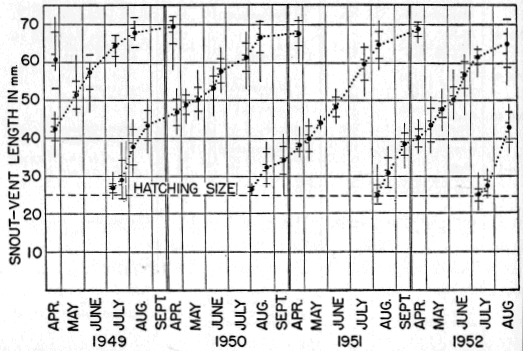
Fig. 12. Sizes of immature skinks of successive annual broods, grouped in
biweekly or monthly intervals, with mean, standard error, standard deviation,
and extremes shown for each group.
A certain small percentage fail to attain minimum adult size or
breeding maturity by the time of emergence from their second
hibernation. Among 77 individuals marked as young either soon
after hatching or in spring and early summer, and recaptured the
following spring, only one had failed to grow to adult size. It was
46.5 mm. in length when marked on June 13. When recaptured on
April 25 of the following year, it had grown to a length of 59 mm.,
still short of minimum adult length. During the interval between
captures it had maintained about the average growth rate. Its
failure to attain maturity was obviously the result of its early retardation,
and probably late hatching was primarily responsible. Although
this is the only individual with known history, which failed
to attain breeding maturity after its second hibernation, occasional
specimens are taken in spring which are somewhat below adult size
but seem too large to be young hatched the preceding summer.
Obviously, the incidence of such failure from year to year would
be influenced by weather conditions, and an unusually cool summer
may result in such delayed laying and hatching that an unusually
large proportion of young might fail to attain sexual maturity at the
usual time. At more northern localities, the percentage of such
failures might be expected to increase. At the northern edge of the
range attainment of breeding maturity may normally require more
than two years. Such delayed development would result in a
drastic reduction of the reproductive potential which might be
critically limiting to the species, even in an otherwise favorable
environment, as the population would be unable to replace rapidly
enough the individuals eliminated by normal mortality factors.
In contrast to the delayed development of those that have failed
to attain maturity at an age of two years, is the accelerated development
of those that have already more than doubled in length before
the first hibernation, and continue to grow rapidly after emergence.
By late spring they are already approaching adult size, perhaps
even before laying has occurred, and while breeding is still in progress.
It is certain that in northeastern Kansas there is no breeding
by such accelerated individuals approaching adult size at an age
of nine or ten months. Farther south in the species’ range with a
much longer growing season, there is perhaps some possibility of
such early breeding by first-year individuals. This would reduce
by more than half the length of time required for a generation, and
would tremendously increase the reproductive potential. With
such added impetus to its reproduction the species might be able
to withstand greatly increased predation pressure, or other mortality
factors.
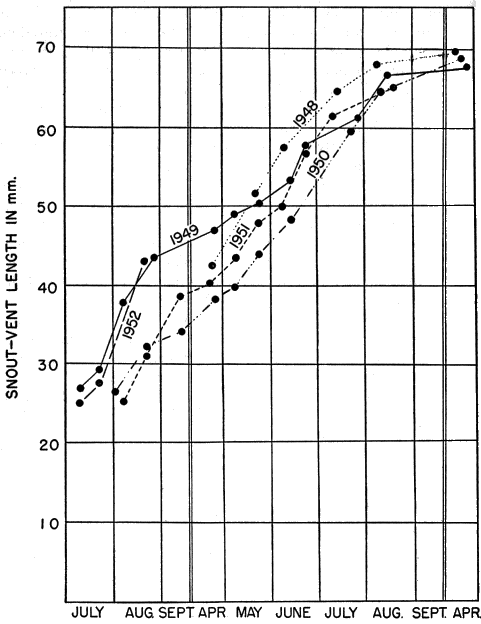
Fig. 13. Growth curves of successive annual broods (designated by the
year of hatching), superimposed to bring out differences in trends resulting
from changes in weather from year to year.
Extremes of acceleration or retardation are relatively rare in the
population studied. Nevertheless, in April there are some individuals
between 50 and 60 mm. in snout-vent length which cannot
be classified with certainty as to their age group, and might be either
accelerated individuals about nine months old or retarded individuals
about 21 months old.
The spread in size for any given age group is especially large, if
data from different years are combined. A typical individual,
having a snout-vent length of 25 mm. at hatching in mid-July may
have attained 30 mm. by early August, 35 mm. by late August, and
45 mm. by the time it hibernates late in September. Emerging
shortly before the middle of April it may grow to 50 mm. by the end
of May, 58 mm. by the end of June, and more than 60 mm. by the
end of July when it is a little more than a year old. By the time
of its second hibernation it may have attained a length of from
65 mm. to 70 mm., and emerges from this hibernation as a breeding
adult.
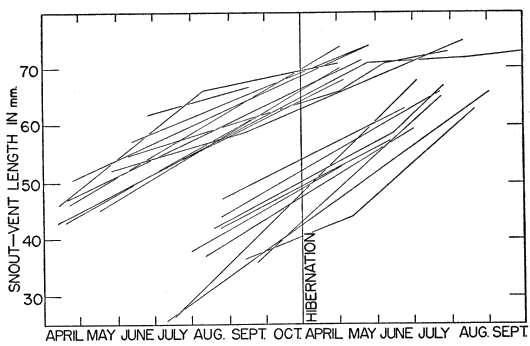
Fig. 14. Records of growth of immature individual skinks, both hatchlings
and yearlings, that were marked in one year and recaptured the next.
In reptiles in general there is a wide range in adult size, and the
extent and rapidity of continued growth after attainment of sexual
maturity and minimum adult size is still insufficiently understood.
Information bearing on this problem was obtained in the present
study from the recapture of marked skinks already measured as
adults. It is evident that the growth rate of the young, amounts to
as much as 15 mm. per month in snout-vent length in the late summer
period from hatching until hibernation, averages perhaps three
or four mm. per month in the summer after emergence from the first
hibernation, and tapers off rapidly as adult size is approached.
One hundred of the skinks marked as adults or subadults and recaptured
after intervals of months, including, in most instances, one
or more hibernation periods, represent in the aggregate, 87 years of
growth. These records show that after minimum adult size of 65
mm. is attained, growth slows abruptly, and that by the time a length
of approximately 75 mm. is attained in most instances growth has
become extremely slow in males and has virtually stopped in females.
Males attain a maximum size several millimeters larger than
that of females. Individuals differ greatly in their growth, however;
some adults continue to grow rapidly till they near the maximum
size, whereas others apparently stop growing when they are
still below average adult size. Unusually large specimens are not
necessarily old, but may have attained their size only a year or two
after reaching maturity through the accelerated growth resulting
from abundant food and predisposing genetic factors. Likewise,
unusually old individuals are not necessarily the largest, but may be
only a little above average adult size. It may be assumed that no
growth occurs during the period of winter dormancy, which occupies
approximately half the year in the population studied. To
compute growth rates, in those recaptured after an intervening
hibernation, periods of hibernation, arbitrarily estimated as six
months, were subtracted from the time elapsed between captures.
Table 11. Average Growth Rate in a Selected Sample of Skinks
of Adult Size.
| Size Group |
Males |
Females |
| Average growth mm. per month |
Number of skinks in sample |
Average growth mm. per month |
Number of skinks in sample |
| 65-68 mm. |
1.4 |
11 |
.8 |
12 |
| 69-72 mm. |
.7 |
12 |
.4 |
21 |
| 73-76 mm. |
.7 |
13 |
.3 |
21 |
| 77-80 mm. |
.4 |
7 |
.... |
.... |
Opportunity to compare the rapid growth of young during their
first year of life with the relatively slow continued growth after attainment
of sexual maturity is afforded by the records of skinks
caught and marked while yet immature and recaptured in two or
more successive years after their attainment of sexual maturity.
The records of selected individuals of this group are presented below.
With the exception of number three, all in this series are of
the 1949 brood, and probably all hatched within a two-week period.
Table 12.—Records of Individual Skinks Marked as Young and Recaptured
Repeatedly After Attainment of Adult Size, Showing
Trend of Progressively Slowing Growth.
| |
Date |
Snout-vent length in mm. |
Tail length in mm. |
Weight in grams |
Remarks |
| No. 1. |
Male |
| |
|
|
At an age of 33 months this male
was far short of maximum size, and smaller than some males a
year younger; all four captures within a 65-foot diameter. |
| April 12, |
1950 |
43 | |
71 |
1.5 |
| August 30, |
1950 |
56 | |
56 + 21 |
5.4 |
| May 23, |
1951 |
68 | |
59 + 32 |
.... |
| April 28, |
1952 |
73 | |
62 + 38 |
6.6 |
| |
|
| |
|
|
|
| No. 2. |
Male |
| |
|
|
At an age of approximately
one year this male was approaching small adult size;
when last captured at an age of 34 months, he was a
large adult. All five records within a 190-foot diameter. |
| July 5, |
1950 |
61 | |
921⁄2 (regenerated) |
5.2 |
| July 28, |
1950 |
64 | |
97 (regenerated) |
5.4 |
| May 3, |
1951 |
68 | |
96 (broken stub) |
5.8 |
| June 21, |
1951 |
72 | |
1011⁄2 (regenerated) |
.... |
| May 1, |
1952 |
78 | |
101 (regenerated) |
.... |
| |
|
| |
|
|
|
| No. 3. |
Male |
| |
|
|
This skink was nearly a year old and nearing adult
size when first captured; recaptured in each of the
four succeeding years, he showed slowing growth.
He was near the maximum size at the time of his
last capture when he was about 57 months
old, and evidently had stopped growing (for
movement see No. 2, p. 110). |
| June 22, |
1949 |
65 | |
111 |
.... |
| May 4, |
1950 |
72 | 1⁄2 |
115 |
7.3 |
| June 17, |
1950 |
73 | |
116 |
7.8 |
| May 15, |
1951 |
80 | |
125 |
.... |
| May 13, |
1952 |
82 | |
125 |
.... |
| April 6, |
1953 |
82 | |
104 (regenerated) |
.... |
| |
|
| |
|
|
|
| No. 4. |
Female |
| |
|
|
This individual, marked when less than two
weeks old, had grown to nearly the maximum
female size at an age of 34 months; all four
captures within a 175-foot diameter. |
| July 13, |
1949 |
27 | |
341⁄2 |
.... |
| June 1, |
1950 |
54 | 1⁄2 |
931⁄2 |
3.1 |
| August 21, |
1951 |
74 | |
119 |
.... |
| May 1, |
1952 |
76 | |
123 |
10.0 |
| |
|
| |
|
|
|
| No. 5. |
Female |
| |
|
|
All six records within a 65-foot diameter
(See
Figure 21). |
| April 15, |
1950 |
43 | |
70 |
1.4 |
| June 5, |
1950 |
52 | 1⁄2 |
87 |
2.8 |
| May 25, |
1951 |
71 | |
82 + 29 |
.... |
| September 28, |
1951 |
73 | |
111 (regenerated) |
.... |
| April 26, |
1952 |
74 | |
113 (regenerated) |
7.4 |
| April 24, |
1953 |
76 | |
114 (regenerated) |
.... |
| |
|
| |
|
|
|
| No. 6. |
Female |
| |
|
|
Hatched in July 1949, this skink had attained
the maximum female size at an age of a little
more than three years; (for movement see
Figure 25). |
| April 21, |
1950 |
46 | |
75 |
2.1 |
| May 7, |
1950 |
48 | |
15 (broken stub) |
2.0 |
| May 3, |
1951 |
74 | |
29 + 57 |
8.5 |
| May 2, |
1952 |
78 | |
25 + 64 |
.... |
| August 27, |
1952 |
79 | 1⁄2 |
95 (regenerated) |
8.3 |
| |
|
| |
|
|
|
| No. 7. |
Female |
| |
|
|
Hatched in July 1949, this skink was 11
months old and about half-grown when it was
marked. When last caught at an age of 35
months it was of average adult female size,
having grown less than numbers 4 and 6 at the
same age. All five captures were within a 60-foot
diameter (Fig. 24). |
| June 5, |
1950 |
51 | |
82 |
2.5 |
| July 13, |
1950 |
59 | |
93 |
3.9 |
| July 29, |
1950 |
64 | |
98 |
4.4 |
| August 21, |
1951 |
69 | |
80 (broken stub) |
5.0 |
| May 28, |
1952 |
73 | |
83 + 91⁄2 |
....
|
| |
|
| |
|
|
|
| No. 8. |
Female |
| |
|
|
Hatched in July 1949, this skink was of average
adult female size and was breeding in
May 1951; it grew nearly to maximum female
size in the next 11 months. All captures |
| April 26, |
1950 |
50 | 1⁄2 |
781⁄2 |
2.7 |
| May 24, |
1951 |
74 | |
107 (regenerated) |
.... |
| April 28, |
1952 |
78 | |
93 (regenerated) |
8.5 |
| April 23, |
1953 |
80 | |
93 (regenerated) |
.... |
| |
|
| |
|
|
|
| No. 9. |
Female |
| |
|
|
All three captures at the same site. |
| July 5, |
1950 |
60 | |
95 |
4.5 |
| August 6, |
1951 |
71 | |
1061⁄2 |
5.6 |
| May 28, |
1952 |
72 | |
110 |
8.5 |
| |
|
| |
|
|
|
| No. 10. |
Male |
| |
|
|
Hatched in July 1949, this male grew less
rapidly than most, and in the spring of 1953
was smaller than some others that were a year
younger, or even two |
| April 23, |
1950 |
46 | 1⁄2 |
66 (regenerated) |
1.8 |
| June 13, |
1950 |
52 | 1⁄2 |
26 + 3 |
2.7 |
| September 2, |
1950 |
66 | |
32 + 51 |
6.2 |
| May 29, |
1951 |
67 | |
33 + 58 |
.... |
| August 3, |
1951 |
70 | |
94 (regenerated) |
.... |
| March 27, |
1953 |
74 | |
78 (regenerated) |
7.1 |
| |
|
| |
|
|
|
| No. 11. |
Female |
| |
|
|
This skink had attained maximum female size
when she was a little less than four years old. |
| April 26, |
1950 |
50 | 1⁄2 |
781⁄2 |
2.7 |
| May 24, |
1951 |
74 | |
87 |
.... |
| April 28, |
1952 |
78 | |
72 + 21 |
8.5 |
| April 23, |
1953 |
80 | |
73 + 20 |
.... |
Differences in their growth rates therefore reflect differences in sex,
individual vigor, and local situation, in individuals living at the same
time and within the same general environment.
Changing weather, and other factors that vary from year to year
cause marked differences in the dates of important events in the
annual cycle, and in the stage of development at any given date.
Data are available for five successive annual broods of young, those
of 1948, 1949, 1950, 1951, and 1952, and each brood differs from the
others to some extent, as shown in Figures 11 to 13. In 1949, for
instance, young hatched relatively early, and probably most of them
were active by the middle of July. They made rapid growth in
August, averaging larger than young hatched in other years on any
given date in late summer. However, they retired into dormancy
early in the fall. Cool and dry weather in early September ended
their activity for the season. In 1950, young hatched, on the average,
at least three weeks later, about the first of August, but they
remained active until late in September, and by hibernation time
had partly caught up to the stage of development attained by the
young of 1949. Most young of 1951 hatched late in the first half of
August, and at first were smaller than those of 1950 and much
smaller than those of 1949 on corresponding dates, but favorable
weather in the early fall hastened their development. By early September
they had caught up and passed the stage of development of
young of 1950 and by the time they retired to dormancy in late September,
they had reduced by half the size-advantage of the young of
1949 at the time these latter retired into hibernation. The young of
1951 appeared to be few in numbers, and a lack of competition may
have been a factor in their rapid early development.
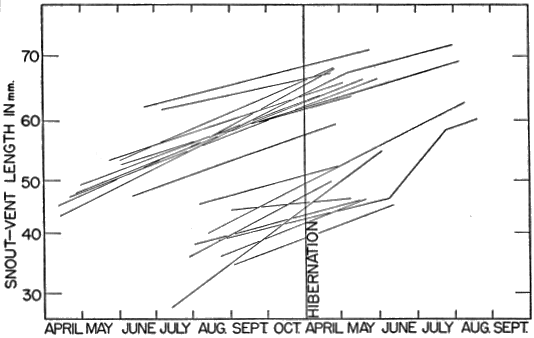
Fig. 15. Records of growth in another group of recaptured young that grew
less rapidly than those of Fig. 14.
The young of 1948, first sampled after their emergence from their
first hibernation in mid-April of 1949, were then somewhat intermediate
in size as compared with those of 1949 and 1950 at the same
times of year. Their subsequent development was rapid; by late
May they had caught up and passed the stage reached by the 1949
young at the same time of year. The young of 1950 after having a
late start, were further set back by cold weather in April 1951 delaying
their emergence from hibernation. As a result they were still
unusually small in late April and May. Even though they grew
rapidly subsequently, they were consistently smaller than those of
other broods on corresponding dates. Favorable fall weather prolonging
the 1951 growing season into late September beyond the
time of retirement in other years may have permitted many of them
to attain adult size.
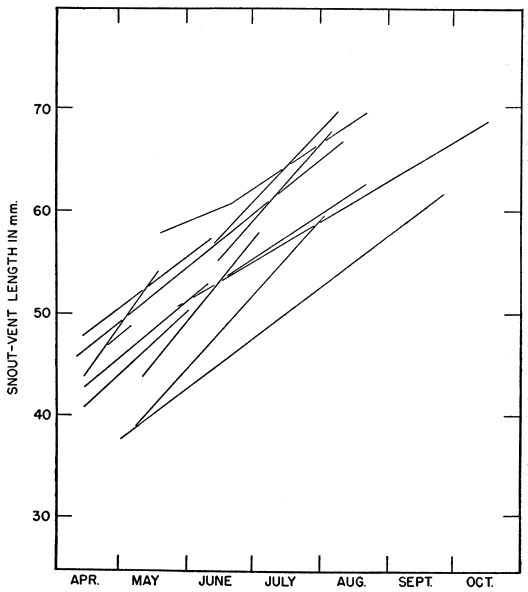
Fig. 16. Records of immature individual skinks marked and recaptured
within the same growing season, showing the trend of rapid growth, and differences
in growth rate between individuals.
The varying fortunes of the several annual broods studied were
closely correlated with weather trends, and suggest possible effects
of slight changes in climate. An unfavorable sequence of weather
might bring about drastic reduction of the population without causing
any direct mortality. A late spring in two successive years
would have cumulative effect in delaying emergence and breeding
of adults the first year, and delaying in the second year emergence
of the young, already retarded by the lateness of their hatching. If
this sequence were followed by onset of unusually cool and dry
weather in early September, or even in late August, the young might
be “caught short,” and forced to hibernate while still in the 50-60
mm. size class. Emerging the following spring, they might have
failed to mature sexually, reducing by perhaps half the number of
productive adults. At the northern extreme of the species’ range,
length of growing season may be more critical than extremes of temperature
in limiting the numbers and distribution. Growing seasons
that average long enough and warm enough to permit attainment of
maturity by onset of the second hibernation period may be essential
to the species. While no two annual broods of young in the same
locality come under exactly the same weather influences, extremes
of retardation or acceleration continuing throughout development
are relatively rare. Retarding effects of unfavorable weather causing
delayed breeding and hatching, may be offset by prolongation
of warm weather in the fall thus delaying hibernation, or by warm
spring weather hastening emergence from hibernation.
Under favorable conditions an adult female produces about ten
offspring annually of which about half are females. It is calculated
that if all survived, after ten breeding seasons, the progeny of an
original female might have increased to a population of more than
97,000, under the climatic conditions of eastern Kansas, permitting
attainment of breeding maturity late in the second year of life. In
the same ten year period under climatic conditions delaying maturity
until late in the third year of life (as seems normally to occur in
E. septentrionalis and E. skiltonianus, and probably in E. fasciatus
at the northern edge of its range) the original female would have
produced a population of somewhat less than 7,800 assuming that
all survived. With a long growing season such as occurs in the
southern part of the range, it seems theoretically possible (though
not probable) that individuals might mature before the end of their
first year, in time to participate in the next breeding season. If this
should occur the original female might produce a population of
more than 120 million by the end of the tenth breeding season.
Progressive alteration of the color pattern is more rapid in males
than in females and is synchronized with growth. During the first
year of life changes in the pattern are gradual, and consist chiefly of
loss in vividness. The blue of the tail is slightly dulled. The light
lines become suffused with brown and the dorsolateral dark areas
become paler, with light brown areas appearing on the corners of
the scales and gradually spreading to replace the original black. In
skinks that are in the second year of life the striped pattern although
still conspicuous is made up of two shades of brown instead of the
earlier black and white markings.
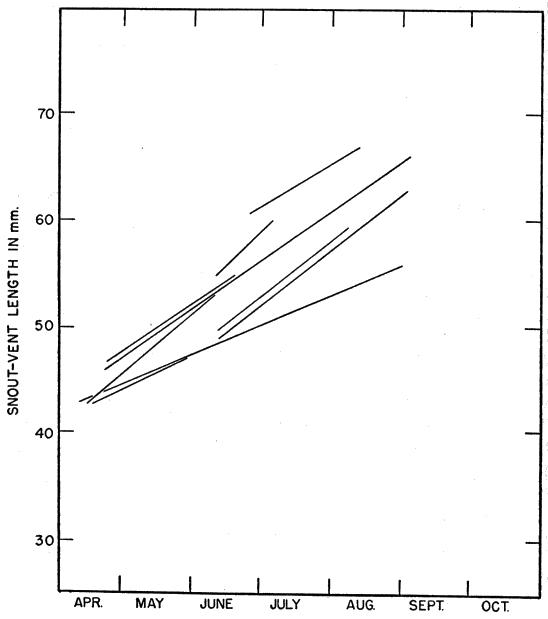
Fig. 17. Records of another group of immature skinks marked and recaptured
within the same growing season.
Even in hatchlings, the dorsal part of the rostrum and the inter-nasals
are of a somewhat neutral brownish color, matching neither
the light lines nor the dark interspaces of the striped body pattern.
With advancing age this neutral brown color gradually spreads posteriorly
on the head so that the striking lyrate marking of the bifurcated
dorsal stripe on the head in the juvenile become obscured
by the time the skink has grown to small adult size, at 21 months.
The top of the head is then dull brown, with a slightly mottled
appearance caused by the different intensity of pigmentation in
different areas. The stripes though still discernible, are faint and
inconspicuous. Dorsally, on the body, the stripes are still conspicuous,
but are dull and lacking in contrast. At this stage, the
dark lateral area is retained with intensity of pigmentation scarcely
diminished.
Table 13. Normal Range of Variation in Dorsal Striping of Head and
Body, and in Color of Tail According to Age and Sex.
| Age, Size and Sex |
Condition of stripes |
Color of tail |
| Sharp |
Distinct |
Dull |
Faint |
Absent |
Original |
Regenerated |
| Small young |
|
|
|
|
|
bright blue |
bright blue |
| body |
X |
|
|
|
|
|
|
| head |
X |
|
|
|
|
|
|
| |
|
|
|
|
|
|
|
| Larger young |
|
|
|
|
|
bright blue |
duller blue |
| body |
X |
|
|
|
|
|
|
| head |
X |
X |
|
|
|
|
|
| |
|
|
|
|
|
|
|
| Young adult female |
|
|
|
|
|
dull blue |
gray-blue |
| body |
X |
X |
|
|
|
|
to brown |
| head |
|
X |
X |
X |
|
|
|
| |
|
|
|
|
|
|
|
| Young adult male |
|
|
|
|
|
mostly dull |
gray-blue |
| body |
|
X |
X |
|
|
blue |
to brown |
| head |
|
|
X |
X |
X |
|
|
| |
|
|
|
|
|
|
|
| 3 year adult female |
|
|
|
|
|
mostly |
mostly |
| body |
|
|
X |
X |
|
brown and |
brown and |
| head |
|
|
|
X |
X |
gray with |
gray |
| |
|
|
|
|
|
scattered |
|
| |
|
|
|
|
|
blue scales |
|
| |
|
|
|
|
|
|
|
| 3 year adult male |
|
|
|
|
|
mostly |
brown |
| body |
|
|
|
|
X |
brown; |
|
| head |
|
|
|
|
X |
occasional |
|
| |
|
|
|
|
|
bluish scales |
|
| |
|
|
|
|
|
|
|
| Old adult female |
|
|
|
|
|
brown; |
brown |
| body |
|
|
X |
X |
X |
occasional |
|
| head |
|
|
|
|
X |
bluish scales |
|
| |
|
|
|
|
|
|
|
| Old adult male |
|
|
|
|
|
brown |
brown |
| body |
|
|
|
|
X |
|
|
| head |
|
|
|
|
X |
|
|
In tracing the gradual ontogenetic changes in the striped pattern,
from the vividly contrasting colors of hatchlings to the dull, patternless
coloration of old adult males, five descriptive terms have been
applied to the successive stages: “sharp,” “distinct,” “dull,” “faint,”
and “absent.” To most individuals below minimum adult size, the
term “sharp” is applicable, although there is some loss in vividness
in the larger young, as compared with hatchlings. Fading of the
original striped pattern proceeds more rapidly on the head than on
the body. Upon emergence from their second hibernation at an
age of about 21 months, the skinks, mostly grown to adult size, and
ready to mature sexually, still show but little sexual difference. They
retain the hatchling pattern essentially unchanged, but with colors
dulled and contrasts reduced. Within a few weeks the newly matured
males undergo relatively rapid color change as the breeding
season progresses. The stripes tend to fade and blend into the dark
areas adjacent to them. In the two-year-old males stripes are distinct
to dull on the body and faint or absent on the head, while in
females of the same age group, body stripes are sharp or distinct.
Table 13 refers to adult pattern and coloration as they appear in
the breeding season. After the breeding season, in late spring and
early summer, when the red suffusion of the head and neck has
faded in adult males, the original striped pattern, after having been
almost completely suppressed may again become discernible. Individuals
of the same size differ in extent of pattern change, and
the color descriptions made of individuals were not sufficiently detailed
to show fully the changes occurring between successive dates
of capture. However, most large adult males taken later than mid-June
had at least some trace of the striped body pattern and many
of them had become so much like females in appearance that close
scrutiny was necessary to determine their sex. They were especially
like females in having the dark lateral area extending forward onto
the cheek and setting it off sharply from the paler temporal region
above it. In breeding males the head has no such dark markings
and is suffused with red.
Even among those skinks which have never broken their tails
there is a wide range of variation in relative length of tail. This is
partly a matter of relative growth since the proportions change
during the course of development. Also there may be slight sexual
difference and there is much individual variation. In fetuses still
well below hatching size, the tail length is less than the snout-vent
length. For instance, an egg in a natural nest 12 days short of
hatching contained a fetus that had a snout-vent length of 14 mm.
and tail length of 12 mm. (Figure 18). In the late stages of fetal
development the tail growth is relatively rapid. At hatching, the
tail is considerably more than half the total length. In a large
series of young with snout-vent lengths from 30 mm. down to hatching
size of 25 mm. or less, the tail length averaged 130.8 per cent of
snout-vent length. In larger young, up to a snout-vent length of 40
mm. or more, the tail continues to lengthen more rapidly than the
body. In skinks that are about two thirds grown, the tails average
relatively longer than in either larger or smaller individuals. In
the sample representing the size class 50-54 mm. snout-vent length,
the tails average 163.3 per cent of the snout-vent lengths, whereas
in groups of adults of various sizes and both sexes, the tail length
is near 155 or 156 per cent of the snout-vent length. Sexual dimorphism
in tail length is slight if it exists at all; in adult males,
tails averaged a little longer than in adult females.
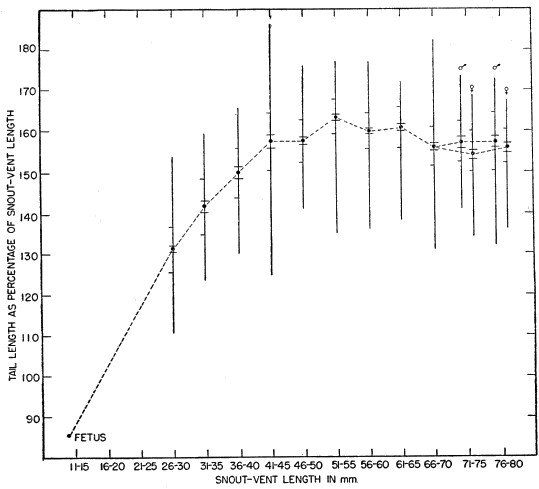
Fig. 18. Diagram showing relative tail-length (as a percentage of snout-vent
length) in skinks of different size groups that retain their original tails unbroken;
in the early stages of growth the tail becomes relatively longer as size
increases, but the trend is reversed before adult size is attained. For each
series the mean, standard error, standard deviation, and extremes are shown.
When a skink’s tail is broken, there is almost no loss of blood.
The fractured surface is rough and irregular, with exposed muscle
masses protruding on the detached end and corresponding concavities
on the end of the stump tail retained by the lizard. The concavities
are soon filled with oozing blood, and a thick scab forms. As
healing begins, the broken end presents a flat, slightly irregular surface.
When the scab is sloughed off, a slightly convex surface of
delicate, pale-colored new skin of the regenerating tail, is exposed.
At first, no scale structure is discernible. As growth proceeds, the
new tail takes on a bluntly conical shape. During the early stages
of growth, it is well set off from the original portion by the abrupt
taper at the point of contact and by its paler coloration and different
texture, with no scales discernible at first, and later with fine
and granular scalation. The new tail elongates until the more
abrupt taper beyond the point of the break is no longer noticeable,
and the coloration, surface texture and scalation match that of the
original portion so closely that it is difficult to determine where the
break occurred or even to ascertain that there has been one. On
the regenerated tail, however, the scales are less uniform in size and
less regular in shape. The regenerated tail, being different from
the original in internal structure, with a cartilaginous rod replacing
the vertebral column, is less fragile and subsequent fractures are
most likely to be on the part proximal to the regeneration. Nevertheless,
fractures of regenerated tails occur occasionally. In old
skinks especially, the tail eventually may consist of three or more distinct
segments including the basal remnant of the original tail and
the successive regenerations. When a break in the regenerated tail
occurs, the detached portion is relatively inert, and is capable of only
feeble twitching movements in contrast with the lively wriggling
normally displayed in a newly detached tail that includes part of
the central nervous system.
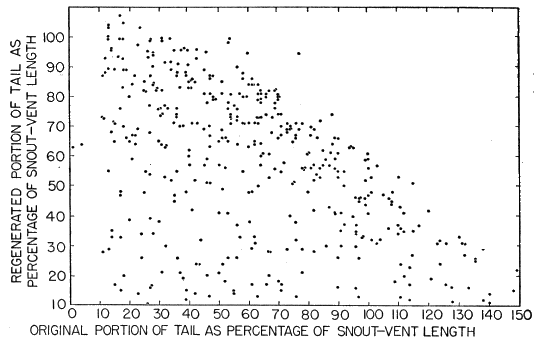
Fig. 19. Relative lengths of original and regenerated portions of tails in
skinks which have had their tails broken and regenerated; for each individual,
length of each part of the tail is expressed as a percentage of the snout-vent
length.
Rate of growth in the regenerating tail is controlled by a variety
of factors, such as age, condition, and activity of the individual, and
site of the fracture. A break occurring early in the skink’s lifetime
results in regeneration more complete than occurs in an adult sustaining
the same type of injury. The regenerated tail eventually
may be longer and thicker than the lost part if the lizard is young
and still growing. But the regenerated tail is never so long as the
original one would have been. Regeneration is most extensive in
those tails broken near the base. The farther from the base the
break occurs the shorter is the part regenerated. As a result, tails
that have had time to regenerate do not differ greatly in total length
regardless of where the break occurred. However, the nearer the
break is to the base, the shorter is the total tail-length after regeneration
(Figures 19 and 20). If only the tip of the tail is lost, regeneration
may not occur. In the skinks examined that had regenerated
tails the proportions varied over a wide range. Presumably,
in many, growth of the regenerated portion was still incomplete.
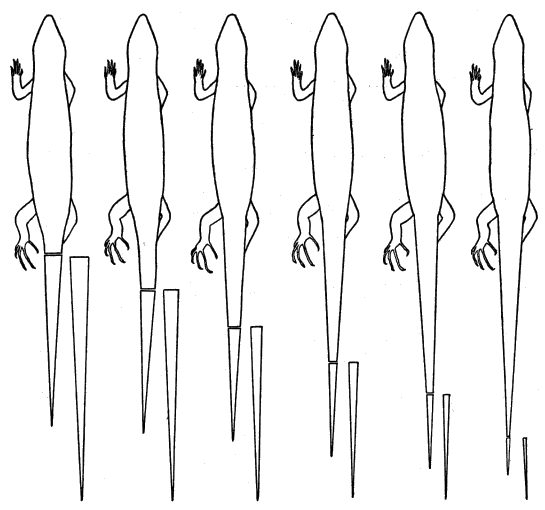
Fig. 20. Diagrams showing typical extent of tail regeneration in skinks
having tails broken at different points, × approximately 1⁄2. Original parts of
the tails are at the right.
Table 14. Records of Regeneration of the Tail in Individual Skinks
Marked and Recaptured.
| Age and Sex |
Date |
Snout-vent length in mm. |
Tail length in mm. |
| No. 1. |
June 1, |
1951 |
73 |
38 (newly broken) |
| Adult male |
June 26, |
1951 |
73 |
38 + 14 |
| August 17, |
1951 |
76 |
40 + 45 |
| April 29, |
1952 |
76 |
40 + 45 |
| |
|
|
|
|
| No. 2. |
May 28, |
1949 |
51 |
46 (newly broken) |
| Immature |
October 15, |
1949 |
69 |
51 + 21 |
| |
|
|
|
|
| No. 3. |
June 11, |
1950 |
49 |
49 (newly broken) |
| Immature |
September 2, |
1950 |
63 |
63 + 31 |
| |
|
|
|
|
| No. 4. |
August 10, |
1950 |
621⁄2 |
60 (newly broken) |
| Immature female |
June 14, |
1951 |
68 |
62 + 17 |
| |
|
|
|
|
| No. 5. |
August 14, |
1950 |
671⁄2 |
77 + 41⁄2 |
| Adult male |
September 3, |
1950 |
681⁄2 |
77 + 61⁄2 |
| April 27, |
1951 |
69 |
78 + 9 |
| |
|
|
|
|
| No. 6. |
April 7, |
1950 |
67 |
38 (newly broken;
separated end 66) |
| Adult male |
July 27, |
1950 |
71 |
39 + 471⁄2 |
| |
|
|
|
|
| No. 7. |
May 28, |
1951 |
70 |
18 (newly broken;
separated end 100) |
| Adult male |
June 14, |
1951 |
71 |
18 + 1 |
| September 22, |
1951 |
76 |
19 + 29 + 71⁄2 |
| |
|
|
|
|
| No. 8. |
June 12, |
1951 |
72 |
33 (recently broken) |
| Adult male |
July 28, |
1951 |
76 |
36 + 31 |
| |
|
|
|
|
| No. 9. |
May 2, |
1951 |
45 |
47 + 1 |
| Juvenile |
May 14, |
1951 |
45 |
47 + 3 |
| May 19, |
1951 |
45 |
47 + 5 |
| |
|
|
|
|
| No. 10. |
June 7, |
1952 |
64 |
51 (recently broken) |
| Subadult female |
June 24, |
1952 |
64 |
51 + 11 |
| |
|
|
|
|
| No. 11. |
August 19, |
1949 |
42 |
40 (newly broken) |
| Juvenile |
June 13, |
1950 |
581⁄2 |
58 + 28 |
| August 5, |
1950 |
63 |
62 + 31 |
| |
|
|
|
|
| No. 12. |
May 17, |
1951 |
78 |
20 (newly broken) |
| Adult male |
June 12, |
1951 |
78 |
20 + 13 |
Under favorable conditions regeneration occurs at a relatively
rapid rate. After a period of healing the new tail grows with a
sudden spurt, making most of its gain in length within a few weeks.
Then growth abruptly slows or ceases altogether. In young similarly
rapid growth of the regenerating tail occurs, but subsequently
the increase is more gradual corresponding to the over-all growth
of the lizard. In numerous adult skinks marked, and recorded as
having well-regenerated tails, the proportions recorded at subsequent
captures months or years later were still just the same, demonstrating
that extent of regeneration is not proportional to elapsed
time. Those adult skinks having unusually long regenerated tails
presumably are individuals in which the original tail was lost early
in life, and the potentiality for regeneration is probably somewhat
less in older individuals, especially those that have stopped growing.
Successive records of selected individuals are listed in Table 14
to illustrate trends in regeneration of the tail. In those instances in
which the tail is referred to as “newly broken” the separation usually
occurred as an accident at the time the lizard was captured, while
in those designated as “recently broken” separation had already
occurred in some earlier accident but regeneration was not yet
perceptibly underway. In the “Tail length” column, plus signs
separate the original portion of tail, on the left, from the regenerated
portion, on the right.
As in many other kinds of lizards, the tail in the five-lined skink
serves as a reservoir for fat, which may be drawn upon for nutrition
in time of food scarcity. An individual that is in good condition
has a plump and rounded tail. Fat comprises much of its
bulk. Upon emergence from hibernation this fat supply is not
noticeably depleted. Brooding females in the latter part of the
incubation period have the supply of caudal fat most noticeably
depleted, and their tails may appear emaciated, with kinks on the
terminal portion. It is my impression that in adults the capacity
for storage of fat is most developed in the females, and that their
tails vary in proportions more than do those of males. The capacity
to shed the tail easily seems somewhat inconsistent with this function
of fat storage. Loss of the tail sometimes involves loss of a
large amount of reserve fat. Many detached tails that were broken
accidentally at the time of the skinks’ captures were weighed. In
those that were broken off near the base and were not previously
regenerated, weights were usually 16 to 20 percent of the lizards’
total weights.