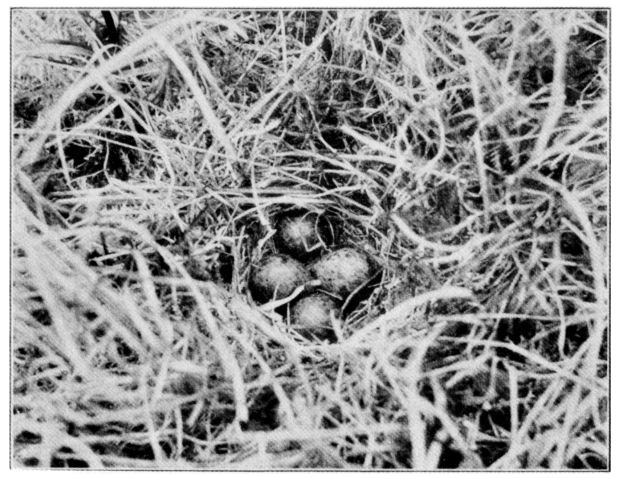
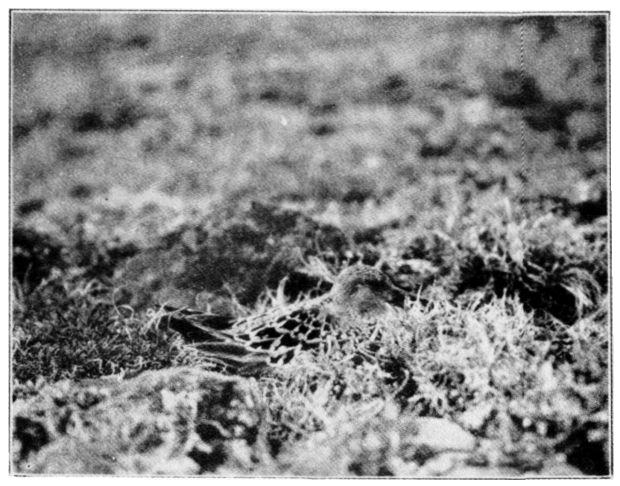
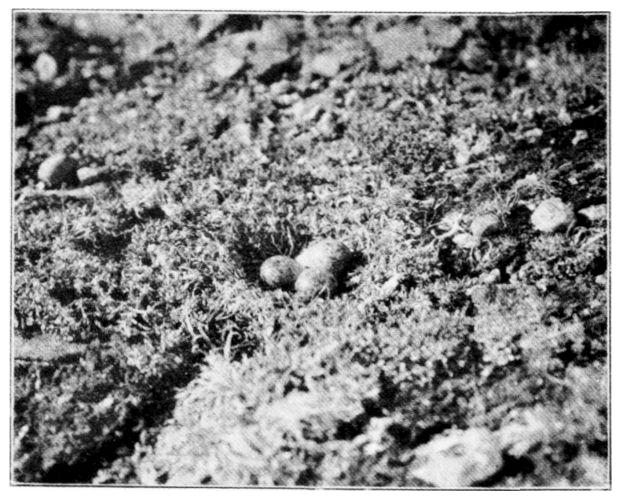
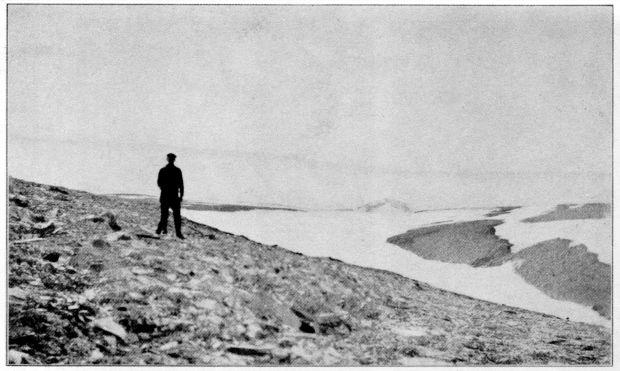
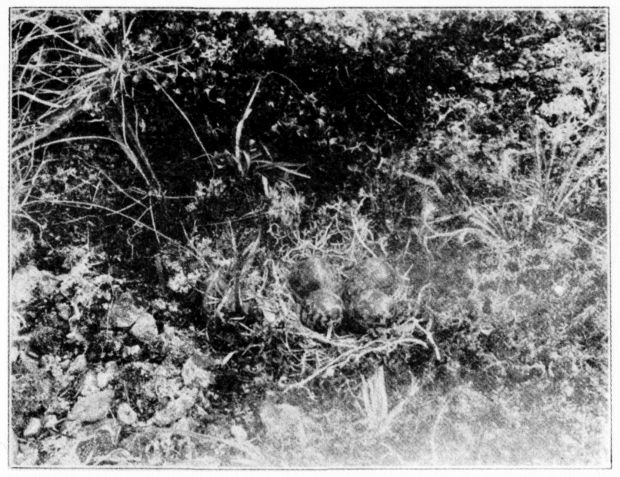
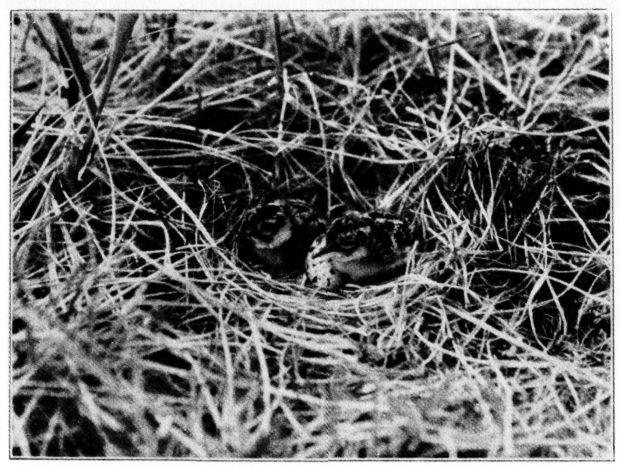
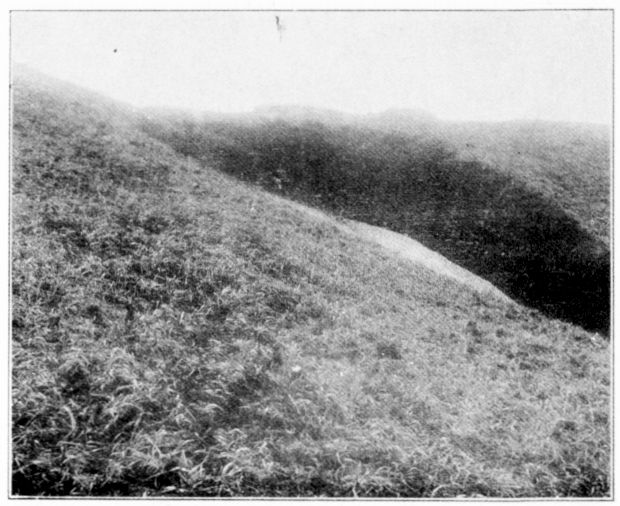
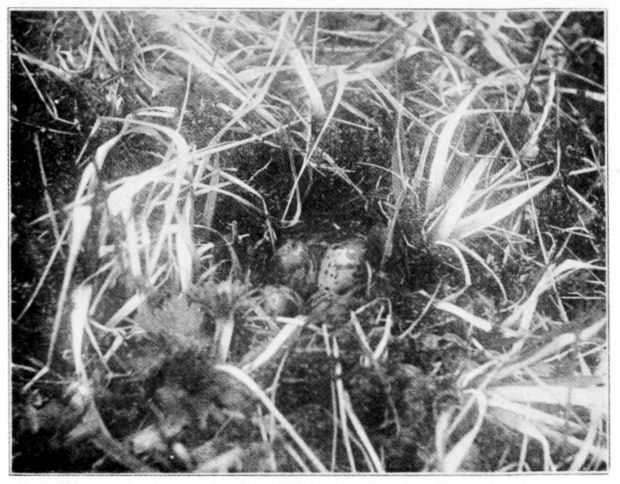
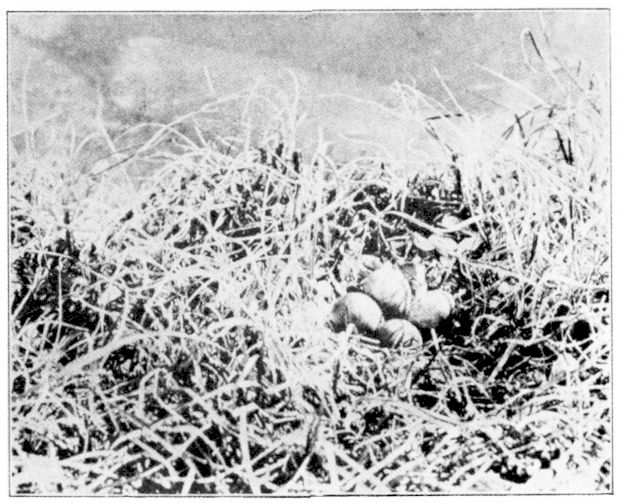
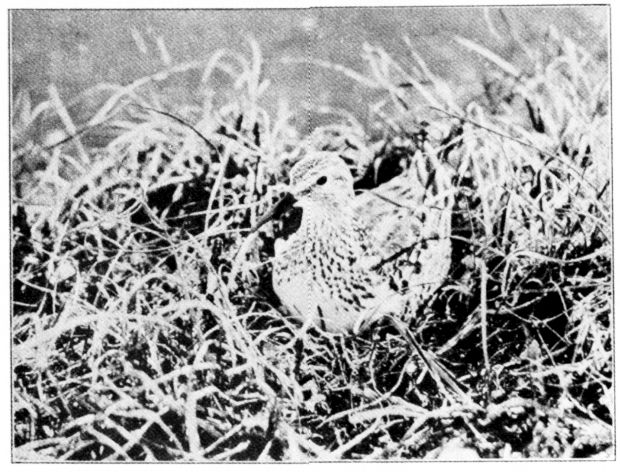
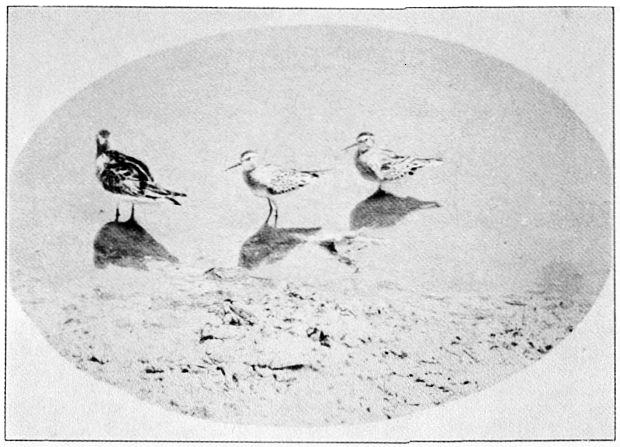
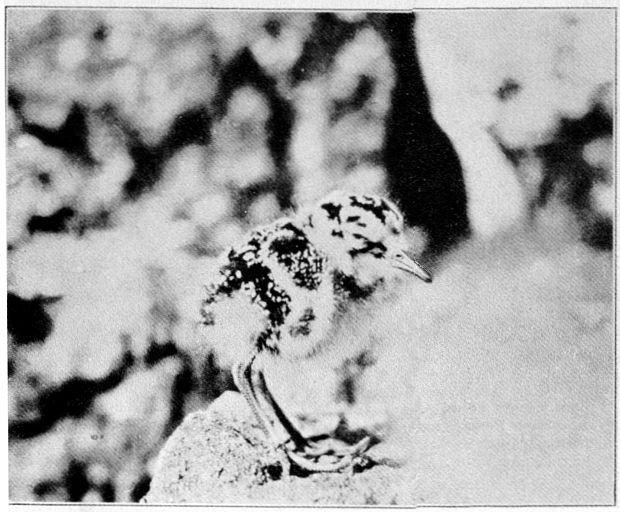
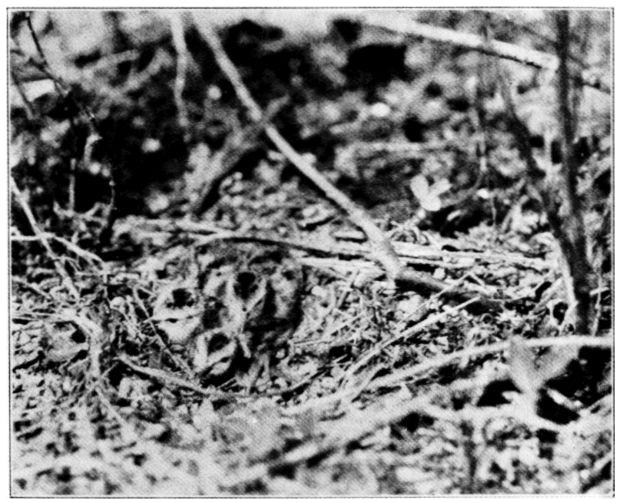
This fine large member of the snipe family is widely distributed
in Europe and Asia and has occurred as a straggler in North America
half a dozen times or more at various points from Newfoundland to
Virginia.
Seton Gordon (1915) gives a very good idea of its distribution
and migrations, as follows:
The principal summer home of the woodcock is the northern portion of the
Old World, for it is found extending from eastern Siberia to the western
extremity of Europe. The woodcock nesting in Kamschatka migrate to Japan
with the advent of the cold weather, those frequenting Mongolia to China,
while those which have nested in western Siberia and on the plateau of Tibet
move down to Burma, India, Afghanistan, and Persia. Our own winter
visitors are those birds which have bred in Scandinavia, Finland, and perhaps
Russia. Those which press on south past our islands arrive in Palestine,
in North Africa, and in Egypt. Throughout Russia the woodcock is found
nesting, extending though in diminished numbers, as far south as the Caucasus
and the Crimea. It also breeds in central France and in northern Italy.
Some of its most distant nesting grounds are in Kashmir and Japan, while
it has been found breeding in the Himalayas at the height of 10,000 feet. In
the Faroe Islands it has occurred as a passing visitor and has also been
recorded from Spitsbergen.
Courtship.—The same writer refers to a nuptial performance
akin to the evening song flight of our woodcock, of which he says:
Immediately after sunset the entire male woodcock population leave their
secluded haunts, and fly backwards and forwards over the same line of country,
uttering a peculiar cry unheard except during the season of nesting. The
notes may be termed the song of the males, and are uttered by the birds previous
to their departure for their feeding grounds in the evening. The song
commences with grunting cries, ending up with a sharp and penetrating note
repeated maybe several times in quick succession, pisick, pisick. At times two
cock birds during their aerial maneuvers cross one another's path, and then
ensues a stern chase over the tree tops, the birds uttering repeatedly their
chirping cries. The "roding" of the woodcock never takes place before the
sun has set during the earlier part of spring, but at a more advanced period,
in May, the birds commence their evening flights rather earlier. The flighting
is continued till deep twilight has settled over the glen, but ceases before
night. In the morning I, personally, have never heard this "roding," but it
is said to be recommenced before daybreak, and to cease previous to full daylight.
The woodcock when roding does not fly repeatedly over the same part
of the wood; there is an interval between each of its appearances.
It is said to pass over the same country three times in the course of the
evening. On the first visit it flies high and usually fast; on the second
its progress is lower and more leisurely; while on the third and last the bird
moves just above the trees.
Nesting.—In the southern portions of Great Britain the woodcock
is a very early breeder, many birds nesting in March and some
in February. Late nestings in July indicate the probability that
two broods are sometimes raised, though this is unusual among
waders. Mr. Gordon (1915) describes the nesting habits as follows:
The nesting ground is usually a wood, deciduous trees, being, I think preferred,
owing to the soft layer of fallen leaves covering the ground. Close-grown
plantations are rarely chosen as nesting sites, and small belts of birch
and oak are favorite nesting grounds, provided that there is plenty of space
between the trees. It is my experience that the birds dislike dense cover in
which to nest; a few broken-down braken offer a suitable position, or the bird
may scrape out a hollow amongst the deep layers of fallen beech and oak leaves
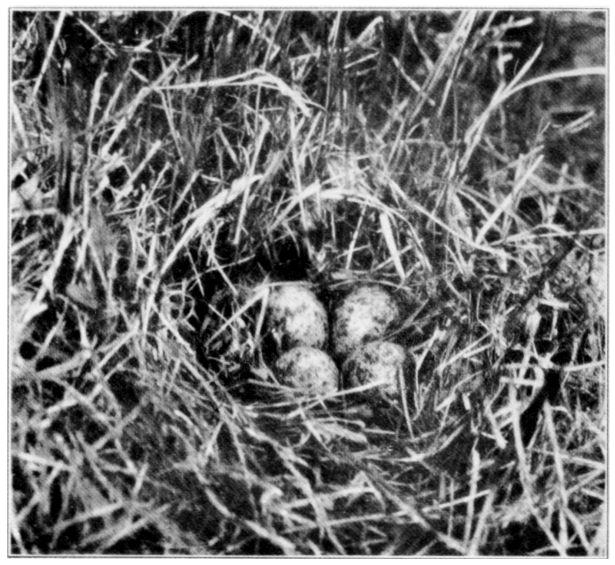
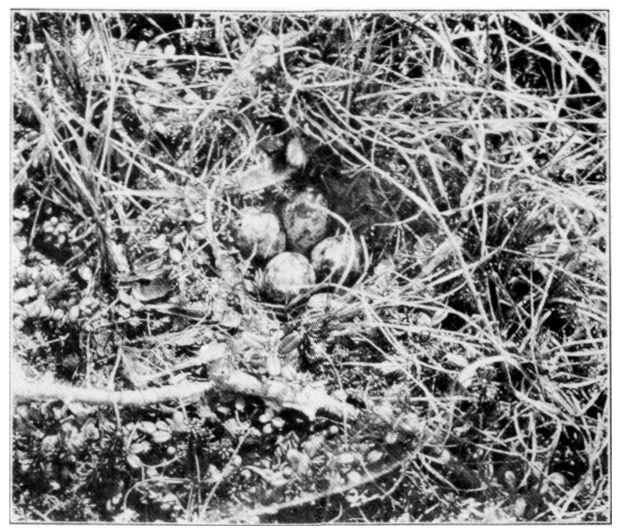
which cover the ground beneath these trees. The eggs usually number four, but
at times only three are found. Their ground color is normally buff colored,
and they are liberally spotted and blotched by dark reddish-brown markings.
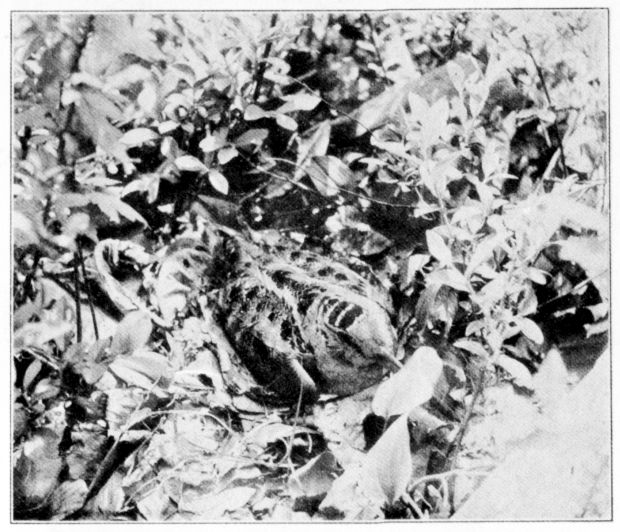
Nothing more primitive than the nest of the woodcock can be found in the
bird world. It is merely a slight hollow scraped in the ground and generally
without intentional lining of any kind. The mother woodcock often sits very
hard on her eggs, especially if incubation be far advanced, for she relies on the
close harmonization of her plumage with her surroundings. Sometimes I have
been able to approach to within a few feet of such a bird, and by not the
slightest movement did she betray that she was alive. As the result of her
early nesting, the woodcock has sometimes to cover her eggs when snow lies
around to a considerable depth.
Rev. Henry H. Slater (1898) says that the nest is "often at the
foot of a young Scotch fir, or other tree."
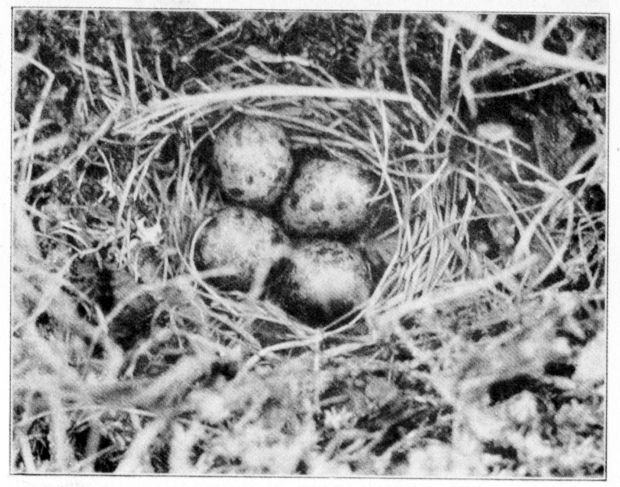
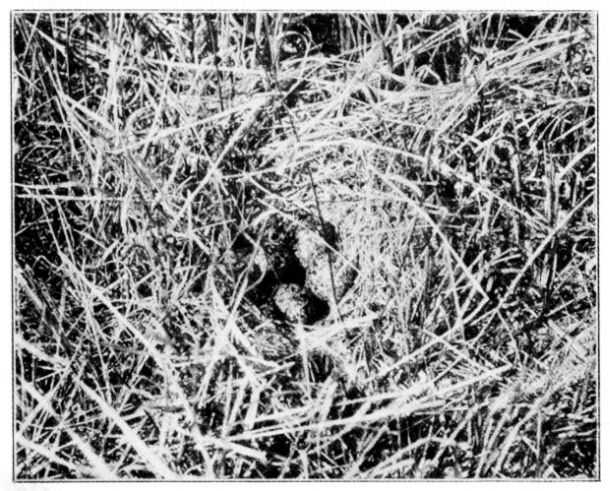
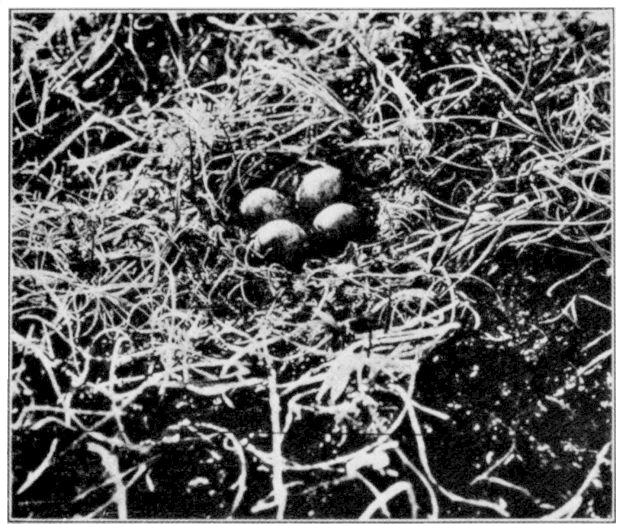
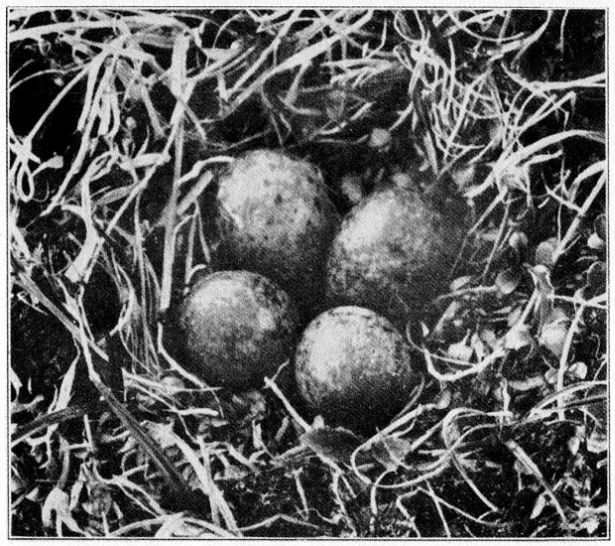
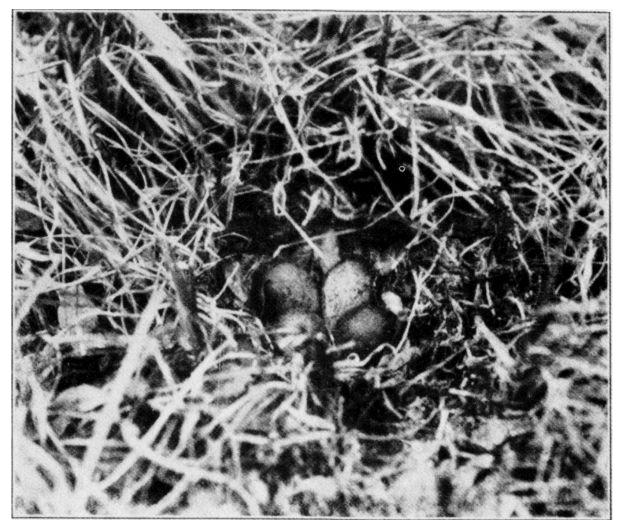
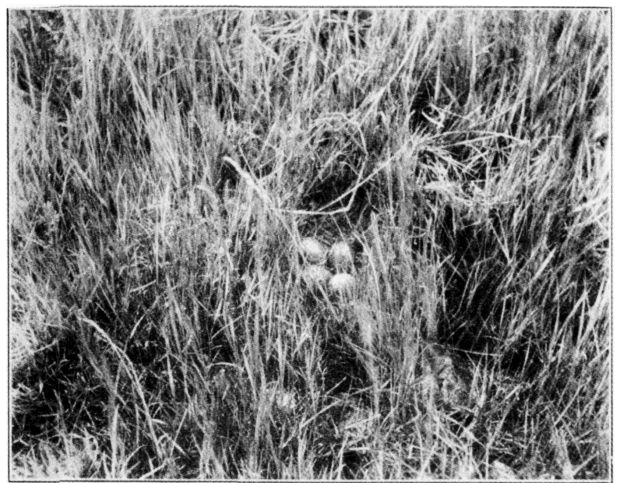
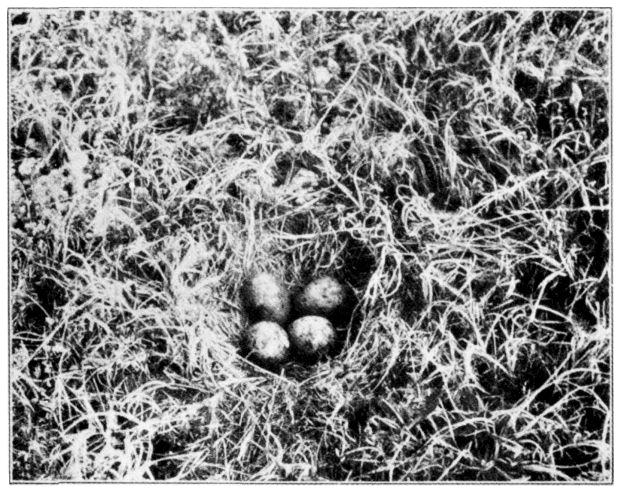
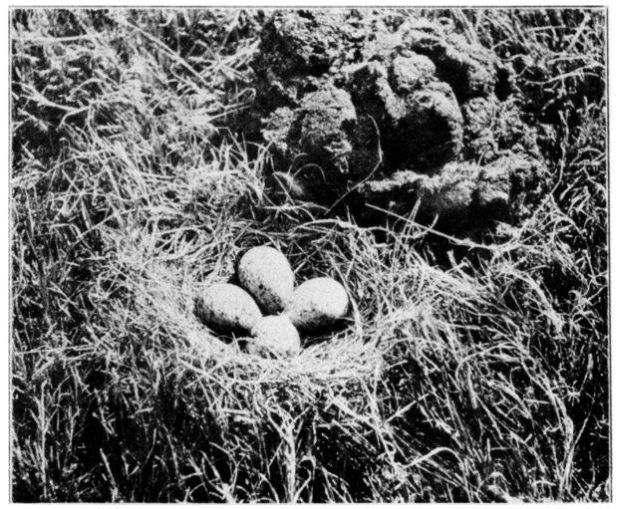
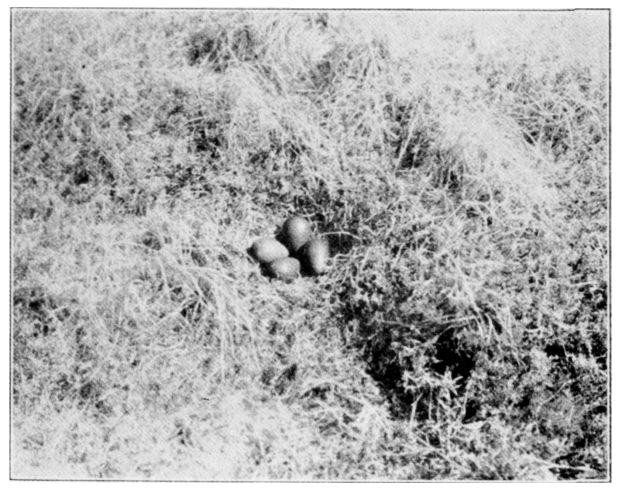
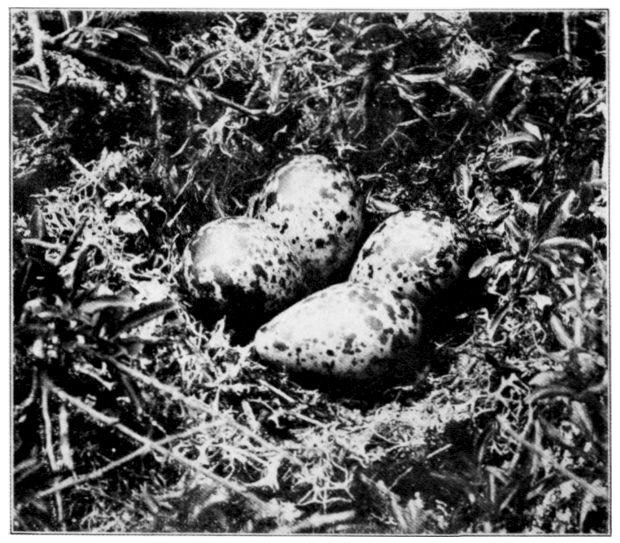
Eggs.—The European woodcock usually lays four eggs, but as
many as six and even eight have been found in a nest, probably the
product of two birds. These are much like large eggs of the American
woodcock. They are about ovate in shape and have a slight
gloss. The ground colors vary from "deep olive buff" to "cream
buff." They are usually sparingly, but sometimes quite heavily,
marked with irregular spots and small blotches. The underlying
markings, in light shades of drab are numerous and quite conspicuous.
Over these are varying amounts of spots and blotches of light
browns, ranging in color from "snuff brown" to "clay color."
Occasionally there are a few spots or scrawls of "bister" or "clove
brown" about the larger end. Herbert Massey (1913) describes the
eggs as follows:
The ground color ranges from the palest cream (nearly white) through
deeper cream to pale buff, yellow-buff, and the deepest brown buff (many of
the eggs of this latter type having a distinct pink tone), speckled and spotted
and blotched with yellow-brown, dark brown, and purplish gray. As a rule,
the eggs in the same set are fairly uniform in the pattern of the markings,
but occasionally you get a set with one egg much more marked than the other
three, and in many cases you find two distinct shades of ground color in the
same set.
The measurements of 100 eggs, furnished by F. C. R. Jourdain,
average 43.8 by 33.6 millimeters; the eggs showing the four extremes
measure 49 by 34.8, 44.9 by 36.4, 40.2 by 34, and 43.1 by 31.6
millimeters.
Young.—Incubation lasts for 20 or 21 days and is performed by
the female only. The young remain in the nest but a short time,
where they are brooded by their mother and carefully tended by
both parents. Several good observers have seen the mother bird
carry her young away between her legs. Dresser (1871) quotes
John J. Dalgleish as follows:
I have had on three occasions the good fortune to see the woodcock in the
act of carrying her young. On the first occasion the bird rose from my feet
one day in the month of June, in a thick coppice cover in Argyllshire, and flew
with her strange burden carried between her thighs for about 30 yards, in the
manner well described in a note in Mr. Gray's Birds of the West of Scotland.
On following her she again rose, still carrying the young one, and flew into some
thick cover. On this and the next occasion, which was in Perthshire, the
birds uttered no cry; but the last time I witnessed this curious habit, which
was on the 5th of May last, the bird made the peculiar cry alluded to in the
note in Mr. Gray's work. On this occasion I could observe the bird more
distinctly, as it was in an old oak cover, with very little underwood, where I
discovered her. On rising she flew from 35 to 40 yards, calling as above mentioned,
and then, alighting among some grass, seemed to flutter along, still
retaining hold of the chick. On raising her again, the same maneuver was
repeated, only that the distance flown each time was greater, but always in
the segment of a circle, as if she were unwilling to leave the rest of the brood.
On returning to the spot where she rose at first, I discovered one of these,
which was more than half grown, the quill feathers being well formed, and
must altogether have formed rather a heavy burden. On taking it up, it
uttered a cry, which was at once responded to by the parent bird, although
the latter did not again take to wing from the bushes into which it had
ultimately flown.
Abel Chapman (1924) writes:
For many years a question used to be discussed as to woodcocks carrying
their young; but the matter never specially interested me, until, on August 3,
1915, I happened to see it with my own eyes. This was in Houxty wood, and
since then I have witnessed the performance on many occasions. During the
war this wood was largely felled for military purposes and the area thus
cleared, and subsequently replanted, has become a specially favored resort
of our long-billed friends. The annexed sketch, made there on June 15, 1920,
shows exactly how the feat is accomplished. That particular woodcock rose
on the hillside a trifle above me, slowly flapping by close in front, and looking
back at me over her shoulder. What first struck my attention was the curiously
depressed tail, held almost vertical; then the mother's feet, hanging down
below; finally the youngster, with its very short beak, pressed between its
parent's thighs. Since then I have witnessed many similar exhibitions; indeed,
in summer they are almost daily on view.
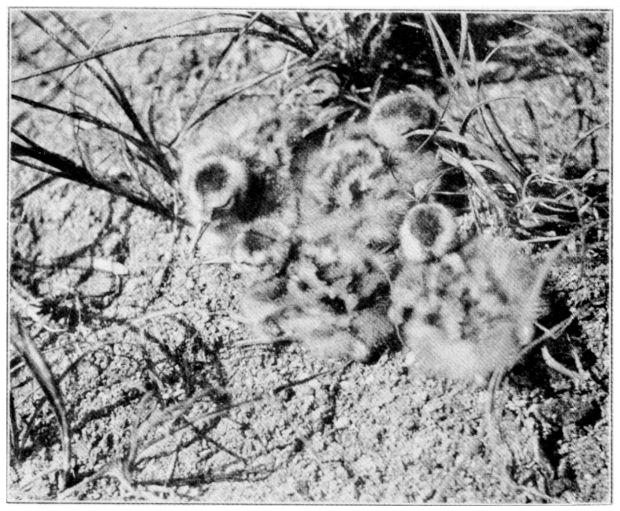
Plumages.—The downy young of the European woodcock is thus
described in Witherby's (1920) Handbook:
Forehead and broad band over eye to nape light ochraceous buff, a russet
median streak from base of upper mandible to crown; crown russet intermixed
with light ochraceous buff, centre of nape russet, sides light ochraceous buff;
an irregular and interrupted russet band from nape to uropygial tuft, another
across wing; rest of upper parts and sides of body with irregular bands and
patches of ochraceous buff and russet; from base of upper mandible to eye
a broad black-brown streak; a small patch of same behind eye; a patch of
russet on lower throat; rest of under parts light ochraceous buff.
The juvenal plumage is therein fully described. It is much like
the adult, differing only in minor details, but can easily be recognized
by the looser or softer structure of the feathers. Practically all
of this plumage, except the primaries and secondaries, is replaced
in the fall by the first winter plumage, which is indistinguishable
from the adult. Adults have a complete postnuptial molt from July
to December and a partial prenuptial molt, involving nearly everything
but the wings, from February to May.
Food.—Mr. Gordon (1915) refers to the feeding habits of the
woodcock as follows:
It feeds mainly by night on wet, boggy ground, and eats an enormous quantity
of worms; indeed, it may swallow almost its own weight of food in the
course of a single day. When the blackberries have ripened the woodcock
betake themselves to the hillsides and consume great quantities of the fruit.
Mr. Slater (1898) says:
I have occasionally flushed woodcocks at night from wet rushy fields, where
they were doubtless probing the ground for worms and larvae, occasionally
turning over the droppings of cattle for concealed beetles. But they also feed
in woods to a certain extent, turning the dead leaves over to find insects,
etc. The accounts of the extent of their appetites and of the amount of
worms, etc., which they will put away at a sitting are surprising. These they
find in the earth with their bills, which are modified into a very delicate
organ of touch.
If the horny epidermis be removed, a number of small pits of a hexagonal
shape will be seen in the bone at the end of the bill, remotely suggesting an
incipient honey comb. In each one of these pits a minute fibril of the olfactory
nerve has its termination, and by this means, when the bill is thrust into the
soft, wet soil, the slightest wriggle of the least living creature is instantly
telegraphed to the woodcock's sensibilities.
Witherby's Handbook (1920) includes the following items in its
food: Earthworms; also insects (coleoptera and their larvae, orthoptera
(Forficula) larvae of lepidoptera, etc.); small mollusca, etc.
Grains of maize recorded on one occasion in stomach, and mussels
(Mytilus) also said to be eaten, as well as small crustacea.
Behavior.—Mr. Gordon (1915) says:
During its flight the bill of the woodcock is pointed downwards, and the
wings are not extended to their full stretch. It seldom makes sustained
flights, however, except on migration. During a shoot at Alnick a woodcock
was seen to alight on the ground and then to throw leaves over its back, presumably
to hide itself from the guns. If so, it would seem that the woodcock
is one of the most sagacious of birds.
Selby (1833) writes:
The haunts selected by these birds, for their residence during the daytime,
are usually the closest brakes of birch and other brushy underwood, and
where the ground, from the deep shade, Is nearly free from herbage; and,
for this reason, thick fir plantations of 10 or 12 years' growth are a favorite
resort. In woods that are very extensive they are generally found, and
abound most in thickets by the sides of open glades, or where roads intersect,
as by these they pass to and from their feeding ground at evening and in the
dawn of the morning. Unless disturbed, they remain quietly at roost upon
the ground during the whole day, but as soon as the sun is wholly below the
horizon, they are in full activity, and taking flight nearly at the same instant,
leave the woods and cover for the adjoining meadows, or open land, over
which they disperse themselves, and are fully engaged in search of food
during the whole night.
Mr. Slater (1898) observes:
It is well known that woodcocks follow certain routes to their favorite feeding
grounds in the evening, as they also have preferences for certain woods and
certain parts of woods to lie in during the day. In short, they are very peculiar
and fanciful in their tastes, and are guided by circumstances not apparent to
us in their liking for one place rather than for another which seems to our
eyes to offer the same advantages. A wood above my father's late house, in
Northumberland, was a regular passing place for cocks, and at dusk on any
April or May evening a sight of half a dozen at least was a certainty, as they
passed rapidly above the trees, announced, long before they themselves were
visible, by their peculiar half squeak, half whistle. I have here seen them
"tilting" in the air in the manner described by St. John and others. It has
been suggested that this tilting (at which time they tumble and twirl about
in the air in pairs and threes, apparently prodding at one another with their
bills) is connected with pairing, but I can not think so, as I have witnessed it
as late as the end of May. I rather think it is pure playfulness, as of children
just out of school, after lying concealed and quiet most of the day.
According to Yarrell (1871), woodcocks sometimes become exhausted
and fall into the sea on their migrations; but they do not
always perish, for he says:
A woodcock when flushed on the coast has been known to settle on the sea,
and when again disturbed rose without difficulty and flew away. Numerous
instances are recorded of woodcocks alighting on the decks of ships in the English
Channel and elsewhere. The rapidity of flight of this bird is at times so
great that a pane of plate glass more than three-eighths of an inch thick has
been smashed by the contact, and one was actually impaled on the weather
cock of one of the churches in Ipswich.
Fall.—Mr. Slater (1898), writing of the fall migration in Great
Britain, says:
Though many breed with us, there is a large migration from the North in
the late autumn. If the moon is full about the end of October, they appear
to come in a big "rush" then, but sometimes in driblets as early as the end
of September, as late as mid-November. But their movements are largely
influenced by the wind and atmosphere as well as the moon; if the weather is
foggy or they are exhausted by a heavy contrary wind, they drop on the
coast as soon as they touch it, and large bags are sometimes made on the
sand hills by those on the lookout for them. If the wind is light and weather
clear, they seem to pass inland at once to favorite and suitable covers. Should
frost come—which drives the worms down, and also prevents the birds from
probing—cock move south and west. Therefore, it is in our southwest
counties, Wales and West Ireland, where, owing to the Gulf stream frost
and cold are seldom severe, that the best woodcock shooting is to be had,
after the seasonal migration is over. Though they travel as a rule at night,
and chiefly at the time of the full moon, this is not invariably the case; on
October 28, 1881, I saw a woodcock come straight in from the sea, 20 yards
high, and pitch on a bare patch of shingle; this was shortly before midday,
and I thought it such an unusual circumstance that I skinned the bird for
my collection.
Winter.—The woodcock is a winter resident as well as a migrant
in Great Britain. Dresser (1871) writes:
Their numbers are, of course, greatly augmented in the winter, large numbers
of immigrants being added to those which breed (as after mentioned);
indeed I am not sure whether all of those we have in winter are immigrants,
and that those which breed with us move further south in pursuance of their
migratory instinct; but this is a point very difficult to discover. In the
district I now allude to, their numbers are much diminished on the appearance
of severe, frosty weather, when they appear to go to the coast, where
they find the feeding grounds more open; if, however, the frost be slight, they
remain.
On the west coast of Argyllshire they are found in greater numbers, and are
not so much confined to covers, being found in open weather scattered through
all the sheltered glens where there is any brushwood or even bracken. On
the occurrence of frost, however, they all gather to the low-lying covers near
the sea, where its influence serves to keep open the springs; and in such weather
very large bags are often made, as they seem to come not only from the outlying
spots above mentioned, but from the inland districts, where the frost
has sealed up every one of their usual haunts.
Breeding range.—Northern Europe and Asia. North in Scandinavia
to latitude 67°, in Lapland and Finland, in western Russia
to 65°, and in eastern Russia to 64°. East to the Sea of Okhotsk.
West to the British Isles. South to the Azores, Canaries, and
Madeira (where it is resident), the Pyrenees, Alps, Transylvania,
Carpathians, Himalayas (up to 10,000 feet), Mongolia, and Japan.
Winter range.—Great Britain, the Mediterranean basin, northern
Africa and southern Asia, Persia, India, Burma, China, Japan, and
occasionally Ceylon.
Casual records.—Casual in the Faeroes, Spitsbergen, Greenland,
and North America. Prof. Wells W. Cooke (1912) says:
It wanders occasionally to eastern North America, and has occurred in
Loudoun County, Va., in 1873 (Coues); Chester County, Pa., the end of November,
1886 (Stone); one was taken near Shrewsbury, N. J., December 6, 1859
(Lawrence); one, September, 1889, somewhere in New Jersey (Warren); one,
probably of this species, near Newport, R. I. (Baird, Brewer, and Ridgway);
one at Chambly, Quebec, November 11, 1882 (Wintle); and one at St.
John, Newfoundland, January 9, 1862 (Sclater).
Egg dates.—Great Britain: 29 records, March 9 to August 5; 15
records, April 18 to June 22.
This mysterious hermit of the alders, this recluse of the boggy
thickets, this wood nymph of crepuscular habits is a common bird
and well distributed in our Eastern States, widely known, but not
intimately known. Its quiet retiring habits do not lead to human
intimacy. It may live almost in our midst unnoticed. Its needs
are modest, its habitat is circumscribed, and it clings with tenacity
to its favorite haunts even when closely encroached upon by civilization.
The banks of a stream running through my place, close to
the heart of the city, were once famous woodcock covers in which
the birds persisted long after the surroundings were built up; and
even within recent years I have had a pair of woodcocks living in
the shrubbery along the stream for a week or two at a time.
Who knows where to look for woodcocks? Their haunts are so
varied that one may not be surprised to find them almost anywhere,
especially on migrations. Flight birds are here to-day and gone
to-morrow. Their favorite resorts are alder thickets along the
banks of meandering streams or spring-fed boggy runs; rich bottom
lands or scrubby hollows, overgrown with willows, maples, alders,
and poison sumac; or the scrubby edges of damp, second-growth
woods, mixed with birches; any such place will suit them where they
can find moist soil, not too wet or too sour, well supplied with
earthworms. During the hot, sultry weather of July and August,
the molting season, they seek the seclusion of cool, moist, leafy
woods or dense thickets; or they may resort to the cool hillside or
mountain bogs, fed by cool springs; or, if the weather is very dry,
they may be found in the wet grassy meadows. Woodcocks do not
like too much water and, after heavy rains, they may be driven
from their usual covers to well-drained hillsides, sparsely covered
with small birches, maples, locusts, and cedars. Sometimes they are
found on the tops of mountains; George B. Sennett (1887) saw a
pair on the top of Roan Mountain in North Carolina, at an elevation
of 6,000 feet, "in a clump of balsams; the overflow from numerous
springs which had their sources at this spot formed an open, adjoining
marsh of several acres."
Woodcocks often appear in unexpected places, such as city parks,
yards, gardens, orchards, or even lawns. John T. Nichols writes to
me:
A neighbor (Mr. W. S. Dana) called for me at about 10 o'clock in the morning
of a sparklingly clear, rather cool summer's day, to show me a woodcock
that was feeding on his lawn, which slopes down to an almost fresh water
arm of Moriches Bay. We found the bird still busily engaged where he had
left it. It was out in the bright sunlight, crouched, walking about slowly
but continuously. It held its body in an unsteady wavering manner, and was
picking and digging about the roots of the short grass stubble, apparently
obtaining some food too small for us to determine. The piece of lawn where
the bird was operating was low and flat, adjacent to the edge of the water
where protected by a low bulkhead. The ground was slightly moist, perhaps
from seepage, which may have accounted for its presence. It was remarkably
unsuspicious, allowing us to crawl within 2 or 3 yards, before flying back
to alight under the shade of near-by trees; but was a full-grown bird, strong
on the wing.
I have, more than once, seen a woodcock crouching in the short
grass beside a country road, quite unconcerned as I drove past. I
have frequently seen one in my yard about the shrubbery and I remember
seeing my father stand on his front piazza and shoot one
that was standing under an arborvitae hedge. Moist cornfields are
often favorite resorts for woodcocks in summer.
Spring.—The woodcock is the first of our waders to migrate north
and one of the earliest of all our migrants, coming with the bluebirds
and the robins, as soon as winter has begun to loosen its grip.
The date depends on the weather and is very variable, for the bird
must wait for a thaw to unlock its food supply in the bogs and spring
holes. Walter H. Rich (1907) has known the woodcock to arrive
in Maine as early as February 10, and says that early birds find a
living about the big ant hills, until the alder covers are ready for
them.
In Audubon's (1840) time the migration must have been very
heavy, for he says:
At the time when the woodcocks are traveling from the south toward all
parts of the United States, on their way to their breeding places, these birds,
although they migrate singly, follow each other with such rapidity, that they
may be said to arrive in flocks, the one coming directly in the wake of the
other. This is particularly observable by a person standing on the eastern
banks of the Mississippi or the Ohio, in the evening dusk, from the middle of
March to that of April, when almost every instant there whizzes past him a
woodcock, with a velocity equaling that of our swiftest birds. See them flying
across and low over the broad stream; the sound produced by the action of
their wings reaches your ear as they approach, and gradually dies away after
they have passed and again entered the woods.
No such flights can be seen to-day, but we occasionally have a comparatively
heavy migration; such a flight occurred in 1923 and is
thus described in some notes from Edward H. Forbush:
The most remarkable occurrence of the past two months was the prevalence
of migrating woodcocks over a large part of southern New England and along
the coastal regions to Nova Scotia. The first woodcock was reported in Massachusetts
the last week in February and from the first week in March onward
woodcocks were noted in slowly increasing numbers over a large part of New
England. From March 22 to the first week in April the number of these birds
scattered through Connecticut and eastern Massachusetts was remarkable. At
evening one could find them almost anywhere. They were seen in the most
unlikely places even in daylight. They were in all the towns around Boston
and in the suburbs of the city itself, and west at least to the Connecticut Valley
they were even more numerous in the woods and swamps. In southern
New England at this time a large part of the snow had gone and in going had
thawed the ground so that no frost remained and the woodcocks could find
earthworms almost everywhere. Farther north there was not only frost in
the ground but there was deep snow and the birds could find no food.
Courtship.—The woodcock may be found by those who seek him
and know his haunts, but it is only for a short time during the breeding
season, that he comes out into the open and makes himself conspicuous.
His spectacular evening song-flight has been seen by
many observers, and numerous writers have referred to it or described
it more or less fully. William Brewster (1894) has given
us the best and most complete account of it, but it is too long to quote
in full here. I prefer to give my own version of it. The time to
look and listen for it is during the laying and incubation period—say
the month of April in Massachusetts, earlier farther south, even
December and January in the Gulf States. The performance usually
begins soon after sunset, as twilight approaches. On dark nights
it ceases about when the afterglow finally disappears in the western
sky; and it begins again in the morning twilight, lasting from dawn
to broad daylight. On moonlight nights it is often continued
through much or all of the night. The woodcock's nest is usually
in some swampy thicket or on the edge of the woods, near an open
pasture, field, or clearing; and here in the nearest open space, preferably
on some knoll or low hillside within hearing of his sitting
mate, the male woodcock entertains her with his thrilling performance.
Sometimes, but not always, he struts around on the ground,
with tail erect and spread, and with bill pointing downwards and
resting on his chest. More often he stands still, or walks about
slowly in a normal attitude, producing at intervals of a few seconds
two very different notes—a loud, rasping, emphatic zeeip—which
might be mistaken for the note of the nighthawk, and a soft guttural
note, audible at only a short distance, like the croak of a frog
or the cluck of a hen. Suddenly he rises, and flies off at a rising
angle, circling higher and higher, in increasing spirals, until he looks
like a mere speck in the sky, mounting to a height of 200 or 300
feet; during the upward flight he whistles continuously, twittering
musical notes, like twitter, itter, itter, itter, repeated without a break.
These notes may be caused by the whistling of his wings, but it seems
to me that they are vocal. Then comes his true love song—a loud,
musical, three-syllable note—sounding to me like chicharee, chicharee,
chicharee uttered three times with only a slight interval between
the outbursts; this song is given as the bird flutters downward,
circling, zigzagging, and finally volplaning down to the ground at
or near his starting point. He soon begins again on the zeeip notes
and the whole act is repeated again and again. Sometimes two, or
even three, birds may be performing within sight or hearing; occasionally
one is seen to drive another away.
The performance has been similarly described by several others
with slight variations. Mr. Brewster (1894) refers to what I have
called the zeeip note as paap and the soft guttural note as p'tul, and
says that—
"Each paap was closely preceded by a p'tul, so closely at times that
the two sounds were nearly merged."
He counted the paaps as "uttered consecutively 31, 21, 37, 29, and
28 times."
Describing the action in detail, he says:
At each utterance of the paap the neck was slightly lengthened, the head
was thrown upward and backward (much in the manner of a least flycatcher's
while singing), the bill was opened wide and raised to a horizontal position,
the wings were jerked out from the body. All these movements were abrupt
and convulsive, indicating considerable muscular effort on the part of the
bird. There was perhaps also a slight twitching of the tail, but this member
was not perceptibly raised or expanded. The return of the several parts to
their respective normal positions was quite as sudden as were the initial
movements. The forward recovery of the head was well marked. The opening
and shutting of the bill strongly suggested that of a pair of tongs. During
the emission of the paap the throat swelled and its plumage was ruffled, but
neither effect was more marked than with any of our small birds while in
the act of singing.
The mouth opened to such an extent that I could look directly down the
bird's throat, which appeared large enough to admit the end of one's forefinger.
The lateral distension of the mouth was especially striking.
Referring to the song flight, he says: "Two flights, which I timed
from the start to the finish, lasted, respectively, 57 and 59 seconds,
the song 11 and 12 seconds, respectively." During the flight he
followed him with a glass and "made out distinctly that while singing
he alternately flapped his wings (several times in succession)
and held them extended and motionless."
Francis H. Allen has sent me the following notes on his impression
of the song:
In all that has been written of this wonderful performance of the woodcock's,
I do not remember to have seen any full description of the song itself;
the peeping, or peenting, on the ground, with the alternating water-dropping
sounds and the accompaniment of head-jerking and wing-lifting has been
described at length, as well as the remarkable spiral ascent into the air on
whistling wings; but the character of the actual song, which is uttered at
the summit of the ascent and as the bird comes down, is worth a little more
attention. It begins in a confused series of chipping whistles which convey
the impression of coming from at least three birds at once. These soon resolve
themselves into groups of four to six—usually four in my experience—descending
notes, the groups alternating with groups of high-pitched wing-whistles.
These song notes vary in sweetness with different individuals, but are
often very clear and musical. Not the least interesting aspect of the woodcock's
evening hymn is the fact that so stolid appearing a bird should be
moved by the fervor of courtship to execute so elaborate and exciting a performance.
The excitement attending the affair as far as the spectator, or
rather listener, is concerned lies to great extent in the wing whistling. When
the woodcock first rises, the whistle is comparatively low, but as he mounts,
the pitch rises and the rapidity of production increases. It is a steady
succession of very short whistling notes for some time, but, when the bird
and the whistle both reach their height, it comes in short groups of extremely
rapid whistles alternating with brief intervals of motionless wings, as if
the performer were breathless with excitement and effort and could not
sustain his flight for long at a time. This is the effect, I mean. Probably
the bird finds it easy enough, for he makes his flight at comparatively short
intervals and during his periods of rest he is hard at work producing his harsh
and unmusical nighthawk-like peent notes which involve a deal of muscular
effort.
Lynds Jones (1909) says that "the bird floats downward by a
crooked path, the while calling in coaxing tones p chuck tuck cuck oo,
p chuck tuck cuckoo, uttered more slowly at first, regularly increasing
in rapidity until the notes are almost a wheedling call." Isador S.
Trostler (1893) describes a feature of the courtship which I have
not seen mentioned elsewhere; he writes:
The birds often play in a very droll manner, running round and round each
other in a small circle, their feathers ruffled, their wings lifted, and their
long bills pointing nearly directly upward, with their heads resting on their
backs.
Sometimes they will hop on one foot, holding the other at a queer angle, as if
it had been broken or hurt. The male bird utters a low indescribable sound
during all the playing, and the sight of these queer antics is worth more than
to have seen Modjeska or Barrett in their celebrated plays.
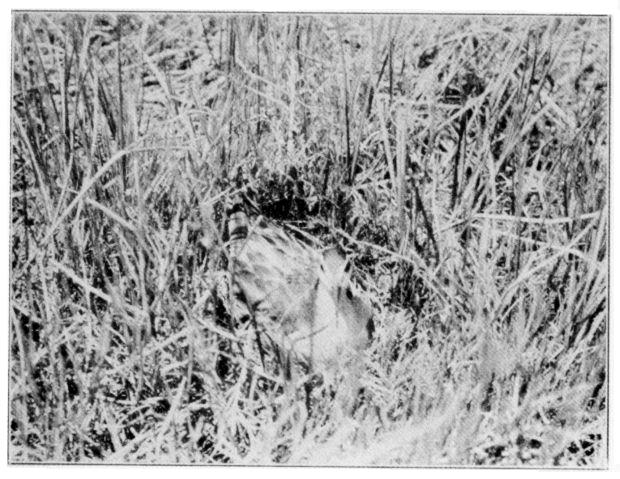
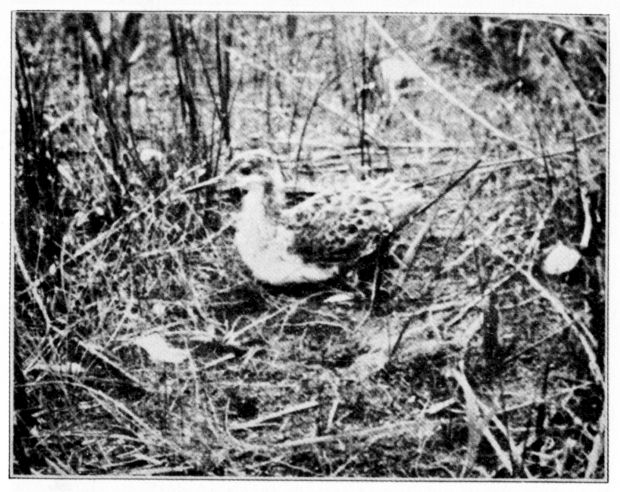
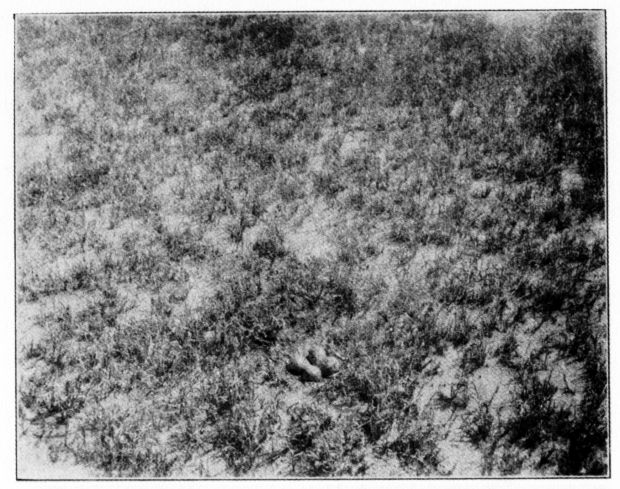
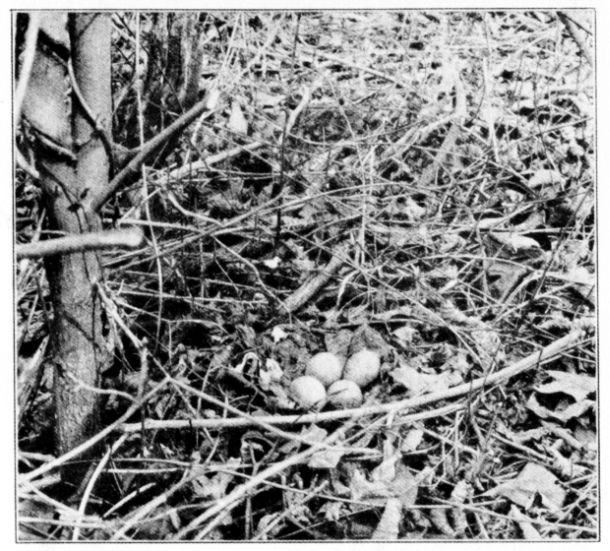
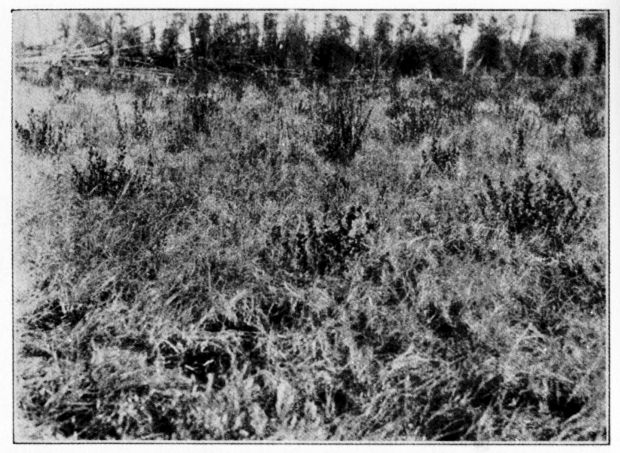
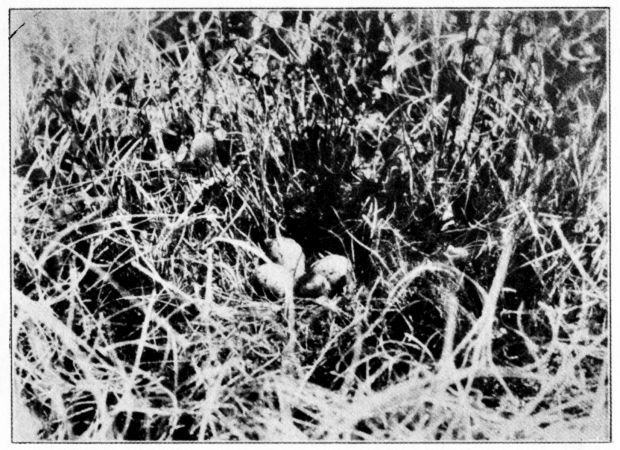
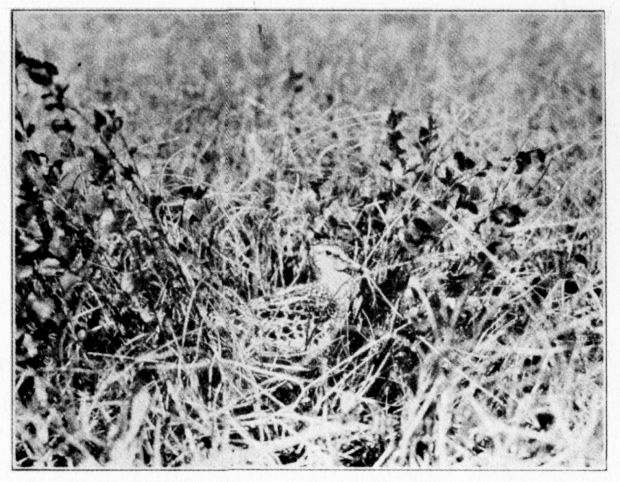
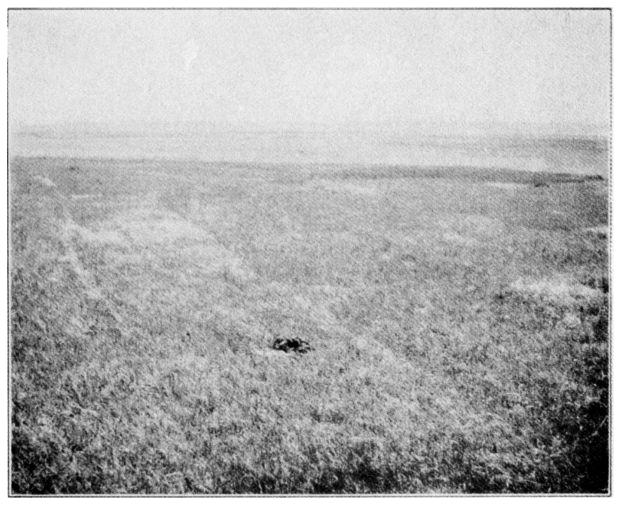
Nesting.—The nesting sites of the woodcock are almost as varied
as its haunts at other times. I have never known how or where to
look for its nest; in over 40 years of field work I have seen but one
nest with eggs. That was shown to me by Mrs. Mary M. Kaan, in
Chestnut Hill, Massachusetts, on June 2, 1924. It was located where
I should never have thought of looking for one, in an open, rocky
hollow in open woods, within 50 feet of a bridle path on one side and
about the same distance from a swampy ravine and brook on the
other side. The nest was on a little hummock, surrounded by herbage
about a foot high; it was a mere hollow in the ground lined with
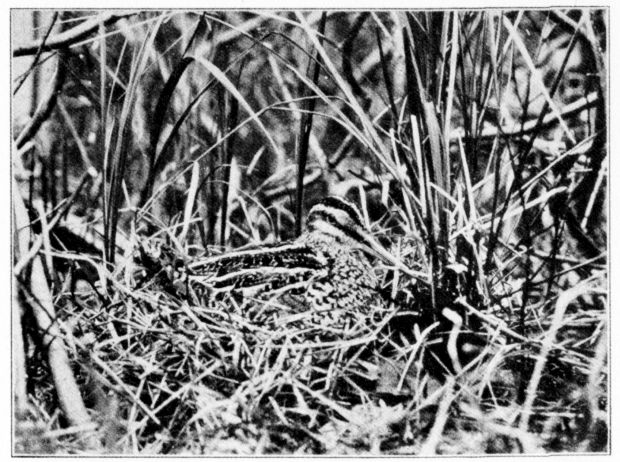
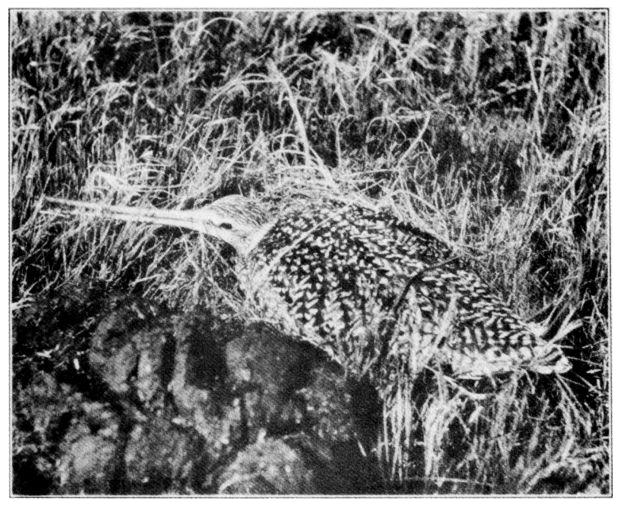
dead leaves. Although it was in fairly plain sight, it was a long
time before I could see the sitting bird, even when it was pointed
out to me. The bird sat like a rock, as this species usually does,
while I took a series of photographs of it, moving gradually nearer.
I even removed two leaves which were resting on her bill, and Mrs.
Kaan stroked her on the back before she left. The nest held only
three eggs, which were probably a second laying.
The usual nesting sites are in alder runs, swampy thickets, brushy
corners in pastures, or in underbrush or tall weeds along the edges
of woods. Woodcocks are early breeders and it sometimes happens
that nests are buried under late falls of snow; in such cases the
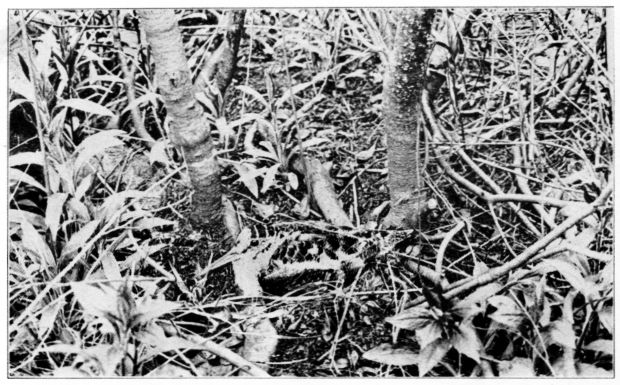
birds continue to sit as long as it is possible to do so. The nest is
often placed at the foot of a small tree or bush, occasionally beside
a log or stump or even under fallen brush. An abundance of fallen
leaves seems to be an essential requirement, of which the nest is
usually made and among which the bird relies on its protective
coloration for concealment; but its big black eyes sometimes reveal it.
L. Whitney Watkins (1894) found a nest near Manchester, Michigan,
in heavy timber, and within a few feet of a reed-bordered,
springy spot, it was within 2 feet of an ovenbird's nest. Another
nest he describes as follows:
The old bird, curiously enough, had selected for her nesting site an open
spot where some fallen boughs had partially decayed, and within 5 feet of a
picket fence enclosing an open pasture field. Opposite her on the other side,
were ash, elm, oak, and other trees, of no considerable size, and round about
were many frost-dried stems of aster and goldenrod, interspersed with the
fallen leaves of the previous summer. Little of green was near.
E. G. Taber (1904) found a nest that was situated in a swampy
corner of a field planted with corn, only 6 feet from the open, on a
slightly raised portion of the ground. This corner was overgrown
with black ash, soft maple, tag alders, and ferns, mingled with
poison ivy. Mr. Brewster (1925) describes two, of several, nests
found near Umbagog Lake, Maine, as follows:
One, containing four eggs, incubated perhaps as many days, was in the
face of a low mound partially overarched by balsam shrubs surrounded on
every side by pools of water, and some 80 yards from the lake shore near the
middle of swampy, second-growth woods made up chiefly of aspen, red cherry,
and yellow birch trees, 20 or 30 feet in height, beneath which grew alders
rather abundantly. The female woodcock flew up from her eggs at least 15
feet in advance of me, and whistling faintly soared off over the tree tops
to be seen no more. I flushed a male about 50 yards from this nest.
Of the other he says:
It was at the edge of a little fern-grown opening, on a mound covered
with brakes flattened and bleached by winter snows, beneath a balsam scarce
2 feet high, and not dense enough to afford much concealment for the eggs
which, indeed, caught my eye when I was 15 feet away, there being no bird
on them.
Mr. Trostler (1893) writes:
Finding a nest one day, I disturbed the setting bird three times, and again
four times on the next day, and on the morning of the third day I found
that the birds had removed the eggs during the night and placed them in a
new nest about 8 feet away, where I found the eggs. I had marked the eggs
to avoid any mistake. The second nest was a mere hollow in the mossy
ground, and was in the middle of an open place in tall marsh grass, while
the first was neatly cupped and lined with the above-mentioned vegetable
down.
Another singular habit of the woodcock that I have never seen noted is
that of both birds setting upon the nest in wet or cold weather. In doing
this they huddle very close together and face in opposite directions, and I have
always noted that they have their heads thrown back and their bills elevated
to an angle of about forty-five degrees.
Mr. Nichols writes to me:
On Long Island there is a favorite nesting station for woodcock, where the
woodland gives place to broad fields, separated by narrow stands of big trees
with a sparse tangled undergrowth of shrubbery and cat-brier, and where here
and there a short fresh-water creek extends inland from the not distant bay.
Several writers have stated or implied that the woodcock raises
two broods in a season. This would be an exception to the rule
among waders. I believe that it normally nests early and that the
late nests are merely second attempts at raising a brood, where the
first nest has been destroyed.
An interesting case of nest-protecting display is thus described by
Dr. Robert Cushman Murphy (1926):
She (assuming that it was the female) would allow us to come within a
few feet before leaving her well-concealed position. Then she would spring
from the nest, pitch on the ground close by, and, standing with the tail toward
us, would raise and spread it so as to show to full advantage the double row
of glistening white spots at the ends of the rectrices and under coverts. Next,
flashing this striking banner slowly, she would move off among the trees in
the attitude of a strutting turkey cock, stopping when we refused to follow,
and then tripping ahead for a few steps, all the while bleating softly. The
effect was astonishing; the ordinary low visibility of a woodcock against the
forest floor no longer held, for the spotted fan of the tail had become a most
conspicuous and arresting mark.
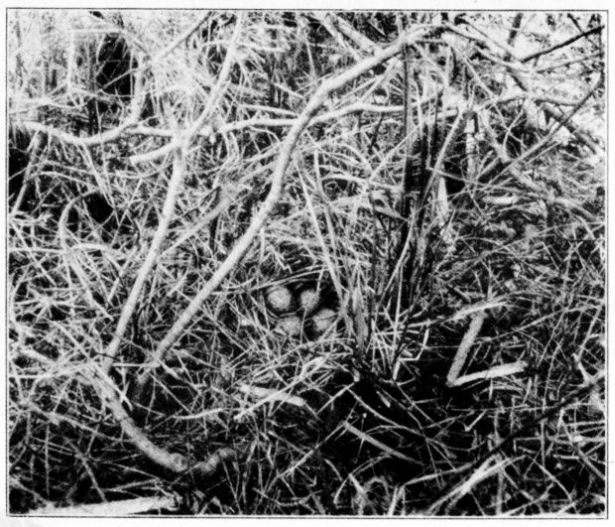
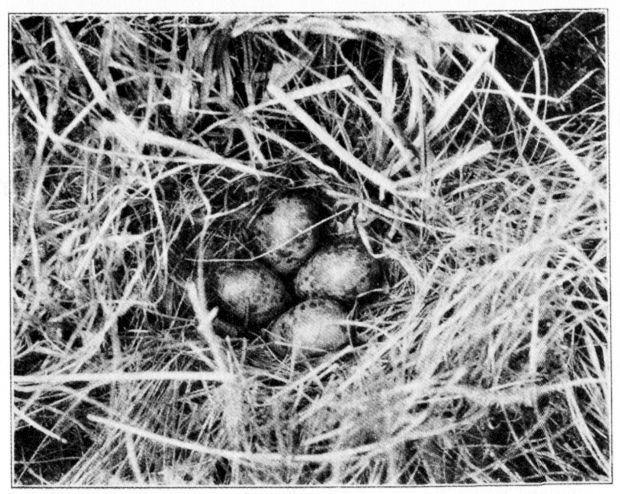
Eggs.—The American woodcock lays four eggs, sometimes only
three, and rarely five. They vary in shape from ovate to rounded
ovate and have a moderate gloss. The ordinary ground colors vary
from "pinkish buff" to "cartridge buff" and in certain brown types
from "pinkish buff" to "cinnamon." They are usually rather
sparingly and more or less evenly marked with small spots, but sometimes
these spots are concentrated about the larger end. In the
lighter types, which are the most common, there are often many
large blotches of light shades of "vinaceous drab" or "brownish
drab"; these are conspicuous and often predominate. Mixed with
them are numerous small spots of light browns, "cinnamon," "clay
color," or "tawny olive." In the brown types these spots are in
richer browns, "hazel," "russet," or "cinnamon brown," with the
drab spots less conspicuous. The measurements of 53 eggs, in the
United States National Museum, average 38 by 29 millimeters; the
eggs showing the four extremes measure 41 by 30 and 35 by 27.5
millimeters.
Young.—The period of incubation is 20 or 21 days. Both sexes
assist in this and in the care of the young. An incubating woodcock
is notorious as a close sitter and can not usually be flushed from the
nest unless nearly trodden upon; often it can be touched or even
lifted from the eggs. The young are rather feeble when first hatched
and are brooded by the parent bird much of the time for the first
day or two. If flushed from her brood of young the female flutters
away for a short distance as if hardly able to fly, with dangling legs
and tail depressed and spread. If the young are strong enough to
walk, she calls to them making a clucking sound, to which they
respond with a faint peeping sound, as they run toward her; having
gathered them under her wings, she covers them again trusting to
her concealing coloration. If the young are too young and feeble
to run, she may return when she thinks it safe, and carry them off
between her legs, one at a time. Several reliable and accurate observers
have testified to seeing this done; some who have not seen it
have doubted it. The following account by Edwyn Sandys (1904)
seems convincing:
The nest in question was on a bit of level ground amid tall trees. The sole
suggestion of cover was a lot of flattened leaves which lay as the snow had
left them. Perhaps 10 yards away was an old rail fence about waist-high, and
on the farther side of it was a clump of tall saplings. A man coming out of
the wood told me he had just flushed a woodcock and had seen her brood,
recently hatched and pointed out where they were. I went in to investigate,
and located one young bird crouched on the leaves. It ran a few steps and
again crouched, evidently not yet strong enough for any sustained effort. I
went off, and hid behind a stump, to await developments. From this shelter
the young bird was visible and it made no attempt to move. Presently the
old one came fluttering back, alighted near the youngster, and walked to it.
In a few moments she rose and flew low and heavily, merely clearing the fence,
and dropping perhaps 10 yards within the thicket. Her legs appeared to be
half bent, and so far as I could determine the youngster was held between
them. Something about her appearance reminded me of a thing often seen—a
shrike carrying off a small bird. I carefully marked her down, then glanced
toward where the youngster had been. It was no longer there; and a few
moments later it, or its mate, was found exactly where the mother had gone
down. She flushed and made off in the usual summer flight.
William H. Fisher writes to me:
On May 16, 1903, I flushed an old bird at upper end of the Eagle Woods.
She left three young on the ground, they remaining very quiet, cuddled in the
dead leaves. In a few minutes she returned and alighted by them took one
between her legs, holding it tight up to her belly, and flew off into a thicket.
I sat and watched the other two young for about 15 minutes, hoping and expecting
the mother bird would return, but, she not doing so, I got tired and
left. As the usual set of eggs is four, I wonder if the old bird carried off one
when she first flushed.
John T. Nichols tells, in his notes, of a brood found on Long
Island:
This brood was found early in the morning by working painstakingly in a
narrow stand of trees where a nest was suspected. The parent bird rose from
almost under foot and fluttered away, as is customary in such cases, with tail
spread, pointing down, legs dangling wide apart. It was perhaps a minute
before the eye could pick out four young lying motionless side by side, so inconspicuous
was their color against the background. For another couple of
minutes they lay motionless. Then of one accord rolled to their feet and
spreading their baby wings aloft, as though to balance, walked deliberately
away with fine, scarcely audible cheeping, each in a slightly different direction.
Apparently reliable reports are current of the woodcock carrying its
young, but the characteristic peculiar labored flight, with deflected tail and
widespread legs, just described, may also easily give such an impression
erroneously.
Again he writes:
Just after sunrise on a clear morning I came upon 3 birds in an open field.
Two of them flew in different directions, one swiftly and silently quickly disappeared,
the other in the peculiar fluttering manner characteristic of a parent
when surprised with young. As I reached the point where the two had risen
the presence of helpless young was confirmed by the actions of a bird on the
ground some 75 yards away, at the edge of the trees to which the parent had
flown. Its head up, watching me, both wings were extended to the side, flapping
feebly.
I had stood a couple of minutes scrutinizing the ground about, when my eye
alighted on a fledgling. At the same instant it rose to its feet, raised and
extended its wings to the side, and began to walk rapidly away, calling a high-pitched
seep! Its wings were fully feathered, though little grown, feathers
extending narrowly between them across the back, sides of its lower parts
feathered, feathers not quite meeting in the center, otherwise in down. Contrast
its helplessness with the young bobwhite which flies at a much earlier
stage.
Audubon (1840) describes the actions of the anxious mother in the
following well-chosen words:
She scarcely limps, nor does she often flutter along the ground, on such
occasions; but with half extended wings, inclining her head to one side, and
uttering a soft murmur, she moves to and fro, urging her young to hasten
towards some secure spot beyond the reach of their enemies. Regardless of
her own danger, she would to all appearance gladly suffer herself to be seized,
could she be assured that by such a sacrifice she might ensure the safety of
her brood. On an occasion of this kind, I saw a female woodcock lay herself
down on the middle of a road, as if she were dead, while her little ones, five in
number, were endeavoring on feeble legs to escape from a pack of naughty
boys, who had already caught one of them, and were kicking it over the dust
in barbarous sport. The mother might have shared the same fate, had I not
happened to issue from the thicket, and interpose in her behalf.
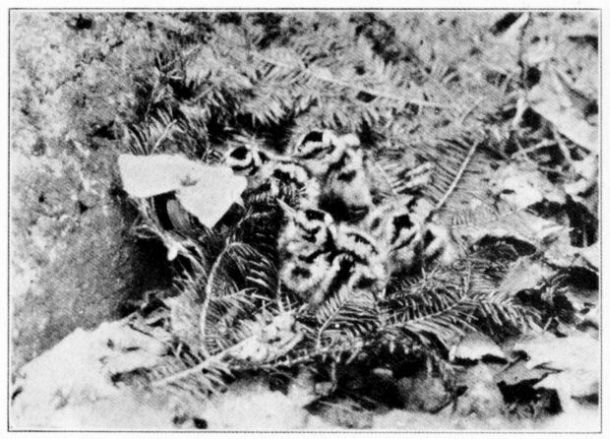
Plumages.—The downy young woodcock, when newly hatched,
is conspicuously and handsomely marked; the upper parts are "warm
buff" or "light ochraceous buff," distinctively marked with rich
"seal brown"; these markings consist (with some individual variation)
of a large, central crown patch, extending in a stripe down
the forehead, a large occipital patch, a stripe from the bill through
the eye to the occiput, a broad stripe down the center and one down
each side of the back, a patch on each wing and each thigh and
irregular markings on the sides of the head and neck; the under
parts are more rufous, "pinkish cinnamon" or "cinnamon buff," and
unmarked.
The juvenal plumage appears at an early age, coming in first on
the back and wings; the wings grow rapidly, and the young bird can
fly long before it is fully grown. This plumage is much like that
of the adult, but it can be distinguished during the first summer by
its looser texture and by broader brown edgings on the wing coverts,
scapulars, and tertials. A prolonged postnuptial molt of the body
plumage during late summer and fall produces a first winter plumage
which is nearly adult. At the first prenuptial molt, in late winter
and spring, young birds become indistinguishable from adults.
Adults have an incomplete prenuptial molt, involving the body
plumage, some wing coverts, scapulars, and tertials, in late winter
and early spring, and a complete postnuptial molt in July and
August. Fall birds are much more richly colored than spring adults.
Food.—The woodcock is a voracious feeder; its principal food
is earthworms or angleworms, of which it has been known to eat
more than its own weight in 24 hours. It is said to feed mainly
at night or during the hours of twilight or dusk. The worms are
obtained by probing in mud or damp earth in any place where
worms are to be found, including gardens and cultivated fields. The
long bill of the woodcock is well supplied with sensitive nerves, in
which the sense of touch is highly developed; it can detect the movements
of a worm in the soil and capture it by probing. Numerous
borings are often seen close together, indicating that the bird does not
always strike the worm at the first stab. Probably its keen ears also
help to locate its prey. It is said to beat the soft ground with its
feet or wings, which is supposed to suggest the effect of pattering
rain and draw the worms toward the surface.
C. J. Maynard (1896) made the following observations on a captive
bird:
The floor of its house was covered to the depth of four or five inches with dark-colored
loam, in which I planted a quantity of weeds, beneath which the woodcock
could hide. I would drop a number of worms on this soil, which, as the
bird was too shy to feed at first, had ample time to bury themselves. At times,
however, I was able to watch the bird unseen by it; then the woodcock, which
had remained hidden in the corner behind the sheltering weeds, would emerge
cautiously and walk over the ground, slowly and deliberately, pausing every
instant or two as if listening intently. Then he would stamp with one foot,
giving several sharp, quick blows, after which he would bow his head near the
ground and again listen. Then suddenly he would turn either to the right or
left or take a step or two forward, plunge his bill into the earth, and draw
out a worm, which he would swallow, then repeat this performance until all
the worms were eaten.
During dry spells, when the worms have returned to the subsoil,
the woodcock must seek other foods. It then resorts to the woods,
where it turns over the leaves in search of grubs, slugs, insects, and
larvae. It has even been known to eat grasshoppers. Mr. Rich
(1907) says that in early spring, before the alder covers are open,
it feeds on ants. Frederick S. Webster (1887) reports a singular
case, where the crop of a woodcock was crammed full of leaves of
a common fern.
Behavior.—The woodcock is so nocturnal or crepuscular in its
habits that it remains quietly hidden in its favorite covers during the
day and is seldom seen to fly unless disturbed, when it flutters up
through the trees with a weak, irregular, or zigzag flight, dodging
the branches. When clear of obstructions, it flies more swiftly and
directly, but usually for only a short distance, and soon pitches down
into the cover again. One can usually follow it and flush it again and
again. Toward dusk it becomes much more active, and its shadowy
form is often seen flying over the tree tops and across open places to
its feeding grounds. At such times its flight is steady and direct,
with regular wing strokes; its chunky form with its long bill
pointing downward is easily recognized. While traveling at night
its flight is quite swift. When rising in flight the woodcock produces,
usually but not always, a distinct whistling or twittering sound. This
has led to much discussion and differences of opinion, as to whether
the sound is produced by the wings or is vocal. I am inclined to
the latter theory, for I have often seen a woodcock fly without whistling,
and many others have referred to such a flight.
Few of us have ever seen a woodcock alight in a tree, but Mr.
Rich (1907) refers to several instances where the bird has been seen
to do this by reliable witnesses. Once he himself shot one in the act.
Voice.—Except during the spectacular song-flight and courtship
performance, the woodcock is a very silent bird, unless we regard
the twittering heard when it rises as vocal. Mr. Nichols says in his
notes:
The quality of the twitter of a rising woodcock corresponds more or less
to the character of its flight. When, as is frequently the case, the bird merely
flutters a short distance to drop again behind the screen of undergrowth, it
amounts to little more than the chirping of crickets. On one occasion when I
observed an individual barely escape the attack of an Accipiter, this sound,
as it rose, was less shrill and loud than often, but more rapid and sustained,
with an incisive quality suggesting a rattle snake's alarm. When a woodcock
rises through thick brush or brambles its wings make a whirring sound not
unlike that of the bob white, accompanied by a slight twitter.
Mr. Brewster (1925) writes:
Many years ago I expressed in print a belief that the whistling sound made
by a rising woodcock is produced by the bird's wings. This conviction has
since been confirmed by field experience at the lake with woodcock killed during
the first half of September, and in varying conditions of moult. Such of them
as still retained or had just renewed the attenuated outer primaries, almost
always whistled when flushed, whereas no sound other than a dull fluttering
one was ever heard from any of those not thus equipped. Hence I continue
to hold firmly to the opinion that the woodcock's clear, silvery whistle emanates
from these "whistling quills", as sportsmen fitly term them, and not from the
bird's throat. There are, however, certain sounds, not very unlike those which
combine to form the usual characteristic whistle, but more disconnected and
twittering, which may be of vocal origin. One hears them oftenest from
the woodcock hovering, just before alighting, or flitting low over the ground
for trifling distances, beating their wings rather listlessly. This comparatively
slow pulsation of the wings might account for the interrupted sequence of the
sounds, but not perhaps, for their seemingly throaty quality.
Edward H. Forbush (1925) quotes three observers, as follows:
Mr. W. H. Harris asserts that he held a woodcock by the bill which whistled
three times with a rotary motion of body and wings. Mr. J. M. Dinsmore held
a woodcock by the body and wings to prevent movement of these parts, and
he says that this bird whistled through its mouth and throat. Mr. H. Austin
avers that he flushed a woodcock that did not whistle, marked the bird and
put him up again when he whistled, which indicates that the bird may have
made the sound with its vocal equipment.
Fall.—The following from the pen of Mr. Forbush (1912) illustrates
the conditions which affect the fall flight:
The flights of birds from the North have not diminished in number so much
as have the native birds. Occasionally a large flight stops here, as in early
November, 1908, when woodcock were plentiful here, and when some gunners
in Connecticut secured from 20 to 40 birds each in a day. This flight did not
denote such an increase in the number of these birds, however, as generally
was believed. The explanation is that they all came at once. The birds in
Maine and the Provinces had a good breeding season, and they must have
had a plentiful supply of food, for the autumn weather was mild, and they
mostly remained in their northern homes until nearly the 1st of November.
Flight birds were rare in Massachusetts up to that time, and the bags were
small. The fall had been warm and dry, but on October 29 and 30 New England
and the Provinces experienced a severe northeast storm along the seaboard,
followed by a cold northwest wind, which probably froze up the northern
feeding grounds, if the storm had not already buried them in snow. Either
or both of these conditions drove the woodcock into southern New England.
My correspondence shows that this flight landed in every county of Massachusetts
except Dukes and Nantucket. As usual, comparatively few were seen
in Barnstable County. Connecticut covers harbored many woodcock from about
November 12 to November 20. There were many in Rhode Island, and the
flight was noted as far south as Delaware.
Game.—It is as a game bird that the woodcock is best known,
most beloved, and most popular, for it is a prince among game birds,
and its flesh is a delight to the palate of an epicure. What sportsman
will not stop in his pursuit of other game to hunt some favorite
corner, some woodland border, or some brushy hillside where he has
flushed this bird of mystery before? And what a thrill he gets as
the brown ball of feathers suddenly flutters up from almost underfoot
among the crisp autumn leaves, dodging up through the branches
with a whistled note of warning, and flies away over the treetops!
Perhaps he was too surprised at first to shoot; but, if he marked it
down, he can soon flush it again, for it has not gone far; then, if he is
quick and true at snap shooting, he may pick up the coveted prize,
admire the soft, warm, ruddy breast, the pretty pattern of woodland
lights and shades, the delicate long bill, and the big liquid eyes.
An aristocrat among game birds!
In the early days, when I first began shooting, summer woodcock
shooting was regularly practiced; the season opened in July, when
the young birds of late broods were not large enough to furnish good
sport and were not fit for the table. Moreover, the weather was
often hot and the foliage was dense, making it unsatisfactory for
the sportsmen. The only excuse for it was that it allowed some
shooting in certain sections where local birds departed early and
where flight birds seldom occurred. It went far towards exterminating
local breeding birds in Massachusetts; it was bad for all
concerned, and it is well that it was abandoned.
From the above and other causes woodcocks have decreased alarmingly
during the past 50 years. One gets an impressive idea of
the former abundance of the birds by reading the quaint shooting
tales of Frank Forester, in which he boasts of having shot with a
friend 125 birds in one day and 70 the next day before noon, and
this with the old-fashioned muzzle-loading guns. His hunting trips
were joyous occasions, in which the noonday luncheon, washed down
with ample draughts of applejack, held a prominent place.
By far the best shooting is to be had on flight birds, which are
big and fat and strong on the wing. In warm weather they frequent
the black alder thickets where there are bunches of grass and
weeds, or the vicinity of brooks or springs where there is a growth
of alders, willows, and birches. On crisp, cold days in October they
may be found on sunny hillsides or ridges, among birches, bayberries,
or huckleberries, on the sunny edges of the woods, in cedar
pastures, in locust scrub, or even in old scrubby orchards. For
shooting in thick cover a light short-barreled gun that scatters well
is desirable, for snapshots at short range are often necessary. I
prefer a light charge of fine shot, which scatters more and does not
tear the birds so badly. A good dog adds much to the pleasure of
hunting and is very helpful in locating or retrieving birds.
The birds will sometimes run for short distances before a setter or
pointer, and it is often necessary for the shooter to flush his own bird,
which may place him in a poor position to shoot. Therefore a well-trained
spaniel, which runs around close to the shooter and flushes
the birds, is generally more satisfactory.
For those who have no dog, or prefer to hunt without one, there is
another method of shooting woodcocks which can be practiced successfully
by one who is sufficiently familiar with their haunts and
habits. From their haunts on the uplands, where they rest during
the day, the birds fly through the open just before dark to their
favorite feeding place along some swampy run or boggy thicket,
resorting regularly to the same spot night after night. If the shooter
knows of such a place, where the birds are fairly plentiful, he can
station himself there about sunset and feel reasonably sure of a few
shots during the brief time that the birds are coming in. But increasing
darkness soon makes shooting difficult.
Enemies.—Like other ground nesting birds, woodcocks undoubtedly
have many natural enemies among the predatory animals and
birds; but these have always existed without detriment to the species.
As has often been said, predatory birds and animals destroy mainly
the weak and diseased individuals, which are the most easily caught;
the stronger and more vigorous individuals are more likely to escape
and perpetuate a hardier race, better fitted to survive.
The natural elements often take their toll in a wholesale destruction.
Arthur T. Wayne (1910) relates the effect of a cold wave on
the coast of South Carolina, February 13 and 14, 1899, when the
thermometer dropped to 14° and the ground was covered with deep
snow; he writes:
The woodcock arrived in countless thousands. Prior to their arrival I had
seen but two birds the entire winter. They were everywhere and were completely
bewildered. Tens of thousands were killed by would-be sportsmen, and
thousands were frozen to death. The great majority were so emaciated that
they were practically feathers and of course were unable to withstand the
cold. One man killed 200 pairs in a few hours, I shot a dozen birds. Late
Tuesday afternoon I easily caught several birds on the snow and put them into
a thawed spot on the edge of a swift running stream in order that they would
not perish, but upon going to the place the next morning I found one frozen.
These were fearfully emaciated and could scarcely fly. Two birds were killed
in Charleston in Broad Street. It will be many years before this fine bird can
establish itself under most favorable conditions.
Telegraph and other wires cause the death of thousands of birds.
Woodcocks migrate at night and fly low; if they strike head, bill,
or breast against a wire it means almost certain death. Many dead
birds are picked up under wires. Wires are increasing all the time
and it is to be hoped that the birds will learn to avoid them.
But the main cause of the woodcock's disappearance is excessive
hunting of a bird too easily killed, summer shooting in the North, and
wholesale slaughter during a long winter season in the South. A
good account of the barbarous sport, called fire hunting, as practiced
in Louisiana, is given by Dr. E. J. Lewis (1885), as follows:
The shooter, armed with a double-barreled gun, and decked with a broad-brimmed
palmetto hat, sallies forth on a foggy night to the "ridge," where
the cocks are now feeding in wonderful numbers. His companion on these
expeditions is generally a stout-built negro, bearing before him a species of
old-fashioned warming pan, in which is deposited a goodly supply of pine knots.
Having arrived on the ground, the cocks are soon heard whizzing about on
every side; the pine knots are quickly kindled into a flame, and carried over
the head of the negro. The shooter keeps as much as possible in the shade,
with his broad-brimmed palmetto protecting his eyes from the glare, and
follows close after the torch bearer, who walks slowly ahead. The cocks are
soon seen sitting about on the ground, staring widely around in mute astonishment,
not knowing what to do, and are easily knocked over with a slight pop
of the gun, or more scientifically brought to the ground as they go booming off
to the marshes.
The lurid glare of the torch only extends to a distance of 20 yards or so
around the negro; the sportsman must, therefore, be on the qui vive to knock
the birds over as soon as they rise, otherwise they will immediately be shrouded
in the impenetrable darkness of night.
These excursions are carried on with great spirit, sometimes continue the
whole night through, and the slaughter of the cocks is often very great; with
an experienced "fire hunter" it is no unusual occurrence to bag in this way 50
couple before morning.
Range.—The eastern United States and Canada.
Breeding range.—North to southern Manitoba (Brandon, Portage
la Prairie, and Winnipeg); northern Michigan (Palmer, Sheldrake
Lake, and Mackinac Island); southern Ontario (Bracebridge, Madoc,
and Ottawa); southern Quebec (Montreal); southern New Brunswick
(Grand Falls and North River); and Nova Scotia (Pictou).
East to Nova Scotia (Pictou, Halifax, and Yarmouth); Maine
(Rockland and Portland); Massachusetts (Winchendon and Boston);
Rhode Island (Newport); Connecticut (Saybrook); New Jersey
(Morristown, Laurenceville, Tuckerton, and Sea Isle City);
Maryland (Baltimore, and Cecil, Dorchester, and Worcester Counties);
District of Columbia (Washington); Virginia (Locustville,
Norfolk, and Lake Drummond); North Carolina (Walke and New
Bern); South Carolina (Summerville and Capers Island); Georgia
(Savannah, Blackbeard Island, Okefinokee Swamp, and St. Marys);
and Florida (Jacksonville and Micanopy). South to Florida (Micanopy
and Tallahassee); Alabama (Autaugaville and Pleasant
Hill); Mississippi (Cedar Grove); Louisiana (Covington); and
Texas (Sour Lake). West to Texas (Sour Lake); Arkansas (Clinton
and Newport); eastern Kansas (Neosho Falls); eastern Nebraska
(London and West Point); southeastern South Dakota (Vermilion);
probably western Minnesota (Ortonville); eastern North
Dakota (Larimore and Bathgate); and southern Manitoba (Portage
la Prairie).
Casual in summer west to Colorado (Boulder and Denver); Wyoming
(Fort Bridger); and Alberta (Edmonton). A chick also was
reported as seen near Indian Head, Newfoundland (Howe).
Winter range.—North to northeastern Texas (Jefferson); Arkansas
(Stuttgart); probably Kentucky (Hickman); and rarely, North
Carolina (Raleigh). East to rarely North Carolina (Raleigh);
South Carolina (Charleston); and Florida (Gainesville, Fruitland
Park, Lake Harney, and Orlando). South to Florida (Orlando,
Panasoffkee Lake, and Tallahassee); Alabama (Autauga County);
Mississippi (Biloxi); Louisiana (Covington, Abbeville, and Mermenton);
and southern Texas (Beaumont and Victoria). West to Texas
(Victoria, Hallettsville, and Jefferson).
Casual in winter north to Illinois (Mount Carmel); Indiana (Vincennes);
Ohio (New Bremen); Virginia (Falls Church); Maryland
(Mardela); New Jersey (Cape May, Haddonfield, and Plainfield);
New York (Sing Sing and Collins); Connecticut (Bridgeport,
New Haven, and New London County); and Massachusetts
(Boston).
Spring migration.—Early dates of arrival are District of Columbia,
Washington, February 6; Maryland, Barron Springs, February
5, and Mardela Springs, February 14; Pennsylvania, Carlisle, February
27, Nauvoo, March 4, Waynesburg, March 5, Port Province,
March 7, Columbia, March 9, Bristol, March 10, Norristown, March
11, Renovo, March 13, Harrisburg, March 14, Philadelphia, March
15, Chambersburg, March 18, Coatesville, March 21, and Erie, March
23; New Jersey, Maurice River Light, February 15, Plainfield, February
22, Englewood, February 23, and Morristown, February 28;
New York, Middletown, March 1, New York City, March 10,
Shelter Island, March 10, Orient Point, March 12, Great West Bay
Light, March 12, Branchport, March 13, Stephentown, March 17,
Lansing, March 20, and Virgil, March 21; Connecticut, Portland, February
15, Plantsville, February 24, Bridgeport, February 27, Norwich,
March 1, Middletown, March 3, Unionville, March 10, and Fairfield,
March 14; Massachusetts, Groton, February 22, Rockdale, March 8,
East Templeton, March 11, and Rehoboth, March 15; Vermont, Rutland,
March 7, and Hydeville, March 25; New Hampshire, Monadnock,
March 14, Manchester, March 20, Peterboro, March 25, and
Durham, April 1; Maine, Portland 13, Farmington, March 16,
Augusta, March 23, East Hebron, March 25, Ellsworth, March 28,
Lewiston, March 29, and Norway, April 5; Quebec, Quebec, April
4, Neilsonville, April 15, and Montreal, April 21; New Brunswick,
St. John, March 21, Scotch Lake, March 29, and St. Andrews, April
3; Nova Scotia, Halifax, March 10, and Wolfville, March 21;
Tennessee, Nashville, February 28, and Athens, March 1; Kentucky,
Eubank, February 15, Versailles, February 29, and Alexander Station,
March 15; Illinois, Odin, February 23, Quincy, March 3,
Shawneetown, March 4, Evanston, March 13, Olney, March 13, Rockford,
March 15, Fernwood, March 20, and Chicago, March 22; Indiana,
Holman, February 16, Frankfort, February 16, Bicknell,
February 16, Waterloo, March 1, Terre Haute, March 1, Red Key,
March 9, Sedan, March 9, and Greencastle, March 10; Ohio, Cleveland,
February 21, New Middleton, February 26, Hillsboro, March
2, Granville, March 7, East Rockport, March 8, Columbus, March 8,
Oberlin, March 10, Lakewood, March 11, Sandusky, March 13;
Michigan, Petersburg, March 2, Battle Creek, March 9, Ann Arbor,
March 17, Detroit, March 24, and Norvell, March 31; Ontario, London,
March 30, Dunneville, March 21, Toronto, March 25, Yarker,
March 29, St. Thomas, March 30, and Sault Ste. Marie, April 3;
Iowa, Keokuk, March 12, Mount Pleasant, March 13, and Hillsboro,
March 15; Wisconsin, Racine, March 25, Wauwatosa, March 26, and
Milwaukee, March 24; Minnesota, Leech Lake, March 30; and Kansas,
North Topeka, March 21, and Lawrence, April 17.
Fall migration.—Late dates of fall departure are: Kansas, North
Topeka, December 3; Minnesota, Hutchinson, November 3; Wisconsin,
Greenbush, November 2, and Delavan, November 6; Iowa,
Sigourney, November 3, Keokuk, November 16, Grinnell, November
27, and Ogden, December 30; Ontario, Guelph, October 30, Ottawa,
October 31, St. Thomas, November 2, Plover Mills, November 5,
Dunnville, November 6, and Toronto, November 11; Michigan, Manchester,
October 19, Vicksburg, November 2, Livonia, November 11,
and Ann Arbor, November 20; Ohio, Sandusky, November 1, Huron,
November 2, Kingsville, November 7, Cleveland, November 8, Austinburg,
November 10, and Grand Reservoir, November 15; Indiana,
Roanoke, November 10, and Greensburg, November 10; Illinois,
Lake Forest, October 20, Odin, October 28, La Grange, November
8, and Rantoul, December 6; Kentucky, Bardstown, November 18;
Nova Scotia, Pictou, October 29, Halifax, November 6, and Yarmouth,
November 15; New Brunswick, St. John, November 13;
Quebec, Montreal, November 4; Maine, East Hebron, October 20,
Skowhegan, October 26, Lewiston, October 27, Waterville, October
30, Winthrop, November 4, and Westbrook, November 23; New
Hampshire, Tilton, October 22; Vermont, Rutland, November 3;
Massachusetts, Rockdale, November 5, Boston, November 20, Watertown,
November 29, and Cambridge, December 8; Connecticut, Middletown,
November 16, Meriden, November 23, Hartford, November
24, New Haven, November 26, and Portland, November 28; New
York, Shelter Island, November 10, Stephentown, November 16,
Plattsburg, November 20, Brooklyn, November 25, Wyandance, December
1, and Lawrence, December 8; New Jersey, Camden, November
8, Demarest, November 17, Englewood, November 24, Mahwah,
November 26, Morristown, November 29, and Bloomfield, November
30; Pennsylvania, Renovo, October 23, Erie, November 14,
Beaver, November 28, and Berwyn, December 6; Maryland, Barron
Springs, November 27, and Cumberland, December 12; and District
of Columbia, Washington, December 30.
Casual records.—The woodcock has been detected outside of its
regular range on a few occasions, as follows: Bermuda, Hamilton,
October 1842 and probably one at Hungry Bay, a few years later;
Keewatin, York Factory, last of August; northern Saskatchewan,
Black River, August, 1892; and Montana, Billings, October 23, 1917.
Egg dates.—New York: 20 records, April 4 to May 29; 10 records,
April 11 to 25. Pennsylvania and New Jersey; 22 records, March
23 to May 1; 11 records, March 30 to April 17. Indiana and Illinois:
26 records March 26 to May 30; 13 records April 15 to 28.
North Carolina: 2 records February 18 and March 29. Texas:
1 record January 20.
The European bird is so closely related to, being regarded now as
only subspecifically distinct from, our Wilson snipe that I shall not
attempt to write its full life history. The two birds resemble each
other so closely in all their habits that this would involve useless
repetition of much that I have written about the American bird.
The European snipe owes its place on our list to its occurrence,
probably casually, in Greenland. There is a specimen in the British
Museum that is supposed to have come from Canada, but its history
is doubtful. The snipe that breeds in Iceland and the Faroe
Islands has been separated, under the name faeroeensis, as subspecifically
distinct from the bird breeding in Great Britain and in continental
Europe. It seems quite likely that the Greenland records
should be referred to this form.
Courtship.—Much study has been given to this subject by
European observers and differences of opinion still exist as to how
the curious winnowing sound or bleating is produced. While the
normal time for hearing this is during the spring months, it has
been heard in February, during the summer and even occasionally
in the fall. Rev. Henry H. Slater (1898) writes:
Opinions differ widely as to the means by which this curious sound is produced.
Meves declared that the tail feathers were the instrument, and claimed
to have produced it artificially by the snipe's tail feathers fastened to the end
of a long stick and swung through the air. Others hold that the tremulous
motion of the tense wing feathers is the agency; a third theory is that the
sound is vocal. The reader is at liberty to take his choice. I incline to the
last, from analogy. I have seen the great snipe go through exactly the
same evolutions at the nest, including the tremulous wings on the descending
movement, and in perfect silence; I have watched the wood, the green, the
broad-billed sandpipers, the Kentish plover, Temmick's and the little stint,
and the red-necked phalarope, go through the same movements also at the
nest, but in these cases the noise which accompanied the descending stage
of the performance was unmistakably vocal.
Dr. Leonhard Stejneger (1885) was also much inclined to the
vocal theory when he wrote:
Not only this power of the sound, but even more so the nature of the
tune itself convinced me that it originates from the throat and not in any
way either from the tail or the wing feathers, as suggested by many European
writers. It is true that the wings are in a state of very rapid vibration
during the oblique descent when the note is uttered, but this circumstance
does not testify only in favor of the theory of the sound being produced by
the wing, as the vibration most conclusively accounts for the quivering throat
sound. Anybody stretching his arms out as if flying, and moving them rapidly
up and down and simultaneously uttering any sound is bound to "bleat."
Having heard, however, from my early days, of the wing or tail theories as
the only orthodox ones, I did not feel convinced of the correctness of my own
opinion until one evening I heard another bird of the same family produce a
very similar note while sitting on the ground. Referring to the observation
recorded under Arquatella couesi, I here only remark that the sound was so
similar as to leave no doubt whatever in my mind that it had a similar origin
in both cases. It may be that a snipe has never been observed bleating on the
ground, but the fact that a so nearly allied bird is capable of producing essentially
the same sound while in that position is an argument in favor of the
more natural explanation of the sound originating from the organ which in
almost all other instances is adapted to that purpose.
John M. Boraston (1903) gives an excellent account of this nuptial
flight, as follows:
Another bird which the buoyant spirits of the breeding season urge into
unusual prominence is the common snipe. About the pairing time, at the
beginning of April, he may for some weeks be observed on the wing frequently
throughout the day. At such times he describes great circles in the air at a
considerable height, the rapidly beating wings carrying him round at a high
speed. At regular intervals during this great circling flight the wings are laid
out flat, the one inside the great circle the bird is describing being tilted up
and that outside depressed. At the same moment the tail feathers are opened
out so that the sky may be seen between them as between the fingers of an
open hand. Immediately the wings and tail are so set, the tips of the former
begin to vibrate, the tail feathers remaining rigid, and the bird strikes off
at a tangent, curving outward and slipping downward from the normal path
of its circular flight. It is this recurring tangential deviation which causes the
circle of the snipe's flight to become so vast.
During the outward curving,
downward flight the snipe's strange humming note is heard, synchronizing precisely
with the vibration of the tips of its wings. The bill is closed when the
note is being emitted. The bird's great circular flight is thus made up of two
subordinate flights—the plain flight and the humming flight—in regular succession.
After having described three or four great circles, the snipe reverses its
course and proceeds in the opposite direction; but it is to be observed that in
its "humming" flight it still works always on its "outer edge," the wing
outside the great circle being invariably the one to be depressed and the one
upon which the bird turns in performing the tangential, outward curving,
downward flight. The sound made by the snipe may be nearly imitated by
laughing in the throat with the lips closed, and associates itself in my mind
with that made by the puffin when returning laden with fish to his burrow.
It is like hollow, mirthless laughter; the expression of a wild earnest joy by
sounds which to human ears seem mournful rather than joyous, and therefore
unnatural, uncanny, weird. The snipe has another amusing trick in flight; he
will suddenly jerk himself to one side, throw his wings halfway back, and
allow himself to fall like a lopsided shuttlecock, until, as suddenly recovering
himself, he sets off again on his circular career.
Seton Gordon (1915) gives the following good description of the
snipe's tail, by which the sound is probably made:
The tail feathers of the snipe are of so peculiar formation that it may be
well to give here a description of them: In the first outer tail feather the
shaft is exceptionally stiff and shaped like a saber. The rays of the web are
strongly bound together and are very long—the longest, in fact, reaching nearly
three-quarters of the whole length of the web. The rays lie along the shaft
of the feather like the strings of a musical instrument. Other species of snipe
possess four drumming feathers, and one species has no fewer than eight.
The drumming feathers of the hen snipe are not as strong as those of the male.
Eggs.—The European snipe normally lays four eggs, rarely five.
These are indistinguishable from eggs of our Wilson snipe. The
measurements of 100 eggs, furnished by Rev. F. C. R. Jourdain,
averaged 39.4 by 28.7 millimeters; the eggs showing the four extremes
measure 42.7 by 29, 39.3 by 30.3, 35 by 28.4 and 36.3 by 26.7 millimeters.
Young.—The period of incubation is about 20 days. Several observers
have reported seeing the snipe carry off her young between
her legs, as the woodcock is known to do.
Mr. Gordon (1915) writes:
Although eminent authorities have stated that a snipe with a brood by her
feigns lameness to distract attention, I have never found this to be the case,
the bird invariably flying off as she does when sitting on her eggs.
One warm July day I witnessed a very charming spectacle in a field bordering
on a wide expanse of moorland. A kindred ornithologist and myself were
seated at the edge of a wall overlooking the field when he became aware that
a snipe was standing fearlessly in the long herbage a few yards from us.
As we watched her, the bird came forward, and disappeared among some
rushes bordering the wall. For the space of a minute or so she remained
hidden, and we thought she had gone there to shelter, but presently she
emerged from her obscurity, and following her closely were two small chicks.
By comparison with the green grass these little people appeared almost black,
so dark was their downy plumage. Their mother realized that danger was near,
for she led them quickly away, but never turned to see whether her children
were following her. They kept their position close behind her, although the
pace for them was a quick one, and they were soon lost to sight behind a
ridge. One realized how wonderfully obedient the chicks were: they were
left in the rushes at the approach of danger, their mother having evidently
enjoined them to remain concealed and without movement until she returned
for them.
Behavior.—An interesting account of the habits of a tame snipe,
reared in captivity, is published by Hugh Wormald (1909) to which
I would refer the reader.
Breeding range.—Much of Europe and Asia. From Great Britain
and Scandinavia (up to 70° N.) throughout northern Europe and
Siberia. South, mainly in the mountains, to the Pyrenees, Alps,
northern Italy, southern Russia, Turkestan, Yarkand, and southeastern
Mongolia. A few breed in the Azores, northwestern Africa,
and India. Replaced by allied forms in Iceland, the Faroes, in
tropical Africa, and in northeastern Asia.
Winter range.—Great Britain, the Mediterranean basin, Madeira,
Canaries, Azores, Africa (south to Senegambia on the west and
Abyssinia on the east), Arabia, Sokotra, southern Asia, Japan,
Borneo, Formosa, and the Philippine Islands.
Casual records.—The only North American record, a specimen
said to have been taken in Canada, is very doubtful. This and the
Greenland and Bermuda records are probably referrable to the
Iceland form, faeroeensis.
Egg dates.—Great Britain: 70 records, March 3 to August 21;
35 records, April 29 to May 25. Iceland: 16 records, May 10 to June
6; 8 records, May 26 to June 3.
The above species, with its several varieties, enjoys a world-wide
distribution and is universally well known. The American subspecies
is widely distributed from coast to coast and occurs more or
less commonly, at one season or another, in nearly every part of
North America. It was formerly exceedingly abundant, but its
numbers have been sadly depleted during the past 50 years by excessive
shooting. Alexander Wilson first called attention to the characters,
size, and number of tail feathers, which distinguished our
bird from the European. But they are so much alike that it seems
best to regard them as subspecies, rather than as distinct species.
Spring.—The snipe is an early migrant, leaving its winter quarters
just below the frost line, just as soon as the northern frost goes out
of the ground, about as early as the woodcock. When the warm
spring rains have softened the meadows, when the hylas have thawed
out and are peeping in the pond holes, when the cheerful okalee
of the redwings is heard in the marshes and when the herring are
running up the streams to spawn, then we need not look in vain for
the coming of the snipe. Low, moist meadow lands, or wet pastures
frequented by cattle, are favorite haunts, where their splashings
and borings are frequently seen among the cow tracks. They are also
found in high, bushy, wet pastures, or in the vicinity of spring-fed
brooks among scattered clumps of willows, huckleberries or
alders.
Courtship.—On the wings of the south wind comes the first wisp
of snipe, the will-o-the-wisp of the marshes, here to-day and gone
to-morrow, coming and going under the cover of darkness. All
through the spring migration and all through the nesting season we
may hear the weird winnowing sound of the snipe's courtship flight,
a tremulous humming sound, loud and penetrating, audible at a long
distance. One is both thrilled and puzzled when he hears it for
the first time, for it seems like a disembodied sound, the sighing of
some wandering spirit, until the author is discovered, a mere speck,
sweeping across the sky. The sound resembles the noise made by
a duck's wings in rapid flight, a rapidly pulsating series of notes,
who, who, who, who, who, who, who, who, increasing and then decreasing
again in intensity. It has been termed the "bleating"
of the snipe, but this does not seem to describe it so well as "winnowing."
J. R. Whitaker, with whom I hunted snipe in Newfoundland,
told me that both sexes indulge in this performance and George M.
Sutton (1923) suggested the possibility of it.
Dr. Joseph Grinnell (1900) gives the best account of this courtship
flight, as follows:
I was in a broad grassy swale, studded here and there with scrub spruces
and bordered by taller timber, when my attention was attracted by a curious
far-off song which puzzled me for some time. Finally I descried the producer,
a Wilson's snipe, so far overhead as to be scarcely discernible against the
clear sky. It was flying slowly in a broad circle with a diameter of perhaps
600 yards, so that the direction of the sound was ever shifting, thus confusing
me until I caught sight of its author. This lofty flight was not continuously
on the same level, but consisted of a series of lengthy undulations or swoops.
At the end of each swoop the bird would mount up to its former level. The
drop at the beginning of the downward dive was with partly closed, quivering
wings, but the succeeding rise was accomplished by a succession of rapid wing
beats. The peculiar resonant song was a rolling series of syllables uttered
during the downward swoop, and just before this drop merged into the following
rise a rumbling and whirring sound became audible, accompanying the
latter part of the song and finishing it. This curious song flight was kept up
for 15 minutes, ending with a downward dash. But before the bird reached the
ground and was yet some 20 yards above it there was apparently a complete
collapse. The bird dropped as if shot for several feet, but abruptly recovered
itself to fly a short distance farther and repeat this new maneuver. By a
succession of these collapses, falls, recoveries, and short flights the acrobatically
inclined bird finally reached the ground, alighting in the grass near me.
All of the early American writers, and many others since then,
supposed that the winnowing sound was made by the bird's wings,
although many European observers long ago argued that it was made
by the two pairs of outer tail feathers, which are widely spread and
held downward at right angles to the axis of the body during the
downward swoops and vibrate as the air rushes through them. W. L.
Dawson (1923) says that—
the body of the sound is produced by the impact of the air upon the sharp
lateral feathers of the tail, held stiffly, while the pulsations of sound are
produced by the wings. At least it is certain that the pulsations of sound
are synchronous with the wing beats. The sound begins gradually, as while
the tail is expanding, and closes with a smooth diminuendo as the tail is
closing and while the wings are sailing.
N. S. Goss (1891) gives a different account of the courtship, as
follows:
In courtship, the male struts with drooping wings and widespread tail
around his mate, in a most captivating manner, often at such times rising
spiral-like with quickly beating wings high in air, dropping back in a wavy
graceful circle, uttering at the same time his jarring cackling love note, which,
with the vibration of the wings upon the air, makes a rather pleasing sound.
Mr. Sutton (1923) noted some peculiar flight performances, which
may be connected with the courtship; he says:
On April 29 two birds were repeatedly flushed together; not always the
same two individuals necessarily, I presume, and not certainly of opposite
sex. But these birds often sailed gracefully over the cattails, in wide sweeping
undulations, with wings set in a manner suggesting chimney swifts, a type
of flight totally different from any previously observed. The same stunt was
many times observed in the male bird of the pair whose nest was located.
In fact this type of display, if it were display, was so common that the usual
twitching, erratic flight was only rarely seen. I have wondered if this may
not have been a pair of birds, possibly recently mated, though not actually
nesting there.
On May 3, in a portion of the swamp near town, a new antic was observed.
A snipe, subsequently determined as a male, sprang up close at hand, and after
a few energetic, direct wing beats, put his wings high above his body and,
describing a graceful arc, dropped toward the ground, his legs trailing, only to
rise again to repeat the performance. Never during this exhibition did he
actually touch the ground with his feet, so far as I could see, but it gave that
impression. He was clearly excited, and I now know that such antics are a
certain indication of nesting activity. At such times the male gave forth several
short notes which may accurately be termed "bleats." Occasionally the
bird, after performing this novel antic would drop to the grass some distance
away, and then fly up after a time, considerably nearer me, making it evident
that he was attempting to lure me away. Then again, after trying these antics
for a time, he would suddenly mount to the sky, and there would follow a
season of the weird wind music—always delightful.
Aretas A. Saunders, in his notes, says that—
After the eggs are laid the female often answers this sound with a long
call okee okee okee repeated 8 or 10 times and resembling the "buckwheat"
call of the guinea hen. I believe the female is sitting on the eggs when she
calls this way, for I have found the nest by locating the position of the sound
at night and returning in the morning. The nest is usually in about the center
of the male's circle of flight.
Nesting.—As with the woodcock my personal experience with the
nesting of the Wilson snipe has been limited to one nest, found in
the Magdalen Islands on June 18, 1904. The nest was found by
watching the bird go to it in the East Point marshes. It was on dry
ground in a little clump of grass, under some low and rather open
bayberry bushes, on the edge of a boggy arm of the marsh, which
extended up into the woods; it was built up about 2 inches above the
ground and was made of short, dead straws and dead bayberry leaves;
it measured 6 inches in outside and 3 inches in inside diameter. The
four eggs which it contained blended perfectly with their surroundings
and although in plain sight, they were not easily seen. P. B.
Philipp (1925), who has found many snipe's nests in the Magdalen
Islands, where he says the species is increasing, writes:
The nesting begins in the last 10 days of May, and is a simple affair. Usually
wet marshy ground is selected, preferably with low brush and grass with
lumps or tussocks rising above the bog water. The nest is a shallow hollow
made in the grass or moss of one of these lumps, lined with broken bits of dead
grass and sometimes with dead leaves.
William L. Kells (1906) gives a graphic account of finding a nest
of the Wilson snipe in southern Ontario, as follows:
On the 17th of May, 1905, as I was passing through a patch of low ground
overgrown with second growth willows, a rather large-sized bird flushed from
a spot a few feet from where I had jumped over a neck of water. I did not
see the exact place from which the bird had flown, but the fluttering sound of
her wing caught my ear, and looking ahead I saw the creature, who with outspread
tail and wings, was fluttering on the damp earth, and with her long
bill down in the mud, was giving vent to a series of squeaking sounds. I knew
at once that this bird had flushed from a nest, and that the object of her actions
was to draw my attention from something that she was very desirous to conceal;
but a little research revealed a nest containing four beautiful eggs. A
clump of willows a little elevated stood about 6 feet from the pool over which
the bird had flown, and midway between the water and the willows, which
overhung it the nest was placed. This was simply a slight depression made by
the bird in the moss and dry grass, and except from its concealed situation
and being a little more expanded, there was no particular distinction between
it and those of the more familiar killdeer plover and spotted sandpiper, though
the lining was probably of a warmer texture, being of fine dry grass, while the
eggs, as in the case of all the ground nesting waders, were arranged with the
small ends inward.
A Colorado nest is thus described by Robert B. Rockwell (1912):
This nest was located on (and above) the surface of slightly damp ground
at the edge of a good-sized area of very soft, boggy land formed by the
seepage under the dyke of the Big Barr Lake. It was built in the center of
a tussock of grass about 8 inches in length and was a very neat, well-shaped,
and cupped nest composed entirely of fine dry grass. In construction it was
far superior to any shore bird's nest I have ever seen, being so compactly
and strongly put together that it was possible to remove it from the nesting
site without injury. In general appearance the nest itself is not unlike certain
sparrows' nests.
A nest photographed for me by F. Seymour Hersey, near the
mouth of the Yukon River, Alaska, was in a very wet spot on the
border of a marsh; it was a deep hollow prettily arched over with
dry grasses at the base of a small willow bush.
The Wilson snipe is often a close sitter and sometimes will not
leave the nest until nearly trodden upon. W. J. Brown (1912)
tells of a case where he stroked the bird on the back and had to
lift her off the nest to photograph the eggs.
Mr. Sutton (1923) has published a full and very interesting account
of the breeding habits of the Wilson snipe in Crawford
County, Pennsylvania, where he found several nests in a large, wet
swamp among cattails and grasses; of the first nest he says:
The nest was beautifully situated in the center of a clump of dried fern
stalks—a clump similar to hundreds of just such little islands near at hand
but certainly admirably suited to such a nesting site, for the eggs were almost
completely surrounded at the short distance of 4 inches by a paling of dead
fern stalks. The eggs were about 9 inches above water at this time, although
the water's depth changed constantly with every rainfall, and five days later
the outer rim of the nest was only 2 inches above water level. Another was
built upon a bit of decayed, sunken log and was composed entirely of grass
stems rather carefully laid together. The eggs were but a few inches above
the surface of the water, and although grass stems connected the nesting site
with other vegetation the nest was virtually on an island surrounded by
water 18 inches deep.
And of still another he says:
This nest was the only snipe nest I have seen which had any real protection
from above. The nest was so placed under a dead willow branch and some
leaning cat-tail stalks that it was really difficult to see it. The grasses composing
the nest had been placed with care and were somewhat woven about the
cat-tail stalks and other grasses standing near.
Eggs.—Four eggs is the normal number laid by the snipe; rarely
five eggs are laid. They are about ovate pyriform in shape and
slightly glossy. The ground colors vary from "buckthorn brown"
or "Isabella color" in the darkest types to "deep olive buff" or
"dark olive buff" in the lighter types, which are much commoner.
As a rule the eggs are boldly spotted and blotched, chiefly about the
larger end; but often they are spotted more or less evenly over the
entire surface. The markings are in dark shades of brown, "burnt
umber," "bister," or "bone brown." Often there are splashes or
scrawls of brownish black, or black, at the larger end. "Snuff
brown," "vinaceous drab," or "brownish drab" under spots or
blotches often occur. The measurements of 57 eggs average 38.6
by 28.1 millimeters; the eggs showing the four extremes measure
42.4 by 29.5, 36.1 by 29.9, and 37.5 by 25.5 millimeters.
Young.—The period of incubation is from 18 to 20 days, and it
is shared by both sexes. Mr. Philipp (1925) says that three birds
taken from the nest were all males. The young leave the nest soon
after they are hatched, and wander about in the long grass, where
their concealing coloration makes them very hard to find. One day,
while watching snipe with J. R. Whitaker on a large marsh near
the mouth of Sandy River in Newfoundland, I saw a snipe several
times go down into the grass at a certain place. Thinking to find
a nest there I made a careful search, and finally found one small
downy young; but not another one could I find in a long hunt. This
moist meadow full of grassy hummocks is a great breeding place for
snipe. Here we frequently saw snipe sitting in trees, bushes, or
on telegraph poles, uttering their loud kep kep kep notes of protest.
On the girders of a steel bridge that spans the river at this point
Mr. Whitaker has seen as many as five snipe perched at one time.
Mr. Sutton (1923) describes the behavior of an anxious mother
as follows:
The mother's antics so claimed my attention that I did not keep close enough
watch of the young, and eventually was unable to find them. I hesitated to
tramp about much at the time for fear of stepping upon them. The mother
bird grunted and clucked incessantly and fell upon her side uttering weird
cries, and beating her wings pitiably. At times she would dart into the air
and circle about in great haste, very close to me and alight in the tall grass,
whence she would run gracefully away until she was again plainly in view.
As she ran about her head was held rather stiffly, and it seemed that moving
it from side to side much caused her inconvenience. In fact once or twice
a definite impression was given that she was carrying something in her mouth,
her head was held at such a strained angle.
Plumages.—The young snipe in its dark and richly-colored natal
down is one of the handsomest of the young waders. The upper
parts, including the crown, back, wings, and thighs, are variegated
or marbled with velvety black, "bay," "chestnut," and "amber
brown"; the down is mainly black at the base and brown-tipped;
the entire upper parts are spotted with small round white spots at
the tips of some of the down filaments, producing a beautiful effect
of color contrasts and a surprisingly protective coloration. The head
is distinctively marked with a white spot on the forehead, a black
crescent above it and a black triangle below it, partially concealed
by brown tips; there is a distinct black loral stripe, extending faintly
beyond the eye, and a less distinct black malar stripe; between these
two is a conspicuous, large, white, cheek patch. The chin and upper
throat are "light ochraceous buff"; below this on the lower throat
is a large sooty-black area, partially concealed by brown tips, these
"tawny" brown tips predominating on the breast and flanks, and
shading off to "pale pinkish cinnamon" on the belly.
The juvenal plumage appears first on the back and scapulars,
then on the breast and wing coverts. A bird in my collection, about
half grown has the above parts well feathered and the remiges one-third
grown; but the head and rump are still downy and the rectrices
have not yet started. The juvenal plumage is like the adult, except
that the buff edgings of the feathers on the sides of the back and the
scapulars, forming the stripes, are narrower and paler, sometimes
almost white on the outer webs. The body feathers and some of the
scapulars and tertials are molted during the fall, making the young
bird almost indistinguishable from the adult.
Both young birds and adults have a partial prenuptial molt in the
late winter and early spring, involving the contour feathers, wing
coverts, tertials, and the tail. Adults have a complete molt between
July and October. The spring and fall plumages are alike except
that the fresh fall plumage is somewhat more richly colored.
Food.—The feeding habits of the Wilson snipe are much like those
of the woodcock, except that it often feeds in much wetter places
and is somewhat less nocturnal. Benjamin T. Gault (1902) discovered
by observation that snipe occasionally resort to open mud
flats, unmindful of the cover of darkness and that they feed at all
hours of the day. He describes their method of feeding as follows:
The snipe seemed to select as special feeding grounds the water line just
bordering the flats, where the mud was soft and into which they delighted
in sinking their bills to the fullest depth. And in withdrawing them they
never elevated their necks in true sandpiper style. On the contrary they kept
their heads well "chucked down," so to speak, and in moving about from place
to place, which they seldom did, however, continue to hold them in the same
fashion.
In some respect their probing methods resembled the rooting of swine—a
simple, up and down forward movement, and if remembered rightly, without
lateral twists or side thrusts of any kind, and at times exposing fully one-half
of the bill.
Whether the Wilson snipe actually do resort to the so-called "suction"
method of procuring their food is a question still undetermined in my mind.
The glasses however brought out the important information that the probing
or feeling movements of the bill were accompanied every now and then with
a guttural or swallowing motion of the throat, which at times developed into a
decided gulp, as though large morsels of some kind were being taken down,
and this without the removal of the bill from the muck.
Henry W. Henshaw (1875) describes an entirely different method
of feeding; he says:
In migrating, however, especially in Arizona and New Mexico, did it depend
wholly upon its usual methods of obtaining sustenance, it would fare badly,
since, in some sections, there is a total lack of meadow and marsh, and then
it may be seen in broad midday running along the sandy borders of the streams,
and picking up from among the pebbles and débris any tidbits in the shape of
insects it can find. It retains, however, even under these adverse conditions,
its habit of squatting, and, when approached closely I have seen it lower its
body close to the ground, shrink as it were into as little space as possible, and
so remain till I was within a few feet, when it would get up with its well
known scaip, scaip, and, following the turns and sinuosities of the streams,
endeavor to find some little covered nook into which it could drop out of sight.
M. P. Skinner watched a snipe feeding on the muddy shore of a
pond in the Yellowstone Valley; he says in his notes:
He was about 6 inches from shore and at each stroke his bill went in up
to his eyes. The strokes were rapid like those of a woodpecker. He covered
a space perhaps 4 inches wide and 15 feet long in an hour, getting something
every half dozen strokes or so. He was very busy there for two hours at
least.
Earthworms probably constitute the principal food of the Wilson
snipe, but it also eats cutworms, wireworms, leaches, grasshoppers,
locusts, beetles, mosquitoes, other insects and their larvae, and some
seeds of marsh plants.
Behavior.—Snipe are notorious for their erratic flight and they
often, probably usually, do dodge and zigzag when they first flush
in alarm, but not always; I have seen them fly away as steadily
as any other shore bird. Snipe usually lie closely crouched on
the ground trusting to their excellent protective coloration, and
do not flush until nearly trodden upon; so that in their hurry to
get away their flight is erratic. When well under way their flight
is steady and swift with the occasional turnings common to all shore
birds. When first flushed they generally fly low, but when flying
from one part of a marsh to another, or when migrating, they fly
very high. When alighting they pitch down suddenly from a
great height and then flutter down slowly into the grass or drop
straight down with wings elevated and bill pointing upwards. They
are less gregarious than other waders; they usually flush singly, but
often within a few yards of each other if plentiful. They are seldom
seen in flocks. John T. Nichols tells me in his notes of a flock of
seven which he saw on Long Island:
They were flying high from the east to west, the regular southward lane
for shore birds, and bunched up like dowitchers or yellow-legs as they circled
over the marsh, then slanted down obliquely (as these other birds would have
done) to alight on a piece of dead stubble. By the time I reached them they
had scattered somewhat; four (scattered) and three (bunched) flushed from
this spot in close succession, and went off into the southwest. The migration
of the snipe may be mostly by night; it certainly flies to some extent along
the coast by day.
And Harry S. Swarth (1922) says:
While the usual manner of occurrence was for a single bird to be flushed,
or perhaps two or three within a few square yards, there were times when
snipe were noted in small flocks, almost like sandpipers in their actions.
Groups of 10 or 12 individuals were seen circling about through the air in
close formation and wheeling or turning in perfect unison. At such times
almost the only thing to betray the identity of the birds was the call note,
uttered at frequent intervals. At no time, however, did birds flushed from the
ground depart in flock formation.
On the ground the snipe moves about deliberately with bill pointing
downwards. If alarmed it squats for concealment before jumping
into flight when hard pressed; the longitudinal stripes on its back
and head so closely resemble prostrate stems of dead grass that the
bird is difficult to distinguish. Mr. Skinner "saw one alight and
run rapidly along the ground for 20 feet, erect with head high, like
a running bob white." C. J. Pennock watched one standing on a
bare mud flat with "a continued up and down rhythmic movement
of the entire body." E. H. Forbush (1925) writes:
The snipe can swim and dive and uses both wings and feet under water in
its efforts to escape. Mr. Will H. Parsons writes that he shot one that fell
into a little clear streamlet where later he found it dead, under water,
grasping a rootlet in its bill. Later, on the Scioto River, as he relates, he shot
another which fell into the river, and, turning, swam back toward the shore.
On seeing him approach it dived, and he saw it grasp a weed with its bill.
Wading in he secured the bird "stone dead."
Voice.—Eliminating the winnowing flight notes, which are unquestionably
instrumental, the Wilson snipe has a variety of vocal
notes. The one most often heard is the familiar scaipe note, a note
of alarm and warning, given as the bird rises in hurried flight. This
note has been variously expressed in writing, perhaps best by the
word "escape", which the snipe often does, unless the sportsman is
smart enough to say "no you don't," and prove it. "On the breeding
grounds we frequently hear its loud notes of protest, uttered while
it is flying about or perched on some tree or post; these are in the
form of a loud clear whistle, like wheat wheat wheat wheat or more
subdued in tone like whuck whuck whuck whuck; they are always
rapidly uttered and usually consist of four or five notes. E. W.
Nelson (1887) refers to a similar note heard on the breeding grounds,
as yak yak yak yak in quick, energetic, explosive syllables. At the
time when the bird is uttering its note, it flies along within a short
distance of the ground with a peculiar jerky movement of the body
and wings as every note is uttered."
Mr. Nichols says in his notes:
When a bird gets up almost from underfoot, the scape is at times replaced
by a series of short, hurried notes of similar character. It is interesting to
find in the Wilson's snipe this imperfect differentiation of a note uttered at
the moment of taking wing from one uttered when in or approaching full
flight—as it is a condition slightly different from the calls of other more social
shore birds which trust comparatively little to concealment, take wing while
danger is still at a distance with hurried minor notes, so soft as to readily
escape notice, and have each a loud diagnostic flight call of much service in
their identification.
The scape of the snipe has sufficient resemblance to the woodcock's peent,
which forms a part of the nuptial performance of that species, to leave little
doubt that the two are homologous (that is, of the same derivation), if we
assume snipe and woodcock to be related. It is, however, more analogous (that
is, of corresponding place or purpose) with the wing twitter of the woodcock.
Its harsh quality is in keeping with the voices of unrelated denisons of marsh
and swamp, herons, rails, frogs, etc., and the discords of close-by bog sounds
continually in its ears. The quality of the snipe's call contrasts sharply with
the peculiarly clear, mellow whistle of the black-breasted plover, for instance,
and ringing calls of species of similar habit, with carrying power over the
open distances of their haunts. The connecting series of limicoline voices,
through the reedy calls of such marsh-loving birds as the pectoral sandpiper,
leaves little doubt that there is a correlation between habitat and quality of
voice.
In some notes from Alaska, he writes:
July 17, on the slope of a low, gentle, tundra hill a little way back from
the shore, ahead of me a snipe fluttered up a short distance, then down; up,
then down; accompanying this performance with chup chup chup chup chup
chew chew chew chew chew. It alighted in a comparatively open space with
a couple of small bog holes of water, surrounded with a circle of scrub willows,
and here I presently flushed it again. It rose with a chape note, more muffled
and reedy than the ordinary Wilson snipe scape, and, curving downwind, rose
higher, attaining considerable elevation in the distance, as I followed it with
my glass. It now began to zigzag up and down, maintaining approximately its
position in the sky to leeward. Meanwhile I heard an unfamiliar more or
less whistled peep-er-weep once or twice, and an intermittent winnowing sound,
wish wish wish wish wish, etc. Being uncertain as to whether these sounds
came from the distant snipe, or from some other bird closer at hand in the
air, I took my glasses off the former to look about me, and as I feared I
should do, lost track of it in the sky. Presently the winnowing ceased and I
began to hear a continuous harsh cuta-cuta-cuta-cuta from over the brow of
the hill, which turned out to be a snipe, presumably the same one which had
returned, standing on top of the only stake thereabouts.
Field marks.—The Wilson snipe should be easily recognized by
its long bill, its erratic flight, its conspicuous stripes, and the rufous
near the end of its tail. The harsh scaipe note is diagnostic. It
might be confused with the dowitcher, but the flight, notes, and
usual haunts of the latter are different. I have often thought that
the pectoral sandpiper resembles the snipe, as it rises from the grass,
but it lacks the long bill, and is not so conspicuously striped on the
back.
Fall.—The fall migration of snipe is dependent on the weather,
the first early frosts are apt to start them along; when the brilliant
red leaves of the swamp maples add their touch of color to the
marshes, and when the vegetation in the meadows begins to take on
the rich hues of autumn, then we may look for the coming of the
snipe. They are by no means confined to fresh-water marshes at
this season. I have occasionally flushed a Wilson snipe on the salt
marshes of Cape Cod, and have frequently found them on the dry
grassy shores of islands in inland ponds.
Wells W. Cooke (1914) says:
They seem reluctant to return south in fall, even though they can have no
appreciation of the constant persecution which awaits them during the six
months' sojourn in their winter home. A few migrants appear in the northern
part of the United States in early September, and, moving slowly southward,
reach the southern part of the Gulf States shortly after the middle of October.
Soon the main body of the birds follows, and all normally keep south of the
line of frozen ground. Yet every winter some laggards remain much farther
north, feeding about springs or streams. A few can usually be found on Cape
Cod, Mass., while in the Rocky Mountains, near Sweetwater Lake, Colorado, the
presence of warm springs has enabled snipe to remain throughout an entire
winter, though the air temperature fell to 30° F. below zero.
Mr. Brewster (1906) writes:
During exceptionally wet autumns snipe occasionally resort in large numbers
to the highly cultivated truck farms of Arlington and Belmont. An interesting
instance of this happened in September, 1875, when a flight, larger
than any that I have known to occur in the Cambridge region before or since,
settled in some water-soaked fields covered with crops of corn, potatoes, cabbages,
etc., on the Hittinger farm, Belmont. Learning of the presence
of these birds about a week after their arrival, I visited the place early the
next morning, but all save 10 or a dozen of them had departed, owing no doubt,
to the fact that there had been a hard frost during the preceding night. The
borings and other signs which they had left convinced me, however, that
the statement made to me at the time by Mr. Jacob Hittinger, to the effect
that he had started four or five hundred snipe there only the day before,
was probably not an exaggeration of the truth.
Game.—The Wilson snipe, improperly called "jack snipe," but
more properly called "English snipe," is one of our most popular
game birds. Probably more snipe have been killed by sportsmen
than any other game bird. It ranks ahead of all other shore birds
and upland game birds except, possibly, the woodcock, ruffed grouse,
and quail. When the startling cry of the snipe arouses the sportsman
to instant action he realizes that he is up against a real gamey
proposition. He must be a good shot indeed to make a creditable
score against such quick erratic flyers. A tramp over the open meadows,
brown, red, and golden in their autumn livery, with one or two
good dogs quartering the ground in plain sight and with an occasional
shot at a swiftly flying bird, is one of the delights of a
crisp autumn day. The birds will lie closely on a calm day, but
on a windy, blustering day they are restless and wild. It is well
to hunt down wind as the birds usually rise against the wind and
will fly towards and then quartering away from the shooter. When
two men hunt along a narrow marsh, the man on the windward side
will get most of the shooting. Snipe are usually shot on wet meadows
or marshes, but that they are often found in other places is shown
by the following quotations from Dwight W. Huntington (1903):
Audubon says the snipe is never found in the woods, but Forester mentions
finding it in wild, windy weather early in the season in the skirts of moist
woodlands under sheltered lee sides of young plantations, among willow, alder,
and brier brakes, and, in short, wherever there is good, soft, springy feeding
ground perfectly sheltered and protected from the wind by trees and shrubbery.
Abbott says: "During the autumn I have found them along neglected meadow
ditches overhung by large willow trees, and again hidden in the reeds along the
banks of creeks. I have shot them repeatedly in wet woodland meadows. I
have often found snipe in bushy tracts and among the swamp willows, but I
have never seen them in the forest, and believe they so rarely resort to the
woods that it would not be worth while to seek them there."
Snipe must have been exceedingly abundant 50 or 60 years ago, as
the oft-quoted achievements of James J. Pringle (1899) will illustrate.
He was not a market hunter but a gentleman (?) sportsman,
who shot for the fun of it and gave the birds away to his friends.
His excuses for excessive slaughter and his apologies for not killing
more are interesting; he writes:
The birds being such great migrants, and only in the country for a short
time, I had no mercy on them and killed all I could, for a snipe once missed
might never be seen again.
I shot with only one gun at a time; had no loader, but loaded my gun
myself; had I shot with two guns and had a loader I would, of course, have
killed a great many more birds, but in those days and in those parts it was
impossible to get a man that could be trusted to load.
During the 20 years from 1867 to 1887 he shot, on his favorite
hunting grounds in Louisiana, 69,087 snipe and a total of 71,859 of
all game birds; but his shooting fell off during the next 10 years for
he increased his grand total of snipe to only 78,602 and of all game
birds to only 82,101! His best day, undoubtedly a world's record,
was December 11, 1877, when he shot in six hours 366 snipe and
8 other birds. On his best seven consecutive shooting days, alternate
days in December, 1877, he killed 1,943 snipe and 25 other birds.
During the winter of 1874-75 he killed 6,615 snipe. Captain Bogardus,
the famous trap shot, killed, with the help of a friend,
340 snipe on one day in Illinois, and seldom got less than 150 on
good days. With such excessive shooting all through the fall,
winter, and spring, is it to be wondered at that the snipe have
decreased in numbers?
Winter.—As mentioned above snipe spend the winters in small
numbers as far north as they can find unfrozen marshes and spring
holes, but their main winter resorts are in the Southern States, the
West Indies, and northern South America. They were formerly
enormously abundant in the marshes and savannas of Florida and
the other Gulf States, where they are still common in winter. C. J.
Pennock tells me that they are still abundant all winter about St.
Marks, Florida, his earliest and latest dates being September 12
and May 10. Arthur T. Wayne (1910) says that, in South Carolina,
the snipe "are most abundant during the months of February
and March, and at that time multitudes frequent the rice plantations,
provided the water is not too deep over the land." J. H.
Bowles (1918) says that in Washington "cold weather does not
seem to bother them much. On January 1, 1916, when all fresh-water
marshes were frozen over, large numbers of them gathered
on the Tacoma Flats." Mr. Skinner writes to me that in Yellowstone
Park they are found in winter along creeks and rivers kept open
by warm springs and on ground overflowed by warm water from
the hot springs.
Aiken and Warren (1914) tell of the winter habits of the Wilson
snipe, in El Paso County, Colorado, as follows:
Fountain Creek rarely freezes over entirely below its exit from the mountains,
and along its banks there are many places where water that runs
through the sand comes to the surface and forms springy holes and marshy
meadows which are warmer than surface water. These become the winter
feeding grounds for the snipe and one or a pair often content themselves with
a very small area of muck. But at times of severe cold many of the smaller
holes freeze and then the snipe concentrate at places where a larger flow of
water keeps the holes open. On January 15, 1908, with 6 inches of snow on the
ground and below zero weather Aiken visited a small beaver pond on the
Skinner ranch 6 miles south of Colorado Springs. A bit of marsh above the
pond and a short stretch of ooze along the outlet below remained open, and
in this small area of one-fourth of an acre were 25 to 30 snipe. Some years ago
a snipe was found running upon the ice when everything in the vicinity was
frozen solid. A few snipe winter along banks of streams in the mountains.
That snipe know enough to protect themselves from storms may be illustrated
by narrating here one of Aiken's experiences in Utah about 20 years ago.
He was beating a snipe marsh near one edge of which extended a narrow
arroyo or gully in which were some trees and bushes. The weather had been
fair until without warning a heavy snow storm set in. At once snipe began
to rise wildly from different parts of the marsh and one after another directed
their flight toward the same point in the arroyo and dove between its banks.
Upon investigation 8 or 10 snipe were found together in a little cave in the
side of the arroyo that was partly hidden by bushes so that they were well
protected from any storm. We conclude this was not the first time the snipe
had resorted to this friendly shelter since they knew so well where to go.
Range.—North America, Central America, the West Indies, and
northern South America. Accidental in the Hawaiian Islands.
Breeding range.—North to Alaska (Shumagin Islands, Bethel,
St. Michael, Nome, Kowak River, Cape Smith, and Fort Yukon);
Mackenzie (La Pierre House, Fort Anderson, Dease River, and Fort
Smith); northeastern Manitoba (Fort Churchill); northern Ontario
(Cape Henrietta Maria); Ungava (Fort George and Great Whale
River); Labrador (Nain); and Newfoundland (Halls Bay, Grand
Lake, and St. Johns). East to Labrador (Nain); Newfoundland
(St. Johns); eastern Quebec (Magdalen Islands); Nova Scotia (Baddeck
and Halifax); Maine (Calais and Waldo County); Massachusetts
(Salem and Brookline); Connecticut (Portland); New York
(Croton Falls); New Jersey (Newfoundland, Norristown, Trenton);
and southeastern Pennsylvania (Mill Grove). South to southeastern
Pennsylvania (Mill Grove); northwestern Pennsylvania (Meadville);
northern Ohio (Fremont); northern Indiana (Miami, English
Lake, and Cedar Lake); northern Illinois (Hinsdale and Winnebago);
Iowa (Sabula, Grinnell, and Boone); Colorado (Estes
Park, Barr, San Luis Lake, and Silverton); Utah (Parleys Park
and Fairfield); southwestern Idaho (Nampa); and northern California
(Sierra Valley and Shasta Valley). West to northern California
(Shasta Valley); Oregon (Fort Klamath, Corvallis, and
Salem); Washington (Yakima and Olympia); British Columbia
(Chilliwack, Vancouver, and Metlakatla); and Alaska (Sitka, Kodiak,
Nushagak, and Shumagin Islands).
Wilson's snipe also have been detected in summer north to Chimo,
Ungava, Hopedale, Labrador, and Sandwich Bay, Quebec, and have
been found lingering (probably non-breeders) south to Chloride,
New Mexico, and Corpus Christi and San Angelo, Texas, while there
is one breeding record for northern Los Angeles County, California
(Mailliard, 1914).
Winter range.—The Wilson snipe winters regularly north to
Washington (Tacoma); British Columbia (Chilliwack and Okanagan
Landing); Wyoming (Yellowstone Park); Colorado (El
Paso County); southern Arizona (Tucson and Fort Huachuca);
southern New Mexico (Rio Mimbres); Texas (Austin, Kerrville,
and Bonham); Oklahoma (Caddo); Arkansas (Fayetteville and
Stuttgart); Alabama (Coosada and Montgomery County); central
North Carolina (Raleigh); and southeastern Virginia (Virginia
Beach); eastern North Carolina (Pea Islands); Bermuda; South
Carolina (Charleston); Georgia (Savannah and Blackbeard Island);
Florida (Canaveral, Orlando, Kissimmee, and Royal Palm
Hammock); Bahama Islands (New Providence, Watling Islands,
and Great Inagua); Porto Rico (Guanica Lagoon); and the Lesser
Antilles (Antigua, St. Vincent, Barbados, Grenada, and Trinidad).
South to the Lesser Antilles (Trinidad); northern Venezuela (Caracas);
Brazil (Rio de Janeiro); Colombia (Medellin and Puerto
Berrio); and Panama (Frijole and Chitra). West to Panama
(Chitra and the Canal Zone); Costa Rica (San Jose); Nicaragua
(Greytown and the Escondido River); Honduras (Comayagua and
Manatee Lagoon); Guatemala (Duenas and Atitlan); Mexico
(Guanajuato, Escuinapa, Mazatlan, San Jose del Cabo, and Colonia
Diaz); California (Salton Sea, Santa Barbara, San Francisco, and
Eureka); and Washington (Tacoma).
It also has been known to winter (where warm springs or other
factors assure open water) north to Nevada (Paradise), Utah (Provo),
Montana (Terry, Helena, and near Bozeman), Wyoming (Como and
Cody), Colorado (Fountain Creek, Sweetwater Lake, Clear Creek
near Denver, and near Julesburg), Nebraska (Holt, Sioux, Dawes,
and Cherry Counties, and along the Missouri River), North Dakota
(Fort Yates), Iowa (Hancock County), Wisconsin (Milwaukee),
Michigan (Grand Rapids), southern Ontario (Barrie), Ohio (Granville),
New York (Oneida, Onondaga Lake, Poughkeepsie, Ithaca,
New York City, and Long Island), Connecticut (Portland and New
Haven), Massachusetts (Jamaica Plain, near Boston, Peabody, Hancock,
and Cape Cod), and Nova Scotia (Wolfville). It has been
detected in Alaska at Wrangell, on November 11, 1920, and at Craig,
on December 7, 1919.
Spring migration.—Early dates of arrival in the spring are:
District of Columbia, Washington, February 17; Pennsylvania, Philadelphia,
March 7, Harrisburg, March 11, Carlisle, March 18, Berwyn,
March 21, and Meadville, March 22; New Jersey, Fort Mott, March
16, and Pennsville, March 20; New York, Syracuse, February 26,
Branchport, March 5, Orient Point, March 12, Buffalo, March 13,
Brockport, March 18, Lansing, March 29, Oswego, April 1, and
Ithaca, April 3; Connecticut, Portland, March 18, and New Haven,
March 19; Massachusetts, Lynn, March 2, Newburyport, March 8,
Boston, March 19, Somerset, March 21, and Salem, March 21; Vermont,
Rutland, April 2; Maine, Farmington, April 6, and Lewiston,
April 8; Quebec, Quebec, April 18, Montreal, April 19, and Godbout,
May 5; New Brunswick, Scotch Lake, April 5, Petitcodiac, April 27,
and Chatham, April 28; Nova Scotia, Halifax, April 5, Pictou, April
11, and Kentville, April 19; Kentucky, Bowling Green, February 24,
Guthrie, February 25, and Russellville, February 26; Missouri, St.
Louis, February 17, Old Orchard, February 20, Chillicothe, March
2, Jonesburg, March 11, and Kansas City, March 14; Illinois, Lebanon,
February 11, Odin, March 6, Addison, March 10, Carlinville,
March 11, Englewood, March 15, Morgan Park, March 17, Rockford,
March 19, and Wheaton, March 26; Indiana, Bicknell, February 13,
Greensburg, February 28, Frankfort, March 4, Greencastle, March 5,
Bloomington, March 6, Brookville, March 7, Terre Haute, March 9,
Vincennes, March 11, and Waterloo, March 12; Ohio, Granville,
March 3, Cleveland, March 4, Columbus, March 8, Hudson, March
11, Sandusky, March 13, Oberlin, March 15, and New Bremen, March
18; Michigan, Ann Arbor, March 6, Vicksburg, March 18, Hillsdale,
March 21, Kalamazoo, March 22, Battle Creek, March 24, Manchester,
March 25, and Detroit, March 28; Ontario, Dunnville, March
24, Madoc, March 29, Queensboro, March 30, and Listowel, April 1;
Iowa, Sabula, March 15, Boone, March 17, Grinnell, March 18,
Keokuk, March 18, Coralville, March 19, Wall Lake, March 22,
Cedar Rapids, March 23, and Sioux City, March 28; Wisconsin.
Hillside, March 16, Madison, March 18, Elkhorn, March 19, Waukesha,
March 20, Delavan, March 23, and Racine, March 24; Minnesota,
Hutchinson, March 30, Minneapolis, March 29, Heron Lake, April 1,
and Elk River, April 2; Oklahoma, Copan, March 8; Kansas, Emporia,
March 14, Independence, March 19, and Wichita, March 19;
Nebraska, Falls City, March 15, and Badger, March 25; South
Dakota, Forestburg, March 12, Huron, March 15, and Sioux Falls,
March 15; North Dakota, Fargo, April 15, Larimore, April 16,
Lisbon, April 18, and Grafton, April 19; Manitoba, Greenridge,
April 2, Dalton, April 8, Reaburn, April 9, Margaret, April 10,
Aweme, April 14, and Shell River, April 16; Saskatchewan, Qu'Appelle,
April 9, and Indian Head, April 20; Colorado, Denver,
March 10, Boulder, March 19, and Sweetwater Lake, March 26;
Wyoming, Yellowstone Park, March 16; Idaho, Neeley, March 24,
Meridian, April 9, and Payette Lake, April 17; Montana, Missoula,
March 4, Helena, March 12, and Columbia Falls, March 27; Alberta,
Onoway, April 13, Carvel, April 15, and Edmonton, April 21; and
Mackenzie, Fort Providence, May 2, and Fort Simpson, May 10.
Late dates of departure in the spring are: Costa Rica, February
16; Haiti, April 13; Florida, Tallahassee, April 10, Fruitland Park,
April 10, Gainesville, April 15, and St. Marks, May 10; Georgia,
Cumberland, April 14, and Savannah, April 15; South Carolina,
Columbia, April 19, and Charleston, May 1; Chihuahua, Lake
Palomas, April 8; Lower California, Colnett, April 8, and Salton
River, April 19; and Texas, Kerrville, April 11, Bonham, April 30,
and Austin, April 30.
Fall migration.—Early dates of arrival in the fall are: Texas,
Tivoli, August 19; Lower California, San Jose del Cabo, August
28; Chihuahua, Janos River, September 5, and Chuechupa, September
19; Sonora, August 19; South Carolina, Frogmore, September
10; Georgia, Savannah, September 15; Florida, St. Marks, September
12; Lesser Antilles, St. Croix, September 24, and Barbadoes,
October 11; Porto Rico, Guanica Lagoon, September 29; Costa
Rica, October 9; and Panama, Canal Zone, October 7.
Late dates of departure in the fall are: Montana, Big Sandy, October
24, and Missoula, December 5; Idaho, Meridian, November 21,
and Ketchum, December 20; Wyoming, Sundance, November 25, and
Yellowstone Park, December 9; Utah, Provo, November 25; Colorado,
Greeley, November 3, and Boulder, December 24; Manitoba,
Killarney, October 24, Aweme, November 5, and Margaret, November
10; North Dakota, Chase Lake, October 21, Westhope, November 3,
and Marstonmoor, November 3; South Dakota, Harrison, October 24,
and Sioux Falls, November 22; Nebraska, Falls City, November 20,
Crawford, December 7, and Broken Bow, December 12; Kansas,
Independence, December 13; Minnesota, Elk River, November 1,
Jackson, November 6, Parkers Prairie, November 7, Fort Snelling,
November 13, and Heron Lake, November 14; Wisconsin, Unity,
November 3, Madison, November 6, Elkhorn, November 8, Shiocton,
November 13, North Freedom, November 14, and Milwaukee, November
15; Iowa, Davenport, November 2, Grinnell, November 4, Hillsboro,
November 11, Indianola, November 15, Marshalltown, November
18, Wall Lake, November 28, and Keokuk, November 28; Ontario,
Toronto, October 29, Longpoint, November 2, Windsor, November
9, Kingston, November 12, Ottawa, November 17, and Point
Pelee, November 21; Michigan, Hillsdale, November 3, Ann Arbor,
November 5, Manistee, November 7, Manchester, November 12, Detroit,
November 15, and Vicksburg, December 30; Ohio, Scio, November
6, Salem, November 16, Oberlin, November 22, Youngstown, November
21, Sandusky, December 2, and Cleveland, December 29; Indiana,
Bloomington, October 24, Bicknell, November 9, and Lyons,
November 25; Illinois, Glen Ellyn, November 4, Canton, November
8, Fernwood, November 13, Lawrenceville, November 15, Elgin, November
17, and La Grange, November 23; Missouri, St. Louis,
November 21, and St. Charles County, December 14; Nova Scotia,
Pictou, October 24, and Halifax, December 3; New Brunswick,
Scotch Lake, October 20, and St. John, November 5; Quebec, Quebec,
November 5, and Montreal, November 13; Maine, Lewiston, November
5, Ellsworth, November 8, and Portland, November 15; Massachusetts,
East Templeton, November 23, Salem, November 25, Lynn,
December 20, and Belchertown, December 20; Rhode Island, Newport,
December 3; Connecticut, New Haven, December 1, Portland,
December 7, and Lakeville, December 28; New York, Geneva, November
3, West Winfield, November 13, Fair Haven Light, November
17, Branchport, November 24, Shelter Island, November 29, Madison
County, December 10, and Orient Point, December 20; New Jersey,
Bloomfield, November 1, Camden, November 7, Egg Island, November
8, and Pennsville, December 1; Pennsylvania, Berwyn,
November 1, and Erie, November 21; and District of Columbia,
Washington, December 22.
Casual records.—A Wilson's snipe was killed at Naaleho Plantation,
Kau, Hawaiian Islands, several years prior to 1900 and a second
was reported as seen in the same locality in the fall of the same year
(Henshaw, 1902). It also has been reported as taken in Great
Britain, but the record is too doubtful to warrant serious consideration.
Egg dates.—Magdalen Islands: 36 records, June 1 to 27; 18 records,
June 3 to 14. Alberta: 39 records, May 16 to July; 20 records,
May 28 to June 10. Utah: 48 records, May 8 to July 24; 24 records,
May 12 to June 2.
Contributed by Francis Charles Robert Jourdain
The claim of this species to a place on the American list rests
on a specimen obtained from the Hudson's Bay Company in Canada
many years ago and now in the collection of the British Museum.
Its breeding home is in Northern Europe and Asia, but on migration
and during the winter months it has been met with in the
British Isles, throughout southern Europe and Africa south to the
Cape Province, as well as southern Asia from India westward.
Unlike the common snipe, it frequently occurs singly and is by no
means confined to marshy spots, but may be met with on rough
pastures, moorlands, and fields. To this characteristic it owes its
name of "solitary snipe."
Spring.—On the northward migration it is of very rare occurrence
in the British Isles, and has only been recorded on a few occasions
in Morocco, but of regular occurrence in south Spain; but is not
uncommon on passage in Malta in April and May and occurs in
small numbers in Italy in April and May and in Corfu and Epirus
in March, also migrating in greater numbers along the west coast
of the Black Sea. Probably the majority of the birds which visit
South Africa make their way northward along the east side of the
Continent. The northerly movement begins in Natal in January
or February, so that it extends over a period of four or five months.
Courtship.—Observations on the courtship of this species are not
numerous, for it is nocturnal in its habits and, except during the
mating season, decidedly unsociable. In western Europe there has
been a great diminution of the breeding stock of late years. Jutland,
which was at one time a well-known breeding place, has long been
entirely deserted, and it is necessary to visit the morasses of Scandinavia
and Esthonia or Finland and Russia before one can make
the acquaintance of this species in any numbers on its nesting ground.
Unlike the common and jack snipe, there are no aerial evolutions to
call attention to the display, but the whole is conducted on the
ground between sunset and sunrise; and as the notes of the birds are
not loud, it may well be imagined that it may readily be overlooked.
The number of birds which attend at the "Spil," as it is called in
Norway, or "Tok" (Russian), varies from eight to a dozen pairs
to twenty or more in districts where the birds are comparatively
common. Here late in May the males may be heard uttering low
warbling notes, producing also sounds which have been compared to
those made by running the nail along the teeth of a comb, and snapping
their bills together, evidently in defiance. The display consists
in expanding the tail like a fan and turning it over toward the back,
the white outer feathers standing out conspicuously, with drooping
wings and depressed and retracted head. In this attitude they perform
a kind of dance, slowly at first, but becoming more and more
rapid, and generally culminating in a series of fights between the
rivals.
R. Collett, who furnished a long and detailed description of the
procedure at one of these "leks" to Dresser (1871), is of opinion
that the fighting is not of a serious character and consists chiefly of
feeble slashes with the wings, but the Russian naturalist Alphéraky,
a translation of whose interesting paper on the subject appeared in
the Field for 1906 (p. 1075) with an illustration of the display,
describes the ground as often strewn with feathers after these
encounters. In the more northern latitudes there is of course little
darkness, but there is a consensus of opinion that the display dies
down about midnight and commences again as it becomes lighter.
Alphéraky ascribes this to the arrival of the females on the scene.
Clear and bright nights are most favorable for this performance,
which seems to have some points of resemblance to that of the ruff
and some to that of the black grouse (Lyrurus tetrix), but a series of
observations are required before we can reconcile the discrepancies
and fill up the gaps in the descriptions. According to Collett there
is a period in the display when the bird is in a kind of ecstasy and
produces a series of varied notes beginning with a whistle or two,
followed by a snapping noise with five or six notes in rapid succession,
then a hissing sound, followed by a rolling sbirrrr, which
becomes deeper as uttered. A number of birds displaying at the
same time produces a low continuous chorus of varied sounds. This
is the more remarkable as the great snipe is at other seasons a particularly
silent bird, and indeed is rarely heard to utter a sound of
any kind, usually rising in silence.
Nesting.—The sites vary according to locality. In Jutland they
were usually on grassy flats, but in Scandinavia generally on broken
ground with birch scrub here and there. Here the female scratches
a hollow among the moss and deposits her four handsome eggs.
F. and P. Godman (1861), who found several nests in the Bodö
district, Norway, discovered one which had an incomplete set of
two eggs. On returning two days later to the spot nothing was
visible but some disarranged bits of moss. Alarmed by their approach
the bird flew off, leaving a hole in the moss through which the
eggs were visible. On a third visit the bird was found incubating the
two eggs, which were on the point of hatching, and was covered with
fragments of moss which she had evidently torn up and thrown over
herself. None of the other nests found were concealed in any way.
Eggs.—These are normally four in number, though occasionally
three may be met with. They are pyriform in shape with a pale
stone colored ground and boldly spotted and blotched with dark
umber, shading into black and numerous ashy gray shell markings.
The markings are usually denser and more concentrated at the big
end, often with a tendency to a zone. The measurements of 100 eggs
from northern Europe (69 by the writer, 19 by Goebel, and 12 by
Rey) average 45.3 by 31.8 millimeters; the eggs showing the four
extremes measure 48.8 by 31.9, 46.2 by 33.3, 41.2 by 31.7, and
46.5 by 29.5 millimeters. Rey (1905) gives the average weight as
1.107 g. and Goebel as 1.035 g.
Young.—As to the share of the sexes in incubation our information
is scanty; but, such as it is, goes to prove that it is conducted
by the female alone. Naumann (1887) gives the period as 17 to 18
days and states that as soon as the young are dried they leave the
nest and take to the long grass which effectually conceals them.
Plumages.—The reader is referred to A Practical Handbook of
British Birds, edited by H. F. Witherby (1920), where a complete
account of the plumages and molts of this species is given.
Food.—Naumann (1887) records small worms, insect larvae, small
snails, coleoptera, water insects, and larvae of Phryganeidae. Yarrell
(1871) includes larvae of insects, especially Tipulidae, and small
slugs as well as worms. These last seem to form the staple diet.
Behavior.—The family parties soon break up and from late
autumn to its arrival on the breeding grounds it is more likely to
be met with singly than in company. Its flight is not so rapid as
that of the common snipe, but slower and more direct, while instead
of uttering the well known scape, it either rises in silence or merely
utters a guttural croaking note.
Fall.—More frequently met with in the British Isles on the autumn
migration from the end of July to mid-November than in spring,
but probably frequently overlooked. By the beginning of August
the young are full grown normally, and gradually make their way
from the high north in Norway southward, the majority of migrants
taking an easterly course and only a small proportion moving south-westward
to the winter quarters.
Breeding range.—Norway, north to Tromsö, Sweden, to latitude
65° N., formerly in Denmark but now extinct, as also in Schleswig.
It is said to have bred formerly in Holland and still does so in East
Prussia and eastward to Estonia, Finland, Russia, according to
Buturlin, up to latitude 63° near the Great Lakes, 65½° on the
White Sea, and 67½° in the Petchora, while southward it is said
to breed in Bessarabia (Rumania) and in the Governments of Kieff,
Poltava, Kharkoff, and Voronsh, and to 51½° N. in the Urals as
well as in the Caucasus. In Asia it breeds near Omsk, in the Altai
and the tributaries of the Ob, but not beyond the Yenesei or in East
Siberia.
Winter range.—Cape Province, Natal, Transvaal (September to
March), Damara Land, Bechuana Land, Portuguese East Africa,
Southwest Africa, Persia, Turkestan, and India (once).
Migration.—River Zambesi, Egypt (not uncommon), Alexandria,
etc., Algeria, Greece (April 23, May 7), Cyprus, Corfu (March),
Malta (March 30), Naples, Corsica (March 25), Valencia (October
9), Montenegro (April 15, 24), Asia Minor (May 9, Sept. 21), Fao,
Persian Gulf, Iraq (April, Aug., Sept.).
Egg dates.—Formerly in Denmark from May 6 to June 8 (12
records), occasionally in July; in Scandinavia from end of May to
middle of July (10 records, June 13 to July 15).
Contributed by Francis Charles Robert Jourdain
Sometime during the spring of 1919, probably in April, a specimen
of this snipe was taken by a native on St. Paul Island, Pribilof
Islands, Alaska, and presented to G. Dallas Hanna. The bird is
now in the collection of the California Academy of Sciences, and
constitutes the only record for North America. It is, however, a
widely distributed species, breeding not only in Arctic Europe, but
also across the greater part of northern Asia, and wintering south
to north Africa and southern Asia.
Courtship.—Of the courtship actions in the strict sense of the
words we have practically no observations, as this species has rarely
been kept in captivity and then singly and for short periods. The
nuptial flight is, however, more conspicuous and was described in
the oft-quoted letter of John Wolley, written from Muoniovara on
November 27th, 1853, to W. C. Hewitson (1856), and published
in the third edition of "Coloured Illustrations of the Eggs of
British Birds" by that writer. To Wolley belongs the credit of
being the first to discover and bring to the knowledge of naturalists
the eggs of this species, for the eggs previously ascribed to this
species from localities much farther south were not by any means
satisfactorily authenticated. Wolley had been for some time at his
headquarters on the borders of Sweden and what is now Finland,
when, on June 17th, 1853, while working the great marsh at Muonioniska,
he first heard the jack snipe, though as he states:
At the time I could not at all guess what it was—an extraordinary sound
unlike anything I had heard before. I could not tell from what direction it
came, and it filled me with a curious suspense. My Finnish interpreter
thought it was a Capercally (Tetrao urogallus) and at the time I could not
contradict him; but soon I found that it was a small bird gliding at a wild
pace at a great height over the marsh. I know not how better to describe
the noise than by likening it to the cantering of a horse in the distance over
a hard hollow road; it came in fours with a similar cadence and a like clear,
yet hollow, sound. The same day we found a nest which seemed of a kind
unknown to me. The next morning I went to Kharto-uoma with a good
strength of beaters. I kept them as well as I could in line, myself in the
middle, my Swedish traveling companion on one side, and the Finn talker
on the other. Whenever a bird was put off its nest the man who saw it was
to pass on the word and the whole line was to stand whilst I went to examine
the eggs and take them at once or observe the bearings of the spot for another
visit as might be necessary. We had not been many hours in the marsh
when I saw a bird get up before Herr Saloman, and I marked it down. In
the meantime the nest was found and when I came up the owner was declared
to have appeared striped on the back and not white over the tail. A sight
of the eggs, as they lay untouched, raised my expectations to the highest pitch.
I went to the spot where I had marked the bird, put it up again, found that it
was indeed a jack snipe, and again saw it after a short, low flight drop
suddenly into cover; once more it rose a few feet from where it had settled,
I fired and in a minute had in my hand a true jack snipe, the undoubted parent
of the nest of eggs. In the course of the day and night I found three more
nests and examined the birds of each. One allowed me to touch it with my
hand before it rose, and another only got up when my foot was within 6 inches
of it. It was very fortunate that I was thus able satisfactorily to identify so
fine a series of eggs, for they differ considerably from one another.
The great German ornithologist Naumann (1887) also describes
the nuptial flight, as observed by him in still weather on spring
evenings; as scarcely audible at over a hundred paces and recalling
the tapping noise made by the death-watch beetle. He writes the
sound as "Tettettettettett," etc., and says each note lasts six seconds
at a time, as the bird sweeps over the marsh now rising and then
falling in tone as it is uttered.
V. Russon, the Estonian ornithologist, also observed the flight on
a marsh near Kurkull, in Estonia, and noticed that the snipe rose
high in the air and gradually descended again after a flight of
several hundred yards. He compares the sound to the words: "Lok-toggi,
lok-toggi, lok-toggi," which certainly agree with the impression
given by Wolley's graphic description. He says the local names
current in the district are derived from the resemblance the bird's
notes bear to the rattle of a dilapidated wagon wheel. In the night
the jack snipe is silent, but the display begins again with the first
glimmering of dawn, but does not as a rule last long. The note
described by Naumann he only heard on two occasions just before
the bird settled in the swamp and believed it to be caused by rapid
snapping of the bill.
Nesting.—Like the common snipe, the jack snipe breeds in the
marshes, choosing a slight hollow in a fairly dry, grassy, or sedge-grown
spot, but close to open swamp. Wolley describes the five
nests seen by him as being all alike in structure, "made loosely of
little pieces of grass and equisetum not at all woven together, with
a few old leaves of the dwarf birch." It is an extremely close sitter,
not stirring from its eggs till almost trodden on, while one bird
actually allowed Wolley to touch it with his hand before it flew.
The breeding season is late, for eggs are rarely met with before mid-June
and have been recorded throughout July and even in August.
Ralph Chislett (1927) has published his recent experience with
the nesting habits of the jack snipe, from which the following is
quoted:
The wide marsh stretched for a number of miles between the birch-clad
slopes of some low hills. From the hillsides, at intervals, open sheets of
water of varying dimensions could be seen, and a fringe of the birch forest
stretched almost down to a small, peaty pool. Through the woodland fringe
a stream hurried, clear and cold with melted snow from the hill. Leaving the
stream at a place where yellow globe-flowers grew in profusion, we followed
the ridges of soft ground which intersected the marsh. Progress was impeded
by scrub-willow, while hummocks of moss and mounds of crowberry and vaccinium
overlay the peat foundation of the ridge, many of the hummocks being
white with cloudberry blooms. Between the ridges in the marshy tracts grass
grew thinly through the moss, and still more thinly in the centers, where our
feet were brought up firmly at a depth of eighteen inches by the still frozen
bottom. Later in the summer the marshes would probably be deeper.
Not more than two hundred yards from the wood, a ridge sank and allowed
the surplus water from one flattened area of grassy marsh to drain through to
the next. On the north side of the trickle the ground rose slowly to the full
height of the ridge again, perhaps a yard above the marsh-level. Midway up
the little slope, on a dry bit of ground, a few stalks of scrub-birch partially
shielded the jack snipe from view as it sat on the nest by the side of a cloudberry
plant. Not that shelter was needed. The nest would never have been
found had my foot not happened to drop within a few inches of it. Then
away the bird flew, with a low, almost direct flight, without any sudden twists
for some twenty yards, then down into the marsh. When flushed it disappeared
from view into the marsh and was not seen again until within a few feet of the
nest. Once, when spotted a couple of yards away, it covered that short distance
a foot at a time, crouching down for a few seconds between each very short
journey; then, still crouching, it covered the eggs and remained motionless.
The nest was found on June 12th, 1926, and it then contained four eggs.
The last time I inspected it was on July 6th, when the eggs were cracking at
their larger ends.
Eggs.—The eggs are extraordinarily large for the size of the bird,
being but little smaller than those of the common snipe (Capella
gallinago). They are, as a rule, more or less distinctly pyriform and
are normally four in number. The ordinary types vary in ground
color from "chamois" to "cream buff" in the buff types and "olive-lake"
or "corn-olive" to "olive-buff" in the green types. As a rule,
the markings are somewhat smaller and more uniformly distributed
than in common snipes' eggs. They are in some shade of light or
dark brown, such as "tawny," "russet-vinaceous," "chocolate,"
"liver," or "chestnut brown"; the underlying markings, which are
numerous and conspicuous in some cases, are in various shades of
"purple drab" or "drab-grey." The spiral smears, so frequently
found in common snipes' eggs, seem to be absent from those of the
jack snipe, and, though there are some cases of wide variation in
coloring, a series will be found to be browner and less bold in markings
than a corresponding number of the common species. The measurements
of 146 eggs average 38.53 by 27.37 millimeters; the eggs
showing the four extremes measure 44.5 by 28.5, 40 by 30, 35 by 27 and
38 by 25.5 millimeters. Rey (1905) states that the shells are somewhat
thinner and lighter than with the common snipe and gives the
average weight as 660 grams.
Plumages.—The downy plumage is described by Dresser (1871) as
follows, from a nestling obtained at Muonioniska:
Entire upper parts richly varied, deep rufous and black, dotted here and
there with white; a buffy white streak passes from the forehead over the eye;
below this is a dark-brown streak covering the lores to the eye; from the base
of the lower mandible another white streak passes below the eye and one also
from the chin (which is buffy white) along the side of the head to the nape;
underparts dark-reddish brown, slightly varied with blackish brown; bill and
legs much developed.
For descriptions of subsequent plumages and molts the reader is
referred to "A Practical Handbook of British Birds," edited by H. F.
Witherby (1920).
Food.—Probably consists mainly of worms, with a considerable
mixture of insects and some vegetable matter (seeds, etc.). Naumann
(1887) remarks that he has several times found grass seeds
in stomachs and believes that vegetable matter is taken as well as
insects and worms. Newstead records Coleoptera (3 cases), Mollusca
(Tellina and Helix, 2 cases), vegetable matter (grass, etc.),
sand, and pebbles. Cordeaux found fragments of fresh-water shells
and a few bivalves (Pisidia), while Saxby met with plant fibers and
mud.
Behavior and voice.—The jack snipe is an extremely silent bird,
and to a great extent, solitary, outside the breeding season. The
noises made during the nuptial flight have already been dealt with,
but it is characteristic of the species that when flushed, unlike the
common snipe, it nearly always rises in silence. Naumann, however,
writes that on rare occasions, generally toward evening, a weak,
high-pitched note may be uttered, like "Kitz" or "Kutz," which he
compares to a bat's squeak. One may, however, put up twenty birds
one after another without hearing anything, though very rarely a
single "ahtch" is uttered, much more softly than the corresponding
note of the common snipe. On being flushed it dashes off quickly
with unsteady flight, but pitches again before rising to any height,
and, except on migration or on its breeding ground, usually flies low.
Field marks.—Its solitary habits and small size are the best field
characters, combined with the fact that it is not shy and usually
rises at very short range, so that one gets a good view of it before it
pitches again at no great distance, where it can be flushed again.
The almost invariable absence of any note on rising is very characteristic.
Breeding range.—Scandinavian Lapland and Finland south to
about latitude 64°. In Germany it is said to have bred in various
localities from Schleswig Holstein to East Prussia, but there is no
doubt that most of these records, if not all, are not, and can never be,
satisfactorily authenticated. It does, however, breed in the Baltic
Republics (Estonia and Latvia) and apparently in North Poland,
while in Russia it breeds on the tundra south to the Governments of
Perm, Kazan, Vologda, Jaroslav, Vladimir, Orel, Tula, and Tver.
In Asia, though absent from the extreme north of Siberia, it is
found in the Arctic Zone south to Tobolsk and north to the Boganida
(lat. 70°), while eastward it ranges to the Kolyma delta.
Winter range.—While a few birds remain in favorable localities
or mild weather at short distances south of their breeding quarters,
the main body migrates through Europe south to the countries bordering
the Mediterranean and its islands (Balearic Isles, Corsica,
Sardinia, Malta, Sicily, Ionian Isles, Crete, Cyprus, etc.). In Africa
it is met with in all the countries on the northern littoral from
Morocco to Egypt; also up the Nile Valley to the Blue Nile (Lakes
Nakuru and Naivasha), and sparingly to Kenya Colony. In Asia
from West Palestine, South Iraq, Persia, Afghanistan, throughout
India, Ceylon, Burma, China (scarce), Formosa, and Japan. In the
Canaries it occurs only on passage in small numbers.
Spring migration.—In south Spain, end of February and early
March; Corsica, February (late date March 27); Greece, February
(late dates March 2 and 19); Italy, April and early May (latest date
beginning of June); Cyprus, end of March and early April (late
date April 16). In the British Isles the passage lasts from the end
of March to the third week of May (late date June, North Uist);
in Denmark, April; south Sweden from end of March to middle of
April; in Hungary they leave about the end of March; and have
been noted in Russia in the Caucasus, the Kirghis Steppes, and the
Urals. In Asia they remain in Iraq to April 7; Sind, early April.
Arrival noted on the Boganida June 8. In Africa, Morocco (February),
Tunisia (February, March), Abyssinia (February), and
Egypt (March).
Fall migration.—In the British Isles from mid September to end
November (early dates, August 12, 1910, Norfolk; August 20, 1910,
Essex; August 1, Norfolk). Heligoland (September and October);
also met with in practically all European countries, reaching south
Spain (November, end October, or early November). In Asia recorded
from Asia Minor, Transjordania (October), arriving Sind
(early October) and India (September-October).
Casual records.—Once recorded from the Faeroes (1910); also on
Madeira (March 15, 1889); Andaman Isles (once), as well as on the
Pribilof Isles.
Egg dates.—June 4 to 12 (2 records); 14 to 21 (8 records); 22 to
30 (2 records); July 1 to 14 (3 records); 15 to 28 (4 records); 29
to August 2 (2 records).
The dowitcher, or, as I should prefer to see it called, the red-breasted
snipe, occurs as a species entirely across the American
continent. The long-billed dowitcher, the western form, was
originally described as a distinct, full species; it has since been reduced
to the rank of a subspecies, because of very evident intergradation;
and now some very good ornithologists are in doubt as to the
propriety of recognizing the two varieties in nomenclature at all,
because no distinctly different breeding ranges for the two forms
have been established, and typical (so-called) eastern birds have never
been found breeding anywhere. What few breeding birds have
come from Alaska and northern Mackenzie all seem to be scolopaceus,
but griseus may still be found breeding there when we have
larger series. I have had considerable correspondence with Prof.
William Rowan about the breeding dowitchers of Alberta, including
interchange of specimens. He seems to think that the Alberta
birds are constantly distinct from either griseus or scolopaceus and
perhaps worthy of a name. It seems to me that they are strictly
intermediate and should not be named. In a letter recently received
from P. A. Taverner he seems inclined to recognize the
Alberta bird as a "short-billed bird resembling the eastern most,
but intermediate, and with spotting characters different from either."
On migrations, and in winter, both forms are found entirely
across the continent. The best that can be said is that griseus is
more common on the Atlantic and scolopaceus is more common on
the Pacific coast. Dr. Louis B. Bishop, with whom I have discussed
this question, is inclined to call one a mutant of the other;
he has some 200 dowitchers in his collection, from all parts of the
country, those from the Atlantic and Pacific coasts being about
equally divided and the two forms being about equally represented.
In analyzing his series, taking into account length of bill, length of
wing and brightness of color, he finds that: of griseus, 86 per cent
are from the Atlantic coast, 2 per cent from the interior, and 12
per cent from the Pacific coast; and of scolopaceus, 14 per cent are
from the Atlantic coast, 30 per cent from the interior, and 56 per
cent from the Pacific coast. While collecting near Pasadena, California,
on April 25, 1923, he shot into a large flock of dowitchers
and picked up nine birds, all but one of which were typical griseus,
in bill, wing, and color.
Spring.—The last of the dowitchers which winter in Florida, or
migrate through there, leave for the north during May, though a
general northward movement has been going on during April. The
earliest birds sometimes reach Massachusetts by May 1, but usually
the main flight comes along about May 20 and lasts for about ten days.
Audubon (1840) observed large numbers of this species flying eastward
along the coasts of Louisiana and Texas during April. And
Arthur T. Wayne (1910) says that "these birds migrate to their
breeding grounds in the far north between May 1 and 15, and when
the tide is low in the afternoon and a light southerly wind prevails,
flock after flock can be seen migrating in a northwesterly direction.
I have yet to see these birds migrate along the coast line in the
spring." This would seem to indicate an overland route from South
Carolina, in addition to the Atlantic coast route referred to above.
Professor Rowan writes to me that dowitchers are common on both
migrations in Alberta, and says:
In a long series of spring and fall skins, there is every gradation from the
supposed typical eastern form (griseus) to the so-called long-billed form (scolopaceus).
Bill lengths and colors do not correspond as they are supposed to do.
As far as this district is concerned, there is absolutely no evidence in support
of the splitting of this species into two races. The only two really long-billed
birds that have been taken, were deliberately collected from a flock as their
bills were so obviously longer than those of their companions even in life.
Intermediate lengths, forming a nicely graded series, have been secured. The
colors and markings of the spring birds are infinite in variety, and do not
correspond to the bill lengths that should go with them.
There is a northward migration through the interior, in which this
form is undoubtedly represented, but to what extent it is hard to tell,
as it is impossible to separate all the records. Both forms are
recorded on migrations in California and British Columbia.
Courtship.—Richard C. Harlow has sent me some brief notes on
the courtship of this species, as seen on its breeding grounds in
Alberta. There were at least eight pairs of birds in the vicinity and
they kept up their courtships until he left on June 9. The males
apparently outnumber the females, for at least two females were seen
surrounded by little groups of three or four males, frequently singing
and displaying. "The male frequently strutted like a woodcock
and displayed, and several times arose and gave his flight song, a
clear, liquid, musical, contralto gurgle." Professor Rowan thinks
that both sexes indulge in this song.
Nesting.—The breeding range of the eastern dowitcher is imperfectly
known or not known at all, unless we include the birds which
breed in Alberta under this form, where in my opinion they belong.
Prof. Wells W. Cooke (1912) writes:
The nest and eggs of the dowitcher are not yet known to science, nor has the
species been seen in summer at any place where it was probably breeding.
The dowitcher is a common migrant on the coasts of New Jersey, New York,
Rhode Island, and Massachusetts, and in fall is sometimes very abundant.
Farther north its numbers decrease: New Hampshire, tolerably common in fall,
no spring records; Maine, tolerably common spring and fall; Quebec, rare
migrant; New Brunswick, no records; Nova Scotia, once (Sharpe); Prince
Edward Island, once; Ungava, a few in August, 1860, at Henley Harbor
(Coues), one June 10, 1883, at Fort Chimo (Turner). North of Ungava, the
only record is that of a single accidental occurrence at Fiskenaes, Greenland
(Reinhardt). Evidently the dowitcher does not breed in any numbers, on the
eastern coast of Ungava. The probability that it does not breed there at all is
strengthened by the fact that several first-class observers, who during the fall
migration were in the Gulf of St. Lawrence, did not see any of the birds. It
undoubtedly does not go into northeastern Keewatin and the islands of the
Province of Franklin, for it is not reported by the various expeditions that
have traveled and wintered in those districts, while the specimens taken on
the west coast of Hudson Bay belong to the form called scolopaceus. The only
district left for the breeding ground is the interior of Ungava and the eastern
shore of Hudson Bay.
W. E. Clyde Todd, who has probably done more field work than
anyone else on the east coast of Hudson Bay, writes to me:
Replying to your query about the dowitcher, it is my opinion that this species
does not breed in the interior of northern Ungava, but I admit I have nothing
to prove it one way or the other. It seems to me, though, that if it did breed
there, it would be far more common than it is at the southern end of James
Bay in migration, instead of being one of the rarer kinds. I never saw it anywhere
north of this part, but then I have not been in northern Ungava in the
breeding season.
Turner's record of a single bird at Fort Chimo, on June 10, 1883,
seems to be the only peg on which to hang the Ungava theory; and
this may have been a straggler. The Alberta birds are somewhat
intermediate; and probably typical griseus, if there is any such thing,
will be found breeding somewhere in the muskeg regions of central
Canada between Alberta and Hudson Bay.
There are several sets of dowitcher's eggs in collections, from this
general region, collected in 1903 and 1906, which have been looked
upon with some suspicion; one came from Hayes River Flat, 25 miles
north of 55°, one from just south of Little Slave Lake, and three from
Little Red Deer River, Alberta. Now that the dowitcher has been
definitely shown to breed in Alberta, these records look authentic.
To A. D. Henderson and his guests is due all the credit for recent
positive evidence. On June 18, 1924, he found a pair of dowitchers
with two young, only a day or two old, "near a small lake in a
muskeg about 17 miles northeast of Fort Assiniboine." The following
season he found dowitchers again at three different places in the
same region, "probably a dozen pairs in all"; and on June 2, about
35 miles northeast of Fort Assiniboine, he took his first set of three
fresh eggs. The nest was "in a muskeg in open growth of small
tamarac trees about 125 yards from a lake"; he describes it as "a
hollow in a lump of moss, scantily lined with a few tamarac twigs,
leaves, and fine dry grass, at the root of a small dead alder about 12
inches high"; it measured 13/4 inches deep and 4 inches across; the
top was 4 inches above standing water.
Mr. Harlow, who was with Mr. Henderson the next year, 1926,
took two sets of four eggs each. One "nest was in an extensive
tundralike muskeg, very quaking and wet, and the nest was in a
small bunch of dwarf birch, not over 12 inches high, on the end of a
little ridge of moss and completely surrounded on three sides by
water." The male was seen "singing" near the nest. He joined the
female after she had fluttered off the nest and the pair were seen feeding
together; several times they stood erect and rubbed their bills
together. After the eggs were taken a set of phalarope's eggs was
placed in the nest; the dowitcher returned took one look at the eggs
and then flew away and was never seen near the nest again.
Eggs.—One of Mr. Henderson's sets was apparently complete with
three eggs, but four is the usual number. There is probably no
constant difference between the eggs of this and its long-billed relative.
One of Mr. Harlow's sets he describes as "light olive-green,
rather lightly marked with pin points, spots, flecks, and a few
blotches of dark umber and dark brown." The other set, he says, is
slightly darker olive-green and is "much more heavily spotted and
blotched with small and large spots of umber and brown and under
shell markings of a lighter color." The measurements of 18 Alberta
eggs average 40.8 by 29.2 millimeters; the eggs showing the four
extremes measure 44 by 29.5, 41 by 30.3, 38.2 by 28.5, and 38.7 by
27.7 millimeters.
Plumages.—The plumages and molts, which are the same in both
forms, are fully described under the long-billed dowitcher.
Food.—The favorite feeding grounds of the dowitchers are the
mud flats and sand flats in sheltered bays and estuaries, or the borders
of shallow ponds on the marshes, where they associate freely with
small plovers and sandpipers. Although not inclined to move about
actively, their feeding motions are very rapid, as they probe in the
mud or sand with quick, perpendicular strokes of their long bills,
driving them in their full length again and again in rapid succession;
while feeding in shallow water the whole head is frequently
immersed and sometimes several strokes are made with the head
under water. Dr. E. R. P. Janvrin writes to me:
Mr. J. T. Nichols and I watched three individuals feeding on the salt
meadows late in the afternoon, continuing our observations until it was so
dark that we could hardly distinguish the birds any longer; at which time
the birds were still feeding. The question arose whether dowitchers might not
be nocturnal in their feeding habits, as is the case with the woodcock and
Wilson's snipe, since the sense of sight is certainly not essential to their
probing for food.
Various observers have noted among the food items of the
dowitcher grasshoppers, beetles, flies, maggots, marine worms,
oyster worms, leeches, water bugs, fish eggs, small mollusks, seeds
of aquatic plants, and the roots of eelgrass.
Behavior.—Dowitchers are the gentlest and most unsuspicious of
shore birds, which has made them easy prey for the avaricious
gunner. Their flight is swift and steady, often protracted and
sometimes at a great elevation, when looking for feeding places.
They usually fly in compact flocks by themselves, sometimes performing
interesting evolutions high in the air. They often fly, however,
in flocks with other small waders, but the dowitchers are generally
bunched together in the flock; I once shot four dowitchers
out of a mixed flock without hitting any of the smaller birds. When
a flock of dowitchers alights the birds are closely bunched, but they
soon scatter out and begin to feed. If a flock is shot into, the sympathetic
and confiding birds return again and again to their fallen
companions until only a pitiful remnant is left to finally escape.
Such slaughter of the innocents well-nigh exterminated this gentle
species; but, now that it is protected, it is beginning to increase
again.
Although all shore birds can swim, the dowitcher seems to be
especially adept at it. Doctor Coues (1874) writes:
Being partly web-footed, this snipe swims tolerably well for a little distance
in an emergency, as when it may get for a moment beyond its depth
in wading about, or when it may fall, broken-winged, on the water. On such
an occasion as this last, I have seen one swim bravely for 20 or 30 yards,
with a curious bobbing motion of the head and corresponding jerking of the
tail, to a hiding place in the rank grass across the pool. When thus hidden
they keep perfectly still, and may be picked up without resistance, except a
weak flutter, and perhaps a low, pleading cry for pity on their pain and
helplessness. When feeding at their ease, in consciousness of peace and security,
few birds are of more pleasing appearance. Their movements are graceful
and their attitudes often beautifully statuesque.
W. E. D. Scott (1881) says:
A curious habit of this species was noted at the mouth of the Withlacoochee,
where I saw the birds alight in very deep water and swim about for considerable
time. This occurred in every instance after a flock had been fired at,
and I thought at first that the birds had been wounded, but after observing
the occurrence a number of times and on watching the birds while in the
water I concluded that such was not the case. Those I noted were generally
solitary individuals, but twice I saw three, and once four, alight in the water,
swim lightly and gracefully about, and, when disturbed, rise easily and fly
away.
Voice.—John T. Nichols has sent me the following notes on the
characteristic calls of this species.
The flight note of the dowitcher resembles that of the lesser yellow-legs but
is recognizably different, less loud and more hurried, usually suggesting the
bird's name: dowitch, or dowitcher, sometimes of a single syllable. This call
is subject to considerable variation. When used as a regular flight or recognition
note I believe it is most frequently two-syllabled, clear and full. When
the call becomes more abrupt and emphatic and the last syllable is multiplied
it seems to indicate that the bird is excited rather than to have other especial
significance; thus, dowicheche.
This note appears to be identical in the eastern dowitcher and the long-billed
race which I have studied in Florida. Other minor calls of the dowitcher
are single, unloud, low-pitched chups with which a flock manoeuvred about
decoys (Long Island, August) resembling an analogous yellowleg note; a low
rattle when dropping down to alight (Long Island, May); a mellow, ploverlike
cluee, suggesting a call of single lesser yellow-legs when loath to leave a feeding
ground, calling to other more restless individuals of their kind. This was
heard from a single dowitcher on the ground when a flock of lesser yellow-legs
was flushed a little way off. When these departed it took wing with more usual
dowitcher calls and followed after (Long Island, July). I have on record also
a startled chee from an extra tame long-billed dowitcher in Florida, flushed
by being almost struck by something thrown at it.
While observing the shore bird migration on the coast of New Jersey,
during the last week of May, with Dr. Harry C. Oberholser, we
frequently heard the pretty and vivacious flight song of the dowitcher.
It was a sibilant, whistling song, rather loud and with a
staccato effect. Doctor Oberholser, whose ears are better than mine
now are, wrote down his impressions of it for me. Three short notes
were heard separately, tíliloo, tídilee and tíchilee, accented on the
first syllable; the last two were commonest. The complete song
sounded like tídilee-tí-tscha-tscha-tscha or tíchilee-tí-tsocha-tscha-tscha,
with numerous variations and combinations of the above notes,
a very striking song. This is somewhat similar in form to the song
of the long-billed dowitcher heard on its breeding grounds and described
by Dr. E. W. Nelson (1887); it is probably a courtship song.
Field marks.—The dowitcher when standing is a fat, chunky bird,
with short greenish legs and a very long bill, with which it probes
perpendicularly. In flight it also appears stout and usually carries
its long bill pointed slightly downward; in adult plumage it appears
very dark colored. It has none of the slender appearance of the
yellow-legs and its flight is steadier. When seen flying away from
the observer the grayish white central band on its back is conspicuous,
as are the black and white, barred tail feathers.
Fall.—The dowitcher is one of the earliest of the fall migrants;
probably the first arrivals are birds that, for one reason or another,
have failed to raise broods of young, for the time elapsing between
the late-spring migration and the early-fall flight is not sufficient for
successful breeding. The first adults arrive on Cape Cod early in
July; my earliest date is July 4. Adults are common all through
July, and I have seen them as late as August 16. The young birds
come along later, from August 8 to September 25. While with us
they frequent the mud flats and edges of muddy ponds or bays in
the marshes; they are seldom seen on the sandy beaches or far out on
the sand flats. They associate freely with the smaller sandpipers,
least, and semipalmated, or with the semipalmated plover and turnstones.
Often in the great flocks of these small sandpipers a number
of dowitchers may be easily recognized by their much larger size and
very dark appearance, also by their much longer bills. They are
then often concentrated in compact groups or strung out in a long
line, close to the edge of the water, probing in the soft mud with
quick strokes of their long bills. They are easily approached at such
times, as they are almost as tame and unsuspicious as the little peep.
When the flats are covered at high tide these birds resort to the salt
marshes or meadows, where they rest and sleep; in such places they
often lie very close and flush singly, much after the manner of
Wilson snipe.
Game.—Dowitchers, or "brown backs," as they are called on Cape
Cod, have been popular game birds, and immense numbers have been
shot in past years. Audubon (1840) says that "it is not at all uncommon
to shoot 20 or 30 of them at once. I have been present when
127 were killed by discharging three barrels, and have heard of many
dozens having been procured at a shot." Edward Sturtevant says
that a market hunter near Newport, Rhode Island, shot 1,058
dowitchers during the years from 1867 to 1874. Their popularity
and their tameness nearly caused the extermination of the species.
Mr. John C. Cahoon (1888) wrote then:
They have decreased very fast during the last five years, and where we saw
a flock of several dozens then we now see them singly or in bunches not exceeding
10 or 12. They are the least shy of any of the shore birds, and it is due
to this fact that they have decreased so fast. They are easily decoyed,
and although they fly swiftly their motion is steady and they keep closely
together. They alight in a compact bunch, and the gunner usually shoots into
them before they scatter out. Many are killed by a single discharge, and those
that remain spring up with a sharp whistle and fly a short distance away, when
hearing what they think to be the call of a deserted comrade they wheel about
and come skimming bravely back to the murderous spot where they were first
shot at. Again they are shot at, and again the remaining half dozen are loath
to leave their dead and dying companions, and return to share their fate.
One or two may escape, and as they drop silently down on some lonely sand spit,
sad relics of their departed companions, what sorrowful thoughts must be theirs
as they wait for their comrades that will never come.
Since that time the species has been saved by removing it from the
game-bird list, and it has increased considerably until now it is
again a fairly common bird. When flying in flocks it is too easily
killed to offer the sportsman much of a thrill, but when flushed singly
on the meadows it has more of a sporting chance for its life.
Range.—Chiefly eastern North America, islands of the Caribbean
Sea and central South America; casual in Greenland, Alaska, the
British Isles, and France.
Breeding range.—The dowitchers which have been found breeding
in Alberta, from Little Red Deer River to Fort Assiniboine, are
intermediate between griseus and scolopaceus, but nearer the former.
Eggs have also been taken at Hayes River Flat and just south of
Little Slave Lake, which are probably of this form. The breeding
range of typical griseus probably lies between these points and the
west side of Hudson Bay and perhaps extends north to the Arctic
coast.
Winter range.—North to Louisiana (State game preserve, and
Marsh Island) and probably rarely to North Carolina (Fort
Macon). East to rarely North Carolina (Fort Macon); South
Carolina (near Charleston, and Frogmore); Georgia (Savannah and
Blackbeard Island); Florida (Amelia Island, Orange Hammock,
and Bassenger); Bahama Islands (Great Inagua); Jamaica; Lesser
Antilles (Guadeloupe, Barbadoes and Grenada); Trinidad; and
Brazil (Para and Bahia). South to Brazil (Bahia); and northern
Peru (Tumbez). West to northern Peru (Tumbez); Colombia
(Medellin); Cuba (Isle of Pines); western Florida (Key West, Fort
Myers, Sarasota Bay, Tarpon Springs, and Pensacola); Louisiana
(Marsh Island); and southern California.
Spring migration.—Early dates of spring arrival are: Virginia,
Hog Island, April 15, Norfolk, April 17, and Locustville, April 25;
New Jersey, Long Beach, May 6, New Brunswick, May 16; New
York, Shinnecock Bay Light, May 15, and Long Island, April 19;
Connecticut, Norwalk, May 15; Rhode Island, Newport, May 20;
Massachusetts, Monomoy Island, May 1; Quebec, Green Island, May
25; Quebec, May 28, and Fort Chimo, June 10; and New Brunswick,
Grand Manan, June 13.
Late dates of spring departure are: New Jersey, Long Beach, May
20, Cape May, May 20, New Brunswick, May 23, and Elizabeth, May
31; New York, New York City, May 30, Long Island, June 12, and
Long Beach, June 23.
Fall migration.—Early dates of fall arrival are: Massachusetts,
Edgartown, July 4, Dennis, July 13, Monomoy Island, July 13,
Marthas Vineyard, July 24, and Harvard, July 26; Rhode Island,
Newport, July 10; Connecticut, Meriden, July 23; New York, Long
Island, June 29, and East Hampton, July 1; New Jersey, Long
Beach, July 6, and Cape May, July 10; Virginia, Cobb Island,
June 19, and Bone Island, July 14; Georgia, Savannah, September
23; and Mississippi, Bay St. Louis, August 24. A few individuals
may be found throughout the summer on the coast of Florida and
other Southern States, but they are not known to breed in these
regions.
Late dates of fall departure are: New Brunswick, Tabusintoc,
October 23; Quebec, Labrador, August 23, and Montreal, September
27; Maine, Portland, August 13; Massachusetts, Harvard, August
25, Edgartown, September 4, and Cape Cod, October 23;
Rhode Island, Newport, October 20; New York, Rochester, September
13, Orient, September 21, New York City, October 31, and Great
West Bay Light, November 2; New Jersey, Long Beach, October 1;
and Virginia, Hog Island, November 12.
Casual records.—The dowitcher has many times been taken outside
of what appears to be its normal range, in fact there are so
many records for the interior that it seems certain individuals regularly
follow the flyway of the Mississippi Valley.
Among these records are Bermuda, Harris Bay, September 26,
1847, and August 21, 1848, Pearl Island, September 10, 1874, and
Peniston Pond, September 17, 1875; District of Columbia, Washington,
September 1879; Pennsylvania, Erie, July 19, 1892, and Carlisle,
August 12, 1844, and September 12, 1844; Tennessee, Reelfoot
Lake, November 27, 1875; Illinois, Mount Carmel, October 9, 1875,
Calumet, October, 1881, South Chicago, May 6, 1893, and Grand
Crossing, July 19, 1893; Indiana, Liverpool, September 9, 1892;
Ohio, Pelee Island, August 10, 1924, and September 3, 1910, and
Columbus, October 16, 1921; Michigan, Wayne County, July 16,
1906, August 26, 1905, and October 7, 1890; Ingham County, August
26, 1897, and East Lansing, August 14, 1908; Ontario, Toronto,
August 1, 1894, August 24, 1891, and September 15, 1889, and Ottawa,
May 9, 1890; Iowa, Burlington, August 6, 1893, and August
16, 1893, and Marshalltown, August 10, 1914; Wisconsin, Lake
Koshkonong, August, 1886; Texas, Corpus Christi, May 18, 1886,
San Patricio County, June 11, 1887, Fort Clarke, April 26, 1882,
Padre Island, August 26 and 27, 1891, Aransas Bay, August 14,
1905, and Rockport, February 3, 1909; Idaho, St. Joseph Marshes,
September 12, 1895 or 1896; Mackenzie, Fort Rae, June 9, 1893;
Greenland, Fiskenaesset in 1854; Ungava, Fort Chimo, June 10,
1883; and Alaska, Nushagak, September 24, 1882, and June 9, 1884.
There also are 15 records of its occurrence in the British Isles; one
each near Havre, and Picardy, France, and northeastern Siberia,
near Jakutsk.
Egg dates.—Alberta: 9 records, June 1 to 16.
This is supposed to be a western form of the species, characterized
by an average larger size, a decidedly longer bill, and more uniformly
rufous under parts in the adult spring plumage. It was first described
and long regarded as a distinct species, but later developments
have shown intergradation and it has been reduced to sub-specific
rank. The above characters seem to hold good in all specimens
collected on their breeding grounds in Alaska and northwestern
Mackenzie; and these characters are distinctive and well marked.
But in immature and winter plumages the form can be recognized
only by size; and, as the measurements of the two forms overlap
and intergrade, only the extremes can be positively named. The
matter is further complicated by the fact that the migration and
winter ranges of the two forms overlap. This form, scolopaceus,
is by no means rare on the Atlantic coast, and griseus occurs regularly
on the Pacific coast; intermediates are most abundant in the
central valleys, but occur on both coasts.
Spring.—The long-billed dowitcher is a rather early spring migrant;
the migration starts in March; the main flight through the
United States is in April; and it reaches its northern breeding
grounds in May. Dr. E. W. Nelson (1887) says of its arrival in
northern Alaska:
In spring, the middle of May, as the snow disappears, and the first pale
leaves of grass begin to thrust their spear-points through the dead vegetable
mat on the ground, or as early as the 10th on some seasons, this peculiar snipe
returns to its summer home. At the Yukon mouth I found them on May 12,
when they were already engaged in love-making, though the ground was still,
to a great extent, covered with snow, and only here and there appeared a
thawed place where they could feed. Toward the end of this month they are
plentiful, and their curious habits and loud notes make them among the most
conspicuous denizens of the marshes.
Courtship.—Doctor Nelson (1887) writes:
These are very demonstrative birds in their love-making, and the last of
May and first of June their loud cries are heard everywhere about their
haunts, especially in morning and evening. Two or three males start in pursuit
of a female and away they go twisting and turning, here and there,
over marsh and stream, with marvelous swiftness and dexterity. At short
intervals a male checks his flight for a moment to utter a strident pe-et u weet;
wee-too, wee-too; then on he goes full tilt again. After they have mated, or
when a solitary male pays his devotions, they rise 15 or 20 yards from the
ground, where, hovering upon quivering wings, the bird pours forth a lisping
but energetic and frequently musical song, which can be very imperfectly
expressed by the syllables peet-peet; pee-ter-wee-too; wee-too; pee-ter-wee-too;
pee-ter-wee-too; wee-too; wee-too. This is the complete song but frequently
only fragments are sung, as when the bird is in pursuit of the female.
Herbert W. Brandt says in his notes:
The male long-billed dowitcher pours forth his wild musical song as he
hovers in the air with raised vibrating wings, perhaps 50 feet above the object
of his rapturous outburst. The female, from her retreat on the cozy border
of a lowland pool, modestly watches the ardent lover as he renders his
melodious homage. In common with many others of the shore dwellers, the
most conspicuous courting action is the pursuit race by a number of males
for their desired, but elusive, lady love. It is then that one marvels at the
speed and agility displayed by apparently awkward birds, as they twist and
dodge in their aerial wooing. Even during his swift flight the suitor tries,
but with poor success, to continue his musical efforts for the benefit of his
larger paramour.
Nesting.—MacFarlane's notes record brief descriptions of some
half a dozen nests found in the Anderson River region and on the
borders of the wooded country. These were all located on marshy
ground near a swamp or small lake. One is described as "a mere
depression in the midst of a tuft or decayed grass, lined with a few
withered leaves." A set collected for me by F. S. Hersey, near St.
Michael, Alaska, June 9, 1914, was taken from a hollow in the moss
between two clumps of grass on the tundra; the female was flushed
and shot. Mr. Brandt says in his notes:
The nest of the long-billed dowitcher is a mere depression scratched out
on a small eminence on a wet moss-covered meadow through which short
sedges grow sparingly to a height of about six inches. The nest, the bottom
of which was usually wet, was in every case surrounded by shallow fresh
water and the basinlike cavity was meagerly lined with grass and small leaves.
In two nests the eggs rested on the cold wet moss foundation still frozen a
few inches underneath and the scanty nesting material was all deposited on the
rim of the nest. In every instance the female was conducting the incubation,
but the male was in close attendance. The bird is a very close sitter and
must be almost trodden upon before it will rise, wings spread, from its duties.
Eggs.—Four eggs seems to be the invariable rule for the long-billed
dowitcher. In shape they vary from ovate pyriform to subpyriform;
some are quite rounded and others are decidedly pointed.
They have only a slight gloss. Mr. Brandt in his notes describes his
four sets, as follows:
The ground color has considerable variation and shows two distinct types:
The commoner one, the brown type, of which we found three sets is "Saccardo's
olive"; and the other type, represented by a single set, is "greenish,"
shading to "bluish glaucous." The markings are bold, slightly elongated and
seldom confluent, so that blotched markings are unusual. The eggs are medium
to heavily spotted, causing the ground color to be conspicuous, and, in consequence,
the underlying markings are very noticeable. The primary spots
are in various shades of brown, namely: "Vandyke brown," "seal brown,"
and "Saccardo's umber," which make the egg one of unusual beauty. The
underlying spots are "drab gray" to "light grayish olive" and are larger
and more numerous than are found on the other limicoline eggs we collected
at Hooper Bay.
In my set the ground colors vary from "dark olive buff" to "olive
buff." Two of the eggs are irregularly spotted and blotched with
spots of various sizes; one is quite evenly marked with small elongated
spots; and another is sparingly spotted and blotched, chiefly
about the larger end. The colors of the markings are "Saccardo's
umber," "bister" and "warm sepia," with underlying markings of
"deep" to "pale brownish drab." In other collections I have seen
a number of sets that matched almost exactly certain types of
heavily blotched eggs of the Wilson snipe; these may be within the
normal range of dowitcher's eggs; but I have always been suspicious
that some of them were wrongly identified. The measurements of
79 eggs average 41.8 by 28.9 millimeters; the eggs showing the four
extremes measures 45.5 by 30.5, 44 by 32, 37.5 by 29.2 and 39.4 by
26.3 millimeters.
Young.—H. B. Conover has sent me the following interesting
notes:
Newly hatched young were found June 22nd. The incubation period seems
to be about 20 days. A nest found by Murie on May 31 with two eggs, had
four eggs on June 2, and on being visited the evening of June 22, was found
to contain two young and two pipped eggs. The colors of the soft parts of a
downy young several days old were as follows: Tarsus olive with blackish
stripes down the sides, bill black, iris brown. In the newly hatched young
the tarsus is much lighter. On June 23 while visiting the nest of a black-bellied
plover, I came across a pair of dowitchers that from their actions
appeared to have young. Not wishing to stop at the time, I passed on, but
on returning several hours later, found them again in a marsh at the foot
of a long, low hill. When I sat down to watch, one bird wheeled about me
calling, and then flew off down the valley. The other bird at first I could
not locate, but soon saw it flying about the hillside chirping. I noticed that
as this bird passed over a certain spot, it would hover about 15 feet above
the ground, giving a whistling trill. After a few minutes it dawned on me,
that each time it hovered to give this call, it was a little farther up the
hillside. When I moved up toward the top of the hill, the bird alighted
close by, scolded for a while and then commenced the same performance as
before. In this way in about half an hour the dowitcher and I had crossed
the hill from one marsh to another, a distance of about 600 yards. During
all this time its mate had appeared only twice, when it flew by calling and
then disappeared again. Finally the bird I was following alighted in the
marsh at the far side of the hill from where we had started, and began
running short distances, stopping and then running on again. Watching
through some field glasses, I soon saw a young one following at its heels.
Rushing down suddenly, three downies were found hiding with their heads
stuck into holes or depressions in the moss. They appeared to be several
days old. Evidently the old dowitcher had led these young ones across the
hill by simply hovering over or in front of them and calling. The bird was
collected and proved to be a male. Just what the relation of the male and
female to the eggs and young is in this species it is hard to say. From the
experience above I believe the male does nine-tenths of the work in caring
for the chicks. I think this will probably prove true as to the incubation
of the eggs as well, but that the female takes some share in the hatching
seems probable, as one collected in the vicinity of a nest showed incubation
patches.
Plumages.—The downy young dowitcher somewhat resembles the
young snipe, but has a somewhat different pattern of similar colors.
The large central crown patch is black, clouded, or overcast, with
"chestnut" tips and with two indefinite spots of whitish tips; the
black extends down to the bill; a broad, black loral stripe extends
from the eye to the bill, and a still broader postocular stripe from the
eye to the nape; these two stripes are separated from the dark crown
patch by a stripe which is "tawny" above the lores, buffy white over
the eyes, and white around the posterior half of the crown. The chin
is buffy white, and the throat and breast are "ochraceous tawny,"
becoming lighter and grayer on the belly. The upper parts are much
like those of the snipe, variegated, or marbled, with black, "chestnut,"
and "umber brown," and spotted with small round white spots,
terminal tufts, which are very thick on the wings and form roughly
two rows down the back and two rows on each thigh.
In fresh juvenal plumage in July in Alaska, the crown, back, and
scapulars are black, broadly edged with "cinnamon rufous" or
"hazel"; the throat, breast, and flanks are gray, the feathers broadly
tipped with "ochraceous tawny" and streaked with black or spotted
with dusky; the tertials, innermost greater coverts, and the median
coverts are edged with "cinnamon buff." These edgings are much
browner in scolopaceus and paler buff in griseus.
A postjuvenal molt, beginning in September and lasting until December
or later, involves a change of the body plumage, sometimes
the tail and some of the wing coverts and scapulars. This produces
the first winter plumage, which is like the adult winter plumage,
except for the retained juvenal scapulars, tertials, and wing coverts.
The first prenuptial molt is limited to a few scattering feathers in
the body plumage, above and below, some of the scapulars and wing
coverts, and the tail; these are like corresponding spring feathers of
the adult. There is considerable individual variation in the amount
of new feathers in this first nuptial plumage. I have seen birds in
this plumage from March 28 to September 9. They do not go north
to breed, but remain in the South during the summer. At the first
postnuptial molt, in August, they assume the adult winter plumage.
In some young birds the prenuptial molt seems to be omitted and the
postnuptial molt seems to be a change from one winter plumage to
another.
Adults have a partial prenuptial molt from February to May, involving
all the body plumage, most of the scapulars, some of the
tertials, the central pair of rectrices and the wing coverts. I have
seen adults in full nuptial plumage as early as March 4 and as late
as August 21. July and August birds are very black above, due to
the wearing away of the buff edgings. There is much individual
variation in the extent and intensity of the rufous and in the amount
of black spotting on the breast. The complete postnuptial molt of
adults begins in August and is often finished in September. I have
seen several birds in which the primaries were being completely renewed
during both months.
Food.—Preble and McAtee (1923) give the following report on
the contents of two stomachs of long-billed dowitchers:
Two stomachs, of the two specimens last mentioned from St. Paul Island,
have been examined and their contents were almost exclusively the larvae of
midges (Chironomidae), of which there were more than 75 in one gizzard and
more than 100 in the other. Vegetable débris, amounting to 3 per cent by bulk
of the stomach contents, also was present, and it probably was picked up
incidentally with the midge larvae. Included in the vegetable matter were
seeds of bottle brush (Hippuris vulgaris), sedge (Carex sp.), and water chick-weed
(Montia fontana).
Behavior.—I have never been able to discover any differences in
behavior between the two forms of the dowitcher; their habits are
doubtless similar. Some gunners think that they can distinguish
the two forms by their notes, but the differences in notes are probably
due to individual variations in a somewhat varied vocabulary.
John T. Nichols (1920) one of the closest students and best authorities
on shore birds' notes, says "the chances are there is no significant
difference in the calls of the two races."
Fall.—S. F. Rathbun has sent me the following notes on the habits
of this bird on its migrations through the State of Washington:
The long-billed dowitcher will be found in the company of almost any of
the shore birds, in flocks of varying numbers, and even as single individuals,
but appears to show somewhat of a partiality for the company of the black-bellied
plover and the red-backed sandpiper. On this coast both its spring
and autumnal migrations seem to be somewhat prolonged, for in the case of
the former we have records from April 11 until late in May; and for the latter
from early August until into November. It will be found alike on the sandy
beaches and the muddy flats, seemingly showing no particular preference for
either. When the tide is at its ebb on the flats the birds oftimes become widely
scattered and single ones may be found in unexpected places. On one occasion
as we were walking across a grassy marsh the head and neck of a long-billed
dowitcher was seen exposed above the growth along the edge of one of the
little channels running through the marsh. As we approached the bird it
could be seen making attempts to rise, but this it was unable to do on account
of being impeded by the length of the grass, and we drove the bird ahead until
an open spot was reached when it then took wing, at this time being but a few
feet away.
On various occasions while we were watching flocks of the small sandpipers
about some bit of water, dowitchers would fly past and, being attracted by the
calls of other birds, they then after circling for a moment or two would alight
at the pool to feed. When thus engaged they give the impression of being
somewhat deliberate in their actions and as they moved about some would
frequently wade up to their breasts into the shallow water, often so remaining
until by some action they seemed to lose a footing and when this occurred
a retreat would be made into a more shallow part. Oftentimes one or more
birds would suddenly cease feeding and assume a posture of repose and when
this took place it was a common occurrence to see some standing on but one
leg, thus to remain motionless for a time.
Dowitchers do not appear to be very shy when found in the flocks of the
smaller sandpipers, but are the first birds to retreat as one approaches the
flock; and on such occasions it is generally the case that one or more of them
will suddenly take wing and put the entire flock in motion. They are swift-flying
birds and when on the wing have a somewhat harsh note that is given
from time to time. In their spring dress they are attractive, as at this time
their under parts are a rich buff color, and a flock of dowitchers seen at this
season with the light striking full on their breasts is indeed a handsome sight.
Winter.—Dowitchers occur in winter as far south as Ecuador and
Peru. Dr. Frank M. Chapman (1926) referred the birds collected
in Ecuador to scolopaceus. Nonbreeding birds, or immatures, remain
there all summer, as they do in other parts of their winter
range. I have taken both forms of dowitchers in Florida, where
they winter regularly in small numbers.
Range.—North America, Central America, Cuba, and northwestern
South America. Casual in Japan.
Breeding range.—North to probably eastern Siberia (Cape Wankarem);
Alaska (Kuparuk River and Point Barrow); probably
Yukon (Herschel Island); and Mackenzie (Franklin Bay). East
to Mackenzie (Franklin Bay). South to Mackenzie (Fort Anderson);
Yukon (Lapierre House); and Alaska (Point Dall). West
to Alaska (Point Dall, Pastolik, St. Michael, and Kowak River);
and probably eastern Siberia (Cape Wankarem).
Winter range.—North to California (Los Banos and Santa Ana);
Texas (Corpus Christi); Louisiana (State Game Preserve); Florida
(East Goose Creek, Kissimmee, and Cape Canaveral); and probably
Cuba (Santiago de Vegas and San Fernando). East to probably
Cuba (Santiago de Vegas); Costa Rica (Alajuela); and probably
Panama, Colombia, and Ecuador. South to Ecuador. West to Guatemala;
Tehuantepec (San Mateo); Jalisco (La Barca); Lower
California (La Paz, San Jose Mission and San Quentin); and California
(San Diego and Los Banos).
Spring migration.—Early dates of spring arrival are: South Carolina,
near Charleston, April 30; New York, Long Island, March 20;
Illinois, Cary's Station, April 24, and Chicago, April 28; Minnesota,
Heron Lake, May 1; Kansas, Manhattan, April 21, and Wichita,
April 28; Nebraska, Callaway, April 8, and Omaha, April 28; Iowa,
Wall Lake, May 9; South Dakota, Brown County, April 14, and
Harrison, April 15; North Dakota, Menoken, May 7; Manitoba,
Shoal Lake, April 24, Pilot Mound, May 1, and Margaret, May 18;
Colorado, Loveland, April 6, Denver, April 26, and Durango, April
30; Wyoming, Cheyenne, May 2, and Lake Como, May 5; central
and northern California, Alameda, March 15, Palo Alto, April 17,
Ballona, April 19, and Stockton, April 20; Oregon, Malheur Lake,
April 20; Washington, Menlo, May 1, and Fort Steilacoom, May 5;
British Columbia, Courtenay, April 28, and Chilliwack, May 8; and
Alaska, Craig, May 2, Kuiu Island, May 3, Fort Kenai, May 4, and
St. Michael, May 20.
Late dates of spring departure are: Louisiana, New Orleans, March
20; Texas, Corpus Christi, April 20; Chihuahua, Lake Palomas,
April 9; Lower California, Gardner's Lagoon, April 19; and southern
California, Santa Barbara, May 2.
Fall migration.—Early dates of fall arrival are: British Columbia,
Courtenay, July 7, and Okanagan Landing, July 19; California,
Balboa Bay, July 6, Santa Barbara, July 18, and Fresno, August 6;
Lower California, San Quentin, August 10, and San Jose del Cabo,
August 28; Tehuantepec, San Mateo, August 12; Montana, Billings,
July 31; Utah, Provo River, July 24; Saskatchewan, Hay Creek,
July 3; Colorado, Barr, July 5, and Denver, July 24; North Dakota,
Devil's Lake, July 20, and Mouse River, August 10; Texas, Brownsville,
July 11; New York, Long Island, July 16; North Carolina,
Pea and Brodie Islands, July 7; and South Carolina, near Charleston,
July 20.
Late dates of fall departure are: British Columbia, Chilliwack,
October 29; Washington, Seattle, October 9, and Point Chehalis,
October 19; northern and central California, Easton, October 18,
Alameda, October 29, and Stockton, November 5; Wyoming, Hutton's
Lakes, October 14; Colorado, Denver, October 3; Manitoba,
Margaret, October 10; South Dakota, Harrison, November 2; Nebraska,
Valentine, October 28; Kansas, Lawrence, October 3; Minnesota,
St. Vincent, October 9; Missouri, St. Louis, October 28; New
York, Long Island, November 2; and South Carolina, September 10.
Casual records.—Occurrences of the long-billed dowitcher outside
of its normal range must, of necessity be based upon the evidence
of specimens, as it is frequently confused with the more common
dowitcher of the Atlantic coast, from Maine to Florida. Seven
were collected in the District of Columbia in April, 1884; one at
North Haven, Connecticut, August 5, 1886; Hamilton, Ontario,
August 21, 1891; Leighton, Alabama, May 15, 1891; Dauphin Island,
Alabama (2), July 5, 1913; Detroit, Michigan, August 26, 1905;
Yokohama, Japan, March 13; and Yezo, Japan, October 13.
Egg dates.—Arctic Canada: 18 records, June 6 to July 5; 9 records,
June 21 to July 3. Alaska: 17 records, May 29 to July 1; 9 records,
June 3 to 19.
Strangely enough I have never seen, or rather recognized, a stilt
sandpiper in life. As it is often associated with the lesser yellow-legs
and so easily mistaken for it, I may have overlooked it. It is a
rare bird in the localities where most of my work on shorebirds has
been done and it does not seem to be very common anywhere. It
is more common on migrations in the Mississippi Valley than elsewhere,
on its way to and from its restricted breeding range on the
barren grounds and Arctic coast of Canada.
Spring.—The spring migration is almost directly north from the
Gulf of Mexico to Great Slave Lake and then down the Mackenzie
Valley and other valleys to the Arctic coast. It is rare in spring on
the Atlantic coast. R. J. Longstreet writes to me that he saw three
on May 4 and 5, and four on May 8, 1925, in Volusia County,
Florida. C. G. Harrold tells me that it is a common spring migrant
in Manitoba, "even abundant at times, a flock of nearly 300 being
seen in May, 1924, at Whitewater Lake." A. G. Lawrence records it,
at the same lake, as early as May 5 and as late as June 2; he calls it
"uncommon to fairly common." At Beaver Lake, in northern Alberta,
William Rowan saw flocks of from 20 to 25 birds every day
from May 20 to 28, 1924. P. L. Hatch (1892) says that, in Minnesota,
"they come in small flocks, and keep mostly about shallow
ponds, and along the smaller streams flowing through the marshes,"
but he has "found them on the sandy beaches of some of the larger
lakes on several occasions." He says "they are shy and exceedingly
vigilant, making it no easy matter to get them."
Nesting.—Comparatively little is known about the nesting habits
of the stilt sandpiper. Roderick MacFarlane (1891) found it
"fairly abundant on the shores of Franklin Bay, where a number of
nests with eggs and young were discovered. It is, however, very
rare in the interior, only one nest having been taken at Rendezvous
Lake on the borders of the wooded country east of Fort Anderson."
A nest with three eggs, found on June 22, 1863, is described in his
notes as "near a small lake and composed of a few decayed leaves
placed in a depression in the ground, partly concealed by a tuft of
grass;" the female was flushed off the nest and shot. The nest found
at Rendezvous Lake is not described, but one found at Franklin
Bay, on July 6 or 8, 1865, containing four fresh eggs, was "a mere
depression in the ground, lined with a few withered leaves and
grasses."
Eggs.—Four eggs is probably the usual number laid by the stilt
sandpiper. They are ovate pyriform in shape. The only eggs I
have been able to locate are the three sets in the United States National
Museum, collected by MacFarlane. J. H. Riley has kindly
sent me descriptions and measurements of these. In the set of four
eggs the ground color is "ivory yellow" with large irregular blotches
and spots of two shades of "mummy brown," and a few rather large
shell markings of "hair brown," the latter mostly towards the larger
end. The spots and blotches are a little heavier towards the larger
end, also, but in no sense do they form a ring. Another set of two
eggs is similar, but the spots and blotches are much smaller, more
numerous, and more evenly distributed over the surface; some of the
"mummy brown" spots are even becoming scrawls. The third set
of two eggs are like the set of four, except that the ground color
is "pale olive buff" and the "mummy brown" blotches are on the
average smaller. The measurements of these 7 eggs average 35.5 by
25.1 millimeters; the eggs showing the four extremes 36 by 25, 35 by
26, 35 by 25 and 36 by 24.5 millimeters.
Young.—Mr. McFarlane (1891) says: "On one occasion we could
not help admiring the courage and ingenuity displayed by both parents
in defense of their young, which resulted in saving two of the
latter from capture."
Plumages.—In natal down the stilt sandpiper closely resembles
several of the other species of tundra-nesting sandpipers. It can
generally be recognized by its relatively longer legs and by its longer
bill, with a broader tip. The head markings are also a little different.
The forehead, cheeks, and throat are dirty white, with a
broad, black, median stripe from bill to crown, another (loral) from
bill to eye, and a short one (malar) below it. The crown, back,
wings, thighs, and rump are variegated or marbled with black (predominating)
and dull browns, "tawny" to "ochraceous tawny,"
and profusely dotted with dull white terminal down tufts; these
dots form a distinct circle around the crown patch, below which the
whitish sides of the head are marked with "ochraceous tawny."
The lower throat is washed with pale buff, and the rest of the under
parts are white.
In the juvenal plumage in August the head and neck are streaked
with gray and whitish; the crown is dusky, with buffy edgings; the
mantle is brownish black and dusky, with "tawny" edgings on the
blackest feathers in the back and scapulars, and with pale buff or
whitish edgings on the rest of the mantle and tertials; the under
parts are white, suffused with pale buff on the throat, breast, and
flanks; the wing coverts are edged with pale buff or whitish; the
upper tail coverts are white and but little marked; the central tail
feathers are dusky, edged with white, and the others are white,
margined with dusky. This plumage is not worn long, for the postjuvenal
molt of the body plumage begins late in August and lasts
through September, producing a first-winter plumage. This is similar
to the winter plumage of adults, but can be recognized by the
juvenal wing coverts, some scapulars, and tertials.
I have been unable to trace the first prenuptial molt of young
birds, which is probably accomplished in South America, nor have
I been able to recognize a first nuptial plumage. Possibly young
birds may not come north during their first spring.
Adults have a partial prenuptial molt in April and May, involving
the body plumage, most of the scapulars, and some of the wing
coverts and tertials. The complete postnuptial molt begins sometimes
during the first week in July and sometimes not until the last of that
month, and is completed in about two months, including the wings.
A specimen taken in Argentina on September 21 had renewed the
wings and practically all of the body plumage. In winter plumage
the upper parts are brownish gray, with narrow, light edgings; the
sides of the head and the under parts are white, with little or no
barring; there is a dark streak through the eye, but no rusty on the
head.
Food.—Audubon (1840) watched a flock of about 30 stilt sandpipers
feeding, of which he writes:
I saw a flock of about 30 long-legged sandpipers alight within 10 steps of me,
near the water. They immediately scattered, following the margin of the retiring
and advancing waves, in search of food, which I could see them procure
by probing the wet sand in the manner of curlews, that is, to the full length of
their bill, holding it for a short time in the sand, as if engaging in sucking up
what they found. In this way they continued feeding on an extended line of
shore of about 30 yards, and it was pleasing to see the alacrity with which
they simultaneously advanced and retreated, according to the motions of the
water. In about three-quarters of an hour, during all which time I had
watched them with attention, they removed a few yards beyond the highest
wash of the waves, huddled close together, and began to plume and cleanse
themselves. In the stomachs of several individuals I found small worms, minute
shellfish, and vegetable substances, among which were the hard seeds of plants
unknown to me.
N.B. Moore watched a stilt sandpiper feeding in Florida and
says in his notes:
It alighted within 20 feet of me and commenced feeding at once, in water
that nearly covered the tarsi. I was surprised to see it slowly step along,
carrying its bill immersed nearly up to the base, and sweeping it slowly from
side to side, much in the manner of the roseate spoonbills, which were at the
same moment feeding near by. I noticed no action like that of swallowing
at any time, its motions being continuous—as described—until I shot it to
make sure of the species.
Stuart T. Danforth (1925) says of the food of this species in
Porto Rico:
Seven stomachs (five collected on August 20 and two on September 17)
were available for examination. Animal matter composed 70.1 per cent of
the food, and vegetable matter of 29.9 per cent. Bloodworms (Chironomid
larvae) were the largest food item, forming 72.8 per cent of the animal food.
From 150 to 600 bloodworms were found in all but two of the stomachs.
Dytiscid larvae formed 15.5 per cent, small Planorbis snails 7.1 per cent, and
mosquito larvae 0.8 per cent of the animal matter. The vegetable matter was
composed of seeds. Seeds of Persicaria formed 80 per cent of the vegetable
matter; seeds of Sesban emerus 7 per cent; seeds of Compositae 10.2 per cent,
and rubbish 2.8 per cent.
Prof. William Rowan writes to me:
In very dirty weather, particularly if a gale is blowing, stilt sandpipers
have been noted hunting for food high and dry on rough pasture. This is
probably an exceptional performance correlated with this type of weather, for
it has never been observed at other times.
John T. Nichols says in his notes:
Just how this species makes use of its somewhat peculiar bill is not very
clear. I have seen it alighted on flooded dead marsh, wading in the puddles
and picking at the projecting dead stubble about on its own level. Again I find
in my journal reference to three birds which alighted in water to their thighs,
and immediately began to feed, moving about close together, immersing the
bill to the eyes for an instant or two.
Verdi Burtch (1925), referring to a bird he saw at Branchport,
N.Y., says:
I saw it catch and with much effort swallow a small frog, after which it lost
all interest in fishing. It walked off a few steps and stood on one foot, all
humped up and with eyes closed; quite a contrast to the usual alert sandpiper
pose.
Behavior.—Audubon (1840) writes:
The flight of these sandpipers is rapid and regular. They move compactly,
and often when about to alight, or after being disturbed, incline their bodies
to either side, showing alternately the upper and lower parts. On foot they
move more like curlews than tringas, they being as it were more sedate in
their deportment. At times, on the approach of a person, they squat on the
ground, very much in the manner of the Esquimaux curlew, Numenius borealis;
and their flesh is as delicate as that of the species just named.
Dr. Arthur A. Allen (1913), after referring to the companionship
and resemblance between stilt sandpipers and lesser yellow-legs,
says:
In their habits, however, the two species were quite different. The yellow-legs
were always rangy birds and covered a great deal of ground while feeding.
Even when resting they were conspicuous by the nervous jerking of the head
and neck. In flight they usually formed fairly compact flocks but scattered
upon alighting. The stilt sandpipers, on the other hand, were quiet birds and
went about their search for food very systematically, gleaning everything in
their way. They frequently fed in a space a few yards square for over an
hour at a time. When at rest they showed none of the nervous traits of the
yellow-legs, being much more sedate, neither jerking the head nor tilting the
tail. In flight they were quite similar to the yellow-legs, but as soon as they
alighted they bunched and frequently the whole flock fed with their bodies
nearly touching. Like the yellow-legs, the stilt sandpipers were seldom seen
upon the exposed mud but preferred wading where the water was from 1 to 3
inches in depth, so that the entire head and neck frequently disappeared
beneath the surface of the water while feeding. The notes of the two birds,
though similar in form, were wholly unlike in quality, that of the stilt sandpiper
being mellower and lower in pitch.
Coues (1878) at first mistook birds of this species for dowitchers
and did not recognize them until he had them in his hands. He says:
They gathered in the same compact groups, waded about in the same sedate,
preoccupied manner, fed with the same motion of the head, probing obliquely
in shallow water with the head submerged, were equally oblivious of my
approach, and when wounded swam with equal facility. The close structural
resemblances of the two species are evidently reflected in their general
economy.
Mr. Nichols says in his notes:
On alighting the stilt sandpiper sometimes lifts its wings halfway for an
instant, a mannerism characteristic of the tattler group, which it would seem
to have acquired from its associate, the yellow-legs.
Voice.—Following are Mr. Nichols's notes on this subject:
The common flight note of the stilt sandpiper is very like the single whistled
whu of the lesser yellow-legs, but recognizably lower pitched and hoarser, at
times with a quaver, whr-r-u, and varying down to a shorter, less loud whrug.
An unloud, reedy sher has been heard from two birds when flushing.
Though with different feeding habits, stilt sandpiper, dowitcher, and lesser
yellow-legs frequent the same grounds, associate very freely on the wing, and
all three have a very similar flight note, though sufficiently different for identification.
Perhaps the very lack of close relationship in these birds has facilitated
convergence of their habits and calls, and it is not unreasonable to suppose
that close association, even imitation, has played some part in bringing
about the likeness of their voices. The greater yellow-legs differs more from
the lesser, both in flight note and flight habits, than do these other two unrelated
species.
Field marks.—I quote again from Mr. Nichols's notes on field
characters, as follows:
On the wing the stilt sandpiper resembles the lesser yellow-legs closely. Its
smaller size is scarcely appreciable, even in a flock of yellow-legs, the members
of which will usually be at slightly varying distances from the observer.
Adults have appreciably darker (barred) lower parts, and young birds, particularly,
are greyer above than yellow-legs at the same season in this latitude.
The somewhat shorter legs do not project so far beyond the tail, but the proportionately
longer bill (with slight apparent drop at its tip) is the stilt sandpiper's
best field mark. Its bill is proportionately longer even than that of
the greater yellow-legs, with which this species is unlikely to be confused, varying
as it does away from the lesser yellow-legs in an opposite direction, both as
regards size and in other subtle characters. The head and neck of a yellow-legs
are more "shapely," differing in this respect somewhat as a black duck differs
from sea ducks.
On the ground the stilt sandpiper stands lower than a yellow-legs, having
decidedly shorter legs, and correspondingly higher than our other shore birds
of the same size. The color of its legs, dull olive green, is usually diagnostic.
The legs are sometimes yellowish, and very rarely yellow, only one such having
come under the writer's personal notice, a young bird in southward migration.
The name "greenleg" is often used for it by Long Island baymen, who also
suspect it of being a cross between yellow-legs and dowitcher. At sufficiently
close range the margination of the feathers of the upper parts is quite unlike
the spotting of the yellow-legs' plumage.
The broad white stripe over the eye is conspicuous in any plumage
and the whitish tail shows in flight, as different from the whitish
triangle on the rump and back of the dowitcher or the white rump
of the yellow-legs. Most of these field marks, however, are too subtle
for easy recognition, unless seen under favorable circumstances.
Prof. William Rowan has sent me the following notes:
Identification marks of the stilt are excellent and it is quite an easy bird to
spot in almost any circumstances. It has a rump pattern all to itself and is
therefore readily detected in flight. The end of the tail is darker than that
of a yellow-legs, but the white of the rump end, instead of forming a straight
line across the back, is horseshoe shaped. Although the turnstone and semipalmated
plovers are reminiscent, they are quite distinct and not to be confused.
When wading—the birds prefer to be belly deep—the carriage of the
head makes the species unmistakable. The bill is always held and thrust
beneath the surface perpendicularly. This necessitates a straight neck. In
profile the feeding individual can be mistaken for no other sandpiper, is quite
distinct from the yellow-legs, and can really only be confused with a phalarope.
The Wilson phalarope habitually wades in this part of the world, swimming
only occasionally, but its markings are distinctive. A flock of stilts is the
most characteristic sight and the species can be identified at a great distance.
The curious position of the head just referred to and the crowding of the
individuals into each other make a quite unmistakable combination. They
feed practically shoulder to shoulder, seldom scattering. The yellow-legs of a
flock are always scattered, and the general aspect of the individuals is entirely
different. Stilts never bob their heads after the manner of yellow-legs.
Fall.—The fall migration of adults begins very early, coming along
with the dowitchers and first summer yellow-legs. I have an adult
female in my collection, taken on July 5, 1885, on Monomoy Island,
Massachusetts. The main flight of adults comes along during the
latter half of July and first half of August, in this State, and the
young birds come through in August and September; but this is a
rare bird here, and the flight generally lasts for only a few days.
Mr. Nichols tells me that:
On Long Island the stilt sandpiper is usually uncommon, occurring in small
numbers often closely associated with lesser yellow-legs or dowitcher. Rarely it
occurs in great waves or flights as on August 12, 1912. This flight was made
up exclusively of adult birds, so far as the writer's observations went. For
the remainder of that season the species was unusually common. If, in
ordinary years, some 200 stilt sandpipers are present on Long Island in southward
migration, there were probably 3,000 in 1912. The earliest I have seen
this species south on Long Island is July 10, 1921, two or three or more individuals
associated with 40 or 50 lesser yellow-legs.
In the interior this species is commoner than it is on the Atlantic
coast. Mr. Harrold says that in Manitoba it is fairly common in
the fall, adults being noted as early as July 5; the young birds are
usually with the lesser yellow-legs in the fall. Mr. Hersey collected
a series for me in Manitoba between July 18 and 29, 1913. Stilt
sandpipers were formerly sold in the markets, mixed with bunches of
summer yellow-legs, but their sale is now prohibited, and they are too
small to be considered as game birds.
Winter.—The winter home of the stilt sandpiper seems to be in
southern South America, Argentina, Paraguay, Uruguay, and Chile,
but actual records substantiated by specimens are not numerous.
Ernest Gibson (1920) shot some "out of a flock of over 100" which
"might easily have been 200, so closely were they massed." They
"were feeding on marshy ground; and as the flock rose at" his "approach,
circled and passed away, the white under surfaces were quite
dazzling in the sunlight." This was near Cape San Antonio, Buenos
Aires, on December 27, 1913.
Dr. Alexander Wetmore (1926) writes:
The stilt sandpiper was encountered only in the Chaco, west of Puerto
Pinasco, Paraguay, though it has been said that it is common in some parts of
the Province of Buenos Aires in winter. At kilometer 80, on September 20,
1920, the first arrivals, a flock of a dozen, were recorded at the border of a
lagoon; as I watched they rose suddenly to whirl rapidly away to the southward.
On the following day about 20 were seen, and an adult female was
taken. At Kilometer 170, on September 24, a small flock passed down the
nearly dry channel of an alkaline stream known as the Riacho Salado, while
at Laguna Wall (kilometer 200) about 30 were seen September 24, and 40 on
the day following. The birds were found in little flocks, often mingled with
other waders that walked or waded through shallow water on muddy shores
where they probed with their bills for food.
Range.—North America, south to southern South America. The
stilt sandpiper is one of the rarer shore birds and but little is known
of its range and migrations.
Breeding range.—North to probably northeastern Alaska (Demarcation
Point); probably Yukon (Herschel Island); Mackenzie
(Fort Anderson, Rendezvous Lake, Franklin Bay, and probably
Kogaryuak River); and probably Keewatin (Cape Eskimo). East
to probably Keewatin (Cape Eskimo); and probably Manitoba
(Fort Churchill and York Factory). South to probably Manitoba
(York Factory); and Mackenzie (Artillery Lake). West to
Mackenzie (Artillery Lake); and probably Alaska (Demarcation
Point). Eggs have been taken only in northern Mackenzie.
Winter range.—Imperfectly known, but probably north to Tepic
(Acaponeta River); Zacatecas; Tamaulipas (Matamoros); rarely
Texas (Corpus Christi); rarely Louisiana (State Game Preserve);
and Cuba. East probably to Cuba; and Brazil (Ilha Grande).
South probably to Brazil (Ilha Grande); Uruguay (Colonia); and
Chile. West to Chile; Bolivia (Falls of the Madeira); central
Peru (Chorillos and Yquitos); Ecuador (Babahoyo); Colombia
(Cienaga); Nicaragua (Momotombo); Guatemala (Duenas);
Oaxaca (Tehuantepec); Jalisco (Manzanillo and La Barca); and
Tepic (Ocaponeta River).
Spring migration.—Early dates of arrival in the spring are:
Florida, Banana Creek, March 10, Smyrna, March 26, and Pensacola,
April 5; North Carolina, Cape Hatteras, May 19; New York,
Long Island, May 18; Connecticut, Westport, May 28, and West
Haven, May 30; Rhode Island, Sakonnet, May 9; Maine, Saco,
May 5; Missouri, Kansas City, April 30; Illinois, Chicago, May 26;
Iowa, Sioux City, May 7, Emmetsburg, May 10, and Wall Lake,
May 23; Wisconsin, Racine, April 10; Minnesota, Wilder, May 1,
and Waseca, May 14; Texas, Bonham, March 29; Kansas, McPherson,
May 7; Nebraska, Kearney, May 6, and Neligh, May 10; South
Dakota, Harrison, May 5, Vermilion, May 9, and Sioux Falls, May
14; North Dakota, Harrisburg, May 1, and Sweetwater, May 5;
Manitoba, Whitewater Lake, May 12; Colorado, Barr, April 27,
Fort Lyon, May 2, Colorado Springs, May 14, and Loveland, May
20; Wyoming, Cheyenne, May 25; Alberta, Fort Chipewyan, June
6; Mackenzie, Fort Resolution, May 19, and Athabaska delta, June
4; and Alaska, Demarcation Point, May 23.
Stilt sandpipers also have been detected as late as April in Cuba
and Jamaica while a late date for their departure from Lake
Palomas, Mexico, is April 7, from Dummetts, Florida, April 14 and
Port Orange, Florida, May 5.
Fall migration.—Early dates of arrival for the species on its
return from the North are: Colorado, Barr, July 5; North Dakota,
Benson County, July 1, and Nelson's Lake, July 14; South Dakota,
Forestburg, July 7; Nebraska, Lincoln, July 19; Iowa, Sioux City,
July 12; Texas Corpus Christi, July 3; Ontario, Toronto, July 18;
Maine, Chebeague Island, July 19, and Scarboro, July 30; New
Hampshire, Rye, July 31; Massachusetts, Cape Cod, July 4, and
Needham, July 24; Rhode Island, Newport, July 6, and Block Island,
July 15; New York, East Hampton, July 11; North Carolina,
Churches Island, July 29; Bahama Islands, Fortune Island, August
5; Barbados, July; St. Batholomew, September; and Paraguay,
Kilometer 80, September 20.
Late dates of fall departure are: British Columbia, Sumas Lake,
September 19; Colorado, Fort Lyon, September 8, Larimer County,
September 9, and Barr, October 5; Mackenzie, Fort Simpson, August
19, and Lower Slave River, August 27; Manitoba, Carberry, August
29, and Qu'Appelle, September 16; Nebraska, Lincoln, November 11;
Kansas, Lawrence, September 19; Wisconsin, Kelley Brook, September
13; Iowa, Burlington, September 28; Ontario, Toronto, September
26; Ohio, Columbus, October 4; Illinois, Chicago, September
1, Grand Crossing, September 23, and Cantine Lake, September 28;
Missouri, St. Louis, September 12, and Kansas City, September 28;
Maine, Scarboro, September 16; Massachusetts, Chatham, September
20, and Cape Cod, September 29; Rhode Island, Newport, September
9; New York, Buffalo, September 16, Bronx, September 19, Cayuga,
October 10, and Jamaica, November 28; New Jersey, Morristown,
October 16; Maryland, Pawtuxent River, September 8; District of
Columbia, Anacostia River, October 26; North Carolina, Churches
Island, September 23; and Florida, Fernandina, October 10, and
Key West, November 1.
Casual records.—The rarity of the stilt sandpiper makes it difficult
to determine whether some occurrences should be listed as regular
migrants or as accidentals. Some of the following cases may
be on the regular migration route of the species: Bermuda, two
early in August, 1848 and one in early September, 1875; Newfoundland,
Cow Head, September, 1867; Nova Scotia, Sable Island,
August 18, 1902; New Brunswick, Courtenay Bay, September 8,
1881; and Montana, Chief Mountain, August, 1874.
Egg dates.—Arctic Canada: 3 records, June 22 and 27 and July 8.
This cosmopolitan species, with a circumpolar breeding range,
has been split into two generally recognized forms occupying the two
hemispheres, with a doubtful third form, rodgersi, said to occupy
eastern Asia. Our American bird is well named rufus on account
of its color.
The knot, or redbreast, as it is called on Cape Cod, was a very
abundant migrant all along the Atlantic coast of North America
during the past century. George H. Mackay (1893) writes:
On the Dennis marshes and flats, at Chatham, the Nauset, Wellfleet, and
Billingsgate, Cape Cod, and on the flats around Tuckernuck and Muskeget
Islands, Mass., they used to be more numerous than in all the rest of New
England combined, and being very gregarious they would collect in those
places in exceedingly large numbers, estimates of which were useless. This was
previous to 1850 and when the Cape Cod Railroad was completed only to
Sandwich. Often, when riding on the top of the stage coach on the cape
beyond this point, immense numbers of these birds could be seen, as they rose
up in clouds, during the period that they sojourned there. It was at this time
that the vicious practice of "fire-lighting" them prevailed, and a very great
number of them were thus killed on the flats at night in the vicinity of Billingsgate
(near Wellfleet). The mode of procedure was for two men to start
out after dark at half tide, one of them to carry a lighted lantern, the other
to reach and seize the birds, bite their necks, and put them in a bag slung over
the shoulder. When near a flock they would approach them on their hands
and knees, the birds being almost invariably taken on the flats. This practice
continued several years before it was finally prohibited by law. I have it
directly from an excellent authority that he has seen in the spring, six barrels
of these birds (all of which had been taken in this manner) at one time, on
the deck of the Cape Cod packet for Boston. He has also seen barrels of them,
which had spoiled during the voyage, thrown overboard in Boston Harbor on
arrival of the packet. The price of these birds at that time was 10 cents per
dozen; mixed with them would be turnstones and black-bellied plover. Not
one of these birds had been shot, all having been taken with the aid of a
"fire-light."
Arthur T. Wayne (1910) says:
On May 18, 1895, I saw, on Long Island beach, a flock of these birds which
I estimated to contain fully fifteen hundred individuals, while on May 21 of the
same year, I observed a flock that had alighted on the beach, and that comprised
without a doubt more than 3,000 birds.
Excessive shooting, both in spring and fall, reduced this species
to a pitiful remnant of its former numbers; but spring shooting was
stopped before it was too late and afterwards this bird was wisely
taken off the list of game birds; it has increased slowly since then,
but it is far from abundant now and makes only a short stay on
Cape Cod.
Spring.—The main migration route of the knot in spring is northward
along the Atlantic coast. The first birds usually reach the
United States from South America early in April. On the west
coast of Florida, in 1925, I took my first birds on April 2, and they
were commonest about the middle of April. I have found them
very common on the coast of South Carolina as late as May 23. Mr.
Mackay (1893) writes:
They are still found in greater or less numbers along the Atlantic coast
south of Chesapeake Bay. Near Charleston, S. C., Mr. William Brewster noted
about 150 knots on May 6 and 8, 1885, and saw a number of flocks on May
13. They were flying by, or were alighted, on Sullivan Island beach. On
May 17, 1883, he noted about 100 of these birds in the same locality. In the
spring they pass Charlotte Harbor, Florida, so I am informed, in large numbers,
coming up the coast from the south (a flight on May 26, 1890), at which
time they are very tame. They are also more or less numerous near Morehead
City, North Carolina (where they are known as "beach robins"), from
May 15 to 30, their flight being along the beach, just over the surf, at early
morning, coming from the east in the neighborhood of Point Lookout, 10 or
12 miles away, where they probably resorted to roost. This indicates that
these birds were living in that locality.
On the Massachusetts coast the spring flight comes in May. Mr.
Mackay (1893) says:
The most favorable time to expect them at this season is during fine, soft,
south to southwest weather, and formerly they could be expected to pass in
numbers between May 20 and June 5. In former times, when such conditions
prevailed, thousands collected on Cape Cod, when they would remain for a few
days to a week before resuming migration.
The knot is less common in the interior, but Prof. William Rowan
evidently regards it as a regular migrant in Alberta during the latter
part of May; his notes record a flock of about 200 on May 21 and one
of over 150 on May 23.
It seems to be a comparatively rare migrant on the coast of California,
where it never was abundant. But it still occurs in large
numbers on the coast of Washington. In some notes from Gray's Harbor,
sent to me by D. E. Brown, he mentions a flock of over 500 birds
seen on May 14, 1920. And S. F. Rathbun has sent me the following
notes:
Late on the afternoon of May 16, 1921, we were on the south side of Gray's
Harbor, Washington, on a marsh meadow bordered by the tide flats. At this
hour the tide was nearly at its full, and the many shore birds that had
been feeding on the flats were forced to retreat before the incoming waters and
in consequence were driven close to the edge of the meadow. Not far from
where we lay concealed a very large number of these had assembled on a
somewhat elevated stretch of ground near the meadows border, among them
being several hundred of the knots, these in two or three compact flocks all
the individuals of which were facing the wind. The knots were resting
quietly although there was much movement going on among the shore birds.
We could easily by the aid of our glasses, see many turnstones, a few greater
yellow-legs, these keeping by themselves, and in the shallow water at the edge
of the flats a very large number of red-backed sandpipers and long-billed dowitchers,
flanked by an immense flock of the smaller sandpipers. At this time the
sun was low in the west and its almost horizontal rays fell full on the breasts
of the knots, for in facing the wind they happened to be turned toward the
sun, whose light intensified the pale cinnamon of their breasts, this making a
beautiful sight.
Without any warning nearly all of this mass of birds suddenly took wing.
As they rose, the knots keeping by themselves separated into three compact
flocks and rising high in the air then flew directly towards the north giving
their calls as they did so, and this appears to be a habit of the species when
taking wing. Again, the knot does not appear to fly aimlessly about as do
many other of the shore birds, and is generally to be seen in flocks, the individuals
of which are closely associated, although at times scattering birds will
be observed; and in flight by the seeming course a flock will pursue, we always
receive an impression that it has some objective point in view.
Dr. W. E. Ekblaw has sent me some very full notes on the habits
of the knot in northwestern Greenland in which he says:
The knot is one of the commoner shore birds of northwest Greenland, but
even so, not numerous anywhere. It arrives in the land as early as the end
of May, for early in the spring of 1915 when my two Eskimos, Esayoo and
Etukashoo, and I were encamped at Fort Conger on Discovery Harbor in
latitude 81° 45´ N., we heard the keen call of the knots flying over our camp
the afternoon of May 30. The first knots that come are generally in small
flocks, but they soon mate and scatter to their nesting places, only a few coming
together from time to time near the favorite feeding places. If the weather
of early June be inclement the flocks do not scatter so soon, but remain together
until the conditions become favorable for mating and nesting. It is quite
likely that some of the pairs are already mated when they arrive, for the
sex organs are fully developed and ready to function upon their arrival.
In northeastern Greenland the time of arrival is about the same,
for A. L. Manniche (1910) writes:
The knots arrived at the Stormkap territory in couples at exactly the same
time as did the other waders; in two summers, respectively, on June 2 and
May 28. While the sanderlings, dunlins, turnstones, and ringed plovers immediately
took to the sparsely occurring spots free from snow, the knots would
prefer to go to the still snow-covered hollows in the marshes and moors,
where I saw them running on the snow eagerly occupied in picking up the
seed of Carex-and Luzula-tufts the ends of which here and there appeared
over the snow. This sandpiper more than its relatives, feeds on plants at
certain seasons. In the first days I also observed now and then a couple
of knots on snowless spots on elevated table-lands and even on the top of
the high gravel banks at Stormkap. These may, however, have settled there
in order to rest after the voyage and not to search food. As soon as ponds of
melting snow and fresh-water beaches free from ice were to be found, the
knots would resort to these, and here the birds wading or swimming looked
for animal diet. In this season the knot did not appear on the salt-water
shore like other waders. Gradually as more extensive stretches of low-lying
table-land became free from snow, the knots occurred more frequently here
in their real nesting quarters; they would, however, still for a while often visit
moors and marshes with a rich vegetation of Cyperaceae.
Courtship.—Doctor Ekblaw describes this as follows:
The courtship is brief but ardent. Whether it is the females that woo the
males, as among the phalaropes, or as normally the males that woo the females,
it is difficult to determine, for the breeding plumages of the two sexes
are quite indistinguishable. On June 3, 1916, I observed closely the courtship
of three knots high up on one of the plateaus of Numataksuah, back of North
Star Bay. Two males (?) were evidently pursuing one female (?), she leading,
they winging rapidly in her wake, contending as they flew; apparently
all uttered the shrill piercing call to which the knots so frequently give voice
during the mating and nesting season of early summer, and which one rarely,
if ever, hears after the young are hatched. In great circles they flew, now
and then stooping to a zigzag pirouetting and dodging, again rising in wide
circles until they disappeared from sight in the bright sky, though their shrill
calls came to earth as sharp and clear as ever.
In the ecstasy of the mating season a single bird may indulge himself (?)
in a kind of dance flight alone. He rises high above the hills, sweeping the
sky in great graceful circles not unlike the stately flight of the sparrow hawk,
so smooth and calm it seems. From time to time he utters the shrill, clarion
call of the mating season, or the soft coo-yee that is most common about the
nesting grounds. Then suddenly he drops wildly, tumbling and tossing like
a night jar at sunset, as suddenly to break his fall and soar for miles on still,
outstretched wings, not a movement noticeable.
Mr. Manniche (1910) refers to it as follows:
The male suddenly gets up from the snow-clad ground, and producing the
most beautiful flutelike notes, following an oblique line with rapid wing strokes,
mounts to an enormous height often so high that he can not be followed with
the naked eye. Up here in the clear frosty air he flies around in large circles
on quivering wings and his melodious far-sounding notes are heard far and
wide over the country, bringing joy to other birds of his own kin. The song
sounds now more distant, now nearer, when three or four males are singing
at the same time. Now and then the bird slides slowly downwards on stiff
wings with the tail feathers spread; then again he makes himself invisible
in the higher regions of the air, mounting on wings quivering even faster than
before. Only now and then the observer—guided by the continuing song—succeeds
for a moment in discerning the bird at a certain attitude of flight,
when the strong sunlight falls upon his golden-colored breast or light wings.
Gradually, as in increasing excitement he executes the convulsive vibrations
of his wings, his song changes to single deeper notes—following quickly after
each other—at last to die out while the bird at the same time drops to the
earth on stiff wings strongly bent upward. This fine pairing song may be
heard for more than a month everywhere at the breeding places, and it wonderfully
enlivens this generally so desolate and silent nature. The song will
at certain stages remind of the fluting call note of the curlew (Numenius
arquatus), but it varies so much with the temper of the bird that it can
hardly be expressed or compared with anything else.
Nesting.—The nesting habits of the knot long remained unknown;
Arctic explorers were baffled in their attempts to find the nest; and
the eggs were among the greatest desiderata of collectors. This is
not to be wondered at, however, when we consider the remoteness
of its far northern breeding grounds, its choice of its nesting sites
on high inland plains, its widely scattered nests, and its habit of
sitting very closely on its eggs and not returning to them after
flushing. Col. H. W. Feilden (1879) writes:
Night after night I passed out on the hills trying to find the nest of the
knot. Not a day passed without my seeing them feeding in small flocks; but
they were very wild, rising with shrill cries when one approached within a
quarter of a mile of the mud flats on which they were feeding. It is very
extraordinary, considering the hundreds of miles traversed by myself and my
companions—all of us on the lookout for this bird's eggs, and several of us
experienced bird's-nesters—that we found no trace of its breeding until the
young in down were discovered.
Some of the earlier records of knot's nests are open to doubt, but
there can be no doubt about the two nests found by Peary in 1909.
Referring to his own failure and Peary's success, Colonel Feilden
(1920) says:
The nests and eggs of the knot were obtained by Peary in the vicinity of
Floeberg Beach where the "Nares" expedition of 1875-76 wintered on the
exposed coast of Grinnell Land north of 82° N. lat., and where Peary, on the
Roosevelt, wintered in 1908 and 1909 at Cape Sheridan some 3 or 4 miles
farther north, and which was the base for his ever-memorable adventure to
the North Pole. Probably the reason why we failed in 1876 to obtain the eggs
was due to our ignorance of the localities selected by the birds for nesting. We
saw the birds circling over and feeding around the small pools of water left
by the melted snow, which here and there were surrounded by sparse tufts
of vegetation, and we gave too much of our scanty time to the searching of
the marshy spots. Peary's photographs show that in Grinnell Land the knot
has its nests on the more elevated slopes and surfaces covered by frost-riven
rocks and shales. The finding of a knot's nest in Grinnell Land is not an easy
task, and it is highly commendable that Peary on his return from the North
Pole to Cape Sheridan, and in the midst of his engrossing and more important
duties found occasions to take the unique photographs here reproduced.
Two nests with eggs were found by the Crockerland expedition in
northwestern Greenland, of which Doctor Ekblaw has sent me the
following account:
Though level lands along the shores and the river valleys, or about the pools
constitute the feeding grounds of the knots, the high plateaus far back among
the hills, covered with glacial gravel or frost-riven rubble, furnish their nesting
sites. By this rather anomalous choice of nesting site, the knot was long able
to keep its nest and eggs a secret, and it was not until the members of the
Crockerland Arctic Expedition persistently ran down every clue that two full
clutches of eggs in the nests were discovered in June, 1916, on a high flat-topped
ridge back of North Star Bay, at least 3 miles from shore.
The nests are placed in shallow depressions among the brown clumps of
Dryas integrifolia and Elyna bellardi which grow among the rubbles and
gravel of the high ridges. The nest is merely a small hollow, apparently rudely
shaped by the nesting bird. The bird in the nest is so like the terrane about
her, that she is well-nigh indistinguishable from it, even to one who knows
exactly where she is sitting. Trusting to her effective concealment, the
mother bird does not flush from the nest until almost pushed from it. When
I placed a camera only a foot from the sitting bird she did not leave it.
Though frightened so sorely that she panted and her heart beat visibly, she
stuck to her precious eggs. Her head turned to the wind, she crouched flat
upon the eggs, her feathers ruffled wide to hide them. When finally I placed
my hand upon her, she broke away, trying by the well-known shore-bird device
of feigning injury and inability to fly to draw the intruders away. The bird did
not appear at all shy and when she failed to draw us away, remained near us,
evidently anxious, but trying to appear unconcerned. Now and then she uttered
a soft, but sharply pleading call, more plaint than protest. One nesting
bird did not leave her eggs until Doctor Hunt pushed her, protesting plaintively
quite away from the nest, with the stock of his rifle.
A set of four eggs in Edward Arnold's collection was taken by
Capt. Joseph Bernard, July 1, 1918, on Taylor Island, Victoria Land.
The nest was in a dry spot in a wet marsh; there was a snow bank
50 yards from the nest and a pond on the south side of the nest 100
yards away. He watched the nest for three or four hours, from a
hill 500 yards away, but did not see the bird again.
Eggs.—The knot lays four eggs, perhaps sometimes only three.
The eggs are ovate pyriform in shape, with a slight gloss. In the
set of three eggs, taken by the Crockerland expedition and now in
Col. John E. Thayer's collection, the ground colors vary from "pale
olive buff" to "olive buff"; they are spotted all over, but more
thickly at the larger end, with small spots or scrawls of "sepia,"
"Saccardo's umber," and "Vandyke brown," with underlying spots
of "pallid" and "pale brownish drab."
The other set of four eggs, from the same source and now in the
American Museum of Natural History, is thus described for me by
Ludlow Griscom:
Ground color varying from white with the faintest tinge of light olive (1
egg) to "olive buff" (2 eggs) and deep "olive buff" (1 egg); clouded and
spotted, especially at the larger end, with shades of color varying from "dark
olive buff" to "olive brownish," the intensity varying in direct proportion to
the intensity of the ground color; where the spots coalesce into blotches at
the larger end of the darkest egg, the color is blackish brown; the spotting is
scant at the smaller end.
Referring in his notes to the same two sets of eggs, Doctor
Ekblaw describes the ground colors as varying from very light pea-green,
almost gray, to dark pea-green, "with brown, umber, and
almost black dots and blotches of varying size and shape over the
green, and faint subcrustal lavender blotches showing through."
Other eggs which I have seen figured or described would fit these
descriptions fairly well. The measurements of 42 eggs average
43.1 by 29.6 millimeters; the eggs showing the four extremes measure
49.8 by 33.8, 39.9 by 29.7 and 41.5 by 27.7 millimeters.
Young.—The period of incubation is said to be between 20 and
25 days. Both sexes have been taken with incubation patches, so
this duty is doubtless shared by both. I quote from Doctor Ekblaw's
notes again:
Though we found but two clutches of eggs, we discovered many families
of young birds. They are able to leave the nest as soon as hatched, little gray
downy chicks with faint blotches of brown, so like the dried tufts of dryas
as to be quite undiscoverable when hidden among them. Three or four, or
rarely five, chicks constitute the group. Their faint plaintive "cheeps" are
so ventriloquistic and illusory that it is impossible to distinguish the direction
from which they come. When an intruder approaches the little fellows squat
at the signal from the parent bird wherever they happen to be at the time,
and remain immovable as the pebbles and tufts of dryas until the danger is
over, even though it be hours before the safety seems assured. Even the
tiniest of these downy fledglings seem able to look after themselves. They
run eagerly and constantly about independently pursuing the moths, crane flies,
and flies upon which they feed, often 40 or 50 feet from their mother. The
first signal from the mother, a mellow, solicitous coo-ee transforms them into
immovable pebbles or tufts of dryas. When they are discovered and realize
that their concealment is no longer effective, they scatter panic stricken like
a flock of little chickens, chirping appealingly to their "mother" who dashes
valiantly to their defense, quite beside "herself" with concern, fear, and
anger.
Whenever the jaegers, relentless brigands of birdland, appear, the old knots
do not hesitate to attack. In combining their forces, they drive full into the
bigger birds, striking them from beneath again and again, until they chase
them away. The young grow fast. In three weeks after hatching they are
almost full grown and half-clothed in feathers, quite capable of taking care
of themselves. They stay until they leave among the interior plains and
plateaus, coming down to shore only when they are able to fly—and then the
southward migration begins at once.
Apparently, the knots, like the phalaropes, reverse part of their secondary sex
characteristics, for all the birds caring for the young that I collected were
males, beyond doubt. When I examined the first bird that I collected with its
young, I was surprised to find that the supposed "mother," who had so valiantly
and zealously shielded "her" little ones, was actually father. I thought then
that perhaps the mother bird had been killed and that in the emergency the
father had assumed the responsibility for the youngsters; but later I became
convinced by examination of many birds, that invariably it is the male that
cares for the fledglings after they are hatched. The female incubates the eggs,
but the male relieves her of further care in bringing up the family.
Plumages.—In its natal down the young knot can be easily recognized
by the grayish, mottled colors on the upper parts and the
absence of browns and bright buffs. The shape of the bill, characteristic
of the species, is also diagnostic. The crown, back, rump,
wings, and thighs are finely mottled or spotted with black, white,
gray and dull "cinnamon buff," the last being the basal color. The
forehead, the sides of the head, the throat, and the entire under
parts are dull white, tinged with grayish on the flanks and crissum.
There is a broad median stripe on the forehead, a broad loral stripe
from the bill to the eye and a narrower rictal stripe of black.
The juvenal plumage appears first on the wings, scapulars, and
sides of the breast; the primaries burst their sheaths before the
young bird is half grown. In the juvenal plumage, as seen on migration
in August, the crown is heavily streaked with blackish
brown, the feathers being edged with light buff; the feathers of
the back and scapulars have an outer border of light buff, then a
black border, then another buff, and sometimes a faint black border
inside of that; the greater and median wing coverts have a terminal
buff and a subterminal black border; the tail feathers are edged
with buff and the under parts are more or less suffused with pale
buff. Probably the buff is brighter and deeper in fresh plumage
and it fades out to white before this plumage is molted.
A postjuvenal molt takes place, between September and December,
of the body plumage, some scapulars and some wing coverts. This
produces the first winter plumage, which is like that of the adult,
except for the retained juvenal scapulars and wing coverts. I have
seen birds in this plumage as early as September 30. A partial prenuptial
molt, similar to that of the adult, produces during the spring
a first nuptial plumage in which young birds can be distinguished
from adults by varying amounts of retained winter feathers. At
the next complete molt, the first postnuptial young birds assume the
fully adult winter plumage.
Adults have a partial prenuptial molt between February and
June, involving most of the body plumage, but not all of the scapulars,
wing coverts, and tertials. There is much individual variation
in the time of this molt. I have seen birds in full nuptial plumage
as early as March 21 and in full winter plumage as late as May 13.
The complete postnuptial molt begins in July with the body molt,
which is usually completed before October. I have seen adults in full
nuptial plumage as late as September 6. The red-breasted birds
reported by Mr. Mackay (1893) as shot on Cape Cod in December
and February must have been exceptional cases of delayed or omitted
molt; the February birds may have been cases of early spring molt.
Food.—Doctor Ekblaw says:
Their food when they first come to the North is scarce, and when the
weather is unduly unfavorable they are hard put to it to find enough to live.
They probe about the grasses and sedges on the wet moors and along the
swales and pools, and sometimes wade breast deep into the water to pick out
the small but abundant life that swarms in some of the pools, mostly crustacea
and larvae. The upper mandible is relatively soft and pliant. Sometimes
they search the tide pools left at low water, or poke about the rocks and
gravel along shore.
Other Arctic explorers have referred to the scanty food of the
knot in the north; H. Chichester Hart (1880) says that "of a number
of knots' stomachs examined, only one contained any food; this
consisted of two caterpillars, one bee, and pieces of an Alga;"
Colonel Feilden (1879) saw knots "feeding eagerly on the buds of
Saxifraga oppositifolia;" Mr. Manniche (1910) "saw them running
on the snow eagerly occupied in picking up the seed of Carex
and Lazula tufts, the ends of which here and there appeared over
the snow." Later on, when the ponds and marshes are teeming with
animal life, they have plenty of food.
With us, on migrations, the knots feed mainly on the sandy and
stony beaches, moving deliberately along in compact groups close
to the water's edge, probing in the sand for minute mollusks and
small crustaceans. On the sandy beaches on the west coast of
Florida, the wet sand is filled with minute shellfish known as
Coquinas, on which the knots seemed to be feeding. They also feed
to some extent on the mud flats and sand flats with the black-bellied
plover, where they find marine insects and their larvae. Mr. Mackay
(1893) says "they also eat the larvae of one of the cutworms
(Noctuidae) which they obtain on the marshes," some of which he
has found in their throats when shot. Edward H. Forbush (1912)
says: "They are fond of the spawn of the horsefoot crab, which,
often in company with the turnstone, they dig out of the sand,
sometimes fighting the former birds before they can claim their
share." W. L. McAtee (1911) says that they also feed on grasshoppers
and on marine worms of the genus Nereis.
Behavior.—The knots fly swiftly in compact flocks, twisting and
turning in unison like the smaller sandpipers, for which they might
easily be mistaken at a distance. On the ground they are rather
deliberate in their movements, generally grouped in compact bunches
and all moving along together; they are less likely to scatter over
their feeding grounds than other waders. When resting on the high
beaches between tides they stand quietly in close groups, all facing
the wind; their grey plumage renders them quite inconspicuous at
such times. F. H. Allen tells me that he has seen half a dozen of
them hopping about on one leg in shallow water; this may be a sort
of game, frequently indulged in by many small waders.
Mr. Manniche (1910) says:
Peculiar to this species is its restless character. The resident couples
would every day make long excursions, not only to seek food, but probably
also for pleasure. Their great power of flight makes them able to do this
without difficulty. In rapid high flight they are now here and now there.
I often saw them set out in a northern direction high over the summits of
the mountains or in a southern far out over the ice in the firths, to return after
a short while.
In the breeding season the male is pugnacious and quarrelsome against birds
of its own kin as well as against other small birds, which appear within his
domain. Uttering a short cry he will fly up and pursue the intruder in the most
violent manner and often he would follow it so far away, that I could not see
them, even through my field glass. He would soon return, and having—triumphantly
fluting—circled around several times, go down to his mate. I have
seen the knot pursue even skuas.
Mr. Mackay (1893) writes:
On the ground they are sluggish and not given to moving about much;
unless very much harassed they are not nearly so vigilant as their companions,
the black-bellied plover, but when they have become shy they are
exceedingly wary and always on the alert for danger. When the incoming
tide drives the knots from the flats they seek the marshes or some shoal
which is sufficiently elevated to remain uncovered during high water; they
also frequent the crest of the beaches. Here they generally remain quiet until
the tide has fallen sufficiently to permit them to return again to the flats to
feed. When on the marshes during high water they occupy some of the time
in feeding, showing they are by no means dependent on the flats for all their
food. They associate and mingle freely with the turnstone (Arenaria interpres),
black-bellied plover (Charadrius squatarola), and red-backed sandpiper
(Tringa alpina pacifica) as with their own kind, and apparently evince the
same friendship toward the two former birds as prevails between the American
golden plover (Charadrius dominicus) and the Eskimo curlew (Numenius
borealis). I have heard of but one instance (at Revere, Mass., during a storm)
of the knot being noted in the same flock with adult American golden plover.
At this time there were three, one of which was shot. I have heard, however,
of both adult and young knots mingling with young American golden plover, or
"pale-bellies," as they are locally called.
Voice.—The same writer says:
They make two notes. One is soft, of two articulations, and sounds like
the word "Wah-quoit" (by which name it is sometimes known on Cape Cod);
although uttered low, it can be heard quite a distance. This note is particularly
noticeable when flocks are coming to the decoys; it has a faint rolling
sound similar to the note of the American golden plover (Charadrius dominicus)
under the same conditions, only more subdued and faint. The other
is a single note resembling a little honk. These birds will also respond to
the note of the black-bellied plover (Charadrius squatarola) as readily as to
their own when it is given with a whistle.
Roland C. Ross (1924) gives the following graphic description of
the croaking note:
The common call is a low-pitched, hoarse "skeuk," the lowest and heaviest
voice on the flats. It struck me as a dull croak, coming pretty regularly from
the feeding birds, and especially strong when they took wing. A lone bird
in joining the flock would croak his coming. The sound can be imitated in
quality and form but in a higher pitch. Make the facial contortions necessary
to "cluck" to a horse, but don't "cluck"; make it "skeuk," and locate it
in the wisdom teeth on the side being dislocated. Pitch it low; it will still
be two tones too high. At a distance the sucking or harsh quality is lost. A
softer, more musical rendition is given when the birds are well bunched and
feeding, which came to my ear as "chook."
John T. Nichols (1920) says: "The flight note of the knot is a
low-pitched whistle, frequently in two parts, with a peculiar lisp or
buzz in it, tlu tlu."
Doctor Ekblaw describes the notes heard on the breeding grounds
as follows:
Four distinct calls characterize the mating and nesting season. Most common
are two piercingly shrill calls uttered generally on the wing, one of them
resembling wah-quoi and the other wee-a-whit, easily distinguished, but somewhat
alike. The long-drawn-out coo-a-hee, or coo-hee, is a soft, flutelike call
also given in flight, but nearly always back among the hills, far from the shore
where the nests are hidden. This flutelike call appears to be a signal or
recognition call. The fourth call is a sharp, querulous whit, whit, whit,
almost like a cluck, often given singly, but more often many times repeated.
When their nesting haunts are invaded or their feeding grounds disturbed this
call expresses their displeasure.
Field marks.—In spring plumage the knot is easily recognized
by its reddish breast, which, however, is not as conspicuous as might
be expected. In immature and winter plumage the best character
is the absence of any conspicuous field mark. Even in flight it seems
to be a plain gray bird; the rump and tail appear but little lighter
than the rest of the upper parts and the faint white line in the wings
is hardly noticeable. Its larger size will hardly distinguish it from
the smaller sandpipers except by direct comparison. Its short,
greenish yellow legs and its prominent bill might help one to recognize
it under favorable circumstances.
Fall.—Doctor Ekblaw says:
As soon as the water begins to grow cold, when insect and other small life
becomes scarce, and when the midnight sun approaches the horizon, the knots
abandon the northland, plump and strong from their summer stay in the
Arctic, and wend their way to the southland. Not even a belated straggler
can be found after August 1.
The adults begin to arrive on Cape Cod about the middle of July;
the height of their abundance comes about the first week in August
and most of them disappear during that month, although Mr.
Mackay (1893) has recorded them in October, December, and February.
The young birds begin to arrive there about August 20, but
the main flight of "graybacks," as the young are called on this coast,
comes along in September and early October, stragglers sometimes
lingering into November. When with us, knots frequent the beaches;
although they are found on both sandy and stony beaches, I have
sometimes thought that they preferred the pebbly beaches, feeding
close to the water line, where they are often surprisingly invisible
among the variously colored stones. They are not shy, as a rule, and
generally allow a close approach before they fly off swiftly, uttering
their characteristic notes. At high tide, when their feeding grounds
are covered, they resort to the high beaches to rest, preen their
plumage, and sleep.
By July 20 the first birds have reached South Carolina, where some
remain until October 15. We saw what was probably the last of the
migration on the west coast of Florida in 1924. The knots were
there when we arrived on November 11. During a northerly gale
and after a heavy rain on the 21st I saw several small flocks on the
high and dry sand of an exposed beach, huddled together in compact
bunches and reluctant to move. The last birds were seen on
the 26th.
In the interior the knot seems to be even rarer in the fall than in
the spring, but on the Pacific coast the reverse seems to be the case.
It is regarded as rather rare in Alaska, but F. S. Hersey collected
a small series for me at St. Michael on August 4 and 8, 1915, and
H. B. Conover took two at Golovin Bay on August 14, 1924. D. E.
Brown's notes record them at Grays Harbor, Washington, from
August 21 to November 2, 1917.
Game.—Although no longer on the game-bird list, the knot is a
good game bird. It flies in compact flocks, comes well to the decoys
when attracted by the whistle of an experienced caller, flies rather
swiftly, and makes a good table bird, for it is of good size and
usually fat. It was always included in the list of what we used
to call "big birds." On Cape Cod knots in all plumages are called
"redbreasts" by the gunners, though the name "grayback" is often
applied to the young birds. Mr. Mackay (1893) says:
When shy and coming to decoys to alight, they barely touch their feet to the
sand before they discover their mistake and are off in an instant. They fly
quickly and closely together and, when coming to decoys, usually pass by them
down wind, most of the flock whistling, then suddenly wheeling with heads to
the wind, and up to the decoys. At such times many are killed at one discharge.
Dr. L. C. Sanford (1903) writes:
One of my pleasant recollections of shore-bird shooting is associated with this
bird. I give the date with some hesitation, for it was May 10, near Cobb
Island. During several days previous redbreast had been flying, but the tides
were not suitable, and it was useless to try for them. Here the flight is along
the outer beach, at the edge of the surf, the birds stopping to feed on the mud
flats exposed by the falling tide. The sun was not up and the water still high
as we set the decoys off one of the points along the beach, close to the breaking
waves; the blind was of seaweed, and before we were settled the first flock
passed by high up, but a pair of birds dropped out of it and hovered in front of
us; another minute and 10 more swung in. Flock after flock, from a few birds
to hundreds, passed in the same line, coming into sight over the ocean, striking
the beach and following its edge—now low just over the surf, now high up—the
first light of sunrise giving them a black appearance. The undulating character
of the flight was unmistakable and was in evidence when the dark line first
appeared—now distinct on the horizon, presently out of sight in the waves, all
of a sudden rising up over the decoys to circle in. Our chance lasted only a
few minutes, for when the flat was exposed the birds all passed by out of range;
occasionally we whistled in an odd one, but the flocks shied off. As we carried
back our basket of birds it did not occur to us that the experience of that
morning would be our last flight of redbreast, but it was.
Breeding range.—The breeding range of the knot in North America
is imperfectly known, but appears to extend north to Franklin
(Winter Harbor, Victoria Land, and Goose Fiord), and Grinnell
Land (Fort Conger). East to Greenland (Floeberg Beach, Cape
Sheridan, North Star Bay, Tuctoo Valley, Bowdoin Bay, and Disco
Bay). South to southwestern Greenland (Disco Bay) and southern
Franklin (Igloolik, Winter Island, and Cambridge Bay). West to
Franklin (Cambridge Bay and Winter Harbor). Birds breeding
in northeast Greenland may be the European form.
It has also been detected in summer in Alaska at Point Barrow,
Point Hope, St. Michael, and other localities, where it may possibly
breed.
Winter range.—Not well known but in the Western Hemisphere,
seemingly most of South America, from Patagonia (Tierra del
Fuego) and Argentina (Barracus al Sud and Cape San Antonio) on
the south, Peru (Santa Luzia and probably Tumbez) on the west,
Brazil (Iguape) on the east, to possibly Jamaica, Barbados, rarely
Louisiana (Vermilion Bay), and Florida (St. Marks).
Spring migration.—Early dates of spring arrival on the Atlantic
coast are: South Carolina, Frogmore, April 8, and Egg Bank, April
16; North Carolina, Pea and Brodie Islands, April 18; Virginia,
Locustville, April 10; New Jersey, Absecon Bay, April 21; New
York, Long Beach, Long Island, April 29, and Canandaigua Lake,
May 23; Connecticut, Norwalk, May 24, Fairfield, May 29, and Westport,
May 30; Massachusetts, Tuckernuck Island, May 11, Franklin,
Igloolik, June 14; and Greenland, Jacobshaven, June 3, and Cape
Union, June 5.
On the Pacific coast, early dates are: California, Alameda, April
25; Washington, Destruction Island Light, May 6, and Willapa Harbor,
May 11 [once at Dungeness, on February 25, 1915 (Cantwell)];
British Colombia, Fort Simpson, May 13; and Alaska, Nulato, May
10, Craig, May 13, Admiralty Island, May 14, St. Michael, May 29,
and Point Barrow, May 30.
Late dates of spring departure are: South Carolina, near Charleston,
June 5; Virginia, Cape Charles, June 10, Cobb Island, June 25,
and Wallop's Island, June 27; New Jersey, Cape May County, June
3, and Elizabeth, June 11; New York, Amityville, May 31, and
Geneva, June 8; and Massachusetts, Cape Cod, June 13, Harvard,
June 19, Marthas Vineyard, June 24, and Monomoy Island, June 28.
Fall migration.—Early dates of arrival in fall migration are:
Washington, Lake Oxette, July 12; California, Alameda, August 1,
Monterey, August 7, and Santa Barbara, August 21; Massachusetts,
Cape Cod, July 15, Marthas Vineyard, July 24, Dennis, July 27, and
Monomoy Island, July 30; Rhode Island, Newport, August 1; Connecticut,
Saybrook, August 21; New York, East Hampton, July 27,
Dutchess County, July 30, Rockaway, August 12, Montauk Point
Light, August 14, And Amityville, August 23; New Jersey, Tuckerton,
July 3; Virginia, Wallops Island, August 12; North Carolina,
Pea and Brodie Islands, July 8; South Carolina, near Charleston,
July 20; Florida, Marco, July 1, and Lesser Antilles, Barbados,
September 6.
Late dates of fall departure are: Alaska, St. Michael, August 14,
Point Barrow, August 17, and Homer, August 23; Washington,
Grays Harbor, November 2; California, Anaheim Landing, October
3, and San Diego, October 9; Greenland, Discovery Bay, August 25;
Franklin, Winter Island, August 17; Prince Edward Island, Alexandra,
September 24; Quebec, Godbout, August 7, Henley Harbor,
August 23, and Old Fort Island, September 30; Massachusetts,
Marthas Vineyard, October 8, and Monomoy Island, October 28;
Rhode Island, South Auburn, September 3, and Newport, September
14; Connecticut, Saybrook, September 25; New York, Shinnecock
Bay, September 16, Freeport, September 26, Penn Yan, October 15,
and Amityville, October 16; Virginia, Wallops Island, September
29; North Carolina, Church's Island, September 30; South Carolina,
near Charleston, October 15; Georgia, Savannah, September 24; and
Lesser Antilles, Barbados, December 27.
Casual records.—The knot has on numerous occasions been detected
in the Central or Western States or other points outside of its normal
range. Among these are Vera Cruz, Rivera, April 13, 1904; Texas,
Corpus Christi, July 1 to 10, 1887; Kansas, Hamilton, September 19,
1911, and Lawrence, April 17, 1871; Nebraska, Omaha, September 30,
1893, and Lincoln, May 16, 1896, and August 27, 1896; Indiana, near
Millers, August 24, 1896; Minnesota, Lanesboro, September 7, 1885;
and Montana, Lake Bowdoin, October 4, 1915; Ohio, Sandusky River,
spring of 1894, and Licking Reservoir, May 27, 1878; Ontario (occasionally
common in spring), Point Pelee, September 15, 1906, and
May 30, 1907, and Ottawa, June 4, 1890; Michigan, Port Austin,
September 4, 1899, Benton Harbor, June 23, 1904, Forestville, June
20, 1903, Charity Island, September 1, 1910, and Oak Point, August
20-21, 1908; and Alberta, Beaverhill Lake, May 19-23, 1924.
Egg dates.—Greenland: 3 records, June 22 and 30, and July 9.
Victoria Land: 3 records, July 1, 9, and 22. Grinnell Land: 2 records,
June 26 and 27.
The only North American record for this little known Asiatic
species was established by Alfred M. Bailey (1925), when he captured
a single specimen in northwestern Alaska on May 28, 1922.
He says:
One specimen of this species, an adult male in light plumage, was taken at
Cape Prince of Wales on May 28. At this date the tundra was still covered
with snow, but the higher benches of the cape were becoming bare. The
first arrivals of many species were just making their appearance, using these
high exposed spots as resting places. Among these numerous migrants I
took this one straggler. It was so tame I collected it with my .32 aux.
It is larger than our knot and is also known as the Japanese knot.
Seebohm (1888) says:
It is the only Tringa with white on the upper tail coverts which has a straight
bill more than an inch and a half long. In summer plumage it has no chestnut
on the under parts, and the chestnut on the upper parts is principally confined
to the scapulars. In winter plumage the two knots scarcely differ except in
size. It is very closely allied to the common knot.
The breeding grounds of the Japanese knot are unknown, but Middendorff
observed it during the whole summer on the southern shores of the Sea of
Okhotsk, though he obtained no evidence of its nesting there. It has occurred
on migration in the valley of the Ussuri, on the coasts of Japan and China,
and on most of the islands of the Malay Archipelago. It winters on the
coast of Australia, has occurred on the Andaman Islands, and in considerable
numbers on the coast of Scinde.
This hardy northern bird has well been called "winter snipe"
and "rock snipe," for it is known to us only as a winter visitor on
rocky shores. Although it does not breed quite as far north as some
species, it migrates for a shorter distance and winters farther north
than any other wader; in fact, the southern limit of its winter range
is far north of the normal winter range of any other. A. L. V. Manniche
(1910) saw only three purple sandpipers during three seasons
in northeastern Greenland, and the Crockerland expedition saw
only one in northwestern Greenland in four years. Both expeditions
were probably north of its normal breeding range.
Spring.—As soon as spring asserts itself the purple sandpipers
begin to desert their main winter range on the coast of New England,
some leaving in March and only a very few stragglers lingering
into May. On May 29, 1909, we saw a few late migrants on the
south coast of Labrador, where I secured one in full nuptial plumage.
Ludwig Kumlien (1879) says that the purple sandpiper is the first
wader to arrive in the spring at Cumberland Sound.
The 4th of June Is the earliest date I met them at Annanactook; this was
during a heavy snowstorm, and the earliest date possible that they could have
found any of the rocks bare at low tide. The flock lit on the top of one of
the small islands in the harbor and sheltered themselves from the storm by
creeping behind and underneath ledges of rocks; they then huddled together
like a flock of quails in winter. I have often noticed the same habit with them
in late autumn, while they were waiting for low tide.
Courtship.—The same writer refers to a courtship performance,
as follows:
As the breeding season approaches the males have a peculiar cry, resembling
somewhat that of Actiturus bartramius, but lower and not so prolonged. When
this note is uttered they assume a very dignified strut, and often raise the
wings up over the back and slowly fold them again, like the upland plover.
Aubyn Trevor-Battye (1897) says:
Like all sandpipers, they do much of their courtship on the wing, chasing
one another in circles with rapid turns and shifts. On the ground I have seen
the male bird approach the female with trailing wings, arched back, and head
low down, occasionally hopping, like a courting pigeon.
This species seems to be rather rare in Baffin Land. I have two
sets of eggs, given to me by Capt. Donald B. MacMillan, collected
with the parent bird at Cape Dorset. J. Dewey Soper collected a
female there, with enlarged ovaries, on June 8; but he saw only
three birds during "the spring and summer of 1926 along the south
coast of Baffin Island." He says in his notes:
The first sandpiper observed by me the following spring was of this species,
a solitary male collected on June 2, 1925, at Nettilling Lake. The lakes were
still ice-bound and the land mostly covered with snow, but here and there were
small open pools. Along the border of one of these the bird was feeding in
the thin layer of thawed mud among the grassy hummocks. On June 11, in
the same locality near the Takuirbing River, several were observed and collected.
When flushed they emit a grating ick-ick-ick and when not too hard
pressed will often light again a few yards away. They flush sluggishly, and
when not come upon too abruptly will frequently elevate the wings leisurely
above the back, as though stretching them before taking flight. On the whole,
at this time, they were comparatively fearless and permitted close approach.
Only one was observed giving a vocal performance on the wing. It rose slowly
from the ground to a height of 15 or 20 feet and leisurely flying over the
tundra gave a series of low, musical staccato notes resembling to-wit-to-wit-to-wit-to-wit,
etc. The performance continues unbrokenly while the bird remains
in the air over a distance of 25 or 30 yards.
Nesting.—Rev. Henry H. Slater (1898) says:
In the extreme north the nest is often quite close to the sea, little above
high-water mark. But in Iceland and at the southern borders of its breeding
range generally the purple sandpiper usually nests on the fells. My first nest,
from which I shot the female mentioned above, was near the top of a high
ridge in north Iceland, nearly 1,600 feet above sea level, on a small bare
patch of recently uncovered ground amongst snow fields; it was a slight
hollow in a withered tuft of Dryas octopetala, and rather a substantial nest
for a wader, consisting of a good handful of leaves of Dryas and Salix lanata,
a little short grass, two white ptarmigan's feathers and a few of the parents'.
W. C. Hewitson (1856) quotes Mr. Wolley as saying that in the
Faeroes, "it breeds sparingly on the very tops of high mountains,
where I found its young at the end of June still unable to fly."
Messrs. E. Evans and W. Sturge (1859) found the purple sandpiper
breeding in Spitsbergen; they say:
The purple sandpiper (Tringa maritina, Brünn.) was very abundant in Coal
Bay (on the south side of Ice Sound, so named on account of a small quantity
of poor coal being found there), and we found four of their nests on the high
field. Beautiful little nests they were, deep in the ground, and lined with
stalks of grass and leaves of the dwarf birch (Betula nana, L.), containing
mostly four eggs of an olive green, handsomely mottled with purplish brown,
chiefly at the larger end. We watched this elegant little bird—the only one of
the Grallatores we saw—with much interest as it waded into some pool of
snow water or ran along the shingle, every now and then raising its wings
over its back and exhibiting the delicate tint of the under side, at the same
time uttering its loud shrill whistle.
No recent accounts of the nesting habits of this species seem to
have been published and the data on eggs in collections seem to be
rather scanty. I have never found a nest myself. Both sexes are
said to incubate the eggs and share in the care of the young. The
period of incubation is over 20 days.
Eggs.—A very good description of the eggs is given by Seebohm
(1884) as follows:
The eggs of the purple sandpiper are four in number and remarkably
handsome. They vary in ground color from pale olive to pale buffish brown,
boldly mottled, blotched, and streaked with reddish brown and very dark
blackish brown. On some eggs the blotches are large, and chiefly distributed
in an oblique direction round the large end; on others they are more evenly
distributed over the entire surface; and on many a few very dark scratches,
spots, or streaks are scattered here and there amongst the brown markings.
The underlying markings are numerous and conspicuous, and are pale violet
gray or grayish brown in color.
Frank Poynting's (1895) colored plate of 12 selected eggs well
illustrates the great variation in the beautiful eggs of this species.
There are two distinct types of ground color, green and buff. In
the green types the colors vary from "yellowish glaucous" to a
light shade of "grape green"; and in the buff types from "cream
buff" to "dark olive buff." They are sometimes evenly, but more
often irregularly, spotted and blotched with various shades of brown,
"sepia," "bister," and "snuff brown," sometimes boldly marked with
"chocolate" and "burnt umber" and sometimes with great splashes
of "vinaceous brown" overlaid with blotches of "chestnut brown"
and "bay," a handsome combination. The measurements of 100
eggs, supplied by Rev. F. C. R. Jourdain, average 37.3 by 26.5
millimeters; the eggs showing the four extremes measure 40 by 28,
35.1 by 26.6 and 37.3 by 24.8 millimeters.
Plumages.—The nestling is described in Witherby's Handbook
(1920) as follows:
Fore part of crown warm buff; black-brown median line from base of upper
mandible to crown; crown and upper parts velvety black-brown, down with
numerous cream and warm buff tips; nape light buff, down with sooty-brown
bases; from base of upper mandible above eye to nape a black-brown streak,
another short one from base of lower mandible, ear coverts as crown; cheeks
warm or light buff, down with black-brown tips; remaining under parts grayish
white, down sooty brown toward base.
The juvenal plumage is much like that of the summer adult,
except that the feathers of the crown are tipped with creamy white,
as are also the central tail feathers; the feathers of the mantle and
scapulars are edged with buffy white; and the wing coverts and tertials
are broadly edged with the same color or tipped with pale
pinkish buff. The juvenal body plumage is usually molted before
the birds reach us on migration, when young birds, in first winter
plumage, can be recognized by the broad white edgings of the median
coverts and by a few retained scapulars and tertials. Some of these
juvenal feathers are retained through the next, the partial prenuptial
molt. Subsequent molts and plumages are as in the adult.
Adults have a complete postnuptial molt between August and
November and a partial prenuptial molt from January to May;
this latter involves most of the body plumage, but not all of the
scapulars, back, rump, or upper tail coverts.
Food.—The favorite feeding places of purple sandpipers are the
wave-washed rocky shores of islands or promontories along the
seashore, with a decided preference for islands. Here, where the rocks
are fringed with rockweed, waving in the restless waves, or covered
with barnacles and various slimy products of the sea, these sure-footed
little birds are quite at home on the slippery rocks, as they glean
abundant food at the water's edge and skillfully avoid being washed
away. Yarrell (1871) says that—
it may be seen busily employed turning over stones and searching among
seaweed for the smaller shrimps and sandhoppers which are to be found there,
and it also feeds on young crabs, marine insects, and the soft bodies of animals
inhabiting small shells.
Witherby's Handbook (1920) gives its food as—
varied, including insects: coleoptera (Otiorhynchus), diptera (larvae of
Chironomus), also spiders, Thysanura (or Collembola), annelida and crustacea
(Amphipoda, Isopoda, Orchestia, Idotea, Gammarus, and Podocerus) as well
as mollusca (Mytilus, Littorina, Purpura, etc.). Vegetable matter is also eaten
including algae, grasses, moss, buds, and leaves of phanerogams and remains
of cryptogams. Seeds of Cochlearia have been identified and small fish (Gobius)
nearly 1 inch long, as well as ova of lumpsucker.
Behavior.—The flight of the purple sandpiper suggests at times
that of the spotted sandpiper, for when disturbed singly along the
shore it is apt to fly out over the water with rapid downward wing
strokes and, describing a large semicircle, return to the shore some
distance ahead. When flying in a flock the birds are often closely
bunched, the whole flock wheeling and turning in unison, showing
alternately their dark bodies and their white bellies, in true sandpiper
fashion. As a rule they do not make very long flights or fly
very high. Their migrations are short and deliberate. They are
rather sedentary birds and can generally be found in certain favorite
localities all winter and year after year. But, as they show a decided
preference for the outer sides of surf-swept ledges, they are not
often seen from the land. They can swim almost as well as phalaropes
and in calm weather they will often alight on half submerged
seaweed or on the surface of the water. Dr. Charles W.
Townsend (1905), who watched a flock on an island off Cape Ann,
describes their actions as follows:
They finally alighted on a steeply sloping rock close to the water's edge on
the northeastern point of the island so that they could be watched with
binoculars and telescope from the shore. Fifty-eight birds were in sight
and there were fully half as many more on the other side of the rock, hidden
from view, except when they jumped up from time to time. The flock must
have numbered 75. The tide was high and the birds were evidently trying
to kill time until low water, when they could gather their food from the
seaweed covered rocks. Most of them were resting, squatting on the rock
with head to the wind, their dark purplish-gray backs contrasting strongly
with their white bellies. Others were slowly raising their wings over their
backs, showing the white under surfaces. Again they were chasing each other,
making the sleepy ones jump suddenly, or running up the rock to escape an
unusually high wave, fluttering with their wings to help themselves. From time
to time they were joined by bunches of from 5 to 10 others.
Voice.—This species is a rather silent bird, but John T. Nichols
says in his notes: "When about to take wing a flock of purple sandpipers
is rather noisy, keeping up a swallowlike chatter, each single-syllabled
note suggestive of the flip of the tree swallow and of the
kip of the sanderling."
Field marks.—A sandpiper seen on a rocky shore in New England
in winter is likely to be a purple sandpiper. Mr. Nichols suggests
the following field characters:
The purple sandpiper is a stockily built bird, which stands low and has a
moderately long bill. Its breast and upper parts of a dark purplish gray match
admirably the rocks on which it lives, and although darker are not very different
in tone from the coloring of the red-backed sandpiper in fall, with which
species it might possibly be confused. Both have a white line in the wing
shown in flight, but in the purple sandpiper this broadens to a more conspicuous
wedge of white backward on the inner secondaries and extends across
the bases of the primaries as narrow edging to their coverts, rather than turning
the bend of the wing into the primaries. The best field character is the color of
legs and feet, which are of a dull but strong yellow, appreciable at a considerable
distance. The basal third of the bill is of the same, but tinged with orange.
Fall.—The fall migration of the purple sandpiper is a gradual
southward movement along the Atlantic coast. It disappears from
its breeding grounds early in September, but the main flight does not
reach New England until November or December. What few stragglers
have been seen on the Great Lakes were probably migrants
from Hudson Bay. E. W. Hadeler writes to me that he observed
one on the shore of Lake Erie, Painesville, Ohio, from October 22
to November 12, 1916, and again from October 24 to November 11,
1922. It is interesting to note the uniformity of the dates and the fact
that the species was seen always on a stone breakwater, apparently
feeding exclusively on the water-washed stones.
Winter.—The purple sandpiper is the "winter snipe" of the New
England coast, where flocks of from 25 to 75 or more may be found
regularly on certain outlying rocky ledges. Here they seek shelter
among the rocks from the flying spray and from the wintry blasts;
and here they find their food washed up by the waves or hidden in
the half floating beds of rockweed. On December 10, 1913, while
we were shooting eiders on one of the outer ledges in Jericho Bay,
Maine, a flock of about 50 of these hardy little birds seemed out of
place in our rough surroundings. It was a cold, blustering day; the
surf was breaking over the rocks and the sea was white with combing
breakers; even the hardy sea ducks sought the shelter of the ledges;
but these plump little birds seemed quite happy and contented as they
huddled together in a compact flock on the slippery rocks. They
were very tame and confiding; even the reports of our guns served
only to make them circle out around the ledge a few times and then
return to its shelter. Evidently this was their winter home. We did
not have the heart to shoot any of them.
Mr. Nichols tells me that "very occasionally in winter, early spring
or late fall, one finds single birds on the sandy beaches of New York
or New Jersey south of the rocks."
Range.—Europe, Asia, and northeastern North America.
Breeding range.—In the Old World the purple sandpiper breeds in
the Arctic regions from Iceland, Norway, and Spitsbergen east to
Nova Zembla and the Taimyr Peninsula. In North America the
breeding range extends north to Franklin (Igloolik); and Greenland
(Hare Island, and Shannon Islands). East to Greenland (Shannon
Islands and Ivimiut). South to Greenland (Ivimiut and Ivigtut);
and Franklin (southern Baffin Island, Cumberland Sound, and
Winter Island). West to Franklin (Winter Island and Igloolik).
It has been detected in summer still farther north; Franklin (Mercy
Bay, Fury Point, Boothia Felix, and Possession Bay); and Greenland
(Bowdoin Bay, Thank God Harbor, North Star Bay, and Fort
Conger).
Winter range.—The purple sandpiper winters farther north than
any other shore bird. North and east to southern Greenland (Ivigtut);
eastern Nova Scotia (St. Peter's Island); Massachusetts (Rockport,
Westport, and Boston); Rhode Island (Cormorant Rock); Connecticut
(Saybrook and Faulkner Island); and rarely New York
(Gull Island, Montauk, and Amityville). South to New York
(Amityville). West to New York (Amityville); Connecticut (New
Haven); Maine (Cumberland County, Matinicus Island, and Washington
County); New Brunswick (Grand Manan and the Bay of
Fundy); Prince Edward Island; and southern Greenland (Ivigtut).
Spring migration.—Early dates of spring arrival are: Franklin,
Annanactook, June 4, Winter Island, June 10, Cambridge Bay,
June 10, and Igloolik, June 14; Greenland, about 72° north latitude,
May 29; and Baffin Island, Cape Dorset, May 30.
Late dates of spring departure are: New York, Sag Harbor,
April 18, and Long Beach, May 4, Rhode Island, Sachuest Point,
May 15; Massachusetts, Dennis, May 5; and Quebec, Prince of Wales
Sound, May 27, Quatachoo, May 29, and Mingan Islands, May 29.
Fall migration.—Early dates of fall arrival are Quebec, Bras
d'Or, August 4; New Brunswick, Grand Manan, August 13; Ontario,
Toronto, October 27, Ottawa, October 29, and Hamilton,
October 31; Maine, Metinic Green Island, August 6, Saddleback
Ledge, August 19; Massachusetts, Cape Cod, September 6, Chatham,
September 8, and Nahant, October 13; Rhode Island, Sachuest
Point, September 13; and New York, Montauk, November 1, Orient,
November 1, and Long Beach, November 2.
Late dates of fall departure are: Greenland, Possession Bay,
September 1, and Thank God Harbor, September 3; Mackenzie,
Great Bear Lake, September 16; and Franklin, Wellington Channel,
August 28, Kingwah Fjord, September 6, Cumberland Gulf, September
13, and Pangnirtung Fjord, October 21.
Casual records.—The purple sandpiper has been reported as seen
at the entrance to St. George Harbor, Bermuda, and there are a few
records for the south Atlantic coast and the interior, among which
are: New Jersey, Delaware Bay (specimen in British Museum),
Beach Haven, October 31, 1896, and one found dead at the Absecon
Lighthouse; Georgia, one in the Sennett collection taken, March 5,
1874; Florida, Key Biscayne, October 29, 1857, and Gordan's Pass,
November 1, 1886; Missouri, Boonville, between April 16 and May
31, 1854; Illinois, near Chicago, November 7, 1871; Ohio, Sandusky,
November 19, 1925, and Painesville, October 22, 1916, and October
24, 1922; and Wisconsin, Door County, May, 1881.
Egg dates.—Greenland: 18 records, May 16 to June 30; 9 records,
June 1 to 19. Iceland: 6 records, May 21 to June 17. Baffin Island;
2 records, July 21 and 28.
As explained under the Aleutian sandpiper, this bird is probably
not a subspecies of the purple sandpiper; so the name maritima can
not be used for either ptilocnemis or couesi. I have therefore thought
it best to follow Ridgway (1919) in the use of his names for the
Pribilof and Aleutian sandpipers, rather than use the Check List
names.
The Pribilof sandpiper has the most restricted distribution of any
North American sandpiper. In summer it is confined to the chilly
and foggy uplands of the Pribilof Islands, the equally cool, damp
lowlands of St. Matthew Island, Hall Island, and perhaps St.
Lawrence Island, all in Bering Sea. And its known migration
range is limited to a few localities on the mainland of Alaska and in
the Aleutian Islands, where it probably winters. It may breed more
extensively on St. Lawrence Island than it is now known to do, but
it has not yet been found breeding anywhere on the mainland.
G. Dallas Hanna (1921) says:
I strongly suspect that the birds have some other extensive breeding ground
than St. George, St. Paul, and St. Matthew Islands, because in September and
October large flocks come to the two former islands; these appear to contain
many more individuals than are in existence on all three. Whether St.
Lawrence Island supplies the extra number or not remains for future determination.
The winter range of the species is practically unknown, the only
records being from Portage Bay, southeast Alaska, and Lynn Canal, between
Alaska and British Columbia. The appearance of the birds at the former
locality in flocks in spring (if identifications were correct) indicates that they
wintered farther south, probably on Vancouver and other islands of British
Columbia. They could hardly have come from beyond these localities and have
remained undiscovered.
Spring.—The same writer says:
Spring migration takes place the latter part of April and the first half of
May. My earliest record for St. Paul Island is April 15 (1915) when a flock
appeared at Northeast Point. The height of migration is a little later than that
date and may usually be expected from the 1st to the 15th of May. Birds are
almost invariably paired upon arrival. Very few spring flocks have been seen
on the Pribilofs, and they do not tarry by the beaches, but go directly to the
upland nesting sites. It seems to be uncommon for more than the resident
population to land upon an island in spring. The birds seem to go directly to
the chosen breeding grounds, wherever they may be. This fact is of wide
application among the northern shore birds. Only rare stragglers of such
species as golden plovers, turnstones, and pectoral and sharp-tailed sandpipers
stop at the Pribilofs on their way north, but large numbers of some of them
come in fall.
Courtship.—Dr. E. W. Nelson (1887) writes:
The male of the pair seen by me on St. Lawrence Island in June kept flying
up some 10 or 15 yards, its wings beating with a rapid vibrating or tremulous
motion, while the bird thus poised trilled forth a clear, rather musical and
liquid but hard, whistling note, which is probably the same note which Elliott
likens to the trill of the tree frog. The short song ended, the musician glides
to the ground upon stiffened wings and resumes his feeding or stands silently
for a time on a projecting rock or knoll.
Nesting.—We found Pribilof sandpipers very common in July on
the low tundra at the south end of St. Matthew Island, where they
were evidently breeding just back of the beaches. They were also
common in the interior at the north end of this island and on the
highlands of Hall Island. We collected a few specimens of the birds,
but had no time to hunt for nests. We are indebted to Mr. Hanna
(1921) for his excellent account of the nesting habits of this bird,
from which I quote as follows:
On St. George Island the high upland tundra has been chosen for breeding
ground. Here, among the reindeer "mosses" and light gray, lichen-covered
rocks the sandpipers reign supreme in the fog. Some speculating may be
indulged in to find a reason for so unusual a choice of locality. Elevations
up to 500 feet are sought. Perhaps they shun the seacoasts on account of
the presence there of large numbers of foxes. During all history this has
been a greater fox island than either St. Paul or St. Matthew. On the latter
island in June and July the birds may be found in large numbers around and
back of the driftwood piles. If it were not for this fact being known, we
might suspect that on St. George the light gray tundra was selected for protective
purposes, the birds themselves being distinguished chiefly by their
light colors. St. Paul Island, for some unaccountable reason, is not chosen
as a breeding ground except by a very few pairs. In 1919 not over a dozen
were found during the entire nesting season, when almost all of the available
areas were seen.
On the breeding grounds of St. George and St. Matthew the birds are very
common, and from one to a dozen are in almost constant attendance upon the
visitor. They sight him from afar and fly to meet him. Some bird will almost
always try to lead him astray. If followed, it flies from knoll to knoll, often
not more than 20 yards away. It remains in front of the visitor regardless
of the direction he may take; whether toward or from the nest, makes no
difference. After several minutes of this a sudden flight, with the familiar
"song," is taken to some distant hill and the searcher for a nest is left
confused and confounded.
A search for the nest will exhaust the patience of any except the most persistent
collector. Messrs. Compton and Partch have been more successful than
anyone else in locating them, and all of us agree that when a bird flies to meet
the visitor, as just described, it is a pure waste of time to watch or follow
it. Every method known to us of locating nests by watching the actions of
the parents has failed. We have located nests and then endeavored to establish
rules for guidance with others, but no definite facts could be determined.
It was finally agreed that it was useless to watch a bird under any circumstances
more than 15 minutes. If the location of the nest is not disclosed in
that time, it is safe to assume that the mate is on it, and it might be hours
before the guard would go there. In the meantime it may fly half a mile away
and forget to come back, even to tease the hopeful collector lying concealed
in the mist and fog behind some cheerless rock. No definite range can be
ascribed to any one pair of birds, because those off the nests mingle indiscriminately.
Very often a bird will fly completely out of the range of vision
in the fog.
The action of a bird leaving a nest is unmistakable, and can always be recognized,
once it is learned. It is a quick, excited, jerky flight, very close to the
ground, and the bird goes but a very few yards until it feigns injury in its endeavor
to entice the intruder away. It will always flutter in front of a person,
even though he walk directly toward the nest. When the bird is seen to fly, the
eggs are even more inconspicuous and difficult to find unless the exact spot from
which it flew be located. Compton thus flushed a bird which he knew had
a nest, but he was at a loss to find it. At last he left his cane as nearly as
possible where the nest should have been and repaired to a near-by rock to
watch and wait. In a few minutes the bird returned to the eggs, which were
located about a yard from the stick. When the bird is flushed from a nest
it seldom happens that the other parent is near.
The nest is a mere depression about three and a half inches wide by two
and a half inches deep. Most of the material is removed, but it is evidently
packed down to a certain extent. No foreign material is carried at all. The
nest is usually, but not necessarily, on some very slightly elevated ground and
among the lichens called "reindeer moss." Some nests have been found
where there was an admixture of Hypnum moss and again where the dwarf
willows creep, rootlike, beneath the surface.
Eggs.—I can not do better than to quote again from Mr. Hanna
(1921); he writes:
The normal set of eggs consists of four. A greater number has never been
found, and a less number only when it was uncertain if the full set had been
laid. As much as three days may intervene between egg laying, but usually
the four are deposited on successive days. When one set of eggs is taken,
another will be laid. But the same nest is not used the second time, the
contentions of some natives to the contrary notwithstanding. A set of eggs
found as late as July 24, 1917, certainly indicated that two may be laid in the
same season on rare occasions. One set is the rule.
The color of the eggs is, as would be expected, somewhat variable. The
lightest set examined in connection with this report has the ground color
"greenish glaucous." From this there is perfect gradation through "court
gray" and "light olive gray" to "deep olive buff" in the darkest set. Variation
in any particular set is very slight. Spots are large and bold as a rule.
They vary in size from 15 millimeters to less than one, and they are usually
massed about the larger end. In one case the eggs are uniformly spotted
with small spots all over. In none is the spotting heaviest on the smaller
end (reversed eggs). Spots are usually inclined to be round, but occasionally
they are in the form of streaks arranged roughly in spiral form. Only
rarely are they banded about the larger end. In two cases a narrow black
line was produced spirally on the larger end. The coloration of the spots varies
from "snuff brown" to "sepia" and from "cinnamon brown" to "mummy
brown." In some cases they are "raw umber." The darkest shades occur
where the spots overlap and some deep-seated ones are "pale aniline lilac" or
"pale" to "deep quaker drab." Only rarely is the outline of a spot not
sharp.
The average dimensions derived from the above series of 72 eggs are:
Length, 39.473 and breadth 27.468. Those which showed the extreme measurements
were 42.0 by 27.8; 35 by 27.4; 37.6 by 39, and 39.1 by 26.4.
Young.—The period of incubation is said to be about 20 days, in
which both sexes share. William Palmer (1899) says:
The young leave the nest soon after hatching and are thoroughly well concealed
by their mimicry of the confusing mixture of mosses, lichens, and other
forms of vegetation which abounds and are so well intermingled on these
islands. It requires much patience and a close scrutiny to detect a crouching
young, even when it is directly within reach. Obedient to their mother's cries
they flatten themselves with head and neck extended; with each yard of the
ground precisely similar in pattern and color with every other yard, and the
parents, especially the female, trying their best to coax us in other directions,
and the uncertainty as to the exact location of the young, all combine against
the collector, so that few specimens reward a tramp that seems exasperatingly
needless. The young will not move, though one stands with the foot touching
them, but when once handled and released they scamper off with all the quickness
their long legs can give them. When we invade the vicinity of a nest or
young it is amusing to watch the antics of the female. She invariably flies in
front and flutters with feigned lameness but a few feet away. If the ground
is rough it is more amusing to watch the precipitancy of her flight until she
disappears in a hollow, to reappear in a moment on the other side, cautiously
turning round and eying us to see if we are following. She always keeps in
front of us, no matter which way we turn, and will continue thus for several
hundred yards, when she will suddenly fly off to some distance and after
waiting awhile will return to the vicinity of the nest or young.
Mr. Hanna (1921) writes:
So far as known, the food of both old and young consists of beetles and flies
while the birds remain on the highlands; when they move to the ponds and seashores
they eat copepods, amphipods, etc. As soon as the young birds are
well able to fly they resort to the tide pools and small ponds near the sea.
Later the older birds join them and the flocks increase in size to several hundred
in favorable places. This takes place in August and September in such
localities as the Salt Lagoon of St. Paul Island.
Plumages.—The color pattern of the downy young Pribilof sandpiper
is similar to that of the Aleutian, but the colors are different,
much duller. The bright browns and buffs of the upper parts are
replaced by "burnt umber," "snuff brown," "clay color," and
"cinnamon buff," and the black markings are largely replaced by
dark browns; the black patch in the center of the back is about as
in the Aleutian. The under parts are less pure white, always suffused
with pale buff on the throat and flanks and sometimes largely
so on the breast also.
Mr. Palmer's (1899) studies of the molts and plumages indicate
that they are similar to those of the Aleutian sandpiper; he writes:
The downy young are beautiful little things, silvery white beneath, bright,
rich ocherous above, variegated with black and dots of white. The general
color above lacks the grayness of the similar age of maritimus. The white
dots are interesting under the microscope. They are composed of a bunch
of highly specialized down, in which the radii near the tip are crowded and
colorless. As they grow older the first feathers appear on the sides of the
breast, on the back and scapulars; then the primaries and larger wing coverts
appear. The feathering continues until the breast and under parts are
covered, when the tail appears. At this time there are no feathers on the
rump or on the head or neck. In the next stage feathers have appeared on
the occiput and on the auriculars and are also extending up the neck. At the
same time the tips of the back feathers have become somewhat worn, so that
the colored margins are narrower and the black more prominent. The wing
coverts are also to some extent worn on their tips. When the bill is an inch
long the down has nearly all disappeared, and when it has entirely gone the
birds appear in small flocks on the beaches, the young generally keeping together.
Then another change takes place, for the entire plumage now gives
way to another, that in which the bird passes the winter. A few late July,
immature birds show the beginning, for No. 118832, im. [male], July 29, has a few
new feathers on the middle of the back and on the scapulars. They soon
extend all over the back, so that specimens collected up to August 10 have
many of the new whitish feathers on that region.
The contrast is striking
between these feathers, the latest being of an almost even shade of pale
plumbean with darker centers and generally with a narrow white margin.
There are no specimens to show the complete change, but it is probable that
these young birds remain on the islands until it is completed. By the middle
of June the adults have fully changed to the breeding plumage, but on some
specimens a few feathers of the previous winter's plumage persist much later.
Thus on many specimens some alternate feathers of the scapulars and tertials
are of the previous winter's well-worn plumage. In fact, few specimens are
free from these old feathers. Soon after the middle of July the new plumage
of the next winter begins to appear. At first a few feathers show about the
breast, then on the scapulars, thence up the neck and over the head, so that
by the 10th of August they have changed one-half. It would thus appear that
before this species leaves the islands they assume entirely their new dress.
And at this season, August 10, old and young flock together for the first time,
and confine themselves to the sand beaches and surf margins about the islands
for a few weeks, when they take flight by the 1st or 5th of September, and
disappear until the opening of the new season.
The Pribilof sandpiper is much paler in the juvenal plumage and
grayer in the winter plumage than the Aleutian.
Food.—Preble and McAtee (1923) report on the contents of 192
stomachs, as follows:
The articles of food composing more than 1 per cent of the total were:
Mollusks, 32.63 per cent; crustaceans, 29.15 per cent; flies (Diptera), 23.49
per cent; beetles, 10.29 per cent; marine worms, 1.27 per cent; and vegetable
matter, chiefly algae, 1.21 per cent. The vegetable matter, besides algae, included
bits of moss and a few seeds of grass, lupine, violet, crowberry, and
bottle brush.
Behavior.—Referring to the habits of Pribilof sandpipers, Mr.
Palmer (1899) says:
They appear stupid when solitary and without a family, and will stand perfectly
still, eying one from a little eminence. Occasionally we are startled
by a loud druuett from the side of a sand dune, and I was at a loss for some
time to discover the owner of this most unmusical sound, which finally turned
out to be an individual of this species standing motionless and watching us.
It would seem impossible for this sound to have issued from this bird if I had
not seen it in the act. These sandpipers have the habit in common with others
of their kind of suddenly elevating the wing directly over the back. Often
when alighting on the tundra, as soon as they stopped up went one wing, followed
soon after, perhaps, by the other. Often while watching a flock on
the lagoon beach first one would elevate a wing, then another; it was always
the near wing which went up first. I never saw a bird elevate the off wing
first. I know of no reason for their doing so. They are tame. I have walked
up to a flock of about 50, and with care could drive them before me for some
distance before they took flight, being but a few feet away. They are often
seen feeding in the water up to their breasts, and seem to take delight in it.
They swim readily, but not often. On June 30 I saw one fly out to a stone
in a pool, and after gathering all the food possible it deliberately swam to
another, and having visited each stone in the same way flew back to the shore
and then bathed itself, occasionally taking a swim.
Voice.—Mr. Hanna (1921) describes the notes of this bird as
follows:
If a person climbs to the sandpiper country on St. George during May or
June one of his first surprises will be a series of notes very much like those
of the flicker, a full deep whistle repeated in the same pitch about a dozen
times in quick succession. The bird utters this while on the wing, most likely
when it is coming toward the intruder with great speed. When close by it
wheels and settles lightly on a near-by hummock or "niggerhead." One wing
will be held vertically extended for a few seconds after alighting and may be
flashed at short intervals thereafter. Another note for which I have no
descriptive language always reminded me of the sound of tree frogs. It is
the note usually given when the birds are on the ground. While neither can
be called a song they are very attractive and pleasant to the listener and
most surprising to one familiar with the "peep peep" of sandpipers in winter.
Field marks.—In winter the Pribilof sandpiper looks much like
the purple sandpiper; it frequents similar haunts and has much the
same habits. But its summer plumage, with its rufous upper parts
and mottled under parts, is strikingly different. It resembles the
Aleutian sandpiper in all plumages, but it is decidedly larger and,
in summer, its upper parts are lighter rufous and there is more white
in the under parts.
Fall.—According to Preble and McAtee (1923):
About the middle of July, when the nesting birds are freed from family
cares, they begin to resort to the beaches to feed, and at night gather in flocks
to roost on some favorite rocky point. Later the young join the adults and
the flocks increase in size through August. About August 9 the birds began to
be common about the beaches, the flocks there apparently being in excess of
the number breeding on the islands, and in all probability, therefore, comprised
in part of migrants from other breeding stations. They continued to be
abundant until my departure on the last of August.
The Pribilof sandpiper is too rare and beautiful to be treated as
a game bird, but Mr. Hanna (1921) writes:
The birds possess some economic importance to the natives of the Pribilofs,
and they have occasionally been eaten in the officers' messes. Their habit of
congregating in fairly compact flocks and their fearless unassuming nature
make them easy targets. For this reason close watch should be kept of the
numbers returning annually, and should any noticeable diminution take place
strict prohibitive measures can and should be invoked. This is possible because
the islands are under strict governmental control as regards all wild life.
Because of its limited range it would not be a difficult matter to completely
exterminate the species. Special protective measures at this time, however, are
not believed to be essential because there is even less hunting now than there
has been for fifty or more years. The introduction of livestock and reindeer for
fresh food removes in large measure the necessity for shooting, and the native
is ordinarily too indolent to hunt unless he has to do so for food.
Range.—Known only from the islands in Bering Sea and the
coast of Alaska.
Breeding range.—The Pribilof sandpiper breeds on the Pribilof
Islands (St. Paul and St. George Islands) and north in Bering Sea
to St. Matthew Island, Hall Island, and St. Lawrence Island.
Winter range.—The winter range is imperfectly known, but it
has been taken in this season at Portage Bay, Alaska, and probably
occupies much of the Alaskan coast southeastward to (rarely) the
Lynn Canal.
Migration.—They have been noted in spring to arrive at St. Paul
Island March 5; Nushagak, Alaska, April 1 to 14; St. George Island
April 23; at St. Paul Island April 24; and Point Dall, Alaska,
May 23.
Late departures in the fall have been observed at St. George Island,
October 3; and St. Paul Island November 16.
Early fall arrivals have been noted on the Alaskan coast at Igiak
Bay, July 23; Tigalda Island, August 5; Unimak, August 14; and
Dexter, Norton Sound, August 29.
Egg dates.—Pribilof Island: 32 records, May 6 to July 2; 16
records, May 30 to June 11.
I prefer the above scientific name to the Check List name, because
I can not believe that the Aleutian sandpiper is a subspecies of the
purple sandpiper. The Aleutian sandpiper was originally described
by Robert Ridgway (1880) as a distinct species. Later it was
treated, and still stands on our Check List, as a subspecies of the
purple sandpiper, because it somewhat resembles it in its winter
plumage. In Mr. Ridgway's (1919) latest work, he treats it as a
subspecies of the Pribilof sandpiper, a closely related form, which
had been previously described; he there describes it as "similar to
A. p. ptilocnemis but decidedly smaller and much darker in color;
the summer plumage with blackish and rusty or cinnamon-rufous
predominating on back and scapulars, and all the colors much
darker and more extended. Very similar in winter plumage to A.
maritima, but summer plumage and young very different, both being
conspicuously marked with rusty on back and scapulars, and the
summer plumage with breast conspicuously blotched or clouded with
dusky."
Among a series of 11 birds of this species, which we collected on
Attu Island, at the extreme western end of the Aleutian Chain, on
June 23, 1911, are two birds which closely resemble ptilocnemis in
color, but in size are typical of couesi. At least one of them was a
breeding bird, the parent of a brood of downy young, and doubtless
both of them were summer resident birds. Dr. Ernst Hartert (1920)
has described the resident bird of the Commander Islands as a
distinct subspecies, under the name Erolia maritima quarta, of
which he says: "In full summer plumage the feather-edgings are
broader than in any other form and brighter, more rusty red, so
that the rusty red seems to predominate on the whole of the upper
parts." This description seems to fit our two birds from Attu Island
very well; so that, if quarta is a recognizable form, as it seems to be,
this subspecies should be added to our North American list. The
birds could easily fly across from the Commander Islands to Attu
Island and establish themselves there.
Spring.—The spring migration of this sandpiper is not extensive.
Many birds have remained all winter on or near their breeding
grounds in the Aleutian Islands; others have wintered along the
coast as far south as Washington. D. E. Brown tells me that they
remain on Destruction Island until May 1 and that they have been
seen on Forrester Island as late as June 15. H. S. Swarth (1911)
found them "very abundant" on Kuiu Island during his stay there
from April 25 to May 6; he writes:
In company with the black turnstone and some other waders, they frequented
the broad mud flats, which, at low tide, extend over hundreds of acres at this
point. As the tide advanced their feeding grounds became more and more
restricted, until, as the last available spot was covered, the whole flock departed,
with roar of wings, to some jutting rocks at the mouth of the bay,
there to remain, preening their plumage and resting, until the receding waters
again exposed the mud banks. The flocks seen at this place comprised many
hundred individuals, and it is curious that the species was observed absolutely
nowhere else.
Herbert W. Brandt says in his notes from Hooper Bay:
The Aleutian sandpiper is a common transient visitor in the vicinity of
Point Dall and is said by the natives to be a breeding bird in the mountain
fastnesses of Cape Romanzoff. This species was first identified by us on May
18, but it may have arrived a few days earlier because up to that time we
did not suspect its presence. It associated itself with the red-backed sandpiper,
to which in the field it has a marked superficial resemblance and in
consequence we may have overlooked it. These birds at that time travelled in
bands of from 20 to 40 individuals and at low tide fed on the ice-bound sea
beach that was then exposed, but when the high water came in and up to the
wall of shore ice, thus covering their feeding grounds, they moved back along
the open river margins and marshy pond borders. From May 23 to May 28
they were very common, when suddenly they departed, only to reappear in
early July. The natives are very positive in their assertions that this island
dweller breeds in the rugged mountains about Cape Romanzoff, but as we did
not visit that area we could not authenticate their statements, nor did we learn
anything of its nidification.
Lucien M. Turner (1886) writes:
The Aleutian sandpiper arrives at St. Michaels early in May of each year,
and in considerable numbers, being generally, on their arrival, in the dark
plumage, which is changed for the summer by the first of June on this locality.
On their appearance they are strictly littoral-maritime, resorting to the larger
bowlders and rocky shelves covered with seaweed, among which these birds
industriously search for slugs and other marine worms. Usually several birds
are together, rarely singly, and seldom over 8 or 10 in a flock.
Dr. Leonhard Stejneger (1885) says that, in the Commander
Islands:
In March their ranks are reinforced by newcomers which have wintered
on more hospitable shores, and in the latter part of the month enormous
flocks of 500 or more swarm along the beach, especially on the north shore.
About one month later the great flocks dissolve into small companies, which,
following the water courses, disperse over the whole island, settling in pairs
on suitable places at the beaches, on the tundras, or on the mountain plateaus,
this bird being in fact one of the most numerous and the most equally distributed
species of land birds on the islands.
Courtship.—We frequently observed the charming song flight of
this sandpiper in the Aleutian Islands. The birds were especially
abundant on Tanaga Island, where we found them nesting on the
little knolls or hummocks on the tundra in a large alluvial plain
back of the beach hillocks. The males were very active and noisy,
indulging in their hovering song flights, rising 30 or 40 feet in the
air and fluttering down while pouring out a delightful twittering
song. Also, while flying about or while standing on some prominent
hummock, they gave their loud, musical melodious calls of the upland
plover; these loud notes were not heard anywhere except on their
breeding grounds and were probably notes of greeting or of warning
to their mates. Doctor Stejneger (1885) writes:
It was in the late afternoon of the 28th of April, 1883, that I first witnessed
this singing performance of the sandpiper. The bird rose from the Rhododendron
tundra on the northern slope of Kamennij Valley, and while flying about
on quivering wings, sometimes remaining quite still in the air, it uttered a
loud, agreeable, and melodious twitter, which really must be called a "song,"
whereupon, with outstretched wings, it descended obliquely, seating itself
upon the top of a tussock. Sitting there, with puffed plumage and pendant
wings, it produced a loud "bleating," so much like that of Gallinago gallinago
as to completely convince me that the analogous note of the latter is produced
by the throat in exactly the same manner. During the "bleating" the whole
bird was quivering with a tremulous motion as if in a high state of excitement.
The voice was slightly more melodious than that of the snipe.
Nesting.—While wandering over the foothills of Kiska Island on
June 17, 1911, I found my first nest of the Aleutian sandpiper. I
was crossing a flat place, high up on a hill, covered with moss and
scanty growth of grass, when the bird fluttered off almost underfoot,
feigning lameness. The nest was a deep hollow in the moss, 3 inches
in diameter and fully 2 inches deep, partially concealed by a few
blades of scanty grass, and lined with dead leaves, a few straws, and
a few feathers of the bird. The four eggs were only slightly incubated.
I found a similar nest, containing three small, downy
young, on Attu Island on June 23; the nest was on a little hummock
on a hillside, a deep hollow, lined with dead leaves and bits of straw.
It was the male bird that flew from the nest in both cases.
Austin H. Clark (1910) found a nest on Attu Island on the side
of a mountain, 700 feet or more above the valley and near an extensive
patch of snow. Alfred M. Bailey (1925) found a nest at
Emma Harbor, Siberia, on July 4, 1921, containing three young and
an egg; the nest was "on the shores of the bay, in gravel along the
beach." He also found several nests the following season near Wales,
Alaska; "the nesting sites varied from exposed depressions in the
moss to well-concealed dried grass." A set of eggs in Edward Arnold's
collection, taken by Sheldon and Lamont on Montague Island,
Alaska, June 22, 1916, came from a nest "on débris just above tidewater."
Eggs.—The Aleutian sandpiper almost invariably lays four eggs,
although five have been found. These are ovate pyriform in shape
and have a slight gloss. The ground color is "olive buff" or "deep
olive buff." They are heavily, boldly, and irregularly blotched,
chiefly about the larger end, with a few scattering smaller spots.
The markings are in dark browns, "chestnut brown," "burnt umber,"
and "seal brown," varying with the thickness of the pigment.
There are underlying blotches of "brownish drab," producing very
handsome eggs. They can not always be distinguished with certainty
from eggs of the Pribilof sandpiper, as they vary greatly in
size; they average smaller, but the measurements overlap widely.
The measurements of 50 eggs average 38 by 26.6 millimeters; the
eggs showing the four extremes measure 43.2 by 26.8, 39.4 by 28,
35 by 26.3, and 37.3 by 24.1 millimeters.
Young.—Incubation is apparently performed by both sexes, and
both assist in the care of the young. The birds that I flushed from
my two nests, one with eggs and one with young, both proved to be
males. Mr. Turner (1886) says:
The males are much devoted to their mates while incubating, and I have
every reason to believe that the male does the greater part of the labor of
incubating, as they were the ones generally found either on or near the nests.
When alighting near the nest either sex has the habit of raising its wings
perpendicularly and slowly folding them, all the while uttering a trilling
peep, continued for several seconds.
The parents are very devoted to their young, employing the usual
tactics to divert the attention of the intruder, stumbling and fluttering
over the ground, as if both legs and wings were broken. The
young leave the nest as soon as they are strong enough to run, but
remain with their parents until they are fully fledged in their first
winter or juvenal plumage and ready to fly in August.
Plumages.—The downy young Aleutian resembles, in color pattern,
the young purple sandpiper, but can easily be recognized by its
warmer and richer browns. The upper half of the head is "warm
buff," shading off to "pale buff" on the lores and cheeks and to pure
white on the throat and neck. A median black stripe is broad on
the crown, tapering to a point at the bill; loral and malar black
stripes converge at the bill; the rest of the upper head is spotted or
striped with black. The nape is a mixture of dull buff and dusky.
The back, wings, and thighs are variegated with black, "ochraceous
tawny" and "warm buff," everywhere sprinkled with conspicuous
dots, terminal tufts, of buffy white in an irregular pattern; there is
a more or less well-defined black patch in the center of the back,
varying in different individuals, centrally veiled with "burnt sienna"
tips. The entire under parts are pure white.
In the juvenal plumage the center of the crown is blackish brown,
with "ochraceous tawny" edgings; the rest of the crown and nape
are "deep mouse gray"; the feathers of the back are brownish black,
broadly edged with "tawny" or "ochraceous tawny"; the scapulars
and all the wing coverts are deep sepia, broadly edged with colors
varying from "tawny" to buffy white, whitest on the coverts; the
under parts are white, with a broad band of pale buff across the
throat and breast; the flanks are somewhat tinged with the same
color; the throat, breast, and flanks are more or less heavily marked
with median dusky streaks. This plumage is worn through July and
part, or all, of August. The postjuvenal molt of the body plumage
begins in some birds about the 1st of August, but in others not until
two or three weeks later. This produces a first winter plumage
similar to that of the adult, but distinguishable by the faded juvenal
wing coverts and a few retained scapulars and tertials.
The partial prenuptial molt of both young birds and adults comes
rather late in the spring, April and May, and involves the body
plumage and some of the wing coverts and scapulars. Adults also
have a complete postnuptial molt, beginning in August and lasting
until October. The winter plumage is similar to that of the purple
sandpiper, but it is conspicuously marked on the breast and flanks
with large triangular or circular spots of dusky, whereas the purple
sandpiper usually has a plain gray breast in winter.
Food.—Very little seems to be known about the food of the
Aleutian sandpiper, but probably its diet is very similar to that of
the purple sandpiper, which has similar feeding habits. Both
species are fond of frequenting rocky shores and stony beaches,
where they seem to be gleaning food. Doctor Stejneger (1885) has
seen them "at low water eagerly picking up Gammarids among the
stones close to the breakers." Bernard J. Bretherton (1896) writes:
Large flocks of these birds were seen during February, 1893, but were not
met with during other winters. They were met with on a low sand bar,
after a protracted storm which had thrown up millions of sand fleas, upon
which they were feeding so industriously as to be easily approached and to
which feast they returned several times, even after their ranks had been
thinned by raking charges of fine shot.
Behavior.—In many ways the Aleutian sandpiper reminds one of
its near relative, the purple sandpiper, but it is even tamer, less
suspicious, and quieter in its movements. We had plenty of chances
to get acquainted with it in the Aleutian Islands. We met it, and
collected the first specimen of it, on the first island that we landed
on, Akun Island, and after that we saw it on every island we visited,
though it was much more abundant on the more western islands. These
bleak islands, with their forbidding, rocky shores and stony beaches,
washed with cold spray or enveloped in chilly fog, are the summer
home of this hardy little "beach snipe," as it is called by the natives.
It moves about so quietly and deliberately, and its colors match its
surroundings so well, that we were constantly coming upon it unexpectedly.
It was usually so intent on feeding that it paid no
attention to passers-by; it was often necessary to back off to a reasonable
distance before shooting one, and I shot several with squib
charges in an auxiliary barrel. It is the tamest and most unsuspicious
shore bird I have ever seen. On this point Mr. Turner
(1886) says:
It is not at all shy, depending more on its color to hide by squatting among
the crevices of the dark lava rocks and thus be unobserved. When cautiously
approached, these birds generally run to the highest part of the rock or bowlder
which they are on, then huddle together before taking flight the moment after.
This habit allows them to be nearly all killed at a single discharge of the gun.
The native boys, having observed this habit of these birds, procure a club about
two feet long, and when the birds huddle together before taking flight the
club is hurled in such manner as to sweep all the birds off the rock. This
manner of procuring these birds is practiced by the western Aleut boys to a
great degree.
Dr. E. W. Nelson (1887) writes:
A pair were found feeding on a series of bare, jagged rocks, over which the
spray flew in a dense cloud as every wave beat at the foot of the rocky shore.
I shot one of them, and the survivor merely flew up and stood eyeing me
silently from the top of a low cliff 20 or 25 feet overhead until it, too, fell a
victim. Later in the day another was seen near the border of a small lake in
the interior of the island. It ran nimbly on before me, over the mossy hillocks,
stopping every few feet and half turning to watch my movements, just as a
spotted sandpiper would do under the circumstances. When driven to take
wing, it flew a short distance, with the same peculiar down-curved wings and
style of flight as has the spotted sandpiper.
Hamilton M. Laing (1925) says that "on one occasion one was
seen to swim nimbly from one rock to another rather than fly."
Voice.—Except on its breeding grounds, we considered the Aleutian
sandpiper a very quiet and silent bird. Its twittering flight song is
a part of the nuptial ceremony, and it was only on its nesting
grounds that we heard the loud, musical, flutelike, whistling notes
so suggestive of the melodious calls of the upland plover. Doctor
Nelson (1887) describes what may be the same notes, as follows:
While on the wing it uttered a rather low but clear and musical tweo-tweo-tweo.
When feeding it had a note something like a call of the Colaptes auratus,
and which may be represented by the syllables clu-clu-clu.
Mr. Clark (1910) also says:
The cry is loud and clear, bearing a striking resemblance to the call of the
flicker.
Field marks.—In winter the Aleutian sandpiper might easily be
mistaken for a purple sandpiper, which it closely resembles in appearance,
haunts, and behavior, but the winter ranges of the two species
are widely separated. From the Pribilof sandpiper it differs in being
decidedly smaller, and in summer it is much darker, with less rufous
above and more black below.
Fall.—The Aleutian sandpiper withdraws in the fall from the
northern portions of its breeding range in Alaska and Siberia, and
it may be that the birds which breed farthest north are the ones
which migrate farthest south to spend the winter, for the species is
resident throughout the year in the Aleutian Islands. In the Norton
Sound region it evidently occurs only as a migrant from northern
Alaska and Siberia. Doctor Nelson (1887) says:
Early in August, however, I was pleased to find it abundant in parties of
from five to thirty or forty about outlying islets and along rugged portions
of the shore. During each of the four succeeding seasons the same
experience was repeated, and the last of July or first of August I was certain
to find the numbers of them in the situations mentioned, where earlier in the
season not one was to be found. They always remained until the middle of
October, when the beaches became covered with ice and they were forced to
seek a milder climate. The 1st of October, as the first snowstorms begin, these
birds desert the more exposed islets and beaches for the inner bays and sandy
beaches, where their habits are like those of other sandpipers in similar
situations.
Winter.—This hardy sandpiper is well known to winter regularly
and abundantly in the Aleutian and Commander Islands. According
to notes received from D. E. Brown, it reaches the coast of
Washington as early as October 1, where it spends the winter in
Grays Harbor and Jefferson Counties and on the outer islands. Carl
Lien's notes, from Destruction Island, give it as a "common winter
resident. A flock of probably 50 spend the winter. Nearly always
found in company with turnstones and surfbirds, and together with
these birds confine themselves entirely to the reefs."
Range.—The northeastern corner of Siberia, west coast of Alaska
and adjacent islands, including the Aleutians, south (rarely) to
northwestern Oregon.
Breeding range.—The breeding range of the Aleutian sandpiper
extends north to eastern Siberia (Emma Harbor) and Alaska (Cape
Prince of Wales). East to Alaska (Cape Prince of Wales, Colville
River, and Port Moller); and the Shumagin Islands. South to the
Shumagin Islands; the western part of the Alaskan Peninsula
(Muller Bay and Morzhovia Bay); and the Aleutian Islands (Unalaska,
Atka, Tanaga, Kiska, Agutta, and Attu Islands). West to
the Aleutian Islands (Attu) and eastern Siberia (Emma Harbor).
The species also has been detected in summer at St. Lawrence and
St. Matthew Islands and at other points on the mainland of Alaska
(Point Dall, Pastolik, St. Michael, Nulato, and Port Clarence).
Winter range.—Resident throughout much of its range, but also
south in winter, along the Alaskan and British Columbian coasts
and as far as Washington (Destruction Island).
Migration.—The migrations performed by the Aleutian sandpiper
are very limited. In the vicinity of St. Michael, Alaska, flocks will
appear as early as August 15, occasionally remaining until October
15. They have been noted on the Asiatic side of Bering Sea at
Providence Bay in June, at East Cape in July, at Plover Bay in
September, and on Bering Island as late as October 24.
Spring migrants have been observed to reach Point Etolin, Alaska,
as early as April 8 and Bering Island April 24. Spring departures
from the southern part of the winter range have been noted as late
as: Destruction Island, May 1; Forrester Island, May 7; and Admiralty
Island, May 14. An early fall arrival at Craig, Alaska, is
August 6 and at Destruction Island October 1.
Casual records.—This species has been collected or observed outside
of its known normal range on a few occasions: Washington,
Point Chehalis, November 6, 1917, and Dungeness Spit, March 4,
1916; Oregon, Cape Meares, December 31, 1912, and March 18, 1913;
these may prove to be regular winter resorts.
Egg dates.—Alaska: 18 records, June 3 to July 24; 9 records,
June 15 to 22.
This is a bird which few of us have been privileged to see. From
its summer home in northeastern Siberia it migrates south to Japan,
the Malay Archipelago, Australia, and New Zealand. On the fall
migration it visits the coast of northwestern Alaska frequently, perhaps
regularly, and often commonly. It occurs regularly, sometimes
abundantly, on the Pribilof Islands in the fall. In southern Alaska
and farther south it occurs only as a rare straggler. A. W. Anthony
(1922) took a young male near San Diego, California, on September
16, 1921.
Some European writers have called it the Siberian pectoral sandpiper,
which its resemblance to our common bird of that name seems
to warrant. It is so much like our pectoral sandpiper in appearance,
behavior, and haunts, that it has probably often been overlooked;
it may therefore occur on our northwestern coast much oftener than
we suspect.
Nesting.—The sharp-tailed sandpiper is supposed to breed in Mongolia
and eastern Siberia; it has been seen and collected on its breeding
grounds in northeastern Siberia, Cape Wankarem, the Chuckchi
Peninsula, and the Kolyma Delta, but apparently its nest has never
been found and its eggs are entirely unknown.
Plumages.—The downy young is entirely unknown. This sandpiper
is handsomely and richly colored in any plumage, but the rich
buff and bright browns of the juvenal plumage are particularly
noticeable. The body plumage is molted in the fall, the wings and
tail in late winter, and the body plumage is partially molted again
in the spring. The plumages are well described in the manuals.
Food.—Preble and McAtee (1923) report on the food of this species,
as follows:
Eight well-filled and one nearly empty stomach of the sharp-tailed sandpiper
are available to illustrate the food habits. This number is too small to furnish
reliable results, and too great dependence must not be placed in data as to the
relative ranks of food items as here stated. The percentages found for the
limited material, then, are flies (Diptera), 39.1 per cent; crustaceans, 18.1 per
cent; mollusks, 14.2 per cent; caddisflies, 11.8 per cent; beetles, 8.8 per cent;
Hymenoptera, 1.8 per cent; and vegetable matter, 3.9 per cent. Mr. Hanna
notes that flocks of this species frequent the seal-killing fields, feeding on fly
maggots, a statement receiving confirmation from stomach analysis.
Behavior.—Dr. E. W. Nelson (1887) tells us a little about the
habits of this rare species, as follows:
They were nearly always associated with maculata, whose habits they shared
to a great extent. When congregated about their feeding places they united
into flocks of from ten into fifty, but single birds were frequently flushed from
and they were rarely shy. On October 1, 1880, they were found scattered
singly over the marsh, and arose 30 to 40 yards in advance, and made off with
a twisting flight, uttering at the same time a short, soft, metallic pleep, pleep,
and pursuing an erratic, circuitous flight for a time they generally returned
and settled near the spot whence they started. On the shore of Siberia, near
North Cape, we found these birds very common, scattered over damp grass
flats near the coast, the 1st of August, 1881. The ground was covered with
reindeer tracks, and among these the sharp-tailed snipe were seen seeking their
food. They were very unsuspicious and allowed us to pass close to them,
or circled close about us. From their movements and other circumstances I
judged that this district formed part of their breeding grounds, whence they
reach the neighboring coast of Alaska in fall.
Field marks.—The sharp-tailed sandpiper most closely resembles
the pectoral sandpiper, but it can often be recognized in the field by
the more ruddy color of the upper parts. Most of the feathers of
the shoulders, scapulars and secondaries are broadly edged with
chestnut; these edgings are paler in winter. The bright chestnut
crown, streaked with black, and the ruddy brown suffusion on the
chest and sides, might be recognized under favorable circumstances.
Fall.—Not much seems to be known about the spring migration,
but the fall migration is fairly well marked. Doctor Nelson (1887)
says:
They usually make their first appearance on the shore of Norton Sound the
last of August, and in a few days become very common. They sometimes
remain up to the 12th of October, and I have seen them searching for food
along the tide line when the ground was covered with 2 inches of snow. When
feeding along the edges of the tide-creeks they may almost be knocked over
with a paddle, and when a flock is fired into it returns again and again.
It is a regular fall migrant in the Pribilof Islands, between August
17 and November 9, where it associates in large flocks with the
pectoral sandpiper on the seal-killing fields.
Doctor Stejneger (1885) writes:
Of this species I only obtained young specimens on Bering Island during the
autumnal migration of 1882. From the middle of September and during the
following three weeks they were observed both on the tundra near the great
lake and on the rocky beach of the ocean searching for Gammarids. They
were very shy and mostly single or in small families. Larger flocks were
never seen.
From the Commander Islands the main flight continues on down
the Asiatic coast, through Japan, China, and the Malay Archipelago,
to New Zealand and Australia, where it spends the winter.
Winter.—W. B. Alexander writes to me that this is—
One of the commonest northern breeding birds which visits Australia. My
earliest record of their arrival is August 31, 1925, at Cairns, North Queensland,
and my latest record April 21, 1922, at Rockhampton, Queensland. From September
to March they are to be found in small flocks throughout the coastal
districts of Australia on the shores of estuaries and lakes and in fresh-water
swamps. In October, 1922, I saw a flock of four on the open country near
a dam on Alice Downs Station, near Blackall, central Queensland, a locality
about 350 miles from the coast. Mr. D. W. Gaukrodger subsequently secured
an excellent photograph of three of these birds at the same dam.
Range.—The sharp-tailed sandpiper breeds in the northeastern
part of Asia—so far as known, in northeastern Siberia—wintering
south to New Guinea, Tonga Islands, Australia, and New Zealand.
Occurs in migration in Kamchatka, China, and Japan.
During fall migration it is of regular though rare occurrence in
Alaska (Hotham Inlet, September 1, 1880; Port Clarence, September
9, 1880; Nome, September 2 to 16, 1910; St. Michael, September
16, 1877, August 29 and September 11, 1879, September 18, 21, and
24, 1899; Bethel, September 30 and October 1, 1914; St. Paul Island,
August 17, 1897, September 7 and 13, 1910, September 14 and 20
and October 12, 1914; St. George Island, October 3, 1899; and Valdez,
September 18, 1908).
Casual records.—The species is accidental in British Columbia
(Massett, December 27, 1897, and Comox, October 4, 1903); Washington
(mouth of the Nooksack River, September 2, 1892); England
(Breydon, Norfolk, August, 1892, and Yarmouth, September,
1848 [?]); and the Hawaiian Islands (Laysan [specimen in museum
at Bremen], a second specimen near Honolulu, a third specimen was
collected on Maui [Henshaw], and Bartsch secured two specimens
and saw others on Sand Island, November 8, 1907). One was taken
near San Diego, Calif., on September 16, 1921.
This familiar sandpiper is well known as a migrant throughout
most of North America, especially east of the Rocky Mountains, as it
travels on its long journeys between the Arctic tundras, where it
breeds, and its winter home in southern South America. It is
more popular among gunners than the other small sandpipers, to
whom it is known by several names. It is called "jack snipe" on
account of its resemblance in appearance and habits to the Wilson
snipe. It deserves the name, "grass bird," because it usually frequents
grassy meadows. The name, "creaker," "creeker," or
"Krieker," may have been derived from its reedy notes, from its
haunts along the muddy banks of creeks, or from the German word
Kriecher, on account of its crouching habits.
Spring.—The northward migration must start from Argentina
in February, for it reaches Texas and Louisiana early in March, and
I have seen it in Florida as early as March 14. On the other hand
it has been taken at Mendoza, Argentina, as late as March 26. The
main flight passes through the United States during March and
April, but I have seen it in Texas as late as May 17. During May
the migration is at its height in Canada and before the end of that
month it reaches its summer home. William Rowan tells me that
it is always very abundant in Alberta during May and that the
males come alone at first, then mixed flocks, and finally only females.
H. B. Conover writes to me that "these sandpipers seemed to arrive
at Point Dall (Alaska) all at once. Up to May 20 none had been
seen, but on the 21st they were found to be common all over the
tundra. Immediately on arrival the males started their booming
courtship." John Murdoch (1885) says that, at Point Barrow:
They arrive about the end of May or early in June, and frequent the small
ponds and marshy portions of the tundra along the shore, sometimes associated
with other small waders, especially with the buff-breasted sandpipers
on the high banks of Nunava. Early in the season they are frequently in
large-sized flocks feeding together around and in the Eskimo village at Cape
Smythe, but later become thoroughly scattered all over the tundra.
Courtship.—The wonderful and curious courtship of the pectoral
sandpiper has been well described by several writers. Dr. E. W. Nelson's
(1887) pleasing and graphic account of it is well worth quoting
in full; he writes:
The night of May 24 I lay wrapped in my blanket, and from the raised flap
of the tent looked out over as dreary a cloud-covered landscape as can be
imagined. The silence was unbroken save by the tinkle and clinking of the
disintegrating ice in the river, and at intervals by the wild notes of some restless
loon, which arose in a hoarse reverberating cry and died away in a strange
gurgling sound. As my eyelids began to droop and the scene to become indistinct,
suddenly a low, hollow, booming note struck my ear and sent my thoughts
back to a spring morning in northern Illinois, and to the loud vibrating tones
of the prairie chickens. Again the sound arose nearer and more distinct, and
with an effort I brought myself back to the reality of my position and, resting
upon one elbow, listened. A few seconds passed and again arose the note;
a moment later and, gun in hand, I stood outside the tent. The open flat
extended away on all sides, with apparently not a living creature near. Once
again the note was repeated close by, and a glance revealed its author. Standing
in the thin grasses 10 or 15 yards from me, with its throat inflated until it
was as large as the rest of the bird, was a male A. maculata. The succeeding
days afforded opportunity to observe the bird as it uttered its singular notes
under a variety of situations and at various hours of the day or during the
light Arctic night. The note is deep, hollow, and resonant, but at the same
time liquid and musical, and may be represented by a repetition of the syllables
too-u, too-u, too-u, too-u, too-u, too-u, too-u, too-u. Before the bird utters
these notes it fills its esophagus with air to such an extent that the breast and
throat is inflated to twice or more its natural size, and the great air sac thus
formed gives the peculiar resonant quality to the note.
The skin of the throat
and breast becomes very flabby and loose at this season, and its inner surface
is covered with small globular masses of fat. When not inflated, the skin
loaded with this extra weight and with a slightly serous suffusion which is
present hangs down in a pendulous flap or fold exactly like a dewlap, about an
inch and a half wide. The esophagus is very loose and becomes remarkably
soft and distensible, but is easily ruptured in this state, as I found by dissection.
In the plate accompanying this report the extent and character of this
inflation, unique at least among American waders, is shown. The bird may
frequently be seen running along the ground close to the female, its enormous
sac inflated, and its head drawn back and the bill pointing directly forward,
or, filled with spring-time vigor, the bird flits with slow but energetic wingstrokes
close along the ground, its head raised high over the shoulders and the
tail hanging almost directly down. As it thus flies it utters a succession of the
hollow, booming notes, which have a strange ventriloquial quality. At times
the male rises 20 or 30 yards in the air and inflating its throat glides down to
the ground with its sac hanging below, as is shown in the accompanying plate.
Again he crosses back and forth in front of the female, puffing his breast out
and bowing from side to side, running here and there, as if intoxicated with
passion. Whenever he pursues his love-making, his rather low but pervading
note swells and dies in musical cadences, which form a striking part of the
great bird chorus heard at this season in the north.
Mr. Conover (notes) adds the following:
When the male rises in the air to boom, in sailing to the ground he throws
his wings up over his back, much in the same manner as tame pigeons when
descending from a height; also a male which flew by with pouch extended was
noticed to jerk his head up and down as he gave his call. The bill was partly
open and he gave the appearance of swallowing air to inflate his throat. As
it is the esophagus which is inflated and not the windpipe, this in all probability
is what he does.
S. A. Buturlin (1907) gives a somewhat different account of it, as
observed by him in Siberia, as follows:
One would every now and then stretch both wings right over its back, and
afterwards commence a grotesque sort of dance, hopping alternately on each
leg; another would inflate its gular pouch and run about, crouching down
to the ground, or would fly up to about a hundred feet in the air, then inflate
its pouch and descend slowly and obliquely to the ground on extended wings.
All these performances were accompanied by a strange hollow sound, not very
loud when near, but audible at some distance, even as far as 500 yards. These
notes are very difficult to locate, and vary according to the distance. When
near they are tremulous booming sounds something like the notes of a frog,
and end in clear sounds like those caused by the bursting of water bubbles
in a copper vessel.
Nesting.—Mr. Murdoch (1885) says:
The nest is always built in the grass, with a decided preference for high
and dry localities like the banks of gulleys and streams. It was sometimes
placed at the edge of a small pool, but always in grass and in a dry place,
never in the black clay and moss, like the plover and buff-breasted sandpipers,
or in the marsh, like the phalaropes. The nest was like that of the other
waders, a depression in the ground lined with a little dry grass.
A set in my collection, taken by F. S. Hersey, near St. Michael,
Alaska, was in a slight hollow on the open tundra with no concealment.
And a set in the Herbert Massey collection, taken near
Point Barrow by E. A. McIlhenny, came from "a slight hollow lined
with dry grass, in the dry, gray moss of the tundra."
Herbert W. Brandt in his manuscript notes says:
The pectoral sandpiper usually chooses for its homesite the upland rolling
tundra, but an occasional isolated pair was found on the dry grass lands of the
tide flats. This species builds the most substantial of any of the shorebirds
nests that we met with at Hooper Bay, for even after it was removed from the
grassy cavity in which it was built the nest would often hold firmly together.
The birds showed exceptional skill in the concealment of their homes and consequently
they were very difficult to find for they chose a tract where the
curly bunch grass grew abundantly and under its domed protection they constructed
an excavation deep in the moss. Here a substantial nest is fashioned of
grasses and tediously lined or rather filled with small crisp leaves of the low
perennial plants that there, in a dwarf creeping form, are the only representatives
of the great inland forests. The dimensions vary between the following
extremes: Inside diameter 3 to 3½ inches; depth 13/4 to 2½ inches; and
outside depth 3½ to 5 inches. We never observed other than the female carrying
on the loving duties of incubation and seldom indeed was the male even
in close attendance. The female is very difficult to approach on the nest because
she invariably leaves it before the ornithologist draws near and consequently
we spent many hours endeavoring to watch the shy bird return to her nest.
The behavior of parent birds about the nests seems to be variable.
W. Sprague Brooks (1915) says:
On approaching the vicinity of the nest the bird would leave it quietly and
walk slowly about feeding and showing no excitement whatever. This happened
several times until I decided to watch the bird and see if by any chance
she might have a nest. In a short time she walked to a bunch of grass a few
feet from me and settled on the nest. Even while I was packing away the eggs
she showed no concern. I had precisely the same experience with the other two
nests.
On the other hand, Alfred M. Bailey (1926) writes:
On July 3 Hendee flushed a female from a set of four slightly incubated
eggs. "The nest," he states, "was in a patch of marsh grass, similar to the
location usually chosen by the phalaropes, except that the ground was not
wet. The female fluttered away to a distance of about 30 feet and went
through a remarkable performance in her attempt to decoy me from the nest.
She crept about among the hummocks in a very unbirdlike fashion, uttering
all the time a mouse-like squeaking."
Eggs.—Mr. Brandt in his manuscript notes has described the eggs
so well that I can not do better than to quote him, as follows:
The eggs of the pectoral sandpiper are of particular interest because they
are perhaps the most beautiful of the many handsome shore-bird eggs that are
found in the Hooper Bay region. Their rich and contrasting colors, their bold
splashed markings, and high luster make them veritable gems of oological
perfection. In all nests that came under our observation four eggs constituted
the complement, and these generally nestled points together amid the crisp
leafy lining of their birthplace, standing most often at an obtuse angle to the
horizontal. In outline they range from subpyriform to ovate pyriform. The
exterior of the shell has a smooth, almost polished surface that reflects in many
eggs a high luster. The ground color varies considerably from dull white to
"cream buff" and even to "deep olive buff," but in all sets I have seen the
ground color and markings follow the same shades and types in the same
set of eggs. The surface markings are bold and individual, and appear as if
they were daubed with a paint brush. These large rich spots are elongated
and are placed parallel to the long axis of the egg, showing but little tendency
to spiral. The heaviest markings are at the larger end, often merging into a
large "chocolate" blotch, and in one case this rich blot of color covered more
than a fourth of the egg. The color of the markings ranges from "walnut
brown" and "sepia" to "chocolate" and "blackish brown," with "chocolate"
the predominating shade. The underlying spots are prominent and numerous
on some eggs, while on others they are almost wanting. They vary from
"pearl gray" to "violet gray," with an occasional egg inclined to "Isabella
color." In fact, each different clutch of eggs exhibits some individual interesting
peculiarity.
My only set, taken for me by Mr. Hersey, would fit the above
description very well, but it is not particularly handsome. The
ground color is dull white or "pale olive buff," which is more or
less evenly marked with small blotches and spots of "bister" and
"bone brown." Mr. Murdoch (1885) says that they "may be distinguished
from those of the buff-breasted sandpiper, which they
closely resemble, by their warmer color." The measurements of 116
eggs, in the United States National Museum and in Mr. Brandt's
collection, average 36.5 by 25 millimeters; the eggs showing the
four extremes measure 38.5 by 25, 38 by 27, 34 by 24.9, and 35.5
by 24.5 millimeters.
Young.—Mr. Conover writes to me as follows:
The incubation period seems to run from 21 to 23 days. A nest found
May 31 with the complete set of four eggs was hatched on the morning of
June 21. Another nest containing four eggs, from which the old bird was
flushed, was found on June 2 and hatched on June 25. The first young
were found on June 21. Contrary to their habits when there were only
eggs in the nest, the mothers now showed great concern for their young.
At one time Murie caught some newly hatched young, and holding his hand
containing them extended on the ground, induced the old bird to come up
and brood the chicks. She was so tame that he caught and banded her
without difficulty. The male seems to take no part on the incubation or
care of the young. He was often seen to join a hen driven from the nest,
but only for purposes of courtship, as he would start booming immediately
and chase her about. Before the eggs began to hatch, male birds seemed
to disappear from the tundra. There was never more than one bird seen
with the young. Thirty days seemed to be about the time necessary for
the chicks to mature, as by July 20 fully fledged young were seen commonly
about the tundra.
Mr. Buturlin (1907) says:
When I approached the breeding ground the old birds flew to meet me, one
after another, and wheeled around uttering low tremulous notes of various
kinds. These calls were evidently meant for the young and had different
meanings. When the female is with them (and you must sit watching for an
hour or more to observe this), the little ones are somewhat shy and take
refuge under her. If you make the slightest movement she flies up, uttering
the usual kirip, and kicks the young forwards, never backwards, until they
tumble head over heels 5 or 6 inches away. There they lie as if dead, but with
open eyes, and the mother flies around uttering a low tremulous kirip, kirip,
trip, trrrrrr, evidently meaning "lie quite still." Then she alights near the
young and runs about feigning lameness, while trying in every way to make
you attempt to capture her. If, however, you keep quite quiet she becomes
reassured, approaches near to where her young are, and utters with tender
modulations, day-day-day, day-day-day, which means evidently "all right, come
here." Then the chicks commence to chirp peep, peep, peeyp, and run to their
mother. On one occasion I observed all this at a distance of about 10 paces,
and once I was only about 3 paces from them. The downy young know their
mother's call day-day-day so well that on one occasion a young bird, which
I was taking home in my butterfly net, when it heard a female call quite
close to me, climbed out of the net to rejoin her.
Mr. Brandt in his manuscript notes writes:
The potential energy stored up in the small richly colored eggs of this northern
sandpiper is almost beyond comprehension. The downy chicks, as soon
as they are out of the shell, show wonderful activity. When they are but
30 minutes old, their apparently slight legs carry them over the ground with
great rapidity. They know at birth how to hide among the hummocks and
vegetation so as to defy the sharpest eyes. In three weeks they are awing
and six weeks later they are off on their long journey to the south, crossing
mighty mountain ridges, great stretches of land and of sea.
According to W. H. Hudson (1920), the pectoral sandpiper arrives
in the La Plata region, in southern South America, about the end
of August, and he writes:
Among these first comers there are some young birds, so immature, with
threads of yellow down still adhering to the feathers of the head, and altogether
weak in appearance, that one can scarcely credit the fact that so soon after
being hatched they have actually performed the stupendous journey from the
northern extremity of the North American continent to the Buenos-Ayrean
pampas.
Plumages.—The young pectoral in down is a beauty and is distinctively
colored. The forehead, back to the eyes, lores, sides of the
head and neck, and the breast are from "cinnamon buff" to "cream
buff," paling to white or grayish white on the throat and belly. There
is a broad, black, median stripe from the crown to the bill, a narrow,
black loral stripe, which is joined by another, still narrower, malar
stripe under the eye, extending to the auriculars; below the ear is
a dark-brown spot. In the center of the crown is a black spot, surrounded
by a circle of buffy white dots; around this the crown is a
mixture of black and "burnt sienna," bordered with buffy white,
except in front; and around this border, or along each side of it, is a
narrow stripe of blackish brown above the buffy superciliary stripe.
The nape is grizzly brown, buff, and whitish. The back, wings, and
thighs are variegated with black, "chestnut," and "burnt sienna,"
and decorated with small dots of buffy white in an irregular pattern.
The juvenal plumage is much like that of the summer adult,
except that the feathers of the mantle, scapulars, and the median
and lesser wing coverts are edged with brighter colors, "tawny,"
"ochraceous-buff," and creamy white; and the breast is more buffy
or yellowish. This plumage is apparently worn all through the fall
and winter or until the first prenuptial molt in February and March,
when the body plumage is renewed. At the first postnuptial molt,
the next summer, the young bird becomes indistinguishable from the
adult, having molted the entire plumage.
Adults have a partial prenuptial molt in the spring, from February
to June, which involves the body plumage, except the back and
rump and some of the scapulars, tertials, and wing coverts. The
complete postnuptial molt of adults is much prolonged; the body
molt begins in August, but the wings are not molted until the bird
reaches its winter home, beginning in October and often lasting until
February. Two adult females taken by Doctor Wetmore (1926) on
September 9 in Paraguay "were in worn breeding plumage with
no indication of molt." And one shot in Uruguay February 8 had
renewed all but a few feathers of the entire plumage, while a male
taken the same day was molting its primaries. There is very little
difference between the summer and winter plumages; the feather
edgings of the upper parts are more rufous in summer and more ashy
in winter.
Food.—According to Preble and McAtee (1923), the contents of
21 well-filled gizzards of this species consisted principally of "flies
(Diptera), 54.5 per cent; amphipods, 22.3 per cent; vegetable matter,
chiefly algae, 10.5 per cent; beetles, 8 per cent; Hymenoptera,
2.1 per cent; and bugs (Hemiptera), 1.3 per cent." Other things
eaten were mites, spiders, and caddis fly larvae and a few seeds of
grass, lupine, and violet. P. L. Hatch (1892) says that "their food
is principally crickets in spring, interlarded with various dry-land
larvae, small beetles, and ground worms. In the fall the grasshoppers
are first chosen, after which crickets and whatever other
insects prevail at this season." Birds taken by B. S. Bowdish (1902)
in Porto Rico had eaten fiddler crabs. Pectoral sandpipers feed
mainly in grassy meadows, more or less dry, and their food is
chiefly insects.
Behavior.—On the grassy salt meadows, where we usually find it,
I have often been impressed with the resemblance of this sandpiper
and the Wilson snipe, both in appearance and in behavior. It is
often found in wisps or scattered flocks, the individuals widely separated
and crouching in the grass. Often it flushes close at hand
with a startling harsh cry and dashes hurriedly away with a zigzag
flight. Sometimes it flutters away for only a short distance and
drops quickly into the grass. Again it makes a long flight, circling
high in the air and then pitches down suddenly in some distant part
of the marsh, or perhaps near the starting point. Though erratic
at first, the flight is swift and direct when well under way. They
sometimes fly in flocks like other sandpipers, but more often they are
flushed singly. They usually flock by themselves but are sometimes
associated, purely fortuitously I believe, with other species that frequent
similar feeding grounds, such as Wilson snipe, Baird, least or
semipalmated sandpipers.
The pectoral sandpiper has another snipelike habit of standing
motionless in the grass, relying on its concealing coloration, where its
striped plumage renders it almost invisible, even in plain sight. It
moves about slowly while feeding, probing in the mud with rapid
strokes. Often it stands perfectly still with its head held high,
watching an intruder; the dark markings on its neck end abruptly
on the white breast, breaking up the outline and helping the bird
to fade into the background. It is occasionally seen swimming across
a narrow creek or channel.
Voice.—This is a rather noisy bird, especially so on its breeding
ground, and its short, sharp flight notes are quite characteristic of
the "creaker." Mr. Nichols contributes the following good description
of them:
The notes of the pectoral sandpiper have a reedy character, intermediate in
tone between the clearer calls of most shore birds and the hoarse cry of the
Wilson's snipe. This is in keeping with its habits. Its characteristic flight
note is a loud reedy kerr, resembling that of the semipalmated sandpiper
(cherk) more closely than any other shore bird call, but recognizably heavier.
Rarely in flight, the kerr varies into or is replaced by a near-whistled krru.
On being flushed it often has hoarse, hurried cheeping notes, analogous with
similar harsher notes of the Wilson's snipe. When in a flock of its own kind,
alert and on the move, it has a short, snappy flocking note, a chorus of tcheps
or chips. To my ear its flushing note is more or less a combination of flight
note and flocking note, and it may reasonably be so. The flocking note communicates
alertness to near-by members of a flock; the flight note is used more
emphatically by birds separated from their companions or in active flight and
disposed for companionship, whereas on being flushed the bird is signaling to
possible companions; but as it has been feeding singly, concealed from such
others as there may be by the grass, their distance is uncertain.
Field marks.—The pale-gray, almost white, tail with its dark,
almost black, center and rump, is conspicuous in flight; a pale stripe
in the wing is less noticeable. The snipelike colors of the upper
parts, the dark, heavily streaked breast, contrasted sharply with the
white under parts, and the short olive-yellow legs are good field
marks when the bird is standing. The males are much larger than
the females, which is unusual among shore birds.
Fall.—Regarding their departure from their breeding grounds,
Murdoch (1885) says:
After the breeding season, they keep very quiet and retired, like the rest
of the waders, and the adults appear to slip quietly away without collecting
into flocks, as soon as the young are able to take care of themselves. As soon
as the young have assumed the complete fall plumage, that is about the 10th
of August, they gather in large flocks with the other young waders, especially
about the small ponds on the high land below Cape Smythe, and stay for
several days before they take their departure for the South. Stray birds
remain as late as the first week of September.
On the New England coast the pectoral is both an early and a
late migrant; a few adults sometimes appear in July and more come
in August; but the main flight, mostly young birds, comes in September
and October; they are often abundant in the latter month and
I have seen them as late as October 31. When with us it is seldom
seen on the sandy flats or beaches, but frequents the wet, fresh
and salt meadows, preferably where the grass has been cut and
which after a rain are covered with shallow pools of water. Here
and along the margins of marshy creeks are its favorite feeding
grounds. It does not decoy well and is no longer considered a game
bird, but it has been popular with sportsmen for its gamy qualities
and for the excellence of its flesh.
There is a marked southeastward trend in the fall migration of
this species; from its breeding grounds in northern Alaska and
northeastern Siberia its main flight seems to be towards the Atlantic
coast of the United States; it is not abundant and rather irregular on
the Pacific coast south of Alaska; it is common at times in the interior
of Canada and usually abundant in New England. It occasionally
occurs in enormous numbers in Bermuda and seems to be always
rare in Florida; these facts would seem to indicate an ocean route
to South America.
Winter.—The winter home of the pectoral sandpiper is in southern
South America. Arthur H. Holland (1891) says that in the
Argentine Republic, it is "usually found in marshy land with long
water weeds abounding, frequenting the same spot for weeks together."
Between September and March 26, Doctor Wetmore (1926)
recorded it as "fairly common" at various places in Paraguay, Argentina,
and Uruguay. It evidently spends over half the year in
its winter home and makes very rapid flights to and from its Arctic
breeding grounds, where it makes a short visit of about two months.
Range.—Northeastern Siberia, and North and South America;
accidental in the Hawaiian Islands and the British Isles.
Breeding range.—The pectoral sandpiper breeds mainly on the
Arctic coasts of Alaska and Mackenzie. North to Siberia (Kolyma
Delta); Alaska (Cape Lisburne, Cape Smythe, Point Barrow, Colville
delta, Collinson Point, Barter Island, and Demarcation Point);
Yukon (Herschel Island); northeastern Mackenzie (Cambridge
Bay); and northeastern Manitoba (York Factory). East to northeastern
Manitoba (York Factory). South to Manitoba (York Factory);
Mackenzie (Clinton-Colden Lake and Lac de Gras); and
Alaska (Tacotna Forks and Hooper Bay). West to Alaska (Hooper
Bay, Fort Clarence, Point Hope, and Cape Lisburne); and northeastern
Siberia (Kolyma Delta). It has also been reported in summer
at Fort Anderson and Bernard Harbor, Mackenzie, and in
northwestern Greenland (Cape Hatherton).
Summer occurrence outside the range above outlined are Keewatin
(Cape Eskimo); Manitoba (Button Bay); southwestern Alaska
(Nushagak); and northeastern Siberia (Cape Serdze, and Nijni
Kolymsk).
Winter range.—South America. North to Ecuador (near Quito);
Bolivia (Falls of the Madeira, San Luis, and Caiza); and Paraguay
(Colonia Risso). East to Uruguay (Santa Elena); and Argentina
(Buenos Aires, La Plata, Barracas, Chubut Valley, Port Desire,
and Colonia Rouquand). South and west to Argentina (Colonia
Rouquand). West also to Chile (Santiago, Huasco, Antofagasta,
Atacama, and Tarapaca); Peru (Chorillos and Junin); and Ecuador
(near Quito).
Spring migration.—Early dates of arrival are: Florida, Fort De
Soto, February 22, and Orange Hammock, February 25; Alabama,
Greensboro, March 20; South Carolina, Frogmore, March 20; North
Carolina, Raleigh, March 21; District of Columbia, Washington,
March 26; Pennsylvania, Carlisle, March 28, Beaver, April 1, and
Harrisburg, April 7; New York, Canandaigua, April 14, Buffalo,
April 18, Gaines, May 5, and Orient, May 7; Massachusetts, Thompson's
Island, March 30, Monomoy Island, April 11, and Dennis, April
16; Maine, Scarboro, April 13; Quebec, Quebec, May 2; Louisiana,
Lake Borgne, March 12, New Orleans, March 18, and Baton Rouge
Parish, March 19; Mississippi, Biloxi, February 28; Arkansas, Glenwood,
March 27; Kentucky, Bowling Green, April 29; Missouri, St.
Louis, March 2, Warrenburg, March 11, Fayette, March 16, and Independence,
March 18; Illinois, Englewood, March 9, Rantoul, March
14, Mount Carmel, March 15, Canton, March 26, and Chicago,
March 29; Indiana, Bloomington, March 15, Terre Haute, March
17, Bicknell, March 18, and Greencastle, March 22; Ohio, Columbus,
March 1, New Bremen, March 24, Columbus, March 25, Oberlin,
March 25, Cincinnati, March 28, and Youngstown, March 31;
Michigan, Ann Arbor, April 8, and Detroit, April 12; Ontario,
Ottawa, April 27, and Fort Williams, May 10; Iowa, Keokuk, March
14, La Porte, March 25, Sigourney, March 26, and Des Moines,
March 31; Wisconsin, Milwaukee, March 26, and Madison, March
31; Minnesota, Heron Lake, April 1, Hutchinson, April 5, and
Wilder, April 6; Texas, Santa Maria, February 28, Houston, March
7, and Hidalgo, March 16; Oklahoma, Ponca City, March 31;
Kansas, Topeka, March 29, and McPherson, April 9; Nebraska,
Lincoln, March 10; South Dakota, Sioux Falls, April 10, and Forestburg,
April 20; North Dakota, Charlson, April 27; Manitoba, Pilot
Mound, May 1, Reaburn, May 9, and Margaret, May 9; Saskatchewan,
Lake Johnston, May 9; Mackenzie, Sturgeon River, May 12, Fort
Providence, May 14, Fort Simpson, May 16, and Fort Resolution,
May 19; Colorado, Denver, April 21; Montana, Fergus County, April
22; Washington, Menlo, April 1; Yukon, Forty-mile, May 16, and
Dawson, May 19; and Alaska, Bethel, May 4, St. Michael, May 15,
Demarcation Point, May 23, Kowak River, May 27, and Point
Barrow, May 30.
Late dates of spring departure are: Costa Rica, Buenos Aires de
Terrabe, May 29, and San Jose, May 19; Florida, Fort De Soto, May
20; Pennsylvania, Doylestown, May 27; New Jersey, Elizabeth, May
30; New York, Canandaigua, May 24; Massachusetts, near Boston,
June 3; Louisiana, New Orleans, May 20; Mississippi, Bay St. Louis,
May 10; Arkansas, Arkansas City, May 15; Kentucky, Bowling
Green, May 11; Missouri, Lake Taney Como, May 7, St. Louis, May
11, and Columbia, May 15; Illinois, Elgin, May 12, Addison, May 17,
La Grange, May 17, Havana, May 24, and Chicago, June 18; Indiana,
Greencastle, May 4, Lyons, May 6, Crawfordsville, May 8, and
Bloomington, May 9; Ohio, Tiffin, May 15, Oberlin, May 20, Columbus,
May 21, and Youngstown, May 24; Michigan, Detroit, May
13, Hillsdale, May 17, and Ann Arbor, May 19; Ontario, Ottawa,
May 25; Iowa, Lake Okoboji, May 27, Emmetsburg, May 28, Sioux
City, May 30, and Forest City, May 31; Wisconsin, Elkhorn, May 14,
and Madison, May 19; Minnesota, Heron Lake, May 16, Minneapolis,
May 18, Hutchinson, May 19, and Hallock, May 28; Texas, Sweetwater,
May 8, Corpus Christi, May 11, and Decatur, May 19; Kansas,
Fort Riley, May 24, and Onaga, May 24; Nebraska, Valentine, May
17, and Neligh, May 26; South Dakota, Vermilion, May 12, and
Sioux Falls, June 11; North Dakota, Charlson, May 11; Manitoba,
Winnipeg, May 24, and Shoal Lake, June 2; Montana, Big Sandy,
May 18; and Washington, Fort Steilacoom, May 5.
Fall migration.—Early dates of fall arrivals are: British Columbia,
Okanagan Landing, July 16; Washington, Tacoma, August
17; California, Redwood City, August 22; Montana, Sweetgrass
Hills, August 11; Wyoming, Yellowstone Park, July 19; Colorado,
Denver, July 28; Mackenzie, Fort Wrigley, July 19; Saskatchewan,
Milk River, July 16, and Big Stick Lake, July 18; Manitoba, Moosejaw,
July 7; North Dakota, Charlson, July 20; South Dakota, Forestburg,
July 8, Huron, July 15; Nebraska, Valentine, August 8;
Texas, Brownsville, August 2, Tivoli, August 8; Minnesota, Minneapolis,
July 15, Lanesboro, July 18, and St. Vincent, July 24; Wisconsin,
Madison, July 22, North Freedom, July 25, and Racine, July
30; Iowa, Marshalltown, July 8, and Wall Lake, July 23; Ontario,
Toronto, July 14, and Todmorden, July 23; Michigan, Detroit, July
14, and Charity Islands, July 27; Ohio, Dayton, July 20, Bay Point,
July 24, Painesville, July 25, and North Lima, July 27; Illinois,
Chicago, July 2, and La Grange, July 27; Mississippi, Bay St. Louis,
July 15, and Beauvoir, July 26; Nova Scotia, Digby, July 26; New
Brunswick, Scotch Lake, August 9; Maine, Pittsfield, July 26; Massachusetts,
Marthas Vineyard, July 11; New York, Syracuse, July 2,
Orient, July 4, Rochester, July 10, and East Hampton, July 11; New
Jersey, Elizabeth, July 14, and Camden, August 16; Pennsylvania,
Beaver, August 6; District of Columbia, Washington, August 10;
Virginia, Chincoteague, August 1; South Carolina, Mount Pleasant,
July 21, and Frogmore, August 1; Alabama, Leighton, July 24;
Florida, Fort De Soto, July 25, and Key West, July 26; Bermuda,
Penistons Pond, August 3; Bahama Islands, Fortune Island, August
5; Porto Rico, Guayanilla, August 24; West Indies, Barbados,
August 16, Guadeloupe, September 2, and St. Croix, September 14;
Lower California, San Jose del Cabo, September 2; Guatemala,
Duenas, September 2; Costa Rica, San Jose, September 7; and
Colombia, Santa Marta, September 14.
Late dates of fall departure are: Alaska, St. George Island, October
3, Unalaska, October 5, St. Paul Island, October 8, and Nushagak,
October 15; British Columbia, Comox, October 15, Chilliwak,
October 19, and Okanagan Landing, November 5; Washington,
Nisqually Flats, November 6, and Simiahmoo, November 1; Oregon,
Cold Springs Bird Reserve, October 27; California, Oakland, October
8; Lower California, San Jose del Cabo, October 24; Costa Rica,
La Estrella de Cartago, November 5; Montana, Flathead Lake, October
20, and Terry, October 21; Idaho, Deer Flat, November 1; Colorado,
Barr, October 5; Mackenzie, Slave River, September 29, and
Blackwater, October 7; Manitoba, Winnipeg, October 18, and Winnipeg,
October 29; South Dakota Wall Lake, October 14, and Sioux
Falls, November 5; Nebraska, Lincoln, November 4; Minnesota, Hallock,
October 16, and St. Vincent, October 25; Wisconsin, Madison,
October 11; Iowa, Marshalltown, November 18, and Keokuk, November
24; Ontario, London, October 16, Toronto, October 27, and
Ottawa, November 5; Michigan, Hillsdale, October 6, Bay City,
October 21, and Detroit, October 29; Ohio, Youngstown, November
5, Dayton, November 18, and Columbus, November 28; Indiana,
Lafayette; October 5, and Bicknell, November 1; Illinois, Chicago,
October 3, and Lawrenceville, November 13; Quebec, Montreal, November
1, Quebec, November 10, and Anticosti Island, November 12;
Maine, Lewiston, October 13, and Pittsfield, November 10; Massachusetts,
Lynn, October 28, Harvard, October 30, and Monomoy
Island, November 1; New York, Long Beach, November 7, Keuka,
November 12, and Branchport, November 23; New Jersey, Camden,
November 8; Pennsylvania, Erie, October 31, and Carlisle, November
2; District of Columbia, Anacostia, November 1; North Carolina,
Raleigh, November 15; Florida, Lake Jackson, November 22,
and Palma Sola, November 29; and Bermuda, St. George, October 9.
Casual records.—The pectoral sandpiper has been taken twice in
the Hawaiian Islands, Koahualu, August 6, 1900, and October 14,
1900; once at Hopedale, Labrador; and several times in Greenland,
in summer and fall. Observed in Labrador, Rigolet, June 24 to
July 8, 1882, and Davis Inlet, July 18, 1883. In Europe it has
apparently been detected only in the British Isles, where there are
several records from Scotland and Ireland and the southern counties
of England.
Egg dates.—Alaska: 16 records, May 27 to July 3; 8 records, June
2 to 18. Arctic Canada: 3 records, June 10 to 30.
The white-rumped, or Bonaparte, sandpiper is a great traveller;
it breeds in a limited area on the Arctic coast of North America and
winters in extreme southern South America.
Spring.—From its winter home in South America, this sandpiper
makes an early start; Dr. Alexander Wetmore (1926) writes:
At Guamini, Buenos Aires, from March 3 to 8, white-rumped sandpipers
were encountered in northward migration from a winter range in Patagonia.
The species was fairly common on March 3 and increased greatly in abundance
on the two days that followed. The northward journey was apparently as
concerted as the movement that carried the birds southward, as on March 6
there was a noticeable decrease in their numbers, and by March 8, though
the birds were still common, the bulk of individuals had passed. They arrived
in flocks from the southward, often of several hundred individuals, that
whirled in and circled back and forth along the lake shore to decoy to birds
feeding on the strand or to rise again and continue swiftly northward. Those
that paused kept up a busy search for food along the muddy beaches in or
near shallow water, or in company with little parties of buff-breasted sandpipers
on the drier alkaline flats back of the shore line. In early morning
they were especially active and were in continual movement. Occasionally
they worked out into comparatively deep water where in feeding it is necessary
to immerse the head over the eyes nearly to the ear openings. When disturbed
flocks rose with soft notes that resembled tseet tseet or tseup to circle
to new feeding grounds on the lake shore.
The spring migration route is apparently northward along the
Atlantic coast of South America and through the West Indies to
the United States. Only a few migrate along our Atlantic coast,
as the main flight is northward through the interior, during May and
the first few days of June. Many reach their breeding grounds
before the end of May.
Courtship.—Doctor Wetmore (1926) gives an attractive account of
what seems to be a beginning of courtship in Argentina; he writes:
Occasional parties of males, animated by the approaching breeding season,
broke into soft songs and called and twittered, often for several minutes, in
a musical chorus in low tones that had so little carrying power that they
merged in the strong wind, and it was some time before I succeeded in picking
out the sweet individual songs tsep a tsep a tsep a or twee twee tee tee ty tee
given as the head was bobbed rapidly up and down. Occasionally when the
fall sunlight came warmly I sat in the mud and let little bands of white rumps
work up around me until they were feeding and calling within a meter or so,
eyeing me sharply for any cause of alarm. At such times their twittering
choruses came sweetly and pleasantly, clearly audible above the lap of waves
and the rush of the inevitable winds of the pampas. Between songs the search
for food continued without cessation. At short intervals, activated by the
warmth of the sun, they suddenly indulged in dozens of combats with their
fellows, bloodless affrays, of bluff and retreat, where they lowered their heads
and with open mouths ran at one another pugnaciously. The one attacked
sidled quickly away or fluttered off for a short distance, save where two of
equal temperament chanced to clash when first one and then the other threatened
with raised wings in alternate advance and retreat until the fray was
concluded to their mutual satisfaction. At such times the movements of these
otherwise plain little birds were sprightly and vivacious to a degree. Their
loquacity at this season was marked as it contrasted strikingly with their
silence and quiet during the resting period of southern summer. Flocks frequently
rose to perform intricate evolutions and then returned with a rush to
sweep along the shore and join less ambitious comrades. As they passed the
white rump flashed plainly, certain advertisement of the species. At times
the chattering of these active flocks reminded me of the twittering of swallows.
J. Dewey Soper found this species quite common at various places
on Baffin Island, and has sent me some very full notes on it, from
which I quote as follows:
The species was encountered at Nettilling Lake, June 10, 1925, when a mated
pair was flushed from a marshy upland near the Takuirbing River. The sexual
organs in both were fully developed, the female being almost on the point of
laying. By the 14th the species had become quite common. The males practised
their vocal performance on the wing immediately upon arrival. They rise
to a height of about 60 feet above the tundra and there they hover with rapidly
beating wings giving utterance to their nuptial song in notes so weak that when
a wind is blowing nothing may be heard of it even at comparatively close
range. It is given in a very low tone and slow tempo; the notes are weak and
inclined to be squeaky, with a weird dripping quality like the sound of water
oozing and dropping in a small cavern. The species appears to flush silently.
Nesting.—Very little seems to be known and still less has been published
about the nesting habits of the white-rumped sandpiper. In
MacFarlane's notes I find brief records of seven nests found by his
party on the barren grounds and Arctic coast of Canada, from 1862 to
1865. One nest was found on June 21, 1862, 50 miles east of Fort
Anderson; the female and three eggs were taken; the nest consisted
of a few leaves in a small hole in the ground near a small lake. Another
found on June 29, 1863, on the barren grounds, is described as
"a mere depression in the ground lined with a few decayed leaves";
the female and four eggs were taken. There is a set of four eggs
in the Herbert Massey collection, taken with the parent bird by E. A.
McIllhenny at Point Barrow, Alaska, on June 25, 1898; the nest is
described as "a hollow in the moss on top of a ridge on the tundra,
lined with dry grass and partly arched over." This is farther west
than the species is supposed to breed, but there are several birds
in the Philadelphia Academy of Sciences collected there in June,
which are in full breeding plumage.
Mr. Soper found a number of nests near Nettilling Lake, Baffin
Island, on which he has sent me the following notes:
A nest containing four eggs was found on a grassy hummock on the tundra
bordering the lake on June 16. Many were subsequently found. The nest is
merely a shallow depression on the crown of a tussock of grass and mosses a
few inches above the surrounding mud and water of the tundra. It is sparingly
lined with blades of old grass and dead leaves of the dwarf arctic willow.
Some are lined exclusively with the dried, oval leaves of Salix herbacea.
According to collecting data, both sexes arrive together, with the female almost,
if not quite, ready for immediate reproduction, as evidenced by the condition
of the ovaries. The nest of four eggs found on June 16 was but four days
after the first observed arrivals of the species.
The female upon one's approach plays the familiar artifice of simulating a
prostrated condition, limping and dragging herself along the ground in an
effort to attract one's attention from the nest. In this they are bold and fearless;
and when one sits beside the nest they will frequently run up to within
a foot or less of the observer. In photographing nests from a distance of only
a few feet, the female will often return to her eggs while one's head is under
the dark cloth adjusting the focus. One was so devoted to her eggs that she
would run up and peck at my fingers and run over my hand as I extended it
toward the nest. This species, when one approaches the nest, usually leaves it
when one is 20 to 25 yards distant and runs along the ground, either directly
toward the intruder or a little to one side. Because of its remarkable similarity
to the covering of the tundra at this time, this first movement often escapes
one, and consequently when the bird is first observed fluttering along the
ground one naturally imagines himself near the nest, when, in reality, it may be
20 or 30 yards away. This ruse is a clever one, and no doubt would often
save the nest from violation. The nests are easily found by retiring and watching
the female with the glasses. They usually return to the nest with little
artifice or delay; in fact, often within two or three minutes. The above procedure
is not an invariable practice, as one female I knew would flush directly
from the nest to begin her tactics only when there was danger of the nest
being actually trodden upon.
Eggs.—The four eggs usually laid by the white-rumped sandpiper
are ovate pyriform in shape; all that I have seen are uniform
in shape and have characteristic colors and markings. One of the
two sets in the United States National Museum has a "deep olive
buff" ground color, and the eggs are heavily blotched about the
larger end, sparingly spotted elsewhere with "wood brown," "warm
sepia," and "benzo brown," and with a few underlying spots of
various shades of "brownish drab"; an egg from this set is well
figured by Frank Poynting (1895). The other set differs from this
one in having the ground color lighter, "olive buff," and the spots
finer, more scrawly, and lighter in color; the underlying drab markings
are also more numerous.
There is also a set of four eggs in the Thayer collection, taken with
the parent bird by Alfred H. Anderson on Taylor Island, Victoria
Land, July 7, 1919. These eggs are much like the egg figured by
Mr. Poynting, except that in one or two of the eggs the ground
color is more greenish.
One of the three sets taken by J. Dewey Soper on Baffin Island
looks much like a miniature set of long-billed curlew's eggs. In
three of the eggs the ground color is "mignonette green," covered
with small spots, more thickly at the larger end, of "bister" and
"snuff brown"; the other has a "deep lichen green" ground color
and is irregularly blotched near the larger end, finely speckled elsewhere
with "bister" and "brownish drab."
The measurements of 34 eggs average 33.7 by 24 millimeters; the
eggs showing the four extremes measure 36.1 by 23.6, 34.2 by 27.7,
31.5 by 23.5, and 35 by 22.8 millimeters.
Young.—Mr. Soper's notes on the young are as follows:
The first juveniles, about a day old, were seen and collected on July 11.
They were exceedingly active, a good example of precocial young. These were
ashy below, buffy above, with black markings, and the down over the lower
back and rump tipped with small spots of white. This species is much more
demonstrative and less artful in the concealment of young than Baird's sandpiper.
The adults come within a few feet of the intruder, and by their
action advertise much more clearly the position of the young. The parent birds
keep up a continual fine twittering cry of alarm, the female louder and more
pronounced. The male comes on the scene only at intervals with a mouse-like
squeaking note. The young are adepts in the art of concealment, "freezing"
flat to the ground with warning notes from the adults. They will lie in
this fashion as though dead until actually picked up in the hand. When
they realize the game is up they then become wild and frantically struggle
to escape. When allowed to do so they will run rapidly away and either
hide again or attempt to reach the mother bird, whose frantic cries come
from but a few yards away.
A young white rump about two-thirds grown and almost on the point of flight
was captured on August 1. Others seen a few days later on the shore of
Kuksunittuk Bay were capable of short flights. As an experiment, I tried
several times to keep individual young alive at my base tent on the Takuirbing
River, but they invariably died within about 24 hours regardless of the best
care.
Plumages.—The downy young white rumped is much like the
downy young of other tundra nesting species of sandpipers. From
the stilt sandpiper it can be distinguished by its much shorter legs
and shorter and slenderer bill, from the Baird by its more buffy
face and breast, these parts being pure white in bairdi, and from the
least by paler and duller browns in the upper parts and by white,
instead of buffy terminal tuft spots. The crown, back, rump, wings,
and thighs are variegated or marbled with "Sanford's brown," or
"tawny," and black, dotted, except on the front half of the crown,
which is mainly bright brown, with whitish terminal tufts. The forehead,
a broad superciliary stripe, the sides of the head, throat, and
breast are pale buff or buffy white; the remaining under parts are
grayish white. A median frontal stripe of black terminates in
"tawny" toward the bill; there are extensive black areas on either
side of the crown and on the occiput. The nape is grizzly, buff, gray
and dusky.
In juvenal plumage the crown is sepia with "tawny" edgings; the
back, rump, tertials, and scapulars are sepia, with "tawny" edges,
and some of the feathers of the mantle and scapulars are also white
tipped; the under parts are white, but the breast is suffused with light
buff and narrowly streaked with dusky; the median and lesser wing
coverts are broadly edged with light buff or whitish.
The postjuvenal molt of the body plumage usually occurs in September
and October, mainly in the latter month, but sometimes not
until November. The upper body plumage is not all molted, so that
first winter birds can be distinguished by tawny or buffy edged
feathers in the mantle and by the juvenal wing coverts. The next
partial prenuptial molt apparently removes all traces of immaturity.
Adults have a prenuptial molt, beginning in March, of the under-body
plumage, most of the upper-body plumage, sometimes the tail,
and some of the wing coverts. But this is almost immediately preceded
by the delayed molt of the remiges in January and February,
so that it seems to be a nearly complete prenuptial molt, which is
barely finished before the birds start on their long northward migration.
The postnuptial molt of adults, beginning in August and
often lasting into October, involves only the body plumage, the tail,
and some scapulars, tertials, and wing coverts. The gray winter
plumage, so different from the brightly colored spring plumage, is
seldom seen in its completeness before the birds go south.
Food.—Very little seems to have been published on the food of
the white-rumped sandpiper, but W. L. McAtee (1911) gives it
credit for eating some injurious insects and worms, such as grasshoppers,
the clover-root curculio, which is injurious to clover, and
marine worms (Nereis), which prey on oysters.
Stuart T. Danforth (1925) says that four collected in Porto Rico—
had eaten 77.7 per cent of animal food and 22.3 per cent of vegetable matter.
Fifty per cent of the animal matter consisted of bloodworms, 25 per cent of
Planorbis snails, and 5 per cent of Corixa reticulata. The vegetable matter
consisted entirely of seeds, of which those of Compositae formed 33.3 per cent,
Sesban emerus 30 per cent, and Persicaria portoricensis 36.7 per cent. In addition
to food, the stomachs contained mineral matter (coarse red sand) forming
32.5 per cent of the stomach contents.
Behavior.—Lucien M. Turner, who has had abundant opportunity
to observe this species in Ungava, writes in his notes:
The flight of these birds is remarkably firm and swift, generally in an
undulatory manner and swerving to the right or left often with the body
inclined to one side, the wing nearly perpendicular, alternately presenting the
upper and lower surface of the body. Just before alighting the wings are
raised until the tips nearly touch over the back and for a moment held
outstretched and then slowly folded. The bird is quite active while searching
for food and seldom remains more than a few seconds in a spot, where it
constantly picks here and there for the minute organisms which form its
food. During this time all is activity and quite in contrast to the interval
while the tide is high and the bird is on the high land resting and digesting
its food. Here it is more sleepy and less easily disturbed. The eyesight of
these sandpipers is certainly very acute, as they are able to detect the
presence of a person at a long distance and give a twittering, snipey note, otherwise
regardless of approaching danger. In all their doings the utmost harmony
seems to prevail. The only object of their lives seems to be to gather food.
No sooner does the water begin to ebb than a few of these birds will swish
over some point of land with merry twittering, eagerly scanning the bank
for the least appearance of mud now being exposed. By the time the tide has
half ebbed myriads of these birds are sweeping back and forth along the
river. As the water shallows over well known bars, and scarcely has the
water shoaled enough to permit the birds to alight without swimming, than
as many sandpipers as can collect on the place eagerly alight and begin
probing the ooze for food. The lowering water is followed by the thronging
birds to the last inch.
The flowing tide begins and the birds retreat carefully seizing every object
of food that the rising water brings to the surface. Often they are so
eager in their search that many birds are crowded into the deeper water
and save themselves only by flight. This or that place is quickly covered
over by the water and again the birds collect into larger flocks which now
sway to the right or left, alternately, exposing their silvery white underparts
which gleam in the sunshine like a stream of silver. The gray or brown of
their backs relieving the color as the long stream of birds pass by. They
partially halt their flight and become a compact flock, whereupon they separate
into smaller flocks which, as the water gradually rises and covers their
feeding grounds, now betake themselves to the higher lands of the banks above.
Here, around the pools on the highlands, or among the grassy margins of
the lakes, they collect to wash themselves and digest the food they have
obtained from the salt-water mud.
As a person approaches one of these pools, in the latter part of August,
little suspecting that anything will be found near them, these birds turn their
backs, which so closely resemble the lichen covered granite as to render the
birds indistinguishable. A nearer approach and they present their white
breasts which afford a striking contrast with the surroundings. In a moment
they run together and huddle into a compact flock before they take wing.
I have, by firing at the proper moment, secured every individual composing
a flock of over a dozen birds. If they fly they take to their wings with a
sudden impulse and fly in a zigzag movement for a few yards then swerve
to right or left continuing until another locality is reached, where they sit
quietly until approached. This is repeated every tide and, as the birds are
crepuscular also in their habits, their opportunities for becoming fat are
nearly doubled. They acquire the fat in a short time. The thickness of the
layer is often one-fourth of an inch and completely envelops the body. The
least abrasion of the skin or a shot hole soon fills the surrounding parts
with oil which has exuded from the wound, making the preparation of skins
for specimens a very difficult matter. The flesh of these birds is peculiarly
tender and richly flavored. At times I have gone out to shoot these birds
for the table and with five discharges (of half an ounce of No. 12 shot) I
secured on one occasion 82 birds. A heavy stick thrown in among them as
they wade along the water's edge also knocks many of them over, for these
birds seem so intent on procuring food that but little heed is given to the
hunter.
William Brewster (1925) says:
Invariably among the tamest and most confiding of our so-called shore birds,
they will usually permit one to approach, either on foot or in a boat, within
5 or 6 yards, while I have known a gun to be discharged into a flock with
fatal effect, but without causing any of the birds which escaped injury to
take wing. Like most obese creatures they are habitually sluggish, confining
their wanderings afoot to limited areas, and exploiting these very deliberately,
walking slowly and sedately in crouching attitudes, with measured steps, frequently
stopping to thrust their bills listlessly a little way into the soft
ground, or to pick up small morsels of food from the surface. Occasionally,
however, one may see them running to and fro over the mud quite briskly
and ceaselessly, perhaps incited to this comparatively unusual behavior by the
example of other waders feeding close about them, for they are by no means
averse to the companionship of several of the lesser kinds, such as semipalmated
plover and sandpipers, grass-birds, dunlins, etc. Although somewhat
loath to take wing, even when threatened by obvious danger, they are
likely to fly swiftly and far, when once started, doubling and circling over the
marshes in much the same manner as other small sandpipers.
John T. Nichols, says in his notes:
When startled, a bird has been seen to crouch down concealing the bulk of
its white underparts and practically disappear against the brightly lighted mud
flat on which it had been feeding. This is a habit shared by its close relatives
the pectoral and least sandpipers.
Voice.—The white-rumped sandpiper is ordinarily a rather silent
bird, but its short, sharp flight note is characteristic of the species
and serves to distinguish it readily in the field. To me it sounds like
tzeep or tzip; Mr. Nichols calls it "a squeaky mouse-like jeet"; Mr.
Brewster (1925) describes it as "a feeble lisping zip or tsip, fringilline,
rather than limicoline, in character"; and Doctor Townsend
(1905) thinks that "it suggests at times the call note of the pipit."
C. J. Maynard (1896) refers to "one cry in particular, being loudly
given and greatly prolonged, resembling the scream of a rapacious
bird more than the whistle of a sandpiper."
Field marks.—The best field mark for this species is the white
rump, or rather upper tail-coverts; this is conspicuous in flight but
is usually concealed by the wings when the bird is on the ground. I
have noticed that, while the bird is standing with its side toward me,
the gray of the upper parts extend down on the sides of the neck as
far as the bend of the wing, whereas in the semipalmated sandpiper,
with which it might be confused, there is a decided white space in
front of the wing.
Mr. Nichols says in his notes:
This bird is a size larger than least or semipalmated sandpipers, and at
favorable angles shows a diagnostic white patch crossing above the rather
dark tail. This white patch is a good example of color which apparently
functions as a recognition mark. If the same were fortuitous one would not
expect the tail to be darker than in related species, as is the case, causing the
white rump to show more prominently. Straight bill, (or with slight decurviture
at the tip, like that of the pectoral sandpiper) and as a rule finely and
sharply streaked head and breast prevent chance of confusion with the European
curlew sandpiper, of casual occurrence on our Atlantic coast.
Fall.—The beginning of the fall flight is apparently southeastward
from its breeding grounds west of Hudson Bay and perhaps
southward from Baffin Island, where it breeds. Mr. Turner's Ungava
notes give a very good idea of this first step in the migration
and a good impression of the great abundance of this species; he
writes:
As I proceeded farther northward I did not observe a single one of these
sandpipers until we came to anchor off the mouth of Georges River (July 31)
where quite a number were seen on the pebbly beach, seeking their food among
the rocks and shingle as the tide receded. At this date quite a number, in fact
fully three-fourths, of those seen were birds of the year as was fully attested
by traces of downy plumage yet among the feathers of the body and especially
on the head and neck. The sizes of the flocks varied from three or four to
nearly a dozen, doubtless consisting of a single brood or, in the case of the
larger flocks, of two or more broods with their parents. Some of the younger
members of the flocks had the wing quills not fully developed while others were
considerably farther advanced. Such a variation of plumage both in age and
coloration was exhibited that I presumed there must be two weeks difference
in the ages of the different young.
By the 10th of August all the young are well able to fly and make protracted
flights in search of food. By this date they assemble in flocks, amounting
at times, to thousands of individuals, resorting to the mud flats left bare
by the receding tide. The mouth of the Koksoak and the cove to the westward
of it present excellent tracts of mud deposited in the little indentations. By
the middle of September these birds begin to depart to the south. Many of them
ascended the Koksoak and others doubtless followed the windings of the coast
down the Atlantic. I have seen numerous flocks over a hundred miles from
the mouth of the river as late as October 12th, and an occasional single bird
as late as the 20th of that month. I have observed, at the mouth of the
Koksoak River, flocks of these birds often numbering over a hundred individuals
suddenly appear from high in the air. These I suspected to be birds coming
from the regions to the northward of the strait for they always came from
the sea.
Thence there is an overland flight to the Atlantic coast. Mr.
Brewster (1925) says:
White-rumped sandpipers visit Lake Umbagog regularly and not infrequently,
if rather sparingly, in autumn, appearing oftenest during the month
of October. Those arriving early in the season are mostly adult birds which
occur singly or two or three together; those coming later are of various ages and
sometimes in flocks containing as many as eight or nine members each, but
rarely, if ever, a greater number. Bonaparte's sandpipers are hardy birds.
They may be seen at the lake when its bordering marshes are stiff with
frost. Once (October 26, 1883) I found nine of them near the mouth of
Cambridge River two days after the entire region had been covered with
snow to a depth of 7 inches.
This bird is a regular, but never an abundant, migrant on the coast
of Massachusetts in the fall. The vast numbers which Turner saw
in Ungava must seek some other route; the species is never abundant
in the interior in the fall and it seems to be rather rare on the
Atlantic coast south of New England; the natural inference is that
it migrates at sea from Maine or Nova Scotia directly to South
America or the West Indies. It is abundant at times in Bermuda.
The adults begin to reach Cape Cod in August, but the main
flight comes in September, consisting partially of young birds; most
of the young birds come in October and some linger as late as November
10. While with us the white-rumped sandpiper frequents the
wet meadows and marshes near the shore, as well as the sand flats,
mud flats, and beaches, feeding at low tide singly or in small flocks
and usually associated with pectoral, semipalmated, or least sandpipers.
During high tides, while the flats are covered, this species
may be seen on the high sandy beaches, mixed in with the vast
flocks of small shorebirds, sleeping, or resting, or preening their
plumage, while waiting for feeding time to come again; if the wind
is blowing, all the birds are facing it; many are crouching on the
sand and others are standing on one leg with the bill tucked under
the scapulars. These flocks often contain hundreds and sometimes
thousands of birds, mainly semipalmated sandpipers, semipalmated
plover, and sanderlings. They are not all asleep, however, for if
approached too closely, they all rise and whirl away in a vast shimmering
cloud, flashing now white and now dark as they turn, and
settle on the beach again at no great distance.
Winter.—August finds the white-rumped sandpiper migrating
along the coast of Brazil and it has been known to reach Cape Horn
as early as September 9. Doctor Wetmore (1926) writes:
The white-rumped sandpiper was the most abundant of the migrant shore
birds in the regions visited in southern South America. The species was not
recorded until September 6, 1920, when it appeared in abundance in southward
migration on the lagoons at kilometer 80, west of Puerto Pinasco, Paraguay.
The first flocks from which specimens were taken were adult females, and
two taken on the date when they were first recorded had laid eggs a few
weeks previous as was shown by the appearance of the ovaries. The southward
migration came with a rush as the birds passed through the night as
witnessed by their calls. The flight continued until September 21, when a
dozen, the last seen here, were recorded. The birds circled about lagoons in
small compact flocks or walked along on muddy shores, where they fed with
head down, probing rapidly in the soft mud; anything edible encountered was
seized and swallowed and the bird continued without delay in its search for
more.
Farther south this species was encountered in abundance in its winter range
on the pampa. Ten were recorded at Dolores, Buenos Aires, October 21, and
from October 22 to November 15 the species was found in numbers on the
coastal mud flats on the Bay of Samborombom. A few were seen at pools of
water in the sand dunes below Cape San Antonio. Along the Rio Ajo white-rumped
sandpipers were encountered in flocks of hundreds that came upstream
to search the mud flats at low tide or were concentrated on bars at
the mouth when the water was high. In early morning there was a steady
flight of them passing to suitable feeding grounds. The birds flew swiftly,
with soft notes, from 3 to 15 feet from the earth. In feeding they scattered
out in little groups that covered the bare mud systematically. It was not
unusual to record as many as 2,000 in a day. About two hundred were observed
in the bay at Ingeniero White, the port of Bahia Blanca, on December
13, and at Carhue, Buenos Aires, from December 16 to 18, white-rumped sandpipers
were noted in fair numbers on inundated ground back of the shore of
Lake Epiquen or about fresh-water ponds on the pampa inland. None were
found in Uruguay during February.
Ernest Gibson (1920) says of this species, at Cape San Antonio,
Buenos Aires:
This is certainly our commonest wader, and is found everywhere in flocks,
from, say, the end of October to the middle or end of March. The number in
these gatherings is only restricted by the area of the feeding ground; hence,
when large mud flats are available in the vicinity of our fresh or salt water
lagunas and cangrejales, or at the subsidence of a flood, the flocks are sometimes
of enormous size. The observer may see many acres of ground which
look to be in continuous movement, the surface being alive with the restless
throng of sandpipers running about and chasing each other, feeding, or taking
constant short flights.
Range.—North and South America; casual in Europe.
Breeding range.—Although the white-rumped sandpiper has been
noted in summer from Wainwright, Alaska, east to southern Greenland
(Julianshaab), the only places where eggs have been taken
are Point Barrow, Alaska; Herschel Island, Yukon; Taylor Island,
Victoria Land; Fort Anderson and Rendezvous Lake, Mackenzie;
and the southeast shore of Lake Nettilling, Baffin Island.
Winter range.—North to Paraguay (Rio Pilcomayo and Rio
Parana); and Uruguay (Montevideo). East to Uruguay (Montevideo);
Argentina (La Plata, Cape San Antonio, Bahia Blanca, Rio
Chubut, and Puerto San Julian); the Falkland Islands; and Tierra
del Fuego. South to Tierra Fuego; and southern Chile (Straits of
Magellan). West to Chile (Straits of Magellan and Santiago);
and Paraguay (Rio Pilcomayo).
Spring migration.—Early dates of spring arrival are: Florida,
De Funiak Springs, May 12; Georgia, Savannah, May 17; South
Carolina, Mount Pleasant, May 7, Frogmore, May 7, and Charleston,
May 16; North Carolina, Cape Hatteras, May 2, Churchs Island,
May 6, and Pea and Brodie Islands, May 15; Virginia, Smith's
Island, May 14; District of Columbia, Washington, May 11; New
Jersey, Long Beach, May 9, Trenton, May 12, and Bernardsville,
May 14; New York, Mastic, May 11, Canandaigua, May 19, Rockaway
Beach, May 21, and Freeport, May 22; Connecticut, Middletown,
May 10, and New Haven, May 19; Rhode Island, Block
Island, May 16; Massachusetts, Melrose, May 9, and Harvard, May
20; Vermont, Woodstock, May 14, Brattleboro, May 18, and Rutland,
May 19; Maine, Scarboro, May 29; Quebec, Godbout, May 24,
and Quebec City, May 27; Louisiana, Lobdell, May 14; Kentucky,
Bowling Green, April 27; Missouri, Jacks Fork, May 15, and Sand
Ridge, May 16; Illinois, De Kalb, May 8, and Elgin, May 11; Ohio,
Canton, May 8, Berlin Center, May 11, and Youngstown, May 17;
Michigan, Detroit, May 6; Ontario, Toronto, May 26; Iowa, Marshalltown,
May 4, and Sioux City, May 7; Wisconsin, Whitewater,
April 28; Minnesota, Wilder, May 5, Jackson, May 13, and Heron
Lake, May 19; Texas, Brownsville, April 11, and Ingram, May 8;
Kansas, Emporia, May 4, Lawrence, May 5, and Topeka, May 7;
Nebraska, Neligh, May 1, and Peru, May 13; South Dakota, Sioux
Falls, May 5, and Vermilion, May 9; Manitoba, Whitewater Lake,
May 12; Saskatchewan, Ravenscrag, May 13; and Mackenzie, Fort
Resolution, May 19, and Fort Simpson, May 26.
Late dates of spring departure from the wintering grounds are:
Argentina, French Bay, March 7, and Guamini, March 8. In North
America, late dates are: South Carolina, Mount Pleasant, May 30,
and Frogmore, May 31; North Carolina, Raleigh, May 24, and Lake
Ellis, June 15; Virginia, Smith's Island, June 7; Delaware, Lewes,
June 8; Pennsylvania, Erie, June 4; New Jersey, Bernardsville, May
24, and Camden, May 24; New York, Castleton, June 2, and Long
Beach, June 20; Massachusetts, Harvard, June 4; Illinois, Waukegan,
June 9; Ohio, Painesville, June 14, and Lakeside, June 25; Ontario,
Toronto, June 21; Iowa, Sioux City, May 30, and Keokuk, June 5;
Wisconsin, Madison, May 30; Minnesota, Hallock, June 8; Texas,
Lomita, May 22, and Gainesville, May 24; Kansas, Fort Riley, May 22
and Stafford County, June 6; Nebraska, Lincoln, May 20, Republican
Fork, May 25, and Valentine, May 25; South Dakota, Forestburg,
May 27, and Vermilion, June 5; North Dakota, Charlson, June 1;
Manitoba, Reaburn, June 6, Duck Mountain, June 8, and Shoal Lake,
June 20; and Saskatchewan, Kutanajan Lake, June 9, and Quill
Lake, June 10.
Fall migration.—Early fall arrivals are: Saskatchewan, Indian
Head, July 1; Texas, Tivoli, August 17; Minnesota, St. Vincent,
August 4; Wisconsin, Lake Koshkonong, August 1; Iowa,
Marshalltown, August 19, and Keokuk, August 21; Ontario, Toronto,
August 23; Michigan, Lansing, July 29; Massachusetts, Marthas
Vineyard, July 16, and Ipswich, July 24; Rhode Island, Providence,
July 18, and Block Island, July 27; New York, Orient, July 24; New
Jersey, Long Beach, July 7; Pennsylvania, Erie, August 29; Florida,
Palma Sola, August 27; Paraguay, near Puerto Pinasco, September
6; and Patagonia, Orange Bay, September 9.
Late departures in the fall are: Mackenzie, Slave River, October
1; Saskatchewan, Eastend, September 12; Manitoba, Shoal
Lake, September 21; Minnesota, Hallock, October 16; Iowa, Marshalltown,
November 7; Ontario, Toronto, November 2, and
Ottawa, November 5; Ohio, Columbus, October 28, and North
Lima, October 29; Ungava, Koksoak River, October 20; Baffin
Island, Pangnirtung Fiord, September 25; Labrador, Battle
Harbor, October 29; and Quebec, Montreal, October 31; Maine, Lake
Umbagog, October 14, and Bangor, October 23; Massachusetts,
Lynn, October 12, Boston, October 22, Harvard, October 24, and
Cape Cod, November 10; Connecticut, Branford, October 23, and
East Hartford, October 30; New York, Ithaca, October 16, Quogue,
October 30, Shinnecock Bay, October 30, Oneida Lake, November 3,
and Canandaigua, November 4; Pennsylvania, Philadelphia, October
10, and Erie, October 29; District of Columbia, Anacostia, October
24; Virginia, Lake Drummond, November 5; Ohio, Columbus, November
15; North Carolina, Church's Island, October 7, and Raleigh,
December 7; South Carolina, Mount Pleasant, October 17, and Frogmore,
October 24; Georgia, Savannah, October 9; and Florida, St.
Augustine, December 2.
Casual records.—Although probably on the migrational highway,
records of the white-rumped sandpiper in Central America, the West
Indies, and Lesser Antilles are so few that in these places it can
only be considered as a casual visitor. Specimens are in the British
Museum from Lion Hill, Panama; Momotombo, Nicaragua; and
Tizimin and Cozumel Island, Mexico. It also has been observed
or taken on the islands of Barbados (September 20 and 22, year?);
Dominica (November 5, 1904); St. Lucia; Guadeloupe; Martinique;
Trinidad; Porto Rico (Mayaguez, October 2, 1900, and Culebrita,
April 15, 1912); Cuba; the Bahamas (Inagua, May 27, 1879, and
Fortune Island, August 5, 1876); and the Bermuda Islands. Examples
were reported from the Yellowstone River, Montana, August
8 to 13, 1878; it has been taken at Laramie, Wyo.; in New Mexico
(Fort Fillmore, October, 1852, and Zuni Mountains, September 16,
1851); and there are several records for eastern Colorado. The
specimen reported from Oakland, Calif., was probably the Pectoral
sandpiper, P. maculata. One was taken at Hopedale, Labrador.
White-rumped sandpipers have been reported in the British Isles
fourteen or fifteen times and a specimen was taken in Franz Josef
Land on June 28 (year unknown, but prior to 1898).
Egg dates.—Arctic Canada: 14 records, June 15 to July 24; 7 records,
June 30 to July 12. Alaska: 2 records, June 25.
Spring.—This sandpiper belongs to that class of birds which
Abel Chapman (1924) so aptly terms "globe spanners," for on its
migrations its traverses the whole length of both American continents
twice a year. From its wintering grounds in Patagonia
it must start north even earlier than the preceding species or else
it must travel faster. Dr. Alexander Wetmore (1926) observed it
migrating past Buenos Aires on March 5 in company with white-rumped
sandpipers, and it has been known to reach Texas early
in March. From there its course seems to be northward between
the Mississippi River and the Rocky Mountains. A.G. Lawrence
tells me that it passes through Manitoba between April 28 and May
29; and J.A. Munro gives me, as his spring dates for southern
British Columbia, April 30 to May 10. Prof. William Rowan
(Mss.) calls it extremely abundant in Alberta about the middle of
May and usually gone by the 24th. It is very rare east of the
Mississippi in the spring. E.A. Preble (1908) saw large flocks
foraging on floating ice at Lake Athabaska on May 25. Dr. Joseph
Grinnell (1900) records it at the Kowak River, Alaska, on May 20.
Joseph Dixon (1917) says:
On May 31, 1914, at Griffin Point, Arctic Alaska, the first pair of Baird
sandpipers for the season were noted feeding along the rim of a frozen tundra
pond. The weather had turned bitterly cold during the previous night, and
as a result the newly formed ice on the ponds was thick enough to support a
man. Strictly speaking, there was no night at this date, for the two months
of continuous daylight had already begun; so in a short time the sandpipers
were bustling about picking up the mosquito and other pupae which were
being washed out by a newly-born stream that gurgled under the snow and
ice on its way down to the frozen lagoon.
Courtship.—Two somewhat different accounts of the courtship of
this species have been published. W. Sprague Brooks (1915), who
found this bird breeding at Demarcation Point, Alaska, writes:
Only once did I note any courtship activity. On this occasion (May 24),
the male would fly a few feet above the female, while she rested on the
ground, with quick erratic wing strokes suggesting a nighthawk. Frequently
he would alight and raise the wings high over the back as a gull does before
folding them. Then with the forearms perpendicular, the primaries would be
slowly raised and lowered like a pump handle, generally lowered to right
angles with the forearms, sometimes lower. Not a sound was uttered.
Alfred M. Bailey (1926), whose observations were made at Cape
Prince of Wales, Alaska, says:
Cutting down the opposite side of the ridge, I heard many calls which reminded
me of home in the early spring, for the combined totals sounded like
the singing of many little grass frogs in a meadow pond. It was the call, or
rather the "spring song," of the Baird sandpiper. I soon flushed a little
female, which fluttered away uttering cries of alarm. I concealed myself,
and she soon returned, the male also hovering about, making his little froglike
peep. At times he would rise high in the air, in the way so characteristic
of male sandpipers, give forth his song, and sail down to perch.
Nesting.—MacFarlane's notes mention seven nests found in the
vicinity of Franklin Bay, but very few data were given; "on June
24, 1864, a nest containing four eggs was found in the Barren
Grounds, in a swampy tract between two small lakes, and was composed
of a few decayed leaves placed in a small cavity or depression
in the ground, shaded by a tuft of grass." John Murdoch (1885)
says:
The nest was always well hidden in the grass and never placed in marshy
ground or on the bare black parts of tundra, and consists merely of a slight
depression in the ground, thinly lined with dried grass. All the eggs we
found were obtained from the last week in June to the first week of July, a
trifle later than the other waders. The sitting female when disturbed exhibits
the greatest solicitude, running about with drooping, outspread wings, and loud
outcry, and uses every possible wile to attract the intruder from the eggs.
The nest is so well concealed and forms so inconspicuous an object that the
only practical way to secure the eggs is to withdraw to one side and allow the
sitting bird to return, carefully marking where she alights. Having done
this on one occasion and failing to find the eggs, after flushing the bird two
or three times I discovered that I had walked on the eggs, though I had been
looking for them most carefully.
Mr. Brooks (1915) writes:
Two nests were found, each containing four eggs and about one quarter incubated
on June 12 and 14, 1914. Murdoch found them nesting rather later
than other waders at Point Barrow, but my experience at Demarcation Point
was quite the opposite, for here they were the first to breed. A female taken
June 2, had a fully formed and colored egg about ready to lay. Both of the
above nests were on dry, well-drained tundra near the bases of knolls. The
nests were like the other sandpipers, and lined with dry willow leaves, but the
cavities were less deep than those of the semipalmated sandpiper.
The female was on one nest and the male on the other. The former left the
nest when I was some distance away and flying directly toward me alighted
within a few feet. While I was at the nest she walked hurriedly about close
by constantly uttering a plaintive weet-weet-weet always repeated three times.
Occasionally she would take a short flight about me and utter a note very
similar to the rattling call of the pectoral sandpiper. The male when disturbed
acted quite differently. He sat closer and on leaving the nest showed the
greatest concern, dragging a "broken" wing in the most distressing manner.
In neither case was the mate about as frequently occurs with the semipalmated
sandpiper.
Mr. Dixon (1917) says:
At Griffin Point, less than 50 miles to the eastward of Demarcation Point,
the first set of eggs (fresh) was taken on June 24. The last set was found
July 11, with the four eggs nearly ready to hatch. Murdoch speaks of the
nests being well concealed and always hidden in the grass. In those nests
which we found, no attempt had been made at such concealment, as they were
placed absolutely in the open, with nothing to cover or conceal the eggs at all,
and the nests so shallow that the tops of the eggs were almost or quite level
with the surrounding grass. Far from being conspicuously exposed thereby,
however, the eggs were shielded from discovery in the most effective manner
possible, for in color and markings they blended so perfectly with the brown
tundra that a person could easily look directly at them from a distance of 6
feet and still not be able to see them.
This method of nesting seems to be the most effective way of escaping one
great danger at least, namely, the notice of the countless jaegers, both parasitic
and pomarine. These robbers subsist almost entirely during the breeding period
on the young and eggs of other birds, and cruise continually back and forth
over the sandpipers' nesting ground, looking for the least telltale feather, bit of
wind-blown down, or other object which might afford a clue to the whereabouts
of a nest.
Herbert W. Brandt found only one nest of the Baird sandpiper
near Hooper Bay, Alaska, which he tells me—
Was on a dry mossy ridge amid the dunes and was partially concealed by the
surrounding curly grass. It was flimsily constructed of grass stems and filled
with a scant handful of small leaves of the dwarf birch and blueberry, together
with a few adjacent reindeer-moss stems. The measurements of this nest were:
Inside diameter 2½ inches, and depth perhaps 2 inches.
Eggs.—The Baird sandpiper lays ordinarily four eggs, occasionally
only three. These vary in shape from ovate or ovate pyriform to
subovate, and they have a slight gloss. In color they often resemble
certain types of western sandpipers' eggs, as they are usually of a
decidedly reddish tone; but they are considerably larger. The ground
color varies from "pinkish buff" to "pale pinkish buff" or from
"olive buff" to "cartridge buff." Three quite different types are represented
in my collection. In the western sandpiper type the "pinkish
buff" ground color is quite evenly covered over the whole egg
with small, elongated spots, somewhat thicker at the larger end and
having a spiral tendency, of "Hay's russet" and "chestnut brown,"
with a few underlying spots of "brownish drab." Another set has
a "cartridge buff" ground color, which is unevenly covered, chiefly
at the larger end, with small spots of duller browns, "bister," "Saccardo's
umber," and light shades of "brownish drab." This seems
to be the commonest type. An unusually beautiful set has a "pinkish
buff" ground color, sparingly sprinkled with minute brown dots and
boldly blotched with great, irregular splashes of deep, rich browns,
"chestnut," "chocolate," and "liver brown," overlying large splashes
of various shades of "vinaceous gray." The measurements of 54
eggs average 33.1 by 23.8 millimeters; the eggs showing the four
extremes measure 33.5 by 24.4, 34.3 by 24.6 and 30 by 22 millimeters.
Young.—Incubation is shared by both sexes, but we have no data
as to its duration. Mr. Dixon (1917) found the male bird covering
the eggs more often than the female, and others have reported finding
the male caring for the young. Mr. Dixon (1917) says of the young:
The young sandpipers were found feeding in the shallower pools, where the
water was less than 1 inch deep. At times as many as five were noted in an
area 1 yard square. They congregated along the water's edge, picking up, as
the tide slowly receded, many bits of food. The nature of this provender I
could not make out, although the young birds would often come within 20 feet
of me when I remained motionless for a few minutes. The old birds were
much more shy, often taking flight or retreating to distant gravel bars upon
my approach. Considerable time was spent by both young and old in making
short flights about the harbor. These flights alternated with periods of food
getting, and were seemingly in preparation for the fall migration. It was only
a few days then until the bulk of the species left on their southward journey.
Plumages.—The downy young Baird sandpiper is well colored
to escape detection on the brown tundra moss. The crown and
upper parts are variegated with black and "tawny" in an irregular
pattern and dotted with white terminal tufts; the crown is centrally
"tawny," with a median black stripe, and is bordered with black;
the forehead, back to eyes, sides of the head and all under parts are
pure white; there is a black spot in the center of the forehead, a black
stripe from the bill, through the eye, to the occiput and another
below it and parallel to it; there is a white superciliary stripe and
some white mottling on the back of the head and neck.
The juvenal plumage is equally concealing. The crown is sepia
with buffy edgings; the back and scapulars are dark sepia with
broad white edgings; the wing is like the adult except that the coverts
and tertials are edged with "pinkish buff" and tipped with white;
the under parts are like the adult but the breast is more pinkish buff
and more faintly streaked. A partial postjuvenal molt, including
most of the body plumage and some of the scapulars, wing coverts,
and tertials and takes place in October or later. I have seen birds in
full juvenal plumage as late as October 3; young birds migrate in
this plumage. At the first prenuptial molt the following spring
young birds become indistinguishable from adults.
Adults have a partial prenuptial molt in April and May, including
only part of the body plumage. The postnuptial molt begins in
July, when the body plumage is molted before the birds migrate; the
wings are molted after the birds reach their winter home, from
December to February, not long before they started to migrate north
again. I have seen birds in full nuptial plumage as early as May 1
and as late as July 29, and in full winter plumage as late as April
5. The adult nuptial and winter plumages are somewhat different;
the colors are brighter and richer in the spring and the markings are
more distinct; in the fall the upper parts are nearly uniformly buffy
brownish with dusky shaft streaks; the chest and sides of the breast
are dull brownish buff and not distinctly streaked.
Food.—Preble and McAtee (1923) found in the stomachs of three
Baird sandpipers, taken on the Pribilof Islands, amphipods, algae,
ground beetles, and a weevil. Mr. McAtee (1911) includes this
species among those that eat mosquito larvae, crane-fly larvae, grasshoppers,
and the clover-root curculio, all injurious insects. It feeds
on the open mud flats with other species of sandpipers, but seems to
prefer to feed about the edges of the shallow inland pools or where
the muddy flats are partially overgrown with grass. William Brewster
(1925) watched some of them feeding, of which he says:
On first noticing me draw near they stood erect, with upstretched necks,
regarding me intently and distrustfully, but their feeding operations were
resumed soon after I ceased to advance. By successive runs, 8 or 10 feet in
length and often executed very swiftly, they moved about quickly in various
directions over soft mud or through shallow water, frequently stooping to pick
up small morsels of food, but not once using their bills for probing under
ground or water.
Voice.—Dr. Charles W. Townsend (1905) says that the note, which
he heard several times, seemed to him "exactly like that of the
semipalmated sandpiper, a rather shrill, trilling whistle." Mr.
Brewster (1925) says that—
the kreep call they utter in flight is sufficiently unlike that of any other wader
of similar size and general coloring to be of service as a means of field identification
when the birds are seen on wing. It is appreciably different from
the call of any other sandpiper known to me, although not so very unlike
that of the sanderling.
Field marks.—The Baird sandpiper is one of the most difficult of
all this group to recognize in the field, because it has no prominent
distinguishing field marks peculiar to itself. It has characters in
common with any one of several small sandpipers. In color and
general appearance it is most like the least sandpiper; it is decidedly
larger, but size is of little value unless the two are side by side for
comparison; it is lighter colored above, more extensively buffy on the
breast, and has darker legs. It is a size larger than the semipalmated
and western sandpipers, more buffy on the breast than either, and
has a shorter bill in proportion to its size than the latter. It is
about the size of the white-rumped sandpiper, but is less distinctly
streaked on the crown and back; the buff breast of the Baird will
distinguish it when standing or even in flight; and the white rump of
fuscicollis is a sure flight mark when visible. From the red-backed
sandpiper, about the same size, it can be distinguished by its shorter
and straighter bill and by marked color differences. It might be
mistaken for a female pectoral, but the latter is more conspicuously
striped above, more like a snipe in this respect, the crown is darker,
more contrasted, and the breast is darker, more abruptly separated
from the white belly, and more sharply streaked with dusky; when
flying the pectoral shows more white in the wings. The Baird is
but slightly smaller than the buff-breasted sandpiper and very much
like it; but Prof. William Rowan (MSS.) has pointed out some
differences. The patterns of the backs are very similar, but the
buff breasted has a much paler crown and lacks the white throat and
eye stripe, as well as the clear-cut white sides and black center of
the rump of the Baird. The buff breasted has yellow legs and the
Baird has black. The Baird shows no white in the wings in flight.
Young Bairds in juvenal plumage are easily recognized by the scaled
appearance of the mantle produced by dark feathers with broad
white edges.
Fall.—Baird sandpipers leave their northern breeding grounds
rather early. Mr. Murdoch (1885) reported the last one seen at
Point Barrow on August 12, and Mr. Dixon (1917) saw none after
August 15 in northern Alaska. E. A. Preble (1908) saw several
flocks on migration at Great Slave Lake as early as July 10.
The main flight seems to be directly south through the Mackenzie
Valley and between the Rocky Mountains and the Mississippi River
to Mexico and South America, where it probably migrates down the
west coast to its winter home. But the route is also extended both
east and west in the fall. Some birds fly southeastward, through
the Great Lakes, to the coast of New England, whence they apparently
migrate over the ocean to South America. Others migrate
southward through the extreme western States.
Mr. Brewster (1925) says that they "visit Lake Umbagog
(Maine) early in September, appearing oftenest during the first
week in the month." My Massachusetts dates run from August 7
to September 15. E. W. Hadeler records it in his Ohio notes from
September 2 to October 11; and Edward S. Thomas has seen it there
as early as August 12. It is an abundant migrant in Manitoba; we
collected adults there on July 29; and C. G. Harrold tells me that
birds passing through in August and September are practically all
juveniles. Professor Rowan refers to it as probably the most plentiful
wader in Alberta in the first half of September; he has taken it
there as late as November 8. J. A. Munro calls it a regular fall
migrant at Okanagan Landing, British Columbia; his earliest and
latest dates are July 16 and September 18. J. H. Bowles (1918)
observed it on the Tacoma Flats, Washington, from July 26 to September
5, and says:
They were found in singles, pairs, or trios, most often associating with the
semipalmated plover (Aegialitis semipalmata) when any were to be found.
When flying with a company of the other small sandpipers they would separate
as soon as the flock alighted to feed, the Baird's going to comparatively dry
ground for their food while the others waded about in the water and at the
water's edge. They could not have been called common, but from one to three
or four were to be found on almost any day.
John T. Nichols has observed Baird sandpipers on the Pacific
Ocean and writes to me as follows:
August 6, 1926, 52° 19' N., 137° 42' W., three to six birds of this species
came about a ship bound southeast for Seattle, flying with and parallel to her
course. One, apparently misjudging her speed, was killed by striking the
rigging forward. Perhaps the Baird sandpiper is comparatively scarce on the
Pacific coast due to an offshore migration route.
Winter.—According to Prof. Wells W. Cooke (1912) this sandpiper
reaches its winter home in September. Chile seems to be its
principal winter home, where it has been taken repeatedly in the
high mountains at 10,000 to 12,000 feet and once at over 13,000.
Range.—Northeastern Asia and North and South America; accidental
in England.
Breeding range.—North to the northeastern coast of Siberia (probably
Koliutschin Island and Cape Serdze Kamen); northern Alaska
(Wainwright, Point Barrow, Camden Bay, Barter Island, and Demarcation
Point); Yukon (Herschel Island); Mackenzie (Franklin
Bay, Baillie Island, and Cambridge Bay); and southern Baffin
Island. East to Baffin Island and probably Greenland (Etah).
South to Mackenzie (Cambridge Bay, Bernard Harbor, Fort Anderson,
and Peel River); and Alaska (Cape Prince of Wales and Point
Dall). West to Alaska (Cape Prince of Wales and Point Dall);
and northeastern Siberia (probably Koliutschin Island).
Winter range.—North to Chile (Tarapaca); and Argentina (Tucuman,
Cordoba, and Buenos Aires). East to Argentina (Buenos
Aires). South to Argentina (Buenos Aires); and Chile (Talcahuano).
West to Chile (Talcahuano, Huasco, and Tarapaca).
Spring migration.—In spring the Baird sandpiper is practically
unknown on the Atlantic coast, the route being up the Mississippi
Valley, the plains States, and (to a lesser degree) the Pacific coast.
Early dates of arrival are: Missouri, Monteer, March 20, and near
Boonville, April 16; Ohio, Painesville, April 25, Oberlin, April 28,
and Cleveland, May 8; Michigan, Vicksburg, April 15; Iowa, Sioux
City, April 9, Mason City, April 19, and Marshalltown, April 25;
Minnesota, Waseca, May 10, and Hutchinson, May 18; Texas, Boerne,
March 16, and Electra, April 9; Kansas, Emporia, March 27; Nebraska,
Gibbon, March 19, Lincoln, March 23, and Callaway, April
7; South Dakota, Forestburg, April 6, and Brown County, April 18;
North Dakota, Jamestown, May 1, and Charlson, May 4; Saskatchewan,
Indian Head, May 9, and Orestwynd, May 10; Mackenzie, Fort
Resolution, May 19, Fort Simpson, May 20, and Fort Providence,
May 26; Arizona, Fort Verde, May 5; Colorado, Loveland, March
29; Wyoming, Cheyenne, April 8, and Laramie, April 23; Montana,
Knowlton, May 12, and Bitterroot Valley, May 18; Alberta, Flagstaff,
April 16, Alliance, April 24, and Fort Chipewyan, May 24;
California, Santa Barbara, April 27; Washington, Dayton, April 11;
British Columbia, Chilliwack, April 29, and Okanagan Landing,
April 30; and Alaska, Admiralty Island, May 12, Kowak River,
May 20, Demarcation Point, May 23, Nulato, May 27, Cape Prince
of Wales, May 28, and Point Barrow, May 29.
Late dates of spring departure are: Mexico, city of Mexico, May
19; Guerrero, Iguala, June 1; Ohio, Youngstown, June 2; Michigan,
Detroit, May 24; Iowa, Sioux City, June 6; Texas, San Angelo, May
15, and Ingram, May 26; Kansas, Wichita, May 20; Nebraska, Neligh,
May 26, and Valentine, May 30; South Dakota, Vermilion, May
24, and Sioux Falls, June 11; North Dakota, Charlson, May 22, and
Jamestown, June 4; Saskatchewan, Indian Head, June 2, and Quill
Lake, June 16; Wyoming, Yellowstone Park, June 3; Alberta, Fort
Chipewyan, June 1; and British Columbia, Okanagan Landing, May
10, Vaseaux Lake, May 18, and Sumas, May 19.
Fall migration.—Early dates of fall arrival are: British Columbia,
Okanagan Landing, July 7; Washington, Wrights Peak, July 21,
Blaine, August 4, and Tacoma, August 6; California, Santa Barbara,
July 25; Lower California, San Jose del Cabo, September 3; Alberta,
Strathmore, July 31; Wyoming, Toltec, July 27; Colorado,
Denver, July 21, Boulder County, July 27, and El Paso County, July
29; Saskatchewan, Maple Creek, July 17; Manitoba, Oak Lake, July
12, and Red Deer River, July 23; South Dakota, Forestburg, July 25;
Nebraska, Callaway, August 4, and Lincoln, August 9; Texas, San
Angelo, July 20; Ontario, Toronto, July 28; Michigan, Charity
Island, July 9; Ohio, Bay Point, July 3; Illinois, Chicago, July 2;
Massachusetts, Monomoy Island, July 14; New York, Montauk, August
14, Locust Grove, August 18, Onondaga Lake, August 27;
Pennsylvania, Beaver, August 21, Erie, August 22; Mexico, Zacatecas,
August 16, Colonia Garcia, September 4, and Janos River,
September 5; and Patagonia, Arroyo Seco, Rio Negro, September
6, and Huanuluan, September 12.
Late dates of fall departures are: Alaska, Point Barrow, September
4; British Columbia, Comox, September 15, and Okanagan
Landing, October 18; Washington, Tacoma, September 27; Oregon,
Netarts Bay, September 12; California, Monterey, October 24; Colorado,
Boulder County, September 25, and Barr, October 5; Saskatchewan,
Indian Head, September 21; Manitoba, Oak Lake, September
5, and Shoal Lake, September 14; North Dakota, Charlson,
September 21; Nebraska, Valentine, October 10, and Lincoln, November
3; Kansas, Lawrence, October 26; Texas, Tom Green and
Concho Counties, October 20; Iowa, Burlington, October 2, and
Keokuk, October 14; Ontario, St. Thomas, October 3, Toronto,
October 10, and Plover Mills, October 20; Ohio, Painesville, October
11, and New Bremen, October 28; Illinois, Chicago, October 2;
Missouri, Independence, October 13; Maine, Warren Island, September
20, and Bangor, November 1; Massachusetts, Cambridge,
October 30; Connecticut, West Haven, October 28, and Stratford,
November 3; New York, Shinnecock Bay, October 31, and Canandaigua,
November 20; and Pennsylvania, Erie, October 6.
Casual records.—The Baird sandpiper has several times been taken
or observed in various parts of Mexico so that it seems reasonable
to believe that at least a part of the birds migrate over that country.
In other Central American countries and in the West Indies it is
rare. Among the records are: Costa Rica (Cerro de la Candelaria,
October 1900, Volcano Irazu, June 8, 1894, La Estrella de Cartago,
November 5, 1907, and San Jose, September 18); and Cuba (Cocos
Island). It also has been detected on the Galapagos Islands (Barrington
Island, October 6, 1897); Lesser Antilles (Dominica, October
1, 1904); Virginia (Four-mile Run, September 3 and 25, 1894);
New Jersey (Stone Harbor, September 5, 1898); Quebec (Montreal,
September 17, 1892); New Brunswick (St. Andrews, September 10,
1901); and England (Rye Harbor, Sussex, November 11, 1900).
Egg dates.—Alaska: 27 records, June 9 to August 24; 14 records,
June 19 to July 2. Arctic Canada: 20 records, June 10 to July 21;
10 records, June 19 to 26.
Contributed by Charles Wendell Townsend
This least of all our sandpipers is so little smaller than the semipalmated
sandpiper and differs so slightly from it in other ways
that the two are generally confused in life. Their small size, and
their notes have given them the familiar name of "peep," but near
New York they are also called "oxeye." Who has not been gladdened
by the sight of flocks of these gentle little birds scampering
along the beach or diligently feeding in the tidal flats and in the
salt marshes!
Spring.—The duration of the spring migration is much more brief
than that of the autumnal one. The birds are hastening to their
breeding grounds and the least sandpiper is only a month in passing
through. In New England this is from about May 5 to June 7. At
this time the birds are more apt to be found on the beaches than in
the fall, although they are found in greatest abundance in the
marshes.
Courtship.—The most noticeable part of the courtship of the least
sandpiper is the song. I have observed it on the breeding grounds
in Nova Scotia and in Labrador, as well as during the spring migration
in New England. The bird springs up into the air on quivering,
down-curved wings and circles about, now lower, now higher,
reaching at times a height of 50 or more yards. In the air it emits
a short sweet trill which is rapidly repeated, and with each song
burst the wings are rapidly vibrated. On one occasion in Labrador
the bird remained in the air circling and repeatedly trilling for five
minutes by the watch, and continued to trill after it had reached the
ground. Immediately it was up again, trilling, and, as I left the
bog, it followed me, still trilling.
This courtship song has been described at great length and with
much appreciation by Robert T. Moore (1912) from intimate studies
made by him on five nesting birds in the Magdalen Islands, and he
has recorded these songs in musical notation. He ranks it high
among bird songs and dwells on its tremulous and pathetic qualities.
He observed one that rendered its entire song from the ground
within a foot of his hand. "It consisted of a series of trills, which
ascended just one octave on a minor chord. The tone quality was
pure and sweet and rendered pathetic by the minor chord, which
served as its medium." He says of the records he made of the
flight songs of three birds that—
Each in its notes, progressions, and even time is totally different from the
others, yet, without sight of the bird, I would instantly recognize them as
songs of the least sandpiper. This is due to the fact that the quality of tone is
constant in all, being pure and sweet, the tempo is aways extremely fast, the
notes being delivered with great rapidity, and the pitch high. Trills and
runs are characteristic and make an additional recognition quality.
All these observations were made on birds that were both incubating
and singing. On one occasion only did he see two birds together.
This flight song piped overhead and was sung over and over again with a
tremulous zest. Alternating with it, was repeated for long intervals an excited
call of two notes. We glanced up and for the first time beheld two
adult least sandpipers together. Alternately they flapped and soared and
circled about in rapturous fashion. For several minutes the alternation of
song and call continued without break of any kind. Sometimes the song was
given three times consecutively and followed by as many as 30 or 40 repetitions
of the call, this in turn to be followed by the song again.
W.E. Saunders (1902) has recorded the courtship as observed by
him at Sable Island. He was there between May 16 and 23, too
early for nesting. He says: "I found them invariably in pairs,
evidently mated, and often sitting so close together that two could be
obtained at a single shot if desired." To his ear the song notes resembled
somewhat those of the spotted sandpiper. He says of the
courtship flight:
Sometimes both birds would be in the air at once, but whether the female
gave the note as well as the male, I could not definitely ascertain without
shooting the birds, which I was very loath to do. The note would be given
continuously for perhaps three or four minutes, during which time the bird
flies slowly with steady flapping of the wings, mounting in the air gradually
until, when watching them in the evening, one loses sight of them in the gloom.
Nesting.—The least sandpiper makes its nest either in wet grassy
or sphagnum bogs close to a pond or tidal water; or on dry uplands,
often among low bushes. In either case the nest is a simple affair.
P.B. Philipp (1925) describes its method of construction as observed
by him in the Magdalen Islands:
The bird picks out a spot in the wet moss of a bog or in the dry leaves of
a ridge, and scratches a shallow hollow in which it sits, and, by rapidly turning,
molds a depression of the required depth. Which of the pair does this I have
never determined, but the other bird is usually present, standing close to the
nest-builder and offering encouragement by a low, rapid twittering.
The nest depression in the moss is generally lined with dry leaves,
although these may be very few in number, and a little dried grass.
The internal dimensions of the nest as given by Audubon (1840) are:
Diameter, 2½ inches; depth, 11/4 inches.
J. R. Whitaker writes, in his notes on these birds at Grand Lake,
Newfoundland, that the nest is nearly always amongst a labyrinth of
pools of water, and is usually on the side or the top of a hummock
of sphagnum moss, but I have found them on flat ground amongst
reindeer moss. When on a moss hummock, the scratch is about 2
inches deep and there is always an inch or so of material in the bottom
usually composed of cranberry leaves and short bits of cotton
grass stems.
Eggs.—[Author's note: Four eggs is the rule with the least sandpiper.
They vary in shape from ovate pyriform (the usual shape)
to subpyriform, and they have only a slight gloss. The ground
colors vary from "deep olive buff" to "pale olive buff," or from
"pale pinkish buff" to "cartridge buff." There are two extreme
types of markings, the boldly blotched and the finely sprinkled type,
with many intergradations between them. Some eggs are more or
less evenly covered, usually more thickly about the larger end, with
a mixture of dots, small spots, and small, irregular blotches. In
some the blotches are larger, more elongated, often spirally arranged
and often confluent at the larger end. In still others the whole egg
is evenly covered with very fine dots and small markings. There
are two sets from Labrador of the latter type in my collection; one
has a pinkish ground color, covered uniformly with a fine sprinkling
of reddish brown markings, exactly like certain eggs of the western
sandpiper; the other set is similarly marked, but the ground color
is "olive buff" and the markings are in darker browns. At the
other end of the range of variation I have a particularly handsome
egg, which has an "olive buff" ground color, with a few large
splashes of "vinaceous drab," overlaid, chiefly around the larger end,
with a few great splashes of "liver brown," "chestnut brown," and
"bone brown." The ordinary markings are in various shades of
dark, rich browns, "bay," "liver brown," "chestnut," and "hazel,"
deepening to blackish brown where the pigment is thickest. The
underlying spots are in pale shades of "vinaceous drab." The measurements
of 65 eggs in the United States National Museum average
29 by 21 millimeters; the eggs showing the four extremes measure
31 by 21, 30 by 22, 26.5 by 20, and 28 by 19 millimeters.]
Young.—Incubation is believed to be performed largely by the
male. Mr. Philipp (1925):
Collected four birds from the nests and all proved to be males on dissection.
Also a bird which was accidentally stepped on while it was shielding four
young or "downies" was a male. In fact, after the eggs are laid both birds
are seldom seen around the nest. The incubating bird is most solicitous about
its nest. It sits very closely and, when flushed, half runs, half flutters for
a few feet as if trying to lead the intruder away. If you are not deceived
by these actions but remain quiet, the bird soon returns and walks daintily
about, uttering a quickly repeated peep, peep, peep, often with such vehemence
that the saliva fairly runs from its bill.
Mr. Moore (1912), however, shot a bird which he thought was
both incubating and singing, and it proved to be a female.
Sometimes both parents show solicitude for the young as in the
following case in the Yukon region, reported by Dr. Louis B.
Bishop (1900):
I came upon a female surrounded by four downy young. Both parents
tried time and again the well known wounded-bird tactics to lure me from
the spot where the young were hidden in the bunches of grass, and finding
this a failure, would circle around me only a few yards off, uttering a plaintive
twitter.
Plumages.—[Author's note: The tiny chick of the least sandpiper
is prettily colored as are the young of all the tundra nesting species.
The upper parts, crown, back, wings, and thighs, are quite uniformly
variegated with rich browns, "bay," "chestnut" and "Sanford's
brown," through which the black basal down shows in places; this
is spotted irregularly, from crown to rump, with small round spots,
terminal tufts, of yellowish buff. The forehead and sides of the
head and neck are pale buff, with narrow, black frontal, loral and
malar stripes. The under parts are pure white.
Young birds are in juvenal plumage when they arrive here in
August and generally do not show much signs of molting before they
leave here in September. This plumage is darker and more richly
colored above than in the spring adult; the feathers of the crown,
back, scapulars and all wing coverts are broadly edged with rich,
bright browns, "hazel" or "cinnamon rufous," broadest and brightest
on the back and scapulars; some scapulars are tipped with white;
the throat is often faintly, but sometimes not at all, streaked with
dusky. A partial postjuvenal molt in the fall, involving the body
plumage and some of the scapulars and tertials, produces a first
winter plumage which can be distinguished from the adult by the
retained juvenal wing coverts, scapulars, and tertials. At the first
prenuptial molt the next spring young birds become indistinguishable
from adults, except for some of the old juvenal wing coverts.
The complete postnuptial molt of adults begins in August and is
mainly accomplished after the birds have migrated. At a partial prenuptial
molt, mainly in April and May, the adult renews the body
plumage and tail and some of the tertials and wing coverts. Adults
in spring are more brightly colored, with more rufous and buffy
edgings, and the breast is more distinctly streaked than in fall.]
Food.—These birds appear to be feeding on small crustaceans and
worms on the beaches and on insects and their larvae in the marshes.
It is to be hoped that with the increase of the birds the pest of
green-head flies and of mosquitoes in the salt marshes may diminish.
E. A. Preble (1923) examined two stomachs from birds shot in the
Pribilof Islands and found that one of them contained amphipods
exclusively, the other the following items: "23 seeds of bottle brush
(Hippuris vulgaris), 50 per cent; bits of hydroid stems, 40 per cent;
and chitin from the blue mussel (Mytilus edulis), 10 per cent."
A. H. Howell (1924) reports as follows: "Of the 19 stomachs of
this bird collected in Alabama, practically all contained larvae or
pupae of small flies (Chironomidae) in a few bits of aquatic beetles
were found." Dr. Alexander Wetmore (1916) found in the stomach
of a bird taken in Porto Rico "the heads of more than 100 minute
fly larvae (75 per cent) and fragments of small beetles (Hetercerus
sp.) (25 per cent)."
Behavior.—The least sandpiper has always been a confiding and
an unsuspicious bird, and these characteristics have increased since
it has been protected at all seasons. So diligent are they in their
search for food that they appear to take no notice of man if he
remain quiet, and they run about almost at his feet. They are
fascinating birds to watch. Not only are they gregarious, collecting
in large and small flocks on the migrations, but they are also
of a sociable disposition and associate amicably with other shore
birds, large and small. They run around among yellow legs like
pigmies among giants. A mixed company of several kinds of sandpipers
and of plovers feeding together is a common sight. In flight
the different species, although in company, generally, but not
always, keep by themselves.
In the marshes—which are their preferred feeding grounds,
although, as stated above, they are sometimes found on the beaches,
especially in the spring—they scatter widely, and one may flush one
bird after another, previously unseen in the grass. They soon unite
in a flock, however, and after circling about and turning now this
way, now that, with great nicety of evolution, drop down again suddenly,
often near the spot from which they sprang. A single bird
flushed generally darts off in irregular zigzags, very much after the
manner of a Wilson snipe, calling as it goes.
In feeding in marshes they frequent the short grass and also the
open sloughs or mud holes. Here they snap up insects or probe
diligently for larvae in the mud and shallow water. They are fond
of the mud and sand flats in the tidal estuaries at low water where
they appear to find plenty of food, and they run about on the eel
grass. In all these places they spread out in an irregular fashion
when feeding. Such gluttons are they that they are generally loaded
with fat on the southward migration and they are often very fat in
the spring. Notwithstanding this, their wind seems to be excellent
and their flight as swift. They are fond of bathing like most birds,
and of this Mr. Nichols writes in his notes as follows:
It squats in shallow water, ducking the head under, throwing the water back
and fluttering the wings, and at the end of the bath jumps an inch or two
into the air with a flutter, apparently to shake the water out of its feathers.
Afterwards it usually stands quietly and gives its plumage a thorough preening.
Voice.—The nuptial song has been described under courtship, but
the bird has also a variety of call notes from a simple weep or peep,
from which, doubtless, it gets its common name, to a succession of
notes more or less complicated. John T. Nichols (1920) has written
at length on the voices of shore birds, and has kindly furnished
the following for this article:
The identification flight-call is a loud diagnostic kreep, distinguished by the
ēē sound from any note of the semipalmated sandpiper.... In flushing, a least
sandpiper sometimes utters a string of short unloud notes with or without the
ēē sound, quee-quee-quee-que or queque to be followed almost immediately by
some variation of the flight call, as it gets more fully under way. The flight
note varies down to a che and cher, not readily, if at all, distinguishable from
similar calls of the semipalmated sandpiper.... When a flock are up and
wheeling about a feeding spot to alight there again almost at once, they have
sometimes a confiding little note chu chu chu chu, etc. It has also a whinny,
a little less clearly enunciated than that of the semipalmated but almost identical
with the same.
Field marks.—The small size of the least sandpiper distinguishes
it readily from all the other sandpipers in this country except the
semipalmated, with two exceptions to be noted later. As the least
is more frequently found on tidal flats in the estuaries and in salt
marshes, it is sometimes called the "mud peep," while the semipalmated,
which especially delights in the sand beaches is called the
"sand peep." Unfortunately this rule, although of general value,
is far from absolute, and the birds often exchange places. The
least sandpiper is more often found on the beach in the spring than
in the fall. The semipalmation is, of course, a diagnostic mark in
the hand, but only under exceptional circumstances can it be seen
in the field. The color of the tarsus, however, is distinctive and can
be made out in favorable light at a considerable distance. I have
always thought it absolutely distinctive, but the published descriptions
and plates of these two birds are often inaccurate. I have,
therefore, compared the legs of both these species, freshly collected,
with Ridgway's (1912) "Color Standards and Color Nomenclature."
In the semipalmated sandpiper the tarsi of the adults are black and
this is also the case in the juvenals except that there is a slight greenish
tinge to be seen on close inspection. In the adult least sandpiper
the tarsi are distinctly yellow with a faint greenish cast. They
correspond best to the sulphine yellow of Ridgway, while the toes,
which shade off a little darker, are citrine. In the juvenal, there is
more of a greenish tinge, and I have put the tarsi down as oil yellow,
the toes shading into yellowish oil green. In deciding on these
colors I have had the advice of an artist. The richer brown plumage
of the back and the darker streakings and wash of the breast help
to distinguish the least from the lighter and grayer semipalmated
bird, but in the fall these distinctions are less marked in the adult.
Even at this season, however, a least sandpiper on the beach in a
flock of semipalmated stands out by its browner colors, and, in the
marsh, a semipalmated in a flock of least looks very gray. The
least sandpiper is a little smaller than the other bird, but this
character as well as the color of the plumage are of slight value
without the presence of both birds for comparison.
Another point, which at times can be satisfactorily made out in
the field, is that the bill of the least sandpiper is slightly decurved,
while that of the semipalmated is straight and stouter. It has
been noted by Coues (1861) and by others independently, that the
least sandpiper is a perfect miniature of the pectoral sandpiper
even to the color of its legs. The great difference in size, however,
prevents any confusion.
Two other sandpipers, referred to above, may, however, be mistaken
for least or semipalmated sandpipers, although they are somewhat
larger. Gunners at Ipswich used to call them "bull peep."
I refer to the white-rumped and the Baird sandpipers. The white
rump of the former is diagnostic and is easily seen in flight, but is
generally covered by the wings when the birds are running on the
sand. The plumage of both Baird and white-rumped sandpipers is
dark in front of the bend of the wing, while in the semipalmated and
juvenal least it is light. This is a fine point that I have found of
great value.
Fall.—The last migrant for the north has scarcely gone before
wisps of returning sandpipers appear. The regular northward migration
in Massachusetts ceases about June 7, although an occasional
nonbreeding bird may remain, and the migrants begin to return
about July 4. A surprisingly large number of early fall migrants
appeared at Ipswich on July 3, 1911. A flock of at least 50 whirled
about and alighted near me on the marsh. One must suppose that
the early migrants in the spring are the early ones to return in the
fall. They are generally all gone from the New England coast by
the end of the first week in September, although stragglers may be
found in October. They migrate both by day and by night.
Carl Lien writes in his notes from Destruction Island, Washington,
that the least sandpiper—
Constitutes, with the western sandpiper, the great body of migratory birds,
and if the nights are a little misty the numbers that circle around the light at
night resemble a snow storm, and they continue until daybreak when they apparently
get their bearings, and continue their journey. The spring movement
begins about the middle of April or a little later, and lasts until about the 10th
of May, beginning again the first week in July and lasting until the middle of
September.
Game.—Fortunately this bird has been removed from the list of
game by the Federal law, and we may be sure it will never be replaced.
In the absence of larger birds—too frequently the case—the
gunner used to shoot these tiny birds in large numbers, and it must
be admitted they were delicious eating. At his blind near a slough
or mud hole in the salt marshes he would arrange his flock of tin or
wooden decoys, generally made to represent yellow-legs, within easy
reach of his gun, and he would call down with his tin whistle any
passing flock. A projecting spit of mud extending out into the little
pool afforded a convenient alighting place for the "peep," and their
death trap, for here they could conveniently be raked by gun fire
from the blind. The terrified and bewildered survivors spring into
the air, and circling about over their dead and dying companions
afford several more effective shots, which shower the victims down
into the mud and water. Only a remnant of the flock escapes, to fall
victims, perhaps, to their easy credulity at a neighboring blind.
Sometimes the gunner in his greed would wait for the birds to
bunch together closely on the spit, but before this took place to his
satisfaction the alarm calls of a tattler or yellow-legs might ring out
over the marsh and every bird would spring into the air and be off,
much to his chagrin. Fortunately this destruction has not been
carried too far. The law has stepped in before it is too late, as alas!
may be the case with some of the larger shore birds. The increase of
this species since the Federal law went into effect in 1913 is very
striking. Mr. Philipp (1925) says there is "a large increase in this
dainty shore bird. In 1907 an exhaustive search for breeding birds
in the Magdalens resulted in finding 11 pairs. In 1923 in the same
territory over 50 pairs were located with eggs or young."
Range.—North and South America; casual in Europe and Asia.
Breeding Range.—The least sandpiper breeds north to Alaska
(Cape Blossom and the Kowak River); probably Yukon (Herschel
Island); Mackenzie (Peel River, Fort Anderson, Rendezvous Lake,
and Franklin Bay); southern Franklin (Cambridge Bay); Keewatin
(Cape Fullerton); Labrador (Ramah); and Newfoundland (Quarry
and Gaff Topsail). East to Labrador (Ramah, Okak, and Nain);
Newfoundland (Quarry); and Nova Scotia (Sable Island). South
to Nova Scotia (Sable Island); Quebec (Magdalen Islands);
Keewatin (probably Fort Churchill); probably Saskatchewan (Isle
de la Crosse); southern Mackenzie (probably Fort Simpson); southern
Yukon (Teslin River and Lake Marsh); and southern Alaska
(probably Gustavus Bay, and probably Kodiak). West to Alaska
(probably Kodiak, Nushagak, Lake Aleknagik, and Cape Blossom).
Winter Range.—North to California (San Francisco Bay, Owens
Lake, and Salton Sea); rarely Arizona (Mellen); Texas (Lomita
and Decatur); rarely Louisiana (Vermilion Bay); Alabama
(Dauphin Island); and rarely North Carolina (Pea Island). East
to rarely North Carolina (Pea Island); South Carolina (near
Charleston); Georgia (Savannah, Darien, and St. Marys); the
Bahama Islands (Abaco, New Providence, San Salvador, Acklin, and
Great Inagua Islands); probably the Lesser Antilles (St. Christopher);
French Guiana (Cayenne); and Brazil (Para, Pernambuco,
and Bahia). South to Brazil (Bahia and Cuyaba); and Peru
(Chorillos and Tumbez). West to Peru (Tumbez); Ecuador (Santa
Elena); the Galapagos Islands (Indefatigable Island); Costa Rica
(La Estrella de Cartago and Puntarenas); Honduras (Chamelicon);
Guatemala (Lake Atitlan and Chiapam); Jalisco (Zapotlan,
La Barca, and Guadalajara); Sinaloa (Mazatlan); Lower California
(San Jose del Cabo and Carmen Island); and California (Santa
Barbara and San Francisco Bay).
Spring migration.—Early dates of arrival are: Virginia, Back
Bay, April 18; District of Columbia, Washington, April 19; Maryland,
Cambridge, May 1; Pennsylvania, Mercer County, April 18,
Butler, April 27, Cataract, May 2, Erie, May 8, and Pittsburgh, May
9; New Jersey, Cape May, April 4, Caldwell, April 7, Princeton,
April 30, and Camden, May 4; New York, Orient, April 21, New
York City, April 25, Auburn, April 29, Canandaigua, May 4, and
Rochester, May 9; Connecticut, Saybrook, May 3, and New Haven,
May 8; Massachusetts, Woods Hole, April 23, Ipswich, April 24,
Rehoboth, April 29, and Monomoy Island, May 6; Vermont, St.
Johnsbury, May 6; Maine, Saco, May 5; Quebec, Quebec City, April
28, and Godbout, May 12; Nova Scotia, Halifax, April 20; Kentucky,
Bowling Green, April 23, and Lexington, May 7; Missouri, Courtenay,
April 1, Corning, April 5, and Independence, April 15; Illinois,
De Kalb, April 6, Rantoul, April 9, and Milford, April 13; Indiana,
Jeffersonville, April 5, Richmond, April 21, and Fort Wayne, April
22; Ohio, New Bremen, April 19, Painesville, April 30, and Oberlin,
May 5; Michigan, Vicksburg, April 30, Battle Creek, May 3, and
Detroit, May 4; Ontario, Listowel, May 3, Toronto, May 4, Hamilton,
May 8, and Ottawa, May 10; Iowa, Marshalltown, April 25, Emmetsburg,
April 27, and Forest City, April 30; Wisconsin, Beloit, April
18, Whitewater, April 28, and Madison, May 7; Minnesota, Lake
Wilson, April 18, Heron Lake, April 24, and Waseca, April 30;
Kansas, McPherson, April 9, Lawrence, April 24, and Wichita, April
28; Nebraska, Lincoln, March 21, Valentine, April 6, and Alda,
April 10; South Dakota, Huron, April 8, Vermilion, April 20, and
Pitrodie, April 22; North Dakota, Stump Lake, April 28, Jamestown,
May 1, and Grafton, May 3; Manitoba, Gimli, May 6, and
Shoal Lake, May 15; Saskatchewan, Orestwynd, May 7, Indian
Head, May 12, and Dinsmore, May 14; Mackenzie, Fort Providence,
May 15, Fort Simpson, May 17, and Fort Resolution, May 19; Colorado,
Durango, April 12, Loveland, April 19, and Barr, April 26;
Utah, Bear River Marshes, May 10; Wyoming, Cheyenne, April 23,
and Laramie, April 23; Montana, Great Falls, April 16; Alberta,
Carvel, May 6, and Flagstaff, May 9; Oregon, Narrows, April 16,
Newport, April 21, and Klamath Lake, April 30; Washington,
Tacoma, April 28, and Grays Harbor, April 30; British Columbia,
Comox, April 20, Chilliwack, April 21, and Courtenay, April 22;
and Alaska, Craig, May 2, Juneau, May 4, Bethel, May 6, and Kowak
River, May 15.
Late dates of spring departure are: Porto Rico, Laguna de
Guanica, May 26; Cuba, Mariel, May 10, and Santiago de las Vegas,
May 14; the Bahama Islands, April 25; Florida, Punta Rassa, May
13, and St. Marks, May 28; Alabama, Bayou Labatre, May 16;
Georgia, Savannah, May 17; South Carolina, Lady Island, May 12,
and Aiken, May 14; North Carolina, Lake Ellis, May 18, and
Raleigh, May 22; Pennsylvania, Erie, May 24, and Beaver, May 28;
New Jersey, Bernardsville, May 20, Bloomfield, May 23, and Elizabeth,
May 30; New York, Pine Plains, May 30, Rochester, May 31,
and Orient, June 4; Connecticut, Norwalk, May 30, and New Haven,
June 5; Massachusetts, Dennis, June 2, Harvard, June 9, and Pittsfield,
June 16; Vermont, St. Johnsbury, June 6; New Hampshire,
Manchester, June 3; Maine, Fryeburg, May 30, and Lewiston, June
6; Kentucky, Lexington, May 23; Chicago, May 23, and Port Byron,
June 15; Indiana, Greencastle, May 26, and Lake County, June 1;
Ohio, Columbus, May 21, Oberlin, May 23, and Youngstown, June
11; Michigan, Detroit, May 23, Sault Ste. Marie, May 26, and Manchester,
May 29; Ontario, Listowel, May 23, Point Pelee, May 30,
London, June 1, and Brighton, June 10; Iowa, Sioux City, May 30,
Forest City, May 31, and Keokuk, June 2; Wisconsin, Berlin, May
24, Tomahawk, May 27, and Green Bay, June 4; Minnesota, Elk
River, May 23, and Walker, June 6; Texas, Seadrift, May 8, Ingram,
May 10, and San Angelo, May 16; Kansas, Emporia, May 15,
Wichita, May 18, and Lawrence, May 21; Nebraska, Peru, May 15,
Neligh, May 16, and Badger, May 18; South Dakota, Forestburg,
May 21, Huron, May 23, and Yankton, May 25; North Dakota,
Cando, May 24, and Charlson, June 1; Manitoba, Margaret, June 4,
Reaburn, June 15, and Shoal Lake, June 20; Saskatchewan, Indian
Head, May 23, and Osler, June 19; Colorado, Fort Lyon, May 29,
and Barr, June 19; Wyoming, Cheyenne, May 27; Montana, Terry,
May 21, and Great Falls, June 3; Alberta, Flagstaff, June 1; Tepic,
Las Penas Islands, May 5; Lower California, Rivera, April 21, and
Gardners Lagoon, April 23; California, Santa Barbara, May 10,
Alameda, May 13, and Los Angeles, May 19; Oregon, Newport,
May 20; Washington, Chelan, May 21, and Seattle, May 31; and
British Columbia, Okanagan Landing, May 19.
Fall migration.—Early dates of fall arrival are: British Columbia,
Atlin, June 29, Chilliwack, July 2, Okanagan Landing, July 3, and
Courtenay, July 7; Washington, North Dalles, July 4, and Clallam
Bay, July 17; Oregon, Silver Lake, July 1; California, Santa Barbara,
July 18, and Bakersfield, July 19; Lower California, San Quentin,
August 10; Alberta, Onoway, July 1; Wyoming, Fort Bridger,
July 13; Utah, Provo, July 26; Colorado, Barr, July 5; Chihuahua,
Pochaco, August 3; Saskatchewan, Isle de la Crosse, July 18; Manitoba,
Victoria Beach, July 7, and Shoal Lake, July 27; North
Dakota, Pembina, July 17, and Turtle Mountain, July 30; South
Dakota, Forestburg, July 5, and Sioux Falls, July 24; Nebraska,
Lincoln, July 14; Kansas, Emporia, August 6, and Osawatomie,
August 31; Texas, Tom Green, and Concho Counties, July 20, and
Tivoli, July 30; Minnesota, North Pacific Junction, July 8, Lanesboro,
July 15, and St. Vincent, July 30; Wisconsin, Madison, July
11, North Freedom, July 14, and Madison, July 24; Iowa, Marshalltown,
July 8, and Sioux City, July 17; Ontario, Toronto, July 4;
Michigan, Detroit, July 7, and Charity Island, July 10; Ohio, Bay
Point, July 3, Painesville, July 8, and Youngstown, July 27; Illinois,
Chicago, July 2, and Peoria, July 13; Kentucky, Lexington, July 16;
Maine, Portland, July 23; New Hampshire, Manchester, July 10;
Vermont, St. Johnsbury, July 16, and Rutland, July 19; Massachusetts,
Cape Cod, July 1, Ponkapog, July 16, and Dennis, July 25;
Connecticut, New Haven, July 14, and Niantic, July 22; New York,
Long Beach, July 3, Mastic, July 4, and Rochester, July 21; New
Jersey, Tuckerton, July 3, Camden, July 7, and North Branch,
July 8; Pennsylvania, Renovo, August 3, Beaver, August 11, Erie,
August 13, and Pittsburgh, August 15; Maryland, Chesapeake
Beach, August 16; South Carolina, Bulls Point, July 30; Georgia,
Savannah, July 23; Alabama, Leighton, July 26; Florida, Palma
Sola, July 9, James Island, July 20, and Pensacola, July 26; Bahama
Islands, Long Island, July 16, Great Bahama, July 18, and Inagua,
July 28; Cuba, Guantanamo, August 15, and Batabano, August 26;
Jamaica, Port Henderson, August 2; Porto Rico, Mona Island,
August 9, and Joyuda, August 28; Lesser Antilles, Barbuda, August
14, St. Vincent, August 20, and Trinidad, August 22; and Venezuela,
Bonaire, July 23, Macuto, August 2, and La Guaira, August 10.
Late dates of fall departure are: Alaska, St. Paul Island, September
14; British Columbia, Chilliwack, September 11, and Okanagan
Landing, September 15; Washington, Nisqually Flats, November 14;
Oregon, Portland, September 7, Netarts Bay, September 11, and Tillamook,
September 15; Montana, Corvallis, September 7; Utah, Ogden,
October 8; Colorado, Denver, October 3, and Barr, October 5; Saskatchewan,
Indian Head, September 4, and Rosetown, September 6;
Manitoba, Aweme, September 26, and Margaret, October 3; North
Dakota, Grafton, September 22; South Dakota, Forestburg, September
21, and Lacreek, September 29; Nebraska, Nebraska City, October
10, and Lincoln, November 11; Oklahoma, Copan, October 16;
Minnesota, Lanesboro, September 15; Iowa, Emmetsburg, September
23, Keokuk, September 24, and Marshalltown, October 12; Ontario,
Kingston, September 29, Ottawa, October 12, and Point Pelee, October
15; Michigan, Detroit, October 6; Ohio, Columbus, October 22,
Youngstown, October 29, and Cleveland, November 9; Illinois, De
Kalb, October 9; Missouri, Courtenay, November 9; Tennessee, October
23; Nova Scotia, Pictou, October 8; Quebec, Montreal, October
20; Maine, Lewiston, October 16; Massachusetts, Lynn, October 4,
Taunton, October 7, and Woods Hole, October 30; New York, Sayville,
October 6, Ithaca, October 12, Canandaigua, October 14, and
Branchport, October 28; Maryland, Back River, November 3; and
District of Columbia, Anacostia River, November 27.
Casual records.—The least sandpiper has on a few occasions been
detected outside of its normal range. Among these occurrences are:
Chile (no definite locality [Salvin]); Greenland (Disko Fjord, August,
1878, Noursoak Peninsula, spring of 1867, and Frederikshaab,
July, 1857); England (Cornwall, October 1853, and September, 1890,
and Devonshire, September, 1869, and August, 1892); and northeastern
Siberia (Belkoffsky, July 23, 1880, and Plover Bay, August
13, 1880).
Egg dates.—Magdalen Islands: 79 records, June 3 to 30; 40 records,
June 8 to 17. Labrador and Newfoundland: 13 records, June
7 to July 1; 7 records, June 15 to 25. Arctic Canada: 14 records,
June 14 to July 8; 7 records, June 27 to July 1.
I prefer the above name, as adopted by Robert Ridgway (1919),
to the Check List name, damacensis, as it seems to have more certain
application. The status of the species and its nomenclature is
fully discussed by Dr. Leonhard Stejneger (1885).
This is one of several Asiatic species that have gained places on
our list as stragglers to Alaska. A specimen of the long-toed stint
was taken by Dr. Charles H. Townsend on Otter Island, in the
Pribilofs, on June 8, 1885, constituting the only North American
record. As the species migrates regularly through the Commander
Islands to Kamchatka, it would not be surprising if careful collecting
in the western Aleutians showed it to occur frequently in North
American territory. Its close resemblance to some other small sandpipers
might easily cause it to be overlooked. Very little seems to
be known about its habits.
Spring.—Doctor Stejneger (1885) says:
The long-toed stint arrives at Bering Island in large flocks during the latter
part of May, and are then met with on sandy beaches, where the surf has
thrown up large masses of seaweed, busily engaged in picking up the numerous
small crustaceans, etc., with which the weeds abound. Most of the birds
stay only a few days, going further north, while a small number remain over
summer, breeding sparingly on the large swamp behind the village. My efforts
to find the nests were unsuccessful, but I shot birds near Zapornaja Reschka
on the 17th and 22d of June, and on the 7th of August.
W. Sprague Brooks (1915) reports birds seen or taken at points
in Kamchatka on May 21 and 25, 1913, which probably were just
arriving on their breeding grounds.
Eggs.—I can find no description of the nesting habits of the long-toed
stint in print and have located only one set of eggs. This is
in Col. John E. Thayer's collection and has very scanty data. It
was taken by O. Bernhaner at Lake Baikal, Siberia, on June 18,
1902; the nest was "placed on the ground." The four eggs in this
set are ovate pyriform in shape and have hardly any gloss. The
ground colors vary from "olive buff" to "deep olive buff." They
are spotted, chiefly at the larger end, with "snuff brown," "sepia,"
and "warm sepia," with a few underlying spots of "pale brownish
drab." They measure 28.3 by 20, 28 by 19.7, 28.5 by 20.7 and 28.3
by 20 millimeters.
Plumages.—The downy young seems to be entirely unknown.
I have not seen enough specimens to add anything to our knowledge
of the molts. Mr. Ridgway (1919) has described the immature
and seasonal plumages quite fully.
Breeding range.—Said to breed in eastern Siberia, the shores of
the Sea of Okhotsk, Kamchatka, Bering Island, and south to the
Kurile Islands. Eggs have been taken at Lake Baikal, Siberia, and
it probably breeds in the valley of the Lena River, south of the Arctic
Circle.
Winter range.—The Malay Archipelago, India, Burma, Ceylon,
the Philippines, and Australia.
Migration.—It arrives on Bering Island during the latter part
of May and on Kamchatka as early as May 21. Fall migrants reach
the Philippines as early as August 10.
Casual record.—Accidental on the Pribilof Islands, Otter Island,
June 8, 1885.
Egg date.—Siberia: 1 record, June 18.
A long time ago Col. John E. Thayer (1909) added this species
to the North American list. In a lot of birds which he received
from A. H. Dunham were a pair of adults and two young of the
rufous-necked sandpiper, or eastern least stint, as it is also called.
They were collected at Nome, Alaska, on July 10, 1908, where they
had evidently bred. This record was discredited, however, and the
species was placed on the hypothetical list. But the species was
firmly established as a North American bird by Alfred M. Bailey
(1926), who reported the capture of two specimens in Alaska, an
adult female at Cape Prince of Wales on June 11, and a bird of the
year at Wainwright on August 15, 1922. The birds were breeding in
that vicinity, an offshoot from the main breeding range of the species
in northeastern Siberia.
Spring.—The main migration route is northward from southern
Asia, the Philippine Islands, and even Australia, through the Kurile
and Commander Islands and Kamchatka to its breeding grounds.
Dr. Leonhard Stejneger (1885) says:
This species arrives at Bering Island late in May in rather large flocks, but
does not stay long. None were met with during the whole summer, until, in
the first half of September, they took a short rest on the shores of our island
before continuing their long travel to the southward.
A large series of these birds was collected by the Jesup North
Pacific expedition in northeastern Siberia. Dr. J. A. Allen (1905)
quotes from the field notes of N. G. Buxton as follows:
Abundant spring and fall migrant, and some breed at Kooshka, but the
majority move farther inland during the breeding season. First birds arrived
May 28, and were common on the 30th in large flocks and in company with
the red backed. By June 5 they have paired or passed on, and are not common
again until the second week of July. They have mostly gone by September
11. In habits similar to Pelidna alpina.
Nesting.—Mr. Bailey (1926) was fortunate enough to see a pair
building their nest, along a stream bed on the high tundra at the
base of Wales Mountain, Alaska; in his notes for June 14, 1922, he
wrote:
With my glasses I watched a pair of little pink-necked sandpipers as they
worked around the grass at the foot of the hill. The male would give up his
searching among the dried grass stalks to demonstrate his love for his little
partner, upon which she would take to wing and circle about. Finally she
entered a little tussock of grass, standing on her "nose" fluttering her
tail and wings. Soon the male pushed his way inside, too, and after a few
more rustling about, they took to wing. I looked in the grass and found a
little cavity which they were just lining with leaves. Upon examining their
nesting clump, I found a small pit, exactly similar to the nest of the western
sandpiper, in which they had deposited about 20 small willow leaves. I marked
the spot carefully, but upon my return found the nest abandoned.
W. Sprague Brooks (1915) found a few pairs breeding at the
head of Providence Bay, northeastern Siberia; he writes:
Two sets of fresh eggs, numbering three and four, respectively, were taken
on June 11, 1913; the male incubating one and the female the other. Both
birds when disturbed fluttered off the nest like other sandpipers. The nests
were cavities on small mounds of tundra lined with dry willow leaves.
Eggs.—I have been unable to locate any eggs of the rufous-necked
sandpiper and do not know what became of the two sets referred
to above. Joseph Dixon (1918) implies that the eggs resemble those
of the spoonbill sandpiper.
Plumages.—In the downy young the crown and upper parts are
variegated with black, "tawny" and "warm buff"; the forehead,
superciliary stripe and sides of the head and neck are "warm buff";
the under parts are white, washed on the breast with pale buff; a narrow
median stripe on the forehead and a broader loral stripe are
black. The specimen described above was taken at Cape Serdze,
Siberia, on July 16, and shows the beginning of the juvenal plumage;
the back and scapulars are well covered with young feathers and the
wings are well started, though the bird is still very small and mostly
downy. The feathers of the back and scapulars are black, broadly
edged with "hazel," and the scapulars are tipped with white.
Older young and subsequent plumages are well described by Robert
Ridgway (1919). The molts are apparently similar to those of other
species in the genus. The postnuptial molt of the body plumage
occurs mainly in August and the wings and tail are molted in January
and February. I have seen birds in winter plumage as early as
August 13 and as late as March 15. Probably the prenuptial molt
of the body plumage takes place in April. In fresh nuptial plumage
the bright colors of the upper parts are veiled with "drab-gray"
tips, which soon wear away. There is much individual variation in
the amount of rufous on the head, neck, and breast. Mr. Dixon
(1918) says that in this plumage the rufous-necked sandpiper looks
very much like the spoonbill sandpiper; and, as its behavior is similar,
it might easily be mistaken for it.
Breeding range.—Northeastern Siberia (probably the delta of
the Lena River and the shores of the Sea of Okhotsk, certainly
at Providence Bay, Kooshka, and Cape Serdze); and northwestern
Alaska (Cape Prince of Wales, Wainwright, and probably Nome.)
Winter range.—The Malay Archipelago, the Philippines, and
Australia.
Migrations.—First arrivals reach Gichiga, Siberia, May 28, and
they are mostly gone by September 11. They pass Bering Island late
in May and again during the first half of September. One taken by
G. Dallas Hanna on St. Paul Island, August 27, 1920. They have
been taken in the Philippines as early as August 13. Japan, China,
and Lake Baikal are included in the migration route.
The well-known European dunlin has occurred occasionally as a
straggler on our eastern coasts, Massachusetts and New York. It
has probably occurred here more often than is known, for it closely
resembles our red-backed sandpiper, especially in winter plumage.
There is no reason why it should not occur here more often, for it
is now known to breed regularly on the east coast of Greenland.
Thayer and Bangs (1914) thought, at one time, that we should
recognize three races of the dunlin, which they designated as follows:
Pelidna alpina alpina (Linn.), western Europe. Small, with shortest,
straightest bill; upper parts darker with less reddish; heavily spotted (sometimes
almost streaked) with dusky below, between throat and black breast
patch.
Pelidna alpina pacifica Coues. North America. Much larger, with much
longer, more curved bill; upper parts paler with much more reddish; much
less heavily spotted with dusky below, between throat and black breast patch.
Pelidna alpina sakhalina (Vieill.) East Siberia. Size and length and shape
of bill intermediate between that of the other two forms; colors much paler
than in either; upper parts very pale reddish, much mixed with gray; back
of neck and top of head nearly wholly pale gray; below very slightly spotted
with dusky, between throat and black breast patch (much less so, even than
in pacifica).
Recently, Mr. Bangs tells me, he has come to the conclusion that
the Siberian bird should not be separated from the American, as the
characters are too slight and rather intermediate. This seems like
a wise decision, as the naming of intermediates is undesirable.
Much has been published on the habits of the dunlin, but, as they
differ but little from those of our birds, it seems superfluous to write
its full life history.
Nesting.—Comparatively few of the great hosts of dunlins which
visit England in fall and winter breed on the mainland of Great
Britain. Macgillivray (1852) gives a good account of their nesting
habits in Scotland, as follows:
The dunlins, in fact, breed in great numbers on the heaths of many parts of
Scotland and its larger islands, where they may be found scattered in the
haunts selected by the golden plovers, with which they are so frequently seen
in company that they have popularly obtained the name of plovers' pages.
Sometimes about the middle of April, but always before that of May, they are
seen dispersed over the moors in pairs like the birds just named, which at
this season they greatly resemble in manners. From this period until the end
of August none are to be found along the shores of the sea, instead of searching
which, they now seek for insects and worms, in the shallow pools, soft ground,
and by the edges of lakes and marshes. The male frequently flies up to a person
intruding upon his haunts, and sometimes endeavours to entice him away by
feigning lameness.
Rev. Henry H. Slater (1898) says that the nest "is usually in a
tussock of grass, a roughly made hollow, inartistically lined with
grass, but often carefully concealed in the herbage."
A. L. V. Manniche (1910) found the dunlin a common breeding
bird on the northeast coast of Greenland. He writes:
The nests are most frequently built on hillocks with long grass. I found,
however, not seldom nests of dunlins on small islets covered with short grass,
but always near to or surrounded by shallow water. The dunlin's nest is
often placed on similar spots, and has the same exterior as that of the
phalarope, but it can easily be distinguished, as the bottom of the dunlin's
nest is always lined with a few withered leaves of Salix arctica, while the
phalarope uses bent straws as layer for its eggs. On spots where many dunlins
nest several newly scratched but half-finished nests may always be found; they
are probably left because the birds have found the ground too wet. The dunlins
like to nest on moors and bogs partly irrigated by melted snow streaming down
from the rocks. On such places I found many nests with eggs and newborn
downy young, which were lying close together in broods carefully guarded by the
old female, on isolated larger hillocks surrounded by the ice-cold snow water.
When the flood of melting snow is unusually strong, such localities may be
completely inundated, and then not only the eggs but also the frail young ones,
which are not yet able to save themselves by swimming through the cold water
to dry spots, will be destroyed.
Eggs.—The great amount of variation in the beautiful eggs of
the dunlin is well illustrated in Frank Poynting's (1895) fine colored
plate of 12 eggs. Herbert Massey (1913) gives a better description
of the eggs than I can give, so I quote him, as follows:
The eggs of this species resemble those of G. gallinago very closely in color,
but in comparing a series (74 sets or 296 eggs) with that of G. gallinago one
is struck by the greater proportion of the lighter ground colors in the dunlin,
the very deep olives and the very dark browns being almost absent. On the
other hand, the beautiful light blue-green and the pale buff are rare in
G. gallinago. The surface spots are chiefly two shades of brown, a rich red
and a dark brown, with, in many cases, spots of violet gray. In T. alpina it is
rare to find the two shades of brown in the same egg, as is often the case with
G. gallinago. The markings are very varied, some eggs dusted all over with tiny
specks, others with specks and fair-sized spots, and again others with great
blotches of color, chiefly at the larger end. The pattern markings on the eggs
of the same set are often very dissimilar. Many of the eggs of this species
show the spiral arrangement of the spots. The eggs are very glossy, and on
this account have a brighter appearance than eggs of G. gallinago. I have
only one set entirely without gloss.
The number of eggs is normally four, occasionally only three,
and as many as five and even six have been found in a nest. The
measurements of 100 eggs, furnished by Rev. F. C. R. Jourdain,
average 34.3 by 24.4 millimeters; the eggs showing the four extremes
measure 38.3 by 25.4, 35 by 25.8, 31.3 by 23.2, and 32 by 23 millimeters.
Young.—Incubation is shared by both sexes and requires 22 days.
Macgillivray (1852) says of the young:
Like those of the golden plover and lapwing, they leave the nest immediately
after exclusion from the egg, run about, and when alarmed conceal themselves
by sitting close to the ground and remaining motionless. If at this period a
person approaches their retreat, the male especially, but frequently the female
also, flies up to meet the intruder and uses the same artifices for deceiving him
as many other birds of this family. After they are able to shift for themselves
the young remain several weeks on the moors with their parents, both collecting
into small flocks, which are often intermingled with those of the golden
plover, and often in the evenings uniting into larger. They rest at night on
the smoother parts of the heath, and both species, when resting by day, either
stand or lie on the ground. When one advances within a hundred yards of
such a flock it is pleasant to see them stretch up their wings, as if preparing
for flight, utter a few low notes, and immediately stand on the alert, or run
a short way; but at this season they are not at all shy.
Seton Gordon (1915), after giving a charming account of the
breeding haunts of the dunlin in Scotland, has this to say about the
solicitude of a devoted mother.
It was about this time that I saw the hen in precisely the same locality as
before. She showed much more anxiety than the cock, uttering almost incessantly
two alarm notes as she walked round me. One of these notes was the
characteristic trill, unlike, I think, any other cry in the bird world; the other,
which appeared to be the note of extra alarm, was a harsh cry reminding me
much of the alarm note of the lesser tern. In order to observe the effect, I
called several times, imitating the cry of one of her chicks. The effect was
striking and instantaneous; the bird rushed up in alarm and literally rolled
herself about on the ground with feathers ruffled. She, indeed, presented such
an appearance that it was quite impossible to see her head or feet emerging
from the disheveled bundle into which she rolled herself. Evidently her tactics
were quite different—considerably less elegant, but perhaps equally forcible—to
those used by the dotterel under similar circumstances. After a time she began
to realize that her deception was producing no effect on the object of her mistrust,
and moved anxiously round me.
Plumages.—In natal down the young dunlin is similar to the
young red-backed sandpiper, but is paler in color, more buffy, and
less rufous. The subsequent molts and plumages are similar to
those of our American bird. They are well described in Witherby's
(1920) Handbook.
Food.—Macgillivray (1852) made some careful observations on the
feeding habits of dunlins, which are well worth quoting, as follows:
Being in a muddy place, which probably afforded a good supply of food, they
did not run much, but yet moved quickly about, with their legs a little bent,
the body horizontal, the head a little declined, and the bill directed forward
toward the ground at an angle of about 45°. I observed that they seemed in
general merely to touch the surface, but also sometimes to introduce their bill
into the mud for about a fourth of its length; but this was always with a
rapid tapping and somewhat wriggling movement, and not by thrusting it in
sedately. This flock having flown away, I observed another of about 12 individuals
alight at a little distance on the other side of the mill stream. Being
very intent on tapping the mud, they allowed me to approach within 10 paces,
so that I could see them very distinctly. I examined the marks made by them
in the mud. Although it was soft, very few footmarks were left, but the
place was covered with numberless small holes made by their bills, and forming
little groups, as if made by the individual birds separately. Of these
impressions very many were mere hollows not much larger than those on a
thimble, and not a twelfth of an inch deep; others scarcely perceptible, while
a few were larger, extending to a depth of two-twelfths; and here and there
one or two to the depth of nearly half an inch. On scraping the mud, I could
perceive no worms or shells. It is thus clear that they search by gently tapping,
and it appears that they discover the object of their search rather by the
kind of resistance which it yields than by touch like that of the human skin.
Witherby's (1920) Handbook says that the food is mainly animal
and includes mollusks, worms, crustaceans (shrimps and sandhoppers),
insects (beetles, flies, etc.), and spiders.
Behavior.—The habits of the European dunlin seem to be the
same as those of our bird. It is equally tame and confiding, unless
shot at too much, and it has the same habit of flying in large, closely
bunched flocks. John T. Nichols tells me that some that he saw
near Liverpool in September, "when on the ground, moved about
very actively for the most part (contrasted with the sluggishness
of the redback as we know it in migration) and presented a low,
hunch-shouldered figure." Abel Chapman (1924) says:
On one occasion, on May 14, seeing three small waders floating on the mirror-like
surface of the tide and quite 200 yards offshore, we punted out to them
in full anticipation of having at last fallen in with phalaropes. Curiously, the
trio proved to be dunlins, a species I can not recall having seen contentedly
swimming in deep water on any other occasion.
Breeding range.—Northern Europe: Iceland, the Faroes, British
Isles, northern coasts of Germany, northern Russia east to Kolguev,
Spitzbergen, and probably Nova Zembla. South to Holland and
rarely to northern Spain and northern Italy. Replaced by one or
more other forms in Siberia, to which Asiatic migrants probably
belong.
Winter range.—Great Britain, Madeira, the Canaries, the Mediterranean,
northern and eastern Africa as far south as Zanzibar, the
Red Sea, and perhaps India.
Casual records.—Accidental in North America; Shinnecock Bay,
Long Island, New York, September 15, 1892; Chatham, Massachusetts,
August 11, 1900. It has probably been many times overlooked.
Egg dates.—Orkney Islands: 50 records, May 12 to June 27; 25
records, May 20 to June 2. Iceland: 16 records, May 18 to June 16;
8 records, June 3 to 12.
Although this sandpiper is certainly red-backed enough to deserve
the name, it seems to me that American dunlin would be a better
name, as it is only subspecifically distinct from the well-known
European dunlin. The doubtful question as to whether a third
subspecies should be recognized on the Pacific coast has been referred
to under the preceding form.
Spring.—It is a hardy bird and perhaps a lazy bird for it winters
farther north than most of its tribe and makes shorter migrations
than any of the waders that breed in Arctic regions. From its winter
range well within the United States it migrates northward from
Florida and the Carolinas along the Atlantic coast to the Middle
States, rarely to New England, through the Great Lakes region, and
along the west coast of Hudson Bay to its summer home on the
barren grounds. C. J. Pennock tells me he has seen it in Florida,
Wakulla County, as late as May 26; I found it very abundant and
in fine spring plumage on the coastal islands of South Carolina on
May 22 and 23; and I have seen it near Corpus Christi, Texas, as
late as May 29. These are all late dates, however, for the migration
starts in April and is generally completed in May. A single bird
which I saw on the coast of Louisiana on June 22, 1910, was a nonbreeding
loiterer. A. G. Lawrence and C. G. Harrold both record
it in their notes as common in Manitoba from the middle to the last
of May (12 to 29). William Rowan, however, finds it rare in
Alberta.
There is a heavy northward migration along the Pacific coast.
In some notes sent to me by D. E. Brown from Grays Harbor, Washington,
he says:
This bird, next to the western sandpiper, was by far the most abundant of
all the shore birds. It was noted in immense flocks the day of my arrival,
May 3, and was very common when I left, May 24. Mixed flocks of this species
and western sandpipers must have contained 6,000 or 7,000 birds.
Herbert W. Brandt in his manuscript notes says:
The red-backed sandpiper is one of the most abundant shore birds inhabiting
the Hooper Bay region, confining itself almost entirely to the low-lying flats.
The Eskimos first reported this hardy species on May 10 and two days later we
collected our first specimen at Point Dall. They were common in loose flocks
by May 15 and abundant by May 20. At that time they were often associated
with the Aleutian sandpiper, to which, in the field, they bear a marked resemblance.
Soon after the later date the flocks disintegrated into mated
couples and they then repaired to their lowland breeding haunts.
Courtship.—Dr. E. W. Nelson (1887) gives an attractive account
of the courtship of this species, as follows:
Soon after they arrive in spring they are engaged in pairing, and the males
may be seen upon quivering wings flying after the female and uttering a
musical, trilling note, which falls upon the ear like the mellow tinkle of large
water drops falling rapidly into a partly filled vessel. Imagine the sounds
thus produced by the water run together into a steady and rapid trill some
5 to 10 seconds in length, and the note of this sandpiper is represented. It is
not loud but has a rich full tone, difficult to describe, but pleasant to hear
among the discordant notes of the various waterfowl whose hoarse cries arise
on all sides. As the lover's suit approaches its end the handsome suitor becomes
exalted, and in his moments of excitement he rises 15 or 20 yards, and,
hovering on tremulous wings over the object of his passion, pours forth a
perfect gush of music, until he glides back to earth exhausted, but ready to
repeat the effort a few minutes later. The female coyly retreats before the
advances of the male, but after various mishaps each bird finds its partner
for the summer and they start off house hunting in all the ardor of a rising
honeymoon.
Mr. Brandt in his manuscript notes describes it a little differently,
thus:
The red-backed sandpiper, often called the American dunlin, arrives in flocks,
the individuals of which are apparently not all mated. A female will jump up
and be immediately pursued by two to five males, and as they all twist about,
in and out, twittering all the time, the alternate flashing of their reddish backs
and black lower parts seems like the signals of the telegraphic code. The
males appear never to catch the females, but to try to keep as close to them as
possible. When they alight again in the flock whence they started they at
once resume feeding without further display. The thrilling song of this dainty
bird is delivered while hovering with quivering wing beats in mid-air. It
appears as if both male and female carry on the vocal effort, which sounds something
like the cheery tinkling of ice in a glass, and ends with a real lover's note
dear, dear, dear. This is repeated again and again and is one of the pleasant
characteristic songs of the marshy grass-woven flats, where the discords of
waterfowl prevail. After the fastest male has captured his elusive sweetheart
the two retire to their chosen place on the flats to take up their more serious
duties. Here the female lays her eggs, often in a situation that is moist, and
never very far from a small pond or slough.
Nesting.—The same observer says of the nest:
The home of the red-backed sandpiper is almost always found on a dry
eminence in the widespread grassy tidelands, where, near some pool under
the damp matted vegetation of the previous year, sufficient concealment is
afforded. Here in a mere depression in the ground, still frozen underneath,
a fragile nest is hurriedly made of dry grass stems and filled, rather than
lined, with the tiny crisp leaves of the berry-bearing plants, that are deposited
by the flood tides of autumn in this area. The range of measurements of 25
nests is: Inside diameter, 3½ to 4 inches; inside depth 2 to 3 inches; total
depth, 3 to 5 inches.
This sandpiper is among the early nesters, we having taken the first completed
set of eggs on May 29, while by June 1 we had discovered 75. The
middle of June found the downy young bursting forth, dainty creatures clad
in black and brown with markings similar to those of the other sandpiper
chicks.
Dr. Joseph Grinnell (1900) found this species breeding on the
Arctic coast of Alaska, about 20 miles northeast of Cape Prince of
Wales, on June 27 and 28; he writes:
The birds were found scattered out on the tundras whence they could be
flushed from their nests or from where they had been feeding. One nest was
a cup-shaped cavity slightly lined with grasses and sunk into the top of a
hummock of moss surrounded by marshy ground. The two others found
were similarly located except that they were embedded in clumps of grass,
and mostly hidden from view by the surrounding blades. Each nest contained
four eggs. One was fresh but the other two were considerably incubated.
Prof. Wells W. Cooke (1912) made the statement that this species
has two breeding areas "separated by nearly 1,500 miles of Arctic
coast, from Point Barrow to the Boothia Peninsula," where "there
seems to be no certain record of the occurrence of the red-backed
sandpiper." This is far from true, for it is well known to breed
there and eggs have been taken at many places along the Arctic
coast.
Eggs.—Herbert W. Brandt (Mss.) describes his series of 120 eggs
of this sandpiper very well, as follows:
The four eggs of the red-backed sandpiper, which is their complement, are
very handsome and show more variation than the eggs of most of the other
shore birds breeding in the Hooper Bay region. In shape they are subpyriform
to ovate pyriform and rest amid the leafy nest lining with the small
ends together often so placed that the sitting bird during incubation touches
only the larger ends. The shell is not as strong as many shore-bird eggs of
the same size but they are not fragile by any means and they have considerable
luster. As was true of many of the limicoline eggs found along that
Bering Sea coast, there were two general types of ground color—the one, the
greenish, that predominated by a ratio of about 15 to 1—and the other was
the brownish type. The ground color ranges from "pale glaucous green"—that
is the most common type—to "glaucous green," while the brownish-tinged
eggs shade from "olive buff" to "dark olive buff." The surface markings are
conspicuous and vary greatly, for on some types the spots are small and well
scattered over the eggs; on others they are large, irregular, and bold; while
on still other specimens they are confluent on the larger end and form a blotch
that completely decorates that part of the egg.
These spots are irregular in
shape, but are inclined to be elongated with their axis twisting to the right,
so that when a series of eggs is viewed looking toward the larger end, the
spots produce a clockwise spiral. Some of these spots are more twisted than
others, but on a few eggs there are no spiral tendencies at all. The surface
spots are quite variable in color, dependent largely on the thickness of the
pigment deposited, for where the latter is thin the true color is observable,
but when the decoration is liberal, the blot becomes opaque and the color is
lost. These spots range from "auburn" and "raw umber" to "chestnut
brown" and "blackish brown." The underlying spots are well hidden by the
boldness of the surface markings and inclined to be small and regular and
are often more or less numerous. Their shades are delicate, ranging from
"pallid gray" to "mouse gray." An occasional egg exhibits scattering insignificant
additional markings of deep "blackish brown."
The measurements of 145 eggs average 36.3 by 25.3 millimeters;
the eggs showing the four extremes measure 40.1 by 25.9, 39.2 by
26.5, 34 by 25, and 34.5 by 23.5 millimeters.
Young.—Both sexes incubate and are rather close sitters, as well
as devoted and bold in the defense of their young. The period of
incubation is probably the same as for the European dunlin, 22 days.
John Murdoch (1885) says:
Both parents share in the work of incubation, though we happened to obtain
more males than females with the eggs. The young are pretty generally
hatched by the first week in July, and both adults and young keep pretty
well out of sight till the 1st of August, when they begin to show about the
lagoons and occasionally about the beach, many of the young birds still downy
about the head. The autumn flight of young birds appears about the middle
of August, associating with the young A. maculata and M. griseus scolopaceus,
in good-sized flocks, particularly about the pools on the high tundra below Cape
Smythe. They continue plenty in these localities, sometimes appearing along
the beach, for about a week, when the greater part of them depart, leaving
only a few stragglers that stay till the first few days of September.
Plumages.—The downy young red-backed is much paler and more
buffy than that of the least sandpiper. The crown, back, wings,
and thighs are variegated with brownish black, "ochraceous tawny"
and "hazel," except at the base of the down on the back, there is no
rich, deep brown; the above parts are quite thickly sprinkled,
especially on the back, with minute, round spots, terminal tufts of
pale buff; a distinct stripe of these nearly encircles the posterior half
of the crown. The black of the crown extends nearly to the bill and
there is a black loral stripe; the rest of the head and a band across
the lower throat are "warm buff." The rest of the under parts are
white. The nape is a grizzly mixture of dull buff and dusky.
The juvenal plumage, as seen in Alaska in August, is strikingly
handsome and quite distinctive. The feathers of the crown are
dusky, edged with "ochraceous tawny"; the sides of the head and
nape are "drab-gray," streaked with dusky; the feathers of the
back are black, broadly edged with three colors in different areas,
"ochraceous tawny," "hazel," and buffy white; the scapulars are
black, edged with "light ochraceous buff"; the wing coverts are
gray, tipped with pale buff; the rump and upper tail coverts are
"hair brown" to "drab"; the breast is tinged with grayish and
pale buff and streaked with dusky; the throat and rest of the under
parts are white, conspicuously and more or less heavily spotted with
dusky on the sides of the belly. This beautiful plumage is worn for
only a short time and is molted before the birds leave their northern
breeding grounds. The postjuvenal molt begins in August and is
generally finished before October; it involves nearly all of the body
plumage, nearly all of the scapulars, and some of the tertials, but
not the rump, upper tail coverts, or flight feathers.
In first winter plumage young birds are much like adults, but
the ashy brown upper parts are usually somewhat paler, and they can
always be recognized by the juvenal wing coverts and a few retained
scapulars and tertials. A partial prenuptial molt, similar
to that of the adult, produces a first nuptial plumage, in which young
birds can be distinguished only by the retained juvenal wing coverts.
In fresh plumage the black belly patch is veiled with white tips,
which soon wear away and leave this area clear black.
The first postnuptial molt of young birds and the corresponding
molt of adults produce adult winter plumages. The molt is complete
and begins in July or even late in June; the wings are apparently
molted first in July, and are entirely renewed before the birds
start to migrate; the body molt begins in August and lasts through
September; there are usually traces of the old nuptial plumage left
when the birds arrive here on migration. The partial prenuptial
molt of adults comes in April and May and involves the body
plumage, but not all the scapulars or rump or wing coverts.
Food.—Red-backed sandpipers obtain their food on the ocean
beaches at low tide, on sandy flats or on mud flats, often feeding in
company with sanderlings, or with other small shore birds. Some
writers have referred to them as nervous and active running about in
a lively manner while feeding, but I have usually found them rather
sluggish and inactive at such times, easily approached and unsuspicious.
Their food consists of small mollusks, sand fleas, and other
small crustaceans, amphipods, flies and other insects and their larvae,
diving and other aquatic beetles, marine worms, and occasionally a
few seeds of aquatic plants. They are apt to gather where fish
cleanings and other offal are thrown out, to feed on the flies and other
insects that abound there. Dr. Charles W. Townsend (1905) writes:
In feeding they frequently plunge the bill, slightly open to its base in the soft
sand or mud, appear to work it about and when successful draw forth an amphipod
or a worm. Several times on one occasion I saw one draw a worm to
the water close at hand as if to wash it before swallowing it. On another
occasion a couple of dunlins were so tame that it was possible to approach
within 5 feet of them. They were diligently probing in the sandy mud, wading
in water up to their bellies. At this depth it was necessary for them to immerse
their heads entirely, and I could see them shut their eyes as they went
under water. Whether the eyes were afterwards opened or not I am unable to
say. When disturbed they flew but a short way, and if they happened to alight
in water too deep for their legs, they swam readily, as do all shore birds.
When disturbed the dunlin utters a short kuk. Their call note is distinctive,
and resembles somewhat the word purre, by which name the European species
is called. The note is plaintive and sometimes melodious, and recalls, without
its harshness, the cry of the common tern.
Behavior.—The earlier writers refer to this as an active, restless
bird. Audubon (1840) says:
There seems to be a kind of impatience in this bird that prevents it from
remaining any length of time in the same place, and you may see it scarcely
alighted on a sand bar, fly off without any apparent reason to another, where
it settles, runs for a few moments, and again starts off on wing.
Giraud (1844) writes:
It is a restless active bird and gleans its food with great nimbleness, and
seems to be fond of continually changing its position. Soon after alighting
they collect together and make a short excursion over the water, again alighting
a short distance from where they had previously taken wing. During their
aerial excursions, when whirling about, they crowd so close together that
many are killed at a single shot. On one of these occasions Mr. Brasher informs
me that he killed 52 by discharging both barrels into a flock. This number
is greater than I ever before heard of; but from 10 to 15 is not unusual.
Wilson (1832), writing when shore birds were abundant, says of
this flocking habit:
These birds, in conjunction with several others, sometimes collect together
in such flocks, as to seem, at a distance, a large cloud of thick smoke, varying
in form and appearance every instant, while it performs its evolutions in air.
As this cloud descends and courses along the shores of the ocean, with great
rapidity, in a kind of waving, serpentine flight, alternately throwing its dark
and white plumage to the eye, it forms a very grand and interesting appearance.
At such times the gunners make prodigious slaughter among them;
while, as the showers of their companions fall, the whole body often alight, or
descend to the surface with them, till the sportsman is completely satiated
with destruction.
Suckley (1860) found them equally abundant in the Puget Sound
region, for he writes:
Early in the season, before they have been rendered wild by being much
shot at, I have observed that upon a volley being fired into a flock the unharmed
birds in terror sweep around in several circles, and hovering "bunch,"
as the sportsmen say, over their wounded companions, and sometimes realight
with them. At the moment of their hovering in a compact body over the
wounded is the time generally seized to fire the reserved barrels; two or three
shots will frequently bring down from 30 to 60 birds; and I have known one
instance where an officer of the Army bagged 96 birds from one discharge of
his fowling piece. After being fired into once or twice the flocks, learning to
avoid sympathizing with their dead and wounded, become shy and wary.
Several observers have remarked on the remarkable tameness of
the red-backed sandpiper. William Brewster (1925) spent two
hours photographing five of these birds within 8 feet of his boat
on an open mud flat; they paid no attention to his movements, the
click of the camera, or the flapping of the focusing cloth; "during
much of the time they were apparently asleep;" he even had difficulty
in frightening them away until he splashed water on them. I
have frequently walked up to within a few feet of feeding birds and
had some difficulty in inducing them to fly more than a short
distance.
Their eyesight is keen enough, however, as shown by an incident
related by W. E. Saunders (1896). A bird which had been feeding
near him for about an hour, stopped, looked steadily, as if
afraid, and "shrank down flat on the ground, where he lay perfectly
still." After some time Mr. Saunders discovered an eagle
approaching, so far away that he could hardly see him. After the
eagle had passed the sandpiper resumed his feeding.
Voice.—The red-backed sandpiper is usually silent when on the
ground. John T. Nichols, in his notes, calls the "flushing note of a
single bird a fine chit-l-it. Its flight note is an emphatic near-whistled
chu or chru, resembling some of the calls of the pectoral
and semipalmated sandpipers, but quite diagnostic when one is sufficiently
familiar with it. This call may also be phonetically suggested
by the syllable purre, which is a colloquial name of the
European dunlin, of which it is a race."
Doctor Townsend (1905) says: "The note is plaintive and sometimes
melodious, and recalls, without its harshness, the cry of the
common tern." Mr. Murdoch (1885) and others have noticed that
the rolling call, heard on the breeding grounds in June, "reminds
one of the notes of the frogs in New England in spring." A bird
which Mr. Brewster (1925) flushed "uttered a peculiarly mellow
tweet-twel-l-l-ut just as it rose on wing."
Field marks.—In spring plumage the American dunlin deserves
the name red backed, for its back is even redder than that of its
European relative; at that season the black patch on the belly is
very conspicuous, even at a long distance, so that the species is
easily recognized. It is a short-legged, rather stocky bird, about
the size of the sanderling, and can be identified in the fall by its
rather long and somewhat curved bill and its dull, mouse-colored
back. A narrow white stripe in the wing can be seen in flight.
Fall.—Of their departure from Alaska, Doctor Nelson (1887)
writes:
The young are mostly on the wing toward the end of July, and the birds
begin to gather into flocks along the muddy edges of the brackish pools and
the banks of tide creeks. Very soon after this they begin to lose their summer
plumage, and the molt continues until the last of September or first of
October. During the first of October they are very common in flocks and
singly among the lakes and streams; a little later and the borders of these
situations are edged with ice and most of the birds leave for the south, but
some of the hardier ones betake themselves to the seashore, where they join
with Coues's sandpiper and remain as late as the 12th or 13th of the month.
The southward migration separates into two widely divergent
main routes, with only stragglers between. One route is southward
along the Pacific coast and one southeastward along the west coast
of Hudson Bay, through the eastern Great Lakes, and to the coast
of New England and farther south. E. A. Preble (1902) saw them
on the west coast of Hudson Bay, just commencing the migration,
on July 19, and "present by thousands" south of Cape Eskimo
on August 3 to 13. It seems to be a rare bird in the interior Provinces
of Canada; my Manitoba correspondents have no fall records,
and Professor Rowan has only one for Alberta. Mr. Brewster
(1925) saw it regularly at Lake Umbagog, Maine, in October; and
W. E. Clyde Todd (1904) calls it common in Erie County, Pennsylvania;
probably these two points represent the north and south limits
of the eastward route. Mr. Todd (1904) quotes from Samuel E.
Bacon's notes as follows:
In former years extensive flights took place about the 1st of November,
upon which occasions bushels of them are said to have fallen to a single gun.
During these great flights the flocks were accustomed to follow the outside beach
of the peninsula (having presumably come directly across the lake) to its
southeastern extremity, thence crossing over to the sand beach east of the mouth
of Mill Creek, where, after having been sadly depleted by dozens of guns, they
would finally rise high in the air and pass southward over the mainland, flock
following flock, all day long. I know this by hearsay only, but am positive that
this is the bird that used to arrive in such numbers late in the fall. On October
29, 1897, I killed 53 of these birds out of two flocks, comprising in all perhaps
as many more, and this is the nearest approach to a flight that has occurred of
late years.
The redbacks do not reach the Massachusetts coast in any numbers
until the last week in September and the main flight comes in
October, with some lingering into November and a few remain all
winter occasionally. While with us they frequent the ocean beaches
and salt-water mud flats, where they associate with sanderlings,
ringnecks, peep, and turnstones. During high tides they rest on the
high, sandy beaches in the large flocks of other small waders. They
fly in close flocks, low over the water. The adults which come first,
have nearly completed the body molt when they arrive here.
Winter.—It is only a short flight farther to their winter homes on
our southern coast. Dr. Louis B. Bishop (1901) found this to be
"the most abundant sandpiper" on Pea Island, North Carolina, in
winter. Arthur T. Wayne (1910) says that it usually arrives in South
Carolina about the first week in October and remains until May 25.
"With the exception of the western sandpiper, this species is the
most common of all the waders that winter on the coast. It is a very
hardy bird and is apparently not inconvenienced by a temperature of
6° above zero." We found it common all winter on the coastal islands
and mud flats on the west coast of Florida. Mr. Nichols says in
his notes:
Where met with on its winter range in northwest Florida it apparently shifted
its feeding grounds with high or low water, at the particular locality in mind,
more or less dependent on the wind. When offshore winds caused low tides and
extensive mud flats, it was less numerous; when the water was high, numbers
were seen flying over the bay. They were present on inundated landward flats,
and, as the tide receded, fed along the edge of the bay near by, wading in the
water and often immersing most of the head as they probed.
According to J. Hooper Bowles (1918) they winter farther north
on the Pacific coast than on this side. He writes:
These birds are among the last of the Limicolae to arrive in the fall migration,
often reaching Washington after many of the other species have left for
the South. They make up for it, however, by staying with us all winter and
late into the spring. On the Nisqually Flats I have seen them in flocks of
hundreds when the marsh was a solid pack of snow and ice, the rise and
fall of the tide making sufficient feeding grounds to keep them fat and strong.
Range.—North America and eastern Asia; casual in Central
America and the West Indies.
Breeding range.—North to northeastern Siberia (Taimyr Peninsula,
Nijni Kolymsk, Cape Wankarem, and East Cape); Alaska
(Cape Prince of Wales, Point Barrow, Colville Delta, and Camden
Bay); Mackenzie (Cape Bathurst, Mackenzie Bay, Franklin Bay,
and Baillie Island); and Franklin (Port Kennedy). East to
Franklin (Port Kennedy and Felix Harbor); and probably eastern
Keewatin (Cape Fullerton). South to probably eastern Keewatin
(Cape Fullerton); northwestern Mackenzie (Great Slave Lake and
Peel River); and Alaska (probably Nushagak and Ugashik).
West to Alaska (Ugashik, Pastolik, Hooper Bay, and St. Michael);
and northeastern Siberia (Cape Serdze, Plover Bay, and Taimyr
Peninsula). The species also has been recorded as breeding in
Greenland, and on the coast of Labrador (Okak), but the records
are indefinite or otherwise unsatisfactory.
Winter range.—North to Washington (Dungeness Spit); Texas
(Refugio County); Louisiana (Freshwater Bayou and New
Orleans); and southern New Jersey (Anglesea). East to southern
New Jersey (Anglesea, and Five-mile Beach); Virginia (Wallops,
Cobbs, Sandy, and Hog Islands); North Carolina (Pea Island and
Fort Macon); South Carolina (Port Royal and Frogmore); Georgia
(Savannah and Darien); and Florida (Amelia Island, Tarpon
Springs, and Fort Myers). South to Florida (Fort Myers); Texas
(probably Brownsville); and Lower California (La Paz). West to
Lower California (La Paz); California (San Diego, Alamitas Bay,
Los Banos, San Francisco Bay, and Humboldt Bay); Oregon (Yaquina
Bay); and Washington (Nisqually Flats, Tacoma, and
Dungeness Spit).
It also has been noted in winter north to the mouth of the Fraser
River, British Columbia (specimen in U. S. National Museum);
Barnstable, Massachusetts (Howe, December 23, 1903); Long
Island, New York (Fleischer, December 25, 1914); and south to
Great Inagua, Bahama Islands (Worthington, February 3, 1909).
Spring migration.—Early dates of arrival in the spring are: New
York, Long Island, April 3, Canandaigua, April 20, and Orient,
May 7; Rhode Island, Block Island, May 12; Massachusetts, Monomoy
Island, April 13, Rehoboth, May 2, and Boston, May 4; Quebec,
Quebec, May 2; Illinois, Addison, May 9; Ohio, Youngstown, April
18, Cedar Point, May 8, Tiffin, May 10, and Oberlin, May 11; Michigan,
Jackson, May 4, Detroit, May 13, and Ann Arbor, May 14;
Ontario, Toronto, May 12, and Point Pelee, May 13; Iowa, Sigourney,
May 13; Wisconsin, Whitewater, May 1, Madison, May 10, and
Elkhorn, May 13; Minnesota, Heron Lake, May 11, Waseca, May
14, and Hutchinson, May 18; eastern Nebraska, Lincoln, May 7;
South Dakota, Vermilion, April 29, and Huron, May 6; North
Dakota, Sweetwater, May 10; Manitoba, Whitewater Lake, May 12,
and Shoal Lake, May 22; British Columbia, Courtenay, April 18,
Chilliwak, April 25, and Metlakatla, April 29; Yukon, Dawson,
May 24; Alaska, Howcan, April 2, Kuiu Island, April 28, Craig,
May 1, mouth of the Yukon River, May 10, Admiralty Island, May
14, Fort Kenai, May 16, and Point Barrow, May 31; and Siberia,
Bering Island, May 26, and Nijni Kolymsk, May 28.
Late dates of spring departure are: Florida, Gasparilla Island,
May 24, St. Marks, May 26, and New Smyrna, May 26; Georgia,
Savannah, May 29; South Carolina, Mount Pleasant, May 29; North
Carolina, Fort Macon, May 22, and Churchs Island, May 26; Virginia,
Pig Island, May 28; New Jersey, Anglesea, May 20; New
York, Canandaigua, May 26, New York City, May 30, Rockaway,
June 3, and Geneva, June 7; Massachusetts, Cape Cod, May 22, and
Ipswich, May 30; Maine, Scarboro, June 2; Quebec, Quebec City,
May 28; Illinois, Waukegan, May 27, Riverdale, May 31, and Chicago,
June 5; Ohio, Painesville, May 27, Oberlin, June 1, and Lakeside,
June 16; Michigan, Sault Ste. Marie, May 29, Detroit, May 30,
and Neebish Island, June 3; Ontario, Mitchell's Bay, June 1, Hamilton,
June 3, Point Pelee, June 10, and Toronto, June 13; Iowa,
Emmetsburg, May 25, Storm Lake, May 26, and Sioux City, June 4;
Wisconsin, Madison, May 27, and Green Bay, June 4; Minnesota,
Lanesboro, May 30, Heron Lake, June 2, and Wilder, June 10;
Texas, Fort Brown, May 16, Dallas, May 20, and Corpus Christi,
May 29; eastern Nebraska, Lincoln, June 9; South Dakota, Vermilion,
May 24, and Forestburg, May 30; North Dakota, Jerusalem,
June 1; Manitoba, Killarney, May 28, and Shoal Lake, June 5;
California, Fresno, May 15, Santa Barbara, May 17, and Alameda,
May 21; Oregon, Beaver Creek, Lincoln County, May 18, and Silver
Lake, June 4; and British Columbia, Cowickan, May 18.
Fall migration.—Early dates of fall arrival are: Washington,
Smith Island, August 14, and Point Chehalis, August 20; California,
Santa Barbara, September 9, Alameda, September 19, and Hayward,
September 20; Manitoba, Gimli, August 20; South Dakota, Forestburg,
July 30; eastern Nebraska, Lincoln, September 1; Minnesota,
Wilder, September 16; Ontario, Brighton, July 31, and Ottawa,
August 21; Michigan, Saginaw Bay, August 20, and Ann Arbor,
September 21; Ohio, Youngstown, August 10, Pelee Island, August
15, and Cleveland, August 22; Illinois, Chicago, July 22; Quebec,
Godbout, September 7; Massachusetts, Norton, August 26, and Taunton,
September 1; New York, Orient, August 11, Canandaigua, September
14, and Ithaca, September 24; Pennsylvania, Erie, September
25; Maryland, Lock Raven, September 3; District of Columbia,
Washington, September 25; Virginia, Smiths Island, September 28;
and South Carolina, Mount Pleasant, September 30.
Late dates of fall departures are: Siberia, Bering Island,
October 25; Alaska, Sitka, October 10, mouth of the Yukon River,
October 13, and St. Paul Island, October 30; British Columbia,
Comox, October 22, and Chilliwack, November 29; Manitoba, Lake
Winnipeg, October 31; eastern Nebraska, Lincoln, November 7;
Minnesota, Hallock, October 16; Wisconsin, Madison, November 15;
Iowa, Keokuk, October 4, and Marshalltown, October 12; Ontario,
Ottawa, October 29, and Long Point, November 2; Michigan,
Detroit, October 11, Sault Ste. Marie, October 22, and St. Clair
Flats, November 20; Ohio, Huron, November 5, Youngstown, November
8, and Columbus, November 28; Illinois, Chicago, October 31,
Lake Forest, November 3, and La Grange, November 6; Maine,
Lewiston, October 12, and Portland, November 25; Massachusetts,
Lynn, November 3, Boston, November 10, and Monomoy Island,
November 14; Rhode Island, Block Island, November 16; Connecticut,
Fairfield, November 29; New York, Orient, November 12, and
Long Beach, December 25; and Pennsylvania, Erie, November 3.
Casual records.—Accidental occurrences of the red-backed sandpiper
have been reported mostly from the Rocky Mountain States.
Among these are: Arizona, near Tucson, April, 1883; Nevada,
Pyramid Lake, May, 1868; and Utah, Ogden and Salt Lake City
(reported in September by Allen). It also has been reported as
detected at Dominica, West Indies, October 1, 1904; and at Momotombo,
Nicaragua, on May 23. (This last record represented by a
specimen in the British Museum.)
Egg dates.—Alaska: 83 records, May 26 to July 8; 42 records,
June 4 to 30. Arctic Canada: 15 records, June 5 to July 7; 8
records, June 26 to July 3.
Contributed by Francis Charles Robert Jourdain
The curlew sandpiper is only an occasional visitor to America, and
with the exception of a single record from Point Barrow all the
recorded instances have been reported from the eastern side of the
Continent. It has been met with in Canada on two occasions, about
ten times in the Eastern States, twice in the West Indies and once in
Patagonia.
Courtship.—Very few observations on this species have been made
on its breeding grounds in eastern Siberia, so our information as to
its courtship is still very defective. The late Dr. H. Walter, during
his enforced detention on the Taimyr Peninsula, from September,
1900, to August, 1901, while frozen in on board the exploring ship
"Sarja," noted that they arrived on the Peninsula on June 13, and
from that date onward were to be met with chasing one another in
little parties of three or four over the tundra. There is no mention
of any song flight (as in Crocethia alba, Erolia temminchii, Arquatella
maritima, Calidris canutus, etc.).
Nesting.—The usual nesting place is on the gentle slope of the
drier tundra, where the reindeer moss is interspersed with tufts of
wiry grass and allowing a wide field of view over the neighborhood.
Miss Haviland (1915a) noted that the actual nest hollow was rather
deep, so that the pointed ends of the eggs were pointed downwards
almost vertically. Walter describes them as shallow depressions,
lined with a few dry bents, but H. L. Popham (1898) also remarks
that "the nest was a rather deep hollow amongst the reindeer moss in
an open space on a ridge of ground, somewhat drier than the surrounding
swampy tundra, in much the same sort of place as that
generally chosen by a grey plover."
Although Middendorff undoubtedly met with birds about to breed,
and indeed extracted a partly developed egg from the oviduct of a
female which he had shot on the Boganida River in latitude 74°
N., no one had actually found the nest of this species till Mr. H.
Leyborne Popham (1898) visited the lower reaches of the Yenesei
in 1897. Two years previously (August, 1895), he had met with
family parties on the delta and had shot young which must have
been reared in the neighborhood. On July 3, 1897, finding the way
below Golchika blocked by the ice, he turned back to explore an
island of soft tundra with a rocky shore. One of his men called
out that he had seen a sandpiper and at once, according to his own
words:
I sent the other two men away and lay down to watch the bird, which stood
still for some time, then flew some distance away and I lost sight of it among
some turnstones. We again saw the bird near the same spot, so Hansen and I
lay down to watch while the mosquitoes did their worst. The bird stood
for some time watching us and then began running about; it was very difficult
to keep it in sight for it took advantage of every little hollow to run in
and every little ridge to hide behind. It then flew to another place and did
the same thing again, so I asked Hansen to get up and walk away. The bird
remained quite motionless, watching him go, and then ran backwards and
forwards and finally stopped still behind a small tuft of grass. After waiting
for some minutes I raised my head slightly; the bird instantly flew off and
stood watching, but, as it saw nothing moving, it began running about again
and settled down in the same spot; then I felt sure I had a nest safe, but to
make doubly sure I went through the same performance again, a shower of
rain no doubt hastening matters, and this time I distinctly saw the bird
shuffle the eggs under it. I jumped up, shot the bird as it ran away, and soon
had the pleasure of looking at the first authentic eggs of the curlew sandpiper.
The bird, which proved to be the female, remained silent throughout; at one
time I thought I heard it make a sound like a dunlin, but, as I afterwards saw
dunlins close by, I was probably mistaken.
The next news comes from the Russian explorers who wintered on
the coast of the Taimyr Peninsula in 1900-1901. In Doctor Walter's
posthumous notes he writes that the curlew sandpiper nested in
numbers near his winter quarters. The nests were placed in grassy
places and by mid-June (old style) contained full clutches. On the
approach of anyone the sitting birds, warned by their mates, left
the nests quickly and both birds remained very passive and unobtrusive.
Usually a long wait was necessary before the female
returned to the nest, and often the watch resulted in failure. Some
individuals also wander about in flocks through the breeding season,
and later on young and old collect in large flocks and stay till late
in the autumn. Doctor Walter collected three clutches of eggs here,
and another Russian naturalist, Dr. Katin Jartzew, also took several
on Kotelni Island, in the New Siberian Isles, in 1902. Since
that date the only information we have received is that furnished
by Miss Haviland (Mrs. Brindley), who visited the delta of the
Yenesei in 1914. In her account (1915) of her travels she writes:
On July 6, as I was returning from a long round over the tundra that lay
in the northern angle of the Yenesei and Golchika Rivers, all at once I saw
a little rufous curlew, which was standing on a tussock about 20 yards away,
watching me quietly. When I stopped she flew away, but soon alighted again
and looked at me. Full of excitement, but still rather skeptical as to the likelihood
of finding eggs, I lay down and watched her, but at the end of an
hour and a half I could come to no conclusion, for the bird only strolled about
and preened herself nonchalantly. I was not even certain of her sex, and her
solitude and her quiet behavior made me doubt whether, after all, she might
not be a nonbreeding bird. Nevertheless, I marked the place and turned homeward,
meaning to come back next day. On the morrow I turned out early
and tramped over 8 swampy miles of tundra. The second pair of sandpipers
were not to be seen, but the first bird was still pottering round the
same spot. To-day she was a little more demonstrative and flew about uneasily.
Once she uttered a sharp, anxious note, wick-wick-wick, two or three
times repeated. By this time I was convinced that the nest was close at
hand, but it was difficult to locate it, for although the bird could dodge me
successfully enough behind tussocks of moss only 6 inches high, my person
unfortunately was too bulky for these, the only available hiding places. The
ground was on a very gradual slope. On the right hand and on the left were
two small tarns, still covered with blue ice. In the distance grazed some herds
of reindeer, and once a Samoyede sledge glided swiftly over a ridge. Heavy
drifts of snow still lay in the sheltered hollow, and the sleet showers that
came slapping over the tundra made me glad to wrap myself up in my Burberry
coat.
The bird had whirled away round the tarn at my approach, so I hid myself
as well as I could behind a tussock and settled down to wait for her return.
Twenty minutes passed—half an hour. "It's time she was coming back,"
thought I, and turned my head carefully to reconnoiter. And lo and behold,
not 30 yards behind, the sandpiper stood and studied me contemptuously! She
had been watching all the time. "What a fool!" doubtless would have been
her comment if she could have spoken. It is no use to try and gull the
waders; up to a certain point I believe that they can almost see you think!
I retired abashed to another hiding place about 50 yards farther up the
slope. The bird at once showed her appreciation of this move by flying toward
the spot where I had first seen her. She was so small that it was very difficult
to mark her as she tripped between the tussocks. When I thought that
she must be settled on her eggs I jumped up quickly. She took wing at once,
but when I went to the place whence she had risen there was no sign of the
nest. This happened twice; but as she returned to the same spot each time,
I knew that the treasure was there all right and that patience would win it.
I marked the bird down by a dodge that I used when looking for gray plover's
eggs under similar circumstances and which is described elsewhere; but each
time that I flushed her she seemed to jump up from a different place. She
was so little and so nimble that she could run over the moss for some yards
before she was seen. The next time I gave her ample time to settle down
and lay still in the wet, sucking lumps of sugar until I nearly fell asleep.
Then all at once a Buffon's skua came overhead, flying low in the squally wind.
I snatched my gun and shot him as he flew by, and as he fell I saw the sandpiper
spring up from a spot where I had marked her once before. I left the
skua and ran up to the place. The bird began to call again and drooped a
wing to decoy me away. Half a minute's search and there was the nest at
my feet.
Eggs.—The clutch consists of four eggs normally, blunt pyriform
in shape with slight gloss. Walter describes the ground as pale
yellowish white with greenish tinge and large and small blackish-brown
spots, more confluent at large end. There are also a few pale
violet-gray shell marks. They are snipelike in character, and the
markings are rich and handsome, sometimes ranging to deep rufous
brown in color. Their small size, combined with bold type of markings,
renders them readily recognizable. The measurements of 20
eggs average 36.26 by 25.67 millimeters, the eggs showing the four
extremes measure 39.6 by 25.6, 37.5 by 26.4, 33.3 by 25.3, and 36.6
by 25 millimeters.
Incubation.—The bird which Popham shot from the eggs was a
female, but both males and females were obtained from the nests
by the Russian ornithologists, so that apparently the duty is shared
by both sexes.
Plumages.—The molts and plumages are fully described in "A
Practical Handbook of British Birds," edited by H. F. Witherby
(1920), to which the reader is referred.
Food.—On its breeding grounds the main food of this species consists
of insects. Cordeaux has found remains of Coleoptera and
Diptera and their larvae in stomachs. Worms are also freely taken,
but on migration it is a coastal species and subsists chiefly on marine
forms, such as the small crustacea (Gammaridae) which are found in
vast numbers on the shore, minute mollusca, and vegetable matter.
Behavior.—Even in the breeding season this species shows signs of
a sociable disposition, several pairs breeding frequently at no great
distance apart. When the young are fledged they assemble in flocks
before leaving for the south and during the winter months may be
found on the mud flats of our estuaries and flat coasts, as well as
occasionally on reservoirs and sewage farms inland. During the
breeding season it appears to be a silent bird, only a shrill alarm note,
wick-wick-wick, being noted, while the shore haunting flocks keep up
a long twitter.
Fall.—The migrations of this species are very extensive, reaching
over practically the whole of the Old World. To the British Isles
it is a passage migrant, arriving from the end of July to late October
and occasionally November. In Denmark the old birds are said to
arrive in August and the birds of the year in September, leaving in
September-October. On the shores of the Baltic it occurs commonly,
but seems to avoid the extreme west of Europe on its way south,
though passing Tangier in September and occurring in small numbers
in Portugal. It is also met with on passage in all the Mediterranean
countries, as well as north Africa and passes the Canaries on migration.
It ranges on the west side of Africa to Gaboon, Liberia, the
Gold Coast, Princes Island, Loango, and south to Cape Province.
While on the east side it is recorded from the Nile Valley, the Red
Sea, Sudan, Mozambique, Zanzibar, Nyassaland, Madagascar, etc.,
and it occurs regularly on Mauritius. In Asia it ranges across the
continent to the Indian Ocean, the Mekran coast, Sind, Yarkand,
India, Ceylon, the Andamans Nicobars, Burmese coast, Malacca
Peninsula, Hainan, Formosa, and East China. Further, it has been
recorded from the Malay Archipelago, Java, Borneo, New Guinea,
the Philippines, Moluccas, and has also been found in Australia
(West Australia and New South Wales), Tasmania, and New Zealand.
In America there are two Canadian records, one from Toronto
and one from Nova Scotia; while in the Eastern States it has occurred
in Maine, Massachusetts, New Jersey, and Long Island, and
has been recorded from Grenada and Carriacou, Lesser Antilles, and
also in Patagonia. In Alaska it has once been obtained at Point
Barrow.
Breeding range.—The supposed instances of breeding in western
Greenland are now discredited, and the only definitely known breeding
places are in eastern Siberia, from the delta of the Yenesei to
latitude 74° on the Taimyr Peninsula and northward, as well as on
the Liakhof Isles and other islands of the New Siberian group.
Spring migration.—Dates: Rio de Oro (N. W. Africa), April 27;
Gibraltar, April 24; Egypt, May 8; Barcelona and Santander, May;
Malaga, May 9; Corsica, May 7, 8, and 16; Italy, April 1-June 5:
Malta, May 7, 12, 13, 27; Greece, April 15, 28, but chiefly May; Corfu,
passage lasts till end of May; Transylvania, May 29; Cyprus, May 20,
24; Lake Baikal, May; Allaliabad, May 17; Amoy, China, May 16;
Archangel, June 18; Boganida River, May 27; arrives North Taimyr,
June 4.
Fall migration.—Dates: Belfast, Ireland, August 25 to end of
September; Portugal, September; Italy, September 15-October 30;
Cyprus, September 2; Greece, arrives September; Tangier, September;
Yarkand, August-September; Karachi, September; Gilgit, August-September;
Selangor, August; Mergui Archipelago, November 6;
Ceylon, October; Lower Pegu, August; Transvaal, November 24;
Natal, October 18.
Casual records.—Aldabra Island, Madagascar, November 6; Madeira,
April 30, September 22 and October 7 and November 27. New
Zealand, Canterbury, February 3, 1902; April 5, 1903 (2); Otago,
March, 1903; Grenada (Wells); Bering Island (Steller). There are
several records for this species for North America, some dating back
to the earlier days of American ornithology. In some cases the details
are indefinite and can not be considered as absolutely trustworthy.
Among the occurrences recorded are: Lesser Antilles, Grenada
(Cory, 1892), and Carriacou (Clark, 1905); New Jersey, Great
Egg Harbor, two in the spring of 1829, Long Beach, Barnegat Bay,
July 29, 1904, and Tuckerton and Cape May (Stone, according to C.
C. Abbott, 1868); New York, nearly a dozen specimens at Fulton
market secured on Long Island (Giraud, 1844), Long Island (?)
June 9, 1891; Shinnecock Bay, May 24, 1883; Connecticut, near
Hartford, October 3, 1859, New Haven, August 30, 1886, and June,
1874; Massachusetts, Cape Ann, fall of 1865, East Boston, early
May, 1866, Nahant, about 1869, Ipswich, about 1875, Cape Cod, about
May 10, 1878, and Chatham, August 26, 1889; Maine, Scarboro,
September 9, 1875 (?), and Pine Point, September 15, 1881; New
Brunswick, Grand Manan; Nova Scotia, Halifax, October, 1864, and
September, 1868; Ontario, Toronto, about 1886 (Fleming); and
Alaska, Point Barrow, June 6, 1883.
Egg dates.—Full clutches on North Taimyr, June 24; Liakhof
Isles, June 24; Taimyr, July 1 (incubated) and July 6 (fresh);
Yenesei delta, July 3 and July 7.
This unique little sandpiper has a very restricted breeding range
in extreme northeastern Siberia, whence it migrates to southern
Asia and wanders very rarely to extreme northwestern Alaska.
Joseph Dixon (1918) says: "There are but three specimens claimed
to have been taken in North America, as far as known to the author,
with some doubt attached to the locality of capture of one of these."
He has shown that the bird supposed to have been taken on the
Choris Peninsula, Kotzebue Sound, Alaska, by Captain Moore, of
the British ship "Plover," was really taken in northeastern Asia in
1849, and that no authentic record for North America has been
established since that time until 1914. He says further:
The only well-established occurrence of the spoonbilled sandpiper in America
is that vouched for by Fred Granville, of Los Angeles, California, who, on
August 15, 1914, took two specimens at Wainwright Inlet, on the Arctic coast
of Alaska. One of these specimens, a female, is now number 3552 in the collection
of A. B. Howell, of Covina, California, while the other, a male, is number
1698 in the collection of G. Willett, of Los Angeles.
Referring to the capture of these two birds, he quotes from Mr.
Granville's letter of January 9, 1918, as follows:
On August 15, 1914, I and my assistant hiked back of Wainwright to what
I judged to be a distance of about 10 miles, traveling in a northerly direction.
The tundra where I found the spoonbills was interlaced as far as the eye
could see with little lagoons and long channels of water, and in this territory
I collected the two spoonbills. These birds were shot out of a flock of possibly
10. I followed them for about an hour before I could get a shot at them.
The birds would run along the tundra en masse and were undoubtedly gleaning
food from the moss. The minute they would catch sight of me they
would fly out of shotgun range. There were about six birds that looked to
me through field glasses to be in markedly different plumage from the birds
I shot. These six birds, immature as I supposed, seemed to be of a solid
color, and that a dark gray. On the first shot fired, with which I got two, the
birds flew across a lake and I lost track of them, though I spent four or five
hours looking for some more. I believe that these birds breed in the neighborhood
of Wainwright and hope that at some close future date some one will
bear out my statement.
Spring.—There is an adult male in nuptial plumage in the British
Museum, which was taken at Shanghai, China, in April. The only
other information we have about the spring migration is the following
brief statement by Dr. E. W. Nelson (1883):
On the northeast coast of Siberia Nordenskiold records this bird as occurring
in such numbers that on two occasions in spring it was served upon
their mess table on board the "Vega" while they were lying frozen in at their
winter quarters. It arrived in spring at Tapkau, with the first bare spots,
early in June, and disappeared in July. To the westward, in the same vicinity,
during the summer of 1881, I saw several of these birds, and at Plover
Bay, on the Bering Sea shore of the same coast, secured a fine adult female
in breeding plumage, taken on June 26. Nothing peculiar was observed in
its habits, and I approached the bird without difficulty or its showing the
slightest concern as it stood on the flat at that place. The bird was first
seen feeding in the shallow water at the edge of a pool, and then stood with
its head drawn back and without paying the slightest attention to me until
it was shot.
Courtship.—Mr. Dixon (1918) has made a thorough study of this
species and has given us a fine account of its interesting song flight,
illustrated by a diagram, from which I quote, as follows:
The song and nuptial flight of the male spoonbill, attractive as they were
to the collector, in sight of such rare birds at last, were as elusive as a
will-o'-the-wisp. In fact we were never able to locate a female spoonbill on
the nest, and I have always believed that our lack of success in this regard
was due to the warning given by the male. Upon approaching the nest
site, while we were yet afar off, we were greeted by the male in full song. This
song, ventriloquial, pulsating, and cicadalike in quality, seemed to come first
from one and then from another point in the heaven above. Sometimes we
searched the sky altogether in vain, but usually the bird was discovered in
rapid flight at an altitude of two or three hundred feet above the earth.
The nuptial flight consists of momentary poises alternating with rapid dips.
When the bird hovers or poises, the rapid beating of the wings is accompanied
by a fine, rhythmical, pulsating, buzzing trill, zee-e-e, zee-e-e, zee-e-e, rapidly
repeated. Following this the bird approaches the intruder, swinging down in
a sharp curve until 10 feet lower than the previous hovering point, where he
again poises on rapidly beating wings, pouring forth anew his insistent,
musical trill. After repeating this performance four or five times the songster
sweeps down in a long graceful curve until he almost touches the earth near
his brooding mate, then curving off, he turns and rises rapidly and almost
perpendicularly until almost out of sight. From this new point of vantage
the whole performance is repeated. After four or five such excursions, in
each of which the intruder is approached from a different direction, the
guardian of the nest descends by raising his wings nearly vertically until
they form in anterior outline the letter V. The bird thus gliding on motionless
wings drops lightly but quickly to earth, uttering the zee-e-e in a richer
yet more subdued tone. As soon as he touches the earth the song ceases and
the silent bird trots quietly off over the moss, where his trim form blends
with the lichen and mossy tussocks, so that, upon remaining motionless, he
disappears with amazing rapidity. Time and time again we thus lost sight
of the birds, which we later discovered by the aid of binoculars to be standing
or squatting motionless within 50 feet of us. Although this "fading out"
method of exit is commonly employed by many shore birds, in the case of the
spoonbilled sandpiper it seems to have been developed to an extreme degree.
Nesting.—To F. E. Kleinschmidt is due the credit for finding the
first nest of the spoonbill sandpiper near Cape Serdze, northeastern
Siberia, on July 15, 1910. The nest and the four eggs, which were
nearly hatched, are now in the collection of Col. John E. Thayer.
The following extract from Captain Kleinschmidt's letter in regard
to it was published by Colonel Thayer (1911):
I was in hopes that I could get five or six clutches of the spoonbills, so I
took all kinds of chances with my boat in the ice on the Siberian coast. I
found, however, but one set of eggs and they were just ready to hatch. The
male is the parent bird of the eggs, but the female belongs to neither eggs nor
downies, simply because the habits of this sandpiper are similar to those of
the phalarope. The male has to stay at home, keep house, and attend to the
young, while the female thinks she has done all that is necessary by merely
fulfilling the duties nature demands of her, namely, the laying of the eggs. I
shot the female in close proximity of the nest, but we never found a female
with the downies. It was always the male. Although our observations were
limited to but a few, still I believe the male solely attends to the hatching and
the rearing of the young. The female also is larger than the male. The nest
as well as the downies were found on the gentle slope of the tundra, bordering
small fresh-water ponds. The nest was a rounded hollow in the moss, thickly
lined with dry willow leaves. The downies blend so perfectly with the color of
the moss that the closest scrutiny will scarcely reveal their hiding place.
Mr. Dixon (1918) found a nest, with two fresh eggs, near Providence
Bay, Siberia, on June 22, 1913, and one, with three young just
hatched, near Cape Serdze, on July 17, 1913. Regarding his experience
with it, he writes:
The two nests of this bird that came under the author's observation were
discovered through flushing the brooding male. The birds were very shy, and
as there was no cover other than a thin growth of grass about 6 inches high
approach by stealth was difficult. The birds usually sneaked off while the
observer was 40 or 50 yards distant, and in order to find the nest it was
necessary to hide, as best one could, near the place where the sandpiper had
flushed, until it returned again to the nest. In one instance a depression partly
filled with water was the only available hiding place. Fortunately for the
watcher the water was not cold and the male bird returned in 12 minutes
to the nest, which contained two fresh eggs. The nest of this sandpiper was
found to be merely a cavity scratched out among the dead grass blades. It
was a shallow affair placed where the grass grew thickest. On June 22, 1913,
at Providence Bay, the writer witnessed the construction of a nest from a
distance of about 40 feet. The bird, a male, scratched and then picked at the
dead and matted grass blades and moss until he had dug out quite a hole.
Then he squatted down in the depression and twisted about, pressing against
the moss that formed the sides of the nest, until a cavity about 3½ inches in
diameter and an inch deep was formed. Dead leaves from a creeping Arctic
willow that grew in the moss near-by were used to line the nest.
There are two sets of eggs, one of three and one of two, in the
United States National Museum, taken by Louis L. Lane, at Cape
Serdze in June, 1912, but no further data came with them.
Eggs.—The small sets referred to above were probably incomplete;
doubtless four eggs is the normal set. The six eggs in the Thayer
collection are subpyriform in shape and have a slight gloss. The
ground color is uniform in all of them; it is between "cinnamon
buff" and "dark olive buff," or a warm shade of the latter. Three
eggs are finely speckled all over, only a little more thickly at the
larger end, with light browns, "tawny" and "snuff brown"; one
egg is heavily blotched at the larger end with "Verona brown" and
"warm sepia," and only sparingly spotted elsewhere.
J. H. Riley tells me that the eggs taken by Louis Lane vary
in ground color from a warm tint of "dark olive buff" to "deep olive
buff." The set of two is rather evenly but not heavily marked over
the surface with small blotches, dots, and scrawls of two shades of
"bister," with a few shell markings of "drab" here and there over
the surface. One egg of the set has the "bister" markings larger and
thicker on the large end. The other set has the spots larger and
heavier at the large end, and in two eggs they are darker, "clove
brown" or even "blackish brown." The shape is subpyriform.
The measurements of these 11 eggs average 30.4 by 21.8 millimeters;
the eggs showing the four extremes measure 33 by 22.8, 30.5 by 23.3,
28.7 by 20.8, and 29.3 by 20.3 millimeters.
Young.—Regarding incubation and care of the young, Mr. Dixon
(1918) writes:
Regarding the time required for incubation, we have only circumstantial evidence
to offer, but our observations lead us to believe that about 18 or 20 days
elapse between the time the last egg is laid and the first young hatched. The
most striking fact in the domestic life of the spoonbilled sandpiper is that the
major portion of the household duties, aside from the actual laying of the eggs,
is performed by the male and not the female bird. In addition to our own
observations, Kleinschmidt also has found this to be the case. In the author's
experience, none of the several females taken were found on or within 50 feet
of the nest. It is possible, however, that they may have been warned by
the male birds and had sneaked off before we were close enough to detect
their leaving. In the unequal division of domestic duties conditions among
the spoonbills are similar to those among the phalaropes, where the male, after
he has been courted and won by the larger and more brilliant female, takes
upon himself almost all of the household cares. However, in the case of the
spoonbilled sandpiper there is nothing to show that the female does the courting,
although she is the larger of the two. The female spoonbill is thus seemingly
content to merely lay the eggs, while she lets the male build the nest,
incubate the eggs, and take care of the young. In corroboration of the latter
statements, the author observed a male bird building a nest at Providence Bay,
Siberia, June 22, 1913; another male was flushed repeatedly from a nest containing
two fresh eggs near the same place, on the same day, while a third
male was found tending three downy young at Cape Serdze, Siberia, on
July 17, 1913.
On July 17, 1913, at Cape Serdze, Siberia, while strolling along the spongy
green turf beside a fresh-water pond, my attention was attracted by the
"broken wing" antics of a spoonbilled sandpiper. Although my eyes remained
"glued" on the spot from which the bird arose, no nest or sign of
young could be found when I reached the place. Soon a second bird, presumably
the female, arrived on the scene. Both appeared much concerned,
and from their actions I felt sure that there were young near by. A careful
search of the short grass, which was not over 2 inches high, failed to reveal
any living creature. I therefore retired to a grassy mound about 20 yards
away and awaited developments. Both parent birds, giving their alarm notes,
circled about overhead, where they were soon joined by a pair each of
Eastern least and Temminck's stints. The two pairs of stints were later found
to have broods of downy young in the grass on the opposite shore of the
lagoon near by. Soon both spoonbills flew off across the lagoon and disappeared,
but the male returned promptly, alighting quietly near the margin
of the pond. Here he stood motionless for nearly a minute, and then trotted
through the grass directly to the spot from which I had first flushed him. At
this point he stood still for another full minute, during which time he looked
all around, seemingly to make sure that the coast was clear. Having satisfied
himself that no active enemy was in sight he stepped forward and bending
over uttered a soft call in a low tone, plee-plee-plee. This call was repeated a
second time, and instantly there arose directly in front of him a tiny mouse-like
brown form, seemingly rising from out of the very ground. With tottering
unsteady steps the downy young sandpiper stumbled and fell toward the
parent, who continued calling and encouraging it. Upon my sudden appearance
the old bird gave a quick warning note and at this signal the youngster
squatted motionless with neck stretched forward on the ground. Although I
knew the exact spot where it disappeared, it was some time before I was able
to locate the tiny form, so well did it blend with the clump of reddish moss
upon which it had squatted. A careful search revealed no other young sandpipers,
so I returned to my hiding place. This time I had to wait longer for
the male to return, and while I was waiting a second sandpiper, which I believed
to be the female, arrived but did not go near or call the young. Two or
three minutes elapsed this time between the return of the male and the giving of
the low call notes, when, as before, another downy young quickly arose at the
signal and toddled over to its parent. After this second experience I was forced
to change my hiding place, as the male sandpiper refused to return to the young
until I moved. He seemed much concerned upon this last visit, probably
realizing that it was high time the young should be hovered and warmed.
I could not understand why all the young had not risen at once in answer
to the parent's call, but I noticed that he had in each case gone up to within
less than two feet of the one in hiding, and then with lowered head facing
the chick, gave the call note. In each case it was the youngster thus directly
addressed that responded to the signal and arose. The note of the young was
a low rusty squeak, scarcely audible to human ears. It was very similar to the
note of the young semipalmated sandpiper. As far as my observations went,
there was no attempt on the part of the parent to feed the young, and it is
my belief that from the time they are hatched the young spoonbills hunt their
own food. The exercise thus gained was found in the case of young semipalmated
sandpipers to be essential to the health of the chicks. In addition
to keeping warm by running about the young spoonbills are hovered and warmed
at regular intervals by the parent. The brood mentioned above had survived
a fairly severe snowstorm on the preceding day.
Plumages.—The most remarkable thing about the downy young
spoonbill sandpiper is the well developed spoon-shaped bill, even
when first hatched. As will be seen by referring to Colonel Thayer's
(1911) excellent colored plate, this is much shorter than the adult
bill and the spatulate tip is more oval. The crown, back, rump,
wings, and thighs are variegated with black, white, "ochraceous
tawny" and paler buffs, dotted with white terminal tufts on the
head, which form two white stripes from the eyes to the nape, and
dotted with both white and buff tufts on the back and rump; the forehead,
a superciliary stripe, the sides of the head, the throat, and the
neck are "warm buff"; the rest of the under parts are white; a
median frontal stripe, a loral stripe, and a malar spot are black.
The juvenal plumage I have never seen. Birds collected on the
southward migration are apparently all in winter plumages; young
birds are distinguishable from adults at this age. For descriptions
of first winter and subsequent plumages I would refer the reader to
Ridgway's Birds of North and Middle America. I have not studied
sufficient material to work out the seasonal molts, but they are apparently
similar to those of other small sandpipers of the genus
Pisobia.
Food.—The food of the spoonbill sandpiper seems not to have
been definitely determined, but Mr. Dixon (1918) watched a pair
feeding, of which he says:
Our observations disclosed no peculiar advantage attending the singular
shape of this sandpiper's bill, though careful watch was kept to see just how
this member was used. On July 17, 1913, a pair of spoonbilled sandpipers
was watched for half an hour as the two birds fed within 50 feet of the
observer, concealed behind a sandy dune. Their favorite feeding ground was
a fresh-water pond with a fringe of green algae about the sandy border.
Under these conditions the birds used their bills, as any other sandpipers
would, as probes to pick out insects or larvae from the algae. Occasionally
one would hesitate a moment, when the vascular tip of the mandible quivered
slightly as though the bird were straining something out of the green algae.
At this time the bill was held at nearly right angles to the surface of the
water; it was never used as a scoop along the surface.
Behavior.—I must again quote from Mr. Dixon (1918), who has
furnished most of our information about this little known species.
Referring to behavior and recognition marks he writes:
In color, size, and actions the spoonbilled sandpiper closely resembles the
Eastern least stint (Pisobia minuta ruficollis), the marked similarity between
them resulting in both the author and his fellow collector W. S. Brooks,
failing to distinguish between the two species until June 20, after we had
been among them for some days. Although the spatulate tip of this bird's
bill is very noticeable when viewed from directly above or below, it is not a
character which can be advantageously used to identify the species in the
field, for the simple reason that in nearly all close views of the living bird
only lateral or frontal aspects of the bill are obtained. Even when a bird was
feeding, and the bill was observed under the most favorable conditions, the
peculiar shape was not nearly as conspicuous as one would expect. In the
author's experience, the most reliable method of identifying the bird in the
field was by noting the glint of light that was reflected from the broad tip of
the upper mandible when the sunlight struck the bill at a certain angle. Even
in flight the bird could often be identified by this faint beam of reflected light.
We found that the sandpiper had a decided preference for the grassy margins
of fresh-water ponds, while single birds were frequently found feeding along
the algae-bordered rims of tundra pools. Sandy lagoons where rivers entered
the bay were favored by them as well.
Fall.—The same writer outlines the fall migration, based on birds
in the British Museum, as follows:
An adult male, still in summer plumage, was taken August 8, at the mouth
of the Amur River in southwestern Russia. An immature was secured on
October 8 at Hakodadi (Hakodate), Japan, while an adult female was collected
at Rangoon, India, on December 1.
Winter.—In their winter home in India, according to Doctor Nelson
(1887) "these birds frequent the muddy flats at the mouths of
rivers, sand bars, and the seashore, where, with the various species
of Tringa, they always find an abundant harvest of food deposited
by the receding tide."
Range.—Eastern Siberia, south in winter to southern China and
India; casual in Alaska.
Breeding range.—The spoonbilled sandpiper has been found
breeding only along the Arctic coast of northeast Siberia (Cape
Wankarem, Pithkaj, Cape Serdze, near Koliuchin Island, and Providence
Bay).
Winter range.—The winter range of this species appears to be
mainly on the coasts of India (Rangoon, Akyab, Tenasserim, and the
Arakan coast).
Migration.—Specimens have been collected at Shanghai, China, in
April and it seems to arrive on its breeding grounds early in June
(Emma Harbor, Siberia, June 6). An early date of fall arrival is
indicated by a specimen from the mouth of the Amur River, southwestern
Russia, taken on August 8, while a late date of fall departure
is October 8, at Hakodadi, Japan.
Casual records.—A specimen of this sandpiper has been reported
as taken on the Choris Peninsula, Alaska, in 1849 (Harting, 1871),
but subsequent investigation (Dixon, 1918) indicates that the bird
was probably taken on the Siberian side of Bering Strait. Two
specimens were, however, taken near Wainwright Inlet, on August
15, 1914 (Dixon, 1918).
Egg dates.—Siberia: 2 records, June 22 and July 15.
Contributed by Charles Wendell Townsend
This little sandy colored sandpiper, appropriately called the "sand
peep," seems most at home on the sea beaches, but it also frequents
the sand flats of tidal estuaries, and to a less extent, the salt marshes,
and is even found on the shores of inland lakes during the migrations.
Courtship.—Although I have never seen this bird on its northern
breeding grounds, I have been so fortunate as to have heard many
times the courtship song during the migrations on the New England
coast, and to have witnessed some, at least, of its posturing on the
ground. This sandpiper is more of a musician than the least, and
his song is well worth hearing. I can but repeat what I have
already published on the subject (1905):
Rising on quivering wings to about 30 feet from the ground, the bird advances
with rapid wing beats, curving the pinions strongly downward, pouring
forth a succession of musical notes—a continuous quavering trill—and ending
with a few very sweet notes that recall those of a goldfinch. He then descends
to the ground where one may be lucky enough, if near at hand, to hear a low
musical cluck from the excited bird. This is, I suppose, the full love flight
song, and is not often heard in its entirety, but the first quavering trill is not
uncommon, a single bird or member of a flock singing this as he flies over.
Dr. Joseph Grinnell (1900) writes as follows of this species at
Cape Blossom, Alaska, in July:
A few were to be found in the Interior on damp, grassy flats, but the strip
of low meadow bordering the lagoon back of the mission was by far the most
popular resort. Here the grass was short and smooth as a lawn, with occasional
narrow branches from the main slough cutting their way back toward
the higher ground. In one part of this stretch of tide flats the sandpipers
were so numerous that as many as a dozen pairs were in sight at once, and
their twittering notes were to be heard on all sides. They were flying back
and forth over the meadows chasing one another, with shrill, rolling notes
uttered so continuously as to become almost inaudible from their monotony.
At times in an individual case this trilling would become so intensified as to
remind one of the shrill notes of the white throated swift.
Joseph Dixon (1917a), writing of a bird that sang at an elevation
of about 50 feet above the nest says: "His song seemed to come from
every direction, and this illusion was difficult to account for even by
the unusual location of the songster." Whether the whinny heard from
birds, many of which are posturing on the sand is a modification
of the nuptial song or rather a partial reproduction of it, I do not
know, but I am inclined to think it is. Many of these musicians
appear on close scrutiny to be young birds, which would explain the
imperfection of the song. The posturing is often in the nature of
mock fighting—I have never seen any real blows exchanged—when two,
facing each other, crouch almost flat on the sand, and then suddenly
spring at each other with wings outspread. Again, two would slowly
walk toward each other with neck and body almost touching the ground
and with head up. This act is often performed with tail cocked up
over the back, displaying a white triangle of tail coverts, and every
now and then the birds would run at each other with outspread wings.
All birds acting thus appeared to be uttering a series of rolling notes,
which, emitted from a number of birds scattered over the flats, produces
a considerable volume of sound. I have described this partial
song as a whinny, and have tried to reduce it to syllables—eh, eh, eh,
or what-er, what-er.
Lucien M. Turner in his Ungava notes records two individuals
that "ran back and forth, uttering a purring twitter, holding their
wings over their back with the head and neck depressed, while the
posterior portion of the body was somewhat elevated. The throat
was at times inflated and at other times every feather of the body
was nearly reversed, presenting a strange sight."
Herbert W. Brandt supplies the following from observations in
Alaska:
The semipalmated sandpiper flies high into the air, often almost out of
sight, and pours forth a sustained tinkling song, which sounds like its native
name uttered as a high-pitched trill—"la-v-la-v-la-v." As it sings it rapidly
fans the air with short wing beats, at the same time moving at considerable
speed continuously back and forth over a distance of 50 yards or more. Four
of the birds which I took to be males were rather noisy, twittering, and purling,
and occasionally one of them rushed at another as if he seriously intended
to wage mortal combat. The feathers on his dainty neck stood out in an
angered ruff; his wings were half spread, showing their light markings; and
when the little warrior was just about to strike he folded his wings and
elevated his tail until it was almost vertical above his long wing tips. There
was, however, no real fight, for each one seemed to know his superior and
gave way, after a little display, like a weaker rooster in a well-regulated
barnyard.
Nesting.—H. W. Brandt contributes the following:
The semipalmated sandpiper nests amid the short herbage on the grassy
dunes near the moaning breakers of Point Dall, where it selects a site quite
exposed to view. Among the creeping berry vines the bird simply scratches
a depression in the sand, and this it lines with a few disconnected grass stems,
stiff moss stems, and a handful of tiny, crisp-dried leaves of the cranberry,
willow, or dwarf birch. The range of measurements of five nests is: Inside
diameter, 2 to 2½ inches; inside depth, 1½ to 2 inches; total depth, 2½ to 31/4
inches. The nest is very fragile and breaks up at once if disturbed. Like all
shore birds that nest in the open, the brooding bird is anything but a close
sitter, and in consequence the nest must be found by diligent search. An incubating
female was collected as it departed from the nest.
Roderick Macfarlane, who found many nests of this species in
the Barren Grounds, describes two of them as follows:
Nest was found between two small lakes—a few withered grasses and
leaves in a shallow hole or depression, partly shaded from view by a tuft of
grass. The nest was a mere depression in the midst of some hay and lined
therewith, as well as with a few withered leaves.
Winthrop Sprague Brooks (1915) relates his experience in Alaska
as follows:
Thirteen nests were found, the first, a set of three fresh eggs, being taken
on June 12. All the nests were essentially alike—mere cavities in damp tundra
close to a pool, and lined with dry willow leaves. On seven nests the female
was found, and the male on six. Although the male seems to take about an
equal share in brooding on the eggs and taking care of the young, I could not
see that he did this at any particular time, for I could find either sex on
the nest at midnight or midday. Neither sex showed any more concern than
the other when an intruder was at the nest. In most cases the bird disturbed
would flutter along a few yards and then remain walking quietly and watching.
On one occasion a female made a great disturbance. Semipalmated sandpipers
on the breeding ground are the most gentle and interesting birds of the North.
Eggs.—[Author's note: Four eggs seems to be the invariable rule
with the semipalmated sandpiper. They are usually ovate pyriform
in shape with a tendency to become subpyriform. The shell is
somewhat glossy. The eggs can not with certainty be distinguished
from those of the least sandpiper on one hand or the western sandpiper
on the other hand; the measurements overlap with both and the
colors and markings intergrade with both. I have 11 sets of semipalmated,
and I can match nearly every one of them with sets from
my series of the other two species. In series, however, they much
more closely resemble the least sandpiper.
Herbert W. Brandt has sent me a description of his sets taken
in Alaska, which are probably of the normal type, as follows:
In the six sets before me the ground color is uniformly dull white and is
conspicuous. The markings are bold and individual, with most of them
round instead of elongate, although there is a slight spiral tendency. These
spots are dark, ranging from "claret brown" to "burnt lake," producing a deep
red effect when examined in series. The underlying spots are numerous and
rather conspicuous, due to the whitish ground color. They shade from "light
Quaker drab" to "Quaker drab."
Less than half of my sets, all from Alaska, would fit his description;
the ground colors in most of mine vary from "pale olive buff"
to "olive buff"; in some it is "deep olive buff," and in one "Isabella
color." The colors of the markings run from "liver brown" to
"chestnut brown" in the darkest and from "hazel" to "cinnamon
brown" in the lightest. There are comparatively few underlying
drab markings. The eggs show the same variations in shape and
arrangement of markings as eggs of the least sandpiper. I have two
sets from Point Barrow, taken with the parent bird, which are
almost exactly like eggs of the western sandpiper in color and style
of markings but smaller, and several other sets approaching them
in appearance. There are 10 sets of eggs in the Museum of Comparative
Zoology in Cambridge collected by W. Sprague Brooks
near Demarcation Point, Alaska, with the parent bird in each case.
Three of these are of the western sandpiper type, and three others are
similarly marked with different shades of brown. The measurements
of 52 eggs average 30.2 by 21.2 millimeters; the eggs showing
the four extremes measure 32 by 21, 30 by 22, 27.7 by 21.3, and 31.5
by 20 millimeters.]
Young.—According to Mr. Dixon (1917a), incubation lasts 17 days.
It is performed equally by the male and female, as is shown by
Mr. Brooks's very conclusive report quoted above. Mr. Dixon
(1917a), writing of birds observed in Alaska says the young so
exactly match the surroundings that they are invisible at 3 feet.
He relates the case of a snowy owl that sailed from its perch in the
direction of a brood of young which flattened and froze obedient
to the alarm cry of the mother. The owl poised directly over them,
but evidently failed to see them and flew away. On another occasion
two parasitic jaegers flew by; the young flattened, and all
escaped but one that began to move before the second jaeger had
passed and was promptly snapped up.
He says:
It was found that the parents made no effort to feed the young. It was
soon seen, however, that such care was not necessary. The young would
stumble about and pick up minute gnats and flies with great dexterity, and
the shallow algae-rimmed pools furnished them many a juicy "wriggler." The
gait of the young sandpipers was a stumbling toddle, while their large feet
and legs were all out of proportion to the rest of their slender bodies. By
dropping and extending their wings they were able to use them as crutches,
which often kept them from falling.
In about a month they were fully fledged, and a week later the
sandpipers were leaving for the south.
Plumages.—[Author's note: In natal down the young semipalmated
most closely resembles the young western sandpiper, but it is
generally paler, with less brown or rufous. The forehead, sides of
the head, and all under parts are white, faintly washed on the cheeks
and upper breast with pale buff; a median stripe on the forehead,
reaching only halfway to the bill, a broad loral stripe, and a malar
spot are black; there is a black spot in the center of the crown,
broken by a few very small white dots, surrounded by "hazel" and
bordered with black; a short stripe over the eye and an auricular
patch are black and "hazel" mixed; between these and the crown
patch there is a broad band of white dots, terminal tufts; the back,
rump, wings, and thighs are variegated "hazel" and black, with
numerous small white dots, terminal tufts. The bill is broad at
the tip.
Young birds are in juvenal plumage when they reach the United
States on the fall migration. They can be distinguished from
adults by the buffy edgings above and by the absence of dusky
streaks on the throat and upper breast. The feathers of the crown
are edged with sandy buff and those of the back and scapulars with
"ochraceous buff" or creamy white; the wing coverts are edged
with pale buff; the upper breast is washed with buff and the rest
of the under parts are white. This plumage is partially molted
during September and October, producing a first winter plumage,
which is like the adult winter plumage, except for the juvenal wing
coverts, some scapulars, and a few body feathers, which are retained.
At the first prenuptial molt, the next spring, young birds become
practically adult.
Adults have a complete molt from July to November, the body
plumage being molted first and the wings last, the latter sometimes
not until winter. Their partial prenuptial molt involves the body
plumage, sometimes the tail and some wing coverts; it begins in
February and lasts into May. The freshly molted spring plumage,
in early May, has a "drab-gray" appearance, due to broad drab-gray
tips on the feathers of the mantle; these tips soon wear away,
revealing the bright colors of the nuptial plumage before the end
of May.]
Food.—I have recorded the following found by me in the stomachs
of this species taken on the New England coast; insects of various
kinds, including beetles, small mollusks (Littorina), worms and crustaceans
(Gammarus orchestia), bits of seaweed and sand. Dr. Alexander
Wetmore (1916) records the contents of six stomachs from
birds taken in Porto Rico in August; 99.16 per cent was animal matter,
0.84 per cent vegetable matter.
Beetles, bugs, fly pupae, and small mollusks form the bulk of the food.
Small water scavenger beetles (Hydrophilidae) were found in four stomachs
and amount to 27 per cent. Two ground beetles (Bembidium sp.) amount to
5 per cent and miscellaneous beetles to 3.34 per cent. One bird had eaten
nothing but four back swimmers (Notonecta sp.), and these made 16.66 per
cent. Fly pupae figure largely in two stomachs, forming 21.66 per cent of
the total, and snails (Planorbis sp.) 13 per cent, while miscellaneous animal
matter amounts to 12.50 per cent. The small quantity of vegetable matter
present was rubbish. The numbers of Diptera eaten speak well for this
sandpiper.
Preble and McAtee (1923) found in the stomach of a bird shot in
the Pribilof Islands "remains of the beach beetle (Aegialites californicus),
10 per cent; fragments of small flies (Diptera), 85 per
cent; and two seeds (not identified), 5 per cent."
Arthur H. Howell (1924) says, "Two stomachs of these birds from
Alabama contained the remains of small mollusks, fly larvae and
beetles. This species is known to feed on marine worms and
mosquitoes."
Behavior.—Semipalmated sandpipers are fascinating birds to
watch. When feeding on the beaches, they run along in a scattered
flock just above the wave line, retreating rapidly as the wave advances,
but sometimes being forced to flutter above it, all the time
eagerly seeking for choice morsels. With head down, not held up as
is the case with its companions the semipalmated plovers, it runs
along dabbling here and there irregularly, and occasionally probing
with its bill in the sand. These probings are not so deep nor so
systematic as those of the sanderling, which makes a series of six to
a dozen holes in succession throwing up the sand on either side.
In its greediness the semipalmated sandpiper sometimes attempts to
swallow too large a morsel for its small round mouth, which is much
out of proportion to the stretch of the end of the bill, and many
shakings of the head are needed to get a large morsel past the sticking
point. I have seen one try several times to swallow a large
beach flea (Talorchestia megalophthalma), and then fly off with it
in its bill.
On a rocky shore I have seen them hunting for insects at high
tide on the smooth rocks, and at low tide, running among the rocks
covered with seaweed (Fucus vesiculsus) and on the floating weed,
fluttering their wings from time to time to keep from sinking. Here
they find plenty of food in the small mollusks and crustaceans,
Littorina and Gammarus. On an August day on the coast of Maine
I saw one searching about on floating rockweed several miles from
land. Shore birds doubtless often rest in this way in their long
journeys over sea.
In flight, semipalmated sandpipers in flocks, large and small, often
move as one bird, twisting and turning with military precision,
alternately displaying their light breasts and darker backs—flashing
white and then almost disappearing. The method which enables
shore birds, or, indeed, any flocking bird, to accomplish these evolutions
is obscure. In the case of the semipalmated sandpiper these
evolutions appear often to be made in silence, although it is of course
possible that signals, not audible to the human observer, may be
given. It has been suggested that telepathy or even that "a common
soul" dominating the flock may be the interpretation, but both of
these explanations are at present, at least, outside of scientific ken.
I have noticed that birds who do not habitually execute evolutions,
like English sparrows and the young of those that are skillful in
this direction when adult, as for example, starlings, are much less
proficient at this, and it seems to me possible that the whole thing
may be accounted for by quickness of observation and of reaction,
inherited and acquired.
Semipalmated sandpipers like other shore birds often stand on one
leg and even hop along on it in feeding and they also sleep in this
attitude. It is difficult to distinguish these from cripples, and one is
easily deceived; the cripples seem as happy and tireless in feeding as
the others.
William Brewster (1925) thus charmingly describes the habits of
this bird in the wet and soft ground at Lake Umbagog:
Here they trot to and fro, almost as actively and ceaselessly as so many ants,
picking up the inconspicuous worms or larvae from the surface of the ground
and seeking them beneath it by thrusting down their sensitive bills quite to
the nostrils, after the manner of boring snipe, but less quickly, vigorously, and
persistently. They are also given to wading out into shallow water where
they pull up good sized masses of aquatic plants, such as Utricularia. By
shaking and piercing these with their bills they evidently obtain from them
food of some kind, perhaps insect larvae or small Crustacea.
At high tide on the beaches, when the wet sand with its bountiful
food supply is covered, great flocks of this species, together with the
least sandpiper, the sanderling, and the semipalmated plover, often
spend an hour or more huddled together on the dry sand. Each
species keeps more or less separate. The birds generally face the
wind, but sometimes they arrange themselves in the lee of bits of
driftwood or other obstructions, and "tail out" down wind in long
streamers as it were, each sheltered by the one next to windward.
They sleep standing on one or both legs with the bill tucked under
the feathers of the back—not "under the wing" as in poems—or
they squat down, resting their breasts on the sand. They occasionally
seem to yawn by stretching one wing over a leg. They also spread
both wings above the back as do many other shore birds, and they
flirt the bill nervously from side to side, to relieve their ennui,
perhaps shaking the head at the same time.
Voice.—The varied courtship songs and notes have been described
above. Their call note, to my ears, is very much like that of the
least sandpiper, but shriller and less melodious. A harsh rasping
note and a peeping sound are also given and a low, rolling gossipy
note is often emitted when they approach other birds or decoys, a
note that used to be imitated with deadly effect by gunners. John T.
Nichols (1920) says:
The flight note of the semipalmated sandpiper is a rather loud "cherk,"
softer and less reedy than the analogous krieker "kerr." It is commonly
modified to a softer "cher" or "che," which with much variation becomes the
conversational twittering of members of a feeding flock. Soft short, snappy
"chips" are characteristic of flocks maneuvering about decoys * * *
Hurried cheeping notes ("ki-i-ip") on being flushed, are suggestive of the same
note of the krieker.
Field marks.—These have been discussed at length under least
sandpiper to which the reader is referred, but may be summed up
here as follows: a little larger than the least sandpiper, grayer, bill
stouter and straight, tarsi and feet black, semipalmated. The
young can be distinguished from the old in the field by their nearly
white breasts washed with a smoky tint. In the hand their tarsi are
seen to be black with a slight greenish hue.
Game.—The fact that so many of these birds could be easily killed
at one shot, and the fact that they were so fat and palatable broiled
or cooked in a pie, made them always much sought after by the pot
hunter. As large shore birds grew scarcer and it became more and
more difficult for the gunner to fill his bag with them, "peep" shooting,
even by sportsmen, was in vogue. The Federal law has now
wisely removed this species from the list of game birds and prevented
its extinction. The bird has responded to this protection in a marked
degree, and flocks of 500 or more are common and pleasing sights on
our beaches where one-tenth of this number was once rare.
The shooting of semipalmated sandpipers occurred largely on the
beaches. The gunner dug a hole in the sand, banked it up, and put
brush and driftwood, often reinforced with seaweed, on the ramparts.
At a convenient distance decoys of wood or tin were placed,
arranged like a flock of birds with their heads pointing to the wind.
Occasionally large clamshells were stuck in the sand, simulating
very well a flock of peep. Much depended on the skill of the gunner
in calling down the birds as they flew along, by cunningly imitating
their notes and by his care in keeping concealed and motionless
until the moment that he delivered his fire. To bring down a score
of birds from a closely packed flock required but little skill, where,
to pick off a single peep, flying erratically and swiftly by, called
for well-seasoned judgment; but the chances for these birds were
small indeed when the beaches were lined with inviting decoys and
concealed whistling gunners.
Fall.—On the New England coast the semipalmated sandpiper
is a little later in migration than its colleague, the least sandpiper.
July 10 to October 30 are the usual dates, but few are seen after
September 20. The adults come first, but after the middle of
August the young appear, to be distinguished by their nearly white
breasts washed with a smoky tint, and by their more unsuspecting
ways.
The extraordinary abundance of this species at certain times on
migration is well illustrated by what Stuart T. Danforth (1925) says
of it in Porto Rico. He writes:
The semipalmated sandpiper is by far the most abundant shore bird at
Cartagena Lagoon, though it occurs only as a fall migrant. I have records
from August 13 to October 20, 1924. During the latter part of August they
are present in almost unbelievable numbers. I hardly dare estimate their
numbers, but on August 26, when they were at the height of their abundance,
I am sure that 100,000 would have been a low estimate of their numbers.
They simply swarmed over the mud flats. On this date, although I was trying
to avoid shooting them, I got 16 while shooting other birds. They were so
abundant that stray shots could not help killing numbers of them. On other
days many were also unintentionally shot in the same manner. In fact, all
but 4 of the 36 that I collected were shot in this way. This species prefers
the mud flats, but when they were so excessively abundant some were
forced to feed in the sedge and grass associations, and when the fall rains
came a little later practically all of them were forced to the sedges and
grasses and even to the cane fields. But within a few days after this most of
them left for parts unknown.
Range.—North America, South America, the West Indies, and
northeastern Siberia; accidental in Europe.
Breeding range.—The semipalmated sandpiper breeds north to
the northeastern coast of Siberia (Plover Bay); Alaska (Point
Hope, Point Barrow, Barter Island, Camden Bay, and Demarcation
Point); Yukon (probably Herschel Island); Mackenzie (Franklin
Bay), Victoria Land; northern Keewatin (Cape Fullerton); Labrador
(Okak); and Newfoundland. East to Labrador (Okak). South
to Labrador (Okak); Newfoundland; northern Quebec (Fort
George); southern Keewatin (Severn River); probably eastern Manitoba
(York Factory and Fort Churchill); Mackenzie (Fort Anderson);
and Alaska (Pastolik). West to Alaska (Pastolik, Hooper
Bay, St. Michael, probably Nome, Port Clarence, Kowak River,
probably Cape Blossom, and Point Hope); and northeastern Siberia
(Plover Bay).
Winter range.—North to Sonora (Hermosillo); Texas (Fort
Brown, Corpus Christi, and Refugio County); Louisiana (State
Game Preserve, Marsh Island, False River, and Hog Bayou); and
South Carolina (Bulls Point). East to South Carolina (Bulls Point,
Sea Islands, Frogmore, and Port Royal); Georgia (Chatham County,
Blackbeard Island, Darien, and St. Marys); Florida (Mosquito Inlet
and St. Lucie); Bahama Islands (Great Inagua); Haiti (Monte
Christi and Sanchez); Porto Rico; Lesser Antilles (Antigua, Barbados,
Carriacou, Grenada, and Trinidad); French Guiana (Cayenne);
and Brazil (Island Mexiana, Island Cajetuba, and Bahia).
South to Brazil (Bahia); rarely Patagonia (Nuevo Gulf); and Peru
(Parecas Bay). West to Peru (Parecas Bay); Colombia (Cartagena
and Sabanillo); Guatemala (San Jose); Valley of Mexico; Sinaloa
(Mazatlan); and Sonora (Hermosillo).
Spring migration.—Early dates of arrival in the spring are: North
Carolina, Highlands, April 12, and Raleigh, April 13; Virginia,
Cobb Island, May 14, and Smiths Island, May 16; District of Columbia,
Washington, May 10; Pennsylvania, Grove City, May 3, and
Milford, May 9; New Jersey, Elizabeth, May 6; New York, Orient,
April 16, Canandaigua, April 26, Geneva, May 5, and Rochester,
May 7; Connecticut, Saybrook, May 9, and Norwalk, May 11; Massachusetts,
Monomoy Island, April 22, Ipswich, April 24; Maine,
Lewiston, May 6; Quebec, May 2; Missouri, Appleton City, April 3,
and Boonville, April 16; Illinois, Springfield, April 25, Quincy, May
3; Indiana, Camden, April 18, Bicknell, April 24, and Bloomington,
April 26; Ohio, Lakeside, May 3, New Bremen, May 5, and Oberlin,
May 7; Michigan, Ann Arbor, April 1; Ontario, Toronto, May 14,
and Ottawa, May 14; Iowa, Keokuk, April 19, Emmetsburg, April
27, and Sioux City, May 2; Wisconsin, Elkhorn, May 1, and Madison,
May 7; Minnesota, Wilder, April 19, Jackson, April 24, and
Hallock, May 9; Kansas, McPherson, April 15, Lawrence, May 5,
and Emporia, May 9; Nebraska, Neligh, April 30, Omaha, May 4,
and Lincoln, May 5; South Dakota, Sioux Falls, May 5, and Harrison,
May 8; Manitoba, Gimli, May 10, and Shoal Lake, May 19;
Saskatchewan, Dinsmore, May 13, and Indian Head, May 19; and
Mackenzie, Fort Chipewyan, May 24, and Fort Simpson, May 26.
Late dates of spring departure are: Cuba, Guantanamo, May 8,
and Mariel, May 10; the Bahama Islands, Hog Island, April 27,
Salt Key, May 5, and Inagua, May 27; Florida, Whitfield, May 11,
Fort De Soto, May 25, and St. Marks, May 26; Georgia, Savannah,
May 22; South Carolina, Ladys Island, May 26; North Carolina,
Fort Macon, May 17, Cape Hatteras, May 20, and Raleigh, May 22;
Virginia, Smiths Island, May 22, and Cape Charles, May 27; District
of Columbia, Washington, May 22; Pennsylvania, Warren,
May 24, and Erie, June 4; New Jersey, Camden, May 25, Long
Beach, June 1, and Elizabeth, June 18; New York, Rochester, June
2, Syracuse, June 4, Poughkeepsie, June 5, Geneva, June 8, and New
York City, June 15; Connecticut, Norwalk, May 30, and Fairfield,
June 9; Rhode Island, Sakonnet Point, June 4; Massachusetts,
Dennis, May 30, Lynn, June 2, and Harvard, June 9; Maine, Portland,
June 3; Louisiana, Lobdell, May 28; Missouri, Boonville, May
31; Illinois, Oak Park, May 26, Shawneetown, May 27, and Chicago,
June 13; Ohio, Oberlin, June 1, Port Clinton, June 3, and Lakeside,
June 10; Michigan, Sault Ste. Marie, May 31, and Detroit, June 2;
Ontario, Toronto, June 2, Hamilton, June 5, and Todmorden, June
13; Iowa, Clear Lake, May 20, Mason City, May 27, and Sioux City,
May 30; Wisconsin, Madison, May 31; Minnesota, Leech Lake, May
27, Minneapolis, June 1, and Lanesboro, June 3; Texas, Texas City,
May 17, Point Isabel, May 19, and Gainesville, May 24; Kansas,
Fort Riley, May 22, Republican Fork, May 25, Emporia, May 27,
and Stafford County, June 6; Nebraska, Long Pine, May 25, Valentine,
May 30, and Lincoln, June 8; South Dakota, Faulkton, May
27, Forestburg, June 2, and Harrison, June 3; Manitoba, May 31,
Dominion City, June 1, and Shoal Lake, June 14; and Saskatchewan,
Quill Lake, June 11, and Kutanajan Lake, June 13.
Fall migration.—Early dates of fall arrival are: British Columbia,
Okanagan Landing, July 15, Atlin, July 16, and Courtenay, July
24; Colorado, Larimer County, July 18; Saskatchewan, Quill Lake,
July 4, and Kiddleston, July 16; Manitoba, Russell, July 11, Red
Deer River, July 23, and Shoal Lake, August 3; North Dakota,
Mouse River, August 10; South Dakota, Forestburg, August 2;
Kansas, Emporia, August 31; Texas, Brownsville, October 1, and
Lake Worth, October 19; Minnesota, St. Vincent, July 24; Iowa,
Sioux City, July 12, and Winnebago County, July 29; Ontario, Todmorden,
July 21, and Amherstburg-Colchester, July 29; Michigan,
Charity Island, July 9, and Detroit, July 22; Ohio, Columbus, July
12, Bay Point, July 16, and Painesville, July 19; Illinois, Chicago,
July 2; Missouri, St. Louis, August 6; Mississippi, Biloxi, July 10,
Beauvoir, July 18, and Bay St. Louis, July 21; Nova Scotia, Wolfville,
July 10; Maine, Portland, July 23, and Pittsfield, July 24;
Massachusetts, Monomoy Island, July 3, Marthas Vineyard, July 8,
and Ipswich, July 10; Rhode Island, Newport, July 14, and Providence,
July 22; Connecticut, Milford, July 28, and New Haven,
July 30; New York, Orient, July 4, East Hampton, July 8, Freeport,
July 12, and Rochester, July 12; New Jersey, Long Beach,
July 7, and Cape May, July 14; Pennsylvania, Carlisle, July 27;
District of Columbia, Washington, August 10; Virginia, Cobb Island,
July 15; South Carolina, Frogmore, July 22; Florida, Palma Sola,
July 8, Fernandina, July 14, Pensacola, July 16, and Fort De Soto,
July 17; Cuba, Guantanamo, August 15, and Batabano, August 26;
Porto Rico, Mona Island, August 11, and Cabo Rojo, August 24;
and the Lesser Antilles, St. Croix, August 14, and Barbados,
August 18.
Late dates of departure in the fall are: British Columbia, Lake
Teslin, September 12, and Okanagan Landing, September 16; Saskatchewan,
Ravine Bank, August 25; Manitoba, Winnipeg, September
13; Nebraska, Lincoln, October 30; Kansas, Topeka, September
15; Minnesota, Lanesboro, September 15; Wisconsin, Racine, October
1; Iowa, Marshalltown, October 12, and Burlington, October 15;
Ontario, Ottawa, October 5, London, October 16, and Point Pelee,
November 15; Michigan, Sault Ste. Marie, October 1, and Detroit,
October 15; Ohio, Salem, October 9, Youngstown, October 26, and
Dayton, November 16; Illinois, Chicago, October 9, and Cantine,
October 17; Missouri, St. Louis, October 17; Prince Edward Island,
North River, October 27; Nova Scotia, Wolfville, September 24;
Quebec, Montreal, October 18; Maine, Lewiston, October 17; Massachusetts,
Dennis, October 21, Boston, October 23, Harvard, October
24, and Lynn, October 25; Connecticut, Middleton, October 7, and
New Haven, October 23; New York, Canandaigua, October 14, Sing
Sing, October 20, New York City, October 24, Shinnecock Bay, October
30, and Ithaca, November 1; New Jersey, Morristown, September
24, Cape May, October 2, and Elizabeth, October 16; Pennsylvania,
Beaver, October 3; and District of Columbia, Washington,
October 26.
Casual records.—The semipalmated sandpiper is not common in
Colorado and Utah, although in both of these States it has been
taken on several occasions. Other casual records are Wyoming,
Horse Creek, 1859, and Alkali Lake, October 31, 1897; Montana,
Fort Keogh, May 15 and 16, 1889, Sweetgrass Hills, August 11,
1874, Billings, August 12, 1900, and Miles City, August 14 and 15,
1900; Washington, Blaine, August 4 to 8, 1900, Puget Sound, July
15, 1857, Shoalwater Bay, May 3, 1854, and Simiahmoo, May,
1858; and Pribilof Islands, St. Paul Island, June 12, 1890.
There also are at least three records for the British Isles: Romney
Marsh, Kent, September, 1907, Marazion Marsh, Cornwall, October
10, 1853, and Northam Burrows, Devon, September, 1869.
Egg dates.—Arctic Canada: 70 records, June 12 to July 24; 35
records, July 3 to 6. Alaska: 33 records, June 2 to July 5; 17
records, June 6 to 18.
Spring.—The western sandpiper has an unique distribution and
peculiar migrations. It occupies a very restricted breeding range in
the coastal regions of northwestern Alaska, but is spread out over a
wide winter range, entirely across the continent in southern North
America, in Central America, and in northern South America. But
we know very little about its migration routes between these two
seasonal ranges. I have not a single spring record for it from any
of my correspondents in the interior. Undoubtedly it has been generally
overlooked on account of its close resemblance to the semipalmated
sandpiper, an abundant species which few collectors bother
to shoot. Its northward migration along the Pacific coast, in April
and May, is well known; this flight is mainly coastwise and the
birds are often extremely abundant. D. E. Brown, in some notes
sent to me from Westport, Washington, refers to this species as
easily outnumbering all other shorebirds combined; they were associated
with redbacks, but outnumbered them 10 to 1. Dr. E. W.
Nelson (1887) says of the arrival of these birds in Alaska:
As the snow disappears on the low ground about Norton Sound; from the
10th to the 15th of May each year, and the ponds, still ice-covered, are bordered
by a ring of water, these gentle birds arrive on the shore of Bering Sea, in
the vicinity of Saint Michael and the Yukon mouth. The advancing season
finds their numbers continually augmented until, toward the end of May,
they are extremely common and are found scattered everywhere over the
mossy flats and low hillsides. Their gentle character and trusting ways
render them very attractive to the frequenter of their territory at this season.
Courtship.—The same gifted writer describes the courtship of
this gentle little sandpiper as follows:
The warm days toward the end of May cause the brown slopes and flats to
assume a shade of green, and among the pretty bird romances going on under
our eyes none is more charming than the courtship of this delicate sandpiper.
They have forsaken the borders of icy pools, and, in twos and threes, are
found scattered over the tundra, showing a preference for small dry knolls
and the drier tussock-covered parts of the country in the vicinity of damp
spots and small ponds. Here the gentle birds may be seen at all times tripping
daintily over the moss or in and out among the tufts of grass, conversing
with each other in low, pleasant, twittering notes, and never showing any
sign of the wrangling so frequent with their kind at this season. The female
modestly avoids the male as he pays his homage, running back and forth
before her as though anxious to exhibit his tiny form to the best advantage.
At times his heart beats high with pride and he trails his wings, elevates and
partly spreads his tail, and struts in front of his lady fair in all the pompous
vanity of a pigmy turkey-cock; or his blood courses in a fiery stream until,
filled with ecstatic joy, the sanguine lover springs from the earth, and, rising
upon vibrating wings, some 10 or 15 yards, he poises, hovering in the same
position, sometimes nearly a minute, while he pours forth a rapid, uniform
series of rather musical trills, which vary in strength as they gradually
rise and fall, producing pleasant cadences. The wings of the songster meanwhile
vibrate with such rapid motion that they appear to keep time with the
rapidly trilling notes, which can only be likened to the running down of a
small spring and may be represented by the syllables tzr-r-e-e-e, zr-e-e-e-, zr-e-e-e,
in a fine high-pitched tone, with an impetus at each "z." This part of the
song ended, the bird raises its wings above its back, thus forming a V, and
glides slowly to the ground, uttering at the same time, in a trill, but with a
deeper and richer tone, a series of notes which may be likened to the syllables
tzur-r-r-r, tzur-r-r-r. The word "throaty" may be applied to these latter notes
as distinguished from the high-pitched key of the first part of the song.
Nesting.—Herbert W. Brandt, who has had extensive experience
with the nesting habits of this species, says in his manuscript notes:
The gentle little western sandpiper is the most abundant and most widely distributed
shore bird occurring in the Hooper Bay region. Throughout the area,
wherever dry ground is found, it is plentiful, and it even occurs on the lower
mountain slopes of the Askinuk Range. Before the tundra had discarded its
snowy mantle the first birds of this species had responded to the lure of early
spring, for they arrived on May 14, and two days later they were common,
while on May 20 they were abundant, carrying on everywhere their dainty
aerial butterfly courtship. The western sandpiper is usually found in large
scattering colonies especially on the upland tundra where for large areas they
average one or two pairs to the acre. Isolated couples, however, are occasionally
encountered.
The nest of the western sandpiper is well concealed from view by the surrounding
curly bunch-grass that everywhere in the dryer areas forces its way
up amid the moss. Under this protection a depression is made and scantily
lined with grass, and usually in addition with considerable tiny leaves of the
prostrate berry-bearing vines, of the dwarf birch, and of the reindeer moss
stems. In consequence, the nest is very fragile and loosely made, but before
it is disturbed it is neatly cup-shaped. The range of measurements of 32 nests
is: Inside diameter, 2 to 3 inches; depth of cavity, 1½ to 3 inches; and total
depth, 2½ to 4 inches. Both male and female share in the tender duties of
incubation and are often very loath to forsake their nest, so that when crossing
their chosen haunts an incubating bird, by fluttering up before one's very feet,
will occasionally unwittingly betray its well-concealed abode.
These charming little creatures are most brave, even eager in defense of
their homes, often charging with puffed-out feathers and head drawn against
the body to make themselves look as formidable as possible. Their tameness
and familiarity are remarkable. Often after we had removed the eggs the
parent would go to the empty nest, sit on it for a little while, then come out,
her little body a-purr with agitation, and inquire in her thin incessant voice
what had become of the eggs. It is little wonder that I shot very few specimens
for identification purposes. This tiny sandpiper had won too deep a place in
my affections.
The confiding nature of these birds is referred to by other writers.
Doctor Nelson (1887) tells how one of his men lay on the ground
with his outstretched hand close beside a nest; but the bird soon
returned, crossed his arm and settled on the nest, where she was
caught with turn of his hand and released. Alfred M. Bailey (1926)
placed his "hat over one set of eggs, leaving just room for the parent
bird to crawl under, which she immediately proceeded to do."
Eggs.—Herbert W. Brandt has given me the following good
description of his 120 eggs of this species, collected by him at
Hooper Bay, Alaska:
Four eggs always constitute a complete set with the western sandpiper, but
occasionally late nests with three eggs in each were observed, which were
probably second layings. They are pyriform to subpyriform in shape and
are placed in the nest with the small ends together and pointed downward,
snuggling amid the loose interior contents of the nest. The shell is smooth,
has a slight luster, and is strongly constructed. The markings on the same set
of eggs always follow the same type in color, and likewise the ground color is
always the same shade. In the series of eggs the prevalent ground color is
"cream color," but the shades vary from dull white, which is very rare, to
equally rare "wood brown." The ground color is often almost obliterated by
the profuseness of the markings, especially on the larger two-thirds of the egg.
The color of the surface markings is usually "Kaiser brown," but they show
considerable variation, dependent upon the amount of pigment deposited, ranging
from "brick red" to "chestnut brown." The spots are somewhat elongated
and vary from small pin points to large blotches that may completely cover the
larger end of the egg. These have a decided tendency to spiral from left to
right. The underlying markings are inconspicuous and are only visible on
eggs having a pale background and then they are of small size and indistinct.
The eggs are generally flecked with additional markings consisting of a few
intense irregular spots or fine lines of slate black to black. These blackbird-like
markings are almost always on the larger end, although on many eggs
they are entirely wanting. In series the eggs of the western sandpiper have
a decidedly bright red appearance, and are thus distinct from any eggs occurring
in the Hooper Bay region.
The western sandpiper has been known to lay five eggs.
The measurements of 120 eggs, furnished by Mr. Brandt, average
30.8 by 21.9 millimeters; the eggs showing the four extremes measure
32.5 by 22.3, 32 by 22.8, 28.7 by 21.6, and 30.3 by 21.1 millimeters.
Young.—H. B. Conover tells me that both sexes incubate, at least
both had incubation patches. He says in his notes:
On June 15 the first newly hatched young were found. The parents were
very solicitous and flew about twittering anxiously. Soon other old birds
joined them and seemed just as anxious as if the young were their own. This
habit of these sandpipers in joining forces to help their neighbors was very
noticeable both before and after the eggs had hatched. By June 30 half-grown
young that could already fly for a few yards were being seen. Western
sandpipers with their chicks were everywhere, and during a walk around the
tundra you had a constant attendance of anxious mothers and fathers wheeling
about. Eggs were still being found on July 5. By July 18 the mud flats were
covered with fully fledged young of this species.
The incubation period for this species seems to be about 21 days. A nest
found on May 26 with four eggs hatched on June 15 late in the evening. Another
found on May 29 with three eggs in it, had four eggs on May 30, and
three young and a pipped egg on the evening of June 19. The rapidity with
which these birds lay and hatch their eggs and raise their young is very
remarkable. In 60 days from their arrival on the nesting grounds the young
are full grown and taking care of themselves.
Mr. Brandt in his manuscript says:
It seemed to us as if every western sandpiper about Hooper Bay must have
deposited its first egg on practically the same day, because the four days
following May 26 more than 50 nests were recorded, and after June 15
the beautiful brown and black mottled young all of the same size were to be
found everywhere. These newly born bird mites are not long abed, however,
for in one case an hour after hatching their cradle was empty.
Plumages.—The downy young western sandpiper, when first
hatched, is richly colored in warm, bright browns and buffs, quite
different in appearance from the young semipalmated sandpiper.
Behind a broad "cinnamon buff" forehead is a large, rounded
crown patch extending from above the eyes to the nape, in which
the down is basally black, but deeply tipped "burnt sienna"; in the
center of this a cluster of buffy down tips produces a spot, which
is divided by a blackish median stripe extending down to the bill;
a band of pale buff, produced by down tips, encircles the sides and
rear of the crown patch; there is a loral stripe and a short malar
stripe of black; the sides of the head and neck are "cinnamon buff";
and a variable pattern of "burnt sienna" decorates the auricular
region, behind and above the eye. The remainder of the upper parts,
back, wings, rump, and thighs are a mixture of black and dark, rich
browns, "bay," "burnt sienna," and "amber brown," sprinkled, in
an irregular pattern, in the darker portions with tiny buff tips. The
under parts vary from pale buff on the breast to buffy white on the
throat and to white on the belly. The bright colors fade to dull
browns and grayish as the chick grows older. The first of the
juvenal plumage appears on the scapulars and then on the sides of
the breast.
In fresh juvenal plumage, as seen in Alaska in June, the crown
is "sepia" with "pinkish cinnamon" edgings; the nape is "drab-gray,"
streaked with dusky; the feathers of the mantle are brownish
black, edged with "tawny" on the back and broadly edged with
"tawny" and white on the scapulars; the rump, upper tail coverts,
and central tail feathers are "sepia"; the other rectrices are "light
mouse gray"; the wing coverts are "mouse gray," tipped with
"tawny" or lighter buff; the throat and under parts are white,
washed on the breast with "light cinnamon-drab," and streaked on
the sides of the breast with dusky. This plumage fades somewhat
during migration and the body plumage is mostly all molted before
October. In their first winter plumage young birds can be distinguished
from adults only by the wing coverts and a few retained
scapulars and tertials. At the first prenuptial molt they become
practically adult.
Adults have a complete postnuptial molt in the summer and fall,
molting the body plumage in July and August and the wings and
tail in November or later. The prenuptial molt in March and April
involves only the body plumage. The fresh plumage, in April, is
veiled with "drab-gray" tips, which soon wear away, revealing the
bright nuptial colors.
Food.—Very little has been published on the food of the western
sandpiper, but it probably feeds on the same things as the other
small sandpipers with which it associates. Arthur H. Howell (1924)
says:
Six stomachs of this bird collected in Alabama showed its food to be minute
fly larvae, aquatic beetles and bugs, marine worms, and small snails.
Stuart T. Danforth (1925) found 150 bloodworms and a Hydrophilid
larva in the stomach of one taken in Porto Rico.
Behavior.—S. F. Rathbun has sent me the following notes on the
habits of the western sandpiper on the coast of Washington:
This is one of the small sandpipers of this region that will be found common
at the time of the migration periods along the ocean beaches and on the tide
flats. It occurs in flocks of varying sizes, some of which contain an exceedingly
large number of birds. At times if care is used one can approach a
flock quite closely, often within 15 or 20 feet, and it is of interest to watch
the actions of the individuals. They are active birds, being constantly on the
move as they feed, and while thus engaged keep up a continual conversation,
as it were, this being of the nature of a soft, rolling whistle which is pleasant to
hear. These sandpipers seem to prefer to feed at or near the waters edge,
particularly where there is an ebb and flow, being very active in following up
the water as it recedes and equally so in avoiding its incoming, but always at
the very edge as it were. They secure their food by a skimming like movement
of the bill over the surface of the mud that has just been covered by the
water, and as the birds advance or retreat in following the flow it is quite
amusing to observe the seeming pains taken to avoid coming into contact
with it. And still at times individuals may be seen in some of the very
shallow spots. It is a fine sight to see a flock of these sandpipers suddenly
take alarm as they are feeding; all quickly spring into the air as if moved by the
same impulse at exactly the same moment, and then form a compact body
that will execute a variety of evolutions in perfect harmony. The flock will
rise and fall and wheel and turn, and at times may split into several smaller
ones, these to again reunite, and should one happen to stand where the light
falls directly on the birds the white of their underparts as they turn is very
striking. These actions may be repeated a number of times, and then without
warning the flock of birds will alight and quickly scatter in search of food.
Scenes like this are what give an enlightenment to the waste places and fortunately,
under the protection now afforded the species, are likely to continue to be
enacted in the future. But large as the numbers of the western sandpiper
still appear to be, they are not comparable to those of fifteen or twenty years
ago, and the cause of this decrease in their numbers is the same old story.
It seems hardly possible that a bird so small could have been regarded as game
and its hunting come under the name of sport, but such was the case and it
brought about the logical result. One may be thankful, however, that this no
longer can be done, and hope that the lapse of time may bring about somewhat
of an increase in the number of these birds.
Voice.—John T. Nichols contributes the following on the calls of
this species:
The most common loud call of the western sandpiper has the ee sound found
in the kreep of the least sandpiper, a plaintive quality as in the voice of the
sanderling, and suggests somewhat the squawk of a young robin. It is variable
and may be written chee-rp, cheep, or chir-eep. It seems to be the flight note
of the species, corresponding to the cherk of the semipalmated sandpiper, and
is also used by a bird on the ground calling to others in the air which alight
with it, as such flight notes sometimes are. Its closest resemblance with a
note of the semipalmated is to the serup sometimes heard from that bird when
flushing.
Some of the calls of the western are apparently indistinguishable from those
of the semipalmated sandpiper, but as studied on the northwest coast of
Florida, where it greatly outnumbered the other form, more seemed different.
Birds took wing with a sirp, or at another time a chir-ir-ip, which heard also
in a medley of variations from a flock already on the wing, suggesting the
notes of the horned lark, may be more or less analogous with the short flocking
note of the semipalmated sandpiper.
Field marks.—It is most difficult and often impossible to distinguish
between the western and the semipalmated sandpipers in
life; and I have experienced difficulty in distinguishing between
them even in the hand. The western has a longer bill, and I believe
that the bill measurements of corresponding sexes do not overlap,
though they approach very closely; but the longest-billed female
semipalmated may have a longer bill than the shortest-billed male
western. In spring and summer plumages the western shows much
more rufous in the upper parts and is more conspicuously and more
heavily streaked on the breast, but in winter plumage the two species
are very much alike. Mr. Nichols has given me a few characters
by which this species can be recognized even in winter; he calls it
"a somewhat larger, rangier, paler, grayer bird" than the semipalmated;
it also has "better developed white stripes over the eyes
which meet more broadly on the forehead, the top of the head is
not so dark, its dark auricular area is not so prominent, the markings
on the top, and particularly on the sides, of the head and neck
are finer.
As to the bills, he says:
There is a subtle difference in their bills, however, which I have frequently
noticed in life and once or twice checked by taking specimens. The bill of a
long-billed semipalmated sandpiper is quite straight and becomes slender
toward the end; that of a short-billed western is not so slender toward the
end and with just an appreciable downward bend before its tip. In long-billed
individuals of the western sandpiper the bill becomes slender toward
the end and frequently has a decided drop at the tip. Such birds are unmistakably
different to anyone thoroughly familiar with the semipalmated
sandpiper.
Fall.—Like many other waders, these little sandpipers begin to
move off their breeding grounds at a very early date. As early as
June 21, 1914, F. S. Hersey saw western sandpipers flocking at the
mouth of the Yukon River, Alaska. Some of the flocks contained
from 40 to 60 birds. The larger flocks were all of this species,
but the smaller flocks often contained one long-billed dowitcher.
Doctor Nelson (1887) says, of its fall wanderings:
Early in July the young are on the wing and begin to gather in flocks toward
the 1st of August. The last of these birds are seen on the coast of Norton
Sound and the Yukon mouth the 1st of October. Although it is not recorded
from the Seal and Aleutian Islands, I have seen the bird at St. Lawrence
Island, south of Bering Straits, and at several points along the northeastern
coast of Siberia, and it frequents the Arctic coasts of Alaska in addition to being
found throughout the interior along streams where suitable flats occur. Murdoch
notes it as a fall visitor at Point Barrow. It has been found in abundance
on the southeast coast of the Territory, where it occurs during the migrations.
On the coast of British Columbia and farther south it is an
abundant fall migrant, but it is rare or casual inland; the first arrivals
sometimes reach California before the middle of July. Migration
records for the great interior are almost entirely lacking and
how it reaches the Atlantic coast, where it is so abundant in fall
and winter, is a mystery.
Mr. Nichols wrote to me as follows:
The occurrence of this bird on the North Atlantic coast of the United States
is irregular. At times it is really numerous on Long Island over periods of
several years, and then it becomes rare again. In the 1912 southward migration
the western was carefully looked for among the abundant semipalmated
sandpiper but no evidence of its presence was found. In 1913 a single bird
with a very white head and a peculiar note suggesting a young robin was,
I now feel confident, a western sandpiper, at the time it passed as unidentified.
The following year one of the white-headed long-billed juvenal westerns was
picked out in a flock of semipalmated in August and collected. Later several
others, all well-marked birds were identified in flocks of the semipalmated.
In 1916 and 1917 the species was still more numerous. On October 12, 1917,
at Long Beach with R. C. Murphy it was estimated that about one-half the
Ereunetes were this, one-half the common eastern form. Specimens of each
were obtained from gunners present. The following year (1918) a flock on
the beach in late spring (June 2) were predominatingly western; the species
returned again from the north in early July (July 4). During this or the
immediately succeeding southward migrations the semipalmated fell off in
numbers, and furthermore, a great many birds thought to be western were
indeterminate. Mr. E. P. Bicknell met the same condition which I found at
Mastic further west at Long Beach. I remember a letter wherein he spoke
of the semipalmated being replaced by the western, but I did not take just
that view of it. For a year or two I have no real idea how common either
species was. I saw numerous birds that seemed to be western, but mostly
indeterminate, and took no specimens. Later the standard semipalmated
reestablished its usually large numbers and this season (1925) probably for
the first time the western was again common among them, about as in 1916,
some of this latter form easily identifiable birds (in life).
Winter.—Arthur T. Wayne (1910) says:
The western sandpiper is the most abundant of all the waders that winter
on this coast. It is not unusual to see thousands of these birds any day during
the winter months. It can almost be considered a permanent resident, as it
is only absent from May 20 until July 8. The adults arrive in worn breeding
plumage and immediately begin to moult the feathers of the head and throat.
By the first week in August they have acquired their autumn plumage.
Among the big flocks of small sandpipers that we saw all winter
frequenting the extensive mud flats in the vicinity of Tampa Bay,
Florida, I am satisfied that this species was well represented, if not
the predominating species. I confess that I can not identify in life
more than a very small percentage of these little "peep," and then
only when seen under most favorable circumstances. One dislikes
to shoot any number of the gentle little birds for identification.
But what few we shot proved to be western sandpipers, and I am
inclined to think that most of them were. Mr. Nichols writes to me:
In my limited experience mauri is commoner than pusillus on the west coast
of Florida. In Wakulla County in March and September, 1919, most all the
Ereunetes were western, only one or two among them definitely identified as
pusillus; and in April, 1917, two or three western were identified with least
sandpipers south of Sanibel Light.
Range.—North America, Central America, the West Indies, and
northern South America.
Breeding range.—So far as known, the western sandpiper breeds
only in Alaska. North to Cape Prince of Wales, Cape Blossom,
Point Barrow, and Camden Bay. East to Camden Bay and St.
Michael. South to St. Michael, Pastolik, and Hooper Bay. West
to Hooper Bay, Nome, and Cape Prince of Wales. It has been taken
in summer in northeastern Siberia at two points, East Cape on
July 14, 1913, and Cape Serdze, on July 16, 1913.
Winter range.—The Pacific, Gulf, and South Atlantic coasts of
the United States, the West Indies, Central America, and northern
South America. North to Washington (Dungeness Spit, and Smith
Island); Texas (Brownsville and Corpus Christi); Louisiana
(Cameron and Vermilion Parishes); Alabama (Dauphin Island);
and rarely, North Carolina (Pea Island). East to rarely, North
Carolina (Pea Island and Fort Macon); South Carolina (Charleston);
Georgia (Blackbeard Island); Florida (Amelia Island, and
Fort Myers); Cuba (Guantanamo); and Trinidad. South to Trinidad;
Venezuela (Margarita Island); probably northern Colombia
(Sabanilla); probably Costa Rica (Barranca Puntarenas); Tehuantepec
(Tehuantepec City); and Lower California (La Paz). West
to Lower California (La Paz); California (San Diego County,
Alameda, Oakland, and Berkeley); and Washington (Point Chehalis;
Seattle, and Dungeness Spit). It also has been detected in
winter on San Clemente Island, off the coast of southern California.
Spring migration.—The spring movement of birds that have
wintered on the South Atlantic coast is imperfectly known, there
being available no interior records that indicate the route by which
they reach the breeding grounds. The species has been detected at
Long Beach, New York, as early as April 25, and at Mastic, New
York, on May 12, while late spring departures from South Carolina
have been noted at Charleston on May 8, and from Mastic, New
York, on June 2.
Early dates of arrival in the West are: Arizona, Fort Verde,
April 11, and San Pedro River, April 17; Colorado, Denver, May 2,
and Loveland, May 9; Nevada, Smoky Creek, May 6; Idaho, Meridian,
May 6; British Columbia, Sumas, April 20, and Chilliwack,
April 26; and Alaska, Kuiu Island, April 28, Craig, May 2, Patterson's
Bay, May 7, Admiralty Island, May 8, Fort Kenai, May 12,
Hooper Bay, May 14, and Prince of Wales Island, May 15.
Late dates of spring departure at western points are: Texas,
Somerest, May 5, San Angelo, May 6, Seadrift, May 8, and Tom
Green and Concho Counties, May 12; Kansas, Lawrence, May 26;
South Dakota, Vermilion, May 24, and Forestburg, May 26; lower
California, San Quentin Bay, May 10; California, Fresno, May 12,
Santa Barbara, May 16, Los Angeles, May 19, Alameda, May 21,
and Owens Lake, June 1; Oregon, Mercer, May 14; Washington,
Ilwaco, May 18, Neah Bay, May 24, Clallam Bay, May 25, and
Quillayute Needles, May 30.
Fall migration.—Early dates of arrival in the fall are: British
Columbia, Courtenay, July 7, Nootka Sound, July 23, and Okanagan
Landing, July 28; Washington, Cape Flattery, July 2, Destruction
Island, July 3, and Granville, July 4; Oregon, Cow Creek Lake, July
4; California, Santa Barbara, July 3, Fresno, July 5, and Tulare
Lake, July 7; Lower California, San Quentin, August 24; Mexico,
San Mateo, August 7; Idaho, Meridian, July 23, and Big Lost River,
July 25; Wyoming, Fort Bridger, July 13; Oklahoma, Old Greer
County, July 19; Arizona, Tucson, August 16, and San Bernardino
Ranch, August 24; Texas, Mobeetie, July 27, Beaumont, August 5,
Rockport, August 12, Hereford, August 18, and Padre Island, August
21; Massachusetts, Monomoy Island, July 19, and Nahant, August
4; New York, Mastic, July 4, and Freeport, July 16; South Carolina,
Charleston, July 8; and Florida, James Island, July 20.
Late dates of fall departure are: Alaska, Craig, September 24, and
St. Lazaria Island, September 29; British Columbia, Chilliwack,
September 11, and Comox, September 26; Montana, Great Falls,
September 4; New Mexico, Albuquerque, October 5; Massachusetts,
North Truro, September 2, and Harvard, September 8; New York,
Chateaugay, September 13, Amityville, September 17, and Long
Beach, October 12; New Jersey, Cape May County, September 14;
District of Columbia, Anacostia River, September 25; and Virginia,
Four-mile Run, September 11.
Casual records.—Casual occurrences of the western sandpiper must,
of course, be based upon specimen evidence, as this species is easily
confused with the semipalmated sandpiper. For this reason several
records are considered doubtful, while in other regions it may be
more numerous than is now known. One was taken August 21, 1907,
at Beaver, Pennsylvania, while two were collected at Burlington,
Iowa, on October 15, 1895, and one at Columbus, Ohio, on September
12, 1925.
Egg dates.—Alaska: 159 records, May 23 to July 7: 80 records, May
29 to June 15.
Along the forearm of Cape Cod, from the elbow at Chatham to
the wrist near Provincetown, extend about 30 miles of nearly continuous
ocean beaches, to which we can add 10 more if we include
that long, narrow strip of beach and marsh called Monomoy. Facing
the broad Atlantic and exposed to all its furious storms, these beaches
are swept clean and pounded to a hard surface by the ceaseless waves.
Even in calm weather the restless ocean swells and surges up and
down over these sloping sands, and the winter storms may make
or wash away a mile or so of beach in a single season. Here on the
ocean side of the beach, the "back side of the beach," as it is called
on the cape, is the favorite resort of the little sanderlings in fair
weather or in foul. They are well named "beach birds," for here they
are seldom found anywhere except on the ocean beaches, and I
believe that the same is true of the Pacific coast. They are particularly
active and happy during stormy weather, for then a bountiful
supply of food is cast up by the heavy surf. But at all times the surf
line attracts them, where they nimbly follow the receding waves to
snatch their morsels of food or skillfully dodge the advancing line
of foam as it rolls up the beach.
Spring.—To the ends of the earth and back again extend the migrations
of the sanderling, the cosmopolitan globe trotter; few species,
if any, equal it in world-wide wanderings. Nesting in the Arctic
regions of both hemispheres, it migrates through all of the continents,
and many of the islands, to the southernmost limits of south America
and Africa, and even to Australia.
The spring migration starts in March, though the last migrants
may hot leave their winter resorts until late in April; they have been
noted in Chile from April 11 to 29, and even in May. The earliest
migrants have been known to reach New England and Ohio before
the end of March. The main flight passes through Massachusetts
in May, a few birds lingering into June. In the interior and on
the Pacific coast the dates are about the same. C. G. Harrold has
taken it in Manitoba as early as April 29, but William Rowan (1926)
says that the main flight comes along during the last week in May
and the first few days of June, when it is abundant.
A. L. V. Manniche (1910) thus describes the arrival of the sanderling
on its breeding grounds in northeastern Greenland:
The sanderling arrived at Stormkap singly or in couples respectively June
2, 1907, and May 28, 1908. In company with the other waders and large flocks
of snow buntings, which arrived at the same time, the sanderlings would in the
first days after their arrival resort to the few spots in the marshes and the
surrounding stony plains, which were free from snow; here they led a miserable
existence. Heavy snow storms and low temperature in connection with want
of open water made the support of life difficult to the birds.
The temperature increased quickly and caused in a few days the places in
which the birds could find food to extend very much. The areas free from snow
grew larger and larger, and the ice along the beaches of small lakes and ponds
with low water disappeared before the scorching sun; at the same time small
ponds of melting snow were formed around in the field. Now the sanderlings
would in couples retire from the party of other birds, and lead a quiet and
tranquil life on the stony and dry plains. Now and then they would pay a
visit to ponds of melting snow and beaches of fresh water lakes in order to bathe
and seek food, and here they would join the party of other small waders as
for instance Tringa alpina and Aegialitis hiaticula. According to my experience
old birds would never resort to salt water shore.
Courtship.—The same observer tells us all we know about the
courtship of the sanderling, as follows:
The pairing began toward the middle of June. The peculiar pairing flight
of the male was to be seen and heard when the weather was fine, and especially
in the evening. Uttering a snarling or slight neighing sound, he mounts to
a height of some two meters from the surface of the ground on strongly vibrating
wings, to continue at this height his flight for a short distance, most frequently
in a straight line, but sometimes in small circles.
When excited he frequently sits on the top of a solitary large stone, his
dorsal feathers blown out, his tail spread, and his wings half let down, producing
his curious subdued pairing tones. He, however, soon returns to the
female, which always keeps mute, and then he tries by slow, affected, almost
creeping movements to induce her to pairing, until at last the act of pairing
takes place; when effected, both birds rush away in rapid flight, to return
soon after to the nesting place. I have also observed males in pairing flight
without being able to discover any female in the neighborhood, and then, of
course, without realizing the pairing as completing act. The male is in the
pairing time very quarrelsome, and does not permit any strange bird to intrude
on the selected domain. He seems to be most envious against birds of his
own kin.
Nesting.—The sanderling breeds only in the far north, so far
north that only very few Arctic explorers have found its nest.
Strangely, however, the first recorded nest was found in a region
where it rarely breeds and considerably south of its main breeding
grounds. This was the nest found by Roderick MacFarlane (1908)
on the barren grounds of northern Canada, of which he says:
On the 29th of June, 1864, we discovered a nest of this species in the barren
grounds east of Fort Anderson. It contained four eggs, which we afterwards
learnt were the first and only authenticated examples at that time known to
American naturalists. The nest was composed of withered grasses and leaves
placed in a small cavity or depression in the ground. The contents of the
eggs were quite fresh, and they measured 1.44 inches by 0.95 to 0.99 in breadth,
and their ground color was a brownish olive marked with faint spots and
blotches of bister. These markings were very generally diffused, but were a
little more numerous about the larger ends. They were of an oblong pyriform
shape. The parent bird was snared on the nest. It is a very rare bird in
the Anderson River country, and we failed to find another nest thereof.
The main breeding grounds of the sanderling are probably on the
more northern Arctic islands, but not enough nests have ever been
found anywhere to produce the hosts of birds which we see on migrations.
Col. H. W. Feilden (1877) gives the following description of
his discovery of the nest of this species:
I first observed this species in Grinnell Land on the 5th of June, 1876, flying
in company with knots and turnstones; at this date it was feeding, like the
other waders, on the buds of Saxifraga oppositifolia. This bird was by no
means abundant along the coast of Grinnell Land, but I observed several pairs
in the aggregate, and found a nest of this species containing two eggs in latitude
82° 33' N. on June 24, 1876. This nest, from which I killed the male bird, was
placed on a gravel ridge, at an altitude of several hundred feet above the sea,
and the eggs were deposited in a slight depression in the center of a recumbent
plant of Arctic willow, the lining of the nest consisting of a few withered leaves
and some of the last year's catkins. August 8, 1876, along the shores of
Robeson Channel, I saw several parties of young ones, three to four in number,
following their parents, and led by the old birds, searching most diligently for
insects. At this date they were in a very interesting stage of plumage, being
just able to fly, but retaining some of the down on their feathers.
The best account we have of the home life of the sanderling is
given to us by Mr. Manniche (1910), who found this species to be one
of the commonest breeding birds in northeastern Greenland. He
writes:
In the extensive moor and marsh stretches west of Stormkap are many smaller
stony and clayey parts lying scattered like a sort of islands. As these "stone
isles" are most restricted in size, I could without special difficulty realize the
existence of the birds here, and I found several nestling sanderlings on such
places. The problem was decidedly more difficult to me when the birds had
their homes on the extensive table-lands farther inland; here it will depend
on luck to meet with a couple of nestling sanderlings.
The laying began about June 20. The first nest found containing eggs dates
from June 28; these had, however, already been brooded for some days.
The clutch of eggs latest found dates from July 15; the eggs in this nest
were very much incubated. The sanderling places its nest on the before
mentioned dry clay-mixed stony plains sparsely covered with Salix arctica,
Dryas octopetala, Saxifraga oppositifolia, and a few other scattered low
growths. I only found the nest on places of this type, never on moors or
plains entirely uncovered. The larger or smaller extent, the higher or lower
position over the level of the sea and the distance from nearest shore of such
locality is, according to my experience, of no consequence. It only seems, as
if the sanderling prefers to nest on such places, which are situated not very
far from fresh water—a lake or a pond—to the shores of which the young ones
are often directed. Some nests found prove, however, that the birds do not
insist upon this.
The situation of the nest is also extremely constant. At the edge—or
rarer farther in—of a tuft of Dryas, the bird will form a cup-shaped not very
deep nest hollow, the bottom of which is sparsely lined with withered leaves
of Salix arctica or other plants growing in the neighbourhood. In size, and
partly in shape the sanderling's nest resembles that of Tringa alpina. The
striking likeness in color to the surroundings and the monotonous character
of the landscape makes it extremely difficult to find the nest unless the bird
itself shows the way to it. The number of eggs in a clutch is always four.
I found eleven nests with eggs and some fifty hatches of downy young ones
but none of these differed from the normal number.
By excellent tactics the breeding female understands to keep secret the
hiding place of the nest. She will generally leave the nest so early and
secretly, that even the most experienced and attentive eye does not perceive
it. She rushes rapidly from the nest with her head pressed down against her
back executing some peculiar creeping movements quite mute, and hidden
between stones and plants; following natural hollows in the ground she will
first appear in a distance of at least 100 meters from the nest. By means of
short, snarling, and faint cries and now and then by flying up, she will then
try to turn one's attention to herself. She will often settle for some moments
on small stones, clods of earth, and similar places, from which she again will
rush away with her dorsal feathers erected and her wings hanging down and
always in a direction opposite to that in which her nest is situated.
H. E. Dresser (1904) gives a translation of notes on this species
made by Dr. H. Walter in the Taimyr Peninsula, from which I
quote as follows:
The nests, found late in June and early in July, contained four eggs each in
three cases and three eggs in one case. The nest was placed, unlike that of
the other waders, which affected the grass-covered portions of the tundra,
between bare clay lumps on moss, and consisted of a shallow depression lined
with a few dry straws and a white tangle. In two cases the male, and in two
the female, was incubating. On the 16/29 July, when the young in down were
taken, the male showed anxiety, but the female was not seen. During the
breeding season some of these birds wandered about in small flocks. This
species remained until the end of August.
Eggs.—The sanderling lays four eggs, sometimes only three. The
eggs are very rare in collections and few are available for study,
but they have been well described and fully illustrated. The eggs
taken by Doctor Walter are described by Mr. Dresser (1904) as
follows:
Blunt pyriform, fine grained, with a faint gloss. Ground color pale yellowish
white, with a very pale greenish tinge and somewhat marked with small yellowish
brown and dark brown spots; a few indistinct light violet gray markings;
at the larger end a few blackish dots and streaks.
In the colored illustrations of 10 eggs before me, the shapes vary
from ovate pyriform, the prevailing shape, to subpyriform. The prevailing
ground colors are greenish olive, "ecru-olive," "lime green,"
or "grape green"; a few eggs are more buffy, "cream buff" to "deep
olive buff." The markings are small, and often inconspicuous, spots,
scattered quite evenly over the entire surface, but sometimes more
thickly about the larger end. These are in dull shades of brown,
"buffy brown," "snuff brown," or "sepia." They are not handsome
or showy eggs. The measurements of 41 eggs, furnished by Rev.
F. C. R. Jourdain, average 35.7 by 24.7 millimeters; the eggs showing
the four extremes measure 38.2 by 24.7, 34.1 by 26.1, 33.1 by 24.4 and
35.3 by 23.5 millimeters.
Young.—Authorities seem to differ as to whether both sexes incubate
or not. Both Feilden and Walter secured incubating males,
but Manniche (1910) says:
Till the laying is finished both birds will faithfully accompany each other,
but as soon as the brooding begins, the males will join in smaller flocks and
wander around on the table lands and at the beaches of the fresh waters,
often in company with Tringa canutus and Strepsilas interpres. They usually
left the country some days before the middle of July. I secured several males
for examination but never found the least sign of a breeding spot.
He gives the period of incubation as 23 to 24 days and says of the
young:
The bursting of the egg shells will generally begin already some three days
before the emergence of the young. The mother bird will immediately carefully
carry the shells away from the nest in order not to attract the attention
of ravens and skuas. Between the emergence of the young will elapse not
more than a few hours; as soon as the latest born young one feels sufficiently
strong; that is, when the down is dry, all the nestlings will leave the nest at the
same time. If the old female considers the nearest surroundings of the nest
to be unsafe or too difficult in food for the brood, she will immediately lead
the young away. Thus I have met with newly hatched young ones, hardly one
hour after their departure from the nest in a distance of 500 to 600 meters
from this. In the cases concerned the disturbance by my frequent visits to
the nests during the breeding may have caused the early departure.
In the following 12 to 14 days the chicks are guarded by their careful and
extremely vigilant mother, who leads them over stony plains, by overflows of
melted snow and fresh-water beaches; they are eagerly occupied in seeking
food, which at this period exclusively consists of small insects and larvae
and pupae of these. I have often observed that the chicks take shelter under
the wings of their mother from the cold nights and the heavy showers. The
chicks' power of resistance against cold and severe weather is relatively small.
When the sanderling wants to protect her young ones against hostile
attacks she executes still more surprising systematic tactics than she does
when brooding. Already when at a distance of some 200 to 300 meters from
the young ones the old female would rush toward me and by all kinds of flapping
and creeping movements in an opposite direction try to lead me astray; all the
while she would squeak like a young one, and now growl angrily, striving to
draw my attention toward herself only. Now and then she would rise very high
in the air in a direct rapid flight, to disappear behind a rock on the opposite
beach of a lake, etc. From quite another direction she soon appeared again
just before my feet.
If I finally retired still farther away from the young ones and for a while
kept myself hidden in the field, she would fly slowly, sometimes quite low, over
the earth to the spot where the young still were lying motionless and mute,
with their bodies pressed flat against the earth and their neck and head
stretched out. When at last the female considers the danger to be over, she,
flying or running close to the chicks, produces a short chirping song, at the
tones of which all four young ones suddenly get up and begin to run about.
Only in this case the sanderling produces its highly peculiar "sanderling song,"
which is very similar to the song of Sylvia curruca. As long as the young kept
lying quiet on the ground in the before-mentioned attitude they were extremely
difficult to find, if I had not from my ambush by aid of my field glass exactly
marked down the spot where they last appeared. The young ones do not seek
any real cover, as in hollows in the ground, under plants, behind stones, or
similar natural hiding places. When I had found a single young one, which
while I kept it in my hands began to chirp, it generally happened that the three
other young, which had till then kept quiet, suddenly rose and, with the wings
raised, uttered a quite fine mouse-like squeaking and hastily rushed away,
while the old female, as if paralyzed, lay down before my feet, still squeaking
exactly like the chicks.
Within 12 to 14 days the young ones are full grown and able to fly. Strange
to say, the brood of the sanderling seems to suffer very little from hostile
persecution, a fact which may be due to the accomplished vigilance and prudent
behaviour of the old female and the young as well as the extremely suitably
coloured clothing of these. I wonder that these defenceless small beings can
avoid the Polar fox, which in this season more frequently than usual visits
the domain of the waders, and which, as well known, has an excellent sense
of smell.
Plumages.—The nestling sanderling is thus described in Witherby's
Handbook (1920):
Forehead buff with a median black line from base of upper mandible to
crown; nape buff, down with dusky bases; rest of upper parts variegated
light buff, warm buff and black and more or less spangled white; lores buff,
two black lines across lores toward eye; under parts white, cheeks, chin and
throat suffused light buff.
Mr. Manniche (1910) gives a colored plate showing four ages of
downy young sanderlings, which the above description fits. A
nestling 7 days old shows the remiges about one-third grown, while
the body is still all downy. Another nearly fully grown only 11
days old is still downy on the head, neck, rump, and crissum, but
is nearly fully feathered on the mantle and wings, partly feathered
on the under parts and the wings extend beyond the stump of a tail;
it must be close to the flight stage. Such is the rapid development
of these little Arctic birds that Mr. Manniche (1910) says that they
can fly when 14 days old.
In fresh juvenal plumage in the Arctic the feathers of the crown,
mantle, wing coverts, scapulars, and tertials are blackish brown,
broadly tipped, and all except those of the crown are also notched,
with buff; the sides of the head, neck, and breast are washed with
buff; before these birds reach us on migration these buff tints have
mostly faded out to creamy yellow or white; the feathers of the
lower back, rump, and upper tail coverts are ashy brown or grayish
buff, each with a dusky shaft streak and narrowly tipped with
dusky; as these feathers are not molted during the first winter they
produce a peculiar rump pattern by which young birds can be easily
recognized. Young birds are in juvenal plumage when they arrive
here, with conspicuous black and white backs. But the postjuvenal
molt begins in September and is generally completed before November;
this molt involves the body plumage, except the rump, and
some of the wing coverts and tertials. The first winter plumage is
like that of the adult, plain gray above and white below, except for
the retained juvenal feathers as indicated above.
A partial, or perhaps nearly complete, prenuptial molt takes place
in young birds between March and May, involving the body plumage,
sometimes the tail and most of the scapulars and wing coverts.
In this first nuptial plumage young birds are much like adults, but
can be recognized by some retained wing coverts and tertials; the
latter are shorter than in adults, reaching not quite to the tip of the
fourth primary in the folded wing; in the adult wing the tertials
reach nearly to the tip of the third primary. At the next molt, the
first postnuptial, the adult winter plumage is assumed.
Adults have a complete postnuptial molt from July to October or
later. The body plumage is molted first, mainly in August and
September, and the wings later, mainly in October; specimens have
been seen with primaries in molt in February and March, but these
are probably abnormal. The prenuptial molt of adults is incomplete,
involving nearly all of the body plumage, but not all of the feathers
of the back, scapulars, tertials, or wing coverts. The fresh nuptial
plumage in early May is veiled with broad grayish white tips, which
soon wear away. There is great individual variation in the amount
of red assumed and in the molting date.
Food.—The sanderling obtains most of its food by probing in the
wet sand of the seashore or by picking up what is washed up and left
by the receding waves. The former method is well described by Dr.
Charles W. Townsend (1920) as follows:
On the hard wet sand of the beaches one may see in places the characteristic
probings of the sanderling without a trace of their foot marks, and these may
be the cause of considerable mystery to the uninitiated. While the semipalmated
sandpiper runs about with his head down dabbing irregularly here and
there, the sanderling vigorously probes the sand in a series of holes a quarter of
an inch to an inch apart in straight or curving lines a foot to 2 feet long.
Sometimes the probings are so near together that the line is almost a continuous
one like the furrow of a miniature plough. The sand is thrown up in
advance so that one can tell in which direction the bird is going. A close
inspection of the probings often reveals their double character, showing that
the bill was introduced partly open. The probings are for the minute sand
fleas and other crustaceans in the sand, their principal food. I have seen
sanderlings running about nimbly on the beach, catching the sand fleas which
were hopping on the surface. I have also seen them catching flies. I have a
record of one I shot in 1884, whose stomach was stuffed with small specimens of
the common mussel, Mytilus edulis.
The food consists mainly of sand fleas, shrimps, and other small
crustaceans, small mollusks, marine worms, flies, fly larvae, and other
insects, and sometimes a few seeds. Early in the season in the
Arctic regions when animal life of all kinds is scarce the sanderling
is said to subsist on the buds of saxifrage and other plants, as well as
bits of moss and algae.
Behavior.—I have always loved to walk by the seashore alone
with Nature, and especially to tramp for miles over the hard sands
of our ocean beaches, where the heaving bosom of the restless sea
sends its flood of foaming breakers rolling up the steep slopes, cut
into hills and valleys by the action of the waves. From the crest of
the beach above or from the lonely sand dunes beyond comes the
mellow whistle of the plover, disturbed in his reveries; out over the
blue waters a few terns are flitting about or screaming in anxiety for
their, now well grown, young perched on the beach. Flocks of small
shore birds hurry past well out over the breakers, flashing light or
dark, as they wheel and turn; and high overhead the big gray gulls
are circling. But right at our feet is one of the characteristic features
of the ocean beach, a little flock of feeding sanderlings, confiding
little fellows, apparently unmindful of our presence. They run
along ahead of us as fast as we can walk, their little black legs
fairly twinkling with rapid motion. They are intent only on picking
up their little bits of food and most skillfully avoid the incoming
wave by running up the beach just ahead of it; occasionally
a wave overtakes one when it flutters above it; then as the wave
recedes they run rapidly down with it, quickly picking up what food
they find. If we force them to fly, which they seem reluctant to do,
they circle out over the waves and settle on the beach again a short
distance ahead of us; by repeating this maneuver again and again
they lead us on and on up the beach, until, tired of being disturbed,
they finally make a wide circle out over the water around us and
alight on the beach far behind us. Their flight is swift, direct, and
generally low over the water, with less of the twistings and turnings
so common among shore birds. They usually flock by themselves,
but are often associated in small numbers with knots, small plovers,
or other beach-loving species. When satiated with food or tired
of strenuous activity, they retire to the crest of the beach, or the
broad sloping sand plains beyond it, to rest and doze or preen their
plumage. Here they stand or squat on the sand, often in immense
flocks, all facing the wind. Their colors match their surroundings
so well that they are not conspicuous and I have often been surprised
to see them rise. These large flocks are generally wary and
not easily approached. But small parties or single birds feeding
along the surf line are very tame and if we sit quietly on the beach,
they will often run up quite close to us. Like many other shore
birds, they are fond of standing on one leg or even hopping about
on it for a long time, as if one leg were missing; often a number of
birds will be seen all doing this at the same time, as if playing
a sort of game; but if we watch them long enough, the other leg will
come down, for they are not cripples.
Voice.—J. T. Nichols writes to me of the limited vocabulary of this
bird, as follows:
The note of the sanderling is a soft ket, ket, ket, uttered singly or in series
somewhat querulous in tone. It is at times used in taking wing, also with variations
in the conversational twittering of a feeding flock. The sanderling is
a rather silent bird at all times and seems to have a comparatively limited
vocabulary.
Field Marks.—The sanderling is well named "whitey" or "whiting,"
for the large amount of white in its plumage, particularly in late
summer, fall, and winter, is one of its best field marks. In winter
it appears to be nearly all white while on the ground, against which
the stiff black legs, the rather heavy black bill and a dark area at the
bend of the wing stand out in sharp contrast. In flight the broad
white stripe in the wing, contrasted with black, is diagnostic; and the
tail appears white, or nearly so, with a dark center. Young birds in
the fall can be recognized by the mottled black and white back. Its
foot prints in the sand are recognizable, as well as the probings made
by its bill.
Fall.—Mr. Manniche (1910) observed the flocking of the young
sanderlings in Greenland, during August, prior to their departure
about the end of that month; he writes:
The flocks of sanderlings every day increase in size till they culminate
about August 20th. August 21st, 1906, I met on the shore at Hvalrosodden
with a flock numbering at least 300 sanderlings. I walked there toward evening
and, as the weather was unusualy fine, the birds were very lively; the
imposingly large flock of birds executed evolutions in the air with incredible
dexterity, now scattered and then in a compact column, now very high in the
air and then close to the glassy level of the sea.
The first adults reach Massachusetts in July and are common or
abundant during the latter part of that month and through August.
The earlier arrivals are in worn spring plumage, but all stages of
body molt are seen during their stay with us. The young birds come
along in the latter part of August and are most abundant in September
and October, after the adults have gone. The earlier migrants
are generally in small flocks or little groups, but the late storms often
bring along immense flocks, which settle on the beaches in dense
masses or sweep along between the crests of the waves in great
clouds.
The sanderling is a common migrant, sometimes abundant,
throughout the interior east of the Rocky Mountains, coming along
at about the same dates as on the Atlantic coast. Prof. William
Rowan tells me of a bird he shot in Alberta on November 8, 1902, that
was feeding with a Baird sandpiper "on the ice of a completely
frozen lake." It is a common migrant on the Pacific coast at about
the same dates as elsewhere. D. E. Brown (notes) records it at
Grays Harbor, Washington, as late as December 20, 1917.
Game.—In the old days, before the shooting of small shore birds
was prohibited by law, sanderlings ranked as game birds among the
beach gunners. They were popular because they were so abundant
and so tame that they could be shot in large numbers, especially
when flying in large flocks. They are exceedingly fat in the fall
and are delicious to eat. A favorite method of shooting them was
to dig a hole in the sand of the beach, as near the water as practicable,
in which the gunner could hide and shoot into the flocks as
they flew by. Dr. Charles W. Townsend (1905) tells of a man who,
in 1872, "saw two baskets, each holding half a bushel and rounded
full of these birds," shot by one man between tides.
Winter.—The winter home of the sanderling is extensive. A few
birds sometimes spend the winter as far north as Massachusetts.
They are common on the Atlantic and Gulf coasts from North Carolina
southward, as well as on the Pacific coast up to central California
at least. From these northern points the winter range extends
southward to central Argentina and Chile, and even farther
south. On the west coast of Florida, where I spent the winter of
1924-25, sanderlings were common all winter, associating with red-backed
sandpipers and other small waders on the extensive sand
flats, or with knots and piping plovers on the beaches. It was interesting
to note how tame they were on the protected bathing beaches
and how wild they were elsewhere.
Range.—Cosmopolitan; breeding in Arctic or subarctic regions
and wintering mainly south of 40 degrees north latitude.
Breeding range.—In North America the breeding range of the
sanderling extends north to Alaska (Point Barrow); northern
Franklin (Price of Wales Strait, Bay of Mercy, and probably Winter
Harbor); northern Grant Land (Floeberg Beach); Grinnell
Land; northern Greenland (Thank God Harbor, Stormkap, and
Shannon Island); and perhaps Iceland (Mickla Island). East to
Iceland (Mickla Island); southern Greenland (Glacier Valley and
Godthaab); and eastern Franklin (Igloolik and Winter Island).
South to Franklin (Winter Island); Keewatin (Cape Fullerton);
Mackenzie (Bernard Harbor and Franklin Bay); and Alaska (probably
Barter Island and Point Barrow). West to Alaska (Point
Barrow).
Winter range.—In the Western Hemisphere the sanderling ranges
in winter north to: Washington (Dungeness Spit and Smith Island);
southeastern California (Salton Sea); Texas (Corpus Christi, Aransas
River, Refugio County, and Galveston); Louisiana (State Game
Preserve); western Florida (probably Pensacola and Bagdad); and
rarely Massachusetts (Plymouth County). East to rarely Massachusetts
(Harvard, Dennis, Muskeget Island, and Nantucket);
rarely New York (Long Beach); rarely New Jersey (Long Beach
and Cape May); Virginia (Virginia Beach and Cobb Island); North
Carolina (Pea Island, Cape Hatteras, and Fort Macon); Bermuda;
South Carolina (Mount Pleasant and Frogmore); Georgia (Savannah
and Darien); Florida (Amelia Island, Seabreeze, Mosquito Inlet,
and Key West); Bahama Islands (Andros, Watling, and Fortune
Islands); Jamaica; Lesser Antilles (probably Barbados); Brazil
(Cajetuba Island and Iguape); and Argentina (Misiones, San
Vicente, and Tombo Point). South to Argentina (Tombo Point);
and Chile (Coquimbo Bay). West to Chile (Coquimbo Bay); Peru
(mouth of the Tambo River and Chorillos); Ecuador (Santa Elena);
Galapagos Islands (Bindloe and Albemarle Islands); probably Colombia
(Carthagena). Vera Cruz (Barra de Santecomapan);
Lower California (San Jose del Cabo, Santa Margarita Island, San
Cristobal Bay, and Cedros Island); California (San Diego, San
Clemente Island, Santa Barbara, San Francisco, Bolinas, and Point
Reyes); Oregon (Netarts Bay); and Washington (Grays Harbor
and Dungeness Spit).
Spring migration.—Early dates of arrival in the spring are:
Maine, Augusta, April 11, and Saco, May 5; Franklin, Bay of Mercy,
June 3, Prince of Wales Strait, June 7, Walker Bay, June 9, Winter
Island, June 10, and Igloolik, June 16; Greenland, coast at about 72
degrees latitude, May 29, Cape Union, June 5; Kentucky, Bowling
Green, May 1; Missouri, Kansas City, April 30; Illinois, Chicago,
May 10; Ohio, Oberlin, April 6, Lakeside, April 17, and Columbus,
May 10; Michigan, Detroit, May 16; Ontario, London, May 13, and
Toronto, May 20; Minnesota, Goodhue, April 20; eastern Nebraska,
Alliance, April 6; South Dakota, Vermilion, April 29; North Dakota,
Harrisburg, May 20; Manitoba, Oak Lake, May 5; Saskatchewan,
Orestwynd, May 23; Mackenzie, Fort Simpson May 29; Colorado,
Loveland, May 12, and near Denver, May 16; Wyoming, Lake Como,
May 5, and Laramie, May 15; Alberta, Edmonton, April 29, and Fort
Chipewyan, June 7; and Alaska, mouth of the Yukon River, May 10.
Late dates of spring departure are: Georgia, Cumberland, April
14; South Carolina, Sea Islands, April 23; North Carolina, Fort
Macon, May 17, and Cape Hatteras, May 20; Virginia, Smiths Island,
May 22, and Cobb Island, June 6; New Jersey, Cape May, June 13;
New York, New York City, May 30, Geneva, June 3, and Sing Sing,
June 5; Connecticut, Fairfield, May 31; Massachusetts, Harvard,
June 4, Dennis, June 7, and Monomoy Island, June 27; Maine, Scarboro,
May 30; Quebec, Quebec City, May 27, and Montreal, June 1;
Kentucky, Bowling Green, May 22; Illinois, Waukegan, May 24,
and Chicago, May 26; Ohio, Painesville, May 28, and Youngstown,
June 2; Michigan, Detroit, May 28; Ontario, Point Pelee, June 1,
Toronto, June 2, and Brighton, June 19; Iowa, Emmetsburg, May
25; Wisconsin, Madison, May 23; Minnesota, Walker, June 10; Texas,
Point Isabel, May 3, and Corpus Christi, May 22; eastern Nebraska,
Lincoln, May 21; South Dakota, Yankton, June 1; Manitoba, Lake
Winnipeg, June 8, Shoal Lake, June 8, and Lake Manitoba, June 12;
Saskatchewan, Hay Lake, June 9, and Quill Lake, June 10; Colorado,
Denver, May 31; California, Santa Barbara, May 26; San Nicholas
Island, May 30, Hyperion, May 31, and Redondo, June 4; and
Washington, Quillayute Needles, May 30.
Fall migration.—Early dates of arrival in the fall are: British
Columbia, Okanagan Landing, July 25, and Comox, August 15;
Washington, Dungeness Spit, August 18, Clallam Bay, August 22,
and Tacoma, August 23; California, Santa Barbara, July 29; Alberta,
Strathmore, July 31; Montana, Flathead Lake, August 29;
Saskatchewan, Big Stick Lake, July 19; Manitoba, Victoria Beach,
July 11, Shoal Lake, August 8, and Oak Lake, August 17; South
Dakota, Pine Ridge Reservation, July 12; eastern Nebraska, Lincoln,
August 22; Texas, Tivoli, August 3, Brownsville, August 15,
and Padre Island, August 21; Ontario, Toronto, July 16, and Ottawa,
August 14; Michigan, Charity Island, July 19; Ohio, Lakeside, July
11, Cedar Point, July 21, and Painesville, July 25; Indiana, Millers,
August 1; Illinois, Chicago, July 24; Massachusetts, Monomoy Island,
July 1, Marthas Vineyard, July 8, and Dennis, July 12; New York,
Brooklyn, July 6, Montauk Point, July 20, and Rochester, July 23;
New Jersey, Cape May, July 20; Pennsylvania, Erie, July 27; Virginia,
Chincoteague, August 1; North Carolina, Church's Island,
July 29; South Carolina, Mount Pleasant, July 14; Florida, Bradentown,
July 12, Pensacola, July 19, Fernandina, July 21, and Daytona
Beach, July 28; Jamaica, Spanishtown, August 20; and Lesser
Antilles, St. Croix, September 13.
Late dates of fall departure are: Alaska, Demarcation Point,
August 30; Mackenzie, Fort Franklin, September 16; Alberta,
Beaverhill Lake, November 8; Colorado, Loveland, September 30,
and Pueblo, October 1; Manitoba, Margaret, October 20, and Lake
Manitoba, November 7; North Dakota, Grafton, September 14; Nebraska,
Lincoln, October 4; Wisconsin, Lake Mills, October 3; Iowa,
Burlington, October 15, and National, October 29; Ontario, Kingston,
October 15, Point Pelee, October 16, and Ottawa, October 22;
Michigan, Ann Arbor, October 26, Portage Lake, November 5, and
Forestville, November 24; Ohio, Cedar Point, October 21, Lakeside,
October 29, and Columbus, November 7; Illinois, LaGrange, October
29, and Chicago, November 3; Franklin, Bay of Mercy, August
30; Prince Edward Island, North River, October 30; Quebec, Quebec
City, November 12; and Maine, Portland, November 25.
Casual records.—In spite of its wide distribution the sanderling
is not frequently detected outside of its normal range. Although but
a short distance from the coast, there are only five records for the
vicinity of Washington, D. C. (September, 1874, October 24, 1885,
September 22, 1894, September 26-30, 1898, and September 27, 1898).
It has been taken once in Kansas (Lawrence, October 7, 1874). There
also is a record for the Hawaiian Islands (Hauai in October, 1900)
and one in Haiti (Gaspar Hernandez, March 4, 1916).
Egg dates.—Greenland: six records, June 29 to July 7. Grinnell
Land: one record, June 24. Arctic Canada: two records, June 18
and 29.
Next to the long-billed curlew and the oyster catchers, this is the
largest of our shore birds. For that reason and for other reasons
it is rapidly disappearing, and before many years it may join the
ranks of those that are gone but not forgotten. Although shy at
times, it is often foolishly tame and is then easily slaughtered. It is
large enough to appeal to the sportsman as legitimate game and it
makes a plump and toothsome morsel for the table. But, worst of
all, its breeding grounds on the prairies and meadows of the central
plains are becoming more and more restricted by the encroachments
of agriculture; the wide-open solitudes will soon be only memories
of the past.
In Audubon's (1840) time this was an abundant species and
much more widely distributed than it is to-day. He writes:
On the 31st of May, 1832, I saw an immense number of these birds on an
extensive mud bar bordering one of the Keys of Florida, about 6 miles south
of Cape Sable. When I landed with my party the whole, amounting to some
thousands, collected in the manner mentioned above. Four or five guns were
fired at once, and the slaughter was such that I was quite satisfied with the
number obtained, both for specimens and for food. For this reason we
refrained from firing at them again, although the temptation was at times
great, as they flew over and wheeled round us for awhile, until at length they
alighted at some distance and began to feed.
The marbled godwit is a rare bird in Florida to-day; I saw only
one during the five months of my last winter on the west coast. It
was formerly abundant as a migrant on the Atlantic coast from New
England southward, where now it is merely a straggler. It is still
fairly common on the Pacific coast, where probably most of the
birds now go. Even in Minnesota, close to its present breeding
grounds, it has decreased enormously. Dr. Thomas S. Roberts
(1919) writes:
When the writer, in company with Franklin Benner, went to Grant and
Traverse Counties in June, 1879, to study the wild life of that region, the great
marbled godwit was so abundant, so constant and insistent in its attentions
to the traveler on the prairie, and so noisy that it became at times an actual
nuisance. They were continually hovering about the team, perfectly fearless
and nearly deafening us with their loud, harsh cries—"go-wit, go-wit." On
getting out of the wagon to search for their nests, the birds became fairly
frantic until we were fain to stop our ears to shut out the din. Now and then
the birds would all disappear and peace would ensue for a brief period, but
they had only retired to muster their forces anew, for shortly a great company
would bear down upon us, flying low over the prairie, and spread out in wide
array, all the birds silent, until, when almost upon us, they swerved suddenly
upward over our heads and broke out again in a wild, discordant clamor. Once I
counted 50 birds in one of these charging companies. This, to us, novel experience,
went on from day to day in various places and has left a vivid impression
that can never be effaced. Happenings of this sort have long since become
things of the past in Minnesota. The godwits gradually disappeared before conditions
associated with the advance of man into their domain until now it is
doubtful that more than an occasional pair remains to nest in some remote part
of the State.
The godwits have always been favorites with me and in my early
days I had always longed to see them. The opportunity came at last
when I visited North Dakota in 1901. We had been collecting for
several days in some extensive sloughs bordering a large lake in
Steele County, which we found exceedingly rich in bird life, when on
June 12 I first made the acquaintance of this magnificent wader. The
beautiful Wilson's phalaropes were flitting about among the tussocks,
and it was while hunting for their nests that we noticed, among the
numerous noisy killdeers and western willets flying over us, a strange
hoarse note, strikingly different from either, as a large brown bird
flew past, which we recognized as a godwit. All doubts were soon
dispelled by collecting my first specimen of a species I had often
longed to see, and I could not help pausing to examine and admire
the beautiful markings of its richly colored wings. We saw only
four of these birds that day, but on the following day they became
more abundant. There were about 20 of them flying about over the
meadows, showing considerable concern at our presence, constantly
uttering their peculiar cries, and showing so little regard for their
own safety that we were led to infer that they were breeding or intending
to breed in that vicinity. We spent some time looking for
their nests, but as we knew practically nothing about their nesting
habits at that time, we were not successful in locating any nests.
Spring.—I can not find that the marbled godwit was ever common
on the Atlantic coast north of Florida in the spring. It still migrates
northward along the Pacific coast, mainly in April; D. E. Brown has
seen it at Gray's Harbor, Washington, as early as April 9. The
main migration route seems to be up the Mississippi Valley, mainly
in April; it has been recorded in southern Saskatchewan as early as
April 16.
Nesting.—In southwestern Saskatchewan, in 1905 and 1906, I became
better acquainted with the marbled godwit on its breeding
grounds. Along the lower courses of the streams, near the lakes, but
sometimes extending for a mile or more back from the lake, are
usually found broad, flat, alluvial plains, low enough to be flooded
during periods of high water. These plains are more or less moist
at all times, are exceedingly level, and are covered with short, thick
grass only a few inches high. Such spots are the chosen breeding
grounds of the marbled godwit, and, so far as our experience goes, the
nests of this species are invariably placed on these grassy plains or
meadows.
The godwit makes no attempt at concealment, the eggs being deposited
in plain sight in a slight hollow in the short grass. We found, in
all, four nests of this species with eggs, had two sets of eggs brought to
us by ranchmen, and found two broods of young. The first nest was
discovered on May 29, 1905. We had been hunting the shores of a
large alkaline lake, where a colony of avocets were breeding on the
mud flats near the outlet of a deep, sluggish stream, and it was while
following along the banks of this stream, as it wound its devious
course down through a series of broad, flat meadows, that I flushed
a godwit out of the short grass only a few yards from the stream and
about 100 yards from the lake. On investigation I found that she
had flown from her nest, merely a slight hollow in the grass lined
with dry grass, which had, apparently, been simply trodden down
where it grew, without the addition of any new material brought in
by the birds. Only two eggs had been laid, so we marked the spot
for future reference and retired. On June 5 this nest was photographed,
and the four eggs which it then contained were collected.
While driving across a low, wet meadow, toward a reedy lake, on
June 8, 1905, and when about 200 yards from the lake, we were surprised
to see a marbled godwit flutter out from directly under the
horse, which was trotting along at a leisurely pace. We stopped as
soon as possible and found that we had driven directly over its nest,
which barely escaped destruction, for it lay between the wheel ruts
and the horse's footprints, one of which was within a few inches of
it. The nest was in every way similar to the first one, the bird
having beaten down the short grass to form a slight hollow in which
the four handsome eggs had been laid in plain sight.
On June 9, 1906, we visited the locality where the first nest was
found, and I enjoyed a most interesting experience with an unusually
tame individual of this normally shy species. While walking
across the flat meadow near the creek, I happened to see a marbled
godwit crouching on her nest beside a pile of horse droppings. She
was conspicuous enough in spite of her protective coloration, for the
nest was entirely devoid of concealment in the short grass. Though
we stood within 10 feet of her, she showed no signs of flying away,
which suggested the possibility of photographing her. My camera
was half a mile away in our wagon, but I soon returned with it and
began operations at a distance of 15 feet, setting up the camera on
the tripod and focussing carefully. I moved up cautiously to within
10 feet and took another picture, repeating the performance again
within 5 feet. She still sat like a rock, and I made bold to move still
closer, spreading the legs of the tripod on either side of her and
placing the camera within 3 feet of her; I hardly dared to breathe,
moving very slowly as I used the focussing cloth, and changed
my plate holders most cautiously; but she never offered to move
and showed not the slightest signs of fear, while I exposed all the
plates I had with me, photographing her from both sides and placing
the lens within 2 feet of her. She sat there patiently, panting
in the hot sun, apparently distressed by the heat, perhaps partially
dazed by it, and much annoyed by the ants which were constantly
crawling into her eyes and half open bill, causing her to wink or
shake her head occasionally. I reached down carefully and stroked
her on the back, but still she did not stir, and I was finally obliged
to lift her off the nest in order to photograph the eggs.
Two nests found by Gerard A. Abbott (1919) in Benson County,
North Dakota, were evidently better concealed than the nests we
found. He writes:
I was certainly surprised to discover my first godwit's nest with the parent
crouching beneath a little screen of woven grass blades on four heavily
blotched eggs. Her general contour and the situation and design of the nest
was suggestive of many king rails whose nests I have found, after noticing how
the grass blades were woven together canopy like to shield the bird and her
treasures. About a mile from this nest and screened on one side by willow
sprouts sat another tame godwit. This time the grassy hollow held five
boldly marked eggs. Incubation was one-half completed and the date was
June 8. These five eggs bear a general resemblance to each other and I believe
they are all the product of the same bird.
Eggs.—The marbled godwit lays four eggs regularly, very rarely
three and still more rarely five. The eggs are ovate or ovate pyriform
in shape, with a slight gloss. The ground colors usually run
from "pale olive buff" to "deep olive buff," in the greener types
from "dark olive buff" to "ecru olive," and in the brownest types
to "Isabella color." They are more or less sparingly and irregularly
marked with small rounded spots, and with irregular, rarely
elongated blotches; these are often thicker at the larger end, but
seldom confluent. The markings are usually much more conspicuous
than in other godwit's eggs, but they are in dull browns, such as
"Saccardo's umber," "warm sepia," and "bister." The underlying
spots and blotches range in color from "pallid brownish drab"
to "deep brownish drab." Some of the greenish types are only
faintly spotted with "light brownish olive." One very handsome
egg has a "pale olive buff" ground color, conspicuously splashed
and blotched with "pale Quaker drab," overlaid with a few small
blotches and scrawls of "Saccardo's umber." The measurements of
64 eggs average 57 by 39.6 millimeters; the eggs showing the four
extremes measure 61 by 40.5, 59.5 by 42.5, 51 by 38.5, and 53.7 by
37.7 millimeters.
Young.—I have no data on the period of incubation and do not
know whether both sexes incubate or not. The only incubating bird
I collected was a female. Though we looked diligently for the
young we did not succeed in finding any until June 27, 1906. We
were driving across some extensive wet meadows, ideal breeding
grounds for marbled godwits, when we saw a godwit, about a hundred
yards ahead of us, leading two of its young across a shallow
grassy pool; we drove toward them as fast as we could, but as we
drew near the old bird took wing and the young separated, moving
off into the grass in opposite directions. They had evidently been
well schooled in the art of hiding and were well fitted by their protective
coloring to escape notice, for, though we secured one of them
readily enough while it was still running, the other disappeared
entirely right before our eyes and within 10 yards of us. Its disappearance
seemed almost miraculous, for there was practically nothing
there to conceal it, as the grass was quite short, and there were
no shrubs or herbaceous plants of any kind in the vicinity. We
searched the whole locality carefully and thoroughly, but in vain.
The youngster may have been crouching flat on the ground, relying
on its resemblance to its surroundings, or it may have taken advantage
of some slight inequalities in the ground and skulked away
farther than we realized. Later in the day we found another pair
of godwits, in a similar locality, with two young, one of which we
secured. The young were in the downy stage, and apparently not
over a week old. They showed unmistakable godwit characters,
particularly in the shape of the head and bill, and the long legs
and neck.
Plumages.—The downy young marbled godwit is in dull colors.
The upper parts, including the posterior half of the crown, back
rump, and wings are "bone brown" or "light seal brown," variegated
on the back and rump with pale buff or grayish-white. The under
parts, including the forehead, sides of the head, and neck, are "pinkish-buff,"
deepest on the neck and flanks, almost white on the belly
and head and pure white on the chin and cheeks. There is a narrow
loral stripe, extending not quite to the eye, a spot behind the ear,
and a short stripe in the middle of the lower forehead of blackish-brown.
The shape of the head and bill is characteristic of the
species.
The cinnamon juvenal plumage begins to appear on the flanks at
an early stage and its development is rapid. Before the end of July
the young bird is fully fledged and able to fly. The fresh juvenal
plumage is much like that of the adult in winter; but the throat and
the sides of the head and neck are plain cinnamon without dusky
streaks; the feathers of the back and scapulars are more broadly
edged or notched, with brighter cinnamon; the greater and median
wing coverts are much more broadly bordered with or more extensively
cinnamon; the greater coverts are almost clear cinnamon, with
very few dusky markings; and the tail is more broadly barred with
dusky.
Apparently only a very limited amount of molt takes place during
the first year. I have seen birds in juvenal or first winter plumage
in November, January, and May, though the last two may be exceptional
cases. Perhaps some young birds assume the adult plumage
at the first prenuptial molt, but certainly not later than the first
postnuptial. More material is necessary to settle this point.
Adults have a complete postnuptial molt beginning in July and
lasting well into the fall. This produces the winter plumage in
which the breast is immaculate cinnamon and there is little, if any,
barring on the flanks. At the prenuptial molt in February and
March the body plumage, or most of it, and the tail are molted.
Food.—Doctor Roberts (1919) says of the feeding habits of the
marbled godwit:
With their long, up-curved bills they probe the shallow water of sloughs and
lake shores for aquatic insects and mollusks and also spend much of their
time on meadows and low-lying prairies, where they devour grasshoppers and
other insects of many kinds. These big birds, when they were as abundant
as they once were, must have been an important factor in keeping in check
the dangerous insect hordes of our State. But they, with others of their kind,
are gone and man is left to fight conditions as he must with agencies of his
own devising, less efficient, perhaps, than those provided by nature.
Audubon (1840) says: "While feeding on the banks, it appears to
search for food between and under the oysters with singular care, at
times pushing the bill sidewise into the soft mud beneath the shells."
The sand beaches of California are favorite feeding grounds, where I
have seen it associated with the long-billed curlew. I was interested
to see with what dexterity these long-billed birds could pick up a
small mollusk and swallow it; I could plainly see the small object
gradually travel up the long bill and into the mouth of the bird.
Other observers have recorded in the food of this godwit snails, crustaceans,
insects and their larvae, worms, and leeches.
Behavior.—The flight of the marbled godwit is strong, rather swift
and direct; the head is usually drawn in somewhat, the bill pointed
straight forward, and the feet stretched out behind. Audubon (1840)
says: "When flying to a considerable distance, or migrating, they
usually proceed in extended lines, presenting an irregular front,
which rarely preserves its continuity for any length of time, but
undulates and breaks as the birds advance." Mrs. Florence M.
Bailey (1916) writes:
In flight they often made a close flock, calling queep, queep, queep, queep,
queep, affording a beautiful sight as the light struck them and warmed up the
cinnamon wings that make such a good recognition mark. They soared down
handsomely, showing the cinnamon, and as they alighted held their wings
straight over their backs for a moment, the black shoulder straps showing in
strong contrast to the warm cinnamon.
Though the flocks were generally most amicable, occasionally one or two of
their number would get to scrapping. Two got hold of each other's bills one
day and held on, one or both crying lustily. In a group another day two came
to blows, first just opening their bills at each other and talking argumentatively.
Later one of them made passes at the other till the harried bird lifted his wings
as if meditating escape, and finally when a pass was made at his long unprotected
legs, flew away. When one was teased by a companion it often cried
complainingly, go-way, go-way, go-way, go-way.
It was amusing to watch the birds feed. As a wave rolled up, combed over
and broke, the white foam would chase them in, and as they ran before it, if
it came on too fast, they would pick themselves up, open their wings till the
cinnamon showed, and scoot in like excited children. But the instant the
water began to recede they would right about face and trot back with it,
splashing it up so that you could see it glisten. As they went their long bills—in
the low afternoon sun strikingly coral red except for the black tip—were
shoved ahead of them, feeding along through the wet sand, the light glinting
from them; and if anything good was discovered deeper, the hunters would
stop to probe, sometimes plunging the bill in up to the hilt, on rare occasions
when the tidbit proved out of reach, actually crowding their heads down into
the sand.
Like all of the shore birds, the marbled godwit is exceedingly
demonstrative on its breeding grounds, flying out to meet the intruder
as soon as he appears, making fully as much fuss at a distance from
its nest as near it, and giving no clue as to its exact location. The
cries of one pair of birds often attract others, and I have seen as
many as eighteen birds flying about at one time in an especially
favorable locality. It shows no signs of fear at such times, often
alighting on the ground within ten or fifteen yards, standing for
an instant with its beautifully marbled wings poised above it, a
perfect picture of parental solicitude. Even while they were feeding
on the shores of the lakes we could frequently walk up to within a
few yards of them.
Hamilton M. Laing (1913), after describing how a snipe escaped
from a duck hawk by diving into some rushes along a creek, tells of
a similar trick played by a godwit, as follows:
In the second chase, the victim marked for death was a marbled godwit.
Having often seen these birds swirling about at a dizzy pace and listened to
the roar of their long knife wings as they smote the air in a playful descent,
I felt assured that when the hawk started after them he would be very much
outclassed. Yet in less than half a mile he was among them, had singled a
victim and was stooping wickedly. Each time the godwit dodged, he emitted
an angry or terrified cry, but the silent pursuer, with never a sign of fatigue,
swooped and swooped and wore him down. Each time now the hawk overshot
his mark a little less in the turnings. The last resort of the godwit was exactly
that of the other snipe, but the former being over the big slough, dropped into
the water. I saw the hairbreadth escape and the splash, but whether or not
the godwit dived to get away, I could not tell. Some of the sandpipers can
dive well, and probably the godwit escaped thus.
Voice.—The marbled godwit has a great variety of striking and
characteristic notes. Its ordinary call note, when only slightly
disturbed, sounds like terwhit, terwhit, terwhit, or pert-wurrit, pert-wurrit,
or godwit, godwit, godwit, from which its name is probably
derived; these notes are all strongly accented on the last syllable,
and are uttered almost constantly while the birds are flying about
over their breeding grounds. When considerably alarmed these notes
are intensified, more rapidly given, and with even more emphasis,
kerweek, kerwee-eek, or kerreck, kreck, kreck, kerreck; sometimes
they are prolonged into a loud, long-drawn-out scream quack,
qua-a-ack, or quoick, quoi-i-ick, somewhat between the loudest quacking
of an excited duck and the scream of a red-shouldered hawk.
There is also a more musical, whistling note, less often heard, sounding
like the syllables kor-koit or ker-kor-koit, kor-koit, the accent
being on the kor in each case; this note seems to indicate a more
satisfied frame of mind and is much more subdued in tone. All of
these notes are subject to great individual variation, and, as the
godwits are very noisy birds, we were given ample opportunities to
study them, but to write them down in a satisfactory manner is not
so easy.
P. A. Tayerner (1926) writes: "Their loud exasperating eradica-radica-radica-radica
varied with Your-crazy-crazy-crazy and confirmed
by Korect-korect sets all the prairie on the alert."
John T. Nichols says in his notes:
A bird flying toward decoys gave a single unwhistled note, hank, likely the
flight note of the species in migration. Alighted, it had a short, unloud note, a
goose-like honk, especially when other shore birds flew past (Long Island,
August). The few godwits of any species that I have seen in migration have
mostly been silent.
Field marks.—The marbled godwit is so large and so well marked
as a big brown bird that it is likely to be confused with only one other
bird, the long-billed curlew. It nearly equals the curlew in size, and
the rich cinnamon color in the wings is conspicuous in both species,
but the long, curved bill of the curlew serves to distinguish it, even
at a considerable distance, and the notes of the two birds are quite
different. At short range the shape of the head, the long, slightly
upturned bill, pinkish buff on its basal third, and the bluish-gray legs
are distinctive marks.
Fall.—As soon as the breeding season is over, or even before all
the broods are fledged, the marbled godwits begin to gather into
flocks and become much more wary. Even as early as June 27, 1906,
we saw as many as 36 birds in one flock, but as we did not see any
young birds among them we inferred that these must have been birds
whose eggs or young had been destroyed. As I have always had to
leave for the East before the southward migration began I am unable
to give any information on this subject from personal observation,
but Dr. Louis B. Bishop has kindly placed at my disposal his notes
relating to this movement.
At Stump Lake, North Dakota, in 1902, he noted on July 28 a flock
of about 100 marbled godwits, chiefly adults, all that were taken
being old birds; and on July 30 he saw a flock of about 50, which he
assumed to be composed chiefly of young birds, all that were taken
being in juvenile plumage. At the same locality in 1905 he saw on
July 26 a flock of about 40, both adults and young, all that were collected
being young birds; on August 2, all of these birds had disappeared.
This exact locality, a sandy point at the western end of the
lake, was visited only on the above dates. These birds were undoubtedly
migrants, as they were not known to have bred in that vicinity.
After I had left Saskatchewan, Doctor Bishop visited the breeding
grounds of the marbled godwits, and on July 3, 1906, found adult
birds tolerably common, but they had all departed two days later.
At Big Stick Lake, from July 18 to 21, 1906, he saw large flocks
of adult godwits containing hundreds of birds, but on July 22 very
few were left. He also writes that adults reach the North Carolina
coast in the middle of July, as he has in his collection adults taken
on July 11 and 27, 1904, and that young birds appear about a month
later, as he has specimens taken August 10 and 19, 1904.
Evidently the godwits move off their breeding grounds as soon as
the young are able to fly, those birds which have been unsuccessful
in rearing their young being the first to leave, and forming the vanguard
of the early migration in July. Probably most of the adults
start on their southward migration before the end of July, and well
in advance of the young, the later flight being composed almost
entirely of young birds, and moving more deliberately.
The fall migration is or was very well marked and rather unique;
many individuals formerly migrated almost due east from their
breeding grounds in the interior to the Atlantic coast of New England.
Others still continue to migrate westward to the Pacific coast
and southward to the Gulf coast. All of the earlier writers indicate
that this was an abundant migrant on the Atlantic coast from New
England southward about the middle of the last century. The
immense flocks which passed along our shores have been gradually
disappearing until now only a few straggling birds are ever seen.
Probably what comparatively few birds are left migrate to the Atlantic
coast farther south or to the Gulf or Pacific coasts. Probably
excessive shooting has driven them from their former haunts. They
have always been popular with sportsmen and have been slaughtered
unmercifully. They share with some other species the fatal habit,
prompted by sympathy or curiosity, of circling back again and again
over their fallen companions after a flock has been shot into, so
that it is an easy matter for the gunners to kill them in large numbers.
Although it breeds and lives on the grassy meadows of the interior,
the marbled godwit seems to prefer the seacoast on its migrations,
frequenting more rarely the shores of large lakes. It is common as
a migrant on the Pacific coast even as late as December, but it seems
to be absent from California in January and February. Bradford
Torrey (1913) says:
I have seen godwits and willets together lining the grassy edge of the flats
for a long distance, and so densely massed that I mistook them at first for a
border of some kind of herbage. Thousands there must have been; and when
they rose at my approach, they made something like a cloud; gray birds and
brown birds so contrasted in color as to be discriminated beyond risk of error,
even when too far away for the staring white wing patches of the willets to be
longer discernible.
As a flock there was no getting near them; I proved the fact to my dissatisfaction
more than once; but sitting quietly on the same bay shore I have repeatedly
known a single godwit or willet to feed carelessly past me within the
distance of a rod or two.
Winter.—It is a comparatively short journey for this godwit to its
winter home in the Gulf States and Central America. I have seen
and collected a few godwits in Florida, but it is now impossible to
see them in anything like the numbers mentioned by Audubon (1840)
and Maynard (1896). The former says:
This fine bird is found during winter on all the large muddy flats of the coast
of Florida that are intermixed with beds of racoon oysters. As the tide rises
it approaches the shores, and betakes itself to the wet savannahs. At this
season it is generally seen in flocks of five or six, searching for food in company
with the telltale, the yellow shanks, the long-billed curlew, and the white ibis.
The latter writes:
The marbled godwits are very common in the South in winter, but they are
particularly abundant in Florida. Back of Amelia Island, just south of St.
Marys River, thus lying just on the extreme northern confines of the State, are
extensive flats on which are pools that become partly dry during winter. These
were the familiar resorts of the godwits, and flocks of hundreds would gather
around them. They were quite wild while here, rising with deafening clamor
when approached, but they had become so attached to the locality that they
would merely circle about and alight on the borders of some neighboring pool.
From this point, southward along the eastern coast as far as Merritts Island
they were very numerous but were not common at Miami, and I did not see them
on the Keys. On the west coast, however, they occurred in large numbers,
especially on the muddy flats about Cedar Keys. On Indian River I found the
godwits very unsuspicious, in so much so that I have frequently killed them
with dust shot.
Range.—North and Central America. The range of the marbled
godwit is now greatly restricted, the breeding areas being principally
in North Dakota and central Saskatchewan and it is now
extremely rare in winter anywhere on the Atlantic coast.
Breeding range.—North to Alberta (probably Edmonton); Saskatchewan
(Osler and Crescent Lake); Manitoba (Winnipeg); and
Wisconsin (Iron County). East to Wisconsin (Iron County,
Stoughton, and Lake Koshkonong); and Iowa (Newton). South to
Iowa (Newton and probably Sioux City); South Dakota (Miner
County and probably Huron); and Montana (Billings). West to
Montana (Billings and Strater); and Alberta (Medicine Hat and
probably Edmonton). It also has been detected in summer at
Okanagan, British Columbia, Pelican Narrows, Saskatchewan, Moose
Lake, Manitoba, and York Factory, Manitoba.
Winter range.—North to Lower California (Magdalena Bay and
La Paz); Sinaloa (Mazatlan); Oaxaca (Tehuantepec); western
Yucatan; probably Texas (Corpus Christi); probably Louisiana;
and Georgia (Savannah). East to Georgia (Savannah and
Darien); Florida (Amelia Island, Tarpon Springs, Fort Myers, and
Miami); eastern Yucatan (Cozumel Island); and British Honduras
(Belize). South to British Honduras (Belize); and Guatemala
(Chiapam). West to Guatemala (Chiapam); probably Colima
(Manzanillo); and Lower California (Magdalena Bay). Marbled
godwits formerly wintered north to southeastern South Carolina
(Frogmore) and they are casual at this season in southern California
(San Diego, Lake Elsinore, La Jolla, and Humboldt Bay).
Spring migration.—Early dates of arrival are: Missouri, St. Louis,
April 13, Boonville, April 16, and Corning, April 18; Illinois, Warsaw,
April 2, Calumet, April 4, and Rockford, April 8; Ohio, Lakeside,
April 20, and Columbus, April 21; Michigan, Ann Arbor, May
5; Iowa, Emmetsburg, April 21, and Gilbert Station, April 23;
Minnesota, Heron Lake, April 8, Wilder, April 19, and Goodhue,
April 20; Nebraska, Lincoln, April 18; North Dakota, Bismarck,
April 30, Jamestown, May 1, and Harrisburg, May 5; Manitoba,
Oak Lake, April 25, Reaburn, May 2, Margaret, May 7, and Winnipeg,
May 11; Saskatchewan, Indian Head, April 16, McLean, April
16, South Qu'Appelle, April 20, and Wiseton, April 24; Colorado,
Loveland, April 20, Larimer County, April 26; Wyoming, Cheyenne,
May 1, and Douglas, May 15; Montana, Milk River, May 18; Alberta,
Flagstaff, May 10, and Alliance, May 11; California, Santa Barbara,
April 27, San Buenaventura, April 28; and Washington, Grays
Harbor, April 9.
Late dates of spring departure are: Florida, Amelia Island, May
15; Georgia, Wolf Island, April 30; South Carolina, Hilton Head,
April 24; Missouri, Warrensburg, May 4, and Boonville, May 31;
Illinois, Chicago, May 26; Nebraska, Valentine, May 16; Colorado,
Durango, May 28, and Barr, May 30; Lower California, San Martin
Island, April 10, and Turtle Bay, April 14; and California, Sandyland,
June 9, Santa Barbara, June 15, and Los Angeles, June 16.
Fall migration.—Early dates of arrival in the fall are: California,
Los Angeles, July 7; Lower California, San Quentin, August 6, and
Cape San Lucas, September 9; Wyoming, Douglas, July 31; Colorado,
Barr, June 24; Illinois, Chicago, July 22; Ohio, Pelee Island,
July 24; Maine, near Portland, August 8; New Hampshire, Seabrook,
August 17, and Rye Beach, August 27; Massachusetts, Eastham,
August 10; Connecticut, West Haven, August 26; New York,
Lawrence, July 21; North Carolina, Pea and Brodie Islands, July
11; South Carolina, Ladys Island, August 21, and Bay Point,
August 24; and Florida, St. Marks, September 11.
Late dates of fall departure are: California, Nigger Slough,
November 15, Humboldt Bay, December 7, and San Diego, December
12; Colorado, Denver, September 5, Boulder, September 18, and San
Luis Lake, October 1; Saskatchewan, Ravine Bank, August 25, and
Defoe-Guernsey Camp, August 26; Manitoba, Margaret, September
22; North Dakota, Charlson, September 16, and Westhope, September
24; Nebraska, Lincoln, October 16; Michigan, Newberry, September
23; Ohio, Sandusky Bay, October 12; Illinois, northeastern
part, October 20; Quebec, Montreal, September 3; Maine, Popham
Beach, September 13; Massachusetts, Newburyport, September 7;
New York, Shinnecock Bay, September 15; New Jersey, Cape May,
September 14; North Carolina, Beaufort, November 17; and South
Carolina, Mount Pleasant, November 3.
Casual records.—The marbled godwit has on several occasions been
recorded outside of its normal range principally to the south and
east of its winter quarters. Among these are: Ecuador (Santa Rosa,
1877); Lesser Antilles (Grenada, August 29, 1881, and also from the
islands of Carriacou and Trinidad); Porto Rico (recorded from
Boqueron by Gundlach); and Cuba (recorded from Cardenas in
September by Gundlach). It also has been noted from Alabama
(near Greensboro, in 1880, and Dauphin Island, August 21, 1911);
Ontario (Toronto, May 30, 1895, and June 7, 1890); Arizona (San
Pedro River, January 27, 1886); and Alaska (Ugashik, July 16 and
18, 1881, Nelson Island, July 5, 1910, and Point Barrow, August
26, 1897).
Egg dates.—Saskatchewan: 38 records, May 15 to June 27; 19
records, May 30 to June 9. Minnesota and Dakotas: 16 records,
May 10 to June 14; 8 records, May 25 to June 8.
The bar-tailed godwit of Europe is represented in eastern Siberia
and western Alaska by this larger race, with a more spotted rump.
From the above breeding grounds it migrates to a winter range in
Australia, New Zealand, and many oceanic islands. South of Alaska
it is a mere straggler in North America.
Spring.—On its spring migration the Pacific godwit passes
through the Aleutian Islands and the Pribilof Islands on its way to
its breeding grounds in northwestern Alaska. I saw two birds on
Atka Island on June 13, 1911, probably belated migrants; it has been
said to breed near Unalaska, but this seems hardly likely. William
Palmer (1899) reported it as a migrant in the Pribilof Islands from
early in May until June 13. Probably the main northward flight
passes through the Kurile and Commander Islands to northeastern
Siberia. Dr. E. W. Nelson (1887) says of its arrival in Alaska:
On May 26, 1877, while I was at Unalaska, a native brought in a half dozen
of these birds, and on June 3 I obtained three others from the sandy beach of a
small inner bay. They were very unsuspicious and easily killed. Although
these birds appeared to be migrating, yet the following years I found them
arriving at Saint Michael in flocks of from 25 to 200 from the 13th to 20th of
May. These flocks were shy and kept in continual motion, wheeling and circling
in rapid flight over the lowland, now alighting for a moment, then skimming
away again in a close body. Their movements and habits at this season are
similar to those of other godwits. By the last of May the flocks are broken
up, and the birds are distributed in small parties over their breeding ground.
Herbert W. Brandt says in his notes:
For a large shore bird the dinful Pacific godwit is of common occurrence on
the vast mossy upland tundra about Hooper Bay and is even more numerous
in similar areas in the Igiak Bay region, including the lower slopes of the
mountain sides. The vociferous guardian parents, however, make themselves
so conspicuous by their clamorous agitation that they seem more plentiful than
they are in reality. The first bird to arrive from afar, a beautiful ruddy specimen,
was captured May 15, and by May 20 occasional bands of 20 or more
birds were feeding along the overflow river margins. These flocks remained for
some days and were apparently transients, for they passed elsewhere. One
flock of 21 highly colored birds stayed with us until June. In the meanwhile
the happy mated pairs had already taken charge of their respective upland
domains, for on May 25 a nest with two eggs was found, which on May 28 held
four eggs.
Courtship.—Doctor Nelson (1887) gives a brief account of this, as
follows:
Their courtship begins by the 18th or 20th of May and is carried on in such
a loud-voiced manner that every creature in the neighborhood knows all about
it. The males continually utter a loud ringing ku-wew, ku-wew, ku-wew,
which is repeated with great emphasis upon the last syllable, and the note may
be heard for several hundred yards.
Nesting.—We are indebted to Mr. Brandt for practically all we
know about the nesting habits of this rare species. I quote from his
notes, as follows:
The Pacific godwit chooses an elevated dry site for its domicile, preferring
the ridges on the rolling tundra and nests even occur on the lower mountain
slopes. The nest is well concealed, for it is usually placed between clumps
of bunch grass and is thus well screened from view by the standing vegetation.
The structure is usually a simple depression in the moss and lichens
and lined haphazardly with fragments of the surrounding reindeer moss, but
occasionally a real nest is carefully fashioned with considerable grass woven
in a circular manner and is thus rather substantially constructed. In one
instance the bird added to the nesting material while the eggs were being
laid. The range of measurements of 12 nests is: Inside diameter, 6 to 7
inches; inside depth, 3 to 4 inches; and total depth, 3 to 5 inches. I observed
the female Pacific godwit alone to incubate, but the male was always near by.
She is perhaps the closest brooder of any incubating shore bird we encountered,
so much so that she often literally had to be almost stepped on before she
arose. The alert male lookout meets the intruder at a considerable distance
from the nest and with a loud tongue acts as an escort to the discomfort of the
interloper. Thus but little clue can be had from the bird's actions as to the
whereabouts of the brooding female, and in consequence, in spite of the number
of nests in the region, relatively few are found, and those mostly by chance.
The peculiar contents of one nest were originally five eggs of the willow
ptarmigan, on top of which four eggs of the Pacific godwit had been laid.
Evidently the latter bird had driven the ptarmigan away from its nest, as
there were but three godwit's eggs in it when first observed, the fourth egg
having been deposited on the following day. The entire nestful was left to
hatch in order to ascertain whether or not the ptarmigan would be reared by
the incubating godwit, but this composite set was later deserted and then
despoiled by jaegers.
Eggs.—Mr. Brandt was fortunate enough to collect 20 sets of eggs
of this rare species, which he describes in his notes as follows:
The egg of the Pacific godwit is subpyriform to ovate pyriform in outline with
the majority following the latter shape although one set is elongate ovate. The
shell is strong, smooth, slightly granular with somewhat of a luster, yet an
occasional surface is almost dull. There are two general types of ground color—the
greenish, that is the rule, and the brownish type that we but rarely encountered.
"Serpentine green," dull "citrine" to "yellowish glaucous" cover the
range of greenish ground colors, while "snuff brown" matches the other type.
The surface markings are not as numerous as on most shorebirds' eggs, and in
consequence they are more scattered than usual. These spots are small in
most instances, but in a few beautiful sets they are large and, more rarely,
even convergent on the larger end so as to form a rich blotch. In a few rare
instances there were no surface markings at all, the paler underlying spots
being the only decoration. The primary markings are irregular to elongated
without a spiral tendency. In color they are "cinnamon brown," "snuff brown,"
and "mummy brown" or "brownish olive," usually the latter if the ground
color is decidedly greenish. The underlying spots are not very bold, although
they are numerous and occasionally of considerable size. These neutral spots
range from "light mouse gray" or "Quaker drab" to "deep olive gray" in
color. Additional markings of grayish black slightly fleck some eggs while
they are wanting on others. In a few cases these markings assume the form
of pen scratches which usually encircle the larger end. The eggs, which were
the rarest that we took on the trip, were always four in number, except for one
set of three and one nest of five eggs, the only abnormally large set that I met
with among the Alaska species of the entire shore-bird group.
The measurement of his 80 eggs average 55.3 by 38.2 millimeters;
the eggs showing the four extremes measure 60.5 by 37.7, 52.6 by
40.7, 50.5 by 38.2, and 54.8 by 36.1 millimeters.
Young.—The same observer says:
Both birds share in the duties of incubation and are very zealous in defense of
their treasures, especially when their pretty tawny brown chicks are first bursting
forth. We saw the first downy young on June 18 when we came upon two
and one hatching egg at an altitude of about 300 feet on the side of the Askinuk
Mountains. These sturdy babies have little to fear from their marine enemies
for their parents dominate the chosen domain with a vigor that no feathered
creature can withstand. It is very interesting to watch the agitated father or
mother running rapidly about, scolding, or wading in a pool of snow water,
every now and then raising its long wings to a vertical position above its back,
thus exhibiting the delicate tints of the underside, and then deliberately folding
them one at a time.
Plumages.—The nestling Pacific godwit is warmly covered with
long, thick, soft down, the prevailing colors of which are warm
buff and sepia, in indistinct patterns; none of the markings are
clearly defined, as in the sandpipers, but are soft and blended. The
large circular crown patch is clear "warm sepia," extending in a
median stripe down to the bill; there is a narrow loral stripe from the
bill to the eye and a broader one, though less distinct, from the eye
to the occiput, both "warm sepia"; above these, broad stripes of
grayish buff extend from the lores to the occiput, nearly encircling
the dark crown, from which a median stripe of the sepia extends
down the neck. The back, wings, and thighs are softly variegated
with "warm sepia," "wood brown," and "cinnamon buff." The
under parts are largely "pinkish buff," suffused with "cinnamon
buff" on the breast and fading out to nearly white on the chin. The
down is all dusky or dark sepia at the base.
In fresh juvenal plumage, as seen in Alaska in August, the crown
is streaked with sepia, the feathers edged with light buff; the feathers
of the mantle, scapulars, tertials, and wing coverts are sepia or
dusky, edged or notched with light buff; the rump and upper tail
coverts are white, but much more heavily spotted with dusky than in
the European form; the remiges are all conspicuously barred with
dusky and light buff; the buff edgings fade out almost to white
later on; the under parts are dull buffy whitish, shaded on the chest
with deeper grayish buff. A postjuvenal molt begins in September,
at which the body plumage is renewed, but not the remiges and few,
if any, of the rectrices; most of the wing coverts are retained and
some of the tertials. The resulting first winter plumage is like
that of the adult except for the wings and tail.
At the first prenuptial molt the next spring the sexes begin to differentiate,
the males being more richly colored with more cinnamon
feathers in the white under parts, and the females have the throat
and breast more or less streaked with sepia. This molt is incomplete
and irregular, with much individual variation in the advance toward
maturity. Sometimes there is very little or no molt, the worn winter
plumage being retained until summer; sometimes new winter feathers
are acquired; but usually some or many of the body feathers, the tail,
and some tertials and wing coverts are molted and replaced with
feathers like the adult. The new tail feathers of the first nuptial
plumage are plain gray, unbarred. Birds in this plumage are found
on their breeding grounds and probably breed at this age.
At the next molt, the first postnuptial, the adult winter plumage is
assumed by a complete molt from July to December. Adults have a
partial prenuptial molt, between February and May, which involves
most of the body plumage, usually the tail, some of the tertials, and
some of the wing coverts; they also have a complete postnuptial molt
beginning with the body plumage in July or August. In the adult
nuptial plumage the central pair of tail feathers are barred completely;
the others are usually plain gray, but sometimes the outer
pair or two are partially barred.
Food.—Very little has been published on this subject. William
Palmer (1899) says:
In the ponds they feed by keeping their bills in the water and move invariably
all in the same direction, heads to the wind. With care I could
approach within a few feet. Much the greater part of the stomach contents
of these birds consisted of hundreds of minute threadlike aquatic larvae of a
midge (Chironomis). Pieces of mollusks' shell had been swallowed by several
of the birds. Flies, closely related to our common house fly, and tiger beetles
were detected in small quantities. Of the six godwits, five had been killed
on St. Paul Island, and had fed for the most part upon midges, which were
probably abundant in a fresh-water pond on the island. The sixth bird was
taken on Walrus Island. It had caught over 500 specimens of a species of
beetle (Aegialites debilis), the sole representative of a unique family of beetles,
described some time ago and subsequently lost sight of until recently discovered
again.
The above report on stomach contents was made by Dr. S. D. Judd
and has been amended by Preble and McAtee (1923), who report that
the items of food, ranked by bulk, are flies, 76.6 per cent; beetles, 17;
mollusks, 3.6; marine worms, 1.3; and vegetable matter, 1 per cent.
The jaws of marine worms (Nereidae) were mistaken for jaws of
tiger beetles.
Behavior.—Doctor Nelson (1887) writes:
They frequent open grassy parts of the country and are quick to protest
against an invasion of their territory. As a person approaches, one after the
other of the birds arises and comes circling about, uttering a loud ku-wew with
such energy as to make the ears fairly ring. If their nests are near, or they
have young, they come closer and closer, some of the boldest swooping close
by one's head and redoubling the din. This same note is heard upon all sides
while the birds conduct their courtships, and it serves also to express their
anger and alarm. At the mating season the males have a rolling whistle also
like that of the ordinary field plover, but shorter. When the birds fly at this
time they hold the wings decurved and stiffened and make a few rapid strokes,
then glide for a short distance. On the ground it walks gracefully, its head
well raised, and frequently pauses to raise its wings high over the back and
then deliberately folds them. They may be decoyed when flying in flocks if
their whistling note be imitated. If wounded and taken in hand, they utter a
loud, harsh scream.
Mr. Brandt says in his notes:
The Pacific godwit has wonderful powers of flight, and, as it wheels about
protesting against an intrusion, the slightest beat of its long, decurved wings
seems, without perceptible effort, to drive it forward like an arrow from the
bow. That its power of flight is extraordinary is shown by the fact that it
spends the winter time of the north in southern Australia and New Zealand.
It migrates along the eastern coast of Asia and is one of the interesting
Old World birds that find their northeastern limit on the Alaskan shores
of Bering Sea. During the love-making period, shortly after this godwit's
arrival on May 15, it could be heard for an hour at a time high up in the air, as
it circled about, uttering continuously its wild far-reaching cry, which was
very distinctive among the medley of voices. The call of the male is often
answered by the female with the syllables, tut-tut, not unlike a clucking chicken.
The Pacific godwit differed from the other shore birds nesting at Hooper Bay
in that individuals in immature plumage were breeding. Sometimes a gray-breasted
immature female would be paired with a rich plumaged male, or again
both mates would be in full color; but I encountered many pairs in which both
parents showed the light grayish breast of adolescence. In fact, the immatures
seemed to be in the majority. It is believed that this godwit does not assume
its fully adult feathers until the beginning of the third year; but, like the bald
eagle, it breeds during the second year. The earliest spring arrivals at Hooper
Bay were immatures and they seemed to migrate in separate flocks. One group
of about 20 richly cinnamon-breasted adults stayed in our vicinity for several
days from May 20 onward. Perhaps they were resting and feeding in preparation
for the final stage of their journey to more polar lands for they, as well
as all the other large flocks of godwits no doubt passed on to the north. The
birds that nested in the Hooper Bay region arrived in an inconspicuous manner,
simply filtering into their chosen haunts and were already mated.
Field-marks.—The Pacific godwit can be easily distinguished in
the field from either of our two other American godwits. The marbled
godwit has much more rufous in the upper parts, particularly
in the wings, and has no white on the rump. The Hudsonian is very
dark on the upper parts, almost black on the wings; it has a pure
white rump and a black tail. The Pacific is dull brown above, with
no rufous; it has a white rump, spotted with dusky, and a tail barred
with dark gray and white.
Fall.—Doctor Nelson (1887) says:
These godwits are among the first of the waders to leave Alaska in fall.
The young are flying by the middle of July and before the end of August not
one of these birds, young or old, is to be found.
Young birds apparently wander northward and eastward before
they start on their southward migration, for they have been taken
in August at Wainwright and at Point Barrow in company with
young dowitchers and red-backed sandpipers.
Range.—Alaska and eastern Asia south to Australia, New Zealand,
and the Samoan Islands.
Breeding range.—The Pacific godwit breeds from northeastern
Siberia (Taimyr Peninsula, Marcova, and Nijni Kolymsk); east to
western Alaska (Unalaska Island, Hooper Bay, Kotlik, Pastolik,
Cape Prince of Wales, Cape Blossom, and Kowak River).
Winter range.—The Malay Archipelago, Samoan and Fiji Islands,
New Zealand, and Australia, and probably other islands of Oceanica.
Migration.—The migration route of this species is almost entirely
in the Eastern Hemisphere, through the Commander Islands, Japan,
China, and the Philippines. They have been observed to arrive in
Siberia on May 10 (Bering Island) and May 30 (Nijni Kolymsk)
and in Alaska on May 15 (Hooper Bay), May 20 (St. Paul Island),
and May 29 (Unalaska). After the breeding season, individuals
have been known to wander north to the Colville delta and Point
Barrow. The latest date of fall departure noted for Point Barrow is
August 18 and for St. Michael September 10.
Casual records.—One specimen obtained at La Paz, Lower California
(Belding), and recorded as this species is now regarded as a
marbled godwit, and there is one record from the island of Kauai, and
several from Laysan, Hawaiian Islands (Bryan). A specimen taken
on Cape Cod, Massachusetts, on September 16, 1907, is referable to
the European form Limosa lapponica lapponica.
Egg dates.—Alaska: 15 records, May 25 to July 9; 8 records, May
29 to June 5.
I can count on the fingers of one hand the red-letter days when I
have been privileged to see this rare and handsome wader. It has
always been among the great desiderata of bird collectors. Its eggs
are exceedingly rare in collections. Many ornithologists have never
seen it in life. I can find no evidence that it was ever common. All
the earlier writers reported it as uncommon or rare. Audubon
(1840) referred to it as "of rare occurrence in any part of the
United States." He never saw it in life and handled only a few
market specimens in the flesh.
Spring.—From its winter home in far southern South America
the Hudsonian godwit migrates in spring by some unknown route
to the coast of Texas, where it arrives in April. I saw three adults
and collected a pair in fine spring plumage near Aransas Pass on
May 17, 1923. From Texas and Louisiana it migrates northward
through the Mississippi Valley, central Canada and the Mackenzie
Valley to the Arctic coast. Prof. William Rowan in his notes refers
to it as a scarce, but regular, spring migrant in Alberta; his dates
are between April 29 and May 29. He and C. G. Harrold (1923)
recorded 24 birds between these dates in 1923. Their records are as
follows:
April 29, 2 flocks of 6 each (also 2 avocets on this date, although on the
30th it snowed all day); May 7, 2 Hudsonians at the lake and one with a party
of marbled godwits at a muddy slough a few miles away; May 8, a flock of
4 Hudsonian and 2 marbled; May 15, flock of 3 Hudsonian, 2 marbled, and 1
Willet; May 22, a fine male Hudsonian with 8 or 9 marbled. One other
specimen was seen flying over about May 10.
At Whitewater Lake, in Manitoba, Mr. Harrold noted one each
day on May 10 and 11, 1924, and 12 at the same place in 1925, practically
all between May 13 and 20. I saw one at Lake Winnipegosis
on June 5, 1913, a late date. On the Atlantic coast it is known only
as a rare straggler in the spring and it is practically unknown on
the Pacific coast.
Nesting.—Practically all of what little we know of the nesting
habits of the Hudsonian godwit is contained in Roderick MacFarlane's
notes. A female and four eggs were taken near Fort Anderson
on June 9, 1862, from a nest on the ground made of a "few decayed
leaves lying in a small hole scooped in the earth." Another nest on
the Lower Anderson was "on the borders of a small lake" and was
made of "a few withered leaves placed in a hole or depression in the
ground."
A set of four eggs, in the Thayer collection, was collected by Bishop
J. O. Stringer at Mackenzie Bay, June 30, 1897, from "a nest situated
in a hollow in the grass." Edward Arnold also has a set of four
eggs, taken by Bishop Stringer in the same locality on June 29, 1899;
the nest was "in a tuft of grass on an island in Mackenzie Bay."
Eggs.—The Hudsonian godwit probably lays four eggs normally,
though there are sets of three in collections. What few eggs I have
seen, not over a baker's dozen, are ovate pyriform in shape and have
little or no gloss. The ground colors vary from "dark olive buff"
to "olive buff," or from "light brownish olive" to "ecrue olive."
They are usually sparingly marked with rather obscure spots, irregularly
distributed, but generally mostly around the larger end, in
darker shades of similar colors, such as "buffy olive," "light brownish
olive," "buffy brown," "bister," or "sepia." There are usually
underlying spots of "hair brown" or shades of "drab," and some
eggs have a few black dots at the larger end.
A set in the United States National Museum is thus described for
me by J. H. Riley:
No two eggs in this set are alike. They vary in ground color from a little
darker than "citrine drab," through "light brownish olive," to "dark olive
buff." The darkest egg has a zone of "olive brown" spots at the larger end,
with a few "clove brown" dots here and there, and a few scattered spots and
blotches of "olive brown" over the rest of the egg. The next darkest egg is
similar, but with the contrast between the ground color and the "olive brown"
zone more pronounced and an increase in size and number of the "clove brown"
spots. The lightest ("dark olive buff" ground) egg has a solid cap of "clove
brown" at the larger end and quite numerous blotches, scrawls, and spots of
"clove brown" and "olive brown," with a few shell markings of "drab" over
the rest of the surface.
Some of the eggs I have seen are much like well-marked eggs of the
black-tailed godwit. The measurements of 27 eggs average 55.2 by
38.1 millimeters; the eggs showing the four extremes measure 60.6 by
39.6, 56 by 41.2, and 51 by 35 millimeters.
Plumages.—I have never seen a downy young Hudsonian godwit
nor any very young juvenals. The sexes are alike in the juvenal
plumage and probably all through the first year. The plumages
are alike in winter but the females are somewhat larger. A young
female in juvenal plumage, taken in Maine in September, is similar
to the winter adult, except that the crown is more streaked with
dusky; the feathers of the mantle are "sepia," edged with "pinkish
cinnamon"; the scapulars and tertials are edged, notched, or barred
with "cinnamon," and the tail is tipped with buffy white. I have
seen birds in this plumage up to October 13; but usually the partial
postjuvenal molt of the body plumage and probably some of the
scapulars and tertials begins in October. Material is lacking to
illustrate the first prenuptial molt, which takes place in South
America. Probably this molt is very limited in young birds. A
female, taken on May 28 in Wisconsin, probably in first nuptial
plumage, shows a mixture of fresh adult nuptial body feathers both
above and below, and fresh tail feathers, but the primaries are worn.
Probably at the next molt, the first postnuptial, which is complete,
the adult winter plumage is assumed.
Adults have an extensive prenuptial molt, involving everything
but the wings and perhaps the tail. This is accomplished during
the late winter or early spring before the birds migrate. Dr. Alexander
Wetmore (1926) says:
A male shot March 7 is in full winter plumage with worn primaries but
newly grown tail feathers and lesser wing-coverts. Two females shot March
8 have renewed the flight feathers and tail and have the breeding plumage
growing rapidly on the body.
The postnuptial molt is complete; the body molt begins in July
and is well advanced towards completion when the birds reach our
shores in August or September; the wings are apparently molted
later, after the birds reach their winter homes in South America.
There is a striking difference between the richly colored nuptial
plumage and the dull and somber winter plumage, with the brownish
gray upper parts and the pale grayish buff under parts.
Strangely enough, all the recent manuals that I have seen state or
imply that the sexes are alike in nuptial plumage; and this in spite
of the fact that many years ago Swainson and Richardson (1831)
called attention to the striking difference between the two sexes, which
are decidedly unlike. In the male the underparts are deep, rich
brown, "Mikado brown" or "Kaiser brown," with much individual
variation in the amount of black transverse barring, which is sometimes
almost entirely lacking in the center of the breast. In the female,
which is always somewhat larger, the under parts are barred
with white, dusky, and brown; the feathers of the flanks are brown
with three or four black or dusky bars and broad white tips; on
the breast only the outer half of the feather is brown, the remainder
is white, with two or three dusky bars and a broad white tip. Careless
sexing may have caused the oft-repeated error.
Food.—Edward H. Forbush (1925) says that "the food of the
Hudsonian godwit includes worms, many insects (including horseflies
and mosquitoes), mollusks and crustaceans, and various small
forms of marine life."
Behavior.—He also says:
While with us it seems to have a preference for sandy shores and sand spits,
but it also frequents mud flats, beaches, and creeks in the salt marsh, and
sometimes goes to the uplands after insects.
Dr. L. C. Sanford (1903), writing of the habits of the Hudsonian
godwit in the Magdalen Islands, says:
On the islands where these birds congregate they frequent the large open
lagoons where the low tide leaves exposed miles of sand bars. Here they follow
the water's edge and wade in up to the full length of their long legs, feeding
on animalculae and small larvae, for which their bill is peculiarly adapted,
having the same flexible tip as that of the Wilson's snipe. With the rising
water, first the small sandpipers, then the larger birds are driven from the
flats; last of all, the godwit. They start in flocks of from 10 to 20 and keep
well in the center of the lagoon, flying over the flooded flats, avoiding carefully
all land, even the farthest points and islands.
The long black lines of birds undulating in their flight can readily be
distinguished from any other shore bird. They have a very dark appearance.
In a short half hour the last flocks have passed and there is no further
flight until the next tide. At high water they congregate on the upper beaches,
well out of reach of any disturber. For a long time it was impossible to
arrange a blind in the range of the flight, but finally by piling up heaps of
seaweed and staking them down far out in the shallow water, we managed to
kill a small number. They quickly learned the danger, however, and would keep
on their course just out of reach.
Dr. D. G. Elliot (1895) writes:
Like the other godwit, its larger relative, it is a shy bird during migration
and keeps a watchful eye on an intruder in its domain, rising at a considerable
distance and uttering its shrill cry. It sometimes decoys readily, setting its
wings and sailing up to the wooden counterfeits, lured on by a close imitation
of its note, but soon discovers the deception and either alights only for a
moment or else wheels about over the decoys, and hastily departs, provided it
escapes the rain of shot from the discharged gun of the concealed sportsman.
About Hudson's Bay it is met with in large flocks, resorting to the beach when
the tide is low, and feeding on the crustacea it discovers there, retiring to the
marshes as the tide rises.
Professor Rowan writes to me:
Like the majority of waders, this godwit can swim with ease and has been
observed swimming of its own accord when crossing from one sand ridge to
another, and also when dropped into deep water after being shot in flight but
not killed.
The flight of the species is distinctly "ploverish." The greater contrast,
against its white parts, of its darker balance makes it distinguishable at
considerable distance from the willet when in flight. They can easily be
mistaken for each other if casually observed, especially in the grey plumage of
young and fall adults.
In walking this godwit has much the same attitudes of the marbled, generally
very ungraceful and altogether hunched up, neck closely drawn into the body.
It is, however, altogether warier than the marbled and carries its neck
stretched out more frequently.
On the whole it is an extremely silent species. I have seen dozens of birds
but have only heard a call twice. This sounded like ta-it on both occasions,
less raucous than the marbles call but in general quite reminiscent of it.
Doctor Wetmore (1926) says:
In plain gray winter plumage this godwit is as inconspicuous and nondescript
in appearance as a willet. In general size it suggests a greater yellow-legs, but
can be distinguished at any distance by its quiet carriage, for it does not
practice the constant tilting that is the habit of the yellow-legs. These godwits
sought company with scattered flocks of stilts or smaller shore birds, and in
feeding walked rapidly, at times in water nearly to their bodies or again in
the shallows. As they moved they probed rapidly and constantly in the mud
with a nervous thrusting motion, often with the beak immersed clear to their
eyes. Morsels of food that were encountered were passed rapidly up the
length of the bill and swallowed. When their movements carried them too
near the stilts the latter hustled them about, and made them run rapidly to
escape their bills, but in spite of this discouragement the godwits remained
in as close proximity as permitted to their belligerent neighbors, perhaps, because
of similarity in feeding habit. Some Hudsonian godwit gave a low
chattering call when flushed, a low qua qua that resembled one of the notes
of L. fedoa. As they extend the wings to fly the dark axillars show as a patch
of black and in flight the white tail, with black band across the tip is prominent.
The birds are hunted to such an extent that they are exceedingly wary.
When opportunity offered I took only a few for specimens.
Referring to their habits in Alberta, C. G. Harrold (1923) says:
The individuals in the parties seen on April 29 were feeding very close together
like dowitchers. Not a single bird was seen on dry land and most of
them were wading about in water 4 inches to 6 inches deep, one bird swimming
after the manner of a yellow-legs which has waded out of its depth. Although
the Hudsonian godwits associate with the marbled, the latter bully them considerably,
chasing them away if they approach the marbled too closely when
feeding.
Voice.—Mr. Harrold (1923) says that "their call note is a soft
chip (very unlike the harsh notes of the vociferous marbled), and
when alarmed they utter a low sandpiper-like chattering." They
are usually very silent birds.
Field marks.—In spring plumage the Hudsonian godwit can be
recognized easily at almost any distance by the rich brown underparts,
almost black upper parts, white rump, and black tail; at a long
distance it looks very black. On the wing in all plumages the white
rump and black tail are conspicuous and the wings are diagnostic;
the axillars are jet black and the lining of the wing is black; the
wings are nearly black, with a small, central white patch, much
smaller than that of the willet. An immature bird while standing,
might be mistaken for a willet, but it is a much slenderer bird and
has a longer, slenderer bill.
Fall.—Hudsonian godwits gather in flocks on the western shores
of Hudson Bay, preparing for their eastward migration to the Atlantic
coasts of the Maritime Provinces and New England. The normal
migration route is probably over the ocean from Nova Scotia to
British Guiana or Brazil, the birds being seen in New England and
Long Island only when driven in by severe storms.
E. A. Preble (1902) saw a number on the beach about 50 miles
north of York Factory as early as July 19, and it was last seen by
him below Cape Churchill on August 24, 1900. This was the beginning
of the eastward migration from Hudson Bay. The species is
practically unknown in the interior of southern Canada in the fall.
Doctor Sanford (1903) writes:
I have seen these birds on some of the islands in the Gulf of St. Lawrence
in large flocks. They arrive late in July, the first comers being steadily augmented
by new arrivals until by the first week of August their greatest abundance
has been reached. From this time on the numbers rapidly decrease, and by
the last of the month only odd birds are seen. The young appear about the
middle of September, and until October 1 are common in the same locations.
On the adjacent mainland and the shores farther south the birds are seldom
met with, and then only as odd stragglers. Where they stop next and what
their course is on departing is a mystery. Probably they keep well out to the
open sea, and along with the golden plover wisely skip the United States in the
fall flight south.
As indicated above, Hudsonian godwits evidently pass by New
England far out at sea in fair weather, as they are strong, swift
fliers, capable of a long, continuous flight. But during heavy easterly
storms they are occasionally driven in and onto our coasts. The
first one I shot was one of four birds taken on Monomoy Island,
Massachusetts, September 5, 1892, after a severe northeast storm,
which lasted for two days and brought in a heavy flight of shore
birds. This was an adult. I have two other birds, both young
birds, taken on Cape Cod on October 2 and 4. Mr. Forbush (1912)
reports "a flock of about 50 birds seen at Ipswich on August 26, 1908,
of which several were killed." He also says:
On August 13, 1903, a large flight occurred on the Long Island coast and
many were killed, but little was heard of them to the southward. The only
flight of godwits that is shown on the record of Chatham Beach Hotel for
seven years is in August, 1903. No birds were taken on the 13th, when the
great flight appeared on Long Island, for at Chatham the weather apparently
was fair, with a west wind. One bird, perhaps a straggler from the Long
Island flight, was picked up on the 20th after a southeast wind had blown
for two days. On the 26th a northeast wind set in, and it blew from the east
or northeast for six days. On the 29th seven godwits were killed. During the
seven years for which the record was kept godwits were taken only singly or
in pairs, with the above exception, and the record shows 42 killed all told.
Twenty-four were taken during east, north, or northeast winds; eight in northwest
winds; six in southwest winds; two in west winds; and only one in a
south wind.
Mr. S. Prescott Fay (1911) reports an unusually heavy flight at
Cape Cod from early in August until October 22, 1910, during which
25 birds were shot on 17 different dates. He saw a flock of 10 on
August 15, but says:
In most cases they were lone birds and, contrary to their habits, were tame
and decoyed readily. However, on September 5, during a heavy easterly storm
with a downpour of rain, a flock of 30 to 35 birds went over our stand at
Chatham. Instead of alighting, as we supposed they would do, for they
appeared very much exhausted, they continued their slow flight and disappeared,
going due south in the heaviest part of the storm. However, a man a short
way below us shot three of these birds as we watched them go over him high
up, and later we found some one else above us had shot one from the same
flock only a minute or two earlier. One of these men estimated that the flock
contained over 40 birds, so my figures may be too low or else, after he fired, the
birds may have separated so that we might have seen only part of the original
flock.
Winter.—The winter home of the Hudsonian godwit is in extreme
southern South America, from Argentina and Chile south to the
Straits of Magellan and the Falkland Islands.
A. H. Holland (1892) says that, in Argentina, it "appears in
flocks late in the winter after heavy rains from July to August.
They were met with both in summer and winter plumage." Ernest
Gibson (1920) reported it as formerly "very abundant, in numerous
flocks, some of apparently over 1,000," in the Province of Buenos
Aires. He says that—
On more than one of these occasions several birds have dropped to my gun.
The flock would then again and again sweep round and hover over the individuals
in the water, uttering loud cries of distress, quite regardless of my
presence in the open and the renewed gunfire. Though the godwit is such an
excellent table bird, I found myself unable to continue the slaughter under
these circumstances. I might select my birds, but so closely were they packed
together that the shots went practically "into the brown," and caused
innumerable cripples.
Conditions have changed since then, for Doctor Wetmore (1926)
writes:
Save for a record to be mentioned later, the Hudsonian godwit was first
recorded on November 13, 1920, when four, in winter plumage, were found
with small sandpipers on the tidal flats near the mouth of the Rio Ajo, below
Lavalle, Buenos Aires. Two more were seen here on November 15. The
species was not noted again until March 3, 1921, when two were seen along
the Laguna del Morte in the outskirts of Guamini, Buenos Aires. Four more
were found on March 4, one in brown dress and the others still in winter
plumage. On March 5 eight were recorded, one only showing distinct signs
of breeding plumage. On the day following three passed swiftly northward
over the lake without pausing to alight, while on March 7 eight were seen
together and a single bird later, and by a lucky shot I secured one, a male.
March 8, 12 that fed in a small bay were so slow in rising that I secured 3.
At dusk 12 more came to roost on a mud bar in company with golden plover.
Though reported 50 years ago as found in great bands and among the most
abundant of shore birds in this region, the small number that I have recorded
here are all that were observed in continued field work throughout the winter
range of the species. I was fortunate in seeing these, as by chance I found a
spot where they tarried in northward migration from some point to the south.
The passing of this fine bird must be a cause for regret among sportsmen
and nature lovers alike, to be attributed to the greed of gunners and to the
fact that its large size and gregarious habit made it desirable to secure and
when opportunity offered easy to kill in large numbers. There is little hope
even under the most rigorous protection that the species can regain its former
numbers. It would appear that the small number that remain winter mainly
in Patagonia, as the species was encountered in any number only when in
migration from that region.
Range.—North America, chiefly east of the Rocky Mountains to
southern South America. Now almost extinct.
Breeding range.—The only eggs of this species that have been
collected were taken at Mackenzie Bay and on the Anderson River,
Mackenzie. It has been reported in summer from Alaska (Kenai,
Nulato, Ugashik, mouth of the Yukon River, and Point Barrow);
east to Prince Edward Island and the Magdalen Islands (Audubon);
but in no case, save the one above mentioned, is there satisfactory
evidence of breeding. Preble found it common on the Barren
Grounds south of Cape Eskimo, during the early part of August,
and it also was noted by him in the country north of York Factory,
in the middle of July.
Winter range.—The Hudsonian godwit appears to winter only in
southern South America. It has been taken or observed at this
season in the Falkland Islands (Mare Harbor); Argentina (Chubut
Valley, Lavalle, Azul, Buenos Aires, and La Plata); and Chile
(Straits of Magellan, Ancud, and Valparaiso). MacFarlane (1887)
reported them as abundant on the coast of Peru (San Juan) on
November 9, 1883, but it seems unlikely that they were preparing to
winter in that latitude.
Spring migration.—This species always has been apparently rare
on the Atlantic coast in spring and but few records are available.
Among these are Maryland, West River, May 6, 1886 (only record
for the State); Delaware, Rehoboth, May 8, 1906; and New York,
Long Beach, May 23, 1925. Records of spring arrival for the interior
are not much more numerous but among these are: Louisiana,
Vinton, April 22; Missouri, April 19; Illinois, Albany, April 22;
Ohio, New Bremen, April 22, and Youngstown, April 26; Michigan,
Detroit, May 14; Ontario, Point Pelee, May 13; Iowa, Blue Lake,
May 7; Minnesota, Heron Lake, April 19, and Grant County, April
25; Kansas, Lawrence, April 19; Nebraska, Lincoln, May 10; South
Dakota, Vermilion, May 8; North Dakota, Harrisburg, May 6; Saskatchewan,
Indian Head, May 11; Montana, Terry, May 10; Alberta,
Beaverhill Lake, April 28; Mackenzie, Fort Anderson, June 7; and
Alaska, Fort Kenai, May 5, Valdez, May 10, Lynn Canal, May 12,
and St. Michael, May 22.
Late dates of spring departure are: Ontario, Toronto, June 13;
Iowa, Sioux City, May 17; Wisconsin, Albion, June 3; Minnesota,
Grant County, May 15, Hallock, May 17, Hallock, May 18, and Mankato,
May 25; Nebraska, Lincoln, May 22, and Ceresco, June 12;
South Dakota, Vermilion, May 24; North Dakota, Charlson, May
22; and Manitoba, Shoal Lake, May 29, and Lake Winnipegosis,
June 5.
Fall migration.—Early dates of arrival in the fall are: Keewatin,
York Factory, July 19; Manitoba, Big Stick Lake, July 21; South
Dakota, Artesian, July 10; Iowa, Sioux City, August 12; Ontario,
Rupert House, July 30, and Toronto, August 20; Ohio, Pelee Island,
August 24; Illinois, Mount Carmel, August 29, and Aledo, September
9; Louisiana, New Orleans, September 27; Rhode Island, Newport,
July 29; New York, Shinnecock, August 8, Mastic, August 21, South
Oyster Bay, August 25, and Quogue, August 31; New Jersey, Anglesea,
August 26; North Carolina, Pea Island, September 13, 1911 (only
record for the State); and West Indies, Barbados, October 5, and
Dominica, October 8.
Late dates of fall departures are: Keewatin, Cape Eskimo, August
14, and Fort Churchill, August 24; Minnesota, St. Vincent, September
15; Wisconsin, Racine, November 1; Ontario, Ottawa, October
11, and Toronto, October 20; Quebec, Montreal, October 11; Massachusetts,
Monomoy Island, October 2, Ipswich, October 20, and Eastham,
November 3; Connecticut, Little River marshes, October 11,
and Lyme, October 30; Rhode Island, Newport, October 13; and New
York, Onondaga Lake, October 13, Branchport, October 29, and
Ithaca, November 5.
Casual records.—A specimen of the Hudsonian godwit was taken
near St. George, Bermuda, in the fall of 1875.
Egg dates.—Arctic Canada: 8 records, June 9 to 30.
Contributed by Francis Charles Robert Jourdain
The only claim this species has to a place in the North American
fauna rests upon its accidental occurrence in Greenland, where it is
said to have occurred twice. There is, however, an element of doubt
about the records. The first is due to Fabricius, who states in his
Fauna Greenlandica that he had seen a single specimen; the next
occurrence is said to have taken place near Godthaab, or if Holböll's
reference is to the same specimen, at the Kok Islands near Godthaab,
and was recorded by Reinhardt, senior, in 1824. The skin was sent
to the Museum at Copenhagen, but Dr. J. Reinhardt, junior, was
unable to find it there, as he states in the Ibis 1861, page 11. Winge
pertinently suggests that there may have been some confusion with
Limosa haemastica, of which species several specimens were sent to
Copenhagen from Greenland, including one from Godthaab, sent by
Holböll. The distance from Iceland to Greenland is not very great,
but one would expect stragglers from that direction to arrive on the
east side of Greenland instead of on the west side, where the great
majority of accidental visitors are of Nearctic origin.
Spring.—Fortunately we are now in possession of fairly full and
complete descriptions of the courtship activities of this species on the
arrival at its breeding grounds in Holland (Huxley and Montague
1926). Here it appears during the last days of March; in 1925 the
first arrival took place on March 25, but up to March 31 a large proportion
of the breeding stock had not yet put in an appearance. It is,
however, interesting to note that many of the birds were not only on
their breeding territories, but were obviously in pairs, although some
unmated birds were also present and small flocks of newly arrived
birds were also met with. Evidently the males do not migrate in
advance of the females in order to "stake out their claims," as is the
case with certain other species.
In the British Isles, where the black-tailed godwit has long ceased
to breed, it is now only an irregular passage migrant chiefly from
mid April to mid June, in small numbers along the south and southeast
coasts. The Iceland breeding birds, however, pass through
Ireland on their way north and reach their destination during the
latter half of April or early in May in small flocks, but in these
northern latitudes the breeding season is naturally later than in
Central Europe and the eggs are not laid till late in May.
Courtship.—This is dealt with by Huxley and Montague (1926) in
considerable detail and is divided into seven sections: (1) The ceremonial
flight and its variations, (2) the joint flight, (3) the tail display,
(4) the scrape ceremony, (5) the pursuit, (6) fighting, and (7)
coition. Taking these consecutively, the ceremonial flight is much
the commonest and most striking action during the courtship period
and is confined to the male alone. He rises at a steep angle with
quickly beating wings, uttering repeatedly a loud trisyllabic call,
tur-ee-tur. When a height of some 150 or 200 feet has been gained
the real ceremonial flight starts. The most obvious point about it is
the change of call—the quick trisyllable is suddenly replaced by a
lower-toned disyllable, which may be represented by the letter ghrutoe
(or grutto, the Dutch name for godwit).
This change was inevitable; on no single occasion did we hear it in any way
departed from. The change in flight is equally notable. The quick beat of the
wings is suddenly slowed and is replaced by a succession of slow, clipping
strokes; at the same time the wings are markedly bent downward just as those
of the redshank in some of his courtship flights. The tail is spread to the full
and is twisted round, first to one side and then to the other. Simultaneously the
whole body is tilted over in the same direction as the tail and the bird flaps
along with slow wing beats and body heeled over for 20 or 30 yards. Then the
tail is screwed over toward the other side, and the body heels over correspondingly.
Thus the performing bird flies along rolling from side to side and
repeating the grutto call continuously. We are, on the whole, inclined to
attribute it to the rudder action of the tail.
The flight generally takes place within a circle of 150 to 300 yards
in diameter and about 200 feet up, but both direction and duration
are variable and Huxley has seen one bird "rolling" for over a mile
in a straight line, while another has come down after a dozen wing
strokes. The descent is even more striking; the rolling flight and
call stop simultaneously and the bird glides with rigid wings suddenly
nose-diving downwards with almost closed wings till about 50 feet
from the ground when the wings are opened and the godwit sideslips
in all directions. Just before alighting the wings are opened
and held vertically for a second or two afterwards. Another method,
occasionally used, is to descend with the wings about two-thirds open,
causing a loud roaring noise due to the wind passing through the
separated primaries, and in this case the bird alights directly with
spread wings and tail.
The "joint flight" is shared by both sexes and is normal in character,
both birds (but especially the male) calling quickly as when
rising for the ceremonial flight. The female is generally slightly in
front of the male on these occasions. During the "tail display"
the male struts round the hen with the tail fully expanded like a fan,
but depressed to about an angle of 60° to 70° with the horizontal and
tilts it from side to side so that the black and white surface is presented
to the female. The "scrape ceremony" is chiefly confined to
the male who runs to a depression and crouches down in it with
slightly open wings, tail coverts puffed out and compressed tail
pointing upwards, while he presses his breast against the ground as if
smoothing off a scrape. Females were noticed to go through this
action with appreciably spread tails and after some scratching with
the feet.
Other godwits are always pursued with loud outcry, as well as
harriers, lapwings, etc., but there is little real fighting between males,
and what there is does not seem to be of a particularly vicious type.
The opponents face each other and attempt to seize each other's bills,
striking with their feet as they descend from the jump. Such sparring
rarely lasts longer than two or, at the outside, three minutes.
In coition the hen stands rigid with horizontal bill, the male standing
about a foot behind her "with vibratory wings and spread tail,
uttering a clear disyllabic note; then he rises and floats forward
above the female with dangling legs and no apparent change in the
rate of vibration of his wings. He poses for a moment upon her back,
still calling with wings held stiffly upspread and vibrating tail.
Immediately after pairing both birds usually continue feeding."
Nesting.—The breeding grounds of this species vary considerably
in character. On the great heaths of Brabant one may come across a
pair nesting in short, dry heather; in the dune country on the Dutch
coast they breed among the sea buckthorn and sallow bushes on the
sandhills; in Texel most pairs prefer the rectangular patches of rich
grass in the "polders" (reclaimed marshes), while in Jutland and
Iceland a few pairs breed on the vast expanses of quaking marsh near
the coast. Nowhere have we met with it more plentifully than in
the Dutch polders where I have seen as many as 13 nests with eggs
in a single day. All were much alike; a saucer-like hollow in the
ground where the grass was thickest and richest, lined with a thick
pad of dead grass.
Eggs.—Here are laid the four pyriform eggs; five have been
recorded once or twice, but the only case of six eggs which is known
to me was probably due to two females sharing a nest. As a rule
the eggs do not vary much, though sometimes a single egg may be
found in which the ground color is pale bluish gray with blotches
of deeper ashy gray and a few darker flecks. The great majority
of eggs vary in color from greenish or olive green to olive brown and
occasionally reddish brown in ground, with blotches or spots of
darker brown or olive and a few ashy shell marks. The measurements
of 100 eggs average 54.71 by 37.37 millimeters; the eggs showing
the four extremes measure 59.8 by 37.8, 55.3 by 40.7, 48.5 by 37.7,
and 55 by 34 millimeters.
Young.—The only estimate of the incubation period known to me
is that of Faber, who gives it as 24 days, but recent evidence on this
point is lacking. Both sexes share in the work of incubation, according
to von Wangelin, and this is confirmed by Huxley and
Montague, who noticed that in the earlier stages the male spent, at
least in one case, three hours on the nest to one by the female. This,
however, applies only to the daytime. Hantzsch's statement, that
apparently it is carried out by the hen alone, seems to be quite
erroneous. The downy young as soon as dried are led out of the
nest and are closely attended to by both parents. Only a single
brood is reared in the season.
Plumages.—The molts and plumages are fully described in "A
Practical Handbook of British Birds," edited by H. F. Witherby
(1920), to which the reader is referred.
Food.—Naumann (1887) records insect larvae, worms, snails and
slugs, fish and frog spawn, tadpoles; also insects (Coleoptera, Orthoptera,
and Odonata). On migration, shells of small marine and fresh-water
mollusca have been found in stomachs, also insects, small shore
crustacea (Gammaridae) and the usual sand or gravel.
Behavior.—The godwits are striking looking birds, readily recognizable
in summer plumage by the cinnamon pink of the neck and
breast and the bold contrast of black and white in the tail, taken in
connection with the long legs and straight, slightly upturned bill.
The latter character at once distinguishes them from the whimbrels
and curlews and their large size marks them out from most of the
other European Limicolae. The loud, musical, disyllabic call of the
male is also very characteristic. In winter the warm coloring is lost,
but the godwits are noisy birds and at this time of year the breeding
note is replaced by a monosyllabic chut. Moreover, their contour
when flying overhead is peculiar, for the long legs are carried out
beyond the tail and have somewhat the effect of long middle tail
feathers not unlike those of the Arctic skua or jaeger.
Fall.—In the British Isles they begin to appear on our southeast
coasts in August, though not in any numbers as a rule, and have
generally left before the end of October. The Iceland birds assemble
in flocks at the end of August and leave the island by the beginning
of September, while in south Sweden, the Baltic republics, and
Poland they desert their breeding grounds in the latter part of July
and drift southwards to the North German coast. None stay in Holland
after September, and gradually they work their way southward
to the shores of the Mediterranean, where a certain number winter in
favorable localities. The main streams of migration seem to be
towards the Straits of Gibraltar on the west side and along the east
side of the Balkan Peninsula, but along the west side of the peninsula
they are much scarcer. Considerable numbers of west Asiatic birds
migrate to the marshes of the Euphrates and winter there, while
others pass into India and Burma.
Winter.—During the winter months these godwits either haunt the
seashore, displaying special preference for low-lying coasts where
extensive areas of mud flats are exposed at low tide, or else are to be
found where there are large marshes along the edges of lakes, and less
frequently by the banks of rivers. On the open coasts and the Spanish
marismas they are subject to a good deal of persecution from the
larger falcons, especially the peregrine, which greatly appreciates
them as an article of diet. Lord Lilford describes the great flocks of
these godwits on the lower reaches of the Guadalquiver as spreading
out into long lines or gathering into dense masses like starlings or
dunlins, when trying to avoid the attentions of their long-winged
enemies.
Breeding range.—In Iceland it is very local, being confined to the
low-lying country in the southwest (Arnes and Rangarvalla-Sysla),
where it breeds in fair numbers; Faroes (only once definitely
recorded); formerly in the British Isles from Yorkshire to Norfolk,
but extinct as a breeding species since 1847, unless a possible Lincolnshire
record for 1885 is accepted; Belgium, Holland, and its islands,
West Jutland, North Germany, locally in South Sweden, Hungary,
Poland, the Baltic Republics (Lithuania, Latvia, Estonia); in
Russia, according to Buturlin, it breeds in the governments of St.
Petersburg (Leningrad), Moscow, Riazan, on the Volga south to the
mouth of the Kama, in the Ufa and Perm governments north to 60°
N. In western Asia it nests in the Tobolsk government. The Irtysh
Valley, Baraba Steppe, and locally in Turkestan, but the exact limits
of this and the smaller eastern race (L. l. melanuroides Gould) are
not yet defined.
Winter range.—The main winter quarters of this species are in the
Mediterranean region, the coasts of North Africa, and the Nile Valley,
the marshes of Iraq and the Indian Peninsula east of Burma. It
has been recorded from the Azores, Maderia, and the Canaries; is
common in suitable localities along the North African littoral from
Morocco through Algeria and Tunisia to Egypt, and has been
recorded from the Egyptian Sudan, Kordofan, and Abyssinia, and
exceptionally as far South as Natal. In Asia it ranges to the Persian
Gulf, the Indian Peninsular, but scarce in the south, Ceylon, Burma,
etc., while the eastern race visits the islands of Malaysia and ranges
to Australia.
Spring migration.—The northward movement from Morocco takes
place in February and March and it appears in Andalusia in February
(late date April 6). In Corsica it has been noted as late as April
23 and on passage, Malta, March 24-25. In Tunisia it is most plentiful
in February and March, and does not stay in Egypt after March
(late date April 7). It also stays in the plains of northern India
until March (late date Delhi, May 25). It passes through Portugal
in February and March; Italy in March and April; Greece (February
10, March 7, etc.); Montenegro, large flock March 17-25; Bulgaria
(March 10-31, flock of 200 on April 1).
Fall migration.—The southward bound hosts arrive in Andalusia
in August-September, but in Portugal, though a few appear in September,
most pass in October. In north Italy the earliest arrival
dates from the end of July, and in the Balkan Peninsular and the
passage lasts from September to November (early date August 18,
Bulgaria, late date November 13, Bulgaria), reaching Egypt in October.
At the Euphrates marshes it arrives early in August and
reaches India in October (early date, Nepal, September 7).
Egg dates.—In Holland and Germany the first eggs may be found
in the last 10 days of April and early May, but as they are largely
taken for the market at that time, many sets in collections are second
and even third layings. Seven records, April 18-30; 10 records, May
1-10; 12 records, May 11-20; 8 records, May 21-25. In Jutland
breeding is rather later; six records May 10-15; and still later in Iceland,
six records, May 23-June 2.
Contributed by Francis Charles Robert Jourdain
The claim of this species to a place in the North American list
dates back to Audubon, who obtained three specimens on Sand Key,
near Cape Sable, Florida. Since that occurrence no other specimens
have been obtained.
Courtship.—There are few species the study of whose family life
is attended with greater difficulties than the greenshank. In the
first place it is an exceedingly wary and keen-sighted bird, and
furthermore, it is not sociable during the breeding season, each pair
nesting apart from its fellows in some of the wildest and most desolate
country imaginable. In the British Isles its main breeding
grounds are on the vast expanse of sodden moorland, interspersed
here and there by lochs and "flows" (stretches of water-logged
ground with black peaty pools), which cover a great part of the
Scottish counties of Sutherland, Caithness, and Ross. Further
southward it also breeds on suitable ground in Inverness-shire and
other parts, but here the country is more broken and varied and
there are big stretches of old pine forest and more modern coniferous
plantations. In both classes of country observation is attended with
difficulties. On the open treeless moorlands houses are few and far
between, the climate is anything but inviting in early May, rainstorms
are frequent, varied by squalls of hail and fogs, while in
some seasons heavy snowfalls take place from time to time. On the
other hand the country is open, with few hills of any size, and the
direction of the birds' flight can be marked for long distances, while
further south, though the extent of possible breeding ground is infinitely
smaller, it is far more difficult to follow a bird in flight as it
skims over a belt of forest or round a shoulder of a hill. So it is
little wonder that of the actual courtship of the greenshank we have
hardly anything on record. What little we know may be classified
under two heads; the wonderful song flight of the male and the
ritual of the courtship itself. The song flight may be seen even after
incubation has begun, though possibly only in the earlier stages, and
has been noticed by several observers. The fullest and best description
is that of Mr. J. Walpole Bond (1923), which may be summarized
as follows:
When singing, the greenshank rises fairly high—sometimes very high—above
the moor and starts by soaring, head to wind, of course. It may then remain
soaring, looking very hawklike indeed, while it sings. Or else—and this generally
happens—it varies the performance by proceeding in a succession of
downward, inverted arcs of good size, though soaring is resumed for a few
moments as the summit of each curve is reached. In this case "singing" only
takes place on the downward portion of the curve; on the down curve, too, the
wings are sometimes vibrated very rapidly. Sometimes also when the "song"
itself is in progress the wings are flicked up and down with measured rhythm.
The song itself is a musical and moderately fast repeated dissyllable
tew-hoo, a rich note, harmonizing with the desolate surroundings
in which bird life, except for an occasional meadow pipit,
(Anthus pratensis) is often almost entirely absent. Walpole Bond
also notes a twanging and metallic chuck, dock, or duk, sometimes
heard after each quick tew-hoo, and questions whether this latter
sound is vocal or caused by wings or tail. Personally I have not
noticed the latter sound, perhaps because I have generally heard the
song at a great height and always at some distance. It should be
added that this performance is often kept up for long periods. Gilroy
(1922) mentions a case when it lasted for twenty minutes, and
though I have not timed the birds, I have heard it more or less continually
for ten or twelve minutes, ending with a precipitate dive
earthwards. Of the actual courtship ritual I have seen no published
record. The birds arrive on their breeding ground early in April.
On an occasion when a heavy snowfall had practically wiped out all
early nests on the Caithness-Sutherland moors, I saw two birds on a
little sandy spit by the side of a small loch. The male was evidently
pressing his attentions on his mate and approached her with high
flapping wings, showing the underside almost as the redshank does,
and actually raising his wing over the hen until at last coition took
place. Both birds remained quiet for some little time afterwards
and then rose together and flew away, calling all the time.
Nesting.—The information with regard to the nesting habits in all
the older works is of the baldest and scantiest nature, but the last
decade has seen a great advance in our knowledge and Mr. N. Gilroy
(1922) in particular has published a fascinating little pamphlet on
this bird in which his observations on over twenty nests examined
between 1906 and 1922 are carefully coordinated, so that now the
actions and movements of breeding birds are much better understood.
The whole account is of the deepest interest, but as it extends to some
twenty pages it is only possible here to give a short résumé of the
present stage of our knowledge. The greenshank generally nests
within easy reach of some small lochan, often a mere pool, to which
the young can easily be led by the parents soon after they are hatched
out. The nest itself is usually on dry ground. On the treeless moorlands
of Southerland Caithness it is almost always made either close
up against or actually on one of the many grey bits of rock lying
amongst the heather. Exceptionally it has been found on the top of
a hummock, but as a rule should be looked for within a few hundred
yards of the feeding ground, sometimes quite exposed but difficult to
see as the sitting bird exactly resembles in color the grey stones lying
about and generally sits till almost trodden on. In the Inverness
country the birds nest close to a mark, just as the Sutherland birds
do, but here instead of a grey boulder it is usually a bit of bleached
and dead pine, of which thousands of fragments lie scattered about.
Exceptionally I have known a bird make use of an iron fence post as
a mark. When a bird has been found standing about the edge of some
tiny pool the probability is that his mate is sitting not far away, but
the difficulty of finding her is vastly increased by the fact that the
main feeding ground is generally by the side of a good-sized lake,
which may be any distance from one to four miles away, and here
one of the pair may spend the greater part of the day. Moreover, it
is not uncommon to find that several pairs of birds use the same lakeside
as their main resting and feeding ground. Even so, if the sexes
changed duties at short intervals or behaved in exactly the same manner,
it would not be a matter of great difficulty to trace a bird back
to its nesting ground. But there seems to be considerable individual
variation in this respect. There is, however, a very strong tendency
to return to the same breeding place year after year. The classical
case is T. E. Buckley's record of a nest found between two stones
which was again occupied two seasons later presumably by the same
bird, but there are innumerable cases where two or three nesting sites,
used in as many years, lie within one hundred yards of one another.
This makes the discovery of nests much easier if one can revisit the
district for two or more years in succession. New nests are merely
saucer-like depressions with a few heather stalks and some dead bents,
but almost always some leaves of bay myrtle or bilberry in the hollow,
and if the bird has begun to sit, some of its own small breast feathers.
Eggs.—Normally, four in number, occasionally only three, while
five have occurred; second layings usually consist of three eggs.
Larger numbers, such as eight, recorded by Booth, are probably due
either to two hens laying together or one clutch spoilt by weather
and a second laid subsequently. They are pyriform in shape and
wonderfully handsome, the ground color varies from stone color to
warm buff, marked sometimes sparingly and sometimes freely with
irregular spots and blotches of deep red-brown, as well as ashy or
purplish shell marks. In most eggs the markings are heavier at the
large end. The measurements of 100 eggs average 51.41 by 34.80
millimeters; the eggs showing the four extremes measure 59.8 by
37.7, 45.8 by 35.4, and 50.4 by 32.4 millimeters.
Young.—That incubation is sometimes shared by both sexes is
proved by the fact that both Walpole Bond and Seton Gordon have
witnessed the change of duties and the latter has actually photographed
the birds in the act of changing places. Yet Gilroy watched
one bird from 10.45 a. m. to 7.50 p. m., which remained all the time
at a loch side in Sutherland on May 16, although its mate was sitting
on a clutch of fresh eggs. Evidently there is considerable individual
variation in this respect.
Plumages.—The molts and plumages are fully described in "A
Practical Handbook of British Birds," edited by H. F. Witherby
(1920), to which the reader is referred.
Food.—During the breeding season the food consists chiefly of
insects and their larvae, but tadpoles and frog spawn are freely
taken and Oswin Lee records a pair feeding busily for nearly an
hour in the evening on them, and small water beetles. Freshwater
mollusca, such as Planorbis, are also taken and occasionally a small
fish. Along insects the following genera of Coleoptera have been
recorded: Phyllopertha, Cneorhinus, Harpalus, Dytiscus, Gyrinus,
Aphodius, and Ilybius. Among Diptera, Tipula and their larvae;
also Notonecta glauca and Lestes nympha. In the autumn and winter
a great part of the food is picked up on the coast and includes
worms, lug-worms, crustacea (Palaemon, Crangon, Hippolyte,
Squilla, and in large numbers Gammaridae).
Behavior.—Although a large proportion of its breeding area is
absolutely devoid of trees, the greenshank also nests in country intersected
by belts of forest, and it is interesting to note that it perches
readily on trees and makes good use of them as lookout posts. It is
always wary and readily takes alarm, rising with loud outcry on the
approach of danger. As MacGillivray notes, when searching for food
it often wades out into the water until it reaches nearly to the tarsal
joint and moves "with rapidity, running rather than walking and
almost constantly vibrating its body." It is interesting to note the
difference in the behavior of individual birds under similar circumstances.
As a rule the incubating bird sits very closely and will
sometimes allow herself to be touched before leaving the eggs. When
flushed one bird will spring up and dart away with rapid flight and
a single cry of alarm, another will for a minute or two fly about with
deafening clamor, and in one case a bird dashed off but pitched
about five yards away, yelping loudly and next minute flew straight
at my head, with repeated cries of Ip, chip, chip, ip, chip, chip, etc.
Just as it reached me it sheered off with its long green legs dangling,
but returned to the charge again, repeating the process ten or twelve
times, after which it settled on the ground and called vociferously,
but after 10 minutes had passed flew away still calling. This
behavior was, of course, quite exceptional.
N. Gilroy (1922) lays great stress on one note uttered when the
bird is about to take its place on the eggs. This is a clear, piercing
cry of Tchook-tchook-tchook, continually uttered till the bird settles
down on the nest. It does not necessarily imply that the bird is
rendered uneasy by the presence of a watcher and is apparently used
even when the bird is quite undisturbed, so if one is lucky enough to
be within earshot when it is uttered it forms a valuable clue to the
position of the nest.
Fall.—When the young are fledged the family parties make their
way to the coast. Here they frequent the "pools of brackish water
at the heads of the sand fords and the shallow margins of the bays
and creeks" as MacGillivray says. The same writer describes its
flight as "rapid, gliding, and devious, it alights abruptly, runs to
some distance, stands and vibrates." By September or October at
the latest it leaves its haunts in Scotland and makes its way southward
along the coast line.
Winter.—Although there are a few midwinter records even in the
British Isles by far the greater proportion of these birds spend the
winter from the Mediterranean southward and in southern Asia, the
Malay Archipelago, Australia, etc. Here they are chiefly known as
shore birds, only occasionally being found by the sides of inland
lakes and marshes.
Breeding range.—Scotland, chiefly in the north, but has extended
its range of late years; Norway, Sweden, Finland, Russia, south to
the governments of St. Petersburg, Pskov, Tula, Riazan, Kazan,
and Ufa; across northern Asia to Kamchatka, south to latitude 55°
in the west and 54° in the east.
Winter range.—The Mediterranean countries and Africa, south to
Cape Province and Natal; in Asia, India, Ceylon, Burma, Siam,
China, Hainan, Formosa, and Japan; Sunda Islands, Moluccas,
Borneo, Java, Timor, Sumatra, Norfolk Island, Australia, and New
Zealand.
Spring migration.—From its winter quarters in South Africa it is
recorded from Morocco (Mogador) in May and near Gibraltar in
March, April, and May (late date May 22); passes Corsica in some
numbers (May 8), arrives in Greece, where some also winter, at the
end of March and in April, leaving in May (late date May 8);
leaves Egypt in March; passes Cyprus in April and leaves the
marshes of lower Iraq at the end of April, and also leaves India
about the same time. In France it arrives late in April or early May,
and in Spain has been observed as late as the third week of May,
even in the south. First arrivals reach South Russia in March and
pass through north Germany about mid-April, arriving on the British
coasts from the middle of April onward and in south Sweden in the
latter part of May.
Fall migration.—While the spring migration is usually noticed
only in small numbers, in pairs or even singly, the fall migration is
better marked. From mid-July to late in November they may be
met with on the British coasts, but most birds leave in September-October,
passing through Holland in August and September-October;
in North France (early date mid-July), and reaching Spain in
September, crossing over the Straits of Gibraltar in October, and
Malta in September (occasionally in June, July, and August, probably
non-breeders). From Bulgaria it is reported in September
(early date August 20); Montenegro, September (early date July
19); Cyprus, October 3; and Greece, arrives in September. Some
birds reach the marshes of Iraq at the end of July, but mostly in
August, and in India from the middle to the end of September,
Pegu in October. Along the west coast of Africa they are noted
from Mogador (September), Gambia (September), Gold Coast (September
13), Cape Province and Natal (September-October).
Casual records.—Has occurred in Madeira, the Canaries, Azores,
Mauritius (once). Cape Verde Islands, Florida (Audubon), Norfolk
Island, Chile, and Buenos Ayres.
Egg dates.—Some 39 dates from Scotland all fall in May. The
earliest date for a full clutch is May 9. From May 9 to 16 (22 dates),
17 to 23 (11 dates), 23 to 28 (5 dates).
Contributed by Francis Charles Robert Jourdain
The redshank is a recent addition to the American list. Two specimens
have been shot near Angmagsalik, in East Greenland, the first
on May 29, 1902, and the second on April 24, 1909, and were recorded
by the superintendent, Johan Petersen. Unfortunately, neither bird
was sent to Copenhagen, so it remains uncertain whether they belong
to the typical race or to the larger form described by Lehn Schiøler
as T. totanus robustus. Doctor Coues suggested (1897) that the redshank
should be included in the hypothetical list of North American
birds on the ground of a specimen said to have been taken on Hudson
Bay and transmitted to the British Museum, where, however, it is
not to be found.
Courtship.—Fortunately we have very full accounts of the courtship
and love song of this species from the observations of Messrs.
E. Selous, W. Farren, and J. S. Huxley. Mr. Farren's (1910) account
(incorporating much of Mr. Selous's notes) is as follows:
In courting, the male redshank approaches the female with his head erect
and his body drawn up tall and straight. As he draws near he raises his wings
high above his head for an instant as when alighting on the ground after a
flight. Then allowing his wings gradually to droop he vibrates them and also
his legs, the latter very rapidly, with a motion suggestion of a soldier "marking
time." Mr. Selous (1906) has described this action, including the vibrating of
the wings and legs, as follows: "The male bird, walking up to the female,
raises his wings gracefully above his back. They are considerably elevated, and
for a little he holds them aloft merely; but soon, drooping them to about half
their former elevation, he flutters them tremulously and gracefully as though
to please her." The female, as though unimpressed, turned from him and continued
to feed, which did not greatly disturb her amorous wooer, as he also
commenced to peck about as though feeding. But very soon he again walks
up to the female "and now raising his wings to the fluttering height only,
flutters them tremulously as before. He walks on a few steps and stops. He
again approaches, and standing beside her—both being turned the same way—with
his head and neck as it were curved over her, again trembles his wings, at
the same time making a little rapid motion with his red legs on the ground as
though he were walking fast, yet not advancing." This action occurs with fair
frequency during the period before egg laying. I have witnessed it several
times, having first been attracted by the raised wings of the male, rendered
conspicuous by the white secondaries and undersides, without which I should
probably not have seen the birds at all.
The habit of deliberately extending the wings upward on alighting,
and thus exposing the light undersurface is one of the most
characteristic actions of the redshank, and the white gleaming of
the wing for a second or so before the wings are furled often enables
one to identify the species even when the birds themselves are too
far off to be recognized otherwise. Mr. Farren (1910) also adds:
Redshanks are fond of perching, either on horizontal branches of trees, on
posts or rails; in the Cambridgeshire fens I have seen them displaying, as
described by Stevenson, on the long low stacks of freshly dug peat, and also
on the ground. A male may be seen running fussily about in front of the
female, vibrating its body and drooping its wings and often uttering a note
similar to the trilling song which accompanies the spring soaring flight.
J. S. Huxley (1912) gives a clearer and more complete picture of
the courtship than any previous describer. The first stage consists
in the pursuit of a hen by a male bird. Directly he stops feeding
and runs after her, she runs away. Never in a straight line for any
distance, but in a series of curves, often doubling back and sometimes
describing a circle or even a figure of eight, while the cock follows her
line a few yards behind. The cock's head is held sideways at an
angle of quite 20 degrees with the line of his body in order to keep
the hen in view, and his neck is stiffly stretched out. His pure white
tail is expanded so that half is visible on each side of his folded
wings. The chase often lasts for quite a long time, when the hen
flies off leaving the male disconsolate, but sometimes she will stop and
then the second stage begins.
The male may run on a yard or two, but soon stops.
He first unfolds his wings and raises them right above his back so as to
expose their conspicuous undersurface of pure white, somewhat clouded or
barred with grey. Then fluttering them tremulously but keeping them raised
all the time he advances very, very slowly towards the hen, lifting his feet high
in the air and often putting them down scarcely in advance of where they
were before. Meantime as he steps on he stretches his neck a little forward,
opens his mouth, and gives utterance to a single continuous note, which is
changed into a long roll or rattle by the quick vibration of the lower mandible.
The sound is quite like that of a nightjar, but higher and without any of the
little breaks in the pitch of the note. So he advances closer and closer, the hen
usually remaining motionless. Again at any time during this stage she may
reject his suit by flying off, but if she is going to accept him, she simply
stays still, often without moving a muscle the whole time. As the cock gets
closer, he gets more and more excited, vibrates his wings more and more
rapidly, at length so fast that almost his whole weight is supported by them,
though he still continues to execute the high stepping movements with his
feet. At last when just behind the hen, he abandons the ground and flutters
up on to her back on which he half alights. The period when he is there on
her back is the third and last state of the courtship; it is very short and is of
course in a sense nothing more than getting into the proper position for the
actual pairing. Sometimes the hen, suddenly repugnant, gives a violent jerk
or sideways twist and shakes him forcibly on to the ground, herself running
or flying away. Occasionally, however, she apparently is satisfied; she spreads
her tail diagonally and the cock with a quick and wonderfully graceful motion,
half supported all the time by his fluttering wings, accomplishes the act of
pairing. Then the hen gives the same violent twist that I have just mentioned,
he gets shaken off, and they both begin quietly feeding, often side by side.
The love flight of the redshank is a very striking feature of the
courtship and may be seen even after incubation has begun. J. S.
Huxley (1912) describes it as follows:
A redshank rises up into the air, and there flies in a series of switchbacks.
Just before the bottom of each switchback he gave very quick wing flaps, almost
fluttering, one would call it, this made him start up again. He went on fluttering
or flapping till he was about halfway up and for the rest of the upstroke
of the switchback he soared up with the impetus he had gained. His wings
now were set back and down; his neck and head thrown up in a beautiful proud
attitude; his tail spread out. Then he turned the angle of his wings and
glided down, still in the same attitude.
While flying thus he gives vent to what one may call a song—a
series of pure, sweet single notes, never uttered on other occasions.
The flight may be quite short, or may go on for several minutes. W.
Farren (1910) writing of the same love-flight describes the song as
"Dhu-lee, dhu-lee, du-lee, du-lee, du-le, dle-dle-dle-dle," the latter part
becoming shorted and quicker as it nears the end, when it may be continued
to a vanishing point.
It should be noted that the nightjar-like note already referred to
is only used on the second stage of the courtship, yet it was audible
at all hours of the day and night from which Huxley deduced that,
as only a fraction of the courtships were consummated and the total
number of birds did not exceed 50, each bird must pair several times
a day.
The contests between the males seem to be usually of a formal
character, but Selous (1906) describes one case where two birds
fought with determination, jumping at one another and each attempting
to seize the mandibles of the other with its own.
Nesting.—The Iceland redshank has very similar habits to the
ordinary European bird and haunts the swamps and morasses near
the sea as well as the neighborhood of the larger lakes inland during
the breeding season. Here it nests in colonies, varying in number
from five or six to about twenty pairs. The nests are usually some
distance apart, and generally well concealed, the sitting bird choosing
a hollow where the vegetation grows thickest. In the British
Isles the common redshank has greatly increased its breeding range
during the last 25 years and has gradually made its way inland up the
river valleys to many districts where it was previously quite unknown.
Here it shares its breeding grounds with the lapwing (Vanellus
vanellus), but the nest is not exposed like that of the latter but neatly
hidden at the foot of some tall wisp of dead grass. The bird will
even twist the dead grasses together to get the required protection
and some nests are so artfully hidden that they can only be found by
accidentally flushing the bird. In an East Anglian marsh a bird got
up almost at my feet. There was a small flattened tussock of grass
with long dead stalks growing up round it, but not a sign of nest or
eggs, yet I felt certain that the bird had been incubating. On probing
the solid-looking green tussock my fingers slipped into a hollow
space beneath, where the four eggs were lying. The bird had been
sitting in a neat cup of grass, completely roofed in above, and had
slipped out by parting the growing grass at the side, which had closed
up again. Exceptionally nests may be found, especially near the
coast, quite exposed, but as a rule the bird takes advantage of every
bit of cover available. On the level patches of short rich grass in
the Dutch polders many pairs breed, and I have seen sixteen nests in a
day. Narrow drains only a few inches wide are cut by the farmers
in the turf, and here the grass is not cropped quite so close at the
sides, so even under these disadvantageous conditions the redshanks
avoid the open flats and prefer the partial concealment of the drain
sides. In the great mud flats of the Marisma of the River Guadalquiver
in South Spain, too, there is little in the way of cover, but
the nests are never so exposed as those of the stilt or avocet. But
wherever found, whether in Iceland, Holland, or Spain, there are the
excited parents flying round and round with incessant and clamorous
cries of tu-e-too, tu-e-too, alarming all the other breeding species and
generally the first to give warning of danger.
The nest is substantially made of grasses and hollowed out by the
pressure of the bird's breast and little in the way of extraneous
matter is used, though occasionally, especially in open sites, quite a
substantial cup may be built of stalks, grasses, bits of heath, moss, etc.
Eggs.—Normally four, rarely five, but in second or third layings
three are not uncommon, and cases of six, seven, and eight eggs in a
nest have been recorded, probably due to two hens laying together,
though in some instances they may be due to a full clutch being
laid after an interruption by snow or floods. The eggs are pyriform
in shape and when large series are examined, show considerable
variation, the ground color ranging from creamy white, stone color,
to pale greenish gray or light purplish red and warm reddish
ochreous. They are freely blotched and spotted with purple brown
or rich red brown and ashy shell marks; sometimes a dark hair
streak at the big end. In some eggs the blotches are very large, but
others are more uniformly marked with small spots. In a series
they show much richer and redder coloring than Vanellus, Himantopus,
or Recurvirostra, and lack the distinctive green ground of
Tringa erythropus. The measurements of 36 eggs from Iceland
average 45.39 by 31.75 millimeters; the eggs showing the four extremes
measure 49 by 32.4, 46.5 by 33.1, 42.3 by 31.3, and 43.7 by 30.5
millimeters. The measurements of 100 British eggs average 44.56 by
31.56 millimeters; the eggs showing the four extremes measure 48.4
by 32.4, 46.5 by 33.1, and 41.5 by 28.5 millimeters. It would be seen
from the above figures that Icelandic eggs (like the birds) are
slightly larger than British specimens. The incubation period lasts
23 to 25 days and is apparently chiefly undertaken by the female,
but J. Cunningham has shot the male from the eggs.
Plumages.—The molts and plumages are fully described in "A
Practical Handbook of British Birds," edited by H. F. Witherby
(1920), to which the reader is referred.
Food.—The redshank is a shore feeder to a great extent for the
autumn months and often a riverside and marsh harvester in spring
and summer. In the latter season its food consists chiefly of insects
and their larvae, including Coleoptera (Hyphidrus, Onthophagus,
etc.), Diptera, especially Tipulidae; also the larvae of Ephemeridae
and Phryganeidae, spiders, worms (Lumbrici); and it is said small
frogs and berries are also taken. In autumn crustacea (including
Gammaridae, shrimps, and small crabs) are taken; also Mollusca
(Cardium) and smaller marine univalves and annelids in addition
to insect food when procurable; and small fish have been found in
the stomach by Professor Patten.
Behavior.—The restless and wary nature of this very numerous
species renders it very unpopular with the shore shooters, as its loud
yelping cry of Took took alarms every bird within earshot. As
they are poor eating and do not pay for shooting, they frequently
escape, although a good many are shot. During the breeding season
it is quite a common sight to see a redshank perched on a post, or
tripping lightly along a rail with upraised wings, and it will at
times even settle on a tree.
Fall.—As soon as the young are able to fly (for only one brood is
reared in the season) the redshanks form into family parties or
small flocks and work their way down the valleys toward the shore.
On the British coasts large reinforcements arrive from the continent,
but it is not possible to tell whether the birds which remain
throughout the winter are visitors from the north or locally bred
birds. In Iceland they leave about the end of September or early
in October, and on the British coasts are most numerous from mid-July
to mid-November.
Winter.—The main winter quarters of this species are in Africa,
but it is of scarce occurrence in the south; and also in southwestern
Asia; farther east in Asia it is replaced by other races, which winter
in India, the Malay Peninsula, and the islands of Malaysia.
Breeding range.—In Iceland and the Faeroes the breeding race is
T. totanus robustus. The typical race (T. totanus totanus) breeds
in suitable localities throughout the British Isles and the Continent of
Europe, north to latitude 71° in Norway, rare in North Finland,
and scarce in Russian Lapland, while it is absent from the islands off
the North Russian coast and reaches about latitude 58° N. in the
Urals and 56½° in West Siberia. Southward its range extends to
Andalusia, northern Italy, Sardinia, and in small numbers to Greece,
as well as at over 6,000 feet in the Caucasus. Probably it also nests
in Morocco, though this has not yet been proved, and perhaps also
in Tunisia, while in West Asia it breeds in Turkestan. East Asiatic
birds apparently belong to another race or races.
Winter range.—The Iceland race (T. totanus robustus) passes
through the British Isles and has been recorded from Morocco. The
typical race (T. totanus totanus) winters in small numbers in the
British Isles and also on the Scandinavian coast, but not in Central
Europe, crossing the Mediterranean and wintering in Africa, where
it has been recorded in Cape Province and Natal, but only in small
numbers, the majority evidently wintering in the Tropics. Eastward
it is found in the marshes of Iraq and the shores of the Persian Gulf,
but probably Indian birds and those which winter in Ceylon, the
Andamans, Malay Peninsula, China, Hainan, Borneo, Java, Sumatra,
Philippines, Celebes, Sunda Islands, and Japan belong to other races.
Spring migration.—The passage northward at the Straits of Gibraltar
takes place in March and April, while in Tunisia most leave in
April, though specimens have been obtained in June (probably non-breeders);
and in Egypt it stays till April. In Abyssinia it has
been met with in March (March 12, Zoulla) and most leave the
marshes of Iraq in mid-May, though some stay till the end of the
month. It passes Malta in March and April, and nearly all have left
Greece by May, but passes Cyprus in April, arriving in Holland and
Denmark in April and Sweden late in that month and reaching
Finland early in May. Large numbers passed over St. Catherine's
Light in the Isle of Wight from 2.30 a. m. till dawn on April 3 and
4, 1910.
Fall migration.—In south Sweden it leaves in September and also
departs from Denmark and Holland about the same time. The passage
at the Straits of Gibraltar takes place in September and October
and in Malta in September, while in the Iraq marshes the first
arrivals take place at the end of July, but the majority come in
August, and it is recorded from Fao in August and September, arriving
in Egypt in September, while it has occurred as far south as the
River Niger in the same month.
Casual records.—It is an occasional visitor on passage to the
Canaries and has been met with on Madeira (March 15, April 20, 26,
September 24, October 24) as well as in East Greenland (Angmagsalik
April 24, May 29).
Egg dates.—In Iceland the eggs are laid from the end of May to
early in June, May 28-June 8 (six dates), June 9-18 (five dates).
In the British Isles the first eggs are laid at the end of March and
through April and May, but late records in May, even in the north,
are probably due to second layings: March 28 to April 16 (10 dates);
April 17 to 25 (16 dates); April 26 to May 5 (10 dates). In the
Shetlands Saxby records the first eggs on May 16. In Holland I have
seen some 60 nests between May 11 and 31, but many were undoubtedly
second layings. In Salonika eggs have been found as early as
March 5.
The names, telltale and tattler, have long been applied to both of
the yellow-legs, and deservedly so, for their noisy, talkative habits are
their best known traits. They are always on the alert and ever
vigilant to warn their less observant or more trusting companions
by their loud, insistent cries of alarm that some danger is approaching.
Every sportsman knows this trait and tries to avoid arousing
this alarm when other, more desirable, game is likely to be frightened
away. And many a yellow-legs has been shot by an angry gunner
as a reward for his exasperating loquacity.
The two yellow-legs are still left on our list of game birds, because
their numbers do not seem to decrease much in spite of the large
numbers that are killed every year by sportsmen. William Brewster
(1925) says that he has "failed to note any decided lessening of their
numbers in New England during the past 30 or 40 years." This
stability in numbers is probably more apparent than real. The
birds have been driven from many of their former haunts by increased
building of summer colonies, improvements in seashore resorts,
draining and filling of marshes, and other changes; so that
fewer birds can make the restricted localities seem as well populated
as ever.
Spring.—The spring migration of the greater yellow-legs is well
marked on both coasts and in the interior, a generally northward
trend. It begins in March, reaches the northern States in April and
extends through May or even into June, although most of the birds
are on their breeding grounds in May. The bulk of the flight passes
through Massachusetts in May and through California in April. It
seems to avoid the prairie regions of southern Canada; William
Rowan tells me that he and C. G. Harrold regard it as "probably the
scarcest of the regular waders. In years of steady collecting, during
the height of the migration, spring and fall, he (Harrold) has seen
the greater yellow-legs only half a dozen times." J. A. Munro tells
me that in southern British Columbia, Okanagan Landing, it is much
less common in spring than in fall; he has recorded it as early as
March 23.
J. R. Whitaker writes to me from Newfoundland that he usually
sees the first yellow-legs during early May: "On their first arrival
the high tundras are still in the grip of winter and many of the
ponds on the lower levels are partly covered with ice." John T.
Nichols tells me that it is often abundant on Long Island in the
spring. He says in his notes: "In May, 1919, the waters of a certain
nontidal coastal creek, due to wind conditions, receded to an unprecedented
lowness, leaving broad muddy shores exposed where
almost always water stands. In what seemed almost a magical response
to the unusual water conditions, about 100 greater yellow-legs
assembled at the creek, the largest flock I have ever seen.
Alighted, the birds were silent, and without the nervous hikkuping
one associates with this species. Once all got up and circled in a
compact flock to return to the mud and shallows again."
Courtship.—Mr. Whitaker writes to me:
The time for nesting varies as much as 10 days between the few pairs which
frequent the lower levels and the bulk of the birds which nest on the high
grounds. On the lowlands a pair of birds will take up their quarters near the
place they intend to nest soon after their arrival and the cock bird may be seen
high up in the air uttering his nesting song. He will sometimes be so high
that he appears but a speck against the blue sky. His loud notes carry a long
distance and sound like tweda-tweda-tweda uttered quickly and continually
for quite a long time.
Dr. Charles W. Townsend (1920) writes:
The courtship song of the greater yellow-legs comes up from the marshes of
Essex County throughout the month of May, but is heard in greater volume
during the two middle weeks. It has a sweet and pleading character and
seems to say wull yer? wull yer? Although it differs from the flickerlike call
described in the original Memoir, which may be heard at the same time, it,
too, has a decided flickerlike flavor. It is heard throughout the day, but in
the evening until it is nearly dark the marshes often resound with the plaintive
callings.
H. S. Swarth (1911) observed some greater yellow-legs on the
wooded islands of southeastern Alaska in April, of which he says:
At this time the males were going through various courting antics, posing
with upraised, quivering wings, or running in circles on the sand bars around
the object of their attentions, and incessantly uttering the shrill whistle peculiar
to the species.
Nesting.—Considering the fact that the greater yellow-legs is such
a common and widely distributed bird, remarkably little has been
published on its nesting habits, and comparatively few nests have
been found, in spite of the fact that it does not go very far north to
breed and its breeding grounds are fairly accessible. I know from
personal experience with it that its nest is very hard to find. I have
spent many hours hunting for its nest on the high tundras of central
Newfoundland, where it breeds commonly, and secured only one set of
eggs. The male bird is very noisy and solicitous, flying out to meet
the intruder while he is a long way from the nest, alighting on any
available spruce tree, stump, rock, or other eminince, pouring out a
steady stream of invective cries and showing the greatest anxiety, but
giving not the slightest clue as to the location of the nest. And the
female sits so closely on the nest that it is only by the merest chance
that she can be flushed. The high tundra around Gafftopsail and
Quarry, Newfoundland, is an immense tract of boggy ground, full
of small ponds and muddy splashes, interspersed with mossy hummocks
and outcroppings of rocks. My set was taken there on June 9,
1912; it was in a mere hollow in the moss on a small hummock in a
shallow, muddy pond hole; the female was flushed, and the four eggs
were fresh.
Mr. Whitaker has sent me the following notes on the nesting habits
of the greater yellow-legs in Newfoundland:
On June 17, 1919, whilst walking over a big tundra with a friend (Geo. H.
Stuart, 3rd), a yellow-shank which flew up from the side of a water hole
showed considerable excitement, there were a number of small ponds just there
dotted with mossy islands; we beat all the ground between these ponds but
could find nothing, however, we noticed that each time we approached the edge
of the tundra where a stunted growth of scattered dead larch trees were,
and where the wintergreen, laurel, and labrador tea bushes merged into the
sphagnum of the tundra, the bird seemed more excited and flew close round
our heads shrieking out his harsh notes tee erk, tee erk, tee erk more fiercely.
We decided to hide away at some distance and watch, thinking this must be
the hen bird and we would wait until she returned to the nest. We retired
several hundred yards and hid in some spruces, the bird following part of the
way and alighted on the top of a bush growing in the moss and there remained
for upwards of an hour, then flew to a pond near, settling on an island, fed for
a while, and after preening went to sleep; this seemed absolutely hopeless, so
we decided to have another look over the ground. Each of us had a long pole
with a handkerchief tied to the end, with these we covered all the ground
which appeared suitable most thoroughly without any results. I then remembered
hunting for green-shanks nests in the north of Scotland; there the
nests were usually placed on a dry ridge, and seeing such a ridge near the
edge of the tundra I suggested to my friend that we should go and look it
over. We had not proceeded in its direction more than 10 yards when right
in front of me and not more than 6 feet away on the top of a dry peat
hummock amongst some scrubby tea plant squatted a yellow-shank with a
downy young one on her back. I called my friend, who was only a few yards
away; he came and we both watched the bird for some time before putting
her up. When she did go there were four downy young in a very slight hollow
without any trace of nesting material but a few leaves which had probably
blown in. Amongst these we found some fragments of eggshell.
On June 6th of the following year I was out on that tundra again and worked
my way towards where we had found the nest, but never saw or heard a sign
of the bird. However, I went to the old nest and when within 3 feet to my
astonishment saw a yellow-shank lying flat on the nest. I could hardly believe
my eyes. I watched her for some time as she sat there perfectly motionless;
on putting her up, she began to scold loudly, sometimes flying close round
my head and then she would perch on a dead bush near, bobbing her head, uttering
tee erk, tee erk, tee erk all the time. Four beautiful eggs lay in the slight
depression. I had been there fully 15 minutes when away in the far distance I
heard another yellow-shank which quickly approached and was evidently the
mate, for they both continued their abuse until I was out of sight. It very
often happens that the male bird is not within miles of the incubating female,
and under these conditions finding a nest is a mere fluke. There is one rule
which holds good in all the nests I have found, and this is that a yellow-legs
never nests on ground which is too soft to scratch in. There must be soil or
dry, hard peat. I once found a nest on a boulder which had a thin covering of
peat and reindeer moss on it, whilst the surrounding ground was wet and
mossy, so being unsuitable for making a scratch. The nest is nearly always
placed quite close to a flashet or pond of water; I have only twice seen a nest
at a distance of 20 yards from any water hole.
William Brewster (1883) found the greater yellow-legs abundant
on Anticosti Island in July and, although he found no eggs or young,
he obtained "the strongest circumstantial evidence" that the birds
were breeding there. The fact that this island has been for many
years a protected sanctuary may have had some effect in keeping up
the supply of these birds.
Fifty years or more ago Dr. E. W. Nelson (1877a) found several
pairs of greater yellow-legs about the Calumet Marshes, which from
their actions he felt sure were breeding there. He records a nest and
four eggs found near Evanston, Illinois, in June, 1876; "the nest was
situated in a slight depression at the base of a small hillock near the
border of a prairie slough, and was composed of grass stems and
blades."
Ernest S. Norman (1915) while driving over a soft and spongy
spot in a swamp, in Manitoba, in which his team nearly became
mired, was surprised to see a greater yellow-legs fly up from its nest
within 1 foot of the front wheel of the wagon. The nest, which contained
four heavily incubated eggs on June 24, is thus described:
The nest was just a depression in the moss, with a few bits of ivy grass as a
lining. It had no shelter whatever, as a fire had swept over the place about a
month previous to the finding of the nest so that there was not even grass
growing anywhere near the nest.
Eggs.—The four eggs, usually comprising the set, of the greater
yellow-legs are ovate pyriform in shape and have a slight gloss.
They are rather handsomely marked and are practically indistinguishable
from eggs of the European greenshank. The ordinary
ground colors are pale buff, "light buff" to "cartridge buff." They
are irregularly spotted and blotched, chiefly about the larger end,
with dark browns, "bay," "liver brown," and "chestnut brown,"
and with conspicuous underlying spots and blotches of various
shades of "purple-drab." An especially handsome set in my collection,
one of the most beautiful sets of waders' eggs I have ever seen,
is richly colored in reddish browns. The ground colors vary from
"pinkish buff" to "orange-cinnamon" or "sayal brown." The four
eggs are heavily and boldly marked with large, longitudinal blotches
and splashes of rich browns, "claret brown," "mahogany red," and
"bay," over underlying blotches, nearly concealed, of various shades
of "purple drab." The measurements of 51 eggs average 48.9 by 33
millimeters; the eggs showing the four extremes measure 53.5 by
33.8, 51.8 by 35.1, 43.7 by 31.5, and 44.9 by 30.8 millimeters.
Young.—We have no data as to the period of incubation or in
what way the sexes share it. Both sexes share in the care of the
young, which are brooded by the female for the first day. The
young birds referred to by Mr. Whitaker had left the nest on the
second day.
Plumages.—In the downy young greater yellow-legs a median
stripe of "bone brown" extends from the bill upwards, increasing in
width until it covers the whole of the occiput; a wide loral stripe of
brownish black extends from the bill to the eye; the forehead and
sides of the crown are silvery gray; and the cheeks and throat are
silky white. The rest of the upper parts, hind neck to rump, are
variegated or heavily blotched with "bone brown," "wood brown,"
and pale buff, the dark color predominating, especially on the rump.
The under parts are grayish white, almost gray on the breast.
The juvenal plumage appears first on the scapulars and back and
then on the breast. Two young birds, about half grown on June 30,
are fully feathered on the mantle; the breast is well feathered, but
covered with white downy tips, the wings are half grown, but the
tail has not appeared; the crown is "bister," streaked with white;
the feathers of the back, scapulars, and wing-coverts are "bister" or
"warm sepia," spotted or notched with "pinkish buff" or buffy
white, whitest on the upper back and most buffy on the scapulars;
the sides of the neck and upper breast are streaked with and the
flanks are barred with dusky; the rest of the under parts are white.
This plumage is worn for three months or more, well into October.
Young birds are in this plumage when they pass us on migration,
but the buffy tints have mostly faded out to white.
Beginning in October a partial postjuvenal molt takes place involving
the body plumage, most of the scapulars, and some of the wing
coverts. This produces a first winter plumage which is similar to
that of the adult, but the general tone of the upper parts is grayer
and the feathers of the mantle are edged with dull white. The type
of William Brewster's Lower California race, frazari, and most of
his series of it are in this plumage.
A partial, first prenuptial molt, mainly in March and April, involving
the body feathers, most scapulars, some wing coverts and
usually the tail, produces a first nuptial plumage. Some adult nuptial
plumage is acquired on the head, neck, and breast, but the head
and neck are not so heavily streaked and there is less barring in
lighter colors on the breast and flanks; but the mantle, back, and
scapulars are very different from the adult winter or nuptial plumages;
these feathers are more or less variegated, barred or spotted
with ashy brown and dark sepia, and are notched, edged, or tipped
with gray, grayish white or white, producing a rather evenly mottled
appearance. This is apparently a nonbreeding plumage, for
I have seen it only in birds taken far south of the breeding range.
At the first postnuptial molt the following summer, which is complete,
the adult winter plumage is assumed.
Adults have a partial prenuptial molt of the body plumage,
usually the tail, scapulars, some tertials, and most wing coverts between
February and May. In the nuptial plumage the crown is
nearly all dark sepia; the mantle and scapulars are very dark sepia,
almost black, notched or tipped with white spots; and the breast
and flanks are heavily and irregularly barred with dark sepia. The
white notches and tips wear away toward the end of the season.
The complete postnuptial molt of the body plumage occurs in August
and September, but the wings are not molted until winter. In
adult winter plumage the crown is streaked with sepia and white
about evenly; the breast and flanks are faintly marked, or peppered,
with pale sepia; and the feathers of the back and scapulars are
mainly plain "wood brown," with inconspicuous whitish edgings
and notches.
Food.—The greater yellow-legs seems to prefer to feed in shallow
water; its long legs enable it to wade in deeper water than most other
waders, and it is often seen using them to their full extent in water up
to its body. It moves about nimbly and gracefully, actively engaged
in catching small minnows and water insects, delicately balanced on
its long legs, bowing or nodding, as if its body were on a pivot, in a
very pleasing manner. Much of its food seems to consist of small
minnows, in pursuit of which it is very active and lively. Mr.
Nichols has sent me the following notes on the subject:
The greater yellow-legs at times catches killifish up to as large a size as it
can swallow, wading in water as deep as it can stand. Having secured a fish,
it manipulates same up its long bill and into its mouth. Sometimes it catches
a fish tangled in a mass of fine water weed, and in this case may either fiddle
with and disengage it, or work it up to its mouth and swallow it before disengaging
the bill from the weed. I have seen an unusually large fish, probably
(Fundulus heteroclitus), worked up the bird's bill two or three times and turned
head first to swallow, stick at the base of the bill, and drop into the water
again. Finally, with a great bulging of face and throat, the fish slipped down.
Satisfied for the moment, the bird rose and flew to the leeward end of the pond
hole where it had been feeding, alighted, walked up the bank, and stood in a
tuft of partly dry grass at the edge of the water, quietly facing out into the
breeze for some twenty minutes, although all the time alert and watchful. In
this sheltered position it would not have been noticed unless known to be there.
Dr. Paul Bartsch (1899) found a greater yellow-legs in the Washington
market whose throat was jammed full of top minnows. He
says that many times he has "watched this bird wade out into the
shallow water of the bars, moving along slowly with tilting gait,
suddenly lower that long head and neck and proceed to run through
the water at a speed which would have done credit to a college
sprinter, quickly striking to right and left with his bill." Others
have noted a similar performance.
I have occasionally seen greater yellow-legs on damp, grassy
meadows where they were probably feeding on insects or their
larvae, snails, worms, or crustaceans, all of which have been found in
their stomachs. Lucien M. Turner refers in his notes to a bird he
shot at the mouth of the Koksoak River, Ungava, on September 18,
1882, which had been feeding on the berries of Empetrum nigrum.
Three birds collected by Stuart T. Danforth (1925) had eaten
exclusively animal matter: "The recognizable fragments were:
Dragon-fly naiads, 65.33 per cent; aquatic Hemiptera (Belostoma
species), 22 per cent; fish scales (Poecilia vivipara), 6.0 per cent;
Dytiscid larvae, O.66 per cent."
Behavior.—The flight of the greater yellow-legs is quite swift,
strong, and well sustained on the downward and sweeping strokes
of its long, pointed, dark-colored wings. Its long neck and bill extended
forward and its long, yellow legs stretched out behind give
it a slender, rakish appearance which is quite distinctive. It usually
flies at a good elevation and when traveling it often flies at a great
height. It scans the ground beneath, looking for a suitable place to
feed or searching for desirable companions. It responds readily to
the call of its own species and will often answer an imitation of its
notes from a great distance; sometimes when it is too far away to
be seen. When coming in from a distance it usually flies in wide
circles around the caller several times until it is satisfied that it is
safe to alight. It then comes zigzagging or scaling down on down-curved
wings and settles lightly near its would-be companions. On
alighting it stands for a moment with its wings extended upward
in a graceful attitude, folds them deliberately, gives a few jerky
bows or upward nods, and then either begins to feed or settles down
to rest. It is not very particular as to its companions; it associates
freely with any of the smaller waders that frequent the mud flats,
meadows, or shallow ponds; it seems to be particularly fond of the
companionship of the teals when they are feeding in shallow water.
It is not as gregarious as the lesser yellow-legs; it is most often seen
singly or in small parties, but I have counted as many as 40 in a
flock on rare occasions.
When walking on the ground its movements are lively and its carriage
is graceful, though its long legs seem to give it a somewhat
jerky gait at times. On its breeding ground it often alights on the
tops of spruce or larch trees, or on bushes or dead stubs, on which it
balances rather awkwardly. It is normally a shy and wary species;
large flocks are very difficult to approach; but sometimes single individuals
seem to be absurdly tame in the presence of other tame
species or among decoys. Some good photographs of it have been
taken at short range. William Brewster (1925) tells of one that he
approached in the open to within ten feet and then fired his gun
directly over it without causing it to fly. Mr. Nichols suggests, in
his notes:
It would seem almost as though these birds drew an abstract danger line,
difficult to cross from the outside without alarming them, but once inside which,
man became to them a mere harmless item of the landscape. I have had a
greater yellow-legs, a bird of the year, come to decoys (under the impression
that they were others of its kind) and as the water was too deep, alight and
stand on one of the decoys, recognizing in it a piece of wood, meanwhile being
remarkably tame, perhaps waiting for others of the flock (of decoys) to take
alarm. Is not this pragmatic rather than rational philosophy which they
possess, the weakness most in favor of the gunner who hunts shore birds with
decoys?
He also adds the following notes on behavior:
I have seen the greater yellow-legs preen its plumage in leisurely manner
without repeatedly dipping the bill in the water, as the lesser frequently does.
It reached far back over its shoulder, lifted a wing slightly to pick under it,
stretched its neck up to reach the breast with its bill, and scratched its chin
deliberately with the right foot. On another occasion a bathing bird crouched
down in shallow water, ducking the head and at the same time fluttering and
splashing vigorously with the wings.
A resting bird stands at ease, neck hunched down, with slight alert movements
of the head. From time to time it may turn its bill back and bury it in
the feathers along the back with a little shake of same, one eye at least
exposed and open though blinking sleepily. An interesting pose which may be
assumed for two or three minutes is with the bill resting diagonally downward
across the feathers of the breast. It may stand for a long time on one motionless
straight leg, inclined so as to bring the foot under its center of gravity, the
other leg raised and concealed by the feathers.
Though a wounded lesser yellow-legs will sometimes dive and swim under
water, I have not seen the smaller species alight in spots too deep for wading.
The greater yellow-legs on the other hand does so not infrequently. It swims
gracefully with phalaropelike motion of the neck, held erect, stern tilted up like
that of a gull. In shallow water over mud so soft and sticky that it made
wading difficult I have seen a bird launch itself forward, swimming, as the
easier method of propulsion.
Voice.—Mr. Nichols (1920) has published the results of a detailed
study of the vocabularies of the two yellow-legs, which are noted for
the variety of their calls. He has recognized and described nine
different calls of the greater yellow-legs, as follows:
(1) The yodle (a rolling toowhee toowhee, etc.) is commonest in a flock
from birds remaining in one locality, not traveling. I think I have heard it from
a single bird in the fog. It is characteristically given in the air, generally
with set wings, by birds which seem to contemplate alighting. It advertises
birds tarrying in one general locality, and has probably the function of location
notice. It is doubtless homologous with the gather call of the spotted sandpiper
with which it has little analogy.
(2) Loud ringing 3, wheu wheu wheu. The characteristic cry of the species,
spring and fall. It is commonly given by passing or leaving birds. It advertises
the species—and a change of policy in the individual according to its
loudness. Analogous with notes of other species spoken of as flight notes or
identification notes; occasionally heard from an alighted bird. This call is
subject to considerable variation, when heard from a bird about to drop down
and join others feeding it is comparatively low-pitched and even, leaving or
about to leave a feeding ground, highly modulated.
(3) Four wheus, heard as follows, seem to have a rather definite significance:
low, hurried, descending, heard from a bird leaving companion; short, clear,
four, by a following bird; loud, four, bird without intention of alighting, trying
to flush decoys. This may be called a recruiting call.
(4) Twos (wheu wheu) seem to be characteristic of a recruit. A "gentle"
bird which comes nicely to decoys is apt to call in twos when approaching and
coming in.
(5) Rarely, in taking wing in the presence of an intruder, a single bird utters
a string of unmodulated wheus which breaks up into threes or fours as it goes
off. This is likely a note of protest, which would be more common in the breeding
season.
(6) Conversational murmuring, from a flock dropping in, expresses companionship
and confidence.
(7) Conversational chup notes from birds about to alight, also heard from
birds alighted, moving about at ease. The alighting note.
(8) Unloud chups identical with the preceding but more hurried, given by a
small flock of birds as they take wing. The flushing note.
(9) Kyow, common in spring, only rarely heard in southward migration;
probably associated with the breeding season; seems to express suspicion.
Different renderings of some of the above notes have been given
by others. Mr. Brewster (1883) describes a note heard on the
breeding grounds as "an incessant clack-clack-clack-clack, which
sounded very like the clatter of a mowing machine." He then goes
on to say: "In addition to the cry already described, they uttered a
rolling pheu-pheu-phe, pheu-pheu-phe, repeated a dozen times or
more in quick succession; a mellow pheu, pheu, pheu, resembling the
whistle of the fish hawk; and a soft, hollow hoo, whoo, whoo, very
like the cooing of a dove. The latter note was given only when
the bird perched on the top of some tall spruce."
Field marks.—The greater yellow-legs resembles the lesser so
closely in color pattern that the two can not be readily distinguished
except by direct comparison in size. The bill of the greater is
relatively larger, and it is rather more boldly marked. The voices
of the two are somewhat different. Other characters are referred to
under the next species.
Fall.—Adults move off their breeding grounds at an early date
and loiter along in a leisurely manner. The first migrants appear
in the northern states in July, sometimes as early as the second or
even the first week. Young birds come later; there is usually a
heavy flight of them during the first half of October, and many
linger in Massachusetts until the middle of November or later. Mr.
Brewster (1925) says of the migration at Umbagog Lake, Maine:
"We often saw them arriving and departing by day, usually in the early
morning or late afternoon if the weather were fine, at almost any time if it
were stormy. When seen approaching from farther north, they were commonly
first sighted so high in the air that they looked no bigger than swallows.
After circling twice or thrice over the lake on set wings, whistling loudly
and volubly, they were likely to pitch headlong into the marshes to feed
and rest there during the remainder of the day, if not for a considerably
longer period, provided no gunner happened to fare that way. Some, however,
kept straight on without stopping and perhaps without lowering their
line of flight below the level of the mountain tops to the southward over
which they were accustomed to pass."
Mr. Whitaker tells me that the last of the yellow-shanks move out
of Newfoundland about the end of October; these are probably all
young birds. And Edward S. Thomas sends me a record for
Columbus, Ohio, of December 11, 1925. This bird well deserves the
name of "winter yellow-legs."
Probably many migrate at sea, from Nova Scotia to the West
Indies, for Capt. Savile G. Reid (1884) says that it is "more or less
common" in Bermuda, "arriving early in August and remaining for
a month or so," where it is "much in request among the energetic
sportsmen."
Game.—The greater yellow-legs is a fine game bird; I can not say
as much for the lesser yellow-legs. Large numbers have been shot in
past years. Prof. Wells W. Cooke (1912) says: "A hunter near
Newport, Rhode Island, shot 1,362 greater yellow-legs in the eight
seasons, 1867-1874; his highest score, 419 birds, was in 1873, from
August 19 to October 19." Dr. Charles W. Townsend (1905) reports
that "463 greater yellow-legs were sent from Newburyport and
vicinity on one day, October 11, 1904, to a single stall in Boston
market." I knew an old gunner who celebrated his eightieth birthday
a few years ago by shooting 40 yellow-legs.
It is a pity that the delightful sport of bay-bird shooting, which
was such a pleasant feature of our earlier shooting days, had to be
gradually restricted. Hudsonian curlew, and black-bellied and
golden plover and greater yellow-legs were all fine game birds. I
could see no reason for cutting out the curlew, as it is well able to
take care of itself; golden plover were sadly depleted in numbers and
black-bellied plover and both yellow-legs were decreasing; perhaps it
was wise to eliminate them all.
Those were glorious days that we used to spend on the marshes
of Cape Cod. On the inner, or bay, side of Monomoy are extensive
marshes, meadows, sand flats, and mud flats, 9 miles in length and
nearly a mile wide in places at low tide. These were great feeding
resorts for hosts of shore birds; and in the good old days, when there
were shore birds to shoot and when we were allowed to shoot them,
blinds were scattered all along the marshes and flats. On a dry sand
spit or beach a hole was dug in the sand and seaweed was piled up
around it high enough to conceal a sitting gunner; on a wet marsh a
substantial blind was built of brush, with a seat in it for two men; in
some places in the meadows, where the grass grew high, a box or a
board to sit on was all the gunner needed. Wooden or tin decoys
painted to imitate yellow-legs or plover were set up in the sand or
mud, all facing the wind and within easy range. Here in a comfortable
blind the hunter could lounge at ease, bask in the genial sun of
early autumn, smoke his pipe and meditate, or watch the many interesting
things about him, the rich autumn colors of the marsh vegetation,
the ever-changing picture of sky and sea, the black terns and the
swallows winnowing the meadows, the gulls and the terns over the sea
and the flocks of small waders running over the mud flats. Suddenly
he is awakened from his reveries by the well-known note of the
winter yellow-legs and discerns a mere speck in the distant sky; he
whistles an imitation of its note; the bird answers him and, looking
for companionship, circles nearer; by judicious calling the bird is
attracted within sight of the decoys and, after several cautious circlings,
it sets its wings and scales down to the decoys, where it meets
its fate. Perhaps a whole flock may slip in unexpectedly, wheel
over the decoys and hurry away, giving the gunner only a hurried
chance for a quick shot. Perhaps a curlew may fly over or a flock
of beetle-heads fly swiftly by; the gunner must be ready for all
such chances. There is an ever-changing panorama of bird life on
the marshes, full of surprises and delights for the nature lover.
Winter.—The greater yellow-legs has a wide winter range, from
the southern United States, where it is comparatively rare, to southern
South America, where most of the birds seem to go. W. H.
Hudson (1920) says:
The greater yellow-legs is best known as an Arctic-American species, descending
south during migration, and arriving in La Plata at the end of September
or early in October, singly or in pairs, and sometimes in small flocks. Without
ever being abundant the bird is quite common, and one can seldom approach
a pool or marsh on the pampas without seeing one or more individuals wading
near the margin, and hearing their powerful alarm cry—a long, clear note
repeated three times. These summer visitors leave us in March, and then,
oddly enough, others arrive, presumably from the south to winter on the
pampas, and remain from April to August. Thus, notwithstanding that the
yellow-shanks does not breed on the pampas, we have it with us all the year
'round.
Dr. Alexander Wetmore (1926) saw it in Paraguay as early as
September 8 and in Chile as late as April 26. He writes:
After their arrival in September greater yellow-legs were distributed throughout
the open pampa wherever shallow ponds offered suitable feeding places.
Occasionally 10 or 20 gathered in a flock, especially when northward migration
was under way in March and April, but when on their wintering grounds
it was usual to find two or three in company, seldom more. They are rather
silent during the winter season but when the northward journey begins are
as noisy as is their custom in the north. The species is large so that it is
attractive to pot hunters and many are killed. I saw a number of crippled
birds during the last two months of my stay in Argentina and consider that
it is these injured individuals, unable to perform the necessary flight, or
without desire to do so from their injuries, that are recorded on the pampas
from May to August when all should be in the Northern Hemisphere. Reports
of their breeding in Argentina, based on the presence of these laggards in
migration are wholly unauthenticated.
I am inclined to think that most of the birds that remain in the
South from April to September are one-year-old birds which are
not ready to breed.
Range.—North and South America.
Breeding range.—The breeding range of the greater yellow-legs
extends north to Alaska (Bethel); British Columbia (Fort St.
James); Mackenzie (Peel River); Alberta (Island Lake); Manitoba
(Kalcoala); Labrador (Whale River and Hopedale); and Newfoundland
(Gaff Topsail). East to Newfoundland (Gaff Topsail).
South to Newfoundland (Gaff Topsail); Quebec (Natashquan
River, Anticosti Island, and near Mt. Laurier); probably formerly
Illinois (Evanston); and British Columbia (Clinton). West to
British Columbia (Clinton, Fort George, and Fort St. James).
They also appear to occur in summer with more or less regularity
north to Alaska (St. Paul Island, Bethel, and Nome); Keewatin
(near Cape Eskimo); and Franklin (Cumberland Sound); and nonbreeding
specimens have at this season been noted south to the
Bahama Islands (Great Abaco); Florida (Key West, Sarasota Bay,
and Ponce Park); Alabama (Leighton); Texas (Amarillo, Lipscomb,
Pecos, and Corpus Christi); and California (Fresno, Santa Barbara,
and Nigger Slough).
Winter range.—North rarely to Washington (Dungeness Spit);
rarely Arizona (Fort Verde and Bill Williams River); Texas (Tom
Green and Concho Counties, Boerne, San Antonio, and Refugio
County); Louisiana (Abbeville, Avery Island, and New Orleans);
and probably Virginia (Hog Island). East probably to Virginia
(Hog Island and Sandy Island); probably North Carolina (Corolla
and Pea Island); South Carolina (Ladys Island and Frogmore);
Georgia (Blackbeard Island, Darien, and St. Marys); Florida
(Amelia Island, Daytona Beach, Miakka, and the Florida Keys);
the Bahama Islands (Andros, New Providence, and Inagua Islands);
probably Porto Rico; the Lesser Antilles (Antigua, Barbados, and
Grenada); French Guiana (Cayenne); Brazil (Para, Cajetuba,
Iguape, Pelotas, and Rio Grande do Sul); Uruguay (Lazcano, San
Vicente, and Colonia); and Argentina (Buenos Aires, Azul, Carhue,
and Bahia Blanca). South to Argentina (Bahia Blanca); Chile
(Straits of Magellan, Valparaiso, Paposo, and Antofagasta); Peru
(Lake Titicaca, Tinta, and Chorillos); Ecuador (Cuenca, Canar, and
Quito); Colombia (Bogota, Medellin, and Cartagena); Costa Rica
(San Jose and Puntarenas); Guatemala (Lake Atitlan); Jalisco
(Guadalajara); Sinaloa (Escuinapa); Lower California (San Jose
del Cabo, La Paz, and San Quintin); California (San Diego, Long
Beach, Santa Barbara, and the San Joaquin Valley); and rarely
Washington (Dungeness Spit). Greater yellow-legs also have been
reported as wintering on the coast of British Columbia (Macoun).
Spring migration.—Early dates of spring arrival are: Maryland,
Patapsco Marsh, March 26; Pennsylvania, Carlisle, March 19, and
Erie, March 28; New Jersey, Cape May, March 18, and Camden,
April 4; New York, Jamaica, March 20, Lowville, March 22, and
Montauk Point, March 23; Connecticut, West Haven, March 25, and
Fairfield, April 9; Massachusetts, Taunton, April 4, and Cambridge,
April 15; Maine, Pittsfield, April 26; Quebec, Quebec, April 18,
Godbout, April 26, Montreal, May 4, and Lake Mistassini, May 7;
Missouri, Kansas City, March 2, Corning, March 19, and Jasper City,
March 24; Illinois, Englewood, March 19, Tampico, March 22, and
Lebanon, March 29; Indiana, Terre Haute, March 19, Indianapolis,
March 22, and Vincennes, March 30; Ohio, Waverly, March 14, and
Columbus, February 21; Michigan, Bay City, March 26, Ann Arbor,
March 30, and Hillsdale, March 31; Ontario, Ottawa, March 25,
Toronto, March 26, and Blair, April 10; Iowa, Storm Lake, March 20,
La Porte, March 21, and Keokuk, March 26; Wisconsin, Delavan,
March 30, Madison, April 3, and Milwaukee, April 10; Minnesota,
Wilder, March 30, and Waseca, April 10; Oklahoma, Caddo, March
11; Kansas, Manhattan, March 11, Emporia, March 26, and Wichita,
April 6; Nebraska, Falls City, March 22, Valentine, April 6, and
Lincoln, April 10; South Dakota, Sioux Falls, March 27, and Harrison,
April 7; North Dakota, Bathgate, April 15, and Grafton, April
19; Manitoba, Aweme, April 10, Ossowo, April 15, and Reaburn,
April 16; Saskatchewan, McLean, April 29, and Indian Head, May
3; Mackenzie, Fort Simpson, May 16; Colorado, Barr, March 29,
and Colorado Springs, April 10; Utah, Salt Lake, April 7; Wyoming,
Fort Sanders, April 20, and Yellowstone Park, April 28; Idaho,
Meridian, April 14, and Rupert, April 20; Montana, Great Falls,
April 6, and Helena, April 9; Alberta, Onoway, April 13, Alliance,
April 26, and Carvel, April 30; and British Columbia, Chilliwack,
March 28, and Okanagan Landing, March 23.
Late dates of spring departures are: Argentina, Tucuman, April
5; Chile, Concon, April 26; Florida, Daytona Beach, April 10, Bassenger,
April 16, Indian River, April 23, and Pensacola, May 2;
Alabama, Leighton, May 15; Georgia, Cumberland, April 17 and
Savannah, April 20; South Carolina, Chester, April 21, and Ladys
Island, May 5; North Carolina, Lake Ellis, May 18, Cape Hatteras,
May 20, and Raleigh, May 29; Virginia, Cobb Island, May 19, Wallops
Island, May 26, and Cape Charles, May 27; Bermuda, June 5;
District of Columbia, Washington, May 20; Pennsylvania, Erie,
May 25, Tinicum, May 26, and Jeffersonville, May 27; New Jersey,
Camden, May 25, mouth of Pensauken Creek, May 30, and Elizabeth,
June 9; New York, Geneva, June 1, Orient Point, June 11, and
Gardiners Island, June 18; Connecticut, Litchfield, June 9, Fairfield,
June 12, and Hadlyme, June 15; Massachusetts, Marthas Vineyard,
June 14, and Monomoy Island, June 16; Louisiana, New Orleans,
April 27; Tennessee, Nashville, May 24; Illinois, Addison,
May 23, and La Grange, May 25; Indiana, Richmond, May 20, and
English Lake, June 3; Ohio, Columbus, May 27, and Berlin Center,
May 27; Michigan, Neebish Island, May 20, and Detroit, May 25;
Ontario, London, May 24, and Toronto, June 9; Iowa, Sioux City,
May 19, and Keokuk, June 5; Wisconsin, North Freedom, May 24,
and La Crosse, June 4; Minnesota, Lake Wilson, May 20, and Madison,
May 31; Texas, Brownsville, April 28, and Point Isabel, May
14; Nebraska, Peru, May 15, Neligh, May 26, and Whitman, June 1;
South Dakota, Forestburg, May 21, and Harrison, May 28; Manitoba,
Reaburn, May 18, Winnipeg, May 20, and Whitewater Lake,
June 5; Saskatchewan, McLean, May 18, South Qu'Appelle, May 27;
Arizona, Fort Verde, May 3; Colorado, Durango, May 11, Barr, May
11; Wyoming, Laramie, May 29; Montana, Choteau, May 19, and
Terry, May 27; Lower California, Hardy River, April 15; California,
Santa Barbara, May 16, Los Angeles, May 19, and Buena Park,
May 22; Oregon, Cold Spring Bird Reserve, May 12; and Washington,
Clallam Bay, May 24.
Fall migration.—Early dates of arrival in the fall are: Washington,
Tacoma, July 4, and Granville, July 7; Oregon, Malheur Lake,
July 1; California, Fresno, July 5, Santa Barbara, July 18, and
Dunlap, July 30; Montana, Milk River, July 24; Wyoming, Laramie
River, August 4, and Yellowstone Park, August 17; Utah, Utah
Lake, July 26; Colorado, Barr, June 27; Arizona, Fort Verde,
July 29; Chihuahua, Tachaco, July 30; Saskatchewan, Crane Lake,
June 22, and McLean, July 5; Manitoba, Franklin, July 17, Margaret,
July 30, and Oak Lake, August 4; South Dakota, Harding
County, July 19, and Forestburg, July 22; Texas, Corpus Christi,
July 3, and near Amarillo, July 27; Minnesota, Hallock, July 19,
and St. Vincent, July 20; Wisconsin, Madison, July 29, and Racine,
July 30; Iowa, Sioux City, August 14, and Winthrop, August 20;
Ontario, Toronto, July 28; Michigan, Jackson, July 19, Isle Royale,
August 1, Sault Ste. Marie, August 7, and Ann Arbor, August 14;
Ohio, Columbus, July 12, Pelee Island, July 24, and Dayton, August
2; Illinois, Addison, July 19, Chicago, July 23, and Rantoul,
July 26; Louisiana, Louisiana Branch, August 16; Maine, Pittsfield,
July 26; Massachusetts, Cape Cod, July 11, and Marthas Vineyard,
July 22; Rhode Island, Block Island, July 9; Connecticut, Milford,
July 28; New York, Montauk Point, July 10, East Hampton, July 16,
and Rochester, July 18; New Jersey, Barnegat Bay, July 13, and
Five-mile Beach, July 15; Pennsylvania, Erie, July 28; District of
Columbia, Washington, July 24; North Carolina, Pea and Bodie
Islands, July 22; South Carolina, Ladys Island, July 21, and Frogmore,
August 8; Alabama, Leighton, July 22; and Florida, Ponce
Park, July 12, Palma Sola, August 2, and Key West, August 20.
The southern part of the winter range is reached early in September;
Paraguay, Puerto Pinasco, September 8.
Late dates of fall departure are: British Columbia, Comox, October
28, and Chilliwack, November 21; Nevada, Washoe Lake, November
6; Alberta, Fort Chipewyan, October 9, and Camrose, October
16; Montana, Great Falls, October 20; Idaho, Meridian, November
12; Wyoming, Fort Bridger, October 14, and Medicine Bow,
October 24; Colorado, Denver, October 3, and Barr, October 29;
Manitoba, Margaret, October 20, Oak Lake, October 27, and Aweme,
November 5; North Dakota, Marstonmoor, October 27; South Dakota,
Forestburg, October 22, and South Dakota, Forestburg, October
22, and Sioux Falls, October 29; Nebraska, Lincoln, November
14; Kansas, Emporia, October 12; Minnesota, Madison, October 22,
St. Vincent, October 25, and Lanesboro, November 12; Wisconsin,
Delavan, October 22, and North Freedom, November 8; Iowa, Emmetsburg,
October 22, and Keokuk, November 9; Ontario, Ottawa,
November 15, Toronto, November 19, and Port Dover, November 20;
Michigan, Ann Arbor, October 22, Sault Ste. Marie, November 5,
and Manchester, November 7; Ohio, Painesville, October 30, Columbus,
December 11, and Youngstown, November 12; Indiana, Lafayette,
October 21; Illinois, Addison, October 22, and La Grange, October
28; Missouri, Independence, November 7; Kentucky, Bowling
Green, November 22; Franklin, Arctic Island, Cumberland Sound,
September 14; Quebec, Montreal, October 25; Maine, Skowhegan,
October 24, and Scarboro, November 5; Massachusetts, Dennis, November
1, Monomoy Island, November 12, and Marthas Vineyard,
November 20; Rhode Island, Newport, November 4; Connecticut,
Fairfield, October 31, and Portland, December 11; New York,
Orient, November 12, Montauk Point, November 20, and Branchport,
November 20; New Jersey, Elizabeth, October 30, and Five-mile
Beach, November 7; Pennsylvania, Beaver, November 6; League
Island, November 9, and State College, November 14; Maryland,
Back River, November 13; District of Columbia, Washington, November
2; and Bermuda, November 10.
Casual records.—The greater yellow-legs has been detected outside
of the range above outlined on but one occasion, a specimen taken at
Tresco Abbey, Scilla Islands, England, on September 16, 1906.
Egg dates.—Newfoundland and Labrador: 9 records, June 9 to
20. British Columbia: 2 records, May 20 and 21.
The lesser or "summer" yellow-legs is a smaller edition of the
greater or "winter" yellow-legs, and both are quite similar in
behavior. The lesser is more abundant and less shy, hence rather
better known. The seasonal names, applied to them by gunners,
have been well chosen, as the lesser comes to us in summer and the
greater lingers with us almost into winter. Both have the exasperating
telltale habit of arousing the neighborhood by their loud cries
of alarm.
Spring.—The lesser yellow-legs is a rare bird in New England in
the spring. The main flight from South America passes through
the West Indies to the Southern States and then northward through
the Mississippi Valley to the breeding grounds in central Canada.
I have seen birds in Florida as early as February 27; these may have
been wintering birds, for the main flight there comes during the
latter part of March. I have seen birds in Texas as late as May 17.
C. J. Pennock's migration dates for Delaware run from April 23 to
May 29, where it is a regular spring migrant. Long Island marks
about its northern limit on the Atlantic coast in spring. It usually
arrives in southern Manitoba about the middle or last of April;
A. G. Lawrence sends me an unusually early record for Whitewater
Lake, April 8, 1925. From the first to the middle of May it arrives
on its breeding grounds in northern Alberta and farther north, as far
as the limit of trees. Dr. Joseph Grinnell (1900) writes:
This proved to be a common bird in the Kowak Valley. Its arrival was noted
in the vicinity of our winter camp on May 19, and from that day on its
presence could hardly be overlooked, for as one approached their domains
the yellow-legs would fly to meet him, uttering prolonged, monotonous cries.
Besides these notes of alarm the males had a full, melodious warble, sung for
minutes at a time as they flew slowly about overhead. Their favorite haunts
appeared to be the meadows lying between strips of timber, especially if there
was a shallow lake or pond in the vicinity.
Nesting.—MacFarlane recorded in his notes some 30 nests of this
yellow-legs, found by him and his men in the wooded country about
Fort Anderson and its vicinity from 1862 to 1866. He speaks of it
as "a very noisy bird" that "will keep going before one, from tree
to tree, for several hundred yards beyond its nest." One nest is
described as "near a lake, a small hole in the ground, with a few
decayed willow leaves underneath the eggs"; another nest was "about
150 yards from a lake, on a rising, thinly wooded piece of ground";
another was "on the face of a low hill, or rising ground, in the
midst of a tuft of hay, or rather of a 'tête-de-femme,' made of a
very few dead leaves in a depression"; others were "underneath
or shaded by some stunted willows on the borders of a swampy
tract, lined with a few withered grasses."
J. Fletcher Street (1923) has published an interesting account of
the nesting habits of this species in Alberta, from which I quote as
follows:
As Mr. Thomson had told us we found the chosen nesting site of the
yellow-legs to be on relatively high ground at an elevation from a few feet
to a possible 30 feet or more above the level of the ponds. Invariably the
nests were found not closer than 100 feet from the water's edge and sometimes
as far away as 200 yards. Generally a sloping bank, a ridge or a level plateau
was chosen for the immediate nesting site. No nests were noted in the heavily
forested area; all of those secured in the region about Belvedere being found
among broken hills covered with burnt and fallen timber with a second growth
largely of low poplars, the burnt stubs affording excellent perches for the
birds. Therefore the assumption would be that amid normal conditions the
species would select rather open and high woodlands with sparse, low undergrowth
within a reasonable distance of marshy or grassy ponds.
It is not until the full clutch of eggs is laid that the birds show that degree
of concern which leads to their undoing. Then there is great excitement on
the nesting grounds. The female bird will fly about with drooping legs and
tail, keeping up an incessant kip, kip, and alighting upon near-by stubs. In this
the male will join her, but not to the same degree, frequently, after the initial
rally, flying away to the lake. His darker breast markings and slightly larger
size readily identify him. If the observer retires and conceals himself the
excitement of the female will gradually subside, she will fly from stub to stub,
at length become silent, look about inquiringly and take a short flight to the
ground and run to the nest. After settling she may be approached within 4
feet before flushing which she does with a loud call of alarm. While on the
nest she sits low and close.
The nest is a mere depression in the ground, lined with a few leaves or a
small amount of dry grass, the cup having a diameter of 3.5 to 4 inches and a
depth of 1.25 to 1.50 inches. It may be located next to a stub, along a prostrate
log or in the open.
Richard C. Harlow, who collected with Mr. Street in the same
region, tells me that this bird will sometimes scratch out several
hollows within a radius of 50 or 75 yards and line some of them
with dry aspen leaves before laying in the one selected. Three of
the nests found by Mr. Harlow were close to or between fallen burnt
logs and one was in a bushy situation in a clearing near the edge of
some woods. The nests were lined with dry leaves of poplar and
aspen and a few dry grasses. One set that he collected for me was
at the base of a small bush on dry barrens, half a mile from water.
Richard H. Rauch in the same general locality found a nest in what
he calls an unusual location, 10 yards from the margin of a small
lake in a very wet muskeg; the nest was a depression in the moss,
lined with a few dry birch leaves.
Eggs.—The yellow-legs lays four eggs, occasionally only three.
These are ovate pyriform in shape and have a slight gloss. The
ground colors usually vary from "olive-buff" to "cream-buff" and
rarely from "honey yellow" to "cartridge buff," or from "light
pinkish cinnamon" to "pinkish buff." The more richly colored eggs
are often boldly and handsomely marked. Some are quite evenly
covered with small blotches and spots; others also have large,
irregular blotches and splashes, chiefly about the larger end and
often with a spiral trend. These markings are in dark rich browns,
"chocolate," "liver brown," "bay," and "chestnut brown," sometimes
deepening almost to black, where the pigment is thickest.
Many large underlying blotches and spots of various shades of
"purple-drab" and "ecru-drab" are conspicuous and add to the
beauty of the eggs. There is an albino egg in the national collection,
creamy white with only a few small pale brown spots. The measurements
of 51 eggs average 42 by 28.9 millimeters; the eggs showing
the four extremes measure 45 by 30, 42 by 30.5, 39.5 by 29.5, and
41 by 27.5 millimeters.
Young.—Incubation is shared by both sexes, but we have no information
as to its duration. MacFarlane found a pair of yellow-legs
with three recently hatched young "in a small watery swamp,"
where the young were able to conceal themselves in the short grass.
Mr. Street (1923) says:
Young were found for the first time on June 4. Both male and female at
this time were highly excited, the female approaching within 10 feet of us.
All the young had left the nest and had taken refuge in the shade of a log
to escape the burning rays of the sun. No eggshells were found in the
nest or near by. As we retired from the immediate locality the female flew
down to the ground and softly "kipped" as if to rally the scattered young.
On the succeeding day a nest was found which at 10 a. m. contained one young
and two eggs. At 12.30 p. m. all the birds had hatched and had left the nest,
being found quite a distance away. One bird was walking, readily indicating
that the migration to the water must start within a few hours of the time that
the young are out of the eggs.
After June 6 all the same excitement that characterized the action of the
adult birds at the nesting site was transplanted to the meadow lands. One
uninitiated in the ways of the species might easily suppose that he was now
upon the breeding grounds, for the young keep well concealed and are difficult
to discover. Perhaps the exhibition of the adults at this time and the secretive
habits of the birds during the early days of the mating have tended to keep
the nesting habits of the lesser yellow-legs so long a mystery.
Plumages.—In natal down the young yellow-legs is "pinkish buff"
on the back, shading off to "cartridge buff" on the crown, to paler
buff on the forehead and sides of the head and to pure white on the
under parts; there is an indistinct frontal black stripe; the crown
is heavily mottled with brownish black; a black stripe extends from
the bill through the eye to the nape; and there are three broad bands
on the center and sides of the back and large patches on the rump
and thighs of brownish black.
Young birds develop rapidly, the juvenal plumage coming in first
on the sides of the breast, scapulars, and wings. A young bird, taken
July 10, is nearly fully grown; the crown and neck fully feathered,
the breast nearly so, and the wings and tail nearly grown. In this
fresh juvenal plumage the feathers of the crown are tipped with
whitish, and those of the back, scapulars, and wing coverts are edged,
tipped, or notched with pale buff to white.
Subsequent molts and plumages are similar to and very much like
those of the greater yellow-legs. I have seen a number of birds in
what I call the first nuptial plumage migrating northward; they
may breed in this plumage. I have seen several adults molting
their primaries in January and February.
Food.—The favorite feeding grounds of the yellow-legs are on
flat marshes near the coast, where the grass is short and where the
high course of tides or heavy rains leave the marshes partially
covered, or dotted, with shallow pools or splashes; away from the
coast it is equally at home in wet, short-grass marshes, mud flats,
shallow ponds and even wet places in cultivated fields. In such
places it walks about in an active manner, usually in shallow water,
but often up to the full length of its long legs, gleaning most of its
food from the surface of the water or mud and seldom probing for
it. During one season on Monomoy large numbers of yellow-legs
frequented the drier parts of the meadows where the long grass had
been beaten down flat by the storms of the previous winter. These
places seemed to hold some strong attraction for them, for they
repeatedly returned after being driven off. While we remained
partially concealed in some clumps of tall grass, they frequently
alighted near us and ran nimbly about over the flattened grass,
darting rapidly in various directions to pick up food. The grass
was full of minute grasshoppers and other small insects on which
they were feeding. Evidently this food was unusually abundant
that season, for I have never seen them there in any numbers since
1921.
Arthur H. Howell (1924) says that, in Alabama, "this bird feeds
mainly on insects, including ants, bugs, flies, and grasshoppers, and
on small crustaceans, small fishes and worms." Dr. Alexander
Wetmore (1916) reporting on the food of four birds, taken in
Porto Rico, says that "water boatmen found in each of the four
make 57.5 per cent, and two stomachs contained nothing else. Crustacean
remains, among which were several crabs, were identified in
two stomachs, and make the remainder, 42.5 per cent."
The contents of nine stomachs taken by Stuart T. Danforth (1925)
in Porto Rico were examined:
Dytiscid larvae formed 26.6 per cent of the animal matter, and Hydrophilid
larvae, 1.8 per cent; Bloodworms, 5.1 per cent; Planorbia snails, 5 per cent;
Fleabeetles 1.1 per cent; Hydrophilid adults, 3.1 per cent; Dytiscid adult,
0.7 per cent; grasshoppers, 0.22 per cent; Bupestrid beetle, 0.55 per cent;
Lycosid spider, 0.55 per cent; Notonectidae, 1 per cent; fish scales, 0.33 per
cent; Carabid beetle (Stenous sp.), 0.55 per cent; and other beetles, 3.2
per cent.
Behavior.—Either in flight or on the ground the two yellow-legs
are so much alike that one is often mistaken for the other, unless a
direct comparison in size can be made. William Brewster (1925) has
expressed it very well, as follows:
The summer yellow-legs seems an exact counterpart of the winter in respect
to general appearance and behavior. It has the same firm, measured step,
when walking about in quest of food; the same perfection of form and outlines,
and grace of position, when standing erect and watchful; the same habit
of tilting its body and alternately lengthening and shortening its neck with a
bobbing motion, when suspicious of danger and about to take wing. Its
flight, also, is essentially similar to that of its big cousin, but somewhat slower
and more buoyant, and hence not so suggestive of momentum as that of the
larger, heavier-bodied bird.
The lesser yellow-legs is more universally common than the greater
and more apt to associate with other species of small waders, where
it towers above them, as it stalks gracefully about on its long legs. It
is more apt to be seen in large flocks, though the flocks are seldom
compact and are usually much scattered, especially when feeding.
And it is much less shy; although usually rather watchful and wary,
not easily approached by a moving object, it is often surprisingly tame.
If the observer is sitting down and motionless, even in plain sight,
the birds will often fly back and forth over him or even alight on
the ground near him.
I have often seen yellow-legs bathing, but Aretas A. Saunders
(1926) describes it better than I can, as follows:
To do this a bird would go to the deeper, clearer water forming the mid-channel
of the pond, the same spot where the black ducks bathed earlier in the
morning. There it would sit down in the water, remaining still for a time.
Then it would splash water over its back and wings, duck its head, and sit
still again. When sitting thus in the water its tail was usually half spread, and
resting on or just under the water surface. When the bath was over the bird
would stand up, stretch its wings and then preen, taking care to go over carefully
all the feathers of the back, wing, and breast and scratching with its
toes those portions it could not reach with the bill.
He observed them fighting also and says:
Why they should fight at this season of the year, when the mating season
was over and the food supply seemed abundant enough for all comers, is not
easily explained. Yet it was a common thing to see two birds stand facing
each other with heads and necks up, and bills tilted at an angle a little
above the horizontal. After eyeing each other a short time, one would dart
at the other, apparently trying to get its bill above its opponent's and strike
at the latter's eyes. The second bird would dodge back and then return the
attempted blow. They never actually struck each other, and after several
such tiffs one bird would crouch down in front of the other, the yellow-legs'
way of surrendering, and the other bird would stalk off and pick a fight with
some other that had been peacefully feeding. Sometimes the fight varied from
this form and the birds lowered their heads at the beginning like roosters
and then fluttered up into the air as they went at each other.
The well-known bobbing habit is well described in some notes
sent to me by Francis H. Allen, as follows:
Watched one on a slough for about an hour. Method of bobbing was to
raise the head by stretching the neck and at the same time lower the tail, the
whole body being held rigid, then lower the head with the bill pointing somewhat
downward and raise the tail to normal. The body seems to turn on a
pivot, but the lengthening of the neck is an independent movement.
Voice.—John T. Nichols has sent me some very elaborate notes on
the varied calls of the yellow-legs, from which I quote as follows:
When on the ground in flocks the lesser yellow-legs is usually silent. The
same is true frequently of single birds coming in. In the air it is more or less
noisy and has two common, distinct notes—wheu and kip or keup, which seem
to be used rather indiscriminately on various occasions and which vary into one
another. Wandering singles and small companies seem to use the wheu more,
often double. The combination wheu hip is frequent. From large companies,
especially in uncertainty, one may hear a chorus of kips.
(1) The yodle probably corresponds in significance with that of the greater
yellow-legs—location. It is certainly its homolog and scarcely, if at all, distinguishable
from it. When a flock of a half dozen lesser yellow-legs came to
decoys, one bird alighted first, had a low-pitched, unfamiliar too-dle-hoo-hoo,
too-dle-hoo-hoo, too-dle-hoo-hoo, before the others, still on the wing, came back
and alighted with it. Though probably of similar derivation, this note was
quite different from the yodle of the species, and is probably more of a gather
call (Long Island, August).
(2) The wheu is a regular flight note, likely advertisement. Generally silent
birds alighted, sometimes call an occasional single wheu (at such times particularly
soft and mellow) before others drop in to join them, as if in welcome.
When double this note of the lesser yellow-legs is at times clear and full,
difficult to differentiate from that of the larger species, and apparently likewise
characteristic of a "gentle" bird, which will join decoys or others alighted.
(5) Whereas the wheu note of the lesser yellow-legs is most frequently
single and very seldom more than double, I have heard a variation of it in
series from one of an alighted flock (Mastic, July 13, 1919), hyu-hyu-hyu-hyu-hyu,
etc. Presumably this was in protest at my presence, corresponding
to the similar note of the larger species.
(6) Soft, unloud murmuring of a flock in chorus, yu yu yu, etc., characteristically
heard, as on August 10, 1919, from a flock moving leisurely over the
meadows, after having been flushed, to shortly alight again, expressive of
companionship and confidence.
(7) When dropping down to alight, often hovering over decoys, a flock of
lesser yellow-legs has soft short cup, cup, cup, etc., notes.
(8) At the instant of flushing almost the identical notes as above given
hurriedly with more emphasis. This for the lesser yellow-legs is a rough
analog of the cheeping note of the pectoral sandpiper, but in view of the different
habits of the two species, can not be said to be strictly analogous with same.
(10) An unloud chuckle or series of short notes suggesting a very distant
jack curlew, heard sometimes, not very frequently, when one or more birds take
wing. Should probably be considered a flushing note or signal to take wing.
Seems like the attempt of one individual to reproduce the preceding, which
is often from several birds of a flock.
(11) The kip is likely one bird calling to another close-by. It is typically a
flocking note, otherwise used almost exactly as is note No. 2. A variation,
keup, with broader sound, approaching the wheu, expressing attention, is frequent.
It has been heard from a flock of birds which had been resting and
bathing, just before taking wing (Mastic, September 15, 1918).
(12) An infrequent note of quite different character from the lesser yellow-legs'
ordinary calls is very high and clear, queep. It is subject to much variation,
as peep-quip, eep! but is characterized by the high ee sound. It has been
heard from birds alighted, more particularly when their companions, alarmed
or for some other reason, move on, and is thought of as the tarrying individual's
note. On August 17, 1919, I had picked up decoys preparatory to leaving a
pool in the meadows when a single lesser yellow-legs came down to the pool
calling a similar kee-a on the wing, though I was in full view. It went on without
alighting with wheu notes characteristic of the species. Probably this was
an individual which wanted to stay, from a small company which had left the
meadow.
(13) Wounded birds, on being pursued and captured, have a harsh scream
of fear, chee-rp. I have noticed this from birds of the year in southward migration
only, not from adults under the same circumstances.
The above numbers indicate notes analogous with those of the
greater yellow-legs, similarly numbered. Where the lesser has no
notes analogous with certain notes of the greater, these numbers are
omitted.
Field marks.—There is no conspicuous character, except size, by
which the lesser yellow-legs can be distinguished in life from the
greater, unless one is expert enough to recognize the notes, which
are varied and variable in both species. From nearly all other
species it can be distinguished by its slender, shapely head and neck
and by its long, conspicuously yellow legs. Its light, almost white,
tail and rump contrast conspicuously with its uniformly dark back
and wings; adults in worn nuptial plumage appear almost black on
the upper parts; and there is no conspicuous white mark in the
wings. The lesser yellow-legs is most likely to be confused with the
long-legged stilt sandpiper in immature plumage; but the latter is
somewhat smaller and has olive-colored legs instead of yellow.
Adult stilt sandpipers, before they have entirely lost the barred
under parts, can be recognized by these marks and by other characters
described under that species.
Fall.—Adult summer yellow-legs in worn nuptial plumage reach
New England in July, thus deserving the name. My earliest date
is July 11, but they are often abundant before the end of that month.
The young birds appear about a month later; the loose flocks are
made up of both ages in August; the adults usually depart before
the end of August, and few young birds are left after the middle
of September.
Mr. Nichols says in his notes:
It has frequently been remarked by old shore-bird gunners on Long Island
that the lesser yellow-legs and other species of shore birds in southward migration
are abundant early in the season, and then after a period of comparative
scarcity become again more numerous. The explanation most commonly
advanced for this condition is two flights, first the old, then the young birds.
It is unquestionable that the first birds to come south are adults, but beyond
that fact this hypothesis will not hold.
The fluctuation in numbers of the shore birds on Long Island during the fall
migration period may best be explained by supposing that the bulk of each
species has a more or less definite late-summer range to which it travels
from the breeding grounds and where, if conditions are favorable, it remains
until autumn. Before the main flight, birds of each species are mostly adults,
during it, mixed adults and young. To explain double abundance of most
species in southward migration by first the passage of adults, then that of
young, is pretty surely erroneous. Where such double abundance does occur
it is probably first birds passing through, second birds stopping to feed.
There are not infrequent records of southbound lesser yellow-legs on Long
Island the end of June (June 24, 1922, my earliest at Mastic), and I have
seen a flock of 40 or 50 by July 10; July 31 is the earliest mention I chance
to find in my notes of a bird of the year.
There is probably a considerable and regular migration at sea
for Capt. Savile G. Reid (1884) says that in Bermuda this is "the
most conspicuous and noisy of the August arrivals. It has been
seen as early as July 13, but usually disappears toward the end of
September. Considerable numbers fall victims to the gun, as they
are not bad eating."
C. J. Pennock has noted it in Delaware as late as October 12, and
has seen it in Florida as early as September 16. It is an abundant
migrant in the interior. Edward S. Thomas tells me that in Ohio
the average fall migration dates are between August 3 and October
16; he has a very late record of a specimen collected on November
29, 1923. From the prairie Provinces of Canada the main flight departs
in August, but A. G. Lawrence gives me September 29, 1923,
as his latest date.
J. A. Munro tells me that it is "an abundant autumn migrant" at
Okanagan Landing, British Columbia; his dates run from July 9 to
September 1. This species seems to be a rare migrant on the coasts
of Washington and California.
Game.—The summer yellow-legs has always been a popular game
bird and has always been counted in the class of "big birds." It is
still fairly abundant, but occurs in nothing like its former numbers.
Giraud (1844) was informed by a noted gunner "that he killed 106
yellow-shanks by discharging both barrels of his gun into a flock
while they were sitting along the beach." No such flocks occur
to-day. However, they are not all gone, for Stuart T. Danforth
(1925) says that at Cartagena Lagoon, Porto Rico,
they occur in flocks of from 2 to 100. They reach their greatest abundance
early in October. On October 7 and 11, 1924, I observed over 1,000, and on
other days shortly before and after these dates from 500 to 800. Usually
there are not over 100 present at once. They feed in the shallow open water,
on the mud flats, and among the flooded grasses and sedges. They often associate
with other sandpipers, especially the greater yellow-legs, stilt, and semipalmated
sandpipers. They are surprisingly tame while in Porto Rico, and
it is slaughter, not sport, to shoot them. Sometimes the flocks are so densely
packed that hunters kill as many as 20 at a single shot.
I have never felt that the summer yellow-legs should be in the
game-bird class, though I must confess that it has some gamey qualities.
It is, at times, absurdly tame; it decoys very easily, returns
again and again to the slaughter, and its little body is so small that
many lives must be sacrificed to make a decent bag. However, it is
interesting sport to sit in a well-made blind on a marsh, with decoys
skillfully arranged, and show one's skill in whistling up these lively
and responsive little birds. After all, gunning is not so much a
means of filling up the larder as an excuse for getting out to enjoy
the beauties of nature and the ways of its wild creatures.
Mr. Nichols explains how it is done on Long Island, where this
species has for many years furnished most of the shooting; he writes:
To the Long Island gunner the yellow-legs and its associates are known as
"bay snipe." Various customs relating to their pursuit for sport (sniping)
have arisen in the course of the generations that it has been in vogue. Imitation
wooden birds ("stool") are set out as decoys in the marshes over which
the birds may be expected to pass, and the gunner stations himself within range
behind a blind usually constructed of bushes. There is opportunity for considerable
skill in setting out the decoys, placing and constructing the blind, imitating
the cries of the various species to draw them within range. Where possible
the decoys are placed so as to be seen from every direction against a surface
of water; if in a small pool scattered about, if in a larger water area, directly
off some projecting point so as not to be blanketed by the land. The larger
the show of decoys, the larger the flocks of birds that will be tempted to
respond to them, and one attempts to scatter them so that each will stand
apart, no three which are close together will be in line. They all face more
or less directly into the wind as would alighted birds. Ideally the blind is
placed to windward of the rig of decoys. Approaching birds maneuver toward
it from down wind, and are so less likely to notice the gunner and take alarm
before coming within range.
Winter.—Although a few lesser yellow-legs may spend the winter
occasionally as far north as Louisiana and Florida, the main winter
home is in southern South America and very few are to be found
regularly north of that continent. A. H. Holland (1892) records it as
fairly common throughout the year in Argentina but more numerous
from October to February. Dr. Alexander Wetmore (1926), referring
to the same general region, writes:
The lesser yellow-legs was widespread in distribution after October and
was more abundant on the whole than Totanus melanoleucus. The birds
frequented the shores of open lagoons, shallow pools, or coastal mud flats,
and though found distributed singly or two or three together it was not
unusual to encounter them in larger bands that might contain 100 individuals.
On their wintering grounds they were rather silent, but with the opening of
northward migration resumed their habit of uttering musical though noisy
calls when disturbed in any manner. On the pampas they congregated during
drier seasons about lagoons and flocks often sought refuge from the violent
winds that swept the open plains behind scant screens of rushes. After any
general rain these flocks dispersed to pools of rain water in the pastures,
where insect food was easily available. The winter population was thus not
stationary, but shifted constantly with changes in the weather. By the first
of March the lesser yellow-legs had begun their northward movement and
numbers were found near Guamini, where they paused to rest after a northward
flight from Patagonia. In their case, as in that of other migrant species from
North America, it was instructive to note that the migration southward came
in September and October when the birds traveled southward with the unfolding
of the southern spring and that the return northward was initiated by
the approach of rigorous weather in faraway Patagonia. Migrant flocks, many
of whose members offered sad evidence of inhospitable treatment at the hands
of Argentine gunners in the shape of broken or missing legs, were noted on
the plains of Mendoza, near the base of the Andes, in March. And during
early April the migration became a veritable rush so that on the night of
April 5, at Tucuman, the air was filled with the cries of these and other waders
in steady flight northward above the city.
Range.—North and South America.
Breeding range.—The yellow-legs breeds north to Alaska (Kowak
River and Fort Yukon); Mackenzie (Fort Anderson, Rendezvous
Lake, and Horton River); and Ungava (Fort George and Whale
River). East to Ungava (Whale River); and formerly New York
(Phelps). South to formerly New York (Phelps); formerly Indiana
(Lake County); formerly Illinois (near Chicago); Wisconsin
(Lake Koshkonong); and central Alberta (Belvedere). West probably
to northern British Columbia (Bennett and Telegraph Creek);
Yukon (Lake Marsh); and Alaska (Eagle and Kowak River).
Nonbreeding individuals are frequently observed in summer south
of the breeding range: Nebraska (Lincoln); Colorado (Barr, Loveland,
and Las Animas); Wyoming (Albany County); Montana
(Fort Keogh, and Terry); and Oregon (Corvallis and Malheur
Lake).
Winter range.—North to Sinaloa (Mazatlan); the coast of Texas
(Fort Brown and Refugio County); Louisiana (State Game Preserve);
and Florida (Pensacola, Goose Creek, and Wilson). East
to Florida (Wilson, and Royal Palm Hammock); Jamaica; the
Bahama Islands; Porto Rico; rarely the Lesser Antilles (Barbuda
and Carriacou); British Guiana (Bartica Grove, Camacusa, and
Altagracia); French Guiana (Cayenne); Brazil (Mapa, Mexiana,
Marajo, Cantagallo, and Novo Fribourgo); Uruguay (Lazcano and
San Vicente); and Argentina (Buenos Aires, Azul, and the Chubut
Valley). South to Argentina (Chubut Valley); and Chile (Gregory
Bay, Straits of Magellan, Santiago, and Valparaiso). West to
Chile (Valparaiso, Puerto del Huasco, Atacama, and Tarapaca);
Peru (Chorillos, Junin, and Cajabamba); Ecuador (Canar, Babahoyo,
and Quito); Colombia (Medellin and Cartagena); probably
Panama (Culebra); Costa Rica (La Estrella de Cartago); probably
Nicaragua (Escondido River); Jalisco (La Barca); and Sinaloa
(Mazatlan).
Spring migration.—Early dates of spring arrival are: Georgia,
Cumberland, March 12; South Carolina, Charleston, March 5, and
Frogmore, March 20; North Carolina, Corolla, March 15, and Atlantic,
March 19; District of Columbia, Washington, March 12;
Maryland, Havre de Grace, March 15; Bermuda, April 26; Pennsylvania,
State College, April 1; New Jersey, Cape May Court House,
April 1, and Morristown, April 6; New York, Branchport, March
26, and Roslyn, April 3; Connecticut, Hartford, April 19; Massachusetts,
Taunton, April 4, and Monomoy Island, April 29; Vermont,
Hartford, April 28; Maine, Pittsfield, April 26, and Saco, May 1;
Quebec, Montreal, April 30, and Godbout, May 5; New Brunswick,
Scotch Lake, May 2; Nova Scotia, Kentville, April 21; Mississippi,
Bay St. Louis, March 13; Kentucky, Bowling Green, March 27;
Missouri, Marionville, March 14, Corning, March 15, and Independence,
March 25; Illinois, Lebanon, March 29, and Rantoul,
March 31; Indiana, Bicknell, March 30, Greencastle, April 1, and
Terre Haute, April 8; Ohio, Sandusky, March 18, and Oberlin,
March 30; Michigan, Hillsdale, March 31, Ann Arbor, April 9,
and Detroit, April 11; Ontario, Oshawa, April 19, Ottawa, April 25,
and Reaboro, April 30; Iowa, Sioux City, March 11, and Iowa City,
March 30; Wisconsin, Fox Lake, April 3, New London, April 7, and
Milwaukee, April 8; Minnesota, Jackson, March 18, Heron Lake,
March 24, and Lanesboro, April 7; central and northern Texas,
San Antonio, March 20, Dallas, March 22, Bonham, March 23, and
Electra, March 24; Oklahoma, Caddo, March 11, and Copan, March
28; Kansas, Leroy, March 12, and Manhattan, March 23; Nebraska,
Falls City, March 23, Callaway, March 26, and Lincoln, March 27;
South Dakota, Forestburg, April 1, Harrison, April 13, Sioux Falls,
April 16; North Dakota, Westhope, April 10, and Charlson, April
18; Manitoba, Greenridge, April 7, Reaburn, April 13, and Margaret,
April 15; Saskatchewan, Qu'Appelle, April 9, Lake Johnston, April
16, and Eastend, April 17; Mackenzie, Hay River, May 2, Fort
Resolution, May 5, Fort Simpson, May 9, and Fort Reliance, May
13; New Mexico, Glenrio, April 15; Colorado, Durango, April 5,
Denver, April 19, and Salida, April 25; Wyoming, Lake Como,
May 5; Montana, Terry, May 6, and Choteau, May 8; Alberta,
Onoway, April 13, Edmonton, April 17, Stony Plain, April 22,
and Athabaska Landing, May 17; California, Fresno, April 10, and
Santa Barbara, April 24; Oregon, Gaston, March 7, Malheur Lake,
March 8, and Klamath Lake, March 31; Washington, Menlo, April
27; British Columbia, Okanagan Landing, March 23, and Courtenay,
April 16; and Alaska, Nulato, April 29, and Chilcot River, May 12.
Late dates of spring departure are: Argentina, Tafi Viejo, April
15; Chile, Concepcion, April 14; Florida, Bradentown, May 1, and
Pensacola, May 25; Georgia, Savannah, May 28; South Carolina,
Charleston, May 26; North Carolina, Lake Ellis, May 10, Raleigh,
May 18, and Cape Hatteras, May 20; Virginia, Chesapeake Bay, May
12, and Hog Island, May 16; District of Columbia, Washington,
May 17; Maryland, Patapsco, May 17; Pennsylvania, State College,
May 17, Doylestown, May 20, and Limerick, May 22; New Jersey,
Hackettstown, May 16, and Morristown, May 19; New York, Amagansett,
May 25, Rockaway, June 1, and Locust Grove, June 7; Connecticut,
Norwalk, May 22; Massachusetts, Boston, May 20, and Woods
Hole, May 24; Vermont, Wells River, June 3; Maine, Winthrop, June
1; Louisiana, Vermilion Bay, April 27; Mississippi, Bay St. Louis,
May 10; Arkansas, Stuttgart, May 14; Illinois, Chicago, May 15,
De Kalb, May 23, and Rantoul, May 26; Indiana, Terre Haute,
May 12, Hobart, May 13, and Bicknell, May 18; Ohio, Painesville,
May 26, Columbus, May 28, and Oberlin, May 30; Michigan, Manistee,
May 20; Ontario, Modoc, May 28, and Ottawa, May 31; Iowa,
Waterloo, May 30, Forest City, May 31, and Sioux City, June 4;
Wisconsin, New Richmond, May 15, La Crosse, May 21, and Madison,
May 27; Minnesota, Clarissa, May 23, and Jackson, May 27; Texas,
Dallas, May 20, Brownsville, May 24, and Huntsville, May 28; Oklahoma,
Copan, May 19; Kansas, Ellis, May 18, and Wichita, May 20;
Nebraska, Long Pine, May 16, Badger, May 19, and Lincoln, May 20;
South Dakota, Vermilion, May 28, Harrison, May 29, and Sioux
Falls, June 11; North Dakota, Charlson, May 17, Bismarck, May 18,
and Harrisburg, June 11; Manitoba, Aweme, May 20, Margaret,
June 1, and Whitewater Lake, June 10; Saskatchewan, Indian Head,
May 28, Touchwood Hills, May 30, and South Qu'Appelle, June 1;
New Mexico, Glenrio, May 16; Colorado, Barr, May 17, and Boulder,
May 20; Wyoming, Laramie River, June 1; Montana, Choteau, May
26, Corvallis, May 31, and Terry, June 12; California, Fresno, May
12; Oregon, Lawen, May 10, and Klamath Lake, May 18; and
British Columbia, Mirror Lake, May 30.
Fall migration.—Early dates of fall arrival are: British Columbia,
Okanagan Landing, July 9, and Atlin, July 12; Washington, Tacoma,
July 7, Ozette Island, July 11, and The Olympiades, July 12; Oregon,
Malheur Lake, July 1, and Corvallis, July 10; California, Goleta,
August 11, and Santa Barbara, August 16; Montana, Milk River,
July 25, and Billings, July 31; Wyoming, Camp Carling, July 28;
Colorado, Barr, July 5, Boulder, July 9, and Sterling, July 22;
Arizona, San Bernardino Ranch, August 2; New Mexico, Guadalupe
Mountains, August 7, and State College, August 10; Saskatchewan,
Quill Lake, July 5, and Kiddleston, July 7; Manitoba, Margaret,
July 4, Oak Lake, July 12, and Shoal Lake, July 13; South Dakota,
Forestburg, July 1, and Pine Ridge Reservation, July 12; Nebraska,
Valentine, July 11, and Lincoln, July 14; Oklahoma, Copan, August
7; Minnesota, Hallock, July 6, and St. Vincent, July 23; Wisconsin,
Madison, July 22, and North Freedom, July 28; Iowa, Winnebago,
July 27, Sioux City, August 3, and Wall Lake, August 4; Ontario, Lac
Seul, July 5, Port Dover, July 17, and Toronto, July 18; Michigan,
Jackson, July 17; Ohio, Cedar Point, July 5, Bay Point, July 11, and
Youngstown, July 27; Indiana, Hobart, July 9; Illinois, Chicago,
July 2, La Grange, July 4, and Addison, July 19; Mississippi, Biloxi,
July 12, and Bay St. Louis, July 13; Nova Scotia, Wolfville, July 27;
Maine, Pittsfield, July 26; Vermont, Rutland, July 27; Massachusetts,
Chatham, July 4, Harvard, July 13, and Cape Cod, July 15;
Connecticut, North Haven, July 21; New York, Mastic, June 24,
East Hampton, July 8, and Geneva, July 16; New Jersey, Parkerton,
July 1, Cape May, July 4, and Long Beach, July 9; Maryland, Ocean
City, July 20; Bermuda, July 13; Virginia, Wallops Island, July
26; North Carolina, Currituck Sound, July 5, and Pea and Bodie
Islands, July 8; South Carolina, Charleston, July 15; Florida, Ponce
Park, July 12, Key West, July 16, and Pensacola, July 18; the Lesser
Antilles, Barbados, July 4, Grenada, July 10, and St. Croix, July 26;
and Argentina, Las Palmas, July 31.
Late dates of fall departure are: Alaska, St. George Island,
October 18; Oregon, Klamath Lake, November 17; California, Redwood
City, November 28; Alberta, Dorenlee, October 3, and Nanton,
October 5; Montana, Choteau, September 4; Colorado, Boulder,
September 28, and Denver, October 3; Saskatchewan, South
Qu'Appelle, October 16; Manitoba, Margaret, October 12, Oak Lake,
October 13, and Reaburn, October 17; North Dakota, Harrisburg,
October 26; South Dakota, Forestburg, October 25, and Fort Sisseton,
October 28; Nebraska, Falls City, November 15, and Lincoln,
November 17; Minnesota, St. Vincent, October 1, and Lanesboro,
October 11; Wisconsin, North Freedom, October 6, Madison, October
7, and Meridian, November 1; Iowa, Gilbert Station, October 22,
Marshalltown, November 1, and Emmetsburg, November 1; Ontario,
London, October 14, and Ottawa, October 18; Michigan, Sault Ste.
Marie, October 20, Ann Arbor, October 21, and Lansing, October 28;
Ohio, Youngstown, October 27, Sandusky, November 4, and
Columbus, November 29; Indiana, Indianapolis, October 23; Illinois,
De Kalb, October 10, Rantoul, October 30, and Aledo, November 3;
Missouri, Kansas City, November 23; Nova Scotia, Pictou, October
8; New Brunswick, Scotch Lake, October 28; Quebec, Montreal,
October 7, and Koksoak River, October 8; Maine, Kennebec County,
October 15, and Pittsfield, October 20; Massachusetts, Taunton,
October 20, and Monomoy, November 11; New York, Orient, October
18, Branchport, October 21, and Ithaca, November 10; New Jersey,
Sandy Hook, October 25; Pennsylvania, State College, October 28,
and Waynesburg, November 2; Maryland, Cambridge, October 25;
District of Columbia, Anacostia, November 1; Virginia, Hog Island,
November 12; and South Carolina, Charleston, November 3.
Casual records.—The yellow-legs has been recorded from the
Pribilof Islands (St. Paul Island, June 11, 1890); and three times
from England (Nottinghamshire, about 1854, Cornwall, September,
1871, and Fair Isle, Shetland Islands, September, 1910). Moschler
(1856) reported that in 1854 he received a specimen from Greenland.
Egg dates.—Alberta and Manitoba: 38 records, May 15 to June
16; 19 records, May 27 to June 4. Arctic Canada: 28 records,
June 2 to July 1; 14 records, June 20 to 27. Labrador Peninsula:
7 records, June 3 to July 2.
REFERENCES TO BIBLIOGRAPHY