The cover image was created by the transcriber and is placed in the public domain.
THE Life and Work OF JAMES A. GARFIELD, TWENTIETH PRESIDENT OF THE UNITED STATES: EMBRACING AN ACCOUNT OF THE SCENES AND INCIDENTS OF HIS BOYHOOD; THE STRUGGLES OF HIS YOUTH; THE MIGHT OF HIS EARLY MANHOOD; HIS VALOR AS A SOLDIER; HIS CAREER AS A STATESMAN; HIS ELECTION TO THE PRESIDENCY; AND THE TRAGIC STORY OF HIS DEATH.
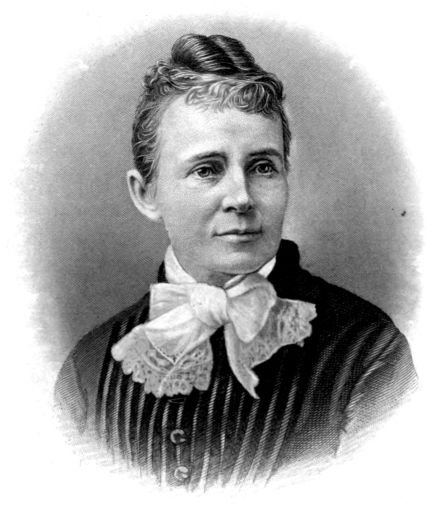
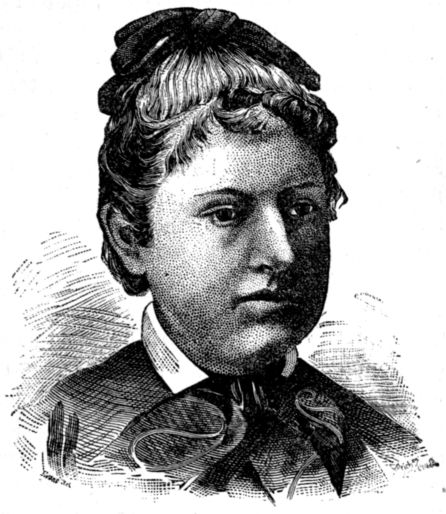
MRS. JAMES A. GARFIELD.
Engd by H B Hall & Sons New York.
MEMORIAL EDITION.
BY
JOHN CLARK RIDPATH, LL. D.,
Author of A Popular History of the United States; A Grammar-School History of the United States; An Inductive Grammar of the English Language, etc.
Copiously Illustrated.
P. W. ZIEGLER & CO.,
PHILADELPHIA AND CHICAGO.
1881.
COPYRIGHTED, 1881, BY J. T. JONES.
PREFACE.
iii
Dean Swift describes the tomb as a place where savage enmity can
rend the heart no more. Here, in the ominous shadow of the cypress,
the faults and foibles of life are forgotten, and the imagination builds a
shining pathway to the stars. Ascending this with rapid flight, the
great dead is transfigured as he rises; the clouds close around him, and,
in the twinkling of an eye, he is set afar on the heights with Miltiades
and Alexander.
The tendency to the deification of men is strongest when a sudden
eclipse falls athwart the disk of a great life at noontide. The pall of
gloom sweeps swiftly across the landscape, and the beholder, feeling the
chill of the darkness, mistakes it for the death of nature. So it was
three hundred years ago when the silent Prince of Orange, the founder
of Dutch independence, was smitten down in Delft. So it was when the
peerless Lincoln fell. So it is when Garfield dies by the bullet of an
assassin.
No doubt this man is glorified by his shameful and causeless death.
The contrast between his life and his death is indeed the very irony of
fate. On the popular imagination he is borne away to Washington and
Lincoln. He is canonized—the American people will have it so.
In due season fervor will subside. The keen indignation and poignant
sorrow of this great and sensitive citizenship will at length give
place to other emotions. The murdered Garfield will then pass through
an ordeal more trying than any of his life. He will be coolly measured
and his stature ascertained by those inexorable laws which determine the
rank and place of both living and dead. No doubt he will suffer loss;
but there is of James A. Garfield a residuum of greatness—
Which shall tire
Torture and Time, and breathe though he expire;
Something unearthly which we deem not of,
Like the remembered tone of a mute lyre,—
And this residuum of greatness, whatever it shall be, will constitute the
Garfield of the future—the Garfield of history.
ivFor the present there will be—there can but be—a blending of the
real and the ideal. The glamour of the apotheosis will dazzle the vision
of those who witnessed it. It is enough, therefore, that the narrative of
to-day shall be such as befits the universal sentiment. The biographer
of the future may weigh with more critical exactitude the weakness
against the greatness, and poise in a more delicate balance the evil
against the good.
The following pages embody an effort to present, in fair proportion,
The Life and Work of James A. Garfield. Such sources of information
as are at present accessible have been faithfully consulted; and
it is sincerely hoped that the outline here given of the personal and public
career of the illustrious dead, will be found true to the life. As far
as practicable in the following pages, the purposes and character of President
Garfield will be determined from his own words. His apothegms
and sayings, not a few, and his public papers and speeches have alike
contributed their wealth to the better parts of the volume. The story
of the President’s wounding and death has been gathered from the abundant
sources—official and semi-official—of the journals and magazines of
the day. It is hoped that the narrative, as a whole, will not be found
deficient in interest, or unworthy of the subject.
This preface would be incomplete if failure should be made to mention
the invaluable and extensive service rendered the author in the preparation
of the work, by Messrs. Augustus L. Mason, Nathaniel P. Conrey,
and Leonard Barney, to whose industry and discriminating taste much
of whatever merit the book contains, must be accredited. And with this
acknowledgment should be coupled a like recognition of the spirit of The
Publishers, who, with their accustomed liberality, have spared no pains
to illustrate the work in a manner befitting the subject. May all who
read these pages find in them as full a measure of profit as the author
has found of pleasure in their preparation.
J. C. R.
Indiana Asbury University,
November, 1881.
CONTENTS.
v
CHAPTER I.
BIRTH AND ANCESTRY.
PAGES
“Unto us a child is born.”—A lowly home in the wilderness.—Law of heredity.—The New England stock.—The Garfields.—The Ballous.—Trend of the boy mind.—The father’s death.—Story of the cause.—The widow’s struggle.—Life in the Garfield cabin.—Earliest labor.—First lessons.—The Garfield family.—Boyhood traits.—The growing stalk.
A Western boy of twelve.—Workland and dreamland.—A carpenter in embryo.—Summer day and winter day.—The door of bookland opens.—What he saw.—A doubtful farmer.—Possibly something else.—A giant of sixteen.—The stage of brigandage.—Pirate or President?—Meanwhile a wood-chopper.—The sea-vision again.—The great deep takes the form of a canal.—Venus: otherwise, the Evening Star.—The glory of the tow-path.—Navigation and pugilism.—Diving for pearls.—Leaves the sea.—The goblin that shakes us all.—Politics, religion, and grammar.—Off to school.—A place called Chester.—Builds a barn.—And then teaches a school.—More school.—Joins church.—Credo.—Possible sweetheart.—Learns elocution.—Hiram rises to view.—An academic course of study.—What about college?—Bethany, maybe.—Decides against it.—Why.—Knocks at the door of Williams.
viCollege life.—A Junior at Williams.—Favorite books.—College traditions.—A brain of many powers.—“Mountain Day.”—Essays in literature.—The Williams Quarterly.—Poems: Memory, Autumn, Charge of the Tight Brigade.—A writing-master at intervals.—Free Kansas.—A metaphysician.—Steps out with honor.—Mark Hopkins.—Becomes a professor at Hiram.—And then a college president.—His methods and manners.—Success as an educator.—Lectures and preaches.—A union for life.—The chosen mate.—Incipient politics.—First nomination for office.—State senator from Portage and Summit.—Hints at leadership.—Rises in influence.—The approaching conflict.—Ohio makes ready for battle.—Independence Day at Ravenna.—Sound of the tocsin.—Vanguard, to right and left the front unfold!
A West Point soldier.—George H. Thomas.—The Union volunteer.—Garfield appointed Lieutenant-Colonel.—And then Colonel.—The Forty-second Ohio.—Studies war.—Ordered to the front.—Kentucky, who shall have her?—Marshall says, I.—Garfield objects.—Don Carlos Buell.—Expedition to Catlettsburg.—Pluck to the backbone, Sir.—Will attack Paintville.—A man called Jordan.—The region and the people.—Harry Brown, Esq.—Capture of Paintville.—Battle of Middle Creek.—A big victory on a small scale.—Address to the soldiers.—Big Sandy on the rampage.—Garfield takes a turn at the wheel.—Proclamation to the people of the Valley.—Concerning Pound Gap.—A proposed muster rudely broken up.—Exit Humphrey Marshall.—General Orders No. 40.—Comments on the campaign.
Brigadier-General Garfield.—Reports to Buell.—A new field of activity.—At Pittsburg Landing.—Stands up for Africa.—Sits on court-martial.—Again the goblin shakes us.—But we report at Washington.—Tries Fitz-John Porter.—Assigned to Hunter’s command.—Appointed chief of staff to Rosecrans.—The commanding general.—Duties of chief of staff.—Personal sketch of Garfield.—Rosecrans dislikes him.—And then likes him.—Sheridan’s ten-pins.—Garfield issues circular on prison pens.—Helps Vallandigham across the border.—Opposes negro insurrection.—Stands by Lincoln.—Organizes army police.—Favors in advance.—The Tullahoma campaign.—Rosecrans’s advance on Chattanooga.—The capture.—Position of Bragg.—The big game begun.—Situation and preliminaries.—The battle of Chickamauga.—Garfield’s part.—Praise and promotion.—We are elected to Congress.—And accept.
viiThe constituency of Garfield.—The old Western Reserve.—Joshua R. Giddings.—Character of Congress.—Garfield enters the Cave of the Winds.—On Military Committee.—Opposes the bounty system.—Favors the draft.—Advocates confiscation.—Demolishes A. Long, Esq.—The Wade-Davis Manifesto.—A strange renomination.—Advocates the Thirteenth Amendment.—Beards Stanton.—The assassination of Lincoln.—Scene in New York.—Speech on the Lincoln anniversary.—The temperance question.—Defends Milligan and Company.—Advocates a Bureau of Education.—Chairman of Committee on Military Affairs.—The visit to Europe.—Oration on Decoration Day.
Opposes his constituents on the money question.—Garfield on the Ninth Census.—Speaks on Statistics.—Reports on Black Friday.—Speaks on Civil Service.—Defends the prerogatives of the House.—An authority on Revenue and Expenditure.—Speaks against the McGarraghan Claim.—Advocates an Educational Fund.—Opposes inflation of currency.—Discusses the railway problem.—An oration on the Elements of Success.—Literary views and habits.—Oration on the Life and Character of Thomas.—Speech on the Future of the Republic.
The era of slander.—The Credit Mobilier of America.—Reviewed and answered by Garfield.—The so-called Salary Grab.—Trouble in the Western Reserve.—Garfield’s defense and vindication.—The DeGollyer pavement matter.—Triumphant answer to charges.—Democratic ascendancy of 1874.—The “Confederate Congress.”—Garfield speaks on the Pension Bill.—Demolishes Lamar.—Speech on the acceptance of the Winthrop and Adams statues.—Opposes the Electoral Commission.—Favors Specie Payments.—Proposed for Speaker.—Opposes the Bland Silver Bill.—Speech on the Judicial Appropriation Bill.—The payment of United States marshals.—Appropriation Bill again.—Elected to the Senate.
Questions of American statesmanship.—Garfield tested.—Speeches on States Rights and National Sovereignty: No Nullification; Force Bill; Equipoise of Government; Fourteenth Amendment.—Speeches on Finance and Money: The Industrial Revolution; Gold and Silver; Currency; Banks; Paper Money; Resumption Act.—Speeches on Revenue and Expenditures: Free Trade and Tariff; Public Expenditures; War Expenses.—Speeches on Character and Tendency of American Institutions: Future of the Republic; Government and Science; Revolution in Congress; Voluntary powers of government; Free consent the basis of our laws.—A general estimate of Garfield’s genius.
American political parties.—The Third Term question.—The Grant movement.—Leaders of the Stalwarts.—The political “Machine.”—Contrast of Garfield and Conkling.—Gathering of the clans.—Grant and Anti-Grant.—The Unit Rule.—A truce.—Hoar for Chairman.—Skirmishes.—Blaine’s forces.—Adjournments.—Gloomy Friday.—Rule VIII.—Putting in nomination.—Speeches of Frye, Conkling, and Garfield.—The balloting.—Garfield and Arthur nominated.
Delicate position of a presidential candidate.—The policy of mum.—Garfield’s theory of running for office.—He is notified of his nomination.—Hoar’s speech.—The reply.—The journey to Cleveland.—Reception and speech at Hiram.—Address at Painesville.—The shrine of Mentor.—Garfield visits Washington.—Speaks to the people.—At Painesville.—Speech at the Dedication of the Soldiers’ Monument.—Letter of Acceptance.—The issues of the campaign.—Speaks at the Dedication of the Geneva Monument.—Visits New York.—At Chatauqua.—Attends reunion at Ashland.—Addresses the soldiers at Mentor.—The October election.—The saintly pilgrims on their way.—A candidate who dares to talk.—Speeches to the pilgrims.—The mud-mill.—Morey et al.—The machine bursts and the millers get the mud.—Judgment Day.—Garfield is elected.—Speaks to the Electors of Ohio.—Address to the Carolina Delegation.—Conkling visits Mentor.—The departure for Washington.—Last speech at Mentor.—En route for the inauguration.
Morning of the Fourth of March.—Conspiracy of the elements.—Preparations.—The procession.—Clears up.—The Grand Ceremony.—Inaugural address.—Setting up in business.—The new Cabinet.—The temperance question.—The Administration on its feet.—The pro and con of a Called Session of Congress.—Nomination of Robertson.—The Refunding Question.—Dearth of politics.—Symptoms of a family quarrel.—The issues involved in it.—The Robertson appointment.—Exeunt Conkling and Platt.—A President who has his own way.—Smoother sailing after the storm.—Adjournment of Congress.—Sickness in the White House.—Sympathy of the people for Mrs. Garfield.—The Summer, what shall we do with it?
Recovery of Mrs. Garfield.—A great tragedy.—First alarms.—The physicians of the President.—The assassin.—The world’s sympathy.—A dolorous Fourth.—Diagnosis.—Motives of the assassin.—General Arthur.—Favorable progress of the President.—Conkling’s letter on murder.—The President’s mental condition.—Sunday.—Heated weather.—The refrigerators.—Mistaken diagnosis.—Foreign sympathies.—The Induction Balance.—The Mrs. Garfield Fund.—Supposed convalescence.—President worse.—Surgical operations.—Sensational dispatches.—Possible malaria.—Induction Balance again.—Surgeons hopeful.—A second operation.—Last letter.—Project of removal.—Dangerous symptoms.—Mrs. Garfield.—A good queen.—Cheerful and brave.—The inflamed parotid.—Pyæmia feared.—Gradual decline.—Death imminent.—Removal determined on.—Preparations.—Night scene at Elberon.
The President is removed to Long Branch.—Scenes and incidents of the journey.—Francklyn Cottage.—Revival of hope.—Great solicitude of the people.—Foolish confidence of the surgeons.—The President somewhat revived.—Great anxiety follows.—The last day.—Fatal chill.—Mrs. Garfield’s heroism.—The gathering shadows.—Death.
Preparations for the funeral of the President.—Embalmment.—Accession of Gen. Arthur.—The post-mortem.—Astonishing revelations.—Announcement of the President’s death.—The funeral train.—En route for Washington.—Lying in state.—Victoria’s tribute.—Address of Elder Powers.—Viewing the body.—The train for Cleveland.—Reception and preparations.—Imposing ceremonies.—The last day.—Closing scenes and addresses.—The sepulchre.—Reflections.
Than sculptured bronze, and loftier than the height
Of regal pyramids in Memphian sand,
Which not the raging tempest nor the might
Of the loud North-wind shall assailing blight,
Nor years unnumbered nor the lapse of time!
Not all of him shall perish! for the bright
And deathless part shall spurn with foot sublime
The darkness of the grave—the dread and sunless clime!
He shall be sung to all posterity
With freshening praise, where in the morning’s glow
The farm-boy with his harnessed team shall be,
And where New England’s swifter rivers flow
And orange groves of Alabama blow—
Strong in humility, and great to lead
A mighty people where the ages go!
Take then thy station, O illustrious dead!
And place, Immortal Fame, the garland on his head!
—Horace: B. iii., Ode xxx.
xi
LIFE AND WORK
OF
JAMES A. GARFIELD.
CHAPTER I. BIRTH AND ANCESTRY.
11
Genius delights in hatching her offspring in out-of-the-way places.—Irving.
When some great work is waiting to be done,
And Destiny ransacks the city for a man
To do it; finding none therein, she turns
To the fecundity of Nature’s woods,
And there, beside some Western hill or stream,
She enters a rude cabin unannounced,
And ere the rough frontiersman from his toil,
Where all day long he hews the thickets down,
Returns at evening, she salutes his wife,
His fair young wife, and says, Behold! thou art
The Mother of the Future!
Men, like books, have their beginnings. James Abram Garfield
was born on the 19th day of November, 1831. His
first outlook upon things was from a cabin door in Cuyahoga
County, Ohio. The building was of rough logs, with mud between
the cracks, to keep out the winter cold. The single room
had a puncheon floor, and on one side a large fire-place, with a
blackened crane for cooking purposes. In winter evenings, a
vast pile of blazing logs in this fire-place filled the cabin with a
cheerful warmth and ruddy glow. Overhead, from the rude rafters,
hung rows of well-cured hams, and around the mud chimney
were long strings of red-pepper pods and dried pumpkins. The
furniture was as primitive as the apartment. A puncheon table,
a clumsy cupboard, a couple of large bedsteads, made by driving
stakes in the floor, some blocks for seats, and a well-kept gun,
12almost complete the catalogue. The windows had greased paper
instead of glass; and, in rough weather, were kept constantly closed
with heavy shutters.
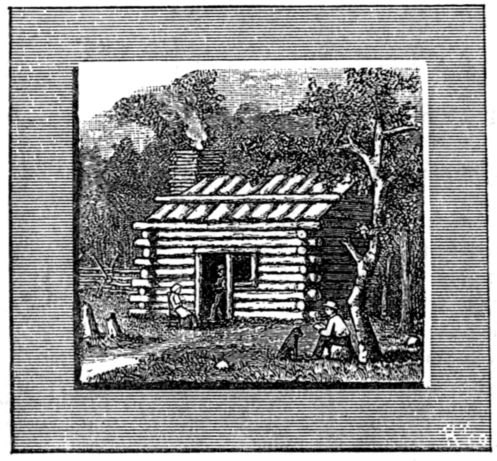
THE GARFIELD CABIN.
Stepping out of doors, one would see that the cabin stood on
the edge of a small clearing of some twenty acres. On the south,
at a little distance, stood a solid log barn, differing from the house
only in having open
cracks. The barn-yard
had a worm fence around
it, and contained a heavy
ox-wagon and a feeding-trough
for hogs. Skirting
the clearing on all
sides was the forest primeval,
which, on the 19th
of November, the frost
had already transfigured
with gold and scarlet
splendors. Cold winds
whistled through the
branches, and thick showers
of dry leaves fell rustling to the ground.
Already the cabin shutters were closed for the winter; already
the cattle munched straw and fodder at the barn, instead of roaming
through the forest for tender grass and juicy leaves; already
a huge wood-pile appeared by the cabin door. The whole place
had that sealed-up look which betokens the approach of winter at
the farm-house. The sun rose late, hung low in the sky at high
noon; and, after feeble effort, sunk early behind the western forest.
Well for the brave pioneers is it, if they are ready for a long and
bitter struggle with the winter.
So much for the home. But what of the family? Who and
what are they? As the babe sleeps in its mother’s arms, what
prophecy of its destiny is there written in the red pages of the
blood ancestral?
In America, the Southern States have been the land of splendid
13hospitality, chivalric manners, and aristocratic lineage; the West
the land of courage, enterprise, and practical executive ability;
but the New England States have been preëminently the home
of intellectual genius and moral heroism. From New England
came both the father and mother of James A. Garfield, and it
means much. But there are reasons for looking at his ancestry
more closely.
The law of heredity has long been suspected, and, in late years,
has been, to a considerable extent, regarded as the demonstrated and
universal order of nature. It is the law by which the offspring inherits
the qualities and characteristics of its ancestors. It makes
the oak the same sort of a tree as the parent, from which the seed
acorn fell. It makes a tree, which sprang from the seed of a large
peach, yield downy fruit as large and luscious as the juicy ancestor.
It says that every thing shall produce after its kind; that small
radishes shall come from the seed of small radishes, and a richly
perfumed geranium from the slip cut from one of that kind. It
says that, other things being equal, the descendants of a fast horse
shall be fast, and the posterity of a plug shall be plugs. It says
that a Jersey cow, with thin ears, straight back, and copious yield
of rich milk, shall have children like unto herself. But a man
has many more qualities and possibilities than a vegetable or a
brute. He has an infinitely wider range, through which his characteristics
may run. The color of his hair, his size, his strength,
are but the smallest part of his inheritance. He inherits also the
size and texture of his brain, the shape of his skull, and the skill
of his hands. It is among his ancestry that must be sought the
reason and source of his powers. It is there that is largely determined
the question of his capacity for ideas, and it is from his
ancestry that a man should form his ideas of his capacity. It is
there that are largely settled the matters of his tastes and temper,
of his ambitions and his powers. The question of whether he
shall be a mechanic, a tradesman, or a lawyer, is already settled
before he gets a chance at the problem.
The old myth about the gods holding a council at the birth of
every mortal, and determining his destiny, has some truth in it.
14In one respect it is wrong. The council of the gods is held years
before his birth; it has been in session all the time. If a man
has musical skill, he gets it from his ancestry. It is the same
with an inventor, or an artist, or a scholar, or a preacher. This
looks like the law of fate. It is not. It is the fate of law.
But this is not all of the law of inheritance. Men have an inherited
moral nature, as well as an intellectual one. Drunkenness,
sensuality, laziness, extravagance, and pauperism, are handed
down from father to son. Appetites are inherited, and so are
habits. On the other hand, courage, energy, self-denial, the power
of work, are also transmitted and inherited. If a man’s ancestry
were thieves, it will not do to trust him. If they were bold, true,
honest men and women, it will do to rely upon him.
In late years, this law of inheritance has been much studied by
scientists. The general law is about as has been stated; but it
has innumerable offsets and qualifications which are not understood.
Sometimes a child is a compound of the qualities of both
parents. More frequently the son resembles the mother, and the
daughter the father. Sometimes the child resembles neither parent,
but seems to inherit every thing from an uncle or aunt. Often
the resemblance to the grand-parent is the most marked. That
these complications are governed by fixed, though, at present, unknown
laws, can not be doubted; but for the purposes of biography
the question is unessential.
Scientists say that nine-tenths of a man’s genius is hereditary,
and one-tenth accidental. The inherited portion may appear large,
but it is to be remembered that only possibilities are inherited, and
that not one man in a million reaches the limit of his possibilities.
If the lives of the ancestors of James A. Garfield were studied,
we could tell what his possibilities were; while, by studying the
life of Garfield himself, we see how nearly he realized those possibilities.
This is the reason why biography interests itself in a
man’s ancestors. They furnish the key to the situation.
Of the many classes of colonists who settled this continent, by
far the most illustrious were the Puritans and the Huguenots.
Their names, alike invented as epithets of contempt and derision,
15have become the brightest on the historic page. Their fame rests
upon their sacrifices. Not for gold, nor adventure, nor discovery,
did they seek the forest-wrapped continent of North America, but
for the sake of worshiping God according to the dictates of their
own consciences. Different in nationality, language, and temperament—the
one from the foggy isle of England, the other from the
sunny skies of France—they alike fled from religious persecution;
the Puritan from that intolerance and bigotry which cost Charles
I. his head and revolutionized the English monarchy; the Huguenot
from the withdrawal of the last vestige of religious liberty by
Louis XIV. The proudest lineage which an American can trace
is to one or the other of these communities of exiles.—In James
A. Garfield these two currents of noble and heroic blood met and
mingled.
The first ancestor, by the name of Garfield, of whom the family
have any record, is Edward Garfield, a Puritan, who, for the sake
of conscience, in 1636, left his home near the boundary line of
England and Wales, and joined the colony of the distinguished
John Winthrop, at Watertown, Massachusetts. He appears to
have been a plain farmer, of deep, religious convictions, and much
respected by the community in which he lived. Of his ancestry,
only two facts are known. One is that no book of the peerage or
list of English nobility ever contained the name of Garfield. The
other is that, at some time in the past, possibly during the Crusades,
the family had received, or adopted, a coat of arms. The
device was a golden shield crossed by three crimson bars; in one
corner a cross; in another a heart; above the shield an arm and
hand grasping a sword. A Latin motto, “In cruce vinco,”—“In
the cross I conquer,”—completed the emblem. It is probable that
the family had been soldiers, not unlikely in a religious war. The
wife of Edward Garfield was a fair-haired girl from Germany.—To
the brave heart and earnest temper of the Welshman, was added
the persistence and reflectiveness of the German mind. Of their
immediate descendants, but little can be told. Like the ancestor
they were
“To fortune and to fame unknown.”
16But they were honest and respected citizens—tillers of the soil—not
infrequently holding some local position as selectman or
captain of militia. Five of the lineal descendants are said to
sleep in the beautiful cemetery in Watertown, “careless alike of
sunshine and of storm.”
Tracing the family history down to the stirring and memorable
period of the American Revolution, the name which has now become
historic emerges from obscurity. The spirit of Puritanism,
which had braved the rigors of life in the colonies rather than
abate one jot of its intellectual liberty, nourished by hardship and
strengthened by misfortune, had been handed down by the law of
inheritance through eight peaceful generations. It was the spirit
which resented oppression, demanded liberty, and fought for principle
till the last dollar was spent, and the last drop of blood was
shed in her cause.
We might have calculated on the descendants of the Puritan
colonist being in the front of battle from the very outbreak of the
War for Independence. It was so. They were there. They
were the kind of men to be there. Abraham Garfield, great-uncle
of the President, took part in the first real battle of the Revolution,
the fight at Concord Bridge, which fixed the status of the
Colonies as that of rebellion. On the fourth day after the bloodletting
the following affidavit was drawn up and sworn to before a
magistrate:
Lexington, April 23, 1775.
“We, John Hoar, John Whithead, Abraham Garfield, Benjamin Munroe,
Isaac Parker, William Hosmer, John Adams, Gregory Stone, all
of Lincoln, in the County of Middlesex, Massachusetts Bay, all of lawful
age, do testify and say, that on Wednesday last, we were assembled
at Concord, in the morning of said day, in consequence of information
received that a brigade of regular troops were on their march to the
said town of Concord, who had killed six men at the town of Lexington.
About an hour afterwards we saw them approaching, to the number,
as we apprehended, of about 1,200, on which we retreated to a
hill about eighty rods back, and the said troops then took possession of
the hill where we were first posted. Presently after this we saw the
troops moving toward the North Bridge, about one mile from the said
Concord meeting-house; we then immediately went before them and
passed the bridge, just before a party of them, to the number of about two
hundred, arrived; they there left about one-half of their two hundred at
the bridge, and proceeded with the rest toward Col. Barrett’s, about two
miles from the said bridge; and the troops that were stationed there, observing
our approach, marched back over the bridge and then took up
some of the planks; we then hastened our march toward the bridge, and
when we had got near the bridge they fired on our men, first three guns,
one after the other, and then a considerable number more; and then, and
not before (having orders from our commanding officers not to fire till
we were fired upon), we fired upon the regulars and they retreated.
On their retreat through the town of Lexington to Charlestown, they
ravaged and destroyed private property, and burnt three houses, one
barn, and one shop.”
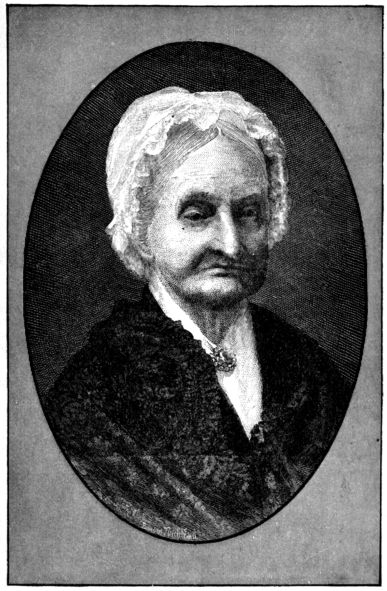
MOTHER OF PRESIDENT GARFIELD.
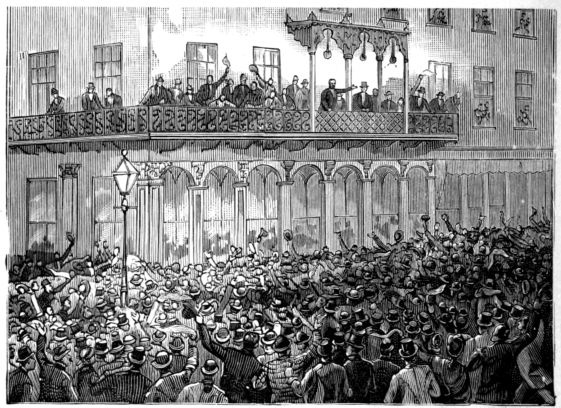
GEN. GARFIELD ADDRESSING THE PEOPLE AT CLEVELAND.
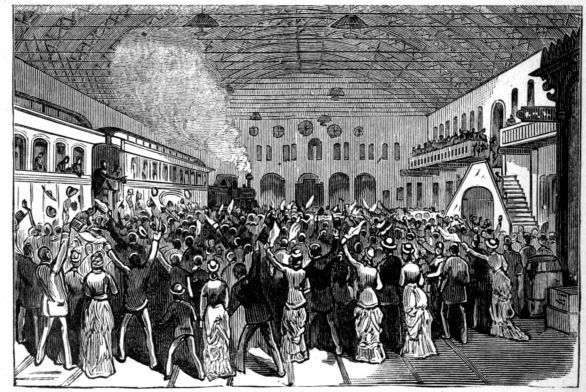
RECEPTION TO GEN. GARFIELD AFTER THE NOMINATION.
17The act of signature to that paper was one of the sublimest
courage. It identified the leaders of the fight; it admitted and
justified the act of firing on the troops of the government! It
seemed almost equal to putting the executioner’s noose around
their necks. But to such men, life was a feather-weight compared
to principle. If the Colonies were to be roused to rebellion and
revolution, the truth of that fight at Concord bridge had to be
laid before the people, accompanied by proofs that could not be
questioned. The patriots not only did the deed but shouldered
the responsibility. Of the signers with Abraham Garfield, John
Hoar was the great-grandfather of Senator George F. Hoar, presiding
officer of the convention which nominated James A. Garfield
for the Presidency.
Solomon Garfield, brother of Abraham, and great-grandfather
of the subject of this history, had married Sarah Stimpson in
1766, and was living at Weston, Massachusetts, when the war
broke out. Little is known of him except that he was a soldier
of the Revolution, and came out of the war alive, but impoverished
by the loss of his property. He soon moved to Otsego
County, New York, where one of his sons, Thomas Garfield, married.
It was on the latter’s farm, in December, 1799, that was
born Abram Garfield, the ninth lineal descendant of the Puritan,
and father of the man whose name and fame are henceforth the
18heritage of all mankind. Two years after the birth of Abram,
his father died suddenly and tragically, leaving his young widow
and several children in most adverse circumstances. When about
twelve years old, Abram, a stout sun-burnt little fellow, fell in
with a playmate two years younger than himself, named Eliza
Ballou, also a widow’s child whose mother had recently moved to
Worcester, Otsego County, New York, where the Garfields were
living. In that childhood friendship lay the germ of a romantic
love, of which the fruit was to be more important to men and to
history than that of the most splendid nuptials ever negotiated in
the courts of kings.
James Ballou, Eliza’s older brother, impatient of the wretched
poverty in which they dwelt, persuaded his mother to emigrate to
Ohio. The emigrant wagon, with its jaded horses, its muddy
white cover, its much jostled load of household articles, and its
sad-eyed and forlorn occupants! How the picture rises before the
eyes! What a history it tells of poverty and misfortune; of disappointment
and hardship; of a wretched home left behind, yet
dear to memory because left behind; of a still harder life ahead in
the western wilderness toward which it wends its weary way!
More showy equipages there have been. The Roman chariot, the
English stage-coach, and the palace railway train, have each been
taken up and embalmed in literature. But the emigrant wagon,
richer in association, closer to the heart-throb, more familiar with
tears than smiles, has found no poet who would stoop to the lowly
theme. In a few years the emigrant wagon will be a thing of
the past, and forgotten; but though we bid it farewell forever, let it
have a high place in the American heart and history, as the precursor
of our cities and our civilization.
Thus the boy and girl were separated. Abram Garfield was
brought up as a “bound boy” by a farmer named Stone. While
he was filling the place of chore boy on the New York farm, Eliza
Ballou, having something more than an ordinary education, taught
a summer school in the Ohio wilderness. It is said that one
day, in a terrific storm, a red bolt of lightning shot through the
cabin roof, smiting teacher and scholars to the floor, thus breaking
19up the school. The spirit of tragedy seems to have hovered over
her entire life.
Love laughs at difficulties and delays, and in a few years after
the Ballou emigration, Abram Garfield, a “stalwart” of the earlier
and better kind, tramped his muddy way along the same roads,
across the same rivers, and—strange, was it not?—to the very cabin
where the emigrant wagon had stopped. Swift flew the shining
days of courtship; and Eliza Ballou became Eliza Ballou Garfield,
the mother of the President.
Eliza Ballou was a lineal descendant of Maturin Ballou, a French
Huguenot, who, about the year 1685, upon the Revocation of the
Edict of Nantes, fled from the smiling vineyards of France to the
rugged but liberty-giving land of America. Joining the colony of
Roger Williams, at Cumberland, Rhode Island, which had adopted
for its principle “In civil matters, law; in religious matters, liberty,”
he built a queer old church, from the pulpit of which he
thundered forth his philippics against religious intolerance. The
building still stands, and is a curiosity of architecture. Not a nail
was used in its construction. For generation after generation the
descendants of this man were eloquent preachers, occupying the
very pulpit of their ancestor. Their names are famous. They
were men of powerful intellects, thorough culture, and splendid
characters. Their posterity has enriched this country with many
distinguished lawyers, soldiers, and politicians. They were a superior
family from the first, uniting to brilliant minds a spotless
integrity, an indomitable energy, and the burning and eloquent
gifts of the orator. The best known member of the family is Rev.
Hosea Ballou, the founder of the Universalist Church in America,
of whom Eliza Ballou was a grand-niece. He was a man of wide
intellectual activity, a prolific and powerful writer, and made a
marked impress on the thought of his generation.
From this brief view of the ancestry of James A. Garfield, it is
easy to see that there was the hereditary preparation for a great
man. From the father’s side came great physical power, large
bones, big muscles, and an immense brain. From the father’s line
also came the heritage of profound conviction, of a lofty and resistless
20courage, which was ready anywhere to do and die for the
truth, and of the exhaustless patience which was the product of
ten generations of tilling the soil. On the other hand, the Ballous
were small of stature, of brilliant and imaginative minds, of
impetuous and energetic temperament, of the finest grain, physically
and mentally. They were scholars; people of books and culture,
and, above all, they were orators. From them, albeit, came the
intellectual equipment of their illustrious descendant. From the
mother, Garfield inherited the love of books, the capacity for
ideas, the eloquent tongue, and the tireless energy. To the earnest
solidity and love of liberty of the Welshman, Edward Garfield,
mixed with the reflective thought of the fair-haired German wife,
was added the characteristic clearness and vivacity of the French
mind.
The trend of Garfield’s mind could not have been other than
deeply religious. The Ballous, for ten generations, had been
preachers. No man could combine in himself the Puritan and
Huguenot without being a true worshiper of God. On the other
hand, while Puritans and Huguenots were at first religious sects,
their struggles were with the civil power; so that each of them in
time became the representative of the deepest political life of their
respective nationalities. Through both father and mother, therefore,
came a genius for politics and affairs of state; the conservatism
of the sturdy Briton being quickened by the radicalism, the
genius for reform which belongs to the mercurial Frenchman.
From both parents would also come a liberality and breadth of
mind, which distinguishes only a few great historic characters.
The large, slow moving, good natured Garfields were by temperament
far removed from bigotry; while the near ancestor of the
mother had been excommunicated from the Baptist Church, because
he thought God was merciful enough to save all mankind
from the flames of ultimate perdition.
In Garfield’s ancestry there was also a vein of military genius.
The coat of arms, the militia captaincy of Benjamin Garfield, the
affidavit of Abraham at Concord bridge, are the outcroppings on
the father’s side. The mother was a near relative of General Rufus
21Ingalls; and her brother, for whom the President was named, was
a brave soldier in the war of 1812.
These, then, are some of the prophecies which had been spoken
of the child that was born in the Garfield cabin in the fall of
1831. Future biographers will, perhaps, make more extended investigations,
but we have seen something, in the language of the
dead hero himself, “of those latent forces infolded in the spirit
of the new-born child; forces that may date back centuries and
find their origin in the life and thoughts and deeds of remote ancestors;
forces, the germs of which, enveloped in the awful mystery
of life, have been transmitted silently from generation to generation,
and never perish.” As we pursue his history we will see
these various forces cropping out in his career; at one time the
scholar, at another, the preacher; at others, the soldier, the orator,
or the statesman, but always, always the man.
For two years after the birth of their youngest child James, the
lives of Abram and Eliza Garfield flowed on peacefully and hopefully
enough. The children were growing; the little farm improving;
new settlers were coming in daily; and there began to
be much expected from the new system of internal improvements.
With happy and not unhopeful hearts they looked forward to a
future of comfortable prosperity. But close by the cradle gapes
the grave. Every fireside has its tragedy. In one short hour
this happy, peaceful life had fled. The fire fiend thrust his torch
into the dry forests of north-western Ohio, in the region of the
Garfield home. In an instant, the evening sky was red with
flame. It was a moment of horror. Sweeping on through the
blazing tree-tops with the speed of the wind came the tornado of
fire. Destruction seemed at hand, not only of crops and fences,
but of barns, houses, stock, and of the people themselves. In
this emergency, the neighbors for miles around gathered under
the lead of Abram Garfield to battle for all that was near and
dear. A plan of work was swiftly formed. Hour after hour
they toiled with superhuman effort. Choked and blinded by volumes
of smoke, with scorched hands and singed brows, they
fought the flames hand to hand till, at last, the current of death
22was turned aside. The little neighborhood of settlers was saved.
But the terrific exertions put forth by Abram Garfield had exhausted
him beyond the reach of recuperation. Returning home,
from the night of toil, and incautiously exposing himself, he was
attacked with congestion of the lungs. Every effort to relieve the
sufferer was made by the devoted wife. Every means known to her
was used to rally the exhausted vitality, but in vain. Chill followed
chill. The vital powers were exhausted, and the life-tide ebbed fast
away. In a few hours the rustle of black wings was heard in that
lowly home in the wilderness. Calling his young wife to him he
whispered, “Eliza, you will soon be alone. We have planted four
saplings here in these woods; I leave them to your care.” One last
embrace from the grief-stricken wife and children; one more look
through the open door at the little clearing and the circling forest,
over which the setting sun was throwing its latest rays, and the heroic
spirit had departed. Little by little the darkness of the night
without came in and mingled with the darkness of the night within.
Though stunned by this appalling calamity, Eliza Ballou Garfield,
true to the heroic ancestry from which she sprung, took up
the burden of life with invincible courage. The prospect was a
hard one. Of the four children, the oldest, Thomas, was ten
years of age; the two little girls ranged at seven and four, and the
blue-eyed baby, James, had seen only twenty months. On the
other hand, the widow’s resources were scanty indeed. The little
farm was only begun. To make a farm in a timber country is a
life task for the stoutest man. Years and years of arduous toil
would be required to fell the timber, burn the stumps, grub out
the roots, and fence the fields before it could really be a farm.
Worse than this, the place was mortgaged. The little clearing of
twenty acres, with the imperfect cultivation which one weak woman,
unaided, could give it, had to be depended on, not only to
furnish food for herself and the four children, but to pay taxes
and interest on the mortgage, and gradually to lessen the principal
of the debt itself. The pioneer population of the country was
as poor as herself, hardly able to raise sufficient grain for bread,
and reduced almost to starvation by the failure of a single crop.
23So fearful were the odds against the plucky little widow that her
friends pointed out the overwhelming difficulties of the situation,
and earnestly advised her to let her children be distributed among
the neighbors for bringing up. Firmly but kindly she put aside
their well-meant efforts. With invincible courage and an iron
will, she said: “My family must not be separated. It is my
wish and duty to raise these children myself. No one can care
for them like a mother.” It is from such a mother that great
men are born. She lost no time in irresolution, but plunged at
once into the roughest sort of men’s labor. The wheat-field was
only half fenced; the precious harvest which was to be their sustenance
through the winter was still ungathered, and would be destroyed
by roving cattle, which had been turned loose during the
forest fires. The emergency had to be met, and she met it.
Finding in the woods some trees, fresh fallen beneath her husband’s
glittering ax, she commenced the hard work of splitting
rails. At first she succeeded poorly; her hands became blistered,
her arms sore, and her heart sick. But with practice she improved.
Her small arms learned to swing the maul with a steady
stroke. Day by day the worm fence crawled around the wheat
field, until the ends met.
The highest heroism is not that which manifests itself in some
single great and splendid crisis. It is not found on the battle-field
where regiments dash forward upon blazing batteries, and in
ten minutes are either conquerors or corpses. It is not seen at
the stake of martyrdom, where, for the sake of opinion, men for a
few moments endure the unimaginable tortures of the flames. It
is not found in the courtly tournaments of the past, where knights,
in glittering armor, flung the furious lance of defiance into the
face of their foe. Splendid, heroic, are these all. But there is
a heroism grander still; it is the heroism which endures, not
merely for a moment, but through the hard and bitter toils of a
life-time; which, when the inspiration of the crisis has passed
away, and weary years of hardship stretch their stony path before
tired feet, cheerfully takes up the burden of life, undaunted and
undismayed. In all the annals of the brave, who, in all times,
24have suffered and endured, there is no scene more touching than
the picture of this widow toiling for her children.
The annals of this period of life in the Garfield cabin are simple.
But biography, when it has for its theme one of the loftiest
men that ever lived, loves to busy itself with the details of his
childhood and to try to trace in them the indications of future greatness.
The picture of that life has been given by the dauntless
woman herself. In the spring of the year, the little corn patch
was broken up with an old-fashioned wooden plow with an iron
share. At first the ox-team was mostly driven by the widow
herself, but Tom, the oldest boy, soon learned to divide the labor.
The baby was left with his older sister, while the mother and
older son worked at the plow, or dragged a heavy tree branch—a
primitive harrow—over the clods. When the seed was to be
put in, it was by the same hands. The garden, with its precious
store of potatoes, beans, and cabbages, came in for no small share
of attention, for these were the luxuries of the frugal table. From
the first Tom was able largely to attend to the few head of
stock on the little place. When a hog was to be killed for curing,
some neighbor was given a share to perform the act of
slaughter. The mysteries of smoking and curing the various
parts were well understood by Mrs. Garfield. At harvest, also, the
neighbors would lend a hand, the men helping in the field, and
the women at the cabin preparing dinner. Of butter, milk, and
eggs, the children always had a good supply, even if the table
was in other respects meager. There was a little orchard, planted
by the father, which thrived immensely. In a year or two the
trees were laden with rosy fruit. Cherries, plums, and apples
peeped out from their leafy homes. The gathering was the children’s
job, and they made it a merry one.
From the first the Garfield children performed tasks beyond their
years. Corn-planting, weed-pulling, potato-digging, and the countless
jobs which have to be performed on every farm, were shared
by them. The first winter was one of the bitterest privation. The
supplies were so scanty that the mother, unobserved by the four
hungry little folks, would often give her share of the meal to them.
25But after the first winter, the bitter edge of poverty wore off. The
executive ability of the little widow began to tell on the family
affairs. In the following spring, the mortgage on the place was
canceled by selling off fifty of the eighty acres. In the absence
of money, the mother made exchanges of work—sewing for groceries,
spinning for cotton, and washing for shoes. In time, too, the
children came to be a valuable help.
But though this life was busy and a hard one, it was not all
that occupied the attention of the family. The Garfield cabin had
an inner life; a life of thought and love as well as of economy and
work. Mrs. Garfield had a head for books as well as business.
Her husband and herself had been members of the Church of the
Disciples, followers of Alexander Campbell. In her widowhood,
for years she and her children never missed a sabbath in attending
the church three miles away. If ever there was an earnest, honest
Christian, Eliza Garfield was one. A short, cheerful prayer each
morning, no matter how early she and the children rose, a word of
thankfulness at the beginning of every meal, no matter how meager,
and a thoughtful, quiet Bible-reading and prayer at night, formed
part of that cabin life. Feeling keenly the poor advantages of the
children in the way of education, she told them much of history
and the world, and thus around her knee they learned from the
loving teacher lessons not taught in any college. When James
was five years old, his older sister for awhile carried him on her
back to the log school-house, a mile and a half distant, at a place
dignified with the name of a village, though it contained only a
store, blacksmith shop, and the school. But the school was too
far away. The enterprise of Mrs. Garfield was nowhere better
shown than in her offering the land, and securing a school-house
on her own farm. She was determined on her children having the
best education the wilderness afforded, and they had it.
But the four children were strangely different. They had the
same ancestry, and the same surroundings. Who could have
foretold the wide difference of their destinies? The girls were
cheerful, industrious, and loving. They were fair scholars at the
country school, and were much thought of in the neighborhood.
26At a very early age they took from the tired mother’s shoulders a
large share of the work of the little household. They carded,
spun, wove, and mended the boys’ clothes when they were but
children themselves. They beautified the rough little home, and
added a cheery joy to its plain surroundings. They were superior
to the little society in which they mingled, but not above it.
There were apple-parings, corn-huskings, quilting-bees, apple-butter
and maple-sugar boilings, in which they were the ringleaders
of mischief—romping, cheerful, healthy girls, happy in
spite of adversity, ambitious only to make good wives and
mothers.
Thomas, the elder brother, was a Garfield out and out. He was
a plodding, self-denying, quiet boy, with the tenderest love for his
mother, and without an ambition beyond a farmer’s life. When
the other children went to school, he staid at home “to work,” he
said, “so that the girls and James might get an education.” For
himself he “would do without it.” Wise, thoughtful, and patient,
he was the fit successor of the generations of Garfields who had
held the plow-handle before he was born. Without a complaint,
of his own will he worked year after year, denying himself every
thing that could help his brother James to education and an ambitious
manhood. For from the first, mother and children felt that
in the youngest son lay the hope of the family.
James took precociously to books, learning to read early, and
knowing the English reader almost by heart at eight years of age.
His first experience at the school built on the home farm is worth
noting. The seats were hard, the scene new and exciting, and his
stout little frame tingled with restrained energy. He squirmed,
twisted, writhed, peeped under the seats and over his shoulder;
tied his legs in a knot, then untied them; hung his head backwards
till the blood almost burst forth, and in a thousand ways manifested
his restlessness. Reproofs did no good. At last the well-meaning
teacher told James’s mother that nothing could be made of the
boy. With tears in her eyes the fond, ambitious mother talked to
the little fellow that night in the fire-light. The victory was a
triumph of love. The boy returned to school, still restless, but
27studious as well. At the end of the term he received a copy of
the New Testament as a prize for being the best reader in the
school. The restlessness, above mentioned, seems to have followed
him through life. Sleeping with his brother he would kick the
cover off at night, and then say, “Thomas, cover me up.” A military
friend relates that, during the civil war, after a day of terrible
bloodshed, lying with a distinguished officer, the cover came
off in the old way, and he murmured in his sleep, “Thomas, cover
me up.” Wakened by the sound of his own voice, he became
aware of what he had said; and then, thinking of the old cabin
life, and the obscure but tender-hearted brother, General Garfield
burst into tears, and wept himself to sleep.
The influences surrounding the first ten or twelve years of life
are apt to be underestimated. But it can not be doubted that the
lessons of child-life learned in the cabin and on the little farm had
more to do with Garfield’s future greatness than all his subsequent
education. Like each of his parents, he was left without a father
at the age of two years. If any one class of men have more universally
risen to prominence than another it has been widow’s
sons. The high sense of responsibility, the habits of economy and
toil, are a priceless experience. None is to be pitied more than
the child of luxury and fortune, and no one suspects his disadvantages
less. Hated poverty is, after all, the nursery of greatness.
The discipline which would have crushed a weak soul only served
to strengthen the rugged and vigorous nature of this boy.
The stories which come down to us of Garfield’s childhood,
though not remarkable, show that he was different from the boys
around him. He had a restless, aspiring mind, fond of strong food.
Every hint of the outside world fascinated him, and roused the
most pertinacious curiosity. Yet to this wide-eyed interest in
what lay outside of his life this shock-haired, bare-legged boy
added an indomitable zeal for work. From dawn to dark he
toiled; but whether chopping wood, working in the field or at
the barn, it was always with the idea and inspiration that he was
“helping mother.” Glorious loyalty of boyhood!
CHAPTER II. THE STRUGGLE OF BOYHOOD.
28
Socrates.—Alcibiades, what sayest thou that is, passing between us and yon wall?
Alcibiades.—I should call it a thing; some call it a boy.
Soc.—Nay, I call it neither a thing nor a boy, but rather a young man. By
Hercules, if I should go further, I should say that that being is a god in embryo!
Alc.—You are my master, Socrates, or I should say that nature would have hard
work to hatch a god out of such an object.
Soc.—Most men are fools, Alcibiades, because they are unable to discover in the
germ, or even in the growing stalk, the vast possibilities of development. They
forget the beauty of growth; and, therefore, they reckon not that nature and discipline
are able to make yon boy as one of the immortals.
So the child James Garfield advanced into the golden age of
boyhood. This period we will now briefly live over after him.
Spring time deepens into early summer; the branches and the leaves
are swollen with life’s young sap; what manner of fruit will this
growing tree offer the creative sun to work upon?
The young lad, in whom our interest centers, was now, in the
autumn of 1843, twelve years old, when something new came into
his life, and gave to him his first definite and well-fixed purpose.
He had always, and by nature, been industrious. In that little
farm home, where poverty strove continually to carry the day
against the combined forces of industry and economy, no service
was without its value. And, therefore, it had doubtless been a
delight to all in that narrow circle to observe in James the qualities
of a good worker. He seemed a true child of that wonderful
western country which is yet so young, and so able to turn its
energies to advantage in every available way. So, while still too
young to “make a hand” at anything, James had found his place
wherever there was demand for such light duties as he was able
to perform. At field, barn or cabin, in garden or in kitchen, place
there was none where the little fellow’s powers were not exercised.
29Instinct with forces larger than his frame, development of them
was inevitable.
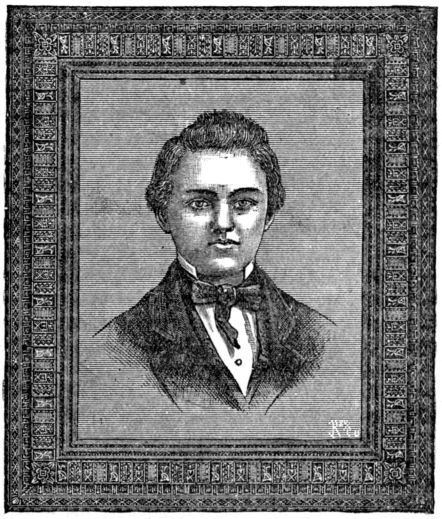
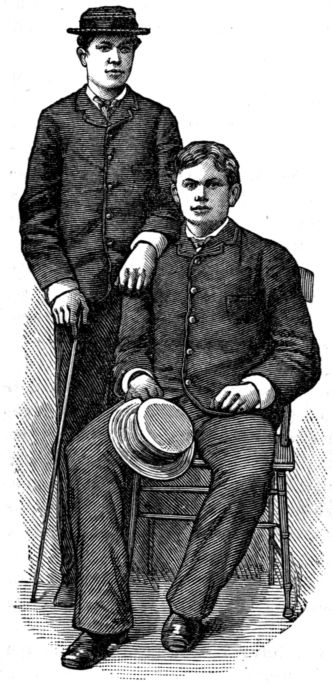
GARFIELD AT SIXTEEN.
But now a great event in the family took place. Thomas, who
had just attained his majority, had returned from a trip to Michigan
with a sum of ready money, and wanted to build his mother
a new house. Life in the cabin had, in his estimation, been endured
long enough. Some of the materials for a frame building
were already accumulated, and under the directions of a carpenter
the work was begun and rapidly pushed to completion. In all
these proceedings James took an intense interest, and developed
such a liking for tools and timber as could but signify a member
30of the Builders’ Guild. He resolved to be a carpenter; and from
this day on was never for a moment without an object in life.
The ambition to “be something” took many different turns,
but was a force which, once created, could never be put down.
The care and skill requisite to putting a house together, fitting the
rafters into place, and joining part to part with mathematical precision,
gave him an idea that these things were of a higher order
than farm labor. Plain digging would no longer do; there must
be a better chance to contrive something, to conjure up plans and
ways and means in the brain, and show forth ideas by the skill
of the hand. Consequently a variety of tools began to accumulate
about James Garfield. There was a corner somewhere which, in
imitation of the great carpenter who built their house, he called
his “shop;” a rough bench, perhaps, with a few planes, and mallets,
and chisels, and saws, and the like, to help in mending the
gates and doors about the place. No independent farm can get
along without such help, and of course these services were in constant
demand.
The dexterity thus acquired soon led to earnings abroad. The
first money Garfield ever received in this way was one dollar,
which the village carpenter paid him for planing a hundred boards
at a cent apiece. His active and earnest performance of every
duty brought him plenty of offers, and between the ages of twelve
and fifteen years he helped to put up a number of buildings in that
district of country, some of which are standing to this day.
Thus this young life passed away the precious time of the early
teens. Work and study; study and work. Hands and feet, marrow
and muscle, all steadily engaged in the rugged discipline of
labor, battling with nature for subsistence. But time rolls on;
childhood fast recedes from that glory from the other side
which fringes the dawn; and, as we move on, every rising sun
wakes up a new idea. While our young friend gave his attention
and strength to industry, his imagination began to live in a new
world. He had been to school, and still went a few months each
year; and the following incident will indicate what a good-hearted,
bright school-boy he was. There was a spelling-match in the little
31log school-house, in which James, who was thirteen years old,
took part. The teacher told the scholars that if they whispered
she would send them home. The lad standing next to James got
confused, and to help him James told him how to spell the word.
The teacher saw this, and said: “James, you know the rule; you
must go home.” James picked up his cap and left. In a very
few seconds he returned and took his place in the class. “Why,
how is this, James? I told you to go home,” said his teacher.
“I know it, and I went home,” said James.
But the log school-house, with its mystery of the three R’s, was
not sufficient. James was one of the boys who are born to the
love of books. Whatever had an intelligent aspect, whatever
thing had the color and glow of an idea, was by nature attractive
to his mind, and this he sought with eagerness and zeal.
Therefore, even before the boy could read, his mother had read
to him; and afterwards winter evening and leisure summer hour
alike went swiftly by. The scholar in him hungered for the
scholar’s meat and drink; which means books, and books, and
never enough of them.
These people did not have many volumes, but they used them
only the more, and knew them the better. Among them all, first
in their affections, was the Bible. The woman, whose staff at
eighty, when bowed down under the great sorrow, was the Everlasting
Word, loved the Bible in her youth, and led her children
to it as to a fountain of pure water. Thus James early acquired
some knowledge of the old Bible stories, and it is said was somewhat
fond of showing his superior learning. This he did by asking
his little friends profound questions, such as: “Who slew
Absalom?” “What cities were destroyed with fire and brimstone
from the sky?” And when all had professed ignorance, he would
invite their admiration by a revelation of the facts.
At this period of time, however, it is likely that his lively imagination
was more vividly impressed with two or three other
books which had found their places on the book-shelf of the
house—books of adventure, with their thrilling scenes, their deeds
of danger, dashing and gallant. And accordingly it is related
32that about this time James Garfield became deeply interested in
the life of Napoleon, as told by Grimshaw. How eagerly he must
have followed out the magical story of that wonderful career of
glory and blood through all its varied windings; seeing first a
young Corsican lieutenant on the road to Paris, by sudden and
brilliant successes rising quickly, step by step, but ever on the run,
to be First Consul of the new French Republic, and then Emperor.
Austerlitz, its carnage, its awful crisis, and its splendid
victory; the terrible Russian campaign, with the untold horrors
of that memorable retreat before the fierce troops of Cossack riders;
on, and ever on through the changing fields of bright transfigurations
and the Cimmerian darkness of defeat, down to the fell
catastrophe at Waterloo,—and young Garfield lived and moved in
it all, like an old soldier of the Imperial Legion. Another brave
old book he knew was a “Life of Marion,” which had the added
interest of telling the story of our own first great struggle for liberty.
No wonder then, that, with such food for wild fancies as
these at hand, James felt in his veins the hot blood of a martial
hero, and resolved aloud, before his laughing relatives, that he
meant to “be a soldier, and win great battles, as Napoleon did.”
But the smoke of battle was yet afar off. So on flew the winter
days and nights at more than lightning speed, in hours of work
and school, books and dreams, and all the myriad modes and
moods of human life. So, too, passed the summer time, whose
busy labors preserved the family from want. Our young farmer
and carpenter kept ever at the post of duty. Pressed by necessity
from without, moved from within by the growing restlessness
of a spirit which fed on stories of adventure, a nervous
and ceaseless activity pushed him steadily forward to the new experiences
which only waited for his coming. Another motive,
more to the credit of his goodness of heart, which kept James
busy, was that deathless love for his mother which, from the beginning,
was the chief fountain of all good in his life. He knew
how the faithful widow had lived and worked only for her children;
that her hopes were bound up in their fortunes; and he
determined that, as for him, she should not be disappointed. With
33this high purpose in mind, he worked on,—worked on the farm,
labored on the neighboring farms, exercised his carpentering skill
in country and in village, till his friends proudly said: “James
Garfield is the most industrious boy in his neighborhood; there is
not a lazy hair on his head.”
When about fifteen years old, in the course of his trade, he was
called on to assist in the building of an addition to a house, for
a man who lived several miles away from the home farm. This
man, whose business was that of a “black-salter,” noticed the peculiar
activity and ingenuity displayed by James in his work, and
took a liking to him. Being in need of such a person, he offered
him his board and fourteen dollars a month to stay with him, help
in the saltery, and superintend the financial part of the concern.
After some meditation, and a consultation on the subject at home,
James accepted the offer. This was against the judgment of Mrs.
Garfield, whose advice was, at least, always respectfully heard,
though not always followed. In this business he succeeded well,
and was expected, by his employer, to make a first-class salter.
But the spirit of adventure again revived in him. There came a
new book, and a new epoch, and the old wish to become an American
Napoleon took a fresh turn. He saw no way to be a soldier.
The peaceful progress of the Ohio country, fast developing in agriculture
and its attendant industries, did not offer very good opportunity
for a great campaign, and military leadership was, therefore,
not in demand.
In this unfortunate conjuncture of civil surroundings with uncivil
ambitions, James began to read books about the sea. “Jack
Halyard” took the place of General Marion; white sails began
to spread themselves in his brain; the story of Nelson and Trafalgar,
and the like men and things began to take shape in his
thought as the central facts of history; and a life on the ocean
wave hung aloft before him as the summit of every aspiration
worth a moment’s entertainment. Through all these notions we
can see only a reflection of the books he read. Give a child
its first look at the world through blue spectacles, and the world
will be blue to the child; give a boy his first ideas of the world
34beyond his neighborhood by means of soldiers and navies, and he
will be soldier and sailor at once. James was now approaching
the age of sixteen years. New force was added to the sea-fever
by a work named “The Pirate’s Own Book.” New tales of
adventure stirred his blood; he could even sympathize with the
triumphs of a bold buccaneer, and with the Corsair sing:
“Oh! who can tell, save he whose heart hath tried,
And danced in triumph o’er the waters wide,
The exulting sense, the pulse’s maddening play,
That thrills the wanderer of that trackless way?”
While in this brittle state of mind no great provocation would
he need to produce a break with the black-salter. Accordingly,
an insult, which soon offered, led to a scene and a departure. Some
member of the family alluded to James as a “servant.” In an
instant his warm blood rose to fever heat; he refused to stay
another hour where such things could be said of him. The
employer’s stock of eloquence was too small to change the fiery
youth’s mind; and that night he slept again beneath his mother’s
roof.
Hitherto the forces and facts which rested in and about James
A. Garfield had kept him near home; the outward tending movement
now became powerful, and struggled for control. With the
passion for the sea at its height, he began to consider the situation.
At home was the dear mother with her great longing
that he should love books, go to school, and become a man
among men, educated, a leader, and peer of the best in character
and intellect. And how could he leave her? The struggle for
life had not yet become easy on the farm, and his absence would
be felt. “Leave us not,” pleads the home. “The sea, land-lubber,
the wide, free ocean,” says the buccaneer within. At this
point, while he reflected at home on these things, being out of
employment, a new incident occurred.
Our young friend had now acquired something more than the
average strength of a full-grown man. Born of a hardy race,
constant exercise of so many kinds was giving him extraordinary
physical power. So he felt equal to the opportunity which offered
35itself, and became a wood-chopper. Twenty-five cords of wood
were rapidly cut for a reward of seven dollars. The place where
this was done was near Newburg, a small town close to Cleveland.
During this time his mother hoped and prayed that the previous
intention of her son, to go to the lake and become a sailor, would
weaken, and that he would be led to remain at home; but fate decreed
otherwise. The scene of his wood-cutting exploit was close
to the lake shore, where the vessels passed at every hour. The
excitement within him, as each sail went out beyond the horizon,
never ceased. The story never grew old. The pirate had not
died, but still plotted for plunder, and hungered for black flags,
cutlasses and blood. No doubt Garfield would have been a good-hearted
corsair—one of the generous fellows who plundered Spanish
galleons just because their gain had been ill-gotten; who spared
the lives and restored the money of the innocent, gave no quarter
to the real villains, and never let a fair woman go unrescued.
Returning home from Newburg to see his mother, she persuaded
him to remain a while longer. Harvest-time would soon approach,
and his services were needed on the farm. Of course, he stayed;
helped them through the season, and even spent some extra time
working for a neighbor. But the facts of a boy’s future sometimes
can not be changed by circumstances. A firm-set resolve
may be hindered long, but not forever. James Garfield had set
his head to be a sailor, and a sailor he would be. Farming was
a very good business, no doubt, and just the thing for the brother
Thomas, but by no means suited to a young salt like himself.
Now, bright blue waves of Erie, dash against your shores with
glee, and rise to meet your coming conqueror! The last family
prayer was uttered, the good-bye kiss was given; and mother Garfield
stood in the low doorway, peering out through the mists of
morning, to catch a last glimpse of the boy who has just received
her parting blessing. The story of that memorable time is already
well known. With a bundle of clothes on a stick, thrown across
his sturdy shoulder, he trudged along, sometimes wearily, but
always cheerily, bound for the harbor of Cleveland. The way
was probably void of noteworthy incidents; and, with his thoughts
36all absorbed on what he believed to be his coming experiences on
deck, he arrived at Cleveland. It was an evening in July of 1848.
The next morning, after due refreshment and a walk about the
city, being determined on an immediate employment, he lost no
more time in hastening toward the rolling deep. Boarding the
only vessel in port at the time, he strolled about and waited for
the appearance of his intended captain. The experience of that
hour was never forgotten. Garfield’s ideas of a sailor had thus
far chiefly come out of books, and Jack, as a swearing tar, he
was not prepared to meet. Presently a confused sound came up
from the hold, first faintly muttering, then swelling in volume as
it came nearer and nearer. Uncertainty about the matter soon
ceased, however, as the “noble captain’s” head appeared, from
which were issuing rapid volleys of oaths, fired into space, probably,
as a salute to the glorious god of day. Rough in looks, rude
in manners, a coarse and petty tyrant on the water, and a drunkard
both there and on land, this bloated individual was not the
one to greet a green and awkward boy with soft words. Glad to
see a new object for his hitherto objectless oaths, he inquired Garfield’s
business there, in language not well shaped to courtesy nor
kindness. The offer of his services was made, however, as James
was not disposed to back out of any thing; but he was informed
that they had no use for him, and obliged to retire in confusion,
amid the continued curses of a magnanimous commander, and the
profane laughter of an uncouth group of the commanded.
At this moment of time the reader will pause to reflect and
consider on what a delicate balance hangs the history of the world,
and the men who make the world. “Behold, how great a matter
a little fire kindleth!” The results of that day’s experience at
Cleveland are written in every public event that ever felt the
force of Garfield’s molding influence.
Senates owed a name which raised their reputation, armies owed
their victories to the drunken vulgarity of an Erie captain! That
was Garfield’s first day in Cleveland. You who know the future,
which has now become the past, think, and compare it with his
last day there!
37Having beat an inglorious retreat from the lake, James was
now forced to confront a new and unexpected difficulty. First,
he became sensible that his treatment there had probably arisen
principally from his rustic appearance; and the notion came close
behind that the same scene was liable to be enacted if he should
try again. He had plenty of pluck, but also a good stock of
prudence. Go home he would not, at least till he had by some
means conquered defeat. “What shall I do next?” he muttered
as he sauntered along. He had already learned, by inquiries in
town during the day, that work there would be difficult to get.
In this perplexity, as in every doubtful situation in the world,
when difficulties are met by determination, a clear way out came
to him. The problem was solved thus: “I’m going to be a sailor.
But the ocean is too far away, and I must make my way there by
lake, meanwhile learning what I can about the business. But I
can’t go on the lake now,—and there’s nothing left me but the
muddy canal. I will go first by way of the canal, meanwhile
learning what I can about the business.” To the canal he turned
his tired steps.
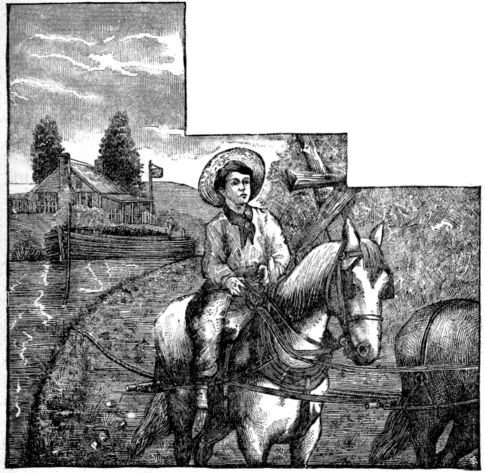
It was the old Ohio and Pennsylvania Canal; and he found, by
rare good fortune, a boat ready to start, and in need of a driver.
The captain of this less ambitious navigating affair proved to be
not quite so rich in profanity, but more wealthy in good-natured
sympathy; his name was Amos Letcher, and he was Garfield’s
cousin. To this man James told the story of his experience
thus far, and asked employment on the boat. The result was a
contract to drive mules. Letcher became much interested in his
young friend, and is authority for some good stories about this
“voyage.”
When the time came to start, the Evening Star was brought up
to the first lock, and after some delay got through. On the other
side waited the mule-team and its impatient driver, who was eager
for the trip to begin. In a few hours he would be farther from
home than ever in his life before, traveling a path which led he
knew not whither. Practically, they were bound for Pittsburgh.
To his imagination, it was a trip around the world. So the whip
38was flourished triumphantly, and this circumnavigation committee
of one was on his way.
Directly a boat approached from the opposite direction. Jim
bungled, in his excitement, and got his lines tangled. While he
stopped to get things straight, the boat came up even with him,
leaving the tow-line slack for several yards. Eased of their load,
the mules trotted on quickly to the extent of the line, when, with
a sudden jerk, the boat caught on a bridge they were passing, and
team, driver, and all were in the canal.
The boy, however, was not disconcerted, but climbed out, and,
amid loud laughter from those on board, proceeded coolly along
as if it had been a regular morning bath.
The rough men of the canal were fond of a fight, and always
ready at fisticuffs. One of the most frequent occasions of these difficulties
was at the locks, where but one boat could pass at a time.
When two boats were approaching from opposite directions each
always tried to get there first, so as to have the right to go through
before the other. This was a prolific source of trouble.
As the Evening Star approached lock twenty-one at Akron, one
of these scenes was threatened. An opposite boat came up just as
Letcher was about to turn the lock for his own. The other got
in first. Letcher’s men all sprang out for a fight. Just then Jim
walked up to the captain and said, “Does the right belong to us?”
“No, I guess not; but we’ve started in for it, and we are going to
have it anyhow.” “No, sir,” said Garfield. “I say we will not
have it. I will not fight to keep them out of their rights.” This
brought the captain to his senses, and he ordered his men to give
room for the enemy to pass.
There was half-mutiny on board that night, and many uncomplimentary
remarks about the young driver. He was a coward,
they said. Was he a coward? Or simply a just, fair-minded
youth, and as brave as any of them? He made up his mind to
show them which he was, when a good time came.
The captain had defended Jim from these accusations of the
men, for a reason unknown to them. The boy had whipped him
before they came to Akron. It was after a change of teams, and
39Jim was on the boat. Letcher was a self-confident young man,
who had recently been a school teacher in Steuben County, Indiana,
and felt as if all knowledge was his province. He had made
all his men revere him for his learning, and now was the time to
overwhelm the new driver.
So, sitting down near where the lad
was resting, he said: “Jim, I believe
you have been to school some, and as
I have not heard a class lately, I will
ask you some questions to see where
you are, if you don’t care.”
GARFIELD ON THE TOW-PATH.
James assented. Pedagogue Letcher
thought his time
had come; he
searched out witty inventions; he asked deep questions; he would
open this youngling’s eyes. The examination did not last long,
for all questions were quickly answered, and the quizzer ran out
of materials; his stock of puzzlers was exhausted.
Then the tables turned. The tailor was out-tailored in three
minutes, for in that time James had asked him seven questions
which he could not answer. Hence the captain’s allowance for
40the boy’s refusal to fight. Letcher knew enough to appreciate the
reason.
The Evening Star had a long trip before her, as the present
load consisted of copper ore consigned to Pittsburgh. This ore
came down to Cleveland first in schooners from Lake Superior,
where those great treasuries of ore, which still seem inexhaustible,
were at that time just beginning to become important interests.
The habit of the canal-boatmen was to take up the copper at
Cleveland, carry it to Pittsburgh, and bring back loads of coal.
Garfield’s first experience here must have given him new ideas of
the growing industries of his country. This constant and immense
carrying trade between distant places indicated the play of grand
forces; these great iron foundries and factories at Pittsburgh betokened
millions of active capital, thousands of skilled workmen,
and fast-increasing cities abounding in wonders and in wealth.
Whatever the immediate result of Garfield’s canal life might have
been, whether the boatmen had voted him coward or general, one
fact must have remained—the mental stimulus imparted from these
things which he had seen. Then must have dawned upon him
for the first time a sense of the unmeasured possibilities which lay
before his own country. Tramp, tramp the mules; lock after lock
has been left behind, each turn bringing a new landscape, and the
young driver pushed bravely on, self-reliant, patient, and popular
with all the men. For these rough comrades liked him from the
first as a pleasant fellow, and soon admired him as well. Opportunity
came to him on the way to prove himself their equal in
fighting qualities, and more than their equal in generosity. The
occasion was one the like of which he often knew, where he came
off victor with the odds favoring his enemies. At Beaver, from a
point where the boats were towed up to Pittsburgh by steamboat,
the Evening Star was about to be taken in. As Garfield stood in
the bow of the boat, a burly Irishman, named Dave Murphy, who
stood a few feet behind, was accidentally struck by a flying piece
of rope from the steamer, which had evaded Garfield and gone
over his head. No harm was done, but Murphy was a bully who
saw here a good chance for a fight. He was thirty-five years old,
41Garfield sixteen. Turning on the boy in a towering rage, he
aimed a blow with all his strength. But as sometimes occurs to
men with more brawn than brains, he soon discovered that in this
case Providence was not “on the side of the heavy battalions.” By
a dexterous motion James eluded his antagonist, at the same instant
planting a blow behind the fellow’s ear which sent him spinning
into the bottom of the boat. Before the man could recover, his
young antagonist held him down by the throat. The boatmen
cheered the boy on; according to their rules of pugilism, satisfaction
was not complete till a man’s features were pounded to a jelly.
“Give him a full dose, Jim;” “Rah fer Garfield!” The two
men arise; what does this mean? The Murphy face has not been
disfigured; the Murphy nose bleeds not! Slowly the astonished
men take in a new fact. Generosity has won the day, and brutality
itself has been vanquished before their eyes. From that hour
James became one of the heroes of the tow-path; and the day he
left it was a day of regret to all his new acquaintances there.
On the way back from Pittsburgh a vacancy occurred on deck;
Garfield was promoted to the more responsible position of bowman,
and the mules found a new master. So the ocean drew one
step nearer; this was not exactly the sea, of course, but after all it
was a little more like sailing. Up and down the narrow course,
following all its windings, the Evening Star pursued its way without
serious accident, and James Garfield stood at the bow till November
of 1848. Then came a change. New things were preparing
for him, and all unknown to him old things were passing
away. The mother at home still watched for her boy; the mother
at home still prayed for her son, and yearned for a fulfillment of
her steadfast desire that he should be such a man as she had begun
to dream of him when he was a little child. An accident now
brought him home to her. The position of bowman on the Evening
Star was rather an unsafe one. The place where James
stood was narrow and often slippery, and, in a brief period of time,
he had fallen into the water fourteen times. The last immersion
chanced in the following manner: One night as the boat approached
a lock the bowman was hastily awakened, and tumbled
42out half asleep to attend to his duty. Uncoiling a rope which was
to assist in steadying the boat through, he lost his balance, and in
a second found himself in a now familiar place at the bottom of
the canal. The night was dark, and no help near. Struggling
about, his hand accidentally clutched a section of the rope which
had gone over with him. Now, James, pull for your life, hand
over hand; fight for yourself, fight for another visit to home and
mother. Strength began to fail. The rope slid off; swim he could
not. Jerk, jerk; the rope has caught. Pulling away with a will,
he climbed back to his place, and found that he had been saved by
a splinter in a plank in which the rope had caught by a knot.
Such a narrow escape might well stir up the most lethargic brain
to new and strange reflections; but to the active intellect and bright
imagination of James A. Garfield it brought a profound impression,
a fresh resolution and a new sphere of action. He saw himself
rescued by a chance which might have failed him a thousand
times. Might not this be in answer to a mother’s prayer? Was
it possible that he had been saved for some better fortune than his
present life promised? He recalled the vague ambitions which
had at times stirred him for a career of usefulness, such as he knew
his mother had in mind for him.
When the boat neared home again, James bade good-bye to the
Evening Star. Now, farewell visions of the Atlantic; farewell
swearing captain of the lake; farewell raging canal, for this sailor
lad is lost to you forever. The romantic element of his character
indeed was not destroyed, as it never could be; nor was the glamour
of the sea quite gone. It would take the winter of sickness which
was before him to remove all nautical aspirations. Arriving before
the old gate one night while the stars were out in all their
glory, he softly raised the latch, and walked up to the house.
Never was happier mother than greeted him at that door. Mrs.
Garfield felt that her triumph was now at hand; and set herself to
secure it at once.
Four hard months of life on and in the canal had told heavily
on the young man’s constitution. Four months more ague and
fever held him fast; four months more he longed in vain for the
43vigor of health. During this dreary time one voice above all
others comforted, cheered, and swayed his drooping spirits, and
helped him back to a contented mood. In conversation and in
song, the mother was his chief entertainer. Indeed, Mrs. Garfield
had not only a singing voice of splendid quality, but also
knew a marvelous number of songs; and James said, later in life,
that he believed she could have sung many more songs consecutively,
from memory, than her physical powers would have permitted.
Songs in every kind of humor,—ballads, war songs (especially
of 1812) and hymns with their sacred melody—these she
had at command in exhaustless stores. And we may be sure that
such sweet skill was not without its power on her children. That
voice had been the dearest music James ever heard in childhood,
and his ear was well fitted to its every tone; escape from its power
was hopeless now if he had even wished it so.
Meanwhile the past receded, and new plans for the future were
unfolding. It is interesting to notice how smoothly, and all unknown
to ourselves, we sometimes pass over the lines which mark
the periods of our lives. The manner of Garfield’s present experience
was no exception to the rule.
Samuel D. Bates was a young man, not many years older than
James A. Garfield. He was a good scholar, and had been attending
a place called “Geauga Seminary,” which had grown up in
the adjoining county. This winter he had taken the school on
the Garfield farm, expecting to save some money and return to
Geauga. With his head full of these ideas, he met Garfield, and
soon had the latter interested in his plans. When the time came
for the next term to begin, James was well again, and his mother
and Bates proposed that he should go also. He thought the subject
over carefully, but was still uncertain what to do. He was not
sure of his capacity to turn an education to account, and did not
wish to spoil a good carpenter for the sake of a bad professor or
preacher. Before making a final decision, he therefore did a characteristically
sensible thing. Dr. J. P. Robison was a physician
of Bedford, a man well known for good judgment and skill in his
profession. One day he was visited by an awkward country lad,
44who asked a private conversation with him, and, that favor being
granted, said to him: “My name is James Garfield. My home
is at Orange. Hitherto I have acquired only the rudiments of an
education, and but a scanty knowledge of books. But, at this
time, I have taken up the notion of getting an education, and,
before beginning, I want to know what I have to count on. You
are a physician, and know men well. Examine me, and say plainly
whether you think I will be able to succeed.”
This frank speech was rewarded by as fair an answer. The physician
sounded him well, as to both body and mind, and ended with
an opinion which summed up in about this fashion: “You are well
fitted to follow your ambition as far as you are pleased to go.
Your brain is large and good; your physique is adapted to hard
work. Go ahead, and you are sure to succeed.”
This settled the question at once and forever. Garfield the
student, the thinker, the teacher, the preacher, and the statesman,
are all included in this new direction, and time alone is wanting
to reveal them to himself and to the world.
Geauga Seminary was situated at a place called Chester, in
Geauga County. The faculty consisted of three men and as many
women. They were: Daniel Branch and wife, Mr. and Mrs. Coffin,
Mr. Bigelow, and Miss Abigail Curtis. In the second year of
Garfield’s attendance, Mr. and Mrs. Branch retired, and were succeeded
by Mr. Fowler and Mr. Beach. The students were about
one hundred in number, and of both sexes. There was a library
of one hundred and fifty volumes, and a literary society, which
offered a chance for practice in writing and speaking. Knowing
these facts, and that the seminary offered the advantages common
to many such institutions, we know the circumstances under which
Garfield began that course of studies which, in seven years, graduated
him with honor from an Eastern college.
There went with him to Chester two other friends besides
Bates—one his cousin, William Boynton, the other a lad named
Orrin H. Judd. These three being all poor boys, they arranged
to live cheaply. Garfield himself had only seventeen dollars,
which Thomas and his mother had saved for him to begin on;
45and he expected to make that go a long way by working at his
old carpenter trade at odd hours, as well as by economy in spending
money. So the trio kept “bachelors’ hall” in a rough
shanty, which they fitted up with some articles brought from
home; and a poor woman near by cooked their meals for some
paltry sum.
There came a time when even this kind of life was thought
extravagant. Garfield had read an autobiography of Henry C.
Wright, who related a tale about supporting life on bread and
crackers. So they dismissed their French cook, and did the work
themselves. This did not last long, but it showed them what they
could do.
“What tho’ on hamely fare we dine,
Wear hoddin gray, and a’ that;
Gie fools their silks and knaves their wine,
A man’s a man for a’ that!”
Life at college on such a scale as this lacks polish, but may contain
power. The labors which James A. Garfield performed at
this academy, in the one term, from his arrival on March 6,
1849, to the end, were probably more than equal to the four
years’ studies of many a college graduate. He never forgot a
moment the purpose for which he was there. Every recitation
found his work well done; every meeting of the literary society
knew his presence and heard his voice. The library was his favorite
corner of the building. A new world was to be conquered
in every science, a new country in every language. Thus a year
passed, and Garfield’s first term at Geauga was ended. During
the summer vacation he was constantly busy; first he helped his
brother to build a barn at home, then turned back for a season to
his old business as a wood-cutter, and then worked in the harvest-field.
About the latter a good story remains to us. With two
well-grown, but young, school-fellows, James applied to a farmer
who needed more hands, asking employment. The farmer thought
them rather too young for the business; but, as they offered to
work for “whatever he thought right,” he agreed, thinking it
would not be much. But they had swung the scythe before, and
soon made it a warm task for the other men to keep even with
46them. The old man looked on in mute admiration for a while,
and finally said to the beaten men: “You fellows had better look
to your laurels; them boys are a beatin’ ye all holler.” The men,
thus incited to do their best, worked hard; but they had begun a
losing battle, and the Garfield crowd kept its advantage. When
settling time came round, these “boys” were paid men’s full
wages.
Having, in these ways, saved enough money to begin on, James
began the fall term at Geauga. Here he still pursued the same
plan of alternate work and study, inching along the best he could.
His boarding accommodations were furnished by a family named
Stiles, for one dollar and six cents a week. The landlady, Mrs.
Stiles, is made responsible for a story which illustrates how nearly
penniless James was all this time. He had only one suit of clothes,
and no underclothing. But toward the end of the term, his well-worn
pantaloons split at the knee, as he bent over one day, and
the result was a rent of appalling proportions, which the pin, with
which he tried to mend matters, failed to conceal. Mrs. Stiles
kindly undertook to assist him out of his trouble while he was
asleep that night. But the time soon came when, though still
poor, Garfield was beyond danger of being put in such straights
again. For, even before the time came to go home again, he had
paid his expenses and purchased a few books. One piece of work
which he did at this time was to plane all the boards for the siding
of a house, being paid two cents a board.
About the first of November James applied for an examination,
and received a certificate of fitness to teach school. One whole
year was gone since the sea-vision vanished, and his means for
support in the new life had been made chiefly by the unaided
force of his own tough muscles. Enough capital of a new kind
had now accumulated to become productive, and he determined,
for the future, to make money out of the knowledge in his head,
as well as out of the strength and skill of his arm. The time for
opening the country schools was come, and the young man made
several applications to school trustees near his home, but found
no place where he was wanted. Returning home discouraged, he
47found that an offer was waiting for him. He took the contract
to teach the Ledge school, near by, for twelve dollars a month
and board.
This school was one of those unfortunate seats of learning so
often found in rural districts, where teachers are habitually ousted
each term by the big boy terrible. For James Garfield, not yet
quite eighteen years old, this would be a trying situation, but we
already know enough about him to feel confident that he can not
easily be put down. His difficulties were, however, peculiarly
great; for, though a prophet, he was in his own country, and the
scholars were not likely to be forward in showing respect to “Jim
Gaffil.” It was the old story, which many a man who has
taught country school can parallel in his own experience. First
came insubordination, then correction, then more fight, followed
by a signal victory, and at last Master Garfield was master of the
situation. Then came success, his reward for hard study and
hard blows. The Ledge prospered, its teacher became popular;
and, when the time came to close, he did so, satisfied with himself,
and possessor of a neat little sum of money.
Garfield went back to Geauga that year as planned. Early in
1851 he had his first ride on a railroad train. Taking passage
on a train of the Cleveland and Columbus road, then new, he
went, with his mother, to Columbus. There the representative to
the legislature from Geauga County, Gamaliel Kent, kindly showed
him the sights of the capital; from there they went to Zanesville,
and then down the Muskingum, eighteen miles, to visit some
relatives. There James is said to have taught a short term of
school before he returned home again; after this came the renewal
of school-days at Chester; and so progressing, we may end by saying
that James managed to support himself at Chester for somewhat
over two years, and to save a little money to begin on when he
moved a step higher. We have been thus minute in relating
these incidents only because they best show the stuff that was in
this heroic young fellow, and he can have no better eulogy.
Now, what were some of the elements of Garfield’s mental development
at this period? During the first term he had revived
48the rusty recollections of his early acquirements, and pursued
arithmetic, algebra, grammar, and natural philosophy; afterwards
came more of the regular academic studies, including the rudiments
of Latin and Greek; he also studied botany, and collected a good
herbarium. Every step had been carefully taken, and his mind
was becoming accustomed to close thinking. Probably his first
political impressions of importance were at this time being made,
but we have no record of any opinions formed by him at that time
on the subjects which then made political affairs interesting.
At the end of the first term in Chester, the literary society gave
a public entertainment; on that occasion James made a speech,
which is referred to in the diary he kept at that time, with this
comment: “I was very much scared, and very glad of a short
curtain across the platform that hid my shaking legs from the
audience.” Soon afterwards, he took some elocution lessons, which
is evidence of the fact that he began to think of making some
figure as a public speaker.
While Garfield taught the Ledge school another change had
come to him. The old log school-house on his mother’s farm was
used regularly as a church, where a good old man, eloquent and
earnest in his devotion to religion, ministered to the little congregation
of “Disciples” who assembled to hear him. Recent events,
and serious thinking, had predisposed James to listen with a willing
ear, and he began to feel drawn back again to the simple faith
of childhood which had been taught him by his mother. The sect,
of which his family were all members, were followers of a new
religious leader. Alexander Campbell is a name familiar to all
the present generation of older men. At a time of furious disputation
on religious subjects, Campbell was one of the ablest of
controversialists. First, a Presbyterian preacher, he had rejected
the Confession of Faith, and founded a new church, called the
“Disciples of Christ,” whose only written creed was the Bible.
Gifted with a proselyting spirit, he soon saw his one society spread
and grow into a multitude, so that soon not Virginia alone, but
many surrounding States were included in the religious territory
of the “Disciples,” called sometimes the “Campbellites.” It was
49one of this man’s followers and preachers who now attracted Garfield.
Their fundamentals of belief have been summed up thus:
1. We call ourselves Christians or Disciples.
2. We believe in God the Father.
3. We believe that Jesus is the Christ, the Son of the living God, and
our only Savior. We regard the divinity of Christ as the fundamental
truth in the Christian system.
4. We believe in the Holy Spirit, both as to its agency in conversion
and as an indweller in the heart of the Christian.
5. We accept both the Old and New Testament Scriptures as the
inspired Word of God.
6. We believe in the future punishment of the wicked and the future
reward of the righteous.
7. We believe that Deity is a prayer-hearing and prayer-answering
God.
8. We observe the institution of the Lord’s Supper on every Lord’s
Day. To this table it is our practice neither to invite nor debar. We
say it is the Lord’s Supper for all the Lord’s children.
9. We plead for the union of all God’s people on the Bible, and the
Bible alone.
10. The Bible is our only creed.
11. We maintain that all the ordinances of the Gospel should be observed
as they were in the days of the Apostles.
Aside from its adherence to the Bible, this organization did not
have or profess to have any thing in the way of creed to attract a
fervid young man to its acceptance.
Garfield was a man of susceptibility to influences; and peculiarly
to those of religion. Nature prepared him for it, and his early
influences led to it. The “wild-oats” had been sown, and the
prodigal was ready to return. In March, 1850, he joined the
Church, and at once became an enthusiastic worker for its interests.
How this new connection came to have a potent influence
in the shaping and development of his progress, will
constantly appear as we observe the next few years of his life.
Garfield was always interested in any cause which still had its
place to make in the world; for in that particular it would be
50like himself. He joined a young church; the first school he went
to was a new one, as was also the second. He joined the Republican
party before that party had ever won a national victory.
In 1851, Garfield thought he had about exhausted the advantages
of Geauga, and he began to seek “fresh scenes and
pastures new.” We ourselves can not do better than to take
leave of that secluded spot, summing up our hero’s life there in
these his own words: “I remember with great satisfaction the
work which was done for me at Chester. It marked the most
decisive change in my life. While there I formed a definite purpose
and plan to complete a college course. It is a great point
gained, when a young man makes up his mind to devote several
years to the accomplishment of a definite work. With the educational
facilities now afforded in our country, no young man, who
has good health and is master of his own actions, can be excused
for not obtaining a good education. Poverty is very inconvenient,
but it is a fine spur to activity, and may be made a rich
blessing.”
Alexander Campbell was not merely a zealous propagandist
of religious opinions; he was an organizer of religious forces.
Among these forces, education stands in the first rank. Understanding
this fact, Campbell himself founded a college at Bethany,
West Virginia,—then Virginia,—of which he was President until
he died. Following their leader in this liberal spirit, the Disciples
had established schools and colleges wherever they were
able. Hiram, Portage County, Ohio, was a settlement where the
new sect was numerous, and here, in 1850, was erected the first
building of what is now widely known as Hiram College, but
was then called the Eclectic Institute. It was toward this place
that in the fall of that year James A. Garfield turned. A somewhat
advanced course of study was promised, and he resolved to
go there and prepare for college. Arriving there in time to begin
with the first classes, he looked about as usual for something to
do. One evening the trustees were in executive session, when a
knock was heard at their door. The intruder was admitted. He
was a tall, muscular young man, scarcely twenty years old, unpolished
51in appearance, and carrying himself awkwardly, but
withal in a strikingly straightforward manner.
“Well, sir, what is your business with us?”
In firm, clear tones the answer came: “Gentlemen, I have
come here from my home in Orange. I have been two years at
Geauga Seminary, and am here to continue my work. Being the
son of a widow, who is poor, I must work my way along; and I
ask to be made your janitor.” Some hesitation was visible in the
faces of the trustees, and he added: “Try me two weeks, and if
you are not satisfied I will quit.”
The offer was accepted, and James A. Garfield again found himself
a rich man; rich in opportunities, rich in health, rich in
having some way, though a humble one, to support himself
through another period of magnificent mental growth. His inflexible
rule was to do every thing which fell in his way to do, and do
all things well. Before the term was far gone, the entire school
had become interested in him. With a pleasant word for every
one, always more than willing to do a favor, earnest, frank, and a
ready laugher, nobody could be more popular than Garfield. In a
short time one of the teachers of Science and English, became ill,
and Garfield was chosen to fill the temporary vacancy. This
duty was so faithfully performed that some of the classes were
continued to him, and so he was never without from three to six
classes till he went away to college. As a teacher he was singularly
successful; the classes never flagged in interest, for the
teacher was always either drawing forth ideas on the subject in
hand from some one else, or he was giving his own views in a
manner which invariably held attention. By these helps, by still
working as a carpenter in the village, and in various other ways,
making as much and spending as little as he could, Garfield finally
left Hiram, free from debt, and possessor of three hundred and
fifty dollars on which to start into college.
From the time when he became a member of the church at
Geauga, Garfield had continually increased in devotion to religious
affairs, and at Hiram quickly became a power. He was constantly
present at the social prayer-meetings, where his remarks were
52frequent, and attracted notice. In a short time he was called on
to address the people, and this becoming a habit, rapidly improved,
and came to be called “the most eloquent young man in the
county.” For a number of years Garfield was known as a
first-rate preacher; in regularity of speaking, however, he was
very much like that order known among Methodists as “local
preachers.”
That Garfield was at this time beginning to have political connections,
appears from a story told by Father Bentley, then pastor
of the church at Hiram. On one occasion an evening service
was about to be held, and the pastor had invited our friend to sit
with him on the platform; also expecting him to address the people.
Unnoticed by Father Bentley, a young man called Garfield
away, and was hastening him off to talk at a political meeting.
Discovering his departure, Bentley was about to call him back;
when, suddenly, he stopped, and said: “Well, I suppose we must
let him go. Very likely he will be President of the United
States, some day!”
Garfield’s general progress at Hiram was intimately connected
with that of the people about him; and the best possible view of
him must come from a knowledge of his friends, and the work
they did together. In a late address to the Alumni of Hiram,
Garfield has furnished a good sketch of the kind of human material
that made up the “Eclectic Institute.”
“In 1850 it was a green field, with a solid, plain brick building in
the center of it, and almost all the rest has been done by the institution
itself. Without a dollar of endowment, without a powerful friend
anywhere, a corps of teachers were told to go on the ground and see
what they could make of it, and to find their pay out of the tuitions
that should be received; who invited students of their own spirit to
come here on the ground and find out by trial what they could make
of it. The chief response has been their work, and the chief part of
the response I see in the faces gathered before me to-day. It was a
simple question of sinking or swimming, and I do not know of any institution
that has accomplished more, with little means, than this school
on Hiram hill. I know of no place where the doctrine of self-help has
53had a fuller development. As I said a great many years ago, the theory
of Hiram was to throw its young men and women overboard, and let
them try for themselves. All that were fit to get ashore got there, and
we had few cases of drowning. Now, when I look over these faces, and
mark the several geologic ages, I find the geologic analogy does not
hold—there are no fossils. Some are dead and glorified in our memories,
but those who are alive are ALIVE. I believe there was a stronger pressure
of work to the square inch in the boilers that ran this establishment
than any other I know of. Young men and women—rough, crude and
untutored farmer boys and girls—came here to try themselves, and find
out what manner of people they were. They came here to go on a voyage
of discovery, to discover themselves, and in many cases I hope the
discovery was fortunate.”
Among these brave toilers were two or three of Garfield’s more
intimate friends, with whom we must become acquainted before
we can come at a thorough knowledge of Garfield himself. Of
his introduction to them he has said:
“A few days after the beginning of the term, I saw a class of three
reciting in mathematics—geometry, I think. I had never seen a geometry,
and, regarding both teacher and class with a feeling of reverential
awe for the intellectual height to which they had climbed, I studied their
faces so closely that I seem to see them now as distinctly as I saw them
then. And it has been my good fortune since that time to claim them
all as intimate friends. The teacher was Thomas Munnell, and the
members of his class were William B. Hazen, George A. Baker and
Almeda A. Booth.”
Afterwards he met here, for the second time, one who had been,
known to him in Chester. Lucretia Rudolph was a farmer’s daughter,
whose humble home was then not far from Chester. Her
father was from Maryland; his uncle had been a brave soldier of
the Revolution, and, as the story goes, he afterward went to
France, enlisted under the banner of Napoleon, and was soon
known to the world as Marshal Ney. Lucretia’s mother came
from Vermont, and her name had been Arabella Mason. The
Rudolph family was poor, but industrious and ambitious. Their
54daughter had, therefore, been sent to Geauga. She was a “quiet,
thoughtful girl, of singularly sweet and refined disposition,” and
a great reader.
“Her heart was gentle as her face was fair,
With grace and love and pity dwelling there.”
In the fall of 1849 this young lady was earnestly pursuing her
studies at Geauga Seminary, and, during the hours of recitation,
there often sat near her the awkward and bashful youth, Garfield.
There these two became acquainted; and, although the boy made
but few advances at first, they soon became good friends. Her sweet,
attractive ways and sensible demeanor drew his heart out toward
her; and, as for James, though he may have been very rough in
appearance, yet his countenance was always a good one, and his
regularly brilliant leadership of the class in all discussions was
well adapted to challenge such a maiden’s admiration. A backwoods
idyl, ending in an early marriage, would not be a surprising
result in such a case as this. But these two souls were too
earnestly bent on high aims in life to trouble their hearts, or
bother their heads, with making love. They were merely acquaintances,
although tradition hath it, that from the day when,
leaving Chester, their paths diverged awhile, a correspondence
was regularly kept up. However that may be, the fact we know
is, that at this time and place, James A. Garfield first met Lucretia
Rudolph, the woman who was one day to become his wife.
In 1852 the Rudolphs moved to Hiram, where the young lady
studied at the “Eclectic,” and recited to Garfield in some of her
classes. The old friendship here ripened into affection; they pursued
many studies together, and, about the time he left Hiram for
college, they were engaged to marry. Long after they were married,
a poet of Hiram referred to her thus:
“Again a Mary? Nay, Lucretia,
The noble, classic name
That well befits our fair ladie,
Our sweet and gentle dame,
With heart as leal and loving
55As e’er was sung in lays
Of high-born Roman matron,
In old, heroic days;
Worthy her lord illustrious, whom
Honor and fame attend;
Worthy her soldier’s name to wear,
Worthy the civic wreath to share
That binds her Viking’s tawny hair;
Right proud are we the world should know
As hers, him we long ago
Found truest helper, friend.”
Another woman, however, one of the members of the awe-inspiring
geometry class named above, had, in the Hiram days,
more influence on Garfield’s intellectual life than any other person.
Miss Almeda A. Booth was a woman of wonderful force of
mind and character. She was the daughter of New England parents,
who had come to Ohio, where her father traveled over an
immense circuit of country as an itinerant Methodist preacher.
Almeda very early discovered intellectual tastes, and, at twelve,
read such works as Rollin’s Ancient History and Gibbon’s Decline
and Fall of the Roman Empire. She taught her first school at
seventeen. An engagement of marriage was broken by the death
of her intended husband, and her life was ever afterward devoted
to the business of teaching. Thus the quiet current of life was
not wrecked, but went smoothly on, clear and beautiful. She
was poor in what people call riches; the office of teacher gave
support. She was sad because death had darkened her life; study
was a never-failing solace. Her mind gloried in strength, and
the opportunity for a career of useful exercise of its powers helped
to make her happy. Henceforth she loved knowledge more than
ever; and could freely say:
“My mind to me a kingdom is.
Such perfect joy therein I find,
As far exceeds all earthly bliss
That God or Nature hath assigned.”
About the same time with Garfield, Miss Booth came to Hiram,
and soon found her time, like his, divided between teaching in
56some classes and reciting in others. Each at once recognized in
the other an intellectual peer, and they soon were pursuing many
studies together. Our best idea of her comes from an address
made by Garfield, on a memorial occasion, in 1876, the year after
Miss Booth died. He compared her to Margaret Fuller, the only
American woman whom he thought her equal in ability, in variety
of accomplishments, or in influence over other minds. “It is
quite possible,” says Garfield, “that John Stuart Mill has exaggerated
the extent to which his own mind and works were influenced
by Harriet Mills. I should reject his opinion on that subject
as a delusion, did I not know from my own experience, as
well as that of hundreds of Hiram students, how great a power
Miss Booth exercised over the culture and opinions of her friends.”
Again: “In mathematics and the physical sciences I was far
behind her; but we were nearly at the same place in Greek and
Latin. She had made her home at President Hayden’s almost
from the first, and I became a member of his family at the beginning
of the Winter Term of 1852–’3. Thereafter, for nearly two
years, she and I studied together in the same classes (frequently
without other associates) till we had nearly completed the classical
course.” In the summer vacation of 1853, with several others,
they hired a professor and studied the classics.
“Miss Booth read thoroughly, and for the first time, the Pastorals
of Virgil—that is, the Georgics and Bucolics entire—and the first six
books of Homer’s Iliad, accompanied by a thorough drill in the Latin
or Greek Grammar at each recitation. I am sure that none of those
who recited with her would say she was behind the foremost in the thoroughness
of her work, or the elegance of her translation.
“During the Fall Term of 1853, she read one hundred pages of Herodotus,
and about the same amount of Livy. During that term also,
Profs. Dunshee and Hull and Miss Booth and I met, at her room, two
evenings of each week, to make a joint translation of the Book of Romans.
Prof. Dunshee contributed his studies of the German commentators,
De Wette and Tholuck; and each of the translators made some
special study for each meeting. How nearly we completed the translation,
I do not remember; but I do remember that the contributions
57and criticisms of Miss Booth were remarkable for suggestiveness and
sound judgment. Our work was more thorough than rapid, for I find
this entry in my diary for December 15, 1853: ‘Translation Society sat
three hours at Miss Booth’s room, and agreed upon the translation of
nine verses.’
“During the Winter Term of 1853–’4, she continued to read Livy,
and also read the whole of Demosthenes on the Crown. The members of
the class in Demosthenes were Miss Booth, A. Hull, C. C. Foot and
myself.
“During the Spring Term of 1854, she read the Germania and Agricola
of Tacitus, and a portion of Hesiod.”
These were the occupations, these the friends of James A.
Garfield at Hiram, when, in the fall of 1854, he found himself
ready for college. He was so far advanced that he would easily
be able to graduate in two years. The best institution of advanced
learning, in the “Disciples’” church, was that of which
Alexander Campbell was president, at Bethany, Virginia. But
Garfield, much to the surprise of his Hiram friends, made up his
mind that he would not go there. The reasons he gave are summed
up in a letter written by him at that time, and quoted by
Whitelaw Reid in his Ohio in the War. This letter shows not
only why he did not go to Bethany, but why he did go to Williams.
He wrote:
“There are three reasons why I have decided not to go to Bethany:
1st. The course of study is not so extensive or thorough as in Eastern
colleges. 2d. Bethany leans too heavily toward slavery. 3d. I am the
son of Disciple parents, am one myself, and have had but little acquaintance
with people of other views; and, having always lived in the West,
I think it will make me more liberal, both in my religious and general
views and sentiments, to go into a new circle, where I shall be under
new influences. These considerations led me to conclude to go to some
New England college. I therefore wrote to the presidents of Brown
University, Yale and Williams, setting forth the amount of study I had
done, and asking how long it would take me to finish their course.
“Their answers are now before me. All tell me I can graduate in
two years. They are all brief, business notes, but President Hopkins
58concludes with this sentence: ‘If you come here, we shall be glad to do
what we can for you.’ Other things being so near equal, this sentence,
which seems to be a kind of friendly grasp of the hand, has settled the
question for me. I shall start for Williams next week.”.
The next week he did go to Williams. Boyhood, with its struggles,
had vanished. Garfield was now a man of twenty-three years,
with much development yet before him, for his possibilities of
growth were very large, and the process never stopped while he
lived. What he did at Williams let the following pages reveal.
CHAPTER III. THE MORNING OF POWER.
59
Measure the girth of this aspiring tree!
Glance upward where the green boughs, spreading wide,
Fling out their foliage, and thou shalt see
The promise of a Nation’s health and pride.
College life, as we have it in this country, is a romance.
In the midst of an age in whose thought poetry has found
little lodgment; in which love has become a matter of business,
and literature a trade, the American college is the home of sentiment,
of ideas, and of letters. The old institutions of romance
have crumbled into ruins. The armed knight, the amorous lady,
the wandering minstrel, the mysterious monastery, the mediæval
castle with its ghosts and legends exist only in history. But behind
the academic walls there are passages-at-arms as fierce, loves
as sweet, songs as stirring, legends as wonderful, secrets as well
transmitted to posterity as ever existed in the brain of Walter Scott.
It was to such an enchanted life at Williams College, that Garfield
betook himself in the month of June, 1854. To go through
college is like passing before a great number of photographic cameras.
A man leaves an indelible picture of himself printed on the
mind of each student with whom he comes in contact.
When Garfield entered Williams, he was over six feet high, as
awkward as he was muscular, and looking every inch a backwoodsman.
He had made great progress, however, in his previous studies,
and successfully passed his examination for the junior class.
A young fellow, named Wilbur, a cripple, came with him from
Ohio, and the couple from the first attracted much attention. A
classmate writes: “Garfield’s kindness to his lame chum was remarked
by every body.”
But many of the college boys were the sons of rich men. The
strapping young fellow from Ohio was, in his own language, a
60“greeny” of the most verdant type. His clothes were homespun,
and the idea of fitting him seemed never to have entered their
maker’s head. His language was marred by uncouth provincialisms.
His face had a kindly and thoughtful expression, on which
the struggle of boyhood had left little trace, but this could not
save him from many a cut. To a coarser-grained man, the petty
indignities, the sly sarcasms, the cool treatment of the Eastern collegians
would not have been annoying, but there are traces of a
bitter inward anguish in Garfield’s heart at this time. To make
it worse, he had not entered a lower class, where he perhaps might
have had companions as green as himself, or, at least, comparative
obscurity; but, entering an upper class, from whose members rusticity
had long since disappeared, he was considered a legitimate
target for the entire body of students.
But he had brains, and nowhere in the world, does ability rise
to the top, and mediocrity sink to the bottom, so surely and swiftly,
as at college. In a short time, his commanding abilities began to
assert themselves. In the class-room, he was not only a profound
and accurate scholar, but his large brain seemed packed with information
of every sort, and all ready for use at a moment’s notice.
His first summer before the regular fall term he spent in the college
library. Up to that time he had never seen a copy of Shakespeare;
he had never read a novel of Walter Scott, of Dickens, or
of Thackeray.
The opportunity was a golden one. On the shelves of the Williams’
library were to be found the best books of all the ages.
Plunging in at once, he read poetry, history, metaphysics, science,
with hardly a pause for meals. He felt that his poverty had made
him lose time, and that the loss must be made good. His powerful
frame seemed to know no fatigue, and his voracious and devouring
mind no satiety. Weaker minds would have been foundered.
Not so with this western giant. Note-book in hand, he jotted
down memoranda of references, mythologic, historical or literary,
which he did not fully understand, for separate investigation. The
ground was carefully gleaned, notwithstanding the terrific speed.
This outside reading was kept up all through his stay at Williams.
61Hon. Clement H. Hill, of Boston, a classmate of Garfield, writing
of his studies and reading, says: “I think at that time he was
paying great attention to German, and devoted all his leisure time
to that language. In his studies, his taste was rather for metaphysical
and philosophical studies than for history and biography,
which were the studies most to my liking; but he read besides a
good deal of poetry and general literature. Tennyson was then,
and has ever been since, one of his favorite authors, and I remember,
too, when Hiawatha was published, how greatly he admired it,
and how he would quote almost pages of it in our walks together.
He was also greatly interested in Charles Kingsley’s writings,
particularly in Alton Locke and Yeast. I first, I think, introduced
him to Dickens, and gave him Oliver Twist to read, and he roared
with laughter over Mr. Bumble.”
There are but few stories told of Garfield’s life at Williams, and
there is a reason behind the fact. The college “yarn” is generally
a tradition of some shrewd trick, some insubordination to discipline,
or some famous practical joke. Every college has a constantly
growing treasury of such legend lore. There are stories
of robbed hen-roosts, pilfered orchards, and plundered watermelon
patches; of ice-cream stolen from the back porch just after the
guests had assembled in the parlor; of mock processions, of bogus
newspapers, of wedding invitations gotten out by some rascally
sophomore, for the marriage of some young couple, who were
barely whispering the thought in their own imaginations. There
are stories of front doors painted red; of masked mobs ranging
through town on Halloween, and demanding refreshment;
of the wonderful theft of the college bell, right when a watchman
with loaded revolver was in the building, of hairbreadth
escapes down lightning rods, and of the burning in effigy of unpopular
professors. There is a story told in nearly every college
in the country, of how a smart fellow, to revenge himself, sprinkled
several barrels of salt on the street and sidewalk in front of a
professor’s house; how he drove all the wandering cattle in the
village to that part of the street, and how no digging, nor sweeping,
nor scalding water, nor flourished broom handles did any good
62toward driving away the meek but persistent kine, who, with monotonous
bell and monotonous bellow, for months afterward, day
and night, chose that spot for their parlor.
But no such legends hung round the name of Garfield at Williams
College. He was there under great pecuniary pressure, and
for a high and solemn purpose. He was there for work, not play.
Every thing which looked like a turning aside from the straight
and narrow way, was indignantly spurned. At one time he caught
the fever for playing chess. He was a superior player, and enjoyed
the game immensely. But when he found it carried him to
late hours, he denied himself the pleasure entirely.
But he stepped at once to the front rank as a debater in his literary
society. His power of statement, his grasp of facts, his quick
repartee, combined to make him the leading orator of the college.
His method of preparation showed the mind of a master. The
subject of debate he would divide into branches, and assign a
separate topic to each of his allies for investigation, distributing
each topic according to their respective qualities of mind. Each
man overhauled the college library, gathering and annotating all
the facts and authorities upon his particular branch of study, and
submitted his notes to Garfield, who would then analyze the mass of
facts, draw up the propositions, which were to bear down like Macedonian
phalanxes upon the enemy, and redistribute the branches of
the question to his debaters for presentation on the rostrum.
His mind never seemed foggy. Odd scraps of information,
which ordinary men would have been unable or afraid to use, he
wielded like a club about his adversaries’ heads. In a public debate
in his junior year, the preceding speaker had used a lengthy
and somewhat irrelevant illustration from Don Quixote. When
Garfield’s turn for reply came, he brought down the house by saying:
“The gentleman is correct in drawing analogies between his
side of this question and certain passages in the life of Don Quixote.
There is a marked resemblance, which I perceive myself, between
his argument and the scene of the knight attacking the
windmill; or, rather, it would be more appropriate to say that he
resembles the windmill attacking the knight.” At the college supper,
63which followed the public entertainment, Garfield’s extensive
acquaintance with standard literature was being talked about, when
he laughingly told his admiring friends that he had never read Don
Quixote, and had only heard a mention of the tournament between
the crazy knight and the windmill.
His classmates, in writing of the impressions made on them by
their college chum, speak much of his warm, social disposition,
and his fondness for jokes. He had a sweet, large, wholesome
nature, a hearty and cheerful manner, which endeared him most
closely to the men among whom he spent the two years of college
life. By the poorer and younger students he was almost
worshiped for his kindliness and encouragement. He was a warm
friend of every boy in the college; but for the weak, or sick, or
poverty stricken, his heart overflowed with generous sympathy.
His morals were as spotless as the stars. A classmate, who
knew him well, writes: “I never heard an angry word, or a
hasty expression, or a sentence which needed to be recalled. He
possessed equanimity of temper, self-possession, and self-control in
the highest degree. What is more, I never heard a profane or
improper word, or an indelicate allusion from his lips. He was
in habits, speech, and example, a pure man.”
Williamstown, Massachusetts, where the college is located, is
one of the most beautiful spots on the continent, and its magnificent
mountain scenery made a deep impression on the mind of the
tall Ohioan, who had been reared in a level country. It is only
to people who live among them that mountains are unimpressive,
and, perhaps, even then they make their impress on the character,
giving it a religious loftiness and beauty.
An old institution of Williams College was “Mountain Day”—an
annual holiday given for expeditions to some picturesque point
in the vicinity. On one of these occasions, an incident revealed
the courage and piety of “Old Gar,” as the boys lovingly called
their leader. They were on the summit of “Old Greylock,” seven
miles from the college. Although it was midsummer, the mountain
top was cool; and, as the great glowing sun sank behind the
western range, the air became chilly. The group of collegians
64were gathered about a camp-fire that blazed up briskly in the
darkening air. Some were sitting, some standing, but all were
silent. The splendor and solemnity of the scene; the dark winding
valley; the circling range of mountains; the over-bending sky;
the distant villages, with the picturesque old college towers; the
faint tinkle of the cowbell; the unspeakable glories of the sunset,—
“As through the West, where sank the crimson day,
Meek twilight slowly sailed, and waved her banners gray,”—
filled every thoughtful heart with religious awe. Just as the
silence became oppressive, it was broken by the voice of Garfield:
“Boys, it is my habit to read a chapter in the Bible every evening
with my absent mother. Shall I read aloud?” The little
company assented; and, drawing from his pocket a well-worn
Testament, he read, in soft, rich tones, the chapter which the
mother in Ohio was reading at the same time, and then called on
a classmate to kneel on that mountain top and pray.
The two months’ vacation of Garfield’s first winter at college
was spent at North Pownal, Vermont, teaching a writing-school,
in a school-house where, the winter before, Chester A. Arthur had
been the regular teacher. But, at that time, Garfield only knew
his predecessor by name, and the men whose destinies were in the
future to become so closely intertwined did not become acquainted.
At the end of his junior year Garfield’s funds were exhausted;
but, after a consultation with his mother, he resolved to borrow
the money to complete his course, rather than lose more time.
His first arrangement for the money failed; but Dr. J. P. Robison,
of Bedford, who, five years before, had prophesied so much
of the widow’s son, readily assumed the burden, asking no security
but his debtor’s word, but receiving a life insurance policy which
Garfield, who seemed to inherit an apprehension of sudden calamity,
insisted on procuring.
At the beginning of his senior year, he was elected one of the
editors of the Williams Quarterly, the college paper. His associates
in the work were W. R. Baxter, Henry E. Knox, E. Clarence
Smith, and John Tatlock. The pages of this magazine were
65enriched by a great number of the products of his pen. His
originality of thought and pleasant style is nowhere better shown
than in the following extract from a brilliant article upon Karl
Theodore Korner:
“The greater part of our modern literature bears evident marks of
the haste which characterizes all the movements of this age; but, in
reading these older authors, we are impressed with the idea that they
enjoyed the most comfortable leisure. Many books we can read in a
railroad car, and feel a harmony between the rushing of the train and
the haste of the author; but to enjoy the older authors, we need the
quiet of a winter evening—an easy chair before a cheerful fire, and all
the equanimity of spirits we can command. Then the genial good nature,
the rich fullness, the persuasive eloquence of those old masters will
fall upon us like the warm, glad sunshine, and afford those hours of
calm contemplation in which the spirit may expand with generous growth,
and gain deep and comprehensive views. The pages of friendly old
Goldsmith come to us like a golden autumn day, when every object
which meets the eye bears all the impress of the completed year, and
the beauties of an autumnal forest.”
Another article, which attracted great attention at the college,
was entitled “The Province of History.” The argument was
that history has two duties, the one to narrate facts with their
relations and significance, the other to show the tendency of the
whole to some great end. His idea was that history is to show
the unfolding of a great providential plan in the affairs of men
and nations. In the course of the article he said:
“For every village, State, and nation there is an aggregate of native
talent which God has given, and by which, together with His Providence,
He leads that nation on, and thus leads the world. In the light
of these truths, we affirm that no man can understand the history of
any nation, or of the world, who does not recognize in it the power of
God, and behold His stately goings forth as He walks among the nations.
It is His hand that is moving the vast superstructure of human history,
and, though but one of the windows were unfurnished, like that of the
66Arabian palace, yet all the powers of earth could never complete it
without the aid of the Divine Architect.
“To employ another figure—the world’s history is a divine poem, of
which the history of every nation is a canto, and of every man a word.
Its strains have been pealing along down the centuries, and, though there
have been mingled the discord of roaring cannon and dying men, yet to
the Christian philosopher and historian—the humble listener—there has
been a divine melody running through the song, which speaks of hope
and halcyon days to come. The record of every orphan’s sigh, of every
widow’s prayer, of every noble deed, of every honest heart-throb for the
right, is swelling that gentle strain; and when, at last, the great end is
attained—when the lost image of God is restored to the human soul;
when the church anthem can be pealed forth without a discordant note,
then will angels join in the chorus, and all the sons of God again ‘shout
for joy.’”
This is really an oration. It is not the style of the essayist.
It is the style of the orator before his audience. The boldness of
the figure which would captivate an audience, is a little palling
to the quiet and receptive state of the reader. The mental attitude
of Garfield when he wrote that passage was not that of the
writer in his study, but of the orator on the platform with a
hushed assemblage before him. It will be noticed that this characteristic
of style only became more marked with Garfield after
he had left the mimic arena of the college.
But the idea embodied in this article is as significant and characteristic
as its expression. In some form or other most of the
world’s great leaders have believed in some outside and controlling
influence, which really shaped and directed events. To this
they attributed their own fortune. Napoleon called and believed
himself to be “The Child of Destiny.” Mohammed was a fatalist:
“On two days it stood not to run from thy fate—
The appointed and the unappointed day;
On the first, neither balm nor physician can save,
Nor thee, on the second, the universe slay.”
Buddha believed in fatalism. So did Calvin. Julius Cæsar
ascribed his own career to an overweening and superimposed
67destiny. William III. of England, thought men were in the
grasp of an iron fate.
The idea expressed in this article of a providential plan in human
things, according to which history unfolds itself, and events
and men are controlled, is not seen here for the last time. It
will reappear at intervals throughout the life of the man, always
maintaining a large ascendancy in his mind. It is not a belief in
fate, destiny, or predestination, but it is a kindred and corresponding
one. Whether such beliefs are false or true, whether superstitious
or religious, does not concern the biographer. It is sufficient
that Garfield had such a belief, and that it was a controlling
influence in his life.
But Garfield’s literary efforts in college also took the form of poetry.
The affectionate nature, and lofty imagination, made his
heart the home of sentiment, and poetry its proper expression.
We reproduce entire a poem entitled “Memory,” written during
his senior year. At that time, his intended profession was teaching,
and it is possible that the presidency of a Christian college
was “the summit where the sunbeams fell,” but in the light of
events the last lines seem almost prophetic.
MEMORY.
’Tis beauteous night; the stars look brightly down
Upon the earth, decked in her robe of snow,
No light gleams at the window save my own,
Which gives its cheer to midnight and to me.
And, now, with noiseless step, sweet Memory comes
And leads me gently through her twilight realms.
What poet’s tuneful lyre has ever sung,
Or delicatest pencil e’er portrayed,
The enchanted, shadowy land where Memory dwells?
It has its valleys, cheerless, lone, and drear,
Dark shaded by the mournful cypress tree,
And yet its sunlit mountain-tops are bathed
In heaven’s own blue. Upon its craggy cliffs,
Robed in the dreamy light of distant years,
Are clustered joys serene of other days;
Upon its gentle, sloping hillside bend
68The weeping willow o’er the sacred dust
Of dear departed ones: and yet in that land,
Where’er our footsteps fall upon the shore,
They that were sleeping rise from out the dust
Of death’s long, silent years, and ’round us stand,
As erst they did before the prison tomb
Received their clay within its voiceless halls.
The heavens that bend above that land are hung
With clouds of various hues; some dark and chill,
Surcharged with sorrow, cast their somber shade
Upon the sunny, joyous land below:
Others are floating through the dreamy air,
White as falling snow, their margins tinged:
With gold and crimsoned hues; their shadows fall
Upon the flowery meads and sunny slopes,
Soft as the shadow of an angel’s wing.
When the rough battle of the day is done,
And evening’s peace falls gently on the heart,
I bound away across the noisy years,
Unto the utmost verge of Memory’s land,
Where earth and sky in dreamy distance meet:
And memory dim, with dark oblivion joins;
Where woke the first remembered sounds that fell
Upon the ear in childhood’s early morn;
And wandering thence, along the rolling years,
I see the shadow of my former self
Gliding from childhood up to man’s estate.
The path of youth winds down through many a vale
And on the brink of many a dread abyss,
From out whose darkness comes no ray of light,
Save that a phantom dances o’er the gulf
And beckons toward the verge. Again the path
Leads o’er a summit where the sunbeams fall;
And thus in light and shade, sunshine and gloom,
Sorrow and joy, this life-path leads along.
It is said that every one has in some degree a prophetic instinct;
that the spirit of man reaching out into the future apprehends more
of its destiny than it admits even to itself. If ever this premonition
finds expression, it is in poetry. On the following page will
be found a gem, torn from the setting of Garfield’s college life,
which was published during his senior year, and is equally suggestive:
69AUTUMN.
Old Autumn, thou art here! Upon the earth
And in the heavens the signs of death are hung;
For o’er the earth’s brown breast stalks pale decay,
And ’mong the lowering clouds the wild winds wail,
And sighing sadly, shout the solemn dirge,
O’er Summer’s fairest flowers, all faded now.
The winter god, descending from the skies,
Has reached the mountain tops, and decked their brows
With glittering frosty crowns, and breathed his breath
Among the trumpet pines, that herald forth
His coming.
Before the driving blast
The mountain oak bows down his hoary head,
And flings his withered locks to the rough gales
That fiercely roar among his branches bare,
Uplifted to the dark, unpitying heavens.
The skies have put their mourning garments on,
And hung their funeral drapery on the clouds.
Dead Nature soon will wear her shroud of snow
And lie entombed in Winter’s icy grave.
Thus passes life. As heavy age comes on,
The joys of youth—bright beauties of the Spring—
Grow dim and faded, and the long dark night
Of death’s chill winter comes. But as the Spring
Rebuilds the ruined wrecks of Winter’s waste,
And cheers the gloomy earth with joyous light,
So o’er the tomb the star of hope shall rise
And usher in an ever-during day.
There is considerable poetic power here. The picture of the
mountain oak, with its dead leaves shattered by the November
blasts, and its bare branches uplifted to the dark unpitying heavens,
is equal to Thomson. This poem, like the one on Memory,
is full of sympathy with nature, and a somber sense of the sorrowful
side of human nature.
But a college boy’s feelings have a long range upward and downward.
Nobody can have the “blues” more intensely, and nobody
can have more fun. We find several comic poems by Garfield in
his paper. One of them is a parody on Tennyson’s “Light Brigade,”
70and served to embalm forever in the traditions of Williams
a rascally student prank which the Freshmen played upon their
Sophomore enemies. One stanza must suffice for these pages. It
was called “The Charge of the Tight Brigade”:
Bottles to right of them,
Bottles to left of them,
Bottles in front of them,
Fizzled and sundered,
Ent’ring with shout and yell,
Boldly they drank and well,
They caught the Tartar then;
Oh, what a perfect sell!
Sold—the half hundred.
Grinned all the dentals bare,
Swung all their caps in air,
Uncorking bottles there,
Watching the Freshmen while
Every one wondered;
Plunged in tobacco-smoke,
With many a desperate stroke,
Dozens of bottles broke.
Then they came back, but not,
Not the half hundred.
The winter vacation of his senior year Garfield spent at Poestenkill,
a little place a few miles from Troy, New York. While teaching
his writing school there, he became acquainted with some members
of the Christian Church and through them with the officers of the
city schools in Troy. Struck by his abilities, they resolved to
offer him a position in the schools at a salary of $1,500 a year.
The proposition was exciting to his imagination. It meant much
more money than he could hope for back in Ohio; it meant the
swift discharge of his debt, a life in a busy city, where the roar of
the great world was never hushed. But on the other hand, his
mother and the friends among whom he had struggled through
boyhood, were back in Ohio.
The conflict was severe. At last his decision was made. He
and a gentleman representing the Troy schools were walking on a
71hill called Mount Olympus, when Garfield settled the matter in
the following words:
“You are not Satan, and I am not Jesus, but we are upon the
mountain, and you have tempted me powerfully. I think I must
say, ‘Get thee behind me.’ I am poor, and the salary would soon
pay my debts and place me in a position of independence; but
there are two objections. I could not accomplish my resolution
to complete a college course, and should be crippled intellectually
for life. Then my roots are all fixed in Ohio, where people know
me and I know them, and this transplanting might not succeed
as well in the long run as to go back home and work for smaller
pay.”
During his two years at Williams, a most important phase of
Garfield’s intellectual development was his opinion upon questions
of politics. It will be remembered that in 1855, the volcanic flames
from the black and horrible crater of slavery began to burst
through the crust of compromise, which for thirty years had hidden
the smoldering fires. In Kansas, civil war was raging. Determined
men from all parts of the country had gone there to help
capture the State for their side, and in the struggle between the
two legislatures, the slavery men resolved to drive the Free-soilers
from the State. The sky was red with burning farm houses.
The woods were full of corpses of antislavery men with knives
sticking in their hearts. Yet the brave Free-soilers held their
ground. One man who had gone there from Ohio, had two sons
literally chopped to pieces. His name was John Brown. He also
remained, living six weeks in a swamp, in order to live at all.
The entire country was becoming aroused. Old political parties
were breaking up, and the lines reformed upon the slavery question.
Garfield, though twenty-three years old, had never voted. Nominally
he was an antislavery Whig. But he took little interest in
any party. So far, the struggle of his own life and the study of
literature had monopolized his mind.
In the fall of 1855, John Z. Goodrich, a member of Congress
from the western district of Massachusetts, delivered a political
address in Williamstown. Garfield and a classmate attended the
72speaking. The subject was the Kansas-Nebraska struggle, and the
efforts of the antislavery minority in Congress to save Kansas for
freedom. Says the classmate, Mr. Lavallette Wilson, of New
York: “As Mr. Goodrich spoke, I sat at Garfield’s side, and saw
him drink in every word. He said, as we passed out, ‘This subject
is entirely new to me. I am going to know all about it.’”
The following day he sent for documents on the subject. He
made a profound and careful study of the history of slavery, and
of the heroic resistance to its encroachments. At the end of that
investigation, his mind was made up. Other questions of the day,
the dangers from foreign immigration, and from the Roman Catholic
Church, the Crimean war, the advantage of an elective judiciary,
were all eagerly debated by him in his society, but the central
feature of his political creed was opposition to slavery. His views
were moderate and practical. The type of his mind gave his opinions
a broad conservatism, rather than a theoretical radicalism.
Accordingly, when on June 17, 1856, the new-born Republican
party unfurled its young banner of opposition to slavery and
protection for Kansas, Garfield was ready for the party as the
party was ready for him.
It was shortly before his graduation, when news of Fremont’s
nomination came, the light-hearted and enthusiastic collegians held
a ratification meeting. There were several speakers, but Garfield,
with his matured convictions, his natural aptitude for political
debate, and his enthusiastic eloquence, far outshone his friends.
The speech was received with tremendous applause, and it is most
unfortunate that no report of it was made. It was natural that
much should have been expected of this man by the boys of
Williams. He seemed to be cast in a larger mold than the
ordinary. The prophecy of the class was a seat in Congress
within ten years. He reached it in seven.
At graduation he received the honor of the metaphysical oration,
one of the highest distinctions awarded to graduates. The subject
of his address was: “Matter and Spirit; or, The Seen and Unseen.”
One who was present says:
“The audience were wonderfully impressed with his oratory,
73and at the close there was a wild tumult of applause, and a showering
down upon him of beautiful bouquets of flowers by the ladies;”
a fitting close to the two years of privation, mortification and toil.
Speaking of his mental characteristics, as developed at Williams,
Ex-President Hopkins, one of the greatest metaphysicians of the
age, writes:
“One point in General Garfield’s course of study, worthy of
remark, was its evenness. There was nothing startling at any one
time, and no special preference for any one study. There was a
large general capacity applicable to any subject, and sound sense.
As he was more mature than most, he naturally had a readier and
firmer grasp of the higher studies. Hence his appointment to the
metaphysical oration, then one of the high honors of the class.
What he did was done with facility, but by honest and avowed
work. There was no pretense of genius, or alternation of spasmodic
effort and of rest, but a satisfactory accomplishment in all
directions of what was undertaken. Hence there was a steady,
healthful, onward and upward progress.”
To pass over Garfield’s college life without mention of the
influence of President Hopkins upon his intellectual growth,
would be to omit its most important feature. No man liveth to
himself alone. The intellectual life of great men is largely determined
and directed by the few superior minds with which they
come in contact during formative periods. The biography of
almost any thinker will show that his intellectual growth was by
epochs, and that each epoch was marked out and created by the
influence of some maturer mind. The first person to exercise this
power is, in most cases, the mother. This was the case with
Garfield. The second person who left an indelible impression on
his mental life, and supplied it with new nourishment and
stimulant, was Miss Almeda Booth. The third person who exercised
an overpowering personal influence upon him was Mark
Hopkins. When Garfield came to Williams, his thought was
strong, but uncultured. The crudities and irregularities of his
unpolished manners were also present in his mind.
He had his mental eye-sight, but he saw men as trees walking.
74But under the influence of Hopkins, the scales fell from his eyes.
The vast and powerful intellect of the man who was stepping to
the front rank of the world’s thinkers, imparted its wealth of ideas
to the big Ohioan. Through President Hopkins, Garfield’s thought
rose into the upper sky. Under the inspiration of the teacher’s
lectures and private conversation, the pupil’s mind unfolded its
immense calyx toward the sun of speculative thought. From this
teacher Garfield derived the great ideas of law, of the regularity
and system of the Universe, of the analogy between man and nature,
of God as the First Cause, of the foundation of right conduct, of
the correlation of forces, of the philosophy of history. In after
years, Garfield always said that whatever perception he had of general
ideas came from this great man. One winter in Washington
the National Teacher’s Association was in session, and Garfield frequently
dropped in to take a share in the discussion. One day he
said: “You are making a grand mistake in education in this country.
You put too much money into brick and mortar, and not enough
into brains. You build palatial school-houses with domes and
towers; supply them with every thing beautiful and luxuriant, and
then put puny men inside. The important thing is not what is
taught, but the teacher. It is the teacher’s personality which is
the educator. I had rather dwell six months in a tent, with Mark
Hopkins, and live on bread and water, than to take a six years’
course in the grandest brick and mortar university on the continent.”
With graduation came separation. The favorite walks around
Williamstown were taken for the last time. The last farewells were
said, the last grasp of the hand given, and Garfield turned his face
toward his Ohio home. He was at once elected instructor in the
ancient languages at the Western Eclectic Institute, later known
as Hiram College. Two years later he became president of this
institution, overrun with its four hundred pupils. The activities
of the man during this period were immense. Following his own
ideas of teaching, he surcharged the institution with his personality.
The younger student, on entering, felt the busy life which animated
the place. With his teaching, Garfield kept up an enormous
75amount of outside reading; he delivered lectures on scientific and
miscellaneous subjects, making some money by it; he engaged in
public debates on theologic and scientific questions; he took the
stump for the Republican party; on Sundays he preached in the
Disciples Church; in 1857 he took up the study of the law, mastered
its fundamental principles, and was admitted to practice at
the Cleveland bar on a certificate of two years’ study. Yet with
all this load on him, he impressed himself on each pupil in Hiram
College as a personal friend. One of these, Rev. J. L. Darsie,
gives a vivid picture of Garfield at this time:
“I recall vividly his method of teaching. He took very kindly to me,
and assisted me in various ways, because I was poor and was janitor of the
buildings, and swept them out in the morning and built the fires, as he
had done only six years before, when he was a pupil at the same school.
He was full of animal spirits, and he used to run out on the green almost
every day and play cricket with us. He was a tall, strong man, but
dreadfully awkward. Every now and then he would get a hit on the nose,
and he muffed his ball and lost his hat as a regular thing. He was left-handed,
too, and that made him seem all the clumsier. But he was most
powerful and very quick, and it was easy for us to understand how it was
that he had acquired the reputation of whipping all the other mule-drivers
on the canal, and of making himself the hero of that thoroughfare when
he followed its tow-path ten years earlier.
“No matter how old the pupils were, Garfield always called us by our
first names, and kept himself on the most familiar terms with all. He
played with us freely, scuffled with us sometimes, walked with us in
walking to and fro, and we treated him out of the class-room just about
as we did one another. Yet he was a most strict disciplinarian, and enforced
the rules like a martinet. He combined an affectionate and confiding
manner with respect for order in a most successful manner. If he
wanted to speak to a pupil, either for reproof or approbation, he would
generally manage to get one arm around him and draw him close up to
him. He had a peculiar way of shaking hands, too, giving a twist to
your arm and drawing you right up to him. This sympathetic manner
has helped him to advancement. When I was janitor he used sometimes
to stop me and ask my opinion about this and that, as if seriously advising
with me. I can see now that my opinion could not have been of
76any value, and that he probably asked me partly to increase my self-respect,
and partly to show me that he felt an interest in me. I certainly
was his friend all the firmer for it.
“I remember once asking him what was the best way to pursue a certain
study, and he said: ‘Use several text-books. Get the views of
different authors as you advance. In that way you can plow a broader
furrow. I always study in that way.’ He tried hard to teach us to
observe carefully and accurately. He was the keenest observer I ever
saw. I think he noticed and numbered every button on our coats.
“Mr. Garfield was very fond of lecturing to the school. He spoke
two or three times a week, on all manner of topics, generally scientific,
though sometimes literary or historical. He spoke with great freedom,
never writing out what he had to say, and I now think that his lectures
were a rapid compilation of his current reading, and that he threw it
into this form partly for the purpose of impressing it on his own mind.
“At the time I was at school at Hiram, Principal Garfield was a great
reader, not omnivorous, but methodical, and in certain lines. He was
the most industrious man I ever knew or heard of. At one time he
delivered lectures on geology, held public debates on spiritualism,
preached on Sunday, conducted the recitations of five or six classes
every day, attended to all the financial affairs of the school, was an active
member of the legislature, and studied law to be admitted to the bar.
He has often said that he never could have performed this labor if it had
not been for the assistance of two gifted and earnest women,—Mrs. Garfield
herself, his early schoolmate, who had followed her husband in his
studies; and Miss Almeda A. Booth, a member of the faculty. The
latter was a graduate of Oberlin, and had been a teacher of young Garfield
when he was a pupil; and now that he had returned as head of the
faculty, she continued to serve him in a sort of motherly way as tutor
and guide. When Garfield had speeches to make in the legislature or on
the stump, or lectures to deliver, these two ladies ransacked the library
by day, and collected facts and marked books for his digestion and use
in the preparation of the discourses at night.”
In the canvass of 1877, after one of his powerful stump speeches,
Garfield was lying on the grass, talking to an old friend of these
Hiram days. Said he:
“I have taken more solid comfort in the thing itself, and received more
77moral recompense and stimulus in after-life from capturing young men
for an education than from any thing else in the world.”
“As I look back over my life thus far,” he continued, “I think of
nothing that so fills me with pleasure as the planning of these sieges, the
revolving in my mind of plans for scaling the walls of the fortress; of
gaining access to the inner soul-life, and at last seeing the besieged party
won to a fuller appreciation of himself, to a higher conception of life,
and to the part he is to bear in it. The principal guards which I have
found it necessary to overcome in gaining these victories are the parents
or guardians of the young men themselves. I particularly remember
two such instances of capturing young men from their parents. Both of
those boys are to-day educators of wide reputation—one president of a
college, the other high in the ranks of graded school managers. Neither,
in my opinion, would to-day have been above the commonest walks of
life unless I or some one else had captured him. There is a period in
every young man’s life when a very small thing will turn him one way or
the other. He is distrustful of himself, and uncertain as to what he
should do. His parents are poor, perhaps, and argue that he has more
education than they ever obtained, and that it is enough. These parents
are sometimes a little too anxious in regard to what their boys are
going to do when they get through with their college course. They talk
to the young men too much, and I have noticed that the boy who will
make the best man is sometimes most ready to doubt himself. I always
remember the turning period in my own life, and pity a young man at
this stage from the bottom of my heart. One of the young men I refer
to came to me on the closing day of the spring term and bade me good-bye
at my study. I noticed that he awkwardly lingered after I expected
him to go, and had turned to my writing again. ‘I suppose you will be
back again in the fall, Henry,’ I said, to fill in the vacuum. He did not
answer, and, turning toward him, I noticed that his eyes were filled with
tears, and that his countenance was undergoing contortions of pain.
“He at length managed to stammer out: ‘No, I am not coming back
to Hiram any more. Father says I have got education enough, and
that he needs me to work on the farm; that education don’t help along
a farmer any.’
“‘Is your father here?’ I asked, almost as much affected by the statement
as the boy himself. He was a peculiarly bright boy—one of those
strong, awkward, bashful, blonde, large-headed fellows, such as make
78men. He was not a prodigy by any means. But he knew what work
meant, and when he had won a thing by the true endeavor, he knew its
value.
“‘Yes, father is here, and is taking my things home for good,’ said
the boy, more affected than ever.
“‘Well, don’t feel badly,’ I said. ‘Please tell him that Mr. Garfield
would like to see him at his study before he leaves the village. Don’t
tell him that it is about you, but simply that I want to see him.’ In
the course of half an hour the old gentleman, a robust specimen of a
Western Reserve Yankee, came into the room, and awkwardly sat down.
I knew something of the man before, and I thought I knew how to
begin. I shot right at the bull’s-eye immediately.
“‘So you have come up to take Henry home with you, have you?’
The old gentleman answered: ‘Yes.’ ‘I sent for you because I wanted
to have a little talk with you about Henry’s future. He is coming back
again in the fall, I hope?’
“‘Wal, I think not. I don’t reckon I can afford to send him any
more. He’s got eddication enough for a farmer already, and I notice
that when they git too much they sorter git lazy. Yer eddicated farmers
are humbugs. Henry’s got so far ’long now that he’d rother hev his
head in a book than be workin’. He don’t take no interest in the stock,
nor in the farm improvements. Every body else is dependent in this
world on the farmer, and I think that we’ve got too many eddicated
fellows settin’ round now for the farmers to support.’
“‘I am sorry to hear you talk so,’ I said; ‘for really I consider Henry
one of the brightest and most faithful students I ever had. I have taken
a very deep interest in him. What I wanted to say to you was, that
the matter of educating him has largely been a constant out-go thus far;
but, if he is permitted to come next fall term, he will be far enough
advanced so that he can teach school in the winter, and begin to help
himself and you along. He can earn very little on the farm in winter,
and he can get very good wages teaching. How does that strike you?’
“The idea was a new and a good one to him. He simply remarked:
‘Do you really think he can teach next winter?’
“‘I should think so, certainly,’ I replied. ‘But if he can not do so
then, he can in a short time, anyhow.’
“‘Wal, I will think on it. He wants to come back bad enough, and I
guess I’ll have to let him. I never thought of it that way afore.’
79“I knew I was safe. It was the financial question that troubled the
old gentleman, and I knew that would be overcome when Henry got to
teaching, and could earn his money himself. He would then be so far
along, too, that he could fight his own battles. He came all right the
next fall; and, after finishing at Hiram, graduated at an Eastern college.”
“The other man I spoke of was a different case. I knew that this youth
was going to leave mainly for financial reasons also, but I understood his
father well enough to know that the matter must be managed with exceeding
delicacy. He was a man of very strong religious convictions,
and I thought he might be approached from that side of his character;
so when I got the letter of the son telling me, in the saddest language
that he could muster, that he could not come back to school any more,
but must be content to be simply a farmer, much as it was against his
inclination, I revolved the matter in my mind, and decided to send an
appointment to preach in the little country church where the old gentleman
attended. I took for a subject the parable of the talents, and, in the
course of my discourse, dwelt specially upon the fact that children were
the talents which had been intrusted to parents, and, if these talents were
not increased and developed, there was a fearful trust neglected. After
church, I called upon the parents of the boy I was besieging, and I saw
that something was weighing upon their minds. At length the subject of
the discourse was taken up and gone over again, and, in due course, the
young man himself was discussed, and I gave my opinion that he should,
by all means, be encouraged and assisted in taking a thorough course of
study. I gave my opinion that there was nothing more important to the
parent than to do all in his power for the child. The next term the young
man again appeared upon Hiram Hill, and remained pretty continuously
till graduation.”
One relic of his famous debates at this time, on the subject of
Christianity, still exists in a letter written to President Hinsdale,
which we give:
“Hiram, January 10, 1859.
“The Sunday after the debate I spoke in Solon on ‘Geology and
Religion,’ and had an immense audience. Many Spiritualists were
out.... The reports I hear from the debate are much more decisive
than I expected to hear. I received a letter from Bro. Collins,
of Chagrin, in which he says: ‘Since the smoke of the battle has partially
cleared away, we begin to see more clearly the victory we have
80gained.’ I have yet to see the first man who claims that Denton explains
his position; but they are all jubilant over his attack on the Bible.
What you suggest ought to be done I am about to undertake. I go there
next Friday or Saturday evening, and remain over Sunday. I am bound
to carry the war into Carthage, and pursue that miserable atheism to its
hole.
“Bro. Collins says that a few Christians are quite unsettled because
Denton said, and I admit, that the world has existed for millions of years.
I am astonished at the ignorance of the masses on these subjects. Hugh
Miller has it right when he says that ‘the battle of the evidences must
now be fought on the field of the natural sciences.’”
In the year preceding the date which this letter bears, the sweet
romance of his youth reached its fruition, in the marriage of Garfield
to Lucretia Rudolph. During the years which of necessity
elapsed since the first-whispered vows, on the eve of his departure
to Williams, the loving, girlish heart had been true. They began
life, “for better for worse,” in an humble cottage fronting on the
waving green of the college campus. In their happy hearts rose
no picture of another cottage, fronting on the ocean, where, in the
distant years, what God had joined man was to put asunder. Well
for them was it that God veiled the future from them.
But the enormous activities already enumerated of this man did
not satisfy his unexhausted powers. The political opinions formed
at college began to bear fruit. In those memorable years just preceding
the outbreak of the Rebellion—the years “when the grasping
power of slavery was seizing the virgin territories of the West,
and dragging them into the den of eternal bondage;” the years
of the underground railroad and of the fugitive slave law; of
the overseer and the blood-hound; the years of John Brown’s heroic
attempt to incite an insurrection of the slaves themselves, such
as had swept every shackle from San Domingo; of his mockery
trial, paralleled only by those of Socrates and Jesus, and of his
awful martyrdom,—the genius of the man, whose history this is,
was not asleep. The instincts of resistance to oppression, and of
sympathy for the oppressed, which he inherited from his dauntless
ancestry, began to stir within him. As the times became
81more and more stormy, his spirit rose with the emergency, and
he threw his strength into political speeches. Already looked upon
as the rising man of his portion of the State, it was natural that
the people should turn to him for leadership. In 1859, he was
nominated and elected to the State Senate, as member from Portage
and Summit counties.
The circumstances attending Garfield’s first nomination for office
are worthy to be recounted. It was in 1859, an off year in politics.
Portage County was a doubtful battle-field; generally it had
gone Democratic, but the Republicans had hopes when the ticket
was fortified with strong names. The convention was held in August,
in the town of Ravenna. There was a good deal of beating
about to find a suitable candidate for State Senator. At length a
member of the convention arose and said: “Gentlemen, I can
name a man whose standing, character, ability and industry will
carry the county. It is President Garfield, of the Hiram school.”
The proposition took with the convention, and Garfield was thereupon
nominated by acclamation.
It was doubtful whether he would accept. The leaders of the
church stoutly opposed his entering into politics. It would ruin
his character, they said. At Chagrin Falls, at Solon, at Hiram
and other places where he had occasionally preached in the Disciples’
meeting-houses, there was alarm at the prospect of the popular
young professor going off into the vain struggle of worldly
ambition. In this juncture of affairs, the yearly meeting of the
Disciples took place in Cuyahoga County, and among other topics
of discussion, the Garfield matter was much debated. Some regretted
it; others denounced it; a few could not see why he should
not accept the nomination. “Can not a man,” said they, “be a
gentleman and a politician too?” In the afternoon Garfield himself
came into the meeting. Many besought him not to accept
the nomination. He heard what they had to say. He took counsel
with a few trusted friends, and then made up his mind. “I believe,”
said he, “that I can enter political life and retain my integrity, manhood
and religion. I believe that there is vastly more need of manly
men in politics than of preachers. You know I never deliberately
82decided to follow preaching as a life work any more than teaching.
Circumstances have led me into both callings. The desire of brethren
to have me preach and teach for them, a desire to do good in all
ways that I could, and to earn, in noble callings, something to pay
my way through a course of study, and to discharge debts, and
the discipline and cultivation of mind in preaching and teaching,
and the exalted topics for investigation in teaching and preaching,
have led me into both callings. I have never intended to devote
my life to either, or both; although lately Providence seemed to
be hedging my way and crowding me into the ministry. I have
always intended to be a lawyer, and perhaps to enter political
life. Such has been my secret ambition ever since I thought of
such things. I have been reading law for some time. This nomination
opens the way, I believe, for me to enter into the life work I
have always preferred. I have made up my mind. Mother is at Jason
Robbins’. I will go there and talk with her. She has had a hope
and desire that I would devote my life to preaching ever since I
joined the church. My success as a preacher has been a great
satisfaction to her. She regarded it as the fulfillment of her wishes,
and has, of late, regarded the matter as settled. If she will give
her consent, I will accept the nomination.”
He accordingly went to his mother, and received this reply:
“James, I have had a hope and a desire, ever since you joined the
church, that you would preach. I have been happy in your success
as a preacher, and regarded it as an answer to my prayers.
Of late, I had regarded the matter as settled. But I do not want
my wishes to lead you into a life work that you do not prefer to
all others—much less into the ministry, unless your heart is in it.
If you can retain your manhood and religion in political life, and
believe you can do the most good there, you have my full consent
and prayers for your success. A mother’s prayers and blessing
will be yours.” With this answer as his assurance, he accepted
the nomination, and placed his foot on the first round in the
aspiring ladder.
From this time on, Garfield ceased forever to be a private citizen,
and must thereafter be looked on as a public man. Twenty-eight year
83of age, a giant in body and mind, of spotless honor and tireless
industry, it was inevitable that Garfield should become a leader of
the Ohio Senate. During his first winter in the legislature, his
powers of debate and his varied knowledge gave him conspicuous
rank. A committee report, drawn by his hand, upon the
Geological Survey of Ohio, is a State document of high order,
revealing a scientific knowledge and a power to group statistics and
render them effective, which would be looked at with wide-eyed
wonder by the modern State legislator. Another report on the
care of pauper children; and a third, on the legal regulation of
weights and measures, presenting a succinct sketch of the attempts
at the thing, both in Europe and America, are equally notable as
completely out of the ordinary rut of such papers. During this
and the following more exciting winter at Columbus, he, somehow,
found time to gratify his passion for literature, spending many
evenings in the State library, and carrying out an elaborate system
of annotation. But Garfield’s chief activities in the Ohio legislature
did not lie in the direction of peace. The times became
electric. Men felt that a terrible crisis upon the slavery and States-rights
questions was approaching. The campaign of 1860, in which
Abraham Lincoln, the Great Unknown, was put forward as the
representative of the antislavery party, was in progress. In the
midst of the popular alarm, which was spreading like sheet lightning
over the Republic, Garfield’s faith in the perpetuity of the nation
was unshaken. His oration at Ravenna, Ohio, on July 4, 1860,
contains the following passage:
“Our nation’s future—shall it be perpetual? Shall the expanding
circle of its beneficent influence extend, widening onward to the farthest
shore of time? Shall its sun rise higher and yet higher, and shine with
ever-brightening luster? Or, has it passed the zenith of its glory, and
left us to sit in the lengthening shadows of its coming night? Shall
power from beyond the sea snatch the proud banner from us? Shall
civil dissension or intestine strife rend the fair fabric of the Union? The
rulers of the Old World have long and impatiently looked to see fulfilled
the prophecy of its downfall. Such philosophers as Coleridge, Alison
and Macaulay have, severally, set forth the reasons for this prophecy—the
84chief of which is, that the element of stability in our Government
will sooner or later bring upon it certain destruction. This is truly a
grave charge. But whether instability is an element of destruction or of
safety, depends wholly upon the sources whence that instability springs.
“The granite hills are not so changeless and abiding as the restless
sea. Quiet is no certain pledge of permanence and safety. Trees may
flourish and flowers may bloom upon the quiet mountain side, while
silently the trickling rain-drops are filling the deep cavern behind its
rocky barriers, which, by and by, in a single moment, shall hurl to wild
ruin its treacherous peace. It is true, that in our land there is no such
outer quiet, no such deceitful repose. Here society is a restless and
surging sea. The roar of the billows, the dash of the wave, is forever in
our ears. Even the angry hoarseness of breakers is not unheard. But
there is an understratum of deep, calm sea, which the breath of the
wildest tempest can never reach. There is, deep down in the hearts of
the American people, a strong and abiding love of our country and its
liberty, which no surface-storms of passion can ever shake. That kind
of instability which arises from a free movement and interchange of
position among the members of society, which brings one drop to glisten
for a time in the crest of the highest wave, and then gives place to another,
while it goes down to mingle again with the millions below; such instability
is the surest pledge of permanence. On such instability the
eternal fixedness of the universe is based. Each planet, in its circling
orbit, returns to the goal of its departure, and on the balance of these
wildly-rolling spheres God has planted the broad base of His mighty
works. So the hope of our national perpetuity rests upon that perfect
individual freedom, which shall forever keep up the circuit of perpetual
change. God forbid that the waters of our national life should ever
settle to the dead level of a waveless calm. It would be the stagnation
of death—the ocean grave of individual liberty.”
Meanwhile blacker and blacker grew the horizon. Abraham
Lincoln was elected President, but it brought no comfort to the
anxious North. Yet, even then, but few men thought of war.
The winter of 1860–’61 came on, and with it the reassembling
of the State legislatures. Rising with the emergency
Garfield’s statesmanship foresaw the black and horrible fate of
civil war. The following letter by him to his friend, President
85Hinsdale, was prophetic of the war, and of the rise of an Unknown
to “ride upon the storm and direct it”:
Columbus, January 15, 1861.
“My heart and thoughts are full almost every moment with the terrible
reality of our country’s condition. We have learned so long to look upon
the convulsions of European states as things wholly impossible here, that
the people are slow in coming to the belief that there may be any breaking
up of our institutions, but stern, awful certainty is fastening upon
the hearts of men. I do not see any way, outside a miracle of God, which
can avoid civil war, with all its attendant horrors. Peaceable dissolution is
utterly impossible. Indeed, I can not say that I would wish it possible.
To make the concessions demanded by the South would be hypocritical
and sinful; they would neither be obeyed nor respected. I am inclined
to believe that the sin of slavery is one of which it may be said that
without the shedding of blood there is no remission. All that is left us
as a State, or say as a company of Northern States, is to arm and
prepare to defend ourselves and the Federal Government. I believe the
doom of slavery is drawing near. Let war come, and the slaves will get
the vague notion that it is waged for them, and a magazine will be
lighted whose explosion will shake the whole fabric of slavery. Even
if all this happen, I can not yet abandon the belief that one government
will rule this continent, and its people be one people.
“Meantime, what will be the influence of the times on individuals?
Your question is very interesting and suggestive. The doubt that hangs
over the whole issue bears touching also. It may be the duty of our
young men to join the army, or they may be drafted without their own
consent. If neither of these things happen, there will be a period when
old men and young will be electrified by the spirit of the times, and one
result will be to make every individuality more marked, and their
opinions more decisive. I believe the times will be even more favorable
than calm ones for the formation of strong will and forcible characters.
“Just at this time (have you observed the fact?) we have no man
who has power to ride upon the storm and direct it. The hour has come,
but not the man. The crisis will make many such. But I do not love to
speculate on so painful a theme. I am chosen to respond to a toast on
the Union at the State Printers’ Festival here next Thursday evening.
It is a sad and difficult theme at this time.”
86This letter is the key to Garfield’s record in the Ohio Senate.
On the 24th of January he championed a bill to raise and equip
6,000 State militia. The timid, conservative and politically blind
members of the legislature he worked with both day and night,
both on and off the floor of the Senate, to prepare them for the
crisis which his genius foresaw. But as his prophetic vision leaped
from peak to peak of the mountain difficulties of the future, he
saw not only armies in front, but traitors in the rear. He drew up
and put through to its passage a bill defining treason—“providing
that when Ohio’s soldiers go forth to maintain the Union, there
shall be no treacherous fire in the rear.”
In the hour of darkness his trumpet gave no uncertain sound.
He was for coercion, without delay or doubt.
He was the leader of what was known as the “Radical Triumvirate,”
composed of J. D. Cox, James Monroe, and himself—the
three men who, by their exhaustless efforts, wheeled Ohio into
line for the war. The Ohio legislature was as blind as a bat.
Two days after Sumter had been fired on, the Ohio Senate, over the
desperate protests of the man who had for months foreseen the war,
passed the Corwin Constitutional Amendment, providing that Congress
should have no power ever to legislate on the question of slavery!
Notwithstanding this blindness, through the indomitable zeal of
Garfield and his colleagues, Ohio was the first State in the North
to reach a war footing. When Lincoln’s call for 75,000 men
reached the legislature, Senator Garfield was on his feet instantly,
moving, amid tumultuous cheers, that 20,000 men and $3,000,000
be voted as Ohio’s quota. In this ordeal, the militia formerly
organized proved a valuable help.
The inner history of this time will probably never be fully written.
Almost every Northern legislative hall, particularly in
border States, was the scene of a coup d’état. Without law or
precedent, a few determined men broke down the obstacles with
which treason hedged the path of patriotism. As we have said,
the inner history of those high and gallant services, of the midnight
counsels, the forced loans, the unauthorized proclamations, will
never be written. All that will be known to history will be that,
87when the storm of treason broke, every Northern State wheeled
into line of battle; and it is enough.
Of Garfield it is known that he became at once Governor Dennison’s
valued adviser and aid. The story of one of his services
to the Union has leaked out. After the attack on Sumter, the
State capital was thronged with men ready to go to war, but there
were no guns. Soldiers without guns were a mockery. In this
extremity it was found out that at the Illinois arsenal was a
large quantity of muskets. Instantly, Garfield started to Illinois
with a requisition. By swift diplomacy he secured and shipped
to Columbus five thousand stand of arms, a prize valued at the
time more than so many recruits. But while the interior history
of the times will never be fully known, the exterior scenes are
still fresh in memory. The opening of the muster-rolls, the incessant
music of martial bands, the waving of banners, the shouts of
the drill-sergeant, the departure of crowded trains carrying the
brave and true to awful fields of blood and glory,—all this we
know and remember. The Civil War was upon us, and James
A. Garfield, in the morning of his power, was to become a soldier
of the Union.
CHAPTER IV. A SOLDIER OF THE UNION.
88
And there was mounting in hot haste—the steed,
The mustering squadron, and the clattering car
Went pouring forward with impetuous speed
And swiftly forming in the ranks of war!—Byron.
Honor to the West Point soldier! War is his business,
and, wicked though wars be, the warrior shall still receive
his honor due. By his devotion to rugged discipline, the professional
soldier preserves war as a science, so that armies may
not be rabbles, but organizations. He divests himself of the full
freedom of a citizen, and puts himself under orders for all time.
One of our ablest leaders in the Civil War was General George
H. Thomas. Of Thomas we learn, from an address of Garfield,
that “in the army he never leaped a grade, either in rank or command.
He did not command a company until after long service
as a lieutenant. He commanded a regiment only at the end of
many years of company and garrison duty. He did not command
a brigade until after he had commanded his regiment three years
on the Indian frontier. He did not command a division until after
he had mustered in, organized, disciplined, and commanded a
brigade. He did not command a corps until he had led his division
in battle, and through many hundred miles of hostile
country. He did not command the army until, in battle, at the
head of his corps, he had saved it from ruin.” This is apprenticeship
with all its hardships, but with all its benefits.
In our popular praises of the wonders performed by the great
armies of citizens which sprang up in a few days, let it never be
forgotten that the regular army, with its discipline, was the “little
leaven” which spread its martial virtues through the entire forces;
that the West Point soldier was the man whose skill organized
89these grand armies, and made it possible for them to gain their
victories.
GENERAL GEORGE H. THOMAS.
Honor to the volunteer soldier! He is history’s greatest hero.
What kind of apprenticeship for war has he served? To learn
this, let us go back to the peaceful time of 1860, when the grim-visaged
monster’s
“wrinkled
front” was yet
smooth. Now,
look through
the great ironworking
district
of Pennsylvania,
with its miles of
red-mouthed furnaces,
its thousand
kinds of
manufactures,
and its ten thousands
of skilled
workmen. Number
the civil engineers;
count the
miners; go into
the various
places where
crude metals and
other materials
are worked up into every shape known, to meet the necessities of
the modern arts. These are the sources of military power. Here
are the men who will build bridges, and equip railroads for army
transportation, almost in the twinkling of an eye. Cast your
mind’s eye back into all the corners of the land, obscure or conspicuous,
and in every place you shall see soldiers being trained.
They are not yet in line, and it does not look like a military array;
the farmer at his plow, the scholar and the professional man at
90the desk, are all getting ready to be soldiers. No nation is better
prepared for war than one which has been at peace; for war is a
consumer of arts, of life, of physical resources. And we had a
reserve of those very things accumulating, as we still have all the
time.
Europe, with its standing armies, stores gunpowder in guarded
magazines. America has the secret of gunpowder, and uses the
saltpeter and other elements for civil purposes; believing that
there is more explosive power in knowing how to make an ounce
of powder than there is in the actual ownership of a thousand
tons of the very stuff itself. The Federal army had not gone
through years of discipline in camp, but it was no motley crowd.
Its units were not machines; they were better than machines; they
were men.
James A. Garfield became a volunteer, a citizen soldier. The
manner of his going into the army was as strikingly characteristic
of him as any act of his life. In a letter written from Cleveland,
on June 14, 1861, to his life-long friend, B. A. Hinsdale, he said:
“The Lieutenant-Colonelcy of the Twenty-fourth Regiment has been
tendered to me, and the Governor urges me to accept. I am greatly
perplexed on the question of duty. I shall decide by Monday next.”
But he did not then go. For such a man, capable of so many
things, duty had many calls, in so many different directions, that
he could not easily decide. How Garfield was affected by the
temptation to go at once may be seen in a letter of July 12, 1861,
written from Hiram, to Hinsdale, wherein he says: “I hardly
knew myself, till the trial came, how much of a struggle it would
cost me to give up going into the army. I found I had so fully
interested myself in the war that I hardly felt it possible for me
not to be a part of the movement. But there were so many who
could fill the office tendered to me, and would covet the place,
more than could do my work here, perhaps, that I could not but
feel it would be to some extent a reckless disregard of the good
of others to accept. If there had been a scarcity of volunteers I
should have accepted. The time may yet come when I shall feel
91it right and necessary to go; but I thought, on the whole, that
time had not yet come.”
But the time was at hand. Garfield had become known and appreciated,
and he was wanted. On July 27, Governor Dennison wrote
to him: “I am organizing some new regiments. Can you take a
lieutenant-colonelcy? I am anxious you should do so. Reply by
telegraph.” Garfield was not at home when this letter was sent, but
found it waiting for him on his return, August 7. That night was
passed in solemn thought and prayer; face to face with his country’s
call, this man began to realize as he had not before done, what
“going to war” meant. He began to consider the sacrifice which
must be made, and found that in his case there was more to give
up than with most men. How many thousands of volunteers have
thought the same! Garfield’s prospects in life were very fine in
the line of work for which he had prepared himself. He was a
fine scholar, and on the road to distinguished success. Moreover,
he had a dearly loved wife and a little child, his soul’s idol. Who
would provide for them after the war if he should fall victim to a
Southern bullet? He had only three thousand dollars to leave
them. After all, willing as he was, it was no easy thing to do.
So it took a night of hard study; a night of prayer, a night of
Bible reading, a night of struggle with the awful call to arms; but
when the morning dawned, a great crisis had passed, and a final
decision had been made. The letter of Governor Dennison was
answered that he would accept a lieutenant-colonelcy, provided the
colonel of the regiment was a Wrest Point graduate. The condition
was complied with already. On the 16th of August, Garfield reported
for duty, and received his commission. His first order was
to “report in person to Brigadier-General Hill, for such duty as he
may assign to you in connection with a temporary command for purposes
of instruction in camp-duty and discipline.” In pursuance of
these instructions he went immediately to Hill’s head-quarters at
Camp Chase, near Columbus. Here he staid during the next four
months, studying the art of war; being absent only at short periods
when in the recruiting service. In the business of raising troops
he was very successful. The Forty-second O. V. I. was about
92to be organized, and Garfield raised the first company. It was in
this wise: Late in August he returned to Hiram and announced
that at a certain time he would speak on the subject of the war and
its needs, especially of men. A full house greeted him at the appointed
hour. He made an eloquent appeal, at the close of which
a large enrollment took place, including sixty Hiram students. In
a few days the company was full, and he took them to Camp Chase,
where they were named Company A, and assigned to the right of
the still unformed regiment. On September 5th, Garfield was made
Colonel, and pushed forward the work, so that in November the
requisite number was secured.
Meanwhile the work of study and discipline was carried on at
Camp Chase with even more than Garfield’s customary zeal. The
new Colonel was not an unwilling citizen in a soldier’s uniform.
He had been transformed through and through into a military man.
He himself shall tell the story:
“I have had a curious interest in watching the process in my own mind,
by which the fabric of my life is being demolished and reconstructed, to
meet the new condition of affairs. One by one my old plans and aims,
modes of thought and feeling, are found to be inconsistent with present
duty, and are set aside to give place to the new structure of military life.
It is not without a regret, almost tearful at times, that I look upon the
ruins. But if, as the result of the broken plans and shattered individual
lives of thousands of American citizens, we can see on the ruins of our
old national errors a new and enduring fabric arise, based on larger freedom
and higher justice, it will be a small sacrifice indeed. For myself I
am contented with such a prospect, and, regarding my life as given to
the country, am only anxious to make as much of it as possible before
the mortgage upon it is foreclosed.”
During the fall of 1861, Colonel Garfield had to perform three
duties. First, to learn the tactics and study the books on military
affairs; second, to initiate his officers into the like mysteries, and
see that they became well informed; and, finally, to so discipline and
drill the whole regiment that they would be ready at an early day
to go to the front. In pursuance of these objects he devoted to
their accomplishment his entire time. At night, when alone, he
93studied, probably even harder than he had ever done as a boy at
Hiram. For there he had studied with a purpose in view, but
remote; here the end was near, and knowledge was power in deed
as well as word. Every-day recitations were held of the officers,
and this college President in a few weeks graduated a well-trained
military class. The Forty-second Regiment itself, thus
well-officered, and composed of young men of intelligence, the
very flower of the Western Reserve, was drilled several hours
every day with the most careful attention. Every thing was done
promptly, all things were in order, for the Colonel had his eye on
each man, and the Colonel knew the equipments and condition of
his regiment better than any other man. After all, great events
generally have visibly adequate causes; and when we see Garfield’s
men win a victory the first time they see the enemy, we shall not
be surprised, for we can not think how it could be otherwise.
On December 15th an order came which indicated that the
Forty-second was wanted in Kentucky. General Buell was Commander
of the Department of the Ohio. His head-quarters were
at Louisville. At nine o’clock on the evening of the 16th
they reached Cincinnati. From this point, in compliance with
new orders received, the regiment was sent on down the Ohio to Catlettsburg,
where a few hundred Union troops were gathered already;
and Garfield himself went to Louisville to learn the nature of the
work he had before him. Arriving on the evening of the 16th,
he reported to his superior at once.
Don Carlos Buell was at this time forty-three years of age; a
man accomplished in military science and experienced in war.
He had first learned the theory of his business at West Point,
where he had graduated in 1842; and besides other service to his
country he had distinguished himself in the war with Mexico.
What a contrast to Garfield! The latter was only thirty years of
age, and just five years out of college. The only knowledge he
possessed to prepare him for carrying out the still unknown duty,
had been gathered out of books; which, by the way, are not equal
to West Point nor to a war for learning how to fight. Now what
could be the enterprise in which the untried Forty-second should
94bear a part? And who is the old head, the battle-scarred hero,
to lead the expedition? We shall see.
Taking a map of Kentucky, Buell briefly showed Garfield a
problem, and told him to solve it. In a word, the question was,
how shall the Confederate forces be chased out of Kentucky?
The rebels badly needed Kentucky; so did the Union. Having
shown Garfield what the business was, Buell told him to go to his
quarters for the night, and at nine o’clock next morning be ready
to submit his plan for a campaign. Garfield immediately shut
himself up in a room, with no company but a map of Kentucky.
The situation was as follows: Humphrey Marshall, with several
thousand Confederate troops, was rapidly taking possession of eastern
Kentucky. Entering from Virginia, through Pound Gap, he
had quickly crossed Pike County into Floyd, where he had fortified
himself, somewhere not far from Prestonburg, and was preparing
to increase his force and advance farther. His present situation
was at the head of the Big Sandy River. Catlettsburg, where
the Forty-second had gone, is at the mouth of this river.
Also, on the southern border, an invasion from Tennessee was
being made by a body of the Confederates, under Zollicoffer.
These were advancing toward Mill Spring, and the intention was
that Zollicoffer and Marshall should join their forces, and so increase
the rebel influence in the State that secession would immediately
follow. For Kentucky had refused to secede, and this invasion
of her soil was a violation of that very cause of State’s Rights
for which they were fighting.
Garfield studied this subject with tireless attention, and when
day dawned he was also beginning to see daylight. At nine o’clock
he reported. The plan he recommended was, in substance, that a
regiment be left, first, some distance in the interior, say at Paris or
Lexington, this mainly for effect on the people of that section.
The next thing was to proceed up the Big Sandy River against
Marshall, and run him back into Virginia; after which it would be
in order to move westward, and, in conjunction with other forces,
keep the State from falling into hostile hands. Meanwhile, Zollicoffer
would have to be taken off by a separate expedition.
95Buell stood beside his young Colonel and listened. He glanced
at the outline of the proposed campaign and saw that it was wisely
planned. As a result—for Buell did nothing hastily—Colonel Garfield
was told that his instructions would be prepared soon, and
he might call at six that evening. That evening he came, and
learned the contents of Order No. 35, Army of the Ohio, which
organized the Eighteenth Brigade, under the command of James
A. Garfield, Colonel of the Forty-second O. V. I. The brigade
itself was made up of the last-named regiment, the Fortieth
O. V. I., Colonel J. Cranor; Fourteenth K. V. I., Colonel L. D. F.
Moore; Twenty-second K. V. I., Colonel D. W. Landsay, and
eight companies of cavalry.
Buell’s instructions were contained in the following letter:
“Headquarters Department of the Ohio, Louisville, Ky., Dec. 17, 1861.
“Sir: The brigade organized under your command is intended to operate
against the rebel force threatening, and, indeed, actually committing
depredations in Kentucky, through the valley of the Big Sandy.
The actual force of the enemy, from the best information I can gather,
does not probably exceed two thousand, or twenty-five hundred, though
rumors place it as high as seven thousand. I can better ascertain the
true state of the case when you get on the ground.
“You are apprised of the condition of the troops under your command.
Go first to Lexington and Paris, and place the Fortieth Ohio Regiment
in such a position as will best give a moral support to the people in the
counties on the route to Prestonburg and Piketon, and oppose any
further advance of the enemy on the route. Then proceed with the least
possible delay to the mouth of the Sandy, and move with the force in
that vicinity up that river and drive the enemy back or cut him off.
Having done that, Piketon will probably be in the best position for you to
occupy to guard against future incursions. Artillery will be of little, if
any, service to you in that country. If the enemy have any it will incumber
and weaken rather than strengthen them.
“Your supplies must mainly be taken up the river, and it ought to be
done as soon as possible, while navigation is open. Purchase what you
can in the country through which you operate. Send your requisitions
to these head-quarters for funds and ordnance stores, and to the quartermasters
and commissary at Cincinnati for other supplies.
96“The conversation I have had with you will suggest more details than
can be given here. Report frequently on all matters concerning your
command. Very respectfully, your obedient servant,
“D. C. Buell,
“Brigadier-General commanding.”
On receipt of these instructions, Garfield began instantly to carry
them out. He telegraphed his forces at Catlettsburg to advance
up the Big Sandy towards Paintville, Marshall’s advance post.
This he did that no delay should be occasioned by his absence.
He then visited Colonel Cranor’s regiment, and saw it well established
at Paris. Returning thence, he proceeded to hasten after
his own regiment, and reached Catlettsburg on the 20th of December.
Here he stopped to forward supplies up the river to
Louisa, an old half-decayed village of the Southern kind, where he
learned that his men were waiting for him.
It was on this march from Catlettsburg to Louisa that the Forty-second
Ohio began, for the first time, that process of seasoning
which soon made veterans out of raw civilians. The hardships of
that march were not such as an old soldier would think terrible;
but for men who but five days before had left Columbus without
any experience whatever, it was very rough. On the morning of the
eighteenth the first division started, twenty-five mounted on
horses, and one hundred going by boat. The cavalry got on very
well; but the river was quite low, and after a few miles of bumping
along, the old boat finally stuck fast. Leaving this wrecked
concern, the men started to tramp it overland. The country was
exceedingly wild; the paths narrow, leading up hill and down
hill with monotonous regularity. That night when the tired fellows
stopped to rest, they had advanced only eight miles. The
next day, however, they reached Louisa, where the mounted company
had taken possession and prepared to stay; meanwhile the
remaining companies were on the road. Rain set in; the north
wind blew, and soon it was very cold. The steep, rocky paths
scarcely afforded room for the wagon-train, whose conveyances were
lightened of their loads by throwing off many articles of comfort
which these soldiers, with their unwarlike notions of life, hated
97to lose. But advance they must, if only with knapsacks and
muskets; and on the twenty-first all were together again. About
this time Garfield arrived.
Paintville, where it was intended to attack Marshall, is on
Painter Creek, near the west fork of the Big Sandy, about thirty
miles above Louisa. The first thing to be done, therefore, was to
cross that intervening space, very quickly, and attack the enemy
without delay. A slow campaign would result in disaster. While
this advance was being made, it would also be necessary to see
to the matter of reinforcements; for Marshall had thirty-five hundred,
Garfield not half as many. The only possible chance would
be to communicate an order to the Fortieth Ohio, under Colonel
Cranor, at Paris, one hundred miles away; that hundred miles
was accessible to Marshall, and full of rebel sympathizers. The
man who carried a dispatch to Cranor from Garfield, would carry
his life in his hand, with a liberal chance of losing it. To find
such an one, both able and willing for the task, would be like
stumbling over a diamond in an Illinois corn-field. In his perplexity,
Garfield went to Colonel Moore, of the Fourteenth Kentucky,
and said to him: “I must communicate with Cranor; some
of your men know this section of country well; have you a man
we can fully trust for such a duty?” The Colonel knew such
a man, and promised to send him to head-quarters. Directly the
man appeared. He was a native of that district, coming from
the head of the Baine, a creek near Louisa, and his name was
John Jordan. What kind of a man he was has been well told by
a writer in the Atlantic Monthly for October, 1865:
“He was a tall, gaunt, sallow man of about thirty, with small gray
eyes, a fine falsetto voice, pitched in the minor key, and his speech was
the rude dialect of the mountains. His face had as many expressions as
could be found in a regiment, and he seemed a strange combination of
cunning, simplicity, undaunted courage, and undoubting faith; yet,
though he might pass for a simpleton, he had a rude sort of wisdom,
which, cultivated, might have given his name to history.
“The young Colonel sounded him thoroughly, for the fate of the little
army might depend on his fidelity. The man’s soul was as clear as
98crystal, and in ten minutes Garfield saw through it. His history is
stereotyped in that region. Born among the hills, where the crops are
stones, and sheep’s noses are sharpened before they can nibble the thin
grass between them, his life had been one of the hardest toil and privation.
He knew nothing but what Nature, the Bible, the Course of Time,
and two or three of Shakespeare’s plays had taught him; but, somehow,
in the mountain air he had grown up to be a man—a man, as civilized
nations account manhood.
“‘Why did you come into the war?’ at last asked the Colonel.
“‘To do my sheer fur the kentry, Gin’ral,’ answered the man. ‘And
I didn’t druv no barg’in wi’ th’ Lord. I guv him my life squar’ out; and
ef he’s a mind ter tack it on this tramp, why, it’s a his’n; I’ve nothin’
ter say agin it.’
“‘You mean that you’ve come into the war not expecting to get out
of it?’
“‘That’s so, Gin’ral.’
“‘Will you die rather than let the dispatch be taken?’
“‘I will.’
“The Colonel recalled what had passed in his own mind when poring
over his mother’s Bible that night at his home in Ohio, and it decided
him. ‘Very well,’ he said; ‘I will trust you.’”
Armed with a carbine and a brace of revolvers, Jordan mounted
the swiftest horse in the regiment, and was off at midnight. The
dispatch was written on tissue paper, then folded closely into a
round shape, and coated with lead to resemble a bullet. The carrier
rode till daylight, then hitched his horse in the timber, and
went to a house where he knew he would be well received. The
lord of that house was a soldier in Marshall’s little army, who
served the Union there better than he could have done with a
blue coat on. The lady of the house was loyal in a more open
manner. Of course, the rebels knew of this mission, as they had
spies in Garfield’s camp, and a squad of cavalry were on Jordan’s
trail. They came up with him at this house; hastily giving the
precious bullet to the woman, he made her swear to see that it
reached its destination, and then broke out toward the woods.
Two horsemen were guarding the door. To get the start of them,
as the door opened, he brandished a red garment before the horses,
99which scared them so that they were, for a moment, unmanageable.
In an instant he was over the fence. But the riders were
gaining. Flash, went the scout’s revolver, and the one man was
in eternity! Flash, again, and the other man’s horse fell! Before
the rest of the squad could reach the spot, Jordan was safely out
of their power. That night the woman who had sheltered him
carried the dispatch, and a good meal, to a thicket near by, whither
she was guided by the frequent hooting of an owl! And, after a
ride of forty miles more, with several narrow escapes, the Colonel
of the Forty-second at last read his orders from a crumpled piece
of tissue paper. As for Jordan, he was back in Garfield’s tent
again two weeks later; but the faithful animal that carried him
had fallen, pierced by a rebel ball.
What, meanwhile, had been the progress of Garfield’s forces in
their attempt to reach Paintville? On the morning of December
23d, the first day’s march began. The rains of the preceding days
had been stopped by extreme cold, and the hills were icy and
slippery. The night before this march very few of the men had
slept; but, instead of that, had crouched around camp-fires to keep
from freezing. During the day they only advanced ten miles. In
half that distance, one crooked little creek, which wound around in
a labyrinth of coils, was crossed no less than twenty-six times.
This was slow progress, but the following days were slower still.
Provisions were scarce. Most of the wagon-train and equipments
had been loaded on boats to be taken up the river, and the supplies
that had started with them were far in the rear. To meet
their necessities, the men captured a farmer’s pigs and poultry without
leave. But Garfield was no plunderer; he was a true soldier;
and, after reprimanding the offenders, he repaid the farmer.
On the 27th, a squad of Marshall’s men were encountered, and
two men captured. The next day the compliment was returned,
and three Union soldiers became unwilling guests of the too hospitable
South. Thus slowly advancing, in spite of bad weather
and bad roads, skirmishing daily with the enemy, as the opposing
forces neared each other, on the 6th day of January, 1862, the
Eighteenth Brigade, except that portion which was coming from
100Paris, was encamped within seven miles of Paintville; and at last
it had become possible to bring things to a crisis, and determine,
by the solemn wager of battle, who was entitled to this portion
of Kentucky.
Up to this time, Garfield had been moving almost in the dark.
He did not know what had become of his message to Cranor; he
did not know the exact position of his enemy; he did not know
the number of the enemy. Now we shall see good fortune and
good management remedy each of these weaknesses in a single
day.
Harry Brown had been a canal hand with Garfield in 1847, and
the latter, with his genial ways, had made Brown his friend. At
this time, Brown was a kind of camp-follower, and not very well
trusted by the officers. But he knew the region well where these
operations were going on, and hearing that his old comrade was
commander, he hastened to offer his services as a scout. Garfield
accepted, told him what he wanted, and through him learned very
accurately the situation of the Confederate forces. On the night of
the sixth, Jordan also appeared on the scene, with the information
that Cranor was only two days’ march behind. To crown all, a
dispatch came from Buell, on the morning of the seventh, with a
letter which had been intercepted. This letter was from Humphrey
Marshall to his wife, and revealed the fact that his force was less
than the country people, with their rebel sympathies, had represented.
It was determined to advance that day and attack the
enemy at Paintville, where about one-third of them were posted.
OPERATIONS IN WEST VIRGINIA.
This attack on Paintville was a hazardous enterprise. In main
strength, Marshall was so superior that Garfield’s only hope was
in devising some plan to outwit him. From the point of starting,
there were three accessible paths; one on the west, striking Painter
Creek opposite the mouth of Jenny Creek, three miles to the right,
from the place to be attacked; one on the east, approaching that
point from the left; and a third road, the most difficult of the
three, straight across. Rebel pickets were thrown out on each
road. Marshall was prepared to be attacked on one road, but
never dreamed of a simultaneous approach of the enemy on all at
101once; and it was this misapprehension which defeated him. First,
a small detachment of infantry, supported by cavalry, attacked on
the west, whereupon almost the entire rebel force was sent out to
meet them. Shortly, a similar advance was made on the east,
and the enemy retraced their steps for a defense in that direction.
While they were thus held, the remaining
Union force drove in the
pickets of the central path, who,
finding the village empty, rushed
on three miles further, to a partially
fortified place where Marshall himself
was waiting. Thinking that
Paintville was lost, he hastily ordered
all his forces to retreat, which
they did, as far as this fortified camp.
Garfield entered Paintville at the
same time, having with him the
Forty-second Ohio, Fourteenth Kentucky,
and four hundred Virginia
cavalry.
A portion of the cavalry were chasing the rebel horse, whom
they followed five miles, killing three and wounding several.
The Union force lost two killed and one wounded. The next day,
the eighth of January, a few hours rest was taken, while preparations
were being made for another fight. But towards evening it was
determined to advance. Painter Creek was too high to ford. But
there was a saw-mill near by, and in an hour a raft was made
upon which to cross. Marshall, being posted concerning this
movement, was deliberating what to do, when a spy came in with
the information that Colonel Cranor was approaching, with 3,300
men. Alarmed at such an overpowering enemy, he burnt his
stores and fled precipitately toward Petersburg. At nine o’clock that
night, the Eighteenth Brigade was snugly settled in the late Confederate
camp. Here it appeared that every thing had been left
suddenly, and in confusion; meat was left cooking before the fire,
and all preparations for the evening meal abandoned. This place
102was at the top of a hill, three hundred feet high, covering about
two acres, and would soon have been a strong fortification.
On the ninth, Colonel Cranor did at last arrive, with his regiment,
eight hundred strong, completely worn out with the long
march. But Colonel Garfield felt that the present advantage must
be pursued, or no permanent gain could result. So he raised
1,100 men, who stepped from the ranks as volunteers, and immediately
started on the trail of the enemy.
The action which followed is known as the battle of Middle
Creek. Eighteen miles further up the West Fork, along which
they marched, two parallel creeks flow in between the hills; the
northernmost one is Abbott’s Creek, the next Middle Creek. It
was evident that Marshall would place himself behind this double
barrier and make a stand there, if he should endeavor to turn the
tide of defeat at all. Toward this point the weary troops, therefore,
turned their steps. The way was so rough and the rains so
heavy that they did not near the place until late in the day. But
about nine o’clock in the evening they climbed to the top of a hill,
whose further slope led down into the valley of Abbott’s Creek.
On this height the enemy’s pickets were encountered and driven
in. Further investigation led to the conclusion that the enemy
was near, in full force. That night the men slept on their arms in
this exposed position; the rain had turned to sleet, and any degree
of comfort was a thing they ceased to look for. Perceiving the
necessity for reinforcements, Colonel Garfield sent word to Colonel
Cranor to send forward all available men. Meanwhile, efforts
were made to learn Marshall’s position, and arrange for battle.
Our old friend John Jordan visited the hostile camp in the mealy
clothes of a rebel miller, who had been captured, and returned
with some very valuable information. Morning dawned, and the
little Federal army proceeded cautiously down into the valley, then
over the hills again, until, a mile beyond, they were ready to
descend into the valley of Middle Creek, and charge against the
enemy on the opposite heights. Garfield’s plan was to avoid a
general engagement, until about the time for his reinforcements to
appear, because otherwise it was plainly suicidal to attack such a
103large force. On this plan skirmishing continued from eight till
one o’clock, the only result being a better knowledge of the situation.
Now it was high time to begin in earnest. In the center
of the strip of meadow-land, which stretched between Middle
Creek and the opposite hills, was a high point of ground, crowned
by a little log church and a small graveyard. The first movement
would be to occupy that place, in order to have a base of operations
on that side. The rebel cavalry and artillery were each in position
to control the church. But the guns were badly trained, and
missed their mark; the cavalry made some show, but, for some
reason, retired without much fighting.
Keeping a reserve here, a portion of the brave eleven hundred
were now to strike a decisive blow; but the enemy’s infantry was
hidden, and they did not know just how to proceed. On the south
side of Middle Creek, to the right of the place where the artillery
was stationed, rose a high hill. Around it wound the creek, and
following the creek ran a narrow, rocky road. The entire force of
Marshall, except his reserve, was in fact hidden in the fastnesses
of that irregular, forest-covered hill, and so placed as to command
this road, by which it was expected that the Federal troops would
approach. But “the best laid plans” sometimes go wrong. The
Yankee was not to be entrapped. Suspecting some such situation,
Garfield sent his escort of twelve men down the road; around the
hill they clattered at a gallop, in full view of the enemy. The
ruse worked well, and the sudden fire of several thousand muskets
revealed the coveted secret. The riders returned safely, and
then the battle began. Four hundred men of the Fortieth and
Forty-second Ohio, under Major Pardee, quickly advanced up the
hill in front, while two hundred of the Fourteenth Kentucky, under
Lieutenant-Colonel Monroe, went down the road some distance and
endeavored, by a flank movement, to so engage a portion of the
rebels that not all of them could be turned against Pardee. The
latter now charged up the hill under a heavy fire. They were inferior
in numbers, but determined to reach the summit some way.
So they broke ranks at the cry of “Every man to a tree,” and
fought after the Indian fashion. After all, the Union boys were
104not altogether at a disadvantage. Their opponents were raw
troops, and after the manner of inexperienced men they aimed too
high, while the Federals did much better execution. But Marshall
meant business at this important hour, and sent his reserve
to swell the number. A charge was made down the hill. Now
the boys in blue retreat; but not far. Garfield goes in with his
reserves. Captain Williams calls, “To the trees again, my boys;”
they rally; the fight grows hotter and whistling death is in the
air. The critical moment is here, and those poor fellows down below
are about to be crushed. The exultant Confederates rush
down in swelling volume, the wolf is about to seize his prey.
But now a faint, though cheerful shout rings across the narrow
valley; then louder it grows while the echoes clatter back from
hillside to hillside like the tumult of ten thousand voices. The
Confederates above peer out through the branches and view the
opposite road. Every face, just flushed with hopes of victory, now
turns pale at the sight. The force from Paintville has come at last.
The hard-pressed men of Pardee can see nothing, but they catch
new inspiration from the sound. They answer back; while to the
thousand voices and the ten thousand echoes on the Union side,
one word of reply is given from the rebel commander’s mouth.
And the word he utters is—Retreat.
This ended the struggle. Lieutenant-Colonel Sheldon, with his
seven hundred men, after a hard day’s march of twenty miles,
came down on the scene of action at a run, and found that their
approach had saved the day. Garfield and his men were already
occupying the hill-top, and a detachment was following the fleeing
troops of the enemy. The policy adopted, however, was to not
follow the enemy very far, as it was not known in how bad a condition
they were. The Union loss in this battle was two killed
and twenty-five wounded. The rebels left twenty-seven dead on
the field, and had carried off about thirty-five more.
The captures were, twenty-five men, ten horses, and a quantity
of army supplies. Toward midnight a bright light appeared in
the sky in the direction Marshall had taken. It was the light of
his blazing wagons and camp equipments, burned by his men to
keep them from doing any body else any good, while they made
their enforced visit to Virginia by way of Pound Gap. The field
was won; and Buell’s commission to Garfield had been faithfully
performed.
105
Garfield drives Humphrey Marshall out of Kentucky.
106On the following day Colonel Garfield addressed his victorious
men as follows:
“Soldiers of the Eighteenth Brigade: I am proud of you all! In four
weeks you have marched, some eighty and some a hundred miles, over
almost impassable roads. One night in four you have slept, often in the
storm, with only a wintry sky above your heads. You have marched in
the face of a foe of more than double your number—led on by chiefs
who have won a national renown under the Old Flag—intrenched in
hills of his own choosing, and strengthened by all the appliances of military
art. With no experience but the consciousness of your own manhood,
you have driven him from his strongholds, pursued his inglorious
flight, and compelled him to meet you in battle. When forced to fight,
he sought the shelter of rocks and hills. You drove him from his position,
leaving scores of his bloody dead unburied. His artillery thundered
against you, but you compelled him to flee by the light of his
burning stores, and to leave even the banner of his rebellion behind him.
I greet you as brave men. Our common country will not forget you.
She will not forget the sacred dead who fell beside you, nor those of
your comrades who won scars of honor on the field.
“I have recalled you from the pursuit that you may regain vigor for
still greater exertions. Let no one tarnish his well-earned honor by any
act unworthy an American soldier. Remember your duties as American
citizens, and sacredly respect the rights and property of those with whom
you may come in contact. Let it not be said that good men dread the
approach of an American army.
“Officers and soldiers, your duty has been nobly done. For this I
thank you.”
On this day, January 11th, the troops took possession of Prestonburg,
and the remaining duties of the campaign were only the
working out in detail of results already secured. As to the merits
of the decisive little fight at Middle Creek, Garfield said at a later
time: “It was a very rash and imprudent affair on my part. If
107I had been an officer of more experience, I probably should not
have made the attack. As it was, having gone into the army with
the notion that fighting was our business, I didn’t know any better.”
And Judge Clark, of the Forty-second Ohio, adds: “And during
it all, Garfield was the soldiers’ friend. Such was his affection
for the men that he would divide his last rations with them, and
nobody ever found any thing better at head-quarters than the
rest got.”
Indeed, there was one occasion, I believe just after this engagement,
when the Eighteenth Brigade owed to its brave commander
its possession of any thing at all to eat. The roads had become
impassable, rations were growing scarce, and the Big Sandy, on
which they relied, was so high that nothing could be brought up
to them; at least the boatmen thought so. But our old acquaintance,
the canal boy, still survived, in the shape of a gallant colonel,
and with his admirer and former canal companion, Brown,
Garfield boldly started down the raging stream in a skiff. Arriving
at Catlettsburg, he found a small steamer, the Sandy Valley,
which he loaded with provisions, and ordered captain and crew to
get up steam and take him back. They all refused, on the ground
that such an attempt would end in failure, and probably in loss of
life. But they did not know their man. His orders were repeated,
and he went to the wheel himself. It was a wild torrent
to run against. The river was far out of its natural limits, rushing
around the foot of a chain of hills at sharp curves. In some
places it was over fifty feet deep, and where the opposite banks
rose close together the half-undermined trees would lean inward,
their interlocking branches making the passage beneath both difficult
and dangerous. But the undaunted leader pressed on, himself
at the wheel forty hours out of the forty-eight. Brown
stood steadfastly at the bow, carrying a forked pole, with which
to ward off the big logs and trees which constantly threatened to
strike the boat and stave in the bottom. The most exciting incident
of all occurred the second night. At a sharp turn the
narrow and impetuous flood whirled round and round, a boiling
whirlpool; and in spite of great care the boat turned sidewise,
108and stuck fast in the muddy bank. Repeated efforts to pry the
boat off were unavailing, and at last a new plan was suggested.
Colonel Garfield ordered the men to lower a small boat, carry a
line across, and pull
the little steamer
out of difficulty.
They said no living
mortal could
attempt that feat
and not die. This
was just what they
had said about
starting the steamer
from Catlettsburg,
and the answer was similar. Our hero leaped into the
skiff himself, the faithful Brown following.
GARFIELD’S EXPLOIT ON THE BIG SANDY.
109Sturdily and steadily they pulled away, and in half an hour
were on terra firma once more. Line in hand, they walked up to
a place opposite the Sandy Valley, fixed the rope to a rail, and
standing at the other end with an intervening tree to give leverage,
soon had the satisfaction of seeing, or rather in the darkness feeling,
the steamer swing out again into the current. After this impossibility
had been turned into history, there was no more doubting
from the incredulous crew. They concluded that this man could
do any thing, and henceforth helped him willingly. At the end
of three days, amid prolonged and enthusiastic cheering from the
half-starved waiting brigade, the Sandy Valley arrived at her destination,
and James A. Garfield had finished one more of his
great life’s thousand deeds of heroism.
Immediately after the battle of Middle Creek great consternation
filled the minds of that ignorant population which filled the
valley of the Big Sandy. The flying rebels, the dead and the
debris of a fugitive army, and wild stories of savage barbarities
practiced by an inhuman Yankee soldiery, had been more than
enough for their fortitude. They fled like frightened deer at the
blast of a hunter’s horn, and sought safety in mountain fastnesses.
It was therefore necessary by some means to gain their
confidence, and for this purpose the following proclamation was
issued from the Federal head-quarters:
“Head-Quarters Eighteenth Brigade, }
“Paintville, Ky., January 16, 1862. }
“Citizens of the Sandy Valley: I have come among you to restore the
honor of the Union, and to bring back the Old Banner which you all
once loved, but which, by the machinations of evil men, and by mutual
misunderstandings, has been dishonored among you. To those
who are in arms against the Federal Government I offer only the alternative
of battle or unconditional surrender; but to those who have taken
no part in this war, who are in no way aiding or abetting the enemies
of the Union, even to those who hold sentiments adverse to the Union,
but yet give no aid and comfort to its enemies, I offer the full protection
of the Government, both in their persons and property.
“Let those who have been seduced away from the love of their country,
110to follow after and aid the destroyers of our peace, lay down their
arms, return to their homes, bear true allegiance to the Federal Government,
and they also shall enjoy like protection. The army of the Union
wages no war of plunder, but comes to bring back the prosperity of
peace. Let all peace-loving citizens who have fled from their homes
return, and resume again the pursuits of peace and industry. If citizens
have suffered from any outrages by the soldiers under my command,
I invite them to make known their complaints to me, and their
wrongs shall be redressed, and the offenders punished. I expect the
friends of the Union in this valley to banish from among them all private
feuds, and to let a liberal-minded love of country direct their conduct
toward those who have been so sadly estranged and misguided. I
hope that these days of turbulence may soon end, and the better days of
the Republic may soon return.
“[Signed],
“James A. Garfield,
“Colonel Commanding Brigade.”
After the true character of the invaders became known, the
natives were as familiar as they had been shy, and multitudes of
them came into camp. From their reports, and from the industry
of the small parties of cavalry which scoured the country in
all directions, it was established beyond doubt that the rebel army
had no more foot-hold in the State; although sundry small parties
still remained, endeavoring to secure recruits for the forces in
Virginia, and destroying many things which could be of use to the
Union soldiers. In order to be nearer the scene of these petty
operations, Colonel Garfield moved his head-quarters to Piketon,
thirty miles further up the river. From this point he effectually
stopped all further depredations, except in one locality. And it
was in removing this exception to their general supremacy that
the Eighteenth Brigade performed its last notable exploit in Eastern
Kentucky.
The principal pathway between Virginia and South-Eastern
Kentucky is by means of Pound Gap. This is a rugged pass in
the Cumberland Mountains, through which Marshall had in the
fall of 1861 made his loudly-heralded advance, and, later, his inglorious
retreat. Here one Major Thomas had made a stand, with
111about six hundred men. Log huts were built by them for shelter,
the narrow entrance to their camp was well fortified, and for snug
winter-quarters they could want nothing better. When in need of
provisions a small party would sally forth, dash down into the
valleys, and return well laden with plunder. Garfield soon determined
to break up this mountain nest; and early in March was
incited to immediate action by a report that Humphrey Marshall
was making that place the starting point for a new expedition.
He had issued orders for all available forces to be gathered there
on the 15th of March, preparatory to the intended re-invasion of
Kentucky. To frustrate this scheme, Garfield started for Pound
Gap with six hundred infantry and a hundred cavalry. It was a
march of forty-five miles from Piketon in a south-westerly direction.
Deep snows covered the ground, icy hillsides were hard to
climb, and progress was difficult. On the evening of the second
day, however, they reached the foot of the ascent which led up to
the object for which they had come. Here they stopped until
morning, meanwhile endeavoring to discover the number and condition
of the mountain paths. The information obtained was
meager, but sufficient to help form a plan of attack. One main
path led directly up to the Gap. When morning came, Garfield
sent his cavalry straight up in this direction, to occupy the enemy’s
attention, while with the infantry he was climbing the mountains
and endeavoring to surprise them in the rear. After a long and
perilous scramble, they reached a point within a quarter of a mile
of the rebel camp. They were first apprised of their nearness to
it by the sight of a picket, who fired on them and hastened to
give the alarm. But the eager troops were close after him, and the
panic-stricken marauders vanished hastily without a struggle, and
were chased by the Union cavalry far into Virginia.
After resting a day and night in these luxurious quarters, the huts
were burned, the fortifications destroyed, and in less than five days
from the start, the successful Colonel was back again in Piketon.
This was the end of Garfield’s campaign in East Kentucky.
There was no more fighting to be done; and after a few days he
was called into another field of action.
112When Colonel Garfield’s official report of the battle of Middle
Creek reached Louisville, General Buell replied by the following,
which tells the story of his delight at the result:
“Head-Quarters Department of the Ohio,
Louisville, Ky., January 20th, 1862.
“General Orders, No. 40.
“The General Commanding takes occasion to thank Colonel Garfield
and his troops for their successful campaign against the rebel force under
General Marshall, on the Big Sandy, and their gallant conduct in
battle. They have overcome formidable difficulties in the character of
the country, the condition of the roads, and the inclemency of the season;
and, without artillery, have in several engagements, terminating with the
battle on Middle Creek on the 10th inst., driven the enemy from his intrenched
positions, and forced him back into the mountains with the
loss of a large amount of baggage and stores, and many of his men killed
or captured.
“These services have called into action the highest qualities of a soldier—fortitude,
perseverance, courage.
“By command of General Buell.
“James B. Fry,
“A. A. G., Chief of Staff.”
But this was not the only reward. The news went on to Washington,
and in a few days Garfield received his commission as a
Brigadier-General, dated back to January 10th.
The defeat of Marshall was conspicuous on account of its place
and time. Since the defeat of the Union army at Bull Bun, in July
of the preceding year, no important victory had been gained. The
confidence of the North in its military leaders had began to waver.
General McClellan had turned himself and his army into a gigantic
stumbling block, and patriots were getting discouraged. No
wonder that Lincoln and Buell were grateful for a man who was
willing to wade through difficulties, and disturb the stagnant pool
of listless war!
On the night of January 10, an interview occurred between the
President and several persons, one of whom, General McDowell,
has preserved the knowledge of what occurred in a memorandum
made at the time. He says:
113“The President was greatly disturbed at the state of affairs. Spoke
of the exhausted condition of the treasury; of the loss of public credit;
of the Jacobinism of Congress; of the delicate condition of our foreign
relations; of the bad news he had received from the West, particularly
as contained in a letter from General Halleck on the state of affairs in
Missouri; of the want of coöperation between Generals Halleck and
Buell; but, more than all, the sickness of General McClellan. The
President said he was in great distress; and, as he had been to General
McClellan’s house, and the General did not ask to see him, and as he must
talk to somebody, he had sent for General Franklin and myself to obtain
our opinion as to the possibility of soon commencing active operations
with the Army of the Potomac. To use his own expression, if something
was not soon done, the bottom would be out of the whole affair;
and if General McClellan did not want to use the army, he would like to
borrow it, provided he could see how it could be made to do something.”
This shows how necessary some decisive action now was to the
safety of the Union. And to Garfield belonged the honor of ushering
in an era of glorious successes.
On the 19th of January, General Thomas defeated Zollicoffer’s
army, killed its general, and chased the remnants into Tennessee.
This gave us Kentucky, and completed the break in the extreme
right wing of Johnston’s Confederate army. Just after this came
Grant’s successful move on the left wing of that army. Proceeding
rapidly up the Tennessee, he took Fort Henry, then crossed
over to the Cumberland, and, on February 16th, captured Fort
Donelson. Other actions followed in quick succession. The South,
fallen into false security during our long inactivity, was completely
astonished. The North, thoroughly aroused, believed in itself
again; and, with exultant tread, our armies began to march rapidly
into the enemy’s country.
Colonel Garfield’s career in the Sandy Valley was not the cause
of all these good things. The first faint light which warns a
watcher of the dawn of day, is not the cause of day. But that
early light is looked for none the less eagerly. Middle Creek was
greeted by a Nation with just such sentiments.
Historians of the Civil War will not waste much time in considering
114this Kentucky campaign. Its range was too small; the
student’s attention is naturally drawn to the more striking fortunes
of the greater armies of the Republic. But, as we have seen, the
intrinsic merits of Colonel Garfield’s work here were such as forced
it upon the attention of his official superiors. As we have also seen,
this campaign occurred at a time when small advantages could be
appreciated, because no great ones were being secured. And the
hand of Time, which obliterates campaigns, and effaces kingdoms,
and sinks continents out of sight, will never quite neglect to keep
a torch lighted here, until the starry light of all our triumphs shall
go out in the darkness together.
CHAPTER V. HERO AND GENERAL.
115
Hark to that roar whose swift and deafening peals
In countless echoes through the mountains ring,
Startling pale Midnight on her starry throne!
Now swells the intermingling din—the jar,
Frequent and frightful, of the bursting bomb,
The falling beam, the shriek, the groan, the shout,
The ceaseless clangor, and the rush of men!—Shelley.
On the 23d of March, 1862, orders reached General Garfield,
in Eastern Kentucky, to report at once, with his command,
to General Buell at Louisville. It had been determined to concentrate
the Army of the Ohio under Buell, move southward to
Savannah, Tennessee, there effect a junction with the Army of
the Tennessee, which, under General Grant, was on its way up
the Tennessee River, after the victories at Forts Donelson and
Henry, and, with the united force, move forward to Corinth,
Mississippi. Garfield ceased, from that time, to be a commander
of an independent force, and became merged, with others of his
rank, in the great Army of the Ohio. He proceeded to Louisville
with all possible dispatch. But Buell was already far on
the road to Savannah. Finding orders, he at once hurried
southward, and overtook Buell at Columbia, where the army
had to construct a bridge over Duck River. The rebels had
burned the old bridge; and, at that stage of the war, pontoon
bridges were not to be had. Garfield was at once assigned to
the command of the Twentieth Brigade, of General Thomas J.
Wood’s division. During this delay at Duck River, General
Nelson, hearing that Grant had already reached Savannah, asked
permission of Buell to let his division ford or swim the river and
hurry on to Grant. As there was no known reason for hurrying
to Grant, who sent word that he was in no danger of attack, the
116permission was coldly given. But it was this impatience of Nelson
which saved Grant’s army at Shiloh. With Nelson’s division a
day in advance, the remainder of the army followed at intervals—with
Crittenden’s division second, McCook’s third, then Wood’s—to
which Garfield belonged—and last Thomas’s. It had been intended
to halt at Waynesboro for a day’s rest, but the impetuous
Nelson was beyond the town before he had heard of it, and his
speed had communicated itself to the succeeding divisions. In
this way Nelson reached Savannah on the 5th of April. Grant’s
army was at Pittsburg Landing, ten miles up the river. The
world knows of the unexpected and terrific battle, beginning on
the 6th and lasting two days. Nelson reached Grant at 5 P. M. of
the first day’s fight, Crittenden during the night, and McCook
about 9 A. M. of the next day. These reinforcements alone saved
Grant’s army from destruction. Wood, impeded by the baggage
trains abandoned in the road by the preceding divisions, who were
straining every nerve to reach Grant in time, only reached the
battle-field as the fighting closed. Garfield’s brigade and some
other troops were sent in pursuit of the flying enemy; but their
great fatigue from continuous marching, and the darkness of the
night, soon recalled the pursuit. On the following morning, Garfield’s
brigade took part in a severe fight with the enemy’s cavalry,
but it was only a demonstration to cover retreat.
Halleck, Commander-in-Chief, reached Pittsburg Landing April
11th, and began a remarkably slow advance upon Corinth, the objective
point of the campaign. The army was required to construct
parallels of fortification to cover each day’s advance; and,
in this way, it took six weeks to march the thirty miles which lay
between the army and Corinth. While lying before Corinth, as
throughout his career in the army, Garfield gratified, as much as
possible, his love of literature. He had with him several small
volumes of the classics, which he read every day. He rather preferred
Horace, as being “the most philosophic of the pagans.”
During this time an incident occurred which showed well the
character of Garfield. One day a Southern ruffian, a human blood-hound,
came riding into camp, demanding that the soldiers hunt
117and deliver to him a wretched fugitive slave who had preceded
him. The poor negro, who was badly wounded from the blows
of the bully’s whip, had sought the blue-coats for protection, and
had succeeded in concealing himself from his relentless pursuer
among Garfield’s command. The swearing braggart, being misled
and foiled by the soldiers, who not only sympathized with the
slave, but enjoyed the swaggerer’s wrath, at length demanded to
be shown to the head-quarters of the division commander. The
latter, after hearing the complaint, wrote an order to Garfield to
require his men to hunt out and surrender the trembling vagabond.
Garfield took the order from the aid, read it, quietly refolded
it, and indorsed on it the following reply:
“I respectfully, but positively, decline to allow my command to search
for, or deliver up, any fugitive slaves. I conceive that they are here for
quite another purpose. The command is open, and no obstacle will be
placed in the way of the search.”
It was a courageous act, but he had never known fear. A court-martial,
with a swift sentence of death, was the remedy for refusals
to obey orders. When told of his danger, he said:
“The matter may as well be tested first as last. Right is right, and I
do not propose to mince matters at all. My soldiers are here for far other
purposes than hunting and returning fugitive slaves. My people on the
Western Reserve of Ohio did not send my boys and myself down here
to do that kind of business, and they will back me up in my action.”
But no court-martial was held. A short time afterwards the
War Department issued a general order embodying the principle
of Garfield’s refusal; and from that time it was the rule in all the
armies of the Republic that no soldier should hound a human being
back to fetters.
After the six weeks’ preparation for the siege of Corinth, Halleck
found that only the hull of the nut was left for him. The wily enemy
had evacuated the place without a struggle. The vast Union army,
which had been massed for this campaign, having no foe to oppose
it, was resolved into its original elements. The Army of the Ohio,
under Buell, was ordered to East Tennessee, preparatory to an attack
118on Chattanooga. The advance to the east, was along the line
of the Memphis and Chattanooga Railroad. This road had to be
almost entirely rebuilt, as the supplies for the army were to come
along its line. This work of rebuilding was assigned to Wood’s
division, and Garfield’s brigade laid down the musket to handle
the spade and hammer. Here, Garfield’s boyhood experience
with tools, was of incalculable value. If a culvert was to
be built, his head planned a swift, but substantial way, to build it.
If a bridge had been burned, his eye saw quickly how to shape
the spans, and secure the braces. His mind was of the rare sort
which combines speculative with practical powers. His spirit electrified
his men, as it had the school at Hiram; and, in the drudgery
of the work, from which the inspiration of battle was wholly
wanting, it was he who cheered and encouraged their unwonted
toil. The work, for the time being, having been finished, Garfield’s
head-quarters were established at Huntsville, Alabama, the most
beautiful town in America. But the exposures of army life, the
tremendous exertions put forth in rebuilding the railroad, and the
fierce rays of the summer sun, in the unaccustomed climate, laid
hold on his constitution, in which the old boyhood tendency to
ague was all the time dormant; and in the latter part of July, 1862,
he was attacked by malarial fever. In the rough surroundings of
the camp, as he tossed on his feverish couch, his thoughts turned
longingly to the young wife and child in that humble northern home.
Procuring sick-leave, he started north about the first of August.
The War Department had an eye upon Garfield, and determined
to give his abilities free scope. Five divisions of Buell’s army
we have followed to Corinth, and thence, along the tedious march
to Chattanooga. A sixth division had been sent on a separate expedition
to Northern Mississippi, and a seventh, under General
Geo. W. Morgan, to occupy East Tennessee, and, in particular, Cumberland
Gap. In the early part of August, orders reached Garfield
to proceed to Cumberland Gap and take command of the seventh
division of the Army of the Ohio, relieving General Morgan. But
when the order reached Garfield, he was already on his way north,
fast held by the malignant clutch of low fever.
119While Garfield had been with the army before Corinth, and on
the line of march toward Chattanooga, the general discipline was
very loose. The army camp is the most demoralizing place in the
world. The men lose all self-restraint, and lapse into ferocious
and barbarous manners. The check for this is discipline; but the
volunteer troops, in the early stages of the war, utterly scouted the
idea of discipline. To render it effective, the Army of the Ohio
had to be reduced to a basis of strict military order. Courts-martial
were frequent. Garfield’s judicial mind and sound judgment,
combined with the knowledge of discipline which his experience
as a teacher had given him, caused him to be sought for eagerly,
to conduct these courts-martial. He was idolized by his own men,
but his ability in the drum-head courts spread his fame throughout
the division. The trial of Colonel Turchin, for conduct unbecoming
an officer, was the one which attracted most attention.
The report of the trial to the War Department, prepared by
Garfield, had served to still further heighten the opinion of his
abilities entertained there. Garfield had been at home, on his
sick leave, about a month, and had begun to rally from the fever,
when he received orders to report at Washington City as soon as
his health would permit. Shortly after this he again bade farewell
to his girlish wife, and started to the Capital. The service for
which he was required there, was none other than to sit on the
memorable court-martial of Fitz-John Porter, the most important
military trial of the war. The charges against Porter are well
known. He was accused of having disobeyed five distinct orders
to bring his command to the front in time to take part in the
second battle of Bull Run. The trial lasted nearly two months.
Garfield was required to pass upon complicated questions, involving
the rules of war, the situation and surroundings of Porter’s
command previous to the battle, the duties of subordinate commanders,
and the military possibilities of the situation. In such a
trial, the common sense of a strong, but unprofessional mind, was
more valuable than the technical training of a soldier. The question
at issue was, whether Porter had kept his own opinions to
himself and cheerfully obeyed his superior’s orders, even if he did
120not approve them, or whether, through anger or jealousy, he had
sulked in the rear, so as to insure the defeat which he prophesied.
Garfield threw all his powers into the investigation, and
at last was convinced that Porter was guilty. Such was the verdict
of the Court; such, the opinion of Presidents Lincoln and
Grant, and such will be the opinion of posterity.
During this trial, Garfield became a warm friend of Major-General
Hunter, the presiding officer of the court, and in command of
our forces in South Carolina. After the adjournment, Hunter
made an application to Secretary Stanton to have Garfield assigned
to the Army of South Carolina. The appointment was made. It
was gratifying to Garfield, because Hunter was one of the strong
antislavery generals, whom, at that time, were few enough. Garfield
felt that the war, though being fought on the technical question
of a State’s right to secede, was really a war to destroy the
hideous and bloody institution of slavery, and he wished to see it
carried on with that avowed purpose. As he afterwards expressed
it: “In the very crisis of our fate, God brought us face to face
with the alarming truth, that we must lose our own freedom or
grant it to the slave.”
In the same address from which the above is taken, which was
delivered before the war had actually closed, he declared that
slavery was dead, and the war had killed it:
“We shall never know why slavery dies so hard in this Republic
and in this hall till we know why sin has such longevity and Satan is
immortal. With marvelous tenacity of existence, it has outlived the
expectations of its friends and the hopes of its enemies. It has been
declared here and elsewhere to be in all the several stages of mortality,
wounded, moribund, dead. The question has been raised, whether it
was indeed dead, or only in a troubled sleep. I know of no better illustration
of its condition than is found in Sallust’s admirable history of
the great conspirator Catiline, who, when his final battle was fought
and lost, his army broken and scattered, was found far in advance of
his own troops, lying among the dead enemies of Rome, yet breathing a
little, but exhibiting in his countenance all that ferocity of spirit which
had characterized his life. So, sir, this body of slavery lies before us
121among the dead enemies of the Republic, mortally wounded, impotent
in its fiendish wickedness, but with its old ferocity of look, bearing the
unmistakable marks of its infernal origin.”—House of Representatives,
January 13, 1865.
But in war it is always the unexpected which happens. Pending
Garfield’s departure to Hunter’s command, his old army, then
merged with the Army of the Cumberland, under the command
of General Rosecrans, who relieved Buell, had, on the last day
of the year of 1862, plunged into the battle of Stone River.
During the day a cannon-ball took off the head of the beloved
Garesché, chief of General Rosecrans’s staff. The place was important,
and hard to fill. It required a man of high military
ability to act as chief confidential adviser of the commanding
general, both as to the general plan of a campaign, and the imperious
exigencies of battle. Rosecrans had relied much on Garesché,
and, just when so much was expected of the Army of the
Cumberland, the War Department feared the testy General might
become unmanageable, and, though well versed in the practice of
warfare, give way just at the crisis. The chief of staff also had
to be a man of pleasant social qualities to fit him for the intimate
relation.
Much as the War Department at Washington thought of Rosecrans
at this time, his violent temper and invincible obstinacy
rendered it imperative that some one should be with him who
would prevent an absolute rupture upon trifling grounds. But in
addition to these things, the chief of staff had to be a man of
faultless generosity and unselfishness; he had to be a man who
would exert his own genius for another’s glory; he had to be willing
to see the plans of brilliant campaigns, which were the product
of his own mind, taken up and used by another; he had to be willing
to see reports of victories, which were the results of his own
military skill, sent to Washington over the name of the commanding
general, in which his own name was never mentioned. He was
to do the work and get no glory for it. All this he had to do
cheerfully, and with a heart loyal to his superior. There must be
no division of counsel, no lukewarm support, no heart-burnings
122at head-quarters. To the army and the world there was but one
man—the general. In reality there were two men—the general
and his chief of staff.
A prime minister sometimes succeeds in erecting for himself a
fame separate, and not merged in the splendor of his sovereign.
Wolsey and Richelieu and Talleyrand all did so. But the chief
of staff was to know no fame, no name for himself. His light
was merged and lost in the corruscations of the man above him.
To find a man who united the highest military ability with a
genial nature, and who was willing to go utterly without glory
himself, was a difficult task. In a moment Stanton fixed his eye
on Garfield. Without warning, the commission to South Carolina
was revoked. Garfield was ordered to report at once to General
Rosecrans, whose head-quarters were at Murfreesboro, Tennessee,
as a result of the victory at Stone River.
Rosecrans has said that he was prejudiced against Garfield before
his arrival. He had heard that he was a Campbellite preacher,
and fond of theological debate, and a school teacher. These three
things were enough to spoil any man for Rosecrans. So he gave
Garfield a cool enough reception on the January morning when
the latter presented himself at head-quarters. Rosecrans, of course,
had the option of taking the man whom the Department had sent
him, to be his confidential adviser or not. Garfield’s appearance,
to be sure, was not that of the pious fraud, or the religious wrangler,
or the precise pedagogue. In the book, Down in Tennessee,
we find the following superb description of his appearance at this
time, by one who saw him:
“In a corner by the window, seated at a small pine desk—a sort of
packing-box, perched on a long-legged stool, and divided into pigeonholes,
with a turn-down lid—was a tall, deep-chested, sinewy-built man,
with regular, massive features, a full, clear blue eye, slightly tinged
with gray, and a high, broad forehead, rising into a ridge over the eyes,
as if it had been thrown up by a plow. There was something singularly
engaging in his open, expressive face, and his whole appearance indicated,
as the phrase goes, ‘great reserve power.’ His uniform, though
cleanly brushed and sitting easily upon him, had a sort of democratic
123air, and every thing about him seemed to denote that he was ‘a man of
the people,’ A rusty slouched hat, large enough to have fitted Daniel
Webster, lay on the desk before him; but a glance at that was not
needed to convince me that his head held more than the common share
of brains. Though he is yet young—not thirty-three—the reader has
heard of him, and if he lives he will make his name long remembered
in our history.”
After some conversation, Rosecrans concluded to go a little
slow before he rejected his services. He kept Garfield around
head-quarters for a day or two, quizzing him occasionally, and trying
to make up his estimate of the man. This sort of dancing
attendance for a position he did not want, would have galled a
man of less ability and cheaper pride than Garfield; but he had
the patience of a planet. “Rosey,” as his soldiers called him,
soon found himself liking this great whole-souled Ohioan, and,
what was still more significant, he began to reverence the genius
of the man. He was unable to sink a plumb-line to the bottom
of Garfield’s mind. After each conversation, the depths of reserve
power seemed deeper than before. Rosecrans decided within himself
to take him, if possible. Only one thing stood in the way.
If Garfield preferred to go to the field, as he had himself prophesied
from his name (Guard-of-the-field) just before leaving college
in 1856, Rosecrans was not the man to chain him up at head-quarters.
The choice was open to Garfield to take a division or
accept the position of chief of staff. The latter had fifty times the
responsibility, and no opportunity whatever for fame. But without
a moment’s struggle, Garfield quietly said: “If you want my
services as chief of staff, you can have them.”
The opinion in the army of the selection of General Garfield to
succeed the lamented Garesché, may be gathered from a volume
called: “Annals of the Army of the Cumberland,” published shortly
after Garfield’s appointment, and written by an officer in the army.
“With the selection of General Garfield, universal satisfaction is
everywhere expressed. Possessed of sound natural sense, an
excellent judgment, a highly cultivated intellect, and the deserved
reputation of a successful military leader, he is not only the
124Mentor of the staff, but his opinions are sought and his counsels
heeded by many who are older, and not less distinguished than
himself.”
An incident which occurred soon after his appointment, illustrates
well the aspect of his many-sided character, as presented to
the common soldier. Civilians have little idea of the gulf which
military discipline and etiquette places between the regular army
officer and the private soldier. Never was a Russian czar more of
a despot and autocrat than a West Point graduate. It seems to
be an unavoidable outgrowth of the profession of arms and military
discipline that the officer should be a sultan and the private
a slave. One night, at Rosecrans’s head-quarters in Murfreesboro,
the officers’ council lasted till the small hours of the
morning. The outer hall, into which the room used by the council
opened, was occupied by a dozen orderly sergeants, who were
required to be there, ready for instant service all the time. As
the hours advanced, and there was no indication of an adjournment
within, this outer council got sleepy, and selecting one of
its number to keep watch, rolled itself up in various ragged army
blankets and tumbled on the floor. It was not long till the air
trembled with heavy blasts from the leaden trumpet of sleep. The
unlucky fellow, who was left to guard, was envious enough of his
sleeping comrades. Tilting his seat back against the wall, he sank
into deep meditation upon the pleasures of sleep. A few minutes
later, sundry sudden jerks of his head, from side to side, told that
he, too, had found surcease from sorrow in sonorous slumber. Just
at this unlucky moment the door opened, and General Garfield
stepped out into the dimly-lighted passage, on his way to his
quarters. The sleeper’s legs were stretched out far in front of
him with lofty negligence; his arms hung by his side; his head,
from which the cap was gone, hung down in an alarming manner,
as if he were making a profound and attentive investigation of his
boots. At this unlucky moment, Garfield stumbled over the sergeant,
and fell with his full weight upon the frightened orderly.
Military discipline required that Garfield should fire a volley of
oaths at the poor fellow, supplemented by a heavy cannonade of
125kicks in the enemy’s rear, and the cutting down of his supplies to
bread and water for a week. Orderlies at head-quarters knew this
to be the plan of battle. General Garfield rose to his feet as
quickly as possible, gave the unfortunate and trembling sergeant
his assistance to rise, and after a kindly “excuse me, Sergeant, I
did not see you. I’m afraid you did not find me very light,”
passed on his way. It is easy to see why the common soldiers
loved a chief of staff in whom the gentleman was stronger than
the officer.
During the tedious delay at Murfreesboro, the officers and
men exercised their ingenuity in inventing games to pass away
the time. Phil. Sheridan, out at his quarters in the forest surrounding
the town, had invented a game which he called Dutch
ten-pins. Out in front of his cabin, from the limb of a lofty tree,
was suspended a rope. At the end was attached a cannon-ball,
small enough to be easily grasped by the hand. Underneath the
rope were set the ten-pins, with sufficient spaces between them for
the ball to pass without hitting. At first the fun-loving little
General only tried to throw the ball between the pins without
knocking any. But as his skill increased, he enlarged the opportunity
for it by making the game to consist not only in avoiding
the pins on the throw, but in making the ball hit them on the
return. Sheridan became very fond of the exercise, and in the
three throws allowed each player for a game, he could bring down
twenty pins out of the thirty possible. The reputation of the
novel game and Sheridan’s skill reached the commanding General’s
head-quarters. One day Rosecrans, Garfield, and a few brother
officers, rode out to see “little Phil,” as Sheridan was called, and
take a hand in the game which had made for itself such a name.
The guests were cordially received, and after a good many jokes
and much bantering, Sheridan began the game. At the first throw
the returning ball brought down six pins; at the second, seven;
and the third the same number, making a score of twenty. Several
tried with more or less success, but not approaching the host’s
score. When Rosecrans took the ball, the merry company laughed
at his nervous way of handling it. After a lengthy aim, he threw
126and knocked down every pin by the throw. Again he tried it, and
again the ball failed even to get through the wooden line. Sheridan
nearly exploded with laughter. A third time he met with the same
ill-luck, failing to make a single tally. Then General Garfield
stepped forward, saying: “It’s nothing but mathematics. All you
need is an eye and a hand.” So saying, he carelessly threw the
ball, safely clearing the pins on the forward swing, and bringing
down seven on the return. Every body shouted “Luck! luck!
Try that again.” The chief of staff laughed heartily, and with
still greater indifference, tossed the ball, making eight; the third
throw had a like result, scoring Garfield twenty-three, and giving
him the game. It was no wonder that an officer said of him,
“That man Garfield beats every thing. No matter what he does,
he is the superior of his competitors, without half trying.”
On the 25th of April, 1863, Garfield issued a circular to the
Army of the Cumberland, upon the barbarities and unspeakable
outrages of the Southern prison-pens. The circular contained a
verbatim statement by an escaped prisoner of his treatment by the
rebels. After a few burning words, General Garfield concluded:
“We can not believe that the justice of God will allow such a
people to prosper. Let every soldier know that death on the
battle-field is preferable to a surrender followed by such outrages
as their comrades have undergone.”
Every word of the circular was true. The time may come,
when the South will be forgiven for fighting for principles which
it believed to be right. The time may come when the sorrows of
the North and South will become alike the sorrows of each other,
over the ruin wrought by human folly. The right hand of fellowship
will be extended. The Southern people, as a people, may be
relieved of the fearful charge of the assassination of Abraham Lincoln,
and posterity may come to look at it as the infernal offspring
of a few hell-born hearts. The day is upon us when much of
this is already true. But the men who directly or indirectly
caused or countenanced the starvation, the torture, the poisoned
and rotten food, the abandonment to loathsome disease, the crowding
of thousands of Union prisoners into stockades, opening only
127heavenward, and all the other unparalleled atrocities of the Southern
prisons, atrocities that violated every rule of warfare; atrocities,
to find the equals of which the history of barbarous and
savage nations, without the light of religion, or the smile of civilization,
will be ransacked in vain, shall be handed down to an
eternity of infamy. They shall take rank with the Caligulas, the
Neros, the inquisitors, all the historic monsters in human form,
whose names and natures are the common dishonor and disgrace
of mankind.
About this time there appeared in Rosecrans’s camp, with drooping
feathers, but brazen face, the thing which patriotism denominated
“a copperhead.” He was a northern citizen by the name of
Vallandigham, from Garfield’s own State, who had been ostracised
by his neighbors for his treason, and compelled to leave the
community of patriots to seek congenial company within the rebel
lines. He was to have an escort to the enemy’s camp. A squad
waited outside to perform this touching task, under the cover of
a flag of truce. Vallandigham, who had the mind, if not the
heart, of a man, in forced jocularity dramatically spoke the lines
from Romeo and Juliet—
“Night’s candles are burnt out, and jocund day
Stands tiptoe on the misty mountain tops.”
Quick as thought Garfield completed the quotation—
“I must begone and live, or stay and die.”
The joke was funny to every one but Vallandigham, but he
was the only man in the room who laughed aloud.
A little later President Hinsdale wrote to General Garfield about
the treasonable views of some copperhead students at Hiram.
Above all things Garfield detested a foe in the rear. He respected
a man who avouched his principles on the crimsoned field, but a
traitor, a coward, was to his candid nature despicable beyond language.
His letter in reply is characteristic:
“Head-Quarters Department of the Cumberland, }
Murfreesboro, May 26, 1863. }
“Tell all those copperhead students for me that, were I there in charge
of the school, I would not only dishonorably dismiss them from the
128school, but, if they remained in the place and persisted in their cowardly
treason, I would apply to General Burnside to enforce General Order No.
38 in their cases....
“If these young traitors are in earnest they should go to the Southern
Confederacy, where they can receive full sympathy. Tell them all that
I will furnish them passes through our lines, where they can join Vallandigham
and their other friends till such time as they can destroy us, and
come back home as conquerors of their own people, or can learn wisdom
and obedience.
“I know this apparently is a small matter, but it is only apparently
small. We do not know what the developments of a month may bring
forth, and, if such things be permitted at Hiram, they may anywhere.
The rebels catch up all such facts as sweet morsels of comfort, and every
such influence lengthens the war and adds to the bloodshed.”
It was about the same time the above letter was written that a
letter was brought to Rosecrans’s head-quarters, detailing an extensive
plan for a universal insurrection of the slaves throughout the
South. The rising was to take place August 1st. The slaves
were to arm themselves with whatever they could get, and their
especial work was to cut off the supplies of the rebel forces. “An
army is dependent on its belly,” said Napoleon. To destroy the
bridges and railroads within the Confederacy would swiftly undermine
the rebel armies, whose rations and ammunition came along
those routes. With the universal coöperation of the Union forces,
it was thought the Rebellion might be crushed. To secure the
coöperation of Rosecrans was the apparent object of the letter.
General Garfield talked it over with his chief, and denounced the
plan in the most unmeasured terms. He said that if the slaves
wanted to revolt that was one thing. But for the Union army to
violate the rules of warfare by encouraging and combining with a
war upon non-combatants was not to be thought of. The colored
people would have committed every excess upon the innocent
women and children of the South. The unfortunate country would
not only be overrun with war, but with riot. Rosecrans resolved
to have nothing to do with it. But Garfield still was not satisfied.
The letter said that several commanders had already given their
129assent. He sent the letter to President Lincoln with a statement
of the results which would follow such irregular warfare. A letter
of Garfield, written on the subject, says:
“I am clearly of opinion that the negro project is in every way bad, and
should be repudiated, and, if possible, thwarted. If the slaves should,
of their own accord, rise and assert their original right to themselves, and
cut their way through rebeldom, that is their own affair; but the Government
could have no complicity with it without outraging the sense of
justice of the civilized world. We would create great sympathy for the
rebels abroad, and God knows they have too much already.”
Lincoln gave the matter his attention, and the slave revolt
never took place in any magnitude. It was an ambitious scheme
on paper, and yet was not utterly impracticable. It was a thing
to be crushed in its infancy, and Garfield’s action was the proper
way to do it.
While Garfield was with Rosecrans, he was addressed by some
prominent Northerners upon the subject of running Rosecrans for
the Presidency. Greeley and many leading Republicans were dissatisfied
with Lincoln in 1862–’63, and wanted to work up another
candidate for the campaign of ’64. Attracted by Rosecrans’s successes,
they put the plan on foot by opening communication with
Garfield, in whom they had great confidence, upon the feasibility
of defeating Mr. Lincoln in the convention, with Rosecrans. Garfield,
however, put his foot on the whole ambitious scheme. He
said that no man on earth could equal Lincoln in that trying hour.
To take Rosecrans was to destroy both a wonderful President and
an excellent soldier. So effectually did he smother the plan, that
it is said Rosecrans never heard a whisper of it.
A most important work of General Garfield, as chief of staff,
was his attack upon the corrupting vice of smuggling, and his defense
of the army police. When an army is in an active campaign,
marching, fighting, and fortifying, there is but little corruption
developed. But in a large volunteer army, with its necessarily
lax discipline when lying idle for a long time, its quarters become
infested with all the smaller vices. The men are of every sort;
130and, as soon as they are idle, their heads get full of mischief.
The Army of the Cumberland, during its long inactivity at Murfreesboro,
soon began to suffer. The citizens were hostile, and
had but two objects—one to serve the Confederacy, the other to
make money for themselves. They thus all became spies and
smugglers. Smuggling was the great army vice. The profits of
cotton, smuggled contraband through the Union lines to the North,
and of medicines, arms, leather, whisky, and a thousand Northern
manufactures, through to the South, were simply incalculable.
Bribery was the most effective, but not the only way of smuggling
articles through the lines. The Southern women, famous the world
over for their beauty and their captivating and passionate manners,
would entangle the officers in their meshes in order to extort
favors. To break up this smuggling, and get fresh information
of any plots or pitfalls for the Union army, a system of army
police had been organized at Nashville and Murfreesboro. This
was in a fair state of efficiency when Garfield was appointed chief
of staff. To improve it and make its work more available, General
Garfield founded a bureau of military information, with General
D. G. Swaim for its head. For efficiency, it was never again
equaled or approached during the war. Shortly after the establishment
of this bureau of information, a determined attack was
made on the whole institution. “It marshaled its friends and
enemies in almost regimental numbers. Even in the army it has
been violently assailed, not only by the vicious in the ranks, but
by officers whose evil deeds were not past finding out.” The
accusations which were laid before Garfield were always investigated
immediately, and always to the vindication of the police
department. A special officer was at last detailed to investigate
the entire department. His report of the wonderful achievements
of the army police is monumental. Garfield was inexorable.
Every officer guilty of smuggling had to come down, no matter
how prominent he was. The chief of staff set his face like
brass against the corruptions. The opportunities open to him for
wealth were immense. All that was necessary for him to do was
to wink at the smuggling. He had absolute power in the matter.
131But he fought the evil to its grave. He broke up stealing among
the men. He established a system of regular reports from spies
on the enemy. His police furnished him with the political status
of every family in that section of the State. He knew just the
temper of Bragg’s troops, and had a fair idea of their number.
He knew just what corn was selling at in the enemy’s lines.
Located in a hostile country, honeycombed with a system of rebel
spies, he out-spied the enemy, putting spies to watch its spies. In
every public capacity, civil or military, virtue is more rare and
more necessary than genius. General Garfield’s incorruptible
character alone saved the army police from destruction, and restored
the Army of the Cumberland to order and honesty. He
had, long before entering the army, shown wonderful ability for
using assistants to accumulate facts for him. The police institution
was an outcropping of the same thing. No commander during
the war had more exact and detailed information of the enemy
than Garfield had at this time.
When General Garfield reached the Army of the Cumberland,
it was in a shattered and exhausted condition. It had no cavalry,
the arms were inferior, and the terrible pounding at Stone River
had greatly weakened it. General Rosecrans insisted on its recuperation
and reinforcement before making another advance. The
Department at Washington and Halleck, Commander-in-chief of
the Union forces, were of the opinion that an advance should be
made. Rosecrans, though possessing some high military skill, was
sensitive, headstrong, absorbed in details, and violent of speech.
He demanded cavalry, horses, arms, equipments. Dispatch after
dispatch came insisting on an advance. Sharper and sharper
became the replies. Garfield undertook to soften the venomous
correspondence. Angry messages were sometimes suppressed altogether.
But he could not control the wrathy commander. Rosecrans
held a different, and, as it turned out, an erroneous theory
of the best military policy. At first, Garfield’s views harmonized
with those of his superior; but, as the month of April passed
without movement, as his secret service informed him of the condition
and situation of the enemy, he joined his own urgent advice
132to that of the Department for an advance. Rosecrans was
immovable. The army of 60,000 men had been in quarters at
Murfreesboro since January 6th without striking a blow at the
rebellion. The month of May, with its opening flowers, its fragrant
breezes and blue skies, came and went without a move.
General Garfield was sick at heart, but he could do nothing. The
more Rosecrans was talked to, the more obstinate he became.
Garfield had certain information that Bragg’s army had been
divided by sending reinforcements to Richmond, but nobody believed
it. Besides, Rosecrans was supported in his position by all
the generals of his army. Two of these were incompetent—Crittenden
and McCook. They had behaved shamefully at Stone
River. General Garfield urged their removal, and the substitution
of McDowell and Buell. Rosecrans admitted their inefficiency,
but said he hated to injure “two such good fellows.” He
kept them till the “good fellows” injured him.
At last, on the 8th of June, 1863, Rosecrans, yielding somewhat
to the pressure without, and still more to the persuasion of
his chief of staff, laid the situation before the seventeen corps,
division and cavalry generals of his army, and requested a written
opinion from each one upon the advisability of an advance.
It is to be remembered that among the seventeen generals were
Thomas, Sheridan, Negley, Jeff. C. Davis, Hazen and Granger.
Each of these studied the situation, and presented a written individual
opinion. With astonishing unanimity, every one of the
seventeen opposed an advance. Rosecrans read the opinions. They
coincided with his own. But there was a man of genius at his
side. Garfield, his confidential adviser, looked at the opinions of
the generals in utter dismay. He saw that a crisis had arrived.
The Department of War peremptorily demanded an advance; and
to let the vast army, with its then excellent equipment, lie idle
longer, meant not only the speedy removal of Rosecrans from
command, but the greatest danger to the Union cause. He asked
Rosecrans time to prepare a written reply to the opinions opposing
an advance. Permission was given, though Rosecrans told him it
would be wasted work. Collecting all his powers, he began his
133task. Four days and nights it occupied him. At the end of that time,
on June 12th, he presented to Rosecrans the ablest opinion known
to have been given to a commanding officer by his chief of staff during
the entire war. The paper began with a statement of the questions
to be discussed. Next it contained, in tabulated form, the opinions
of the generals upon each question. Then followed a swift
summary of the reasons presented in the seventeen opinions against
the advance. Then began the answer. He presented an elaborate
estimate of the strength of Bragg’s army, probably far more accurate
and complete than the rebel general had himself. It was made up
from the official report of Bragg after the battle of Stone River,
from facts obtained from prisoners, deserters, refugees, rebel newspapers,
and, above all, from the reports of his army police. The
argument showed a perfect knowledge of the rules of organization
of the Confederate army. The mass of proofs accompanying the
opinion was overwhelming. Then followed a summary and analysis
of the Army of the Cumberland. Summing up the relative
strength of the two armies, he says, after leaving a strong garrison
force at Murfreesboro, “there will be left sixty-five thousand
one hundred and thirty-seven bayonets and sabers to throw against
Bragg’s forty-one thousand six hundred and eighty.”
He concludes with the following general observations:
“1. Bragg’s army is now weaker than it has been since the battle of
Stone River, or is likely to be again for the present, while our army has
reached its maximum strength, and we have no right to expect reinforcements
for several months, if at all.
“2. Whatever be the result at Vicksburg, the determination of its fate
will give large reinforcements to Bragg. If Grant is successful, his army
will require many weeks to recover from the shock and strain of his late
campaign, while Johnston will send back to Bragg a force sufficient to
insure the safety of Tennessee. If Grant fails, the same result will inevitably
follow, so far as Bragg’s army is concerned.
“3. No man can predict with certainty the result of any battle, however
great the disparity in numbers. Such results are in the hands of
God. But, viewing the question in the light of human calculation, I
refuse to entertain a doubt that this army, which in January last defeated
134Bragg’s superior numbers, can overwhelm his present greatly
inferior forces.
“4. The most unfavorable course for us that Bragg could take would
be to fall back without giving us battle; but this would be very disastrous
to him. Besides, the loss of matériel of war and the abandonment
of the rich and abundant harvest now nearly ripe in Middle Tennessee,
he would lose heavily by desertion. It is well known that a widespread
dissatisfaction exists among his Kentucky and Tennessee troops. They
are already deserting in large numbers. A retreat would greatly increase
both the desire and the opportunity for desertion, and would very
materially reduce his physical and moral strength. While it would
lengthen our communications, it would give us possession of McMinnville,
and enable us to threaten Chattanooga and East Tennessee; and it would
not be unreasonable to expect an early occupation of the former place.
“5. But the chances are more than even that a sudden and rapid movement
would compel a general engagement, and the defeat of Bragg would
be in the highest degree disastrous to the rebellion.
“6. The turbulent aspect of politics in the loyal States renders a decisive
blow against the enemy at this time of the highest importance to
the success of the Government at the polls, and in the enforcement of the
conscription act.
“7. The Government and the War Department believe that this army
ought to move upon the enemy. The army desires it, and the country
is anxiously hoping for it.
“8. Our true objective point is the rebel army, whose last reserves
are substantially in the field; and an effective blow will crush the shell,
and soon be followed by the collapse of the rebel government.
“9. You have, in my judgment, wisely delayed a general movement
hitherto, till your army could be massed and your cavalry could be
mounted. Your mobile force can now be concentrated in twenty-four
hours; and your cavalry, if not equal in numerical strength to that of
the enemy, is greatly superior in efficiency. For these reasons I believe
an immediate advance of all our available forces is advisable, and, under
the providence of God, will be successful.”
Rosecrans read the opinion, examined the proofs, and was convinced.
“Garfield,” said he, “you have captured me, but how
shall the advance be made?”
The situation was about as follows: Imagine an isosceles triangle,
135with its apex to the north at Murfreesboro. Here the Army of
the Cumberland was situated. The base of the triangle was about
fifty miles long, and constituted the enemy’s front, with its right
terminating at McMinnville, the south-east corner of the triangle,
and its left at Columbia, the south-west corner of the figure. At
the middle of the base was the village of Wartrace; and almost
due west of Wartrace, but a little below the base of the triangle,
was Shelbyville, where the enemy’s center was situated, behind
massive fortifications. Between Shelbyville and Wartrace was
massed the enemy’s infantry, the extreme wings being composed
of cavalry. At a little distance north of the enemy’s front, and
forming the base of the triangle, was a “range of hills, rough and
rocky, through whose depressions, called gaps, the main roads to
the South passed. These gaps were held by strong detachments
with heavy columns within supporting distance.” Any one can
see the enormous strength of the enemy’s position for defense. But
it had still other sources of strength. Behind the enemy’s left and
center was Duck River, a deep torrent, with tremendous banks.
If they were pressed in front, the rebel army could fall back south
of the river, burn the bridges, and gain ample time for retreat to
the lofty range of the Cumberland Mountains, which were only a
day’s march to the rear. On a direct line with Murfreesboro and
Wartrace, and at the same distance south of Wartrace, as Murfreesboro
was north of it, was Tullahoma, the dépôt of the enemy’s
supplies, and hence the key to the situation. Posted in this almost
impregnable situation, Bragg’s army was the master of Central Tennessee.
It is evident that the campaign, which Garfield so powerfully
urged, was a great undertaking. The narrow mountain gaps
heavily fortified; behind the range of hills the great body of the
rebel army intrenched in heavy fortifications; behind them the
natural defense of Duck River, and still to the south, the Cumberland
Mountains, formed an aggregation of obstacles almost insuperable.
The plan of the campaign which followed must, in military
history, be accredited to Rosecrans, because he was the General in
command; but biography cares not for military custom, and names
its author and originator the chief of staff. The reason Garfield
136urged the advance, was that he had a plan, the merits of which we
will examine hereafter, by which he was convinced it might be
successfully made.
There were substantially three ways by which the Union army
might advance: one lay along the west side of the triangle to
Columbia, there attacking the enemy’s left wing; another to march
directly south to Shelbyville, and fall upon the enemy’s center; a
third, to advance by two roads, cutting the base of the triangle
about midway between the enemy’s center and extreme right. A
fourth route was possible, along the eastern side of the triangle to
McMinnville; but if the enemy’s right was to be attacked, the
Manchester roads were every way preferable, as being more direct.
General Garfield’s selection was the third route. His plan was to
throw a heavy force forward on the road to Shelbyville, as if intending
to attack the rebel center. Then, under cover of this feint,
swiftly throw the bulk of the army upon the enemy’s right, turn
the flank, cross Duck River, and march swiftly to the enemy’s
rear, threatening his supplies, thus compelling Bragg to fall back
from his tremendous stronghold at Shelbyville, and either give
battle in the open country or abandon the entire region.
On the 23d of June the movement was begun by the advance of
General Granger’s division toward Shelbyville. At the same time
a demonstration was made toward the enemy’s left, to create the
belief that feints were being made to distract the enemy’s attention
from what would be supposed the main attack on Shelbyville.
Meanwhile the bulk of the army was advanced along the two roads
leading to the middle of the enemy’s right—the east road leading
through Liberty Gap, and the west through Hoover’s Gap, a defile
three miles long. On the twenty-fourth a terrible rain began,
continuing day and night, for over a week. It rendered the
wretched roads almost impassable, and terribly increased the difficulties
of the army. The artillery sunk hub-deep in the almost
bottomless mire. Great teams of twelve and fourteen powerful
horses “stalled” with small field-pieces. Never a minute did the
rain let up. The men’s clothing was so drenched that it was not
dry for two weeks. The army wagons, hundreds in number,
137carrying the precious bacon and hard-tack, stuck fast on the roads.
So fearful was the mire that on one day the army only advanced
a mile and a-half.
But the advance was pushed as rapidly as possible. Liberty
Gap and Hoover’s were both captured. The demonstrations on
the enemy’s left and center were kept up with great vigor. Bragg
was wholly deceived by the numerous points of attack. On the
twenty-seventh the entire army was concentrated, and passed
rapidly through Hoover’s Gap, and on to Manchester. While the
army was concentrating at Manchester, General Thomas, on the
twenty-eighth, began the final move in the game—the advance
upon Tullahoma. Bragg had retreated from Shelbyville, owing to
the danger which threatened his supplies. On the twenty-ninth
he evacuated Tullahoma for the same reason. An attempt was
made to intercept his retreat and force him to battle. But the
terrible condition of the roads and rivers rendered the effort futile.
Bragg crossed the Cumberland Mountains, and Central Tennessee
was once more in the hands of the Union army. Had the
Tullahoma campaign been begun a week earlier, before the rains
set in, Bragg’s army would inevitably have been destroyed. The
rebel army, of 50,000 veterans, had been driven from a natural
stronghold of the most formidable character; and had lost all the
fruits of a year’s victories by a single campaign of nine days, conducted
in one of the most extraordinary rains ever known in
Tennessee. There were 1,700 rebel prisoners taken, several parks
of artillery, and an enormous amount of Confederate army stores
at Tullahoma. This campaign and its victory was not the result of
battle, but of pure strategy, confessedly the highest art in war.
As to whom the credit of the plan of the campaign belonged,
there could be no question. As we have shown, it is impossible
to separate the double star of Garfield and Rosecrans by military
etiquette. But aside from the facts that the campaign was begun
as a result of Garfield’s argument, in the face of unanimous opposition,
the following fact is conclusive as to whom belongs the
glory. On the morning of the twenty-third, when the movement
was begun, General Thomas L. Crittenden, one of the corps
138commanders, went to head-quarters and said to General Garfield:
“It is understood, sir, by the general officers of the army that this
movement is your work. I wish you to understand that it is a rash
and fatal move, for which you will be held responsible.”
The lips of an enemy are now made to bear unwilling testimony
to the glory and the credit of the chief of staff. In his report to
the War Department, just as this campaign was getting started,
General Rosecrans says: “I hope it will not be considered invidious
if I specially mention Brigadier-General James A. Garfield,
an able soldier, zealous, devoted to duty, prudent and sagacious.
I feel much indebted to him both for his counsel and assistance
in the administration of this army. He possesses the instincts and
energy of a great commander.”
Historians are unanimous in their opinion that the Tullahoma
campaign was one of the most masterly exhibitions of strategic
genius possible to the commander of a great army. Mahan, author
of the Critical History of the Civil War, who is ever ready to
attack and expose the blunders of the Union generals, declares
that this Tullahoma campaign shows “as skillful combinations as
the history of war presents.”
But the Tullahoma campaign was not the conclusion of the advance
which General Garfield had so persistently urged, and the
success of which had been so triumphantly demonstrated. An important
line of defense had been broken through; an enormous piece
of territory had been captured. But Bragg still held Chattanooga,
which was the objective point of the Army of the Cumberland.
In his argument of June 12, to induce an advance, Garfield had
said: “While it would lengthen our communications, it would
give us possession of McMinnville, and enable us to threaten Chattanooga
and East Tennessee; and it would not be unreasonable to
expect an early occupation of the former place.” It is yet to be
seen what fulfillment there was of this prophecy.
After the Tullahoma victory, and Bragg’s retreat behind the
Tennessee River, Rosecrans stopped. Again, the War Department
ordered an advance. Again, the commander-in-chief refused.
Again, Garfield urged that no delay take place. Rosecrans was
139immovable. The Department waited; the army waited; the country
waited. At last the following dispatch was received:
“Washington, August 5, 1863.
“The orders for the advance of your army, and that its progress be reported
daily, are peremptory.
H. W. Halleck.”
The thing required was stupendous, but the results show it was
not impossible. Sixty miles from the Union army was the Tennessee
River and Cumberland Mountains. Both run from north-east
to south-west. There are in these lofty mountain ranges
occasional gaps, through which the great east and west traffic of
the country takes place. Chattanooga, in 1863 a town of fifteen
hundred inhabitants, is in the most important of these gaps—the
one through which passes the Tennessee River and an important
net-work of railroads. The town is right in the mountains, twenty-five
hundred feet above the sea-level, and was strongly fortified, and
practically impregnable to assault. Along the north-west front of
the town runs the river, which would have to be crossed by the
Union forces. On the southern side of the river, below Chattanooga,
are three parallel ranges: Sand Mountain, Lookout Mountain,
and Pigeon Ridge,—the valleys between the ridges running
up to the gap at Chattanooga. North-east of the town the ridges
begin again, and the general configuration of the country is similar.
Chattanooga was south-east from where the Union army was
situated. The town was the lock, and Bragg’s army the key, to
the door to Georgia, Virginia, and the Carolinas. To unlock this
door was the task before the Army of the Cumberland.
But the problem of Rosecrans’s advance contained other complications
beside the deep river, the lofty mountains, and the heavy
fortifications. His army had to depend for its supplies upon Louisville,
Kentucky, and the slender line of railway from that place.
Every advance necessitated the weakening of his army by leaving
strong detachments to preserve this communication; while, on
the other hand, Bragg, already reinforced, would grow stronger all
the time as he fell back on his reserves.
It is reasonable to suppose that the reason Garfield had urged
140the advance toward Chattanooga was that he saw a way in which it
could be made. When the peremptory order came, a plan for the
advance was projected, which, though vaster and more complicated
than that of the Tullahoma campaign, contains the same elements,
and shows itself to have been the work of the same mind. It was,
indeed, a continuation of the same campaign. The plan was Rosecrans’s,
because he adopted it. It was Garfield’s, because he originated
it. The theory of the advance was to pass the enemy’s flank,
march to his rear, threaten his line of supplies and compel him,
by military strategy, to evacuate Chattanooga, as he had Shelbyville
and Tullahoma. The door would thus be unlocked, and
Bragg’s army driven from its last fortification to the open country.
The details of the plan, as prepared by Garfield, will appear as the
advance is explained. On August 16th began the movement of
the army across the mountains toward the Tennessee River. The
paramount effort in the manner of the advance was to deceive the
enemy as to the real intention.
The army made the movement along three separate routes.
Crittenden’s corps, forming the left, was to advance by a circuitous
route, to a point about fifteen miles south-west of Chattanooga, and
make his crossing of the Tennessee River there. Thomas, as our
center, was to cross a little farther down stream, and McCook,
thirty miles farther to the right. These real movements were to
be made under the cover of an apparent one. About seven thousand
men marched directly to the river shore, opposite Chattanooga,
as if a direct attack were to be made on the place. “The extent
of front presented, the show of strength, the vigorous shelling of
the city by Wilder’s artillery, the bold expression of the whole
movement, constituted a brilliant feint.” Bragg was deceived again.
Absorbed in the operations in front of the place, he offered no resistance
to the crossing of the Tennessee River by the main army.
By September 3d, the Union forces were all on the southern side
of the Tennessee. Sand Mountain, the first of the ridges on that
side of the river, rises abruptly from the bank. The repair and construction
of roads occupied a little time; but Thomas and McCook
pushed forward vigorously, and by the evening of the 6th of September
141had crossed Sand Mountain, and occupied the valley between
it and the Lookout Range. Each of these corps had
crossed the range at points opposite their crossings of the river,
and, though in the same valley, were thirty-five miles apart.
Crittenden, instead of crossing, turned to his left, and marched
up the river bank toward Chattanooga, and crossed into the Lookout
Valley by a pass near the town. On the 7th the next stage of
the movement began, viz: the crossing of Lookout Range, in order
to pass to the enemy’s rear, and, by endangering his supplies, compel
him to abandon Chattanooga.
As soon as Bragg’s spy-glasses on Lookout Mountain, at Chattanooga,
disclosed this movement, the order to evacuate the place
was given. Shelbyville and Tullahoma were repeated, and on the
morning of September 9th Crittenden marched in and took the
place without the discharge of a gun. Strategy had again triumphed.
The door was unlocked. The fall of Chattanooga was
accomplished. The plan of the campaign had been carried out
successfully. The North was electrified. The South utterly discomfited.
Of the fall of Chattanooga, which, as we have shown,
was but the continuation of the plan of the Tullahoma campaign,
and was predicted by Garfield, even to the manner of its accomplishment,
in his argument to Rosecrans in favor of an advance,
Pollard, the Confederate historian, writes:
“Thus we were maneuvered out of this strategic stronghold.
Two-thirds of our niter beds were in this region, and a large proportion
of the coal which supplied our foundries. It abounded in
the necessaries of life. It was one of the strongest mountain
countries in the world; so full of lofty mountains that it has been
not inaptly called the Switzerland of America. As the possession
of Switzerland opened the door to the invasion of Italy, Germany,
and France, so the possession of East Tennessee gave easy access
to Virginia, North Carolina, Georgia, and Alabama.”
It is easy to see that behind this masterly strategy there was
a masterly strategist. That man was Rosecrans’s chief of staff.
What had become of Bragg’s army of fifty thousand men?
Rosecrans thought it was in full retreat. Halleck, Commander-in-chief,
142telegraphed from Washington, on the 11th, that information
had been received that Bragg’s army was being used to reinforce
Lee, a certain indication of retreat. The fact was that Lee
was reinforcing Bragg. Halleck also telegraphed on the same
day that reinforcements were coming to Rosecrans, and that it
would be decided whether he should move further into Georgia
and Alabama. This telegram completed the delusion of Rosecrans.
He believed Bragg was many miles to the south. The
campaign planned by Garfield had been completed. But Rosecrans
made a fatal blunder. Instead of marching the corps of
Thomas and McCook up the Lookout Valley to Chattanooga, and
uniting them with Crittenden’s, he ordered the crossing of the
range as a flank movement to be continued in order to intercept
Bragg’s supposed retreat. Accordingly, on the 11th and 12th,
Thomas recommenced to push over Lookout Mountain through a
pass, twenty-five miles south-east of Chattanooga; and thirty-five
miles beyond Thomas, McCook was doing the same thing.
With the Union army thus divided, Bragg was waiting his terrible
opportunity. Instead of being in full retreat, many miles
away, his entire army occupied Pigeon Ridge along the valley on the
southern side of Lookout Range, into which Thomas and McCook
must descend from the Mountain passes. Down the center of this
valley runs a little river, the Chickamauga. On the southern
side of this stream, just opposite the pass from which Thomas’s
corps of eighteen thousand devoted men would emerge, was concentrated
the entire rebel army, waiting to destroy the isolated
parts of the Army of the Cumberland in detail. The region occupied
by Bragg was covered with dense forests, and he was
further concealed by the low heights of Pigeon Ridge. When
Thomas’s corps should have debouched from the pass through
Lookout Range, and crossed the Chickamauga to ascend Pigeon
Ridge, it was to be overwhelmed. Then McCook and Crittenden,
sixty-five miles apart, would be separately destroyed. It fortunately
happened that General Negley’s division descended from
the gap on the 12th, and crossed the Chickamauga several miles
in advance of the main body of Thomas’s corps. Unexpectedly,
143finding the enemy in great force on the opposite ridge, he swiftly
withdrew, checked Thomas from further advance, and enabled the
corps to take up an impregnable position in the gap through
Lookout Range.
Thus foiled, Bragg then resolved to strike Crittenden, but
eventually failed in this also. These failures gave the alarm.
Bragg’s army was not ready for flight but for fight. It was now
a matter of life and death for Rosecrans to concentrate his army
before battle. Couriers were dispatched at break-neck speed to
McCook, sixty-five miles away, and to Crittenden who had pushed
on twenty miles beyond Chattanooga, in imaginary pursuit of
Bragg. In some absolutely inexplicable way, Bragg failed for
four days to make the attack. In those precious days, from September
13th to 17th, Garfield worked night and day, as chief of
staff, to reach the scattered divisions, explore the shortest roads
through those lofty mountains, and hasten that combination which
alone could save the army from destruction. The suspense was
terrible. But Bragg lost his opportunity by delaying too long.
Heavy reinforcements for him were arriving, and he thought he
was growing stronger. On the 17th and 18th Bragg was found to
be moving his army up the valley toward Chattanooga, thus extending
his right far beyond Rosecrans’s left, with the evident object
of throwing his army upon the roads between the Union army and
Chattanooga. To meet this, the Union army was moved in the
same direction.
These movements of both armies up the valley, Bragg being
south of the Chickamauga and Rosecrans north, were continued
until the position was almost south of Chattanooga, instead of
south-west. Parallel with our army, and immediately in its rear,
were two roads leading to Chattanooga,—the one immediately in
the rear known as the Lafayette or Rossville road; the other a
little further back, as the Dry Valley road. At the junction of
these roads, half way to Chattanooga, itself eight miles distant, was
the town of Rossville. These roads were the prizes for which was
to be fought one of the most bloody and awful battles of the war.
The loss of either was equally fatal, but the main Rossville road,
144being the most exposed, was the principal object of the enemy’s
attacks. The efforts of the enemy at first were to overlap or turn
the left flank. This would have given them the Rossville road.
Failing in this they drove the center back, the center and left
turning like a door upon the hinge at the extreme left, until the
line of battle was formed directly across the roads instead of parallel
with them. This was accomplished during the second day’s
fight.
General Thomas commanded the left wing, Crittenden the center,
and McCook the right. The front of the army, facing almost
east, was ranged up and down the valley from north to south, with
the river in front and the roads in their rear. The whole valley
was covered with dense forests, except where a farm had been
made, and was full of rocky hills and ridges. So much concealed
was one part of the valley from another, that the rebel army of
fifty thousand men was formed in line of battle within a mile of
the union lines on the same side of the river, without either army
suspecting the other’s presence.
Such was the situation on the morning of September 19th, 1863.
The world knows of the awful conflict which followed. General
Garfield was located at Widow Glenn’s house, in the rear of the
right wing. This was Rosecrans’s head-quarters. General Thomas
located himself at Kelley’s farm-house in the rear of the left wing.
For three nights General Garfield had not slept as many hours.
Every anxious order, for the concentration of the army, had
come from him; every courier and aid during those days and
nights of suspense reported to him in person; before him lay his
maps; each moment since the thirteenth he had known the exact
position of the different corps and divisions of our vast army.
Looking for the attack at any moment, it was necessary to constantly
know the situation of the enemy among those gloomy mountains
and sunless forests. When the red tide of battle rolled
through the valley, each part of the line was ignorant of all the
rest of the line. The right wing could not even guess the direction
of the left wing. The surrounding forests and the hills shut
in the center so completely that it did not know where either of
145the wings were. Every division commander simply obeyed the
orders from head-quarters, took his position, and fought. The
line of battle was formed in the night. To misunderstand orders
and take the wrong position was easy. But so lucid were the commands,
so particular the explanations which came from the man
at head-quarters, that the line of battle was perfect. Many battles
of the war were fought with but few orders from head-quarters;
some without any concerted plan at all. Pittsburgh Landing, of
the latter sort; Gettysburg, of the former sort. At Gettysburg,
the commander-in-chief, General Meade, had little to do with the
battle. The country was open, the enemy’s whereabouts was visible,
and each division commander placed his troops just where they
could do the most good. Not so at Chickamauga. No battle of
the war required so many and such incessant orders from head-quarters.
The only man in the Union army who knew the whole
situation of our troops was General Garfield. Amid the forests,
ravines and hills along the five miles of battle front, the only
possible way to maintain a unity of plan and a concert of action
was for the man at head-quarters to know it all. General Garfield
knew the entire situation as if it had been a chess-board, and
each division of the army a man. At a touch, by the player, the
various brigades and divisions assumed their positions.
Every thing thus far said has been of the combatants. But there
were others on the battle-field. There were the inhabitants of
this valley, non-combatants, inviolate by the rules of civilized warfare.
Of this sort were the rustic people at Widow Glenn’s, where
General Garfield passed the most memorable days of his life. The
house was a Tennessee cabin. Around it lay a little farm with
small clearings. Here the widow lived with her three children,
one a young man, the others a girl and boy of tender age. As
General Garfield took up his head-quarters there it is said to have
reminded him powerfully of his own childhood home with his
toiling mother. All the life of these children had been passed in
this quiet valley. Of the outside world they knew little, and cared
less. They did not know the meaning of the word war. They
were ignorant and poverty-stricken, but peaceful. Shut in by the
146mountains of ignorance, as well as the lofty ranges along the valley,
they had known no event more startling than the flight of birds
through the air or the rustle of the wind through the forest. The
soil was rocky and barren like their minds; yet, unvisited by calamity,
they were happy.
But suddenly this quiet life was broken into. The forests were
filled with armed men. The cabin was taken possession of by the
officers. A sentinel stood at the door. Outside stood dozens of
horses, saddled and bridled. Every moment some one mounted
and dashed away; every moment some other dismounted from his
breathless and foam-flecked steed and rushed into the cabin. The
widow, stunned and frightened, sat in the corner with an arm
around each of her children. The little girl cried, but the boy’s
curiosity got somewhat the better of his fear. A time or two
General Garfield took the little fellow on his knee, and quieted his
alarm. The fences were torn down and used for camp fires.
Great trees were hastily felled for barricades. In front of the
house passed and repassed bodies of troops in uniform, and with
deadly rifles. Now and then a body of cavalry dashed by in a
whirlwind of dust. Great cannon, black and hideous, thundered
down the rocky road, shaking the solid earth in their terrible race.
The cabin-yard was filled with soldiers. The well was drained
dry by them to fill their canteens. It was like a nightmare to
the trembling inhabitants of the cabin. Their little crops were
tramped into dust by the iron tread of war. On a hill in front
of the cabin, where nothing more dangerous than a plow had ever
been, a battery frowned. The valley which had never been disturbed
by any thing more startling than the screech of an owl, or
the cackle of the barn-yard, was filled with a muffled roar from the
falling trees and the shouts of men.
When morning broke on the 19th of September, 1863, on this
secluded spot, the clarion of the strutting cock was supplanted by
the bugle-call. The moaning of the wind through the forest was
drowned in the incessant roll of the drums. The movement of
troops before the cabin from right to left became more rapid. The
consultations within became more eager and hurried. Mysterious
147notes, on slips of white paper, were incessantly written by General
Garfield and handed to orderlies, who galloped away into the forest.
Spread out before him, on an improvised table, lay his maps,
which he constantly consulted. At one time, after a long study
of the map, he said to General Rosecrans: “Thomas will have the
brunt of the battle. The Rossville road must be held at all hazards.”
Rosecrans replied: “It is true. Thomas must hold it, if
he has to be reinforced by the entire army.” At another time, a
messenger dashed into the room, and handed the chief of staff an
envelope. Quietly opening it, he calmly read aloud: “Longstreet
has reinforced Bragg with seventeen thousand troops from Lee’s
Virginia army.”
Toward nine o’clock in the morning, the movement of troops
along the road ceased. The roar in the forest subsided. No more
orders were sent by General Garfield. There was suspense. It
was as if every one were waiting for something. The drums no
longer throbbed; the bugle-call ceased from echoing among the
mountains. A half hour passed. The silence was death-like.
As the sun mounted upward it seemed to cast darker shadows
than usual. The house-dog gave utterance to the most plaintive
howls. The chickens were gathered anxiously together under a
shed, as if it were about to rain. It was. But the rain was to
be red. Passing over through the forest, one saw that the troops
were drawn up in lines, all with their backs toward the road and
the cabin, and facing the direction of the river. That was half a
mile away, but its gurgle and plashing could be easily heard in the
silence. It sent a shudder through one’s frame, as if it were the
gurgle and plashing of blood. The only other sound that broke
the quiet was the whinnying of cavalry horses far off to the right.
The dumb brutes seemed anxious, and nervously answered each
other’s eager calls.
Just as the hand of the clock reached ten there was a report
from a gun. It came from the extreme left, miles away. General
Garfield stepped quickly to the door, and listened. There
was another gun, and another, and fifty more, swelling to a roar.
Turning to Rosecrans, Garfield said: “It has begun.” To which
148the commander replied: “Then, God help us.” Heavier and
heavier became the roar. The engagement on the left was evidently
becoming heavier. A quarter of an hour later messengers
began to arrive. The enemy was endeavoring to turn the left-flank,
but was being repulsed with heavy loss. A few moments
later came the word that the enemy had captured ten pieces of
artillery. The order had been given for one division of the
troops to fall back. It was obeyed. But the artillerymen had
been unable to move the guns back in time. The heavy undergrowth
in the forest, the fallen and rotting logs, had made it slow
work to drag back the ponderous cannon. The red-shirted
cannoneers were still bravely working to move their battery to
the rear after the line had fallen back from them a long distance.
Suddenly, with a fierce yell, the rebel column poured in upon
them. Guns and gunners were captured.
At 11:30 came a call from General Thomas for reinforcements.
General Garfield swiftly wrote an order for divisions in the center
to march to the left and reinforce General Thomas. Another
courier was dispatched to the right, ordering troops to take the
place of those removed from the center. At half-past twelve
these movements were completed. So far, the only attack had
been on the left, though the tide of battle was rolling slowly
down the line. General Rosecrans and General Garfield held an
earnest consultation. It was decided to order an advance on the
right center, in order to prevent the enemy from concentrating
his whole army against our left wing.
Before long the din of conflict could be heard opposite the
cabin. The advance was being fiercely contested. Messengers
one after another came asking for reinforcements. General Garfield
received their messages, asked each one a question or two,
turned for a few moments to his map, and then issued orders for
support to the right center. As the battle raged fiercer in front
of the cabin, the sounds from the extreme left grew lighter. At
two o’clock they ceased altogether. The battery had been recaptured,
and the enemy silenced for the time being. Meanwhile,
the battle at the center became more terrible. Ambulances hurried
149along. Poor fellows, pale and bleeding, staggered back to
the road. Occasionally a shell dropped near the cabin, exploding
with frightful force. The roar was deafening. General Garfield
had to shout to General Rosecrans in order to be understood.
The domestic animals around the cabin were paralyzed with
fright. No thunder-storm, rattling among the mountain peaks,
had ever shaken the earth like the terrific roar of the shotted guns.
A half mile in front of the cabin, a dense smoke rose over the
tops of the trees. All day long it poured upward in black volumes.
The air became stifling with a sulphurous smell of gunpowder.
The messengers hurrying to and from the cabin had
changed in appearance. The bright, clean uniforms of the morning
were torn and muddy. Their faces were black with smoke;
their eyes bloodshot with fever. Some of them came up with
bleeding wounds. When General Garfield called attention to the
injury, they would say: “It is only a scratch.” In the excitement
of battle men receive death wounds without being conscious
that they are struck. Some of the messengers sent out came back
no more forever. Their horses would gallop up the road riderless.
The riders had found the serenity of death. “They were asleep
in the windowless palace of rest.”
It was impossible to predict the issue of the conflict in the center.
At one minute, a dispatch was handed Garfield, saying that
the line was broken, and the enemy pouring through. Before he
had finished the reading, another message said that our troops
had rallied, and were driving the enemy. This was repeated several
times.
The scene of this conflict was Vineyard’s farm. It was a clearing,
surrounded on all sides by the thickest woods. The troops
of each army, in the alternations of advance and retreat, found
friendly cover in the woods, or fatal exposure in the clearing. It
was this configuration of the battle-field which caused the fluctuations
of the issue. Time after time a column of blue charged across
the clearing, and was driven back to rally in the sheltering forest.
Time after time did the line of gray advance from the shade into
the sunlight only to retire, leaving half their number stretched
150lifeless on the field. It was a battle within a battle. The rest of
the army could hear the terrific roar, but were ignorant of the
whereabouts of the conflict. The farm and the surrounding woods
was a distinct battle-field. The struggle upon it, though an important
element in a great battle on a vast field, was, during the
later hours of its continuance, a separate battle, mapped upon the
open field and forest in glaring insulation by the bodies of the
slain.
Meanwhile, in hurrying reinforcements to this portion of the line
of battle, a chasm was opened between the center and left. Troops
were thrown forward to occupy it, but the enemy had discovered
the weakness, and hurled forward heavy columns against the devoted
Union lines. The struggle here was the counterpart of the
one at the Vineyard farm. At the latter place the line was, at one
time in the afternoon, driven back to the Lafayette road; but,
towards evening, the divisions which had repulsed the attack on
General Thomas’s extreme left were shifted down to the scene of
these other conflicts, and the enemy was finally driven back with
heavy loss.
When this was accomplished, the sun had already sunk behind
the western range. Night swiftly drew her mantle over the angry
field, and spread above the combatants her canopy of stars. The
firing became weaker; only now and then a sullen shot was fired
into the night. The first day of Chickamauga was done. In a
little while ten thousand camp-fires blazed up in the forest, throwing
somber shadows back of every object. At every fire could be
seen the frying bacon and the steaming coffee-pot, singing as merrily
as if war and battle were a thousand miles away. The men had
eaten nothing since five o’clock in the morning. They had the
appetites of hungry giants. Many a messmate’s place was empty.
Many a corpse lay in the thicket, with a ball through the heart.
But in the midst of horror the men were happy. The coffee and
bacon and hard-tack tasted to the heroes like a banquet of the
gods. With many a song and many a jest they finished the meal,
rolled up in their blankets, and, lying down on the ground, with
knapsacks for pillows, were fast asleep in the darkness. The red
151embers of the camp-fires gradually went out. The darkness and
the silence were unbroken, save by the gleam of a star through
the overarching branches, or the tramp of the watchful sentinels
among the rustling leaves.
But at Widow Glenn’s cabin there was no sleep. General Garfield
dispatched messengers to the different generals of the army
to assemble for a council of war. It was eleven o’clock before
all were present. Long and anxious was the session. The chief
of staff marked out the situation of each division of the army upon
his map. The losses were estimated, and the entire ground gone
over. On the whole, the issue of the day had been favorable.
The army having been on the defensive, might be considered so
far victorious in that it had held its own. The line of battle was
now continuous, and much shorter than in the morning. The
general movement of troops during the day had been from right
to left. The battle front was still parallel with the Chattanooga
roads. General Thomas still held his own. The losses had been
heavy, but not so severe as the enemy’s. But it was evident that
the battle would be renewed on the morrow. The troops, already
exhausted by forced marches in the effort to concentrate before
attack, had all been engaged during the day. It was tolerably
certain, General Garfield thought, from the reports of his scouts,
that the enemy would have fresh troops to oppose to the wearied
men. This would necessitate all the army being brought into
action again on the next day. In case the enemy should succeed
in getting the roads to Chattanooga, there was no alternative but
the entire destruction of the splendid Army of the Cumberland.
Still further concentration of the forces on the left, to reinforce
General Thomas, was decided on. Many of the tired troops had
to be roused from their sleep for this movement. There was no
rest at head-quarters. When morning dawned the light still shone
from the cabin window.
On the morning of September 20, 1863, a dense fog rose from
the Chickamauga River, and, mixing with the smoke from the
battle of the day before, filled the valley. This fact delayed the
enemy’s attack. The sun rose, looking through the fog like a vast
152disk of blood. General Garfield noticed it, and, pointing to the
phenomenon, said: “It is ominous. It will indeed be a day of
blood.” By nine o’clock the fog lifted sufficiently for the attack.
As on the day before, it began on the left, rolling down the line.
From early morning General Thomas withstood the furious assaults
of the constantly reinforced enemy. The change of the line
in the night had been such that it was the right wing instead of
the center which was now in front of the Widow Glenn’s. The
battle was fierce and more general than the day before. The demands
for reinforcements on the left came faster and faster. Division
after division was moved to the left. In the midst of a
battle these movements are dangerous. A single order, given from
head-quarters without a perfect comprehension of the situation of
the troops, a single ambiguous phrase, a single erroneous punctuation
mark in the hastily-written dispatch, may cost thousands of
lives in a few minutes. In a battle like Chickamauga, where the
only unity possible is by perfect and swift obedience to the commands
from head-quarters, a single misunderstood sentence may
change the destiny of empires.
The information received at Widow Glenn’s up to ten o’clock
of the 20th showed that the troops, though wearied, were holding
their own. Up to this time General Garfield, appreciating each
emergency as it occurred, had directed every movement, and written
every order during the battle. Not a blunder had occurred.
His clear, unmistakable English, had not a doubtful phrase or a
misplaced comma. Every officer had understood and executed
just what was expected of him. The fury of the storm had so far
spent itself in vain.
At half-past ten, an aid galloped up to the cabin and informed
General Rosecrans that there was a chasm in the center, between
the divisions of General Reynolds on the left and General Wood
on the right. Unfortunate moment! Cruel fate! In a moment
a blunder was committed which was almost to destroy our heroic
army. In the excitement of the crisis, Rosecrans varied from his
custom of consulting the chief of staff. General Garfield was
deeply engaged at another matter. Rosecrans called another aid
153to write an order instantly directing Wood to close the gap by
moving to his left. Here is the document as it was dashed down
at that memorable and awful moment:
“Head-Quarters Department of Cumberland, }
“September 20th—10.45 A. M. }
“Brigadier-General Wood, Commanding Division:
“The general commanding directs that you close up on Reynolds as
fast as possible, and support him. Respectfully, etc.,
“Frank S. Bond, Major and Aid-de-camp.”
Had General Garfield been consulted that order would never
have been written. Wood was not next to Reynolds. General
Brannan’s division was in the line between them. Brannan’s force
stood back from the line somewhat. The aid, galloping rapidly over
the field, did not know that a little farther back in the forest stood
Brannan’s division. It looked to him like a break in the line.
General Rosecrans was either ignorant, or forgot that Brannan
was there. General Garfield alone knew the situation of every
division on the battle-field. This fatal order was the only one of
the entire battle which he did not write himself. On receipt of the
order, General Wood was confused. He could not close up on
Reynolds because Brannan was in the way. Supposing, however,
from the words of the order, that Reynolds was heavily pressed, and
that the intention was to reinforce him, and knowing the extreme
importance of obeying orders from head-quarters, in order to prevent
the army from getting inextricably tangled in the forest, he
promptly marched his division backward, passed to the rear of
Brannan, and thus to the rear of and support of Reynolds.
The fatal withdrawal of Wood from the line of battle was simultaneous
with a Confederate advance. Failing in his desperate
and bloody attacks upon the left, Bragg ordered an advance all
along the line. Right opposite the chasm left by Wood was Longstreet,
the most desperate fighter of the Confederacy, with seventeen
thousand veteran troops from Lee’s army. Formed in solid
column, three-quarters of a mile long, on they came right at the
gap. Two brigades of Federal troops, under General Lytle, reached
154the space first, but were instantly ground to powder beneath this
tremendous ram. Right through the gap came the wedge, splitting
the Union army in two. In fifteen minutes the entire right wing
was a rout. One-half the army was in a dead run toward Rossville.
Guns, knapsacks, blankets, whatever could impede them,
was hastily thrown away.
So sudden was the rout that the stream of fugitives, swarming
back from the woods, was the first information received at Widow
Glenn’s that the line had been pierced. There was no time to be
lost. Behind the fleeing troops came the iron columns of the enemy.
In five minutes more the cabin would be in their hands.
Hastily gathering his precious maps, Garfield followed Rosecrans
on horseback, over to the Dry Valley road. Here General Garfield
dismounted, and exerted all his powers to stem the tide of
retreat. Snatching a flag from a flying color-bearer, he shouted at
the deaf ears of the mob. Seizing men by their shoulders he would
turn them around, and then grasp others to try and form a nucleus
to resist the flood. It was useless. The moment he took his
hands off of a man he would run.
Rejoining Rosecrans, who believed that the entire army was
routed, the commander said: “Garfield, what can be done?” Undismayed
by the panic-stricken army crowding past him, which is
said to be the most demoralizing and unnerving sight on earth,
Garfield calmly said, “One of us should go to Chattanooga, secure
the bridges in case of total defeat, and collect the fragments
of the army on a new line. The other should make his way, if
possible, to Thomas, explain the situation, and tell him to hold his
ground at any cost, until the army can be rallied at Chattanooga.”
“Which will you do?” asked Rosecrans. “Let me go to the
front,” was General Garfield’s instant reply. “It is dangerous,”
said he, “but the army and country can better afford for me to be
killed than for you.” They dismounted for a hurried consultation.
With ear on the ground, they anxiously listened to the sound
of Thomas’s guns. “It is no use,” said Rosecrans. “The fire is
broken and irregular. Thomas is driven. Let us both hurry to
Chattanooga, to save what can be saved.” But General Garfield
155had a better ear. “You are mistaken. The fire is still in regular
volleys. Thomas holds his own, and must be informed of the
situation. Send orders to Sheridan, and the other commanders of
the right wing, to collect the fragments of their commands and
move them through Rossville,
and back on the Lafayette
road, to Thomas’s
support.” There were a
few more hurried words;
then a grasp of the hand
and the commander and his chief of staff separated, the one to go
to the rear, the other to the front. Rosecrans has said that he
felt Garfield would never come back again.
GARFIELD AT THE BATTLE OF CHICKAMAUGA.
Then began that world-famous ride. No one knew the situation
of the troops, the cause of the disaster, and the way to retrieve it
like the chief of staff. To convey that priceless information to
Thomas, Garfield determined to do or to die. He was accompanied
by Captain Gano, who had come from General Thomas before
the disaster, and knew how to reach him; besides these two, each
156officer had an orderly. On they galloped up the Dry Valley road,
parallel with, but two miles back of, the morning’s line of battle.
After reaching a point opposite the left wing, they expected to
cross to General Thomas. But Longstreet’s column, after passing
the Union center, had turned to its right at Widow Glenn’s,
to march to the rear of General Thomas, and thus destroy that
part of the army which still stood fighting the foe in its face.
The course of Longstreet was thus parallel with the road along
which Garfield galloped. At every effort to cross to the front he
found the enemy between him and General Thomas.
It was a race between the rebel column and the noble steed
on which Garfield rode. Up and down along the stony valley
road, sparks flying from the horse’s heels, two of the party hatless,
and all breathless, without delay or doubt on dashed the
heroes. Still the enemy was between them and Thomas. They
were compelled to go almost to Rossville. At last General
Garfield said: “We must try to cross now or never. In a half
hour it will be too late for us to do any good.” Turning sharply
to their right, they found themselves in a dark-tangled forest.
They were scratched and bleeding from the brier thickets and the
overhanging branches. But not a rider checked his horse.
General Garfield’s horse seemed to catch the spirit of the race.
Over ravines and fences, through an almost impenetrable undergrowth,
sometimes through a marsh, and then over broken rocks,
the smoking steed plunged without a quiver.
Suddenly they came upon a cabin, a Confederate pest-house. A
crowd of unfortunates, in various stages of the small-pox, were sitting
and lying about the lonely and avoided place. The other
riders spurred on their way, but General Garfield reined in sharply,
and, calling in a kind tone to the strongest of the wrecks,
asked, “Can I do any thing for you, my poor fellow?” In an instant
the man gasped out, “Do not come near. It is small-pox.
But for God’s sake give us money to buy food.” Quick as thought
the great-hearted chief of staff drew out his purse and tossed it to
the man, and with a rapid but cheerful “good-bye” spurred after
his companions. Crashing, tearing, plunging, rearing through the
157forest dashed the steed. Poet’s song could not be long to celebrate
that daring deed.
Twice they stopped. They were on dangerous ground. At
any moment they might come upon the enemy. They were right
on the ground for which Longstreet’s column was headed. Which
would get there first? A third time they stopped. The roar of
battle was very near. They were in the greatest peril. Utterly
ignorant of the course of events, since he had been driven from
Widow Glenn’s, General Garfield did not know but what the
rebel column had passed completely to Thomas’s rear and lay directly
in front of them. They changed their course slightly to
the left. Of his own danger Garfield never thought. The great
fear in his mind was that he would fail to reach Thomas, with the
order to take command of all the forces, and with the previous
information of the necessity of a change of front. At last they
reached a cotton field. If the enemy was near, it was almost certain
death. Suddenly a rifle-ball whizzed past Garfield’s face.
Turning in his saddle he saw the fence on the right glittering
with murderous rifles. A second later a shower of balls rattled
around the little party. Garfield shouted, “Scatter, gentlemen,
scatter,” and wheeled abruptly to the left. Along that side of the
field was a ridge. If it could be reached, they were safe. The
two orderlies never reached it. Captain Gano’s horse was shot
through the lungs, and his own leg broken by the fall. Garfield
was now the single target for the enemy. His own horse received
two balls, but the noble animal kept straight on at its terrific
speed. General Garfield speaking of it afterwards said that his
thought was divided between poor Thomas and his young wife
and child in the little home at Hiram. With a few more leaps he
gained the ridge, unhurt. Captain Gano painfully crawling on the
ground finally gained the ridge himself.
General Thomas was still a mile away. In ten minutes Garfield
was at his side, hurriedly explaining the catastrophe at noon.
They stood on a knoll overlooking the field of battle. The horse
which had borne Garfield on his memorable ride, dropped dead
at his feet while the chief of staff told Thomas the situation.
158There was no time to be lost. Hurrying down to his right, General
Thomas found that a considerable portion of the center had
swung around like a door to oppose Longstreet’s advance. For
an hour or more his columns had flung themselves with desperate
fury on this line so unexpectedly opposed to them. Hour after
hour these lines had held him at bay. The slaughter was terrible.
But this could not last. There was no uniform plan in this
accidental battle front. There were great chasms in it. The Confederate
forces were diverging to their left toward the Dry Valley
road, and would soon flank this line. But Thomas was a great
commander. Without a moment’s delay his line of battle was
withdrawn to a ridge in the form of a horse-shoe. The main front
was now at right angles with that of the morning; that is, it lay
across the Rossville road instead of parallel with it. Thomas’s
troops were now arranged in a three-quarter circle. They scarcely
numbered twenty-five thousand. Around this circle, as around
a little island, like an ocean of fire, raged a Confederate army of
sixty thousand troops. Overwhelmed by numbers, General
Thomas still held the horse-shoe ridge, through which lay the
Rossville road. The storm of battle raged with fearful power.
The line of heroes seemed again and again about to be swallowed
up in the encircling fire. Again and again Longstreet’s troops
charged with unexampled impetuosity, and as many times were
beaten back bruised and bleeding. The crisis of the battle at
half past four in the afternoon, when Longstreet hurled forward
his magnificent reserve corps, is said to have rivaled, in tragic importance
and far-reaching consequences, the supreme moment in
the battle of Gettysburg, when Pickett’s ten thousand Virginians,
in solid column, charged upon Cemetery Ridge.
But all the valor and all the fury was in vain. “George A.
Thomas,” in the words of Garfield, “was indeed the ‘rock of
Chickamauga,’ against which the wild waves of battle dashed in
vain.”
General Garfield, from the moment of his arrival, had plunged
into the thickest of the fray. When at last the thinned and
shattered lines of gray withdrew, leaving thousands of their dead
159upon the bloody field, smoked and powder-grimed, he was personally
managing a battery of which the chief gunners had been
killed at their post. Towards the close of the fight Thomas’s ammunition
ran very low. His ammunition trains had become involved
with the rout of the right, and were miles in the rear at
Rossville. This want of ammunition created more fear than the
assaults of the enemy. The last charge was repelled at portions
of the line with the bayonet alone.
But the hard-earned victory was won. The Rossville road
was still held. The masterly skill and coolness of Thomas, when
General Garfield reached him with information as to the rest of
the army, which, it must be remembered, was never visible through
the dense forests and jagged ridges of the valley, had saved the Army
of the Cumberland from destruction. After night the exhausted
men withdrew to Rossville and subsequently to Chattanooga.
A great battle is a memorable experience to one who takes part.
There is nothing like it on earth. Henceforth the participant is
different from other men. All his preceding life becomes small and
forgotten after such days as those of Chickamauga. From that day he
feels that he began to live. When the flames of frenzy with which he
was possessed subside, they have left their mark on his being. Ordinarily
the flames of battle have burnt out many sympathies. His nature
stands like a forest of charred and blackened trunks, once green
and beautiful, waving in their leafy splendor, but through which
the destroying tempest of fire has passed in its mad career of vengeance.
He can neither forget nor forgive the murderous foe. Before
the battle he might have exchanged tobacco plugs with the man
with whom he would have, with equal readiness, exchanged shots.
But after the carnage of the battle, after the day of blood and fury,
all this is passed. The last gun is fired on the field of battle.
The last shattered line of heroes withdraws into the night. The
earth has received its last baptism of blood for the time-being.
Only burial parties, with white flags, may be seen picking their
way among the fallen brave. The actual battle is over forever.
Not so is it with the combatant. In his mind the battle goes on
and on. He is perpetually training masked batteries on the foe.
160The roar of conflict never ceases to reverberate in his brain.
Throughout his life, whenever recalled to the subject of the war,
his mental attitude is that of the battle-field. In his thought the
columns are still charging up the hill. The earth still shakes with
an artillery that is never silenced. The air is still sulphurous with
gunpowder smoke. The ranks of the brave and true still fall
around him. Forever is he mentally loading and firing; forever
charging bayonets across the bloody field; forever burying the
fallen heroes under the protection of the flag of truce.
This is the law of ordinary minds. The red panorama of the
Gettysburg and the Chickamauga is forever moving before his
eyes. The wrench or strain given to his mental being by those
days is too terrific, too awful, for any reaction in the average mind.
This fact has been abundantly proven in the history of the last
twenty years. Chickamauga thus became a new birth to many a
soldier. His life, henceforward, seemed to date from the 19th of
September, 1863. His life was ever afterward marked off by
anniversaries of that day. It is found that many soldiers die on
the anniversary of some great battle in which they were participants.
Such is the influence mental states bear upon the physical
organism.
Chickamauga was all this to General Garfield. It was more
than this to him. He was not merely a participant in the battle
of bullets. He was also in the battle of brains. The field soldier
certainly feels enough anxiety. His mental experience has enough
of torture to gratify the monarch of hell himself. But the anxieties
of the man at head-quarters are unspeakable. He sees not merely
the actual horrors and the individual danger. He carries on his heart
the responsibility for an army. He is responsible for the thousands
of lives. A single mistake, a single blunder, a single defective
plan, will forever desolate unnumbered firesides. More than this
he feels. Not only the fate of the army, but the fate of the
country rests in his hand. The burden is crushing. It may be
said this is only upon the Commander-in-chief. But General
Garfield, as chief of staff, we have seen, was no figure-head, no
amanuensis. He took the responsibilities of that campaign and
161battle to his own heart. At every step his genius grappled with
the situation. Rosecrans was a good soldier; but in nothing was
his ability so exhibited as in selecting Garfield for his confidential
adviser and trusting so fully to his genius.
DIAGRAM OF THE BATTLE OF CHICKAMAUGA.
Thus the battle of Chickamauga entered into Garfield’s mental
experience in its greatest
aspects. His profoundly
sympathetic nature was
subjected to an incalculable
strain. The struggle
of the first day, the beginning
of the second, the
fatal order, the appalling
catastrophe, the fearful
ride, the invincible courage
of Thomas, the costly
victory, all these things
were incorporated into his
life. He lived years in a
single hour. He was only
thirty-one years old. It was
only nine years since the
boys at Williams College
had laughed at him as a
green-horn; only seven
years since he had graduated.
But the education of Chickamauga gave him age. The maturity
of the mind is not measured by time, but by experience. Previous
to the Chattanooga campaign, General Garfield was a clever man.
After the battle of Chickamauga he was a great man.
Of the general results of the battle, we quote from Van Horn’s
magnificent but critical History of the Army of the Cumberland:
“Whatever were the immediate and more local consequences of
the battle, in its remote relations and significance, it has claims to
historic grandeur. The Army of the Cumberland, without support
on either flank, had leaped across the Tennessee River and the
162contiguous mountains, and yet escaped destruction, though the
armies of the enemy, east and west, were made tributary to a combination
of forces to accomplish this end. Paroled prisoners from
Vicksburg, regular troops from Mississippi and Georgia, a veteran
corps from Lee’s army in Virginia, and Buckner’s corps from East
Tennessee, joined Bragg on the banks of the Chickamauga, not
simply to retake Chattanooga, but to annihilate the Army of the
Cumberland. Nearly half of Bragg’s army consisted of recent
reinforcements, sent to Northern Georgia while the authorities at
Washington, perplexed with the military situation, were resting under
the delusion that General Bragg was reinforcing Lee. But this
heavy draft upon the resources of the Confederacy was burdened
with the fatality which clung to all the grander efforts of the insurgents
in the west. And General Bragg’s broken and exhausted
army was a symbol of the fast-coming exhaustion of the Confederacy
itself. The issue of the battle was not thus defined to the
consciousness of the Southern people, but was, doubtless, one of the
most emphatic disappointments of the struggle, and intensified the
gloom produced by previous defeats.”
In his report of the battle to the Department of War, General
Rosecrans said:
“To Brigadier-General James A. Garfield, chief of staff, I am especially
indebted for the clear and ready manner in which he seized the
points of action and movement, and expressed in orders the ideas of the
general commanding.”
In relating the history of General Garfield’s military career, no
mention has been made of a fact which was destined to affect his
future. In the fall of 1862, he had been nominated and elected to
Congress from his own district. The thing had been accomplished
in his absence, and almost without his knowledge. His term did
not begin till December, 1863, and his constituents supposed the
war would be over before that time. Garfield himself looked at
the thing with indifference. It did not interfere with his service
in the army, could not do so for a long time, and there was nothing
to hurry his decision in the matter. After the Tullahoma
163campaign, in the summer of 1863, when he had had a taste of
successful military strategy, the Congressional question began
to force itself to the surface of his thought. There was no
prospect of peace. All his inclinations persuaded him to remain
in the army. But Congress met in December, and he would have
to decide.
In this frame of mind, he had a long confidential talk with
Rosecrans on the subject. Rosecrans told him he ought to enter
Congress.
“I am glad for your sake,” said Rosecrans, “that you have a new
distinction, and I certainly think you can accept it with honor; and, what
is more, I deem it your duty to do so. The war is not over yet, nor
will it be for some time to come. There will be, of necessity, many
questions arising in Congress which will require not alone statesman-like
treatment, but the advice of men having an acquaintance with military
affairs. For this, and other reasons, I believe you will be able to do
equally good service to your country in Congress as in the field.”
Still General Garfield was undecided, except on one thing:
that was to wait. Meantime the Chattanooga campaign came on,
terminating at Chickamauga. Garfield was consumed with military
zeal. He could hardly bear to think of chaining himself up
to a desk for the monotonous sessions of Congress. All the military
spirit which had blazed in his ancestors reasserted itself in
him. His mind was absorbed with the stupendous problems of
war which the Rebellion presented. Recognizing within himself
an ability superior to many around and above him for grappling
with questions of strategy, he was loath to abandon its exercise.
It was evident, too, that in the presence of the commanding proportions
of the military fame of successful Union generals, any
merely Congressional reputation would be dwarfed and overshadowed.
On the other hand, his brother officers urged him to go to Congress.
There was a painful need of military men there. The
enormous necessities of the army seemed too great to be comprehended
by civilians. All men of soldierly instincts and abilities
164were at the front, and there was danger that the fountain of supplies
in the Lower House of Congress would dry up.
In the midst of these doubts, two weeks after the battle of
Chickamauga, he was summoned to Washington. The War Department
demanded a full explanation of the battle which had
cost so many thousand lives. Garfield was known at Washington,
and they determined to have from him the complete history of
the campaign, and an explanation of the necessities of the situation.
On his way to the Capital he, of course, went by the vine-covered
cottage at Hiram. After the carnage and havoc of war,
the peaceful fireside seemed a thousand times more dear than ever,
worth all the blood and all the tears that were being shed for it.
During his brief stay at home, his first born, “Little Trot,” only
three years of age, was seized with a fatal illness, and carried to the
quiet village cemetery. Oppressed with the private as well as the
public sorrow, he continued on his journey to Washington. In
New York City he staid over night with an old college friend,
Henry E. Knox. Again he talked over the Congressional question
in all its bearings. The conversation lasted far into the
night. The friend knew the feeling of the country; he knew the
need for military men in Congress, and he was well acquainted
with Garfield’s ability. His advice to General Garfield was to
accept the Congressional seat as a public duty.
But never was a man so unwilling to accept a place in Congress.
General Garfield felt that he had a career before him if he remained
in the army, and he wanted to do so. At last he agreed
to submit the question to Mr. Lincoln. “I will lay it before him
when I reach Washington, and let his decision settle the matter,”
said he. Garfield felt that his mission to the Capital was to save
Rosecrans. When he called on Secretary Stanton, he was notified
of his promotion to the rank of major-general, “for gallant and
meritorious services at Chickamauga.” This added further complexity
to the Congressional question. Every detail of the movements
of the Army of the Cumberland was gone through with by
him before the War Department. With the aid of maps he made
165an elaborate presentation of the facts, from the long delay at Murfreesboro
clear through the Tullahoma and Chattanooga campaigns.
His exposé was masterly. Every thing he could do was
done to save his chief. Montgomery Blair, one of the ablest men
at the Capital, after listening to General Garfield’s presentation of
the facts, said to a friend, “Garfield is a great man.” President
Lincoln said: “I have never understood so fully and clearly the
necessities, situation, and movements of any army in the field.”
But it was in vain. Stanton was firm. Rosecrans had to go.
His obstinate refusals to advance from Murfreesboro; his testy
and almost insulting letters; his violent temper, and uncontrollable
stubbornness had ruined him long before Chickamauga. He
had broken with the Commander-in-chief as well as with Secretary
Stanton. He had said that he regarded certain suggestions
from the Department “as a profound, grievous, cruel, and ungenerous
official and personal wrong.” The powerful enemies which he
thus made only waited for an opportunity to destroy him. That
opportunity came with the fatal order at Chickamauga, the rout
of the right wing, the loss of presence of mind, and the ride to
the rear. This last stood in painful contrast with General Garfield’s
dangerous and heroic ride to the front. It was admitted
that the strategy of the campaigns was splendid, Napoleonic. It
could not be denied that the mistake as to the enemy’s whereabouts
after the evacuation of Chattanooga originated in the dispatches
from Washington. No matter. Rosecrans was relieved,
and the chief of staff, whom Stanton correctly believed to have
been very largely the originator of the strategic advance, was promoted.
His immediate duty at Washington being discharged, General
Garfield laid the question of the seat in Congress before the man
who, perhaps, felt more sympathy and appreciation for and with
him than any other, because, like himself, Garfield sprang from
poverty, Abraham Lincoln. The great, grave President thought
it over, and finally said:
“The Republican majority in Congress is very small, and it is often
doubtful whether we can carry the necessary war measures; and, besides,
166we are greatly lacking in men of military experience in the House to regulate
legislation about the army. It is your duty, therefore, to enter
Congress, at any rate for the present.”
This, for the time being, settled the matter. With the understanding
that his rank would be restored if he desired to return
to the army, General Garfield reluctantly resigned his new major-generalship,
a position whose salary was double that of a Congressman,
in order to enter on the following day the House of Representatives.
The greatest men seem often to have been those who were
suddenly lifted out of the career of life which they had chosen,
and to which they seemed to be preëminently adapted, and forced,
as it were, by the exigencies of the times, into a new channel.
Julius Cæsar, whose lofty character, unapproachable genius, and
sorrowful death, are hardly equalled in the annals of any age or
country, had chosen for himself the career of a civil and religious
officer of state. His chosen field was in the stately sessions of
the Roman Senate, or before the turbulent multitudes of the
forum. It was said of him by his enemies, that in speaking he
excelled those who practiced no other art. It was said that, had
he continued in his chosen career, he would have outshone, in his
eloquence, every orator whose name and fame has been transmitted
by Rome to later generations. But from this career he was unexpectedly
taken. The dangers to the state from the Gallic tribes,
and the restless Roman appetite for conquest, required a military
leader. Almost by accident Cæsar was drawn away from the senate
and the forum to take up the profession of arms.
Unlike the great Roman, Garfield, under the stress of public
necessity, was almost by accident withdrawn from the career of
arms, in which it may be truly said of him that he, too, excelled
those who practiced no other art, to enter upon the career of a
legislator. Cæsar exchanged the assembly for the camp, while the
great American left the camp for the assembly. Each did so at
the call of the state, and each was to become, in his new field, the
master spirit of his generation.
CHAPTER VI. IN THE ASCENDANT.
167
In the New World man climbs the rugged steep
And takes the forefront by the force of will
And daring purpose in him.
On the 5th of December, 1863, General Garfield took his seat
in the Thirty-Eighth Congress. The reader who has gone
over the preceding chapter will know in part what brought him
there, and will be prepared to judge what was expected of him.
But in order clearly to understand what actually was to be looked
for from this Congressional neophyte, it will be of advantage to
consider who sent Garfield to the House. Congressmen generally
represent their districts; and a people may not unfairly be judged
by their average representation in Congress.
What kind of a constituency, then, was that which, for nine
times the space that measures the term of a Congressman, and an
equal number of times the space that measures the political life
of many a Congressman, kept James A. Garfield in that place
without a moment’s intermission? We would probably make no
mistake if we should describe them from our knowledge of him.
But let us take the mathematician’s method and verify our conclusion
by a reverse process.
Twelve counties in the north-eastern corner of the State of Ohio
are popularly grouped together and called the Western Reserve.
They are the very Canaan of that great commonwealth; or, at
least, come so near it that they can be described as a land flowing
with wine and milk,—for grape culture is one of their important
industries, and their dairies are famous. Of the nearly
twenty-five million pounds of cheese annually produced in Ohio,
ninety-five per cent. is made in the Western Reserve.
The Greeks had a story that their god Jupiter, when an infant,
168was tumbled down from the heavens to a secluded place on earth,
where he was carefully watched while he grew. It shall be our
easy task to show that the Western Reserve is a good place for a
public man to grow in and make preparation to rule in a higher
sphere.
The Reserve is a place of great natural resources, and, under
almost any conditions, would have a well-to-do population. But
it is not advantages of this kind which make it an unusually good
place for the growth of a great man. If we should presume to say
so, all the facts of history would rise to protest its falsity. The arts
and literature and eloquence and political glory of Athens and
her sister states clung close to barren hillsides. Switzerland rose
to be the first free state of Europe among the wild fastnesses of
her unfertile mountains. The American Revolution was fought
out and the Union established by the finest generation of statesmen
and warriors ever produced on the continent, before the extent
or the wealth of our broad, level empire was dreamed of.
New England and Virginia were not rich; but they were great,
and they were free, and so were their statesmen in those days.
The Western Reserve was largely settled by people of New England.
And, since it is not the character of the soil, but the composition
of the people, which chiefly influences the man who grows
there, it will be profitable to see of what sort these settlers and
their descendants were.
One of the first things the first settlers of the Western Reserve
did was to build a church. They brought the plan of their
altars with them. Religion was the corner-stone of their new
civilization. Religion was the solid rock on which they built a
high morality and an earnest intelligence. Somehow or other
they rested calmly on a God who made the forest his temple, and
walked through it with them to the very end of the earth. They
have their religion with them to this day, and it seems to round
out their lives to a fuller completeness, and gives them solidity of
character, and with its divinely sanctioned maxims creates such a
standard of morality as a good man would aspire to to make his
rule of life. This kind of community is a good place in which
169to grow a public man, if you want him to hold fast to principle
unchangeably at all times.
The very next thing after a church, when this district was settled,
came the common school. The race of which the settlers
came was brainy. Their families always had more than a thimbleful
of sense apiece. Hence the demand for education, and,
therefore, a school-house and a school-teacher. These schools
have grown and multiplied. The Reserve has not only common-schools,
but colleges, which are already first-class, and are destined
to become famous seats of learning. The nation itself has
come to recognize in the people of the Reserve a higher average
of intelligence than exists anywhere in the Union, except in a
very few sections. Here is a very good place to seek for a public
man who shall have the kind of intellect to grapple with great
questions of statesmanship, and master them.
The Reserve was first peopled by a set of men who were not
only religious, moral, and intelligent; but who possessed in themselves
two requisites of a great people—courage and strength.
Their own ancestors had braved untold dangers in coming to the
American shores, and had endured hardships and privations innumerable
to gain a footing on the rocky coast. Upborne by the
tradition of these experiences, the pilgrimage and the work of
founding a new State had been gone over by them again. They
were a race who sailed unknown seas, climbed unexplored mountains
to get into a new country, and cut down a primeval forest.
Their descendants would be neither pigmies nor poltroons. This
would certainly be a fine place for the production of a statesman
who would have the courage to stand by his convictions and the
power to successfully push his measures through.
The political institutions and political habits of this people deserve
consideration. They brought their ideas of how to construct
and conduct a State from New England, where the town is
a political unit, and the town-meeting a great event. So, from
the very earliest time, the Reserve has been a region where every
body was personally interested in public affairs. They put a man
in office because they thought, on actual investigation, that he was
170equal to its duties. And, more than that, they held their appointees
to strict account. The unfortunate man who proved incapable
or dishonest never got their support again, and never heard the
last of their censures. These causes have made their political history
good reading. Its chapters are pure and strong and healthy.
The Nineteenth Congressional District of Ohio, at the time of
Garfield’s election, included six counties—Portage, Ashtabula,
Lake, Geauga, Trumbull, and Mahoning. They are the eastern
half of the Western Reserve. Before Garfield’s first election this
district had been represented for many years by Joshua R. Giddings,
one of the ablest antislavery leaders of the period just before
the war.
In 1858, Giddings was displaced. Overconfidence in his hold
on the people had made him a little reckless, and an ambitious
politician took advantage of the opportunity. A flaw, very slight
indeed, was searched out in Giddings’s record. It was proved
that his mileage fees were in excess of what the shortest route
to Washington required. He had made the people pay his expenses
to New York. The convention having been skillfully
worked up on this peccadillo of its old favorite, a Mr. Hutchins
was sent to Congress in his stead.
A little time only was required to display the difference between
Mr. Hutchins and his predecessor. Mr. Giddings was requested
at the next election to return. But that old patriot had been rewarded
by the Government with a consulate at Montreal, and preferred
to remain there; which he did until his death in 1864. In
this situation the people of the Nineteenth District began to
search for a man who could represent them according to their desire.
They felt that it was due to themselves and to the Nation
that they send to Congress a leader; some man with ability and
force sufficient to deal with the great questions of the day, and
solve the problems of the war.
At such a time as this, all eyes turned to the brilliant young
General, James A. Garfield. His legislative abilities had been
tested in the Ohio legislature just before the war, and his record
there was an assurance of his fitness. He was a scholarly man; a
171forcible speaker; and one whose experience in the field was not
only honorable to himself, but gave him a knowledge of military
affairs which would be exceedingly useful in the condition of national
affairs at that time. The election occurred in 1862, more
than a year before the man elected could take his place. The
war, they supposed, would be over by that time, so that Garfield’s
service in the field would not be left incomplete. He was himself
a perfect illustration of his own saying, “Be fit for more than the
thing you are now doing.” And thus it happened that, without
the least expression of such a desire, General Garfield was sent to
Congress by the general and hearty wishes of his constituents.
Now into what kind of an arena was it that these people sent
their champion to stand for them? What was its composition, and
what had been its character in past times? In answering these
questions, we are helped by an article written by Garfield for the
Atlantic Monthly of July, 1877, wherein he says:
“The limits of this article will not allow me to notice the changes in
manners and methods in Congress since the administration of the elder
Adams. Such a review would bring before us many striking characters
and many stirring scenes.
“In the long line of those who have occupied seats in Congress, we
should see, here and there, rising above the undistinguished mass, the
figures of those great men whose lives and labors have made their country
illustrious, and whose influence upon its destiny will be felt for ages to
come. We should see that group of great statesmen whom the last war
with England brought to public notice, among whom were Ames and
Randolph, Clay and Webster, Calhoun and Benton, Wright and Prentiss,
making their era famous by their statesmanship, and creating and destroying
political parties by their fierce antagonisms. We should see the
folly and barbarism of the so-called code of honor, destroying noblemen
in the fatal meadow of Bladensburgh. We should see the spirit of liberty
awaking the conscience of the nation to the sin and danger of slavery,
whose advocates had inherited and kept alive the old anarchic spirit
of disunion. We should trace the progress of that great struggle from
the days when John Quincy Adams stood in the House of Representatives,
like a lion at bay, defending the sacred right of petition; when,
after his death, Joshua R. Giddings continued the good fight, standing
172at this post for twenty years, his white locks, like the plume of Henry
of Navarre, always showing where the battle for freedom raged most
fiercely; when his small band in Congress, reinforced by Hale and
Sumner, Wade and Chase, Lovejoy and Stevens, continued the struggle
amid the most turbulent scenes; when daggers were brandished and pistols
were drawn in the halls of Congress; and, later, when, one by one,
the senators and representatives of eleven States, breathing defiance and
uttering maledictions upon the Union, resigned their seats and left the
Capitol to take up arms against their country. We should see the Congress
of a people long unused to war, when confronted by a supreme
danger, raising, equipping, and supporting an army greater than all the
armies of Napoleon and Wellington combined: meeting the most difficult
questions of international and constitutional law; and, by new forms
of taxation, raising a revenue which, in one year of the war, amounted
to more than all the national taxes collected during the first half century
of the Government.”
All this we should see, and more. And it was to help complete
the gigantic tasks of Congress during this momentous time
that Garfield was sent there. The House of Representatives contained
many able men, but most of these belonged to a closing period.
They had grown up in opposition, not in administration.
A new group of men was now about to take the lead, and reconstruct
the Union on a foundation whose corner-stone should be
Union and Liberty, instead of Slavery and State Rights. The
old generation of leaders were still there with their wisdom and
valuable experience; but the spirit of a new era now came in,
which should outlive Thaddeus Stevens and his compeers. About
this time there came into Congress, Blaine and Boutwell and
Conkling and—Garfield, destined to do more than any of them in
restoring prosperity, peace, public justice, and, above all, a harmonious
Union, which this age shall not again see broken.
The usefulness of a legislator has in all times been popularly
ascribed to his work in the open assembly. But this was never
wholly true, and in no existing legislature in the world is it even
half true at this day. Public business of this sort is so vast and
so complicated that no assembly can give it all a fair consideration.
To remedy this trouble we have the committee system,
173whereby special study by a few informs the many who rely upon
their reports and merely pass upon their recommendations.
A member of Congress can not be judged by the figure he presents
on the floor of the House. He may say nothing there, and yet be
author of important measures the mere public advocacy of which
is making some other man a national reputation. James A. Garfield
was, from the first of his Congressional career, a leader in
debate; but the story would be only half told if mention were
omitted of the wonderful industry displayed by him on the various
great committees where his abilities gave him place.
When the Thirty-Eighth Congress opened, the war was not yet
ended—a fact which many an utterer of unfulfilled prophecy and
many a broken heart deplored. The most important committee
of all was still the Military Committee. It was composed as follows:
Robert C. Schenck, of Ohio; John F. Farnsworth, of Illinois;
George H. Yeaman, of Kentucky; James A. Garfield, of
Ohio; Benjamin Loan, of Missouri; Moses F. Odell, of New
York; Henry C. Deming, of Connecticut; F. W. Kellogg, of
Michigan; Archibald McAllister, of Pennsylvania.
Although Garfield’s name comes fourth here, he really was intended
as second by the Chairman. Mr. Schenck had requested
Speaker Colfax to put him on, under a belief that he would be
an invaluable help to himself. We have been several times required
to notice a happy faculty which Garfield had of inspiring
the faith in himself of those with whom he came in contact, by
some striking act which showed them that he was not an ordinary
man. This was not intentional, but simply the spontaneous shining
forth of light which was in the man. Almost the first session
of the Committee on Military Affairs brought out just such an
incident:
It had then been only a short time since the science of anæsthetics
had grown into some importance by the use of chloroform
and ether. In the hospitals of the army it was very common.
As is usual with inventions and discoveries, there was a struggle
going on for the profit and honor of the discovery. Dr. Morton,
a dentist, and others, were petitioning Congress, each as the discoverer
174of chloroform, for some kind of appropriation or arrangement
by which they might be rewarded for the services they had
done for our soldiers in thus alleviating their sufferings. The
petitions were referred to this committee. The members all, except
Garfield, declined to investigate it, on the ground that they
knew nothing about such an obscure topic. Garfield only observed
that he thought the claim remarkable. Not knowing what
else to do, the Chairman referred it to him, expecting not to hear
of it again.
At the next meeting he had a scientific and thoroughly written
report ready, exhausting the whole subject. On request, the matter
was explained. Garfield had a way of supplementing his regular
line of studies by having always some unusual and out-of-the-way
topic on hand to amuse his leisure hours. Not long before
this he had accidentally come across a book on anæsthesia, and
his investigations had made him ready for the unforeseen report
in committee. All knowledge is useful. After this the committee
was not afraid of strange topics. They were given over to the man
who knew anæsthesia, and then they considered the subject settled.
As one man said,—“Good Lord! what would he not know?”
General Garfield’s time was now devoted to public business.
Every subject likely to come before his committee was investigated
through all the avenues of information. He set himself a
wide course of reading on finance, on constitutional law, and a
great group of kindred subjects. These were studied in the Garfield
way, which was to read all the literature he could find on a
topic, or that could in any way affect the discussion thereof. It
was this prodigious labor, matching his capacity for keeping the
run of what would have overwhelmed most men with confusion,
that made him at the same time a remarkably ready and a wonderfully
reliable man, either in committee or as a speaker on the
floor of the House.
General Garfield had not been in Congress two weeks before
his occasional brief statements began to attract attention. Of
course it was not till after a considerable period that he became a
recognized leader; but his force began to be felt very soon, and
175grew every day until, by steady development of his abilities and
his influence, he finally reached the summit of power, as leader of
his party in the Lower House of Congress.
We have seen that he was not a politician in the popular meaning
of the word. He had been sent to Congress rather against than with
his inclinations, and was above posturing and plotting for reëlection.
Even after he had reluctantly given up his commission as Major-General
in the army, he was ready to return on call. In fact, he
did once almost determine on going back. General Thomas, having
succeeded Rosecrans in his command, wrote a private letter asking
Garfield to accept the command of a corps in his army. The offer
was tempting, and duty seemed to point the way. Mr. Lincoln,
however, was having trouble to get his measures through Congress,
and needed support. On his statement that Garfield would
confer a personal favor by remaining where he was, the change
was not made.
This was not the kind of man to stultify himself for the sake
of public favor; and therefore it is not surprising to find his
first speech on record opposed to the whole House. It was on
the “Bounty Question.” At this time in the war, volunteering
had become so rare a thing that new measures had to be devised
to keep up the ever-dwindling ranks of the army. Two methods
were advocated. One was to draft men forcibly, and put them
into the service; the other was to induce men to volunteer by
payment of a bonus for enlistment. Out of these two principles
a hybrid policy had been formed, resulting in the Conscription
Act, of March 3, 1863. This act provided for a draft, but allowed
a commutation in money, which was fixed at three hundred dollars.
In addition, thirteen exceptions were allowed by which the
draft could be escaped. To compensate for these losses, three hundred
dollars bounty money was given to every raw recruit, and
four hundred dollars to every reënlisted veteran. The result of all
which was a rapidly decreasing army. The Government urged
stronger measures; and it was before these measures had been
perfected that an incident occurred in which General Garfield first
indicated his opinions on the subject.
176According to a law passed, the bounties above mentioned could
be paid only up to January 5, 1864. On January 6th, the Military
Committee reported a joint resolution to continue this limit over
till March 1st. Mr. Garfield did not approve of the resolution,
although every man in the House seemed against him. His reasons
are given in the Congressional Globe, wherein the following
is reported:
Mr. Garfield.—“Mr. Speaker, I regret that I was not able to
meet with the Military Committee when this resolution was under consideration.
I did not reach the city until a few hours before the House
met this morning; but if I understand the matter correctly from the
public journals, the request of the President and the War Department
was to continue the payment of bounties until the 1st of February
next; but the resolution before the House proposes to extend the payment
until the 1st of March. And while the President asks us to
continue the payment of bounties to veteran volunteers only, the resolution
extends it to all volunteers, whether veterans or raw recruits.
If the resolution prevails, it seems to me we shall swamp the finances
of the Government before the 1st of March arrives. I can not consent
to a measure which authorizes the expenditure of so vast a sum as
will be expended under this resolution, unless it be shown absolutely
indispensable to the work of filling up the army. I am anxious that
veterans should volunteer, and that liberal bounties should be paid to
them. But if we extend the payment to all classes of volunteers for
two months to come, I fear we shall swamp the Government.
“Before I vote for this resolution, I desire to know whether the Government
is determined to abandon the draft. If it be its policy to raise
an army solely by volunteering and paying bounties, we have one line
of policy to pursue. If the conscription law is to be any thing but a
dead letter on the statute book, our line of policy is a very different
one. I ask the gentleman from Illinois to inform me what course is to
be adopted. I am sorry to see in this resolution the indication of a timid
and vacillating course. It is unworthy the dignity of our Government
and our army to use the conscription act as a scarecrow, and the
bounty system as a bait, to alternately scare and coax men into the army.
“Let us give liberal bounties to veteran soldiers who may reënlist,
and for raw recruits use the draft.”
177After some further discussion the vote was taken, resulting in
yeas 112, nays 2. Mr. Grinnell, of Iowa, made the second negative,
changing his vote after Garfield had voted.
Soon afterwards a letter came to General Garfield, signed by
twenty of his constituents, censuring his action, and demanding
his resignation. They were only answered that he held their letter,
and that within a year they would all agree with what he had
done. Before the year closed, there was a cross opposite each
man’s name, denoting the fulfillment of the General’s prophecy.
This action also attracted the admiring attention of Salmon P.
Chase, who soon afterward congratulated him, but at the same time
coupled his praises with a good piece of advice. Mr. Chase liked
to see a man exhibit great firmness, but warned his young friend
that such antagonism to his party would better be indulged sparingly.
It would seem that the advice was unnecessary to Garfield,
however, as he was not a factious man. He simply had the courage
of his convictions. On this point we find that Garfield never fails
to meet our expectations, no matter what the opposition:
“But, like a rock unmoved, a rock that braves
The raging tempest and the rising waves,
Propp’d on himself, he stands.”
Legislation on the enrollment of soldiers was yet to come, which
should be more severe than any we had known. The system of
bounties proved a failure. We had attempted coercion on the
States, and the only way to succeed was by further coercion of our
own citizens. It was a hard thing to come to, and the people were
unwilling. Congressmen were afraid of the coming fall election
of 1864. Finally, early in June, Mr. Lincoln sought an interview
with the Military Committee. He told them that the army had
in it only three-quarters of a million men; three hundred and eighty
thousand were within a few months of the end of their term of
service. These places must be filled, and a law framed for the purpose
at once. The committee expressed its opinion of the political
danger: “Mr. Lincoln, such a law will defeat you for President.”
Then a light shone out from that great homely countenance, the
178tall form was drawn grandly to its full height, as the answer was
given. Mr. Lincoln said that his business was to put down the
Rebellion, no matter what the danger. Grant and Sherman were
on the verge of victory; their strength must be kept up, and the
struggle ended quickly.
Accordingly, a bill was prepared after the President’s own plan.
Many of the draft exemptions of the existing law were taken away
by it; commutation-money was no longer to be received, and every
possible facility was to be afforded for compelling men to enlist.
But peace Democrats, united with cowardly Congressmen of the
Republican party, together voted out the most effective clauses of
the new bill.
This would never do. The friends of the bill reconstructed it,
and determined to put it through. On the 21st of June, the effort
was made. General Garfield was, perhaps, more intensely wrought
up on the subject, than any man except Lincoln; and he made a
great speech, a speech replete with learning, logic, and eloquence.
This bill was the result of conditions in national affairs which he
had long foreseen; he had prophesied, at the time of his vote
against extending bounties, that the end of such extension would
be ruin to the Union cause. That ruin was now impending, and
all his energies were bent toward averting the evil. Hear this
closing appeal:
“I ask gentlemen who oppose this repeal, why they desire to make it
easy for citizens to escape from military duty? Is it a great hardship
to serve one’s country? Is it a disgraceful service? Will you, by your
action here, say to the soldiers in the field, ‘This is a disreputable business;
you have been deceived; you have been caught in a trap, and we
will make no law to put any body else in it’? Do you thus treat your
soldiers in the field? They are proud of their voluntary service, and if
there be one wish of the army paramount to all others, one message
more earnest than all the others which they send back to you, it is that
you will aid in filling up their battle-thinned ranks by a draft which
will compel lukewarm citizens who prate against the war to go into the
field. They ask that you will not expend large bounties in paying men
of third-rate patriotism, while they went with no other bounty than their
179love of country, to which they gave their young lives a free offering, but
that you will compel these eleventh-hour men to take their chances in
the field beside them. Let us grant their request, and, by a steady and
persistent effort, we shall, in the end, be it near or remote, be it in one
year or ten, crown the nation with victory and enduring peace.”
In the sequel, this bill passed; a grand reinforcement of five
hundred thousand men soon secured the supremacy of the Union,
and Father Abraham was thus enabled to finish his immortal
work.
Early in the first session of the Thirty-Eighth Congress, the
subject of confiscation was pretty thoroughly discussed. House
Resolution No. 18 was offered, so amending a resolution of the
preceding Congress that no punishment or proceeding under it
should be so construed as to make a forfeiture of the estate of
the offender, except during his life. Out of this little motion there
grew a great crop of controversy, and among others, General
Garfield took part. His main speech, the first lengthy address he
ever made in Congress, was delivered on January 28, 1864. Mr.
Finck, of Ohio, had just sat down at the close of a long set
speech, when Garfield arose and began in these words:
“Mr. Speaker, I had not intended to ask the attention of the House
or to occupy its time on this question of confiscation at all, but some
things have been said, touching its military aspects, which make it proper
for me to trespass upon the patience of the House. Feeling that, in some
small degree, I represent on this floor the Army of the Republic, I am
the more emboldened to speak to this subject before us.
“I have been surprised that in so lengthy and able a discussion, so
little reference has been made to the merits of the resolution itself. In
the wide range of discussion, the various theories of the legal and political
status of the rebellious States have been examined. It is, perhaps,
necessary that we take ground upon that question, as preliminary to the
discussion of the resolution itself. Two theories, widely differing from
each other, have been proposed; but I can not consider either of them as
wholly correct. I can not agree with the distinguished gentleman from
Pennsylvania (Mr. Stevens,) who acknowledges that these States are out
of the Union, and now constitute a foreign people; nor can I, on the
180other hand, agree with those who believe that the insurgent States are
not only in the Union, but have lost none of their rights under the Constitution
and laws of the Union.
“When the Government of the United States declared that we were
in a state of war, the rebel States came under the laws of war. By their
acts of rebellion and war, they had swept away every vestige of their
civil and political rights under the Constitution of the United States.
Their obligations still remained; but the reciprocal rights, which usually
accompany obligations, they had forfeited.
“The question then lies open before us: In a state of war, under the
laws of war, is this resolution legal and politic? I insist, Mr. Speaker,
that the question involved in the resolution before this House, is whether
this Government, in its exercise of its rights of a belligerent under the
laws of war, can not punish these rebels and confiscate their estates, both
personal and real, for life and forever. That is the only question
before us.
“I conclude by returning once more to the resolution before us. Let
no weak sentiments of misplaced sympathy deter us from inaugurating a
measure, which will cleanse our nation and make it the fit home of freedom
and glorious manhood. Let us not despise the severe wisdom of
our revolutionary fathers when they served their generation in a similar
way. Let the Republic drive from its soil the traitors that have conspired
against its life, as God and His angels drove Satan and his host
from heaven. He was not too merciful to be just, and to hurl down in
chains and everlasting darkness the ‘traitor angel’ who rebelled against
Him.”
In these clear words we may find already a development of that
independent, yet always moderate way of regarding things which
no reader of Garfield’s great speeches of later date can fail to
notice. While other men wasted time in reasoning on the words
of the Constitution, and their effect on the status of the Southern
States, this incisive intellect cut right through all extremes, and
from a plain view of the facts, he said that the South was not out
of the Union; and although it was in the Union, it did not have
“the reciprocal rights which usually accompany obligations.” And
this was statesmanship.
181In March, 1864, the Committee on Military Affairs reported
a bill “to declare certain roads military roads, and post roads, and
to regulate commerce.” Its principal object, as far as the Government
was concerned, was to enlarge its facilities of communication
between Washington, Philadelphia, and New York. The
only existing postal route between the commercial Capital and
the political Capital, was by the Camden and Amboy Railroad.
This bill was presented on petition of the Raritan and Delaware
Bay Railroad Company, asking that it be given similar rights to
those held by the Camden and Amboy; which latter road of
course used all its influence to defeat the measure. Both the
power and the duty of Congress to pass the bill were violently
assailed and denied.
Mr. Garfield favored its passage, and made a speech on the subject
which ran through parts of two days, March 24 and 31.
This address was very powerful, and was called by some members
“the speech of the session.”
The main question, as raised by the friends of that road themselves,
was whether Congress could rightfully interfere with a
State railroad monopoly which did not confine its operations
within the limits of that State. The Governor of New Jersey had
issued a proclamation referring to this matter, and speaking of his
State as “sovereign.” These were but the first mutterings of a
great storm which was to follow. Their significance was recognized.
It was to these points that Mr. Garfield addressed himself. The
Camden and Amboy Company he named as a sweeping and complete
monopoly, made so by the State of New Jersey. The State’s
right to create corporations was undoubted. But it could have
no sovereignty sufficient to destroy the power of the United States,
and especially so outside of the State limits. Equal rights with
this monopoly should be given to the Raritan and Delaware Bay
Company at any time on petition, and certainly now when the facilities
for transportation were not equal to the needs of the Government.
182Surely the Government, at such a time as this, had paramount
authority to provide for its own necessities.
On the 8th of April, 1864, the House of Representatives resolved
itself into the Committee of the Whole upon the State of
the Union, whereupon Mr. Alexander Long, of Cincinnati, Ohio,
took the floor, and, in a speech of much bitterness, arraigned the
administration, not for its conduct of the war, but for carrying on
the war at all. “An unconstitutional war can only be carried on in
an unconstitutional manner,” said Mr. Long. His demand now
was for peace. This was the first sound of Democratic preparation
for the Presidential election, the key-note of their campaign.
Mr. Long said:
“Mr. Chairman, I speak to-day for the preservation of the Government.
In the independence of a representative of the people I intend to
proclaim the deliberate convictions of my judgment in this fearful hour
of the country’s peril.
“The brief period of three short years has produced a fearful change
in this free, happy, and prosperous government,—so pure in its restrainments
upon personal liberty, and so gentle in its demands upon the resources
of the people, that the celebrated Humboldt, after traveling
through the country, on his return to Europe said, ‘The American people
have a government which you neither see nor feel.’ So different is it
now, and so great the change, that the inquiry might well be made
to-day, ‘Are we not in Constantinople, in St. Petersburg, in Vienna, in
Rome, or in Paris?’ Military governors and their provost marshals override
the laws, and the echo of the armed heel rings forth as clearly now
in America as in France or Austria; and the President sits to-day guarded
by armed soldiers at every approach leading to the Executive Mansion.
So far from crushing the rebellion, three years have passed away, and
from the day on which the conflict began, up to the present hour,
the Confederate army has not been forced beyond the sound of their guns
from the dome of the Capitol in which we are assembled.”
The remainder of the speech continued in the same spirit. The
war could not be put down. Moreover, it was wrong and ought
not to be put down:
“Can the Union he restored by war? I answer most unhesitatingly
183and deliberately: No, never. War is final and eternal separation. My
first and highest ground against its further prosecution is, that it is wrong.
It is a violation of the Constitution and of the fundamental principles on
which this Union was founded. My second objection is, that as a policy,
it is not reconstructive, but destructive, and will, if continued, result speedily
in the destruction of the Government and the loss of civil liberty, to
both the North and the South, and it ought therefore to immediately
cease....”
These were the sentiments of a Democratic politician in Congress;
they would be scattered broadcast over the whole land.
Some of the arguments were specious; they would be echoed from a
thousand platforms during the summer. It was incumbent on the
opposition to furnish a speedy and strong reply. When Mr. Long
took his seat, Mr. Garfield arose and said:
“Mr. Chairman: I should be obliged to you if you would direct the
sergeant-at-arms to bring a white flag and plant it in the aisle between
myself and my colleague who has just addressed you.
“I recollect on one occasion when two great armies stood face to face,
that under a white flag just planted, I approached a company of men
dressed in the uniform of the rebel Confederacy, and reached out my
hand to one of the number, and told him I respected him as a brave
man. Though he wore the emblems of disloyalty and treason, still, underneath
his vestments I beheld a brave and honest soul.
“I would produce that scene here this afternoon. I say, were there
such a flag of truce—but God forbid me if I should do it under any
other circumstances—I would reach out this right hand and ask that
gentleman to take it; because I honor his bravery and his honesty. I
believe what has just fallen from his lips are the honest sentiments of
his heart, and in uttering it he has made a new epoch in the history of
this war; he has done a new thing under the sun; he has done a brave
thing. It is braver than to face cannon and musketry, and I honor him
for his candor and frankness.
“But now, I ask you to take away the flag of truce; and I will go
back inside the Union lines and speak of what he has done. I am reminded
by it of a distinguished character in Paradise Lost. When he
had rebelled against the glory of God, and ‘led away a third part of
184heaven’s sons, conjured against the Highest;’ when, after terrible battles
in which mountains and hills were hurled down ‘nine times the space
that measures day and night,’ and after the terrible fall lay stretched
prone on the burning lake,—Satan lifted up his shattered bulk, crossed
the abyss, looked down into Paradise, and, soliloquizing, said:
‘Which way I fly is hell, myself am hell;’
it seems to me in that utterance he expressed the very sentiments to
which you have just listened; uttered by one not less brave, malign, and
fallen. This man gathers up the meaning of this great contest, the
philosophy of the moment, the prophecies of the hour, and, in sight of
the paradise of victory and peace, utters them all in this wail of terrible
despair, ‘Which way I fly is hell.’ He ought to add, ‘Myself am hell.’
“For the first time in the history of this contest, it is proposed in this
hall to give up the struggle, to abandon the war, and let treason run
riot through the land! I will, if I can, dismiss feeling from my heart
and try to consider only what bears upon the logic of the speech to which
we have just listened.
“First of all, the gentleman tells us that the right of secession is a
constitutional right. I do not propose to enter into the argument. I
have hitherto expressed myself on State sovereignty and State rights,
of which this proposition of his is the legitimate child.
“But the gentleman takes higher ground—and in that I agree with
him, namely, that five million or eight million people possess the right
of revolution. Grant it; we agree there. If fifty-nine men can make a
revolution successful, they have the right of revolution. If one State
wishes to break its connection with the Federal Government, and does it
by force, maintaining itself, it is an independent State. If the eleven
Southern States are resolved and determined to leave the Union, to secede,
to revolutionize, and can maintain that revolution by force, they
have revolutionary right to do so. I stand on that platform with the
gentleman.
“And now the question comes, is it our constitutional duty to let them
do it? That is the question. And, in order to reach it, I beg to call
your attention, not to argument, but to the condition of affairs that
would result from such action—the mere statement of which becomes
the strongest possible argument. What does this gentleman propose?
Where will he draw the line of division? If the rebels carry into secession
185what they desire to carry; if their revolution envelops as many States
as they intend it shall envelop; if they draw the line where Isham G.
Harris, the rebel governor of Tennessee, in the rebel camp near our lines,
told Mr. Vallandigham they would draw it,—along the line of the Ohio
and Potomac,—if they make good their statement to him, that they will
never consent to any other line, then I ask, what is the thing the gentleman
proposes to do?
“He proposes to leave to the United States a territory reaching from
the Atlantic to the Pacific, and one hundred miles wide in the center!
From Wellsville on the Ohio to Cleveland on the lakes, is one hundred
miles. I ask you, Mr. Chairman, if there be a man here so insane as to
suppose that the American people will allow their magnificent national
proportions to be shorn to so deformed a shape as this?
“Suppose the policy of the gentleman were adopted to-day. Let the
order go forth; sound the ‘recall’ on your bugles, and let it ring from
Texas to the far Atlantic, and tell the armies to come back. Call the
victorious legions back over the battle-field of blood forever now disgraced.
Call them back over the territory which they have conquered.
Call them back, and let the minions of secession chase them with derision
and jeers as they come. And then tell them that the man across
the aisle, from the free State of Ohio, gave birth to the monstrous
proposition.
“Mr. Chairman, if such a word should be sent forth through the
armies of the Union, the wave of terrible vengeance that would sweep
back over this land could never find a parallel in the records of history.
Almost in the moment of final victory, the ‘recall’ is sounded by a
craven people not desiring freedom. We ought, every man, to be made
a slave should we sanction such a sentiment.
“The gentleman has told us there is no such thing as coercion justifiable
under the Constitution. I ask him for one moment to reflect, that
no statute ever was enforced without coercion. It is the basis of every
law in the universe,—God’s law as well as man’s. A law is no law without
coercion behind it. When a man has murdered his brother, coercion
takes the murderer, tries him, and hangs him. When you levy your
taxes, coercion secures their collection; it follows the shadow of the thief
and brings him to justice; it accompanies your diplomacy to foreign
courts, and backs a declaration of the nation’s right by a pledge of the
nation’s power. Again, he tells us that oaths taken under the amnesty
186proclamation are good for nothing. The oath of Galileo was not binding
upon him. I am reminded of another oath that was taken; but perhaps
it was an oath on the lips alone to which the heart made no response.
“I remember to have stood in a line of nineteen men on that carpet
yonder on the first day of the session, and I remember that another oath
was passed round and each member signed it as provided by law, utterly
repudiating the rebellion and its pretenses. Does that gentleman not
blush to speak of Galileo’s oath? Was not his own its counterpart?
“He says that the Union can never be restored because of the terrible
hatred engendered by the war. To prove it, he quotes what some
Southern man said a few years ago, that he knew no hatred between
people in the world like that between the North and the South. And
yet that North and South have been one nation for eighty-eight years!
“Have we seen in this contest any thing more bitter than the wars
of the Scottish border? Have we seen any thing more bitter than those
terrible feuds in the days of Edward, when England and Scotland were
the deadliest foes on earth? And yet for centuries those countries have
been cemented in an indissoluble union that has made the British nation
one of the proudest of the earth!
“I said a little while ago that I accepted the proposition of the gentleman
that rebels had a right of revolution; and the decisive issue
between us and the rebellion is, whether they shall revolutionize and
destroy, or we shall subdue and preserve. We take the latter ground.
We take the common weapons of war to meet them; and if these be
not sufficient, I would take any element which will overwhelm and
destroy; I would sacrifice the dearest and best beloved; I would take
all the old sanctions of law and the Constitution and fling them to the
winds, if necessary, rather than let the nation be broken in pieces and
its people destroyed with endless ruin.
“What is the Constitution that these gentlemen are perpetually flinging
in our faces whenever we desire to strike hard blows against the
rebellion? It is the production of the American people. They made
it; and the creator is mightier than the creature. The power which
made the Constitution can also make other instruments to do its great
work in the day of dire necessity.”
The Presidential campaign of 1864 involved, in its tremendous
issues, the fate of a Republic. All the forces which had ever antagonized
187the war for the Union were arrayed on the one side;
those which demanded that the war be vigorously pursued until
rebellion was forever put down, withstood them on the other side.
It was a hand-to-hand struggle. Garfield took the stump and ably
advocated the Republican cause. He traveled nearly eight thousand
miles, and made sixty-five speeches. Late in the season his
constituents met to nominate a Congressman. Garfield was very
popular in the district, which had been pleased with his ability
and the patriotic spirit of his conduct.
But, after the adjournment of Congress, an incident occurred
which caused trouble in the Republican ranks, and seemed likely
to drive him out of the field. The subject of the readmission
of conquered Southern States to the full enjoyment of their political
rights, had occupied the attention of the Thirty-Eighth Congress;
and that body, on the day of its adjournment, had passed and
sent for the President’s approval, a bill providing for the government
of such States. Mr. Lincoln had let the bill go over unsigned
till after adjournment; and soon issued a proclamation
referring to the subject, which offended many of the friends of
the bill. Among these were Ben. Wade and Winter Davis, who
issued to the public a reply to Mr. Lincoln, censuring him in very
severe language. The President was therein charged with favoring
a policy subversive of human liberty, unjust to the friends of
the administration, and dangerous to the Republic. This Wade-Davis
manifesto caused a great furore of excitement. Wade and
Davis were denounced; the people would hear nothing against
Mr. Lincoln.
When the convention met at Warren, Mr. Garfield was sent
for. He had been charged by some with the authorship of the
Wade-Davis paper, and by many with holding to its views. When
he appeared before them, the chairman stated to him the charge,
with a strong intimation that if he cared for a renomination he
must declare war against all disagreement with the President’s
policy.
Then the young general and statesman arose, and stepped forward
to face the assembly. They listened to hear their former
188hero explain away the terrible opinion attributed to him, and, like
the fawning politician he was not, trim his sails according to the
popular pleasure.
Mr. Garfield said that he was not the author of the manifesto
which the chairman had mentioned. Only of late had he read
that great protest. But, having read, he approved; and only regretted
that there had been any necessity for such a thing. The
facts alleged were truly asserted. This was his belief. If they
preferred a representative not of the same mind as himself, they
should by all means hasten to nominate their man.
Having somewhat haughtily spoken these brave words, Garfield
took his hat and strode out, with the intention of returning to his
hotel. As he reached the street, a great shout was heard. “That
sound, no doubt, means my defeat and another’s nomination,” he
muttered. But, with nothing to regret, he went his way.
Meanwhile, what did the convention actually do? They were
dumb with astonishment for a moment; a heroic deed had been
done before them, and admiration for the chief actor was the uppermost
sentiment in every heart. Then a young man from Ashtabula
called out: “Mr. Chairman, I say that the man who has
courage enough to oppose a convention like that ought not to be
discarded. I move that James A. Garfield be nominated by acclamation.”
Without a dissenting voice it was done. When election
day came, his majority was nearly twelve thousand.
The session of Congress which met in December of 1864 was
marked by the great debates on the Thirteenth Amendment to the
Constitution, which was presented to the States for ratification on
the first of February, 1865. Perhaps the strongest opposition to
that amendment was from George H. Pendleton, of Ohio. He
spoke against it on the 13th of January. The chief argument was
that purely State institutions could not properly be interfered with
by the Nation, without the consent of the State or States concerned.
That this right of a State was reserved in the spirit of the Constitution,
just as equal representation in the Senate was secured,
beyond recall, by the letter of that instrument.
To this speech Mr. Garfield made a reply. So much of this
189reply as touched upon the constitutional power of making such an
amendment may be given further on; the remainder is such a denunciation
of slavery, as an institution, as has rarely been equaled
by any of those eloquent men who devoted their lives to its extermination.
On taking the floor, Mr. Garfield began:
“Mr. Speaker: We shall never know why slavery dies so hard in this
Republic and in this hall till we know why sin is long-lived and Satan
is immortal. With marvelous tenacity of existence, it has outlived the
expectations of its friends and the hopes of its enemies. It has been declared
here and elsewhere to be in the several stages of mortality—wounded,
moribund, dead. The question was raised by my colleague
[Mr. Cox] yesterday whether it was indeed dead, or only in a troubled
sleep. I know of no better illustration of its condition than is found in
Sallust’s admirable history of the great conspirator, Catiline, who, when
his final battle was fought and lost, his army broken and scattered, was
found, far in advance of his own troops, lying among the dead enemies
of Rome, yet breathing a little, but exhibiting in his countenance all the
ferocity of spirit which had characterized his life. So, sir, this body of
slavery lies before us among the dead enemies of the Republic, mortally
wounded, impotent in its fiendish wickedness, but with its old ferocity of
look, bearing the unmistakable marks of its infernal origin.
“Who does not remember that thirty years ago—a short period in the
life of a nation—but little could be said with impunity in these halls on
the subject of slavery? We can hardly realize that this is the same people
and these the same halls, where now scarcely a man can be found
who will venture to do more than falter out an apology for slavery, protesting
in the same breath that he has no love for the dying tyrant.
None, I believe, but that man of more than supernal boldness, from the
city of New York [Mr. Fernando Wood], has ventured, this session, to
raise his voice in favor of slavery for its own sake. He still sees in its
features the reflection of beauty and divinity, and only he. ‘How art
thou fallen from heaven, O Lucifer, son of the morning! How art thou
cut down to the ground, which didst weaken the nations!’ Many mighty
men have been slain by thee; many proud ones have humbled themselves
at thy feet! All along the coast of our political sea these victims of
slavery lie like stranded wrecks, broken on the headlands of freedom.
190How lately did its advocates, with impious boldness, maintain it as God’s
own, to be venerated and cherished as divine? It was another and higher
form of civilization. It was the holy evangel of America, dispensing its
mercies to a benighted race, and destined to bear countless blessings to
the wilderness of the West. In its mad arrogance it lifted its hand to
strike down the fabric of the Union, and since that fatal day it has been a
‘fugitive and a vagabond upon the earth.’ Like the spirit that Jesus cast
out, it has, since then, ‘been seeking rest and finding none.’
“It has sought in all the corners of the Republic to find some hiding-place
in which to shelter itself from the death it so richly deserves.
“It sought an asylum in the untrodden territories of the west, but,
with a whip of scorpions, indignant freemen drove it thence. I do not
believe that a loyal man can now be found who would consent that it
should again enter them. It has no hope of harbor there. It found
no protection or favor in the hearts or consciences of the freemen of the
Republic, and has fled for its last hope of safety behind the shield of the
Constitution. We propose to follow it there, and drive it thence, as
Satan was exiled from heaven. But now, in the hour of its mortal agony,
in this hall, it has found a defender.
“My gallant colleague [Mr. Pendleton], for I recognize him as a gallant
and able man, plants himself at the door of his darling, and bids defiance
to all assailants. He has followed slavery in its flight, until at last it has
reached the great temple where liberty is enshrined—the Constitution of
the United States—and there, in that last retreat, declares that no hand
shall strike it. It reminds me of that celebrated passage in the great
Latin poet, in which the serpents of the Ionian sea, when they had destroyed
Laocoon and his sons, fled to the heights of the Trojan citadel and
coiled their slimy lengths around the feet of the tutelar goddess, and
were covered by the orb of her shield. So, under the guidance of my
colleague [Mr. Pendleton], slavery, gorged with the blood of ten thousand
freemen, has climbed to the high citadel of American nationality, and
coiled itself securely, as he believes, around the feet of the statue of
Justice and under the shield of the Constitution of the United States. We
desire to follow it even there, and kill it beside the very altar of liberty.
Its blood can never make atonement for the least of its crimes.
“But the gentleman has gone further. He is not content that the
snaky sorceress shall be merely under the protection of the Constitution.
In his view, by a strange metamorphosis, slavery becomes an invisible
191essence, and takes up its abode in the very grain and fiber of the Constitution,
and when we would strike it he says, ‘I can not point out any
express clause that prohibits you from destroying slavery; but I find a
prohibition in the intent and meaning of the Constitution. I go under
the surface, out of sight, into the very genius of it, and in that invisible
domain slavery is enshrined, and there is no power in the Republic to
drive it thence.’
“But he has gone even deeper than the spirit and intent of the Constitution.
He has announced a discovery, to which I am sure no other
statesman will lay claim. He has found a domain where slavery can no
more be reached by human law than the life of Satan by the sword of
Michael. He has marked the hither boundary of this newly discovered
continent, in his response to the question of the gentleman from Iowa.
“Not finding any thing in the words and phrases of the Constitution
that forbids an amendment abolishing slavery, he goes behind all human
enactments, and far away among the eternal equities, he finds a primal
law which overshadows States, nations, and constitutions, as space envelops
the universe, and by its solemn sanctions one human being can hold
another in perpetual slavery. Surely, human ingenuity has never gone
farther to protect a malefactor, or defend a crime. I shall make no argument
with my colleague on this point, for in that high court to which
he appeals, eternal justice dwells with freedom, and slavery has never
entered.
“On the justice of the amendment itself no arguments are necessary.
The reasons crowd in on every side. To enumerate them would be a
work of superfluity. To me it is a matter of great surprise that gentlemen
on the other side should wish to delay the death of slavery. I can
only account for it on the ground of long continued familiarity and friendship.
I should be glad to hear them say of slavery, their beloved, as did
the jealous Moor:
“Yet she must die, else she’ll betray more men.”
“Has she not betrayed and slain men enough? Are they not strewn
over a thousand battle-fields? Is not this Moloch already gorged with the
bloody feast? Its best friends know that its final hour is fast approaching.
The avenging gods are on its track. Their feet are not now, as
of old, shod with wool, for slow and stately stepping, but winged, like
Mercury’s, to bear the swift message of vengeance. No human power
can avert the final catastrophe.”
192Five days after this address, Mr. Garfield, together with Henry
Winter Davis, made a lively attack on the War Department. At
this time the writ of habeas corpus was suspended, and the art of
imprisoning men without warrant or accusation was reaching a
high state of perfection. The Carroll and Old Capital prisons were
full of victims who could not find out why they were thus arbitrarily
confined.
This tyrannical practice having been brought before the committee
on military affairs, some of them investigated the subject. As a
result, a resolution was offered calling for a public inquiry, which
resolution passed. The next day Thaddeus Stevens attempted to
get it rescinded, whereupon he was met by a fiery speech from Mr.
Garfield, which saved the resolution; and in a few days there was
a general freeing of all prisoners against whom no sufficient charges
could be made.
In his speech, Mr. Garfield graphically told of the great injustice
which was being done, especially to men who had served
the country in the field. One of these was a colonel in the Union
army, who had been wounded and discharged from the service,
but now, for some unknown reason, perhaps maliciously, had been
deprived of his liberty. Mr. Garfield had been an admirer of
Stanton, and recognized the great Secretary’s ability and patriotism;
but this could not save either him or his subordinates from
just censures.
This action was the occasion of much admiring notice from the
public, and even from Stanton himself. For such was the reputed
roughness of Stanton’s temper that few men ever had enough
temerity to criticise him.
On the night of April 14, 1865, the war-heated blood of this
nation was frozen with sudden horror at a deed which then had
no parallel in American history—the murder of Abraham Lincoln.
That night General Garfield was in New York City.
In the early morning hours a colored servant came to the door
of his room at the hotel, and in a heart-broken voice announced
that Mr. Lincoln, the emancipator of his race from bondage, had
been shot down by a traitor to the country.
193Morning came; but dark were the hours whose broken wings
labored to bring the light of day. Soon the streets were filled
with people. Every body seemed to have come out and left the
houses empty. It was not a holiday, and yet all seemed to be
doing nothing. No business was transacted, yet mirth and laughter
were unheard. Such silence and such multitudes never before
were met together.
Garfield wandered out into the streets, and noted these ominous
appearances. The city was like Paris, just before its pavements
are to be torn up for a barricade battle in some revolutionary
outbreak.
Great posters, fixed in prominent places, called for a nine o’clock
meeting of citizens at Wall Street Exchange Building. The newspaper
bulletins, black, brief recorders of fate as they are, were
surrounded with crushing crowds waiting for the latest word from
Washington.
Arriving in the region of Wall Street, General Garfield made
his way through the mass of men who surrounded the Exchange
Building, until he reached the balcony. Here Benjamin F. Butler
was making an address. Fifty thousand people were crowding
toward that central figure, from whose left arm waved a yard of
crape which told the terrible story to multitudes who could not
hear his words.
General Butler ceased speaking. What should be done with
this great crowd of desperate men? What would they do with
themselves?
Lincoln was dead; word came that Seward, with his throat cut,
was dying. Men feared some dread conspiracy which would redden
the North with innocent blood, and hand over the Government
to treason and traitors.
Two men in this crowd said that “Lincoln ought to have been
shot long ago.” A minute later one of them was dead; the other
lay in the ditch, bleeding and dying. Thousands of men clutched,
in their pockets, revolvers and knives, to be used on whoever said
a word against the martyred President.
Suddenly from the extreme right wing of the crowd rose a cry:
194“The World!” “The office of the World!” “The World!”—and
the mass began to move as one man toward that office. Where
would this end? Destruction of property, loss of life, violence
and anarchy, were in that movement, and apparently no human
power could now check its progress.
Then a man stepped to the front of the balcony and held his
arm aloft. His commanding attitude arrested universal attention.
Perhaps he was going to give them the latest news. They waited.
But while they listened, the voice—it was the voice of General
Garfield—only said:
“Fellow-citizens: Clouds and darkness are around about Him! His
pavilion is dark waters and thick clouds of the skies! Justice and judgment
are the establishment of His throne! Mercy and truth shall go
before His face! Fellow-citizens: God reigns, and the Government at
Washington still lives!”
The tide of popular fury was stayed. The impossible had
been accomplished. “The World” was saved; but that was not
much. The safety of a great city was secured; and that was
much.
Other meetings were held in New York City on that memorable
day, and the magnetic speaker of the morning was called out
again. In the course of an address that afternoon he uttered
these words:
“By this last act of madness, it seems as though the Rebellion had
determined that the President of the soldiers should go with the soldiers
who have laid down their lives on the battle-field. They slew the noblest
and gentlest heart that ever put down a rebellion upon this earth. In
taking that life they have left the iron hand of the people to fall upon
them. Love is on the front of the throne of God, but justice and judgment,
with inexorable dread, follow behind; and when law is slighted
and mercy despised, when they have rejected those who would be their
best friends, then comes justice with her hoodwinked eyes, and with the
sword and scales. From every gaping wound of your dead chief, let the
voice go up from the people to see to it that our house is swept and garnished.
I hasten to say one thing more, fellow-citizens. For mere
195vengeance I would do nothing. This nation is too great to look for mere
revenge. But for security of the future I would do every thing.”
It is a remarkable fact that when the nation gave expression to
its sorrow over Lincoln’s death, Garfield should have been so notably
the voice which spoke that sorrow.
A year passed on. In April of 1866, Congress, busy with the
important legislation of that period, neglected to remember the
approaching anniversary. On the morning of April 14, the newspapers
announced that, according to President Johnson’s order, the
Government offices would be closed that day out of respect to
murdered Lincoln.
Congressmen at the breakfast table read this announcement, and
hurried to the Capitol, inquiring what corresponding action should
be taken by the two Houses of Congress.
General Garfield was in the committee room, hard at work on
the preparation of a bill, when, shortly before time for the House
to come to order, Speaker Colfax came hurriedly in, saying that
Mr. Garfield must be in the House directly and move an adjournment.
At the same time Garfield should make an address appropriate
to such an anniversary. That gentleman protested that the
time was too short, but Colfax insisted, and left the room.
Remaining there alone for a quarter of an hour, the General
thought of the tragic event, and what he should say. Is there not
something weirdly prophetic, to us who live under the reign of
Arthur, in the picture of that silent man of serious mien and
thoughtful brow, sitting alone, and thinking of our first assassinated
President?
Just as the clerk finished reading the previous day’s Journal of
the House, Mr. Garfield arose and said:
“Mr. Speaker: I desire to move that this House do now adjourn; and
before the vote upon that motion is taken, I desire to say a few words.
“This day, Mr. Speaker, will be sadly memorable so long as this nation
shall endure, which, God grant, maybe ‘till the last syllable of recorded
time,’ when the volume of human history shall be sealed up and delivered
to the Omnipotent Judge.
196“In all future time, on the recurrence of this day, I doubt not that
the citizens of this Republic will meet in solemn assembly to reflect on
the life and character of Abraham Lincoln, and the awful tragic event
of April 14, 1865,—an event unparalleled in the history of nations, certainly
unparalleled in our own. It is eminently proper that this House
should this day place upon its records a memorial of that event.
“The last five years have been marked by wonderful developments
of human character. Thousands of our people before unknown to fame,
have taken their places in history, crowned with immortal honors. In
thousands of humble homes are dwelling heroes and patriots whose
names shall never die. But greatest among all these developments were
the character and fame of Abraham Lincoln, whose loss the nation still
deplores. His character is aptly described in the words of England’s
great laureate—written thirty years ago—in which he traces the upward
steps of some
“‘Divinely gifted man,
Whose life in low estate began,
And on a simple village green:
Who breaks his birth’s invidious bar,
And grasps the skirts of happy chance,
And breasts the blows of circumstance,
And grapples with his evil star:
Who makes by force his merit known,
And lives to clutch the golden keys
To mold a mighty State’s decrees,
And shape the whisper of the throne:
And moving up from high to higher,
Becomes on Fortune’s crowning slope,
The pillar of a people’s hope,
The center of a world’s desire.’
“Such a life and character will be treasured forever as the sacred possession
of the American people and of mankind. In the great drama of
the rebellion, there were two acts. The first was the war, with its
battles and sieges, victories and defeats, its sufferings and tears. That
act was closing one year ago to-night, and just as the curtain was lifting
on the second and final act, the restoration of peace and liberty,—just
as the curtain was rising upon new events and new characters,—the evil
spirit of the rebellion, in the fury of despair, nerved and directed the
hand of the assassin to strike down the chief character in both.
197“It was no one man who killed Abraham Lincoln; it was the embodied
spirit of treason and slavery, inspired with fearful and despairing
hate, that struck him down in the moment of the nation’s supremest joy.
“Ah, sirs, there are times in the history of men and nations when
they stand so near the veil that separates mortals from immortals, time
from eternity, and men from their God, that they can almost hear the
beatings and feel the pulsations of the heart of the Infinite! Through
such a time has this nation passed. When two hundred and fifty thousand
brave spirits passed from the field of honor through that thin veil
to the presence of God, and when at last its parting folds admitted the
martyr President to the company of the dead heroes of the Republic,
the nation stood so near the veil that the whispers of God were heard
by the children of men.
“Awe-stricken by His voice, the American people knelt in tearful
reverence and made a solemn covenant with Him and with each other
that this nation should be saved from its enemies, that all its glories
should be restored, and on the ruins of treason and slavery the temples
of freedom and justice should be built, and should survive forever. It
remains for us, consecrated by that great event, and under a covenant
with God, to keep that faith, to go forward in the great work until it
shall be completed.
“Following the lead of that great man, and obeying the high behests
of God, let us remember that—
“‘He has sounded forth a trumpet that shall never call retreat;
He is sifting out the hearts of men before his judgment-seat.
Be swift, my soul, to answer him, be jubilant at my feet;
For God is marching on.’
“I move, sir, that this House do now adjourn.”
The motion being agreed to, the House was declared adjourned.
It is now necessary to hasten on to the Thirty-Ninth Congress,
wherein General Garfield, no longer under the disadvantages of a
new member, continued to develop rapidly as an able worker.
General Garfield was a thorough-going temperance man. On
returning to his house in Painesville, Ohio, in the summer of 1865,
he found the good people of that place in trouble on account of a
brewery which had been established in their midst. All efforts
198to have it removed had been unavailing. Public meetings were
held. Garfield attended one of these, and while there announced
that he would that day remove the brewery.
He just went over to the brewer and bought him out for $10,000.
The liquor on hand, and such brewing machinery as could not
be used for any thing else, he destroyed. When autumn came
he used his new establishment as a cider-mill. The cider was kept
till it became good vinegar, and then sold. The General thus did
a good thing for the public, and, it is said, made money out of the
investment, until, after several years, he sold the building.
When Congress met in December, 1865, it had to face a great
task. The rebellion had been put down, but at great cost; and
they had an enormous debt to provide for. Four years of war had
disorganized every thing, and great questions of finance, involving
tariffs, and taxation, and a thousand vexed themes of public policy,
hung with leaden weight over the heads of our national legislators.
Garfield was one of the few men who were both able and willing
to face the music and bury themselves in the bewildering world
of figures which loomed in the dusky foreground of coming events.
The interest alone on our liabilities amounted to $150,000,000.
When Speaker Colfax made up his committees, he asked Garfield
what he would like. Garfield replied that he would like to
have a place which called for the study of finance. Justin S.
Morrill, Chairman of the Committee on Ways and Means, also
asked for him.
He was, accordingly, put upon that committee, and immediately
began to study the subjects which were connected with its prospective
work.
Conceiving that our financial condition was in some respects
parallel to that of England at the close of the Napoleonic wars, he
carefully investigated the conditions, policy, and progress of that
Government from the time of Waterloo until the resumption of specie
payments. The most remarkable periods of our own financial
history were also studied, especially that wherein the great Alexander
Hamilton appears the master mind.
These pursuits, and a wide-reaching knowledge of the existing
199conditions in our own country, were the foundations on which
Garfield built the structure of a set of opinions which were then
received as good, and which still withstand the test of time.
Garfield was a splendid lawyer. It is only because his course
was pushed aside into the great lines of war and of politics that
his history is not largely the story of great triumphs at the
bar. When he was examined for admission to the bar of Ohio,
the lawyers who examined him pronounced his legal knowledge
phenomenal for a man to have acquired in the short time he had
been reading.
But he never practiced in any court until 1866. In this place
there can be mentioned only his first case, in which he argued before
the United States Supreme Court. Afterwards he had about
thirty cases in that court, and often appeared in State courts.
At one time Judge Jeremiah S. Black, a lawyer of National reputation,
offered him a partnership. Financially it would have
been a good thing for Garfield, but fortunately for his constituents
and for the country, he refused. Yet, in the language of
Stanley Matthews, now of the U. S. Supreme Court, Mr. Garfield
actually ranked “as one of the very best lawyers at the bar of
the whole country.”
In 1864, L. P. Milligan, W. A. Bowles, and Stephen Horsey,
three citizens of Indiana, were arrested in that State on charges
of treason. There was no doubt that they were guilty of the
crime. But, unfortunately, they were not tried according to law.
No government can long hold such absolute powers as were given
to our government during the rebellion, without developing in
some degree a carelessness of the forms of law which is fatal
to liberty. Indiana was not the scene of war. Her courts, and
the United States courts there were open for the prosecution of
criminals. Yet these men were arrested by the military department,
tried by a military commission, and condemned to be hanged.
Lincoln commuted their sentence to imprisonment for life, and
they were sent to the State penitentiary. At this juncture a petition
was presented to the U. S. Circuit Court for a writ of
habeas corpus, to test the legality of these arbitrary proceedings.
200The judges of that court not agreeing, the points on which they
disagreed were certified up to the Supreme Court. These points
were:
“1. On the facts stated in said petition and exhibits, ought a writ of
habeas corpus to be issued according to the prayer of said petition? 2.
On the facts stated in said petition and exhibits, ought the petitioners to
be discharged from custody, as in said petition prayed? 3. On the facts
stated in said petition and exhibits, had the military commission mentioned
therein jurisdiction legally to try and sentence said petitioners in
manner and form as in said petition and exhibits is stated?”
This was the case. On March 6, 1866, it was to be argued.
The eminent counsel engaged therein were: Hons. Joseph E. McDonald,
Jere. S. Black, James A. Garfield, and David D. Field,
for petitioners; Hons. Benjamin F. Butler, James Speed, and
Henry Stanbery, for the Government.
Garfield had been invited to appear in this case by Mr. Black,
who had observed that, although a patriotic friend of the Administration,
Garfield had often sternly opposed its tendency to break
all restraints of law in the exercise of its powers. So he expected,—and
found it true,—that Garfield’s judgment would be with his
side of the Milligan case. Of course that was the unpopular side.
For Mr. Garfield to defend Milligan and his fellow-traitors would
perhaps again endanger his reëlection; but he was not the man to
hesitate when he saw himself in the right.
One of Garfield’s Democratic co-counsel in this case has called
this act the greatest and bravest of Garfield’s life. Like old John
Adams, defending British soldiers for the Boston massacre, storms
of obloquy and the sunshine of favor he alike disregarded for the
sake of principle.
After two days and nights of preparation, Mr. Garfield had decided
upon the points of his argument. Needless to say, it was a
complete and unanswerable presentation of those great English
and American constitutional principles which secure the free people
of those countries from star chambers and military despotisms.
It showed forth clearly the limits of military power, and demonstrated
201the utter want of jurisdiction of a military court over civilian
citizens.
When Garfield finished, he had established every essential point
of his case beyond a peradventure. His speech closed with these
eloquent words, in appeal to the court:
“Your decision will mark an era in American history. The just and
final settlement of this great question will take a high place among the
great achievements which have immortalized this decade. It will establish
forever this truth, of inestimable value to us and to mankind, that
a Republic can wield the vast enginery of war without breaking down the
safeguards of liberty; can suppress insurrection and put down rebellion,
however formidable, without destroying the bulwarks of law; can, by
the might of its armed millions, preserve and defend both nationality
and liberty. Victories on the field were of priceless value, for they
plucked the life of the Republic out of the hands of its enemies; but
‘Peace hath her victories
No less renowned than war;’
and if the protection of law shall, by your decision, be extended over
every acre of our peaceful territory, you will have rendered the great
decision of the century.
“When Pericles had made Greece immortal in arts and arms, in
liberty and law, he invoked the genius of Phidias to devise a monument
which should symbolize the beauty and glory of Athens. That artist
selected for his theme the tutelar divinity of Athens, the Jove-born Goddess,
protectress of arts and arms, of industry and law, who typified the
Greek conception of composed, majestic, unrelenting force. He erected
on the heights of the Acropolis a colossal statue of Minerva, armed with
spear and helmet, which towered in awful majesty above the surrounding
temples of the gods. Sailors on far-off ships beheld the crest and spear
of the Goddess, and bowed with reverent awe. To every Greek she was
the symbol of power and glory. But the Acropolis, with its temples and
statues, is now a heap of ruins. The visible gods have vanished in the
clearer light of modern civilization. We can not restore the decayed
emblems of ancient Greece, but it is in your power, O Judge, to erect
in this citadel of our liberties a monument more lasting than brass; invisible,
indeed, to the eye of flesh, but visible to the eye of the spirit
202as the awful form and figure of Justice crowning and adorning the Republic;
rising above the storms of political strife, above the din of
battle, above the earthquake shock of rebellion; seen from afar and
hailed as protector by the oppressed of all nations; dispensing equal
blessings, and covering with the protecting shield of law the weakest, the
humblest, the meanest, and, until declared by solemn law unworthy of
protection, the guiltiest of its citizens.”
Other and very able arguments were made on both sides of the
case; but the law was sustained and the prisoners set free.
For this act Garfield was denounced by many newspapers and
many individuals in his own State and elsewhere. But, as usual,
he weathered it all, and was reëlected to Congress in the fall; for
the Reserve people had come to the point of believing in Garfield,
though he did not follow their opinions. In from one to three
years afterwards they generally discovered that he had been right
from the start.
On February 1, 1866, Garfield made that masterly address on the
Freedmen’s Bureau, in which he so clearly set forth his views on
the nature of the Union, and the States of which it is composed.
This speech will be more fully mentioned in another place. On
March 16, 1866, he made a remarkably able speech on “The Currency
and Specie Payments,” farther reference to which must, for
the present, be deferred.
A man of Mr. Garfield’s intellect and scholarly acquirements,
could not fail to be interested in the cause of education, always
and every-where. He was himself a splendid result of the free-school
system of Ohio, and had been an enthusiastic teacher.
What, then, more natural than that as a public man he should try
to interest Congress in the condition of American schools?
At the request of the American Association of School Superintendents,
Mr. Garfield, in February, 1866, prepared a bill for the
establishment of a National Bureau of Education. The principal
object of this bureau was to collect statistics and other facts, and
so to arrange and to publish them as to enlighten the people as to
our progress in the means of education. The bill was opposed on
203account of the expense, as it called for an appropriation of fifteen
thousand dollars!
Speaking on this bill, June 8, 1866, Mr. Garfield called attention
to the subject of national expenditures for extra governmental
purposes. We had expended millions on a Coast Survey
Bureau, on an Astronomical Observatory, on a Light-House Board,
on Exploring Expeditions, on the Pacific Railroad Survey, on
Agriculture, on the Patent Office,—why not a few dollars on Education?
“As man is greater than the soil, as the immortal spirit
is nobler than the clod it animates, so is the object of this bill of
more importance than any mere pecuniary interest.”
The National Bureau of Education was established, and the results
of its work have fully vindicated the opinions of its founders.
Garfield’s idea of what should be taught in our schools and colleges
was as broad and deep as the domain of knowledge; but,
withal, very practical. That he loved the classics, his own study
of them demonstrates; but he saw that something better adapted
to the scientific and practical character of our country was needed.
In an address at Hiram, on June 14, 1867, he gave emphatic expression
to this idea.
“A finished education is supposed to consist mainly of literary culture.
The story of the forges of the Cyclops, where the thunderbolts of Jove
were fashioned, is supposed to adorn elegant scholarship more gracefully
that those sturdy truths which are preaching to this generation in the
wonders of the mine, in the fire of the furnace, in the clang of the iron-mills,
and the other innumerable industries, which, more than all other
human agencies, have made our civilization what it is, and are destined
to achieve wonders yet undreamed of. This generation is beginning to
understand that education should not be forever divorced from industry;
that the highest results can be reached only when science guides the
hand of labor. With what eagerness and alacrity is industry seizing
every truth of science and putting it in harness!”
Moreover, Mr. Garfield believed strongly in a liberal political
education for the youth of the land. On this point, in the address
above mentioned, he said:
204“It is well to know the history of these magnificent nations, whose
origin is lost in fable, and whose epitaphs were written a thousand years
ago; but, if we can not know both, it is far better to study the history
of our own nation, whose origin we can trace to the freest and noblest
aspirations of the human heart—a nation that was formed from the
hardiest, purest, and most enduring elements of European civilization;
a nation that by its faith and courage has dared and accomplished more
for the human race in a single century than Europe accomplished in the
first thousand years of the Christian era. The New England township
was the type after which our Federal Government was modeled; yet it
would be rare to find a college student who can make a comprehensive
and intelligible statement of the municipal organization of the township
in which he was born, and tell you by what officers its legislative, judicial,
and executive functions are administered. One half of the time
which is now almost wholly wasted in district schools on English grammar,
attempted at too early an age, would be sufficient to teach our
children to love the Republic, and to become its loyal and life-long supporters.
After the bloody baptism from which the Nation has risen to
a higher and nobler life, if this shameful defect in our system of education
be not speedily remedied, we shall deserve the infinite contempt of
future generations. I insist that it should be made an indispensable condition
of graduation in every American college, that the student must understand
the history of this continent since its discovery by Europeans,
the origin and history of the United States, its constitution of government,
the struggles through which it has passed, and the rights and
duties of citizens who are to determine its destiny and share its glory.
“Having thus gained the knowledge which is necessary to life, health,
industry, and citizenship, the student is prepared to enter a wider and
grander field of thought. If he desires that large and liberal culture
which will call into activity all his powers, and make the most of the
material God has given him, he must study deeply and earnestly the intellectual,
the moral, the religious, and the æsthetic nature of man; his
relations to nature, to civilization past and present; and, above all, his
relations to God. These should occupy, nearly, if not fully, half the time
of his college course. In connection with the philosophy of the mind, he
should study logic, the pure mathematics, and the general laws of thought.
In connection with moral philosophy, he should study political and social
ethics—a science so little known either in colleges or Congresses. Prominent
205among all the rest, should be his study of the wonderful history of
the human race, in its slow and toilsome march across the centuries—now
buried in ignorance, superstition, and crime; now rising to the sublimity
of heroism and catching a glimpse of a better destiny; now turning remorselessly
away from, and leaving to perish, empires and civilizations
in which it had invested its faith and courage and boundless energy for a
thousand years, and, plunging into the forests of Germany, Gaul, and
Britain, to build for itself new empires better fitted for its new aspirations;
and, at last, crossing three thousand miles of unknown sea, and building
in the wilderness of a new hemisphere its latest and proudest monuments.”
When the Fortieth Congress met, in December of 1867, Mr.
Garfield was, contrary to his wishes, taken off the Committee
on Ways and Means and made Chairman of the Committee on
Military Affairs. In the line of this work he pursued some very
important investigations of both military and political character.
Among his most important speeches, in this connection, were
that on the “Military Control of the Rebel States” made in February,
1867 (during the Thirty-Ninth Congress), and that delivered
January 17, 1868, on the then all-absorbing theme, “Reconstruction.”
In the conflict between President Johnson and the majority in
Congress, about the government of the late rebel States, Mr. Garfield
was, of course, sternly opposed to that outrageous policy of
the President, whose main object seemed to be the undoing of all
the beneficial results of the war.
When the articles of impeachment against Johnson were passed,
Garfield was not in Washington; but on his return, February 29,
1868, he took occasion to say that if he had been present he should
have voted for them. He had formerly opposed such action because
he thought it would be unsuccessful. Johnson’s later actions,
however, especially his arbitrary dismissal of Secretary
Stanton, were such clear violations of the Constitution that he
supposed the President’s guilt could be judicially established,
and therefore he favored the attempt.
On the 15th of May of this same year, Mr. Garfield delivered
another address on the currency. His financial views were still
206in advance of his party, and the unsound views advanced by various
politicians gave opportunity for many a well-directed shot from his
well-stored armory of facts, figures, and principles. His speeches
on this topic alone would fill a large volume.
In 1868 occurred one of the many attempts made by politicians
to reduce the public debt by extorting money from the Nation’s
creditors. On July 15, 1868, Mr. Garfield discussed, at considerable
length and with all his usual clearness and ability, one of
these measures, which, in this case, was a bill for the taxation of
bonds. He was too honest a man, and, at the same time, too
sound a financier, to be blind to the wrong as well as the impolitic
character of such a law. Two paragraphs will suffice to
exhibit these two points:
“Nobody expects that we can pay as fast as the debt matures, but we
shall be compelled to go into the market and negotiate new loans. Let
this system of taxation be pursued; let another Congress put the tax at
twenty per cent., another at forty per cent., and another at fifty per cent.,
or one hundred per cent.; let the principle once be adopted—the rate is
only a question of discretion—and where will you be able to negotiate a
loan except at the most ruinous sacrifice? Let such legislation prevail as
the gentleman urges, and can we look any man in the face and ask him
to loan us money? If we do not keep faith to-day, how can we expect
to be trusted hereafter?
“There was a declaration made by an old English gentleman in the
days of Charles II. which does honor to human nature. He said he was
willing at any time to give his life for the good of his country; but he
would not do a mean thing to save his country from ruin. So, sir, ought
a citizen to feel in regard to our financial affairs. The people of the
United States can afford to make any sacrifice for their country, and the
history of the last war has proved their willingness; but the humblest
citizen can not afford to do a mean or dishonorable thing to save even this
glorious Republic.”
It was in 1867 that Garfield made his only trip to Europe.
When the summer of that year came, the hard year’s work, just finished,
had made considerable inroad on his health, and he thought
a sea voyage would bring back his strength. On July 13, Mr. and
207Mrs. Garfield sailed from New York in the “City of London,”
which carried them across the Atlantic in thirteen days.
Remembering the ambitions of his boyhood to become a sailor,
Garfield enjoyed his voyage as few men do who cross the sea.
They reached Liverpool on the 26th, and as they steamed up the
Mersey, General Garfield significantly remarked, looking down
into its muddy waters,
“The quality of Mersey is not strained.”
From Liverpool they went to London, stopping at two or three
interesting places by the way. At London he visited both Houses
of Parliament, heard debates on the great reform bill which passed
at that time; saw Gladstone, Disraeli, Bright, and other great
Englishmen, and after a week of sight-seeing and studying here,
visited other parts of England, and then went to Scotland. Mr.
Blaine and Mr. Morrill, were with them in Scotland. There the
General visited the home of Burns and re-read “Tam O’Shanter.”
Leaving Scotland at Leith, they crossed the North Sea to Rotterdam,
went to Brussels and Cologne, and thence up the Rhine to
Mayence.
Thence by various stages, reveling in old world glories, he
reached Italy—Florence and Rome. Here a year of life was
crowded into a week, while Garfield lived amid the wrecks of
antiquity and the decayed remnants of that dead empire whose
splendid history can not be forgotten till “the last syllable of recorded
time.”
On October first they proceeded, by a circuitous route, to make
their way to Paris, where they met several American friends,
among them the artist, Miss Ransom. After a short stay there,
and a few excursions to other places, they finally started for home,
and by November 6th they were once more standing on American
soil.
General Garfield’s health was by this means thoroughly restored,
and he had realized in some degree one of the sincerest wishes of
his life,—a more familiar acquaintance with some places across the
sea than books could give.
208On May 30, 1868, occurred the first general observance of that
beautiful national custom, the annual decoration of the soldiers’
graves. On that day, the President and his Cabinet, with a large
number of Congressmen and other distinguished persons, and about
fifteen thousand people, met on Arlington Heights to pay their respects
to the Nation’s dead, and listen to an address. The orator
of the day was Garfield.
No more touching and sincere expression of patriotic sentiments
was ever uttered than he spoke there that day. Indeed, his reverence
for the time and place was deeper than his words could tell.
To this he referred in the beginning, saying:
“If silence is ever golden, it must be here, beside the graves of fifteen
thousand men, whose lives were more significant than speech, and whose
death was a poem the music of which can never be sung. With words
we make promises, plight faith, praise virtue. Promises may not be
kept; plighted faith may be broken; and vaunted virtue may be only
the cunning mask of vice. We do not know one promise these men
made, one pledge they gave, one word they spoke; but we do know they
summed up and perfected, by one supreme act, the highest virtues of
men and citizens. For love of country they accepted death; and thus
resolved all doubts, and made immortal their patriotism and their virtue.
“For the noblest man that lives there still remains a conflict. He
must still withstand the assaults of time and fortune; must still be assailed
with temptations before which lofty natures have fallen. But with
these, the conflict ended, the victory was won, when death stamped on
them the great seal of heroic character, and closed a record which years
can never blot.”
This memorable address closed thus:
“And now, consider this silent assembly of the dead. What does it
represent? Nay, rather, what does it not represent? It is an epitome
of the war. Here are sheaves reaped, in the harvest of death, from
every battle-field of Virginia. If each grave had a voice to tell us what
its silent tenant last saw and heard on earth, we might stand, with uncovered
heads, and hear the whole story of the war. We should hear
that one perished when the first great drops of the crimson shower began
to fall, when the darkness of that first disaster at Manassas fell like an
209eclipse on the Nation; that another died of disease while wearily waiting
for winter to end; that this one fell on the field, in sight of the spires of
Richmond, little dreaming that the flag must be carried through three
more years of blood before it should be planted in that citadel of treason;
and that one fell when the tide of war had swept us back, till the roar
of rebel guns shook the dome of yonder Capitol, and re-echoed in the chambers
of the Executive Mansion. We should hear mingled voices from the
Rappahannock, the Rapidan, the Chickahominy, and the James; solemn
voices from the Wilderness, and triumphant shouts from the Shenandoah,
from Petersburg, and the Five Forks, mingled with the wild acclaim
of victory and the sweet chorus of returning peace. The voices of these
dead will forever fill the land, like holy benedictions.
“What other spot so fitting for their last resting-place as this, under
the shadow of the capitol saved by their valor? Here, where the grim
edge of battle joined; here, where all the hope and fear and agony of
their country centered; here let them rest, asleep on the Nation’s heart,
entombed in the Nation’s love!
“The view from this spot bears some resemblance to that which greets
the eye at Rome. In sight of the Capitoline Hill, up and across the
Tiber, and overlooking the city, is a hill, not rugged or lofty, but known
as the Vatican Mount. At the beginning of the Christian Era, an imperial
circus stood on its summit. There, gladiator slaves died for the
sport of Rome, and wild beasts fought with wilder men. In that arena,
a Galilean fisherman gave up his life, a sacrifice for his faith. No human
life was ever so nobly avenged. On that spot was reared the proudest
Christian temple ever built by human hands. For its adornment, the
rich offerings of every clime and kingdom had been contributed. And
now, after eighteen centuries, the hearts of two hundred million people
turn toward it with reverence when they worship God. As the traveler
descends the Apennines, he sees the dome of St. Peter rising above the
desolate Campagna and the dead city, long before the Seven Hills and
ruined palaces appear to his view. The fame of the dead fisherman has
outlived the glory of the Eternal City. A noble life, crowned with heroic
death, rises above and outlives the pride and pomp and glory of the
mightiest empire of the earth.
“Seen from the western slope of our Capitol, in direction, distance, and
appearance, this spot is not unlike the Vatican Mount, though the river
that flows at our feet is larger than a hundred Tibers. Seven years ago
210this was the home of one who lifted his sword against the life of his
country, and who became the great imperator of the rebellion. The soil
beneath our feet was watered by the tears of slaves, in whose hearts the
sight of yonder proud Capitol awakened no pride, and inspired no hope.
The face of the goddess that crowns it was turned toward the sea, and not
toward them. But, thanks be to God, this arena of rebellion and slavery
is a scene of violence and crime no longer! This will be forever the
sacred mountain of our capital. Here is our temple; its pavement is
the sepulcher of heroic hearts; its dome, the bending heaven; its altar
candles, the watching stars.
“Hither our children’s children shall come to pay their tribute of grateful
homage. For this are we met to-day. By the happy suggestion of
a great society, assemblies like this are gathering at this hour in every
State in the Union. Thousands of soldiers are to-day turning aside in
the march of life to visit the silent encampments of dead comrades who
once fought by their sides.
“From many thousand homes, whose light was put out when a soldier
fell, there go forth to-day, to join these solemn processions, loving kindred
and friends, from whose hearts the shadow of grief will never be lifted
till the light of the eternal world dawns upon them.
“And here are children, little children, to whom the war left no father
but the Father above. By the most sacred right, theirs is the chief
place to-day. They come with garlands to crown their victor fathers. I
will delay the celebration no longer.”
CHAPTER VII. LEADER AND STATESMAN. — BLACK FRIDAY. — THE RAILWAY PROBLEM.
211
As a politician, General Garfield was peculiar. In fact, he was
scarcely a politician at all. The title of this chapter tells
what he was. While he was in Europe the inflation cry was raised.
Greenbacks were good. The Government printing-presses were
idle. Why not put the presses at work making more greenbacks?
There were plenty of worthy, industrious men, who were poor.
Why not have money enough to place every one in comfortable
circumstances? What a capital idea! Why had no one thought
of it before? The West, and particularly Ohio, laughed aloud
with pleasure at the new fountain of wealth which had been
right under the people’s noses all the time, and no one ever suspected
it. In order to make things even all around, it was the
thing to do to make the bondholders take greenbacks instead of
gold for their bonds. If they objected, no matter; they could
stand it. Ohio Republicans took up this battle cry. General
Garfield’s constituents were for inflation with all their hearts. As
for himself he had, in March, 1866, declared for hard money, and
for the payment of the bonds in gold. Congressmen have to go
to the country every two years, so that the popular sentiment may
be constantly represented in the Lower House of Congress. Garfield
had been reëlected three times. To secure another election,
most men would have found their political opinions, about election
time, gradually coming around to those of the people. Read
the following extract from a letter by General Garfield to his confidential
friend, Hinsdale, written March 8, 1868:
“The State convention at Columbus has committed itself to some financial
doctrines that, if I understand them, I can not and will not indorse. If my
212constituents approve them, they can not approve me. Before many weeks my
immediate political future will be decided. I care less about the result
than I have ever cared before.”
How is that for independence?
But the private letter was only the preface to an expression of
the same thing in public. When General Garfield came home his
friends found that he was immovable on the financial question. A
short time before the nominating convention he was about to return
to Washington. Some friends at Jefferson arranged to give him a
reception on the eve of his departure. There was to be some
speech-making. His friends had urged him to let the financial
question alone. The welcoming address contained some broad hints.
The speaker hinted at the greenback platform, and delicately intimated
that General Garfield’s return was conditioned upon his
indorsement of the platform. Then the thunderer let fly. Garfield
took up the question of finance, and, in the boldest terms, denounced
the party platform as dishonest and despicable. He declared
that if a life-time of office were offered him, with the
understanding that he was to support the platform, he would refuse
it at once. Then he took himself off to Washington. When the
time for the convention came he was renominated, and a short time
later elected.
It is impossible to even sketch the varied activities of the man
from this time on, in Congress. His voluminous reports, his comprehensive
debates on every leading subject, his immense and varied
committee work, comprise a vast field, the very outline of which
would surpass the limits of this work. No subject of national
importance escaped his attention. Reconstruction, pensions, navigation,
tariff, internal improvements, the census, education, the
Indian question, corporations, the currency, national banks, public
expenditures, civil service reform, railways, civil rights, polygamy,
the Chinese—these are only a few of the great subjects
which he mastered. His speeches are incomparable for their profound
learning, their exhaustive research, their glowing rhetoric.
They might serve as text-books upon the great governmental
problems of the age. In looking over the record of the proceedings
213in Congress at this period, one can but be impressed with
the marked superiority of his efforts over those of the large majority
of his compeers. However worthy the utterances of these
latter may be viewed alone, they are dwarfed by the forced comparison
with the productions of his majestic mind. These speeches
mark the man as a carefully trained intellectual giant, perfectly
at home and a terror in the field of debate. They are of inestimable
value now, as giving his intellectual biography.
On December 14, 1868, he introduced a bill “To strengthen
the public credit.” This subsequently became a part of the great
bill making our bonds payable in gold. Around this fortification
of the public credit, for ten years, political warfare raged the
fiercest, but the rampart was never taken; and, in 1879, when
resumption was accomplished, the law still remained on the statute
book. Every attempt to repeal it was fought by Garfield on the
principles of political science, and his name must be placed with
those of Grant and Sherman on this question.
February 26, 1869, General Garfield, as Chairman of the Military
Committee, made the monster report upon the reorganization
of the army. It contains one hundred and thirty-seven printed
pages. The stupendous problem of readjusting the armies of the
republic to a peace footing, had occupied Garfield for years. His
report was the result of examinations of all the leading army
officers. It contained the history of each department of the army.
It illuminated all the dark corners, the secret channels, the hidden
chambers of corruption which had been constructed in the
military policy of the country, and was the product of enormous
labor.
In the spring of 1869 General Garfield introduced a resolution
for the appointment of a committee to examine into the necessities
for legislation upon the subject of the ninth census, to be taken the
following year. He was appointed chairman. His speeches on
the great subject of statistics are most characteristic. They are
wholly out of the rut of Congressional speeches. They show
Garfield in the light of a political scientist. Nothing could more
strikingly prove the enormous reach of his mind. He showed himself
214abreast of the scientific thought of the age. Volume after
volume of the Congressional Globe will be searched in vain to find
speeches from any other man which even approximate these studies
in the region of social science. Nowhere in or out of Congress
can be found so succinct and admirable a statement of the importance
of statistics. Here is an extract from his first speech, made
April 6, 1869:
“This is the age of statistics, Mr. Speaker. The word ‘statistics’ itself
did not exist until 1749, whence we date the beginning of a new
science on which modern legislation must be based, in order to be permanent.
The treatise of Achenwall, the German philosopher who originated
the word, laid the foundation of many of the greatest reforms in
modern legislation. Statistics are state facts, facts for the consideration
of statesmen, such as they may not neglect with safety. It has been
truly said that ‘statistics are history in repose; history is statistics in motion.’
If we neglect the one, we shall deserve to be neglected by the other.
The legislator without statistics is like the mariner at sea without the compass.
Nothing can safely be committed to his guidance. A question of
fearful importance, the well-being of this Republic, has agitated this
House for many weeks. It is this: Are our rich men growing richer,
and our poor growing poorer? And how can this most vital question
be settled, except by the most careful and honest examination of the
facts? Who can doubt that the next census will reveal to us more important
truths concerning the situation of our people than any census ever
taken by any nation? By what standard could we measure the value
of a complete, perfect record of the condition of the people of this country,
and such facts as should exhibit their burdens and their strength?
Who doubts that it would be a document of inestimable value to the
legislator and the nation? How to achieve it, how to accomplish it, is
the great question.
“We are near the end of a decade that has been full of earthquakes,
and amid the tumult we have lost our reckoning. We do not yet comprehend
the stupendous changes through which we have passed, nor can
we until the whole field is resurveyed. If a thousand volcanoes had been
bursting beneath the ocean, the mariner would need new charts before
he could safely sail the seas again. We are soon to set out on our next
decade with a thousand new elements thrown in upon us by the war.
215The way is trackless. Who shall pilot us? The war repealed a part of
our venerable census law. One schedule was devoted to slaves. Thank
God! it is useless now. Old things have passed away, and a multitude
of new things are to be here recorded; and not only the things to be
taken, but the manner of taking them, requires a thorough remodeling
at our hands. If this Congress does not worthily meet the demands of
this great occasion, every member must bear no small share of the odium
that justly attaches to men who fail to discharge duties of momentous
importance, which once neglected can never be performed.”
On December 16, 1867, General Garfield made a second speech
on the subject, so elaborate and remarkable, so unlike any thing to
be found elsewhere in all the annals of the American Congress,
that we yield large space to it. The latter part of the speech
relates to the defects of the old law, and the advantages of the
proposed new one:
“The modern census is so closely related to the science of statistics
that no general discussion of it is possible without considering the principles
on which statistical science rests and the objects which it proposes
to reach.
“The science of statistics is of recent date, and, like many of its sister
sciences, owes its origin to the best and freest impulses of modern civilization.
The enumerations of inhabitants and the appraisements of property
made by some of the nations of antiquity were practical means
employed sometimes to distribute political power, but more frequently to
adjust the burdens of war, but no attempt was made among them to
classify the facts obtained so as to make them the basis of scientific induction.
The thought of studying these facts to ascertain the wants of
society had not then dawned upon the human mind, and, of course, there
was not a science of statistics in this modern sense.
“It is never easy to fix the precise date of the birth of any science,
but we may safely say that statistics did not enter its scientific phase
before 1749, when it received from Professor Achenwall, of Göttingen,
not only its name, but the first comprehensive statement of its principles.
Without pausing to trace the stages of its growth, some of the
results of the cultivation of statistics in the spirit and methods of science
may be stated as germane to this discussion:
“1. It has developed the truth that society is an organism, whose elements
216and forces conform to laws as constant and pervasive as those
which govern the material universe; and that the study of these laws
will enable man to ameliorate his condition, to emancipate himself
from the cruel dominion of superstition, and from countless evils which
were once thought beyond his control, and will make him the master
rather than the slave of nature. Mankind have been slow to believe
that order reigns in the universe—that the world is a cosmos and not a
chaos.
“The assertion of the reign of law has been stubbornly resisted at every
step. The divinities of heathen superstition still linger in one form or
another in the faith of the ignorant, and even intelligent men shrink from
the contemplation of one supreme will acting regularly, not fortuitously,
through laws beautiful and simple rather than through a fitful and capricious
system of intervention.
“Lecky tells us that in the early ages it was believed that the motion
of the heavenly bodies, as well as atmospheric changes, was affected by
angels. In the Talmud, a special angel was assigned to every star and
every element, and similar notions were general throughout the Middle
Ages.
“The scientific spirit has cast out the demons, and presented us with
nature clothed and in her right mind and living under the reign of law.
It has given us, for the sorceries of the alchemist, the beautiful laws of
chemistry; for the dreams of the astrologer, the sublime truths of
astronomy; for the wild visions of cosmogony, the monumental records
of geology; for the anarchy of diabolism, the laws of God. But more
stubborn still has been the resistance against every attempt to assert the
reign of law in the realm of society. In that struggle, statistics has been
the handmaid of science, and has poured a flood of light upon the dark
questions of famine and pestilence, ignorance and crime, disease and death.
“We no longer hope to predict the career and destiny of a human
being by studying the conjunction of planets that presided at his birth.
We study rather the laws of life within him, and the elements and forces
of nature and society around him. We no longer attribute the untimely
death of infants wholly to the sin of Adam, for we know it is the result
of bad nursing and ignorance. We are beginning to acknowledge that—
“‘The fault, dear Brutus, is not in our stars,
But in ourselves, that we are underlings.’
Governments are only beginning to recognize these truths.
217“In 1853 the Presbytery of Edinburgh petitioned the British ministry
to appoint a day of national fasting and prayer, in order to stay the
ravages of cholera in Scotland. Lord Palmerston, the Home Secretary,
replied in a letter which a century before no British statesman would
have dared to write. He told the clergy of Scotland that: ‘The plague
being already upon them, activity was preferable to humiliation; that
the causes of disease should be removed by improving the abodes of the
poor, and cleansing them from those sources of contagion which would
infallibly breed pestilence and be fruitful in death in spite of all the
prayers and fastings of a united but inactive nation.’ Henry Thomas
Buckle expressed the belief that this letter will be quoted in future ages
as a striking illustration of the progress of enlightened public opinion.
But that further progress is possible is seen in the fact that within the
last three years an English bishop has attributed the rinderpest to the
Oxford essays and the writings of Colenso.
“In these remarks I disclaim any reference to the dominion of the
Creator over his spiritual universe, and the high and sacred duty of all
his intelligent creatures to reverence and worship him. I speak solely of
those laws that relate to the physical, intellectual, and social life of man.
“2. The development of statistics is causing history to be rewritten.
Till recently the historian studied nations in the aggregate, and gave us
only the story of princes, dynasties, sieges, and battles. Of the people
themselves—the great social body with life, growth, sources, elements, and
laws of its own—he told us nothing. Now statistical inquiry leads him
into the hovels, homes, workshops, mines, fields, prisons, hospitals, and
all places where human nature displays its weakness and its strength.
In these explorations he discovers the seeds of national growth and decay,
and thus becomes the prophet of his generation.
“Without the aid of statistics, that most masterly chapter of human
history, the third of Macaulay’s first volume, could never have been
written.
“3. Statistical science is indispensable to modern statesmanship. In
legislation as in physical science it is beginning to be understood that we
can control terrestrial forces only by obeying their laws. The legislator
must formulate in his statues not only the national will, but also those
great laws of social life revealed by statistics. He must study society
rather than black-letter learning. He must learn the truth ‘that society
usually prepares the crime, and the criminal is only the instrument that
218accomplishes it;’ that statesmanship consists rather in removing causes
than in punishing or evading results.
“Light is itself a great corrective. A thousand wrongs and abuses
that grow in the darkness disappear like owls and bats before the light
of day. For example, who can doubt that before many months the press
of this country will burn down the whipping-posts of Delaware as effectually
as the mirrors of Archimedes burned the Roman ships in the harbor
of Syracuse?
“I know of no writer who has exhibited the importance of this science
to statesmanship so fully and so ably as Sir George Cornwall Lewis, in his
treatise On the Methods of Observation and Reasoning on Politics.
“After showing that politics is now taking its place among the sciences,
and as a science its superstructure rests on observed and classified facts,
he says of the registration of political facts, which consists of history and
statistics, that ‘it may be considered as the entrance and propylæa to
politics. It furnishes the materials upon which the artificer operates,
which he hews into shape and builds up into a symmetrical structure.’
“In a subsequent chapter, he portrays the importance of statistics to
the practical statesman in this strong and lucid language:
“‘He can hardly take a single safe step without consulting them.
Whether he be framing a plan of finance, or considering the operation
of an existing tax, or following the variations of trade, or studying the
public health, or examining the effects of a criminal law, his conclusions
ought to be guided by statistical data.’—Vol. i, p. 134.
“Napoleon, with that wonderful vision vouchsafed to genius, saw the
importance of this science when he said:
“‘Statistics is the budget of things; and without a budget there is no
public safety.’
“We may not, perhaps, go as far as Goethe did, and declare that
‘figures govern the world;’ but we can fully agree with him that ‘they
show how it is governed.’
“Baron Quetelet, of Belgium, one of the ripest scholars and profoundest
students of statistical science, concludes his latest chapter of scientific
results in these words:
“‘One of the principal results of civilization is to reduce more and
more the limits within which the different elements of society fluctuate.
The more intelligence increases the more these limits are reduced, and the
nearer we approach the beautiful and the good. The perfectibility of the
219human species results as a necessary consequence of all our researches.
Physical defects and monstrosities are gradually disappearing; the frequency
and severity of diseases are resisted more successfully by the
progress of medical science; the moral qualities of man are proving
themselves not less capable of improvement; and the more we advance,
the less we shall have need to fear those great political convulsions and
wars and their attendant results, which are the scourges of mankind.’
“It should be added that the growing importance of political science,
as well as its recent origin, is exhibited in the fact that nearly every
modern nation has established within the last half century a bureau of
general statistics for the uses of statesmanship and science. In the
thirty states of Europe they are now assiduously cultivating the science.
Not one of their central bureaus was fully organized before the year
1800.
“The chief instrument of American statistics is the census, which should
accomplish a two-fold object. It should serve the country by making a
full and accurate exhibit of the elements of national life and strength,
and it should serve the science of statistics by so exhibiting general
results that they may be compared with similar data obtained by other
nations.
“In the light of its national uses and its relations to social science,
let us consider the origin and development of the American census.
“During the colonial period, several enumerations of the inhabitants
of the Colonies were made by the order of the British Board of Trade;
but no general concerted attempt was made to take a census until
after the opening of the Revolutionary War. As illustrating the practical
difficulty of census-taking at that time, a passage in a letter, written in
1715 to the Lords of Trade, by Hunter, the colonial governor of New
York, may be interesting:
“‘The superstition of this people is so unsurmountable that I believe
I shall never be able to obtain a complete list of the number of inhabitants
of this province.’—New York Colonial MSS., vol. v, p. 459.
“He then suggests a computation, based upon returns of militia and
of freemen, afterward the women and children, and then the servants
and slaves.
“William Burnet, colonial governor of New Jersey, to the Lords of
Trade, June 26, 1726, after mentioning returns made in 1723, says:
“‘I would have then ordered the like accounts to be taken in New
220Jersey, but I was advised it might make the people uneasy, they being
generally of a New England extraction, and thereby enthusiasts; and
that they would take it for a repetition of the same sin that David committed
in numbering the people, and might bring on the like judgments.
This notion put me off from it at the time, but since your lordships desire
it, I will give the orders to the sheriffs, that it may be done as soon as
may be.’
“That this sentiment has not wholly disappeared, may be seen from
the following: At a public meeting held on the evening of November 12,
1867, in this city, pending the taking of the census of the District of
Columbia by the Department of Education and the municipal authorities,
a speaker, whose name is given in the reported proceedings, said:
“‘I regard the whole matter as illegal. Taking the census is an important
matter. In the Bible we are told David ordered Joab to take
the census when he had no authority to do so, and Joab was punished
for it.’ He thought these parties, the Metropolitan police, should be
enjoined from asking questions, and he advised those who had not
returned the blank, not to fill it up or answer a single question.
“As early as 1775 the Continental Congress resolved that certain of
the burdens of the war should be distributed among the Colonies, ‘according
to the number of inhabitants of all ages, including negroes and
mulattoes, in each colony;’ and also recommended to the several colonial
conventions, councils, or committees of safety, to ascertain the number of
inhabitants in each colony, and to make returns to Congress as soon as
possible. Such responses as were made to this recommendation, were
probably of no great value, and are almost wholly lost.
“The Articles of Confederation, as reported by John Dickinson, in
July, 1776, provided for a triennial enumeration of the inhabitants of
the States, such enumeration to be the basis of adjusting the ‘charges
of war and all other expenses that should be incurred for the common
defense or general welfare.’ The eighth of the articles, as they were
finally adopted, provided that these charges and expenses should be
defrayed out of a common treasury, to be supplied by the several States
in ‘proportion to the value of land within each State granted to or surveyed
for any person; and such land and the buildings and improvements
thereon shall be estimated according to such mode as the United
States, in Congress assembled, shall from time to time direct and appoint.’
“The ninth article gave Congress the authority ‘to agree upon the
221numbers of land forces, and to make requisitions from each of its quota
in proportion to the number of white inhabitants in such State.’ These
articles, unquestionably contemplated a national census, to include a
valuation of land and an enumeration of population, but they led to no
substantial results. When the blanks in the revenue report of 1783
were filled, the committee reported that they had been compelled to
estimate the population of all the States except New Hampshire, Rhode
Island, Connecticut, and Maryland.
“The next step is to the Constitutional Convention of 1787. The
charter of Government, framed by that body, provided for a national
census to be taken decennially. Moreau de Jonnés, a distinguished French
writer on statistics, in his ‘Elements de Statistique,’ refers to the constitutional
provision in the following elevated language:
“‘The United States presents in its history a phenomenon which has
no parallel. It is that of a people who instituted the statistics of their
country on the very day when they formed their Government, and who
regulated in the same instrument the census of their citizens, their civil
and political rights, and the destinies of the country.’
“De Jonnés considers the American census the more remarkable because
it was instituted at so early a date by a people very jealous of
their liberties; and he gives emphasis to his statement by referring to
the heavy penalties imposed by the first law of Congress to carry these
provisions into effect.
“It must be confessed, however, that the American founders looked
only to practical ends. A careful search through the ‘Madison Papers’
has failed to show that any member of the Convention considered the
census in its scientific bearings. But they gave us an instrument by
which those ends can be reached. ‘They builded wiser than they knew.’
“In pursuance of the requirements of the Constitution, an act providing
for an enumeration of the inhabitants of the United States was
passed March 1, 1790.
“As illustrating the growth of the American census, it is worth observing
that the report of the first census was an octavo pamphlet of
fifty-two pages, and that of 1800, a folio of seventy-eight pages.
“On the 23d of January, 1800, a memorial of the American Philosophical
Society, signed by Thomas Jefferson as its President, was laid
before the Senate. In this remarkable paper, written in the spirit and
interest of science, the memorialists prayed that the sphere of the census
might be greatly extended; but it does not appear to have made any
impression on the Senate, for no trace of it is found in the annals of
Congress.
222
THE CAPITOL AT WASHINGTON.—THE SCENE OF GARFIELD’S LABORS FOR SIXTEEN YEARS.
223“The results attained by the first six censuses were meager for the
purposes of science. That of 1790 embraced population only, its single
schedule containing six inquiries. That of 1800 had only a population
schedule with fourteen inquiries. In 1810, an attempt was made to
superadd statistics of manufactures, but the results were of no value.
In 1820 the statistics of manufactures were again worthless. In 1830
the attempt to take them was abandoned. In 1840 there were schedules
of population and manufactures, and some inquiries relating to education
and employment.
“The law of May 23, 1850, under which the seventh and eighth censuses
were taken, marks an important era in the history of American
statistics. This law owes many of its wisest provisions and much of the
success of its execution to Mr. Joseph C. G. Kennedy, under whose intelligent
superintendence the chief work of the last census was accomplished.
This law marks the transition of the American census from
the merely practical to the scientific phase. The system thus originated
needs correction to make it conform to the later results of statistical
science and to the wants of the American people. Nevertheless, it deserves
the high commendations passed upon it by some of the most eminent
statisticians and publicists of the Old World.”
In continuing his speech, General Garfield considered the defects
in the method of taking the census. Among the many improvements
suggested are the following:
“The war has left us so many mutilated men, that a record should
be made of those who have lost a limb or have been otherwise disabled,
and the committee have added an inquiry to show the state of public
health and the prevalence of some of the principal diseases. Dr. Jarvis,
of Massachusetts, one of the highest living authorities on vital statistics,
in a masterly paper presented to the committee, urged the importance
of measuring as accurately as possible the effective physical strength of
the people.
“It is not generally known how large a proportion of each nation is
wholly or partially unfitted by physical disability for self-support. The
statistics of France show that, in 1851, in a population of less than
224thirty-six millions, the deaf, dumb, blind, deformed, idiotic, and those
otherwise mutilated or disabled, amounted to almost two millions. We
thus see that in a country of the highest civilization the effective strength
of its population is reduced one-eighteenth by physical defects. What
general would venture to conduct a campaign without ascertaining the
physical qualities of his soldiers as well as the number on his rolls? In
this great industrial battle, which this nation is now fighting, we ought
to take every available means to ascertain the effective strength of the
country.”
Farther on he says:
“An inquiry was also added in regard to dwellings, so as to exhibit
the several principal materials for construction, as wood, brick, stone, etc.,
and the value of each. Few things indicate more fully the condition of
the people than the houses they occupy. The average home is not an
imperfect picture of the wealth, comfort, refinement, and civilization of
the average citizen.”
The next paragraph is devoted to the question of determining
the number of voters. The Fourteenth Amendment to
the Constitution reduced a State’s representation in Congress
to the measure of its votes. This was thought at the time to
refer merely to the States where negroes were not allowed to
vote, but Garfield found that in all the States, there were
eighty restrictions in the right to vote, besides color and crime, ranging
all the way from residence to education and character.
Under the topic of agricultural products, he said:
“It is believed that the schedule thus amended will enable us to
ascertain the elements of those wonderful forces which have made our
country the granary of the civilized world; will exhibit also the defects of
our agricultural methods, and stimulate our farmers to adopt those means
which have doubled the agricultural products of England since the days
of the Stuarts, and have more than doubled the comforts of her people.
The extent of that great progress can be seen in such facts as these:
that ‘in the reign of Henry VII. fresh meat was never eaten even by
the gentleman attendant on a great earl, except during the short interval
between midsummer and Michaelmas,’ because no adequate means were
225known of fattening cattle in the winter, or even of preventing the death
of one-fifth of their whole number each year; that Catharine, queen
of Charles II. sent to Flanders for her salad, which the wretched gardening
of England did not sufficiently provide.”
Under the head of corporation statistics, he makes the following
significant statement:
“Now that the great question of human slavery is removed from the
arena of American politics, I am persuaded that the next great question
to be confronted, will be that of corporations, and their relation to the interests
of the people and to the national life. The fear is now entertained by many
of our best men, that the National and State legislatures of the Union, in creating
these vast corporations, have evoked a spirit which may escape and defy
their control and which may wield a power greater than legislatures themselves.
The rapidity with which railroad corporations have been consolidated and
placed within the power of a few men, during the past year, is not
the least alarming manifestation of this power. Without here discussing
the right of Congress to legislate on all the matters suggested in this direction,
the committee have provided in this bill to arm the census office
with the power to demand from these corporations a statement of the elements
of which they are composed and an exhibit of their transactions.”
The learning, the philosophic and advanced views, the masterly
grouping of social phenomena throughout this speech are
absolutely novel and unique in the wilderness of Congressional
oratory. After all the wealth of industry and thought
expended on the subject, the bill failed to pass the Senate, so
that the ninth census had to be taken under the old law.
The body of the bill, however, eventually became the law
under which the unequaled census of 1880 was taken.
As we advance through the multitude of General Garfield’s
congressional speeches, selecting here and there some typical
extract, his report on “Black Friday” attracts attention. Every
one remembers the gold panic of September 24, 1869.
It was the greatest financial conspiracy known to history.
Wall Street, the scene of innumerable frauds, snares, conspiracies,
and panics, never saw any thing to compare with the
historic “Black Friday.” The House of Representatives appointed
226the Committee of Banking and Currency of which
General Garfield had been made chairman at the opening of
the Forty-First Congress, to investigate the causes of that financial
convulsion. He went to New York, incog., managed to get
into the private room of the Gold Board, where the matter was
undergoing a secret investigation. Here General Garfield
made notes, and got his clue. When he could stay no longer,
he left a clever substitute. Each witness was attached as he
left the building and hurried down to Washington before he
could be primed. General Garfield’s examination of the witnesses
was adroit and successful. The taciturn and self-poised
Gould, the wily and exuberant Jim Fisk, alike were compelled
to lay open the full details of the scheme. General Garfield’s
report, made March 1,1870, goes to the bottom of this the darkest
conspiracy ever planned. It reads like a novel, and contains
the material for a whole library of fiction. Some idea of the
foul plot may be had from the following summary and extracts:
“On the first of September, 1868, the price of gold was one hundred
and forty-five. During the autumn and winter it continued to decline,
interrupted only by occasional fluctuations, till in March, 1869, it touched
one hundred and thirty and one-fourth (its lowest point for three years),
and continued near that rate until the middle of April, the earliest period
to which the evidence taken by the committee refers. At that time,
Mr. Jay Gould, president of the Erie Railroad Company, bought seven
millions of gold, and put up the price from one hundred and thirty-two
to one hundred and forty. Other brokers followed his example, and by
the twentieth of May had put up the price to one hundred and forty-four
and seven-eighths, from which point, in spite of speculation, it
continued to decline, and on the last day of July stood at one hundred
and thirty-six.
“The first indication of a concerted movement on the part of those
who were prominent in the panic of September was an effort to secure
the appointment of some person who should be subservient to their
schemes, as Assistant Treasurer at New York, in place of Mr. H. H.
Van Dyck, who resigned in the month of June. In this effort Mr.
227Gould and Mr. A. R. Corbin, a brother-in-law of President Grant, appear
to have been closely and intimately connected. If the testimony of the
witnesses is to be believed, Mr. Corbin suggested the name of his stepson-in-law,
Robert B. Catherwood, and Mr. Gould joined in the suggestion.
“On what grounds Mr. Catherwood declined to be a candidate does
not appear. The parties next turned their attention to General Butterfield,
and, both before and after his appointment, claimed to be his supporters.
Gould and Catherwood testify that Corbin claimed to have
secured the appointment, though Corbin swears that he made no recommendation
in the case. General Butterfield was appointed Assistant
Treasurer, and entered upon the duties of that office on the first of July.
It is, however, proper to state that the committee has no evidence that
General Butterfield was in any way cognizant of the corrupt schemes
which led the conspirators to desire his appointment, nor that their recommendations
had any weight in securing it. In addition to these
efforts, the conspirators resolved to discover, if possible, the purposes of
the President and the Secretary of the Treasury in regard to the sales of
gold. The first attempt in this direction, as exhibited in the evidence,
was made on the 15th of June, when the President was on board one of
Messrs. Fisk and Gould’s Fall River steamers, on his way to Boston. At
nine o’clock in the evening, supper was served on board, and the presence
at the table of such men as Cyrus W. Field, with several leading
citizens of New York and Boston, was sufficient to prevent any suspicion
that this occasion was to be used for the benefit of private speculation;
but the testimony of Fisk and Gould indicates clearly the purpose they
had in view. Fisk says:
“‘On our passage over to Boston with General Grant, we endeavored
to ascertain what his position in regard to finances was. We went down
to supper about nine o’clock, intending, while we were there, to have this
thing pretty thoroughly talked up, and, if possible, to relieve him from
any idea of putting the price of gold down.’”
“Mr. Gould’s account is as follows:
“‘At this supper the question came up about the state of the country,
the crops, prospects ahead, etc. The President was a listener; the other
gentlemen were discussing; some were in favor of Boutwell’s selling
gold, and some opposed to it. After they had all interchanged views,
some one asked the President what his view was. He remarked that he
228thought there was a certain amount of fictitiousness about the prosperity
of the country, and that the bubble might as well be tapped in one way
as another. We supposed, from that conversation, that the President was a
contractionist. His remark struck across us like a wet blanket.’
“It appears that these skillfully-contrived efforts elicited from the
President but one remark, and this opened a gloomy prospect for the
speculators. Upon their return to New York, Fisk and Gould determined
to bring a great pressure upon the administration, to prevent, if
possible, a further decline in gold, which would certainly interfere with
their purposes of speculation. This was to be effected by facts and arguments
presented in the name of the country and its business interests;
and a financial theory was agreed upon, which, on its face, would appeal
to the business interests of the country, and enlist in its support many
patriotic citizens, but would, if adopted, incidentally enable the conspirators
to make their speculations eminently successful. That theory was,
that the business interests of the country required an advance in the
price of gold; that, in order to move the fall crops and secure the foreign
market for our grain, it was necessary that gold should be put up
to 145. According to Mr. Jay Gould, this theory, for the benefit of
American trade and commerce, was suggested by Mr. James McHenry,
a prominent English financier, who furnished Mr. Gould the data with
which to advocate it.”
This plan was tried vigorously. Hired newspapers filled their
editorial pages with arguments. Every mail brought pamphlets,
papers, memorials, arguments, etc., to the silent President.
Wherever he turned, some one was at hand to pour into his ear a
plea for the poor country. If the Government would sell no gold,
the conspirators would have the market in their own hands. Men
having contracts to furnish gold would have to buy of them at
any price. There was no word from Grant, but the conspirators
continued to buy up gold. Gould took in a partner:
“Fisk was told that Corbin had enlisted the interests of persons high
in authority, that the President, Mrs. Grant, General Porter, and General
Butterfield were corruptly interested in the movement, and that the
Secretary of the Treasury had been forbidden to sell gold. Though these
declarations were wickedly false, as the evidence abundantly shows, yet
229the compounded villainy presented by Gould and Corbin was too tempting
a bait for Fisk to resist. He joined the movement at once, and
brought to its aid all the force of his magnetic and infectious enthusiasm.
The malign influence which Catiline wielded over the reckless and
abandoned youth of Rome, finds a fitting parallel in the power which
Fisk carried into Wall Street, when, followed by the thugs of Erie and
the debauchees of the Opera House, he swept into the gold-room and defied
both the Street and the Treasury. Indeed, the whole gold movement
is not an unworthy copy of that great conspiracy to lay Rome in
ashes and deluge its streets in blood, for the purpose of enriching those
who were to apply the torch and wield the dagger.
“With the great revenue of the Erie Railway Company at their command,
and having converted the Tenth National Bank into a manufactory
of certified checks to be used as cash at their pleasure, they terrified
all opponents by the gigantic power of their combination, and amazed
and dazzled the dissolute gamblers of Wall Street by declaring that they
had in league with them the chief officers of the National Government.
“They gradually pushed the price of gold from one hundred and
thirty-five and one-half, where it stood on the morning of the thirteenth
of September, until, on the evening of Wednesday, the twenty-second,
they held it firm at one hundred and forty and one-half.
“The conspirators had bought sixty millions of gold up to that date.
Every thing depended on Grant’s preventing the sale of gold by the
Treasury. Brother-in-law Corbin was to manage that. Every cent advance
in gold added $15,000 to Corbin’s profit. On the 17th, it was determined
to have Corbin write a long letter to the President.
“The letter contained no reference to the private speculation of Corbin,
but urged the President not to interfere in the fight then going on between
the bulls and bears, nor to allow the Secretary of the Treasury to
do so by any sales of gold. The letter also repeated the old arguments
in regard to transportation of the crops.
“While Corbin was writing it, Gould called upon Fisk to furnish his
most faithful servant to carry the letter. W. O. Chapin was designated
as the messenger, and early on the following morning went to Mr. Corbin’s
house and received it, together with a note to General Porter. He
was instructed to proceed with all possible haste, and telegraph Fisk as
soon as the letter was delivered. He reached Pittsburgh a little after
midnight, and, proceeding at once by carriage to Washington, Pennsylvania,
230thirty miles distant, delivered the letter to the President, and,
after waiting some time, asked if there was any answer. The President
told him there was no answer, and he hurried away to the nearest telegraph
office and sent to Mr. Fisk this dispatch: ‘Letters delivered all right,’ and
then returned to New York. Mr. Fisk appears to have interpreted the
‘all right’ of the dispatch as an answer to the doctrine of the Corbin
letter, and says he proceeded in his enormous purchases upon that supposition.
This letter, which Corbin had led his co-conspirators to trust
as their safeguard against interference from Mr. Boutwell, finally proved
their ruin. Its effect was the very reverse of what they anticipated.
The letter would have been like hundreds of other letters received by
the President, if it had not been for the fact that it was sent by a special
messenger from New York to Washington, Pennsylvania, the messenger
having to take a carriage and ride some twenty-eight miles from Pittsburgh.
This letter, sent in that way, urging a certain policy on the administration,
taken in connection with some rumors that had got into the
newspapers at that time as to Mr. Corbin’s having become a great bull
in gold, excited the President’s suspicions, and he believed that Mr.
Corbin must have a pecuniary interest in those speculations; that he was
not actuated simply by a desire to see a certain policy carried out for the
benefit of the administration. Feeling in that way, he suggested to Mrs.
Grant to say, in a letter she was writing to Mrs. Corbin, that rumors had
reached her that Mr. Corbin was connected with speculators in New
York, and that she hoped that if this was so he would disengage himself
from them at once; that he (the President) was very much distressed at
such rumors. She wrote a letter that evening. It was received in New
York on the evening of Wednesday, the twenty-second. Late that night
Mr. Gould called at Corbin’s house. Corbin disclosed the contents of the
letter, and they sat down to consider its significance. This letter created
the utmost alarm in the minds of both of these conspirators. The
picture of these two men that night, as presented in the evidence, is a remarkable
one. Shut up in the library, near midnight, Corbin was bending
over the table and straining with dim eyes to decipher and read the
contents of a letter, written in pencil, to his wife, while the great gold
gambler, looking over his shoulder, caught with his sharper vision every
word.”
Corbin tried to get Gould to buy him out, so as to tell the President
he had no interest in the market. Gould, too, plotted to save
231himself by ruining his co-conspirators. They held a meeting.
Gould secretly sold to Fisk and his associates. The latter, of
course, had no idea that it was Gould they were buying out. The
meeting resolved to force gold up to 160 on the next day (“Black
Friday”), publish a list of all firms who had contracts to furnish
gold, offer to settle with them at the price named before three
o’clock, but threatening higher prices to all who delayed:
“While this desperate work was going on in New York, its alarming
and ruinous effects were reaching and paralyzing the business of
the whole country, and carrying terror and ruin to thousands. Business
men everywhere, from Boston to San Francisco, read disaster
in every new bulletin. The price of gold fluctuated so rapidly that
the telegraphic indicators could not keep pace with its movement. The
complicated mechanism of these indicators is moved by the electric current
carried over telegraphic wires directly from the gold-room, and it
is in evidence that in many instances these wires were melted or burned
off in the efforts of the operators to keep up with the news.
“The President returned from Pennsylvania to Washington on Thursday,
the twenty-third, and that evening had a consultation with the Secretary
of the Treasury concerning the condition of the gold market. The
testimony of Mr. Boutwell shows that both the President and himself
concurred in the opinion that they should, if possible, avoid any interference
on the part of the Government in a contest where both parties
were struggling for private gain; but both agreed that if the price of
gold should be forced still higher, so as to threaten a general financial
panic, it would be their duty to interfere and protect the business interests
of the country. The next morning the price advanced rapidly, and
telegrams poured into Washington from all parts of the country, exhibiting
the general alarm, and urging the Government to interfere, and, if
possible, prevent a financial crisis.”
At 11:42 A. M. came the crack of doom.
Treasury Department, September 24, 1869.
“Daniel Butterfield, Assistant Treasurer, United States, New York:
“Sell four millions (4,000,000) gold to-morrow, and buy four millions
(4,000,000) bonds.
George S. Boutwell, Sec’y Treasury.
“Charge to Department. Sent 11:42 A. M.”
“Within the space of fifteen minutes the price fell from one hundred
232and sixty to one hundred and thirty-three, and in the language of one
of the witnesses, half of Wall Street was involved in ruin.
“It was not without difficulty that the conspirators escaped from the
fury of their victims and took refuge in their up-town stronghold—the
office of the Erie Railroad Company.
“During the day and morning previous, the conspirators had succeeded
in forcing many settlements at rates ruinous to their victims.”
On March 14, 1870, General Garfield spoke on the subject of
the civil service. The speech abounded in details, and was pointed
with references to classes of salaries which were too high. On
April 1st of the same session, he delivered a great speech on the
tariff question. It was characterized by its conservative avoidance
of extremes, and will stand as the best expression of modern
scholarship, practical statesmanship on this most important public
question. It is probable that there can nowhere be found an
argument on the subject of the tariff which more nearly approaches
perfect legislative wisdom.
In 1870, the total amount of national bank circulation being
limited by law to $300,000,000 and largely absorbed in the East,
a cry arose in the South and West against this injustice. General
Garfield drew up and presented a bill which became a law, increasing
the limit $54,000,000, and providing for the cancellation of the
surplus of notes in States having more than their quota, as fast as
the Southern and Western States, having less than their quota, organized
national banks and commenced to issue currency. It was
a just measure, and was exactly in the line of future legislation,
but the Western and Southern States had no capital to invest for
banking purposes, and consequently availed themselves but slightly
of the opportunity. The measure, however, was of a character to
allay public clamor, demonstrate the folly of the outcry against the
existing law, and facilitate the progress toward resumption. It
was the forerunner of the law, removing all limit to national bank
circulation, and making the volume of the currency adjustable to
the demand. General Garfield’s great speech on the bill, delivered
June 7, 1870, has been the inexhaustible quiver from which
most of the arrows of financial discussion have since been drawn
233by all smaller marksmen. A second speech on the same subject
on June 15th, was but little its inferior.
The last day of the Forty-First Congress witnessed a remarkable
attempt of the Senate to encroach upon the constitutional prerogative
of the House to originate all bills for raising revenues, the
claim being that the measure was one to reduce revenue instead of
raising it. It was a bill to abolish the income tax. Garfield
favored the reduction, but an encroachment which might become a
dangerous precedent had to be resisted. His argument covered the
vast field of the history of the House of Commons, the debates of the
Constitutional Convention, and the precedents of Congress. His
conclusions were:
First.—That the exclusive right of the House of Commons of Great
Britain to originate money bills, is so old that the date of its origin is
unknown; it has always been regarded as one of the strongest bulwarks
of British freedom against usurpation of the King and of the House of
Lords, and has been guarded with the most jealous care; that in the
many contests which have arisen on this subject between the Lords and
Commons, during the last three hundred years, the Commons have never
given way, but have rather enlarged than diminished their jurisdiction
of this subject; and that since the year 1678, the Lords have conceded,
with scarcely a struggle, that the Commons had the exclusive right to
originate, not only bills for raising revenue, but for decreasing it; not
only for imposing, but also for repealing taxes; and that the same exclusive
right extended also to all general appropriations of money.
Second.—The clause of our Constitution, now under debate, was borrowed
from this feature of the British Constitution, and was intended to
have the same force and effect in all respects as the corresponding clause
of the British Constitution, with this single exception, that our Senate is
permitted to offer amendments, as the House of Lords is not.
Third.—In addition to the influence of the British example, was the
further fact, that this clause was placed in our Constitution to counterbalance
some special privileges granted to the Senate. It was the compensating
weight thrown into the scale to make the two branches of
Congress equal in authority and power. It was first put into the Constitution
to compensate the large States for the advantages given to the
small States in allowing them an equal representation in the Senate;
234and, when subsequently it was thrown out of the original draft, it came
near unhinging the whole plan.
“It was reinserted in the last great compromise of the Constitution, to
offset the exclusive right of the Senate to ratify treaties, confirm appointments,
and try impeachments. The construction given to it by the members
of the Constitutional Convention, is the same which this House now
contends for. The same construction was asserted broadly and fully, by
the First Congress, many of the members of which were framers of the
Constitution. It has been asserted again and again, in the various Congresses,
from the First till now; and, though the Senate has often attempted
to invade this privilege of the House, yet in no instance has
the House surrendered its right whenever that right has been openly
challenged; and, finally, whenever a contest has arisen, many leading
Senators have sustained the right of the House as now contended for.
“Again, if the Senate may throw their whole weight, political and moral,
into the scale in favor of the repeal or reduction of one class of taxes,
they may thereby compel the House to originate bills, to impose new
taxes, or increase old ones to make up the deficiency caused by the repeal
begun in the Senate, and thus accomplish by indirection, what the
Constitution plainly prohibits. What Mr. Seward said in 1856, of the
encroachment of the Senate, is still more strikingly true to-day.
“The tendency of the Senate is constantly to encroach,—not only upon
the jurisdiction of the House, but upon the rights of the Chief Executive
of the nation. The power of confirming appointments is rapidly
becoming a means by which the Senate dictates appointments. The
Constitution gives to the President the initiative in appointments, as it
gives to the House the initiative in revenue legislation. Evidences are
not wanting that both these rights are every year subjected to new invasions.
If, in the past, the Executive has been compelled to give way to
the pressure, and has, in some degree yielded his constitutional rights,
it is all the more necessary that this House stand firm, and yield no jot
or tittle of that great right intrusted to us for the protection of the
people.”
This speech was absolutely conclusive on the question, and must
take its place with all the immortal arguments and efforts put
235forth in the past to preserve the rights of the popular branch of
national legislature. February 20, 1871, General Garfield delivered
a powerful speech against the McGarraghan claim, one of the
many jobs of which Congress was the victim.
General Garfield was by this time recognized as the highest authority
on the intricate subjects of finance, revenue, and expenditure,
in the House. It will be seen that these topics fall within
the general head of political economy, “the dismal science.” Of
these he was the acknowledged master. Accordingly, at the beginning
of the Forty-Second Congress, in 1871, Garfield was made
chairman of the Committee of Appropriations. It is probable
that in this capacity he never had an equal. Something must be
said of his work.
In order to master the great subject of public expenditures, he
studied the history of those of European nations. He read the
“budget speeches” of the English chancellors of the exchequer
for a long period. He refreshed his German, and studied French,
in order to read the best works in the world on the subjects, the
highest authorities being in those languages. He examined the
British and French appropriations for a long period. After
an exhaustive study of the history of foreign nations, he commenced
with our own country at the time of the Revolution.
Charles Sumner was the greatest reader, and had the longest book
list at the Congressional Library of any man in Washington. The
library records show that General Garfield’s list was next to Sumner’s,
being but slightly below it. After Sumner’s death, the man
who was second became first. This gathering of facts was followed
by wide inductions. National expenditures were found by
him to be subject to a law as fixed as that of gravitation. There
was a proportion between population, area of country, and the
necessary outlay for public expenses, which was fixed. Any thing
beyond this was waste. No covering could hide official robbery
from the reach of such a detective as the establishment of this
law. Every miscreant left a tell-tale track.
The results of his studies were embodied in an elaborate speech
236on January 22, 1872, in the introduction of his appropriation bill.
The close study of political economy, however, did not divert him
from other questions. He kept himself thoroughly versed on every
question of public importance and was always equal to every demand.
On April 4, 1871, he delivered a speech in opposition to a Republican
bill for the enforcement of the Fourteenth Amendment.
At the time it brought down upon him the censure of his party.
But he was firm. There could be no doubt of his loyalty to the
nation, and his distrust of the malignant South. But he was too
conservative for the war leaders and politicians. A compromise
was effected, with which, however, his opponents were much dissatisfied.
Another notable speech was made on the bill to establish an
educational fund from the proceeds of the sale of public lands.
The speech abounded in citations from English, French, and
German authorities on the subject of education. One doctrine
enunciated was that matters of education belong to the State governments,
not to the nation; that Congress made no claim to interfere
in the method, but only to assist in the work.
In the summer of 1872, General Garfield undertook a delicate
mission to the Flat-Head Indians. Their removal was required
by the Government. But the noble red man refused to stir an inch
from his ancestral hunting-grounds. Garfield’s mission was to be
the last pacific effort. He was successful when the department
had given up hope in any resource but war.
On his return from the West, General Garfield found the Credit
Mobilier scandal looming up like a cyclone in the Congressional
sky. Living a life of study, research, and thought, of spotless
character and the purest intention, he was inexpressibly pained.
A private letter of December 31, 1872, to his bosom friend Hinsdale,
is indicative of his feelings:
“The Credit Mobilier scandal has given me much pain. As I told
you last fall, I feared it would turn and that the company itself was a
bad thing. So I think it will, and perhaps some members of Congress
were conscientiously parties to its plans. It has been a new form of trial
237for me to see my name flying the rounds of the press in connection with
the basest of crimes. It is not enough for one to know that his heart
and motives have been pure and true, if he is not sure but that good
men here and there, who do not know him, will set him down among
the lowest men of doubtful morality. There is nothing in my relation
to the case for which the tenderest conscience of the most scrupulous
honor can blame me. It is fortunate that I never fully concluded to
accept the offer made me; but it grieves me greatly to have been
negotiating with a man who had so little sense of truth and honor as to
use his proposals for a purpose in a way now apparent to me. I shall
go before the committee, and in due time before the House, with a full
statement of all that is essential to the case, so far as I am concerned.
You and I are now nearly in middle life, and have not yet become
soured and shriveled with the wear and tear of life. Let us pray to
be delivered from that condition where life and nature have no fresh,
sweet sensations for us.”
His correspondence at this time with President Hinsdale, in
which he uncovers his secret heart, is full of expressions of disgust
with politics, “where ten years of honest toil goes for naught in
the face of one vote,” as he says. Once he declares: “Were it not
for the Credit Mobilier, I believe I would resign.” How plainly
his character appears in the following little extract:
“You know that I have always said that my whole public life was
an experiment to determine whether an intelligent people would sustain
a man in acting sensibly on each proposition that arose, and in doing
nothing for mere show or for demagogical effect. I do not now remember
that I ever cast a vote of that latter sort. Perhaps it is true that the
demagogue will succeed when honorable statesmanship will fail. If so,
public life is the hollowest of all shams.”
In another letter to Colonel Rockwell, he speaks from his heart:
“I think of you as away, and in an elysium of quiet and peace, where
I should love to be, out of the storm and in the sunshine of love and
books. Do not think from the above that I am despondent. There is
life and hope and fight in your old friend yet.”
It is hardly possible to understand the tortures which his sensitive
nature underwent at this time. To an honest man the worst
238pain comes from the poisoned dagger of mistrust. At a later day,
General Garfield was to make his defense to his constituents.
During this plague of heart and brain, there was no remission
of the enormous activity in the chosen field of finance, revenue,
and expenditure. But we can only plant foot upon the mountain
peaks as we pass over the Alps of General Garfield’s Congressional
labors. March 5, 1874, he delivered another great speech on
“Revenues and Public Expenditures.”
On April 8, 1874, the first great “inflation” bill, by which the
effects of the terrible panic of 1873 were to be relieved or cured,
came up for discussion. General Garfield exhausted history in
his opposition to the bill. It must be remembered that his constituents
were clamoring for the passage of this bill which was
to make money plenty. Taking his political life in his hand, he
fought it with all his power. As in 1866, 1868, 1869, 1870, and
1871, so, in 1874, he said that “next to the great achievements of
the nation in putting down the rebellion, destroying its cause, and
reuniting the Republic on the principle of liberty and equal
rights to all, is the task of paying the fabulous expenses of the
war, the funding of the debt, the maintenance of public credit, and
the launching of the nation on its career of prosperity.” The
speech contains citations of authority against inflation and irredeemable
paper currency from John Stuart Mill, Benjamin Franklin,
R. H. Lee, Washington, Adams, Peletiah Webster, Alexander
Hamilton, Jefferson, Madison, Webster, Gonge, Calhoun, and
Chase. The reader will remember that the measure passed the
House and the Senate by overwhelming majorities, but was struck
dead by the veto of President Grant.
On June 23, 1874, General Garfield spoke at length on the
subject of appropriations for the year. In this address, as in all
others upon this topic, he handled figures and statistics with the
greatest skill and familiarity. The House had come to rely upon
his annual speech on this subject for its information on the expenses
of the Government.
Almost at the same time he delivered a speech on the Railway
Problem. The pending question was upon making certain appropriations
239for River, Harbor, and Canal Surveys, as a preliminary
to cheaper transportation. General Garfield endeavored to have a
similar commission organized on the Railway question. He felt
that any investigation of cheap transportation was lame which did
not include “the greatest of our modern means of transportation,
the Railway.” We quote a part of his discussion, which must be
of interest to every reader:
“We are so involved in the events and movements of society that we do
not stop to realize—what is undeniably true—that during the last forty
years all modern societies have entered upon a period of change, more
marked, more pervading, more radical than any that has occurred during
the last three hundred years. In saying this, I do not forget our own political
and military history, nor the French Revolution of 1793. The changes
now taking place have been wrought, and are being wrought, mainly,
almost wholly, by a single mechanical contrivance, the steam locomotive.
There are many persons now living who well remember the day
when Andrew Jackson, after four weeks of toilsome travel from his home
in Tennessee, reached Washington and took his first oath of office as
President of the United States. On that day, the railway locomotive did
not exist. During that year, Henry Clay was struggling to make his
name immortal by linking it with the then vast project of building a
national road—a turnpike—from the national capital to the banks of the
Mississippi.
“In the autumn of that very year George Stephenson ran his first
experimental locomotive, the ‘Rocket,’ from Manchester to Liverpool
and back. The rumble of its wheels, redoubled a million times, is echoing
to-day on every continent.
“In 1870, there were about 125,000 miles of railroad on the two hemispheres,
constructed at a cost of little less than $100,000 per mile, and
representing nearly $12,000,000,000 of invested capital.
“A parliamentary commission found that during the year 1866 the
railway cars of Great Britain carried an average of 850,000 passengers
per day; and during that year the work done by their 8,125 locomotives
would have required for its performance three and a half million horses
and nearly two million men.
“What have our people done for the locomotive, and what has it
240done for us? To the United States, with its vast territorial area, the
railroad was a vital necessity.
“Talleyrand once said to the first Napoleon that ‘the United States
was a giant without bones.’ Since that time our gristle has been rapidly
hardening. Sixty-seven thousand miles of iron track is a tolerable
skeleton, even for a giant. When this new power appeared, our people
everywhere felt the necessity of setting it to work; and individuals,
cities, States, and the nation lavished their resources without stint to
make a pathway for it. Fortunes were sunk under almost every mile
of our earlier roads in the effort to capture and utilize this new power.
If the State did not head the subscription for a new road, it usually
came to the rescue before the work was completed.
“The lands given by the States and by the national Government to
aid in the construction of railroads, reach an aggregate of nearly two
hundred and fifty million acres—a territory equal to nine times the area
of Ohio. With these vast resources we have made paths for the steam
giant; and to-day nearly a quarter of a million of our business and working
men are in his immediate service. Such a power naturally attracts
to its enterprise the brightest and strongest intellects. It would be difficult
to find in any other profession so large a proportion of men possessed
of a high order of business ability as those who construct, manage,
and operate our railroads.
“The American people have done much for the locomotive; and it has
done much for them. We have already seen that it has greatly reduced,
if not wholly destroyed, the danger that the Government will fall to pieces
by its own weight. The railroad has not only brought our people and their
industries together, but it has carried civilization into the wilderness, has
built up States and Territories, which but for its power would have
remained deserts for a century to come. ‘Abroad and at home,’ as Mr.
Adams tersely declares, ‘it has equally nationalized people and cosmopolized
nations.’ It has played a most important part in the recent
movement for the unification and preservation of nations.
“It enabled us to do what the old military science had pronounced
impossible—to conquer a revolted population of eleven millions, occupying
a territory one-fifth as large as the continent of Europe. In an
able essay on the railway system, Mr. Charles F. Adams, Jr., has pointed
out some of the remarkable achievements of the railroad in our recent
history. For example, a single railroad track enabled Sherman to maintain
241eighty thousand fighting men three hundred miles beyond his base
of supplies. Another line, in a space of seven days, brought a reinforcement
of two fully-equipped army corps around a circuit of thirteen hundred
miles, to strengthen an army at a threatened point. He calls attention
to the still more striking fact that for ten years past, with fifteen hundred
millions of our indebtedness abroad, an enormous debt at home, unparalleled
public expenditures, and a depreciated paper currency, in defiance
of all past experience, we have been steadily conquering our difficulties,
have escaped the predicted collapse, and are promptly meeting our engagements;
because, through energetic railroad development, the country
has been producing real wealth, as no country has produced it before.
Finally, he sums up the case by declaring that the locomotive has
‘dragged the country through its difficulties in spite of itself.’
“In discussing this theme, we must not make an indiscriminate attack
upon corporations. The corporation limited to its proper uses is one of
the most valuable of the many useful creations of law. One class of
corporations has played a most important and conspicuous part in
securing the liberties of mankind. It was the municipal corporations—the
free cities and chartered towns—that preserved and developed the
spirit of freedom during the darkness of the Middle Ages, and powerfully
aided in the overthrow of the feudal system. The charters of
London and of the lesser cities and towns of England made the most
effective resistance to the tyranny of Charles II. and the judicial savagery
of Jeffries. The spirit of the free town and the chartered colony
taught our own fathers how to win their independence. The New England
township was the political unit which formed the basis of most of
our states.
“This class of corporations have been most useful, and almost always
safe, because they have been kept constantly within the control of the
community for whose benefit they were created. The State has never
surrendered the power of amending their charters.
“Under the name of private corporations organizations have grown
up, not for the perpetuation of a great charity, like a college or hospital,
not to enable a company of citizens more conveniently to carry on a private
industry, but a class of corporations unknown to the early law
writers has arisen, and to them have been committed the vast powers of
the railroad and the telegraph, the great instruments by which modern
communities live, move, and have their being.
242“Since the dawn of history, the great thoroughfares have belonged to
the people, have been known as the king’s highways or the public highways,
and have been open to the free use of all, on payment of a
small uniform tax or toll to keep them in repair. But now the most
perfect and by far the most important roads known to mankind are
owned and managed as private property by a comparatively small number
of private citizens.
“In all its uses the railroad is the most public of all our roads; and
in all the objects to which its work relates, the railway corporation is as
public as any organization can be. But in the start it was labeled a
private corporation; and, so far as its legal status is concerned, it is now
grouped with eleemosynary institutions and private charities, and enjoys
similar immunities and exemptions. It remains to be seen how long
the community will suffer itself to be the victim of an abstract definition.
“It will be readily conceded that a corporation is strictly and really
private when it is authorized to carry on such a business as a private
citizen may carry on. But when the State has delegated to a corporation
the sovereign right of eminent domain, the right to take from the private
citizen, without his consent, a portion of his real estate, to build its
structure across farm, garden, and lawn, into and through, over or under,
the blocks, squares, streets, churches, and dwellings of incorporated
cities and towns, across navigable rivers, and over and along public highways,
it requires a stretch of the common imagination and much refinement
and subtlety of the law to maintain the old fiction that such an
organization is not a public corporation.
“In view of the facts already set forth, the question returns, what is
likely to be the effect of railway and other similar combinations upon
our community and our political institutions? Is it true, as asserted by
the British writer quoted above, that the state must soon recapture and
control the railroads, or be captured and subjugated by them? Or do
the phenomena we are witnessing indicate that general breaking-up of the
social and political order of modern nations so confidently predicted by a
class of philosophers whose opinions have hitherto made but little impression
on the public mind?
“The analogy between the industrial condition of society at the present
time and the feudalism of the Middle Ages is both striking and instructive.
“In the darkness and chaos of that period the feudal system was the
243first important step toward the organization of modern nations. Powerful
chiefs and barons intrenched themselves in castles, and in return for
submission and service gave to their vassals rude protection and ruder
laws. But as the feudal chiefs grew in power and wealth they became
the oppressors of their people, taxed and robbed them at will, and finally
in their arrogance, defied the kings and emperors of the mediæval states.
From their castles, planted on the great thoroughfares, they practiced
the most capricious extortions on commerce and travel, and thus gave to
modern language the phrase, ‘levy black-mail.’
“The consolidation of our great industrial and commercial companies,
the power they wield and the relations they sustain to the state and to
the industry of the people, do not fall far short of Fourier’s definition of
commercial or industrial feudalism. The modern barons, more powerful
than their military prototypes, own our greatest highways and levy tribute
at will upon all our vast industries. And as the old feudalism was finally
controlled and subordinated only by the combined efforts of the kings and
the people of the free cities and towns, so our modern feudalism can be
subordinated to the public good only by the great body of the people,
acting through the government by wise and just laws.
“I shall not now enter upon the discussion of methods by which this
grand work of adjustment may be accomplished. But I refuse to believe
that the genius and energy which have developed these tremendous forces
will fail to make them, not the masters, but the faithful servants of
society.”
This chapter has so far been devoted to General Garfield’s public
life during this period. One would think that what has been
recounted occupied all his time and powers. Not so. With his
political and financial studies he kept up his literary life. On
June 29, 1869, he delivered an oration, before the Commercial
College in Washington City, on the “Elements of Success.” We
select a few thought-flowers from the blooming garden of the address.
At the outset he said:
“I feel a profounder reverence for a boy than a man. I never meet a
ragged boy on the street without feeling that I owe him a salute, for I
know not what possibilities may be buttoned up under his shabby coat.
When I meet you in the full flush of mature life, I see nearly all there
is of you; but among these boys are the great men of the future—the
244heroes of the next generation, the philosophers, the statesmen, the philanthropists,
the great reformers and molders of the next age. Therefore,
I say, there is a peculiar charm to me in the exhibitions of young
people engaged in the business of education.”...
Speaking of the modern college curriculum, he said:
“The prevailing system was established at a time when the learning
of the world was in Latin and Greek; when, if a man would learn
arithmetic, he must first learn Latin; and if he would learn the history
and geography of his own country, he could acquire that knowledge only
through the Latin language. Of course, in those days it was necessary
to lay the foundation of learning in a knowledge of the learned languages.
The universities of Europe, from which our colleges were copied,
were founded before the modern languages were born. The leading languages
of Europe are scarcely six hundred years old. The reasons for a
course of study then are not good now. The old necessities have passed
away. We now have strong and noble living languages, rich in literature,
replete with high and earnest thought,—the language of science,
religion, and liberty,—and yet we bid our children feed their spirits on
the life of dead ages, instead of the inspiring life and vigor of our own
times.
“The present Chancellor of the British Exchequer, the Right Honorable
Robert Lowe, one of the brightest minds in that kingdom, said, in
a recent address before the venerable University of Edinburgh: ‘I was
a few months ago in Paris, and two graduates of Oxford went with me
to get our dinner at a restaurant, and if the white-aproned waiter had
not been better educated than all three of us, we might have starved to
death. We could not ask for our dinner in his language, but fortunately
he could ask us in our own language what we wanted.’ There
was one test of the insufficiency of modern education....
“Let me beg you, in the outset of your career, to dismiss from your
minds all idea of succeeding by luck. There is no more common thought
among young people than that foolish one that by-and-by something will
turn up by which they will suddenly achieve fame or fortune. No,
young gentlemen; things don’t turn up in this world unless somebody
turns them up. Inertia is one of the indispensable laws of matter, and
things lie flat where they are until by some intelligent spirit (for nothing
but spirit makes motion in this world) they are endowed with activity
245and life. Luck is an ignis fatuus. You may follow it to ruin,
but not to success. The great Napoleon, who believed in his destiny, followed
it until he saw his star go down in blackest night, when the Old
Guard perished round him, and Waterloo was lost. A pound of pluck
is worth a ton of luck....
“Poverty is uncomfortable, as I can testify; but nine times out of ten
the best thing that can happen to a young man is to be tossed overboard,
and compelled to sink or swim for himself. In all my acquaintance I
have never known one to be drowned who was worth saving. This would
not be wholly true in any country but one of political equality like ours.
The editor of one of the leading magazines of England told me, not many
months ago, a fact startling enough in itself, but of great significance to
a poor man. He told me that he had never yet known, in all his experience,
a single boy of the class of farm-laborers (not those who own
farms, but mere farm-laborers) who had ever risen above his class. Boys
from the manufacturing and commercial classes had risen frequently, but
from the farm-labor class he had never known one.
“The reason is this: in the aristocracies of the Old World, wealth
and society are built up like the strata of rock which compose the crust
of the earth. If a boy be born in the lowest stratum of life, it is almost
impossible for him to rise through this hard crust into the higher ranks;
but in this country it is not so. The strata of our society resembles
rather the ocean, where every drop, even the lowest, is free to mingle
with all others, and may shine at last on the crest of the highest wave.”
His correspondence is full of glimpses of literary life. At one
time he breaks into glee over a new book. At another he solemnly
urges the necessity of his friend Hinsdale and himself mastering
French and German. Again he sighs for more time to read, and,
with the reader’s inconsistency, gives an elaborate criticism of some
book he had just finished. Once he says:
“I can’t see that John Stuart Mill ever came to comprehend human
life as a reality from the actual course of human affairs beginning with
Greek life down to our own. Men and women were always, with him,
more or less of the nature of abstractions; while, with his enormous mass
of books, he learned a wonderful power of analysis, for which he was by
nature surprisingly fitted. But his education was narrow just where his
own mind was originally deficient. He was educated solely through
246books; for his father was never a companion. His brothers and sisters
bored him. He had no playfellows, and of his mother not a word is said
in his autobiography.”
The last fact mentioned must have seemed remarkable to Garfield.
In another letter, he says:
“Permit me to transcribe a metrical version which I made the other
day of the third ode of Horace’s first book. It is still in the rough.”
And then he actually gives a full translation of the poem: “To the
Ship which carried Virgil to Athens.” At the close, he naively
says: “I can better most of the verses.” Every peep of his private
life has an exquisite charm. It perpetually surprises one with its
frankness, its simplicity, and artless affection. In Homer’s Iliad,
the great Hector, clad in dazzling armor and helmet, stoops to kiss
his child before going forth to mortal combat. But the child drew
back, afraid of his strange and terrible aspect. Swiftly the father
removed the panoply of war, and then stooped to the child to be
received with outstretched arms. In the fierce arena of debate
we see Garfield clad with the stern helmet and buckler of battle.
But in his private life he laid aside the armor, and stood forth in
all the beauty of a grand, simple, and affectionate nature.
During the period covered by this chapter his home remained
at Hiram, Ohio, where he spent his vacations from
Congress. Here he lived in a very modest manner, keeping
neither carriage nor horse, and borrowing or hiring when he
desired to be conveyed to the railroad station, four miles off.
Mr. Frederick E. Warren, an attorney of Cincinnati, Ohio,
was a student at Hiram College from 1869 to 1875. During
this time he became acquainted with General Garfield. Of his
impressions and acquaintance he furnishes a vivacious narrative.
He says:
“General Garfield’s return home was always an event with the college
boys, by whom he was greatly admired and beloved. My earliest impressions
of him, as he came one morning striding up the old plank walk
that stretched across the college campus, realized all that I had heard
247spoken of him as to his appearance and bearing. Even God had seemed
to set his seal upon him, ‘to give the world assurance of a man.’ Subsequent
acquaintance merely ripened this impression. None of us required
a formal introduction to him. The boys and he instinctively knew
each other. He took the stranger cordially by the hand, gave him a
kindly and encouraging word, and made him feel at once that he was
his friend, and you may rest assured that the boy was forever his.
“We learned much from the General’s ‘talks,’ as he styled them.
Whenever at home, he regularly attended the chapel exercises each
morning. As soon as the religious services were concluded, he invariably
was called upon to say something; to give us a ‘talk.’ He never
failed to respond. His remarks were usually brief, but delightfully instructive,
and there was a freshness and novelty which characterized
them that I have never met with in any other public speaker or teacher.
“On one occasion, when going to chapel, he saw a horse-shoe lying at
the side of the path, which he picked up, and carried along with him.
After prayer, when asked, as usual, to say something to us (I must sorrowfully
confess that a majority of the boys were impatient of prayers
when the General was about), he produced the horse-shoe, and proceeded
to explain its history and use from the remotest period, in so entertaining
a manner that I am sure that no one who was present has ever forgotten
it. At another time he delivered a similar off-hand lecture upon
the hammer, suggested by one he had found somewhere about the college
premises. In all he said to the students he was eminently practical, and
it seemed to us that he could convey more information in fifteen minutes’
talk than the combined faculty could have done in an hour.
“The general effect of these frequent brief discourses can readily be
imagined. The more thoughtful vacated the playground, and gathered
in groups about the boarding places, to discuss some question of interest
suggested by the General, or retired to their rooms for reading and
reflection upon the subject, inspired with a renewed love of knowledge,
and desire for improvement.
“His application to business and study was extraordinary. It appeared
to make no difference at what hour of the day or night one called
upon him, he would be found in his library at work. If there was a
‘night owl’ par excellence in Hiram College from the winter of 1869 until
the winter of 1875, it was myself, yet however late the hour I retired
might be, I had but to look three doors westward to see the light still burning
248in General Garfield’s window, and he was nearly always up with the
sun. It was often asked if he ever slept.
“Apropos of this, I am able to recall a very agreeable incident, and
one highly characteristic of the man. I was reading late one night
Momssen’s ‘History of Rome,’ and several times came across the word
‘symmachy,’ which I failed to find in the English dictionary. Somewhat
puzzled with its frequent recurrence, and seeing that the General was
still up, I decided, although it was two o’clock in the morning, to call
upon him for the meaning of the word. I found him hard at work, and
after excusing myself for the interruption, explained the object of my
unseasonable visit. He immediately replied: ‘It is coined from the
Greek, a frequent practice with Momssen;’ and taking from a book-case
a Greek lexicon, he quickly furnished me with the information I was in
quest of. He then insisted upon my sitting down, and for a couple of
hours entertained me with an account of a recent trip to Europe.
“Leaving this topic, he returned to Momssen, whom he pronounced
eccentric and tedious, and indulged in a lengthy and learned comparison
between him and Niebuhr.
“I noticed upon his shelves a copy of Bryant’s translation of Homer.
He complained that the book-seller had sent him an imperfect copy,
there being one hundred and ninety lines at the beginning of the first
volume omitted through the carelessness of the binder. He repeated
some of the omitted lines, and spoke of them in terms of high critical
eulogy. It was quite daylight before he allowed me to depart.
“The General was very peculiar in the discipline of his children. One
evening an agent for a Babcock Fire Extinguisher was exhibiting the
machine on a pile of lighted tarred boxes, on the public square, in the
presence of a large crowd, among them General Garfield and his little
son Jim, who is a chip off the old block, as the saying is. A gentleman
accidentally stepped on the boy’s foot. He did not yell, as most boys
might have done under such a pressure, but savagely sprang at the gentleman
and dealt him a blow with his fist somewhere in the region of the
abdomen, about as high as he could reach. The father observed it, and
immediately had the crowd open and ordered the fireman to turn the hose
upon Jim, which was done, and the boy was extinguished in less than a
minute.
“When he was in Washington, and we wanted—as frequently happened—any
public documents or any facts to aid us in our society debates,
249which were not accessible from any other source, all we had to do was to
write to the General for them, and it was flattering to us how promptly
he complied with these requests.
“While apparently of the most amiable temper, he taught us the duty
of self-defense, and the right to resist aggression. He was not by any
means a non-combatant, and when aroused must have borne some resemblance
to an enraged lion. I understand he entered the war as a soldier
with extraordinary zeal, and the country knows with what gallantry he
fought its battles. He was naturally a belligerent, but discipline, the
habitual practice of self-command, and a strong religious sense, enabled
him to keep this warlike disposition under perfect control. He was an
excellent boxer and fencer, a good shot with both rifle and pistol, and
took a lively interest in all manly exercises. He was a skillful croquet
player, and enlivened the game with constant conversation, which made
it a most agreeable pastime to the other players and lookers on.”
Can biography anywhere present a more simple, manly nature?
Is there a better sign of it than to be beloved by college
boys?
In Washington, up to 1869, he boarded a part of the time,
and lived in a rented house for the remainder. In that year
he built the comfortable residence on the corner of Thirteenth
and I Streets, opposite Franklin Square, which he continued to
occupy till his election to the Presidency. The whole house
overflowed with books, but the library was the most characteristic
room. General Garfield’s reading was in special fields
of investigation. At one time he explored and studied the
entire subject of Goethe and his contemporaries and critics.
Horace was also the subject of enormous study. Of all that he
read he made elaborate notes. He made a whole library of
scrap books, all perfectly indexed. The habit was begun on
his first entrance into public life. These were supplemented
by prodigious diaries. Probably no man ever left such a
complete record of his intellectual life upon paper. In addition
to all this, he kept a series of labeled drawers, in which
were filed away newspaper cuttings, items, pamphlets, and
documents. This collection was most carefully classified and
250indexed by subjects. It is easy to see why Garfield was known
as the best posted and readiest man in Congress. His marvelous
memory and splendid system enabled him, on short
notice, to open the drawer containing all the material on almost
any subject, and equip himself in an hour for battle. No
encyclopedia could compare in value with this collection to
its owner. It made Garfield absolutely terrible in debate. A
charge would be made, a historical reference indicated by
some poorly-posted antagonist; at the next session Garfield
was on hand with the documents to overwhelm his opponent.
Among the many literary and other miscellaneous addresses
delivered during this period, was one of November 25, 1870,
before the Army of the Cumberland, on the “Life and Character
of George H. Thomas,” and one on “The Future of
the Republic,” delivered July 2d, 1873, before the students
of Hudson College. From the former we give extracts,
although to give any thing less than the entire address is
spoliation. As an argument defending Thomas from Robert
E. Lee’s charge of disloyalty, it is overwhelming. Garfield
loved Thomas as a brother; and with the dead hero for a
theme, the orator rose to the loftiest heights. Among his
opening remarks were the following:
“There are now living not less than two hundred thousand men who
served under the eye of General Thomas; who saw him in sunshine and
storm—on the march, in the fight, and on the field when the victory had
been won. Enshrined in the hearts of all these, are enduring images and
most precious memories of their commander and friend. Who shall collect
and unite into one worthy picture, the bold outlines, the innumerable
lights and shadows which make up the life and character of our great
leader? Who shall condense into a single hour the record of a life which
forms so large a chapter of the Nation’s history, and whose fame fills and
overfills a hemisphere? No line can be omitted, no false stroke made, no
imperfect sketching done, which you, his soldiers, will not instantly detect
and deplore. I know that each of you here present sees him in
memory at this moment, as we often saw him in life; erect and strong,
like a tower of solid masonry; his broad, square shoulders and massive
head; his abundant hair and full beard of light brown, sprinkled with
251silver; his broad forehead, full face, and features that would appear
colossal, but for their perfect harmony of proportion; his clear complexion,
with just enough color to assure you of robust health and a well-regulated
life; his face lighted up by an eye which was cold gray to his
enemies, but warm, deep blue to his friends; not a man of iron, but of
live oak. His attitude, form, and features, all assured you of inflexible
firmness, of inexpugnable strength; while his welcoming smile set every
feature aglow with a kindness that won your manliest affection. If thus
in memory you see his form and features, even more vividly do you remember
the qualities of his mind and heart. His body was the fitting
type of his intellect and character; and you saw both his intellect and
character tried, again and again, in the fiery furnace of war, and by other
tests not less searching. Thus, comrades, you see him; and your memories
supply a thousand details which complete and adorn the picture.”
In closing what might be called more particularly the biographical
portion of the address he said:
“Thomas’s life is a notable illustration of the virtue and power of hard
work; and in the last analysis the power to do hard work is only another
name for talent. Professor Church, one of his instructors at West Point,
says of his student life, that ‘he never allowed any thing to escape a
thorough examination, and left nothing behind that he did not fully comprehend.’
And so it was in the army. To him a battle was neither an
earthquake nor a volcano, nor a chaos of brave men and frantic horses,
involved in vast explosions of gunpowder. It was rather a calm, rational
concentration of force against force. It was a question of lines and positions;
of weight of metal and strength of battalions. He knew that the
elements and forces which bring victory are not created on the battle-field,
but must be patiently elaborated in the quiet of the camp, by the
perfect organization and outfit of his army. His remark to a captain of
artillery, while inspecting a battery, is worth remembering, for it exhibits
his theory of success: ‘Keep every thing in order, for the fate of a battle
may turn on a buckle or a linch-pin.’ He understood so thoroughly the
condition of his army, and its equipment, that when the hour of trial
came, he knew how great a pressure it could stand, and how hard a blow
it could strike.
“His character was as grand and as simple as a colossal pillar of chiseled
granite. Every step of his career as a soldier was marked by the
most loyal and unhesitating obedience to law—to the laws of his government
252and to the commands of his superiors. The obedience which he
rendered to those above him he rigidly required of those under his
command.
“His influence over his troops grew steadily and constantly. He won
his ascendancy over them, neither by artifice nor by any one act of
special daring, but he gradually filled them with his own spirit, until
their confidence in him knew no bounds. His power as a commander
was developed slowly and silently; not like volcanic land lifted from the
sea by sudden and violent upheaval, but rather like a coral island, where
each increment is a growth—an act of life and work.
“Power exhibits itself under two distinct forms—strength and force—each
possessing peculiar qualities, and each perfect in its own sphere.
Strength is typified by the oak, the rock, the mountain. Force embodies
itself in the cataract, the tempest, the thunderbolt. The great
tragic poet of Greece, in describing the punishment of Prometheus for
rebellion against Jupiter, represented Vulcan descending from heaven,
attended by two mighty spirits, Strength and Force, by whose aid he
held and bound Prometheus to the rock.
“In subduing our great rebellion, the Republic called to its aid men
who represented many forms of great excellence and power. A very
few of our commanders possessed more force than Thomas—more genius
for planning and executing bold and daring enterprises; but, in my judgment,
no other was so complete in embodiment and incarnation of
strength—the strength that resists, maintains, and endures. His power
was not that of the cataract which leaps in fury down the chasm, but
rather that of the river, broad and deep, whose current is steady, silent,
and irresistible.”
From the peroration the following is taken:
“The language applied to the Iron Duke, by the historian of the
Peninsular War, might also be mistaken for a description of Thomas.
Napier says:
“‘He held his army in hand, keeping it, with unmitigated labor,
always in a fit state to march or to fight.... Sometimes he was
indebted to fortune, sometimes to his natural genius, always to his untiring
industry; for he was emphatically a painstaking man.’
“The language of Lord Brougham, addressed to Wellington, is a fitting
description of Thomas:
“‘Mighty captain! who never advanced except to cover his arms with
253glory; mightier captain! who never retreated except to eclipse the glory
of his advance.’
“If I remember correctly, no enemy was ever able to fight Thomas
out of any position he undertook to hold.
“On the whole, I can not doubt that the most fitting parallel to General
Thomas is found in our greatest American, the man who was ‘first
in war, first in peace, and first in the hearts of his countrymen.’ The
personal resemblance of General Thomas to Washington was often the
subject of remark. Even at West Point, Rosecrans was accustomed to
call him General Washington. He resembled Washington in the gravity
and dignity of his character; in the solidity of his judgment; in the
careful accuracy of all his transactions; in his incorruptible integrity,
and in his extreme, but unaffected, modesty....
“But his career is ended. Struck dead at his post of duty, a bereaved
nation bore his honored dust across the continent and laid it to
rest on the banks of the Hudson, amidst the tears and grief of millions.
The nation stood at his grave as a mourner. No one knew until he was
dead how strong was his hold on the hearts of the American people.
Every citizen felt that a pillar of state had fallen; that a great and
true and pure man had passed from earth.
“There are no fitting words in which I may speak of the loss which
every member of this society has sustained in his death.
“The general of the army has beautifully said, in his order announcing
the death of Thomas:
“‘Though he leaves no child to bear his name, the Old Army of the
Cumberland, numbered by tens of thousands, called him father, and will
weep for him in tears of manly grief.’
“To us, his comrades, he has left the rich legacy of his friendship.
To his country and to mankind, he has left his character and his fame
as a priceless and everlasting possession.
“‘O iron nerve to true occasion true!
O fallen at length that tower of strength
Which stood four-square to all the winds that blew!’
... ‘His work is done;
But while the races of mankind endure,
Let his great example stand
Colossal seen of every land,
And keep the soldier firm, the statesman pure,
Till in all lands and through all human story,
The path of Duty be the way to Glory.’”
CHAPTER VIII. THE NOONTIDE. — THE CREDIT MOBILIER. — THE COMMITTEE OF INVESTIGATION. — THEIR REPORT — THE INCREASE OF OFFICIAL SALARIES, — THE SO-CALLED DE GOLLYER PAVEMENT.
254
In troublous times when tides and winds blew high,
And one stood peerless in the public gaze,
A sentinel upon the battlements
Of state, the babbling miscreants said, Go to!
Let us assail him!
James Abram Garfield was an honest man. You
could not have known him and thought otherwise; you can
not know the story of his life, and think him ever dishonored.
His character was as clear as crystal; truth illumined his soul alway,
and there the shadows of insincerity never fell.
Nevertheless, General Garfield could not escape the slime of the
mud-slingers. Charges were made against him which, if true,
would have made our Hyperion a degraded and filthy Satyr.
The time has come when Garfield’s character needs no defense.
To-day the whole world believes in him. When the hurricane
came he boldly and successfully vindicated himself. Then the
people ratified his declarations by their suffrages. Finally, History
has set her great seal upon the judgment in his favor.
The three principal accusations made against Mr. Garfield were
in their day known respectively as the Credit Mobilier Steal, the
Salary Grab, and the De Gollyer Bribery. A formidable array!
There was a time when the biographer of Garfield would have
been forced to devote a volume to these charges in order to refute
them. Now a few pages will suffice; and their chief purpose, indeed,
must only be to show how Garfield himself treated them.
The charges all came upon him at once. When elected to Congress
in 1872, for the sixth time, Garfield seemed to have a life
estate in his office. Before the next election came, it looked as
if he never could be elected again.
255In the winter of 1872–3, came the Credit Mobilier exposure;
early in ’73, followed the Salary Grab; and finally, in 1874, the
De Gollyer scandal appeared.
These troubles were met in the only way that could have succeeded,
and also in the only way possible to Garfield’s nature—openly
and manfully. Writing to his friend Hinsdale, he said:
“The district is lost, and as soon as I can close up affairs here I
am coming home to capture it.”
While at Washington, in 1873, he prepared two exhaustive
pamphlets—one entitled “Review of the Transactions of the
Credit Mobilier Company,” and the other “The Increase of
Salaries.” These papers, and the general discussions which were
going on at the same time, threw much light on the subjects.
But the opportunity was too good for politicians to lose, and it
was only after a desperate struggle that Mr. Garfield was renominated
and reëlected in 1874.
But the victory was gained, and from that time on the Reserve
never ceased to grow stronger, year by year, in faith in General
Garfield.
Instead of a reproduction of the extensive literature on these
subjects, which political necessities alone occasioned, it will suffice
here to quote from a speech which in brief covered the whole
field. This address was made to his constituents, at Warren, O.,
on September 19, 1874. September 19—anniversary of Chickamauga,
and of the day of his death!
The reply proper began thus:
“There are three things which I propose to discuss; two of them may
hardly be said to refer to my public career, one of them directly to my
official work. The first one I refer to is my alleged connection with
“There is a large number of people in the United States who use these
words without any adequate idea of what they mean. I have no doubt
that a great many people feel about it very much as the fishwoman at Billingsgate
market felt when Sidney Smith, the great humorist of England,
came along and began to talk with her. She answered back in a very
256saucy way, and he finally commenced to call her mathematical names;
he called her a parallelogram, a hypothenuse, a parallelopipedon, and
other such terms, and she stood back aghast and said she never heard
such a nasty talking man in her life—never was abused so before. Now
people think they have said an enormous thing when they say that
somebody had something to do with the Credit Mobilier. I ask your
attention just for a few moments to what that thing is, and in the
next place to understand precisely what it is that I am supposed to have
had to do with it.
“The Credit Mobilier was a corporation chartered in 1859 by the State
of Pennsylvania, and authorized to build houses, buy lands, loan money,
etc. Nothing of consequence was done with that company until the year
1867, when a number of men bought up whatever stock there was in it,
and commenced to do a very large business. In the winter of 1867, Mr.
Train came to me and showed me a list of names and subscribers to the
stock of the Credit Mobilier Company, and asked me to subscribe $1,000.
I should say there were fifteen or twenty members of Congress on the
list, and many more prominent business men. He said that the company
was going to buy lands along the lines of the Pacific Railroad at
places where they thought cities and villages would grow up, and to develop
them, and he had no doubt that the growth of the country would
make that investment double itself in a very short time.
“That was the alleged scheme that the Credit Mobilier Company had
undertaken—a thing that if there is any gentleman in Warren who would
feel any hesitancy in buying, it would be because he didn’t believe in the
growth of the country where the business was to be done. That stock
was offered to me as a plain business proposition, with no intimation whatever
that it was offered because the subscribers were members of Congress,
for it was offered to many other people, and no better men lived
than at least a large number of the gentlemen to whom it was offered.
Some of them took it at once. Some men are cautious about making an
investment; others are quick to determine. To none of those men was
any explanation made that this Credit Mobilier Company was in any way
connected with a ring of seven men who owned the principal portion of
the stock and who had contracted with the directors of the Union Pacific
road for building six or seven hundred miles at an extravagant price,
largely above what the work was worth. That was a secret held only by
those seven men who owned the principal portion of the stock. It is
257now understood that Mr. Oakes Ames, who was the center of the company
of seven men, sought to gain the friendship of fifteen or twenty
prominent Congressmen with the view of protecting himself and the Pacific
Railroad against any investigations which might be made; but it
was a necessary part of his plan not to divulge that purpose or in any
way to intimate to them that he might draw upon them for favors.
“Long before any such purpose was realized, long before any pressure
came upon Mr. Ames, most of the men who had been invited to purchase
that stock had either declined to purchase or had purchased and realized,
or had purchased and sold out. But in 1872, in the midst of the Presidential
campaign, an article was published in the public journals charging
that sixteen prominent members of Congress—Senators and Representatives—had
sold their votes for money or stock; that they had
accepted bribes. You remember that I was running for Congress in this
district at that time. When that news came I was away in the Rocky
Mountains. I came home, and the first day after my arrival at Washington
I authorized to be published a statement concerning what I knew
about the Oakes Ames business. A great many people suppose now and
say—and it has been repeated a hundred times in this district, and
especially in this town during the last two weeks—that Mr. Garfield hedged
and denied any knowledge of the Credit Mobilier business, until finally
the investigation brought it out. I repeat that immediately on my arrival
in Washington I made a statement to the correspondent of the Cincinnati
Gazette, of which the following is a copy:
“‘Washington, September 15, 1872.
“‘General Garfield, who has just arrived here from the Indian country,
has to-day the first opportunity of seeing the charges connecting his
name with receiving shares of the Credit Mobilier from Oakes Ames.
He authorizes the statement that he never subscribed for a single share
of the stock, and that he never received or saw a share of it. When the
company was first formed, George Francis Train, then active in it,
came to Washington and exhibited a list of subscribers, of leading capitalists
and some members of Congress, to the stock of the company. The
subscription was described as a popular one of $1,000 cash. Train urged
General Garfield to subscribe on two occasions, and each time he declined.
Subsequently he was again informed that the list was nearly completed,
but that a chance remained for him to subscribe, when he again declined,
258and to this day he has not subscribed for or received any share of stock
or bond of the company.’
“Now I want my audience to understand that in the midst of that
storm and tempest of accusation, and only a little while before the election,
I started it and let it go broadcast to the daily press, that I did
know something about the Credit Mobilier; that I had on two occasions
discussed the matter; that I had taken it into consideration, and that
finally I had declined to subscribe; that I never had owned or held a
share; had never seen a certificate of the stock. Now, I am not asking
you at this moment, to discuss the truth of that statement, but only to say
that I stated it long before there was any investigation talked of; that I
never dodged or evaded or denied having knowledge on the subject, but
at the first declared plainly and finally what I did know about it.
“When Congress met, Speaker Blaine and the rest of us whose names
were concerned in it, at once, on the first morning of the session, demanded
a committee of investigation to go through with the whole subject
from beginning to end. I want those gentlemen who talk about
Mr. Garfield being got after by committees of investigation to know that
no investigation into any public affair has been held in the last three
years in Washington that I have not helped to organize and bring about.
[Applause.]
“Now what was the investigation? You will remember that before
the investigation had gone far a feeling of alarm and excitement swept
over the whole country that has hardly been paralleled in American history.
Some men whose names were connected with the charges of the
Credit Mobilier matter, shocked at the terrible charge of bribery thrown
at them, in the hurry of the moment so far forgot themselves as to give
equivocal answers as to whether they knew any thing about the matter
or not, and the impression was made throughout the country that most of
them had denied that they knew any thing about it. The fact was that
the country was settling down to the belief that the whole thing was a
mere campaign slander, and had no foundation in fact. Looking at the
subject from this distance, I am inclined to believe that the impression
left upon the American mind is that the faults of those who were charged
with buying stock was not that they did any thing wrong in reference to
the stock, but that afterwards they prevaricated, or lied about it. Now,
259without discussing any body else, I call you to witness that I stated at
once what I knew about it the first time that I knew the thing was going
the rounds of the newspapers. When the committee of investigation
came to make up
there was one thing in that report to which I personally took exception,
and only one. I understand that a gentleman occupied this room a few
nights ago who undertook to make the impression upon his audience that
Mr. Garfield was found guilty of some improper relation with the Credit
Mobilier. Let me read you a sentence or two from that report. The
committee say:
“Concerning the members to whom he had sold or offered to sell
the stock, the committee say that they ‘do not find that Mr. Ames, in
his negotiations with the persons above named, entered into any detail
of the relations between the Credit Mobilier Company and the Union
Pacific Company, or gave them any specific information as to the amount
of dividends they would be likely to receive further than has been already
stated, viz., that in some cases he had guaranteed a profit of ten
per cent.... They do not find as to the members of the present
House above named, that they were aware of the object of Mr. Ames,
or that they had any other purpose in taking this stock than to make a
profitable investment.... They have not been able to find that any
of these members of Congress have been affected in their official action
in consequence of interest in the Credit Mobilier stock.... They do
not find that either of the above-named gentlemen, in contracting with
Mr. Ames, had any corrupt motive or purpose himself, or was aware
that Mr. Ames had any. Nor did either of them suppose he was guilty
of any impropriety or even indelicacy in becoming a purchaser of this
stock.’ And, finally, ‘that the committee find nothing in the conduct or
motives of either of these members in taking this stock, that calls for
any recommendation by the committee of the House.’ (See pp. viii, ix, x.)
“In Mr. Ames’s first testimony he names sixteen members of Congress
to whom he offered the stock, and says that eleven of them bought
it, but he sets Mr. Garfield down among the five who did not buy it.
“He says: ‘He (Garfield) did not pay for it or receive it.... He
never paid any money on that stock or received money on account of
it.’ Let me add that the last grant to the Union Pacific Railroad was
260by the act of July, 1864, and that Oakes Ames had nothing to do with
the Credit Mobilier till more than two years after that date.
“The point to which I took exception to the report of the committee
was this: the report held that Mr. Ames and Mr. Garfield did agree
upon the purchase of the stock, and that Mr. Garfield received three hundred
and twenty-nine dollars on account of it. I insisted that the evidence
did not warrant that conclusion, and rose in my place in the House,
and announced that I should make that statement good before the American
public; that I held myself responsible to demonstrate that the
committee was wrong; that although they charged me with no wrong,
they still had made a mistake of fact, which was against the evidence
and an injustice to me. Soon after, I published a pamphlet of twenty-eight
pages, in which I carefully and thoroughly reviewed all the testimony
relating to me. I have now stood before the American people,
since the eighth day of May, 1873, announcing that the following propositions
were proven concerning myself: that I had never agreed even to
take the stock of Mr. Ames; that I never subscribed for it, never did
take it, never received any dividends from it, and was never in any way
made a beneficiary by it. Seven thousand copies of that pamphlet have
been distributed through the United States. Almost every newspaper
in the United States has had a copy mailed to it. Every member of
the Forty-Second Congress—Democrat and Republican—had a copy, and
there is not known to me a man who, having read my review, has denied
its conclusiveness of those propositions after having read them. I
have seen no newspaper review of it that denies the conclusiveness of
the propositions. It is for these reasons that a great public journal, the
New York Evening Post, said a few days ago that on this point ‘General
Garfield’s answer had been received by the American people as satisfactory.’
[Applause.] If there is any gentleman in this audience, who desires
to ask any question concerning the Credit Mobilier, I shall be glad
to hear it. [No response.] If not, would it not be about as well to
modify the talk on that subject hereafter? [Applause.]
“Now the next thing I shall mention is a question purely of official
conduct—and that is a subject which has grown threadbare in this community,
and yet I desire your attention to it for a few moments. I refer to
one year and a half ago. First, what are the accusations concerning me?
261“There are several citizens in this town who have signed their names
to statements in the newspapers during that discussion, declaring that Mr.
Garfield had committed a theft, a robbery; that, to use the plain Saxon
word, he was a thief,—that any man who took, or voted for a retroactive
increase of salary, was a thief. In one of these articles it was argued in
this wise: ‘If I hire a clerk in my bank on a certain salary, and he,
having the key to my safe, takes out five hundred or five thousand dollars
more than we agreed for, and puts it in his pocket, it is simply theft or
robbery. He happened to have access to the funds, and he got hold of
them; so did Congress. You can’t gloss it over,’ says the writer, ‘it is
robbery.’
“Now, fellow-citizens, I presume you will agree that you can wrong
even the devil himself, and that it is not right or manly to lie, even about
Satan. I take it for granted that we are far enough past the passion of
that period to talk plainly and coolly about the increase of salaries.
“Now, in the first place, I say to-night, what I have said through all
this tempest that for a Congress to increase its own pay and make it retroactive,
is not theft, is not robbery, and you do injustice to the truth when
you call it so. There is ground enough in which to denounce it without
straining the truth. Now if Congress can not fix its own salary, who
can? The Constitution of your country says, in unmistakable words,
that ‘Senators and Representatives shall receive a compensation, to be
ascertained by law, and paid out of the National Treasury.’ Nobody
makes the law but Congress. It was a very delicate business in the beginning,
for our fathers to make a law paying themselves money. They
understood it so, and when they sent the Constitution out to the several
States, the question was raised, whether it would not be better to put a
curb upon Congress in reference to their own pay; and in several of the
States suggestions were sent in. When the First Congress met, James
Madison offered seventeen amendments to the Constitution; and, finally,
Congress voted to send twelve of the proposed amendments to the country:
one of them was this: ‘No law varying the compensation of the Senators
or Representatives in Congress shall take effect until an election has intervened.’
In other words, the First Congress proposed that an amendment
should be made to the new Constitution, that no Congress could raise its own
pay, and make it retroactive. That was sent to the States for their ratification.
The States adopted ten of those amendments. Two, they rejected;
and this was one of the two. They said it should not be in the Constitution.
262The reason given for its rejection, by one of the wisest men of
that time, was this. He said: ‘If we adopt it, this may happen; one
party will go into power in a new Congress, but, just before the old Congress
expires, the defeated party may pass a law reducing the pay of
Congressmen to ten cents a day.’
“It will never do thus to put one Congress into the power of another,
it would be an engine of wrong and injustice. For this reason, our
fathers refused to put into the Constitution a clause that would prevent
back pay. Now it will not do to say that a provision that has been deliberately
rejected from the Constitution, is virtually there, and it will
not do to say that it is just to call it theft and robbery for Congress to
do what it has plainly the constitutional right to do. I use the word
right in its legal sense.
“Now, take another step. I hold in my hand here, a record of all
the changes of pay that have been made since this Government was
founded, and in every case,—I am not arguing now that it is right at
all, I am only giving you a history of it—in every single instance when
Congress has raised its pay, it has raised it to take effect from the first
day of the session of the Congress. Six times Congress has increased
its own pay, and every time it made the pay retroactive. I say again,
I am not arguing that this was right and proper; I am only arguing
that it was lawful and constitutional to do it. In 1856, the pay was raised,
and was made retroactive, for a year and four months, and the member
of Congress from this district threw the casting vote that made it a law.
That act raised the pay by a larger per cent. than the act of last Congress.
Joshua R. Giddings was the one-hundredth man that voted aye. Ninety-nine
voted no. Joshua R. Giddings’s vote the other way would have
turned the score against it. That vote gave back pay for a year and four
months. That vote gave Congress nine months’ back pay for a time when
members would not have been entitled to any thing whatever, because,
under the old law, they were paid only during the session. What did
this district do? Did it call him a thief and a robber? A few weeks
after that vote this district elected him to Congress for the tenth time.
Have the ethics of the world changed since 1856? Would I be a thief
and robber in 1873, if I had done what my predecessor did in 1856?
In 1866, the pay was raised; that time it was put in the appropriation
bill (a very important appropriation bill), a bill giving bounties to soldiers.
It passed through the Senate and came to the House; there was
263a disagreement about it. Senator Sherman, of Ohio, had charge of the
bill in the Senate, and voted against the increase of pay every time when
it came up on its own merits, but he was out-voted. Finally it went to
a committee of conference, and he was made chairman of the committee
of conference. The conference report between the two houses was made
in favor of the bill. Mr. Sherman brought in the report, saying when
he brought it in, that, he had been opposed to the increase of pay, but
the Senate had overruled him. He voted for the conference report, voted
for the final passage of the bill. That bill gave back pay for a year and
five months. Was John Sherman denounced as a thief and robber for
that? Was Benjamin F. Wade called a thief and robber?
“At that time I was not chairman of the committee, and had no other
responsibility than that of an individual representative. I voted against
the increase of salary then; at all stages I voted against the conference
report, but it passed through the House on final vote by just one majority.
I don’t remember that any body ever praised me, particularly, for
voting against that report, and I never heard any body blaming John
Sherman for voting for it.
“Now, in 1873, the conditions were exactly the reverse. I was chairman
of the committee that had charge of the great appropriation bill.
There was put upon that bill, against my earnest protest, a proposition
to increase salaries. I take it there is no one here who will deny that
I worked as earnestly as I could to prevent the putting of that increase
upon the bill. I did not work against it because it was a theft or robbery
to put it on there; I worked against it because I thought it was indecent,
unbecoming, and in the highest degree unwise and injudicious to increase
the salaries at that time. First, because they had been increased in 1866,
and in proportion to other salaries, Congressmen were paid enough—paid
more in proportion than most other officials were paid. Second, the glory
of the Congress had been that it was bringing down the expenditures of
the Government, from the highest level of war to the lowest level of
peace; and that if we raised our own salaries, unless the rise had been
made before, it would be the key-note on which the whole tune of extravagance
would be sung. I believed, too, that it would seriously injure the
Republican party, and on that score I thought we ought to resist it. I
did all in my power to prevent that provision being added to the bill.
I voted against it eighteen times. I spoke against it, but by a very large
vote in the House, and a still larger vote in the Senate, the salary clause
264was put upon the bill. I was captain of the ship, and this objectionable
freight had been put upon my deck. I had tried to keep it off. What
should I do? Burn the ship? Sink her? Or, having washed my hands
of the responsibility for that part of her cargo I had tried to keep off,
navigate her into port, and let those who had put this freight on be
responsible for it? Using that figure, that was the course I thought it
my duty to adopt. Now on that matter I might have made an error of
judgment. I believed then and now that if it had been in my power to
kill this bill, and had thus brought on an extra session, I believe to-day,
I say, had I been able to do that, I should have been the worst blamed
man in the United States. Why? During the long months of the
extra session that would have followed, with the evils which the country
would have felt by having its business disturbed by Congress, and the
uncertainties of the result, men would have said all this has come about
because we did not have a man at the head of the Committee on Appropriations
with nerve enough and force enough to carry his bill through
by the end of the session. The next time we have a Congress, we had
better see if we can not get a man who will get his bills through. Suppose
I had answered there was that salary increase—‘That won’t do.
You had shown your hand on the salary question; you had protested
against it and you had done your duty.’ Then they would have said,
there were six or seven sections in that bill empowering the United States
to bring the railroads before the courts, and make them account for their
extravagance. They would have said we have lost all that by the loss
of this bill, and I would have been charged with acting in the interest
of railroad corporations, and fighting to kill the bill for that reason. But
be that as it may, fellow-citizens, I considered the two alternatives as
well as I could. I believed it would rouse a storm of indignation and ill
feeling throughout the country if that increase of salary passed. I believed
it would result in greater evils if the whole failed, and an extra
session came on. For a little while I was tempted to do what would
rather be pleasing than what would be best in the long run. I believe
it required more courage to vote as I voted, than it would to have voted
the other way, but I resolved to do what seemed to me right in the case,
let the consequences be what they would. [Applause.] I may have
made a mistake in judgment; I blame no one for thinking so, but I followed
what I thought was the less bad of two courses. My subsequent
conduct was consistent with my action on the bill.
265“I did not myself parade the fact, but more than a year ago the New
York World published a list, stating in chronological order the Senators
and Representatives who covered their back pay into the Treasury. My
name was first on the list. [Applause.]
“I appeal to the sense of justice of this people, whether they will
tolerate this sort of political warfare. It has been proven again and
again that I never drew the back pay, never saw a dollar of it, and took
no action in reference to it except to sign an order on the sergeant-at-arms
to cover it into the general Treasury, and this was done before the
convention at Warren. I say more. Some of these men who have been
so long pursuing me, have known these facts for many months. During
the stormy times of the salary excitement, a citizen of this county wrote
a letter to a prominent official in the Treasury of the United States,
wanting to know whether Mr. Garfield drew his pay or not, and received
a very full and circumstantial reply stating the facts. That letter is in
this town, I suppose, to-day, but those who have had possession of it have
been careful never to show it. I have a copy of it here, and if these
men continue lying about it, I will print it one of these days. [Sensation
and great applause. Cries of ‘Let us have that letter read now, General
Garfield.’] I will not give the name of the party. The name I
have not to whom it is addressed.
[The audience here absolutely insisted on having the letter read,
some demanding the name, and all positively refusing to allow the
speaker to proceed without reading the letter in justice to himself and
for the information of the audience.]
“‘Treasury Department, Washington, June 9, 1873.
“‘Dear Sir: Your letter written early in May was forwarded to me
at Youngstown, where it could not be answered for want of accurate
data. When about to return to Washington, I searched for the letter
but could not find it. My recollection of its contents is that you inquired
as to the repayment into the Treasury by General Garfield of the additional
compensation due him as a member of the Forty-Second Congress,
under the provisions of the general appropriation act of March 3, 1873.
“‘The additional compensation due General Garfield was drawn by
Mr. Ordway, sergeant-at-arms of the House of Representatives, and by
him paid into the Treasury as a miscellaneous revenue receipt. The
money was drawn by Mr. Ordway on the order of General Garfield.
The practice of the sergeant-at-arms is to take receipts from members
266in blank in anticipation of the dates at which they are to become due,
and to pay their check on him by drawing the money from the Treasury
on those receipts. In this way he is, in a measure, the banker of the
members. General Garfield has signed such receipts month after month
at the beginning of the month, one of which was filled up by Mr. Ordway
and presented to the Treasury. At that time, I believe, General
Garfield was out of the city, but I happen to know that as early as the
22d day of March this written order was delivered to Mr. Ordway, viz:
if he had not drawn any money from the Treasury on his account to
close the account without drawing it, and if he had drawn it to return
it. Mr. Ordway then informed him that it was necessary for him to
sign a special order on the Treasury if he wished it drawn out and covered
in, otherwise Mr. Garfield could draw it at any time within two
years; whereupon Mr. Garfield drew an order for $4,548, payable to the
order of Mr. Ordway, to be by him covered into the Treasury. This
was presented to the Treasurer and the money turned over from the
appropriation account to the general account, so that no portion of it
ever left the Treasury at all. It was simply a transfer from the appropriation
account to the general funds of the Treasury.
“‘Very respectfully,
“‘Robert W. Tayler.’”
“[Applause.]
“Question.—What was the date of the adjournment of Congress?
“General Garfield.—Congress adjourned on the 3d of March.
“Question.—What was the date of your letter?
“General Garfield.—The 22d day of March was the date of my letter.
“A voice.—Give us some of the De Gollyer matter.
“General Garfield.—We will take each particular thing at the proper
time and place. A note is handed me of which I will speak in this connection.
It is that during the debate Mr. Garfield answered a question
of Mr. Hibbard, of New Hampshire, who said, ‘How about this plunder?
How much plunder will it take out of the Treasury?’ And that Mr.
Garfield’s answer seemed to imply that he did not regard it as plunder.
I believe there has been as much said on that particular reply of mine
in connection with this salary business as any thing else that has been
said. Now I have already answered that in the general remarks I have
made this evening, namely, when a Democrat from New Hampshire
rose in his place and put a question to me, inquiring how much money
267it would take out of the Treasury if this salary act passed, and put it in
the form of saying how much ‘plunder’ it would take, I did not at first
notice that he used the word ‘plunder,’ and I answered it would take a
million and a half dollars out of the Treasury. Then Mr. Dawes rose and
said, ‘Did my friend from Ohio notice the word ‘plunder?’’ Does he
acknowledge this to be ‘plunder?’ I then said, ‘No, I don’t acknowledge
that this is plunder. If any gentleman thinks that he is taking
more than is justly due him in his conscience, let him call it plunder if
he pleases.’
“Now, an attempt has been made to make it appear that Mr. Garfield
approved the salary act because he answered this man that he didn’t
regard it as robbery. I answer now, I do not regard it as robbery, and
never have.
“Now, one word more before I leave this question. I am glad the
American people rose up in indignation against that salary increase.
There were some unkind and unjust things said by the people in their
uprising, but they rose against it and rebuked it with a power and might
that has been of very great service to the country during the last winter.
It could not have been repealed but for the rebuke of the people, and I
could not have led as I did lead in more than $20,000,000 reduction of
public expenses, if I had not felt behind me the weight, and help, and
reinforcement of the indignation of the people in regard to that salary
increase. I say it was an indecent thing to do, to increase the salary
thus, and it was a great conservative thing for the people to do to demand
its repeal; and it was repealed. But let us, in discussing it, deal
with the subject according to the truth. I now pause to inquire if any
gentleman in the audience has any questions to ask touching this salary,
or any thing concerning it? If he has, I shall be very glad to hear
it. [The speaker here paused, but no questions being asked, he proceeded
as follows:] If not, I pass to the subject my friend over yonder
seemed to be so anxious I should get to before I finished the last; and
here I approach a question that in one sense is not a question at all, and
in another sense it may be. I understand that several persons in the district
are saying that Mr. Garfield has taken a fee for a so-called law
opinion, but which, in fact, was something he ought not to have done—which
was in reality a kind of fee for his official influence as a member
of the Committee on Appropriations; or, to speak more plainly, that I
accepted pay for a service as a kind of bribe, and that too, in
268
“Now, I have tried to state that in the broadest way, with the broadest
point forward. I ask the attention of this audience for a few moments
to the testimony. In the first place, I want the audience to understand
that the city of Washington is governed, and has always been governed
so far as its own improvements are concerned, by its own laws and
its own people, just as much as Warren has been governed by its own
corporate laws and authority. I remember perfectly well what has been
paraded in the papers so much of late that Congress has full power to
legislate over the District of Columbia. Well, Congress has full jurisdiction
over what is now called the District of Columbia, and Congress
could, I suppose, make all the police regulations for the city of Washington;
but Congress always has allowed the city of Washington to have its
city council, or a legislature, until the present time. We have abolished
it, because we had a cumbrous machine. In the year 1871 a law was
passed by Congress creating the board of public works, appointing a governor,
and creating a legislature for the District of Columbia. That act
stated what the board of public works could do and what the other
branches of the District government could do; and among other things,
it empowered the legislature to levy taxes to make improvements on the
streets. The legislature met. The board of public works laid before
them an elaborate plan for improving the streets of Washington, a plan
amounting to six million dollars in the first place, and the legislature
adopted the plan and provided that one-third of the entire cost of carrying
out that plan should be raised by assessing the front foot on the property
holders, and the other two-thirds should be paid by money to be borrowed
by the city government; in other words, by the issuing of their
bonds. The city government of Washington borrowed money and raised
by special taxation enough to carry on a vast system of improvement.
When they got ready to execute their plan one of the questions that
came before them was, What kind of pavement shall we put in? and in
what way shall we go about the business of letting our paving contracts?
In order to settle that question they wrote to all the principal cities and
found out all the methods pursued by them, and finally appointed from
leading officers of the army—General Humphreys, chief engineer; General
Meigs, quartermaster-general; the Surgeon-General, and General
Babcock of the engineer corps; and those four men sat as an advising
board, having no power but merely to advise. They took up all kinds
269of pavement ever made; specimens were sent in; they looked over the
whole, and as a result recommended this: ‘We recommend you, instead
of letting this work be done by the lowest bidder, with all the scheming
“straw-bids” that may come in, to fix a tariff of prices you will pay for
different kinds of pavement, and we recommend as follows: If you put
down concrete pavement you had better say you will pay so much per
square yard for putting it down. We have looked the cities all over
and find that it is the proper amount to pay; but for stone so much;
for gravel so much; for asphaltum so much; and for wood so much.’
Now, that board of public works adopted the plan and that schedule of
prices, and having elected if they put those various kinds of pavements
down, they would put them down at those rates, they then said to all comers
‘bring in your various kinds of pavements and show us their merits,
and when we have examined them we will act.’
“Then the various paving companies and patentees all over the country
who had what they called good pavements, presented themselves;
but in almost all cases by their attorneys. They sent men there to represent
the relative merits of the pavements. A pavement company in
Chicago employed Mr. Parsons, of Cleveland, as early as the month of
April, 1872, to go before the board of public works and present the merits
of their pavements. Mr. Parsons had nothing whatever to do with
the question of prices; they had already been settled in advance by the
board. Mr. Parsons was marshal of the Supreme Court at that time,
and was just about running for Congress. He asked the Chief Justice of
the United States whether there was any impropriety in his taking that
case up and arguing it, merely because he was an appointee and under
his direction, and the Chief Justice responded: ‘There was none in the
world.’ He proceeded with the case until the 8th day of June, when,
for the first time, I heard any thing about it. This was two days before
the adjournment of Congress. On that day Mr. Parsons came to me
and said to me he had an important case; he had worked a good while
on it but was called away. He must leave. He did not want to lose
his fee in it—was likely to lose it unless the work was completed; he
must go at any rate. He asked me if I would argue the case for him;
if I would examine into the merits of this pavement and make a statement
of it before the board. I said, ‘I will do it if I, on examination,
find the patent what it purports to be—the best wood pavement patent
there is, but I can’t do it until after Congress adjourns.’ Congress adjourned
two days later; the papers of patents were sent to me, modeled
270specimens, and documents showing where pavement had been used were
forwarded to me. The investigation of the patents and the chemical
analysis representing all the elements of the pavement was a laborious
task and I worked at it as faithfully as any thing I ever worked at. I
did it in open daylight. I have never been able to understand how any
body has seen any thing in that on which to base an attack on me. I
say I am to-day intellectually incapable of understanding the track of a
man’s mind who sees in this any ground for attacking me. I made the
argument; there were two patents contained in that pavement itself; there
were some forty different wood pavements proposed, and to carefully and
analytically examine all the relative merits of those was no small work.
Mr. Parsons was to get a fee providing he was successful, and not any if
he was not successful, and hence the sum offered was large—a contingent
fee, as every lawyer knows.”
This is enough to show Mr. Garfield’s relation to the De Gollyer
affair. After some further discussion of it this Warren speech
closed as follows:
“If no further questions are to be asked I will conclude with a few
general reflections on the whole subject.
“Nothing is more distasteful to me than to speak of my own work—but
this discussion has been made necessary by the persistent misrepresentations
of those who assail me.
“During my long public service the relation between the people of this
district and myself has been one of mutual confidence and independence.
I have tried to follow my own convictions of duty with little regard to
personal consequences, relying upon the intelligence and justice of the
people for approval and support. I have sought to promote, not merely
local and class interests, but the general good of the whole country, believing
that thereby I could honor the position I hold and the district I
represent. On the other hand my constituents have given me the great
support of their strong and intelligent approval. They have not always
approved my judgment, nor the wisdom of my public acts. But they
have sustained me because they knew I was earnestly following my convictions
of duty, and because they did not want a representative to be
the mere echo of the public voice, but an intelligent and independent
judge of public questions.
“In conclusion, I appeal to the best men of the district—to men who
271are every way worthy and every way capable to judge my conduct—nor
do I hesitate to refer all inquiries to those noble men with whom I have
acted during my public life. They have worked with me as representatives
during all these years, and know the character and quality of my
work. I have sought to make myself worthy of an honorable fame among
them, and have not sought in vain. They have placed me in many positions
of large trust and responsibility, and in the present Congress I
again hold the chairmanship of the committee of the second if not the
first importance in the House of Representatives. I fearlessly appeal
to the honorable members of the present Congress, and of all the Congresses
in which I have served, to say if my conduct has not been high
and worthy—the very reverse of what these home enemies represent it to
be. [Applause.] All this time it has been a source of great strength
and confidence to know that here in this district there has been a strong,
manly, intelligent constituency willing to hold up my hands and enable
me more effectually to serve the country and honor them by my service.
While this has been true, a bitter few have long been doing all in their
power to depreciate my work and weaken my support.
“Mr. Wilkins.—You are rising too fast; they are afraid of being
eclipsed.
“Mr. Garfield.—In all this I have relied upon the good sense and
justice of the people to understand both my motives and the motives and
efforts of my enemies. On some questions of public policy there have
been differences between some of my constituents and myself. For instance,
on the currency question, I have followed what seemed to me to
be the line of truth and duty, and in that course I believe that the majority
of the people of this district now concur. Whether right or wrong
in opinions of this sort, I have believed it to be my duty to act independently,
and in accordance with the best light I could find.
“Fellow-citizens, I believe I have done my country and you some service,
and the only way I can still continue thus to serve you is by enjoying,
in a reasonable degree, your confidence and support. I am very
grateful for the expression of confidence which you have again given me
by choosing me a seventh time as your candidate. It was an expression
which I have reason to believe was the result of your deliberate judgment,
based on a full knowledge of my record; and it is all the more
precious to me because it came after one of those storms of public feeling
which sometimes sweeps away the work of a life-time.”
272Aside from what has been here recounted, Garfield did not speak
much on these unpleasant topics. Having put himself on record,
he did not convict himself by protesting overmuch.
That he felt these things deeply one can not doubt. In a letter
of January 4, 1875, written to B. A. Hinsdale, he said:
“With me the year 1874 has been a continuation, and in some respects
an exaggeration, of 1873. That year brought me unusual trials, and
brought me face to face with personal assaults and the trial that comes
from calumny and public displeasure. This year has perhaps seen the
culmination, if not the end, of that kind of experience. I have had
much discipline of mind and heart in living the life which these trials
brought me. Lately I have been studying myself with some anxiety to
see how deeply the shadows have settled around my spirit. I find I
have lost much of that exuberance of feeling, that cheerful spirit which
I think abounded in me before. I am a little graver and less genial than
I was before the storm struck me. The consciousness of this came to me
slowly, but I have at last given in to it, and am trying to counteract the
tendency.”
These efforts were successful; for prosperity and popularity returned
to him; and even if they had not, General Garfield was
not the man to acquire bitterness of spirit.
In fact, if there was one thing wherein Garfield was greater than
any man in the illustrious group, whose names form a matchless
diadem for the epoch in which he lived, it was in a sweetness of
temper, a loftiness of spirit, the equal of which can hardly be
found in secular history. His spirit knew no malice; his heart no
revenge. A distinguished man who served with him in Congress,
but who was not a great friend, told the writer that in this regard
Garfield inspired him with awe. His conservative views
made him many party enemies. Time after time these brilliant
debaters—Farnsworth and the rest—would attack Garfield. No
sarcasm was too cutting, no irony too cold. At times the speaker
seemed to leave the quiver of ridicule without an arrow. When
Garfield rose to reply, it was in a tone of calm discussion. He
would proceed to the subject in hand in the friendliest and most
earnest manner. No attack could provoke him to reply to personalities
273or invective. Never did he lose self-poise for a moment.
It was said that a stranger entering the House after Garfield had
begun his speech in answer to some most galling attack would
never suspect that the speech was a reply to hostile and malignant
assault.
The elections of 1874 having resulted favorably to the Democratic
party, the Republicans found themselves with only a minority
in the House in the Forty-Fourth Congress. Blaine lost his position
as Speaker, and Michael C. Kerr, of Indiana, presided. Committees
were all reorganized with Democratic chairmen and majorities.
Garfield, after having been four years Chairman of the Committee
on Appropriations, now found himself near the foot of the
Committee of Ways and Means, with a weighty group of Democrats
above him on the list. During his last four terms, Garfield
was a member of the House Committee on Rules. His knowledge
of Parliamentary Law amounted to a mastery of the subject.
In consequence of this change, General Garfield, suddenly relieved
of his usual large responsibility in the work of legislation,
was turned into a comparatively new field of public life. Relieved
of the real work of legislation, for the first time he had a good
opportunity to observe how others would do that work.
A very brief season of such observation on the part of Garfield
and his fellow-partisans was enough to make them dissatisfied with
Democratic statesmanship. The new majority began to destroy
what Republicans had spent so many years in building up. Then
came organized opposition.
The first great collision occurred in January, 1876. This first
Democratic House since the war was, very naturally, led by Southern
members. Many late rebel generals had been sent to it. It
was popularly named the Confederate Congress—the rule of rebel
brigadiers. Of course, it was not long till they began to propose
measures peculiarly favorable to themselves.
When, at the close of the civil war, the Southern States were
restored to their right places in the Union, many of their citizens,
guilty of treason, had lost their political privileges. By acts of
legislation and presidential proclamations, most of these disabilities
274had been removed. Early in the Forty-Fourth Congress the Amnesty
Bill was proposed, extending pardon to all ex-Confederates
unconditionally.
It had been the policy of the Government to restore the South
completely in this respect, as fast as it was expedient to do so; but
this was, as yet, too sweeping a measure. The Republican leaders
were opposed to it; and Mr. Blaine proposed an amendment, excepting
Jefferson Davis absolutely and by name, and excepting seven
hundred and fifty others until they should renounce their treason by
taking the oath of allegiance to the United States. The friends
of the bill would not except even Davis, and on this point there
arose one of the most exciting debates ever held in Congress.
The attack was first made by Mr. Blaine, in the course of a
series of sharp thrusts between himself and Samuel J. Randall, of
Pennsylvania, who had charge of the bill. Finally the “plumed
knight” rushed to the front and dealt his heavy blows. It was
a terrible arraignment of the Confederate President, making him
responsible for the savage cruelties practiced on Union prisoners.
All the horrors of Andersonville and Libby prisons were described.
He read the celebrated order “Number Thirteen,” directing rebel
guns to be turned on the suffering thousands at Andersonville, on
the approach of Sherman. Davis, he said, was a party to these
proceedings, and the American people would not, should not
sanction any act which made it possible for this man ever again to
hold any honorable public position within the gift of his Southern
friends.
After Blaine’s speech, the debate was continued by Mr. Cox.
Then came Benjamin Hill, of Georgia, and James A. Garfield, of
Ohio. Hill took up the charges of Blaine, parried them skillfully
without answering them, made counter-charges against the Government
in its treatment of rebel prisoners, and, in fine, succeeded
in his attempt to overcome the impression made by the Blaine attack.
In this emergency, while the whole Democracy was exulting, and
Hill was the hero of the hour, all eyes turned towards Garfield,
for he promised a reply, and was known to be better able for that
task than any other man.
275On the next day, January 12, Mr. Garfield was given the floor,
and began. After stating his regret that such an unpleasant discussion
had arisen, he made a brief review of the situation, and
proceeded thus:
“Let me say in the outset that, so far as I am personally concerned, I
have never voted against any proposition to grant amnesty to any human
being who has asked for it at the bar of the House. Furthermore,
I appeal to gentlemen on the other side who have been with me in this
hall many years, whether at any time they have found me truculent in
spirit, unkind in tone or feeling toward those who fought against us in
the late war. Twelve years ago this very month, standing in this place,
I said this: ‘I believe a truce could be struck to-day between the rank
and file of the hostile armies now in the field. I believe they could meet
and shake hands together, joyful over returning peace, each respecting
the courage and manhood of the other, and each better able to live in
amity than before the war.’
“I am glad to repeat word for word what I said that day. For the
purposes of this speech I will not even claim the whole ground which
the Government assumed toward the late rebellion. For the sake of the
present argument, I will view the position of those who took up arms
against the Government in the light least offensive to them.
“Leaving out of sight for the moment the question of slavery, which
evoked so much passion, and which was the producing cause of the late
war, there were still two opposing political theories which met in conflict.
Most of the Southern statesmen believed that their first obedience
was due to their State. We believed that the allegiance of an
American citizen was due to the National government, not by the way
of a State capital, but in a direct line from his own heart to the government
of the Union. Now, that question was submitted to the dreadful
arbitrament of war, to the court of last resort—a court from which there
is no appeal, and to which all other powers must bow. To that dread
court the great question was carried, and there the right of a State to
secede was put to rest forever. For the sake of peace and union, I am
willing to treat our late antagonists as I would treat litigants in other
courts, who, when they have made their appeal and final judgment is
rendered, pay the reasonable costs and bow to its mandates. Our question
to-day is not that, but is closely connected with it. When we have
made our argument and the court has rendered its judgment, it may be
276that in the course of its proceedings the court has used its discretion to
disbar some of its counselors for malpractice, for unprofessional conduct.
In such a case a motion may be made to restore the disbarred members.
Applying this illustration to the present case, there are seven hundred
and fifty people who are yet disbarred before the highest authority of the
Republic—the Constitution itself. The proposition is to offer again the
privileges of official station to these people; and we are all agreed as to
every human being of them save one.
“I do not object to Jefferson Davis because he was a conspicuous
leader. Whatever we may believe theologically, I do not believe in the
doctrine of vicarious atonement in politics. Jefferson Davis was no more
guilty for taking up arms than any other man who went into the rebellion
with equal intelligence. But this is the question: In the high court of
war did he practice according to its well-known laws—the laws of nations?
Did he, in appealing to war, obey the laws of war; or did he so violate
those laws, that justice to those who suffered at his hands demands that
he be not permitted to come back to his old privileges in the Union?
That is the whole question; and it is as plain and fair a question for deliberation
as was ever debated in this House.”
From this point Mr. Garfield proceeded by a long argument,
well supported by authorities, to show forth the real history
of the atrocities mentioned, and to demonstrate the responsibility
of Jefferson Davis for them. He ended this portion of
the discussion in these words:
“It seems to me incontrovertible that the records I have adduced lay
at his door the charge of being himself the author, the conscious author,
through his own appointed instrument, of the terrible work at Andersonville,
for which the American people still hold him unfit to be admitted
among the legislators of this Nation.
“And now, Mr. Speaker, I close as I began. Toward those men who
gallantly fought us on the field I cherish the kindest feeling. I feel a
sincere reverence for the soldierly qualities they displayed on many a well-fought
battle-field. I hope the day will come when their swords and ours
will be crossed over many a doorway of our children, who will remember
the glory of their ancestors with pride. The high qualities displayed in
that conflict now belong to the whole Nation. Let them be consecrated
277to the Union, and its future peace and glory. I shall hail that consecration
as a pledge and symbol of our perpetuity.
“But there was a class of men referred to in the speech of the gentleman
yesterday for whom I have never yet gained the Christian grace
necessary to say the same thing. The gentleman said that, amid the
thunder of battle, through its dim smoke, and above its roar, they heard
a voice from this side saying, ‘Brothers, come!’ I do not know whether
he meant the same thing, but I heard that voice behind us. I heard that
voice, and I recollect that I sent one of those who uttered it through
our lines—a voice owned by Vallandigham. General Scott said, in the
early days of the war, ‘When this war is over, it will require all the
physical and moral power of the Government to restrain the rage and
fury of the non-combatants.’ It was that non-combatant voice behind us
that cried ‘Halloo!’ to the other side; that always gave cheer and encouragement
to the enemy in our hour of darkness. I have never forgotten,
and have not yet forgiven, those Democrats of the North whose
hearts were not warmed by the grand inspirations of the Union, but who
stood back, finding fault, always crying disaster, rejoicing at our defeat,
never glorying in our victory. If these are the voices the gentleman
heard, I am sorry he is now united with those who uttered them.
“But to those most noble men, Democrats and Republicans, who together
fought for the Union, I commend all the lessons of charity that
the wisest and most beneficent men have taught.
“I join you all in every aspiration that you may express to stay in
this Union, to heal its wounds, to increase its glory, and to forget the
evils and bitterness of the past; but do not, for the sake of the three
hundred thousand heroic men who, maimed and bruised, drag out their
weary lives, many of them carrying in their hearts horrible memories of
what they suffered in the prison-pen—do not ask us to vote to put back
into power that man who was the cause of their suffering—that man still
unaneled, unshriven, unforgiven, undefended.”
As the autumn of 1876 approached, it became evident that the
Democratic party, already dominant in the House; would make a
desperate struggle at the November elections to get complete control
of the Government.
Before the long session of that hot summer ended, Mr. Lamar,
of Mississippi, took occasion to deliver in the House a powerful
278campaign speech, attempting to prove that the Republican party
did not deserve further support from the people, and that the Democracy
was eminently worthy to rule in their stead. The next
day, August 4, Mr. Garfield replied. A part of this reply is here
given:
“Mr. Chairman: I regret that the speech of the gentleman from
Mississippi [Mr. Lamar] has not yet appeared in the Record, so that I
might have had its full and authentic text before offering my own remarks
in reply. But his propositions were so clearly and so very ably
stated, the doctrines that run through it were so logically connected, it
will be my own fault if I fail to understand and appreciate the general
scope and purpose of his speech.
“In the outset, I desire for myself and for a majority at least, of those
for whom I speak, to express my gratitude to the gentleman for all that
portion of his speech which had for its object the removal of the prejudices
and unkindly feelings that have arisen among citizens of the Republic
in consequence of the late war. Whatever faults the speech may
have, its author expresses an earnest desire to make progress in the direction
of a better understanding between the North and the South; and
in that it meets my most hearty concurrence and approval.
“I will attempt to state briefly what I understand to be the logic of
the gentleman’s speech.
“Now I have stated—of course very briefly, but I hope with entire
fairness—the scope of the very able speech to which we listened. In a
word, it is this: The Republican party is oppressing the South; negro
suffrage is a grievous evil; there are serious corruptions in public affairs
in the national legislation and administration; the civil service of the
country especially needs great and radical reform; and, therefore, the
Democratic party ought to be placed in control of the Government at
this time.
“It has not been my habit, and it is not my desire, to discuss mere
party politics in this great legislative forum. And I shall do so now
only in so far as a fair review of the gentleman’s speech requires. My
remarks shall be responsive to his; and I shall discuss party history and
party policy only as the logic of his speech leads into that domain.
“From most of the premises of the gentleman, as matters of fact and
history, I dissent; some of them are undoubtedly correct. But, for the
279sake of argument only, admitting that all his premises are correct, I deny
that his conclusion is warranted by his premises; and, before I close, I
shall attempt to show that the good he seeks can not be secured by the
ascendency of the Democratic party at this time.
“Before entering upon that field, however, I must notice this remarkable
omission in the logic of his speech. Although he did state that the
country might consider itself free from some of the dangers which are
apprehended as the result of Democratic ascendency, he did not, as I remember,
by any word attempt to prove the fitness of the Democracy as
a political organization to accomplish the reforms which he so much desires;
and without that affirmative proof of fitness his argument is necessarily
an absolute failure.
“It is precisely that fear which has not only made the ascendency of
the Democratic party so long impossible, but has made it incompetent to
render that service so necessary to good government—the service of maintaining
the position of a wise and honorable opposition to the dominant
party. Often the blunders and faults of the Republican party have been
condoned by the people because of the violent, reactionary, and disloyal
spirit of the Democracy.
“He tells us that it is one of the well-known lessons of political history
and philosophy, that the opposition party comes in to preserve and
crystallize the measures which their antagonists inaugurated; and that a
conservative opposition party is better fitted to accomplish such a work
than an aggressive radical party, who roughly pioneered the way and
brought in the changes. And to apply this maxim to our own situation,
he tells us that the differences between the Republican and the Democratic
parties upon the issues which led to the war, and those which grew out of
it, were rather differences of time than of substance; that the Democracy
followed more slowly in the Republican path, but have at last arrived, by
prudent and constitutional methods, at the same results; and hence they
will be sure to guard securely and cherish faithfully what the Republicans
gained by reckless and turbulent methods. There is some truth in these
‘glittering generalities,’ but, as applied to our present situation, they are
entitled only to the consideration which we give to the bright but fantastic
pictures of a Utopian dream.
“I share all that gentleman’s aspirations for peace, for good government
at the South; and I believe I can safely assure him that the great majority
of the nation shares the same aspirations. But he will allow me
280to say that he has not fully stated the elements of the great problem to
be solved by the statesmanship of to-day. The actual field is much broader
than the view he has taken. And before we can agree that the remedy he
proposes is an adequate one, we must take in the whole field, comprehend
all the conditions of the problem, and then see if his remedy is sufficient.
The change he proposes is not like the ordinary change of a ministry in
England when the government is defeated on a tax-bill or some routine
measure of legislation. He proposes to turn over the custody and management
of the Government to a party which has persistently, and with
the greatest bitterness, resisted all the great changes of the last fifteen
years; changes which were the necessary results of a vast revolution—a
revolution in national policy, in social and political ideas—a revolution
whose causes were not the work of a day nor a year, but of generations
and centuries. The scope and character of that mighty revolution must
form the basis of our judgment when we inquire whether such a change
as he proposes is safe and wise.
“In discussing his proposition we must not forget that, as the result of
this revolution, the South, after the great devastations of war, the great
loss of life and treasure, the overthrow of its social and industrial system,
was called upon to confront the new and difficult problem of two races—one
just relieved from centuries of slavery, and the other a cultivated,
brave, proud, imperious race—to be brought together on terms of equality
before the law. New, difficult, delicate, and dangerous questions bristle
out from every point of that problem.
“But that is not all of the situation. On the other hand, we see the
North, after leaving its 350,000 dead upon the field of battle and bringing
home its 500,000 maimed and wounded to be cared for, crippled in its
industries, staggering under the tremendous burden of public and private
debt, and both North and South weighted with unparalleled burdens and
losses—the whole nation suffering from that loosening of the bonds of
social order which always follows a great war, and from the resulting corruption
both in the public and the private life of the people. These,
Mr. Chairman, constitute the vast field which we must survey in order
to find the path which will soonest lead our beloved country to the highway
of peace, of liberty and prosperity. Peace from the shock of battle;
the higher peace of our streets, of our homes, of our equal rights, we
must make secure by making the conquering ideas of the war every-where
dominant and permanent.
281“With all my heart I join with the gentleman in rejoicing that—
“‘The war-drums throb no longer, and the battle-flags are furled’—
and I look forward with joy and hope to the day when our brave people,
one in heart, one in their aspirations for freedom and peace, shall
see that the darkness through which we have traveled was a part of that
stern but beneficent discipline by which the Great Disposer of events
has been leading us on to a higher and nobler national life.
“But such a result can be reached only by comprehending the whole
meaning of the revolution through which we have passed and are still
passing. I say still passing; for I remember that after the battle of
arms comes the battle of history. The cause that triumphs in the field
does not always triumph in history. And those who carried the war
for union and equal and universal freedom to a victorious issue can never
safely relax their vigilance until the ideas for which they fought have
become embodied in the enduring forms of individual and national life.
“Has this been done? Not yet.
“I ask the gentleman in all plainness of speech, and yet in all kindness,
is he correct in his statement that the conquered party accept the
results of the war? Even if they do, I remind the gentleman that accept
is not a very strong word. I go further. I ask him if the Democratic
party have adopted the results of the war? Is it not asking too much
of human nature to expect such unparalleled changes to be not only accepted,
but, in so short a time, adopted by men of strong and independent
opinions?
“The antagonisms which gave rise to the war and grew out of it were
not born in a day, nor can they vanish in a night.
“Mr. Chairman, great ideas travel slowly, and for a time noiselessly,
as the gods, whose feet were shod with wool. Our war of independence
was a war of ideas, of ideas evolved out of two hundred years of slow and
silent growth. When, one hundred years ago, our fathers announced as
self-evident truths the declaration that all men are created equal, and the
only just power of governments is derived from the consent of the governed,
they uttered a doctrine that no nation had ever adopted, that not
one kingdom on the earth then believed. Yet to our fathers it was so
plain that they would not debate it. They announced it as a truth ‘self-evident.’
“Whence came the immortal truths of the Declaration? To me this
was for years the riddle of our history. I have searched long and
282patiently through the books of the doctrinaires to find the germs from
which the Declaration of Independence sprang. I found hints in Locke,
in Hobbes, in Rousseau, and Fénelon; but they were only the hints of
dreamers and philosophers. The great doctrines of the Declaration germinated
in the hearts of our fathers, and were developed under the new
influences of this wilderness world, by the same subtle mystery which
brings forth the rose from the germ of the rose-tree. Unconsciously to
themselves, the great truths were growing under the new conditions until,
like the century-plant, they blossomed into the matchless beauty of the
Declaration of Independence, whose fruitage, increased and increasing,
we enjoy to-day.
“It will not do, Mr. Chairman, to speak of the gigantic revolution
through which we have lately passed as a thing to be adjusted and settled
by a change of administration. It was cyclical, epochal, century-wide,
and to be studied in its broad and grand perspective—a revolution of even
wider scope, so far as time is concerned, than the Revolution of 1776.
We have been dealing with elements and forces which have been at work
on this continent more than two hundred and fifty years. I trust I shall
be excused if I take a few moments to trace some of the leading phases
of the great struggle. And, in doing so, I beg gentlemen to see that
the subject itself lifts us into a region where the individual sinks out of
sight and is absorbed in the mighty current of great events. It is not the
occasion to award praise or pronounce condemnation. In such a revolution
men are like insects that fret and toss in the storm, but are swept onward
by the resistless movements of elements beyond their control. I
speak of this revolution not to praise the men who aided it, or to censure
the men who resisted it, but as a force to be studied, as a mandate to be
obeyed.
“In the year 1620 there were planted upon this continent two ideas irreconcilably
hostile to each other. Ideas are the great warriors of the
world; and a war that has no ideas behind it is simply brutality. The
two ideas were landed, one at Plymouth Rock from the Mayflower, and
the other from a Dutch brig at Jamestown, Virginia. One was the old
doctrine of Luther, that private judgment in politics as well as religion,
is the right and duty of every man; and the other that capital should
own labor, that the negro had no rights of manhood, and the white man
might justly buy, own, and sell him and his offspring forever. Thus
freedom and equality on the one hand, and on the other the slavery of
283one race and the domination of another, were the two germs planted on
this continent. In our vast expanse of wilderness, for a long time, there
was room for both; and their advocates began the race across the continent,
each developing the social and political institutions of their choice.
Both had vast interests in common; and for a long time neither was conscious
of the fatal antagonisms that were developing.
“For nearly two centuries there was no serious collision; but when
the continent began to fill up, and the people began to jostle against
each other; when the Roundhead and the Cavalier came near enough to
measure opinions, the irreconcilable character of the two doctrines
began to appear. Many conscientious men studied the subject, and
came to the belief that slavery was a crime, a sin, or as Wesley said,
‘the sum of all villainies.’ This belief dwelt in small minorities for a
long time. It lived in the churches and vestries, but later found its way
into the civil and political organizations of the country, and finally
found its way into this chamber. A few brave, clear-sighted, far-seeing
men announced it here, a little more than a generation ago. A predecessor
of mine, Joshua R. Giddings, following the lead of John Quincy
Adams, of Massachusetts, almost alone held up the banner on this floor,
and from year to year comrades came to his side. Through evil and
through good report he pressed the question upon the conscience of the
nation.
“And so the contest continued; the supporters of slavery believing
honestly and sincerely that slavery was a divine institution; that it
found its high sanctions in the living oracles of God and in a wise political
philosophy; that it was justified by the necessities of their situation;
and that slave-holders were missionaries to the dark sons of Africa, to
elevate and bless them. We are so far past the passions of that early
time that we can now study the progress of the struggle as a great and
inevitable development, without sharing in the crimination and recrimination
that attended it. If both sides could have seen that it was a
contest beyond their control; if both parties could have realized the truth
that ‘unsettled questions have no pity for the repose of nations,’ much
less for the fate of political parties, the bitterness, the sorrow, the tears,
and the blood might have been avoided. But we walked in the darkness,
our paths obscured by the smoke of the conflict, each following his own
convictions through ever-increasing fierceness, until the debate culminated
in ‘the last argument to which kings resort.’
284“This conflict of opinion was not merely one of sentimental feeling;
it involved our whole political system; it gave rise to two radically different
theories of the nature of our Government: the North believing
and holding that we were a Nation, the South insisting that we were only a
confederation of sovereign States, and insisting that each State had the
right, at its own discretion, to break the Union, and constantly threatening
secession where the full rights of slavery were not acknowledged.
“Thus the defense and aggrandizement of slavery, and the hatred of
Abolitionism, became not only the central idea of the Democratic party,
but its master-passion—a passion intensified and inflamed by twenty-five
years of fierce political contest, which had not only driven from its ranks
all those who preferred freedom to slavery, but had absorbed all the extreme
pro-slavery elements of the fallen Whig party. Over against this
was arrayed the Republican party, asserting the broad doctrines of nationality
and loyalty, insisting that no State had a right to secede, that
secession was treason, and demanding that the institution of slavery
should be restricted to the limits of the States where it already existed.
But here and there, many bolder and more radical thinkers declared,
with Wendell Phillips, that there never could be union and peace, freedom
and prosperity, until we were willing to see John Hancock under a
black skin.
“Mr. Chairman, after the facts I have cited, am I not warranted in
raising a grave doubt whether the transformation occurred at all except
in a few patriotic and philosophic minds? The light gleams first on the
mountain peaks; but shadows and darkness linger in the valley. It is
in the valley masses of those lately in rebellion that the light of this
beautiful philosophy, which I honor, has not penetrated. It is safer to
withhold from them the custody and supreme control of the precious
treasures of the Republic until the midday sun of liberty, justice, and
equal laws shall shine upon them with unclouded ray.
“In view of all the facts, considering the centuries of influence that
brought on the great struggle, is it not reasonable to suppose that it will
require yet more time to effect the great transformation? Did not the distinguished
gentleman from Massachusetts [Mr. George F. Hoar] sum up
the case fairly and truthfully when he said of the South, in his Louisiana
report of 1874: ‘They submitted to the national authority, not
because they would, but because they must. They abandoned the doctrine
285of State sovereignty, which they had claimed made their duty to
the States paramount to that due to the nation in case of conflict, not
because they would, but because they must. They submitted to the
constitutional amendments which rendered their former slaves their
equals in all political rights, not because they would, but because they
must. The passions which led to the war, the passions which the war
excited, were left untamed and unchecked, except so far as their exhibition
was restrained by the arm of power.’
“Mr. Chairman, it is now time to inquire as to the fitness of this
Democratic party to take control of our great nation and its vast and important
interests for the next four years. I put the question to the gentleman
from Mississippi [Mr. Lamar], what has the Democratic party done
to merit that great trust? He tried to show in what respects it would
not be dangerous. I ask him to show in what it would be safe. I affirm,
and I believe I do not misrepresent the great Democratic party, that in
the last sixteen years they have not advanced one great national idea that
is not to-day exploded and as dead as Julius Cæsar. And if any Democrat
here will rise and name a great national doctrine his party has advanced,
within that time, that is now alive and believed in, I will yield
to hear him. [A pause.] In default of an answer, I will attempt to
prove my negative.
“What were the great central doctrines of the Democratic party in
the presidential struggle of 1860? The followers of Breckinridge said
slavery had a right to go wherever the Constitution goes. Do you believe
that to-day? Is there a man on this continent that holds that doctrine
to-day? Not one. That doctrine is dead and buried. The other
wing of the Democracy held that slavery might be established in the territories
if the people wanted it. Does any body hold that doctrine to-day?
Dead, absolutely dead!
“Come down to 1864. Your party, under the lead of Tilden and
Vallandigham, declared the experiment of war to save the Union was a
failure. Do you believe that doctrine to-day? That doctrine was shot
to death by the guns of Farragut at Mobile, and driven, in a tempest of
fire, from the valley of the Shenandoah by Sheridan less than a month
after its birth at Chicago.
“Come down to 1868. You declared the Constitutional Amendments
revolutionary and void. Does any man on this floor say so to-day? If
so, let him rise and declare it.
286“Do you believe in the doctrine of the Broadhead letter of 1868, that
the so-called Constitutional Amendments should be disregarded? No;
the gentleman from Mississippi accepts the results of the war! The
Democratic doctrine of 1868 is dead!
“I walk across that Democratic camping-ground as in a graveyard.
Under my feet resound the hollow echoes of the dead. There lies slavery,
a black marble column at the head of its grave, on which I read: Died in
the flames of the Civil War; loved in its life; lamented in its death; followed
to its bier by its only mourner, the Democratic party, but dead!
And here is a double grave: Sacred to the memory of Squatter Sovereignty.
Died in the campaign of 1860. On the reverse side: Sacred
to the memory of the Dred Scott-Breckinridge doctrine. Both died at
the hands of Abraham Lincoln! And here a monument of brimstone:
Sacred to the memory of the Rebellion; the war against it is a failure;
Tilden et Vallandigham fecerunt, A. D. 1864. Dead on the field of battle;
shot to death by the million guns of the Republic. The doctrine of Secession;
of State Sovereignty. Dead. Expired in the flames of civil
war, amidst the blazing rafters of the Confederacy, except that the modern
Æneas, fleeing out of the flames of that ruin, bears on his back
another Anchises of State Sovereignty, and brings it here in the person
of the honorable gentleman from the Appomattox district of Virginia
[Mr. Tucker]. [Laughter.] All else is dead.
“Now, gentlemen, are you sad, are you sorry for these deaths? Are
you not glad that Secession is dead? that slavery is dead? that Squatter
Sovereignty is dead? that the doctrine of the failure of the war is dead?
Then you are glad that you were out-voted in 1860, in 1864, in 1868,
and in 1872. If you have tears to shed over these losses, shed them in
the graveyard, but not in this House of living men. I know that many
a Southern man rejoices that these issues are dead. The gentleman from
Mississippi has clothed his joy with eloquence.
“Now, gentlemen, if you yourselves are glad that you have suffered
defeat during the last sixteen years, will you not be equally glad when
you suffer defeat next November? [Laughter.] But pardon that remark;
I regret it; I would use no bravado.
“Now, gentlemen, come with me for a moment into the camp of the
Republican party and review its career. Our central doctrine in 1860
was that slavery should never extend itself over another foot of American
soil. Is that doctrine dead? It is folded away like a victorious banner;
287its truth is alive for evermore on this continent. In 1864 we declared
that we would put down the Rebellion and Secession. And that doctrine
lives, and will live when the second Centennial has arrived! Freedom,
national, universal, and perpetual—our great Constitutional Amendments,
are they alive or dead? Alive, thank the God that shields both
liberty and Union. And our national credit, saved from the assaults of
Pendleton; saved from the assaults of those who struck it later, rising
higher and higher at home and abroad; and only now in doubt lest its
chief, its only enemy, the Democracy, should triumph in November.
“Mr. Chairman, ought the Republican party to surrender its truncheon
of command to the Democracy? The gentleman from Mississippi
says, if this were England, the ministry would go out in twenty-four
hours with such a state of things as we have here. Ah, yes! that is an
ordinary case of change of administration. But if this were England,
what would she have done at the end of the war? England made one
such mistake as the gentleman asks this country to make, when she
threw away the achievements of the grandest man that ever trod her
highway of power. Oliver Cromwell had overturned the throne of
despotic power, and had lifted his country to a place of masterful greatness
among the nations of the earth; and when, after his death, his
great scepter was transferred to a weak though not unlineal hand, his
country, in a moment of reactionary blindness, brought back the Stuarts.
England did not recover from that folly until, in 1689, the Prince of
Orange drove from her island the last of that weak and wicked line.
Did she afterward repeat the blunder?
“For more than fifty years pretenders were seeking the throne; and
the wars on her coast, in Scotland and in Ireland, threatened the overthrow
of the new dynasty and the disruption of the empire. But the
solid phlegm, the magnificent pluck, the roundabout common-sense of
Englishmen steadied the throne till the cause of the Stuarts was dead.
They did not change as soon as the battle was over and let the Stuarts
come back to power.
“And how was it in our own country, when our fathers had triumphed
in the war of the Revolution? When the victory was won, did they
open their arms to the Loyalists, as they called themselves, or Tories, as
our fathers called them? Did they invite them back? Not one. They
confiscated their lands. The States passed decrees that no Tory should
live on our soil. And when they were too poor to take themselves away,
288our fathers, burdened as the young nation was with debt, raised the
money to transport the Tories beyond seas or across the Canada border.
They went to England, to France, to Nova Scotia, to New Brunswick,
and especially to Halifax; and that town was such a resort for them,
that it became the swear-word of our boyhood. ‘Go to Halifax!’ was a
substitute for a more impious, but not more opprobrious expression.
The presence of Tories made it opprobrious.
“Now, I do not refer to this as an example which we ought to follow.
Oh, no. We live in a milder era, in an age softened by the more genial
influence of Christian civilization. Witness the sixty-one men who
fought against us in the late war, and who are now sitting in this and
the other chamber of Congress. Every one of them is here because a
magnanimous nation freely voted that they might come; and they are
welcome. Only please do not say that you are just now especially fitted
to rule the Republic, and to be the apostles of liberty and of blessings to
the colored race.
“Gentlemen, the North has been asked these many years to regard
the sensibilities of the South. We have been told that you were brave
and sensitive men, and that we ought not to throw firebrands among
you. Most of our people have treated you with justice and magnanimity.
In some things we have given you just cause for complaint; but I want
to remind you that the North also has sensibilities to be regarded. The
ideas which they cherished, and for which they fought, triumphed in the
highest court, the court of last resort, the field of battle. Our people
intend to abide by that verdict and to enforce the mandate. They rejoice
at every evidence of acquiescence. They look forward to the day
when the distinctions of North and South shall have melted away in the
grander sentiment of nationality. But they do not think it is yet safe to
place the control of this great work in your hands. In the hands of
some of you they would be safe, perfectly safe; but into the hands of the
united South, joined with the most reactionary elements of the Northern
Democracy, our people will not yet surrender the government.
“I am aware that there is a general disposition ‘to let by-gones be
by-gones,’ and to judge of parties and of men, not by what they have
been, but by what they are and what they propose.
“That view is partly just and partly erroneous. It is just and wise to
bury resentments and animosities. It is erroneous in this, that parties
have an organic life and spirit of their own—an individuality and character
289which outlive the men who compose them; and the spirit and traditions
of a party should be considered in determining their fitness for
managing the affairs of a nation. For this purpose I have reviewed the
history of the Democratic party.”
Long ago an arrangement was perfected by which each
State of the Union should be allowed to place in the halls
of Congress two statues of distinguished citizens. On December
19, 1876, the State of Massachusetts announced its readiness
to comply with this arrangement, by presenting two
statues, one of John Winthrop and one of Samuel Adams.
Speaking on the resolution of that day, accepting this gift,
Mr. Garfield made one of the most felicitous of the many
speeches of this kind that he has left on record. One paragraph
from this address can not be omitted here:
“As, from time to time, our venerable and beautiful Hall has been
peopled with statues of the elect of the States, it has seemed to me that
a Third House was being organized within the walls of the Capitol—a
house whose members have received their high credentials at the hands of
history, and whose term of office will outlast the ages. Year by year we
see the circle of its immortal membership enlarging; year by year we
see the elect of their country, in eloquent silence, taking their places in
this American Pantheon, bringing within its sacred circle the wealth of
those immortal memories which made their lives illustrious; and year
by year that august assembly is teaching a deeper and grander lesson to
all who serve their brief hour in these more ephemeral Houses of Congress.
And now two places of great honor have just been most nobly
filled.”
Of a truth, General Garfield understood and appreciated the
greatness of the Republic, and the grandeur of the character
which belonged to its founders!
The election for President, in 1876, and the difficulty which
arose in deciding its results, will not be forgotten by this generation,
or left out of the studies of American statesmen in
the future. We still vividly recollect how narrow the majority,
and how uncertain; how all depended on three doubtful
290Southern States; how the “visiting statesmen” went to New
Orleans to watch the count before the Returning Board; how
the nation waited breathless while these momentous calculations
were being made. And finally, we long shall remember
that famous Electoral Commission which by an eight to seven
vote made R. B. Hayes President of the United States.
Arriving at Washington early in November, General Garfield
was requested by President Grant to go to New Orleans
with the little company of Democratic and Republican leaders
who were there. General Garfield arrived in New Orleans
on November fourteenth. In common with other members of
the Republican Committee, he refused to unite in any movement
to in any way influence the Returning Board in its canvass
of the vote. He was there simply to witness what was
done; not to take part in the proceedings.
These visitors of both parties were given opportunities to
witness the count, five of each party being there all the time.
They were furnished with copies of all testimony taken;
and to simplify the work, the study of this testimony was distributed
out among individuals. General Garfield was given
all the papers regarding East Feliciana parish, which he thoroughly
examined, and even recalled and re-examined some of
the witnesses.
In the work before the Returning Board, that Board allowed
these witnesses to ask questions, and to take copies of all the
papers. Each party was also represented by counsel, who argued
the disputed points.
This was the work of the “visiting statesmen.” When the canvassing
of votes was completed, without waiting for or trying to influence
the result, General Garfield returned to Washington, as
did nearly all the others.
It has been a question whether outsiders ought to have been at
New Orleans at all in this emergency. Certainly a public man
ran great risk of doing himself harm by going, and it required the
utmost circumspection to get out of it, clear from suspicion of evil.
A year afterward this affair was examined by the Potter Committee,
291and of Garfield, the worst they could say was this: “We found no
fault in him.”
But the struggle at New Orleans did not decide it all. When
January came it was seen that there would still be trouble in deciding
who were elected. It was feared by all that an attempt to
decide by the existing laws, without the help of further provisions,
might lead to serious difficulties.
Accordingly, on January 29, 1877, there was passed in the House
a law providing for the Electoral Commission, a body to be composed
of five Associate Justices of the Supreme Court, five Senators
and five Representatives, to whom should be committed the duty of
deciding, by their recommendation, the votes of any disputed States.
General Garfield was opposed to this commission, which he thought
an unhappy way of ending the trouble. His views are given in a
speech made to the House, on January 25, wherein he said:
“What, then, are the grounds on which we should consider a bill like
this? It would be unbecoming in me or in any member of this Congress
to oppose this bill on mere technical or trifling grounds. It should
be opposed, if at all, for reasons so broad, so weighty, as to overcome
all that has been said in its favor, and all the advantages which I have
here admitted may follow from its passage. I do not wish to diminish
the stature of my antagonist; I do not wish to undervalue the points of
strength in a measure before I question its propriety. It is not enough
that this bill will tide us over a present danger, however great. Let us
for a moment forget Hayes and Tilden, Republicans and Democrats; let
us forget our own epoch and our own generation; and, entering a broader
field, inquire how this thing which we are about to do will effect the
great feature of our republic, and in what condition, if we pass this bill,
we shall transmit our institutions to those who shall come after us. The
present good which we shall achieve by it may be very great; yet if the
evils that will flow from it in the future must be greater, it would be
base in us to flinch from trouble by entailing remediless evils upon our
children.
“In my view, then, the foremost question is this: What will be the
effect of this measure upon our institutions? I can not make that inquiry
intelligibly without a brief reference to the history of the Constitution,
and to some of the formidable questions which presented themselves to
292our fathers nearly a hundred years ago, when they set up this goodly
frame of Government.
“Among the foremost difficulties, both in point of time and magnitude,
was how to create an executive head of the Nation. Our fathers
encountered that difficulty the first morning after they organized and
elected the officers of the Constitutional Convention. The first resolution
introduced by Randolph, of Virginia, on the 29th day of May, recognized
that great question, and invited the Convention to its examination.
The men who made the Constitution were deeply read in the profoundest
political philosophy of their day. They had learned from Montesquieu,
from Locke, from Fénelon, and other good teachers of the human
race, that liberty is impossible without a clear and distinct separation of
the three great powers of government. A generation before their epoch,
Montesquieu had said:
“‘When the legislative and executive powers are united in the same
person or in the same body of magistrates, there can be no liberty, because
apprehensions may arise lest the same monarch or senate should
enact tyrannical laws and execute them in a tyrannical manner.
“‘There would be an end of every thing were the same man or the same
body, whether of the nobles or of the people, to exercise these three
powers, that of enacting the laws, that of executing the public resolutions,
and of trying the causes of individuals.’
“This was a fundamental truth in the American mind, as it had long
been cherished and practiced in the British empire.
“There, as in all monarchies, the creation of a chief executive was
easily regulated by adopting a dynasty, and following the law of primogeniture.
“But our fathers had drawn the deeper lesson of liberty from the inspirations
of this free New World, that their Chief Executive should be
born, not of a dynasty, but of the will of a free people regulated by law.
“In the course of their deliberations upon this subject, there were suggested
seven different plans, which may be grouped under two principal
heads or classes. One group comprised all the plans for creating the
Chief Executive by means of some one of the preëxisting political organizations
of the country. First and foremost was the proposition to
authorize one or both Houses of the National Legislature to elect the
Chief Executive. Another was to confer that power upon the governors
293of the States, or upon the legislatures of the States. Another, that he
should be chosen directly by the people themselves under the laws of the
States. The second group comprised all the various plans for creating a
new and separate instrumentality for making the choice.
“At first the proposition that the Executive should be elected by the
National Legislature was received by the Convention with almost unanimous
approval; and for the reason that up to that time Congress had
done all that was done in the way of national government. It had created
the nation and led its fortunes through a thousand perils, had declared
and achieved independence, and had preserved the liberty of the people
in the midst of a great war. Though Congress had failed to secure a
firm and stable Government after the war, yet its glory was not forgotten.
As Congress had created the Union, it was most natural that our fathers
should say Congress should also create the Chief Executive of the nation.
And within two weeks after the Convention assembled, they voted for
that plan with absolute unanimity.
“But with equal unanimity they agreed that this plan would be fatal
to the stability of the Government they were about to establish, if they
did not couple with it some provision that should make the President’s
functions independent of the power that created him. To effect this,
they provided that the President should be ineligible for reëlection. They
said it would never do to create a Chief Executive by the voice of the
National Legislature, and then allow him to be reëlected by that same
voice; for he would thus become their creature.
“And so, from the first day of their session in May, to within five
days of its close in September, they grappled with the mighty question.
I have many times, and recently very carefully, gone through all the
records that are left to us of that great transaction. I find that more
than one-seventh of all the pages of the Madison papers are devoted to
this Samson of questions, how the Executive should be chosen and made
independent of the organization that made the choice. This topic alone
occupied more than one-seventh of all the time of the Convention.
“After a long and earnest debate, after numerous votes and reconsiderations,
they were obliged utterly to abandon the plan of creating
the Chief Executive by means of the National Legislature. I will not
stop now to prove the statement by a dozen or more pungent quotations
from the masters of political science in that great assembly, in which
they declared that it would be ruinous to the liberty of the people and
294to the permanence of the Republic if they did not absolutely exclude the
National Legislature from any share in the election of the President.
“They pointed with glowing eloquence to the sad but instructive fate
of those brilliant Italian republics that were destroyed because there was
no adequate separation of powers, and because their senates overwhelmed
and swallowed up the executive power, and, as secret and despotic conclaves,
became the destroyers of Italian liberty.
“At the close of the great discussion, when the last vote on this
subject was taken by our fathers, they were almost unanimous in excluding
the National Legislature from any share whatever in the choice
of the Chief Executive of the nation. They rejected all the plans of
the first group, and created a new instrumentality. They adopted the
system of electors. When that plan was under discussion, they used
the utmost precaution to hedge it about by every conceivable protection
against the interference or control of Congress.
“In the first place, they said the States shall create the electoral
colleges. They allowed Congress to have nothing whatever to do with
the creation of the colleges, except merely to fix the time when the
States should appoint them. And, in order to exclude Congress by
positive prohibition, in the last days of the Convention they provided
that no member of either House of Congress should be appointed an
elector; so that not even by the personal influence of any one of its
members could the Congress interfere with the election of a President.
“The creation of a President under our Constitution consists of three
distinct steps: First, the creation of the electoral colleges; second, the
vote of colleges; and third, the opening and counting of their votes.
This is the simple plan of the Constitution.
“The creation of the colleges is left absolutely to the States, within
the five limitations I had the honor to mention to the House a few days
ago. First, it must be a State that appoints electors; second, the State
is limited as to the number of electors it may appoint; third, electors
shall not be members of Congress or officers of the United States;
fourth, the time for appointing electors may be fixed by Congress; and,
fifth, the time when their appointment is announced, which must be
before the date for giving their votes, may also be fixed by Congress.
“These five simple limitations, and these alone, were laid upon the
States. Every other act, fact, and thing possible to be done in creating
the electoral colleges was absolutely and uncontrollably in the power of
295the States themselves. Within these limitations, Congress has no more
power to touch them in this work than England or France. That is the
first step.
“The second is still plainer and simpler, namely, the work of the
colleges. They were created as an independent and separate power, or
set of powers, for the sole purpose of electing a President. They were
created by the States. Congress has just one thing to do with them,
and only one: it may fix the day when they shall meet. By the act of
1792 Congress fixed the day as it still stands in the law; and there the
authority of the Congress over the colleges ended.
“There was a later act—of 1845—which gave to the States the authority
to provide by law for filling vacancies of electors in these colleges;
and Congress has passed no other law on the subject.
“The States having created them, the time of their assemblage having
been fixed by Congress, and their power to fill vacancies having been
regulated by State laws, the colleges are as independent in the exercise
of their functions as is any department of the Government within its
sphere. Being thus equipped, their powers are restrained by a few simple
limitations laid upon them by the Constitution itself: first, they must
vote for a native-born citizen; second, for a man who has been fourteen
years a resident of the United States; third, at least one of the persons
for whom they vote must not be a citizen of their own State; fourth, the
mode of voting and certifying their returns is prescribed by the Constitution
itself. Within these simple and plain limitations the electoral
colleges are absolutely independent of the States and of Congress.
“One fact in the history of the Constitutional Convention, which I
have not seen noticed in any of the recent debates, illustrates very clearly
how careful our fathers were to preserve these colleges from the interference
of Congress, and to protect their independence by the bulwarks of
the Constitution itself. In the draught of the electoral system reported
September 4, 1787, it was provided that Congress ‘may determine the
time of choosing and assembling of the electors and the manner of certifying
and transmitting their votes.’
“That was the language of the original draught; but our fathers had
determined that the National Legislature should have nothing to do with
the action of the colleges; and the words that gave Congress the power
to prescribe the manner of certifying and transmitting their votes were
stricken out. The instrument itself prescribed the mode. Thus Congress
296was wholly expelled from the colleges. The Constitution swept the
ground clear of all intruders, and placed its own imperial guardianship
around the independence of the electoral colleges by forbidding even Congress
to enter the sacred circle. No Congressman could enter; and, except
to fix the day of their meeting, Congress could not speak to the
electors.
“These colleges are none the less sovereign and independent because
they exist only for a day. They meet on the same day in all the States;
they do their work summarily in one day, and dissolve for ever. There
is no power to interfere, no power to recall them, no power to revise their
action. Their work is done; the record is made up, signed, sealed, and
transmitted; and thus the second great act in the Presidential election is
completed. I ought to correct myself; the second act is the Presidential
election. The election is finished the hour when the electoral colleges
have cast their votes and sealed up the record.
“Still, there is a third step in the process; and it is shorter, plainer,
simpler than the other two. These sealed certificates of the electoral
colleges are forwarded to the President of the Senate, where they rest
under the silence of the seals for more than two months. The Constitution
assumes that the result of the election is still unknown. But on a
day fixed by law, and the only day of all the days of February on which
the law commands Congress to be in session, the last act in the plan of
electing a President is to be performed.
“How plain and simple are the words that describe this third and last
step. Here they are:
“‘The President of the Senate shall, in the presence of the Senate and House of
Representatives, open all the certificates, and the votes shall then be counted.’
“Here is no ambiguity. Two words dominate and inspire the clause.
They are the words open and count. These words are not shrouded in the
black-letter mysteries of the law. They are plain words, understood by
every man who speaks our mother-tongue, and need no lexicon or commentary.
“Consider the grand and simple ceremonial by which the third act is
to be completed. On the day fixed by law the two Houses of Congress
are assembled. The President of the Senate, who, by the Constitution,
has been made the custodian of the sealed certificates from all the electoral
colleges, takes his place. The Constitution requires a ‘person’ and a
‘presence.’ That ‘person’ is the President of the Senate; and that
297‘presence’ is the ‘presence’ of the two Houses. Then two things are to
be done. The certificates are to be opened, and the votes are to be counted.
These are not legislative acts, but clearly and plainly executive acts. I
challenge any man to find anywhere an accepted definition of an executive
act that does not include both these. They can not be tortured into a
meaning that will carry them beyond the boundaries of executive action.
And one of these acts the President of the Senate is peremptorily ordered
to perform. The Constitution commands him to ‘open all the certificates.’
Certificates of what? Certificates of the votes of the electoral colleges.
Not any certificates that any body may choose to send, but certificates of
electors appointed by the States. The President of the Senate is presumed
to know what are the States in the Union, who are their officers, and,
when he opens the certificates, he learns from the official record who have
been appointed electors, and he finds their votes.
“The Constitution contemplated the President of the Senate as the
Vice-President of the United States, the elect of all the people. And to
him is confided the great trust, the custodianship of the only official record
of the election of President. What is it to ‘open the certificates’?
It would be a narrow and inadequate view of that word to say that it
means only the breaking of the seals. To open an envelope is not to
‘open the certificates.’ The certificate is not the paper on which the record
is made; it is the record itself. To open the certificates is not a physical
but an intellectual act. It is to make patent the record; to publish
it. When that is done the election of President and Vice-President is
published. But one thing remains to be done; and here the language of
the Constitution changes from the active to the passive voice, from the
personal to the impersonal. To the trusted custodian of the votes succeeds
the impersonality of arithmetic; the votes have been made known;
there remains only the command of the Constitution: ‘They shall be
counted’—that is, the numbers shall be added up.
“No further act is required. The Constitution itself declares the
result:
“‘The person having the greatest number of votes for President shall be President,
if such number be a majority of the whole number of electors appointed.’
“If no person has such majority, the House of Representatives shall
immediately choose a President; not the House as organized for legislation,
but a new electoral college is created out of the members of the House,
by means of which each State has one vote for President, and only one.
298“To review the ground over which I have traveled: The several acts
that constitute the election of a President may be symbolized by a pyramid
consisting of three massive, separate blocks. The first, the creation of the
electoral college by the States, is the broad base. It embraces the legislative,
the judicial, and the executive powers of the States. All the departments
of the State government and all the voters of the State coöperate
in shaping and perfecting it.
“The action of the electoral colleges forms the second block, perfect in
itself, and independent of the others, superimposed with exactness upon
the first.
“The opening and counting of the votes of the colleges is the little
block that crowns and completes the pyramid.
“Such, Mr. Speaker, was the grand and simple plan by which the framers
of the Constitution empowered all the people, acting under the laws of
the several States, to create special and select colleges of independent
electors to choose a President, who should be, not the creature of Congress,
nor of the States, but the Chief Magistrate of the whole Nation—the
elect of all the people.”
But the Electoral Commission was constituted by law, and Garfield
himself chosen unanimously by his party as a member thereof.
He accepted, saying: “Since you have appointed me, I will serve.
I can act on a committee when I do not believe in its validity.”
That fact could not affect the justice of his decisions.
It is impossible to even hint at more than a small portion of
the vast field of work which occupied General Garfield during
this and the succeeding Congress.
On November 16, 1877, he made a very able speech on the subject
of Resumption of Payments; an address which would serve
to perpetuate his fame, if he had no other monument.
In the Atlantic Monthly of February, 1876, appeared an article
from his pen, entitled “The Currency Conflict.” On June 4, of
the same year, he opposed, in an elaborate address, a tariff bill
brought in by Mr. Morrison, of Illinois.
June 22, 1876, was to him the “sad occasion dear” of a revival
of precious memories. In the preceding December his old friend
and fellow-student of Hiram, Miss Booth, had died, and this day
299in June was appointed there for a memorial address by General
Garfield. As at all such times when he spoke, we are struck with
a sense of the wonderful delicacy of this man’s nature, which responded
so perfectly to every delicate and holy sentiment known
to the human heart. His very first words were:
“Mr. President: You have called me to a duty at once most sad and
most sacred. At every step of my preparation for its performance, I
have encountered troops of thronging memories that swept across the
field of the last twenty-five years of my life, and so filled my heart with
the lights and shadows of their joy and sorrow that I have hardly been
able to marshal them into order or give them coherent voice. I have
lived over again the life of this place. I have seen again the groups
of young and joyous students, ascending these green slopes, dwelling for
a time on this peaceful height in happy and workful companionship, and
then, with firmer step, and with more serious and thoughtful faces,
marching away to their posts in the battle of life.
“And still nearer and clearer have come back the memories of that
smaller band of friends, the leaders and guides of those who encamped
on this training-ground. On my journey to this assembly, it has seemed
that they, too, were coming, and that I should once more meet and
greet them. And I have not yet been able to realize that Almeda
Booth will not be with us. After our great loss, how shall we gather
up the fragments of the life we lived in this place? We are mariners,
treading the lonely shore in search of our surviving comrades and the
fragments of our good ship, wrecked by the tempest. To her, indeed,
it is no wreck. She has landed in safety, and ascended the immortal
heights beyond our vision.”
The death of Michael C. Kerr having made necessary the selection
of a new Speaker, the Democratic majority in the House
elected Samuel J. Randall, and the complimentary vote of the
Republicans went to General Garfield. He was also their candidate
in the two succeeding Congresses. He had divided the honor
of leadership pretty evenly with Mr. Blaine, until, in 1877, the
latter gentleman went to the Senate, and left Garfield without a
rival. Fourteen years of able and faithful service had done their
work grandly for his power and his fame.
300On February 12, 1878, Mrs. Elizabeth Thompson, of New York
City, presented to Congress that great painting of Carpenter, “Lincoln
and Emancipation.” At her request the presentation address
was made by General Garfield.
His important speeches during this Congress were even more
numerous than usual; especially in the special session held in the
spring and summer of 1879. One of the best was that of February
19, 1878, on the “Policy of Pacification, and the Prosecutions in
Louisiana.” At this time there were two serious political storms
brewing in the air. First, there were divisions in the Republican
party, and an alienation of some of its leaders from President
Hayes; second, the Democratic party, with its cries of “fraud,”
concerning the last election, and its Potter Committee, and its
prosecutions against the members of the Louisiana Returning
Board, was trying to destroy the people’s confidence in the Government
as then constituted. The latter quarrel no doubt was the
salvation of the party concerned in the former. Its members rallied
and united. Garfield was leader and chief promoter of Republican
harmony, as well as the strongest bulwark against the enemy.
This speech of February 19 contains the following pithy paragraph,
descriptive of the way in which the nation had passed
through the transformations of war:
“There was, first, the military stage—the period of force, of open and
bloody war—in which gentlemen of high character and honor met on
the field, and decided by the power of the strongest the questions involved
in the high court of war. That period passed, but did not leave
us on the calm level of peace. It brought us to the period of transition,
in which the elements of war and peace were mingled together in strange
and anarchic confusion. It was a period of civil and military elements
combined. All through that semi-military period the administration of
General Grant had, of necessity, to conduct the country. His administration
was not all civil, it was not all military; it was necessarily a
combination of both; and out of that combination came many of the
strange and anomalous situations which always follow such a war.”
Again:
“Our great military chieftain, who brought the war to a successful
301conclusion, had command as chief executive during eight years of turbulent,
difficult, and eventful administration. He saw his administration
drawing to a close, and his successor elected—who, studying the question,
came to the conclusion that the epoch had arrived, the hour had struck,
when it was possible to declare that the semi-military period was ended,
and the era of peace methods, of civil processes, should be fully inaugurated.
With that spirit, and at the beginning of this third era, Rutherford
B. Hayes came into the Presidency. I ought to say that, in my
judgment, more than any other public man we have known, the present
head of the administration is an optimist. He looks on the best side of
things. He is hopeful for the future, and prefers to look upon the
bright side rather than upon the dark and sinister side of human nature.
His faith is larger than the faith of most of us; and with his faith and
hope he has gone to the very verge of the Constitution in offering both
hands of fellowship and all the olive-branches of peace to bring back
good feeling, and achieve the real pacification to this country.”
After this came a brief protest against the Bland Silver Bill,
February 28, 1878. On March 6, 1878, he delivered his “New
Scheme of American Finance,” being in answer to a personal
attack of William D. Kelley, the great protective tariff advocate,
of Pennsylvania. Other addresses were, “The Army and
the Public Peace,” May 21, 1878; reply to Mr. Tucker on the
“Tariff,” June 4, 1878; “Honest Money,” a speech delivered
at Boston, in Faneuil Hall, September 10, 1878; “Suspension
and Resumption of Specie Payments,” at Chicago, January 2,
1879, before the Honest Money League of the North-west; in
memory of Joseph Henry, January 16,1879; “Relation of Government
to Science,” February 11, 1879; in memory of the late
Hon. Gustave Schleicher, February 17, 1879; and a very interesting
speech of February 26, 1879, about the “Sugar Tariff.”
When March 3,1879, came, the Forty-Fifth Congress went out
with much of its important business undone; two of the great appropriation
bills had not passed on account of political difficulties.
The Democrats attempted to force assent to some of
their schemes by tacking their propositions to the Appropriation
bill. But this measure the Republicans resisted to the last.
And so it happened that in March, 1879, President Hayes was
302obliged to call an extra session. But here the old fight was
renewed, and a long “dead lock” followed.
Throughout this struggle, Garfield was the central figure in
the front rank of his party in the House. Scarcely had Congress
assembled when the old Army Bill was reported. Then,
in Committee of the Whole, the old “rider” was moved
as an amendment. The Chair decided this amendment in
order, whereupon there was great indignation on the Republican
side, and a remarkable debate ensued. Garfield made his
principal protest while things were in this situation, on March
29, 1879, in a speech entitled “Revolution in Congress.”
Throughout this special session the fierce heat of political
conflict grew more intense every day, like the sun whose burning
rays beat down upon the Capitol. On April 4, Garfield
spoke again on the subject which had occupied his attention
six days before. April 26, he spoke on the passage of the
Legislative Appropriation Bill; May 17, against unlimited
coinage of silver; June 19, on the Judicial Appropriation Bill;
June 21, concerning a proposed survey of the Mississippi River,
in the course of which he said:
“But for myself, I believe that one of the grandest of our material national
interests—one that is national in the largest material sense of that
word—is the Mississippi River and its navigable tributaries. It is the
most gigantic single natural feature of our continent, far transcending
the glory of the ancient Nile or of any other river on the earth. The
statesmanship of America must grapple the problem of this mighty
stream. It is too vast for any State to handle; too much for any authority
less than that of the nation itself to manage. And I believe the
time will come when the liberal-minded statesmanship of this country
will devise a wise and comprehensive system, that will harness the powers
of this great river to the material interests of America, so that not
only all the people who live on its banks and the banks of its confluents,
but all the citizens of the Republic, whether dwellers in the central valley
or on the slope of either ocean, will recognize the importance of
preserving and perfecting this great natural and material bond of national
union between the North and the South—a bond to be so strengthened
by commerce and intercourse that it can never be severed.”
303Thus refreshed by something more liberal than the recent
discussions in which he had been engaged, Garfield soon resumed
the struggle, and on June 27, 1879, gave the Democratic
party and the South a regular broadside on “State Sovereignty.”
The Special Session of 1879 came to an end on July 1st. At
its beginning the dominant power in the House loudly proclaimed
its intention to push its measures through at all hazards.
The appropriation bills, with their obnoxious “riders,”
were passed; the President vetoed them. It then became a
question of revolution or yielding. There was no revolution!
Every dollar called for by the Government was voted, except
the pay of the United States marshals, who overcame the
difficulty by paying their own expenses, trusting a future session
of Congress to repay them.
According to his custom, General Garfield spoke often during
the Ohio campaign of 1879; a good specimen of his stump
speeches is the one at Cleveland, on October 11th, of this year.
At the Andersonville Reunion, held in Toledo, Ohio, on October
3d, he had been present and addressed the throng of Union
soldiers and ex-prisoners who met there.
During the regular sessions of the Forty-Sixth Congress his
activity was undiminished. In his speech of March 17, during
the discussion of a bill to pay the United States marshals
for the year ending June 30, 1880, we find such sterling utterances
as these:
“Mr. Chairman: When I took my seat as a member of this House, I
took it with all the responsibilities which the place brought upon me;
and among others was my duty to keep the obligations of the law.
Where the law speaks in mandatory terms to every body else and then to
me, I should deem it cowardly and dishonorable if I should skulk behind
my legislative privilege for the purpose of disobeying and breaking the
supreme law of the land.
“The issue now made is somewhat different from that of the last session,
but, in my judgment, it is not less significant and dangerous. I
would gladly waive any party advantage which this controversy might
304give for the sake of that calm and settled peace which would reign in
this Hall if we all obeyed the law. But if the leaders on the other side
are still determined to rush upon their fate by forcing upon the country
this last issue—that because the Democratic party happen not to like a
law they will not obey it—because they happen not to approve of the
spirit and character of a law they will not let it be executed—I say to
gentlemen on the other side, if you are determined to make such an issue,
it is high time that the American people should know it.
“Here is the volume of our laws. More sacred than the twelve tables
of Rome, this rock of the law rises in monumental grandeur alike above
the people and the President, above the courts, above Congress, commanding
everywhere reverence and obedience to its supreme authority.
Yet the dominant party in this House virtually declares that ‘any part
of this volume that we do not like and can not repeal we will disobey.
We have tried to repeal these election laws; we have failed because we
had not the constitutional power to destroy them; the Constitution says
they shall stand in their authority and power; but we, the Democratic
party, in defiance of the Constitution, declare that if we can not destroy
them outright by the repeal, they shall be left to crumble into ruin by
wanton and lawless neglect.’
“Mr. Chairman, by far the most formidable danger that threatens the
Republic to-day is the spirit of law-breaking which shows itself in many
turbulent and alarming manifestations. The people of the Pacific Coast,
after two years of wrestling with the spirit of communism in the city of
San Francisco, have finally grappled with this lawless spirit, and the
leader of it was yesterday sentenced to penal servitude as a violator of the
law. But what can we say to Denis Kearney and his associates if to-day
we announce ourselves the foremost law-breakers of the country and set
an example to all the turbulent and vicious elements of disorder to follow
us?
“I ask, gentlemen, whether this is a time when it is safe to disregard
and weaken the authority of law. In all quarters the civil society of this
country is becoming honeycombed through and through by disintegrating
forces—in some States by the violation of contracts and the repudiation
of debts; in others by open resistance and defiance; in still others by the
reckless overturning of constitutions and letting the ‘red fool fury of the
Seine’ run riot among our people and build its blazing altars to the strange
gods of ruin and misrule. All these things are shaking the good order of
305society and threatening the foundations of our Government and our peace.
In a time like this, more than ever before, this country needs a body of
lawgivers clothed and in their right minds, who have laid their hands
upon the altar of the law as its defenders, not its destroyers.”
April 5, 1880, General Garfield made a trenchant argument
against a pet measure of the greenback apostle, Mr. Weaver.
Five days afterward occurred a debate between Garfield and
McMahon, also of Ohio, on the pending Appropriation bill.
On May first he made a personal explanation, defending his
committee action in regard to the so-called wood-pulp monopoly.
This pulp is obtained from soft wood and used in
the manufacture of paper. The newspapers everywhere were
calling for a removal of the duty on this their great necessity.
Garfield stood out for a ten per cent. tariff, as a protection to
our manufacturers from the Canadian manufacturers, who had
no royalties to pay, and therefore could have undersold us.
In this speech Garfield met the charge of being a monopoly
supporter, and vindicated his policy on the disputed question.
Turning aside from this well-fought field where Garfield
had so long stood, as a great representative of all that is good
in the recent legislative history of our country, it is time to
view the new honors which were now preparing for him.
On the fourteenth of January, 1880, the Ohio Legislature
elected James A. Garfield to the United States Senate, to
succeed Mr. Thurman, whose term was to expire in the following
March. So thoroughly had Garfield recovered from the
wave of scandal which a few years earlier had swept over but
could not overwhelm him, that he was the unanimous choice
of his party; and the Democratic minority itself cordially
united to make his election unanimous. All this came entirely
without solicitation from him for such an honor.
At an informal reception held in the Capitol at Columbus, the
evening after his election, General Garfield was called upon for
a speech. In response, he made a brief and appropriate address.
The following is an extract therefrom:
306“Fellow-Citizens:—I should be a great deal more than a man, or a
great deal less than a man, if I were not extremely gratified by this mark
of your kindness you have shown me in recent days. I did not expect
any such meeting as this. I knew there was a greeting awaiting me, but
I did not expect so cordial, generous, and general a greeting, without
distinction of party, without distinction of interests, as I have received
here to-night. And you will allow me in a moment or two to speak of
the memories this chamber awakens.
“I recognize the importance of the place to which you have elected
me, and I should be base if I did not also recognize the great man whom
you have elected me to succeed. I say for him, Ohio has had few larger-minded,
broader-minded men in the records of our history than that of
Allen G. Thurman. Differing widely from him as I have done in politics,
and do, I recognize him as a man high in character and great in intellect;
and I take this occasion to refer to what I have never before
referred to in public—that many years ago, in the storm of party fighting,
when the air was filled with all sorts of missiles aimed at the character
and reputation of public men, when it was even for his party interest
to join the general clamor against me and my associates, Senator Thurman
said in public, in the campaign, on the stump,—where men are as likely
to say unkind things as at any place in the world,—a most generous and
earnest word of defense and kindness for me, which I shall never forget
as long as I live. I say, moreover, that the flowers that bloom over the
garden wall of party politics are the sweetest and most fragrant that bloom
in the gardens of this world; and where we can early pluck them and
enjoy their fragrance, it is manly and delightful to do so.
“And now, gentlemen of the General Assembly, without distinction of
party, I recognize this tribute and compliment made to me to-night.
Whatever my own course may be in the future, a large share of the inspiration
of my future public life will be drawn from this occasion and
these surroundings, and I shall feel anew the sense of obligation that I
owe to the State of Ohio. Let me venture to point a single sentence in
regard to that work. During the twenty years that I have been in public
life, almost eighteen of it in the Congress of the United States, I have
tried to do one thing. Whether I was mistaken or otherwise, it has been
the plan of my life to follow my convictions at whatever personal cost to
myself. I have represented for many years a district in Congress whose
approbation I greatly desired; but though it may seem, perhaps, a little
307egotistical to say it, I yet desired still more the approbation of one person,
and his name is Garfield. He is the only man that I am compelled
to sleep with, and eat with, and live with, and die with; and if I
could not have his approbation, I should have bad companionship. And
in this larger constituency which has called me to represent them now, I
can only do what is true to my best self, applying the same rules. And
if I should be so unfortunate as to lose the confidence of this larger constituency,
I must do what every other fair-minded man has to do—carry
his political life in his hand and take the consequences. But I must
follow what seems to me to be the only safe rule of my life; and with
that view of the case, and with that much personal reference, I leave
the subject.
“Thanking you again, fellow-citizens, members of the General Assembly,
Republicans and Democrats—all, party man as I am,—thanking you
both for what you have done and for this cordial and manly greeting, I
bid you good-night.”
CHAPTER IX. GREAT QUESTIONS AND GREAT ANSWERS. — THIS IS A NATION. — THE FORCE BILL. — EQUIPOISE OF OUR GOVERNMENT. — “‘A BILL TO PROVIDE FOR A GRADUAL RETURN TO SPECIE PAYMENTS. — ENGLISH PRECEDENT. — CURRENCY AND THE BANKS. — THE REPEAL OF THE RESUMPTION ACT. — THE TARIFF. — PUBLIC EXPENDITURES — HOW SHALL EXPENDITURES BE GAUGED? — TEST OF POPULATION. — TEST OF TERRITORIAL SETTLEMENT AND EXPANSION. — EXPENDITURES OF ENGLAND. — EFFECTS OF WAR ON EXPENDITURES. — WAR EXPENDITURES OF THE UNITED STATES. — DURATION OF WAR EXPENDITURES. — WHEN SHALL WE REACH OUR NEW LEVEL OF EXPENDITURES? — THE FUTURE OF THE REPUBLIC. — ON THE RELATION OF THE GOVERNMENT TO SCIENCE. — REVOLUTION IN CONGRESS. — THE VOLUNTARY POWERS OF THE GOVERNMENT. — FREE CONSENT THE BASIS OF OUR LAWS.
308
“Who shall make answer on such themes as these?”
It is now appropriate to consider somewhat in extenso the
claims of James A. Garfield to be regarded as a statesman. It
must needs be in the life of every public man, more particularly
in the life of a Congressman, and more particularly still in the life
of him who has risen to the rank of leader of the House, that he
speak much on questions of passing interest. Many of the topics
which engage his attention flit away with the occasion which gave
them birth. They are the issues of the day, creatures of prejudice
and partisanship. Hence in the history of the life of a public
man, many paragraphs will be found which merely recount the battles
fought and victories won in the ordinary contests of the arena.
In the most marked contrast with this, however, is another class
of questions which rise to the level of perpetual interest, affecting
not only the destinies of the hour, but pregnant with the fate of the
future. Not questions of the day are these, passing like a shadow
over the landscape of current events; but shining rather like those
orbs from whose disks the effulgence is shed which makes shadows
possible. Albeit, there are themes of statesmanship vitally affecting
the life of the nation; and only he, who in the heated arena of
public life shows himself able to grapple with such problems, is
worthy of the name of statesman.
Was James A. Garfield a statesman? In considering this question,
and finding therefor a fitting answer, it is necessary clearly to
understand what are the leading themes of American statesmanship.
Perhaps a fair analysis of this great question will show that
those topics of public discussion which rise to the dignity of questions
of statesmanship will present about four leading heads:
I. Questions affecting the Nationality of the United
States.
309II. Questions affecting the Financial and Monetary systems
of the United States.
III. Questions affecting the Revenue and Expenditures
of the United States.
IV. Questions concerning the General Character and
Tendency of American Institutions.
If it be shown that James A. Garfield proved himself able to
grasp and discuss any or all of the great questions falling under
this comprehensive classification, in such a manner as to throw new
light upon them, to fix the status of public opinion regarding them,
and to that extent to build more securely than hitherto the substructure
of American greatness, then indeed is he worthy of the
name of statesman. Let us then, without fear or partiality, apply
the crucial test to Garfield’s public life, and see whether indeed he
is the peer and fit companion for the great names of our history—for
Hamilton, and Adams, and Webster, and Sumner, and Chase.
Before beginning this discussion, however, it will be necessary
to remind the reader, that in considering the claims of Garfield to
the rank of statesman under the outline presented above, the chronological
order of the narrative will be broken up, and such a grouping
made of his public speeches and papers as will best illustrate
his views and establish his rank among the great men of our
country.
First, then, as to questions affecting the Nationality of the
United States. What is the record of him whose life is here recounted
concerning those great and vital themes upon which rests
our perpetuity as a nation? Three utterances, his earliest, his latest,
and his most characteristic, must be taken as representatives
of the entire class.
On February 1, 1866, being thirty-five years of age, he presented
his views on the general question of the restoration of the States
lately in rebellion:
“The word ‘State’, as it has been used by gentlemen in this discussion,
has two meanings, as perfectly distinct as though different words
had been used to express them. The confusion arising from applying
310the same word to two different and dissimilar objects, has had very much
to do with the diverse conclusions which gentlemen have reached. They
have given us the definition of a ‘state’ in the contemplation of public
or international law, and have at once applied that definition and the conclusions
based upon it, to the States of the American Union and the effects
of war upon them. Let us examine the two meanings of the word,
and endeavor to keep them distinct in their application to the questions
before us.
“Phillimore, the great English publicist, says: ‘For all the purposes
of international law, a state (demos, civitas, volk) may be defined to be a
people permanently occupying a fixed territory, bound together by common
laws, habits, and customs, into one body-politic, exercising through the
medium of an organized government, independent sovereignty and control
over all persons and things within its boundaries, capable of making
war and peace, and of entering into all international relations with the
other communities of the globe.’—Phillimore’s International Law, vol. i,
sec. 65.
“Substantially the same definition maybe found in Grotius, book one,
chapter one, section fourteen; in Burlamaqui, volume two, part one,
chapter four, section nine; and in Vattel, book one, chapter one. The
primary point of agreement in all these authorities is, that in contemplation
of international law a state is absolutely sovereign, acknowledging
no superior on earth. In that sense the United States is a state, a
sovereign state, just as Great Britain, France, and Russia are states.
“But what is the meaning of the word State as applied to Ohio or
Alabama? Is either of them a state in the sense of international law?
They lack all the leading requisites of such a state. They are only the
geographical subdivisions of a state; and though endowed by the people
of the United States with the rights of local self-government, yet in all
their external relations their sovereignty is completely destroyed, being
merged in the supreme Federal Government.—Halleck’s International Law,
sec. 16, page 71.
“Ohio can not make war; can not conclude peace; can not make a treaty
with any foreign government, can not even make a compact with her sister
States; can not regulate commerce; can not coin money; and has no
flag. These indispensable attributes of sovereignty, the State of Ohio
does not possess, nor does any other State of the Union. We call them
States for want of a better name. We call them States, because the
311original Thirteen had been so designated before the Constitution was
formed, but that Constitution destroyed all the sovereignty which those
States were ever supposed to possess in reference to external affairs.
“I submit, Mr. Speaker, that the five great publicists—Grotius, Puffendorf,
Bynkershoek, Burlamaqui, and Vattel, who have been so often
quoted in this debate, and all of whom wrote more than a quarter of a
century, and some nearly two centuries before our Constitution was
formed, can hardly be quoted as good authorities in regard to the nature
and legal relationships of the component States of the American Union.
“Even my colleague from the Columbus District [Mr. Shellabarger],
in his very able discussion of this question, spoke as though a State of
this Union was the same as a state in the sense of international law,
with certain qualities added. I think he must admit that nearly all the
leading attributes of such a state are taken from it when it becomes a
State of the Union.
“Several gentlemen, during this debate, have quoted the well known
doctrine of international law, ‘that war annuls all existing compacts and
treaties between belligerents;’ and they have concluded, therefore, that
our war has broken the Federal bond and dissolved the Union. This
would be true, if the rebel States were states in the sense of international
law—if our Government were not a sovereign nation, but only a
league between sovereign states. I oppose to this conclusion the unanswerable
proposition that this is a nation; that the rebel States are not
sovereign states, and therefore their failure to achieve independence was
a failure to break the Federal bond—to dissolve the Union....
“In view of the peculiar character of our Government, in what condition
did the war leave the rebel States?”
He argued that by the admission of a State to the Union, the
laws of the United States were extended to it. A State might
violate one of these laws, but could not annul it. Each rebel State
exerted every power to break away from these laws, but was unable
to destroy or invalidate one of them. Each rebel State let go of
the Union, but the Union did not let go of it:
“Let the stars of heaven illustrate our constellation of States. When
God launched the planets upon their celestial pathway, He bound them
all by the resistless power of attraction to the central sun, around which
312they revolved in their appointed orbits. Each may be swept by storms,
may be riven by lightnings, may be rocked by earthquakes, may be devastated
by all the terrestrial forces and overwhelmed in ruin, but far away
in the everlasting depths the sovereign sun holds the turbulent planet in
its place. This earth may be overwhelmed until the high hills are covered
by the sea; it may tremble with earthquakes miles below the soil,
but it must still revolve in its appointed orbit. So Alabama may overwhelm
all her municipal institutions in ruin, but she can not annul the
omnipotent decrees of the sovereign people of the Union. She must be
held forever in her orbit of obedience and duty.
“Now, let us inquire how the surrender of the military power of the
rebellion affected the legal condition of those States. When the rebellion
collapsed, and the last armed man of the Confederacy surrendered to
our forces, I affirm that there was not in one of those States a single
government that we did or could recognize. There was not in one of
those States, from governor down to constable, a single man whom we
could recognize as authorized to exercise any official function whatever.
They had formed governments alien and hostile to the Union. Not only
had their officers taken no oaths to support the Constitution of the
United States, but they had heaped oath upon oath to destroy it.
“I go further. I hold that there were in those States no constitutions
of any binding force and effect; none that we could recognize. A constitution,
in this case, can mean nothing less than a constitution of
government. A constitution must constitute something, or it is no
constitution. When we speak of the constitution of Alabama, we mean
the constitution of the government of Alabama. When the rebels surrendered,
there remained no constitution in Alabama, because there
remained no government. Those States reverted into our hands by
victorious war, with every municipal right and every municipal authority
utterly and completely swept away.”
After citing from the highest authorities on the laws of war, he
sums up the legal status of the rebellious states as follows:
“1. That, by conquest, the United States obtained complete control
of the rebel territory.
“2. That every vestige of municipal authority in those States was, by
secession, rebellion, and the conquest of the rebellion, utterly destroyed.
313“3. That the state of war did not terminate with the actual cessation
of hostilities, but that, under the laws of war, it was the duty of the
President, as commander-in-chief, to establish governments over the conquered
people of the insurgent States, which governments, no matter
what may be their form, are really military governments, deriving their
sole power from the President.
“4. That the governments thus established, are valid while the state
of war continues and until Congress acts in the case.
“5. That it belongs exclusively to the legislative authority of the
Government to determine the political status of the insurgent States,
either by adopting the governments the President has established, or by
permitting the people to form others, subject to the approval of Congress.
“It was time for Congress to act. That action should recognize, first,
the stupendous facts of the war. By the Emancipation Proclamation we
not only declared the slaves free, but pledged the faith of the nation to
‘maintain their freedom.’ What is freedom? It is no mere negative;
no mere privilege of not being chained, bought and sold, branded or
scourged. It is a tangible realization of the truths that ‘all men are
created free and equal,’ and that the sanction of just government is the
‘consent of the governed.’
“These truths can never be realized until each man has a right to be
heard in all matters concerning himself....
“I remember an incident in the history of the eastern church, as recorded
by Gibbon, volume two, chapter twenty-eight, which illustrates
the power that slavery has exercised among us. The Christians of
that day, under the lead of Theophilus, undertook to destroy the heathen
temples. Gibbon says:
“‘Theophilus proceeded to demolish the temple of Serapis without
any other difficulties than those which he found in the weight and solidity
of the materials, but these obstacles proved so insuperable that he
was obliged to leave the foundations and to content himself with reducing
the edifice itself to a heap of rubbish, a part of which was soon afterward
cleared away to make room for a church, erected in honor of the
Christian martyrs.
“‘The colossal statue of Serapis was involved in the ruin of his temple
and religion. A great number of plates of different metals, artificially
joined together, composed the majestic figure of the deity, who
314touched on either side the walls of the sanctuary. The aspect of Serapis,
his sitting posture, and the scepter, which he bore in his left hand, were
extremely similar to the ordinary representations of Jupiter. He was
distinguished from Jupiter by the basket, or bushel, which was placed
on his head, and by the emblematic monster which he held in his right
hand, the head and body of a serpent branching into three tails, which
were again terminated by the triple heads of a dog, a lion, and a
wolf. It was confidently affirmed that if any impious hand should dare
to violate the majesty of the god, the heavens and earth would instantly
return to the original chaos. An intrepid soldier, animated by zeal, and
armed with a weighty battle-ax, ascended the ladder, and even the Christian
multitude expected with some anxiety the event of the combat. He
aimed a vigorous stroke against the cheek of Serapis; the cheek fell to
the ground; the thunder was still silent, and both the heavens and
the earth continued to preserve their accustomed order and tranquillity.
The victorious soldier repeated his blows, the huge idol was overthrown
and broken in pieces, and the limbs of Serapis were ignominiously
dragged through the streets of Alexandria. His mangled carcass was
burnt in the amphitheater amid the shouts of the populace, and many
persons attributed their conversion to this discovery of the impotence of
their tutelary deity.’
“So slavery sat in our national Capitol. Its huge bulk filled the temple
of our liberty, touching it from side to side. Mr. Lincoln, on the 1st
of January, 1863, struck it on the cheek, and the faithless and unbelieving
among us expected to see the fabric of our institutions dissolve into
chaos because their idol had fallen. He struck it again; Congress and
the States repeated the blow, and its unsightly carcass lies rotting in
our streets. The sun shines in the heavens brighter than before. Let
us remove the carcass and leave not a vestige of the monster. We shall
never have done that until we have dared to come up to the spirit of the
Pilgrim covenant of 1620, and declare that all men shall be consulted in
regard to the disposition of their lives, liberty, and property. The Pilgrim
fathers proceeded on the doctrine that every man was supposed to
know best what he wanted, and had the right to a voice in the disposition
of himself.”
A second fact to be recognized was that 7,000,000 white men
were waiting to have their case adjudged and their political status
fixed.
315“As to persons we must see to it that hereafter personal liberty and personal
rights are placed in the keeping of the nation; that the right to
life, liberty, and property are to be guaranteed to citizens in reality, and
not left to the caprice of mobs and contingencies of local legislation....
As to States, the burden of proof rests on each one of them,
to show whether it is fit to enter the Federal circle in full communion of
privileges. Men can not change their hearts—love what they hated,
and hate what they loved—upon the issue of a battle; but our duty is
to demand that before we admit them they shall give sufficient assurance
that, whatever they believe or wish, their action in the future shall be
such as loyal men can approve.”
How far does that speech differ from the reconstruction policy
actually adopted?
Thirteen years later, on June 27, 1879, the pending bill being
one for the appropriations for United States marshals, General
Garfield said:
“Mr. Chairman: ‘To this favor’ it has come at last. The great
fleet that set out on the 18th of March, with all its freightage and armament,
is so shattered that now all the valuables it carried are embarked
in this little craft, to meet whatever fate the sea and the storm may offer.
This little bill contains the residuum of almost every thing that has been
the subject of controversy at the present session. I will not discuss it in
detail, but will speak only of its central feature, and especially of the
opinions which the discussion of that feature has brought to the surface
during the present session. The majority in this Congress have adopted
what I consider very extreme and dangerous opinions on certain important
constitutional questions. They have not only drifted back to their
old attitude on the subject of State Sovereignty, but they have pushed
that doctrine much further than most of their predecessors ever went before,
except during the period immediately preceding the late war.
“Let me summarize them: First, there are no national elections;
second, the United States has no voters; third, the States have the exclusive
right to control all elections of members of Congress; fourth, the
senators and representatives in Congress are State officers, or, as they
have been called during the present session, ‘embassadors’ or ‘agents’ of
the State; fifth, the United States has no authority to keep the peace anywhere
within a State, and, in fact, has no peace to keep; sixth, the
316United States is not a Nation endowed with sovereign power, but is a confederacy
of States; seventh, the States are sovereignties possessing inherent
supreme powers; they are older than the Union, and as independent
sovereignties the state governments created the Union and determined
and limited the powers of the General Government.
“These declarations embody the sum total of the constitutional doctrines
which the Democracy has avowed during this extra session of Congress.
They form a body of doctrines which I do not hesitate to say are
more extreme than was ever before held on this subject, except, perhaps,
at the very crisis of secession and rebellion.
“Firmly believing that these doctrines and attempted practice of the
present Congress are erroneous and pernicious, I will state briefly the
counter-propositions:
“I affirm: first, that the Constitution of the United States was not created
by the governments of the States, but was ordained and established
by the only sovereign in this country—the common superior of both the
States and the Nation—the people themselves; second, that the United
States is a Nation, having a government whose powers, as defined and
limited by the Constitution, operate upon all the States in their corporate
capacity and upon all the people; third, that by its legislative, executive,
and judicial authority the Nation is armed with adequate power to enforce
all the provisions of the Constitution against all opposition of individuals
or of States, at all times and all places within the Union.
“These are broad propositions; and I take the few minutes remaining
to defend them. The constitutional history of this country, or, rather,
the history of sovereignty and government in this country, is comprised
in four sharply defined epochs:
“First. Prior to the 4th day of July, 1776, sovereignty, so far as it
can be affirmed of this country, was lodged in the crown of Great Britain.
Every member of every colony (the colonists were not citizens, but subjects)
drew his legal rights from the crown of Great Britain. ‘Every
acre of land in this country was then held mediately or immediately by
grants from that crown,’ and ‘all the civil authority then existing or exercised
here flowed from the head of the British empire.’
“Second. On the 4th day of July, 1776, the people of these colonies,
asserting their natural inherent right as sovereigns, withdrew the sovereignty
from the crown of Great Britain, and reserved it to themselves.
In so far as they delegated this national authority at all, they delegated
317it to the Continental Congress assembled at Philadelphia. That Congress,
by general consent, became the supreme government of this
country—executive, judicial, and legislative in one. During the whole
of its existence it wielded the supreme power of the new Nation.
“Third. On the 1st day of March, 1781, the same sovereign power,
the people, withdrew the authority from the Continental Congress, and
lodged it, so far as they lodged it at all, with the Confederation, which,
though a league of States, was declared to be a perpetual union.
“Fourth. When at last our fathers found the Confederation too weak
and inefficient for the purposes of a great nation, they abolished it, and
lodged the national authority, enlarged and strengthened by new powers,
in the Constitution of the United States, where, in spite of all assaults, it
still remains. All these great acts were done by the only sovereign in
this Republic, the people themselves.
“That no one may charge that I pervert history to sustain my own
theories, I call attention to the fact that not one of the colonies declared
itself free and independent. Neither Virginia nor Massachusetts threw
off its allegiance to the British crown as a colony. The great declaration
was made not even by all the colonies as colonies, but it was made in
the name and by authority of ‘all the good people of the colonies’ as
one people.
“Mr. Chairman, the dogma of State Sovereignty, which has re-awakened
to such vigorous life in this chamber, has borne such bitter fruits
and entailed such suffering upon our people that it deserves more particular
notice. It should be noticed that the word ‘sovereignty’ can not
be fitly applied to any government in this country. It is not found in
our constitution. It is a feudal word, born of the despotism of the
Middle Ages, and was unknown even in imperial Rome. A ‘sovereign’
is a person, a prince, who has subjects that owe him allegiance. There
is no one paramount sovereign in the United States. There is no person
here who holds any title or authority whatever, except the official
authority given him by law. Americans are not subjects, but citizens.
Our only sovereign is the whole people. To talk about the ‘inherent
sovereignty’ of a corporation—an artificial person—is to talk nonsense;
and we ought to reform our habit of speech on that subject.
“But what do gentlemen mean when they tell us that a State is sovereign?
What does sovereignty mean in its accepted use, but a political
corporation having no superior? Is a State of this Union such a
318corporation? Let us test it by a few examples drawn from the Constitution.
No State of this Union can make war or conclude a peace.
Without the consent of Congress it can not raise or support an army or
a navy. It can not make a treaty with a foreign power, nor enter into
any agreement or compact with another State. It can not levy imposts
or duties on imports nor exports. It can not coin money. It can not
regulate commerce. It can not authorize a single ship to go into commission
anywhere on the high seas; if it should, that ship would be seized
as a pirate or confiscated by the laws of the United States. A State can
not emit bills of credit. It can enact no law which makes any thing but
gold and silver a legal tender. It has no flag except the flag of the
Union. And there are many other subjects on which the States are forbidden
by the Constitution to legislative.
“How much inherent sovereignty is left in a corporation which is thus
shorn of all these great attributes of sovereignty?
“But this is not all. The Supreme Court of the United States may
declare null and void any law or any clause of the constitution of a State
which happens to be in conflict with the Constitution and laws of the
United States. Again, the States appear as plaintiffs and defendants before
the Supreme Court of the United States. They may sue each other;
and, until the Eleventh Amendment was adopted, a citizen might sue a
State. These ‘sovereigns’ may all be summoned before their common
superior to be judged. And yet they are endowed with supreme inherent
sovereignty!
“Again, the government of a State may be absolutely abolished by
Congress, in case it is not republican in form. And, finally, to cap the
climax of this absurd pretension, every right possessed by one of these
‘sovereign’ States, every inherent sovereign right, except the single right
to equal representation in the Senate, may be taken away, without its
consent, by the vote of two-thirds of Congress and three-fourths of the
States. But, in spite of all these disabilities, we hear them paraded as
independent, sovereign States, the creators of the Union and the dictators
of its powers. How inherently ‘sovereign’ must be that State west of
the Mississippi which the Nation bought and paid for with the public
money, and permitted to come into the Union a half century after the
Constitution was adopted! And yet we are told that the States are inherently
sovereign and created the National Government.
“The dogma of State Sovereignty in alliance with chattel slavery made
319its appeal to that court of last resort where the laws are silent, and where
kings and nations appear in arms for judgment. In that awful court of
war two questions were tried: Shall slavery live? And is a State so sovereign
that it may nullify the laws and destroy the Union? These two
questions were tried on the thousand battle-fields of the war; and if war
ever ‘legislates,’ as a leading Democrat of Ohio once wisely affirmed,
then our war legislated finally upon those subjects, and determined, beyond
all controversy, that slavery should never again live in this Republic,
and that there is not sovereignty enough in any State to authorize its
people either to destroy the Union or nullify its laws.”
Ten years ago a biographer who loved Garfield and cared for
his fame would have omitted the speech from which we are
about to give extracts. It is, however, no secret that, in 1871,
General Garfield split with his party upon what was known in
contemporary politics as “The Force Bill.” This bill was
drawn, under the provisions of the Fourteenth Amendment, to
protect the Republicans of the Southern States from outrage
and murder. The President had laid before Congress a most
terrible state of affairs. The Ku-Klux Klan, that bloody and
mysterious organization, which was the terror of loyal men,
and the guilty perpetrator of unnumbered crimes, thrust its
hideous head into the face of the men who had fought for the
Union. Murder, ostracism, incendiarism, bull-dozing, intimidation,
ballot-box stuffing, and a thousand other outrages
were committed. The best picture of the time is in “The
Fool’s Errand.” These things, perhaps, (we do not say so)
magnified by fear, hate, and political rancor, were too much
for the Republican Congress and the men who had worn the
blue under Southern skies. There was terrible bitterness.
Revenge darkened the Northern heart. The majority in Congress
resolved to clutch the demon’s throat with the iron grip
of law. In a former chapter we spoke of the battle as an experience,
and how it perpetually reproduced itself in the mind
of its participants. The illustration of that is found in the
attitude of President Grant and the soldier majority in Congress
at the time of which we are writing. The “Force Bill”
320was really a tremendous battery. It was surrounded with sulphurous
smoke, and was as grim as death.
But to the rule General Garfield was an exception. At the
close of the war, he said, we passed into another political
epoch. He believed in the Nation, but the calm balance of
his mind refused assent to any extreme measure. There was
no wavering on the supremacy of the Nation. But after all
this was a Republic, and despotism, the one extreme, was as
fatal as disunion, the other. General Garfield opposed the extreme
parts of the “Force Bill.” He looked to the future of
our country as well as the past. We summarize his elaborate
speech:
“Mr. Speaker: I am not able to understand the mental organization
of the man who can consider this bill, and the subject of which it treats,
as free from very great difficulties. He must be a man of very moderate
abilities, whose ignorance is bliss, or a man of transcendant genius
whom no difficulties can daunt and whose clear vision no cloud obscures.
“The distinguished gentleman [Mr. Shellabarger] who introduced
the bill from the committee, very appropriately said that it requires us to
enter upon unexplored territory. That territory, Mr. Speaker, is the
neutral ground of all political philosophy; the neutral ground for which
rival theories have been struggling in all ages. There are two ideas so
utterly antagonistic that, when in any nation, either has gained absolute
and complete possession of that neutral ground, the ruin of that nation
has invariably followed. The one is that despotism which swallows and
absorbs all power in a single-central government; the other is that extreme
doctrine of local sovereignty which makes nationality impossible,
and resolves a general government into anarchy and chaos. It makes
but little difference, as to the final result, which of these ideas drives the
other from the field; in either case ruin follows.
“The result exhibited by the one was seen in the Amphictyonic and
Achæan leagues of ancient Greece, of which Madison, in the twentieth
number of the Federalist, says:
“‘The inevitable result of all was imbecility in the government, discord
among the provinces, foreign influences and indignities, a precarious
existence in peace, and peculiar calamities in war.’
321“This is a fitting description of all nations which have carried the doctrine
of local self-government so far as to exclude the doctrine of nationality.
They were not nations, but mere leagues, bound together by common
consent, ready to fall to pieces at the demand of any refractory
member. The opposing idea was never better illustrated than when
Louis XIV. entered the French Assembly, booted and spurred, and girded
with the sword of ancestral kings, and said to the Deputies of France:
‘The State! I am the State!’
“Between these opposite and extreme theories of government, the people
have been tossed from century to century; and it has been only when
these ideas have been in reasonable equipoise, when this neutral ground
has been held in joint occupancy, and usurped by neither, that popular
liberty and national life have been possible. How many striking illustrations
of this do we see in the history of France! The deposition of
Louis XIV., followed by the Reign of Terror, when liberty had run mad
and France was a vast scene of blood and ruin! We see it again in our
day. Only a few years ago, the theory of personal government had
placed in the hands of Napoleon III., absolute and irresponsible power.
The communes of France were crushed, and local liberty existed no
longer. Then followed Sedan and the rest. On the first day of last
month, when France was trying to rebuild her ruined Government,
when the Prussian cannon had scarcely ceased thundering against the
walls of Paris, a deputy of France rose in the National Assembly and
moved, as the first step toward the safety of his country, that a committee
of thirty should be chosen, to be called the Committee of Decentralization.
But it was too late to save France from the fearful reaction
from despotism. The news comes to us, under the sea, that on Saturday
last, the cry was ringing through France: ‘Death to the Priests!’ and
‘Death to the Rich!’ and the swords of the citizens of that new republic
are now wet with each other’s blood.
“The records of time show no nobler or wiser work done by human
hands than that of our fathers when they framed this Republic. Beginning
in a wilderness world, they wrought unfettered by precedent, untrammeled
by custom, unawed by kings or dynasties. With the history
of other nations before them, they surveyed the new field. In the progress
of their work they encountered these antagonistic ideas to which I
322have referred. They attempted to trace through that neutral ground
the boundary line across which neither force should pass. The result
of their labors is our Constitution and frame of government. I never
contemplate the result without feeling that there was more than mortal
wisdom in the men who produced it. It has seemed to me that they
borrowed their thought from Him who constructed the universe and put
it in motion. For nothing more aptly describes the character of our
Republic than the solar system, launched into space by the hand of
the Creator, where the central sun is the great power around which revolve
all the planets in their appointed orbits. But while the sun holds
in the grasp of its attractive power the whole system, and imparts its
light and heat to all, yet each individual planet is under the sway of
laws peculiar to itself.
“Under the sway of terrestrial laws, winds blow, waters flow, and all
the tenantries of the planet live and move. So, sir, the States move on
in their orbits of duty and obedience, bound to the central Government
by this Constitution, which is their supreme law, while each State is
making laws and regulations of its own, developing its own energies,
maintaining its own industries, managing its local affairs in its own way,
subject only to the supreme but beneficent control of the Union. When
States Rights ran mad, put on the form of secession, and attempted to
drag the States out of Union, we saw the grand lessons taught, in all
the battles of the late war, that a State could no more be hurled from
the Union, without ruin to the Nation, than could a planet be thrown
from its orbit without dragging after it, to chaos and ruin, the whole solar
universe.
“Sir, the great war for the Union has vindicated the centripetal power
of the Nation, and has exploded, forever I trust, the disorganizing theory
of State Sovereignty, which slavery attempted to impose upon this country.
But we should never forget that there is danger in the opposite direction.
The destruction, or serious crippling of the principle of local government,
would be as fatal to liberty as secession would have been fatal
to the Union.
“The first experiment which our fathers tried in government-making
after the War of Independence was a failure, because the central power
conferred in the Articles of Confederation was not strong enough. The
second, though nobly conceived, became almost a failure, because slavery
attempted so to interpret the Constitution as to reduce the nation again
323to a confederacy, a mere league between sovereign States. But we have
now vindicated and secured the centripetal power; let us see that the
centrifugal force is not destroyed, but that the grand and beautiful equipoise
may be maintained.
“It will not be denied that before the adoption of the last three amendments,
it was the settled interpretation of the Constitution that the protection
of the life and property of private citizens belonged to the State
governments entirely.... Now three amendments have been added
to the Constitution, and it will not be denied that each of these amendments
has changed the relation of Congress to the citizens of the States.”
Garfield spoke with his eye on the future: “This debate will
become historic as the earliest legislative interpretation of the
Fourteenth Amendment,” he said. He reviewed the debates accompanying
the adoption of the Fourteenth Amendment. Two
propositions had been before Congress. The essential parts of the
one adopted were—
“The Congress shall have power to enforce by appropriate legislation,
the following provisions, to wit:
“No State shall make or enforce any law which shall abridge the privileges
or immunities of citizens of the United States; nor shall any State
deprive any person of life, liberty, or property without due process of
law, nor deny to any person within its jurisdiction the equal protection
of the laws.
“And this is the rejected clause:
“The Congress shall have power to make all laws which may be necessary
and proper to secure to the citizens in these several States equal
protection in the rights of life, liberty, and property.
“The one exerts its force directly upon the States, laying restriction
and limitations upon their power, and enabling Congress to enforce these
limitations. The other, the rejected proposition, would have brought
the power of Congress to bear directly upon the citizens, and contained
a clear grant of power to Congress to legislate directly for the protection
of life, liberty, and property within the States. The first limited, but
did not oust the jurisdiction of the State over these subjects. The second
gave Congress plenary power to cover the whole subject with its jurisdiction,
and, as it seems to me, to the exclusion of the State authorities.
324“Mr. Speaker, unless we ignore both the history and the language of
these clauses we can not, by any reasonable interpretation, give to the
section as it stands in the Constitution, the force and effect of the rejected
clause.”
Then followed an exhaustive discussion of the different clauses
of the Fourteenth Amendment, after which he passed to the provisions
of the pending bill. Southern outrages had been stated by
the President to exist. The trouble was not unequal laws, but
their maladministration and denial of protection under them.
This demanded legislation. But Congress had no power to assume
original jurisdiction of the matter. It could only define and declare
the offense, and should employ no terms which asserted the
power of Congress to take jurisdiction, until such denial of rights
was clearly made. Passing then to the extreme and most objectionable
parts of the bill he said:
“But, Mr. Speaker, there is one provision in the fourth section which
appears to me both unwise and unnecessary. It is proposed not only to
authorize the suspension of the privileges of the writ of habeas corpus, but
to authorize the declaration of martial law in the disturbed districts.
“I do not deny, but I affirm, the right of Congress to authorize the
suspension of the privileges of the writ of habeas corpus whenever, in cases
of rebellion or invasion, the public safety may require it. Such action
has been, and may again be, necessary to the safety of the Republic; but
I call the attention of the House to the fact that never but once in the
history of this Government has Congress suspended the great privileges
of this writ, and then it was not done until after two years of war had
closed all the ordinary tribunals of justice in the rebellious districts, and
the great armies of the Union, extending from Maryland to the Mexican
line, were engaged in a death-struggle with the armies of the rebellion.
It was not until the third day of March, 1863, that the Congress of the
United States found the situation so full of peril as to make it their duty
to suspend this greatest privilege enjoyed by Anglo-Saxon people. Are
we ready to say that an equal peril confronts us to-day?
“My objections to authorizing this suspension implies no distrust of the
wisdom or patriotism of the President. I do not believe he would employ
this power were we to confer it upon him; and if he did employ it, I do
not doubt he would use it with justice and wisdom. But what we do on
325this occasion will be quoted as a precedent hereafter, when other men
with other purposes may desire to confer this power on another President
for purposes that may not aid in securing public liberty and public peace.
“But this section provides no safeguard for citizens who may be arrested
during the suspension of the writ. There is no limit to the time
during which men may be held as prisoners. Nothing in the section requires
them to be delivered over to the courts. Nothing in it gives them
any other protection than the will of the commander who orders their
arrest.”
“But, sir, this fourth section goes a hundred bow-shots farther than
any similar legislation of Congress during the wildest day of the rebellion.
It authorizes the declaration of martial law. We are called upon
to provide by law for the suspension of all law! Do gentlemen remember
what martial law is? Refer to the digest of opinions of the Judge
Advocate-General of the United States, and you will find a terse definition
which gleams like a flash of a sword-blade. The Judge Advocate
says: ‘Martial law is the will of the general who commands the army.’
And Congress is here asked to declare martial law. Why, sir, it is the
pride and boast of England that martial law has not existed in that
country since the Petition of Right in the thirty-first year of Charles II.
Three years ago the Lord Chief-Justice of England came down from the
high court over which he was presiding to review the charge of another
judge to the grand jury, and he there announced that the power to declare
martial law no longer existed in England. In 1867, the same
judge, in the case of the Queen vs Nelson, uttered this sentence:
“‘There is no such law in existence as martial law, and no power in
the Crown to proclaim it.’
“In a recent treatise, entitled The Nation, a work of great power and
research, the author, Mr. Mulford, says: ‘The declaration of martial
law, or the suspension of habeas corpus, is the intermission of the ordinary
course of law, and of the tribunals to which an appeal may be made.
It places the locality included in its operations no longer under the government
of law. It interrupts the process of rights and the procedure
of courts and restricts the independence of civil administration. There
is substituted for these the intention of the individual. To this there is
in the civil order no formal limitation. In its immediate action it allows
beyond itself no obligation and acknowledges no responsibility.
326Its command or its decree is the only law; its movement may be secret,
and its decisions are opened to the inquiry of no judge and the investigation
of no tribunal. There is no positive power which may act, or be
called upon to act, to stay its caprice or to check its arbitrary career
since judgment and execution are in its own command, and the normal
action and administration is suspended and the organized force of the
whole is subordinate to it.’
“Sir, this provision means war, or it means nothing; and I ask this
House whether we are now ready to take this step? Shall we ‘cry havoc
and let slip the dogs of war?’
“I have taken a humble part in one war, and I hope I shall always be
ready to do any duty that the necessities of the country may require of
me; but I am not willing to talk war or to declare war in advance of
the terrible necessity. Are there no measures within our reach which
may aid in preventing war? When a savage war lately threatened our
Western frontiers we sent our Commissioners of Peace in the hope of
avoiding war. Have we done all in our power to avoid that which this
section contemplates? I hope the committee will bring a companion
measure that looks toward peace and enable us to send the olive branch
with the sword.”
This speech marked the separation of General Garfield from the
Stalwart wing of the Republican party. It was never forgiven nor
forgotten. It showed his balance of mind, his avoidance of extremes.
The time when he delivered it was one of extremes. It
was an epoch of reaction. It was verging toward the period when
Sumner and Adams and Greeley were to forsake the party they
had helped to create. It was a time when the fierce passions of
war were beginning to find an opponent in the struggling instinct
of reunion and peace. It was a time when the great radicals, who
had fought slavery to its death, were to swing to the other extreme
of loving gush and apologetic forgiveness toward a South which
sat crouching in the Temple of Liberty, still maddened with the
wild insanity of war. It was a time, on the other hand, when the
great war leaders, gorged with the bloody spoils of victory, were to
know no forgiveness, no forgetfulness, but to plant the iron heel of
despotism upon the prostrate and bleeding foe. In this time of extremes
General Garfield took the middle course. He remained a
327true Republican, but he recoiled from brutalism toward the South.
Now that the passions of the hour have passed away, we believe
that his speech on the enforcement of the Fourteenth Amendment
will stand as the wisest utterance of the times. It rises above the
level of partisanship to that of statesmanship. In the midst of the
tempest of popular excitement over Southern outrages he was calm.
As he afterwards said in his nominating speech at Chicago:
“It is not the billows, but the calm level of the sea from which all
heights and depths are measured. When the storm has passed and the
hour of calm settles on the ocean, when sunlight bathes its smooth surface,
then the astronomer and surveyor takes the level from which he
measures all terrestrial heights and depths.”
This was the secret of all of Garfield’s views. In spite of
political fears and dogmas, in spite of partisan doubts and dismay,
he was right. Therefore, in his answers to the great
questions affecting the nationality of the United States, James
A. Garfield is entitled to the historic rank of statesman.
We will next inquire to what rank Garfield’s utterances on
questions affecting the Financial and Monetary systems of the
United States belong. It has been noticed that this and the
succeeding topic formed General Garfield’s specialty. In the
epoch in which he lived they were the paramount themes of
politics. He himself called the financial question the modern
political Sphinx. For the last eight years, inflation, hard money,
greenbacks, etc., had been discussed from every point of
the compass, in every key and to every tune. Men thought
it was a new thing. Years before the public clamor, General
Garfield took his position on the financial question. He foresaw
and foretold the experience of the country before the public
mind had rolled its heavy eyes toward the subject. It
has been claimed that on the financial question Garfield was
ten years ahead of his generation; that he was a pioneer and
leader in every sense in the advance toward the resumption
of specie payments and a stable currency. Not in 1874, when
the first great inflation bill ran its rapid career, nor in 1876,
328nor 1878, when the advocates of paper money had organized
themselves into a political party, did he come forward with
arguments on the currency for the first time. It was in 1866
that he turned the first furrow in Congress. On March 16th
of that year, he enunciated, in a short but vigorous speech,
the basal principles of finance, which in later efforts he was
to elaborate and fortify with every argument or authority
which could appeal to the human understanding. From that
first position Garfield never receded. Not for a moment did
he cease to regard irredeemable and inflated paper currency
an unmixed evil, and resumption as the main end of the legislation
of the epoch. His speeches on finance cover the entire
field, and are very numerous. From two or three we present
copious extracts. On May 15, 1868, he delivered a speech
which was, and is, a complete manual of the principles of
sound financial policy:
“I am aware that financial subjects are dull and uninviting in comparison
with those heroic themes which have absorbed the attention of
Congress for the last five years. To turn from the consideration of
armies and navies, victories and defeats, to the array of figures which
exhibits the debt, expenditure, taxation, and industry of the nation, requires
no little courage and self-denial; but to these questions we must
come, and to their solution Congress, political parties, and all thoughtful
citizens must give their best efforts for many years to come.
“In April, 1861, there began in this country an industrial revolution,
not yet completed, as gigantic in its proportions, and as far-reaching in
its consequences, as the political and military revolution through which
we have passed. As the first step to any intelligent discussion of the
currency, it is necessary to examine the character and progress of that
industrial revolution.
“The year 1860 was one of remarkable prosperity in all branches of
business. For seventy years no Federal tax-gatherer had ever been seen
among the laboring population of the United States. Our public debt
was less than sixty-five million dollars. The annual expenditures of the
Government, including interest on the public debt, were less than sixty-four
million dollars. The revenues from customs alone amounted to six-sevenths
of the expenditures. The value of our agricultural products for
329that year amounted to $1,625,000,000. Our cotton crop alone was two
billion one hundred and fifty-five million pounds, and we supplied to the
markets of the world seven-eighths of all the cotton consumed. Our
merchant marine engaged in foreign trade amounted to two million five
hundred and forty-six thousand two hundred and thirty-seven tons, and
promised soon to rival the immense carrying trade of England.
“Let us now observe the effect of the war on the various departments
of business. From the moment the first hostile gun was fired, the Federal
and State governments became gigantic consumers. As far as production
was concerned, eleven States were completely separated from the
Union. Two million laborers, more than one-third of the adult population
of the Northern States, were withdrawn from the ranks of producers,
and became only consumers of wealth. The Federal Government became
an insatiable devourer. Leaving out of account the vast sums expended
by States, counties, cities, towns, and individuals, for the payment
of bounties, for the relief of sick and wounded soldiers and their families,
and omitting the losses, which can never be estimated, of property destroyed
by hostile armies, I shall speak only of expenditures which appear
on the books of the Federal Treasury. From the 30th of June, 1861, to
the 30th of June, 1865, there were paid out of the Federal Treasury
$3,340,996,211, making an aggregate during these four years of more
than $836,000,000 per annum.
“From the official records of the Treasury Department it appears that,
from the beginning of the American Revolution in 1775 to the beginning
of the late rebellion, the total expenditures of the Government for
all purposes, including the assumed war debts of the States, amounted to
$2,250,000,000. The expenditure of four years of the rebellion were
nearly $1,100,000,000 more than all the other Federal expenses since the
Declaration of Independence. The debt of England, which had its origin
in the revolution of 1688, and was increased by more than one hundred
years of war and other political disasters, had reached in 1793 the sum
of $1,268,000,000. During the twenty-two years that followed, while
England was engaged in a life and death struggle with Napoleon (the
greatest war in history save our own), $3,056,000,000 were added to her
debt. In our four years of war we spent $300,000,000 more than the
amount by which England increased her debt in twenty-two years of
war; almost as much as she had increased it in one hundred and twenty-five
years of war. Now, the enormous demand which this expenditure
330created for all the products of industry stimulated to an unparalleled
degree every department of business. The plow, furnace, mill, loom,
railroad, steamboat, telegraph—all were driven to their utmost capacity.
Warehouses were emptied; and the great reserves of supply, which all
nations in a normal state keep on hand, were exhausted to meet the demands
of the great consumer. For many months the Government swallowed
three millions per day of the products of industry. Under the
pressure of this demand, prices rose rapidly in every department of business.
Labor every-where found quick and abundant returns. Old debts
were canceled, and great fortunes were made.
“For the transaction of this enormous business an increased amount
of currency was needed; but I doubt if any member of this House can
be found bold enough to deny that the deluge of Treasury notes poured
upon the country during the war was far greater even than the great demands
of business. Let it not be forgotten, however, that the chief object
of these issues was not to increase the currency of the country.
They were authorized with great reluctance, and under the pressure of
overwhelming necessity, as a temporary expedient to meet the demands
of the Treasury. They were really forced loans in the form of Treasury
notes. By the act of July 17, 1861, an issue of demand notes was authorized
to the amount of $50,000,000. By the act of August 5, 1861,
this amount was increased $50,000,000 more. By the act of February
25, 1862, an additional issue of $150,000,000 was authorized. On the
17th of the same month, an unlimited issue of fractional currency was
authorized. On the 17th of January, 1873, an issue of $150,000,000
more was authorized, which was increased $50,000,000 by the act of
March 3d of the same year. This act also authorized the issue of one
and two years’ Treasury notes, bearing interest at five per cent., to be a
legal tender for their face, to the amount of $400,000,000. By the act
of June 30, 1864, an issue of six per cent. compound-interest notes, to
be a legal tender for their face, was authorized, to the amount of
$200,000,000. In addition to this, many other forms of paper obligation
were authorized, which, though not a legal tender, performed many of
the functions of currency. By the act of March 1, 1862, the issue of an
unlimited amount of certificates of indebtedness was authorized, and
within ninety days after the passage of the act there had been issued and
were outstanding of these certificates more than $156,000,000. Of
course these issues were not all outstanding at the same time, but the
acts show how great was the necessity for loans during the war.
331“The law which made the vast volume of United States notes a legal
tender operated as an act of general bankruptcy. The man who loaned
$1,000 in July, 1861, payable in three years, was compelled by this law
to accept at maturity, as a full discharge of the debt, an amount of currency
equal in value to $350 of the money he loaned. Private indebtedness
was every-where canceled. Rising prices increased the profits of
business, but this prosperity was caused by the great demand for products,
and not by the abundance of paper money. As a means of transacting
the vast business of the country, a great volume of currency was indispensable,
and its importance can not well be overestimated. But let us
not be led into the fatal error of supposing that paper money created the
business or produced the wealth. As well might it be alleged that our
rivers and canals produce the grain which they float to market. Like
currency, the channels of commerce stimulate production, but can not
nullify the inexorable law of demand and supply.
“Mr. Chairman, I have endeavored to trace the progress of our industrial
revolution in passing from peace to war. In returning from war
to peace all the conditions were reversed. At once the Government
ceased to be an all-devouring consumer. Nearly two million able-bodied
men were discharged from the army and navy and enrolled in the ranks
of the producers. The expenditures of the Government, which, for the
fiscal year ending June 30, 1865, amounted to $1,290,000,000, were reduced
to $520,000,000 in 1866; to $346,000,000 in 1867; and, if the
retrenchment measures recommended by the Special Commissioner of the
Revenue be adopted, another year will bring them below $300,000,000.
“Thus during the first year after the war the demands of the Federal
Government as a consumer decreased sixty per cent.; and in the second
year the decrease had reached seventy-four per cent., with a fair prospect
of a still further reduction.
“The recoil of this sudden change would have produced great financial
disaster in 1866, but for the fact that there was still open to industry the
work of replacing the wasted reserves of supply, which, in all countries
in a healthy state of business, are estimated to be sufficient for two years.
During 1866, the fall in price of all articles of industry amounted to an
average of ten per cent. One year ago a table was prepared, at my request,
by Mr. Edward Young, in the office of the Special Commissioner
of the Revenue, exhibiting a comparison of wholesale prices at New York
in December, 1865, and December, 1866. It shows that in ten leading
articles of provisions there was an average decline of twenty-two per
332cent., though beef, flour, and other breadstuffs remained nearly stationary.
On cotton and woolen goods, boots, shoes, and clothing, the decline
was thirty per cent. On the products of manufacture and mining, including
coal, cordage, iron, lumber, naval stores, oils, tallow, tin, and
wool, the decline was twenty-five per cent. The average decline on all
commodities was at least ten per cent. According to the estimates of
the Special Commissioner of the Revenue in his last report, the average
decline during 1867 has amounted at least to ten per cent. more. During
the past two years Congress has provided by law for reducing internal
taxation $100,000,000; and the act passed a few weeks ago has reduced
the tax on manufactures to the amount of $64,000,000 per annum. The
repeal of the cotton tax will make a further reduction of $20,000,000.
State and municipal taxation and expenditures have also been greatly reduced.
The work of replacing these reserves delayed the shock and distributed
its effects, but could not avert the inevitable result. During the
past two years, one by one, the various departments of industry produced
a supply equal to the demand. Then followed a glutted market, a fall
in prices, and a stagnation of business, by which thousands of laborers
were thrown out of employment.
“If to this it be added that the famine in Europe and the drought in
many of the agricultural States of the Union have kept the price of provisions
from falling as other commodities have fallen, we shall have a
sufficient explanation of the stagnation of business, and the unusual distress
among our people.
“This industrial revolution has been governed by laws beyond the
reach of Congress. No legislation could have arrested it at any stage of
its progress. The most that could possibly be done by Congress was, to
take advantage of the prosperity it occasioned to raise a revenue for the
support of the Government, and to mitigate the severity of its subsequent
pressure, by reducing the vast machinery of war to the lowest scale possible.
Manifestly nothing can be more absurd than to suppose that the
abundance of currency produced by the prosperity of 1863, 1864, and
1865, or that the want of it is the cause of our present stagnation.
“In order to reach a satisfactory understanding of the currency question,
it is necessary to consider somewhat fully the nature and functions
of money or any substitute for it.
“The theory of money which formed the basis of the ‘mercantile system’
of the seventeenth and eighteenth centuries has been rejected by
333all leading financiers and political economists for the last seventy-five
years. That theory asserted that money is wealth; that the great object
of every nation should be to increase its amount of gold and silver; that
this was a direct increase of national wealth.
“It is now held as an indisputable truth that money is an instrument
of trade, and performs but two functions. It is a measure of value and
a medium of exchange.
“In cases of simple barter, where no money is used, we estimate the
relative values of the commodities to be exchanged in dollars and cents, it
being our only universal measure of value.
“As a medium of exchange, money is to all business transactions what
ships are to the transportation of merchandise. If a hundred vessels of
a given tonnage are just sufficient to carry all the commodities between
two ports, any increase of the number of vessels will correspondingly decrease
the value of each as an instrument of commerce; any decrease
below one hundred will correspondingly increase the value of each.
“The functions of money as a medium of exchange, though more complicated
in their application, are precisely the same in principle as the
functions of the vessels in the case I have supposed.
“If we could ascertain the total value of all the exchanges effected in
this country by means of money in any year, and could ascertain how
many dollars’ worth of such exchanges can be effected in a year by one
dollar in money, we should know how much money the country needed
for the business transactions of that year. Any decrease below that
amount will correspondingly increase the value of each dollar as an instrument
of exchange. Any increase above that amount will correspondingly
decrease the value of each dollar. If that amount be doubled, each
dollar of the whole mass will perform but half the amount of business it
did before; will be worth but half its former value as a medium of exchange.
“Recurring to our illustration: if, instead of sailing vessels, steam
vessels were substituted, a much smaller tonnage would be required; so,
if it were found that $500,000,000 of paper, each worth seventy cents
in gold, were sufficient for the business of the country, it is equally evident
that $350,000,000 of gold substituted for the paper would perform
precisely the same amount of business.
“It should be remembered, also, that any improvement in the mode
of transacting business, by which the actual use of money is in part dispensed
334with, reduces the total amount needed by the country. How
much has been accomplished in this direction by recent improvements in
banking may be seen in the operations of the clearing-houses in our
great cities.
“The records of the New York Clearing House show that from October
11, 1853, the date of its establishment, to October 11, 1867, the exchanges
amounted to nearly $180,000,000,000; to effect which, less than
$8,000,000,000 of money were used, an average of about four per cent.;
that is, exchanges were made to the amount of $100,000,000 by the payment
of $4,000,000 of money.
“It is also a settled principle that all deposits in banks, drawn upon
by checks and drafts, really serve the purpose of money.
“The amount of currency needed in the country depends, as we have
seen, upon the amount of business transacted by means of money. The
amount of business, however, is varied by many causes which are irregular
and uncertain in their operation. An Indian war, deficient or
abundant harvests, an overflow of the cotton lands of the South, a bread
famine or war in Europe, and a score of such causes entirely beyond
the reach of legislation, may make money deficient this year and abundant
next. The needed amount varies also from month to month in the
same year. More money is required in the autumn, when the vast
products of agriculture are being moved to market, than when the great
army of laborers are in winter-quarters, awaiting the seed-time.
“When the money of the country is gold and silver, it adapts itself
to the fluctuations of business without the aid of legislation. If, at any
time, we have more than is needed, the surplus flows off to other countries
through the channels of international commerce. If less, the deficiency
is supplied through the same channels. Thus the monetary
equilibrium is maintained. So immense is the trade of the world that
the golden streams pouring from California and Australia in the specie
circulation, are soon absorbed in the great mass and equalized throughout
the world, as the waters of all the rivers are spread upon the surface of
all the seas.
“Not so, however, with an inconvertible paper currency. Excepting
the specie used in the payment of customs and the interest on our public
debt, we are cut off from the money currents of the world. Our currency
resembles rather the waters of an artificial lake, which lie in stagnation
or rise to full banks at the caprice of the gate-keeper.
335“Gold and silver abhor depreciated paper money, and will not keep
company with it. If our currency be more abundant than business
demands, not a dollar of it can go abroad; if deficient, not a dollar of
gold will come in to supply the lack. There is no legislature on earth
wise enough to adjust such a currency to the wants of the country.
“Let us examine more minutely the effect of such a currency upon
prices. Suppose that the business transactions of the country at the
present time require $350,000,000 in gold. It is manifest that if there
are just $350,000,000 of legal-tender notes, and no other money in the
country, each dollar will perform the full functions of a gold dollar, so
far as the work of exchange is concerned. Now, business remaining the
same, let $350,000,000 more of the same kind of notes be pressed into
circulation. The whole volume, as thus increased, can do no more than
all the business. Each dollar will accomplish just half the work that a
dollar did before the increase; but as the nominal dollar is fixed by law,
the effect is shown in prices being doubled. It requires two of these
dollars to make the same purchase that one dollar made before the
increase. It would require some time for the business of the country to
adjust itself to the new conditions, and great derangement of values
would ensue; but the result would at last be reached in all transactions
which are controlled by the law of demand and supply.
“No such change of values can occur without cost. Somebody must
pay for it. Who pays in this case? We have seen that doubling the
currency finally results in reducing the purchasing power of each dollar
one-half; hence every man who held a legal-tender note at the time of
the increase, and continued to hold it till the full effect of the increase
was produced, suffered a loss of fifty per cent. of its value; in other
words, he paid a tax to the amount of half of all the currency in his
possession. This new issue, therefore, by depreciating the value of all
the currency, cost the holders of the old issue $175,000,000; and if the
new notes were received at their nominal value at the date of issue, their
holders paid a tax of $175,000,000 more. No more unequal or unjust
mode of taxation could possibly be devised. It would be tolerated only
by being so involved in the transactions of business as to be concealed
from observation; but it would be no less real because hidden.
“But some one may say: ‘This depreciation would fall upon capitalists
and rich men, who are able to bear it.’
“If this were true, it would be no less unjust. But, unfortunately,
336the capitalists would suffer less than any other class. The new issue
would be paid in the first place in large amounts to the creditors of the
Government; it would pass from their hands before the depreciation
had taken full effect, and, passing down step by step through the ranks
of middle-men, the dead weight would fall at last upon the laboring
classes in the increased price of all the necessaries of life. It is well
known that in a general rise of prices, wages are among the last to rise.
This principle was illustrated in the report of the Special Commissioner
of the Revenue for the year 1866. It is there shown that from the
beginning of the war to the end of 1866, the average price of all commodities
had risen ninety per cent. Wages, however, had risen but sixty
per cent. A day’s labor would purchase but two-thirds as many of the
necessaries of life as it would before. The wrong is, therefore, inflicted
on the laborer long before his income can be adjusted to his increased
expenses. It was, in view of this truth, that Daniel Webster said, in
one of his ablest speeches:
“‘Of all the contrivances for cheating the laboring classes of mankind,
none has been more effectual than that which deludes them with
paper money. This is the most effectual of inventions to fertilize the
rich man’s field by the sweat of the poor man’s brow. Ordinary tyranny,
oppression, excessive taxation, these bear lightly on the happiness of the
mass of the community, compared with a fraudulent currency and the
robberies committed by depreciated paper.’
“The fraud committed and the burdens imposed upon the people, in
the case we have supposed, would be less intolerable if all business
transactions could be really adjusted to the new conditions; but even
this is impossible. All debts would be canceled, all contracts fulfilled by
payment in these notes—not at their real value, but for their face. All
salaries fixed by law, the pay of every soldier in the army, of every
sailor in the navy, and all pensions and bounties, would be reduced to
half their former value. In these cases the effect is only injurious. Let
it never be forgotten that every depreciation of our currency results in
robbing the one hundred and eighty thousand pensioners, maimed heroes,
crushed and bereaved widows, and homeless orphans, who sit helpless at
our feet. And who would be benefited by this policy? A pretense of
apology might be offered for it, if the Government could save what the
people lose. But the system lacks the support of even that selfish and
immoral consideration. The depreciation caused by the over-issue in the
337case we have supposed, compels the Government to pay just that per
cent. more on all the contracts it makes, on all the loans it negotiates,
on all the supplies it purchases; and to crown all, it must at last redeem
all its legal-tender notes in gold coin, dollar for dollar. The advocates
of repudiation have not yet been bold enough to deny this.
“I have thus far considered the influence of a redundant paper currency
on the country when its trade and industry are in a healthy and
normal state. I now call attention to its effect in producing an unhealthy
expansion of business, in stimulating speculation and extravagance, and
in laying the sure foundation of commercial revulsion and widespread
ruin. This principle is too well understood to require any elaboration
here. The history of all modern nations is full of examples. One of
the ablest American writers on banks and banking, Mr. Gouge, thus
sums up the result of his researches:
“‘The history of all our bank pressures and panics has been the same
in 1825, in 1837, and in 1843; and the cause is given in these two
simple words—universal expansion.’
“There still remains to be considered the effect of depreciated currency
on our trade with other nations. By raising prices at home higher
than they are abroad, imports are largely increased beyond the exports;
our coin must go abroad; or, what is far worse for us, our bonds, which
have also suffered depreciation, and are purchased by foreigners at
seventy cents on the dollar. During the whole period of high prices
occasioned by the war, gold and bonds have been steadily going abroad,
notwithstanding our tariff duties, which average nearly fifty per cent.
ad valorem. More than five hundred million dollars of our bonds are
now held in Europe, ready to be thrown back upon us when any war or
other sufficient disturbance shall occur. No tariff rates short of actual
prohibition can prevent this outflow of gold while our currency is thus
depreciated. During these years, also, our merchant marine steadily
decreased, and our ship-building interests were nearly ruined.
“Our tonnage engaged in foreign trade, which amounted in 1859–’60
to more than two and a-half million tons, had fallen in 1865–’66 to less
than one and a-half millions—a decrease of more than fifty per cent.;
and prices of labor and material are still too high to enable our shipwrights
to compete with foreign builders.
“From the facts already exhibited in reference to our industrial revolution,
and from the foregoing analysis of the nature and functions of
currency, it is manifest:
338“1. That the remarkable prosperity of all industrial enterprises during
the war was not caused by the abundance of currency, but by the unparalleled
demand for every product of labor.
“2. That the great depression of business, the stagnation of trade, the
‘hard times’ which have prevailed during the past year, and which still
prevail, have not been caused by an insufficient amount of currency, but
mainly by the great falling off of the demand for all the products of labor,
compared with the increased supply since the return from war to peace.
“I subjoin a table, carefully made up from the official records, showing
the amount of paper money in the United States at the beginning of each
year from 1834 to 1868 inclusive. The fractions of millions are omitted:
1834
$ 95,000,000
1835
104,000,000
1836
140,000,000
1837
149,000,000
1838
116,000,000
1839
135,000,000
1840
107,000,000
1841
107,000,000
1842
84,000,000
1843
59,000,000
1844
75,000,000
1845
90,000,000
1846
105,000,000
1847
106,000,000
1848
129,000,000
1849
115,000,000
1850
131,000,000
1851
155,000,000
1852
150,000,000
1853
146,000,000
1854
205,000,000
1855
187,000,000
1856
196,000,000
1857
215,000,000
1858
135,000,000
1859
193,000,000
1860
207,000,000
1861
202,000,000
1862
218,000,000
1863
529,000,000
1864
636,000,000
1865
948,000,000
1866
919,000,000
1867
852,000,000
1868
767,000,000
“The table I have submitted shows how perfect an index the currency
is of the healthy or unhealthy condition of business, and that every
great financial crisis, during the period covered by the table, has been
preceded by a great increase, and followed by a great and sudden
decrease, in the volume of paper money. The rise and fall of mercury in
the barometer is not more surely indicative of an atmospheric storm, than is
a sudden increase or decrease of currency indicative of financial disaster.
Within the period covered by the table, there were four great financial and
commercial crises in this country. They occurred in 1837, 1841, 1854, and
1857. Observe the volume of paper currency for those years: On the first
day of January, 1837, the amount had risen to $149,000,000, an increase
of nearly fifty per cent. in three years. Before the end of that year, the
reckless expansion, speculation, and over-trading which caused the
339increase, had resulted in terrible collapse; and on the first of January,
1838, the volume was reduced to $116,000,000. Wild lands, which
speculation had raised to fifteen and twenty dollars per acre, fell to one
dollar and a-half and two dollars, accompanied by a corresponding depression
in all branches of business. Immediately after the crisis of
1841, the bank circulation decreased twenty-five per cent., and by the
end of 1842 was reduced to $58,500,000, a decrease of nearly fifty per
cent.
“At the beginning of 1853 the amount was $146,000,000. Speculation
and expansion had swelled it to $205,000,000 by the end of that
year, and thus introduced the crash of 1854. At the beginning of 1857
the paper money of the country reached its highest point of inflation up
to that time. There were nearly $215,000,000, but at the end of that
disastrous year the volume had fallen to $135,000,000, a decrease of
nearly forty per cent. in less than twelve months. In the great crashes
preceding 1837 the same conditions are invariably seen—great expansion,
followed by a violent collapse, not only in paper money, but in loans and
discounts; and those manifestations have always been accompanied by a
corresponding fluctuation in prices.
“In the great crash of 1819, one of the severest this country ever
suffered, there was a complete prostration of business. It is recorded in
Niles’s Register for 1820 that, in that year, an Ohio miller sold four barrels
of flour to raise five dollars, the amount of his subscription to that
paper. Wheat was twenty cents per bushel, and corn ten cents. About
the same time Mr. Jefferson wrote to Nathaniel Macon:
“‘We have now no standard of value. I am asked eighteen dollars for a yard
of broadcloth which, when we had dollars, I used to get for eighteen shillings.’
“But there is one quality of such a currency more remarkable than all
others—its strange power to delude men. The spells and enchantments
of legendary witchcraft were hardly so wonderful. Most delusions can
not be repeated; they lose their power after a full exposure. Not so with
irredeemable paper money. From the days of John Law its history has
been a repetition of the same story, with only this difference: No nation
now resorts to its use except from overwhelming necessity; but whenever
any nation is fairly embarked, it floats on the delusive waves, and, like
the lotus-eating companions of Ulysses, wishes to return no more.
“Into this very delusion many of our fellow-citizens and many members
of this House have fallen.
340“The chief cause of this new-born zeal for paper money is the same
as that which led a member of the Continental Congress to exclaim:
“‘Do you think, gentlemen, that I will consent to load my constituents with
taxes, when we can send to the printer and get a wagon-load of money, one quire
of which will pay for the whole?’
“It is my clear conviction that the most formidable danger with which
the country is now threatened is a large increase in the volume of paper
money.
“Shall we learn nothing from experience? Shall the warnings of the
past be unheeded?”
Here followed a brilliant historical review of the experience of
the Colonies, of the Continental Congress, and of England, with
paper money.
“From these considerations it appears to me that the first step toward
a settlement of our financial and industrial affairs should be to adopt and
declare to the country a fixed and definite policy, so that industry and
enterprise may be based upon confidence; so that men may know what
to expect from the Government; and, above all, that the course of business
may be so adjusted that it shall be governed by the laws of trade,
and not by the caprice of any man or of any political party in or out
of Congress....
“On the 10th of February, I introduced a bill which, if it should become
a law, will, I believe, go far toward restoring confidence and giving
stability to business, and will lay the foundation on which a general financial
policy may be based, whenever opinions are so harmonized as to make
a general policy possible.
“As the bill is short, I will quote it entire, and call attention for a
few moments to its provisions:
“‘Be it enacted by the Senate and House of Representatives of the United States of
America in Congress assembled: That on and after the first day of December, 1868,
the Secretary of the Treasury be, and he is hereby, authorized and directed to pay
gold coin of the United States for any legal-tender notes of the United States,
which may be presented at the office of the Assistant Treasurer, at New York, at
the rate of one dollar in gold for one dollar and thirty cents in legal-tender notes.
On and after the first day of January, 1869, the rate shall be one dollar in gold for
one dollar and twenty-nine cents in legal-tender notes; and at the beginning of and
341during each succeeding month, the amount of legal-tender notes required in exchange
for one dollar in gold shall be one cent less than the amount required during
the preceding month, until the exchange becomes one dollar in gold for one
dollar in legal-tender notes; and on and after the first day of June, 1871, the Secretary
of the Treasury shall exchange gold for legal-tender notes, dollar for dollar.
Provided: That nothing in this act shall be so construed as to authorize the retirement
or cancellation of any legal-tender notes of the United States.’
“I do not doubt that, in anticipation of the operation of this measure,
should it become a law, gold would be at 130, or lower, by the 1st of
December, and that very little would be asked for from the Treasury,
in exchange for currency. At the beginning of each succeeding month
the exchange between gold and greenbacks would be reduced one cent,
and specie payments would be fully resumed in June, 1871. That the
country is fully able to resume by that time will hardly be denied.
“With the $100,000,000 of gold now in the Treasury, and the amount
received from customs, which averages nearly half a million per day, it
is not at all probable that we should need to borrow a dollar in order to
carry out the provisions of the law.
“But taking the most unfavorable aspect of the case, and supposing
that the Government should find it necessary to authorize a gold loan,
the expense would be trifling compared with the resulting benefits to the
country. The proposed measure would incidentally bring all the national
banks to the aid of the Government in the work of resumption. The
banks are required by law to redeem their own notes in greenbacks.
They now hold in their vaults, as a reserve required by law, $162,000,000,
of which sum $114,000,000 are greenbacks. Being compelled to pay
the same price for their own notes as for greenbacks, they would gradually
accumulate a specie reserve, and would be compelled to keep
abreast with the Government in every step of the progress toward resumption.
The necessity of redeeming their own notes would keep their
circulation nearer home, and would more equally distribute the currency
of the country which now concentrates at the great money centers, and
produces scarcity in the rural districts.
“This measure would not at once restore the old national standard of
value, but it would give stability to business and confidence to business
men every-where. Every man who contracts a debt would know what
the value of a dollar would be when the debt became due. The opportunity
now afforded to Wall Street gamblers to run up and run down the relative
342price of gold and greenbacks would be removed. The element of
chance, which now vitiates our whole industrial system, would, in great
part, be eliminated.
“If this measure be adopted it will incidentally settle several of our
most troublesome questions. It will end the war between the contractionists
and the inflationists—a war which, like that of Marius and Sylla,
may almost prove fatal to the interests of the country, whichever side
may prevail. The amount of paper money will regulate itself, and may
be unlimited, so long as every dollar is convertible into specie at the will
of the holder.
“The still more difficult question of paying our five-twenty bonds
would be avoided—completely flanked by this measure. The money
paid to the wounded soldier, and to the soldier’s widow, would soon be
made equal in value to the money paid to all other creditors of the Government.
“It will be observed that the bill does not authorize the cancellation
or retirement of any United States notes. It is believed that, for a time
at least, the volume of the currency may safely remain as it now is.
When the measure has been in force for some time, it will be seen
whether the increased use of specie for purposes of circulation will not
allow a gradual reduction of the legal-tender notes. This can be safely
left to subsequent legislation. It will facilitate the success of this plan
if Congress will pass a bill to legalize contracts hereafter made for the
payment of coin. If this be done, many business men will conduct their
affairs on a specie basis, and thus retain at home much of our gold that
now goes abroad.
“I have not been ambitious to add another to the many financial
plans proposed to this Congress, much less have I sought to introduce a
new and untried scheme. On the contrary, I regard it a strong commendation
of this measure, that it is substantially the same as that by
which Great Britain resumed specie payments, after a suspension of
nearly a quarter of a century.
“The situation of England at that time was strikingly similar to our
present situation. She had just emerged from a great war in which her
resources had been taxed to the utmost. Business had been expanded,
and high prices prevailed. Paper money had been issued in unusual
volume, was virtually a legal-tender, and had depreciated to the extent
343of twenty-five per cent. Every financial evil from which we now suffer
prevailed there, and was aggravated by having been longer in operation.
Plans and theories without end were proposed to meet the many difficulties
of the case. For ten years the Bank of England and the majority
in Parliament vehemently denied that paper money had depreciated,
notwithstanding the unanswerable report of the Bullion Committee of
1810, and the undeniable fact that it took twenty-five per cent. more of
notes than of coin to buy an ounce of gold.
“Many insisted that paper was a better standard of value than coin.
Some denounced the attempt to return to specie as unwise, others as impossible.
William Cobbett, the famous pamphleteer, announced that he
would give himself up to be broiled on a gridiron whenever the bank
should resume cash payments; and for many years kept the picture of
a gridiron at the head of his Political Register, to remind his readers of his
prophecy. Every phase of the question was discussed by the best minds
of the kingdom, in and out of Parliament, for more than ten years; and
in May, 1819, under the lead of Robert Peel, a law was passed fixing the
time and mode of resumption.
“It provided that on the 1st of February, 1820, the bank should give,
in exchange for its notes, gold bullion in quantities not less than sixty
ounces, at the rate of 81s. per ounce; that, from the 1st of October,
1820, the rates should be 79s. 6d.; from the 1st of May, 1822, 79s. 10½d.;
and on the 1st of May, 1823, the bank should redeem all its notes in
coin, whatever the amount presented. The passage of the act gave once
more a fixed and certain value to money; and business so soon adjusted
itself to the measure in anticipation, that specie payments were fully resumed
on the 1st of May, 1821, two years before the time fixed by the
law. Forty-seven years have elapsed since then, and the verdict of history
has approved the wisdom of the act, notwithstanding the clamor and
outcry which at first assailed it. So plainly does this lesson apply to us,
that in the preface to one of the best histories of England, recently published,
the author, who is an earnest friend of the United States, says:
“‘It seems to me that no thoughtful citizen of any nation can read the
story of the years before and after Peel’s bill of 1819, extending over the
crash of 1825–’26, without the strongest desire that such risks and calamities
may be avoided in his own country at any sacrifice. There are
several countries under the doom of retribution for the license of an inconvertible
paper currency, and of these the United States are unhappily
344one. This passage of English history may possibly help to check the
levity with which the inevitable ‘crash’ is spoken of by some, who little
dream what the horrors and griefs of such a convulsion are. It may do
more if it should show any considerable number of observers that the
affairs of the economic world are as truly and certainly under the control
of natural laws as the world of matter without and that of mind
within.’”
This speech is remarkable. It is wonderful. Had that resumption
bill become a law, it is possible and probable that the
panic of 1873, and the long years of distress might have been, if
not avoided, at least greatly shortened and alleviated. The argument
never was and never could be improved upon by any one.
In the light of history that speech was a prophecy. Congress
procrastinated a return to specie payment. Finally the crash
came, as he had foretold. Garfield once said, “After the battle of
arms comes the battle of history.” In writing a historical estimate
of the leaders of the epoch which closed with the consummation
of specie payments, the critical historian would rightly
claim that this speech of General Garfield, in the spring of 1868,
five and a-half years before the panic, must take rank as a triumph
of statesmanship above every argument, no matter how able or
eloquent, made after the panic. In this speech Garfield showed his
conservatism again in favoring the continuation of greenbacks in
circulation, the very thing which was done over the bitter opposition
of resumptionists seven years before.
In the earlier part of the speech he showed the necessity of an
adjustable volume of currency. With specie this was easy. With
paper currency the volume could be made adjustable through
banks. They were the institutions to ease us through the straits
to resumption. Their mission was more fully elaborated in a
speech of June 7, 1870. The West and South having an insufficient
number of banks, and, consequently, lacking the currency of
checks, drafts, etc., were suffering. To meet this, he presented a
bill redistributing the banks. His views are what most concern us.
345
“I wish first to state a few general propositions touching the subjects
of trade and its instruments. A few simple principles form the foundation
on which rests the whole superstructure of money, currency, and
trade. They may be thus briefly stated:
“First. Money, which is a universal measure of value and a medium
of exchange, must not be confounded with credit currency in any of its
forms. Nothing is really money which does not of itself possess the full
amount of the value which it professes on its face to possess. Length
can only be measured by a standard which in itself possesses length.
Weight can only be measured by a standard, defined and recognized,
which in itself possesses weight. So, also, value can only be measured
by that which in itself possesses a definite and known value. The precious
metals, coined and stamped, form the money of the world, because
when thrown into the melting-pot and cast into bars they will sell in the
market as metal for the same amount that they will pass for in the
market as coined money. The coining and stamping are but a certification
by the government of the quantity and fineness of the metal
stamped. The coining certifies to the value, but neither creates it nor
adds to it.
“Second. Paper currency, when convertible at the will of the holder
into coin, though not in itself money, is a title to the amount of money
promised on its face; and so long as there is perfect confidence that it is a
good title for its whole amount, it can be used as money in the payment
of debts. Being lighter and more easily carried, it is for many purposes
more convenient than money, and has become an indispensable substitute
for money throughout all civilized countries. One quality which it
must possess, and without which it loses its title to be called money, is
that the promise written on its face must be good and be kept good.
The declaration on its face must be the truth, the whole truth, and
nothing but the truth. If the promise has no value, the note itself is
worthless. If the promise affords any opportunity for doubt, uncertainty,
or delay, the note represents a vague uncertainty, and is measured only
by remaining faith in the final redemption of the promise.
“Third. Certificates of credit under whatever form, are among the
most efficient instruments of trade. The most common form of these certificates
is that of a check or draft. The bank is the institution through
which the check becomes so powerful an instrument of exchange. The
346check is comparatively a modern invention, whose functions and importance
are not yet fully recognized. It may represent a deposit of coin
or of paper currency, convertible or inconvertible; or may, as is more
frequently the case, represent merely a credit, secured by property in
some form, but not by money. The check is not money; yet, for the
time being, it performs all the functions of money in the payment of
debts. No greater mistake can be made than to suppose that the effective
value of currency is not directly increased by the whole amount of
checks in circulation.
“I would not for a moment lose sight of the great first necessity of
all exchanges, that they be measured by real money, the recognized
money of the world; nor of that other necessity next in importance,
that bank notes or treasury notes should represent real money; should
be of uniform value throughout the country, and should be sufficient in
amount to effect all those exchanges in which paper money is actually
used. I would keep constantly in view both these important factors. But
that is a superficial and incomplete plan of legislation which does not include,
in its provisions for the safe and prompt transaction of business,
those facilities which modern civilization has devised, and which have so
largely superseded the use of both coin and paper money.
“The bank has become the indispensable agent and instrument of
trade throughout the civilized world, and not less in specie paying countries
than in countries cursed by an inconvertible paper currency.
Besides its function of issuing circulating notes, it serves as a clearing-house
for the transactions of its customers. It brings the buyer and seller
together, and enables them to complete their exchanges. It brings
debtors and creditors together, and enables them to adjust their accounts.
It collects the thousand little hoards of unemployed money, and through
loans and discounts converts them into active capital. It is a reservoir
which collects in amounts available for use, the rain-drops which would
otherwise be lost by dispersion.
“I find there are still those who deny the doctrine that bank deposits
form an effective addition to the circulation. But let us see. A bank is
established at a point thirty or forty miles distant from any other bank.
Every man within that circle has been accustomed is keep in his pocket
or safe a considerable sum of money during the year. That average
amount is virtually withdrawn from circulation, and for the time being
is canceled, is dead. After a new bank is established, a large portion
347of that average amount is deposited with the bank, and a smaller amount
is carried in their safes and pockets. These accumulated deposits placed
in the bank, at once constitute a fund which can be loaned to those who
need credit. At least four-fifths of the average amount of deposits can
be loaned out, thus converting dead capital into active circulation.
“But the word deposits covers far more than the sums of actual money
placed in the bank by depositors. McLeod, in his great work on banking,
says: ‘Credits standing in bankers’ books, from whatever source, are
called deposits. Hence a deposit in banking language always means a
credit in a banker’s books in exchange for money or securities for money,’—Vol.
ii, p. 267.
“Much the largest proportion of all bank deposits are of this class—mere
credits on the books of the bank. Outside the bank, these deposits
are represented by checks and drafts. Inside the bank, they effect settlements,
and make thousands of payments by mere transfer from one
man’s account to that of another. This checking and counter-checking
and transferring of credit, amounts to a sum vastly greater than all the
deposits. No stronger illustration of the practical use of deposits can be
found than in the curious fact, that all the heavy payments made by the
merchants and dealers in the city of Amsterdam for half a century, were
made through a supposed deposit which had entirely disappeared some
fifty years before its removal was detected. Who does not know that
the six hundred millions of dollars of deposits reported every quarter as
a part of the liabilities of the national banks, are mainly credits which
the banks have given to business men?
“No currency can meet the wants of this country unless it is founded
directly upon the demands of business, and not upon the caprice, the ignorance,
the political selfishness, of any party in power.
“What regulates now the loans and discounts and credits of our
National banks? The business of the country. The amount increases
or decreases, or remains stationary, as business is fluctuating or steady.
This is a natural form of exchange, based upon the business of the country
and regarded by its changes. And when that happy day arrives,
when the whole volume of our currency is redeemable in gold at the will
of the holder, and recognized by all nations as equal to money, then the
whole business of banking, the whole volume of currency, the whole
amount of credits, whether in the form of checks, drafts, or bills, will be
regulated by the same general law—the business of the country.”
348At last, Congress came up to the position taken by Garfield in
1868. In 1875, the Resumption Act was passed, providing that,
after January 1, 1879, the United States Treasury would offer one
dollar in gold for every dollar in greenbacks presented for redemption.
That this law was ten years too late can not be doubted.
The delay prolonged the agony. But it was all that popular
opinion would allow. In the interim between 1875 and 1879,
every effort was made by the paper-money men to repeal the act.
Of General Garfield’s speeches in its defense, we select that of
November 16, 1877, as the type. The reader shall see whether he
had changed his views, whether the panic and hard times had disconcerted
his calculations? Let James A. Garfield speak for himself:
“We are engaged in a debate which has lasted in the Anglo-Saxon
world for more than two centuries, and hardly any phase of it to which
we have listened in the course of the last week is new. Hardly a proposition
has been heard on either side which was not made one hundred
and eighty years ago in England, and almost a hundred years ago in the
United States. So singularly does history repeat itself.
“That man makes a vital mistake who judges of truth in relation
to financial affairs from the changing phases of public opinion. He might
as well stand on the shores of the Bay of Fundy, and, from the ebb and
flow of a single tide, attempt to determine the general level of the sea,
as to stand on this floor and from the current of public opinion in any one
debate, judge of the general level of the public mind. It is only when
long spaces along the shore of the sea are taken into account, that the
grand level is found, from which all heights and depths are measured.
And it is only when long spaces of time are considered that we find at
last the level of public opinion which we call the general judgment of
mankind. From the turbulent ebb and flow of the public opinion of to-day
I appeal to that settled judgment of mankind on the subject-matter
of this debate.
“In the short time which is allotted to me I invite the attention of gentlemen,
who do me the honor to listen, to a very remarkable fact. I suppose
it will be admitted on all hands, that 1860 was a year of unusual
business prosperity in the United States. It was at a time when the
349bounties of Providence were scattered with a liberal hand over the face
of our Republic. It was a time when all classes of our community were
well and profitably employed. It was a time of peace; the apprehension
of our great civil war had not yet seized the minds of our people.
Great crops North and South, great general prosperity marked the era.
“If one thing was settled above all other questions of financial policy
in the American mind at that time, it was this, that the only sound,
safe, trustworthy standard of value is coin of a standard weight and
fineness, or a paper currency convertible into coin at the will of the holder.
That was and had been for several generations the almost unanimous
opinion of the American people. It is true there was here and there a
theorist dreaming of the philosopher’s stone, dreaming of a time when
paper money, which he worshiped as a kind of fetish, would be crowned
as a god; but those dreamers were so few in number that they made
no ripple on the current of public thought, and their theories formed
no part of public opinion, and the opinion of 1860–’61 was the aggregated
result of the opinions of all the foremost Americans who have left their
record upon this subject.
“I make this statement without fear of contradiction, because I have
carefully examined the list of illustrious names and the records they
have left behind them. No man ever sat in the chair of Washington as
President of the United States who has left on record any word that favors
inconvertible paper money as a safe standard of value. Every
President who has left a record on the subject has spoken without qualification
in favor of the doctrine I have announced. No man ever sat in
the chair of the Secretary of the Treasury of the United States who, if he
has spoken at all on the subject, has not left on record an opinion
equally strong, from Hamilton down to the days of the distinguished
father of my colleague [Mr. Ewing], and to the present moment.
“The general judgment of all men who deserve to be called the leaders
of American thought ought to be considered worth something in an
American House of Representatives on the discussion of a great topic
like this. What happened to cause a departure from this general level
of public opinion? Every man knows the history. War, the imperious
necessities of war, led the men of 1861–’62 to depart from the doctrine of
the fathers; but they did not depart from it as a matter of choice, but
compelled by overmastering necessity. Every man in the Senate and
House of 1862 who voted for the greenback law, announced that he did
350it with the greatest possible reluctance and with the gravest apprehension
for the result. Every man who spoke on the subject, from Thaddeus
Stevens to the humblest member in this House, and from Fessenden to the
humblest Senator, warned his country against the danger that might follow,
and pledged his honor that at the earliest possible moment the country
should be brought back to the old, safe-established doctrine of the fathers.
“When they made the law creating the greenbacks they incorporated
into its essential provisions the most solemn pledge men could devise,
that they would come back to the doctrines of the fathers. The very
law that created the greenback provided for its redemption and retirement;
and every time the necessities of war required an additional issue,
new guarantees and new limitations were put upon the new issues to insure
their ultimate redemption. They were issued upon the fundamental
condition that the number should be so limited forever that under
the law of contracts the courts might enforce their sanctions. The men
of 1862 knew the dangers from sad experience in our history; and, like
Ulysses, lashed themselves to the mast of public credit when they embarked
upon the stormy and boisterous sea of inflated paper money, that
they might not be beguiled by the siren song which would be sung to
them when they were afloat on the wild waves.
“But the times have changed; new men are on deck; men who have
forgotten the old pledges; and now only twelve years have passed (for as
late as 1865 this House, with but six dissenting votes, resolved again to
stand by the old ways and bring the country back to sound money)—only
twelve years have passed, and what do we find? We find a group of theorists
and doctrinaires who look upon the wisdom of the fathers as foolishness.
We find some who advocate what they call “absolute money;”
who declare that a piece of paper stamped a “dollar” is a dollar; that
gold and silver are a part of the barbarism of the past, which ought to be
forever abandoned. We hear them declaring that resumption is a delusion
and a snare. We here them declaring that the eras of prosperity
are the eras of paper money; and they point us to all times of inflation
as a period of blessing to the people, prosperity to business; and they ask
us no more to vex their ears with any allusion to the old standard, the
money of the Constitution. Let the wild crop of financial literature that
has sprung into life within the last twelve years witness how widely and
how far we have drifted. We have lost our old moorings, have thrown
overboard our old compass; we sail by alien stars, looking not for the
haven, but are afloat on an unknown sea....
351“No theory of currency that existed in 1860 can justify the volume
now outstanding. Either our laws of trade, our laws of value, our laws
of exchange, have been utterly reversed or the currency of to-day is in excess
of the legitimate wants of trade. But I admit freely that no Congress
is wise enough to determine how much currency the country needs.
There never was a body of men wise enough to do that. The volume of
currency needed, depends upon laws that are higher than Congress and
higher than governments. One thing only legislation can do. It can determine
the quality of the money of the country. The laws of trade
alone can determine its quantity.
“In connection with this view we are met by the distinguished gentleman
from Pennsylvania [Mr. Kelley] with two historical references on
which he greatly relies in opposing resumption. The first is his reference
to France. Follow France, says the honorable gentleman from
Pennsylvania, follow France, and see how she poured out her volumes of
paper money, and by it survived a great crisis and maintained her business
prosperity. Oh, that the gentleman and those who vote with him
would follow France! I gladly follow up his allusion to France. As a
proof that we have not enough money, he notices the fact that France has
always used more money than either the United States or England. I admit
it. But does the gentleman not know that the traditions and habits of
France are as unlike those of England and the United States as those of
any two nations of the world can be in regard to the use of money? I
say to the gentleman that in France, banking, as an instrument of trade,
is almost unknown. There are no banks in France except the Bank of
France itself. The government has been trying for twenty years to establish
branches in all the eighty-nine departments, and thus far only fifty-six
branches have been organized. Our national, State, and private
banks number nearly ten thousand. The habits of the French people
are not adapted to the use of banks as instruments of exchange. All the
deposits in all the saving-banks of France are not equal to the deposits in
the saving-banks of New York City alone. It is the frequent complaint
of Americans who make purchases in Paris that the merchants will not
accept drafts, even on the Bank of France.
“Victor Bonnet, a recent French writer, says: ‘The use of deposits,
bank accounts, and checks, is still in its infancy in this country. They
are very little used even in great cities, while in the rest of France they
are completely unknown. It is, however, to be hoped that there will be
more employed hereafter, and that here, as in England and the United
352States, payments will be more generally made through the medium of
bankers and by transfers in account-current. If this should be the case,
we shall economize both in the use of specie and of bank-notes; for it is
to be observed that the use of bank-notes does not reach its fullest development
except in countries where the keeping of bank accounts is
universal, as is evident by comparing France in this respect with England.’
“M. Pinard, manager of the Comptoir d’Escompte, testified before the
commission of inquiry, that the greatest efforts had been made by that
institution to induce French merchants and shopkeepers to adopt English
habits in respect to the use of checks and the keeping of bank accounts,
but in vain; their prejudices were invincible. ‘It was no use reasoning
with them; they would not do it, because they would not.’
“So long as the business of their country is thus done hand to hand
by the use of cash, they need a much greater volume of money in proportion
to their business than England or the United States.
“How is it in England? Statistics, which no man will gainsay, will
show that ninety-five per cent. of all the great mercantile transactions of
England is done by drafts, checks, and commercial bills and only five
per cent. by the actual use of cash. The great business of commerce
and trade is done by drafts and bills. Money is now only the small
change of commerce. And how is it in this country? We have adopted
the habits of England, and not of France, in this regard. In 1871,
when I was Chairman of the Committee on Banking and Currency, I
asked the Comptroller of the Currency to issue an order naming fifty-two
banks which were to make an analysis of their receipts. I selected
three groups: The first group were the city banks; not, however, the
clearing-house banks, but the great city banks not in the clearing-house
association. The second group consisted of banks in cities of the size of
Toledo and Dayton, in the State of Ohio. In the third group, if I may
coin a word, I selected the ‘countriest’ banks—the smallest that could
be found at points away from railroads and telegraphs.
“The order was that all those banks should analyze all their receipts for
six consecutive days, putting into one list all that can be called cash, either
in coin, greenbacks, bank-notes, or coupons; and into the other list all
drafts, checks, or commercial bills. What was the result? During those
six days $157,000,000 were received over the counters of those fifty-two
banks; and, of that amount, $19,370,000 was in cash—twelve per cent.
353only in cash; and eighty-eight per cent. of that vast amount, representing
every grade of business, was in checks, drafts, and commercial bills.
Does a country that transacts its business in that way need as much
currency afloat among the people as a country like France, without
banks, without savings institutions, and whose people keep their money
in hoards.
“I remember in reading one of the novels of Dumas, when an officer
of the French army sent home his agent to run his farm, he loaded him
down with silver enough to conduct the business for a year; there was
no thought of giving him credit in a bank; but of locking in the till, at
the beginning of the year, enough coin to do the business of the year.
So much for the difference between the habits of France and those of
Anglo-Saxon countries. Let us now consider the conduct of France
during and since the German war. In July, 1870, the year before the
war began, the Bank of France had outstanding $251,000,000 of paper
circulation, and held in its vaults $229,000,000 of coin. When the war
broke out, they were compelled immediately to issue more paper, and to
make it a legal tender. They took pattern by us in their necessity, and
issued paper until, on the 19th of November, 1873, four years ago next
Monday, they had $602,000,000 of paper issued by the Bank of France,
while the coin in the bank was reduced to $146,000,000.
“But the moment their great war was over, they did what I recommended
to the gentleman from Pennsylvania [Mr. Kelley], they commenced
to reduce their paper circulation, and in one year reduced it
almost $100,000,000, and increased the coin circulation $120,000,000.
In the year 1876 they had pushed into circulation $200,000,000 of coin,
and retired nearly all their small notes. They are at this moment within
fifty days of resumption of specie payments. Under their law, fifty days
from to-day, France will again come into the illustrious line of nations
who believe in a sound currency. I commend to the eloquent gentleman
from Pennsylvania [Mr. Kelley] the example of France....
“The overwhelming and fixed opinion of England is that the cash-resumption
act of 1819 was a blessing and not a curse, and that the
evils which England suffered from 1821 to 1826 did not arise from the
resumption of cash payments. I appeal to every great writer of acknowledged
character in England for the truth of this position. I ask
the gentleman to read the eighth chapter of the second book of Miss
Martineau’s History of the Peace, where the case is admirably stated.
354I appeal also to the opinion of Parliament itself, especially to the House
of Commons, which is as sensitive an index of public opinion as England
knows. When they were within about eighteen months of resumption
of specie payment, a motion was made, like the motion of my
colleague from Ohio [Mr. Ewing], that the resumption-act bill be repealed
or modified, because it was producing distress. And a number of
gentlemen in the House of Commons made speeches of the same spirit as
those which we have heard here within the past week. The distress among
the people, the crippling of business, the alarm of the mercantile classes,
all were paraded in the House of Commons, and were answered by those
knights of finance whose names have become illustrious in English history.
And at the end of a long debate on that proposition, on the 11th
of April, 1821, a vote was taken, and the proposition was rejected by a
vote of 141 to 27. In other words, by a vote of 141 to 27 the House
of Commons resolved that their act for the resumption of specie payments
was not causing distress, and ought not to be repealed, and ought
not to be modified, except to make it more effective. As a matter of
fact, it was so modified as to allow resumption to take place much sooner
than was provided in the act of 1819....
“I now proceed to notice the second point that has been made in favor
of this bill. It is assumed that specie payment will injure the debtor
class of this country, and thereby oppress the poor; in other words, that
the enforcement of the resumption law will oppress the poor and increase
the riches of the rich. It is assumed that the laboring-men are in debt,
and that the rich men constitute the creditor class. I deny this proposition
in toto. I affirm that the vast majority of the creditors of this country
are the poor people; that the vast majority of the debtors of this country
are the well-to-do people—in fact, people who are moderately rich.
“As a matter of fact, the poor man, the laboring-man, can not get
heavily in debt. He has not the security to offer. Men lend their
money on security, and in the very nature of the case poor men can
borrow but little. What then do poor men do with their small earnings?
When a man has earned, out of his hard work, a hundred dollars more
than he needs for current expenses, he reasons thus: ‘I can not go into
business with a hundred dollars; I can not embark in trade; but, as I
work, I want my money to work.’ And so he puts his small gains where
they will earn something. He lends his money to a wealthier neighbor,
or puts it in the savings-bank. There were, in the United States, on the
355first of November, 1876, forty-four hundred and seventy-five savings-banks
and private banks of deposit, and their deposits amounted to
$1,377,000,000, almost three-fourths of the amount of our national debt.
Over two and a half millions of the citizens of the United States were depositors.
In some States the deposits did not average more than $250
each. The great mass of the depositors are men and women of small
means—laborers, widows, and orphans. They are the lenders of this
enormous aggregate. The savings-banks, as their agents, lend it to
whom? Not to the laboring poor, but to the business men who wish to
enlarge their business beyond their capital. Speculators sometimes borrow
it. But in the main, well-to-do business men borrow these hoardings.
Thus the poor lend to the rich....
“There is another way in which poor men dispose of their money. A
man says: ‘I can keep my wife and babies from starving while I live and
have my health, but if I die they may be compelled to go over the hills
to the poor-house’; and, agonized by that thought, he saves out of his
hard earnings enough to take out and keep alive a small life-insurance
policy, so that, if he dies, there may be something left, provided the insurance
company to which he intrusts his money is honest enough to keep
its pledges. And how many men do you think have done that in the
United States? I do not know the number for the whole country, but I
do know this, that from a late report to the insurance commissioner of
the State of New York, it appears that the companies doing business in
that State had 774,625 policies in force, and the face value of these policies
was $1,922,000,000. I find, by looking over the returns, that in my
State there are 55,000 policies outstanding; in Pennsylvania, 74,000; in
Maine, 17,000; in Maryland, 25,000; and, in the State of New York,
160,090. There are, of course, some rich men insured in these companies,
but the majority are poor people, for the policies do not average
more than $2,200 each. What is done with the assets of these companies,
which amount to $445,000,000? They are loaned out. Here again
the creditor class is the poor, and the insurance companies are the agents
of the poor to lend their money for them. It would be dishonorable for
Congress to legislate either for the debtor class or for the creditor class
alone. We ought to legislate for the whole country. But when gentlemen
attempt to manufacture sentiment against the resumption act, by
saying it will help the rich and hurt the poor, they are overwhelmingly
answered by the facts.
356“Suppose you undo the work that Congress has attempted—to resume
specie payment—what will result? You will depreciate the value of the
greenback. Suppose it falls ten cents on the dollar, you will have destroyed
ten per cent. of the value of every deposit in the savings-banks,
ten per cent. of every life-insurance policy and fire-insurance policy, of
every pension to the soldier, and of every day’s wages of every laborer
in the nation.
“In the census of 1870, it was estimated that on any given day there
were $120,000,000 due to laborers for their unpaid wages. That is a
small estimate. Let the greenback dollar come down ten per cent. and
you take $12,000,000 from the men who have already earned it. In the
name of every interest connected with the poor man I denounce this
effort to prevent resumption. Daniel Webster never uttered a greater
truth in finance than when he said that of all contrivances to cheat the
laboring-classes of mankind, none was so effective as that which deluded
them with an irredeemable paper money. The rich can take care of
themselves, but the dead-weight of all the fluctuations and losses falls
ultimately on the poor man who has only his day’s work to sell.
“I admit that in the passage from peace to war there was a great
loss to one class of the community, to the creditors; and in the return
to the basis of peace some loss to debtors was inevitable. This injustice
was unavoidable. The loss and gain did not fall upon the same. The
evil could not be balanced nor adjusted. The debtors of 1862–’65 are
not the debtors of 1877. The most competent judges declare that the
average life of the private debts in the United States is not more than
two years. Of course, obligations may be renewed, but the average
length of private debts in this country is not more than two years.
Now, we have already gone two years on the road to resumption, and
the country has been adjusting itself to the new condition of things.
The people have expected resumption, and have already discounted most
of the hardships and sufferings incident to the change. The agony is
almost over; and if we now embark again upon the open sea we lose all
that has been gained, and plunge the country into the necessity of venturing
once more over the same boisterous ocean, with all its perils and
uncertainties. I speak the deepest convictions of my mind and heart
when I say that, should this resumption act be repealed and no effectual
substitute be put in its place, the day is not far distant when all of us,
looking back on this time from the depths of the evils which will result,
357will regret, with all our power to regret, the day when we again let
loose the dangers of inflation upon the country.
“Although I do not believe in keeping greenbacks as a permanent
currency in the United States, although I do not myself believe in the
Government becoming a permanent banker, yet I am willing for one that,
in order to prevent the shock to business which gentlemen fear, the
$300,000,000 of greenbacks shall be allowed to remain in circulation as
long as the wants of trade show manifestly that they are needed. Now,
is that a great contraction? Is it contraction at all?
“Why, gentlemen, when you have brought your greenback up two
and one-half cents higher in value, you will have added to your volume
of money $200,000,000 of gold coin which can not circulate until greenbacks
are brought to par.
“Let those who are afraid of contraction consider that and answer it.
“Summing it all up in a word: the struggle now pending in the
House is on the one hand to make the greenback better, and on the
other to make it worse. The resumption act is making it better every
day. Repeal that act and you make it infinitely worse. In the name
of every man who wants his own when he has earned it, I demand that
we do not make the wages of the poor man to shrivel in his hands after
he has earned it; but that his money shall be made better and better,
until the plow-holder’s money shall be as good as the bond-holder’s
money; until our standard is one, and there is no longer one money for
the rich and another for the poor.”
With these bits of marble chipped from the temple of his arguments
on the currency question, we must content ourselves.
Upon this question Garfield was undoubtedly ahead of his generation.
The resumption bill which he introduced in 1868 was
better than the one adopted in 1875. He presented the fundamental
principles as he understood them in 1868. From them he
never changed. All subsequent efforts were but their elaboration,
and, at this writing, history itself is their fulfillment and demonstration.
It is easy to see that his style of speaking changed somewhat.
He became more terse and epigrammatic. He condensed the
358philosophical parts of his speeches, and enlarged the practical
parts. He became more direct in address, more sparing of ornament,
and simpler in language. But this was all. He was never
known to be on but one side of a question. He took his position
only after the most laborious investigations and careful thought.
Once taken, nothing could drive him from it. In his answers to
the riddles propounded by the Sphinx of American currency and
finance, James A. Garfield is entitled to a place in the gallery of
fame, beside the greatest financiers known to our national history.
In the future, no authority will be, or can be, higher than Garfield.
Our next inquiry relates to Garfield’s record upon questions affecting
the Revenue and Expenditures of the United States.
Owing to his long service on the Committees of Ways and Means
and on Appropriations, these twin topics of surpassing importance
continually lay like couchant lions right in his political pathway.
Of the question of revenue, the tariff is the most vital branch.
On the subjects of free-trade and protection, Garfield had made up
his mind while at Williams College. Professor Perry, the instructor
in political economy, was an unqualified free-trader. After
his usual careful investigation, Garfield took the opposite view.
He formulated the following proposition: “As an abstract theory,
the doctrine of Free-Trade seems to be universally true, but as a
question of practicability, under a government like ours, the protective
system seems to be indispensable.”
Into the defense of that proposition he threw all his energies.
In his speeches on the tariff we will find but one continual elaboration
of this view. The speeches are moderate and conservative,
avoiding either extreme. His object was to legislate for the
whole country and not for any locality or class alone. On April 1,
1870, he delivered a speech on the tariff, which is of the first rank
among his earlier efforts.
It presents an interesting history of England’s tariff policy toward
the colonies, a brilliant discussion of the trend of prices
since the war, and closes with a review of the eventful history of
tariff legislation in this country, not omitting the South Carolina
359nullification. The high tariffs required by the high prices prevailing
during the war, he thought, should be gradually reduced.
Every one knows that the advantage of a high tariff on
imports is the protection it gives to American industry by keeping
up the prices here, and preventing competition with the cheap
labor of Europe. But it is equally true that, while keeping prices
up is good for the seller, and indirectly for the laborer whom he
employs, it is bad for the buyer. Free-trade makes low prices.
Avoiding alike the Scylla on the one hand and the Charybdis on
the other, Garfield chose a medium. He closed his speech of April
1, 1870, by an appeal against either extreme:
“I stand now where I have always stood since I have been a member
of this House. I take the liberty of quoting, from the Congressional
Globe of 1866, the following remarks which I then made on the subject of
the tariff:
“‘We have seen that one extreme school of economists would place
the price of all manufactured articles in the hands of foreign producers
by rendering it impossible for our manufacturers to compete with them;
while the other extreme school, by making it impossible for the foreigner
to sell his competing wares in our market, would give the people no immediate
check upon the prices which our manufacturers might fix for
their products. I disagree with both these extremes. I hold that a properly
adjusted competition between home and foreign products is the best
gauge by which to regulate international trade. Duties should be so
high that our manufacturers can fairly compete with the foreign product,
but not so high as to enable them to drive out the foreign article, enjoy a
monopoly of the trade, and regulate the price as they please. This is
my doctrine of protection. If Congress pursue this line of policy steadily,
we shall, year by year, approach more nearly to the basis of free-trade,
because we shall be more nearly able to compete with other nations
on equal terms. I am for that protection which leads to ultimate free-trade.
I am for that free-trade which can only be achieved through a reasonable
protection.’”
As the representative of General Garfield’s tariff speeches in these
pages, we select the one of February 4, 1878. Of this speech a
gentleman of high abilities and information, says: “Having read
360and re-read it carefully, and having read all the great speeches
made in Congress for forty years before the war on this difficult
question, it is my deliberate conviction that the sound American
doctrine of protection has never been stated with equal clearness,
breadth, and practicality.”
“A few days ago, the distinguished gentleman from Virginia, who now
occupies the chair [Mr. Tucker], made a speech of rare ability and
power, in which he placed at the front of his line of discussion a question
that was never raised in American legislation until our present form of
Government was forty years old; the question of the constitutionality of
a tariff for the encouragement and protection of manufacturers. The first
page of the printed speech of the gentleman, as it appears in the Congressional
Record, is devoted to an elaborate and very able discussion of
that question.
“He insists that the two powers conferred upon Congress, to levy duties
and to regulate commerce, are entirely distinct from each other; that the
one can not by any fair construction be applied to the other; that the
methods of the one are not the methods of the other, and that the capital
mistake which he conceives has been made in the legislation of the
country for many years is that the power to tax has been applied to the
regulation of commerce, and through that to the protection of manufactures.
He holds that if we were to adopt a proper construction of the
Constitution we should find that the regulation of commerce does not
permit the protection of manufactures, nor can the power to tax be applied,
directly or indirectly, to that object.
“I will not enter into any elaborate discussion of that question, but I
can not refrain from expressing my admiration of the courage of the gentleman
from Virginia, who in that part of his speech brought himself
into point-blank range of the terrible artillery of James Madison, one of
the fathers of the Constitution, and Virginia’s great expounder of its provisions.
“In a letter addressed to Joseph C. Cabell, on the 18th of March,
1827, will be found one of those discussions in which Mr. Madison gives
categorically thirteen reasons against the very constitutional theory advanced
now by the gentleman from Virginia [Mr. Tucker]. It would
almost seem that the distinguished author of the book which I hold in
361my hand had prophetically in his mind the very speech delivered in this
House by the later Virginian, for he refutes its arguments, point by point,
thoroughly and completely.
“I say that more than a hundred pages of Madison’s works are devoted
to discussing and exploding what was, in 1828, this new notion of constitutional
construction. In one of these papers he calls to mind the fact
that sixteen of the men who framed the Constitution sat in the first Congress
and helped to frame a tariff expressly for the protection of domestic
industries; and it is fair to presume that these men understood the meaning
of the Constitution.
“I will close this phase of the discussion by calling the attention of
the committee to the language of the Constitution itself:
“‘The Congress shall have power to lay and collect taxes, duties, imposts,
and excises, to pay the debts and provide for the common defense
and general welfare of the United States.’
“Language could hardly be plainer to declare the great general objects
to which the taxing power is to be applied.
“It should be borne in mind that revenue is the life-blood of a government,
circulating through every part of its organization and giving force
and vitality to every function. The power to tax is therefore the great
motive power, and its regulation impels, retards, restrains, or limits all
the functions of the Government.
“What are these functions? The Constitution authorizes Congress to
regulate and control this great motive power, the power to levy and collect
duties; and the objects for which duties are to be levied and collected
are summarized in three great groups: First, ‘to pay debts.’ By
this, the arm of the Government sweeps over all its past history and protects
its honor by discharging all obligations that have come down from
former years. Second, is ‘to provide for the common defense.’ By this,
the mailed arm of the Government sweeps the great circle of the Union
to defend it against foes from without and insurrection within. And,
third, is to ‘promote the general welfare.’ These are the three great
objects to which the Constitution applies the power of taxation. They
are all great, beneficent, national objects, and can not be argued out of
existence.
“The fifteen specifications following in the eighth section of the same
article—such as the power to raise armies, to maintain a navy, to establish
courts, to coin money, to regulate commerce with foreign nations and
362among the several States, to promote science and the useful arts by
granting patents and copyrights—are all specifications and limitations of
the methods by which this great central power of taxation is to be applied
to the common defense and the general welfare. And it is left to
the discretion of Congress to determine how these objects shall be secured
by the use of the powers thus conferred upon it.
“The men who created this Constitution also set it in operation, and
developed their own idea of its character. That idea was unlike any
other that then prevailed upon the earth. They made the general welfare
of the people the great source and foundation of the common defense.
In all the nations of the Old World the public defense was provided for
by great standing armies, navies, and fortified posts, so that the nation
might every moment be fully armed against danger from without or turbulence
within. Our fathers said: ‘Though we will use the taxing power
to maintain a small army and navy sufficient to keep alive the knowledge
of war, yet the main reliance for our defense shall be the intelligence,
culture, and skill of our people; a development of our own intellectual
and material resources, which will enable us to do every thing
that may be necessary to equip, clothe, and feed ourselves in time of war,
and make ourselves intelligent, happy, and prosperous in peace.’
“To lay the foundation for the realization of these objects was a leading
motive which led to the formation of the Constitution, and was the
earliest and greatest object of solicitude in the First Congress.
“Two days after the votes for president were counted, and long before
Washington was inaugurated, James Madison rose in the first House of
Representatives, and for the first time moved to go into the Committee of
the Whole on the state of the Union, for the express purpose of carrying
out the theory of the Constitution to provide for the common defense
and the general welfare, both by regulating commerce and protecting
American manufactures. Thus, on the 8th of April, 1789, he opened a
debate which lasted several weeks, in which was substantially developed
every idea that has since appeared save one, the notion that it was unconstitutional
to protect American industry. All other phases of the subject
were fully and thoroughly handled in that great debate.
“Our fathers had been disciplined in the severe school of experience
during the long period of colonial dependence. The heavy hand of British
repression was laid upon all their attempts to become a self-supporting
people. The navigation laws and commercial regulations of the mother
363country were based upon the theory that the colonies were founded for
the sole purpose of raising up customers for her trade. They were
allowed to purchase in British markets alone any manufactured article
which England had to sell. In short, they were compelled to trade with
England on her own terms; and whether buying or selling, the product
must be carried in British bottoms at the carrier’s own price. In addition
to this, a revenue tax of 5 per cent. was imposed on all colonial
exports and imports.
“The colonists were doomed to the servitude of furnishing, by the simplest
forms of labor, raw materials for the mother country, who arrogated
to herself the sole right to supply her colonies with the finished
product. To our fathers, independence was emancipation from this servitude.
They knew that civilization advanced from the hunting to the
pastoral state, from the pastoral to the agricultural, which has such
charms for the distinguished gentleman from Virginia. But they also
knew that no merely agricultural people had ever been able to rise to a
high civilization and to self-supporting independence. They determined,
therefore, to make their emancipation complete by adding to agriculture
the mechanic arts, which in their turn would carry agriculture and all
other industries to a still higher development, and place our people in
the front rank of civilized and self-supporting nations. This idea inspired
the legislation of all the earlier Congresses. It found expression
in the first tariff act of 1789; in the higher rates of the act of 1790;
and in the still larger schedule and increased rates of the acts of 1797
and 1800.
“In 1806 the non-importation act forbade the importation of British
manufactures of silk, cloth, nails, spikes, brass, tin, and many other articles;
and the eight years of embargo witnessed a great growth in American
manufactures. When the non-importation act was repealed in 1814,
John C. Calhoun assured the country that Congress would not fail to
provide other adequate means for promoting the development of our
industries; and, under his lead, the protective tariff of 1816 was
enacted.
“I have given this brief historical sketch for the purpose of exhibiting
the ideas out of which the tariff legislation of this country has sprung.
It has received the support of the most renowned names in our early history;
and, though the principle of protection has sometimes been carried
to an unreasonable extreme, thus bringing reproach upon the system, it
364has nevertheless borne many of the fruits which were anticipated by those
who planted the germ.
“Gentlemen who oppose this view of public policy tell us that they
favor a tariff for revenue alone. I therefore invite their attention to the
revenue phase of the question. The estimated expenditures for the next
fiscal year are two hundred and eighty and one-half million dollars, including
interest on the public debt and the appropriations required by law
for the sinking fund. The Secretary of the Treasury estimates the revenues
which our present laws will furnish at $269,000,000; from customs,
one hundred and thirty-three millions; from internal revenue, one hundred
and twenty millions; and from miscellaneous sources, sixteen millions.
He tells us that it will be necessary to cut down the expenditures
eleven millions below the estimates in order to prevent a deficit of that
amount. The revenues of the last fiscal year failed by three and a
quarter millions to meet the expenditures required by law.
“In the face of these facts can we safely diminish our revenues? If
we mean to preserve the public faith and meet all the necessities of the
Government we can not reduce the present revenues a single dollar. Yet
the majority of this House not only propose to reduce the internal tax on
spirits and tobacco but they propose in this bill to reduce the revenues on
customs by at least $6,000,000. To avoid the disgrace of a deficit they
propose to suspend the operations of the sinking fund and thereby shake
the foundation of the public credit. But they tell us that some of the reductions
made in this bill will increase rather than diminish the revenue.
Perhaps on a few articles this will be true; but as a whole it is undeniable
that this bill will effect a considerable reduction in the revenues from
customs.
“Gentlemen on the other side have been in the habit of denouncing
our present tariff laws as destructive to, rather than productive
of, revenue. Let me invite their attention to a few plain
facts:
“During the fifteen years that preceded our late war—a period of so-called
revenue tariffs—we raised from customs an average annual revenue
of forty-seven and a half million dollars, never in any year receiving
more than sixty-four millions. That system brought us a heavy deficit
in 1860, so that Congress was compelled to borrow money to meet the
ordinary expenses of the Government.
“Do they tell us that our present law fails to produce an adequate
365revenue? They denounce it as not a revenue tariff. Let them wrestle
with the following fact: During the eleven years that have passed since
the close of the war we have averaged one hundred and seventy and
one-half million dollars of revenue per annum from customs alone. Can
they say that this is not a revenue tariff which produces more than three
times as much revenue per annum as that law did which they delight to
call ‘the revenue tariff?’ In one year, 1872, the revenues from the customs
amounted to two hundred and twelve millions. Can they say that
the present law does not produce revenue? It produces from textile
fabrics alone more revenue than we ever raised from all sources under
any tariff before the war. From this it follows that the assault upon
the present law fails if made on the score of revenue alone.
“I freely admit that revenue is the primary object of taxation. That
object is attained by existing law. But it is an incidental and vitally
important object of the law to keep in healthy growth those industries
which are necessary to the well-being of the whole country.
“Let us glance at the leading industries which, under the provisions
of the existing law, are enabled to maintain themselves in the sharp
struggle of competition with other countries. I will name them in five
groups. In the first I place the textile fabrics, manufactures of cotton,
wool, flax, hemp, jute, and silk. From these we received during the
last fiscal year $50,000,000, which is more than one-third of all our
customs revenue.
“It is said that a tax should not be levied upon the clothing of the
people. This would be a valid objection were it not for the fact that
objects of the highest national importance are secured by its imposition.
That forty-five millions of people should be able to clothe themselves
without helpless dependence upon other nations is a matter of transcendent
importance to every citizen. What American can be indifferent to
the fact that in the year 1875 the State of Massachusetts alone produced
992,000,000 yards of textile fabrics, and in doing so consumed seventy-five
million dollars’ worth of the products of the fields and flocks, and
gave employment to 120,000 artisans? There is a touch of pathos in
the apologetic reply of Governor Spottswood, an early colonial Governor
of Virginia, when he wrote to his British superiors:
“‘The people of Virginia, more of necessity than inclination, attempt
to clothe themselves with their own manufactures.... It is certainly
necessary to divert their application to some commodity less prejudicial
366to the trade of England.’—Bancroft’s History of the United States,
vol. iv, page 104.
“Thanks to our independence, such apologies are no longer needed.
Some of the rates on the textiles are exorbitant and ought to be reduced;
but the general principle which pervades the group is wise and
beneficent, not only as a means of raising revenue, but as a measure of
national economy.
“In the second group I have placed the metals, including glass and
chemicals. Though the tariff upon this group has been severely denounced
in this debate, the rate does not average more than thirty-six
per cent. ad valorem, and the group produced about $14,000,000 of revenue
last year. Besides serving as a source of public revenue, what intelligent
man fails to see that the metals are the basis of all the machinery,
tools, and implements of every industry? More than any other in
the world’s history, this is the age when inventive genius is bending all
its energies to devise means to increase the effectiveness of human labor.
The mechanical wonders displayed at our Centennial Exposition are a
sufficient illustration.
“The people that can not make their own implements of industry
must be content to take a very humble and subordinate place in the
family of nations. The people that can not, at any time, by their own
previous training, arm and equip themselves for war, must be content to
exist by the sufferance of others.
“I do not say that no rates in this group are too high. Some
of them can safely be reduced. But I do say these industries
could not have attained their present success without the national
care; and to abandon them now will prevent their continued prosperity.
“In the third group I place wines, spirits, and tobacco in its various
forms which come from abroad. On these, rates of duty range from
eighty-five to ninety-five per cent. ad valorem; and from them we collected
last year $10,000,000 of revenue. The wisdom of this tax will
hardly be disputed by any one.
“In the fourth group I have placed imported provisions which come in
competition with the products of our own fields and herds, including
breadstuffs, salt, rice, sugar, molasses, and spices. On these provisions
imported into this country we collected last year a revenue of $42,000,000,
$37,000,000 of which was collected on sugar. Of the duty on the
367principal article of this group I shall speak further on in the
discussion.
“On the fifth group, comprising leather and manufactures of leather,
we received about $3,000,000 of revenue.
“On the imports included in the five groups I have mentioned, which
comprise the great manufacturing industries of the country, we collect
$119,000,000—more than ninety per cent. of all our customs revenue.
I ask if it be not an object of the highest national importance to keep
alive and in vigorous health and growth the industries included in these
groups? What sort of people should we be if we did not keep them
alive? Suppose we were to follow the advice of the distinguished gentleman
from Virginia [Mr. Tucker] when he said:
“‘Why should me make pig-iron when with Berkshire pigs raised
upon our farms we can buy more iron pigs from England than we can
get by trying to make them ourselves? We can get more iron pigs from
England for Berkshire pigs than we can from the Pennsylvania manufacturers.
Why, then, should I not be permitted to send there for
them?...
“‘What a market for our raw material, for our products, if we only
would take the hand which Great Britain extends to us for free-trade
between us!’
“For a single season, perhaps, his plan might be profitable to the
consumers of iron; but if his policy were adopted as a permanent one,
it would reduce us to a merely agricultural people, whose chief business
would be to produce the simplest raw materials by the least skill and
culture, and let the men of brains of other countries do our thinking for
us, and provide for us all products requiring the cunning hand of the
artisan, while we would be compelled to do the drudgery for ourselves
and for them.
“The gentleman from Virginia [Mr. Tucker] is too good a logician not
to see that the theory he advocates can only be realized in a state of universal
peace and brotherhood among the nations; and, in developing his
plan, he says:
“‘Commerce, Mr. Chairman, links all mankind in one common
brotherhood of mutual dependence and interests, and thus creates that
unity of our race which makes the resources of all the property of each
and every member. We can not if we would, and should not if we
could, remain isolated and alone. Men under the benign influence of
368Christianity yearn for intercourse, for the interchange of thought and
the products of thought as a means of a common progress toward a
nobler civilization....
“‘Mr. Chairman, I can not believe this is according to the Divine
plan. Christianity bids us seek, in communion with our brethren of every
race and clime, the blessings they can afford us, and to bestow in return
upon them those with which our new continent is destined to fill the
world.’
“This, I admit, is a grand conception, a beautiful vision of the time
when all the nations shall dwell in peace; when all will be, as it were, one
nation, each furnishing to the others what they can not profitably produce,
and all working harmoniously together in the millennium of peace.
If all the kingdoms of the world should become the kingdom of the Prince
of Peace, then I admit that universal free-trade ought to prevail. But
that blessed era is yet too remote to be made the basis of the practical
legislation of to-day. We are not yet members of the ‘parliament of
man, the federation of the world.’ For the present, the world is divided
into separate nationalities; and that other divine command still applies
to our situation: ‘He that provideth not for his own household has denied
the faith, and is worse than an infidel;’ and, until that better era
arrives, patriotism must supply the place of universal brotherhood.
“For the present Gortschakoff can do more good to the world by taking
care of Russia. The great Bismarck can accomplish more for his
era by being, as he is, a German to the core, and promoting the welfare
of the German Empire. Let Beaconsfield take care of England, and
McMahon of France, and let Americans devote themselves to the welfare
of America. When each does his best for his own nation to promote
prosperity, justice, and peace, all will have done more for the world
than if all had attempted to be cosmopolitans rather than patriots. [Applause.]
“But I wish to say, Mr. Chairman, that I have no sympathy with
those who approach this question only from the stand-point of their own
local, selfish interest. When a man comes to me and says, ‘Put a prohibitory
duty on the foreign article which competes with my product, that
I may get rich more rapidly,’ he does not excite my sympathy; he repels
me; and when another says, ‘Give no protection to the manufacturing
industries, for I am not a manufacturer and do not care to have
them sustained,’ I say that he, too, is equally mercenary and unpatriotic.
369If we were to legislate in that spirit, I might turn to the gentleman from
Chicago and say, ‘Do not ask me to vote for an appropriation to build
a court-house or a post-office in your city; I never expect to get any
letters from that office, and the people of my district never expect to
be in your courts.’ If we were to act in this spirit of narrow isolation
we should be unfit for the national positions we occupy.
“Too much of our tariff discussions have been warped by narrow and
sectional considerations. But when we base our action upon the conceded
national importance of the great industries I have referred to,
when we recognize the fact that artisans and their products are essential
to the well-being of our country, it follows that there is no dweller in the
humblest cottage on our remotest frontier who has not a deep personal
interest in the legislation that shall promote these great national industries.
Those arts that enable our nation to rise in the scale of civilization
bring their blessings to all, and patriotic citizens will cheerfully bear
a fair share of the burden necessary to make their country great and self-sustaining.
I will defend a tariff that is national in its aims, that protects
and sustains those interests without which the nation can not become
great and self-sustaining.
“So important, in my view, is the ability of the nation to manufacture
all these articles necessary to arm, equip, and clothe our people,
that if it could not be secured in any other way I would vote to pay
money out of the Federal Treasury to maintain government iron and
steel, woolen and cotton mills, at whatever cost. Were we to neglect
these great interests and depend upon other nations, in what a condition
of helplessness would we find ourselves when we should be again involved
in war with the very nations on whom we were depending to furnish us
these supplies? The system adopted by our fathers is wiser, for it so encourages
the great national industries as to make it possible at all times
for our people to equip themselves for war, and at the same time increase
their intelligence and skill so as to make them better fitted for all the
duties of citizenship both in war and in peace. We provide for the common
defense by a system which promotes the general welfare.
“I have tried thus summarily to state the grounds on which a tariff
which produces the necessary revenue and at the same time promotes
American manufactures, can be sustained by large-minded men, for national
reasons. How high the rates of such a tariff ought to be is a
question on which there may fairly be differences of opinion.
370“Fortunately or unfortunately, on this question I have long occupied
a position between two extremes of opinion. I have long believed, and
I still believe, that the worst evil which has afflicted the interests of the
American artisans and manufacturers has been the tendency to extremes
in our tariff legislation. Our history for the last fifty years has been a
repetition of the same mistake. One party comes into power, and believing
that a protective tariff is a good thing establishes a fair rate of duty.
Not content with that, they say: ‘This works well, let us have more of
it,’ and they raise the rates still higher, and perhaps go beyond the limits
of national interest.
“Every additional step in that direction increases the opposition and
threatens the stability of the whole system. When the policy of increase
is pushed beyond a certain point, the popular reaction sets in; the opposite
party gets into power and cuts down the high rates. Not content
with reducing the rates that are unreasonable, they attack and destroy
the whole protective system. Then follows a deficit in the Treasury, the
destruction of manufacturing interests, until the reaction again sets in,
the free-traders are overthrown, and a protective system is again established.
In not less than four distinct periods during the last fifty years
has this sort of revolution taken place in our industrial system. Our
great national industries have thus been tossed up and down between
two extremes of opinion.
“During my term of service in this House I have resisted the effort
to increase the rates of duty whenever I thought an increase would be
dangerous to the stability of our manufacturing interests; and by doing
so, I have sometimes been thought unfriendly to the policy of protecting
American industry. When the necessity of the revenues and the safety
of our manufactures warranted, I have favored a reduction of rates; and
these reductions have aided to preserve the stability of the system. In
one year, soon after the close of the war, we raised $212,000,000 of revenue
from customs.
“In 1870 we reduced the custom duties by the sum of twenty-nine
and one-half millions of dollars. In 1872 they were again reduced by
the sum of forty-four and one half millions. Those reductions were in
the main wise and judicious; and although I did not vote for them all,
yet they have put the fair-minded men of this country in a position
where they can justly resist any considerable reduction below the present
rates.
371“My view of the danger of extreme positions on the questions of tariff
rates may be illustrated by a remark made by Horace Greeley in the last
conversation I ever had with that distinguished man. Said he:
“‘My criticism of you is that you are not sufficiently high protective
in your views.’
“I replied:
“‘What would you advise?’
“He said:
“‘If I had my way—if I were king of this country—I would put a
duty of $100 a ton on pig-iron and a proportionate duty on every thing
else that can be produced in America. The result would be that our
people would be obliged to supply their own wants; manufactures would
spring up; competition would finally reduce prices; and we should live
wholly within ourselves.’
“I replied that the fatal objection to his theory was that no man is
king of this country, with power to make his policy permanent. But as
all our policies depend upon popular support, the extreme measure proposed
would beget an opposite extreme, and our industries would suffer
from violent reactions. For this reason I believe that we ought to seek
that point of stable equilibrium somewhere between a prohibitory tariff
on the one hand, and a tariff that gives no protection on the other.
What is that point of stable equilibrium? In my judgment it is this: a
rate so high that foreign producers can not flood our markets and break
down our home manufacturers, but not so high as to keep them altogether
out, enabling our manufacturers to combine and raise the prices, nor so
high as to stimulate an unnatural and unhealthy growth of manufactures.
“In other words, I would have the duty so adjusted that every great
American industry can fairly live and make fair profits; and yet so low
that if our manufacturers attempted to put up prices unreasonably, the
competition from abroad would come in and bring down prices to a fair
rate. Such a tariff I believe will be supported by the great majority of
Americans. We are not far from having such a tariff in our present
law. In some respects we have departed from that standard. Wherever
it does, we should amend it, and by so doing we shall secure stability
and prosperity.
“This brings me to the consideration of the pending bill. It was my
hope, at the beginning of the present session, that the Committee of Ways
and Means would enter upon a revision of the tariff in the spirit I have
372indicated. The Secretary of the Treasury suggested in his annual report
that a considerable number of articles which produced but a small amount
of revenue, and were not essential to the prosperity of our manufacturers,
could be placed upon the free list, thus simplifying the law and making
it more consistent in its details. I was ready to assist in such a work of
revision; but the committee had not gone far before it was evident
that they intended to attack the whole system, and, as far as possible,
destroy it. The results of their long and arduous labors are embodied in
the pending bill.
“Some of the rates can be slightly reduced without serious harm; but
many of the reductions proposed in this bill will be fatal. It is related
that when a surgeon was probing an emperor’s wound to find the ball,
he said:
“‘Can your Majesty allow me to go deeper?’
“His Majesty replied:
“‘Probe a little deeper and you will find the Emperor.’
“It is that little deeper probing by this bill that will touch the vital
interests of this country and destroy them.
“The chief charge I make against this bill is that it seeks to cripple
the protective features of the law. It increases rates where an increase
is not necessary, and it cuts them down where cutting will kill.
One of the wisest provisions of our present law is the establishment of a
definite free list. From year to year when it has been found that any
article could safely be liberated from duty it has been put upon the free
list. A large number of raw materials have thus been made free of duty.
This has lightened the burdens of taxation, and at the same time aided
the industries of the country.
“To show the progress that has been made in this direction, it should
be remembered that in 1867 the value of all articles imported free of duty
was but $39,000,000, while in 1877 the free imports amounted to
$181,000,000.
“As I have already said, the Secretary of the Treasury recommends a
still further increase of the free list. But this bill abolishes the free list
altogether and imposes duties upon a large share of articles now free.
And this is done in order to make still greater reduction upon articles
that must be protected if their manufacture is maintained in this country.
“Let me notice a few of the great industries at which this bill strikes.
In the group of textile fabrics, of which I have spoken, reductions are
373made upon the manufactures of cotton which will stop three-quarters of
the cotton mills of the country, and hopelessly prostrate the business.
Still greater violence is done to the wool and woolen interests. The attempt
has been made to show that the business of wool-growing has declined
in consequence of our present law, and the fact has been pointed
out that the number of sheep has been steadily falling off in the Eastern
States. The truth is that sheep-culture in the United States was
never in so healthy a condition as it is to-day. In 1860 our total wool
product was sixty millions of pounds. In 1877 we produced two hundred
and eight millions of pounds.
“It is true that there is not now so large a number of sheep in the
Eastern States as there were a few years since; but the center of that industry
has been shifted. Of the thirty-five and a half millions of sheep now
in the United States, fourteen and a half millions are in Texas and the
States and Territories west of the Rocky Mountains. California alone
has six and a half millions of sheep. Not the least important feature of
this interest is the facility it offers for cheap animal food. A great French
statesman has said: ‘It is more important to provide food than clothing,’
and the growth of sheep accomplishes both objects. Ninety-five per cent.
of all the woolen fabrics manufactured in this country are now made of
native wool.
“The tariff on wools and woolens was adopted in 1867, after a most
careful and thorough examination of both the producing and manufacturing
interests. It was the result of an adjustment between the farmers
and manufacturers, and has been advantageous to both. A small reduction
of the rates could be made without injury.
“Both of these interests consented to a reduction, and submitted their
plan to the Committee of Ways and Means. But instead of adopting it,
the committee have struck those interests down, and put a dead level ad
valorem duty upon all wools. The chairman tells us that the committee
had sought to do away with the ad valorem system, because it gave rise
to fraudulent invoices and undervaluation. Yet on the interest that
yields twenty millions of revenue, he proposes to strike down the specific
duties and put the interest upon one dead level of ad valorem duty without
regard to quality.
“I would not introduce sectional topics in this discussion, but I must
notice one curious feature of this bill. In the great group of provisions,
on which nearly fifty millions of revenue are paid into the Treasury,
374I find that thirty-seven millions of that amount come from imported
sugar. No one would defend the levying of so heavy a tax upon a necessary
article of food were it not that a great agricultural interest is
thereby protected, and that interest is mainly confined to the State of
Louisiana. I am glad that the Government has given its aid to the
State, for not a pound of sugar could be manufactured there if the tariff
law did not protect it.
“As the law now stands, the average ad valorem duty on sugar is
sixty-two and one-half per cent. But what has this bill done? The
complaint is made by its advocates that the rates are now too high. The
rates on all dutiable articles average about forty-two per cent.; yet on
sugar the average is sixty-two and one-half per cent., greatly above the
average. This bill puts up the average duty on sugar to about seventy
per cent. This one interest, which is already protected by a duty much
higher than the average, is granted a still higher rate, while other interests,
now far below the average rate, are put still lower. Metals, that
now average but thirty-six per cent. ad valorem, far less than the general
average—but little more than half of the rate on sugar—are cut down
still more, while the protection of the sugar interest is made still higher.
“If the planters of Louisiana were to get the benefit there would be
some excuse for the increase; but what is the fact? One thousand four
hundred and fifteen million pounds of sugar were imported into this
country last year, but not one pound of refined sugar; every pound was
imported in the crude form, going into the hands of about twenty-five
gentlemen, mostly in the city of New York, who refine every pound of
this enormous quantity of imported sugar. This bill increases the rates
on the high grades of sugar far more than on the lower grades, and makes
the importation of any finished sugar impossible. It strengthens and
makes absolute the monopoly already given to the refining interest; yet
we are told that this is a revenue-reform tariff.
“Before closing I wish to notice one thing which I believe has not
been mentioned in this debate. A few years ago we had a considerable
premium on gold, and as our tariff duties were paid in coin, there was
thus created an increase in the tariff rates. In 1875, for instance, the
average currency value of coin was one hundred and fourteen cents; in
1876, one hundred and eleven cents; in 1877, one hundred and four
cents. Now, thanks to the resumption law and the rate of our exchanges
and credit, the premium on gold is almost down to zero. But this fall in
375the premium has operated as a steady reduction of the tariff rates, because
the duties were paid in gold and the goods were sold in currency.
“Now, when gentlemen say that the rates were high a few years ago, it
should be remembered that they have been falling year by year, as the
price of gold has been coming down. When, therefore, gentlemen criticise
the rates as fixed in the law of 1872, they should remember that
the fall in the premium on gold has wrought a virtual reduction of
fourteen per cent. in the tariff rates.
“Mr. Chairman, the Committee of Ways and Means has done a large
amount of work on this bill. But the views which have found expression
in his bill must be criticised without regard to personal consideration.
A bill so radical in its character, so dangerous to our business
prosperity, would work infinite mischief at this time, when the country
is just recovering itself from a long period of depression and getting
again upon solid ground, just coming up out of the wild sea of panic
and distress which has tossed us so long.
“Let it be remembered that twenty-two per cent. of all the laboring
people of this country are artisans engaged in manufactures. Their culture
has been fostered by our tariff laws. It is their pursuits and the
skill which they have developed that produced the glory of our centennial
exhibition. To them the country owes the splendor of the position it
holds before the world more than to any other equal number of our citizens.
If this bill becomes a law, it strikes down their occupation and throws
into the keenest distress the brightest and best elements of our population.
“It is not simply a stalking-horse upon which gentlemen can leap to show
their horsemanship in debate; it is not an innocent lay-figure upon which
gentlemen may spread the gaudy wares of their rhetoric without harm;
but it is a great, dangerous monster, a very Polyphemus which stalks
through the land. Monstrum horrendum, informe, ingens, cui lumen ademptum.
If its eye be not out, let us take it out and end the agony.” [Applause
on the Republican side.]
But the correlative of revenue is expenditure. Only one
other man of this age ever attempted a philosophy of national
expenditure besides Garfield—that was Gladstone. No other
American ever attempted to regulate appropriations by a
philosophical principle. No other man ever attempted to reduce
376the fabulous and irregular outlay of the Government to a
science. Of Garfield’s studies in this direction we have spoken
elsewhere. On January 23, 1872, upon the introduction of his
first bill as Chairman of the Committee on Appropriations he
delivered an elaborate speech on the subject of
“It is difficult to discuss expenditures comprehensively without discussing
also the revenues; but I shall on this occasion allude to the revenues
only on a single point. Revenue and the expenditure of revenue
form by far the most important element in the government of modern
nations. Revenue is not, as some one has said, the friction of a government,
but rather its motive power. Without it the machinery of a government
can not move; and by it all the movements of a government
are regulated. The expenditure of revenue forms the grand level from
which all heights and depths of legislative action are measured. The increase
and the diminution of the burdens of taxation depend alike upon
their relation to this level of expenditures. That level once given, all
other policies must conform to it and be determined by it. The expenditure
of revenue and its distribution, therefore, form the best test of the
health, the wisdom, and the virtue of a government. Is a government
corrupt? that corruption will inevitably, sooner or later, show itself at
the door of the treasury in demands for money. There is scarcely a conceivable
form of corruption or public wrong that does not at last present
itself at the cashier’s desk and demand money. The legislature, therefore,
that stands at the cashier’s desk and watches with its Argus eyes
the demands for payment over the counter, is most certain to see all the
forms of public rascality. At that place, too, we may feel the Nation’s
pulse; we may determine whether it is in the delirium of fever or
whether the currents of its life are flowing with the steady throbbings of
health. What could have torn down the gaudy fabric of the late government
of France so effectually as the simple expedient of compiling
and publishing a balance sheet of the expenditures of Napoleon’s government,
as compared with the expenditures of the fifteen years which preceded
his reign? A quiet student of finance exhibited the fact that during
fifteen years of Napoleon’s reign the expenditures of his government
had been increased by the enormous total of three hundred and fifty million
dollars in gold per annum.
377
“Such, in my view, are the relations which the expenditures of the
revenue sustain to the honor and safety of the nation. How, then, shall
they be regulated? By what gauge shall we determine the amount of
revenue that ought to be expended by a nation? This question is full of
difficulty, and I can hope to do little more than offer a few suggestions
in the direction of its solution.
“And, first, I remark that the mere amount of the appropriations is
in itself no test. To say that this government is expending two hundred
and ninety-two million dollars a year, may be to say that we are penurious
and niggardly in our expenditures, and may be to say that we are
lavish and prodigal. There must be some ground of relative judgment,
some test by which we can determine whether expenditures are reasonable
or exorbitant. It has occurred to me that two tests can be applied.
“The first and most important is the relation of expenditure to the
population. In some ratio corresponding to the increase of population it
may be reasonable to increase the expenditures of a government. This
is the test usually applied in Europe. In an official table I have before
me the expenditures of the British government for the last fifteen years,
I find the statement made over against the annual average of each year
of the expenditure per capita of the population. The average expenditure
per capita for that period, was two pounds, seven shillings and seven pence,
or about twelve dollars in gold, with a slight tendency to decrease each
year. In our own country, commencing with 1830 and taking the years
when the census was taken, I find that the expenditures, per capita, exclusive
of payments on the principal and interest of the public debt were
as follows:
In 1830
$1 03
In 1840
1 41
In 1850
1 60
In 1860
1 94
In 1870
4 26
or, excluding pensions, three dollars and fifty-two cents. No doubt this
test is valuable. But how shall it be applied? Shall the increase of expenditures
keep pace with the population? We know that population
tends to increase in a geometrical ratio, that is, at a per cent. compounded
378annually. If the normal increase of expenditures follow the same law,
we might look forward to the future with alarm. It is manifest, however,
that the necessity of expenditures does not keep pace with the mere
increase of numbers; and while the total sum of money expended must
necessarily be greater from year to year, the amount per capita ought in
all well-regulated governments in time of peace to grow gradually less.
“But in a country like ours there is another element besides population
that helps to determine the movement of expenditures. That element
can hardly be found in any other country. It is the increase and
settlement of our territory, the organic increase of the nation by the addition
of new States. To begin with the original thirteen States, and
gauge expenditure till now by the increase of population alone, would be
manifestly incorrect. But the fact that there have been added twenty-four
States, and that we now have nine territories, not including Alaska,
brings a new and important element into the calculation. It is impossible
to estimate the effect of this element upon expenditures. But if we
examine our own records from the beginning of the Government, it will
appear that every great increase of settled territory has very considerably
added to the expenditures.
“If these reflections be just, it will follow that the ordinary movement
of our expenditures depends upon the action of two forces: first, the
natural growth of population, and second, the extension of our territory
and the increase in the number of our States. Some day, no doubt—and
I hope at no distant day—we shall have reached the limit of territorial
expansion. I hope we have reached it now, except to enlarge the
number of States within our borders; and when we have settled our unoccupied
lands, when we have laid down the fixed and certain boundaries
of our country, then the movement of our expenditure in time of
peace will be remitted to the operation of the one law, the increase of
population. That law, as I have already intimated, is not an increase
by a per cent. compounded annually, but by a per cent. that decreases
annually. No doubt the expenditures will always increase from year to
year; but they ought not to increase by the same per cent. from year to
year; the rate of increase ought gradually to grow less.
“In England, for example, where the territory is fixed, and they are
379remitted to the single law of increase of population, the increase of expenditure
during the last fifteen years of peace has been only about one
and three-quarter per cent. compounded annually. I believe nobody has
made a very careful estimate of the rate in our country; our growth has
been too irregular to afford data for an accurate estimate. But a gentleman
who has given much attention to the subject expressed to me the
belief that our expenditures in time of peace have increased about eight
per cent. compounded annually. I can hardly believe it; yet I am sure
that somewhere between that and the English rate will be found our rate
of increase in times of peace. I am aware that such estimates as these
are unsatisfactory, and that nothing short of the actual test of experience
can determine the movements of our expenditures; but these suggestions
which have resulted from some study of the subject, I offer for the reflection
of those who care to follow them out.
“Thus far I have considered the expenditures that arise in times of
peace. Any view of this subject would be incomplete that did not include
a consideration of the effect of war upon national expenditures. I
have spoken of what the rate ought to be in time of peace, for carrying
on a government. I will next consider the effect of war on the rate of
increase. And here we are confronted with that anarchic element, the
plague of nations, which Jeremy Bentham called ‘mischief on the largest
scale.’ After the fire and blood of the battle-fields have disappeared, nowhere
does war show its destroying power so certainly and so relentlessly
as in the columns which represent the taxes and expenditures of the nation.
Let me illustrate this by two examples.
“In 1792, the year preceding the commencement of the great war
against Napoleon, the expenditures of Great Britain were less than
twenty million pounds sterling.
“During the twenty-four years that elapsed, from the commencement
of that wonderful struggle until its close at Waterloo, in 1815, the expenditures
rose by successive bounds, until, in one year near the close of
the war, it reached the enormous sum of one hundred and six million
seven hundred and fifty thousand pounds.
“The unusual increase of the public debt, added to the natural growth
of expenditures from causes already discussed, made it impossible for
England ever to reach her old level of expenditure. It took twenty
years after Waterloo to reduce expenditures from seventy-seven million
380seven hundred and fifty thousand pounds, the annual average of the
second decade of the century, to forty-five million seven hundred and
fifty thousand pounds, the expenditure for 1835.
“This last figure was the lowest England has known during the present
century. Then followed nearly forty years of peace, from Waterloo
to the Crimean war in 1854. The figures for that period may be taken
to represent the natural growth of expenditures in England. During that
period the expenditures increased, in a tolerably uniform ratio, from forty-five
million seven hundred and fifty thousand pounds, the amount for
1835, to about fifty-one million seven hundred and fifty thousand pounds,
the average for the five years ending 1853–’54. This increase was about
four million dollars of our money per annum. Then came the Crimean
war of 1854–1856, during one year of which the expenditures rose to
eighty-four million five hundred thousand pounds.
“Again, as after the Napoleonic war, it required several years for the
expenditures of the kingdom to get down to the new level of peace,
which level was much higher than that of the former peace.
“During the last ten years the expenditures of Great Britain have
again been gradually increasing; the average for the six years ending
with March 31, 1871, being sixty-eight million seven hundred and fifty
thousand pounds.
“As the second example of the effect of war on the movement of national
expenditures, I call attention to our own history.
“Considering the ordinary expenses of the Government, exclusive of
payments on the principal and interest of the public debt, the annual
average may be stated thus:
“Beginning with 1791, the last decade of the eighteenth century
showed an annual average of three million seven hundred and fifty thousand
dollars. During the first decade of the present century, the average
was nearly five million five hundred thousand dollars. Or, commencing
with 1791, there followed twenty years of peace, during which the annual
average of ordinary expenditures was more than doubled. Then
followed four years, from 1812 to 1815, inclusive, in which the war with
England swelled the average to twenty-five million five hundred thousand
dollars. During the five years succeeding that war, the average was sixteen
million five hundred thousand dollars, and it was not until 1821 that
the new level of peace was reached. During the five years, from 1820 to
3811825, inclusive, the annual average was eleven million five hundred thousand
dollars. From 1825 to 1830, it was thirteen million dollars.
From 1830 to 1835, it was seventeen million dollars. From 1835
to 1840, in which period occurred the Seminole war, it was thirty
million five hundred thousand dollars. From 1840 to 1845, it was
twenty-seven million dollars. From 1845 to 1850, during which occurred
the Mexican war, it was forty million five hundred thousand dollars.
From 1850 to 1855, it was forty-seven million five hundred thousand
dollars. From 1855 to June 30, 1861, it was sixty-seven million dollars.
From June 30, 1861, to June 30, 1866, seven hundred and thirteen
million seven hundred and fifty thousand dollars; and from June
30, 1866, to June 30, 1871, the annual average was one hundred and
eighty-nine million dollars.
“It is interesting to inquire how far we may reasonably expect to go
in the descending scale before we reach the new level of peace. We
have already seen that it took England twenty years after Waterloo before
she reached such a level. Our own experience has been peculiar in
this, that our people have been impatient of debt, and have always determinedly
set about the work of reducing it.
“Throughout our history there may be seen a curious uniformity in
the movement of the annual expenditures for the years immediately following
a war. We have not the data to determine how long it was, after
the war of independence, before the expenditures ceased to decrease;
that is, before they reached the point where their natural growth more
than balanced the tendency to reduction of war expenditure; but in the
years immediately following all our subsequent wars, the decrease has
continued for a period almost exactly twice the length of the war itself.
“After the war of 1812–’15, the expenditures continued to decline for
eight years, reaching the lowest point in 1823.
“After the Seminole war, which ran through three years, 1836, 1837,
and 1838, the new level was not reached until 1844, six years after its
close.
“After the Mexican war, which lasted two years, it took four years,
until 1852, to reach the new level of peace.”
Probably the most remarkable portion of this speech is the following
prophecy:
382
“It is, perhaps, unsafe to base our calculations for the future on these
analogies; but the wars already referred to have been of such varied
character, and their financial effects have been so uniform, as to make it
not unreasonable to expect that a similar result will follow our late war.
If so, the decrease of our ordinary expenditures, exclusive of the principal
and interest of the public debt, will continue until 1875 or 1876.
“It will be seen by an analysis of our expenditures, that, exclusive of
charges on the public debt, nearly fifty million dollars are expenditures
directly for the late war. Many of these expenditures will not again
appear, such as the bounty and back pay of volunteer soldiers, and payment
of illegal captures of British vessels and cargoes. We may reasonably
expect that the expenditures for pensions will hereafter steadily
decrease, unless our legislation should be unwarrantably extravagant.
We may also expect a large decrease in expenditures for the internal
revenue department. Possibly, we may ultimately be able to abolish the
department altogether. In the accounting and disbursing bureaus of the
treasury department, we may also expect a further reduction of the force
now employed in settling war claims.
“We can not expect so rapid a reduction of the public debt and its
burden of interest as we have witnessed for the last three years; but
the reduction will doubtless continue, and the burden of interest will constantly
decrease. I know it is not safe to attempt to forecast the future;
but I venture to express the belief that if peace continues, the year 1876
will witness our ordinary expenditures reduced to one hundred and
twenty-five million dollars, and the interest on our public debt to ninety-five
million dollars; making our total expenditures, exclusive of payment
on the principal of the public debt, two hundred and thirty million
dollars. Judging from our own experience and from that of other
nations, we may not hope thereafter to reach a lower figure. In making
this estimate, I have assumed that there will be a considerable reduction
of the burdens of taxation; and a revenue not nearly so great in excess
of the expenditures as we now collect.”
Seven years afterwards, in the June number (1879) of the North
American Review, General Garfield quoted the above paragraphs
from the speech of January, 1872, and called attention to the fulfillment
of his prediction in the following words:
383“Reviewing the subject in the light of subsequent experience, it will
be seen that the progress of reduction of expenditures from the war level
has been very nearly in accordance with these expectations of seven years
ago.
“The actual expenditures since the war, including interest on the
public debt, as shown by the official record, were as follows:
1865
$1,297,555,224 41
1866
520,899,416 99
1867
357,542,675 16
1868
377,340,284 86
1869
322,865,277 80
1870
399,653,560 75
1871
292,177,188 25
1872
277,517,962 67
1873
290,345,245 33
1874
287,133,873 17
1875
274,623,392 84
1876
258,459,797 33
1877
238,660,008 93
1878
236,964,326 80
“Omitting the first of these years, in which the enormous payments to
the army swelled the aggregate of expenses to $1,297,000,000, and beginning
with the first full year after the termination of the war, it will be
seen that the expenditures have been reduced, at first very rapidly, and
then more slowly, from $520,000,000 in 1866 to about $237,000,000 in
1878.
“The estimate quoted above was that in 1876 expenditures would be
reduced to $230,000,000, including $95,000,000 for interest on the public
debt. In 1877, one year later than the estimated date, the actual
reduction had reached $238,000,000, including $97,000,000 for interest
on the public debt. [He means the expenditures had been reduced
to $238,000,000.]
“It is evident that in 1877 we had very nearly reached the limit of
possible reduction, for the aggregate expenditures of 1878 show a reduction
below that of the preceding year of less than $2,000,000; and the
expenditures, actual and estimated, for the current year ending June 30,
1879, are $240,000,000. It thus appears that 1878 was the turning-point
from which, under the influence of the elements of normal growth,
we may expect a constant, though it ought to be a small, annual increase
of expenditures.”
If anywhere there is to be found a more scientific statesmanship
than this, the average man knows not the place to seek it out.
Garfield had discovered the law of the increase and decrease of
national expenditures. It was as fixed as the laws which lengthen
and shorten the day. Scientists agree that the laws of society are
384far more difficult of discovery and of demonstration than the laws
of nature. Only one man in a generation makes any real advance
in the study of those laws which pervade the affairs of men. In
his philosophy of public expenditures, James A. Garfield was that
man of his political generation. On March 5, 1874, in another
speech on the same topic, he unfolded the philosophy and laws of
growth of the public debt. As usual, it is an illumination of a
vast and foggy subject. It is impossible to give, in our already
crowded pages, even a synopsis of this address.
There can be no question that Garfield was the most perfect
master of the themes of revenue and expenditure in his generation.
With the exception of the tariff, they were not questions which
could be brought into politics. In their nature, they were so dry
and complicated that the House itself, much less the people, knew
but little of the enormous labor performed by General Garfield on
the subject. He applied his immense energies to the task as
cheerfully as if the questions were those of the next campaign,
instead of being known only in the committee-room. His research
would gain him no contemporary laurels, his toil bring him no
applause. But he grappled with the monster of public debt,
which had its clutch on England’s throat, and was reaching toward
the New Republic. He who knew so well how to thrill the audience
and shake the building with plausive thunders, embodied
the results of his work in speeches, which his friends possibly
thought impractical and certainly tiresome. They lie embalmed
in the mighty mausoleum of the Congressional Record, hidden
away from the prying eyes of mankind. Some future statesman,
with more industry or genius than his contemporaries, will, perchance,
come with pick and shovel to excavate and disinter the
buried children of the brain. If so, like the recently-discovered
remains at Mycenæ and Thebes, they will be pronounced of royal
blood.
We now pass to the last branch of the subject discussed in this
chapter. This relates to the record of Garfield in relation to questions
concerning the general character and tendency of American
institutions.
385This question opens the door to what would make a volume of
General Garfield’s speeches. Under a rigid necessity of condensation,
we can only give broken extracts from three addresses.
On July 2, 1873, before the students of the Western Reserve
College, at Hudson, Ohio, he spoke on—
“What do men mean when they predict the immortality of any thing
earthly?
“The first Napoleon was one day walking through the galleries of the
Louvre, filled with the wonders of art which he had stolen from the conquered
capitals of Europe. As he passed the marvelous picture of Peter
Martyr, one of the seven masterpieces of the world, he overheard an
enthusiastic artist exclaim: ‘Immortal work!’ Turning quickly upon his
heel, the Emperor asked: ‘What is the average life of an oil-painting?’
‘Five hundred years,’ answered the artist. ‘Immortal!’ the Corsican
scornfully repeated as he passed on, thinking doubtless of Austerlitz and
Marengo. Six years ago the wonderful picture of Peter Martyr was dissolved
in the flames of a burning church at Venice, and, like Austerlitz,
is now only a memory and a dream.
“When the great lyric poet of Rome ventured to predict immortality
for his works, he could think of no higher human symbol of immortality
than the Eternal City and her institutions, crowded with seven centuries
of glorious growth; and so Horace declared that his verses would be
remembered as long as the high-priest of Apollo and the silent vestal
virgin should climb the steps of the Capitol. Fifteen centuries ago the
sacred fires of Vesta went out, never to be rekindled. For a thousand
years Apollo has had no shrine, no priest, no worshiper on the earth.
The steps of the Capitol, and the temples that crowned it, live only in
dreams, and to-day the antiquary digs and disputes among the ruins,
and is unable to tell us where on the Capitoline hill the great citadel of
Rome stood.
“There is much in the history of dead empires to sadden and discourage
our hope for the permanence of any human institution. But a
deeper study reveals the fact that nations have perished only when their
institutions have ceased to be serviceable to the human race; when their
faith has become an empty form, and the destruction of the old is indispensable
to the growth of the new. Growth is better than permanence; and
386permanent growth is better than all. Our faith is large in time; and we—
“‘Doubt not through the ages, an increasing purpose runs,
And the thoughts of men are widened by the process of the suns.’
“It matters little what may be the forms of national institutions, if
the life, freedom, and growth of society are secured. To save the life
of a nation, it is sometimes necessary to discard the old form and make
room for the new growth; for—
“‘Old decays but foster new creations;
Bones and ashes feed the golden corn;
Fresh elixirs wander every moment
Down the veins through which the live part feeds its child, the life unborn.’
“There are two classes of forces whose action and reaction determine
the condition of a nation—the forces of repression and expression. The
one acts from without—limits, curbs, restrains. The other acts from
within—expands, enlarges, propels. Constitutional forms, statutory limitations,
conservative customs belong to the first. The free play of individual
life, the opinion and action belong to the second. If these forces
be happily balanced, if there be a wise conservation and correlation of
both, a nation may enjoy the double blessing of progress and permanence.
“How are these forces acting upon our nation at the present time?
“Our success has been so great hitherto, we have passed safely through
so many perils which at the time seemed almost fatal, that we may assume
that the Republic will continue to live and prosper, unless it shall be assailed
by dangers which outnumber and outweigh the elements of its
strength. It is idle to boast of what we are, and what we are to be,
unless at the same time we compare our strength with the magnitude of
our dangers.
“What, then, are our dangers: and how can they be conquered?...
“In the first place, our great dangers are not from without. We do
not live by the consent of any other nation. We must look within to
find the elements of danger. The first and most obvious of these is territorial
expansion—overgrowth; the danger that we shall break in pieces
by our own weight. This has been the commonplace of historians and
publicists for many centuries; and its truth has found many striking
illustrations in the experience of mankind. But we have fair ground
for believing that new conditions and new forces have nearly, if not
wholly, removed the ground of this danger. Distance, estrangement,
isolation have been overcome by the recent amazing growth in the means
387of intercommunion. For political and industrial purposes, California
and Massachusetts are nearer neighbors to-day than were Philadelphia
and Boston in the days of the Revolution. The people of all our thirty-seven
States know more of each other’s affairs than the Vermonter knew
of his Virginia neighbor’s fifty years ago. It was distance, isolation, ignorance
of separate parts that broke the cohesive force of the great empires
of antiquity. Public affairs are now more public, and private less
private, than in former ages. The Railroad, the Telegraph, and the
Press, have virtually brought our citizens, with their opinions and industries,
face to face; and they live almost in each other’s sight. The
leading political, social, and industrial events of this day will be reported
and discussed at more than two millions of American breakfast-tables
to-morrow morning. Public opinion is kept in constant exercise
and training. It keeps itself constantly in hand—ready to approve,
condemn, and command. It may be wrong, it may be tyrannical; but
it is all-pervading, and constitutes, more than ever before, a strong band
of nationality.
“After all, territory is but the body of a nation. The people who
inhabit its hills and its valleys are its soul, its spirit, its life. In them
dwells its hope of immortality. Among them, if anywhere, are to be
found its chief elements of destruction.”
In the latter part of the address, he discussed Lord Macaulay’s
famous letter, in which he predicted that, with universal suffrage,
our Republic was all sail and no ballast; that when the country
was populated like Europe, the Government would fall in the inevitable
conflict between labor and capital.
“With all my heart I repel that letter as false. My first answer is
this: No man who has not lived among us can understand one thing
about our institutions; no man who has been born and reared under monarchical
governments can understand the vast difference between theirs
and ours. How is it in monarchical governments? Their society is one
series of caste upon caste. Down at the bottom, like the granite rocks in
the crust of the earth, lie the great body of laboring men. An Englishman
told me not long ago that in twenty-five years of careful study of
the agricultural class of England, he had never known one who was
born and reared in the ranks of farm laborers that rose above his class
and became a well-to-do citizen. That is a most terrible sentence, that
388three millions of people should lie at the bottom of society, with no power
to rise. Above them the gentry, the hereditary capitalist; above them,
the nobility; above them, the royalty; and, crowning all, the sovereign—all
impassable barriers of caste.
“No man born under such institutions can understand the mighty
difference between them and us in this country. Thank God, and thank
the fathers of the Republic who made, and the men who carried out the
promises of the Declaration, that in this country there are no classes,
fixed and impassable. Here society is not fixed in horizontal layers, like
the crust of the earth, but as a great New England man said, years ago, it
is rather like the ocean, broad, deep, grand, open, and so free in all its parts
that every drop that mingles with the yellow sand at the bottom may
rise through all the waters, till it gleams in the sunshine on the crest
of the highest waves. So it is here in our free society, permeated with
the light of American freedom. There is no American boy, however
poor, however humble, orphan though he may be, that, if he have a clear
head, a true heart, a strong arm, he may not rise through all the grades
of society, and become the crown, the glory, the pillar of the State.
“Again, in depicting the dangers of universal suffrage, Macaulay leaves
wholly out of the account the great counterbalancing force of universal
education. He contemplates the government delivered over to a vast
multitude of ignorant, vicious men, who have learned no self-control,
who have never comprehended the national life, and who will wield the
ballot solely for personal and selfish ends. If this were indeed the necessary
condition of Democratic communities, it would be difficult, perhaps
impossible, to escape the logic of Macaulay’s letter. And here is a real
peril—the danger that we shall rely upon the mere extent of the suffrage
as a national safeguard. We can not safely, even for a moment,
lose sight of the quality of the suffrage, which is more important than
its quantity.
“Our faith in the Democratic principle rests upon the belief that intelligent
men will see that their highest political good is in liberty, regulated
by just and equal laws; and that in the distribution of political
power it is safe to follow the maxim, ‘Each for all, and all for each.’
We confront the dangers of the suffrage by the blessings of universal education.”
389We present next a brief extract from an address delivered February
11, 1879,
“What ought to be the relation of the National Government to science?
What, if any thing, ought we to do in the way of promoting science?
For example, if we have the power, would it be wise for Congress to appropriate
money out of the Treasury to employ naturalists to find out
all that is to be known of our American birds. Ornithology is a delightful
and useful study; but would it be wise for Congress to make an appropriation
for the advancement of that science? In my judgment manifestly
not. We would thereby make one favored class of men the rivals
of all the ornithologists who in their private way, following the bent of
their genius, may be working out the results of science in that field. I
have no doubt that an appropriation out of our Treasury for that purpose
would be a positive injury to the advancement of science, just as
an appropriation to establish a church would work injury to religion.
“Generally the desire of our scientific men is to be let alone to work
in free competition with all the scientific men of the world; to develop
their own results, and get the credit of them, each for himself; not to
have the Government enter the lists as a rival of private enterprise.
“As a general principle, therefore, the United States ought not to interfere
in matters of science, but should leave its development to the
free, voluntary action of our great third estate, the people themselves.
“In this non-interference theory of the Government I do not go to the
extent of saying that we should do nothing for education—for primary
education. That comes under another consideration—the necessity of the
nation to protect itself, and the consideration that it is cheaper and wiser
to give education than to build jails. But I am speaking now of the
higher sciences.
“To the general principle I have stated, there are a few obvious exceptions
which should be clearly understood when we legislate on the
subject. In the first place the Government should aid all sorts of scientific
inquiry that are necessary to the intelligent exercise of its own
functions.
“For example, as we are authorized by the Constitution, and compelled
by necessity, to build and maintain light-houses on our coast and
establish fog-signals, we are bound to make all necessary scientific inquiries
390in reference to light and its laws, sound and its laws—to do whatever
in the way of science is necessary to achieve the best results in
lighting our coasts and warning our mariners of danger. So, when we
are building iron-clads for our navy, or casting guns for our army, we
ought to know all that is scientifically possible to be known about the
strength of materials and the laws of mechanics which apply to such
structures. In short, wherever in exercising any of the necessary functions
of the Government, scientific inquiry is needed; let us make it to
the fullest extent, and at the public expense.
“There is another exception to the general rule of leaving science to
the voluntary action of the people. Wherever any great popular interest,
affecting whole classes, possibly all classes of the community, imperatively
need scientific investigation, and private enterprise can not accomplish it,
we may wisely intervene and help, where the Constitution gives us
authority. For example, in discovering the origin of yellow fever, and
the methods of preventing its ravages, the nation should do, for the
good of all, what neither the States nor individuals can accomplish. I
might perhaps include, in a third exception, those inquiries which, in consequence
of their great magnitude and cost, can not be successfully made
by private individuals. Outside these three classes of inquiries, the
Government ought to keep its hands off, and leave scientific experiment
and inquiry to the free competition of those bright, intelligent men whose
genius leads them into the fields of research.”
Passing abruptly from valley to mountain-peak, we present the
substance of one of the most characteristic and original speeches
mentioned in this book. It was delivered March 29, 1879. Though
political in its immediate object, it will probably be remembered
and quoted from as long as the name of Garfield lingers on the
lips of men. The speaker states the question before the House
better than any one else could do.
“Let me, in the outset, state as carefully as I may, the precise situation.
At the last session, all our ordinary legislative work was done, in
accordance with the usages of the House and the Senate, except as to two
bills. Two of the twelve great appropriation bills for the support of the
Government were agreed to in both Houses as to every matter of detail
391concerning the appropriation proper. We were assured by the committees
of conference in both bodies that there would be no difficulty in adjusting
all differences in reference to the amount of money to be appropriated
and the objects of its appropriation. But the House of Representatives
proposed three measures of distinctly independent legislation; one
upon the Army Appropriation Bill, and two upon the Legislative Appropriation
Bill. The three grouped together are briefly these: first, the
substantial modification of certain sections of the law relating to the use
of the army; second, the repeal of the jurors’ test oath; and third, the
repeal of the laws regulating elections of members of Congress.
“These three propositions of legislation were insisted upon by the House,
but the Senate refused to adopt them. So far it was an ordinary proceeding,
one which occurs frequently in all legislative bodies. The Senate
said to us, through their conferees: ‘We are ready to pass the appropriation
bills, but are unwilling to pass, as riders, the three legislative
measures you ask us to pass.’ Thereupon the House, through its conference
committee, made the following declaration. And, in order that I
may do exact justice, I read from the speech of the distinguished Senator
from Kentucky [Mr. Beck]:
“‘The Democratic conferees on the part of the House seem determined
that unless those rights were secured to the people—’
“Alluding to the three points I have named—‘in the bill sent to the
Senate they would refuse, under their constitutional right, to make appropriations
to carry on the Government, if the dominant majority in the
Senate insisted upon the maintenance of these laws and refused to consent
to their appeal.’
“Then, after stating that if the position they had taken compelled an
extra session, and that the new Congress would offer the repealing bills
separately, and forecasting what would happen when the new House
should be under no necessity of coercing the Senate, he declared that—
“‘If, however, the President of the United States, in the exercise of
the power vested in him, should see fit to veto the bills thus presented to
him, ... then I have no doubt those same amendments will be
again made part of the appropriation bills, and it will be for the President
to determine whether he will block the wheels of Government and
refuse to accept necessary appropriations rather than allow the representatives
of the people to repeal odious laws which they regard as subversive
of their rights and privileges.... Whether that course is
392right or wrong, it will be adopted, and I have no doubt adhered to, no
matter what happens with the appropriation bills.’
“That was the proposition made by the Democracy in Congress at the
close of the Congress now dead.
“Another distinguished Senator [Mr. Thurman]—and I may properly
refer to Senators of a Congress not now in existence—reviewing the situation,
declared, in still more succinct terms:
“‘We claim the right, which the House of Commons in England
established after two centuries of contest, to say we will not grant the
money of the people unless there is a redress of grievances.’
“These propositions were repeated with various degrees of vehemence
by the majority in the House.
“The majority in the Senate and the minority on this floor expressed
the deepest anxiety to avoid an extra session and to avert the catastrophe
thus threatened—the stoppage of the Government. They pointed out
the danger to the country and its business interests of an extra session
of Congress, and expressed their willingness to consent to any compromise
consistent with their views of duty which should be offered—not in
the way of coercion but in the way of fair adjustment—and asked to be
met in a spirit of just accommodation on the other side. Unfortunately
no spirit of adjustment was manifested in reply to their advances. And
now the new Congress is assembled: and after ten days of caucus deliberation,
the House of Representatives has resolved, substantially, to
reaffirm the positions of its predecessors.
“I had occasion, at a late hour of the last Congress, to say something
on what may be called the voluntary element in our institutions. I spoke
of the distribution of the powers of Government. First, to the nation;
second, to the States; and third, the reservation of power to the people
themselves.
“I called attention to the fact that under our form of government the
most precious rights that men can possess on this earth are not delegated
to the nation, nor to the States, but are reserved to the third estate—the
people themselves. I called attention to the interesting fact that lately
the chancellor of the German Empire made the declaration that it was
the chief object of the existence of the German government to defend
and maintain the religion of Jesus Christ—an object in reference to
393which our Congress is absolutely forbidden by the Constitution to legislate
at all. Congress can establish no religion; indeed, can make no law
respecting it, because in the view of our fathers—the founders of our
government—religion was too precious a right to intrust its interests by
delegation to any body. Its maintenance was left to the voluntary action
of the people themselves.
“In continuation of that thought, I wish now to speak of the voluntary
element inside our Government—a topic that I have not often heard
discussed, but one which appears to me of vital importance in any comprehensive
view of our institutions.
“Mr. Chairman, viewed from the stand-point of a foreigner, our
Government may be said to be the feeblest on the earth. From our
stand-point, and with our experience, it is the mightiest. But why would
a foreigner call it the feeblest? He can point out a half-dozen ways in
which it can be destroyed without violence. Of course, all governments
may be overturned by the sword; but there are several ways in which
our Government may be annihilated without the firing of a gun.
“For example, if the people of the United States should say we will
elect no Representatives to the House of Representatives. Of course,
this is a violent supposition; but suppose they do not, is there any
remedy? Does our Constitution provide any remedy whatever? In two
years there would be no House of Representatives; of course no support
of the Government, and no Government. Suppose, again, the States
should say, through their Legislatures, we will elect no Senators. Such
abstention alone would absolutely destroy this Government; and our
system provides no process of compulsion to prevent it.
“Again, suppose the two Houses were assembled in their usual order,
and a majority of one, in this body or in the Senate should firmly band
themselves together and say, we will vote to adjourn the moment the
hour of meeting arrives, and continue so to vote at every session during
our two years of existence; the Government would perish, and there is
no provision of the Constitution to prevent it. Or again, if a majority
of one of either body should declare that they would vote down, and did
vote down, every bill to support the Government by appropriations, can
you find in the whole range of our judicial or our executive authority
any remedy whatever? A Senator, or a member of this House is free,
and may vote ‘no,’ on every proposition. Nothing but his oath and his
honor restrains him. Not so with the executive and judicial officers.
394They have no power to destroy this Government. Let them travel an
inch beyond the line of the law, and they fall within the power of impeachment.
But, against the people who create Representatives; against
the Legislatures who create Senators; against Senators and Representatives
in these Halls, there is no power of impeachment; there is no
remedy, if, by abstention or by adverse votes, they refuse to support the
Government.
“At a first view, it would seem strange that a body of men so wise as
our fathers were, should have left a whole side of their fabric open to
these deadly assaults; but on a closer view of the case their wisdom will
appear. What was their reliance? This: The sovereign of this nation,
the God-crowned and Heaven-anointed sovereign, in whom resides ‘the
State’s collected will,’ and to whom we all owe allegiance, is the people
themselves. Inspired by love of country and by a deep sense of obligation
to perform every public duty; being themselves the creators of all
the agencies and forces to execute their own will, and choosing from
themselves their representatives to express that will in the forms of law,
it would have been like a suggestion of suicide to assume that any of
these voluntary powers would be turned against the life of the Government.
Public opinion—that great ocean of thought from whose level
all heights and depths are measured—was trusted as a power amply able,
and always willing, to guard all the approaches on that side of the Constitution
from any assault on the life of the nation.
“Up to this hour our sovereign has never failed us. There has never
been such a refusal to exercise those primary functions of sovereignty as
either to endanger or cripple the Government; nor have the majority
of the representatives of that sovereign in either House of Congress ever
before announced their purpose to use their voluntary powers for its
destruction. And now, for the first time in our history, and I will add
for the first time for at least two centuries in the history of any English
speaking nation, it is proposed and insisted upon that these voluntary
powers shall be used for the destruction of the Government. I want it
distinctly understood that the proposition which I read at the beginning
of my remarks, and which is the programme announced to the American
people to-day, is this: that if the House can not have its own way in
certain matters, not connected with appropriations, it will so use, or
refrain from using, its voluntary powers as to destroy the Government.
“Now, Mr. Chairman, it has been said on the other side that when
395a demand for the redress of grievances is made, the authority that runs
the risk of stopping and destroying the Government, is the one that
resists the redress. Not so. If gentlemen will do me the honor to follow
my thought for a moment more, I trust I will make this denial good.
“Our theory of law is free consent. That is the granite foundation
of our whole superstructure. Nothing in this Republic can be law
without consent—the free consent of the House; the free consent of the
Senate; the free consent of the Executive, or, if he refuse it, the free
consent of two-thirds of these bodies. Will any man deny that? Will
any man challenge a line of the statement that free consent is the foundation
rock of all our institutions? And yet the programme announced
two weeks ago was that if the Senate refused to consent to the demand
of the House, the Government should stop. And the proposition was
then, and the programme is now, that, although there is not a Senate
to be coerced, there is still a third independent branch in the legislative
power of the Government whose consent is to be coerced at the peril of
the destruction of this Government; that is, if the President, in the
discharge of his duty, shall exercise his plain constitutional right to
refuse his consent to this proposed legislation, the Congress will so use
its voluntary powers as to destroy the Government. This is the proposition
which we confront; and we denounce it as revolution.
“It makes no difference, Mr. Chairman, what the issue is. If it
were the simplest and most inoffensive proposition in the world, yet if
you demand, as a matter of coercion, that it shall be adopted against
the free consent prescribed in the Constitution, every fair-minded man in
America is bound to resist you as much as though his own life depended
upon his resistance.
“Let it be understood that I am not arguing the merits of any one
of the three amendments. I am discussing the proposed method of legislation;
and I declare that it is against the Constitution of our country.
It is revolutionary to the core, and is destructive of the fundamental
element of American liberty, the free consent of all the powers that
unite to make laws.
“In opening this debate, I challenge all comers to show a single
instance in our history where this consent has been coerced. This is the
great, the paramount issue, which dwarfs all others into insignificance.
396Victor Hugo said, in his description of the battle of Waterloo, that the
struggle of the two armies was like the wrestling of two giants, when a
chip under the heel of one might determine the victory. It may be that
this amendment is the chip under your heel, or it may be that it is the
chip on our shoulder. As a chip it is of small account to you or to us;
but when it represents the integrity of the Constitution and is assailed
by revolution, we fight for it as if it were a Koh-i-noor of purest water.
[Applause.]
“The proposition now is, that after fourteen years have passed, and not
one petition from one American citizen has come to us asking that this
law be repealed; while not one memorial has found its way to our desks
complaining of the law, so far as I have heard, the Democratic House
of Representatives now hold if they are not permitted to force upon
another House and upon the Executive against their consent the repeal
of a law that Democrats made, this refusal shall be considered a sufficient
ground for starving this Government to death. That is the proposition
which we denounce as revolution. [Applause on the Republican side.]
“And here I ask the forbearance of gentlemen on the other side while
I offer a suggestion which I make with reluctance. They will bear me
witness that I have in many ways shown my desire that the wounds of the
war should be healed; that the grass that has grown green over the
graves of both armies might symbolize the returning spring of friendship
and peace between citizens who were lately in arms against each other.
“But I am compelled by the necessities of the case to refer to a chapter
of our recent history. The last act of Democratic domination in this
Capitol, eighteen years ago, was striking and dramatic, perhaps heroic.
Then the Democratic party said to the Republicans, ‘If you elect the
man of your choice as President of the United States we will shoot your
Government to death;’ and the people of this country, refusing to be
coerced by threats or violence, voted as they pleased, and lawfully elected
Abraham Lincoln President of the United States.
“Then your leaders, though holding a majority in the other branch of
Congress, were heroic enough to withdraw from their seats and fling down
the gage of mortal battle. We called it rebellion; but we recognized it
as courageous and manly to avow your purpose, take all the risks, and
fight it out on the open field. Notwithstanding your utmost efforts to
destroy it, the Government was saved.
“To-day, after eighteen years’ defeat, the book of your domination is
397again opened, and your first act awakens every bitter memory, and threatens
to destroy the confidence which your professions of patriotism inspired.
You turned down a leaf of the history that recorded your last act of
power in 1861, and you have now signalized your return to power by beginning
a second chapter at the same page; not this time by a heroic
act that declares war on the battle-field, but you say if all the legislative
powers of the Government do not consent to let you tear certain laws
out of the statute-book, you will not shoot our Government to death as
you tried to do in the first chapter; but you declare that if we do not
consent against our will, if you can not coerce an independent branch
of this Government against its will, to allow you to tear from the statute-books
some laws put there by the will of the people, you will starve the
Government to death. [Great applause on the Republican side.]
“Between death on the field and death by starvation, I do not know
that the American people will see any great difference. The end, if
successfully reached, would be death in either case. Gentlemen, you
have it in your power to kill this Government; you have it in your
power by withholding these two bills, to smite the nerve-centers of our
Constitution with the paralysis of death; and you have declared your
purpose to do this, if you can not break down that fundamental element
of free consent which, up to this hour, has always ruled in the legislation
of this Government.”
The question stated at the beginning of this chapter is: Was
Garfield a Statesman? In view of what the reader has perused
since that question was put, it must at this point be restated—Was
Garfield not a Statesman? The burden of proof has shifted. It
is, of course, too soon to form a complete estimate of Garfield’s
stature. We are too near to the man we loved. It will be for
some future generation, farther removed from the spell of his
name, and more able calmly to contemplate his life apart from the
bloody death. This is the task for the historian of the future.
But what we say enters into the contemporary estimate of the
dead President’s life and work. While the relative height of the
mountain peak can only be told by viewing it from a long distance,
where the entire range pictures its upper outline on the eye,
the people who dwell at the foot of the mountain know it as the
highest of their neighborhood. Moreover, some of the strongest
398objections to the contemporary estimates of a public man are entirely
wanting in the present case. One of these is the popularity
of his opinions or achievements. Men are apt to overestimate the
abilities of a man who agrees with them. But time and again, on
different questions, as in the currency and the enforcement act, the
Wade-Davis manifesto, and the defense of Bowles and Milligan,
we have seen General Garfield, not merely opposing, but openly
defying the opinions of the people who elected him. When he
thought a thing was true, no personal consideration could affect his
public utterance. Such a spectacle is rare indeed in American politics.
Another reason why the present contemporary estimate of Garfield
is more likely than usual to pass into history is that, in a
sense, the vindication of his policy is already accomplished. When
Cromwell died his work was incomplete. It was only one act in
the great drama of the struggle against kings. The result was
unknown at the time. Other fields were to run red with patriot
blood, other monarchs to expire on the scaffold, before the solution
of the deadly struggle should appear. It was uncertain whether
any other government than monarchy was possible. No man was
wise enough to tell, at Cromwell’s death, whether he had advanced
or retarded civilization and progress. But this is a more rapid
age. Events hurry on quickly. The questions growing out of the
Civil War are very largely settled already. The historic genius
which sits in judgment upon men and institutions is no longer in
doubt as to those questions. Similarly, too, the stupendous problem
of national finance, to which Garfield devoted such herculean
labor, has reached its solution. It may be that all men are not
willing to surrender yet, but beyond a doubt the return to a specie
basis, and the wonderful improvement of the times following it,
are a vindication of General Garfield’s statesmanship. It is the
same with his position on the Force Bill and the Tariff. Some
things, however, are still incomplete. The railway problem and
the perpetuity of American institutions the future alone can pass
upon; but these are the exceptions. The completeness of Mr.
Lincoln’s work at the time of his assassination was not generally
recognized, but we see it now. So with Garfield’s labors. They
399were in a sense complete. We may pass judgment upon them.
The vindication of history is already at hand.
There is still another reason why the contemporary estimate of
James A. Garfield is likely to become permanent. It is because
the field of his principal achievements was not one of popular interest.
It was not one which takes hold of the people’s hearts,
and sweeps the popular judgment from its moorings. It lacked
the glamour of military fame. The present age will hand down
to posterity the fame of mighty soldiers, but their glory must be
viewed with some reserve, some mistrust for the present.
Julius Cæsar, who was assassinated as a tyrant, now takes his
place at the head of all secular history. Napoleon Bonaparte, the
mention of whose name has, for three quarters of a century, been
enough to convulse Paris and fill every wall with placards and
every street with barricades, is likely to become the most odious
figure of modern times. Garfield’s chosen field of work, that where
his fame must rest, was to the careless masses dull. Men grow
excited over battles, but not a pulse beats higher over a computation
of interest on the public debt. The stories of marches and
sieges thrill the reader a thousand years after every combatant has
been vanquished by the black battalions of Death. But the most
eloquent orator in America finds it difficult to hold an audience
with the discussion of the tariff list or of public expenditures or
of the currency, even when every man in the audience knows that
his pocket is touched. If such discussions are thrown into newspaper
editorials they are but little read. No argument, however
powerful, on the fallacy of fiat money ever drew a tear or roused
a cheer. No table of the reduction of public expenditure is ever
greeted with huzzas. When the news of a victory comes, every
corner has a bonfire and every window an illumination. But the
change of the balance of trade in our favor only awakens a quiet
satisfaction in the merchant’s heart as he glances through the morning
papers. A new kind of gun attracts world-wide attention; it
is talked over at every breakfast-table and described in every
paper, but a new theory of surplus and deficits in the public treasury
is utterly unnoticed. We see no flushed assemblies straining
400to catch every word that falls from the orator’s lips as he discusses
the tariff on sugar or quinine. But when Kearney shouts his
hoarse note of defiance to capital, the street is packed with listening
thousands.
Hence it is that the man who significantly whispers “Garfield
is overestimated” is more likely to be wrong than right.
There is no tide of popular excitement over his work. The
calm conviction of his abilities is a different thing from the feverish
hurrahs of a campaign. In 1859 his old neighbors in
his county had this conviction when they sent him to the State
Senate. From the county, this spread to his Congressional
district; from the district to the State of Ohio; from Ohio to
the Union. It was gradual, and sure.
Garfield’s speeches must be the foundation for his fame. To
these history will turn as a basis for its estimate. The first
thing which is to be said of them, is that they dealt with the real
problems of the epoch. That he was a great orator is true; that
he was much more than this is equally true. While other men
busied themselves with political topics Garfield took hold of
the great non-political problems of the time. He refused to
view them from a partisan or a personal stand-point. He grappled
with the leviathans of reconstruction, tariff, and currency
in the spirit of the statesman. That he was always
right, we are not prepared to say; that he was right in his
views on the great questions above mentioned, that with regard
to them he was a leader of leaders, seems hardly to admit
of a doubt. He was so radical in opinion that on almost every
question he was ahead of his party and the country. This was
the case in his arguments on the status of the rebel States, and
what ought to be done with them; in his arguments in favor
of a reduction of the tariff as prices declined after the war, and
in his discussion of the currency and banking problems. Yet
so nearly right was he that in every one of these instances
Congress and the country gradually moved up to and occupied
the position which he had taken in advance of them.
On the other hand, he was so conservative in practice that
401on no question was he ever an extremist. While he was a
strong believer in the nationality of the Republic, and its powers
of self-preservation, he faced the entire North in his opposition
to the provisions of the “Force Bill,” for the suspension
of the writ of habeas corpus and the declaration of martial
law in a country bleeding at every wound from war, but in a
state of peace. Let no reader omit his speech of April 4, 1871.
We say it the more willingly because at the time we thought
Garfield was wrong. While he was a protectionist, he believed
in a tariff which avoided both extremes. While he was an
original and unintermittent hard-money man, he believed in
the necessity of an elastic volume of currency. As the end of
resumption forbade inflation, he demanded that every part
of the country should have its share of banks, and the drafts
and checks which they threw into the circulation.
Of the variety as well as the quantity of his work, men will
not soon cease to wonder. There were few who could equal
him in the discussion of any one of the great topics of the day,
much less all of them. His name and fame can never be identified
with any single question or measure, for he displayed the
same ability on every subject alike.
In other respects he also differed from the men around him.
He was a scholar in the broadest sense. His speeches are absolutely
unequaled anywhere for their scientific method. In their
philosophical discussions they were the product of the ripest
scholarship; in their practical suggestions and arguments, they
were, they are the product of the highest statesmanship.
Finally, a man of more spotless honor and loftier integrity
never trod the earth than James A. Garfield. He lived in an
atmosphere of purity and unselfishness, which, to the average
man, is an unknown realm. After all, there are men enough
with intellect in politics, but too few with character. An estimate
of Garfield would be incomplete which failed to include
the inflexible honesty of the great orator and legislator,
whether in affairs public or private. History shows that while
no institutions ever decayed because of the intellectual weakness
402of the people among which they flourished, empire after
empire has perished from the face of the earth through the
decay of morals in its people and its public men. History
repeats itself. What has been, will be. Name after name of
the great men of the new Republic is stained with private immorality
and public crime. The noblest part of Garfield, with
all his genius, was his spotless character. There was, there is,
no greater, purer, manlier man.
“His tongue was framed to music,
His hand was armed with skill,
His face was the mold of beauty,
And his heart the throne of will.”
CHAPTER X. THE CLIMAX OF 1880.
403
The Clans are met in the prairied West,
And the battle is on, is on again,
The struggle of great and little men,
To make one victor above the rest.
The fathers of the Republic had no suspicion of the form
which American politics has assumed. The thing which
we know as a political party is new under the sun. No
other country or age ever had any thing like what America
understands by the word party. When we speak of a party,
we do not have in mind a mere sect, or class, distinguished
by peculiar opinions, and composed of individuals whose only
bond of union is their harmony of opinion, passion, or prejudice.
We do not mean a caste, nor a peculiar section of
American society, nor a portion of the masses, whose birth,
condition, and surroundings predestine them to take a traditional
sort of a view of political affairs, which they hold in
common with their parents and their fellows. This was what
Rome, in the days of her Republic, understood by the name
of party. Patrician and plebeian stood not merely for opinion,
but for more—for birth, heritage, and station. When there
was an election, it was a rout, a rabble, without organization,
work, or object. Rich and poor were arrayed against
each other; the public offices were the glittering prize. But
they were captured more by seditions, revolts, coups d’état,
than by the insinuating arts of the wire-puller. The same
thing is largely true of England and France, although less so
lately than formerly.
But in America by a political party, we mean an organism,
of which the life is, in the beginning at least, an opinion or
set of opinions. We mean an institution as perfectly organized
as the government itself; and taking hold of the people
much more intimately. We mean an organization so powerful
404that the government is in its hands but a toy; so despotic
that it has but one penalty for treason—political death;
so much beloved, that while a few men in a few widely separated
generations make glorious and awful sacrifices for
their country, nearly all the men of every generation lend
themselves, heart and soul, to the cause of party. A political
party raises, once in four years, drilled armies, more numerous
than any war ever called forth. If the battalions wear
no uniform but red shirt and cap, and carry no more deadly
weapon than the flaming torch, they are, nevertheless, as
numerous, as well drilled, and as powerful as the glistening
ranks of Gettysburg or Chickamauga. They, too, fight for
the government—or against it. A political party has its
official chief, its national legislature or “committee,” its state,
county, township, ward, and precinct organizations. It is
stupendous. The local organization has in its secret rooms
lists containing the name of every voter, with an analysis of
his political views; if they are wavering, a few significant
remarks on how he can be “reached.” The county and state
organizations have their treasuries, their system of taxation
and revenue, their fields of expenditure, and their cries of robbery,
reform, and retrenchment. In the secret committee
rooms are laid deep and sagacious plans for carrying the election.
In some States, the old, crude ways of sedition, driving
away of voters, and stuffing the poll are still followed; but
in most of the States prevail arts and methods so mysterious,
so secret, that none but the expert politician knows what
they are.
A political party has other than financial resources. It owns
newspapers—manufacturers of public sentiment. It makes the
men that make it. It controls offices, and places of trust and
profit. It has all the powers of centralization. One man in
a State is at the head of the organism. He is an autocrat,
a czar, a sultan. At the crack of his finger the political
head of his grand vizier falls under the headsman’s ax. The
party has in its service the most plausible writers, the most
405eloquent orators, the most ingenious statisticians, and the
most graphic artists. In its service are all the brilliant and
historic names and reputations. Military glory, statesmanship,
diplomacy, are alike appropriated to itself. Wealth,
genius, love, and beauty, alike lay their treasures at its
feet.
A party as well as the nation has its laws. Its delegates
and committeemen are as certain to be elected, and those
elections are required to occur at times and places as definitely
settled by party rule as those for Congressmen or
President.
The thing which we have been describing did not begin
with the Republic. It is substantially a growth of the last
fifty years. Its beginning was marked by the rise of the
convention, its most public and prominent feature. Formerly,
congressional and legislative caucuses nominated the candidates
for office. But about 1831 a change began to come
about. When the first severe cold of winter begins, every
floating straw or particle of dust on the surface of a pond
becomes the center of a crystallization around itself. The
distances between the nearer and smaller, then the more isolated
and larger, centers, are gradually bridged until the icy
floor is built. So in the rise of party organism in the Republic.
The local organizations, the town clubs, the township
conventions for the nomination of trustee and road master,
became the initial centers of a process of crystallization which
was to go on until the icy floor of party organization and
platforms covered the thousand little waves and ripples of
individual opinions from shore to shore.
The delegate and the convention, the permanent committee
and the caucus, became the methods by which the organization
grew. Stronger and stronger have they grown, twining
themselves like monster vines around the central trunk of the
Republic. Every Presidential election has doubled the power,
unity, centralization and resources of the monsters. The surplus
genius and energy of the American people for organizing,
406being unexhausted and unsatisfied by the simple forms of
the Republic, has spent itself in the political party.
With the rise of the party as an independent, self-sustaining
organism, which, like the government, derives its powers
from the consent of the people, two facts have become more
and more prominent: first, the struggle for the delegateships
to the conventions; second, the struggle to control delegates
by instructions after they were elected. While these are both
called struggles, the word has a widely different meaning in
the two places. In the first it stands for the contest between
candidates. Not only did the party become a nationalized
organism for a campaign against the enemy, but the candidacies
within the party for its nomination for a national office
also became nationalized. But, in the second place, the word
struggle stands for a contest, not between men, but between
principles. In every phase of this long conflict the underlying
struggle was between two opposite tendencies. The one
was toward stronger and stronger party organization, greater
centralization, increased powers of the caucus, the absolute
tyranny of the majority, in short, the subordination of the
individual to the machine, in the name of party discipline.
The other tendency was toward less organization, less centralization,
less binding powers for the caucus on its members,
the representation of minorities, the subordination of the
machine to the individual.
The struggle between these tendencies, of which the unit
rule or the control of the vote of solid delegations, by instructions
or by the voice of the majority of the delegation,
was but a single aspect, reached its highest point so far, in the
Republican National Convention which assembled in Chicago,
June 2d, 1880. As will be seen, the contests of that convention
must make it absolutely unique. The tremendous tide
toward organization received a strong check. The events of
that convention are far more significant of the political life-tendencies
of the American people than the election of the
following November.
407All other ages and countries have distrusted the people,
have concentrated power in the hands of the few, and perpetuated
it by the rigid forms of despotic government. In America
that tendency was defeated. But the same instincts are
still present in the hearts of men. It is not impossible that
in the struggles toward organization, discipline, party centralization
and the machine aspect of politics, we see the same
devilish forces of the past at work in a new field. It is not
impossible that in party “bosses,” and the tyranny of the machine,
we are really looking in the face of the ancient foe of
mankind, whose sole aim was to concentrate and perpetuate
power in the hands of the few.
When, after General Grant returned from his trip around
the world, he consented to become a candidate for the Presidency,
he had a perfect right to do so. It was the privilege
of his countrymen to bring forward and support for that position
the great Captain of the nineteenth century. The three
men who were instrumental in bringing about his candidacy, and
who managed the campaign for him, were Roscoe Conkling, of
New York; Don Cameron, of Pennsylvania, Chairman of the
Republican National Committee; and John A. Logan, of Illinois.
The history of the canvass for the nomination of General
Grant shows an ability so remarkable that his defeat must still
be a matter of wonder. The New York member of the triumvirate
caused a resolution to be passed in his State convention instructing
the delegates to vote solidly for Grant. Cameron
achieved the same thing in Pennsylvania. In Illinois, Logan,
fearing or foreseeing that instructions were a feeble reliance, attempted
the more heroic method of electing a solid Grant delegation
by a majority of votes in the State convention. The minority,
to protect itself, held meetings by congressional districts
and selected contesting delegates. Over the right to instruct and
the right to elect solid delegations the battle was fought. It was
unquestioned that with three solid delegations from the three
most populous States in the Union, and his other strong support,
Grant’s nomination was overwhelmingly assured. The
408country, in the few days preceding the convention was wrought
up to a pitch of feverish excitement.
The three principal candidates for the Presidency, whose names
were openly before the convention, were: Ulysses S. Grant, of
Illinois; James G. Blaine, of Maine; and John Sherman, of Ohio.
General Grant is the best known living American. His
wonderful career is familiar throughout the civilized world.
Rising from the trade of a tanner in an Illinois village, he
became the commander of the armies of the Republic, the
greatest soldier of the age, President of the United States for
two terms, and the most distinguished citizen of the Union.
The foundation of his fame is his military achievements.
Taciturn, self-poised, alike unmoved by victory or defeat,
grim, immovable, bent only on achieving the thing which lay
before him, of deadly earnestness, equal to every emergency,
Grant must be admitted to be a man of solitary and sublime
genius. For practical resources, the age has not produced his
equal.
Grant’s candidacy at Chicago, which seemed so singular to
many, was really the result of underlying forces, greater than
any of the men who were borne onward by the tide. First,
was the fact of his personal candidacy.
On one side was the Republican party closing its quarter of
a century—a Long Parliament of counsels, deeds, and changes;
and, on the other, the tried Cromwell of the Commonwealth,
backed by his victories, and asking the party to recognize him
again. The party seemed almost destined to make the choice.
In asking again for the Presidency, it was natural that he
should look toward organization, discipline, and studied strategy
as the instrumentalities of his canvass. His career as a
soldier, his mental constitution, and his political training and
experience during the arbitrary and tempestuous times of the
civil war and the epoch of reconstruction, his military habit
of relying on his subordinate generals, all were antecedents of
the memorable struggle at Chicago, and helped to give it its
character.
409But if Grant, in his personal canvass, naturally reached for
the party organization to make up his line of battle, the underlying
tendency toward organization in politics, of which we
have spoken heretofore, seeking for its strongest personal representative,
inevitably selected Grant. On the one side was
his individual will turning toward the Machine. On the other
was the far more powerful but impersonal force, in its struggle
to grasp and subordinate American politics, embodying
itself in its chosen representative. It will be remembered that
in popular opinion Grant became a candidate as much at the
request of his friends as from any personal wish. The distinguished
gentlemen who thus urged him were animated not
merely by personal affection and preference, but by the invincible
tendency toward organization, structure, and machinery
in politics. In the organism the man found his support; in
the man, the organic force found its strongest representative.
But what of the opposite tendency, the counter-current,
which set against organization, party discipline, unit rules,
the tyranny of majorities, and toward the freedom of individual
action? Who was its representative? Was it ready to
do battle with its gigantic foe? The Chicago Convention must
be viewed not as a personal struggle between rival candidates,
but as the meeting of two mighty waves in the ocean of
American politics, the shock of whose collision was to be felt
on the farthest shores. Amid the foam which rose along the
line of breaking crests, mere men were for the moment almost
lost from view.
In the nature of the case the counter tendency could not
embody itself beforehand in a representative. To be sure there
was Blaine, the dashing parliamentary leader, the magnetic politician,
the brilliant debater. Generous and brave of heart, superb
in his attitude before the maligners of his spotless fame,
personally beloved by his supporters beyond any man of his
political generation, he was too independent to represent the
organism, and too much of a candidate, and had too much
machinery, too many of the politician’s arts, to fully meet the
410requirements of the counter tendency in the great crisis.
Although Blaine was beyond question running on his personal
merits, yet the fact that he was a leading candidate, but without
a majority, destined him to fall a prey to his competitors.
In the great political arena, when one gladiator is about to
triumph over his divided rivals, the latter unite against him,
that all may die together, and by giving to an unknown the
palm of victory save themselves from the humiliation of a
rival’s triumph.
John Sherman, the very opposite of Blaine, cold, cautious, solid,
hostile to display, was also a candidate upon personal merits, and
was also to fail from the same cause.
It can not be said that there was any other candidate before
the convention. Windom, Edmunds, and Washburne, had each a
small personal following, but neither sought the nomination, and
all were only possible “dark horses.”
On the floor of the convention, Grant was to be represented by
the triumvirate of United States Senators, Conkling, Cameron, and
Logan. Of these, Cameron, though a superb manipulator, a
splendid manager, and a man full of adroitness and resources,
was a silent man. His voice was not lifted in debate. His work
was in the secret room, planning, and not amid the clash of arms
in the open field. Logan, tall and powerful, of coppery complexion,
and long, straight, black hair, which told plainly of the Indian
blood, was a somewhat miscellaneous but rather powerful
debater. His tremendous voice was well fitted for large audiences.
That he was a man of great force is shown by his career. While
his two colleagues were descended from high-born ancestry,—Cameron’s
father having been the son’s predecessor in the United
States Senate,—Logan sprang from below.
The leader of the trio, and with one exception the most distinguished
person in the convention, was Roscoe Conkling. Tall,
perfectly formed, graceful in every movement, with the figure of
an athlete, and the head of a statesman, surmounted with a crown
of snow-white hair, he was a conspicuous figure in the most brilliant
assemblage of the great which could convene on any continent.
411In speaking, his flute-like tones, modulated by the highest
elocutionary art, his intensely dramatic manner, his graceful but
studied gesticulation, united to call attention to the speaker as
much as to the speech. He was dressed in faultless style, from
the tightly-buttoned blue frock coat—the very ne plus ultra of the
tailor’s art,—to the exquisite fancy necktie. If it were not for his
intellect he would have been called a dandy. In his walk there
was a perceptible strut. But the matter of Conkling’s speeches is
the best revelation of his character. Every sentence was barbed
with irony; every expression touched with scorn. He was the
very incarnation of pride. Haughty, reserved, imperious in manner,
at every thrust he cut to the quick. His mastery of the subject
in hand was always apparently perfect, and not less perfectly
apparent. He was called “Lord Roscoe,” “The Superb,” “The
Duke,” and other names indicative of his aristocratic bearing.
Never for a moment did he cease to carry himself as if he were on
the stage. It is said that great actors become so identified with
the characters they impersonate, that even in private life they retain
the character which they have assumed on the stage. Thus
Booth is said to order his fried eggs with the air of a Hamlet. So
Conkling never for a moment laid aside the air of high tragedy.
Nevertheless the commanding genius of the man was unquestioned.
He was the chief representative in the Chicago Convention
of the tendency to more organism, stronger party discipline, a
more perfect machine. The problem to which he applied all his
abilities, was to strengthen the party structure; and to that end,
practically place the power of both his party and his country in
the hands of a few. A national party, with the consciences of its
individual members in the hands of a few astute politicians, could
control the Government forever. But the end is vicious, and the
means an abomination to governments of the people, for the people,
and by the people.
The companion figure to that of Roscoe Conkling, of New York,
was James A. Garfield, of Ohio. He was there as the chief supporter
of John Sherman. The contrast between Conkling and
Garfield was of the strongest possible kind. In person, Garfield
412was a taller man than Conkling, but his size and solidity of build
made him look shorter. His figure, though less trim, had an air
of comfortable friendliness and cheer about it. He, too, had a
massive head, but it rested more easily above the broad shoulders.
His face lacked the lines of scorn traced on the other, and made
a true picture of a benevolent good nature, a generous, kindly
heart, and a great and wise intellect. He wore a plain sack coat,
and his attire generally though neat, was of an unstudied sort.
He had a habit of sitting with his leg swinging over the arm of
the chair, and his manners were those of a big, jolly, overgrown
boy. In speaking he had a deep, rich voice, with a kindly accent,
in marked contrast with the biting tones of the great New York
Senator. He was never sarcastic, though often grave. His
speeches were conservative but earnest. Socially, his manners
were utterly devoid of restraint; he was accessible to every body,
and appeared to be on good terms with himself. The dramatic
element was completely absent. He believed in Sherman heartily,
though he was evidently a stranger to the mysterious arts of the
wire-puller and politician. For himself, he was well satisfied looking
forward to the seat in the United States Senate, which he was
to enter the next December, with joy and gratification.
These were the two chief figures of the Chicago Convention.
Each was there as the chief supporter of another. The one was the
conscious personification and representative of a tendency which,
for fifty years, had been setting more and more strongly toward
party organism and permanent structure, having for its aim a perfect
power-getting and power-keeping machine. The other was the
unconscious personification and representative of the opposite tendency,
the current which set toward a flexible rather than rigid
party organization, toward new political ideas, and the independence
of individual thought. The one was a patrician, the other the
child of the people.
When the Chicago Convention met, it was the nature of the organic
tendency to have its candidate selected. On the other hand,
it was equally the nature of the opposite tendency to have no candidate.
But each force was present in the convention working in
413the hearts and minds of its members. Day after day, the angry white
caps rose along the line where the two waves met. As the crisis
approached the movement of resistance to the strengthening and
increase of party organism, with that instinct which belongs to every
subtle underlying tendency in human society, began to look and to
feel its way toward a personal representative. Having found the
man, the spirit would enter into him and possess him.
Thus it was that when the supreme moment came, personal candidates
and preferences, pledges and plans, leaders and followers
were suddenly lost from view. The force, which was greater than
individuals, rose up, embodied itself in the person of a protesting
and awe-stricken man within whose heart may have been some
presentiment of the tragic future, and, subordinating all to itself,
relentlessly demanding and receiving the sacrifice alike of candidates
and of the supporter, defeating for the time being, not so much
the silent soldier from Galena, as the political tendency which made
him its representative.
Notwithstanding the nomination of Garfield, as the remaining
chapters of this story will show, the spirit of party organism was not
killed but stunned. Cast out from the most famous citizen of the
Republic, it was to enter into a swine. History will say of Guiteau,
that he embodied and represented a force stronger than himself.
Let us turn now from the internal philosophy to the external
facts of the Chicago Convention.
Chicago is a roomy place and well-suited for the meeting of a
large assembly, but its resources were taxed by the Convention
of 1880. By Monday preceding the Convention, its hotels were
crowded, and thousands upon thousands were pouring in every
hour. It was a great gathering of rival clans, which did not wait
the order of their generals to advance, but charged upon each
other the moment they came upon the field.
There were two battles in progress—the one of the masses, the
other of the leaders.
On Monday evening two public meetings of the “Grant” and
“anti-Grant” elements, respectively, were held in Dearborn Park
and in the Base Ball Park.
414The speakers announced for the Grant meeting were Senators
Conkling, Logan, Carpenter, Stewart L. Woodford of New York,
Leonard Swett, Emory Storrs, Robert T. Lincoln, and Stephen A.
Douglas. But the advertised speakers did not all appear; neither
Conkling nor Carpenter spoke. They were too busy plotting elsewhere.
In fact, this Grant meeting was, so far as any demonstration
in favor of the third term was concerned, an acknowledged
failure. The speakers, however, managed to throw some spirit
into the affair, and aroused some enthusiasm.
But the anti-Grant meeting, as was quite evident, felt and fared
better. Though it had been but meagerly advertised, and but few
speakers of prominence had been announced, the grounds were
densely crowded. At least ten thousand persons were in attendance.
The tone of the meeting was unmistakable. The most radical
utterances were the most loudly cheered. The people declared that
“they would not submit to boss rule; that they would not have a
third term; that they would defeat the villainous attempt to deprive
them of their liberties.” People came there determined to
be pleased—with every thing or any thing but Grant. But they
hissed the third term. They shouted themselves hoarse for Blaine,
Washburne, and Edmunds.
Speakers from New York, Pennsylvania, Indiana, and New
Hampshire, declared that those States would be lost to the Republican
party by a third-term campaign. Meanwhile, notwithstanding
the vast crowds attending the two meetings, the corridors of
the hotels and streets were thronged. The utmost interest was
manifested, and every report of the work of the managers of the
candidates, whether reasonable or unreasonable, was seized and
discussed in its bearing upon the candidates. The greatest interest
centered about the Palmer House, where a secret meeting of
the National Committee was being held.
And what of this secret meeting? The National Committee
contained a majority of anti-Grant men. At its very beginning,
William E. Chandler, of New Hampshire, took the floor and offered
the following resolutions:
415“Resolved, That the committee approves and ratifies the call for the approaching
Republican National Convention, which was issued by its chairman and secretary,
and which invites ‘two delegates from each Congressional district, four delegates
at large from each State, two from each Territory, and two from the District of
Columbia,’ to compose the convention.
“Resolved, That this committee recognizes the right of each delegate in a Republican
National Convention freely to cast and have counted his individual vote
therein, according to his own sentiments, if he so decides, against any ‘unit rule’
or other instructions passed by a State convention, which right was conceded without
dissent, and was exercised in the conventions of 1860 and 1868, and was, after
a full debate, affirmed by the convention of 1876, and has thus become a part
of the law of Republican conventions; and until reversed by a convention itself
must remain a governing principle.”
The first of these passed unanimously. But not so the second.
The “unit rule” was not to die without a struggle. Chairman
Cameron promptly declared this resolution out of order.
Then Mr. Chaffee, of Colorado, offered a resolution approving
of the decision of the Cincinnati Convention, declaring that each
delegate should be allowed to vote on all subjects before the
convention. Mr. Gorham, of California, inquired of Mr. Cameron
if he intended to entertain these resolutions. Mr. Cameron
announced that he would not. This caused great excitement, and
Mr. Chaffee appealed from this decision. The next decision of
Mr. Cameron caused still greater commotion, this being to the
effect that there could be no appeal, as there was no question before
the committee. At this Mr. Chaffee renewed his appeal, saying
that if the committee submitted to such tyranny it might as
well have a king. This was roundly applauded. Mr. Cameron
again repeated that there could be no appeal, and he would put
none.
Mr. Chandler thereupon, in a vigorous speech, demurred to
such ruling, and wound up by also appealing from the decision of
the chair. To further aggravate matters, Cameron again refused to
entertain the appeal. This brought Frye, of Maine, to his feet,
and in a caustic speech he told the chairman that the committee
had rights which he (the chairman) was bound to respect.
Mr. Chandler significantly remarked that if the chairman would
416not pay any respect to the committee, the same power that made
him chairman would remove him.
Mr. Forbes, of Massachusetts, then offered a resolution appointing
a committee of six to select and present to the committee a candidate
to preside at the temporary organization. This was adopted.
A recess was then taken till half-past ten o’clock.
It now became certain that the anti-Grant men were ready to
depose Cameron at once if they could not control him in any
other way.
The committee to select the name of a temporary chairman returned
after a recess of fifteen minutes, and reported in favor of
Senator George F. Hoar, of Massachusetts. Senator Jones announced
that the minority reserved the right to name a candidate
in the convention. After some minor matters, Mr. Frye offered
one of the resolutions of the caucus, providing, in the case of the
absence of the chairman of the committee from sickness or from
any cause, that the chairman of the committee of six (Mr. Chandler)
should be authorized to call the convention to order, and perform
all the duties pertaining to the temporary organization.
Mr. McCormick followed with a second resolution of the caucus,
directing that in all questions pertaining to the temporary organization
the chairman shall rule that every delegate was at liberty
to vote as he chooses, regardless of instructions. Messrs. Gorham,
Filley, and others, made great opposition, and Mr. Cameron ruled
that this resolution would not be entertained, since it was not in the
power of the committee to instruct the chairman as to his rulings.
A warm debate followed as to the rights and powers of the committee.
Finally, the meeting attended to some routine business,
and adjourned till next day noon.
The battle now grew hotter every hour. Mr. Conkling’s delegation
broke in two, and issued the following protest:
“Chicago, May 31, 1880.
“The undersigned, delegates to the Republican National Convention, representing
our several Congressional districts in the State of New York, desiring above all
the success of the Republican party at the approaching election, and realizing the
hazard attending an injudicious nomination, declare our purpose to resist the nomination
417of General U. S. Grant by all honorable means. We are sincere in the conviction
that in New York, at least, his nomination would insure defeat. We have a
great battle to fight, and victory is within our reach, but we earnestly protest
against entering the contest with a nomination which we regard as unwise and
perilous.
“William H. Robertson, 12th Dist.; William B. Woodin, 26th Dist.; Norman
M. Allen and Loren B. Sessions, 33d Dist.; Moses D. Stivers and Blake G. Wales,
14th Dist.; Webster Wagner and George West, 20th Dist.; Albert Daggett, 3d Dist.;
Simeon S. Hawkins and John Birdsall, 1st Dist.; John P. Douglass and Sidney
Sylvester, 22d Dist.; John B. Dutcher, 13th Dist.; Henry R. James and Wells S.
Dickinson, 19th Dist.; James W. Husted, 12th Dist.; Ferris Jacobs, Jr., 21st Dist.;
Oliver Abell, Jr., 18th Dist.”
A similar protest was published by twenty-two Pennsylvania
delegates, headed by Mr. James McManes.
At nine o’clock on the morning of June 1st, an anti-Grant caucus
was held, which determined to defeat the “unit rule” at all
hazards, even if Mr. Cameron must first be deposed from the chairmanship.
The news of the firm attitude of the caucus had reached Cameron,
Gorham, Filley, Arthur, and their associates, and before any
movement could be made, the Grant men announced that they had
a proposition to make, looking to harmonizing all differences. A
recess was taken to allow a committee on the part of Cameron,
Conkling, Arthur, and Logan, to state the agreement which they
were willing to make. It proved to be as follows:
“That Senator Hoar should be accepted as temporary chairman of the
convention, and that no attempt should be made to enforce the unit rule,
or have a test vote in the convention, until the committee on credentials
had reported, when the unit-rule question should be decided by the convention
in its own way.”
This proposition was finally, in the interest of harmony, agreed
to by all parties.
On Wednesday, June 2d, after days and nights of caucusing,
serenading, speech-making, and cheering by every body, and for
nearly every body, the great convention held its first session. As
a clever correspondent wrote at the time:
418“A more beautiful day in June probably never rose upon a Presidential
Convention. The sun, the shade, the trees, the lake, the high façades
of business buildings and palace hotels; the air cool, yet temperate; the
well-dressed, energetic people, and the signs of prosperous business,
uninfluenced even by such a convention, sent a hopeful, cheery feeling
to the heart. The rageful features of the past day or two went into
their tents at such sunshine and calm godliness of sky.”
The place of meeting was in the Exposition Building, in the
south half of which vast structure there is a hall 400 feet long by
150 feet wide, with galleries all round, and so arranged that room
for about ten thousand people could be provided.
THE EXPOSITION BUILDING, WHERE GARFIELD WAS NOMINATED.
At eleven o’clock the band stationed on the north gallery began
playing national airs, but nearly an hour passed before the delegates
took their seats. The Chairman called on the Secretary to
read the call, and Secretary Keogh proceeded, in a clear voice, to
read the document.
419Mr. Cameron then arose, and, in a short address, nominated, as
temporary chairman, the Hon. George F. Hoar, of Massachusetts,
who was elected by a unanimous vote. Mr. Hoar was then conducted
to the chair; and the preliminary organization was thus
peacefully resigned by the disappointed Grant faction, which had
expected to control all.
On motion of Eugene Hale, of Maine, the roll of States and
Territories was called, and the committees made up. There were
four: (1) Permanent Organization; (2) Rules; (3) Credentials; and
(4) Resolutions.
After a slight stir over Utah, and a sharp encounter between
Conkling and Frye, the opening business was completed, and the
convention adjourned for that day.
A newspaper dispatch sent out of the room during this session
said:
“There is a good deal of talk about Garfield. Some significance is
attached to the fact that when the name was mentioned in the convention
to-day as a member of the Committee on Rules it was loudly applauded.”
And another added:
“A prolonged contest is now certain on the floor of the convention to-day
over the reports from the committees on Credentials, Rules, and
Resolutions. Senator Conkling is recognized as the leader of debate on
the Grant side. Frye and Hale will be the principal speakers, with
Garfield and Conger on the part of the majority. The debates preceding
the balloting promise to be the most heated and the ablest ever
heard in a Republican Convention.”
That night the popular battle in the streets and lobbies continued,
attended with ever-growing excitement. Grant men and
Blaine men loudly proclaimed their confidence in a victory for
their respective favorites, on the first or second ballot. Each of
these two leaders claimed about three hundred reliable votes; but,
in fact, they had not six hundred between them.
Sherman, Edmunds, Washburne, and Windom men felt sure that
neither Blaine nor Grant could be nominated on account of the
420violent opposition of their factions. This gave hope to each of
these smaller sections, and made “dark-horse” talk plausible.
At eleven o’clock of June 3d, the second day’s fight of the
convention began. As the delegations took their places, the great
crowd of spectators occupied themselves in getting acquainted
with the men who were to give and receive the hard blows to be
dealt by both sides when the contest opened. All these men—Conkling,
Garfield, Frye, Hale, and Logan—were cordially received,
though there were degrees in the favor.
The most spontaneous of the greetings given any one of the leaders
was to Garfield. One of the ovations to him gave rise to a
ludicrous affair for Conkling. The latter had made his usual late
and pompous entrance, had been received with much noise, and
walked slowly up to his seat near the front. Just as he rose to
show himself further and address the chair, General Garfield came
in at the rear. A tremendous and rapidly spreading cheer broke
out, which the New York “Duke” mistook for his own property.
The second day was now passing, and the preliminaries were
not yet complete. It was the policy of the Grant men to make delay,
and wear out the strength of all opponents. They had come,
as Cameron said, “to stick until we win.” The Blaine leaders, on
the other hand, had no such reliable, lasting force. They must
dash in boldly and carry off their prize at once, or be forever
defeated.
To-day the Blaine men came in jubilant, for they had beaten
the Grant faction in the committees. Conkling opened the proceedings
from the floor at the earliest moment. He moved to
adjourn until evening to await the report of the Committee on
Credentials. Hale opposed this. Conkling, in his haste, forgetting
his parliamentary knowledge, claimed that his motion to take
a recess was not debatable. The Chairman overruled this, much
to the annoyance of Conkling. He soon poured out a little vial
of wrath on Hale, and sneered at him as his “amiable friend.”
To this Hale retorted that he had not spent his time in cultivating
sarcastic and sneering methods in argument; and if the Senator
from New York was less amiable than others this morning the
421convention understood the reason well. At this reference to the
general defeat of the Grant forces in the committees during the last
evening the people laughed loudly at Conkling, and that august
gentleman himself deigned to smile.
Soon the Committee on Permanent Organization reported, the
temporary chairman and other officers were continued, and Mr.
Hoar took permanent possession of his Chairmanship. Thereupon
Mr. Frye moved that the Committee on Rules and Order of Business
report at once. Mr. Sharpe, of New York, now arose and said
that he had been instructed by the delegates of nine States to prepare
a minority report of the Committee on Rules; that he had
not had time to do so, and this ought not to be taken advantage
of, because, by agreement in the committee, he should have had a
longer time to prepare.
Mr. Frye then said that if the chairman of that committee—Mr.
Garfield—was present, he would request that gentleman to
state what agreement had been made.
As General Garfield arose in his seat he was greeted with loud
and prolonged cheers and applause, and cries of “Platform,” “Step
up on the seat.” He said:
“Mr. President, the Committee on Rules finished its business at about
eleven o’clock by adopting a body of rules and an order of business. A
resolution was then offered by one member of the committee that it was
the judgment of the committee that the report ought to be made after
the report of the Committee on Credentials, and that was adopted,
whether unanimously or not I am unable to say, for the committee was
about breaking up. General Sharpe requested that a minority of that
committee might have leave to offer their views as a minority, and no
objection was made. No vote was taken on that latter topic. I did
not, therefore, and shall not tender a report of the Committee on Rules.
I am, however, like every other delegate, subject to the orders of this
convention, and when they desire the report and order it, I suppose the
committee are ready to make it, but good faith requires this certainly,
that if the minority is not ready with its report it ought to have the time.”
Mr. Frye then withdrew his motion, and the convention adjourned
until evening.
422At half-past five they had reassembled and the battle proceeded
at the point where it had been dropped before adjournment.
The Committee on Credentials were not ready to report, and it
was so announced. The Blaine men forced the fighting, entering
a motion by Mr. Henderson, of Iowa, that the convention proceed
to consider the report of the Committee on Rules and Organization.
This the Grant men resisted, and for this reason: The rules which
had been agreed to by the committee only allowed five minutes debate
on the matter of each individual contested seat. The Grant
men did not want the report adopted before the Committee on Credentials
reported, because they wanted to ascertain just what the
latter report would be. Logan led the fight for Grant, supported
by Boutwell and others. Henderson held his own very well. Finally,
after an hour of this running fire of debate, Mr. Sharpe
moved to amend the pending motion by substituting an order that
the Committee on Credentials report at once.
On this amendment a vote was soon reached which proved to be
the most significant event of the day; for it was the first vote taken
by States; it was a test vote between the Grant men on the one
side and the allied anti-Grant factions on the other, and it settled
the fate of the “unit rule.”
Upon Alabama being called, the Chairman of the delegation,
Mr. Dunn, announced 20 ayes.
Mr. Allen Alexander, of Alabama, a colored delegate—I desire
to vote “No.”
The Chairman—Does the gentleman from Alabama desire that
his vote should be received in the negative?
Mr. Alexander—Yes, sir.
The Chairman—It will be so recorded.
Several other States offered divided votes.
The result was against Sharpe’s substitute, by a vote of 318 to
406. About forty delegates were absent or did not vote. There
was great rejoicing among the anti-Grant factions when it became
certain that Hoar would allow no “unit rule” until forced to do
so by an order of the convention.
On motion of Mr. Brandagee, of Connecticut, Henderson’s motion
423was laid on the table, and adjournment till the next day followed
immediately.
Friday of convention week dawned less delightfully than did
the first two days. There was a cloudy sky, an east wind, a rheumatic,
chilly atmosphere penetrating every nook and corner of the
great Convention Hall, and a crowd of shivering mortals pushed and
elbowed each other up and down the passages, delegates looking
angular, stiff, and cold, and angry,—every body denouncing the
weather. The dull light made the pictures on the walls look sour
and stern and cross. The frown on the wretched oil-painted face
of old Ben Wade was deepened; Zach Chandler’s hard mouth appeared
more firmly set, and Sumner’s jaw was more rigid and uncompromising
than ever in life. The flags drooped under the depressing
atmospheric influences, blue turned black, the red was dull,
and the white looked dirty, and the stars were dim. The opening
scenes of each day had now assumed a stereotyped form. Conkling
made his arrival in state as usual, and the usual cheer went up.
General Phil Sheridan was greeted with hearty applause, and Garfield’s
entrance was the signal for a great ovation.
Hardly had the opening prayer of the good man of God come
to its amen when Mr. Conkling offered the following:
Resolved, As the sense of this Convention, that every member of it is bound in
honor to support its nominee, whoever that nominee may be; and that no man
should hold a seat here who is not ready to so agree.
Mr. Hale said he thought that a Republican Convention did not
need to be instructed, that its first and underlying duty, after nominating
its candidate, was to elect him over the Democratic candidate.
A call of the States being requested, the convention voted
unanimously in favor of Mr. Conkling’s resolution, with the exception
of three hostile votes from West Virginia.
Mr. Conkling then offered the following:
“Resolved, That the delegates who have voted that they will not abide the action
of the convention do not deserve and have forfeited their vote in this convention.”
Mr. Campbell, of West Virginia—“Mr. Chairman: There are three
424gentlemen from West Virginia, good and true Republicans, who have
voted in the negative in the last vote. Gentlemen, as a delegate in
a Republican Convention, I am willing to withdraw. If it has come
to this that in the city of Chicago, where I came as a young man
from the State of Virginia, after having submitted twenty years to
contumely and to violence in the State of Virginia for my Republican
principles—if it has come to this, that in the city of Chicago a delegate
from that State can not have a free expression of opinion, I for
one am willing to withdraw from this convention. Mr. Chairman, I
have been a Republican in the State of Virginia from my youth.
For twenty-five years I have published a Republican newspaper in
that State. I have supported every Republican Presidential nominee
in that time. I expect to support the nominee of this convention.
But, sir, I shall do so as a Republican, having imbibed my principles
from the great statesman from New York, William H. Seward, with
whom I had an early acquaintance by virtue of my having gone to
school with him nine years from the city of Utica, from which the
Senator from New York now hails. I was a Republican then, and
I made the acquaintance of that distinguished gentleman. I came
home, and in my youth I became a newspaper editor. From that
day to this—from the John Brown raid on Harper’s Ferry all through
the troubles of the last twenty-five years—I have consistently and
always supported our State and National Republican nominee. But,
Mr. Chairman, I feel as a Republican that there is a principle in this
question, and I will never go into any convention and agree beforehand
that whatever may be done by that convention shall have my indorsement.
Sir, as a free man, whom God made free, I always intend to
carry my sovereignty under my own hat. I never intend that any body
of men shall take it from me. I do not, Mr. Chairman, make my
living by politics; I make it by my labor as a newspaper editor; and
I am not afraid to go home and say that I stood up here in this convention,
as I was not afraid to stand up in the State of West Virginia,
when but 2,900 men were found to vote for Abraham Lincoln, and
where that party has risen to-day to 45,000 votes under the training
that we received from our early inspiration of principle. I am not
afraid to go home and face these men as I have faced them always.”
The two other dissenters also stated their position as defiantly
if not as ably. After some further debate, Mr. Garfield
425spoke, taking ground against Conkling’s pending resolution.
While speaking to this, he said:
“There never can be a convention, of which I am one delegate, equal
in rights to every other delegate, that shall bind my vote against my
will on any question whatever on which my vote is to be given.
“I regret that these gentlemen thought it best to break the harmony
of this convention by their dissent; but, when they tell the convention
that their dissent was not, and did not mean, that they would not
vote for the nominee of this convention, but only that they did not
think the resolution at this time wise, they acted in their right, and
not by my vote. I do not know the gentlemen, nor their affiliations,
nor their relations to candidates, except one of them. One of them I
knew in the dark days of slavery, and for twenty long years, in the
midst of slave-pens and slave-drivers, has stood up for liberty with a
clear-sighted courage and a brave heart equal to the best Republicans
that live on this globe. And if this convention expel him, then we
must purge ourselves at the end of every vote by requiring that so many
as shall vote against us shall go out.”
A few minutes later Mr. Conkling withdrew the obnoxious
resolution.
The first important business of the day was now transacted.
Mr. Garfield, as Chairman of the Committee on Rules and
Order of Business, read the report of that committee. Its
most important provision was:
“Rule VIII. In the record of the votes by States, the vote of each State,
Territory, and the District of Columbia, shall be announced by the chairman;
and in case the votes of any State, Territory, or the District of Columbia shall
be divided, the chairman shall announce the number of votes cast for any candidate
or for or against any proposition; but, if exception is taken by any delegate
to the correctness of such announcement by the chairman of his delegation,
the president of the convention shall direct the roll of members of such
delegation to be called and the result recorded in accordance with the votes individually
given.”
From this resolution a minority of the committee dissented,
and, through General Sharpe, presented, as Rule VIII, the
following:
“In the record of the votes by States, the vote of each State, Territory, and
426the District of Columbia shall be announced by the chairman; and in case the
votes of any State, Territory, or the District of Columbia shall be divided, the
chairman shall announce the number of votes cast for any candidate or for or
against any proposition.”
When the final action was taken, the majority report prevailed.
At last there came the long-delayed report of the Committee
on Credentials, the one great matter preliminary to the real
work of this great gathering of the people’s representatives.
This committee’s principal duty was to decide upon the conflicting
claims of “regular” and “bolting” delegations from several
States.
The reading of this report was painfully tedious, taking
over three hours; and the debates which followed as the separate
State contests were being settled, kept any other business
from being done that day.
From the State of Louisiana, the committee recommended
the admission of the delegation with their alternates headed
by Henry C. Warmouth, and the exclusion of the delegation
with their alternates headed by Taylor Beattie. This contest
arose out of two rival conventions.
The committee recommended James T. Rapier for admission
as a delegate from the Fourth Congressional District of Alabama.
The facts found were that Rapier had been requested
to pledge support for Grant, and upon his refusal to do so the
president of the convention had been requested to withhold
the credentials unless he would, within twenty-four hours, give
such pledge. This, Rapier had refused to do.
The committee recommended that William H. Smith and
Willett Warner be admitted in the place of Arthur Bingham
and R. A. Mosely from the Seventh Congressional District of
Alabama. The facts in the case of Messrs. Smith and Warner
were substantially the same as those in the case of James T.
Rapier.
The committee recommended the admission of eight delegations
from the State of Illinois, in the place of sitting
427members. The Committee found that a State Convention had
been held at Springfield, on the 19th day of May, to elect
delegates to the National Convention. During the convention,
the delegates from eight Congressional Districts had assembled
and organized District Conventions, each of which
had elected two delegates and two alternates to the Chicago
Convention by clear majorities of all the delegates elected to
the State Convention in each of said districts, as was shown
by the credentials accompanying the report. The State Convention,
by means of a committee of one from each Congressional
District, selected, and afterward assumed to elect, two
delegates to the National Convention, including the sitting
members from the foregoing districts, the delegates from each
of which filed in the State Convention protests against said
election by the State Convention. The committee reported
against the validity of the contests in the Second District of
Illinois of the seats of sitting members, A. M. Wright and
R. S. Tuthill.
Contests were also settled by this report in cases coming
from several other States.
In each case of favorable consideration, the committee
ascertained that those delegates who were recommended
were actually chosen by a proper convention, representing
the Congressional District from which they were accredited.
The committee then proceeded to the justice and equity of
recognizing, securing, and protecting Congressional District
representation, as is also demonstrated by the actual precedents
of the Republican party since its organization.
With the exception of a couple of hours for supper, this
extraordinary session kept to the subjects of this report
steadily from one o’clock in the afternoon till after two in
the morning. This chapter can not find room for these debates,
though surpassing in interest, as they do, many a
volume of the Congressional Record. The Illinois questions
caused the most intense feeling of all. At ten o’clock they
428were taken up; after a short time, on motion, the further debate
was limited to one hour on each side.
The whole subject of this report was not fully disposed of
until early in the Saturday session. The result was that the
majority report was adopted, and the “machine” thus received
another solid shot, which penetrated its iron sides below waterline;
but the leaders fired no guns to signal their distress.
Saturday, June 5th, was, like Friday, dark and gloomy.
The vast crowd, after the preceding night of excitement, was,
of course, dull and sleepy. It was noted, however, that when
Garfield came into the hall the audience waked up and gave a
hearty cheer.
The roll was called at about twelve o’clock. After finishing
the matters connected with the credentials, the Convention, on
motion of General Garfield, adopted the report of the Committee
on Rules. The Committee on Resolutions next reported,
and the Platform was adopted; after which the Convention
adjourned till evening.
Skirmishing ended, now would come serious work. The
triumvirate and its legions had exhausted every parliamentary
resource for delay, and at last had to face “the inevitable hour”
which must lead, for them, to glory, or the common grave of
all their plans.
It was a magnificent audience which poured into the great
hall that evening to witness the beginning of the end of this
tremendous political conflict.
After some preliminaries, Mr. Hale, of Maine, moved that the
roll of States be called alphabetically and that nominations for
candidates for President be made.
General Logan inquired whether the rules permitted the seconding
of nominations for candidates for President. The Chairman
said no, that the rules did not provide for it. Garfield thought
there would be no objection to the seconding of nominations.
Unanimous consent was accorded for five-minute speeches in
seconding nominations. Hale’s motion was then adopted without
opposition.
429The roll was then called down to Michigan, with no responses.
When that State was named, James F. Joy arose
and nominated, for President of the United States, James G.
Blaine. Mr. Joy was not the kind of a man to arouse the enthusiasm
of an audience, and when he had closed, Mr. Pixley, of
California, seconded the nomination. These speeches were a
great disappointment to the Blaine men. They still remembered
Ingersoll’s famous “plumed knight” speech for Blaine at
Cincinnati, in 1876. To remedy matters, Mr. William P. Frye,
of Maine, obtained the floor by consent, and delivered the following
brief, but brilliant little speech, which, in a measure,
retrieved the mistake already made. He said:
“I saw once a storm at sea in the night-time, and our staunch old ship
battling for its life with the fury of the tempest; darkness every-where;
the wind shrieking and howling through the rigging; the huge waves
beating upon the sides of that ship and making her shiver from stem to
stern. The lightnings were flashing, the thunders were rolling. There was
danger every-where. I saw at the helm a calm, bold, courageous, immovable,
commanding man. In the tempest, calm; in the commotion,
quiet; in the dismay, hopeful. I saw him take that old ship and bring
her into the harbor, into still waters, into safety. That man was a hero.
I saw the good old ship, the State of Maine, within the last year, fighting
her way through the same darkness, through the same perils, against
the same waves, against the same dangers. She was freighted with all
that is precious in the principles of our Republic—with the rights of
American citizenship, with all that is guaranteed to the American citizen
by our Constitution. The eyes of the whole Nation were upon her; an
intense anxiety filled every American heart, lest the grand old ship, the
State of Maine, might go down beneath the waves forever, carrying her
precious freight with her. But, sir, there was a man at the helm. Calm,
deliberate, commanding, sagacious, he made even the foolish men wise.
Courageous, he inspired the timid with courage; hopeful, he gave heart to
the dismayed, and he brought that good old ship proudly into the harbor,
into safety, and there she floats to-day, brighter, purer, stronger from her
baptism of danger. That man, too, was a hero, and his name was James
G. Blaine. Maine sends greetings to this magnificent Convention.
With the memory of her own salvation from impending peril fresh upon
430her, she says to you, representatives of 50,000,000 of American people,
who have met here to counsel how the Republic shall be saved, she says
to you, representatives of the people, take a man, a true man, a staunch
man for your leader, who has just saved her, and who will bear you to
safety and certain victory.”
Minnesota was next called; whereupon E. F. Drake placed
in nomination William Windom, of Winona, a very able and
distinguished Senator from that State.
Now was heard the call for New York; a call which meant
Roscoe Conkling and the nomination of the great General and
ex-President, Ulysses S. Grant.
As Mr. Conkling advanced to the front, he was greeted with
tremendous cheers. Taking a commanding position on one of
the reporter’s tables, he stood a few moments and regarded the
audience while they grew silent at an imperious wave of his
hand. Then he said:
“When asked whence comes our candidate, our sole reply shall be,
he hails from Appomattox with its famous apple-tree. In obedience to
instructions I should never dare to disregard, expressing also my own
firm conviction, I rise to propose a nomination with which the country
and the Republican party can grandly win. The election before us is to
be the Austerlitz of American politics. It will decide for many years
whether the country shall be Republican or Cossack. The supreme need
of the hour is not a candidate who can carry Michigan. All Republican
candidates can do that. The need is not of a candidate popular in the
territories, because they have no vote. The need is of a candidate who
can carry doubtful States. Not the doubtful States of the North, but
doubtful States of the South, which we have heard, if I understand it
aright, ought to take little or no part here, because the South has nothing
to give, but every thing to receive. No, gentlemen, the need that
presses upon the conscience of this convention is of a candidate who can
carry doubtful States both North and South. And believing that he,
more surely than any other man, can carry New York against any opponent,
and can carry not only the North but several States of the South,
New York is for Ulysses S. Grant. Never defeated in peace or in war,
his name is the most illustrious borne by living man.
431“His services attest his greatness, and the country—nay, the world—knows
them by heart. His fame was earned not alone in things written
and said, but by the arduous greatness of things done. And perils and
emergencies will search in vain in the future, as they have searched in
vain in the past, for any other on whom the nation leans with such confidence
and trust. Never having had a policy to enforce against the will
of the people, he never betrayed a cause or a friend, and the people will
never desert nor betray him. Standing on the highest eminence of human
distinction, modest, firm, simple, and self-poised, having filled all lands
with his renown, he has seen not only the high-born and the titled,
but the poor and the lowly in the uttermost ends of the earth, rise and
uncover before him. He has studied the needs and the defects
of many systems of government; and he has returned a better American
than ever, with a wealth of knowledge and experience added to the hard
common sense which shone so conspicuously in all the fierce light that
beat upon him during sixteen years, the most trying, the most portentous,
the most perilous.
“Vilified and reviled, truthlessly aspersed by unnumbered presses, not
in other lands, but in his own, assaults upon him have seasoned and
strengthened his hold on the public heart. Calumny’s ammunition has
all been exploded; the powder has all been burned once; its force is
spent: and the name of Grant will glitter a bright and imperishable
star in the diadem of the Republic when those who have tried to tarnish
that name have moldered in forgotten graves, and when their memories
and their epitaphs have vanished utterly.
“Never elated by success, never depressed by adversity, he has ever,
in peace as in war, shown the very genius of common sense. The terms
he prescribed for Lee’s surrender foreshadowed the wisest prophecies and
principles of true reconstruction. Victor in the greatest war of modern
times, he quickly signalized his aversion to war, and his love of peace by
an arbitration of international disputes, which stands the wisest, the
most majestic example of its kind in the world’s diplomacy. When inflation,
at the height of its popularity and frenzy, had swept both Houses
of Congress, it was the veto of Grant which, single and alone, overthrew
expansion, and cleared the way for specie resumption. To him, to him
immeasurably more than to any other man, is due the fact that every
paper dollar is as good as gold.
“With him as our leader we shall have no defensive campaign. No!
432We shall have nothing to explain away. We shall have no apologies to
make. The shafts and the arrows have all been aimed at him, and they
lie broken and harmless at his feet.
“Life, liberty, and property will find a safeguard in him. When he
said of the colored men in Florida, ‘Wherever I am they may come
also;’ when he so said, he meant that had he the power, the poor dwellers
in the cabins of the South should no longer be driven in terror from
the homes of their childhood and the graves of their murdered dead.
When he refused to receive Denis Kearney in California, he meant that
Communism, lawlessness, and disorder, although it might stalk high-headed
and dictate law to a whole city, would find a foe in him. He
meant that popular or unpopular, he would hew to the line of right, let
the chips fly where they may.
“His integrity, his common sense, his courage, his unequaled experience,
are the qualities offered to his country. The only argument, the only one
that the wit of man or the stress of politics has devised is one which would
dumbfounder Solomon, because he thought there was nothing new under
the sun. Having tried Grant twice and found him faithful, we are told
that we must not, even after an interval of years, trust him again. My
countrymen! my countrymen what stultification does not such a fallacy
involve. The American people exclude Jefferson Davis from public
trust. Why? Why? Because he was the arch-traitor and would-be
destroyer; and now the same people is asked to ostracise Grant, and not
to trust him. Why? Why, I repeat? Because he was the arch-preserver
of his country, and because not only in war, but twice as Civil
Magistrate, he gave his highest, noblest efforts to the Republic. Is this
an electioneering juggle, or is it hypocrisy’s masquerade? There is no
field of human activity, responsibility, or reason, in which rational beings
object to an agent because he has been weighed in the balance and not
found wanting; no department of human reason in which sane men reject
an agent because he has had experience, making him exceptionally
competent and fit. From the man who shoes your horse to the lawyer
who tries your cause, the officer who manages your railway or your mill,
the doctor into whose hands you give your life, or the minister who seeks
to save your soul, what man do you reject because, by his works, you
have known him, and found him faithful and fit? What makes the
Presidential office an exception to all things else in the common sense
to be applied to selecting its incumbent? Who dares—who dares to put
433fetters on that free choice and judgment which is the birthright of the
American people? Can it be said that Grant has used official power
and place to perpetuate his term? He has no place, and official power
has not been used for him. Without patronage and without emissaries,
without committees, without bureaus, without telegraph wires running
from his house to this Convention, or running from his house anywhere
else, this man is the candidate whose friends have never threatened to
bolt unless this Convention did as they said. He is a Republican who
never wavers. He and his friends stand by the creed and the candidates
of the Republican party. They hold the rightful rule of the majority
as the very essence of their faith, and they mean to uphold that
faith against not only the common enemy, but against the charlatans,
jayhawkers, tramps, and guerrillas—the men who deploy between the
lines, and forage now on one side and then on the other. This Convention
is master of a supreme opportunity. It can name the next President.
It can make sure of his election. It can make sure not only of
his election, but of his certain and peaceful inauguration. It can break
that power which dominates and mildews the South. It can overthrow
an organization whose very existence is a standing protest against progress.
“The purpose of the Democratic party is spoils. Its very hope of existence
is a solid South. Its success is a menace to order and progress.
I say this Convention can overthrow that power. It can dissolve and
emancipate a solid South. It can speed the Nation in a career of
grandeur eclipsing all past achievements. Gentlemen, we have only to
listen above the din and look beyond the dust of an hour to behold the
Republican party advancing with its ensigns resplendent with illustrious
achievements, marching to certain victory with its greatest Marshal at
its head.”
After Mr. Bradley, of Kentucky, had seconded Grant’s nomination,
the call proceeded, and Ohio being reached, General
Garfield arose. Amid great applause he advanced to Mr.
Conkling’s late high station on a table, and, as soon as order
was restored, said:
“Mr. President: I have witnessed the extraordinary scenes of this
Convention with deep solicitude. No emotion touches my heart more
quickly than a sentiment in honor of a great and noble character. But
434as I sat on these seats and witnessed these demonstrations, it seemed to
me you were a human ocean in a tempest. I have seen the sea lashed
into fury and tossed into spray, and its grandeur moves the soul of the
dullest man. But I remember that it is not the billows, but the calm
level of the sea from which all heights and depths are measured. When
the storm has passed and the hour of calm settles on the ocean, when
sunshine bathes its smooth surface, then the astronomer and surveyor
takes the level from which he measures all terrestrial heights and depths.
Gentlemen of the convention, your present temper may not mark the
healthful pulse of the people.
“When our enthusiasm has passed, when the emotions of this hour
have subsided, we shall find the calm level of public opinion, below the
storm, from which the thoughts of a mighty people are to be measured,
and by which their final action will be determined. Not here, in this
brilliant circle, where 15,000 men and women are assembled, is the destiny
of the Republic to be decreed; not here, where I see the enthusiastic
faces of 756 delegates waiting to cast their votes into the urn and
determine the choice of their party; but by 5,000,000 Republican firesides,
where the thoughtful fathers, with wives and children about them,
with calm thoughts inspired by love of home and love of country, with
the history of the past, the hopes of the future, and the knowledge of
the great men who have adorned and blessed our nation in days gone
by,—there God prepares the verdict that shall determine the wisdom
of our work to-night. Not in Chicago, in the heat of June, but in the
sober quiet that comes between now and November, in the silence of deliberate
judgment, will this great question be settled. Let us aid them
to-night.
“But now, gentlemen of the Convention, what do we want? Bear
with me a moment. Hear me for this cause, and for a moment, be silent
that you may hear. Twenty-five years ago this Republic was wearing a
triple chain of bondage. Long familiarity with the traffic in the body
and souls of men had paralyzed the consciences of a majority of our
people. The baleful doctrine of State sovereignty had shocked and weakened
the noblest and most beneficent powers of the National Government,
and the grasping power of slavery was seizing the virgin Territories
of the West and dragging them into the den of eternal bondage.
At that crisis the Republican party was born. It drew its first inspiration
from the fire of liberty which God has lighted in every man’s heart,
435and which all the powers of ignorance and tyranny can never wholly
extinguish. The Republican party came to deliver and save the Republic.
It entered the arena when beleaguered and assailed Territories
were struggling for freedom, and drew around them the sacred circle of
liberty, which the demon of slavery has never dared to cross. It made
them free forever.
“Strengthened by its victory on the frontier, the young party, under
the leadership of that great man, who on this spot, twenty years ago,
was made its leader, entered the national capital and assumed the high
duties of the Government. The light which shone from its banner dispelled
the darkness in which slavery had enshrouded the Capitol and
melted the shackles of every slave, and consumed, in the fire of liberty,
every slave-pen within the shadow of the Capitol. Our national industries,
by an impoverishing policy, were themselves prostrated, and the
streams of revenue flowed in such feeble currents that the treasury itself
was well nigh empty. The money of the people was the wretched notes
of 2,000 uncontrolled and irresponsible state bank corporations, which
were filling the country with a circulation that poisoned rather than sustained
the life of business.
“The Republican party changed all this. It abolished the babel of
confusion and gave the country a currency as national as its flag, based
upon the sacred faith of the people. It threw its protecting arm around
our great industries, and they stood erect as with new life. It filled
with the spirit of true nationality all the great functions of the Government.
It confronted a rebellion of unexampled magnitude, with a
slavery behind it, and, under God, fought the final battle of liberty until
victory was won. Then, after the storms of battle, were heard the sweet,
calm words of peace uttered by the conquering nation, and saying to the
conquered foe that lay prostrate at its feet, ‘This is our only revenge,
that you join us in lifting to the serene firmament of the Constitution,
to shine like stars forever and forever, the immortal principles of truth
and justice, that all men, white or black, shall be free and stand equal
before the law.’ Then came the questions of reconstruction, the public
debt, and the public faith.
“In the settlement of these questions the Republican party has completed
its twenty-five years of glorious existence, and it has sent us here
to prepare it for another lustrum of duty and of victory. How shall we
do this great work? We can not do it, my friends, by assailing our Republican
436brethren. God forbid that I should say one word to cast a
shadow upon any name on the roll of our heroes. This coming fight is
our Thermopylæ. We are standing upon a narrow isthmus. If our
Spartan hosts are united we can withstand all the Persians that the
Xerxes of Democracy can bring against us.
“Let us hold our ground this one year, for the stars in their courses
fight for us in the future. The census to be taken this year will bring
reinforcements and continued power. But, in order to win this victory
now, we want the vote of every Republican, of every Grant Republican
in America, of every Blaine man and every anti-Blaine man. The vote
of every follower of every candidate is needed to make our success certain;
therefore I say, gentlemen and brethren, we are here to calmly
counsel together, and inquire what we shall do. [A voice: ‘Nominate
Garfield.’—Great applause.]
“We want a man whose life and opinions embody all the achievements
of which I have spoken. We want a man who, standing on a
mountain height, sees all the achievements of our past history, and carries
in his heart the memory of all its glorious deeds, and who, looking
forward, prepares to meet the labor and the dangers to come. We want
one who will act in no spirit of unkindness toward those we lately met
in battle. The Republican party offers to our brethren of the South the
olive branch of peace, and wishes them to return to brotherhood, on this
supreme condition, that it shall be admitted, forever and for evermore,
that, in the war for the Union, we were right and they were wrong.
On that supreme condition we meet them as brethren, and no other.
We ask them to share with us the blessings and honors of this great
Republic.
“Now, gentlemen, not to weary you, I am about to present a name
for your consideration—the name of a man who was the comrade, and
associate, and friend of nearly all those noble dead whose faces look down
upon us from these walls to-night; a man who began his career of public
service twenty-five years ago, whose first duty was courageously done
in the days of peril on the plains of Kansas, when the first red drops of
that bloody shower began to fall which finally swelled into the deluge
of war. He bravely stood by young Kansas then, and, returning to his
duty in the national legislature, through all subsequent time his pathway
has been marked by labors performed in every department of legislation.
“You ask for his monuments. I point you to twenty-five years of the
437national statutes. Not one great beneficent statute has been placed on
our statute books without his intelligent and powerful aid. He aided
these men to formulate the laws that raised our great armies and carried
us through the war. His hand was seen in the workmanship of those
statutes that restored and brought back the unity and married calm of
the States. His hand was in all that great legislation that created the
war currency, and in a greater work that redeemed the promises of the
Government, and made the currency equal to gold. And when, at last,
called from the halls of legislation into a high executive office, he displayed
that experience, intelligence, firmness, and poise of character
which has carried us through a stormy period of three years. With one-half
the public press crying ‘Crucify him!’ and a hostile Congress seeking
to prevent success—in all this he remained unmoved until victory crowned
him.
“The great fiscal affairs of the nation and the great business interests
of the country he has guarded and preserved, while executing the law
of resumption and effecting its object without a jar, and against the
false prophecies of one-half of the press and all the Democracy of this
continent. He has shown himself able to meet with calmness the great
emergencies of the Government for twenty-five years. He has trodden
the perilous heights of public duty, and against all the shafts of malice
has borne his breast unharmed. He has stood in the blaze of ‘that fierce
light that beats against the throne,’ but its fiercest ray has found no flaw
in his armor, no stain on his shield.
“I do not present him as a better Republican, or as a better man than
thousands of others we honor, but I present him for your deliberate consideration.
I nominate John Sherman, of Ohio.”
The addresses of Conkling and Garfield are given here, that the
reader may contrast these two great leaders at their best. Garfield’s
speech made a profound impression, not only on the Convention,
but on the country,—and strengthened the already
powerful sentiment in favor of making himself the nominee.
Edmunds and Washburne were the only other nominations
proposed. They, with Sherman, were minor candidates, whose
only hope lay in the enmity of the Grant and Blaine factions,
whose evenly-balanced powers would prevent the success of either.
At twelve o’clock the Convention adjourned over till Monday,—but
438not for a Sabbath of repose! On Sunday very few of the
delegates found time for church, but devoted the day to mustering
forces, polishing arms, and a general preparation for the battle of
the ballots on Monday. Of the group of great men who led these
hosts of enthusiasts, Garfield was one of the very, very few, who
attended religious worship. Bound by the good habit of Sabbath
observance, he went his solitary way to a little congregation of
Disciples, where the tumult and turmoil of the time was smoothed
away in peaceful contemplation of the eternal.
A bright, cool, and delightful morning made the Convention
open pleasantly on Monday, and at half-past ten the Hall was
filled with an immense crowd, made up largely of ladies, come
to see the climax of this great battle, and to be in at the finish.
The Blaine men were confident. Grant’s followers were not so
confident, but still determined. All were hopeful, as the uncertain
always may possibly favor us, and most men believe in the
luck of their own stars.
On motion, when called to order, the roll of States was called
for the first ballot, which appears in full on the opposite page.
After this vote it became evident that there would be no immediate
choice, and with a long breath of resignation to its fate, the
multitude settled down to a prospectively long siege. There were
twenty-eight successive ballots taken, when the day’s work ended,
and still no choice.
On Tuesday, June 8, the sixth and last day of the Convention,
the great work of nomination was completed. “It was done, and
well done.” We give the work of the day somewhat in detail:
On the twenty-ninth ballot Sherman’s vote suddenly went up
from 91 on the previous ballot to 116. This resulted from a
change in Massachusetts, which broke for him to the extent of
twenty-one votes. On the thirtieth he reached his best vote, 120,
and then steadily sank to 99 on the thirty-fifth ballot.
Finally that wonderful Grant column of three hundred and five,
which had stood so nobly by their great candidate for many hours,
began to gain. Pennsylvania gave him an increase, and on the
thirty-fourth ballot he had 312 votes. It then became evident
that the anti-Grant factions must combine at once, or be beaten.
439
FIRST VOTE.
STATES.
Grant
Blaine
Sherman
Washburne
Edmunds
Windom
Alabama
16
1
3
Arkansas
12
California
12
Colorado
6
Connecticut
3
7
2
Delaware
6
Florida
8
Georgia
6
8
8
Illinois
24
10
8
Indiana
1
26
2
1
Iowa
22
Kansas
4
6
Kentucky
20
1
3
Louisiana
8
2
6
Maine
14
Maryland
7
7
2
Massachusetts
3
2
1
20
Michigan
1
21
Minnesota
10
Mississippi
6
4
6
Missouri
29
1
Nebraska
6
Nevada
6
New Hampshire
10
New Jersey
16
2
New York
51
17
2
North Carolina
6
14
Ohio
9
34
1
Oregon
6
Pennsylvania
32
23
3
Rhode Island
8
South Carolina
13
1
Tennessee
16
6
1
1
Texas
11
2
2
1
Vermont
10
Virginia
18
3
1
West Virginia
1
8
Wisconsin
1
7
3
9
Arizona
2
District of Columbia
1
1
Montana
2
New Mexico
2
Utah
1
1
Washington
2
Dakota
1
1
Idaho
2
Wyoming
1
1
Total
304
284
93
30
34
10
440It was at this point that Wisconsin pointed them the way to
victory. Garfield’s manly course in the Convention had created
a favorable impression on all sides, the result of which in
the Wisconsin delegation was that he was freely talked of for
second choice. They held no caucus, and during the night of
Monday were anxiously waiting to see some other State make the
break for Garfield. After the adjournment on Monday night the
matter was talked up in the delegation, and it was agreed that, if
no other solution offered itself within three or four ballots, the
delegation would throw its solid strength to Garfield. No consultation
was had on the subject with the other leaders, as it was
intended to operate as a feeler, Wisconsin being among the last
States called on the roll. The result of this feeler is now a
matter of history. The thirty-fifth ballot developed a Garfield
strength of 50 votes.
Amid the most intense excitement another call was ordered. It
was Grant or Garfield—which?
Here General Garfield rose to a question of order. He challenged
the vote on the ground that votes had been given for him
without his consent, which consent he absolutely refused to give.
The point was overruled. The roll call proceeded. When Connecticut
was reached, eleven of the twelve votes were given for
Garfield. This was the beginning of the excitement. Then Illinois
gave seven votes for Garfield, followed by Indiana with twenty-nine
votes. Next came Iowa, which had voted for Blaine on
every ballot, with its full twenty-two votes for Garfield. When
Maine was reached it voted for Garfield. This settled the question.
Blaine was out of the field, and Garfield was speedily
nominated. Vermont, Edmunds’ State, gave a solid vote for
Garfield.
At this point the people could no longer be controlled. The
breeze had grown into a storm of enthusiasm. Delegates crowded
around Garfield; the people in the galleries, ignoring the lines
that had divided them, cheered and waved their hats and handkerchiefs.
In this 10,000 people were engaged. It was taken up
by almost as many people on the outside, where cannon were also
441discharged. The scene was one that will not soon be forgotten
by those who were present. Republicans, without regard to previous
differences, felt and acted as if a great and crushing weight
had been removed, and as if they had safely emerged from an
impending danger—a danger that threatened the very existence
of the party.
The result was read out as follows: Whole number of votes,
755; necessary to a choice, 378; Grant, 306; Blaine, 42; Sherman,
3; Washburne, 5; Garfield, 399.
There was immense cheering, and the Chairman found it difficult
to restore order. But order being secured, he said: “James
A. Garfield is nominated for President of the United States.”
In the midst of all this, Garfield sat deeply moved. He was
overwhelmed. Loud calls of “Platform” and “Speech” were
unheard by him, and he sat silently in the heart of the hurricane
which had caught him up.
As soon as a hearing could be obtained, Mr. Conkling arose,
and, after a few remarks on the subject of unity and harmony, and
in praise of the nominee, moved that the nomination be made
unanimous. This motion was seconded, with warm pledges of support,
by several distinguished gentlemen, previous leaders of factions,
now leaders of a united and satisfied political party.
At half-past two o’clock the Convention adjourned to meet again
at seven in the evening. In view of the fact that the man nominated
for the second place on the National ticket was, in fact, a
future president, it may be well to give this closing session a passing
notice.
When the time of reassembling came, business was begun at
once. The principal names presented for Vice-President were:
Elihu B. Washburne, of Illinois; Marshall Jewell, of Connecticut;
and Chester A. Arthur, of New York. On the first and only
ballot the New York gentleman received 468 votes to 288 for all
others. A vote to make the nomination unanimous carried with a
good will, and Garfield and Arthur were at last before the country
on their records and their characters, both to be approved and both
to be elected.
442The following table gives the results of each ballot in the well-contested
struggle, of which this brief chronicle has been trying to
tell the story:
BALLOTS.
Grant
Blaine
Sherman
Washburne
Edmunds
Windom
Garfield
Hayes
Harrison
McCrary
Davis, of Texas
Hartranft, of Pa.
First
304
284
93
30
34
10
Second
305
282
94
31
32
10
1
Third
305
282
93
31
32
10
1
1
Fourth
305
281
95
31
32
10
1
Fifth
305
281
95
31
32
10
1
Sixth
305
280
95
31
32
10
2
Seventh
305
281
94
31
32
10
2
Eighth
306
284
91
32
31
10
1
Ninth
308
282
90
32
31
10
2
Tenth
305
282
92
32
31
10
2
1
Eleventh
305
281
93
32
31
10
2
1
Twelfth
304
283
92
33
31
10
1
1
Thirteenth
305
285
89
33
31
10
1
1
Fourteenth
305
285
89
35
31
10
Fifteenth
309
281
88
36
31
10
Sixteenth
306
283
88
36
31
10
Seventeenth
303
284
90
36
31
10
1
Eighteenth
305
283
91
35
31
10
Nineteenth
305
279
96
32
31
10
1
1
Twentieth
308
276
93
35
31
10
1
1
Twenty-first
305
276
96
35
31
10
1
1
Twenty-second
305
275
97
35
31
10
1
1
Twenty-third
304
275
97
36
31
10
2
Twenty-fourth
305
279
93
35
31
10
2
Twenty-fifth
302
281
91
35
31
10
2
Twenty-sixth
303
280
93
36
31
10
2
Twenty-seventh
306
277
93
36
31
10
2
Twenty-eighth
307
279
91
35
31
10
2
Twenty-ninth
305
278
116
35
12
7
2
Thirtieth
306
279
120
33
11
4
2
Thirty-first
308
276
118
37
11
3
1
Thirty-second
309
270
117
44
11
3
1
Thirty-third
309
276
110
44
11
4
1
Thirty-fourth
312
275
107
30
11
4
17
Thirty-fifth
313
257
99
23
11
3
50
Thirty-sixth
306
42
3
5
399
CHAPTER XI. CANDIDATE FOR THE PRESIDENCY.
443
To be thus made a mark conspicuous
For Envy’s shaft and brutal prejudice—
To hear above the loud huzzas the voice
Of some Satanic fool’s malignity
Roaring along the wind, like a wild ass
Braying th’ Assyrian desert, and to doubt
The applauding throng that gathers eagerly
To share the sunshine or perchance to weave
Some subtle scheme of selfishness,—all this
Is what the orators and poets call
The crowning honor!
A candidate for public office has a difficult part to play.
There is constant and imminent danger that he will commit
some blunder, and thereby put himself on the defensive. The fear
of doing or saying something which shall put a club into the
hands of the enemy haunts both himself and his friends. He
is obliged to stand for some months on a high platform in the
market-place, saying to the whole world: “Now get out your microscopes
and your telescopes; with the one examine me, and with
the other examine the heavens of my past, and see if you can’t
find something that shall make me wince—some tender spot which
you may prod and make me cry out with pain.”
Notably does a candidate for the presidency suffer from exposure
to this fierce light and heat. All summer long he must be
scrutinized and assailed. All kinds of attack he must meet with
equanimity. Every sort of missile he must face, from the keenest-barbed
arrows of analysis and satire to the vulgarest discharges
of mud. To be angered is a sign that he is hurt; to bear it
without flinching is a sign of indifferent reprobacy; to do nothing
at all is a sign of cowardice! Of a certainty the American people
will see their man. They will hear him, if he can be tortured
into opening his mouth. To all this we must add the diabolical
ingenuity of that inquisitor-general of the ages, the “interviewer”
of the public press—that wizen-faced mixture of gimlet, corkscrew,
and blood-sucker, who squeezes in, and bores, and pumps,
444and then goes away with a bucket filled with the ichor of his own
imagination. This he retails to the public as the very wine of truth!
All the dangers of the case considered, the candidate generally
adopts the policy of mum. He becomes pro tempore a universal
know-nothing. He has no ideas, no thoughts, no opinions. He
has no political preferences. He has not heard the news from
Europe. He does not know whether the Danubian provinces can
compete with the American wheat-fields or not. He has never
heard that there is an English market for American beef. He has
never read a book. His family receive the newspapers; he does
not read them. The grave problem as to whether the Mississippi
runs by St. Louis he has not fully considered. The time of the
year and the day of the week are open questions which he has not
investigated. Such matters should be referred to the managers of
the observatory and the bureau of statistics. Only on two things
does he plant himself firmly; to wit, the Nicene Creed and the
platform of his party!
How would General Garfield, now that he was nominated, bear
himself before the country? Could one who had so long been accustomed
to speaking out in meeting hold his peace, and assume
the role of the typical know-nothing? The General seems not to
have taken counsel with any body on this question, but simply to
have made up his mind that the mum policy was pusillanimous,
and that for himself he would continue to talk to his neighbors
and friends and the general public just as usual. This was, according
to the judgment of the trimmers, an alarming decision.
Even thoughtful politicians were doubtful whether the outspoken,
talking policy could be trusted. But General Garfield soon taught
them and the country at large the useful lesson that a man can
talk without being a fool. He began at once to converse freely
on all proper occasions, to make little speeches to delegations of
friends who came from all directions to pay their respects, and to
abandon, both theoretically and practically, the monastic method of
running for office.
But let us resume the narrative. In the evening after his nomination
the General was called upon at the parlors of the Grand
445Pacific Hotel, and in the presence of a great company of ladies and
gentlemen was formally notified of his nomination. Senator Hoar
headed the committee appointed to carry the news to the nominee,
and to receive, in due season, his response. The committee confronted
General Garfield, and the distinguished chairman said:
“General Garfield: The gentlemen present are appointed by the National
Republican Convention, representatives of every State in the
Union, and have been directed to convey to you the formal ceremonial
notice of your nomination as the Republican candidate for the office of
President of the United States. It is known to you that the convention
which has made this nomination assembled divided in opinion and in
council in regard to the candidate. It may not be known to you with
what unanimity of pleasure and of hopes the convention has received the
result which it has reached. You represent not only the distinctive
principles and opinion of the Republican party, but you represent also
its unity; and in the name of every State in the Union represented on
the committee, I convey to you the assurance of the cordial support of
the Republican party of these States at the coming election.”
At the conclusion of Senator Hoar’s speech, General Garfield
replied with great gravity and composure:
“Mr. Chairman and Gentlemen: I assure you that the information you
have officially given to me brings the sense of very grave responsibility,
and especially so in view of the fact that I was a member of your body,
a fact that could not have existed with propriety had I had the slightest
expectation that my name would be connected with the nomination for
the office. I have felt, with you, great solicitude concerning the situation
of our party during the struggle; but, believing that you are correct
in assuring me that substantial unity has been reached in the conclusion,
it gives me a gratification far greater than any personal pleasure your
announcement can bring.
“I accept the trust committed to my hands. As to the work of our
party, and as to the character of the campaign to be entered upon, I will
take an early occasion to reply more fully than I can properly do to-night.
“I thank you for the assurances of confidence and esteem you have
presented to me, and hope we shall see our future as promising as are
indications to-night.”
446As soon as the morning broke, General Garfield made preparations
for starting home. It seldom falls to the lot of man to return
home under such circumstances. He was followed by the
eyes of millions. A special car whirled him away in triumph.
By his side were a multitude of distinguished friends. A candidate
for the presidency of the United States is not likely to want
for friends. Those who accompanied General Garfield, however,
were, for the most part, the genuine article. Many of them were
his old comrades in arms; others were prominent politicians, some
of them, no doubt, busy in constructing the fabric of a new administration
with themselves for possible corner-stones.
At La Porte, Indiana, the train made a halt. That great
organ of American noise, the brass band, came down the street
with a multitudinous citizenship at its heels. The huzzas called
out the General. He was introduced by Governor Foster, of
Ohio. Then there were more huzzas, and the train rolled away.
The same happened at South Bend, at Elkhart, at Goshen, and
at all the other points, great and small, between Chicago and
Cleveland. At the latter city there was an immense demonstration.
The spacious depot was crowded with an enthusiastic
throng, that burst out with far-resounding cheers as the General’s
train came in. The city was all in a flutter, and it became evident
that the people were up and stirring. The great Ohioan was
driven to the hotel, and, in response to a speech of welcome, said:
“Fellow-citizens of my native county and of my State: I thank you for
this remarkable demonstration of your good-will and enthusiasm on this
occasion. I can not at this time proceed upon any speech. All that I
have to say is, that I know that all this demonstration means your gladness
at the unity and harmony and good feeling of a great political party,
and in part your good feeling toward a neighbor, an old friend. For
all of these reasons I thank you, and bid you good night.”
The following day, the 10th of June, was passed at Cleveland,
and on the morrow General Garfield visited his old school at
Hiram. The commencement exercises were set for that day, and
the distinguished nominee was under promise to speak. Here
were gathered his old friends and neighbors. Here he had first
447met his wife. She, with the boys, was now a part of her husband’s
audience. Here was the scene of his early struggles for discipline
and distinction. Here he had been a bell-ringer, a student, a college
professor, a president. Here he had seen the horizon of his
orphanage and boyhood sink behind him, and the horizon of an
auspicious future rise upon his vision. Before the vast throng of
visitors and students, at the appointed hour, he rose and delivered
his address as follows:
“Fellow-citizens, old neighbors and friends of many years: It has always
given me pleasure to come back here and look upon these faces. It has
always given me new courage and new friends, for it has brought back a
large share of that richness which belongs to those things out of which
come the joys of life.
“While sitting here this afternoon, watching your faces and listening
to the very interesting address which has just been delivered, it has
occurred to me that the least thing you have, that all men have enough
of, is perhaps the thing that you care for the least, and that is your
leisure—the leisure you have to think; the leisure you have to be let
alone; the leisure you have to throw the plummet into your mind, and
sound the depth and dive for things below; the leisure you have to walk
about the towers yourself, and find how strong they are or how weak
they are, to determine what needs building up; how to work, and how
to know all that shall make you the final beings you are to be. Oh,
these hours of building!
“If the Superior Being of the universe would look down upon the
world to find the most interesting object, it would be the unfinished, unformed
character of the young man or young woman. Those behind me
have probably in the main settled this question. Those who have
passed into middle manhood and middle womanhood are about what
they shall always be, and there is but little left of interest, as their characters
are all developed.
“But to your young and your yet unformed natures, no man knows
the possibilities that lie before you in your hearts and intellects; and,
while you are working out the possibilities with that splendid leisure that
you need, you are to be most envied. I congratulate you on your leisure.
I commend you to treat it as your gold, as your wealth, as your treasure,
out of which you can draw all possible treasures that can be laid down
448when you have your natures unfolded and developed in the possibilities
of the future.
“This place is too full of memories for me to trust myself to speak
upon, and I will not. But I draw again to-day, as I have for a quarter
of a century, life, evidence of strength, confidence and affection from the
people who gather in this place. I thank you for the permission to see
you and meet you and greet you as I have done to-day.”
After this reunion with his old friends at Hiram, General Garfield
was, on the morning of the 12th of June, driven to Mentor
and Painesville. At both places he was received with great enthusiasm,
and at the latter place, in response to the speech of
welcome, made the following characteristic address:
“Fellow-citizens and neighbors of Lake County: I am exceedingly glad
to know that you care enough to come out on a hot day like this, in the
midst of your busy work, to congratulate me. I know it comes from the
hearts of as noble a people as lives on the earth. [Cheers.] In my
somewhat long public services there never has been a time, in however
great difficulties I may have been placed, that I could not feel the
strength that came from resting back upon the people of the Nineteenth
District. To know that they were behind me with their intelligence,
their critical judgment, their confidence and their support was to make
me strong in every thing I undertook that was right. I have always
felt your sharp, severe, and just criticism, and my worthy, noble, supporting
friends always did what they believed was right. I know you
have come here to-day not altogether, indeed not nearly, for my sake,
but for the sake of the relations I am placed in to the larger constituency
of the people of the United States. It is not becoming in me to
speak, nor shall I speak, one word touching politics. I know you are
here to-day without regard to politics. I know you are all here as my
neighbors and my friends, and, as such, I greet you and thank you for
this candid and gracious welcome. [Cheers.] Thus far in my life I
have sought to do what I could according to my light. More than that
I could never hope to do. All of that I shall try to do, and if I can
continue to have the good opinion of my neighbors of this district, it
will be one of my greatest satisfactions. I thank you again, fellow-citizens,
for this cordial and generous welcome.” [Applause and cheers.]
449After some days of rest at his home, General Garfield repaired
to Washington City, where he arrived on the 15th day of June.
Everywhere along the route the railway stations and towns were
crowded with people, anxious to catch a glimpse and hear a word
from the probable President. Arriving at the Capital, he was, on
the evening of the 16th, serenaded at his hotel, and, responding
to the cheers of the crowd, appeared on the balcony and made the
following happy speech:
“Fellow-citizens: While I have looked upon this great array, I believe
I have gotten a new idea of the majesty of the American people. When
I reflect that wherever you find sovereign power, every reverent heart
on this earth bows before it, and when I remember that here for a hundred
years we have denied the sovereignty of any man, and in place of
it we have asserted the sovereignty of all in place of one, I see before
me so vast a concourse that it is easy for me to imagine that the rest of
the American people are, gathered here to-night, and if they were all
here, every man would stand uncovered, all in unsandaled feet in presence
of the majesty of the only sovereign power in this Government under
Almighty God. [Cheers.] And, therefore, to this great audience I pay
the respectful homage that in part belongs to the sovereignty of the
people. I thank you for this great and glorious demonstration. I am
not, for one moment, misled into believing that it refers to so poor a thing
as any one of our number. I know it means your reverence for your
Government, your reverence for its laws, your reverence for its institutions,
and your compliment to one who is placed for a moment in relations
to you of peculiar importance. For all these reasons I thank you.
“I can not at this time utter a word on the subject of general politics.
I would not mar the cordiality of this welcome, to which to some extent
all are gathered, by any reference except to the present moment and its
significance; but I wish to say that a large portion of this assemblage
to-night are my comrades, late of the war for the Union. For them I
can speak with entire propriety, and can say that these very streets heard
the measured tread of your disciplined feet, years ago, when the imperiled
Republic needed your hands and your hearts to save it, and you came
back with your numbers decimated; but those you left behind were
immortal and glorified heroes forever; and those you brought back came,
carrying under tattered banners and in bronze hands the ark of the covenant
450of your Republic in safety out of the bloody baptism of the war [cheers],
and you brought it in safety to be saved forever by your valor and the
wisdom of your brethren who were at home; and by this you were again
added to the great civil army of the Republic. I greet you, comrades
and fellow-soldiers, and the great body of distinguished citizens who are
gathered here to-night, who are the strong stay and support of the
business, of the prosperity, of the peace, of the civic ardor and glory of
the Republic, and I thank you for your welcome to-night. It was said
in a welcome to one who came to England to be a part of her glory—and
all the nation spoke when it was said:
“‘Normans and Saxons and Danes are we,
But all of us Danes in our welcome of thee.’
“And we say to-night, of all nations, of all the people, soldiers and
civilians, there is one name that welds us all into one. It is the name of
American citizen, under the union and under the glory of the flag that
led us to victory and to peace. [Applause.] For this magnificent welcome
I thank you with all there is in my heart.”
VIEW OF MENTOR.
On the next evening after this address, General Garfield was
given a reception and banquet, at which were present many of the
most distinguished men of the nation. Then, after a brief stay at
Washington, he returned to Mentor, hoping to enjoy a respite
from the excitements of the hour. But there was little hope of
rest for one who by the will of the millions had thus been whirled
into the blazing focus of expectation.
451On the 3d of July the Soldiers’ Monument at Painesville, Ohio,
was formally dedicated. General Garfield was present on the
occasion, and after the principal oration, was called upon to speak.
His address created great enthusiasm, especially among the veterans,
who were gathered in great numbers to hear their old
leader. General Garfield said:
“Fellow-citizens: I can not fail to respond on such an occasion, in sight
of such a monument to such a cause, sustained by such men. [Applause
and cheers.] While I have listened to what my friend has said, two
questions have been sweeping through my heart. One was, ‘What does
the monument mean?’ and the other, ‘What will the monument teach?’
Let me try and ask you for a moment, to help me answer what does the
monument mean. Oh! the monument means a world of memories, a
world of deeds, and a world of tears, and a world of glories. You know,
thousands know, what it is to offer up your life to the country, and that
is no small thing, as every soldier knows. Let me put the question to
you: For a moment suppose your country in the awfully embodied form
of majestic law, should stand above you and say: ‘I want your life.
Come up here on the platform and offer it.’ How many would walk up
before that majestic presence and say, ‘Here I am, take this life and use
it for your great needs.’ [Applause.] And yet almost two millions of
men made that answer [applause], and a monument stands yonder to commemorate
their answer. That is one of its meanings. But, my friends,
let me try you a little further. To give up life is much, for it is to give
up wife, and home, and child, and ambition. But let me test you this
way further. Suppose this awfully majestic form should call out to you,
and say, ‘I ask you to give up health and drag yourself, not dead, but
half alive, through a miserable existence for long years, until you perish
and die in your crippled and hopeless condition. I ask you to volunteer
to do that,’ and it calls for a higher reach of patriotism and self-sacrifice;
but hundreds of thousands of you soldiers did that. That is what the
monument means also. But let me ask you to go one step further. Suppose
your country should say, ‘Come here, on this platform, and in my
name, and for my sake, consent to be idiots. [Voice—Hear, hear.]
Consent that your very brain and intellect shall be broken down into
hopeless idiocy for my sake.’ How many could be found to make that
venture? And yet there are thousands, and that with their eyes wide
open to the horrible consequences, obeyed that call.
452“And let me tell how one hundred thousand of our soldiers were
prisoners of war, and to many of them when death was stalking near,
when famine was climbing up into their hearts, and idiocy was threatening
all that was left of their intellects, the gates of their prison stood open
every day, if they would quit, desert their flag and enlist under the flag
of the enemy; and out of one hundred and eighty thousand not two per
cent. ever received the liberation from death, starvation and all that
might come to them; but they took all these horrors and all these sufferings
in preference to going back upon the flag of their country and the
glory of its truth. [Applause.] Great God! was ever such measure of
patriotism reached by any men on this earth before? [Applause.] That
is what your monument means. By the subtle chemistry that no man
knows, all the blood that was shed by our brethren, all the lives that
were devoted, all the grief that was felt, at last crystallized itself into
granite rendered immortal, the great truth for which they died [applause],
and it stands there to-day, and that is what your monument means.
“Now, what does it teach? What will it teach? Why, I remember
the story of one of the old conquerors of Greece, who, when he had
traveled in his boyhood over the battle-fields where Miltiades had won
victories and set up trophies, returning said: ‘These trophies of Miltiades
will never let me sleep.’ Why? Something had taught him from
the chiseled stone a lesson that he could never forget; and, fellow-citizens,
that silent sentinel, that crowned granite column, will look down upon
the boys that will walk these streets for generations to come, and will
not let them sleep when their country calls them. [Applause.] More
than from the bugler on the field, from his dead lips will go out a call
that the children of Lake County will hear after the grave has covered
us and our immediate children. That is the teaching of your monument.
That is its lesson, and it is the lesson of endurance for what we
believe, and it is the lesson of sacrifices for what we think—the lesson
of heroism for what we mean to sustain—and that lesson can not be
lost to a people like this. It is not a lesson of revenge; it is not a lesson
of wrath; it is the grand, sweet, broad lesson of the immortality of the
truth that we hope will soon cover, as the grand Shekinah of light and
glory, all parts of this Republic, from the lakes to the gulf. [Applause.]
I once entered a house in old Massachusetts, where, over its
doors, were two crossed swords. One was the sword carried by the
grandfather of its owner on the field of Bunker Hill, and the other was
453the sword carried by the English grandsire of the wife, on the same
field, and on the other side of the conflict. Under those crossed swords,
in the restored harmony of domestic peace, lived a happy, and contented,
and free family, under the light of our republican liberties. [Applause.]
I trust the time is not far distant when, under the crossed
swords and the locked shields of Americans North and South, our people
shall sleep in peace, and rise in liberty, love, and harmony under
the union of our flag of the Stars and Stripes.”
The next public utterance of General Garfield had been anxiously
awaited. Until now he had not found time to return a
formal answer to the committee, whose chairman had, on the evening
of the 8th of June, informed him of his nomination for the
Presidency. On the 12th of July, the General, from his home at
Mentor, issued his letter of acceptance. It was a document of considerable
length, touching upon most of the political questions of
the day, and gave great satisfaction to his party throughout the
Union. The letter was as follows:
“Mentor, Ohio, July 10th, 1880.
“Dear Sir: On the evening of the 8th of June last I had the honor to
receive from you, in the presence of the committee of which you were
chairman, the official announcement that the Republican National Convention
at Chicago had that day nominated me for their candidate for
President of the United States. I accept the nomination with gratitude
for the confidence it implies and with a deep sense of the responsibilities
it imposes. I cordially indorse the principles set forth in the platform
adopted by the convention. On nearly all the subjects of which it treats
my opinions are on record among the published proceedings of Congress.
I venture, however, to make special mention of some of the principal
topics which are likely to become subjects of discussion, without reviewing
the controversies which have been settled during the last twenty years,
and with no purpose or wish to revive the passions of the late war.
“It should be said that while Republicans fully recognize and will
strenuously defend all the rights retained by the people and all the
rights reserved to the States, they reject the pernicious doctrine of State
supremacy, which so long crippled the functions of the National Government
and at one time brought the Union very near to destruction.
They insist that the United States is a nation, with ample power of self-preservation;
454that its Constitution and the laws made in pursuance thereof
are the supreme law of the land; that the right of the nation to determine
the method by which its own legislature shall be created can not
be surrendered without abdicating one of the fundamental powers of the
Government; that the national laws relating to the election of representatives
in Congress shall neither be violated nor evaded; that every
elector shall be permitted freely and without intimidation to cast his
lawful ballot at such election and have it honestly counted, and that the
potency of his vote shall not be destroyed by the fraudulent vote of any
other person. The best thoughts and energies of our people should be
directed to those great questions of national well-being in which we all
have a common interest. Such efforts will soonest restore perfect peace
to those who were lately in arms against each other, for justice and good-will
will outlast passion; but it is certain that the wounds can not be
completely healed and the spirit of brotherhood can not fully pervade
the whole country until every one of our citizens, rich or poor, white or
black, is secure in the free and equal enjoyment of every civil and political
right guaranteed by the Constitution and the laws. Wherever the
enjoyment of this right is not assured, discontent will prevail, immigration
will cease, and the social and industrial forces will continue to be
disturbed by the migration of laborers and the consequent diminution
of prosperity. The National Government should exercise all its constitutional
authority to put an end to these evils, for all the people and all
the States are members of one body; and no member can suffer without
injury to all.
“The most serious evils which now afflict the South arise from the
fact that there is not such freedom and toleration of political opinion
and action that the minority party can exercise an effective and wholesome
restraint upon the party in power. Without such restraint party
rule becomes tyrannical and corrupt. The prosperity which is made
possible in the South, by its great advantages of soil and climate, will
never be realized until every voter can freely and safely support any
party he pleases. Next in importance to freedom and justice is popular
education, without which neither justice nor freedom can be permanently
maintained. Its interests are intrusted to the States and the voluntary
action of the people. Whatever help the nation can justly afford should
be generously given to aid the States in supporting common schools;
but it would be unjust to our people and dangerous to our institutions
455to apply any portion of the revenues of the nation or of the States to
the support of sectarian schools. The separation of the Church and the
State in every thing relating to taxation should be absolute.
“On the subject of national finances my views have been so frequently and
fully expressed that little is needed in the way of additional statement.
The public debt is now so well secured, and the rate of annual interest has
been so reduced by refunding, that rigid economy in expenditures and
the faithful application of our surplus revenues to the payment of the
principal of the debt, will gradually but certainly free the people from
its burdens, and close with honor the financial chapter of the war. At
the same time the Government can provide for all its ordinary expenditures,
and discharge its sacred obligations to the soldiers of the Union
and to the widows and orphans of those who fell in its defense. The
resumption of specie payments, which the Republican party so courageously
and successfully accomplished, has removed from the field of
controversy many questions that long and seriously disturbed the credit
of the Government and the business of the country. Our paper currency
is now as national as the flag, and resumption has not only made
it everywhere equal to coin, but has brought into use our store of gold
and silver. The circulating medium is more abundant than ever before,
and we need only to maintain the equality of all our dollars to insure to
labor and capital a measure of value from the use of which no one can
suffer loss. The great prosperity which the country is now enjoying
should not be endangered by any violent change or doubtful financial
experiments.
“In reference to our custom laws, a policy should be pursued which
will bring revenues to the Treasury, and will enable the labor and capital
employed in our great industries to compete fairly in our own markets
with the labor and capital of foreign producers. We legislate for
the people of the United States, not for the whole world; and it is our
glory that the American laborer is more intelligent and better paid than
his foreign competitor. Our country can not be independent unless its
people, with their abundant natural resources, possess the requisite skill
at any time to clothe, arm, and equip themselves for war, and in time
of peace to produce all the necessary implements of labor. It was the
manifest intention of the founders of the Government to provide for the
common defense, not by standing armies alone, but by raising among
the people a greater army of artisans, whose intelligence and skill should
powerfully contribute to the safety and glory of the nation.
456“Fortunately for the interests of commerce there is no longer any formidable
opposition to appropriations for the improvement of our harbors
and great navigable rivers, provided that the expenditures for that purpose
are strictly limited to works of national importance. The Mississippi
River, with its great tributaries, is of such vital importance to so many
millions of people that the safety of its navigation requires exceptional
consideration. In order to secure to the nation the control of all its
waters, President Jefferson negotiated the purchase of a vast territory,
extending from the Gulf of Mexico to the Pacific Ocean. The wisdom
of Congress should be invoked to devise some plan by which that great
river shall cease to be a terror to those who dwell upon its banks, and
by which its shipping may safely carry the industrial products of twenty-five
millions of people.
“The interests of agriculture, which is the basis of all our material
prosperity, and in which seven-twelfths of our population are engaged,
as well as the interests of manufactures and commerce, demand that the
facilities for cheap transportation shall be increased by the use of all our
great water courses. The material interests of this country, the traditions
of its settlement and the sentiment of our people, have led the
Government to offer the widest hospitality to immigrants who seek our
shores for new and happier homes, willing to share the burdens as well
as the benefits of our society, and intending that their posterity shall
become an undistinguishable part of our population. The recent movement
of the Chinese to our Pacific coast partakes but little of the qualities
of such an immigration, either in its purposes or its result. It is
too much like an importation to be welcomed without restriction; too
much like an invasion to be looked upon without solicitude. We can
not consent to allow any form of servile labor to be introduced among
us under the guise of immigration. Recognizing the gravity of this
subject, the present administration, supported by Congress, has sent to
China a commission of distinguished citizens for the purpose of securing
such a modification of the existing treaty as will prevent the evils likely
to arise from the present situation. It is confidently believed that these
diplomatic negotiations will be successful without the loss of that commercial
intercourse between the two great powers which promises a great
increase of reciprocal trade and the enlargement of our markets. Should
these efforts fail, it will be the duty of Congress to mitigate the evils
already felt, and prevent their increase by such restrictions as, without
457violence or injustice, will place upon a sure foundation the peace of our
communities and the freedom and dignity of labor.
“The appointment of citizens to the various executive and judicial
offices of the Government is, perhaps, the most difficult of all duties
which the Constitution has imposed upon the Executive. The convention
wisely demands that Congress shall coöperate with the Executive
Department in placing the civil service on a better basis. Experience
has proved that, with our frequent changes of administration, no system
of reform can be made effective and permanent without the aid of legislation.
Appointments to the military and naval service are so regulated
by law and custom, as to leave but little ground of complaint. It may
not be wise to make similar regulations by law for the civil service, but,
without invading the authority or necessary discretion of the Executive,
Congress should devise a method that will determine the tenure of office,
and greatly reduce the uncertainty which makes that service so uncertain
and unsatisfactory. Without depriving any officer of his rights as
a citizen, the Government should require him to discharge all his official
duties with intelligence, efficiency, and faithfulness. To select wisely
from our vast population those who are best fitted for the many offices
to be filled, requires an acquaintance far beyond the range of any one
man. The Executive should, therefore, seek and receive the information
and assistance of those whose knowledge of the communities in
which the duties are to be performed, best qualifies them to aid in making
the wisest choice. The doctrines announced by the Chicago Convention
are not the temporary devices of a party to attract votes and
carry an election. They are deliberate convictions, resulting from a
careful study of the spirit of our institutions, the events of our history,
and the best impulses of our people. In my judgment, these principles
should control the legislation and administration of the Government. In
any event, they will guide my conduct until experience points out a
better way. If elected, it will be my purpose to enforce strict obedience
to the Constitution and the laws, and to promote as best I may the interest
and honor of the whole country, relying for support upon the wisdom
of Congress, the intelligence and patriotism of the people, and the
favor of God.
“With great respect, I am very truly yours,
“J. A. Garfield.
“To Hon. Geo. F. Hoar, Chairman of the Committee.”
458The battle was now fairly on. The Democracy had, on the
23d day of June, in convention at Cincinnati, nominated as their
standard-bearer the distinguished and popular soldier, Major-General
Winfield S. Hancock. This nomination was received by
the General’s party with as much satisfaction and enthusiasm as
that of General Garfield had been by the Republicans. Meanwhile,
General James B. Weaver, of Iowa, had been chosen to
make the race by the National party, in a convention held in
Chicago, on the 9th of June. So that there were presented for
the suffrages of the people three eminent soldiers—all men of large
abilities, undoubted patriotism, and thorough soundness of character.
It was evident, however, from the opening of the campaign,
that the contest was narrowed to Generals Garfield and Hancock,
with the chances in favor of the former; and as the public mind
became warmed up to the pitch of battle, the chances of Garfield
were augmented by almost every incident of the fight. The platforms
of the two parties had both been made with a view to
political advantage rather than to uphold any distinctive principles.
So the fight raged backwards along the line of the history
and traditions of the two parties rather than forward along the
line of the living political issues of the present and the future. In
a modified form the old questions of the war were revived and
paraded. A delegate in the Cincinnati Convention, allowing his
zeal to run away with his sense, had pledged a “Solid South” to
the support of General Hancock. This sectional utterance was a
spark dropped among the old war memories of the Union soldiers;
and the politicians were quick to fan the flame by suggesting that
“a Solid South” ought to be confronted by “a Solid North.” This
line of argument, of course, meant ruin to the Democracy. The
Republican leaders virtually abandoned the Southern States, and
concentrated all their efforts upon the doubtful States of the
Northern border. Indiana became a critical battle-field; and here
the political fight was waged with the greatest spirit. Having a
gubernatorial election in October, it was foreseen that to carry this
doubtful State would be well nigh decisive of the contest, and to
this end the best talent of both parties was hurried into her
459borders. While these great movements were taking place, General
Garfield remained, for the most part, at his quiet home at Mentor.
On the 3d of August he attended the dedication ceremonies of a
soldiers’ monument at Geneva, Ohio. More than ten thousand
people were in attendance. After the principal address of the day
had been delivered, General Garfield was introduced, and spoke
as follows:
LAWNFIELD.—THE HOME OF PRESIDENT GARFIELD AT MENTOR.
“Fellow-citizens, Ladies and Gentlemen: These gentlemen had no right
to print on a paper here that I was to make a speech, for the types should
always tell the truth. [A voice—They did it this time.] They have not
done it in this case; but I can not look out upon an audience in Ashtabula
County, recognizing so many old faces and old friends, without at least
making my bow to them, and saying ‘good-bye’ before I go. I can not
either hear such a speech as that to which I have just listened without
thanking the man who made it [applause] and the people who enabled
him to make it [applause], for after all no man can make a speech alone.
It is the great human power that strikes up from a thousand hearts that
acts upon him and makes the speech. [Applause.] It originates with
460those outside of him, if he makes one at all, and every man that has
stood on this platform to-day has had a speech made out of him by you
and by what is yonder on your square. That’s the way speeches are
made, and if I had time to stay long enough, these forces with you might
make one out of me. [Applause.] Ideas are the only things in the
universe really immortal. Some people think that soldiers are chiefly
renowned for courage. That is one of the cheapest and commonest
qualities; we share it with the brutes. I can find you dogs and bears
and lions that will fight, and fight to the death, and will tear each other.
Do you call that warfare? Let me tell you the difference. They are as
courageous as any of these soldiers, if mere brute courage is what you are
after. The difference between them and us is this: Tigers never hold
reunions [laughter] to celebrate their victories. When they have eaten
the creature they have killed, that is the only reunion they have ever
held. [Laughter.] Wild beasts never build monuments over their slain
comrades. Why? Because there are no ideas behind their warfares.
Our race has ideas, and because ideas are immortal, if they be true, we
build monuments to them. We hold reunions not for the dead, for there
is nothing on all the earth that you and I can do for the dead. They are
past our help and past our praise. We can not add more glory, and we
can give them no immortality. They do not need us, but forever and
forever more we need them. [Applause.] The glory that trails in the
clouds behind them after their sun has set, falls with its benediction upon
us who are left [applause], and it is to commemorate the immortality of
the ideas for which they fought, that you assemble to-day and dedicate
your monument, that points up toward God who leads them in the glory
of the great world beyond. Around these ideas, under the leadership of
these ideas, we assemble to-day, reverently to follow, reverently to acknowledge
the glory they achieved and the benediction they left behind them.
That is the meaning of an assembly like this, and to join in it, to meet
you, my old neighbors and constituents, to share with you the memories
that we have heard rehearsed and the inspiration that this day points to,
that this monument celebrates, is to me a joy, and for it I am grateful
to you.”
Immediately after this address at Geneva, General Garfield took
his departure for New York, where it had been determined to hold
a conference of the principal Republican leaders, relative to the
conduct of the pending campaign. The standard-bearer participated
461in the council of his friends, adding not a little by his
presence and unflagging spirits to the zeal and enthusiasm of those
upon whose efforts so much depended. On the 7th he left the city
for Lake Chautauqua, where he had decided to spend a day at the
great Sunday-school encampment and other lakeside resorts. He
was received with the greatest good-will by the thousands assembled
at Jamestown and Chautauqua; and on the eve of his departure
was induced, in response to salutations and cheers, to make the
following brief address:
“Fellow-citizens: You have done so much to me since I arrived on this
shore, that I am quite unable to tell what sort of man I am this morning.
[Laughter.] I had never been here, and really did not know what you
were doing. Last evening I asked Mr. Vincent, rather brusquely, to
tell me what Chautauqua means—what your work here means—and he
filled me so full of your ideas that I have not yet assimilated it so as to
be quite sure what manner of man I am since I got hold of it. But this
I see, you are struggling with one of the two great problems of civilization.
The first one is a very old question—‘How shall we get leisure?’
That is the object of every hammer stroke, of every blow that labor has
struck since the foundation of the world. [Applause.] The fight for
bread is a great primal fight, and it is so absorbing a struggle that until
one conquers to some extent he can have no leisure. We may divide
the struggles of the human race into two chapters: First, the fight to
get leisure, and, second, what to do with our leisure when we have won
it. It looks to me that Chautauqua has solved the second problem.
[Applause.] Like all blessings, leisure is a very bad thing unless it is
well used. The man with a fortune ready made, and with leisure on
his hands, is likely to get sick of the world, sick of himself, tired of life,
and to become a useless, wasted man. What shall you do with your
leisure? I understand Chautauqua is trying to develop new energies,
largeness of mind and culture in a better sense, ‘with the varnish
scratched off,’ as our friend, Dr. Kirkwood, says. [Applause.] We
are getting over the fashion of painting and varnishing our native
woods. We are getting down to the real grain, and finding whatever is
best and most beautiful in it, and if Chautauqua is helping to develop
in our people the native stuff that is in them rather than to give them
varnish and gewgaws of culture, it is doing well. Chautauqua, therefore,
462has filled me with thought, and, in addition to that, you have filled
me with gratitude for your kindness and for this great spontaneous greeting
in early morning, earlier than men of leisure get up. [Laughter.]
Some of these gentlemen of the press around me looked distressed at
the early rising by which you have compelled our whole party to look
at the early sun. [Laughter.] This greeting on the lake slope toward
the sun is very precious to me, and I thank you all. This is a mixed
audience of citizens, and I will not offend the proprieties of the occasion
by discussing controverted questions or entering upon any political discussion.
I look in the faces of men of all shades of opinion, but whatever
our party affiliation, I trust there is in all this audience that love
of our beneficent institutions which makes it possible for free labor to
earn leisure, and for our institutions to make that leisure worth something
[applause]—our Union and our institutions, under the blessing of
equal laws, equal to all colors and all conditions, an open career for
every man, however humble, to rise to whatever place the power of a
strong arm, the strength of a clear head, and the aspirations of a pure
heart can do to lift him. That prospect ought to inspire every young
man in this vast audience. [Applause.] I heard yesterday and last
night the songs of those who were lately redeemed from slavery, and I
felt that there, too, was one of the great triumphs of the Republic.
[Applause.] I believe in the efficiency of the forces that come down
from the ages behind us, and I wondered if the tropical sun had not
distilled its sweetness, and if the sorrow of centuries of slavery had not
distilled its sadness into verses, which were touching, sweet verses, to
sing the songs of liberty as they sing them wherever they go. [Applause.]
“I thank that choir for the lesson they have taught me here, and now,
fellow-citizens, thanking you all, good-bye.” [Applause.]
On the 9th of the month General Garfield returned to his home,
where he again sought a respite from the uproar and tumult of
publicity which followed him everywhere. On the 25th of August,
a reunion of his old regiment, the Forty-second Ohio, was
held at Ashland, and the General could but accept an invitation
to share the occasion with his former comrades in arms. The old
soldiers passed a resolution, declaring it an honor that their former
Colonel had become the conspicuous man of the nation, and commending
463him to the world as a model of all soldierly virtues. He
was elected President of the Regimental Association for the ensuing
year, and was thereupon called out for an address. The General
spoke as follows:
“Fellow-citizens: This is a family gathering, a military family, for in
war a regiment is to the army what a family is to the whole civilized
community. [Here a portion of the platform fell.] A military reunion
without some excitement and some accident would be altogether too
monotonous and tame to be interesting, and in this good-natured audience
we can have a good many accidents like that and still keep quiet
and be happy.
“I said this is a family reunion, an assembly of the Forty-second military
family, and it is well for us to meet here. Nineteen years ago I
met a crowd of earnest citizens in that court-room above stairs. Your
bell was rung, your people came out. The teacher of your schools was
among them. The boys of the school were there, and after we had
talked together a little while, about our country and its imperiled flag,
the teacher of the schools offered himself to his country, and twenty of
his boys with him. They never went back into the school-house again;
but in the dark days of November, 1861, they and enough Ashland
County boys to make one hundred went down with me to Columbus to
join another one hundred that had gone before them from Ashland
County, and these two hundred of your children stood in the center of
our military family and bore these old banners that you see tattered
before you to-day. One of them was given to our family by the ladies
of Ashland, and Company C, from Ashland, carried it well. It was
riddled by bullets and torn by underbrush. Flapped by the winds of
rebellion, it came back tattered, as you see, but with never a stain upon
its folds, and never a touch of dishonor upon it anywhere; and the other
of these banners was given us by the special friends of Company A, in
my old town of Hiram, the student company from the heart of the
Western Reserve, and it also shared like its fellows, the fate, and came
home covered with the glory of the conflict.
“We were a family, I say again, and we did not let partisan politics
disturb us then, and we do not let partisanship enter our circle here
to-day.
“We did not quarrel about controversies outside of our great work.
We agreed to be brethren for the Union, under the flag, against all its
464enemies everywhere, and brothers to all men who stood with us under
the flag to fight for the Union, whatever their color of skin, whatever
their previous politics, whatever their religion. In that spirit we went
out; in that spirit we returned; and we are glad to be in Ashland to-day,
for it is one of the homes of our regiment, where we were welcomed
in the beginning and have always been welcome since. We are
grateful for the welcome tendered us to-day by this great assembly of
our old neighbors and friends of Ashland County.
“Now, fellow-citizens, a regiment like a family has the right to be a
little clannish and exclusive. It does not deny the right of any other
family to the same privileges, but it holds the members of its own family
a little nearer and a little dearer than any other family in the world.
And so the Forty-second Regiment has always been a band of brothers.
I do not this day know a Forty-second man in the world who hates
another Forty-second man. There never was a serious quarrel inside
the regiment. There was never a serious disagreement between its
officers. The worst thing I have ever heard said against it is that all
its three field officers came home alive. And they are all here on this
stand to-day. It was, perhaps, a little against us that no one of us had
the honor to get killed or seriously crippled; but we hold that it was not
altogether our fault, and we trust that some day or other you will have
forgiven us, if you have not to-day, for being alive and all here together.
“I want to say another thing about the soldiers’ work. I know of
nothing in all the circle of human duty that so unites men as the common
suffering and danger and struggle that war brings upon a regiment.
You can not know a man so thoroughly and so soon as by the
tremendous tests to which war subjects him. These men knew each
other by sight long before they knew each other by heart; but before
they got back home they knew each other, as you sometimes say you
know a son, ‘by heart;’ for they had been tested by fire; they had been
tested by starvation; they had been tested by the grim presence of
death, and each knew that those who remained were union men; men
that in all the hard, close chances of life, had the stuff in them that enabled
them to stand up in the very extremes they did; and stand up
ready to die. And such men, so tried and so acquainted, never got over
it; and the rest of the world must permit them to be just a little clannish
towards each other; the rest of the world will not think we are narrow
465when they consider this particular fault of ours; a little closer to us than
any of the rest of the world in a military way.
“Now, fellow-citizens, we are here to look into your faces, to enjoy
your hospitality, to revive our old memories of the place, but, for more
than any thing else, to look into each other’s faces, and revive old memories
of a great many places less pleasing and home-like than Ashland.
We have been meeting together in this way for nearly fifteen years, and
we have made a pledge to each other that as long as there are two of
us left to shake hands, we will meet and greet the survivor. Some of us
felt a little hurt about ten years ago when the papers spoke of us as the
survivors of the Forty-second Regiment. We were survivors it was
true, but we thought we were so surviving that it need not be put at us,
as though we were about to die. Now, I don’t know how it is with the
rest of you. Most of mankind grow old, and you can see it in their
faces. I see here and there a bald head, like my own, or a white one,
like Captain Gardner’s, but to me these men will be boys till they die.
We call them boys; we meet and greet them as boys, even though they
become very old boys, and in that spirit of young, hopeful, daring manhood
we expect to meet them so long as we live. Nothing can get us a
great way from each other while we live. I am glad to meet these men
here to-day. [Here another portion of the platform broke down, precipitating
General Garfield and two or three of the reporters to the ground.]
Continuing, he said: I was glad also that there was not any body hurt
when that broke, and nobody made unhappy, and I will conclude all I
wanted to say, more than I intended to say, by adding this: These men
went out without one single touch of revenge in their hearts. They
went out to maintain this Union and make it immortal; to put their own
immortal lives into it, and to make it possible that the people of Ashland
should make the monogram of the United States, as you see it up there
(pointing to the monogram on the building), a wreath of Union inside
of a very large N, a capital N, that stands for Nation, a Nation so large
that it includes the ‘U. S. A.’ all the people of the Republic, and will include
it for evermore; that is what we meant then and is what we mean
now.
“And now, fellow-citizens and soldiers of the Forty-second Regiment—for
I have been talking mainly to you, and if any of this crowd have
overheard I am not particularly to blame for it—I say, fellow-citizens
and comrades, I greet you to-day with great satisfaction and bid you a
cordial good-bye.”
466Two days later General Garfield was present at a reunion of an
artillery company, held at Mentor, and since they had composed
a part of the force with which Thomas stayed at last the furious
onset at Chickamauga, their old chief of staff was all the more
willing to say a few words for their edification. This he did as
follows:—
“Comrades: This is really the first time I have met this battery as an
organization since the Sunday evening of the terrible battle of Chickamauga,
nearly seventeen years ago. I last saw you there in the most exposed
angle of that unfortunate line, broken by the combined forces of
Bragg and Longstreet. I then saw you gallantly fighting under the immediate
direction of General Thomas, to reform that broken line, and
hold the exultant rebel host in check until the gallant Steedman with reinforcements
swept them back into the dark valley of the Chickamauga.
I am now able to distinguish among your numbers faces which I saw there
in that terrible hour. But how changed! I now see you here with your
wives, children, and friends, peaceably enjoying this grand reception of
your friends and neighbors here assembled to honor and entertain you.
“But nothing so attracts my attention as your young and active appearance.
It is more than eighteen years since you left for the war, and
yet you are not old. Indeed, many of you appear almost like boys.
This I am pleased to observe; for if there be any men upon the face of
the earth who deserve an extension of time, it is you who, in early manhood,
so freely gave your services to your country, that it might live.
Nothing can be more proper than these annual reunions. I am aware
of the reputation which this organization, as well as my own regiment,
always enjoyed of unity and good fellowship among its officers and men.
May you, therefore, continue to enjoy and perpetuate that friendship to
the very latest hour of your lives.”
General Garfield had now to learn that the people in their eagerness,
and especially the politicians in their unselfish devotion,
had decreed him no further rest, even at Lawnfield. Pilgrimages
to Mentor became the order of the day. For meanwhile the October
elections had been held, and all had gone triumphantly for
the Republicans. Indiana, chief of the so-called “doubtful States,”
had whirled into line with an unequivocal majority. Ohio had put
a quietus on all hopes of the Democracy to carry her electoral
467votes for Hancock. The high-blown anticipations of the friends
of “the superb soldier” were shockingly shattered. And so all
the paths of political preferment led to Mentor; and all the paths
were trodden by way-worn pilgrims, who, with sandal-shoon and
scallop-shell urged their course thither to see him who was now
their hope. On the 19th of October a train of these pilgrims,
rather more notable than the rest, came in from Indiana. It was
the Lincoln Club of Indianapolis, four hundred strong. They
were uniformed, and wore grotesque cockades extemporized out
of straw hats into a sort of three-cornered conspicuity. The General
was, none the less, greatly pleased with his visitors, and
spared no pains to make their brief stay at Mentor a pleasure, if
not a profit. The club was formally introduced by Captain M. G.
McLean, and in response General Garfield said:—
“Gentlemen: You come as bearers of dispatches, so your chairman tells
me. I am glad to hear the news you bring, and exceedingly glad to see
the bringers of the news. Your uniform, the name of your club, the
place from which you come, are all full of suggestions. You recollect
the verses that were often quoted about the old Continental soldiers:
“The old three-cornered hat and breeches, and all that were so queer.”
Your costume brings back to our memory the days of the Continentals
of 1776, whose principles I hope you represent. You are called the
Lincoln Club, and Lincoln was himself a revival, a restoration of the
days of ’76 and their doctrines. The great Proclamation of Emancipation,
which he penned, was a second Declaration of Independence—broader,
fuller, the New Testament of human liberty; and then you
come from Indiana, supposed to be a Western State, but yet in its traditions
older than Ohio. More than one hundred years ago a gallant Virginian
went far up into your wilderness, captured two or three forts, took
down the British flag, and reared the Stars and Stripes. Vincennes and
Cahokia, and a post in Illinois, were a part of the capture. Your native
State was one of the first fruits of that splendid fighting power which
gave the whole West to the United States, and now these representatives
of Indiana come representing the Revolution in your hats, representing
Abraham Lincoln in your badges, and representing the victory both of
the Revolution and of Lincoln in the news you bring. I could not be
an American and fail to welcome your costumes, your badges, your news
468and yourselves. Many Indiana men were my comrades in the days of
the war. I remember a regiment of them that was under my command
near Corinth, when it seemed necessary for the defense of our forces to
cut down a little piece of timber—seventy-five acres. We unboxed for
my brigade about four thousand new axes, and the Fifty-first Regiment
of Indiana Volunteers chopped down more trees in half a day than I supposed
it was possible could fall in any forest in a week. It appears that
in the great political forest from which you have just come, your axes
have been busy again. I especially welcome the axmen of the Fifty-first
Regiment, who may happen to be here, and thank you all, gentlemen,
for the compliment of your visit, and for the good news you bring. I do
not prize that news half so much for its personal relations to you and
to me, as I do because it is a revival of the spirit of 1776, the spirit of
Abraham Lincoln, the spirit of universal liberty, and the spirit of just
and equal law all over this land. That gives your news its greatest significance.
Gentlemen, I thank you again, and shall be glad to take you
by the hand.”
After the speeches, the members of the Lincoln Club all had
the pleasure of shaking the hand of General Garfield, and of hearing
an individual welcome from his lips.
Two days afterwards, the Cuyahoga Veteran Corps came on a
similar pilgrimage to Lawnfield, and were similarly well received.
General M. D. Leggett, commander of the corps, made the introductory
address; and, in answer, General Garfield said:
“Comrades: Any man that can see twelve hundred comrades in his
front-door yard has as much reason to be proud as for any thing that can
well happen to him in this world. After that has happened, he need not
much care what else happens, or what else don’t happen. To see twelve
hundred men, from almost every regiment of the State, and from regiments
and brigades and divisions of almost every other State—to see the
consolidated field report of the survivors of the war, sixteen years after
it is over—is a great sight for any man to look on. I greet you all with
gratitude for this visit. Its personal compliment is great.
“But there is another thought in it far greater than that to me and
greater to you. Just over yonder about ten miles, when I was a mere
lad, I heard the first political speech of my life. It was a speech that
Joshua R. Giddings was making. He had come home to appeal to his
469constituents. A Southern man drew a pistol on him while he was speaking
in favor of human liberty, and marched over toward him to shoot
him down, to stop his speech and quench the voice of liberty. I remember
but one thing that the old hero said in the course of that speech so
long ago, and it was this: ‘I knew I was speaking for liberty, and I felt
that if the assassin had shot me down, my speech would still go on and
triumph.’ Well, now, gentlemen, there are twelve hundred, and the
hundred times twelve hundred—the million of men that went out into
the field of battle to fight for our Union—felt just as that speaker felt—that
if they should all be shot down the cause of liberty would still go on.
You and all the Union felt that around you, and above you, and behind
you, were a force and a cause and an immortal truth that would outlive
your bodies and mine, and survive all our brigades and all our armies and
all our battles. Here you are to-day in the same belief. We shall all
die, and yet we believe that after us the immortal truths for which we
fought will live in a united Nation, a united people against all factions,
against all section, against all division, so long as there shall be a continent
of rivers and mountains and lakes. It was that great belief that
lifted you all up into the heroic height of great soldiers in the war, and
it is that belief that you cherish to-day, and carry with you in all your
pilgrimages and in all your reunions. In that great belief, and in that
inspiring faith, I meet you and greet you to-day, and with it we will go
on to whatever fate has in store for us all.
“I thank you, comrades, for this demonstration of your faith and confidence
and regard for me. Why, gentlemen, this home of mine will
never be the same place again. I am disposed to think that a man does
not take every thing away from a place when he takes his body away. It
was said that long after the death of the first Napoleon, his soldiers believed
that on certain anniversary days he came out and reviewed all his
dead troops, he himself being dead; that he had a midnight review of
those that had fought and fallen under his leadership. That, doubtless,
was a fiction of the imagination; but I shall have to believe in all time
hereafter the character and spirit and impressions of my comrades live on
this turf, and under these trees, and in this portal; and it will be a part
of my comradeship in all days to come.”
On the 28th of the month a delegation of Portage County citizens,
two hundred strong, headed by Judge Luther Day, of Ravenna,
visited Mentor, and paid the customary respects to him who
470was now regarded as well nigh certain to carry away the greatest
honor known to the American people. After the company was
formally introduced by Judge Day, the General, in response, said:
“Judge Day, Ladies and Gentlemen: I once read of a man who tried to
wear the armor and wield the sword of some ancient ancestor, but found
them too large for his stature and strength. If I should try at this moment
to wear and sway the memories which your presence awakens, I
should be overwhelmed, and wholly unable to marshal and master the
quick-coming throng of memories which this semicircle of old friends
and neighbors has brought to me. Here are school-fellows of twenty-eight
years ago. Here are men and women who were my pupils a quarter
of a century ago. Here are venerable men who, twenty one years ago,
in the town of Kent, launched me upon the stormy sea of political life.
I see others who were soldiers in the old regiment which I had the honor
to command, and could I listen to the teaching and thoughtful words of
my friend, the venerable late Chief Justice of Ohio, who has just spoken,
without remembering that evening in 1861, of which he spoke too modestly,
when he and I stood together in the old church at Hiram, and
called upon the young men to go forth to battle for the Union, and be enlisted
before they slept, and thus laid the foundation of the Forty-second
Regiment? How can I forget all these things, and all that has followed?
How can I forget that twenty-five years of my life were so braided and
intertwined with the lives of the people of Portage County, when I see
men and women from all its townships standing at my door? I can not
forget these things while life and consciousness remain. No other period
of my life can be like this. The freshness of youth, the very springtide
of life, the brightening on toward noonday—all were with you and of
you, my neighbors, my friends, my cherished comrades, in all the relations
of social, student, military and political life and friendship. You are here,
so close to my heart that I can not trust myself to an attempt to marshal
these memories with any thing like coherence. To know that my neighbors
and friends in Portage County, since the first day of my Congressional
life, have never sent to any convention a delegate who was hostile
to me; that through all the storm of detraction that roared around me,
the members of the old guard of Portage County have never wavered in
their faith and friendship, but have stood an unbroken phalanx with their
locked shields above my head, and have given me their hearts in every
471contest. If a man can carry in his memory a jewel more precious than
this, I am sure Judge Day has never heard what it is.
“Well, gentlemen, on the eve of great events, closing a great campaign,
I look into your faces and draw from you such consolation as even
you can not understand. Whatever the event may be, our post is secure,
and whatever may befall me hereafter, if I can succeed in keeping the
hearts of Portage County near to me I shall know that I do not go far
wrong in any thing, for they are men who love the truth for truth’s sake,
far more than they love any man.
“Ladies and gentlemen, all the doors of my house are open to you. The
hand of every member of my family is outstretched to you. Our hearts
greet you, and we ask you to come in.”
In the meantime there had occurred the most remarkable episode
of the campaign. On the 21st of October appeared in the columns
of a New York newspaper called Truth, a letter purporting to have
been written on the 23d of January, 1880, to one H. L. Morey,
of Lynn, Massachusetts. The communication was ostensibly a
reply to a letter written to General Garfield with the purpose of
obtaining his views on the great question of the Chinese in the United
States, and more particularly to extract his ideas on the subject of
Chinese cheap labor. This previous supposititious letter of Morey
was never produced, but only the alleged answer of General Garfield,
which was as follows:
“House of Representatives, }
Washington, D. C., January 23, 1880. }
“Dear Sir: Yours in relation to the Chinese problem came duly to
hand. I take it that the question of employes is only a question of private
and corporate economy. Individuals or companies have the right to buy
labor where they can get it the cheapest. We have a treaty with the
Chinese Government, which should be religiously kept until its provisions
are abrogated by the action of the General Government, and I am not
prepared to say that it should be abrogated until our great manufacturing
interests are conserved in the matter of labor.
Very truly yours,
“J. A. Garfield.
“To H. L. Morey, Employers’ Union, Lynn, Mass.”
472
FAC-SIMILE OF THE MOREY LETTER.
473
FAC-SIMILE OF GARFIELD’S LETTER OF DENIAL.
474It was instantly manifested, on the appearance of this letter,
that its almost certain effect would be to lose General Garfield the
electoral votes of the Pacific States; for the settled sentiment of
those States against Chinese immigration and the consequent competition
of that people with American free labor, was known to be
so pronounced as to make it sure that no party discipline could
hold them in allegiance to a candidate who squinted at favoring the
Celestials. There was instant alarm among the General’s friends,
but their fears were quickly quieted by the prompt action of Garfield
himself, who immediately sent to Hon. Marshall Jewell,
Chairman of the Republican National Committee, the following
dispatch:
“Mentor, O., October 22, 1880.
“To Hon. M. Jewell and Hon. S. W. Dorsey:
“I will not break the rule I have adopted by making a public reply to
campaign lies, but I authorize you to denounce the so-called Morey letter
as a bold forgery, both in its language and sentiment. Until its publication
I never heard of the existence of the Employers’ Union of Lynn,
Massachusetts, nor of such a person as H. L. Morey.
“J. A. Garfield.”
The mails of the same day brought to General Garfield a copy
of the Truth newspaper, containing a lithographic fac-simile of his
alleged letter, and to this he made immediate answer as follows:
Mentor, O., October 23, 1880.
“To Hon. Marshall Jewell:
“Your telegram of this afternoon is received. Publish my dispatch of
last evening, if you think best. Within the last hour the mail has brought
me a lithographic copy of the forged letter. It is the work of some
clumsy villain who can not spell nor write English, nor imitate my handwriting.
Every honest and manly Democrat in America, who is familiar
with my handwriting, will denounce the forgery at sight. Put the case
in the hands of the ablest detectives at once, and hunt the rascal down.
“J. A. Garfield.”
The question of veracity was thus broadly opened between
General Garfield and the mythical Morey and his backers. It did
not take the American people long to decide between them.
Except in the columns of extreme and reckless partisan newspapers
475and in the months of irresponsible demagogues, the matter
was laid forever to rest. To convince the people that James A.
Garfield was a liar was an up-hill work. The Republicans simply
said that the Morey letter was an outrageous fraud, a forged expedient,
a last resort to stay a lost cause.
In the investigation the following facts clearly appeared:
1. That no such person as H. L. Morey lived at or near Lynn,
Massachusetts, at the time when the alleged Garfield letter was
written.
2. That no such association as the supposed Morey pretended to
represent, ever existed in Lynn.
3. The fac-simile of the letter printed in the columns of Truth
showed, on close examination, all the internal evidences of forgery.
It was a coarse and easily detected counterfeit of the General’s
handwriting and signature, and contained, among other palpable
absurdities, the word “companies,” spelled companys—a blunder
utterly at variance with General Garfield’s scholarship and careful
literary habit.
4. The fact that the sentiments of the letter were in broad and
palpable contradiction of Garfield’s letter of acceptance and other
public utterances on the Chinese question.
5. General Garfield’s positive and unreserved denial of authorship.
This put the abettors of the Morey business on the defensive,
and they squirmed not a little. They said that Morey was dead;
which was a necessary thing to say. They declared themselves
innocent of all complicity. The letter had come into their hands
in the regular way. They believed it to be true, etc. But all these
allegations combined would not suffice to stay the inevitable
reaction; for say what you will, do not the American people believe
in fair play?
According to General Garfield’s expressed desire, the Morey case
was carried to the courts. A certain Kenward Philp, a contributor
to Truth, was charged with the forgery and arrested.
The grand jury in General Sessions presented an indictment
against Joseph Hart, Louis A. Post, Kenward Philp and Charles A.
476Bryne for publishing in the newspaper Truth a criminal libel on
General Garfield.
A long trial followed in the court of Oyer and Terminer, of
New York. The suit was at first directed against the editors of
Truth, and Philp was thus unearthed. As the trial progressed,
although the evidence was inconclusive as to Philp’s authorship of
the letter, yet every circumstance tended to show unmistakably that
the whole affair had been a cunning conspiracy of some prodigious
scoundrel to injure General Garfield’s chances for the Presidency.
The production of the letter and its envelope in Court
betrayed at once the tampering to which the latter had been subjected,
and settled the character of the disgraceful political
maneuver which had given it birth. The alleged forger proved
to be an English Bohemian, who contributed to the “story papers,”
and who confessedly wrote the editorial articles defending the
genuineness of the letter in the underground journal which first
published it. The register of the Kirtland House, at Lynn, Massachusetts,
was produced by the defense, and the name “H. L.
Morey” was shown there in October, 1879, and again in February
of 1880. But there was the most circumstantial evidence that the
name had been recently written on each page of the register. The
name had, undoubtedly, been added to the hotel register in each
instance by some one who was anxious to bolster up the fraud.
The discovery was made that the envelope containing the forged
letter had originally been addressed to some one else than H. L.
Morey; and an enlarged photographic copy of the envelope
revealed the fact that the original name was Edward or Edwin Fox
or Cox, in care of some company in the city of New York. And
in the next place it was shown that Edward Fox was employed
upon the Truth!
The prosecution failed to convict the publishers of the Truth of
criminal libel; but the country rendered again the old Scotch verdict
of “Guilty—but not proven.” The Presidential election, however,
was imminent, and it is not improbable that General Garfield’s
vote on the Pacific Slope was injured by the base machinations of
the Morey conspirators.
477On the 2d of November was held the Presidential election.
The result had been foreseen. The Democracy could not stem
the tide. The “Solid South,” the unfortunate plank in their
platform declaring in favor of “a tariff for revenue only,” and
the Morey forgery which had been charged up to their account,
wrought their ruin. Garfield was overwhelmingly elected. The
morning of the 3d revealed the general outline of the result.
For a few days it was claimed by the Republicans that they had
carried two or three of the Southern States, but this idea was
soon dispelled. In a like unprofitable way the Democrats set up
certain and sundry claims for some of the Northern States. One
day they had carried New York; another day they had authentic
information that California and Oregon were safe for Hancock.
It was all in vain. The South all went Democratic, and all of
the Northern States, except Nevada and one electoral vote from
California, had been secured by the Republicans. The victory
was unequivocal. The humble boy of Mother Garfield was elected
President of the United States by 214 electoral votes against
155 for his antagonist, General Hancock. Thus, under the benign
institutions of our country, was conferred upon one who
began his life in a log cabin the highest civic honor known
among the nations of the earth.
General Garfield spent election day at home without manifest
excitement. In the evening, and later in the night, news began
to arrive indicative of the result. Still no agitation. To some
friends he said: “I have been busying myself with a calculation
to determine the rate of voting to-day. During the hours in
which the election has been in progress about 2000 ballots have
dropped for every tick of the pendulum.” With the morning
light there was no longer doubt. The title of General, won on
the bloody field of Chickamauga, had given place to that of
President-elect, won before the grandest bar of public opinion
under the circle of the sun.
On the day succeeding the election, the first delegation bearing
congratulations visited Mentor. It was composed of the Oberlin
College faculty and students, headed by President Fairchild, and
478the occasion was one of more than usual interest. In reply to
the speech of introduction, General Garfield said:
“Mr. President, Ladies and Gentlemen: This spontaneous visit is
so much more agreeable than a prepared one. It comes more directly
from the heart of the people who participate, and I receive it as a
greater compliment for that reason. I do not wish to be unduly impressible
or superstitious, but, though we have outlived the days of the
augurs, I think we have a right to think of some events as omens; and
I greet this as a happy and auspicious omen, that the first general greeting
since the event of yesterday is tendered to me by a venerable institution
of learning. The thought has been abroad in the world a good
deal, and with reason, that there is a divorce between scholarship and
politics. Oberlin, I believe, has never advocated that divorce. But
there has been a sort of cloistered scholarship in the United States
that has stood aloof from active participation in public affairs, and I am
glad to be greeted here to-day by the active, live scholarship of Ohio;
and I know of no place where scholarship has touched upon the nerve
center of the public so effectually as Oberlin. For this reason I am
specially grateful for this greeting from the Faculty and students of
Oberlin College and its venerable and venerated President. I thank
you, ladies and gentlemen, for this visit. Whatever the significance of
yesterday’s event may be, it will be all the more significant for being
immediately indorsed by the scholarship and culture of my State. I
thank you, ladies and gentlemen, and thank your President for coming
with you. You are cordially welcome.”
On the 6th of November the Republican Central Committee
of Indiana repaired to Mentor and paid their respects to the
coming Chief Magistrate; and on the 12th of the month the President,
soon-to-be, was visited by the Republican Central Committee
of Cuyahoga County. In answer to their salutation he
said:
“Gentlemen: I have been saying a good many things during the past
few weeks, and think I should be nearly through talking by this time.
I should be the listener. But I can not refrain from saying that I am
exceedingly glad to meet with you, a company of Republicans from my
native county, and congratulate you upon what you have done. You
479have shown your strength and character in your work. You have
shown that you are men of high convictions and observe them in all
that you do. I have always taken pride in this county and in the city
of Cleveland. The Forest City is well worthy to be the capital of the
Western Reserve. It has the credit of our country at heart, never
losing sight of it in the heat of political warfare. In no city in the
country can be found more active and earnest men—solid business men.
It is an honor to any one to have the confidence of such a people. I
am glad to be here this evening to greet you and thank you for your
kind invitation.” [Applause.]
Garfield had now more offices in prospect or actual possession
than usually fall to the lot of one man. He was still a member
of the House of Representatives in the Forty-sixth Congress; he
was also United States Senator-elect for the State of Ohio; and,
thirdly, he was President-elect of the United States. On the 10th
of November, being perhaps content with the Presidency, he resigned
his seats in the House and Senate, and thus for about four
months became Citizen Garfield, of Ohio.
The 2d of December was rather a Red-letter day at Mentor.
The Presidential electors for the State of Ohio, on that day called
on the President-elect and tendered their best regards. In answer
to their congratulations he spoke with much animation and feeling
as follows:
“Gentlemen: I am deeply grateful to you for this call, and for these
personal and public congratulations. If I were to look upon the late
campaign and its result merely in the light of a personal struggle and a
personal success, it would probably be as gratifying as any thing could
be in the history of politics. If my own conduct during the campaign
has been in any way a help and a strength to our cause, I am glad. It
is not always an easy thing to behave well. If, under trying circumstances,
my behavior as a candidate has met your approval, I am greatly
gratified. But the larger subject—your congratulations to the country
on the triumph of the Republican party—opens a theme too vast for me
to enter upon now.
“I venture, however, to mention a reflection which has occurred to
me in reference to the election of yesterday. I suppose that no political
480event has happened in all the course of the contest since the early spring,
which caused so little excitement, and, indeed, so little public observation,
as the Presidential election which was held yesterday at midday.
The American people paid but little attention to the details of the real
Presidential election, and for a very significant reason: although you
and all the members of the Electoral Colleges had absolute constitutional
and technical right to vote for any body you chose, and although
no written law directed or suggested your choice, yet every American
knew that the august sovereign of this Republic—the 9,000,000 of voters—on
an early day in November had pronounced the omnipotent fiat
of choice; and that sovereign, assuming as done that which he had ordered
to be done, entertained no doubt but that his will would be implicitly
obeyed by all the Colleges in all the States. That is the reason
why the people were so serenely quiet yesterday. They had never
yet found an American who failed to keep his trust as a Presidential
Elector.
“From this thought I draw this lesson: that when that omnipotent
sovereign, the American people, speaks to any one man and orders him
to do a duty, that man is under the most solemn obligations of obedience
which can be conceived, except what the God of the universe might
impose upon him. Yesterday, through your votes, and the votes of
others in the various States of the Union, it is probable (the returns
will show) that our great political sovereign has laid his commands upon
me. If he has done so, I am as bound by his will and his great inspiration
and purpose as I could be bound by any consideration that this
earth can impose upon any human being. In that presence, therefore, I
stand and am awed by the majesty and authority of such a command.
“In so far as I can interpret the best aspirations and purposes of our
august sovereign, I shall seek to realize them. You and I, and those
who have acted with us in the years past, believe that our sovereign
loves liberty, and desires for all inhabitants of the Republic peace and
prosperity under the sway of just and equal laws. Gentlemen, I thank
you for this visit; for this welcome; for the suggestions that your presence
and your words bring, and for the hope that you have expressed,
that in the arduous and great work before us we may maintain the
standard of Nationality and promote all that is good and worthy in this
country, and during the coming four years we may raise just as large a
crop of peace, prosperity, justice, liberty, and culture as it is possible
for forty-nine millions of people to raise.”
481At the close of the address there was a general hand-shaking
à la Américaine; and then to add to the interest of the occasion
the President’s aged mother, to whom more than ever of late his
heart had turned with loyal devotion, was led into the apartment
and presented to the distinguished guests by her more distinguished
son.
Two days afterwards there was another assembly of visitors at
Mentor. This time it was a delegation of colored Republicans—Black
Republicans in both senses of the word—from South Carolina,
headed by the negro orator, R. B. Elliott, who delivered
the congratulatory address. In answer, the President-elect said:
“General Elliott and Gentlemen: I thank you for your congratulations
on the successful termination of the great campaign that recently closed,
and especially for your kind allusion to me personally for the part I bore
in that campaign.
“What I have done, what I have said concerning your race and the
great problem that your presence on this continent has raised, I have
said as a matter of profound conviction, and hold to with all the meaning
of the words employed in expressing it. What you have said in regard
to the situation of your people, the troubles that they encountered, the
evils from which they have suffered and still suffer, I listened to with
deep attention, and shall give it full measure of reflection.
“This is not the time nor the place for me to indicate any thing as to
what I shall have to say and do, by and by, in an official way. But
this I may say: I noted as peculiarly significant one sentence in the remarks
of General Elliott, to the effect that the majority of citizens, as he
alleges, in some portions of the South, are oppressed by the minority.
If this be so, why is it so? Because a trained man is two or three men
in one, in comparison with an untrained man; and outside of politics
and outside of parties, that suggestion is full, brim-full, of significance,
that the way to make the majority always powerful over the minority, is
to make its members as trained and intelligent as the minority itself.
That brings the equality of citizenship; and no law can confer and maintain
in the long run a thing that is not upheld with a reasonable degree
of culture and intelligence. Legislation ought to do all it can. I have
made these suggestions simply to indicate that the education of your race,
in my judgment, lies at the base of the final solution of your great question;
482and that can not be altogether in the hands of the State or National
Government. The Government ought to do all it properly can, but the
native hungering and thirsting for knowledge that the Creator planted in
every child, must be cultivated by the parents of those children to the
last possible degree of their ability, so that the hands of the people shall
reach out and grasp in the darkness the hand of the Government extended
to help, and by that union of effort bring what mere legislation
alone can not immediately bring.
“I rejoice that you have expressed so strongly and earnestly your
views in regard to the necessity of your education. I have felt for years
that that was the final solution.
“Those efforts that are humble and comparatively out of sight are, in
the long run, the efforts that tell. I have sometimes thought that the
men that sink a coffer-dam into the river, and work for months in anchoring
great stones to build the solid abutments and piers, whose work
is by and by hidden by the water and out of sight, do not get their share
of the credit. The gaudy structure of the bridge that rests on these
piers, and across which the trains thunder, is the thing that strikes the
eye of the general public a great deal more than the sunken piers and
hard work. The educational growth and the building up of industry,
the economy and all that can help the foundations of real prosperity is
the work that, in the long run, tells. Some Scotch poet said, or put it
in the mouth of some prophet to say, that the time would come ‘when
Bertram’s right and Bertram’s might shall meet on Ellengowan’s height,’
and it is when the might and the right of a people meet that majorities
are never oppressed by minorities. Trusting, gentlemen, that you
may take part in this earnest work of building up your race from the
foundation into the solidity of intelligence and industry, and upon those
bases at last see all your rights recognized, is my personal wish and hope
for your people.”
About this time in November, the weather closed in stormy
and cold, and, fortunately for Garfield, the tide of visitors ebbed,
and he found a little rest. Late in the month, he made a brief
visit to Washington, where he spent a few days among his friends
and political advisers. After that, he returned to Mentor, and
during December his life was passed in comparative quiet at his
home.
483No doubt in these December days the vision of his boyhood
rose many times to view. No doubt, in the silence of the winter
evening, by his glowing hearth at Lawnfield, with the wife of his
youth by his side and the children of their love around them, and
the certain Presidency of the Republic just beyond, he realized in
as full measure as falls to the lot of man that strange thing which
is called success.
The New Year came in. The bleak January—bitter cold—went
by. On the 16th of February, the distinguished Senator
Conkling, of New York, made a visit to the President-elect. In
the imagination of the political busybodies the event was fraught
with great consequences. It was said that the haughty stalwart
leader was on a mission looking to the construction of the new
administration, to seek favor for his friends, and to pledge therefor
the support—hitherto somewhat doubted—of himself and his partisans.
The interview was named the “Treaty of Mentor;” but
the likelihood is that the treaty consisted of no more than distinguished
civilities and informal discussion of the personnel of the
new Cabinet, etc. A few days later the President-elect made his
departure for Washington to be inaugurated. The special train
which was to bear himself and family away, left Mentor on the
28th of February. Fully three thousand people were gathered at
the dépôt. Cheer after cheer was given in honor of him who had
made the name of Mentor for ever famous. A farewell speech was
delivered by Hon. A. L. Tinker, of Painesville, and to this the
Chief Magistrate responded thus:
“Fellow-citizens and neighbors of Lake County: I thank you for the
cordial and kindly greeting and farewell. You have come from your
homes than which no happier are known in this country, from this beautiful
lakeside full of that which makes country life happy, to give me
your blessing and farewell. You do not know how much I leave behind
me of friendship, and confidence, and home-like happiness; but I know
I am indebted to this whole people for acts of kindness, of neighborly
friendship, of political confidence, of public support, that few men have
ever enjoyed at the hands of any people. You are a part of this great
community of Northern Ohio, which, for so many years, have had no
484political desire but the good of your country; and now wishing but the
promotion of liberty and justice, have had no scheme but the building
up of all that was worthy and true in our Republic. If I were to search
over all the world I could not find a better model of political spirit, of
aspirations for the truth and the right, than I have found in this community
during the eighteen years its people have honored me with their
confidence. I thank the citizens of this county for their kindness, and
especially my neighbors of Mentor, who have demanded so little of me,
and have done so much to make my home a refuge and a joy. What
awaits me I can not now speak of, but I shall carry to the discharge of
the duties that lie before me, to the problems and dangers I may meet,
a sense of your confidence and your love, which will always be answered
by my gratitude. Neighbors, friends, and constituents, farewell.” [Great
applause.]
Promptly at 1 P. M. the train moved off, and the crowd dispersed.
At Ashtabula, that famous old seat of abolitionism, the
President-elect was called out by the chorus of cheers, and, in
answer, said:
“Citizens of Ashtabula: I greatly thank you for this greeting. I can
not forget the tree that was planted so many years ago, and its planting
so far watched and assisted by the people of Ashtabula County. It has
grown to be a great tree. Its branches cover the whole Republic, and
its leaves and fruit are liberty to all men. That is a work for the citizens
of Ashtabula County to be proud of to the latest generation. If I,
as your representative, have helped on the cause you so much have at
heart, I am glad; and if in the future I can help to confirm and
strengthen what you have done so much to build; if I can help to garner
the harvest that you have helped to plant, I shall feel that I have done
something toward discharging the debt of gratitude which I owe for
your confidence and love. I thank you, fellow-citizens, for this farewell
greeting, and I bid you good-bye.” [Great cheering.]
All along the route, as far as Altoona, Pennsylvania, where
night overtook the train, the scene at Ashtabula was renewed, the
President-elect responding pleasantly to the many greetings of the
people.
We are now come to the last scene in the progress of James A.
485Garfield from the obscurity of a backwoods home to the high seat
of the Presidency. Wonderful career! Magnificent development
of American manhood and citizenship! The train carrying the
President-elect reached Washington on the evening of the 29th
of February. By the courtesy of Mrs. President Hayes the Garfield
family was taken at once to the White House. A press note,
speaking of the arrival, said:
“The General looks travel-tired and weary, although the excitement
keeps him well stimulated, having something of the effect of rich-living.
He says that when once his Cabinet is settled, and he begins home-life
at the White House, he will have a comparative freedom from worry.
He does not sleep excellently well. Probably no man ever did while
engaged in making up a Cabinet.”
Here, then, we say, Good-night; but think of To-morrow!
CHAPTER XII. IN THE HIGH SEAT. — CONGRESS AND THE EXECUTIVE.
486
Not titled rank nor storied pride of birth,
But free voice of the Nation
Hath raised him to the highest place of earth,
So fit to grace the station.
The morning of March 4, 1881, dawned—if such days may be
said to dawn at all—dark and gloomy. The snow, which
had been falling and melting into a very uncomfortable slush
for days before, still continued. The “weather clerk” prophesied
more snow and rain; and altogether the promise of this
day was not good to the unnumbered thousands of Americans
who had come to Washington to see Garfield inaugurated. The
weather was such as to give a fresh impulse to the talk which
is sometimes indulged about changing the date of Inauguration
Day to May 4th.
Nevertheless, fair weather or foul, blue sky or gray, the new
administration must begin. Shortly before eleven o’clock the
military escort of the President and President-elect moved up
Pennsylvania Avenue from the White House to the Capitol.
It was one of the finest military displays ever seen in Washington.
Pennsylvania Avenue was lined with a vast multitude,
whose continual cheers made a sound which could be heard
afar, like the undying voices of the ocean waves.
President Hayes and President-elect Garfield rode in an open
barouche, drawn by four horses. The First Cleveland Troop,
splendidly equipped and drilled, marched before, as a guard
of honor. Garfield looked weary. He remarked during the
morning that the preceding week had been the most trying of
his life. The effect of sleepless nights and deep anxiety was
plainly visible on his countenance. Thus, with one of the four
487grand divisions of the immense procession as his immediate
escort, heartily cheered all along the line, at half-past eleven
the new President reached the Capitol.
Meanwhile the Senate Chamber and galleries had been rapidly
filling with a distinguished throng. The center of attraction
was in the front seat in the gallery, opposite the Vice-President’s
desk, where sat the President-elect’s mother and wife
and Mrs. Hayes. The venerable woman who sat at the head
of the seat was regarded with interest by the whole audience,
as she looked down upon the scene in which her son was the
most conspicuous figure, with a quiet expression of joy that
was very delightful to behold. Next to her sat Mrs. Hayes.
Mrs. Garfield sat at her right, and was dressed very quietly.
The three ladies chatted together constantly, and the eldest
set the other two laughing more than once by her quaint remarks
on the proceedings in the chamber below them.
The Senators and Senators-elect were all seated on the left
side of the chamber, and the prominent members of the body
were eagerly watched by the spectators. Among them were
David Davis and Roscoe Conkling engaged in earnest conversation.
Near these two sat Thurman and Hamlin, two able Senators
whose last day in the Senate had come. The venerable
Hamlin was evidently in a meditative mood as the last minutes
of his long official life passed by, and was not inclined to be
talkative. Thurman brought out the familiar snuff-box, took
his last pinch of Senatorial snuff, and flung the traditional
bandana handkerchief once more to the breeze.
Soon General Winfield S. Hancock, late Democratic candidate
for the Presidency, came in, accompanied by Senator
Blaine. Hancock was dressed in Major-General’s full uniform,
looking in splendid condition, and conducted himself in a
manly, modest fashion, which called forth warm applause, and
commanded the respect of all spectators. Phil Sheridan was
heartily welcomed when he came in soon after and took his
seat by Hancock’s side.
After these, the Diplomatic Corps entered, presenting a brilliant
488appearance; and following them soon came the Judges of
the Supreme Court. Then the Cabinet appeared, and immediately
the President and President-elect. Vice-President-elect
Arthur came last, and was presented to the Senate by Vice-President
Wheeler. He spoke a few quiet, appreciative words
in that elegant way he has of doing things, and then took the
oath of office, after which, exactly at twelve—the Senate clock
having been turned back five minutes—the Forty-Sixth Congress
was adjourned without day.
The center of interest was now transferred to the east
front of the Capitol, whither, as soon as the new Senators had
been sworn in, the procession of distinguished people in the
Chamber took up the line of march.
A great platform had been erected in front of the building,
and the sight presented from it was a most striking one, for
rods and rods in front and to either side were massed thousands
upon thousands of spectators wedged in one solid mass, so that
nothing but their heads could be seen. It was indeed
ONE GREAT SEA OF FACES,
all uplifted in eager expectancy. In the center of the platform,
at the front, was a little space raised a few inches above the
level of the rest, upon which stood several chairs, the most noticeable
being a homely and antique one, which tradition, if not
history, says was occupied by Washington at his first inauguration,
and which has certainly been used for many years on such
occasions.
In this chair Mr. Garfield took his seat for a few minutes
when he arrived, the others being occupied by President Hayes,
Vice-President Arthur, Mr. Wheeler, Chief-Justice Waite,
and Senators Pendleton, Bayard, and Anthony. The elder
and younger Mrs. Garfield, Mrs. Hayes, and one or two other
ladies, were also given seats here. At about a quarter of one
o’clock General Garfield arose from the historic chair, and took
from his pocket a roll of manuscript, tied at the corner with
489blue ribbon. Being introduced by Senator Pendleton, he proceeded
to deliver the Inaugural Address.
“Fellow-Citizens—We stand to-day upon an eminence which overlooks
a hundred years of national life, a century crowded with perils, but
crowned with triumphs of liberty and love. Before continuing the onward
march let us pause on this height for a moment to strengthen our
faith and renew our hope by a glance at the pathway along which our
people have traveled.
“It is now three days more than a hundred years since the adoption
of the first written Constitution of the United States, the Articles of Confederation
and Perpetual Union. The new Republic was then beset with
danger on every hand. It had not conquered a place in the family of
Nations. The decisive battle of the war for independence, whose centennial
anniversary will soon be gratefully celebrated at Yorktown, had
not yet been fought. The colonists were struggling, not only against the
armies of Great Britain, but against the settled opinions of mankind, for
the world did not believe that the supreme authority of government
could be safely intrusted to the guardianship of the people themselves.
We can not overestimate the fervent love, the intelligent courage, the
saving common sense with which our fathers made the great experiment
of self-government.
“When they found, after a short time, that the Confederacy of States
was too weak to meet the necessities of a glorious and expanding Republic,
they boldly set it aside, and in its stead established a National Union,
founded directly upon the will of the people, endowed with powers of
self-preservation, and with ample authority for the accomplishment of its
great objects.
“Under this Constitution the boundaries of freedom are enlarged, the
foundations of order and peace have been strengthened, and the growth
in all the better elements of National life have vindicated the wisdom of
the founders and given new hope to their descendants.
“Under this Constitution our people long ago made themselves safe
against danger from without, and secured for their mariners and flag
equality of rights on all the seas. Under this Constitution twenty-five
States have been added to the Union, with constitutions and laws framed
and enforced by their own citizens to secure the manifold blessings of
local and self-government.
“The jurisdiction of this Constitution now covers an area fifty times
490greater than that of the original thirteen states, and a population twenty
times greater than that of 1780. The trial of the Constitution came at
last under the tremendous pressure of civil war.
“We ourselves are witnesses that the Union emerged from the blood
and fire of that conflict, purified and made stronger for all the beneficent
purposes of good government, and now at the close of this, the first century
of growth, with the inspirations of its history in their hearts, our
people have lately reviewed the condition of the Nation, passed judgment
upon the conduct and opinions of the political parties, and have registered
their will concerning the future administration of the Government. To
interpret and to execute that will in accordance with the Constitution is
the paramount duty of the Executive. Even from this brief review it is
manifest that the Nation is resolutely facing to the front, a resolution to
employ its best energies in developing the great possibilities of the future.
Sacredly preserving whatever has been gained to liberty and good government
during the century, our people are determined to leave behind
them all those bitter controversies concerning things which have been irrevocably
settled, further discussion of which can only stir up strife and
delay the onward march. The supremacy of the Nation and its laws
should be no longer the subject of debate. That discussion, which for
half a century threatened the existence of the Union, was closed at last
in the high court of war by a decree from which there is no appeal:
that the Constitution and the laws made in pursuance thereof shall continue
to be the supreme law of the land, binding alike on the States and
the people. This decree does not disturb the autonomy of the States, nor
interfere with any of their necessary rules of local self-government, but
it does fix and establish the permanent supremacy of the Union.
“The will of the Nation, speaking with the voice of battle and through
the amended Constitution, has fulfilled the great promise of 1776 by proclaiming
‘Liberty throughout the land to all the inhabitants thereof.’
“The elevation of the negro race from slavery to full rights of citizenship,
is the most important political change we have known since the adoption
of the Constitution of 1776.
“No thoughtful man can fail to appreciate its beneficent effect upon
our people. It has freed us from the perpetual danger of war and dissolution;
it has added immensely to the moral and industrial forces of
our people; it has liberated the master as well as the slave from a relation
which wronged and enfeebled both.
491“It has surrendered to their own guardianship the manhood of more
than five millions of people, and has opened to each of them a career
of freedom and usefulness. It has given new inspiration to the power
of self-help in both races by making labor more honorable to one and
more necessary to the other.
“The influence of this force will grow greater and bear richer fruit
with coming years. No doubt the great change has caused serious disturbance
to the Southern community—this is to be deplored, though it
was unavoidable; but those who resisted the change should remember
that in our institutions there was no middle ground for the negro race
between slavery and equal citizenship. There can be no permanent disfranchised
peasantry in the United States. Freedom can never yield its
fullness of blessing as long as law or its administration places the smallest
obstacle in the pathway of any virtuous citizenship.
“The emancipated race has already made remarkable progress. With
unquestionable devotion to the Union, with a patience and gentleness not
born of fear, ‘they have followed the light as God gave them to see the
light.’
“They are rapidly laying the material foundation for self-support,
widening their circle of intelligence, and beginning to enjoy the blessings
that gather around the homes of the industrious poor. They deserve
the generous encouragement of all good men.
“So far as my authority can lawfully extend, they shall enjoy full and
equal protection of the Constitution and laws. The free enjoyment of
equal suffrage is still in question, and a frank statement of the issue may
aid its solution.
“It is alleged that in many communities negro citizens are practically
denied freedom of the ballot. In so far as the truth of this allegation is
admitted, it is answered that in many places honest local government is
impossible if the mass of uneducated negroes are allowed to vote. These
are grave allegations.
“So far as the latter is true, it is no palliation that can be offered for
opposing the freedom of the ballot. Bad local government is certainly a
great evil which ought to be prevented, but to violate the freedom and
sanctity of suffrage is more than an evil, it is a crime, which, if persisted
in, will destroy the Government itself. Suicide is not a remedy.
“If in other lands it be high treason to compass the death of a king,
it should be counted no less a crime here to strangle our sovereign power
492and stifle its voice. It has been said that unsettled questions have no
pity for the repose of nations. It should be said, with the utmost emphasis,
that this question of suffrage will never give repose or safety to
the States or to the Nation, until each, within its own jurisdiction, makes
and keeps the ballot free and pure by strong sanctions of law.
“But the danger which arises from ignorance in voters can not be denied.
It covers a field far wider than that of negro suffrage and the
present condition of that race. It is a danger that lurks and hides in the
sources and fountains of power in every State. We have no standard by
which to measure the disaster that may be brought upon us by ignorance
and vice in citizens when joined to corruption and fraud in suffrage. The
voters of the Union, who make and unmake constitutions, and upon whose
will hangs the destiny of our government, can transmit their supreme
authority to no successor save the coming generation of voters, who are
the sole heirs of sovereign power. If that generation comes to its inheritance
blinded by ignorance and corrupted by vice, the fall of the Republic
will be certain and remediless. The census has already sounded the alarm
in appalling figures, which mark how dangerously high the tide of illiteracy
has arisen among our voters and their children. To the South the
question is of supreme importance, but the responsibility for its existence
and for slavery does not rest upon the South alone.
“The Nation itself is responsible for the extension of suffrage, and is
under special obligations to aid in removing the illiteracy which it has
added to the voting population. For North and South alike there is but
one remedy: All the Constitutional power of the Nation and of the States,
and all the volunteer forces of the people, should be summoned to meet
this danger by the saving influence of universal education. It is the
high privilege and sacred duty of those now living to educate their successors,
and fit them, by intelligence and virtue, for the inheritance which
awaits them. In this beneficent work section and race should be forgotten,
and partisanship should be unknown. Let our people find a new
meaning in the divine oracle which declares that ‘a little child shall lead
them,’ for our little children will soon control the destinies of the Republic.
“My countrymen, we do not now differ in our judgment concerning the
controversies of the past generations, and fifty years hence our children
will not be divided in their opinions concerning our controversies; they
will surely bless their fathers—and their fathers’ God—that the Union
was preserved; that slavery was overthrown, and that both races were
493made equal before the law. We may hasten on, we may retard, but we
can not prevent the final reconciliation.
“Is it not possible for us now to make a truce with time by anticipating
and accepting its inevitable verdict? Enterprises of the highest importance
to our moral and material well-being invite us, and offer ample
scope for the enjoyment of our best powers.
“Let all our people, leaving behind them the battle-fields of dead issues,
move forward, and in the strength of liberty and restored union win the
grandest victories of peace. The prosperity which now prevails is without
parallel in our history. Fruitful seasons have done much to secure
it, but they have not done all.
“The preservation of public credit and the resumption of specie payments,
so successfully obtained by the administration of my predecessors,
have enabled our people to secure the blessings which the seasons brought.
“By the experience of commercial relations in all ages it has been
found that gold and silver afforded the only safe foundation for a monetary
system. Confusion has recently been created by variations in the
relative value of the two metals; but I confidently believe that arrangements
can be made between the leading commercial nations which will
secure the general use of both metals. Congress should provide that the
compulsory coinage of silver, now required by law, may not disturb our
monetary system by driving either metal out of circulation.
“If possible, such adjustment should be made that the purchasing
power of every coined dollar will be exactly equal to its debt-paying
power in all the markets of the world. The chief duty of a National
Government, in connection with the currency of the country, is to coin
and declare its value. Grave doubts have been entertained whether
Congress is authorized by the Constitution to make any form of paper
money legal-tender.
“The present issue of United States notes has been sustained by the
necessities of war; but such paper should depend for its value and currency
upon its convenience in use and its prompt redemption in coin at
the will of the holder, and not upon its compulsory circulation. These
notes are not money, but promises to pay money. If the holders demand
it, the promises should be kept. The refunding of the National
debt at a low rate of interest should be accomplished without compelling
the withdrawal of National bank notes, and thus disturbing the business
of the country.
494“I venture to refer to the position I have occupied on the financial
question during a long service in Congress, and to say that time and experience
have strengthened the opinions I have so often expressed on
these subjects. The finances of the Government shall suffer no detriment
which it may be possible for my administration to prevent.
“The interests of agriculture deserve more attention from the Government
than they have yet received. The farms of the United States
afford homes and employment for more than one-half of our people, and
furnish much the largest part of all our exports. As the Government
lights our coasts for the protection of the mariners and the benefit of our
commerce, so it should give to the tillers of the soil the lights of practical
science and experience.
“Our manufacturers are rapidly making us industrially independent,
and are opening to capital and labor new and profitable fields of employment.
This steady and healthy growth should still be maintained. Our
facilities for transportation should be promoted by the continued improvement
of our harbors and the great interior water-ways and by the increase
of our tonnage on the ocean.
“The development of the world’s commerce has led to an urgent demand
for a shortening of the great sea voyage around Cape Horn by constructing
ship-canals or railways across the Isthmus which unites the
two continents. Various plans to this end have been suggested and will
need consideration, but none of them have been sufficiently matured to
warrant the United States in extending pecuniary aid.
“The subject is one which will immediately engage the attention of the
Government with a view to a thorough protection of American interests.
We will argue no narrow policy, nor seek peculiar or exclusive privileges
in any commercial route; but, in the language of my predecessors, I
believe it to be ‘the right and duty of the United States to assert and
maintain such supervision and authority over any inter-oceanic canal
across the Isthmus that connects North and South America as will protect
our National interests.’
“The Constitution guarantees absolute religious freedom. Congress is
prohibited from making any laws respecting the establishment of religion
or prohibiting free exercise thereof.
“The Territories of the United States are subject to the direct legislative
authority of Congress, and hence the General Government is responsible
for any violation of the Constitution in any of them. It is,
495therefore, a reproach to the Government that in the most populous of
the Territories this constitutional guarantee is not enjoyed by the people,
and the authority of Congress is set at naught. The Mormon Church
not only offends the moral sense of mankind by sanctioning polygamy,
but prevents the administration of justice through the ordinary instrumentalities
of the law.
“In my judgment it is the duty of Congress, while respecting to the
utmost the conscientious convictions and religious scruples of every citizen,
to prohibit within its jurisdiction all criminal practices, especially
of that class which destroy family relations and endanger social order.
Nor can any ecclesiastical organization be safely permitted to usurp in
the smallest degree the functions and powers of the National Government.
“The Civil Service can never be placed on a satisfactory basis until it
is regulated by law, for the good of the service itself. For the protection
of those who are intrusted with the appointing power against a waste of
time and obstruction of public business, caused by the inordinate pressure
for place, and for the protection of incumbents against intrigue and
wrong, I shall, at the proper time, ask Congress to fix the tenure of
minor offices of the several Executive Departments, and prescribe the
grounds upon which removals shall be made during the terms for which
the incumbents have been appointed.
“Finally, acting always within the authority and limitations of the
Constitution, invading neither the rights of States nor the reserved rights
of the people, it will be the purpose of my administration to maintain
the authority, and in all places within its jurisdiction, to enforce obedience
to all laws of the Union; in the interests of the people, to demand
rigid economy in all the expenditures of the Government, and to require
honest and faithful service of all executive officers, remembering that
offices were created not for the benefit of the incumbents or their supporters,
but for the service of the Government.
“And now, fellow-citizens, I am about to assume the great trust which
you have committed to my hands. I appeal to you for that earnest and
thoughtful support which makes this Government in fact, as it is in law,
a government of the people. I shall greatly rely upon the wisdom and
patriotism of Congress and of those who may share with me the responsibilities
and duties of the administration, and upon our efforts to promote
the welfare of this great people and their Government I reverently
invoke the support and blessing of Almighty God.”
496
JAMES G. BLAINE.
The address was delivered in a deliberate, forcible manner. The
President’s appearance was dignified, and even imposing. That
splendid voice, with its magnetic power and fine tone, captivated
his admiring audience, who listened patiently throughout the entire
thirty-five minutes. At
its close Garfield turned
toward the Chief Justice
who advanced and administered
the oath of
office, the Clerk of the
Supreme Court holding
a beautifully-bound Bible,
upon which the oath
was taken. Then occurred
as impressive an
episode as was ever seen
in official life. After the
new President had been
congratulated by ex-President
Hayes and
Chief Justice Waite, who
stood next to him, he
turned around, took his
aged mother by the hand
and kissed her. The old
lady’s cup of happiness at this moment seemed full and running
over. It is quite safe to say that nobody, not even Garfield himself,
felt more enjoyment at the spectacle of his elevation than this
woman whose mind ranged from the days of his obscure and poverty-stricken
boyhood to his present elevation, and nobody witnessed
the sight but rejoiced at her happiness. Mrs. Eliza Garfield
is the first example of a President’s mother having a home in
the White House. And it was a pleasure to the people to know
that special arrangements had been made there for her accommodation.
Garfield next kissed his wife, then shook hands with Mrs.
497Hayes, and speedily found the grasp of his hand sought by every
body within reach, from Vice-President down through Congressmen
to the unknown strangers who could manage to push within
reaching distance.
WILLIAM WINDOM.
Meanwhile the elements
had begun to
modify their rigors.
The bright sunlight
breaking through the
clouds, was reflected
from the snow, and nature
seemed less cheerless.
At last, the Presidential
party, jostled a
good deal on the way,
returned through the
rotunda to the Senate
wing of the Capitol, and
prepared for the ride to
the White House. Taking
their place near the
head of the procession,
they passed up to the
other end of the Avenue,
receiving on the
way the applause of the multitude. President Garfield and party
then took position on a stand erected for the purpose in front of
a building near the Avenue, and from this point reviewed the
procession, which filed past for two full hours. There were over
15,000 men in line, and the whole number of spectators was doubtless
over 100,000.
Immediately after review of the procession, President Garfield
received the Williams College Association, of Washington, with
visiting Alumni to the number of fifty, in the East Room of the
Executive Mansion. Rev. Mark Hopkins, ex-president of the
college, eloquently presented the congratulations of the Alumni.
498President Garfield made an appropriate response, in which he
exhibited considerable emotion. Afterward the Alumni were presented
to the mother and wife of the President. Twenty members
of President Garfield’s class were among the Alumni present.
ROBERT T. LINCOLN.
The festivities
of March
fourth ended
at night with
a magnificent
display of fireworks,
a great
inaugural ball
in the Museum
building, and
numerous receptions
at the
houses of the
most distinguished
residents
at the
Capital.
On the fifth
of March,
President
Garfield sent
to the Senate,
then in extra
session, a list
of nominations
for his Cabinet. These were unanimously confirmed. They
were: Secretary of State, James G. Blaine, of Maine; Secretary
of the Treasury, William Windom, of Minnesota; Secretary of
War, Robert T. Lincoln, of Illinois; Secretary of the Navy, Wm.
H. Hunt, of Louisiana; Secretary of the Interior, S. J. Kirkwood,
of Iowa; Attorney-General, Wayne MacVeagh, of Pennsylvania;
Postmaster-General, Thomas L. James, of New York.
499This proved an admirable selection. Its components are men
who stand well with the country, and whose services in other
positions had given sufficient evidence of honesty and capacity to
recommend them to the American people. And it involved no
antagonistic elements.
WILLIAM H. HUNT.
Again, this new Cabinet
did not take its bias
from any strong political
element. It was not a
Grant-Conkling selection;
nor even a Blaine
Cabinet. It was a Garfield
Cabinet, in which the
President was unmistakably
the central figure
and the center of power.
James G. Blaine,
Secretary of State, was
leader of the group. His
prominent position in
his party and before the
country made his nomination
generally acceptable,
and his long and
intimate acquaintance with affairs of state gave him the requisite
experience. Undoubtedly, Blaine is one of the most magnificently
endowed men, in intellectual power, now in public life.
Secretary Windom had a difficult place to fill in following John
Sherman as Secretary of the Treasury. Sherman had heartily recommended
Windom for the place, and he was probably the best
choice that could have been made. He had been an anti-third
term man, of course, but was very friendly with such Stalwarts as
Conkling and Arthur, and was thus a good factor in an administration
which did not want to antagonize these men, although not
yielding to them.
The nomination of Robert T. Lincoln was very largely the result
500of sentiment—but a very good sentiment. He had been a respectable
lawyer, who attended carefully to his business, and, under
trying circumstances, had conducted himself with discretion. It
happened that he was a favorite of Senator Logan, and that
President Garfield desired
to make his Cabinet
agreeable to the
Senator; also, that
young Lincoln had
been, according to his
opportunities, a Third-termer,
and it was the
desire of the President
to conciliate the Third-termers,
so far as it
could be done without
giving his policy an
unwarranted slant; and
it happened also that
General Garfield, as we
have seen from his addresses
years previous
to this time, held the
memory of Abraham
Lincoln in the deepest reverence, and felt a solicitude to make
his own elevation to the Presidency honor that memory. Under
these circumstances, and from these considerations, the appointment
of Mr. Robert T. Lincoln to be Secretary of War came naturally
about.
DR. D. HAYES AGNEW.
Hunt was appointed to represent the South.
Kirkwood was a man whom Garfield had long held in high
esteem, and was familiar with public business.
Wayne MacVeagh, though brother-in-law to Don Cameron, did
not belong to the Cameron political clan. He was chosen as a
Republican of independent proclivities, and a lawyer of whose
ability there could be no question.
501
WAYNE MACVEAGH.
Mr. James, Postmaster of New York City, was appointed Postmaster-General
for purely business reasons, and because he was
not only believed to be the best man for the place, but was one
of the few first-class public men in New York not fully committed
to one or the
other of the personal
or political
factions of Republicans
in that
State.
Thus Garfield
tried, and with a
degree of success,
to appoint a Cabinet
which
should not give
any one cause for
organizing an
opposition to the
Administration.
He certainly had
the good will of
all Republicans,
and even his political
enemies
conceded that he
started out under
bright auspices.
The country itself was prosperous, and the most far-sighted men
joined the unreflecting multitude in predictions of a happy,
uneventful administration of four years, under the peaceful rule
of a popular President.
THOMAS L. JAMES.
Four days after his inauguration, a company of fifty ladies,
members of the National Woman’s Christian Temperance Union,
called at the White House to present a portrait of Mrs. Lucy Webb
Hayes, just completed by Mr. Huntington. It will be remembered
502that Mrs. Hayes had won the approval of many good people by
declining to put wine on the table at the White House. These
ladies now desired to impress on the new incumbents the desirability
of continuing that policy. In responding to the presentation
speech, President Garfield
received the portrait,
and referred to the
temperance question
thus:
“Nothing I can say will
be equal to my high appreciation
of the character of
the lady whose picture is
now added to the treasures
of this place. She is noble,
the friend of all good people.
Her portrait will take,
and I hope will always
hold in this house, an honored
place. I have observed
the significance
which you have given to
this portrait from the
stand-point you occupy,
and in connection with the work in which you are engaged. First,
I approve most heartily what you have said in reference to the
freedom of individual judgment and action, symbolized in this
portrait. There are several sovereignties in this country. First,
the sovereignty of the American people, then the sovereignty nearest
to us all—the sovereignty of the family—the absolute right of each
family to control its affairs in accordance with the conscience and convictions
of duty of the heads of the family. In the picture before us
that is bravely symbolized. I have no doubt the American people
will always tenderly regard their household sovereignty, and however
households may differ in their views and convictions, I believe that those
differences will be respected. Each household, by following its own
convictions, and holding itself responsible to God, will, I think, be respected
503by the American people. What you have said concerning the
evils of intemperance, meets my most hearty concurrence. I have been,
in my way, and in accordance with my own convictions, an earnest advocate
of temperance, not in so narrow a sense as some, but in a very
definite and practical sense. These convictions are deep, and will be
maintained. Whether I shall be able to meet the views of all people in
regard to all the phases of that question remains to be seen, but I shall
do what I can to abate the great evils of intemperance. I shall be glad
to have the picture upon these walls; I shall be glad to remember your
kind expressions to me and my family; and in your efforts to better mankind
by your work, I hope you will be guided by wisdom and that you will
achieve a worthy success.”
President Hayes had left the new administration a heritage of
hatred from the stalwart element of the Republican party. It
was President Garfield’s chief wish, politically, to heal up the chasm
which the past had opened, and not to recognize one faction more
than another. Notwithstanding these purposes, the deadly breach
which had yawned apart during the Hayes administration, was
an ominous thing. The defeat of the Stalwarts at Chicago, by
Garfield, naturally tended to transfer their hostility from the outgoing
to the incoming President. For months before the inauguration,
the embarrassment which threatened Garfield was foreseen
by the country. On the one hand were the men who had
nominated him in the Chicago Convention,—men who, risking every
political prospect, rebelled from the command of their leaders, such
as Conkling, Cameron, and Logan, and defeated Grant. To such,
Garfield owed his nomination. On the other hand was the stalwart
element, still bruised and sore from the defeat at Chicago.
Yet they had entered heartily into the campaign. They had swallowed
their chagrin, and outwardly, if not inwardly, submitted
with good grace to their defeat, and wheeled into line of battle for
the fall election. To these men, Garfield was largely indebted for
his election. In his administration, how could he recognize either
one of these elements without arousing the antagonism of the
other? This was the riddle which he must solve.
The breach between the two was as deadly as ever. The Cabinet
504was a compromise, but the Grant men were afraid of it, with
Blaine so near the throne.
For a few days after the inauguration, the surface of the sea
was tolerably smooth; but acute political mariners prophesied
rough weather. The two wings of the party in New York were
waiting to fly at each other’s throats at the first opportunity. The
balance of power between the two elements was the official patronage
of the President. Into whose lap the plum was thrown, to that
wing belonged the ascendancy.
Senator Conkling’s chief political purpose was to chastise the
men who had deserted his standard at Chicago. This he could
best accomplish by controlling the Federal patronage himself;
but failing in that, his next object was to cause the patronage
to be distributed to neutrals, thereby preventing it from becoming
an element at all in the fight.
Senators Conkling, Logan, and Cameron, as well as Sherman
and Blaine, were visitors at the White House, and left in pleasant
humor. In the eyes of the country it seemed plain that Conkling
had made the disposition of the New York patronage the price of
his friendship to the new administration. Every body was on tiptoe
to see what the President would do. On March 22d, he sent
to the Senate, for confirmation, the names of Stewart L. Woodford,
to be United States Attorney for the Southern District of New
York, and Asa W. Tenney, for the Eastern District; Lewis F.
Payne, to be United States Marshal, for the Southern, and Clinton
D. McDougall, for the Northern District of New York, and
John Tyler, to be Collector of Customs at Buffalo.
This move was interpreted by the country to mean a great
victory for Conkling, and that the New York patronage was controlled
by him. Other nominations, in Conkling’s supposed interest,
were those of James in the Cabinet, and Morton, Minister to
France.
But on the following day, President Garfield nominated, for
Collector of the port of New York, William H. Robertson.
In New York, and more or less throughout the country,
this was a great surprise. But it was not an objectionable
505nomination. Then it was Robertson who headed the break in
the New York delegation at Chicago. He had risked much;
he had been very largely instrumental in nominating Garfield.
Gratitude is a noble quality of human nature, and the President
was a man of generous motives and impulses. The
general expression from the country upon the Robertson nomination
was one of approval. To disinterested people, far away
from the heat and dust of the battle, it was, coupled with
the nominations of the preceding day, plainly a declaration
of an intention to recognize each branch of the party in
New York. Weaker men would have recognized neither,
giving the offices to neutrals, and pleasing nobody. Mere
partisan men would have recognized one faction only. Garfield
tried to recognize both. A deeper significance also lay
in the Robertson nomination. Whether Garfield meant it or
not, it was, in a sense, a declaration of independence. Garfield,
with his lion-like courage, his intellectual powers, his
moral greatness, could not, in fact or in appearance, allow
his administration to be manipulated by outside influence.
It was said that Mr. Blaine was the author of the Robertson
nomination; that it was his revenge on Conkling. Garfield
said repeatedly, even on the bed of pain, that it was his own
in every sense, and that Blaine had not known that it was
intended to be made.
Whatever President Garfield intended by the nomination
of Robertson, Senator Conkling treated it as a declaration of
war. In their views of what followed, men will differ. It is
not for these pages, penned so soon in the darkness of an awful
assassination, to do more than relate the facts, though it is
impossible for a biographer of the dead to do other than
sympathize with him. Senator Conkling said that Hayes had
never done a thing so terrible. He said that the nomination
of Robertson, the most objectionable man possible—without
consultation with the Senators from New York, or without
their being informed of the intention to make a change in
the most important office in the State, was a grievous personal
506and political wrong. He said that the long dispute as to
whether a small faction of New York Republicans, or four-fifths
of the party in the State, as represented by him, were
to be treated by the Administration as the Republican party
of New York, had at last to be settled finally and forever.
The situation was one of intense interest. Popular opinion
supported the President, though not a few took the side of
Conkling. The latter, together with Platt, the junior Yew
York Senator, resolved to fight the confirmation of Robertson.
They believed that, with the Senate evenly balanced,
they could, with the help of the Democrats, prevent Robertson’s
confirmation. It was a battle of giants. Men wondered
whether, when war was declared, Garfield would strike
back or not. The Stalwarts offered only one way of compromise—the
withdrawal of Robertson’s nomination. But the
President was firm. Efforts were made to induce Robertson
to ask the President to withdraw his name in the interest
of harmony. But he scouted the idea. The State Senate of
New York, of which Robertson was the presiding officer,
passed a resolution in support of the Administration. On behalf
of the President’s action it was claimed, that it was his
constitutional right to nominate; that the New York Senators
overstepped their prerogative in attacking his action;
that the office of Collector of the Port was a national office,
and not rightfully a part of the local patronage; that the
Executive should select the man through whose hands passed
nine-tenths of the tariff revenues of the country.
There had been a dead-lock of the Senate over the nomination
of its officers, and this still continued, and the President
was, in consequence, embarrassed by the failure to act on any
of his nominations. It began to be thought that this delay,
covered by the pretense of securing Mahone, of Virginia, to
the Republicans, was really a scheme to prevent any action
on the President’s nominations.
Meanwhile, the administration had to deal with problems
more important to the country than the Robertson nomination.
507Two hundred millions of six per cent. bonds were shortly to
become redeemable. It was every way desirable that the
bonds should be redeemed and the rate of interest on the
public debt reduced. To issue bonds under the existing laws,
in order to raise money to redeem the six per cents., would
require the new bonds to be issued at four per cent. for thirty
years, or four and a half per cent. for twenty years. These
rates of interest were too high, and the time for the bonds
to run too long. In case the Government acquired the means
to pay them off before they were due, still the interest would
keep running. There were grave objections to calling an extra
session of Congress. Garfield and the country were afraid
of the unsettling influence of our national legislature. Early
in his Congressional career, Garfield had said, “if the laws
of God were as vacillating as the laws of this country, the
universe would be reduced to chaos in a single day.” Above
all things, the business of the country demanded a rest from
congressional tinkering.
When powerful, and it was thought overwhelming influences
pressed upon President Garfield the policy of an extra
session of Congress, he sent to the Secretary of the Treasury
a call for full information as to the powers he had under
existing laws. It was a wise conclusion that it might be
easier to hunt up old laws than to have new ones made.
Whatever the old laws permitted was certain, but a fresh
Congress is uncertain, especially on finance.
The Secretary found that there was no law to prevent the
Government from using its credit and business foresight in
handling and refunding its indebtedness. The plan which
President Garfield and Secretary Windom evolved was absolutely
original and proved to be the highest statesmanship.
Garfield was at home on questions of finance.
A circular was issued to the holders of the six per cents.,
saying that after the following July 1st, interest would cease,
and the bonds be redeemed as fast as presented. If, however,
the holders preferred to retain the bonds, and receive
508three and a half per cent., at the pleasure of the Government,
they could do so.
As the event showed, hardly any bonds were presented for
redemption. And without any legislation the interest on that
portion of the public debt was reduced from six to three and
a half per cent., and all that without the expense of a new
issue of bonds, or the disadvantage of a debt not maturing
till long after the Government would probably be ready to
pay it. This financial feat attracted the attention of European
States, and was pronounced one of the most masterly financial
schemes of history.
While the Senate was still at a dead-lock over the offices
of Secretary and Sergeant-at-Arms, and the Robertson quarrel
grew blacker and blacker, President Garfield and his cabinet
found time to commence an investigation of the alleged
gigantic frauds in the post-office department. It promised to
engulf and destroy some of the best workers of the Republican
party, but the President, in spite of terrific pressure, and
in spite of the battle raging over the Robertson matter, set
his face like brass against all corruption. The Star Route
contracts, though they may not fall within reach of the law,
were of the following character: In lonely mountain districts
of the West, where a mail for miners’ camps would be needed
about once in two weeks, a contract would be let for carrying
the mail at say $500 a trip, making the cost for the line
for the year about $13,000. Then, under pretense of the need
of more mails on account of the development of the West,
Congress would be induced to order a daily instead of a biweekly
mail. By this “expediting,” the contractor was enabled,
under the old rate of $500 per trip, to make $150,000
a year out of the line. Many times the mail bags in these
“expedited” routes are said to have been empty as they were
carried through the mountains. Postmaster-General James
and Attorney-General MacVeagh were the principal prosecutors
of the investigation.
Meanwhile, the storm raged with ever-growing fierceness
509around the President. The Republican Senatorial caucus sent
committee after committee to him to induce the withdrawal
of Robertson’s name. He was subjected to every possible
pressure and influence, but Grant himself never held a position
with greater firmness. Conkling, however, proposed
and carried through the Republican caucus the following
plan, by which the dead-lock was to be broken temporarily,
allowing the Senate to go into executive session: All nominations
that were not opposed by one Senator from the nominee’s State
were first to be acted upon. The rest could take care of themselves.
This admitted about every one except Robertson to
the consideration of the Senate. The plan was popularly supposed
to mean the confirmation of all unopposed nominations,
including those of Senator Conkling’s friends, and then either
an adjournment sine die, or a breaking of the quorum, by
absentees, so as to prevent any action on Robertson’s name
till December. This would be a victory for the New York
Senator.
But the President, though possessing too much self-respect to make
this a personal controversy, was yet brave and strategic. Shortly
after the Senate went into executive session, the President’s private
secretary arrived with a message which fell like a thunderbolt on
that body. The message withdrew the nominations of Senator Conkling’s
friends. It was a checkmate. The plan of the caucus was
foiled. President Garfield assigned as his reason simply that the
discrimination which was attempted, in acting on all the nominations
from the Stalwart element and refusing to act on the solitary
representative of the opposite element, was wrong and unfair. He
said that the President’s duty was to nominate, and that the Senate’s
sworn duty was to confirm or reject. To refuse to do either
was surpassing their prerogative. To show how consistent the
President was in this struggle, with views held long years before he
ever thought of the Presidency, we insert an extract from an article
by him on “A Century of Congress,” in the Atlantic Monthly,
for July, 1877:
510
“In the main, the balance of powers so admirably adjusted and distributed
among the three great departments of the Government have
been safely preserved. It was the purpose of our fathers to lodge absolute
power nowhere; to leave each department independent within its
own sphere, yet, in every case, responsible for the exercise of its discretion.
But some dangerous innovations have been made.
“And first, the appointing power of the President has been seriously
encroached upon by Congress, or rather by the members of Congress.
Curiously enough, this encroachment originated in the act of the Chief
Executive himself. The fierce popular hatred of the Federal party,
which resulted in the elevation of Jefferson to the Presidency, led that
officer to set the first example of removing men from office on account of
political opinions. For political causes alone he removed a considerable
number of officers who had recently been appointed by President Adams,
and thus set the pernicious example. His immediate successors made only a
few removals for political reasons. But Jackson made his political opponents
who were in office feel the full weight of his executive hand.
From that time forward the civil offices of the Government became the
prizes for which political parties strove; and, twenty-five years ago, the
corrupting doctrine that ‘to the victors belong the spoils’ was shamelessly
announced as an article of political faith and practice. It is hardly
possible to state with adequate force the noxious influence of this doctrine.
It was bad enough when the Federal officers numbered no more
than eight or ten thousand; but now, when the growth of the country
and the great increase in the number of public offices occasioned by the
late war, have swelled the civil list to more than eighty thousand, and
to the ordinary motives for political strife this vast patronage is offered
as a reward to the victorious party, the magnitude of the evil can hardly
be measured. The public mind has, by degrees, drifted into an acceptance
of this doctrine; and thus an election has become a fierce, selfish
struggle between the ‘ins’ and the ‘outs,’ the one striving to keep and the
other to gain the prize of office. It is not possible for any President to
select, with any degree of intelligence, so vast an army of office-holders
without the aid of men who are acquainted with the people of the various
sections of the country. And thus it has become the habit of Presidents
to make most of their appointments on the recommendation of
members of Congress. During the last twenty-five years, it has been understood,
511by the Congress and the people, that offices are to be obtained
by the aid of Senators and Representatives, who thus become the dispensers,
sometimes the brokers, of patronage. The members of State
legislatures who choose a senator, and the district electors who choose a
representative, look to the man of their choice for appointments to office.
Thus, from the President downward, through all the grades of official
authority, to the electors themselves, civil office becomes a vast corrupting
power, to be used in running the machine of party politics.
“This evil has been greatly aggravated by the passage of the Tenure
of Office Act, of 1867, whose object was to restrain President Johnson
from making removals for political cause. But it has virtually resulted
in the usurpation, by the Senate, of a large share of the appointing
power. The President can remove no officer without the consent of the
Senate; and such consent is not often given, unless the appointment of
the successor nominated to fill the proposed vacancy is agreeable to the
Senator in whose State the appointee resides. Thus it has happened
that a policy inaugurated by an early President has resulted in seriously
crippling the just powers of the Executive, and has placed in the
hands of Senators and Representatives a power most corrupting and
dangerous.
“Not the least serious evil resulting from this invasion of the Executive
functions by members of Congress is the fact that it greatly impairs
their own usefulness as legislators. One-third of the working hours of
Senators and Representatives is hardly sufficient to meet the demands
made upon them in reference to appointments to office. To sum up in a
word: the present system invades the independence of the Executive,
and makes him less responsible for the character of his appointments; it
impairs the efficiency of the legislator by diverting him from his proper
sphere of duty and involving him in the intrigues of aspirants for office;
it degrades the civil service itself by destroying the personal independence
of those who are appointed; it repels from the service those high and
manly qualities which are so necessary to a pure and efficient administration;
and, finally, it debauches the public mind by holding up public
office as the reward of mere party zeal.
“To reform this service is one of the highest and most imperative
duties of statesmanship. This reform can not be accomplished without a
complete divorce between Congress and the Executive in the matter of
appointments. It will be a proud day when an Administration Senator or
512Representative, who is in good standing in his party, can say, as Thomas
Hughes said, during his recent visit to this country, that though he was
on the most intimate terms with the members of his own administration,
yet it was not in his power to secure the removal of the humblest clerk
in the civil service of his government.”
It is easy to see the principle which lay behind the nomination
of Robertson independently of the New York Senators, and the
demand that it should be acted upon by the Senate. It is idle
to say that Mr. Blaine or any other man made the President his
tool. President Garfield’s policy was the logical outgrowth of his
opinions, and it was he who, opinions and all, was elected by the
people.
The withdrawal of the other nominations, it was conceded, defeated
the New York Senators. The country watched the situation
with interest, if not anxiety. The next move of Conkling
was anxiously expected. It came.
On May 16, 1881, Vice-President Arthur handed the Reading
Clerk a little sheet of note-paper containing these words:
Washington, May 16, 1881.
Sir: Will you please announce to the Senate that my resignation as Senator
of the United States from the State of New York has been forwarded to the
Governor of the State.
I have the honor to be, with great respect, your obedient servant,
Roscoe Conkling.
To Hon. C. A. Arthur.
He read it in the monotonous sing-song, uninflected way of
which he is master, but before he had finished all eyes were upon
him, and all ears were opened to receive the announcement.
Astonishment sat on every face. Each man looked to his neighbor
in questioning wonder. A murmur of surprised comment
crept around the chamber. Then some incredulous Senators demanded
a second reading of the momentous missive. Once more
the clerk chanted its contents, while the incredulous ones, convinced
against their will, drank in the simple statement of the
startling fact. Then the Vice-President handed the clerk another
note of like tenor, running thus:
513Senate Chamber, May 16, 1881.
Sir: I have forwarded to the Governor of the State of New York my resignation
as Senator of the United States for the State of New York. Will you please
announce the fact to the Senate?
With great respect, your obedient servant,
T. C. Platt.
To Hon. C. A. Arthur.
This was read amid the increasing hum of astonishment in the
galleries and on the floor. Mr. Hill, of Georgia, had the cruelty
to suggest that the officers ought now to be elected. Then Mr.
Burnside, endeavoring very hard to look as though nothing
unusual had occurred, rose nervously and presented the report of
the Foreign Affairs Committee, recommending the adoption of
the Morgan-Monroe Doctrine resolution, which he gave notice he
would call up to-morrow. His carefully prepared report was read,
but nobody paid the slightest attention to it. All were absorbed
in the consideration of the step taken by Conkling, its meaning,
and its probable effect.
Three days after, William H. Robertson was confirmed Collector
of the Port of New York, with scarcely a dissenting voice.
No more exciting and stormy experience ever fell to the lot of
any Administration than that which marked the first seventy-five
days of Garfield’s. The first days in the Presidential chair are
full enough of embarrassment without a tremendous struggle with
a powerful element of the incumbent’s own party. A new President
feels that fifty millions of people are watching him critically.
From the privacy of the citizen’s life, the new President passes
into the most glaring sunlight. He is surrounded by hundreds of
detectives and spies, and subjected to the most impudent scrutiny.
Things which all his life have been sacredly private, the sweet
affections of the fireside, care for parents, anxious consultations
with the wife, training of the children, all suddenly become public
property. The number of coats he wears, the size of his hat,
the purchase of a new pair of gloves, the dresses of his wife, a
walk or drive, attendance at church, all these things are spread
before the eyes of the world in the most exaggerated and distorted
form.
514If a member of the Cabinet calls and remains in private consultation
for two hours, the President is said to be the cat’s-paw
of secretary so-and-so. If the same secretary calls again and remains
but five minutes, it is reported that a disagreement has
occurred, and the said secretary’s resignation will be demanded.
If the President, worn out and disgusted with the besetments of
office-seekers and the malignant attacks on his character, slips
away from the cares of State for a day or two, he is said not to be
earning his salary. If he does not take up with every whispered
scandal, and call upon Congress for a committee of investigation,
he is openly charged with corruption and a disposition to cover up
frauds. If, on the other hand, he does ask for an investigation, he
is said to be using his official power to injure his enemies. The
strain, the worry, the insults, the outrages, the scrutiny, the misconstruction,
which a new President has to undergo are enough
for one human heart to bear. Add to this such an unparalleled
battle as that into which Garfield was forced almost from his inauguration
day, and one would think the burden hard to increase.
But this was not all he had to endure. In the midst of the
storm, his wife, from whom he had so long drawn consolation
and support, was stricken down with the most malignant form of
typhoid fever. Dr. Boynton, her home physician, was hastily
summoned from Ohio. But the sufferer grew worse. This was a
calamity which no courage, no calm conservatism, no intellectual
resources, no popular support, could remedy. Up to this time the
President had kept heart bravely, but the mighty shadow which
seemed about to darken his life forever, was too much for his
great, loving soul. Hurrying away from the crowded office of
State, he sought the sufferer, sat by her side hour after hour,
denying himself necessary sleep, and nursed her with the most
devoted care. Every day the papers told of the critical condition
of the President’s wife, and it seemed that her death was an assured
and grievous calamity. The people’s hearts swelled with
sympathy for the suffering husband. Day after day the story of his
silent watching at the bedside of the wife brought tears unbidden
to the eye. But the calamity which seemed impending was turned
515aside. On the 20th of May, Dr. Boynton announced a slight
change for the better, which proved permanent. Days and weeks
were required before Mrs. Garfield could leave her bed, but the
shadow gradually lifted.
On the same day that her improvement was announced, the
Senate of the United States adjourned. The President had sustained
himself. No man ever stood higher in the hearts of the
people. After his victory, he had returned to the Senate all but
one of the nominations of Mr. Conkling’s friends, which had been
withdrawn in order to force action one way or the other upon
Robertson’s name. As for Senators Conkling and Platt, after
their resignations, they presented themselves to the New York
Legislature, then in session, as candidates for reëlection. The
story of the memorable struggle at Albany is beyond the scope of
these pages. Vice-President Arthur, being so closely attached to
Conkling, was, of course, completely out of harmony with the
administration. He was attached, heartily and honestly, to the
other side. At one time he said he would resign the Vice-Presidency
if he thought it would benefit Mr. Conkling. But the calm
level of popular opinion to which President Garfield was so fond
of referring, was overwhelmingly with him. The prospect was, for
the first time, comparatively bright. As the weeks passed, Mrs.
Garfield grew steadily better. The President was wearied by the
arduous duties of the past three months, and needed a vacation. A
time or two, in early June, he took his children for an afternoon trip
to Mount Vernon. His face grew brighter and his step more elastic.
As the struggle at Albany proceeded, the Administration steadily
rose in public esteem, until the admiration of the people knew
no bounds. The President paid especial attention to his Departments.
The Star Route cases were pushed with tremendous vigor.
Irregularities in the Treasury and Naval Departments were dealt
with most heroically. Altogether the sky was clear, and men
looked forward to the future with confidence. Mrs. Garfield’s
health being still precarious, the question of where to spend the
summer was carefully and thoughtfully discussed.
On the 19th of June, the President and Mrs. Garfield, accompanied
516by their daughter Mollie, and their two sons, Irvin and
Abram, Colonel Rockwell and Dr. Boynton and wife, left Washington
for Long Branch.
The President, with a loving husband’s care, secured pleasant
rooms in a quiet hotel for his wife, where she would get the full
benefit of the sea breezes. On the 27th of June he returned to
Washington to hold a cabinet meeting. The session was long, but
characterized by great cordiality. The whole situation was gone
over, and the President and his Cabinet separated for the summer,
as they thought, with kindly hope and a multitude of good wishes
for each other. The President was to return to Long Branch,
meet his wife and family, and commence a carefully laid out summer
trip, including a visit to Williams College. The journey to
Long Branch was not taken till two months later, and the remainder
of the trip never was and never will be taken.
THE GARFIELD FAMILY.
CHAPTER XIII. SHOT DOWN.
517
A wasp flew out upon our fairest son,
And stung him to the quick with poisoned shaft,
The while he chatted carelessly and laughed,
And knew not of the fateful mischief done.
And so this life, amid our love begun,
Envenomed by the insect’s hellish craft,
Was drunk by Death in one long feverish draught,
And he was lost—our precious, priceless one!
Oh, mystery of blind, remorseless fate!
Oh, cruel end of a most causeless hate!
That life so mean should murder life so great!
What is there left to us who think and feel,
Who have no remedy, and no appeal,
But damn the wasp and crush him under heel?—Holland.
The Senate had adjourned. The bitterness of the political
contest at Albany had subsided. Washington was deserted
for the summer. Mrs. Garfield, slowly recovering from her long
illness, was regaining health and courage at Long Branch. It was
the purpose of the President, as soon as the pressing cares and
anxieties of his great office could be put aside, to join his wife by
the sea-side, and to enjoy with her a brief respite from the burdens
and distractions which weighed him down. His brief life at
the White House had been any thing but happy. Sickness had
entered almost from the date of his occupancy. The political imbroglio
in the Senate, and afterwards in New York, had greatly
annoyed him. He had had the mortification of seeing, in the very
first months of his administration, his party torn with feuds, and
brought to the verge of disruption. The clamor for office was
deafening, and he had been obliged to meet and pacify the hungry
horde that swarmed like locusts around the capital. All this he
had, during the spring and early summer, met with the equanimity
518and dignity becoming his high station. So with the coming of
July he purposed to rest with his family for a brief season by the
sea. Afterwards he would visit Williams College and make arrangements
for the admission of his two sons to those same classic
halls where his own youthful thirst for knowledge had been
quenched.
On the morning of the 2d of July—fatal day in the calendar
of American history—the President made ready to put his purpose
into execution. Several members of the Cabinet, headed by
Secretary Blaine, were to accompany him to Long Branch. A few
ladies, personal friends of the President’s family and one of his
sons, were of the company; and as the hour for departure drew
near, they gathered at the dépôt of the Baltimore and Potomac
Railway to await the train. The President and Secretary Blaine
were somewhat later than the rest. On the way to the dépôt the
Chief Magistrate, always buoyant and hopeful, was more than usually
joyous, expressing his keen gratification that the relations
between himself and the members of his Cabinet were so harmonious,
and that the Administration was a unit.
When the carriage arrived at the station at half past nine
o’clock, the President and Mr. Blaine left it and entered the ladies’
waiting-room, which they passed through arm in arm. A
moment afterwards, as they were passing through the door into
the main room two pistol shots suddenly rang out upon the air.
Mr. Blaine saw a man running, and started toward him, but
turned almost immediately and saw that the President had
fallen! It was instantly realized that the shots had been directed
with fatal accuracy at the beloved President. Mr. Blaine
sprang toward him, as did several others, and raised his head from
the floor. Postmaster-General James, Secretary Windom, and
Secretary Lincoln, who had arrived earlier at the train, were
promenading on the platform outside. They, together with the
policemen who were on duty in the neighborhood, immediately
rushed to the spot where their fallen chief lay weltering in blood.
A moment afterwards the assassin was discovered, and before he
could lose himself in the crowd the miserable miscreant was confronted
519by the rigid, passionate faces and strong uplifted arms of
those to whom their own lives were but a bauble if they might
save the President. The dastardly wretch cowered before them,
and in the middle of B Street, just outside of the dépôt, was seized
by the policemen and disarmed. A pistol of very heavy caliber
was wrenched out of his hand, and it became clear that a large
ball had entered the President’s body. The assassin gave his name
as Charles Jules Guiteau, and begged to be taken safely to jail.
He was instantly hurried to police head-quarters and confined; and
it was well for him that he was thus out of the way of the angry
populace, who would not have hesitated to put an instant and
tragic end to his despicable career.
The poor President was borne on a couch to a room in the
second story, and a preliminary examination of his wounds was
made; but the ball, which had entered the right side of his back,
near the spinal column and immediately over the hip bone, could
not be found. The sufferer moaned at intervals, but otherwise uttered
no complaint; was conscious at all times except when under the
influence of opiates, and was cheerful. When, in answer to his eager
question, the physicians informed him that he had “one chance in
a hundred” of living, he said calmly and bravely: “Then, doctor,
we will take that chance!” Before he was removed from the
dépôt his heart turned anxiously to his wife, and to her he dictated,
by Colonel Rockwell, the following touching and loyal dispatch:
“Mrs. Lucretia R. Garfield:
“The President wishes me to say to you from him that he has been
seriously hurt. How seriously he can not yet say. He is himself, and
hopes you will come to him soon. He sends his love to you.
“A. F. Rockwell.”
Colonel H. C. Corbin, Assistant Adjutant-General, immediately
telegraphed for a special train to convey Mrs. Garfield to Washington,
and frequent dispatches, giving the latest intelligence of
the President’s condition, were sent to meet her at different stations.
In a few minutes after the shooting several physicians were
beside the wounded President. First of those who were summoned
520was Dr. D. W. Bliss, who from first to last remained in charge as
chief attending surgeon. Associated with him were Surgeon-General
J. K. Barnes and Drs. J. J. Woodward and Robert Reyburn.
It was at once determined to remove the President to the
White House at the earliest practicable moment. Within a half
hour preparations to that end had been made. At ten o’clock
every thing was in readiness. The main room of the dépôt building
was cleared, and in a few moments the wounded President
was borne through the building and placed in an ambulance which
was in waiting on the outside. He bore the removal with great
fortitude, not uttering a complaint or groan. The ambulance was
surrounded by a cordon of police, and the horses were whipped
into a gallop all the way to the White House. An excited crowd
followed at a run, but were stopped at the White House, and none
but a select few admitted.
Meanwhile the excitement was at fever heat throughout the
panic-struck city. Even before leaving the dépôt the pressure
for admittance to the room where the President was lying was so
great that the police could not keep back the crowd. Men persisted
that they must see the President, despite the surgeons’ orders
that the room and hallways must not be filled up. Upon
the arrival of the ambulance at the White House the gates of the
Executive grounds were immediately closed and guarded by soldiers
and policemen, and nobody was admitted without authority
from the President’s private secretary. Those members of the
Cabinet who were not at the dépôt when the shooting took place
were immediately summoned, and all of them remained in attendance
at the Executive Mansion during the day.
After the President’s removal, he began to react from the first
shock of the wound. Several encouraging dispatches were sent
out. At 11:30 A. M. the first official bulletin was issued by the
physicians in attendance. It was as follows:
“The President has returned to his normal condition. Will make
another examination soon. His pulse is now 63.”
An hour later a second bulletin was issued:
521“The reaction from the shot injury has been very gradual. The
patient is suffering some pain, but it is thought best not to disturb him
by making an exploration for the ball until after the consultation at
3 P. M.”
From that hour, however, the symptoms became unfavorable;
and at 2:45 P. M. the following unofficial dispatch was issued:
“Executive Mansion, 2:45 P. M.
“No official bulletin has been furnished by Dr. Bliss since 1 o’clock.
The condition of the President has been growing more unfavorable since
that time. Internal hemorrhage is taking place, and the gravest fears
are felt as to the result.”
As yet no critical knowledge of the President’s injury had been
reached. There was nothing on which the people could base a
judgment of the relative probabilities of recovery and death. The
shadows of evening gathered, and the darkness of night settled
over fifty millions of sorrowing people.
The minds of all naturally reverted to the assassin. The hope
was cherished that he would prove to be a lunatic or madman,
and that the American people would thus be spared the horrid
contemplation of a cold-blooded attempt against the life of the
noble statesman who had been called by the voice of his countrymen
to the highest place of honor. This hope, however, was
soon dispelled. The assassin was found to be a mixture of fool
and fanatic, who, in his previous career, had managed to build up,
on a basis of total depravity, a considerable degree of scholarship.
He was a lawyer by profession, and had made a pretense of practicing
in several places—more particularly in Chicago. In that
city and elsewhere he had made a reputation both malodorous and
detestable. In the previous spring, about the time of the inauguration,
he had gone to Washington to advance a claim to be
Consul-General at Paris. He had sought and obtained interviews
with both the President and Mr. Blaine, and pretended to believe
that the former was on the point of dismissing the present consul
at Paris to make a place for himself! Hanging about the Executive
522Mansion and the Department of State for several weeks, he
seems to have conceived an intense hatred of the President, and
to have determined on the commission of the crime. Unless his
motive can be found in this, it would seem impossible to discover
for what reason his foul and atrocious deed was committed. In
the whole history of crime, it would, perhaps, be impossible to
find a single example of a criminal with a moral nature so depraved
and loathsome as that displayed by Guiteau in the cell to
which he was consigned.
The second day.—The morning was anxiously awaited. The
first news from Washington gave grounds of hope. The President’s
mind had remained clear, and his admirable courage had
had a marked effect in staying his bodily powers against the fearful
effects of the wound. Mrs. Garfield had, meanwhile, reached
Washington, and was at her husband’s bedside. Both were hopeful
against the dreadful odds, and both resolved to face the issue
with unfaltering trust. In the course of the early morning the
President was able to take nourishment, thus gaining a small
measure of that strength so needful in the coming struggle. The
morning bulletins from the attending surgeons were as follows:
“Washington, July 3, 2:45 A. M.
“The President has been quietly sleeping much of the time since 9
P. M., awakening for a few moments every half hour. He has not
vomited since 1 A. M., and is now taking some nourishment for the first
time since his injury. Pulse, 124; temperature, normal; respiration, 18.
“D. W. Bliss, M. D.
“4 A. M.—The President has just awakened, greatly refreshed, and
has not vomited since 1 A. M., having taken milk and lime-water on
each occasion, frequently asking for it. Pulse, 120—fuller and of decidedly
more character; temperature, 98 2–10; respiration, 18. The
patient is decidedly more cheerful, and has amused himself and watchers
by telling a laughable incident of his early career.
“D. W. Bliss, M. D.
“6 A. M.—The President’s rest has been refreshing during the night,
and only broken at intervals of about half hours by occasional pain in
the feet, and to take his nourishment of milk and lime-water and bits
523of cracked ice, to relieve the thirst, which has been constant. He is
cheerful and hopeful, and has from the first manifested the most remarkable
courage and fortitude.
“7:50 A. M.—This morning the physicians decide that no effort will
be made at present to extract the ball, as its presence in the location determined
does not necessarily interfere with the ultimate recovery of the
President.
“7:57 A. M.—Most of the members of the Cabinet who watched
at the Executive Mansion last night remained until a late hour this
morning.
“11 A. M.—The President’s condition is greatly improved. He secures
sufficient refreshing sleep; and, during his waking hours, is cheerful, and
is inclined to discuss pleasant topics. Pulse, 106—with more full and
safe expression; temperature and respiration, normal.
“D. W. Bliss, M. D.”
In the afternoon of the second memorable day, however, the
President’s symptoms grew worse, and news well calculated to
alarm was telegraphed to all parts of the country. Of one thing
there could be no doubt, and that was that the heart of the Nation
was stirred to its profoundest depths, and that the whole civilized
world was in sympathy with the American people and their
stricken head. In London the news created the profoundest sensation.
The Queen, from Windsor Palace, at once telegraphed to
learn the facts, and then ordered her Minister of Foreign Affairs
to send the following dispatch:
“To Sir Edward Thornton, British Embassy, Washington: The Queen
desires that you will at once express the horror with which she has
learned of the attempt upon the President’s life, and her earnest hope
for his recovery. Her Majesty wishes for full and immediate reports as
to his condition.
Lord Granville.”
From almost every civilized nation came similar messages of
sympathy. Hardly a distinguished man in America failed to go
on record in some way to express his horror and detestation of
the crime that had been committed. The spirit of party was utterly
forgotten. The South and the North were at last as one.
524The old Southern soldiers who had fought many a fierce battle
under Lee and Johnston, as well as the legionaries who sprang
up at the call of Lincoln, burst into tears at the thought of Garfield
bleeding!
The afternoon bulletins of this first sad Sunday of July were
well calculated to excite apprehension. The physicians said:
“2 P. M.—The President has slept a good deal since last bulletin,
though occasionally suffering from pain in both feet and ankles. Pulse,
104; respiration, 18; temperature, nearly normal. While the President is
by no means out of danger, yet his symptoms continue favorable.
“D. W. Bliss, M. D.
“6 P. M.—There is no appreciable danger since last bulletin. The
President sleeps well at intervals. Pulse, 108; temperature and respiration
normal.
“D. W. Bliss,
“J. K. Barnes,
“J. J. Woodward.
“10:30 P. M.—The condition of the President is less favorable. Pulse,
120; temperature, 100; respiration, 20. He is more restless, and again
complains of the pain in his feet.
“D. W. Bliss,
“J. K. Barnes,
“J. J. Woodward,
“Robert Reyburn.”
The third day.—For the American people the morning sun of
the Glorious Fourth shed only a disastrous twilight. Never before
did this vast and sensitive citizenship waken to the realization of
such a Fourth. In almost all parts of the country preparations
had been made to observe the day with more than the usual
outburst of patriotism. All this was turned to doubt and sorrow.
The orator could speak of nothing but the wounded President and
his probable fate. The people would hear nothing but dispatches
that told of either reviving hope or coming despair. In many
cities and country places the celebration was wholly abandoned;
in others the ceremonies were changed so as to be in keeping with
the great national calamity. The people sat down in the shadow
of their grief and waited for the worst.
On the morning of the Fourth the distinguished Dr. D. Hayes
525Agnew, of Philadelphia, and Dr. Frank H. Hamilton, of New
York City, arrived at Washington, having been called thither as
consulting surgeons. On their arrival they made a critical examination
of the President’s condition and the method of treatment
adopted by the physicians in charge, and thereupon issued the
following bulletin:
“Executive Mansion, 8:15 A. M.
“We held a consultation with the physicians in charge of the President’s
case at 7 o’clock this morning, and approve in every particular of
the management and of the course of treatment that has been pursued.
“Frank H. Hamilton, of New York.
“D. H. Agnew, of Philadelphia.”
The regular announcement appeared at the same time and carried
to the people, far as the lightning’s wings could bear it, the following
message:
“8:15 A. M.—The condition of the President is not materially different
from that reported in the last bulletin (12:30 A. M.). He has dozed at
intervals during the night, and at times has complained of the pain in his
feet. The tympanitis has not sensibly increased. Pulse, 108; temperature,
99.4; respiration, 19.
“D. W. Bliss,
“J. K. Barnes,
“J. J. Woodward,
“Robert Reyburn,
“Frank H. Hamilton,
“D. Hayes Agnew.”
To this bulletin was added the report of a free conversation with
Dr. Bliss, in which he said of the President’s condition and
prospects:
“I admit that his state is very precarious, and the balance of probabilities
is not in his favor, and yet there is reasonable ground for hope.
We can not say that he is better or worse than he was last night, except
that he has gained eight hours of time, and his strength appears not to
have declined. The symptoms of peritoneal inflammation are not more
grave now than they were eight hours ago.”
The morning wore away in suspense, and the noonday report of
the physicians was anxiously awaited. It was felt, however, that
every hour now added to the President’s life was a fair indication
526that he would have some chance in the final struggle for recovery.
Just after noon the following report was issued by the surgeons:
“12:30 P. M.—There has been but little change in the President’s
condition since the last bulletin. Complains much less of the pain in his
feet. Light vomiting occasionally. Pulse, 110; temperature, 100;
respiration, 24.
“D. W. Bliss,
“J. K. Barnes,
“J. J. Woodward,
“Robert Reyburn.”
Meanwhile a diagnosis of the President’s condition had been
made, and though there was not entire unanimity as to the course
of the ball and the consequent character of the wound, yet the
physicians gave it as their opinion—some of them positively so
declaring—that the ball, after striking the President’s back above
the twelfth rib and about two and a half inches to the right of the
spine, had plunged forward and downward, fracturing the rib,
penetrating the peritoneal cavity, piercing the lower lobe of the
liver, and lodging perhaps in the front wall of the abdomen. The
treatment during the first week after the President was wounded
was based upon this diagnosis, but gradually thereafter the idea
that the ball had traversed the body in the manner indicated was
abandoned and a modified theory adopted in its stead.[1]
1. The great error, as subsequently developed in the diagnosis of the President’s
case, seems clearly to have arisen from the fact, that although the relative position
of the assassin and his victim were definitely ascertained and could be precisely
marked on the floor of the dépôt, yet the axial position of the President’s body seems
never to have been considered! It seems to have been taken for granted that because
the wound was in the back, therefore the assassin must have stood behind the
President when he fired. So, in one sense, he undoubtedly did, but in another he
did not. The murderer’s position was five feet away and rather to the right side of the
Chief Magistrate, and Guiteau should therefore be said to have stood at an acute
side-angle and a little in the rear of his victim. This being the real position of the
President and his assailant, it will readily be seen that the ball, instead of being
“deflected,” as has been so many times reiterated, really was very little turned
from its course, but plunged straight across the President’s back, going deeper and
deeper as it proceeded, until, having fractured the spine in front, it was lodged in
the thick tissues to the left of the vertebral column. If the assassin had fired
square at the President’s back, and the ball had struck where it did strike, the
President would have been a dead man from the start. The axial position of the
body was manifestly overlooked in making the diagnosis.
527As the Fourth wore away the fear of immediate death somewhat
subsided. At half-past seven in the evening the surgeons’ bulletin
carried the following message to the public:
“7:35 P. M.—The President this evening is not so comfortable. He
does not suffer so much from pain in the feet. The tympanitis is again
more noticeable. Pulse, 126; temperature, 101.9; respiration, 24.
Another bulletin will be issued at 10 P. M., after which, in order not to
disturb the President unnecessarily, no further bulletins will be issued
until to-morrow morning.
“D. W. Bliss,
“J. K. Barnes,
“J. J. Woodward,
“Robert Reyburn.”
Taken all in all the advices during the day respecting the President’s
condition had been more encouraging than those of the day
before, when despondency seemed to be making itself generally
felt in Washington and throughout the country.
An unofficial bulletin at midnight—the last issued for the day—announced
a further improvement, the pulse and temperature
having again changed slightly for the better. At that hour the
President was sleeping quietly. The peritoneal inflammation had
decreased somewhat during the evening, and there was, generally
speaking, a larger ground for hope. During the day from the
extremes of the earth had come the profoundest expressions of
sorrow for the great calamity to the Republic. From Prince
Charles, of Bucharest, was received the following touching
dispatch:
“Bucharest, Catrocini, July 4, 1881.
“To President Garfield, Washington:
“I have learned with the greatest indignation, and deplore most
deeply, the horrible attempt against your precious life, and beg you to
accept my warmest wishes for your quick recovery.
Charles.”
On the same day from far-off Japan this message of sympathy
was sent to the Minister resident of the Royal Government at
Washington:
“Tokio, July 4, 1881.
“To Yoshida, Japanese Minister, Washington:
“The dispatch announcing an attempt upon the life of the President
528has caused here profound sorrow, and you are hereby instructed to
convey, in the name of His Majesty, to the Government of the United
States, the deepest sympathy and hope that his recovery will be speedy.
Make immediate and full report regarding the sad event.
“Wooyero,
“Acting Minister for Foreign Affairs.”
So the sun went down upon the national anniversary, and the
stars of the summer night looked upon an anxious and stricken
people.
The fourth day.—The morning of the 5th of July broke with
a more cheerful message. The President was decidedly better.
The improvement in his condition was noticed shortly before
midnight of Monday, and had become marked. The first bulletin
of the morning was so reassuring that the feeling of relief
became general, and a cheerful hopefulness succeeded the dread
of the previous day. The crowds of anxious people in all parts
of the country returned slowly to their vocations—not, indeed,
with a feeling of security, but with a good degree of hope for the
President’s ultimate recovery. The members of the Cabinet experienced
such a sense of relief that they were enabled to give
consideration to their official duties. The President’s physicians,
while not taking a sanguine view of his case, did not discourage
the hope of final recovery. The President—so said the bulletins—took
nourishment and retained it. His pulse was lower throughout
the day, and altogether his symptoms were such as to afford
no little encouragement. The first official bulletin was issued at
half-past eight in the morning. It was as follows:
“8:30 A. M.—The President has passed a comfortable night, and his
condition this morning is decidedly more favorable. There has been no
vomiting since last evening at 8 o’clock, and he has been able to retain
the liquid nourishment administered. There is less tympanitis and no
abdominal tenderness except in the wounded region. Pulse, 114; temperature,
100.5; respiration, 24.
“D. W. Bliss,
“J. K. Barnes,
“J. J. Woodward,
“Robert Reyburn.”
529Drs. Agnew and Hamilton had both, in the meantime, been
called to their homes. To them the attending surgeons communicated
their views of the President’s condition more fully in a
message during the forenoon, as follows:
“Executive Mansion, 9:30 A. M.
“After you left the urgent symptom continued. There was much restlessness,
constant slight vomiting, and by 8 o’clock P. M. the President’s
condition seemed even more serious than when you saw him. Since then
the symptoms have gradually become more favorable. There has been
no vomiting nor regurgitation of fluid from the stomach since 8 o’clock last
evening.
“The President has slept a good deal during the night, and this morning
expresses himself as comparatively comfortable. The spasmodic pains in
the lower extremities have entirely disappeared, leaving behind, however,
much muscular soreness and tenderness to the touch. There is less tympanitis,
and no abdominal tenderness whatever, except in the hepatic
region. Since 8 P. M. he has taken an ounce and a-half of chicken broth
every two hours, and has retained all. The wound was again dressed
antiseptically this morning. Altogether but one-half a grain of morphia
has been administered hypodermically during the last twenty-four hours,
and it has been found quite sufficient. His pulse, however, still keeps
up. At 8:30 A. M. it was 114; temperature, 100.5; respiration, 24.
Seventy-two hours have now elapsed since the wound was received. We
can not but feel encouraged this morning, although, of course, we do not
overlook any of the perils that still beset the path toward recovery. The
course of treatment agreed upon will be steadily pursued.
“D. W. Bliss,
“J. K. Barnes,
“J. J. Woodward,
“Robert Reyburn.”
In the course of the day the feeling of confidence grew apace.
There were not wanting many grave apprehensions, the most serious
of all being the fear that the dreaded peritonitis would set in
and destroy the President’s life. But the hours crept by, and no
symptoms of such inflammation appeared. The President, though
restless and somewhat weakened, kept in good courage; and during
the forenoon, awaking from sleep, denounced with not a little
spirit the “wishy-washy” food which the doctors prescribed for
him. During the day it was quite clearly determined from the
530natural indications of the case, that, contrary to the previously
expressed views of the attending physicians, the President’s internal
organs had not been perforated by the ball. This discovery
gave additional grounds of hope. The noonday bulletin strengthened
rather than discouraged the idea of ultimate recovery:
“12:30 P. M.—The favorable condition of the symptoms reported in
the last bulletin continues. There has been no recurrence of the vomiting.
Pulse, 110; temperature, 101; respiration, 24. The President lies at
present in a natural sleep. No further bulletins will be issued till 8:30
P. M., unless in case of an unfavorable change.
“D. W. Bliss,
“J. K. Barnes,
“J. J. Woodward,
“Robert Reyburn.”
Under the assurances given by the surgeons the people began
to find time to discuss the collateral circumstances of the crime,
the character of the criminal, what should be his punishment, the
course of events in case of President Garfield’s death, and the
danger in general to be apprehended from political assassins. At
first it was believed that the criminal had committed the deed on
account of rebuffs received in seeking an appointment. This,
Guiteau himself stoutly denied, declaring that he had tried to
destroy the President wholly and solely for the good of the country,
and at the command of God! He had been influenced only
by high and patriotic motives! When the people came to understand
the reasons why he had shot the President, against whom
he had not the slightest enmity, they would change their mind as
to him and his deed! Every utterance of the monstrous villain
was of the self-same character, and to all his loathsome speeches was
added the disgusting cowardice which he constantly exhibited in
his cell.
Many incidents in the previous life of Guiteau came to the surface
and were published. It was found that he had come to Washington
shortly after March 4. On April 8 he made his appearance
at the Navy Department library and registered his name on
the visitors’ book. He returned on April 14, and from that time
up to the time of the adjournment of the Senate he was a daily
531visitor. On one occasion he had told the librarian, Captain J.
Ross Browne, that he was going to be appointed Consul to France.
He had been on hand every day, sometimes before the library was
opened, and remained all day. He had never shown himself very
communicative, and when spoken to he responded in monosyllables.
He seemed to be of a morose disposition, but was quiet and orderly
in his manner. While in the library he sat in a corner reading a
book. He had thus read Lang’s American Battles, and frequently
called for the manual of the Consular Service, over which he would
sit pouring for hours. The last book he had read was John Russell
Young’s Tour of General Grant. Mr. Browne one day said to him:
“I should think if you wanted a place you ought to be up at the
Senate or at the State Department. Some one will get ahead of
you.”
“I can attend to my own affairs,” was the rather sullen retort,
and then glancing up suspiciously, he asked: “Have you told any
one about my place?” Further efforts at conversation he repulsed.
The possible event of the President’s death was a subject of the
gravest anxiety. It was well known that Vice-President Arthur
had not, in the recent imbroglio between the friends of the administration
and Senator Conkling, been in sympathy with the
President. It was to the Senator indeed that General Arthur owed
his nomination. And so among the immediate supporters of the
President and a large part of the people generally, there were, in
prospect of the Chief Magistrate’s death, deep forebodings of a disastrous
reversal of the policy of the government and a universal
uproar in the circles of office-holding. General Arthur became
the central figure among the possibilities of the future. To the
Vice-President the situation was exceedingly trying; but fortunately
for the good name of the Republic he so demeaned himself as to
win universal respect. His whole bearing from the day of the
crime to the close of the scene was such as to indicate the profoundest
sorrow and anxiety. His forbearance from comment, beyond
giving expression to his grief, was noticed as the result of the exercise
of sound common sense under trying circumstances, and the
hasty opinions which had been pressed in many quarters when the
532worst was feared were quickly revised and recalled.[2] General Arthur
visited the Executive Mansion on the afternoon of the 5th, and
remained for an hour in conversation with members of the Cabinet.
He did not see the President, the physicians deeming it unwise to
admit him. The members of the Cabinet, however, spoke of him
in terms of warm friendliness, feeling that he fully shared with them
the sympathy and sorrow which they entertained in common with
the Nation at large.
2. The only farcical thing which has happened in connection with the dark
tragedy has been the miserable and ludicrous shuffling of the base crowd of office-holders
and office-seekers which clung to General Garfield’s skirts, denouncing and
abusing General Arthur and his friends until the possibility of his accession to
power dawned on the minds of the patriots. The quickness which they displayed
in discovering the latent virtues of the Vice-President and advancing themselves
to the rank of his most ardent supporters, even before the illustrious dead was
consigned to his grave, was a picture full of the most disgusting subserviency of
the place-hunter.
The evening bulletin, issued at half-past eight o’clock, was briefly
as follows:
“8:30 P. M.—The condition of the President continues as favorable as
at the last bulletin. Pulse, 106; temperature, 100.9; respiration, 24. No
further bulletin will be issued till to-morrow morning, unless in case of
an unfavorable change.
“D. W. Bliss,
“J. K. Barnes,
“J. J. Woodward,
“Robert Reyburn.”
At eleven o’clock of this (Tuesday) evening, Secretary Blaine
sent out a dispatch announcing, as the result of the day, “a substantial
gain.”
The fifth day.—It was now the crisis of summer. The intense
heat was an unfavorable circumstance with which the physicians
in charge of the wounded President had to contend. Wednesday
was ushered in with a fearfully high temperature. In order to
relieve the President as far as possible from the oppression caused
by the intense heat, the attending physicians put into operation a
simple refrigerating apparatus, which it was thought would render
the atmosphere of his room much more comfortable than it had
533been hitherto. It consisted of a number of troughs of galvanized
iron, about ten inches in width and fourteen feet in length, placed
on the floor along the walls, and filled with water and broken ice.
Over these troughs, and corresponding with them in length, were
suspended sheets of flannel, the lower edges of which were immersed
in the ice-water which filled the troughs. The water was thus
absorbed and carried upward by capillary attraction in the flannel,
as oil is in the wick of a lamp, until the sheets were saturated.
This cold water, both by direct contact with the air, and by the
rapid evaporation which took place over the extended surface of
the saturated flannel, lowered the temperature of the room. Very
soon after this apparatus was put into operation, it made a perceptible
change in the temperature, and the President was greatly
refreshed. The morning bulletin was given to the public at half-past
eight. It said:
“8:30 A. M.—The President has passed a most comfortable night, and
has slept well. His condition has remained throughout as favorable as
when the last bulletin was issued. The pulse is becoming less frequent,
and is now 98; temperature, 98.4; respiration, 23.
“D. W. Bliss,
“J. K. Barnes,
“J. J. Woodward,
“Robert Reyburn.”
This was decidedly the best report which the physicians had yet
been able to make. The effect was immediate and wide-spread.
What might almost be called a feeling of confidence supervened;
the channels of trade flowed on, and the people were elated at the
prospect of a complete restoration to life and the duties of his
high office of him whom their votes had raised to that high eminence.
In all parts of the world expressions of sympathy continued
to be given and transmitted to our Government.
His Majesty, the Emperor of Germany, inquired with great
anxiety about the condition of President Garfield, and directed his
Charge d’Affaires, Count Beust, to inform him thereof by cable.
In consequence of Count Beust’s report, His Majesty ordered him
to express to Secretary Blaine his satisfaction on account of the
favorable information, and his best wishes for the speedy recovery
534of the President. Count Beust, in obedience to the wishes of his
Government, and in manifestation of his personal sympathy, called
three times during the day at the Executive Mansion.
The noonday bulletin was brief, but satisfactory:
“12:30 P. M.—The President remains quite as comfortable as at the
date of the last bulletin. He takes his nourishment well. Pulse, 100;
temperature, 99.7; respiration, 23.
“D. W. Bliss,
“J. K. Barnes,
“J. J. Woodward,
“Robert Reyburn.”
Presently, after this report was made, the attending physicians
sent to the consulting surgeons a somewhat lengthy dispatch,
stating in detail the progress of the President’s case. The general
effect of this, as well as of the previous bulletin, was further to
allay public anxiety and to strengthen the belief that the President
would triumph in the fearful struggle which he was making
against the effects of his wound. And to this end, whatever the
faith and hope of a great and sincere people could do to alleviate
and save was gladly and earnestly given in sympathy and words
of cheer. The bulletin of the evening was in the same general
tone as the two preceding. It said:
“8:30 P. M.—The President’s condition continues as favorable as at
last report. He has passed a very comfortable day, taking more nourishment
than yesterday. Pulse, 104; temperature, 100.6; respiration,
23. Unless unfavorable symptoms develop, no further bulletins will be
issued until to-morrow morning.
“D. W. Bliss,
“J. K. Barnes,
“J. J. Woodward,
“Robert Reyburn.”
Altogether, the day was the least eventful—certainly the least
exciting—of any since the great crime was committed. Discussions
as to the character of the President’s injury, and of the
probable disposition of Guiteau, took the place of those eager
inquiries and indignant comments of the first few days after the
deed was done.
The sixth day.—The morning brought nothing in the nature of
535the unexpected, in relation to the President’s condition or his surroundings.
If his chances for recovery had not advanced, they
had at least not become less than on the previous day. Callers at
the White House came and departed in considerable numbers, and
the natural tendency of the human mind to build high hopes upon
narrow foundations, served to keep the general public, as well as
those having more intimate relations with the President, in excellent
spirits. While a hundred dangers yet surrounded the path
toward restored health, confidence that the courageous Chief
Magistrate would travel that path in safety, prevailed more and
more. During the day, Dr. Boynton, of Cleveland, for a long
time the friend of the President’s family, and recently the attending
physician in the case of Mrs. Garfield’s protracted illness,
reached Washington, and although not invited to become one of
the consulting surgeons, he took his place as an attendant upon
the President, and remained near him to the end. The morning
bulletin was almost sanguine in its tone:
“Executive Mansion, 9:15 A. M.
“The President has passed a most comfortable night, and continues
steadily to improve. He is cheerful, and asks for additional food.
Pulse, 94; temperature, 99.1; respiration, 23. There will be no further
bulletins issued until 1 o’clock.
“D. W. Bliss,
“J. K. Barnes,
“J. J. Woodward,
“Robert Reyburn.”
This report incited additional hope, and the belief prevailed
more and more, both in medical circles and among the people at
large, that the President would win the battle. One of the episodes
of the day was the publication of a letter from Senator Conkling,
which, though really an earnest expression of sympathy for
the President and his family, was largely devoted to the question
as to whether a discrimination should not be made in the punishment
of attempted murder, based on the rank of the person assailed.
The distinction was drawn between murder, which seems to require
the same punishment whoever may be the victim, and the
536attempt to murder. The Senator’s letter was addressed to Attorney-General
MacVeagh, and was as follows:
“Fifth Avenue Hotel, New York, July 5, 1881.
“My Dear Sir: In the abhorrence with which all decent men alike
shudder at the attempt to murder the President, I have given thought to
a matter to which your attention may or may not have turned. Our
criminal code treats premeditated homicide in all cases alike, irrespective
of the victim. Murder being visited by the greatest penalty, perhaps no
distinction between one case and another could be founded on the public
relations held by the person slain. But in case of attempt to murder
broad distinctions can be made between assailing the life of an individual,
and an attempt to take a life of special value to the whole people. The
shocking occurrence of Saturday I think demands that the definition and
punishment of assaults aimed at high executive officers, whether successful
or not, should be made thoroughly rigorous. The man who attempts the
life of the President, if morally responsible, commits an offense which the
Nation ought to guard against, and punish by the exertion of all the
power civilized nations may employ. I suggest this as deserving consideration.
“My profound sympathies are with the President, and with all of you
every hour. The conflict of reports keeps hope and fear striving with
each other, with nothing stable except faith and trust, that the worst is
overpassed. I wish you would express to the President my deepest sympathy
in this hour, which should hush all discords and enlist all prayers
for his safe deliverance. Please also give to Mrs. Garfield my most respectful
condolence. Trusting that all will be well, cordially yours,
“Roscoe Conkling.”
In the early afternoon another bulletin was issued by the surgeons.
The report said
“Executive Mansion, 1 P. M.
“The condition of the President continues quite as favorable as this
morning. Pulse, 100; temperature, 100.8; respiration, 23. Unless some
unfavorable change should occur no further bulletin will be issued until
8:30 P. M.
“D. W. Bliss,
“J. K. Barnes,
“J. J. Woodward,
“Robert Reyburn.”
It was noticed during the day that the preparations made by
the surgeons in attendance on the President indicated their belief
537in a long illness, and the public came to understand that an indefinite
period of suspense might be anticipated. As it related to
the criminal, it was clear that he would simply be held in custody
until such time as might, by the recovery or death of his victim,
indicate the technical character of the crime committed, and the
punishment consequent thereon. The bulletins sent abroad by
Secretary Blaine during the day, especially the one directed to
Minister White at Berlin, stated that for the preceding thirty-six
hours the improvement in the President’s condition had been
steady and constant, and the evening report of the attending surgeons
was essentially a repetition of that issued in the afternoon.
The seventh day.—With the morning of Friday there was practically
no change to record in the President’s condition. He had
passed the night as usual, sleeping and waking at intervals. The
weather was excessively hot. Many contrivances and machines
were invented and offered to the authorities, the purpose of which
was to reduce, by mechanical means, the temperature of the President’s
apartment. Several of these instruments were tried, and
one, invented by Mr. Dorsey, a skillful mining engineer, was selected
and set up in the Executive Mansion. The temperature of
the room where the patient lay was thus brought under control
and reduced to the desired degree. The morning bulletin of the
surgeons was considered especially favorable:
“Executive Mansion, July 8, 8:15 A. M.
“The condition of the President continues favorable. He is more comfortable
than on any previous morning. Pulse, 96; temperature, 92;
respiration, 23. The wound is beginning to discharge laudable pus.
“D. W. Bliss,
“J. K. Barnes,
“J. J. Woodward,
“Robert Reyburn.”
Soon after this report was issued, however, there was an unfavorable
turn in the case, and one of those flurries of excitement,
so common in the subsequent history of the President’s progress,
occurred. The President grew restless, and complained of weariness.
The temperature and pulse and respiration ran up, indicating
the presence of considerable fever. This change, however, was
538explained by the physicians as the necessary concomitant of suppuration
then beginning in the wound. The noonday bulletin
was brief:
“12:30 P. M.—The progress of the President’s case continues to be
favorable. Pulse, 108; temperature, 101.4; respiration, 24.
“D. W. Bliss,
“J. K. Barnes,
“J. J. Woodward,
“Robert Reyburn.”
One of the marked circumstances attending the tragic event, the
course of which is outlined in these pages, was the universal desire
of the American people to do something to contribute towards
the President’s recovery. It would be vain to attempt to enumerate
the thousand and one expedients and suggestions which,
out of the goodness of the popular heart, came from every direction.
Each out of his own nature added his own gift. The poet
contributed his verse; the physician, his cure; the inventor, his
contrivance; the gardener, his choicest cluster; and even the
crazy beldam her modicum of witchcraft. From the center of
the crowded city to the remotest corners of the prairie the slightest
syllable of indifference to the President’s condition would have
been instantly resented—first with a look of contempt and then
with a blow. The evening bulletin, though pitched in a tone of
encouragement, still indicated fever:
“8 P. M.—The President’s condition continues favorable. He has
passed a very comfortable afternoon, and has taken more nutriment than
on previous days. Pulse, 108; temperature, 101.3; respiration, 24. The
conditions continue so favorable that there will be no further bulletin
until to-morrow morning.
“D. W. Bliss,
“J. K. Barnes,
“J. J. Woodward,
“Robert Reyburn.”
During the day a brief but touching dispatch was received from
the surviving members of the family of the Marquis de LaFayette.
Another message came from St. Petersburg expressing, as well it
might, the horror of the Czar and his government for the crime of
539assassination.[3] A third was received from the minister for foreign
affairs of the Argentine Republic, expressing the sorrow of that
government for the great crime which had darkened the annals of
American history.
3. One of the follies which prevailed to a greater or less degree in connection
with the shooting of the President, was the attempt to draw a parallel between that
event and the recent killing of the Czar Alexander. There was no parallel at all.
The Czar died in the cause of despotism; Garfield, in the cause of liberty. The
one was killed by his own people, whose rights he and his House had trampled in
the dust; the other was shot down by a villainous fool who sprang out like a
coiled rattlesnake upon the innocent and beloved ruler of a free people, who would
have died by thousands to save his life. Let us hear no more of the likeness between
the deaths of Garfield and Alexander II.
The eighth day.—A week had now elapsed since the President
was wounded. His condition was not materially changed. His
will and courage were unimpaired, and the reports of the surgeons
and attendants indicated—indeed positively declared—a continual
improvement. During the day, for the first time since the President
was wounded, the three younger members of his family were
permitted to visit their father, one at a time. The President had
repeatedly asked for them, but it had not been thought advisable
to gratify his wish before. Vice-President Arthur also called
during the morning.
The morning bulletin appeared as usual, and was as follows:
“Executive Mansion, July 9, 8:30 A. M.
“The President has passed a tranquil night, and this morning expresses
himself as feeling quite comfortable. We regard the general progress of
the case as very satisfactory. Pulse, this morning, 100; temperature,
99.4; respiration, 24.
“D. W. Bliss,
“J. K. Barnes,
“J. J. Woodward,
“Robert Reyburn.”
Whatever might be the progress of the President’s wound towards
recovery, there could be no doubt that the vigor of his
mental faculties was nearly up to the standard of health. At
times, indeed, there seemed to be an unusual, and, perhaps, unnatural,
exhilaration of his faculties. He heard every thing, and
540was eager to talk and to read the papers. Of course, all exciting
causes were excluded by the physicians, but the President was
restless under the restraint. Sometimes he wished to debate questions
with his attendants, and, anon, when that was forbidden, he
would indulge in some pleasantry, as was his custom in health.
The surgeons noticed that he managed to convey a great deal in
a few words. Sometimes he comprised sentences into a single
expression. When some one told him that the heart of the people
was in bed with him, he replied: “Sore heart.” He did not
complain, however; not a querulous word escaped his lips. When
he was inclined to debate propositions, and reasons were given
him why a thing should be thus, he was very ready to point out
any weakness in the reasoning. In a word, the President was
himself, and retained possession of all his mental faculties.
The afternoon and evening bulletins were issued at the usual
hours. They said:
“1 P. M.—The condition of the President continues to be favorable.
Pulse, 104; temperature, 101.2; respiration, 22. The next bulletin will
be issued at 8 P. M.
“D. W. Bliss,
“J. K. Barnes,
“J. J. Woodward,
“Robert Reyburn.”
“8:15 P. M.—The President’s condition has continued favorable during
the day. The febrile reaction does not differ materially from that of yesterday.
Pulse, 108; temperature, 101.9; respiration, 24.
“D. W. Bliss,
“J. K. Barnes,
“J. J. Woodward,
“Robert Reyburn.”
So, after a week of intense anxiety, the twilight of Saturday
evening closed around the world, hiding in its folds alike the
hopes and the fears of the people.
The ninth day.—It was Sunday again. The Christian public
had, from the first, taken up the President’s cause with heartfelt
anxiety. Scarcely a pulpit or pew in the land had failed to respond
in yearning and prayer for his recovery. This anxiety had
been confined to no sect or creed or party. From Romanist to
Free-Churchman it was all one voice of sympathy and entreaty
541to heaven for the President’s life. In greater or less degree, millions
of men found in themselves a change of feeling, and a growth
of appreciation, of thorough trust and of high regard, as they
looked anxiously to the bedside of the President. His calm resignation
and readiness to meet death, with his cool courage and
unwavering resolution to do his best to preserve a life useful and
precious to millions; his patient endurance of pain, and of all
the restraints deemed essential to his recovery; his tenderness of
feeling and his royal strength of will, made him loved with an
unspeakable love by millions of true-hearted men and women
throughout the land. It was not too much to say that the week
which had elapsed had lifted the National standard of true Christian
manhood for all time to come. The whole nation was educated
by the affliction of one. The people will, perhaps, never
realize how much they learned by the bedside of the wounded
President. In knowledge of merely material things the whole
Nation grew wiser. It had been studying physical injuries, their
nature and treatment, with such intense interest, that there were
thousands of school-boys who knew more of such subjects than
their fathers did when the crime was committed. This, however,
was an insignificant part of the knowledge gained. Moral culture
was advanced; how much, the people could but surmise.
There were millions of men and women who realized, as they had
never done before, the value of calm fortitude, resolute will, and
strict obedience in time of trial.
The first bulletin of Sunday morning was specially encouraging.
It said:
Washington, July 10, 8 A. M.
“The President has passed the most comfortable night he has experienced
since he was wounded, sleeping tranquilly, and with few breaks.
The general progress of his symptoms continues to be favorable. Pulse,
106; temperature, 100; respiration, 23.
“D. W. Bliss,
“J. K. Barnes,
“J. J. Woodward,
“Robert Reyburn.”
The church services of the day were almost exclusively devoted
to sermons on the lessons derived and derivable from the Nation’s
542sorrow, and to prayers for the restoration of the beloved Chief
Magistrate. Lessons not a few were drawn from the great national
catastrophe, and more particularly from the example which the
afflicted chieftain had set to all the people—an example so full of
patience and courage as to be cited in praise and panegyric for all
time to come. For more than a week it had been as if the Nation
were sitting at the bedside of a man in sore distress, counting his
pulses, noting his temperature and breathing, and listening for
every whispered word. But neither the imminent presence of
death nor the agony of long-continued suffering had drawn from
the President a single word of anger or vindictiveness toward
any one. Such a lesson was not to be lost on the American people,
and it was clearly foreseen that if his life should be spared,
he would rise to an influence over the public mind and destiny
not equaled in the case of any man since the days of Lincoln. In
the early afternoon, and again in the evening, the usual bulletins
came with brief but encouraging words from the surgeons:
“1 P. M.—The President’s symptoms continue to be favorable. Pulse,
102; temperature, 100.5; respiration, 22. 7 P. M.—The President’s
symptoms continue to make favorable progress. Pulse, 108; temperature,
101.9; respiration, 24.”
Unofficial information from the President’s bedside was, however,
less favorable than the official reports. Many candid and
cautious observers about the sick-room were more apprehensive
than the physicians seemed to be, that the President was not so
clearly on the road to recovery as could have been hoped. Among
the latter was Professor B. A. Hinsdale, of Hiram College, who
sent to Cleveland during the day a dispatch for publication among
the old friends of the Garfield family, in which he said:
“The President is by no means out of danger, and I do not think it
wise for people to settle down in a belief that he is. Of course we have
a strong reason to hope that he will recover, but people ought to remember
that the road to recovery will be a long one, beset with many
dangers.”
543One of the peculiarities of the President’s case was the invariable
cheerfulness of the patient. He seemed to regard it as a part of
his duty to keep those about him in good spirits, and to aid the
physicians in the work of bringing him through. He frequently
asked to see the bulletins, and sometimes made humorous remarks
about their contents. His food was many times a subject of some
jest, and when it did not suit him, he had his revenge by perpetrating
some pleasant satire about the offending article, or the
cooks who had prepared it. On one occasion, the President asked
for a drink, whereupon Major Swaim handed him some milk, to
which the physicians had added a small quantity of old rum. The
President, after drinking it, looked at Major Swaim with a dissatisfied
expression, and said: “Swaim, that’s a rum dose, isn’t
it?” On other occasions the sufferer spoke gravely, but always
hopefully, of his conditions and prospects, expressing the most
earnest hopes for speedy and perfect recovery.
The tenth day.—The weather was still oppressive, and the President
was distressed with the heat. The artificial contrivances
hitherto employed to reduce the temperature of his room, and to
maintain the same at a given degree, had been but partly successful.
An effort was now made on a more elaborate scale to overcome
the heat by artificial means, and thus to furnish the President
as much comfort as a moderate and equable temperature could
afford. Monday, the eleventh of July, was mostly devoted to this
work. Several fire-engines and large cast-iron boilers were put in
position near the east basement door of the White House, and carpenters
and machinists were set to work putting up apparatus of
enormous proportions, connected with the ventilating machinery.
Locomotive head-lights to illuminate the scene were supplied, so
that there should be no interruption until the work was done. The
basis of the refrigerating apparatus was the Jennings machine,
heretofore referred to; but Professor Newcomb and Major Powell
jointly assisted in perfecting some additional appliances for drying
and purifying the air to be admitted to the sick chamber. Several
other devices of an entirely different character were brought to the
attention of the physicians in attendance, and experimental machinery
544was set up to exhibit some of them, but they were mostly
unsuccessful. The President was not aware of the efforts of their
inventors to benefit him.
DR. D. W. BLISS.
But by means of the Jennings machine an even temperature
of 77° Fahrenheit was preserved in the sick room, and the capacity
of the machinery was found
to be sufficient to reduce the
temperature several degrees
lower, if it should be thought
necessary to do so. The windows
of the President’s room
remained open, so that the
air which was forced into his
chamber found ready exit,
thus insuring perfect ventilation.
The bulletin issued by the
surgeons on Monday morning
was more encouraging.
The report said:
“July 11—8 A. M.—The President
passed a comfortable night,
and his condition shows an improvement
over that of yesterday. Pulse, 98; temperature, 99.2; respiration,
22.”
The President continued talkative. Only the positive injunction
of the physicians could keep him from speaking out on all
subjects that came into his mind. During the day he indulged in
his accustomed pun. To one of his attendants he said, jocosely:
“I wish I could get up on my feet; I would like to see whether I
have any backbone left or not!” The sly backward look at the recent
political struggle in which his administration had been engaged,
involving the question of the presidential backbone, was not bad
for a sick man battling for his life.
Justly or unjustly, the regular bulletins came to be somewhat
545distrusted by the people. The feeling began to spread that, although
the naked facts of temperature, pulse, and respiration reported
in the bulletins were not to be questioned as to their accuracy,
yet the comments and construction put by the attending surgeons
upon the facts, were too rose-colored to meet the conditions
of exact truth. At the same time this opinion gained ground
with the public, a feeling of quite implicit confidence sprang up
respecting the official reports of the President’s condition sent
abroad, more especially in reference to those sent to Lowell, Minister
at St. James, by Secretary Blaine. These messages from
the principal member of the President’s cabinet came, by and by,
to be looked for with fully as much confidence as to their accuracy
as did the surgeons’ official bulletins. On the 11th of July,
Secretary Blaine sent out one of these messages which gave great
comfort, as follows:
“Lowell, Minister, London:
“At the beginning of the tenth day since he was wounded, the symptoms
of the President are all hopeful and favorable. Suppuration goes
on with no higher pulse or temperature than should be expected. His
milk diet, of a pint and a half per day, is relished and digested. His
physical strength keeps up wonderfully, and his mind is entirely clear
and active, without showing excitement. His physicians do not count him
beyond danger, but the general confidence in his recovery is strengthened
every hour.
“Blaine, Secretary.”
Later in the day, however, the condition of the President was
less favorable than that presented in Mr. Blaine’s dispatch, and the
evening bulletin was constrained to admit a higher fever than at
any time previously. The afternoon and evening official reports
were as follows:
“1 P. M.—The favorable progress of the President continues. Pulse,
106; temperature, 99.8; respiration, 24. 7 P. M.—The President has
had rather more fever this afternoon. In other respects, his condition is
unchanged. Pulse, 108; temperature, 102.8; respiration, 24.”
The eleventh day.—As the President’s case progressed, the public
546became divided in their views of the prospect of recovery. Physicians
themselves disagreed as to both the diagnosis and the treatment
of the President’s injury. The distinguished Dr. Hammond,
of New York, did not hesitate openly to condemn the course pursued
by the attending surgeons. Other noted physicians, not a
few, held similar opinions; and a series of able and exhaustive articles
appeared in the New York Herald, criticising with severity
the methods and views of those who were immediately responsible
for the management of the case. The attending surgeons were
considerably annoyed by these strictures, and many sharp replies
were returned to those physicians who, without having personally
examined the President’s wound, ventured to express definite opinions
on questions which those for more than a week in immediate
attendance upon the patient, had been unable to decide. The newspapers
also divided, one part of them publishing all the favorable,
and the other all the unfavorable news from the sick chamber of
the White House. The former felt called upon to explain away
every unfavorable symptom which appeared; and the latter, to becloud
all the favorable news with doubt. This diversion in public
opinion continued manifest during the remainder of the President’s
illness.
The first news for Tuesday, the 12th of July, came in the bulletins
of the surgeons, and was as follows:
“8 A. M.—The President is comfortable this morning. Pulse, 96; temperature,
99.6; respiration, 22.”
SURGEON-GENERAL J. K. BARNES.
In addition to these regular reports of the attending physicians,
much unofficial information of the President’s condition was constantly
given to the public through the daily press. Nearly all of
the leading newspapers had regular correspondents at the Capital,
and the reports which they sent each day were quite extended and
generally full of interest. These unofficial communications were,
in large part, made up of conversations which the reporters held
from time to time with the surgeons and nurses of the President;
and, although in many cases the news sent out from these sources
547was conflicting and contradictory, yet the public was greatly indebted
to the industry and skill with which each morning’s accounts
were prepared. During the 12th of July, Dr. F. H. Hamilton,
one of the consulting surgeons, was asked by a reporter of the
New York Tribune to give his opinion of the President’s condition.
He replied that nothing had occurred within the preceding
twenty-four hours to cause the alarm that some professed to feel.
The rise in temperature and
increase in pulse had occurred
for several evenings,
and both were natural at
that time of day, even in a
well person. He added,
however, that the President’s
condition would be
more favorable, if these
symptoms were absent altogether.
There was nothing
discouraging in the official
bulletins, which he
thought were scrupulously
correct, as in the private
intelligence sent him by the
attending surgeons. He repeated
the assertion that he
had made from the beginning,
that every hour that elapsed without more dangerous symptoms,
increased the patient’s chances of recovery.
The bulletins of the afternoon and evening were couched in the
usual language; but it was evident, on critical examination of the
figures, that the construction put by the surgeons upon them, was
hardly justified by the facts. The reports said:
“1 P. M.—The President is passing a comfortable day. Pulse, 100;
temperature, 100.8; respiration, 24. 7 P. M.—Pulse, 104; temperature,
102.4; respiration, 24.”
548The twelfth day.—During the second week of the President’s
prostration the public mind settled down to the expectation
of a long, tedious illness. The suspense of the first few days
had passed—as such things always pass—and people came to
understand that they must wait until the silent forces of nature
should restore, if they ever could restore, the wounded
Chief Magistrate to health. The Wednesday morning bulletin
was of the most cheering kind—more so, for once, than was
expressed in the words of the surgeons:
“8:30 A. M.—The President is doing well this morning. Pulse, 90; temperature,
98.5; respiration, 20. His gradual progress toward recovery is
manifest, and thus far without serious complication.”
DR. J. J. WOODWARD.
The temperature of the President’s room had now been
completely mastered by artificial means. The degree finally
decided on as most favorable to the patient was 81° Fahrenheit.
About 10,000 cubic feet of fresh air was forced into the room
each hour, and this great volume making its escape through
the open windows carried away all odors and impurities.
The President’s wound was now in full process of suppuration.
This became a heavy drain upon his constitutional and reserved
forces, and his strength was rapidly depleted. He grew
worse—unable to move his body or even his limbs without
great exertion. At intervals, moreover, the stomach refused
to perform its functions, and there was, in consequence, instant
anxiety on the question of keeping life in the President until
he could get well. The fluid food, upon which only he was
nourished, neither satisfied the longings of nature nor furnished
sufficient aliment to sustain the flagging powers of life.
Moreover, at this epoch began the great blunder in the President’s
treatment. Owing to the mistaken diagnosis of the surgeons the
course of the ball had been altogether misjudged. According
to the theory of the physicians the ball had gone forward
and downward. As soon as the wound began to suppurate
it was found desirable to insert therein a drainage tube to the
end that the discharge might be perfectly free. This tube—though
549pliable—was, in the process of insertion, constantly so
manipulated by the surgeons as to carry it forward and downward
in the supposed track of the ball, rather than horizontally
to the left, in the real course of the ball. It thus came
to pass that the natural tendency of the pus, making its way
to the external opening
of the wound to sink into
the tissues before reaching
the wound, was augmented
by the erroneous theory
and manipulation of the
surgeons. Having once
started an opening downward
through the tissues,
this was immediately
filled with pus, and into
this pseudo wound, at
each insertion in the path
of the burrowing pus, the
physician’s tube was
thrust further and further.
This mistake—albeit
unforeseen and possibly
undiscoverable—was
the rock on which all
hope of recovery was ultimately shivered. The noonday and
evening bulletins came at the appointed hours and were as
follows:
“1 P. M.—The President’s condition continues favorable. Pulse, 94;
temperature, 100.6; respiration, 22. 7 P. M.—The President has had
less fever this afternoon than either yesterday or the day before. He
continues slowly to improve. Pulse, 100; temperature, 101.6; respiration,
24.”
The large and not very reputable army of busybodies now
made a great discovery. It was the great question of the
550President’s “disability” to be President any longer. Certainly
he was wounded, stricken down, lying at death’s door. He
was disabled; there was no doubt of that. The Constitution
indicates disability of the President as one of the contingencies
under which the Vice-President shall discharge the duties
of the presidency. But was President Garfield disabled in the
sense contemplated by the framers of the Constitution? Does
that kind of prostration of the bodily powers, in which there
is still a prospect of recovery, which leaves the will free to
act, and the mental powers unimpaired, really involve disability?
These were the questions which now came up for public discussion.
However they might or should be decided as abstract
questions of constitutional construction, certain it is that, as a
practical issue, there was quite a universal judgment that, as
yet, President Garfield was not “disabled” in the sense of the
Constitution. Such was the temper of the people, moreover,
that they would not have patiently brooked any real effort to
make the Vice-President acting Chief Magistrate of the Nation.
The thirteenth day.—Thursday, July 14th, was a quiet day at
the White House, and a like quiet was gradually diffused
through the country. The President was reported as having
gained a little strength—a very desirable thing. The unofficial
accounts from the sick chamber were more than usually
encouraging. The reports of the President’s condition occupied
a less conspicuous place in the papers of the day, and
there was less popular discussion. The morning bulletin said:
“8:30 A. M.—The President has passed a comfortable night and continues
to do well. Pulse, 90; temperature, 99.8; respiration, 22.”
Hardly second in interest to the regular bulletins were the
dispatches constantly arriving from foreign powers, expressing
either some hope of recovery or asking for the latest news.
On this day, the Secretary of State received the following telegram
from Mr. Lowell:
“Blaine, Secretary, Washington:
“I have received the following from the Queen: ‘I wish to express
551my great satisfaction at the very favorable accounts of the President,
and hope that he will soon be considered out of danger.’
“Lowell, Minister, London.”
The Japanese Minister also handed to the Secretary of
State a telegraphic communication which he received from his
Government, of which the following is a copy:
“Yoshida, Japanese Minister, Washington:
“His Majesty was greatly rejoiced to receive your dispatch announcing
the steady recovery of the President, and commands you to present
his hearty congratulations.
“Mooyeno, Acting Minister Foreign Affairs, Tokio.”
DR. ROBERT REYBURN.
During the day Senator
Conkling, of whose attitude
towards the Administration
so much had been
recently said, again visited
Washington. In the evening
he called at the Executive
Mansion and handed
the usher his card for
Mrs. Garfield. He said he
did not wish to disturb her,
but desired that his sympathies
might be made
known to her, as well as
his gratification that the
President was recovering
from his wounds.
The afternoon and evening
bulletins were duly
issued, and gave the following account of the President’s
progress:
“1 P. M.—The progress of the President’s condition continues to be
satisfactory this morning. Pulse, 94; temperature, 98.5; respiration, 22.
5527. P. M.—The febrile rise this afternoon has been less pronounced, and
has not caused the President so much discomfort. His general condition
is good. Pulse, 98; temperature, 101; respiration, 23.”
The interpretation put by the surgeons upon these reports,
and generally—though not universally—accepted by medical
men, was that the so-called “surgical fever,” that is, a certain
exacerbation of bodily temperature always noticeable in persons
recovering from physical injury, had passed its crisis and
would soon disappear. This belief was strengthened during
the day by the presence of perspiration and other concomitants
of a waning fever.
For the first time in five days the patient’s temperature fell
to the normal degree (98.6°). A new drainage pipe of rubber
was inserted into the wound to a greater depth than the original
pipe had reached.[4] The President was able to move
his limbs more easily than heretofore, and in other ways manifested
his improvement. He asked more frequently about
public affairs, and his curiosity was gratified in matters which
would not produce excitement.
4. Here again was the fatal mistake. Day after day the burrowing pus was aided
on its way downward among the tissues by the disturbing drainage tubes of the
surgeons.
Thus day by day the battle went on between the recuperative
forces of nature and the destructive agency of a dreadful
wound.
The fourteenth day.—The improvement in the President’s condition,
first distinctly manifested about the beginning of this week,
was now more marked than hitherto. The patient took food with
relish. The wound showed signs of healing. The febrile symptoms
during most of the day were wholly wanting. Taken all in
all there was a distinct progress toward recovery. The morning
bulletin said:
“8:30 A. M.—The President has rested well during the night, is doing
admirably this morning, and takes his food with relish. Pulse, 90; temperature,
98.5; respiration, 18.”
553The physicians, on the strength of these indications, declared in
unofficial conversation that the progress of their distinguished
patient toward recovery could not be more satisfactory. So both
surgeons and people fell to the discussion of minor topics instead
of the great question of life or death. One question about which
all were specially curious was the location of the ball in the President’s
body. Several electricians thought to determine this matter
by a new application of scientific principles. It was suggested that
the deflection of an electric needle, when brought near to the ball,
could be used as an index of the exact spot where the missile was
hidden. Professor Bell, of New York, was specially confident of
success by this method. He was firm in the belief that, by the application
of Hughes’s induction balance to the surface of the President’s
body, he would be able to mark definitely the spot where the
ball lay imbedded. The attending surgeons gave their consent that
the attempt might be made, and it was agreed that as soon as
Professor Bell had completed some modifications in the instrument,
and some experimental tests for the discovery of leaden balls under
similar conditions, the trial should be made.
The afternoon and evening bulletins of the fourteenth day were
of the most encouraging purport:
“1 P. M.—The President continues to do very well this morning.
Pulse, 94; temperature, 98.5; respiration, 18. 7 P. M.—The President
has continued to do well during the day. The afternoon fever has been
slighter than on any day since the 3d. Pulse, 98; temperature, 100.4;
respiration. 20.”
There was, at this epoch in the history of President Garfield’s
case, a good deal of monotony. The regular reports were in a
measure duplicates of each other, and the unofficial accounts which
were sent out by the newspaper correspondents were not characterized
by the sensational quality which marked the early reports
of the tragedy. The people, moreover—and with good reason—grew
somewhat suspicious of startling dispatches, for it was found
that the stock jobbers of New York City were not unwilling to use
the President’s condition as a basis of speculation. With sorrow
554and mortification it was discovered that there were men so lost to
the sense of shame as to wager fictitious shares against the hopes
of the Nation and to speculate on a manufactured death-rattle in
the throat of the Republic!
The fifteenth day.—From the beginning of the healing of the
President’s wound, the surgeons had been more or less apprehensive
that the blood of their patient would be poisoned by the absorption
of purulent matter, and his life be thereby imperiled.
There are two secondary diseases thus likely to arise from the
presence of a wound in the body—pyæmia and septicæmia. The
first of these is by far the most to be dreaded. The malady results
from the absorption of the poisonous pus corpuscles into the
circulation with the consequent horrors of rigors and burning
fever. The latter disease, septicæmia, is a less fearful complication,
resulting from the absorption of the fluid ichor peculiar to healing
wounds and the infection of the blood thereby. Both of these ills
were to be feared in the case of the President. Day by day went
by, however, and the dreaded symptoms did not appear. The bulletins
of the 16th of July were of a sort to indicate that blood poisoning
was hardly to be apprehended. The reports said:
“8:30 A. M.—The President has passed another good night, and is
steadily progressing toward convalescence. Pulse, 90; temperature,
98.5; respiration, 18. 7 P. M.—The President has passed a better day
than any since he was hurt. The afternoon fever is still less than yesterday.
His pulse is now 98; temperature, 100.2; respiration, 19.”
In view of the favorable progress of the President’s case the surgeons
decided, for the time, to issue bulletins only in the morning
and evening, thus dispensing with the noonday report.
One of the most interesting episodes in connection with the assassination
of the President was the raising of a fund for the support
of his family. The enterprise was proposed by Cyrus W.
Field of New York, who headed the subscription with $25,000.
The fund was for Mrs. Garfield, and was to be hers absolutely independent
of any contingencies. It was proposed that any and all
who felt disposed should add to the sum until the amount contemplated
555was secured. Then it was designed to invest the whole in
Mrs. Garfield’s name, the interest to go to her and her family in
perpetuity. Notwithstanding the strong hopes which were entertained
of the President’s recovery, the subscription was rapidly
augmented until, before the President’s death, the sum had reached
more than $300,000. After the tragedy was ended the trustees
having the fund in charge invested $275,000 of the amount in four
per cent. Government bonds, placing the whole to Mrs. Garfield’s
credit. It was thus that the American people, of their own accord,
made provision for the wife and children of the great citizen who
had never found time to get riches.
The sixteenth day.—The news on this day opened with the
cheering information that the President was now permitted to
order his own meals, and that he was making good use of the
privilege. The day at Washington was one of the least exciting
in the whole course of the President’s illness. The future
was freely discussed—how soon the wounded Chief Magistrate
might go abroad and what measures should be adopted
for his more rapid restoration to health. The morning and
evening bulletins were almost a mere matter of form:
“8:30 A. M.—The President continues to improve. He passed an excellent
night and has a good appetite. This morning, pulse, 90; temperature,
98.4; respiration, 18. 7 P. M.—Our expectations of favorable
progress have been fully realized by the manner in which the President
has passed the day. He has taken more solid food and with greater relish
than hitherto, and his afternoon fever, which is as slight as that of
yesterday, came on later. His pulse is 98; temperature, 100.2; respiration,
20.”
The informal reports of the day showed, from the conversations
of the surgeons, that they were still in some measure
under the delusion that the ball had passed through the President’s
body and was imbedded in the anterior wall, in a position
of easy removal in the future.
The seventeenth day.—This was similar to the day before.
Notwithstanding the febrile rise of the preceding evening, the
556President was reported as having passed a restful night. In the
morning he had a friendly altercation with the doctors, he contending
that he might smoke a cigar and they refusing. He was
cheerful, confident, and strong in the faith that he was on the way
leading to recovery. The symptoms had a reassuring complexion
in the general view and to the immediate attendants. The President
felt that he was better, and he said so. There was no question
about his fever; that showed for itself; but it did not lead to
serious apprehension. Improvement in his condition was what
the people wanted to hear about, and they did not expect any
thing else. The great majority had determined upon not hearing
any thing contrary to their hopes, and this feeling was participated
in by the public press. Under these conditions it is not surprising
that the physicians, who knew just how the popular heart was
throbbing, made extraordinary effort to respond to its requirements.
No one accuses them of deception. No one believes they
were actuated by any but the best motives in their examinations
and reports. Admitting that a portion of their theory was wrong,
who will contend that a better theory could have resulted from the
examination of any equivalent number of physicians and surgeons?
This question has been widely discussed, without finding a conclusion
in anywise discreditable to the corps of eminent scientists who
ministered to the sufferings of President Garfield.
The physicians explained to the public that the present feverishness
of the patient had arisen from his recent over-eating of solid
food. The more thoughtful, however, who had carefully scanned
the reports for the last few days, were not satisfied, and awaited
the morning bulletin with a little fear. The report ran thus:
“8:30 A. M.—The President has passed another comfortable night and
is doing well this morning; pulse, 88; temperature, 98.4; respiration, 18.”
This was reassuring; so the people took up the subject of the
thanksgiving which had been proposed by Governor Charles
Foster, of Ohio. During the day a letter was published
from Hon. O. M. Roberts, Governor of Texas, giving his
hearty approval of what Governor Foster had proposed. An
557interesting conversation with Dr. Bliss was also reported for
the Eastern press, in the course of which he declared that
the President’s wound was in the healing stage, and that the
track of the ball was slowly but surely clearing by the processes
of nature. The evening bulletin, however, was not as fair as
had been hoped. It said:
“7 P. M.—The President has had a little more fever this afternoon,
which is regarded as merely a temporary fluctuation. At 1 P. M. his
pulse was 98; temperature, 98.5; respiration, 18. At present his pulse
is 102; temperature, 100.7; respiration, 21.”
The eighteenth day.—Something has already been said of the
Hughes Induction balance with which Professor Bell was to
discover the position of the ball in the President’s body. The
preliminary experiments had been continued, and the electricians
had strong hopes of success, but the test had not yet been
made. The press reports of the day were largely devoted to
descriptions of the delicate apparatus which was to enable the
scientists to determine the exact location of the ball. The
great difficulty in the way was the non-susceptibility of lead
to the inductive effect of electricity. Professor Bell and his
co-electricians were, however, quite confident that this obstacle
could be overcome and the position of the ball determined. The
two bulletins of July 19th were as follows:
“8:30 A. M.—The President has passed a very good night, and this
morning he is free from fever, and expresses himself as feeling quite
comfortable. Pulse, 90; temperature, 98.5; respiration, 18. 7 P. M.—The
President has passed an excellent day, and the afternoon fever has
been less than on any day since he was wounded. At 1 P. M. his pulse
was 92; temperature, 98.5; respiration, 19. At present his pulse is 96;
temperature, 99.8; respiration, 19.”
The nineteenth day.—The reports, both official and unofficial,
were of a sort to justify a belief in the early convalescence of
the President—if indeed convalescence had not already supervened.
The fever was so slight as to be scarcely any longer
558noticeable. The President’s appetite and spirits were of a sort
to suggest immediate recovery. It was said by the attending
surgeons on the 20th of July, that the wounded man had
passed his best day since his injury was received. He was still
represented as weak and weary from lying so long in bed. He
was looking forward eagerly to the time when he could take
the trip upon the Potomac, and possibly a sea voyage, which
had been promised him by the middle of August, if he should
continue to improve. Arrangements were already made so
that the trip might be as safe and comfortable as possible.
The Tallapoosa, a United States steamer, underwent repairs
and was made ready for service. The Secretary of the Navy
issued orders to put additional men at work upon her, so that
she might be ready to sail at any time after the 15th of August.
The bulletins of the surgeons were issued as usual, morning
and evening. They said:
“8:30 A. M.—The progress of the President toward recovery continues
uninterruptedly. He has passed another quiet night. Pulse this
morning 86; temperature, 98.4; respiration, 18. 7 P. M.—The President
has passed an excellent day. At 1 P. M. his pulse was 88; temperature,
98.4; respiration, 18. At the present time his pulse is 98;
temperature, 99.6; respiration, 19.”
The twentieth day.—The physicians were unwilling to say that
their patient was out of danger, but they permitted the attendants
to think so, and the people accepted it as true. At the
morning dressing of the wound a discovery was made. It was
found that some of the clothing had entered the wound with
the bullet. There came away, spontaneously with the pus, from
the deeper part of the wound, what the surgeons called a
“morsel of clothing,” about one-quarter of an inch square. Upon
being examined under the microscope by Dr. Woodward, it was
found to consist chiefly of cotton fibers, with a few woolen
fibers adhering. It was a portion of the President’s shirt, with
a few fibers of wool from the coat.
The two bulletins of the day were brief but satisfactory:
559“8:30 A. M.—The President has had a good night and is doing excellently.
This morning, pulse, 88; temperature, 98.4; respiration, 18.
7 P. M.—The President has had another good day. At 1 P. M. his pulse
was 92; temperature, 98.4; respiration, 19. At 7 P. M., pulse, 96; temperature,
99.9; respiration, 19.”
For some time past the consulting surgeons had not been
called to the President’s bedside, but daily reports were made
to them by the physicians in charge. These reports, however,
were but a more extended statement of the facts contained in
the official bulletins, and generally added nothing in the way of
information.
The twenty-first day.—The recovery of the President was now
generally believed to be assured. The surgeons gave it as their
opinion that about the only danger to be apprehended was the
prolonged suppuration of the wound. Under the influence of
this drain the President was wasting from day to day, and the
amount of food which he was able to take was hardly sufficient
to supply the waste. Nevertheless he held up well under
this exhaustive process, and although greatly reduced in flesh
and strength, his vital energies did not as yet seem to be seriously
impaired. Almost the only item of news which came
from the White House was the somewhat monotonous bulletins,
which said:
“8:30 A. M.—The President rested well during the night and is quite
easy this morning. Pulse, 88; temperature, 98.4; respiration, 17.
7:30 P. M.—The progress of the President’s case continues without material
change. At 1 P. M. his pulse was 98; temperature, 98.4; respiration,
18. At 7 P. M., pulse, 98; temperature, 100.2; respiration, 19.”
The twenty-second day.—Bad news! The President was worse.
The morning bulletin did not appear. At first this fact created
no anxiety, but soon there was alarm. At ten o’clock a
bulletin was posted by the surgeons, which said:
“10 A. M.—The President was more restless last night; but this morning
at 7 A. M., while preparations were made to dress his wound, his
560temperature was found to be normal; pulse, 92; temperature, 98.4;
respiration, 19. At 7:30 he had a slight rigor, in consequence of which
the dressing of his wound was postponed. Reaction followed promptly,
and the dressing has just now been completed. At present his pulse is
110; temperature, 101; respiration, 24.”
“Rigor” was a bad word. Physicians understood it to portend
blood poisoning. It was remembered, moreover, by the
attendants that for the last two days the President had complained
of a sense of great fatigue. The symptoms were well
calculated to inspire a fear that the dread pyæmia had made
its appearance. The consulting surgeons were immediately
sent for. At half-past eleven the President had another chill,
and the news given to the people in the afternoon papers was
of a kind to create the most serious apprehensions. The evening
bulletin was awaited with the utmost anxiety. In the
towns and cities crowds filled the streets as had happened three
weeks before when the news came of the assassination. At
seven o’clock the bulletin came as follows:
“7 P. M.—After the bulletin of 10 A. M. the President’s fever continued.
At 11:30 A. M. he again had a slight rigor, and his temperature
subsequently rose, until, at 12:30 P. M. it was 104, with pulse 125, respiration,
26. Between this time and 1 P. M. perspiration made its appearance,
and the temperature began to fall gradually. It is now 101.7;
pulse, 118; respiration, 25.”
Soon after this bulletin was made public, Drs. Agnew and
Hamilton reached Washington, but it was thought not best to
disturb the President further, and so no consultation was held
until the morrow.
The twenty-third day.—This was an anxious day in Washington
and throughout the country. With the coming of morning it was
learned that during the night the President had had another chill.
It also transpired that at the evening dressing of the wound, the
physicians discovered in the region below where the ball had entered,
a pus sac, that is, an accumulation of purulent matter in a
cavity inclosed in the tissues of the back. At nine o’clock there
561was an examination by the attending and consulting surgeons,
and an operation was determined upon. An incision was accordingly
made about two inches in length, an inch and a half in
depth, reaching down
to the bottom of the
cavity or sac. It was
about three inches below
the wound and
farther back toward
the spine. A large
drainage tube was inserted,
and in the afternoon,
when the wound
was again dressed, it
was found that the pus
was escaping from the
tube and not from the
old wound at all.
SCENE IN THE SICK CHAMBER.
In making this artificial
opening some
farther discoveries
were made regarding
the character of the wound. It was found that the
eleventh rib had suffered a compound fracture, being
broken in two places. The piece of bone thus displaced
562was driven inwards from its natural position. This the surgeons
restored to its place, and it was decided that in a few
days the old opening, where the ball had entered, should be allowed
to heal, leaving only the orifice made by the surgeons.
During the operation the President displayed his usual courage.
He neither flinched nor moved, though nothing was
given him in the nature of an anæsthetic. Probes were thrust
down through the old wound to the bottom of the pocket, and
against these probes the surgeons cut their way to the lower
end of the sac. The operation thus performed was in every
way successful. The beneficial effects were immediately apparent
in an improved condition of the sufferer. The bulletin issued
by the surgeons in the evening was as follows:
“7 P. M.—The President has been much relieved by the operation of
this morning, and the pus has been discharging satisfactorily through the
new opening. At noon to-day his pulse was 118; temperature, 99.8;
respiration, 24. At present his pulse is 104; temperature, 99.2; respiration,
23.”
The unofficial conversations of the surgeons with reporters and
others was to the effect that, taken all in all, the prospects for the
President’s ultimate recovery were not lessened by the events of
the last two days.
The twenty-fourth day.—The news was somewhat reassuring.
There had been no very marked change in the President’s condition,
either for better or worse. But he had passed a comparatively
comfortable night, sleeping at intervals, and suffering no
recurrence of the chill. The operation performed had entailed no
serious consequence, and the outlook again began to be hopeful.
The surgeon’s bulletins were of a sort to cheer rather than discourage.
They said:
“8:30 A. M.—The President has passed a more comfortable night, and
has had no rigor since that reported in the bulletin of yesterday morning.
He is doing well this morning. Pulse, 96; temperature, 98.4; respiration,
18. 7 P. M.—The President has done well during the day. His
afternoon fever did not come on until after three o’clock. It is somewhat
563higher than yesterday, but there has been no chill. At noon his
pulse was 104; temperature, 98.4; respiration, 20. At 7 P. M. his pulse
was 110; temperature, 101; respiration, 24.”
The attendants upon the President who were often at the bedside,
and had every opportunity of judging of the general course of the
case, and also the members of the Cabinet, reiterated in many informal
conversations the views expressed officially by the surgeons
in charge. None the less, to one who could read between the lines
and could not be blown hot or cold with every rumor, it was
clear, even from the surgeons’ bulletins, that the recovery of the
President was still problematical.
The twenty-fifth day.—The reports for Tuesday, July 26th, showed
that the President was gaining ground, and that he had in a good
measure realized the relief hoped for from the operation of the
previous Sunday. This belief was plainly present in the dispatch
of the cool-headed Mr. Blaine. He said:
“Lowell, Minister, London:
“At 11 o’clock P. M. the President’s physicians report temperature and
respiration normal, and pulse, 96—best report at same hour for five
nights. The entire day has been most encouraging, and a feeling of confidence
is rapidly returning.
“Blaine, Secretary.”
This dispatch of the Secretary of State was, of course, based upon
the official bulletins of the surgeons, who said in their reports for
the day:
“8:30 A. M.—The President was somewhat restless during the night,
and the fever which had subsided after the last bulletin rose again about
midnight, and continued till three o’clock, after which it again subsided.
He is now about as well as yesterday at the same hour. Pulse, 102;
temperature, 98.4; respiration, 18. 7 P. M.—The President has done
well during the day. At noon his pulse was 106; temperature, 98.4;
respiration, 19. At 7 P. M. pulse, 104; temperature, 100.7; respiration,
22.”
One of the distressing features of the times was the presence
in Washington of great numbers of irresponsible newspaper correspondents
who shamed their profession by the publication of
564whatever came uppermost. The Capital appeared to be at the
mercy of sensational rumor-mongers, and they made the most of
their opportunity. According to them, the doctors had said that
the President would not live an hour; mortification had set in; an
important surgical operation had been necessary, and the result
had been unsatisfactory; the surgeons refused to give any information
concerning it or the President’s condition; it had been decided
by the surgeons that an attempt must at once be made to
find and extract the bullet as a last desperate effort to save the
President’s life; the flag on the building occupied by the Department
of Justice was at half-mast, as a sign of the President’s
death, etc.
The twenty-sixth day.—There could be no doubt that the reports
of the 27th indicated a marked improvement in the President’s
condition. He continued all day without fever. The bulletins
were unequivocal:
“8 A. M.—The President slept sweetly last night from about 8 P. M.
to 5 A. M., with but a slight break of short duration at 11 P. M. There
have been no rigors. He takes his nourishment well, and his general
condition is improving. He expresses himself as feeling better and more
rested. Pulse, 94; temperature, 98.4; respiration, 18. 12:30. P. M.—The
President’s wound was dressed just after the morning bulletin was
issued. Since then he has rested quietly, and takes his nourishment
readily and without gastric disturbance. At present his pulse is 90;
temperature, 98.4; respiration, 18. 7 P. M.—The President is still resting
quietly. He has been able to take more nourishment to-day than
for several days past, and, up to the present hour, has had no febrile rise
of temperature. His wound has just been dressed. It looks well, and
has continued to discharge healthy pus in sufficient quantity during the
day. His pulse is now 95; temperature, 98.5; respiration, 20.”
The news sent abroad by Secretary Blaine to Minister Lowell
was of the same tenor. The dispatch said:
“Lowell, Minister, London.
“At 11 o’clock P. M. the President’s physicians gave a most favorable
account of his condition. There is a conspicuous improvement in his
565digestion and in the restfulness of his sleep. We are by no means relieved
from anxiety, but are growing more hopeful.
“Blaine, Secretary.”
In a conversation during the day, Dr. Bliss, referring to the outlook,
said: “There is only one more danger to be apprehended in
the President’s case. That danger is pyæmia, and it is not likely
to occur for a long time; and we are extremely confident, almost
certain, that it will not occur at all. The President is doing very,
very well. We could not hope to have him do better. His sleep
last night was the best that he has had since he was wounded.”
The twenty-seventh day.—The incident of the day was the removal
of the President from his room, in order that the apartment
might be thoroughly cleaned and aired. The removal was
effected without difficulty, and the President remained in the
adjacent room until five o’clock in the afternoon, when he was
quietly returned to his own chamber. He greatly enjoyed the
slight change of scene thus afforded, and was much pleased with
the maneuver by which his room had been brought to order. His
spirits were revived not a little, and an improvement in his appetite
was again thankfully noted. The official bulletins of the day
were as follows:
“8 A. M.—The President rested well during the night, and no rigor
or febrile disturbance has occurred since the bulletin of yesterday evening.
This morning the improvement of his general condition is distinctly
perceptible. He appears refreshed by his night’s rest, and expresses himself
cheerfully as to his condition. Pulse, 92; temperature, 98.4: respiration,
18. 12:20 P. M.—The President bore the dressing of his wound
this morning with less fatigue than hitherto. It appears well and is discharging
sufficiently. His pulse is now 94; temperature, 98.5; respiration,
18. 7 P. M.—The President has passed a pleasant day, and has
taken his nourishment with apparent relish. His temperature continued
normal until about 5 o’clock, when a moderate afternoon rise occurred,
which, however, gives the patient but slight discomfort, and causes no
anxiety. At present his pulse is 104; temperature, 100.5; respiration,
20.”
During the day a sensational report was started to the effect that
566Dr. Agnew—in whose skill as a surgeon the people had come to
have the greatest confidence—had said that the President’s life
could not be saved unless the ball was excised at an early day.
This rumor, however, was promptly denied, as were also some
alleged unfavorable remarks of Dr. Hamilton. About this time,
however, some eminent surgeons—notably Dr. Hammond, of New
York City—began to express, and even to publish, very serious
strictures upon the views and treatment adopted by the attending
and consulting physicians of the President; and, in some instances,
the reasoning of the critics seemed to be so well borne out by the
facts as to put the medical and surgical skill of those who managed
the President’s case to a very hard strain.
The twenty-eighth day.—On the 29th of July a Cabinet meeting,
at which all the members except Attorney-General MacVeagh were
present, was held at the White House. Public matters were discussed,
and certain routine official business disposed of in the usual
way. All this indicated a belief, on the part of the members, that
the President was on the road to recovery. There was, however,
no marked change in his condition or prospects. He had passed
a comfortable night—so said the attendants—and the afternoon
fever was less pronounced than on the previous day. The three
bulletins of the surgeons contained about the only information
which could be obtained of the progress of the distinguished patient.
They were as follows:
“8:30 A. M.—Immediately after the evening dressing yesterday the
President’s afternoon fever began gradually to subside. He slept well
during the night, and this morning is free from fever, looks well, and
expresses himself cheerfully. A moderate rise of temperature in the
afternoon is to be anticipated for some days to come. At present his
pulse is 92; temperature, 98.4; respiration, 18. 2:30 P. M.—The President
bore the dressing of his wound well this morning, and exhibited
very little fatigue after its completion. He rests well, and takes an adequate
quantity of nourishment. At present his pulse is 98; temperature,
98.4; respiration, 19. 7 P. M.—The President has been comfortable
and cheerful during the day, and has had quite a nap since the noon
bulletin was issued. At present his pulse is 98; temperature, 100; respiration,
20.”
567To these reports very little can be added for the day, except
the confirmation of their substance in the evening dispatch of
Secretary Blaine, which was as follows:
“Lowell, Minister, London:
“The President’s afternoon fever was less to-day than yesterday, and
at this hour—half-past 11 P. M.—has almost disappeared. Temperature
very nearly normal. His wound is in a healthy condition, and he is
doing well in all respects. His physicians are greatly encouraged.
“Blaine, Secretary.”
The twenty-ninth day.—With the morning of the 30th of July
came the report of a farther—though slight—improvement in the
President’s condition. He was said to have waked early in the
morning after a refreshing sleep. He showed no fatigue from the
dressing of the wound in the course of the forenoon, and ate with
relish a moderate quantity of solid food. He was able, with the
aid of a contrivance placed under the mattress, partly to sit up in
bed. The afternoon rise in temperature was moderate. Several
times during the President’s illness the question of malarious influences
about the White House, as affecting his prospects of recovery,
was discussed by the physicians and the general public.
It was noticed that several of the employes had been taken sick
in a way to indicate malaria in the surroundings. The condition
of the Executive Mansion itself was reported as being unfavorable
to health. So the question of removing the President to a more
healthful place was again raised and seriously debated by the surgeons.
Dr. Bliss, who was a member of the Washington Board
of Health, which several years before, after a long struggle, had
succeeded in having a large number of disease-breeding tenement-houses
removed, was very emphatic in his condemnation
of the “conveniences” of the White House, and said the family
of the President should be removed while engineers should
overhaul and renovate the entire plumbing arrangements of the
premises.
Of course all possible means are taken to keep the unhealthy
influence arising from this condition of affairs from the sick-room
of the President; and the closed doors, together with the elaborate
568new ventilating apparatus, were believed to furnish ample protection.
Mr. Blaine, in his night dispatch to Minister Lowell, spoke
encouragingly of the situation, and the official bulletins were
pitched in the usual hopeful key:
“8:30 A. M.—The President enjoyed a refreshing sleep during the
greater part of the night. A gradual improvement of his general condition
in all particulars is observable, and is recognized by himself. His
pulse is now 92; temperature, 98.5; respiration, 18. 12:30 P. M.—The
President showed no fatigue from the dressing of his wound this morning.
His general condition continues gradually to improve. A moderate
quantity of solid food has been added to his nourishment, and was eaten
with relish. At present his pulse is 98; temperature, 98.5; respiration,
20. 7 P. M.—The President has passed the day comfortably and without
drawback or unpleasant symptoms. The afternoon rise of temperature
is moderate, and did not commence until about 5 o’clock. At present
his pulse is 104; temperature, 100.2; respiration, 20.”
The thirtieth day.—The physicians again found time to discuss
the location of the ball in the President’s body. The majority had
still held the opinion that the missile had passed through the peritoneal
cavity, and was lodged in the front wall of the abdomen.
In a dispatch of the day, it was even alleged that the surgeons
were now agreed in this opinion.
It was believed that the black-and-blue spot, which had been
visible on the right side of the abdomen for several days after the
President received his injury, marked the bullet’s location, and this
theory was apparently confirmed by such results as had thus far
been obtained with the induction balance. However this might
be, it was said by the physicians, with much confidence, that the
ball was, by this stage of progress, encysted, and that not much
further trouble would or could arise from its presence in the body.
The bulletins of the thirtieth day were as follows:
“8:30 A. M.—The President slept well during the night, and awoke
refreshed this morning. His appearance and expression this morning
indicate continued improvement. At present his pulse is 94; temperature,
56998.4; respiration, 18. 12:30 P. M.—The President bore the morning
dressing of the wound without fatigue. It continues to look well and
discharge adequately. The quantity of nourishment now taken daily is
regarded as quite sufficient to support his system and favor the gradual
increase in strength, which is plainly observable. At present his pulse
is 100; temperature, 98.5; respiration, 19. 7 P. M.—The President has
passed an excellent day. The afternoon rise of temperature has been
quite insignificant. At present his pulse is 104; temperature, 99; respiration,
20.”
On this day it was announced that Professor Bell had completed
his instrument for determining the location of the ball. A
description of the apparatus was given to the public, which, though
couched in scientific language, may prove of interest to the general
reader. The induced electrical current, and the interference therewith
by the presence of a metallic body, were the fundamental
facts of the invention. The instrument consisted of two circular
primary coils of insulated copper three inches in diameter and
half an inch in thickness, the one being constructed of No. 19
wire, and containing between seven and eight ohms of resistance,
forming the primary coil, and the other of No. 28 or 30 wire,
giving more than eighty ohms of resistance, forming the secondary
coil, the two being connected in separate metallic circuits. In the
circuit with the former there was placed an electrical battery and a
spring vibrator, the latter so adjusted as to make a very rapid series
of “breaks” of the circuit, sending a hundred or more electrical
pulsations over the circuit and around the primary coil of wire per
second. A hand telephone only was placed in the circuit with the
secondary coil. The batteries being connected, and the vibrator
set in motion, the secondary coil was placed so as to cover the
primary, and the operator having the telephone at his ear, hears
the pulsations of the primary current sent through the vibrator
with each motion of its spring, an induced current being produced
in the secondary coil by its contiguity with the primary.
Up to this point the ground traversed had been familiar to all
electricians for many years. Professor Bell’s discovery, which made
the subject of special interest, consisted in the fact that if the
570secondary coil be gradually turned to one side, so as to uncover a
portion of its primary, the inductive effects and the resultant tone
from the vibrator diminish until a point is reached, where only
about one-third of the surface of the secondary coil remaining
upon the primary coil, the sound-producing effect of the induction
ceased altogether. If the secondary coil be moved beyond
the point of silence the sonorous results become immediately
apparent.
At the point of silence it was discovered that that portion of
the secondary, which still covered an equal portion of its primary,
was very sensitive to the presence of metallic substances not connected
in any way with the circuits of which the two coils formed
a portion, disclosing their proximity by making again audible
the sounds from the vibrator. The results obtained from this
instrument were equal to those given by the Hughes balance, but
the latter furnishing a more convenient form for general use, it
was first adopted as the basis of experiments.
Such was the instrument which the electricians completed, but
would it work in practically discovering the place of the ball?
It was determined that on the morrow the apparatus should be
tested.
The thirty-first day.—Two things on this day occupied the public
attention: First, the regular reports; and second, the experiments
of Professor Bell. The bulletins were as follows:
“8:30 A. M.—The President slept well during the night, and this
morning is cheerful, and expresses himself as feeling better than at any
time since he was hurt. He appears stronger, and has evidently made
progress toward recovery during the last few days. His pulse is now 94;
temperature, 98.4; respiration, 18. 12:30 P. M.—The President’s wound
continues to do well. At the morning dressing it was found to be in all
respects in a satisfactory condition. At present his pulse is 100; temperature,
98.4; respiration, 19. 7 P. M.—The President has taken
nourishment well and in sufficient quantity, and in all respects continues
to do well. The rise of temperature this afternoon is slight. At present
his pulse is 104; temperature, 99.5; respiration, 20.”
After the morning dressing of the President’s wound, it was
571decided to make a formal trial of the induction apparatus for determining,
if possible, the location of the fatal bullet. Professor
Bell was accordingly brought, with his instrument, to the President’s
bedside, and there conducted his experiments. Later in
the day he wrote out and presented to the surgeons an official report
of the results, as follows:
“Volta Laboratory, 1,221, Connecticut Avenue,}
“Washington, August 1, 1881.}
“To the Surgeons in attendance upon President Garfield:
“Gentlemen—I beg to submit for your information a brief statement of the
results obtained with the new form of induction balance in the experiments made
this morning for the purpose of locating the bullet in the person of the President.
The instrument was tested for sensitiveness several times during the course of the
experiments, and it was found to respond well to the presentation of a flattened
bullet at a distance of about four inches from the coils. When the exploring coils
were passed over that part of the abdomen where a sonorous spot was observed in
the experiments made on July 26, a feeble tone was perceived, but the effect was
audible a considerable distance around this spot. The sounds were too feeble to be
entirely satisfactory, as I had reason to expect, from the extreme sensitiveness of the
instrument, a much more marked effect. In order to ascertain whether similar
sounds might not be obtained in other localities, I explored the whole right side
and back below the point of entrance of the bullet, but no part gave indications of
the presence of metal, except an area of about two inches in diameter, containing
within it the spot previously found to be sonorous. The experiments were repeated
by Mr. Taintor, who obtained exactly corresponding results. We are therefore
justified in concluding that the ball is located within the above-named area. In
our preliminary experiments we found that a bullet like the one in question, when
in its normal shape, produced no audible effect beyond a distance of two and a-half
inches; while the same bullet, flattened and presented with its face parallel to the
plane of the coils, gave indications up to a distance of five inches. The same flattened
bullet, held with its face perpendicular to the plane of the coils, produced no
sound beyond a distance of one inch. The facts show that in ignorance of the
actual shape and mode of presentation of the bullet to the exploring instrument,
the depth at which the bullet lies beneath the surface can not be determined from
our experiments.
5. In the light of the discoveries made at the examination of the President’s
body, after death, it would not appear that the Induction Balance, viewed as an
agent to determine the position of concealed balls of metal—especially lead—is
an instrument calculated to improve the reputation of science or scientific men.
The thirty-second day.—Less space was given to-day in the public
press to reports of the President’s progress than on any previous
572day since the assassination. An incident of the hour was the reception
by Mrs. Garfield of a draft for a hundred pounds sterling,
sent by the Disciples, of England, to aid in the reconstruction of
the church in Washington where the President was in the habit
of attending worship. The reports for the day were of the same
general tenor which they had borne since the surgical operation
of the 25th July. The bulletins were as follows:
“8:30 A. M.—The President passed a very pleasant night, and slept
sweetly the greater part of the time. This morning he awoke refreshed,
and appears comfortable and cheerful. Pulse, 94; temperature, 98.4;
respiration, 18. 12:30 P. M.—The President is passing the day comfortably.
At the morning dressing his wound was found to be doing
admirably. His pulse is now 99; temperature, 98.4; respiration, 19.
7 P. M.—The President has continued to progress favorably during the
day, and appears perceptibly better in his general condition than yesterday,
a more natural tone of voice being especially perceptible. At present
his pulse is 104; temperature, 100; respiration, 20.”
The thirty-third day.—“President Garfield continues,” says the
New York Tribune, “to gain steadily. In a fortnight more, if all
goes well with him, he will probably be able to sit up and give
some attention to the business which awaits his action. He is still
very weak, but when the healing process in his wound is well
begun, he will, no doubt, gain strength rapidly.” Such was the
opinion of the country. The physicians in charge, and the attendants
upon the President, all seemed to believe confidently in his
early convalescence. The most noticeable change in his condition
was the return of his voice to its wonted fullness and resonance.
His attendants said that the change in this respect had been very
marked as compared with three or four days previous. The quantity
of morphine given by the physicians, in order to produce
sound sleep, had now been reduced to one-eighth of a grain daily,
and the President was able to take more than the usual amount
of nourishment, including beefsteak, milk, meat extract, toast saturated
with beef juice, and a little coffee. His strength had increased,
and he was able already to do more in the way of turning
573himself in bed, and helping others to raise his body, than the
surgeons thought it prudent to allow.
The bulletins of the day were in every way satisfactory and
encouraging:
8:30 A. M.—The President slept tranquilly the greater part of the
night. This morning his temperature is normal, and his general condition
is satisfactory. Another day of favorable progress is anticipated.
At present his pulse is 90; temperature, 96.4; respiration, 18. 12:30
P. M.—The President continues to progress steadily toward convalescence.
He has taken to-day an increased proportion of solid food. His
wound is doing well, and his general condition is better than yesterday.
At present his pulse is 100; temperature, 98.4; respiration, 19. 7 P.
M.—The President has passed a very satisfactory day. The rise of temperature
this afternoon is slight. At present his pulse is 102; temperature,
99.4; respiration, 19.
The proposed removal of the President from the White House
was again under discussion. It was decided, however, to do nothing
definite in regard to such removal until he could himself be
taken into the counsel of the physicians, and indicate his preference.
Two plans had thus far been discussed: one to take him
upon a naval vessel, and depart for any point upon the coast where
the surroundings seemed to promise most for his physical improvement;
the other, to take him to the Soldiers’ Home, three miles
from the White House, and keep him there until he should be
able to make the journey by rail to Mentor, his Ohio home.
The thirty-fourth day.—No news of interest to-day. The space
allotted in the newspapers to accounts of the progress and condition
of the President was still further reduced. In conversation
about the President’s condition, Dr. Hamilton was reported to
have discussed the situation quite freely, and expressed the opinion
that President Garfield was advancing toward recovery in a very
satisfactory manner. In reply to the direct question: “Do you
think the President will recover?” the Doctor said: “I have no
doubt whatever of his ultimate recovery.” Dr. Hamilton also
expressed the opinion that there was no malaria in the patient’s
574system. In response to interrogatories relative to moving the
patient from the Executive Mansion, the doctor said that nothing
could yet be determined, as the President was in no condition to
be moved. He thought, however, when the proper time arrived,
that a trip down the Potomac would be decidedly beneficial, and
would hasten his recovery.
In accordance with the custom which the physicians had now
adopted, only two bulletins were issued during the day, and they
were of a sort to create no excitement.
“8:30 A. M.—The President continues to improve. He slept well during
the night, and this morning looks and expresses himself cheerfully.
Another satisfactory day is anticipated. At present his pulse is 90; temperature,
98.4; respiration, 18. 7 P. M.—As the morning bulletin indicated
would probably be the case, the President has passed another good
day without drawback or unpleasant symptoms of any kind. At 10:30
P. M. his pulse was 96; temperature, 98.4; respiration, 18. The afternoon
rise of temperature came on late and was moderate in degree.
Now his pulse is 102; temperature, 100.2; respiration, 19.”
Thus from day to day, and from week to week, the time wore
on, the people regarding it merely as a matter of time when their
beloved President would be restored to life and health. At this
date they did not anticipate an alternative issue.
The thirty-fifth day.—In the leading papers of August 5th, no
more than a quarter of a column was devoted to President Garfield.
The citizens of Newport, Rhode Island, sent, through the
mayor of the city, an invitation to the President to come to their
famous resort as soon as his wound would permit, and to remain
as their guest until complete recovery. The bulletins of the day
contained the only information. They said:
“8:30 A. M.—The President slept naturally the greater part of the
night, although he has taken no morphia during the last twenty-four
hours. His improved condition warranted, several days ago, a diminution
in the quantity of morphia administered hypodermically at bedtime,
and it was reduced at first to one-twelfth and afterward to one-sixteenth
of a grain in the twenty-four hours, without any consequent
unpleasant result, and finally has been altogether dispensed with. His
575condition this morning exhibits continued improvement, and another
good day is anticipated. At present his pulse is 88; temperature, 98.4;
respiration, 18. 7 P. M.—The President has passed another good day.
He has taken an adequate quantity of nourishment, and has had several
pleasant naps during the day. At 12:30 P. M. his pulse was 98; temperature,
98.4; respiration, 18. After 4 P. M. his temperature began to
rise as usual, but to a moderate degree and without perceptible dryness
of skin. His pulse is 102; temperature, 100.4; respiration, 19.”
The thirty-sixth day.—The public had now accepted, with abiding
trust, the oft-repeated assurances of the surgeons that the
President was on the road to health. The White House, from
being the center of interest for the people of the whole country,
as it had been two weeks before, had become the dullest place in
Washington. Doctors came in and went out, and casual inquirers
continued their visits. The military guards patrolled the space in
front of the one gate through which access was had to the grounds,
but beyond this nothing in the appearance or surroundings of the
place indicated that public attention was, in any marked degree,
turned in that direction. Great interest in the progress of the
case continued, but it was not so intense and all-absorbing as
hitherto. The bulletins were again the only news:
“8:30 A. M.—The President has passed an excellent night, sleeping
sweetly the greater part of the time. This morning he is cheerful, and
all the indications promise another favorable day. Pulse, 92; temperature,
98.4; respiration, 18. 7 P. M.—The President passed a comfortable
morning, his symptoms and general condition being quite satisfactory.
At 12:30 P. M. his pulse was 100; temperature, 98.5; respiration,
19. The afternoon rise of temperature began as late as yesterday, but
has been higher, though unaccompanied by dryness of skin. At 7 P. M.
his pulse was 102; temperature, 101.8; respiration, 19. The appearance
of the wound at the evening dressing was, however, good, and there has
been no interruption to the flow of pus.”
The thirty-seventh day.—The 7th of August was probably the
most quiet day since the President was wounded. There was
some comment about the city regarding the information contained
in the morning bulletin, the language of which was, that the President
576“this morning is in good condition, although the effects of
the febrile disturbance of yesterday are still slightly perceptible in
pulse and temperature.” Many persons construed this sentence as
indicative of unfavorable symptoms; but the general public accepted
it as reassuring, and consequently there were but few inquiries
at the Mansion in the course of the day.
Within a narrower and better informed circle it was suspected
that another pus sac was forming in the President’s body, but the
opinion did not, for the time, obtain publicity. The two official
bulletins of the day were as follows:
“8:30 A. M.—Shortly after the bulletin of last evening was issued the
President fell into a pleasant sleep, during which the febrile rise subsided
and was no longer perceptible when he awoke at 10 P. M. Subsequently he
slept well, though with occasional breaks during the rest of the night. No
morphia or other anodyne was administered. This morning he is in good
condition, although the effects of the febrile disturbance of yesterday are
still slightly perceptible in pulse and temperature. At present his pulse
is 96; temperature, 98.7; respiration, 18. 7 P. M.—The President has
been comfortable during the day, although his temperature began to rise
earlier than yesterday, and rose almost as high. At 12:30 P. M. his
pulse was 104; temperature, 100; respiration, 20. At this hour his
pulse is 104; temperature, 101.2; respiration, 20. He has taken nourishment
as usual, and has had several refreshing naps during the day.”
One of the unofficial reports of the day was to the effect that an
effort was making to trace out exactly the course of the wound,
and that to this end an instrument, called the electric probe, was
to be inserted in the track of the ball. Professor Taintor was
called to the Executive Mansion late in the afternoon to consult
with the attending surgeons regarding the use of the electric probe.
After the consultation, he was requested to return in the morning
and to bring with him a battery of two cells. The purpose was,
should it be determined to experiment with the instrument, to
endeavor to ascertain the exact course of the wound from the
surface of the body to the spot where the ball was lodged, and if
possible to discover whether there was a pus cavity, and, if so,
its exact location.
577The thirty-eighth day.—On this morning the physicians held a
consultation. The question of the President’s afternoon fever was
discussed, and Dr. Agnew was reported as having urged upon
the surgeons the fact that the febrile rise was greater and more
persistent than it should be if occasioned by the natural and inevitable
processes of healing. The opinion was freely expressed that
the channel of the wound was in some measure obstructed, and the
propriety of a second operation to relieve the difficulty was suggested
as the proper remedy. Accordingly, after the morning
dressing of the wound, a second operation was performed, of which
Dr. Bliss has given the following official account in the Medical
Record for October 8, 1881:
“The necessity of the operation was plainly developed by passing a
flexible catheter through the opening previously made, which readily
coursed toward the crest of the ilium, a distance of about seven inches.
This cavity was evacuated twice daily, by passing through the catheter,
previously inserted in the track, an aqueous solution of permanganate of
potash from a small hand-fountain, slightly elevated, the water and pus
returning and escaping at the opening externally.
“The indications for making a point of exit in the dependent portion
of this pus sac were urgent, and on August 8th the operation was performed
by extending the incision previously made, downward and forward
through the skin, subcutaneous fascia, external and internal oblique
muscles, to a sinus or pus channel. The exposed muscle contained a
considerable number of minute spiculæ of bone. Upon carrying a long,
curved director through the opening between the fractured rib downward
to the point of incision, there was a deeper channel which had not been
exposed by the operation thus far, and the incision was carried through
the transversalis muscle and transversalis fascia, opening into the deeper
track and exposing the end of the director. A catheter was then passed
into the portion of the track below the incision, a distance of three and
one-half inches, and in a direction near the anterior superior spinous
process of the ilium. The President was etherized during this operation.”
This description of the operation, as narrated by Dr. Bliss, may
doubtless be accepted, though involving many technical expressions
which, under the circumstances, are unavoidable, as in every
578way correct and adequate. The regular bulletins were issued as
usual and presented the following summary of symptoms:
“8:30 A. M.—The President passed a comfortable night and slept well
without an anodyne. The rise of temperature of yesterday afternoon
subsided during the evening, and did not recur at any time through the
night. At present he appears better than yesterday morning. Pulse,
94; temperature, 98.4; respiration, 18.
“10:30.—It having become necessary to make another opening to
facilitate the escape of pus, we took advantage of the improved condition
of the President this morning. Shortly after the morning bulletin was
issued he was etherized. The incision tended downward and forward,
and a counter-opening was made into the track of the ball below the
margin of the twelfth rib, which it is believed will effect the desired object.
He bore the operation well, and has now recovered from the effects of
the etherization and is in excellent condition.
“7 P. M.—After the last bulletin was issued the President suffered somewhat
for a time from nausea due to the ether, but this has now subsided.
He has had several refreshing naps, and his general condition is even
better than might have been expected after the etherization and operation.
At noon his pulse was 104; temperature, 100.2; respiration, 20.
At present his pulse is 108; temperature, 101.9; respiration, 19.”
The thirty-ninth day.—The effect of the surgical operation was
salutary in so far as to make it practicable to dispense with the
drainage-tube, to the great relief of the patient. The effects of the
etherization, however, were somewhat distressing, and the shock
of the operation no doubt told unfavorably on the President’s
small reserve of vitality. None the less, his condition was so far
from unfavorable that Dr. Agnew returned to Philadelphia and
Secretary Blaine made preparations to take a brief respite from
care by a visit to his own State. The ripple of anxiety, excited
by the recent operation, passed away, and matters went on as before.
The official reports of the day were as follows:
“8:30 A. M.—Notwithstanding the effects of yesterday’s operation, the
President slept the greater part of the night without the use of morphia.
This morning his pulse is 98; temperature, 99.8; respiration, 19. Since
yesterday afternoon small quantities of liquid nourishment, given at short
579intervals, have been retained, and this morning larger quantities are
being administered without gastric disturbance.
“12:30 P. M.—At the dressing of the President’s wound this morning,
it was found that pus had been discharged spontaneously and freely through
the counter-opening made yesterday. He has been quite comfortable
this morning, and taken a liberal supply of liquid nourishment. His
pulse is now 104; temperature, 99.7; respiration, 19. 7 P. M.—The
President has been very easy during the day, and has continued to take
the nourishment allowed without gastric disturbance. The degree of fever
this P. M. differs little from that of yesterday. Pulse, 106; temperature,
101.9; respiration, 19.”
It was one of the incidents of the day, that the President wrote
his name, with the date, August 9, 1881, in a comparatively steady
hand and without a serious effort.
The fortieth day.—The morning news recited that the President’s
appetite had somewhat improved, but this cheering information was
coupled with the announcement that the sufferer had not recovered
sufficiently to be raised, as hitherto, into the semi-recumbent position.
It transpired that the writing of the President’s name on the previous
day had been an official act, namely, the attestation of a
paper of extradition in the case of an escaped Canadian forger,
who had several years yet to serve in prison. The general indications
were thought so favorable that Secretary Blaine did not longer
delay his departure, but left on his contemplated visit for home. In
the afternoon Mrs. Garfield sat for a long time beside her husband,
talking with him, in a quiet way, of things most dear to each. The
physicians’ official report closed the history of the day, as follows:
“8 A. M.—The President slept soundly during the night, and this morning
his temperature is again normal, although his pulse is still frequent.
At present it is 104; temperature, 98.5; respiration, 19. 12:30 P. M.—The
President is getting through the day in a very satisfactory manner.
He has asked for, and taken a small quantity of solid food in addition
to the liquid nourishment allowed. His temperature and respiration continue
within the normal range, though the debility following the operation
is still shown by the frequency of pulse. At present his pulse is 110;
temperature, 98.6; respiration, 19. 7 P. M.—The President has passed
580an excellent day. The drainage of the wound is now efficient, and the
pus secreted by the deeper portions has been coming away spontaneously.
The afternoon rise of temperature is almost a degree less than yesterday
and the day before. Pulse at present 108; temperature, 101; respiration,
19.”
The forty-first day.—The passing epoch was again marked by a
division of opinion among the newspapers. A series of leading
articles in the New York Herald, understood to be from the pen
of Dr. Hammond, were not only despondent in tone and severe
upon the attending surgeons, but positively prophetic of a fatal
termination of the President’s case. This view of the matter was,
however, ably controverted in other leading papers, and the people
were thus both led and misled. Looking to the sick room itself,
there seemed to be not much cause for alarm. The President had
improved somewhat in strength and appetite. He conversed freely.
Especially did he surprise and gratify his attendants by calling for
a writing tablet and penning a short but affectionate letter to his
mother,—the last he ever wrote.
Turning to the official reports of the day, the following summary
of the President’s progress was presented:
“8:30 A. M.—The President has passed an exceedingly good night;
sleeping sweetly with but few short breaks, and awaking refreshed this
morning at a later hour than usual. At the morning dressing, just completed,
it was found that the deeper parts of the wound had been emptied
spontaneously. His temperature shows an entire absence of fever this
morning, and his pulse, which is less frequent than yesterday, is improving
in quality. At present it is 100; temperature, 98.6; respiration, 19.
“12:30 P. M.—The President is doing well to-day. Besides a liberal
supply of liquid nourishment at regular intervals, he has taken for breakfast,
with evident relish, an increased quantity of solid food. He continues
free from fever, his skin is moist, but without undue perspiration. Pulse,
102; temperature, 98.6; respiration, 19.
“7 P. M.—After the noon bulletin was issued, the President’s condition
continued as then reported until about 4 P. M., when the commencement
of the afternoon febrile rise was noted. In its degree it did not differ
materially from that of yesterday. His pulse is now 108; temperature,
101.2; respiration, 19.”
581
FAC-SIMILE OF THE LAST LETTER WRITTEN BY GARFIELD.
582The forty-second day.—Not much change. The President was
weary and longed for a change of scene. The day when he could
be safely removed from the White House was anxiously anticipated
both by himself and the physicians. The United States
steamer Tallapoosa, which had been undergoing repairs and fitting
out for sea during the past month, was finally in complete readiness,
and would be manned on the morrow. Assistant Paymaster
Henry D. Smith, formerly of the Dispatch, had been transferred
to the Tallapoosa. In a conversation of the morning, Mr. Smith
gave a description of the manner in which the vessel had been fitted
out. A suite of rooms had been prepared expressly for the
use of President Garfield in the event of its being found practicable
to take him out on the water, and at this time the suggestion
of such a cruise seemed to please him greatly. The suite consisted
of four comparatively large rooms, including a bed-chamber,
reception and ante-room, and a bath-room. Paymaster Smith
said further, that if it should be determined to take the President
on the vessel, a swinging bed would be hung in his chamber so
that the patient should not be annoyed by the motion of the vessel.
Such were the plans and hopes which were never, alas, to
be realized.
The surgeons’ reports for August 12th contained about all that
could be said concerning the President’s condition for the day:
“8:30 A. M.—The President slept well during the greater part of the
night. The fever of yesterday afternoon subsided during the evening,
and has not been perceptible since 10 P. M. His general condition this
morning is good. Pulse, 100; temperature, 98.6; respiration, 19.
“12:30 P. M.—The President has passed a comfortable morning. He
continues to take, with repugnance, the liquid nourishment allowed, and
ate with relish for breakfast, a larger quantity of solid food than he took
yesterday. At present his pulse is 100; temperature, 99.3; respiration, 19.
“7 P. M.—The President has passed a comfortable day. At the evening
dressing the wound was found to be doing well. The quantity of
pus secreted is gradually diminishing. Its character is healthy. The rise
of temperature this afternoon reached the same point as yesterday. At
present the pulse is 108; temperature, 101.2; respiration, 19.”
583Thus from hour to hour, from day to day, from week to week, did
the President tread the long and weary way onward and—downward.
The forty-third day.—It was about this time that the attending
surgeons finally abandoned their original diagnosis of the wound;
that is, in so far as it concerned the direction of the ball. For
some time Dr. Hamilton had given it as his view that the bullet,
instead of entering the peritoneal cavity, and perforating the liver,
had been turned downward at nearly a right angle to its course,
and was lodged in the region behind the ilium. This view of
the case was now accepted by the physicians in charge. In a conversation
of the day, Dr. Bliss said that the latest examinations
of the wound had clearly shown that the ball did not go through
the liver. The liver was certainly injured by the shot, either by
concussion or inflammation. At the present time, however, every
indication corroborated the idea that the ball was in the region
of the iliac fossa, and also that it was doing no harm.
Things had not gone well during the night. The President had
been restless; and, contrary to the usual history of the case, fever
was reported in the morning bulletin. The foreign dispatch of
Hon. R. R. Hitt, Acting Secretary of State, referred to the President’s
excited condition, and could only reiterate the somewhat uncertain
echo of the bulletins, that the surgeons thought him “doing
well.” The official reports themselves were couched in the
following language;
“8:30 A. M.—The President did not sleep as well as usual during the
early part of the night. After midnight, however, his sleep was refreshing,
and broken only at long intervals. This morning he has a
little fever, nevertheless he expresses himself as feeling better than for
several days past. Pulse, 104; temperature, 100.8; respiration, 19.
12:30 P. M.—The President has been cheerful and easy during the
morning, and his temperature has fallen a little more than a degree
and a half since the morning bulletin was issued. His pulse is now
102; temperature, 99.2; respiration, 18. 6:30 P. M.—Since the last
bulletin the President has continued to do well. The afternoon fever
has been half a degree less than yesterday. At present his pulse is
104; temperature, 100.7; respiration, 19.”
584The forty-fourth day.—One of the difficulties with which
President Garfield had to contend was a certain weakness
of digestion. Notwithstanding his great bodily strength and
general robustness, it appears that never after the war were
his assimilative powers equal to superficial indications. He
had been, both by preference and necessity, a plain liver.
The “eating” of the White House had not suited him. The
French cookery of the establishment had proved at once distasteful
and injurious to his health and spirits. After he was
wounded, this weakness in his bodily functions became at
once more pronounced. Great difficulty was experienced in
securing an alimentation sufficient to sustain life and repair
the fearful waste to which he was subjected. The sensitiveness
of the digestive organs at times became critical. It was
so on the 14th of August, when the physicians were almost
baffled in the attempt to maintain nutrition. For the first
time there was talk of the stronger stimulants. Whisky and
brandy were both used, though not in large quantities. It
could be plainly seen that under the outwardly confident tone
of the official reports there lurked the shadow of fear. The
regular bulletins of the day came out as usual, with the following
account of the sufferer’s condition:
“8:30 A. M.—The President slept well during the night, and this
morning expresses himself as feeling comfortable. His temperature is
one degree less than at the same hour yesterday. His general condition
is good. Pulse, 100; temperature, 99.8; respiration, 18. 12:30
P. M.—The President has done well this morning. His temperature
has fallen one-half a degree since the last bulletin was issued. At
the morning dressing the condition of the wound was found to be excellent,
and the discharge of pus adequate and healthy. Pulse, 96;
temperature, 99.3; respiration, 18. 6:30 P. M.—The condition of the
President has not materially changed since noon. The afternoon febrile
rise is about the same as yesterday. Pulse, 108; temperature, 100.8;
respiration, 19.”
The forty-fifth day.—A day of great alarm; and the alarm
was fully justified. There was evidence of weakening all
585around. The respiration had gone up. The temperature had
gone up. So had the pulse to a fearful rate. The enfeebled
stomach had broken down. That was the secret of the difficulty.
Without food a well man can not live. How much
less a man wounded to death and wasted by forty-five days
of suffering! With every attempt to feed the President, his
stomach rejected the food. If this state of things should continue,
life would go out like a taper. It was to the credit
of the surgeons in charge that they took the situation coolly
and set about devising the best possible means of triumphing
over the fearful obstacle which lay squarely across the possibility
of recovery. The plan suggested and resorted to was
artificial alimentation by the administration of enemata. In
the after part of the day, Washington, and indeed the whole
country, was filled with wild rumors which conveyed very
little information and could be traced to no authentic source.
The only trustworthy information was to be obtained from the
official bulletins of the surgeons, which were as follows:
“8:30 A. M.—The President did not rest as well as usual last night.
Until toward three o’clock his sleep was not sound, and he awoke at
short intervals. His stomach was irritable and he vomited several
times. About three o’clock he became composed, and slept well until
after seven this morning. His stomach is still irritable, and his temperature
rather higher than yesterday. At present his pulse is 108;
temperature, 100.2; respiration, 20. 12:30 P. M.—Since the last bulletin,
the President has not again vomited, and has been able to retain
the nourishment administered. At the morning dressing, the discharge
of pus was free and of good character. Since then his pulse has been
more frequent; but the temperature has fallen to a little below what
it was at this time yesterday. At present his pulse is 118; temperature,
99; respiration, 19. 6:30 P. M.—The irritability of the President’s
stomach returned during the afternoon and he has vomited
three times since one o’clock. Although the afternoon rise of temperature
is less than it has been for several days, the pulse and respiration
are more frequent, so that his condition is, on the whole, less satisfactory.
His pulse is now 130; temperature, 99.6; respiration, 22.”
586These reports clearly indicated the most serious crisis which
had yet occurred since the President was shot. Unless the
functions of the stomach could be restored by rest, there
could be but one issue, and that was near at hand.
The forty-sixth day.—All that could be said was that there
had been slight improvement in some particulars. In the
main matter—that of nourishment—the case was as bad as
ever. Neither the city nor the country would have been surprised
to hear that the President was dying or dead. The
whole question, as matters now stood, was this: How long
can he live? He himself was conscious, in good measure, of
the appalling odds against him, but his calm heroism never
wavered for a moment. From the first he only once—and
that but for an instant—gave way to despondency, when he
said to his wife that, considering the fact that he was already
fifty years old, and that the brief remainder of his life would,
perhaps, be weakened—possibly helpless—from his injury, it
hardly appeared to be worth the struggle which his friends
and himself were making to save it. This thought, however,
found but a moment’s lodgment; and even now, when his
vital forces seemed to be flowing out to the last ebb of despair,
he stood up manfully and faced the enemy. His will
remained vigorous, and he was cheerful in spirit—this, too,
when the very water which was tendered him to refresh his
exhausted powers was instantly rejected by the stomach. It
was clear that no human vigor could long withstand so dreadful
an ordeal; and the physicians recognized and acknowledged
the fact that their unnatural system of alimentation
was but a makeshift which would presently end in failure.
Then death. The bulletins said:
“8:30 A. M.—The President was somewhat restless during the early
part of the night. Since three o’clock he has slept tranquilly most of
the time. Nutritious enemata are successfully employed to sustain him.
Altogether the symptoms are less urgent than yesterday afternoon. At
present his pulse is 110; temperature, 98.6; respiration, 18. 12:30 P.
M.—The President has been tranquil since the morning bulletin, but
587has not yet rallied from the prostration of yesterday as much as was
hoped. The enemata administered are still retained. At present his
pulse is 114; temperature, 98.3; respiration, 18. 7 P. M.—The President’s
symptoms are still grave, yet he seems to have lost no ground
during the day, and his condition on the whole is rather better than
yesterday. The enemata are retained. At present his pulse is 120;
temperature, 98.9; respiration, 19.”
The forty-seventh day.—Notwithstanding the desperate extreme
to which the poor President was reduced, the dispatches
came, on the morning of August 17th, with the news that he
was better. The dreadful nausea had passed, and two or
three times some nutritive food had been swallowed and retained.
Moreover, he had slept as much as an hour at a
time. The examination of the wound, too, showed some little
ground for encouragement, for the process of healing had
gone on, notwithstanding the terrible exhaustion of the last
three days. In the inner circle about the President’s bed
there was a more hopeful feeling. “Little Crete,” the darling
wife of the suffering Chief Magistrate, ventured out, with
her three boys, to take a drive in the open air. Mr. Smalley,
of the Tribune, thus spoke of her, as her carriage passed
through the gateway:
“Her face, as she gave a nod and a smile of recognition, looked
bright and hopeful. I knew that the agony of apprehension must be
over and the President must be on the upward road again. The
brave little woman! What a terrible strain she has endured and with
what wonderful courage and patience she has met every fresh draft
upon her strength and resolution, keeping always out of her face the
pain and dread tugging at her heart, lest the slightest glimpse of it
should discourage her husband in his long battle with death! I remember
that at Elberon, just before the fatal journey to Washington,
General Garfield spoke of her with tenderness and pride, as a steel-spring
sort of a woman—supple, bright, enduring, and rebounding after
the severest strains. If he wins his way back to health again he will
owe his recovery, I firmly believe, as much to the loving and cheerful
ministrations of his wife, as to the six doctors who wait upon him,
skillful and devoted as they are.”
588Later in the day, Mrs. Garfield received a dispatch from
the Queen—there has been only one Queen since the President
was shot—which was answered by the wife in her own
way. The dispatches were as follows:
“To Mrs. Garfield, Washington, D. C.:
“I am most anxious to know how the President is to-day, and to
express my deep sympathy with you both.
“The Queen, Osborne.”
“Her Majesty Queen Victoria, Osborne, England:
“Your Majesty’s kind inquiry finds the President’s condition changed
for the better. In the judgment of his medical advisers there is strong
hope of his recovery. His mind is entirely clear, and your Majesty’s
kind expressions of sympathy are most grateful to him, as they are
gratefully acknowledged by me.
Lucretia R. Garfield.”
The regular bulletins gave the usual epitome of symptoms,
as follows:
“8:30 A. M.—The President has passed a tranquil night, sleeping most
of the time. He continues to retain the nutritive enemata, and has not
vomited since the last bulletin. His general condition appears more
hopeful than at this time yesterday. Pulse, 110; temperature, 98.3;
respiration, 18. 12:30 P. M.—The President’s condition has not materially
changed since the last bulletin. He has been tranquil and has slept
some, has not vomited, and the nutritive enemata are still retained.
Pulse, 112; temperature, 98.7; respiration, 18. 6:30 P. M.—The President’s
condition is even better than it was this morning. The wound
continues to do well. At present his pulse is 112; temperature, 98.8;
respiration, 18.”
Meanwhile the trusted Secretary Blaine had reached Washington
and was again at the bedside of his chief. In the evening he
sent abroad two dispatches containing a brief summary of the
President’s condition as determined by the official reports and by
his own observation. And so the day closed in hope rather than
despair.
The forty-eighth day.—The President was still further improved—so
thought and said his physicians. The mutinous stomach, which
589had threatened to end his life by refusing to perform its work at a
time when it was not possible for his weakened system to bear for
any lengthened period the strain of the wound and the fever without
sustenance, had renewed its functions, and the experiments
made during the day gave reasons to hope that nourishing food
might now be administered with safety. It was good news indeed,
and it would have been better if it had not been coupled with the
statement that the President was reduced almost to a skeleton.
From 210 pounds—his weight when shot—he had wasted away
till his weight was hardly 135 pounds. Yet with only this pitiful
bony structure of himself left he was reported as cheerful and brave!
He was able to take more nourishment than on the previous day,
and it appeared that his alimentation was now likely to be sufficient;
but just as this beneficial reaction became noticeable, another
complication arose which threatened to overbalance all the expected
good. On the 17th of August a slight inflammation was noticed in
the right parotid gland. By the following morning the swelling
was more pronounced, and immediately became a source of annoyance
and alarm. The tumefaction assumed the appearance of a carbuncle
and there were indications of approaching suppuration of
the gland. The face, especially on the right side, became distorted,
and the President suffered great pain from the inflamed part. It
was clear that in some measure the blood of the sufferer had been
poisoned by the discharges of the wound, and that nature was attempting
to relieve her distress by the destruction of a gland. The
official bulletins of the day, though pervaded with the same spirit
of optimism which characterized them all, were not of a sort to
inspire confidence. They said:
“8:30 A. M.—The President has passed a very comfortable night, sleeping
well the greater part of the time. This morning his pulse is slower
and his general condition better than yesterday at the same hour. Pulse,
104, temperature, 98.8; respiration, 17. 12:30 P. M.—The President
is suffering some discomfort this morning from commencing inflammation
of the right parotid gland. He has asked for and retained several portions
of liquid nourishment, much more than he could swallow yesterday.
The nutritive enemata continue to be used with success. At present his
590pulse is 108; temperature, 98.4; respiration, 18. 6:30 P. M.—The President
has done well during the day. He has taken additional nourishment
by the mouth this afternoon with evident relish and without subsequent
nausea. His general condition is rather better than at this time
yesterday. Pulse, 108; temperature, 100; respiration, 18.”
The forty-ninth day.—With the 19th of August a more hopeful
feeling again predominated. It was alleged by the surgeons that
the President had made some improvement. Some was better than
none. His nutriment for the day amounted to nine ounces of
liquid food. The physicians gave assurance to the public that the
inflamed gland did not necessarily imply blood poisoning. The
President slept at intervals. In his waking moments he was still
cheerful, but expressed a great yearning to get away from Washington
and return to his home at Lawnfield.
In these days of alternate hope and anxious alarm the question
naturally arose as to what had become of the Executive Department
of the Government. The President was still himself in a
certain sense, but he was without doubt utterly incapacitated to
perform any executive duty. There was no acting President, and
to tell the truth the people did not desire one. Some leading papers
advocated the assumption of certain of the duties of the President
by members of the Cabinet; but this untried and—it may be
added—unconstitutional measure was not attempted; and so all executive
functions remained in abeyance. The acts usually performed
by the President were simply omitted until he should recover.
Fortunately in a time of peace and during a recess of Congress,
these acts could be postponed without any great detriment to
public interests. The appointing power, except in so far as it is
delegated by law to the heads of Departments, was in a state of
complete suspension, but this fact occasioned no trouble, except to
applicants for office. Under our system, where vacancies in Presidential
appointments occur, by death or resignation, there is usually
a deputy or some other officer who is authorized by law to perform
temporarily the duties of the office. In the cases of post-offices
where there are no deputy postmasters, the Post-Office Department
is authorized to send special agents to take charge until the
591vacant postmastership can be filled. If the President’s prostration
should continue—so reasoned the people—until the meeting of
Congress—a contingency wholly improbable—there would be no
stoppage of any part of the machinery of Government. In short,
the American people were taught by a practical, though painful,
example the great lesson, how little need there is for a nation of
freemen to be governed—how amply able such a people are to
adapt themselves to any emergency. The official reports of the
day gave as usual the facts on which various opinions of the President’s
prospects were based:
“8 A. M.—The President slept much of the night, and this morning
is more comfortable than yesterday. The swelling of the right parotid
gland has not increased since yesterday. Nutritive enemata are still
given with success, and liquid food has been swallowed and relished.
Pulse, 100; temperature, 98.4; respiration, 17.
“12:30 P. M.—The President’s condition has perceptibly improved during
the last twenty-four hours. He is taking to-day an increased quantity
of liquid food by the mouth. His pulse is now 106; temperature,
98.8; respiration, 17.
“6:30 P. M.—The President has been very easy during the afternoon
and the favorable conditions reported in the last bulletin continue.
Pulse, 106; temperature, 100; respiration, 18.”
The fiftieth day.—There could be no denial of another rally—though
slight—on the part of the President. During the day
a surgical experience occurred. Dr. Bliss, in treating the
wound, succeeded in passing with a flexible tube what he supposed
to be an obstruction in the path of the ball. When
this was done, the tube suddenly dropped, almost of its own
weight, down the channel[6] to the depth of twelve and a half
inches! The end of the probe was thus brought, as was confidently
believed, into immediate proximity with the ball. The
parotitis, from which the President was now suffering so severely,
592was reported as “about the same.” As a consequence
of this inflammation, though no acknowledgment of the fact
was made at the time, the patient’s face suffered a partial
paralysis, which continued seriously to afflict him to the last.
The summary of symptoms was published at the usual hours
by the surgeons and presented the following statement of the
President’s condition.
6. This channel was, of course, not the track of the ball, but the insidious burrow
of the pus, unfortunately assisted in its downward progress by the mistaken
manipulations of the surgeons.
“8:30 A. M.—The President has passed a quiet night, and this morning
his condition does not differ materially from what it was yesterday.
The swelling of the parotid gland is unchanged and is free from pain.
This morning his pulse is 98; temperature, 98.4; respiration, 18.
“12:30 P. M.—The President continues to do well. He is taking
liquid food by the mouth in increased quantity and with relish. The
nutritive enemata are still successfully given, but at longer intervals.
His pulse is now 107; temperature, 98.4; respiration, 18.
“6:30 P. M.—The President has passed the day quietly. He has been
able to take more liquid food by the mouth than yesterday, and the
quantity given by enema has been proportionately diminished. The parotid
swelling remains about the same. Pulse, 110; temperature, 100.4;
respiration, 19.”
The fifty-first day.—It was a long and sorrowful journey.
There were pitfalls in the way. That inflamed gland now became
a source of profound anxiety. The salivary secretions
were so augmented and at the same time vitiated as constantly
to fill the patient’s throat, threatening strangulation.
The tendency to nausea was thus excited, and the President’s
stomach again rejected food. This fact told immediately on
the modicum of strength still remaining, and as the day progressed
it appeared that medical skill was about exhausted in
a hopeless struggle against the inevitable. The surgeons,
however, as is the wont with the profession, still renewed the
battle, now with this expedient and now with that, but always
with the purpose of keeping the President alive until some
kind of favorable reaction could supervene. The feature of
the day’s history was that the most serious alarm was spread
593abroad after the issuance of the evening bulletin. The three
official reports were as follows:
“8:30 A. M.—The President awoke more frequently than usual, yet
slept sufficiently during the night, and appears comfortable this morning.
The parotid swelling is about the same, but is not painful. He took
liquid nourishment by the mouth several times during the night as well
as this morning. Pulse, 106; temperature, 98.8; respiration, 18.
“12:30 P. M.—The President’s condition continues about as at the
morning bulletin, except that there is a slight rise of temperature.
Pulse, 108; temperature, 99.4; respiration, 18.
“6:30 P. M.—The President has vomited three times during the afternoon;
the administration of food by the mouth has, therefore, again been
temporarily suspended and the nutritive enemata will be given more frequently.
Pulse, 108; temperature, 99.2; respiration, 18.”
To these regular bulletins may well be added the foreign
dispatch of Secretary Blaine, who, at a late hour, sent to Minister
Lowell the following message:
“Lowell, Minister, London:
“The President’s sleep last night was broken and restless. His symptoms
throughout the day have been less favorable, and his general condition
is not encouraging. He is unable to retain food on his stomach,
having vomited twice during the afternoon, the last time at 5 o’clock.
This evening he has been able to drink water and retain it. The swelling
of the parotid gland has not increased. Pulse and temperature about
the same as yesterday. His sleep up to this hour (11 P. M.) has been
somewhat disturbed. We are all deeply anxious.
“Blaine, Secretary.”
The fifty-second day.—The question was, how much longer
the wheels of vexed and exhausted Nature could continue to
revolve. Every power of life within the uncomplaining man
was prostrated or dead. The inflammation in the gland had
now progressed to a terrible extent, and an operation for its
relief was already contemplated. That blood poisoning to
some extent now existed, could hardly be controverted. Even
the oversanguine Dr. Bliss was forced to admit it. In a conversation
594of the day, and in reply to questions with regard to
the inflamed gland, he said: “The glandular swelling is still
hard, and shows no signs of subsiding. The swelling of the
surrounding parts has pretty much disappeared. Whether
suppuration will take place or not we can not yet tell. I am
inclined to think it will. I do not, however, apprehend any
serious consequences even in that case, provided we can maintain
the patient’s strength. The pus which forms is likely to
be of a healthy character, and we shall liberate it promptly
by an incision. There has been no pain in the gland this
afternoon, and it has caused the patient little annoyance.”
With regard to the septic tint in the blood, which was the
predisposing cause of the glandular inflammation, Dr. Bliss
said: “In cases of this kind, where the patient becomes enfeebled
by long-continued fever and suppuration, there is
always a low and impoverished state of the blood. It is, indeed,
a sort of mild blood poisoning, but it is very different
from pyæmia. Pyæmia is caused by absorption into the blood
of the disunited elements of broken down pus. Small fragments
of fibrine are carried into the circulation, and wherever
such a fragment lodges in one of the minute blood-vessels it
becomes a center of suppuration. The symptoms of pyæmia,
such as the disorganization and peculiar odor of the pus, the
yellowish tint of the skin, the odor of the breath and the increased
temperature of the body, are all marked and unmistakable,
and none of them has at any time appeared in the
President’s case.”
Thus with vain conjectures and provisos did the distinguished
surgeon attempt to keep up his own courage and that of the public.
But it was now well known that, bulletins or no bulletins,
the President, unless promptly relieved either by medical skill
or some unexpected revival of nature, was down to the very door
of death. The official reports of the day were as follows:
“8:30 A. M.—The President has not vomited since yesterday afternoon,
and this morning he has twice asked for and received a small
quantity of fluid nourishment by the mouth. He slept more quietly
595during the night, and this morning his general condition is more encouraging
than when the last bulletin was issued. Pulse, 104; temperature,
98.4; respiration, 18.
“12:30 P. M.—The President has continued this morning to retain
liquid nourishment taken by the mouth as well as by enema. There
has been no recurrence of the vomiting and no nausea. Pulse, 104;
temperature, 98.4; respiration, 18.
“6:30 P. M.—The President has continued to take nourishment in
small quantities at stated intervals during the entire day, and has had
no return of nausea or vomiting. The nutrient enemata are also retained.
Pulse, 110; temperature, 100.1; respiration, 19.”
The fifty-third day.—How is the President this morning? The
President had made a gain. Of a certainty, he was not any further
in the shadow of the valley than on yesterday. He had taken in
all, since the morning before, about thirty ounces of liquid food
without disturbing his stomach. Several times he called for food
himself. One of the physicians said during the day that the President
had taken more than sufficient food to repair the day’s waste.
At one time his pulse was down to ninety-six—the lowest point
it had reached for more than a fortnight. Secretary Blaine—in
whose dispatches the people had learned to place the highest reliance—expressed
himself somewhat more hopefully to Minister
Lowell, in the night message, which read as follows:
“Lowell, Minister, London:
“The President’s condition is more encouraging than it was at this
time last night. During the last twenty-four hours he has swallowed
ten ounces of extract of beef and eighteen ounces of milk, retaining and
digesting both. He has twice asked for food, which he has not done
before for several days. Pulse and temperature are both somewhat
lower. The swelling of the parotid gland has not specially changed.
Its long continuance at the present stage increases the fear of suppuration.
At this hour—11 o’clock—the physicians report that the President
has rested quietly the entire evening.
Blaine, Secretary.”
Anxious concern about the President’s condition on the part of
the public was tempered with so much hopefulness that the evidences
596of excitement somewhat abated. The street gatherings
about the bulletin-boards in the principal cities were not so large
as they had been, although the three official bulletins from the
physicians and Secretary Blaine’s message to Minister Lowell were
eagerly waited for and much talked of in public places. These
bulletins were, in the usual form, as follows:
“8:30 A. M.—The President slept the greater part of the night, but
awoke at frequent intervals. He has taken since last evening a larger
quantity of liquid food by the mouth than in the corresponding hours
of any day during the past week. The use of nutrient enemata is
continued at longer intervals. Pulse, 100; temperature, 98.4; respiration,
18.
“12:30 P. M.—The President continues to take by the mouth and
retain an increased quantity of liquid food. At the morning dressing
the wound looked well and the pus was of a healthy character. The
mucus accumulations in the back of the mouth are less viscid. At
present his pulse is 104; temperature, 98.9; respiration, 18.
“6:30 P. M.—The President has continued to take liquid food by the
mouth at regular intervals during the day, and has had no recurrence
of gastric disorder. Pulse, 104; temperature, 99.2; respiration, 19.”
The fifty-fourth day.—The events of the day were two: First,
the lancing of the inflamed gland—an operation but partially successful
in its results; secondly, a consultation of the surgeons in
regard to removing the President from the White House. Dr.
Agnew was summoned to the city by telegram. He was driven
at once to the Executive Mansion, where the cabinet and medical
council were in consultation, and remained closeted with them
until nearly midnight. The consultation lasted rather more than
an hour; and, so far as could be ascertained, it resulted in a disagreement.
All of the participating surgeons who could be seen
refused to talk upon the subject, as did also the members of the
Cabinet, most of whom were at the White House until after eleven
o’clock.
A third circumstance of the day’s history was the reported delirium
of the President. This was for awhile concealed, and then
palliated by those nearest the bedside. Colonel Rockwell, one of
597the attendants, in conversation with a reporter, described the mental
disturbance thus: “The President is sometimes a little incoherent
for a moment after he awakes and before he fully gets control
of his senses, just as any body would be in his weak and debilitated
condition and after seven weeks of fever; but at all other
times his mind is as clear as ever.”
The dispatch of Secretary Blaine was very much less hopeful
than the one of the night before. It read as follows:
“Lowell, Minister, London:
“The President has not gained to-day. He has had a higher fever,
which began earlier than is usual with his febrile rise. In the afternoon
an incision was made in the swollen parotid gland by Dr. Hamilton.
The flow of pus therefrom was small. The one favorable symptom of
his swallowing liquid food with apparent relish and digestion has continued,
but the general feeling up to midnight is one of increased anxiety.
“Blaine, Secretary.”
To this might well be added the additional hopeful circumstance
that during the day the President’s assimilative powers appeared
to be again in such condition as to warrant the physicians in dispensing
with the system of artificial alimentation. The regular
bulletins for the day were as follows:
“8:30 A. M.—The President has passed a very good night, awaking
at longer intervals than during several nights past. He continues to
take liquid food by the mouth with more relish, and in such quantity
that the enemata will be suspended for the present. No change has yet
been observed in the parotid swelling. The other symptoms are quite as
favorable as yesterday. Pulse, 100; temperature, 98.5; respiration, 17.
“12:30 P. M.—The President continues to take liquid food by the
mouth as reported in the last bulletin. His temperature has risen slightly
since that time. In other respects his condition is about the same.
Pulse, 104; temperature, 99.2; respiration, 17.
“6:30 P. M.—Shortly after the noon bulletin was issued an incision
was made into the swelling on the right side of the President’s face for
the purpose of relieving the tension of the swollen parotid gland, and of
giving vent to pus, a small quantity of which was evacuated. He has
taken a larger quantity of liquid food by the mouth to-day than yesterday,
598and has been entirely free from nausea. Pulse, 108; temperature,
100.7; respiration, 19.”
The fifty-fifth day.—The first report of the morning indicated
that there was no more than a bare possibility of President Garfield’s
recovery. His condition was such as to cause the gravest
apprehensions as to the immediate result. He continued to take
food, but there was no perceptible increase in strength. His condition—with
his wasted form, distorted and half-paralyzed face,
dreadful wound, and suppurating gland—was pitiable in the last
degree. Hallucinations came on, and he talked incoherently—now
of his immediate surroundings, and now of his old home at
Mentor. There was little remaining for the surgeons to do. Their
effort for the time was directed chiefly to the alleviation of the inflamed
gland, which was now playing havoc with the few springs
of vitality yet remaining as a source of hope. The whole gland
was found to be infiltrated with pus, and the outlook, even for the
night, was grave in the extreme. The physicians’ bulletins, four
in number to-day, were published, as usual, and presented to the
anxious country several points of interest:
“8:30 A. M.—The President slept most of the night. He has taken
liquid food by the mouth at stated intervals and in sufficient quantity, so
that the enemata have not been renewed. No modification of the parotid
swelling has yet been observed. Pulse, 106; temperature, 98.5; respiration,
18.
“9:15 A. M.—The subject of the removal of the President from Washington
at the present time was earnestly considered by us last night and
again this morning. After mature deliberation the conclusion was arrived
at by the majority that it would not be prudent, although all agree
that it will be very desirable at the earliest time at which his condition
may warrant it.
“12:30 P. M.—Since the issue of this morning’s bulletin a rise in the
President’s temperature similar to that which occurred yesterday morning
has been observed. Pulse, 112; temperature, 99.2; respiration, 19.
“6:30 P. M.—There has been little change in the President’s condition
since the noon bulletin was issued. The frequency of his pulse is
now the same as then. His temperature has risen somewhat, but it is
599not so high as yesterday evening. No unfavorable change has been observed
in the condition of the wound. He has taken by the mouth a
sufficient supply of liquid food. Pulse, 112; temperature, 99.8; respiration,
19.”
The fifty-sixth day.—The morning papers were almost exclusively
devoted to the President and the prospect of death. The
great New York dailies presented page after page of dispatches,
interviews, and discussions. The sum of it all was this: The
President was alive, but, in all probability, on the verge of death.
His pulse rose to a mere flutter. The abscess in the gland burst
into the cavity of the ear. His mind still wandered, but there
was slightly less aberration than yesterday. Washington was a
strange scene. There was suppressed excitement, but no noise.
Little knots of people gathered in groups here and there before
the bulletin-boards, where the latest intelligence was posted, while
negro newsboys in their picturesque costumes cried their extras in
the mellow Southern accent peculiar to their race. The intense
August sun poured down his rays on the broad streets and asphaltum
boulevards. The trees were browned with the dust and
heat, and the patches of grass here and there in the yards and
parks were withered into hay. Above it all, gleaming white and
silent, rose the great dome of the Capitol. Alas, what was it all
to him?
There was in the midst of infinite rumors and conjectures
only a modicum of news. It was this: the President could still
take food. His mind had cleared a little since yesterday. As
for the rest, he lay helpless, ready to die. The bulletins said:
“8:30 A. M.—The President slept most of the night, awaking at intervals
of half an hour to an hour. On first awaking there was, as
there has been for several nights past, some mental confusion, which disappeared
when he was fully roused, and occasionally he muttered in his
sleep. These symptoms have abated this morning, as on previous days.
His temperature is slightly above the normal and his pulse a little more
frequent than yesterday morning. Pulse, 108; temperature, 99.1; respiration,
17.
“12:30 P. M.—His pulse and temperature are at present higher than
600at the corresponding hour for some days. He continues to take by the
mouth the liquid food prescribed; nevertheless, we regard his condition
as critical. Pulse, 118; temperature, 100; respiration, 18.”
“6:30 P. M.—The President’s condition has not changed materially
since the last bulletin was issued. He continues to take, by the mouth,
the liquid food prescribed, and occasionally asks for it. Since yesterday
forenoon, commencing at 11:30 A. M., the enemata have again been given
at regular intervals, as a means of administering stimulants, as well as
nutrition. They are retained without trouble. Pulse, 116; temperature,
99.9; respiration, 18.”
The fifty-seventh day.—Another long day of suspense. It was
the peculiarity of President Garfield’s illness that just as some
great crisis came and his constitutional forces seemed to break
hopelessly, at some other point there would be a rally. In this
last case, when the distressing abscess in the parotid gland had
added its aggravating horrors to horrors already accumulated,
and just as tired nature seemed sinking to everlasting rest, there
was a rally in the assimilative powers. Unexpectedly, the
stomach began to perform its work; and thus the tree of life,
shaken back and forth by conflicting forces, still rose feebly
and stood. It was a melancholy sight to see this enfeebled and
wasted life, so dear to the Nation, still standing, with its glorious
foliage torn away—withered, blighted, dying.
The Queen on this day again expressed her great anxiety
about the President. Her dispatch, and Mr. Blaine’s answer,
were as follows:
“London, Aug. 27.
“Blaine, Secretary, Washington:
“I have just received from Her Majesty the Queen, at Balmoral, a telegram
in these words: ‘I am most deeply grieved at the sad news of the
last few days, and would wish my deep sympathy to be conveyed to Mrs.
Garfield.’
Lowell, Minister.”
“Washington, Aug. 27.
“Lowell, Minister, London:
“I have submitted to Mrs. Garfield your telegram conveying the kindly
message from Her Majesty the Queen. Mrs. Garfield is constantly by
her husband’s bedside and does not give up all hope of his recovery.
601Her request is that you will return to the Queen her most sincere thanks,
and express her heartfelt appreciation of the constant interest and tender
sympathy shown by Her Majesty toward the President and his family in
their deep grief and most painful suspense.
Blaine, Secretary.”
BLAINE READING LETTERS OF SYMPATHY TO MRS. GARFIELD.
The Americans, in a political point of view, do not like
kings and queens; but it will be many a long year before
the womanly greatness and tenderness of Victoria, manifested
in our hour of sorrow, will be obliterated from the American
heart. Vivat semper Regina!
602The daily bulletins of the surgeons told all that could be
known of the beloved President:
“8:30 A. M.—The President slept from half an hour to an hour or
more at a time throughout the night. He continues to retain the liquid
food administered by the mouth and the stimulating enemata. Nevertheless,
his pulse has been more frequent since midnight and he is evidently
feebler this morning than yesterday. Pulse, 120; temperature,
98.4; respiration, 22.
“12:30 P. M.—There has been no improvement in the President’s condition
since the last bulletin was issued. He continues to retain the liquid
food administered by the mouth as well as the enemata. At present the
pulse is 120; temperature, 99.6; respiration, 22.
“6:30 P. M.—The President’s symptoms show slight amelioration this
afternoon. His pulse is somewhat less frequent and his temperature
lower. The liquid food given by the mouth and the enemata continues to
be retained. Pulse, 114; temperature, 98.9; respiration, 22.”
The fifty-eighth day.—The reports of the morning were briefer.
They were also more encouraging. It was clear that the
President, notwithstanding his desperate condition, had held his
own for thirty-eight hours, and that there were some unmistakable
signs of improvement. It could not be said with truth that
the change was great or marked, but there had been some
amelioration. The shadow of death was lifted, at least for a
day. The people, quick to run to extremes, gave a sigh of relief
at the more cheering reports of the morning, and went
whither they listed. It was said that the President had had
another relapse and was now better again. Even the cautious
Secretary of State was impressed with the belief that the President’s
improvement was more than a temporary rally. In his
foreign dispatch he summed up the case thus:
“ToLowell, Minister, London:
“The condition of the President at 10 o’clock continues as favorable as
could be expected. Within the past thirty hours his improvement has
given great encouragement to the attending surgeons. He swallows an
adequate supply of liquid food; the parotid swelling discharges freely,
603and gives promise of marked improvement. His mind is perfectly clear.
He has, perhaps, a little more fever than was anticipated, and his respiration
is somewhat above normal. The general feeling is one of hopefulness.
Two or three days more of improvement will be needed to inspire
confidence.
Blaine, Secretary.”
The monotonous official reports were telegraphed as usual,
in the following messages:
“8:30 A. M.—The amelioration of the President’s symptoms announced
in last evening’s bulletin continued during the night. Since midnight
some further improvement has been observed, the pulse diminishing in
frequency. The stomach has continued to retain liquid nourishment administered,
and last evening he asked for and ate a small quantity of
milk toast. Stimulating and nutrient enemata continue to be retained.
Pulse, 100; temperature, 98.4; respiration, 17.
“12:30 P. M.—At the morning dressing of the President several yellowish
points were observed just below the ear over the swollen parotid,
and an incision being made, about a teaspoonful of healthy-looking pus
escaped. Pulse, 104; temperature, 99.5; respiration, 18.
“7:30 P. M.—The improvement in the President’s condition, declared
yesterday afternoon, is still maintained. He continues to take willingly
the liquid food given by the mouth, and is apparently digesting it. The
stimulants and nutrients given by enema are also retained. At the evening
dressing an increased quantity of healthy-looking pus was discharged
from the suppurating parotid. But little rise in temperature or pulse has
taken place since noon. Pulse, 110; temperature, 99.7; respiration, 20.”
The fifty-ninth day.—More than eight weeks had now elapsed
since the President was shot. The country had become used
to alarms. It had also learned to make allowance for the
shortcomings of newspaper reports, born of the heat of an
oversanguine imagination. It had learned, too, the more valuable
lesson that the Government of the United States is not
to be shaken from its pedestal by the bullet of an assassin.
Guiteau was a fool. Perhaps the despicable wretch thought
the course of events, sweeping on like the planets, could be
changed by the crack of a pistol. He might as well have fired
604into the air. The glorious institutions of the Republic will
perish when Americans are no longer fit to be free; but until
then the assassin’s rage and frenzy is the most futile folly of
the world. All the officers of the United States may be murdered
in a day, but the Nation will stand immovable as adamant.
Let the assassin foam and gnash upon the iron bars of
the cage of fate! It is only a mad-dog gnawing his chain.
The President, they said, was better. Thoughtful men doubted
it. As a matter of fact, the judgment of the country had given him
up to die. Sentiment still kept him alive; reason said that the
time of the fatal foreclosure was near at hand. It could be said,
truthfully, that the local symptoms traceable to the abscess in the
President’s face had measurably abated. It could also be said
that he was still able to receive food enough to sustain life—nothing
more. Mr. Blaine’s dispatch for the evening was, however,
rather hopeful than desponding. It said:
“Department of State, August 29, 10:30 P. M.
“Lowell, Minister, London:
“At half-past ten to-night the general condition of the President is
favorable. Late in the afternoon his pulse rose to 112 and his temperature
to 100, both a little higher than the surgeons expected. Pulse has
now fallen to 108, and fever is subsiding. The parotid swelling is steadily
improving, and is at last diminishing in size. Apprehensions of serious
blood poisoning grow less every hour.
Blaine, Secretary.”
These dispatches of the Secretary were generally but the pith of
what the surgeons said in their official reports. These, for August
29th, were as follows:
“8:30 A. M.—The President’s symptoms this morning are as favorable
as yesterday at the same hour. He slept, awakening at intervals, the
greater part of the night. At these intervals he took and retained the
liquid nourishment administered. His mind continues perfectly clear.
Pulse, 100; temperature, 98.5; respiration, 17. 12:30 P. M.—Nothing
new has been observed in the condition of the wound. The usual
daily rise of temperature has not yet occurred, and the general condition
has not materially changed since morning. Pulse, 106; temperature,
60598.6; respiration, 18. 6:30 P. M.—The daily rise of the President’s temperature
began later this afternoon than yesterday, but rose eight-tenths
of a degree higher. The frequency of his pulse is now the same as at
this hour yesterday. He has taken willingly the liquid food prescribed
during the day, and had, besides, during the morning, a small piece of
milk toast. At the evening dressing a pretty free discharge of healthy
pus took place from the parotid swelling, which is perceptibly diminishing
in size. The wound manifests no material change. Pulse, 110; temperature,
100.5; respiration, 18.”
MORNING GREETING BY MRS. GARFIELD AND MOLLIE.
The sixtieth day.—The President still held out. All the world
606knows the story, how, day after day, owing to the native robustness
and essential soundness of his constitution, he stood out
against the death that awaited. As usual there were some who
said he was better. Others said he was not. Once for all it
may be said that such contradictions regarding the President’s condition
can easily be accounted for when the surroundings of the
White House are considered. Only a few persons knew of their
own observation how he appeared from day to day. Visitors
were strictly, and necessarily, excluded from the sick-room. From
the Tuesday after General Garfield was shot, not more than ten
persons in all, excluding the physicians, had seen him, and, of these
ten, some only once or twice. Mrs. Garfield and her children,
Mr. Blaine, General D. G. Swaim, Colonel A. F. Rockwell, Dr.
Boynton, Dr. Susan Edson,—one of the nurses,—the President’s
private secretary, Mr. J. S. Brown, and Mr. Pruden, completed
the list. Mr. Blaine had seen him once, Mr. Pruden once, and
Mr. Brown had been in five times, being usually called because
the force of persons necessary to lift the President was a little
short. Indeed, of all the strange impressions to be got from this
novel event, there was none more peculiar than to stand in the
private secretary’s room in the second story of the White House,
and feel that only a few yards away was the sick-room on which
the eyes of the world were centered, and yet that not more than
three persons besides the physicians, nurses, and family, have
passed the door in two months! It can thus be easily seen how
correspondents and reporters were generally at sea, particularly
when the physicians were reticent or out of sight. Mr. Blaine
continued to express all that could be reasonably said of better
prospects. His dispatch was as follows:
“ToLowell, Minister, London:
“The President, if not rapidly advancing, is at least holding his own.
His fever is less than last night, and his swollen gland steadily improves.
His pulse continues rather high, running this evening from 110 to 114.
Perhaps the best indication in the case is, that the President himself feels
better, and his mind, being now perfectly clear, he readily compares one
day’s progress with another.
Blaine, Secretary.”
607The regular bulletins of the day were fuller if not more explicit:
“8:30 A. M.—The President slept the greater part of the night, awakening
at intervals, and retaining the liquid nourishment administered.
His general condition this morning is about the same as at the same
hour yesterday. Pulse, 102; temperature, 98.5; respiration, 18.
12:30 P. M.—At the morning dressing another small incision was
made in the lower part of the swelling on the right side of the President’s
face, which was followed by a free discharge of healthy-looking pus. A
similar discharge took place through the openings. The swelling is perceptibly
smaller, and looks better. The wound remains in an unchanged
condition. Pulse, 116; temperature, 98.9; respiration, 18. 6:30 P. M.—The
President has passed comfortably through the day. He has taken
the usual amount of nourishment by the mouth, with stimulating enemata
at stated periods. Pulse, 109; temperature, 99.5; respiration, 18.”
The sixty-first day.—In these stages of the President’s illness
neither the optimist nor the pessimist newspapers were to be
trusted in their accounts of the sick man and his surroundings.
Even the dry records of the surgeons’ reports were so many bones
of contention among the wranglers, some of whom would have the
President well while others would have him dead. The optimists
on this last day of August head-lined their reports: “On the high
road to recovery;” “Still better;” “Almost out of the woods,”
etc.; while the pessimist said: “The valley and the shadow;”
“The end at hand,” etc. Unfortunately the pessimist—not from
any virtue in himself—was the truer prophet. It could not be denied,
however, that in some material points the President had improved
with some steadiness for several days. These favorable
points, rather than the dark ones, were dwelt on in the official reports,
which presented the summary of symptoms for the day:
“8:30 A. M.—The President has passed a tranquil night, and this
morning his condition is quite as favorable as yesterday at the same hour.
Pulse, 100; temperature, 98.4; respiration, 18. 12:30 P. M.—At the
dressing of the President this morning the parotid swelling was found to
be discharging freely. It looked well and has materially diminished in
size. The wound remains in about the same state. His general condition
is evidently more favorable than at this hour yesterday. Pulse, 95;
608temperature, 98.4; respiration, 17. 6:30 P. M.—The President has
passed a better day than for some time past. He has taken his food with
increased relish, and the usual afternoon rise of temperature did not occur.
Pulse, 109; temperature, 98.6; respiration, 18.”
The sixty-second day.—The fall month dawned with little additional
news. The little that was presented was not good.
The luxuriance of the scribes who had written up and written
down almost every circumstance and symptom were about
this time clipt of some of their superfluity. The public had
grown stern and angered at being trifled with on so grave a
matter as the condition of a dying President. A few manufactured
conversations were still published, but the amount
of space so devoted in the journals of the day showed a
pronounced shrinkage. Mr. Blaine’s dispatches, always honest
and sincere, were more than hitherto sought after as giving
the hungry and heart-sore people the most authentic information
concerning their stricken Chief Magistrate. The
Secretary’s telegram for the evening was as follows:
“ToLowell, Minister, London:
“The President continues to do well in his eating and digestion, and
the swollen gland steadily improves, but in the past twenty-four hours
he has made no substantial progress in his general condition. In the
judgment of his physicians, however, he still holds the ground gained
on Sunday and Monday last. His pulse and temperature to-day have
shown marked increase over the record of yesterday. The weather
has been exceedingly warm and sultry, and this may account in part
for the adverse changes noted. Even in the September climate of
Washington such an oppressive day as this has been is rare.
“Blaine, Secretary.”
The views of the surgeons were presented as usual in their
official bulletins:
“8:30 A. M.—Toward nine o’clock last evening the President had
some feverishness, and his pulse ranged from 108 to 116. He had on
the whole a good night, and his condition is fully as favorable as yesterday
at the same hour. Pulse, 100; temperature, 98.4; respiration,
60917. 12:30 P. M.—At the morning dressing of the President the abscess
of the parotid was found to be discharging freely. It looks well
and continues to diminish in size. The state of the wound remains
the same. His general condition is not materially different from what
it was at this hour yesterday. Pulse, 108; temperature, 98; respiration,
18. 6:30 P. M.—The condition of the President has not materially
changed since the last bulletin, except that there has been a moderate
rise of temperature this afternoon. The President has had no
rigors for several weeks. Pulse, 108; temperature, 99.4; respiration,
18.”
The sixty-third day.—It was said, in the dispatches of the
morning, that the President had still further improved, and
that he was now better than at any time since the setting in
of the parotid inflammation. Perhaps he was. There was
no doubt that for some days he had held his own. The
question of the day, however, was the revival of the project
to remove the sufferer from Washington. This proposition
had been previously voted down in a consultation of the
physicians and the members of the cabinet. But since then
things were changed. Doubtless the surgeons were now convinced
that, remaining where he was, the President must inevitably
die in a very short time. To this should also be
added the persistent entreaties of General Garfield himself,
who never forbore, on proper occasions, to urge upon those
who were in responsible charge of his case, his earnest wish
to be taken away from the scenes of his glory and grief.
By the 2d of September it was understood that the minds of
the physicians were about made up to attempt the hazardous
enterprise. It was known also that the Pennsylvania Railway
had already prepared a special train with a view to readiness
in case the removal should be finally decided on. The train
even now stood in readiness.
A publication in the London Lancet, for the current week,
was perused with great interest by thousands of professional
and unprofessional readers. Some encouragement was gleaned
from the excerpt, which was as follows:
610“We do not think the healing of President Garfield’s wound will
be promoted by probing to learn how far granulation has proceeded.
The most favorable signs are the fall of temperature to the normal,
and the frequency of the pulse. This is a thoroughly safe criterion
of increased strength and the subsidence of blood poisoning; and, together
with the improved power of digestion, ability to sleep soundly,
mental clearness and cheerfulness, affords solid grounds for the hope
of recovery.
“The case is a striking illustration of the power of a good constitution
to hold up against illness that would certainly have killed a feebler
person; but another failure in the President’s digestive powers, or
symptoms of blood poisoning, might at any time turn the balance
against him; and what we have hitherto insisted upon so often we are
bound to repeat, that President Garfield will not be out of danger until
the wound is healed.”
The usual bulletins, from the surgeons in charge, were published
thus:
“8:30 A. M.—The President slept well during the night, and this
morning his condition is in all respects as favorable as yesterday at the
same hour. Pulse, 100; temperature, 98.4; respiration, 17. 12:30 P.
M.—The President’s condition has not materially changed since the
morning bulletin was issued. Pulse, 108; temperature, 98.4; respiration,
18. 6:30 P. M.—The President has passed a comfortable day, and
this evening appears better than for some days past. This evening his
pulse is 104; temperature, 99.2; respiration, 18.”
The sixty-fourth day.—The removal of the President was
fully determined on. The surgeons were unanimous that it
should be undertaken. Long Branch was settled upon as the
resort to which the wounded man should be removed. The
physicians were unanimous in their selection of this place,
and all necessary precautions were taken to insure the President’s
comfort during his removal. It was a perilous business,
and for the remaining days of the sojourn at the White
House the energies of those who were responsible for the
President’s well-being were constantly engaged in making
suitable arrangements for the removal. The account of the
611President’s progress for the day, notwithstanding his critical
condition, was almost overlooked in the keen interest immediately
excited by the project now imminent. The surgeons
themselves were unusually brief in their official reports, which
ran thus:
“8:30 A. M.—The President was somewhat more restless than usual
during the early part of the night, but slept better after one A. M.
There is a slight increase in the frequency of the pulse. Pulse, 104;
temperature, 98.6; respiration, 18. 12:30 P. M.—The Presidents condition
has not materially changed since the morning bulletin was issued.
Pulse, 104; temperature, 98.4; respiration, 18. 6:30 P. M.—The President
has done well during the day, and has taken with some relish a
sufficient quantity of nutriment. Altogether, his general condition exhibits
some improvement over yesterday. Pulse, 102; temperature,
99.6; respiration, 18.”
The sixty-fifth day.—The President himself was somewhat
excited about his removal. In some respects this excitement
was beneficial and in others hurtful to him. His spirits and
hopes were in some measure aroused, and a stimulus thus
afforded to his exhausted powers. But the energy thus awakened
was withdrawn from the long enfeebled stomach, and
twice during the day his food was rejected. Otherwise, there
were no alarming symptoms for the passing hour, and so
public attention was wholly turned to the preparation. President
Roberts, of the Pennsylvania Railroad, commissioned
George C. Wilkins, general superintendent of the Baltimore
and Potomac Railroad, to take direction of the train which
was to carry the President away. Mr. Wilkins was also directed
to issue orders to his men, which would enable him
to stop every freight and passenger train that might be on the
road between Baltimore and Washington on half an hour’s
notice, and to give the special train the right of way at any
hour of the day or night. On the 4th of September, Mr.
Wilkins accordingly issued orders to carry out the following
arrangement: When the day and hour of departure of the
612train is known, he should be informed, and a message would
be sent along the entire road, stopping all freight trains that
might be on the road. Passenger conductors would at each
station receive an order either to stop or proceed to the next
station, where the subsequent movements of their trains must
be governed by the orders there awaiting them. In this way,
which is, in fact, the “blocking” system in force on many
roads, the movements of all trains would be controlled from
the Union Depot, and they would be so handled as to give
the special train the right of way and at the same time prevent
the “regulars” while in motion from passing the special.
This was done to prevent the President being disturbed by
any jarring or disagreeable noise.
No stops were to be made at any of the stations between
Baltimore and Washington; but should it be necessary to rest
the nerves of the patient, the special train was to be halted
in the open country, where fresh air and the absence of noise
and crowds would be insured. Immediately on hearing of
the appointed hour, Mr. Wilkins was to leave Baltimore for
Washington in a special car, and come over to Baltimore with
the President’s train. This train was to be run around the
city to Bayview, where William Crawford was to take charge
of it and convey it to Philadelphia. His arrangements were
like those of Mr. Wilkins. An engine of the New York division
of the Pennsylvania road, and two Pullman palace cars,
which were in part to compose the train, arrived at Baltimore
on the 4th, and became subject to the orders of Colonel
Wilkins whenever needed.
The reports of the surgeons contained about the only authentic
account of the President’s condition during the day.
These were as follows:
“8:30 A. M.—The President vomited once last evening and once about
an hour after midnight. Notwithstanding this disturbance, he slept well
most of the night, and this morning has taken food by the mouth without
nausea, and has retained it. His pulse is somewhat more frequent,
but in other respects his condition is about the same as at this hour yesterday.
613Pulse, 108; temperature, 98.4; respiration, 18. 12:30 P. M.—The
President’s condition has not changed materially since the last bulletin
was issued, and there has been no further gastric disturbance.
Pulse, 106; temperature, 98.4; respiration, 18. 6:30 P. M.—The President
has passed a comfortable day. He has taken his food with some
relish, and had no return of the irritability of stomach reported in the
morning’s bulletin. The parotid swelling continues to improve. The
wound shows no material change. The rise of temperature this afternoon
has been very slight, but his pulse was more frequent, and he
showed more fatigue after the dressings. Pulse, 110; temperature, 99;
respiration, 18.”
The sixty-sixth day.—It is the last day in Washington!
Again the President is almost forgotten in the hustle of preparation.
Mr. Francklyn, owner of one of the finest cottages
at Elberon, Long Branch, has tendered it as a home for the
wounded Chief Magistrate, and Colonel Rockwell has accepted
the offer with thanks. So it is thither we are going on the
last of our earthly pilgrimages. Every thing is ready for the
departure, and it is set for to-morrow morning at six. A
retinue of strong men has been appointed to carry the President
down stairs to a wagon specially arranged to convey
him to the depot. The day is hot; the air like a furnace.
Down at Elberon there is a weird scene to-night. Three
hundred skilled engineers and workmen—a loyal company
of sturdy patriots—are laying a temporary track to connect
the main line with the cottages on the beach. To perform
this work laborers have been gathered together; a supply
of ties and rails lie waiting the strong hands that are to
fling them into place. The length of the new track is
3,200 feet. It is to be laid directly to the hotel grounds,
describing a curve to the very door of Francklyn cottage,
from whose windows we shall once more look upon the sea.
Crowds of men and women, gathered from the various hotels,
stand witnessing the scene. Anon the clouds gather. Headlights
are put in place to furnish illumination. At intervals
the workmen are served with refreshments from the Elberon.
All night long the work goes bravely on, and ere the dawn
of morning the track is completed over which the suffering
President is to take his last journey in the land of the living.
And now, while the shadows steal across the landscape in
this sultry September evening, let us once more stand before
these now familiar bulletin boards and read:
614
LAYING A SPECIAL RAILROAD TRACK TO FRANCKLYN COTTAGE.
615“8:30 A. M.—The President was somewhat restless during the early
part of the night, but slept well after midnight. He has taken by the
mouth and retained the nutriment prescribed. This morning his pulse
is less frequent than yesterday. Pulse, 102; temperature, 99.5; respiration,
18. 12:30 P. M.—Pulse, 114; temperature, 99.5; respiration, 18.
6:30 P. M.—No material change has taken place in the condition of the
President since morning. The parotid abscess continues to improve, and
the wound remains about the same. Pulse, 108; temperature, 99.8;
respiration, 18. Should no untoward symptoms prevent, it is hoped to
move the President to Long Branch to-morrow.”
And here is the faithful Mr. Blaine’s dispatch to Minister
Lowell, in London:
“ToLowell, Minister, London:
“This has been the hottest day of the season, and the heat has told
upon the President. His pulse and temperature have been higher than
for several days past. In other respects there has been no special
change, either favorable or adverse. It is expected that he will be removed
to Long Branch to-morrow. It is hoped that the sea air will
strengthen him.
Blaine, Secretary.”
Can the journey be made with safety? The morrow will
tell the tale. Here in the twilight of that last day in Washington,
as the hum of preparation settles to a calm, and as
our eyes turn toward him whom we have followed so long in
his heroic struggle, doubting yet hoping, we may well say with
the London Punch:
So fit to die! With courage calm
Armed to confront the threatening dart.
Better than skill is such high heart
And helpfuller than healing balm.
So fit to live! With power cool
Equipped to fill his function great,
To crush the knaves who shame the State,
Place-seeking pests of honest rule.
Equal to either fate he’ll prove.
May Heaven’s high will incline the scale.
The way our prayers would fain avail
To weight it—to long life and love!
CHAPTER XIV. GAZING ON THE SEA.
616
Despite the prayers and tears and earnest pleading,
And piteous protest o’er a hero’s fall,
Despite the hopeful signs our hearts misleading,
Death cometh after all!
Over the brightest scenes are clouds descending;
The flame soars highest ere its deepest fall;
The glorious day has all too swift an ending:
Night cometh after all!
O’er bloom or beauty now in our possession
Is seen the shadow of the funeral pall;
Though Love and Life make tearful intercession,
Death cometh after all!—Harper’s Weekly.
The finger of hope pointed unmistakably in the direction
of Long Branch, and as the morning of September 6th
dawned upon the White House, all conditions appeared favorable
for the removal of the beloved President beyond the malarial influences
of the Capital. Preparations for this event were complete.
The anxiety of the President to leave Washington had been imparted
to all his friends and attendants. Even the physicians
were convinced that nothing would bring relief to the sufferer so
effectively as the pure, bracing salt breezes of the Atlantic, and
their opinion increased the confidence and animated the hope of
the country.
The condition of the President seemed peculiarly favorable for
the journey. He had eaten well on the previous day, and retained
his food. He had slept peacefully, and his wound was doing well.
The parotid swelling had almost disappeared, and the general conditions
were thought to be remarkably good. It was even said
that a considerable increase of strength was manifest in his movements,
617but this was evidently a mistake. The excitement of the
occasion for the time overcame his weakness.
All necessary arrangements for the journey were completed on
the 5th. They were elaborate and well-developed. For the special
railroad train the plan detailed in the previous chapter was
adopted and successfully carried out. During the entire evening
of the 5th, trunks, boxes, and a great variety of packages, were
sent from the White House to the depot for shipment. Messengers
were constantly arriving and departing, workmen were busy
in special labor connected with various devices for the comfort of
the President, and every thing indicated the eve of a great event.
The crowd around the bulletin-board, at the front gate, was largely
increased, and many held their positions there during the weary
watches of the whole night. Every passer-in or out, who was supposed
to have information regarding the wounded man, was eagerly
besought to impart it. In reply to a question, Colonel Corbin said
to a reporter that the trip could not hurt the President, “because,”
he added, “he has been traveling all day.” By this, Colonel
Corbin meant that the President had been talking and thinking
all day about the trip. This anxiety had characterized the President’s
moods for some weeks, and it was therefore believed that
the realization of his long-cherished desire would have a salutary
effect upon his weakened system.
At a few minutes past five, on the morning of the 6th, several
carriages were grouped on the drive in front of the White House,
and near the main entrance stood an Adams Express wagon, of the
largest size, covered, and furnished with side and end curtains. It
was near 6 o’clock when quite a commotion became apparent in the
Executive Mansion, and a moment later the President, lying upon
a stretcher, was borne carefully and slowly to the express wagon,
which had previously been connected with the stone steps of the
White House by a wooden platform. It was arranged to permit
the men to walk directly into the wagon, where they let the bed
down slowly until it rested firmly upon its supports. Then the
immediate attendants of the President ranged themselves around
him, three on each side. At the head of the bed, on the right, sat
618Dr. Boynton, next was General Swaim, and at the foot was O. E.
Rockwell. On the left were Colonel Rockwell, Dr. Bliss, and Dr.
Reyburn, the other physicians having gone on before. The horses
were attached, and at once the little procession was in motion, led
by Private Secretary Brown, in his buggy.
As the President’s van passed out through the gate, the eyes of
the invalid were closed, and that part of his face which could be
seen looked pinched and pallid with suffering. In his general
contour, there was something to suggest the face of Garfield to
those who had known him long and intimately; but the change
was astounding to every one unaccustomed to the daily observation
of its progress. Perhaps it was not the face of a dying man,
but many observers thought it was. There was something intensely
pitiful and tear-compelling in the wasted features, and quiet, passive
manner of the Nation’s chief executive, and he was thus driven
away from his official home, with all the apparent chances largely
against his return.
The van was but fairly outside the gate when the horses were
urged to a lively walk, which occasionally increased to a slow trot,
the pedestrians meantime keeping well up on the pavements.
Three policemen walked on either side the wagon to keep the street
clear; but there was no attempt at crowding. There was no boisterousness;
no unseemly haste to be first; no loud talking. All
passion was hushed. The agony of the great soul now going forth
to find health for its encasement, subdued and quieted every thing
within range of its influence. At one point the President recognized
an acquaintance on the street, and slowly lifting his hand,
waved a feeble salutation and farewell. At precisely six o’clock
this sad procession drove alongside the car, specially fitted up for
the martyred Chief Magistrate, the horses were detached, and
twenty strong and willing hands backed the wagon to the opening
in the car. Then the attendants lifted the stretcher and entered
the car with its precious burden. The President was carefully
adjusted upon his new bed, the foundation of which was a mattress
of extraordinary thickness, and so constructed that the motion of
the train could not be felt, a few farewells were said, and then the
619train moved slowly and smoothly away. Away, with fond hearts
full of hope, but soon to be surcharged with dismay and grief!
This seven hours’ journey of 233 miles is now historical, and
its principal features are full of interest. The train came to a stop
in a few minutes after leaving the Washington dépôt, to permit an
approaching train to move out of the way on a siding. “What
does this mean?” inquired the President. “Only a momentary
detention,” replied Colonel Rockwell. “But important events are
ofttimes the issue of a moment,” rejoined the sufferer. This is the
only conversation he joined in during the trip. The train soon
proceeded, gradually increasing its speed where the track was
straight enough to permit, to fifty-five miles an hour, and for a few
miles after leaving Philadelphia, it actually attained a speed of
sixty miles an hour. The President was watched very closely
during the first hour of the journey, in order to detect any symptom
of danger from the excitement of the occasion. To the relief
and great satisfaction of the physicians, he seemed actually to
enjoy the ride and to be improving. His pulse, which reached
118 early in the morning, fell to 110 and then to 108. He did
not talk. His voice was too feeble to make his words distinguishable
amid the noise of the running train, without too much effort.
He occasionally inquired the hour, and once or twice desired to
know the names of stopping places. Beef-tea was the sole nutriment
given him during the journey, and on two occasions he
relished it like a hungry man.
At every one of the forty-six cities and towns and villages,
through which the train passed, great crowds thronged the streets.
They stood silently, with uncovered heads and eyes wet with tears.
The grief of the people was too deep for other demonstration.
Words could not express it, and weeping came unbidden. Strong
men, rough men, weak men and cultivated men; women of all
grades and classes, and even little children, joined in their
silent anguish with each other and the world, and poured their
lamentation from streaming eyes. In many places, crowds of
workingmen left their mills and forges as the train approached,
and, ranging themselves alongside the track in an orderly line,
620stood with hats in hands and heads bowed till it passed beyond
range of their vision. Then they solemnly returned to their
vocations. There was a feeling of awe beyond expression in the
mind of every spectator, and to some extent it entered every
thinking mind in the land. Life and death were in fierce conflict
upon that lightning train, and the madness of its speed looked
like an effort to distance the subtle foe of mortality; but it was
only in appearance. Death had long before marked our noble
President for his own, with the bullet of the assassin. More than
sixty days before the date which identifies this chapter with current
history, he was as surely slain at Washington as was Richard
III. at Bosworth, in 1485. Such was, in large measure, the feeling
of the people. The dark foreboding of calamity began to overshadow
them when the foul work of Guiteau’s pistol was flashed
over the land on that fatal second of July, and now their hearts
were sick with the President’s wounds. They felt with him the
pain, and, without his hopefulness, saw the beloved head of the
Nation approaching the last dread extremity, with faith undimmed
and bravery undaunted.
It was a time for weeping and anguish and silence. And a
time for thought. For severe self-examination. For national
inquiry. A time to find out for what new crime atonement is
required, in such measure as impoverishes all that is noble, and
all that is above reproach in our poor world! Do we ever explore
the logic of crime until forced to the task? And the lesson of
Lincoln’s martyrdom—how was that learned? Had it been remembered,
would there have been occasion for this later sacrifice
upon the altar of political acrimony?
The lightning train sped onward. A pilot engine preceded it,
and its passage was a signal to all approaching trains to get out
of the way and remain silent until the convoy had passed. Trains
upon side-tracks, wherever they were encountered, were crowded
with people, all desirous of obtaining a glimpse of the President,
but not obtrusive nor demonstrative beyond the overwhelming
influence of great sorrow. Their silence was more expressive than
language. It indicated the deepest sympathy, the profoundest
621respect, the heartiest love. On three or four occasions the poor
sufferer waved his hand feebly to the people, but the effort was
painful. The journey was devoid of incident beyond what has
been related. The train arrived at Elberon at three minutes past
1 o’clock, and the transfer of the President from the car to his
quarters at Francklyn Cottage was promptly made, without trouble
or disturbance. His room had been elegantly prepared for his
occupancy, and it was made pleasant with many beautiful bouquets
and rare plants sent by personal friends. The physicians pronounced
the arrangements perfect, and could suggest no improvement.
They stated that the journey had done the patient no harm,
although in the official bulletin, issued at 6:30 P. M. on the day
of arrival at Long Branch, they announced his pulse at 124; temperature,
101.6; respiration, 18,—a condition not calculated to
reassure the country.
Prayers had been offered during the day in thousands of churches,
and by millions of people in their homes and places of business, for
the restoration of the President. Faith in the efficacy of prayer
seemed to be almost universal, and it is thought that thousands
upon thousands of people who had never prayed before, made
Garfield the object of their supplications at the throne of God.
At a concert of prayer held at the Thirteenth Street Presbyterian
Church in New York City, which was largely attended by Christians
of all denominations, the following extract from a letter
written by the President’s pastor in Washington, Rev. Frederick
D. Power, was read:
“His life is before the world, a living epistle, to be known and read
of all men. To you I may say he has had the ever-present Comforter,
the indwelling presence of the Holy Spirit, during all these weary days
and nights of suffering. He remembers the Lord’s day when it comes;
on Sunday morning last, as he opened his eyes to its holy light, he said:
‘This is the Lord’s day; I have great reverence for it.’ He takes great
comfort in prayer. Knowing that my little church was continuing daily
in prayer to God for him, he said: ‘The dear little church on Vermont
Avenue! They have been carrying me as a great burden so long, but
when I get up they shall have no cause to regret it.’
622“Of his own peril of death he has been mindful, and over and over
again has said: ‘I must be prepared for either.’ This has been the principle
of his life, ruling in all his experience, as he explained it to me:
‘When I meet the duties of each day as best I can, I cheerfully await
whatever result may come.’ When he was first stricken he declared:
‘I believe in God, and trust myself in his hands,’ and there he is, my
brethren, and God will keep him, and God will glorify His own great
name, whether it be in his life or his death. I could say many things,
but my heart and hands are both too full. He is better to-day, but still
on the borderland. We are all still besieging the mercy-seat, and we
expect God’s answer with great anxiety, but not, I trust, without great
faith and submission.
“In conclusion, I may say in the words of President Garfield to me,
in a season of like distress—the death of his little son: ‘In the hope of
the Gospel, which is so precious in this affliction,’ I am affectionately your
brother in Christ.”
The subjoined copies of dispatches are selected from several
hundred of a similar tenor, as indicative of the general solicitude:
Executive Chamber, Albany, Sept. 6, 1881.
For the purpose of enabling the people to unite with those of other States in
petitioning the Ruler of the Universe for the restoration to health of the President
of the United States, the 8th day of September, instant, I hereby set apart and
designate as a day of fasting and prayer. It is recommended that all ordinary
avocations be suspended, and the people, in their usual places of worship, humbly
acknowledge their faults and reverently supplicate the mercy of the Heavenly
Father that the national peril, which now appears so imminent, may be averted.
Let the prayers of all be united for the early and complete recovery of the President’s
health and strength. May the blessing of Almighty God rest upon the
stricken sufferer and the afflicted family.
Given under my hand and seal at the Capitol in the City of Albany, this 6th
day of September, in the year of our Lord one thousand eight hundred and eighty-one.
Alonzo B. Cornell.
By the Governor—Henry E. Abell.
The meeting for prayer in behalf of the President was largely attended. From
twenty to twenty-five prayers were offered by clergymen and laymen, which were
remarkable for their earnestness and importunity. The bulletins announcing the
departure of the President from the White House and the progress of the train
were read at the opening and close of the meeting.
Philadelphia, Sept. 6.—In accordance with the proclamation of the Governor,
the churches of the city were generally thrown open, between the hours of
10 and 12 this morning, for worship for the recovery of President Garfield. At
Harrisburg business was entirely suspended from 10 o’clock until noon. Services
were held in the churches and in various industrial establishments. The dispatches
623relative to the President’s journey were read from a number of pulpits.
In most other places in the State services were held and business was suspended
during the hours named.
Cincinnati, Sept. 6.—The proclamation of Governor Foster was observed by
meetings for prayer in the Christian churches, and a union meeting was also
held in the First Presbyterian Church from 10 to 12 o’clock. The public schools
were dismissed. The Mayor’s office and all the Government offices were closed, and
deep interest was felt in regard to the result of the President’s journey from
Washington to Long Branch. At the Republican County Convention prayer was
offered by Dr. Kumler, who made a most fervent petition for the recovery of the
President. After the prayer, on motion, the convention gave three cheers for
the President. The convention also adopted a resolution condemning the attempted
assassination, and extending sympathy to Mrs. Garfield.
Columbus, Ohio, Sept. 6.—Religious services were held in several of the churches
here from 10 to 12 o’clock to-day, and many prayers were offered for the recovery
of the President. The bulletin-boards were eagerly watched by anxious
crowds, and each dispatch telling of the favorable progress in the Presidential
journey from Washington to Long Branch was joyfully discussed. The feeling
that the President will recover seems to permeate all classes, and nothing but
hopeful expressions were heard to-day.
Chicago, Sept. 6.—The church services and union meetings to-day for the purpose
of invoking Divine aid for the President’s restoration to health, were well
attended and fervently participated in. Business was generally suspended in the
public offices, business boards, etc. The announcement of the easy trip of the
President to Long Branch and his improved condition, is the subject of great rejoicing
to thousands who eagerly inquire for accounts of his progress.
Atlanta, Ga., Sept. 6.—In response to the Governor’s proclamation, the Hall
of Representatives here was filled to-day with the members of the General Assembly
and citizens, to offer up prayers for the recovery of President Garfield. Religious
services were held, and addresses and prayers were made by leading ministers
of the city.
Wilmington, N. C., Sept. 6.—To-day was very generally observed here as one
of prayer for the recovery of the President. Services were held in all the churches
in accordance with the proclamation of the Governor, and between 10 and 12 o’clock,
the hours devoted to religious services, business was almost entirely suspended. A
feature of the day which attracted some attention was the fact that nearly all the
bar-rooms were closed.
Raleigh, N. C., Sept. 6.—In accordance with the Governor’s proclamation, to-day
was generally observed here as a day of prayer for the President. Federal and
State buildings and offices of manufacturers, etc., were closed. Impressive services
were held at the churches.
Augusta, Ga., Sept. 6.—The day of prayer was very generally observed here.
The Mayor issued a proclamation, and all the public offices, banks and many stores
were closed. Services were held in the churches, and prayers offered for the restoration
of the President to health. Some pastors mentioned that the wounding of
the President had the effect of cementing the sections together as one people.
San Francisco, Sept. 6.—A special service of prayer for the recovery of the President
was held this morning in the hall of the Young Men’s Christian Association.
The Ministerial Union was present in a body. Every seat in the hall was occupied,
and crowds were forced to stand.
Indianapolis, Sept. 6.—Religious services were held, in obedience to the Governor’s
624proclamation, in a number of the leading churches to-day, and prayers
were offered in behalf of the President. Many of the business houses were closed
from 10 to 12 o’clock.
Cleveland, O., Sept. 6.—Business was generally suspended throughout Northern
Ohio between 10 o’clock and noon to-day, while people of all denominations
gathered in their houses of worship, in town and country, and joined in prayer for
the restoration of President Garfield to health.
The sixty-eighth day.—On the following day, the 7th of September,
there was still no positive change in the President’s
condition. The early morning dispatches announced: “He is
no worse than when he left Washington, neither is he any
better.”
Such a statement was, of course, quite unsatisfactory to the
country, because, the people argued, “no better” always means
“worse.” There is no neutral ground in a case of this kind. The
morning bulletin found the pulse at 106; temperature, 98.4; respiration,
18. In the evening the pulse was 108; temperature, 101;
respiration, 18. The day was very warm, the thermometer ranging
from 90° to 100°, and the people were remarkably anxious
over the reports of the physicians. When it was learned that after
the issue of the evening bulletin, the pulse ran up to 114, there
was wide-spread apprehension. The gentle sea-breezes, from which
so much was expected, were not doing their appointed work. For
most of the day there was a dead calm of the atmosphere at Long
Branch, and the temperature was described as almost unbearable
by people in health. To the sufferer it was wonderfully oppressive,
and there were apprehensions that, unless change of temperature
in an abatement of the furnace-like heat soon came, there would
be reason to conclude that the journey of Tuesday was in vain.
Every body complained but the President. He proved himself the
most patient of invalids, and but once during the entire day made
a remark which indicated any thing like discontent with the situation.
Opening his eyes from a short nap, he turned them toward
the windows and said to an attendant, who was fanning him: “Oh,
those windows are so small.” For a few moments he breathed
laboriously, and his pulse increased to a high rate, and the reaction
caused unusual weakness.
625Throughout the day the bulletin-boards at the various newspaper
offices, and places of public resort in every part of the
country, were besieged by large crowds of anxious men and women
of every grade in the social scale, eager for the smallest scrap of
information to sustain the earnest prayer of their hearts—that the
revered President was now upon the sure course of recovery; but
all the facts reported by the physicians pointed to a calamitous
result. Only their comments were encouraging, and whatever of
encouragement they conveyed was not accepted by the mind of
science. It was seen that the President’s bravery had imparted a
strange degree of assurance to his immediate attendants, whose
reports were unconsciously colored by the mental force rather than
the physical condition of the sufferer; and thus at least nine-tenths
of his fellow-countrymen were buoyed up with hopes which had
no foundation beyond the tenacity of a gigantic will.
The sixty-ninth day.—So wonderful was the exercise of the President’s
mental force that on Thursday two of his medical attendants
announced his convalescence! Surgeon-General Barnes,
Surgeon J. J. Woodward and Dr. Robert Reyburn had been
relieved from duty at Garfield’s bedside on the previous day, at
the wish of the President, as he expressed it, “to relieve them of
labor and responsibility which, in his improved condition, he could
no longer properly impose upon them.” Drs. Bliss and Hamilton
remained in their professional capacity, and Dr. Boynton, Mrs.
Garfield’s physician, in the capacity of nurse. Between nine and
ten o’clock, on the morning of the eighth, a newspaper correspondent
said to Dr. Bliss:
“Doctor, you seem to be feeling pretty well this morning.”
“I should think I was; why, the man is convalescent; his pulse is
now down to ninety-six.”
This announcement was astounding, but as the correspondent was endeavoring
to settle in his own mind whether the doctor was not a little
delirious himself, as a result of long watching and continued nervous
tension, he turned to some persons who approached, and was soon asserting
to them with emphasis, “This is convalescence.” The good news
626traveled with marvelous speed. “Dr. Bliss says the President is convalescent,”
was soon on every lip, but was received with incredulity.
“We had better wait awhile before we toss up our hats,” was the
comment of a member of the Cabinet.
As the day wore on, confirmation from every trustworthy source was
obtained of the good tidings from the sick-room. Before noon Dr. Bliss
and Dr. Hamilton appeared together on the veranda, and Dr. Bliss repeated
his belief that the President was convalescent. “That is good
news,” said a gentleman to Dr. Hamilton. “Yes,” was the reply, “and
it is true.” Dr. Boynton came out of the President’s cottage about noon
and strolled toward the edge of the bluff, with his hands behind him
and with a far-away look in his eyes, which were turned to the east,
whence the rising breeze was coming and the increasing weaves were
rolling up on the beach at his feet.
“Doctor, this is a fortunate change.”
“Yes; the President is better.”
“You are, of course, hopeful, as all the rest are?”
“Yes, the change is not enough to base any medical statement of
improvement upon, but what there is is in the right direction.”
Colonel Rockwell was more emphatic. “Dr. Bliss says the President
is convalescent. What do you think?” asked a correspondent.
“Yes,” said the Colonel, “Dr. Bliss thinks so. The doctor said to the
President this morning, in my presence: ‘Mr. President, you are convalescent;
you are getting out of the woods.’ He is certainly doing very
well and we shall have him propped up before many days. We
have sent to-day for his reclining chair. It is one of those chairs
which you can make any thing of, from an upright chair to a bed, and
is softly cushioned. With a few days more of improvement, we will
have him up where we can roll him to the windows.”
“And out upon the lawn, too, I presume, after a time?”
“Well, perhaps.”
“And you will, doubtless, take him to Mentor before many weeks?”
“Yes, probably he wants to get home, but he enjoys this place very
well. We turned him on his side this morning, so that he could look
out over the ocean, and he was very much pleased. He longed to get
here. Two or three days before we started, I remember a queer remark
he made. I said to him, ‘Mr. President, how would you like to have
us put you on the Tallapoosa and get you down to the salt water?’ ‘That
627would be temporary, tentative and unsettled,’ he said; ‘put me on the
cars and take me to Long Branch.’”
“Does he read the papers?”
“No; but he could. Yesterday I read to him a number of dispatches
we had just received. Here is one of them now.” The Colonel drew
from his pocket a telegram, which he read as follows:
“Pittsfield, Mass., September 7.
“To PresidentGarfield, Long Branch:
“The Garfield and Arthur Club, of Pittsfield, and people of the town, without
regard to party lines, in Berkshire County, to whose hospitalities you were coming
when so brutally assailed, and where thousands of Berkshire hearts were waiting
to welcome you, all unite in congratulations on your safe arrival at the sea-shore.
All hope for your speedy recovery, and to-day the shire town suspends business to
meet and ask the Great Healer to be with you and make efficacious the efforts of
your earthly physicians.
Officers and Members
of the Garfield and Arthur Club, and many others.”
“The President,” continued Colonel Rockwell, “was greatly pleased
by the kind expressions in the telegram, and bade me telegraph his
thanks.”
Dr. Hamilton, in conversation with Dr. Pancoast, spoke very
encouragingly of the prospects, saying, in effect, that he had the
strongest hopes of recovery. Celebrations and thanksgivings to
signalize the joy of the people, were freely discussed. The apparent
change for the better caused a rebound in popular sentiment,
which was quite disproportioned to its cause. Alas! it had
no foundation whatever.
At 8:30 in the morning the President’s pulse indicated 104;
temperature, 98.7; respiration, 18. At 6:30, evening, pulse
100; temperature, 99.1; respiration, 18. Dr. Bliss declared
most emphatically that the favorable symptoms would continue.
At 10:30 P. M. Secretary Blaine cabled this hopeful message:
“Lowell, Minister, London:
“The President’s rest was much broken during the first half of last
night, but to-day his condition has been more favorable. He had less
fever this afternoon than for several days past; has better pulse and improved
appetite. His surgeons are much encouraged. His comfort has
been promoted by a decided change in the weather. Thermometer at
this hour (10:30) 75° Fahrenheit; yesterday it was 95°.”
628In many of the States, in response to the proclamations of
their Governors, the people gathered at their places of worship
and offered prayer for the recovery of the Chief Magistrate.
In many cities business was almost wholly suspended for this
service, and there was hearty supplication every-where for the
Divine blessing upon the languishing President. Faith in
prayer seemed to have become universal, and certainly the sentiments
which accompanied this faith are an honor to humanity
and a solace to the world.
The seventieth day.—September 9th was regarded as “a favorable
day,” and the rapid convalescence of the President was confidently
announced. The cool atmosphere seemed to invigorate
him, and his appetite was fair. The physicians announced a decided
improvement, but the morning bulletin did not create a
sanguine feeling in non-professional minds, and the more cautious
were scarcely satisfied with the symptoms, but preferred to
await further developments before resting in the belief that the
favorable change would not be interrupted by some unforeseen
complication. Naturally, the immediate attendants upon the
President exhibited a more decided opinion that the improvement
was likely to be permanent, than did persons not so intimately
connected with the case. Assurance from those having access
to the patient’s room, that he was much better than before leaving
Washington, was very generally and gratefully accepted.
At 8:30 A. M. his pulse was 100; temperature, 98.5; respiration,
17. At noon there was scarcely a notable change. At
6 P. M., pulse, 100; temperature, 98.8; respiration, 18. At 10
P. M. Secretary Blaine cabled the subjoined dispatch:
“Lowell, Minister, London:
“The medical reports are all favorable to-day—morning, noon, and night.
The President has not for many weeks done so well for so many consecutive
hours. He has had very little fever; his respiration has been normal, and
his pulse has not exceeded 100. He slept without opiates, and gained
strength without stimulants. His nights are not so restful as could be desired;
but in the twenty-four hours he gets sufficient sleep. The weather,
though not excessively warm, continues sultry and oppressive. Much is
629hoped from the clear, bracing air which may be expected here at this
season.”
On the same evening, Attorney-General MacVeagh expressed
his views in these words: “At present everything looks favorable,
and of course we hope that what has been gained will be
maintained and added to, but the difficulty is, the President’s
blood is in an unhealthy condition, and until he recuperates
sufficiently to overcome any bad effects of blood-poisoning, it is
not safe to be sanguine.” He thought, furthermore, that the
President would convalesce in ten days. This was the 9th of
September. Of course he could not foresee the 19th, and we
must not anticipate that memorable date.
The seventy-first day.—Saturday, September 10th, was ushered
in with favorable omens. It was pronounced “a satisfactory
day” by Dr. Bliss. He expressed the opinion that the wound
was healing from the bottom. The temperature was one degree
higher than on the previous day, and this was the only change
noted in the bulletins. But there was an undercurrent of apprehension
more significant than any thing which appeared in
print. The people had learned from an unofficial and unauthoritative
source that the President was worse, and that blood-poisoning
had shown itself in very alarming symptoms. Unfortunately,
this information was true. At 8:30 A. M. the pulse
was 104; temperature, 99.4; respiration, 18. At noon, pulse,
100; temperature, 98.5; respiration, 18. At 5:30 P. M., pulse,
100; temperature, 98.7; respiration, 18. Secretary Blaine cabled
as follows, at 10 P. M.:
“Lowell, Minister, London:
“After dispatch of last night the President had considerable increase of
fever. Indeed, a rise of pulse and temperature every night has become
a significant feature in his case. Through the day, and especially
this afternoon, he has grown more comfortable. A cold easterly storm
has prevailed since early morning without evil effect thus far on his condition.
Secretary Windom had a brief interview with the President at
noon. He found him much reduced in strength, but clear in his mind.
630He asked the Secretary about the success of the refunding of the public
debt.”
The seventy-second day.—A day of anxiety. The President
was unmistakably worse. It was ascertained that a portion
of the matter discharged from the mouth was not pus from
the parotid gland, as had been supposed, but pus from a badly
diseased lung. The situation was regarded as critical, and especially
so when the patient’s cough returned with considerable
violence. At 8:30 P. M. his pulse was 104; temperature,
98.8; respiration, 19. At noon, pulse, 110; temperature, 100;
respiration, 20. At 5:30 P. M., pulse, 110; temperature, 100.6;
respiration, 20. The increase in respiration was attributed to
the affection of the lungs. At 10:30 P. M. Secretary Blaine cabled
the following report:
“Lowell, Minister, London:
“The President had an increase of fever last night and was very restless
until 5 o’clock A. M. During the day he has been somewhat better, but
his pulse, temperature, and respiration have been higher for the entire twenty-four
hours than on any preceding day since he reached Long Branch.
His other symptoms are not reassuring, and his general condition gives
rise to anxiety.”
The seventy-third day.—Monday was pronounced “favorable.”
A decided improvement in the President’s symptoms was reported
by the attending physicians, who pronounced the anxiety
of the previous day “a senseless panic.” The lung difficulty
was spoken of as of little importance now that it was
understood, except by Dr. Boynton, who contended very
strongly that it was an effect of blood-poisoning. Yet he
thought the President’s vitality sufficient to overcome any serious
results from it, provided no further complication of a similar
nature occurred. At 8:30 A. M. his pulse was 100; temperature,
98.4; respiration, 18. At noon, pulse, 106; temperature,
99.2; respiration, 20. At 5:30 P. M., pulse, 100; temperature,
98.6; respiration, 18. At 2:30 P. M. the following message was
cabled by Secretary Blaine:
631“Lowell, Minister, London:
“The President slept well last night, and his condition to-day is more
comfortable and more favorable. During my absence for a short time Dr.
Agnew or Dr. Hamilton will send you a daily report.”
At 10 P. M. Attorney-General MacVeagh sent, by cable, the
following dispatch:
“Lowell, Minister, London:
“In the absence of Mr. Blaine, the attending physicians have requested
me to inform you of the President’s condition. He has during the day
eaten sufficient food with relish, and has enjoyed at intervals refreshing
sleep. His wound and the incisions made by the surgeons all look better.
The parotid gland has ceased suppuration, and may be considered as substantially
well. He has exhibited more than his usual cheerfulness of
spirits. His temperature and respiration are now normal, and his pulse
is less frequent and firmer than at the same hour last evening. Notwithstanding
these favorable symptoms, the condition of the lower part
of the right lung will continue to be a source of anxiety for some days
to come.”
The seventy-fourth day.—Tuesday, September 13th, was for the
most part uneventful, except that at 11 A. M. he was placed in a
semi-recumbent position upon an easy chair, in which position
he remained half an hour without fatigue or discomfort. In
reply to a question by Dr. Bliss, President Garfield said he experienced
no pain and did not even feel tired. At 8:30 A. M.
the pulse was 100; temperature, 99.4; respiration, 20. At noon,
pulse, 100; temperature, 98.8; respiration, 20. At 5:30 P. M.
pulse, 100; temperature, 98.4; respiration, 20. A favorable
report was cabled by Attorney-General MacVeagh to Minister
Lowell.
The seventy-fifth day.—“Still gaining slowly,” was the morning
report. It was announced that the patient suffered from a
septic infection of the blood, but this was not believed to be
very serious. Dr. Boynton was the only physician who expressed
much anxiety about it, and his views were invariably soothed by
the belief that the President’s robust constitution would eventually
632conquer all his physical complications. At 8:30 A. M. the pulse
was 100; temperature, 98.4; respiration, 19. At noon, pulse 104;
temperature, 98.8; respiration, 20. At 5:30 P. M., pulse 112; temperature,
99.2; respiration, 21. The bulletins looked sufficiently
unfavorable, but the physicians viewed them with complaisance.
Dr. Boynton, however, informed a reporter that the pulse frequently
reached 120, but this fact was kept from the family and the public.
At 10 o’clock Attorney-General MacVeagh reported as follows:
“Lowell, Minister, London:
“There is an increase this evening in the President’s temperature,
pulse, and respiration; but it is so slight as not necessarily to indicate
that the condition of the blood is producing any new complications.
The trouble in the right lung is not increasing, and is causing him less
annoyance. He has taken adequate nourishment, and his sleep has
been natural and refreshing; so that, if he has gained nothing, he has
probably lost nothing during the day.”
The seventy-sixth day.—“Slight progress toward recovery” was
reported. The surgeons concluded not to admit that the septic
condition of the patient’s blood amounted to pyæmia, and they
expressed confidence that the difficulty would be overcome. The
President took food in variety, but not with a strong appetite.
In the early morning hours he was quite wakeful, and gave way
to fits of despondency. In one of these he called aloud to an attendant:
“Save me; don’t let me sink.” Words of encouragement
were uttered, but for a time he could not bring himself to
believe that he yet had hope of recovery. “I fear bringing me
here will prove but a roaring farce after all,” said he. He was
not readily reassured, and the incident was not regarded as favorable.
Still the physicians and newspaper correspondents sent out
fair reports to the country, and the people were therefore quite
unprepared for the events so near at hand. At 8:30 A. M. the
pulse was 100; temperature, 98.4; respiration, 20. At noon, pulse
102; temperature, 98.9; respiration, 21. At 5:30 P. M., pulse 104;
temperature, 99.2; respiration, 21. Attorney-General MacVeagh
reported to Minister Lowell that all the symptoms were substantially
633the same as on the previous day, except that the expectoration
from the right lung was rather less difficult and less profuse.
The seventy-seventh day.—A day of “unfavorable symptoms.”
Great anxiety was experienced by the immediate friends of the
honored sufferer, and the physicians acknowledged the gravity of
the occasion. His physical weakness had never before been so
apparent, and his utter exhaustion seemed ominous of the end.
Those who had never before questioned his ability to rally, now
began to doubt it; and, when it was found that the pulse frequently
reached 130 beats, intelligent men and women were struck
with wonder at the persistent vitality of the man. At 8:30 A. M.
the pulse was 104; temperature, 98.6; respiration, 21. At noon,
pulse 116; temperature, 99.8; respiration, 21. At 5:30 P. M.,
pulse 104; temperature, 98.6; respiration, 22. Attorney-General
MacVeagh cabled as follows:
“Lowell, Minister, London:
“There has been no very marked change in the President’s condition,
but it is not at this hour reassuring. The different symptoms are almost
all slightly aggravated. The temperature and the pulse have fluctuated
more than usual, and the respiration is rather more frequent, while the
character of the discharges continues to be unsatisfactory. There is,
therefore, a sensible increase of anxiety.”
The seventy-eighth day.—“A day of deep anxiety.” The President
was worse. He was sinking beyond reach of the strong
arm of science and the willing hands of love, never to be reclaimed
by earthly agencies. A chill, continuing half an hour,
was followed by perspiration and a rapid rise of temperature. The
situation was alarming, although the immediate effects of the chill
did not appear as serious as might have been expected,—for the
pulse fell, in a few hours, from 120 to 102, the temperature from
102 to 98, and the respiration from 24 to 18. These were phenomenal
changes. Yet the word “rigor,” as translated in the
medical vocabulary, is invested with nameless terrors, and the
condition of the patient was assumed, on all sides, to be precarious
in the extreme. The attending physicians were startled, but
634they did not fail to predict another rally, and a decided improvement
in a few days. They did not seem to realize that the crisis
was upon them, and the country certainly did not. The Attorney-General
cabled to Minister Lowell that “the situation is now probably
more grave and critical than at any time heretofore.”
The seventy-ninth day.—Sunday was marked by an increase of
fear and anxiety. Another chill, but of shorter duration, was one
of the untoward incidents of the day. Dr. Bliss declared that the
frequent recurrence of chills would soon wear out the President’s
life, but he hoped to devise some means to prevent them. During
this last attack the President’s pulse reached 134, possibly 140.
Dr. Boynton had some clear ideas regarding the case. On Sunday
night he said:
“The President’s condition to-day, compared with yesterday, shows a
slight improvement.”
“Do you not think the low pulse and temperature of last night and
this morning were favorable indications?”
“I do not. The low pulse and temperature, the sound sleep, and the
freedom from cough and expectoration were indications of a very low
state of vitality, and can not be considered as favorable symptoms. If
he grows stronger, there will be a rise in the pulse and temperature, and
his cough and expectoration will return.”
“Is it true that you stated last night that the President’s condition
was hopeless?”
“No, sir. I said his case was extremely critical, but not hopeless.”
“What is your opinion to-night?”
“The same as last night. For several weeks he has at times made
satisfactory progress, but, in each instance, the improvement has been
followed by a relapse, which left him on a lower plane of vitality than
before. This feature of his case is peculiar to most cases of chronic
pyæmia. The President has a wonderful constitution, but it is doubtful
if it is sufficient to carry him on to recovery.”
This conversation is interesting from the fact that it shows the
very correct logic of one of the President’s most intimate attendants
only twenty-four hours preceding the final catastrophe. Dr.
Bliss was slightly more confident than Dr. Boynton. No points
635are given from the physicians’ bulletins, for the reason that it was
thought best on Sunday to suppress some of the more unfavorable
indications, and the bulletins are therefore not history. At 10
P. M., Attorney-General MacVeagh cabled the following:
“Lowell, Minister, London:
“The President passed a comparatively quiet and comfortable day, but
this evening he had another chill of less duration than that of yesterday,
but sufficient to increase the very great anxiety already existing. He
has also been slowly growing weaker, and his present condition excites
the gravest apprehensions.”
The last day.—Monday, September 19, brought the final eclipse
of hope. It is not easy to describe it in these pages in such way
as will do full justice to the subject for the American people;
because, first, its facts are so incredible as to appear quite outside
the range of history; and, second, the people, the great masses, can
not yet understand how their beloved President could be so foully
murdered without the swift annihilation of the murderer. The
human mind does not always remember that the methods of justice
must be quite distinct and wholly dissimilar from those of
crime, and that the cause of law and order is promoted by this
distinction. And possibly it will never be taught to remember this
lesson invariably.
Upon this fateful Monday morning, the President was prostrated
by a severe chill, called “rigor” by the physicians. It proved to
be weakening beyond precedent. During its continuance, the pulse
ran up to 143, and for a long time remained above 140. It decreased
gradually in the afternoon, and when it was found that
there was no recurrence of the chill in the evening, the promise
of a restful night was thought to be good. The physicians were
not agreed as to the responsible cause of the patient’s crisis. Dr.
Boynton lost his hopeful tone early in the day, but Dr. Bliss remained
comparatively sanguine till the last moment. No one immediately
connected with the case anticipated the death of the
sufferer, however, for several days yet, and it was remarked that
even Mrs. Garfield, although greatly fatigued, was by no means
despondent. She could not realize that death was even then robbing
her of her heart’s dearest treasure.
636
CHART SHOWING THE PULSE, TEMPERATURE, AND RESPIRATION OF PRESIDENT GARFIELD, THROUGHOUT HIS ILLNESS.
637
GENERAL D. G. SWAIM.
The President rested quietly during the afternoon, and it was
found that he had rallied from the effect of the chill in a manner
to surprise the
physicians. His
mind was bright,
the dressing of
the wound did not
fatigue him, and
after it was over
he asked for a
hand-glass, taking
which he examined
his face and
said he could not
understand how
he should be so
weak when he
looked so bright.
This was at 6 P. M.
Dr. Bliss remarked,
that after such
a rallying there
was hope, but the
trouble was want
of strength. After
the closest examination,
the surgeons said it was possible for the patient to live
a week, even granting that present conditions were to carry him
off. Drs. Bliss, Agnew, and Hamilton, all concurred in this view,
and it was sent out to the country in the dispatches of the associated
press. Although such a message was designed to be pacifying,
people every-where were startled. It was a virtual concession
that all hope of recovery had been abandoned, and that the
638clouds of death were already lowering. But there was something
infinitely more startling to come shortly.
At 10 P. M., while the President was asleep, General Swaim noticed
that his limbs were cold. To warm them, he procured a
flannel cloth, heated it at the fire and laid it over the knees. He
heated another cloth and laid it over the President’s right hand,
and then sat down beside the bed. The sad occurrences of the
night are thus related in General Swaim’s words:
“I was hardly seated when Dr. Boynton came in and felt the President’s
pulse. I asked him how it seemed to him. He replied: ‘It is not
as strong as it was this afternoon, but very good.’ I said: ‘He seems to
be doing well.’ ‘Yes,’ he answered, and passed out. He was not in the
room more than two minutes.
“Shortly after this the President awoke. As he turned his head on
awakening, I arose and took hold of his hand. I was on the left hand
side of the bed as he lay. I remarked: ‘You have had a nice comfortable
sleep.’
“He then said, ‘O Swaim, this terrible pain,’ placing his right hand
on his breast about over the region of the heart. I asked him if I could
do any thing for him. He said, ‘Some water.’ I went to the other side
of the room and poured about an ounce and a half of Poland water into
a glass and gave it to him to drink. He took the glass in his hand, I
raising his head as usual, and drank the water very naturally. I then
handed the glass to the colored man, Daniel, who came in during the
time I was getting the water. Afterward I took a napkin and wiped his
forehead, as he usually perspired on awaking. He then said, ‘O Swaim,
this terrible pain—press your hand on it.’ I laid my hand on his chest.
He then threw both hands up to the sides and about on a line with his
head, and exclaimed: ‘O Swaim, can’t you stop this?’ And again, ‘O
Swaim!’
“I then saw him looking at me with a staring expression. I asked
him if he was suffering much pain. Receiving no answer, I repeated the
question, with like result. I then concluded that he was either dying
or was having a severe spasm, and called to Daniel, who was at the door,
to tell Dr. Bliss and Mrs. Garfield to come immediately, and glanced at
the small clock hanging on the chandelier nearly over the foot of his bed
and saw that it was ten minutes past 10 o’clock. Dr. Bliss came in within
639two or three minutes. I told Daniel to bring the light. A lighted candle
habitually sat behind a screen near the door. When the light shone full on
the President’s face I saw that he was dying. When Dr. Bliss came in a moment
after, I said: ‘Doctor, have you any stimulants? he seems to be dying.’
He took hold of the President’s wrist, as if feeling for his pulse, and said:
‘Yes, he is dying.’ I then said to Daniel: ‘Run and arouse the house.’
At that moment Colonel Rockwell came in, when Dr. Bliss said: ‘Let
us rub his limbs,’ which we did. In a very few moments Mrs. Garfield
came in, and said: ‘What does this mean?’ and a moment after exclaimed:
‘Oh, why am I made to suffer this cruel wrong?’ At 10:30 P. M. the
sacrifice was complete. He breathed his last calmly and peaceably.”
The great President was dead! It could not be realized at the
moment, and yet within the ten minutes succeeding his demise the
bells in a hundred cities were tolling his solemn knell. Long before
the morning light of the 20th illumined the earth, the hearts
of millions throughout the world were heavy with the tidings.
Dead! whispered the wires with lightning haste. Dead! clanged
the bells, with their brazen tongues. Dead! was echoed around
the world, from lip to lip, until the mournful chorus resounded in
a wail of heart-piercing agony. Dead! dead! dead! exclaimed all
the people. But not so. Garfield will live forever in the better
thoughts of those who loved him, and who are made better for
having loved him. The brave heart, the open hand, the great
soul, generous and true—these will bless the world for evermore!
Garfield is deathless.
“No man was better prepared for death,” remarked a prominent
member of his Cabinet. “No, sir, nor for life, which requires infinitely
superior preparation,” may be safely responded. The life
which he lived required the practice of all the virtues; the crucifixion
of all the vices; bravery of the severest type; gentleness,
trust, and clear-cut integrity. Practice had perfected in him these
rules of life, and for many years he had furnished an example of
purity and probity for his fellow-men. This is not taken away with
the removal of the body. It can not be taken away. The pages
of history will be brightened with it as long as eminent worth remains
the goal of human ambition.
640His removal has chastened and sweetened the national life.
The hearts of all men, from every party, have been drawn together
in a common brotherhood, and the country to a man denounces
and resents “the deep damnation of his taking off.” Every difference
is annihilated in the presence of the universal bereavement.
His death forced a cry of grief from the pained heart of every man
and woman in christendom who loves good deeds, and reveres the
example of an honest life: who admires the power to withstand
trial, to bear suffering, and to confront danger; who reveres those
that possess the courage of their convictions, however resisted by
menace and scorn. No mourning was ever before so universal, so
heartfelt, so spontaneous, so lasting. Every consideration of business,
of pleasure, of political preferment, of social enjoyment, of
speculation, of whatsoever men and women were engaged in, gave
way at once to the general lamentation. These things were most
observable in our own land, but in some measure they prevailed
in every civilized country, and extended even to the isles of the
sea. His had been a precious life to his own people for many years.
It has become precious to all the world’s millions now, and will
remain so through all the ages.
He proved himself a hero many times and on many trying occasions
before his eighty days of heroic endurance of the assassin’s
stroke; but never was there a brighter example of Christian fortitude
and uncompromising submission than that furnished by him
during those eighty days. And never was there any thing more
heroic and queenly than the devotion of his noble wife from the
beginning to the close of this eventful period. Where is there a
grander picture of womanhood than Mrs. Garfield? The history
of neither ancient nor modern times furnishes its superior. What
was position to her, with its pride and circumstance, when placed
in the balance with love and duty? Elevation to the place of the
most envied woman in the land—the leader of society at the National
Capital—she practiced that grand simplicity which made her
the fit companion for the eminently practical and busy President
while in health, and, when overtaken by his great calamity, nursed
him day and night with unceasing devotion. What example could
641be more admirable than this for the women of the present age?
Well may great queens acknowledge this true woman their peer,
and treat her as a sister.
For the two weeks at Long Branch, and probably for other
weeks at Washington, he was kept alive by the indomitable
power of his own will and the gentle care of those who loved
him better than life. The “little woman” to whom he sent
his love before the first shock of his wound had subsided, was
the prominent object in his heart of hearts, and well has she
proved her title to the place she occupied there. Well did she
remember her vow to love, honor, and cherish, in sickness and in
health, till death. With what faithfulness, with what untiring
devotion and pathetic zeal was that vow kept; and how holy must
be the associations which now cluster around every act and every
aspiration of the womanly faith and love which animated the noble
wife in her hour of trial. History furnishes no more prominent
example of devoted affection, forgetfulness of self, sacrifice of all
comfort, carelessness of every thing except the poor sufferer upon
the bed of pain. He was her only object in life. And to him,
she was the bright star of destiny, the ever-present angel of hope,
the trusty sentinel upon the ramparts of eternity, who menaced
and kept at bay the arch-enemy, death. Her faith and hope and
love were the medicaments which sustained him through all those
weary days, when the services of physicians became as naught in
the process of healing. No one could perform for him the tender
offices of nursing so well as she; no voice so sweet as hers; no hand
so gentle nor so ready to anticipate his wants. In those other years,
when they toiled together for the mental, moral, and material advancement
of themselves and their children, and knew little of the
gay world, he learned this; and now, when they had reached the
summit of the loftiest earthly ambition, and she, by right as well as
courtesy, was acknowledged the first lady in the land, he still found
her the same faithful nurse, with the old devotion to her wifely duty
which makes the true woman an angel of mercy, and of more worth
in the chamber of sickness than any physician. She never left him in
all those weary days of pain, and she it was who, on many occasions,
642brought him back to consciousness and life by tender care, when
it seemed to others that the slender thread which bound him to
earth was too weak longer to hold.
THE LAST LOOK AT THE SEA.
Her loving devotion under these conditions was the subject of
daily encomiums; and even the medical attendants were unanimous
in according her the first praise for attentions which were more
important to the patient than any they could render. Without her
soothing ministrations, it is thought the life of the President would
have been much abridged; and when it is remembered that this toil
was constant, day by day, without intermission, except a few hours
643for sleep, wholly self-abnegating, and to the exclusion of all
thoughts for her own health or comfort, she may well be cited as
one of the noblest examples of true wifehood in any age or country.
The ancients were filled with admiration at the devotion of
Penelope to Ulysses. How weak and tame is the example when
compared with that which now causes American womanhood to be
so lovingly reverenced!
That is indeed a sorrowful picture where the President, from
his room at Elberon, takes his last view of the sea. Those calm
eyes surveyed the mighty waters, whose lashings are regular as the
movement of the pendulum, with sensations which will never
be known, for he was wholly absorbed in meditation. Once
or twice he turned to the faithful wife with a smile upon his attenuated
features, but nothing referring to the scene or the situation
was said by either. With his hand locked in hers, they
communed in spirit, conscious of the presence of God in His
works and in His mercy. The anxiety of the people for the great
President was not shared by himself, except as his sympathies were
now, as always, with the people; but who shall describe the agony
of the poor wife as she noted the weakness, daily increasing, of the
noble form upon which, for so many joyous years, she had leaned
for support? Who shall depict her anguish as she now realized
that the sea breezes, which had brought so much health for others,
could bring none to her languishing husband? Whatever
may have been the hopes of the country, there were no hopes of
recovery in this sick chamber now,—only prayers, and possibly
something like a dream of a miracle—yearned for, but impossible.
What picture can be more saddening, or convey a deeper meaning
in its illustration of a holy presence in the chamber of pain, than
that individualized by the wife of the President!
The name of Lucretia Garfield will remain linked indissolubly
with that of the great soul whose love she honored, so long as
wifely heroism is honored of man. In his youth, in the days of
his poverty, she made him rich with the countless wealth of her
woman’s love. She pointed the way to a great future. To her
careful management and sound advice is much of his early success
644to be attributed. Standing beside him at the coronation of his
ambition, in the hour of his glory, she looked upon him with a
pride beyond language, as, under such conditions, what wife would
not; but in the dark days, which measured the period from July
2d to September 20th, and ended so deplorably to her and the country,
it was a wifely love, destitute of all vainglory, with which, in
full view of Christendom, she ministered, as only angels do, to the
wounded form of her dying husband. No picture could be more
pathetic, more instructive, more valuable as an example to all
women of this day and coming ages; and it will be so remembered.
Garfield’s struggle for a life that had become historic for its
manly courage, was brave indeed; but with the history of that
struggle there must forever be associated the imperishable name of
a wife as great as he in all that makes greatness worth living or
dying for in the eyes of men. “Man is the image and glory of
God, but the woman is the glory of the man.”
Now the land was covered with a pall. The insignia of mourning
greeted the eye everywhere. It was the spontaneous expression of
the people, without premeditation or system. Concert of action in
a matter where every one moved upon the instant was not feasible;
but it was as if the President were lying dead in every habitation.
Prompted by a sentiment which defies analysis, but which
sprang from that wearisome vigil at his bedside; from those long
weeks of testing his pulse, listening to his breathings, and wondering
at his courage; from hope deferred, gloom, despair, death—it
agitated the depths of universal humanity, and impelled a response
to the holiest dictates of every heart. Notwithstanding the
all-pervading grief, the demonstration was wonderful and without
a parallel. Quite as wonderful for its universality as for any of
its physical conformations. A poor widow, in a Western city, draped
her doorway with her one black dress. She had no other means of
joining in the general expression of grief. Doubtless many other
widows did the same thing for exactly the same reason. Others,
who had not even a decent dress, hung out a single yard of black
muslin, or a less quantity of crape. The poor made as emphatic
expression of their grief as the wealthy, and the humblest offering
645of honest poverty invariably carried to the heart of the observer
a deeper pathos than the ornate decorations with which the
rich man symboled his lamentation. This is not said in a spirit
of criticism, but to record a fact which is a part of this history,
and which teaches a lesson germane to its object.
Not in this country alone were these things prominent, but they
were part of the mourning of every land that regards the usages
of civilization; and wherever there is recognition of mental and
moral worth, there was heartfelt grief at the death of Garfield.
The world missed him. He occupied a place of great responsibility,
which no one could be better fitted for. His administration
gave promise of good results. He was anxious to do good for the
sake of good, rather than for popularity. He was resolved to do
right regardless of those who might stand in his path. He did every
thing in his power that he believed to be right. He opposed, with
all his might, every thing he believed to be wrong. He was a just
man and forgiving, with no hooks upon which to hang grudges. He
was a Christian statesman—the highest type of a chief executive.
How much the country lost in his death will never be computed.
It is beyond estimate. It is more than any one has yet attempted
to figure out. The sum of such a man’s value is quite beyond the
reach of mathematics. It can not be measured; therefore grief
for his loss is illimitable.
CHAPTER XV. THE SOLEMN PAGEANT.
646
There he lies dead beside the moaning sea!
The days of watching and the nights of pain,
The burning flush, the keen anxiety,
The ebb and flow of hope, the blinding rain
Of bitter tears that came and came again,—
All, all are ended! O’er the sighing deep
Floats on the solemn air a sad, low strain,
A mournful dirge that seems to sob and weep!
O Nation, take your dead and lay him down to sleep!
The President was dead. The curtain had fallen at last
between an anxious people and the first citizen of the
Republic. It only remained for fifty millions of freemen to
take him up with tender hands and bear him away to the narrow
house prepared for all living. It was a sad duty which
the Nation was not likely to neglect or leave to others to
perform.
In the preparations made for the President’s funeral there
was neither passion nor excitement. When Cæsar fell there
was an uproar. The benches of the Senate House were torn
up by the maddened populace to make a pyre for the burning
of the dead Imperator’s body. We have improved upon all
that. The temperate spirit and self-restraint of the American
people promise well for the perpetuity of the Republic. However
much cause there may be for anger and alarm, it
is not likely that our institutions will ever be endangered by
an outburst of popular fury.
The shutters of Francklyn cottage were closed. The sun’s
face wore a coppery tint as he came up from the sea to look
on the scene of death. The wind, which had blown stormily
647for a week, fell to a calm. A September haze filled the air
and sky, and an indescribable quiet settled over the long, low
shores of Jersey. With the rising of the sun a single craft far out
at sea, floating, as it seemed, on nothing, broke the line of
the horizon.
At the cottage the silence of death prevailed. At a little
distance, on all sides, armed sentinels, with fixed bayonets,
paced their beats, guardians of the border line between now
and hereafter, beyond which the living might not pass. The
flag, which, since the arrival of the President at Elberon, had
been floating from a pole thrust out of an upper window of
the cottage, was draped with black; but beyond this somber
signal no outward sign of mourning was apparent. The
first comers were the journalists; but in their demeanor the
customary eagerness of competition was no longer apparent.
Fifty millions of people would, before night, read the truths
which these reporters had come to gather, but their subject
of inquiry was now death rather than life; and their demeanor
was calm and respectful in that shadowy presence.
At half-past 10, Secretaries Windom, Kirkwood, and Hunt and
Postmaster-General James arrived at Elberon, and were invited
at once to the Attorney-General’s cottage, situated about as far
to the north-east of the hotel as the Francklyn cottage, in
which the body of the President lay, is to the south-east. There
they remained during the forenoon discussing the details of
the events which had just transpired, in which they were all so
deeply interested. A half hour later General Grant, with his
son and a friend, drove up and spent an hour in gathering
information of the last hours of President Garfield.
Meanwhile, the undertaker and his assistants had arrived
and were preparing the body of the President for embalming
and burial. The body showed the loss of flesh to a degree
painful to look upon. Only the face preserved any thing like
the appearance of the living Garfield. The beard, in a measure,
contributed to this, serving to conceal the hollowness of the
wasted cheeks. The body was laid upon rubber cloths placed
648upon the floor to await the autopsy, which was to take place
in the afternoon.
CHESTER A. ARTHUR.
In the afternoon President Arthur arrived at Elberon. He
had already taken the oath of office in New York City, and had
then come immediately to Long Branch to tender condolence to
the friends of the dead and to confer with the Cabinet. The
question under consideration was the arrangement of a programme
for the funeral of the President. After the conference,
the following plan for the funeral services was ordered by
the Cabinet, and was given for the information of the public
by Secretary Blaine:
649“Elberon, N. J., September 20, 1881.
“The remains of the late President of the United States will be removed to
Washington by special train on Wednesday, September 21, leaving Elberon at 10
a. m., and reaching Washington at 4 P. M. Detachments from the United States
Army and from the marines of the Navy will be in attendance on arrival at
Washington to perform escort duty. The remains will lie in state in the rotunda
of the Capitol on Thursday and Friday, and will be guarded by deputations from
the Executive Departments and by officers of the Senate and House of Representatives.
“Religious ceremonies will be observed in the rotunda at 3 o’clock on Friday
afternoon. At 5 o’clock the remains will be transferred to the funeral car and be
removed to Cleveland, Ohio, via the Pennsylvania Railroad, arriving there Saturday
at 2 P. M. In Cleveland the remains will lie in state until Monday at 2 P. M.,
and be then interred in Lakeview Cemetery. No ceremonies are expected in the
cities and towns along the route of the funeral train beyond the tolling of bells.
Detailed arrangements for final sepulture are committed to the municipal authorities
of Cleveland, under the direction of the Executive of the State of Ohio.
“James G. Blaine, Secretary of State.”
Meanwhile, on the afternoon of the 20th, a post-mortem
examination of the President’s body was made with a view
of clearing up the many uncertainties which existed concerning
the nature of the wound and the secondary causes of
death. The autopsy lasted for about three and a half hours,
and was conducted by the attending and consulting surgeons,
assisted by Dr. D. S. Lamb, Assistant Surgeon of the Medical
Museum at Washington, and Dr. A. H. Smith, of New York.
The revelations made by the examination were of an astonishing
sort, chiefly so as it respected the diagnosis of the President’s
injury, which was found to have been utterly at variance
with the facts. At 11 o’clock P. M. an official bulletin—last
of many—was prepared by the surgeons, setting forth the
results of the autopsy, as follows:
“Elberon, New Jersey, September 20, 1881.
“By previous arrangement, a post-mortem examination of the body of
President Garfield was made this afternoon in the presence and with the
assistance of Drs. Hamilton, Agnew, Bliss, Barnes, Woodward, Reyburn,
Andrew H. Smith, of Elberon, and Acting Assistant Surgeon D. S. Lamb,
of the Army Medical Museum of Washington. The operation was performed
by Dr. Lamb. It was found that the ball, after fracturing the
650right eleventh rib, had passed through the spinal column in front of the
spinal cord, fracturing the body of the first lumbar vertebra, driven a
number of small fragments of bone into the adjacent soft parts, and lodging
below the pancreas, about two inches and a half to the left of the spine,
and behind the peritoneum, where it had become completely encysted.
“The immediate cause of death was secondary hemorrhage from one of
the mesenteric arteries adjoining the track of the ball, the blood rupturing
the peritoneum, and nearly a pint escaping into the abdominal cavity.
This hemorrhage is believed to have been the cause of the severe pain in
the lower part of the chest complained of just before death. An abscess
cavity, six inches by four in dimensions, was found in the vicinity of the
gall bladder, between the liver and the transverse colon, which were
strongly adherent. It did not involve the substance of the liver, and no
communication was found between it and the wound.
“A long suppurating channel extended from the external wound, between
the loin muscles and the right kidney, almost to the right groin.
This channel, now known to be due to the burrowing of pus from the
wound, was supposed during life to have been the track of the ball.
“On an examination of the organs of the chest, evidences of severe
bronchitis were found on both sides, with broncho-pneumonia of the lower
portion of the right lung, and, though to a much less extent, of the left.
The lungs contained no abscesses, and the heart no clots. The liver was
enlarged and fatty, but not from abscesses. Nor were any found in any
other organ except the left kidney, which contained near its surface a small
abscess about one-third of an inch in diameter.
“In reviewing the history of the case in connection with the autopsy,
it is quite evident that the different suppurating surfaces, and especially
the fractured, spongy tissue of the vertebra, furnish a sufficient explanation
of the septic condition which existed.”
During the first day after the President’s death several incidents
occurred worthy of note. Among others, came two dispatches
from Cleveland, whose people were profoundly touched
by the death of their friend. The first was from a committee
of the city council, and said:
Cleveland, Ohio, September 20, 1881.
Mrs.J. A. Garfield, Elberon, New Jersey:
In behalf of the trustees, we tender you ground in Lakeview Cemetery for the
burial of our lamented President, such as you or your friends may select.
(Signed by Executive Committee.)
651This was supplemented by the following dispatch sent by
the Mayor of Cleveland:
Mrs.James A. Garfield, Long Branch, N. J.:
The people of this city, who have borne such love and honor to your husband,
most earnestly and sincerely desire that his grave may be made here among us.
Allow me, dear madam, to add to this publicly expressed desire of our citizens my
own personal and official concurrence.
R. R. Herrick, Mayor.
These cordial offers, concurring with Mrs. Garfield’s own
wishes and the express desire of her dead husband, determined
the choice of the spot where his body was to be laid to rest.
Another incident was the breaking of the news to the aged
mother at home. Early in the morning a message came to
Mrs. Larabee, sister of the President, who lives at Solon, Ohio,
and with whom the poor old mother was for the time residing.
The dispatch said:
To Mrs.Eliza Garfield:
James died this evening at 10:35. He calmly breathed his life away.
D. G. Swaim.
For awhile the dreadful intelligence was held back from the
faithful heart that had sheltered James A. Garfield in his
childhood. At length, after breakfast, she sought, as usual,
the daily telegram from her son. Finding the dispatch, she
was about to read, when her granddaughter took the message
from her trembling hands.
“Grandma,” she said, “would you be surprised to hear bad
news this morning?”
“Why, I don’t know,” said the old lady.
“Well, I should not,” said Mrs. Larabee, “I have been fearing
and expecting it all the morning.”
“Grandma,” said Ellen Larabee, “there is sad news.”
“Is he dead?” asked the old lady, tremulously.
“He is.”
The quick tears started in the sensitive eyes. There was no
violent paroxysm of grief. No expression of frenzy told of the
anguish within.
“Is it true?” she asked, with quivering lips. “Then the
Lord help me, for if he is dead what shall I do?”
652It was the bitterest of all the outcries of sorrowing human
nature—the anguish of a mother’s breaking heart. The morning
of the 21st of September broke calmly from the sea.
Every thing was in readiness for the departure. For a brief
period in the morning the people of Elberon were permitted
to view the face of the dead. The coffin rested upon supports
draped in black. There were few decorations. Upon the top
were two black palm leaves. Some white flowers and a hanging
basket of ferns with some branches of cycas leaves, emblematic
of heroism, completed the decorations.
At half-past nine a brief funeral service was pronounced over
the dead by Rev. Charles J. Young, of Long Branch, and then
preparations were made for the immediate departure of the sad
cortege on its sorrowful journey.
The train which was to bear away the President’s remains
was backed up to the cottage on the track that had been so
magically laid over the lawns on the night before he was
brought to Long Branch. It consisted of an engine and
four cars, which were all heavily and tastefully draped in
mourning. Almost all the woodwork on the sides of the cars
was covered with crape, only the number of the car being left
exposed. The front car was for the baggage. The next was
specially arranged for the coffin. In the center of this was
a large catafalque for the casket to rest upon. It was covered
with crape arranged in graceful folds. It rested upon
a raised platform also draped in mourning and surrounded at
the bottom by flags. The sides and top of the car were entirely
covered with black cloth. Cane chairs were provided for
the military guard of honor which occupied the car with the
coffin. The third car was a combination one for members of
the Cabinet. It was also draped in mourning inside and out.
The last car was the private car of President Roberts, of the
Pennsylvania Railroad. It was reserved for Mrs. Garfield and
family, and was the same car in which she came to Long
Branch on the 6th of September. This car was also tastefully
draped in black.
653Promptly at 10 o’clock the train moved slowly away toward
the Elberon station. At this time there were two or three
thousand persons lining the track, and the roadway was crowded
with carriages for half a mile. Men stood with uncovered
heads watching the train as it disappeared from view.
MISS MOLLIE GARFIELD.
It was expected that
President Arthur
would arrive at Attorney-General
MacVeagh’s
house in the
morning, and with the
Cabinet visit the
house where President
Garfield lay dead.
The mixed crowd of
city and country people
who had gathered
from many miles
thought they would
witness the closing
scenes of the dead
President’s career and
at the same time catch
a glimpse of his successor.
The arrangements
were subsequently changed, however. President Arthur
decided to take a special train from Jersey City and meet the
funeral procession at the Elberon station.
Without further delay the funeral train moved slowly along
the track which had been laid across the fields specially to convey
President Garfield to his new home by the sea. Nearly
every hat was removed from the heads of the observers when
the train approached. It moved along the left-hand track until
the last car was parallel with the rear car of the special
train from Jersey City, which stood on the right-hand track.
President Arthur and the rest of the party then stepped into
654the car where the Cabinet were seated. After greeting the persons
in the car, the President seated himself behind Secretary
Blaine, and the two engaged in conversation. General Grant
took a seat immediately behind President Arthur, when he was
soon joined by Chief-Justice Waite. The engine which drew
the train from the Francklyn cottage drew the train only to the
main road. Engineer Paige and Fireman Gwinnell, who had
charge of the engine when President Garfield was removed
from Washington, were waiting with the same engine on a side
track. Deep folds of mourning hung from the engineer’s box
and pieces of crape covered the brass and other portions of the
engine. Paige, who has always felt great pride in the successful
removal from Washington, backed his engine on the main
track and coupled it to the car which contained the coffin. At
twelve minutes past 10 o’clock, the conductor told Paige that
all was ready. A few puffs was the only noise made, and the
funeral train moved quietly away.
At the various points en route there were tokens of the deepest
popular sorrow. At Ocean Grove, the railroad for half a
mile on both sides was lined with people. On the platform of
the dépôt were from 4,000 to 5,000 men and women. As the
train passed the men stood with uncovered heads, absolutely
silent. The bells tolled, and then the crowd dispersed. Flags
were at half-mast, and the buildings were draped in black.
There was a brief stop at Monmouth Junction, and at Princeton,
where the students from the College of New Jersey were
gathered to catch a glimpse of the passing train. They stood
five hundred strong along the track, which had been strewed
with flowers by the people. At Trenton, which was passed just
before noon, an immense crowd of people had assembled. Every
man took off his hat, and the women bowed their heads as the
train went by. Many persons were affected to tears.
At 12:50 P. M. the cortege reached Grand Ferry Junction, opposite
Philadelphia, where a great crowd, standing in silence, caught
a glimpse of the casket containing the remains of the dead President.
At Wilmington, fully ten thousand people were assembled.
655The bells of the city hall, court-house, and fire-engine houses were
tolled while the train was passing through the city. At Baltimore
there was no stop. Several thousand persons were gathered about
the dépôt, who uncovered as the train passed, preserving the most
respectful silence. Only three or four persons on the train were
visible and recognized, the curtains of the cars being closed.
JAMES R. GARFIELD.
At 4:35 P. M. the cortege reached Washington City. As the
train came into the dépôt, there
was a hush among the throng,
and then every head was uncovered.
The scene that followed
was impressive in the extreme.
Mrs. Garfield, heavily veiled
and dressed in deep mourning,
alighted, leaning on the arm of
Secretary Blaine on the one side,
and supported by her son Harry
on the other. Members of the
Cabinet followed, and among
them towered the form of President
Arthur, on whose face was
written the various emotions
which must have struggled
within him as he was welcomed
by the sad and silent thousands of the people of Washington.
This party was followed by the pall-bearers, consisting of trained
artillery sergeants. As the cortege reached Sixth Street, where
the military was massed, the Marine Band began slowly to play
“Nearer, my God, to Thee.” As the notes of this beautiful melody
filled the air all heads were bowed in reverence, and even the
rabble in the streets was awed into silence.
The scene at the east front of the Capitol was an imposing one.
The wide plateau was filled with the various military organizations
in bright uniforms, conspicuous among which were the marines. The
General and staff officers of the Army and the officers of the Navy
formed in two lines leading to the foot of the broad marble steps
656on the east front, standing on which President Garfield had delivered
his inaugural address. Directly in front was the hearse,
drawn by six magnificent gray horses. At the foot of the steps
stood the officers of the Senate and of the House, and the Reception
Committee. When the band had played a dirge, the pall-bearers
advanced, followed by the President, Cabinet, Justices
of the Supreme Court, Senators and Representatives, and filed
slowly and sadly up a pathway which had been kept open in
the middle of the broad flight of stairs, the sides being densely
packed with people who had crowded in to see this part of the
pageant.
On reaching the center of the vast rotunda, the casket was placed
on the catafalque which had been prepared for it, and then the President
and the Cabinet, together with General Grant, the Senators
and the Representatives, stood for a moment in silence. Then
a panel covering the face of the dead President was removed, and
they looked for the last time upon the wasted features of him who
so lately was chief of the Nation, and then solemnly moved away.
The sight of the face of the dead President was indeed terrible, and
upon most who saw it an impression was left which time can never
efface. It was pinched and haggard to the last extreme; the skin
yellow and glistening; the eyes sunken, and the lips tightly drawn.
The nose looked unnaturally long, sharp, and hooked; and altogether
there was but the slightest resemblance to the heroic form
and face of him who had been James A. Garfield.
The arrangement made was that for two days and nights the
body of the illustrious dead should lie in state in the rotunda of
the Capitol. This plan was carried out. A guard of honor stood
right and left, and very soon, in orderly procession past the mortal
remains of their dead friend, the people began to pour in a
continuous stream. It was now night-fall, and the shadows came
down around the magnificent structure which for eighteen years
had been the scene of the toils and triumphs of Garfield, now,
alas, about to witness the last ovation in his honor.
On the morning of the 22d of September Washington City
became, at sunrise, the scene of such a pageant as had never but
657once been beheld within those spacious avenues. By six o’clock
the crowds had assembled, and were filing through the east door
of the Capitol. As the day advanced the throng increased; and,
as it became absolutely necessary that each person should have his
turn in the solemn procession, the latest comers were obliged to
take up their stations at the end of a long line to the rear. By
ten o’clock this was found to reach to the crossing of Second
Street and the avenue south-west—considerably more than a quarter
of a mile away. All along this line policemen walked back
and forth, to prevent stragglers from the outside from coming into
the line out of turn. The people forming this procession were of
the highest and lowest; among the number, thousands of women
and children.
The time required to pass from this extreme limit of the line
to the catafalque was, at the most crowded period, three hours and
a half, and this under a broiling sun and upon a broad asphaltum
pavement, which scorched the feet that pressed it.
During the day there were no incidents in the rotunda worthy
of mention. Beyond the ceaseless tramp of the people, who
poured through in a continuous stream, there was no sound—the
desire for conversation being swallowed up in the awe which the
presence of the dead President inspired. Some of the people
passed the coffin without lifting their eyes from the floor, unwilling
to trust themselves to gaze upon the awful sight. Others,
more curious, looked as long as they could, and then reluctantly
moved away. There were a great many colored people in the
throng, of both sexes and of all ages and conditions. Common
laborers in tattered clothing crowded upon sumptuously-dressed
ladies and gentlemen, all inspired by a common motive. At one
time during the day it was ascertained by actual count that sixty
persons passed the coffin in one minute, or at the rate of 3,600 an
hour, or more than 40,000 during the day. This is probably not
above the actual number which passed through the rotunda.
At the farther end of the catafalque were some beautiful floral
decorations. There was a broken column of white roses of the
Marshal Neil variety, about three feet high, surmounted by a white
658dove with wings outspread, as if in the act of alighting. Next
came a lovely design representing “The Gates Ajar.” These
columns were also of white roses, and the bars of the gate were
of variegated white and green. The gate-posts were surmounted
by globes of immortelles. Next to this was a crown of white rosebuds,
the points being tipped with fern. Beyond this was a bank
of white flowers from which sprang a column on which was perched
a white dove. Upon the bank of white was worked in green the
words: “Our Martyr President.” At each end of the floral display
was a wreath of ivy leaves lying on the floor. In the afternoon
there was sent from the British Legation a massive wreath,
one of the most beautiful ever seen in Washington. It came
in obedience to orders telegraphed from the Queen, and the accompanying
card bore the following touching and significant inscription:
“Queen Victoria, to the memory of the late President Garfield.
An expression of her sorrow and sympathy with Mrs.
Garfield and the American Nation.”
“September 22, 1881.”
The interior of the rotunda was hung in black, though not so
heavily as to produce a marked effect. In all other respects this
portion of the Capitol was of the usual appearance.
After passing the catafalque, most of the visitors left the building
by the west staircase and departed; but many mounted to
the dome and viewed the crowds assembled at the east front from
that point of vantage. All day the streets were thronged with
people. The street-cars, which had been appropriately draped,
were filled to overflowing both to and from the Capitol, and all
the conveyances in the city were brought into requisition. The
trains brought many visitors from all parts of the nation to the
city; and many country people from Maryland and Virginia took
advantage of the pageant to visit the city.
During the afternoon there were some indications that the decomposition
of the body had set in; and, it being understood that
in such event it was the wish of Mrs. Garfield that the features
659of her husband should be shut out from the public gaze, the lid
of the casket was closed, by order of Secretary Blaine, at about
6:30 in the evening.
JAMES A. GARFIELD.
Thus, with the evening twilight, the face of James A. Garfield,
which, for so many years, had shone with a great radiance among
the people, was shut forever from the sight of men.
The morning of the 23d of September witnessed a renewal of
the scene of the day before. At half-past eleven all the doors
and avenues of approach were closed in order that Mrs. Garfield
might go in and remain for a few minutes alone with her dead.
What passed behind those silent curtains belongs not to curious
660history, peering ever with sleepless eyes into the secrets of life
and death, but only to the stricken woman who went in alone to
her honored dead.
After this affecting episode the procession was renewed for a
season, and then preparations were made for the observance of the
formal ceremonies of the day. At two o’clock the services began.
Appropriate passages of Scripture were read by Rev. Dr. Rankin,
and this was followed with a touching prayer by Elder Isaac
Errett, of Cincinnati. As the closing words of the invocation
died away, the Rev. F. D. Powers, of the Vermont Avenue Christian
Church, of which President Garfield was a member, delivered
a feeling address. He spoke in a clear voice, and was distinctly
heard in every portion of the hall:
“The cloud so long pending over the Nation has at last burst upon our
heads. We sit half-crushed amid the ruin it has brought. A million
million prayers and hopes and tears, as far as human wisdom sees, were
vain. Our loved one has passed from us. But there is relief. We
look away from the body. We forget, for a time, the things that are
seen. We remember with joy his faith in the Son of God, whose gospel
he sometimes himself preached, and which he always truly loved. And
we see light and blue sky through the cloud structure, and beauty instead
of ruin,—glory, honor, immortality, spiritual and eternal life in the
place of decay and death. The chief glory of this man, as we think of
him now, was his discipleship in the school of Christ. His attainments
as scholar and statesman will be the theme of our orators and historians;
and they must be worthy men to speak his praise worthily. But it is as
a Christian that we love to think of him now. It was this which made
his life to man an invaluable boon, his death to us an unspeakable loss,
his eternity to himself an inheritance incorruptible, undefiled, and that
fadeth not away.
“He was no sectarian. His religion was as broad as the religion of
Christ. He was a simple Christian, bound by no sectarian ties, and wholly
in fellowship with all pure spirits. He was a Christologist rather than
a theologist. He had great reverence for the family relations. His
example as son, husband, and father, is a glory to this Nation. He had
a most kindly nature. His power over human hearts was deep and
strong. He won men to him. He had no enemies. The hand that
661struck him was not the hand of his enemy, but the enemy of the position,
the enemy of the country, the enemy of God. He sought to do
right, manward and Godward.
“He was a grander man than we know. He wrought, even in his
pain, a better work for the Nation than we can now estimate. He fell
at the height of his achievements, not from any fault of his; but we may,
in some sense, reverently apply to him the words spoken of his dear Lord:
‘He was wounded for our transgressions; he was bruised for our iniquities;
the chastisement of our peace was upon him.’ As the nations remember
the Macedonian as Alexander the Great and the Grecian as Aristides the
Just, may not the son of America be known as Garfield the Good?
“Our President rests; he had joy in the glory of work, and he loved
to talk of the leisure that did not come to him. Now he has it. This
is the day, precious because of the service it rendered. He is a freed
spirit; absent from the body, he is present with the Lord. On the
heights whence came his help he finds repose. What rest has been his
for these four days! The brave spirit which cried in his body: ‘I am
tired,’ is where the wicked cease from troubling and the weary are at
rest. The patient soul which groaned under the burden of the suffering
flesh: ‘O, this pain,’ is now in a world without pain. Spring comes, the
flowers bloom, the buds put forth, the birds sing. Autumn rolls round,
the birds have long since hushed their voices, the flowers have faded and
fallen away; the forest foliage assumes a sickly, dying hue:—so earthly
things pass away, and what is true remains with God.
“The pageant moves; the splendor of arms and the banners glitter in
the sunlight; the music of instruments and of oratory swells upon the
air; the cheers and praises of men resound. But the spring and summer
pass by, and the autumn sees a Nation of sad eyes and heavy hearts,
and what is true remains of God. ‘The Eternal God is our refuge, and
underneath are the everlasting arms.’”
At the close of the address another prayer was offered by Rev.
J. G. Butler. As the last words of the service died away a
beautiful rainbow appeared upon a bank of clouds in the east, and
while this arch of promise rested calmly against the background
of black, the casket was taken up by the pall-bearers and borne
away to the hearse. The funeral train was already in waiting at
the dépôt of the Pennsylvania Railway, and every thing was in
662readiness for the departure. The streets were lined with people,
and no visible sign of grief was lacking to testify the sorrow of
the people for the dead, and their sympathy for the living. The
Marine Band played a solemn dirge, and at sixteen minutes past
five o’clock the train started for Cleveland.
The journey from Washington to the west was made without remarkable
incident. Crowds, large beyond all precedent, awaited
the passage of the train at every point. In Baltimore, which was
reached before dark, the whole city had apparently turned out to
see the draped coaches go by. As the train reached the outer
edge of the waiting throng, Mrs. Garfield was seated in her car
looking out of the window. Knowing her disposition to shrink
from publicity, one of her companions arose to put down the shade.
But she asked that it be allowed to remain open, saying that she
was glad to see the crowds which had assembled to do honor to
her husband.
All on the funeral train retired early and remained in bed until
they arrived in Pittsburgh. In the night, however, those awake
saw everywhere the crowds which were in waiting. At Altoona
a weird scene impressed itself upon the minds of those who saw it.
The place was passed in the middle hours of the night. The
darkness was made visible by large numbers of pine torches held
by workingmen stationed at intervals along the streets. At East
Liverpool the members of a Post of the Grand Army of the
Republic awaited the passage of the train. At another place the
track was strewn with flowers. At Pittsburgh, which was reached
a little after six o’clock, the whole town was astir, and the train
made its way between dense and silent masses of humanity. In
the morning all on the train called on Mrs. Garfield to pay their
respects. She had borne the fatigue of the night and the long
journey quite well.
At nearly every station along the route, bells were heard tolling
as the train passed, and at one or two places dirges were played by
brass bands. It was noticed by the passengers that the women in
the crowds through which the train passed were weeping. Very
good time was made as far as Pittsburgh, but at that point a dispatch
663was received from Cleveland asking the railroad authorities to
delay the train an hour or two, as the citizens had not yet completed
their arrangements for the reception. On this account the
speed was decreased, and the train did not arrive at Cleveland until
1:15 in the afternoon.
The ceremony of reception at the latter city was simple, and
every thing was decorously done. Long before the train was expected
the people of the town, in carriages, street cars, and on foot,
made their way toward the station. Military and civic organizations
were already on the spot, and although there was some inevitable
bustle, every thing was in place when the train arrived. As
the draped engine drew near, every head was uncovered. When
the train stopped, the citizens’ committee of reception, which had
met the cortege as it passed into Ohio, stepped off the train, and
formed into double line. The Judges of the Supreme Court, Senators
and Officers of the Army and Navy followed, and took their
positions in the line without delay.
The coffin containing the body was then lifted from the car by
the regular soldiers who accompanied it on the train, and carried
to the hearse. The personal friends and attendants of Mrs. Garfield,
including the members of the Cabinet and their wives, then
passed between the two lines. Last came Mrs. Garfield leaning
upon the arm of her son Harry, and escorted upon the other side
by Secretary Blaine. Mrs. Garfield and her family were taken to
a carriage and driven directly to the house of James Mason, which
became her temporary home.
JAMES AND HARRY GARFIELD.
It had been determined that the remains of the President
should be conveyed to Monument Square, and there be laid in state
until the day of interment. To this end a pavilion, perhaps the
finest structure of the kind ever erected, had been built in the
middle of the square at the intersection of Superior and Ontario
Streets; and here the body of the President was to lie until the
26th of September, which had been fixed upon as the day of sepulture.
The pavilion, tasteful in design and rich in decoration,
was a fit exponent of the gorgeous solemnity of sorrow. The
structure was forty feet square at the base. The four fronts were
664spanned by arches thirty-six feet high and twenty-four feet in
width. The catafalque upon which the casket rested was five and
a half feet high, covered
with black velvet, and
handsomely festooned.
Long carpeted walks ascended
to the floor from
the east and west fronts.
The pavilion was seventy-two
feet high to the apex
of the roof. From the
center of the roof rose a
beautiful gilt sphere, supporting
the figure of an angel
twenty-four feet high.
The columns at each side
of the arches were ornamented
by shields of a
beautiful design and exquisitely
draped. Over
these were suspended unfurled
flags. The centers
of the arches bore similar
shields. On the angles of
the roof were groups of
furled flags. Projecting
from the angles of the
base were elevated platforms,
occupied by fully-uniformed
guards. Each
platform was provided
with a suitable piece of
field artillery. The structure was appropriately decorated, from
base to dome, with black and white crape. Flowers and flags were
displayed in various portions of the pavilion.
The interior was beautified with rare plants, choice flowers, and
665exquisite floral designs, two carloads of which had been brought
from Cincinnati. The whole was a magnificent piece of work,
both in design and execution.
At the east and west entrances to Monumental Park were heavy
Gothic arches with drive-ways and openings for foot passengers
on each side. They were situated at a sufficient distance from the
catafalque to appear to be a part of it. The eastern one was covered
with crape, with white and black trimmings running down
each column, and the top bordered with blue and white stars.
Added to these were several golden shields. The western gateway
was similar in construction, and seemed fairly to close up Superior
Street to the view. On the extreme outside pillars were
the names of the States in black letters.
Into this solemn and beautiful structure, at the head of an
almost endless procession, and drawn in a beautiful hearse, surrounded
with guards of honor, was borne the body of the dead
Garfield. Here the casket was laid upon the catafalque prepared
for its reception. The day was already worn to evening, but it
was decided not to admit the throng of people until the morrow.
Meanwhile, a last resting-place had been chosen where the great
Ohioan should be at peace. The place selected for the tomb was
at the top of the most commanding knoll in Lakeview Cemetery.
Below it lie two ornamental lakes of considerable size, and on all
sides, except the south, stand the marble and granite monuments of
the dead. Northward, in the distance stretching along the horizon
on either hand for twenty miles, can be seen the blue waters of Erie.
The selection of this site was made by the trustees of the cemetery,
subject to Mrs. Garfield’s approval, which was promptly and
thankfully given.
So one more day closed in the shadows of the autumnal twilight,
and Ohio sat still beside her dead.
It was the morning of Sunday. A strange vision rose with
the sun. Cleveland was thronged with illimitable crowds of
people. The murmur of the multitudes, though subdued, grew,
and became continuous. At nine o’clock the guards about the
public square made an opening in their line upon the west side
666through which the multitude began to pour. They were kept
in line four and five and six abreast, marching in families,
squares, groups, and indiscriminately, but still keeping their
ranks, and sweeping steadily and rapidly onward at the east
and west sides of the catafalque. Inclined planes had been
erected and carpeted so that the throngs marched easily up on
the one side and down on the other. The pace was too rapid to
make the visit a satisfactory one—for the exquisite floral adornments
were tempting enough to furnish pleasure for a visit of
an hour—but all had an opportunity to get one glance at the coffin
which contained the remains of him they had met to honor.
As the morning wore on the procession grew in length and
volume. In an hour after the movement began the line
stretched away to the distance of a square; then two squares;
then a half mile. The people passed at the rate of one hundred
and forty to the minute. Still there was no abatement of
the tide which poured past the catafalque. In the afternoon
the immense volume of humanity was swollen to a river whose
surging, silent waters seemed filled from fountains exhaustless
as the ocean. Later in the day came a storm of thunder and
wind; only a few were driven from the column; others filled
the vacant places, and still the tide surged on. As the crowds,
never ending, swept by the catafalque, every hat was raised,
and with uncovered heads, often with tears in their eyes and
half-suppressed sobs, the people moved on. Late into the
night they continued to come in unbroken ranks, the old and
young, the pure and vile, the lame upon their crutches, the infirm
leaning upon their companions, and babes in the arms of
their mothers. It was the day of the people. It was estimated
that during the day 150,000 human beings passed silently by
the casket whose mute tenant recked no longer of earthly
pomp and pageant.
On the evening of the 25th, Monument Square was set aglow
with electric lights, which, from high places here and there,
threw over the strange scene their brilliant, almost unearthly,
splendor. On the outskirts of the guard-lines great masses of
667men and women still lingered, gazing silently towards the catafalque
surrounded by sentinels. At midnight only a few guards
and workmen remained inside the line, though many persons
were yet on the streets outside. The scene was singularly impressive
at this hour. The almost perfect silence, the bright
glare of the lights, the ceaseless movements of the sentinels,
the sighing of the wind through the trees, combined to create
a feeling of awe in the breasts of all beholders. The massive
structure, reared so quickly in the large square, seemed the
work of magic. The fact that the noble, patriotic Garfield lay
calmly sleeping the final sleep amid the scenes of his early
manhood, carried its sad lesson to every heart, and then came,
quick as thought, the reflection that the morrow would hear
the mournful monologue of “Earth to earth, ashes to ashes.”
It was the morning of the last day on earth. Well-nigh all the
formalities, many and sometimes tedious, peculiar to the burial of
one falling in high office and high honor, had been observed, and
to these had been added a thousand tokens, extemporized out of
the nation’s grief, befitting the funeral of a beloved Chief Magistrate.
It only remained for the people once more to lift the casket
containing the body of their friend, and to bear it to the home
prepared for all living.
At 9 o’clock on the morning of the 26th the line of people leading
toward the pavilion found itself suddenly confronted by a line
of muskets. The order had been given to clear the gates. Men
and women who had been in line for hours were unable to proceed
further, and many with ill-disguised resentment turned aside
to seek a favorable point to view the exercises. The troops now
formed along each side of the Park, in a hollow square six hundred
feet in length. The beautiful canopy stood in the center, at
the intersection of the two streets, and under it lay the casket.
An opening was made at the western end leading up to Superior
Street, and this was maintained with some difficulty by a regiment
of State troops. From this point to the canopy itself was stationed
a line of marines from the Washington Navy-yard—a broad
avenue, a half a mile in length, being thus kept open, so that the
668carriages of those entitled to admission could enter without difficulty.
It was a beautiful sight from the canopy to look down
this long double file of soldiers and knights, and the photographers
were busy in their efforts to preserve the picture.
At 9:30 A. M. the funeral car, which was to convey the body
to the cemetery, was drawn into the square by twelve black horses
with black draperies fringed with silver lace. The horses were
arranged four abreast. At the head of each of the six outside
horses was a negro groom in long black coat, high silk hat, and
white gloves.
The car was elaborately decorated and surmounted by large
black-and-white plumes, with folded battle flags at each corner.
Next came a procession of carriages bearing the family and intimate
friends of the dead President. Draped chairs were arranged
about the catafalque, and here were seated not only those who were
bound to the Garfield family by the ties of nature and intimate
affection, but also a great number of the most distinguished statesmen,
jurists, and soldiers of the nation. The sound of a minute-gun
broke the silence, and the services were opened with the
reading of the Scriptures by Bishop Bedell and an invocation by
the Rev. Ross C. Houghton. At eleven o’clock the Rev. Isaac
Errett, of Cincinnati, pronounced the funeral oration, which was
a chaste and touching tribute to the memory of the great dead.
At the close of this eloquent address, Rev. Jabez Hall announced
General Garfield’s favorite hymn, “Ho! reapers of life’s
harvest,” which was sung by the choirs gathered about the catafalque.
Then followed a closing prayer and benediction by Rev.
Charles S. Pomeroy, and then the removal of the casket to the
cemetery. It was now noonday, and the heat was very oppressive.
The funeral car had been drawn up to within fifty feet of the foot
of the incline leading from the canopy, and a roll of carpeting
covered the ground. The trained soldiers from Washington stood
in line at the foot of the canopy, ready to carry out the body
whenever the word was given.
The members of the Cleveland Greys, with their high bearskin
hats, stood like statues at the four corners of the canopy. The
669long line of soldiers stood, all attention, and the signal that all
was ready was given. At the word of command the soldiers, with
their white helmets, stepped briskly up the incline, and turning
“about face,” readily lifted the casket to their shoulders. Then,
grasping each other by the shoulder, thus giving the casket all the
support necessary, they marched with slow and steady step down
toward the funeral car. Not a word was spoken. The men were
too well drilled to need more than a nod of command, and they
carried the body to the car and laid it on the bier in silence.
Then they marched back, and, turning again, took up their position
on either side of the coffin.
A line was now formed outside of the square in order that the
cortege might pass on its way to the mansion of the dead. The
wife and mother and children of the President, accompanied by a
great throng of intimate friends, arose to follow, and then the procession
began to move towards the cemetery, three miles away.
The funeral car proceeded beyond the city hall, and stopped
until the first carriage started out. As the carriages containing
the friends of the family and eminent men were filled, the car
continued its journey until the massive archway at Erie Street was
reached. Another jam of people were waiting here. And as the
procession slowly passed onward these joined the ranks. Turning
into the broad and beautiful Euclid Avenue, the mournful
cortege wended its way toward the cemetery in the distance. The
great difficulty with the moving pageant was its immense volume.
If all applicants had been given a place it would have been twice
the length of the entire route. The weather had been very warm
during the morning, but about two o’clock a refreshing breeze
cooled the atmosphere, and an hour later a heavy storm of rain
came down, rendering the march very disagreeable. Then there
was a stampede of the crowd for shelter. The rain lasted for about
fifteen minutes, and the bright uniforms of the soldiers, and the
feathery plumes of the Knights Templar, and other societies, were
drenched and soiled.
The procession continued its weary march without further event
until the head of the column arrived at a point about half a mile
670distant from the cemetery gate, when a halt was ordered. The
societies then opened their ranks, and the funeral car, with escort
and following carriages, passed through and onward to the vault
which was to receive the President’s remains.
Here was the last scene of the solemn pageant, begun afar by
the sea. The surroundings were grand and beautiful. Art had
led Nature by the hand to this last shrine of the earthly pilgrimage.
On every side lay the soft carpet of green. Over the space from
the roadway to the entrance of the vault was a magnificent canopy,
draped in the gorgeous trappings of woe. The air was burdened
with the perfume of a thousand flowers. Leading into the vault
was a dark carpet strewn with roses so thick that the carpet could
not be at first recognized. On entering there was presented a
somber darkness and sacred shade, equal to the catacombs of
antiquity. There was a vault within a vault. The interior was
hung all about with dense mourning, having large flags as a background.
The choicest floral designs occupied every space on the
walls, and the floor was deeply bedded with choice flowers. A
large cross and crown, from the Belgian Legation, was in the
center of the south side, and an elegant lyre, sent from Washington,
was on the opposite side, while numerous designs from the
people of the city were placed here and there. It was impossible
to use all the floral offerings sent to this place of rest, and many
of them were kept in the boxes at the vault. The walls of the
chamber were trimmed with smilax, and the doors with crape festooned
with trailing vines. On the first step of the entrance, at
the right door, was a group of three elegant crosses of roses,
jasmine, carnations, with the words,
“DEAD, BUT NOT FORGOTTEN,”
the gift of the Bolivian Legation at Washington. The steps were
covered with evergreens and strewn with a thick carpet of rosebuds,
tuberoses, and carnation. A large wreath, presented by the
ladies of Dubuque, Iowa, was fastened near the ceiling, so that it
could be seen at some distance. Looking through the open door
671at the head of the bier was a lyre of roses, carnations, and tuberoses,
bearing in immortelles the words:
“IN MEMORY OF JAMES A. GARFIELD.”
At the foot of the bier stood a heavy cross, the gift of Mrs. Garfield
herself to the Decorative Committee, for that place. The sides
of the vault were draped with rich black. The canopy of the interior
consisted of many flags so arranged as to give the impression
of an interior roof. The inner west wall was beautifully draped
with flags festooned with black, and ornamented with a wreath of
white roses. The floor was covered with a carpet of arbor vitæ and
roses. The heavy doors were removed, and the gates were draped
with bunting and festoons of smilax. In the center of the vault
stood the bier, a beveled parallelogram, with a base of black velvet
and draped entire with heavy black broadcloth, rich fringe, and a
liberal trimming of evergreen.
The procession halted. It was the last stage in the journey.
The chief mourners, except Harry and James Garfield, did not
alight. The clouds still wept at intervals. The band removed to
a distance, sounding the notes of a solemn requiem. The Forest
City Guards formed on the right and the Knights on the left.
The funeral car was then drawn up over the heavy carpeting of
evergreens and flowers. The long lines of Guards presented arms.
There was a moment of death-like silence—a most impressive
pause—when the inclined plane was adjusted to the car. The
Marines marched up into the car and carefully bore the casket
down and directly into the vault. It was set gently on the bier.
The Guards stood silent. A brief historical sketch of the dead
President was read by the Rev. J. H. Jones, former chaplain of
the old Garfield regiment. The Vocal Society of Cleveland then
chanted in beautiful measure the Twenty-second Ode of Horace.
The friends and attendants were thanked for their presence and
sympathy, and the benediction was pronounced by President B. A.
Hinsdale, of Hiram College. The door was closed. A guard was
placed about the sepulcher, and all that the earth could claim of
James A. Garfield was left to sleep the sleep that knows no waking.
672To moralize on the Life and Work of Garfield would be superfluous.
He has furnished to the people of the United States one
of the brightest and noblest examples of American citizenship.
Both in public life and private life he has contributed to the
annals of our times a record unsullied as the azure sky. His steps
were the steps of a pure man climbing up to greatness. His ambitions
were chastened—his aspirations the aspirations of a patriot.
Over his great talents was shed the luster of noble activities, and
his path was illumined with something of the effulgence of genius.
His integrity was spotless, his virtue white as the snow. Of all
our public men of recent times, Garfield was in a certain sense the
most American. He had suffered all the hardships of the common
lot. He had known poverty and orphanage and toil. To himself
he owed in a preëminent degree his victory over adversity and his
rise to distinction. He carried into public life, even to the highest
seat of honor, the plainness and simplicity of a man of the people.
Ostentation was no part of his nature, and subtlety found no place
in his practices. In an age of venality and corruption—the very
draff and ebb of the Civil War—he stood unscathed. He went up
to his high seat and down to the doorway of the grave without the
scent of fire on his garments. His name smells sweet in all lands
under the circle of the sun, and his fame is a priceless legacy which
posterity will not willingly let die.
TRANSCRIBER’S NOTES
Silently corrected typographical errors and variations in spelling.
Retained anachronistic, non-standard, and uncertain spellings as printed.