My greatly beloved and much esteemed friend, the late Rev. M. A.
Sherring, years ago published a handsome volume under the title of The
Sacred City of the Hindus, in which he gave ample information about its
history, temples, castes, festivals, commerce, and religious
pre-eminence in Hindu estimation. To that work I must refer readers who
are desirous to be furnished with details. My aim is to describe as
concisely and vividly as I can the marked peculiarities of the place.
Benares is the largest city in the North-Western Provinces, though it is
approached in population by some others, as Delhi, Agra, and Allahabad.
It is among the largest purely native cities in India, but it is greatly
surpassed in population and wealth by Calcutta, Bombay, and Madras, the
great seats of British rule, and the great emporia of Indian as well as
of European commerce in the East. These cities under our rule have risen
to be among the greatest in Eastern Asia. For many a day the population
of Benares was said to be above 500,000, but this has turned out a very
exaggerated conjecture.[1] When the first careful census was taken, the
resident population was found to be under 200,000, and every succeeding
census has confirmed its substantial accuracy. In the last census the
number given is 207,570. When the first census was taken great surprise
was expressed at the result, and some asserted no dependence could be
placed on it. The ground of this assertion was that in the houses of
some of the wealthier classes there are many females, who live, in
native phrase, behind the curtain, who are never seen by outsiders, to
whom the officials of the Government have no access; and on this account
the accuracy of the return made to the enumerators entirely depends on
the faithfulness of the head of the household. It has been said that
when the first census was taken the general impression was a capitation
tax was to be imposed, and that in consequence the inmates reported were
far below the actual number. If there was error on this account it was
to a very limited extent, as every subsequent census has agreed with the
first, although the notion of a capitation tax has entirely died out.
One going through Benares, from street to street, from one end of it to
the other, does not get the impression its resident population exceeds
the estimate found in official statements. The city has a great floating
population, as it is the resort of strangers from all parts of India. It
is reckoned that on the occasion of the great festivals there may be
100,000 visitors, some say 200,000, but we are not aware any attempt has
been made to number them.
TRADE AND COMMERCE.
In commerce, as in population, Benares holds a high, but not the
highest, place among Indian cities. The district of Benares is not so
large as some others in the North-West; but it is very productive, is
densely peopled, and the city has on this account a large local
business. Besides, the merchants and bankers of Benares have dealings
with the other districts of the province, and indeed with all parts of
India. The city has many artificers. It has workers in stone, wood,
iron, brass, silver and gold. They produce articles which command a
large and profitable sale. God-making and toy-making are among the
staple businesses of the place. The making of idols in different
materials to suit the taste and means of purchasers, gives employment to
many. The images while being made are only stone, brass, or gold, as it
may be, and no reverence is then due to them. It is when certain sacred
words are uttered over them, and the god is supposed to take possession
of them, they become objects of worship. Benares is well known for its
toys made of very light wood, and lacquered over. Of late years the
enchased brass vessels made in Benares have been much admired, and have
secured a large and profitable sale. Perhaps the most important
manufacture of the place is kimkhwab—kinkob as it is called by
Europeans—cloth made of silver and gold tissue, in which the princes
and grandees of India array themselves on state occasions. I believe
this business has fallen off, as with the incoming of European influence
the love of barbaric pearl and gold has declined, if not among the
rajahs of the land, among a class beneath them, who formerly thought
they could not retain their rank in society if they did not appear on
special occasions in gorgeous robes.
While in population and commerce there are cities in India which surpass
Benares, in Hindu estimation it stands above them all in religious
pre-eminence. Perhaps at the present time more eyes are turned
reverently towards it than to any city on the face of the earth.
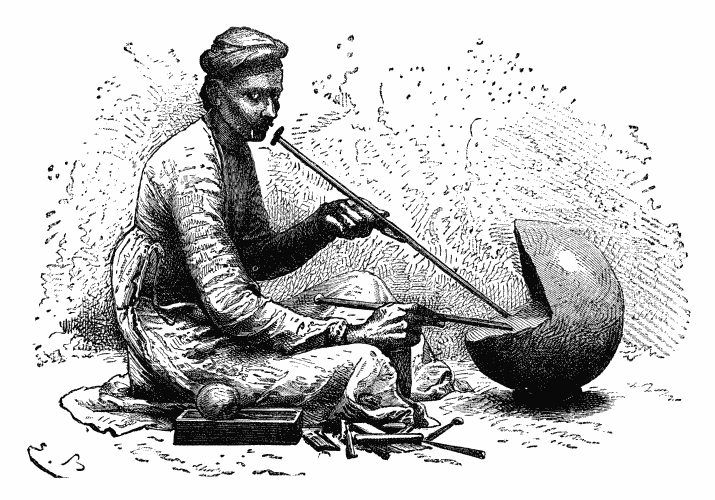
A JEWELLER AT WORK.
I must attempt a brief sketch of the history of Benares. We are sure it
was not among the first cities erected by the Aryans after leaving their
home in Central Asia and crossing the Indus. They first took possession
of the land in the far north-west of the great country they had entered,
and gradually made their way to the south and east. Wonderfully acute
and painstaking though the Pundit mind be, it has so dwelt in the
regions of speculation and imagination that it has paid no attention to
historical research. Its laborious productions have left us ignorant of
recent times, and we need not therefore wonder that, except by
incidental allusions, it throws no light on the early settlements of the
Aryans in India. We know that they brought with them a considerable
measure of civilization, and soon erected cities. Indraprastha, built
near the site of the present city of Delhi, and Hastinapore, some thirty
miles from it, figure largely in the Mahabharut, the giant Hindu epic.
Kunauj, lying east and south of Delhi, became some time afterwards the
capital of a widely extended empire, which lasted, with vicissitudes,
down to Muhammadan times. Benares is seen in the dim light of antiquity
as a favourite abode of Brahmans, and as sacred on that account, but it
does not appear that it ever was the seat of extended rule. For many a
day it was subject to Kunauj, and it afterwards came under the sway of
the Muhammadans, to whom it was subject for six hundred years.
BUDDHISM.
A clear proof of the influential position of Benares centuries before
the Christian era, is furnished by the fact that Gautama, the founder of
Buddhism, deemed it well to commence his public ministry there in the
sixth century B.C.[2] The spot where he first unfolded his doctrine
was a grove at a place now called Sarnath, about four miles from the
present city. At this place there is a large Buddhist tower, which is
seen from a great distance, and around it are extensive remains, which
have been excavated under the direction of Major-General Cunningham, and
have been found to be of Buddhist origin. The success which Buddhism had
achieved and maintained for centuries in the country where it arose, is
strikingly confirmed by the testimony of two Chinese Buddhists who went
on pilgrimage to India, the one in the fifth century A.D., and the other
towards the middle of the seventh. Their narratives have been preserved,
and furnish us with most interesting details. From them we learn that
down to the time of their visits Buddhism had temples, monasteries, and
thousands of adherents; but it had not the field to itself, for these
strangers tell us, especially the later of the two, that a large and
increasing number of the people were warmly attached to Hinduism. We
have no historical account of the overthrow of Buddhism, but we have
reason to believe that towards the close of the eleventh century, or
earlier, the devotees of Hinduism rose against it, and so stamped it out
that not a temple was left standing and not a monastery remained.
Major-General Cunningham says that about that period "the last votaries
of Buddha were expelled from the continent of India. Numbers of images,
concealed by the departing monks, are found buried near Sarnath; and
heaps of ashes still lie scattered amidst the ruins, to show that the
monasteries were destroyed by fire." This is confirmed by excavations
made at a later period by Major Kittoe, who says, "All has been sacked
and burned—priests, temples, idols, all together; for, in some places,
bones, iron, wood and stone, are found in huge masses: and this has
happened more than once." From Benares having been the scene of
Gautama's early ministry, and the place where his first disciples were
called, it stands high in the reverence of the millions who compose his
followers, although their only living representatives there now are a
few Jains, whom orthodox Buddhists regard as heretics.
THE SACREDNESS OF KASEE.
Long before the time of Gautama Hinduism prevailed at Benares, and we
have observed its rites were practised side by side with those of
Buddhism when the city was visited by two Chinese pilgrims. Some time
afterwards it obtained full sway under the form of fanatical devotion to
Shiva the Destroyer, and that sway it has maintained down to our day.
What Jerusalem is to the Jews; what Mecca is to the Muhammadans; what
Rome is to the Roman Catholics—that, and more than that, Benares is to
the Hindus. They form by far the largest portion of the population of
India, and to them Benares—or as they delight to call it, Kasee the
Splendid, the Glorious City—is the most sacred spot on earth. They say,
indeed, it is not built on the earth, but on a point of Shiva's trident.
They assert that at one time it was of gold, but in this degenerate age
it has been turned into stone and clay. In their belief the Ganges is
sacred through its entire course, but as it flows past the sacred city
its cleansing efficacy is supposed to be vastly increased. The rites
performed at Kasee have double merit, and its very soil and air are so
fraught with blessing that all who die there go to heaven, whatever
their character may be. With this belief diffused among the millions
who, differing widely from each other in nationality and language, are
devoted to Hinduism, it may be supposed how many eyes are reverently
turned towards Kasee, and with what eager steps and high expectations
vast numbers resort to it. I have frequently seen persons entering the
city, not on foot—that they did not deem sufficiently respectful—but
prostrating themselves on the ground, measuring the ground with their
bodies, and approaching the sacred shrines. And then, especially on the
occasion of great festivals, bands may be seen entering the city, often
composed of women—hand-in-hand lest they should lose each other in the
crowd—singing the praises of Shiva and the glories of his city. Many
aged people come from distant parts of India—the greater number, I
believe, from Bengal—to reside and end their days in it, that by
becoming Kasseebas (dwellers in Kasee) they may when they die become
Baikuntbas (dwellers in heaven).
Though Benares be par excellence the sacred city of the Hindus,
strange to say they are proportionately fewer than in ten cities of the
North-West. According to the census of 1872, there were 133,549 Hindus
and 44,374 Mussulmans: that is, a little more than three Hindus to one
Mussulman. In the great commercial city of Mirzapore, about thirty miles
distant from Benares, there were five Hindus to one Mussulman. The fact
thus certified is entirely at variance with the conjecture made by those
who look at the crowds bathing at the riverside, and frequenting the
temples, and contrast them with the small number seen in the mosques,
even on Friday, the Muhammadan weekly day of worship. In the district
the Hindus vastly out-number the Muhammadans.
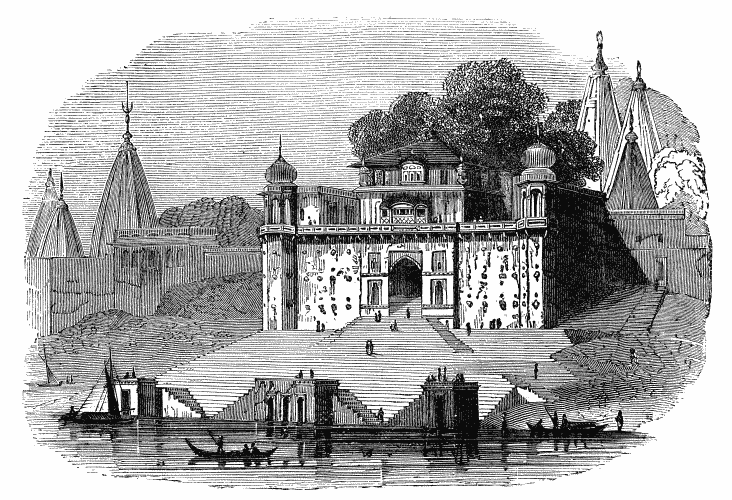
Benares is built on the left bank of the Ganges, and extends in a
crescent shape three miles and a half along the bank, and a little more
than a mile inward. The most imposing view is from a boat slowly
dropping down the stream in the early morning—the earlier the better,
especially if it be the hot season, as then the people betake themselves
to the river in greater numbers than at any other time. Travellers in
many lands who have seen this view, have declared it to be one of the
most remarkable sights of the kind which the world presents.
Photographic and pencil pictures of Benares have appeared in illustrated
newspapers, in periodicals and books, and give a more vivid and correct
impression than can be conveyed by a verbal description. These pictures
can, however, be better understood when those who look at them are
furnished with information which no picture can afford.
The right bank of the Ganges at Benares is very low, and is always
flooded when the river rises; but the left bank, on which the city
stands, is in many parts more than a hundred feet high. The river sweeps
round this high bank. The city is connected with the river by flights of
stone steps, called "ghats." This word ghat often meets the reader of
books on India. It has various meanings. It means a mountain-pass, a
ferry, a place on the riverside where people meet, and, as is the case
at Benares, the steps which lead down to the river. Two small streams
enter the Ganges at Benares—on the southern side the Assi, on the
northern side the Burna. Some have supposed that the city has received
its name from lying between these two rivulets—Burna, Assi, making the
word Burunassi, Benares; but this derivation is more than doubtful.
Others maintain the word comes from a famous rajah called Bunar; but
this, too, is a mere conjecture.
A TRIP ON THE RIVER.
Let me take my readers with me on a trip down the river. We embark at
early dawn on a native boat at Assi Sungam, which means the confluence
of the Assi with the Ganges, at the southern extremity. Towards that end
of the city some of the houses seen on the high bank are poor, some are
falling into decay; but as you advance, lofty buildings, some of them of
a size and grandeur which entitle them to the name of palaces, come into
view. Their numerous small windows, their rich and varied carving, their
balconies and flat roofs, give them a very Eastern look. Perhaps the
most notable of the buildings are an observatory, built by a famous
Rajput prince, Jae Singh, and a massy and extensive structure, with its
buttresses and high walls looking as if recently erected, which was
built in the last half of the eighteenth century by Cheit-Singh, the
Rajah of Benares at that time, who was deposed by Warren Hastings on
account of his refusal to comply with the demands of the British
Government. In Macaulay's famous Essay on Warren Hastings there is a
long narrative of this contest, which is amusingly at variance with the
narrative given by Warren Hastings himself. This building is still
called Cheit-Singh's Palace, but since his day it has been the property
of the British Government, and has been for many years the residence of
princes of the old imperial family of Delhi, who on account of family
troubles had come to reside in Benares, and were, happily for
themselves, far from Delhi during the mutiny of 1857. Some of the
mansions facing the river belong to Indian princes, who occupy them on
the rare occasion of visits to the city, and leave them in charge of
servants, of whom a number are Brahmans performing sacred rites on
their behalf.
There is one spot on the riverside from which most visitors avert their
eyes with horror—the place where the dead of Benares and the
surrounding country are being burnt, and the ashes thrown into the
stream. The fire at that place never goes out. Cremation, not burial, it
is well known, is the Indian mode of disposing of the dead.
The peculiarity of Benares as the sacred city of the country is
strikingly attested by the temples, which crowd the high bank of the
river, and arrest the special attention of the visitor. Some of these
are much larger and more expensive than others, but there is little
variety in their form; and all of them, even the largest and most
frequented, are small compared with Christian and Muhammadan places of
worship. They are circular, with heavy domes narrowing towards the top,
and, as a rule, with a narrow doorway alone admitting light and air.
Some domes are of respectable height, but none approach that of many of
our church towers and steeples. Most of the temples are sacred to Shiva,
Mahadeo, the Great God, as his devotees delight to call him, and are
surmounted by his trident. Many have a pole at their side with a flag
attached to it. One sees at a glance they must, though small, have cost
large sums, as they are most solidly built of hewn stone, and have all
more or less of ornamentation. A few temples are built close to the
water's edge. One has got off its equilibrium, and looks as if it were
about to fall into the stream; but for many years it has remained in
this tottering position.
BATHING IN THE SACRED STREAM.
While the houses and temples on the riverside are viewed with interest,
the visitor, as he looks from his boat, is still more interested in the
living mass before him. It is the early morning. The sun has just risen
above the horizon, and is shedding its bright rays on the river and the
city. It looks as if all the inhabitants were astir and had made their
way to the river. Crowds are seen on the steps, some even then making
their way back after having bathed, and others going down to the stream.
Thousands are in the water. Men and women, boys and girls, are
there—the men and women at a short distance from each other.
Immediately above the water are platforms with huge stationary umbrellas
over them, and on these men are squatted, whose portly appearance
betokens ease and plenty. These are Gungaputrs—sons of the Ganges—a
class of Brahmans, whose duty it is to take care of the clothes of the
people as they bathe, to put a mark on their forehead to show they have
bathed, and who receive a small offering from them as they retire. All
bring with them their bathing-dress, and they most deftly take off and
put on their scanty clothing. When the bathing is over they wring out
the clothes in which they have bathed, fill with Ganges water a small
brazen vessel, which each person carries with him, and make their way
into the city to pay their homage to their favourite gods before
proceeding to their homes. I have been told that the very devout among
them visit some thirty temples of a morning.
You watch the people as they bathe. It is evident they are not engaged
in mere ablution, so important for health and comfort in that hot
climate. They are engaged in worship. You see them taking up the water
of the Ganges in the palm of their hands, and offering it up to the sun
as they mutter certain prescribed words. You observe them making a
circular motion, and if sufficiently near you see them breathing
heavily, which you are told is their way of driving away demons, who
even in that sacred spot are said to haunt them. There is no united
worship: each worshipper apart performs his and her devotion. There is
incessant movement among the crowd. As the words of worship—I might
rather say the spells—they have been instructed to use are not
whispered but uttered, and by many with a loud voice, a stream of sound
falls on the ear. If, at some spot where bathers are not inconvenienced,
the boat be moored, and the visitor ascends the steps, he may find on
certain days, in two or three places, pundits reading and explaining the
Ramayan, or the Mahabharut, the great Hindu Epic Poems, to a crowd of
people, mainly composed of women. Sentence by sentence is read from
poetical translations made long ago, which require to be re-translated
into the ordinary language of the people to be generally intelligible.
We have occasionally stopped to hear these pundits, and, judging by what
we heard, we concluded they satisfied themselves with a loose paraphrase
of what they were reading. These men are rewarded with a respectful and
attentive hearing, and with something more substantial when the work is
over.
If the visitor is bent on obtaining a full impression of the work
continually carried on in Benares, he will make his way into the city
from one of the principal bathing-places. He will speedily find himself
in long narrow streets, with lofty stone houses on either side. The
buildings are of hewn stone, and of the most substantial description.
They have for the most part a narrow doorway, opening into a quadrangle,
around which are the apartments of the inmates. The streets are so
narrow that through some of them a vehicle cannot be taken, and in
others conveyances pass each other with difficulty. There are parts of
the narrower streets and lanes on which the sun never shines. In the few
cases where houses on both sides of the street opposite each other
belong to one proprietor, there is at the top a bridge by which the
inmates pass from one to the other.
WORSHIP IN THE TEMPLES.
Not the houses, however, but the temples, secure the chief attention of
the visitor. They are seen on every side. Numerous though they be, they
are not sufficient to meet the demands of the people. At every few steps
objects of worship meet your view. In niches of the walls are little
images, so worn by the weather and by the water poured on them by
worshippers that it is difficult to determine what they are intended to
represent. At your feet, close to the walls, you see misshapen stones
which are regarded as sacred. As you proceed you find yourself
accompanied by a crowd who have bathed, and who are going to complete
their morning worship by acts of obeisance to their gods. They are seen,
as they walk, bowing their heads and folding their hands before the
sacred objects that line their way. Every now and then one of a party
will raise the shout "Mahadeo jee kee jae!"—("Victory to the Great
God"), that is to Shiva, to whom this title is given; and the shout is
taken up and repeated by others till the street resounds. It has
occurred to me that this is done with peculiar force when Europeans are
within hearing.
THE TEMPLE OF BISHESHWAR.
You speedily find yourself at the principal temple of Benares—the
temple of Bisheshwar, sacred to Shiva under this name, which means Lord
of All. This temple is in the midst of a quadrangle, covered in with a
roof; over it are a tower, a dome, and a spire. The tower and dome
glitter in the sun like masses of burnished gold, and on this account
it is called the Golden Temple. Natives will tell you that it is covered
with plates of solid gold, but in fact it is merely gilded with gold
leaf, spread over plates of copper overlaying the stones beneath. Under
the dome is a belfry in which nine bells are suspended, and these are so
low that they can be tolled by the hand of those who frequent the
temple. We are told that the temple, including the tower, is fifty-one
feet in height. "Outside the enclosure is a large collection of deities,
raised upon a platform, called by the natives 'The Court of Mahadeo.'"
Though the gods in the Hindu books are represented as continually
quarrelling with each other, and their devotees take up their quarrels,
not only at the temple of Bisheshwar, but throughout the city which is
regarded as Shiva's own, they are seen side by side, as in perfect
amity, and there is not a single god who does not secure the special
devotion of some worshippers. It is, however, required of all who dwell
in Kasee, or frequent it, to acknowledge that Mahadeo is entitled to
supreme homage, and that to him in the first instance obeisance must be
made. The symbol of Shiva, or Mahadeo, which is found wherever he is
worshipped, is the Linga, a conical stone, which does not in itself
suggest any impure notion, but which is intended to be a vile
representation. In this famous temple this conical stone receives
special honour. There, too, are figures of Shiva himself in all his
hideousness, with his three eyes, covered with ashes, and his eyes
inflamed with intoxicating herbs. Outside the temple there is a figure
cut in stone of a bull seven feet high, sacred to the god, as this is
his favourite animal for riding. Within the quadrangle there is a well
called Gyan Bapee, the well of knowledge, to which it is said the god
betook himself when he was expelled from his former temple by the bigot
Emperor Aurungzeb. On this account the well is deemed specially sacred.
It is surmounted by a handsome low-roofed colonnade with forty pillars.
It is covered with an iron grating, in which there is an aperture for
small vessels to be let down into it, which when full are drawn up, and
the water thus drawn is highly prized. As from day to day a large
quantity of flowers are thrown into it, it may be supposed how horrible
its water and how offensive its smell; it is a wonder the people are not
poisoned by it.
We must not proceed further with this description of Bisheshwar's
temple. Those who wish for more information can find it in the ample
details given by Mr. Sherring.
To this temple thousands resort every day. It is open, and priests are
present, we are told, twenty hours in the twenty-four. It is only shut
from midnight till four in the morning. The temple itself holds a very
small number, and the entire quadrangle would be crowded by one of our
large congregations. The people press into it in one continuous stream,
toll a bell to draw the attention of the god, make their obeisance, pour
on the object of their worship a little of the Ganges water from the
small brazen vessel they have in their hand, throw on it some flowers,
give a present to the attendant priests, go round the building with
their right hand towards it, and pass away to give place to others.
How does the visitor regard this scene? Apart from the consideration of
the dishonour done to the ever-blessed God by worship rendered to images
representing gods that are no gods—by which, if a Christian, he must be
painfully affected—there is much in the scene before him to impress
him with the sottish folly into which man can sink in his religious
views and practices; and there is nothing to draw forth his regard and
sympathy, except it be the fervour, the deep though mistaken fervour, of
some of the worshippers, especially of the women, who may sometimes be
seen with children in their arms teaching them to make obeisance to the
idol. In Roman Catholic worship there is much which, as Protestants
ruled by the Bible, we rightly condemn; but in the gorgeous vestments of
its priests, in the magnificence of many of the places in which they
minister, in the grand strains of their music and in their processions,
there is much to impress the senses and awe the mind; but in the worship
carried on in the temple of Bisheshwar it is difficult to find a
redeeming quality. The whole scene is repulsive. The place is sloppy
with the water poured out by the worshippers, and is littered by the
flowers they present. The ear is assailed with harsh sounds. The
ministering priests—Pundas as they are called—are, as a rule,
coarse-looking men, with shaven head, save with a long pendent tuft from
the crown, with the mark of their god on their forehead, and are very
scantily attired. They clamour for a present when a European appears,
and if given it is declared to be an offering to the god of the place.
Among the crowd you see men with matted hair and body bedaubed with
ashes, who have broken away from all domestic and social duties, and
devote themselves to what is called a religious life. Some of these
ascetics are no doubt impelled to follow the life they lead by a
superstitious feeling, but many are idle vagabonds ready for the
practice of every villainy, who find it more pleasant to roam about the
land and live on others than support themselves by honest labour. The
people dread their curse, but many give them neither respect nor love.
At a place like Bisheshwar's temple there is always a host of ordinary
beggars, who clamour for alms, and receive from some two or three
shells, called cowries, sixty of which go to make up a halfpenny, from
others a little grain, and from the more liberal or more wealthy a small
coin.
THE MOSQUE OF AURUNGZEB.
From this stirring scene you have only a few steps to go to find
yourself in the large mosque built by the Emperor Aurungzeb on the site
of the old temple of Bisheshwar, which was thrown down to give place to
it. The contrast is very striking. You have left the bustling, noisy
crowd, and see only a few individuals in the attitude of devotion—now
standing with folded hands, then on their knees, then with forehead
touching the floor, engaged in supplicating the Invisible One. Instead
of grotesque and repulsive images meeting your view, you see very little
ornament of any kind, and are impressed with the severe simplicity of
the lofty building. The more one knows of Muhammadanism, the more
grievous are its defects and errors seen to be; but in the simplicity of
its mosques, which has nothing in common with the sordid barn-like
bareness too characteristic at one time of many places of worship in our
own land, there is much from which Christians might learn a useful
lesson.
Within a stone's throw of Bisheshwar's temple there is a host of
temples, none of them very large, some of them small, but most covered
with carving, to some extent for mere ornamentation, but chiefly for the
purpose of illustrating the objects of Hindu worship. If you visit them
you will see everything is accordant with the great shrine you have
left. You will see Shiva, sometimes seated on a bull, sometimes on a
dog; his hideous partner Durga, with her eight arms and her ferocious
look, indicating her delight in blood; Hanuman, the monkey-god, with his
huge tail; Krishna engaged in his gambols; Ganesh, the god of wisdom,
with his elephant head and protuberant belly; and many others beside.
Everything you see is wild, grotesque, unnatural, forbidding, utterly
wanting in verisimilitude and refinement, with nothing to purify and
raise the people, with everything fitted to pervert their taste and
lower their character; and yet, I must add, with everything to give a
faithful representation of the mythology prepared by their religious
leaders. The pundits who wrote the sacred books of the Hindus were men
of great talent, of abundant leisure; and it is a marvel to me, of which
I can give no explanation, how they spent their days in spinning the
wildest legends, and in setting forth their gods as performing the most
fantastic, capricious, foolish, and wicked deeds, when they had a clear
canvas before them, and might have filled it with something worthy of
our nature, and worthy of objects to be worshipped.
Aurungzeb's mosque has two lofty minarets, rising about a hundred and
fifty feet above its floor, and thus having from the river an elevation
of two hundred and fifty feet. From a boat on the river the visitor has
the nearest and most impressive view of the city, with its peculiarities
as the high place of Hindu worship. If he proceed to the top of one of
the minarets, which is reached by a steep, dark spiral stair, he will
have a most commanding and extensive view of the city, the river, and
the country for many miles around. He will see that while the streets in
the centre of the city are long and narrow, and have very lofty houses,
beyond these the roads widen, and many of the houses are poor and mean.
As his eye falls on the part beyond the most crowded portion, he will
observe here and there fine mansions with gardens around them, evidently
belonging to the wealthy portion of the community, but surrounded by
poor streets.
RETURN TO THE EUROPEAN STATION.
After seeing what I have endeavoured to describe, the traveller is well
pleased to get back to his boat, and to drop down the river to Raj Ghat,
the northern end of the city, where, after his fatigue, he is happy to
find a conveyance to convey him to the European station more than three
miles distant.
During my residence in Benares I often made this trip from Assi-Sungam
to Raj Ghat, generally in company with strangers. The last time I made
it I was accompanied by the late Dr. Norman McLeod of Glasgow, and the
late Dr. Watson of Dundee. They were greatly interested in what they
saw, and repeatedly said the reality exceeded their expectation. Dr.
McLeod was specially eager to see everything that could be seen, and in
his own strong genial way expressed the feelings excited by the strange
scenes before him.
I must press into the concluding part of this chapter, as concisely as I
can, some additional facts which call for special notice.
The city as it now stands is quite modern. Though foundations dug up,
and pieces of masonry seen in existing buildings, testify to its
antiquity, we are told by those who are best qualified to judge that
there is not a single house or temple the erection of which can be
relegated to a more remote period than the reign of Akbar, who was a
contemporary of our Queen Elizabeth.
Various estimates have been given of the number of temples. According
to the census of 1872 the number is 1,454. This does not include smaller
shrines in niches in the walls, which may be reckoned by thousands. The
temples are constantly increasing in number; at no previous period were
there so many as at present. Traders and bankers have prospered greatly
under our rule, and, if devout Hindus, they deem themselves bound to
devote a part of their wealth to the erection of a temple. A regard to
their honour as well as to their gods prompts them to this spending of
their money.
So far as I have been able to ascertain, the temples of Benares have
very little of either funded or landed property. The vast sum required
for the support of the priesthood comes mainly from the offerings of the
people.
The "Imperial Gazetteer" of India gives no account in its last census of
the castes of Benares, but we are sure that many thousands of the
inhabitants are Brahmans. They are greatly subdivided, and are so
different in rank and occupation that they keep as separate from each
other as if they had no caste in common. The Pundas officiate in the
temples; the Gangaputrs, the sons of the Ganges, minister at the
waterside; the Purohits are the family priests; and the Pundits, the
most esteemed of all, are the learned men who study the Shastres, and
expound them to the people as occasion requires. Hindus generally have
their Gurus, religious guides, who perform to them very much the work
done for Roman Catholics by father confessors. These may be family
priests, learned men; or, in the case of the lower castes, the lower
orders of Brahmans. A vast number of the sacred caste have nothing to do
with religious services. They are engaged in various businesses. A
considerable number are cooks in the houses of the wealthy, as from
their hand all can eat, while they in many cases would consider it an
intolerable insult to be asked to eat with their masters. Not a few are
beggars.
There are places in Benares to which people resort almost as much as to
the temple of Bisheshwar. Among these I may mention the tank of
Pishachmochan, a word meaning deliverance from demons, as bathing in it
is considered very efficacious in securing this end, and the temple and
tank of Durga at a place called Durgakund. At this latter place there
are many hundreds of monkeys—some say thousands, though this is
doubtless an exaggeration—which scamper about in all directions, and
fare well at the hands of Durga's worshippers. These animals are deemed
gods and goddesses, and woe to the person who does them any harm.
The monkeys are not the only animals deemed sacred at Benares. All who
have heard anything about the city have heard about the well-fed lazy
bulls prowling about the streets, and insisting on making free with the
goods of the vegetable and grain sellers. These are no longer to be seen
going about in their former fashion. I shall have something to say
afterwards about them.
FESTIVALS AT BENARES.
Mr. Sherring gives an account of forty melas, or religious festivals, in
the course of the year in Benares. The principal of these are the Holee,
the Saturnalia of the Hindus, the Ram Leela (the dramatic representation
of the life of Ram as given in the epic poem, "The Ramayan"), and the
Pilgrimage of the Panch Kosee, when the people make the circuit of the
city, and halt for the night at certain assigned stations. On the
occasion of eclipses vast numbers resort to Benares from all parts of
India.
Benares has long been considered the Oxford of India. Its learned men
have from ancient times been famed for their learning, and the aspirants
for Hindu lore—all members of the same caste with themselves—have from
generation to generation sat at their feet. They have had no grand
academic halls in which to give their prelections; they have taken no
fees from their pupils; they have met in very humble rooms, or in the
open air in a garden under trees; but both teachers and students have
been characterized by an assiduity and a perseverance which the most
laborious of German scholars rarely attain. The very modest requirements
of these learned men have as a rule been met unasked by the princes and
wealthy of the land.
In 1791, a very short time after Benares was brought directly under
British rule, a Sanscrit college was founded by the payment of certain
pundits, who were left to carry on their work unchecked by any
authority, or even suggestion, from without. It is said that pundits of
the highest repute refused to have anything to do with the foreigner. In
1853 a very fine Gothic structure, said to be the most imposing building
erected by the British in India, was opened under the name of the
Queen's College, for the accommodation of students in both Western and
Eastern learning. Here both English and Sanscrit are studied, and under
the first Principal, the late Dr. Ballantyne, vigorous, and I hope to
some degree successful, effort was put forth to infuse Western
literature, philosophy, and science into the pundit mind.
I have mentioned the number of Muhammadans residing at Benares. It is
officially stated they have 272 mosques, of which that of Aurungzeb,
with its lofty minarets, is the largest. Hindus must have looked with
horror on the sacrilegious deed by which this mosque was erected on the
site of the demolished temple of Bisheshwar; but the power of the bigot
emperor was so great that they could do nothing more than invocate
curses on his head. The close neighbourhood of this mosque to the most
frequented temple, and the remembrance of the building which formerly
occupied its site, have produced a bitter feeling towards the followers
of Muhammad. Early in this century there was a furious contest between
the two classes of religionists, which lasted for some days, and was at
last quelled by the military. During the fight every conceivable insult
was offered to each other's feelings, and lives were lost. The
Muhammadans suffered most, and since that time they seem to have been
cowed, so that there has been much less fighting between them and their
Hindu neighbours than in some other cities in the North-West.
The city has two great squares, occupied as market-places, in which
goods of every description are exhibited and sold in the Eastern
fashion. They present a stirring scene of an afternoon, which is the
principal time of business.
CENSUS RETURNS.
In the census of 1872 the occupations of all males above fifteen years
of age are noted. I give some of the items—
| Alms-takers |
184 |
| Beggars |
3,490 |
| Barbers |
979 |
| Pundits |
96 |
| Priests (temple or ghat) |
2,809 |
| Purohits (family priests) |
1,273 |
| Servants |
14,309 |
I suppose the distinction between alms-takers and beggars is that the
former class deem it beneath them to ask, but have no objection to take
alms, while the latter class both ask and take. Among the latter, beside
the blind and helpless, many able-bodied men make beggary their
profession. On one occasion, in the neighbourhood of Benares, I met a
man in the prime of life who said he had just returned from a long
journey. On referring to his business he frankly said that he had never
had any other occupation than that of a beggar. This was his hereditary
profession. We have no Poor Law in India. The people, from varied
motives, are ever ready to give aid to those who cannot support
themselves, and in addition exercise an indiscriminate charity, which
has a demoralizing effect.
The census informs us there are in Benares 16,023 masonry houses, and
21,551 mud houses—that is, houses many of which are of mud moistened
and dried as the walls rise—and others of sun-dried bricks. I do not
wonder at the disappointment felt by some who have been much impressed
with the front view of the city, and have then traversed its streets.
Till recently, from the commencement of our rule, our Government has
never been at peace with all the native rulers of India. In various ways
we have come into collision with them, and the final result in every
case has been their overthrow. The deposed rajahs have as a rule been
sent to Benares, as if our Government wished to compensate them for the
loss of their dominion by conferring on them special religious
advantages.
On the opposite side of the Ganges, a little above the southern end of
the city, is the town of Ramnuggur, with a population of 10,000. It is
the residence of the Rajah of Benares, who is simply a large landowner,
and has no authority beyond that which wealth confers. His palace, or
rather fort, is close to the river. Behind the town, close to the
Rajah's garden, there is a large tank, and a temple facing it which is
remarkable for the exquisite carving on its walls illustrative of Hindu
mythology.
MACAULEY'S DESCRIPTION OF BENARES.
I end this account of Benares by an extract from Macaulay's Essay on
Warren Hastings, in which, in his own high rhetorical fashion, which so
readily yields itself to exaggeration, he describes the city. If I
remember rightly, there is no mention in his biography of his having
visited the North-West, and his description is therefore not that of an
eye-witness.
"The first design of Warren Hastings was on Benares, a city which in
wealth, population, dignity, and sanctity was among the foremost in
Asia. It was commonly believed that half a million of human beings was
crowded into that labyrinth of lofty alleys, rich with shrines, and
minarets, and balconies, and carved oriels, to which the sacred apes
clung by hundreds. The traveller could scarcely make his way through the
press of holy mendicants and not less holy bulls. The broad and stately
flights of steps which descended from these swarming haunts to the
bathing places along the Ganges were worn every day by the footsteps of
an innumerable multitude of worshippers. The schools and temples drew
crowds of pious Hindus from every province where the Brahmanical faith
was known. Hundreds of devotees came thither every month to die, for it
was believed that a peculiarly happy fate awaited the man who should
pass from the sacred city into the sacred river. Nor was superstition
the only motive which allured strangers to that great metropolis.
Commerce had as many pilgrims as religion. All along the shores of the
venerable stream lay great fleets of vessels laden with rich
merchandise. From the looms of Benares went forth the most delicate
silks that adorned the balls of St. James's and of Versailles; and in
the bazars the muslins of Bengal and the sabres of Oude were mingled
with the jewels of Golconda and the shawls of Cashmere."