LIFE AND DEATH
A HINDU LEGEND
I
LIFE AND DEATH
There were two regions lying side by side, as it were two immense plains,
with a clear river flowing between them.
At one point the banks of this river sloped gently to a shallow ford in
the shape of a pond with transparent, calm water.
Beneath the azure surface of this ford could be seen its golden bed, from
which grew stems of lotus; on those stems bloomed white and rose-colored
flowers above the mirror of water. Rainbow-hued insects and butterflies
circled around the flowers and among the palms of the shore, while higher
up in the sunny air birds gave out sounds like those of silver bells. This
pond was the passage from one region to the other.
The first region was called the Plain of Life, the second the Plain of
Death.
The supreme and all mighty Brahma had created both plains, and had
commanded the good Vishnu to rule in the Region of Life, while the wise
Siva was lord in the Region of Death.
“Do what ye understand to be best,” said Brahma to the two rulers.
Hence in the region belonging to Vishnu life moved with all its activity.
The sun rose and set; day followed night, and night followed day; the sea
rose and fell; in the sky appeared clouds big with rain; the earth was
soon covered with forests, and crowded with beasts, birds, and people.
So that all living creatures might increase greatly and multiply, the
kindly god created Love, which he made to be Happiness also.
After this Brahma summoned Vishnu and said to him:
“Thou canst produce nothing better on earth, and since heaven is created
already by me, do thou rest and let those whom thou callest people weave
the thread of life for themselves unassisted.”
Vishnu obeyed this command, and henceforward men ordered their own lives.
From their good thoughts came joy, from their evil ones, sorrow; and they
saw soon with wonder that life was not an unbroken rejoicing, but that
with the life thread which Brahma had mentioned they wove out two webs as
it were with two faces,—on one of these was a smile; there were tears in
the eyes of the other.
They went then to the throne of Vishnu and made complaint to him:
“O Lord! life is grievous through sorrow.”
“Let Love give you happiness,” said Vishnu in answer.
At these words they went away quieted, for Love indeed scattered their
sorrows, which, in view of the happiness given, seemed so insignificant as
to be undeserving of notice.
But Love is also the mighty mother of life, hence, though the region which
Vishnu ruled was enormous, it was soon insufficient for the myriads of
people; soon there was not fruit enough upon trees there, nor berries
enough upon bushes, nor honey enough from cliff bees.
Thereupon all the men who were wisest fell to cutting down forests for the
clearing of land, for the sowing of seed, for the winning of harvests.
Thus Labor appeared among people. Soon all had to turn to it, and labor
became not merely the basis of life, but life itself very nearly.
But from Labor came Toil, and Toil produced Weariness.
Great throngs of people appeared before Vishnu a second time.
“O Lord!” exclaimed they, stretching their hands to him, “toil has
weakened our bodies, weariness spreads through our bones, we are yearning
for rest, but Life drives us always to labor.”
To this Vishnu answered:
“The great and all mighty Brahma has not allowed me to shape Life any
further, but I am free to make that which will cause it to halt, and rest
will come then to you.”
And Vishnu made Sleep.
Men received this new gift with rejoicing, and very soon saw in it one of
the greatest boons given by the deity thus far. In sleep vanished care and
vexation, during sleep strength returned to the weary; sleep, like a
cherishing mother, wiped away tears of sorrow and surrounded the heads of
the slumbering with oblivion.
So people glorified sleep, and repeated:
“Be blessed, for thou art far better than life in our waking hours.”
And they had one regret only, that it did not continue forever. After
sleep came awakening, and after awakening came labor with fresh toil and
weariness.
This thought began soon to torture all men so sorely, that for the third
time they stood before Vishnu.
“O Lord,” said they, “thou hast given us a boon which, though great and
unspeakably precious, is incomplete as it now appears. Wilt thou grant us
that sleep be eternal?”
Vishnu wrinkled his brows then in anger at this their insistence, and
answered:
“I cannot give what ye ask of me, but go to the neighboring ford, and
beyond ye will find that for which ye are seeking.”
The people heard the god’s voice and went on in legions immediately. They
went to the ford, and, halting there, gazed at the shore lying opposite.
Beyond the clear, calm, and flower-bedecked surface stretched the Plain of
Death, or the Kingdom of Siva.
The sun never rose and never set in that region; there was no day and no
night there, but the whole plain was of a lily-colored, absolute
clearness. No shadow fell in that region, for clearness inhered there so
thoroughly that it seemed the real essence of Siva’s dominions.
The region was not empty. As far as the eye could reach were seen heights
and valleys where beautiful trees stood in groups; on those trees rose
climbing plants, while ivy and grapevines were hanging from the cliff
sides.
But the cliffs and the tree trunks and the slender plant stems were almost
transparent, as if formed out of light grown material. The leaves of the
ivy had in them a delicate roseate light as of dawn. And all was in
marvellous rest, such as none on the Plain of Life had experienced; all
was as if sunk in serene meditation, as if dreaming and resting in
continuous slumber, unthreatened by waking.
In the clear air not the slightest breeze was discovered, not a flower was
seen moving, not a leaf showed a quiver.
The people who had come to the shore with loud conversation and clamor
grew silent at sight of those lily-colored, motionless spaces, and
whispered:
“What quiet! How everything rests there in clearness!”
“Oh, yes, there is rest and unbroken repose in that region.”
So some, namely, those who were weariest, said after a silence:
“Let us find the sleep which is surely unbroken.”
And they entered the water. The rainbow-hued surface opened straightway
before them, as if wishing to lighten the passage. Those who remained on
the shore began now to call after them, but no man turned his head, and
all hurried forward with willingness and lightly, attracted more and more
by the charm of that wonderful region.
The throng which gazed from the shore of Life at them noted this also:
that as they moved forward their bodies grew gradually less heavy,
becoming transparent and purer, more radiant, and as it were blending with
that absolute clearness which filled the whole Plain of Death, Siva’s
kingdom.
And when they had passed and disposed themselves amid flowers and at trees
or the bases of cliffs, to repose there, their eyes were closed, but their
faces had on them not only an expression of ineffable peace, but also of
happiness such as Love itself on the Plain of Life had never given.
Seeing this, those who had halted behind said one to another:
“The region belonging to Siva is sweeter and better.”
And they began to pass to that shore in increasing numbers. There went in
solemn procession old men, and men in ripe years, and husbands and wives,
and mothers who led little children, and maidens, and youths, and then
thousands and millions of people pushed on toward that Calm Passage, till
at last the Plain of Life was depopulated almost entirely.
Then Vishnu, whose task it was to keep life from extinction, was
frightened because of the advice which he had given in his anger, and not
knowing what to do else hastened quickly to Brahma.
“Save Life, O Creator!” said he. “Behold, thou hast made the inheritance
of Death now so beautiful, so serene, and so blissful that all men are
leaving my kingdom.”
“Have none remained with thee there?” inquired Brahma.
“Only one youth and one maiden, who are in love beyond measure; they
renounce endless bliss rather than close their eyes and gaze on each other
no longer.”
“What dost thou wish, then?”
“Make the region of Death less delightful, less happy; if not, even those
two when their springtime of love shall be ended will leave me and follow
the others.”
Brahma thought for a moment and answered:
“No! Oh no! I will not decrease beauty and happiness in the region of
Death, but I will do something for Life in its own realm. Henceforward
people will not pass to the other shore willingly, they must be forced to
it.”
When he had said this he made a thick veil out of darkness which no one
could see through, and next he created two terrible beings, one of these
he named Fear and the other one Pain. He commanded them then to hang that
black veil at the Passage.
Thereafter Vishnu’s kingdom was as crowded with life as it had been, for
though the region of Death was as calm, as serene, and as blissful as
ever, people dreaded the Passage.
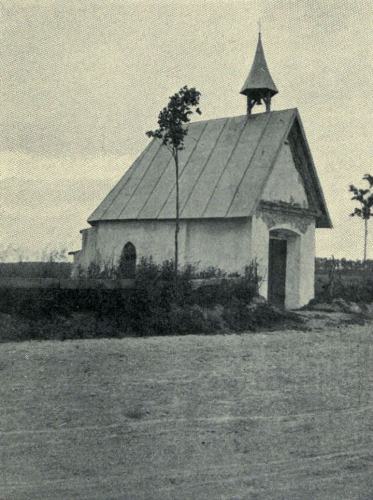
SMALL CHAPEL ON THE SIENKIEWICZ ESTATE