1745-1747. Æt. 34-36.
Hume's Residence with the Marquis of Annandale—His
Predecessor Colonel Forrester—Correspondence with Sir James
Johnstone and Mr. Sharp of Hoddam—Quarrel with Captain
Vincent—Estimate of his Conduct, and Inquiry into the
Circumstances in which he was placed—Appointed Secretary to
General St. Clair—Accompanies the expedition against the
Court of France as Judge-Advocate—Gives an Account of the
Attack on Port L'Orient—A tragic Incident.
Hume's history of his residence with the Marquis of Annandale, is given
in the following brief terms, in his "own life." "In 1745, I received a
letter from the Marquis of Annandale, inviting me to come and live with
him in England: I found, also, that the friends and family of that young
nobleman were desirous of putting him under my care and direction, for
the state of his mind and health required it. I lived with him a
twelvemonth. My appointments during that time made a considerable
accession to my small fortune."
It might have been favourable perhaps to the dignity of his position in
the world of letters, that this episode in his history had never been
more fully narrated; for a philosopher conducting a litigation for £75
of arrears of salary, is apt to experience that diminution of respect in
the eyes of the public, which the prince of Condé discovered that a hero
suffered in those of his valet. Since, however, many statements have
been given to the world, connected with that part of Hume's life, and
many charges and countercharges among the persons connected with it are
preserved, it is necessary to give such a brief view of the whole
affair, as may enable the reader to estimate the respective merits of
the parties in the dispute. A collection of documents on the subject was
lately published by a gentleman to whom the literary history of Scotland
is indebted for many other services;[171:1] and from his book the
following statement is compiled.
The person with whom David Hume was thus connected was the last Marquis
of Annandale, on whose death that title became dormant. On the 5th of
March, 1748, he was found, on an inquest from the Court of Chancery in
England, to be a lunatic, incapable of governing himself and managing
his own affairs, and to have been so since 12th December, 1744, a few
months anterior to Hume's engagement with him. The correspondence does
not give the reader the notion of one reduced to so abject a mental
state, but rather that of a man nervously timid and reserved;
distrustful of himself and his ability to transact business with other
people, but not quite incapable of managing his affairs, though
exciteable, and liable to be driven into fits of passion by causes not
susceptible of being anticipated. A party to the correspondence, talking
of him as in an improved condition, says: "My Lord walked out with me
lately two or three miles, received and returned the compliments of the
hat of those we met, and without any shyness or reserve: and bears to
stand by, and hear me talk with any farmer or countryman. This is a vast
change for the better, and the greatest appearance that it will
continue."[172:1] He appears to have been haunted by a spirit of
literary ambition. Hume says in a letter to Lord Elibank, "I have copied
out half a dozen of epigrams, which I hope will give you entertainment.
The thought in them is indeed little inferior to that in the celebrated
Epigrams of Rousseau; though the versification be not so correct. What a
pity! I say this on account both of the author and myself; for I am
afraid I must leave him." And on another occasion he alludes at length
to a far more extensive literary achievement, a novel, which the
excited Marquis had written, and which those about him had found it
necessary to print, circulating a few copies, and advertising it in one
newspaper to allay any suspicions in the author's mind that a thousand
copies had not been printed. Hume says:
"You would certainly be a little surprised and vexed on receiving a
printed copy of the novel, which was in hands when you left London. If I
did not explain the mystery to you, I believe I told you, that I hoped
that affair was entirely over, by my employing Lord Marchmont and Lord
Bolingbroke's authority against publishing that novel; though you will
readily suppose that neither of these two noble Lords ever perused it.
This machine operated for six weeks; but the vanity of the author
returned with redoubled force, fortified by suspicions, and increased by
the delay. 'Pardie,' dit il, 'je crois que ces messieurs veulent être
les seules Seigneurs d'Angleterre qui eussent de l'esprit. Mais je leur
montrerai ce que le petit A—— peut faire aussi.' In short, we were
obliged to print off thirty copies, to make him believe that we had
printed a thousand, and that they were to be dispersed all over the
kingdom.
"My Lady Marchioness will also receive a copy, and I am afraid it may
give her a good deal of uneasiness, by reason of the story alluded to in
the novel, and which she may imagine my Lord is resolved to bring to
execution. Be so good, therefore, as to inform her, that I hope this
affair is all over. I discovered, about a fortnight ago, that one of the
papers sent to that damsel had been sent back by her under cover to his
rival, Mr. M'——, and that she had plainly, by that step, sacrificed
him to her other lover. This was real matter of fact, and I had the
good fortune to convince him of it; so that his pride seems to have got
the better of his passion, and he never talks of her at present."
The "novel" appears to have referred to some little event in its
author's private history. If there be a copy of it now any where
existing, it is to be feared that it wastes its fragrance on the desert
air, as the existence of so choice a flower of literature, were it in
the possession of any collector, could not fail to have been rumoured
through the bibliographical world.
The Marquis had previously been attended by a succession of hired
companions, of whom one was a man of considerable distinction, Colonel
James Forrester,[174:1] a person who, in the Scottish society of the
age, seems to have united some of the qualities of a Chesterfield to a
like proportion of those of a Beau Fielding. He was the author of "The
Polite Philosopher;" a lively little essay, sometimes published along
with Chesterfield's "Advice," in which the author is so much at ease
with his reader, that he discourses in prose or poetry as his own humour
dictates. Johnson said, with reference to the man and the book, that "he
was himself the great polite he drew;" and if it did not happen that his
coxcombry excited the poor invalid's irritable nerves to distraction, he
was probably an infinitely more suitable man for the office of companion
to the Marquis of Annandale, than David Hume.
The overtures to Hume were made by the Marquis himself; who was,
according to an expression used by Sir James Johnstone, when writing to
Hume, "charmed with something contained in his Essays." The place of
residence of the Marquis was Weldhall, near St. Alban's, in
Hertfordshire. Hume had to go to London to make the anticipatory
arrangements, and he commenced his companionship on 1st April, 1745. The
insurrection, headed by Prince Charles Edward in Scotland, commenced
four months afterwards; and there is perhaps nothing more curious in
the whole dispute than the indifference with which this matter, fraught
with so much importance to his countrymen, is spoken of by Hume; while
there could not probably be a better answer to those who afterwards
insinuated that he was a Jacobite, than an account of the manner in
which his thoughts were occupied during that struggle. He occasionally
complains that he is prevented from personally discussing, with the
individuals interested, the matters he is writing about, on account of
"the present unhappy troubles;" and the following portion of a letter to
Sir James Johnstone of Westerhall, the brother of the Marquis's
stepfather, written immediately after he had left his attendance on the
Marquis, is the only occasion in which he appears to show the least
sympathy in the conflict or its results.
"Portsmouth, June 6, 1746.
"Dear Sir,—I have always sympathized very cordially with you,
whenever I met with any of the names, wherein you was
interested, in any of the public papers; but I hope that one
of the persons is now safe by his escape, and the other
protected by her sex and innocence.[176:1] We live not now in
a time, when public crimes are supposed to cancel all private
ties, or when the duties of relation, even though executed
beyond the usual bounds, will render the persons criminal. I
am willing, therefore, to flatter myself, that your anxiety
must now be in a great measure over, and that a more happy
conclusion of so calamitous an affair could not be expected,
either for private individuals or for the public. Some little
time ago, we had here a conversation with regard to L——, and
other persons in her condition, when General St. Clair said,
that he heard, from some of the ministers, that the intentions
of the menaces, or even of the intended prosecutions (if they
went so far,) were not to proceed to execution; but only to
teach our countrywomen (many of whom had gone beyond all
bounds) that their sex was no absolute protection to them, and
that they were equally exposed to the law with the other sex.
However, I doubt not but your friend has no occasion for their
clemency, whatever may be the case with the other ladies in
the same situation, who had particularly valued themselves
upon their activity and courage."
It is now necessary to enter on a subject, which one feels a natural
inclination to postpone, as long as the order of events will afford any
excuse for looking at other things: the treatment Hume experienced in
this his self-adopted slavery. He had to deal with a capricious
unreasonable employer; to that he would, in the circumstances,
philosophically reconcile himself. He states in one of his letters, that
he lived with him "in a more equal way of complaisance and good humour
than could well have been expected. Some little disgusts and humours
could not be prevented, and never were proposed to be of any
consequence." But he had another and a far more unpleasant person to
deal with, in a certain Philip Vincent, a captain in the navy,[178:1] a
relation of the Dowager-marchioness of Annandale. For some months
matters appear to have gone smoothly with all concerned. The following
letter to one of his esteemed friends, shows that Hume was consoling
himself for the probable dissipation of his hopes of a professorship, by
reflecting on his good fortune in being connected with so amiable and
excellent a man as Captain Vincent:—
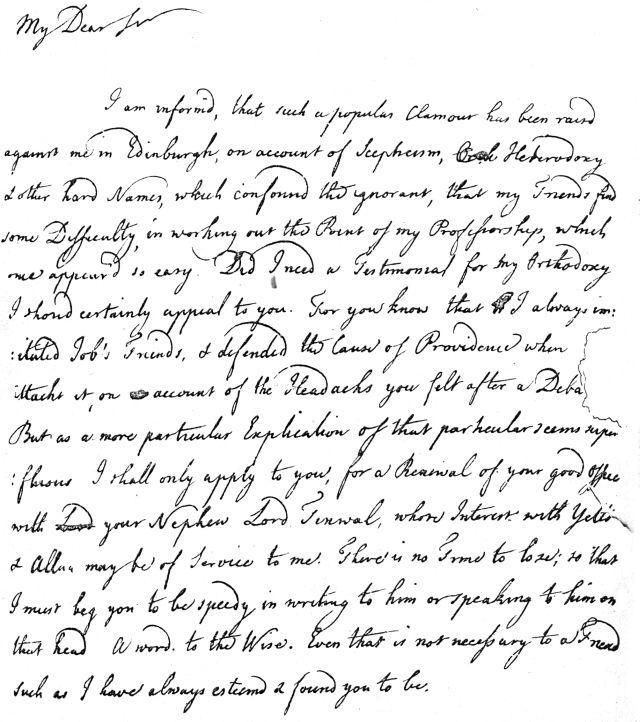
Hume to Matthew Sharp of Hoddam.[178:2]
"My Dear Sir,—I am informed that such a popular clamour has
been raised against me in Edinburgh, on account of scepticism,
heterodoxy, and other hard names, which confound the ignorant,
that my friends find some difficulty, in working out the point
of my professorship, which once appeared so easy. Did I need a
testimonial for my orthodoxy, I should certainly appeal to
you; for you know that I always imitated Job's friends, and
defended the cause of Providence when [you] attacked it, on
account of the headachs you felt after a deba[uch.] But, as a
more particular explication of that particular seems superfluous,
I shall only apply to you for a renewal of your good offices
with your nephew, Lord Tinwal,[179:1] whose interest with
Yetts and Allan may be of service to me. There is no time to
lose; so that I must beg you to be speedy in writing to him, or
speaking to him on that head. A word to the wise. Even that is
not necessary to a friend, such as I have always esteemed and
found you to be.
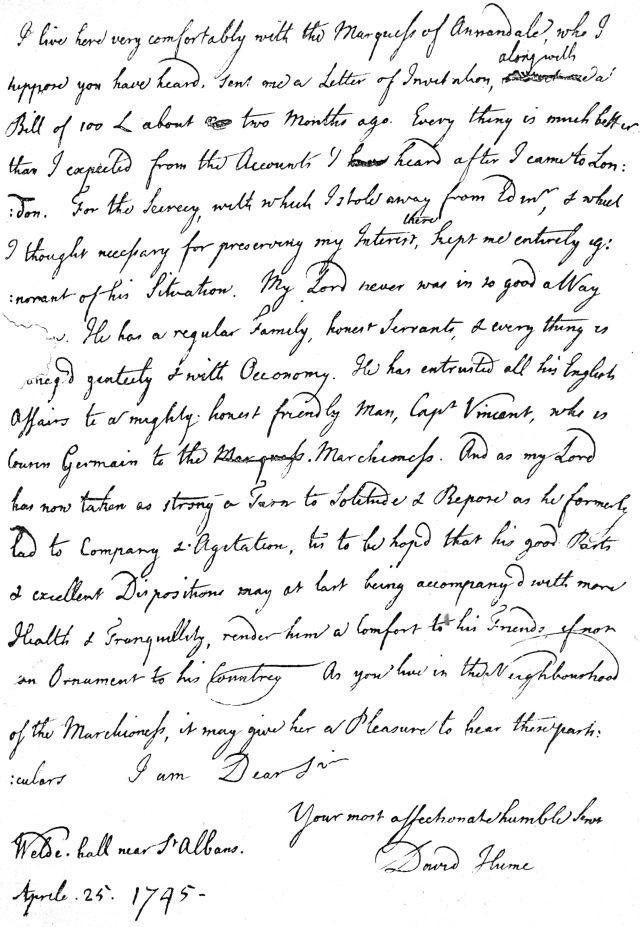
"I live here very comfortably with the Marquis of Annandale,
who, I suppose you have heard, sent me a letter of invitation,
along with a bill of one hundred pounds, about two months ago.
Every thing is much better than I expected, from the accounts
I heard after I came to London; for the secrecy with which I
stole away from Edinburgh, and which I thought necessary for
preserving my interest there, kept me entirely ignorant of his
situation.
"My lord never was in so good a way [before.] He has a regular
family, honest servants, and every thing is managed genteelly
and with economy. He has intrusted all his English affairs to
a mighty honest friendly man, Captain Vincent, who is
cousin-german to the Marchioness. And as my lord has now taken
so strong a turn to solitude and repose, as he formerly had to
company and agitation, 'tis to be hoped that his good parts
and excellent dispositions may at last, being accompanied with
more health and tranquillity, render him a comfort to his
friends, if not an ornament to his country. As you live in
the neighbourhood of the Marchioness, it may give her a
pleasure to hear these particulars. I am,[180:1] &c.
"Weldehall, near St. Albans,
"April 25, 1745."
On the other hand, we find Captain Vincent, when he speaks of Hume,
saying, "I think it very happy that he is with my lord, and still more
so if he is constantly to remain with him, which I do not foresee but
that he may; and I must do him the justice to say, that after having had
time enough to weigh the temper, situation, and circumstances of the
person he has to deal with, he very candidly owned that it was what he
could cheerfully abide with." And again in August, "Mr. Hume is almost
wholly taken up with our friend personally, so that he can scarce have
the resource of amusement, or even of business, which is somewhat hard
upon a man of erudition and letters, whom indeed I think very deserving
and good natured; and whilst he can be his companion, there could not be
a better made choice of." The captain, in other letters, speaks of Hume
as "a very worthy and knowing man," and as "My friend Mr. Hume;" and
seems at one time to have wished that an annuity of £100 a-year should
be settled upon him, without reference to his continuance in his office,
and in addition to the salary he might receive while he did so. But the
dawn was soon afterwards overcast.
Hume, in the first place, disliked some of Captain Vincent's proposed
arrangements, as to the disposal of the person of the Marquis, and
seems to have soon suspected him of wishing to carry through designs
which would materially affect the interest of some of the Marquis's
relations. It is probable that a feeling of friendliness, or of duty,
may have prompted him to interfere. It may be so, and he may in reality
have done good; but the impression produced by the correspondence is,
regret that Hume did not at once retire in lofty scorn from the scene of
these paltry cabals.
Captain Vincent held a commission from the Marquis to "hire and dismiss
servants," and perform other like functions. It was in virtue of this
authority that he dealt with Hume; and he seems at first to have
thought, that in the person of the philosopher he had met with a sort of
superior and valuable member of the fraternity of upper-servants. Though
Hume had then written the works on which a large portion of his European
reputation was afterwards built, this man seems to have regarded his
literary abilities as merely an enhancement of the qualities which
suited him for his servile office. Looking upon himself as a member of
the family, he appears to have had much the same disposition to admit
that Hume's literary distinction put them on a par with each other, as
he might have had to admit that the display of an unexpected degree of
musical talent in the servants' hall would qualify one of its
frequenters to be hail-fellow well met with him in the dining-room.
Whether Hume was right or wrong in the suspicions he entertained of
Vincent, the conduct of Vincent to Hume was brutal, and that on his own
showing.
One of Hume's views, as to the proper treatment of the Marquis, was,
that the isolation of Weldhall was unsuitable to his condition: that he
should be in a a more cheerful residence, and one in other respects
more suitable; and the dispute appears to have been for some time
suspended on this peg. On the 31st October, Hume writes:—
"What is the mighty matter in dispute? Only about hiring a few carts to
remove the family to another house, in order to quit this; which, for
very good reasons, is infinitely disagreeable to your friend, very
dangerous, will be uninhabitable for cold during the winter season, and
costs £300 to £400 a-year, at least, to the family, more than is
requisite." And afterwards he says of Vincent:—"He said, when he was
here, that we shall live in this house till the lease was out, in spite
of all opposition."
In the letter from which the preceding passage is taken, he says to Sir
James Johnstone,—
"I must begin by complaining of you for having yoked me here
with a man of the Captain's character, without giving me the
least hint concerning it, if it was known to you, as, indeed,
it is no secret to the world. You seemed satisfied with his
conduct, and even praised him to me; which I am fully
persuaded was the effect of your caution, not your conviction.
However, I, who was altogether a stranger, entered into the
family with so gross a prepossession. I found a man who took
an infinite deal of pains for another, with the utmost
professions both of disinterestedness and friendship to him
and me; and I readily concluded that such a one must be either
one of the best, or one of the worst of men. I can easily
excuse myself for having judged at first on the favourable
side; and must confess that, when light first began to break
in upon me, I resisted it as I would a temptation of the
devil. I thought it, however, proper to keep my eyes open for
farther observation; till the strangest and most palpable
facts, which I shall inform you of at meeting, put the matter
out of all doubt to me.
"There is nothing he would be fonder of than to sow dissension
betwixt my Lady and you, whom he hates and fears. He flatters,
and caresses, and praises, and hates me also; and would be
glad to chase me away, as doing me the honour, and, I hope,
the justice of thinking me a person very unfit for his
purposes. As he wants all manner of pretext from my conduct
and behaviour, he has broken his word."
That these statements are not those of a secret foe emitting calumnies
in the dark, is made clear by the concluding terms of the letter, in
which the writer, instead of asking his correspondent to keep its
contents secret—a very common clause when people, thrown much in each
other's way, write about each other's conduct to third parties—says, "I
wish you would bring this letter south with you, that, if you will allow
it, I may show it to him,"—that is, to Vincent.
The excitement communicated to Hume's nerves on this occasion, is shown
by the following short letter to Sir James, so much at variance with the
usual character of his writings:—
"God forgive you, dear Sir, God forgive you, for neither
coming to us, nor writing to us. The unaccountable, and, I may
say, the inhuman treatment we meet with here, throws your
friend into rage and fury, and me into the greatest
melancholy. My only comfort is when I think of your arrival;
but still I know not when I can propose to myself that
satisfaction. I flatter myself you have received two short
letters I wrote within this month; though the uncertainty of
the post gives me apprehension. I must again entreat you to
favour me with a short line, to let me know the time you can
propose to be with us; for, if it be near, I shall wait with
patience and with pleasure; if distant, I shall write you at
length, that you and my Lady Marchioness may judge of our
circumstances and situation.—I am, Dear Sir, yours, with
great sincerity,
D. H."
Unfortunately, the precise objects which the parties respectively
desired to accomplish cannot be distinctly ascertained, as the letters
generally refer to explanations which it will be necessary for the
parties to make when they meet, because the troubled character of the
times made private letters liable to be opened and inspected. Hume at
the same time, being in the midst of a considerable retinue of servants
under the control and management of his enemy, was in dread that spies
were set on his motions. Thus he says to Sir James Johnstone,—
"I did write you the very first occasion after I came out thither. But I
find my letters have great difficulty to reach you; for which reason I
shall put this into the post-house myself, to prevent such practices as
I suspect are used in this family. I have some reason also to think that
spies are placed upon my most indifferent actions. I told you that I had
had more conversation with one of the servants than was natural, and for
what reason. Perhaps this fellow had the same privilege granted him as
other spies, to rail against his employer, in order to draw in an
unguarded man to be still more unguarded. But such practices, if real,
(for I am not altogether certain,) can only turn to the confusion of
those who use them. Where there is no arbitrary power, innocence must
be safe; and if there be arbitrary power in this family, 'tis long since
I knew I could not remain in it. What a scene is this for a man
nourished in philosophy and polite letters to enter into, all of a
sudden, and unprepared! But I can laugh, whatever happens; and the
newness of such practices rather diverts me. At first they caused
indignation and hatred; and even (though I am ashamed to confess it)
melancholy and sorrow."
What a scene indeed!
The chief incidental light that can be thrown on the nature of the
suspicions which Hume entertained of Vincent, is derived from the
position of the person to whom the greater part of these letters were
addressed—Sir James Johnstone, who has already been alluded to as a
connexion of the Annandale family. His brother, Colonel John Johnstone,
had married the Marchioness-dowager, the mother of the Marquis, and by
her had three children. She was an heiress; and though the Scottish
estates, following an entail, were destined to pass to another family,
her own property would be inherited by the children of her second
marriage, on the death of the Marquis. The accumulated rents of his
estates, being movable property, would also be the subject of
succession, different from that of the entail; and therefore the
management of this property, during his imbecility, was a matter of much
moment to some of his connexions. The public had ample opportunity of
knowing the extent of these accumulated funds. They rose to the sum of
£415,000, and were the subject of long litigation both in England and
Scotland. The "Annandale cases" had a material effect in settling in
Britain the important principle which had been previously adopted over
the greater part of Europe, that the movable or personal estate of a
deceased person must be distributed according to the law of the country
where he had his domicile or permanent residence at the time of his
death.
It is pretty evident that Vincent had certain family projects in view in
connexion with the management of the estate, and that Hume wished to
defeat them. Before the outbreak of the quarrel, the latter had written
to Sir James:
"I shall endeavour to give you my opinion, which I am certain would be
yours, were you to pass a day amongst us. I am sorry, therefore, to
inform you, that nothing now remains but to take care of your friend's
person, in the most decent and convenient manner; and, with regard to
his fortune, to be attentive that the great superplus, which will remain
after providing for these purposes, should be employed by my Lady and
your nephews, as the true proprietors, for their honour and advantage."
Having written a civil letter to Vincent, stating that he desired the
intervention of Sir James Johnstone, and that he believed, in the mean
time, that the Marquis was satisfied with the engagement, and did not
wish him to be dismissed, he thus hints to Sir James his suspicions of
Vincent's views.
"I must own it was with excessive reluctance I wrote so softening and
obliging a letter to this man; but as I knew that such a method of
proceeding was conformable to your intentions, I thought it my duty to
comply. However, I easily saw it would all be vain, and would only
fortify him in his arrogance. Do you think that the absolute possession
of so ample a fortune, to which this is the first requisite step, is a
prize to be resigned for a few fair words or flattering professions? He
deals too much in that bait himself ever to be caught with it by others.
"I think this is the last opportunity that will ever offer of retrieving
the family and yourself (as far as you are concerned with the family,)
from falling into absolute slavery to so odious a master. If, in the
beginning, and while he is watched by jealous eyes, he can attempt such
things, what will he not do when he has fixed his authority, and has no
longer any inspector over him?
"'Tis lucky, therefore, that this, as it seems the last, is so good an
opportunity. Nothing was ever so barefaced as his conduct. To quarrel
with me, merely because I civilly supported a most reasonable project;
to threaten me with his vengeance, if I opened my lips to you concerning
your friend's affairs; to execute that threat, without a pretext, or
without consulting you; these steps give us such advantages over him as
must not be neglected.
"I hope you will not take it amiss, if I say, that your conduct, with
regard to your friend, and to those who have at different times been
about him, has all along been too gentle and cautious. I had
considerably shaken the authority of this man (though I had no authority
myself,) merely by my firmness and resolution. He now assumes more, when
he observes your precautions.
"But, as I do not believe that, though your firmness may daunt him, it
will ever engage him to loose hold of so fine a prize, it will be
requisite to think of more effectual remedies. Happily there is time
enough both to contrive and to execute. For, though he makes me the
offer of present payment, (which I hope you observed,) in order to
engage me to leave you presently, he shall not get rid of me so easily."
Hume appears, with a marvellous degree of self-restraint—marvellous in
a man of independent spirit—to have felt that it was his duty not to be
driven from his post by the insults of Vincent. He says to Sir James
Johnstone, when apparently wearied out, "I fancy he must prevail at
last; and I shall take care not to be a bone of contention betwixt you,
unless you think I am the most advantageous piece of ground on which you
can resist him." His opinion, that the interests of the other relations
were concerned in his resisting Vincent's designs, is confirmed by the
following letter, also addressed to Sir James Johnstone:—
"He [Vincent] desired you should intermeddle as little as possible in
these affairs; adding, that he intended, by keeping my Lord's person and
his English affairs in his own hands, to free my Lady from all slavery
to you.
"Ever since, no entreaties, no threatenings have been spared to make me
keep silence to you; to which my constant answer was, that I thought not
that consistent with my duty. I told him freely, that I would lay all
the foregoing reasons before you, when you came to London, and hoped you
would prevail with him to alter his opinion. If not, we should all
write, if you thought proper, to my Lady Marchioness, in order to have
her determination. The endeavouring, then, to make me keep silence to
you, was also to keep my Lady in the dark about such material points,
since I could not have access to let her know the situation of our
affairs, by any other means.
"He offered to let me leave your friend in the beginning of winter, if I
pleased, provided I would make no opposition to his plan,—that is,
would not inform you; for I was not capable of making any other
opposition. He added, he would allow me my salary for the whole year,
and that he would himself supply my place, leave his house in London,
and live with your friend. Can all this pains be taken, merely for the
difference betwixt one house and another?
"An evening or two before his departure from Weldehall, he offered me
the continuance of the same friendship, which had always subsisted
betwixt us, if I would promise not to open my lips to you about this
matter.
"The morning of his departure, he burst out all of a sudden, when the
subject was not talked of, into threatenings, and told me, that, if I
ever entered upon this subject with you, I should repent it. He went out
of the house presently, and these were almost his last words."
The circumstance of these "threatenings" is amply confirmed by a letter
of Vincent himself, addressed to the Marchioness; an admirable specimen
of the outpouring of a vulgar and insolent mind:—
"I will venture to say I have the knack of parrying and
managing him, but that Mr. Hume, who is so extraordinarily
well paid, only for his company, and lodged and lives, that,
if it was at his own expense, he could not do it for £200
a-year, should be gloomy and inconsolable for want of society,
and show, for this good while past, little or no sign of
content or gratitude to me for all I have done, and the best
intentions to serve him, and principally promoted his being in
this station, and repeatedly offered to come out frequently
during the winter and stay two or three days at a time, whilst
he should be in town. I shall do so, but nowise in
consideration to him, but out of tenderness and regard to our
friend. Mr. Hume is a scholar, and I believe an honest man;
but one of his best friends at Edinburgh at first wrote me,
he had conversed more with books than the world, or any of the
elegant part of it, chiefly owing to the narrowness of his
fortune. He does not in this case seem to know his own
interest, though I have long perceived it is what he mostly
has a peculiar eye to. Hereafter I shall consider him no more
than if I had never known him. Our friend in reality does not
desire he should stay with him. I don't see his policy in
offering to oppose my pleasure, and think it very wrong in him
to mention his appealing to Sir James Johnstone. I dare say
your ladyship thinks as I do, that it is unbecoming for me to
be in a subservient state, in such a case, to any body. I am
very zealously disposed to be accountable to you; both regard,
civility, justice, long friendship and acquaintance, as well
as near relationship, are all the motives in the world for it;
and I hoped my being concerned would produce all possible good
effects in your having constant, true, and satisfactory
accounts, as well as that, in due time, those advantages in
your own affairs might be accruing, which you are so justly
entitled to, and which I have before declared to be one of the
main ends to be accomplished, and which I believe you think I
could effect better than another. It is not one of the most
pleasing circumstances that, in the situation of our friend,
it is an inlet to strangers, taken in by accident, to be too
much acquainted with private family affairs. I certainly
desire that Sir James and I should be in good correspondence,
and I believe he is satisfied of that; but this man, taking it
into his head to thwart my methods, and all to gratify his own
desire of being near town in the winter forsooth, after the
offer I have made of giving him relief sometimes, and as
nothing will satisfy some dispositions, I shall, at the end of
the year, close all accounts, in which there will be done what
was never done before, a complete state of the receipt and the
expense, and then very willingly desire to be excused from
having any farther concern. Most certainly I would do every
thing in my power to serve and oblige you; but if you desire
the continuance of my care, please to write to Sir James to
signify occasionally to Mr. Hume that the management is left
to me, and not to a stranger, who, if he is not satisfied, is
at his liberty to remove from such attendance."
This illustration of character would be incomplete without a passage in
a subsequent letter, in which, after Hume had ceased to attend on the
Marquis, Vincent characterizes the sort of person who would be a
desirable successor.
"If any proper person is about him again whilst I am concerned, terms
for their behaviour must be specified, and as they wax fat and are
encouraged, they must be discreet enough and reasonable in their nature,
so as not to kick. Such deportment would engage any good offices of
mine, in favour of a worthy man, fit for the purpose, which, I confess,
is very hard to find, and possibly my Lord will not care to have any
body put upon him by way of terms of continuance."
That the iron of this bondage entered into his soul, is apparent in many
passages of Hume's letters. He regretted that he had left independence
in a humble home, for dependence in a lordly mansion: he regretted that
he had been led to meddle with intrigues, in which a vulgar selfish man,
who knew the world, was far more than a match for a profound
philosopher. How wise it had been for him had he never deserted the
humble prospects of an independent life, the following complaints,
addressed to Lord Elibank, testify:—
"Meanwhile, I own to you, that my heart rebels against this
unworthy treatment; and nothing but the prospect of depending
entirely on you, and being independent of him, could make me
submit to it. I have fifty resolutions about it. My loss, in
ever hearkening to his treacherous professions, has been very
great; but, as it is now irreparable, I must make the best of
a bad bargain. I am proud to say that, as I am no plotter
myself, I never suspect others to be such, till it be too
late; and, having always lived independent, and in such a
manner as that it never was any one's interest to profess
false friendship to me, I am not sufficiently on my guard in
this particular. . . . . My way of living is more melancholy than
ever was submitted to by any human creature, who ever had any
hopes or pretensions to any thing better; and if to
confinement, solitude, and bad company, be also added these
marks of disregard, . . . . I shall say nothing, but only that
books, study, leisure, frugality, and independence, are a
great deal better."
The filling up of the cup of his slights and injuries, and the
termination of his servitude, is thus described by Hume; and one reads
it with a feeling of relief, as an event long protracted, and for the
occurrence of which the reader of the narrative is impatient. He says,
writing to Sir James Johnstone, on 17th April, 1746,—
"You'll be surprised, perhaps, that I date my letters no longer from
Weldehall; this happened from an accident, if our inconstancies and
uncertainties can be called such.
"You may remember in what humour you saw your friend a day or two before
you left us. He became gay and good-humoured afterwards, but more
moderately than usual. After that, he returned to his former
disposition. These revolutions, we have observed, are like the hot and
cold fits of an ague: and, like them too, in proportion as the one is
gentle, the other is violent. But the misfortune is, that this prejudice
continued even after he seemed, in other respects, entirely recovered.
So that, having tried all ways to bring him to good humour, by talking
with him, absenting myself for some days, &c., I have at last been
obliged yesterday to leave him. He is determined, he says, to live
altogether alone; and I fancy, indeed, it must come to that. As far as I
can judge, this caprice came from nobody, and no cause, except physical
ones. The wonder only is, that it was so long a-coming."
There is a stroke of generosity in his thus attributing the impulse to
physical causes, and not only abstaining from an accusation of his
enemy, but expressly exempting him from all blame. The readers of the
correspondence have not probably all seconded the charitable exemption;
and the exulting tones in which Vincent speaks of the dismissal, foster
the suspicion that he had paved the way for it. He says, on the 19th
April,—
"This day was a fortnight, my Lord told Mr. Hume to be gone,
and that in terms which I shall not repeat; the Monday
following, the same directions were renewed in a very
peremptory manner, attended with such expressions of
resentment, that I advised Hume to go away the next day,
which he did, the 8th; and on the 15th I went out thither, and
had told my Lord before, that, if he could be reconciled to
have him return, I was very willing to contribute towards it,
which proposal was not in the least agreed to. . . . . Hume has not
for many months stomached depending in any respect upon my
decision, who was originally the cause of his being received
at all, and had very great difficulty, long since and at
different times, to get my Lord to bear him. He has mistaken
the point; for there is nothing irritates his Lordship so
much, as the thought of any one showing some tokens of
authority, and looking on what he says as caprice, and of no
consequence; and I really believe it is some such notion as
this, which has produced so thorough an aversion."
There are two different views that may be taken of Hume's motives for
not having at once resigned his appointment, at the very commencement of
the train of indignities to which he was subjected. Whoever anticipates
that a man who had tutored his mind by the rules of philosophy, and who
lived an upright and independent life, may be actuated by some better
views than those of mere pecuniary aggrandizement, will give him credit
for having believed it to be his duty to watch over certain interests of
the Annandale family at the sacrifice of his own feelings. Those who,
strongly disapproving of his opinions as a philosopher, believe them to
be therefore the dictate of a corrupted mind, will probably search for
base and selfish motives; and will have little difficulty in identifying
them with a pure love of gain, sufficiently strong to absorb all
gentlemanly feeling and all spirit of independence. The favourable and
charitable view admits of no direct demonstration on which an opponent
could not be able to throw doubt; and, the circumstances being stated,
each reader is left to form his own opinion.
There is one thing that Hume never attempts to conceal—his feeling that
the situation was in a pecuniary point of view advantageous to him, and
his consequent desire to preserve it for his own sake, so long as he
could do so with honour. That it should be so is one of those
inconsistencies often exhibited in fine geniuses, which ordinary men of
the world find it difficult to appreciate. It frequently proceeds from
this circumstance, that, not being acquainted with the ordinary beaten
tracks towards wealth and independence, which other men so easily find;
yet desiring the latter, although perhaps they care not for the former
endowment, they lay hold with avidity on any guide that is likely to
lead them, by however devious and unpleasant a path, to the desired
object. Men whose minds are much occupied with abstract subjects, if
they be poor and desire to be free of unpleasant obligations, are thus
apt to grasp at trifling rights with a pertinacity which has the air of
selfishness. They feel a timidness of their own ability to make way in a
bustling active world; and, conscious that it would be vain to compete
with hard-headed acute men of business in the enlargement of their
fortune, treat with an undue importance any comparatively trifling
claims and advantages; while the sagacious world, which sees before it
so many more advantageous paths to the objects of men's secondary
ambition, ridicules their much ado about nothing. It was Hume's first
and chief desire to be independent. That if he had enjoyed a choice of
means, to be the hired companion of the Marquis of Annandale would have
been among the last on which he would have fixed, will easily be
believed. But this occupation was the only method of gaining a
livelihood that offered itself at the time; it was an honest one, and
the disagreeable circumstances attending the means were overlooked in
the desirableness of the end.
It is necessary, also, along with the account of Hume's efforts to gain
a humble livelihood, to keep in mind the state of society in Scotland at
that time. The union with England had introduced new habits of living,
which made the means of the smaller aristocracy insufficient for the
support of their younger children. On the other hand, England was
jealous of Scottish rivalry in foreign trade: neither agriculture nor
manufactures had made any considerable progress in Scotland; while
Indian enterprise was in its infancy, and Scottish adventurers in the
East had not yet found a Pactolus in the Ganges. At that period the
gentleman-merchant, manufacturer, or money dealer; the civil engineer,
architect, editor, or artist, were nearly unknown in Scotland. The only
form in which a man poor and well born could retain the rank of a
gentleman, if he did not follow one of the learned professions, was by
obtaining a commission in the army, or a government civil
appointment.[196:1]
Here ended the channels to subsistence along with gentility, and he who
had none of these paths open to him, and had resolved to make an
independent livelihood by his own talents or labour, had at once, as the
German nobles frequently do in the present day, to abandon his rank, and
become a shopkeeper or small farmer, probably with the intention of
returning to the bosom of his former social circle when he had realized
an independence, but more commonly ending his days with the
consciousness that he was, in the words of Henry Hunt, "the first of a
race of gentlemen who had become a tradesman." Any lawyer who pays
attention to the statistics of the Scottish decisions in mercantile
cases, during the earlier part of the eighteenth century, will have
noticed how frequently it occurs that the younger sons of some good
family are mentioned as fulfilling the humblest duties of village
tradesmen.[197:1] The practice is now comparatively unknown. The well
educated gentleman's son, if he be brought up to commerce, connects
himself with those more liberal departments of it, in which he may reap
the advantage of his education and training. To the practice which
distinguished the period of depression above alluded to, aided perhaps
by the spirit of clanship, we may owe the existence of so many
aristocratic names among the humbler tradesmen in Scotland. In England
the nomenclature of a city directory will as surely indicate the court
and the tradesmen end of the town, as the Norman name used to indicate
nobility and the Saxon vassalage. We do not find Edward Plantagenet
keeping an oyster shop, or Henry Seymour cobbling shoes; but it would
not be difficult to exemplify these humble occupations, in the regal
names of a Robert Bruce or a James Stuart. In his essay on "The Parties
of Great Britain," published in 1741, Hume alludes to the absence of a
middle class in Scotland, where he says there are only "two ranks of
men," "gentlemen who have some fortune and education, and the meanest
starving poor: without any considerable number of the middling rank of
men, which abounds more in England, both in cities and in the country,
than in any other quarter of the world."[198:1]
The history of the miserable quarrels and intrigues connected with
Hume's residence in the Annandale family, is a sad picture, not only of
the position of the individual, but of his class,—the poor scholars,
the servile drudges for bread. The modern literary labourer—or hack, as
he is called by those who deem the word labourer too respectable to be
employed on such an occasion—may look from the narrow bounds of his own
independent home, with a feeling of sincere though not boastful
superiority on David Hume, living in the splendid bondage of a peer's
mansion. But in drawing the comparison on which the reflection rests,
let him keep in view the state of literature and of society at that
period, and ask where lay the hopes of the literary labourer? If he
remained in the less conspicuous walks of learned industry, and became a
divine or a teacher, there was before him the career of Parson Adams,
taking his pot and pipe with the upper servants; or that of the
threadbare tutor, subjected to the caprice and insolence of young men,
who, if they do not happen to be endowed with a high tone of sentiment,
must imbibe from all around them this feeling, that they are as far
beyond the parallel of rank of their instructor, as the Brahmin is
beyond that of the Pariah; or, thirdly, he might be the hired victim of
a semi-maniac, whose few rays of remaining reason are but sufficient to
indicate his own immeasurable superiority to the bought attendant of his
humours. These were the resources of the man who distrusted the power of
his own genius to soar into the higher flights of original literature;
the man, who might perhaps be too conscientious, not to say also too
timid, to throw the chance of his being able to meet his obligations to
society and to perform his social duties, on the chance of his
succeeding in the race for literary distinction.
But suppose the race run and gained, and the laurels on the victor's
brow,—for what, then, has all been risked, all encountered? True, Hume
himself became one of the distinguished few who gained both fame and
fortune; but in the ordinary case, if the former were achieved, the
latter did not follow; and in seeking the types of literary distinction
in his age, Fielding, Goldsmith, and Johnson are the names that rise
before us. Was the garden in which these flowers bloomed so genial that
we would have others transplanted thither?
Let not, then, the considerate and charitable reader overlook all these
palliations of the motives which may have induced a great man to humble
himself and bear so much contumely. Let us suppose that he who reads
this narrative is an editor of a newspaper, with a salary of say two or
three hundred a-year; or that he writes articles for the periodicals,
and neither in name nor in reality bound to any one, gets the fair price
of his independent labour; or that he is a teacher in an active
commercial academy, who, after the harassing labours of the day, can
retire to the bosom of his own family, without fearing the frown or
desiring the smile of any great man,—let him, if such should be his
lot, indulge, in all its luxury, the consciousness of his superior
independence and happier fate; but in looking from its elevation to
David Hume, a bondman in the house of an insane lord, let compassion
rather than contempt tinge his estimate of the illustrious victim's
motives, and let him thank the better times, that with all the drudgery
of his lot, its disappointed aspirations, and the bitterness of
unavailing efforts to raise it to a higher and more justly-respected
position in the eye of the world, have yet enabled him to quaff the
sweet cup of independence.
Before entirely leaving the subject of Hume's connexion with the Marquis
of Annandale, it is necessary to take a view of his conduct regarding a
pecuniary dispute which arose out of the transaction. The terms of the
agreement were very distinctly set forth by Captain Vincent in the
following letter:—
"Sir,—You desire to have a letter from me, expressing all the
conditions of the agreement concluded betwixt us, with regard to your
living with the Marquis of Annandale. In compliance with so reasonable a
request, I hereby acknowledge that, by virtue of powers committed to me
by the said Marquis, and with the approbation and consent of his
Lordship and Sir James Johnstone, I engaged that my Lord should pay you
three hundred pounds sterling a-year, so long as you continued to live
with him, beginning from the first of April, one thousand seven hundred
and forty-five: also that the said Marquis, or his heirs, should be
engaged to pay you, or your heirs, the sum of three hundred pounds, as
one year's salary, even though the Marquis should happen to die any time
in the first year of your attendance, or should embrace any new scheme
or plan of life, which should make him choose that you should not
continue to live out the first year with him. Another condition was,
that, if you should, on your part, choose to leave the Marquis any time
in the first or subsequent years, you should be free to do it; and that
the Marquis should be bound to pay you your salary for the time you had
attended him, and also the salary for that quarter in which you should
leave him, in the same manner as if that quarter should be fully
expired.
"These were the conditions of our agreement about the end of February
last, on your first coming up to London for the purposes here mentioned,
and which I have committed to writing for your satisfaction and
security, this first day of September, at Weldehall, four miles south of
St. Alban's, in the county of Hertford, and in the year one thousand
seven hundred and forty-five."
Vincent, in continuation, and for Hume's information, gives him a copy
of the agreement, under which one of his predecessors in office, by name
Peter Young, had been engaged; an agreement, containing terms rather
more favourable to the stipendiary than those of which Hume had
consented to accept. And he concludes,—
"You see the latter part of Mr. Young's agreement are more advantageous
terms than the latter part of yours; but I have done as much as I
thought reasonable and proper for me, and as much as you desired. I make
no doubt but, in any contingency, all the Marquis's friends and
relations, would be far from reducing your conditions less than that of
others in the same case, as, in my opinion, and I dare believe in
theirs, your character and conduct would rather entitle you to a
preference."
Hume had in the mean time received a present of £100 from the Marquis of
Annandale, no reference to which is made in the agreement, and which he
considered as a gratuity to induce him to leave Scotland, and enter on
those negotiations with Lord Annandale and his friends, which ended in
his being engaged, but might have ended otherwise; as an indemnity, in
short, for the time wasted and the trouble taken in the preliminary
arrangements. Indeed, it will have been noticed in his letter to Mr.
Sharp, quoted above,[202:1] that this gratuity was sent by the Marquis
along with the invitation to Hume to repair to London and hold a
conference on the subject. Hume, then, was engaged at £300 a-year, with
the condition that for any broken quarter a full quarter's salary should
be paid. His engagement commenced on 1st April, 1745. It terminated on
the 15th April, 1746. He thus considered himself entitled to £300 as a
year's salary, and to £75 as the salary of the quarter, of which fifteen
days had run. In the mean time, however, just after the expiry of the
first year, it had occurred to the magnanimous Vincent, that though
better terms than those given to Hume, had been obtained by the Peter
Youngs and others, Hume's salary was twice as much as it should be, and
ought to be reduced by a half. Hume, as if he had been subdued in
spirit, by the life he had been leading—feeling as if his lot were
cast, and his fate fixed—oblivious of the glorious dreams of ambition
that had dawned on him ten years earlier in life and were yet to be
realized, seems to have calmly contemplated this pecuniary reduction,
and to have been inclined to agree to it if it should form the prelude
to a permanent engagement. He thus wrote to the mother of the Marquis.
"I had the honour of a letter from my Lord Marquis last spring, inviting
me to London, which I accordingly obeyed. He made me proposals of living
with him; and Mr. Vincent, in concert with Sir James Johnstone,
mentioned at first the yearly salary of £300 as an allowance which they
thought reasonable; because my Lord had always paid so much to all the
other gentlemen that attended him, even when his way of living, in other
particulars, was much more expensive than at present. Since that, Mr.
Vincent thinks this allowance too much, and proposes to reduce it from
£300 to £150. My answer was, that whatever your Ladyship and my Lord
should think my attendance merited, that I would very willingly accept
of. As he still insisted on the reasonableness of his opinion, I have
used the freedom to apply to your Ladyship, to whose sentiments every
one, that has the honour of being connected with the family of
Annandale, owe so entire a deference. I shall not insist on any
circumstances in my own favour. Your Ladyship's penetration will easily
be able to discover those, as well as what may be urged in favour of Mr.
Vincent's opinion. And your determination shall be entirely submitted to
by me."
At the same time he appears to have submitted his grievances to the
consideration of his kind friend Henry Home, who, in a letter to Sir
James Johnstone, expresses views which will probably meet with more
sympathy than those announced by Hume himself.
"Kames, 14th April, 1746.
"Sir,—I have a letter from Mr. David Hume lately, which
surprised me not a little, as if there were a plot formed
against him to diminish his salary. For my part, I was never
hearty in his present situation; as I did not consider the
terms offered as any sufficient temptation for him to
relinquish his studies, which, in all probability, would
redound more to his advantage some time or other. For this
reason, though I had a good deal of indignation at the
dishonourable behaviour of the author of this motion, yet
underhand I was not displeased with any occasion, not
blameable on my friend's part, to disengage him. I thought
instantly of writing him a letter not to stay upon any terms
after such an affront; but, reflecting upon your interest in
this matter, I found such an advice would be inconsistent
with the duty I owe you, and therefore stopped short till I
should hear from you. I'm well apprized of the great
tenderness you have for your poor chief; and it is certainly
of some consequence that he should have about him at least one
person of integrity; and it should have given me pain to be
the author of an advice that might affect you, though but
indirectly. At the same time, I cannot think of sacrificing my
friend, even upon your account, to make him submit to
dishonourable terms; and, therefore, if you esteem his
attendance of any use to the Marquis, I beg you'll interpose
that no more attempts of this kind be made. For I must be so
free to declare that, should he himself yield to accept of
lower terms, which I trust he will not be so mean-spirited to
do, he shall never have my consent, and I know he will not act
without it."
The Marchioness declined to interfere, and thus the award by which Hume
agreed to abide was not made. He had thus began the first quarter of a
new year under the old agreement, and he had not consented either to
abandon the terms of that agreement for the time that was running, or
even to make new terms applicable to any subsequent period, though he
had shown a disposition to accept, under certain circumstances, of these
new terms. His abrupt dismissal, however, put an end to the negotiation;
and, as the terms of his agreement entitled him to the £75 if he had
chosen to throw up his appointment, he thought he was not the less
entitled to the money that he had been dismissed, and that the
ignominious and insulting treatment connected with his dismissal should
not be any inducement to him to abandon his claim. He could not lose
sight, moreover, of the circumstance, that to place the parties more at
their ease in dealing with him, he had abandoned his claims on the
professorship in Edinburgh. It is true that he had small chance of
obtaining it, but that chance, such as it was, he was desired by the
friends of the Marquis to abandon, and he did so. The question with him
then was, how much injury he should allow to be added to the insults he
had received. The £300, for his year's services, were paid. The payment
of the £75, for the subsequent quarter, was resisted.
On the 9th June, 1746, Henry Home wrote a sensible and kind letter on
the subject to Sir James Johnstone, in which he laid down the law of the
case, that Hume's claim of salary for the broken quarter must be on the
old agreement, and could not be "upon the footing of a proposal or
offer, which never came the length of a covenant, and which, therefore,
never had any effect;" and he says,—"The question then is, whether he
is entitled to £75, for the broken quarter, or only to £37, 10s. The
thing is a mere trifle to the Marquis of Annandale, but of some
importance to a young gentleman who has not a large stock; and supposing
the claim to be doubtful, I have great confidence in your generosity,
that for a trifle you would not choose to leave a grudge in the young
gentleman's mind, of a hardship done to him.
"But to deal with you after that plain manner which I know you love, I
will speak out my mind to you, that in strict justice, and in the direct
words of the agreement, Mr. Hume is entitled to £75."
Hume never entirely abandoned this claim. He was not in a position to
urge it forward immediately after his dismissal, as another and more
agreeable official appointment called him abroad. So late as 1760 and
during the next ensuing year, we find him urging his demand, and
allusion is made to an action having been raised in the Court of
Session. "The case," says Dr. Murray, "must have been settled
extrajudicially or by reference; for, after a careful search in the
minute book of the Court of Session, we do not find that it was ever
enrolled."
There has been a general tendency to consider this pertinacious
adherence to a pecuniary claim, as a proceeding unworthy of a
philosopher. In any ordinary man, whether wise or foolish after the
wisdom of the world, such conduct would have appeared but just and
natural; but a philosopher is presumed to have no more respect for money
and its value, than the generous and sympathizing gentleman on the
stage, who on the impulse of the moment, always tosses a heavy purse to
somebody, without having any more distinct notion of its contents than
the admiring audience can have. Hume's notions of these matters were
different. "Am I," he said, "in a condition to make the Marquis of
Annandale a present of £75, that of right belongs to me." It is true
that in the interval between the debt being incurred, and his insisting
on its payment, he had by frugality and industry made himself
independent. In 1747, he tells us that he was possessed of £1000, and in
1760, his fortune had probably considerably increased, though the
sources of emolument which made him subsequently worth £1000 a-year, had
not been then opened up. The surplus of the Marquis of Annandale's
estate had in the mean time accumulated in the manner that has been
already mentioned, and Hume probably thought it was an action more truly
worthy of a philosopher, to make over his salary of librarian to the
poor blind poet Blacklock, than to abandon a claim of £75, justly due
by an estate which had developed a surplus of £400,000.
Early in the year 1746, Hume received an invitation from General St.
Clair, "to attend him as a secretary to his expedition, which was at
first meant against Canada, but ended in an incursion on the coast of
France."[208:1] Before his departure, and while he expected to have to
cross the Atlantic, he wrote the following letter, addressed to "Mr.
Alexander Home, Advocate, His Majesty's Solicitor for Scotland, at
Edinburgh." The concluding remarks evidently relate to the state
prosecutions following on the insurrection in Scotland.
"Portsmouth, May 23, 1746.
"Dear Solicitor,—A letter you have good reason to expect from
me, before my departure for America; but a long one you cannot
look for, if you consider that I knew not a word of this
matter till Sunday last at night, that we shall begin to
embark from hence in two or three days, and that I had very
ingeniously stripped myself of every thing, by sending down my
whole baggage for Scotland on Sunday morning. Such a romantic
adventure, and such a hurry I have not heard of before. The
office is very genteel—10s. a day, perquisites, and no
expenses. Remember me kindly to your brothers. Tell Frank I
ask him ten thousand pardons. Let Mr. Dysart, and Mrs. Dysart
know of my good wishes. Be assured yourself of my friendship.
I cannot leave Europe without giving you one instance of it,
and so much the greater that with regard to any other person
but you, it would be a dangerous one. In short, I have been
told, that the zeal of party has been apt sometimes to carry
you too far in your expressions, and that fools are afraid of
your violence in your new office. Seek the praise, my dear
Sandy, of humanity and moderation. 'Tis the most durable, the
most agreeable, and in the end the most profitable.
"I am, dear Sandy, yours most sincerely.
"For God's sake, think of Willy Hamilton."[209:1]
At the same time we find him writing to Henry Home, and speculating on
the possibility of himself joining the military service.
"As to myself, my way of life is agreeable; and though it may not be so
profitable as I am told, yet so large an army as will be under the
general's command in America, must certainly render my perquisites very
considerable. I have been asked, whether I would incline to enter into
the service? My answer was, that at my years I could not decently accept
of a lower commission than a company. The only prospect of working this
point would be, to procure at first a company in an American regiment,
by the choice of the colonies. But this I build not on, nor indeed am I
very fond of it.[209:2] D. H."
The person to whom we thus find Hume acting in the capacity of
secretary, was the Honourable James St. Clair, one of those commanders
whose fortune it is to have passed through a long life of active
military service, without having one opportunity of performing a
distinguished action; for though, on the present occasion, the path to
honour appeared to be at last opened to him, it was closed by the
mismanagement of others. He was the second son of Henry Lord St. Clair.
His elder brother being engaged in the rebellion of 1715, was attainted
by act of Parliament. The father left the family estates to General St.
Clair, who, with a generous devotion to the hereditary principle,
conveyed them to his elder brother, on that gentleman obtaining a pardon
and a statutory removal of the disabilities of the attainder. He
obtained the rank of colonel on 26th July, 1722, of major-general on
15th August, 1741, and of lieutenant-general on 4th June, 1745. During
the last named year he was quarter-master general of the British forces
in Flanders. He was for many years a member of Parliament, having been
elected for the Dysart burghs in 1722, and subsequently for the counties
of Sutherland and Fife. He died at Dysart on 30th November, 1762.[210:1]
The marine force connected with the proposed expedition was commanded by
Admiral Richard Lestock, a man whose professional fate was in some
respects of a like character with that of his military colleague. The
intended object of the armament was an attack on the French possessions
in Canada, and steps had been taken to second its efforts on the other
side of the Atlantic, by bringing together a British American force. But
the indolence or negligence of the authorities at home, delayed the
departure of the fleet until it was too late to attempt such an
enterprise; and then, as if to furnish a vivid illustration of weak and
blundering counsels, that all these preparations might not be thrown
away, the force prepared for operations in America was sent to attempt a
descent on the coast of France.
The naval force, consisting of sixteen ships of the line, eight
frigates, and two bomb-ketches, accompanied by five thousand eight
hundred land troops, including matrosses and bombardiers, set sail from
Plymouth on 14th September.[211:1] Its destination was the town of Port
L'Orient, then a flourishing port, as the depot of the French East India
Company, which has since fallen to decay in common with the great
establishment with which it was connected. The history and fate of the
expedition will be best described in Hume's own words. It afforded no
harvest of military glory to either country; and while it is but
slightly described by our own historians, it is scarcely ever mentioned
by those of France. National partiality will hardly make any lover of
the true glory of his country regret that such an attempt was a failure.
The method of conducting war by descents upon an enemy's coast, is a
relic of barbarism which it is to be hoped the progress of humanity and
civilisation will not permit either false enthusiasm or the auspices of
a great name to revive among the nations of Europe. It is precisely the
warlike tactic of the scalping knife—the wreaking against the weak that
vengeance which cannot reach the strong. The rules of civilized war are
to strike such blows as will annihilate the power of an enemy's
government, with the least injury to the peaceful inhabitants of the
country. Descents on a coast do much injury to individuals—they do
little harm to the enemy's government. It is a system by which the vital
parts are not attacked until they suffer by exhaustion from the injuries
done to the extremities. Such expeditions do a grievous injury to our
enemies, to accomplish a very small good to ourselves. But if they
cannot be avoided, the next step of mercy is to make them effectual by
energetic and well-organized measures which render resistance hopeless,
and subject the places attacked only to the modified license of a
well-disciplined army. The blunders that made the present attempt as
contemptible as it was cruel, are amply recorded by Hume, and may be a
lesson of the responsibility incurred by those who fit out warlike
expeditions.
In this expedition Hume not only acted as secretary to the general, but
was appointed by him judge advocate of all the forces under his command,
by a commission "given on board his majesty's ship Superb, the third day
of August, 1746,"[212:1] in virtue of the power which the commander of
an army possesses to fill up a vacancy in that office. The mixed
ministerial and judicial duties of a judge advocate require a general
knowledge of the great principles of law and justice, with a freedom
from that technical thraldom of the practical lawyer which would be
unsuitable to the rapidity of military operations; and there can be
little doubt that these delicate and important functions were in this
instance committed to one in every way capable of performing them in a
satisfactory manner.
Some of Hume's permanent friendships appear to have been formed during
this expedition. General Abercromby, with whom we will afterwards find
him corresponding, was quarter-master general, Harry Erskine was deputy
quarter-master, and Edmonstoune of Newton was a captain in the Royal
Scottish regiment. Of the operations of the expedition, and some other
incidents of deep interest connected with it, he sent the following
narrative to his brother, John Hume, or Home, of Ninewells.
Hume to his Brother.
"Our first warlike attempt has been unsuccessful, though
without any loss or dishonour. The public rumour must
certainly have informed you that, being detained in the
Channel, till it was too late to go to America, the ministry,
who were willing to make some advantage of so considerable a
sea and land armament, sent us to seek adventures on the coast
of France. Though both the general and admiral were totally
unacquainted with every part of the coast, without pilots,
guides, or intelligence of any kind, and even without the
common maps of the country; yet, being assured there were no
regular troops near this whole coast, they hoped it was not
possible but something might be successfully undertaken. They
bent their course to Port L'Orient, a fine town on the coast
of Britanny, the seat of the French East India trade, and
which about twenty years ago was but a mean, contemptible
village. The force of this town, the strength of its garrison,
the nature of the coast and country, they professed themselves
entirely ignorant of, except from such hearsay information as
they had casually picked up at Plymouth. However, we made a
happy voyage of three days, landed in the face of about 3000
armed militia on the 20th of September, marched up next day to
the gates of L'Orient, and surveyed it.
"It lies at the bottom of a fine bay two leagues long, the
mouth of which is commanded by the town and citadel of Port
Louis, or Blavet, a place of great strength, and situated on a
peninsula. The town of L'Orient itself has no great strength,
though surrounded by a new wall of about 30 foot high,
fortified with half moons, and guarded with some cannon. They
were in prodigious alarm at so unexpected an attack by numbers
which their fears magnified, and immediately offered to
capitulate, though upon terms which would have made their
conquest of no significancy to us. They made some advances a
few hours after, to abate of their demands; but the general
positively refused to accept of the town on any other
condition than that of surrendering at discretion. He had very
good reason for this seeming rigour and haughtiness. It has
long been the misfortune of English armies to be very
ill-served in engineers; and surely there never was on any
occasion such an assemblage of ignorant blockheads as those
which at this time attended us. They positively affirmed it
was easily in their power, by the assistance of a mortar and
two twelve pounders, in ten hours' time, either to lay the
town and East India magazine in ashes, or make a breach by
which the forces might easily enter. This being laid before
the general and admiral, they concluded themselves already
masters of the town,and[214:1] needed grant no terms. They
were besides afraid that had they taken the town upon terms,
and redeemed it for a considerable sum of money, the good
people of England, who love mischief, would not be satisfied,
but would still entertain a suspicion that the success of his
majesty's arms had been secretly sold by his commanders.
Besides, nothing could be a greater blow to the French trade
than the destruction of this town; nor what[214:2] could
imprint a stronger terror of the English naval power, and more
effectually reduce the French to a necessity of guarding
their coast with regular forces, which must produce a great
diversion from their ambitious projects on the frontiers. But
when the engineers came to execution, it was found they could
do nothing of what they had promised. Not one of their
carkasses or red hot balls took effect. As the town could not
be invested either by sea or land, they got a garrison of
irregulars and regulars, which was above double our number,
and played 35 pieces of cannon upon us while we could bring
only four against them. Excessive rains fell, which brought
sickness amongst our men that had been stowed in transports
during the whole summer. We were ten miles from the fleet, the
roads entirely spoilt, every thing was drawn by men, the whole
horses in the country being driven away. So much fatigue and
duty quite overcame our little army. The fleet anchored in a
very unsafe place in Quimperlay Bay. For these and other
reasons it was unanimously determined to raise the siege on
the 27th of September; and to this measure there was not one
contradictory opinion either in the fleet or army. We have not
lost above ten men by the enemy in the whole expedition, and
were not in the least molested either in our retreat or
re-embarkation. We met with a violent storm on the 1st of
October, while we were yet very near the coast, and have now
got into Quiberon Bay south of Belle-Isle, where we wait for a
reinforcement of three battalions from England. There are five
or six of our transports amissing. After our French projects
are over, which must be very soon because of the late season,
we sail to Cork and Kingsale.
"While we lay at Plœmeur, a village about a league from
L'Orient, there happened in our family one of the most
tragical stories ever I heard of, and than which nothing ever
gave me more concern. I know not if ever you heard of Major
Forbes, a brother of Sir Arthur's. He was, and was esteemed, a
man of the greatest sense, honour, modesty, mildness, and
equality of temper, in the world. His learning was very great
for a man of any profession; but a prodigy for a soldier. His
bravery had been tried, and was unquestioned. He had exhausted
himself with fatigue and hunger for two days, so that he was
obliged to leave the camp and come to our quarters, where I
took the utmost care of him, as there was a great friendship
betwixt us. He expressed vast anxiety that he should be
obliged to leave his duty, and fear lest his honour should
suffer by it. I endeavoured to quiet his mind as much as
possible, and thought I had left him tolerably composed at
night; but, returning to his room early next morning, I found
him, with small remains of life, wallowing in his own blood,
with the arteries of his arm cut asunder. I immediately sent
for a surgeon, got a bandage tied to his arm, and recovered
him entirely to his senses and understanding. He lived above
four-and-twenty hours after, and I had several conversations
with him. Never a man expressed a more steady contempt of
life, nor more determined philosophical principles, suitable
to his exit. He begged of me to unloosen his bandage, and
hasten his death, as the last act of friendship I could show
him: but, alas! we live not in Greek or Roman times. He told
me that he knew he could not live a few days: but if he did,
as soon as he became his own master, he would take a more
expeditious method, which none of his friends could prevent.
'I die,' says he, 'from a jealousy of honour, perhaps too
delicate; and do you think, if it were possible for me to
live, I would now consent to it, to be a gazing-stock to the
foolish world. I am too far advanced to return. And if life
was odious to me before, it must be doubly so at present.' He
became delirious a few hours before he died. He had wrote a
short letter to his brother, above ten hours before he cut his
arteries. This we found on the table."
"Quiberon Bay in Britanny, Oct. 4, 1746."
"P.S.—The general has not sent off his despatches till
to-day, so that I have an opportunity of saying a few words
more. Our army disembarked on the 4th of October, and took
possession of the peninsula of Quiberon, without opposition.
We lay there, without molestation, for eight days, though the
enemy had formed a powerful, at least a numerous, army of
militia on the continent. The separation of so many of our
transports, and the reinforcements not coming, determined us
to reimbark, and return home, with some small hopes that our
expedition has answered the chief part of its intended
purpose, by making a diversion from the French army in
Flanders. The French pretend to have gained a great victory;
but with what truth we know not. The admiral landed some
sailors, and took possession of the two islands of Houat and
Hedie, which were secured by small forts. The governor of one
of them, when he surrendered his fort, delivered up his purse
to the sea officer, and begged him to take care of it, and
secure it from the pillage of the sailors. The officer took
charge of it, and, finding afterwards a proper opportunity to
examine it, found it contained the important sum of ten sous,
which is less than sixpence of our money."[217:1]
"October 17."
As Niebuhr was an eye-witness of the battle of Copenhagen, so Hume also
had thus an opportunity of observing some practical warlike operations,
though they were on a much smaller scale, and were witnessed in much
less exciting circumstances than those which attended the position of
the citizen of Copenhagen. Thus, although not themselves soldiers, these
two great historians swell the list, previously containing the names of
Thucydides, Xenophon, Polybius, Guicciardini, Davila, and Rapin, of
those historians of warfare who have witnessed its practical operation.
Voltaire, when the accuracy of his description of a battle was
questioned by one who had been engaged in it, bid the soldier keep to
his profession of fighting, and not interfere with another man's, which
was that of writing; but there is little doubt, that the person who
would accurately describe military manœuvres, will have his task
facilitated by having actually witnessed some warlike operations, on
however small a scale, and however unlike in character to those which he
has to describe. Scott considered that he had derived much of his
facility as a narrative historian from his services in the Mid-Lothian
yeomanry; and Gibbon found that to be an active officer in the Hampshire
militia was not without its use to the historian of the latter days of
Rome.
It is pretty clear that Hume looked upon these operations, not only as
events likely to furnish him with some critical knowledge of warlike
affairs, but with the inquiring eye of one who might have an opportunity
of afterwards narrating them in some historical work. In the appendix
there will be found a pretty minute account by Hume, of the causes which
led to the failure of the expedition, in a paper apparently drawn up as
a vindication of the conduct of General St. Clair. It does not appear
to have been printed, although it seems to have been designed for the
press. It contains the following passage: "A certain foreign writer,
more anxious to tell his stories in an entertaining manner than to
assure himself of their reality, has endeavoured to put this expedition
in a ridiculous light; but as there is not one circumstance in his
narration that has truth in it, or even the least appearance of truth,
it would be needless to lose time in refuting it."
The following passage in a letter to Sir Harry Erskine, dated 20th
January, 1756,[219:1] shows that he here alludes to Voltaire: "I have
been set upon by several to write something, though it were only to be
inserted in the Magazines, in opposition to this account which Voltaire
has given of our expedition. But my answer still is, that it is not
worth while, and that he is so totally mistaken in every circumstance of
that affair, and indeed of every affair, that I presume nobody will pay
attention to him. I hope you are of the same opinion." But if Voltaire
ever wrote on this subject, it must have been in one of those works of
which he took the liberty of determinedly denying the authorship, for
there appears to be nothing bearing on the subject in the usual editions
of his published and acknowledged works, and in his "Précis du Siecle de
Louis XV.," he passes over the expedition with the briefest possible
allusion.
We find Hume, on the return of the expedition, writing the following
letter to Henry Home. It contains some curious notices of its writer's
views and intentions, and betrays a sort of irresolution as to his
subsequent projects, which seems to have haunted him through life. It is
here that we find the first allusion to his historical studies. The
extracts from his notes, or adversaria, printed above, show that he had
read much in history, but chiefly in that of the ancient nations. It
does not appear that he had yet paid any marked attention to British
history.
Hume to Henry Home.
"Dear Sir,—I am ashamed of being so long in writing to you.
If I should plead laziness, you would say I am much altered;
if multiplicity of business, you would scarce believe me; if
forgetfulness of you and our friendship, I should tell a gross
untruth. I can therefore plead nothing but idleness, and a
gay, pleasurable life, which steals away hour after hour, and
day after day, and leaves no time for such occupations as
one's sober reason may approve most of. This is our case while
on shore, and even while on board, as far as one can have much
enjoyment in that situation.
"I wrote my brother from the coast of Britanny; giving him
some account of our expedition, and of the causes of our
disappointment. I suppose he received it after you had left
the country, but I doubt not he has informed you of it. We
were very near a great success, the taking of L'Orient,
perhaps Port Louis, which would have been a prodigious blow to
France; and, having an open communication with the sea, might
have made a great diversion of their forces, and done great
service to the common cause. I suppose you are become a great
general, by the misfortune of the seat of war being so long in
your neighbourhood. I shall be able when we meet to give you
the just cause of our failure. Our expedition to North America
is now at an end; we are recalled to England, the convoy is
arrived, and we re-embark in a few days. I have an invitation
to go over to Flanders with the general, and an offer of
table, tent, horses, &c. I must own I have a great curiosity
to see a real campaign, but I am deterred by the view of the
expense, and am afraid, that living in a camp, without any
character, and without any thing to do, would appear
ridiculous. Had I any fortune which would give me a prospect
of leisure and opportunity to prosecute my historical
projects, nothing could be more useful to me, and I should
pick up more literary knowledge in one campaign, by living in
the general's family, and being introduced frequently to the
duke's, than most officers could do after many years' service.
But to what can all this serve? I am a philosopher, and so, I
suppose, must continue.
"I am very uncertain of getting half pay, from several strange
and unexpected accidents, which it would be too tedious to
mention; and if I get it not, shall neither be gainer nor
loser by the expedition. I believe, if I would have begun the
world again, I might have returned an officer, gratis; and am
certain, might have been made chaplain to a regiment gratis;
but[221:1] . . . . . . . I need say no more. I shall stay a little time
in London, to see if any thing new will present itself. If
not, I shall return very cheerfully to books, leisure, and
solitude, in the country. An elegant table has not spoiled my
relish for sobriety; nor gaiety for study; and frequent
disappointments have taught me that nothing need be despaired
of, as well as that nothing can be depended on. You give
yourself violent airs of wisdom; you will say, Odi hominem
ignavâ operâ, philosophicâ sententiâ. But you will not say
so when you see me again with my Xenophon or Polybius in my
hand; which, however, I shall willingly throw aside to be
cheerful with you, as usual. My kind compliments to Mrs. Home,
who, I am sorry to hear, has not yet got entirely the better
of her illness. I am," &c.[222:1]
We find Hume corresponding also with Oswald and Colonel Abercromby, as
to his claim of half-pay for his services as Judge Advocate in the
expedition; and this subject we find him occasionally resuming down to
so late a period as 1763, when he speaks of "insurmountable
difficulties," and fears he must "despair of success."[222:2] It must be
admitted that when he thought fit to make a pecuniary claim he did not
easily resign it. His correspondent, Colonel Abercromby of Glassauch,
has already been mentioned as having held a command in the expedition.
He was afterwards one of Hume's intimate friends. Besides his rank in
the army, he held the two discordant offices of king's painter in
Scotland, and deputy-governor of Stirling castle. He was elected member
of parliament for the shire of Banff in 1735,[222:3] and Hume's letters
contain congratulations on his re-election in 1747, along with some
incidents in his own journey towards Scotland.
"Ninewells. 7th August, 1747.
"Dear Coll.—I have many subjects to congratulate you upon.
The honour you acquired at Sandberg, your safety, and your
success in your elections. You are equally eminent in the arts
of peace and war. The cabinet is no less a scene of glory to
you than the field. You are a hero even in your sports and
amusements; and discover a superior genius in whist, as well
as in a state intrigue or in a battle.
"I hope you recover well of your wound, and I beg of you to
inform me. I should be glad to know what became of Forster,
and whether Bob Horne got the majority. I write to you upon
the supposition of your being at London; because Dr. Clephane
wrote me some time ago, that you was just setting out for it.
If that be the case please make my most humble compliments to
Mrs. Abercromby.
"If the Colonel be still detained abroad by any accident, I
must beg it of you, Mrs. Abercromby, to take these compliments
to yourself, and to keep this letter till the Colonel comes
over, for it is not worth while to pay postage for it. I
suppose, madam, that Lady Abercromby informed you of our happy
voyage together, and safe arrival in Newcastle: your young
cousin was a little noisy and obstreperous; our ship was
dirty; our accommodation bad; our company sick. There were
four spies, two informers, and three evidences, who sailed in
the same ship with us. Yet notwithstanding all these
circumstances, we were very well pleased with our voyage,
chiefly on account of its shortness, which indeed is almost
the only agreeable circumstance that can be in a voyage. I am,
&c."
"To the royal in Bergen-op-zoom?[223:1] Have they lost any
officers? I hope Guidelianus[223:2] is safe? I hope Fraser is
converted?"
In his correspondence with Oswald on the same matter of his half-pay,
his remarks on public affairs are very desponding. He says,—
"I know not whether I ought to congratulate you upon the success of
your election,[224:1] where you prevailed so unexpectedly. I think the
present times are so calamitous, and our future prospect so dismal, that
it is a misfortune to have any concern in public affairs, which one
cannot redress, and where it is difficult to arrive at a proper degree
of insensibility or philosophy, as long as one is in the scene. You know
my sentiments were always a little gloomy on that head; and I am sorry
to observe, that all accidents (besides the natural course of events)
turn out against us. What a surprising misfortune is this
Bergen-op-zoom, which is almost unparalleled in modern history! I hear
the Dutch troops, besides their common cowardice, and ill-discipline,
are seized with an universal panic. This winter may perhaps decide the
fate of Holland, and then where are we? I shall not be much disappointed
if this prove the last parliament, worthy the name, we shall ever have
in Britain. I cannot therefore congratulate you upon your having a seat
in it: I can only congratulate you upon the universal joy and
satisfaction it gave to every body."[224:2]
FOOTNOTES:

 Hogsheads of tobacco exported to France at £20 a hogshead;
at £5.
Hogsheads of tobacco exported to France at £20 a hogshead;
at £5.