It has probably never fallen to the lot of man to record
a list of more cruel, heart-rending, atrocious, cold-blooded
and horrible crimes and murders, than have been perpetrated
by the subject of this narrative, and that too in the
midst of a highly civilized and Christian community; and
deeds, too, which for the depravity of every human feeling
seems scarcely to have found a parallel in the annals of
crime.
And it seems doubly shocking and atrocious, when we
find them committed by one of the Female sex, which sex
have always been esteemed as having a higher regard for
virtue and a far greater aversion to acts of barbarity, even
in the most abandoned of their sex, than is generally found
in men of the same class, and we may truly say that we
have never seen recorded a greater instance of moral depravity,
or one so perfectly regardless of every virtuous
feeling which should inhabit the human breast, as the one
it becomes our painful lot to lay before our readers, in the
account of Ann Walters, the subject of this thrilling and
interesting narrative. And we will now endeavor to state
the facts as they have actually transpired; and our readers
may rely upon the account here given of her parentage, as
they have been selected from the most authentic sources,
which no pains were spared to obtain.
S. P. Smith the father of the subject of this narrative
was the son of a wealthy nobleman residing in Yorkshire
county, in the northern part of England. He had in the
early part of his life received a liberal education, as we
learn from the pen of one of his youthful companions, from
which we principally quote so far as regards his career, but
was regardless of the endeavors of his kind parents to plant
in him that youthful impression of morality and obedience,
for in vain did they labor to bend his stiff neck. As we
learn, by his father’s refusal to comply with his request in
marrying the object of his first love, he fell a prey to that
soul-destroying monster, intemperance. He then secretly
married a woman, who, by her intrigue and artfulness, had
succeeded in drawing his affections towards her, and was
also very remarkable for the influence she exercised over
the minds of men as will be seen by referring to circumstances
which occurred subsequently; for by her great artfulness
she succeeded in marrying her daughters, four in
number, to persons of respectability, although they were
every one of them prostitutes of the most common character.
On this and many other similar accounts, she was
considered by many superstitious persons a witch.
Soon after his father heard of his marriage, whose indignation
and anger become so great, that he determined
to cut him off with a shilling, and forbid his ever entering
his house.
Matters had now come to such a pass that he had determined
to leave his native country, and his wife concurred
in the plan; she soon scraped up her effects, for she had a
small estate of her own, and turned them into money. They
then embarked on board of one of his Majesty’s ships bound
for Montreal, where he settled down, and for several years
gained a comfortable livelihood for his family by industry,
but as his family increased, and the means of living began
to grow rather scanty, his evil habits of intemperance also
gained upon him. He forsook all honest courses of getting
a living and joined a band of smugglers, moving from Montreal
to the village of St. Johns, situated on the St. John’s
River, about thirty miles from Montreal, and here carried
on a regular course of smuggling between Montreal, Plattsburg
New York, Burlington in Vermont, sometimes going
as far as Quebec, to obtain articles which they could not
readily get in Montreal, and as his house was situated
at a convenient distance from those places, they made it a
receptacle for their goods until such times as they should
find an opportunity to run them in and dispose of them.
While things were going on in this style, it so happened
that an old acquaintance whose name was Alexander Paine
moved from Montreal and settled in the neighborhood
in which Smith resided, and as they had formerly been
on intimate terms, the acquaintance was soon renewed,
though not much to the satisfaction of Smith, as he knew
Paine to be a man of very sober, honest habits, and not
likely to be easily persuaded to forsake the path of virtue,
and it was on this ground, and the fear of detection and
exposure, that Smith dreaded again becoming on intimate
terms with an old acquaintance; for Paine was as yet entirely
ignorant of the business Smith was following, for he,
Smith, had always managed, through the influence of his
wife, to keep up the appearance of honesty and respectability
during his stay in Montreal.
As Paine frequently happened at the house of Smith,
he soon began to suspect that all was not right. However
he said nothing on the subject, until one evening he happened
to be passing by Smith’s house rather late, and seeing,
as he thought, an uncommon stir going on at that late
hour, he determined to go in and satisfy his doubts as to
what he before suspected, and there he found Smith and
two or three more of his gang secreting goods, which he
knew must have been either smuggled or stolen. He
therefore at once threatened to expose them immediately.
Smith then tried every means of persuasion in his power
to induce Paine to join in his unlawful pursuits, but all in
vain, as Paine said that his duty to his God and his country
would be the instant exposure of their misdoings.—Smith
finding that he could not induce him to join at any
rate, then had recourse to stratagem.
He begged of Paine to allow but three days to settle
up his affairs and leave the country, swearing in the
most solemn manner, and calling upon his God to witness
that if he would grant him this request he would immediately
leave off his dishonest course of living, and forever
after become an honest man. All this he said in such an
earnest manner, that Paine, seeing that it would be the utter
ruin of Smith’s whole family, as well as himself, at
length yielded to his request, after the most solemn assurance
that Smith would do as he swore.
But we will see how well he regarded his promise; for
no sooner than Paine had left the house, he called in his
companions, and held a consultation as to what should be
done. Meanwhile the bottle was circulated freely so as
to steel their hearts, and fit them for any fiendish purpose
that should suggest itself to their maddened brain; and
they determined, before they separated, as the only chance
of escaping and avoiding the law, to murder Paine. They
then separated for the night, resolving to meet early the
next day and lay the plan for their diabolical and fiendish
purpose, which was as follows:—
It was agreed that they should meet near Paine’s house
about dark, or soon after, and endeavor by some means or
other to decoy him away from the house to the river, where
they were to fall upon him and kill him with weapons they
should provide for the purpose; then they were to tie a
large weight about his neck and throw his body into the
river. Accordingly they repaired to the place of rendezvous
appointed, each one armed for the diabolical purpose
with some deadly weapon. After waiting some time without
being able to see or hear anything of Paine, for he
happened to be away from home, and did not return until
late, they repaired to a low public house near by, to consider
what should be done, as they were now frustrated in
their design. They here drank deeply, and urged on to
desperation by the maddening and intoxicating draught
they had taken, resolved upon the death of their victim at
all hazards. After disguising themselves as much as possible,
they went back again to Paine’s house, and stationed
themselves one on each side of the house, to give the alarm
if they were likely to be discovered. Smith then entered
the house and groped his way through the dark until he
came to the room where Paine and his wife slept. Paine
hearing the door open, raised himself a little in the bed and
enquired who was there, when Smith raised an axe which
he picked up outside the door, and struck Paine upon the
head nearly burying it to the socket, and splitting his head
in a horrible manner. He then threw down the axe and
drew a large butcher knife, and rushed upon him, and
stabbed him to the heart, and cut his throat from ear to ear
and otherwise mangled his body in a most horrible manner.
During this time Paine’s wife was screaming as loud as
possible, but Smith paid no attention to her cries, intent
only on the death of his victim. His companions outside
fled upon hearing her cries, and persons in the neighborhood,
on hearing the alarm repaired to the house. Smith
was taken just as he was coming out of the house; he was
kept in custody until the following day, when a warrant
was signed and he committed to prison, until the first sitting
of the Supreme Court, where he received the just merit of
his cruel and blood-thirsty crime. He was tried, condemned
and sentenced to be hung, I believe, in 1822,
which finished his cruel and unlawful career. Had he
himself fled after striking the first blow, he too might have
probably escaped, but perhaps he was too much intoxicated.
Thus some means are always left whereby the guilty are
sooner or later brought to punishment. It was on the
gallows, just before he was swung off, that he made a short
confession from which we copy the words above stated.—The
names of his companions we did not learn, as he
would not discover them, as he said they were the fathers
of families. We give this short history of him who was
the father of the subject of this narrative, in order to show
the source from which she sprung.
After the execution of Smith, his family, as may be supposed,
was thrown into the utmost confusion, and it was
at this time that Mrs. Smith saw the necessity of bringing
all her artfulness into action, as she had now a large family
depending upon her for support, and her means of living
had now become very limited. However she managed so
as to make her house a house of entertainment for persons
travelling for pleasure, or those who were spending the
summer months in that delightful region, away from the
more unwholesome air of a crowded and pent up city, and
in this manner, as may be supposed, they formed many
new acquaintances, and by keeping up appearances pretty
high, and teaching her daughters well the art of deception,
she soon succeeded in marrying them all to persons of
considerable respectability. She had now an only son
who was nearing the age of manhood, and who by his
long associations with a set of low, drinking, gambling and
licentious persons, was little better even at this age than a
perfect sot, but of him we will speak in another page.
The youngest daughter, whose name was Ann and who
is the subject of this narrative, was at the age of sixteen
married to a man whose name was Walters, a respectable
wheelright from the lower part of Delaware, who happened
to be travelling in that section of the country in the summer
of 1828, and stopped for a day or two at St. John’s,
where he was taken sick, and as he had put up at the house
of Mrs. Smith, and she found her guest to be a person of
very good personal attraction, and possessing considerable
money, she determined at once to bring about a marriage
between him and her daughter. Consequently he was treated
with the greatest care and attention during his illness;
Ann being his constant and daily attendant. She was an
uncommonly agreeable person, and by no means bad looking,
although rather large. She was extraordinarily fond
of music and dancing, a great talker, very witty and fascinating
in her conversation, and concealed her real character
so well that he soon fell in love with her, and her mother
also exercising an influence over him, he was induced to
marry her immediately on his recovery.
The following year he returned to Delaware, taking his
wife with him, and settling down on the Nontioke river near
the Maryland line, about ten or twelve miles from Laurel,
where he established a ferry now called by the same name,
also working considerably at his trade whenever opportunity
permitted.
He had not been married long, as may be supposed,
before he found out the real character of his wife which
preyed upon his constitution. His health soon began to
decay rapidly, and at the end of three years he died, leaving
her a young widow just twenty years old. His death was not
so much grief to her as was supposed by those who dealt out
sympathies towards her, as the tender hearted but deceived
people thought, she being so far from her relatives if she had
any alive, for none were ever seen visiting her since they moved
there. But it has since been ascertained by her own confession
that he died by the effects of poison which she gave
him through her negro slave whom she kept as cook, taking
care lest suspicion might occur after his death and examination
take place, that it might appear a mistake, or through
the ignorance of the illiterate slave. This she did, thinking
no doubt, that she was clear of him, as his health seemed
declining, she could then carry out any plan she might devise
for the gratification of propensities, for she was very sensual
in her pleasures and totally incapable of appreciating
that high toned feeling and the dignity of self respect and refinement
which should govern the female sex. She was almost
indifferent to any principle of justice, as well as to human sufferings.
She was bold, revengeful, and courageous, and cunning
in the subjects of her pursuits. She was also very deceitful, shrewd,
and had great influence over the weaker minds.
After the death of her husband she became one of the most
abandoned and notorious of women, giving loose to every
species of licentiousness and extravagance, and there was no
crime too great, no deed too cruel for her to engage in, to accomplish
any object of her design, after engaging personally
in acts of the most outrageous butcheries and robbery.
After living in this manner for three years after the death
of her husband, her previous course of life being secreted
from public censure, 1835, she moved from her place of habitation
to near Johnson’s cross roads, on the line between
Maryland and Delaware, five miles from her old place of habitation.
She here set up a low tavern, as she knew she would
then have a much greater chance of carrying on her unlawful
and wicked practices here. She made use of a great
variety of artifices to induce slave dealers and others, who
she thought would be likely to have any quantity of money
with them, to put up with her, and she was considered by
some to be a very hospitable woman; seldom charging her
visitors anything. Besides, being a young and fascinating
widow, just in the flower of life, it was nothing remarkable
to see gentlemen of various ranks frequenting her house
some under the pretence of paying addresses to her, besides
its being a tavern, as taverns in the southern countries differ
in regularity from those of the northern or free States. Although
born in a free country where slavery is abhorred,
she soon imbibed a taste for the traffic in slaves, as our
readers may easily perceive that her location was in a slave
State where morality is not very exalted, as such a course
could not possibly have been carried on in a free State so
long, without meeting the eye of detection. However, she
so managed matters as to make her house a kind of head
quarters for slave dealers, who generally had plenty of
money, she soon got round her a gang of ruffians who
were perfectly obedient to her will and ready to do the
most bloody acts whenever she commanded. Of this gang
she was always the master-spirit, and deviser of ways and
means. Whenever travellers called upon her she marked
her man at once, laid her plans, then gave the watchword
and frequently became the leader herself in the most horrible
crimes.
About the middle of November 1835, a gentleman whose
name was Parker, from Richmond, Va., on his way to
New York, stopped to feed his horse, and called for dinner.
Finding that he had a large quantity of money by
him, she placed her unsuspecting guest at a table so that
his back was near an open window, through which he was
shot by one of her accomplices. They then robbed him
of every thing he had in his possession, amounting to three
thousand dollars. They then secreted his body in the cellar
until the night, when a hole was dug in the swamp
in the rear of the house, where he was afterwards deposited
without much hesitation. His horse they afterwards
sold for two hundred dollars in Baltimore.
In about two months after, two slave dealers from Norfolk,
Va., called at the house on their way to Baltimore,
the travelling being very bad, and finding it necessary to
stop and feed their horses, and refresh themselves. After
calling for dinner, and making some enquiry about the
slave market in Baltimore, they engaged in conversation,
and whiled away the time by exciting and gratifying their
feelings by the wit of their hostess. Three times they called
for their horses, which were at length brought, but another
glass of wine was passed around, and they were enticed
to stay a little longer. Thus she kept them until night, when
they started expecting to reach Laurel, which was about fifteen
miles distant, via Perkin’s ferry. But no sooner had
they departed from the house than she dressed herself in men’s
attire, and took with her three of her gang. One was named
Griffin, of whom we will speak immediately; another, whose
name was Hunt, was one of Griffin’s early associates; but the
name of the other we are not certain of, as he has yet escaped;
it is thought he made his way to Texas. However, they
mounted some of their fleetest horse, and started in pursuit,
determined on killing and robbing them. Taking another
road crossing the river above Perkin’s ferry, and placing obstructions
in the road as it passed up a sandy hill, they there
laid in wait for them; stationing themselves to fire upon them
as they ascended the hill, she and her gang rushed out and
fired, wounding both of them—one of them so badly that he
died in a few hours—and so frightening the travellers’ horses
that they ran away from both robbers and drivers, though the
wounded travellers managed to drive safely through to Laurel
that night, where the one who was most hurt died almost immediately
on his arrival at the inn.
The above named Griffin was executed for murder, at
Cambridge, Maryland, on the 14th of June last, and when
brought upon the scaffold, he declared, as he stood in the
last moments of his earthly existence, and on the brink of
eternity, expecting in a few moments to meet his God in
judgment, that he was innocent of the crime, for which he
was about to die, but still acknowledged that he was guilty of
other murders of the most awful and blackest shade. He begged
a little time as he said he could not think of appearing
before his eternal Judge, without confessing to the world, the
awful crimes of which he was guilty. He then proceeded as
follows:
I was born in the year eighteen hundred and eleven in the
town of Freeport, Cumberland county, Maine, of temperate,
moral, and honest parents, who were kind, tender, and loving
towards me, their unworthy son. Instead of adding comfort
to their venerable years, I brought grief and sorrow to their
heart, and disgrace to their gray heads. I lived with my
father until I became nineteen years old, when I left home in
consequence of my father’s contrary disposition, which I then
thought I had much reason to complain of; but alas, to my
sorrow, I since became sensible of my error, but too late. An
uncontrollable desire to leave home seized me, I despised my
father’s counsel, and strolled about from place to place associating
myself with idle and dissipated company and by this
means soon became one of the most idle and dissolute wretches
in existence. In this manner I roved about, and finally went
to Philadelphia. Here I fell in with a young man whose
name was Hunt, a low gambling sort of a fellow. We agreed
to join companionship and share equally in whatever we could
make. We then kept a good look out. Whenever we discovered
a man intoxicated after dark, or any we thought it
possible to make so, we enticed him in to some dark alley, or
other secret hiding place, and robbed him of what money,
watches, or other valuables he happened to have with him.
Some time late in January, we robbed a traveller on the Wilmington
road, about five miles from the city. We rushed
upon him, endeavoring to knock him down, but the blow missing
its aim, he made a desperate resistance, nearly overpowering
us, when, drawing a large knife which I always carried
with me, I stabbed him in the back, when he fell, exclaiming,
“I am murdered.” We then robbed him of four hundred
dollars. Seeing an account of the murder, two days after, in
the papers, and that the Mayor had offered a thousand dollars
reward, I feared my companion might turn State’s evidence,
and I should suffer; I determined to leave for New Orlines,
or some southern city, as I had plenty of money, but I only
reached Baltimore, when I was induced to stop. I then dressed
up pretty fine, intending to play the gentleman. I here
became acquainted with a very pretty young lady, whose name
was Eliza Morton, whose father was a respectable merchant
of that city. She received my addresses very cordially for some
time, but at length began to suspect that I was not exactly
what I pretended to be, and grew daily more cold and reserved
in my presence. I then tried to persuade her to elope with
me, but this she at once refused to do, declaring that she would
never marry against the will of her parents. Finding that I
could not induce her to accede to my plans, I then determined
upon her ruin. I then persuaded her to accompany me in
a ride for pleasure, and conducted her to a house of ill repute,
called for a room, and desired not to be disturbed. I then
locked and bolted the door. Perceiving this, she inquired
why I did so. I then told her what my intentions were, promising
her at the same time, that if she would consent to marry
me before returning to her father’s home, I would desist.
This she flatly refused, saying at the same time, that she
would rather die than ever permit herself to be led to the
altar by me after taking such a dishonorable course. She
then attempted to escape, but finding that I prevented her,
she began to cry out for help, that so enraged me that I
caught up a towel which was hanging up and tried to force it
into her mouth. I then twisted it around her neck, choking
her until she was insensible, I then proceeded to accomplish
my hellish purpose, and knowing that if she should recover
she would immediately expose me, I therefore resolved on
her death, which I consummated by tying a pocket handkerchief
around her neck so tight as to prevent the possibility
of her breathing. I then left her, and, making my way unperceived,
fled from the city. After that, my disposition
became if possible, more reckless. I cared little what I did.
I reproached myself with all the bitterness of anguish, and
my very soul was tormented for years, as though I felt the
wrath of God, and the torments of hell. I would this moment,
if I had the choice, suffer twenty mortal deaths, such as she
did, then again enter into the like feeling which I have suffered.
But I am about to be released. But if you who hear me
could but conceive the slightest idea of the sufferings my poor
heart felt, you would no doubt, look on me with pity and not
with scorn; but I hope my death will be an example to those
who survive me, for I am satisfied to leave this world, and
deserve the fate that awaits me.
He then faltered back, faintish and silent. The above named
Eliza Morton was murdered on the twenty-second of June,
1833, as we ascertained from the coroner’s books, and from
her bereaved parents, whom he left to sigh after their only
daughter.
Ann’s cruelty and atrocity at this time reached to a mature
age, for she was enveloped in innocent blood, and it seems
almost impossible that such crimes could possibly be committed
by one of such tender looking countenance as she possessed
even at the bar.
Such a course continued quite smoothly for four years. On
one occasion, an intended victim had a child about eighteen
months old, sometimes subject to fits. In these fits the child
would scream in a most horrible manner. It happened to
have one of these fits while in Ann Walters’ house. She was
so enraged upon hearing its cries, that she flew at the child,
tearing the clothes from off the victim of her wrath, biting
it at the same time in the most dreadful manner, and as if
this was not enough to satisfy her brutal disposition, the
child still continuing to scream, she caught it up and held
it with her own hands to the fire, until its face was burned to
a cinder. She then threw it in a cave in the cellar.
Shortly after this, a gentleman was travelling through
that section of the country, where he owned a grist mill.
On his return he stopped at her house. She ascertained
that he had considerable money, and seemed anxious to
get home, but she determined this should never happen,
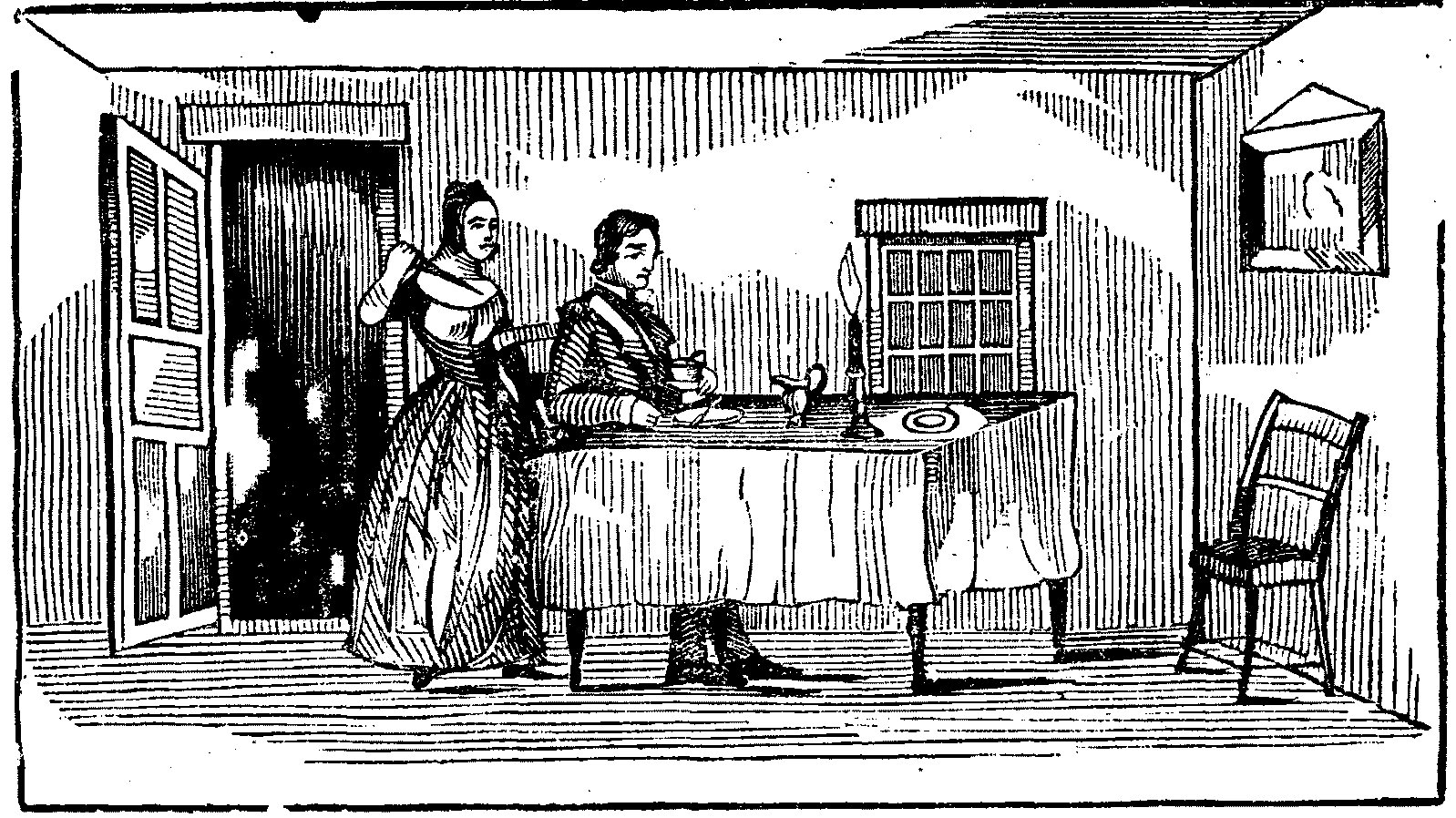
and while he was at breakfast she came behind him, and
plunged a large dagger into his heart. He fell, and then
expired. Two of her accomplices, Griffin and Brown,
were sent for but did not arrive in season. Being anxious
to secure the prize she attempted and accomplished the
murder herself, without any assistance. She robbed him
of seven hundred dollars, took his body in a small boat
and threw it into the river, with a stone attached to it, to
prevent it from rising.
Soon after, we believe in April 1840, a slave dealer who
was on his way from Wilmington, Del., to Norfolk, Va.,
with two valuable slaves, was overtaken by a heavy rain,
and obliged to put up at her house for the night. She put
him to sleep in a room separate from the main part of the
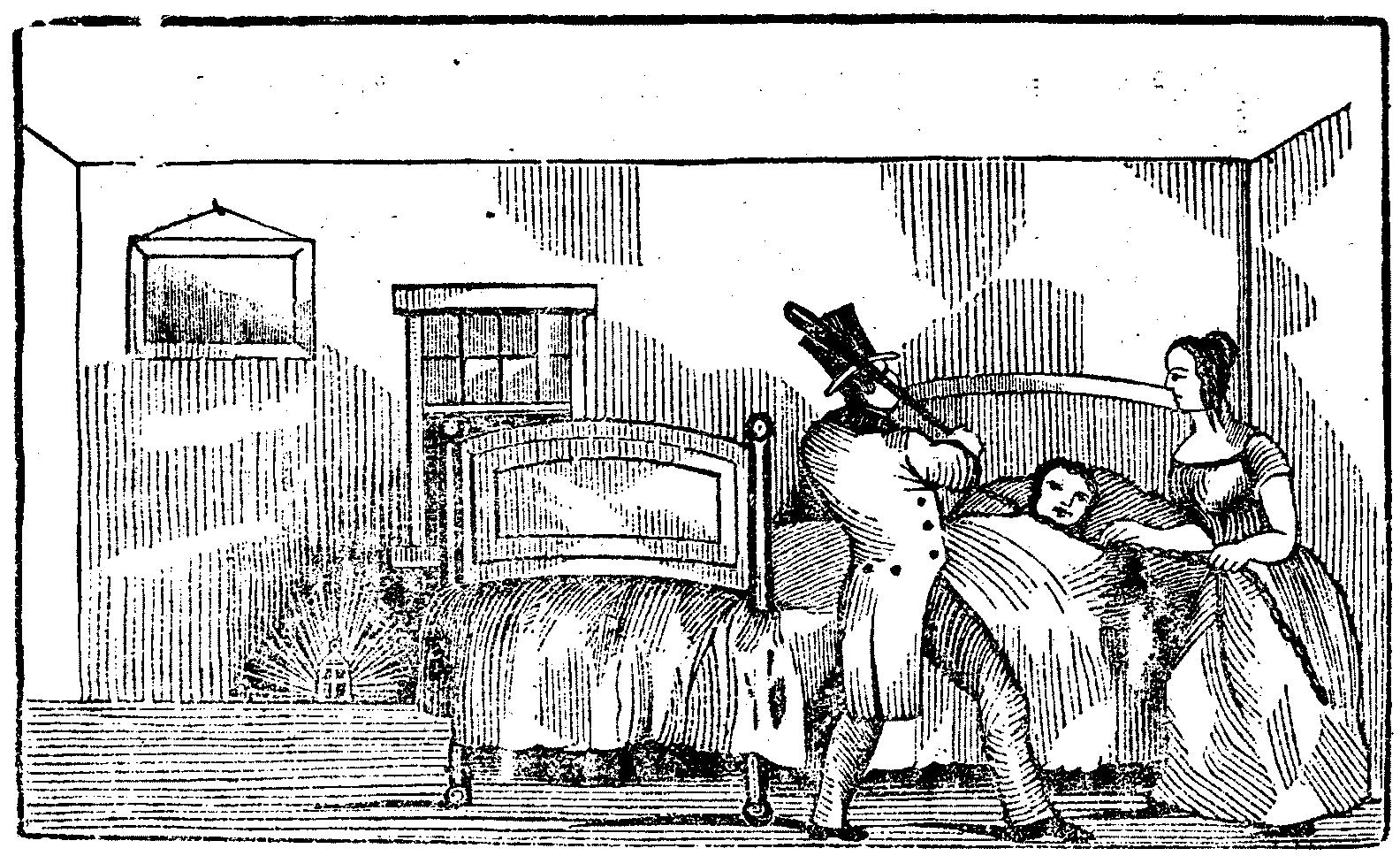
house, and during the night, she entered a secret way with
one of her gang, armed with a large club prepared for the
purpose, and finding him asleep, they tied him to the bed
and passed a cord around his neck to prevent his breathing.
They then robbed him of four thousand dollars with a
watch worth one hundred and twenty dollars. The body
was buried in the garden, under a clump of rose bushes.
She concealed the slaves for upwards of a week, barely
giving them enough to support nature, until she sold them
to a slaver who happened to be on the coast.
Soon after this, she murdered a negro boy, of twelve
years of age, who was for some time previous in her house,
in the capacity of waiter or servant, because he accidentally
saw her perpetrate the deed of burning the child, and one
day, when angry, said he would discover her. But she
resolved like the pirate, that the dead tell no tales, and immediately
ordered him down to the cellar to regulate something
there, then taking with her a large knife, she followed him in
person, and drove it through his body while stooping. She
then dragged him over, and threw his lifeless body amongst
the skeletons.
It was about this time, that she received the news of the
death of her mother, and untimely death of her only brother,
of whom she had heard nothing for several years, whose name
was James Smith. He was hung in Kingston, U. C., for
horse stealing. He had continued his riotous and dissipated
course of life for some time after the marriage of Ann, and
finally joined a gang of horse thieves and counterfeiters, which
infested the country round about the lakes. This gang had
a regular communication established from Detroit, through to
Toronto and Kingston, and across the States through to New York
and Philadelphia.
It is supposed that at one time, before the gang was broken
up, there were upwards of one hundred persons engaged in it,
although the precise number has never been ascertained.—Their
method of operation was this. A horse stolen by one
of the gang was conveyed by night to the next station, the
thief returning immediately to prevent suspicion. In this way
the business was managed until the horse was out of the reach
of pursuit. They had regular stations where the horses that
were stolen were kept until they had collected a sufficient
number, when they were taken in small droves to New York,
Philadelphia, and other large places, and disposed of. The
route on which James was stationed, was between Kingston and
Toronto, near Coburg, where he had been engaged for some
time. On one occasion he had been to Kingston with a horse
thus stolen, and there received a considerable sum of money
for his service to the company, and, on his way home, broke
into the stable of a British officer, and stole a very valuable
horse, but the noise awakened an old inmate who got up, and
perceiving the door opened, he went in and found the horse
missing. He immediately gave the alarm to the officer.—Several
men were sent out in pursuit. He was overtaken before
he got ten miles from the place where the horse was
stolen. They were brought back to Kingston, where he was
tried before a magistrate and thrown into prison, until the sitting
of the Kings Court, when he was condemned and sentenced
to be hung. He was executed at Kingston, some time late in
the year eighteen hundred and thirty-five. Thus ended the
unhappy career of both father and son—the father setting the
example.
After this news, she became, if possible more cruel and
barbarous than before. She now seemed to take no delight
whatever in anything but acts of the most blood-thirsty and inhuman
nature; nothing now satisfied her murderous disposition
but the death of some innocent, and to her unoffending victim;
but her career of guilt was nearly run; she had carried
it to such a height that it was impossible to continue in this
way much longer, without being overtaken by justice, and it
was not long after this that she was, by the following circumstance,
exposed, and her gang broken up and some of them
brought to condign punishment, for the high handed and outrageous
crimes, they had for a long time committed, thus far
without detection.
She, and her associates, Griffin, Brown and Sharp, murdered
a Quaker, who was travelling in that section of the country
in November, 1843. During his stay in that vicinity; he
had formed considerable acquaintance, and had intimated to a
friend with whom he had considerable business, that he would
stop at that tavern that night, and probably board there while
he remained in the neighborhood, which he did, for he was
seen there four days after.
After the lapse of two weeks, a box and parcel came in the
care of a gentleman for him from New York. Another week
elapsed, during which time Mr. Jones, in whose care it came,
thought it strange why he did not call, and as he was driving
past, he called to see Mr. Morse, to let him know that a package
had arrived for him. He enquired for Mr. Morse. He
then returned home, opened the parcel, and found among other
things, a letter from his wife which stated a dissatisfaction at
his boarding at a tavern, which seemed rather uncommon
among Quakers, as she said.—She was sorry it was not in his
power to come home sooner, as it seemed that he stated to her
that he should stop there some time. She said she hoped that
he was in good health, but was much afraid that he was not,
for she was annoyed with disagreeable dreams about him, and
it was utterly impossible for her to rest. These things looked
strange; suspicions spread around the neighborhood, until
some persons came into the store, who said they talked with
Mr. Morse, in Walters’ tavern, a few days after his going
there, when some remarked the idle, sauntering fellows that
were perpetually hovering about there, having no business,
and many other circumstances were alluded to, until suspicion
became so strong in the minds of the people, that they finally
resolved to make a private search, but not until Mr. Jones,
accompanied by some others, went again to make enquiry.
The answer was the same as before, but she seemed a little
confused which strengthened their suspicions.
Accordingly they went one afternoon, and visited the house,
making some pretence for the visit, one of them said that he
was about to build himself a new house, and asked permission
of her to examine her house, that he might measure and take
the dimensions of it at the same time, and the plan on which
it was built, saying that he wished to build after the same
plan. Not suspecting anything, she allowed them the privilege
though not permitting them to enter the cellar. They
then made such examination as they were able, discovering
nothing above, however, to confirm them in their suspicions.
They were now diverted entirely to the cellar, and in her absence
from the room for a moment, they questioned an old
wench, one of her domestics, as to what was kept in the cellar.
She replied she dare not tell for fear she should be killed.
They promised to liberate and protect her, if she would
disclose to them what she knew of the matter. She replied,
that there was something awful in that cellar, but for the life
of her she dare not tell what it was. Her mistress coming in
at that moment, prevented any farther discourse with her.
They then left the house, and concluded that they had got
information enough. Next morning they proceeded to the
house, accompanied by the sheriff with a warrant. She was
taken after a resolute resistance, together with three of her
associates, Johnson, Brown and Sharp, on the sixth day of
June last, to await the sitting of the Supreme Court at Georgetown,
where they were tried and received the sentence of
the law; but as Sharp turned State’s evidence, and favored
the other two, she alone was sentenced to die. The other
two were recommended to mercy by the Jury, and were sentenced
to perpetual imprisonment.
But the jury found a verdict of guilty of murder in the first
degree, and she received sentence. They have not as yet
made any public confession, but have acknowledged much of
the guilt of which they are charged and from which we select
considerable of the above atrocious crimes committed, and
the mode of executing their plans. But while in prison
awaiting the day of execution, three days after receiving sentence,
she obtained a quantity of poison by some private correspondent,
yet unknown, which she took to avoid the exposure
of a public execution. She died a most terrible and awful
death. After the poison which she had taken began to operate,
she raved like a maniac, tearing the clothes from her
body in handsful, attempting to lay hold of and bite every thing
within her reach, and cursing God and the hour that gave her
birth. After these fits of insanity had a little subsided and
reason had again returned, the pangs of a guilty conscience,
and remorse with all its horrors and bitter anguish, would
seize her soul, and she would cry out in the bitterness of
her torments that she already felt in flames of hell, reproaching
herself in the most bitter anguish for the awful crimes
she had committed. Then she would again rave like a maniac,
cursing and swearing in the most horrible manner, and
attempting to destroy every thing within her reach, and so
strong was she in her fits of raving, that it was with difficulty
that three men were able to tie her on the bed. She appeared
to be in great agony and pain during the whole time until
she died. About two hours before her death, she was visited
by a minister of the Episcopal Church, who endeavored to
console her, by telling her to acknowledge the crimes she had
committed with sorrow, and ask forgiveness, telling her that
there was no doubt that her soul would reign in happiness in
heaven. Then she felt a little consolation, and expressed the
following—or rather, more than we give here, as the narrative
is principally compiled from her confession, and the confessions
of the other two who remain in prison awaiting the reward
of their cruel and atrocious crimes. Here follows her
confession:—
I was born a short distance from Montreal, in the year 1812
but when I was very young, my parents removed from that
place to a village in the vicinity of Quebec, where I lived
until my father was hung for the murder of Paine. I then
lived with my mother until I was sixteen years of age, when
I was married to Mr. Walters, and settled near the neighborhood
of my late residence, in the lower part of Delaware.—When
I had been married about three years, my husband’s
health began to decline, and to free myself from the trials incident
to a protracted illness, I gave him a dose of poison. I
administered it through my negro cook. I strangled to death
my first and only offspring when three days old, which was
the only son nature ever furnished me with. Afterwards, in
the fall of eighteen hundred and thirty-five, I shot a traveller
who stopped for dinner on his way from Richmond, Virginia,
to New York. We robbed him of eight hundred dollars.—His
horse we afterwards sold in Baltimore for two hundred
dollars. In the beginning of February following, I and my
comrades followed two slave traders, stationed ourselves and
fired upon them, and killed one of them instantly, of which
no account was ever heard. I burned to death a negro child
eighteen months old, soon after. In eighteen hundred and
forty, with my own hands I killed Isac Smith of Baltimore,
on his way home. About two months afterwards, I was accessory
to the murder of a slave trader from Wilmington, Del.
on his way to Norfolk, Va. We robbed him of four thousand
dollars and a gold watch. Soon afterwards I killed a negro
boy twelve years old, whom I owned as mistress. Last of all,
we murdered Morse, the Quaker, after he had boarded three
days at the house. I am guilty of ten murders with my own
hands, and accessory to a great many others. I can confess
no more. For I do not expect forgiveness, and feel already
the pains of hell.
She was seized with another fit of despair, crying out
that she felt the wrath of God punishing her. Thus she went
on until she sunk back on her pillow exhausted, and her immortal
spirit winged its way to appear before the bar of its
Judge, there to answer for the dreadful deeds committed in
the body. Her death was truly heart-rending and awful, and
should serve as a warning to all those who read this account
to be prepared to meet their eternal Judge, to render such an
account of their past lives as shall be acceptable in his sight.
She breathed her last on the 25th of September, four days after
trial, thus terminating the cruel and unhappy lives of father
son and daughter.
In giving to the public an abridgement of the life of
this atrocious woman, we hope that our readers, either
moral or immoral, will not be in need of such a lesson or
example as that already detailed, but it may be truly
looked upon as the most astonishing circumstance of the
age in the midst of civilization and morality. We deem
it unnecessary to give an account of the trial, as no doubt
a greater portion of our readers throughout the United
States have already seen it in the columns of the weekly
journals. As regards the truth or authenticity of the facts
contained in the foregoing pages, we presume it will not
be doubted by any. The publishers deem it not unimportant,
and perhaps interesting to our readers, to state
that in consequence of the strong and prevailing propensities
ever manifested by her to commit crimes of the most
heinous as well as unprovoked nature, was considered by
a celebrated and highly respectable phrenologist, as
worthy of examination, and her skull was obtained for
that purpose a few days since at Georgetown, Del., and
which will probably remain in the possession of that gentleman,
Mr. O. S. Fowler, of Philadelphia, and the publisher
in delineating and presenting to the public view,
the atrocious crimes of this vile and wicked woman, is
in a very great degree prompted by a desire to preserve
the honest fame of those who enjoy a moral reputation,
and to secure peace of mind to those who are not as yet
conscious of offence; as it is well known that an artful
mind, actuated by illusion, if not checked, may pass on
to acts of violence, and, in some instances to cold-blooded
murder, as it appears that even the tenderness of the female
sex, of which the foregoing pages furnish an example,
is converted into the barbarity of a traitor; that she
who should make her arm a pillow for the head of her
husband, conspired to raise it against his life; that the
bosom which should be filled with fidelity and affection,
in addition to other crimes, planned his destruction.—Hence,
it is hoped that in sending this narrative abroad,
that it may be the instrument of rescuing some misguided
youth from similar offences. There are many in the
moral retiracy of a village life, who when young hear
much of the enterprise of a city life, and resolve on trying
it, unconscious of the depravity and vice which is set
to entrap them in a net, as they advance without caution
on their journey of life. A road which every youth should
walk with the greatest care, by keeping still in view one
general rule to avoid intemperance and bad company,
which are always linked together; if the unfortunate
subjects of this narrative had done so in early life, they
would have avoided their unhappy lives and untimely end.
The reader may depend on the truth of the fact in the foregoing
pages; but, in consequence of their singularity, the author
was induced to search minutely into her parentage, and has
spared no exertion to obtain his information from the most
authentic and respectable sources. After perusing it, he will
pause and reflect, “Poor human nature! how weak and corrupt
thou art, if not checked in the morning of thy existence.”
The father of this wicked woman was the victim of disobedience
to kind but arbitrary parents, and this narrative is a solemn
warning against intolerance, which together with the
vice of intemperance, has sent more victims to the dungeon,
the scaffold, and an untimely grave, than any other calamity
that has ever afflicted our race. If there be any who think this
narrative should not be published, or that the innocent should
not read it, lest it should corrupt their feelings, I would entreat
them first to read it, and then to enquire what portion of the
community crowds our jails and State prisons, and where the
inmates of the abodes of vice and infamy are generally born and
educated, whether in the city or in the retiracy of the moral
village? They will find three-fourths of them, at least, are
from the latter. The reason of this is, because they know not
the wickedness of the world, and its allurements, until they
were on the journey of life, piloting their craft—many of them,
alas! never to reach a harbor.