"Oh, the dread of by-gone days!—
A fearful tale they tell,
When rung the woodland echoes round
To warlike shout and yell,
When fiercely met the hostile bands,
And deadly grew the strife,
And wildly, with the clash of arms,
Went up the shriek for life."
The cruel strife of the border can never be forgotten.
Those were tragic days, the very remembrance
of which comes like a dream of sorrow and desolation
of soul. It is well that such terrible times have
passed away, for to those who were exposed to the
fury of that tidal-wave of passion, which swept over
the fair borderland, physical existence must have
been a wheel of pain. But the mighty procession of
the ages, sweeping by, will soon obliterate the traces
of the storm's ravages, and only the dim legends of
horrible deeds will remain.
In that dreadful ebullition of human hatreds,
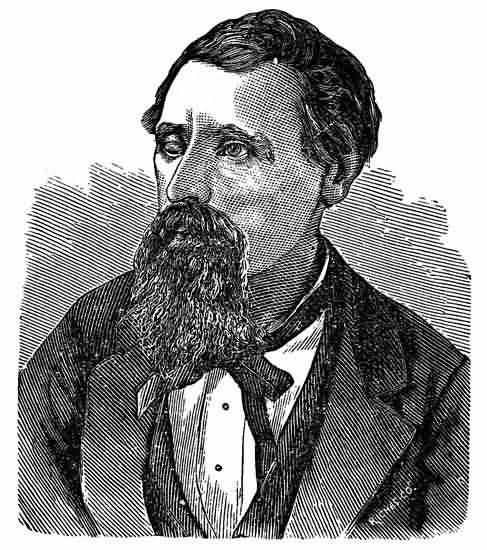
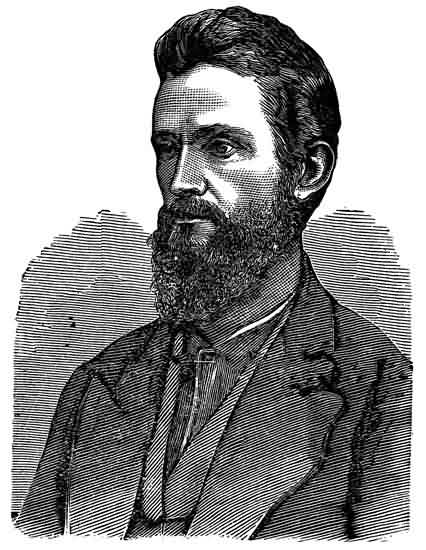
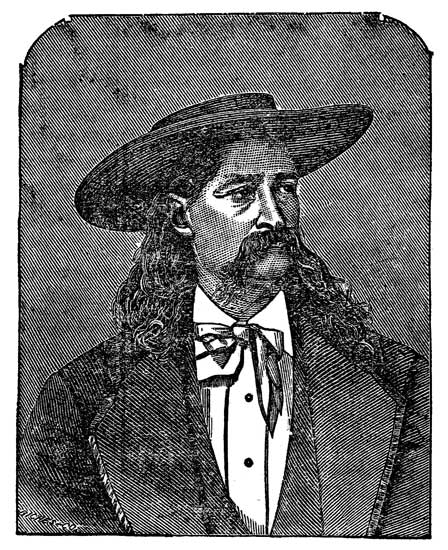
Frank and Jesse James played no laggard's part.
As boys, they accepted service under Quantrell, and
became renowned for caution and daring even in the
days of their youth. Members of a partisan organization,
famed even in the early days of the strife
for daring deeds and extraordinary activity; a band,
every man of which was a desperado of great cunning
and prowess, these two callow-youths, taken
from a country farm, speedily rose to the eminence
of leading spirits among the most daring of men.
Both sides in the border counties of Missouri and
Kansas prosecuted war with a vindictive fury unparalleled
in modern history. The scene of the operations
of the Guerrillas was at first confined to the
limits of Clay, Platte, Jackson, Bates, Henry, Johnson,
and Lafayette counties, in Missouri, and along
the Kansas border.
These men rode far and fast in the night time, and
fought their foes at early dawn. Living in out-of-the-way
neighborhoods were their friends. When
pressed hard they disbanded and scattered, and rendered
all pursuit futile.
Frank and Jesse James early discovered those
traits of character which have rendered them famous
as the greatest outlaws and freebooters of modern
times. They became scouts and spies for Quantrell
at the beginning of their career, and showed themselves
possessors of remarkable capacity for such
service. They were cool and brave, fertile in resources,
and marvelous in cunning.
After Lawrence came the disbandment, and with
the disbandment came that strange training in individual
development and personal reliance which
have made the Boys objects of fear to the people of
many regions, and enabled them to plunder at will,
baffle pursuit, and defy the civil authorities of great
States.
They had hiding places with friends in Clay,
Platte, Jackson, Johnson, Cass and Lafayette counties,
and when the Guerrilla band to which they belonged
scattered in order to evade pursuers, the Boys
retired to the dwellings of their friends and rested in
peace till the time of re-organizing, when an enemy
was to be punished.
Perhaps no two individuals ever lived on this continent
who have taken so many lives, as the James
Boys. Emerging from the seclusion which they
could always find in the Hudspeth neighborhood, in
the eastern part of Jackson county, in July, 1863, with
Captain George Todd, a redoubtable Guerrilla chieftain,
with whose command Frank and Jesse often
fought, they struck the road leading from Pleasant
Hill to Blue Springs. Major Ransom, a Federal
officer with a cavalry force, was traveling that road
at the time. A collision took place. The fighting
was savage. The volleys of revolver bullets fired by
the Guerrillas proved awfully destructive to their opponents.
Jesse and Frank James have been credited
with a tremendous destruction of life—Jesse killing
seven, and, Frank eight men in the Federal ranks
during that encounter.
One night Frank James and five or six of his comrades
were detailed to capture and kill the militia
men who were accustomed to frequent a bagnio, four
miles east of Wellington, in Lafayette county.
Frank James preceded the little band, and, creeping
up under the window, he saw the company inside.
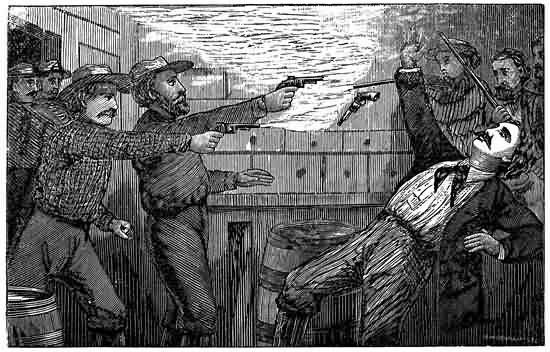
There were eleven men in dalliance with the women.
James returned to his comrades, reported the result
of his observations, and the Guerrillas rode to the
house. A peremptory summons brought the militiamen
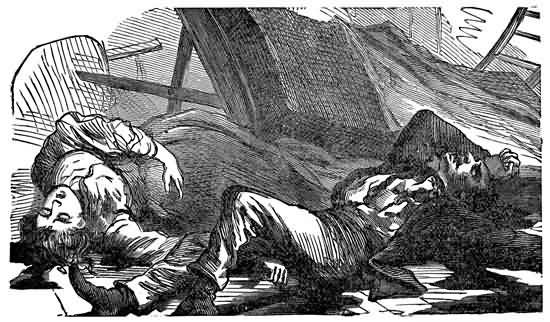
to the yard. The Guerrillas poured a volley of
bullets among them. The ten men fell, pierced by
the deadly missiles. But where was the eleventh
man? There had been that number in the house
when James saw the company, and the man could
not have left the place. A search was instituted.
The man could not be found. But there was one
woman more in the party than had been seen before.
A candle was procured and a search instituted
among them. They all appeared to be women.
Frank James discovered the man. He was a youth,
fair skinned and blue eyed, with long brown hair.
His features were handsome, and in the garments of
a woman he appeared not unlike a fresh country
girl. Of course he expected to die there. His ten
companions presented the spectacle of a ghastly
wreck of humanity in the yard as they lay there
cold in death. But he plead for his life. He was so
young to die. "Here, Frank, take him," said the
leader. "You discovered him; he is yours to deal
with." It was a sentence of death, they said. The
boy thought so, and hope vanished. "Come," said
Frank, "come along and be shot." The poor youth
trembled in every nerve. He could scarcely walk.
His supposed executioner had to assist him down
the steps and out through the yard. They passed
the ghastly heap of corpses, lying there in the dim
starlight. They went away, into the darkness under
the sombre trees, down the road. Poor boy, he
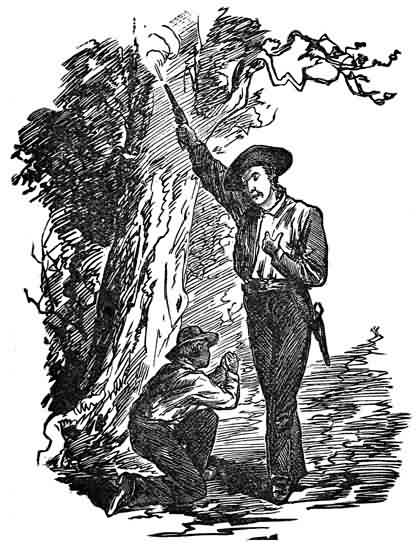
thought of his mother. Under the wide-spreading
branches of an ancient oak they halted. "Here!
we are far enough," said Frank James. The poor
youth almost fell to the earth from excess of emotion.
To die, and so young, and in such a way, too!
"Oh, spare me for the sake of my mother!" he
wailed. "You are free to go! I give you your life.
You are outside of the pickets, outside of danger.
Go, and be quick about it!" And at that moment
Frank James fired a pistol shot upward through the
branches of the oak, and the fair haired boy soldier
disappeared in the darkness—spared for the sake of
his mother by the youthful desperado. Frank James
returned to his comrades. They had heard the shot
and naturally concluded that it meant one more life
ended. Frank assumed a grave expression. "Quick
work," remarked a comrade. "Yes," returned the
Guerrilla, "babies and boys are not hard to kill."
He never spoke of that better deed he performed
out there, with only the stars and God as witnesses.
And the border strife went on. Frank and Jesse
rode with Quantrell, sometimes with Todd and
Poole, then again they fought at unexpected times
by the side of John Jarrette, and Bill Anderson, and
Arch Clements. One week they would be charging
Blunt's Body Guard in Southeastern Kansas; the
next they would ambush a moving column of Federal
militia in Lafayette, or Jackson county, Missouri.
It was fighting—cruel, savage fighting, all the while.
In the bottom lands along the Blue, or among the
Sni hills, when hotly pursued, they would find hiding
places, from whence they emerged only to deal out
destruction and death. Down to Texas, marching
with the close of autumn, like migratory birds, they
returned to their old haunts with the bright spring
days. Deceiving and cutting to pieces Lieut. Nash's
small command in the road west of Warrensburg, on
a Monday, we hear of their successfully ambushing a
column of Union militia on the banks of the Little
Blue on the succeeding Wednesday, and a few days
afterwards we hear of Frank and Jesse playing "the
trumps" of revolver bullets among a squad of rollicking
soldier gamesters at Camden; then again
they are heard of with Todd, riding down
the road from Independence toward Harrisonville,
where, seven miles from the former place,
they encounter Captain Wagner, of the Second
Colorado Cavalry, and engage in a terrible hand-to-hand
conflict in which Jesse James takes the
life of the Captain, and with his deadly aim
sends seven of Wagner's men to the bourne of the
dead. On the same occasion Frank, riding furiously
among the Federal cavalrymen, deals death to eight
of them. So the spring and summer of 1864 was
passing with these men engaged in deeds of blood.
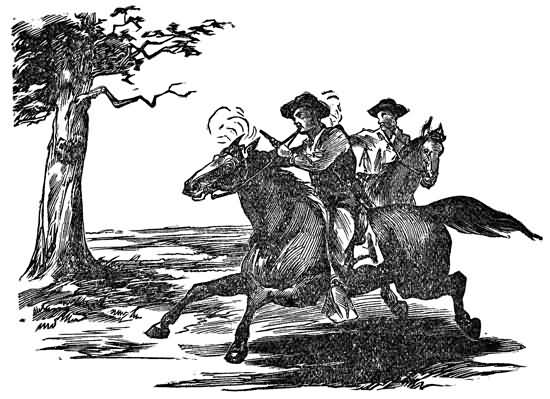
It was in the last days of July of 1864, that Arch
Clements and Jesse James were riding along a country
road one evening, when they discovered four
militiamen in an orchard gathering apples. Two of
the men were in one tree and two in another. Without
ceremony the Guerrillas shot them as they would
have shot squirrels from a forest tree, and jested of
the deed as they might have jested over the fall of
wild beasts.
It was about this time that Frank James had a
thrilling adventure. He had been ordered out on a
scout to ascertain the movements of the Federals in
Jackson and Cass counties. It was a period of deep
anxiety to the Guerrilla leaders, as it appeared that
special efforts were being made by the Federal militia,
and several companies of the Second Colorado
Cavalry, to capture all the irregular Confederates
found in the State of Missouri. Frank had reached
the Independence and Harrisonville road at a point
about midway between the two towns. As he passed
through the country he ascertained that a force of
infantry and cavalry were at a house some miles
away from the road. How many there were in this
detachment he could not learn. But he resolved to
investigate. Taking a neighborhood path, not much
traveled, he rode toward the Federal encampment.
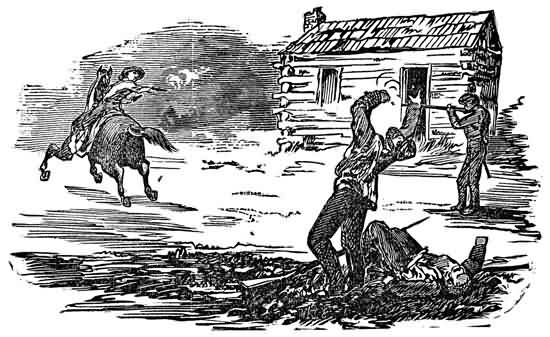
On the roadside was a lonely cabin, now uninhabited,
as he believed. He examined the indications,
and rode on. At the cabin the road made a short
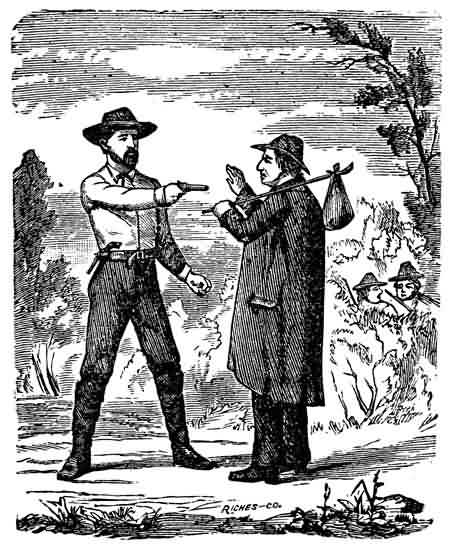
turn. When Frank turned around the corner of the
old cabin, two militiamen presented their muskets
and commanded him to halt. In an instant the ready
pistol was snatched from its place by the Guerrilla,
and even before the militiaman could fire, the bullet
from Frank's pistol had penetrated his brain, and he
fell in the agonies of death to the earth. At the
very instant of firing, Frank put spurs to his horse
and galloped away, turning and firing at the remaining
guard as he did so, and wounding him unto death
just as he was in the act of firing at the daring rider.
The bullet from the militiaman's gun whistled within
an inch of Frank James' ear as it sped on its harmless
mission. The picket post where the firing took
place was within a few hundred yards of a camp
where a hundred militiamen, and half that number
of cavalrymen, who rode good horses, were taking
their dinners. Frank, surmising that the two soldiers
with whom he had the combat were on guard duty
close to camp, and that an alarm and pursuit would
follow, rode with all speed toward the Guerrilla
camp. He was pursued, as he expected, but he
easily eluded the Coloradoans.
In August—it was the 12th day of that month,
1864, that Jesse and Frank participated with their
comrades, Todd, Anderson and others, in a desperate
conflict in Ray county, Missouri. Again the
deadly revolvers, in the hands of the boys, accomplished
fatal results. Between the two, seven fellow-beings
were sent to the silent realms of death.
Two days afterward they were at the Flat Rock
Ford, on Grand river, and a desperate struggle with
some Federal militia and volunteers ensued. During
that fight Jesse was struck by a musket ball which
tore through his breast, cut into and through his left
lung, and caused him to fall. His comrades carried
him away. At length he was transported to the
house of Captain John A. M. Rudd. The wound
was a dangerous one, and all expected it would prove
fatal. Jesse believed so himself, and took from his
finger a ring which he charged his friends to carry to
his sister, Miss Susie James, and give her also his
dying message, which was, "I have no regret. I've
done what I thought was right. I die contented."
This event occurred August 16th, 1864. By the 7th
of September he had so far recovered as to be able
to ride and fight again.
On the 12th of September Jesse and Frank rode
away with Lieutenant George Shepherd, from the
Guerrilla rendezvous at Judge Gray's, near Bone
Hill, Jackson county, for a raid into Clay county.
At this time he visited his mother. On the 16th of
September Jesse James killed three militiamen in an
encounter near Keytesville, Chariton county, Missouri.
He was now so far recovered as to perform
the services of a scout.
On the 17th he rode twenty-nine miles in the
night time, through a country swarming with militia,
to advise Todd concerning the movements of the
Federal forces.
On the 20th of September, 1864, occurred the
battle of Fayette, Missouri. The whole of Quantrell's
band was concentrated for the purpose of
making this attack. All the chieftains were present,
Quantrell and Anderson, Poole and Clements. During
the assault on the stockade, Lee McMurtry was
desperately wounded close up to the enemy's position.
Jesse and McMurtry were comrades, and he
would not allow his friend to fall into the hands of
the Federals if he could help it. He rushed up to
where the wounded man lay, and though exposed to
a terrible fire, he carried away his wounded friend
without receiving any injury. The Guerrillas were
driven from Fayette.
At this time the various bands seemed to accept the
leadership of Bill Anderson, who was then gathering
forces for the Centralia expedition. Quantrell separated
from him, and returned to a secure place of
repose in Howard county.
Todd and Poole and the James boys, Pringle, the
scalper, the two Hills and Clements, indeed, all of
the most desperate of the Guerrilla gang followed
the black banner of the most savage Guerrilla that
ever trod the soil of Missouri.
The 27th of September, 1864, must ever be a memorable
day in the annals of the civil war in Missouri.
On that day, with a flag black as the raven's
wing, and ominous of the coming night of death,
Bill Anderson rode to Centralia, a village in the
northeastern part of Boone county, Mo., on the line
of the St. Louis, Kansas City and Northern Railroad.
He was not long idle. A train of cars drew up to
the depot. There were soldiers and citizens on that
train. Very few of the former, however, were
armed. Only a few guns, at any rate, were fired. The
train and its passengers were completely at the mercy
of the Guerrillas. The Federal soldiers and citizen
passengers were formed in a line. Then a separation
of citizens and soldiers took place. Twenty-eight
soldiers and four citizens who wore blue blouses
were selected, marched out and shot with an atrocious
haste that would make even the cruel Kurds
shudder. In this bloody tragedy, Frank and Jesse
James were prominent actors.
Scarcely had this butchery been consummated,
when Major Johnson, in command of about 100 Iowa
cavalrymen, came upon the scene. The force of the
Guerrillas under command of Todd numbered more
than two hundred men, and as both were determined,
a desperate fight ensued. But the impetuous
charge of the Guerrillas, led by George Todd, broke
the lines of the Iowans, and a panic ensued among
them. Major Johnson made gallant effort to rally his
men. It was in vain. The furious riders dashed among
them and shot them down like so many panic-stricken
sheep. Jesse James, mounted on a superb
horse, rode directly at Major Johnson. The issue
was not doubtful. The deadly aim of the Guerrilla
soon laid him stark and still on the prairie. It was
all over with him, and also for the men he commanded
that morning. Appeals for mercy were of
no avail. The vanquished Federals were massacred.
Frank James was equally active with his brother. He
is credited with having taken the lives of eight men
that day. It was a day of horror, and the partisan
rangers revelled in the carnage.
After Centralia came hard knocks. In one of the
fights immediately succeeding the Centralia holocaust,
Dick Kinney, a noted Guerrilla, received his
death wound. He was Frank James' comrade,
and he fell heir to the pistol which Kinney had
worn. On the handle of this weapon were fifty
notches, each notch signifying one. He had killed
fifty men. Frank James probably has the pistol
yet.
In a corner of Clay county lived an old man named
Banes. He was a staunch Union man, and blessed
the Guerrillas with the same kind of blessing that
Balak desired Balaam to bestow upon Israel. Banes
was particularly severe in his condemnation of Jesse
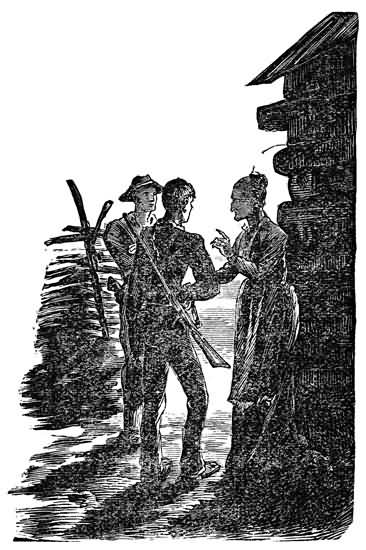
and Frank James. One night the boys went to
Bane's house under the guise of Colorado troopers.
The old man received them gladly, and at once unbosomed
himself freely in regard to the Guerrillas.
In the course of his remarks he animadverted on
Mrs. Samuels, the mother of the boys, in bitter
terms. He denounced her as being "the mother of
two devils, Jesse and Frank James." The boys secured
his confidence, and then a promise of immediate
assistance in hunting up the desperadoes. Banes
got his gun and pistols and saddled his horse,
mounted and rode out to his death, for when the trio
had gone about half a mile away from the house, the
pretended soldiers announced themselves as the
James boys, and gave him no space for repentance.
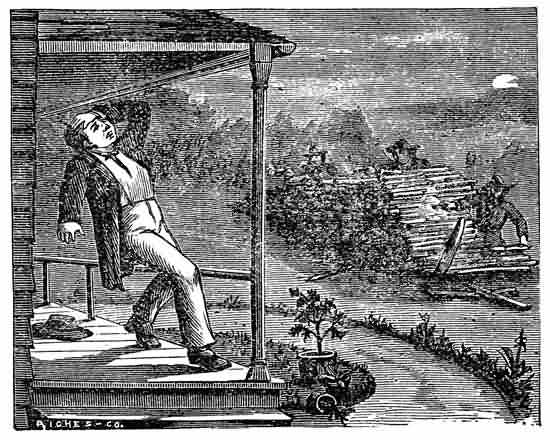
Two pistol shots rang out on the still night, a heavy
body fell to the earth, and then the living men rode
away, leaving a cold form of mortality out under the
stars.
With difficulty the Guerrillas made their way to
their haunts on the Blackwater. Fighting was going
on constantly. The shadow of death was gathering
over many a bold rider of the Guerrilla band. Moving
out from their camp on the Blackwater, one day,
the Guerrillas fell into an ambuscade, and several
received wounds. Among those thus wounded was
Jesse James, who had his horse killed and received a
shot through the leg.
Todd was sent out to skirmish with the advance
guard of the Federal army then following the retiring
army of General Price. At every creek there
was a battle, and at every encounter there was bloodshed.
In one of these fights, when the leaves were
all falling on the brown earth, George Todd was
killed. In the night time his followers came to pay
the last tribute of respect to his remains. There
were not many who gathered there in the gloom of
the midnight to gaze for the last time on the face of
the courageous Guerrilla, but among them were Jesse
and Frank James, and they pointed their pistols
toward the cloud-veiled, teary sky, and swore to
avenge his death.
But the old band was broken up. Late in October,
1864, Jesse and Frank parted, the former with Shepherd
went to Texas, the latter with Quantrell to
Kentucky.
It proved to be the final dissolution of Quantrell's
once formidable force of partisans. George Todd,
the Paladine of the command, the leader who was
persistent and daring, slept quietly after the fierce
turmoil of life's battlefield had ended. John Poole,
another hard rider, desperate fighter and dauntless
leader, mouldered in a gory grave. John Jarrette
and Cole Younger had sometime before separated
from the band, and were operating in the far South
where the magnolias grow and the moss-bearded
live-oaks stand sentinels in the fever-haunted swamps.
Fernando Scott was dead. Bill Anderson had fallen
in a terrible combat while endeavoring to effect a
crossing of the Missouri river in Howard county.
As he had lived for some years, grimly fighting, so in
the last extremity when the odds were all against
him and unseen messengers of death burdened the
air with their low-hummed dirges, his life went out
while he still fought in the very shades of despair.
Kinney was dead, and many more had surrendered
life in the hot simoon of battle.
And what a band it had been, which was now
broken! Its deeds must ever remain a part of the
history of Missouri, and the chapter wherein the
record is made will always be read with a shudder,
and in years to come men will remember the mournful
story of devastation and death with feelings of
painful regret that human beings could so revel in
the miseries and misfortunes of whole communities.
To those who can calmly sit and look down the
vista of the dead years and recall without prejudice
the history of men who were authors of deeds so
notable—actions which, performed under other circumstances,
would have made heroes of deathless
fame, there must come a feeling of regret that such
men should have been the victims of a baleful destiny.
CHAPTER VII. ADVENTURES IN SEPARATE FIELDS.
The days of Guerrilla warfare were drawing to a
close. The retreat of Price and Shelby from Missouri
left the Federals free to operate against the
Guerrillas. The old bands were decimated. Death
had been busy in their ranks; and for the remnants
of a once formidable organization, no Confederate
army could extend over them sheltering arms. The
drama was about completed; the curtain was soon to
drop.
Jesse James went with Lieutenant George Shepherd
to Texas in the autumn of 1864. During the
long march through the Indian Territory, they met
with many stirring adventures. On the 22d day of
November, Shepherd's band encountered the band
of Union militia, commanded by Captain Emmett
Goss, which had acquired an unenviable name on account
of the excesses which they had committed.
Goss was coming up from a marauding trip into Arkansas,
and had reached Cabin Creek, in the Cherokee
Nation. Goss was "a fighting man," and a
fierce conflict ensued. Jesse James singled out the
commander and rode full at him, firing his pistol and
receiving the return fire of the other. The contest
was short; the steady aim of the Guerrilla secured
him a triumph. Goss fell from his horse with one
bullet-hole through his head and another through
his heart. On this occasion there was one other to
realize the skill of Jesse James with the pistol, if indeed
he realized anything after his ineffectual plea
for life. The Rev. U. P. Gardiner, chaplain of the
Thirteenth Kansas, rode with Captain Goss' band up
from toward the South. Jesse James pursued him,
and came up with him. The chaplain told his pursuer
who he was, and plead for life. The answer he
received to this petition was a bullet through the
brain. He fell from his horse dead.
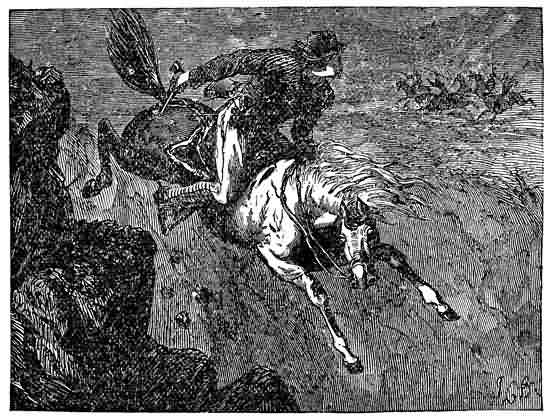
Jesse James' Escape from "Pin" Indians.
Two days afterward, Jesse and a companion were
riding over the prairie, near the bank of a stream.
For some cause the comrade of Jesse left him for a
time alone. Not far away was a skirt of heavy timber.
On a sudden, a wild shout burst from the
wood, and a party of Pin Indians—that is, Cherokees,
who were friendly to the Union, came skurrying
across the prairie, directly toward the Guerrilla.
His danger was imminent, for the Cherokees were
well armed with long range guns, which they knew
well how to use. Safety lay in retreat, and Jesse
turned to flee. He was on the open prairie, and
could not get to the timber. There was a high and
steep bank before him, and the Indians were following
close behind. He determined to leap his horse
down the precipice. It happened to be where the
water was deep, and a slight projection and growth
of brush broke the fall. The leap was successfully
made, and neither horse nor rider was badly injured.
Jesse, following down the creek, made his escape,
and soon regained Lieutenant Shepherd's camp.
During the winter of 1864-5 Jesse James remained
in Texas, leading quite an inactive life. With the
spring, however, that part of the Missouri Guerrillas
which went with Shepherd, began to think of Missouri
again. In April they began the return march.
The road was beset with dangers. The Pin Indians
in the Cherokee country were extremely hostile, and
left no opportunity to strike at them unimproved.
By the time the May flowers bloomed, Jesse James
had reached Benton county, Missouri. In that
county lived a Union militiaman named Harkness,
who had made himself exceedingly obnoxious to
people of Confederate sympathies. This man was
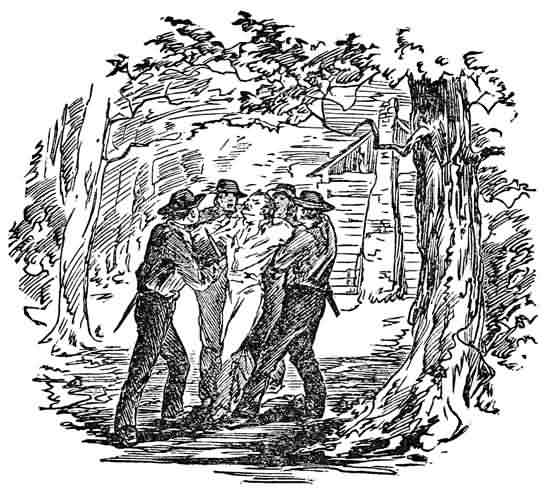
captured by the returning Guerrillas, and Jesse
James and two comrades held him in a vice-like embrace,
while another Guerrilla, Arch. Clements, cut
his throat from ear to ear.
At Kingsville, Johnson county, Mo., lived an old
man named Duncan, who had belonged to the militia,
and was very cordially disliked on account of his
bad disposition toward the Southern people. Jesse
James sought him, found him, and slew him. Duncan
was a man of 55 years of age.
The Guerrilla career of Jesse James drew to a
close. In May, 1865, all the Confederate bands in
the State were coming into the Federal posts and
surrendering. A considerable number of those who
had come up from Texas with Arch. Clements desired
to surrender, but several refused to do so.
Among these were Jesse James. But the formality
of a surrender of the others led them all to Lexington,
Mo., under a flag of truce. There were eight
unsurrendered Guerrillas to bid a last adieu to their
old comrades. This little band had proceeded into
Johnson county, when suddenly they were met by a
band of Federal troops returning from a scouting
expedition. These fired upon the Guerrillas, and a
sanguinary struggle ensued. Jesse James' horse
was killed; he was wounded in the leg and retired
into the woods pursued by the Federals. He fought
with desperation, but received, at last, a shot through
the lungs. The wound was a terrible one, but he escaped,
and dragged himself to a hiding place near
the banks of a small stream. Here, for two days
and nights, alone, consumed by a raging fever, the
wounded Guerrilla lay. Finally he crawled to a
field where a man was ploughing. This man proved
to be a friend, and took James in, cared for him, and
finally sent him to his friends. The soldier who shot
Jesse James that day was John E. Jones, Company
E., Second Wisconsin regiment of cavalry. The
Guerrilla and his antagonist afterward became acquainted,
and were warm personal friends. Jesse
James joined his mother in Nebraska, and returned
with her to Clay county, Missouri.
Quantrell gathered up a small band of his old
comrades in the Guerrilla warfare, at Wigginton's
place, five miles west of the town of Waverly, Lafayette
county. Among those who obeyed the summons
to this rendezvous was Frank James. The
Confederate armies had retreated from Missouri.
There was no longer a field in that State for the exercise
of his peculiar talents. He resolved to go
East, to Maryland, and there open up a Guerrilla
warfare. It was on the fourth day of December
when Quantrell and Frank James and about thirty
others of their old followers and comrades left Wigginton's
for Kentucky. On the first day of January,
1865, the dreaded Quantrell's band effected the
passage of the Mississippi river at Charlie Morris'
"Pacific Place," sixteen miles above Memphis.
Morris rendered Quantrell valuable service, although
at that time he was a frequent visitor to Memphis,
and on excellent terms with the Federal authorities
at that place. After leaving the river they marched
through Big Creek, Portersville, Covington, Tabernacle,
Brownsville, Bell's, Gadsden, Humboldt, Milan,
McKenzie, and on to Paris. Here they had
their first difficulty, and were compelled to mount in
hot haste and ride away. From Paris the Guerrillas
proceeded to Birmingham, and crossed the Tennessee
river. Their route then lay through Canton,
Cadiz, and to Hopkinsville. Near this place they
came to a house where there were twelve cavalrymen.
Nine of them fled, leaving their horses. The
three men who remained fought the whole of Quantrell's
band for many hours, until preparations were
made to burn the house, and, indeed, until the fire
was kindled. They then came out and surrendered.
Quantrell, of course, appropriated the twelve fresh
horses which were in the stable.
There was one Captain Frank Barnette, who commanded
a company of Kentucky militia stationed at
Hartford, Ohio county. Quantrell at that time was
playing the role of a Federal captain. As such, he induced
Barnette to go with him on a hunt for Confederate
Guerrillas. Barnette carried with this expedition
about thirty of his men. Quantrell resolved to
assassinate them all, and a way was found to do so
during the day. Frank James was made the executioner
of Captain Barnette, and as he rode by him
when they entered a stream of water at a ford, as
the sun went down behind the western hills, Frank
James fired the fatal shot, and Barnette fell dead
from his horse, dying the clear waters of the brook
red with his blood.
The career of the Guerrillas was drawing to a
close in Kentucky as well as in Missouri. Quantrell,
and Mundy, and Marion were constantly hunted
by dashing cavalry officers.
The disguise thrown off, the Federal officers knew
that work must be done in order to stop the Guerrillas,
and they were not slow in engaging in the undertaking.
Major Bridgewater and Captain Terrell
were untiring in their pursuit of Mundy, Marion and
Quantrell. Frank James visited an uncle, and was
not with Quantrell when that chieftain fought his
last fight at Wakefield's house, near the little post
village of Smiley, Kentucky. That day Quantrell's
band was nearly annihilated. Subsequently, Henry
Porter gathered up the survivors of the once formidable
Guerrilla band, and surrendered with them at
Samuel's depot, Nelson county, Kentucky, on the
25th of July, 1865. Among those who surrendered
was Frank James. After the surrender, Frank remained
in Kentucky because of a deed which he had
performed in Missouri about a year before. There
lived in the northeast corner of Clay county a man
named Alvas Dailey. He had made himself very
obnoxious to the James Boys, and Frank resolved to
rid the world of his presence. One night he went to
Alvas Dailey's place, and the next morning he was
found dead with two bullet holes through his head.
Frank James had assassinated him.
CHAPTER VIII. THE BRANDENBURG, KY., TRAGEDY.
Frank James went down to Wakefield's house,
where the noted Guerrilla chieftain, Quantrell, lay
wounded unto death. Had the terrible scenes of
the hard, cruel Guerrilla warfare through which he
had passed, obliterated from the breast of Frank
James every tender emotion? It appeared not, when
he bent over the white face of the wounded chief
with its traces of suffering and anguish. He shed
tears like rain. He loved his leader, and did not
hesitate to manifest that regard. Knowing that the
hand of death was upon him, Quantrell advised his
disheartened followers to accept Henry Porter's
leadership and surrender themselves to the Federal
authorities. It might have been because their dying
commander desired it, that such men as Frank
James and his companions so readily consented to
lay down the weapons of war. At any rate, the
formal submission of the Guerrillas was made.
In Missouri, the terrible warfare which had been
waged had left scars wide and deep and bloody, and
they were yet recent when the banners of the contending
armies were furled. At any rate, it so appeared
to Frank James, and he did not return at
once to the State of his nativity. The part he had
played had been a conspicuous one, and, on account
of Centralia, he was on the list of the proscribed,
and when the war ended, so far as actual hostilities
were concerned, it had not ended, so far as Frank
James was interested, because he was not restored
to the peaceful pursuits which he had abandoned
when first the war cry arose in the land. He still
lingered in Kentucky.
The conduct of Frank James for some time after
the surrender indicated a desire on his part to become
once more a quiet, peaceable citizen. He was
extremely circumspect in behavior, and demeaned
himself in a most unobtrusive way. Such was the
promise of the new life after the years of bitter
strife in the late Guerrilla. But he was not proof
against the assaults of passion. One day the old
flame burst out anew with consuming fury. Frank
had started away from the State and stopped at the
town of Brandenburg. It was several months after
the remnants of the desperate band which Quantrell
led into Kentucky had surrendered to the Federal
authorities. But the country was still in an unsettled
condition. Bad men who had found occupation
in hovering about the verge of battle and plundering
the ghastly victims of war ere the last feeble breath
had departed from their pale lips, were now idle and
had become wandering thugs in the highways of the
land. Horse thieves and bestial monsters were to
be found prowling about in nearly every community,
and more especially in the border States. A large
number of people, and those, too, who had served in
the Confederate, as well as those who had been soldiers
in the Union armies, looked upon the men who
had been with Quantrell, and Mundy, Magruder and
Marion, Anderson, Farris, Hickman and other noted
Guerrillas, with suspicion. Many persons looked
upon them as men of evil antecedents—as thieves.
Horse stealing was carried on at a lively rate all
along the border. Kansas, Missouri and Kentucky
were particularly afflicted for many months after
the surrender by the presence of these enemies of
the farming and stock-raising communities.
Just about the time Frank James was passing
through from Nelson county to Brandenburg, in
Meade county, on the Ohio river, on his way to Missouri,
a number of horses were stolen in Larue
county. A posse went in pursuit of the thieves.
They traced them to Brandenburg. There they
found Frank James. There were four of them when
they came up with James, and he was alone, sitting
in the office of a hotel. By some means they induced
him to come out, and then they told him he
might consider himself their prisoner on a charge of
horse stealing in Larue county.
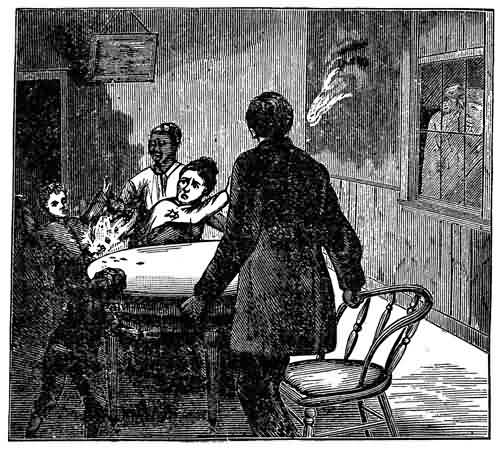
"By G—d! I consider no such proposition," exclaimed
Frank James, as he drew a pistol and commenced
firing. In less time than it requires to state
the fact, two of the posse lay extended in the embrace
of death, and a third was down and writhing
in agony. But the fourth man fired a shot into
Frank's left hip, and then ran away.
The wounded desperado was immediately surrounded
by an excited throng. The ball had taken
effect at the point of his hip, and the wound produced
was not only painful but dangerous. Yet the
superb nerve of the man sustained him in the midst
of an appalling crisis. A perfect storm of excitement
was raging in the town. Threats loud and terrible
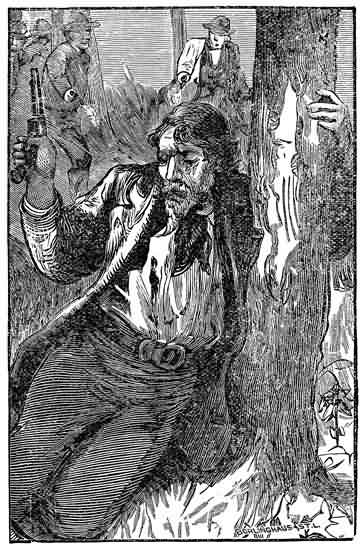
were made, and Frank James coolly presented
his pistols as he stood leaning against a post and
ordered the excited crowd to stand back, and they
obeyed him.
Somehow it has always happened that the Jameses
never wanted for friends wherever they have wandered.
It was so on this occasion. Though the
great majority of the people of Brandenburg thirsted
for the blood of the slayer of two men in their
midst, yet that grim young man, though wounded
and suffering, had friends at that town, and in the
midst of the excitement, these came to his assistance,
and he was borne away to a secure place,
where the populace could not tell, and nursed by
tender hands prompted by affectionate hearts. Attended
by a scientific surgeon, the ghastly wound
which had brought him to the very brink of the
abyss of death, began to heal, and in a few weeks
the surgeon who had attended the hidden patient
was able to report that he would surely live and
might ultimately recover entirely from the dreadful
wound.
When Frank had gained some strength, and it
was deemed safe to remove him, in a quiet and secret
manner he was conveyed in a close vehicle to
the house of a staunch friend and relative in Nelson
county, where he remained during many months,
suffering excruciating pain on account of the horrible
wound. He did not entirely recover from the
effects of the wound for several years.