We started south to the Arkansas River in the fall of 1872, and when
we got to where Dodge City now stands, we found the first buildings
under construction. None of us dreamed of the reputation that was to
come to that town through its gun men. There were only a few houses at
Dodge. I remember that the Cox house, the first hotel, was open.
Deciding to "put on airs," we went to the hotel for dinner. Our bill
of fare was pork and beans, black coffee, bread and pepper sauce,
especially pepper sauce, for which we paid seventy-five cents. We
could have beat it, hands down, in our own camp. I can recall the
names of a number of the first business establishments:
- Wright & Company ("Bob" Wright), general supply store.
- Zimmerman's hardware, gun and ammunition store.
- McCart & Fringer, drug store. Fringer afterwards was judge of Ford
county court.
- Kelly & Beaty, saloon. Kelly was a jolly, good-natured man, and
was always popular. He was always called "Dog" Kelly.
- Murray & Waters, saloon.
- Beeson & Harris, saloon.
- Hoover's saloon.
The buildings were mostly box affairs, and built in the quickest
possible way. But a palace does not make happiness, and I am sure that
in the rough, frontier towns of those days there was lots of
contentment and good cheer in the rudest shacks. The wind and the snow
came in at the cracks in winter, and in summer the rain beat through
and the red dust swirled along the floor, but we paid little attention
to such things. Our skin was tough and we had many things to occupy
our time. We were constantly in the open air, which hardened us until
we suffered scarcely any annoyance from wind or weather, such as would
have been looked upon as hardships not to be endured, by men living
cooped up in cities, where there is rarely a chance to fill one's
lungs with fresh air, and where heaviest clothing cannot compensate
for lack of physical exercise. It is possible by exposure for men to
toughen their skin and their bodies, just as they can toughen their
hands. The Indian is a good example of this fact.
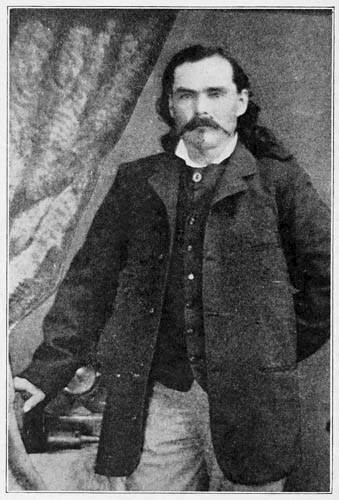
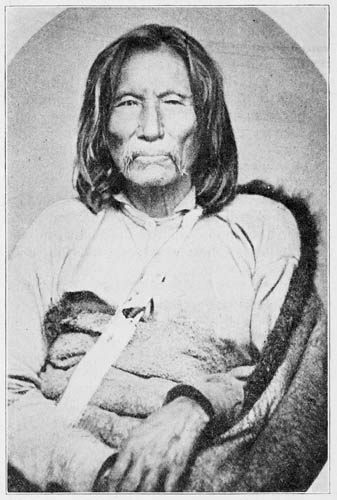
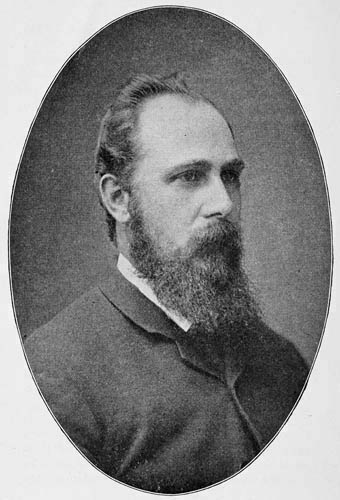
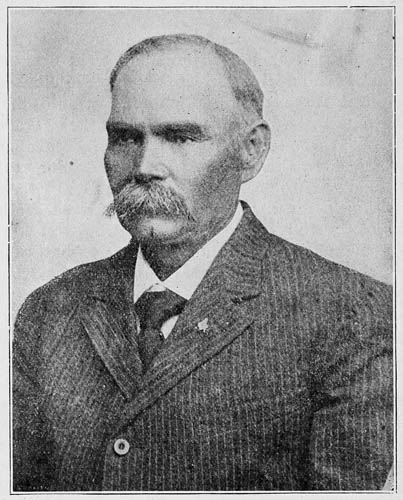
"Billy" Dixon, in His Prime as a Scout and
Plainsman.
At this time Dodge City was the terminus of the Santa Fe railroad. The
railroad company was still grading, and had moved as far west as the
State line, at Granada, Kas., where building stopped for about a year.
Dodge City sprang up like a mushroom. Buildings went up day and night,
and in a month's time the first dozen houses had been increased to a
small town.
Like moths drawn by the flame of a lamp, a picturesque lot of men
gathered at Dodge. Practically all of them were looking for adventure
and excitement, rather than for opportunities to become preachers,
lawyers or merchants. They came from the border towns that dotted like
beads that western fringe of civilization. Dodge City belonged mostly
to the under-world in those days, and its ways were the ways of men
and women who stayed up all night and slept all day. Buffalo-hunters,
railroad graders, gamblers, dance hall actors and dancers and that
nondescript class that lived without doing any kind of work
predominated. But there were good men and women in Dodge, and as in
most genuine American communities, they finally won out, despite its
revelries and dissipations. The professional gun man that gave Dodge
most of its reputation, especially in eastern States, did not ply his
business as a business until later years.
Money was plentiful in those days. Anybody could get money, and there
was no excuse for being "broke." Business thrived, and some of the
stores could supply a man with practically anything he needed. The men
of Dodge City spent their money as quickly as they made it, so lots of
money was constantly in circulation. Whisky-drinking was a pastime or
diversion in which few men did not indulge. It was true, however, that
some of Dodge City's most famous characters never drank a drop of
intoxicating liquors. They did not dare do it. They belonged to the
class known as "killers." To get drunk or to drink enough whisky to
make the nerves unsteady meant death for such men, as the enemy was
always lying in wait for them.
I cannot boast of having been an altogether perfect man in my conduct
in those wild, free days, but there was two popular forms of amusement
in which I did not indulge—dancing and gambling. I never bet a nickel
on cards nor gambled in any form in my life though I saw all these
things going on every night when I was in a border town, especially at
Dodge. Why I did not, rather than the mere fact that I did not dance
or gamble, always seemed to me to be of most interest. My only answer
would be that this sort of thing did not appeal to me, and this was
sufficient beyond any moral reason for my conduct.
As a class, the early population of Dodge was free-hearted and would
divide the last dollar with a friend or a stranger in distress. The
people stood by each other in all emergencies. Nobody thought of
locking his door at night.
When the Santa Fe's construction was stopped at Granada, hundreds of
men were thrown out of employment, and found it necessary to make some
kind of shift for work, or leave the country. Right here is where the
rapid extermination of the buffalo began. All of these men who could
rustle a team and a wagon and get hold of an outfit went out on the
Plains to kill buffalo. During the fall and winter of 1872 and 1873
there were more hunters in the country than ever before or afterwards.
This was the beginning of the high tide of buffalo-hunting, and
buffalo fell by thousands. More were killed that season than in all
subsequent seasons combined. I feel safe in saying that 75,000
buffaloes were killed within 60 or 75 miles of Dodge City during that
time. The noise of the guns of the hunters could be heard on all
sides, rumbling and booming hour after hour, as if a heavy battle were
being fought. There was a line of camps all the way from Dodge City to
Granada.
During all this time, and since 1871 Jack Callahan and I had worked
together. Perkins and Donnelly were still with us. "Cranky" McCabe,
his good humor having revived, came back to work for me. A single
night at the card table in Dodge City generally wound up McCabe's ball
of yarn, and at once he was ready to return to the buffalo range and
without complaint. Apparently, there was something he had to get out
of his system, and after he had been purged he was ready to resume his
old ways. There was not a lazy bone in his body, and I never had a
better hand. I was very much attached to Jack Callahan. He was always
in good humor, which is a fine quality for a man to have in a hunting
camp. A bad temper can spoil the pleasure of an entire camp. Some
mornings we would sleep late. When the sun got in his eyes, Jack would
jump up, exclaiming "By George, this will never do! It will never buy
my girl a dress nor pay for the one she has."
After we had been at Dodge City a few days, taking in the sights, we
grew tired of loafing, and decided to strike out and go to new hunting
grounds. So we went up the Arkansas River, along the north side, to
what was known as Nine Mile Ridge, where we crossed to the south side
of the river.
The increasing numbers and destructiveness of the buffalo-hunters had
been making the Plains Indians more and more hostile. The danger to
hunters was increasing day by day. All that region south of the
Arkansas was forbidden ground, the Indians insisting that the white
men should obey the terms of the Medicine Lodge treaty. If the killing
of the buffaloes should continue unabated, the Indians would soon be
facing starvation; at least, their old freedom would be at an end, as
they could no longer roam the country at will, confident of finding
meat in abundance wherever they might go.
The Arkansas was called the "dead line," south of which no hunter
should go. The river was patrolled at intervals by Government troops,
as a feeble indication that the Medicine Lodge treaty had not been
forgotten, but their vigilance was so lax that there was no difficulty
in crossing back and forth without detection. The danger of attack by
Indians was a far more potent obstacle to the buffalo-hunter, but as
buffaloes grew fewer in number and the price of hides advanced, even
this did not deter hardy hunters from undertaking forays into the
forbidden country. The troops were supposed to prevent the passing of
the Indians to the north side of the river. This was another scheme
that failed to work.
We gazed longingly across the sandy wastes that marked the course of
the Arkansas. The oftener we looked the more eager we became to tempt
fate. Even the sky looked more inviting in that direction, and often
after a flurry of cold weather the wind from the south was mild, balmy
and inviting. As a matter of fact, the possible danger of encountering
hostile Indians added spice to the temptation.
So we crossed over. Finding a pleasant stretch of bottom land, where
the grass grew tall and thick, we cut and stacked a lot of prairie hay
for our teams and saddle horses. The grass waved above our horses'
backs as we rode along. Later, we found Indians too numerous in this
vicinity for us to devote much time to hunting and we abandoned this
camp.
Before we made the change, however, Callahan and I, both well mounted,
and followed by one man in a light wagon, started southward on a
scouting trip, intending to be gone several days. We wanted to feel
out the country and locate the buffalo herds.
When we reached Crooked Creek, we ran smack into a bunch of Indians,
and had a skirmish with them. The Indians could not speak English.
This did not prevent our understanding them. Their old chief motioned
to us to go northward. That was a long time ago, yet I remember
clearly the appearance of this old warrior. Noticeably, fastened under
the skin of his left cheek he wore a long, brilliant feather. All the
warriors were painted red and yellow. We believed, however, that we
were able to take care of ourselves, and continued on our way. Further
down the creek, we struck another band of hostiles. This was rather
too much of the same thing, and we decided that if we valued our
scalps we had better pull out.
We turned round and headed for camp, missing it about three miles in
the darkness, and going into camp for the night in the enemy's
country. Next morning we got back in safety, and called all hands
round to discuss the situation. Plainly, to stay south of the Arkansas
meant putting in more time fighting Indians than in hunting buffaloes.
But buffaloes had begun coming in by thousands, so we agreed to remain
two or three days and make as big a kill as possible. Hunting was
good, and a week had slipped by. The hides were green, which forced us
to linger until they were dry. Not only were hides more easily handled
when dry, but they made lighter loads.
About the ninth day, we found ourselves running short of meat. A bunch
of buffaloes were grazing about two miles distant. Mounting my horse,
I told the boys that I would ride out and kill two good ones for meat.
I was so well acquainted with the ways of buffaloes that I could judge
quickly by their actions whether they would run or stand when
approached. I saw that these were getting ready to run.
This fact was a plausible hint that Indians were moving through the
country. My own experience and the testimony of other hunters
convinced me that nothing causes greater alarm among buffaloes than
the scent or odor of Indians, a peculiarity easily distinguished by a
white man's nostrils. When Indian hunting parties went on the buffalo
grounds to get their winter's supply of meat, the herds were soon in
great commotion, making it difficult for the white hunter to do his
killing at a "stand." Strange as it may seem, if there were no Indians
moving among the buffaloes, the latter would pay scarcely any
attention to white hunters, even though the big buffalo guns were
booming from sunrise to sunset.
Upon nearing the buffaloes as closely as I thought expedient, I
dismounted and began crawling. Picking out a young bull, I turned
loose with my big "50" gun. The herd stampeded at the first crack, and
raised such a dust that I could distinguish nothing. I fired as
rapidly as I could pull the trigger at the indistinguishable mass, and
was lucky enough to bring down six or seven before the herd was out of
range.
This fusillade from my gun set things moving in camp, where the boys
jumped to the conclusion that I had been attacked by Indians. To add
to the excitement a herd of about fifty antelopes appeared on a hill
perhaps half a mile from camp. The swiftly running animals would
traverse a wide circle and dash again to the top of the hill, where
they would stand rigidly attentive gazing in my direction. The excited
imagination of the boys in camp soon transformed these harmless
creatures into mounted Indians. They had not the slightest doubt of my
having been killed and scalped, my body left weltering in its own
blood, and speared and arrowed until it resembled a sieve.
When I rode into camp a few minutes later, I found everything ready
for flight and battle. All the fighting guns were conveniently at
hand, and all the camp equipment was loaded on the wagon. The boys
were just at the point of pulling out, but had lingered a moment to
debate whether they should try to recover my dead body or whoop her up
for Dodge City.
Jack Callahan was declaring that it would be wrong to go away without
being sure that I was dead. While this discussion was under way each
man was as busy as a coon in a hen roost. McCabe had been set at work
priming a lot of shells, which were already loaded. In his excitement
he held the primers in his left hand, asking all the while, "Where in
thunder are those primers? I can't find a single one, yet I saw a lot
of them only a moment ago. Unless we get these shells primed, we'll be
in bad shape!"
McCabe was so nervous that the primers rattled in his shaking hand,
without his seeing them. McCabe lived in mortal terror of Indians,
though as brave as a lion under all other emergencies, a peculiarity I
have seen in other men on the Plains. The scent or odor of the Indian
affected some men as it did certain animals other than the buffalo.
All kinds of game seemed to know when an Indian was around. A horse
could be safely depended upon to give warning of the near approach of
an Indian. I have had my horse run to and fro on his picket rope,
manifesting the greatest alarm, apparently without cause, as I could
see nothing. I never failed, however, to find later that an Indian had
been close by.
The boys gazed at me in utmost astonishment as I rode into camp, safe
and sound. They could not believe that I had really returned, and
began asking me a thousand questions. We laughed over what had
happened, each teasing the other about having been "scared out of a
year's growth." All save McCabe took the joking in good nature. When
the boys began poking fun at him about losing the primers, McCabe
slashed on his war paint, and squared off to fight. He shouted that he
would fight with bare fists, with a butcher knife or with a gun
whoever repeated the story. He would have done as he threatened, but
all of us liked him and only laughed at him the more.
We loaded up with hides next day and pulled out for Dodge City, where
we were lucky enough to strike a good market. We had to make three
trips to get all the hides, for which we received from $2.50 to $4 a
piece, the highest price we ever received. The full amount was $1,975,
but the buyer wrote us a check for the even sum of $2,000, a little
matter like $25 being of no moment in those days at Dodge City.
The weather was now growing much colder, warning us that we should
prepare for snow, sleet and howling blizzards. Each man bought himself
a supply of warm winter clothing, and with lots of supplies and
ammunition, we again went in search of the shaggy buffalo. We went up
the Arkansas as far west as the next railroad station, where we hunted
a few days, finding buffaloes so scarce that we moved over on the head
of South Pawnee.
I had been over this country the previous winter, and knew where there
was a splendid spring of water, which I discovered in an unusual
manner. On a hot, sultry August day I had left my horse down in the
valley, and wandered off on foot after a bunch of buffaloes, going
much further than I suspected at the time. Growing very thirsty, I
began casting about for signs of water. Crossing the head of a small
"draw," I saw a patch of green about a quarter of a mile distant. I
hastened toward the spot, and there, to my astonishment, found a
spring of clear, sweet water that boiled from a crevice in the rock.
In after years I thought many times of the delightful sensation of
lying beside that spring and drinking until I could drink no more.
While resting, I carved in full my name, "William Dixon," in the soft
sandstone rock at the head of the spring. Many years later, when I was
living at Plemons, the county seat of Hutchinson county, Texas, I met a
land agent who told me that he had seen my name on a rock at the head
of a spring in western Kansas. He had no idea that he was talking to
the man who carved the name. This man said that the country was
thickly settled by prosperous farmers, which seemed incredible when I
recalled the days when its principal inhabitants were buffaloes,
mustangs, Indians and buffalo hunters.
We shifted camp as soon as the buffaloes began thinning in numbers.
Reaching North Pawnee, we went up as far as Walnut Creek, changing our
camp as the buffaloes shifted, and finally going back south to Silver
Lake, ten miles north of the Arkansas River. This lake was out on the
open Plains.
Here we were struck by another blizzard. There were two outfits camped
at Silver Lake. The "norther" struck us with terrific fury, and caught
us short of fuel, other than buffalo "chips." I wish here to say
something in honor of the buffalo chip. In later years, as the
fortunes of the settlers in western Kansas improved and their social
aspirations grew stronger, there were those who looked askance upon
the humble buffalo chip, though they had seen the time when they were
devoutly grateful for the genial warmth that spread from its glowing
fire. It was the friend and benefactor of countless hunters and
settlers in hours of need and extremity. The buffalo chip was simply
the dry dung of the buffalo, purely vegetable, and made an excellent
fire, over which coffee could be boiled and meat fried to a turn. When
dry the buffalo chip caught the flame easily, and soon burned to a
dull red. Many a dark night have I looked with gladness at the distant
buffalo chip fire, knowing that around it I would find hospitable
companions and lots of warmth.
There was a big scramble to make snug when the norther hit us. As soon
as it broke, we tied buffalo hides to the wagons to form a shelter for
our horses, but the wind was so strong that it tore down the hides and
carried them rattling and bounding across the Plains. Worst of all,
the gale blew all the fire out of our camp stoves. We were forced to
go to bed to keep from freezing to death, and we remained wrapped in
our blankets under our buffalo robes until next day.
I am sure that in these later years we do not have the sudden
blizzards, such as swept howling from the north in those early days,
which is fortunate, as they would cause untold suffering to people and
livestock.
The weather had moderated by next day, and we went in search of our
stock, which we found at John O'Loughlin's road-ranch, twelve miles
south of Silver Lake. As there was snow on the ground and it was
difficult to find fuel, even buffalo chips, we decided to stay at
O'Loughlin's place until the weather settled. Other hunters were in
the same plight as ourselves, and they too came drifting in to
O'Loughlin's. We were a jolly crowd. What sport we had, telling
stories of our hunts, drinking whisky, playing cards and shooting at
targets. I was especially fond of the latter.
In such a gathering there were always mischievous fellows forever
scheming to play jokes and pranks upon their companions. While at
O'Loughlin's a sham duel, one of the funniest things I ever saw, was
pulled off.
Among the hunters was a young fellow who was continually stirring up
trouble by quarreling. At O'Loughlin's he began imposing upon a quiet,
peaceable man who never bothered anybody. The boys persuaded him to
challenge the bully to fight a duel, telling him they would load the
bully's gun with blank cartridges. The arrangements were soon made.
The bully was willing to fight—at least he seemed to be. He was the
only man in camp that did not know that the affair was a "frame up."
The seconds were chosen, and the time and place of the meeting fixed.
The weapons were to be six-shooters, at fifteen steps.
The buffalo hunters lined up to see the fight. The quiet fellow was to
shoot over the bully's head, but close enough for him to hear the
whistle of the bullet. At the command of "fire" both pistols cracked,
but nobody was hit. The bully winced a bit at the sound of the bullet
as it passed over his head. He soon went locoed, and became so badly
frightened that he could hardly stand. His knees knocked together, and
he trembled like a wet dog on a cold day. Before the second encounter
could take place, the bully squawked, saying that he had enough. He
was teased and rawhided until he left camp, and pulled out for
pleasanter surroundings.
As soon as the weather grew warmer, the hunters went to their camps.
We returned to Silver Lake, but not finding buffaloes plentiful enough
to make hunting profitable, we went over on what was known as White
Woman's Fork, usually a dry stream, with water only in the rainy
season. At this time the melting snow had formed pools. White Woman's
Fork is between the Arkansas and the Smoky Hill.
Buffaloes were so scarce that we followed White Woman's Fork to its
head and there went over to the brakes of the Smoky Hill, and from
there we pulled to Sand Creek, in Colorado. While on Sand Creek we
camped one night where the Chivington massacre of Cheyenne Indians
took place in the 60's. Chivington was in command of a force of
Colorado troops, and took the Indians wholly by surprise. Among the
Indians was Black Kettle's band of Cheyennes, afterwards destroyed by
General Custer on the Washita in Southwestern Oklahoma. Chivington
gave orders to kill everything that looked like an Indian—women and
children, old and young—and his command was obeyed with utmost
cruelty. We could see bones still scattered over the battleground.
Our hunt for buffaloes was proving to be a kind of wild goose chase.
We had made a complete circle, without finding them in sufficient
numbers to warrant our hunting in any one place. We went back down the
Arkansas until we reached Lakin, Kansas, where we stayed eight or ten
days gathering up the hides we had left at different places. We hauled
them to Dodge City.
By this time the spring of 1873 was at hand. Callahan and I dissolved
partnership, as Callahan wanted to go into the saloon business at
Granada, Colorado. He lived there until General Miles started from
Fort Dodge in 1874 on his campaign against the southwest Plains
Indians. Callahan went along as wagon master.
I did not have enough of the buffalo game, however, and after going
back to my old camp on Pawnee Fork, I crossed the Arkansas in May,
1873, and went up the river to what was known as Allberry Crossing, on
the old Santa Fe trail. Here we camped and explored the country, but
failed to find many buffaloes, and began working south toward the
Cimarron—toward the forbidden and dangerous land. We struck the
Cimarron at what was known as Wagonbed Springs, southwest of Dodge. At
that time the Cimarron River was called the dead line. Few hunters had
gone south of the Arkansas. Many who had been hunting around Dodge in
1872 and 1873 had abandoned the hide business, because of the
diminishing number of buffaloes, and for the better reason that they
did not wish to follow the main herd into the Indian country.
Ranging between the Arkansas and the Cimarron in the summer of 1873,
we worked west as far as the Beaver, in Stanton County, Kansas. We
prospered, as buffaloes were plentiful. Our hides were hauled to
Granada, on the Colorado line.
Along in the fall we went to Dodge and loaded up with supplies for an
expedition even further south. We struck Crooked Creek and finally the
Cimarron, ten miles below Wagonbed Springs, where we planned to stay
during the winter, and built a dugout. Buffaloes were everywhere, but
like the leaves of the winter forest—disappearing never to return.
While in camp at this place we saw a spectacular sight. A big war
party of Cheyennes passed on their way to fight the Utes. The latter
lived in Colorado. The Cheyennes were out for blood. Their horses were
in fine shape, and each warrior was fully equipped with weapons. We
learned that the Utes had long been in the habit of coming down to the
buffalo country every fall to kill their winter's supply of meat. The
Cheyennes, proud and arrogant, were opposed to this invasion of their
hunting grounds by the mountain Indians and had decided to make an end
of it if possible. Much has been written about the desperate warfare
and the bloody battles between Indians and white men. I am rather of
the opinion that war between Indian tribes was even worse. They fought
to exterminate each other if possible.
This expedition of Cheyennes was divided into many small
parties—three or four warriors traveling together. We had heard of
their attacking other buffalo hunters, and running off their stock. We
kept both eyes open, day and night. Frequently, these Indians would
stop at our camp, to which we offered no objection if there were only
a few in the party, but if fifteen or twenty came in sight, heading
toward our camp, we signalled for them to pass around without
stopping. We did not dare run the risk of letting a superior force of
Indians get at close quarters under the guise of friendship, as soon
every hunter's scalp would have been dangling on the Cheyenne bridles.
Occasionally, upon approaching, the Cheyennes would lay down their
guns, and advance unarmed, to show that they did not intend to offer
us injury. We always fed them well.
About fifteen warriors came into camp one day, and were soon greatly
interested in a pair of field glasses that I used in looking over the
country for landmarks, buffaloes and Indians. After letting our
visitors look through them, I laid the glasses on a pile of bedding
and thought no more about them. After the Indians had ridden away, I
reached for the glasses to look over a bunch of Indians that had
assembled on a hill a mile or so distant. The glasses had disappeared.
I was fighting mad, and determined to get my glasses or kill an Indian
or two. Seizing my buffalo gun and mounting my best horse, I started
in pursuit of the thieves. The rascals suspected my purpose, and long
before I got within shooting range they scattered like quail and hid
themselves. The country was rough and broken and I found it decidedly
too dangerous to attempt to hunt them out.
In approaching our camp, it had been the practice of the Cheyennes to
come with their horses running at headlong speed, possibly to "throw a
scare" into the white men. We at once set our heads against this sort
of thing, and soon convinced the Indians that we would fire into them
if the practice were repeated.
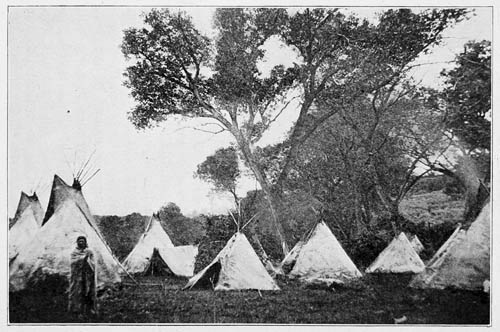
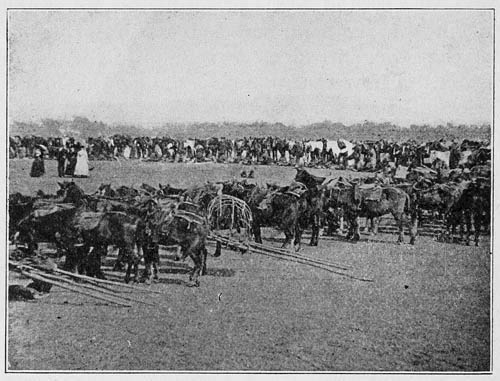
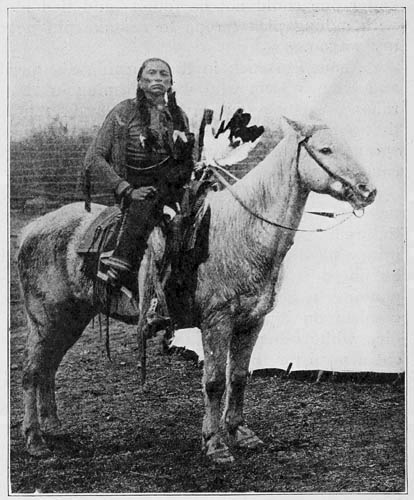
Indian Camp of Buffalo Hide Tepees.
All these Cheyennes were rigged out in full war style. Each had a led
horse, his war horse, which was the Indian's pride, and which he loved
above his other possessions. He gave his war horse the best of care,
and kept him expressly for battle.
The detachments of this big Cheyenne war party were about three days
passing our camp, and during that time we remained close at home. One
of us constantly stood guard on a high point close by. There was smell
of Indian in the air. Our horses were picketed during the day, and at
night we tied them to the wagons. There were only four of us, and we
could not afford to make the slightest mistake.
After the country was clear of Indians, we made a trip over on
Sharpe's Creek, but found no buffaloes—the passing of the Indians had
scared the buffaloes out of their wits. If the buffaloes would not
come to us, we would go to the buffaloes, so we shifted camp from the
Cimarron down to the Beaver, in "No Man's Land."
Making short drives each day, to spy out the country, we got as far
west as the present town of Guymon, Okla., where we camped several
days to clean up several scattering bunches of buffaloes, all bulls.
These old bulls were easily killed, and their hides brought the best
prices.
Here we met some of the same Cheyennes that had passed our camp on the
Cimarron. They were on their way back home to Indian Territory. They
recognized us. I had acquired some knowledge of the Cheyenne language,
and questioned them about their trip to the Ute country. It was funny
to hear them tell how they had "run the Utes clean over the
mountains." They claimed they had killed stacks and stacks of Utes,
going through the motions of how the Utes ran in getting away from the
Cheyennes.
After making a kill of buffaloes, the hides were always left on the
ground to dry, before hauling them to market. We had left a big lot of
hides and provisions at our Cimarron camp. The passing of the Indians
on their way back home made us feel that it might be well to see what
the situation was in our old camp. We expected to find all our hides
gone and our provisions stolen; to our great surprise we found
everything just as we had left it. The plains Indians were highly
suspicious, and it is possible that they feared the provisions might
be poisoned.
The thinning out of the buffaloes made hunting laborious. Riding out
early one morning, I managed to kill about thirty during the day's
hunt, all of them cows. It was a strange fact that buffalo cows and
bulls ranged together only during the breeding season; at other times
they went in separate bunches.
Next morning we went out to do our skinning. Having run short of meat,
I had drawn several of the carcasses, and was so busily engaged that I
did not notice what was going on around me.
The day was warm, with the wind in the south. Then the wind died until
there was perfect calm for about fifteen minutes. Suddenly, our
attention was drawn to the unusual appearance of the sandhills to the
north of us, along the river. We could see a fog of dust and sand,
which struck us in a shorter time than it takes to tell it. We were
caught in the jaws of a norther, the terror of the Plainsman. All
animals seem to know instinctively when a norther is coming, and grow
nervous and restless.
It is difficult to see or to breathe when a norther is at its height,
and unless good shelter is near at hand there is danger of quickly
freezing to death. We were wise enough to know that the best thing for
us to do would be to get back to camp as quickly as possible. Tossing
our meat into the wagon, we jumped in and headed for camp with our
mules at a gallop. On my horse I rode beside the mules, urging them
along with my quirt. Despite our instant flight and our speed, we were
nearly frozen when we arrived at camp.
These winter storms usually exhausted themselves at the end of two or
three days, but while they are raging it is impossible to leave camp
with safety.
After we had thawed out, we decided to tackle the Beaver country
again, and went up that stream to a place then known as Company M,
where we struck off in a southwesterly direction and came to the
Coldwater, which further toward its source is known as the Al Frio,
which means "cold water," and undoubtedly was named by the Mexicans
who used to hunt in that region. The favorite weapon of these Mexicans
was the lance, which necessarily brought them at close quarters with
the buffaloes, and required swift horses.
The Coldwater takes its rise from a number of springs which form a
series of remarkable pools of water. At this place afterwards was
built one of the headquarters of the old XIT Ranch outfit. The
buildings stand today as they did in earlier years, but the phase of
life that dwelt there has vanished forever. When the XIT established
itself in the Texas Panhandle, the cowboy was typical, genuine and
picturesque. He was the cock of the walk, who could eat centipedes for
breakfast and barbed wire for supper without injuring his digestion,
and dance all night and ride all day without missing a step. His like
will never be seen again. He had a rough hide and a tender heart, and
an ear that was inclined to every hard luck story that passed his way.
Buffalo Springs stands in the open Plains south of the Beaver and just
south of the line that divides the Texas Panhandle from Cimarron
County, Oklahoma. Here is a considerable growth of timber, consisting
of cottonwoods, elms and willows. The traveler will go many, many
weary miles south before he again sees a clump of timber or finds
living water.
The beginning of the Al Frio is a spring near a lone cottonwood tree
about a mile west of the ranch house. The water rises in a fissure in
the rock. Some rather fabulous stories have been told about its depth.
Now follow a chain of deep pools of dark and steely clearness,
chillingly cold even in hottest midsummer, with steep, precipitous
banks, along which waves a dense and almost impenetrable growth of
reeds and tall, wiry grass. Here abound bass in such size and numbers
as to tempt the most expert angler.
Buffalo Springs is a veritable garden in the dry and dusty Plains, an
oasis in the desert. Countless birds not found elsewhere on the Plains
assemble here in summer, beautifying with song and bright plumage all
the green, cool places. Flowers of exquisite fragrance and great
brilliancy of color are found. There are many varieties. In fall and
spring, migratory water-fowl descend to disport themselves in the
pools.
The ranch house, which still remains in excellent condition, was such
a house as appealed to a man seeking shelter from winter storms or
summer heat. Its original walls of adobe were boxed and plastered,
giving them a thickness of nearly two feet. On its dirt floors jangled
many a spur. At the kitchen door hangs the triangle gong with which
the cook called the "woollies" to meals. Struck with its heavy bar of
iron, this old gong booms and rumbles until it can be heard far out on
the Plains. Each of its sides measured more than two feet.
When this region was wild and uninhabited, these springs were
frequented by buffaloes in enormous numbers, crowding and fighting
their way to water. In the neighborhood of the pools were treacherous
bogs which at this day are a menace to live stock. In the old days
buffaloes must have mired there by hundreds.
Here the Indians encountered this noble game to their liking. A mile
or two east of the springs, there is a slight swell in the Plains
where the Comanches are said to have maintained their hunting camp
when in that vicinity. From this camp the Plains could be surveyed for
miles in every direction. Mounting their horses, the Indian hunters
descended like thunderbolts upon the buffaloes massed at the springs,
and slaughtered them at will. The hides were pegged down and dried in
camp and the meat hung on poles and cured in the dry, pure air for
winter use. A kill could be made as often as the red hunters wished to
rush to the attack.
This account of the history of Buffalo Springs has been given by Mr.
John Skelley, one of the rugged and reliable pioneers of Cimarron
county; he lives at the postoffice of Wheeless:
"I was at Buffalo Springs as early as 1878, when I was a boy 14 years
old. At that time there were no buildings. There had been some adobes
made, either by Bill Hall, of Kansas City, or Dan Taylor of Trinidad,
or both, in order to build a house to shelter their winter
line-riders, as a line-camp was kept at the Springs every winter. My
father was a freighter at Trinidad, where I was raised, and he hauled
the lumber down to Buffalo Springs from Trinidad, to cover and floor
the house. I made the trip with him. This was in 1878.
"The house was never built, as the fall and winter of '78 were so cold
and severe that the line-riders burned all the lumber for wood. The
nearest timber was on the Currumpaw or Beaver, about eight or ten
miles northwest of the Springs, where there are still a few stunted
cedars and a growth of cottonwoods.
"In 1884 the Capitol Freehold Land & Cattle Syndicate established a
ranch at Buffalo Springs. This company is the one that built the
capitol at Austin, Texas, for which it was paid in millions of acres
of land. This ranch was stocked with cattle. I worked for the man who
had the fence contract. We finished the contract in December, 1885.
"During that year the owners had put in about 20,000 head of cattle,
brought from the south. Better grass could not be found anywhere. A
few mustangs and buffaloes were still left in the country, but
disappeared from that vicinity in 1887. Stragglers could be found
around Company M water as late as 1889. This water was six or eight
miles southeast of the present town of Boise City, the county seat of
Cimarron county, Oklahoma.
"In the fall of 1885 a big prairie fire broke out and swept the
country bare from the Beaver south almost to the South Canadian. We
fought it with all our strength, but there were not men enough in the
country to get it under control. This misfortune was followed by an
early and severe winter. The company at Buffalo Springs drifted its
herds out to the Canadian and to the south Plains, yet despite every
precaution the loss was tremendous. I was told that only 7,000 head of
the 20,000 were gathered the following spring.
"The company did not jump the game, but went ahead next year. Old man
Boise, who was killed by Sneed, was general manager of the company for
a good many years, and built up a fine ranch. A man named Campbell was
the first manager at Buffalo Springs, followed by an Englishman named
Maud. After these came Boise, who took the outfit about 1890.
"The timber that is growing at Buffalo Springs was planted by the
company, and is not a natural growth. I know of no natural timber
south of there until the Canadian is reached, though the company has
set out several tracts in timber, and there is now lots of water in
wells on their holdings between Buffalo Springs and the Canadian.
"In the old days when we left Buffalo Springs and traveled southeast
we found no live water until we got to the head of the Rio Blanco,
about fifty miles distant, and ten or twelve miles southeast of the
present town of Delhart. There was and still is water at what we used
to call the Perico water-holes, some 10 or 12 miles south of the
Ranch, but this water has neither source nor outlet, as it rises and
then sinks again, the Perico gradually vanishing in the Plains.
"The Springs was a great hunting ground for buffaloes. In the fall of
1878 the valley was alive with buffaloes and mustangs, and when I was
there in that year I saw several hunters' camps. A long time ago I
talked to old Mexicans who told me that they hunted buffaloes at the
Springs when they were boys. They said that expeditions of both
Mexicans and Navajoes came from the settlements on the Rio Grande, in
New Mexico, to procure their winter's meat.
"There was an old trail leading to the Springs from New Mexico, thence
to Agua Frio, and on down through the country to the eastward. We used
to call this the 'old buffalo trail.' I have not seen it in more than
twenty-five years, but am told that it has become so overgrown with
grass that it has almost disappeared. When I was there as a boy there
were thousands of antelope on the Plains; now most of them are gone.
The Fort Worth & Denver City railroad company began running its trains
through the company's big estate in the spring of 1888, which hastened
the disappearance of the game."
We camped over night at Buffalo Springs, and next day followed the Al
Frio or Coldwater, which is a dry stream with occasional water holes.
After proceeding about thirty miles, we saw that the stream was
bearing too far to the north, so we turned south and struck the brakes
of the Big Blue, a tributary of the South Canadian. This was a new
country to all of us, and as strange to us as if we were its first
visitors. We came to a pool that was alive with all kinds of fish, and
in all directions deer and wild turkeys seemed as thick as
grasshoppers. With a whoop, everybody voted unanimously to go into
camp at this place.
As a fisherman I never had any luck. Leaving this sport to the rest of
the outfit, I mounted my horse, and set out to explore the surrounding
country. In roaming around, I reached an abandoned Mexican camp on one
of the prongs of the Blue. It had been untenanted for years. I was
told by older hunters that the Mexicans used to come here every fall
to kill buffaloes, bringing pack trains. They remained until they got
a winter's supply of meat, drying the meat and rendering the tallow.
I rejoined the outfit and we kept moving until we reached the South
Canadian, crossing this stream at a point near where the LX Ranch was
afterwards located. Further south, we struck Palo Duro Canyon below
the waterfalls. This was a dry stream, and we were compelled to rely
upon melted snow for ourselves and stock. We crossed Mulberry Creek at
its head waters, and camped there several days.
After crossing the Canadian, we began seeing signs of Mexican hunters,
the spots where they had camped the preceding fall being plainly
visible. Shifting our course more to the northeast, we crossed the
head tributaries of Salt Fork and North Fork of Red River, coming back
to the Canadian about twenty miles above where Canadian City, Texas,
now stands.
During all this wandering we had not seen a white man, nor a human
being of any kind—only a vast wilderness, inhabited by game—truly
the hunter's paradise. When we saw Red River we thought that it
certainly must be the South Canadian, being misled by the fact that
both were sandy streams and both dry at that time. We could see a
difference between the two, however, when we got to the Canadian.