Most people know their "Robinson
Crusoe," and have heard of the
author Defoe. But how many of
us have heard even the name of Woodes Rogers,
Master Mariner? or have read his quaint Journal
of a cruising voyage round the world in the
ships "Duke" and "Dutchess" of Bristol,
"printed in 1712 for A. Bell and B. Lintot at
the Crosse Keys and Bible between the two
Temple Gates Fleet Street."? Yet it was this
Woodes Rogers who not only discovered the
original Crusoe, Alexander Selkirk, but after
making a "note of him when found" upon the
island of Juan Fernandez,[1] at once proceeded to
make very practical use of him by giving him
command of the "Increase," one of many small
prizes taken in the South Seas from the Spaniards
by the "Duke" and "Dutchess."
That Rogers was more than a master mariner,
of much resource and pluck, is shown in his
Journal, and the wonderful way in which he
handled the very mixed group of men which
formed the small floating commonwealth under
him. It was more than thirty years later that
Lord Anson sailed a similar voyage round the
world with the advantage of the experience of
Rogers and others, while Anson's squadron was
fitted, manned, and armed by Government: yet,
considering the loss of life and material which
marked that cruise, it seems to me that, judged
by results, Rogers' voyage was a far more
wonderful performance, and that it attracted
some attention at the time is shown by a notice
of it in Captain Berkley's "Naval History,"
(published, 1756), where, under the heading of
"Conduct of the Bristol Privateers," he says,
"we have read in very pompous language the
names of those who, with great ships and great
preparations, encompassed the Globe. But at
this time came in two privateers, of Bristol, who
with no more than the common strength of such
vessels, undertook the voyage, and at the end of
two years and three months returned," &c.
In his own Preface, Captain Rogers says, "I
was not fond to appear in print; but my friends
who had read my journal prevail'd with me at
last to publish it," adding, "I know 'tis generally
expected, that when far distant voyages are
printed, they should contain new and wonderful
discoveries, with surprising accounts of people
and animals; but this voyage being only design'd
for cruising on the enemy, it is not reasonable to
expect such accounts here as are to be met with
in travels relating to history, geography, &c.,
while, as for stile, I have not had time, were it
my talent, to polish it; nor do I think it necessary
for a mariner's journal. 'Tis also," he
says, "a particular misfortune, which attends
voyages to the South Sea, that the buccaneers, to
set off their own knight-errantry, and to make
themselves pass for prodigies of courage and
conduct, have given such romantic accounts of
their adventures, and told such strange stories, as
make the voyages of those who come after (and
cannot allow themselves the same liberty), to look
flat and insipid to unthinking people. Therefore
I request my readers, that they be favourable in
their censures when they peruse this journal
which is not calculated to amuse, but barely to
relate the truth, and which is all written in the
language of the sea, that being more genuine and
natural for a mariner than the method us'd by
authors that write ashoar." I have, therefore, in
the following extracts, quoted Rogers' Journal as
closely as possible, adding only a short connecting
note here and there, where required.
Robert C. Leslie.
[1] Though this island in the Pacific is the one usually
associated with Robinson Crusoe, Defoe conceals its identity
by wrecking Crusoe's ship upon an island to the north of
Brasil, near the "Great River Oroonoque."
CHAPTER I. FROM KING ROAD, BRISTOL, TO CORK IN IRELAND. — FOOTNOTES:
1708
Setting out
from King
Road.
Many a modern pleasure yacht would
exceed the tonnage of the frigates
"Duke" and "Dutchess," the
"Duke" being 320 tons, with 30 guns and
117 men, and the "Dutchess" only 260 tons,
with 26 guns, and 108 men. "Both ships,"
says Rogers, "well furnished with all necessaries
on board for a distant undertaking
weigh'd from King Road Bristol August 2nd
1708 in company with the 'Scipio,' 'Peterborough
Frigate,' 'Prince Eugene,' 'Bristol Galley,'
'Berkley Galley,' 'Bucher Galley,' 'Sherstone
Galley,' and 'Diamond Sloop,' bound to
Cork in Ireland." These "galleys" must not
be confounded with the lateen rigged vessels of
that name in the south of Europe; being simply
small, low, straight ships of light draught easily
moved by oars or sweeps in calms. In Rogers'
time a ship was said to be "Frigate built" when
she had a poop and forecastle rising a few steps
above the waist, and "galley built," when there
was no break in the line of her deck and topsides.
But the use of oars was not confined to these
Bristol[2] galley built ships, for Rogers speaks of
using them on several occasions in the "Duke"
and "Dutchess." While in old draughts of
small vessels of this class, of even a later date,
row-ports are often shown.
Between the Holmes and Minehead the little
fleet came to "an Anchor from 10 to 12 at
night, when all came to sail again, running past
Minehead with a fine gale at S.E. at six in the
morning." No time was lost before an attempt
was made to add to the number of the fleet, for
the same day, at 5 p.m., the "Dutchess," like
a young hound, breaks away from the pack in
chase of what seemed a large ship, which they lost
sight of again at 8 o'clock. But "having been
informed at Bristol that the 'Jersey,' a French
man-of-war, was cruising betwixt England and
Ireland, the ships sailed all night with hammocks
stowed and cleared for a fight. Though it was
well for us," says Rogers, "that this proved a
false alarm, since had it been real we should have
made but an indifferent fight, for want of being
better manned."
An incompetent
Pilot.
Arrival at
Cork.
After parting company with three galleys and
the "Prince Eugene," the fleet, on the 5th of
August, "finding they have overshot their port,
come to an anchor at noon off two rocks, called
the Sovereigne's Bollacks, near Kinsale; at 8 p.m.
they weighed again with a small gale at east,
which increased and veered to northward." At
this time Rogers had a Kinsale pilot on board
who, he says, "was like to have endanger'd our
ships by turning us into the next bay to the west
of Cork, the weather being dark and foggy."
"Which," says Rogers, "provoked me to chastise
him for undertaking to act as pilot without
understanding his business better." On the 7th
the "Duke" and "Dutchess" anchored in the
Cove of Cork, and remained there, more or less
weather bound, until the 28th, the entries in
Rogers' log varying little beyond telling us that
on the 11th, "it blow'd fresh and dirty weather:"
while on the 12th, "it blew fresh and dirty
weather, on which day there clear'd and run near
forty of our fresh water sailors." In whose
place "came off a boat load of men from Cork,
that appear'd to be brisk fellows but of several
nations; so I sent to stop the rest till we were
ready, our ships being pester'd." On the 28th
the weather was fine enough to "Careen clean
and tallow the ships five streaks below the water
line." Nothing marked the smart privateersman
and seaman of those days more than his constant
care in keeping the bottom of his ship perfectly
clean. Indeed, Captain Rogers never seemed
happier than when he had one or other of the
little frigates held over for scraping and cleaning,
in some quiet bay, so nearly upon her
beam ends, as to bring her keel almost out of
water.
When shipping the rest of his crew before
sailing from Cork, we get a taste of Rogers'
foresight and policy. For he tells us, "we have
now above double the number of officers usual
in privateers, besides a large complement of
men;" adding, "we took this method of doubling
our officers to prevent mutinies, which often
happen in long voyages, and that we might have
a large provision for a succession of officers in
each ship in case of mortality."
It must, however, have been a sore trial to a
tarpaulin seaman, like Rogers, to have to note at
the same time, "that in order to make room for
our men and provisions, we sent the sheet cable
and some other store cordage on shore, having
on board three cables besides, and being willing
rather to spare that than anything else we had
aboard."
In a small frigate quite a fourth part of the
hold was, before the introduction of chain cables,
occupied by the cable tier or room; and when
one considers, not only the space they filled, but
the difficulty of handling them, and the care required
to keep them from chafing when in use,
and from damp and rot when stowed away, it is
astonishing that ships returning from long cruises
ever had an anchor or cable left which they
could trust.
Among the troubles attending the use of hemp
cables, that of firing in the hawse holes and at
the bits, or timbers they passed over in running
out, was one; and each time the anchor was let
go men were stationed with buckets of water to
prevent this.
The crew at
Cork.
Many weddings
among
them.
It was while victualling and shipping men at
this time that a side-note appears of the "Strange
behaviour of our men at Cork;" alluding to the
fact, "that they were continually marrying whilst
we staid there, though they expected to sail immediately."
Among others, a Dane was coupled
by an Irish priest to an Irish woman, without
understanding a word of each other's language,
so that they were forc'd to use an interpreter.
"Yet," says Rogers, "I perceived this pair
seem'd more afflict'd at separation than any of
the rest; the fellow continu'd melancholy for
several days after we were at sea." Whether
the Irish bride shared her Danish husband's depression
is, of course, not related by Rogers,
who goes on to say that "the rest, understanding
each other, drank their cans of flipp[3] till the last
minute, concluding with a health to our good
voyage, and their happy meeting, and then parted
unconcern'd."
Names of the
officers.
Though the chief command of the expedition
fell to Woodes Rogers, master mariner, yet, as
was the case in most of these private ventures to
the South Seas, several of his officers were men
with no claim to the name of sailor, who had
either money invested in the ships, or interest
with the owners. It is not surprising, therefore,
to find that "the second Captain of the 'Duke,'
and captain of the Marines, was one Thomas
Dover, a doctor of phisick," or that this Captain
Dover's first lieutenant was "his kinsman, Mr.
Hopkins, an apothecary." On the other hand,
Rogers had cleverly secured as his master the
celebrated William Dampier, also rated "Pilot
of the South Seas," "he having," as Rogers says,
"already been there three times and twice round
the world." This was no doubt poor Dampier's
last venture at sea, for though Rogers mentions
his name once or twice in consultation during the
cruise, he is altogether lost sight of toward the
end of it. Among the other officers, "the third
mate, John Ballet, was also designated surgeon,
having," says Rogers, "been Captain Dampier's
doctor in his last unfortunate voyage;" while
two young lawyers have their names upon the
ship's books, "designed to act as midshipmen."
How the
crew was
made up.
Including boatswains, gunners, carpenters, &c.,
there were on board the "Duke" thirty-six
officers, and of the rest of the crew, we are told
that "a third were foreigners, while of Her
Majestie's subjects many were taylors, tinkers,
pedlars, fiddlers, and hay-makers, with ten
boys and one negro; with which mix'd gang
we hope to be well manned as soon as
they have learnt the use of arms, and got
their sea legs;" which, says Rogers, "we
doubt not soon to teach 'em and bring 'em to
discipline."
It was the 1st of September before the "Duke"
and "Dutchess" left the Cove of Cork with
twenty merchant vessels, under convoy of Her
Majesty's ship "Hastings," "both of us," says
Rogers, "very crowded and pester'd ships, their
holds full of provisions, and between decks encumbered
with cables, much bread, and altogether
in a very unfit state to engage an enemy,
without throwing many stores overboard."
Nevertheless, on the 2nd, the two little frigates
stand out from the fleet to chase a sail to windward;
and Rogers is glad to find that they sailed
as well as any in the fleet, not even excepting
the man-of-war, so that, he says, "we begin to
hope we shall find our heels, since we go so well
tho deep and pester'd."
The chase, however, proved an inoffensive
"French built Snow,[4] of Bristol, joining our fleet
from Baltimoor" (Ireland).
Captain
Paul's
civility.
The weather being fine on the 4th of September,
Rogers and Captain Courtenay of the
"Dutchess," in answer to a signal from Captain
Paul, of the Sherstone galley, make a morning
call upon that gentleman, in which they are joined
by the commander of the "Scipio," and after
being "handsomely treated by Captain Paul,"
he proposes joining them in a few days, privateering
off that well-stocked preserve, Cape
Finisterre. A marginal note occurs here in
Rogers' journal of "Captain Paul's civility," referring
to a present, or tip, "of some scrubbers
and iron scrapers for our ships' bottoms, together
with a speaking trumpet and other things we
wanted, for which Captain Paul would accept
nothing in return."
The crew
acquainted
with our
design.
Leave Captain
Paul.
The time had now come for parting company
with the man-of-war, "and it became necessary,"
says Rogers, "to acquaint the ships companies
with our designes in order that while in company
with one of Her Majesties ships any malcontents
might be exchanged into her. But with the exception
of one fellow who expected to have been
made tything man in his parish that year, and
said his wife would have to pay forty shillings in
his abscence, all hands were satisfied," while even
the discontented tything man became reconciled
to his lot, when asked to join all hands at the
grog-tub in drinking to a good voyage. Parting
company, however, with the man-of-war also entailed
giving up the proposed cruise off Finisterre
with the Sherstone Galley, or as Rogers
puts it "we had to break measures with Captain
Paul. But I excused it to him and saluted him,
which he answered and wished us a prosperous
undertaking. Wind N. by W. and clear
weather." As the crowded little frigates roll
across the Bay of Biscay together before this fair
wind, we have the first entry in Captain Rogers'
log of one of the many snug little dinners given
on board his ship to the officers of the "Dutchess,"
and which is returned by them in due
form the next day.
This constant interchange of civilities among
the officers of ships sailing in company is a very
marked feature in the manners and customs of
the mariners of that date. Among men-of-war
anchored in roadsteads or in port such events are
even now, of course, not uncommon. But in
those days, judging from entries in Rogers' log,
few days passed at sea without actual communication
by boat between the ships, the crews of
which must have had constant practical experience,
both in lowering and hoisting in boats.
While, though this must often have been done
with a high sea running, there is no record of a
mishap to a boat or crew during the entire
cruise—a fact speaking volumes for the fine
boatmanship of the sailors of this period.[5]
A committee.
Though practically under the able leadership
of Rogers, the two privateers formed together a
small floating commonwealth, no important
measures being decided upon until they had
passed a committee of the officers of both ships.
The first of these marine parliaments sat on
board the "Duke," just after an entry in Rogers'
log says, "that now we begin to consider the
length of our voyage, and the many different
climates we must pass, and the excessive cold
which we cannot avoid going about Cape Horn;
at the same time we have but a slender stock of
liquor, and our men but meanly clad, yet good
liquor to sailors is preferable to clothing. Upon
this we held our first committee to debate
whether t'was necessary for us to stop at
Madera?"
Here follows a minute of the resolutions as
passed, which are formally signed by each
member of the Committee, thus:
"Thos: Dover, President.
Stephen Courtenay.
Woodes Rogers.
Edward Cooke.
William Dampier.
Carleton Vanbrugh.
Tho: Glendall.
John Bridge.
John Ballet.
Robert Frye."
At six the next morning both frigates go in
chase of a sail, "the 'Dutchess' having a mile
start given her in order to spread the more;"
Rogers adding "that it blew fresh with a great
sea, and the chase being to windward, we crowd'd
extravagantly."
Nine hours later they came up with the chase,
"who bore right down upon us, showing Swedish
colours. We fired twice at her before she brought
to, when we board'd her, Captain Courtney's
boat being just before ours. We examined the
master, and found he came round Scotland and
Ireland."
This was a very usual track in the old war
times, in order to avoid capture in the British
Channel. But it made Rogers suspect the Swede
of having something in the shape of warlike
stores on board, so that, naturally anxious to
prove her a prize, after such a long chase to
windward, and believing some men "he found
drunk, who told us they had gunpowder and
cables aboard, he resolved to strictly examine
her, placing twelve men on board, and taking
the master and twelve of her men on board the
'Duke.'" Nothing, however, was found to
prove her a prize, and Rogers "let her go," as
he says, "without the least embezelment. Her
master giving him two hams and some ruff't
dried beef," in return for which Rogers gave
him "a dozen bottles of red-streak cider."
A mutiny
quell'd.
Mutineers
pardon'd.
The character both of Rogers and his crew
come out strongly on this occasion, for he tells
us "that while I was on board the Swede yesterday
our men mutiny'd. The ringleaders being
our boatswain and three inferior officers. But
this morning the chief officers having kept with
me in the after part of the ship we confined the
authors of this disorder, in which there was not
one foreigner concerned, putting ten mutineers
in irons, a sailor being first soundly whip'd for
exciting the rest to join him. Others less guilty
were punished and discharg'd, but I kept the
chief officers all arm'd, fearing what might
happen; the ship's company seeming inclin'd to
favour the mutineers, some beg'd pardon and
others I was forc'd to wink at." The only reason
for this rising was discontent of the crew at not
being allowed to plunder the Swede. "Two
days later," says Rogers, "the men in irons discover'd
others who were ringleaders in the
mutiny." These are, of course, placed in irons
with the rest, Captain Rogers judiciously creating
a new boatswain, "in the room of Giles Cash,
who, being a most dangerous fellow," I agreed
with the master of the "Crown Galley," then in
company, to carry for me in irons to Madera,
"which extreme measure" was taken because
"on September the 14th a sailor follow'd by near
half the ship's company came aft to the steerage
door, and demanded the boatswain out of irons;
on which," says Rogers, "I desired him to speak
with me on the quarter deck, which he did,
where, the officers assisting, I seiz'd him (i.e.,
tied him up) and made one of his chief comrades
whip him, which method I thought best for
breaking any unlawful friendship amongst themselves,
which, with different correction to other
offenders, allay'd this tumult, so that now they
began to submit quietly and those in irons to
beg pardon and promise amendment. This
mutiny would not have been easily lay'd were it
not for the number of our officers, which we
begin to find very necessary to bring our crew to
discipline, always difficult in privateers, but without
which 'tis impossible to carry on any distant
undertaking like ours. Fine pleasant weather,
moderate gales." Two days later, "on their
humble submission, and strict promise of good
behaviour for the time to come," the mutineers
are set free; "they having," says Rogers, "while
they continued in irons had sentries over 'em,
and were fed with bread and water."
A Spanish
prize taken.
On September the 18th they sight "Pico
Teneriff, and at 5 next morning spy'd a sail
under their lee bow, which proved a prize, a
Spanish bark about 25 tuns belonging to Oratava
in Teneriff, and bound to Forteventura with
about 45 passengers; who rejoiced when they
found us English, because they feared we were
Turks. Amongst the prisoners were four Fryars,
one of them the Padre Guardian for the Island of
Forteventura, a good honest fellow whom we
made heartily merry drinking King Charles the
Thirds health, but the rest were of the wrong
sort."
[2] Writing of Bristol in 1808, Pinkerton says that "in
the late wars with France they built here a sort of galleys,
called runners, which being well armed and manned, and
furnished with letters of marque, overtook and mastered
several prizes of that nation. Many of these ships were
then also carriers for the London merchants, who ordered
their goods to be landed here, and sent to Gloucester by
water, thence by land to Lechlade, and thence down the
Thames to London; the carriage being so reasonable that
it was more than paid for by the difference of the insurance
and risque between this port and London."
[3] "Flipp, a liquor much used in ships, made by mixing
beer with spirits and sugar."—Johnson, 1760.
[4] "Snow." A vessel which would now be called a brig.
The largest two masted craft of that time, and then distinguished
from a brig by having a square mainsail below her
maintopsail; a fore and aft sail being also carried upon a
small spar fitted to, and just abaft the mainmast. In the
original brigs this fore and aft sail was set upon the mainmast
itself, and was the mainsail, in the Snow it became
the spanker.
[5] Forty or fifty years ago the crews of South Sea whalers
were very smart sea-boatmen, and their captains thought
nothing of lowering a boat in a double reefed topsail
breeze, to take a cup of tea or glass of grog with the
captain of a ship in company. Great simplicity was the
main feature of boat lowering gear on board these ships;
but constant practice made communication between them
so easy, that it took place often under difficulties which now
would be sufficient to entitle the officer in charge of the
boat to a gold watch and chain.
CHAPTER II. AMONGST THE CANARY ISLES. — FOOTNOTES:
1708
Sept.
Considering that Captain Rogers'
main object in cruising among the
Grand Canaries was to lay in a store
of liquor for his voyage "about Cape Horn,"
this small Spanish bark, with a cargo of two
butts of wine, and a hogshead of brandy, was
a lucky windfall.
A letter from
Port Oratava.
A trifling hitch occurred, however, about her
ransom, owing to the headstrong conduct of Mr.
Carlton Vanbrugh, the "Duke's" agent, "who,
against his Captain's judgement," went ashore
with the master of the prize to settle this matter,
and was there detained; the authorities refusing
to let him go unless the bark was restored to
them free of charge; they claiming protection
from capture for all vessels trading between these
Islands; which view of the case was supported,
not only by the British Consul at Oratava, but
by certain English merchants there, and from
whom Rogers received a long letter actually
advising him to give up his prize; which he
answered in full, with his reasons for not doing
this; the chief of which was, that possession is
nine-tenths of the law.
Our Answer.
Capt. Rogers'
generosity.
The answer of the Spanish authorities, however,
"being," as Rogers tells us, "of a dilatory
character," he at once wrote the following dispatch;
informing them "that had it not been
out of respect for his officer ashoar, he would
not have staid one minute, and that now he
should stay only till morning for their answer,
taking meanwhile a cruise among the Islands in
order to make reprisals, and tho' he could not
land his men, that he would visit the town with
his guns by eight next morning; when he hoped
to meet the Governor's Frigate, and repay his
civility in his own way." "Which letter," says
Rogers, "had its effect, for as we stood in close
to the town at eight o'clock next morning, we
spy'd a boat coming off, in which proved to be
one Mr. Crosse, an English merchant, and our
agent Mr. Vanbrugh, with wine, grapes, hogs,
and other necessaries for the ransom of the bark.
And so, upon his coming up, we immediately
went to work, discharged the bark, and parted
her cargo between our ships. We treated Mr.
Crosse as well as we could, and at his desire,
gave the prisoners back as much as we could
find of what belonged to their persons, particularly
to the fryars their books, Crucifixes, and
Reliques. We presented the old Padre with
a cheese, and such as were strip'd with other
clothes, so that we parted well satisfied on all
sides."
After which very comfortable arrangement,
Captain Rogers, carefully concealing his destination
from the Spaniards by stating that he was
"bound to the English West Indies," sailed on
his way rejoicing, "that now we are indifferently
well stocked with liquors, and shall be better
able to endure cold when we get the length of
Cape Horn."
On the afternoon of the 22nd another sail was
spy'd and chased to the westward, until "a stiff
gale coming on, put us," says Rogers, "out of
hopes of seeing her again to advantage." The
next day, the weather being fine, with fresh gales,
the officers of both ships again dine together on
board the "Duke," when a committee is held,
and a vote of censure passed upon Mr. Carlton
Vanbrugh for landing against the wish of his
Captain. No doubt also the quality of the
Canary was discussed, and perhaps helped to
smooth the course of this debate.
Pass the
Tropick.
It would seem, from the next entry in the log,
that the penalties usually exacted by Neptune of
those crossing the Line for the first time, then
became his due somewhat earlier in the voyage;
or upon first entering what sailors call the
"Horse latitudes." For Rogers says that September
the 25th "we passed the tropick, and
according to custom duck'd those that had not
done so before. The manner of doing it was
by a rope thro' a block from the main yard to
hoist 'em above halfway up to the yard and let 'em
fall at once into the water, having a stick cross
thro their legs, and well fastened to the rope,
that they might not be surprised and let go their
hold.
"This prov'd of great use to our freshwater
sailors to recover the colour of their skins, which
were grown very black and nasty. Those that
we duck'd after this manner three times, were
about sixty, and others that would not undergo
it chose to pay half a crown fine; the money to
be levy'd and spent at a public meeting of all
the ships companies when we return to England.
The Dutchmen and some Englishmen desir'd to
be duck'd, some six, others eight, ten, and twelve
times, to have the better title for being treated
when they come home."
The "Duke" and "Dutchess" made the
Island of Sal, one of the Cape de Verds, on the
morning of September 29th, and "after being
satisfied," says Rogers, "it was Sal, we stood
from it W. and W. by N. for St. Vincent, going
under easy sail all night because we had none
aboard either ship that was acquainted with these
islands; but on the 30th when day broke we
saw 'em all in a range much as is laid down in
the draughts, and at ten o'clock anchored in
the bay of St. Vincent in five fathom water."
When one considers the means by which these
early master mariners determined their position
at sea, and that for want of good timekeepers
they were almost quite dependent upon dead
reckoning for their longitude, the accuracy and
boldness with which Rogers made his landfalls is
truly surprising.
The accompanying figures, from a standard
work upon navigation of the period,[6] are interesting
as showing the curious form of nautical
instruments used by old shipmen, like Woodes
Rogers, for taking altitudes of the sun, moon,
pole, stars, &c., before the invention of Hadley's
quadrant.
The Figure of the Quadrant and Manner of
Observation. (Davis's Quadrant.)
The Figure of the Cross-Staff and the Manner
of Observation.
"Davis's Quadrant," invented by the celebrated
navigator of that name in Queen Elizabeth's
time, was the best of these. This instrument
was known also as "the back-staff" from the
position of the observer with his back to the
sun when using it. The cross-staff or fore-staff
was, however, still used, as it was in the
time of Columbus; this was simply a four-sided
straight staff of hard wood, about three feet
long, having four cross-pieces of different lengths
made to slide upon it as the cross-piece does
upon a shoemaker's rule. These cross-pieces
were called respectively the ten, thirty, sixty, and
ninety cross, and were placed singly upon the
staff according to the altitude of the sun or star at
time of observation; the angle measured being
shown by a scale of degrees and minutes intersected
by the cross-piece on that side the staff to
which it (the cross) belonged. Besides the cross-staff,
a form of small quadrant, called an "Almacantas
staff," was used just after sunrise, and
before sunset, for finding the sun's azimuth, and
the variation of the compass, while in latitudes
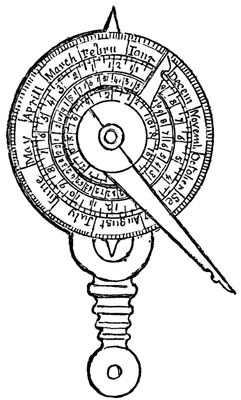
north of the line, the "Nocturnal" gave the
hour of the night, by observing with it the hands
of the great star-clocks, Ursa Major and Minor,
as they turned about the Pole Star.
The Figure of the Nocturnal.
Letter to the
Governor of
St. Antonio.
"The day after anchoring at St. Vincent,"
Rogers says, "we clear'd our ships, but it blow'd
too hard to row our boatloads of empty butts
ashoar; and we could do little to wooding and
watering, till this morning, we were forc'd to
get a rope from the ship to the watering-place,
which is a good half mile from our anchorage,
and so haul'd our empty casks ashoar by boatloads,
in order to have 'em burnt and cleaned in
the inside, being oil-casks, and for want of cleaning
our water stunk insufferably. But borrowing
a cooper from the 'Dutchess,' and having five
of my own, we made quick dispatch." "We
also sent a boat to St. Antonio, with one Joseph
Alexander a good linguist, and a respectful letter
to the Govenour, who accounts himself a great
man here, tho' very poor, to get in truck for
our prize goods what we wanted; they having
plenty of cattel, goats, hogs, fowls, melons,
potatoes, limes, ordinary brandy, tobacco, &c."
And while here Rogers adds, "that tho' our
people were meanly stock'd with clothes, and
the 'Dutchess's' crew much worse, yet we are
both forc'd to watch 'em very narrowly, and
punish'd some of 'em, to prevent their selling
what they have to the negroes that come over
with little things from St. Antonio's." In his
letter to the Govenour, Rogers tells him that
"as our stay cannot exceed two days, despatch is
necessary, and that the bearer can inform his
Honour of the public occurrences of Europe,
and the great successes of the Confederate arms
against the French and Spaniards, which no
doubt must soon be follow'd with a lasting peace,
which God grant."
Desertion of
a Linguist.
From an entry in the journal a few days later
to the effect "that our boat return'd yesterday
with two good black cattel, one for each
ship, but no news of our linguist;" it appears
that worse luck befell him than that which
attended Mr. Carlton Vanbrugh, or it may be
that he took less real interest in the cruise than
that gentleman. Whether this was so or not,
the officers of both frigates at once agreed, on the
return of the boat "with the two good black
cattel," that they "had better leave him behind
than to wait with two ships for one man that had
not follow'd his orders;" or as Captain Rogers
puts it in a marginal note, "our linguist deserts."
That there was honour as well as method
among the leaders in these "undertakings to the
South Seas," is clear from the minutes of a debate
now held on board the "Duke," "to prevent
those mutinies and disorders amongst the
men who were not yet reconcil'd since the taking
of the small Canary prize."
Regulations
about plunder.
The reasons
that forc'd us
to allow
plunder.
Among these regulations it was agreed "that
what is plunder be adjudg'd by the superior
officers and agents in each ship; and that if any
person do conceal any plunder exceeding in value
one piece of eight, twenty-four hours after capture
of a prize, he shall be severely punished
and lose his share of the plunder. The same
penalty to be inflict'd for being drunk in time of
action or disobeying his officer's commands, or
deserting his post in sea or land service. That
public books of plunder are to be kept in each
ship, the plunder to be appraised and divided as
soon as possible after capture. Every person to
be sworn and searched so soon as they shall come
aboard, any person refusing, to forfeit his share
of the plunder; and that whereas Captain
Rogers and Captain Courtney to make both
ships companies easy, have given the whole
cabin plunder (which in all probability is the
major part), to be divided among the crew, it is
agreed that the said Captains Woodes Rogers and
Steph: Courtney, shall have 5 per cent. each of
'em over and above their respective shares, &c.
That a reward of twenty pieces of eight be given to
him that first sees a prize of good value exceeding
50 tuns." Rogers adds that this arrangement
was "agreed on in order to make the men
easy, without which we must unavoidably have
run into such continual scenes of mischief and
disorder, which have not only tended to the
great hindrance, but generally to the total disappointment
of all voyages of this nature, that
have been attempted so far abroad in the memory
of man."
Hearing nothing more of "their good linguist,"
the "Duke" and "Dutchess" "came to sail at
seven in the evening," of Oct. 8th, from St.
Vincent. After having "put the deputy Govenour
of S. Antonio (a negro), ashoar, where he
must lie in a hole of the rocks there being no
house on that part of the island." In his description
of these islands Rogers mentions "that
they have here very large spiders, which weave
their webs so strong that 'tis difficult to get thro'
'em, and that the heats are excessive to us who
came newly from Europe, so that several of our
men began to be sick and were blooded;" while
"some of the officers that went ashore a hunting
could meet no game but a wild ass, which, after
a long chase they got within shot and wounded;
yet he afterwards held out so as to tire them, and
they return'd weary and empty-handed."
The piety of the expedition appears to have
increased steadily as it got further from home,
for as they draw near the Equator "in close
cloudy weather with squalls of rain," we read
how first "having put up the smith's forge, and
he began to work on such things as we wanted,"
that a day or two after "We began to read
prayers in both ships, mornings and evenings, as
opportunity would permit, according to the
Church of England; designing to continue it
the term of the voyage."
A Second
Mate punish'd
for Mutiny.
The number of junior officers on board the
frigates was not always unattended with troubles,
in all which cases the first remedy tried by Captain
Rogers was that of shuffling, or exchanging
them from ship to ship. But it is a significant
fact that it was the day after a dinner party on
board the "Dutchess," that her captain came on
board the "Duke" with his second mate, Mr.
Page, desiring to exchange him into the "Duke"
in the room of Mr. Ballet. Page, however,
who seems to have held views of his own upon
this subject, having declined to get into the
"Dutchess's" boat, and thereby "caused his
superior officer to strike him, whereupon Page
struck again and several blows past," was on his
arrival on board the "Duke" at once "ordered
on the forecastle into the bilboes;[7] where, it
being calm, he slipped through the ship's corporal's
hands overboard, thinking to swim back
to the 'Dutchess.' A boat, however, being
alongside, he was soon overtaken, brought on
board, and lash'd to the main gears,[8] where for
this, and his abusive language exciting the men
to mutiny, he was drub'd and afterwards confined
in irons on board the 'Duke.'"
A week later Rogers mentions incidentally in
his log, "that this morning I let Mr. Page out
of irons on his humble submission, and promises
of amendment; fair pleasant weather with fresh
gales."
Concealers of
plunder
punish'd.
On board the "Duke," however, the bilboes
must have been kept in fair working order, with
little time to get rusty, for two days after Mr.
Page got clear of them, "two persons being
accus'd of concealing a peruke, two shirts, and a
pair of stockings from the plunder of the Canary
bark, are found guilty and order'd into them."
Extraordinary
lightning.
Fluttering
weather.
Beyond noting what Rogers calls a "turnado"
with lightning, "which fell as if it had been
liquid," and that "while the storm held, which
was not above an hour, the ships even with all
sail furl'd lay along very much," nothing remarkable
is recorded after leaving the Cape de Verds
until November 16th, when "with a brave
breeze at E. they stood in with the land, and
suppos'd it to be the island of Cape Frio on the
coast of Brazil." But "the brave breeze"
failing them near land, they were two days
"towing and rowing the ships," in foggy, rainy
weather, before anchoring in the cove off the
Isle of Grande, where they designed to wood,
water, and careen their frigates.
Frenchmen's
graves.
Terror of past depredations, committed by
the French Corsairs, had made the Brazilians
very suspicious of strangers, and Rogers says
"his boat was fir'd on several times when trying
to land with a present to the Govenour of
Angre de Reys; but on finding them to be English
the fryars begged pardon and invited them
to their Convent." Besides wooding, watering,
and careening his frigates, while at the Isle of
Grande, Rogers appears to have unrigged the
"Duke's" main and fore masts, for he speaks
of "seeking for wood to repair our main and
fore trustle trees" (supports of the round tops)
"which were broke," and that while so engaged
"they found abundance of Frenchmen's graves,
which the Portuguese told them were those of
near half the crews of two great French ships
that water'd in this place nine months before.
But," adds Rogers, "God be thank'd ours are
very healthy."
The weather is now described "as violent
hot," spite of which Rogers speaks of "cleaning
one side of the 'Dutchess,' on the afternoon of
the 24th, and the other side the next morning;
giving the ships great lists; and that having
men enough, he let the pinnace, with Captain
Dover, Mr. Vanbrugh, and others, go whilst
the 'Duke' was cleaning, to take their pleasure,
but to return by twelve o'clock, when we should
want our boat. And when they did so, they
brought with 'em a monstrous creature, which
they had kill'd, having prickles like a hedgehog,
with fur between them, and a head and tail
like a monkey's. It stunk," says Rogers, "intolerably,
which the Portuguese told us was only
the skin, that the meat of it is very delicious
and that they often kill'd them for the table.
But our men, being not yet at very short allowance,
none of 'em had stomach good enough to
try the experiment, so that we were forc'd to
throw it overboard to make a sweet ship."
That some of those forming the crews of the
"Duke" and "Dutchess," should not enjoy
their cruising voyage as well as Rogers and his
officers did, is not surprising, and this was evidently
the case with "Michael Jones and another,
two Irish land-men who," says Rogers,
"while we lay at the Isle of Grande run into the
woods thinking to get away;" in spite of the
experiences "of two such sparks that run away
the day before from the 'Dutchess,' and in the
night were so frighted with tygers as they
thought, but really by monkeys and baboons,
that they ran into the water hollowing to the ship
till they were fetch'd aboard again."
A Portuguese
canoe attack'd
by mistake,
and one of
their men
kill'd.
Captain Rogers evidently regarded desertion
from his ship as an act of foolish ingratitude,
and that men incapable of appreciating the advantages
of prosecuting to the bitter end a voyage
with him to the South Seas, deserved the
severest form of punishment; for upon recovering
these two ungrateful "Irish land-men," a few
days later, they were at once "order'd to be
severely whip'd and put in irons." It was while
engaged in intercepting a canoe, suspected of
helping these men to escape, that the "Duke's"
agent, Mr. Vanbrugh, again got into trouble,
through unluckily shooting an "indian, the property
of a certain fryar who own'd and steer'd
that canoe." While, as the friar alleged that
"in the confusion," he not only "lost his slave,
but gold amounting to £200, and threatened
to seek justice in Portugal or England," Rogers
was not able, "though he made the 'fryar' as
welcome as he could, to reconcile him." A
committee of inquiry was therefore wisely called
upon Mr. Vanbrugh's conduct in firing, without
orders, upon the canoe.
Mr. Vanbrugh
remov'd from
on board the
"Duke."
The result of which inquiry was, that after
first entering a protest in the ship's books against
Mr. Vanbrugh, he was shifted into the "Dutchess,"
her agent, Mr. Bathe, taking his place
on board the "Duke."
A Procession
at Angre de
Reys: our
comical assistance
at it
and entertainment.
The Govenour
and
fathers entertain'd
on
board.
Having completed their refit in rather less
than a week, which as it included the lifting of
the rigging of the "Duke's" main and fore
mast, besides the wooding, watering, and careening
of both frigates under a tropical sun, was
not bad work; they wound up their stay at the
Isle de Grande, by "assisting with both ship's
musick," at an important religious function, or
as Rogers calls it, "entertainment," at Angre de
Reys; "where," he says, "we waited on the
Govenour, Signior Raphael de Silva Lagos, in a
body, being ten of us, with two trumpets and a
hautboy, which he desir'd might play us to
church, where our musick did the office of an
organ, but separate from the singing, which was
by the fathers well perform'd. Our musick
played 'Hey boys up go we!' and all manner
of noisy paltry tunes. And after service, our
musicians, who were by that time more than half
drunk, march'd at the head of the company;
next to them an old father and two fryars carrying
lamps of incense, then an image dressed with
flowers and wax candles, then about forty priests,
fryars, &c., followed by the Govenour of the
town, myself, and Capt. Courtney, with each
of us a long wax candle lighted. The ceremony
held about two hours; after which we were
splendidly entertained by the fathers of the Convent,
and then by the Govenour. They unanimously
told us they expected nothing from us
but our Company, and they had no more but
our musick." The day after, however, before
sailing, Rogers in return, entertained the
Governor and fathers on board the "Duke,"
"When," he says, "they were very merry, and
in their cups propos'd the Pope's health to us.
But we were quits with 'em by toasting the
Archbishop of Canterbury; and to keep up the
humour, we also proposed William Pen's health,
and they liked the liquor so well, that they refused
neither;" while as "in the evening it came
on blowing with thick showers," the Governor,
the fathers and friars, made a night of it on
board the frigates, not being landed till next
morning, "when we saluted 'em with a huzza
from each ship, because," as Rogers says, "we
were not overstock'd with powder, and made
them a handsome present of butter and cheese
from both ships in consideration of the small
presents and yesterday's favours from 'em, and
as a farther obligation on 'em to be careful of
our letters which we took this opportunity to
deliver into their own hands."
[7] Bilboes, long bars of iron with shackles sliding on
them, and a lock at the end, used to confine the feet of
prisoners as the hands are by handcuffs.
[8] Main-geers; an assemblage of tackles coming down to
the deck at the main mast, by which the mainyard was
hoisted or lowered in ships of that time.
CHAPTER III. FROM GRANDE TOWARDS JUAN FERNANDEZ. — FOOTNOTES:
1708
A voyage of near 6,000 miles now
awaited the little frigates before
reaching Juan Fernandez, the first
place they expected to refresh at after
leaving the Isle de Grande. A good stock of
necessaries was, therefore, laid in here, and a
letter, giving an account of their proceedings so
far, left with the Governor of Angre de Reys, to
be sent to England by the first opportunity.
The bird
Alcatros.
They did not clear the Brazilian coast until
December 3rd, and little is recorded in Rogers'
journal until the 6th, when, in close, cloudy
weather,
"At length did cross an albatross, Thorough the fog it came."
Rogers[9] spells it "Alcatros, a large bird," he
says, "who spread their wings from eight to ten
feet wide."
The whole of this part of the voyage might,
indeed, be described in quotations from the
"Ancient Mariner," for we read that, December
the 13th, "in the afternoon the little 'Duke's'
mainsail was reef'd, which was the first time since
we left England." For
"Now the storm blast came, and he Was tyrannous and strong; He struck with his o'ertaking wings, And chased us south along."
Again,
"And now there came both mist and snow, And it grew wondrous cold."
Or, as Rogers says, "We find it much colder
in this latitude than in the like degree North,
though the sun is in its furthest extent to the
southward, which may be ascribed to our coming
newly out of warmer climates, or 'tis probable
the winds blow over larger tracts of ice than in
the same degree of N. latitude."
Then we read of thick fog, in which they lose
sight of their consort for many hours, "though
we made all the noise agreed on between us."
And so the monotonous sea-life wears on, varied
only by the smallest events, as when, December
10th, the commanders agree to chop boatswain's
mates, the "Dutchess'" "being mutinous, and
they willing to be rid of him." Or how, on the
18th, "in cold hazy rainy weather, one of the
men on board the 'Dutchess' fell out of the
mizen top, and broke his skull," and Captain
Rogers boards her "with two surgeons; where
they examine the wound, but found the man
irrecoverable, so he died, and was buried next
day; brisk gales from W.N.W.," &c.
Falkland's
Islands
On the 23rd high distant land is sighted,
"which appear'd first in three, afterwards in
several more islands. This," says Rogers, "is
Falkland's Land, describ'd in few draughts, and
none lay it down right, tho the Latitude agrees
pretty well." On Christmas Day, blowing a
strong gale S.W., at six in the evening they lost
sight of the land, but spying a sail under their
lee bow, distant four leagues, "immediately,"
says Rogers, "let our reefs out, chas'd, and got
ground of her apace, till ten at night, when we
lost sight of her. We spoke our consort, and
agreed to bear away to the northward till dawning,
as we were both of opinion, that if homeward
bound, the chase, after loosing sight of us, would
steer north. But when it was full light we saw
nothing, being thick hazy weather, till 7 a.m.
When it cleared we saw the chase again, and
falling calm, we both got out our oars, row'd,
and tow'd with boats ahead, and gained on the
chase, till six in the evening, perceiving we approach'd
her, I went in my boat to speak with
Captain Courtney, and agree how to engage her
if a great ship, as she appear'd to be, and adjusted
signals, if either of us should find it proper to
board her in the night. On returning on board
a breeze sprang, and we made all possible sail,
keeping the chase in view 'til ten o'clock, when
it came on thick again, but being short nights,
we thought it impossible to lose one another, and
kept her open on our larboard, and the 'Dutchess'
on our starboard bow. At one in the
morning I was persuaded to shorten sail for fear
of losing our consort if we kept on. At daylight
it was a thick fog, so that we could see
neither our consort nor chase for an hour, when
it clear'd, and we saw our consort on our larboard
bow, and fir'd a gun for her to bear down,
but we immediately saw the chase ahead of the
'Dutchess' a few miles, which gave us new life.
We forthwith hal'd up for them, but the wind
heading us, we had a great disadvantage in the
chase. The water was smooth however. And
we ran at a great rate, until it coming on to
blow more and more, the chase out-bore our consort,
so she gave off, and being to windward,
came down very melancholy to us, supposing the
chase to have been a French homeward bound
ship from the South Seas.[10] Thus this ship
escap'd, which considering that we always outwent
her before, is as strange as our first seeing
of her in this place, because all ships that we have
heard of, bound either out or home, keep within
Falkland's Island."
Woodes Rogers was no doubt a very hardheaded
mariner, still few sailors are without a
trace of superstition, and his closing remark, in
describing this long and unsuccessful chase, points
to a feeling with him that the vessel which all at
once "out-bore his consort," was one, the speed
and presence of which in that sea was to him a
mystery. His own ships were clean, and sailing
their best; but very few English vessels of that
time were able to "out-go" the ships then built
by the French for trade, or piracy, in the South
Seas.
The usual foul weather, at any rate, came upon
them at once, when,
"With far-heard whisper, o'er the sea Off shot the spectre-bark,"
in the shape of "strong gales with heavy squalls
from south to west," during which the "Dutchess"
(to ease and stiffen her) "put the guns
into the hold again that she took up in the
chase." Christmas Day, and those following it,
must have been days of "toil and trouble" on
board the "Duke" and "Dutchess" to both
men and officers; but Rogers made up for it all
when, "in fresh gales of wind from W.N.W.
with fogs, being New Year's Day, every officer
was wished a 'Merry New Year' by our own
musick, and I had a large tub of punch hot upon
the quarter-deck, where every man in the ship
had above a pint to his share, and drank our
owners and friends' healths in Great Britain, to a
happy new-year, a good voyage, and a safe
return. After which we bore down to our consort,
and gave them three huzzas, wishing them
the same." Though, like most good seamen,
Woodes Rogers appears to have been lucky in
his weather, and during the three years' cruise to
have sustained little damage from storm or tempest,
the "Duke" and "Dutchess" did not
escape a few hours dusting in the passage "about
Cape Horn," for in latitude 60.58 S., on the
5th of January, just past noon, "it came on to
blow strong," when Rogers says, "we got down
our foreyard and reef'd our foresail and mainsail;
but there came on a violent gale of wind
and a great sea. A little before 6 p.m. we saw
the 'Dutchess' lowering her mainyard. The
tack flew up, and the lift unreev'd, so that the
sail to leeward was in the water and all aback,
their ship taking in a great deal of water to leeward.
Immediately they loosed their spritsail,
and wore her before the wind. I wore after her,
expecting when they had gotten their mainsail
stow'd, they would take another reef in, and
bring to under a two reef'd mainsail and reef'd
and ballanc'd mizen. But to my surprise they
kept scudding to southward.
"I dreaded running amongst ice, because it
was excessive cold; so I fir'd a gun as a signal
for them to bring to, and brought to ourselves
again under the same reef'd mainsail. They
kept on, and our men reported an ensign in their
maintopmast rigging as a signal of distress,
which made me doubt they had sprung their
mainmast.
"So I wore again, our ship working exceeding
well in this great sea. Just before night I was
up with them again, and set our foresail twice
reef'd to keep 'em company, which I did all
night. About three the next morning it grew
more moderate; we soon after made a signal to
speak with them, and at five they brought to.
When I came within hail I enquir'd how they
all did aboard?
"They answered they had shipp'd a great
deal of water in lying by, and were forced to
put before the wind, and the sea had broke
in the cabin windows, and over their stern,
filling their steerage and waste, and had like to
have spoil'd several men. But God be thank'd,
all was otherwise indifferent well with 'em,
only they were intolerably cold and everything
wet."
Round Cape
Horn.
Juan Fernandez
Island.
The next day the weather was raw cold and
rainy with a great sea from N.W., which did
not, however, deter Rogers and Captain Dampier
from "going in the yall on board the 'Dutchess'
to visit 'em after the storm, where," he says, "we
found 'em in a very orderly pickle; with all
their clothes drying, the ship and rigging cover'd
with them from the deck to the maintop while
six more guns are got into the hold to make the
ship more lively." That so far the "Duke"
and "Dutchess," in spite of their small size and
number of men (333), were healthy ships, is
shown by an entry here in the log of the death
of "John Veal a land-man, being the first death
from sickness out of both ships since our leaving
England." After running as far south as Lat.
61.53, "which," says Rogers, "for ought we
know is the furthest that any one has yet been
to the southward, and where we have no night;"
they, on the 15 of Jan., in longitude 79.58 from
London, "accounted themselves in the South
Sea being got round Cape Horn." Ten days
later, the "Dutchess" speaks the "Duke" to
the effect that her men are greatly in want of a
harbour to refresh them, many being ill through
want of clothes, and being often wet in the cold
weather. Matters were not much better on
board the "Duke;" "several of ours," says
Rogers, "being very indifferent. So that as we
are very uncertain of the latitude of 'Juan
Fernandez,' the books laying 'em down so differently
that not one chart agrees with another,
and being but a small island, and in some doubts
of striking it we designe to hale in for the mainland
to direct us." At seven in the morning,
however, of January 31st, 1709, all their doubts
were set at rest, and the foundation laid, upon
which the "Life and Surprising Adventures of
Robinson Crusoe" are built, when Captain
Rogers made Juan Fernandez, bearing W.S.W.,
distant about seven leagues.
The next day at 2 p.m., Rogers says, "we
hoisted our pinnace out, and Captain Dover with
the boats crew went in her to go ashoar, tho we
could not be less than 4 leagues off.
Alexander
Selkirk, a
Scotchman
found on the
Isle of Juan
Fernandez,
where he had
liv'd four
years and four
months alone.
"As soon as it was dark we saw a light ashore;
and our boat being then about a league from the
island bore away for the ships when she saw the
light, and we put out lights for the boat, tho'
some were of opinion the light we saw was our
boat's. But as night came on it appeared too
large for that. So we fir'd one quarter deck
gun, and several muskets, showing lights in our
shrouds, that our boat might find us, whilst we
ply'd in the lee of the Island. About two in the
morning our boat came on board, having been in
tow of the 'Dutchess;' and we were glad they
got well off, because it began to blow. We
were all convinc'd this light was on shore, and
designed to make our ships ready to engage,
believing them to be French ships at anchor,
which we must either fight, or want water," &c.
The next morning "we tacked, to lay the land
close aboard, and about ten open'd the south
end of the island; here the flaws came heavy off
shore, and we were forc'd to reef our topsails.
When we open'd the middle bay, where we expected
to find our enemy, we saw all clear, and
no ships in that, nor the next bay. Though we
guess'd there had been ships there, but that they
were gone on sight of us. About noon we sent
our yall ashore with Capt. Dover, Mr. Frye, and
six men, all arm'd; meanwhile we and the
'Dutchess' kept turning to get in, and such
heavy flaws came off the island that we were
forc'd to let fly our topsail sheets, keeping all
hands to stand by our sails for fear of the winds
carrying 'em away: though when the flaws were
gone we had little or no wind. Our boat not
returning we sent our pinnace, also arm'd, to see
what was the occasion of the yall's stay; for we
were afraid that the Spaniards had a garison there
and might have seized 'em. We put out a signal,
and the 'Dutchess' show'd a French ensign. Immediately
our pinnace return'd from the shore,
and brought abundance of craw-fish with a man
cloth'd in goatskins, who look'd wilder than
the first owners of them. He had been on the
island four years and four months, being left
there by Captain Stradling in the ship 'Cinque-Ports.'
His name was Alexander Selkirk, a
Scotchman, who had been master of the 'Cinque-Ports,'
a ship that came here last with Capt.
Dampier, who told me this was the best man in
her; so I immediately agreed with him to be
mate on board our ship.
"'Twas he made the fire last night when he
saw our ships, which he judg'd to be English.
During his stay here he had seen several ships
pass, but only two came to anchor, which as he
went to view he found to be Spanish and retired
from 'em, upon which they shot at him. Had
they been French, he would have submitted,
but chose to risque dying alone" (note, not living
alone) "in the Island, rather than fall into the
hands of the Spaniards in these parts, lest they
murder, or make a slave of him in the mines;
for he fear'd they would spare no stranger that
might be capable of discovering the South Sea.
The Spaniards he said had landed before he
knew what they were, and came so near him
that he had much ado to escape: for they not
only shot at him, but pursue'd him into the
woods, where he climb'd a tree at the foot of
which they stop'd and kill'd several goats just
by, but went off again without discovering him.
He told us he was born at Largo in the county
of Fife, Scotland, and was bred a sailor from his
youth. The reason of his being left here was a
difference betwixt him and his captain. When
left, he had with him his clothes and bedding,
with a firelock, some powder, bullets, and tobacco,
a hatchet, a knife, a kettle, a Bible, some
practical pieces, and his mathematical instruments
and books.
"He diverted and provided for himself as
well as he could; but for the first eight months
had much ado to bear up against melancholy,
and the terror of being alone in such a desolate
place. He built two huts with piemento trees,
cover'd them with long grass, and lin'd them
with the skins of goats which he killed with his
gun as he wanted, so long as his powder lasted,
which was but a pound, and that being near
spent, he got fire by rubbing two sticks of
piemento wood together on his knees. In the
lesser hut, at some distance from the other, he
dressed his victuals, and in the larger he slept,
and employed himself in reading, singing Psalms,
and praying, so that he said he was a better
Christian while in this solitude, than ever he
was before, or than he was afraid he should ever
be again. At first he never eat anything till
hunger constrain'd him, partly for grief, and
partly for want of bread and salt; nor did he go
to bed till he could watch no longer. The
piemento[11] wood, which burnt very clear, serv'd
him both for fire and candle, and refresh'd him
with its pleasant smell. He might have had
fish enough, but could not eat 'em, as for want
of salt, they made him ill, except Craw-fish,
which are there as large as lobsters and very
good. These he sometimes boiled, and at others
broiled as he did his goats flesh, of which he
made very good broth, for they are not so rank
as ours; he kept an account of 500 that he
kill'd while there, and caught as many more,
which he marked on the ear and let go.[12]
When his powder fail'd he took them by speed
of foot; for his way of living, and continued
exercise of walking and running, clear'd him of
all gross humours, so that he run with wonderful
swiftness thro the woods, and up the rocks and
hills, as we perceiv'd when we employ'd him to
catch goats for us. We had a bull dog which
we sent with several of our nimblest runners to
help him catch goats; but he distanc'd and tir'd
both the dog and men, catch'd the goats and
brought 'em to us on his back. He told us that
his agility in pursuing a goat had once like to
have cost him his life; he pursue'd it with so
much eagerness that he catch'd hold of it on the
brink of a precipice hidden by some bushes, so
that he fell with the goat down the said precipice
a great height, and was so stun'd and bruised
with the fall that he narrowly escap'd with his
life, and when he came to his senses found the
goat dead under him. He lay there about 24
hours and was scarce able to crawl to his hut a
mile distant, or to stir abroad again in ten days.
After a while he came to relish his meat well
enough without salt and bread, and in the season
had plenty of good turnips which had been
sow'd there by Captain Dampier's men, and
have overspread some acres of ground. He
had enough of good cabbage from the cabbage
trees and season'd his meat with the fruit of the
piemento tree, which is the same as the Jamaica
pepper and smells deliciously. He soon wore
out all his shoes and clothing by running thro
the woods; and at last, being forced to shift
without them, his feet became so hard that he
run every where without annoyance, and it was
some time before he could wear shoes after we
found him. For not being used to any so long,
his feet swelled when he first came to wear 'em.
After he conquer'd his melancholy he diverted
himself sometimes by cutting his name on the
trees, and the time of his being left and continuance
there. He was at first much pester'd
with cats and rats, that bred in great numbers
from some of each species which had got ashore
from ships that put in there to wood and water.
The rats knaw'd his feet and clothes while asleep,
which obliged him to cherish the cats with goats
flesh; by which many of them became so tame
that they would lie about him in hundreds, and
soon deliver'd him from the rats.
"He likewise tam'd some kids, and to divert
himself would now and then sing and dance with
them and his cats; so that by the care of Providence,
and vigour of his youth, being now about
30 years old, he came at last to conquer all the
inconveniences of his solitude and to be very
easy. When his clothes wore out he made himself
a coat and cap of goatskins, which he stitch'd
together with little thongs of the same that he
cut with his knife. He had no other needle
but a nail, and when his knife was wore to the
back, he made others as well as he could of iron
hoops that were left ashore, which he beat thin
and ground upon stones. Having some linen
cloth by him, he sow'd himself shirts with
a nail and stitch'd 'em with the worsted of
his old stockings, which he pull'd out on purpose.
He had his last shirt on when we found him.
"At his first coming on board us," says
Rogers, "he had so much forgot his language
for want of use, that we could scarce understand
him, for he seemed to speak his words by halves.
We offer'd him a dram, but he would not
touch it, having drank nothing but water since
his being there, and t'was some time before he
could relish our victuals. He could give us an
account of no other product of the Island except
some small black plums, which are very good,
but hard to come at, the trees which bear 'em
growing on high mountains and rocks. The
climate is so good that the trees and grass are
verdant all the year. He saw no venomous or
savage creature, nor any sort of beast but goats
on the Island. The first of these having been
put ashore here on purpose for a breed, by Juan
Fernandez, a Spaniard, who settled there with
some families till the continent of Chili began to
submit to the Spaniards, which tempted them to
quit this island, tho capable of maintaining a
number of people, and of being made so strong
that they could not easily be dislodg'd. Ring-rose,
in his account of Capt. Sharp's voyage and
other buccaneers, mentions one who had escap'd
ashore here out of a ship, which was cast away
with her company, and says he liv'd five years
alone before he had an opportunity of another
ship to carry him off. While Capt. Dampier
talks of a Moskito Indian that belong'd to Capt.
Watlin, who being a hunting in the woods when
the Captain left the island, liv'd here three years
alone, and shifted much as Mr. Selkirk did, till
Capt. Dampier came hither in 1684 and carry'd
him off; the first that went ashore was one of his
countrymen and they saluted one another, first
by prostrating themselves by turns on the ground,
and then embracing.
Capt. Woodes
Rogers indulges
in
some moral
reflections.
But soon
curbs himself.
"But whatever there is in these stories this of
Mr. Selkirk I know to be true, and his behaviour
afterwards gives me reason to believe the account
he gave me how he spent his time, and bore up
under such an affliction, in which nothing but
the Divine Providence could have supported
any man. And by this we may see, that solitude
and retirement from the world, is not such
an unsufferable state of life as most men imagine,
especially when people are fairly call'd, or thrown
into it unavoidably, as this man was, who in all
probability must otherwise have perished in the
seas, the ship which he left being cast away not
long after, when few of the company escaped.
We may perceive also by his story," adds
Rogers, "the truth of the maxim 'that necessity
is the mother of invention,' since he found
means to supply his wants in a very natural
manner, so as to maintain life, tho not so conveniently,
yet as effectually as we are able to
do with the help of all our arts and society.
It may likewise instruct us how much a plain
and temperate way of living conduces to the
health of the body and the vigour of the mind,
both which we are apt to destroy by excess and
plenty, especially of strong liquor. For this
man, when he came to our ordinary method of
diet and life, tho he was sober enough, lost
much of his strength and agility. But I must
quit these reflections, which are more proper for
a philosopher and divine than a mariner, and return
to my own subject." Which he does, and
at once goes on to tell how "this morning we
clear'd ship, unbent our sails, and got them
ashoar to mend and make tents for our men,
while the Govenour, for so we call'd Mr. Selkirk,
(tho we might as well have nam'd him
absolute Monarch of the island,) caught us two
goats, which make excellent broth mixed with
turnip tops and other greens for our sick, they
being twenty in all, but not above two that we
account dangerous." Selkirk kept up this supply,
of two goats a day, during the time the ships remained
at Juan Fernandez; and no doubt the
poor half-wild sailor man rather enjoyed these
last goat-hunts before he became absorbed into
the busy monotony of sea life on board Rogers'
little frigate. We seldom catch Captain Rogers
giving himself time for repose during his cruise,
but the natural charms of this island appear to
have had some effect even upon his practical
matter of fact temperament, for he says, while
here, "'twas very pleasant ashoar among the
green piemento trees, which cast a refreshing
smell. Our house being made by putting a sail
round four of 'em, and covering it a top with
another; so that Capt. Dover and I both
thought it a very agreable seat, the weather being
neither too hot nor too cold."
Rogers, however, did not come about the
Horn into the South Seas to sit under the shade
of sweet-smelling trees, especially after having
"been inform'd at the Canaries, that five stout
French ships were coming together to these
seas"; therefore, having completed the wooding
and watering of his ships, and the boiling down
of about eighty gallons of sea-lions' oil, which, he
says, "we refin'd and strain'd to save our candles,
or for the sailors to fry their meat in for want of
butter," he is, just eleven days after making the
island, ready for sea again, with its "absolute
Monarch" aboard.
Before sailing, however, certain signals, to be
made by the arrangement of their sails, were
agreed upon between the commanders as to the
chasing of ships, &c., while in case of the frigates
being separated before reaching their next place
of refreshment, the island of Lobos de la Mer, it
was settled that "two crosses were to be set up
there at the landing place near the farther end
of the starboard great island: and a glass bottle
to be buried direct north of each cross, with news
of what had happen'd since parting, and their
further designes." Nothing indeed now appears
to have been left undone which could add
to the safety and efficiency of the small force
under Rogers' command.
"For a fortnight after leaving Juan Fernandez,"
he says, "we put both pinnaces in the
water to try them under sail, having fixed them
each with a gun after the manner of a paterero,
and all things necessary for small privateers,
hoping they'll be serviceable to us in little winds
to take vessels": and a few days later in a calm,
both frigates are again heeled and tallowed,
though the nearest land was sixty miles distant;
while the crews are put upon an allowance of
water of three pints a man per day, "that," says
Rogers, "we may keep at sea some time without
being discover'd by watering ashore. Because
an enemy once discovered, there was nothing
of any value put to sea from one end of the
coast to the other."
It was now the 9th of March, and in fair
weather, before a moderate gale at S.E., the ships
are kept under easy sail, with all boats in tow,
about twenty-one miles off the coast of Peru,
"in hopes of seeing rich ships either going or
coming out of Lima; the men beginning to
repine, that tho come so far, we have met with
no prizes in these seas," which may have accounted
for the frigates being brought to for a
day at this time, while the men are "sent in the
boats under the shoar to examine two white
rocks which at a distance look'd like ships."
A small prize
taken.
On the 16th, however, a small prize of sixteen
tons, manned by two Spaniards and some Indians,
falls into their hands, and Rogers learns from
these Spaniards that no enemy has been in those
parts since Captain Dampier was there four years
ago; also that Stradling's ship, the "Cinque
Ports," "who was Dampier's consort, founder'd
on the coast of Barbacour, only Captain Stradling
and six or seven men being saved, who lived
four years prisoners at Lima much worse than
our Govenour Selkirk whom they left on Juan
Fernandez."
Arrive at
the Isle of
Lobos.
Fit up the
small bark
for a
Privateer.
The following day, piloted by the crew of
their prize, they anchored in the "Thorow-fair
between the islands of Lobos de la Mer," and
Rogers, finding his new prize well built for
sailing, at once resolved to fit her out as a
privateer. She was, therefore, taken "into a small
round cove in the southernmost island, haul'd up
dry, and after having her bottom well cleaned,
relaunched, and called the 'Beginning,' Capt.
Cook being appointed to command her."
In the meantime, while Rogers stayed to
overlook this, and the building of a "larger boat
for landing men, should an attempt be made
upon the mainland," the "Dutchess," having
landed her sick men, and been heeled and cleaned
outside, is sent upon a cruise round the island,
with instructions to meet the "Beginning," when
ready, off the southernmost end of it. Like a
true seaman, Captain Rogers appears to have
thoroughly enjoyed this work of fitting out his
"small bark," and describes how he got a spare
topmast out of the "Duke," "which made her
a new main mast, a mizen topsail being alter'd
to make her a mainsail." And though the work
included "fixing a new deck with four swivel
guns," she was "victualed and manned by
20 men from the 'Duke,' and 12 from the
'Dutchess,' all well arm'd, and ready for sea,"
in three days from the time of being taken in
hand.
"As I saw her out of harbour," says
Rogers, proudly, "with our pinnace she looks
very pretty and I believe will sail well in smooth
water, having all masts sails rigging and materials
like one of the half galleys fitt'd out for
Her Majestie's service in England."[13]
A Prize.
Two days after joining the "Dutchess," this
pretty little "Beginning" captured another
small prize, the "Santa Josepha," "of 50 tuns,
full of timber, cocoa, and coconuts and some
tobacco which we distributed among our men."
And after being cleaned and re-christened the
"Increase," the "Santa Josepha" became the
hospital ship of the fleet, "all the sick men
and a doctor from each ship being put on board
with Mr. Selkirk as master."
[9] The name of this bird has been said to have been
derived from "Alb," a priest's white vestment; but I
incline to think that Rogers is right in his spelling of it,
and that it was spelt Alcatros, from the Spanish "Alca, a
razor-bill," the two birds being much alike in the shape of
the bills.
[10] Curiously enough, on his return home, Rogers learnt
that this French ship, which so mysteriously "outwent
them," was the very vessel in which Captain Stradling, of
the "Cinque Ports" (Selkirk's ship), returned to England
after being kept four years' prisoner by the Spaniards.
[11] The Allspice tree of the West Indies. This tree usually
grows from seed eaten and carried by birds, which easily
accounts for its being found upon this island.
[12] Thirty years later Commodore Anson found some of
Selkirk's ear-marked goats when he touched at Juan Fernandez.
[13] The "half galley" of the Mediterranean was a vessel
of about 120 feet long by 18 wide, and 9 or 10 deep, fitted
with two large lateen sails, and masts that could be lowered
on deck at pleasure. She carried five cannon, and was rowed
with twenty oars on a side.
CHAPTER IV. FROM LOBOS TOWARD GUIAQUIL IN PERU. — FOOTNOTES:
1709
Livers of old
seals unwholesome.
Information
of rich ships.
A large prize
taken.
Having given his ship the usual
"good heel," and "tallowing her low
down," Rogers came to sail March
30th, at ten o'clock, with his new
launch in tow from Lobos. On more than one
occasion Rogers shows a decided want of sympathy
with the sportsmen of the expedition, and
relates here "how there were in this island abundance
of vultures, alias carrion crows, which
looked so like turkeys that one of our officers at
landing bless'd himself at the sight, hoping to
fare deliciously. He was so eager he would not
stay till the boat could put him ashore, but leap'd
into the water with his gun, and getting near to
a parcel let fly at 'em. But when he came to
take up his game, it stunk insufferably and made
us merry at his mistake." These birds were no
doubt a flock of Gallenazo, described by Darwin
as frequenting the wooded isles on the west coast
of South America, and as "feeding exclusively
upon what the sea throws up, and the carcases of
dead seals," which, from the following entry in
the journal must have been very plentiful in this
island, "where," says Rogers, "owing to the
presence of certain unwholesome old seals, whose
livers disagreed with those of our crew that eat
them; the air, with the wind off shore, is loaded
with an ugly noisome smell, which gave me a
violent headach, and was complain'd of by all,"
as quite unlike the spice-laden breezes of Juan
Fernandez. Rogers' headache and these unwholesome
old seals were no doubt quickly forgotten
at sea, when listening to the stories of
their Spanish prisoners about "a certain rich
widow of the late Vice Roy of Peru, who was
expected to embark with her family and wealth;
shortly for Acapulco. Also of a stout ship
with dry goods for Lima, and another richly
laden from Panama, with a Bishop aboard."
Acting on which advice, "it was agreed to spend
as much time as possible cruising off Payta without
discovering themselves." They had not long
to wait, for two days after leaving Lobos "a sail
was spy'd to windward about daybreak, and the
pinnace being hoisted out and mann'd under the
command of Mr. Frye, first lieutenant of the
'Duke,' by 8 o'clock took the 'Ascension' of
500 tons, built gallion fashion, very high with
galleries." This was "the stout ship from Lima,"
and from her "they learnt that the ship with the
Bishop would stop at Payta to recruit," and,
being near that place, Rogers "resolved to watch
narrowly, in order to catch his Lordship."
With the exception of a "small vessel of 35
tuns laden with timber from Guiaquil," and captured
by the "Beginning," nothing hove in sight
for several days, one of which seems to have been
passed by Rogers, first in chasing his consort for
some hours, mistaking her for the Bishop's ship,
and then keeping up the joke until she cleared
for action, "which I did," he says, "to surprise
them." This was a favourite form of practical
joke with Rogers, affording no doubt great
amusement both to him and his lieutenant, Mr.
Frye, when dining together next day "on board
the new prize upon a good quarter of mutton and
cabbage—a great rarity," adds Rogers, "here."
Mr. Vanbrugh's
miscarriages.
A week of inaction, however, followed, while
the increasing number of the fleet and prisoners,
and consequent greater number of mouths to
provide for, began to tell rapidly upon their
stores, especially of water, "which beginning to
grow short, we cannot," says Rogers, "keep the
sea much longer." Wherefore, "at a meeting
held on board the 'Duke' April 12th, we came
to a full resolution to land and attempt Guiaquil."
At this meeting it was also decided that the name
of that somewhat impetuous sportsman, Mr.
Carlton Vanbrugh, should no longer remain on
the committee. "He having not only threaten'd
to shoot one of the 'Duke's' men at Lobos for
refusing to carry some carrion-crows that he
shot, but abus'd Capt. Dover."
So long as the ships were at sea, and the work
of a purely naval kind, the seamen of the expedition
had matters pretty much their own way,
and things went on smoothly enough.
But the moment a land expedition was agreed
on, disputes quickly arose between Captain
Rogers and those of his officers not actually
seamen. While speaking of his men, he says,
"We know that misfortunes attend sailors out of
their element, and hear that they begin to
murmur about the encouragement they are to
expect for landing; which they allege is a
risque more than they shipp'd for."
Regulations
about plunder,
and encouragement
for the
men to land.
It was therefore found necessary to come to a
definite arrangement as to the disposal of the
plunder of Guiaquil before "the mixed gang of
most European nations" of which the crews
were composed could be induced to enter
heartily into an attempt upon it. Rules were,
therefore, after much discussion, drawn up for
the conduct of all taking part in this little
invasion, and "what was to be deem'd the men's
share" in the booty settled, which included "all
manner of bedding and clothes, short of stripping"
(whatever that might mean), "gold rings,
buckles, buttons, liquors and provisions; with all
arms and ammunitions, except great guns for
ships; "in a word, everything portable was to be
carried off, and be divided equally among the
men, the one very honourable exception being
"woman's earrings."
It was also settled "that prisoners of note shall
be carefully kept as pledges for any of our men
that be missing. But that it was desirable no
man should trust to this, or be a moment absent
from his officers or post." The whole winding
up with the hope "that the foregoing rules being
strictly follow'd, they will exceed all other
attempts of this nature before us in these parts;
and not only enrich and oblige ourselves and
friends, but even gain reputation from our
enemies."
The plunder of Guiaquil had scarcely been
thus comfortably arranged, and two of the small
prizes armed and manned for it, when at daybreak
of April the 15th another sail was "sighted
between them and the land," and, being calm,
both ships' pinnaces were sent in pursuit of
her.
A Spanish
ship attack'd.
Lieut. Rogers,
my brother,
killed.
Unfortunately, in the hurry of starting for
the chase, and expecting little resistance, they
neglected to take their swivel guns, or "patereroes,"
with them. The result of which was,
that after repeated attempts "to get into a
position for boarding, the boats were obliged to
retire much damaged, under a heavy fire of
partridge shot and small arms, with the loss of
two kill'd and three wounded: among the
former was," says Rogers, "my unfortunate
brother, Mr. Thomas Rogers, shot through the
head, and instantly died, to my unspeakable
sorrow." Philosophically adding, "but as I
began this voyage with a resolution to go thro it,
and the greatest misfortune shall not deter me,
I'll as much as possible avoid being thoughtful
and afflicting myself for what can't be recall'd,
but indefatigably pursue the concerns of the
voyage, which has hitherto allow'd little respite."
The ship taken.
The Spanish ship was accordingly followed up
and taken that afternoon at 2 p.m., and proved
to be the ship from Panama; "but we missed the
Bishop," says Rogers, "who ten days before
landed at Point St. Helena with his attendants,
plate, &c."
After adding another small prize, loaded with
cassia soap and leather to the fleet, "on the
following day," Rogers says, "about twelve we
read the prayers for the dead, and threw my
dear brother overboard with one of our sailors;
hoisting our colours half mast; and we beginning,
the rest of the fleet follow'd, firing each some
volleys of small arms. Our officers expressing
great concern for his loss, he being a very hopeful,
active young man, a little above twenty
years of age."
Even if inclined to do so, Woodes Rogers
had now no time for "thoughtful affliction,"
his squadron having increased under him from
two to eight vessels, with over three hundred
prisoners to feed and guard. All which, until
his return from the attack upon Guiaquil, were
placed on board the frigates and three of the
prizes; with orders "to remain at sea forty-eight
hours undiscover'd, then to sail for Point
Arena and anchor there. Irons being put on
board every ship because, having many more
prisoners than men to guard 'em, we must have
'em well secur'd."
Two hot days and nights were now passed in
the boats of the expedition, rowing and towing
their small barks among the islands and mangrove
swamps, piloted by Dampier, and one of
the Spanish prize captains, up the creeks toward
Guiaquil. Great caution being taken to avoid
being seen, as "they learnt on landing upon the
island of Puna," that a report had been spread
among the Spaniards a month before, that they
might expect to be "attacked by some English
Lords, in 7 vessels from London, under the
conduct of an Englishman named Dampier."
Captain Rogers rarely complained of hardships
and was not easily frightened, but when
lying in his boat under the mangrove bushes,
he remarks, "that the muskitoes pester'd and
stung him grievously; while when at anchor
across the tide on a dark night with a small
rolling sea, the boat being deep laden and
cramm'd with men," he says, "that though
engaged about a charming undertaking he would
rather be in a storm at sea than there."
One can hardly help pausing a moment here,
to consider the hazardous position of this little
body of adventurers, and admire the self-reliance
of Rogers and his officers, in venturing upon the
sack of Guiaquil, while the small force under
them was divided among a fleet of six prizes
with 300 prisoners on board to guard and
feed. Want of water, as he says, no doubt
made some attempt upon the mainland now
almost a necessity. Still even this might have
been obtained elsewhere; while Rogers' expression,
"tho engaged upon a charming undertaking,"
and the building of the launch at
Lobos, both point to a preconceived plan having
been arranged for this attack, but so timed by
him as to appear to the men a mere question of
fighting the Spaniards ashore, or perishing at
sea for want of water.
The town
alarm'd. Our
officers differ
in their
opinion about
attacking it.
Fall down
again from
the Town to
meet our
barks and
land with
the morning
flood.
Treat with
the Corregidore.
It was on the 22nd of April, that after
leaving the small barks about half way between
the island of Puna and the town of Guiaquil,
Rogers got with his boats "about 12 at
night in sight of the town with 110 men," but
on finding "when abreast of it and ready to
land, from abundance of lights, with a confused
noise of their bells, a volley of small arms, and
two great guns, that the town was alarm'd,
Captain Dover, the doctor of physick and he
fell into a debate of above an hour, as to
whether to attack the place then in the dark
during this first alarm, or not?" Rogers was
of course for pushing on, but Captain Dover
and the majority were against him, while
Dampier, when asked how the buccaneers would
have acted in such a case, said simply enough,
"that they never attacked a place after it was
once alarm'd." And so, the tide being favourable,
the boats dropped down the river again
out of sight of the town to the two barks; where
a further consultation was held among the
officers, lying in a boat astern of one of the
barks, in order that what was debating might
not be overheard by the rest of the company.
Which debate ended in Rogers yielding to the
majority, and sending two Spanish prisoners to
treat with the Corregidore of the town for its
ransom, valued by Rogers, with the goods and
negroes in his prizes, and "certain new ships
then on the stocks near the town," at 40,000
pieces of eight.[14]
As Rogers had foreseen, the Spaniards wisely
made use of this time to carry off inland every
thing of value; and after two days spent in
negotiations, made "an offer of 32000 pieces of
eight and no more," upon which, his two barks
and boats now lying close to the town, he
"ordered their interpreter to tell 'em, we had
done treating, and after advising all that wished
to save their lives to retire out of shot, at once
hal'd down our flag of truce and let fly our
English and field colours." And two ship's guns
of about six hundred-weight each, mounted on
field carriages, being placed in the great launch,
Rogers, Captain Dover, and Captain Courtney
landed with seventy men from their boats, a lieutenant
with others being left on board one of
the barks to ply her guns over their heads into
the town.
"The enemy," says Rogers, "drew up their
horse at the end of the street, fronting our men
and barks, and lin'd the houses with men at half
musket shot of the bank where we landed, making
a formidable show in respect to our little number.
We landed and fired every man on his knee at
the brink of the bank, then loaded, and as we
advanc'd call'd to our bark to forbear firing, for
fear of hurting our men. We who landed kept
loading and firing very fast; but the enemy made
only one discharge, and retir'd back to their guns,
where their horse drew up a second time. We
got to the first houses, and as we open'd the
street, saw four guns pointing at us before a
spacious church, but as our men came in sight
firing, the horse scower'd off. This encouraged
me to call to our men to run and seize the guns,
and I hasten'd towards 'em with eight or ten
men till within pistol shot, when we all fir'd,
some at the gunners, and others at the men in
arms in front of the church, where they were
very numerous; but by the time we had loaded
and more of our men came in sight, they began
to run, and quitted the guns, after firing them
with round and partridge, one of the last was
discharged at us very near, but, thanks to God,
did us no hurt; and they had not time to relade
them. By this time the rest of our men were
come up with Capt. Courtney and Captain
Dover, and they leaving me with a few men to
guard the church, marched to the other end of
the town, and so," as Rogers says in his marginal
note, "we beat 'em out of the town."
We post
guards.
Guards were now posted in all directions round
the town, and the Spaniards' guns turned, and
left in charge of Captain Dampier to defend the
great place in front of the church. While Captain
Dover fired some houses that commanded
another church in which he had taken up a
position, "there being a hill and thick woods
near this post, from which the enemy were
almost continually popping at him all night."
The portable plunder of the town, with the exception
"of jars of wine and brandy in great
plenty, proved of little value;" while "the sultry,
hot, wet unhealthful weather made the
carrying of these to the water side a work of
great fatigue." Only half-an-hour elapsed from
the time of landing until the Spaniards vacated
the place, and their loss was but fifteen killed
and wounded; while out of Rogers' small force
only two were hurt, one of these being "mortally
wounded by the bursting of a cohorn shell
fir'd out of one their own mortars on board the
bark." The following day Rogers says, "we
kept our colours flying on the great church,
and sent the Lieutenant of Puna with proposals
to ransom the town."
We plunder
the Town.
The seamen's
civility to the
Spanish ladies.
The value of
the chains,
&c., they
found on the
ladies.
Meanwhile Rogers and his men were busy
searching every hole and corner in it for concealed
valuables, he having great difficulty while
so engaged in preventing his men tearing up
"the floor of the great church to look amongst
the dead for treasure; but which he would not
suffer because of a contagious distemper that
had swept off a number of people there not long
before, so that this church floor was full of
graves." He was himself, however, lucky enough
to pick up in this same church "the Corregidore's
gold-headed cane," and another with
a silver head; "none among the Spaniards," he
remarks, "carrying a cane but chief officers, and
among them none under a captain wearing a
silver or gold-headed one, so that those gentlemen
must have been much in haste to leave these
badges of office behind them." Besides carrying
off "these badges of office," Capt. Rogers says,
"we unhung a small church bell[15] and sent it
aboard for our ships use." A boat was also
sent higher up the river in quest of treasure, and
landing, found most of the houses full of women,
particularly at one place, where "there were
above a dozen handsome genteel young women,
well dress'd and their hair tied with ribbons very
neatly, from whom the men got several gold
chains, &c., but were otherwise so civil to them
that the ladies offer'd to dress 'em victuals and
brought 'em a cask of good liquor. This," says
Rogers, "I mention as a proof of our sailors
modesty, and out of respect to Mr. Connely,
and Mr. Selkirk, the late Govenour of Juan
Fernandez, who commanded this party: for
being young men, I was willing to do 'em this
justice, hoping the Fair Sex will make 'em a
grateful return when we arrive in Great-Britain
on account of their civil behaviour to these
charming prisoners." Besides this pleasing account
of their treatment of, and by, the Spanish
ladies, these modest young officers "brought
back with them gold chains, plate, &c., to the
value of over £1000, and reported, that in places
above the town they saw several parties of more
than 300 arm'd Horse and foot, so that we apprehend,"
says Rogers, "the enemy designe to gain
time by pretending to pay ransom, till, with vast
odds, they may attack us and reckon themselves
sure of victory."
Our agreement
with the
Town for
ransom.
We march off
to our barks.
Our farewell
to the Town.
Our great loss
in not taking
it by surprise.
After many alarms by night and much skirmishing
by day, in which Rogers lost two more
men, the prisoners on the 26th of April returned
with an offer of 30,000 pieces of eight for the
town, ships, and barks, to be paid in twelve
days. "Which time Rogers did not approve
of," and sent his final answer to the effect
that "they would see the town all on fire by three
that afternoon, unless they agreed to give sufficient
hostages for the money to be paid within
six days." Upon which, about 2 p.m., the
prisoners came back with two men on horseback,
the required hostages, and said their terms
were accepted; and the Spanish agreement arrived
the following morning "sign'd by 'em," an
English one being sent in return as follows to
them: "Whereas the City of Guiaquil, lately in
subjection to Philip V. King of Spain, is now
taken by storm, and in the possession of Captains
Thomas Dover, Woodes Rogers, and
Stephen Courtney, Commanding a body of Her
Majesty of Great Britain's subjects: We the
underwritten are content to become hostages for
the said city, and to continue in the custody of
the said Captains till 30,000 pieces of eight shall
be paid to them for the ransom of the said city,
two new ships, and six barks; the said sum to
be paid at Puna in six days from the date hereof;
During which time no hostility is to be committed
on either side between this and Puna;
After payment the hostages to be discharged,
and all prisoners to be deliver'd up; otherwise
the said hostages do agree to remain prisoners
till the said sum is discharg'd in any other part
of the World. In witness whereof we have
voluntarily set our hands, this 27th day of April
Old Stile and the 7th of May N.S. in the year
of our Lord 1709." Which remarkable document
was signed by the two hostages, "who,
with all the things we have got together were
shipped off," says Rogers, "by 11 o'clock the
same morning; after which, with our colours
flying, we march'd through the town to our
barks; when I, marching in the rear with a few
men, picked up several pistols, cutlashes, and
poleaxes; which shew'd that our men were
grown very careless weak and weary of being
soldiers, and that 'twas time to be gone from
hence." On the whole Rogers seems to have
thought that the Spaniards got the better of him
in this bargain. "For though upon weighing
anchor at 8 next morning from Guiaquil," he
says, "we made what shew and noise we could
with our drums, trumpets, and guns, and thus
took leave of the Spaniards very cheerfully;"
he ends with the remark, "though not half so
well pleased as we should have been had we
taken 'em by surprise. For I was well assur'd
from all hands that at least we should then have
got above 200,000 pieces of eight in money, and
a greater plenty of such necessaries as we now
found." Among which "was about 250 bags of
flower, beans, peas, and rice, 15 jars of oil, about
160 jars of other liquors, some cordage ironware
and small nails, with four jars of powder, a tun
of pitch and tar, a parcel of clothing and necessaries,
and as I guess," says Rogers, "about
£1200 in plate earrings et cetera, and 150 bales
of dry goods, 4 guns, and 200 Spanish ordinary
useless arms and musket barrels, a few packs of
indigo, cocoa, and anotto, with about a tun of
loaf sugar. Besides these which we took, we left
abundance of goods in the town, with liquors of
most sorts, sea stores several warehouses full of
cocoa, divers ships on the stocks, and two new
ships unrigged upwards of 400 tuns which cost
80000 crowns and lay at anchor before the town.
And by which it appears the Spaniards had a
good bargain; but a ransom for these things was
far better for us than to burn what we could not
carry off.—Among the casualties that occurred to
the men during the occupation of Guiaquil,"
Rogers says, "a French man belonging to my
company, sent with others to strengthen Capt.
Courteney's quarters, being put centinel, shot
Hugh Tidcomb one of our men, so that he died.
This accident happening by a too severe order to
shoot any in the night that did not answer,
neither this man nor the centinel understanding
how to ask or answer the watchword. By which
neglect a man was unaccountably lost." While
of those wounded in the confusion of a night
attack "was a man shot against the middle of his
pole axe,[16] that hung at his side, which shot made
an impression on the iron and bruised the part
under it so that it proved a piece of armour well
placed." Captain Courteney's chief lieutenant
was also wounded upon the outside of the
thickest part of his leg by one of his pistols
hanging at his side, which unluckily discharged
itself, leaving a bullet in the flesh, but with little
danger to his life. Which incidents kept all on
the alert at night, "the centinels calling to each
other every quarter of an hour to prevent 'em
sleeping." No doubt the men that took an active
part in this attempt upon Guiaquil were the pick
of the frigates' crews. But it speaks well for
their state of discipline that only one, "a Dutchman,
so much as transgressed orders by drinking
beyond his bearing," and he, after being missed
for a day or two, came aboard before they sailed,
having been roused "out of his brandy-wine-fit,
and his arms restored to him by the honest man
of the house where he lay."
The King of
Spain's ten
sorts of Americans
in this
country.
In his description of the "Province of Guiaquil,
for the information of such as have not
been in those parts," Rogers gives a table of
"10 sorts of men besides Spaniards there;"
viz., "the Mustees, Fino Mustees, Terceroons
de Indies, Quateroons de Indies, Mullattoes,
Quateroons de Negroes, Terceroons de Negroes,
Indians, Negroes, and Sambos;" but
adds, "that tho these be the common sorts,
they have rung the changes so often upon these
peals of generation that there is no end of their
destinctions, so that the King of Spain is here
able to match the skins of his Americans to any
colour, with more variety and exactness than a
draper can match his cloth and trimming." The
accounts given of Guiaquil by the "French Buccaneers
alias pirates are," he says, "very false,
tho they left their infamous mark, of having
been there about 22 years ago, when in their
attack on the place they lost a great many men,
and afterwards committed a great deal of brutishness
and Muther."
Though Woodes Rogers himself would now
rank little above a pious sort of pirate, it is
curious to note from what he says here, and
again after visiting the Gallapagos Islands, one
of the chief haunts of the buccaneers, that he
looked upon them as much below him socially,
while after his own experience in these seas, he
evidently mistrusted the accounts of their exploits
there as exaggerated or romantic tales of
little value to future navigators.
The men very
sickly.
It was on their way "towards these Gallapagos
islands," piloted no doubt by Dampier, that on
the 11th of May seventy men in the "Duke"
and "Dutchess" fell ill of a malignant fever,
which, from its attacking only those engaged in
the late operations at Guiaquil, was most likely
contracted there by them.
Several men
die.
Among those taken ill was "Capt. Courtney,
Capt. Dover going on board the 'Dutchess' to
prescribe for him." While on the 15th Mr.
Hopkins, Dr. Dover's kinsman and assistant,
died on board the "Duke," "being," says Rogers,
"a very good-temper'd sober man well belov'd
by the whole ships company, having read prayers
for us once a day ever since we passed the
Equinox." A day seldom passed now without a
record by Rogers of the death of one or two of
the best of his crew, there being sixty sick men
on board the "Duke" and eighty in the
"Dutchess" at one time; and though there was
no want of doctors in either ship, the store of
medicines began to run very short. So that,
thinking prevention better than cure, "and finding
punch preserve my own health, I did at this
time," says Rogers, "prescribe it freely among such
of our company as were well to preserve theirs."
The Gallapagos, when found, were searched
one after the other in vain for fresh water, until,
after getting a few turtle and some fish there, the
number of sick, and want of water, compelled them
to steer for the island of Gorgona, near the mainland.
[14] A piece of eight was the name then given to the old
Spanish dollar, value about four shillings and sixpence.
[15] In ships of that date the belfry was quite an important,
and very ornamental little structure just abaft the forecastle
and forard of a space called "no man's land," where, between
it and the boat on the booms amidships was stowed
all the ropes, blocks, and tackles, likely to be wanted upon
the forecastle.
[16] Pole axe, a hatchet like a battle axe, with a short handle,
and furnished with a sharp point at the back of its head.
Used chiefly to cut away the rigging of an enemy attempting
to board. It is also employed in boarding an enemy
whose hull is more lofty than the boarder's, by driving the
points of several axes into the enemy's ship's side, thereby
forming a sort of scaling-ladder; hence it is often called a
boarding-axe.
CHAPTER V. AMONG THE GALLAPAGOS ISLANDS AND AT GORGONA ROAD IN PERU. — FOOTNOTES:
1709
Mr. Hatley
and our bark
missing.
Abundance of
Pope's bulls
found in the
"Marquiss."
While engaged cruising among the
Gallapagos, two more small prizes
were however added to the fleet, but,
at the same time, great anxiety was felt as to the
safety of one of the recent prizes, a small bark
under the command of a Mr. Hatley, which was
lost sight of here, with only two days' water on
board. And after several days of unsuccessful
search she was "bewail'd as lost," it being supposed
that Hatley and his prize crew of three
men had been surprised and overpowered while
asleep by the two Spaniards and three negro
prisoners on board her.[17] Besides careening the
frigates and landing their sick men while in
Gorgona Road, arrangements were made with
certain Spaniards of note among the prisoners for
the purchase, or rather what Rogers called the
ransom, of the large gallion-built ship, with the
other small prizes and their cargoes; but the
stout French-built ship, the "Havre de Grace,"
in attempting the capture of which Rogers'
brother was killed, was not sold, but after being
re-christened the "Marquiss," was re-fitted, and
armed with nine guns, as an additional cruiser. It
was in discharging cargo, before careening her,
that "500 bales of Pope's bulls were found,
which, taking up abundance of room in the ship,
we throw'd overboard," says Rogers, "to make
room for better goods, except what we us'd to
burn the pitch off our ship's bottoms when we
careen'd 'em." These bulls or indulgences, he
says, "tho they cannot be read, the print looking
worse than any of our old ballads, are sold
here by the clergy for 3 Ryals to 50 pieces of
eight each."
The blind
superstition of
the Spaniards
towards an
image of the
Virgin cast
overboard.
A fancied
miracle.
A mutiny design'd
but prevented.
The civil behaviour
of our
men to Spanish
ladies we
had taken
prisoners.
Though Rogers rarely lets a chance pass of
having a shot at the Pope, he was far from
having bigoted or puritanical ideas about the
Catholic religion, for in speaking of his treatment
of some of his prisoners of the better class,
he says, "We allow'd liberty of conscience on
board our floating commonwealth, and there
being a priest in each ship, they had the great
cabin for their Mass, whilst we us'd the Church
of England service over them on the quarter
deck; so that the papists here were the Low
Church men." Other reasons, not connected
with his prisoners' liberty of conscience, may
have had something to do with this arrangement.
It happened, however, curiously enough, that
about this time Rogers and his crew, quite unintentionally,
assisted in the making of what
afterwards became, no doubt, a very valuable
relique to the Romanists here. For while discharging
the cargo of the Spanish gallion-built ship,
he says, "A large wooden effigy of the Virgin Mary
was either dropt or thrown overboard, which
drove ashoar near the north point of the island,
from whence some Indians there a fishing,
brought her in their canoe to the shoar over
against our ship, where we gave our prisoners
liberty to walk that day. Who, as soon as they
saw her, cross'd and bless'd themselves, and
fancied this must be the Virgin come by water
from Lima to help them, and set the image up
on shoar and wiped it dry with cotton, and when
they come aboard told us, that tho' they had
wiped her again and again, she continued to
sweat very much; while all those around were
devoutly amazed, praying and telling their beads.
They shew'd this cotton to the ransomers and
the interpreter wet by the excessive sweat of the
Holy Virgin, which they kept as a choice relick."
"Before this," says Rogers, "when I heard the
like stories, I took 'em to have been invented
meerly to ridicule the Romanists; but when I
found such silly stories believed by eight grave
men of a handsome appearance and good reputation
amongst the Spaniards, I was convinced
of the ignorance and credulity of the Papists."
Just after the valuation and sale of the plunder
of Guiaquil and the prizes was settled, a mutiny
was discovered among the crew of the "Duke,"
sixty of whom signed a paper, expressing discontent
at the large share of plunder assigned to
"the gentlemen that were officers, tho not sailors
amongst us." But a little firmness, combined
with a judicious use of the bilboes on Rogers'
part, with an abatement on three of these gentlemen's
shares, soon brought his men to reason;
"while though," says Rogers, "sailors usually
exceed all measures when left to themselves on
these occasions, I must own ours have been more
obedient than any ship's crew engaged in a like
undertaking I ever heard of;" adding, "but if
any sea officer thinks himself endowed with
patience and industry, let him command a privateer
and discharge his office well in a distant
voyage, and I'll engage he shall not want opportunities
to improve, if not to exhaust all his
stock." It must be remembered that Captain
Rogers wrote this little growl, and found his
stock of patience running short, on the equator,
in a small ship, half full of sick men, and soon
after what he calls "those general misunderstandings,
and several unhappy differences among
us, arrising out of, and before our attack on
Guiaquil." That Rogers had at this time even
more difficult questions and people to deal with,
is shown by an entry in his log, that, "amongst
the prisoners taken on board the last prize from
Panama, was a gentlewoman and her family, her
eldest daughter, a pretty young woman of about
18 newly married, and her husband with her, to
whom we assigned the great cabin of the prize,
none being suffer'd to intrude amongst them.
Yet I was told the husband shew'd evident
marks of jealousy, the Spaniard's epidemick, but
I hope he had not the least reason for it amongst
us, my third lieutenant, Glendall, alone having
charge of the ship, who being above 50 years of
age appeared to us the most secure guardian to
females that had the least charm;" which is
followed by the description of "an ugly creature
call'd by the Spaniards a sloth, caught in Gorgona,
and which," says Rogers, "being let go at the
lower part of the mizen shrouds was two hours
getting to the masthead, keeping all the time an
equal and slow pace as if he walk'd by art and
all his movements had been directed by clockwork
within him." "Many monkeys were shot
in Gorgona Island, fricassees and broth being
made of them for the sick men." But though
"Capt. Dampier, who had been accustomed to
such food, said he never eat any thing in London
that seemed so delicious as a monkey or baboon
of these parts, none of the Duke's officers would
touch them, provisions being not yet scarce
enough." Rogers also describes the "land
turtles alias tortoises caught in the Gallapagos
islands as the ugliest creatures in nature, with a
shell black as jet not unlike the top of an old
hackney coach; the neck long about the bigness
of a mans wrist, with club feet as big as ones fist
shaped like those of an elephant, the head little
and visage small like a snake looking very old
and black." He adds: "they lay eggs on our deck
about the size of gooses, white with a large thick
shell exactly round."
Negroes muster'd
and encourag'd
to
fight if there
should be occasion.
The men exercised
by a sham
fight with the
"Dutchess."
After leaving Gorgona, the "Duke," "Dutchess,"
and "Marquiss," on the 25th of August,
bore away for Tecames Road, in order to trade
with the natives and Spaniards there for fresh provisions,
&c. The Indians here, however, were
at first disposed to fight rather than trade, so
that while careening the ships half the men had
to be kept under arms; until Rogers happily
thought of conciliating them with "a present of
three large wooden Spanish saints he had on
board, and which, with a feather'd cap for the
chief's wife," were sent on shore. Besides these
"wooden saints," a portion of the prize goods
on board the "Duke" consisted of about thirty-five
negroes, and these not being readily turned
into money at this time, were, "being lusty
fellows," mustered by Rogers, and, "after taking
the names of those that had any, and giving
names to those that wanted them, were placed
with arms and powder in charge of Michael
Kendall, a free negro of Jamaica who deserted
from the Spaniards at Gorgona, with orders to
drill them continually to act as marines in case
we meet an enemy." While, in order to encourage,
and make this black contingent as
presentable as possible, "they were given bays"
(baize) "for clothing, and with a dram all
round to confirm the contract, were told that
now they must look upon themselves as Englishmen,
and no more as negro slaves to the
Spaniards." With which rough and ready
form of emancipation and British baptism,
"they," says Rogers, "express'd themselves
highly pleas'd; while I promise myself good
assistance from them, bearing in mind the
proverb, that those who know nothing of
danger, fear none;" while in order to further
perfect these negroes and the men in the use of
the great guns and small arms, the "Dutchess,"
at ten one morning, hoisted Spanish colours,
and a sham fight was arranged, "during which
everyone acted the part he ought have done
if in earnest, firing with ball excepted. Our
prisoners were secur'd in the hold with the
surgeons, and to imitate the business for them,
I order'd," says Rogers, "red lead mixed with
water to be thrown upon two of our fellows
and sent 'em down to the surgeons, who were
much surpris'd, and thinking they had been
really wounded, went about to dress them, but
finding their mistake, it was a very agreable
diversion."
On the afternoon of Nov. 4th, "the 'Dutchess'
being near," Rogers sent his yawl aboard with
Lieut. Glendall "to agree exactly on some remarkable
land, that each of us knowing the same
landmark, might the better keep our stations.
We agreed also that the 'Marquiss' should now
be in the middle with the 'Dutchess' next the
shore." Two days later it was arranged between
the captains of the "Duke" and "Dutchess"
that the outer berth should be exchanged for
the inner one every two days, in order, says
Rogers, "that we may have equal chances for
seeing the Manila ship, because I now think the
inner birth the likeliest; Sir Thomas Cavendish
in Queen Elizabeth's time having took the
Spanish Galleon in this place on the 4th of
November."
An old salt, in the days when yachting was
almost unknown, used to say, "that a man who
went to sea for pleasure, would be likely to go
to hell for pastime." Englishmen and Americans,
however, do now go to sea not only for
amusement, but spend large sums in doing so,
many of these being men who, in Rogers' time,
would no doubt have gone to sea for gain, and
the pleasure and excitement of Spanish gallion-hunting.
But three weary months, like those
now spent in the "Duke" and "Dutchess,"
cruising under a tropical sun off Cape St. Lucas,
waiting and watching for the "Manila ship,"
were enough to try the patience of the most
ardent of gallion-hunters.
It is not surprising, therefore, that a sea parliament
had at this time to assemble on board the
"Duke" to pass measures for the prevention and
punishment of gambling, which had so increased
of late among the officers and crews of the ships,
that some of the men had lost the greater part
of their share in the plunder recently divided
among them. It was probably one of these
reckless gamblers that was ordered into irons
about this time "for wishing himself a pirate, or
that an enemy was alongside who could overpower
us"—a wish which must have appeared
even more atrocious to Captain Rogers than
did that of Mr. Squeers' pupil, "the juniorest
Palmer," who after first "wishing he was in
heaven," went on to "wish he was a donkey,
because then he wouldn't have a father as didn't
love him!" Among the measures passed
"against wagering and gaming" on board the
frigates, the most useful was one repudiating
"all debts contracted from man to man, unless
attested by the commanders and entered on the
ship's books;" which strange old-motherly resolution
was "agreed to and signed by the officers
and men in each ship in sight of California,
Nov. 11th, 1709."
A negro
woman
brought to bed
on board the
"Duke."
The tedium of this long cruise was broken
once by touching at the islands of Tres Marias for
wood and water, and again by a second visit to
the Galapagos in hopes of falling in with "poor
Hatley and his bark;" but nothing was found
there beyond some traces of the buccaneers in
the shape of wreckage and broken wine jars.
Rogers also mentions at this time, as an event of
some importance, the birth on board the
"Duke" of "a tawny coloured negro girl," the
mother being a negress from Guiaquil, kept
among other prize goods of the same class to
act as laundresses[18] and seamtresses on board the
ships. Both mother and child were well cared
for, a close cabin being provided for her, together
with a "bottle of thick strong Peru
wine." This interesting event was evidently
not looked upon by Captain Rogers as an unmixed
blessing, for he says that "he gave our
other she-negro nymph (called Daphné) strict
orders to be careful not to transgress in this way."
'Tis agreed to
sail to Guam
or some other
place to recruit.
Discover the
Manila ship.
Provisions of all sorts, especially bread, were,
"after a strict rummage of the ships," now
found to be running short, while their new
consort, the "Marquiss," was discovered to be
defective and leaking, and had to be taken to
the "port of Segura," for repairs. "So that,"
Rogers says, "we all looked very melancholy,
necessity compelling us to no longer continue
cruising for the Manila ship, but sail at once
across the Pacific for the island of Guam in
order to revictual before starting for China and
the Indies, and thence round the Cape of Good
Hope, for England." This was, however,
scarcely decided upon, when, on December 21st,
at nine a.m., a man "at the mast head cry'd out he
saw another sail as well as the 'Dutchess,'" which,
though at first thought to be the "Marquiss"
rejoining them, proved "after several wagers" to
be the long expected "Acapulco ship." The
weather continued calm that day, which "kept
them all in a very uncertain languishing condition,"
and the chase had to be tended during the
night by "two pinnaces showing false fires, that
we might know whereabouts they and the chase
was."
But a little after daybreak on the 23rd,
still having no wind, Rogers says, "we got out
eight of our ship's oars, and rowed above an
hour, when there sprung up a small breeze,
upon which I order'd a large kettle of chocolate
to be made for our ship's company, (having no
spiritous liquor to give them) and then went to
prayers, but before we had concluded, were
disturb'd by the enemy firing at us. She had
barrels hanging at each yard arm, which looked
like powder barrels to deter us from boarding.
The 'Dutchess' being to leeward, with little
wind, did not come up. And the enemy firing
her stern chase several times, we returned it
with our forechase, till getting close aboard, we
gave her several broadsides plying our small
arms briskly, which they return'd as thick for
awhile, but did not ply their guns so fast as we.
After a little while shooting ahead of them we
lay athawt their hawse close aboard, and ply'd
them so warmly, that she soon struck her colours
two-thirds down; and the 'Dutchess' coming up,
fired five guns and a volley of small shot, to
which she made no reply, having submitted.
This Galleon was," says Rogers, "called by
the long name of 'Nostra Seniora de la Incarnacion
Desengàno,' Sir John Pichberty, Commander,
she had twenty guns, with twenty patereroes
and 193 men, whereof nine were killed, ten
wounded, and several blown up and burnt with
powder. We engaged them about three glasses"
(an hour and a half), "in which time we had
only myself and another wounded. I being shot
through the left cheek, the bullet striking away
great part of my upper jaw, and several teeth
which dropt down on the deck where I fell.
The other was an Irish land-man slightly wounded.
A shot disabled our mizenmast, and I was forced
to write what I would say to prevent the loss
of blood, and because of the pain I suffered by
speaking."
On examining the officers on board the prize,
they learnt that "she left Manila in company
with a much larger vessel; but having lost sight
of her about three months ago, they thought she
must be got to Acapulco before now." The
latter part of this information was evidently not
relied on, for measures were at once taken to
secure and leave the present prize and prisoners
at Port Segura, and start the "Dutchess" with
the "Marquiss," which they found in "sailing posture
there," on an eight days' cruise for the other
gallion, the "Nostra Seniora del Incarnation
Desengàno," now re-christened the "Batchelor,"
to remain in port with as many men as could be
spared to guard and refit her. Her sails being
removed, and the prisoners, of whom there were
170, secured for the time on board a small bark,
anchored a mile distant from her without rudder,
sails, or boat, with a few men to give them victuals
and drink. Rogers' wound must have
been serious, for on the 24th he says, "In the
night I felt something clog my throat, which I
swallow'd with much pain, and suppose it was a
part of my jaw bone or the shot, which we can't
yet give account of;" adding, "but I soon recover'd
myself, only my throat and head being
greatly swell'd, I have much ado to swallow any
sorts of liquid for sustenance," which made
him very weak; and, what was worse, "that he
spoke in great pain, and not loud enough to be
heard at any distance."
They see the
other Manila
ship and pursue
her.
Captain
Rogers again
badly
wounded.
But though the surgeons and chief officers
wished him to stay in port on board the prize,
he was unable to resist the temptation, when, on
the afternoon of the 26th, "two sentries who had
been placed upon a hill above the port signalled by
three waffs that a third sail was in sight, as well
as the 'Dutchess' and 'Marquiss,'" of joining
his consorts as soon as possible, in command of
his own ship, Captain Dover remaining on board
the prize. It was 7 p.m., and soon quite dark,
before the "Duke" was under weigh; but at
daybreak next morning all three vessels were
sighted to windward, distant about four leagues;
the wind remained scant, however, all day, so
that Rogers and his crew had the mortification
of seeing first the "Marquiss" and then the
"Dutchess" briskly engage the gallion without
being able to join them; in fact it was midnight
before they did so, and then only to find that
the "Marquiss" had fired away nearly all her
powder and shot with little or no effect, her
guns being too small, and that the "Dutchess"
had been forced to stretch away, with several
men wounded, from the Spaniard, to repair her
foremast and other defects, among which was a
shot in her powder-room. "Curiously enough,"
Rogers says, "the Spaniard had been making
signals to the 'Duke,' and edging toward her
all day, mistaking her for her lost consort, until
just before dusk, otherwise, having little wind,
and that against us, we should not have been up
with her at all." The following day, however,
the "Duke" was near enough to join in the
fight, but only to find, as the "Dutchess" and
"Marquiss" had done before her, that their
largest round shot (six-pounders) did very little
hurt to the gallion, a brave new ship, the
"Bignonia," of 900 tons and 60 guns, and
well provided with close-quarters,[19] and her
waist protected by strong boarding-netting.[20]
The "Dutchess" had now twenty men killed and
wounded, while a fire-ball from the enemy's roundtop,
lighting on the "Duke's" quarter-deck, blew
up an ammunition chest, by which Mr. Vanbrugh
and a Dutchman were much burnt; while
Rogers says, "Just before we blew up on the
quarter deck I was unfortunately wounded by a
splinter in the left foot, part of my heel bone
being struck out and ankle cut above half
through, which bled very much before it could
be dressed, and weaken'd me so that I could not
stand, but lay on my back in great misery."
From first to last they had been engaged six or
seven hours, and placed not less than 500 shot
in the gallion; yet there she lay "driving," the
Spanish flag obstinately flying from her maintopmast
head, "all our battering signing little
beyond killing two men in her tops, and shattering
her rigging."
After a long
engagement
are forced to
let the large
Manila ship
go.
As all this fighting was simply of a commercial
character, a council was now assembled on
board the "Duke," and though the Spaniard
still "lay with his mainyard aback, expecting
another brush," it was at once decided, "that
after keeping the galleon company till night,
they should then lose her, and return to the
harbour to look after the prize already taken."
This measure was the more urgent as ammunition
of all sorts was running short, and the
"Duke's" mainmast shot through miserably in
two places, so that it settled to it, threatening
every moment to fall by the board, and bring
other spars down with it; which, as they had a
long voyage before them, and masts not easily
got there without great delay, might even endanger
the safety of the whole expedition. It
was indeed lucky for them that they did not
attempt to board this great ship, for they learnt
afterwards that her complement of men amounted
to 450, besides passengers; while in all three
ships they had now less than 120 men left fit for
boarding. Soon after this the "Spaniard filled
her sails and made away W.N.W.," glad
enough, no doubt, to lose sight of them,
though in size and force she was quite equal
to the great gallion that, to Lord Anson's surprise,
bore down upon the "Centurion," of 60
guns, instead of trying to avoid her. Weight
of metal, however, enabled him to make as
short work of that gallion as Rogers did of
the smaller one.
Rogers himself was of opinion that had the
"Duke" and "Dutchess" attacked this ship
together in the first instance, they would have
taken her, and was most anxious for that reason
that the "Dutchess" and "Marquiss" should not
go out of port until his ship was ready to sail.
The majority, however, decided then that he
should remain in port until the arrangements
for the security of the smaller gallion and her
prisoners were completed. Upon arriving at Port
Segura the prisoners, with Captain Pichberty,
his officers, and a padre, were supplied with
water and provisions, and after acknowledging in
writing "that they had been very civilly treated,"
were despatched in the small bark to Acapulco.
[17] On returning to England, Rogers learnt that Mr. Hatley's
bark was not lost; but that, after pluckily keeping the
sea for a fortnight without water, he was forced to make
for the mainland; where he and his companions fell into
the hands of some Spanish Indians, and were by them tied
up to a tree, whipped, and otherwise illtreated, their lives
being only saved by a padre, who interfered and cut them
down; after which Hatley remained a prisoner at Lima for
some time.
[18] Even in Nelson's time, and later, it was not unusual
to find women, the wives of petty officers, on board a man-of-war
in commission, who acted as washerwomen, and
helped the surgeons and their mates in the sick-bay, or on
the orlop deck among the wounded in time of action;
and the author can remember one of these old ladies, about
forty years ago, living in the island of Jersey with her
husband, a retired gunner, who had been in the actions of
the Nile and Trafalgar.
[19] "Close-quarters." Strong barriers of wood across
a ship in certain places, used as a retreat when boarded,
fitted with loop-holes for small arms, and often with
powder-chests on the deck over them, which can be fired
from the close-quarters upon a boarding party.
[20] Boarding-nettings extended fore and aft above the gunwale
to a proper height up the rigging, to prevent an enemy
jumping aboard.
Anson says that, in addition to these, the gallion taken by
him "was provided against boarding both by 'close quarters,'
and a strong net of two inch rope laced over her
waist, defended by half pikes."
CHAPTER VI. SAILING TOWARDS THE ISLANDS OF GUAM AND BOUTON, THENCE TO BATAVIA, AND ROUND THE CAPE OF GOOD HOPE, HOME. — FOOTNOTES:
1710
Before sailing for Guam, it was necessary
to appoint a commander for
their new consort, the "Batchelor"
frigate, and Captain Dover having, it seems, a
large money-stake in the ships, was, much against
Rogers' wish, selected by the majority for this
post. But under protest from Rogers, who as
he lay, no doubt in great misery, on his back,
recounts "how it was now after taking this rich
prize our great misfortune to have a paper war
amongst ourselves." Rogers' chief objection
to Captain Dover was "that owing to his violent
temper, capable men could not well act under
him, while as a Dr of physick he was incapable
as a seaman himself."
A peace was, however, patched up, by appointing
Mr. Robert Frye, Rogers' first lieutenant,
and Mr. William Stretton to take sole charge of
the ship as to navigation, with Mr. Selkirk and
another as chief mates; Captain Dover to have
command in other matters.
And being a large ship, "thirty good men were
sent on board her from the 'Duke,' with twenty-five
from the 'Dutchess,' and thirteen from the
'Marquiss,' which, with thirty-six Manila Indians,
called Lascarrs, and other prisoners will," says
Rogers, "bring up her complement to 110 men."
Before sailing, "ten of the 'Duke's' guns were
struck down into the hold, to ease the ship, being
altogether useless betwixt here and the East
Indies."
Sight the Island
of Guam.
Send to the
Spanish
Governor for
provisions.
The voyage from Cape St. Lucas in California
to Guam, one of the Ladrone islands, occupied
fifty-eight days, the best day's run being 168
miles, and the worst 41. The distance sailed by
reckoning was 6,300 miles, which gives an average
of 108 miles a day, about equal to a speed of
four and a half miles an hour, which may seem
slow to us,[21] but it must be remembered that the
speed of the dullest sailer was that of all the
others in company; and that besides the loss of
speed due to the rapid fouling of uncoppered
ships in the tropics, it was the custom then to
shorten sail after dark. Beyond the death of
many wounded men, and the burial of "a negro
named Depford, who being very much addicted
to stealing of provisions, his room was more
acceptable at this time than his company,"
nothing of importance is recorded after leaving
Port Segura on the 11th of January until the
14th of February, when, "in commemoration
of the ancient custom, of chusing valentines,"
Rogers "drew up a list of the fair ladies in
Bristol, that were in any ways related to, or concerned
in the ships, and sent for his officers into
the cabin, where every one drew and drank a
ladies health in a cup of punch, and to a happy
sight of 'em all, which I did," he says, "to put
'em in mind of home." The "Duke" had been
leaky for some time, and after many attempts to
stop the leak with bonnet-pieces, &c., one pump
had to be constantly kept going, two men of
each watch taking an hour's spell at the pump
at a time; "which labour, together with being
on short allowance," Rogers says, "makes our
people look miserably." So that there was much
rejoicing among all hands at sighting Guam on
March the 11th; but though "several flying
prows came off to look at the ships, and run by
them very swift," none could be tempted to venture
aboard until Rogers hoisted Spanish colours,
when "on turning into the harbour one came
under his stern with two Spaniards in her, who
being told in Spanish, in answer to their questions,
that they were friends from New Spain, willingly
came on board, and enquired whether they had
any letters for the Govenour? We had one
ready," says Rogers, "and detaining one Spaniard
on board, sent the other ashore with our letter
which was thus. We being servants of Her
Majesty of Great Britain, stopping at these
islands on our way to the East Indies, will not
molest the settlement provided you deal friendly
with us, being willing to pay for whatever provisions
you can spare, &c. But, if after this
civil request, you do not act like a man of honour,
and deny us our request, you may immediately
expect such military treatment as we are with
ease able to give you. Signed, Woodes Rogers,
S. Courtney, and E. Cooke."
His civil
answer.
This letter appears to have acted like a charm
upon the Governor of Guam and his officers, for
he at once answered "with a present of four
bullocks, one for each ship, with limes oranges
and coconuts. And being now arrived," says
Rogers, "at a place of peace and plenty, we all
became indifferent well reconciled among ourselves
after the misunderstandings at California
which had been so much increased of late by our
shortness of water and provisions."
A sickly old
Spanish
gentleman left
at Guam.
And in return for the Governor's civility, an
entertainment was "provided for him and four
Spanish gentlemen on board the 'Bachelor,' where
we all met, and made 'em," says Rogers, "as
welcome as time and place would afford, with
musick and our sailors dancing, when I, not
being able to move myself, was hoisted in a chair
out of my ship and the boat into the 'Batchelor.'"
Considering that he was in an enemy's port,
Captain Rogers appears to have rapidly established
diplomatic relations with the Governor of
Guam of a most friendly and agreeable kind.
For this entertainment was followed by one of
the same sort on board the "Duke," "Dutchess,"
and "Marquiss," which were returned by the
Governor and his suite on shore; when Rogers
and his brother officers, after partaking of "sixty
dishes of various sorts," presented the Governor,
in return for his four bullocks and civility, with
"two negro boys dress'd in liveries together with
scarlet clothe serge and six pieces of cambric."
And after purchasing "14 small lean cattel, two
cows and calves, 60 hogs, 100 fowls, with indian
corn, rice, yams and cocoa nuts" in proportion,
Rogers ended his week's stay at the island by
leaving there an old Spaniard "called Antonio
Gomes Figuero, whom they took in the first
prize in the South seas, designing to carry him
to Great Britain," as a witness upon any question
which might arise there respecting other prizes
taken in the South Seas. "But he, being in all
appearance not likely to live, we dismissed him
here; he first giving a certificate that he saw us
take certain barks and prisoners subjects to
Philip V. King of Spain." Rogers was so pleased
as a seaman with the speed and handiness of
the flying proahs of Guam (or, as he spells it,
"prows")—which, he says, "by what I saw, I believe
may run twenty miles an hour for they
passed our ships like a bird flying"—that he
carried one of them with him to London, thinking
it might be worth fitting up there as a curiosity
on the canal in St. James's Park. This was
more than thirty years before the account of these
"flying proahs" appeared in Anson's voyage.
The "Duke" continued so leaky at this time,
that before leaving Guam Rogers decided upon
handing over to Captain Courtney a chest of
plate and money to be put on board the "Dutchess."
While Rogers himself "being still very
weak and not able to stand," it was agreed that
Captain Courtney, in the "Dutchess," should
lead the squadron by night through the almost
unknown straits of Molucca, and among the
various reefs, shoals, and islands they must pass
in the passage to the island of Bouton or Boutong,
where they designed to wood and water on their
way to Batavia.
The order of sailing was therefore "for the
'Dutchess' to keep ahead with a light, her pinnace
when possible to be ahead of her, all signals
for tacking or altering course to be given by the
'Dutchess.'" So little was this part of the
world then known to the English, that even
Dampier, their pilot, who had been there twice,
and was the discoverer of some of these islands
in 1699, seems to have lost his way; so that
they were glad to get hold of the Malay skipper
of a small native bark, and persuade him by
bribes, in spite of his fear of the Dutch, to act as
pilot between Bouton and Batavia. Rogers says,
however, that "this way into India would not
be difficult if better known."
After leaving Guam the weather was for some
days dark, squally, and unsettled, with thunder
and lightning, and mention is made of more than
one ugly gale of wind, while three tropical April
showers, in the form of water-spouts, were met
with on the 15th of that month, one of which
had like to have broke on the "Marquiss" had
not the "Dutchess" broke it before it reached
her, by firing two shots.[22]
A Bishop's cap
presented to
the King of
Bouton.
On the 29th of May, however, the four ships
were safely anchored at the island of Bouton;
but stayed there only long enough to water and
get a supply of fresh fruit and vegetables;
Rogers finding the king of the island both "dilatory
and designing in his dealings with them,"
notwithstanding which, before sailing, they made
him "a present of a Bishop's cap, a thing of
little use to us, but what he highly esteem'd and
gratefully accepted of."
It was on the 17th of June, 1710, near the
north coast of Java, that the "Duke" and
"Dutchess" met the first vessel bound east from
Europe since they sailed from Bristol in August,
1708. She was a Dutch ship of 600 tons and
50 guns, from whom they learnt "that Queen
Anne's Consort, Prince George of Denmark,
was dead. That the wars continued in Europe,
where we had good success in Flanders, but little
elsewhere." And what was of more importance
to them at that time than any European news,
they "borrowed" from this ship, "a large draft
of those parts."
In addition to the troubles of a leaky ship,
with the clang of her pump constantly ringing
in his ear, and the dangers of an intricate navigation
among coral reefs, &c., Rogers tells us
that here "their voyage was like to have been
ruined by the mutinous conduct of an officer on
board his ship, with other officers and men on
board the 'Dutchess,' which knot was only
broken by putting the leaders in irons," &c.
On anchoring in Batavia Road, however, matters
smoothed down rapidly, at least so far as the
men were concerned, for Rogers says, "Till now
I find that I was a stranger to the humours of
our ship's company, some of whom are hugging
each other, while others bless themselves that
they were come to such a glorious place for
punch, where arrack is eightpence per gallon, and
sugar one penny a pound, whereas a few weeks
past a bowl of punch to them was worth half the
voyage." While personally Captain Rogers is
made happy, and congratulates himself, first,
"on the discovery of a large musket shot, which
the doctor now cut out of his mouth, it having
been there six months, so that the upper and
lower jaw being broken and almost closed, he had
much ado to come at it;" and next, "that
several pieces of his foot and heel bone having
been removed, he believes himself, thank God,
in a fair way to have the use of his foot and recover
his health." Though Rogers makes light
of these trifling operations and discomforts, and
they are not pleasant subjects to dwell on, they
could not be passed without notice, as pointing
out distinctly the sort of man physically fit to
have charge of "a charming undertaking" of
this kind, while considering the ways of life on
ship-board in those days, and the climate he was
in at this time, the marvel is not that "he now
thought himself in a fair way to recover his
health," but that he lived to reach home and
write his travels.[23]
They anchored in Batavia Roads on the 20th
of June, where they found "betwixt thirty and
forty sail great and small," and having, "as
customary," says Rogers, "lost almost a day in
running so far west round the Globe, we here
altered our account of time."
A complete overhaul, both of ships and prize
goods, was now made; and all bale goods carefully
repacked in "waxcloth, and tarpaulins."
While the "Marquiss," being found much
honeycombed by the worm, was condemned as
unfit for the voyage home "about the Cape of
Good Hope," and after discharging her cargo
into the other ships, her hull, "being very leaky,
was sold for 575 Dutch dollars to Captain John
Opie, of the 'Oley' frigate, lately arrived from
London."
The Dutch were naturally not at all anxious
to assist English ships in this part of the
world; and it was the 8th of July, "after a long
correspondence and many dilatory answers,"
before Rogers got leave from "the General" at
Batavia to refit and careen at Horn Island, about
three leagues to the northward of their present
anchorage. He by no means suffering them to
"careen at Umrest where all the Dutch ships are
cleaned." This was a great grievance to Captain
Rogers, especially as at Batavia he was not in a
position to strengthen the Saxon of his despatches
by any allusion to his six-pounders.
That he did what he could in a leaky ship to
keep his powder dry at this time is, however,
shown by an entry in the "Duke's" log, "that in
rummaging one day in the powder room we
found a leak three or four foot under water
which we did our best to stop." While before
arriving at Batavia the ten guns, which had
been "struck down into the hold," at sea, were
got up and mounted. This hoisting in and out
of a frigate's hold of ten cannon as wanted, reads
oddly in these days of heavy guns.
The forty sail Rogers found lying in Batavia
Road were nearly all Dutch, and during his
stay there of four months only five other
English ships touched at the port.
Owing to "some unwholesome water drunk
by his crew while careening at Horn Island,"
Rogers lost several men here by fever, &c., and
to replace them and others, who tempted maybe
by the price of arrack,[24] ran from the ships at this
time, thirty-four Dutch sailors were shipped before
sailing. Rogers must have known something
of sailors and their ways, but even he
expresses surprise at men deserting so late in
the voyage, and losing their hard-earned share
of prize-money, or, as he calls it, "plunder;"
perhaps, however, in the case of the "Duke's"
men, the prospect of constant work at the
pumps had something to do with their leaving
her.
The "Duke," "Dutchess," and "Batchelor,"
did not actually take their "departure from
Java Head" until October 4th, and it was the
27th of December before they "came up with
Cape Falso and by noon were abreast of the
Cape of Good Hope and saw the Table Land."
During this three months' voyage, Rogers
says, "nothing remarkable happen'd, except
that on the 31st of October the 'Duke' having
three feet of water in her, and her pumps
choaked, we fir'd guns for our consorts to come
to our relief, but had just sucked her" (i.e.,
pumped her dry) "as the 'Dutchess' came up."
"During the whole of this voyage," Rogers
says, "he remained very thin and weak, as his
ship did leaky," and the day after anchoring in
Table Bay, "they buried Mr. Ware, chief
surgeon, with naval honours as usual; being a
very honest useful man, and good surgeon, bred
up at Leyden in the study of phisick as well as
surgery."
They lost also while at the Cape another important
officer, in the person of Mr. Vanbrugh;
who in the early part of the cruise, as the
"Duke's" agent, more than once gave Rogers
trouble in his negotiations about plunder, &c.
My proposals
to the other
Capts. not
comply'd
with.
The expenses of ships in commission could
not have been great in Rogers' time, or they
would have entirely swallowed any profits, even
of a privateering cruise, due to the owners,
owing to the length of time the vessels lay idle
at anchorages such as Batavia Roads and Table
Bay. For though the "Duke" and her consorts
arrived at the Cape on the 27th of
December, 1710, it was April, 1711, before
they sailed for England in company with sixteen
Dutch East Indiamen and six English ships.
Rogers was anxious himself not to have waited
for the convoy of these ships. "Thinking we
should loose too much time by staying for them,
and the benefit of their convoy to Holland;
which would not only be out of the way, but
very tedious and chargeable, while having large
quantities of decaying goods on board, the time
lost in waiting for the Dutch at the Cape might
be better spent in Brazil, where we could lie in
little danger from an enemy and vend our goods
at great rates; sailing thence to Bristol through
the North channel with the summer before us.
Keeping in the latitude of 55 or 56 degrees for
two or three hundred leagues before getting the
length" (i.e. longitude) "of the north of Ireland,
and by that means avoiding the track of an
enemy." But though Rogers earnestly press'd
that if they would not agree to this, one of the
privateers might take this run alone, and the
other keep with the 'Batchelor' and Dutch fleet,
the majority was against the thing, and thought
it safer to go home altogether under convoy of
the Dutch than run any risk of losing their rich
prize by meeting an enemy between the Cape and
home. Much of the officers' time during their long
stay at the Cape was spent ashore holding sales of
prize goods to the Dutch settlers; and among
other things so disposed of, mention is particularly
made of twelve negroes. Rogers also wrote
to his owners from here telling them "of his safe
arrival with the Acapulco ship, now called the
'Batchelor' frigate mounted with 20 great guns,
and 200 brass patereroes, with 116 men; a
firm ship; and that the 'Duke' and 'Dutchess,'
being fitted with everything necessary, only
waited for the fleet which was expected to sail
about the end of March."
Including the "Duke," "Dutchess," and
"Batchelor," a fleet of twenty-five armed ships
was now ready to sail under the command of a
Dutch flag, vice- and rear-admiral. For though
really only armed merchantmen, the commanders
of these Dutch Indiamen, most of
which were a thousand tons, took the rank
and state of officers in the Dutch navy.
And it must have been a picturesque scene in
Table Bay, when at daybreak on the 5th of
April "the Flag hoisted a blue ensign, loos'd
his foretopsail, and fir'd a gun as the signal to
unmoor." In doing which on board the
"Duke," Rogers says, "our cable rubb'd against
the oakum, which for a time had partially
stopped the leak, and occasioned his ship to be
as leaky as ever, after having been indifferent
tight for some time." As soon as the fleet was
under weigh, the captains of the English vessels
were signalled to go on board the flag-ship, to
receive their order of sailing, &c., "which were
very particular and obligatory to be punctually
observ'd."
A voyage from the Cape to the Texel, even
by the direct route up the British Channel, was
a long one in those days for a fleet of this size,
touching nowhere, and with over 5,000 men to
feed; but the course they steered, away across
the Atlantic to the westward of the Azores, and
then north-eastward as far as the Shetlands,
almost doubled the length of it. The squadron
crossed the line on the 14th of May, "being the
eighth time we have done so," says Rogers, "in
our course round the world." This was thirty-eight
days after leaving the Cape, giving a mean
speed of rather more than three miles an hour.
The Spanish ship, the "Batchelor," seems to have
been the dullest sailer among them, for Rogers
speaks of often taking her in tow, and of the Dutch
admiral's "civility in allowing her to keep ahead
of the fleet at night, which he would not permit
any other ship to do." No collisions or disasters
of any sort are recorded during the whole of
this long voyage, the monotony of which was
varied on the 15th of June by an entertainment
on board the flag-ship to the skippers of the
English, and some of the Dutch ships, "when
the good humour of the Admiral soon made all
the company understand each other without a
linguist." While on reaching latitude 51 north,
thick foggy weather prevailed for many days,
"during which the Flag-ship fir'd two guns
every half hour, each ship answering with one,
which consum'd a great deal of powder, but by
the noise of the guns it was easy to keep company,
though often so thick that we could not
see three ship's lengths" (equal to about one
now).
Greatly to Rogers' admiration, the Dutchmen,
being good ship's husbands, spent most of
this time in scraping and cleaning their ships,
bending new sails, &c., "so that they look as if
newly come out of Holland;" and as they drew
nearer home, and the chance of meeting an
enemy increased, "the three admirals hal'd
down their flags, and to appear more like men
of war hoist'd pennants at their maintop mastheads."
Evidently men like these three Dutch admirals
were as much at home, if not as happy,
afloat as ashore, if indeed a change from floating
securely a few feet above the sea level to land
many feet below it, could be called being
ashore.
How many of those who to-day rattle about
Holland by rail, and admire the stately well-to-do
look of old Dutch cities and towns, give a
thought to these sedate fleets of sailing Indiamen,
in which the wealth that built and kept the sea
from swallowing them every higher tide than
usual was slowly but surely carried two hundred
years ago; or know that shipping, moving then
some five miles an hour under sail, actually paid
its owners better than now, though driven by the
feverish beat of steam round the world at fifteen
knots. Soon after making Fair Island, near the
Shetlands, on the 16th of July, Rogers says,
"We fell in with the Dutch men of war, with
the exception of one or two that remained cruising
with the fishing doggers off the north-east of
Shetland, where having little wind we lay by, the
boats from the land coming to and fro all night
and supplied us with what they had, being poor
people who live by fishing."
Arrive at the
Texel in Holland.
The whole squadron, now in convoy of the
men-of-war, with a small breeze, turned south
again down the North Sea, and after seven days
"crossed the bar, and anchored at 5 p.m. of the
23rd of July at the Texel in Holland, the
Dutchmen," says Rogers, "firing all their guns
for joy at their arrival in their own country,
which they very affectionately call Fatherland."
The cruise of the "Duke" and "Dutchess"
was virtually ended when they anchored in the
Texel Roads, where they were met by some of
the owners from England. But many delays
occurred before they were ready to sail again,
with some East India ships for London, in convoy
of the "Essex," "Canterbury," "Meday," and
"Dunwich" men-of-war; so that it was October
14th before the last entry in Woodes Rogers' log
was made, "that this day, at 11 of the clock,
we and our Consort and prize got up to Eriff,
where we came to an anchor, which ends our
long and fatiguing voyage."
[21] The speed of Rogers' little squadron across the Pacific,
under sail, was barely half that of the British Fleet which in
July, 1888, was able to make the passage under steam from
Portsmouth to Bantry Bay, Ireland, at a mean speed of
eight knots!
"The horrid apparition still draws nigh, And white with foam the whirling billows fly. The guns were primed; the vessel northward veers, Till her black battery on the column bears: The nitre fired: and, while the dreadful sound Convulsive shook the slumbering air around, The watery volume, trembling to the sky, Burst down a dreadful deluge from on high!"
Falconer.
[23] Captain Woodes Rogers not only lived to write his
travels, but afterwards had charge of a naval squadron, sent
to extirpate the pirates who infested the West Indies. He
died in 1732, just a year after the death of Defoe.
[24] Rogers speaks of shipping while at Batavia "half a
leaguer of Spelman's neep, or the best sort of arrack." Is
the modern term "nip of spirit" derived from this word
neep?
APPENDIX. — A Receipt for a Sea Fight. — Some Observations on finding the Longitude at Sea. — Sea Storms, Ancient and Modern.
CONTAINING A RECEIPT FOR A SEA FIGHT,
SOME DIRECTIONS FOR FINDING THE
LONGITUDE, AND A SHORT COMPARISON
BETWEEN SEA-STORMS
ANCIENT AND MODERN.
The art of naval warfare has so greatly
changed since the following prescription
for chasing, fighting, and taking
a 60-gun ship was written in Rogers'
time, that it is really doubtful whether any definite
rules for a sea fight could be given to-day.
But in his time such matters appear to have been
as well understood as the making of a bowl of
good punch was. So, at any rate, we are taught
by the author of "a collection of sundry pleasant
and critical questions in navigation and the fighting
of ships, for the improvement and diversion
of the learner in his spare hours." The writer
of which tells us "he has had twenty years' experience
at sea as mate, master, and sworn teacher
of the mathematics to the gentlemen volunteers
in her Majestie's Royal Navy." He begins his
instructions with the right methods of handling a
ship in various kinds of weather, from the first
change for the worse, "when the wind becometh
fresh and frisking," until "it bloweth a storm
with a very hollow grown sea." But the storm
being past, the author says cheerfully, "Let us
turn to windward," which soon brings his ship
"into a good latitude and her proper station;"
where the young officer is advised "to hand his
topsails, farthel (or furl) the foresail and mainsail,
trail up the mizen, and lie his ship a hull"
(under bare poles) "until fortune appear upon
the horizon;" a man being sent at the same time
"to the maintop masthead" to look out for her
in the shape of "any ships that have been nipt
with the last northerly winds."
Like the big salmon of the literary fisherman,
a sail is soon sighted, "A brave lusty ship of
sixty guns. So much the better," says the
writer, "for though we have but fifty, the
enemy hath more goods in his hold, and it
blows a brave chasing gale. Therefore let us
set spritsails, spritsail-topsails, flying jib, and topgallants;
and as we raise her apace we shall be
up with her in three glasses" (half-hour glasses).
It sounds strange in these days of monster ironclads
to read that during a chase in a fifty-gun
ship the crew were "ordered aft to remain quiet
there, as the ship will steer better being too much
by the head."
The enemy soon goes about, and is immediately
followed by the young beginner. The
chase "being a foul ship" (i.e. covered with
weeds, barnacles, &c.), he gets to windward of
her, and is advised to keep there, with "his
enemy under his lee."
The gunner is now ordered "to see his guns
all clear, and that nothing pester the decks."
The hammocks being stowed round the bulwarks
fore and aft in the nettings, the order is given to
"down with all bulkheads" (cabin partitions,
&c.) "that may hinder us or hurt with splinters;"
and the gunner is asked, "whether there
be good store of cartridges ready filled, and shot
in the garlands" (racks for ball on deck) "between
the guns and round the masts and hatches."
He is also to see that "rammers, sponges, ladles,
priming-irons, horns, linstocks, wads, swabs, and
tubs of water, are all in place;" and that when
engaged, "the guns be well loaded with crossbar
and langrel" (old nails and bolts tied in
bundles to cut an enemy's rigging), "and that
the blunderbusses, musketoons, pistols, cutlashes,
poleaxes, half-pikes, &c., are in readiness,
and that the patereroes" (swivel guns) "and
stock-fowlers in the round tops, have their
chambers full of good powder, with bags of
small shot" (bullets) "to load them, in order
to clear the deck in case of the enemy boarding."
The men are then called to quarters; and
escape being impossible, the chase shortens sail,
and "puts abroad the white French ensign,"
which is saluted with a cheer, and a remark,
"that though a larger ship and full of men, we
shall match her, for our colours are St. George's."
Then comes a neat little oration, headed "The
Captain's Speech." "Gentlemen, We are maintained
by her Majesty Queen Anne, and our
country, to do our endeavours to keep the sea
from her Majestie's enemies, piracy, and robbers;
and 'tis our fortune to meet this ship. Therefore
I desire you, in her Majestie's name, and
for your own countrie's honour, that every
man behave himself like an Englishman, and
courageous to observe the word of command
and do his best endeavour. So, committing ourselves
and cause into God's hand, every man to
his quarter, and God be with us and grant us
victory!" This speech is at once followed by
an order to the ship's musicians of "Up noise
of trumpets, and hail our prize," which the
French ship "answereth again with her trumpets."
Which preliminaries of the old naval duel
being over, the gunner is warned "to hold fast
and not fire till fairly alongside of him, and
within musket-shot." The time arrived, the
guns are run out with the command, "Give him
a broadside, a volley of small arms, and a
huzza." After which the men are encouraged
with, "Well done, my hearts! The enemy
returns the compliment. What cheer, is all
well betwixt decks? Yea, yea, only he hath
rak'd us through and through. No fear, 'tis
our turn next. Edge toward him, and give not
fire till we are within pistol-shot. Port your
helm, he plies his small shot.—Come, boys,
load and fire our small arms briskly.—Hold
fast, gunner; right your helm, and run up
alongside. Starboard a little.—Now a broadside,
gunner.—That was well done; this one
hath thinned their decks of men, but his small-arms
did gall us. Clap some case and partridge
into the guns now loading. Brace-to the foretopsail
that we shoot not ahead of him. He lies
broad-off to bring his other broadside to bear.
Starboard hard! Trim your topsails. He fires
his starboard broadside, and pours in small shot.—Give
no fire till he falls off, that he may receive
our full broadside. Steady!—Port a little.—Fire!—Huzza!
Cheerly, my mates, his foremast
is by the board; that broadside did execution.
He bears away to stop leaks; the day will
be ours! Keep her thus.—Port, port hard!
Bear up and give him our starboard broadside.
Load with double-head round and case-shot.
Yea, yea; port, make ready to board; have
lashers and grapplings ready, with able men to
tend 'em. Well steered; edge toward him, and
when you fire bring your guns to bear right
among his men with the case-shot. Fire!—Starboard,
well done my hearts! they lie heads
and points aboard the prize. Board him bravely.
Enter, enter. Are you fast lashed? Yea, yea.
Cut up his decks, ply your hand-grenades.
They cry quarter!—Good: quarter is granted
provided you lay down arms; open your
hatches, haul down all sails and furl them.
Loose the lashings, and we will sheer off and
hoist out our boats; but if you offer to fire or
make sail again, expect no quarter for your
lives." Boats are then lowered, and the captain,
officers, and part of the crew of the prize taken
on board the young beginner's ship.
So much for the attack and capture of a vessel
at sea in those days. In case, however, "the
reader be curious to learn" something of the
measures taken by merchantmen in Rogers'
time to beat off an enemy, he is referred to
"Defensive Sea Fighting" in Park's "Art of
Fighting in Merchant Ships."
From the "Table of Gunnery" given below
it would seem that our ancestors' guns were
stronger or their powder weaker than ours, the
weight of a charge of powder given in it in some
cases exceeding half the weight of the shot:—
A Table of Gunnery.
Weight of Gun.
Weight of Shot.
Weight of Powder.
Range Point blank.
Range Extreme.
lbs.
lbs.
oz.
lbs.
oz.
yards.
yards.
Cannon Royal
8,000
58
0
23
0
300
3,000
Demi-cannon
5,200
32
0
15
0
300
3,000
24 Pounder
4,800
24
0
11
0
300
3,000
12 Pounder
3,000
12
0
8
0
295
2,900
Saker
1,500
5
4
4
0
250
2,500
Faucon
750
2
8
1
8
200
2,000
For want of correct timekeepers, a ship's
longitude was, in the time of Queen Anne and
for some time afterwards, an unsolved problem.
But in the "Compleat Modern Navigator's
Tutor, or The whole art of Navigation," published
by one Joshua Kelly, of "Broad Street
Wapping near Wapping New-stairs," in 1720,
we are taught "five of the most rational ways of
finding it." The learner is advised, however,
"not to confide too much in them, or to omit
any of the methods of a sea journal or other precautions
to preserve a ship when she nears land."
Among these methods eclipses of the moon and
Jupiter's satellites of course come first. But of
the first of these methods we are told that "it
would be accurate and useful if we could have
an eclipse of the moon every night," and of the
second, that "the impractibility of managing a
telescope twelve or fourteen feet long in the tossing
rolling motion of a ship at sea, surrounds it
with difficulties scarce to be remedy'd."
The craving of these old navigators for some
form of good sea timekeeper is shown by
Kelly's suggestion for finding the longitude by
what he calls "automatas, or unerring clocks or
watches," or even by "hour-glasses," directions
being given for "preparing and using a very perfect
and true-running sand glass, which may precisely
run twenty-four hours without error, to be set
exactly at noon on leaving the land; which glass
upon being run out, is to be turned instantly
every day, not losing any time in the turning of
it; and so having very warily kept the said glass
'til you think good to make an observation at
noon, and having in readiness an half hour,
minute, and half minute glass, you may thereby
know exactly how much the twenty-four hour
glass is before or after the ship's time; the difference
being your longitude, east or west, according
as the time by the sun is afore or after
the time by the glass." Navigation by account,
or dead reckoning, has changed little since Kelly's
time. Indeed, the use of the chronometer and
the perfection of the modern sextant has almost
superseded it except in the case of small
coasters, &c.
But in Kelly and Woodes Rogers' days
the log chip, reel, line, and half minute glass
were the mariner's sole means of finding his longitude,
or distance, sailed east or west.
Steam and patent logs have much simplified
such calculations, which required many corrections
not only for leeway but for errors in the
log line and glass; "Shortness of the knots in a
line," says Kelly, "being on the safer side, that
a ship be not ahead of her reckoning; it being
better to look for land before we come at it than
to be ashoar before we expect it."
Are the storms at sea of this century heavier
than those of the time of Queen Anne? is a
question one can hardly help asking after studying
the logs of the "Duke" and "Dutchess"
during their three years' cruise. Judging from
Rogers' account, the whole of this period must
have been one of remarkably fine weather at sea,
even in the latitude of Cape Horn, as compared
with the tempests torn to tatters which we constantly
fall in with in the sea stories of to-day.
Or perhaps Capt. Woodes Rogers was of that
old type of happy sea-dog for whom the song
was written in which Jack "pities them poor
folk ashore," when a storm comes on? Or perhaps
"life on the ocean wave" in his time was
really not so terrible for sailormen as it is now?
These questions are not easily answered, for
even among comparatively recent sea-writers, such
as Marryat and Dana, life afloat, though not described
as all smooth sailing, is never described
as all hurricane and hurlyburly. Like a true
seaman Marryat delights to draw pictures of
men at home on the sea, and well able to contend
with wind and wave, rather than write of
ships with sails torn to shreds, and crews taking
to drink as soon as they are caught in a close-reefed
topsail breeze off Cape Horn.
Steam, no doubt, has much to answer for in
having increased, rather than diminished the apparent
terrors of bad weather at sea; causing
writers who draw their experiences of storms from
the decks of long narrow ships driven six or
seven knots in the teeth of a gale, to form exaggerated
ideas of tempests, and the behaviour of
well handled sailing craft in the same weathers.
A steamer plunges into a head-sea in a blundering
sort of way, wallowing from side to side as
she does so, and shipping water to port or starboard
in the most uncertain manner. The
power that drives the great hull against the rolling
masses of water seems to have no sympathy
with either the ship or the waves; and drenched
from stem to stern, the vessel reels and staggers
on her way, kept only to her work by careful use
of helm. Now, the sailing vessel meets a head-sea,
when lying-to under easy canvas, as though
she knew just what to do with it. She is at one,
so to speak, with the whole matter. Her long
tapering spars act pendulum-like, checking all
sudden or jerky rolling; and as long as a stitch
of canvas can be set she meets the waves in a
give-and-take way reminding one of the "soft
answer that turneth away wrath." Again,
modern describers of sea-storms seem to forget,
that on board well found ships, things are not
merely fitted for use in fair weather, but to bear
the strain of bad weathers; and that loss of
canvas and spars at sea was, and is looked upon
as a matter of negligence; so much so that in
the navy most of these losses had to be made
good by the officer in command. And one seldom
heard in old sea stories of cordage left to
rattle and shriek, or sails to bang about and explode
like cannon in the hands of real seamen.
In fact, after once the canvas was reduced to its
lowest, a head gale in a sailing vessel was less
noisy than the same wind on shore among trees
or houses; while down below the noise of the
weather was not to be compared with the rattle
and rumble of a gale inside a house. In the
case of a sudden squall striking a ship after a
spell of fine weather, or just after leaving port,
no doubt a few loose things might fetch away,
and give young sailors or passengers the notion
that every thing was going topsy-turvy; but
after a short spell of really hard weather, things
soon get into place at sea, and, so far as officers
and crew are concerned, the routine of sea life
goes on as monotonously as in more moderate
weather.
Even in that nobly simple story of disaster at
sea, told of St. Paul, the approach of the catastrophe
is unattended by noise; there is none of
the confusion and shrieking of cordage that
mark the stagey shipwreck of modern fiction.
Nor did those old shipmen yield the loss of their
ship without a good fight; but after sounding
twice they cast four anchors out of the stern and
quietly watched for the day. After which, the
ship's head being already shoreward, the rudderbands
were loosed, and a final effort was made to
save their vessel by running for a creek; until
falling into a place where two seas met, the ship
struck, and some on planks, and some on broken
pieces of the wreck, all got safe to shore.
The Old Seaclock
Chiswick Press
PRINTED BY CHARLES WHITTINGHAM AND CO.
TOOKS COURT, CHANCERY LANE, LONDON, E.C.
Transcriber's Notes:
Punctuation normalized.
Anachronistic, non-standard, and inconsistent spellings retained as printed.