I have heard men express preferences. They have made
mention of whom they desire to rule over them if the worst
should come upon us nationally. Some are rampant after
American associations; some are enamoured of the English;
some would have the Germans, others the French. Personally I
indulge no such predilections. They argue an abandonment of
hope; they display a lack of vitality; they are an absolute admission
of incapacity and of failure. For my part I am a
Liberian first and last and my desire is that Liberia should
endure till the heavens fall, that this country be controlled by
Liberians for Liberians. But I also desire that these Liberians
be tolerant; that they be prescient; that they be energetic, industrious,
and public-spirited; that they be courageous in
shouldering their national responsibilities; that they be liberal
and that they become a great and glorious people, unanimous
in sentiment, united in action, abounding in all the virtues
which make a nation powerful, perpetual and enduring.—E.
Barclay.
The most pressing and ever urgent question which
the Republic has to face is the protection of its frontier
against aggression; Liberia has two powerful
neighbors, both of which are land-hungry and are
continually pressing upon her borders; she has
already lost large slices of her territory and is still
menaced with further loss.
Shortly after his election to the presidency of the
Republic, President J. J. Roberts visited Europe. He
was well received both in England and France. On
one occasion, in 1848, when he was dining in London
with the Prussian Ambassador, the conversation dealt
with the difficulties which the Liberian settlers had
with the native chiefs along the Gallinhas River;
these hostilities were kept alive by slave traders who
had their trading stations near the river’s mouth;
these difficulties had generally been incited and
directed by a chief named Mano. Among the guests
who were present at the dinner were Lord Ashley and
Mr. Gurney; it was suggested that an end might be
put to these difficulties and the anti-slavery cause
advanced, if Liberia would purchase this territory;
considerable interest was aroused by the suggestion,
and through Lord Ashley’s effort the necessary
money was raised for consummating the purchase.
On his return to Liberia, President Roberts entered
into negotiations which extended from 1849 to 1856,
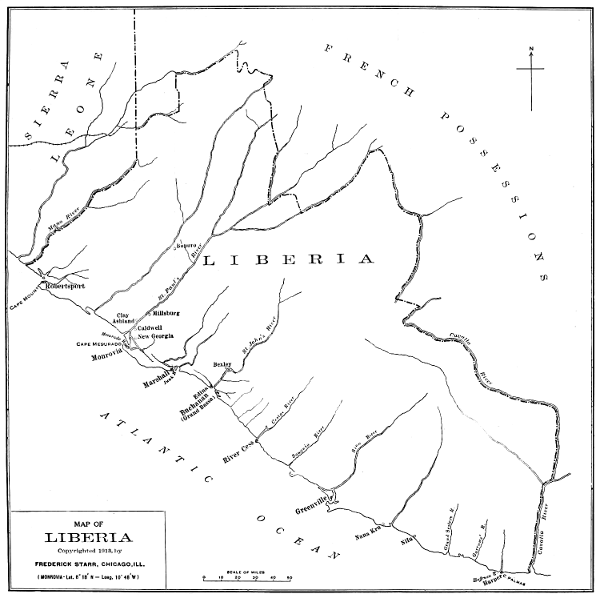
by which the land was gradually acquired; the area
secured stretched from the Mano River to the Sewa
and Sherbro Island on the west. Through the annexation
of this territory, Liberia’s domain extended
from Cape Lahon to the eastward of Cape Palmas,
west to the border of Sierra Leone, a distance of 600
miles. This acquisition of territory was attended
with considerable difficulty; the influence of traders,
of slavers, and even of England herself was thrown
in the way of the negotiations—so Commodore Foote
tells us. Nor did the acquisition of the territory put
an end to the difficulties in that region. In the year
1860 John Myers Harris, an English trader, had established
himself in the country between the Mano
and Sulima Rivers and refused to acknowledge
Liberia’s authority; as he was conducting a flagrant
trade in contravention of Liberian laws of commerce,
President Benson sent a coast guard to seize two
schooners, the Phoebe and Emily, which had been
consigned to him; the seizure was made between
Cape Mount and Mano Point, clearly Liberian territory.
It is curious that this seizure was made by a
Liberian government vessel, the Quail, which had
been a gift to the Republic from Great Britain. We
have, then, a vessel, contributed through British sympathy,
operating within an area secured through
British philanthropy, against law-breaking indulged
in by British subjects. The captured schooners were
taken to Liberia and were held for legal adjudication;
under the orders of the Sierra Leone Government,
the British gunboat, Torch, appeared at Monrovia,
and seized the two schooners by force on December
17; at the same time the commander of this
gunboat demanded from the Liberian Government a
penalty of fifteen pounds per day for nineteen days’
detention. Shortly after these events, President
Benson, on his way to England for public business,
visited the government of Sierra Leone and tried to
adjust the difficulties which had arisen; he was,
however, referred to London. At about this time
part of the disputed territory was annexed by Sierra
Leone to her own area. While in London, Benson
took up the matter with the British Government.
Lord Russell acknowledged the territorial rights of
Liberia to extend from the coast east of Turner Point
(Mattru) to the San Pedro River on the east, thus
admitting the point for which Liberia contended.
This decision was by no means satisfactory to the
troublers in Africa. Harris agitated the matter in
dispute. Backed by Governor Hall of Sierra Leone,
he and neighboring traders protested against the concession
Russell had made. A commission was therefore
appointed and met at Monrovia April 25, 1863,
continuing in session until May 4, when it adjourned
without decision. The British Commissioners examined
the title deeds held by Liberia and were inclined
to recognize some of these and to refuse others; they
objected to Liberia’s possessing any territory beyond
the Mano River, and proposed that river as the
boundary. The Liberian Commissioners demurred,
urging the validity of the deeds they showed and proposing
that the Sherbro should be their northwest
boundary; they asserted a good title to the territories
known as Cassee, Gumbo, and Muttru. The
British Commissioners based their claims upon letters
from the chiefs of the territories involved and on
statements which they asserted had been made by
them. The Commission broke up without a settlement,
as the Liberians held strictly to the concession
which Lord Russell had previously made. London,
however, yielding to the colonial pressure, regretted
that no solution had been reached, and
claimed that it was “justified in view of the facts”
in only recognizing Liberia’s sovereignty over
Sugaree. The closing episode in this exchange of
views was the sending of a letter by Dr. Blyden, who
was then Secretary of State for the Republic, which
ran as follows: “The President is equally grieved
that the oral statements of barbarous and heathen
chiefs on a subject affecting the prosperity of a rising
Christian state should be regarded by Her Majesty’s
Government as entitled to more weight than the
statements of Christian men supported by written
documents and by the known local conduct of the
chiefs towards the Liberian Government since the
cession of their territories until very recently.”
As might be expected, the troubles did not cease.
Traders continued to smuggle; local chiefs continued
to harass; shipping continued to bid defiance to
Liberian laws; vessels continued to be seized; threats
continued to be made. Harris began to act almost as
if he were an independent chief within this territory;
there were various tribes about him, and some
of them were inclined to resist his exactions; disputes
with him aroused the Vai to undertake reprisals;
Harris organized the Gallinhas peoples in an
attack upon the Vai; the Liberian Government sent
forces in 1869 to aid the Vai, who were loyal to
them. The Gallinhas natives were defeated, fled, and
in their rage turning on Harris, destroyed one of his
factories; this of course gave him a basis for new
claims for damages. On this military expedition
some property had been destroyed or confiscated.
Thus new difficulties grew up; there were occasional
seizures, retaliatory threats, demands for damages,
shows of force. Naturally, the hostile chiefs living
in the Mano District, encouraged by the unsettled
conditions, raided and destroyed Liberian settlements;
things presently were critical, and in 1871
another expedition was despatched by the Liberian
Government into Mano and Sulima; property was
destroyed, including powder and goods belonging to
British owners; the usual demands for damages were
made, and these demands known as the “Mano River
Claims” were pending until 1882.
Between the constant pushing of the “Harris
Claims” and the “Mano River Claims,” things
finally came to a head in December, 1878. A new
commission was then appointed which met in 1879,
first at Sierra Leone, then at Sulima; Commodore
Shufeldt, of the American navy, was chosen as an
arbitrator between the two contestants. The “Harris
Claims” by this time amounted to some 6000 pounds.
The conduct of Great Britain on this occasion was
supercilious. The Liberian Commissioners, after
reaching Sierra Leone, were kept waiting for three
weeks before the British Commissioners made their
appearance; the commissioners examined the title
deeds of the Liberian Government and took oral testimony
of witnesses favorable to and hostile to the
Liberian claims. The Liberians claimed the territories
known as Sugaree, Mano, Rock River, and
Sulima; the British Commissioners took the ground
that no such countries were in existence. The meeting
was rather stormy; Shufeldt reduced the “Harris
Claims” to £3000, but the British Commissioners
were not inclined either in this matter or in others
to abide by the decision of the umpire; finally the
Commission broke up without accomplishing any
good results. The British claimed that Sierra Leone
should undertake the protectorate of the whole country
as far as the Mano River, as they said Liberia
was unable to maintain order west of that point.
“Undoubtedly they were unable to fight British traders,
since every time they used force, marine or
military, the said traders were able to command the
armed interference of the Sierra Leone Government.”
The matter was again referred to London; nothing
final was there done.
Matters reached a crisis when, on March 20, 1882,
Sir Arthur Havelock, governor of Sierra Leone, with
four gunboats appeared before Monrovia and demanded
that the Republic should pay an indemnity of
£8,500 to settle all outstanding claims, and that it
should accept the Maffa River as a boundary. The
Liberian Government yielded to these insistent
claims. They promised to pay the indemnity, admitted
the Maffa River as a temporary boundary,
and agreed to receive from Great Britain a money
payment in return for what she had expended for
the purchase of the disputed territory. Before the
Liberian Government yielded, she set up a statement
of her own position which was just and dignified.
As soon as the action of the government was known
at Monrovia, Havelock having returned to Sierra
Leone, violent hostility arose; the Senate rejected
the treaty; the Liberians asked that the whole matter
be submitted to arbitration. On September 7,
Sir Arthur Havelock again appeared with gunboats,
demanding immediate ratification of the treaty.
Liberia again raised her defense: “If the contested
territory was British, why did the British Government
claim from Liberia an indemnity for acts of
violence amongst the natives which had taken place
thereon? If, however, Liberia acknowledged her responsibility,
as she had done, and agreed to pay an
indemnity, why should she be in addition deprived
of territories for the law and order of which she
was held responsible, and which were hers by acts
of purchase admitted by the British Government?”
The Senate again refused to ratify the treaty. Sir
Arthur Havelock sailed away; but in March, 1883,
the Sierra Leone Government seized the territories
in question between Sherbro and the Mano River,
territories which from first to last had cost Liberia
£20,000. The whole matter was finally settled by a
treaty signed at London, Nov. 11, 1885, whereby
the river Mano was admitted to be the western
boundary; a badly defined interior line was agreed
upon; a repayment of £4750 of purchase money was
made to Liberia.
The next act of serious aggression on the part of
Great Britain grew out of the bad definition of the
interior boundary by the treaty of 1885. The Mano
River had been recognized as the boundary between
Sierra Leone and Liberia. The question now arose
as to whether the two parties enjoyed equal rights of
freedom on the river. The Liberian Government attempted
to secure to Liberian traders and to
foreigners resident in Liberia the rights to free navigation
on the river without subjection to the payment
of customs dues and other charges to the Sierra Leone
Government. The matter became of sufficient consequence
to call for a commission in the year 1901.
Three Liberians, among them Arthur Barclay, then
Secretary of the Treasury (later President of the
Republic), were appointed; the meeting was held in
London and led to the following memorandum of
agreement between His Majesty’s Government and
the Liberian Republic.
1. His Majesty’s Government are prepared to
accede to the requests of the Liberian Government
that a British officer should be deputed to demarcate
the Anglo-Liberian Boundary.
2. They are also ready to lend the services of a
British officer for employment by the Liberian Government
in the demarcation of the Franco-Liberian
Boundary whenever the Liberian Government shall
have made an arrangement with the French Government
for such demarcation.
3. The Liberian Government undertakes to repay
to His Majesty’s Government the whole of any cost
incurred by them in connection with the survey and
demarcation of the Anglo-Liberian Frontier.
4. His Majesty’s Government are willing that, in
lieu of the Governor of Sierra Leone acting as British
Consul to Liberia, arrangements shall be made whereby
some other British officer shall be Consul in the
Republic.
5. His Majesty’s Government undertakes the
survey of the Kru Coast, provided the Liberian Government
will throw open to foreign trade the native
ports on the coast.
6. With regard to the navigation on the Mano
River, His Majesty’s Government are prepared to
permit the Government of the Liberian Republic and
its citizens to trade on that river, provided that it
is not to be considered actual right, and if, in return,
the Government of Sierra Leone is allowed to connect
by bridges and ferries the two banks of the river
with any roads or trade-routes in the neighborhood.
7. The Government of the Liberian Republic have
expressed a desire for closer union with Great Britain:
His Majesty’s Government are actuated by
the most friendly feelings toward the Republic; and
with the view of meeting their wishes in this respect,
so far as it is consistent with the declaration made
by His Majesty’s government in connection with
other powers, will at all times be ready to advise
them in matters affecting the welfare of Liberia, and
to confer with the Government of the Republic as
to the best means of securing its independence and
the integrity of its territory.
When this agreement was submitted to the Senate
of Liberia for ratification, they made the following
amendments:
Section 1. Amended to read, that the Liberian
Government shall depute an officer or officers to be
associated with the British officer in demarcating the
Anglo-Liberian Boundary.
Section 2. Amended to read, that the Liberian
Government shall depute an officer or officers to be
associated with the British and French officers in
demarcating the Franco-Liberian Frontier.
Section 5. The Senate, not perceiving the advisability
of throwing the coast open for the present, is
under the necessity of withholding its vote in favor
of this section.
Section 7. Amended to read, “One bridge at the
place where the Liberian Customs House is now
erected, and one ferry at the place where the second
Liberian Customs House may hereafter be erected;
that said bridge and ferry will be accessible to the
citizens of the Liberian Government without any restrictions
or extra toll, or charges, more than is
required to be paid by the subjects of His Majesty’s
Government.”
The British Government left the settlement of the
details of that portion of the agreement which had
reference to the navigation of the Mano River to be
settled between the Liberian Government and the
Government of Sierra Leone. The colonial government
imposed such restrictions that no understanding
was ever arrived at. However, a joint commission
for the demarcation of the Anglo-Liberian frontier
was appointed and in 1903 proceeded with its
work. In due time the boundary was satisfactorily
settled by this commission. This boundary, however,
very soon gave rise to a serious difficulty and to a
flagrant aggression. By the delimitation, the town
and district of Kanre-Lahun fell to Liberia; Colonel
Williams, the Liberian Commissioner, hoisted the
Liberian flag at that town which, at the time, was
occupied by a detachment of the Sierra Leone Frontier
Force; curiously enough, the British force was
not withdrawn.
In 1904 the British Government complained to the
Liberian Government that the Kissi were making
raids into British territory in consequence of a war
between Fabundah, a chief of the Kanre-Lahun District,
and Kah Furah, a Kissi chief, and asked permission
for the entrance of British troops into Liberian
territory for the purpose of repressing the
disorder which, it was said, threatened British interests.
The request was granted; British troops advanced
to the Mafisso where they established a post.
In November the British Vice-Consul sent word to
the President of Liberia saying that the chief Kah
Furah had been driven out of the Kissi country,
and that the people, at the invitation of the military
authorities, had elected a new chief, and had pledged
themselves not to receive Kah Furah among them
again. The Liberian Government assumed that the
matter was at an end and that the British force had
been withdrawn. In 1906 Mr. Lomax, the Liberian
Commissioner for the French frontier, was instructed
to proceed to this point; he reached Kanre-Lahun in
December, and found Waladi, a town in Liberian territory,
garrisoned by a Sierra Leone force. While
Mr. Lomax was at Kanre-Lahun, complaints were
made against him by the Chief Fabundah and others.
These complaints were examined in the presence of
Governor Probyn, Sir Harry Johnston, Mr. Lamont,
and leading military officers, and Mr. Lomax justified
himself completely, except in a single case where
damages of five pounds were suggested and paid.
Later on, British officers sent in complaints that the
escort with Mr. Lomax were plundering the country.
It was impossible in such districts and under such circumstances
to prevent some petty thieving. Mr.
Lomax, however, accepted the complaints and paid
the damages claimed. With a view to permanently
settling the country under Liberian rule, Mr. Lomax
ordered a local election to be held. Three chiefs were
chosen—Fabundah for the lower section, Gardi for
the Bombali section, and Bawma for the Gormah section.
Fabundah, who before had been exercising
jurisdiction over the Bombali, was dissatisfied. The
Sierra Leone authorities promised to support him
against the Liberian Government; they placed a
frontier force at his disposal for the purpose of ruining
the chiefs who were favorable to Liberian control
or who had received commissions from the President;
efforts to arouse opposition and dissatisfaction
were made; Lomax was hounded from the district;
the chief, Gardi, was driven from the country, his
town was plundered, and his brother made a prisoner
in Kanre-Lahun.
In 1908 attempts had been made in Europe to settle
difficulties pending with Great Britain and France.
Mr. F. E. R. Johnson, the Liberian Secretary of State,
who had been sent to arrange these matters, found
conditions threatening. In London the British Government
stated that it had no designs against Liberia,
but that they believed the French were planning
encroachment, and that, if Liberia lost territory to
France, Great Britain would find it necessary to take
a new piece of territory contingent to Sierra Leone
in her own defense. Matters appeared so serious that
President Barclay was advised to come to Europe
himself; he arrived in London on the 29th of August,
accompanied by T. McCants Stewart, and there met
Mr. Johnson. He told the British Government of his
fears regarding further aggression upon Liberian
territory and expressed the desire that Great Britain
and America should jointly guarantee the independence
and territorial integrity of the Republic.
The reply was that Great Britain would on no account
enter into any such guarantee; if the Liberian Government
obtained a settled frontier with France, and
inaugurated certain reforms, there would be little
danger of any one’s troubling it; if the reforms
desired by England were not undertaken, nothing
would save it from the end which threatened. At
the same time London refused to treat of the Kanre-Lahun
and Mano River difficulties until after the
troubles with France had been arranged. In France,
as will be shortly seen, the Liberian envoys met with
no success; a treaty was indeed arranged by means
of which the Republic was robbed of a large amount
of valuable territory. The envoys were again in
London in September to take up the matters of the
Kanre-Lahun and Mano River negotiations. The
British officials now demanded that Fabundah should
come entirely under the jurisdiction of the British
Government, and that the frontier line on the northwest
should be so altered as to place his territory
within the British colony; the area thus demanded
contained something like 250 square miles of territory.
At no time had the area actually in charge of
Fabundah amounted to any such quantity; the Liberians
demurred at the largeness of the territorial
claim—the British officials themselves stated that
they were surprised at its extent, but insisted upon
receiving the entire amount. No decision was actually
reached, the matter being postponed until the
delimitation of the new Franco-Liberian boundary
should be achieved.
Great Britain’s claim to this region was based upon
the flimsiest pretext. It is true that she had had
relations with Fabundah before the boundary had
been delimited; it is true that, previous to that date,
she had had a force in Kanre-Lahun; however, when
the boundary was actually fixed, Kanre-Lahun was
clearly within Liberian territory, and no objection
whatever was made to the Republic’s taking possession
and to the withdrawal of the Sierra Leone force.
When, later on, Great Britain sent soldiers into the
area, it was done on the pretext that intertribal difficulties
in the region threatened British interests; permission
was given as a favor to Great Britain and
with the expectation that, as soon as the difficulty
had been adjusted, the British force would be withdrawn.
Such was not the case; once in Kanre-Lahun,
it remained there; Major Lomax was hounded from
the country; the Liberian customs officer, Mr.
Hughes, was ordered to abandon his post of duty and
to surrender the customs house to the British commander.
This act of occupation was bad enough;
but soon Great Britain demanded that the army of
occupation should be paid by the Liberian Government
before it would evacuate the district; no such
understanding had been arranged, and the claim was
unjustified and ridiculous; the frontier force of Sierra
Leone was not increased, nor put to any extra
expense in the matter. In asking for a new boundary
line which should cut out Fabundah’s territory,
flagrant injustice was committed; it is true that the
boundary which had been arranged cut the land controlled
by the chief; about one-twenty-fifth of his
territory was on the British side, the remaining
twenty-four-twenty-fifths being in Liberia; if a new
line were to be drawn, it should have given the one-twenty-fifth
to Liberia and reduced the Sierra Leone
territory. The matter dragged along for months.
December 8, 1909, President Barclay accepted a
proposition to exchange or sell the district in dispute;
the legislature refused to accept the proposition. In
May, 1911, however, an agreement was finally
arranged; the British authorities took over the
Kanre-Lahun District, an area of extraordinary
wealth and dense population; in return for this valuable
and most needed area, Liberia received a piece
of country lying between the Morro and Mano Rivers,
which had formerly been a part of the Colony of
Sierra Leone; this territory is almost without population,
densely forested, and practically worthless.
Even so, it is little likely that the Republic will be
left in peaceful possession of it. On some pretext,
in the future, Great Britain will no doubt regain it.
When Maryland was added to the Liberian Republic,
it possessed lands acquired by deeds of purchase
and treaties as far east as the San Pedro River, sixty
miles east of the Cavalla; this country was occupied
by Kru tribes, and its eastern boundary practically
marked their limit; it was hence not only a geographical,
but an ethnographical boundary. For
years no one questioned Liberia’s right to the whole
area, and on maps and in repeated descriptions of the
country its rights were recognized. In 1885, however,
the French Government claimed that the French
possessions extended continuously from the Ivory
Coast westward beyond the Cavalla River and Cape
Palmas as far as Garawé; at the same time it suggested
certain shadowy claims to Cape Mount, Grand
Bassa, and Grand Butu;—in other words, points at
intervals along the whole coast of the Liberian Republic;
these claims were based on agreements stated
to have been drawn up between native chiefs and the
commanders of war vessels. In 1891 the French
Government officially communicated to Great Britain
her intention of taking possession of and administering
the district mentioned as far as Garawé; she
modified her claim, however, in such a way as to
extend her rights only to the Cavalla River. In 1891
a French commissioner was authorized to treat with
Liberia in this matter. He claimed that the French
had deeds to Grand Cesters, dating to 1788, and to
Garawé, dating to 1842; he referred to other shadowy
rights and mentioned treaties which, he asserted,
chiefs in the neighborhood of the Cavalla and San
Pedro Rivers had made with French authorities;
asked to produce these documents, he admitted that
he did not have them with him. The French Government
asked that Liberia should recognize the right of
France from the Cavalla River to the San Pedro, saying
that, if this recognition were granted, they might
not revive their old claims. Liberia urged that the
treaty formed with her by the French Government
in 1852 clearly recognized her rights to the region in
question; a French war map, dated 1882, was shown,
on which Liberia’s area was clearly shown to extend
to the San Pedro River; at the same time Liberia
asked that the whole matter should be referred to
arbitration. Arbitration was refused; a treaty drawn
up by France was offered for approval in August,
1892; the Liberian legislature refused absolutely to
ratify it, and the Liberian Government appealed to
the United States for assistance and advice. The
country was greatly aroused over the manifest injustice
of its powerful neighbor. Especially in Maryland,
feeling ran high. A printed appeal was issued
to the world. In it occurs the following passage:
“We appeal to all the civilized nations of the
world.—Consider, we pray you, the situation. Having
been carried away into slavery, and, by the
blessing of God, returned from exile to our fatherland,
are we now to be robbed of our rightful inheritance?
Is there not to be a foot of land in Africa,
that the African, whether civilized or savage, can
call his own? It has been asserted that the race is
not capable of self-government, and the eyes of many
are watching the progress of Liberia with a view to
determining that question. We only ask, in all fairness,
to be allowed just what any other people would
require—free scope for operation. Do not wrest our
territory from us and hamper us in our operations,
and then stigmatize the race with incapacity, because
we do not work miracles. Give us a fair chance, and
then if we utterly fail, we shall yield the point. We
pray you, the civilized and Christian nations of the
world, to use your influence in our behalf. We have
no power to prevent this aggression on the part of the
French Government: but we know that we have right
on our side, and are willing to have our claims to the
territory in question examined. We do not consent to
France’s taking that portion of our territory lying
between the Cavalla and San Pedro Rivers; nor do we
recognize its claims to points on our Grain Coast
which, as shown above, our government has been in
possession of for so long. We protest, too, against
that government’s marking off narrow limits of
interior land for us. We claim the right to extend
as far interiorward as our necessities require. We
are not foreigners: we are Africans, and this is
Africa. Such being the case, we have certain natural
rights—God-given rights—to this territory which no
foreigners can have. We should have room enough,
not only for our present population, but also to afford
a home for our brethren in exile who may wish to
return to their fatherland and help us to build up a
negro nationality. We implore you, the civilized and
Christian nations of the world, to use your influence
to have these, our reasonable requirements secured to
us.” But neither the official appeal to the United
States nor the unofficial appeal to the Christian
nations of the world availed. France seized the territory
and threatened to refuse to recognize rights
beyond Grand Cesters on the seaboard, and Boporo in
the interior. After fruitless remonstrance, the Republic
was forced to yield and a treaty was accepted
on December 8, 1892. By it the Cavalla River was
recognized as the boundary between France and
Liberia, from its mouth “as far as a point situated at
a point” about twenty miles south of its confluence
with the River “Fodedougouba” at the intersection
of the parallel 6° 30′ north and the Paris meridian
9° 12′ west; thence along 6° 30′ as far as 10° west,
with the proviso that the basin of the Grand Cesters
River should belong to Liberia and the basin of the
Fodedougouba to France; then north along 10° to 8°
north; and then northwest to the latitude of Tembi
Kunda (supposed 8° 35′), after which due west along
the latitude of Tembi Kunda, until it intersects the
British boundary near that place. But the entire
Niger Basin should be French; Bamaquilla and
Mahommadou should be Liberian; Mousardou and
Naalah, French.
Notwithstanding this delimitation, difficulties with
the French continued. In 1895 French posts along
the northern border began to crowd in upon the
Republic. The town of Lola, in Liberia, was attacked
by Senegalese soldiers; these were repulsed and two
French officers were killed. Aggressions continued
until, finally, in 1903, Liberia begged that a final
delimitation might be arranged, as the old had proved
completely unsatisfactory. In 1904 F. E. R. Johnson
and J. J. Dossen were sent to France to arrange
matters. On their way, they called at the British
Foreign Office and asked their aid and interest in
bringing about an understanding. Arrived in Paris,
it was quickly found that the French were planning
to possess themselves of all the territory situated in
the basin of the Cavalla and the Upper St. Paul’s
Rivers; the British Foreign Office expressed sympathy,
but did nothing more. In 1905 several efforts
were made toward bringing about an agreement. Dr.
Blyden was sent to France, but accomplished nothing;
in November Sir Harry Johnston was asked to treat
with the French Government which, however, refused
to recognize him as an official negotiator. In 1907
Secretary Johnson was commissioned to treat with
the French Government, but found its attitude most
hostile and unfriendly. President Barclay himself
was summoned to Europe; taking T. McCants Stewart
with him, they joined Johnson, and interviewed
the French officials. A treaty was submitted to them
by which Liberia would be deprived of a large portion
of her territory situated in the richest and most
prosperous districts of the Republic. It was in vain
that the Liberian commissioners remonstrated; the
French were inflexible. The English Government had
refused to deal with the commissioners in regard to
the British boundary difficulty until they had come
to some arrangement with France. In this unhappy
condition of affairs, the commissioners decided to
consult the American Ambassador in Paris; they
asked that the United States should assist Liberia and
prevent her being robbed of so large a portion of her
territory, and should use her influence in bringing
the French Government to submit the whole matter in
dispute to arbitration. Ambassador White replied
that he doubted whether the United States would aid
Liberia in this crisis; he advised President Barclay
to accept the treaty, urging that, if he failed to do so,
the French would make further encroachments, and
the Republic would meet with greater losses. As the
case seemed hopeless, the commissioners accepted the
treaty. It involved the delimitation of a fixed
boundary by an international commission. Liberia
engaged two Dutch officials as her commissioners.
They were on hand ready to fix the boundary in February,
1898, but were kept waiting until May by the
dilatoriness of the French commissioners; in order to
have a permanent boundary fixed, the Republic made
great concessions and lost valuable regions. It was
willing, however, to sacrifice much for peace.
Of course the sacrifice was without result. At the
present time the whole question of the Franco-Liberian
boundary is again open, and from the points
urged by the French Government it is evident that
it aims at new acquisition of territory and new
restriction of the power of the little Republic.
We stand at the threshold of a new era; new political theories
are being advanced; new interpretations are being given to
the principles of international law; larger fulfilments of national
obligations are being required of individual nations; new
duties are being thrust upon us. They cannot be shirked, we
must keep pace with world requirements. Regeneration and
reform must be our watchword. The people must see that they
become so. The process must operate from within outwards,
or else influences from without will compass our ruin.—E.
Barclay.
When President Barclay was in London, the British
Government demanded that certain internal
reforms should take place in the Republic before it
would discuss a final settlement of either the Mano
River or Kanre-Lahun difficulties. Shortly after
the President’s return to Monrovia, Mr. Braithwait
Wallis, Consul-General of Great Britain to Liberia,
issued a memorandum on the subject—apparently
under the fear “lest we forget”. This memorandum,
which bears the date of January 14, 1908, occupies
four printed pages, and condenses into that brief
space an astonishing amount of venom and insolence.
A few quotations will show its spirit:
“Your Excellency will remember then being
informed that a critical moment had arrived in the
history of the Republic, that however it might have
been twenty or even ten years ago, the time had now
gone by when Liberia could re-enact the part of a
hermit kingdom, and that she must not lose a moment
in setting herself seriously to work to put her house
in order, or be prepared at no distant date, to disappear
from the catalogue of independent countries.
His Majesty’s Government, as Your Excellency is
aware, have absolutely no designs against either the
independence or the integrity of the Republic. Their
only desire is that a country which, on one of its
frontiers, marches with an important British Colony,
and with which not only that Colony, but Great
Britain itself, has large and growing commercial
relations, should have such a stable or effective Government
as will conduce to its own prosperity, and
remove any danger of its losing its independence.
His Majesty’s Government do not consider that the
Government of the Republic is either stable or effective.
Improvement has indeed resulted from the appointment
of two Customs Officers, and the Customs revenue
of the country has largely developed. But it is
also considered as absolutely essential, if such
improvement is to continue and to extend to other
branches of the Government, that the finances of the
country be placed, at any rate for the time being,
in the hands of an European financial expert, and
that at least three more European Customs experts
be appointed. And further, no Government can be
said to have a stable basis, when it is without any
means of enforcing its authority. His Majesty’s
Government, therefore, considers that it is essential
that a trustworthy police, under European officers,
should be at once established. With regard to the
appointment of a financial expert, who could advise
and assist the Secretary of the Treasury, in the financial
affairs of the Country, Mr. Lamont has already
been appointed Financial Adviser to the Republic.
He is, however, only so in name, but should now be
made so in actual fact. His Majesty’s Government
further consider that the Liberian judiciary ought to
undergo drastic reform.” Mr. Wallis recapitulates
the reforms demanded in the following statement:
(a) the appointment of a financial expert, who will
place the finances of the country on a sound footing,
and will advise the Secretary of the Treasury on
financial matters. (b) The establishment of an efficient,
well armed, and well disciplined police force
under competent European Officers; and one that will
command the respect of the Powers. (c) The
appointment of at least three more European Customs
experts. (d) The reform of the judiciary. “If
the Liberian Government carry out the reforms herein
indicated within SIX MONTHS, counted from the
date of Your Excellency’s return to Monrovia from
England, His Majesty’s Government will on their
side be happy to assist in carrying them into effect
in the same way as they have recently been assisting
in the work of re-organizing the Liberian Customs.
They will further be happy to suspend pressing the
monetary and other claims which they have against
Liberia, and will endeavor to come to a settlement,
on a mutually satisfactory basis, on the long outstanding
question of the navigation of the Mano
River and the trouble on the Anglo-Liberian
Frontier.”
In other words, Great Britain was quite willing to
assume the whole running of Liberian affairs; she
would be glad to manage her financial matters, to
train and handle her frontier force, to collect her customs
duties, and manage them, to interfere with, and
control her government completely. She hinted at
what she might do if these reforms were not carried
into effect; she ended with a querulous complaint
regarding advantages which German shipping was
said to be securing to the disadvantage of British
interests. This truly extraordinary document was
signed in the following highly dignified fashion:
I have the honor to be,
with great truth and regard
Sir,
Your Excellency’s
most obedient,
humble servant,
BRAITHWAIT WALLIS,
His Britannic Majesty’s Consul.
One of the cries of the present day internationalism
is “effective occupation”. It is only as a country
demonstrates itself able to protect its borders, and to
maintain peace within its limits, that it is admitted
to justly hold its territory; there are some strange
features involved in the expression, but it has a just
foundation and is at present generally accepted. It
is true, if Liberia is to be recognized as an independent
nation, she must guard her borders, must
prevent her people from troubling their neighbors,
must protect life and property within her area. There
is a stipulation in the French treaty of 1907 in regard
to this matter; if Liberia cannot maintain a frontier
force to protect her boundary, the French claim the
right to place their own forces on Liberian territory
for that purpose; the English, in their demanded
reforms, insist upon an adequate and well trained
police force upon the frontier; the demands are not
unjust and must be met. In fact, the frontier force
is one of the urgent and crying needs of Liberia.
While President Barclay was in London, he was
approached by Capt. Mackay Cadell, who had served
in the South African War; Capt. Mackay Cadell
desired to be put in charge of the frontier force
which it was believed that Liberia would organize in
response to the British demands; he was not actually
engaged by the President, but put in his appearance
in January, 1908, ready for business; his employment
was opposed by many, but finally, largely in order
not to offend British susceptibilities, he was engaged,
given the rank of Major—some question has been
raised as to exactly how he came to carry the title
captain—and was authorized, with the help of two
British assistants, to organize the frontier force; he
was also given authority to employ ten or more
sergeants and buglers from Sierra Leone; it was
naturally assumed that the force in general would be
composed of Liberian natives. Major Mackay Cadell
promptly began active work; barracks were erected
upon the edge of Monrovia, and soon 250 men were
enrolled for service. Their uniforms, arms, and
ammunition were bought from Great Britain—so that
the whole enterprise was good for British trade; it
is not clear, however, why the caps and other articles
were stamped with the crown and other emblems of
His British Majesty’s service. Matters were going
nicely, but it began to be suspected that a considerable
number of the new soldiers were British subjects,
and it was asked whether some of them had not
served upon the Sierra Leone frontier force. These
suspicions and doubts led finally to a protest from
the French Vice-Consul who claimed that the force
being organized was actually “a British army of
occupation” which the Liberian Government was
permitting to be organized in Liberian territory; he
demanded that an equal number of French officers
and of French subjects be added to the force. The
Liberian Government inquired of Major Mackay
Cadell with reference to the matter; he denied that
there were any British subjects on the force, and
depending on his answer, the Liberian Government
denied the fact to the French official. Meantime,
Major Mackay Cadell was making himself variously
useful to the Monrovia city government; he undertook
without compensation, the command of the city
police force as chief of police; in place of the loyal
Kru police, he put in Mende soldiers from the barracks;
he also performed the functions of street commissioner,
tax collector, city treasurer, and other
duties until, finally, the citizens decided to dispense
with his free services; he declined, however, to resign,
and presented a large bill as the condition upon
which he would deliver up the city property
entrusted to him. (We quote from Ellis.) On
October 27th Major Mackay Cadell was further questioned
in regard to the composition of his force, and
a report was demanded; it was then found that at
least 71 out of the little army of 250 were actually
British subjects; more than this, no doubt many of
the Mende at the post, who were classed as “Liberians”,
really came from the portion of that tribe
residing on the other side of the Sierra Leone boundary.
While this report was rendered, Major Mackay
Cadell showed constant objection to supervision by
the President of the Republic and to any suggestion
of control. The President and his Cabinet, after
meeting and discussing the matter, agreed upon the
dismissal of Major Mackay Cadell, but out of courtesy
gave him the opportunity of resigning his position.
The French Vice-Consul continued to insist on his
demands; understanding that Capt. Wallis had given
his consent to the appointment of French officers and
subjects, the President prepared to make such
appointments. Just at this juncture Capt. Wallis
returned from an absence, and at his own request,
on November 13, had a meeting with the President
and the members of the Cabinet, at which he presented
to them what purported to be a communication
from the British Government. Some mystery seems
to be associated with this document, but it is understood
that its effect was that, if Frenchmen were
appointed to the direction of the frontier force, and
French subjects were enlisted in it, Great Britain
would unite with France to disrupt and divide the
Republic. In December the legislature demanded
that the services of Major Mackay Cadell should be
dispensed with. He, however, hesitated to hand in
his resignation. The legislature ordered a complete
re-organization of the frontier force under a Liberian
officer, with only two British subjects to be employed
in the whole organization—the two assistant officers
whom Major Mackay Cadell had employed. On
February 1 the Major sent in his resignation. Acting
on order of Consul-General Wallis, he turned over
the arms and ammunition in his charge to the Elder
Dempster Co., and announced the fact to the Liberian
Government; at the same time Consul-General Wallis
applied for an official guard to protect the property
thus placed in private British hands: the Secretary
of State, F. E. R. Johnson, expressed his
surprise that a consul, without consultation with the
proper Liberian authorities, should order property
belonging to Liberia (although payment had not yet
been made for it) to be turned over into private
hands, and refused to accept the responsibility of
placing a guard in charge. On February 11, 1909,
Major Mackay Cadell sent a remarkable message to
President Barclay, informing him that the native
soldiers were in serious danger of mutiny on account
of arrears in payments; at the same time he sent
messages to the two houses of the legislature, requesting
that the men be permitted to appear before them
and state their grievances; he said that, if some redress
were not given, the men could not be blamed for
what might be done. Steps were at once taken for
public defense; fortunately some 400 of the militia
were in Monrovia for quarterly drill. After some
seventy soldiers from the barracks had appeared
upon the public streets, parading, threatening and
menacing the seizure of the arms and ammunition, a
force was sent to demand the surrender of the camp;
at the same time, notice of this was sent to Consul-General
Wallis. Major Mackay Cadell refused to
surrender, making conditions which would involve
several days’ delay; his immediate surrender, however,
was demanded, and other militia forces were
sent for. Notice of this new demand was sent to
Consul-General Wallis with the request that he should
order British subjects out of the camp; this he did;
Major Mackay Cadell decided to capitulate; the camp
was occupied. At a court of inquiry held to investigate
the difficulty, the British sergeants said that
Major Mackay Cadell himself had instigated the
mutiny; that he had selected a certain number of men
to insult the President, to arrest him, and take him
to camp. A curious fact in connection with this whole
extraordinary procedure is that, on the 4th of February,
one week before the President of the Republic
was informed of the danger of imminent mutiny,
notice of it had been cabled to Great Britain. It was
perhaps by accident that a British gunboat was in the
harbor on the 10th, the day before the outbreak—the
name of this gunboat, by the way, quite appropriately
was the Mutin. In closing the account of this
strange incident, quotations may be made from the
official report of the American Commission which
visited Liberia shortly afterwards:
“But if Major Cadell got on very well with his
troops, he got on very badly with the Liberian
people and the Liberian Government. He was a man
of indomitable energy, but guileless of tact. His
actions on various occasions affronted the Liberian
officials. Through indifference to the law, or by
design, he enlisted a considerable number of British
subjects among the troops, about one-fourth of his
men being natives of Sierra Leone. When called to
account for it, he at first denied and afterwards
admitted that some of the men might have been born
in Sierra Leone, but that he supposed them to be
residents of Liberia, and therefore, Liberians. Being
called upon to dismiss the British subjects, he neglected
to do so. About the beginning of the present
year he began to complain that his men were not paid,
and demanded further supplies from the Government,
though he was very dilatory in presenting
accounts for the money already entrusted to him.
The dissatisfaction with Major Cadell’s conduct in
matters of the camp led to the passage of a law by
the Liberian Legislature in January, 1909, re-organizing
the force and dismissing its commander. The
President, who had upheld Major Cadell, offered him
an opportunity to resign, but on one pretext or
another, he delayed doing so, and when he sent in
his resignation, the Government could not accept it
until his accounts had been adjusted. He remained,
in the meantime, in charge of the command, and on
February 11, 1909, wrote a threatening letter to the
President, in which he stated that, if the demands of
the troops for the payment of money due them were
not met within twenty-four hours, he could not be
responsible for the maintenance of peace or for the
safety of the President. This remarkable letter naturally
created much excitement in Monrovia, but the
situation was handled with extreme adroitness by the
Liberian Government which demanded that Major
Cadell withdraw the British subjects composing his
force, and that he turn over the camp to the Liberian
authorities who would deal with the Liberian subjects.
This order was reluctantly obeyed on the
recommendation of the British Consul-General, and
it was then discovered that seventy-one of the enlisted
men were British subjects. Two or three weeks
afterwards, after settling up his accounts, whereby
it was revealed that he had involved the Government
in a considerable unauthorized debt, he sailed for
England and was soon followed by his brother
officers.”
Again:
“On February 4, the British in Monrovia cabled
to the Foreign Office that the lives of foreign residents
in Liberia were in danger, and urged that a
gunboat be sent for their protection. . . . On
February 10 the British gunboat Mutin appeared and
anchored off Monrovia. On February 11 and 12 England
precipitated the rupture of the Government. But
for the prompt and judicious action of the Liberian
Executive, aided by the American Minister Resident,
the following would presently have been the situation:
A British gunboat in the harbor, a British officer in
command of the frontier force, and a large number
of British subjects among the enlisted men, a British
official in charge of the Liberian customs, a British
officer in command of the Liberian gunboat Lark, a
British regiment in the streets of Monrovia.”
The fine hand of Consul-General Wallis of course is
evident throughout these events. How seriously he
was implicated is suggested in the following passage
from the report of the Commission: “It is most
unfortunate that the Commission has been unable to
secure an account of these events from the principal
British actors in them. When we reached Monrovia,
Major Cadell had left Liberia. The British Consul-General
was away on leave of absence. We were the
more disappointed in not meeting the latter, as, before
our departure, we had been shown in the State
Department at Washington a despatch of the Ambassador
in London, stating that the British Foreign
Office there had instructed its representative in Monrovia
to give the American Commission the fullest
information about Liberian affairs. The acting Consul-General
had no knowledge of the facts, and covered
his obvious embarrassment, when asked to
explain some of them, by the plea that he had no
inside information.”
It has been said that the British Government
admits that Consul-General Wallis went beyond his
authority. It is, however, significant that he was not
reduced in position; he left Liberia, of course—his
usefulness there having more than ended; but he was
transferred to Dakar, Senegal, the finest consular
post in all West Africa.
As for Major Mackay Cadell, he now poses as
Liberia’s real and great friend; he has, however,
changed his name, and is now known as Major R.
Mackay-Mackay. He is associated with the Cavalla
River Co., Limited. This appears to be a strange
mixture of a commercial, educational, and philanthropical
character; always, however, primarily
exploitative. Before going to Liberia in connection
with his duties with this company, Major R. Mackay-Mackay
traveled in the United States; arrived in
Liberia, he gives the impression that the State
Department of the United States is behind his enterprise,
and that Booker T. Washington is deeply
interested in its success. He throws the responsibility
for all the past upon those “higher up”; it seems
that personally he always loved Liberia and was her
friend. When he passed through Monrovia on his
way down to the Cavalla, he simply showered advice
and benevolence along his path. An interview with
him was published in The Guide. He says: “Liberia
can not go on living on loans as in the past. Why
should she be dependent on gold from outside when
she has a hundredfold within her own borders, at the
very door? Standing at the street corners, discussing
politics, or waiting for dollar-bills to grow and
fall from the trees around, will not advance the welfare
of the Republic, nor attract the genuine
sympathy and co-operation from the outside world.
Work! work! work! that is what Liberia needs; and
there are those who are prepared to create the opportunity,
provided all make up their minds to work
as they should. Is manual labor considered a disgrace
in other countries? Why should it be in
Liberia?”
Also: “I am here on a visit and to let Liberia know
that she has more friends than she counts on; and
they will increase in proportion to her efforts to help
herself. I for my part will do all I can in my humble
way to preach ‘Liberia regenerated’ to all, and help
where I can without treading on ground other than
within my rights as a visitor and friend.” Most
touching, however, is this: “Yes” (there are signs
of awakening), “since my return I see the most wonderful
strides made in many directions, and a keen
desire in the citizens of the wider ideas to aid in their
country’s advancement. May it continue. In every
season is some victory won. Let us bury the past
with all its errors, sadness, and regrets.”
It is sad indeed that humanity is not prone to bury
the past; even such expressions of affection may be
received unkindly. What could be more dreadful,
when a man oozes philanthropy from every pore, than
to have such things said of him as the following
which appeared about that time in Green’s paper,
The African League?
“Major R. Mackay-Mackay, whose name stinks in
the nostrils of all country-loving Liberians, because
of his conduct when in command of our frontier
force, is back in Liberia again, this time at the head
of a company whose procedure thus far has not
inspired the strongest confidence. More is known of
this intimacy than the men themselves may think.
The last steamer brought intelligence that an agent
of Major Cadell’s company, the Cavalla River Co.,
Limited, is now in Sierra Leone, with 630 natives of
that colony who are to be brought to Cape Palmas
soon to serve this company. It is very strange that
this company finds it necessary to employ natives
from the colony of Sierra Leone, when in Liberia is
the largest market for unskilled laborers in Western
Africa, supplying, as it does, most, if not all, of that
class of labor employed in the various enterprises in
British, French, and German African colonies. We
hope this is no new coup.”
The Frontier Force has continued in its development.
The present plans involve the organization
of a battalion of 600 men under a major; each of the
two companies of 300 soldiers will be under a captain;
and each company will have three Liberian lieutenants;
the three chief officers will be Americans loaned
to the Liberian Government by the United States.
The general duties of the force will be those of a
constabulary for the maintenance of law and order
throughout the Republic and for the prevention and
the detection of crime; it will also be used as a customs
guard in such numbers and at such places as
may be agreed upon by the Secretary of War and the
general receiver of customs. Its estimated cost for
the year 1913 was $86,159.60. The American officers
arrived in the Republic in the spring of 1912. They
were Major Ballard and Captains Brown and Newton.
In entering upon their new duties of developing
and organizing the Frontier Force, they had the great
advantage of the advice and interest of Major Charles
Young of the United States Army, who was in Monrovia
as military attaché of our legation. We had
ample opportunity of investigating this Frontier
Force. It is composed for the most part of natives
fresh from the interior; two hundred of them passed
through our hands for examination and measurement;
they were fine fellows, well built and in good
physical condition; few of them understood English,
and among them several languages were represented;
they were proud of their position and anxious to
improve; they were easily led, particularly by officers
who treated them with kindness; we saw two parties
of these soldiers started off for service; they made a
good appearance. While we were there—as is true
indeed much of the time—their payments were
behind, and they were expressing some dissatisfaction,
but were easily controlled; there is, however,
always a danger of mutiny when the Government is
behind in meeting its obligations to them; I quote
from one who was in Monrovia October 10, 1911; he
says: “I heard quite an altercation in the street.
Upon going out I saw about 120 men moving through
the street in a disorderly mass toward the office of
the Secretary of War. Upon arriving at the office,
there was quite a demonstration and matters looked
serious. After a great deal of persuasion on the
part of the Secretary and the one officer from the
camp, the men moved away in the direction of Camp
Johnson. I was informed that the men were demanding
their pay.” There is also great danger of the
Frontier Force, when marching through the interior,
looting and destroying the fields and villages through
which they pass; this is so much in the nature of
ordinary native warfare that it must be particularly
guarded against; the Frontier Force, however, is
necessary, and it seems to be making a promising
development.
Compare, you say, the present with the past. Where are
the schooners and cutters that were used to be built right here
in Liberia, when nearly every responsible man had his own?
Where are the tons of sugar that used to be shipped to foreign
parts by our fathers, and the barrels of molasses, and the tons
of camwood? Where are the financial men of the country that
looked upon the holding of public offices almost beneath them,
who had to be begged to fill the offices? Where are those who
when they (had) made their farms lived off the farms? Oh,
where are the honest, upright and loyal government officials of
1847? You answer for yourselves. Where are the great
Liberian merchants of Monrovia, Grand Bassa, Sinoe, and Cape
Palmas? Gone!—S. D. Ferguson, Jr.
Liberia’s very existence depends upon her development
of trade. If the Liberians push forward in
this direction, her future may be assured. If, however,
she neglects it, her neighbors, France and England,
can not be expected to permit their opportunity
to pass. The area of the Black Republic is far too
rich by nature to be overlooked; if its legitimate
owners fail to develop it, others will do so.
The past of Liberia was built on trade in wild
produce; its immediate prosperity must depend upon
the same source of wealth. For the moment the trade
of Liberia must be in such things as palm nuts,
piassava, and rubber.
The oil palm has been the most important source of
wealth Liberia has. The tree produces great quantities
of nuts, growing in large clusters, from which
an oil is easily extracted, which finds enormous use
in soap- and candle-making. This oil is derived from
the stringy, fleshy coating of the nut; the nuts are
thrown into pits dug in the ground, where they are
allowed to ferment for some time; the mass of fermented
nuts is then squeezed in a sort of press run by
hand, and the oil is extracted. This is the primitive,
native style of production. The oil may also be
produced by boiling and pounding the nuts and then
stone-boiling the mass in wooden troughs, the oil
being skimmed off from the surface of the water. In
Liberia palm oil is chiefly produced in the counties of
Bassa and Sinoe. Liberian oil is not the best quality
on the market, as carelessness in preparation leaves
considerable dirt and impurities in it; it has, however,
brought good prices—up to £24.10.0 a ton.
Inside the palm nut is a hard kernel which remains
after the oil has been extracted; this kernel at first
was wasted; to-day it is known to yield a finer oil than
the pulp; the idea of exporting palm nut kernels
originated with a Liberian, and the first shipment was
made in 1850; to-day there is a large demand for
palm kernels which sell at prices ranging from $60 to
$68 per ton, the oil derived from them selling at $130
to $133 per ton.
Second, certainly, in importance, among the raw
products exported from Liberia is piassava; it is the
fiber of a palm—raphia vinifera. Large use is made
of this extremely resistant fiber for brooms and
brushes for street sweeping and the like; its use, too,
was suggested by a Liberian in 1889; it was first
exported in 1890 and for a time brought the astonishingly
high price of from $300 to $350 per ton; as
the fiber was easy to prepare and the trees were
plentiful, a rapid development took place; Liberia
was for a long time the only source of supply; carelessness
ensued in the preparation of the fiber, the
demand lessened and the price dropped; it went down
to £10 per ton; at present the price is somewhat better
and is stationary at £20. Sir Harry Johnston,
from whom these details are borrowed, says that it is
difficult to judge the quality of raphia, that it shrinks
in weight, and that trade in it is somewhat speculative
and uncertain; still, piassava fiber occupies
an important position in the Liberian trade to-day.
Africa appears to be the continent which presents
the greatest number of rubber-yielding plants; in
Liberia the precious exudation is obtained from some
sixteen different kinds of trees and vines, varying as
to the quality and character of rubber yielded. The
rubber of Liberia is not considered of the highest
class, but it is of good grade; the natives of the
interior are skilled in its collection; there is no doubt
that great quantities of wild rubber are still to be
obtained within the limits of the Republic and experiments
in rubber-planting have already been made
with promise.
Sir Harry Johnston gives a long list of other
natural products which have been exported from
Liberia at one time or another in varying quantities.
There was a time when camwood found a ready market
and formed perhaps the most important element
in Liberian trade—of course with the invention of
other dye-stuffs, the use of camwood, annatto, etc.,
has practically ceased; the name “Grain Coast” or
“Pepper Coast” was long given to this country on
account of the malagueta pepper which was exported
in great quantities—this, too, has ceased to be a
product of practical importance; kola nuts are to
some degree exported from Liberia, and with the
ever-increasing use of the kola in America and European
countries, trade along this line should develop;
ivory has always been among the export products of
Liberia, though it has never had great significance;
vegetable ivory nuts are produced here and to some
extent form an article of trade—the demand for them
in button-making is large and increasing, and exportation
of them may reasonably be developed; hides and
oil-yielding seeds complete the list of actual native
export products. Sir Harry Johnston calls attention
to the fact that the country is rich in ebony, mahogany,
and other fine woods, in copal and other gums,
in ground nuts, fruits, and minerals; these, however,
have never been actual materials for export; all
are valuable, however, and trade in them might be
developed.
All of these raw products of natural production
are valuable, but that they shall form an element in
trade depends upon the natives. These things all
come from the forests of the interior; if they are to be
traded to the outside world, they must be collected
and transported by the people within whose territory
they are found; this dependence is an uncertain
thing. The natives have few needs; in their little
towns they take life easily; they have no sentimental
interest in the development of trade as such nor in
the upbuilding of the country; they care comparatively
little for the returns of trade; they will work
when necessary, but only as they please; when they
need some money for buying wives, they will prepare
some piassava fiber or dig a pit, ferment some nuts,
and squeeze some oil. When they have enough for
the immediate and pressing necessity, work stops, and
with it the supply of oil or fiber or whatever they
may have seen fit to produce. More than this, the
native is little concerned about the quality of his
production. So long as he can sell it and raise the
resources that he needs, he does not care whether the
oil is clean, whether the piassava fiber is of good quality,
or whether the rubber contains dirt and stones.
Impurity, however, of products is a very serious matter
to the outside world; a district which neglects
quality loses trade. Liberian oil, fiber, rubber, all
are at a disadvantage at present through the carelessness
of the producers.
It must, then, be the policy of the Liberian Government
to encourage, by every legitimate means
within its power, the increase of the production of the
natural resources. Nor is the simple question of production
the whole difficulty. Transportation is quite
as important. The product, no matter how good or
how precious, has no value as long as it remains in
the bush. There are different methods of dealing
with this matter of getting the natural products down
to the coast settlements. The simplest and most natural
is to let the native bring it out—but the natives
are as little inclined to travel and carry as they are
to produce; they will fetch down their product when
they feel inclined—but the demand from without is
constant. Liberians may go into the bush to bring
out the products; there are always little traders who
divide their time between the settlements and the
interior; they travel in, sit down for several days at
native towns, trade with the natives for whatever
stuff they have on hand, then have it carried out;
such traders are usually independent men of small
means who are trading on their own account. It is
not uncommon for the large trading-houses to hire
agents,—Liberians or natives,—and send them into
the interior to buy up and bring down products.
Another method—which, in the long run, will prove
no doubt the most satisfactory,—is to establish here
and there in the interior permanent trading stations,
supplied with a fair stock of goods, to be traded with
the natives against their raw products—trading stations
of this kind are already established by the Monrovia
Rubber Company and by various of the great
trading-houses.
In some way or other the Government should adopt
a method of encouraging the natives of the interior
to gather, to properly prepare, and to bring in raw
produce; a definite scheme of practical education and
encouragement must be devised.
While raw products offered by nature have been
and are the chief element in Liberian trade, another
element is immediate, and will ultimately be the chief
dependence of the nation. Agriculture, though far
from being in a satisfactory condition, has always
contributed material for export. The country can
not forever count upon a supply of raw products.
Gradually the value of the forests will become secondary
to that of produce of the fields. There is no
reason why the Liberian coffee should not be fully
re-established in the foreign market. The tree seems
to be a native of the country; Ashmun reported that
it was found everywhere near the seacoast and to an
unknown distance back from there. Under natural
conditions, the tree grew often to a height of thirty
feet and a girth of fifteen inches. Coffee berries from
wild trees were brought in by hundreds of bushels to
the early settlers by the natives. Plantations were
soon established, and many of them met with great
success; in fact, coffee was once the principal export
of the Republic; it was mainly shipped from Monrovia
and Cape Mount; the more important plantations
were located along the St. Paul’s River. Liberian
coffee was much appreciated in the European
market; at its period of greatest vogue it used to
bring twenty-five cents a pound; the price has now
fallen so low as eight or nine cents a pound. This
decline is due, in part, of course, to the enormous
development of the Brazilian coffee trade; it is, however,
largely due to the carelessness of the Liberian
planters, who had only primitive machinery for its
preparation and who neglected proper care, with the
result that the coffee berries reached the market
broken and impaired. It is a delicious coffee, of full
flavor, and improves with age. Sir Harry Johnston
claims that about 1,500,000 pounds are annually
produced, and reports that the output is increasing
slightly. At the Muhlenberg Mission School, coffee is
cultivated; care is taken in its preparation, and the
price is rising; if the Liberians will give serious attention
to the matter, there is no question that the old
importance of the culture may be restored. It will
require improved methods of cultivation, the use of
better machinery, greater care in the preparation of
the berry, and constant attention to proper packing
and handling.
Discouraged at the fall in price of coffee, some
Liberian planters introduced the culture of cacao,
from which our chocolate and cocoa are derived; this
culture has long been successful in some of the
Spanish possessions of West Africa; in Liberia the
plant grows well, and the cacao seems to be of superior
quality; it is said that a good price for it may be
received in Liverpool. This culture must be considered
as only in its infancy, but there appears to
be no reason why it should not become of great
importance.
The rubber so far sent out from Liberia has been
wild rubber; it would seem that a wise policy in
national development would be to encourage the
establishment of plantations of rubber trees or vines.
One such plantation has already been established by
an English company, who hoped to gather the first
harvest of latex in 1912; one would suppose that the
best tree for planting would be the funtumia which
is native to the country and a good yielder; it is chiefly
this plant which is being set out by the Belgians in
the Congo colony; the English company in Liberia,
however, claims that their experiments with funtumia
were not encouraging, and the species actually planted
is the hevea—the one which yields the famous Para
rubber. While coffee, cacao, and rubber will no
doubt be the earliest important plantations to be
developed in the country, other products should not
be neglected. Ginger has already been well tested
in the Republic—there have been times when it was
quite an important article of export; sugar-cane
grows well, and from the earliest days plantations of
it have yielded something for local consumption—if
capital were available, there seems no reason why
profitable plantations of cane might not be made; cassava
has always been to some degree an article of
export in the past,—it is of course the main food
product of the natives—it is the source of tapioca and
other food materials abundantly in use among ourselves.
Liberia at present imports rice from abroad,
yet rice of excellent quality is easily cultivated in the
Republic and forms a staple food in native towns—effort
to increase its local production would be good
economy from every point of view; fruits of many
kinds—both native and imported—grow to perfection
in Liberia; experiments have been made, without
particular results, in cotton raising—there are species
of wild cotton in the country and experiments with
both wild and foreign grades would determine to
what degree culture of this useful fiber might be
profitably carried on. This list of cultivated vegetable
products might be enormously extended; we are
only interested here in indicating those plants which
would be important as trade products if their cultivation
were seriously undertaken. In the matter of
fruits, we may add a word; here is the suggestion of
a beginning of manufacturing interests in the country;
some of these fruits are capable of profitable
canning or preservation, others might be dried, while
still others yield materials which could be utilized
outside; it would seem as if the natural beginning of
manufacturing interests in the Republic would be in
the establishment of factories to deal with these fruits
and various derived vegetable materials.
It is to be anticipated that there will be a development
in mining in Liberia; it is not an unmixed
blessing to a country to possess mineral wealth; it
may be disadvantageous to a little country, of relative
political insignificance and actually weak, to possess
great wealth of this sort. But there are certainly
deposits of gold and diamonds in the Republic; these
will in time be known, and their development will be
undertaken. When that time comes, ores and other
mineral products will form an element in national
trade.
Closely associated with the matter of production
is the question of transportation. It is one of the
most serious that faces Liberia.
If produce can not be taken to the coast, it is of no
value in the development of trade. There are practically
no roads in Liberia to-day. As in the Dark
Continent generally, narrow foot-trails go from town
to town. The travel over them is always in single file,
the path is but a few inches wide and has been sharply
worn into the soil to a depth of several inches by the
passage of many human feet. As long as transportation
is entirely by human carriers, such trails are
serviceable, provided they be kept open. A neglected
trail, however, is soon overgrown and becomes
extremely difficult to pass; that a trail should be
good, it is necessary that the brushwood and other
growth be cut out at fairly frequent intervals. Often,
however, the chief of a given village does not care to
remain in communication with his neighbors and
intentionally permits the trail to fall into disuse.
There is a feeling too, surviving from old customs,
that trails are only passable with the permission and
consent of the chiefs of the towns through which
they run; chiefs have always exercised the right of
closing trails whenever it pleased them; they have
expected presents (“dashes”) for the privilege of
passing. If now, large trade is to be developed in
the matter of native produce, it is absolutely necessary
that the trails be kept in good condition and that
free passage over them be granted to all. Much of
the energy of the Government must of necessity be
directed toward these ends. At the best, however,
there is a limit to the distance over which produce can
be profitably transported on human backs; there must
be very large inherent value in such produce to warrant
its being carried more than a three days’ journey
by human carriers. It is not only the labor
involved in the transportation, but the loss of time
which renders this problem important. The richest
resources lie at a great distance in the interior; even
with good trails it is impossible to utilize them.
In time, of course, the foot-trails must be developed
into actual roads; some other mode of transportation
must be devised than that of the human beast of
burden. Horses have never prospered in the neighborhood
of Monrovia; yet there are plenty of them
raised and, it is said, of good quality, among the
Mandingo. Serious efforts should be made to introduce
their use as beasts of draft and burden; if, as
is likely, these experiments should come to naught,
attempts should be made to use oxen for hauling
produce to the market. Improved trails and roads
are of the highest importance to the Republic for
several reasons. (a) For intercourse: only by means
of them can ready and constant intercourse be developed
between the different elements of population;
no great development of trade, no significant advance,
can be made without constant intercourse; it must be
easy for the Government to reach and deal with the
remotest natives of the far interior; it is equally
important that peoples of neighboring towns have
more frequent and intimate contact with each other;
it is necessary that the members of different tribes
come to know other tribes by daily contact. (b) For
transportation; there is no reason why even the
existing trails should not be covered with caravans
carrying produce to the coast. (c) For protection; at
present the movement of the Frontier Force from
place to place is a matter of the highest difficulty; if
trouble on the border necessitates the sending of an
armed force, weeks must elapse before the enterprise
can be accomplished; until the present unsatisfactory
condition of trails be done away with, Liberia is
in no position to protect her frontiers.
The construction by the English of the Sierra
Leone Railroad running from the port of Freetown
across the colony through the interior to the very
border of Liberia, was a master stroke of policy; it
not only developed the resources of the British area
through which it passed and carried British products
to the sea, but it tapped the richest part of the
Liberian territory; formerly the production of that
wealthy and well populated area found its way to Cape
Mount and Monrovia; now it all goes out through a
British port, in British hands. No single work would
better repay an outlay by the Liberian Government
than a good road running from Monrovia up the St.
Paul’s River, out to Boporo, and on through the
country of the Mandingo to the region where this
British road ends. Such a road would bring back
into Liberia her part of a trade which has always
been legitimately her own. The idea would be to construct
upon such a road-bed a light railroad; such
an enterprise would very probably soon be upon a
paying basis.
With the exception of one or two short stretches
built by foreign companies for their own uses, there
are neither roads nor railroads at the present time in
the Republic. In 1912 the legislature granted a concession
to the Cavalla River Company to make roads
along the Cavalla River, to negotiate with the inhabitants
of those parts for the development of the rice
industry, etc. At the same session the right was
granted to Wichers and Helm to negotiate a railroad
scheme for the construction of a light railway from
White Plains to Careysburg, and from Millsburg to
Boporo, the right was also granted to construct a
railroad from Harper to Dimalu in Maryland County.
It is to be hoped that these three enterprises may all
develop; they would mean much for the progress of
the country.
We have spoken of the exports of Liberia; the
imports consist chiefly of cotton goods, hardware,
tobacco, silks, crockery, guns, gun-powder, rice, stock-fish,
herrings, and salt. Most of these items are the
staples which for centuries have maintained the
trade of Western Africa. The total value of this
import trade is estimated by Sir Harry Johnston at
about $1,000,000 annually. It is curious that rice
should need to be imported; 150,000 bags, equal to
700 tons are brought in every year; this rice is used
entirely by the civilized Liberians; certainly they
should be raising their own rice or buying it from
natives. That salt should be introduced into a coast
district where salt, by evaporation from seawater
might be easily produced, is less strange than would
appear at first sight; the salt from Europe is, on the
whole, better in quality and is more cheaply produced
than the local article of Liberia. The stock-fish is
brought from Norway and is especially in demand
among the Kru. Intoxicating drinks do not occur in
the list above quoted; Sir Harry Johnston says that
gin and rum are introduced, but that there is not
much drunkenness among the people. Measures are
taken to prevent the introduction of gin among the
natives, but a great deal must be surreptitiously introduced
among them; when we were in the Bassa country,
our interpreter’s constant regret was that we
had not loaded up with a large supply of gin which,
he assured us, would accomplish much more with the
chiefs of the interior towns than any other form of
trade-stuff. The bulk of the cotton goods taken into
Liberia is intended for trade with the interior natives;
the patterns brought vary but little and are extremely
old-fashioned—taste having been long ago established
and the natives being conservative in such
things.
As to the actual volume of trade and its movement,
some words are necessary. Recent figures are
supplied in a little table issued by the Republic in
a small pamphlet entitled Some Trade Facts; it covers
the period extending from 1905 to 1912. As will
be seen, during that period of time, the customs revenue
of the Republic more than doubled. Part of
this favorable result undoubtedly was due to the
fact that the administration of the customs service
was for that time largely in the hands of a British
Chief Inspector of Customs. There is no reason why
this encouraging movement of trade should not continue.
There is wealth enough in Liberia, if it can
only be properly developed. The resources are enormous;
the difficulties have been in handling them.
The Republic has usually been in financial difficulties;
it has been hard work to make ends meet;
but there is no question that with good management
and legitimate encouragement the national income
may be more than necessary to meet all obligations, to
pursue conservative policies of development, and to
attract favorable assistance from the outside world.
STATEMENT OF CUSTOMS REVENUE OF THE REPUBLIC
OF LIBERIA FOR YEARS 1905-1912
(1st April-31st March)
| Port |
1905-6 |
1906-7 |
1907-8 |
1908-9 |
1909-10 |
1910-11 |
1911-12 |
| Monrovia |
|
$114,098 |
$129,077 |
$128,030 |
$117,524 |
$135,916 |
$144,292 |
| Cape Mount, etc. |
38,128 |
31,901 |
19,327 |
25,907 |
27,809 |
36,125 |
| Marshall |
11,195 |
18,412 |
16,666 |
8,211 |
12,761 |
23,579 |
| Grand Bassa, etc. |
103,494 |
112,168 |
105,273 |
109,876 |
118,782 |
140,457 |
| Sinoe, etc. |
30,228 |
32,784 |
27,172 |
33,960 |
28,208 |
31,784 |
| Cape Palmas, etc. |
30,603 |
41,413 |
48,314 |
66,018 |
78,028 |
86,615 |
| Kabawana, etc. |
166 |
3,483 |
1,808 |
206 |
1,238 |
3,841 |
| Rubber Duties collected in London |
|
7,443 |
8,614 |
8,725 |
4,655 |
4,637 |
| Total |
$230,580 |
$327,913 |
$376,684 |
$355,208 |
$370,431 |
$407,400 |
$471,335 |
It is interesting to notice with whom Liberia’s
trade is carried on. Britain of course has always led;
Germany comes second, Holland third, and other
nations follow. Sir Harry Johnston says that in 1904
the total value of British trade with Liberia was
£112,779, while the total trade of the British Empire
with the Republic was £132,000; the £20,000 difference
represent trade with Sierra Leone and the Gold
Coast chiefly. On the whole it would seem that Germany
is crowding Britain and bids fair to lead. A
little table will show this clearly; the first statement
shows the amount of British imports, exports, and
entire trade for the years 1904, 1908, and 1909 in
pounds sterling; a second statement shows the corresponding
items for German trade for the years 1908
and 1909 in marks; a third statement changes the
totals figures to dollars at the rate of five dollars to
the pound and four marks to a dollar, which of course
is only approximate. It shows, however, that Germany
is actually crowding her longer established
rival.
(a) BRITISH TRADE WITH LIBERIA (Soler)
| |
Imports |
Exports |
Total |
| 1904 |
£60,350 |
£62,710 |
£123,060 |
| 1908 |
74,348 |
75,137 |
149,485 |
| 1909 |
69,511 |
63,500 |
133,011 |
(b) GERMAN TRADE WITH LIBERIA (Soler)
| |
Imports |
Exports |
Total |
| 1908 |
1,177,000 mks. |
1,856,000 mks. |
3,033,000 mks. |
| 1909 |
1,095,000 mks. |
2,282,000 mks. |
3,377,000 mks. |
(c) ENGLISH AND GERMAN TRADE (1908-1909)
| |
1908 |
1909 |
| English |
$747,425 |
$665,055 |
| German |
758,250 |
844,250 |
The Liberian nation is to be made up of the Negro civilized to
some extent in the United States and repatriated, and of the
aboriginal tribes. At present it is composed of a small number
of civilized and a large number of aboriginal communities in
varying degrees of dependence. The problem is how to blend
these into a national organism, an organic unity.—A. Barclay.
Jore, in his valuable study of Liberia, discusses
the question of the actual number of natives in
Liberia as follows: “Messrs. Johnston and Delafosse
have estimated the number of natives of Liberia at
2,000,000 persons. This figure would appear to-day
to be above the actual. In fact, from serious studies
which have been made in French West Africa, it
results that a density of population superior to twelve
inhabitants to the square kilometer, has been found
only in Lower Dahomey, Ovagadougou, in Upper
Senegal and Niger, in Lower Senegal, and in a very
restricted part of Middle Guinea. Generally the density
remains inferior to five inhabitants to the square
kilometer. But there is no reason to believe that
Liberia is, in its entirety, more populous than our
own possessions in West Africa. In taking the density
at the figure 8, one runs the chance of still finding
himself above the reality. Liberia, having to-day
80,000 square kilometers, its population ought scarcely
to surpass 600,000 or 700,000 inhabitants. In any
case, it certainly does not go beyond 1,000,000 persons.”
This estimate seems to us far more reasonable
than any other that has been made. Even thus
reduced, the native population overwhelmingly outnumbers
the Americo-Liberian. More than that, they
are at home and acclimated; they enjoy good health
and presumably are rapidly increasing. We have
indeed no means of actually knowing such to be the
fact. But the impression gained from observation
is that, while the Americo-Liberians barely hold their
own, the Kru, the Mohammedans, and the natives of
the interior are flourishing. Even in crowded and
unsanitary towns, like those which occur upon the
borders of Liberian settlements, the Kru appear to be
increasing. Krutown, at Monrovia, suffers from
frightful mortality, but those who live are vigorous,
hardy, and energetic. The houses are crowded close
together, but there are no empty houses falling into
ruins and no shrinkage in the area occupied. The
schools (that is, the mission schools of the Methodists)
are crowded with children; the Kru mission chapel
(Protestant Episcopal) is maintained with an energy
and interest which could be found only among a
people who were looking out upon life with the hope
and vigor which comes from physical prosperity. So
far as the natives of the interior are concerned, they
show every sign of increase. There are of course
abandoned towns and villages in plenty, but the towns
now occupied are filled with people, and children
swarm.
But there are natives and natives. The different
natives form distinct problems—it is not just one
simple proposition. The Mandingo and Vai are Mohammedan
populations; they are independent, proud,
aggressive; they are industrious, and their industries
render them to a large degree independent of all
neighbors. Their towns and villages are large, prosperous,
and relatively wealthy. Few visitors have
ever penetrated into their country; it is practically
unknown to the Liberians. Yet it is in the highest
degree important that the Liberians should know
them thoroughly, should come into close and intimate
contact with them, should co-operate with them in
the development and advancement of the country. In
their towns and villages boys are taught Arabic and
read the Koran; it is true—as in so much religious
teaching elsewhere—that they often learn only to
repeat the words of the sacred texts without any
knowledge of their actual meaning—many, however,
read with understanding. It is an interesting fact
that the Vai have a system of writing which has been
invented by themselves; it is widely known among
them and they are fond of writing letters and making
records in their own script. Momulu Massaquoi,
whose name is well known in this country and in England,
is a Vai; he governed a considerable section of
his people as chief through a period of years; he has
now for some time been located at Monrovia, where
he ably fills the position of chief clerk in the Department
of the Interior; he is useful to the Government
as an intermediary between it and the Mohammedans
of the Republic; although himself a Christian, both
Mandingo and Vai have more confidence in him than
they could possibly repose in a stranger to their customs
and languages. There are various ways in which
the Government might proceed to develop friendly
relations with these people. They should encourage
village schools—both religious and secular; in the
religious schools, which should be uncontrolled, the
Koran and Arabic would continue to be the chief subjects
taught; in the other schools there should be
the usual subjects taught in the public schools of the
Americo-Liberians; these will best be taught through
the Vai language, and charts and text-books should
be printed in the native characters. Mr. Massaquoi has
already undertaken to prepare such text-books. Trade
with these peoples should be encouraged; and developed
as rapidly as possible. No opportunity should
be lost to impress upon them that their interests and
those of the Liberians are one, and every effort should
be made to gain co-operation. These peoples occupy
that portion of the Republic which is most in danger
of aggression by the British; surely the natural
impulse is for these black peoples, though they be
Mohammedans, to unite in common progress with
other blacks rather than with any whites. If religion
is actually a barrier against friendship and co-operation,
it would be as strong against friendship with
the British Christians as against Liberian Christians.
There is no question, however, that if the Government
of the Republic will deal justly, amicably, and wisely
with these tribes, they will heartily respond.
The Kru and related peoples of the coast form a
completely different proposition. They are full of
force and vigor; Sir Harry Johnston and others call
them “cheeky”; they are actually awake. They are
ready for progress; they want education; they have
for centuries been in contact with white men and
know their strength and weakness; they are strong,
intelligent, industrious, and want work. They have
no dainty fears regarding labor, so that it be paid—but
pay they want, and justly. At the present they
form the strongest immediate hope in the Liberian
population. We have said that they want education;
as a matter of fact, they flock into the schools. When
Bishop Ferguson was at Cape Palmas, in 1912, four
promising-looking native boys walked from Pickaninny
Cess, fifty miles to Cape Palmas. They told
him they had heard of the big school (Epiphany
Hall) and desired to attend; that another of their
comrades was coming the following week. The Bishop
says: “They are just the age when the inducement
to go down the coast to earn money is strong; in fact
they had already made several trips; but instead of
going again, they had decided ‘to learn book’. I did
not have the heart to turn such applicants off, and so
wrote to the Principal to admit them under special
arrangement.” When in Monrovia, I several times
visited the College of West Africa. It is over-crowded
and ministers to both Americo-Liberian and native
boys. On one occasion I seated myself in the midst of
the class in fourth grade arithmetic. The recitation
was well conducted and well given. While black-board
work was occupying the general attention, I
remarked to a boy at my side, “But you are a native
boy.” “Yes,” he said, “I am Kru—and so is that
boy, and that one, and that one.” As a matter of
fact, I was practically surrounded by them. “Well,”
said I, “and how do you native boys get on? Do
you do well?” “Yes, sir,” was the immediate
response, “we do well; we do better than they do.”
It was not necessary for me to ask who he meant by
“they.” I answered, “It would sound better if
some one else said so.” He replied, “That may be
so; but it is true.” “How does that happen?” I
asked. His reply deserves attention: “We love our
country more than they do, sir.” I am not prepared
to assert that they love their country more
than the Americo-Liberians; it is true, however, that
they are passionately fond of their native land. The
first time that my personal attention was turned to
the black Republic was in 1905 when a Kru boy upon
our steamer bound to Congo told me with evident
affection of his dear, his native land, and pointed out
to me the distant green shore of the villages where
his people were located. And whether they love
their country more than the Americo-Liberians or
no, they are more aggressive, more ambitious, more
willing to work that they may achieve their ends.
These Kru boys on their way to and from school
often, after my visit to the College, dropped in to
see me. There is the fixed intention among many of
them to visit the United States and complete their
studies in our schools. One of these boys informed
me that five of them some months ago had entered
into an agreement in some way or other to reach
our country. All of them have made journeys on
steamers along the coast; some of them have been
to Europe; all of them can easily reach Hamburg
and have money in their pockets; the anxious question
with them all is how to go from Hamburg to
New York—and whether they will be admitted in
the port—and whether they can form connections
after they are in our country. There is no foolishness
in all these plans; they have thought them out
in detail: they will come.
Then there are the pagan tribes of the interior.
They are a more serious proposition for the Liberian
than the Mohammedans and Kru. They are still
“bush niggers”; they live in little towns under
the control of petty chiefs; most of them speak only
a native language; there is no unity among them;
not only are there jealousies between the tribes, but
there are suspicions between the villages of one tribe
and speech; they live in native houses, wear little
clothing, have simple needs; they are ununited and
know nothing of the outside world—they know little
of France or England, have rarely seen a white man,
scarcely know what the Liberian Government means
or wants; they are satisfied and only wish to be left
alone; they do not need to work steadily—life is
easy, they raise sufficient rice and sweet-potatoes and
corn and cassava to feed themselves; if they wish
to cover their nakedness, they can weave cloth for
their own use; there is little which they need from
other peoples. Few know anything either of the
teachings of the Prophet or Christianity; they practice
fetish—“devil-worship”—have their bush schools
for the instruction of their boys and girls in the
mysteries of life and of religion. They are polygamists,
the number of whose wives depends wholly
upon the ability to accumulate sufficient wealth with
which to purchase them. Among them domestic
slavery—which, by the way, is not a matter which
need particularly call for reprehension—is common;
some of the tribes no doubt still practice cannibalism;
it is these tribes in the interior upon which Liberia
depends almost completely for the development of
wealth; if Liberia shall flourish, it is necessary that
these peoples shall produce and deliver the raw materials
for shipment to the outside world; it is these
peoples who must supply palm nuts, palm kernels,
palm oil, piassava fiber, ivory, rubber, gums; it is
these peoples who must keep the trails open, and
develop them into roads; it is they who must permit
the easy passage of soldiers and Government representatives
through their territories; it is they who
must supply the soldiers for the Frontier Force.
It is clear, then, that the “natives” present no
simple problem. There are many questions to be considered
in laying out a native policy. The matter
has by no means been neglected by Liberian rulers;
one or another of them has grappled with it. Of
President Barclay’s native policy Gerard says:
“Among many other subjects of preoccupation, Barclay
attaches an entirely particular importance to
the native policy. At the beginning of his administration,
he brought together a great number of
native chiefs, notably of the Gola, Kondo, and Pessy
tribes; he convoked likewise a crowd of Kru and
Grebo notabilities; he sent special missions along
the Cavalla River up to two hundred kilometers
from its mouth, and others up the St. Paul’s. This
innovation was so much the more appreciated by
the natives, and aided so much more powerfully
toward the development of mercantile relations of
the coast district with the interior, because theretofore
the repatriated negroes had been considered by
their subjugated congeners only as unjust conquerors
and pillagers, or as merchants who were equally
tricky and dishonest.”
President Howard also realizes the importance of
conciliating the native populations; he designs to
carry out an active policy; in his inaugural address
he says: “We are aware of the oft-repeated charges
of ill treatment toward this portion of our citizenship,
made by foreigners against the officers of the
Government, also of the fact that some of our people
feel that these uncivilized citizens have but few
rights which should be respected or accorded to them.
But the responsible citizens recognize that in order
for us to obtain that position of independence, power,
and wealth, which we should obtain, it must be accomplished
by the united efforts of all citizens,
civilized and uncivilized, male and female. The denial
of equal rights to the ‘natives’ has never been
the intention or purpose of the Government. We will
not disallow that much wrong has been done to that
portion of our citizen body, but it is equally true
that much of the deception and misunderstanding of
the past have been due to machinations and subterfuges
of some unscrupulous aliens, among whom had
been some missionaries who have done all in their
power to make and widen the breach between the
two elements of our citizenship. We are very optimistic,
however, in our belief that the dangers of
such exploitations and false pretensions of friendships
are drawing to a close.”
Again he says: “Much of our interior trouble of
the past has been the result of a lack of proper
understanding between ourselves and our fellow-citizens
of that section of the land. Another source
of trouble has been the actions of unqualified men
sent among these people to represent the Government.
We believe that great good will accrue to the State
by holding frequent conferences with these chiefs and
head men, and by responsible representatives of the
Government, explaining to them its policy, the benefits
to be derived by them in co-operating to build
up the country, as well as the evils of the inter-tribal
wars which they have been waging with each other
for years.”
Exactly how to unite the chiefs with the Government
is a serious question; to seriously weaken their
authority among their own people would lead to
chaos; to lead them to recognize the supremacy of
the Government and yet not arouse their hostility by
the abrogation of their own powers is a delicate task.
Yet it must be done. Of one of the notable features
of this inaugural President Howard himself says the
following: “The very large concourse of chiefs and
head men from the interior of all the counties, as
well as from the Kru coast and most of the Grebo
towns in Maryland, who are up to take part in the
inaugural exercises, is to me one of the most pleasing
features of the occasion. Their presence here testifies
to their loyalty to the State and their willingness
to co-operate with the Government in matters pertaining
to the welfare of the country. Moreover it
betokens the kindly feelings they and their people
entertain toward the outgoing, and their well wishes
for the incoming administration.”
No less difficult than the question of how to adjust
the power of the Government with the power of the
chiefs is the problem of how to adjust Liberian law
and practice to native law and practice. According
to their constitution, Liberia must forever be without
slavery. Still domestic slavery flourishes in the
interior. We have already indicated our opinion that
it is not a serious matter and that it may quite well
be left to regulate itself with time; still there is
bound to be an outcry on the part of outsiders in this
matter. Liberia as a civilized and Christian nation
is legally monogamous; yet both among Mohammedans,
Kru and pagan interior tribes polygamy is
common. Is it wise, is it possible to extend the
monogamous law of the Republic to the polygamous
natives? Cannibalism no doubt still exists among
certain of the interior tribes; if so, it will be long
before the strong arm of the Government located
upon the coast can reach the practice. Among all
these native tribes there are methods of procedure
and ordeals which have their value and their place.
Thus the sassy-wood ordeal is used not only in dealing
with witchcraft, but with a thousand other difficulties
and misdemeanors; personally I should
consider it unwise to attempt to do away with such
native methods of control; they work more certainly
than the legal procedure of the civilized government
can work. A wise policy will probably lead to the
gradual disappearance of these things with a general
advance in education and with a greater contact
with the outside world. There is always, however,
the danger of these native practices extending their
influence upon the Christian populations in the outside
settlements. If the bush negro is polygamous,
and the Americo-Liberian is in constant contact with
his polygamy, the legal monogamy of the Government
may become more difficult to maintain; if the sassy-wood
ordeal is repeatedly seen to be effective in the
conviction of the truly guilty, there will be a constant
tendency to reproduce it for the detection and
discrimination of criminals among the civilized; if
domestic slavery is tolerable among the neighboring
pagans, a feeling of the harmlessness of some vicious
system of apprenticeship may be developed. These
are real dangers, and while it probably is wise to
exercise a deal of tolerance toward native customs,
it must be constantly and carefully watched from
this point of view.
The native life is certainly good in many ways;
all that is actually good in it should be left so far
as possible. Native houses are well adapted to the
conditions of the country and nothing is gained by
the attempt to change the styles of local architecture;
scantness of clothing, or even nakedness, is not immoral,
suggestive, or in itself worthy of blame—and
native dress, though scanty, may be entirely becoming
and even beautiful; there are many native arts—which,
far from being blotted out, might well be
conserved and developed; public palavers in native
communities are often models of dignified conduct
and serious consideration; the respect shown to native
chiefs is often warranted and in every way
should be encouraged and developed. The topic
lends itself to many observations and tempts to full
development. We can only say, however, that there
are actually few things in native life which deserve
condemnation and immediate destruction. The natives
will be happier, better, and make more certain
progress if they are permitted to build largely upon
their own foundations. Dr. Blyden was always begging
the people to make an African nation in Liberia,
not the copy of a European state. Delafosse carries
the same plea to an even greater extreme. It is impossible
to actually meet the wishes of these gentlemen.
Liberia is and must be patterned after other civilized
nations. Such a native African state, original in
all things, and purely African, as Delafosse
imagines, would not be permitted to exist a single
week by the crowding, selfish, civilized and Christian
foreign nations. If Liberia is to play within
the game, it must follow the rules of play.
In dealing with its natives, the government should
be frank, honest, and candid; it should make no
promises unless it knows that it can keep them—unless
it means to keep them—unless it will keep them.
Too many times in the past, when misunderstandings
have led to armed resistance on the part of native
peoples, the Government has appealed to one or another
man of great personal influence among the
aroused natives. Facing danger, frightened, wanting
peace at any price, it has authorized its representative
to make promises of satisfaction which it
knew perfectly well could not and would not be kept.
Such a temporizing policy is always bad; it not only
fails to right wrongs, but destroys the trust of natives
in the government, and shatters the influence for
good which the intermediary formerly enjoyed.
It is time that, in dealing with the natives, chiefs
be considered as men and dealt with not as if they
were spoiled children; appeals should be made to
manhood and to principle, not to depraved ambitious
tendencies. Less gin and more cloth should be used
in gaining their assistance. President Howard pertinently
says in this direction: “By way of encouraging
the ‘natives’ to stay at home and develop their
lands, we feel that instead of granting ‘stipends’
and ‘dashes’ as formerly, they should be given only
to the chiefs and people who will put on the market
so many hundred bushels of kernels, or gallons of
oil, so many pounds of ivory, rubber, coffee, cocoa,
ginger, etc., or so many hundred kroos of clean rice.
The proceeds of these products, of course, would go
to the owners. We feel that this plan would have a
better result than the one now in vogue.”
That there should be a feeling of caste in the
Republic is natural. There are actual differences
between the four populations which we have indicated.
It is impossible that Americo-Liberians, Mohammedans,
coast peoples, and interior natives should not
feel that they are different from each other, and in
this difference find motives of conduct. This feeling
of difference is based upon actual inherent facts of
difference, and can not be expected to disappear. It
should, however, give rise to mutual respect, not to
prejudice and inequality of treatment. Every motive
of sound policy must lead the Liberian in the civilized
settlements to recognize the claims, the rights,
the opportunities which lie within this difference. He
needs the friendship of the “bush nigger” far more
than that pagan needs his. Caste in the sense of
proud discrimination of social difference and the introduction
of over-bearing treatment must be avoided.
It is suicide to encourage and permit the development
of such a feeling.
In the nature of things, constant intermarriage
takes place between the Americo-Liberians and the
natives. There is more or less prejudice against such
connections, but they have taken place ever since the
days of the first settlement. They are, for the most
part, one-sided, Americo-Liberian men marrying
native women. The other relation, namely that of
native men with Liberian women, is so rare that it
may almost be said not to occur. There is no question
that these mixtures should tend to produce a
good result, the children inheriting physical strength
and fitness to their surroundings beyond that of the
Americo-Liberian. There is, however, a danger in
such unions; the native woman has all her associations
and connections with her own people, and there
is a constant tendency for the husband to assume a
position of influence among the natives, adopting
more or less of their customs, and suffering the relapse
of which we hear so often. None the less it is
certain that such mixtures are more than likely to
increase in number with the passage of time.
A notable influence upon the native problem may
be expected from the Frontier Force. The soldiers
for this force are regularly drawn from the tribes
of the interior. It is easy to get Boozi Mpesse,
and their neighbors in large numbers. They come
to Monrovia as almost naked savages, with no knowledge
of the outside world, but with strong, well-developed
bodies; they are quite amenable to training
and quickly make improvement; they have almost
the minds of children, and are easily led in either
direction; if well treated, they have a real affection
for their officers; if they are badly treated, they are
morose, dispirited, and dangerous. They love the
companionship, the bustle, the music, and the uniforms,
and rather quickly submit themselves with
fair grace to discipline. They regularly bring their
women and their boy slaves with them from their
distant homes, and these live together in special
houses constructed at the border of the barracks-grounds.
As the government not infrequently is in
arrears in paying them their wages, there are times
when the camp is full of insubordination and bad
feeling; at such times there is always danger, unless
the officers are tactful, of their becoming mutinous,
and demanding payment with a show and threat of
force. It is not impossible that some time on such
occasions serious results may occur. When the term
of enlistment has ended, these soldiers may go back
to their towns and villages, carrying with them the
effect of the influences, good or bad, to which they
have been subjected at the capital. Not a few of them,
however, re-enlist for a second, or even a third, term
of service. The effect of this training must be very
great upon the tribes. It could be made a most important
influence for raising the condition of the
whole interior; there is no more certain way by
which the people of the remoter tribes may come to
know about the Government.
We have read dreadful accounts of the relapse of
civilized natives to their old form of life. Bright
boys taken from the interior towns and villages are
trained in mission schools, or even sent to the United
States, and given a fairly liberal education. They
have become nominal Christians; they have learned
English and can read and write; they wear white
men’s dress and seem to have adopted white men’s
ways; much is expected of them when they return
to their native country in the way of mission effort
with their people. After they return, all changes;
their Christianity takes flight; having no one but
their own people with whom to converse, they return
to the native dialect; as the European dress wears
out, they soon possess a nondescript wardrobe; instead
of leading their people in the ways of industry,
they sit down at ease; gradually they resume natural
relations with their people and play the part of advisers
to the chiefs, or even themselves become petty
chiefs; of them it is frequently claimed that they
have all the vices of Christian and pagan and none
of the virtues of either. There is more or less of
reality in such accounts. But it is not true, even in
these cases, that nothing has been gained. One must
not expect rare individuals to produce rapid results
in a great mass of population. It is doubtful whether
the result is harmful. The importance, however, of
impressing upon all children, who are taken into
mission schools, their relation to the government,
their duty to it, and the advantage of co-operation
with it, should be profoundly emphasized; in such
schools loyalty is as important a subject for inculcation
as religion, reading, and industry. If as much
care were taken to instruct the mission child in his
duties as a citizen, as is taken in other directions,
every one of these persons on their return to the bush
would be a genuinely helpful and elevating influence.
It is also true that Americo-Liberians occasionally
take to the bush. Sometimes they are persons
who have had difficulties in the settlements and find
it convenient to change location; sometimes they are
men who have married native women and find it
easier and more profitable to turn their attention
toward the natives; sometimes they are traders who
spend about one-half their time in settlements and
the other half in going from town to town to secure
products; sometimes they are shiftless vagabonds
merely drifting from place to place in order to avoid
labor. Such Liberians among the natives may be
found everywhere. They are usually of little value
to those among whom they live. But the fact that
there are such should not be over-emphasized. It is
by no means true that the Americo-Liberians as a
whole tend to throw off civilization and to become
degenerate.
From this native mass much that has been helpful
to the nation has already been secured. Work among
them has always been accompanied by encouraging
results. Two-thirds of the communicants of the
Protestant Episcopal Church are natives; they show
as true a character, as keen a mind, as high ideals,
often more vigor, than the Americo-Liberians in the
same churches. Wherever the native is given the
same just chance as his Liberian brother, he gives
an immediate response. At the Girls’ School in
Bromley, and among the boys at Clay-Ashland, natives
and Liberians do the same work and offer the
same promise; so in the College of West Africa
the Kru boys are every whit as good as the Liberians.
The number of natives who are at present occupying
positions of consequence in the Republic is encouraging.
The Secretary of the Department of Education,
Dr. Payne, is a Bassa; Mr. Massaquoi, a Vai,
holds the chief clerkship in the Department of the
Interior; Senator Harris is the son of a native,
Bassa, mother; Mr. Karnga, member of the House
of Representatives, is a son of a recaptured African—a
Kongo; Dr. Anthony, a Bassa, is Professor of
Mathematics in Liberia College; there are numbers
of Grebo clergymen of prominence and success within
the Protestant Episcopal Church—as McKrae, who
is pastor of the flourishing Kru Chapel at Monrovia,
and Russell, who is pastor of the Liberian Church at
Grand Bassa.
The natives, after all, are the chief asset of the
nation. Only by their co-operation can aggression
and pressure from outside be resisted; carefully developed
and wisely utilized, they must and will be
the defense and strength of the Liberian nation.
Even if immigration on an enormous scale, a thing
not to be expected, should take place, the native population
will never be submerged; it will continue to
maintain supremacy in numbers.
For support given to education, Liberia holds the first place
among West African administrations. Sierra Leone, with a
revenue six times greater than Liberia, spends only one-fifth
of the sum devoted by our State to the cause of public instruction.—A.
Barclay.
The importance of education was recognized by
the “fathers.” The quotation of President Roberts
which we have given above voiced the feelings of the
more thoughtful of the settlers. Yet it must be admitted
that the educational situation is far from perfect.
There is a recently established Department of
Education, the Secretary of which holds a Cabinet
position. In 1912 Dr. Payne had under his direction
ninety-one public schools in different parts of
the Republic. Most of these schools were housed in
buildings totally unsuited to their purpose; they
were small, badly built, and unsupplied with even
the barest equipment. There are no book-stores in
Liberia, and there is a notable lack of suitable text-books
for the children’s use; there are few black-boards
and those of poor quality; the desks, seats,
and other furniture are conspicuous either for their
absence or poor quality. Teachers are frequently
badly prepared; they not infrequently neglect their
duties; the number of days of teaching is uncertain—as
often the teachers will be occupied with other
work than that to which they are supposed to devote
their time and attention. Salaries are very low and
badly paid. Mr. Deputie, once Superintendent of
Education, in his report of 1905, appealing to the
legislature, said: “Lend a hand by your official acts
that will tend to ameliorate the condition of the
teachers in the public schools, that they may receive
a just recompense of reward. Some of these teachers,
after serving faithfully during the quarter, receive
only ten shillings on their bills, while many others
of them receive not a shilling.” In 1910 Mr. Edwin
Barclay was General Superintendent of the Schools.
He made a careful study of the situation and in his
report presents interesting statistics and facts with
reference to the condition. He made a series of
thoughtful recommendations for the future, and
drew up an entire scheme of proposed legislation.
Much of that which he suggested has been approved
and theoretically put in practice. In regard to the
matter of teachers’ salaries, he makes an interesting
statement in tabulated form, comparing the average
salaries of teachers with those of clerks in the department
of the Government and in mercantile establishments.
He shows us that the average salary of
public school teachers at that time was $143.95 per
year; that this salary was stationary and without
increment of any kind. At that same time, clerks in
government departments received an average salary
of $321.29 per year with definite chance of promotion
and a career before them. Clerks in mercantile establishments
did even better, receiving an average
annual salary of $365.90 a year with contingent increment
annually of from twenty to fifty per cent on
net profits. It is hardly strange under the circumstances
that good teachers are rare and that promising
young men should look to other fields than that
of teaching. Three grades of teachers are recognized
in the public schools; all teachers are required to
pass an examination and receive certificates; second
grade teachers receive thirty dollars per year more
than third grade teachers, and teachers of first grade,
thirty dollars more than those of second grade. Public
schools are subject to the inspection of a local
school committee which “consists of three good,
honest, substantial citizens of the locality, having an
interest in education. Sex ought not to be a barrier.
They need not be highly educated, but should be able
to read and write intelligently and earnest friends
of education.” Membership in the committee is
purely honorary, no fee accompanying the appointment.
The members of the committee are to take an
annual census of children of school age and to see
that they attend school; they are to keep tab on the
teacher and report him if he be guilty of immoral
conduct or fails to advance his school. Each county
has a school Commissioner whose business it is to
examine candidates for teaching, to employ and
direct teachers, to approve bills of salary, to visit
each school in his district without announcement at
least once a quarter, to remove and replace teachers,
to make reports to the General Superintendent, to
supply text-books, and hold annual teachers’ meetings
in order to develop greater ability on the part
of the instructors. Compulsory education is recognized
in the Republic; as, however, many young
people are obliged to assist in the support of the
families to which they belong, night schools are provided
for those who may be working during the hours
of the day. The public schools are practically confined
to the Americo-Liberian settlements. The latest
definite statistics in regard to the number of children
in attendance on the public schools are those of
1910. At that time 1782 children were in the schools;
of these 1225 were civilized, 557 uncivilized, i. e.,
native; the distribution according to counties was as
follows: In Grand Bassa County, 407; in Maryland
County, 148; in Montserrado County, 947; in Sinoe
County, 280. The instillation of patriotism into the
young mind is regarded as a matter of importance,
and it is required that the flag of the Republic shall
be daily displayed at every school-house or place
where public school is held; and “the hoisting and
striking of colors at the daily opening and close of
school session shall be attended with such ceremonies
as shall tend to instill into the minds of the pupils
a respect and veneration for the flag and a knowledge
of the principle for which it stands.”
The public schools, however, are probably less
numerous, and certainly reach fewer scholars than
the various mission schools conducted by the different
denominations. At the time that Mr. Barclay
made his report he claimed but sixty-five public
schools to ninety mission schools. While the public
schools reached 1782 children, the mission schools had
an attendance of 3270 children.
| Denomination |
Schools |
Pupils |
Teachers |
| Methodist Episcopal |
35 |
1,300 |
55 |
| Baptist |
1 |
25 |
1 |
| Lutheran |
7 |
275 |
13 |
| Protestant Episcopal |
47 |
1,670 |
55 |
| Total |
90 |
3,270 |
124 |
These mission schools very largely reach a native
population; it is true that some Liberians attend
them, but the larger number in the attendance is
from native families; all the schools located in native
towns are, probably, under mission guidance.
In some respects these schools are distinctly superior
to the public schools of the Republic. Their teachers,
with higher salaries, devote themselves with more
energy to their work; text-books are supplied and
the equipment for school work is better; the buildings,
too, both in construction, lighting, and adaptation
to their work, are better. A glance at the table
shows that the Protestant Episcopal Church is in
the lead. The work reported by Bishop Ferguson in
his last annual report is most encouraging. Two
schools at Cape Mount, one for boys and one for
girls, care for both boarding and day students; at
Monrovia the parish school is attended by 157 Kru
children; the Girls’ School at Bromley, with 78
boarding pupils, is flourishing; at Clay-Ashland the
new Alexander Crummell Hall was nearing completion,
and the young men and boys there were full of
enthusiasm; in Grand Bassa County parish day
schools were conducted at Edina, Upper Buchanan,
and Lower Buchanan; at Tobakoni work for Kru
boys was conducted at a boarding school which had
recently extended its work to the neighboring village
of Nito; in Sinoe County both a parish day school
and a boarding school were maintained; in Maryland
County, where the work of this mission culminates,
there is Cuttington Collegiate and Divinity School
with 121 pupils, the Orphan Asylum and Girls’
School, St. Mark’s Parish School, the boarding school
at Mount Vaughn, and thirteen boarding and day
schools at other places. We have no adequate information
regarding the excellent work of the Methodist
schools and those of other denominations. Their
work is, however, actively conducted. The Lutherans,
from their centre at Muhlenburg, make the central
idea of their mission effort the educational work;
they emphasize, too, the manual phase of education
and encourage the development of arts, industries,
and agriculture.
Two of the mission schools demand special mention,
as they represent the highest development of
educational work in the Republic. These are:
Epiphany Hall, Cuttington, four and a half miles
from Cape Palmas, and the College of West Africa,
located at Monrovia.
The work at Cuttington began in 1889, when the
Cuttington Collegiate and Divinity School was
founded under the auspices of the Protestant Episcopal
Church. One of the basic principles in Maryland
since its foundation has been the development
of agriculture. The efforts of the founders of the
colony were exerted against trade and in favor of
production. This desirable ideal has never been lost.
At Epiphany Hall an important part of the school’s
plan is that students should be taught to work: a
coffee plantation and a farm are connected with the
school, and four hours a day of practical agriculture
and horticulture are required; connected with this
school also is a printing establishment at Harper, the
work of which is done by students of the school. So
far as the literary work is concerned, the school is
divided into three departments—preparatory, higher,
and theological. The work in the preparatory school
covers four years; it is primarily arranged with native
needs in mind, but other students are admitted.
The work of the higher school consists of a two years’
advanced course, two years of collegiate work, a year’s
course for a certificate of proficiency in general education,
and a normal course. The work of the theological
school covers three years, and is arranged with
reference to preparation for the ministry.
The College of West Africa is located at Monrovia,
and is under the direction of the Methodist Episcopal
Church. The building is an ugly structure of brick
which has served its purpose for a long time and
which should soon be replaced by a new and better
building. It is, however, a hive of industry; it is
crowded with boys and girls who are earnestly desiring
an education. A great number of the students
live in the building as boarders; many also come
from the town of Monrovia and from “Krutown.”
The teachers are mostly American negroes who have
been trained in our southern schools. The courses
offered cover a considerable range.
The work in this institution began in 1839 under
Jabez A. Burton, assisted by Mrs. Anne Wilkins and
Mrs. Eunice Moore. The present building was erected
in 1849 at an expense of $10,000. The work of the
school is divided among seven departments. The
primary school covers three years; the grammar
school three years; the high school two years. There
is a normal course for the preparation of teachers;
in the college preparatory and the college departments
the classics are taught. In the biblical department
the design is to prepare religious workers.
There is an industrial department in which instruction
is given in carpentry, tin-smithing, shoe-making,
black-smithing, and printing; in this department
girls receive instruction in home-training. The printing
establishment demands particular notice; almost
all the unofficial printing of the Republic, outside of
the county of Maryland, is done upon the press
of the College of West Africa. Many creditable
pieces of workmanship have been put out by this
institution and the mission paper, Liberia and West
Africa, is printed here. The college conducts night
schools for those who can not attend during the daytime.
Regular charges are made for tuition, text-books,
and—to those students who board in the institution—for
room, board, and washing. These charges
are extremely modest and can be rather easily met;
through the opportunities connected with the industrial
department students who wish to earn their
education can largely do so. With the exception of
printing, the work of the industrial school is conducted
outside of the city of Monrovia.
We have already, stated that the mission schools
are better equipped and more attractive than the
public schools. The work of such schools is desirable
and should be encouraged and developed. At the
same time it is true that in such schools exists an
element of possible danger. This is brought out by
Mr. Barclay in his report. He says: “As regards
the mission schools, if we observe attentively the final
efforts of their endeavors, we will discover that, when
they have operated exclusively in civilized centers,
they have been a great public service and in many
cases have supplied the want of a public school system.
But, on the other hand, where the scope of
their operations has extended beyond these centers,
to districts wholly or mainly uncivilized, their care
has been to ‘save souls’ rather than to create citizens
or to develop proper ideals of citizenship. Their
tendency is toward denationalization. Here, then, is
where they come in conflict, unconsciously perhaps,
with the imperative policy of the government. Pupils
coming to attend the mission schools, for however
short a period, leave with a feeling of antagonism
to constituted authority, or at best, with no sentiments
of congeniality with the civilized element either
in aspirations or ideals. On returning to their homes,
they develop into pernicious and vehement demagogues.
Fomenting the tribal spirit in opposition
to the national ideal, they frequently lead their people
to foolish and irrational measures, and stir up
misunderstanding and discord between them and the
Government. They pose as arbiters between these
two parties to their own profit, and, finally, when discovered,
are discredited by both. The net result of
this missionary activity, unsupervised and unregulated,
is to create an element of discord in the State,
which it becomes imperative to stamp out by force
and at great expense to the public. These facts of
course do not apply universally; but they are sufficiently
general to attract attention and to call for
amelioration of the condition which they point out
as existing. It should not be thought that these remarks
are intended or designed to discredit absolutely
all missionary enterprises. But what I do desire to
point out is that some supervision should be exercised
over these schools by the Government. Under the
direction of unscrupulous and unsympathetic people,
they may be made powerful agencies of disintegration
in the State. It must not be overlooked that
the foreign missionary does not feel himself called
upon to help direct in the process of nation-building.
His aspirations are after spreading his own form of
superstition and toward the realization of his particular
moral Utopia.”
Again he says: “. . . all private affairs,
when they impinge on the domain of public affairs,
or assume a quasi-public character, must become the
subject of regulation by public authority. So far as
internal administration goes, the State has, and can
claim, no concern so long as such administration
squares with legality. But public authority must
step in when these schools become potent factors in
public economy. We have been led, therefore, to the
suggestion that such schools as are established by foreign
and domestic mission societies in the Republic,
should conform, in their primary grades especially,
to the requirements of law for the public schools,
and that the Department of Public Instruction should
have the right to inspect these schools in order
to find out if the conditions are being kept. To
secure this, every school, before beginning operations,
should be registered at the Department of Public Instruction,
and licensed to this end. Where the legal
requirements have not been kept, the Board of Education,
or other educational authority, should have the
power of summarily closing said school. These regulations
are necessary when we consider the peculiar
conditions which confront us in the administration
of the country.”
Again he says: “While the State must in great
measure depend upon the public spirit and missionary
zeal of individual citizens in fomenting and creating
the national spirit, it is, a priori, the duty of
the people in their collective capacity to provide
capital means to this end. If the country is to be
utilized, if we are to develop into a strong nation,
capable of demanding universal respect, and worthy
of taking that leading place among African states
and the African civilization, which is our destiny,
the preoccupation of government for the next two
or three generations must be in the direction of developing
a specific type of citizens, animated by an
identical spirit, filled with an unbounded faith in
their destiny, and possessed and inspired by the same
ideals. As this is to be effected through the schools,
we can not escape the impressions: (a) That some
central authority of the State must supervise all
educational operations in the country; (b) that, if
mission schools and private corporate and non-corporate
institutions be allowed, they must operate subject
to limitations imposed by law as regards the
course of study, the general character of instruction,
and the special object to be obtained, especially in
the primary grades. In other words, they must assist
in developing the civic instincts of the pupils; (c)
that a uniform system of training must be rigidly,
consciously, and universally enforced.”
The matter suggested by these quotations is really
of considerable importance. The central thought of
them is surely sound; all mission schools, while entirely
free to teach religion according to their own
tenets, should consult together and have a uniform
system of secular instruction which should be kept
quite separate from the religious teaching; this
should be of the same character and have the same
end as the teaching offered in the public schools;
the mission schools should work in harmony with the
public schools and should recognize the Superintendent
of Education; they should heartily co-operate
with him toward the production of good citizens and
the development of a feeling of respect and loyalty
to the national government. It is true that some
of them have a standard which is not reached by the
public schools; such should not, of course, reduce
their standard, but should serve as a friendly example
to the Government of what is reasonably
expected of schools of their grade. The proper treatment
of this matter calls for great tact and good
spirit on both sides.
We have already called attention to the fact that
in Vai and Mandingo towns instruction is given to
boys in Arabic and in the reading of the Koran.
These little village schools are interesting. The boys
use smooth boards with handles as slates; these are
smeared over with a light colored clay, and passages
from the sacred writing are copied in black upon
the light surface; the little fellows are constantly
drilled in reading these passages aloud and in copying
similar passages upon their wooden tablets. Such
schools as these form a nucleus which could be
utilized in the development of schools for broader
instruction. We have already called attention to the
fact that the Vai have a phonetic system of their
own, developed among themselves. The ability to
write and read this phonetic script is rather widely
spread, and when schools come to be established in
Vai towns this system might be widely utilized for
purposes of education.
Theoretically, and to some degree actually, Liberia
College stands at the summit of the Liberian system
of education. It has had a checkered history with
ups and downs; most observers have been inclined
to see and emphasize the downs. In 1848 John Payne,
of the Episcopal mission, suggested to Simon Greenleaf,
of Boston, that a school of theology should be
established in Liberia. Partly as the result of this
suggestion, in 1850 there was established in Massachusetts
a Board of Trustees of Donations for Education
in Liberia. In 1851 the Liberian legislature
incorporated Liberia College, the outgrowth of the
steps already taken, although not in the exact direction
suggested by John Payne. In 1857 Ex-President
J. J. Roberts was elected first president of Liberia
College, and superintended the erection of the building
which had been provided for. During the next
few years further funds were raised for the purpose
of conducting the enterprise, and in 1861 the endowment
was vested in a Board of eighteen Trustees. In
1862 Liberia College was opened for work. Since
that time it has had a struggling existence, making
periodical appeals for financial assistance, receiving
donations of more or less magnitude, occasionally
putting forth a spurt of momentary vigor, then languishing
almost to the point of death; again and
again this round of experiences has been run by the
institution. It is difficult to secure definite and connected
information regarding it; to prepare a fairly
complete history would involve considerable labor.
It is interesting to notice that, among the expressed
purposes of the institution, was the providing of an
opportunity for American colored youth to receive
an education, as they were then debarred from educational
institutions in our country. There were at
first three chairs in the institution:—Jurisprudence
and International Law, English Literature and Moral
and Mental Philosophy, and the Fulton Chair of
Languages; in 1905 the faculty consisted of eight
members, including the president. In 1879 there was
but a single teacher, who was giving instruction in
mathematics (to which chair he was originally appointed)
and also in languages. The largest donation
at any time received by the College was from
Joseph Fulton, of New York, who left $25,000, the
income of which was to support the Fulton professor,
who was to be nominated by the New York Colonization
Society; the Board of Donations of Boston has
had some $30,000 at interest for the benefit of the
institution; Albert Fearing at one time gave $5000
for library purposes. In addition to these gifts and
bequests from and in America the institution has
received and does receive some governmental aid;
1000 acres of land in each county have been set apart
for its advantage; certain sources of income are
theoretically devoted to its maintenance. At one
time four scholarships had been established and
named; these scholarships were, the Gordon Memorial
(in memory of Midshipman Gordon, who
died in 1822), the John Payne Scholarship, the
Simon Greenleaf Scholarship, and the George Briggs
Scholarship. To what degree these scholarships are
still productive we do not know. The institution
had run down and was threatened with extinction
when, in 1898, under the national administration of
President W. E. Coleman, it received a new impulse,
and in the year 1900 was re-organized. It is unfortunate
that the exact status of Liberia College is not
more definite; it is neither fish, flesh nor fowl; it is
at once a private institution with a directorate and
management located across the seas, and a part of a
system of public education, receiving aid from
national funds.
Such is the condition of education in the Republic.
It leaves much to be desired. Those who lead public
thought are by no means ignorant of its weak features;
the national poverty, however, makes it difficult
to develop better things. If the nation is to
advance, its education must be greatly improved.
This improvement must begin at the very foundation
with the primary public schools. These need reform
in the matter of buildings, equipment, and teachers’
salaries; if good teachers are to be secured, and kept
steadily at work to earn their salaries, they must be
promptly paid—prompt payment of any employees
is a difficult matter in Liberia. There should be a
large increase in the number of public schools; there
are perhaps as many as are necessary within the civilized
settlements, but the native towns are almost
without school opportunities, except as these are
offered by the missions. There is crying need of the
establishment of public schools in native towns. Such
should, however, be established only in towns where
genuine promises of self-support are given. There
are, no doubt, many towns where, if the matter were
properly presented, the chiefs would readily build a
school-building, order the children to attend school,
and support a teacher. Such a teacher should be
well acquainted with the native tongue, and the bulk
of the instruction should be given in it; to teach
elementary branches in a foreign language is poor
policy; true, it has been attempted—as on a wide
scale in the Philippines, but mental and moral imbecility
are likely to be developed by such procedure;
English should be taught, but it should be taught as
a subject in itself, and the English language should
not be used as the medium for conveying elementary
instruction in fundamental branches; after English
has once been learned, it is of course desirable to
encourage the reading of English books and the acquisition
of general knowledge through such reading.
It will probably be suggested that it will be impossible
to find teachers acquainted with the native
tongues and competent to teach the various branches
of primary education; such a difficulty ought not to
exist after nearly eighty years of mission schools
which have by preference sought to teach and raise
the native population. It will be claimed that such
teachers in native towns will be in danger of relapse;
there is such danger, but it is far less than might be
thought, provided the Department of Public Instruction
keeps in constant touch with such teachers in
native towns and properly emphasizes to the native
chiefs the value of schools and education. When we
were in the Bassa country, we found, at a native town
quite in the interior, an intelligent black man who
spoke English well and who told us that he had been
sent out by the Lutheran mission at Muhlenburg to
pick up and bring in native boys for instruction at
that famous school; he told us at that time, that the
chief of the village where we were, together with
the leading men, were very anxious that a local school
should be established in their midst, and promised
land, a building, and attendance. It would be easy
if the matter were handled wisely, to establish at
once, in twenty native towns, carefully selected
among the different tribes, twenty local schools which
would be supported with considerable enthusiasm by
the communities in which they were situated. If the
Government could at once equip these twenty schools
with good teachers who had graduated from the mission
schools, there would spring up a popular demand
throughout the whole interior for the establishment
of village schools; it would be difficult to satisfy the
demand, but from the number of villages asking for
the establishment of schools, a reasonable number
of the best might be selected, and the work would
grow. There would actually be little expense in such
development; if it is to be successful, and if it is
worth while, it should originate largely with the
towns themselves, and every school should be practically
self-supporting. For a time of course there
would be on the part of chiefs a demand for some
sort of bribe or “dash”; this ought to be refused in
every case.
To illustrate exactly what is meant, we quote a
sample of the kind of document which mission schools
at one time regularly drew up with the idea of getting
children into school. It is presented in Hoyt’s Land
of Hope:—“Articles of agreement between Tweh,
King of Dena, his head men and people, and the
Methodist Episcopal Mission:
Art. 1. The mission school is to have at all times
at least ten boys; and more if they should be wanted.
Girls at all times are desirable.
Art. 2. The children of the school are at all times
to be under the entire control of Mr. Philip Gross
and his successors in the teaching and government of
this station, without interruption on the part of their
parents or guardians until the time for which they
are put in the mission school shall have expired.
Art. 3. As good substantial buildings may soon
be required for teachers to reside in, and more land
will be constantly wanted for manual labor purposes,
the King, his head men and people, also agree to protect
the missionaries in occupying and using it, in
the manner they may think proper, without responsibility
to any one beyond themselves. The King,
etc., agree to protect them in their persons and property
from either abuse or violence, and if anything
is stolen from them, the King, his head men and
people, promise to see it returned or paid for.
Art. 4. As long as the authorities of Dena continue
to fulfill this agreement, by giving the children
for school instruction, and protecting the
mission and mission-premises from intrusion and disturbance,
the mission will give them annually, (about
Christmas) one piece of blue baft, two small kegs
of powder, ten bars of tobacco, ten bars of pipes, and
fifty gun-flints; with the understanding, that this
being done, they are not to be teased for dash to
any one.
Art. 5. But if the King and his head men fail
to fulfill the conditions of the above agreement, then
they will be under no obligations as a mission to give
the above named articles.
| Francis Burns, Preacher in Charge. |
| Philip Gross, |
|
- |
Tweh, his * mark, |
| Ney (his * mark), |
Toboto, his * mark, |
| John Banks, |
Twabo, his * mark, |
| Witnesses. |
Twaah, his * mark, |
| |
Ero-bawh, his * mark, |
| Nywah-wah, his * mark.” |
Of course this document is many years old. No
doubt, however, the bad policy of paying chiefs for
permission to establish schools in towns and for children
who shall receive instruction is continued by the
mission schools. Certainly, however, if the government
develop its own plans of dealing with native
chiefs for the encouragement of trade, it will be easy
to do away with this idea of compensation for the
tolerance of schools. Such native village schools as
we have recommended should not attempt to do more
than teach the elements of education; they should
correspond to the primary schools in the system of
public education for the nation; every teacher in
charge of such schools should be expected to encourage
boys and girls of exceptional promise and diligence,
who do well in the village schools, to go up
to the local “feeder”.
When we were in Monrovia, we were asked more
than once whether it was best to remove Liberia College
into the interior. It is the opinion of many
that such removal should take place. The answer to
the question depends entirely upon what is conceived
to be the proper function of Liberia College. If it
is to be an institution of higher education, if it is to
aim at academic instruction and the development of
able men for the filling of public positions, for professional
life, for leadership, it would be a great mistake
to move it. To remove such an institution into
the interior would make it difficult for students from
the settlements to attend the institution; if it were
intended to meet the needs of natives, its removal
would sound the death knell of its hopes; it could be
located in the area of a single tribe only, and located
in such an area, it would receive the patronage of but
a single tribe. Recognizing the fact that the natives
are actually tribesmen, if schools of higher grade
than primary village schools are to be developed, with
reference to them, there should be at least one school
of higher instruction in every tribal area; such
schools should be of a grade corresponding to our
secondary or grammar schools. It is unlikely that
any one will, for many years, think of the establishment
of such higher schools in numbers sufficient for
each tribal area to have one; while, theoretically the
idea may be attractive, practically it is out of question.
It would be entirely possible, however, for four
good county schools of grammar grade to be established—one
in each county; these should be in the
country, not in the settlements. They should be open
to both natives and Liberians, but it is to be supposed
that their attendance would be largely, overwhelmingly
indeed, native. These county schools should be
thoroughly practical—they should combine book-work
and manual-training; they should give instruction
in trades and agriculture. They should be as
well equipped and as well managed as the resources
of the Republic will allow. They should be thorough
and earnest, and should not attempt to undertake
more than the exact work here suggested; they
should be secondary—grammar—schools, and a part
of their aim should be to fully acquaint every student
attending them with the work and opportunities of
the Higher Agricultural School, outside Monrovia,
and Liberia College at the capital. The teachers
should not attempt to force large numbers of their
students to look for higher education, but should
make them thoroughly acquainted with the fact that
opportunities may be found in the Republic for it;
the very few students of real promise, who desire education
of higher grade, the teachers should encourage
and direct toward the Higher Agricultural School
and Liberia College; certainly the larger number of
the boys should be directed toward the former—a
select few of special promise in the direction of leadership,
toward the latter.
For the general uplift, there is no question that the
most important element in this scheme of education
must be the Higher Agricultural School. It should
be situated upon an experimental farm; it should be
supplied with sufficient suitable buildings; it should
combine literary and manual instruction. It should
carry boys far enough to infuse them with ambition
and vigor for an agricultural career. It should teach
the methods demanded by the peculiar surroundings.
Tropical agriculture in any country is still in its beginnings;
scientific agriculture in Liberia is as yet
non-existent; as rapidly as possible, the school
should, through investigation and experiment, learn
what is necessary for the locality. It will start with
the benefit of blind experiments conducted through a
period of almost a hundred years; it should, by
twenty years of well-directed effort, work out the
fundamental principles of successful agriculture. In
such a school boys should be taught that hand labor
is respectable and necessary; they should be taught
equally how to plan, develop, and direct an enterprise.
Coffee was at one time an important article
of shipment; Liberian coffee had an excellent reputation
throughout the world and commanded good
prices; there were many creditable plantations
which brought in good returns to their proprietors.
Why has Liberian coffee ceased to pay? It is true
that it has had to meet keen competition from countries
where labor was plenty and under good control;
it has had to meet in open market products
which had been raised through subsidies paid by
nations far wealthier; still, the chief reason why
Liberian coffee no longer has the vogue which it
once had is because it was badly handled, badly
packed, and badly shipped. In the higher agricultural
school one should be taught not only how to
establish coffee plantations, but how to properly
treat, prepare, and ship the produce. There was a
time when many fields were planted with sugar-cane;
there were many little local mills where the cane was
crushed and molasses and sugar made; to-day it may
be said that there is no cane industry in the Republic.
Has the demand for sugar ceased? Has the soil lost
the capacity of growing cane? Is not the decline in
this industry due to time-losing, crude, and imperfect
methods of production? Liberia seems well
adapted to various domestic animals. Goats and
sheep—the latter covered with hair, not wool—are
seen on the streets of the national capital; when one
gets back into the interior, cattle are found in native
towns and in the district about Cape Palmas cattle
are met with in the coast settlements. Yet fresh
meat is difficult to secure in Monrovia; why? In the
Higher Agricultural School definite investigation
should be made of all native plant and animal possibilities;
there are no doubt many forms of plant life
which could be improved under proper cultivation
and made to yield desirable materials for commerce
or for national use; it is quite possible that some of
the native animals could be utilized if kept and bred;
it is certain that harmful animals can be controlled
or totally destroyed. The experimental station in
connection with the agricultural school should deal
with all these matters. Of plants and animals which
flourish in our own and other countries, some prosper
and succeed on the west coast of Africa—others fail;
many experiments have already been made in introducing
plants and animals from the outside world
into Liberia; much, however, still remains to be done
in studying the possibilities. It is time that the
experiments in this direction were wisely made by
competent and educated investigators and that the
period of blind and wasteful experimentation cease.
Liberia College, however, should remain at the
capital city. It must be strengthened and developed.
It should be a college, and if at present below grade—and
it is below grade—it should be gradually worked
up to a high standard. The nation will always need
a higher institution of liberal culture; there is as
much reason why there should be a genuine college
in the black Republic, as there was why there should
be a Harvard College in Massachusetts at the date
of its foundation; in fact, there is more need of a
college for Liberia than there was in Massachusetts
for Harvard—Liberia has more serious and broader
problems to deal with than the old colony of Massachusetts;
she is an independent nation; she must
have men competent by training to control the “ship
of state” and to deal with the representatives of all
the civilized nations on the globe.
One can easily understand, and to a degree sympathize
with, the statement of Thomas in his little
book upon West Africa, published a half century
ago. He wrote shortly after the college was established.
He says: “I regret to say that a college
has been lately established in Liberia, the presidency
of which has been conferred on President Roberts.
I regret it, because it will involve an outlay that
might be better used for common schools. It will
send out, for years at least, men imperfectly learned,
with the idea that they are scholars, and create a
false standard of education. The present state of
society has no demand for such a thing, the high
schools already in operation being sufficient to supply
teachers and professional men, and these are sufficiently
patronized. A couple of manual labor schools
somewhere in the interior would be vastly more useful.
These things—academies dubbed colleges—are
getting to be an evil among us in the states, and we
are sorry to see our ebony off-shoot copying any of
our defects.” We are all familiar with such criticisms
and this line of argument, and of course they
contain a germ of truth. But every young and developing
community must have higher education, and
we have indicated why the necessity in Liberia is
urgent. From her population must come presidents,
congressmen, cabinet officers of ability, diplomatic
and political officials, and nothing below a college
can produce the desirable supply.
In contrast to the statement of Mr. Thomas, we
may quote two passages from Dr. Blyden—himself a
negro, a Liberian, an official in Liberia College. At
the dedication of the Institution, he said: “Why,
then, should not Liberia, after forty years’ existence,
having secured the confidence and respect of the
aboriginal tribes, enjoy the means of superior education?
The name College applied to this institution
may seem ambitious; but it is not too early in our
history to aim at such institutions. Of course we
cannot expect that it will at once fulfill all the conditions
of colleges in advanced countries, but it may
come in time, as many American colleges have done,
to grow into an institution of respectability and
extensive usefulness.” Again, in the same address,
he says: “Every country has its peculiar and particular
characteristics. So has Liberia. From this
fact, it has often been argued, that we need a peculiar
kind of education; not so much colleges and high
schools as other means which are more immediately
and obviously connected with our progress. But to
this we reply, ‘If we are a part of the human family,
we have the same intellectual needs that other people
have, and they must be supplied by the same means.’
It shows a painful ignorance of history, to consider
the present state of things in Liberia as new and
unprecedented in such a sense as to render dispensable
those more important and fundamental
means of improvement, which other countries have
enjoyed. Mind is everywhere the same; and everywhere
it receives character and formation from the
same elemental principles. If it has been properly
formed and has received a substantial character, it
will work out its own calling, solve its own problems,
achieve its own destiny.”
In other words, it is the old question between Tuskegee
and Atlanta. In any broad and wise view both
are equally essential.
Liberia College and the Higher Agricultural School
will do more to develop a national spirit among the
natives of the interior than any other single agency.
From the native village schools boys will go out to the
county “feeder”; there their ambition is stimulated;
they come into contact with boys of other tribes;
acquaintance and a generous and proper rivalry develops
between them; each boy will feel that the credit
and reputation of his people rests in him—he will
feel that he is not inferior—he will strive to hold his
own in legitimate fields of rivalry; from the county
“feeder” the brightest, most ambitious, and best of
the scholars will go up to the College or Agricultural
School, both of which are national. There, in contact
with the selected and best from every part of the
Republic, from Liberians and natives alike, the native
boys will come to know the national spirit; they will
learn what Liberia means, they will comprehend its
plans and hopes; they will be prepared to assist in
its development and to protect its rights.
We have said that Liberia College would be
national; it can not and ought not to be hampered
by denominational or even by religious demands; it
would be better if the College were absolutely under
the control of the national government; the double
control works badly. It is not absolutely essential
that such should be the case; if the American Board,
or Boards, interested in it would wake up to the idea
of the great opportunity within their hands, they
would be willing to co-operate heartily with the local
authorities to develop a really great institution. The
difficulty of distance of course would ever interfere
with prompt and harmonious action; ignorance of
local conditions and of the inherent difficulties is
another bar to effective and prompt co-operation.
If the double control of the Institution is to continue,
there should be a carefully worked out agreement
between the two governing bodies which should leave
very considerable power with the resident authority
to deal with serious problems as they may arise. If
the double control must continue, it is cryingly necessary
that more vigorous and liberal assistance should
be rendered. To put the College into proper condition,
and develop its field of action, needs money, in
considerable quantity, much more than the government
would be warranted in supplying for some time
to come. There are various things in connection with
the conduct of the College which are bad and need
re-adjustment. Thus, there is a vicious system of
student assistance, which undoubtedly works more
harm than benefit; attendance at the College is
stimulated by cash payments to students, for which
apparently no return service is rendered; any such
mode of assistance should be completely stopped. It
is better that the College should have a half dozen
students who are attending because they wish to gain
an education, than that its halls should be filled with
idlers who come simply because they receive pay
during their attendance. For every penny given to
any student, actual service, preferably hand-labor,
should be demanded. This is particularly important
when we remember the general attitude towards the
whole subject of working with the hands.
The presidency of the College has always been, and
still is, a problem. The president should not be an
autocrat, beyond control and irresponsible, and he
should be absolutely fitted for his high post. On
account of the uncertain status of the institution, it
is possible for its president to do what he pleases
without check or hindrance. When it suits his own
convenience, he takes refuge behind the fact that it
is a chartered institution, responsible to a foreign
board of managers to whom alone he owes allegiance;
he may thus refuse to recognize the Superintendent of
Public Instruction and to conduct the financial affairs
of the Institution as if he were without responsibility
to the government from which, however, the school
receives financial aid. Again, this high position has
seemed, sometimes in the past, to be merely a political
football. When a man has served a term of office,
when he has been defeated in an election, when for a
moment he is without a job, he may become the president
of Liberia College. This is all wrong. That
presidency should be a position demanding a man’s
full time, and filling his whole horizon; it should be
a position to which he willingly devotes a lifetime,
and through which he may justly hope to gain a lasting
reputation. It is true that great names in
Liberia’s history have been associated with it; Roberts,
Gibson, Blyden, Barclay, Dossen, and others
have occupied it with credit to themselves, and no
doubt with advantage to the school; but the position
should be a position for men without other ambitions,
men not in politics. Perhaps it is necessary at this
stage to import a head for the institution? If so, it
is not for lack of competent Liberians already in the
Republic—but because there is no competent man
there but what has other ambitions.
Here we believe is an actual opportunity for wise
American philanthropy to exercise itself. Vast gifts
of money could be properly employed in these two
institutions of higher learning—the Higher Agricultural
School and Liberia College. The one will have
to be founded and developed from foundation up;
the other needs development, re-organization, and
continuous and wisely exercised interest and sympathy.
Suitable but flexible restrictions should justly
be imposed in connection with any gift, but the future
ought not to be bound too tightly. The absolutely
different character of the two institutions should be
recognized and emphasized. If both were energized
with gifts from our country, it would be just that
both should be headed by American presidents. If
so, Tuskegee might supply the president for the
Higher Agricultural School, Atlanta that for Liberia
College. In any event, only the best men that the
institutions could furnish should be sent; they should
be men of ideals, ideas, and devotion; they should be
teachable men, who would recognize that much of
good already exists in the Republic, and who would
aim to utilize everything helpful and hopeful which
is already there; they should be men who will co-operate,
rather than men who will eradicate; they
must be wise men; theirs will be no easy task; and
they should realize that it is frequently best to “make
haste slowly”—if only progress is made surely.
“I am an African, and in this country, however unexceptional
my conduct, and respectable my character, I can not
receive the credit due to either. I wish to go to a country
where I should be estimated by my merit, not by my complexion,
and I feel bound to labor for my suffering race.”—Lott Carey.
“There never has been an hour or a minute; no, not even
when the balls were flying around my head at Crown Hill,
when I could wish myself in America.”—Lott Carey.
The original settlers in Liberia were for the most
part aided in their immigration by the American
Colonization Society. The whole business of shipment,
transportation, and reception soon became quite
thoroughly systematized. Those who had funds of
their own made use of these in getting to the “Land
of Promise” and settling; but many were quite without
resources. Such were sent out passage free
by the Society; on arriving at Liberia, they were
transferred to “receptacles”—houses especially constructed
for the purpose,—where, for six months,
they were provided with board and medical attendance.
During these six months the immigrants
usually passed through the acclimating fever, and
were sufficiently restored to begin the serious task of
establishing themselves in their new homes. To each
adult person a piece of land was given, either in the
town or country; the Society had already supplied an
outfit for farming and housekeeping purposes. With
land assigned and outfit ready, the newcomer proceeded
to adjust himself as well as possible to his new
surroundings. In the very nature of things, many of
the early settlers were undesirables; it is true that
much was made of the care with which they were
selected before they were shipped to Africa; such
claims, however, deserve little more belief than
might have been expected under the circumstances.
It was not strange that many weak, undesirable, even
vicious, individuals were sent; the remarkable fact is
that the mass was as good as it actually was. While
much allowance must be made for partisanship, and
the desire to make a good showing, there is remarkable
uniformity in the reports concerning the decency,
neatness, and progressive character of the settlers.
Among the newcomers there were indeed a number
of exceptional men, men who, in any time or place,
would be recognized as superior; they were men of
ability who, in the old home, had felt themselves
subject to the most unjust discrimination; they had
chafed under the disadvantages and inequality of
their situations; they felt that in Liberia there was
indeed a chance for black men. Such were Lott
Carey, Elijah Johnson, Hilary Teague, Amos Herring,
and others. The new colony owed much to the
presence of a few such men. It has always been so,
it will always be so; there is no community where the
number of leaders is large; there is no community
where the rank and file are honest, respectable,
ambitious, and progressive. It is unreasonable to
expect in Liberia what we could not find in any
civilized land of white men. An interesting fact
regarding Liberia is that the supply of leaders has
never failed. The “fathers” died; the sons have followed;
the first settlers have gone to their reward;
new settlers with the qualifications of leadership
have always come. When the colony gave place to
the Republic, it had leaders like Roberts, Hilary
Johnson, and Stephen A. Benson. To-day there are,
all things considered, a remarkable number of men of
ability; the little land with Arthur Barclay, Daniel
E. Howard, J. J. Dossen, F. E. R. Johnson, T.
McCants Stewart, Bishop Ferguson,—and plenty
more—is not badly equipped for grappling with
national problems.
In the early days every one had to suffer the
acclimating fever; many died. Such, however, has
been the experience in the settlement of all new
countries, even outside the tropics. Our own pilgrim
fathers lost severely in taking possession of New
England; mastery of the Mississippi Valley was
achieved only at a frightful loss in life; to the outsider,
who only reads the death list, Liberian settlement
seems horrible; but, to the one who knows the
price eternally paid for colonization, it appears less
bad. After passing through the fever, and settling
down to work, the question of success was one for each
man to settle for himself. The two opportunities
were trade and agriculture. We have seen repeatedly
that, on the whole, trade had the greater attractiveness.
Still, numbers went to farming and the development
of plantations. Opportunity was really large
and success was not infrequent. The number of early
settlers who promptly secured comfort, and even
modest wealth, was great.
If there is to be immigration on any considerable
scale, there must be easy communication between the
United States and Liberia. The original settlers were
sent when opportunity offered; sometimes in private
sailing vessels, sometimes in government ships. There
has been very little direct sailing between the two
countries since our Civil War. For a long time it
was necessary for passengers who desired to go from
the United States to Liberia, to go first to Liverpool,
Hamburg, Rotterdam, or Antwerp, and from there
to take a steamer for the West Coast; such an
arrangement of course involved considerable expense
and much loss of time. There have been efforts at
various times to establish direct lines of communication.
Thus, in 1838, Judge Wilkinson submitted a
project. He recommended that a vessel should be
purchased and sold to such free persons of color as
would agree to man her with colored seamen, and
navigate her as a regular packet between Liberia and
the United States. Regular passenger rates would be
paid to the conductors of this enterprise for the conveyance
of emigrants sent out by the Society. The
plan was approved and the money promptly raised;
$3000 was subscribed by the New York Colonization
Society, $1000 by the New Jersey Colonization Society,
and $400 by individuals. Judge Wilkinson, at
once, on his own responsibility, purchased the Saluda
for $6000; she was a vessel of 384 tons; a fast sailer;
in good order; she had passenger accommodations
for 150 persons.
A few years later, in 1846, a joint-stock trading
company was established by the Maryland Colonization
Society under the name of the Chesapeake and
Liberian Trading Co. It was to maintain a line of
packets for taking out emigrants and bringing in
produce; it was expected that the colonists would
invest in the shares; $20,000 was considered necessary
for the enterprise, and there was considerable
difficulty in raising it, only $16,000 having been subscribed
when the first vessel was completed and ready
for sailing. The first voyage took place in the month
of December. The Liberian Packet, as it was called,
made many voyages. It was found necessary to
increase the size of the vessel employed, but the whole
enterprise received a severe check with the wreck
of the Ralph Cross. It was in several respects a real
success, but there was considerable disappointment
felt because of the little interest taken in this line by
the colonists themselves; it was hoped that the bulk
of the stock would be taken by them—as a matter of
fact, only about one-eighth was so purchased. Commodore
Foote, in his interesting book, Africa and the
American Flag, emphasizes the fact that the one great
advantage resulting from this line was the ease with
which Liberian settlers revisited the United States for
short periods, thus forming and keeping up connections
with their mother country.
When Thomas was along the West Coast in 1857,
direct communication appears to have ceased. He
says: “The day is not distant when steam communication
will be established between the United States
and Liberia, and her exhaustless fields be brought
within fourteen days of our shores. Already the
interests of American commerce demand the establishment
of such a line, and the general government
should extend its aid in such an enterprise, before
England and France take the field from us. Already
the steam-liners between England and Fernando Po
touch at Monrovia, and it is said that arrangements
are being made with the company to have them stop
at Cape Palmas also. Of the 125,000 gallons of palm
oil annually exported from this place, American producers
get 50,000. The other exports are pepper and
camwood. The revenue of Maryland, the year previous
to its annexation to Liberia, was about $2000,
derived from a light duty on certain classes of
imports.” In 1850 an effort was made in the American
Congress to establish and develop a trading line
between the two countries. Since that time there
have been occasional suggestions looking in this direction;
thus, in 1904 a company was established under
the name of the New York and Liberian Steamship
Co. with a capital stock of $50,000; at about the same
time, there was organized the American and West
African Steamship Co. with head-quarters at New
York, a capital of $600,000, and the apparent endorsement
of many of the most prominent colored men
of the United States. Many such schemes have been
broached, some with brilliant promise; for one reason
or another, however, they have failed. There is
no question that such a company under conservative
management might make a success; the difficulty so
far with most of them has been that they have started
with too high hopes of large, immediate returns and
with insufficient capital. In the long run, good
returns might be expected; but there should be anticipated
a considerable period during which there would
be little, if any, income. Very recently an experimental
arrangement has been made by the two great
steamship-lines of West Africa to connect New York
with Monrovia. At present a vessel sails once every
two months from New York for the west coast of
Africa. The first stop is at Las Palmas, Canary
Islands; the second, Monrovia; the time from New
York to Monrovia is nineteen days; the vessel then
proceeds south along the western coast of Africa,
returning to Monrovia at the end of about nine
weeks; on the return the only point of call is St.
Vincent in the Cape Verde Islands. The return voyage
occupies eighteen or nineteen days. The vessels
making these runs are alternately German and English,
of the Woermann and the Elder Dempster Lines.
This arrangement is the best that has been offered
for many years. It is relatively easy by means of it
for Americans to visit Liberia, and for Liberians
to see our country. It is to be hoped that the
arrangement will be continued—or even improved;
if there is anything in this trade at all, it should not
be long before sailings will take place monthly
instead of one in two months.
Does Liberia wish immigration from America?
Liberians say so, but they usually qualify the statement
by saying that it should be “of the right kind”.
They assert that they will welcome thousands. Presidential
messages, congressional action, local resolutions,
all express one sentiment; they want Americans,
they will welcome them, they will give them
every opportunity. This is no doubt true theoretically
and in the abstract. As a matter of fact, however,
they do not really want American settlers.
There are many reasons for this attitude, and all are
natural. The new-comer from America is apt to be
supercilious and condescending; he is critical and
makes odious comparisons; he knows little of the history
of the country, has no sympathy with its
achievements, sees only its crudities and errors. He
is full of grand schemes for his own advancement;
he is in Liberia for exploitation; a man of some little
prominence in his home community with us, he
expects to be a leader in the new surroundings; he
wishes to be a new broom, sweeping clean. He would
brush away all that already exists, and construct a
totally new edifice; but when one brushes away what
already exists, the task before him is worse than that
of “making bricks without straw”. It is no wonder
that the new-comer is promptly looked upon with
dislike.
Again, there are not many paying “jobs”; those
that exist are already occupied by native sons and
old settlers; the coming of a considerable number of
new immigrants will not increase the number of these
“jobs” in proportion to the influx of population.
The new-comers will crowd those who are already
located; lack of opportunity, scantness of educational
facilities, inability to secure a proper preparation—all
things which are in the nature of Liberian conditions
and for which the individual can not be held
responsible,—give to those already in possession a
sense of inferiority and unpreparedness which makes
them fear the coming of the outsider who has had a
wider training. Whatever they may say to the contrary,
however much they may express the desire that
highly trained and competent Americans should come
to the aid of the Republic, the whole official and governing
body will look with natural suspicion and
jealousy upon intruders.
It is commonplace to be told by Liberians that there
is plenty of work in the Republic for carpenters,
masons, blacksmiths, and wheelwrights. This is said
so readily that it sounds like a recitation learned for
repetition. That there may be room for carpenters
and masons is probable; but the need of blacksmiths
in a country where there are no real vehicles or horses
is less evident; and exactly what a wheelwright would
do to fill his time is questionable. There are at
present in Liberia almost no manufactories; it will
surely be some time before there is need of such.
There are in Liberia no opportunities for day labor
for American negroes; the “bush nigger” is there
and will work for wages which no American colored
man could think of receiving if he were able to work
at such labor in that country. It has been suggested
to me that thousands of American negroes might be
employed in road-building; there is indeed much
need for roads; but the work of road-building is likely
to continue to fall to the native. Newcomers are
almost certain to go into professional life, politics,
trade, or agriculture. Professional life and politics
are already fairly full—trade and agriculture remain
as legitimate opportunities for the newcomer. The
American negro who comes to Liberia for trade must
have capital, and he must realize that he enters into
competition with old established white trading houses
as well as with experienced Liberians who know the
country and its needs. If the newcomer goes into
agriculture, he must expect to make some outlay in
securing land, constructing buildings, buying outfits;
curiously enough, even in this field, where it
might be supposed that he would meet with little, if
any, opposition, he is quite sure to encounter hostility
from neighbors. Into whatever field of legitimate
enterprise the American immigrant may plan to
enter, he should not come to Africa unless he is
healthy of body, young, of active mind, fairly educated,
and with money for tiding over a period of
non-productiveness and opposition more or less frank
and open.
Yet many succeed. Conspicuous examples are not
wanting. Three recent cases may be considered
typical. There is J. H. Green, who came to Liberia
from Little Rock, Arkansas, in 1902; a lawyer by
trade, he had been interested while still in the United
States in the promotion of Liberian immigration; he
carried with him into the new region his paper, The
African League, which is a monthly periodical
largely devoted to the encouragement of Liberian
immigration. At first in Monrovia, since then at
Buchanan, he has continued to print his paper which
has the longest continued existence of any genuine
newspaper that has been printed in Liberia for many
years; he has encountered constant opposition; he is
a fighter from way back and has the courage of his
convictions. He has made good. He practices law,
has been a local judge, conducts a successful, influential,
and outspoken paper, has his printing-house,
and conducts a shop for trade. Judge T. McCants
Stewart is justly respected as one of the leading
men of the Republic. He first went to Liberia thirty
years ago, in connection with Liberia College; he
stayed but a short time, returning to the United
States; while in this country, he published an interesting
and useful little book upon Liberia; later he
went to Honolulu, Hawaii; returning to America
from our newest territory, he closed out his affairs
in this land and went again to Liberia; as a newcomer,
he necessarily had prejudice and opposition to
encounter; he has rooted there, however, and,
respected and influential, is now one of the associate
justices of the Supreme Court. One of the most
interesting men in Liberia to-day is Jeff Faulkner;
he is active, enterprising, pushing, indefatigable; he
is the only handy, all-around mechanician in Monrovia;
he is absolutely one of the most useful men in
the Republic; he is depended upon by the government
in many a time of need; when “the Lark”
goes to the bottom, Jeff Faulkner is the only man to
raise her; he has a keen eye for business, and develops
every opportunity; he has recently established
an ice-factory, and his ice-cream parlor—a novelty
in Liberia’s capital—is popular. This very useful
man, though well appreciated, has literally had to
fight his way to success. These men are well established,
but they have succeeded only because they
were men of ideas, conviction, purpose, determination.
Weak men in their positions would have failed.
Liberia is no place for weaklings; there is no demand
for immigrants who leave America because they have
been failures there.
For years Green has been agitating for “the negro
city”. In the African League, in 1903, he carried a
page announcement regarding it. From it we quote
some extracts: “The negro city to be built in
Liberia, Africa, by 1000 American negroes.
Liberia City will be the name. Foundation to be
laid upon the arrival of the great colony early in
1904. Let all be ready and fully prepared for the
great corner-stone laying of a great negro town in a
HIGH AND HEALTHY PLACE. Stones wanted for the
foundation. What kind of stones? Stones in the
form of men! Self-sacrificing, vigorous, fearless,
strong-hearted, self-supporting, brainy, brawny,
God-fearing men? Men fitted for the sub-stratum of
the great town in the great country where lynching is
not known, and freedom reigns supreme! Where
your son may be a beggar or a ruler—at his own
election. Come and make him a ruler. . . . A
city built in a day. The foundation of this new
settlement with the town as the centre, will be laid
upon the arrival of the colonists from America upon
the ground. . . . A high and beautiful location,
too high for the coast fever that is so much dreaded
by the one who has heard about it—a location for
work in a country where gold and other precious
metals abound. . . . This place is especially inviting
to the mining negro. The artisans are needed,
too, along with the farmers and other workmen, for
all these are needed in building up a great republic;
only let them bring some capital. This is a great
place for merchants. . . . Let all who want to
join this colony and want a town lot and a farm in
the section, free of charge, write.” So far the great
negro settlement does not actually exist. The idea
has been often ridiculed; but it deserves consideration.
At the time in question, Mr. Green made an
extended journey in which he claimed to be looking
for the best site for his settlement. Such a city, with
anywhere from three hundred to one thousand
inhabitants, would promise a more speedy and
durable success than the trickling in of the same
number of immigrants as individuals. There is
strength in numbers; a common interest would bind
the newcomers to each other; if they really represented
a variety of trades and industries, the community
might be sufficient to itself; individual
jealousies of old settlers would be reduced to a minimum
of harmfulness. There would naturally be,
in case such a settlement were established, strong
jealousy between it as a whole and longer established
communities. Such has always been the case in
Liberian history. There has always been feeling
between Monrovia, Grand Bassa, Greenville, and
Maryland. Such jealousies are natural and unavoidable.
The only way in which they can be reduced
is by the establishment of so many communities that
the distance between them would be small; close contact
would develop at least a fair degree of harmony.
There are prominent negroes in our own country
who have urged an exodus of black men from the
United States. The difficulties of transporting our
millions of black men, women, and children to Africa,
if they care to go, are so great as to render the
scheme actually impracticable. Nor is the difficulty
of transportation the only one. The limited range of
promising occupations makes it unlikely that great
numbers will ever go thither; more than that,
pronounced success in the United States,—and
pronounced success to-day is by no means rare among
our colored population,—will hold the majority of
colored people in this country. There is, however,
room in Liberia for many thousands of settlers and
opportunity for those among them who have no foolish
notions and who possess the qualities which Green
demands from those whom he invites to come. Bishop
Turner and Dr. Heard urge migration on the largest
possible scale; Dr. Ernest Lyon who, at the time when
the excitement in regard to Liberia City was at its
height, represented our government as minister to
Liberia, discourages “indiscriminate immigration”.
His report sent late in 1903 to Secretary Hay, of our
Department of State, was a dash to the high hopes
of the encouragers of immigration. His letter was
called out by the proposed large emigration from the
United States in 1904. He says: “From my knowledge
of the conditions of affairs here, I beg to inform
you that Liberia is not prepared for indiscriminate
immigration in 1904. If immigrants come here who
are unable to support themselves for at least six
months, they will die from starvation and the rigor
of the African climate—there are no houses here,
even of a temporary construction, to protect them
until they can build for themselves.” As might be
expected, this report of the resident Minister called
forth a vigorous reply from Mr. Green. He closes his
answer with an actually able burst of feeling. He
says: “As to indiscriminate immigration, it was that
that planted the colony of Liberia; it was indiscriminate
immigration which gave birth to a Republic to
which the Rev. Dr. Lyon might be accredited United
States Minister; it was this immigration scheme
that gave us a President Roberts, a Benson, a
Gardner, a Coleman. It reinforced, succored, perpetuated
the Republic in its infancy. It was indiscriminate
immigration which gave Liberia the grave
and distinguished statesman, His Excellency, President
A. Barclay, our present and honored incumbent.
Yes, and more than that, even America is a child of
indiscriminate immigration which yet constitutes the
greatest increase of American humanity. It made
America great. May it not make Liberia great?”
Thousands of American black men might no doubt
move to Liberia with advantage and profit to themselves
and to their adopted country. The Republic
offers a rich field. But it needs no idlers, no paupers,
no criminals. No one should go without having clear
ideas as to his plans; the questions of “receptacle”,
location, temporary support, must be looked into and
provided for. And the newcomer who is to be successful
must be forceful, self-reliant, and ready to
meet with temporary prejudice. While the conditions
of many blacks might be improved by removal
to Liberia, the black population in this country would
be advantaged by the elimination; if a considerable
number of emigrants were to go to Liberia, pressure
here would be relieved and conditions would be
improved.
There will of course be a constant trickling of newcomers
from this country to Liberia; there may very
well be a constant stream. Such a stream indeed is
necessary, if the vigor and vitality of Liberia is to be
maintained; new blood is desirable—whether welcome
or not. Know-nothing-ism is not confined to
Liberia or to any one place. In the United States we
have a condition which is comparable to that which
Liberia presents. Here, too, the old population is
barely holding its own, if it is doing so; the old
families of New England and the eastern seaboard
have largely run to seed; it is absolutely necessary
that a great and steady immigration of European
whites pour in to maintain our life by the infusion of
new blood. Such immigration of course is not welcomed
by our “true Americans”. If rigid exclusion
could be practiced, we should soon face a condition
much like that of France. If we are to live and
occupy a significant place among the nations of the
world, we must accept this constant incoming of
population from outside. The mixture of these newcomers
with our own people, fagged and worn out by
new and unfavorable conditions, produces a new stock
with sufficient vigor to carry on our national development.
The hope of Liberia lies largely in a considerable
immigration of black people from our southern
states.
One of the most serious dangers of Liberia lies in
its isolation; it needs contact; everything that tends
toward an increase of contact with the outside world
is good. Liberia needs ideas, friends, interchange;
otherwise stagnation is inevitable—and death. She
must receive these aids either from Europe or from
America; she will of course receive them from both;
but the source of the greater part of her inspiration
and ideals must be on this side of the Atlantic and
from our people of color. Immigration from America,
whether small or great, must necessarily be helpful.
If great and constant, difficulties will be lightened
and helpful bonds strengthened.
If the temporary management in the hands of others of a
part of our governmental machinery will result in actual and
permanent independence and international respect, which I
firmly believe will be the outcome, then it becomes our imperative
duty as patriotic citizens to make such a necessary and
noble sacrifice.—Daniel E. Howard.
On January 26, 1870, the Legislature authorized
President Edward J. Roye to negotiate a loan not
exceeding £100,000, at not more than 7 per cent interest;
the bonds were to run for fifteen years, and
three years’ interest advanced might be deducted.
Of the sum to be received upon this loan £20,000 was
to be used in buying up all the checks, scripts, currency
debentures, and government paper of whatever
kind then afloat; £20,000 more was to be deposited
securely as a basis for the issue of a paper
currency in what were to be known as Treasury
Notes; the balance of the proceeds of the loan was to
be deposited in some reliable bank as an emergency
fund to be drawn upon at need by special act of the
Legislature.
At the time when this action of the Legislature
was taken, President Roye was about to go to England;
it was supposed that he would attend to the
business while in London, and that considerable
expense would be saved to the nation by his personal
attention to the details of the arrangement; for some
reason or other, he did not take up the matter while
he was absent. On his return to Monrovia, however,
he proceeded to secure the loan. He appointed David
Chinery, at that time consul for Liberia in London,
Henry V. Johnson, Sr., and W. S. Anderson, commissioners—the
two latter being sent to London for
the purpose—to negotiate the loan. President Roye
should of course have submitted this whole matter to
the Legislature; there was considerable objection to
the loan, and no serious steps should have been taken
regarding it without the authorization of the legislative
body. The commissioners succeeded in negotiating
the loan for £100,000 at 7 per cent interest, at
30 per cent below par; three years’ interest were
deducted from the £70,000, leaving a balance of
£49,000 to be placed to the credit of the commissioners.
“Then followed,” to quote the words of
President Roberts, “a system of charges, speculations,
and frauds unparalleled, I presume, in any public
loan transactions of modern times.” No sooner had
the news of the negotiation reached President Roye,
than he commenced to draw against it for himself
and others, not waiting for any part of it to be paid
into the treasury of the Republic for the purposes
specified in the act, and before the Legislature had
accepted the loan or taken any action in regard to it.
More than that, without legislative authority, he sent
an order drawn by the Secretary of the Treasury—a
member of his own family—approved by himself
for £10,000 value of merchandise, alleging that this
was on account of the government. Mr. Chinery, in
filling this order, sent merchandise invoiced at more
than £14,000, including transportation, shipping-charges,
freight, insurance, etc., most of the articles
being charged at amounts in excess of their market
value, many of them inferior in quality, and some
nearly, and others entirely, useless in Liberia. How
much was actually realized of this loan no one knows;
Sir Harry Johnston says £27,000; Ferguson (from
whom we draw most of the particulars regarding this
transaction) says £17,903. In return for it, at least
£80,000 in bonds were issued—Sir Harry Johnston
says perhaps the whole £100,000.
The moment was one of political disturbance. In
1869 there had been an effort to amend the constitution
so as to extend the office of President from a
term of two years to one of four; the effort failed.
In May, 1871, when his two years had elapsed, Roye
attempted to continue himself in power for two years
longer; a shadow of an excuse for this usurpation was
found in this attempted passing of an amendment.
This bold coup, together with the dissatisfaction
regarding the loan, led to his being hurled from
power. Notice of the disturbed condition of the
Republic was at once sent to the representative of
Liberia in London, and to the bondholders; the newly
established government ordered all drafts, etc., for
money received on account of the loan to be stopped,
countermanded the orders for goods, and demanded a
statu quo until the Legislature should have a chance
to act; legal proceedings were taken against Commissioners
Johnson and Anderson; Chinery was discharged
from his office as Liberian Consul in London;
Mr. John Jackson was appointed Consul-General in
his place and took charge of matters. So palpable
was the mismanagement of this whole transaction in
London, and so extravagant had been the charges
and other outlays connected with it, that Consul
Jackson took legal proceedings to protect the interests
of the Republic.
Through a period of almost thirty years, the matter
of this loan was constantly agitated, and it was
only in 1898 that the Liberian Consul, Henry Hayman,
was able to bring about a final arrangement of
the unhappy affair. At that time the Liberian Government
recognized its responsibility to the amount
of £80,000; it agreed to begin payment at once upon
the bonds—paying interest at the rate of 3 per cent
the first three years, 4 per cent for the following
three years, and 5 per cent thereafter until both the
principal and interest be fully paid; after that, the
back interests would be assumed at 5 per cent. Since
this adjustment, the Liberian Government has regularly
and honorably met its interest payments. Sir
Harry Johnston, in his great work on Liberia, speaks
vigorously and frankly regarding this loan of
1870, which was a disgraceful operation for British
financiers.
It is curious that, in connection with the next
financial undertaking of the Republic, which was
little, if any, more satisfactory than the loan of 1870,
Sir Harry himself should have played a significant
part. When President Barclay and his companions
were in London in 1906, they made arrangements for
a new loan, also of £100,000. An interview was held
at the office of Consul-General Hayman, at which
were present Sir Harry H. Johnston, chairman of
the Liberian Development Co., Limited, together
with some of this company’s officers, Mr. Clark of the
Foreign Office, Emil Erlanger, and Consul Hayman.
Mr. Erlanger represented the brokers through whom
the Liberian Development Co. were to secure a loan
of £100,000 for the benefit of Liberia. Excellent
discussions of this loan by Mr. Ellis, who was so long
connected with our Legation at Monrovia, and Mr.
Scott, who was a member of the United States Commission
in 1909, have been printed. It is from these
articles that we draw our details.
The proceeds of the loan of 1906 were to be applied
in the following manner: (a) $25,000 was to be used
for pressing Liberian obligations; (b) $125,000 was to
be employed in the payment of domestic debts; (c)
$35,000 was to be loaned to the Liberian Development
Co.; (d) the balance was to be devoted to the
development of banking, and for road schemes by
the Liberian Development Co. in Liberia. As security
for this loan, two British officials, as chief and
assistant inspectors of customs, were to have charge
of the Liberian customs revenue; the chief inspector
was to act also as financial adviser to the Republic;
$30,000 annually (in semi-annual payments) was to
be turned in as interest until the whole loan was repaid;
10 per cent of any excess over $250,000 in
customs revenue per year was to be received by the
Liberian Development Co. The “company was
charged with the responsibility of returning the loan
to Erlanger and Co. by the payment of 50 per cent of
the net profits derived from the exercise of the powers
and privileges of the charter of the former company,
together with profits from the banking and road
schemes to be undertaken in Liberia.”
The loan was actually applied as follows: (a) to
the extinguishment of domestic debts, £30,000; (b)
loaned to the Liberian Development Co., £7000; (c)
in carrying out road schemes, £32,776.11.3; (d) obtained
by Liberia on ratification of tripartite agreement
of 1908, £30,223.8.9; total, £100,000.
Friction soon arose in the administration of the
customs. The Liberian Development Co. constructed
fifteen miles of automobile road in the Careysberg
District, bought a small steam launch for the St.
Paul’s River, and purchased two automobiles; it
then announced that its road fund was completely
exhausted, after having spent, on an ordinary dirt
road, about $163,882. Liberian dissatisfaction was
great, and question was raised regarding the “balance
of the £70,000 which had been entrusted without
security to the management of the company.”
In the investigation which followed in an attempt to
rearrange affairs, considerable feeling appears to have
been shown. Sir Harry Johnston had repeatedly
ignored the requests of President Barclay for an
accounting by his company; in the interview in which
efforts at adjustment were made, he is said to have
conducted himself in a supercilious manner and to
have expressed his surprise “that the President
should have required the company to furnish him
with a statement of accounts, and disclaimed any
responsibility for the manner in which the money
had been expended”. Under the tripartite arrangement
which was entered into between the Government
of Liberia, Erlanger and Co., and the Liberian
Development Co., Chartered and Limited, it was
finally arranged that “Liberia assume direct responsibility
to Messrs. Erlanger and Co. for the loan of
1906, and, aside from obtaining some advantages in
the new Agreement, secured from the Liberian Development
Co. the residue of the loan, amounting to
£30,223.8.9, and practically dispensed with the future
services of this company in the solution of the new
Liberian problems.”
Mr. Emmett Scott makes some pertinent observations
in connection with this affair. He says: “Sir
Harry Johnston, in his book, quite spiritedly criticizes
the agreements under the loan of 1871. It is
hard to determine, however, how less one-sided they
were than those of his own benevolent corporation,
even if his company had in perfect good faith carried
out their part of the bargain. The suggestion that
the customs should be collected by European experts,
Englishmen being understood, introduced, of course,
the feature of external control into the customs service
. . . of the so-called experts sent to Liberia
under the agreement, the first one’s selection was, to
say the least, unfortunate. He all but confessed his
utter failure after two or three months to understand
what he was about, although he had been granted a
salary of about $3500 a year, much more than he had
received in the British service in Sierra Leone. The
second one appointed has developed into a somewhat
capable official, although his chief claim to being
called an expert was, it is said, that he had successfully
raised oranges in California. He was certainly
no customs expert, and, I learn, had probably never
been inside of a customs house. He received £500 a
year. The present chief inspector of customs is a
wholly efficient man, but while doing similar service
at Freetown, Sierra Leone, the neighboring country,
he received a salary of £300 or $1500 a year, while
the Liberians are called upon to pay him a salary of
£1000, or $5000 a year. This salary, perhaps I should
state, is twice that received by the President of the
Republic. Efforts to reduce this salary to £700 or
$3500 have recently been made, but with what success
I cannot chronicle.”
Again: “The company’s high-handed manner of
expending the money on hand, however, engendered
so much bad blood, that at last President Barclay
applied to Sir Harry Johnston, managing director of
the Liberian Development Co., for an accounting.
The latter, it is said, expressed the greatest surprise
that such a demand should be made upon him, and
disclaimed any and all responsibility to the Liberian
Government for the way in which the money had been
or was to be expended. He persistently refused to
render any accounts until he found the position he
maintained was so untenable that he could not
depend upon his government for support; he also
found that President Barclay was about to sever all
relations with his company, maintaining, in the
absence of any accounting, that the Government of
Liberia would hold itself responsible only for the
cash actually received. About $200,000 of the amount
raised on the credit of the government, it is said, had
been frittered away on badly managed schemes.”
And finally: “In dismissing this loan of 1906, may
I say that no one now contends that the Liberian
Development Co. has, or has had, any money aside
from that raised on the Government’s credit; to-day
it is practically bankrupt. The relations between the
Government and the Company have been severed,
and under the agreement of 1908 with Messrs.
Erlanger, London, the Liberian Government is
responsible for the whole loan.”
Conditions became desperate; there were now two
obligations to British creditors, each for a handsome
sum, and both drawing interest; more than that, there
had grown up a considerable domestic debt; real
bankruptcy seemed to threaten the nation. As a
result of the visit of the American Commission to
Liberia in 1909, the United States used its good
offices in favor of the Republic, and arrangements
were perfected whereby certain banking institutions
of the United States, Germany, France, and Great
Britain furnished the Republic of Liberia with a loan
of $1,700,000; this loan was to be used in the payment
of its domestic and foreign debts. According to
the official report of the Commission, the public debt
of Liberia in 1909 amounted to the sum of $1,289,570.60.
Mr. George W. Ellis has prepared an excellent
paper regarding this loan, and from it we
abbreviate our own statement. In order to secure
the loan, the Liberian customs revenues are temporarily
to be placed in charge of a customs receivership,
with a general receiver appointed from the
United States by the President, and holding office
during his pleasure, and three receivers, one each
from Great Britain, Germany, and France, appointed
by, and holding office during the pleasure of, their
respective governments. As further security for the
loan, the revenues from exports and imports, duties
on rubber, and all head moneys are pledged. Five
per cent gold bonds in denominations of $1000, $500,
and $100, for a period of forty years, interest and
principal payable in New York, are to be issued by the
Liberian Government. The Liberian revenues subject
to the loan are transferred for its service and
are termed “assigned revenues”; these assigned revenues
are in charge of the receivership. The majority
of the receivers have the power to suspend customs
officials, make temporary appointments, make rules
and regulations relative to the assigned revenues;
they have a right to adequate patrol for land and sea,
and in case such is not furnished, to supply it themselves.
The general receiver has a salary of $5000,
the others, $2500. A monthly report of accounts is to
be rendered to the government. As a condition of the
loan, the frontier police force is to be maintained;
the President of the United States is to assign training
officers, to be paid from the assigned revenues.
The General Receiver is also the Financial Adviser of
the Liberian Government; he is to systematize the
finances of Liberia; and to approve statements before
submission to the legislature. Appropriations must
not overrun the revenues; after the legislature adjourns,
the President, Secretary of the Treasury, and
the Financial Adviser must revise the appropriations
if they have overrun; their act is binding to the Secretary
of the Treasury. The Financial Adviser co-operates
with the government in establishing economical
and efficient administration and expenditure. The
debts of the Republic are to be at once paid—by bonds
where the creditors chose to receive them. The
bankers are to receive for their services their out-of-pocket
expenses, legal charges, commission on the
face value of the 5 per cent bonds, and 5 per cent
on the bonds purchased by themselves. Residue bonds
are to be held by the fiscal agents to meet approved,
unadjusted indebtedness: final residue bonds will be
sold and the money paid to Liberia for public
improvements approved by the General Receiver. In
order that this agreement should go into effect, it was
necessary that the Liberian Legislature should pass
all necessary measures of approval before January 1,
1912. This was done. There was some delay in
finally placing the funds at the disposition of the
Liberian Government, but at present everything has
been arranged and the new loan is in effect. This
arrangement caused general joy throughout the
Republic; it was felt not only that it released the
people from a heavy and dangerous obligation to
unfriendly creditors, but that it probably began a
period of closer relationship between the United
States and Liberia. It is possible that too much of a
feeling of security existed. It is likely that more joy
was felt over the receipt of $1,700,000 than of
responsibility for its ultimate repayment. On the
whole, it must be admitted that the loan is favorable
to the Republic. The government has realized a
much larger percentage of actual funds than in any
of its preceding financial undertakings. There are,
however, some weak points in the plan. It is unfortunate
that the loan was theoretically made through
banks of different nations; as a matter of fact, it
was an American enterprise, and should have been so
in word as well. There is no reason why foreign
nations should be interested—except indeed that
Great Britain should experience a sentiment of joy
in having the interests of her citizens secured. The
sum of $1,700,000 is so small that it could have been
easily supplied by American houses and considered a
little matter with no actual political relations. That
the loan should have been secured by a receivership is
just, but it would have been much better to have
appointed a single American receiver instead of four
men of different nations. In this international
receivership there lies considerable danger. Friction
is likely. France, England, Germany are suspicious
of each other. The simplest act is liable to misconstruction,
and one or another of the three sub-receivers
is likely to feel his dignity and that of his
nation affected, and squabbles are certain to arise.
The American receiver, as is proper, is given the
position of leadership. Suppose he were to die or be
unfit for service; which of the other three receivers
will take his place? There appears to be no arrangement
made for such a contingency, yet it is quite
certain to arise, and if it should, the man who temporarily
assumes the duties, will be particularly likely
to find himself in trouble. The question as to location
of the four receivers may some time or other raise
difficulties. Suppose, for example, the British
receiver were placed at Cape Mount, adjacent to
British territory, and the French receiver were to be
located at Cape Palmas, close to French authority;
opportunity for unfaithfulness to the Republic would
be very great. There is nothing in the history of the
past to warrant us in assuming that these officials
would be men of such high spirit and principle as to
resist temptation. The possibility of difficulties
between the General Receiver and the Liberian Government
is also very great. He is given large powers;
unless he is a man of extraordinary ability and well-balanced
character, it is certain that complications
will arise; there will be constant risk of his inter-meddling
in every field of governmental affairs. Some
of these difficulties of course are inherent in a
receivership, and as a receivership is absolutely necessary,
their risk must be accepted.
On the whole, the American loan should be a great
help to Liberia. Friends of the Republic hope for
the best results. The government is given a breathing
spell, and time and opportunity for the re-adjustment
of its economic interests. There is no danger,
if the receivership is competent, but that the income
of the nation will easily carry the loan with all its
obligations, and leave ample funds in balance for the
legitimate enterprises of the government. It is
reasonable to hope that Liberia has entered upon a
period of prosperity.
Yes, I say these were but slaves who gave us the Declaration
of Independence. They were but slaves who framed our Constitution,
they were but slaves who combatted with the odds of
life, amidst wars, devastation, and foreign aggressions to hold
intact for us and for our children this home of ours.—S. D.
Ferguson, Jr.
We have hesitated long about undertaking this discussion
of Liberian politics. We are almost certain
to be misunderstood, no matter what we say or how
we say it. In Liberia they will feel that we lack
sympathy, that we drag forth their weaknesses and
expose them to public scorn; in this country they will
fail to see that the weak points of Liberian politics
are common to all republics, that they are as flagrant
among ourselves as in Liberia; in foreign lands—should
our book be read in such—what we say will
be taken as justification for continued aggression
and interference. We wish that Liberia were a land
of general education; that the whole population had
a clear understanding of the duties of citizenship;
that knowledge of public questions were general.
Such conditions are ideal in a republic. We do not
find them in Liberia; we do not find them here.
Liberian politics is patterned on our own; its weaknesses
are our weaknesses. It is easy for us to see
its faults because we are an outside party; because
we are rich and they are poor; because we are white
and they are black. In Liberia there is a general
desire to feed at the public trough; it makes no difference
what a man is or what he has accomplished,
every one is ready to go into politics; neither trade,
agriculture, nor professional life restrains a man
who has political opportunities presented to him;
everybody of ability wants office. This is unfortunate;
it is neither strange, unique, nor blameworthy.
Every official, however, has a list of dependents;
once in office, he must provide for others; the
number of brothers, sons, nephews, and cousins of
officials who find some clerkship or small appointment
is relatively large. As almost every office in
the Republic, save that of representatives and senators,
is appointed by the President, it is very easy
for one who holds office to practice nepotism. It is
and will be a long time before anything like actual
civil service can find a place in Liberia. Such a
condition of course leads to little activity in the doing
of work for the Government; the less a man can do
to earn his salary, the better, so long as he is certain
of his job. We have already called attention to the
fact, quoting from Ellis, that there is relatively little
of what we know as party politics in Liberia. Practically
there are no well marked political platforms
based on principles. If, perchance, hostility to the
powers that be threatens to become dangerous, it
may be checked by skilful appointment from the
opposition to office. Thus, at the last election, which
was the most bitterly fought for many years, it was
claimed that the defeated candidate, J. J. Dossen,
would never be heard of in politics again; such,
however, was not the case; he must be provided for,
in order that his later course might not threaten the
existing status; being without a job, he received
appointment to the presidency of Liberia College—a
mere temporary arrangement of course; he is now
Chief Justice of the Supreme Court.
There are, however, personal likes and dislikes
which will vent themselves in outbursts of party
spirit. The last election was really furious. It
voiced the local jealousies of the whole Republic.
Just as in the state of Illinois it is Chicago against
the counties, and as in New York State it is the City
of New York against the upstate districts: so, in
Liberia, it is Monrovia against the counties. The
election was really close after an exciting campaign.
Charges of fraud were bitterly advanced. According
to the African League, there were wild doings in Bassa
County where it is printed. We refrain from really
quoting the interesting and exciting passages from its
article, but venture to give here its opening paragraphs:
“As the day of election approached, great preparations
were made by the Government and the Government
officials to defeat the National True Whig
Party at any cost, and in any manner. They sent
money in every direction to call unqualified nameless
bushmen to come, and put into the hands of the
Sheriff a paper which is worth only so much gin and
rum to the bushmen. These bush people had never
seen, nor heard of, the registrar’s office. Neither do
they own any land in contemplation of law, but
Howard people, simply because they have had the
Government’s approval in this corruption, had
planned to force the corruption into the polls.
The people who stand for law and order sent
white plates to all the native chiefs, after the customs
of the heathen, telling them to have nothing to
do with the matter in which they are not concerned
and know nothing about.
The Government people threatened that they
would vote these bush people or die. The people
knew what that meant, and they began to prepare
for the worst, for they were determined that the law
should not be trampled under foot in that way to
their prejudice, and that, too, by those who are the
administrators of the law. On Monday, the first of
May, a host of these uncivilized bush people, headed
by Major Horace, flocked into the upper ward of
Buchanan, well armed with the best guns of the Government,
and that night shooting in the streets was
a common thing. Near Lower Buchanan, there were
different bands of these wild, bush people in camp
carrying on their savage plays. In Lower Buchanan
at the Vai town, the hideous noise was kept up all
night, apparently as a menace to the citizens for the
next day.” On the following day the election took
place throughout the Republic, resulting in the continuance
in power of the interests which for so long
had controlled the destinies of the nation; nine contested
cases were lodged against the House of Representatives
and one against the Senate; threats ran
high, feeling was intense. It is certainly an interesting
moment when more than half the membership of
a house of Congress is in dispute. Yet this excitement
was allayed, and the contests were all withdrawn;
it was realized that Congress had important
business before it in connection with the American
Loan, and that the future of the Republic would be
seriously jeopardized if the time of Congress were
taken up with hearing contest cases instead of dealing
with these outside matters.
There is no question that in Liberia illegal voting
is common. The election to which we have referred
above was that of 1911; in 1901 Bishop Ferguson
issued a charge to his clergy and lay members upon
the subject of election evils in which the following
words occur: “The corruptions and wickedness that
have attended the last three or four campaigns are
startling to all right-minded people, and, if continued,
no prophet is needed to foretell the disastrous
consequences that will inevitably follow. Election
frauds, open-handed bribery, and the utter disregard
of all moral restraints seem to be the order of
the day. Those who at other times are recognized as
Christian gentlemen, do not scruple on these occasions
to perpetrate offenses that are condemned both
by God’s law and that of the state. To procure the
election of a party man, they lose sight of, or completely
disregard, their standing in the Church, in
society, or the social circle; and will stoop to do the
meanest act. What is worse than all, is the fact that
the evils have become so rife that it appears there are
not to be found innocent citizens enough to punish
the guilty under the laws of the land. And now, to
my mind, the worst feature of the thing is the fact
that the aborigines—our brothers just emerging from
the darkness of heathenism—are either coming voluntarily,
sought out and persuaded, or actually forced
into this whirl-pool of corruption and wickedness.
It is enough to chill one’s blood to think of the
impression made on their minds, on their induction
into civilized usages at such time:—jostled through a
crowd of men,—ruffians now, though at other times
Christian gentlemen—armed with deadly weapons of
every description, they are made to swear that they
are constitutionally qualified for the highest privilege
of citizenship under a republican form of government.”
Again in an Independence Day address given by
Dr. Dingwall at Buchanan in 1910 were these words:
“Ignorant and purchasable voters are ruinous to all
other republics. Why not to ours likewise? At the
polls the vote of a fool is counted one, and that one
takes the whole of a philosopher’s to cancel it. Now
in Liberia these are chiefly manufactured from the
wild heathen, more than ninety-nine in a night. The
privilege to take a few acres of land and register
hundreds of nameless natives, or on election day to
vote each hour the identical bushman, by simply
christening him afresh for each occasion, is a dangerous
weapon in the hands of politicians. This practice
would have destroyed democracy, were these
leaders even honest in purpose and patriotic in
spirit.”
The seriousness of the situation is that any effort to
keep the native vote from being fraudulently cast, is
likely to interfere with the legitimate voting of qualified
chiefs; the desirability of having those natives
who are really entitled to the vote exercise their
right of franchise is most important; but to give
unqualified native voters the chance to cast fraudulent
ballots is bad indeed. Of course this whole question
of illegal voting should hardly shock us; in my
own morning paper, the very day when I am writing
this, these words appear in prominent head-lines:
“Fraud in ballots a Chicago habit Butts Board told.”
It is impossible for the pot to call the kettle black.
The outside world, however, unaccustomed to the
little peculiarities of “manhood suffrage,” will no
doubt claim to be sadly shocked; it might even be
that some clean-skirted nation like France or England
might hysterically demand reform.
We have elsewhere claimed that the Liberians, too,
know graft. Official salaries are very small; why then
does political office possess such great attraction? Of
course position and power count for something; but
there are other solid advantages connected with office
in Liberia as well as in other lands. When graft
exists in France, Germany, even in respectable and
pious England, it is not strange that it exists in the
African Republic. More than that, graft is by no
means confined to civilization; the native in the bush
understands it both in theory and practice. It would
be strange indeed if the descendants of barbaric
grafters, who had been trained in civilized graft
through a long American experience, should be free
from graft when conducting their own affairs in a
new land as rich by nature as is Liberia. The number
of schemes which are proposed to the Liberian
Legislature is very large; many of them are magnificent
in their proportions, enterprises, and prospects;
what could be more dazzling than the project submitted
a few years ago by the Ellsworth Company of
New York? I do not mean to say that that individual
company used improper means to influence legislative
action; but a company with as ambitious plans
as they offered, if adequately capitalized, could easily
have made the whole Legislature rich rather than lose
their opportunity. In the same way Sir William
Lever, in his effort to secure monopoly or large advantage
in the palm-oil product of the Republic would,
from a business point of view, be amply justified in
making it well worth while for the patriots to encourage
his enterprise. Of course, many of these
schemes fail totally; many of them never get beyond
a paper proposition; in the past, however, the Liberian
Legislature has been much too free in giving
concessions with monopolies. While the terms given
to the English Rubber Company seemed to leave opportunity
for competitive development of the trade
by others, it practically put all competitors in the
power of the company. Liberia is beginning to
realize that in careless granting of monopolies and
special privileges she has hampered her own freedom
and interfered with legitimate development; not
long ago the Government granted a concession to
Edgar Allen Forbes and others; it seems to have
been a legitimate and carefully-thought-out enterprise
which he submitted; its development would no
doubt be advantageous to the public; but it is found
that previous concessions were infringed by some of
its terms, and difficulties have arisen. On the whole,
it would be much better for Liberia if the propositions
submitted to it were less pretentious and far-reaching;
it is better that she should have fifty different
companies operating within her borders, each
within a definite field and succeeding within modest
limits, than that everything should be held in the
hands of one or two great corporations which, when
a moment of difficulty comes, may be able to bring
influences to bear which will threaten or even destroy
the existence of the nation.
Liberian officials quite well know the thing which
we call junkets. One might almost think himself at
home at times. When some crisis arises, and the
“Lark” must be sent to a seat of danger, high officials,
whose relations to the Government are not such
that their presence is necessary at the seat of disturbance,
take advantage of the opportunity for a
fine outing. The nation may be in financial difficulty,
but good food, good smoking, and good drinks seem
easily provided; such an outing not infrequently
gives the official opportunity to transact private business,
for he may have interests near the seat of the
disturbance. Junkets are presumably inherent in
governmental activities of every kind; they are not
confined to democracies, though they are common in
them. Anywhere of course they are undesirable and
should be curbed; nations, especially republics,
should not be called upon to supply free outings,
free business opportunities, free luxuries to individuals
at public cost.
One of the reforms demanded by the British memorandum
was the improvement of the judiciary.
Here there was indeed real reason for complaint.
Liberia has few well trained lawyers; it was not
uncommon for a man to be appointed judge who had
no legal training; there were not infrequent cases
of personal and professional misconduct on the part
of judges. President Barclay, in his message of 1908,
a notable document be it said in passing, says the
following: “International attacks upon this (our
judicial system) commenced some years ago, and the
movement was initiated by citizens of the German
Empire living in Liberia. But the crisis has been
precipitated by our people. When the editor of the
African League, himself an ex-judge, an attorney at
law, a citizen, publishes a special edition of his paper,
headed “Startling Revelations,” in which the judicial
system of the country is attacked both in its
personnel as well as on its administrative side, when
he describes himself as a scapegoat and martyr, and
when months pass and no reply to his attack is made
by the persons affected, what conclusion, do you
think, can other communities of the world, having
business interests in Liberia, draw?” In his address,
The Impartial Administration of Justice, the Corner-Stone
of a Nation, Justice T. McCants Stewart says:
“It can not be denied, however, that our judiciary
to-day is the object of serious charges both by foreigners
and our own citizens, and they are charges
which demand serious consideration. They can not
be brushed aside. The British Government is not
alone in making these charges. Our own people have
made them, and our Chief Executive has declared to
the Legislature that evils exist in our judicial system
which must be speedily remedied if we desire to
strengthen ourselves as a nation. Gentlemen of the
Bar: Can we be quiet while our judges are charged
both at home and abroad with: (1) ignorance; (2)
excessive use of intoxicants; (3) the exhibition of
prejudice or passion in the trial of cases; (4) shocking
immorality; (5) accepting retainers from private
parties; (6) sharing moneys as a reward for
the arrest of criminals; (7) accepting bribes?” This
is specific enough and bad enough. To the credit of
the nation be it said that reforms have seriously been
undertaken, and the present condition of the judiciary
is greatly improved. It is rather interesting
that we ourselves at this moment are agitating
against a corrupt judiciary; it is scarcely likely that
we are in a condition for stone-throwing.
Of course where there is corruption in the judiciary
there is almost certain to be miscarriage of
justice. During the time we were in Monrovia, there
was great excitement over the case of Col. Lomax
and Commissioner Cooper. We have already mentioned
Col. Lomax. He figured conspicuously in the
Kanre-Lahun matter, when he gained the undying
hostility of the British; when Major Mackay Cadell
was removed from his position as the head of the
Frontier Force, Lomax took charge; he has recently
been in the district of the newly acquired Behlu
Territory. This is the tract of forest land, of little
value, which Great Britain traded to the Liberian
Government in exchange for the rich and desirable
Kanre-Lahun district. Poor as that area is, Britain
will never be content to leave it in Liberian possession.
In taking over the area, Col. Lomax was sent
to the new boundary with soldiers, and Commissioner
Cooper was sent to aid in delimiting the boundary.
Of course there was trouble; there would have been
trouble had Lomax and Cooper been angels. At the
town of Behlu itself, certainly within the new Liberian
territory, there was difficulty, and several
Liberian soldiers were killed. All sorts of complaints
were hurried to Monrovia by the Sierra Leone authorities:—Lomax
was causing difficulties; he and Cooper
were interfering with the delimitation of the boundary;
Liberian soldiers, instigated no doubt by Lomax,
were tearing down the cairns which marked the
boundary line; the British commissioners refused to
do anything unless both men were summoned from
the border, and meantime would charge up the expenses
of the commission for the period of their idleness;
Col. Lomax was accused of murder—it was
stated that he had killed eight native chiefs. These
complaints were so urgent and serious that the President
of the Republic sent orders to Lomax and Cooper
to return at once to Monrovia; to these orders no
attention was given. The Secretary of State was
sent to fetch them, but is said to have stayed in the
district, apparently sympathizing in their attitude;
it is asserted that the deeds of violence, destruction
of cairns, and insulting of British commissioners continued
after he was on the ground. The Postmaster-General
was hurried to the boundary to bring back
the Secretary of State, the Colonel, the Commissioner,
and their henchman, Lieutenant Morris,—who, it
seems, had been the active agent in the cairn destruction.
Some days of inexplicable delay seem to have
passed, when the Secretary of the Treasury, the
Assistant Secretary of State, and Capt. Brown (one
of the American officers) were hastened to the scene
of difficulty to get the recalcitrants home. The Secretary
of State, Postmaster-General, Secretary of the
Treasury, and Capt. Brown started together for Monrovia;
Lomax, Cooper, and Morris were reported to
be already upon their way through the interior to
the capital. Arrived there, Lomax and Cooper were
promptly jailed; less promptly they were brought
to trial. The Attorney-General presented the case
against them. Lomax was tried for the murder of
two native chiefs; Cooper for the murder of a third.
The Lomax trial lasted two days; it was before the
jury for but ten minutes. He was found not guilty,
and was carried in triumph on the shoulders of
friends, amidst a great outburst of feeling, from the
court-house. The Cooper trial came the next day; it
was promptly decided in his favor. There is no question
that the Behlu difficulty is on; Great Britain
will in some way get back the territory which she so
generously traded to Liberia; undoubtedly in the
diplomatic dealings regarding it much will be made
of this Lomax case; there is not the least doubt that
the native chiefs were killed; there is no denial that
Lomax and Cooper were responsible for the killing;
but the trial and its results are good psychology;
they were as inevitable as anything could be. There
was in this case no actual miscarriage of justice;
Col. Lomax is a national hero; he embodied the
national aspirations; he represented the nation as
a victim of the injustice and greed of Britain through
the years; his ovation was the result of natural sentiments.
It may not be diplomacy; it may not be good
politics; but it is in the very nature of humanity.
The great American government, after a silence, far from
forgetting and abandoning the tender infant cast upon the
shores of Africa, has come in our hour of danger to assist us
on her strong pinions to a nest of safety. If we but follow her
example and heed her teachings of economy, thrift and industry,
and if we are just in our dealings with men and nations
we shall never escape her vigilant eye, nor cease to be the
object of marked manifestation of interest on her part.—Daniel
E. Howard.
In 1908 Liberian conditions were desperate.
England and France had been alternately slicing
off territory; debts were weighing the nation down,
and creditors were pressing; reforms were insolently
demanded under threats. The future indeed was
dark. In her hour of desperation, Liberia turned to
the United States. The idea of seeking aid from
us seems to have been first voiced by T. McCants
Stewart in January, 1908. A Commission was appointed
by the Legislature—consisting of Garretson
W. Gibson, J. J. Dossen, and Charles B. Dunbar, with
Charles R. Branch and T. J. R. Faulkner as secretaries.
Garretson W. Gibson had been President of
the Republic and was a man well on in years and
generally respected; J. J. Dossen was at the time
Vice-President; Charles B. Dunbar is a successful
and well trained lawyer. On its way to the United
States the Commission visited Germany, where it
was well received and officially entertained in the
capital city, Berlin. On its arrival in New York in
May, Charles Hall Adams, of Boston, Consul-General
for Liberia in this country, and Booker T. Washington
received them and attended to the details of their
visit. They spent several days in New York and
visited Tuskegee, but, of course, spent most of their
time in the city of Washington. They were received
by President Roosevelt on the 10th of June, had several
important interviews with Secretary Root, and
were introduced to Secretary Taft—just before the
Republican Convention was held which nominated
him for the presidency of the United States. They
were everywhere treated with distinguished courtesy
and everywhere made a remarkably favorable impression;
the newspapers gave considerable space to
their visit and quite a general interest was aroused
in their errand. A notable reception was given in
their honor in Washington by the Negro Business
League. Before they left New York, Secretary Taft
had received his nomination, and one of their last
official acts was the sending of a letter of congratulation
to him.
The Commission arrived at home in August, 1909.
An official reception was given them on the 18th by
President Barclay. The address of welcome was
given by the Secretary of State, F. E. R. Johnson,
and other addresses by Acting Mayor Roberts and
Postmaster-General Prout. Replies were made by
Gibson, Dossen, Dunbar, and Faulkner. It is significant
that in these addresses more emphasis was
laid upon the subject of negro education in the
United States than upon other matters. Both then
and while in this country, Vice-President Dossen
especially emphasized the importance of immigration;
he wants 600,000 negroes from America to settle
in Liberia, and claims that the people of Liberia feel
that they are holding their territory in trust for this
mass of immigrants. Music and refreshments were
supplied and a speech of congratulation given by
President Barclay. Of course nothing definite at this
time could be said in regard to the actual results of
the Commission’s visit; no one knew just what impression
had been made upon our Government; no
one knew just what to expect in the way of action.
Our Government, however, had seriously taken
Liberian matters under advisement, and on the 4th
of March, 1909, an American Commission was appointed
to visit Liberia and to investigate Liberian
conditions. The Commissioners were Roland P.
Falkner, George Sale, and Emmett J. Scott, with
George A. Finch as secretary. The Commission
sailed on April 24th, 1909, and arrived in Monrovia
on the 8th of May. They spent thirty days in Liberia
and Sierra Leone. The work they had to do was
wisely divided up among the members of the Commission,
in order to permit their accomplishing the
utmost in the short time at their disposition.
Their arrival at Liberia was hailed with joy. In
anticipation of their coming the legislators had come
from all the counties to Monrovia and were in the
capital before the arrival of the Commission. The
cruiser Chester arrived in front of Monrovia on the
morning of May 8th, and at once saluted with twenty-one
guns; the salute was returned by the Liberians
from the shore. Ernest Lyon, the American Minister,
at once boarded the vessel. When he returned,
the Attorney-General with a party of citizens went
on board to escort the Commissioners to the shore.
The city was gaily decorated. The Mayor, Common
Council, and a crowd of citizens met the Commissioners
at the landing where, under the first arch of
welcome, the acting Mayor made an address. Mr.
Falkner replied on behalf of the Commission. Two
companies of the militia escorted the Commission up
the hill to the second arch, where Mrs. Parker addressed
them on behalf of the Liberian ladies. Sale
responded, after which Mrs. McGill spoke on behalf
of the county of Grand Bassa. At the third arch
Miss Irene A. Gant received them on behalf of Sinoe
County, and Miss Matilda Roberts on behalf of Maryland
County. Passing now to the American legation,
they were officially received by the American Minister.
Few public occasions in the history of Monrovia
equal this reception, which fairly deserves to
be called a popular ovation. On the 13th, President
Barclay offered the Commission an official reception
at which the President and the Cabinet, the Commission
and attachés, and the United States Minister
with his Secretary were present. In the afternoon
of the 12th, a general reception was given at the
Executive Mansion. During their stay in Africa, the
Commission visited Grand Bassa and Maryland, and
in both regions they were treated with distinguished
courtesy. The report of the Commission sent to the
Senate and House of Representatives by President
Taft on March 25th, 1910, was an exceptionally good
public document. The Commission recognized the
importance of the work entrusted to it and did its
work with thoroughness. They made six recommendations
to our government. They were as follows:
(1) That the United States extend its aid to Liberia
in the prompt settlement of pending boundary disputes.
(2) That the United States enable Liberia
to refund its debt by assuming as guarantee for the
payment of obligations under such arrangement the
control and collection of the Liberian customs. (3)
That the United States lend its assistance to the
Liberian Government in the reform of its internal
finances. (4) That the United States lend its aid
to Liberia in organizing and drilling an adequate
constabulary or frontier police force. (5) That the
United States should establish and maintain a research
station in Liberia. (6) That the United States
re-open the question of a naval coaling station in
Liberia. Some of these recommendations the United
States has carried through. She has made the loan
necessary for the refunding of the public debt; she
is lending assistance to the Liberian Government in
the reform of internal finances; she is aiding Liberia
in the organization and drilling of her frontier force.
These are good things, and it is to be hoped that they
will prove as helpful as has been anticipated. We
should help Liberia, and help her handsomely; she
deserves all that we can do for her. We must be careful,
of course, in our assistance, not to accustom her to the
notion of dependency. Muscle can only be developed
in a body by the exercise of that body itself. No
being can develop muscle for another. Liberia, if
she is to prosper, must develop energy, force, independence;
she needs help but must work out her own
salvation. Exercise to be valuable must not be a
death struggle; we must protect her from her foes,
but we must insist upon her self-development. There
are, however, still many things that we can do for
the Republic without reducing her to a condition of
dependency and pauperization.
We should energize every already existing bond
between us. There are already missions established
in the Republic; these should be handsomely maintained,
without forgetting that the ultimate end is
the production of self-supporting churches; the needs
of missions and mission-schools should be carefully
examined by the different Boards and liberal appropriations
made to meet them; it is desirable that the
Presbyterian denomination—so rich, respectable, and
self-satisfied—should really look after its “little
flock of humble black folk” with their splendid opportunity
before them. The Boards which hold funds
for the benefit of Liberia College should seriously
recognize the importance of their responsibility; they
should investigate with care, and act promptly and
liberally; they must devise some method of more
effective co-operation with the local management for
gaining the great ends possible by combined action.
There are funds in the United States intended to aid
Liberia, which are tied up and have been tied up for
many years through some unfortunate condition in
the terms of the bequest; such funds, if possible,
should be put to work; if they are actually unavailable,
it is best that a final decision be reached, and
public announcement be made of the unfortunate
fact; it is better that Liberia should not be kept
waiting in hope of aid that never comes. A considerable
interest was aroused in the United States by
the visit of the Commission in 1908; this interest was
shown in the newspapers of the day; it is greatly to
be desired that the American people should be kept
constantly informed as to Liberia; information should
not be spasmodically given out, but there should be
a definite, constant spreading of facts regarding the
Republic, whose heroic struggle deserves our firm and
steady sympathy. The need was never greater for a
regular line of shipping between the two Republics
than now; this has been already sufficiently considered.
It would be a fine philanthropy to establish
and conduct such a line of communication for
a period of time, even at a loss; in the long run, the
line would lose its philanthropic feature and become
a fairly paying business proposition. It is most important
that the contact between the two nations be
increased; Liberians have occasionally come to us
under various circumstances; more Americans in
course of time visit Liberia than the public generally
knows; every opportunity of inviting Liberians to
this country as students, delegates, visitors, business
representatives, should be encouraged; and it should
become a simple, natural, and frequent thing for
Americans to visit the black Republic. Lastly, our
government should adopt a clear and definite policy
of sympathy; if we make it well understood that we
look upon Liberia as related to us, and that we will
permit no further injustice, we need have no fears
of being involved in international difficulties on her
account; the cry “hands off” will be sufficient. Let
us quit internationalizing her problems. They are
justly questions between us and her; they concern
no other nation. But do not let us ever think of
absorbing the Republic; let us guarantee her independence;
we do not wish a protectorate; we
have too many different kinds of national relations
now; Alaska, Hawaii, Porto Rico, Cuba, Santo Domingo,
Nicaragua, and the Philippines make our
governmental policy to-day sufficiently complex. We
want no more new and strange relations. Liberia is
our sister nation—daughter, if you please—and very
definitely such. She is brunette, but her virtues are
our virtues, her vices are our vices. Let us admit and
emphasize the kinship.