 ix years had passed since Alice took her trip through Wonderland, and,
strange to say, she had not grown very much older, for Time has the trick
of standing still in Fairyland, and when Lewis Carroll pushed her through
the Looking-Glass she told everyone she met on the other side that she was
seven years and six months old, not very much older, you see, than the
Alice of Long Ago, with the elf-locks and the dreamy eyes. The real Alice
was in truth six years older now, but real people never count in
Fairyland, and surely no girl of a dozen years or more would have been
able to squeeze through the other side of a Looking-Glass. Still, though
so very young, Alice was quite used to travel, and knew better how to
deal with all the queer people she met after her experiences in
Wonderland.
ix years had passed since Alice took her trip through Wonderland, and,
strange to say, she had not grown very much older, for Time has the trick
of standing still in Fairyland, and when Lewis Carroll pushed her through
the Looking-Glass she told everyone she met on the other side that she was
seven years and six months old, not very much older, you see, than the
Alice of Long Ago, with the elf-locks and the dreamy eyes. The real Alice
was in truth six years older now, but real people never count in
Fairyland, and surely no girl of a dozen years or more would have been
able to squeeze through the other side of a Looking-Glass. Still, though
so very young, Alice was quite used to travel, and knew better how to
deal with all the queer people she met after her experiences in
Wonderland.
Mirrors are strange things. Alice had often wondered what lay behind the
big one over the parlor mantel, and wondering with Alice meant
doing, for presto! up she climbed to the mantelshelf. It was easy
enough to push through, for she did not have to use the slightest force,
and the glass melted at her touch into a sheet of mist and there she was
on the other side!
In the interval between the two “Alices,” a certain poetic streak had
become strongly marked in Lewis Carroll. To him a child’s soul was like
the mirror behind which little Alice peeped out from its “other side,”
and gave us the reflection of her child-thoughts.
“Only a dream,” we may say, but then child-life is dream-life. So much is
“make-believe” that “every day” is dipped in its golden light. It was a
dainty fancy to hold us spellbound at the mirror, and many a little girl,
quite “unbeknownst” to the “grown-ups,” has tried her small best to
squeeze through the looking-glass just as Alice did. In the days of our
grandmothers, when the cheval glass swung in a frame, the “make believe”
came easier, for one could creep under it or behind it, instead of through
it, with much the same result. But nowadays, with looking-glasses built in
the walls, how can one pretend properly!
If fairies only knew what examples they were to the average small girl and
small boy, they would be very careful about the things they did.
Fortunately they are old-fashioned fairies, and have not yet learned to
ride in automobiles or flying-machines, else there’s no telling what might
happen.
Alice was always lucky in finding herself in the very best
society—nothing more or less than royalty itself. But the Royal Court of
Cards was not to be compared with the Royal Court of Chessmen, which she
found behind the fireplace when she jumped down on the other side of the
mantel. Of course, it was only “pretending” from the beginning; a romp
with the kittens toward the close of a short winter’s day, a little girl
curled up in an armchair beside the fire with the kitten in her lap, while
Dinah, the mother cat, sat near by washing little Snowdrop’s face, the
snow falling softly without, Alice was just the least bit drowsy, and so
she talked to keep awake.
“Do you hear the snow against the window panes, Kitty? How nice and soft
it sounds! Just as if some one was kissing the window all over outside. I
wonder if the snow loves the trees and fields that it kisses them so
gently? And then it covers them up snug you know with a white quilt; and
perhaps it says, ‘Go to sleep, darlings, till the summer comes again,’ and
when they wake up in the summer, Kitty, they dress themselves all in
green, and dance about whenever the wind blows. ‘Oh, that’s very pretty!’
cried Alice, dropping the ball of worsted to clap her hands. ‘I do so
wish it was true. I’m sure the woods look sleepy in the autumn when the
leaves are getting brown.’”
We are sure, too, Alice was getting sleepy in the glow of the firelight
with the black kitten purring a lullaby on her lap. She had probably been
playing with the Chessmen and pretending as usual, so it is small wonder
that the heavy eyes closed, and the black kitten grew into the shape of
the Red Queen—and so the story began.
It was the work of a few minutes to be on speaking terms with the whole
Chess Court which Alice found assembled. The back of the clock on the
mantelshelf looked down upon the scene with the grinning face of an old
man, and even the vase wore a smiling visage. There was a good fire
burning in this looking-glass grate, but the flames went the other way of
course, and down among the ashes, back of the grate, the Chessmen were
walking about in pairs.
Sir John Tenniel’s picture of the assembled Chessmen is very clever. The
Red King and the Red Queen are in the foreground. The White Bishop
is taking his ease on a lump of coal, with a smaller lump for a footstool,
while the two Castles are enjoying a little promenade near by. In the
background are the Red and White Knights and Bishops and all the
Pawns. He has put so much life and expression into the faces of the
little Chessmen that we cannot help regarding them as real people, and we
cannot blame Alice for taking them very much in earnest.
She naturally found difficulty in accustoming herself to Looking-Glass
Land, and the first thing she had to learn was how to read Looking-Glass
fashion. She happened to pick up a book that she found on a table in the
Looking-Glass Room, but when she tried to read it, it seemed to be written
in an unknown language. Here is what she saw:
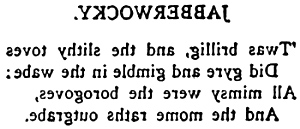
Then a bright thought occurred to her, and holding the book up before a
looking-glass, this is what she read in quite clear English, no matter how
it looks, for there is certainly no intelligent child who could fail to
understand it.
JABBERWOCKY.
’Twas brillig, and the slithy toves
Did gyre and gimble in the wabe:
All mimsy were the borogoves,
And the mome raths outgrabe.
“Beware the Jabberwock, my son!
The jaws that bite, the claws that catch!
Beware the Jubjub bird, and shun
The frumious Bandersnatch!”
He took his vorpal sword in hand:
Long time the manxome foe he sought—
So rested he by the Tumtum tree,
And stood awhile in thought.
And, as in uffish thought he stood,
The Jabberwock, with eyes of flame,
Came whiffling through the tulgey wood,
And burbled as it came!
One, two! One, two! And through and through
The vorpal blade went snicker-snack!
He left it dead, and with its head
He went galumphing back.
“And hast thou slain the Jabberwock?
Come to my arms, my beamish boy!
O frabjous day! Callooh! Callay!”
He chortled in his joy.
’Twas brillig, and the slithy toves
Did gyre and gimble in the wabe:
All mimsy were the borogoves,
And the mome raths outgrabe.
Alice of course puzzled over this for a long time.
“‘It seems very pretty,’ she said when she had finished it, ‘but it’s
rather hard to understand!’ (You see she didn’t like to confess, even to
herself, that she couldn’t make it out at all.) ‘Somehow it seems to fill
my head with ideas, only I don’t exactly know what they are! However,
somebody killed something—that’s clear at any rate.’”
For pure cleverness the poem has no equal, we will not say in the English
language, but in any language whatsoever, for it seems to be a medley of
all languages. Lewis Carroll composed it on the spur of the moment during
an evening spent with his cousins, the Misses Wilcox, and with his
natural gift of word-making the result is most surprising. The only verse
that really needs explanation is the first, which is also the last of the
poem. Out of the twenty-three words the verse contains, there are but
twelve which are pure, honest English.
In Mr. Collingwood’s article in the Strand Magazine we have Lewis
Carroll’s explanation of the remaining eleven, written down in learned
fashion, brimful of his own quaint humor. For a real guide it cannot be
excelled, and, though we laugh at the absurdities, we learn the lesson.
Here it is:
Brillig (derived from the verb to bryl or broil), “the time of
broiling dinner—i. e., the close of the afternoon.”
Slithy (compounded of slimy and lithe), “smooth and active.”
Tove (a species of badger). “They had smooth, white hair, long hind
legs, and short horns like a stag; lived chiefly on cheese.”
Gyre (derived from Gayour or Giaour, a dog), “to scratch like a
dog.”
Gymble (whence Gimblet), “to screw out holes in anything.”
Wabe (derived from the verb to swab or soak), “the side of a hill”
(from its being soaked by the rain).
Mimsy (whence mimserable and miserable), “unhappy.”
Borogove, “an extinct kind of parrot. They had no wings, beaks
turned up, and made their nests under sun-dials; lived on veal.”
Mome (hence solemome, solemne, and solemn), “grave.”
Raths. “A species of land turtle, head erect, mouth like a shark;
the forelegs curved out so that the animal walked on his knees;
smooth green body; lived on swallows and oysters.”
Outgrabe (past tense of the verb to outgribe; it is connected with
the old verb to grike or shrike, from which are derived “shriek” and
“creak”), “squeaked.”
“Hence the literal English of the passage is—‘It was evening, and the
smooth active badgers were scratching and boring holes in the hillside;
all unhappy were the parrots, and the green turtles squeaked out.’ There
were probably sun-dials on the top of the hill, and the borogoves were
afraid that their nests would be undermined. The hill was probably full of
the nests of ‘raths’ which ran out squeaking with fear on hearing the
‘toves’ scratching outside. This is an obscure yet deeply affecting relic
of ancient poetry.”
(Croft—1855. Ed.)
This lucid explanation was evidently one of the editor’s contributions to
Misch-Masch during his college days, so this classic poem must have
“simmered” for many years before Lewis Carroll put it “Through the
Looking-Glass.” But when Alice questioned the all-wise Humpty-Dumpty
on the subject he gave some simpler definitions. When asked the meaning of
“mome raths,” he replied:
“Well, rath is a sort of green pig; but mome I’m not certain about. I
think it’s short for ‘from home,’ meaning they’d lost their way, you
know.”
Lewis Carroll called such words “portmanteaus” because there were two
meanings wrapped up in one word, and all through “Jabberwocky” these queer
“portmanteau” words give us the key to the real meaning of the poem. In
the preface to a collection of his poems, he gives us the rule for the
building of these “portmanteau” words. He says: “Take the two words
‘fuming’ and ‘furious.’ Make up your mind that you will say both words,
but leave it unsettled which you will say first. Now open your mouth and
speak. If your thoughts incline ever so little toward ‘fuming’ you will
say ‘fuming-furious’; if they turn by even a hair’s breadth toward
‘furious’ you will say ‘furious-fuming’; but if you have that rarest of
gifts, a perfectly balanced mind, you will say ‘frumious.’”
It is hard to tell what he had in mind when he wrote of this deed of
daring—for such it was. Possibly, St. George and the Dragon inspired him,
and like the best of preachers he turned his sermon into wholesome
nonsense. The Jabberwock itself was a most awe-inspiring creature, and
Tenniel’s drawing is most deliciously blood-curdling; half-snake,
half-dragon, with “jaws that bite and claws that scratch,” it is yet saved
from being utterly terrible by having some nice homely looking buttons on
his waistcoat and upon his three-clawed feet, something very near akin to
shoes.
The anxious father bids his brave son good-bye, little dreaming that he
will see him again.
“Beware the Jubjub bird—and shun
The frumious Bandersnatch”
are his last warning words, mostly “portmanteau” words, if one takes the
time to puzzle them out. Then the brave boy goes forth into the “tulgey
wood” and stands in “uffish thought” until with a “whiffling” sound the
“burbling” Jabberwock is upon him.
Oh, the excitement of that moment when the “vorpal” sword went
“snicker-snack” through the writhing neck of the monster! Then one can
properly imagine the youth galloping in triumph (hence the “portmanteau”
word “galumphing,” the first syllable of gallop and the last syllable of
triumph) back to the proud papa, who says: “Come to my arms, my ‘beamish
boy’ ... and ‘chortles in his joy,’” But all the time these wonderful
things are happening, just around the corner, as it were, the “toves” and
the “borogoves” and the “mome raths” were pursuing their never-ending
warfare on the hillside, saying, with Tennyson’s Brook:
“Men may come and men may go—
But we go on forever,”
no matter how many “Jabberwocks” are slain nor how many “beamish boys”
take their “vorpal swords in hand.”
In preparing the second “Alice” book for publication, Lewis Carroll’s
first idea was to use the “Jabberwocky” illustration as a frontispiece,
but, in spite of the reassuring buttons and shoes, he was afraid younger
children might be “scared off” from the real enjoyment of the book. So he
wrote to about thirty mothers of small children asking their advice on the
matter; they evidently voted against it, for, as we all know, the White
Knight on his horse with its many trappings, with Alice walking beside
him through the woods, was the final selection, and the smallest child has
grown to love the silly old fellow who tumbled off his steed every two
minutes, and did many other dear, ridiculous things that only children
could appreciate.
Looking-glass walking puzzled Alice at first quite as much as
looking-glass writing or reading. If she tried to walk downstairs in the
looking-glass house “she just kept the tips of her fingers on the hand
rail and floated gently down, without even touching the stairs with her
feet.” Then when she tried to climb to the top of the hill to get a peep
into the garden, she found that she was always going backwards and in at
the front door again. Finally, after many attempts, she reached the
wished-for spot, and found herself among a talkative cluster of flowers,
who all began to criticise her in the most impertinent way.
“Oh, Tiger-lily!” said Alice, addressing herself to one that was waving
gracefully about in the wind, “I wish you could talk!”
“We can talk,” said the Tiger-lily, “when there’s anybody worth talking
to” ... At length, as the Tiger-lily went on waving about, she spoke again
in a timid voice, almost in a whisper:
“And can all the flowers talk?”
“As well as you can,” said the Tiger-lily, “and a great deal louder.”
“It isn’t manners for us to begin, you know,” said the Rose, “and I really
was wondering when you’d speak! Said I to myself, ‘Her face has got some
sense in it though it’s not a clever one!’ Still you’ve the right color
and that goes a long way.”
“I don’t care about the color,” the Tiger-lily remarked. “If only her
petals curled up a little more, she’d be all right.”
Alice didn’t like being criticised, so she began asking questions:
“Aren’t you sometimes frightened at being planted out here with nobody to
take care of you?”
“There’s the tree in the middle,” said the Rose. “What else is it good
for?”
“But what could it do if any danger came?” Alice asked.
“It could bark,” said the Rose.
“It says ‘bough-wough’,” cried a Daisy. “That’s why its branches are
called boughs.”
“Didn’t you know that?” cried another Daisy. And here they all began
shouting together.
Lewis Carroll loved this play upon words, and children, strange to say,
loved it too, and were quick to see the point of his puns. The Red
Queen, whom Alice met shortly after this, was a most dictatorial
person.
“Where do you come from?” she asked, “and where are you going? Look up,
speak nicely, and don’t twiddle your fingers all the time.”
Alice attended to all these directions, and explained as well as she could
that she had lost her way.
“I don’t know what you mean by your way,” said the Queen. “All the ways
about here belong to me, but why did you come out here at all?” she
added in a kinder tone. “Curtsey while you’re thinking what to say. It
saves time.”
Alice wondered a little at this, but she was too much in awe of the Queen
to disbelieve it.
“I’ll try it when I go home,” she thought to herself, “the next time I’m a
little late for dinner.”
Evidently some little girls were often late for dinner.
“It’s time for you to answer now,” the Queen said, looking at her watch;
“open your mouth a little wider when you speak and always say ‘Your
Majesty.’”
“I only wanted to see what your garden was like, your Majesty.”
“That’s right,” said the Queen, patting her on the head, which Alice
didn’t like at all, “though when you say ‘garden,’ I’ve seen gardens
compared with which this would be a wilderness.”
Alice didn’t dare to argue the point, but went on: “And I thought I’d try
and find my way to the top of that hill—”
“When you say ‘hill,’” the Queen interrupted, “I could show you hills in
comparison with which you’d call this a valley.”
“No, I shouldn’t,” said Alice, surprised into contradicting her at last.
“A hill can’t be a valley you know. That would be nonsense—”
The Red Queen shook her head.
“You may call it ‘nonsense’ if you like,” she said, “but I’ve heard
nonsense compared with which that would be as sensible as a dictionary!”
Which last remark seemed to settle the matter, for Alice had nothing
further to say on the subject.
Nonsense, indeed; and what delightful nonsense it is! Is it any wonder
that the little girls for whom Lewis Carroll labored so lovingly should
reward him with their laughter?
Alice entered Checker-Board Land in the Red Queen’s company; she was
apprenticed as a pawn, with the promise that when she entered the eighth
square she would become a queen [she probably was confusing chess with
checkers], and the Red Queen explained how she would travel.
“A pawn goes two squares in its first move, you know, so you’ll go very
quickly through the third square, by railway, I should think, and you’ll
find yourself in the fourth square in no time. Well, that square belongs
to Tweedledum and Tweedledee, and the fifth is mostly water, the sixth
belongs to Humpty Dumpty, ... the seventh square is all forest. However,
one of the knights will show you the way, and in the eighth square we
shall be queens together, and its all feasting and fun.”
The rest of her adventures occurred on those eight squares—sometimes in
company with the Red Queen or the White Queen or both. Things went
more rapidly than in Wonderland, the people were brisker and smarter. When
the Red Queen left her on the border of Checker-Board Land, she gave her
this parting advice:
“Speak in French when you can’t think of the English for a thing, turn out
your toes as you walk, and remember who you are!”
How many little girls have had the same advice from their governesses or
their mamma—“Turn out your toes when you walk, and remember who you are!”
This is what made Lewis Carroll so irresistibly funny—the way he had of
bringing in the most common everyday expressions in the most uncommon,
unexpected places. Only in Alice’s case it took her quite a long time to
remember who she was, just because the Red Queen told her not to forget.
Children are very queer about that—little girls in particular—at least
those that Lewis Carroll knew, and he certainly was acquainted with a
great many who did remarkably queer things.
Alice’s meeting with the two fat little men named Tweedledum and
Tweedledee recalled to her memory the old rhyme:
Tweedledum and Tweedledee
Agreed to have a battle;
For Tweedledum said Tweedledee
Had spoiled his nice new rattle.
Just then flew down a monstrous crow,
As black as a tar barrel;
Which frightened both the heroes so,
They quite forgot their quarrel.
Fierce little men they were, one with Dum embroidered on his collar, the
other showing Dee on his. They were not accustomed to good society nor
fine grammar. They were exactly alike as they stood motionless before her,
their arms about each other.
“I know what you’re thinking about,” said Tweedledum, “but it isn’t
so—nohow.” [Behold the beautiful grammar.]
“Contrariwise,” continued Tweedledee, “if it was so, it might be; and if
it were so, it would be; but as it isn’t, it ain’t. That’s logic.”
Now, Alice particularly wanted to know which road to take out of the
woods, but somehow or other her polite question was never answered by
either of the funny little brothers. They were very sociable and seemed
most anxious to keep her with them, so for her entertainment Tweedledum
repeated that beautiful and pathetic poem called:
THE WALRUS AND THE CARPENTER.
The sun was shining on the sea,
Shining with all his might;
He did his very best to make
The billows smooth and bright—
And this was odd, because it was
The middle of the night.
The moon was shining sulkily,
Because she thought the sun
Had got no business to be there
After the day was done—
“It’s very rude of him,” she said,
“To come and spoil the fun!”
The sea was wet as wet could be,
The sands were dry as dry,
You could not see a cloud, because
No cloud was in the sky;
No birds were flying overhead—
There were no birds to fly.
The Walrus and the Carpenter
Were walking close at hand;
They wept like anything to see
Such quantities of sand;
“If this were only cleared away,”
They said, “it would be grand!”
“If seven maids with seven mops
Swept it for half a year,
Do you suppose,” the Walrus said,
“That they would get it clear?”
“I doubt it,” said the Carpenter,
And shed a bitter tear.
Then comes the sad and sober part of the tale, when the Oysters were
tempted to stroll along the beach, in company with these wily two, who
lured them far away from their snug ocean beds.
The Walrus and the Carpenter
Walked on a mile or so,
And then they rested on a rock
Conveniently low;
And all the little Oysters stood
And waited in a row.
“The time has come,” the Walrus said,
“To talk of many things;
Of shoes, and ships, and sealing-wax—
Of cabbages and kings;
And why the sea is boiling hot,
And whether pigs have wings.”
“But wait a bit,” the Oysters cried,
“Before we have our chat;
For some of us are out of breath,
And all of us are fat!”
“No hurry!” said the Carpenter.
They thanked him much for that.
“A loaf of bread,” the Walrus said,
“Is what we chiefly need;
Pepper and vinegar besides
Are very good, indeed;
Now, if you’re ready, Oysters, dear,
We can begin to feed.”
Then the Oysters became terrified, as they saw all these grewsome
preparations, and their fate loomed up before them. So the two old
weeping hypocrites sat on the rocks and calmly devoured their late
companions.
“It seems a shame,” the Walrus said,
“To play them such a trick,
After we’ve brought them out so far,
And made them trot so quick!”
The Carpenter said nothing but,
“The butter’s spread too thick!”
“I weep for you,” the Walrus said,
“I deeply sympathize.”
With sobs and tears he sorted out
Those of the largest size,
Holding his pocket-handkerchief
Before his streaming eyes.
“O Oysters,” said the Carpenter,
“You’ve had a pleasant run!
Shall we be trotting home again?”
But answer came there none.
And this was scarcely odd, because
They’d eaten every one.
The poor dear little Oysters! How any little girl, with a heart under
her pinafore, could read these lines unmoved it is hard to say. Think of
those innocent young dears, standing before these dreadful ogres.
All eager for the treat;
Their coats were brushed, their faces washed,
Their shoes were clean and neat;
And this was odd, because, you know,
They hadn’t any feet.
All the same, Tenniel has made most attractive pictures of them, feet and
all. And think—oh, horror! of their supplying the treat! It was indeed
an awful tragedy. Yet behind it all there lurks some fun, though Lewis
Carroll was too clever to let us quite into his secret. All the young
ones want is the story, but those who are old enough to love their Dickens
and to look for his special characters outside of his books will certainly
recognize in the Walrus the hypocritical Mr. Pecksniff, whose tears
flowed on every occasion when he was not otherwise employed in robbing his
victims, and other little pleasantries. And as for the Carpenter, there
is something very scholarly in the set of his cap and the combing of his
scant locks; possibly a caricature of some shining light of Oxford, for we
know there were many in his books. Indeed, the whole poem may be something
of an allegory, representing examination; the Oysters, the undergraduate
victims before the college faculty (the Walrus and the Carpenter) who
are just ready to “eat ’em alive”—poor innocent undergraduates!
But whatever the hidden meaning, Tweedledum and Tweedledee were not
the sort of people to look deep into things, and Alice, being a little
girl and very partial to oysters, thought the Walrus and the Carpenter
were very unpleasant characters and had no sympathy with them at all.
Dreaming by a ruddy blaze in a big armchair keeps one much busier than if
one fell asleep in a rocking boat or on the river bank on a golden summer
day.
The scenes and all the company changed so often in Looking-Glass Land that
Alice had all she could do to keep pace with her adventures. For you see
all this time she was only a pawn, moving over an immense chess-board from
square to square, until in the end she should be made queen. The White
Queen whom Alice met shortly was a very lopsided person, quite unlike
the Red Queen, who was neat enough no matter how sharp her tongue.
Alice had to fix her hair, and straighten her shawl, and set her right
and tidy.
“Really, you should have a lady’s maid,” she remarked.
“I’m sure I’ll take you with pleasure,” the Queen said. “Twopence a
week, and jam every other day.”
Alice couldn’t help laughing as she said:
“I don’t want you to hire me, and I don’t care for jam.”
“It’s very good jam,” said the Queen.
“Well, I don’t want any to-day at any rate.”
“You couldn’t have it if you did want it,” the Queen said. “The rule
is—jam to-morrow and jam yesterday, but never jam to-day.”
“It must come sometimes to ‘jam to-day,’” Alice objected.
“No, it can’t,” said the Queen. “It’s jam every other day; to-day isn’t
any other day, you know.”
“I don’t understand you,”
said Alice. “It’s dreadfully confusing!”
“That’s the effect of living backwards,” the Queen said, kindly. “It
always makes one a little giddy at first—”
“Living backwards!” Alice remarked in great astonishment. “I never heard
of such a thing!”
“But there’s one great advantage in it, that one’s memory works both
ways.”
“I’m sure mine only works one way,” Alice remarked. “I can’t remember
things before they happen.”
“It’s a poor memory that only works backwards,” the Queen remarked.
“What sort of things do you remember best?” Alice ventured to ask.
“Oh, the things that happened the week after next,” the Queen replied in a
careless tone. “For instance, now,” she went on, sticking a large piece of
plaster on her finger as she spoke, “there’s the king’s messenger. He’s in
prison now, being punished, and the trial doesn’t begin till next
Wednesday; and of course the crime comes last of all.” Then the Queen
for further illustration began to scream—
“Oh, oh, oh!” shouted the Queen.... “My finger’s bleeding! Oh, oh, oh,
oh!”
Her screams were so exactly like the whistle of a steam engine that Alice
had to hold both her hands over her ears.
“What is the matter?” she said.... “Have you pricked your finger?”
“I haven’t pricked it yet,” the Queen said, “but I soon shall—oh, oh,
oh!”
“When do you expect to do it?” Alice asked, feeling very much inclined to
laugh.
“When I fasten my shawl again,” the poor Queen groaned out, “the brooch
will come undone directly. Oh, oh!” As she said the words the brooch flew
open, and the Queen clutched wildly at it and tried to clasp it again.
“Take care!” cried Alice, “you’re holding it all crooked!” and she caught
at the brooch; but it was too late; the pin had slipped, and the Queen had
pricked her finger.
“That accounts for the bleeding, you see,” she said to Alice, with a
smile. “Now you understand the way things happen here.”
Alice’s meeting with Humpty-Dumpty in the sixth square has gone down
in history. It has been played in nurseries and in private theatricals,
and many ingenious Humpty-Dumptys have been fashioned by clever people.
Possibly the dear old rhyme which generations of childhood have handed
about as a riddle is responsible for our great interest in
Humpty-Dumpty.
Humpty-Dumpty sat on the wall,
Humpty-Dumpty had a great fall,
All the King’s horses and all the King’s men,
Couldn’t put Humpty-Dumpty in his place again.
This is an old version, but modern children have made a better ending,
thus:
Couldn’t put Humpty-Dumpty up again.
Then there’s a mysterious pause, and some eager small boy or girl asks,
“Now what is it?” and before one has time to answer, someone calls out—
“It’s an egg; it’s an egg!” and the riddle is a riddle no longer.
One clever mechanical Humpty was made of barrel hoops covered with stiff
paper and muslin. The eyes, nose, and mouth were connected with various
tapes, which the inventor had in charge behind the scenes, and so well did
he work them that Humpty in his hands turned out a fine imitation of the
Humpty-Dumpty Sir John Tenniel has made us remember; the same
Humpty-Dumpty who asked Alice her name and her business, and who
informed her proudly that if he did tumble off the wall, “The King has
promised me with his very own mouth—to—to—”
“To send all his horses and all his men—” Alice interrupted rather
unwisely.
“Now I declare that’s too bad!” Humpty-Dumpty cried, breaking into a
sudden passion. “You’ve been listening at doors, and behind trees, and
down chimneys, or you wouldn’t have known it.”
“I haven’t, indeed!” Alice said, very gently. “It’s in a book.”
“Ah, well! They may write such things in a book,” Humpty-Dumpty said in
a calmer tone. “That’s what you call a History of England, that is. Now
take a good look at me. I’m one that has spoken to a King, I am; mayhap
you’ll never see such another; and to show you I’m not proud you may shake
hands with me....”
“Yes, all his horses and all his men,” Humpty-Dumpty went on. “They’d
pick me up in a minute, they would. However, this conversation is going
on a little too fast; let’s go back to the last remark but one.”
Such a nice, common old chap is Humpty-Dumpty, so “stuck-up” because he
has spoken to a King; and argue! Well, Alice never heard anything like
it before, and found difficulty in keeping up a conversation that was
disputed every step of the way. She found him worse than the Cheshire
Cat or even the Duchess for that matter, and not half so well-bred.
He too favored Alice with the following poem, which he assured her was
written entirely for her amusement, and here it is, with enough of Lewis
Carroll’s “nonsense” in it to let us know where it came from:
In winter, when the fields are white,
I sing this song for your delight:—
In spring, when woods are getting green,
I’ll try and tell you what I mean:
In summer, when the days are long,
Perhaps you’ll understand the song:
In autumn, when the leaves are brown,
Take pen and ink, and write it down.
I sent a message to the fish:
I told them: “This is what I wish.”
The little fishes of the sea,
They sent an answer back to me.
The little fishes’ answer was:
“We cannot do it, Sir, because——”
I sent to them again to say:
“It will be better to obey.”
The fishes answered, with a grin:
“Why, what a temper you are in!”
I told them once, I told them twice:
They would not listen to advice.
I took a kettle large and new,
Fit for the deed I had to do.
My heart went hop, my heart went thump:
I filled the kettle at the pump.
Then someone came to me and said:
“The little fishes are in bed.”
I said to him, I said it plain:
“Then you must wake them up again.”
I said it very loud and clear:
I went and shouted in his ear.
But he was very stiff and proud:
He said: “You needn’t shout so loud!”
And he was very proud and stiff:
He said: “I’d go and wake them, if——”
I took a corkscrew from the shelf;
I went to wake them up myself.
And when I found the door was locked,
I pulled and pushed and kicked and knocked.
And when I found the door was shut,
I tried to turn the handle, but——
With which highly satisfactory ending Humpty remarked:
“That’s all. Good-bye.”
Alice got up and held out her hand.
“Good-bye till we meet again,” she said, as cheerfully as she could.
“I shouldn’t know you if we did meet,” Humpty-Dumpty replied in a
discontented tone, giving her one of his fingers to shake. “You’re so
exactly like other people.”
The next square—the seventh—took Alice through the woods. Here she met
some old friends: the Mad Hatter and the White Rabbit of Wonderland
fame, mixed in with a great many new beings, including the Lion and the
Unicorn, who, as the old ballad tells us, “were fighting for the
crown”; and then as the Red Queen had promised from the beginning, the
White Knight—after a battle with the Red Knight who held Alice
prisoner—took her in charge to guide her through the woods. Whoever has
read the humorous and yet pathetic story of “Don Quixote” will see at once
where Lewis Carroll found his gentle, valiant old White Knight and his
horse, so like yet so unlike the famous steed Rosenante.
He, too, had a song for Alice, which he called “The Aged, Aged Man,” and
which he sang to her, set to very mechancholy music. It is doubtful if
Alice understood it for she wasn’t thinking of age, you see. She was
only seven years and six months old, and probably paid no attention. She
was thinking instead of the strange kindly smile of the knight, “the
setting sun gleaming through his hair and shining on his armor in a blaze
of light that quite dazzled her; the horse quietly moving about with the
reins hanging loose on his neck, cropping the grass at her feet, and the
black shadows of the forest behind.” Certainly Lewis Carroll could paint a
picture to remain with us always. The poem is rather too long to quote
here, but the experiences of this “Aged, Aged Man” are well worth reading.
Alice was now hastening toward the end of her journey and events were
tumbling over each other. She had reached the eighth square, where, oh,
joy! a golden crown awaited her, also the Red Queen and the White
Queen in whose company she traveled through the very stirring episodes of
that very famous dinner party, when the candles on the table all grew up
to the ceiling, and the glass bottles each took a pair of plates for
wings, and forks for legs, and went fluttering in all directions.
Everything was in the greatest confusion, and when the White Queen
disappeared in the soup tureen, and the soup ladle began walking up the
table toward Alice’s chair, she could stand it no longer. She jumped up
“and seized the tablecloth with both hands; one good pull, and plates,
dishes, guests, and candles came crashing down together in a heap on the
floor.” And then Alice began to shake the Red Queen as the cause of
all the mischief.
“The Red Queen made no resistance whatever; only her face grew very small,
and her eyes got large and green; and still, as Alice went on shaking her,
she kept on growing shorter, and fatter, and softer, and rounder, and—and
it really was a kitten after all.”
And Alice, opening her eyes in the red glow of the fire, lay snug in the
armchair, while the Looking-Glass on the mantel caught the reflection of a
very puzzled little face. The “dream-child” had come back to everyday, and
was trying to retrace her journey as she lay there blinking at the
firelight, and wondering if, back of the blaze, the Chessmen were still
walking to and fro.
And Lewis Carroll, as he penned the last words of “Alice’s Adventures
through the Looking-Glass,” remembered once more the little girl who had
been his inspiration, and wrote a loving tribute to her at the very end of
the book, an acrostic on her name—Alice Pleasance Liddell.
A boat, beneath a sunny sky
Lingering onward dreamily
In an evening of July.
Children three that nestle near,
Eager eye and willing ear,
Pleased a simple tale to hear.
Long has paled that sunny sky;
Echoes fade and memories die:
Autumn frosts have slain July.
Still she haunts me, phantomwise,
Alice moving under skies,
Never seen by waking eyes.
Children yet, the tale to hear,
Eager eye and willing ear,
Lovingly shall nestle near.
In a Wonderland they lie,
Dreaming as the days go by,
Dreaming as the summers die:
Ever drifting down the stream,
Lingering in the golden gleam,
Life, what is it but a dream?


 would arrive, containing an invitation, of which the following
is a specimen.” [Though written when Beatrice was no longer a little
girl.]
would arrive, containing an invitation, of which the following
is a specimen.” [Though written when Beatrice was no longer a little
girl.]