Letters to the young from the old world: notes of travel
Whole book · 15 sections
LETTERS TO THE YOUNG FROM THE OLD WORLD:
NOTES OF TRAVEL
BY Mrs. D. L. Miller.
Mount Morris, Ill.:
THE BRETHREN’S PUBLISHING COMPANY,
1894.
Entered according to Act of Congress, in the year 1894,
BY MRS. D. L. MILLER,
In the Office of the Librarian of Congress, at Washington.
To
MY HUSBAND,
Whose Helpful Words have Encouraged me in my Work,
and to the
YOUNG PEOPLE AND CHILDREN,
Who Urged me Strongly
to Write,
THIS BOOK IS DEDICATED.
INTRODUCTION.
Two years ago the author of this charming little volume
happened in my office. I requested her to be
seated, as I wanted to talk to her. I then told her
that she had traveled much in this world, having visited
Sweden, Denmark, Norway, Germany and the Bible Lands;
that she had seen and heard much that would be interesting
for others to read about, and I wanted her to write a series
of articles for the Young Disciple, giving in the simplest
way possible the information gathered during her travels.
“No, indeed,” she quickly and positively replied. “I
cannot do that.” I told her I felt confident that she could
prepare a number of articles, or letters, that would prove
exceedingly interesting and profitable reading, and that the
people were anxious to read what a woman had to say
about the Bible Lands, the people and their customs. Repeating
what she had said, she added that during all her
travels she had not made one note, that she would have to
depend entirely upon memory, and felt sure that she could
not do justice to the undertaking. I urged her to give it a
trial.
After a few weeks she handed me two letters. I examined
them, and told her they were just what was desired,
and that we would take as many more as she felt disposed
to write. More than fifteen thousand readers of the Young
Disciple know the result. For months they were delighted
with these letters, and even before they were completed in
the paper the author received many communications urging
her to bring them out in book form. Many mothers wrote
her and urged that the book should be published, that it
was greatly needed, and would be the means of accomplishing
much good among the children and young people.
Even the children write sister Miller and insist upon her
publishing her letters in a book. These requests became so
urgent that the author finally decided to carefully revise
the letters, write more fully on some points, and give the
result of her labors in this neat little volume. We bespeak
for it an extensive circulation, a careful reading and a wide
field of usefulness.
J. H. Moore.
Mt. Morris, Ill., Sept. 25, 1894.
TABLE OF CONTENTS.
CHAPTER I.
Across the Atlantic.—The Aller.—Small Sleeping Rooms.—A Singular
Kitchen.—Last Farewell.—Seasickness.—Children on the
Ship.—Four Little Boys.—Fog Horn.—The Lookout.—Icebergs.—A
Little Sailor Boy.—Porpoises and Sea Gulls.—Taking on
the Pilot.—Lights on the Other Shore.—Landing.
Land.—Bremen.—On the Way to Denmark.—Copenhagen.—Religion
of Denmark.—Singing.—A Farmhouse.—Malmo.—Market
Place in Sweden.—Limhamn.—Fishermen and Boats.—Beautiful
Lakes of Sweden.—Children in Sweden and their Bows.—Pine
Branches.—Mother and Babe.—A Meal along the Way.
Norway.—Kong Halfdan.—Fjords.—Hay Transfer.—Government
Vessel.—Two Young Girls.—A Glacier.—The Captain’s Kindness.—The
Beautiful Picture.—Tromsö.—A Floating Buoy.—Eider
Ducks.—Lapp Family.—Reindeer.—Torghatten.—Fish.—The
Trap for Salmon.—Hammerfest.—The White Polar Bear.—The
Drunken Sailor.—Arctic Ocean.—Whaling Station.—The
Little White Church.—Striking a Reef of Rocks.
The Story of a German Boy.—The Priest.—Catholic Woman.—Corps
of Singers.—My Singing Lesson.—Funeral Procession.—Children
Playing.—Wooden Shoes.—Neatness of the German Children.—Their
Politeness.—Cologne.—Its Cathedral.—Height of
Towers.—Odd Costumes.—Art Gallery.—The Picture I Saw.
Jaffa.—The Careless Camel.—Bible Characters who lived in Jaffa.—Jonah’s
Temptation.—On the Way to the Holy City.—An
Arab and his Plow.—Ramleh.—Lydda in the Distance.—Leprous
People Begging.—Leprous People of Bible Times.—Camp-fire
in the Cave.—Jerusalem.—Our Room.—Solomon’s Disobedience.—Tower
of David.—The Stubborn Donkey.—Mohammedan
Cemetery.—Mount of Olives.
Bethany.—Bethlehem.—Rachel’s Tomb.—The Shepherd Boy.—Ruth
and Naomi.—Garden of Gethsemane.—Departure from
Jerusalem.—Yosef.—Jericho Road.—Ain-es-Sultan.—Morning
Call.—Donkey Boy.—Dead Sea.—Along the Banks of the Jordan.—John
the Baptist.—Bad Roads.
Strange Kind of Fuel.—The Village Oven.—Women’s Work.—Fresh
Bread.—The Little Baby.—Landmarks.—Bethel.—My
Faithful Friend.—A Trying Time in the Saddle.—Sinjal.
Riding into Nazareth.—Virgin’s Fountain.—Tricky Horses.—Cana
of Galilee.—Tiberias.—Story of Jesus and his Disciples.—Boat
Ride on the Sea of Galilee.—Capernaum.—Mounting Horses.—Disappearance
of the Dragoman.—A Serious Accident.—Lake
Huleh.—Cesarea Philippi.—Mount Hermon.—Crossing the River
Pharpar.—Damascus.—Via Recta.—Bible References to
Courts.—Cup of Coffee.—Water Seller.
Farewell to Damascus.—Ain Fijeh.—Quarrelsome Arabs.—Onward
to Baalbek.—A Friendly Arab Family.—On the Mountains of
Lebanon.—Baalbek.—Rejected Stone.—From Baalbek to Beyrut.—My
Horse John.—Homeward Bound.
Across the Atlantic.—The Aller.—Small Sleeping Rooms.—A Singular
Kitchen.—Last Farewell.—Seasickness.—Children on the Ship.—Four
Little Boys.—Fog Horn.—The Lookout.—Icebergs.—A Little
Sailor Boy.—Porpoises and Sea Gulls.—Taking on the Pilot.—Lights
on the Other Shore.—Landing.
As a usual thing, boys and girls—and even older people—delight
to hear about the ocean and the vessels
which float upon it, and now I shall tell you
what I know about the ocean and a voyage across it.
August is said to be one of the best summer months
for ocean travel, because there are not so many hard
storms during that month. There is very little use in paying
attention to that saying, for the sea is just as liable to
be rough and stormy one month as another. You know
storms come up on land when we least expect them, and
continue longer than we think they will? Well, just so it is
on the ocean; so there is a possibility of having bad weather,
go any month you will.
For a starting point you may choose one of four harbors,—Boston,
Baltimore, Philadelphia or New York. The
largest steamers, however, sail from New York, and it was
from there that we took our departure the first day of August,
1891, at one o’clock P.M. The day was beautiful,
just as clear as any August day you ever saw; so the hearts
of the passengers were glad, for sunshine and mild weather
were indications of a pleasant voyage, we thought. Pleasant
weather on land, however, did not mean pleasant
weather out at sea, as we found out later on.
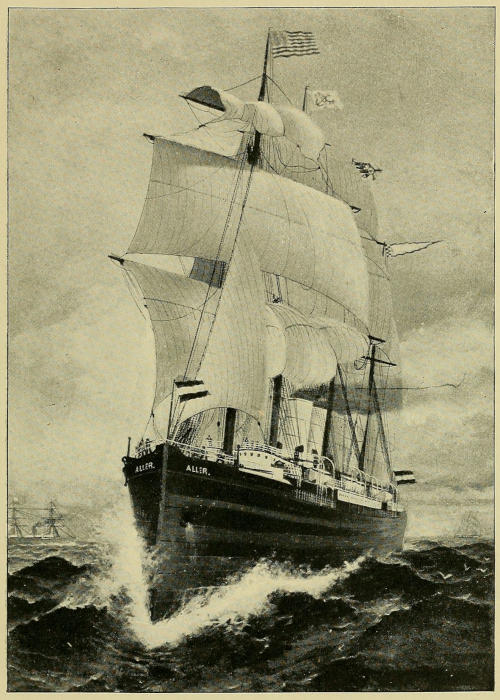
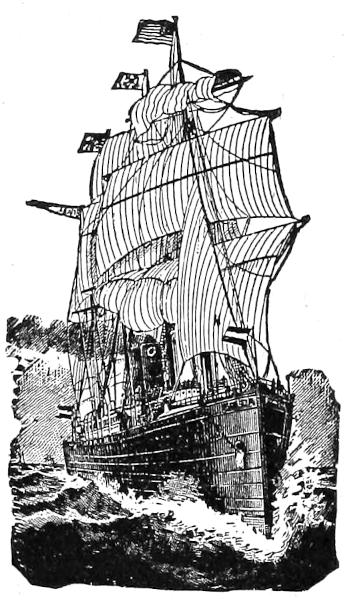
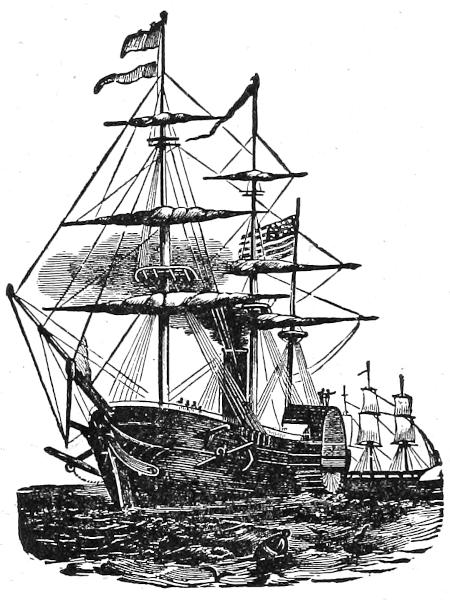
The name of our steamer was the Aller. It is not one
of the very largest ships, but it did seem immense to us.
We were quite anxious to have a good look at our new
home, so we went aboard long before sailing time, and before
the rest of the passengers gathered together. In wandering
around we saw narrow passageways and many very
small rooms. In our houses at home we should have called
them good sized closets, but in a steamship they were
sleeping rooms, and plenty large enough—if only two persons
occupied them. But it is a surprise to know that
sometimes three and four persons must room together when
there is a crowd. I am glad to say there was plenty of
room on the Aller, and we were the only occupants of our
stateroom.
The Aller.
In each of the rooms there was a sofa covered with
plush, a wash-stand and basin, and two beds. The beds
were built against one side of the little room, one above the
other, and the person who occupied the upper berth found
it necessary to climb up a stepladder every time he retired.
Every piece of furniture was fastened securely; there
seemed to be no danger of their moving from place to place
when the sea grew wild and the vessel tumbled about.
Each room had a window in it almost as large as a dinner
plate, and just as round. The glass was set in a heavy
brass frame, and a large screw was used to fasten the window.
Not a drop of water could enter, no matter how high
the waves rolled or how hard the water dashed against
them. These windows are called portholes, and the little
rooms are always known as staterooms. When a berth was
spoken of we all knew it meant the bed. You see by this
that the most familiar things had a different name on board
a ship.
The floors of halls and staterooms were nicely carpeted,
and we wondered how they could be kept looking so well.
There was a beautifully furnished sitting room with carpet
of velvet; heavy damask curtains, sofas of fine plush, and
fine oil paintings decorated the sides and ceiling, painted
there by a master hand. The comfort of the passengers
seemed to have been studied well, for we saw there a beautiful
piano and a library of books, all of which could be
used by passengers when they felt so disposed.
The dining room and kitchen we found in the center of
the ship, and the kitchen in particular interested us very
much, for we had often wondered how the cooking utensils
were kept in place when the sea became very rough. The
mystery was easily solved, for on looking around we saw
many racks which held the pots, pans and kettles firmly in
place. Not very far from the kitchen was the pantry.
There we saw plenty of glassware, and many dishes of different
sizes, all nicely arranged in racks and fitting so tight
that there seemed to be no chance for one of them to move
from right to left.
But the time for sailing was nearer than we had any
idea it was, and further investigation seemed out of the
question; but before parting from our friends we decided
that our floating home was neat and clean, and truly not an
unpleasant place to spend the next ten days in.
Passengers were arriving fast by this time, and trunk
after trunk was placed in the hold of the ship by diligent
ship hands. We watched the people as they came aboard
one by one. Some faces were looking happy, and others
again showed marks of sadness. I wondered why there
was such a difference, but concluded that the sad-faced
people realized what a three thousand mile journey by water
meant, and felt that they might nevermore behold the
faces of loved ones again. If such should have been their
thoughts, is it any wonder they looked sad?
All was hurry and confusion; the large bell rang, and
“All ashore” was called out. Hurriedly friends bade each
other good-bye, and those who were not to go with us
made haste to leave the ship. The gang plank was removed,
the ropes were untied, and slowly the ship Aller
moved from the wharf. People who stood there waved
handkerchiefs, and we watched them with our field glass
until they seemed like mere specks in the distance. We
were floating seaward, sure enough; and as the ship moved
farther and farther from shore we continued standing on
deck, wishing to see all we could of the land, for we knew
many days would pass by when nothing but sky and water
would be seen. In a very short time we were far from the
noise and confusion, and not a strip of land was in sight;
then, with tearful eyes, we left the deck and retired to our
stateroom below. Our mind turned toward the sea and its
dangers; visions of shipwrecks and collisions flitted back
and forth before us; but trying hard to be brave, we cast
such thoughts from our mind, consoling ourselves with the
thought that millions of people had crossed the Atlantic
safely, and perhaps we might be so blessed. Then, when
we looked around and beheld the steamer with its immense
engines and manned by such strong, hearty seamen, we
could not help but feel that all would go well with us. So,
after breathing a prayer for protection, we settled down to
make the best of things, knowing the Lord to be our protector
and feeling sure he would watch over and care for us.
The sea was not very rough and sailing was delightful.
The ship rolled a little, but the passengers concluded the
voyage would be a pleasant one. Ship acquaintances were
soon made, our sitting places at table decided upon, and
everything seemed to be in good running order, and we
were as well fixed as it was possible to be while in the floating
home.
After getting out to sea, one must get used to the rolling
motion of the ship, and for many it means to get sick.
Now, possibly, you have heard of people getting seasick.
Well, I know all about it myself, and can tell you that it is
a very disagreeable ailment. No one ever dies of seasickness,
physicians say; so it is more distressing than dangerous.
Many people, however, cross and recross the Atlantic
without having unpleasant feelings in that direction; but,
on the other hand, very many are unable to appear at meals
regularly. You are not out at sea long until one by one
passengers disappear. Some are missed but a day, while
others do not put in an appearance during the journey.
These last named never do get used to the uneasy, restless
sea, and must therefore remain in their berths during the
entire trip. Little boys and girls get very sick too, sometimes,
but as a rule they are not as apt to get seasick as
older people. While I know all about the malady, six days
was the longest period of my affliction, and that occurred
when in a hard storm a few years ago.
A sea voyage has a tendency to make one feel sad.
You realize how great the force of water is and what a mere
speck a human being is; each dash of the waves against the
ship’s sides brings you face to face with the fact that in a
twinkling—if the Lord willed—the ship and all on board
could be swept from the face of the water and their burial
place be the bottom of the ocean. Some passengers bury
their sad feelings in the wine cup and at the card table,
while others go to the Lord in prayer. Which of these two
ways do you consider to be the better one? The Lord
does not like a drunkard, and you know drunkards cannot
enter the kingdom of heaven. I hope you may all learn to
love the Lord in youth, and may you never be known to
drink strong beverages, or be found playing cards and gambling.
Remember that all those who play cards and drink
strong drink in youth usually continue it when they become
men and women; for bad habits formed in youth are hard
to overcome even in old age.
A great many children of all ages cross the Atlantic
yearly with their parents, and some of them are very, very
young, even tiny little babies with great long dresses.
These little ones, however, are never seen on deck, as a
short time on deck would doubtless chill them completely
and cause a spell of colic to follow shortly after.
The children who are old enough to run around have a
delightful time playing on deck, and the nurse who cares
for them has a hard time to keep them from getting hurt.
The ship gives such heavy lurches that many times grown
people find it a difficult matter to keep upon their feet.
Boys and girls as a rule enjoy a sea voyage immensely
if they keep well, and not any of the passengers seemed
more happy than they. When they were tumbled over by
a lurch of the ship, it seemed like great fun, and jumping
up they ran away laughing harder than ever.
There were four little boys belonging to two different
families on board the Aller, and those little fellows attracted
the attention of the passengers greatly. Two brothers
were good, and two were naughty. The last named knew
how to act ugly and be rude and boisterous; they quarreled
with each other, and even spoke unkindly to their mamma,
and, for that matter, to everybody else. It was plain that
those boys had been spoiled at home, and that being the
case nothing better need be expected of them when away
from home. The people on board that steamer pronounced
them both little nuisances, and wished they were at home;
for how could they think of spending ten days in company
with such children? But there was no help for it; so we all
endured the trial. Their papa was one of the men who
drank and gambled, and the mamma did not seem strong
enough to manage such tough little fellows alone. The
other two were quiet, innocent little boys, and when spoken
to were sure to reply in a gentlemanly manner. Those who
had charge of the two last named children were seen to pay
a great deal of attention to them; and will you be surprised
when I tell you that even the passengers took pleasure in
talking to those good little boys?
While writing this I wonder how many of you are like
these little ones I am writing about. Well, I hope you are
all like the good children, for I cannot bear to think of one
of you as being rude and unkind. Do you want to be loved
by those around you? Then be kind, loving, thoughtful
children. You must not speak cross to mamma and papa;
no, no; nor to grandpapa and grandma either. Don’t say,
“I won’t,” when asked to do a little favor, but rather run
quickly, saying, “I will do anything you ask of me.”
Did you ever think of how the Lord keeps a strict account
of all we do and say? Well, he does, and it is written
in a book, and then some day that book will be opened,
and all the ugly things we have said and done will be read
out. Just think how it will sound. Children, let us remember
that the better we behave ourselves, the fewer will
be the evil deeds recorded; and then let us remember, too,
that the Lord loves dutiful children.
Have you ever heard of “fog at sea”? Well, sometimes
it becomes very dense and you can scarcely see the
full length of the ship. Seamen dread fog more than
storms. It is then that the captain’s face lengthens and his
seat at table is vacant. There is great danger of collisions,
for ships get nearer each other then, because they cannot
see ahead. There is greater danger in going in and out of
port when fog is dense, and many times have we read of
steamers running into each other just as they were getting
near to the stopping place. Such an occurrence usually
means a great loss of life, for there is seldom time enough
to save the unfortunate ones. The speed of a vessel should
always be slackened when it is in a fog; but I am sorry to
say that many of the captains are careless, as much so as
engineers on our trains; they rush along anxious to make
quick time, and if possible to gain port before ships of another
line do. Many times they do gain port first, but it is
the port of death; and we are made to think that the loss of
life is a high price to pay for quick time.
We have been in fog a great many times. Once we
were enveloped in it five days and five nights. All steamers
sound the fog horn, and every few minutes during that
time the disagreeable sound was heard. They gave it as a
warning to other vessels, that they might keep away from
them, thereby avoiding collisions.
There are always men on the lookout for danger. In a
box way up in the rigging of the ship two men stand
watching day and night, no difference how bad the weather
is. Several men take their turn in watching, thus giving
each one an opportunity to rest. If at any time there
seems to be a suspicious object in their line of travel, the
man calls out in loud tones, “Danger ahead.” Sometimes
the object seen proves to be a wreck, and if a signal of danger
is seen, all haste is made to go to the rescue of those on
board, and many lives are saved in that way. The box in
which those men stand is called the “lookout box,” and
from it is called the hour of day. I remember so well of
hearing them call the midnight hour time and again. It
was called thus, “Twelve o’clock”; and then, “All is well.”
O what a satisfaction it always was to know that all was
well; then after that call I was sure to fall into a sweet
sleep, only to awaken at the dawn of another day.
Have you ever heard of an iceberg? Well, they are
great mountains of floating ice which come down from
Greenland, Spitzbergen, and other polar lands. Sometimes
they appear right in a ship’s course, and are not always
seen by the naked eye. They float along for miles and
miles under water, making it rather uncertain how close a
ship is getting to them. Many icebergs, however, tower
high above the water, and an account has been given of one
seen a few years ago which was two and one-half miles
long, two and one-fifth miles wide, and one hundred and
fifty-three feet high. It is said that many million tons of
ice were in that iceberg. When such an obstacle is seen
there is cause for alarm, and well may the men on the lookout
call, “Danger ahead!”
When the weather was favorable we sat on deck every
day; and while sitting there we noticed a sailor go to the
railing of the steamer with a canvas pail. We wondered
what he intended doing, and so watched. He first fastened
a long rope to the pail, then threw it overboard, and
after it had floated about in the water a while he drew it toward
him, lifting the pail over the railing brimful of water
and immediately after thrusting a thermometer into it. We
knew by that time that the sailor was testing the temperature
of the water. He examined very closely how many
degrees cold it was, then reported the result to the captain.
When the water is many degrees colder than common it is
quite possible that an iceberg is not far distant, so the
ship’s course is changed and possibly a wreck avoided.
There seems to be no end of reasons why a man should be
stationed to watch for danger day and night. If a lookout
man could tell us the number of times he was the means of
saving people from perishing by being the first to see the
signal of distress, no doubt we should be surprised. Ships
meet with accidents of different kinds. Sometimes we read
of them burning up, and before help can reach them all on
board are lost. How sad that seems. Think of the heartache
of friends at home when the time for their return is at
hand and they do not come.
The sailor’s life is a hard one, and yet it is said he is
not happy when off duty long at a time. Have you ever
heard him called the “jolly sailor boy”? I have wondered
why people speak of them as being jolly. To me they are
a sad-faced set of men, and out at sea I never saw one of
them smile; sometimes I wondered whether they knew how
to. Perhaps all their smiling is engaged in when on land,
where they get beer and strong drink.
Satan finds work for idle hands to do, and the captain
is aware of that fact, so he manages to keep all hands busy
when on a voyage, except during their hours of rest. You
see if everybody is busy working or studying there is no
time to plan naughty things, and Satan will soon find there
is no chance for him. You would be surprised to know
how many boys are learning to be sailors. Some of them
on the Aller seemed not over twelve years of age. Their
work is not of the hardest kind, still it is much harder than
many of you are used to doing. It matters not how cold or
rainy the weather, the little sailor boys, as well as the big
sailors, must be on hand when duty demands them. It was
no uncommon sight to see the little fellows out in stormy
weather, and their hands almost stiff with cold. There was
one boy who seemed to be on deck the greater part of the
time. He was always armed with a broom, and he used it
too; every little piece of paper, and every bit of dirt received
his immediate attention, and with a steady sweep of
the broom he sent them out to sea. These boys never
talked with the passengers, but were polite when spoken to.
No idling is allowed on shipboard, so the little fellows
were busy and always on the move. Perhaps they would
have enjoyed a good romp as well as any of you; but that
was out of the question.
Sitting on deck is one of the pastimes of an ocean voyage.
If a passenger seemed at all inclined to stay in the
stateroom day after day when he was well and the weather
was fine, you soon heard some one say, “Better stay on
deck.” The air of a stateroom is not fresh and bracing,
and after having been on deck a few hours one has a dislike
to stay in closer quarters. There are deck chairs to sit
upon. Any person paying one dollar extra has the privilege
of using one during the voyage. Sea air is usually a
damp, cold air which makes it necessary to have heavy
wraps and a good thick steamer rug to throw over the
knees, that you may keep comfortable.
The first four or five days of an ocean voyage pass very
slowly, for you remember there is nothing to be seen but
sky and water. There was a strong desire on the part of
the people to see a ship, and if some one should call out,
“Oh, there’s a sail!” all eyes were turned toward the dark
object in the distance, and with the help of a field glass the
outline of a vessel could be plainly seen. By and by it was
in full view, and the children were heard to say, “Let me
see too.” You would be surprised to know for how long a
time that ship is the subject of conversation. They wonder
what her name is and to what port she is bound; whether
she is a passenger steamer or carries freight alone. Passengers
on a steamer are easily entertained, and no object
is passed by unseen, for the most of them are on the watch.
By this time you can imagine us to be pretty well out
at sea, and now the sight of a vessel is no uncommon occurrence.
A sailing vessel, with her sails all filled with wind,
was a beautiful sight, and scarcely a day passed without
seeing one or more of them. Many, many years ago steamships
were unknown, and a voyage across the Atlantic was
not accomplished in as short a period of time as in these
days. You know that when a vessel depends upon wind to
move it along there is danger of its progress being hindered,
for sometimes the wind is from the contrary direction.
Each day brought with it something new which amused
the passengers. One day we found ourselves standing at
the railing of the ship watching porpoises as they rushed
along in the water below. Porpoises are of a sociable
turn, and are seen swimming in schools close by the vessel’s
side. Their color is a dark gray, or almost black, and
the under side of them approaches a pure white; their
length when full grown is five feet or more. There was a
time when the meat of porpoises was eaten and considered
good; but now they are rarely if ever eaten; the blubber or
fat alone is used for the oil which it contains. They are
great fellows to spring up out of the water, and it is then
that their full length and color are seen. That action
greatly amused the children, and they called out, “O, look
at the fish; just look at them!” And then the merry peals
of laughter sounded throughout the ship. We never knew
how long a time the porpoises traveled with us, for standing
became tiresome, and one by one we turned away, leaving
them without an admirer.
Sea gulls began flying about the ship by this time, and
the indications were that land was not very far distant.
How pleased we were to see them, and when land was mentioned
our hearts swelled with joy. The gull is a web-footed
sea fowl with long, narrow wings and straight beak,
hooked at the tip. Occasionally you see some that are
gray in color, but the most of them are all white. They
feed upon fish, yet very willingly do they eat the scraps
which the cooks throw to them.
Did you ever go fishing? Well, I’m very sure you had
more trouble to catch fish than those gulls had. They
would not be bothered with hook and line, and neither
would you if it were possible for you to catch fish as they
do. While flying above the water a sharp lookout is kept
for fish below, and when one is seen they dart down upon
it; and the next instant it is theirs. You would be surprised
to see with what ease and grace they ride upon the
waves, seemingly resting as comfortably as we who were
upon the ship sitting in steamer chairs. We imagined they
were tired, and that sitting on a wave was their method of
resting, and a sort of pastime for them.
One of the great events of a sea voyage is the taking
on of a pilot, and that occurs when a few days out from
land. The pilot who brings a vessel across the Atlantic
does not take it into the harbor, unless, as is sometimes the
case, a pilot cannot be picked up because of the density of
the fog. In that event the one who steers the ship across
the ocean must take it into port; but he would rather not
do so, for navigation is both difficult and dangerous the
nearer one gets to land. The new pilot is taken aboard to
superintend the steering of the vessel into port, and during
the time he has charge of it the whole responsibility
of getting her into port safely rests upon him. He knows
where to locate the bad places, and makes a business of
trying to escape them. Passengers watch faithfully for the
appearance of the pilot boat, and a great deal of time is
consumed in that way.
The pilot boat is small, and has one white sail; on the
sail is painted a number in black. For instance, number
nine, or number thirteen is to be seen plainly. The passengers
sometimes thought the pilot boat was slow in putting
in an appearance. They were over-anxious, you see; but
in due time the little boat was seen away off in the distance
bobbing up and down with the waves; sometimes it was lost
sight of entirely; only for a little time, however, for the
next wave brought it in full view, and a chorus of voices
called out, “There she is, almost here.” How small it
seemed compared with the Aller, and the waves tossed it
about as though it were a mere feather. At times they almost
overwhelmed it; but the sturdy seamen had strong
nerve, and they handled the little craft as though the task
was a light one, still steering in the direction of the great
Atlantic steamer. Can you imagine the boat coming nearer
and nearer the Aller? I can; and in my mind I see the
seamen throw the rope overboard to them; they catch it,
are drawn closer and closer to the side of the great ship
where the long rope ladder hangs. O how anxious we feel!
What if he should make a misstep? And we turned away
from the railing where the crowd stood watching. It took
the man but a little while to climb to the top of the ladder,
and before we were aware of it he was standing on deck.
We looked at him with surprise, and he bade us the time
of day.
No sooner was the new pilot on deck than we found
ourselves steaming away. Just how soon he commenced
work we do not know; but we settled down quietly, feeling
satisfied that if all was well with us only a few days would
pass before our feet would tread upon dry land again.
The sad faces took on a more cheerful look now, and
peal after peal of laughter was heard. The piano was
opened and lively music played; singing was engaged in,
and indeed it seemed as though a new set of people had
come forth. It was plainly to be seen that no one dreaded
to reach land. The sea was rough, and the sky overcast
with heavy clouds; but that was nothing new, for the whole
ten days it was rainy, and the sun shone but little to cheer
us on our way.
There was a band of music on board the steamer which
played several times each day. Sometimes they played on
deck, and always while we were eating dinner. Not everybody
enjoyed their music, but since it was the custom to
have band music they had to submit.
Sunday mornings we were always awakened by music
which seemed in the distance; and the old familiar hymn of
“Nearer, My God, to Thee,” came to us seemingly from
the far away. The sound of it never failed to bring tears to
my eyes, for home loomed up before me, and I beheld
loved ones gathered together for worship, singing songs of
praise and thanksgiving. But the music passed away, and
Sunday was spent just like all other days. Southampton,
England, was reached, and there we unloaded some of our
cargo. A great many passengers left and a few came
aboard to go on to Bremen with us. Their journey seemed
like a short one compared to the voyage which was just
ending for the most of the passengers.
Between ten and eleven o’clock one night land was
sighted, and many lights could be plainly seen along the
shore, although it was said they were twenty-five or thirty
miles away. We stood on deck an hour or more watching
those beacon lights, and the tears of joy flowed down our
cheeks. While we looked at them the beautiful hymn of
P. P. Bliss, “Let the Lower Lights be Burning,” came to
our mind, and quietly we sang it; and I thought of this passage
of Scripture, “Let your light so shine before men, that
they may see your good works, and glorify your Father
which is in heaven.” And that night I realized what it
meant for Christians to have their lamps trimmed and
burning. We could not remain on deck longer, for the air
was damp and chilly, so we retired to our stateroom feeling
sure that on the morrow, if the Lord willed, our feet would
again press mother earth.
The next day was disagreeable indeed, but when the
time to go ashore was announced no one murmured.
America seemed far, far away now, and instead of traveling
under the stars and stripes of our mother country henceforth
flags of other nations were to fly above us. Willingly
did we journey to those foreign lands, so we made the best
of the situation, deciding to see and learn all we could.
There was a satisfaction in knowing that the Lord in whom
we trusted would go with us in whatsoever land we journeyed.
CHAPTER II.
Land.—Bremen.—On the Way to Denmark.—Copenhagen.—Religion of
Denmark.—Singing.—A Farmhouse.—Malmo.—Market Place in
Sweden.—Limhamn.—Fishermen and Boats.—Beautiful Lakes of
Sweden.—Children in Sweden and their Bows.—Pine Branches.—Mother
and Babe.—A Meal along the Way.
Now you may imagine us upon land, and what a
change! The same sky with small patches of blue
was above us, but the sea was all gone. Trees and
grass never before looked more beautiful, and no doubt we
appreciated the sight more because we had seen nothing
green for so many days.
New sights and new scenes met our gaze, and, strangest
of all, a new language was spoken; for you must remember
we were upon German soil.
After having the baggage examined, which is always
necessary when going into a strange country, we passed
from the custom house to the train which was in waiting for
all steamer passengers; and just as we were about to enter
the cars there was a downpour of rain. There was nothing
pleasant in that, but we had long since learned that there
was no use to murmur when the weather was bad; so we
settled back in our seats and watched the water as it came
pouring down.
Between eight and nine o’clock that night we reached
the city of Bremen. The depot was well lighted, and every
one was enabled to see plainly where to go. Hotels were
not scarce, for they are to be seen on all sides, so it took
but a little time for us to find comfortable quarters.
How strange everything seemed! There was no need
of watchfulness now, lest a lurch of the ship would give us
an unexpected seat upon the floor. No noise of machinery
sounded in our ears, and there was no restless, uneasy sea.
“Give me land,” I said; and who is there who would not
rather be on land than water?
The next morning found us somewhat rested, and after
eating a warm breakfast we planned for the rest of our
journey. Time was precious, therefore it was out of the
question for us to tarry long in Bremen; so as soon as possible
we took our departure for Denmark.
Copenhagen was the first point aimed for, and we traveled
northward, leaving Germany far behind. At Kiel we
made our first stop, and there took a steamer crossing over
to Korsör, which place we reached about seven o’clock
next morning. A train was waiting to take all passengers
on to Copenhagen, and about noon we had reached our
journey’s end.
Denmark is not a very large country, therefore it takes
but a short time to travel from Germany to the north end
of it. There is a great deal of water around this little
country, consequently the air is damp and chilly most of
the time, and people who live there wear heavy woolen
clothing all the year round. Even though it was the month
of August, we were quite comfortable in warm clothing.
We happened there just in time to have full benefit of
the storms of wind and rain which are frequent during the
months of July and August, and the changeable weather
was in no wise agreeable to us.
Copenhagen is the capital of Denmark, and is therefore
a very large city. We spent several days with the
brethren and sisters there, for you know that is one of our
mission points. Copenhagen is situated on the Island of
Seeland, and so is entirely surrounded by water. The
streets are very clean and the houses quite nice looking.
There are little lakes in different parts of the city, and often
the large white swans are seen swimming gracefully upon
them, and people throw pieces of bread far out into the
water so that they may have a long distance to swim before
getting the wet morsel.
There were plenty of chances for sightseeing, and palaces,
churches, hospitals, schools and museums were open
to visitors special days in the week. There was not time to
visit all of the above-named places, but we were sure that
one week would be a short time to spend in the careful examination
of all relics which were on exhibition.
The established religion of Denmark is Lutheran, but
the Baptists and our Brethren are among the number who
have regularly organized churches there. Instead of worshiping
in fine large churches as do the Lutherans, they
meet and worship in halls, for mission bands cannot afford
to spend money to keep up large church edifices. Religious
privileges are many, and yet many of the inhabitants
live in sin and wickedness, turning a deaf ear to the pleading
voice of the ministers.
Children who live in that large city do not have nice
yards in which to play; but there are many very nice parks
where they congregate every day and have the best kind of
a time together.
The people were very kind to us, and no matter what
hour we called upon them they were sure to give us a cup
of good hot coffee. I wondered whether the coffeepot was
kept upon the stove all the time, for only a few minutes
passed between the time we entered their home and the
presentation of the cup of coffee. Sometimes chocolate
was given, but it was necessary to refuse one or the other of
the drinks, so we gave the preference to coffee.
The Danes take great pleasure in singing, and I remember
well, when we sat up until the clock struck two in
the morning, singing out of the Gospel Hymns, they singing
in Danish, and we singing in English.
We had a strong desire to see something of country
life, so journeyed through the greater part of Denmark,
stopping in villages and visiting at farmhouses. It was our
happy privilege to become acquainted with a great many
people, and we found them as kind and hospitable as those
living in the city. A few visitors in a family seemed not to
discommode the housewife, for no extra pains were taken
to prepare fine meals. Company fared the same as those of
the family, and none seemed tired by their much serving.
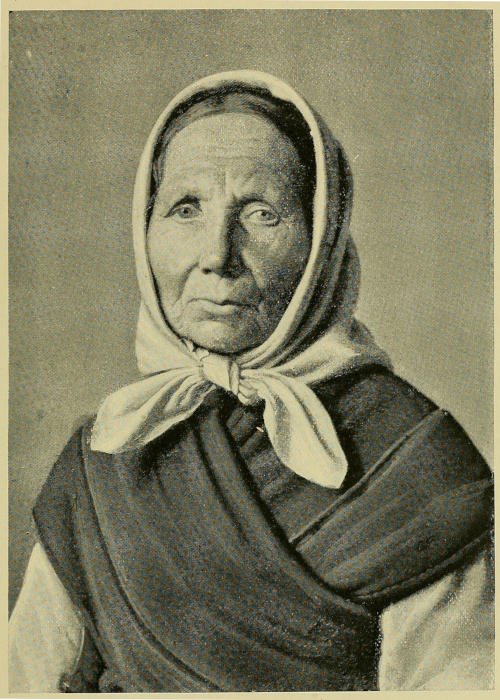
Danish Country Woman.
There was quite a company gathered together at one
farmhouse, and we were among the number. When mealtime
came not all of the people could be seated around the
table, for it was too small, so eight of the number took
places and the rest waited to eat at the second table.
There was no nice white tablecloth to be seen, and not a
fine display of nice dishes either; no silverware decorated
that table, and, indeed, the whole house seemed void of an
unnecessary thing.
But I’m going to tell you about the meal, so will pass
by a description of the house and its furniture. On the table
were a plate of black bread, a small dish of butter, and
two earthen dishes filled with milk. The dishes were
placed at the ends of the table, so that four persons could
have easy access to them when the dipping-in time came.
There were knives and spoons, but not enough to go
around. Now what was to be done? Well, they were used
a while by some, then passed on to be used by those who
had none. We were strangers in the company, therefore
the favored ones, so had the happy privilege of having a
spoon all to ourselves. Now they were not of silver, as
you might suppose, but bone. They were short in the handle
and large in the bowl. Just look at your mother’s
kitchen spoons and I think the size will correspond very
well with the bone ones we used.
Instead of having bread and milk, which most of the
boys and girls like, we took the milk first, dipping into the
earthen dish and placing the milk in the mouth spoonful by
spoonful; and then we ate the bread afterward. Now that
was no style of our own, for we followed the example of
those around us, and the custom seemed indeed a very
strange one. When the slices of black bread were gone,
and the dishes of milk emptied, all stopped eating and
thanks were returned to the Father above who provides so
liberally. After this all retired from the table. We were
not made comfortable by sitting on sofas and easy chairs.
Oh no; but instead of that we had the privilege of standing
until those at the second table were through eating, and
even then we had the pleasure of being seated upon narrow
benches, or possibly on an uncomfortable chair.
Those people had a novel way of cleaning the spoons
used in eating. I noticed with astonishment that after each
person had finished the milk, and needed the spoon no
longer, he took the bowl of the spoon between the thumb
and fingers of the left hand, wiping it clean; after which the
spoon was put away, to be used sometime in the future.
Now, little girls,—you who do not fancy washing dishes,
and especially spoons,—you must not adopt this method of
cleaning them. But probably you will think about it as I
do,—that the custom is not a nice one, and hardly worth
following.
Houses in the country are built low and rather long.
One end of them is used as living apartments and the other
end for horses, cows and chickens. The farmer need not
go far when feeding-time comes; it is only necessary for him
to walk through the kitchen, open a door and commence
his work of feeding. The odor of the stable permeates the
entire house, and there is no way of getting where it is not.
Now some people think living close to a barn is healthful;
but I must confess it is disagreeable in the extreme to me,
and I had a great desire to be far away from such a nuisance.
The language of the Danes is quite unlike that of the
Germans, and we were not able to talk to the people whom
we met, unless it were through an interpreter, and that
made it necessary for us to have an English-speaking person
with us almost all of the time. To be in a country
where one does not understand the language is quite unhandy,
and yet there are a great many people who travel all
over Europe and speak but one language, the English.
Again, you meet persons who speak seven or eight different
languages fluently.
There is a great deal to interest one while traveling
through a strange country; but it is not well for us to write
too much about one place, so we shall leave Denmark and
go to Sweden.
Since Copenhagen is built on an island, you will know
it is wholly surrounded by water. If such be the case, it is
utterly impossible for any one to leave there for Sweden
without going aboard a steamer. The passage of water between
the two countries is called a sound, and every one
knows it by the name of “The Sound.”
One bright, beautiful day, in company with some
Brethren, we crossed over the sound to the seaport town of
Malmo, Sweden. The steamer was very clean, and the water
unusually smooth that morning; so the ride of an hour
and a half was a very enjoyable one. Malmo is only sixteen
miles distant from Copenhagen, and when the day is
clear the cities may be seen plainly when on the water.
The languages of Sweden and Denmark seemed alike to
us, yet the natives claim there is quite a difference. Be
that as it may, the people of both countries talk together
and understand each other without much trouble. Our
time was limited, and hurriedly we took in the sights,
spending a short time with those of like precious faith who
lived in the city. The time spent with them was well
spent, for we were received cordially by all.
The cities of Europe are all very much alike; the houses
are built in flats, having many families living under one
roof. The streets are clean enough for footmen to walk
upon, and there is no danger of even soiling the shoes.
The store windows were tastefully arranged, being quite attractive
to the passer-by, and causing us to think that much
time could be consumed in looking at the beautiful display
of finery.
The market place of a large city in the Old Country
was always attractive to us, and if it was at all possible
we aimed to take a stroll through it. We admired the
tastefully arranged stands of vegetables, crisp and green.
Fruit seemed to be plentiful that year, and apples, pears
and plums all looked beautiful. Even the butter, eggs and
cheese stands looked well, and you would be surprised to
know how many different kinds of cheese were on sale.
Not much time was spent in looking at meats, fish and
fowls, for close by was a greater attraction, that of the
stand filled with flowers. There we saw the pleasant faced
little pansy, the beautiful carnation pinks, and the loveliest
of all flowers—the rose. I think I never saw such beauties
as were offered for sale in the Malmo market. My husband—who
was very indulgent—kept me well supplied with
them, and their fragrance was enjoyed by others as well as
myself.
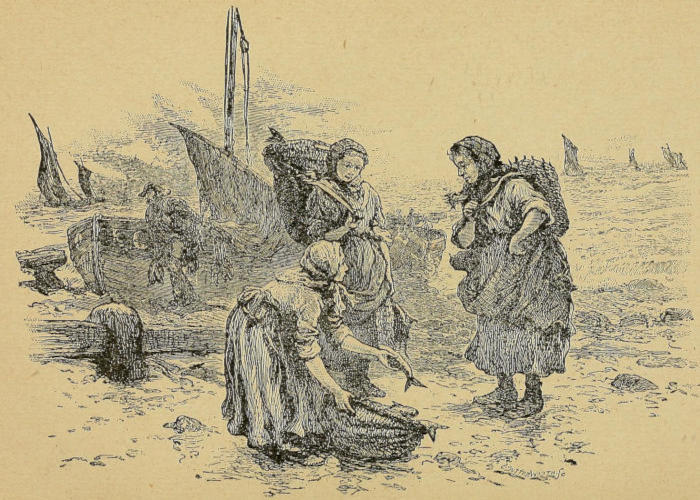
Fishermen’s Wives.
Six miles distant from Malmo is a small village called
Limhamn, and at that place there is a small church with a
few members. We were requested to visit the members by
way of encouragement; and as soon as the train was ready
we started for that point. The ride was of short duration,
yet very pleasant. Almost the entire distance the railroad
track ran close to the water; so we had the pleasure of
looking out upon the great body of water with its ships and
sailboats.
The village of Limhamn is the home of many fishermen.
About three o’clock in the afternoon they start out
to fish. All night long they work hard, and in the morning
often return with a very small catch. One time we looked
out over the water and saw twenty boats of fishermen with
sails well filled with wind. As a rule, those boats keep
very close together, one following in the wake of the other.
Sometimes the wind almost topples them over, but on they
go, spinning along at a rapid rate. When the waves are
lashed into fury by a storm many a little sailboat is turned
over, and the boatman goes down, never to be seen again.
In those northern countries fishing is quite a business,
and whole families sometimes engage in it. The women
have a hard time, for they do double duty, that of looking
after their families and then going to market day after day.
After the husband returns in the early morning with his
fish, the wife and all the children who are old enough arise
and hasten to prepare them for market. As soon as fifty or
one hundred fish have been made ready they are placed in
a wheelbarrow, and the wife, after having changed her
soiled dress for a clean one, trudges off to market, walking
a mile or more with the heavy load. Where there are large
families it takes many, many fish to pay for food and
clothing, and it is therefore quite necessary that all should
work.
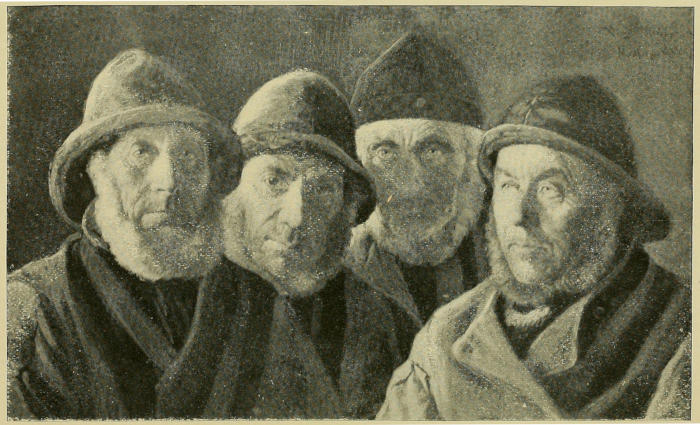
The life of a fisherman is hard indeed; constantly dangers
surround him; yet he seems to enjoy life about as well
as those who work on land. They are strong, hearty looking
fellows, which you will notice by looking at the picture
of the four weather-beaten faces before you. Do you see
their heavy coats? And then just look at the odd looking
hat. The rim, which extends over the back of the neck, is
for protection against wind and storm. Perhaps if we were
upon the water that rim would be turned around and used
as a protection for our eyes instead of the neck. After all,
each fisherman probably knows best what is for his individual
good, and no doubt the wind and stormy weather have
taught him many good lessons on the preservation of
health.
The time spent at each stopping place was of short duration;
so then we left the fishermen at Limhamn to toil on,
and we traveled still farther north.
Much of the country which we passed through was
very rough looking, and yet there were parts of it which
reminded us of northern Illinois, where we live. The
greater part of Sweden is covered with forests of pine and
fir trees, and the railroad ran through miles and miles of it,
giving the passengers a splendid chance to see a great deal
of country. There seemed scarcely an end to those beautiful
trees, and we really grew tired looking at them for hours
at a time.
Sweden is noted for her many beautiful lakes. Some
of them are quite large, and boats are seen upon them; but
very many of them are small. We passed alternately forests
and lakes, and we were always sure to see a forest after
having passed a lake. Never before in my life had I seen
as many beautiful lakes as we saw during that ride.
Sometimes for miles and miles the ground was covered
with heather, or ling. Its leaves are very small, and they
are green all the year round. It bears very pretty little
flowers; some are white and some are pink. They are not
at all fragrant, but very pretty to look at. Heather is of no
use to the farmer, and no doubt he would rather not have it
cumber his ground. But the train comes to a halt, and we
leave it, expecting to visit in the country, and thereby
come in closer contact with the people.
Fishermen.
As a rule the Swedish people are religiously inclined,
and they esteem it a great pleasure to have the story of Jesus
and his love told them. Many times I noticed the tears
chase each other down their weather-beaten faces while the
minister talked about the saints of old. Very willing and
anxious were they for the Word of God; and I’m so glad to
tell you it was given them in all of its purity.
The women seemed sorrowful because I could not converse
with them; and in turn I felt sorry not to be able to
gratify their desire; but we got along nicely anyway.
Their hearts seemed full of love for me, and they made it
manifest by patting me upon the shoulder, squeezing my
hand, and kissing me frequently. It was all they could do,
and I did not object. You must remember these people
lived on farms, were very poor, and knew nothing of the
ways of the world as we know them. They were innocent,
kind-hearted and good.
I have often wished, since writing these little letters,
that I could have talked with the children in those faraway
countries. There might have been many things to tell
which would have pleased you. But we are deprived of
much pleasure as we pass through this world; and, since it
cannot be otherwise, we must be satisfied.
Children in Sweden are like other children; they talk,
laugh, and romp too. We longed to talk with them, but
that being out of the question we undertook to make them
understand us by making gestures, and that method was
quite interesting. Now, children, whenever you are in a
position where you cannot talk to those around you, just
try my plan, and see how nicely you will get along.
Children enjoy doing favors for those who are older
than themselves; and how much they love to be praised for
it! Now that brings to my mind the little Swedish girl who
took great pleasure in gathering plums and bringing them
to the house. After having sorted them, the largest and
nicest ones were handed to me. In her language I thanked
her, but that was all I was able to say. No doubt she
wished I’d talk a little more to her; but, finding my list of
words was very short, she concluded to do all the talking
herself, so chattered away at a lively rate, not even waiting
for an answer. I could do nothing but look and listen.
We were very good friends anyway, and each talked to the
other in her own native language, but neither understood a
word that was spoken by the other. How would you like
to live with people and not be able to talk with them?
The home of my little friend was our home for at least two
weeks, and before we bade them adieu I had wandered with
her from orchard to barn, and from one neighbor’s house to
another; and when the heavy wind had shaken down the
beautiful apples, together we picked them up. Going from
place to place with the little girl helped me pass away
many lonely hours, and I assure you that not many hours
passed without my longing for the friends at home. Do
you wonder then that so small a thing would give me
pleasure?
In Sweden the little girls—and women too—make such
pretty little bows. Not as we bow in America; no, but with
a very quick and graceful movement. There is a bending
of the knee, and a dropping of the body. Old women,
young women, and even tiny little girls, all bow exactly
alike. It took quite an effort on my part to keep back the
smile which wanted so much to come, and I’m sure you
would have had the same feeling if you could have seen
them. From infancy children are trained to have respect
for older people, and it is taught them in such a way that
they never forget it. They were taught to bow; that was a
mark of courtesy and respect. Will you, my little readers,
try to remember the training given at home, as do the children
away across the ocean?
I told you there were miles and miles of pine forests in
Sweden, you remember? Well, physicians recommend
persons who have weak lungs to take many, many rides
through them, claiming that the pine odor is healing to the
lungs. I do not know how much truth there is in the saying,
for our lungs seemed all right; but I do know that a
ride through the forests in a wagon is delightful, and worth
taking.
Pine branches are used quite profusely in that country
for decorating both the inside and outside of houses on
special occasions. One time we were expected at a certain
country home, and great preparations had been made for
our reception. The hostess did not bake fine cakes or kill
chickens for us, either. Well, what did they do? Why,
they took a jaunt to the forest, gathered evergreens—pine
branches—ever so much of them, took them home, cut them
up in many small pieces, and scattered them on the walk
from the gate where we were to dismount up to the house,
then almost covered the steps leading to the front door.
Two beautiful young pine trees had been planted, temporarily,
on either side of the steps, and indeed the old farmhouse
took on quite a pleasant appearance. In walking
over the fresh-cut pine its odor came up around us, and was
quite agreeable. Now don’t you think those people were
kind? Perhaps when I tell you that all of the work was
done by women and children you will think we would be
strange people not to feel pleased with such a reception.
We enjoyed all, for we felt sure that love for the American
wanderers prompted them to work so hard.
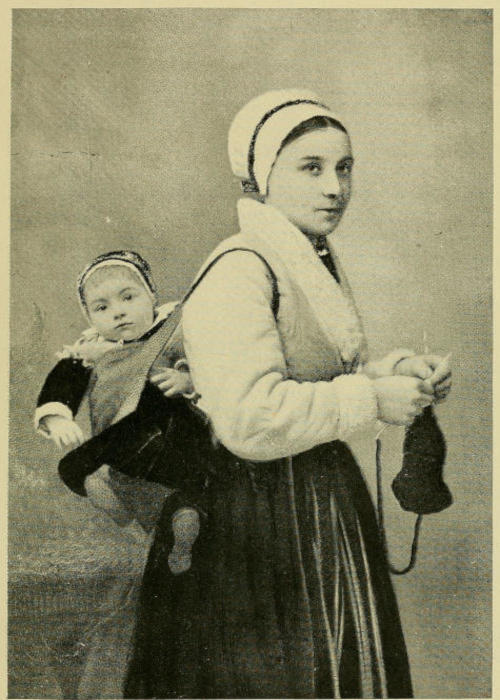
Soon we shall leave this interesting country; but before
we do so will call your attention to the picture of a Swedish
mother and babe. Do you notice the pleasant looking
faces of both parties? Then observe closely the peculiar
way of dressing. That woman doesn’t need a baby carriage
to haul the little one in; no, indeed; she has something
better, for with the child sitting in the sling which
hangs over the shoulder the mother’s hands are free and
she uses them to knit stockings for the rest of the family.
That way of dressing is not altogether in vogue now, for
fashion has gone ahead and the modest apparel like that of
the woman in the picture is very seldom seen these days.
We are admonished to love those who are of the same
household of faith, and as the family with whom we stayed
belonged to the same communion as ourselves, we had
much love in our hearts for them. With tearful eyes the
farewells were said, and we wondered whether the Lord in
his goodness would permit all to meet again this side of
the grave.
Swedish Mother and Child.
Time passes swiftly, no matter where you are, at home
or in a foreign land, so the allotted time for rest in Sweden
had finally come to an end. There were many days of
travel before us, and riding becomes quite tiresome when
day after day is spent in foreign railway carriages.
Our new-made friends were loath to have us leave, and
farewell seemed a hard word for them to say. Several accompanied
us to the station, many of them walking in the
hot sun a distance of two or three miles. We took seats at
the window of the car, and when the train passed out we
looked back and saw them waving handkerchiefs until the
distance widened between us and the flutter of white was no
more visible. Waving the handkerchief after departing
friends is a custom of the country, and at every station
along the railroad it is seen.
There are a number of things along the line of travel to
interest tourists, if they are in the proper mood to be interested.
Many days of continued travel bring with them
feelings of weariness; and when that is the case, beautiful
scenery or odd customs of the people fail to attract attention.
The discomforts of foreign travel are many, and they
often drive away the enthusiastic feelings one had in the
beginning of a long journey.
The guard of a train usually takes orders for meals
which passengers expect to get along the road, and when
you are not thinking of it he puts his head in at the window
and asks who among the number desire dinner. A dispatch
is sent, and the meal is ready by the time we reach the
stopping place.
You enter a nice, clean dining room, and there you see
tables spread with very white tablecloths. Here and there
upon the tables are stacks of soup plates, dinner plates and
small dessert plates, and knives, forks and spoons close by
them; dishes of boiled salmon with sauce, hot potatoes,
boiled beef and cauliflower with cream sauce; then, too, ever
so many kinds of cheese, and some smoked meats.
We followed the example of the rest of the people, and
forthwith helped ourselves to a plate, knife, fork and
spoon. No waiters looked after our wants, so each person
looked after himself, being careful not to push or elbow his
neighbor. Everybody was orderly, and the dinner was
splendid. Two women had the oversight of the dining
room, but they sat off at one side, behind a little table, and
did not leave their seats until paying time came, when they
took the money and made the change.
A servant appeared and took away each plate when it
was needed no more, and when time for the dessert had
come, she removed the fish, meat and vegetable dishes.
There was no tarrying one for the other, but as each person
desired a dessert he arose, took a plate and helped himself
to the jellied raspberry juice, or tapioca pudding; and as a
dressing for them delicious whipped cream, poured from a
large glass pitcher, was used. After paying the bill, each
one passed out to the train, which started soon after.
CHAPTER III.
Norway.—Kong Halfdan.—Fjords.—Hay Transfer.—Government Vessel.—Two
Young Girls.—A Glacier.—The Captain’s Kindness.—The
Beautiful Picture.—Tromsö.—A Floating Buoy.—Eider Ducks.—Lapp
Family.—Reindeer.—Torghatten.—Fish.—The Trap for
Salmon.—Hammerfest.—The White Polar Bear.—The Drunken
Sailor.—Arctic Ocean.—Whaling Station.—The Little White
Church.—Striking a Reef of Rocks.
Before a tourist leaves home the mind is usually
settled upon certain places to be visited in the Old
World. We think it a very good plan, for then the
history of those special points may be looked up and the
visit made more satisfactory; for the more knowledge one
has of noted historical places, the more pleasing is the visit.
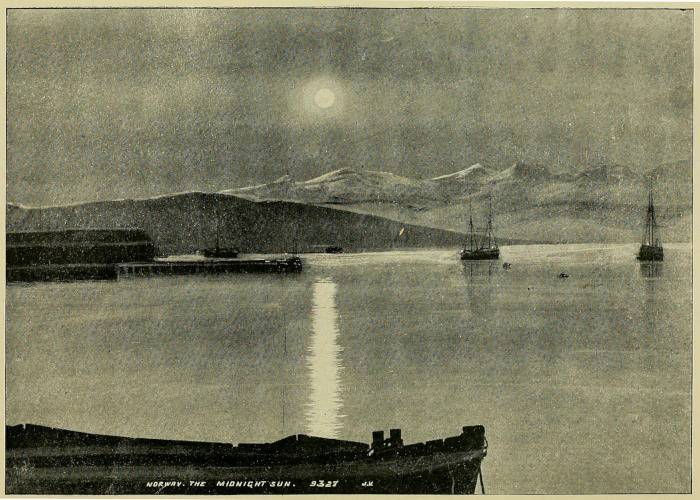
Norway was the country we had decided to visit, and
“The Land of the Midnight Sun” was the point aimed for.
So the twentieth day of August found us two in the city of
Throndhjem, once the capital of Norway. Instead of railway
coaches, passage was taken on a steamer which was
then at the pier puffing heavy black smoke from the
smokestack.
The Midnight Sun.
The sailors were busily engaged in storing away the
cargo, and there was every indication that in a few hours
she would steam out of port. Upon inquiry we found that
steamers had quit running to that far northern point; the
season being over, there would be no more chance for us
that year. That information was quite disappointing, for
we had looked forward with a great deal of pleasure to the
time when we should look upon the bright sun shining at
midnight. The fault seemed to be our own, for we had not
started north soon enough. We concluded to go as far as
the steamer went, rather than turn back; so the tickets
were purchased and a stateroom procured on board the
steamer Kong Halfdan.
The name seemed odd indeed, and you cannot imagine
how very small the ship did seem compared to the monsters
on the Atlantic. I did wish it were larger, though; but
since it was not in my power to change its size I just tried
to appear unconcerned, and that wasn’t a very easy task.
This vessel belonged to the government, and in the season
she made regular trips between Throndhjem and North
Cape. As the steamer was not to leave her pier for an
hour or more, we decided to walk around the city and thus
escape the noise and confusion of loading, which was in full
operation all around. Walking seemed to be a tiresome
piece of work that morning, and we were glad to return and
take a seat upon deck, where we remained until sailing
time.
The day was cloudy, with a stiff sea breeze blowing
and we concluded a good shaking up was in store for us;
perhaps a spell of seasickness in the bargain. The captain
said, “Nobody ever gets seasick on the fjords of Norway”;
but I decided to wait and see. The water in the bay was
rough, and the ship inclined to roll a little, so the outlook
did not seem very flattering.
The time for sailing came, and at twelve o’clock, noon,
the anchor was drawn up, and quickly we left the pier. I
sat on deck but a short time, for the rocking motion of the
ship gave my stomach an unsettled feeling; so, as soon as
possible, I withdrew to my stateroom, and in a short time
thereafter my head was upon a pillow, where the sight of
water was entirely shut off.
After having gone a few miles, we were agreeably surprised
at finding a calm, beautiful sea. The clouds passed
away, and the sun in all its splendor shone down upon us,
and each day, from that time on, the sun cheered our way.
We were out for a twelve days’ cruise along the rocky coast
of Norway, and you can imagine it was pleasing to have
fine weather and a smooth sea.
There were not many first cabin passengers on board
the Kong Halfdan, and it so happened that I was the only
lady; but that which disturbed me the most was to know
that among them all we were the only two who were
English-speaking. The captain, who was a very nice man
and extremely kind to us, talked English quite well, so every
once in a while we held a conversation with him.
The captain and first and second mate ate at the same
table with the passengers. It was a long, narrow table and
accommodated sixteen people. A lounge ran the full
length of one side of it, while chairs were used on the other
side. Each one had his seat, and at every meal we sat in
the same places. The captain was seated to the right and
my husband to the left of me, and from there down others
sat; but we had the honor of being seated on the lounge,
and near to the captain.
The fjords of Norway are known as arms of the sea,
they being a part of the Atlantic and Arctic oceans. Some
of the fjords are narrow, but others are quite wide. Large
vessels float upon them, for the water is very, very deep.
The Norwegians are a thrifty people, and their little
homes on the green hillside along the fjords were very inviting
as we passed them one by one. Some were near
enough for us to see the chickens picking and scratching in
the yard, and gladly would we have exchanged our stateroom
on the steamer for a cozy room in a cottage.
The steamer had regular stopping places called stations
along the line, and at those places they took on passengers
and cargo. There was no chance to cast anchor
close to shore, for rocks run far out into the water. Passengers
and freight were always taken off in rowboats.
Mountains seemed to hem us in, and the splendid scenery
was a surprise to us; yet it proved to be quite a monotonous
ride and we were anxious for a change.
Green fields were scarcely ever seen, but small patches
of green were noticed here and there on the sides of the
mountains. I wondered what the Norwegians would say if
a glance at fields of grass and grain, as we know them,
could be placed before them.
A familiar object along the way was a wire stretched
from the foot to the summit of a mountain. I’ll call it a
hay telegraph. You see the farmer cuts grass which grows
on narrow ledges of rocks way up in the mountain. He
stores it away until great quantities have been accumulated
and then, when ready to have it stored close to his house
for winter use, he sends bundle after bundle down the wire.
That wire was a novel contrivance to save labor, for without
it very many steps would surely have to be taken by
the weary farmer.
The government vessels carry provision and mail to
the inhabitants living along the coast, and we were reminded
of our freight or express cars, carrying all kinds of
things and delivering them at regular points along the line.
The steamer did not present a beautiful appearance, for the
deck was greasy and very dirty looking. Quite a smell of
fish filled the air, and we found that her main cargo consisted
of fish and fish-oil. All of this accounted for the
greasy look of the deck and the bad odor which greeted
our nostrils. You would be surprised to know how much
freight and express is taken on and off at those stations. I
passed many hours standing at the railing of the ship
watching the process of loading and unloading baggage,
passengers and freight, and felt myself well entertained.
One time two young girls rowed up alongside of the
Kong Halfdan. A rope from the ship was thrown them
with which to steady themselves; they caught it and were
just in the act of taking hold of their express package
when a wave came and washed them back; the second attempt
was made, and that time they caught the rope and
held tight to it. Do you believe they were scared? Well,
they were not; and instead of screaming and saying, “We
shall drown. Oh, don’t let us try it again!” they pulled at
the oars, and with a merry laugh received the package and
then rowed for the shore, laughing and talking. Their
package was a guitar, and no doubt the pleasure of having
the instrument caused them to row with energy. Women
and girls can handle a boat about as well as a man, and
they have no more fears of being on water than the farmer’s
daughter has when riding upon the back of a horse.
At almost every station passengers came aboard, and
oh how much we did wish English-speaking people would
be of the number, for we did so long to hear our native language
spoken. Almost all who took passage on our ship
went second cabin. The fare was cheaper and the accommodations
accordingly poorer than first cabin. Foreigners
don’t mind poor accommodations; they are used to them at
home, and it would be useless to pay a high price for anything
better than what they are used to.
As we traveled on the scenery seemed more grand;
mountain peak after mountain peak was seen in the distance,
and the captain, who was always ready to give us information,
said, “Snow is seen upon those mountains the
entire year, and numerous glaciers are sent off on both
sides, extending very nearly down to the sea.” Now a glacier
is an immense mass of snow and ice formed in the
regions of perpetual snow. It moves down, down the
mountain side, carrying large rocks along. Would you
like to see one? From the steamer we saw the snow-capped
mountains, but a glacier we never beheld. The
cold air which comes from a field of snow and ice blew
down upon us as we stood upon deck, and I drew my heavy
winter shawl more closely about me. The highest of the
mountains which I’ve been telling you about are said to be
five thousand feet high. Is it any wonder that we saw
them when far away?
I told you the captain was kind and thoughtful. Well,
one day he gave us a surprise by running his vessel out of
its course into a very narrow fjord. When he knew we
were desirous of seeing things of interest along the route,
he aimed to gratify the wish if possible. Our captain was
proud of the scenery of Norway, and whenever he could
make time and get to the different stations when due he
showed his passengers favors.
All first cabin passengers were invited to go up on the
bridge. Now, that is where the steersman stands to guide
the vessel. There was not a thing to obstruct the view either
ahead or to the right or left of us; and everybody
seemed to be amazed at the outlook. By and by the ship
was steered toward a very narrow looking place, and I said,
“Why, you won’t try to go through there, will you?” and
before my question was answered the ship passed between
two high mountains into a small body of water which
seemed scarcely large enough to hold a vessel the
size of the Kong Halfdan. Oh what a picture! It was
beautiful! There was the blue sky overhead, with mountains
on both sides of us, and not far away a lovely waterfall.
There was a splendid echo at that point, and when
the captain told us that the mountain to the right was
twelve hundred feet high there was a return sound which
repeated the words. The waterfall was fed from the melting
snow of the mountains, and it was a pleasure to watch
the water rush and tumble down the mountain side. The
little stones which lay in its way seemed not to hinder the
rushing water, and if perchance they became loosened all
went tumbling together until the water below was reached,
when the stones fell to the bottom, never to rise again.
While the beautiful picture was being admired the captain
blew the steam whistle three or four times, and as the
shrill sound was quite unexpected to us some screamed out
loud, and everybody within hearing distance laughed.
We had not time to tarry long at that place, for it was
getting on toward sundown. It seemed to me the ship was
handled as though she were a mere toy, and the first thing
we knew she had been turned around and was out in the
wide fjord, steaming along at a rapid rate. One by one we
took the captain by the hand and thanked him for the
pleasure he had given us. You see, boys and girls, everybody
likes to be appreciated, even the captain of a steamship;
and when we saw the weather-beaten face all smiles
we felt pretty sure we had given the captain some pleasure
too, for he knew that the extra pains he had taken was
gratifying to every one of the passengers.
Tromsö is the name of one of the stations along the
route, and there we cast anchor lying by eight hours. All
of the passengers but myself went ashore, and the captain
said, “What, don’t you go too? It will be lonely without
the rest of the people.” But I concluded it would be more
pleasant to remain on the steamer and write letters than to
go ashore in a small boat, for somehow I never did fancy
the getting in and out of a small rowboat. My letter writing
occupied several hours, and when I had finished I went
on deck where there was enough to entertain me the rest of
the time. Coal, freight and passengers were taken on at
Tromsö, and for a while all was noise and confusion.
Not very far from the ship was a floating buoy. Now,
that is a floating mark to point out the position of objects
beneath the water, such as rocks, sandbars, and anything
which might prove disastrous to vessels or small boats.
There are many different kinds of buoys, and each one has
a meaning. The seaman knows them all and reads them
like a book.
Out in the bay were a great many little rowboats. One
of them attracted my attention because there were three
little boys in it, and I thought, “How dangerous!” I
watched them, however, and saw they were making for the
buoy. By and by they were alongside of it, and the next
thing I knew two of them were sitting astride of it, while
the third kept the boat from drifting away. Now I had decided
those little fellows would surely roll off and perhaps
be drowned, and I grew very anxious about their safety;
but after having watched them an hour I concluded they
were not strangers on the water, but knew the buoy well
and were used to playing just where it pleased them.
Their stay was a long one, and not wishing to watch
them longer I turned to the other side of the deck; and
there in the water were a dozen or more eider ducks swimming
along as gracefully as could be, seeming not one bit
afraid of the people who rowed past them. Eider ducks
frequent low, rocky places near the coast. Their down is
in great demand; it is used in that country for filling bed-coverlets,
and you would be surprised to know how light in
weight coverlets filled with eider down are. During the
breeding season no one is allowed to shoot the eider ducks,
or even to fire off a gun near their nests. Persons who are
thoughtless enough to do so are fined for it. Because of
the great care taken they are very tame, and do not fear
man when he comes near them.
The sun was getting pretty low, and the time for starting
was near at hand. I was still on deck, but now my eyes
were cast in the direction of the city. I was looking for a
boat that would bring back the passengers who had gone
ashore. In the distance a boat came in view, and taking
the field glass which was near by I pointed it in that direction;
and there, sure enough, was the one I had been,
looking for. My joy was complete when the passengers,
including my husband, were all safe on board the Kong
Halfdan.
All those who had gone ashore went expressly to visit
a camp of Lapps, which was about a mile from the landing.
The people were very much surprised to have so many
strangers come upon them suddenly, so the children and
dogs—and there were many of them—were badly scared;
but the grown people seemed willing to stand and look. I
missed seeing the camp by remaining back, but I saw many
of the Lapps, for they hung about the ship’s landing.
They were a curiosity to us, for their dress was very odd,
which you can see for yourselves by looking at the family
in the picture. There is father, mother and six children.
That seems to be a large family for such a small hut, but
the Lapps live very close together, and the less house room
there is, the less work the housewife has to do.
Lapp Hut.
Those people are short in stature, measuring perhaps
four or five feet in height. It is somewhat of a task to tell
their complexion. Very little attention is paid to the care
of it, but I’ll say it seemed dark, rather copper-colored. If
their faces were washed no doubt we should find a complexion
altogether different from what has been described.
The young Lapps have quite wrinkled, puckered-up looking
faces, and with surprise you wonder why it is so. But
when one takes into consideration the fact that most of
their time is spent out of doors we cannot but conclude that
wind and weather add nothing to their looks.
The Laplanders are an inoffensive class of people, we
are told, and crimes among them are unknown; but they
have a failing which I’m sorry to tell you of; it is that of
strong drink. I have watched them pass into saloons;
drunkenness is therefore no uncommon thing among them.
What a dreadful habit to form; and men all over the world
have given themselves over to the demon of strong drink,
regardless of the consequences. I wish it were in my power
to write something which would cause every boy who
reads to keep far away from saloons. Look upon me as a
friend, my boy readers, and let me ask you not to touch the
vile stuff which is sold behind the screen. Remember that
sadness and distress come to yourselves and families with
the use of it. When tempted to drink do not, I beg of you,
think it is manly to take a sip, and cowardly to refuse; but
rather flee from the tempter and feel thankful you have escaped
the fangs of the great serpent which seemed ready to
fasten itself upon you. Ah, I hope you may never, never
forget that death and destruction come with the use of
strong drink! May the Lord stand by and save you from
the evil!
Those who visited the camp at Tromsö were especially
anxious to see their herd of reindeer; but the Lapps had
already driven them to the mountains for pasture; so the
people were too late. The reindeer eat everything green in
their march to the mountains, and in the winter there is, far
under the snow, a moss which they feed upon and are wonderfully
quick in getting. They are a very useful animal
to the Laplander, more so than horses are to us. The reindeer
is harnessed to a sledge in winter and driven anywhere
the Lapp desires to go. Three hundred pounds can be
drawn by them, yet the amount is usually limited to a little
over two hundred pounds.
These animals, as I said before, are quite useful, for the
meat is used for food and the hide for clothing and shoes.
They are milked, and butter and cheese are made from the
milk. The milkmaid sometimes has a big time to get the
milking done, for the reindeer doesn’t want to stand still
for her. You know some cows are not willing to be milked;
they kick and move about too freely for the milkmaid’s
comfort. Well, the reindeer doesn’t like milking time any
better than the cow; and where there is a large herd to be
milked it is necessary for a Lapp to get among them and
throw a halter around the antlers, so that the animal may
be held fast until milking is finished. You can imagine that
man and maid have lively times while the catching is going
on. Did you ever see the picture of a reindeer? Well,
they have immense antlers, which come out from the head
like great branches; and when the animal is full grown the
antlers are very large, spreading far out and requiring a
great deal of room. Where there is a herd of two or three
hundred of them they have a big time among themselves
hooking each other.
While on board the Kong Halfdan we had both salt
and fresh reindeer meat, and liked it very much. If you
were here now, I would show you a pair of Lapp shoes.
The hide was tanned with the fur on, and in making the
shoes the fur was left on the outside. They are odd
looking and quite fanciful in their make-up.
Spoons and knife handles are made from the horns of
the animal, and among our collection of Norway relics are
two small spoons with a great deal of carving upon them,
done by some of the Tromsö Lapps. I can’t say the carving
is fine at all, but it is rather amusing to look at.
Time passed rapidly away, and the eight hours’ stop at
Tromsö had ended. The passengers were all settled and
the freight stored away. By and by the signal for starting
was given; the ship turned about, and we steamed out of
the bay. The atmosphere seemed quite cold at times, and
we kept ourselves in our stateroom most of the time, sitting
there wrapped in the steamer rug, passing the time in reading
and writing to friends at home. The rocks and mountains
kept us company, for from the porthole we saw them
plainly. First they were to the right, then to the left of us.
One day when sitting in our stateroom the captain
called to us and said, “Come up on deck and see Torghatten.”
Now, what do you think that was? Not one of you
could guess, I’m sure, so I’ll just tell you. Torghatten was
a great high mountain with a hole through it. Right close
to the top was a natural tunnel, and daylight could be seen
through it plainly from where we stood. We looked in
wonder at the great work of nature, and thought, “God can
do anything.” The earth, and all that is in it, was made by
him; nothing is impossible with him. The forming of a
hole in the top of a mountain is small compared to the
many greater things he has done; and, dear children, will
you think often of the Maker of this great universe? Will
you keep in mind what power the Lord has? If so you will
exclaim as I have many times, “How wonderful are thy
works, O Lord!”
After passing Torghatten we continued standing on
deck; and soon after we steamed past a great lot of rocks a
mile or more wide. They were right out in the water and
it seemed we would surely run on them with our big ship;
but we didn’t, though, and were glad of it too. On these
rocks were hundreds of gray seagulls, and when the steamer
went puffing along they all flew up with a cry of alarm,
for they were badly scared. After finding we intended no
harm they all came down again; and as we looked back we
could see them settling contentedly. You surely would
have laughed if you had seen the scared seagulls.
The Hole in the Mountain.
Sometimes the ship stopped when far away from a station.
We wondered why, but soon found that a light fog
had settled around the ship. It comes down rather suddenly,
and disappears just as suddenly as it comes. Often
the bright sun is seen above, when all around the steamer is
fog. The captain is compelled to stop his vessel and wait
until the haze lifts. If he does not, there is great danger of
running on the rocks, which are so plentiful that he must
be cautious, or accidents will happen, and that would mean
a loss of cargo, and lives too.
Along the coast of Norway are valuable mackerel, herring,
lobster and cod fisheries. Several thousand men are
employed, and the herring and cod are caught in immense
quantities. Hundreds of pounds of herring and codfish are
taken on at every station. The cod are dried and tied in
large bundles. The herring are usually put down in brine
and packed in barrels; many of them are dried, too, but it
seemed that more were salted down. The people along the
coast, as well as those living in the interior of Norway, eat
a great many fish, for the lakes abound in the finest kind of
them. The smallest fish, which are not salable, are fed to
the hogs and chickens.
We had no trouble to get good fresh eggs to eat, for
they were brought to the ship for sale. But at times they
could not be eaten with a relish, as the taste of fish in them
was too strong to make them palatable. That seemed to
be a new revelation to us, and we decided that chickens
ought not to be fed anything but the best of feed if an egg
with a good taste is desired.
We saw fish everywhere: dried fish in the hold of the
steamer, fish on the table cooked in many different ways,
and live fish in the water; fish, fish, and no end to the different
kinds. Fresh cod, trout and salmon were served on
board the ship, and finer fish we never had the pleasure of
eating. Several times cod liver was presented in our bill of
fare. The seamen consider it a very fine dish. At first we
ate but little of it; and I must say we never did like it as
well as many other things upon the bill of fare.
We stopped to take on passengers and cargo at a small
station. The day was clear and the sun shone beautifully.
The people on shore were standing watching the loading of
the ship and the boatmen were pulling at the oars, trying
to get their little rowboats close to the side of the steamer;
and I stood watching all, when my attention was suddenly
drawn to the water, which was beautifully clear; so clear
that I was able to see down, down many feet, and there in
its depths I saw swimming with ease thousands of little
codfish. The confusion above seemed not to frighten them
in the least, for they came nearer and nearer the surface.
The little fellows seemed hungry, so forthwith I procured
a biscuit and fed it to them piece by piece. Thus I stood
for an hour or more, feeding and watching them. How
swift they were in their movements; for each little fish was
bound to have a nibble. The one which came out victorious
was compelled to eat his bite in a hurry, for there was
no time to be lost. I am confident you would have enjoyed
watching those fish, for it truly was a pleasant pastime.
After leaving the station we passed, to the left of us, a
pile of rocks; and a waterfall seemed to be there too. Taking
up the field glass we looked in the direction of the
rocks, when, lo, nothing was to be seen but a daub of white
paint a few feet long and perhaps a foot in width. Now
what did that mean? Nothing but a trap by which to
catch salmon. They are a hard fish to catch, and that invention
was intended to lure them on to where nets were
fixed to trap them. You see, the salmon desire fresh water,
and they know it can only be found coming down from the
mountain, so they swim for the supposed waterfall and are
caught. The fishermen are quite ingenious; yet I always
felt sorry for the poor fish.
Now do you know what that instance made me think
of? Why, the evil one, who is continually setting traps
for innocent children. Boys and girls, be careful you do
not fall into the trap Satan sets for you. When you are
tempted to tell an untruth, or to steal, or to play truant, or
to be disobedient, just say, “I won’t do it,” and think that
if you do any of these things you are getting into a trap
which Satan has set to catch you.
Hammerfest was reached at last, and the captain said
we might board on the Kong Halfdan and take trips to
land whenever we desired to do so. It seemed strange indeed
to be on land again, and no doubt the people thought
so too, for they looked at us with amazement as we walked
up one street and down another.
There were three or four little children who followed
us from street to street, never saying a word. I asked
them if they spoke English, but they gave no reply. We
gave them a small piece of money, and they gave a look
which told that they knew full well what money was. Dinner
time came, still they followed, and I am very much
afraid they lost their dinner that day.
I told you before that there were many fisheries along
the coast. Well, this town seemed wonderfully fishy; there
were warehouses in which were stored dried herring and
codfish; then there were factories where cod-liver oil was
made. You would be surprised to know how full the air
was filled with the odor of cod-liver oil. We were told the
smell was healthful, so we took it into our lungs more willingly;
yet, if it had been possible for us to have a choice in
the matter, we would gladly have had the air free from the
odor, for surely it was very unpleasant.
Hammerfest is the farthest north of any town on the
coast, and one day’s journey from North Cape, the most
northern point on the coast of Norway. The harbor at this
place was full of vessels, both large and small, just as you
see them in the picture, excepting two steamships which
were then anchored far down in the bay. Spitzbergen is a
great place for whalers and seal-hunters. It is four hundred
miles from North Cape, the place where we had expected
to go. History tells us that from this place several
attempts have been made to reach the North Pole. Walruses,
seals, foxes, reindeer, bears and birds are to be found
there.
Hammerfest.
There was a vessel in from Spitzbergen which had been
there only a few hours. As a rule she carried no passengers,
but on the last trip one passenger had been taken
aboard; and as there are no staterooms on sealing vessels,
the passenger was given a box up on deck, and there, day
and night, it stayed. The captain asked us if we would like
to go over to the Spitzbergen ship and see the passenger.
We said “Yes,” so he had one of the Kong Halfdan’s seamen
take down a boat, and the captain rowed us out in the
bay, over to where the ship was anchored. When we
reached the vessel I thought I would just stand in the small
rowboat and look over the sides; but the captain said, “Oh,
but you must go on the sailing vessel, or you can’t see all
that is to be seen.” Now there were no steps to go up, and
no ladder to climb, so how could I get over? Well, seamen
are used to climbing, and think everybody else is too;
so he said, “Put one foot here, and the other up there, and
then you will get up without trouble.” I did as he directed,
and in a little while I was on deck and looking around.
What did I see? Why, the hold of the ship packed
full of fresh seal pelts. After killing the animals, they
skinned them. The meat is thrown away, and the skins are
taken to the hold of the ship, spread out, and salted right
there. The next thing I saw was their passenger, and what
do you think it was? A bear, a real live bear, and just
fresh from the polar regions. It was about five months old,
and just as white as white polar bears are.
The sailor who captured the bear said it fought nobly
for freedom, and in the conflict he was unfortunate enough
to have been bitten. The mother lost her life in the fight,
and the hide hung near by to tell the story. In loud, pitiful
tones the orphaned bear called for its mother; but no
answer came back to it. I do not know where the cub
found a home; but it was shipped to Throndhjem, and from
there was to be sent to a museum. We were glad to leave
the Spitzbergen ship and return to our own, for the mournful
sound of the motherless white polar bear was not agreeable
to us.
There had been a great fire in the town of Hammerfest,
completely destroying the finest residences and best hotels
just the winter before we reached there. It was thought
the whole town would surely succumb and be burned to
ashes. Our ship was the best hotel, and we were fortunate
to get plenty to eat and a comfortable bed to sleep in. A
change of quarters would have been pleasant if a good hotel
could have been found; but as it was we were very well
satisfied.
Hammerfest was the last stopping place along the line,
and some of the sailors were off duty while the ship lay
by at this place. About the first thing searched for is usually
a saloon, and there is never any trouble to find one, for
there are plenty of places where the poor fellows may find
entertainment with cards and strong drink.
We had been on land a few hours and returned for
luncheon, when our attention was attracted to a sailor upon
the street who had indulged too freely in the use of whisky.
He walked with unsteady gait to the ship landing, where
eight or a dozen steps led to the boats in the water below.
No one could reach the steamer without descending the
stairway and going in the rowboats; and we wondered how
any person with such tottering steps could descend without
falling into the water. So we watched, and he went down
step by step stumbling, yet catching himself again and
again. His comrades saw him, and taking one of the ship’s
boats rowed for the drunken sailor, reaching him just as his
weakened knees gave way. Headlong he pitched into the
boat, and with a splash his feet went into the water. That
was a trying time for the boatman, but he seemed equal to
the occasion, and by tugging and pulling succeeded in getting
the poor fellow into the boat, feet and all. With a
steady row and in silence the side of the steamer was
gained, and with plenty of help the unfortunate one was
pulled through a small door in the side of the ship. He
disappeared, and nothing more was seen of him till the
next day, when, rather long faced, he was seen on duty.
Now, children, you may be amused while reading this
little incident of a drunken sailor, but just let me tell you
that I was disgusted, and thought of the words of Solomon
when he said, “Wine is a mocker, strong drink is raging:
and whosoever is deceived thereby is not wise.” The
drunken sailor knew not what he was doing, and was unwise
when he partook of strong drink. Now, boys, I’ll
give you something to learn, and as long as you shall live,
don’t ever forget it: “Woe unto them that rise up early in
the morning, that they may follow strong drink; that continue
until night, till wine inflame them!” “Who hath
woe? who hath sorrow? who hath contentions? who hath
babblings? who hath wounds without cause? who hath redness
of eyes? They that tarry long at the wine; they that
go to seek mixed wine. Look not thou upon the wine
when it is red, when it giveth his color in the cup, when it
moveth itself aright. At the last it biteth like a serpent,
and stingeth like an adder. My son, give me thine heart,
and let thine eyes observe my ways.”
May the Lord bless you, boys, and keep you from the
drunkard’s cup.
There was nothing of great importance to be seen in
Hammerfest, so we decided to make the return trip on the
same steamer, which would leave after the cargo had been
discharged. August twenty-sixth the anchor was hauled
in and we started.
There was a little change in the return route, which
gave us a sail of a day or so on the Arctic Ocean. We had
not gone far till the wind rose, and we had what the captain
called an “Arctic storm.” The steamer was small, so
it rolled and pitched a good deal. Oh how we wished to
be out of that place! But one must put up with storms,
and there is no use complaining about it either, for it does
not help matters one bit, and a person is no happier.
There was a whaling station on the route, and the captain
showed his kindness by telling some of the passengers
that if they were so minded they could visit the camp.
When my husband and a young German decided to go, the
captain ordered the sailors to take a ship’s boat and row
them there and back again. The sea was very rough, so I
decided to remain where I was, and not venture in a boat
smaller than the Kong Halfdan.
It was thought by the men that I had acted wisely in
not accompanying them. The camp was found in a miserably
dirty condition, for whales in different stages of decomposition
were seen all around it. The fat of the decayed
animals was thrown into a vat and rendered just as
we render the fat of a hog. Very large vats of boiling oil
were to be seen, and the odor sickened those who were not
used to it; and I’m sure it would have sickened me too.
For three days the weather was unpleasant, and a good
share of that time I stayed in my stateroom. A great deal
of rain falls in Norway during the summer, and it is quite
necessary to carry rain-cloaks and a rubber blanket to
throw over the baggage. These things are more needful to
those traveling on land, because they are more exposed to
the weather than persons who travel on water. We were
well supplied with the necessary wraps, yet had but little
use for them.
Sunday was the fifth day on the return trip, and the
sun came out bright and clear. Even though it was Sunday
the sailors worked faithfully taking on and off freight.
We made a stop at a little village whose houses extended
down to the water. A little white church, with green grass
around it, looked so cozy standing in the beautiful sunlight.
The bells were ringing and the sound came over the water
to us. What a cheerful sound! and it created a desire within
us to go and worship with the gathering congregation.
We could not go ashore, for the steamer might leave us behind;
and that would never do. Many barrels of herring
were taken aboard that day, and four hours passed before
we steamed away; plenty of time to have gone ashore had
we known it; but the privilege of mingling our prayers with
those of the little congregation had passed away forever.
Our ship was heavily laden with salted and dried fish,
besides several hundred barrels of whale oil. All deck
room was taken up, and only a narrow space was left us to
walk upon. Passengers got on and every stateroom was
occupied; besides many beds were made up in the dining
saloon, and we were pretty well crowded.
We found the Kong Halfdan was not in very good repair,
for there seemed to be a good deal of tinkering done
to the boiler; day and night, by spells, we heard the hammering.
Upon inquiry we found the boiler had been leaking,
and that it was not an easy matter to patch it up.
When the sea washed the deck, or a hard rain came, the
water dripped down in our stateroom, splashing dirty water
on such articles as were near. Time did not pass any too
swiftly for us, and we were glad to know that only a few
days more and our feet would be on mother earth again.
The scenery was grand all along the route, but the bad
condition of the ship kept us from enjoying it to the fullest
extent. You must surely know it is not a pleasant thought
to be in a position where you are unable to help yourself if
an accident should happen. It is not best to borrow trouble;
yet there are times when it seems impossible to keep
from doing so.
One morning about six o’clock we were awakened from
a sound sleep by a peculiar grating noise. The steamer
had struck a reef of rocks, and I shall never forget the sensation.
With one bound we were out of our berths, and,
with but few words passing between us, dressed hastily.
We knew full well that if a hole had been broken in the
ship, with such a heavy cargo only a short time could pass
before she would sink. Upon examination it was found
that the propeller was injured, but not badly. In a few
days after we steamed into Throndhjem Bay safely, and
our hearts were filled with gratitude to the Lord for his
watchful care. We were glad to have an opportunity to
see so much of nature, for by it many good sermons were
preached to us, and these words filled our mind, “O Lord,
how great are thy works; and thy thoughts are very deep.”
CHAPTER IV.
The Story of a German Boy.—The Priest.—Catholic Woman.—Corps of
Singers.—My Singing Lesson.—Funeral Procession.—Children
Playing.—Wooden Shoes.—Neatness of the German Children.—Their
Politeness.—Cologne.—Its Cathedral.—Height of Towers.—Odd
Costumes.—Art Gallery.—The Picture I Saw.
I am going to tell you something about Germany
now, but will first tell you of a boy who lived there
many years ago. He had father, mother, brothers
and sisters, and as a family they were very poor. The father
worked hard in the copper mines, along with many
other men in the settlement, and at home the mother
worked equally hard looking after the comfort of the family
and carrying upon her back the wood which was needed.
She was a good, kind, Christian mother, and it is said she
frequently “communed with God in prayer.”
Those times everybody belonged to the Roman Catholic
church; consequently every father and mother taught
the children to believe fully—as they themselves did—in
the “Holy Catholic Church.” This boy was the eldest of
the family and was the first to be educated. As he neared
the age when it would be necessary to send him away to
school the parents became anxious. They knew they could
ill afford to do it, as they had scarcely money enough for
their daily need and no chance of getting more. There
seemed to be one way in which they might be enabled to
save a little more money, and that was by living still more
economically; and by putting their thoughts into practice
enough money was saved to give the son a start in school.
Not many miles distant from the boy’s home was a select
school, and thither the father and son went shortly after
money enough had been saved. The support which his father
gave him was not sufficient to cover expenses, so the
lad was finally obliged to help himself, which was done by
singing from door to door. As a reward small pieces of
money were given him. The strictest economy was practiced
by the folks at home and the son also, and as a reward
for all their trouble they learned that the boy for
whom they were making those sacrifices was studious and
worked hard and faithfully.
Time rolled on, the boy had grown to manhood and
become a great teacher. He seemed strong in the Romish
faith and willing to make sacrifices for his church. By and
by the duty of becoming a priest or monk was impressed
upon him, and as soon as possible he wrote his intentions
to his father. The reply to the letter was not favorable.
As the new move was very displeasing to the parents, they
said that if such a step should be taken further affection
would be renounced. Those words availed nothing, for the
vow was taken and the young priest was received into the
order with prayers and hymns of joy.
As the priest grew older his work in the church increased,
and that caused him to read and study the Bible
more diligently, and in so doing he found he was not serving
the Lord fully.
Years passed away, and the young priest became dissatisfied
with his religion and decided to follow what he
found to be the teachings of the Bible. In the course of
time, and after much trouble, he separated himself from
the Romish church, and from that time on his life was in
great danger, for the Catholics were very bitter toward him.
The Lord is thoughtful of his children, so he watched over
this good man and allowed him to live many years after.
Now whom do you imagine I’ve been writing about?
Well, I shall tell you. It was Martin Luther, the founder
of the state church of Germany, which is known throughout
the world as the Lutheran church; and now almost everybody
in Germany belongs to the state church, and not the
Catholic church, as in the time of Martin Luther. This
man’s name is held high above all and his portrait is to be
seen in almost every German home. Many of the beautiful
churches which were owned by the Catholics are now
used and owned by the Lutherans.
One day while out walking with a Catholic woman we
passed a large cathedral, and with trembling voice she said,
“This belonged to our people one time, but it is ours no
more.” I felt sorry, and thought, “No wonder your heart
is sad, for surely your house of worship is a very poor one
compared to this;” for it was in a back street and dark and
gloomy looking. The woman had nothing to feel proud
of, therefore lamented.
We happened to be in Germany on the four hundredth
anniversary of Luther’s birthday, and a big day it was;
there were processions and illuminations all over the city.
The house in which Luther lived while in Halle was finely
decorated with evergreen, and the gas jets were beautiful.
It was not hard to tell where Catholics lived, for their
houses alone were without lights. It was plain to be seen
that no one stands higher in the minds of the people than
Martin Luther.
Many of the students attending college in Germany
make part of their expenses as did Martin Luther, by singing
from door to door. Their voices are well trained, and
when a square or two from them, the whole company of
voices seemed like four voices, their singing accorded so
well. The corps of singers is composed of a dozen or more
young men, and though their size varies their dress is alike,
for they wear black suits of clothing; the vest is cut low,
exposing the shirt bosom; the coat is cut swallow-tail, and
upon the head a plug hat is worn. Their ages range from
twelve to sixteen years, and you may imagine how very
odd the company looked to us. There is a leader who
stands before them beating time, and I don’t believe any
one of them miscalculates the length of a note or rest in
the piece of music sung. I am sure many of you never
heard finer singing.
Germans, as a rule, are fine singers, and you hear plenty
of singing even while walking upon the streets. One
time we were awakened from a sound sleep by singing on
the street. We looked out of the window and beheld a
company of soldiers all singing as they marched along.
Little boys and girls go home from school, walking along
leisurely and singing beautiful hymns and songs.
We were living with a family who had several children,
and one of them, a little girl about seven years of age,
dearly loved to sing. This little girl insisted upon my
helping her, but I said, “I cannot sing in German,” when
immediately she replied, “I will teach you my tune.” The
task was begun, and after a great deal of laughing and
many corrections I was able to sing her hymn, “Stille
Nacht” (Stilly Night). Quickly she ran to her mother and
told the news, and I was congratulated, for the family
thought I had done a wonderful thing. To tell the truth, I
was equally well pleased, and afterward took pleasure in
singing my German hymn.
You may think, by the way I have been writing, that
everything in the old world moves along pleasantly, and
that the children are always well and happy. I would not
have you think so, because sorrow and distress are there, as
well as in this country.
In looking out of my window, which was quite often, I
saw that which was amusing, and also some things which
were very sad. One day a funeral procession passed by,
and it consisted of father and mother. Four pall bearers
carried a casket containing the corpse of a little child.
The rain came down fast, and equally fast fell the tears of
sorrow from their eyes as slowly they moved along. There
was no hearse, and no carriages. Why? Because the people
were poor; it would take money for these things, and
there was none to spare. Ah, how my heart ached for
them, and I turned from my window with tearful eyes.
Poverty is to be found on all sides, and since it is impossible
to help all we learn to cast the distressing sights from
our minds and leave them with the One who watches over
and cares for all.
An American is surprised at the cleanliness of German
cities. It is no uncommon sight to see well-dressed ladies
walking in the middle of the streets. Their shoes and
skirts will not be soiled any quicker by walking there than
on the sidewalk. We feel ashamed when we compare the
dirty streets of American cities with the clean, well-swept
streets of Germany, and in our hearts we wished ours
might be different.
Houses are built three stories high; each floor is arranged
for one family, but sometimes there are as many as
three families living on one floor, each having no more
than one room in which to sleep, cook, eat and sit. I knew
a family of five who lived in one room; and they seemed to
be well satisfied too.
No matter where one goes he is sure to see many children,
and they seem to have as good a time playing as any
of you. They run, jump and make as much noise too.
Many times I stood at my window in Halle and watched
the little folks play on the opposite side of the street. One
time I counted fifteen boys and girls playing, and their
ages seemed to be from five to ten years; and—don’t you
think?—they all belonged to the same house. Now you
might think their little feet pattering on the floor would
make a great noise, but they don’t, because all wear felt
slippers in the house; even the fathers and mothers wear
them. In Germany the floors are not carpeted as in this
country, but almost all of them are bare. Where families
are in good circumstances nice rugs are used; where there
are no rugs the floors are sanded, and you can’t imagine
how strange it does seem to walk on sanded floors. Felt
slippers are fine things to keep the feet warm, and I know
the little folks over there would have cold toes all the time
if it were not for those comfortable slippers.
Wooden shoes and slippers are worn quite a good deal,
and many times I laughed heartily when the little boys and
girls ran. No matter whether I was looking out of the window
or sitting back in the room, I could always tell when
they had commenced their running. Do you wonder how I
knew it? Why, just by the noise they made. I presume
many of you never saw a pair of wooden shoes or slippers.
Well, that doesn’t make any difference, for I never saw a
pair until I went to the Old Country,—I have learned since
then that there are plenty of wooden shoes in America, and
not so many miles from where I am living. There is a difference
between shoes and slippers. Just take one of your
old shoes, tear off the leather excepting the part that covers
the toes, then substitute a wooden sole instead of a
leather one, and you can imagine how they look. You
would naturally suppose it to be quite a task to keep such
a foot covering on when running; but you will be surprised
to know they did not seem one bit bothered, and I am pretty
sure the German children can run just as fast as any of
you. Sometimes they stop to shove their toes farther into
the slipper, after which they run as fast as ever. And now
why did I laugh? Because of the great noise all the little
wooden slippers made. What made them make a noise?
Why, the sole of the slipper flying up and down. At regular
intervals you could hear a noise that sounded like clap,
clap, clap, and the faster the children ran the more clap,
claps we could hear; somehow this was always very amusing
to me.
Many of the Germans are poor; yes, very poor; and
yet,—don’t you know?—with all their poverty, the children’s
clothing never looked ragged. Their clothing is
sometimes made of very coarse material, and often many
patches are to be seen, but no tatters. They all wore woolen
stockings, knit by hand; not one time did I see the bare
heel of a child sticking out. All stockings were well
darned. Could not some of our American mothers learn
lessons of carefulness and economy from these poor German
women?
Let me tell you something, little girls. You who are
old enough to read are old enough to do a little sewing
too, and how nice it would be for you to take hold and
learn now! Long years ago I was a little girl; one time,—when
ten years old,—my sister said, “Lizzie, when a tiny
little hole comes in your stocking, it is a good plan to darn
it right away; then you will never have to darn a great big
hole, which seems so trying to the patience.” The advice
was good, and I followed it accordingly; to this day I have
never felt sorry for the advice of long ago. Will you think
of it too, little girls?
Children in the Old Country are taught to be very polite.
It made no difference where they saw us, a bow and
“Guten Morgen” (Good morning) was the greeting. Even
though we did not know the names of the little girls and
boys, it seems they knew us, having learned to know we
lived on the same street they did. Don’t you think it is a
good thing to be polite? I wonder why little folks here
act rude and pass by those who speak to them, acting as
though they never knew the gentleman or lady who spoke?
Perhaps teachers and parents forget to teach the little ones
politeness.
Writing about poverty brings to my mind the little
boys and girls who ate bread spread with lard instead of
butter. And now I wonder how many of you, my little
readers, would enjoy that kind of fare. No doubt you will
say, “Oh, how horrid;” but let me tell you that those children
ate their bread with a relish, and maybe you would
too if you knew there was nothing better for you. They
learned to know almost everything tastes good when one is
hungry.
The Old World is full of relics of the past, and there is
scarcely a city that does not have a church, art gallery or
museum in which one might spend much time and be
greatly edified.
We spent several days in Cologne, and by hiring a carriage
for a couple of hours had a splendid opportunity of
seeing the city, which is beautifully situated upon the left
bank of the river Rhine. At one time a very thick wall
surrounded the city and it was pierced with four gates.
Only a small portion of wall attached to the gates is to be
seen now, for the rest has been removed. Outside of the
old gateways there are beautiful residences, and great pains
are taken to beautify the front dooryards. The streets in
the old part of the city are crooked, narrow and not very
clean looking, but in the new portion they are quite the reverse.
Cologne is an old city, and there are many very old
churches which we found to be interesting, not only because
of their age, but because of the works of art; for these
are paintings which were done by the best painters the
world knew. In this city is a fine church, or cathedral,
which greatly attracts the attention of tourists, and many
of them travel hundreds of miles just to see it, and it alone.
It is a very large structure, therefore has had many, many
years of work put upon it; even while we were looking
around the workmen were busily engaged in hammering.
The cathedral is built in the form of a cross and is said to
be four hundred and eighty feet long, two hundred and
eighty-two feet wide, and the height of the central aisle one
hundred and fifty-four feet. Just notice in the picture how
far above the houses the towers extend. Well, when they
are completed their height will be upwards of five hundred
feet. There is a chime of bells, six in number, up in the
tower, and the heaviest of the bells weighs eleven tons.
With that chime music was made, and it was such a pleasure
to sit in my room, which was not far away, and listen to
the beautiful tunes as they were played one by one. The
windows in the Dom Kirche—for it is known by that name—were
all presented at different times, and are richly colored,
each one representing some Bible character, the Virgin
Mary being the central figure in some of them. For
the sum of one and a half marks each we were admitted into
the treasury where were stored many costly things, such
as jewels, gold and silver ornaments and many other things
of great value. The high choir and chapel were not open
to visitors free, but after high mass was celebrated those
who visited the treasury were allowed to see all the rest.
But I shall not write any longer on this subject, for possibly
you may tire of it.
In traveling through Germany we noticed in certain localities
that the women wore very odd looking costumes.
The skirts were extremely full, and in length reached the
knee. Some wore very long white stockings, and others
wore black ones, all wearing very low slippers. The hair
was combed up on the very top of the head, and for a bonnet
a sort of a box was worn, just large enough to cover the
top of the head and hair. They were the most oddly
dressed women we ever did see, and—don’t you know?—they
did not attract extra attention from the passers-by.
No doubt this way of dressing had been handed down from
generation to generation; therefore everybody living in that
locality was used to it.
Cathedral at Cologne.
The Germans are great people for pictures, oil paintings,
etc., and works of the great masters are to be seen in
their galleries. One could spend hours wandering from
gallery to gallery, studying the paintings one by one; for
the more we look at fine pieces of art the more we admire
them. Not only do we admire the man who did the work,
but through him think of the Divine Hand which gave the
mind to the great artist.
While in Munich, a large city in Germany, we visited a
gallery of very fine paintings. Among those in which we
were particularly interested was an immense painting of the
judgment day. There, seated in a chair, was the judge, and
in the foreground were to be seen graves, some opening
and others already open. Both men and women were to be
seen coming forth, and as they stepped from their graves
they started for the judge; and they soon found on which
side they belonged. Only a few were to be seen sitting on
the right side, and the rest disappeared with faces ghastly
and full of distress; and those who were seated on the right
side of the judge had faces beaming with pleasure. While
looking at this work of art I could not help but call to
mind the portion of Scripture which says, “Depart from
me, I never knew you,” etc. The painting was to represent
the Son of Man sitting upon the throne and judging
all the nations of the earth. It was only a picture and
work of man, but it was good enough to make an impression
on my mind, for it caused me to think of the distress
which awaits all who do not do the Lord’s bidding, and so
are unprofitable servants. I have found it pays to be a
true follower of Christ, for there is joy unspeakable in serving
him. I hope you will think seriously of the salvation
of your souls. Be lambs in the fold of Christ, so that you
may have the happy privilege of being seated at the right
hand of the great Judge on the last day.
The next point of interest to be visited was London,
England; so early one morning we took the train at
Cologne, traveled all day, and arrived after dark at
Calais, a town of France. At this point we left the
railway and went aboard the steamer which conveys passengers
and mail across the Channel to Dover, a distance of
perhaps twenty-six miles.
There is a fine harbor at Calais, but owing to the darkness
of the night we were not able to see it then. There
was not a moment of time to lose, for the steamer was ready
to start back on her return trip to Dover. There were but
few passengers on board that evening, and down deep in
my heart I wished we had been among the number who had
wisdom enough to remain on shore. But one is not always
able to see the danger which may be ahead, and must
therefore suffer the consequences.
As soon as the steamer left the harbor we felt very
sure a trying time was in store for us; but it was too late to
turn back, so we tried to make the best of the situation by
making ourselves comfortable. The English Channel is
affected very much by storms on the coasts, and at such
times the waters become greatly troubled; so much so that
ships are wrecked and many lives lost. On this particular
day a very severe storm raged; it had started on the Irish
coast and by the time the Channel was reached there was a
genuine cyclone. The wind blew a gale and the breakers
dashed against the steamer until the little thing rolled and
pitched shockingly. Truly we were in dangerous waters,
and we were made to feel it more keenly after hearing an
order given to the sailors to “take down the life-buoys.”
Never before in our journeyings by sea had such an order
been given in our hearing; so you may believe it made me
sick at heart. Seasickness did not trouble us, strange to
say, though the steward came to us often, thinking perhaps
we should need assistance; but there was nothing needed
excepting a quiet sea. Each time the man came around
husband asked, “How are we getting along now? Shall we
soon be over?” and the reply came, “This is a very bad
night, sir; but we hope to make the pier.”
Seasickness would have been a small thing to endure
compared to the distress which followed, for by this time
my nerves were unstrung and I was in agony. Nothing
could be done but bear the distress, and silently I groaned
prayer after prayer to the Father above. Very few were
my words, for I remembered the Lord did not hear us alone
for our much speaking, and in such a perilous situation one
does not stop to choose the words he may utter. Again
and again I groaned, “O Lord, keep thy watchful eye upon
us; and I pray thee keep thy children from the dangers of
this angry sea.” We placed ourselves in the hands of the
Lord, and oh what a feeling of security there was; and in
the words of the Psalmist we were able to say, “The Lord,
he is my refuge and my fortress: my God, in him will I
trust.” Yes, even though our bodies trembled, our hearts
were strong in him, and we trusted. The Lord had been
especially good to us, not because we were deserving, but
perhaps because he wanted us a little longer on the earth
that his servant—my husband—might have a longer time in
which to tell of the “truths of God’s Word.”
We read that “they that seek the Lord shall not want
any good thing,” and in my Christian experience I have
found the blessings were beyond my hope. “Come, ye
children, hearken unto me: I will teach you the fear of the
Lord.” He desires boys and girls in his kingdom. Will
you seek him early? Remember Samuel; he was but a
child when he “ministered before the Lord.” And then
think of Daniel; what a good young man he was, for we
read that he had an excellent spirit and “he was faithful;
neither was there any error or fault found in him.” That
was a good recommendation; but we learn more about him;
he prayed, and was not ashamed of it either; for we read of
a decree which had been signed by king Darius and sent
out. It said, “Whosoever shall ask a petition of any god
or man for thirty days, save of thee, O king, he shall be
cast into the den of lions.” Daniel no doubt felt badly
when he heard of the decree; but nevertheless he went
three times a day and prayed as had been his custom. The
result you know.
My young readers, do you want good examples of
Christians? then pattern after these boys of whom I have
written. The Lord watched over them; he delivered Daniel
from the lion’s den into which he had been cast for
praying. Do you know he will help you to bear the scoffs
and jeers of your comrades if you should forsake them and
follow him? You know “Jesus said unto Simon, Fear
not”? And to you he says the same. Will you think of
these things?
In thinking over the experience on the Channel I call
to mind a sound which, though far away, proved to be
soothing in its effect. I imagine you say, What was it?
So I’ll tell you that while lying upon my couch that night I
heard a sailor off in a distant part of the steamer hurrying
around performing his duties; and while doing so he whistled
in a cheery, joyful tone. The waves were breaking
high then, and perhaps the sailor never thought the sound
would reach the ears of any one except his comrades who
were rushing around near by him. But a current of wind
brought the music to me and from now till I leave this
world I shall never forget that whistling. For a few minutes
self was forgotten and my nerves quieted, and then there
came an end to the whistling, for a voice called loudly,
“She is fast;” and that meant the pier had been gained.
But joy did not come then, for the next thing we knew we
were steaming out to sea again, rolling and pitching as hard
as ever.
Twice the attempt was made to gain the landing, but
each time the heavy breakers washed the vessel away.
The third attempt was made and success crowned the effort,
when immediately after came the order, “Make haste
and go ashore.” This order was given to the passengers,
and as soon as possible we all undertook the difficult task
of getting to the passageway which led to land. The
breakers dashed furiously over the side of the steamer and
great banks of water poured down upon Our heads and
backs, for we stood still with faces turned from the direction
of the breaking waves. We scarcely knew how to
reach shore without help, for the water came with a dash at
regular intervals, making it almost impossible for us to
walk. Thinking the sailor might assist us in landing I ventured
to ask him, saying, “Oh, will you not help us over the
passageway?” but the answer came, “No, madam, I dare
not.” There was nothing to hinder him from helping us
while upon the boat, so taking my hand we hurried along
over the deck until the inclined passageway was gained,
when he left me to stumble on in the dark. Rain cloaks
were of little service that night, for the salt sea water went
through them, and consequently the clothing was dripping
wet.
Land was gained at last, and immediately we entered
the cars which were waiting to carry passengers and mail
on to London. After getting our breath we looked around,
and to our utter surprise found that the seats and floor had
been drenched with water which had entered through the
windows, which had been broken by the waves dashing
against them while the cars were standing upon the pier.
The admiralty pier is a massive structure extending out into
the sea; and during the storm some of the immense
stones were washed out and carried away. Papers of the
following day gave full accounts of the storm, and the record
of shipwrecks was enormous. It is said the like of
such a storm had not been known for many, many years.
I think the memory of it will abide with me while life shall
last, and I shall always feel that the Lord watched over us
and heard our prayers.
Twelve o’clock that night we reached the great city of
London, and it was in a drenching rain. We were taken to
a hotel a long distance from the depot, which place we
called home for three weeks. When my health allowed
me, I accompanied my husband to places of interest, but
there were very many days when I was not able to bear the
noise upon the streets, so remained within the cheerless hotel
room. All large cities are cheerless and disagreeable in
rainy weather; but it seemed to me the city of London was
the most disagreeable one of all, for there was a great deal
of rain and much foggy weather at that time. The fog becomes
very dense sometimes, and those times it is quite dangerous
to be upon the streets. The city is well lighted, and
yet when the fog comes down the lights seem to be of but
little use. Teamsters call out, “Show lights! show lights!”
and as soon as possible the people place lights in every
window of their houses. People who are out walking are
unable to know when a horse is near them, and no doubt
many are trampled under the horses’ feet.
We visited many places of great interest while in this
large city, and though I shall not be able to tell of all the
attractive objects seen I will briefly mention a few of them.
The British Museum was only a few blocks from our hotel,
so much of our time was spent there looking at the relics
which had been collected from all parts of the world.
There is a “National Gallery” in London, and there
you find paintings of noted artists on exhibition. Almost
every day in the week it is open to the public free; so a
great many people spend hours looking at the beautiful
work of man, which is done either with pencil or brush.
Many of the old artists took much pleasure in painting the
“Madonna and Child,” and that means Mary and Jesus;
and in almost every instance the face of the mother is wonderfully
beautiful; the child is plump in body and has a
round, full face. Joseph and his brethren, John the Baptist,
and other Bible characters were there, for it seems that
noted artists of long ago spent their time in putting on canvas
what they imagined the saints of old looked like; and
most of them are represented as being fine looking men.
It is impossible for me to write you a description of all
the interesting pieces of art on exhibition there, so we shall
leave the Gallery and visit the Zoological Gardens, for it
seemed to be an attractive place for old and young people.
Animals of all countries may be seen there, and who is it
that does not desire to see animals of foreign lands? We
spent one afternoon there, and in our wanderings saw the
rhinoceros and hippopotamus—both natives of Africa.
Then there were the great, clumsy looking elephants, some
of which were allowed to walk about without chains. One
of them had a large platform fixed upon his back, and for a
certain sum of money any one who desired could have a
ride up one avenue and down another. There was a man
to lead the animal, and you would be surprised to know
how many boys, girls and middle-aged people took the
ride. We watched them, but got no closer.
Children enjoy looking at monkeys, and on the afternoon
we were at the Gardens there were numbers of them
at the monkey cages throwing in crackers, apples and
cakes; and oh how the little folks laughed when a monkey
hung by his tail from the perch, or undertook the task of
scratching his neighbor’s head. They are wonderfully
tricky; so every one is cautioned to keep away from the
cages, to not get too close to the wires. Here and there
were printed cards which said, “Persons with spectacles
keep away.” You see the monkeys had a habit of snatching
off the glasses, and that accounted for the warning.
A young girl with her lover stood close to the cage
that afternoon. She was decked in the height of style,
with an immense bunch of flowers upon her hat; and over
her face was a thin vail. One of the tricky fellows quick
jumped up, ran his thin paws out between the wires and in
an instant had the little face vail in his paws; and jumping
on the perch sat there and tore it in shreds, while occasionally
shy glances were cast at the young girl whose crimson
face told of the embarrassment felt, for all eyes were upon
her. Every one around laughed, and the children could
hardly forget the cunning little monkey.
If one of these little fellows saw you put your hand in
your pocket, he was sure you would bring out something
for him; and if you gave him nothing there was a look of
disappointment.
The lions, tigers and hyenas were visited next, and
we found them growling, and prancing back and forth. It
was feeding time, and the keeper gave them great chunks
of raw meat, which they devoured ravenously. But evening
was drawing near, so we left there and went to our hotel,
reaching there in time for dinner,—the evening meal.
Westminster Abbey is a church, and it is a sacred
place for the English people, for in it are to be seen the
tombs of kings, queens and other noted people. In looking
around one is impressed with the thought of age; and
no wonder, for we read that the Abbey had been destroyed
by the Danes, and re-erected by King Edgar in the year
985. But it seems to have been “entirely rebuilt in the latter
half of the 13th century by Henry the Third and his son
Edward the Fifth, who left it substantially in its present
condition.” The Abbey seems almost like a graveyard, for
as you pass up one aisle and down another you behold
large monuments erected in memory of noble men who fell
in battle.
How strange it seemed to be standing by the tombs of
kings and queens of whom we had read when school children.
There in a vault were the remains of Charles the
Second, William the Third, and Queen Mary his wife. And
further on was the monument of Queen Elizabeth. I might
go on and write many pages of what we saw there, but
must leave the gloomy, dismal place. I wondered how
people could worship in a place where there is such a grand
display of monuments and tombs.
The Tower of London is said to be the most interesting
spot in England. It is found outside of the bounds of
the ancient city walls. It has four entrances,—the “Iron
Gate, the Water Gate, and the Traitor’s Gate.” These
gates are on the side next to the river Thames. The men
who act as guards are called “Wardens or Beef-eaters.” I
think every one of them is a very old man. The strange
term beef-eater is explained as being “a nickname bestowed
upon the ancient yeomen of the guard from the
fact that rations of beef were regularly served out to them
when on duty.”
In the Tower is the armory, where may be seen implements
of war and torture, figures of horses almost as natural
looking as life, and soldiers seated upon their backs
equipped for war; a good representation of how the warriors
of the time of king Charles First and William the Conqueror
looked when ready for fight. There we saw the
beheading block, axe and mask which were used in the
dreadful work of sending people into eternity.
There is a chapel which no visitors are allowed to enter,
and in it are buried celebrated persons who were beheaded.
In the year 1535 the first person was executed,
and in the following year, 1536, Queen Anne Boleyn was
beheaded upon the green; and we stood near the spot
where the bloody deed was done, for a marble slab marks
the place. When looking at the beheading block we could
not help but think of the untold agony it could tell were it
but able to speak. Many noted people, both men and
women, were at different times imprisoned in the Tower,
placed there to await the time of execution. But sometimes
one of them would be murdered there, while others
again were tortured and then taken away to be burned as
heretics. Those were distressing times, and innocent people
suffered.
There are on exhibition in the Tower the crown of
Queen Victoria and many solid gold vessels. Among the
collection were beautiful golden saltcellars. One of them
was made in imitation of a large castle and is beautifully
studded with precious stones. There were staffs and scepters
which sparkled with diamonds as they lay in the sunlight.
Policemen guarded well the case which contained
them, for not every person is honest who looks at them,
and attempts have been made to break through the case.
Days seemed to go by rapidly, and three times Sunday
came while we were in London. It was usually a quiet day
for a city, as only a few teams passed on the street in front
of our hotel. ’Bus horses had a season of rest then, for
they run on half time. Stores were closed, and even the
hotel employees had rest, for only two meals were allowed
the guests. The whole city had a restful air which made
one think the most of the inhabitants had gone to some
place of worship.
There is a house of worship called the “Temple
Church,” and Dr. Parker is the minister; so we decided to go
to hear him. The church was crowded with people, for it
proved to be the day of their harvest home meeting,—something
entirely new to us. We were favored with a
good seat and not far from the stand where the learned
doctor stood. Upon this rostrum was a mass of flowers,
fruits, vegetables and bread, all arranged tastefully; yet
they did seem to be very much out of place in a church.
However, we overlooked that when we found that each article
there was a free-will offering for the poor and sick,
given by any one, and presented to those who were in need
of them. Sick people were the recipients of flowers, and
the bread and vegetables went to the poor and destitute.
At the close of our harvests we sometimes gather together
and have a harvest meeting; but we are not thoughtful
enough to bring an offering of the fruit of our land, as
did the English people. If we are blessed with an abundance
would it not be well to divide with less favored ones?
Well, Dr. Parker preached an excellent sermon, and his
prayer was so comforting. Willingly would we have remained
longer in the church, but that was out of the question;
so we passed out with the crowd into the street, and
to the place we tried hard to call home. Each Sunday
some place of worship was attended, but we rather preferred
Dr. Parker to any other minister.
Time seemed to pass rapidly away, and by and by we
bade adieu to London, crossed over the Channel and found
ourselves safe in France. The English Channel was rather
smooth and the steamer crowded with passengers who had
been waiting for the storm to cease. The passage was delightful,
and I enjoyed the trip as much as a person with
shattered nerves might expect to enjoy it. After riding in
the cars three or four hours we reached the city of Paris,
and that you know is the capital of France, and a very
large city. We were there four weeks. Each day we visited
places of interest, such as public buildings, palaces and
cathedrals, public squares and cemeteries. Of the last
named there is one called Pere la Chaise. It contains one
hundred and six and a half acres. It is laid out in avenues
and seems almost like a city, with its grand tombs, large
enough to hold many, many people. We noticed that illustrious
personages were buried there, for we saw the
names of lords and ladies. Poor people were not able to
buy lots there, so were content to place their dead in less
beautiful places. It is the custom in Paris for persons to
take off their hats on meeting a funeral procession, whether
in the country or in the public streets. That seemed like
an odd custom, but one gets used to many strange sights
when abroad.
The sewers of Paris are spoken of very highly, and it
is said they are four hundred and forty-one miles in length.
Some of the sewers are wide enough to allow boats to pass
through them, and at certain times of the year visitors may
take a tour through them; but they must first have a special
permit. The river Seine flows through Paris, and small excursion
steamboats take passengers out, thus giving a good
view of both sides of the river and landing them at small
towns outside of the city limit.
There is no use for me to try to tell you all we saw in
Paris, for each day there were new sights presented to us.
Seeing the fashions seems to be the highest ambition of
some people, and many of them go to Paris for that purpose.
People are able to gratify the desire there, and it is
to be hoped they return home satisfied.
CHAPTER VI.
Venice.—A Gondola.—The Pigeons.—Trieste.—Piræus.—Athens.—Paul
and Mars’ Hill.—Sickness.—From Athens to Smyrna.—Man Overboard.—A
Lesson of Unselfishness.—Smyrna.—A Cruel Father.—Ephesus.—Paul’s
Missionary Journey.—The Vesta.—Beyrut.—Jaffa
Landing.
You may go with me, in your mind, to Venice, a city
in Italy, where we found ourselves very early one
winter morning. Day had not yet dawned, and
darkness reigned supreme. Lamps were burning inside of
the depot, giving just light enough for passengers to see
every object plainly. At the foot of a flight of steps not
far away stood two men, and as we were in search of a hotel
porter we immediately walked toward them. Upon
their cap-band, in large letters, was the name of the hotel
we desired going to, and without speaking one word our
traveling bags were taken and placed in a small boat, and
we followed after, taking a seat near by them. We were
strangers, ignorant of the language, cold and tired.
The boatmen dipped their oars with a splash, and in
the mean time talked loudly to each other. The townspeople,
no doubt, were in bed asleep, for not a sound but
that of our boatmen was heard, and no lights were seen, excepting
the lights which marked the corners. The distance
seemed great, for we paddled up one canal and down another,
until we knew not where the starting point was, and
had no idea where the men were taking us.
Venice was the strangest city we had ever visited.
Front doorsteps extended out into the water, and boatmen
pulled up alongside of them with their little gondolas. A
large door showed us the entrance to the hotel; but it was
closed, and with a great deal of energy our fist came down
against it. After patiently waiting, admittance was gained,
for a winking, blinking-eyed servant, with hair standing
straight up over his head, had heard the noise and appeared
to find out the cause. In one hand he held a candle,
and with the other kept tight hold of the door. At
first thought an entrance seemed out of the question; but
after his eyes were opened more widely he saw better and
knew we were guests of the hotel; so forthwith the door
opened and we passed into the hall, where a man who was
not dazed took charge of us and we were glad to be taken
to our room, where in a short time after we were warmly
covered up in bed. Our journey had been long and tiresome,
and the next morning found us still tired and not
willing to rise early.
Venice was the meeting point for us, as a party of tourists,
and from there we were to go on to Jerusalem together.
We were ahead of time, so decided to go sightseeing
by ourselves; and an enjoyable time was had going from
one point to another.
History tells us much about the city I’m writing about,
but time and space will not allow me to repeat it to you. I
will, however, tell you that Venice is said to stand on one
hundred and seventeen islands. There are one hundred
and fifty canals, and those canals are spanned by three hundred
and eighty bridges. There are a few narrow streets
where people can walk, and when standing in the middle of
one with arms outstretched, the walls of the houses on either
side can easily be touched. There are also a few
streets a little wider than the first named, but I must say
only a very few.
Horses and wagons are never seen in the city, and the
people who never go from home do not know what a horse
looks like. Do you wonder how the people get along without
horses and wagons? Well, they use little boats called
gondolas. A gondola is long and narrow, with a flat bottom.
One man rows it, using one oar, and always standing at the
stern of his boat. He is called a gondolier. It is very interesting
to watch the gondolier as he guides the little
boat, turning corners as swiftly as a driver turns a street
corner with horse and buggy, never once running into an
object.
Notes of warning are called out continually as they
glide along, and you are impressed with the thought of
their carefulness. We hired a gondola for three hours, and
did not get out of it during that time. The gondolier did
not understand a word of English, so we could not talk to
him; but we knew well enough what he meant when he
stopped every once in a while. We shook our heads, No,
no, and motioned for him to go on, when reluctantly he
moved forward. You see Italians like strong drink, and he
always pulled up in front of a saloon. When he could
stand it no longer he did as he pleased and stopped for the
drink, leaving us seated quietly in the boat.
Gondolas are all painted black, and most of them have
cabins which serve to shield the passenger from sun or rain.
They are very comfortable boats to ride in, and one does
not get tired of skimming over the water. There is one canal
larger than any of the rest, which is known as the
Grand Canal. The water in it is deep enough to float large
sized vessels, and many of them stop there to load and unload
freight, and also to take on passengers for other ports.
The water was perfectly calm, and our ride was interesting
and enjoyable.
Venice is a very interesting city to visit, for there are
many public buildings, such as the arsenal, which contains
a museum of interesting objects, and Saint Mark’s church.
It alone would keep one occupied many days if he examined
closely every object of interest in it; for it was constructed
of the spoils of many buildings in almost every
country in the far East. It has marble columns and panels
dating back to the fourth century. It has been said that
“St. Mark’s body was brought to Venice secretly, from
Alexandria, and placed in a vault in the chapel.” We do
not know how much truth there is in the guide’s story; but,
be that as it may, the church is a wonderful structure, and
its panels, columns and mosaics are well worth examining.
Hundreds of pigeons have their nests in the cornice of
St. Mark’s, and no one dare drive them away. They ruin
the beautiful molding, and one cannot help but wish it were
different. The pigeons are quite tame, for they come
down and sit upon the head, shoulders and hands of any
one who will feed them. Some one bequeathed a certain
sum of money for the feeding of the pigeons, and for years
and years feed has been furnished them from the interest
money. I am very fond of pets; so it pleased me greatly
to see them come down by the hundreds for the food which
was thrown them.
The streets were usually crowded with a set of lazy
looking people, and we had a good chance to see them as
we walked up one street and down another. There were
many little shops where cooked victuals were on sale; in
the windows could be seen crisp fried fish, and at the doors
were large iron kettles filled with steaming hot boiled potatoes.
Those articles were sold at reasonable prices, and
I’m sure it was a convenience for the class of people who
were too lazy to cook for themselves. The Italians are
said to be a dirty set of people, and I am made to believe
there is a good deal of truth in that saying.
By the time our party was ready to leave Venice we
felt quite well acquainted with every street and canal, and
to this day we look back with pleasure to the time when we
visited the city of one hundred and fifty canals.
Our mind is now turned toward Athens, a city in
Greece. Once again passage on a steamer was taken, for it
proved to be the only way by which we were able to
reach that place. There were seven of us now, and the personal
conductor besides; yet not any of us had ever met before.
Trieste is an Austrian seaport town, and from there we
sailed. The sea was as calm as a river, and sailing was delightful.
Our first stopping place was at the Island of
Corfu, where the anchor was cast and four hours spent in
waiting for passengers. The whole company desired to go
ashore, and after making proper arrangements with the
boatmen were taken to land, where carriages were procured
and a long drive in the country taken.
Oranges were plentiful in that country and little boys
ran after the carriages just as fast as they could, wanting to
sell their fruit. The party bought as many oranges as they
desired, thinking the little fellows would discontinue the
chase; but we were mistaken, for they followed on for
miles, proving to be little nuisances.
Sea voyages are very tiresome, so the change was enjoyed
by all, and the time spent on the steamer did not
seem so long after the ride.
Piræus is the port of Athens, and is six miles from the
city. Carriages had been ordered ahead, and we found
them waiting at the landing. It took but a few minutes to
settle ourselves in them, and we found the ride over the
clean, broad, shaded road more agreeable than the rocking
motion of a steamship. By this time you must surely know
I am a lover of land, and prefer it to water. Reaching the
city in an hour after, we were driven to a hotel on one of
the principal streets.
The hotel was new, and the appearance pleasing.
Many guests were there from different parts of the world,
and every one seemed intent on seeing the sights of
Athens. Very little time was spent in resting, for there
was too much to be seen to spend time idly. Just in front
of our hotel was the great public square, and at stated
times the band played, bringing together crowds of people.
Across the square from the hotel was the royal palace,
built of beautiful white marble, and surrounding it were
the palace gardens.
The language and customs of the people were different
from those of other countries, and a guide was hired to take
the entire party to places of interest as well as to talk for
them. Each person was therefore privileged to ask questions,
which he answered according to his best knowledge.
The climate was mild, quite like that of Italy, and the exercise
which walking gave kept us as warm as at home in
the months of July and August.
Athens is not a city I should desire to have as a permanent
place of residence, and we did not go there expecting
to select a home; but we went to visit the city where
years and years ago a great man introduced the Gospel.
He was “of the stock of Israel, of the tribe of Benjamin, a
Hebrew of the Hebrews.” Who was that man? Ah, Paul!
Yes, you think rightly; but he was not always a Christian;
no; he persecuted them at one time, for you know he stood
by and watched the stoning of Stephen, that faithful Christian
man. If he had been a follower of Christ, such cruelty
would not have been countenanced. Shortly after the
stoning of Stephen the Lord called Paul, he was converted,
and his boldness for the new cause was marvelous. Paul
was an educated man, and able to talk to learned men
wherever he went; and there was no end of Christian work
for him to do.
The people in those times had kings to rule over them;
so when Paul came around and told them of a person who
was greater than their king, “one Jesus,” it troubled them
greatly. They were so enraged when Paul told about Jesus
that it was feared the people would take his life. So he
was sent away by night, and the place they took him to was
Athens, the very city I’ve been writing about.
In Paul’s time Athens was known all over the world as
a city of great learning and one that paid great attention
to the worship of the gods. In every direction could be
seen temples, altars and other sacred buildings.
Mars’ Hill is the place where the learned men took
Paul, “saying, May we know what this new doctrine whereof
thou speakest is? Then Paul stood in the midst of
Mars’ Hill and said, Ye men of Athens, I perceive that in
all things ye are too superstitious.” He had no fear of
man, but gave them the truth without one bit of polishing.
We stood on Mars’ Hill, and called to mind the time when
this great man was there preaching to the pleasure-loving,
idol-worshiping Athenians. All around us were the ruins
of the great temples of the time of Paul.
Mars’ Hill.
Paul left Athens after this, and since then his great
sermon has been read and reread; and these days many
people turn to Christ through his wonderful preaching.
Children, do you love the meek and lowly Jesus of whom
Paul spoke? Think of it, my little readers, and may the
Lord help you to be little workers for him.
All was not pleasure and joy while in Athens. Sickness
comes to us whether at home or abroad, and many sad
hours were spent at the bedside of the one who is very dear
to me. The fever, which is so common in that country,
fastened itself upon him, and the outlook seemed sad indeed
to me. Many were the tears shed, and many were the
prayers sent to the Father above, from the heart which
seemed too heavy to perform its function; but the dear Father
heard the prayers, and it was his will to raise the
stricken one, so that the journey might be completed; and
to-day we bless his name.
The time had come for us to leave Athens, and we
were all taken back to Piræus, where we took ship for
Smyrna. Three hundred miles were to be traveled on this
trip, and then another rest. The wind blew quite hard at
the start of the journey, and a rough voyage seemed to be
in store for us; but we decided bad weather could be endured
a couple of days, for soon rest would come. The
wind had a splendid chance to blow, and after getting out
into the open sea our little ship rolled and rolled, more
than was agreeable to the poor creatures who were inclined
to seasickness, and no doubt they wished for land; but the
seasickness passed off after a while, and then the hollow-eyed
people came forth from their staterooms to see whatever
was to be seen along the way.
We passed an island and a city called Chios. Do you
remember that Paul, on his journey, passed this very same
island too? He did not stop there, because he was very
anxious to reach Jerusalem by the day of Pentecost. Well,
we did not stop either; our plans were to go right on, as we
were on our way to Jerusalem too.
Sitting on deck was more agreeable to the passengers
than remaining in the stateroom, so almost all of the time
was spent on deck, even when the wind blew hard. One
grew tired sitting all the time, so by way of change we
walked back and forth. One time when we were sitting
quietly a scream for help was heard; quickly every one of
us rushed to the side of the ship, and there in the water below
was a man. A sailor had been furling a sail—rolling it
up—when, without a moment’s warning, a strong gust of
wind took him out to sea.
Life-buoys were fastened here and there along the railing
of the ship, placed there to be used in case of necessity;
that time had come, and quick as thought my husband
cut the cords that bound one and immediately threw it far
out in the water—toward the unfortunate man. By this
time the excitement on board the ship was great. Other
passengers cut loose life-buoys, and, strange to say, threw
them out in quite a different direction from that in which
the poor fellow was. The first buoy, however, was carried
by a wave to the man. Almost breathless we stood watching
him as he reached out and grasped the canvas-covered
coil of cork. When his arm and head had been placed
through it our breath came easier, for there was a possibility
now of his being saved.
The steamer was stopped as soon as possible, and the
anchor cast out to steady her, but by that time the man was
far away, and he looked like a mere black speck in the distance.
The captain stood by the railing of the ship, and in
loud tones called to the unfortunate man to be brave and
hold up, for soon help would come to him.
Three brave sailors manned one of the ship’s boats,
and when it was lowered faithfully and diligently rowed toward
the dark speck in the distance. Everybody on that
steamer watched the men, as nearer and nearer they drew
to the object. What if he should drown? Just at that moment
the unfortunate one was reached, then taken into the
boat, and their faces soon after were turned shipward. Every
dip of the oars brought them closer and closer to the
ship, and oh how glad we were when at last their voices
were heard near by. Steps were lowered, but the sea was so
wild that every time the little boat came alongside of them
a wave dashed it away. Finally they were successful, and
soon after the dripping wet sailor stood before us.
The sailors who had gone to his rescue had great difficulty
to get aboard the ship, and at times it seemed as
though their little boat would surely be dashed to pieces.
The sailor whose life had just been saved saw the perilous
condition of his comrades and made a move to go to help
them, but the captain seeing this in stern tones ordered him
to go to his quarters. The man obeyed, but very reluctantly.
The rest of the men came aboard shortly afterward,
and once more quiet reigned.
I think I shall never forget with what sorrow we
watched the poor fellow in the angry deep. His black hair
and white face are still in my mind as we saw him floating
along in the water, and his cry of distress still rings in my
ears while I am writing this to you.
The language of the wet sailor was strange to us, and
yet I knew he was unselfish. How did I know it? Because
he had a desire to help his comrades when he in turn
saw them in peril. A bruised body and dripping wet
clothes were no hindrance to him; all was cast aside, and
self was out of the question.
My little readers, can you not learn one good lesson
from the conduct of the poor, half drowned sailor on the
Mediterranean Sea? Yes, I believe you can. What is it?
That of unselfishness. Help those who help you. Is that
enough? No; no; go still farther; help those who are in
distress, no matter whether they ever did a favor for you or
not. Remember that deeds of kindness are never forgotten.
Don’t do acts of kindness for the reward; but because
there is much love in your hearts for humanity. Cultivate
a kindly disposition while young; and, believe me, you will
be happier for it in after years.
Smyrna was reached at last, and just as the steamer
reached the landing a large caravan of camels, about seventy
in number, put in an appearance. A donkey with a man
upon his back led the caravan, and they were all joined together
with a rope, the leader holding tight to one end of
it. They moved along slowly in single file, looking quite
awkward with the heavy burdens upon their backs. Camels
are said to be patient and enduring. In case of a scarcity
of water they are able to go without it for from eight to
ten days. Horses and donkeys could not endure crossing
the desert, but camels can, because their feet are cushion
like, and therefore enlarge when placed upon the ground,
making traveling easier for them when going through the
sandy soil.
Smyrna is one of the cities which was spoken of in the
Book of Revelation, and there one of the Seven Churches
of Asia was located. A busy crowd of people were upon
the streets, and in almost every direction dogs were seen in
every attitude. One of the distressing things to me was
the abundance of fleas which hopped upon us, biting as
they went. We desired to keep away from dogs, but their
home had been in Smyrna long enough to have the city
well stocked with the little pests, and strangers were not
long in finding it out, for, whether near by or far away from
a dog, you were sure to be pestered.
The streets of Smyrna are narrow and dirty, with pools
of disease-breeding water standing here and there upon
them. The houses are not very large, and from the outside
have an uninviting appearance. The dress of the people
seemed odd, and indeed so did everything we looked at.
In walking over the city we saw many Mohammedan
mosques, and near them was a tall, slender tower
from which a priest called the hour of prayer. Now those
towers are called minarets, and the priest is a muezzin.
“Allah-el-Allah” is called in loud tones, and all the faithful
ones bow down and pray; no matter whether they are buying
a bill of goods or on their way to the mosque. We
have seen them upon their knees on board of steamers, and
they seemed not one bit afraid of attracting the attention of
the tourists who stood looking on. Do you believe those
people pray to be seen of men? We wondered about it,
and since we have no right to judge we leave the matter
with them.
Writing about Mohammedans brings to mind an incident
which will no doubt interest you. On board the
steamer was an ugly old man who had two wives and several
children with him. They did not occupy staterooms, but
took up their abode upon the deck, and were known as
deck passengers. The women did not sit upon chairs, as
did the rest of us, but flat upon the floor. As a shelter
from the wind and the glances of the passengers an umbrella
was used. We tried hard to peep under the covering to
get a glimpse of the women’s faces, but that privilege was
never granted us, for the umbrella was sure to come between
us. The old man walked back and forth for exercise,
and the children ran to and fro before us; but the
women never stirred from their first sitting place.
The wind blew very hard and the air was quite chilly
even to those of us who were warmly clad. The children
wore neither shoes nor stockings, and their clothing was of
the thinnest kind of cloth. Their feet were pink with cold,
and they had a season of crying as a result. The father
was displeased, and raising a heavy stick which he carried
let it come down upon the cold feet and ankles of the children.
What a cruel act! And of course that kind of treatment
brought forth cries louder than ever. In angry tones
he scolded in a language we did not know, and quiet
reigned when the sobbing little ones were taken under the
umbrella with the women.
A guide accompanied us everywhere we went and
talked for us, and as a party we kept him busy.
One beautiful, clear day we all went to Ephesus, another
noted place of Bible times. The city once had a port
and landing place for vessels, and its location at one time
was such as to command great commerce; but these days
the city is gone, and no port is to be seen; instead there are
marshes which breed fever and disease, and every one who
visits there fears to remain long lest the disease germ be
taken into the system.
The people of Ephesus were given to the worship of
idols, and not far from there was a temple called “the temple
of Diana.” Now Diana was a goddess, and the people
thought she had come down from heaven; and they imagined
she had the power to watch over all of their streams,
and their wealth too. Well, in this temple were many
beautiful things, for the wealthy people had beautiful gold
and silver images made and placed there in honor of the
great goddess, “whom all Asia and the world worshipeth.”
Each year there was a great display made of the images,
for they were carried in a procession so that everybody
could see them. The making of shrines and images became
a great business, and many people were engaged in
the work, and they grew rich from the proceeds. Paul was
a missionary in the true sense. He never failed to tell the
people wherever he went to believe on the Lord. You
know from Athens he went to Corinth, and from there to
the city I have been telling you about.
We read that he found disciples at this place and that
he began asking them questions. He said to them, “Have
ye received the Holy Ghost since ye believed?” And they
told Paul that they had never heard of such a thing before.
Immediately Paul told them they should believe on the
Lord Jesus Christ. Quite willing were they to accept what
Paul had told them, and after that were baptized. Then
Paul laid his hands upon them, and about twelve disciples—quite
a body of workers for the Lord—received the Holy
Ghost, and after this they talked and prophesied.
The city was full of wickedness, so there was a splendid
chance for Paul and the disciples to work; and very
earnestly and faithfully they did work. When Paul began
to preach the image-makers became alarmed; so much so
that there was a great stir among them. A man by the
name of Demetrius, who was a silversmith, became very angry.
He called together the other workmen and sympathizers,
and they, too, were angry. There was a wonderful
time, “and the whole city was filled with confusion.” They
were not quieted until the town clerk talked to them.
Don’t you think there must have been a great time in Ephesus
then? And don’t you think Paul was a wonderful man
to stay two years in a city like that, persuading the people
to turn from their idols? For “all that dwelt in Asia heard
the word of the Lord Jesus, both Jews and Greeks.” Yes,
he was a powerful preacher, and the Word of God grew and
prevailed because of Paul’s preaching.
The Lord does not countenance wickedness; so there
came an end to the prosperity of Ephesus. Years and
years ago the city and temple were destroyed; after which
they were never rebuilt. Their ruins were covered up with
mud and dirt for years, and so completely were they covered
that no one knew exactly where their location was.
About twenty-four years ago a gentleman by the name
of Wood hunted and dug until he found the ruins; then he
worked faithfully until the temple of Diana was excavated.
Now visitors have the pleasure of standing on the marble
floors of the “temple of Diana of the Ephesians.”
Instead of Ephesus, there stands a dirty little village
called Ayasalouk, and here and there in the village can be
seen marble columns and other pieces of fine marble taken
from the once beautiful temple. The trip was an interesting
one to us, because we knew that at one time Paul was
in this very same country, and perhaps stood right where
we stood.
Our stay at this place was not very long, for it was
near train time, and we were compelled to go with the rest
of our company. We tramped over the hills and among
the ruins of Ephesus until we had gone eight miles. We
were tired, and rest was welcome. A little before dark we
were safe in Smyrna again, ready for a warm meal and a
good rest.
Soon after this we left Smyrna for Jaffa. This time we
had a distance of perhaps eight hundred miles to travel,
and the voyage took five days. Many times we wished
more of our traveling could have been upon land, and yet,
when we think of it, many pleasant days were spent upon
the sea, even though it was rough and stormy at times.
Our company consisted of Americans and English people,
some from our own State,—Illinois,—some from New
York. I must say that the most agreeable people of the
company were Americans.
We took passage on the steamer Vesta, and Smyrna
was left behind; we were started on our five days’ journey
to Jaffa. The voyage was pleasant and the scenery varied,
for we passed many islands. Our boat stopped a short
time at the Island of Cyprus, another one of Paul’s missionary
points and also the native place of Barnabas, who, having
heard the bold speeches of Peter and John, sold his
land “and brought the money, and laid it at the apostles’
feet.” Barnabas is frequently spoken of in the New Testament,
for he was a good man and “full of the Holy Ghost
and of faith;” and he, with Paul, made many missionary
tours through this same Island of Cyprus.
About three hundred Greek and Armenian pilgrims
wanted to be taken aboard at this place; but there were too
many of them, the captain thought, so he took some and
left the rest to wait for another ship. They made so much
noise we felt almost sure there was some disturbance brewing;
but it proved to be only their earnest way of talking,
for they seemed peaceable enough.
Each year hundreds of them make a pilgrimage to Jerusalem;
they go there to enjoy the Easter ceremonies.
Many of them walk from Jaffa to Jerusalem with pebbles
in their shoes, or bare-foot. If some great sin has been
committed, they take upon themselves some torture which
may bring about suffering to the flesh.
The Vesta carried passengers who came from many
parts of the world,—merchants, tourists and pilgrims,—some
on their way to Jerusalem, others to Damascus, and
still others to Egypt. There were ever so many Turks on
board, and right outside of our stateroom were a number of
Turkish women and children. There was a sofa in our
stateroom by the window, and I often sat there listening to
their strange language. I tried hard to see their faces, but
that seemed out of the question, for the women were veiled,
which is a custom among them. Occasionally the veil was
thrown back, but just as soon as there was the least suspicion
of any one looking at them it was hurriedly pulled
down. The women who are seen with uncovered faces are
considered bold.
The women and children were deck passengers, and
during the trip stayed there close by my window. They
had plenty of bedding which was very clean and nice looking.
At night they slept upon it, and in the daytime used
it to sit upon. The men kept baskets well filled with the
finest of oranges, and no doubt there were plenty of good
things besides for them to eat. The women wore large
earrings in their ears, and the prevailing fashion among
them was to stain the fingernails black; and thinking to add
to their looks they put a streak of black under the lower
eyelid.
One of the Turks had several women under his care,
and among the number was a young girl whose father and
mother were dead. She did not want to leave her home in
Constantinople, but the man who had her in charge took
her regardless of her wishes. This man was an uncle to the
girl, and therefore had a right to do as he pleased; but it so
happened that she never reached Damascus, the place
aimed for.
There was great confusion among the Turkish women
one night, and everybody on board the Vesta was aroused
from slumber. Overhead there was an unusual amount of
walking and talking, and above all could be heard the stern
voice of the captain. We were very sure something had
gone wrong, for the confusion lasted several hours and the
captain seemed to have great trouble in quieting the people.
After a while they settled down and we fell asleep.
The next morning we learned that the young girl had disappeared
during the night. All search seemed in vain, and
after finding her clothing upon deck they concluded she
had jumped overboard. Surely her Damascus trip was
ended, and sad indeed must have been the heart of the poor,
motherless girl who found a resting place in the Mediterranean
Sea. That event brought sadness to our hearts, and
yet we had a strong desire to know more of the life of the
poor Turkish maiden; but there was no need of dwelling
longer on this subject, and therefore we cast it aside for
more cheerful thoughts.
Woman with Veiled Face.
The weather was fine almost all of the trip, and much
time was spent on deck watching the waves chase each other
as we dashed along. Watching waves seemed like a trivial
thing to do, but when passengers must depend upon
themselves for amusement they are often intensely interested
by the very smallest thing, especially when nothing is
seen but sky and water for miles and miles and miles.
There are few secure harbors along the Mediterranean.
Vessels always cast anchor out from shore from half a mile
to a mile, and passengers as well as cargo must be taken
ashore in small boats. If the sea should be boisterous the
vessels are compelled to lie by until a calm; then discharge
the cargo. That seemed to be our fate at Beyrut, for on
reaching the port there was a stiff breeze which resembled
a gale; and instead of stopping only a few hours we remained
until the day following. The heavy sea twisted the
Vesta and caused her to drag the anchor a little. We did
not enjoy that part of it, for a restless, uneasy feeling in
our stomach made us think of seasickness, which came
very near following. Some passengers went ashore at Beyrut
because it was the end of their journey, and others went
for a change of scene. As we were not of the venturesome
kind we decided to remain where we were until the next
stopping place was reached, and that would be Jaffa.
Jaffa seemed very far away when we first thought of
taking a journey through Palestine; but each day shortened
the time until less than twenty-four hours remained, and
then the next thing we knew the city was in view. The
tourists commenced to talk about the dangerous landing
and wish it were over with; and we of course were among
the number.
Almost every one going to Jerusalem goes to the port
of Jaffa. It is a very dangerous landing, because of its
rocky coast. There are large, black rocks extending far
out in the sea, and when the waves run high the little boats
are dashed upon them, and all are lost. Sometimes ships
are obliged to go on to the next port without landing a
passenger or discharging the cargo.
There was so much noise and confusion at the landing,
almost enough to scare a timid person. Boatmen crowded
around the passengers and shouted at the top of their voices,
each one trying to see how many passengers he could
get, just like the cabmen at depots in our cities. I kept
away from the noise as much as possible, and found a good
hiding place in the stateroom, where they were not allowed
to go. There I stayed until almost all the passengers had
gone ashore.
There was a flight of steps on one side of the steamer,
held in place by ropes, and quite a thick rope was used for
a railing. The steps were used only by the passengers, and
when needed no more by them were drawn up and fastened
to the side of the ship. Those steps were somewhat shaky,
for every time a person went down one step the whole
flight took to shaking. Oh, how it made me tremble! for it
seemed as though it were loose and would surely come
down, and the passenger along with it. Sometimes the
little boat was at the foot of the steps (for I have told you
it was necessary to go ashore in small boats), and sometimes
it was far away from them; so there was a quick
movement needed if you were to be successful in getting in
before a wave washed it away.
The boatmen are strong looking fellows, and the great
sinews stand out on their arms so plainly that every one can
be counted if you desire to do so. Their shirt sleeves were
rolled up above the elbow, and no shoes were upon their
feet. To see them is to impress one with their strength.
One by one the gentlemen and ladies passed down the
steps, each keeping his feelings to himself. Our turn came,
so with weak and trembling knees we went down, keeping
our eyes upon the boat which was tossing and pitching at a
rapid rate at the foot of the steps. It seemed almost out
of the question to step into it. Just as the attempt was to
be made one of the Arab boatmen took me, and without
much of an effort seated me in the little boat. The transfer
was sudden, yet I shall always feel grateful for the kind
act. Very cautiously the men rowed, passing between the
rocks which were seen more plainly as we drew nearer and
nearer the shore. No wonder all passengers dread the
Jaffa landing, and no wonder many lives have been lost in
landing when storms were raging.
Strong men are always glad when the ordeal of landing
at Jaffa is over with. Is it any wonder then that timid
women rejoice over the fact that there is only one Jaffa
landing?
You can imagine we were rejoiced to be on solid
ground again, and when the guide took us to the hotel we
retired to our room; and there on bended knees we thanked
our kind heavenly Father for his protecting care over us.
Our hearts were full of thankfulness, and tears of gratitude
filled our eyes. Though far, far from home, it was a pleasing
thought to feel that the Lord was with us all the way.
CHAPTER VII.
Jaffa.—The Careless Camel.—Bible Characters who lived in Jaffa.—Jonah’s
Temptation.—On the Way to the Holy City.—An Arab and
his Plow.—Ramleh.—Lydda in the Distance.—Leprous People Begging.—Leprous
People of Bible Times.—Camp-fire in the Cave.—Jerusalem.—Our
Room.—Solomon’s Disobedience.—Tower of David.—The
Stubborn Donkey.—Mohammedan Cemetery.—Mount of Olives.
Jaffa is built upon a hillside facing the sea, and the
first glimpse of the flat-roofed stone houses, standing
out as they did in the clear sunlight, is apt to
cause one to pronounce the city beautiful; but wait until a
walk through the narrow, dirty streets is taken, and such a
thought as beautiful vanishes from the mind. A light
shower of rain had fallen just before we arrived there; the
filthy condition of the city was quite disagreeable, and it
took away the desire to tarry long there.
While leisurely walking through one of the principal
streets and feeling we were in no particular danger, except
that of slipping down, we heard the guide call out, “Watch
out!” I looked up, and to my surprise saw a camel loaded
with orange boxes. The animal was very close to me, and
a knock over the head seemed the next thing, for the boxes
hung down, one on each side of him, and spread half
way over the street. I thought quickly, and acted immediately,
which means that I stooped down and the loaded
orange boxes passed over my head. That act saved me
from being walked over by the great, clumsy animal. That
event did not discourage us, so we walked on and on.
We saw such odd looking little stores, dark and dirty.
If a person desired to make a purchase it was done by
standing out on the street and talking to the merchant who
sat upon the floor of his store with legs crossed. What
would you think if you saw shoemakers, blacksmiths and
barbers all engaged in their special line of work, sitting upon
the streets working with a will? That was no uncommon
sight, but always an amusing one to us.
Oranges and lemons were plentiful in Jaffa, for there
were several very large orchards near the city. We were
there in the season to see the beautiful yellow fruit on the
trees, and then to enjoy eating some of it. Florida oranges
are fine, but I believe the Jaffa oranges are sweeter and
more finely flavored.
But I must not spend too much time in telling you
what we saw, for we are now in the Holy Land, and that
brings to my mind the Bible characters who at one time
walked those streets; for you know we are now writing
about a very, very old city. Probably you can call to mind
some of the people who lived there in Bible times, for I’m
sure you have been studying about them in Sunday school.
You remember “Simon a tanner” who lived in Jaffa?
Well, his house is pointed out to strangers, and is now being
used as a mosque (house of worship). And you know
Peter went on the housetop to pray. So in these days people
go up on the top of that house and pray. Guides tell
you a good many things in the course of a day, and one
cannot always believe what they say. In all probability
the location of this house is the same as the one which Simon
lived in; but we are doubtful about the house.
I presume every girl and boy knows something about
“Tabitha” or “Dorcas.” She also lived in Jaffa; and you
know we read she “was full of good works, and almsdeeds.”
One day she took sick and died, and her body was prepared
for the tomb. Peter was not very many miles away,
so he was sent for. Upon his arrival he was taken to the
upper room where the lifeless body of Dorcas lay. Can
you imagine the great sorrow of the people? “All the
widows stood by him weeping and showing the coats and
garments which Dorcas made while she was with them.”
And then what did Peter do? Why, he performed a great
miracle, for he brought the good woman back to life again.
That was a happy time, and there was real joy in that
house. Everybody in Jaffa heard of Tabitha’s sickness,
death and restoration to life, “and many believed in the
Lord.”
Nineveh was a very wicked city, and the Lord was
greatly concerned about it; so he called a man by the name
of Jonah to go there and preach to the people. This man
did not want to go, for no doubt he thought the work
would be too hard; so he started to a place of his own
choosing, and went to Jaffa, took ship there for Tarshish,
paid the fare, went down in the ship and went to sleep.
Do you believe he was altogether happy? We shall see by
and by.
The Lord knew what Jonah was doing, and what was in
his mind too, for you know nothing can be hid from the
Lord, no matter how hard one tries. And this man found
that out to his sorrow, for pretty soon “the Lord sent out
a great wind into the sea, and there was a mighty tempest
in the sea, so that the ship was like to be broken,” and the
sailors were dreadfully scared; but Jonah knew nothing
about it, for he was fast asleep. As the storm grew in
strength the seamen became more and more alarmed, and
finally they called out, “Arise, call upon thy God.” By
this time the poor man was sure he was the cause of the
stormy voyage. So Jonah said, “Take me up, and cast me
forth into the sea.” But they did not want to treat their
passengers so unkindly; so they rowed and rowed, to see if
they could possibly get to land with him and all be saved.
But there was no use trying; the sea was too wild. Then
they tried another plan; they called upon the Lord,—and
very pitifully, too,—but that failed. “So they took up Jonah
and cast him forth into the sea; and the sea ceased
from her raging.”
Now poor Jonah was in the water; but the Lord was
not going to let him perish, so he prepared a great fish
which swallowed him. Still the Lord was with him; and
while in the great fish Jonah thought and “prayed unto the
Lord his God.” The Lord hears prayers and answers them
if he thinks best; so this time poor Jonah’s prayer was answered,
and “the Lord spake unto the fish, and it vomited
out Jonah upon the land.” After that the Lord called him
the second time, and this time he obeyed. He went and
preached in Nineveh, and “the people of Nineveh believed
God.”
When Solomon decided to build a house for the Lord
he sent word to “Hiram, king of Tyre,” to send to him cunning
workmen and also “cedar trees, fir trees, and algum
trees out of Lebanon.” The king was pleased to do as Solomon
bade him, and as soon as it was possible sent a workman
who was qualified to work in anything they saw proper
to put him to. The timber was sent “in floats by sea to
Joppa,” and from there it was carried up to the city of Jerusalem,
where the temple was to be built.
You will see by the instances which I have been giving
that Jaffa must be an interesting place to visit, especially
for those who love the Bible and its teachings. But our
minds were turned toward the city of Jerusalem, and as
soon as arrangements were made we started thitherward.
There were no signs of a railroad between the two cities
then; so we had the privilege of choosing for ourselves
whether we should take the trip in a carriage or on horseback.
Our party preferred the carriage, thinking it to be
the easier way of traveling over a rough, stony country.
Now the vehicle the guide called a carriage proved to
be a very, very uncomfortable thing to ride in. At home it
would have been called a covered spring wagon, and a very
poor one at that. Sometimes we wondered whether it really
had springs at all. But the guide called it a carriage,
and we followed his example and called it a carriage too.
Jerusalem is between thirty and forty miles from Jaffa,
and that meant an all day ride for us; and with the hope of
reaching our destination that night we started. The morning
was beautiful and the air fresh and bracing, so the
change from sea to land travel was thoroughly enjoyed.
Here and there along the road were cypress and sycamore
trees, and occasionally an orange grove was passed. The
sweet odor of the orange blossoms filled the air, and the
perfume came to us while passing along. The beautiful
yellow fruit could be seen hanging on the trees, and though
it was too far away for us to touch, yet it was not too far
to be admired.
There were many beautiful flowers growing along the
highway, which seemed to be bowing a welcome to us.
Our desire to pluck them was very great, but we rode on,
finding it impossible to stop to gratify the desire, as the
further we rode the more flowers we saw.
There were strange things along the way which interested
us greatly. For instance, farmers were plowing their
fields, and they had the oddest looking plows you ever saw.
I’m not sure I shall be able to describe them; but you may
imagine how they look when I tell you that a piece of
wood, perhaps three feet long, is sharpened at one end, and
at the other end a crosspiece is attached, which serves as
handle. Now the sharpened end of the stick is the part
which turns up the soil; and the furrows were not very
deep, you may be sure. My husband had a desire to try
plowing with an Arabic plow, so the first opportunity which
was offered he put his hand to the plow and had a trial of
it. The old Arab stood by, looking very much amused at
the American’s awkward attempt. The new plowman felt
as though he would not like to make his living that way, so
tarried but a little while.
Oxen, horses, donkeys and camels were used to draw
the plows. Many times we saw a horse and an ox, or a
horse and a donkey hitched together. But a great, tall,
awkward camel seemed to be one of the strangest sights,—a
great big camel, a little plow, and way behind all a poor
little man. But you can imagine how it looked, and I’ll
leave you to smile over the thought of a camel being
hitched to a little one-handled plow.
After riding ten miles we stopped for luncheon at a
small village called Ramleh. A great tall square tower
stands near the village, and almost every stranger climbs to
the top of it; for from it may be seen the country round
about. The steps show that many feet have trodden upon
them, and the walls are badly cracked, showing to us that
age was on its side. The village of Lydda, six miles distant,
could be plainly seen from the top of the tower, and
it seemed hardly possible that one’s eyes could take in such
a wide stretch of country at one glance.
You remember Lydda was the little village where Peter
visited some of the saints. There he found a man by the
name of Æneas who had been in bed eight years with palsy.
“And Peter said unto him, Æneas, Jesus Christ maketh
thee whole; arise, and make thy bed. And he arose
immediately. And all that dwelt at Lydda and Saron saw
him, and turned to the Lord.”
This is also the little town to which two men were sent
to find Peter after the death of Dorcas. You will see that
from now on there will be very few miles passed over
which will not have Bible history connected with them; and
illustrations of Scripture may be gathered at almost every
point.
Sitting by the roadside were a number of leprous people,
both men and women. Now leprosy is a disease of the
skin, and it eats away the flesh very much as does cancer;
it is loathsome and incurable. According to law, every
person afflicted with that disease must leave home and
friends and live by himself, or with others who are suffering
in the same manner.
When the people saw us every one of them arose and
commenced begging. Arms with flesh eaten off and hands
which were fingerless were held up to excite our sympathy.
Oh, how horrible! for in some cases the flesh had been eaten
away from the elbow to the wrist; the feet were without
toes, and the faces in a distressing condition. The disease
had gone to the lungs of some, for they coughed hard.
The sight was touching, and our hearts ached for them.
Small wooden pails were used to carry the money which
was thrown them by benevolent people. This money was
used in buying the necessaries of life for the whole company,
for they lived together as one family among the ruins
of old houses outside of the city, as they are not allowed to
come inside of any city.
There are many leprous persons spoken of in the Bible,
and I shall mention a few of them. First, then, was Miriam,
the sister of Aaron and Moses. One day she and
Aaron spoke against Moses, which fact displeased the
Lord; and as a punishment to Miriam she “became leprous,
white as snow.” The brothers felt dreadfully bad to know
of their sister’s affliction. “And Moses cried unto the
Lord saying, Heal her now, O God, I beseech thee.” After
having seen people with leprosy once you may not expect
soon to be rid of the sickening sight, for it will surely
remain in your mind. And now, while writing this to you,
the sight of those poor creatures comes to me, and I do not
wonder that Moses pleaded for the healing of Miriam.
Naaman, you remember, was a great man; but he had
the leprosy. Now this man’s wife had a little captive
maiden working for her, who seemed greatly interested in
the leprous man; so one time the maiden said to her mistress,
“Would God my lord were with the prophet that is
in Samaria; for he would recover him of the leprosy.”
Some one told the great man what the little maiden had
said; so the king of Syria sent a letter to the king of Israel,
and with it sent many pieces of silver and ever so many
pieces of gold, and also several changes of raiment.
When the king of Israel received and read the letter,
he could not understand why it had been sent to him, and
concluded that the king of Syria wanted to quarrel with
him. He was therefore very much displeased.
Elisha, the man of God, heard of the letter and knew
what it meant; so he sent to the king, saying, “Wherefore
hast thou rent thy clothes? Let him come to me, and he
shall know that there is a prophet in Israel. So Naaman
came with his horses and chariots and stood at the door of
the house of Elisha.” Well, Elisha told Naaman what he
should do to be made whole; but the great man grew very
angry and went away in a rage. Naaman’s servant said,
“My father, if the prophet had bid thee do some great
thing, wouldst thou not have done it? How much rather
then, when he saith to thee, Wash and be clean?”
After this Naaman did as Elisha had directed, and he
was made clean of the dreadful, humiliating disease. The
little captive maiden was far from home and friends, and
no doubt was sad many times because she could not see her
mother and father; yet, in her loneliness, she did not forget
to let her light shine for good; she was thoughtful of those
around her, and because of her thoughtfulness Naaman was
brought to visit the prophet, and then to know of the God
who rules over all.
Gehazi was the servant of Elisha. He did wrong by
asking Naaman to give something for his healing, which he
knew was not in accordance with the desire of Elisha’s
heart. Then, when questioned about the matter, he told
an untruth, and the doom pronounced upon Gehazi was
this: “The leprosy therefore of Namann shall cleave unto
thee, and unto thy seed for ever. And he went out from
his presence a leper as white as snow.” The Lord does not
countenance wickedness in any shape or form, and punishment
is in store for all who do wickedly.
Children, are you ever tempted to be untruthful? Oh,
be careful! Remember the Lord knows all; he hears you
and sees everything you do. When you do wickedly it
grieves him, and is it right for you to grieve the best friend
you have? No, no.
It was late in the afternoon when we left Ramleh, so
we rode only a few hours before daylight disappeared.
Riding was not very pleasant after dark, for the road over
the mountains was rough and stony.
After traveling several miles, a small village was
reached, where we rested a short time. There is an inn or
lodging place at this point, and many persons stop there all
night. It was a dirty looking place, for the lower part of
the house was used as a stable for horses. Some travelers
prefer camping out and I’m pretty sure I would rather
camp out than sleep in such a place as that; but our intentions
were to sleep in Jerusalem that night, and that being
the case we rested but a short time.
Our guide was unusually slow in having the horses
brought up, so a few of us walked on up the mountain.
We had walked but a short distance when dark clouds were
seen overhead; by and by rain came down, and a thorough
drenching seemed in store for us. Shelter was found, however,
under the wide-spreading branches of an olive tree,
and there we stood until, to our sorrow, it began to leak,
and the water commenced dropping upon us uncomfortably
fast. But by this time a rumbling noise was heard in
the distance, and our carriage came in sight. In a very little
while after we were seated in it, about as uncomfortably
as could be imagined. Some of the party had walked farther
on, so were not taken in at this point. The darkness
seemed more dense now and the road dreadfully bad.
Away in the distance a bright light was seen, and men
could be seen moving about quite lively before their camp-fire.
Highway robbers came into our mind, but there was
not time to harbor such thoughts long, for on getting a little
closer to them we found two of our traveling companions
who had gone into a cave for shelter from the rain.
For amusement and warmth they had, Arab like, built a
fire. The men were full of fun, and their antics were quite
grotesque. You can scarcely imagine how funny they did
look, dancing before the blazing fire. Of course all
laughed, for we could not help ourselves. Their shelter
from the rain was a good one, and there was no danger of
its leaking either. All were settled in the carriage at last,
so we drove on.
As we neared the top of the mountain another camp-fire
was seen, but this time it was that of a Greek caravan
which had stopped for the night. There were ever so many
men, camels and donkeys, and the bright fire looked quite
cheerful, for we were pretty well chilled; but we did not
stop, for if Jerusalem was to be reached that night it was
necessary for us to keep moving.
The roads continued bad, very bad. Many places
there were great, deep gullies washed out; the wagon
wheels dropped into them with a thud, and at times it
seemed as though the wagon would surely go over. Some
of the party concluded to try walking, that they might
keep warm—a good thing for them to do. I’m very sure
the footmen had a more pleasant time than we who were
riding. At times we were almost thrown from our seats by
the jolting, and I clung to the back of the seat in front of
me. I did not hesitate to pronounce it the worst ride
which I had ever taken. Oh, how we did wish for starlight
or, better still, moonlight; but neither stars nor moon
could be seen. The guide and drivers felt the need of refreshments
very often, and when another coffeehouse was
reached they stopped while we all waited, sitting in the
wagon, trying to be patient. After all, the men did us a
favor by stopping, for just as we were ready to start a break
in the clouds was seen, and to our delight the beautiful
moon came forth and lighted our way. It was just what we
had been wishing for, and from there on the gullies could
be seen plainly, and groping in darkness was at an end.
Somewhere on that road our Savior joined two disciples
who were on their way to Emmaus, “which was from
Jerusalem about three score furlongs.”
Jerusalem is surrounded by mountains; so the last few
miles of our ride was up hill. The pleasure of seeing the
city by moonlight was granted us, and it seemed to me the
moon never did shine more brightly than on that night.
The guide said, “We are now not far from Jerusalem”;
and on looking in the direction in which he pointed the
dim outlines of the high walls were seen. “Is it really the
walls of Jerusalem?” we asked, and no answer was needed,
for shortly after the carriage stopped and all stood at the
Jaffa Gate, one of the entrances to the city. The guide
took us to the hotel; and a tired company of tourists we
were. The ride over the mountain had chilled us to the
bone, but there was no fire to greet us. The meal which
had been prepared was likewise cold, and when a cup of tea
was passed us it too was disappointingly cold and seemed
to have been far from fire an hour or more. What a reception!
Will you be surprised to know that thoughts of home
and loved ones came thick and fast?
It was midnight, and when the servant took us to our
room, imagine our feelings on beholding the flooring to be
of stone and iron bars across the one small window. A shudder
passed over us, and we thought of a prison cell. Two
beds were in the room. Upon examination we found there
were two linen sheets to sleep between and a very poor,
thin comfort for covering. The outlook for getting warm
was not very bright, and I still have recollections of shivering
until almost morning.
The window I made mention of seemed entirely out of
place so close to the ceiling, and it was always a wonder to
me why the builders placed it so high. And then, why the
iron bars? When alone in my room one day the thought
struck me this way, “I’ll see why the window is so high.”
And forthwith the wash-stand was moved under it, and in a
short time after I stood upon it. Even then I came near
being too low; but by standing on my tiptoes and then
stretching my neck until it seemed the leaders were
strained I succeeded in looking out. I did not see people
passing, but instead found the window looked down upon a
great pool. It was well filled with water which had run into
it during the rainy season. The pool, it is thought, had
been built by Hezekiah who was king of Jerusalem many,
many years ago. Since the pool was all that could be seen
from the window and I was not anxious to remain longer in
such a strained position, I decided to go where a better
view could be had of it. My curiosity had been gratified,
and I never looked out of that window again. Soon after
this the guide came, and we all started out to see the city.
One of Solomon’s Pools.
Solomon’s pools are only a few hours’ ride from Jerusalem
and may be seen on your way to the city of Bethlehem.
They are three in number, and all of them are of
great size. We learn there is one which is considered finer
than the rest, and its dimensions are one hundred and
ninety-four yards long, forty-nine yards wide at the top,
and sixty-nine yards below, and is at places forty-eight feet
deep, and hewn in the rock.
You have a very good picture of one of the pools in
the engraving, and when looking at it just think that ancient
Jerusalem was partly supplied with water which had
been stored away in it, and that probably the gardens, the
orchards, and the trees of all kinds of fruits, which Solomon
speaks of having planted, were watered by them, for we
read, “I made me pools of water, to water therewith the
wood that bringeth forth trees.”
There was so much to be seen in and around Jerusalem.
We scarcely knew what place to visit first, but the
guide settled the matter for us by taking the party to a
Mohammedan church, the Mosque of Omar, as it is called.
I wonder how many of you know anything about Solomon.
Well, I’ll tell you. Solomon was the son of David,
and a very wise man. “And Solomon’s wisdom excelled
the wisdom of all the children of the east country, and all
the wisdom of Egypt, and he spake three thousand proverbs:
and his songs were a thousand and five.” He was
such a wise man that the people and the kings went to hear
him.
The Lord had said to David one time, “Thy son whom
I will set upon thy throne in thy room, he shall build a
house unto my name.” Well, Solomon decided to build
the house, and it proved to be a wonderfully fine building.
Its foundation was of costly stone, and there was a great
deal of brass used; and when the inside of the building was
finished it was overlaid with pure gold. After the temple
was finished it was dedicated to the Lord, and Solomon
prayed a long, long prayer.
Well, the Lord heard the prayer of Solomon, and said,
“If thou wilt walk before me, as David thy father walked,
in integrity of heart, and in uprightness, to do according to
all that I have commanded thee, and wilt keep my statutes
and my judgments: then I will establish the throne of thy
kingdom upon Israel forever. But if ye shall at all turn
from following me, ye or your children, and will not keep
my commandments and my statutes which I have set before
you, but go and serve other gods, and worship them;
then will I cut off Israel out of the land which I have given
them: and this house, which I have hallowed for my name,
will I cast out of my sight; and Israel shall be a proverb
and a byword among all people.”
Years rolled on, Solomon served the Lord faithfully;
but by and by he grew weak, sinned against the Lord, and
worshiped gods made by hand. He did just what the Lord
forbade him to do, and the result was the utter destruction
of the temple. Not one stone was left upon another; and
the Mohammedan church—the Mosque of Omar—now
stands on the site where once stood Solomon’s Temple.
The Lord was kind to Solomon after all, for the kingdom
was not taken from him, but was taken from the hand
of his son. Remember that punishment is always sure to
follow evil-doing.
The Mohammedans do not allow any one to go into
their mosques with shoes on, so each one of the party had
to remove his shoes and put on a pair of slippers. The interior
of a Mohammedan mosque is considered sacred, almost
too much so for the feet of Christians to press. A
few years ago Christians could not gain an entrance at all,
but of late they are allowed the privilege. A guide always
accompanies them, however, and takes pleasure in pointing
out the interesting objects which the dark, gloomy mosque
contains.
There is an old tower near the Jaffa Gate called the
“Tower of David,” and it is supposed to be the only building
standing which the Lord may have gazed upon.
The streets of Jerusalem are so narrow that carriages
and wagons cannot be used. Men, camels and donkeys carry
all the burdens; and it is just as necessary for pedestrians
to be on their guard in that city as it was in the city of
Jaffa, for camels and donkeys would just as lief walk over
you, as they never turn out of the road.
Here is an amusing incident which I saw while standing
upon the veranda of our hotel. There was a market
place just opposite the hotel, and I stood watching the people
sell their cauliflower, onions and other vegetables.
Purchasers were not very numerous that morning, and the
sales were rather dull. One old woman was sitting near
her stand of vegetables almost asleep. Far behind her was
a man trying very hard to get his donkey to turn in a direction
different from the one in which it persisted in going.
Pounding over the head with a club seemed to make no impression
upon the feelings of the animal, and the stubborn
donkey budged not an inch. By and by there was a change
of treatment; the little animal was taken up bodily and
turned around. Immediately he started off, not caring
where, and ran right over the old woman, upsetting her and
scattering the vegetables all around. Oh, how surprised she
looked to find herself tumbled in a heap; and when she beheld
the donkey a look of, Oh, well, one need expect nothing
else from you, came into her face; then quietly the
scattered vegetables were picked up. The vegetables were
not injured, and the only thing distressing about the whole
affair was that the market woman lost her nap, for afterwards
she seemed quite wide awake.
In the city of Jerusalem? Yes, and how strange! It
would be impossible to try to describe our feelings, for we
knew that somewhere in that vicinity holy men of old had
lived and walked and preached. We were aware of the
fact that the city had been destroyed many times since
Christ’s time, and that the streets which he was wont to
walk upon were covered up with many feet of earth. Yet,
notwithstanding that fact, we felt wonderfully blessed in
being allowed the privilege of even being in the land where
Christ and his disciples loved to dwell. Solomon reigned
over Jerusalem forty years. God told Abraham to offer his
only son for a burnt offering on Moriah, and there the Temple
of Solomon was built. I could spend many hours writing
about the patriarchs of old, but must hasten on and tell
you just a little more about the city. It is surrounded by a
high wall pierced with many gates. Every one who goes
into or out of the city must pass through one of these
gates. A few years ago every one of them was closed after
sundown, but no attention is paid to locking them now,
and you are allowed to go in and out any hour of the night.
Many of the stones in one portion of the wall are very,
very old, and the Jews think they were used at one time in
the foundation of their ancient temple, and that is as near
as it is possible for them to get to the Holy of holies; so
every Friday—and other days too—they gather together
and weep and wail over the downfall of their beloved Zion.
That place is always known as the “Jews’ Wailing Place.”
There is a Mohammedan cemetery outside of the city
wall; the graves are about two feet high and are covered
with a white coat of plaster. There are no tombstones and
no names to tell the passer-by whose remains lie beneath
the sod. Possibly the relatives know by the location where
their dead are buried, but I’m pretty sure no one else
could tell. One afternoon we had walked a long distance,
and on our return to the hotel passed through the cemetery
I’ve just told you about. We were very tired, so leaned
against a tomb to rest a few minutes. Several Moslem men
passed us, muttering to themselves, and looking quite savage.
We asked, “What ails them?” and the reply was,
“They don’t want their graves desecrated by Christian
dogs.” That was the first time we had been likened to a
dog; and, fearing the compliment might be repeated, we
arose immediately and walked away. The Mohammedans’
love for a Christian is not great, and it was a little uncertain
how many insults they might be tempted to offer if we
tarried longer.
Go with me now, my little readers, to the Garden of
Gethsemane, to which place it is said Jesus often went with
his disciples. We found it at the foot of the Mount of Olives,
surrounded by a low stone wall. A monk acted as
guide and never left our side until the gate was closed
against us on our departure. The garden is well kept.
Flowers here and there with nice graveled walks make the
place rather inviting to visitors who usually go there soon
after reaching the city. There are several old olive trees in
the garden, and it is thought they are the same trees under
which the blessed Master wept and prayed. When we
looked at them this saying of his came to our mind, “My
soul is exceeding sorrowful, even unto death; tarry ye here,
and watch with me.” And he went a little farther, and fell
on his face, and prayed. Oh, what a sorrowful prayer, for
he said, “O my Father, if it be possible, let this cup pass
from me: nevertheless not as I will, but as thou wilt.”
Truly he was acquainted with grief. It is useless to attempt
to tell you all of the instances connected with the
scene, so we leave the garden and ascend the Mount of
Olives.
Somewhere on the Mount of Olives, after his resurrection,
Jesus was carried up to heaven. When David fled
from Jerusalem he wept as he went up this same mount.
Ezekiel tells us that “the glory of the Lord went up from
the midst of the city, and stood upon the mountain which
is on the east side of the city.” Thus you see both the Old
and the New Testament refers to Olivet; and could the
stones be made to speak many a tale of sadness would be
told by them.
CHAPTER VIII.
Bethany.—Bethlehem.—Rachel’s Tomb.—The Shepherd Boy.—Ruth and
Naomi.—Garden of Gethsemane.—Departure from Jerusalem.—Yosef.—Jericho
Road.—Ain-es-Sultan.—Morning Call.—Donkey Boy.—Dead
Sea.—Along the Banks of the Jordan.—John the Baptist.—Bad
Roads.
Bethany is perhaps two miles from Jerusalem. At
one time it was the home of Mary, Martha and Lazarus,
a family whom Jesus dearly loved to visit
when tired of the noise and confusion of the city.
Sickness and death came to that family, and the brother
was taken from them and placed in the tomb. When Jesus
heard of their distress he said to his disciples, “I go that I
may awake him out of sleep.” And when the home was
reached and the burial place of Lazarus pointed out “Jesus
wept;” and at his command the stone was taken from the
cave and Lazarus was brought to life, even though he had
been in the grave four days. The unbelieving crowd saw
Jesus had power to make alive, and the result was many
“believed on him.”
There was not much to be seen in the little village,—a
church, a few houses, and very many beggars,—and as the
day was well spent we all decided not to tarry very long,
but to return to the hotel in the city of Jerusalem and rest,
for every one of us was tired. Our tramps were always
long ones, and at the close of a day rest was sweet.
I presume there are but few of you who have not heard
of “Bethlehem of Judea.” It is spoken of as “Ephrath,”
and is known to be the birthplace of David and Christ.
We left Jerusalem by the Jaffa Gate, a party of eighteen,
and every one mounted upon the back of a horse.
Our company consisted of two Australians, seven Englishmen,
two Germans, one Scotchman, and six Americans.
Eight of the number were women. Not one of the party
was under the age of thirty-five years. You will see that
none of us were children.
My experience in horseback riding was quite limited,
therefore I did poorly. The rest were good riders because
they had experience. We got along pretty well, and the
practice of that day prepared us all for the many days of
hard riding which followed. The desire to be upon my
feet, rather than upon the back of a horse, was never quite
overcome.
Our horses seldom got out of a walk, because of the
poor condition of the roads. Fast riding in Palestine is
very seldom engaged in, and as a rule horses have their
own way, regulating their gait to suit themselves. A number
of people were on the road, walking and riding donkeys.
The animals were so small that when the riders’ feet
hung down they touched the ground, which sight amused
us greatly. Our English sidesaddles were quite a novelty
to them, and they scarcely raised their eyes higher than
where the saddles were located. In their minds the Arabs
were probably comparing the neatness of our saddles to the
clumsy looking things used by them.
Bethlehem is about six miles from Jerusalem, and those
six miles seemed very long ones to us, for the road was
hard to travel. The country was extremely stony, and we
wondered how grain could find soil in which to sprout.
Fields were passed from which enough stones had been
picked to make a fence which was, perhaps, one mile in
length and wide enough for several horsemen to ride
abreast upon it.
Before reaching Bethlehem a shower of rain came up
and the guide took us into the tomb of Rachel for shelter.
The tomb was well filled with Arab men and women who
had gone there before us, and when we all appeared before
them they scattered at a lively rate. Getting close to a
party of Christians would no doubt have made them very
uncomfortable, so they preferred to vacate.
Many, many years ago Jacob and Rachel were making
a journey to Bethlehem, and when but a short distance
from the city “Rachel died, and was buried in the way to
Ephrath, which is Bethlehem. And Jacob set a pillar upon
her grave: that is the pillar of Rachel’s grave unto this
day.”
Long, long ago the pillar which had been set up by Jacob
disappeared; but in its place stands a small white building
with a dome. It is by the roadside, and everybody
looks upon it as marking the last resting place of Jacob’s
beloved wife. It is known all around as “Rachel’s Tomb,”
and it was into this tomb that we were taken to escape the
falling rain.
Rachel’s Tomb by the Roadside.
During the reign of king Saul there was a man who
was known as Jesse the Bethlehemite, and he had a large
family of very fine looking boys. The Lord desired to
make a new king to reign in the place of Saul, and one of
Jesse’s sons was to be the fortunate one. Samuel—and you
know who he was?—was appointed by the Lord to go and
anoint the new king. But poor Samuel was dreadfully
afraid of king Saul, and said, “How can I go? If Saul
hear it, he will kill me.” But the Lord doeth all things
well in every instance, and in that matter he was not slack.
“And Samuel did that which the Lord spake, and came to
Bethlehem.”
One by one the sons of Jesse were looked upon, but the
Lord was not satisfied with any excepting the very youngest,
and he was a shepherd boy “ruddy, and withal of a
beautiful countenance, and goodly to look upon.” Well,
Samuel anointed him king to reign in the place of Saul, and
David was the boy’s name. I have often wondered whether
he ever thought such a high position would be given
him. When the Lord desires workmen these days he is
just as liable to call them from the humble walks of life as
he did David, and remember he is watching you, and
knows whether you will be fit for his work; and no matter
whether you are a farmer’s boy or a homeless bootblack,
when the Lord is ready he will call you.
This is, in a few words, the story of David the shepherd
boy who was made king in the place of Saul. Well, David
came to be a great man and everybody looked on him as
such. He fought many battles, and in the “war between
the house of Saul and the house of David he grew stronger
and stronger.”
David had several sons and among the number was one
whose name was Absalom, and there was no one who received
more praise for his beauty than this third son of David,
for we read that “from the sole of his foot even to the
crown of his head there was no blemish in him.” Absalom
had a fine head of hair and each year it was cut and
weighed, and the weight of it was astonishingly great.
Now with all of his good looks—like many another young
man—Absalom was wicked, for he conspired against David
and stole the hearts of the people. The poor father was
not aware of the deceitfulness of his son until “there came
a message to David, saying, The hearts of the men of Israel
are after Absalom,” and then to escape the violence of
the wicked son he “went forth, and all his household after
him, and tarried in a place that was far off.” Don’t you
believe that was a sorrowful sight when “David went up by
the ascent of mount Olivet, and wept as he went up”?
Just think of him hurriedly walking over the stones in his
bare feet, and then think “all the people that was with him
covered every man his head, and they went up, weeping as
they went up.” Just think of the distress and heartache
brought about by the action of one wayward boy. Even
though the father is made to suffer yet he loves the son,
and when David sent forth men to battle he gave this command,
“Deal gently for my sake with the young man, even
with Absalom.” The sword did not cut him asunder, but
we read that “Absalom rode upon a mule, and the mule
went under a bough of a great oak, and he was taken up between
the heaven and the earth: and the mule that was under
him went away. And a certain man saw it, and told
Joab, and said, Behold, I saw Absalom hanging in an
oak,” and that was the fate of a boy who loved self more
than any one else. But how do you imagine David felt
when tidings of the son’s death were brought him? When
the runner who brought the news was near enough to hear
David’s voice, he called out, “Is the young man Absalom
safe?” And again we read that he wept; “and as he went,
thus he said, O my son Absalom! my son, my son Absalom!
would God I had died for thee, O Absalom, my son, my
son!” When it was told how the king was weeping “the
victory that day was turned into mourning unto all the people.”
Young people are prone to be ambitious, and that is all
right; but, dear young people, don’t let your ambitious desires
cause you to disobey father and mother and bring sadness
and sorrow upon those who love you. Think of sorrowing
David, and then think of the beautiful son’s final
end, and may you learn from it what is becoming a child.
The tomb of Absalom is before you. We do not
know by whom it was built, but it is thought that it marks
the site of the pillar which “Absalom in his lifetime had
taken and reared up for himself, which is in the king’s
dale,” and this tomb is in the valley east of Jerusalem.
The touching story of Ruth and Naomi comes to my
mind while I write, and my heart goes out in sympathy toward
those lonely widows who perhaps walked along the
very road which we traveled over. The fields of Boaz were
no doubt quite near to Bethlehem, and I think of his kindness
to Ruth when he said, “Go not to glean in another
field, neither go from hence, but abide here fast by my
maidens;” and then later on he said, “Let her glean even
among the sheaves, and reproach her not.” Truly a good
man was Boaz, and a deserving woman was Ruth.
Absalom’s Tomb.
There lived in Nazareth a man by the name of Joseph,
and a woman whose name was Mary. A law had been
passed that all the world should be taxed, so “all went to
be taxed, every one in his own city.” Mary and Joseph
traveled a long, long distance, and upon their arrival in the
city found, to their sorrow, that there was no room for
them in the inn. They were tired, weary and almost sick,
and had no place to rest. Oh, what a trying time for them.
While waiting to be taxed a child was born, a little baby
boy; and his mother “wrapped him in swaddling clothes,
and laid him in a manger; because there was no room for
them in the inn.” That seemed like a poor place for the
tender infant, but the angels kept good watch over him.
The name of the child was Jesus, and his birthplace was
Bethlehem; and he proved to be the Savior of the world,
for when he reached manhood he suffered and died that
you and I might live. “The Church of the Nativity” is
said to cover the spot where Jesus was born; but we shall
never know for certain how much truth there is in the saying.
A Dragoman.
At the close of the day spent in Bethlehem the guide
informed us we had ridden almost twenty miles, and with
astonishment we said,
“No wonder we were tired
and weary.” Arrangements
had been made for
us to start the following
day on a long journey,
which would take twenty-one
days to complete.
Our home was to be in
tents, and every mile of
the road was to be traveled
over on horseback.
Horses and mules were to
carry baggage, beds and
bedding, dishes, cook
stove and food. Trunks
were left behind, because
much baggage was not allowed.
From now on we shall
call our guide “the dragoman,”
which means interpreter.
Mr. Heilpin
spoke seven or eight languages with ease. He was a tall,
well-built man with commanding appearance. We were impressed
with the thought that he was quite able to take care
of a large party of dependent tourists.
We were to have left Jerusalem at an early hour in the
morning, but a heavy rain storm hindered us from starting
at the appointed time. After the rain slackened a little all
started to the place where the horses stood saddled and
bridled. Just as we were about to mount, the rain came
down wonderfully fast, and there was somewhat of a desire
to turn back and take shelter in the hotel. Mr. Heilpin,
the dragoman, would not hear to it, and when he gave the
order to go, we murmured not, but went. The outlook was
not very pleasant: to turn back was out of the question,
and a ride of twenty miles was to be made before reaching
our camping place in the evening. We moved on, bearing
very sad looking faces and trying hard to make the best
of it.
Our journey took us by the Garden of Gethsemane and
over the Mount of Olives, the same road over which Christ
rode on the back of a colt, on his way to Jerusalem. We
never expected to see the Holy City again, and at this
point we turned, looking back, and in our hearts we said,
Farewell, City of David, farewell.
The rain had ceased by that time, and the sun came
forth bright and hot; only for a little while, however, for in
a very short time the rain came down as fast as ever. My
rain cloak seemed to protect me but poorly, for by this
time a good deal of water had gone through my clothing
and it was pretty well soaked.
Noontime came. We stopped in a dirty, dreary looking
cave to eat our luncheon. The servant who attended
to our wants spread a cloth upon the ground, and upon the
cloth was placed the food which had been prepared in Jerusalem.
All of the party but myself sat around the cloth.
I stood up and ate what little was needed. As soon as possible
I went out and stood in the sun, which was again
shining. Between the sun and wind I was made more comfortable,
and by the time we were ready to start my clothing
was quite dry. After luncheon we mounted our horses
and were again on our way to Jericho.
Somewhere on that road perhaps the good Samaritan
came across the poor man who had fallen among thieves,
who had been stripped of his clothing, wounded and left
half dead. The road is considered unsafe yet, for thieves
still act unkindly toward those who travel over it.
Yosef was the name of the servant who helped with
luncheon. He was quite thoughtful of those in the party
who called upon him, and always willing to do their bidding.
Much of the time he was found at my side, for I
seemed to be the one who needed him. He was a great
fellow to talk, and he chattered away leaving me to guess
at what he was saying. His English was limited, and I
knew no Arabic at all, so it kept both busy trying to think
out what the other had said.
One time Yosef looked up in my face and called very
cheerily in Arabic, “Ain-es-Sultan, Ain-es-Sultan,” and
while calling pointed with his finger off in the distance.
Repeatedly I said, “I don’t understand you, Yosef.” And
again the same “Ain-es-Sultan” was called out, and he motioned
with his head, as much as to say, Yes, there it is,
away over there. But what was it? That was the question.
“What does Yosef want to tell us?” we asked the
dragoman. “He is trying to tell you we shall soon be at
the Prophet’s Fountain,”—the very one which Elisha threw
salt into. It is said that all the water around there is poor;
but we know the water in the Prophet’s Fountain is splendid.
Our camping place was on a high knoll near the flowing
fountain, and when the camping place was reached a
beautiful sight met our gaze. Before us were eleven white
tents, and floating above one of them was the American
flag,—the Stars and Stripes. As my eyes fell upon it I
called out to the American portion of the party, “Look at
the old flag; how I wish it might fly above our tent.”
It took but a short time to dismount, but a much longer
time to stand straight after being upon our feet. Men
know nothing of the torture women must endure sitting
sidewise on a saddle. But we got all right after a while.
When a tent was assigned us we forthwith went to it; and
there, sure enough, the old flag was flying above it. The
sight of it made me homesick. Yes, I thought of America,
so far away, and my eyes filled brimful of tears. There was
no time for tears, so I brushed them away and in a very
short time after we were all called to dinner.
After dinner was over the dragoman informed us that
he had a chest which he slept upon every night, and that
our watches, money and valuables should be handed to him
for safe keeping. Furthermore he said: “In each tent will
be found a long piece of rope; use it in tying your loose
baggage to your bedstead. Your clothing, boots and shoes
you will put in as safe a place as possible.” When he finished
his remarks we seemed spellbound; but we were at
Jericho, and we knew the reputation of the country was not
any better than it used to be. The servants kept watch all
night, and yet, notwithstanding that, the natives could have
crawled into the tents and taken everything within their
reach if any of them had chanced to be around.
There were nine sleeping tents, and each person had
an iron bedstead with mattress, two linen sheets, one blanket,
a white spread and one pillow with a case upon it; and
every one of the tents was numbered. The number of ours
was nine. All of the party seemed to have enjoyed the
good, warm meal, and a little time was spent in talking of
what had been seen during the day. But bedtime came and
each one retired to his tent. After tying the baggage to
our bedsteads, placing boots, shoes and clothing under our
head and feet, we crawled into the little beds. Sleep overcame
us, and in a little while we were in dreamland. My
sleep was broken, for every movement outside of the tent
caused my eyes to open wide, and much time was wasted in
looking for the thieving Arab who never put in an appearance.
Hyenas and jackals are numerous in that country, and
during the nights they bark long and loud. Sometimes
they seemed not very far from the camp. Very likely they
would have ventured into camp; but a bright fire was kept
burning, and seated around it were the watching servants.
Early the next morning all hands were aroused by the
rattling of tin pans which were in the hands of the servants.
The banging noise was distressing to listen to, and we
wished the pans were far enough away. Some were slow to
rise, even with such deafening noise. But they soon
learned that it was useless to even think of taking a second
nap after the first banging of pans. Every morning from
that on the deafening music was heard. Breakfast was always
ready for us, and no time was wasted in waiting.
Our meals were usually very good. There was tea,
coffee, bread, butter, eggs and omelette,—composed of
eggs, milk and salt. Condensed milk was used for coffee;
the butter was canned too; it was never fresh, but always
very soft. A little of it went a great ways. Indeed, many
times it was left untouched by us. We did not tarry very
long after breakfast on the camp ground, for our horses
were saddled and the dragoman waiting to take the party
to the Dead Sea and the Jordan.
The modern village of Jericho was passed through, and
not a house was to be seen; nothing but Bedouin Arab
tents. You know Jesus passed through Jericho on his way
to Jerusalem. There Zaccheus lived, and you remember he
was small of stature. He wanted to see Jesus when he
passed by, but the crowd was so great that there was no
chance for him; so he ran ahead of the crowd and climbed
up a tree, and there he could see all who passed.
Our riding was usually done single file, for all through
that country the roads are bad. The sun was extremely
hot, and a nice shade would have been agreeable to all; but
we could not choose the path, so we journeyed on and on.
The people in that part of the country are not very
thrifty,—more inclined to be lazy. They never plant trees,
and I presume never think of gardening.
Many thorn trees were to be seen as we journeyed on,
and the dragoman told us that the crown of thorns which
was placed upon the head of our Savior is supposed to have
been made with thorns taken from the trees which grow
there. Such long, pointed thorns! Oh, how sad to think
of the tender flesh being pierced by them! Jesus was
scourged,—severely whipped. That ought to have been
enough suffering; but here came the soldiers with a platted
crown of thorns, and placed it upon the tender head. Still
not enough; he was nailed to a cross and then his side was
pierced with a spear. Oh, what agony! The cup of sorrow
was full. Christ drank it, and the will of the Lord was
done. Children, do you know he died for you? Yes, for
all of us. He has left us many good instructions and
among them is this, “Pray that ye enter not into temptation.”
As we neared the Dead Sea the country grew more
barren looking. The ground in places was covered with
salt and sulphur. No flowers were growing there, and not
a bird could be seen flying around, so we pronounced it a
desolate place because no living thing was in sight. If you
look at the picture closely you may see a few small pieces
of wood upon the ground, but not a blade of grass. I imagine
those large sticks which stand together are intended
to have canvas thrown over them to be used by bathers,
for travelers often bathe in the Dead Sea just for the novelty
of it. Owing to the rain which fell fast the day we were
there, not any of our party ventured in. We did not tarry
very long, for there was but little pleasure in being at such
a desolate place.
The Arab who kept close to my side, so that assistance
might be given when needed, did not ride a horse or donkey,
but walked every step of the way. Arabs are the
greatest fellows to walk I ever heard of, and they never
seemed one bit tired when night came. The boy usually
kept up with the horse, but occasionally he would hurry
back, and at such times I heard him pounding something.
My curiosity was at last aroused, and on looking back I beheld
him hammering a piece of hard bread and breaking it
in tiny little pieces. Now you may think we were sorry for
the poor fellow, and that day instead of eating luscious oranges
for luncheon we gave them to him. It was surprising
to know how quickly they disappeared. After eating
them he said, “Me very good donkey boy; backsheesh.”
We had orders not to give money, or anything else, to the
servants, because they would give us trouble with their continual
begging. We found there was some truth in the
matter, so from that time on nothing more was given them.
Men Bathing in Dead Sea.
The wind was blowing hard the day we saw the Dead
Sea and the heavy water was in commotion. The waves
rolled on the shore making quite a roaring sound. The water
is intensely bitter and salty, and after having tasted
some of it I felt sorry enough, for the bitter taste was in my
mouth the rest of the day, and even now I almost shudder
when thinking of it.
You know this body of water is spoken of in Scripture
as the “salt sea,” “the sea of the plain” and the “east
sea.” Not a fish is found in its waters and the name Dead
Sea seems fitting, for it is death to animal life.
A ride of perhaps four miles brought us to the banks
of the river Jordan, and there we dismounted and ate our
luncheon. Oh what a relief to be upon our feet again and
then to be under the shade of trees. The contrast between
this resting place and the last one was great, for there everything
was dead; here were green grass and beautiful
trees.
Do you remember the Bible story of John the Baptist
who preached in the wilderness of Judea? You know great
crowds of people went from all parts of the country to hear
him, for he told them something they had never heard before.
This man was very poor and wore the coarsest kind
of clothing, which was camel’s hair, “and a leathern girdle
about his loins.” He ate the simplest kind of food, consisting
of locusts and wild honey. Though poor his ministry
was successful, and many people confessed their sins and
went down into the water and were “baptized of him in
Jordan,” the very river on whose banks we ate our noonday
lunch. The people wondered “whether he was the Christ
or not,” and John, not desiring to receive any more reverence
than belonged to him, said to the people, “He that
cometh after me is mightier than I, whose shoes I am not
worthy to bear.” In time Jesus appeared and desired baptism,
but John felt too unworthy to baptize such a personage
as Jesus, so refused to administer it, saying, “I have
need to be baptized of thee, and comest thou to me?”
Well, they talked the matter over and the Savior said, “Suffer
it to be so now,” and the good preacher complied with
the wish; after which John and Jesus came “up straightway
out of the water: and, lo, the heavens were opened unto
him, and he saw the spirit of God descending like a dove,
and lighting upon him.”
The Jordan is mentioned many times in the Scriptures,
and we feel that every part of it is sacred. We cannot tell
where John baptized the blessed Master, or where Elisha
told Naaman to wash seven times that he might be healed
of the leprosy, but we do know that the river Jordan which
we saw is the same river in which John baptized Jesus and a
great multitude of people.
The name of no other river is known so far away as
that of the Jordan. And why should not Christians of all
ages love to read and talk about it? Thousands of Christians
all over the world, and of every nation, have made
pilgrimages to Palestine expressly to stand on the banks of
the river, or, better yet, to bathe in its waters. It was
enough for us to stand on its banks, to see the trees in full
leaf, and to sit upon the beautiful green grass and partake
of the good things of earth.
River Jordan.
The picture which you see is a good representation of
the river, and unless you view the stream itself you will
never see a more perfect picture.
We left the banks of the sacred stream after luncheon
and rode back to our camp at Jericho. While riding along
the Arab guards entertained us by showing how wonderfully
well they managed their horses. A motion of the hand
gave the horse to understand that a circle was to be made,
and with surprise we watched them make it. The horse
and rider understood each other well.
Our dragoman joined in the ride, and it seemed an easy
matter for him to outride his Arab friends. He had a
swift-footed Arabian horse, and at times it seemed that its
feet scarcely touched the grass as it moved along. A gentleman
of our party joined the ride, and it was plain to see
that he was not used to managing a horse as well as the
rest.
When near a small village women were seen carrying
upon their heads great stacks of wood and brush. What
drudges! we thought; and while watching them walk along
we wondered whether the poor creatures ever became discouraged
with their lot, whether they would be willing to
exchange the life of drudgery for one of comfort and ease
if a way were opened to them. Down deep in my heart I
felt wonderfully blessed in being allowed to live in a land
where women are on an equality with men and not beneath
them, as is the case in Palestine.
On reaching camp in the evening the dragoman informed
us that we had ridden twenty-four miles during that
day. You may well imagine we were surprised to hear it,
and you may know we were exceedingly tired and anxious
for rest. Two nights were spent at the same camping place,
but the dragoman said we should take a long ride the next
day; consequently all must arise early in the morning.
Sweet sleep did not come to me that night and there was
no chance to nap in the morning, for the tin can pounding
and bell ringing aroused us at four o’clock. Oh, what a
noise! Wedding serenaders in the country are the only
ones who are able to make music to compare with it.
Quickly we arose and hastily dressed, then made our way
to the dining tent; and while we partook of the morning
meal our tents were taken down and packed upon the back
of mules and donkeys. There they stood, loaded with
camp fixtures, and before the camp ground was vacated
cook stove, bed and bedding and large boxes of dishes, and
victuals were all packed for the journey. The order to
mount our horses was given, and as soon as possible we
were upon their backs.
Camp had been at the foot of the mountain, so up, up,
up we went, right from the start. The roads were in a terrible
condition, and sometimes it seemed almost impossible
to cross the deep gullies which the water had washed in
them.
Three servants accompanied us now instead of one, as
heretofore,—Yosef, Mustaff, and an Abyssinian who was
extremely black. These three kept very close to us while
riding along, so that assistance might be rendered when desired.
I have a distinct recollection of seeing some very
large holes in the road, which the servants were compelled
to fill with stones while we were waiting, so that we might
pass over. I also call to mind times when one of the men
led the ladies’ horses while the second one held them on,
and very carefully did the trusty animals step until over
those dangerous places. The gentlemen of the party received
help too; but one servant was all that was needed,
for there was no chance for them to slip off of the back of
their horses.
We were in the saddle long before sunrise, and after
riding an hour or more the top of the first hill was reached
and a short stop made. In looking back we saw the sun
coming from behind Mount Nebo; and oh what a beautiful
picture of the Dead Sea and the winding Jordan! Time
was too precious to be spent in looking long at one picture,
so we rode on, and that day proved to be the most trying
day’s ride of the whole twenty-one.
CHAPTER IX.
Strange Kind of Fuel.—The Village Oven.—Women’s Work.—Fresh
Bread.—The Little Baby.—Landmarks.—Bethel.—My Faithful
Friend.—A Trying Time in the Saddle.—Sinjal.
In some towns and villages wood is very scarce and
the fuel consists of grass and dried manure. When
riding through a village one day we noticed something
sticking against the low stone wall, and we naturally
wondered what the strange decoration could be. On
getting near the wall, to our utter surprise, we found it to
be manure which women had made into cakes and placed
there to dry. Some day it would be cast into the oven with
the bunches of grass.
In our Savior’s time grass was burned; for we read,
“Wherefore, if God so clothe the grass of the field, which
to day is, and to morrow is cast into the oven, shall he not
much more clothe you, O ye of little faith?”
The village oven was rather odd looking, being shaped
very much like a large jug. There was an opening near the
ground for fire, and a hole in the top for the escape of
smoke.
When bread is made by mixing flour and water into a
thin batter, it is baked by being poured on the outside of a
heated oven. This makes thin, wafer-like cakes. But
when a stiff dough is made it is baked between two fires
made of manure; and when baked in that way it is said the
smell of manure is noticeable. We did not tarry long in
that village, therefore escaped tasting the vile stuff called
bread.
Baking seems to have been women’s work ages ago, for
we have an account of Samuel telling the Israelites what
they might expect if a new king reigned over them, as they
greatly desired. After enumerating many things, Samuel
said, “And he will take your daughters to be confectionaries,
and to be cooks, and to be bakers.” Then we read
how “two women shall be grinding at the mill, the one
shall be taken, and the other left.” Grinding flour in small
stone mills daily was woman’s work, and making bread followed
immediately after. But I have written enough to
show that what we saw corresponded well with Bible accounts;
and it greatly strengthened our belief in the Book
of books.
When we started from Jerusalem there was bread
enough taken along to supply our wants till the city of
Nazareth was reached; but by that time it was not only
very stale, but mouldy too. When the fresh supply was
given us you may be sure it was welcome. Our bread was
baked in the city oven and wood used for fuel. There may
have been plenty of dirt in the flour, but I am very sure
there was no odor of manure about the bread.
While riding from one camping place to another we
passed very large grain fields which were beautifully green.
In one of those fields I remember having seen three persons—man,
woman and baby—and they were one family.
The mother was working hard pulling weeds out of the
grain and the father—lazy man that he was—rocked the
baby; for it was in a little homemade hammock. Two
sticks had been pounded in the ground; to them the baby’s
cradle had been fastened, and it took but a slight movement
to send the little one back and forth,—a very easy
task for one so strong. And we thought the man would
feel ashamed to have strangers see him sitting there employed
in that kind of work. But—do you know?—instead
of being ashamed he seemed pleased.
Fences are not seen in Palestine, but the limit of each
man’s land is known by what is called a landmark. It usually
consists of a heap of stones placed at the corner of
the owner’s land. Persons passing through fields are not
always aware whose land they are passing over. Especially
is it so if you are a stranger in the country. You know
Ruth was a stranger in and around Bethlehem; and when
she had permission from Naomi to go and gather ears of
corn she happened to get “on a part of the field belonging
unto Boaz.”
There are dishonest people all over the world. In the
Bible we read of such characters, and we come to a passage
like this: “Some remove the landmarks; they violently take
away flocks, and feed thereof.” You see the heap of stones
is taken away and nothing is left to mark the boundary
line.
At noon we lunched in the ruins of an old church in
Bethel. There is where Abram and Lot stopped after leaving
Mesopotamia. “And there he builded an altar unto
the Lord, and called upon the name of the Lord.” “And
Esau hated Jacob because of the blessing wherewith his father
blessed him.” To get away from the angry brother,
Jacob fled from home. After traveling until tired and
weary, he found a resting place. The sun was set, so Jacob
concluded to remain where he was during the night. He
had no bed, or pillow either; but “he took of the stones of
that place and put them for his pillows, and lay down in
this place to sleep.” He had a wonderful dream; and possibly
you may call it to mind. Then Jacob was afraid; so
he “rose up early in the morning, and took the stone that
he had put for his pillows, and set it up for a pillar, and he
called the name of that place Bethel.”
Bethel was a poor village on a hill; the people were
half naked, hungry looking creatures, and it seemed to me
that all the men and boys of the village had made it a point
to be in the ruins of the church that day. My luncheon
was not enjoyed, for the sight of those hungry people took
away my appetite. The dragoman did not offer them anything,
for no doubt he decided it was utterly impossible to
furnish food for hungry tourists and a village full of people
besides. A bone was thrown to a dog which stood looking
on; but the poor fellow lost it, for a gray-bearded Arab
caught the animal, took it from him, and without one bit of
embarrassment undertook the task of gnawing that bone
himself. The dog showed signs of resentment, but no account
was kept of that, so the bone was never returned.
The people there are a lazy set, and they almost starve.
No attention is paid to farming or gardening, consequently
food is scarce and clothing scant. I never waste sympathy
on full-grown lazy people; but the poor, half-starved looking
children and dogs I felt sorry for.
After resting a while at this place the order was given
to move on, and very soon after we were on the road traveling
wearily along. My horse was a very gentle animal,
and I had a kindly feeling in my heart for him. Horses in
that country get along without a name; but I proposed my
faithful friend should have one, so I called him “John.”
He was not a beautiful animal; oh, no! Really, he was the
ugliest animal in the company; but I didn’t care. His ears
were short—looked as though they had been nipped with
frost; then, in addition to that, they had slits cut in them—a
distinguishing mark which his master had given him—and
I, like his master, could always tell John from all the
other horses. If by accident some one had taken him, I
was sure to be unhappy till he was returned.
John and I got along real well. He didn’t care to trot
along briskly, and I was very willing to let him do as he
pleased in the matter. Well, to tell the truth, children, I
was cowardly, and fast riding made me feel as though I was
going to fall right off. Now, I hadn’t one bit of a desire to
get off of John’s back suddenly, and the very thought of
such a thing scared me; so we moved along in a lazy sort of
a way. Occasionally a servant thought he would put some
life in John by using a club; but I allowed no interference.
We suited each other exactly, and I’m quite sure John
missed me when the last day’s ride was ended.
My saddle was a real good English sidesaddle, but, unfortunately
for me, it continually slipped out of position on
the horse’s back. At first thought it seemed to need tightening
up; but after doing so several times we found that
kind of doctoring proved to be of little account; for every
time I took my position over went the saddle again. There
was but little enjoyment in the ride that day, for my time
was spent in trying to sit erect upon the horse’s back.
Hour after hour my distress increased, until it seemed hardly
possible to ride longer. The continued strain weakened
my back so that I could scarcely sit up. Walking would
have been a pleasure; but such a thing was out of the question,
for the company would ride faster than I could walk,
and so leave me far behind.
The day was far spent and it was drawing on toward
sundown. Camp, they said, was not many miles away.
Oh, how we wished it was only a few steps; but on we rode,
with a strong desire to get to the place of rest as soon as
possible.
The company was somewhat divided that day. Some
of them were away on ahead of us, and a few were quite a
little distance behind. The road was very narrow, and so it
was necessary to ride single file. There were rocks of all
sizes in the road, and some measuring five or six feet in
width lying just outside of the path. When only a few
feet away from one of them my strength gave way, and the
back which had served me so well all day refused to be
tried any longer. Near by was my husband, and with trembling
voice I said to him, “Please help me, or I shall surely
fall, for I’m unable to sit here longer.” He sprang to my
side, and just in time to keep me from falling from the
horse’s back. Those great flat rocks came in use now, for
my husband placed me upon one of them, and for a while
I lay there with my face down. “Oh, what shall we do if I
can ride no further?” I thought, “and so far from home and
friends.” Ah, home never seemed dearer than then; and,
children, I was foolish enough to shed tears. But I want to
tell you it doesn’t pay to shed tears. It does not show
bravery, and when sorely tried one needs to brace up. I
brushed my tears away and took fresh courage; and let me
tell you the Lord helped me do it.
Our horses were anxious, to get to their resting place,
so quietly they walked on. The ladies and gentlemen who
were riding behind came along one by one, passing us on
their way to camp, and they carried word that “Mrs. Miller
has fainted.” After resting a while we left the rock and
together walked on to camp. When almost there the dragoman
met us saying, “I was just on my way to bring you
in.”
You can imagine how glad we were when camp was
reached, for there stood the tents, and there was the place
of rest. The beds had been made nicely and I found rest
upon one of them. Shall I ever forget that experience
while passing through the Holy Land? I think not.
“How could you stand such a journey?” has been
asked me time and again, and as many times have I answered,
“The Lord gave me strength according as I needed
it;” for I was unused to hardships and not any stronger
than the majority of women. It is quite necessary on a
journey like that to be patient, uncomplaining and not fretful,
and the Lord is able to give us that kind of a disposition
if we call upon him. Many of us would have turned
back to Jerusalem willingly, but there was no such thing
as going back after having once started. Onward was the
cry, and if sickness came upon us we were carried along.
If death should be the lot of any one a grave by the roadside
would be the last resting place. Such graves were
passed, and how sad we felt at the thought of some lonely
pilgrim having been laid by the roadside.
Each day some one of the women felt it almost impossible
to go further; but it made no difference, they rode on
and on, murmuring not in the least.
I told you the roads were in a dreadful condition. The
stones were so plentiful it was hard work to see the path
much of the way. The horses walked with noses down,
smelling as they walked along. In that way they found
there truly was a path, and that other horses had gone over
the same rocks.
Many of the party had falls from their horses, but no
one was hurt. All were so tired they scarcely knew what
to do; but I was the only one who had given out. We had
traveled thirty-four miles during that day and had been in
the saddle almost eleven hours.
Sinjal is the name of an Arab village, and on a high
hill near by our tents were pitched that night. Owing to
the fact that I was worn out, I saw nothing of the people or
village.
We were up the next morning early, not entirely rested;
indeed, very far from it; but when ready to mount our
horses I was delighted to find the saddle had been adjusted
satisfactorily, thanks to my husband, who had insisted upon
a change that I might not be compelled to ride in such
misery another eleven hours. The fault lay in John; his
back was not suited to the saddle, and the lack of flesh was
supplied with padding; and ever after that I rode comfortably
and never became exhausted again. All that day I was
not able to guide my horse, because of extreme weakness;
but faithful Yosef led John, and silently we went on.
CHAPTER X.
Shiloh.—Jacob’s Well.—Tomb of Joseph.—Shechem.—Samaria.—Gibeah.—Dothan
in the Distance.—Fountain of Gideon.—Shunem.—Shunammite’s
Son.—Nain.
The country through which we passed was less stony,
and the roads were more smooth and level. Horses
and riders seemed glad for the change and enjoyed
it immensely. Land was under better cultivation, for olive
and fig trees were there, and everywhere were signs of
thrift.
When camp was reached a distance of twenty-two miles
had been traveled. The tents were pitched at Shechem,
but we took the road which leads to the old city of Shiloh,
where a heap of ruins with broken columns was seen. Far
back in history interesting things are told about Shiloh, for
it was one of the foremost places of the Old World.
The children of Israel set up a tabernacle there. Several
of the tribes had not received their inheritance. At
the suggestion of Joshua three men from each tribe were
chosen and sent out to describe the land; and on their return
with the description “Joshua cast lots for them in Shiloh
before the Lord: and there Joshua divided the land
unto the children of Israel according to their division.”
The ark of the Lord rested at Shiloh many years.
Now the ark of the Lord was the sacred chest which held
the tables of the law, and while it was there feasts were
held annually, and the people worshiped and offered sacrifice
unto the Lord.
Not far from Shiloh lived a man whose name was Elkanah;
and yearly both he and his good wife Hannah went to
“worship and sacrifice unto the Lord of hosts.” Hannah
grieved because she had neither sons nor daughters, and
when they went to Shiloh to sacrifice she prayed long and
fervently to the Lord, saying, “I will give him unto the
Lord all the days of his life.”
Well, time rolled on and Hannah’s prayer was answered;
the Lord gave a little son to the faithful woman,
and she called him Samuel, “because I have asked him of
the Lord.” The promise made by the mother long before
had not been forgotten, and as soon as the child was old
enough Hannah took little Samuel away to Shiloh and gave
him to Eli, the high priest, saying, “I have lent him to the
Lord; and he worshiped the Lord there.” Children, don’t
you think the mother felt lonely going back to her home
without the bright, prattling little fellow? Surely she
missed him, but not a word of complaint was uttered. She
said, however, “My heart rejoiceth in the Lord.” Oh, how
she praised the Lord, and her song of thanksgiving was
long. I would like to tell you about Eli, who judged Israel
forty years, and who, through neglect of duty in the raising
of his sons, had to suffer the consequences; but it is time to
leave the ruined city and go on toward our lunching place,
which was at “Jacob’s well.” There were no trees to shelter
us from the noonday sun, so those who had umbrellas
made use of them. All Christian people think of Jacob’s
well as being a sacred place, and we could not help but
think of the Bible characters who once stood where we
were then resting. Our mind went back to the time when
Jesus was there, sitting upon the rim of the well and talking
to the woman who had come to draw water.
Jesus had been to Jerusalem during the passover season,
and while there had found men who were selling
sheep, oxen and doves in the temple. Such desecration
could not be tolerated, so he chased them all out; and after
giving them some good lessons he journeyed on toward
Galilee. He was weary from the long journey, and while
his disciples went to the city to buy something to eat he
sat and rested. Even though tired he did not fail to teach
the Samaritan woman some good lessons. There he told
her of the water of eternal life; and there he revealed himself
unto her, saying, “I that speak unto thee am he.” Jesus
had a message for the Samaritans, and the woman
carried it to them. At first it was hard to understand what
Jesus meant. She pointed to the mountain which was not
faraway and said, “Our fathers worshiped in this mountain:
and ye say, that in Jerusalem is the place where men
ought to worship.” But Jesus showed her plainly what he
desired, and without waiting for the water pot, she went into
the city and told what Jesus had said to her. Many
went to see him; they insisted upon Jesus staying with
them, and he was there two days. Before he left “many
more believed because of his own word.”
A church was built over the well many years ago, but
nothing is to be seen of it now. An arch which at one time
covered it had broken away, and through the opening a descent
of several feet was made, when the mouth of Jacob’s
well was reached. The company desired to taste the water,
so by the help of Arabs who stood by, and with the use of
pieces of rope tied together and fastened to an old can,
their wish was gratified and each one tasted water from the
well which had been dug in Bible times.
The time of resting ended, and Jacob’s well was left
behind. Our next stop was to be made at the tomb of Joseph,
supposed to be the real burial place of Jacob’s favorite
son. The story of Joseph’s life is extremely interesting,
and I should take great pleasure in telling it to you, but
space forbids. The time came for the good man to die,
and the cares and toils of life ended. His body was embalmed—as
was the custom of the country—and placed in a
coffin. “And the bones of Joseph, which the children of
Israel brought up out of Egypt, buried they in Shechem.”
When the famine was great in the land where Joseph’s
father and brethren dwelt, he was greatly concerned; and
when the brethren asked for corn after their arrival in
Egypt it was not withheld from them, even when Joseph
had power to do so. Prosperity had not closed this good
man’s heart against home folks, though he had been shamefully
treated by them. I think a lesson of love may be
learned, for hatred was far from his heart, and in every action
love was made manifest.
We rode on from Joseph’s tomb until the valley of
Shechem was entered. There we were between two mountains,—Gerizim,
where the blessing of obedience was pronounced,
and Ebal, where cursings upon the rebellious were
made known.
Our camping place was at the foot of the mountains,
and while some of the party with the dragoman made the
ascent of Gerizim others went on to camp. Mr. Heilpin informed
us that the ascent of the mountain would be rather
a hard one, so we that were tired preferred going on to
camp; therefore only a few of the company undertook the
climb. The tents were pitched on a piece of level ground
beneath the steep ascent of Gerizim, and only a short distance
from the city of Nablus.
In Bible times the city went by the name of Sichem or
Shechem. It was the chief city of the Samaritans for years
and years, because of the temple which was erected on
Mount Gerizim. There are still a few Samaritans in Nablus,
and it is said that at certain times of the year they go
to Gerizim and offer sacrifices as did their fathers before
them. There is no temple for them to worship in now, for
it was destroyed ever so many years ago.
Abram knew something about Shechem, too, for it was
there that he made his first stop after leaving Haran; and
there he built an altar. Shechem was also known as a city
of refuge in Bible times. You see the Lord told Joshua to
tell the children of Israel to appoint cities of refuge. Any
one who had been unfortunate enough to accidentally kill a
man could, by fleeing thither and getting inside the gates,
find safety from his pursuers. Several cities were appointed
for that purpose, and Shechem was one of the number.
Nablus is quite a large city, and a very dirty one, too.
The houses are built of stone and the streets are very narrow.
A great many soap factories were there, and many
heaps of ashes could be seen outside the city. Lepers are
there, and many of them, too,—poor, afflicted creatures.
We were fortunate to escape seeing them, as they did not
happen to get where we were.
Wherever we camped men, women and children of the
cities flocked to see us, and Nablus was no exception to the
rule. Curiously they watched every movement, and no
doubt were highly entertained. Sometimes it was quite annoying
to us, yet we were pleased to know insults were never
offered.
It was almost dark when the company who had gone
up the mountain returned. Shortly after the call for dinner,—the
evening meal,—was given, and gladly did we all
respond. One hour was usually spent at a meal, and only
a short time passed between it and the time of retiring, and
we were always as glad to go to our little beds as to eat a
meal.
The next morning at seven o’clock we left Shechem,
going toward Samaria. By this time I was able to ride
with ease and comfort, for I had rested from the extreme
fatigue of a few days before. We rode through the beautiful
green valleys and enjoyed it very much. The saddle
kept to its place upon the horse’s back, and riding was a
pleasure instead of a dread.
Samaria is a small, dirty village now, and hedges of
cactus surround it. Ruins seem to tell the story of the
grandeur of former years, as we read that “Samaria shall
become desolate: for she hath rebelled against her God.”
The city had been built by a king whose name was Omri,
who reigned over Israel twelve years; then he died and was
buried in Samaria. Omri was a very bad man and his wickedness
was worse than that of the kings who had ruled before
him. He had a son whose name was Ahab, and for
twenty-two years he ruled Israel. Having had a bad example
set him by his father, and being no doubt wicked by
nature, it was not hard for Ahab to go on in wickedness; so
he “reared an altar for Baal in the house of Baal, which
was in Samaria.” You see the city was the seat of idol
worship, and a good place to do mission work; so Philip
undertook the task and preached Christ to them, and the
people “all gave heed, from the least to the greatest.”
There was not time for a lengthy stay at Samaria, so
we journeyed on. Olive groves, fig orchards and almond
trees were seen over the valley and the hillside, with here
and there barley fields.
Noon drew near, and we stopped at a place supposed
to be Gibeah, and there we ate lunch, in a fine old olive
grove whose trees were a protection for us; and for two
hours we rested, sheltered from the hot sun.
We left Gibeah, and rode on into a broad valley. A
mountain was seen far away to the north, and they called
it Mount Hermon. With the aid of our field glass snow
was seen upon it, and an Australian lady of the party
seemed glad to know there was a possibility of getting
where snow really was, for, said she, “I never saw snow in
my life.”
Dothan was in the distance, too, and you know that is
the place where Joseph went to seek his brethren, and
where they sold him to the company of Ishmaelites. Everywhere
you look the eye falls upon places which are
familiar to the Bible reader. There in view were the mountains
of Gilboa where Saul and Jonathan were slain, and
there, too, was Mount Carmel, the home of the prophet.
We descended a steep, rocky road into a valley again,
and passed a Bedouin camp on the way. Only a short
time passed when we were made to rejoice at the sight of
our tents, the only home we had. A twenty-eight mile
ride in one day was a tiresome piece of work, and when we
rode into camp and saw the tents it was truly a beautiful
sight.
Early the next morning we were up and ready for a
day’s ride to Nazareth,—another hard day in the saddle.
At the close of the day we found our tents pitched at Jenin.
From there we rode on to the fountain of Gideon, which we
found to be a nice, large fountain of pure, clear water coming
out of a cave in the side of the mountain. One time
the Lord told Gideon to take his army to that fountain and
there he would try them for him. At first there were many
thousand men; but the Lord said that only those who
lapped water with their tongue, as a dog does, should go
with Gideon. The men never knew they were to be tried
that way; so they were sent down to the fountain, and some
of them lapped the water, while others bowed down on
their knees and drank. Those who lapped the water Gideon
took and with them fought the Midianites, and Israel
was saved by Gideon with only three hundred men.
We rode on directly to Jezreel. There Ahab had his
home many years ago. No doubt in sight of where we
were was the vineyard of Naboth which Ahab coveted.
Not very far from Jezreel is Sulem, the ancient Shunem
of Bible times. It may have been a fine city then, but now
it is a small village with a few huts inside of a cactus hedge.
We rested and ate our noonday meal in the village. The
touching story of the Shunammite woman came to our
mind while there. We wondered where the house of the
great woman with whom Elisha was constrained to eat
bread was located. Elisha was a prophet who passed
through the city often, and whenever it was convenient he
rested at the house, and the woman and her husband felt
themselves honored when called upon to entertain him.
They knew he was a holy man, so decided to make a room
for him on the wall, fitting it up with bed, table, stool and
candlestick,—all of the conveniences,—so that when Elisha
came around it would be found ready. Those people had a
son whom they dearly loved. One time the boy went to
his father in the field—just as little boys in this country
sometimes do—and shortly after he was heard to say, “My
head, my head.” A lad carried him to his mother and “he
sat on her knees till noon, and then died.” She placed the
lifeless body of her little boy upon the bed of Elisha, then
closed the door, called her husband and said, “Send me, I
pray thee, one of the young men, and one of the asses, that
I may run to the man of God and come again.” The husband
was surprised to know she wanted to go to see the
man of God then, never thinking, I suppose, that the beloved
son had died. “It shall be well,” was all she had
time to say, and then, in a great hurry, she and the servant
departed.
The prophet was found, and the sorrowful story related.
What a journey the woman had in the burning sun,—for
she went clear to Mount Carmel,—but a mother’s
love is enduring and unselfish. She thought only of the
dear one, and having him brought to life again. At first
the prophet thought to send Gehazi with his staff, but the
woman would not hear to such a thing and refused to leave
until Elisha “arose and followed her.” All three of them
went to the desolate home, and when the prophet was alone
with the dead child he prayed to the Lord and put his
mouth to the mouth of the child, and his hands upon the
hands of the little one and warmed him up in that way.
By and by the little boy sneezed, yes, seven times; then his
eyes opened. The woman was called. “Then she went in
and fell at his feet, and bowed herself to the ground, and
took up her son, and went out.” What a lesson of trust
there is in this Bible story; and the Lord may be trusted
these days just as well as then, if we only feel like doing so.
Our luncheon was eaten under lemon trees, but I believe
there was not one bit of grass anywhere around us.
There were crowds of children who came out from the village
to see us, and I wondered whether the Shunammite’s
son looked anything like those children. Their actions
were very rude, and quite annoying to us, for almost continually
they called out, “Backsheesh, backsheesh,” and no
matter how much backsheesh was given them they could
not be persuaded to leave.
Backsheesh means a gift, and the inhabitants of that
country expect all travelers to give them something. We
had nothing but money for them, and each piece received
had to be taken home, have a hole punched in it, and then
strung on a string; after which they were tied around the
forehead and worn as ornaments. Every time the head
moved the coins jingled. Boys and girls were dressed
alike, so it was hard to say who wore the money.
Some women were washing clothes at a fountain near
the edge of the village, and I am sure you never saw any
one wash as strangely as they. I do not know whether
they used soap; anyway, the water did not indicate it. A
garment was dipped in the water and made soaking wet.
Then it was placed upon a large stone which was hollowed
out a little. A small stone was held in the right hand, and
with it the garment was pounded again and again. I saw
nothing white in the wash, and indeed the colored pieces
looked as though an extra rubbing was needed, even after
they had been pounded and rolled again and again.
Shunem was rather cleaner looking than most of the
villages passed through, and yet there was room for improvement,
for great piles of manure and filth were seen on
the main streets, which looked as though they had been
there for ages. Children were perched upon the filth, sitting
there as comfortably as could be imagined. Vermin
were thick, causing much uneasiness to both tourist and
Arab. A woman decided to make money by showing a
plump baby which she carried upon her arm. Meekly she
said, “Backsheesh for baba;” and we responded to the request,
giving a few coins, then turning away from her. In
a short time after a half-grown girl presented herself before
us with the same plump baby, and with the same request.
No doubt the woman thought showing her baby was paying
business; therefore placed the child in the hands of others
to help along the enterprise. Finally the time came for us
to leave Shunem, and real glad we were to get away.
Nain comes next in our line of travel, and possibly you
remember it as being the place to which Jesus and many of
his disciples went. As they neared the gate of the city a
dead man was carried out. He was the only son of a widow,
and no doubt her only support. The Lord was sorry
for the bereaved mother and said, “Weep not.” Jesus
touched the bier and told the young man to arise. “And
he that was dead sat up, and began to speak; and he delivered
him to his mother.” The city of Nain was once prosperous,
but now only a few miserable houses are to be seen.
It was getting on toward sundown as we rode up a
steep hill, and when the top was reached the city of Nazareth
was in full view. Every one of the party seemed anxious
to reach camp, and the horses were urged to a faster
pace. During the day some of the party had unpleasant
experiences. A German lady who rode well was thrown
from her horse, and striking a stone, bruised her face. Another
lady was riding along rather unconcerned, when her
horse decided to rest himself. Forthwith he got down in a
great mud puddle, while the lady was still seated upon his
back. Indeed, scarcely a day passed but some one of the
party had a fall; but I am glad to say that husband and I
kept upon the horses’ backs, and our horses kept upon
their feet all the way. So we never had a fall.
CHAPTER XI.
Riding into Nazareth.—Virgin’s Fountain.—Tricky Horses.—Cana of
Galilee.—Tiberias.—Story of Jesus and his Disciples.—Boat Ride on
the Sea of Galilee.—Capernaum.—Mounting Horses.—Disappearance
of the Dragoman.—A Serious Accident.—Lake Huleh.—Cesarea
Philippi.—Mount Hermon.—Crossing the River Pharpar.—Damascus.—Via
Recta.—Bible References to Courts.—Cup of Coffee.—Water
Seller.
With the dragoman heading the company we rode
into Nazareth single file just as the sun went down.
He seemed delighted to be leader of such a large
party of tourists, and as we marched along the people
looked amazed at the turnout. Our stay at this place was
longer than at any of the preceding places, for reaching
there Saturday evening gave us Sunday as an extra day of
rest, as on that day no traveling was done.
Our tents were pitched near the “Virgin’s Fountain,”
which is considered one of the holy places of the city, because
it is thought that Mary, the mother of Jesus, was in
the habit of going there for water. We took pleasure in
watching the women fill their large jars, which held perhaps
three gallons of water. Mothers with tiny babies upon
their arms went to the fountain, and young, laughing girls
mingled with the crowd. Some of them were in a hurry,
while many stopped long enough to have a pleasant chat
and tell a bit of news. One would naturally suppose a jar
holding three gallons of water would be a heavy burden to
carry; but the women helped each other place them upon
the head, after which the individual walked off unconcerned,
seemingly not having a fear as to the vessel tumbling
off. The bearing of water seemed to be one of the
burdens placed upon the women of that country, and they
bore it cheerfully. Not a man was to be seen carrying the
smallest vessel. It was the custom for women to carry water
in Abraham’s time, for we read that when a servant was
sent to seek a wife for Isaac, and a certain city was reached,
“he made his camels to kneel down without the city by a
well of water at the time of the evening, even the time that
women go out to draw water.”
The Sabbath Day Was not spent resting in our tents,
for we had too strong a desire to see something of the “city
of Jesus.” No doubt you remember that Mary and Joseph
had their home in Nazareth before going up to Bethlehem
to be taxed; but the Nazareth of Joseph and Mary’s time is
not the Nazareth we looked upon, for since then battles
have been fought there, and the city destroyed several
times. It has been rebuilt, however, and each time the
original site was used. The natives were bright-faced and
rather neatly dressed, and the contrast between this city
and others was great. We were not surprised to learn that
Protestantism had a hold there, and that solved the mystery.
Nazareth is built on the side of a hill and presented
quite a beautiful appearance. Upon one of the hills which
surround the city is an orphanage school for girls, which,
we learned, was under the care of a self-sacrificing woman.
Early in life she left parents, home and friends, went to
Nazareth and took charge of the little girls who lived there,
teaching them the way to Christ. At first it may have
seemed a thankless task, but to-day it is plainly seen that
her labors were not in vain. An English society supplied
her with funds. All money given for the support of such
institutions in a foreign land is well spent.
There is a Protestant church in Nazareth, and we attended
services there. Two ministers of the Church of
England conducted the services, and the story of the Shunammite
woman was read to us. The preachers belonged
to our party; the congregation was made up mostly of tourists,
and a small company it was.
The first thirty years of Jesus’ life were spent in Nazareth;
but “he did not many mighty works there, because of
their unbelief.” Jesus talked very plainly to the people,
and they were filled with wrath and “rose up and thrust
him out of the city, and led him unto the brow of the hill
whereon their city was built, that they might cast him
down headlong. But he, passing through the midst of
them, went his way.” The mount of precipitation is shown
the traveler, and we tried to imagine how the people appeared
when Christ deliberately walked away from them.
We spent a restful day at Nazareth, which helped us to
bear the journey of the following week. Our hearts were
filled with gratitude to the Lord, and on bended knees we
thanked him for the great privilege of being permitted to
see the city of the meek and lowly Nazarene.
One hundred and seventy-two miles had been traveled
from the time we mounted our horses at Jerusalem up to
the time Nazareth was reached, and every mile of the way
was traveled on horseback. It is hard to tell how much
suffering many of the poor horses endured, for the condition
of their backs was distressing. Only two out of the
eighteen were in good condition, and we two rode them.
Some of the saddles fitted the horses’ backs poorly, and
that caused the skin to rub off, which created a large sore
place. When the hostlers removed the saddles in the evening
our sympathies were aroused, for never before had we
seen anything to equal the raw state of those horses’ backs.
The men did not fancy having spectators, and their faces
indicated their displeasure; but we looked anyway, and left
when it suited us. The Arabs may have neglected to give
the animals proper care and attention, thus helping the sore
to grow larger and more inflamed. If the men had been
less idle and more attentive probably the faithful animals
would have been in better trim for traveling. Some of the
horses were a little tricky, for they had a habit of rolling.
No matter whether on a smooth road or in a mud puddle,
when the desire to roll came to them down they went, and
the patience of the ladies was sorely tried, for they were
sure to be upon the animals’ backs. The riders never
thought it a funny thing for them to do, but those who
looked on naturally smiled.
Sunday’s rest at Nazareth was quite a benefit to us, and
Monday morning we were up early, ready for the onward
march.
As we rode out of camp, the Virgin’s Fountain was
again passed, and once more we saw the water carriers
busy. Bidding adieu to Nazareth we rode up a steep hill,
and looking back saw the white houses as they stood in the
bright sunlight. The last look was taken, and we passed
over the brow of the hill, feeling sure that the city of Jesus
would be seen no more by us.
Kefr Kenna is a small village through which we passed,
and where a short stop was made. For centuries it was
thought to be Cana of Galilee, where, in the time of Christ,
there was a marriage. You remember that Jesus, his mother
and the disciples were there. “And when they wanted
wine, the mother of Jesus saith unto him, They have no
wine.” Well, Jesus didn’t seem quite ready to perform a
miracle when his mother spoke to him, and his reply was,
“Mine hour is not yet come.” But no doubt the mother
felt his hour had come, so she told the servants to do whatever
Jesus instructed them to do. “Then Jesus saith unto
them, Fill the water pots with water. And they filled them
up to the brim.” When the order to draw out the water
was given, lo, there was wine, and the governor drank of it,
speaking words of praise, for it was even better than the
first which had been passed; so at this place Jesus began to
perform miracles.
Two immense stone jars were shown us, said to be the
very jars our Savior used at that marriage; but we do not
vouch for the truth of the statement.
There was very little to interest us in Cana, therefore
our stay was short, and we rode on toward Tiberias, reaching
there in time to eat our noonday meal.
Tiberias is by the Sea of Galilee and was once the capital
of Galilee; but, like other cities of Bible times, it had
been destroyed. Not very many years ago the present city
was partly destroyed by an earthquake, and the walls tell
the story. There are hot springs at Tiberias, and it is said
the water is too hot for immediate use. Many people who
have rheumatism go there to bathe and be cured if possible.
It is said the bath houses are filthy and abound in
vermin; and, from what we saw of our boatmen, we concluded
the private houses must be in as bad a condition as
the bath houses.
The Sea of Galilee has another name which is, Lake of
Gennesaret. On the shores of this body of water Jesus
stood when the people pressed upon him, eager to hear the
Word of God. And in our mind we saw the two empty
ships at the time the crowd was so great Jesus decided to
go aboard one of them, and asked Simon to push the boat
from land. “And he sat down and taught the people out
of the ship.”
Fish are abundant in the lake now, just as they were in
the time of Christ; for you remember Jesus said to Simon,
“Launch out into the deep, and let down your nets for a
draught.” Simon had been out all night fishing, and had
worked hard, but not a fish did he catch; and he felt there
was poor pay in throwing out the nets again. So, after
telling the Master of his ill luck, he said, “Nevertheless at
thy word I will let down the net.” And the result was “a
great multitude of fishes.” Then there was an accident, the
net broke. “And they beckoned unto their partners, which
were in the other ship, that they should come and help
them. And they came and filled both the ships, so that
they began to sink.” The men were surprised to see so
many fish, and were dreadfully alarmed, too, lest all should
be lost; but “Jesus said unto Simon, Fear not; from henceforth
thou shalt catch men.”
The lake was liable to sudden storms, and not a ripple
could be seen when boatmen started out from the shore;
but soon the wind came down over the hills, and in a little
while the water would be wonderfully disturbed. Just such
a thing happened when Jesus asked his disciples to get in a
boat and go before him to the other side of the sea. After
the disciples left him “he departed into a mountain to
pray.” It was evening. Jesus was alone on land and the
disciples were in their boats toiling away at the oars; “and
about the fourth watch of the night he cometh unto them,
walking upon the sea, and would have passed by them.”
Oh, how frightened all were, for they imagined the object
to be a spirit, and it troubled them. But “immediately he
talked with them, and saith unto them, Be of good cheer: it
is I; be not afraid. And he went up unto them into the ship;
and the wind ceased: and they were sore amazed in themselves
beyond measure, and wondered.” Then Peter
thought he would like to try walking on the water, too.
“But when he saw the wind boisterous, he was afraid; and
beginning to sink, he cried, saying, Lord, save me!” Poor
Peter had not faith enough to carry him through when the
waves rolled around him; but “Jesus stretched forth his
hand, and caught him, and said unto him, O thou of little
faith, wherefore didst thou doubt?” Can you not imagine
Christ standing with outstretched hands on the turbulent
waters of Galilee? Then think of Peter on the verge of
sinking. To-day Jesus stands ready to save all who call
upon him.
Travelers usually have a strong desire to take a boat
ride on the Sea of Galilee, and our company were as anxious
as any who ever visited its shores. Arrangements
were therefore made for a ride from Tiberias to Capernaum.
Two boats, with the boatmen, were procured, and they were
large enough to hold the party and rowers very nicely.
The men were strong, able-bodied fellows, and you will
think so, too, when I tell you that each passenger was carried
to the boats by them. You see, two of the boatmen
put their hands together in such a manner as to form a
seat, and we sat upon their hands as comfortably as you
please, and kept from falling off by placing our arms about
their necks. The water was not deep enough to reach our
feet, so we got along very well. You may imagine the sight
to have been amusing, for over half of the number weighed
one hundred and seventy-five pounds apiece, and one old
man almost tipped the scales at three hundred. The boatmen,
no doubt, were anxious to place such burdens in the
boat. The strong odor of fish was rather unpleasant, and
it seemed best to close the eyes and thereby shut away the
filthy condition of boat and men. The day was beautiful
and the lake very smooth. The wind sometimes comes
down over the hills, and as of old the result is a restless,
uneasy sea. We were glad the water was not troubled that
day.
The sun shone very hot, and when it struck the water
its rays caused our eyes to smart. At the end of three
hours Tell Hum was before us. After landing we walked
up a hill through a rank growth of weeds higher than our
heads, and there looked upon what is thought to be Capernaum,
one of the chief cities of Palestine in Christ’s time,
where much of his time was spent in healing the sick and
teaching the people. Jesus upbraided many cities for their
neglect of duty, and Capernaum was among the number.
Now read his warning words, “And thou, Capernaum,
which art exalted unto heaven, shalt be brought down to
hell: for if the mighty works, which have been done in thee,
had been done in Sodom, it would have remained until this
day. But I say unto you, That it shall be more tolerable
for the land of Sodom in the day of judgment, than for
thee.”
The prophecy was fulfilled and all houses and churches
were leveled to the ground. The hot sun shining upon the
rank growth of weeds proved to be extremely disagreeable
to us, therefore we shortened our stay. Entering the boats
again, we were rowed to camp.
The tents were pitched near Magdala, about three miles
from Tiberias, and our stopping place that night was only a
few feet from the water, a beautiful looking place, but an
extremely damp one. The gentlemen of the party took a
good bath in the Sea of Galilee and pronounced it quite refreshing;
the ladies were denied that privilege, for bathing
dresses were too far away; so we missed that pleasure.
We retired rather late that night, but were quite willing
to arise early the next morning, and by seven o’clock were
in the saddle. Horseback riding was not so fatiguing now,
and there really seemed to be a little pleasure in traveling
over hill and plain.
I have told you about riding horseback, but you may
not know how we mounted our horses. If plenty of rocks
were to be found at the different stopping places mounting
a horse was not so very hard; but many times the rocks
were so small it would have taken hours and hours to throw
them together to make a pile large enough for us to stand
upon. No chairs, no rocks to stand on; then how did we
mount? Well, the dragoman held out his hand and we put
our foot upon it; then, after having placed one of our hands
upon the horn of the saddle, we prepared to jump. Mr.
Heilpin always said, “Ready? Now, one, two, three;” and
by the time he had said three we were usually up in the
saddle. But sometimes “three” was said, when no attempt
had been made to jump; then one, two, three was repeated.
Often our calculations and his counting failed to come out
right; for we had forgotten to spring. Mounting the horses
was real amusing, but awfully trying. Practice makes
perfect, it has been said, and after a few lessons every one
of the women was more active, and we mounted in a hurry.
While riding along one day we all lost sight of our
dragoman, and it seemed quite strange to be without him.
Yosef undertook to be our pilot, but as he became confused
we concluded he answered the purpose but poorly;
and the outlook to gain camp seemed rather uncertain.
One of the party rode ahead and called out, “I’ll take you
through; follow me.” We decided it was too much like the
blind leading the blind, but just at that time the dragoman
put in an appearance and we followed him. After riding a
long distance a good resting place was found near a beautiful
fountain. Each person used his own pleasure as to how
the time should be spent. Some wrote letters and others
took a nap. My time was spent in admiring the surroundings
and reading a little. Every one seemed to enjoy the
rest immensely, and when the call to leave was given we
were loath to quit the spot.
Serious accidents sometimes happen to tourists, and I
shall have to tell you of one which happened to one of our
number. Just before the second call was given one of the
ladies desired a switch, and as she stepped down to the
place where they could be found her knee twisted and the
bone snapped. Being near enough to hear it, I immediately
went to her asking the question, “Are you hurt?” and the
reply was, “Call the doctors;” which I did; and when the
examination was made a serious break was announced.
The doctors belonged to our party, but their medicines and
instruments were at home. Servants were sent to camp in
a gallop for bedstead, mattress and a board. The gentlemen
made splints and gave their large white silk handkerchiefs
for bandages. The bone was set and six men carried
her to camp, and it was nine o’clock by the time we reached
there.
The lady was of a very cheerful disposition, and therefore
bore this misfortune uncomplainingly. I shall never
forget that time, as a great gloom was cast over the company,
and it seemed as though death had come into our midst.
Our camping place for that night was Ein-Baluka, and
it seemed to be in the neighborhood of Bedouin Arabs,
which fact was not pleasant to think of; but we got along
all right and the watchful eye of the Lord was over us
there, as well as at every other camping place. There was
no other way for the lady to travel but by horseback, so a
mattress was fastened upon the animal’s back and Miss W.
placed upon it, being tied there with sheets.
It looked very odd to see her riding backward, but
there was no other way, for the broken limb had to be kept
perfectly straight, as the least bit of a bend made it very
painful. Her horse did not go out of a walk, yet there was
a motion which caused the limb to roll. It was necessary
to remedy that before going very far, and the lady said
laughingly, “I’ll fix something to hold it still,” and forthwith
a shawl-strap was brought forth. One end was placed
about the afflicted limb, and the other end of the strap was
held in her hand. That proved to be just the thing and
saved much pain, because the foot was kept in its place.
Four days she was carried over the rough roads, crossing
over Mount Hermon and the river Pharpar. A watchful
eye was kept over the patient sufferer all of the way, and
Arab men walked by her side to help when needed. In our
line of march the company was headed by the dragoman,
then Miss W. and the rest of us coming after, all riding
single file.
One day a great marshy place was crossed, and as misfortunes
don’t come singly, it happened that Miss W.’s
horse had to stick in the mud. Some of the gentlemen,
with the help of an Arab, lifted the cripple from the horse
and placed her upon the ground; after which the servants
worked faithfully to extricate the animal. Considerable
time was lost, but finally he was set free and we once more
moved on.
Often such accidents happen when horses and donkeys
are disabled; and as the owners of them can not take the
animals over the mountain or remain to feed them the poor
things must be left to suffer and finally die of starvation.
My heart was made to ache for the animals which we saw
by the roadside, unable to walk and left to die.
There were no more mishaps after this, and the crippled
member was never heard to utter a complaint, and was
the most cheerful one of the party. She was aware of the
fact that the fracture would leave its results for life, but
notwithstanding she was cheerful. If the lady could speak
to you she would tell you her trust was in the One who
watches over all of his children, for Miss W. was a Christian.
When at home this lady was a diligent worker in the
Sunday school, and all along the journey she paid great attention
to the noted Bible places, for, said she, “I shall tell
it all to my class when I get home.”
Children, did you ever think how much hard work your
Sunday-school teachers do, that they may be able to show
you the way to Christ? They are concerned about your
soul’s salvation, and many, many hours are anxiously spent
in thinking and studying the best plan to present the Word
of God to you Sunday after Sunday. Oh do not pass the
truths by thoughtlessly, for remember that your reward in
the end will be meted out according to the opportunity you
had of learning the right.
We are getting on toward the end of our journey, and
this time we find the tents pitched at Lake Huleh, better
known, perhaps, as the “Waters of Merom.”
During the day Bedouin Arab camps were passed, and
we saw their tents, which were made of goats’ hair closely
woven together, making them water-tight. Plenty of fish
are found in the waters of Lake Huleh, and Bedouin Arabs
go there to fish and hunt. These people are of a roving
nature, therefore remain but a short time at one place.
Their families go with them, of course, and that means the
donkeys, camels, sheep and goats. As long as pasture is
green, they stay at one place, only moving when pasture
becomes scarce.
I wonder how many of you ever saw a buffalo. Well,
we saw a few of them on the low ground at the head of the
lake. They were very small compared with those of the
western plains of this country; they seemed to be gentle
and were not disturbed at all by our company passing by.
The next camping place was at the base of Mount
Hermon, whose top was capped with snow. Not far from
the tents springs of water gushed out from beneath the
rocks. Just beyond the springs was a large cave, where
people went to worship a god called “Pan.”
The country through which we traveled that day was
beautiful. Plenty of green grass was to be seen, and olive
groves were all around us. We crossed an old Roman
bridge, and found our canvas homes in an olive grove
which had a stream of clear mountain water flowing
through it.
The situation of Banias was beautiful on the side of
the mountain, with ravines and sparkling streams of water
about it. Only a few houses were in the village, and not
much of interest was to be seen there; but wherever we
went while passing through Palestine Jesus and his disciples
were brought plainly to our minds, and is it any wonder
that our faith in the Bible grew stronger? I think not.
Banias, or Cesarea Philippi, is thought to be the scene
of Christ’s transfiguration, the place where his outward
form was changed; for we read of his face shining as the
sun and of his raiment being white as the light. Christ’s
presence was felt in Cesarea Philippi, for we read again
that when he came into the coasts he asked his disciples
these questions: “Whom do men say that I, the Son of
man, am?” When they answered him, “he saith unto them,
But whom say ye that I am? And Simon Peter answered
and said, Thou art the Christ, the Son of the living God.”
No human being had made such a revelation to Simon
Peter, but the “Father which is in heaven.”
On the top of a hill near our camping place were seen
the ruins of an old castle. Some of the party, accompanied
by a guide, went up the hill to see them, and those of us
who were left behind went to our tents and spent that time
resting.
The men did not reach camp till late in the evening,
and some of us feared an accident had happened, or the
pathway to camp had been lost; but mealtime brought
every one around the board, happy and in good spirits.
Bedtime came later that night than usual because of
the delay, so we were the losers, for next morning we were
not allowed to sleep any later than usual.
At this point our journey in Palestine ends, and now we
enter Syria.
From Cesarea Philippi we rode up the side of Mount
Hermon, said to be the highest mountain in Syria. On the
top of it snow and ice are found the year round. In Bible
times this mountain was sometimes called Sion, also Serion.
It has several peaks, and upon one of them are to be found
the ruins of a temple supposed to have been erected there
years and years ago for the worship of Baal. Now Baal
was an idol; so temples and altars erected for the worship
of that god were usually built upon high places. We read
that Josiah beat down the altars which had been erected
“on top of the upper chambers of Ahaz.” The Israelites
were instructed to “utterly destroy all the places wherein
the nations which ye shall possess served their gods, upon
the high mountains, and upon the hills.” The worship of
Baal in those times was so great that human beings—sons
of families—were offered as burnt offerings to him. No
wonder instructions were given to “utterly destroy all the
places.”
We did not ride to the top of Mount Hermon, because
it was not necessary; but a ridge to the right of it was
crossed, and we found the way steep and wonderfully
rough. Never before had we gone over such roads, and
there was considerable danger connected with the trip.
The Lord took care of us, as usual, and we came out all
right.
Lunch was eaten that day near a Druse village. They
are a people who greatly detest Christians, so we were very
careful not to give occasion for offense. Our stop there
was not any more agreeable to us than it seemed to be to
them, so we were quite willing to ride on as soon as possible
after luncheon.
In the afternoon we crossed the swiftly flowing river
Pharpar. A number of Arab men, who were almost naked,
led our horses through the rushing, dashing water, and it
took but a little while for us to find that each man knew his
business well. The water was quite deep, almost up to our
feet, and the current was so swift it seemed the horses
would surely go down stream instead of right across. We
realized how necessary it was to have our horses led by
men who not only knew the fording place, but who were
strong and able to manage horses when in water. Those
Arabs assisted both men and women to cross over, and indeed
not any one of the party could have crossed without
help.
That night our camping place was close to the river
and very near to a mountain village. We were now well on
our way to Damascus. We found the road long and the
ride extremely wearisome, with nothing special to attract
our attention.
When the caravan road leading from Damascus to
Egypt was gained, we were reminded of Saul and what befell
him on his way to the same city. You remember how
cruelly he had been acting, how he had put Christian men
and women in prison, and then how he stood by and saw
Stephen stoned? Well, the Lord knew how to stop Saul in
his cruel work, for before the city was gained, and somewhere
on the road I’ve been telling you about, we read that
“suddenly there shined round about him a light from heaven:
and he fell to the earth, and heard a voice saying unto
him, Saul, Saul, why persecutest thou me?” And then for
three days this man was blind, and those who were with
him led him to the city. Instead of persecuting the Christians,
as heretofore, Saul preached Christ; after which his
life was in peril, for the Jews decided to kill him.
The exact spot where this great man was stricken down
is not known, but we do know he journeyed on the road
which led to Damascus.
A large caravan of camels, on the way to Egypt,
stopped to rest and feed close to where we were lunching.
Such sights were quite common to us, and but little attention
was paid to them. They journeyed on toward Egypt,
and we moved on toward Damascus. When within a few
miles of the city we halted, and camped there for the night.
The next morning every one in the party was anxious
to leave camp early, but the dragoman seemed unusually
anxious to take his time; so we were compelled to exercise
patience. In very good time, however, we started on the
way, and after getting a short distance from camp a view of
the old city burst suddenly upon us. There were the
domes and minarets pointing heavenward; and as we drew
nearer and nearer to the city the groves, gardens and winding
streams were seen. Truly the sight was a very beautiful
one, and no doubt the ride across the desert plains
helped us to enjoy the scene to its fullest extent. The
dragoman was anxious to make as good an appearance going
into the city as possible, so he rode on before and we
all followed after. Finally the hotel was reached, and with
joy each one dismounted, giving the horses over to the care
of the men who were there waiting. That night we slept
under a roof instead of under canvas, and it was the first
time since leaving Jerusalem. I am not sure we slept any
more soundly there than in our tents, but there was such a
satisfaction in knowing that the roof which covered us was
more than canvas, and that thieves could enter only at the
door. For a night or two our shoes were left upon the
floor instead of being placed under the pillow, and how
pleasant it was to know the baggage was safe without being
tied to the bedstead!
Perhaps you wonder what became of the afflicted one
of the party. Well, she was taken right along with us to
Damascus, and when it came time for us to leave the city
both she and her friend remained behind, while we journeyed
on and on.
There was great pleasure in being in comfortable,
home-like quarters, and the drawing room was quite a lively
place for a while. Our clothes looked the worse for
wear, and they were exchanged for those which were not
soiled and travel-stained. It was surprising to see what a
change had been brought about in the appearance of each
one, not only in dress but in looks, for everybody seemed
bright and cheerful.
Miss W. was compelled to eat all of her meals in her
own room, since she was unable to go from place to place.
We did not forget the invalid, or neglect her either, and at
such times as were convenient we gathered in her room. At
the expiration of three days we journeyed on through Syria
toward the seaport town of Beyrut, each night camping by
the way.
Damascus is said to be the oldest city of the world.
Way back in Abraham’s time mention was made of it as being
the home of Eliezer, his steward. A number of times
Damascus is spoken of in the Bible, and we believe it was
as flourishing a city then as it is these years.
The rivers Pharpar and Abana supply Damascus with
water, and great canals convey it far and wide over the surrounding
country. No doubt you have read about these
two rivers in connection with the Bible story of Naaman
the leper. He knew the rivers were beautifully clear, and
his preference was to wash in them rather than in the water
the prophet directed him to wash in for the cleansing of the
leprosy.
There is a street in Damascus which is called Via Recta.
It runs from the east to the west gate. We were told
it was “the street called Straight.” In Bible times the
Lord directed Ananias in a vision to go into that street and
make inquiry for Saul of Tarsus. Ananias was timid about
going; Saul’s reputation was not good, for it was known far
and wide how he had been treating all who called upon the
name of the Lord. But the timid feelings were cast aside
and the desire of the Lord followed out. Saul was found
and the message was delivered, and after Saul’s sight had
been restored he “arose and was baptized.” After his conversion
Saul “preached Christ in the synagogues.” The
Jews opposed him and watched day and night to take his
life; “but Saul increased the more in strength, and confounded
the Jews which dwelt at Damascus, proving that
this is very Christ.” When the danger of being killed was
greatest, “then the disciples took him by night, and let
him down by the wall in a basket,” and by that means
Saul’s life was spared a while longer to preach boldly for
Jesus.
A window was shown us, said to be the window from
which Saul was let down on that memorable night. The
houses of Ananias and Naaman were also shown, but we
shall never know whether they were really the houses in
which those Bible characters lived. Naaman’s house had
been turned into a hospital, and we hope many sufferers
have been made well inside of its walls.
There were no beautiful residences to admire while
passing along, and you can scarcely imagine how strange it
seemed to look at high blank walls.
In the far East houses are built with a court—an enclosed
space—and on all sides of it are doors which lead into
different rooms. Our hotel had an upper story, and the
stairway which led to it opened on one corner of the court.
Every one going into a house must first pass through a
gate in the high wall. There are a great many references
in the Bible to the courts of houses, and you know king
Ahasuerus made a feast in a court. It was customary for
the door of a court to be locked, and consequently a servant
attended to the opening of it. You remember when
Peter was placed in prison by Herod and guarded by four
soldiers he was released from his chains and set at liberty
by the angel of the Lord? Well, Peter came “to the house
of Mary the mother of John, whose surname was Mark,”
and “knocked at the door of the gate, and a damsel came
to hearken.” These instances show that the custom of
having houses with courts to-day is the custom of centuries
ago.
The bazaars of Damascus are very highly spoken of all
over the world, and every traveler is anxious to visit them
soon after reaching the city. We found the bazaars to be
shops like open stalls, in avenues roofed over. When a
customer purchases goods he walks up to the stall and is
waited upon by the merchant, who is usually sitting down
cross-legged. The purchaser stands on the street, which is
very narrow, and the throng of buyers and wayfarers have a
good chance to jostle him about unpleasantly. Merchants
make much ado in selling their goods, for they talk furiously.
To me it seemed a fight was brewing; but by and by
the sale was completed and quiet reigned until another purchaser
happened along. We wanted to purchase a few silk
handkerchiefs, and before an attempt at a sale was made
we were furnished with a cup of coffee each; after which an
effort was made to sell the articles. Sales are not always
made, for the buyer is not always pleased with the goods.
You may wonder how large the cups were, so I’ll just
tell you they held perhaps two tablespoonfuls of coffee
ready to drink. That may seem like a very little bit, but it
was quite enough, for we had to get rid of grounds too.
In that country coffee is pounded in a mortar, making the
grain as fine as powder. After having been boiled the mixture
is sweetened, and then you get rid of it as best you
can. A very strange custom you will think, but in time
one becomes used to it.
While walking along we noticed some of the bazaars
were without salesmen, and upon inquiry found the men
had gone to the mosque for prayers. No matter when the
hour of prayer came, business was cast aside, and away
they went. Could not many Christians learn a lesson from
the Mohammedans to-day? Surely they could.
Water Seller.
The rattle of wagons is not heard in those roofed
streets, but donkeys and camels quietly make their way
through the crowd, not caring whether a person is stepped
upon or not.
A missionary to the Jews, from London, England,
made the acquaintance of our party, and through his kindness
we were permitted to visit some of the best private
houses in the city. Space will not allow me to tell you
what was seen there, but before leaving the city of Damascus
I want to tell you about the man who is in the picture.
He is a water seller who goes along the streets selling water
to those who desire a drink. Do you see the cup in his
outstretched hand? And there upon his back is the leather
bottle which holds the water. When walking along he
calls out in loud tones, “Let him that is athirst come and
drink;” and then comes a great noise from the knocking
together of the tin cups. I do not know whether the man
sells much water or not, for we did not stand still long
enough for us to watch him.
Many years ago a great many Christians lived in Damascus,
but the Moslems burned a portion of the city in
which they lived, and thousands were put to death. The
Christian population is now on the increase, and there is
safety on the streets of Damascus for all Christian people.
Missionaries have worked faithfully, scattering the good
seed there. May the old and young alike pray the Lord to
bless all efforts for good; and, little children, may the Lord
help you all to get the missionary spirit, so that some day
you may go forth and battle for the right.
CHAPTER XII.
Farewell to Damascus.—Ain Fijeh.—Quarrelsome Arabs.—Onward to
Baalbek.—A Friendly Arab Family.—On the Mountains of Lebanon.—Baalbek.—Rejected
Stone.—From Baalbek to Beyrut.—My
Horse John.—Homeward Bound.
Adieu was said to Damascus with its mosques, bazaars,
orchards and winding streams. We left it
never expecting to look again upon the city which
the natives call “paradise on earth.”
The day was delightful, and the scenery along the
greater part of the way was quite different from that which
we had been accustomed to seeing. The grass was beautifully
green, and fruit trees were in splendid condition.
The swift-flowing river was, in a measure, instrumental in
clothing the trees with foliage and giving the grass its
beautiful verdure; but behind all the hand of the Lord was
seen.
Noontime came, and we rested not far from a small
village called Ain Fijeh, very close to a fountain with the
same name. Many years ago a temple stood at that place
and people went there to worship. Now it is in ruins, but
even yet many Mohammedans go there. While we stood
by looking at them, they bowed down on their faces, saying
aloud their studied prayers. A great body of water gushed
out of a cave near by. It went dashing and splashing along
a few yards, then joined a small branch, when the two made
one river.
Did you ever watch a great volume of water as it
dashed over everything which happened in its way? If
you did, then you can imagine how much interested we
grown up men and women were at the sight before us.
That was a charming spot for travelers to tarry for the
noonday rest, and yet the very name of Ain Fijeh brings
thoughts exceedingly unpleasant.
Our luncheon was eaten in a field of beautiful green,—a
cornfield. The dragoman hired a corner of it from the
owner expressly for our use. It seemed hardly right to use
a grain field in that way, but there was no other place for
so large a party, and since arrangements had been made we
settled down to enjoy the rest which was needed. The villagers
seemed very much interested in us, more so than
common, and during the entire meal watched us very closely.
There was a wonderful chattering among them, and
there seemed decided indications of displeasure; but since
we were unable to understand their language we were entirely
ignorant as to what irritated them.
The meal was eaten with a relish, notwithstanding the
scowling faces which were looking on. The usual length
of time was taken for rest; the dragoman awakened from
his nap and gave the order to start. Soon after each person
went where the horses were waiting, which place was at
the foot of a very steep hill, where the ladies found rocks
large enough to mount the horses from. Since the dragoman
was not needed he remained back—as we supposed—to
pay for the use of the field. After having arranged ourselves
ready for the onward march, we waited for our guide
to come and lead us on through the unknown country. Instead
of going with us, as had been his custom, he called in
loud tones, “Ride on and follow the road.” There were
sixteen of us now, and one just as ignorant as the other of
the language and country. We did not fancy starting out
alone, but the order was given and we obeyed, riding fast
or slow just as it suited us.
A change in the road seemed confusing, and we all decided
to go no farther without a guide. The summit of the
hill was reached by that time, and you can scarcely imagine
our surprise, on looking back, to see the dragoman completely
surrounded by the villagers. He was unable to
turn from right to left. Truly, like sheep without a shepherd
were we.
Now, what was to be done,—stand still and wait? Yes,
it was all we were able to do, for we knew not where to go.
By this time we noticed the villagers were wild with excitement.
Men and women ran up the hill with clubs and
pickaxes raised in the air; children came running too, each
armed with stones. Every one of them seemed determined
to hurt us, if possible. Their voices were pitched high,
and such a furious set of people I had never seen before.
We were a scared set of tourists. To add to our dismay,
stones were hurled in our midst. Many of them hit the
poor horses, my own faithful animal being among the number.
I shall never forget how suddenly he turned and what
a narrow escape I had from going headlong over the side
of the hill. I begged to be taken from my horse, but was
not allowed to be upon my feet for fear of being in greater
danger.
That was a very distressing time for us, boys and girls,
for we did not expect to escape without injury. The dear
Lord was good, for his watchful eye was over us and every
one quit the place unharmed. My nervous system received
a severe shock, which it has taken all of these years to recover
from. The Arabs did not release the dragoman until
he paid them a large sum of money, and at the end of our
journey each one of the party was requested to pay a certain
sum of money extra to help pay for the release of our
guide.
Ain Fijeh had lost all attractions for us, and as soon as
possible we rode away, leaving its disagreeable inhabitants
behind, hoping never to be in such an unpleasant situation
again. It was the first day of April. Had we been in
America, we would have thought the people were having
a little fun at our expense; but not so there, for money was
what they desired, and money they received before we were
allowed to go free.
As we proceeded on our way to camp great ledges of
rocks were passed over. Sometimes we rode through
green fields, when our mind was carried back to the lunching
place and the yelling villagers. My memory of the
country through which we passed is not vivid, for my mind
and feelings then were not in trim to enjoy either the country
or a ride through it. The camping place for that night
is spoken of as being fine, but I cannot testify as to its
beauty. One thing I am sure of,—that our rest during that
night was much disturbed by thoughts of the day’s experience.
We left camp early next morning, and to our sorrow
the rain came down in torrents. Oh, how unpleasant it
was! We had no desire to visit the tomb of Abel, which
we passed. We rode on, preferring to visit a place of shelter
and stay there while the rain continued to fall. It was
useless, however, to think of that pleasure; so we made the
best of the situation, feeling sure that only a few more days
of hard riding and exposure were in store for us, when our
journey through the strange land would be ended.
Bad weather never seemed to bring changes in our programme
of travel, so we bravely weathered the rain which
had continued to fall, and onward we rode toward Baalbek.
The air had become uncomfortably chilly, and a great desire
for a sheltered place was created within us. It seemed
to be the order of our trip to have unpleasant things happening,
and for that particular day an accident was recorded;
not a serious one, yet an accident.
We were riding by a swiftly flowing mountain river,
when the horse which an English lady was riding made a
misstep and both of them went down into the water. The
animal was unable to help himself and it was therefore necessary
for some of the men to render assistance. In good
time both horse and rider reached land without injury.
Wet clothing was the result of that accident, and now
for certain a good, warm fire was needed. Many of us
could sympathize with the lady, for we were in the same
condition, although our clothing became wet from the rain
and hers from the river; therefore we knew, to our sorrow,
how uncomfortable she was. Not any of the company had
much to say while riding along, but we kept up a wonderful
thinking.
Our first stopping place after the accident was in a
small village where the people were unusually friendly.
We were invited into their homes and we gladly accepted
the kind invitation. Dripping wet we rode through the little
entrance-gate into the court, and while the rain was
pouring down upon us we dismounted, only too thankful to
be under roof, where, for a short season at least, the rain
would cease to beat upon us. Our joy was great when a
fire was started in the fireplace in one corner of a room. I
can see that room yet—in my mind’s eye—cheerless and unattractive,
not a window was to be seen, and in the wall
were hollow places where the family slept at night. But
the shelter and the fire we wanted, and that we had, caring
but little for the dirt and the cheerless home.
The ladies seemed to think the room was all their own,
for immediately they took possession of it, each one getting
as close to the fire as possible, all intent on drying
their soaking wet garments. The native women were very
much interested in our clothing, examining each piece with
a great deal of pleasure. They had a strong desire to converse
with us, but there was entirely too much difference in
our language, for not one of us could speak Arabic. They
jabbered away at us, and we stood smiling like a lot of
schoolgirls.
One old woman couldn’t stand it to be near and not
converse, so she went after the dragoman, brought him in
and used him as an interpreter. The conversation was
laughable, but not of long duration, for it was time to leave
there and ride on.
The men sat in a room adjoining ours, and I believe it
was much dirtier; but we were quite well used to filth by
that time, so it failed to be a rarity.
Other travelers were resting in the same house, and in
the court could be seen horses, donkeys and camels. It
was quite amusing to watch a clumsy camel get through
the small entrance gate to the court. It was first compelled
to get down upon its knees to have the burden removed,
after which some manœuvering was necessary to
get the animal inside, for the large hump was very much in
the way. The stupid animal entered by and by, and we
saw it no more, for by that time we rode away from the
house of the kind Arab people.
We had traveled twenty-five miles during the day, wet
to the skin and chilled to the bone. Late in the evening
we reached camp, with a longing desire for a good, warm
fire. Money could not purchase such a luxury there, so we
were compelled to be reconciled to the surroundings.
We seemed to be unfortunate that night, for during the
day some of the pack-mules had fallen into the water; so
the tents and bedding were wet through and through. Our
tent and some bedclothes were among the wet ones, and
I’ll tell you, children, our comfort for that night did not
seem very flattering. It was very hard work to have cheerful
faces, and it was a great deal harder to keep from wishing
we were at home, where there was no end of comfort.
We crept into our little beds, shivering, hoping to be warm
at least by morning.
All night long the rain came down fast, and about midnight
the side of our tent blew in, making the situation
more unpleasant. We called the dragoman, telling him of
our perplexing condition, and he in turn called up the poor,
shivering Arab servants, who pounded the tent pins down
more tightly; after which quiet reigned and an effort was
made to sleep. We were on the Mountains of Lebanon and
the air was cold, so we expected to shiver as did the Arab
men.
The next morning early we started for Baalbek, notwithstanding
the rain storm which was still in progress.
We mounted our horses in a tent that morning. The horses
seemed wonderfully large standing there waiting for the
riders. The saddles were dripping wet, and of course the
poor animals were in like condition. That morning the
dragoman’s counts and my leap did not come out even, for
when he said, “Now ready,” I had not reached the back of
my faithful friend. But with patience on the part of the
guide, and quite an effort on my part, the sitting place was
gained and we rode on out in the rain.
As we journeyed along snow commenced falling, and
we wondered what next. Such a discouraged set of tourists
you never saw, I know. We were ill prepared for winter
weather, and the Australian lady who had never seen
snow was getting all she desired of it. Her wraps were
quite thin, and, like myself, she shivered as we went along.
My hands were not as well protected as they might
have been had we thought of snow. As it was I wore a
thin pair of knit mittens which were wet during the entire
ride of sixteen miles.
By this time you have learned that people who go long
journeys become tired and are liable to have accidents happen
them too. It is plain to be seen that one must be prepared
for anything, and if possible be cheerful under all
circumstances.
The sun did not shine all of the time, and we knew to
our sorrow what it meant to travel when rain was pouring
down upon us. On the way to Baalbek our ride was as unpleasant
as could well be imagined. Snow and rain were
our portion many miles. The little flakes fell thick and
fast. Occasionally they found their way to our neck, where
they melted, leaving the water to trickle down our back,
making us still more chilly and uncomfortable. It would
weary you if I were to make any further attempt to tell you
of that very unpleasant ride. There was genuine pleasure
however in looking forward to the time when the village
should be gained and we be under the shelter of a roof; and
as we rode on and on it was a satisfaction to know every
mile took us nearer and nearer the resting place. At last
the columns of the “Great Temple” were seen in the distance.
Immediately we took fresh courage and urged our
horses to greater speed. By and by the village was gained,
and to our delight the dragoman drew rein and we all dismounted
in front of a rough looking building, bearing the
name of “Hotel,” which was to be our home while in the
village of ruined temples. Everything around it seemed
gloomy and cheerless; but we wasted no time in looking at
the surroundings, for we were anxious to go where wet
clothing could be removed.
Husband found, to his sorrow, that boots were very
good to hold water, for on placing his feet upon the ground
the water overflowed and rushed out of the top of them; so
you may see what a distressed condition he was in.
When a room was assigned us we were surprised to see
it so large and with such a little bit of furniture in it. The
floor was stone and carpetless; two windows were in the
room, but they were curtainless, and there was no stove in
which to make fire. We needed dry clothing badly, but
the baggage had not been brought up, for it was far back
on the mountain. Now what was to be done? Well, each
person settled that question for himself. Some concluded
to go to bed and stay there until the baggage was brought
them. We called for a fire; a foolish thing to do when
there was no stove, you may think; but it came to us all
right in two iron pans with coals red hot. Immediately
after, each piece of clothing was removed, the water wrung
out, and then it was held piece by piece over the coals to
dry. The task was not an easy one, I assure you, and both
of us were kept busy for a while. We were quite comfortable
long before our baggage came, for the men were four
hours behind time.
The sun was not hid under a cloud all of that day, for
during the afternoon it shone beautifully, which brought
joy to our hearts. We did not remain indoors long, for all
were anxious to see the great ruins of Baalbek, which at
one time were temples erected for the worship of Baal.
They have been the wonder of all ages, and nowhere in the
world can more extensive ruins be seen. People travel
thousands of miles to see them. The largest cut stones in
the world are to be seen in these temples, and it is a great
mystery to know how they were placed there. A quarry
from which they were taken is not very far from the village,
and one large stone is still there, having never been removed
by the workmen. The stone chips lie about and
one can scarcely realize the fact that many, many years
have gone by since the chisel and hammer have been used
upon it.
I shall not begin to describe the ruined temples, for it
might not interest the greater number of the little readers,
and to tell you about the finely chiseled marble columns
would occupy too much space. The population of Baalbek
was not very large, and there was nothing attractive about
the dwelling houses, for they were free from ornamentation,
low, and covered with flat straw roofs. After a hard
rain men go on the housetop with large wooden rollers to
press out the water. If it were allowed to remain in the
straw long it would drip down into the living rooms and be
unpleasant for the family.
As a result of the exposure of our trip from Damascus
to Baalbek, I was taken sick with a hard chill and high fever;
but with the free use of medicines the fever was broken
and I was enabled to travel on with the rest of the party.
After the ruins of the village were seen there were no further
attractions for tourists. So one bright beautiful morning
we left with everybody in a cheerful mood and very
anxious to go on to the next place, which would end our
horseback riding.
We went direct from Baalbek to Beyrut, camping by
the way and taking two days for the journey. All of the
party were in good humor and quite cheerful, as I said before,
and even the horses traveled better; so the good feeling
seemed general.
We camped on the mountains and had pure fresh air to
breathe. Luncheon was eaten in a stone khan, and when I
look back to that time I can see sixteen weary travelers sitting
on benches against the wall, listening to the dragoman
talk, telling us how much money was due him. We knew
he had no right to demand it, yet for the sake of peace the
money was handed over to him. After a short rest we all
moved onward toward a large town by the name of Zableh.
The road was rocky and steep, and the horses’ feet clattered
as they walked up the street, which seemed more like
a stairway.
The people seemed friendly, which at first surprised
us; but we found later on that a goodly number of the inhabitants
were Christians. Missionaries were settled in
that town, and it was plain to be seen that where the Bible
is taught a kindlier feeling toward mankind is manifested.
Several years ago the town suffered badly from the Druses,
a set of people who live in the Mountains of Lebanon; they
set fire to it and burned it down. Since then the town has
been rebuilt and seems in a prosperous condition.
Our last day’s ride was delightful, and the roads were
now good enough for any one. We passed from the stormy
weather of winter into summer and beautiful sunshine, and
how pleasant it seemed! The green grass, the fruit trees,
many of which had fruit upon them, all helped us to forget
the snowstorm of Lebanon and the cheerless country which
had been traveled over only a few days before.
As we neared the city of Beyrut every turn in the road
gave us a better glimpse of the place for which we were
aiming. The pleasant little country residences by the way
received but little notice. We were bound for the place
where letters from dear ones at home were awaiting us.
The city was not so far away now, and before we were
aware of it our horses went galloping down the streets,—there
at last! Yes, sure enough, for the horses had stopped
and we found ourselves in front of the hotel, and the
twenty-one days of riding ended.
I was greatly attached to my horse, which you will remember
I had named John, and a feeling of sadness filled
my heart when the servant led him away. I looked after
the animal and thought how faithfully he had carried me
upon his back, and in the twenty-one days’ ride had not
shown a sign of being tricky. Cautiously he had picked
his way over the most dangerous places, and when rivers
were to be forded he walked into the water and bore me
safe to the opposite side. Every step he took seemed to
tell me he knew I was timid and that he must therefore be
very careful. I looked after him, and with a silent good-bye
stepped into the hotel and to my room.
Beyrut is beautifully situated by the Mediterranean
Sea, with its streets sloping down, down to the beach,
where we loved to stand and watch the water roll and dash.
In the city are missions where the people are taught
the way to God, and young girls are taught to sing the
songs of Zion.
The lady who had broken her limb was pleasantly situated
at the hotel, and I am sure you never saw a person
more pleased to meet friends than was Miss W. to see us.
She had been fortunate in procuring the services of a good
physician who lived in Beyrut. He had placed her limb in
a plaster Paris case and she was getting along as well as
might be expected.
Our hotel was right on the beach, and when sitting on
the upper porch one could see beyond the waters of the
bay far out on the “great sea.” It was quite pleasant to sit
there and watch the ships in the distance as they glided
over the water. I remarked, “How very smooth and quiet
the sea is to-day. Surely a pleasant time to board the ship
is in store for us.” A missionary lady replied, “Possibly
by two o’clock the sea will be very wild.” And I thought
it could hardly be possible, for sailing time was near at
hand.
Having nothing else to do I decided to watch the sea.
Away off in the distance a breaker rolled up; by and by a
few more were seen; and then I thought the lady knew
what she was talking about, for one by one the white-capped
waves broke upon the shore before me, and the
ship, which was anchored perhaps a mile out, was made to
move about uneasily. When the hour of departure drew
near seventeen people besides the boatmen took seats in
two rowboats. The men rowed toward the ship with a
will, while the water dashed about the little boats ladened
with precious freight. The ship was gained in safety;
shortly after the whistle blew, and we were on our way
home. Many times we had longed for the day when our
faces would be turned in the direction of home, and now a
silent prayer for safety was breathed.
The sea voyage was rather a pleasant one, and in due
time we reached Smyrna, where many of our traveling companions
took ship for Constantinople and the rest of us
went on to Trieste.
The first day of May we took passage on the steamship
Werra, and for six days she rolled and pitched because of a
terrible storm on the Atlantic. Of course I was seasick,
and for three days ate not a mouthful of food. When the
storm subsided my desire for food returned, and from that
on I was able to go on deck. Eleven days were spent at
sea, and not one day was it quiet. When we landed at
New York our hearts were full of gratitude to the Lord for
his tender, watchful care over us; for we were conscious of
his presence all the way and knew he would bring us home
safely.
Now, dear children, the task which was undertaken so
reluctantly is ended. Yet I cannot refrain from saying the
work grew to be a pleasure to me; and now it is given to
you with the thought and hope that some little word may
have been written which will lead you to seek a better life.
Some one has said, “It is the greatest pleasure of living, to
win souls to Christ.” And should I be the instrument by
which one boy or girl is brought to Christ, my labor has
not been in vain. And now may the kind Heavenly Father
bless you and keep your tender feet from treading the
paths of sin and wickedness.